THE SCOTT-KELTIE FALLS, MOUNT DULIT,
BARAM DISTRICT, SARAWAK
HEAD-HUNTERS
BLACK, WHITE, AND BROWN
BY ALFRED C. HADDON, Sc.D., F.R.S. FELLOW OF CHRIST’S COLLEGE
AND UNIVERSITY LECTURER IN ETHNOLOGY, CAMBRIDGE
WITH THIRTY-TWO PLATES, FORTY ILLUSTRATIONS IN THE TEXT
AND SIX MAPS
METHUEN & CO.
36 ESSEX STREET W.C.
LONDON
1901
TO MY WIFE
AND
TO THE MEMORY OF MY MOTHER
WHO FIRST TAUGHT ME TO OBSERVE
I DEDICATE
THIS RECORD OF MY TRAVELS
PREFACE
In 1888 I went to Torres Straits to study the coral reefs
and marine zoology of the district; whilst prosecuting
these studies I naturally came much into contact with the
natives, and soon was greatly interested in them. I had
previously determined not to study the natives, having been
told that a good deal was known already about them; but
I was not long in discovering that much still remained to be
learned. Indeed, it might be truly said that practically nothing
was known of the customs and beliefs of the natives, even by
those who we had every reason to expect would have acquired
that information.
Such being the case, I felt it to be my duty to gather what
information I could when not actually engaged in my zoological
investigations. I found, even then, that the opportunities of
learning about the pagan past of the natives were limited, and
that it would become increasingly more difficult, as the younger
men knew comparatively little of the former customs and
beliefs, and the old men were dying off.
On my return home I found that my inquiries into the
ethnography of the Torres Straits islanders were of some
interest to anthropologists, and I was encouraged to spend
some time in writing out my results. Gradually this has led
me to devote myself to anthropological studies, and, not unnaturally,
one of my first projects was to attempt a monograph
on the Torres Straits Islanders. It was soon apparent that my
information was of too imperfect a nature to make a satisfactory
memoir, and therefore I delayed publishing until I could
go out again to collect further material.
In course of time I was in a position to organise an expedition
for this purpose, which, being mainly endowed from University
funds, had the honour of being closely associated with the
University of Cambridge. It was my good fortune to be able to
secure the co-operation of a staff of colleagues, each of whom
had some special qualification.
For a long time it had appeared to me that investigations
in experimental psychology in the field were necessary if we
were ever to gauge the mental and sensory capabilities of
primitive peoples. This expedition presented the requisite
opportunity, and the organisation of this department was left
to Dr. W. H. R. Rivers, of St. John’s College, the University
lecturer in physiological and experimental psychology. The
co-operation of Dr. C. S. Myers, of Caius College, had been
secured early, and as he is a good musician, he specialised more
particularly in the study of the hearing and music of the
natives. Mr. W. McDougall, Fellow of St. John’s College, also
volunteered to assist in the experimental psychology department
of the expedition.
When the early arrangements were being made one of the
first duties was to secure the services of a linguist, and the
obvious person to turn to was Mr. Sidney H. Ray, who has
long been a recognised authority on Melanesian and Papuan
languages. Fortunately, he was able to join the expedition.
Mr. Anthony Wilkin, of King’s College, took the photographs
for the expedition, and he assisted me in making the
physical measurements and observations. He also investigated
the construction of the houses, land tenure, transference of
property, and other social data of various districts.
When this book was being brought out the sad news arrived
in England of the death by dysentery of my pupil, friend, and
colleague in Cairo on the 17th of May (1901), on his return home
from a second winter’s digging in Upper Egypt. Poor Wilkin!
barely twenty-four years of age, and with the promise of
a brilliant career before him. I invited him to accompany me
while he was still an undergraduate, having been struck by his
personal and mental qualities. He was a man of exceptional
ability and of frank, pleasing manner, and a thorough hater
of humbug. Although he was originally a classical scholar,
Wilkin read for the History Tripos, but his interests were wider
than the academic course, and he paid some attention to
sociology, and was also interested in natural science. In his
early undergraduate days he published a brightly written book,
On the Nile with a Camera. Immediately after his first winter’s
digging in Egypt with Professor Flinders Petrie, he went with
Mr. D. Randall-Maciver to Algeria to study the problem of the
supposed relationship, actual or cultural, of the Berbers with
the Ancient Egyptians. An interesting exhibition of the
objects then collected was displayed at the Anthropological
Institute in the summer (1900), and later in the year Wilkin
published a well-written and richly illustrated popular account
of their experiences, entitled, Among the Berbers of Algeria.
Quite recently the scientific results were published in a
sumptuously illustrated joint work entitled, Libyan Notes.
Wilkin was an enthusiastic traveller, and was projecting important
schemes for future work. There is little doubt that had
he lived he would have distinguished himself as a thoroughly
trained field-ethnologist and scientific explorer.
Finally, Mr. C. G. Seligmann volunteered to join the party.
He paid particular attention to native medicine and to the
diseases of the natives as well as to various economic plants
and animals.
Such was the personnel of the expedition. Several preliminary
communications have been published by various
members; but the complete account of our investigations in
Torres Straits is being published by the Cambridge University
Press in a series of special memoirs. The observations
made on the mainland of British New Guinea and in Sarawak
will be published in various journals as opportunity offers.
The book I now offer to the public contains a general
account of our journeyings and of some of the sights we
witnessed and facts that we gleaned.
I would like to take this opportunity of expressing my
thanks to my comrades for all the assistance they have rendered
me, both in the field and at home. I venture to prophesy that
when all the work of the expedition is concluded my colleagues
will be found to have performed their part in a most praiseworthy
manner.
Our united thanks are due to many people, from H.H. the
Rajah of Sarawak down to the least important native who gave
us information. Wherever we went, collectively or individually,
we were hospitably received and assisted in our work. Experience
and information were freely offered us, and what success
the expedition has attained must be largely credited to these
friends.
I cannot enumerate all who deserve recognition, but, taking
them in chronological order, the following rendered us noteworthy
service.
The Queensland Government, through the Hon. T. J. Byrnes,
then Premier, sent us the following cordial welcome by telegraph
on our arrival at Thursday Island:—
“Permit me on behalf of Government to welcome you and
your party to Queensland and to express our sincere hope that
your expedition will meet with the success which it deserves.
We shall be glad if at any time we can afford any assistance
towards the object of the expedition or to its individual members,
and trust that you will not hesitate to advise us if we can
be of service to you. Have asked Mr. Douglas to do anything
in his power and to afford you any information concerning the
objects of your mission he may be in a position to impart.”
The Hon. John Douglas, C.M.G., the Government Resident at
Thursday Island, not merely officially, but privately and of his
spontaneous good nature, afforded us every facility in his power.
Through his kind offices the Queensland Government made a
special grant of £100 towards the expenses of the expedition,
and in connection with this a very friendly telegram was sent
by the late Sir James R. Dickson, K.C.M.G., who was then the
Home Secretary.
The Government of British New Guinea did what it could to
further our aims. Unfortunately, His Excellency Sir William
Macgregor, K.C.M.G., M.D., Sc.D., the then Lieutenant-Governor
of the Possession, was away on a tour of inspection during my
visit to the Central District; but he afterwards showed much
kindness to Seligmann. The Hon. A. Musgrave, of Port
Moresby, was most cordial and helpful, and we owe a great
deal to him. The Hon. D. Ballantine, the energetic Treasurer
and Collector of Customs, proved himself a very good friend
and benefactor to the expedition. The Hon. B. A. Hely,
Resident Magistrate of the Western Division, helped us on
our way, and we are greatly indebted in many ways to Mr. A. C.
English, the Government Agent of the Rigo District.
All travellers to British New Guinea receive many benefits
directly and indirectly from the New Guinea Mission of the
London Missionary Society. Everywhere we went we were
partakers of the hospitality of the missionaries and South Sea
teachers; the same genuine friendliness and anxiety to help
permeates the whole staff, so much so that it seems invidious to
mention names, but the great assistance afforded us by the late
Rev. James Chalmers deserves special recognition, as does also
the kindness of Dr. and Mrs. Lawes. The Mission boats were
also freely placed at our disposal as far as the service of the
Mission permitted; but for this liberality on the part of Mr.
Chalmers we should several times have been in an awkward
predicament. If any words of mine could induce any practical
assistance being given to the Mission I would feel most gratified,
for I sadly realise that our indebtedness to the Mission can
only be acknowledged adequately by proxy.
It is a sad duty to chronicle the irreparable loss which all
those who are connected with British New Guinea have undergone
in the tragic death of the devoted Tamate. Mrs. Chalmers
died in the autumn of 1900 under most distressing circumstances
in the Mission boat when on her way to Thursday Island. A few
months later, when endeavouring to make peace during a tribal
war on the Aird River, Chalmers crowned a life of hardship and
self-sacrifice by martyrdom in the cause of peace. A glorious
end for a noble life. With him were murdered twelve native
Mission students and the Rev. O. Tomkins, a young, intelligent,
and enthusiastic missionary, from whom much was expected.
Very pleasing is it to record the brotherly kindness that we
received at the hands of the Sacred Heart Mission. None of
our party belonged to their Communion, but from the Archbishop
to the lowliest Brother we received nothing but the
friendliest treatment. Nor would we omit our thanks to the
good Sisters for the cheerful way in which they undertook the
increased cares of catering which our presence necessitated.
The insight which we gained into the ethnography of the
Mekeo District is solely due to the good offices of the various
members of the Sacred Heart Mission.
In the course of the following pages I often refer to Mr. John
Bruce, the Government Schoolmaster on Murray Island. It
would be difficult to exaggerate the influence he exerts for good
by his instruction, advice, and unostentatious example. His
help and influence were invaluable to us, and when our researches
are finally published, anthropologists will cordially
admit how much their science owes to “Jack Bruce.”
We found Mr. Cowling, of Mabuiag, very helpful, not only at
the time but subsequently, as he has since sent us much valuable
information, and he also deserves special thanks.
Our visit to Sarawak was due to a glowing invitation I received
from Mr. Charles Hose, the Resident of the Baram
District. I have so frequently referred in print and speech to
his generosity and erudition, that I need only add here that his
University has conferred on him the greatest honour it is in her
power to bestow—the degree of Doctor in Science honoris
causa.
But it was Rajah Sir Charles Brooke’s interest in the expedition
that made many things possible, and to him we offer
our hearty thanks, both for facilities placed at our disposal and
for the expression of his good-will.
At Kuching we received great hospitality from the white
residents. Particular mention must be made of the Hon. C. A.
Bampfylde, Resident of Sarawak; on our arrival he was
administrating the country in the absence of the Rajah, who
was in England; nor should Dr. A. J. G. Barker, Principal
Medical Officer of Sarawak, and Mr. R. Shelford, the Curator
of the Museum, be omitted.
Great kindness and hospitality were shown us by Mr. O. F.
Ricketts, Resident of the Limbang District. We had a most
enjoyable visit to his beautiful Residency, and he arranged for
us all the details of our journey up-river.
One fact through all our journeyings has continually struck
me. Travellers calmly and uninvitedly plant themselves on
residents by whom they are received with genuine kindness and
hospitably entertained with the best that can be offered. Experience,
information, and influence are cheerfully and ungrudgingly
placed at the disposal of the guests, who not unfrequently
palm off, without acknowledgment, on an unsuspecting public
the facts that others have gleaned.
The warm welcome that one receives is as refreshing to the
spirit as the shower-bath is to the body and daintily served food
to the appetite when one has been wandering in the wilds.
In order to render my descriptions of the places and people
more continuous I have practically ignored the exact order in
which events happened or journeys were made. For those who
care about chronology I append a bare statement of the location
of the various members of the expedition at various times.
I have also not hesitated to include certain of my experiences,
or some of the information I gained, during my first expedition
to Torres Straits in 1888-9; but the reader will always be able
to discriminate between the two occasions.
1898.
March 10th.
Left London.
April 22nd.
Arrived Thursday Island, where joined by Seligmann.
April 30th.
Left Thursday Island.
May 6th.
Arrived Murray Island.
May 23rd.
Haddon, Ray, Wilkin, and Seligmann left for New Guinea.
June 25th.
Seligmann went to Rigo.
July 20th.
Haddon, Ray, and Wilkin returned from New Guinea to Murray Island.
August 24th.
Myers and McDougall left Murray Island for Sarawak.
Sept. 8th.
Haddon, Rivers, Ray, and Wilkin left Murray Island for Kiwai.
Sept. 12th.
Seligmann arrived at Saguane.
Sept. 15th.
Haddon, Rivers, Wilkin, Seligmann left Saguane for Mabuiag.
Sept. 17th.
Arrived Mabuiag.
Oct. 3rd.
Ray came from Saguane.
Oct. 19th.
Rivers left to return home.
Oct. 21st.
Wilkin left to return home.
Oct. 22nd.
Haddon, Ray, Seligmann left for Saibai, etc.
Nov. 15th.
Left Thursday Island.
Nov. 28th.
Arrived Hongkong.
Dec. 3rd.
Left Hongkong.
Dec. 9th.
Arrived Singapore.
Dec. 10th.
Left Singapore.
Dec. 12th.
Arrived Kuching.
1899.
Jan. 4th.
Left Kuching for Baram.
Jan. 8th.
Arrived Limbang.
Jan. 16th.
Left Limbang.
Jan. 28th.
Arrived Marudi (Claudetown).
April 20th.
Left Marudi.
April 25th.
Left Kuching.
May 31st.
Arrived in London.
The following is the system of spelling which has been adopted in
this book:—
a as in “father.”
ă as in “at.”
e as a in “date.”
ĕ as in “debt.”
i as ee in “feet.”
ĭ as in “it.”
o as in “own.”
ŏ as in “on.”
ö as German ö in “schön.”
ò as aw in “law.”
u as oo in “soon.”
ŭ as in “up.”
ai as in “aisle.”
au as ow in “cow.”
The consonants are sounded as in English.
ng as in “sing.”
ngg as in “finger.”
CONTENTS
PART I
CHAPTER I THURSDAY ISLAND TO MURRAY ISLAND
Port Kennedy, Thursday Island—l’assage in the Freya to Murray Island—Darnley
Island—Arrival at Murray Island—Reception by the natives
Geographical features of the islands of Torres Straits—Geology of the Murray
Islands—Climate—The Murray Islanders—Physical and other characteristics—Form
of Government
The Expedition Dispensary—Investigations in Experimental Psychology: visual
acuity, colour vision, mirror writing, estimation of time, acuity of hearing,
sense of smell and taste, sensitiveness to pain—The Miriam language—Methods
of acquiring information—Rain-making—Native amusements—Lantern
exhibition—String puzzles—Top-spinning—Feast—Copper Maori
Initiation ceremonies—Secret societies—Visit to Las—Representation of the
Malu ceremonies—Models of the old masks—The ceremonies as formerly
carried out—“Devil belong Malu”
The Murray Island oracle, Tomog Zogo—The village of Las—Tamar—The
war-dance at Ziriam Zogo—Zabarker—Wind-raising—Teaching Geography
at Dam—Tamar again—A Miriam “play”—How Pepker made a hill—Iriam
Moris, the fat man—Zogo of the girl of the south-west—Photographing
zogos—The coconut zogo—A turtle zogo—The big women who dance
at night—The Waiad ceremony
Our “boys” in Murray Island—“Gi, he gammon”—Character of some of our
native friends—Ulai—Rivalry between Debe Wali and Jimmy Rice—Our
Royal Guests—The Papuan method of smoking—A domestic quarrel—Debe
and Jimmy fall out—An earthquake—Cause of a hurricane—The world
saved from a comet by three weeks of prayer—an unaccounted-for windstorm—New
Guinea magic—“A woman of Samaria”—Jimmy Rice in
prison—A yam zogo—Rain-makers—A death-dealing zogo—Mummies—Skull-divination—Purchasing
skulls—A funeral
Leave Murray Island in the Nieue—Daru—Arrive at Saguane—Mission-work—Visit
Iasa—Long clan houses—Totems and totemistic customs—Bull-roarers
and human effigies as garden charms and during initiation ceremonies—Head-hunting—Stone
implements—Origin of Man—Origin of Fire—Primitive
dwellings at Old Mawatta—Shell hoe—Katau or Mawatta—Election
of a chief—A love story—Dances—Bamboo beheading-knife
Mabuiag revisited—Character of the island—Comparison between the Murray
Island and Mabuiag natives—Barter for skulls—Economic condition of
Mabuiag—Present of food—Waria, a literary Papuan—Death of Waria’s
baby—Method of collecting relationships and genealogies—Colour-blindness—The
Mabuiag language—A May Meeting followed by a war-dance
Totemism in Mabuiag—Significance of Totemism—Advantage of Totemism—Seclusion
of girls—The Sacred Island of Pulu—The scenes of some of
Kwoiam’s exploits—The Pulu Kwod—The stone that fell from the sky—The
Kwoiam Augŭds—Death dances—Test for bravery—Bull-roarer—Pictographs—The
Cave of Skulls—The destruction of relics—Outline of the
Saga of Kwoiam—Kwoiam’s miraculous water-hole—The death of Kwoiam
A dugong hunt—What is a dugong?—The dugong platform—Dugong charms—Turtle-fishing—How
the sucker-fish is employed to catch turtle—Beliefs
respecting the gapu—The agu and bull-roarers—Cutting up a turtle
Marriage Customs: How girls propose marriage among the western tribe—A
proposal in Tut—Marital relations—A wedding in church—An unfortunate
love affair—Various love-letters. Star Myths: The Tagai constellation—A
stellar almanack, its legendary origin—The origin of the constellations of
Dorgai Metakorab and Bu—The story of Kabi, and how he discovered who
the Sun, Moon, and Night were
Our party breaks up. Saibai: Clan groupings—Vaccination marks turned to
a new use—Triple-crowned coconut palm—A two-storied native house.
Tut: Notes of a former visit—Brief description of the old initiation ceremonies—Relics
of the past. Yam: A Totem shrine. Nagir: The decoration
of Magau’s skull “old-time fashion”—Divinatory skulls—The sawfish
magical dance—Pictographs in Kiriri. Muralug: Visit to Prince of Wales
Island in 1888—A family party—War-dance
The Olive Branch—Passage across the Papuan Gulf—Delena—Tattooing—A
Papuan amentum—A sorcerer’s kit—Borepada—Port Moresby—Gaile, a
village built in the sea—Character of the country—Kăpăkăpă—Dubus—The
Vatorata Mission Station—Dr. and Mrs. Lawes—Sir William Macgregor’s
testimony to mission work—A dance
Bulaa by moonlight—Hospitality of the South Sea teachers—Geographical
character of the Hood Peninsula—Kalo—Annual fertility ceremony at
Babaka—Canoe-making at Keapara—The fishing village of Alukune—The
Keapara bullies—Picking a policeman’s pocket—Tattooing—A surgical
remedy—Variations in the character of the Papuan hair—Pile-raising—Children’s
toys and games—Dances—Second visit to Vatorata—Visit Mr.
English at Rigo
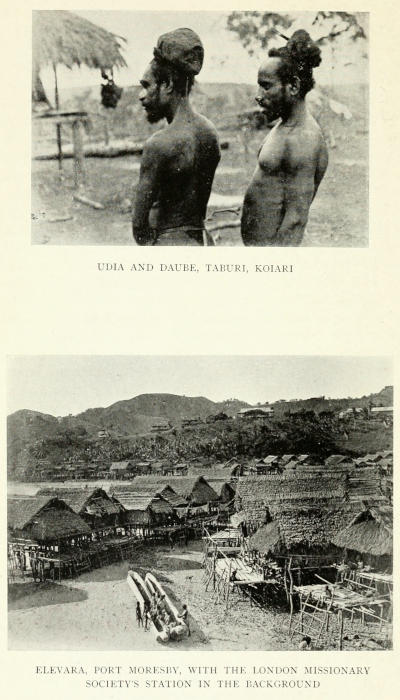
Port Moresby—Ride inland—Vegetation—View from the top of Warirata—The
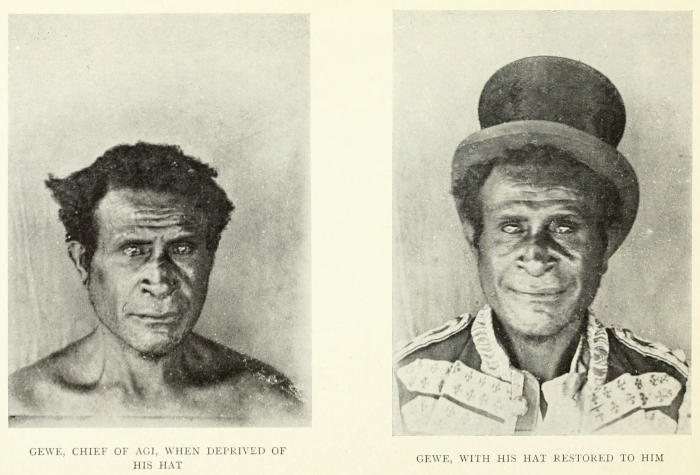
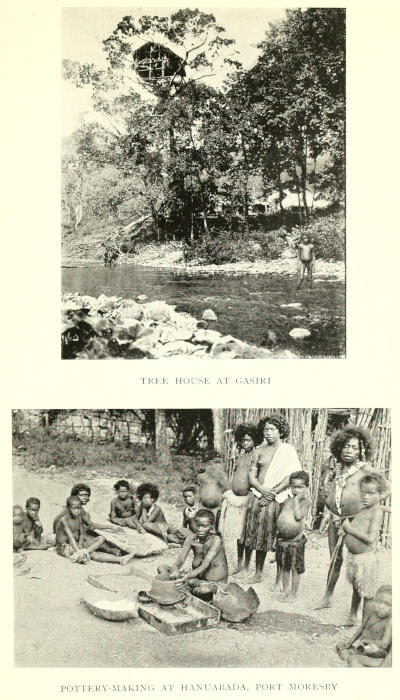
Taburi village of Atsiamakara—The Koiari—Tree houses—The Agi chief—Contrasts—A
lantern show—The mountaineers—Tribal warfare—The pottery
trade of Port Moresby—The Koitapu and the Motu—Gunboats
Arrival at Yule Island—The Sacred Heart Mission—Death of a Brother—A
service at Ziria—The meeting of the Papuan East and West in Yule Island—The
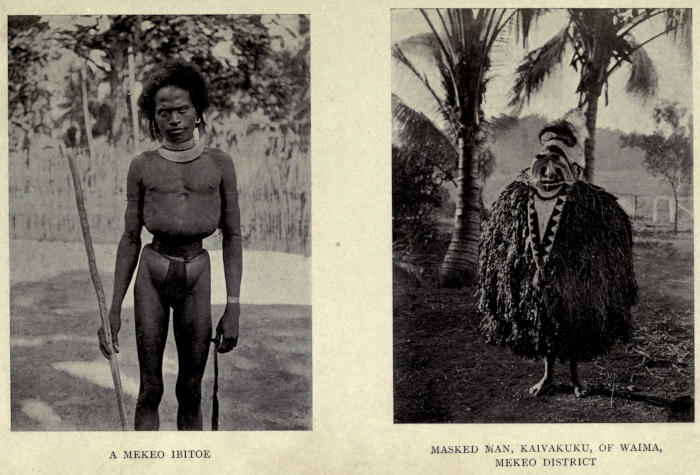
Ibitoe—Making a drum—Marriage customs—Omens—Tattooing—The
Roro fishers and traders—The Mekeo agriculturists—The Pokao hunters—Markets—Pinupaka—Mohu—Walk
across the plain and through the forest—Inawi—War
and Taboo chiefs—Taboo customs—Masks—A Mission
festivity—Tops—Veifaa—Women’s dress—Children’s games—Return to
coast
Arrival in Sarawak—Description of Kuching—The Sarawak Museum—Visit to
Sibu—Stay in Limbang—A Malay sago factory—Visit to Brunei—Method
and aims of Rajah Brooke’s Government
Leave Limbang—A Kadayan house at Tulu—Rapids on the Limbang—Ascent
of the Madalam—The Insurrection of Orang Kaya Tumonggong Lawai—Enter
the Trikan—Durian—Met by Mr. Douglas—Old Jungle—Descend
the Malinau and Tutau—Kayan tattooing—Berantu ceremony in the Batu
Blah House—Arrival at Marudi (Claudetown)—Kenyah drinking customs
The Geographical and Geological Features of Borneo: Arrangement
of mountains—The geology of the “Mountain-land,” Palæozoic—Mesozoic—the
geology of the “Hill-land,” Cainozoic—The geology of the
Plains, Quaternary—The geology of the Marshes, Alluvium—Recent volcanic
action. A Sketch of the Ethnography of Sarawak: Punans—Various
agricultural tribes of Indonesian and Proto-Malay stock—Land
Dayaks—Kenyahs and Kayans—Iban (Sea Dayaks)—Malays—Sociological
History of Sarawak—Chinese traders
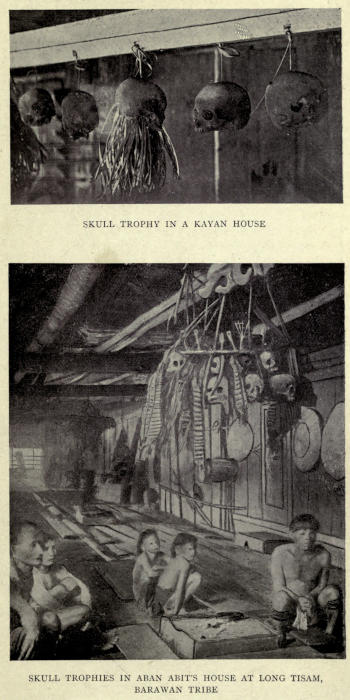
The Lelak house at Long Tru—Skull trophies—The settled Punans on the Bok—Sarcophagus
in Taman Liri’s house—Divination by means of a pig’s liver
in Aban Abit’s house—Purchase of some skulls—The Panyamun Panic in
Sarawak in 1894-5—Commencement of a similar scare—Administrative
duties at Long Semitan—Character of the Sĕbops—The fable of the monkey
and the frog—A visit to Mount Dulit—The Scott-Keltie Falls—The Himalayan
affinities of the fauna of Mount Dulit and of other high mountains
in Borneo
CHAPTER XXII A TRIP INTO THE INTERIOR OF BORNEO—continued
Ceremony of moving skulls into a new house at Long Puah—Naming ceremony
for Jangan’s boy—Peace-making—Conviviality—Malohs desire to marry
some Sĕbop girls—Sĕbop dances—Scenery on the Tinjar—Burnt house at
Long Dapoi—Panyamun Scare again—The Dapoi—Long Sulan—Tingan’s
matrimonial mishap—News from the Madangs—A Punan medicine man—Panyamun
Scare settled—Discovery of stone implements—A native selling
a stone implement for a loin cloth to die in—A stone hook—A visit to
Tama Bulan—The unfortunate Bulan—Fanny Rapid—A Kenyan love story
Reasons for collecting heads—Head required for going out of mourning for a
chief—Kenyah legend of the origin of Head-hunting—How Kenyahs leave
skulls behind when moving into a new house
Padi competition—Obstacle race—Speech-making—The Lirong jawa—Fracas
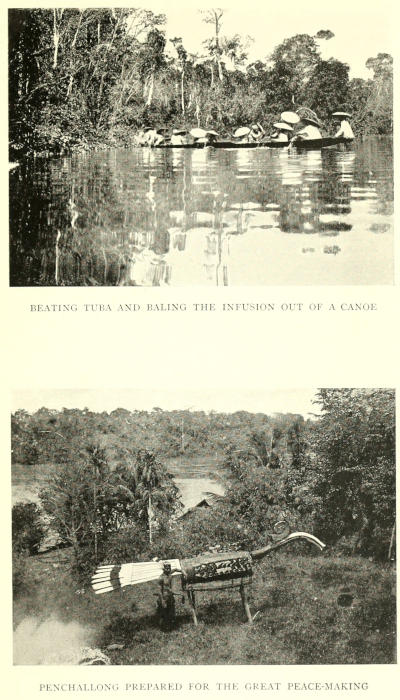
and reconciliation—Tuba-fishing in Logan Ansok—Great boat-race—Monster
public meeting—Enthusiastic speeches, and Madangs formally received into
the Baram Administrative District
B. Penchallong prepared for the Great Peace-making
The photographs for Plates i.-iv. A., vi. B., vii. B., viii. B.-xi.
A., xii. A., xiii.-xvi., xvii. A., xviii. A.,
xix.-xxii. were taken by the late A. Wilkin; those for Plates xvii. B., xxv. A., xxvii. B.,
xxx. A. were
taken by C. G. Seligmann; Plate iv. B. by Dr. C. S. Myers; xii. B. by H. Oldland; and the Frontispiece
and Plates v., vii. A., viii. A., xviii. B., xxiii., xxiv., xxv. B.,
xxvi., xxvii. A., xxviii., xxix., xxx.
B., xxxi. by the Author. Plates vi. A. and xi. B. were drawn from photographs taken by the Author
by his brother Trevor Haddon. With the exception of Plate xxx. B. none of the photographs have
been retouched.
HEAD-HUNTERS BLACK, WHITE, AND BROWN — CHAPTER I THURSDAY ISLAND TO MURRAY ISLAND
We arrived at Torres Straits early in the morning of
April 22nd, 1898, and dropped anchor off Friday Island,
as the steamers of the Ducal Line are not allowed now to tie
up at the hulk at Thursday Island. Shortly afterwards we were
met by the Hon. John Douglas, the Resident Magistrate, and
Dr. Salter, both of whom were old friends who had shown me
much kindness during my previous expedition. They were
accompanied by Seligmann, who had left London some months
previously in order to visit Australia, and as a handsel had
already done a little work on a hitherto unknown tribe of North
Queensland natives.
The township of Thursday Island, or Port Kennedy, as it is
officially termed, had increased considerably during the past
decade. This was partly due to the natural growth of the
frontier town of North Queensland, and partly to the fact that
it has become a fortified port which commands the only safe
passage for large vessels through these dangerous straits. So
assiduous have been the coral polyps in defending the northernmost
point of Australia, that although the straits measure some
eighty miles between Cape York and the nearest coast of New
Guinea, what with islands and the very extensive series of
intricate coral reefs, there is only one straightforward passage
for vessels of any size, and that is not more than a quarter of a
mile wide.
Although the town has increased in size its character has
not altered to any considerable extent. It is still the same
assemblage of corrugated iron and wooden buildings which
garishly broil under a tropical sun, unrelieved by that vegetation
which renders beautiful so many tropical towns. It is true a
little planting has been done, but the character of the soil, or
perhaps the absence of sufficient water, render those efforts
melancholy rather than successful.
Many of the old desert lots are now occupied by stores and
lodging-houses. The characteristic mountains of eviscerated
tins, kerosine cases, and innumerable empty bottles which betoken
a thirsty land, have been removed and cast into the sea.
Thriving two- or three-storied hotels proclaim increase in trade
and comparative luxury.
There is the same medley of nationalities—British, Colonial,
French, German, Scandinavian, Greek, and other European job
lots, in addition to an assortment from Asia and her islands.
As formerly, the Pacific islands are well represented, and a few
Torres Straits islanders are occasionally to be seen. Some of
the latter are resident as policemen, others visit the island to
sell pearl-shell, bêche-de-mer, and sometimes a little garden
produce, and to purchase what they need from the stores.
One great change in the population is very striking, and that
is the great preponderance of the Japanese. So far as I remember
they were few in number ten years previously, and
were, I believe, outnumbered by the Manila men; now they form
the bulk of the population, much to the disgust of most of the
Europeans and Colonials. Various reasons are assigned for
this jealousy of the Japanese, and different grounds are taken
for asserting that the influx should be checked, and restrictions
enforced on those who have already settled.
It appeared to me that the bed-rock of discontent was in the
fact that the Japanese beat the white men at their own game,
mainly because they live at a lower rate than do the white men.
A good proportion of the pearl-shelling industry is now carried
on by the Japanese, who further play into each other’s hands as
far as possible. A good example of their enterprise is shown
by the fact that they have now cut out the white boat-builders.
A few years ago, I was informed, some Japanese took to boat-building
and built their first boats from printed directions in
some English manual. Their first craft were rather clumsy, but
they discovered their mistakes, and now they turn out very
satisfactory sailing boats. It is impossible not to feel respect
for men who combine brains with diligence, and who command
success by frugality and combination.
The white men grumble that the Japanese spend so little in
the colony and send their money away; but the very same
white men admit they would themselves clear out as soon as
they had made their pile. Their intentions are the same as are
the performances of the Japanese; but the white men cannot,
under the present conditions, make a fortune quickly, and
certain of them cannot keep what they do make. There are
white men acting as divers for coloured men’s pay who some
years ago owned boats of their own. The fall in value of pearl-shell
a few years since is scarcely the sole reason for this change
of fortune; bad management and drink have a good deal to
answer for.
Some white men contend that as this is a British colony,
and has been developed by British capital and industry, the
Japanese should not be allowed to reap the benefit; but a
similar argument might be applied to many of the industrial
enterprises of the British in various parts of the world. As
an outsider, it appears to me that it is some of those very
qualities that have made the British colonist what he is that
manifest themselves in the Japanese. In other words, the
Japanese are feared because they are so British in many ways,
saving perhaps the British expensive mode of life. It is probably
largely this latter factor that renders the Japanese such deadly
competitors.
Formerly there were in Torres Straits regular bêche-de-mer
and copra industries, now there is very little of the former, and
none of the latter. Large, slimy, leathery sea-slugs gorge the
soft mud on the coral reefs; these when boiled and smoke-dried
shrivel into hard rough rolls, which are exported in large
numbers to China. These bêche-de-mer, or, as the Malays call
them, “tripang,” are scientifically known as Holothuria, and are
related to sea-urchins and starfish. Copra is the dried kernel of
the coconut.
When one walks about the township and sees the amount
of capital invested, and when one considers what is spent and
how much money is sent away, it is hard to realise that all this
wealth comes out of pearl-shell and pearls. During the past
thirty years very many thousands of pounds have been made
out of pearl-shell in Torres Straits; but now the waters have
been overfished, and unless measures are taken to protect the
pearl oysters, the harvest will become yet scantier and scantier.
In any case the time for big hauls and rapid fortunes is probably
over.
About the year 1890 gold was found in some of the islands,
but I believe that the working only pays in one island, though
it may be resumed at Horn Island, which at one time promised
to be a lucrative goldfield.
At Thursday Island we met with much helpful kindness.
Mr. Douglas entertained a couple of us, and did all he could
to expedite matters. Unfortunately he was then without a
steamer, and so could not tranship us and our gear to Murray
Island, which otherwise he would have gladly done. It took
a week to overhaul our baggage, get in stores, and to arrange
about transport, and eventually I arranged with Neil Andersen
to take us across; but even then there was neither room for
all our baggage nor accommodation for the whole of our party.
Rivers, Ray, and Seligmann and myself went on in the Freya,
leaving the others to follow in the Governor Cairns, an official
schooner that was shortly to start for Darnley Island.
It was not till the late afternoon of Saturday, April 30th,
that we actually started, and then we were only able to beat
up the passage between Thursday Island and Hammond Island,
and anchored about six o’clock in the lee of Tuesday Island.
There are very strong tides between these islands, and I have
seen even a large ocean steamer steaming full speed against
a tide race, and only just able to hold her own, much less make
way against it.
The Freya was a ketch, a kind of fore-and-aft schooner,
47 feet 6 inches long and 11 feet 2 inches in the beam, and
could carry about twenty tons of cargo. We had a strange
medley of races on board—European skipper and passengers,
our Javanese “boy,” the Japanese diver, two Polynesian sailors
from Rotumah, and three Papuans from Parama, near the
mouth of the Fly River. Our captain was a fine, big man,
probably a good type of the Dubhgaill, or “black (dark)
strangers,” who a thousand years ago ravaged the southern
and eastern coast of Ireland as far north as Dublin. We
“turned in” early—this consisted in wrapping oneself up in a
blanket, extemporising a pillow, and lying on the deck.
Left Tuesday Island at 4 a.m. in a stiff breeze and chopping
sea, and so could only make Dungeness Island by 4 p.m.
Twelve hours to go fifty-five miles! We landed at the mangrove
swamp, but there was little of interest. We hoped to
have reached Darnley Island next day, but only fetched Rennel
Island by 5.30 p.m. This is a large vegetated sandbank, on
which we found traces of occupation, mainly where the natives
had camped when bêche-de-mer fishing. We all suffered a
good deal from sunburnt feet, the scorching by the sun being
aggravated by the salt water. Some of our party were still
seasick; one lay on the deck as limp as damp blotting-paper,
and let the seas break over him without stirring even a finger.
We had a wet night of it, what with the rain from above and
the sea-water swishing in at the open stern and flooding the
sleepers on the deck.
We made an early start next morning and reached Erub,
or Darnley Island, at three in the afternoon. Immediately on
landing I went to Massacre Bay to photograph the stratified
volcanic ash that occurs only at this spot in the island, and
which is the sole visible remains of the crater of an old volcano.
The rest of the island is composed of basalt, which rises to a
height of over 500 feet, and is well wooded and fertile—indeed,
it is perhaps the most beautiful island in Torres Straits. Save
for rocky headlands which separate lovely little coves fringed
with white coral sand, the whole coast is skirted with groves
of coconut palms and occasional patches of mangroves. The
almost impenetrable jungle clothes the hills, except at those
spots that have been cleared for “gardens.” Even the tops of
the hills are covered with trees.
Very shortly after landing, a fine, honest-faced Murray Island
native, Alo by name, who was visiting Erub, came up and
greeted me very warmly. I regret to say I had quite forgotten
him, but he perfectly remembered me, and he beamed with
pleasure at seeing me. We walked along the coast to the
village where the chief lives, and saw Captain H⸺, and
I made arrangements with Koko Lifu, a South Sea man, to
lighter our goods off the Governor Cairns and to take the cargo
and our three comrades to Murray Island.
Captain H⸺ is one of those remarkable men one so
constantly meets in out-of-the-way places. It is the common
man one comes across at home. On the confines of savagery
and civilisation one meets the men who have dared and suffered,
rugged like broken quartz, and maybe as hard too, but withal
streaked with gold—ay, and good gold too. Captain H⸺
started in life as a middy in the Navy; owing to a tiff with his
people he quitted the Service and entered the Merchant Service.
He advanced quickly, and when still very young obtained a
command. He has made two fortunes, and lost both owing to
bank failures, and is at present a ruined old recluse, living on a
remote island along with Papuans, Polynesians, and other races
that now inhabit Erub. He is a kind of Government Agent, and
patrols the deep-water fishing grounds. I have previously
mentioned that the ordinary fishing grounds for pearl-shell are
practically exhausted, and the shellers have to go further afield
or have to dive in deeper water in order to get large shells.
Near Darnley Island are some good fishing grounds, but the
water is so deep as to render the fishing dangerous to life, and
the Queensland Government has prohibited fishing in these
waters. There are, however, always a number of men who are
willing to run the risk for the sake of increased gain, and it is
all they can do to dodge the vigilance of the wary old sea-dog.
Captain H⸺ lives entirely by himself, and has no intercourse
with the natives beyond what is absolutely necessary.
He puts in his spare time in attending to his gardens and
reading. Amongst other accomplishments he is a fluent
speaker of French and Italian, and it was a strange experience
to meet a weather-worn old man in frontier dishabille
acting and speaking like a refined gentleman.
As on previous nights, except the first, Andersen made a
tent for us on board the Freya out of the mainsail, the boom
forming the ridge-pole. Ontong, the cook I had engaged at
Thursday Island, woke us up at 2.30 a.m. to tell us tea was
ready, and it was too! The pungent smell of the smoke
prevented me from going to sleep for some time. In the
morning Ontong said he thought it was “close up daylight”;
and with an energy which is not usually credited to the
Oriental character, he had made tea so as to be prepared for
an early start.
We started early next morning with Alo as pilot; for the
coral reefs between Darnley and Murray are extensive, intricate,
and mainly uncharted. Andersen started for the “big passage”
that large boats always take; but after some time it was discovered
that Alo did not know this passage, but another one
to the south-west of Darnley. As half the tide had by this
time turned and the weather was very squally and the reefs
could not be seen with certainty, we returned to our old anchorage
by 9.30, and so another day was lost. We spent a lazy day
to give our sore legs a rest. Alo left us in the evening, as he
said he was “sick.” The truth was he did not care about the
job, so Andersen went ashore and brought another pilot, named
Spear. His father was a native of Parama; his mother was
an Erub woman. Spear told us he had first married a Murray
Island girl, and then half a dozen New Guinea women; but
Dr. Macfarlane, the pioneer missionary in these parts, had made
him “chuck” the latter.
Next day we started betimes, and sailed down channels in the
reefs not marked in the charts. The day was dull, and the little
wind was southerly when we wanted it easterly, whereas the
previous day the reverse was the case. Later it became squally
with rain, and finding it hopeless to reach Murray Island, Spear
piloted us to a sheltered spot in the lee of a reef and close
to a sandbank. We were only about four miles from our
destination, and we could hear the roaring of the breakers
of the Pacific Ocean as they dashed themselves against the
Great Barrier Reef ten miles distant.
We had a very disturbed night. About eight o’clock, whilst
we were yarning, the skipper jumped up and said the anchor
was dragging. Then ensued a scene of intense excitement, as
we were close not only to the sandbank, but also to a jagged
coral reef. It was horrid to feel the boat helplessly drifting, for
not only were the sails down, but the mainsail was unlashed
below to make our tent, and further, it was tied down in various
places. The first thing to do was to haul up the anchor, and
furl the jib and mainsail, and unship the tent. We all lent
a hand to the best of our ability, and soon we were sailing
down the narrow passage. Andersen’s voice was hoarse and
trembling with excitement, but he kept perfectly cool, and he
never lost his temper, though in the confusion and babel of
tongues some lost their heads through fright and did not do
the right thing at the right moment, and each of the crew was
ordering the others about in his own language.
After sailing about a little we made another attempt to
anchor, and again the anchor dragged and we had another
little cruise. Again we tried and again we failed, and it may
be imagined that our sensations were not of a very cheerful
nature, as we were in a really grave predicament; sometimes
we actually sailed over the reef, and might any moment have
knocked a hole in the ship’s bottom or have become stranded.
If he could not effect an anchorage, two courses were open
to Andersen. One was to cruise about all night, and it was
very dark, keeping the reef in sight, or rather sailing up and
down the passage, for if he had sailed out into the open he
would probably strike a reef or coral patch that was unnoticed.
The second alternative was to run the boat on to the sandbank
and let it float off at high water in the morning. The reason
why we drifted was because the anchor was let down on a steep
gravelly slope, and the movement of the boat, which was naturally
away from the bank, prevented the flukes from getting
a firm grip.
On the fourth essay the anchor was put on the sandbank
in a depth of three fathoms while we swung in fourteen or
fifteen fathoms. After waiting some time in anxiety, we found
to our relief that the anchor held, and we wrapped ourselves
up in our blankets and slept on deck, pretty well exhausted.
We had such confidence in the skill and alertness of Andersen,
whom we knew to be a pre-eminently safe man, that we soon
composed ourselves and slept soundly.
Friday, May 6th.—Again the wind was against us and the
weather was squally, and it was not till one o’clock that we
dropped anchor off the Mission premises at Murray Island.
I have briefly described our tedious trip to Murray Island,
not because there was anything at all unusual in it, but merely
to give some idea of the difficulty and uncertainty in sailing
in these waters. There is no need, therefore, for surprise at the
isolation of Murray Island, a fact which had influenced me in
deciding to make it the scene of our more detailed investigations.
On landing we were welcomed by Mr. John Bruce, the
schoolmaster and magistrate. He is the only white man now
resident on the island, and he plays a paternal part in the social
life of the people. I was very affectionately greeted by Ari
the Mamoose, or chief of the island, and by my old friend Pasi,
the chief of the neighbouring island of Dauar, and we walked
up and down the sand beach talking of old times, concerning
which I found Pasi’s memory was far better than mine.
I found that one of the two Mission residences on the side
of the hill that were there ten years before was still standing
and was empty, so I decided to occupy that, although it was
rather dilapidated; and it answered our purpose admirably.
The rest of the day and all the next was busily spent in
landing our stuff and in unpacking and putting things to rights.
We slept the first night at Bruce’s house, which is on the strand.
When I went up next morning to our temporary home I found
that the Samoan teacher Finau and his amiable wife had
caused the house to be swept, more or less, and had put down
mats, and placed two brightly coloured tablecloths on the table,
which was further decorated with two vases of flowers! It
seemed quite homely, and was a delicate attention that we
much appreciated.
I engaged two natives, Jimmy Rice and Debe Wali, to get
wood and water for us and to help Ontong. We had various
vicissitudes with these two “boys,” but we retained them all
through our stay, and they afforded us much amusement, no
little instruction, and a very fair amount of moral discipline.
The legs of two of our party were still so sore that they had to
be carried up the hill, and on Saturday night we were established
in our own quarters, and eager to commence the work for
which we had come so far.
We had a deal of straightening up to do on Sunday morning,
but I found time to go half-way down the hill to the schoolhouse,
and was again impressed, as on my former visit, with the
heartiness of the singing, which was almost deafening. The
congregation waited for me to go out first, and I stood at the
door and shook hands with nearly all the natives of the island
as they came down the steps, and many were the old friends
I greeted. I invited them to come up and see some photographs
after the afternoon service.
We made the place as tidy as possible, and we had a great
reception in the afternoon. Nearly all my old friends that
were still alive turned up, besides many others. To their
intense and hilarious delight I showed them some of the
photographs I had taken during my last visit, not only of
themselves, but also of other islands in the Straits. We had
an immense time. The yells of delight, the laughter, clicking,
flicking of the teeth, beaming faces and other expressions of
joy as they beheld photographs of themselves or of friends
would suddenly change to tears and wailing when they saw the
portrait of someone since deceased. It was a steamy and
smelly performance, but it was very jolly to be again among
my old friends, and equally gratifying to find them ready to
take up our friendship where we had left it.
Next morning when we were yarning with some natives
others solemnly came one by one up the hill with bunches
of bananas and coconuts, and soon there was a great heap
of garden produce on the floor. By this time the verandah
was filled with natives, men and women, and I again showed
the photographs, but not a word was said about the fruit.
They looked at the photographs over and over again, and the
men added to the noise made by the women. On this occasion
there was more crying, which, however, was enlivened with
much hilarity. Then the Mamoose told Pasi to inform me
in English, for the old man has a very imperfect command
even of the jargon English that is spoken out here, that the
stack of bananas and coconuts was a present to me. I made
a little speech in reply, and they slowly dispersed.
On Tuesday evening McDougall, Myers, and Wilkin arrived,
and our party was complete.
CHAPTER II THE MURRAY ISLANDS
Torres Straits were discovered and passed through
in August, 1606, by Luis Vaez de Torres. They were
first partially surveyed by Captain Cook in 1770, and more
thoroughly during the years 1843-5 by Captain Blackwood of
H.M.S. Fly, and in 1848-9 by Captain Owen Stanley of
H.M.S. Rattlesnake. H.M. cutter Bramble was associated with
both these ships in the survey. But in the meantime other
vessels had passed through: of these the most famous were the
French vessels the Astrolabe and Zélée, which in the course of
the memorable voyage of discovery under M. Dumont d’Urville
were temporarily stranded in the narrow passage of the Island
of Tut in 1840.
Bampton and Alt, the adventurous traders and explorers of
the Papuan Gulf, came in the last years of the eighteenth
century, and since then there have not been wanting equally
daring men who, unknown to fame, have sailed these dangerous
waters in search of a livelihood.
Mr. John Jardine was sent from Brisbane in 1862 to form a
settlement at Somerset, in Albany Pass; but the place did not
grow, and in 1877 the islands of Torres Straits were annexed to
Queensland, and the settlement was transferred from the mainland
to Thursday Island.
The islands of Torres Straits, geographically speaking, fall
into three groups, the lines of longitude 140° 48′ E. and 143°
29′ E. conveniently demarcating these subdivisions.
The western group contains all the largest islands, and these,
as well as many scattered islets, are composed of ancient
igneous rocks, such as eurites, granites, quartz andesites, and
rhyolitic tuff. These islands are, in fact, the submerged northern
extremity of the great Australian cordillera that extends from
Tasmania along the eastern margin of Australia, the northernmost
point of which is the hill of Mabudauan, on the coast of
New Guinea, near Saibai. This low granitic hill may be regarded
as one of the Torres Straits islands that has been
annexed to New Guinea by the seaward extension of the
alluvial deposits brought down by the Fly River. Coral islets
also occur among these rocky islands.
The shallow sea between Cape York peninsula and New
Guinea is choked with innumerable coral reefs. By wind and
wave action sandy islets have been built up on some of these
reefs, and the coral sand has been enriched by enormous
quantities of floating pumice. Wind-wafted or water-borne
seeds have germinated and clothed the sandbanks with vegetation.
Owing to the length of the south-east monsoon, the
islands have a tendency to extend in a south-easterly direction,
and consequently the north-west end of an island is the oldest,
hence one sometimes finds that in the smaller islands a greater
vegetable growth, or the oldest and largest trees, is at that end
of an island; but in time the vegetation extends uniformly over
the whole surface. The islands of the central division are
entirely vegetated sandbanks.
The eastern division of Torres Straits includes the islands
of Masaramker (Bramble Cay), Zapker (Campbell I.), Uga
(Stephen’s I.), Edugor (Nepean I.), Erub (Darnley I.), and the
Murray Islands (Mer, Dauar, and Waier), besides several sandbanks,
or “cays.”
All the above-named islands are of volcanic origin. The
first five consist entirely of lava with the exception of two
patches of volcanic ash at Massacre Bay, in Erub, to which
I have already referred. Mer, the largest of the Murray
Islands, is composed of lava and ash in about equal proportions,
while Dauar and Waier consist entirely of the latter rock. It
is interesting to note that where the Great Barrier Reef ends
there we find this great outburst of volcanic activity. It was
evidently an area of weakness in one corner of the continental
plateau of Australia. In pre-Carboniferous times the tuffs were
ejected and the lava welled forth that have since been metamorphosed
into the rocks of the Western Islands; but the
basaltic lavas of the Eastern Islands belong to a recent series of
earth movements, possibly of Pliocene age.
MAP OF TORRES STRAITS
Strictly speaking, to the three islands of Mer, Dauar, and
Waier should the name of Murray Islands, or Murray’s Islands,
be confined; but in Torres Straits the name of Murray Island
has become so firmly established for the largest of them that,
contrary to my usual custom, I propose to adopt the popular
rather than the native name.
Mer, or Murray Island, is only about five miles in circumference,
and is roughly oval in outline with its long axis running
roughly north-east to south-west. The southerly half consists
of an extinct crater, or caldera, which is breached to the north-east
by the lava stream that forms the remainder of the high
part of the island. This portion is very fertile, and supports a
luxuriant vegetation, which, when left to itself, forms an almost
impenetrable jungle; it is here that the natives have the bulk
of their gardens, and every portion of it is or has been under
cultivation. The great crescentic caldera valley, being formed
of porous volcanic ash and being somewhat arid, is by no means
so fertile; the vegetation, which consists of grass, low scrub, and
scattered coconut palms, presents a marked contrast to that of
the rest of the island. The slopes of the hills are usually
simply grass-covered.
Fig. 1. The Hill of
Gelam, Murray Island
The most prominent feature of Mer is the long steep hill of
Gelam, which culminates in a peak, 750 feet in height. It
extends along the western side of the island, and at its northern
end terminates in a low hill named Zomar, which splays out
into two spurs, the outer of which is called Upimager and the
inner Mĕkernurnur. Gelam rises up from a narrow belt of
cultivated soil behind the sand beach at an angle of 30 degrees,
forming a regular even slope, covered with grass save for
occasional patches of bare rock and low shrubs. At the
southern end the ground is much broken. The termination of
the smooth portion is marked by a conspicuous curved escarpment;
beyond this is a prominent block of rock about half-way
up the hill. This is known as the “eye.” The whole hill seen
from some distance at sea bears a strong resemblance to an
animal, and the natives speak of it as having once been a
dugong, the history of which is enshrined in the legend of
Gelam, a youth who is fabled to have come from Moa. The
terminal hill and the north end of Gelam represents the lobed
tail of the dugong, the curved escarpment corresponds to the
front edge of its paddle, while the “eye” and the broken ground
which indicates the nose and mouth complete the head.
The highest part of Gelam on its landward side forms bold,
riven precipices of about fifty feet in height. A small gorge
(Werbadupat) at the extreme south end of the island drains the
great valley; beyond it rises the small, symmetrical hill Dĕbĕmad,
which passes into the short crest of Mergar. The latter
corresponds to Gelam on the opposite side of the island; it
terminates in the steep hill Pitkir.
Fig. 2. Murray Island
from the South, with its Fringing Reef
Gelam and Mergar form a somewhat horseshoe-shaped range,
the continuity of which is interrupted at its greatest bend, and
it is here the ground is most broken up. The rock is a beautifully
stratified volcanic ash, with an outward dip of 30 degrees.
Within this crater is a smaller horseshoe-shaped hill, which is
the remains of the central cone of the old volcano. The eastern
limit of the degraded cone is named Gur; the western, which is
known as Zaumo, is prolonged into a spur called Ai. In the
valley (Deaudupat) between these hills and Gelam arises a
stream which flows in a northerly and north-easterly direction,
and after receiving two other affluents empties itself into the
sea at Korog. It should be remembered that the beds of all
the streams are dry for a greater portion of the year, and it is
only during the rainy season—i.e. from November to March,
inclusive—and then only immediately after the rain, that the
term “stream” can be applicable to them. There are, however,
some water-holes in the bed of the stream which hold water for
many months.
The great lava stream extends with an
undulating surface from the central cone to
the northern end of the island. It forms a
fertile tableland, which is bounded by a steep
slope. On its west side this slope is practically
a continuation of the sides (Zaumo and
Ai) of the central cone, and bounds the
eastern side of the miniature delta valley of
the Deaudupat stream. At the northern and
eastern sides of the island the lava stream
forms an abrupt or steep declivity, extending
either right down to the water’s edge or occasionally
leaving a narrow shore.
A fringing coral reef extends all round
Mer, but has its greatest width along the
easterly side of the island, where it forms an
extensive shallow shelf which dries, or very
nearly so, at spring tides, and constitutes an
admirable fishing ground for the natives.
A mile and a quarter to the south of Mer
are the islands of Dauar and Waier. The
former consists of two hills—Au Dauar,
605 feet in height, and Kebe Dauar, of less
than half that height. Au Dauar is a steep,
grassy hill like Gelam, but the saddle-shaped
depression between the two hills supports a
luxuriant vegetation. There is a sand-spit at
each end.
Waier is a remarkable little island, as it
practically consists solely of a pinnacled and
fissured crescentic wall of coarse volcanic ash
about 300 feet in height. There is a small
sand-spit on the side facing Dauar, and a
sand beach along the concavity of the island.
At these spots and in many of the gullies
there is some vegetation, otherwise the island
presents a barren though very picturesque
appearance.
Fig. 3. Waier and
Dauar, with their Fringing Reef
Dauar and Waier are surrounded by a continuous reef, which
extends for a considerable distance towards the south-east, far
beyond the region that was occupied by the other side of the
crater of Waier. We must regard Dauar and Waier as the
remnants of two craters, the south-easterly side of both of
which having been blown out by a volcanic outburst, but in
neither case is there any trace of a lava stream.
The climate, though hot, is not very trying, owing to the
persistence of a strong south-east tide wind for at least seven
months in the year—that is, from April to October. This is the
dry season, but rain often falls during its earlier half. Sometimes
there is a drought in the island, and the crops fail and a famine
ensues. During the dry season the temperature ranges between
72° and 87° F. in the shade, but in the dead calm of the north-west
monsoon a much greater temperature is reached, and the
damp, muggy heat becomes at such times very depressing.
The reading of the barograph shows that there is a wonderful
uniformity of atmospheric pressure. Every day there is a
remarkable double rise and fall of one degree; the greatest rise
occurs between eight and ten o’clock, morning and evening,
while the deepest depression is similarly between two and four
o’clock. In June, that is in the middle of a dry season, the
barograph records a pressure varying between 31 and 33, which
gradually decreases to 28 to 30 in December, again to rise
gradually to the midsummer maximum. These data are obtained
from inspection of the records made on the island by
Mr. John Bruce on the barograph we left with him for this
purpose.
Like the other natives of Torres Straits, the Murray Islanders
belong to the Melanesian race, the dark-skinned people of the
West Pacific who are characterised by their black frizzly or
woolly hair. They are a decidedly narrow-headed people. The
colour of the skin is dark chocolate, often burning to almost
black in the exposed portions. The accompanying illustrations
give a far better impression of the appearance and expression
of the people than can be conveyed by any verbal description.
Suffice it to say, the features are somewhat coarse, but by no
means bestial; there is usually an alert look about the men,
some of whom show decided strength of character in the face.
The old men have usually quite a venerable appearance.
PLATE I
ARI, THE MAMOOSE OF MER
PASI, THE MAMOOSE OF DAUAR
Their mental and moral character will be incidentally illustrated
in the following pages, and considering the isolation and
favourable conditions of existence with the consequent lack of
example and stimulus to exertion, we must admit that they
have proved themselves to be very creditable specimens of
savage humanity.
The Murray Islanders have often been accused of being lazy,
and during my former visit I came across several examples of
laziness and ingratitude to the white missionaries. As to the
first count, well, there is some truth in it from one point of view.
The natives certainly do not like to be made to work. One can
always get them to work pretty hard in spurts, but continuous
labour is very irksome to them; but after all, this is pretty much
the same with everybody. Nature deals so bountifully with the
people that circumstances have not forced them into the discipline
of work.
The people are not avaricious. They have no need for much
money; their wants are few and easily supplied. Surely they
are to be commended for not wearing out their lives to obtain
what is really of no use to them. The truth is, we call them
lazy because they won’t work for the white man more than they
care to. Why should they?
As to ingratitude. They take all they can get and, it is true,
rarely appear as grateful as the white man expects; but this is
by no means confined to these people. How often do we find
exactly the same trait amongst our own acquaintances! They
may feel grateful, but they have not the habit of expressing it.
On the other hand, it is not beyond the savage mind for the
argument thus to present itself. I did not ask the white man to
come here. I don’t particularly want him. I certainly don’t
want him to interfere with my customs. He comes here to
please himself. If he gives me medicines and presents that
is his look-out, that is his fashion. I will take all I can get.
I will give as little as I can. If he goes away I don’t care.
Less than thirty years ago in Torres Straits might was right,
and wrongs could only be redressed by superior physical force,
unless the magic of the sorcery man was enlisted. For the last
fifteen years the Queensland Government has caused a court-house
to be erected in every island that contains a fair number
of inhabitants, and the chief has the status of magistrate, and
policemen, usually four in number, watch over the public morality.
The policemen are civil servants, enjoying the following
annual emoluments—a suit of clothes, one pound sterling in
cash, and one pound of tobacco. In addition, they have the
honour and glory of their position; they row out in their
uniforms in the Government whale-boat to meet the Resident
Magistrate on his visits of inspection to the various islands, and
they go to church on Sundays dressed in their newest clothes.
There are doubtless other amenities which do not appear on the
surface.
The Mamoose, or chief, being a great man, “all along same
Queen Victoria,” as they proudly claim and honestly imagine,
is not supposed to receive payment. I well remember the
complex emotion shown on my former visit by the Mamoose
of Murray Island, who was torn by conflicting desires. Whether
to share the golden reward with his subordinates, or to forego
the coin on account of his being a great man, was more than
he could determine; it was clear that he preferred the lower
alternative—for what worth is honour if another man gets the
money? I suspected he almost felt inclined to abdicate his
sovereignty on the spot for the sake of one pound sterling; but
the Hon. John Douglas, who was then on his tour of inspection,
kept him up to the dignity of his position, and pointed out that
great men in his position could not take money like policemen.
Possibly the poor man thought that reigning sovereigns ruled
simply for the honour and glory of it, and had no emoluments.
Mr. Douglas’ intention was solely to support the dignity of
Ari’s office, for, to do him justice, when old Ari visited the
Government steamer on the following morning a little matter
was privately transacted in the cabin which had the effect of
making Ari beamingly happy.
But there are recognised perquisites for the Mamoose in the
shape of free labour by the prisoners. It would seem as if such
a course was not conducive to impartial justice, for it would
clearly be to the judge’s interest to commit every prisoner; this
temptation is, however, checked by the fact that all trials are
public, and popular opinion can make itself directly felt.
Most of the cases are for petty theft or disputes about land.
It is painful to have to confess that during our recent stay in
Murray Island many of the cases were for wife-beating or for
wife-slanging. The Mamoose is supplied with a short list of
the offences with which he is empowered to deal and the
penalties he may inflict. The technical error is usually made
of confusing moral and legal crimes. I gathered that very fair
justice is meted out in the native courts when left to themselves.
The usual punishment is a “moon” of enforced labour on
any public work that is in operation at the time, such as making
a road or jetty, or on work for the chief, such as making a pig-sty
or erecting fences. The alternative fine used to be husking
coconuts and making copra; the natives in some cases had to
supply their own coconuts for this purpose—the number varied
from 100 to 1,000, according to the offence. This was chiefly
the punishment of the women, the copra was one of the
Mamoose’s perquisites. Fines are now paid in money.
At night-time the prisoners are supposed to sleep in jail—an
ordinary native house set apart for this purpose—but at the
present time in Murray Island, owing to the absence of a jail,
they sleep at home! and during the whole of the time they are
under the surveillance of one or more policemen. Very often
it appeared to me that a policeman’s chief duty consisted in
watching a prisoner doing nothing. Very bad, or often repeated,
offenders are taken to Thursday Island to be tried by the
Resident Magistrate.
CHAPTER III WORK AND PLAY IN MURRAY ISLAND
The first thing we did after arranging the house was to
convert a little room into a dispensary, and very soon
numbers of natives came to get medicine and advice. McDougall,
Myers, and Seligmann worked hard at this, partly because they
were really interested in the various cases, and partly since
it brought natives to the house who could be utilised for our
other investigations.
The doctors also paid visits to bad cases in their homes. As
the former white missionaries on the island in days gone by
had been accustomed to dispense, to the best of their ability,
from their somewhat large assortment of drugs, the natives took
it for granted that we should do the same; hence there were no
special signs of gratitude on their part. Bruce, too, does what
he can for the natives, but his remedies are naturally of a simple,
though often drastic, character.
The medical skill and gratuitous advice and drugs of our
doctors did a great deal to facilitate the work of the expedition.
Towards the end of our time, hearing Captain H⸺ of Darnley
Island was seriously ill, McDougall volunteered to go over and
nurse him, and he remained there for a week or two.
It was a great safeguard for us, too, having so many doctors
about; but fortunately we only required their aid, or they each
other’s, for malarial fever or for minor ailments like sores. Only
on three occasions during the time we were away, till we left
Borneo, were there sufficiently bad cases of fever to cause the
least anxiety. So, on the whole, we came off remarkably well
on the score of health.
Although we have a fair amount of information about the
external appearance, the shape of the head, and such-like data
of most of the races of mankind, very little indeed is known
about the keenness of their senses and those other matters
that constitute the subject commonly known as experimental
psychology. My colleagues were the first thoroughly to investigate
primitive people in their own country, and it was the first
time that a well-equipped psychological laboratory had been
established among a people scarcely a generation removed from
perfect savagery.
Dr. Rivers undertook the organisation of this department,
and there were great searchings of heart as to what apparatus
to take out and which to leave behind. There was no previous
experience to go upon, and there was the fear of delicate
apparatus failing at the critical time, or that the natives would
not be amenable to all that might be required of them.
Fortunately the latter fear was groundless. It was only in
the most tedious operations, or in those in which they were
palpably below the average, that the natives exhibited a strong
disinclination to be experimented upon. Sometimes they
required a little careful handling—always patience and tact
were necessary, but taking them as a whole, it would be difficult
to find a set of people upon whom more reliable and satisfactory
observations could be made. I refer more particularly to the
Torres Straits islanders.
In his work in Murray Island, Rivers was assisted by Myers
and McDougall. During his trips to New Guinea, Seligmann
made some supplemental observations of interest. The subjects
investigated included visual acuity, sensitiveness to light,
colour vision, including colour blindness, binocular vision, and
visual space perception; acuity and range of hearing; appreciation
of differences of tone and rhythm; tactile acuity and
localisation; sensibility to pain; estimation of weight, smell,
and taste; simple reaction times to auditory and visual stimuli,
and choice reaction times; estimation of intervals of time;
memory; strength of grasp and accuracy of aim; reading,
writing, and drawing; the influence of various mental states on
blood-pressure, and the influence of fatigue and practice on
mental work.
The visual acuity of these people was found to be superior
to that of normal Europeans, though not in any very marked
degree. The visual powers of savages, which have excited the
admiration of travellers, may be held to depend upon the
faculty of observation. Starting with somewhat superior acuteness
of vision, by long attention to minute details coupled
with familiarity with their surroundings, they become able to
recognise things in a manner that at first sight seems quite
wonderful.
The commonest defect of eyesight among Europeans is
myopia, or short-sightedness, but this was found to be almost
completely absent amongst savages. The opposite condition,
hypermetropia, which is apparently the normal condition of the
European child, was very common among them.
The colour vision of the natives was investigated in several
ways. A hundred and fifty natives of Torres Straits and Kiwai
were tested by means of the usual wool test for colour-blindness
without finding one case. The names used for colours by
the natives of Murray Island, Mabuiag, and Kiwai were very
fully investigated, and the derivation of such names in most
cases established. The colour vocabularies of these islands
showed the special feature which appears to characterise many
primitive languages. There were definite names for red, less
definite for yellow, and still less so for green, while a definite
name for blue was either absent or borrowed from English.
The three languages mentioned, and some Australian languages
investigated by Rivers, seemed to show different stages
in the evolution of a colour vocabulary. Several North Queensland
natives (from Seven Rivers and the Fitzroy River) appeared
to be almost limited to words for red, white, and black;
perhaps it would be better to call the latter light and dark.
In all the islands there was a name for yellow, but in Kiwai,
at the mouth of the Fly River, the name applied to green
appeared to be inconstant and indefinite, while there was no
word for blue, for which colour the same word was used as for
black. In Torres Straits there are terms for green. In Murray
Island the native word for blue was the same as that used for
black, but the English word had been adopted and modified
into bŭlu-bŭlu. The language of Mabuiag was more advanced;
there was a word for blue (maludgamulnga, sea-colour), but it
was often also used for green. In these four vocabularies four
stages may be seen in the evolution of colour languages, exactly
as deducted by Geiger, red being the most definitive, and the
colours at the other end of the spectrum the least so. As
Rivers has also pointed out, it was noteworthy, too, that the
order of these people in respect to culture was the same as
in regard to development of words for colours. Rivers found
that though the people showed no confusion between red and
green they did between blue and green. The investigation of
these colour-names, he thought, showed that to them blue must
be a duller and darker colour than it is to us, and indeed the
experiments carried out with an apparatus known as Lovibond’s
tintometer afforded evidence of a distinct quantitative deficiency
in their perception of blue, though the results were far from
proving blindness to blue.
Numerous observations were made by Rivers on writing and
drawing, the former chiefly in the case of children. The most
striking result was the ease and correctness with which mirror
writing was performed. Mirror writing is that reversed form of
writing that comes right when looked at in a looking-glass. In
many cases native children, when asked to write with the left
hand, spontaneously wrote mirror writing, and all were able to
write in this fashion readily. In some cases children, when
asked to write with the left hand, wrote upside down.
Experiments were made on the estimation of time. The
method adopted was to give signals marking off a given
interval; another signal was then given as the commencement
of a second interval, which the native had to finish by a similar
signal when he judged it to be equal to the previous given
interval. Rivers found that this somewhat difficult procedure
met with unexpected success, and intervals of ten seconds,
twenty seconds, and one minute, were estimated with fairly
consistent results.
The conditions for testing acuity of hearing were very unfavourable
on Murray Island, owing to the noise of the sea
and the rustle of the coconut palms. Myers found that few
Murray Islanders surpassed a hyper-acute European in auditory
acuity, while the majority could not hear as far. No great
weight, however, could be attached to the observations, because
all the men were divers, an occupation that certainly damaged
the ears to some extent. To investigate their range of hearing
a Galton’s whistle was used, and it was found they could hear
very high notes. Twelve Murray Islanders were tested for their
sense of rhythm; this was found to be remarkably accurate for
120 beats of the metronome to the minute, and somewhat less
so for 60 beats.
Myers tested their sense of smell by means of a series of
tubes containing solutions, of varying strength, of odorous substances
like valerian and camphor, and the results, while not
altogether satisfactory, tended to show that they had no marked
superiority in this respect over the members of the expedition.
With regard to taste it was very difficult to get information,
as the natives, naturally enough, did not like strange substances
being put into their mouths. Sugar and salt were readily recognised,
acid was compared to unripe fruit, bitter is most uncertain,
and there is no distinctive name for it in the Murray Island
vocabulary.
Numerous time reaction experiments were made by Myers.
The time of the simple reaction is not sensibly longer, but
probably in many cases even shorter, than would be that given
by a corresponding class of Europeans. Myers points out that
the experiments clearly showed the great difference of temperament
among the individuals investigated. There was at one
extreme the slow, steady-going man, who reacted with almost
uniform speed on each occasion; at the other extreme was the
nervous, high-strung individual, who was frequently reacting
prematurely.
There is a consensus of opinion that savages are less sensitive
to pain than Europeans, but there is always the doubt whether
they are really able to bear pain with fortitude. However, the
conclusion McDougall arrived at, that the Murray Islanders
were distinctly less sensitive than the Europeans in the expedition,
was supported not only by their statements, but also
by tests depending on simple pressure of the skin made by
a small piece of apparatus. It should be understood that the
degree of pain produced was in all cases so slight as not to
spoil the pleasure and interest of the subjects in the proceedings.
It was found that the natives had points on their skin
specially sensitive to cold, exactly as in the case with Europeans.
As to touch, when tested by McDougall to see how close the
points of a pair of compasses must be put on the skin before
they cease to be felt as two, their sensitiveness was in general
better than that of the members of the expedition.
A series of tin canisters of the same size and appearance, but
variously weighted, was prepared by McDougall; another series
having the same weight, but of different sizes, was also provided:
the first experiment was to test the delicacy of discrimination
of the differences of weight, and the second to determine the
degree of their suggestibility by the effect of size, as appreciated
by sight and grasp, on the judgment of weight. It was interesting
to find that although the abstract idea of weight seemed
entirely new to the minds of these people, who had no word
to express it, and who, moreover, could have had no practice,
yet they were more accurate than a practised European.
It would be tedious to recount all the work that was accomplished
in the psychological laboratory; but it was most
interesting to watch the different operations and to see what
earnestness, I may say conscientiousness, most of the subjects
exhibited in the performance of the tasks set them. We never
knew what they thought of it all, or of us—perhaps it was as
well that we did not.
In the preliminary report Rivers has published, he notes that
our observations were in most cases made with very little
difficulty, and, with some exceptions, we could feel sure that
the natives were doing their best in all we asked them to do.
This opinion is based not only on observation of their behaviour
and expression while the tests were being carried out, but on
the consistency of the results; the usually small deviations
showed that the observations were made with due care and
attention.
Attempts were made, but with very little success, to find out
what was actually passing in the minds of the natives while
making these observations.
One general result was to show very considerable variability.
It was obvious that in general character and temperament the
natives varied greatly from one another, and very considerable
individual differences also came out in our experimental observations.
How great the variations were as compared with
those in a more complex community can only be determined
after a large number of comparative data have been accumulated.
Another general result pointed out by Rivers is that these
natives did not appear to be especially susceptible to suggestion,
but exhibited a very considerable independence of opinion. This
observation is of importance, as there is a widely spread idea
that the reverse is the case for backward peoples. Leading
questions were found not to be so dangerous as was expected.
Whenever possible I spent the mornings in measuring the
natives. In this I was helped by Wilkin, who also photographed
them. It is not always easy to obtain good portraits
when the accessories of a well-lighted studio are absent, but
the expedition is to be congratulated on the success of Wilkin’s
labours. Most of the Murray Island photographs were developed
on the spot, and in a considerable number of cases
copies of the portraits were given to the sitters in consideration
for their submitting to be psychologised.
Nearly all the Torres Straits and New Guinea photographs
were taken by Wilkin, and it is greatly to his credit that there
were very few failures.
Wilkin also paid some attention to native architecture in
Torres Straits and on the mainland of New Guinea, and to the
laws regulating land tenure and inheritance of property in
Torres Straits.
As Seligmann did not return with Ray, Wilkin, and myself
after our trip to the Central District of British New Guinea,
he had only two and a half weeks on Murray Island. During
that time he collected some natural history and botanical
specimens, and paid attention to native medicine and surgery
as well, and he also made some clinical observations on the
diseases of the natives. During his New Guinea trips, and
when he rejoined us in the western islands of Torres Straits,
he continued on much the same lines; so that in the end he
gained a very fair insight into “folk-medicine.” He also at
various times made some interesting ethnological observations
and measured some tribes I was not able to visit. Frequently
he assisted Rivers and myself in our investigations in Mabuiag.
Myers and McDougall left Murray Island on August 24th,
so as to get up the Baram River, Sarawak, before the north-east
monsoon set in. The work carried on in Kiwai and
Mabuiag and other of the western islands of the Straits was
very much of the same character as that which we did in
Murray Island. Fewer psychological observations could be
made, owing to the fact that most of the apparatus had been
taken on to Borneo. The subjects investigated were chiefly
visual acuity and colour vision, auditory acuity, smell and touch,
writing and drawing.
Ray was engaged practically the whole of every morning in
studying the Miriam language with Ari, the Mamoose of
Mer, and Pasi, the Mamoose of Dauar. He worked them very
hard, and often I had to go into the inner room in which he
studied and liberate the poor chiefs, who frequently were quite
done up, while Ray himself was as keen and fresh as ever.
The good men conscientiously turned up regularly, though
I am sure they must often have been heartily sick of the whole
concern. Giving the names of things is one matter, but it is
quite a different affair to plod through empty phrases in all
their possible moods and tenses, hour after hour, day after day,
and week after week. They were not the first, nor will they be
the last, to feel repugnance at the study of grammar.
The construction of the language was found to be very complex,
modifications of sense in the verb being expressed by an
elaborate system of prefixes and suffixes, for example:—
Kaka mari natagfri, I tell you.
Kaka abi detageri, I tell him.
E wiabi daratagereda, he tells them.
E netat le detageri, he tells one man.
E neis le daratagri, he tells two men.
Neis netat le abi detagridare, three men tell him.
Nouns are declined through several cases by means of
suffixes: e.g.tulik, a knife; tuliku, by means of a knife; tulikra,
of a knife; tuliklam, from a knife, etc.
Ray distinguishes two groups of languages in British New
Guinea, which he has termed respectively “Papuan” and
“Melanesian.” The former he regards as indigenous to New
Guinea, or at all events it may be regarded as such for all
practical purposes. The latter group of languages bears such
close resemblances to the language spoken in the great chain of
islands in the Western Pacific (or Melanesia) that there is no
doubt they are all derived from the same source. A third
group of languages, current in this part of the world, is that
spoken on the Australian continent. It is thus a matter of
some interest to discover to which linguistic group we must
assign the languages of Torres Straits.
I have to thank my colleague for giving me the following
information, which will sufficiently explain the differences
between these three groups of languages.
The Papuan languages agree with one another in very few
characteristics, and totally differ in vocabulary and constructive
particles. Consonantal sounds are very fully used, but closed
syllables are not common except in the western languages.
Demonstrative words indicating the place or direction of
actions are numerous. Nouns and pronouns are declined
through various cases by means of suffixes. Adjectives
precede substantives. The pronoun in some languages has
a trial as well as a singular, dual, and plural; but the inclusion
or exclusion of the person addressed is rarely indicated. The
verb is very complicated, and is modified by prefixes and
suffixes, its forms indicating the number of subject and object,
as well as tense and mood. Numeration is limited, and rarely
goes beyond two. Parts of the body are much used in counting.
The Melanesian languages have a very general agreement
among themselves in grammatical construction and vocabulary.
They use consonants very freely and have some consonantal
sounds which are difficult to transliterate. Many syllables are
closed. Demonstrative words pointing hither and thither are
much used. Nouns are divided into two classes, with or without
pronominal suffixes, according to the nearness or remoteness
of the connection between possessor or possessed. Words
may represent any part of speech without change, but the use
of a word is sometimes shown by prefix or affix. Number and
case are shown by separate words preceding the noun. Adjectives
follow the noun. Pronouns are numerous, and often of
four numbers—singular, dual, trial, and plural. The first person
always has forms including or excluding the person addressed.
Any word is made into a verb by the use of a preceding
particle, which usually marks tense and mood, and in some
languages person and number. Verbs have a causative,
reciprocal, frequentative and intensive form. Numeration is
extensive, and there is counting up to high numbers.
The Australian languages are in some respects similar to the
Papuan, though prefixes are not commonly used. Certain
consonantal sounds are rarely heard. Nouns and pronouns
are declined by means of suffixes through various cases.
Adjectives precede the noun. The pronoun has no trial
number, and some languages have the inclusive and exclusive
forms in the first person. The verb is modified as to time and
mood, and sometimes number, by suffixes, and has numerous
but, as a rule, simple forms. Numeration does not proceed
beyond two, or three at the utmost.
The grammar of the Murray Island (or Miriam) language
bears no resemblance to the Melanesian, and but little to the
Australian. It must therefore be regarded as belonging to the
Papuan group. The speech used by the Mission is a debased
form of the original, as Pasi told Ray “they cut it short.”
Ray is of opinion that as most of the young people know
English, it is very probable the pure language will die out with
the older folk.
Several of the elder men used to come and talk to me at
various times, but they came more regularly after we had
witnessed the Malu performances, and while the excitement
about them was still fresh. Baton and Mamai were the first to
come, they were policemen during my previous visit, and were
consequently old friends. I obtained, however, more valuable
information from Enocha and Wano, who were pillars of the
Church, but being old men they also knew about the past;
unfortunately there were very few alive at the time of our stay
in the island who knew first-hand about those matters that
interested us most.
These good people enjoyed describing the old ceremonies.
Often they brought me something that was formerly employed
in their mysteries or a model of it.
When any action was described the old fellows jumped up
and danced it in the room, sometimes two or three would
perform at once. I always had a drum handy to be in readiness
when they broke forth into song, and for the dance they
took bows and arrows or whatever may have been appropriate
from the stack of implements that was in a corner of the room.
We had many interesting séances, and it enabled us to get a
glimmer of the old ceremonies that was most tantalising. If
only we could have seen the real thing, how different would the
description be! How little, after all our efforts, could we
accomplish by mere hearsay! But even an undress rehearsal
or an imperfectly performed representation was better than
nothing at all.
For example, Bruce and I were independently trying to
work out the rain-making ceremony or charm. We obtained
more or less full descriptions that agreed on the whole and
which supplemented each other. He got some zogo mer, or
“sacred words”—that is, the magical incantation employed—from
Gasu, a noted and credited rain-maker. I tried these on
Ulai, a somewhat disreputable old man, who has been of considerable
use to us, and who at the same time gave us much
amusement; he immediately reeled off a lot more words. Gasu
then admitted that most of these were correct. I next tried
Enocha, who had the reputation of being a great master in the
art of rain-making. He passed most of Ulai’s words, denied
others, and gave me fresh ones. Eventually we arrived at a
version that may be taken as authentic; but doubtless each
rain-maker has his traditional formula, which may differ in
details from that of a rival magician.
A little incident was rather curious. Late one evening, when
Gasu was teaching Bruce the zogo mer of the rain charm, a
smart little shower came suddenly and unexpectedly from an
apparently cloudless sky. There was not a native next morning
who had not his own opinion as to the origin of the
shower.
It seemed very strange to us that our informants, however
friendly and anxious to help us, so often kept back something
till their hands were forced, so to speak, by information gained
from another source. Then it became possible to go one step
further. I think this was due in many cases simply to a lack of
appreciation of what we wanted to know; in other instances
there appeared to be an ingrained reticence which prevented
their speaking freely about sacred or magical ceremonies.
When, however, it became evident to them that we already
knew something about the ceremony or formula in question,
there was but little reluctance in giving information, especially
when they did not know how much or how little we knew.
I mention these details in order to give some idea of the
method we adopted of gaining our information. It is comparatively
easy to get an account of a ceremony or custom from
one man, but we invariably checked this information by inquiring
from other men, always selecting the oldest men available.
Even amongst ourselves no two people will describe any occurrence
in the same manner, and one will emphasise a certain point
which another may omit. Hence, in collecting from natives, we
were very careful to obtain as many versions as possible and to
sift the evidence. The results often appear meagre for the really
considerable amount of time and pains we spent on attaining
them; but, on the other hand, we feel fairly confident as to
their accuracy. Interesting as all this was, it involved a great
deal of very tedious work. One had to let the old men ramble
on, and it often happened that they got on to side issues and
barren narrations; but even so our patience was occasionally
rewarded by a hint of something which we would not otherwise
have come across, and which, followed out later, led to a really
interesting record. Tact and patience are necessary in extracting
reliable information from primitive folk.
I should perhaps add that although we communicated with
one another in jargon, or pidgin-English, we used native words
whenever there was a possibility of a misunderstanding arising,
and by the context we could usually make certain as to the significance
of new or obscure native terms. If the context failed
to elucidate the meaning, we arrived at it by questioning all
round the subject, or by allowing our informant to give his
explanation in his own way. I have given several examples of
the pidgin-English spoken, in the Torres Straits in the course
of this narrative. It is a quaint, though not an ideal mode
of communication of ideas, but with practice and the employment
of suitable illustrations and similes, one can get along
fairly well. I found, too, one could often elucidate a statement
by acting it, or by using sticks and stones as dummies; it is
remarkable what can be done in that way, and the natives quite
enter into the spirit of the thing.
One day Bruce surprised me by showing a minute bull-roarer
that was hung round the neck of a doiom, A doiom is the stone
effigy of a man that is used in the rain-making ceremony. I had
all along felt that a bull-roarer should appear in the performance,
but I could not hear of one. Well, here it was, worn as
a neck pendant, with two seed rattles. I showed it to Ulai; he
said it was not correct, and brought me another model, which
was much larger. Then I showed them both to Enocha. He
scoffed at Gasu’s little bull-roarer, admitted that Ulai’s was
more correct, but added that Ulai didn’t know about it.
He then promised to let me have the correct thing. This was
probably little more than professional jealousy, as Gasu was
noted as a successful rain-maker.
That same morning Enocha and Wano were alone with me,
and I turned the conversation to rain-making; then a happy
inspiration seized me, and I asked them to give me a demonstration.
They agreed. I provided one of the several doioms I had
already collected, and we adjourned to the shade of a neighbouring
tree, where, hidden by bushes, we would be quite unobserved
and undisturbed. Although we had not the proper
appurtenances, a pantomime was gone through, and I jotted
down full notes. It was strange to see these dear old men
doing everything half seriously, and at the same time laughing
as if they were truant schoolboys at some forbidden pleasure.
By a strange coincidence the school children were singing
“Auld Lang Syne” in the schoolhouse down the hill, whilst the
old men were rehearsing “old-time fashion” a short distance off.
A couple of days later Gasu gave us a complete demonstration
at the other end of the island, with all the accessories.
Four large plaited coconut leaves were erected to represent
rain clouds; there was a blackened patch on each of these
to mimic the blackness of a rain cloud, and one or two pendant
leaves imitated the falling rain. The four screens inclosed a
small space in which a hole was made in the ground. The
doiom was decorated with certain leaves, and packed in a
banana leaf with various minced leaves and numbers of red
seeds; the leaf was filled with water and placed in the hole,
the rain-maker all the while muttering the magical formulæ.
During part of the performance a lighted brand was waved
about, and at another a bamboo clapper was rattled. Thus
were simulated the lightning and thunder. Several instances
came to my notice during my recent and earlier visits to Murray
Island of the employment of this ceremony.
When I was arranging for the purchase of Gasu’s doiom,
Jimmy Dei, the sergeant of the police—a very intelligent man
and a devout churchgoer—objected to the transaction, as they
might not be able to obtain rain in the future when they required
it. The very day after I had bought Gasu’s doiom he
wanted it back, and would gladly have returned the goods I
gave him in exchange, for his was a very famous charm, and it
even had the proud distinction of having a name of its own.
Sometimes even a potent charm like this will fail in its function,
and once this mischance befell this particular doiom, whereat
Gasu was much enraged and threw it on the ground, and, alas!
the head broke off; then Gasu repented, and fastened the head
on again with wire. I must confess I felt very sorry for Gasu
when he regretted having yielded to my importunity and
wanted his doiom back, but the collecting instinct was stronger
than pure sentiment, and I had to inform him that it was then
too late. Recently I have had a letter from Mr. Bruce, in which
he says, “Gasu is always speaking of you and his doiom, and
adds, ‘Mind you, if he had not asked for it, I would not have
given it to the Professor.’” Poor old Gasu! he was half blind
when we were there, now he has completely lost his eyesight,
and I am afraid he does not bear a pleasing memory of our
visit, but still mourns the loss of his old and powerful charm.
PLATE II
RAIN SHRINE
DOIOM WITH BULL-ROARER
In the same letter Bruce writes: “We have still some very
powerful doioms left on the island. The new church was badly
injured last year by the foundations settling, owing to the rain
of a very heavy thunderstorm, but all the natives maintained it
was the thunder that did the damage. But the storm must
have been made by someone. Enocha was first suspected, but
he denied his ability to do so, as he says he does not make
thunder and lightning to spoil things; he only makes good rain
to make men’s gardens grow, and ‘besides,’ he said, ‘I am an
ekalesia, I did not spoil the sacred house.’ So they had to
fall back on Wali, as he was not an ekalesia, or member of the
Church, and he had been angry with Finau, the teacher, about
something. They have now made Wali an ekalesia to protect
the building from further damage.”
The worthy Finau never appeared to realise the nature of
our work or its effect upon the natives. He evidently thought
that the interest we took in the old customs and ceremonies
would tend to a recrudescence of paganism, and there is little
doubt that he intentionally hindered and hampered our investigations.
He was not sufficiently alert to appreciate the fact
that we were really playing into his hands. We bought and
took away many legendary and magical stones, including a
large number of rain charms, and in having representations
of the Malu ceremonies we must have stripped off some of the
glamour that ignorance throws round the unknown. We doubtless
revived impressions in the memory of a few old men, but
the younger men would be disillusioned by what they witnessed.
It is needless to add that we never undermined his influence as
a teacher, nor did anything that would be a stumbling-block to
the feeblest of his adherents.
Finau often preached loudly against native dancing, and consigned
those who attempted a little of it to hell, where, he
informed them, they would have kerosene poured over them,
and then they would be burnt; but, perhaps as he was himself
a Samoan, he allowed certain South Sea dances, which the
natives constantly practised under the tuition of a native of
Rotumah who was living on Murray Island. These dances
were to be performed at the opening of the new church in
Darnley, which was to take place in several months’ time, and
doubtless the opening of the church Finau was building in
Murray Island would be commemorated in its turn in a similar
manner.
In the Rotumah dances that we saw the men stood side by
side in three or four rows, and went through rather graceful
movements with heads, arms, and legs. Most of the movements
appeared to be conventionalised representations of hauling
ropes and other nautical actions. After a series of evolutions
had been performed the front rank retired behind, and
the second rank took its place. All was gone through again,
and so on in succession until the last rank had danced in the
front row.
One evening soon after our arrival there was a “play” in a
village close by. It now seems to be the fashion for the people
on one side of the island to learn new songs from Thursday
Island or from the crews of fishing-boats. When they consider
themselves proficient they go to other villages on the opposite
side of the island and there sing them. Shortly afterwards a
return visit is paid.
This custom of one side of the island challenging the other
in friendly rivalry is apparently an old one, and seems to point
to a dual division of the population such as we found later in
the western tribe, and which is of fundamental, social importance
among the Australians and many Papuan and Melanesian
peoples. Dr. Rivers has gathered a good deal of information
on this point, but he has not yet had time to work up his
material. This particular performance was certainly trivial and
mean; but surely the white man and not the native must be
criticised for this. The visitors from Las and other villages
were all dressed in their Sunday best, the girls stood in a clump
in the middle and sang Japanese and other songs. Then a man
blowing a whistle walked round and round and called out,
“Twenty-five cents a ride,” or something to that effect. Next
a number of men ranged themselves in pairs, like the spokes of
a wheel radiating from a hub of girls. The latter sang, and the
men walked round and round the girls, gradually going faster
and faster. This was in imitation of a merry-go-round which
had paid a couple of visits to Thursday Island. So popular was
this merry-go-round that I was informed the owners made a
profit of £1,600 for three months’ work!
To a sing-song tune of “la, la, la—la, la, la,” sundry very solemn
couples of girls separated themselves from the throng and
danced a polka—of a sort—slowly and carefully. One or two
pairs of men danced more vigorously. I saw only two couples
of opposite sex dancing together, and though these good people
are considerably emancipated from the past and were actually
copying a white-man’s dance, still their feeling of delicacy was
too strong to permit them to indulge in promiscuous dancing.
One funny man, dressed in a long figured-calico dressing-gown,
danced by himself; his antics were greatly appreciated.
Some of the girls had covered their faces with white, and had
painted a dab of red pigment on each cheek, perhaps in imitation
of the Japanese women of the settlement in Thursday
Island, which goes by the name of “Yokohama.”
A few days after our arrival we gave an evening entertainment
in the schoolhouse, at which there was a large attendance.
I opened the proceedings with an address in jargon
English, and referred to my last visit and told them what we
wanted to do this time. Ray next gave a couple of tunes on
the phonograph, Myers was to have performed on his violin, but
unfortunately the violin had suffered from damp, had become
unglued and had fallen to pieces. I showed a number of lantern
slides of local interest by means of a lantern Wilkin had
brought out at my request. I commenced with a copy of the
plate in Juke’s Voyage of the “Fly”, which illustrated Captain
Blackwood’s reception at Murray Island in 1845. In this interesting
picture the ship’s boats are surrounded by a noisy,
gesticulating crowd of naked savages. The second slide I showed
was the present of fruit which they themselves had given me
four days previously, and which Wilkin had photographed and
made into a lantern-slide. After showing photographs I took
ten years previously of a congregation in the building in which
we were then assembled, I showed a photograph of a wedding
that had taken place in the same room two days previously.
Several other slides were shown made from the photographs
I had taken on my last visit; these were received with great
excitement, and the audience quickly recognised the various
views and people, many of the latter were actually present, a
few were dead. When a group of children taken ten years
before was thrown on the screen I asked if any of them were
present, and a lad and a lass came before the screen and stood
beside their portraits. Then followed a phonographic interlude,
and I gave a second lantern show, mostly of slides of native
decorative art and native drawings of animals. Wilkin, who
kindly acted as “operator,” then showed a number of his comic
slides which were much appreciated, finishing off with the
children’s perennial favourite of rats running down a snoring
man’s throat. I made a point of procuring this slide before
I left England, and my anticipations of its popularity were
not unfounded, it simply brought down the house, and “Man
he sleep, he kaikai mokeis,” was always vociferously welcomed.
A couple of phonograph records concluded the performance.
Our friends were greatly pleased, and all behaved remarkably
well. Of course I expected them to behave properly, but I did
not think they would have so much control over their excitable
feelings, and I suspected they might be carried away in the
exuberance of their joy. Continually the more uproarious were
called to order by various members of the audience.
Every now and again we ran one thing hard on Murray
Island; for example, for a week or so some of us studied “cat’s
cradle” games. McDougall soon became fascinated by these,
and Myers eventually succumbed. But kamut, as the natives
call their string puzzles, is a very different matter from the
uninteresting and simple performance to which we were accustomed
as children.
Two distinct kinds of operations may be performed with
string, namely, tricks and puzzles. The former usually are
movements which appear to form knots or ties, but which
really run out freely. The puzzles are complicated figures
which are supposed to bear some resemblance to natural
objects. Our “cat’s cradle” belongs to the latter category, but
we have also numerous string tricks.
Some of the string tricks are the same as those practised
at home. One was intended to represent some food held in the
hand which was offered to the spectator, but when the latter
attempted to take it, saying, “You got some food for me?”
the food disappeared as the player replied, “No got.” A similar,
apparently knotted puzzle terminated in two loops, which represented
a mouse’s ears, but on attempting to catch it the whole
ran out.
Some of the string puzzles represented divers objects, as a
bird’s nest, coconut palm, the setting sun, a fish spear, a crab,
a canoe, and many others. Quite a number were moving
puzzles—working models, in fact; such were, for example, a
sea-snake swimming, a man dancing, and so forth. Some of these
were indelicate. The most interesting was a fight between a
Dauar man and a Murray Islander. In this kamut, by working
the strings, two loose knots collided in the centre and became
mixed up, but eventually one knot returns with a loop on it,
which is the successful Murray Islander returning with the head
of his adversary!
Little songs are sung to many string puzzles as they are
being played, which may be the relics of some magical formulæ.
Several kamut puzzles illustrate legendary beings such as Geigi,
the boy king-fish, or his mother Nageg, the trigger-fish. One
represents the taboo grounds of Gazir and Kiam, where some
of the Malu ceremonies were held.
We learnt a good many of these kamut, but they were very
difficult to remember, owing to the extreme complication of the
processes in making the figures, and we had to practise them
constantly. Eventually we invented a system of nomenclature,
by means of which we found it possible to write down all the
stages of manipulation; and we found as a rule the more
complex the figure the easier it was to describe. By rigorous
adherence to our system it will be possible for others to reproduce
the Murray Island figures and to record others from
elsewhere. Generally Rivers and Ray first learnt a particular
puzzle, and gradually worked out the description by slowly
performing the movements and dictating the processes to me,
but I did not watch what they were doing.
Then one of them read out the description while I endeavoured
to reproduce the puzzle from the verbal description
alone. We were never satisfied until it can be so done without
any possibility of mistake. We had many fights over the
descriptions, and always felt very proud of ourselves when one
account was satisfactorily finished. But I can very well imagine
that had we been observed some people would have thought we
were demented, or, at least, were wasting our time.
One afternoon some of us went to a kaikai, or feast. The
word kaikai means food, a meal, a feast, or to eat. It is in use
all over the South Seas, and is derived from the Polynesian kai
(food). The Miriam (i.e. the Murray Island) name for a feast
is wetpur. This was a funeral feast for the son of “Captain
Cook,” of Erub; the boy had died about a year previously.
The proceedings opened with a kolap, or top-spinning match.
Top-spinning was a great institution in Murray Island during
the time of our stay there. On one occasion there were thirty
tops spinning at the same time. The men sang songs, and
there was great cheering-on of slackening tops, and shouting
and jeering when one stopped. At the critical time, as a top
was dying, great care was taken to shelter it from the wind
so as to prolong its “life” a few seconds longer. At one match
we timed the four best tops, and found they span for 27½, 26¾,
25¼, and 24 minutes respectively.
The tops are made of a fine-grained volcanic ash, and have the
shape of a split-pea, with a diameter of from about 4 to 7½
inches. There is a long palm-wood stem. The flat upper
surface of the top is almost invariably painted in coloured
rings or with various devices, red, white, yellow, and blue being
the usual colours. Objects or incidents of everyday life are
often drawn, but not infrequently their legends are depicted.
The top is spun by repeated slow, steady, sliding movements
of the outstretched palms. Formerly the tops were spun on
pieces of shell, now pieces of broken crockery, or the under
surface of a cup or saucer are usually employed. The tops are
kept in specially made round baskets, in which a nest of calico
is often placed as a further protection to the top. It is very
amusing to see grown men gingerly carrying with both hands
a top ensconced in its basket, with at least as much care and
seriousness as a young wife carries her firstborn. We have seen
men of all ages engaged in these matches, the grizzled taking as
much interest in the performance of their tops as the young men.
Usually one section or side of the island is pitted against another.
There is a decided tendency for the enthusiasm of the natives
to carry their amusements beyond bounds. One time it will be
Tamar, and the good people will so impoverish their gardens
by vying with one another in heaping up food that scarcity
often results. During our stay top-spinning became almost a
debauch, and the men played kolap so assiduously every weekday
that they had no time to attend to their gardens, and on
Saturdays they did not bring in enough food to last till the
Monday. The Puritan Sabbath is in full force, and none would
dream of breaking it by getting food on Sunday, consequently
numbers of children came to school on Monday morning without
having had any breakfast. This made them peevish and inattentive,
so Mr. Bruce had to complain to the Mamoose, and an edict
was issued prohibiting the kolap matches on Saturday, and the
men were told to go to their gardens on that day as heretofore.
PLATE III
ULAI
A TOP-SPINNING MATCH
PLATE IV
REMOVING SAND FROM A COPPER MAORI
A MURRAY ISLAND FEAST
After this particular match two “copper Maoris” were opened.
A “copper Maori,” or earth-oven, is a large shallow hole in the
ground, in which stones are placed and a fire lighted—this
makes the stones red hot. “Native food” of various kinds—yams,
sweet potatoes, taro, etc.—is wrapped in banana leaves and
placed on the hot stones. Small pigs are put in whole. The
food is then covered over with leaves, and sometimes mats and
earth are heaped over all. In an hour or two the food is cooked
to perfection. It is the best method of cooking food, as the
juices and flavours are retained.
The name “copper Maori,” or kŏpa Mauri, as it is here
pronounced, is now common all over the Pacific, though this
method of cooking has everywhere in the West Pacific its local
name, and therefore is an indigenous and not introduced custom.
In Torres Straits the earth-oven is called ame or amai, but the
introduced word alone is used when speaking to foreigners.
The word kopa is the Maori name for the ordinary earth-oven,
or more correctly for the hole in the ground. The similarity of
sound between kopa and “copper” has led to the current belief
that as the whalers in New Zealand used large coppers for
boiling down the blubber, the native method of cooking came
to be called “copper Maori,” that is, the Maori copper.
By this time a mat was spread apart from the others, to which
we were invited along with the two Mamooses, Ari and Pasi.
We had pork, yams, pumpkins and bananas, and green coconuts
to drink. Most of the men sat on each side of a long row
of mats, the food being placed down the middle. They ate
from the packets with their fingers, and munched chunks of
roast pork with evident gusto. They gave us plates and knives
and forks, but I preferred a banana leaf, native fashion, to a
plate. The women and children had their food apart in various
family groups.
After all was over the women placed their baskets in two
rows, and the hosts filled each with an equal amount of raw
native food. The party then broke up.
CHAPTER IV THE MALU CEREMONIES
In various parts of the world there are very important ceremonies
in which the lads are formally received into the
community of men. Before undergoing these initiation ceremonies
they have no social position, but subsequently they are
recognised as men, and are at liberty to marry. There may be
numerous grades of rank through which it may take many
years to pass, but the first series of ceremonies are all-important.
Initiation ceremonies are observed all over Australia and
throughout the greater part of Melanesia, as well as in portions
of the Indonesian Archipelago, not to mention other regions of
the earth. It would take too long if I were to attempt even
the briefest description and analysis of the various customs
connected with these important rites in this quarter of the
globe; but the following features are fairly widely spread.
When the lads show by the sprouting hair on their face that
they are attaining manhood, their male relations agree that they
shall be initiated. This ceremony may take place annually or
at intervals of two or three years.
The lads are secluded in a tabooed spot in the bush, access
to which is strictly prohibited to any non-initiated person.
Sacred emblems are frequently shown to the lads; these are
often masked men who symbolise some legendary or mystical
person or event. Usually a flat, thin piece of wood shaped like
a willow leaf is shown to them, this is the so-called bull-roarer.
It is fastened to one end of a piece of string, the other being
lashed on to a stick. The apparatus is whirled round and
round above the head of the operator, and according to its size
and shape it makes a buzzing or a humming noise; the movement
may be varied by violently lashing it backwards and forwards,
when it gives rise to a siren-like shriek. The weird and
mysterious sounds issuing from the bush terrify the women and
children, who regard them as the voices of spirits. The secret
is soon learnt by the young initiate, who is given a bull-roarer
and warned never to show it to a woman or child on penalty of
death.
Whatever may be done, or shown, or told to the lads is to be
kept secret by them, and by way of emphasising this they are
usually frightened in various ways or subjected to severe treatment.
Certain restrictions, or taboos, are generally placed on the
lads for a variable time, and during the probationary period
they are instructed in the moral code, social customs, and sacred
legends of the community, and, in fact, all that it behoves a
“man” to know.
Every tribe is composed of several divisions or clans, and it
is the rule in Australia and in some parts of Melanesia for each
clan to be intimately associated with at least one class of
animals, plants, or natural objects. This animal, or whatever
it may be, is spoken of as the totem of the clan or individual,
and it should be borne in mind that the totem is a species of
animal, or plant, not an individual one. Thus all cassowaries,
and not any one particular bird, are the totem of the whole
cassowary clan, or of each member of that clan. It is the
business of the clan relatives of the boy to see that he is duly
instructed in the duties and prohibitions that his particular
totem imposes on him.
In communities at this stage of culture there are certain
definite restrictions as to marriage and intercourse with women.
It is now nearly universally the rule that a man may have
nothing to do with a woman who belongs to the same totem
as himself. In some cases the group from which he may choose
his wife is yet more restricted. Any infringement of this rule
is a most heinous offence, for the perpetration of which the
death penalty may be inflicted on one or both offenders.
Although a tribe may be subdivided into quite a number of
clans, these usually fall into two groups. For example, the
clan groups of “Eaglehawk” and “Crow” are very widely
spread throughout Australia. Members of any particular clan
of one tribe have friendly relations with the members of a
corresponding clan in another tribe; these two clans may or
may not have the same totem, but in either case they are recognised
as affiliated.
In the foregoing account I have very briefly sketched some
of the main features of a totemistic society. It is probable
that in its more primitive stage all the members of a community
had an approximately equal position according to their
grade and irrespective of their particular clan or totem. We
find, however, in the present day that there are various interesting
stages of the disintegration of this old social system;
especially is this the case in Melanesia.
Speaking in general terms, what happens is as follows.
One clan or group becomes more influential than the others
and arrogates privileges to its members, who thus constitute
a powerful secret society. Although at first membership was
restricted to those who were born into the clan, eventually it
seems as if anyone who could afford to pay the charges might
be admitted.
Other secret societies or clubs would be formed by ambitious
men, which might in turn acquire more or less power, or, on the
other hand, might prove of no account. Gradually the system
breaks down—as Dr. Codrington has shown us was the case in
Melanesia—and in Florida, for example, the old men sat and
wept over the profanation of the ancient mysteries and the loss
of their own power and privilege.
In our travels we came across peoples in various stages of
culture, as will be narrated in due course. In Murray Island
true totemism does not exist now, whatever may have been the
case in the past; but there is an important secret society or
brotherhood, the power of which was broken by the missionaries.
For a long time I had been trying to get the natives of the
village of Las, on the eastern side of the island, to give us
a demonstration of the ancient initiation ceremonies connected
with the Malu cult. All was supposed to be ready on Thursday
afternoon, July 28th, so we walked over, but found no preparations
made. We were greatly disappointed, and I spoke rather
strongly to some of the influential men, but I did not feel at all
hopeful as to the result.
After a meal in Gododo’s house, we spent the evening yarning
and recording some songs on the phonograph.
Next day, after an early breakfast, I walked to Ulag to inquire
after a star-shaped stone club that was used in the old Malu
ceremonies; this I borrowed, and also arranged for a similar club
and the sacred drum to be brought. Of all the paraphernalia
appertaining to this cult only these three implements remain.
In the afternoon matters began to look more lively, and it
was soon evident that something was about to happen.
We were taken to the taboo ground at Gazir, and shortly
afterwards the men assembled and went through a representation
of the first ceremony, at which the sacred masks
were shown to the lads (kersi) who were to be initiated. Now
no masks remain, and we had to be content with an exceedingly
poor counterfeit of what must have been a very awe-inspiring
ceremony. There were just sufficient echoes of it, as it were,
to enable us to catch something of the old solemnity. The
meaning of the reiterated couplet that was sung on this occasion
is to the effect that Malu had bad teeth! Could anything be
more trivial? It quite pained me when I heard the translation
of the chant.
When this was over we hastened down to the sand beach at
Las, and shortly afterwards the second ceremony was performed,
very much as I had seen it ten years before. There were many
discordant elements in the performance, but these it is now impossible
to eliminate.
What threatened to be a fiasco turned out to be quite a success,
and several points that were obscure to me before were cleared
up. Myers helped me a great deal, and as he has noted down
quite a number of the Malu songs and tunes, we can now restore
the ceremonies at Gazir, Las, and Dam with a very fair degree
of accuracy.
After this exhibition we spent many days in going over the
details of the ceremonies and songs. Information of this kind
which appears so simple when written is surprisingly difficult
and tedious to collect. It is by no means easy to get the
natives to understand precisely what one requires. There is
also little doubt that they do not care to speak freely about
the sacred rites they revered in the past. I allude, of course, to
the old men, for even the middle-aged know very little of their
ancient customs, and the young men nothing at all.
The habit of secrecy was too ingrained to be readily relinquished.
In nearly every inquiry of this sort we found there
were certain zogo mer, or “sacred words,” which it was always
very difficult to obtain. Sometimes these are magical phrases,
as in the charm for making rain, or a formula that was known
to but a very few men, like that employed at Tomog Zogo.
Naturally the zogo mer of the Malu ceremonies were not to be
repeated lightly.
There were some sacred words which they disliked mentioning:
for example, the culture hero in the “Myth of Origin”
of these ceremonies is always spoken of as Malu, and this
name is known to women and children—it is, in fact, what
they call an au ne, i.e. a “big” or “general” name; but his real
name is Bomai—this is the zogo ne (sacred name) or gumik ne
(secret name), which only initiates may learn, and is one of
those “unspeakable words which it is not lawful for a man to
utter.”
On the occasion of my previous visit to Murray Island I quite
failed to get models made of the Malu masks, and it was not
till the close of the present visit that I could persuade anyone
to make us some; but by this time we had worked up a
temporary recrudescence of interest in these and other ceremonies,
and eventually our good friends Wano and Enocha
agreed to make the models for me, but on the understanding
that I should give each of them ten shillings, which they
particularly requested should be paid in gold, as they wanted
to put it in the plate at the annual missionary meeting. I
provided them with the requisite cardboard, as it was out of
the question to get the masks constructed of turtle-shell
(“tortoise-shell”) like the originals. Nearly every day one or
other came to tell me how well they were getting on, and how
pleased I should be with the result; they were evidently hugely
delighted with themselves.
One evening, on their way to the weekly prayer-meeting, they
brought the masks very carefully hidden, and by this time I was
almost as excited as they were. Both models were slightly
different from what I expected, but there is no doubt they are
as accurate representations of the old masks as it is now
possible to obtain. The face-mask is of open work, painted
red, and stuck on it are scattered white feathers. The raised
nose is made of beeswax; the eyes are two red seeds; a ring
of wax represents the lips. Cardboard models represent the
beard of human lower jawbones. Above are feathers of the
Torres Straits pigeon and croton leaves. Behind is a model
of a turtle.
Next morning I incautiously showed these masks to a woman
who happened to be about the place. Later in the day Enocha
came to me in a great hurry and besought me not to let any
woman see them, and, of course, I respected his wish. This was
an interesting proof of the sanctity in which the original was
held. The ceremonies had not been held for a quarter of a
century, the people are all Christian, and yet even now a woman
may not see cardboard models of
the tabooed masks!
We had many male visitors to
see the masks, and it was quite
pathetic to see the expressions of
pleasure tempered with sadness
manifested by the old men. They
shook their heads and clicked, and
even the tears started to their eyes.
Ichabod!
I seized the opportunity of the
possession of these models to
induce some of my friends to give
us another performance of that
part of the Malu ceremony in
which masks were worn. Two
days before we left the island we
went to Kiam, the other taboo
ground where the ceremony was
held. One year it was held at
Gazir, and the following at Kiam,
on the opposite side of the island.
Gadodo, Kilerup, and another man
dressed up, and I had the satisfaction
of being able to take a
cinematograph picture of the processional
dance. The grotesque masks worn by ruddled men,
girt with leafy kilts, had a strange effect as they emerged from
the jungle, and very weird was the dance in the mottled shade
of the tropical foliage, a fantasy in red and green, lit up by
spots of sunshine.
Fig. 4. Model of the
Bomai Mask of the Malu Ceremonies
In order to give the reader a substantially accurate idea of
the Malu ceremonies, I do not propose to describe exactly only
what we saw, but I shall endeavour, as briefly as possible, to
resuscitate the past. Full details will be published elsewhere.
The kersi, painted and decorated in a peculiar manner, were
marshalled on the taboo ground by some elders; beyond was
the round house, in which the emblems were kept. Between the
hut and the boys was an avenue of men with long staves, who
performed rhythmic movements, which bore some resemblance
to those made in energetically punting a boat. Near the kersi
sat the drum-beaters, and round about in their allotted places,
according to their clans, were former initiates. The kersi sat
tailorwise in a semicircle, with hands resting on their legs,
feeling very frightened. Suddenly the fearsome procession
appeared at the other end of the avenue of men, and the three
Zogole slowly marched with peculiar movements. They alone
wore leafy girdles (it should be remembered that at that time
the Torres Straits men invariably went nude except the performers
of certain ceremonies). The head of the first zogole
was covered with a ruddled turtle-shell mask, representing a
human face, which had a beard of human jawbones; above the
face were leaves and feathers, and hanging from it behind was
a painted carapace of a turtle, the latter was supported by a
long string by the second zogole. The third zogole bore a
turtle-shell mask representing a hammer-headed shark, on which
was a human face; it was provided with human arms and
hands, and decorated with leaves, feathers, and turtle-shell
figures of birds, frogs, and centipedes. When the zogole came
to the semicircle of kersi they turned round and kicked out
behind. They retired and advanced again, and then once more.
The sacred words were uttered and the chant sung. The kersi
were told the hidden name, and they had to make a present of
food to the zogole.
This was certainly the essential initiation ceremony; it was
followed by another, which had not the same sacred character,
as women and children were allowed to be present. The latter
was, in fact, a public recognition service, an acknowledgment
that the kersi had been duly initiated, and that henceforth,
after the completion of all the ceremonies, they were to rank as
members of the fraternity.
The second ceremony took place in the afternoon or early
evening on the sand beach between the village of Las and the
sea. The spectators sat in a confused crowd along the village
fence, the newly initiated lads occupying a prominent position.
PLATE V
THE DANCE OF THE MALU ZOGOLE
PLATE VI
THE MALU CEREMONY AT LAS
ULAI SINGING MALU SONGS INTO A PHONOGRAPH, GASU IS BEATING THE
MALU DRUM
The drum-men appearing from behind a point at the southern
end of the beach, ran forward and beat their drums with the
characteristic staccato rhythm, and as the chant slowly augmented
in sound, all the other voices were hushed, and the
audience sat motionless in hushed expectancy.
Two or three pairs of omai le rushed forward, with bent body
and trailing arms; with their hands they jerked up sand behind
them as they ran, ever and again stopping and playing about
and jumping over each other after the manner of the dogs they
personated.
These were followed by several pairs of daumer-le, who, in the
intervals of running forward, jumped about in a crouching
attitude, and beat their chests with the palms of their hands,
thereby imitating the perching and the flapping of the wings
of the Torres Straits pigeon (daumer).
They were succeeded by a group of girigirile. The bird
that they personified is a native of New Guinea, but what it is
I was unable to discover.
With a whirl and a rush a revolving group of men next
swept along the sand beach, the inner circle of young men
brandished stone clubs, while the outer circle of old men carried
sticks.
These operations were watched by the three zogole, who
slowly and sedately marched along till they arrived opposite the
spectators, and they then stood still. The reddened bodies of
the zogole were entirely covered with white feathers, and their
heads were similarly obscured; each carried five wands in his
right hand. Although they were visible to the women, the
personality of the zogole was supposed to be unknown to them,
and should any woman divulge the name of one of the zogole,
“she die that night.”
The old women heaped up food in front of the zogole, and
the ceremony concluded, as usual, with a big feast.
After initiation the lads underwent a long course of instruction,
and had to submit to certain taboos. They were told
to make a large garden and build a big house and a fence.
They were also instructed in certain agricultural details; for
example, one variety of yam, the ketai, should be planted
beside a big tree and allowed to remain there for four or five
years, and clusters of green bananas were to be tied up to form
what is known as sopsop. They were cautioned not to spend
all their time in fishing, and not to steal bananas and yams
from other people’s gardens, nor to filch anything from another
man; neither were they to play any more, nor to talk too
much. During the whole of that dry season they were not
to cut or dress their hair, to dance or feast or smoke or behave
unseemly in any way. If they divulged what happened at the
mysteries to any woman or child or to a man who did not
belong to the favoured clans, they were threatened with the
penalty of death, and it would have been inflicted too.
One must admit that a course of instruction in the work that
men have to do, in addition to information as to rules of conduct,
the customs of the tribe and the traditions of the elders
was a training of some importance, and I believe lasted for
some eight months. Especially as it occurred at an impressionable
age of life, when new ideas and sensations are surging up,
and when the fuller life of adult manhood is looming in the
immediate future. The emotions of the lads were quickened
by the remarkable ceremonies in which they had recently
participated, and their minds were kept more or less on the
stretch by the knowledge of others yet to follow.
Part of the Main ceremonies consisted in thoroughly frightening
the kersi with “Devil belong Malu.” This was accomplished
by men disguised by being completely covered with
coconut and banana leaves, who rushed about making noises
by hitting or rubbing together two rough clam shells. The
lads were beaten with clubs; sometimes they were merely
bruised, but some old men still bear the scars of wounds they
received at this time. Naturally the fright the boys then received
left a lasting impression on them. They were informed
that if they divulged any of the Malu secrets magur would kill
them. Every man who offended against Malu would also be
punished. The kersi were also told “no keep word close to
heart, he go speak quick; but in big toe, then you keep him long,
when grey hair, no speak.” In other words they had to bury
the secrets deep so that they would not be revealed, even should
the lads grow to be old men, but otherwise the secrets might
escape. The kersi were informed later that the magur were not
spirits, but only men dressed up. Women and un-initiates had
a great dread of magur, and the women and children, at all
events, believed them to be spirits. They only knew of them by
this name; but the zogo ne, known only to the initiates, was Ib.
It is pretty evident that magur was essentially the disciplinary
executive of the Malu cult. All breaches of discipline,
acts of sacrilege, and the like were punished by magur.
Magur was also the means of terrorising the women and
thereby keeping up the fear and mystery of the Malu ceremonies.
There is no doubt that this great power was often
abused to pay off personal grudges or for the aggrandisement
or indulgence of the Malu officials. A somewhat similar
institution occurs in the Papuan Gulf and Mekeo districts
of British New Guinea. The rukruk of North Bougainville,
in the Solomon Islands, and the dukduk of the Gazelle
Peninsula, in New Britain, are apparently also of the same
nature.
The life of the Torres Straits Islanders was at all times
hedged in with observances, for the powers of the unseen world
are very real to savages, and most of the ordinary events in
Nature have to be supplemented by magical processes. Indeed,
the magic connected with planting is as essential as is the agricultural
process itself, and without certain specific magical rites
it would be foolish to expect abundant crops of fruit or success
in fishing. In the course of this narration I incidentally allude
to many of these customs, but it would be tedious to enumerate
all those concerning which we have gathered some information,
and we recognise that quite a number must have escaped our
ken altogether.
But of all the ceremonies of the eastern tribe, that of the
great and sacred Malu Mystery was certainly the most famous,
for, as far as we could learn, there was nothing to approach it in
Erub. The fame of it had spread to the western tribe, but
doubtless the initiation ceremonies of the different islands had
a similar overwhelming sanctity for their initiates.
It is difficult for us to realise the awe and reverence that was
felt by these people for these sacred ceremonies, and it must be
admitted that this intense feeling, combined as it was with reticence
and discipline, had a strong educative effect on the people.
For this reason, if for no other, these ceremonies are worthy of
a very careful study. Whatever tends to take a man out of
himself and to weld him into a solidarity, limited though that
may be, is an upward step in the slow and laborious evolution of
man, and deserves our sympathetic respect.
The paraphernalia of nearly every ceremony of all peoples
are generally foolish, and often grotesque, to the outsider; but
they awaken deep religious sentiment in the true believer,
who, when duly instructed, beholds in them a symbolism that
visualises the sacred legends and aspirations of his community.
There cannot be the least doubt that these sentiments exist
among so-called savages, and those who scoff at their ceremonies
thereby condemn themselves.
CHAPTER V ZOGOS — DAUAR — WAIER
We all like to know what has happened recently, or what
will probably take place in the immediate future, and
so we read the daily paper to learn the news. Savages, after
all, are not very different in many ways from ourselves, and
they, too, want to know what is going on. Although our
Murray Island friends had no written language, and consequently
could have no newspapers, they managed to invent a
system for finding out about things which appeared to answer
their purpose admirably—at all events they were very proud of
it. The cynical might hazard a suggestion that the news imparted
by the Murray Island oracle was not appreciably more
fallible than that which appears in many of our newspapers.
I discovered the old Murray Island oracle ten years ago, and
being anxious to renew my acquaintance with Tomog Zogo, as it
is called, we went to have a look at it; but we found it dreadfully
overgrown with vegetation. I grubbed about for some time, but
gave it up as hopeless till we had some help; so we went on
to visit some other relics of the past. As we were going through
the bush to see a garden zogo stone that had “come by itself”
from Erub, thirty miles off, we came across a party of men who
had been collecting wood to burn the lime for the new church.
They were having a “spell” and eating in groups; then some
of them began to dance the Rotumah dance that they so often
practised, and which they intended to perform on the occasion
of opening of the new church at Erub. It was pleasingly unexpected
to come suddenly upon a convivial group of twenty to
thirty men. We chatted, joked, and passed on.
Next morning I sent the sergeant, Jimmy Dei, and some
policemen to cut away the bamboos and undergrowth that
obstructed Tomog Zogo, and Ray and I spent a long afternoon
in mapping it. We placed two long bamboos east and west
along each side of the large group of stones that constitute
the zogo. Then we tied taut strings across from the one to the
other bamboo at intervals of two feet. Next we marked on a
sheet of squared paper the positions of the bamboos and strings,
each square of the paper representing six square inches on the
ground; there were thus four squares between each two lines of
string on the paper. Ray measured the distance of every stone
from the nearest bamboo and string, and thus I was able to put
down each stone on paper with a very fair degree of accuracy.
The following afternoon we all went to the zogo; Bruce came
too. Strangely enough he had not previously seen or heard of
this zogo. We had with us the Mamoose, Enocha, Jimmy Dei,
Ulai, and Kaige, all of whom belonged to the zogo. We learnt
the names of the stones, and then at our request the zogo men
placed themselves in the right position and attitude for consulting
the zogo, and then they were photographed. It was very
suggestive to see the reverent affection the old men had for the
zogo, and they seemed gratified at the care with which it had
been cleaned and mapped.
This famous zogo consists of a collection of stones, on each
of which was formerly placed a large shell, usually a great
Fusus or a helmet-shell; each stone, with its shell, represented a
village or a district of the island. A little way off was a single
stone and shell that stood for the whole island. Divination was
accomplished by the voices and movements of birds, lizards,
insects, or the appearance of natural objects. Anything that
happened to the separate stone and shell concerned all the
inhabitants of the island; but anything that happened to one
of the grouped stones and shells related only to the man or
men who live in the house or district represented by that
particular stone and shell. There was thus a means for both
analysis and synthesis.
At the eastern end of the group of stones were a large
number of giant-clam shells; many were concentrically arranged,
and formerly there were more of them, the smaller
within the larger, so that the whole must have looked like a
huge white rosette, and safely ensconced in the centre was a
small star-shaped stone, the zogo itself; the concentric clam
shells formed the “house of the zogo”. In other words, the
small stone was the oracle, the clam shells were its shrine.
Tomog Zogo acted as The Police News, The Hue and Cry, and
a morning newspaper, with a little prophesying thrown in.
PLATE VII
THE SHRINE OF ZABARKER
TOMOG ZOGO
A very limited number of men belonged to this zogo, and
they consulted it only at daybreak, “small fellow daylight.”
Those who came to inquire of the oracle would stand up in a
particular spot and say, “Tomog Zogo, you know everything,
tell us the truth.” After they had asked the definite question
for which they required an answer, they sat down on some
leaves, with their legs crossed under them, with their closed fists
on their knees.
It is a fixed belief amongst most savage peoples that no one
gets ill or even dies from natural causes, but that all these misfortunes
are due to magic, and it is necessary to find out who
perpetrated this evil. Supposing, for example, someone in the
island was sick, the friends of the invalid would approach the
men who belonged to Tomog Zogo, and would ask them to find
out who had brought this misfortune on their friend. Next
morning the zogo men would start before sunrise, and would ask
the zogo, “Who made So-and-so sick? where does he live?”
Then the inquirers would sit down in a row and wait. By-and-by
a lizard might come out of one of the shells; this
would indicate the house where the man lived, and later, by
means of careful inquiries in the village, they would try to
discover who he was. When they had satisfied themselves, they
would tell him to take his sorcery stone and to put it in the sea.
As the stone was cooled by the water, so the patient would recover
from his illness. Whether the man had made sorcery or
not, he would always own to it and do as he was told, partly to
save trouble and partly because he was pleased to have the
reputation of being able to perform this kind of magic.
The Tomog Zogo was also consulted if a man was very ill,
in order to find out whether he would recover. If a dead lizard
was seen, he would be expected to die, and it is pretty certain
he would do so.
It was the custom to attend the zogo every morning to discover
if anything was going to happen. If a spider’s web was
seen hanging on the bushes, it would foretell the appearance of
a white man’s ship coming from the direction in which the web
was hanging.
The appearance of a certain wild fowl would foretell the
approach of a canoe from that particular quarter whence the
fowl emerged from the bush, and its behaviour would indicate
how soon the canoe might be expected.
If a red spot was seen on a leaf it would mean a fight, and
its position would show whence the danger would come.
When an evil-smelling fungus sprung up within the area of
stones there would be a famine, or a scarcity of yams.
Should a stream of ants come from the bush to the northward
of the zogo, the diviners would expect a visit from the natives
of the mainland of New Guinea, and if the ants carried their
cocoons (the so-called “ants’ eggs”) in their mouths, it would
mean that the men would bring some sago with them.
If there was no “news,” nothing would happen.
Supposing the zogo was consulted for a definite purpose and
no answer was vouchsafed. The men would sit watching
patiently till the sun was high, then they would consult together,
and probably would agree that the silence indicated a “big
sick,” and that some sickness or epidemic was in store for the
island.
As an illustration of the power of Tomog Zogo I was told
the following story:—
The first missionaries to this island were Mataika and his
wife; they had been brought from Lifu, in the Loyalty Islands,
to Erub in 1872. Towards the end of that year, in a canoe
of his own making, Mataika crossed from Darnley to convert
the Murray Islanders. After Mataika had been there for some
time, he wanted fresh stores, and so he went to the headquarters
of the Mission, which were then at Somerset, Cape York.
Mataika was away such a long time that his wife became
very anxious, and feared that he was dead. Being unable to
bear the suspense any longer, she spoke to Obra, the father
of Kaige the policeman, and said, “Very good; you go to
your zogo, and ask him where Mataika he stop. I think him
dead.” He said, “All right; to-morrow small daylight I go.”
On consulting Tomog Zogo at daybreak next morning,
Obra could not see anything happen in the clearing in the
direction of Somerset. After some time two kead birds came
out from the bush which lay in the direction of Erub and
looked at Obra, and immediately they disappeared.
Obra came back and said to the anxious wife, “Mataika, he
leave Somerset long time ago; he go to Erub; close up he
come.” Next morning Obra went up the hill Gelam, and
espied a canoe coming from Erub. He told Mataika’s wife
that her husband was on board, and sure enough he was, with
one other man and three boys.
On his arrival Mataika was informed what had been done,
and he told the natives to burn and break up all their other
zogos, charms, and images. “They all devil-devil; but good
thing you keep Tomog Zogo; he speak true. Ah! he all right;
all same dream.”
I never heard whether this oracle was ever consulted again;
at all events, Tomog Zogo has shared the fate of all the other
zogos, and it is now broken and partially destroyed.
When one remembers how many civilised nations have
believed in and consulted oracles, one need not be surprised
if these people were reluctant to give up their old sacred places.
The wonder is that they have so readily embraced the new
faith and the new ideas.
The Mamoose promised to give us a private rehearsal of
Tomog Zogo the next morning at daybreak. I was up in time,
but he did not come. I had a little talk with him later in the
day, and the following morning he arrived, and one or two of
us went just before sunrise in the “old-time fashion.” We told
the Mamoose we were anxious for the speedy arrival of the
Mission vessel, the Nieue, and wanted to know when she was
coming. We heard some birds twittering in the bushes, which
Mamoose gravely assured us meant a boat was approaching.
After sitting a long time on dew-bespangled dead leaves, we
retired. The chief point of interest to me was the fact that
the steady-going old chief, who had long been a deacon of the
church, was still a believer in this famous zogo to which he and
his ancestors belonged, and whilst he was sitting motionless in
the old spot and intently gazing at the zogo and listening for
the message from the birds, the church bell was ringing summoning
the people to the early morning prayer-meeting.
Later in the day George Rotumah’s lugger came in and
brought us a mail, so the birds had not twittered in vain.
On the opposite side of Murray Island from the Mission
Station is the village of Las, perhaps the largest and most
important village in the island in former times. As it was the
main centre of the ancient Malu ceremonies, I thought it would
be well for me to stay there for a day or two. So in the afternoon
of Wednesday, May 18th, Rivers and I walked over along
the new road, made by prison labour, that skirts the greater part
of the island. Rivers went with me, as he wanted to see if it
would be practicable to take some psychological apparatus over
there to test those people who would not, or could not, come
across to us.
We had a pleasant walk. The faithful Pasi accompanied us,
as did Gadodo, Pasi’s cousin and our host. We found Gadodo
had a large grass house of the now usual South Sea type—that
is, oblong, with one doorway and no other opening. In the
interior, along the end walls, were bamboo stagings, about three
to four feet from the ground, which served as beds. All the
houses of the eastern tribe of Torres Straits (i.e. Uga, Erub,
and the Murray Islands) were formerly circular and quite
small. There is only one beehive house remaining in Murray
Island. After we had dumped our swag, or, as some people
would say, after we had deposited our luggage in the house,
we had the usual drink of coconut water, and squatted on
a mat by Mrs. Gadodo’s side to have a chat. Then we had
a walk along the sand beach. Our dinner consisted of a plate
of boiled sweet potatoes, bananas, and pumpkin, all mixed up
together, with a coconut for drink.
After the evening meal we sat on mats by the light of
lamps in the village inclosure, and yarned and played “cat’s
cradle.” Soon the bell sounded for prayers, and Enocha came
with his service-book, and several others gathered together.
Pasi started the hymn, read the lesson, and prayed, of course,
all in Murray Island language.
Very soon after this the small boys arranged themselves
round some branched posts which had been planted in the sand
so as to inclose an oval space, and clamoured out for tamar.
Tamar is a sort of market that was introduced here by Loyalty
Islanders from Lifu and Mare, and which appears now to be
firmly established, though its popularity waxes and wanes from
time to time. I heard of it ten years before, but never witnessed
it, so I was very pleased at the present opportunity.
A crowd soon collected, made up chiefly of children, and
a fire was lit in the centre of the area. We sat apart, as this
was our first appearance at a tamar. There was a great deal
of noise and fun going on. The game is as follows. The players
bring firewood (i.e. coconut-palm leaves and other fuel) and
food; the “master” (of ceremonies) goes round the circle,
standing in front of each player in turn. The latter holds up
the object he has brought, saying, “Tamar,” and mentions what
he holds up. The “master” asks, “Where did you get this?”
And a reply is made which is supposed to be a true answer, but
as a laugh often followed, I suspect some humbugging went on.
This took some time. Then a prayer was made!—why, I don’t
know; it seemed very comical in a game—and then “New man,
new man!” was shouted out, and Pasi, Rivers, and I went into
a circle near the fire, and a small mat was placed there too.
Several brought us coconuts as a present, which were placed
on the mat. Then the “master” pointed a glowing fire-stick at
me, and said words to this effect: “You see this fire-stick; you
go home and look after wife belong you. If you do not bring
firewood and food next time, you will be thrown into the sea.”
The tamar concluded after Rivers had been similarly introduced,
and Rivers and I very shortly turned in, as we were
very tired; but Pasi stayed up, as he wanted to hear the small
boys practise their songs!
We were up early next morning, and got the local legend
of the disreputable Iruam from Pasi and Gadodo. Soon after an
early breakfast of wild sweet potatoes and green coconuts, and
an attendance at morning prayers, I took my camera and notebook,
and went along the beach to pick up some information
of which I had previously gained clues.
Soon after starting I heard about an ancient fighting custom
associated with Ziriam Zogo, at a place called Meket. There
was a turtle-shell mask, which no woman was allowed to see,
that was kept in a hole in the rock. I asked Pasi to sketch the
mask for me in the sand; then I asked another man to do
so. Of course I did not let either look at the other man’s
representation until they had finished. As I found they differed,
I made further inquiries, and found that an old man named
Wano, who lived closed by, knew all about the ceremony; so
he was fetched, and he drew a diagram on the sand. By dint
of much questioning and pantomimic action, I found out something
about the ceremony and the character of the mask. This
consisted of a turtle-shell face, with pearl-shell eyes surmounted
by a turtle-shell crescent about three feet across, decorated on
each horn with a black-tipped feather of the white Torres
Straits pigeon and two seed rattles. Attached to the chin
of the mask was a rope about six feet long, to which a large
number of human lower jawbones were tied. Before I left Murray
Island Wano made a rough wooden model of the mask for me.
After a fight a number of men would come here with bows and
arrows and clubs, especially with the former. The men formed
a circle and danced with appropriate shooting gestures; two
men painted red and wearing dance-petticoats danced in crouching
attitudes in the centre, and all sang a weird song. One
of the central dancers would wear the mask and would carry in
his right hand a club, and in his left a bleeding, decapitated
human head. The other man supported the rope of human
jawbones.
At the back of my old friend Mamai’s house at Warwe was a
shrine of stones and shells, on which were two stones called
Zabarker. Zabarker was formerly a woman who came from
New Guinea, and Mamai told me her short, but not very edifying
story. She is now a somewhat pyramidal black stone
resting on a saucer-shaped stone of granite, which represents
her canoe. The upper stone is a piece of the local lava, but
the granite occurs only in the western islands, some hundred
and twenty miles or more away, or in the hill of Mabudauan,
in New Guinea, also about the same distance from
Murray Island. I now find there are quite a number of these
foreign stones in the island, which evidently point to some
forgotten migration from, or former intercourse with, the western
islands.
A little further along the coast is the ancient and efficacious
Wag Zogo, at the small cape called Tur Pit. In a sandy-bottomed
recess in a block of lava on the foreshore lie an oval
and a spherical granitic boulder, named respectively Neiu and
Sager. Some four or five men used to take a number of plants
called geribe and coconut leaves, which they pointed repeatedly
at the stones, and “a big wind” would immediately come from
the south-east. As long as the leaves remained there, so long
would the wind continue. Here again we find foreign stones,
which I was informed came from New Guinea. I asked if they
could make a south-east wind during the north-west monsoon,
but I was informed that the ceremony could only be done
during the south-east season. In this, as in other cases, I found
that the impossible was never attempted. A rain charm would
not be made when there was no expectation of rain coming, or
a south-east wind raised during the wrong season.
The sun beat fiercely on the sand beach, and the heat and
glare, combined with the talking and excitement, tired us
much, so we went back to Las and lay down for an hour or two
in the cool, dark house. After another meal of boiled yams and
a coconut drink, I went along the shore in the opposite direction
and photographed an oblong stone on the beach, that was
once a man named Iruam, who deservedly came to a bad end.
An old dancing-ground, Dam, associated with the Malu ceremonies,
was next visited. It was situated to the north-east of
Las in the bush, a few yards from the beach. This was overgrown
by vegetation, so we set to work and cleared it. A quadrangular
area of shells, mostly the large Fusus, amongst which
were five stones, was laid bare. This had a general N.N.W. to
S.S.E. direction. At right angles to this group of shells was
a series of stones, arranged like a fish-hook, extending for
a distance of about fourteen feet. About fifteen feet to the
south-east was another stone, Zugared. Three of the stones
were foreign; all the remainder were, I believe, local stones—two
of them were blocks of coral.
When this particular ceremony was carried on, a taboo was
put for some distance on each side of the sand beach to warn
off all unauthorised persons. The four officiating men mixed
the ashes of a scented root with oil in a couple of shells; two
of them held the shells while the other two anointed the
initiates between the first two toes and on the knee and
shoulder of the right side. Four men next held a large Fusus
shell in each hand, the first two stood side by side, the second two
crouched behind them, and a number of pairs of men crouched
behind these; this double row formed up between Zugared and
the other stones. On the opposite side of the island stones the
kersi clung in fright round the three zogole, who stood close
together.
Finally all went and jumped in the sea; after swimming
about for a short time the kersi were rubbed with coconut oil
and painted in a particular manner and given a pigeon’s feather
to wear. The boys were shown the stones and told their names,
and were informed that they were placed there by Malu. There
can be little doubt that these stones formed a kind of map, or
chart, for the instruction of the youths, and to impress upon
them the wanderings of Malu on his voyage to Murray Island.
I could not help recalling a parallel instance to this that
occurred during my former visit to Murray Island, when the
white missionary was instructing, by means of a map, the young
native teachers in the three journeys of St. Paul.
We next went up the hill to Gazir, where, in a thicket of
bamboos, the first of the Malu ceremonies was held. These
ceremonies have already been dealt with. There is no doubt
that if reliable information is to be obtained on sacred customs,
one must go to the very spot where the ceremony took place in
order to gain it, for not only does a right comprehension often
depend on a knowledge of local conditions, but the place itself,
by the association of ideas, recalls incidents to the narrator’s
memory.
On our way back we met Seligmann, who had come across to
join us. We had the usual meal of boiled yams and coconuts.
Prayers were followed by another tamar, which was a little
better than that of the night before. Pasi and I joined the
circle, and Seligmann was left outside. When the “master”
came round to me I showed a piece of firewood, which I threw
into the fire, then I said “Tamar ⸺” (the native name for the
variety of cooked yam Pasi had given me; I have forgotten what
it was). The “master” said, “Who gave it you?” and I said,
“My wife in England cooked it for me,” at which there was
a laugh. Then I held up a coconut Gadodo had given me, and
lastly some tobacco, a piece of which I gave to the “master.”
Thus I fulfilled the injunction laid upon me the previous night,
and I was not ducked in the sea. When the round was finished
a prayer was offered, and Seligmann was next admitted as
Rivers and I previously had been. After this preliminary ceremony
a sort of auction, or market, is supposed to take place;
but these were very small tamars, and very little trading was
done. Bruce tells me that at large tamars a great deal of
buying and selling may occur, and good prices are often
realised. As in some other matters, the natives overdo tamar,
and rivalry in buying food results in the paralysing of ordinary
routine daily work.
After tamar I persuaded Enocha and another man to sing to
me. Both belonged to the zŭgareb, or “drum” clan, the
members of which used formerly to beat the drum and sing the
songs at the ceremonies; they were, in fact, the bards of the
islands. One quite beautiful mournful couplet was a funeral
dirge for a deceased Malu initiate.
Another Malu chant, which ran as follows—“O welwa,
O lelelewar, O welwatamera, O gulabatamera, O wei—wei,
wei—wei,” etc., sounded most pathetic, and led one to expect
a suitable meaning; but the translation, so far as I could make
out, is—“O feathers! O yams! O feathered stone-club! O dry
banana leaf!”
We were then interrupted by a “play.” The people from our
side of the island had come over to give a return performance,
and with them had come Ontong, our cook. Two of the men
had painted their faces a bright pale red, and one or two lads
and lassies had only one side of the face so ruddled. They had
but one song, the sole words of which were—
“Oh you must be a lover of the Lord,
Or you won’t go to heaven when you die.”
This was sung ad nauseam. Usually they sang it “You
mussa be,” which sounded like “You mustn’t be.” To this
song various tricks were performed, and the serious polka which
I have already described was danced to a very simple tune.
The tricks consisted of string puzzles, turning round under
one’s arm, the hand of which was resting on a stick, and the
following well-known riddle: “Add five to six and make nine.”
Six strokes were made in the sand, and the spokesman
said the village would belong to him if no one could guess it.
He then came up to me, and in a loud whisper said it was not
meant for me, and besought me not to disclose the answer.
Of course I did not dream of giving the show away. No one
gave the answer, which, of course, was the addition of five
strokes to the others to make nine. I was not sure
whether the hosts did not know the answer, or whether those
who did were too polite to give it. There was also a sham
boxing-match. I found afterwards the Las people did not think
very much of the performance.
After refreshments most of the visitors returned to their
homes, and we retired to bed.
I spent most of the next morning in photographing Dam
and in completing my notes on the ceremony there performed.
I also took a group of Gadodo and his friends, as well as some
views of the village of Las. We rested in the middle of the
day and got more information. Gadodo gave me some stone
fire- and rain-charms. When I first went to Las I showed them
some photos I had taken ten years before, and they were continually
asking to see them again; I also showed one or two
prints of zogos that I had recently photographed at Dauar;
and the photos of my wife and children, which I always carry
about with me, were, as usual, hailed with great enthusiasm.
It will be remembered that the neighbouring island of Dauar
consists mainly of two hills. The geologist recognises in these
parts of an ancient volcano, but the natives have a different
opinion concerning their origin. Two women of Dauar, named
Pepker and Ziaino, had a race in the making of mud-pies with
the object of deciding who could make the largest heap. Ziaino
was soon tired, and called out, “You no finish? I finish now.”
And that is why Kebe Dauar is such a small hill. I will conclude
the story in the words in which it was told to me. “Him
(Pepker) he sing out, ‘I no finish now.’ Make him, make him,
make him that hill. He finish, he sing out, ‘I finish now.’”
Pepker is now a rude stone figure, nearly a foot in height, and
at the present time, together with several other “Lot’s wife”
stones, is in the collection at Cambridge.
PLATE VIII
THE ISLANDS OF WAIER AND DAUAR FROM THE BEACH OF MER,
WITH A FISH SHRINE IN THE FOREGROUND
U ZOGO, THE COCONUT SHRINE OF DAUAR
We paid several visits to Dauar, but, not to be tedious, I will
only describe one. We sailed across in the early morning with
Pasi, Smoke and his wife, and one or two others. On landing
we were met by Keriba, and after knocking down and eating
a little wild fruit, which, by the way, was scarcely worth the
effort, we sat in the welcome shade of some umbrageous trees
close to the beach and listened to a couple of legends of local
heroes told by Keriba. One related to an old man named
Iriam Moris, whose appetite and capacity would be the envy
of the most “aldermanic” of City fathers. On one occasion
he ate four large shellfuls of small fish, an immense king-fish,
which was really a metamorphosed lad named Geigi, and he
finished off with the fish-trap, cooking-stones, firewood and
ashes—in fact, all he could lay hands on; and in the terse jargon
of that part of the world: “He kaikai (i.e. eat) so much, he
can’t walk about; he lay like a stone. He say ‘I feel good
now’”! Later Geigi’s mother killed Iriam Moris and resuscitated
her son. During this narration we were sitting on a
slightly convex rock that was all but covered with sand, but
was none other than the “big belly” of Iriam Moris.
Fig. 5. Pepker, the
Hill-maker
We walked through beautiful and luxuriant “scrub” and
native gardens and visited a zogo in a garden in the saddle
between the two hills. The whole of the low land of the island
has been more or less cultivated, so there is no old jungle
anywhere; but it is all the owners of the land can do to
prevent the rampant vegetation from overrunning their gardens
of yams and sweet potatoes or smothering the
bananas. It requires a more facile pen than I
can wield and a better knowledge of plants
than I possess to adequately describe such
scenes. As is usually the case in most of the
uncultivated tropical districts I have seen, there
were but few flowers, and these were of no
special beauty; but this is partly made up for
by the varied form and hue of the green foliage
and by the bold contrasts of light and shade
that result from vertical sunshine. The smooth
broad leaves of the bananas above and of aroids below give
the eye welcome “areas of repose” amid the multiplicity of
detail and the unceasing struggle for mastery that almost
oppresses one in tropical vegetation.
Fig. 6. Ziai Neur Zogo.
A Therapeutic Shrine.
The zogo, which was one object of our walk, was called
Ziai Neur, that is, “the girl of the south-west,” but why this
was her name I could not discover. The zogo consisted of
two images, male and female, roughly carved out of vesicular
lava. When a man has a “bad
sick” they take the fluid of a
green coconut and wet the image
with it, and the patient gets well.
After Wilkin had photographed
them, I tried to purchase them
from a man named Billy who
had been working in a garden
close by, and came to see what
we were about. Billy refused
to part with them. Pasi quietly
told me that as this garden
belonged to Billy’s wife and not to him, I should deal with the
lady directly, and consequently Billy had nothing to do with it.
The next day Pasi communicated with her, and the woman
was willing to let me have the zogo; but the man was obdurate,
and they had a quarrel over it. Eventually I had to forego the
transaction, as it did not answer my purpose to have any
unfriendly feeling springing up with regard to ourselves or our
work.
Most of the shrines we visited on this and other occasions
looked at first sight like confused masses of shells and stones.
The preliminary business was to cut down overhanging branches,
creepers, and the undergrowth generally, then to clear away the
dead leaves and other rubbish. When this was done a certain
amount of order became apparent. Occasionally a few stones
required to be placed upright, or broken ones put together.
The best view for the photograph had to be carefully chosen,
and further clearing of the foliage was generally necessary;
sometimes branches of trees a little way off had to be lopped
if they cast distracting shadows. Usually little twigs, leaves,
or tiny plants had to be removed from the ground or from
between the stones and shells, so as not to unnecessarily complicate
the picture.
As a rule it is worth while to find out the best time of day to
photograph any particular object; usually, however, these
shrines were so placed that the time of day made very little
difference.
Very rarely did I turn a carved stone round so as to bring
out its carving more effectively; occasionally I shifted shells
a little, so as to make them show up better, but only when these
originally had no definite position. Attention to small details
such as these are necessary to produce intelligible photographs,
but care must be exercised not to overdo it or in any way to
modify the object or shrine.
When all was ready the photograph was taken generally
by Wilkin; and we sat down, and a native told me the
“storia” connected with it. This I wrote down as nearly as
I could in his own words, or at all events with some phrases
verbatim. It was most interesting to hear these yarns on the
spot, told by natives who believed in them. In some cases
we have brought away the chief stone so that it can be exhibited
in the museum along with a photograph of it in situ.
We could not always buy the stone, as sometimes the natives
were not willing to part with it, and never did we take anything
without permission or without full payment.
We crossed the island and came out in the bay named
Sauriad, which is mentioned in the chief legend of these islands
as being where Malu fled after he had been entrapped on the
sand spit. At one spot, named Orme, there is the important
U zogo, or coconut shrine. Only old men officiated here;
they rubbed themselves with the fluid from a coconut, and this
made the palms productive. The zogo now consists of a few
large clam shells on some rocks. One large kaper tree had
a great Fusus stuck into it, round which the bark had partially
grown; under a smaller zom tree were two large blocks of
stone, on which were one or two giant clam shells. I do not
know if there was anything further. We visited two other
zogos, but there was nothing of interest about them or anything
worth photographing.
The most satisfactory translation of the word zogo is “holy”
or “sacred”; or a holy or sacred spot such as an oracle or
a shrine for magical rites; or a potent object or charm. As in
all primitive religions, holiness is not an ethical idea; indeed,
as Robertson Smith points out in his Religion of the Semites,
“at the Canaanite shrines the name of ‘holy’ was specially
appropriated to a class of degraded wretches devoted to the
most shameful practices of a corrupt religion.” Zogo does not
mean “tabooed” or “prohibited,” as the Miriam word for that
idea is gelar.
When walking along a sand beach at the western end of the
island we saw, close in shore, very dense shoals of small fish,
locally called tup. At one spot two small sharks were preying
on them, and wherever a shark swam there was a band of clear
water, and the yellow sand could be seen beneath; elsewhere
the water was solidly black with fish. It reminded me of
a certain town and gown row in my undergraduate days, when
the market-place was a dense mass of men, mainly undergraduates,
but wherever the proctors moved there was always a
clear space around them.
We photographed the tracks of a turtle where she had gone
up the sand beach to lay her eggs, and had returned to the sea.
We prodded the sand about the apex of the converging tracks
in the orthodox fashion, with a pointed stick, but could not find
the nest.
When we had worked our way round to the side of the
island from which we had started we found that Mrs. Canoe had
laid out some banana leaves on the sand in an inclosure round
her house. On this native tablecloth she had placed four heaps
of coconut chips and a central heap of warm roasted green
bananas, and four green coconuts were prepared for us to drink
from. We much enjoyed this al fresco repast.
I knew from various legends and other information that the
island of Waier was of some importance, so I arranged for a
visit there, and as part of the island belonged to our friend
Smoke I endeavoured to get him to act as cicerone. We sailed
across to Dauar, where Smoke was working in his garden, and
we waited some time in vain for him to come to us.
Eventually Smoke’s elder brother, Keriba, consented to accompany
us, and as he is an old man and had officiated at the
zogos we could not have done better. His first excuse was that
already that morning he had been round Waier fishing and was
tired, which was doubtless true.
We waded across the reef which joins Dauar and Waier, as it
was then low tide, and went round the southern side of this
extinct crater. As I have already mentioned, Waier is a remarkable
island, consisting of a crescentic, greatly fissured wall
of volcanic ash, with the upper edge pinnacled and battlemented
like an old castle. In the hollow of the crescent is
a narrow sand beach, behind which, close to the rocks, is a
little vegetation.
As we went along Keriba pointed out the interesting places,
and gave us names of the prominent rocks and objects. It
was stimulating to see the old sacred places, many of which
Wilkin and I photographed, and to hear what happened there.
Keriba seemed a little nervous about touching or interfering
with some of the zogos, but when he saw us tidying them, and
removing overgrowing grass and weeds, he too gave a hand.
The first one we came to was Zab Zogo, which consists
merely of a few giant clam shells within a recess in the cliff,
and protected by a row of stones. This gives good fishing, but
only for a small kind of fish, which is speared at night by the
light of torches made of dry coconut leaves.
Close by is a longish oblong rock on the beach, which is
called Geigi-baur, i.e. “Geigi’s fish-spear.” Geigi was a hero
of Waier who lived with his mother Nageg, about whom there
are legends. Later in the day I was shown a flat rock on the
sand beach in the bay of Waier, which was the mother’s mat.
Geigi ultimately became a “king-fish,” and his mother a
“trigger-fish.” Seligmann had already collected a specimen
of the lady, and the “king-fish” is well known. One of the
string puzzles represents Geigi, and another Nageg.
Shortly after we had rounded the southern point of Waier,
and were walking along the bay, we came to a black stone
about fifteen inches in length lying broken in the grass, on a
heap of stones and shells at the foot of the cliff. We stuck it
upright and cleared away the weeds, in order to get a photograph
of the gentleman, who is named Waipem, but who after all has
no particular shape, though a little pit on each side of the head
does duty for the eyes. Formerly the men who belonged to
this zogo erected in front of the image three bamboos like a
football goal, on the crossbar of which was hung various kinds
of fruit, and “man think inside himself, ‘If we give you
plenty fruit I think you give us plenty turtle.’” They would
then go to the two points of the island and look out for the
turtles, which would be sure to come. This little ceremony
was only performed about January—that is, during the turtle
season.
In a small cave a little further on were two slabs, which represented
two women called Au kosker (“big women”). Their
heads had fallen off; one had been much battered by the sea,
but the other was in a better state of repair, and some white
paint indicated the eyes, nose, and mouth. We replaced this
head, but could not repair the other, which we placed by the
side of the body. After a lot of trouble we focussed the
camera and gave it an exposure of half an hour or so. When
Wilkin developed it in the evening we found to our surprise
that we had a fairly good negative.
So far as I could make out, all the Au kosker ever did was to
come out in the night-time and dance in a circle on the sand
beach, waving and crossing their arms. Waiad used to look at
them and beat a drum; after that the two ladies retired to their
cave.
I had previously heard about Waiad, and took this opportunity
of finding out more about him. Whatever he was
supposed to be in ancient times, Waiad was until recently
represented by a turtle-shell human effigy about four feet in
height that was kept in a cave high up in the Au kes, the large
central fissure of Waier. At the time of the Waiad ceremony
the fraternity assembled on the sand spit, which is also called
Waier, and yarned about the lads (kersi) who were about to be
initiated. Most of the men then walked round the southern
side of the island to the tabooed ground. Three sacred men
(zogole) took Waiad from his cave and placed him on a small
column-like stone, which was pointed out to us. The stone
is now overshadowed by vegetation, and there are still to be
seen the great Fusus shells that radiated from it; but formerly
the place was clear, and Waiad could be seen from afar. A
zogole stood on each side of the image.
The lads who were to be initiated into this zogo were brought
from the sand spit round by the north side of the island and
hidden behind a great mass of rock that had fallen from the
cliff. When the proper time came two men were sent by the
zogole to fetch the kersi, who came kneeling and laden with
presents of coconuts, bananas, and yams. Each kersi had
in his mouth a large white shell painted red, which protruded
from his lips. The boys had to traverse some eighty or ninety
yards on their knees from their hiding-place to the shrine of
Waiad. These Waiad ceremonies lasted for a fortnight, during
which time there was more or less continuous singing and drum-beating.
CHAPTER VI VARIOUS INCIDENTS IN MURRAY ISLAND
I have previously mentioned that I had engaged two
Murray Island natives, Debe Wali and Jimmy Rice, to
assist Ontong, our Javanese cook. At first I offered them
a shilling a day as wages. This they refused after much
consideration, but agreed that they would take a pound a
month. Later on, when they had practical experience that
one pound sterling a month was not so advantageous to them
as six shillings a week, they repented of their bargain, but as it
was not to our interest to be hard on them, we reverted to my
original offer. Our supply of silver was running short, so after
a time we had to pay in half-sovereigns; at first there was some
difficulty in making them understand the equity of their having
to return four shillings in silver in exchange for the gold coin.
One morning during my temporary absence from the island,
Jimmy Rice came up on the verandah, followed by an islander
named Gi, and said, “This man want to speak along you,
fellow.” Gi said, “Me want sell porslin along you.” My
colleagues, not having at that time an instinctive knowledge
of pidjin English, and forgetting that f and sh are often transmuted
into p and s, awaited with some interest Gi’s disclosure
of the porcelain. Gi produced four shillings (por s’lin’) and
said, “Me want to buy ten s’lin’.” A light gradually dawned
on my colleagues as they recollected the Saturday night transactions
with Jimmy Rice and Debe Wali.
The more obvious part of this arrangement had evidently
been noised abroad, and Gi came prepared to test our readiness
to give a half-sovereign in exchange for four shillings.
After introducing Gi, Jimmy Rice retired below the verandah,
where he remained evidently appreciating the humour of the
situation. He said afterwards, “I laugh along myself inside.
I laugh, laugh, laugh. Gi he gammon.”
This was by no means the only occasion on which we were
humbugged, but we did not mind, for were we not studying the
psychology of the natives amongst other subjects, and it was
most interesting to watch the various idiosyncrasies of our
friends and acquaintances.
For example the grey-bearded Ari was somewhat slow and
perhaps a little stupid, but he was thoroughly conscientious
and always tried to do the right thing. We were never quite
sure, by the way, whether the old boy’s name, which was
pronounced Ari, was really a native name or merely their
version of “Harry.” Pasi was a man of stronger character and
more intelligent; he had an alert manner and an abrupt
method of speech. Debe Wali was a highly strung, nervous,
voluble person, and not averse to thrusting himself forward;
Jimmy Rice was much quieter and slower in his speech and
thoughts; he was certainly more reliable than Debe Wali, but
he had a strong instinct of acquisitiveness, scarcely a day
passed without his asking for something. Myers tells me that
once within twenty-four hours he asked for a pair of boots,
a belt, two empty rice bags, a Jew’s harp, a hat, and of course
some tobacco. Jimmy Dei was a thorough gentleman, Gadodo
a man of action, Alo a great, good-natured fellow who kept
and carefully tended a wheezy old sick man. So I might
go on, matching white men known to me with our Papuan
friends; few were really disagreeable, but I call to mind one
sleek, hypocritical man named Papi, who was always trying to
get the better of everyone else, and in this he generally
succeeded.
Old Ulai was perhaps the greatest character of the lot, a
regular old heathen, who exhibited but scanty signs of grace.
He gloated over the past, especially the shady parts of it, and
it was this lack of reverence that made him so valuable to us.
As he had but little of that reticence that is so characteristic of
the Melanesian, we were able to get hints from him that we
followed up with our other friends to our great advantage. For,
alas! I do not think our friend was very truthful, nor did he
know all about everything, and occasionally he was inclined to
gammon us even in serious matters; but that did not matter,
as we never trusted his word alone. Indeed, the cunning old
man was a great humbug, and he seemed to quite enjoy being
found out, and never resented the imputation of “gammoning.”
He had a craving for beer and grog, and often and often he
would sidle up and whisper, “You give me a little grog.” A
demand, needless to add, that was never satisfied.
PLATE IX.
DEBE WALI AND HIS WIFE
JIMMY RICE AND HIS WIFE
When I went to New Guinea I took Ontong, our Malay
cook, with me, and left Rivers, Myers, and McDougall with the
two native “boys.” My colleagues have described to me how
amused they were in watching the subsequent developments.
Rivers did not consider it expedient to definitely appoint one
as cook and the other as helper, knowing matters would right
themselves.
Naturally, Debe Wali at once took the more important post,
and to Jimmy Rice fell the job of carrying water twice daily
and getting firewood. Debe’s active mind soon discovered that
if he was doing cook’s work he should have cook’s pay, so he
wanted a rise in wages. Then it dawned upon Jimmy Rice that
he should not be left out in the cold; he argued, “Debe, he now
got one job—he cook; me got two job—me cut ’im wood, me
fetch ’im water. You give me more wages.”
It did not take Debe Wali long to discover that Jimmy Rice
had practically the whole day to himself, while he, as cook, was
more occupied, though, to tell the truth, the cooking was of the
most rudimentary kind possible.
Eventually an arrangement was made between Debe and
Jimmy among themselves, by which they spent alternate weeks
at cooking and hewing wood and drawing water. There was
always considerable jealousy as to who was the better cook;
once, when it was Jimmy’s week to cook, and he had brought
up some bread of his own making, Debe came in, looked at
it, and sticking his thumb well in, blandly remarked, “I call
that damper.”
On another occasion, when the mind of the entire island was
absorbed in the preparation of a big kaikai (feast), Jimmy Rice
went off into the bush to bring back his contribution of yams,
bananas, and coconuts, and there became so absorbed in his
work that he did not return until after my colleagues had
cooked their own dinner. Debe Wali was furious when he
heard of his comrade’s unpunctuality. “When I cook, by
jingo, I give you proper kaikai (food); breakfast, sun there;
dinner, sun up here; supper, sun over there.” That same evening
and the following morning Debe forgot to fill the jugs with
water.
One nice thing about our helpers was that they never considered
themselves as servants. They treated us as equals,
much to the amusement and disgust of Ontong. They would
come up from the kitchen, loll on our deck chairs, and chatter
away always in the most amusing fashion.
Myers also told me the following:—“Debe astonished us one
evening by the calm announcement, ‘Milk he no good. Me
suck (chuck) ’im away. He full plenty big black pigeon.’
With no little interest we prepared to make the acquaintance
of the big black ‘pigeon,’ ignorant at that time that the word
‘pigeon’ is applied by the Murray Islanders to any living thing
that is not obviously a four-footed animal. We found an open
tin of condensed milk swarming with large black ants.”
Ten years previously, when in Mabuiag, I sent Dick, the
boy who used to fetch and carry for me, to a fresh-water pool
with a net and bottle to see what he could catch. He returned
in high glee crying, “Doctor, I catch ’im pigeon belong water-hole.”
The “pigeons” happened to be some small water-beetles.
Very shortly before we left I invited the Mamoose, Pasi, who
is the Mamoose of Dauar, and Jimmy Dei, the Sergeant of
Police, to dinner. We gave them soup, curry and rice, rice and
honey, and pancakes. Judging from the quantities they ate
they enjoyed themselves very much. Afterwards we gave them
songs and music on the phonograph, and I obtained their
autographs, for it is not often that one has two kings to dinner.
Rivers had asked them twice before, when some of us were in
New Guinea; on one occasion when Pasi went home he saw
his eldest son nursing a very small infant, and he asked him,
“What man belong that boy?” “Why, poppa,” was the
answer, “he belong you!” His wife had presented Pasi with
a baby when he was out to dinner. According to the common
practice of the island, Pasi had promised the unborn babe to
a native named Smoke, who, having no children of his own,
had expressed a wish to “look out for it,” or in other words, to
take care of it; a zogo is said to “look out garden.”
I was informed by Myers that at this supper Harry, the
Mamoose, and Pasi each asked for three helpings of curry,
and three of rice with jam and marmalade. Pickles and
marmalade proved an irresistible attraction. Even Pasi, who
has travelled as far as Thursday Island, had never met with
marmalade before.
When Harry began his third helping Pasi spoke to him in
the Miriam tongue, “Only take a little.” The hosts knew
enough of the language to understand what was said, and, to
the evident amusement of the two guests, persuaded Pasi also
to “take a little.”
Cigars were given them after dinner, which they were polite
enough to pretend to relish. Harry’s cigar remained almost
unsmoked; a New Guinea boy finished Pasi’s. Although smoking
was practised in these islands before the white men came,
and they grew their own tobacco, they never smoked much at
a time.
The native pipe is made of a piece of bamboo from about a
foot to between two and three feet in length. The natural
partition at the one end, and the intermediate one, if such
occurs, is perforated. At one end of the pipe there is always
a complete partition, and near this a small hole is bored; into
the latter a small wooden or bamboo tube, a few inches in
length, is inserted. The tobacco is put in this, and the open
end of the pipe applied to the mouth, and by suction the pipe
is filled with tobacco smoke. I have seen them put their mouth
to the bowl and blow down it. As soon as the pipe is filled
with smoke, the right hand is applied to the open end and
the bowl removed. This hole is applied to the mouth, and the
smoke sucked through it after the withdrawal of the hand from
the open end. The length of the pipe causes such a draught
that the smoke is violently inhaled.
When a man has had a suck he will put his hand to the open
end of the pipe to prevent the escape of the smoke and pass it on
to another, who receives it, and maybe transmits it to a third in
the same manner. The women usually prepare the pipes, and
pass them on to the men. This method of smoking occurs over
a considerable portion of New Guinea, but, so far as I am aware,
it is confined to the Papuans.
The effect of this kind of smoking appears to be very severe.
The men always seem quite dazed for a second or two, or even
longer, and their eyes water; but they enjoy it greatly, and
value tobacco very highly, they will usually sell almost anything
they possess for some. I have seen an old man reel and stagger
from the effects of one pull at a bamboo pipe, and I have heard
of a man even dropping down on the ground from its effects.
To return to this supper party. When the guests were
trying to enjoy the cigars, Jimmy Dei arrived in a very excited
condition, bringing to the chiefs news of apparently no small
importance. It transpired that he, in his capacity as Sergeant
of the Police, had reported the assault of an islander upon his
wife, who had thereupon summoned her husband to appear at
the court-house on the following day. Any excitement of this
kind is always most welcome to such an impressionable people
as these are.
Myers has kindly given me an account of the following circumstance
that happened when I was in New Guinea:—“We
were awakened one morning by the sound of voices in the
‘kitchen’—that is, the space below the verandah on which we
slept. They were the voices of Debe Wali and his wife, between
whom short and quickly answered sentences were passing.
Louder and louder grew their talk. Suddenly a blow was
heard, followed by a metallic noise and the sound of falling
water. There was silence for a time, then softer talking, and
a woman’s low cry. Up came Debe Wali to us, labouring to
suppress the most intense excitement. ‘Woman belong me
want me go bush (i.e. to the garden). Me I no go. I cook
here. I say to woman, “You go.” She say, “No, you go.”
I tell ’im, “You sh-sh.” He no sh-sh. I tell ’im, “You be
quiet: you wake ’im white man; he sleep.” He talk on. I hit
’im with saucepan. Hold on. I fetch ’im.’ And Debe vanished
below to reappear with his weapon, which, as he put it, he had
‘capsized’ on to his wife. A few minutes later the little woman,
one of the hardest-working on the island, came to us to be
treated for a terrible gash down to the bone on the back of her
head, which had to be sewn up. Debe was much alarmed on
the following day, for Kaige, the policeman, insisted on roaming
about the verandah and kitchen, mainly occupied in consuming
our tobacco. Had Debe not been our servant, he would undoubtedly
have been summoned by his wife, and, this being his
fifth offence in this direction, he would have been sent a prisoner
to Thursday Island. To show his penitence he wore all day a
black kerchief round his head; while, to smooth the ruffled
feelings of his wife, he bought from us (out of his next week’s
wages) some yards of red twill which he presented to her.”
Mr. Bruce has informed me by letter that early in 1899
Jimmy Rice and Debe Wali had, for them, a serious quarrel.
It happened in this wise. Pedro, a Manila who had married
Jimmy’s wife’s daughter by a former husband, D. Pitt, had given
Jimmy a small cutter. Jimmy’s wife considered the boat was
given to her as a present for her daughter’s sake, so she began
to “boss” the boat and crew. Debe was captain, while Jimmy
remained on shore to cook the bêche-de-mer.
Jimmy’s troubles now began in earnest. First his wife thought
that, as she was owner of the boat, it was beneath her dignity to
cook for Jimmy, and told him when he asked for his breakfast or
dinner to go out and eat filth. Poor Jimmy asked Bruce for advice.
Shortly afterwards the “fish,” as bêche-de-mer is colloquially
termed, they obtained was demanded by Pedro, as owner of
the boat. This Jimmy gave him. Then the crew wanted their
wages. Jimmy said he had nothing to give them, that they
were all his friends, and had promised to work for nothing to
clear the boat. Debe Wali said no; he wanted wages. Jimmy
and his wife had a bad time of it, so the latter went to the
Mamoose and summoned Jimmy for wages.
The police then told Jimmy he was summoned; and great
was the clatter of tongues and mutual abuse. Debe ran into
his house and brought out a big rowlock of a boat, and stabbed
Jimmy in the chest with it. Of course it did not do Jimmy
the least harm, but he commenced shouting “Police! police!”
knowing well enough that the police were standing by and
witnessing the whole affair. Of course the police had to arrest
Debe. Next day there was a cross-summons in the court—one
for wages, the other for assault.
We have here an interesting example of the confusion that
arises in the transition between one economic condition and
another. Formerly communal labour was the rule. If a well
had to be sunk or a house built, all friends would lend a hand, a
feast with the concomitant excitement being a sufficient immediate
reward, the reciprocity being, of course, fully recognised.
Pedro’s loan of a boat on the hire system of purchase is well
understood. Before the white man came it was customary for
the Torres Straits Islanders to purchase their canoes on what
was virtually the three years hire system. The crew demanding
wages belongs to the new economic custom introduced by the
Europeans.
Pedro, the owner of the boat, was drowned in the hurricane
that swept across Northern Australia in March, 1899, and Jimmy
had to pay D. Pitt the balance due on the boat.
The new Erub (Darnley Island) church was to be opened in
September; and when the Murray Island contingent was about
to start to take part in the festivities, Finau could not get a
passage for himself or family unless he went with the Murray
Islanders; so he asked Jimmy to lend him his boat. Jimmy
said he could not lend it.
Two months afterwards Jimmy’s cutter went to Garboi sandbank
to fish, and the crew slept on shore the first night. When
they awoke next morning no cutter was to be seen; she had
parted her chain in the night and had drifted away. So poor
Jimmy lost his boat and all his labour, and the worst of it is, he
has the haunting fear that it was the direct act of God because
he did not lend his boat to the South Sea teacher when he
asked for it. All the people assert this is the true explanation
of his loss.
Jimmy is a happier man since his wife has ceased to be
a boatowner, as she now condescends to roast yams and cook
fish for him. Debe and he are as good friends as ever, and are
always plotting how they can get as many shillings as they can
for the least amount of work, and on the whole they succeed
very well.
Debe is now the proud father of a pretty little daughter, and
devotes a good deal of his time to nursing it. Occasionally he
has a row with Kaima, his wife, when he considers she is not
doing the nursing in a scientific manner. Then he generally
takes the management of the baby for a time, but the infant
does not fail to proclaim when it is Debe’s watch on deck.
On Friday, August 4th, 1899, there were two earth tremors
on Murray Island. I cannot do better than transcribe Mr.
Bruce’s vivid description of the occurrence. “I had just sat
down to lunch when the iron roof and the verandah floor made
such a clatter that I could not at all make out what was wrong;
about five minutes later there came another and stronger shock.
I jumped up and went on the verandah.
“There was a great crowd of men playing hockey on the
sand beach in front of the house, and at first I thought some
of them had been larking on the verandah, but when I went out
everything was quiet. They were sitting down; not a word
broke the deathlike stillness. I thought at first they were
resting after their game, but even then they never sit still.
I asked, ‘What’s wrong’? Then some of them came up and
said, ‘Why, ground he jump up and down all the same as sea’!
“Then it struck me at once what had happened. I asked
them how they felt when the shock came. They said the whole
beach was heaving like the sea so that they could not stand.
Some said they felt sick and wanted to vomit; others said
everything looked blurred and indistinct, and men’s faces were
all distorted when they looked at them.
“I was sorry I was in the house at the time, as I should have
liked to experience the sensation. I should think each shock
must have lasted about two minutes, with an interval of five
minutes between them.
“After evening school I saw some of those who had been to
their gardens on the top of the hill. From their description the
earthquake was felt worse up there. Pasi told me he was sitting
down on the ground nursing the baby when the first shock
came, and he and the baby commenced to bob up and down,
and he felt as if he were sitting on something that was giving
way with him. When the second shock came, the coconuts on
the trees were bobbing up and down, everything was trembling
and swaying; a bucket on the ground opposite him was jumping
up and down. He thought it was the devil, and that he was
bewitched, so he got up and called his wife to come away.
Soon they met other frightened people running home. Pasi
said he was ‘very glad to hear all man feel him all the same as
myself.’
“No doubt the people received a great scare. They were
going about in quite a subdued manner for a few days. When
Sunday came they were told by Finau that God was angry
with them. God has been very angry with them here this
year; they were told the same after the hurricane took place.
But then I remember the Princess Alice disaster on the Thames
was referred to in the same manner by Mr. Spurgeon at the
Tabernacle; so we cannot wonder at the coloured teacher
attributing all disasters to the wrath of an offended Deity.
“I had rather an amusing reason given to me why the
cyclone of the 4th and 5th of March (1899) happened. There
was a crowd of boats anchored in the bay, and a South Sea
man wanted to hold a service on the beach, but very few went
to hear him pray. Whilst he was praying, some unregenerate
nigger had the impiety to play on his concertina. That day
the hurricane came. The men who told me this thoroughly
believed, since the praying South Sea man had asserted it, that
God had sent the hurricane because of that man playing the
concertina.
“That is the kind of God they like to have described to
them, and no other. Really the South Sea teachers know the
kind of God to depict to the native far better than the white
missionary does; his God of Love is beyond their comprehension.
They look as if they believed in Him, but converse with
them, and you find the God of Wrath is their ideal of what
God is. He takes the place of Bomai, etc., which they have
lost.
“At the opening of the new church at Erub, in September,
all the South Sea teachers from the Torres Straits were gathered
together. Captain H⸺ had just come across an article in a
newspaper, written by some German scientist, that a comet was
to appear in the heavens some time in October, and that it
would strike our planet on the 5th of November. The Captain
described the comet to the Erub Mamoose, who in his turn told
the assembled teachers, and they, not unnaturally, went to
Captain H⸺ for further information. The Captain, nothing
loth, gave them what they wanted, with a practical illustration
of how the comet would act when it came in collision with the
earth. He got a ball of paper and a stick, making the latter
violently strike the ball of paper, which flew some distance
away. ‘That,’ said he, ‘is the way our world will go, and
I know that Old Nick is preparing his fires for a lot of you
fellows now.’
“The teachers held a meeting, and arranged that when each
teacher went home to his station he was to appoint three weeks
of special prayer, and to beseech God not to allow the comet to
destroy the earth. Finau arrived here full of it, and the people
with him arrived equally full of influenza through living in over-crowded
houses in Darnley.
“On Sunday I went as usual to church. At the close of the
service Finau told all the people to remain, as a special service
was to be held; so I remained along with the rest.
“After a short interval Finau told them about the comet, and
that a very wise man had written in the newspaper that the
world was shortly to come to an end. This was true. He then
read from the Gospel of Mark, chapter xiii., from which he
proved that this was the time all these things were to happen,
because this wise man said so in the newspaper.
“He kept on until he had all the people in a proper state
of fear. Then he directly referred to me that I knew it was
all true, and would happen. I said ‘No.’ He took no notice,
but told them that in three weeks’ time, on the 5th of November,
if God did not hear their prayers, they would all be
destroyed.
“After praying he invited anyone to stand up and pray and
speak on the subject of the comet. Immediately all the Murray
Herschels and Sir Robert Balls were on their feet, one after
another, expounding on comets and their destructive powers,
and they also finished up by saying, ‘Oh, it’s true! That
wise man said so in the newspaper.’ The subject suited them
immensely.
“After they had all had their say, which occupied nearly two
hours, Finau told them from that day until the 5th of November
there were to be special prayers, asking God to rebuke the comet
and make it go another road away from the earth. They would
all know in three weeks’ time whether God had heard their
prayers. If He did not destroy the world then, that would
be a sign that He had heard them, and was pleased with them;
but if the comet destroyed the earth on the 5th of November,
then they would understand that God was angry with them, and
wished to destroy them as a punishment.
“He then again referred to me as knowing it to be true.
I had to get up and speak (it was the first time I ever did so on
church matters). I told the people that I had not heard anything
about this comet, and that they were not to be afraid;
that even if there was a comet, it was not likely to interfere
with our world, and even if it did, I thought no harm would
arise from it. They would all find, on the 5th of November,
Murray Island would be quite safe, and everyone would be
going about their work as usual. I might as well have said
nothing; but there was so much sickness about (mainly influenza)
that I thought this frightening of the people would
have an injurious effect on them.
“The 5th of November came round, and nothing extraordinary
happened. So Finau appointed the 6th to be a day
of thanksgiving to God, because He had heard and answered
their prayers by turning the comet away from the earth.
“Thanksgiving took the form of prayers in the morning,
feasting and games in the afternoon. So you may be sure
I had a good time of it in school that Monday afternoon with
the noise of the thanksgiving outside and the inattention of the
children inside.
“You people in England ought to be truly thankful that we
have such effectual fervent prayers in this part of the world.
I think this answer to prayer is quite as good as any I read
in Mr. Stead’s Review of Reviews last year. All that was
wanting to make the wise man in the newspapers and Finau’s
predictions perfect was to have had the earth tremors introduced
in November instead of August, and then what a
tableau!
“Captain H⸺ is delighted at the good work he considers
he has done in stirring up the people to such a time of prayer.
In his last letter he says he has been the means of leading these
South Sea teachers and the natives to more earnest prayer
through fear than has ever been done by any individual in the
Straits before.
“The Mamoose and Pasi left for Erub to attend the memorable
opening of the church a fortnight earlier than the general
public, but before starting the Mamoose left strict orders with
the sergeant if anyone made a storm of wind while he was
away to find him out and have him punished. No sooner did
he start than it blew ‘old boots’; no boat could leave the
island, and the Mamoose had a terrible passage.
“Kadud, the new Sergeant of Police, came to me and told me
he was looking out for the person who had made the wind, as
the Mamoose had given him strict orders to have him punished
by a fine. One day he came, saying he had found a dry coconut
leaf stuck in the creek at Kiam, and thought he would find
the party. Another day he would find a similar leaf and a
shell stuck in the sand on the beach. Kadud was getting
furious, and all the time it was blowing a hurricane. The storm
lasted four weeks, so that the majority of the people from
Murray Island were late for the opening ceremony.
“For months they tried to find out the miscreant; Wali,
being a church member now, is past suspicion. It would make
you laugh to hear how seriously the Mamoose and Kadud talk
when I ask them if they have found out who it was that made
the ‘big wind.’ ‘Oh no,’ they reply; ‘by-and-by we shall
catch him.’
“Mappa, a Murray Islander—one of the L.M.S. teachers—is
here at present on a six months’ leave of absence; he is
a shrewd, sharp fellow, but a thorough native. He brought
with him a young fellow named Wai from his station at New
Guinea, another sharper, who has already a great reputation
on Murray Island of being able to make, injure, and kill, and
Mappa backs him up. Tuk is the form of sorcery he is supposed
to practise, and the Murray people are terribly frightened
of it; they tell me the New Guinea men are very powerful
in tuk, and from Kiwai they can kill a whole village full of
people on Murray Island, nearly a hundred miles away.
“Wai first began practising on William, the deacon, who
lives at Dio. He went with some others to Dio, and showed
William two sticks of tobacco, and said ‘Tuk.’ William began
to shake when Wai told him to go and look in his box and see
if he had lost any tobacco. William, still trembling, got his key,
looked in the box, and said, ‘Yes.’ Wai held up the tobacco,
and said, ‘This is it.’ William replied, ‘Yes, that’s it.’ Wai
exclaimed ‘Tuk,’ and the two sticks of tobacco disappeared,
much to the astonishment of the crowd. William pressed a
present on Wai, to secure himself against tuk. When William
told me about the affair I nearly exploded, trying to keep
serious, and endeavouring to sympathise with him. Wai is a
smiling, comedian-faced young fellow; he comes along to see
me every other day, and to have a smoke. Ulai and Mappa, a
good pair, are always extolling Wai’s great powers.
“A fortnight ago Mappa, who is taking Finau’s place, the
latter having gone on a visit to Mabuiag, had a crowd round
him after a Friday morning’s service, and used some strong
language about some men who had not attended church and
about Kadud, who owns a well at Kiam, about which he and
the South Sea teacher have a dispute.
“A woman named Deau went and told these men that Mappa
was speaking ill of them. They hurried along to the church
compound, Deau along with them. She then asked Mappa
to repeat what he had said, and told him he was bad man,
that he thumped the pulpit with his hand when preaching
to them, and then went home and thumped his wife. Mappa
then began to tell her she was a bad woman, a Samaria kosker—that
is, a woman of Samaria. Deau could not stand that,
so she went to the police and summoned Mappa for swearing
at her by calling her a Samaria kosker. Mappa then threatened
the whole of Deau’s friends that he and Wai would put tuk
on them all. They were in a great panic; the sergeant, Kadud,
was nearly white when he came to see me, with some of the
threatened people, and asked if they could not arrest Mappa.
They all declared that Mappa had learnt tuk in New Guinea,
and could destroy them all if he chose.
“Mappa was summoned for slandering Deau, and dismissed
on this count; next he was charged with threatening the
people. The witnesses all held that when Mappa went back
to New Guinea he would destroy anyone he chose by using
the sorcery of tuk. It was tuk, tuk, and nothing but tuk. I
asked Mappa if he had threatened the people with this, and
he said he had, and that he was angry. I asked him if, when
he went back to New Guinea, he or the Fly River men could
shoot tuk to Murray Island. He said they could, but he was
not sure about himself. I warned him to think about what he
was saying, and if he really believed that Wai could do such a
thing. He hummed and hawed, and said ‘No.’ That was all
I wanted in order to quiet the fears of the people, so I asked
Mappa to tell the Mamoose and the people that the Fly River
men could not injure them, and that neither he nor Wai knew
tuk. He told them so, but at the same time they did not
believe him, and would rather have heard him say that he
and Wai were au kali tuk le (very big tuk people). Mappa
was dismissed from court, and advised not to practise tuk any
more whilst on his holidays. The whole tuk affair has been
very amusing. Mappa and his wife are now teaching the
Murray youths New Guinea dances, so that they may beat
the Dauar men on New Year’s Day.”
In a letter dated September 30th, 1900, Mr. Bruce gave us
the later history of some of our friends, and as it illustrates
the social life of the Murray Islanders in a very interesting
manner, I do not hesitate to print the greater part of it for
the benefit of my readers.
“This year we are experiencing the results of a big drought.
The north-west monsoon, which generally brings a young deluge
with it, has been very mild this year, so mild, in fact, that but
for the change of winds we might say we had no ‘nor’-west.’
In December of 1899 we had good rains, which gave promise
of a good harvest from the gardens this year; but there has
been such a dearth of rain in 1900 that all the garden stuffs
died off. First the sweet potatoes went (that is, the vines),
for they never got to the length of tubers; then the yams died
off, but the people managed to get a few small ones out of the
crop. So the people are reduced to coconuts and bananas,
which are fairly plentiful. The natives are perfectly happy,
carrying on play night after night, and their boats lying idle
at anchor, instead of being at work getting black-lip shell, which
has been a splendid price this year, to buy flour and rice for
their families. Douglas Pitt’s son did very well with one boat
working from here; he cleared £350 in six months with a
crew of mainland boys, whilst the Murray men did not clear
as many shillings with seven boats which they obtained from
individuals to work out and on shares. They kept on getting
advances (‘draws’) of calico and tobacco, and do no work.
“Your two ‘curry and rice chefs,’ Debe Wali and Jimmy Rice,
both got boats. Debe obtained all the draws he could out of
the owner in eight months, and collected about £4 worth of
shell to pay about £10 worth of draws. The consequence was,
when he went to Thursday Island for more draws the owner
took possession of his boat, and he was lucky to get it, because
if she had remained much longer at Murray Island she would
have broken up on the beach. Jimmy Rice, poor fellow, has
not been quite so fortunate as his friend Debe. In the first
place, he could not get so many draws out of his man as did
Debe, and he had signed before the Shipping Master, with a
solicitor to see that all was fair and square. When Jimmy got
all the draws he could from the owner of the boat, he and his
crew refused to do any work, and they were taken before the
Shipping Master at Thursday Island. The Shipping Master
prosecuted them in court. All the crew, beside Jimmy Rice
and Toik, decided to go to work and finish the time they had
signed for. Jimmy and Toik held out, thinking they would
be sent back to Murray Island by the steamer, as she was
coming out the day following; but they made a mistake, and
each of them got two months in jail to work out their time.
One of the young Pitts paid for a boat here in four months
with a mainland crew, and although the Murray men have these
object lessons before them, they seem to be no incentives to
make them go and do likewise, which they could easily do.
“Papi has a boat on half-shares from a Manila man named
Zareal, a jeweller at Thursday Island. Like the others, Papi
was doing no work after getting what he could out of Zareal;
but he was lucky enough to find a good pearl in a shell, so
he took it to Thursday Island and sold it for £150, then went
flashing about town. Zareal came to know of the pearl, and
claimed half of its value for the boat; but Papi objected, and got
away from Thursday Island to Murray Island with the cash.
Not a bad haul for a Murray man! There is likely to be
trouble about it, but I bet my boots Papi comes off the
winner.
“You remember old Gasu; his eyes were bad. He is now
quite blind; can only tell the difference between night and day.
He looks physically well, but takes no exercise whatever, as he
tells me he is ashamed to go walking about with a boy to lead
him. When I visit him I give him a spin along the road, and
he enjoys it immensely. Poor old Gasu! He had not his equal
on the island; a thorough, genuine old gentleman, and quite
free from all cant, although he had his fears of the ‘White Man’s
Zogo’ (the Church) like all the rest.
“The great drought this year has been put down to many
causes. Your party came in for some of the blame for taking
away the good doioms, so that the rain-makers were handicapped
in giving a plentiful supply. But the principal cause for a time
was our old friend Debe Wali; he was charged with defiling
and throwing down the yam zogo at Dauar, named Zegnaipur—this
is the principal yam zogo. Debe’s brother, Komabre, and
Harry, the Murray Mamoose, were the two head zogo men who
prepare it every year. Komabre died last year, and Debe, of
course, believes someone was the cause of his death, and the
people say that he was angry at the death of Komabre and
knocked down the zogo, hence the drought. Mamoose and Pasi
came to me to have a talk about it, and wished to know if they
could not prosecute Debe in court. I told them they would
have to get proof that he had done the injury, well knowing
they could get none. Mamoose said he was certain Debe did
the thing to spoil the yams and food, and that the law should
punish him. I had to cool him off as best I could. The next
one accused was Joe Brown. They said, because he has a
quarrel with Jimmy Dei, he burnt the coconut zogo at Zeub by
wilfully setting fire to the grass, and that he had stopped rain
from coming and blighted all the crops. It was very amusing
when I asked Debe and Joe confidentially why they had been
and gone and done it. A knowing smile stole all over their
faces, as much as to say, ‘I’ll teach them to interfere with me!’
Still, they would never confess to anything, but you could see
how pleased they were at the prominent place they held among
the people. When I represented to them how they were
making me suffer too from having empty water-tanks, old Joe
said, ‘By-and-by, Jack, you stop; I make him all right; you
see your tank full up by-and-by!’ That ‘by-and-by’ means
so much to them, and is such a handy phrase I don’t know what
they would do without it now!
“In the early part of the year I was pestered by the men who
had boats, and also by their crews, coming every day inquiring
when the big blow was to be. I told them it was impossible
for me to fix any stated time, but they knew we always had
strong winds in the north-west. It was of no use, they kept on
coming to inquire. At last I asked if anyone had been telling
them there was to be a big blow. They said yes, one man told
them; but who he was they would not say. Of course it made
a good excuse for not going to work, and they made the most
of it and let the boats lie up.
“The following is an example of the power zogo men are
credited with. After Debe’s and Joe’s reputation was on the
wane and being forgotten, Mamoose and Jimmy Dei were in
my house one day, and the conversation turned on the everlasting
drought, which both were bewailing. I began to twit
them about the powers of the rain-makers, trying to bring them
out. Mamoose did not like it, and began to converse with his
optics to Jimmy (Murray men do a lot of talk on the quiet with
their eyes). Jimmy assented, so Mamoose got up out of his seat,
looked out of the front door, then out of the back—to make
sure there was no one about who would be likely to hear—sat
down again, and after sundry ahems Mamoose whispered to me
the real cause of the drought. He said the rain-makers were
afraid to make rain and prepare the ceremony, in case they
might make too much wind along with it, and therefore cause
another big hurricane, like that of last March, and they feared
the Government would punish them if many lives were lost;
besides, Gasu being now blind, he could not see to prepare the
zogo properly, and they were afraid to make it! I had to condole
with them on the hard luck of having to risk the chances
of either a cyclone or a famine, and agreed with them that
a famine was the safest, for, as Mamoose said, the hurricane
might smash up the island altogether. But I assured him at
the same time that the Government would on no account hold
them responsible for any damage done by any cyclone in this
part of the world. I never heard of any Murray man getting
the credit of making the hurricane last year; no doubt they
have been afraid to hint at it, and I have no doubt the people
give the honour to some of the zogo le for having caused that
disaster.
“I had a gentleman living with me for a month or so; he
came from New Zealand, and is travelling all round, doing the
‘grand tour of Australia, New Guinea,’ etc. He was grand
company, although a very strict churchman and an extreme
ritualist. I had no idea colonial high churchmen could be so
high! He out-ritualed everything I had ever seen or heard of,
but he was one of the good sort who could give and take
a joke.
“We had a trip to Dauar one Saturday; went in the whale-boat,
and several passengers accompanied us. We had a walk
all round, and had a nice day of it. After we had returned
home and had had supper, and were sitting talking and smoking,
a deputation headed by Pasi, who is Mamoose of Dauar,
came to inform me that those who had accompanied us to
Dauar had gone on purpose to see the zogo of Wiwar. This
is a round stone (sandstone) about the size of a pumpkin; if it
is prepared by a zogo man it has the power of causing constipation,
and the person affected will die if there is no antidote used
in the form of taking off the power of this zogo. Pasi had
a small packet in his hand, wrapped up very carefully, like
tobacco, in a dried banana leaf. He asked me if I would
examine it, and spread it out, telling me this was the cause
of the sickness of an old lady named Sibra. She remembered
that the last time she had been over to Dauar she had passed
the zogo Wiwar, and now knew the cause of her sickness. Her
friends had gone over with us to find out if the zogo was prepared;
they were to take away the power of the zogo by
cleansing it with sea-water, and placing the leaf of a plant
called gebi on top of the stone, and pouring water over the
stone. Pasi wished to know if the police could apprehend old
Lui, as he was the only Dauar man who knew how to prepare
the zogo. I asked Pasi how the zogo was prepared; he said,
‘The zogole, after having a stool, placed the excreta on the stone,
using an incantation, in which he referred to the person he
wishes to blight.’ To prove the case, the friends went to the
stone and found it had been prepared, and brought away a
sample of the excreta with them. My visitor could not refrain
from laughing, although I warned him to keep serious. Pasi
said there was no chance of Sibra’s recovery, as the zogo had
been prepared too long. I was giving the old lady medicine,
and thought she was going on nicely, but on the Monday afternoon
she died. Of course old Lui got the credit of removing
her, because they had had a quarrel of words. The friends of
Sibra do not consider our law of much account, as Lui cannot
be punished, even after the strong evidence they brought to me.
When Lui dies, his relatives will charge Sibra’s relations with
using a zogo, appropriate to whatever sickness he may have
been afflicted with.
“It was too much when Pasi asked my visitor to have a sniff,
and tell him if it was the real thing or not. He fairly exploded
and roared, and spoiled the whole effect, as I had to follow suit.
The deputation did not remain much longer, but carefully
rolled up their sacred bundle and left. They are very sensitive
to ridicule, and do not like their customs laughed at. The
consequence was that they would not for some time tell me
anything that occurred of a similar nature. You will perhaps
think I ought to rebuke them and advise them not to follow
these old customs, but it is of no use doing this, as these are so
engrained into their everyday existence that they could not, as
yet, live without them. Their disappearance is, I think, only
a matter of time.
“It is very seldom that houses are burned down on Murray
Island, considering the inflammable material they are constructed
of, and the carelessness of the people with fire. This
year, however, three houses were burned down. The first
one belonged to a widow named Nicky. The people were all
at one of their night plays, and Nicky’s house was burned, and
nothing saved. The play was a long way from Nicky’s place,
but it is considered that the spirit of her deceased husband
(Arus) was angry with her for her conduct, and burned her
house down. It was a serious loss to Nicky, as she has a large
family. I spoke to the Mamooses about getting the people to
assist her, and another widow, Anai, whose goods were also all
lost in the fire. The poor women had really saved nothing
except their petticoats. I gave them a start in goods, and
I was really astonished at the manner in which the people
assisted; some gave her a camphor-wood box, others half-bolts
of calico, plates, spoons, knives, and so forth, so the camphor-wood
boxes were well filled with useful articles, and calico
galore. All vied in beating each other in the giving line, and
of course a ceremony was made in presenting the goods.
I only hope the next unfortunate will come off as well, but I
fear not, as it is so foreign to the Murray Islanders to give
without getting an equivalent in exchange. However, they
deserve all credit for the way in which they assisted Nicky and
Anai, and ought to make Arus’s lamar (spirit) leave the widow’s
house alone in future. The other houses were burned down in
the daytime, and all the contents saved.
“This year (1900) has been a fairly healthy year. Up to the
present there have been five deaths—two adults and three
children. Matey is dead; he was a young man about thirty
years old; he died of consumption, I think, and was ill for
a long time. I tried to get him to go to the hospital at Thursday
Island, but he would not go. There is a Queensland
Aboriginal working in the boats at Darnley, who has quite
a reputation as a medicine-man. When Matey was very weak
he wished to be taken to Darnley to see this mainland boy.
He was taken over in a dying state. The mainlander had
a look at him and told him, ‘You fellow, you die; no more
blood stop along you; two day, three day, you finish!’ This
consultation was quite satisfactory to Matey and his friends,
so Matey requested them to take him back to Murray Island
to die there. They started back with him, and as soon as the
anchor was dropped at Murray, poor Matey’s spirit took flight
to Boigu (an island to the west of Murray, where spirits are
supposed to live in a very happy state without any fears of
brimstone).
“Murray Islanders have a great dread of dying anywhere
than on Murray, and no people have a greater love of their
native land than they have. Since this mainland boy on
Darnley gave so good a prognosis in Matey’s case, his reputation
has gone up like a rocket, and has not yet come down,
several have gone over to consult him.”
The natives of Erub and the Murray Islands frequently used
to make mummies of their dead relations. The details of the
process are not particularly edifying, and need not be narrated
here. The wizened corpse, which might almost have been
made of papier-mâché, so light was it, was lashed to a bamboo
framework. To be made more presentable it was painted red
and pieces of mother-of-pearl from a nautilus shell were inserted
in the orbits, a round spot of black beeswax serving
for a pupil. Finally the mummy was decked with various
ornaments. When it was complete and inodorous a final feast
would be provided, and it would be suspended in the house.
There the mummy would remain, swinging with every breath
of wind and turning its gleaming eyes with each movement
of the head, until it fell to pieces with old age.
When the body crumbled away word was sent to the friends
to come and assist in cutting off the head. A big feast was
held, and a man who was skilled in making portrait faces
in beeswax on skulls was also present. Later the artist made
the wax model of the deceased’s face; anyhow, the length
of the nose was accurate, as immediately after death the length
of the nose was measured with a piece of wood, which was
safely kept for the purpose of securing the right proportion
of the imitation nose.
When the face was finished the head was given to the
nearest male relative. The men then cried. Later it was
taken to the women, who also had a good cry. The inevitable
feast followed, at which the artist received a large share of food.
The modelled and decorated skulls of relatives were kept
probably partly for sentimental reasons, as the people are of an
affectionate disposition, and like to have memorials of deceased
friends, but mainly for divinatory purposes.
A duly decorated skull when properly employed became a
divining zogo of remarkable powers, and was mainly used in
discovering a thief, or the stolen article, or a man who had by
means of sorcery made someone sick. But this could only be
done by bezam le, or members of the shark clan, who were also
members of the Malu fraternity. All who engaged in this hunt
went in the early evening to the zogo house, and one of the
zogole took the Main mask and put it on, repeating a certain
formula. After leaving the house, the zogole carried the skull
in front of him, and all marched with a particular gait till they
heard a kind of grasshopper called kitoto, and they rushed in
the direction from which the noise proceeded. One particular
kitoto was believed to guide the men to the house of the
offender. Should the men lose the right direction the kitoto
would wait for them to come up, ever and again making its
sound, “Sh, sh.” Ultimately they were led to a house, and this
must, of course, according to their ideas, be the house of the
malefactor.
It was of no use for the man to deny the evil deed, for kitoto
had found him out; and, moreover, the bezam le were so powerful
that it was as much as his life was worth to resist. If he
happened to be a bezam le himself he might try to brazen it
out among his friends; but if he was an outsider it would be
useless, and he would have to pay the fine.
I was naturally anxious to obtain one of these divining
heads; even by the time of my former visit they had all been
done away with, at least, so I was informed. I had therefore
to be content to have a model made for me. (Plate XII., B,
No. 2; p. 139.)
First a skull had to be procured—and for other reasons I was
very desirous of making a collection of skulls; but it was long
before I could obtain any (I am referring now to my former
visit), though I constantly said, “Me fellow friend belong you
fellow. ’Spose you get me head belong dead man, I no speak.
’Spose you get him, I no savvy what name you catch him,
that business belong you fellow. What for I get you fellow
trouble?”
Eventually I came across a man who volunteered to get me
some, and I promised to give him sixpence per head; or, as I
put it to him, “One head belong dead man he sixpence, one
head belong dead man he sixpence; you savvy?” and as I
spoke I touched and turned down, native fashion, the fingers of
the left hand, beginning with the little finger. He understood
perfectly.
Next day he brought me a basket of skulls, and he could tell
me the names of some of them, too! As he handed out one
skull and mentioned a man’s name, I noticed that the nursemaid
of the missionary’s wife, who was standing by, looked
rather queer; but as it was none of my business, I took no
notice. Later I found that the skull in question belonged to
the girl’s uncle! I do not believe she objected to my having
the skull, but that the other man should have the sixpence—the
money had gone out of the family. When paying the man I
ticked off each skull on the fingers of my left hand, and paid
for it; but I had not enough sixpences, and so gave him half a
crown for five skulls. At this he looked very askance, although
I assured him the payment was quite correct. Fortunately
Bruce was standing by, and said he would give him five sixpences
for it at the store. My friend Baton made me one or
two divining heads from these skulls in the “old-time fashion.”
Hearing one day, during my former stay at Murray, that a
woman had died, and being grieved at the particular circumstances
attending her death, I determined to pay my visit of
condolence. After dark I went to the village where she had
lived, and found her laid on the beach with her head to the sea,
and clothed in her best dress and wearing her new hat, all her
fancy calico being laid on the body. The husband was sitting
at the head, and close by were several men, women, and children
laughing and chattering over their evening meal. Then the
brother came up and bent over the body, wailing and sobbing.
Shortly afterwards a canoe was brought to convey the corpse
to a more populous village, so that they might have a good cry.
Then I saw one of the most impressive sights it has yet been
my lot to witness. It was a beautiful tropical moonlight night,
the sand beach being illuminated with soft whiteness by the
moon, and countless stars glittered overhead. On one side the
strand was bordered by the gently lapping waves of the calm
ocean, and on the other by a grove of coconut palms, their
grey stems, arising from a confused shadow of undergrowth,
topped by sombre feathery crowns, a peaceful adjunct to a
scene of sorrow, and the antithesis of the ghastly mockeries of
the funeral plumes of the professional upholstery, which have
only lately been abolished in England. A small crowd of some
twenty or so of us were walking along the beach with the noiseless
footfall of bare feet, keeping abreast of the canoe which,
with its sad freight, was poled along by the husband at one end,
and the brother at the other. As I saw the black silhouette of
the canoe and its crew against the moonlit sky and sea, silently
gliding like a veritable shadow of death, and heard the stillness
of the air broken by the moaning of the bereaved ones, my
mind wandered back thousands of years, and called up ancient
Egypt carrying its dead in boats across the sacred Nile—there
with pomp, ceremony, and imagery, here with simplicity,
poverty, and stern realism.
At length we came to the village, the inclosure of which was
covered with family groups, mothers with babies surrounded
by their families, and many a little one was laid asleep upon the
sand, well wrapped up to keep off the flies.
The corpse was carried to a clear space, and again the gay
trappings of life were spread over the dead. An old woman,
I believe the deceased’s mother, came to the head, and sitting
down, bent over the body and commenced wailing. Then on
all sides the cry was taken up mainly by the groups of women
who by this time had taken their places round the dead. As
one dropped out, another would join in, and so with varying
accessions in volume, occasionally dying away to all but silence,
the mournful sound continued through the night, rising and
falling in weird manner, recalling to my memory the keening
I had heard in far-away Kerry eighteen months previously.
Then I left them. The dead one surrounded by a changing
circle of weeping women; beyond, the family groups each
illumined by its own flickering fire, babies asleep, children
playing, adults talking, young men laughing, and a little love-making
taking place in the background; and above all the quiet,
steady, bright face of the moon impassively gazing, like Fate, on
the vicissitudes of human life.
CHAPTER VII KIWAI AND MAWAITA
We left Murray Island at 10 a.m., September 8th, by the
Nieue, which the Rev. James Chalmers very kindly sent
to us. A small crowd assembled to bid us farewell, and I know
many of the natives were genuinely sorry that we were leaving.
We spent such a happy and profitable time there, that we shall
always have a soft corner in our hearts for this beautiful island.
We reached Erub (Darnley Island) about 3 p.m., landed, and
called on Captain H⸺, who entertained us with his reminiscences
of New Guinea. We sailed at daybreak next morning,
and reached Daru in the early afternoon. About midday we
ran on to a sandbank, but as the tide was rising this did not
much matter; in fact, it was rather convenient, as we were thus
enabled to have a meal on a steady boat, a matter of importance
to some of our party.
At Daru we were boarded by Mr. H. W. de Lange, the Sub-Collector
of Customs. Our little formal business was soon over,
and we then called on the Hon. Bingham A. Hely, the very
efficient Resident Magistrate. He kindly asked us to dinner,
and we had an interesting talk about the natives of his division.
Mr. Hely has lately made some observations on the important
subject of totemism. On Sunday, September 11th, we arrived
at Saguane in the forenoon, and Tamate, my old friend the
Rev. James Chalmers, who has been described as the Livingstone
of New Guinea, gave us a hearty welcome.
Unfortunately Mrs. Chalmers was ill with fever, which had
prostrated her for some time. Tamate, as he likes to be called
by his black and white friends, had also been quite ill from the
effects of a nasty fall from a verandah in the dark, and he was
scarcely well yet; indeed, it appeared to me that his health
was much shaken, and no wonder, when one remembers all the
hardships and privations he has undergone during his strenuous
life of self-sacrifice.
Saguane is a small village at the southern extremity of Kiwai
Island. The native village is dilapidated, and has a poverty-stricken
appearance, probably owing to the fact that the village
is only occupied for part of the year.
The Mission premises were adequate, but as little money as
possible had been spent upon them, as even then it was by
no means certain that Saguane would remain the permanent
headquarters of the Fly River branch of the London Missionary
Society. The buildings consisted of the Chalmers’ comfortable
house, the church, which was also used as a schoolroom, a good
schoolroom for the seniors, a study, and other rooms, also the
South Sea teachers’ houses, the students’ houses, and various
offices.
Saguane was a central and convenient spot for the Mission,
but that is about all that could be said in its favour. The
whole island is but little above sea-level; it is malarial, and
the water-supply is poor. Although the place does not look
healthy, Chalmers says it is the healthiest part of the district,
except Daru. A considerable amount of Mission land had
already been washed away by the sea, that end of the island
having been greatly reduced in size of late years; indeed, since
this account was written, the Mission station had practically
been devastated by the sea, and Mr. Chalmers had commenced
to build a new station on Daru.
From many points of view it was a disheartening place, and
it was a wonder Tamate bore up so cheerfully. He had great
difficulties with teachers, South Sea men are often unsatisfactory,
and the Torres Straits islanders are practically useless
as native teachers; so Tamate was endeavouring to educate
his own men as teachers, but it was a long and wearisome task.
Tamate had a very large area under his charge, his district was
undermanned, and he was greatly in need of money help, as
he was naturally very anxious to have a steam-launch for river
work. Alas! Tamate will never require the steamer for which
he was longing. In order to keep out as far as possible the
gloom which subsequent events have cast over our memory
of Chalmers, I will continue my narrative in the form in which
it was written prior to the tragedies to which I refer.
Like other mission stations, the instruction of the young
plays a prominent, one might fairly say the prominent, part
in the work of the missionaries. Here it is especially needed,
as these semi-migratory natives are ruder in culture than those
we had met with in the east, and even the energy, enthusiasm,
and sympathy of Mr. Chalmers can make relatively little impression
on the adult population; but, indeed, this is pretty
much the case with adults everywhere.
There are two schools in Saguane. A lower school for the
village children, who reside with their parents. These are
taught in the Kiwai language by the South Sea teacher and
his wife. The attendance leaves much to be desired, as the
children have to follow their parents in their annual migration
to Iasa, and thus they lose two or three months in the year;
and even during the time they reside at Saguane, neither the
parents nor the children sufficiently appreciate the advantages
of the instruction so freely offered to them.
The students of the upper school are all resident, and both
sexes attend; I believe there are about a score in all. The
English language is exclusively used. They learn reading,
writing, easy arithmetic, geography, and Scripture. It is usual
with Papuan children for their writing to be very good, and
they have quite a remarkable knowledge of geography. The
highest class can read English fairly well at sight. As in
Murray Island, the change from one subject to another in
school-time is made the occasion of marching and singing,
which affords a welcome opportunity for blowing off steam. The
children are neatly clothed, but wisely they are not overclothed.
It is to be hoped that many of the students will volunteer as
teachers to the various stations that Tamate is anxious to
establish. Some will, doubtless, become Government servants;
and there can be no question that they will render the Government
great assistance in the future. Sir William Macgregor
has often referred to the efficiency of the Mission schools.
Shortly after our visit Mr. de Lange was sailing with a native
crew from Kiwai to Daru, when he was overtaken by a squall
and his boat capsized. The boatmen were very plucky, and did
all they could to save Mr. de Lange; but this promising officer
was unfortunately drowned. The natives proved themselves in
this emergency to be brave and faithful followers.
In addition to the instruction given in the school, the
students are introduced to a more civilised mode of life; and
the raising of the standard of cleanliness and comfort will
of itself tend to improve the condition of the people. Perhaps
the home life of the South Sea teachers is in this respect
of more value than that of the white missionaries, for the latter
are so obviously above the natives, and have access to what
must appear to them to be limitless resources, that a real
comparison can scarcely be made.
That this was the case was proved to me in an amusing, but
at the same time pathetic, manner a day or two later. When
I was at Iasa my opinion was confidentially asked by the chief
about the missionaries, as Mr. Chalmers had persuaded them to
accept a South Sea teacher, who was then at Saguane learning
the language. My friends had been describing to me certain
ceremonies they employ for the purpose of making the crops
grow, and they were really anxious about the wisdom of adopting
the new religion, which they fully realised would require
them to give up these practices; for if they did not do as their
fathers had done, how could the yams and sago grow? “It’s
all very fine,” they urged, “for Tamate, as everything he eats
comes out of tins which he gets from the store at Thursday
Island; but how about us?”
The native teachers, on the other hand, live largely on “native
food,” and cultivate their own gardens. The students are trained
to do the same, and the girls are taught to sew and make simple
garments, and to be clean and orderly.
Mr. Hely, in his last Annual Report, states that “there has
been a great demand for teachers; in fact, what amounts to a
religious revival has taken place at Mawatta, Tureture, Parama,
and elsewhere. It is to be hoped that it will continue. Mr.
Chalmers has been hampered by the seeming difficulty of procuring
teachers for this portion of the possession. Men of good
culture are required at such places as Mawatta and Tureture.
“At Parama the Darnley Islander, Edagi, has worked hard.
He has built a very creditable church, with the aid of the
people, with whom he is very popular, and has a large school
attendance. At Giavi there is a Murray Islander, but I think
that the results of his ministrations are small.”
We spent a quiet Sunday; the rest and comfort of the
Mission station was most refreshing. I showed photographs and
rubbings of patterns to some natives in the afternoon, and
obtained a little information from them.
PLATE X
IASA, KIWAI ISLAND
SIDE VIEW OF THE SOKO-KOROBE CLAN HOUSE AT IASA
These mission stations are oases of kindness and comfort in
savage lands. When one has been knocking about for days in
a boat, with uncomfortable, and often unpalatable meals, and
being always wet, and having broken nights, the rest in a haven
of a clean mission-house is delightful.
Ray, Wilkin, and I started next morning in the Nieue for
Iasa, the chief village and virtually the native capital of Kiwai
Island, some twelves miles away. The whole district is very
flat, and the shore fringed with a monotonous row of mangroves,
a line only broken at Iasa by a grove of coconut palms.
As at Saguane, the river is eating away the land which it had
previously deposited, and we noticed large numbers of prostrate
coco palms which had been uprooted by the encroaching water.
Also as at Saguane, an extensive flat bank runs out a long
way into the river, and thus the Nieue had to anchor a considerable
distance from the shore.
The village consists of sixteen houses, all of large size. Five
of the houses belong to local natives; the others are owned by
natives from other districts. Each house is occupied solely by
members of one clan, but there were two instances of one clan
owning a couple of houses.
We took up our quarters at the west end-room of the longest
house. This house was 285 feet in length, and was built on
piles about seven feet from the ground; there was a broad
ladder at each end leading up to the main entrances. Along
the side facing the river were five small doors, each provided
with a slight ladder, and it is only by these that the women and
children may enter or leave the house. There were two doorways
on the opposite side of the house, which at the time of
our visit were not in use, as there were no ladders to them.
There is a separate room at each end of a house, which is
evidently merely the deep verandah of the typical house of the
Papuan Gulf walled in close to the gable. These end-rooms
are the men’s quarters, and correspond to the club-houses and
tabooed erections of other parts of New Guinea.
Over a considerable portion of New Guinea the men have a
social life which is distinct from the family life, and is hedged
round with observances and taboos. In a given community
there are usually several societies or fraternities into which
entrance can only be gained by undergoing certain initiation
ceremonies. These are jealously guarded, and the mysteries
are performed in sacred spots in the bush, which are tabooed to
all women, children, and non-initiates, or they may take place in
houses set apart for the purpose, such as the large erabo (elamo
or eramo) of the Gulf District described by Mr. Chalmers. In
these the sacred emblems are kept, and although I prefer to
speak of them as “club-houses,” Mr. Chalmers was perhaps
justified in originally calling them “temples.” The end-rooms
of the Kiwai houses are to be regarded rather as club-houses
than temples, as are also the marea of the Mekeo District, and
the dubu of the Central District.
The long central portion of the house constitutes the dwelling
of all the members of the clan, each family having its own
compartment with a separate fireplace. Owing to the absence
of windows, it was difficult to see any details when looking
down the tunnel-like house; for the doorways let in but very
little light. At night, when the family fires were burning and
there was plenty of smoke reflecting and dispersing the lights,
one could more readily gather an impression of the weird scene.
Into, and out from, the sombre shadows there passed lank
women and jolly children, whose bronze skins were picturesquely
lit up by the flickering yellow flames.
We traded a little with natives, and Ray gave some tunes on
the phonograph. At night-time we found much difficulty in
getting back to the Nieue, as it was low water and a strong tide
was running. We waded out a long way on the mud-flats, till
the water was nearly up to our waists, and the breakers completely
drenched us. After getting into water deep enough to
float our boat we had a long wearisome pull to the Nieue, but
we feared we should have to put back for land after all, as the
current was strongly against us. However, the captain of the
Nieue noticed our difficulties and, weighing anchor, sailed to
meet us, but for this we should not have been able to get
aboard. Dry clothes and a meal soon restored us to comfort.
Next morning we returned to Iasa. Wilkin made a careful
study of the long house. I measured ten men and did some
trading. We were allowed to appropriate the eastern end-room
of the long house, and towards evening lighted a fire, sitting by
which we had our dinner, a crowd of natives watching our every
action with great interest. We afterwards bought some specimens,
whilst Ray gave a phonographic exhibition, and secured
two good records. The pungent wood smoke was very trying
to the eyes, but this was preferable to returning to the boat;
later we wrapped ourselves in blankets and passed the night on
a native mat.
The following morning we took some photographs, and
I sketched the interior of the long house. Whilst the others
were embarking I sent the small boys away, and had a confidential
chat with the men about several of their customs, and
obtained some most interesting information from them. We
became very friendly, and the men expressed sorrow when it
was time for us to leave. One man said to me, “You master
good master; you master no same other master.” By which
he meant to express his gratitude for the sympathy I had given
them and the interest I had taken in their affairs. I must
confess that I was much touched by this unconsciously pathetic
revelation of the apartness of the two races. Altogether they
were very nice to me, and one or two of us walked to the boat
with arms round one another.
The Kiwai people are somewhat different from the Torres
Straits islanders in appearance and customs; their skin is very
slightly lighter, and the nose is more arched; they do not use
ceremonial masks except for the final stage of initiation, and
they build long houses. There are other differences which need
not now be mentioned. I think it is very probable that they
came down the Fly River and drove some at least of the pre-existing
population before them.
A very interesting feature about the Kiwai natives is that
they are still in a totemistic stage of culture; in other words,
their social life is bound up with a reverence for certain natural
objects. A community is composed of certain clans, each of
which is associated with a particular class of object; it may be
a crocodile, a croton, or a pandanus tree. The animal or bird,
or even an inanimate object, is the nurumara, as they call it,
of every member of that clan, and a representation of that
nurumara or totem is often worn on the person or carved on
objects or otherwise employed as a kind of armorial bearings.
The following is a list of all the totems I have been able to
record from Kiwai Island:—
Sibara, crocodile.
Diwari, cassowary.
Demauru-uru, a catfish.
Soko, nipa palm.
Abiomabio, mangrove.
Oso, croton or dracæna.
Oi, coconut palm.
Dudu-mabu, a reed.
Korobe, a crab that lives in the nipa palm.
Mabere-uru, a tree.
Bud-uru, a kind of fig tree.
Gagari-mabu, a small variety of bamboo.
Duboro-mabu, pandanus.
Nowai-dua, Polynesian chestnut.
Noora, a stone.
There is a remarkably disproportionate number of plant to
animal totems, which is very unusual, and even one of these,
korobe, is associated with soko, the nipa palm being the main
totem, while the crab that inhabits it appears to be subsidiary.
I have previously drawn attention
to the large number of decorative
designs on objects from the Fly River
and neighbouring coast of New
Guinea that are derived from plants.
As we had then no information on
the subject, I did not venture to offer
an explanation, though I did suggest
that the decorative employment of
animals in Torres Straits and in the
Louisiades and neighbouring islands
was due to totemism. The distinctive
character of the decorative art of this
region can now be similarly explained.
Totemism has a restricted distribution
in British New Guinea. We could
find no trace of it in the Central
District either among the Motu stock
or among the hill-tribes that we
visited. Sir William Macgregor has
recently stated that it is prevalent
all over the east end of the Possession, but it disappears at
Mairu or Table Bay. There is no true totemism in the eastern
tribe of Torres Straits. It is true that there were dog and
pigeon men in Murray Islands, but the dog and pigeon dances
during one of the Malu ceremonies were admitted to have been
introduced by ancient culture heros from the western tribe,
where I discovered totemism twelve years ago.
Fig. 7. Native Drawings
of some of the Nurumara (Totems) of Kiwai
Oi (coconut palm), oso (croton or dracæna),
soka (nipa palm), korobe (the crab that
lives in the latter), sibara (crocodile),
diwari (cassowary). The crocodile is
represented by a leg only, and the
cassowary by its footprint.
There do not appear now to be any ordinary totem restrictions
on Murray Island, as there certainly were till very recently
in Tut, Mabuiag, and other of the western islands of Torres
Straits, and as certainly there are still in Kiwai.
In Kiwai a man may not kill or eat his nurumara. The
children inherit the father’s nurumara, and the wife assumes
that of her husband, as she has to go and live with him in the
clan house. This custom accounts for the exchange of women
when a man marries; thus it is usual for a man’s family to give
a suitable girl in exchange for his bride, and so the balance
of the sexes is approximately maintained.
Dedeamo, my interpreter, was a croton; his wife was originally
a coconut, their little boy was a croton. When I asked
Dedeamo what was his wife’s name he refused to tell me. One
frequently finds that people in a low stage of culture decline to
tell you their own names, lest you should obtain power over
them, but one can generally get from them the names of other
people; this good man evidently thought it was wiser to be on
the safe side.
The Hon. B. A. Hely, the Resident Magistrate of the Western
Division, has recently published a memorandum (Annual Report
B. N. G., July, 1897, to June, 1878, C. A., 119-1898) on
totemism in Kiwai and elsewhere in the neighbourhood, in
which he says that when a tree is the nurumara of a clan, the
members of that clan do not eat the fruit of that tree or use it
for building or other purposes. For instance, the soko people
roof their houses with sago leaves instead of the customary
nipa palm. He adds: this custom is broken through in Kiwai
villages, but it is maintained on the mainland. The duboro-mabu
people make their mats of banana leaves instead of
employing the leaves of the pandanus. The gagari-mabu
people do not use bamboo. It is believed that the killing, eating,
or using for any purpose of a nurumara would result in
severe eruptions on the body.
Mr. Hely also informs us that in fighting or dancing the
representation of the man’s nurumara is painted on his chest
or back with clay or coloured earth, and it is a fixed law in
battle that no man should attack or slay another who bore the
same cognisance as himself. A stranger from hostile tribes can
visit in safety villages where the clan of his nurumara is strong,
and visitors from other tribes are fed and lodged by the
members of the nurumara to which they severally belong.
At Iasa we bought an oval board about three feet in length
that has a face carved on one side. It is called gope, and is
hung up in houses to bring good luck; it is sometimes placed
in the bow of a canoe for the same purpose. During the evening
we spent there a similar but much smaller one (seventeen
and a half inches in length) was pointed out to me by a native
in the east end-room, and I managed to secure it also; but in
the course of my confidential talk the following day I discovered
that this was not a gope, but a madubu, or bull-roarer;
they had previously spoken of it as a gope as some boys were
near, and these were not permitted to know about the madubu.
In my memoir on The Decorative Art of British New Guinea
I had hazarded the suggestion that the gope is derived from
the bull-roarer, and the evidence now appears fairly conclusive
on this point.
One function of the madubu is to ensure good crops of yams,
sweet potatoes, and bananas. I was not able to find out the
whole ceremony, but gathered that a fence is made in the bush—one
man goes first and makes a hole, and others come later
with the madubus. When the natives were telling me about
this I asked to be allowed to see a madubu, and one was
brought. It was a thin ovoid slat of wood, very roughly made.
I offered a round metal looking-glass for it, which was accepted.
Two others were brought me on the same terms, one being a
smaller specimen. I was particularly requested not to let women
or children see them, and not to show them to the Saguane
people, as “they no savvy that thing.” Of course, I carefully
kept my promise to this effect.
A few years ago Chalmers sent a bull-roarer to England from
the mouth of the Fly River, which was labelled “Buruma-maramu,
a bull-roarer: when used, all women and children
leave the village and go into the bush. The old men swing it
and show it to the young men when the yams are ready for
digging (May and June).” The name evidently signifies “the
mother of the yams,” buruma being a variety of yam, and
maramu is “mother.”
The bull-roarer is also employed in the initiation of boys
into manhood. I gather that there are two initiation ceremonies;
at the first the madubu is shown to the initiates in a
tabooed and fenced-in portion of the bush. The second moguru
ceremony takes place in the rainy season or north-west monsoon.
The boys to be initiated, koiameri, are taken to the bush,
and the orara is shown to them. This is a wooden image of
a nude woman, which was described to me as “god belong
moguru”; a smaller form of it is known as umuruburo, this is
a thin flat board cut into the shape of a human being. During
the ceremony the men are decorated, and wear a head-dress
made of cuscus skin; or some wear on their heads long,
doubled-up strips of the skin, decorated with feathers. The skin
head-dresses, marari, like the images, must not be seen by
women. I managed to secure both forms of headgear.
Women and uninitiated boys may not see an orara, nor an
umuruburo. These, together with the madubu and marari, are
carried at night-time from the house to the bush, and returned
to their hidden receptacles in the end-rooms of the long houses.
Between the moguru ceremony and the yam harvest the men
make pandean pipes, and every young man carries and plays
one.
Fig. 8. Agricultural
Charms of Kiwai
(One-sixth natural size)
Three madubu (bull-roarers) for yams, and
two umuruburo (female effigies) for sago
I was informed of one fact which may throw some light on
initiation ceremonies. The human effigies “look after” sago in
the same way as the bull-roarers “look after” yams, sweet
potatoes, and bananas. According to some notes made by
Ray, the orara is shown to the initiates during the north-west
monsoon, at the time when the sago is planted; but the madubu
is swung and shown to the initiates when yams are planted in
the south-east monsoon.
When food is scarce or of bad quality, if, for instance, a sago
palm is split and found to be “no good,” the natives make
moguru and put “medicine along moguru for kaikai” that is,
perform moguru magic for food. Unfortunately there was not
time for me to follow up this line of inquiry, but probably it
will be found that the moguru ceremony is primarily a fertility
ceremony, perhaps originally agricultural, and later social. The
younger members of the community had to be initiated, some
time or other, into the processes necessary for producing a good
harvest. The time when the lad was growing into a man would
suggest itself as being a suitable time for this, and for being
instructed about his nurumara, and being recognised as a
member of the clan.
In several parts of the world certain rites connected with
agriculture were, or are, performed by nude women, and it is
possible that these nude female effigies may have an analogous
significance. Later I shall allude to the association of girls
with the annual agricultural ceremonies in the Hood Peninsula.
Probably a secondary sexual element has crept into the significance
of these effigies in Kiwai. Similar effigies were said to
have been employed as love charms in Murray
Island, and I did not find out that there they had
any agricultural significance; but this may merely
have been due to the fact that a specialisation
had taken place, owing to insular conditions.
Fig. 9. Neur Madub,
or Love Charm
It is, however, significant that the name of the
Murray Island love charm was neur madub, that is
“girl madub.” When I was in Erub in 1888 I
obtained a neur madub (Fig. 9), which originally
came from the island of Masig; it is a wooden
image of a girl with scarification markings; the
length is eight inches. I was informed when a
young man wanted to marry a girl who would
have nothing to say to him, he would go to a
magician, and the latter would apply “poison
medicine” to this figure and the girl would become
insane. The sugob madub was a slat of wood,
roughly shaped into a male figure, which was used
to make tobacco (sugob) grow. In Mabuiag wooden human
effigies, called madub, were kept in a small hut along with
bull-roarers (bigu). The Madub used to “turn devil” (tartaian
markai) at night-time, and go round the gardens and swing
the bull-roarers to make the yams grow. They also danced
and repeatedly sang—
“O ari ina, ina dauaiia mule.”
(“Oh! the rain is here, here by the bananas it passes along.”)
In the daytime the madub turn into wood.
A wooden image, called Uvio Moguru, is used, according to
Mr. Chalmers, at the initiation of the young men, and it must
not be seen by women or children. He says it is also called
Oraoradubu (which is usually translated as “God.”) I suppose
this is the same sort of image as that which was given to me as
orara, but of the male sex (dubu means “male” or “man”).
“Oraoradubu makes everything grow, and they bring him
presents of food when the planting season comes. They place
food alongside of him, and then return and carry it away and
eat it. He is always consulted before fighting, and presents are
given to him, and he is appealed to for help to enable them
to secure heads. If anyone is sick, food is given to Uvio, who
is placed on the top of a big house (darimo), and he is addressed,
‘Oh, Uvio, finish the sickness of our dear one, and give life.’
The food is left there. Uvio is also taken and placed on the
sick one when asleep, and he or she will get better. Uvio is
always brought at night, because he is then a living being;
during the day he is only a piece of wood. He cannot cause
the dead to live.”
Until very recently these people were head-hunters; when an
enemy was killed, the head was cut off with a bamboo knife
and carried home on a rattan sling, which was inserted under
the jawbone. The head was hung over a fire and all the hair
singed off. During this process all the young girls of the
village assembled and danced in a ring near—but not round
the fire—singing all the while. The head was then taken away
and all the flesh removed; after the skull was washed a carved
peg was stuck in the skull, by means of which it was hung up
on the main post of the house. This information was obtained
from Mr. Chalmers, who also states that a young man could not
marry if he had not a skull trophy, as no young woman would
have him. Sometimes a young man would go to his friends at a
distance—say to Mawatta or Tureture—and would remain there
some months. On his return home he would bring with him
several skulls which he had bought from, or through, his friends,
but whatever his relatives might have been told in confidence,
they gave out that he was a great brave, and the lady he loved
would soon be his. A canoe has often been given in exchange
for a skull.
In this island a number of very large, well-shaped, polished
stone implements are found in the bush; the largest I have
seen was in Mr. Chalmers’ house—it measured 18¾ inches
in length. These stones are now placed at the head and foot,
or all round the graves, and the natives do not appear to know
anything about their former use. A small stone adze-head
(tapi) was bought at Iasa, and when I asked who made it,
I was gravely informed, “He make himself, he stop along
ground all time.” The large implements are so cumbersome
and heavy that it is difficult to understand how some of them
could ever have been used, and I suspect the largest ones were
in reality symbols of wealth or possibly of authority. As no
stone occurs in situ for a distance of many miles, and none of
this kind is known in the district, the implements have in all
probability come down the Fly River. It is quite possible that
stone implements have been out of use in this district for
perhaps a century, owing to natives getting iron from wrecks
and passing ships, and then bartering it to their neighbours;
thus in two or three generations the knowledge of the use of
stone implements would easily die out.
The natives say that Kiwai was first a small sandbank, but
grew large; eventually trees and other vegetation sprang up on
it. The first man came from a bird’s egg. The bird left the
egg in the nest, and a maggot came out of it, which developed
into a man.
Mr. Chalmers also tells the following legend concerning the
origin of fire. At first it was not known how to make fire, and
all the animals, and then the birds tried in turn to bring it
across from the mainland. Eventually the black cockatoo
succeeded, but dropped it at Iasa, as he burnt himself with it;
and he bears the mark of his accident to this day in the red
scar round his bill.
Fire is usually produced by the groove method, as is commonly
done in Eastern New Guinea and Polynesia, but it is
also got by friction of a strip of cane, as among the Koiari
of the Central District. In the islands of Torres Straits it is
produced by the drill method.
Although the Kiwaians cultivate the soil, they do not always
live in the same spot. During the “nor’-west” most of the
islanders live at Iasa, which appears to be regarded as the
original home of the natives of the southern portion of the
island. The temporary migrations are due to the collection
and preparation of sago, the people having to go periodically
to the places where the sago palm grows, and elsewhere they
have gardens of yams and sweet potatoes. This fact renders
it difficult for the missionaries to make much headway among
the natives here.
On our return to Saguane we found that Seligmann had
arrived. He had made several interesting trips in the Rigo and
Mekeo districts, and had acquired a good deal of valuable
information; he had fortunately escaped fever or other illness.
Rivers had employed his time mainly in psychologising the
Kiwaians. As Ray wanted to gain some information about
the Kiwaian language, he decided to remain at Saguane for
a fortnight, and to join us at Mabuiag, accompanying Mr.
Chalmers when he paid his promised visit to that island.
We left Saguane shortly before midday on September 15th,
had a roughish spin across the mouth of the Fly River, and
early in the afternoon we glided through the narrow mangrove-bordered
channel between Parama and the mainland of New
Guinea. We ran on a mudbank at the western entrance, and
as we had to wait till the tide rose we all went ashore at Old
Mawatta. Here we found a temporary village of simple huts
built on the ground. The people had come over from Parama
to make gardens, and among them was the only Murray Island
teacher in New Guinea. We soon purchased a decorated
bamboo pipe, and by dumbshow and pidgin English I asked
for a shell hoe. D’Albertis obtained some of these very primitive
implements at Katau, or New Mawatta, and I bought one
from the same village ten years before; but Mr. Hely told me
that they had since then gone out of use. But to my joy one
was brought to us, for which I gave a fish-hook; and in a very
short time we had half a dozen on the same terms. Hardly
anything pleased me more during this trip than to secure some
specimens of this very rude and primitive agricultural implement,
especially as there seemed previously no chance of obtaining
it. The blade is made from part of a bailer-shell (Melo
diadema), which is jammed into the perforation in the handle
and wedged tight with pieces of wood.
Fig. 10. Shell Hoe
Used by the natives of Parama. About one-seventh
natural size.
We bought several petticoats and some
bows and arrows. A living cuscus was also
offered for sale in a basket, and was bought
for two fish-hooks and a stick of tobacco;
so now for the first time we had a pet. The
cuscus is the New Guinea representative of
the Australian phalangers, or “opossums,” as
they are popularly called, and is a gentle
nocturnal creature that feeds mainly on fruit.
It has a face something like a lemur’s, and
a very long prehensile tail, the terminal third
of which is pink and destitute of fur. The
dense fur is of a creamy yellow colour mottled
with dark brown.
Formerly most of the men of Torres Straits
produced scars in elaborate patterns on their
shoulders, and the practice is still maintained
by certain tribes on the neighbouring coast
of New Guinea. I had paid some attention
to this kind of form of scarification, and was
always on the look-out for fresh examples.
On inquiry I found that the custom had quite died out, but
there was one old man left who had this mark, and he was
much amused when I sketched it.
These Western Papuans have such very dark skins that
ordinary tattooing would not show on them. Like the Negroes,
Australians, and other very dark peoples, they produce large
and often prominent scars which, being lighter in colour than
the skin, are fairly conspicuous. It is evident from the appearance
of many of these scars that the process of producing them
must have been very painful.
Wilkin made notes of and photographed a number of the
huts, which were very simple in construction, and which I at
once saw were very like the former dwellings of the Western
Torres Straits islanders. The islanders have all adopted the
kind of house introduced by South Sea men, so the evidently
very primitive character of these huts and the diversity they
exhibited was of especial interest to us, as they gave us an idea
of what had elsewhere passed away. The leaf petticoats also
of the women of these primitive people were quite the same as
were the petticoats of the Torres Straits women before they
adopted the hideous calico gowns they all wear now.
We parted on the best of terms with our new friends, and
a number came off in canoes and swarmed aboard the Nieue,
peering into the cabin whilst we ate our dinner.
This place is called Old Mawatta, as it was the home of
the original inhabitants of Katau, or Mawatta, as it is more
generally called. These people were driven from their home by
the hostility and constant raids made on them by more powerful
tribes from Kiwai and Parama, so they established themselves
some thirty miles to the west, as they found the proprietors
of the district to be friendly disposed.
When I visited Mawatta ten years previously, I accompanied
Mr. H. Milman, who was Acting Resident Magistrate of Torres
Straits. On landing we were met by Mr. E. Beardmore, who
employed natives in fishing for pearl-shell and bêche-de-mer,
and by a host of natives, all of whom came up and shook hands
with us. Amongst these was the chief, or Mamoose, as he is
termed. The title was engraved on a crescentic brass plate, and
hung on the old man’s chest like the label of a bottle of wine.
This strange outward and visible sign was given to the man by
Beardmore as a symbol of chieftainship. There was at the time
a dispute as to the office of chief, the candidates being Billy, the
son of the late chief, Gamea, a young man, who did not appear
to be very popular, and Gabia, whom the majority wanted. I
believe that Gabia’s chief distinction was that he was the most
successful hunter of wild pigs in the neighbourhood.
We adjourned to Beardmore’s house, shaking hands en route
with men, women, and children. Everybody was “decently”
clothed, the women wearing long calico gowns, a disappointing
sight, as the previous year when Mr. Milman was here the
women wore only their characteristic small fore-and-aft leaf
petticoat.
On coming out of the house all the people were marshalled.
Those of the upper portion of this double village were on one
side, those of the lower village on the other, while a few totally
unclothed Masingara, “bushmen,” who happened to be there,
formed a group by themselves. These latter were absolute
savages who lived a few miles inland, whereas the natives of
Mawatta have been in contact with Europeans for twenty-five
years or more.
Then Mr. Milman made a speech to the assembled people.
I did not write it down, but this is part of what he said: “No
good you fellow have two Mamooses. Good thing you have one
Mamoose, one man, Gabia; him Mamoose of two villages.”
Then Mr. Milman formally presented him with a staff of office,
which was a carved Japanese cane walking-stick, in the handle
of which a shilling was inserted with the Queen’s head uppermost,
and the Union Jack, which Billy had hitherto flown, was
given to Gabia. The ejaculations and remarks of the crowd were
expressive, but quite unintelligible to me.
The new chief was then told to build a court-house in the
middle of the village, and a quantity of tobacco was given him
to help pay for labour and materials. When it was built the
staff of office was to be kept inside, and the flag was to fly on
official occasions from a pole on the roof, and when there were
any disputes the people would have to go to the court-house,
and it would be the chief’s business to settle the quarrels, aided
by the advice of the old men of the village.
The people in New Guinea usually bury their dead in very
shallow graves, close to, or even underneath, the dwelling-houses.
The Government puts a stop to this unhealthy arrangement,
and so Gabia was told to prevent this in future, and to fix on a
spot for a cemetery some distance off.
Next a social matter demanded attention, which strangely
resembled a situation that is common enough at home. There
was a young man named Kasawi, a fine industrious young
fellow, who wanted to marry a certain young girl, and she
wanted to marry him; but Kasawi was poor, and the parents of
the girl tried to force her to marry a richer man.
Here also it is the custom for the man to give his own sister
as a wife to the brother of the girl whom he wants to marry, but
Kasawi had no sister. The old people were firm, but the girl
would not do as they wished and marry an elderly Malay man
who lived there, and who could afford to give good presents to
her parents.
For a long time there had been considerable excitement in
the village about this little love affair, as no one would give way.
Mr. Milman told Gabia to decide in this matter, and there was a
great palaver. Then the chief proclaimed that Kasawi might
marry the girl, but when he was paid off by Mr. Beardmore, for
whom he was then working, he would have to give the parents
of his bride certain presents from his wages. A murmur of
applause went round the crowd, who appeared to highly approve
of this decision, and so the young people were made happy.
After the meeting broke up I took several photographs. The
first business was to get the women to exuviate, and to appear
in their native dress, for, as I explained to them, if I wanted to
photograph calico I could do that at home. After a little time
they retired to their houses with much laughing and giggling,
and reappeared dressed solely in the national costume. Many
of the women had a raised scar which extended from breast
to breast—this is said to be made when a brother spears his
first turtle or dugong; some had cicatrices on their upper arms
and shoulders; most had scars on various parts of their bodies,
but these were the result of cuts made for the purpose of
removing pain by bleeding.
A native dance was got up for our benefit; owing to the
shortness of time at the disposal of the dancers their costume
was not so elaborate as is usually the case. On this occasion
only the men danced, and of these there were about twenty
or thirty. The usual dress consisted only of a pair of short
pants; in the belt a tail was fastened behind, either of leaves
or a flap of red or gaily coloured calico. The head was
ornamented with a head-dress of white or black feathers or
a band of bright-coloured calico; sometimes leaves or flowers
only were inserted in the hair. Some put flowers in the large
holes they make in the lobes of their ears. On their arms they
wore woven cane armlets or bands, generally decorated with
tassels or the gaily coloured leaves of the croton; on the left
fore-arm they wore a long cane arm-band, which is used to
protect the arm from the bow string when they shoot with bow
and arrow, a long bunch of cassowary feathers was usually
stuck in this arm-guard. Finally, there were bands of pale
yellow leaves on their legs.
It is very difficult to describe the dancing, which was always
accompanied with the beating of drums. Sometimes the men
danced in a circle in single file, going either from right to left
or the reverse, there was a pause after each turn. One figure
was somewhat more complicated: the men advanced in a line
up each side of the dancing-ground, the first pair who met
retreated a little in the middle line, still facing the spectators;
when the next two arrived, the first pair separated to allow
them to pass between, and the new-comers took up their
position behind the former, and so on, until the last pair passed
between the gradually lengthened avenue of standing men.
Several of the dances imitated actions in real life, such as
planting yams or picking up pearl-shell from the bottom of
the sea, or animals were represented, and a man would mimic
the movements of a crab, a lizard, or a pelican.
The Pelican dance was the last; a couple of men came
forward, jumped up into the air, and alighted on the tips of
their toes. As the drum-beats became more rapid, so was their
jumping quicker; so active were they, that we could hardly
follow their movements. When they were tired other pairs
came up, until all had danced. It was really a fine sight, and,
of course, we duly clapped each set of dancers, and well they
deserved it.
Mr. Beardmore said that his men often broke off in the
middle of their work to practise a favourite step, and work
might be knocked off for an afternoon in order to have a
dance; sometimes one was carried on right through the night.
Where missionary influence is strong enough, the native dances
are discouraged or altogether stopped. I once saw an illustration
of the change that has taken place in Warrior Island.
Some of the younger performers were rather ashamed to dance,
others were imperfectly acquainted with the steps, but the old
women danced splendidly, and thoroughly enjoyed it. The
natives were beginning to care less for their old customs and
more for trade, as the men can earn quite a lot of money by
fishing.
After the dancing we gave scrambles for tobacco, first to the
children only, then to the women only. It was amusing for all
of us, and there was great screeching and laughing. Then the
barter commenced, and I was fortunate enough to obtain a
number of interesting objects.
For a scrub-knife, that is, a knife with a very long blade that
is used for cutting down the underwood when they make their
gardens, I obtained a mask in the shape of a crocodile’s head
made of tortoise-shell. This mask was worn during certain
religious dances, and when I asked the man from whom I
bought it to put it on in order that I might see how it was
used, he refused, as he said if he did so he would die by a slow
and painful illness, and he did not want to run the risk of this
to please me, nor even for a stick of tobacco. Evidently it
would be regarded as sacrilege to wear a mask of this kind
on any other occasion than the sacred ceremony to which it
belonged.
Below one of the large houses there were clusters of human
skulls hanging like bunches of grapes or strings of onions;
these were the skulls of enemies killed in battle, and they were
hung up as trophies.
The possession of skulls is a sign of bravery, and so the men
like to have them, and the women are very proud of their
husbands if they have several. In fighting they use the bow
and arrow and stone clubs. The most common kind of stone
club is that which has a perforated disc of hard stone, finely
polished and brought to a sharp edge, which is mounted usually
on a short length of rattan, but there are others which have
knobbed or star-shaped heads. Some
of the skulls I obtained had holes
in them that clearly showed with
which kind of club the men had been
killed.
After a man is killed his head is
cut off with a bamboo knife; the
blade is made of a split piece of
bamboo, the handle being bound
round with plaited string. When
the knife is to be used a nick is
made on the edge, close to the
handle, with a small shell; then a
strip is peeled off from the other
end, the nick preventing the
handle from splitting.
Fig. 11. Bamboo
Beheading-knife and Head-carrier, Mawatta
One-fifth natural size
The rind of bamboo is full
of minute flinty particles, so
much so that a freshly-cut
edge is very sharp, and will
cut off a man’s head; but it
will suffice for only one occasion,
and a fresh edge has to be made for each head that is
cut off. One knife I bought had five nicks, which means it
had been used for the purpose of cutting off the heads of five
people, and another had nine notches.
Along with the knife I bought a cane loop, or sling; this is
used for carrying home the heads after they have been cut off.
CHAPTER VIII MABUIAG
The day after we left Parama we had a long, disagreeable
run against the tide to Dauan, only reaching a comparatively
sheltered anchorage near this island late at night. In the
morning we made an early start, and arrived at Mabuiag in the
afternoon. It was rough till we got in the lee of the extensive
Orman’s reef. When the shelter of that was passed we had to
do a lot of beating up against a strong tide, for in the narrow
channels between the reefs, or between the reefs and the islands,
there is often a tidal race.
I was very pleased to visit Mabuiag once more. During my
former expedition I spent five weeks in this island, and its
inhabitants happened to be the first natives I had studied and
made friends with. After interviewing Mr. Cowling, the local
trader, we went on to the Mission Station, and the rest of the
day was spent in landing our stuff and putting up the camp
beds, and otherwise establishing ourselves in the mission-house.
Cowling invited us to dinner, for which we were grateful, as our
domestic arrangements were all sixes and sevens. After a yarn
we returned to the Mission camp; it felt quite chilly at night,
as a strong south-east wind was blowing. Fortunately there
were no mosquitoes nor sandflies, so there was no need to be
cooped up in mosquito nets.
The Mission Station on Murray Island is on the leeward or
western side of the island; but when we went across the island—to
Las, for example—we found the continuous wind very
refreshing. In Mabuiag the Mission Station is on the windward
or south-east side of the island, and we at once felt braced by
the change of air. There is no doubt that, owing to this, we
could work better, and there was less temptation to slackness
than was the case in Murray Island.
Mabuiag is a larger island than Murray, and consists of
several hills three or four hundred feet in height, some are
about five hundred feet high. It is, roughly speaking, triangular
in outline, each side measuring about a couple of miles. Owing
to the character of ancient igneous rocks the island is only
moderately fertile, and the vegetation has more of an Australian
character than has that of Murray Island. There are also
small grassy plains with scattered pandanus trees, and here and
there a cycad. The somewhat conical rocky hills are mostly
covered with trees, with grassy patches on their summits.
Water is rather scarce.
The little harbour, with its jetty, is situated at the most
easterly point of the island. It is here Cowling has his store.
The Mission Station is on the beach on the south-eastern side
of the island, at one end of the only village in the island.
Formerly the houses were more or less scattered over the
island, but the missionaries have induced the natives to congregate
in one spot.
Compared with the Murray Islanders, the people of Mabuiag
are much better off so far as clothes and European commodities
are concerned; but, as already stated, the island is much
less fertile—indeed, little native food is now grown, barely
enough for daily use.
Mabuiag has been for a longer time, and also far more
thoroughly, under the influence of the white man than has
Murray Island. Consequently the social and economic conditions
have been more modified, and one immediately perceives
that the people are more civilised, and it does not take
long to find out that they are more intelligent as a whole.
The men do more fishing, and are altogether more industrious
than are the Murray Islanders.
At first sight one would be inclined to put all this down to the
credit of the influence of the white men, but I am by no means
sure that this is entirely the case. When the results of our
investigations are completed and published it will, we suspect,
be evident that the Mabuiag people are naturally more intelligent
than the Murray Islanders.
Mabuiag is situated half-way between New Guinea and Australia,
and it was the intermediate trading station between the
natives of the Prince of Wales group and those of Saibai, who,
on the other hand, had trading relations with the coastal people
of Daudai, as the neighbouring part of New Guinea is locally
termed.
The Mabuiag men were skilful sailors and fishermen, and
they combined with this a little head-hunting and a fair amount
of trading, all of which occupations tend to develop the intelligence.
They also had the advantage of not having a very
fertile soil. It was therefore necessary for them to till the
ground fairly assiduously if they were to have enough garden
produce to sustain life in comfort; this probably assisted
towards making them industrious.
Muralug, the largest island in Torres Straits, and one of the
nearest to Australia, has very similar physical conditions, but
the people were at a much lower social grade. My impression
is that they were not so enterprising on the sea as the
Mabuiag men, and certainly they were greatly inferior to them
so far as general culture and tilling of the soil were concerned.
Indeed, most of their time was spent wandering about in
the bush and living on what fruit happened to be in season.
Macgillivray states that none of the land “by cultivation has
been rendered fit for the permanent support of man.” It is
possible that the Muralug people, although of the same stock
as the Mabuiag folk, were influenced for bad by their neighbours
on the Cape York peninsula, while the Mabuiag men
were braced by contact with the Papuans of the mainland of
New Guinea.
Murray Island, as we have seen, was so fertile that very little
labour was necessary for supplying garden produce; and though
the men were good sailors, and often visited Erub, and even
occasionally Parama or Kiwai, yet their isolation prevented
much intercourse, and they remained less intelligent than the
Mabuiag people, but more so than the Muralug folk.
There is another circumstance that must not be overlooked,
although we do not yet know its full bearing. From the
measurements we made of the living natives, and from those
I have made on the skulls, it appears that the Torres Straits
Islands were inhabited by a branch of the Western Papuans,
who had the very dark skin, black woolly hair, and long, narrow
heads that characterise that group of peoples. This stock alone
occurs in Murray Island, whereas in the western tribe, from
Saibai to Muralug, there is superimposed on this ground-stock
another stem with a similar skin and hair, but with broader
heads. This broader-headed population can also be traced
along the Daudai coast to Kiwai Island, and for at least seventy
miles up the Fly River.
It is generally admitted that a broadening of the head is
advantageous, especially if associated with an increase in total
capacity. However this may be, human progress is usually
directly connected with a mixture of peoples, and apparently
the mixture of even a very slightly different people has
somewhat improved the mental activity of the western
islanders.
There is a large collection of skulls in the British Museum
(Natural History Museum) which came from the island of
Pulu, about which I shall have more to say immediately.
They are consequently the skulls of enemies of the Mabuiag
folk, probably mainly natives of Moa. These skulls, which have
been described by Mr. Oldfield Thomas, are very narrow. Of
one exceptionally narrow skull, with a very protruding muzzle,
Mr. Thomas writes: “This skull may be taken as a type of the
lowest and most simian human cranium likely to occur at the
present day.”
The skulls I obtained at Mabuiag during my two visits to
that island belonged to natives of that island, and they are
markedly broader than those collected by Dr. Macfarlane.
In 1888 I was very anxious to obtain some skulls, but for
some time could not get any. One morning my boy Dick said
to me, “Doctor, I savvy where head belong dead man he stop;
he stop in hole.” I promised the boy a jew’s-harp to show me
the spot, and on going there I took from a crevice in a rock a
beautifully perfect skull that had been painted red. I told Dick
to inform his friends that I would give a jew’s-harp for a skull
or for some bones.
That afternoon a crowd of small boys marched up, holding
in their hands a number of human bones. I suspected I was
being somewhat imposed upon, as probably one boy had
collected the lot and distributed them among his friends; but
I had learned the lesson that if you want to start a trade you
must not mind paying extravagantly, if needs be, at first. Once
the trade has started it is quite a different matter. I paid each
boy a jew’s-harp for the worthless broken bones he brought.
The boys were hugely delighted, and strutted up and down the
village strumming their jew’s-harps.
The young men of the village then began to yearn for jew’s-harps,
and that same evening they came to me, and said,
“Doctor, I want jewsarp.” I replied, “I want head belong
dead man.” “I no got head belong dead man,” they urged.
“You savvy where he stop. You get him,” was my reply.
The following evening the skulls began to arrive, and I duly
gave a jew’s-harp for each one. Unfortunately by this time my
small stock of jew’s-harps was exhausted, save for two. Then
one young man said, “Doctor, I want jewsarp.” “I want head
belong dead man.” “I no got head belong dead man.” “You
savvy where he stop; good thing you catch him.” To my
surprise the man replied, “I no got wife.”
At first I could not make it out. In those days I had not
paid any attention to craniology, but I knew enough to satisfy
myself that the skulls were those of people who had been dead
a long time, and many were obviously the skulls of men.
Consequently the young men had not been killing their wives
for the sake of a jew’s-harp. No savage I ever came across
would make such a bad bargain as that.
Then I discovered that the young men had sent their wives
to procure the skulls; and, as not unfrequently happens elsewhere,
the women did the work, and the men got the reward.
The advent of the white man has upset the former economic
conditions on Mabuiag. The men now spend all their time
“swimming diving” as it is called, that is, they go in parties
in sailing boats, and dive by swimming for pearl-shell in shallow
water. Some natives own their own boats, and make up crews
on a system of sharing; others hire themselves out to white
men. They generally start out on Monday and return on
Friday or Saturday. All the time they are away they feed on
tinned meat, biscuits, flour, and other white man’s food. They
get accustomed to this food, and as they are away from home
so much, they cannot “make” their gardens. Thus it comes
about that agriculture, as well as fishing, is greatly neglected,
and a considerable portion—and in some instances the bulk—of
their food has to be bought from the stores. Should the
supply of pearl-shell fall off, or the price be lowered, the natives
would suffer greatly; and if the storekeepers left the island, the
people would practically starve. As it is, many are considerably
in debt to the traders, and often the traders have to advance
supplies of flour and food to ward off starvation. With all
their apparent prosperity, the people are really in a false
economic condition, and their future may yet be temporarily
deplorable.
The Mabuiag people have a very superior new timber church,
which was built, as they are proud of stating, “by contract for
£250.” The natives of other islands built their churches themselves,
but here they could afford to pay others to do it for
them; and no false modesty causes them to be behindhand in
making the most of this fact. Some time ago a large quantity
of pig copper was found by the natives on a reef close by, and
they sold this to the traders for about £500. With some of the
money thus obtained they built their church. The copper must
have formed part of the cargo of a ship that struck on the
reef, and the copper was jettisoned to lighten her.
We very soon annexed the old church building as a storehouse
and laboratory, and found it most convenient. Some
of us slept in it, and found it a cool, airy bedroom. The roof
was considerably dilapidated, the thatch having come off in many
spots; but fortunately there was no rain. The walls were
broken in places, and the doors and window-frames were all
giving way; still it suited our purposes admirably.
A day or two after our arrival a procession of men, women,
and children came from the village very early in the morning,
singing hymns as they marched, and deposited in front of our
door a present of a large number of coconuts, four water
melons, one yam, some taro, several eggs, two cocks, and a hen.
Most of the parents with characteristic kindliness let their little
children put their presents on the heap. The spokesman said
the island was poor (in garden produce), and they could not
give us much. In replying, I said we knew they had not much
produce, and that they had given us a good present. I added
also that no one had given us fowls and eggs before. After the
little speechifying was over, the people and the heaped-up food
were photographed.
It was much easier to get information from these people than
from the Murray Islanders, for they know English very much
better, were further removed from their past, and did not appear
to have the scarcely veiled affection and respect for their old
customs that the Murray Islanders certainly retain. They were
less unwilling, therefore, to tell what they remembered of their
former customs. There were still a few old men alive who
knew the “old-time fashion,” and they often acted as referees,
so that it was possible to get definite information upon points
about which the younger men were uncertain; but the old men
knew very little English, and the young men had to interpret
for them.
PLATE XI
WARIA, PETER, TOM, AND GIZU
NĒĔT OR PLATFORM FROM WHICH DUGONG ARE HARPOONED
Owing to the industrious habits of the men and their professed
desire to get money for the forthcoming “May,” they
went out diving for pearl-shell, and we were during our first
week occasionally left without “subjects.” To obviate this
I engaged two men, Peter and Tom, at ten shillings a week
each to come and talk to us whenever we wanted them. I also
engaged a man named Waria to help Ontong. After engaging
Waria as literally our drawer of water and hewer
of wood, I discovered that he was the hereditary chief of the
island! So he was promoted to be my special instructor in the
old native customs, and help Ray with his study of the language.
Waria’s father died when he was a lad, so the present
Mamoose was elected by the Hon. John Douglas. Since we
left Waria has “come into his own.” We soon found out that
Waria was making a translation of the Gospel of St. Matthew,
and he turned out to be a very accomplished person. He was
genuinely interested in our work, and quite grasped what our
objects were. One day, on his own initiative, he wrote the
following:—
ANTHROPOLADIKO EKSIPIDISIN
tana mun
their
nel
name
itabo
in the
Mabaigan
of Mabuiag
nel
name
Very early one morning, hearing the sound of wailing in the
village, we went to inquire who had died. To our sorrow we
heard it was the infant son of Waria. The child was quite well
the day before, except for a stomach-ache; probably he had
been overlaid in the night. There was a great exhibition of
grief, and many people came in all through the day to sit in
Waria’s house and weep by the poor little corpse. These
people are really most affectionate and sympathetic; everything
was disorganised that day on account of the infant’s
death. Even old men sat about doing nothing. Waria was
very desirous to have a photograph of his dead baby in order
that he might not forget what he was like. Of course we did
this for him.
When he was in Murray Island, Rivers wanted to find out
whether any of the psychological traits or aptitudes that he had
investigated ran in certain families, and consequently he commenced
to record the relationships of the various subjects.
Before he commenced on the inquiry he had absolutely no
interest in the subject of genealogy, but he soon became
literally fascinated with it. In the end he had tabulated the
genealogies of every native of Murray Island as far back as
could be remembered.
It was very amusing to see Rivers closeted with some old
man ferreting out the family history of various people, and he
often surprised the natives by the width and accuracy of his
knowledge. A tremendous amount of secrecy had to be
exercised in these inquiries in Murray Island, and one never
knew in what odd corner or retired spot one might not come
upon the mysterious whispering of Rivers and his confidant.
The questions one overheard ran mostly in this wise, “He
married?” “What name wife belong him?” “Where he
stop?” “What piccaninny he got?” “He boy, he girl?”
“He come first?” and so forth.
All this is not so simple as it appears, as everyone has one or
two names, and sometimes a man will casually assume a new
name. Some men have married several times, often to widows
with children; but the most confusing point of all is the very
general custom in Murray Island of adopting children. In
many cases children do not find out till they are grown up who
their parents were; often they never know.
Their system of naming relationships is very different from
ours; for example, a mother’s sisters, that is the maternal
aunts, are called “mothers.” In the usual method of collecting
names of relationships confusion would often arise, owing to
the very varied ways of regarding kinship; but according to
Rivers’ system mistakes could practically never arise. All the
terms he used were: “father,” “mother,” “husband,” “wife,”
“boy,” “girl,” or “man” and “woman,” and for the first of
these he always asked, “He proper father?” “He proper
mother?” Once a genealogy was fairly complete it was only
necessary to ask, “What A call B?” “What A call F?”
“What B call A?” and so on, to find out what were the
relationships acknowledged by them, and the names by which
they were called.
Finding that this line of inquiry led to such good results
in Murray Island, Rivers immediately started similar investigations
when he arrived at Mabuiag. The collection of genealogies
here was in one respect more difficult than in Murray
Island, as the families were larger and the prevalence of
polygamy, until quite recently, further complicated matters.
Intermarriages between natives of different islands were naturally
much more common than in Murray Island; indeed the
intermarriage between the inhabitants of Mabuiag and Badu
have been so frequent that they must be regarded as one
people.
Not only did Rivers record the islands the various people
came from, but their totems as well. By this laborious work
a great deal of valuable information will result that could not
be obtained in any other way or with anything like the same
accuracy. The clan marriages of the population of Mabuiag
for several generations will not fail to reveal the rules that
regulated marriage and descent.
There was an interesting psychological difference between
the Mabuiag folk and those of Murray Island. As has just
been pointed out, great secrecy had to be maintained in the
latter island when pursuing genealogical inquiries; but quite
the opposite condition prevailed in Mabuiag. Here the
information was obtained in public, and a doubtful point in
genealogy was frankly discussed by men and women. This
enabled Rivers to make more rapid progress than in Murray
Island, and at the same time he was equally sure of his facts:
what in Murray Island required private confabulations with
various men at different times could here be settled practically
offhand.
Much varied sociological information can be obtained by
recording genealogies in this way. For example, one can get
definite facts on the number of children in a family, the proportion
of the sexes, the number that die before they themselves
have children, the number of adopted children, the idea on
which relationship is based, the relationship nomenclature, the
relation of totems to individuals or communities, the personal
or group restrictions as to marriage, the relative fertility of
related or unrelated stock, the effect of crossing between
different races, and so forth.
Without entering into further detail, I would like to emphasise
the fact that by this system Rivers has supplied anthropologists
with a new method of research, by means of which important
data can be collected with absolute accuracy on subjects
concerning which it has hitherto been very difficult to obtain
reliable information.
Some white men resident on Mabuiag had crews of mainland
(Queensland) blacks, and we took this opportunity to
measure, psychologise, and photograph some dozen of these
men. This was a fortunate chance for us, as we wanted to
make a few comparative observations on the North Queensland
aborigines.
There were also a few South Sea men living on Mabuiag,
who had married native women, and we studied several of
them, and their half-caste children as well. My old friend Billy
Tanna was still on Mabuiag with his numerous progeny, and
three or four other Tanna men besides, whom we also measured.
Tanna is one of the New Hebrides group.
One Lifu man, Sŭni or Charley, had the longest head I have
ever measured. It was 215 mm. (8½ inches) in length. It was
also narrow and high; the length, breadth (or cephalic) index
was 66·9. Rivers found in Sŭni the first example of true colour
blindness he had yet come across. It was amusing to see
Sŭni’s total inability to discriminate between pink and blue
and red and green, and his other attempted matches were very
quaint. There were two other Lifu men on the island, and
great was Rivers’ delight to find that one of them was also red-green
blind. One felt tempted to frame all sorts of wild
theories about a colour-blind race. During his return home,
both at Thursday Island and at Rockhampton, in Queensland,
Rivers investigated four other Lifu men, but only one of these
was colour-blind. Still, it is an interesting fact that not a single
other case of colour-blindness was found among one hundred
and fifty natives of Torres Straits and Kiwai, or among some
eighty members of other races, including Australians, Polynesians,
Melanesians, Tamils, and half-castes, and yet three out
of seven Lifu men were colour-blind. Lifu is one of the
Loyalty group in the South Pacific. The inhabitants are
Melanesians, with, in some instances, a little Polynesian
admixture.
Ray pursued his philological studies in Mabuiag, and found
that there was a very marked difference, both structurally and
in vocabulary, between it and the Murray Island tongue. From
Saibai to Muralug and from Badu to Tut one language is
spoken, but there are at least four closely allied dialects corresponding
to as many groups of islands. The grammar of
this language is decidedly of the Australian type, though there
is no marked connection in structure or vocabulary with
languages of the neighbouring mainland of Australia.
Later, Ray had an opportunity of verifying this conclusion
by a partial investigation of the language of the Yaraikanna
tribe of Cape York, which is, however, totally distinct from that
of the islanders of either the eastern or western tribes.
A marked peculiarity of the Mabuiag language is the extremely
indefinite signification of the verbs, which require to be
made definite by prefixes indicating the part of the body concerned,
the direction of the action, or the place concerned. For
example, palan apparently indicates the putting forth of something;
and thus we have poi-palan, to shake off dust; gagai-palan,
to fire gun or arrow; minar-palan, to make marks, to
write; ibelai-palan, to cover as with a blanket; balbalagi-palan,
to make not crooked, to straighten; berai-palan, to make like
a rib, to slacken a rope; dan-pali (an intransitive), to open the
eyes, to awake; aka-pali, to show fear. Another peculiarity is
the partiality of the language for noun constructions; indeed, as
all the verb suffixes are the same as those of nouns, it may be
doubted whether the verb exists as it is understood in European
languages. “I have seen you,” is in Mabuiag ngau ninu imaizinga,
literally, “mine your seeing”; the imperative plural “Fear
not” is nitamun akagi, “Your not (being) afraid.”
The Mabuiag people have been under Christian teaching for
over a quarter of a century, and in most respects they may be
regarded as civilised and Christianised as country-folk at home.
For about half this period the islanders were under the influence
of the Rev. Dr. S. Macfarlane, but the actual teaching has always
been done by South Sea teachers.
The new church was opened with great ceremony in 1897,
and crowds of natives arrived from all parts of Torres Straits,
even from the far-distant Darnley and Murray Islands.
It was amusing to find that these Mabuiag folk believe that
the Murray Islanders are more savage, or less advanced than
themselves, just as the Murray Islanders in their turn look
down upon all the other islanders. We were told in all soberness
that at the opening of the new church one of the Murray
Islanders tried to make sorcery on a Mabuiag man, but God was
too powerful, and He made an example of a Murray Island boy
who died mysteriously and was buried on a small island to
windward. I believe our wicked old friend Ulai was the suspected
sorcerer. On Mabuiag they say the Murray and Darnley
people still keep up magic, and they contemptuously speak of
these foreigners as eating frogs. Really, people are much alike
all the world over! Here is another instance of the fact that is
always striking us—the essential identity of the human mind
under all varying conditions of race and climate.
Our good friend Mr. Chalmers arrived on Monday, October
3rd, from Saguane, bringing Ray with him, various mishaps
having delayed his expected arrival on the previous Saturday.
His main object in visiting Mabuiag was to hold a “May
Meeting.” Murray Island and Saibai each have their own
“Mei,” as they call it; but Mabuiag is the central station for
all the other western islands.
Tamate employed one day in examining the school children,
and some of us went to the distribution of prizes in the afternoon,
the scissors, knives, pens, and pencils giving great pleasure
to the little winners.
According to their custom everywhere the South Sea teachers
put a stop to all native dancing in Torres Straits, and as I much
wanted to see a dance in Mabuiag, there was some danger of
the Mabuiag teacher misunderstanding my expressed desire to
get up one. Tamate, however, soon arranged matters, and a
native dance was included in the programme.
In the forenoon of Saturday, October 8th, a service was held
in the church. Most of the congregation arrived in procession
headed by Tamate, Isaiah, the Samoan teacher of Mabuiag, and
Morris, the Niuie teacher of Badu.
After these came two broad rows of men and boys, then
two rows of women and girls, all singing hymns. During the
singing of the second hymn in church, it was discovered that
the all-important plate for the collection had been forgotten,
so a deacon went out and returned with two enamelled iron
plates.
In his address Tamate said he was sorry to see that fewer
people had come from the other islands than in former years.
The Prince of Wales Islanders were few in number, but they
(the Mabuiag people) had promised to subscribe money to help
the Prince of Wales Islanders. The Mabuiag people earned
plenty of money diving for pearl-shell; perhaps they made too
much money, for when they went to Thursday Island they
often squandered it on drink and other indulgences, and so had
no reserve for bad seasons. Tamate appealed for more money
to support new teachers in the Fly River district, and also for
an annual contribution of clothes and calico and other things
for their fellow-countryman Mugala, the teacher at Kunini.
Finally he asked them to send young men to his station at
Saguane to learn to read the Bible in English, and eventually
to go out as teachers.
Before the meeting actually began, but after we entered the
church, Mr. Chalmers, greatly to my surprise, said he would
like me to speak to the natives. On finishing his address, therefore,
he called upon me for a “talk.” After some general
remarks I spoke a little about our work, and that we found the
differences between white, black, brown, and yellow men were
mainly external, but in reality all were very much alike. I
went on to tell them about prehistoric man in Britain, how, like
themselves thirty years ago, he went naked, and only had stone
implements. I described briefly the difference between palæolithic
and neolithic implements, and how man gradually improved;
how they themselves had augŭds (totems) and our
ancestors had too—theirs were dugong, shark, cassowary, etc.,
while ours had been the white horse, seal, and wild boar, and so
on; how they cut representatives of their totems on their bodies,
whilst our forbears used to paint their augŭds in blue on their
bodies; how tomahawks and knives came to us from another
place, just as white men brought them theirs; how we formerly
made sorcery just as they did—they made magic with wooden
figures of men, and we stuck pins into clay figures. Then
missionaries came to Britain and taught the people about God,
just as missionaries come to them. The people in New Guinea
are still what they themselves were like a few years ago, and it
was now their turn to send missionaries to New Guinea. This
address of mine given in pidgin English was the first, as it will
probably be the last, given by me at a “May Meeting.”
Then followed prayers and addresses in the vernacular by
teachers, chiefs, and deacons, with hymns interspersed; and all
the time, as in home churches, only more so, there was a
continual dropping by the children of the coins they were to
contribute to the collection, only, as not at home, the sound was
the clink of silver, and not the clank of copper.
Afterwards the five young men with their wives, who were
going to Chalmers’ Mission Station at Saguane, were asked to
come on the platform, and each gave a short address. Finally
the collection was made as the congregation passed out of
church in island groups. Mabuiag contributed £8 10s.; Badu
and Moa, £8 0s. 9d.; Prince of Wales Island, £1; and the
South Sea men of Mabuiag, £11 2s., making a total of
£28 12s. 9d. During the year £64 15s. 1d. has been collected
at the Sunday offertory at Mabuiag, consequently Chalmers
took back as the Mabuiag subscription to the London Missionary
Society £40 10s., this amount being the local “May” collection
and half the weekly offerings for the year, a very creditable
amount.
Mabuiag is the only native church which has a collection
every Sunday; during the four months we were in Murray
Island there was no collection, they have one only during their
“May,” and I was told that their last collection amounted to
less than 10s.!
Isaiah invited all our party to luncheon with Tamate, and he
gave us a first-rate midday dinner of pig, fowl, ham, yams, and
sago cooked in an earth-oven; cake, tinned fruit, bananas, and
water-melon, with ginger ale and coconut water to drink.
After dinner a large quantity of food was heaped in front of
the mission house by the natives, and a speech was made stating
that the island was so unfertile that they could not give so much
as they would like. There was one large live turtle, and a cooked
and cut-up one, dugong meat, fish, dampers, tins of meat, yams,
taro, sweet potatoes, two bunches of bananas, and plenty of coconuts.
When we had photographed the heaps of food, “Teapot,”
a Samoan, gave a very clever dance to the beating of an empty
kerosine tin. Teapot flung an axe backward and forwards, up
and down, and every possible way, catching and twisting it with
great dexterity.
The present of food was then distributed. To Tamate was
given the live turtle, a lot of coconuts, and other fruit; to the
“Doctor,” twenty coconuts and five sweet potatoes. I was very
pleased at this further proof of the friendliness of the natives;
other people also received a share of the present.
Later in the afternoon a dance was performed by some thirty
men in the palm grove within the Mission compound. This
was the Pibi kap, sometimes called “Kwoiam’s dance,” after the
legendary warrior of the island—it was a war dance performed
after a successful fight. Some of the men had variously painted
themselves with red and black and yellow ochre; they wore
chaplets of young coconut leaves or white feathers in their hair,
crossed shoulder-belts and petticoats of the same yellow, or
yellowish green coconut leaves, streaming armlets to match,
and bands round their legs and ankles. They held bows and
arrows in their left hands, and in their right each carried a coconut,
or pawpaw, to represent a decapitated human head.
It would be tedious to describe in detail the various movements
of the dancers. Usually they advanced in single file,
with a skipping movement, holding the body somewhat bent,
then, resting for a moment on one leg, would beat the air two
or three times with the other leg, then stoop, resting on both feet,
and trail the “head” on the ground, then advance with various
skipping movements; occasionally they would rapidly dance on
the tips of their toes, as if they were boring into the ground, sometimes
the bow would be held horizontally, at others vertically,
and almost continuously the “head” would be trailed backwards
and forwards in the sand; every now and again the cry of
victory would be raised. Some old women excited by the
memory of former days could not refrain joining also in the
dance.
Imagine a “May Meeting” in Exeter Hall closing with a
war dance!
CHAPTER IX TOTEMISM AND THE CULT OF KWOIAM
It was very interesting living among a people in the totemistic
stage of culture, but this custom is now gradually dying out,
and the young men do not know much about it. An old man,
named Gizu, whose services I secured as referee, was a great
authority on various old customs, beliefs, and legends, and we
found his knowledge invaluable when Waria, or our other informants,
were at fault, but his knowledge of English was too
imperfect for us to rely on his services alone.
There appear to have been five chief clans in Mabuiag:
kodal (crocodile), tabu (snake), sam (cassowary), dungal
(dugong), and kaigas (shovel-nose skate), to which subsidiary
or small totems were added. The members of the first three
clans were called koi augŭd kadsi, or children of the great
augŭd, or totem; and those of the two latter were the mŭgi
augŭd kadzi, or children of the small augŭd. These two clans
formerly had their headquarters on the windward or south-east
side of Mabuiag, whereas the three others were mainly located
on the opposite side of the island.
I was informed that the hammer-headed shark (kursi), the
shark (baidam), the sting-ray (tapimul), and the turtle (waru or
surlal) totems were associated with the skate-dugong group,
the phrase used was, “They all belong water; they all friends.”
On the other hand, the dog (umai) was a subsidiary totem to
the snake-cassowary-crocodile group; with the exception of the
amphibious crocodile, these are all land animals.
There undoubtedly was supposed to be an intimate connection
between the totem and its clansmen. For example,
the crocodile-men were bloodthirsty, lusty, and always ready to
fight any number of the water group; they had “no pity for
people.” If a crocodile-man killed a crocodile, the other members
of the clan would kill him; a member of another clan
might kill a crocodile with impunity, but the kodal-men would
mourn for it.
The snake-men were always ready for a row, and were handy
with stone clubs. They used to put out their tongues and wag
them as snakes do, and they had two small holes in the tip of
their noses, which were evidently made to represent the nostrils
of the snake.
The shark-men, like those previously mentioned, were “spoiling”
for a fight. Sometimes the dog-men were fierce, at other
times friendly, and “glad to see other people.” If a dog-man
killed a dog, his fellow-clansmen would “fight” him, but they
would not do anything if an outsider killed one. A member of
this clan was supposed to have great sympathy with dogs, and
to understand them better than did other men.
No cassowary-man would kill a cassowary; if one was seen
doing so, his clansmen would “fight” him, as they felt sorry. “Sam,
he all same as relation; he belong same family.” The members
of the cassowary clan prided themselves on being specially good
runners. If there was to be a fight a sam-man would say to
himself, “My leg is long and thin; I can run and not feel
tired; my legs will go quickly, and the grass will not entangle
them.” It is worth noting that the cassowary does not occur in
the islands of Torres Straits; if it ever did, it must have been
exterminated very shortly after the islands were inhabited.
Possibly Mabuiag men occasionally visited the mainland of
New Guinea; but the adoption of the cassowary as a totem
points to a time when the ancestors of the Mabuiag people
actually inhabited New Guinea. The same argument applies,
though with less force, to the crocodile. It is true crocodiles
occur sparsely on some of the islands, and that reptile might
thus be, so to speak, an indigenous totem, but they are very
common and dangerous in the swamps of the New Guinea coast.
On certain occasions each of the dugong-men was painted
with a red line from the tip of his nose up his forehead and
down his spine to the small of the back. I obtained in this
island a wooden model of a dugong that was used as a charm,
and which was painted with a red line in a corresponding
manner. The men’s foreheads were decked with upright leaves
to represent the spouting of the dugong when it comes to the
surface of the water to breathe, and leaves were also inserted in
the arm-bands like water splashing off the dugong when it
comes into very shallow water. This decoration was made when
the dugong-man performed a magical rite in the kwod (or taboo
ground) that was situated in their particular region of the island.
A number of different plants were put on the ground, and a
dugong was placed on the top. Several men took the dugong
by the tail and hoisted up the tail in such a way as to make the
dugong face the rest of the island—for the kwod was near the
seashore, and faced the great reefs on which the dugong abound.
There can be little doubt that this was a magical rite performed
by the dugong-men to make the dugong come towards the
island of Mabuiag. The dugong used in this ceremony was
given to the turtle-men.
When only one turtle was obtained on a turtle expedition
it was taken to the kwod of the turtle-men, who performed a
pantomimic ceremony which symbolised the increase of turtle.
The origin and significance of totemism is still very obscure,
and it is possible that quite different social, magical, and semi-religious
institutions have been grouped together somewhat
artificially as totemistic.
A very plausible hypothesis that Australian totemism is
mainly an economic custom has recently been suggested independently
by Dr. J. G. Frazer and Professor Baldwin Spencer.
According to this view it is the business of certain groups of
people, or clans, to preserve, or increase by means of magical
rites, particular foodstuffs or objects of especial utility for the
benefit of the whole tribe or community.
The behaviour of the dugong-men and turtle-men in Mabuiag
certainly seems to support this very suggestive explanation, and
I am inclined to think that it will receive additional corroboration
when the Papuan evidence is forthcoming. It might be
mentioned in this connection that though rain is not a totem,
the office of aripuilaig, or “rain-maker,” was hereditary in
Mabuiag, and consequently rain-making would be the function
of a particular family.
In Mabuiag a woman kept her totem when she married, and
I was informed that children inherited their father’s and mother’s
totems, but the father’s was the chief one. I was also informed
that though a man might not marry a Mabuiag or Badu woman
belonging to the same augŭd as himself, this restriction did not
apply to women from other islands.
In dealing with totemism in Kiwai I have already pointed
out the value of belonging to a totemistic clan when visiting
another village, and we found the same to apply among the
western islands of Torres Straits. A man visiting another
island would naturally be looked after and entertained by the
residents who belonged to the same augŭd as he did. In
warfare a man would never willingly or intentionally kill an
enemy who he knew belonged to the same totem as himself.
So that apart from its supposed economic use, totemism was
undoubtedly an ameliorating influence in social intercourse, and
tended to minimise inter-tribal antagonism.
During my former visit to Mabuiag, and on the present
occasion, I failed to discover any very important ceremonies
in connection with the initiation of the boys into their respective
clans, though I have published an account of some initiation
ceremonies that were held at Tut, or Warrior Island, during
which the lads were secluded for a month in tents made of mats.
Seligmann discovered in Mabuiag a very interesting custom
relative to the seclusion of girls on attaining womanhood.
Remarkable as this practice was, very similar customs from
various parts of the world have been recorded by Dr. J. G.
Frazer in his erudite study in comparative religion, The Golden
Bough. The following is from the preliminary account already
published by my colleague:—
“When the signs of puberty appeared, a circle of bushes was
made in a dark corner in the house of the girl’s parents. The
girl was fully decked with leaves, and she sat in the centre
of the bushes, which were piled so high round her that only
her head was visible. This seclusion lasted for three months,
the bushes being changed nightly, at which time the girl was
allowed to slip out of the hut. She was usually attended by
two old women, the girl’s maternal aunts, who were especially
appointed to look after her. These women were called mowai
by the girl; one of them cooked food for the girl at a special
fire in the bush. The girl might not feed herself nor handle
her food, it being put into her mouth by her attendant women.
No man—not even the girl’s father—might come into the house.
If he did see his daughter during this time he would certainly
have had bad luck with his fishing, and probably smash his
canoe the first time he went out. The girl might not eat turtle
or turtle eggs; no vegetable food was forbidden. The sun was
not allowed to shine on her. ‘He can’t see day time; he stop
inside dark,’ said my informant.
“At the end of three months the girl was carried to a fresh-water
creek by her mowai, she hanging on to their shoulders
so that not even her feet touched the ground, the women of the
village forming a ring round the girl and her mowai, thus
escorting them to the creek. The girl’s ornaments were removed,
and the mowai with their burden staggered into the
creek, where the girl was immersed, all the women joining in
splashing water over the three. On coming out of the water
one of the mowai made a heap of grass for her charge to sit
on, while the other ran to the reef and caught a small crab.
She tore off its claws, and with these she ran back to the creek,
where a fire had meanwhile been made, at which the claws
were roasted. The girl was then fed on these by the mowai.
She was then freshly decorated, and the whole party marched
back to the village in one row, the girl being in the centre,
with the mowai at her side, each of them holding one of the
girl’s wrists. The husbands of the mowai (called by the girl
waduam) received her, and led her into the house of one of
them, where all ate food, the girl being then allowed to feed
herself in the usual manner. The rest of the community had
meanwhile prepared and eaten a feast, and a dance was held,
in which the girl took a prominent part, her two waduam
dancing, one on each side of her. When the dance was
finished, the mowai led the girl into their house and stripped
her of her ornaments. They then led her back to her parents’
house.”
One day Cowling invited us to go in his centre-board cutter
to Pulu, as he knew we were anxious to visit that sacred islet,
and we took with us Gizu, Tom, and Peter to act as guides.
We had a spanking sail round the eastern and southern sides
of Mabuiag, and soon reached Pulu, a small rocky island on
the reef on the western side of Mabuiag. We landed at
Mumugubut, a pretty little sandy bay surrounded by granitic
rocks, which were fissured and undercut in an extraordinary
manner. To the right, projecting high from massive boulders,
was a gigantic Γ-shaped rock, which is called Kwoiam’s throwing-stick.
This redoubtable hero implanted his weapon here after
the slaughter of a number of Badu men who had humbugged
him. Kwoiam had followed these men from Mabuiag, and
landing elsewhere on the island, walked close to this tiny bay.
Natives point out a rock lying on the ground against which
Kwoiam pressed his foot when preparing to throw his spear
against his sleeping foes, but concluding this spot was not suitable
he made a détour inland, and took up a position whence
he commanded a better view of the unconscious Badu men.
He again prepared to hurl his spear, pressing hard with his
right foot against the ground, which immediately became a
shelf of rock to give him a better purchase for his foot. A
little inland from the bay are a number of large slabs of rock
which represent the bodies of the men killed and decapitated
by Kwoiam.
To the left of Mumugubut are some smoothed rocks on
which are perched immense boulders. A casual observer seeing
similar rocks in Europe would not hesitate to describe these
also as glaciated rocks and blocs perchés. As a matter of fact,
they are due to the same kind of weathering that carves out
the Devonshire tors, and which leaves the large granite boulders
on the flanks of Dartmoor.
We passed round these rocks, and then struck inland. A
short way from the beach is a cleft in the rocks, which in
some places is very narrow, but in others widens out to leave
two or three various-sized but small open spaces, which were
utilised in former days as the retiring-rooms of the men engaged
in certain ceremonies. One compartment was the cooking
place, another the “green-room”; and in this latter was a
great overhanging rock, under the shelter of which were kept
the “properties.” No women were allowed to come near this
spot.
We scrambled over rocks and through scrub, and soon came
to an open bay, with a fair amount of level ground below it.
The southerly end of this area was the kwod, or tabooed
camp of the men. To the left, and at high-water mark, is a
huge boulder with an overhanging smooth surface facing the
kwod. On this smooth surface are some nearly effaced paintings
in red of various animals, also some handprints made by
placing the outstretched palm and fingers on the rock, and
splashing the rock with powdered charcoal mixed with water.
The handprint thus appears white on a black background. The
legend of the origin of this rock is as follows.
Once upon a time, when the Mabuiag people were camping
there, the boys and girls, in spite of the prohibition of their
parents, were fond of continually twirling round on the beach
with their arms extended. They played in this way every
night till this great rock fell from the sky as a punishment,
and killed every man, woman, and child on the island, with the
exception of two sweethearts, who fled and crossed over to
Mabuiag at Kakalug. They bit a piece of a kowai tree that
grew there, and “that medicine stop that stone.” This pair
of lovers became the progenitors of the present population.
Parents still tell their children never to play this game
(gugabidĕ tiai) at night, lest a similar catastrophe should
recur. The rock is called menguzikula, or “the stone that
fell.”
Near the centre of the kwod is a large oblong heap of dugong
bones, koi siboi. At short distances from this were the fireplaces
of the five chief clans. These were so arranged that
the Sam (cassowary), Kodal (crocodile), and Tabu (snake) fireplaces
were comparatively close together, whereas the Kaigas
(shovel-nose skate) and Dungal (dugong) were much further
apart. This corresponds to a grouping of the three first as
the “children of the big augŭd,” the name of which was named
kotibu.
The two last were the “children of the little augŭd,” which
was called giribu. Kotibu and giribu were two crescentic ornaments,
or insignia, made by Kwoiam of turtle-shell; the former
was worn on the upper lip, and the latter on the chest.
It appears to me that we here have a most interesting stage
in the transformation of totemism, since we have the two main
groups of the old totem (augŭd) clans associated with relics
of a national hero. There are other facts which point to the
rise of a local hero cult, the hero himself (although he belonged
to the Kaigas clan) being augŭd, as were also kotibu and giribu.
It is very rarely that artificial objects are adopted as totems,
and I believe this is the only instance of an individual man
being spoken of as a totem. Although the natives called him
augŭd, they were evidently extending the use of that term to a
point beyond which it could logically be applied; but having
no name for the idea they were striving after, they were forced
to employ an old term, though the meaning was strained.
PLATE XII
MAN DRESSED UP FOR THE DEATH-DANCE
DIVINING SKULLS
1 SKULL OF MAGAU OF NAGIR 2 A MURRAY ISLAND SKULL
At the back of the kwod are two heaps of Fusus shells—one
slightly larger than the other—the koi mat and the mŭgi mat
(koi means “large,” and mŭgi is “small”). A short distance to
the side of these are two small heaps of shells called respectively
koi augŭdau kupar and mŭgi augŭdau kupar, and beyond
the latter is a double row of dugong ribs called mŭgi siboi.
These five shrines are close to the bushes and rocks that form
the south-easterly border of the kwod.
Fig. 12. The Kwod
or Ceremonial Ground in Pulu
The great annual ceremonies were held here at the rising
of the star Kek (Achernar, α of Eridanus, of our constellations).
The annual death-dance first took place, at which men with
leafy masks and bodies covered with the yellow sprouting leaves
of the coco-palm danced with bow and arrow, and mimicked in
their gait and attitudes persons recently deceased. The women,
who sat a long way off, recognised the individuals who were
personified, and with tears and lamentations called out, “That’s
my husband!” “Oh, my son!” according to their relationship
with the deceased.
Women, too, have spirits that live after death, but, as that
sex is by universal consent tabooed from performing sacred
ceremonies, they could not personate deceased women; so men
performed that office clad in a woman’s petticoat, and carried
brooms in their hand, their faces being hidden with the customary
head-dress of leaves.
It was a remarkable fact that these people appear to have
noticed that hilarity is a natural reaction at funerals, and this
was provided for in the person of a sort of masked buffoon, the
danilkau, who “played the fool” behind the back of some of the
more serious performers.
The adoption of the lads into their respective clans took
place immediately after the death-dances. So far as I could
gather, there were not such important ceremonies on this occasion
as in the case of the Malu cult of Murray Island. I believe
that masks were not employed
at this time.
The only initiation ceremony,
if such it can be called, that I
could hear of was the chastising
or torturing of the lads, more
particularly the bad ones, in
the kwod. The good boys were
let off very easily, but a naughty
one might be speared in the
hollow of the knee by a stick
armed with the spine of a
sting-ray, or scraped with the
rough, spiny skin of a ray, or
be beaten about the ears and
elsewhere with the nests of
green ants, who bite ferociously,
or chastised with wasps’ nests.
So far as we could learn, neither
here nor in Murray Island was the bull-roarer employed at the
initiation ceremonies. Here it was swung in connection with
turtle ceremonies; it was also useful in making garden produce
grow, but it was not used to make wind or rain.
Fig. 13.
Drawing by Gizu of a danilkau, the buffoon of the
funeral ceremonies. He wore a leafy head-dress, in
which is inserted a long feathered filament; on his
chest are two crossed shoulder-belts and a shell ornament;
a fringed belt is round his waist, from which
depends in front an empty coconut water-vessel; his
legs are provided with ornamental bands.
The kernge, or lads to be initiated, were grouped on the
further side of the koi siboi. They remained in the kwod for
several days, during which time they are instructed by their
uncles (mothers’ brothers only) in the moral code and customs
of the community.
At the end of the kwod was a forked post; on this were
hung, after the war-dance, the decapitated heads of the enemy
that had been slain in battle. In front of this post are stones
which mark the spot where the wedding-gifts were heaped of a
certain legendary spirit named Tapĕbu who married a Mabuiag
girl.
On some of the rocks beyond the ceremonial camp we found
a few simple pictographs; we photographed and sketched some
of these. One group consists of two mŭri dancing, and another
beating a drum. A mŭri is a spirit that descends and ascends
water-spouts. It has only two front teeth in each jaw. The
water-spout is called in Mabuiag klak markai, or “the spear of
the spirits.” It is with these that the spirits (markai) catch
dugong and turtle.
Fig. 14.
Drawing by Gizu of Mŭri ascending a water-spout
(baiu). The black cloud above is called baib, and the
spray sap. One water-spout is spearing a dugong.
Under some of the boulders were a few human bones in
a very bad state of repair.
Later on we struggled towards the centre of the island,
scrambling up and over boulders, and forcing our way through
dense tangled bush. Finally we came to an immense block of
stone, the eastern face of which overhung to a considerable
extent, forming a small, low cave, which some fifteen or twenty
years ago had been nearly filled up with earth by a South Sea
teacher. In the old days, this cave was the storehouse of the
skulls that were obtained in the forays. Most of the skulls
were placed in heaps at the back of the cave, while some were
kept in two long baskets. In this cave were also kept the two
ceremonial stone clubs and the sacred emblems, the mysterious
kotibu and giribu. The skulls in the baskets were painted red,
and were said to have been provided with noses made of beeswax
and eyes of mother-of-pearl, but this was probably done in
only a few cases. Forty-nine of the skulls from this cave were
obtained by the British Museum (Natural History Museum)
from the Rev. S. Macfarlane, and the collection has been
described by Mr. Oldfield Thomas in the Journal of the Anthropological
Institute, vol. xiv. p. 328.
The mouth of the cave was built up on each side with large
Fusus shells. Now the glory and mystery have departed, and
earth and stones almost entirely fill up the space beneath the
overhanging rock. We obtained one or two broken skulls and
a number of fragments of skulls.
When any man was on his way to visit the augŭds kotibu and
giribu, the latter left their respective baskets in which they were
kept and came to the entrance of the cave, but when the visitor
came close, the augŭds returned to their baskets and made
a scraping noise; but the man never saw them moving, he only
found them lying in their baskets.
Outside the cave are two oblong patches of Fusus shells,
called respectively koi mat and mŭgi mat; the former belonged
to the big augŭd, and the latter to the little one. Each mat
was called the mari of the augŭd. A mari is a spirit, shadow, or
reflection.
When the baskets showed signs of decay, new ones were
made at the next kek season. The men belonging to each
augŭd gathered a plant called boz, the stem of which forms
a kind of rope, and placed it on the koi- and mŭgi-augŭdaukupar in the kwod, and later transferred each bundle of boz
respectively to the koi mat and the mŭgi mat. A mat, it will
be remembered, is a heap of Fusus shells. The symbolism of
the operation is pretty obvious. The material of which the
sacred baskets were to be made was dedicated or sanctified by
first placing it on the “navel” of the augŭd and then on its
“shadow.” I found afterwards that a heap of shells, augŭdau
kupar, or “navel of the augŭd” occurred in the kwod of the
islands of Tut, Yam, and Muralug; the Kwoiam cult also
extended to the latter island.
A large plaited mat was placed opposite the koi mat and
mŭgi mat; on these the men of each division sat, and not one
of them could budge from his mat for any purpose until the
basket was finished. This was accomplished at sundown, and
“every one feel glad, time to spell and walk about.” The
following day the baskets were taken to the cave, and the contents
of the old baskets transferred to the new. There were
other details that need not be mentioned here.
All the sacred relics of Kwoiam were burned at the instigation
of Hakin, a Lifu teacher at the time when the Rev. S.
Macfarlane was on Murray Island. The Mamoose gave his
consent to their destruction, but only a South Sea man, Charley
Mare, dared destroy these augŭds, he burnt them on the
spot.
The natives say that when the Mission party started for
home the water was quite smooth, there being no wind whatever.
As their boat rounded Sipungar Point, on their return,
a sudden gust of wind made the boat heel over and nearly
capsize, and that same night Charley’s body swelled up, and he
was sick for a fortnight.
Kwoiam is such a central feature in the legendary lore of
Mabuiag that it is desirable that a brief outline of his story
should be told, since the saga of Kwoiam is too long to be
here narrated in full.
Kwoiam lived with his mother, who was blind, and he had an
uncle for his henchman. One day, when his mother was plaiting
a mat, Kwoiam abstracted with his toes a strip of leaf his
mother was about to use, and missing it she asked who had
taken it. Kwoiam confessed, and his mother cursed him; this
made him angry, and he went outside the hut and called to his
uncle to get the sprouting leaf of a coconut palm that he might
deck himself for the war-path. When he was so accoutred he
killed his mother, and then went on the rampage to avenge her
death, or as it was told to me, “to pay for mother.”
He went to several islands and to the mainland of New
Guinea, sometimes slaying the population of a whole village,
at other times merely requesting food or a new canoe. Eventually
Kwoiam returned with a canoe-load of human heads,
and he ordered his uncle to clean them for him.
On one occasion certain Badu men fooled him, refusing to
give him some fish for which he had civilly asked them. These
men retired to the island of Pulu for a midday siesta; Kwoiam
followed them there and killed them all except two, who made
their escape, but one of them had his leg transfixed by a javelin
hurled by Kwoiam. The two survivors died on reaching Badu
immediately after they had narrated the fate of the others.
An expedition of Moa and Badu men was sent to retaliate;
but Kwoiam killed all who were sent against him except four
men. A second very large avenging expedition was sent, but
when fighting against these Kwoiam’s throwing-stick broke,
and he was helpless. He slowly retreated backwards up his
hill, and when the enemy pressed too closely upon him, he
rushed forward, unarmed as he was, and frightened back his
foes; this happened several times.
As soon as Kwoiam reached the summit of the hill he
crouched in a prone position and gave up the ghost. A Moa
man rushed up to him and began to cut off his head with
a bamboo knife, but he had only made a small incision when
he was stopped by another Badu man, who said, “No cut him
head; he great man. Let him lie where he stop; he master
over all these islands.” So instead of insulting the dead warrior
they did him honour, and piled over his body their bows,
arrows, javelins, and stone clubs, saying that now Kwoiam was
dead all the fighting was over. The cairn erected over his
grave remains to this day, and on it are placed three ancient
shell trumpets.
The informant closed his narrative of this saga with the
following sentiment: The fame of Kwoiam caused the island
of Mabuiag to be feared for many a long day, and although the
island is rocky and comparatively unfertile, Kwoiam covered
it with honour and glory. Thus showing how the deeds of
a single man can glorify a place in itself of little worth.
We spent one very pleasant day in visiting the spots
associated with this legendary hero. On the plain near the
sea is a large oval boulder, the head of the luckless mother.
As we ascended the hill called Kwoiamantra (I think this
means “Kwoiam’s ridge”) we passed between a long double
row of stones that represented the heads taken by Kwoiam
on the famous voyage when he paid the blood-price for the
death of his mother. A short distance up the hill were some
rocks, from out of a cleft in which a perennial stream flows. It
arose in this wise. One day Kwoiam was thirsty, and he drove
his spear into the rock, and water gushed forth and has never
ceased to flow. The water fills a rock basin, and from this
it trickles into a lower pool, and thence the stream flows down
the hill. Ten years before I was informed that only old and important
men might drink from the upper pool, whereas the lower
was free to all; the penalty of unworthily drinking from the
upper pool was premature greyness. I asked if I might drink
there, and they were good enough to think that my claims
were sufficiently strong. Apparently I was presumptuous, as
the penalty has been inflicted!
On a rock between the two pools is a slight concavity in
which Kwoiam used to sit, and in front of it are several transverse
grooves in the rock, caused, it is stated, by Kwoiam
straightening his javelins there by rubbing them across the
rock.
Near the top of the hill is a rough U-shaped wall of stones
about two feet in height, which marks the site of Kwoiam’s
house; his mother lived on the flat land near the sea. Behind
Kwoiam’s house is a tor which commands an extensive view,
not only of Mabuiag and of some of the islets around, but
there is a fine panorama of the great islands of Moa and
Badu some five miles distant. This was the favourite look-out
of Kwoiam, and it was from here that he saw the fleets of
canoes from Badu and Moa that were crossing over to attack
him.
As I sat there I thought of the deeds of the berserker.
Below to the left was the grassy plain studded with pandanus
and other trees where he was born and where he had his
gardens. The site of his mother’s hut is now occupied by a
South Sea man, who has married a native woman, and aliens
till Kwoiam’s garden lands.
Far away was the prosperous village by the sand beach,
nestling under the shade of a grove of coconut palms, the
new church witnessing to the change that has come over the
island.
In the old days, scattered throughout the island, were the
hamlets of an agricultural fisher-folk, who, though fierce and
savage, regulated their conduct by a code of morals that, so far
as it went, was unimprovable. The emotions of awe, veneration,
and mystery were cultivated by bizarre and sacred ceremonies;
and the custom and sanction of ages had imbued their rude
life with a richness of sentiment and a significance that we can
scarcely realise.
Now the people are all gathered into one place under the
ægis of a new religion, and are held together by an alien form
of government. There is no glory, no independence, nothing
to be proud of—except a church built by contract. Fishing is
mainly practised to gain money to purchase the white man’s
goods and the white man’s food. The dull and respectable
uniformity of modern civilisation has gripped these poor people;
but, to their credit be it spoken, they are still proud of the
apotheosised Kwoiam.
Behind low-lying land were wooded hills that sent a spur
forming the northern limit of the bay, and beyond this again
were several low rocky islands. The pale green water fringed
the bay with white surf, and beyond the limit of the fringing
reef the deeper water assumed a fine blue hue. It was a pretty
sight. The sear colours of the parched plain relieved with
patches of the various green of coconut palm, banana, scrub,
or garden plots. The red rocks variegated with green foliage,
and the greens and blues of the sea relieved by a frill of white
where the waves encircled the island shores.
On turning round one saw the long sky-line of the islands of
Moa and Badu toothed with high hills, all colour being lost in
the grey distance of a moisture-laden atmosphere. Here and
there, along the coast, could be seen clouds of smoke, as the
natives burnt the dead undergrowth to make their gardens. To
the right various islets relieved the monotony of the waste of
waters.
On the other side of the crest, overlooking Pulu and other
islands, was the grave of Kwoiam. The low cairn was nine
feet in height, with the head due east; it was surmounted by
three reputed shell trumpets of the hero. How I longed to
excavate the site! But I could not get permission from the
natives, and I unwillingly gave way rather than rough-ride over
their sentiment.
One little incident was very amusing as illustrating the change
that has of recent years come over the people. I wanted one
of the natives who had accompanied us to put himself in the
attitude of the dying Kwoiam, so that I might have a record
of the position he assumed, photographed on the actual spot.
It took an incredible amount of persuasion to induce the man
to strip, although he was a friend of ours, who knew us well.
Eventually we succeeded, but the prudery he exhibited was
ludicrous, and he managed to do all that we required without
bringing a blush to the most sensitive cheek. There were, of
course, only ourselves, and no women were present.
The bushes on the side of Kwoiam’s hill have most of their
leaves blotched with red, and not a few are entirely of a bright
red colour. This is due to the blood that spurted from Kwoiam’s
neck when it was cut at his death; to this day the shrubs witness
to this outrage on the dead hero.
CHAPTER X DUGONG AND TURTLE FISHING
During my former visit to Mabuiag I had an opportunity
of witnessing the method of catching dugong. It was a
morning in October, 1888, when I accompanied the Mamoose
on a dugong expedition; the crew of his lugger numbered
some dozen men, all natives of his island. A few of the most
wealthy of the Torres Straits islanders own, wholly or in part,
craft of that particular type, as these Australian-made vessels
are more convenient than their own dug-out canoes. All the
natives appear to be good sailors, and they can handle boats of
European rig with considerable dexterity.
On our way to the fishing-ground, which was on the extensive
and uncharted Orman’s Reef between Mabuiag and the New
Guinea coast, the gear was put in order. This consisted of the
dugong harpoon and its rope.
The harpoon is a handsome weapon usually some fourteen
feet in length, and made of a hard and heavy wood. One end
is ornamented with the sable plumes of the cassowary, the other
extremity is swollen, and into a terminal hole is loosely inserted
a dart to which the rope is lashed.
The dart was formerly always fashioned out of hard wood,
but since the arrival of the white man it has usually been replaced
by one made out of a file. The latter is softened by
heating in a fire, and is allowed to cool slowly; the angles of
the triangular rasping end are then cut into barbs by means of
another file. As the bright surface would speedily rust when
exposed to the action of the salt water, the cut file is again
heated so as to obtain an oxidised film over the new surface.
The rope may be either plaited or twisted, each kind being
made from a different plant. Home-made rope is preferred to
that of European manufacture, as it is light and floats upon
the surface of the water, whereas hempen or manila rope
sinks.
The coil of rope, thirty to fifty fathoms in length, to which
the harpoon dart is attached, is laid ready at the bow of the
boat, and a spare rope coiled midship.
All hands next look out for the dugong, and the chief takes
his place at the further end of the bowsprit, the harpoon being
placed where it can be seized without a moment’s delay. Now
we are scudding along over the sea, the dirty green colour of
which shows that we are above the reefs, the waves being crested
by the continuously blowing south-east trade wind; the lavender-coloured
sky is studded with clouds which ever belie their
pluvial appearance.
Fig. 15. Dugong
Harpoon and Dart
There is a shout of “Dungal!” (“Dugong”), but the sea-cow
is a long way off. Then the cry of “Waru!” (“Turtle”) is
heard as one of these reptiles lazily floats on the surface of the
water.
After cruising about for a long time and sighting but few
dugong, we at length arrive at a spot where they are plentiful,
and all round they are repeatedly to be seen as they rise up to
breathe. A soft grunt is heard, a glimpse caught of a brown
rounded back followed by a fan-shaped tail, and the beast again
disappears beneath the waves, unless one happens to float for a
short time on the surface of the water. This is the hunter’s
opportunity, and the boat is put through movements which
remind one of the method of progression of a learner on a
bicycle, as it dodges about in the helmsman’s endeavours to
approach the floating beast.
When distant from the prey the natives shout and chatter in
a very lively manner, and go through a pantomime of harpooning
a dugong; but when one is observed close by, a sudden
hush falls upon the crew, who are by this time in a state of
highly strung and barely suppressed excitement. Directions
are given to the steersman by signals only, not a word is said.
The chief stands at the end of the bowsprit grasping the narrow
spar with his bare toes, harpoon in one hand, and with the
other steadying himself by the rigging, and well he may, for
the boat is pitching and tossing considerably. Behind him in
the bow stands a man whose business it is to look after the rope
and see that it does not get caught anywhere. Perched a short
way up the foremast is the look-out man, who makes the
signals; and behind are the rest of us, following with glistening
eyes the movements of the dugong, and making at most a
subdued whistle or the clacking sound so characteristic of these
islanders.
All of a sudden the chief springs into the water, harpoon in
hand, using the latter after the manner of a leaping pole, and
plunging the dart into the animal. The aim is good, and the
dart is firmly embedded in the dense, thick skin of the dugong,
who is by this time tearing along, followed by the trailing rope.
The repressed excitement of the spectators finds vent in
shouts and in various other manifestations of delight, for my
comrades are a demonstrative people. Their enthusiasm was
contagious, and more than once I found myself adopting their
clacking and whistling in addition to the ordinary British
methods of expressing delight and surprise.
The chief regains his harpoon and clambers up into the boat,
where he manifests his satisfaction by a very broad grin. Shirts
are doffed, and even the universal “calico” is in many cases
dispensed with, as several men dive into the water. The spare
rope is thrown overboard, and the men strike out for the
dugong. Amid great shouting they endeavour to make fast a
rope round its tail, swimming up to it when it comes up to
breathe, and diving after it in its descent, their power of holding
their breath under water appearing almost to rival that of the
dugong itself. The main object of tying the rope round the
creature’s tail is to prevent it from raising its nostrils above
the level of the water by bearing down upon the rope during
the animal’s ascent. In time these manœuvres are successful,
and death by drowning results. The lubberly carcass is towed
towards the boat, and after much effort and more noise it is
hauled on board.
As we are in the thick of a “school,” the chief intends to
have a try at another before returning, although it is near sundown
and we are far from home. After some skilful steering,
and the rise and fall of several vain hopes, we bear down upon
another dugong. A sudden leap, a splash, and the deed is
done. Away swims the dugong, rising and diving, vainly
endeavouring to rid itself of the painful dart. When the ungainly
brute has gone to the length of its tether and then
doubled, the slack rope is hauled in, and so for a short time it is
“played” as a fisherman plays a salmon. Some of the crew
now dive into the water, and following the struggling dugong
in its movements of ascent and descent, tie a rope round its
tail, by means of which it is towed to the boat. The poor
beast is, however, still alive, so by main force it is held up by
the tail, head downwards in the water, until it is suffocated.
This second specimen is a young female, 6 feet 9 inches in
length. The previous capture is a not quite full-grown male
with a length of some 8 feet 6 inches, and a girth of 6 feet
10 inches.
The dugong, or sea-cow, is an animal that looks something
like a porpoise, but it has a square muzzle, and there is no fin
on its back. The skin is provided with very short scattered
hairs, and the flippers have a distinct elbow joint, which is
absent in the porpoise and other whales. The abrupt head,
with its thick, bristly lips, and horny pad on the lower jaw, is
very characteristic. With these the dugong nips off the marine
flowering plants (Cymodocea) upon which it feeds, and this vegetable
food is masticated by means of grinding teeth—very
different from the pointed conical teeth of the flesh-eating
porpoise.
Porpoises that feed on swiftly-swimming fish have light
porous bones, so that their own weight may not be excessive;
whereas the dugong never swims far with great rapidity, and as
it lies on its side on the bottom of the sea when browsing on
the sea-grass, its bones are very dense and heavy, heavier, in
fact, than those of any other animal.
This is not the place to compare the anatomy of these two
animals, which, although both live in the sea and have somewhat
the same appearance, are in reality extremely different
from one another.
Fig. 16. Marine
Plants (cymodocea) on which the Dugong Feeds
The skin of the dugong is very thick and tough, and as it is
an inch thick on the back it is not so surprising that the small
dart can hold fast. Before I had actual optical evidence I could
scarcely credit the statement that this was the only weapon
the natives employed. Still, it must be remembered that the
harpoon is only used to secure the animal; death invariably
ensues by suffocation. One day during my visit it happened
that two boats went out, and several darts were broken without
capturing a single dugong; in the olden days of wooden darts
this probably would often happen.
Formerly dugong were harpooned from canoes, or from a
bamboo platform (nēĕt) erected on the reef. Both practices are
now discontinued in the Straits. As I wished to know exactly
how the platform was erected, I induced Waria to make one
for me. This was speedily done with six bamboo poles
lashed together, and surmounted with the steering board of
a canoe. Plate XI., B (p. 123) is a drawing from the photograph
I took of this erection.
The nēĕt was erected at a spot where it was evident dugong
had been feeding, for they habitually return to their pasture
until the supply of eel-grass in that place is exhausted. It was
built end-on to the wind, so that the wind, by blowing through
it, should not make a noise and frighten the dugong away. The
harpoon was also held in the same direction. The nēĕt was
used at night, for it is only then that the dugong approach the
shore; in the daytime they keep to the open, or on the large
isolated reefs.
Fig. 17.
Drawings by Gizu of the process of harpooning
a dugong. One man stands on the nēĕt waiting for a dugong
to approach. In the second sketch a man has harpooned the dugong,
and has thrown himself backward in the water so as to be out of
reach of the coils of the rope as it runs from the nēĕt.
Another man is swimming, and is tying a spare rope on to the tail
of the dugong.
Charms which were supposed to ensure the approach of the
dugong to the platform were often suspended to it, or hung on
to a canoe. I have obtained several very small and neatly
carved models of dugong at Murray Island that were employed
for this purpose, but those I obtained from the western islands
were of much greater size. A fine one from Moa is a foot and
a half in length. This has a cavity hollowed out in the back,
which, when in use, was filled up with red earth and various
plants, including some eel-grass which had been chewed by the
sorcerer who employed it; dugong fat completed the mixture.
A bunch of eel-grass was tied to the tail, and along its back
were lashed the thin leg-bones (fibulæ) of the sorcery man who
carved the image. These were added after his death, to render
the charm more effective. The whole was painted red, and
fastened to a dugong platform, as in Plate XI., B (p. 123).
About the mouth of the Fly River, and I believe along the
New Guinea coast and islands as far as Saibai, queer carved
pegs called agumanakai are stuck in the canoes when going
turtle or dugong hunting. I believe the word agumanakai
means “the spirit (manaki) of the trophy;” the agu is a platform
on which the carapaces of turtle are arranged as a trophy.
A dugong trophy may possibly also be called agu, but I am not
sure of this. Some have the end carved in the form of a bird’s
head, while others represent a very conventional dugong’s head;
they were decorated with feathers. Seligmann collected a very
interesting specimen of the latter class, which, in addition to
the dugong, had carved on it a representation of a sting-ray,
which was evidently the totem of the owner. This particular
specimen not only acted as a charm to make dugong come to
be harpooned, but it would turn round towards where the
dugong were swimming, and thereby indicate to the owner
the direction in which he should steer.
Fig. 18. Wooden Dugong Charm
Obtained at Moa in 1888
The sorcerers were credited with the power of compassing
the death, by strangulation, of a dugong harpooner. In leaping
into the water to harpoon a dugong care has to be taken not
to get entangled in the rope. It has happened that the head of
a man comes up within a coil, and as the rope is rapidly drawn
out by the retreating dugong, the luckless harpooner is speedily
strangled. Not unnaturally the sorcerer would claim such an
accidental death as being due to his own powers of magic, and
thus increase his reputation. This could be the more easily
asserted, since all disease and death, even from old age, were
firmly believed to be due to sorcery, and not to natural
causes.
The dugong naturally enters into several of the native
legends. One of them relates how Sesere of Badu, who was
afterwards transformed into a bird, first discovered the dugong
as an article of food and how to catch it, by divining with the
skulls of his parents. I have already alluded to the fancied
resemblance of the hill of Gelam, in Murray Island, to a
dugong, for which there is, as usual, a myth of origin.
Like the dugong the turtle is an important article of food in
Torres Straits. There are two periods for turtle-fishing, really
lasting all the year, the one during October and November,
which is the pairing season, and when turtle are easily speared,
owing to their floating on the surface of the water. The
pairing turtle is called surlal, and that season is called surlangi.
The other turtle season extends throughout the remaining
months of the year, when the turtle, then called waru, frequent
the deeper water and the channels between the reefs.
The western islanders have a very remarkable method of
obtaining turtle, which, strangely enough, is said to be also
employed at Mozambique in East Africa. There is a fish
belonging to the family of mackerels called the “sucker-fish,”
that has a large sucker on its head, by means of which it
attaches itself to sharks and turtles. The species in Torres
Straits is called Echeneis naucrates by zoologists.
When going on a turtling excursion a gapu, or sucker-fish,
is caught, and the more experienced natives appear to have no
difficulty in procuring one when required. A hole is made at
the base of the tail-fin, through which the end of a very long
piece of string is inserted and made fast. A short piece of
string is passed through the mouth and out at the gills, securing
the head. By means of these two strings the fish is retained
in the water, while slung over the side of the canoe. On
sighting a turtle in deep water the front string is withdrawn,
plenty of slack being allowed in the hind string. The sucker-fish
on perceiving the turtle immediately swims towards it, and
attaches itself to the reptile’s carapace. If the turtle be a little
one, it is hauled in by means of the tail string of the gapu;
but should it be a large specimen, another mode of procedure is
necessary.
A man, with the end of a long rope attached to his right
upper-arm, dives into the water and follows the clue. On
reaching the turtle the man gets on to its back and passes
his arms behind and below the fore-flappers and his legs in
front of and below the hind-flappers, thus securing a firm grip
on the slippery beast. By means of the rope attached to his arm
the man is rapidly drawn up to the surface of the water bearing
the turtle with him. Other members of the crew dive into the
water, and seizing hold of the turtle, capsize it into the canoe.
On the arrival of the diver the sucker-fish usually shifts its
position from the upper to the under surface of the turtle. I
was informed that at the end of the day’s fishing the gapu was
eaten, which seems hardly fair.
The natives have a great respect for the gapu, and firmly
believe it to have supernatural powers. For example, they
believe that when there is something the matter with the bow
of the canoe, the gapu will attach itself to the neck or to the
front shield-plate of the turtle; that when the lashings of the
float of the outrigger of the canoe are insecure, the gapu will
not stick fast to the turtle, but will constantly shift its position;
that if the strengthening cross-ties in the centre of the canoe are
faulty, the gapu will attach itself to the turtle, and then swim
away before the turtle can be secured. More than once I was
gravely assured, “Gapu savvy all same man, I think him half
devil.”
Formerly the shells of the captured turtle were placed on
a long platform (agu), each canoe having its separate agu, and
the crew that had the greatest number at the end of the season
would acquire the greatest glory. Hanging round the platform
were large and small bull-roarers and wooden human effigies
(wauri).
Before going out turtling the men marched round the agu
and whirled the bull-roarers, always circling clockwise; if they
marched widdershins, the turtle would go away from them.
The captain would call out, “Come along, all our crew; come
with me fellow.” Then they would take some bull-roarers and
wauri to the canoe, and the captain invoked the spirits of the
wauri that remained on the agu to give them luck in their
enterprise so that they might get plenty of turtle.
When the canoes were expected to return, a man would
station himself on a hill to look out for them. In due time
he would see the under sides of the captured turtle gleaming
in the successful canoes while yet a long way off; then he
whirled a small bull-roarer, and the women knew that the fishers
had been lucky.
On the arrival of the canoes the men first went to the agu
before cutting up the turtle. They marched round and swung the
bull-roarers, and returned them and the wauri to the platform.
Several dugong and turtle were caught one week of our stay,
and we had some of the meat, and found it a most welcome
change. The native method of cutting up living turtle is a
ghastly sight. The poor beast lies on its back and beats the
air with its flappers, boys and girls, even naked little things
that can scarcely toddle, stand round fingering and patting
the bleeding flesh, or poke their fingers in the eyes of the
turtle, or scoop up handfuls of clotted gore, ladling it into
large shells. The natives have names for the various joints
and for regions of the intestine much as we have; the liver
and gall-bladder and some other parts have the same names
in the dugong and turtle, but the heart of each has a different
name. Seligmann and I noted down the names of various
parts of both dugong and turtle, while Wilkin photographed
some stages of the butchery.
CHAPTER XI MARRIAGE CUSTOMS AND STAR MYTHS — MARRIAGE CUSTOMS — STAR MYTHS — THE ORIGIN OF THE TAGAI CONSTELLATION — A DORGAI CONSTELLATION — SUN, MOON, AND NIGHT
There were formerly two ways by means of which a young
Torres Straits islander might find favour in the eyes of
a girl—the one was skill in dancing, the other was the possession
of a trophy of one or more human skulls as a token of personal
bravery or prowess in war.
During the numerous and prolonged dances of former days,
the young women watched the active movements of the capering
youths, admired their glossy skin, their frizzly hair, their
numerous gay ornaments, and took delight in their wonderful
activity; and well they might, for a shapely, bronze-skinned
savage is a vastly superior animal to a civilised male dancing at
a ball. Pre-eminence had its reward, for, as the former chief of
Mabuiag put it—“In England, if a man has plenty of money,
women want to marry him; so here, if a man dances well, they
want him too.”
Amongst the western islanders it was customary for the
young women to propose to the men. I obtained the following
description of the way in which this affair was managed in
Mabuiag. When a man was fancied by a girl she made a
string armlet, and gave it to the man’s sister or to some
confidential person. On a suitable opportunity presenting
itself, the confidante said to the young man, “I’ve got some
string for you.” Knowing what was meant, he replied, “Show
it to me.” He then learnt the girl’s name and received her
message. If the man was favourably inclined he accepted, and
wore the tiapururu and sent the girl two leglets.
The girl next sent some food to the young man of her
choice; he did not eat it, but gave it to his relations to eat,
for, as he said, “perhaps woman he gammon.” His parents
also advised him not to eat the food, and his mother warned
him, “You look after that armlet good, suppose you lose it,
girl he wild.”
The young woman again sent food, possibly the man might
want to eat it, but the mother said, “Not so, or by-and-by you
will get an eruption over your face and body.” At all events,
the relations preached caution so as to make sure that the girl
was not playing false. Perhaps the young man might wait for
a month, or even longer, before precipitating affairs. He also
informed his parents that he was in no hurry to leave the
old home, and that he did not wish to make them sorry by his
absence.
While the young man, who was certainly a prudent lover,
was thus “lying low,” the food was coming in all the time, and
as regularly he gave it to his mother. After a time the latter
said, “When will you go and take her?” He then consulted
his immediate relatives, and said, “Suppose you tell me to take
her—I take her.” All being agreeable, the “big men” of the
village were consulted, and they gave their consent. One day
a friend would engage the young man in conversation, and the
girl, who had been previously informed that the happy moment
had now arrived, quietly came behind the unsuspecting youth
and gently pushed some cooked food in front of him. He
turned round sharply, and to his shame-faced confusion he saw
his sweetheart and fully realised the delicate situation. His
friends assured him that it was all right, saying, “Good thing,
you take her now.” They were then man and wife. This part
of the proceedings required no further ceremony.
After marriage an exchange of presents and food was made
between the relatives of the two parties concerned, but the
bridegroom’s relations gave a great deal more than those of the
bride. The bridegroom stood on a mat, and all the presents
from his side of the house were heaped upon it. The bride
took these presents and handed them over to her people. The
bridegroom gave his father-in-law a present of perhaps a canoe,
or a dugong harpoon, or something of equal value. This was
the final transaction, but should the marriage result in the usual
adjuncts to family life, a payment had to be paid to the wife’s
parents on the birth of each child.
Without going into details of custom of every island, it may
not be amiss if I transcribe the account given me by my friend
Maino of Warrior Island. Here again the ring of string was
a preliminary feature, and the sister, in giving it to her brother,
said, “Brother, I’ve got some good news for you; a woman likes
you.” He asked who it was, and after some conversation—if he
was willing to go on with the affair—he told his sister to ask the
girl to go into the bush and he would follow.
When the message was delivered, the enamoured damsel
informed her parents that she was going into the bush to get
some food, or wood, or make some similar excuse. In due
course the man met the girl, and they sat down and talked
discreetly over their affairs. Any forward conduct on the part
of the young man would have been regarded as bad form.
Breaking the embarrassing silence, the youth considerately
asked, “You like me proper?”
“Yes,” she replied, “I like you proper, with my heart inside.
Eye along my heart see you. You my man.”
Unwilling to give himself away rashly, he further inquired,
“How you like me?”
“I like your fine leg; you got fine body, your skin good, I like
you altogether,” replied the girl.
Anxious to clinch the matter, the girl asked when they were
to be married. “To-morrow, if you like,” said the man, and
they both went home and informed their respective relatives
that they had arrived at an understanding. Then the girl’s
friends fought the man’s people, “for girl more big,” i.e. of more
consequence, than boy; but the fighting did not appear to have
been a serious business.
It was certainly the custom for a young man, or rather for
his elders, to give a girl to the “brother” of the bride; the girl
being either his own sister or a relative, who, according to their
scheme of kinship, bears a similar relationship. The “brother”
may similarly not be an own brother. This “swapping” of
“sisters” was the usual method of getting a wife. If a young
man had no “sister” he might for ever remain unmarried unless
he was rich enough to purchase a wife.
After marriage the husband usually left his own people and
went to live with those of his wife, even if they belonged to
a different island. There is, for example, considerable intermarriage
between the inhabitants of the islands of Badu and
Mabuiag; in such a case the man divides his time between the
two islands. It should be remembered that both the husband
and the wife own land in their respective islands, and both
properties require to be cultivated and looked after. Still this
is not a complete explanation of the custom. From this and
other facts it would appear that these western islanders are
emerging from what is usually called a “matriarchal” to a
“patriarchal” system.
The husband had complete control over his wife; she was his
property, for he had paid for her. In spite of the wife having
asked her husband to marry her, he could kill her should she
cause trouble in the house, and that without any penal consequence
to himself. The payment of a husband to his wife’s
father gave him all rights over her, and at the same time
annulled those of her father or of her family.
A rich man might have several wives, but the wife first
married was chief; she was “master” over the others, and issued
orders to the last married wife who conveyed the same to the
intermediate wives. If the wives would not work or were inattentive
to the commands of the first wife, the husband was
laughed at by his friends and told he should not have so many
wives. The wives all lived together.
A man might divorce his wife, in which case she returned to
her parents. Incompatibility of temper was the common cause
for such a step. The husband had no control over a divorced
wife, who might marry again; but the new husband would have
to pay the old one, and he would share the purchase goods with
the woman’s parents. In the case of divorce the father kept
the children, but he might allow the mother temporarily to
retain one, or even more, especially if they were very young.
One day during my former visit to Mabuiag there was a
wedding; a widow with a baby boy had proposed to and been
accepted by a young man from the island of Badu. The ceremony
commenced at 7 a.m. with a full ordinary service in the
church, which lasted over an hour. When this was concluded
a messenger was sent to me, and I repaired to the church to
witness the marriage. The bride and bridegroom were seated
among their friends in different parts of the church, and on
their names being called, they met and stood up in front of the
Communion table. After they had repeated certain sentences
and a charge had been given by the teacher, the bride and
bridegroom again retired to their former places.
At the conclusion of the ceremony a Church Meeting was
held, which the bridegroom attended, and afterwards he went
out dugong fishing with his friends to furnish the wedding feast.
They were in luck that day, as they caught three dugong and
two turtle. In the meantime I called on the bride and gave her
a looking-glass, and left some tobacco for her husband. Following
the usual custom, the man remained in Mabuiag and lived
with his wife’s people.
About the same time a native girl, who was employed as cook
by the chief of the island, repeatedly asked a Loyalty Islander,
Charley Lifu by name, to marry her; but he did not wish to
marry a Mabuiag woman, as he would in that case have to
remain permanently on the island, and he wanted to return
to the South Seas. At last they arranged to have a talk
in the bush to settle matters finally. The man was obdurate;
and the girl was so chagrined that when she returned to the
village she accused Charley of attempting to “steal” her, hoping
that he would thus be forced to marry her in restitution. This
caused considerable excitement, as Charley Lifu was the brother
of the teacher’s wife. The matter came before the chief in his
capacity as judge, and after long deliberation on the part of the
“old men,” it was decided that the charge was unfounded, and
was merely trumped up by the girl, who thus over-reached
herself. I believe this was a true bill, as Charley Lifu was the
gentlest and most obliging of my numerous coloured friends—a
man who, I believe, would not do anyone an injury, and who
would even perform a friendly act without waiting for the
ordinary douceur of tobacco, but he was an incorrigible loafer.
The custom of a girl proposing marriage to a young man did
not commend itself to the traditions of the missionaries, and
they have tried to stop it, though I did not discover that it was
necessarily at all an objectionable arrangement. It has certain
definite advantages, and I was certainly given to understand
that properly brought-up young men behaved with becoming
bashfulness, and showed due deference to the wishes of their
parents or elders.
The remarkable change that has come over the natives owing
to the influence of missionary teaching is well exemplified in
the fact that the girls frequently propose marriage to the men
by writing; sometimes this is done by means of a letter, but
I have known of a school slate being employed and sent to the
young man.
I managed to secure one or two examples of such love-letters.
The two first were written for me by Peter when I asked
him what had occurred in his own case. They purport to be
Magena’s proposal and his acceptance; both of them are
natives of Mabuiag. The following is a transcription and literal
translation:—
Okotoba 4, 1898.
Pita
Peter
mido
what
ninu
your
ia
word?
ngai
I
nutane
try
ni
you.
ngözu
My
korkak
heart
mina
truly
köi
big
ubine
wish
mizi
has
nibeka
for you.
nid
You
lak
again
ngöna
me
iadu turane
tell.
wa
Yes,
sena
that
ngözu
my
ia
word.
Pita
Peter
ni
you.
iawa
Good-bye.
ngai
I
Magena.
Magena.
Okotoba 4, 1898.
Magena
Magena
ngai
I
iauturane
tell
ni
you.
ngai
I
lakökeda
again same
mina
truly
köi
big
ubine
wish
meka
have
nibeka
for you.
ngau
My
ia
word
kede
thus
mina
true.
mina
True
ubine
wish
meka
have.
wa
Yes,
matamina
quite proper
pibeka
give
a
then
ngaikika
to me.
wa
Yes
keda
so.
ni
You
Magena
Magena.
iawa
Good-bye.
ngai
I
Pita.
Peter.
The following is Peter’s own translation of these letters:—
“Pita, what do you say? I try you. My heart he like very bad for
you. You send me back a letter. Yes, this talk belong me. Pita, you.
Good-bye. Me, Magena.”
“Magena, I make you know. Me just the same, I want very bad for
you. My talk there. If you true like me, all right, just the same; good
for you and good for me. Yes, all right. Finish. You, Magena. Good-bye.
Me, Pita.”
One informant gave the following as a typical letter of
proposal from a girl to a man. Ray has kindly literally
translated this for me. I also add the native’s version of it.
“I say, I tell you about what I want. What do you say, you want
to come with me? Best thing you come along with me. What do you
think about it? If you got something to answer back, then you let me
know. ’Spose you want to come with me, let me know, then I know; ’spose
you don’t, you let me know, so I know. Best thing you come with me.
My name ⸺.”
The answer might be—
“All right, I come along you” or “No, I no want to come along you.”
Another proposal is a copy of an original letter which
happened to fall into my hands and which I still possess. It
was from a Murray Islander named Kimel, who was then in
Mabuiag offering marriage to Anuni, a Mabuiag girl.
Unfortunately I did not see her reply; but I know she received
this letter, and I have no reason to believe my possession of it
hindered the course of true love from running smoothly.
It is interesting to note that Kimel, being a Murray Islander,
followed his tribal custom of the man proposing marriage.
“This, Anuni, is my letter to you. You are a girl, I am a young man.
Do you like me? God formerly made Adam and Eve a similar man
and woman. I like you, do you like me? Don’t be afraid at all of a
young man suitable for you. You suit me. God formerly made woman
suitable for having a man, and man suitable for having a woman. I like
you. What message for me? You know me. I am not like some men,
I am a man of work. This is my message to you. The end. My name
“Cimell
“Mabuiag.”
Most, perhaps all, peoples recognise certain groups of stars,
or constellations, about which they tell stories. As a rule these
myths of origin are not particularly instructive, except for the
sidelight they cast on the people who originated them.
The constellations themselves have a very definite and practical
value, as they constitute the universal sidereal almanack, by
means of which the majority of primitive peoples regulate their
farming operations or their festivals.
The Torres Straits islanders are no exception to this general
rule, and I offer the following three myths as examples of this
kind of traditional literature.
The Murray Islanders recognise a large constellation which
does not coincide with any one of those mapped by our
astronomers, though the canoe corresponds to part of our
Scorpio.
A man named Tagai, with uplifted and outstretched hands
bearing a spear, is supposed to stand upon a canoe, which is
represented by the bowed row of stars that forms the scorpion’s
tail. Below the front end of the canoe is a single star, the
anchor of the canoe, and near its other end is a red star that
represents a man named Kareg. A cluster of stars is called
Usiam, and another linear constellation is named Seg.
Tagai is an important constellation, not only as an indication
of the approach of certain seasons, but also for navigation
purposes. For example, I was told, “Usiam he mĕk [that is,
“sign” or “mark”] for new yams.” “Seg he mĕk next kind of
yam.” When Usiam is some way from the horizon at sundown,
men say, “Close up new yam time,” and when it is at the
horizon at sunset, “Yam time he come.”
“Tagai he mĕk for turtle season. Two hand he come first;
all turtle go to islands to leeward (to the west), and they (the
natives) ‘kaikai’ (eat) turtle first. By-and-by face belong Tagai
he come up; Dauarle (the inhabitants of Dauar and of the
southern end of Murray Island) get turtle, and then all the rest
of Murray Island.”
In sailing by night from Erub (Darnley Island) to Mer
(Murray Island) they steer for the left hand of Tagai, “right
hand he stop outside Mer.”
The following is the reputed origin of the constellation.
I give it in my informant’s own words:—
“One man, Tagai, he got a canoe. Tagai he stop in forehead (the
bow or front end of the canoe) and look out and spear fish. Kareg he
stop in stern. Plenty men crew.
“They go over reef; Kareg he pole canoe. Tagai he spear fish. Sun
hot on reef, all men thirsty, and steal water in canoe belong captain.
“Tagai say, ‘Why you no pole canoe good? I no spear fish.’
By-and-by he say, ‘Where water-bamboo?’ He take bamboo and
shake it; it empty. ‘Who drink water?’
“Men no talk.
“Tagai get wild. He get one rope and make fast round neck of
six men and chuck into sea. He put name to them, ‘All you fellow
“Usiam.”’
“Tagai take two wooden skewers and call other men in canoe, and
kill plenty, and stick the skewers through their necks and chuck them
in the sea, and call them ‘Seg.’
“Kareg he live.
“Tagai tell Kareg, ‘You stop; you no steal my water, you push
canoe all time.’
“Man stop in sky all the time.
“Tagai, Kareg, and canoe stop in one place, Usiam stop in another
place, and Seg stop in another place.”
The next story, which was told to me in Mabuiag in 1888,
refers to two constellations, one of which, a Dorgai, a sort of
bogey, is followed by a cluster of stars named Bu, but which
we call Delphin, or the dolphin, and certainly this cluster has
a closer resemblance to the large Fusus or Triton shell (bu)
than to a dolphin. The Dorgai corresponds to the star known
to us as Altair, but which they call gamu (the body), and the
adjoining stars on each side, which they name getal (the arms).
Fig. 19. Drawing by
Gizu of Dorgai Metakorab and Bu
These constellations belong to the north-west monsoon, and
when “Dorgai he come up (from the east) that time make kap
(dance).”
Once upon a time a man named Nadai, living on the Island
of Boigu, went into the bush to collect the eggs of the mound-bird,
a bird that lays its eggs in a great mound of earth which
it scratches up with its strong feet.
He found a large mound, and dug into it till he came to what
he thought was an egg. He tried to pull it up, but it stuck
fast; then he tried to get another, but neither would that come
away. It so happened that a Dorgai named Metakorab was
sleeping under the mound, and she was wearing several large
white cowry shells, and it was these that Nadai was pulling at,
mistaking them for eggs.
Nadai at last caught hold of the shell, which was tied on to
the Dorgai’s chin, and giving a tremendous pull he dragged the
Dorgai out of the ground. He was so terrified at her appearance,
that he fled back to the village and called out to the
inhabitants to arm themselves and kill the Dorgai, who was sure
to follow after him.
By-and-by a fly came, and behind it came the Dorgai; but
the men no sooner saw her terrible face than they threw down
their weapons and ran away in a fright.
Then Nadai went on to the next village, but the same thing
happened again. So he went on all round the island, but it
always happened as before.
At last Nadai came to a village called Kerpai, on the north
side of the island, and he begged the people to stand firm and
attack the Dorgai. They armed themselves, but when the fly
came, and after it the Dorgai, they all took to their heels, as
the others had done before, with the exception of one man
named Bu. He remained in the bachelors’ quarters, and armed
himself with a bow and with arrows that are used for shooting
wild pigs. When the Dorgai arrived, Bu shot her and killed her.
Both are now in the sky; the Dorgai going first, being
continually followed by Bu.
The last story is one which was given to me by my friend
Mr. Robert Bruce, who lives at Daru.
It is the story of Kabi, a man who did not believe in much
talking nor in accepting as true everything that people said; but
he thought for himself, and tried to find out the truth, even
if he had to make a long journey to do so. He was what we
call a “scientific man.”
“Plenty men sit down and yarn at Kadau (a village in the island
of Dauan). All man he yarn about Sun, and Moon, and Night. All
man speak, ‘Sun, Moon, and Night he all the same one.’ One man
called Kabi he speak, ‘No good you talk all the same; suppose you
look. You see, Sun he come up, that time Moon he go down. Moon
he come up, and Sun he go down.’
“Then all man too much wild; some man he speak, ‘Very good, we
kill Kabi; he talk no good.’ Kabi he hear, he afraid. Kabi he then
speak, ‘You fellow, look, I go to-morrow; I go place belong Sun, and
Moon, and Night.’
“At small daylight he go in his canoe, his woman stop behind. He
go across to Saibai.
“All man in Saibai speak, ‘Where you go, Kabi?’ He speak,
‘I go to look place where Sun he stop.’
“Him go—go—go. All islands he come up. He go big deep
water. He catch him place where Sun he stop.
“Kabi he look, Sun he come out house belong him. Kabi he
think, ‘Sun he no good, as Sun he no got good things on.’ Kabi
pulled his canoe on beach and sat down. Sun then come out of door
of his house and looked at Kabi. Sun then go inside house belong
him and put on all flash things—one big pearl-shell he put on breast
and one big shell on body.
“Sun he walk along and come close to Kabi. Kabi he very much
afraid; he think inside, ‘Big man he come now. I think he kill me.’
Sun he speak, ‘Kabi, come on, you and me go house.’
“Sun he carry canoe belong Kabi in his one hand, all same as boy
carry canoe belong play; then he put canoe on top of his house.
“Then Sun he speak, ‘Kabi, what name you come here for?’
“Kabi he speak, ‘All man he growl for you; he all speak, “Sun,
and Moon, and Night he one.” Me, one fellow, speak, “No, Sun he
one, Moon he one, and Night he one.” Then all man he wild.’
“Sun he speak, ‘All right, you come house.’
“Kabi he speak, What you say? Sun, Moon, you all same one?’
“Sun he speak, ‘Me one, Moon another one.’
“Then Sun and Moon he bring Kabi kaikai (food). Sun he give
kaikai belong Sun—bananas, yams, taro, sweet potatoes, coconuts.
Moon he give him all the same.
“Sun he speak, ‘All kaikai belong we fellow. Sun, Moon, and
Night he all the same. We all help to make them. Sun and Moon
he stop one house.’
“Sun he take canoe belong Kabi, and put it in the water; then they
put all kaikai in canoe. Kabi he get afraid when he think of the long
journey he got to take.
“Sun he speak, ‘Kabi, I make rope fast along your head, then you
and me go together; I tow you. When you come to place belong
you, you shake rope; by-and-by when you loose rope, you shake it,
then that time I pull up.’
“Kabi he then start in his canoe. Three big waves come; one
wave lift him half-way, the next lift him along to Saibai, the next wave
lift his canoe to Dauan.
“Kabi then went ashore and told all the people, ‘I been to place
where Sun and Moon he stop. You hear me now when I speak. He
no one fellow, he two fellow. Sun he pull me here.’
“Then Kabi got all people in one place. He speak, ‘You see this
rope fast on top of my head. You look when I take this rope off my
head. You look he go up to Sun.’
“Then all the people believe Kabi when he speak, ‘Sun, Moon, and
Darkness each got their own work to do.’”
CHAPTER XII VISITS TO VARIOUS WESTERN ISLANDS — TUT — YAM — NAGIR — MURALUG
It was sad to feel that the end of our stay in Torres Straits
was drawing near. On October 19th Rivers left us, and
two days later Wilkin also had to go. Ray, Seligmann, and
myself alone were left.
On October 21st the Hon. John Douglas came in the White
Star to convey us away from Mabuiag, and we made an early
start next morning. Mr. Douglas made the valuable suggestion
that before going on to Saibai we should run down to Yam to
pick up my old friend Maino, the Mamoose of Tut and Yam,
in order that he might give us information. We did so, and
Maino was very pleased to come with us, and we shipped
another Yam native named Kaikai.
We reached Saibai in the afternoon, and went ashore for
a stroll. Saibai is a relatively large low island, but it is scarcely
more than a ring-like, vegetated sandbank surrounding a huge
swamp. The natives, numbering about one hundred and fifty
to two hundred, are a quiet, industrious people, and grow
a sufficient quantity of garden produce. We found them very
intelligent, and anxious to assist us in gaining information.
We all went after breakfast on Sunday, October 23rd, to
attend the morning service, which should have been held at
nine o’clock, but was postponed till our arrival. This church
was opened about two years ago, and is a very creditable
edifice, entirely built by the natives. The walls and roof are
of corrugated iron, and the architecture is of the plainest; but
the people are deservedly proud of their effort, which not only
represents time, energy, and money spent by themselves, but
it is also the outward and visible sign of their own advance
in civilisation, they feel it to be a bond of union between
themselves and white Christians. It is easy to sneer at the
plainness—ugliness if you will—of a tin tabernacle, but within
an ungainly chrysalis there may be enshrined an incipient
butterfly; the psyche of the savage, or barbarian, whether black
or white, may similarly emerge from the baldest and stiffest of
meeting-houses.
It is often very pathetic to see the evident strivings of these
people to be like the white man; to my mind they are too
ready to cast away their past, for with the crudities and social
unrest of savagery there are flung aside also many of the
excellent moral codes and social safeguards of the old order
of things. Much native wheat is rooted up with the tares.
After the service I photographed the interior of the church,
and later showed the natives photographs and sketches and
chatted on various subjects, and altogether had a very profitable
day. Before our midday dinner I had completed a census of
the island, with the totem of every individual, and as I walked
through the village the names of the residents of every house
were recorded. There was no time to trace the genealogies as
far back as Rivers did for Murray Island and Mabuiag, but still,
what was accomplished will enable one to get some insight
into the social organisation of the people. Rivers did not
enumerate the inhabitants of every house in Murray Island
and Mabuiag because the clans were all mixed up, but as we
had found in Kiwai the houses were clan-houses, I thought the
same might possibly occur here. We found that formerly this
was the case, and that the snake (Tabu) and wild sweet potato
(Daibau) clans lived on one side of the village, and the crocodile
(Kodal), dog (Umai), and cassowary (Sam) lived on the other
side. This division of the village into clan groups was said
to tend to faction fights, and so the missionary tried to mix
them up. There are still, however, distinct traces to be found
of clan groupings in the village. I have previously referred
to the double grouping of the clans in Mabuiag and Pulu, and
a similar dual division is common throughout Australia. On
the mainland of New Guinea to the east there is often a dual
grouping in a village, about which more information is required,
but in this case there is at present no evidence to connect it
with totemism.
Ten years ago Maino, the chief of Tut, who is a crocodile-man,
as a sign of friendship, exchanged names with me, and
on the strength of this, on arriving at Saibai, I claimed to be
a crocodile-man also, and in this assertion was supported by
Maino. The other crocodile-men at once acknowledged me,
for a few minutes after I landed on the island a crocodile-man
made me a present of some coconuts, and stated in doing so
that we were relatives.
Later on when I was sitting among a group of natives
showing pictures and chatting, someone hinted a doubt as to
whether an Englishman could have a crocodile augŭd. Wherever
one goes one always finds some incredulous person who
will not bow unquestioningly to authority. I immediately
rolled up my shirt sleeves and showed my vaccination marks,
which I happen to have on both shoulders, and I pointed this
out as a proof of my pretensions; the evidence at once
silenced all sceptical remarks, and carried conviction. The
whiteness of the skin of my upper arms, unburned as it was
by the hot sun, attracted much attention, especially from the
ladies.
I was chagrined to find that my clan, though formerly an
important one here, was on the decline, and that a plant clan
was now the most numerous. This appears to be the only true
plant totem in Torres Straits, and forms another interesting
link with the Fly River district. Intermarriage in the same
clan is prohibited; but I believe they now kill and eat their
totems.
I wanted to obtain a special kind of yellow earth that is
traded as paint from this to the other islands and to New
Guinea, but we were told that snakes would bite anyone who
went into the bush on a Sunday. These snakes must be very
degenerate subjects of the Old Serpent, the Father of Lies,
if they support so strict a Sabbatarianism.
Unfortunately the triple-crowned coconut palm that I
sketched on my last visit here has died, so I could not photograph
it as I had hoped to do. When I was making the sketch
I was, as usual, surrounded by a bevy of onlookers, and one
man said to me, “I wish I could make a coconut palm grow
as fast as you draw it!” As I sketched in the neighbouring
palms, the bystanders mentioned the name of the owner of
each, and thus I learned that every tree is owned by somebody,
and in a group of palms several men or women may own various
trees. It is common for a man to own land, but not to own all
the trees or plants that grow on it.
On the same occasion I sketched one of the houses, in which
the lower portion was roughly walled up with coconut palm
leaves, so as to make a second dwelling-place beneath the house
proper. At this particular time the natives of Boigu, an island
some fifteen miles to the west, had come to Saibai for safety.
They had heard that the Tugeri pirates were coming on a head-hunting
raid, and knew they could not withstand them unaided.
There was not enough house room in Saibai for these visitors,
and so the under portion of this house was roughly wattled for
their accommodation. This was at that time the only two-storied
house in Torres Straits.
Fig. 20. House
on Piles at Saibai
With the lower portion screened with leaves (1888)
The ancient pile dwellings of Switzerland were built in the
lakes for safety from attack by enemies. When the country
became more settled, the pile dwellings were built on the shore
instead of in the water, which is the present condition of most
of the coastal villages in New Guinea. Later the Swiss put
stones round the outer posts that supported their houses, and the
ground floor, thus formed, was used as a shed. This is what
one still finds so often in Switzerland. The real dwelling-house
is supported on posts as in the prehistoric days, and the staircase
is still outside the house, as was the original log ladder.
This Saibai house was temporarily in an intermediate condition
between the ancient pile dwelling and the modern Swiss
chalets. Not only was the final step never taken, but when the
immediate need of increased accommodation was not felt, the
house reverted to its previous state.
On Monday morning we measured ten natives pretty
thoroughly and took a number of photographs. Ray exhibited
the phonograph, and obtained some new records, whilst
Seligmann worked hard at native medicine. Altogether we got
through a great deal of work during these two days.
We made an early start on Tuesday in the White Star, and
anchored off Tut in the forenoon, as I wished once more to
go over the old sacred sites with Maino. No one lives on the
island now, and the sacred spots are overgrown with bush, and
most of the old stones are removed or broken up. This was
very disappointing, and I was able to add only a very little
to my previous information. It was an intensely hot day, and
we were parched with thirst and soaked with perspiration.
The natives of Yam and Tut are one people. In olden days
they resided part of the year in one island, and the rest in the
other; now the greatly reduced population is permanently
quartered on Yam. The people occasionally come across from
Yam to look after their gardens, and we photographed the
simple huts they had erected, which, we were informed, were
like the old houses before the natives had adopted the South
Sea type of house.
Tut, or Tud, or Warrior Island as it is now generally called,
is situated at the southern end of the great Warrior Reefs. The
island is very low, not more than ten feet above sea-level in any
part, and is a true coral island, having been formed by the sea
heaping coral sand and detritus on the reef, till these formed
barriers which keep the sea itself at bay. As is usually the
case in these parts, the soil is rendered fertile by the disintegration
of pumice drifting on to the island from distant
volcanoes.
Tut is evidently an island in process of formation, and is,
roughly speaking, hook-shaped, the curved space being a
lagoon, which is filled during the whole of the north-west
monsoon, but dry except at high tide, during the south-east
trade, i.e. during the greater portion of the year. This lagoon
is evidently gradually silting up, and will ultimately form a
permanent part of the island.
The vegetation is scrubby, but there are some old trees near
the middle of the island. In old times the people were often
short of food. At my visit in 1888 they were comfortably off,
owing to the fact that most of the men were engaged in the
fishing industries of the Straits, and were therefore able to buy
provisions. On that occasion Maino met us, and after visiting
a house and noticing a woman playing at cat’s cradle, we
walked across the island to the village. There was a good
deal of orange-coloured dodder festooning the shrubs and grass;
one coconut palm bore the inscription of BILI FIJI, to
announce the fact of that tree being owned by Billy, a native
of Fiji. A coconut lying on the ground was sending up two
vigorous sprouts.
After passing the mouth of the lagoon we reached the village,
and after a little persuasion the natives got up a kŏpa-kŏpa, or
native dance, for our entertainment.
It was, however, too hurriedly arranged, and there were not
enough performers for it to be very effective. Two men and
about eight women and girls danced. The latter, obeying a
message sent on by Maino in advance of us, had donned their
garments of civilisation, from a mistaken wish to show us due
honour; but after some difficulty they acceded to our request,
and with much laughing and chattering retired to take off their
ugly long calico gowns, and reappeared more suitably clad in
their pretty native leaf petticoats, but they had added coloured
girdles and wraps round their chests.
Maino played the drum for the dance, and was surrounded by
his wife and children and other women and children who joined
in singing a chant and encouraging the dancers. A largess of
tobacco closed the proceedings.
Mr. Milman, who was then Acting Resident Magistrate,
offered to take Maino to Mawatta on the New Guinea coast,
as that was his wife’s native place. At daybreak next morning
Maino came to the steamer, and we paid him a tomahawk, five
yards of calico, and some tobacco for a mask and other articles
he brought us. He remarked he should give the tomahawk and
calico to his mother-in-law, as he had not yet “paid” for his last
baby!
The anchorage at Tut is at the opposite end of the island
from Maino’s camp, and a few bêche-de-mer fishermen and their
staff of Australian blacks then occupied that part of the island.
Tom Randolf, a Dane, kindly lent me a small galvanised iron
shed with a thatch roof; part of it was occupied by sacks of
flour, rice, and miscellaneous stores. At the other end he put
a couch for me, and two native mats formed a mattress, on
which I was comfortable enough. The door of the shed was
fastened with handcuffs, of which I kept the key, and so did
not feel a prisoner. Randolf gave me some fowls, eggs, and
a chunk of turtle-meat, which formed a pleasant change after
a long course of tinned meats. He also allowed me to use his
fresh water, of which there is a very scanty supply, there being
only a very little brackish water on the island, which Europeans
cannot use. The natives as well as the settlers procured their
drinking water from the island of Yam, some fifteen miles away.
Maino gave me a good deal of valuable information respecting
the initiation of boys into manhood, and took me into the bush
to show me where their ceremonies formerly took place. With
Maino’s assistance I could fairly well conjure up the past appearance
of this tabooed kwod.
On entering manhood the boys were secluded in the kwod
for one month, and might on no account see a woman, or be
seen by any. A large stone was shown me, with which a long
time ago seven boys had been killed for breaking this rule.
These misguided youths, tired of the irksomeness of the
discipline, broke away from the kwod, and seeing their mothers
carrying some yams and sweet potatoes shouted out to them,
and holding their left arms to attract attention, asked for food.
During the month of their seclusion the boys daily had charcoal
made from charred coconuts rubbed into them; they might
eat anything, except fat, and were in charge of their mother’s
brother. During the day the boys were covered with mats,
sewn together to form little tents; so that when the boys sat
down only the tents were seen, and when they walked their
legs alone were visible. The whole day was spent in the sacred
camp. After sunset the uncles took the boys to a house set
apart for them, and before sunrise, when the “pigeon whistles,”
they were marched back to the clearing.
The old men taught the lads what they might and might not
do as men. The code of morality so far as it went was very
high, one quaint instruction being, “You no like girl first; if
you do, girl call you ‘woman’!” For it is the custom here for
the women to propose marriage to the men.
The accompanying sketch is an attempted restoration of the
sacred area, or kwod, of about thirty years ago. The four large
mats in the centre belonged respectively (from the foreground
backwards) to the Shark, Crocodile, Dog, and Cassowary clans.
The fires of the first two were close together at one end, the
Cassowary’s fire at the opposite end, and the Dog’s fire on one
side; on the side opposite the latter was placed the chief’s mat.
The fireplaces are still to be seen. At one end of each mat
was a large crocodile-head mask; besides these were some leaf
coverings used in initiatory rites. The drums occupied the
centre. The fires were tended by lads already initiated; the
men sat on their mats, or sat and stood around; the boys to
be initiated were grouped at each end of the kwod.
Fig. 21. Restoration
of the Kwod in Tut during the Initiation Period
At the end of the month the boys were washed, gaily decked,
and anointed with a pungent scent, thereby hoping to gain
favour with the girls. They were marched towards the village
with a large mat raised in front of them. On reaching an open
space the mat was lowered, and the lads were then seen for the
first time by their fathers, female relations, and friends. The
mothers and aunts rushed forward, hugged, and cried over
the lads. There were great rejoicings and feastings, for the
boys were then acknowledged as men.
Amongst the relics Maino showed me the navel shrine (kupai
or kupor) of Sigai, a great warrior and traveller of long ago.
Before going to fight the men would stand around the shrine
of large shells and dig their bows and arrows into the ground
there, so that virtue might pass into them. The men also took
a coconut, and broke it. If it broke evenly in two halves, they
would have a successful foray; if the fracture was not straight,
they would kill only a few men. Should a piece of the coconut
shell break off, a close relative of the man who broke it would
die soon. All the men who were consulting the oracle ate a
small piece of the kernel of the broken coconut, and took up
the broken halves and put “medicine” inside.
I believe I was the first European to whom these revered
relics of the past had been shown, and I felt quite sorry for
my friend when, looking at one of the memorable stones with
tears in his eyes, he said, “I think of old men, and I sorry.
All finish now.”
Later Maino gave me the head-dress his father, “king”
Kebiso, wore when on the war-path, and a boar’s tusk ornament
which he stuck in his mouth to render his appearance yet more
terrible.
Like a true gentleman, Maino did not let me know at the
time of his reluctance to part with these relics of his famous
father. I did not ask him for them, seeing how highly he
valued them, but he offered them freely to me. I then asked
what he wanted in return, and gave him what he asked for—a
small oval looking-glass, a pocket-knife, a blue bead necklace,
and seven sticks of tobacco for the head-dress; and for
the tusk ornament a pocket-knife, two clay pipes, and four
sticks of tobacco. He wanted me to have these mementoes
of his father, partly because of our real friendship for each
other, but also partly because he wanted them exhibited in
a big museum in England, where plenty of people would see
them and would know to whom they once belonged. They
are now in the British Museum.
To return to the narrative of the present Expedition. We
reached Yam in the afternoon, and all landed to have a look
round. Maino took me to the old kwod, and I made a rough
plan of it, and obtained a description of what it looked like
formerly. After dinner I sketched a restoration, and later,
when Maino and Jimmy Tut came off to the steamer, I got
them to criticise it; and Maino made some sketches to elucidate
details, the result being that I can with confidence restore what
possibly no white man ever saw, or, at all events, no one has
recorded it. The following day I returned to the kwod to take
some photographs, and further information was given me.
There was in the kwod a low fence surrounding a space
of about thirty-five feet square, in which were the shrines of the
two great augŭds of the island. All that now remains are
three heaps of shells, mainly of the gigantic Fusus.
Two of the heaps are about twenty-five feet long; the third
is relatively small. Formerly, at the southerly end of each long
row was a large turtle-shell mask, representing a crocodile and
a hammer-headed shark respectively. These were decorated in
various ways, and under each was a stone in which the life
of the augŭd resided; stretching from each mask was a cord
to which numerous human lower jawbones were fastened; at
the opposite end was a stone on which a skull rested.
Fig. 22. Restoration
of the Kwod in Yam
The small heap is the shrine of the augŭd Ger, or sea-snake,
which originated from the hammer-headed shark (Kursi). These
shrines were formerly covered over by long low huts decorated,
like the fence, with Fusus shells.
Outside the fence were two heaps of shells which had a
mystical connection with the shrines. These were the augŭdau
kupar, or navel shrines of the augŭds.
Of course women and children might not come near the
place, and, further, they did not know what the augŭds were
like. They only knew of the crocodile (Kodal) as “Maiau” and
of the hammer-headed shark (Kursi) as “Sigai.” These heroes
were related to the equally legendary Malu of Murray Island,
who also had a dual human-shark personality.
This discovery is another of the links found between totemism
and hero-worship, which I have noted in Torres Straits. I am
not aware whether this transition has been previously described
as occurring among a living people, but it seems as if it may be
possible to trace some stages at least between pure totemism on
the one hand and hero-worship on the other, and a hero-worship
that is suspiciously like the origin of a god. I have collected
all the legends I could concerning the histories of the heroes
Bornai, Malu, Sigai, Maiau, and Sau.
According to our usual custom we visited all the shrines we
heard of in the island; of these not the least interesting was
the small boys’ kwod, in which were two small heaps of ruddled
shells, and where the boys played at augŭd. All over the world
boys mimic the actions of their fathers, and we came across
several instances of this during our Expedition. At Veifaa,
in the Mekeo district of British New Guinea, some boys imitated,
as we shall see, the masked taboo officials. Here they went a
step further, and played at augŭd, the most sacred of all their
religious ceremonies. In this case they cannot be said to have
exactly mimicked their elders, as they did not know what the
real augŭd was like, nor how the ceremonies were conducted,
but they “made believe” to their own satisfaction.
Returning from the kwod, Maino pointed out a shelter under
a rock where formerly two skulls had been kept. Unfortunately
one was burnt when the ground was being cleared for a garden,
but the other was in good condition, and Maino allowed me to
appropriate it. He did not wish me to take the lower jaw
of the burnt skull which was lying close by, and was anxious
that no one should know he had given me the whole skull, nor
would he touch it himself.
The afternoon was mainly devoted to photography and the
phonograph.
We made an early start the next day, and in the forenoon
visited Nagir (Mount Ernest). Here we found only two old
men and one old woman. There were a few other inhabitants
out in shelling boats, but the islanders are on the verge of
extinction.
As we could only have two hours on the island, and there
were places on it we wished to visit, there was but little time to
prosecute inquiries; still we got something done.
The old kwod and other sacred spots are in a shocking state.
Jimmy Samoa, an enormous Samoan, has resided on the island
for many years, and he has made his garden in the kwod and
built his house close by it. “Ichabod” was writ large. There
was nothing to see, and very little reliable information to be
had. It was a poor set-off, so far as we were concerned, to find
Jimmy Samoa in possession of a graphophone!
A few days after my arrival in Torres Straits in 1888 I
visited Nagir, and recalling the fact that when H.M.S. Alert
was surveying the district six years previously Dr. Coppinger
had obtained at this island two decorated skulls, I tried to get
another. My inquiries after “head belong dead man,” aided by
a sketch and emphasised by a promise of ample remuneration,
elicited in time the information from Aiwŏli that he “savvied”
and that he “got ’im.” Forbidding me from following him,
Aiwŏli disappeared round the corner, and in a very short space
of time returned with a basket containing a skull wrapped up
in two very old and dirty red cotton handkerchiefs. (Plate XII.,
B, No. 1, p. 139.)
The skull was that of a young, unmarried man, Magau, whose
English name was “Billy,” and who died about the end of 1887.
His death was firmly believed to have been caused by the telepathic
magic of a maidelaig, or sorcery man, then residing at
Cape York, some twenty-five miles away.
When Magau died, Kuduma, his uncle, and Aina (“Harry
Nagir”), his foster-brother, agreed, “Very good, we make him
same as man long-time fashion. We take him head, but leave
him body in ground.” So they buried him. On the fourth day
after interment all the mariget, or men whose particular duty it
was, went very quietly in a crouching manner to the grave.
When they arrived there they all suddenly and simultaneously
stamped on the ground, clapped their hands once, and cried
“Ah!” Then the mari, or spirit, finally departed from Magau,
and his head would come off easily from his body. The earth
was removed from the body, and one particular man took hold
of the cranium and another seized the jaw, and the head was
easily severed from the trunk. A special mariget kept the
skull, washed it in the sea, and when it was quite clean and
sweet he painted blue marks over the eyes, inserted pearl-shell
eyes, and moulded a nose out of wood and beeswax, which he
painted red. The length was accurate, for it was the custom to
measure the length of the nose of a dead person with a piece of
stick, which was carefully preserved to this end. The deficiency
of teeth was supplied with half a dozen pieces of wood, the jaw
was lashed on to the cranium, and seed and calico ear-pendants
were attached. So it was made “flash.”
After about three months a death-dance was held (“made
him merkai”), at the same time a big feast was made, but in
addition to the yams, sweet potatoes, coconuts, bananas, and so
forth, of olden time this feast was said to be reinforced with
four bags of flour, one case of gin, and one of schnapps.
The adorned skull of Magau was placed on a mat in the middle
of the assembly. The father and brother prepared food for the
other mariget, and put food in front of the skull; the mariget
also made food ready for the father and brother of the deceased,
and placed it likewise before the skull. Then “all got d—d
drunk all night; if woman sleep, wake him up, no make row.”
Before the feasting commenced the skull was handed over to
the father; at night-time it was covered over with a mat, and
later on the family slept around it in memory of old times.
After three nights the father kept the skull in its basket close
by his pillow.
Magau’s skull was sold to me by Aiwŏli, and another foster-brother,
for one tomahawk and three fathoms of calico print.
It is now in the Christy Collection at the British Museum.
It does not sound to us a very cheerful custom for people to
keep the skulls of their friends, but it must be remembered that
they could not make pictures of their dead friends and relations,
and, since they loved them as we love ours, they liked to have
something to remember them by. In the Murray Islands and
Darnley they even modelled the whole face in black wax so
as to represent their dead friend still more closely. I have
previously stated how pleased the natives were to see photographs
I took ten years ago of their friends and relatives who
had since died, and both at Murray Island and Mabuiag we had
to photograph a dead baby, as the father wanted a likeness as
a memento.
Whenever they were in trouble they used to take the skull of
a relative, put fresh paint on it, and cover it with scented leaves,
then they would speak to it and ask advice from it. When
they went to bed they would put the skull on their sleeping-mat
beside their heads, and if they dreamt they thought it was the
spirit of their dead friend talking to them and advising them
what they should do. As they believed all this, it was by no
means strange that they liked to keep and preserve the skulls of
their dead relatives. This is a very different matter from collecting
the heads of dead enemies, which was very common in
many parts of New Guinea and was also done in Torres Straits.
In the early part of November, 1888, a few natives from
Nagir and Muralug, then resident on Thursday Island, got up a
dance to inaugurate the approach of the rainy season, or, as it
is usually termed, the “nor’-west.” Night after night they
practised their chant, and in the daytime they manufactured
their masks. These were all of the same pattern, and consisted
of a lower portion in the form of the usual conventional crocodile’s
head, surmounted by a human face surrounded by a sort of
frill of tortoise-shell fretwork; below was a fringe of frayed leaves.
This portion entirely covered the head of the wearer, the mask
being held solely by the teeth, which gripped a stick extending
across the central cavity. Above the face was a representation
of a sawfish five feet in length. Towering above its centre was a
long, narrow, erect triangle covered with turkey-red and flanked
with white feathers. Feathers from five different kinds of birds,
from a bird of paradise to a pigeon, adorned this remarkable
structure, which attained to a height of 4 feet 6 inches. The
masks were painted with red, white, black, and a little blue pigment.
In olden times such masks would be made of tortoise-shell;
these were constructed out of pieces of old packing-cases
and kerosene tins.
The dancing-ground was in front of a small screen (waus),
behind which the performers retired in rotation for rest and
refreshment. The first dance began on Saturday afternoon,
and was continued nightly till the following Thursday. The
date of the ceremony was fixed by the rising of a particular
star. There was a great sameness in the dancing, which was
practically confined to one man appearing on each side from
behind the screen; the pair advanced forward with a sedately
capering step, crossed to the opposite side of the dancing-ground,
and ultimately retired to the end of the screen: then
they crouched down and slowly waved their grotesquely masked
heads from side to side. As soon as the chant was finished
they disappeared behind the screen, when their places were
taken by two other performers. A free translation of the sawfish
chant is as follows:—
1. Now I can see my reflection in the pools on the reef.
2. You cut the shoot of the coconut palm for me.
3. Farewell, dead coconut palm leaves. Ho! there’s the lightning.
4. Fish now approach the shore, and we must build fish-weirs in their route.
The following notes may serve to explain the allusions. The
first line refers to the glassy surface of the sea during the calms
of the “nor’-west.” At this season vegetation becomes rampant,
the dead leaves falling off at the end of the dry south-east
monsoon. The sprouting leaf of the coconut palm is split into
long narrow bands, of which frontlets, crossed shoulder-belts, and
anklets are made; these are worn in the dances. The dance
petticoats of the men are also made from these blanched leaves:
so this is equivalent to saying that preparations for dances must
now be made. Sheet lightning at night is a very characteristic
feature of the rainy season, and it occurs only then. Sometimes
the lightning is so frequent that there is a continuous glare in
the north-west, recalling certain manifestations of the Northern
Lights of higher latitudes. This is also the season when shoals
of fish approach the shore. These are entrapped at some
islands by means of large areas on the flat fringing reefs being
inclosed by low walls which are about two feet or so in height,
and are composed of loose stones. The fish come inshore with
the high night tides, and, as the water recedes, are caught within
the weirs.
There can be no doubt that this dance was not got up for
amusement, but was a serious ceremony. As there was no
invocation to or recognition of a spiritual being of any kind,
this act cannot be strictly called “religious,” but it was designed
to directly influence the fish in the sea. It was thus a magical
ceremony to ensure a good fishing season.
We brought Maino on with us from Yam to Thursday Island,
so as to get further information from him in our spare time, and
we “worked” him as much as possible; but the seductions of
Thursday Island were too great for him to withstand, as they
also prove to so many other men of varied nationalities. This
was a great disappointment, as we had hoped during these last
few days in the Straits to clear up some doubtful points, with
the help of further information from Maino, but we were not
able to do much, owing to the false kindness of his self-styled
“friends.”
Ray, however, got hold of a Prince of Wales Islander named
“Wallaby”; he was a native policeman, and we obtained some
interesting information from him. There was, unfortunately, no
old man handy as a referee, for many things that interest us are
known fully only to the older men.
We again saw something of our friends of the Sacred Heart
Mission, as Archbishop Navarre and Father Cochard were here
from Yule Island; apart from these no one in Thursday Island
knows or cares anything about native customs.
Fig. 23. Rock
Pictographs in Kiriri
One afternoon we sailed to the neighbouring island of Kiriri
(Hammond Island) to examine some rock paintings. These
proved to be of a very simple character, representing totems
(hammer-headed shark,
turtle, dugong, and so on).
Two canoes were also represented;
these were
supposed to illustrate the
canoes in which the spirits
paddle about on calm
nights when they want
to catch turtle, dugong,
or fish. Among the crevices
of the boulders in
the vicinity of these paintings
several skulls and
bones have been found.
We brought away two skulls that were found beneath the
painted rocks, and we found another close by. This was our
last little pilgrimage to old sacred spots in the islands.
Towards the end of 1888 I paid a short visit to Muralug,
commonly known as Prince of Wales Island. This is the
largest island in Torres Straits, and it lies only a short distance
from Cape York. I climbed one of the hills on the
northern coast of the island, and obtained a good view of
the country. Inland there were numerous timber-covered
hills; towards the shore the hills came down close to the sea,
and were interspersed with flat, low-lying mangrove swamps.
As dusk fell I strolled to the village, and found a family
party seated on mats by the fire in an inclosure at the back
of the chief’s house; the inclosure served the double purpose
of a wind-screen, and a fence to keep out obtrusive pigs. By
the fire sat Serb, Tuigana’s wife, while Tuigana (the chief) was
playing cards with his three little nephews. In the background
were Georgie and Pattie; they had not long been married, and
they were quietly enjoying themselves in a way akin to that
which is not unusual among newly married people at home.
I joined the family party, and, lying on a mat, watched the
group with interest. The card players were playing what
was said to be a Malay game called “Jaro,” and it was amusing
to hear English names and phrases mixed with native language.
Thus, in the midst of a chatter of words I could not
understand, would come, “I have six tricks.” “What are
trumps?” “Spades.” “That card will kill him.” And so on.
From time to time Serb replenished the bamboo pipe for her
husband, and passed it to him for a “smoke.” Altogether this
was a pleasant little glimpse of real family life; the smoke of
the wood fire was very pungent, however, and made my eyes
smart, so that I soon left the happy group.
The day following I was entertained with a war-dance, a
most interesting rehearsal of a dance which forty years ago
would have commemorated some deed of valour or treachery.
I gathered that such dances were never indulged in for mere
amusement, and were quite distinct from what may be termed
the festive dance.
It was evening, on a sandy shore. A gloomy mangrove
swamp extended away to the right; to the left stretched a
bay edged with a beach of white coral sand, against which the
waves gently lapped. In the foreground were three fires.
Near one was a native house of flimsy construction open to
the wind, in which were the women and some children. The
view behind was blocked by trees on rising ground; above
was a clear blue sky studded with sparkling stars; and the
moon, being in her second quarter, shed a soft silvery light
on all.
Near a fire sat the primitive orchestra. The drums were
beaten in a rhythmical monotone, and a wailing chant accompanied
them. Gradually from the far distance swarthy forms
came, as it were, into focus, and marched along in twos or
threes; then, in sinuous course, they performed their evolutions,
varying the celerity of their movements to the time of the
weird singing. A mass of dried herbage thrown on a fire
lighted up the scene and revealed a glowing picture of
savagery.
The blackness of the dancers’ nether parts was intensified
artificially. The upper portion of their body was smeared
with red ochre; the frontlets, crossed shoulder-belts, and
anklets of pale yellow leaves gleamed brightly. The round
shell ornaments stood out with opaque whiteness against the
ruddled chests, while the pearly crescentic breastplates shone
with a softer lustre. The loin-cloths and bits of red calico on
the armlets or in the hair gave further colour; bunches of
leaves inserted in the armlets, at the shoulders, appeared as
verdant epaulettes; other bunches were inserted in a belt
behind, the green showing up in vivid hue by the camp fires.
The bizarre effect was enhanced by black cassowary plumes
projecting from the gauntlet on the left arm, or stuck tailwise
into the belt at the back.
The yellow frontlet or chaplet was either a simple band or
looped, or was prolonged into two streamers; again, white
feathers were occasionally inserted into the black, frizzly hair,
or a fine effect was produced by a coronet of cassowary
feathers.
This dance illustrated the “war-path,” the band of pretended
warriors sometimes marching, more often skipping or stealthily
stealing along, suddenly coming upon the foe with a “Wahu!”
Then they skipped two or three times, usually raising the right
leg, brandishing their weapons at the same time. Again and
again the dread “Wahu!” resounded. This really effective
manœuvre showed to yet greater advantage when, instead of
being in rank, the men deployed in a semicircle facing the
flaring fires, then, with their glittering eyes and gleaming teeth,
and the waving of bows, arrows, and stone clubs, one realised
how terrible to the lonely and surprised enemy must have been
the “Wahu!” of such a foe.
The series of war-dances concluded with an evolution in
lively measure, evidently indicative of military success, as,
with exultant cries, the performers swayed their right hands.
The dire significance of this last movement was not difficult
to discover. It represented what formerly occurred after a
successful foray, for, after beheading the slain with their
bamboo knives, the victorious warriors threaded the heads
on the ratan slings which always hung on their backs when
they went on the war-path, and as they returned joyously home
they swung their ghastly burdens backward and forward with
jubilant cries.
This dance finished, the old men begged off. They had
walked thirteen miles that day to dance to me, and now they
were tired and left further dancing to the younger men, who
forthwith disappeared into the bush.
In due time they re-emerged, and treated us to an ordinary
secular or festive dance or “kap.” The dance, like all semi-realistic
dances, is composed of “figures,” which are, in fact, so
many separate dances.
I gather that there is no set order for them. There is
certainly considerable variety in the “movements,” but, so far
as my experience goes, one special “figure” always terminates
the proceedings.
In one “movement” the whole company circles round and
round, two deep, with all sorts of gestures. They might even
be termed “antics”—cringing, swaying, leaping, tripping. It is
noteworthy that the circling may be from left to right or from
right to left. Thus there is no reminiscence of sun worship or
other symbolism in their gyrations.
In the processions round the platform of turtle trophies, the
men of Mabuiag, I was informed, marched invariably sun-wise,
with whirling bull-roarers. Should one inadvertently march in
the counter-direction the turtle would swim away from the
island.
In one dance a man advanced singly and danced with stamping
feet, illustrating the putting out of a fire; in another the
men continually stood on one leg and rapidly moved the other
up and down, or, it may be, jumped with both legs.
In the “crab dance” a man danced in a crouching attitude,
with the upper-arms horizontal and the fore-arms vertical; the
“iguana dance” represented the large local lizard (Varanus)
whilst swimming. Some of the “figures” illustrated an action
in real life, such as agricultural, nautical, or fishing employments;
for example, a man would crouch and move his hands
about as if he were planting yams or seeking for pearl-shell at
the bottom of the sea.
The “pelican dance” concluded the evening’s entertainment.
The general body of the dancers stood together in the background,
and from among these two men (or occasionally a
single man) stepped forward and danced on the tips of their
toes on the same spot. As the drum-beats became more rapid
the jumping was accelerated, their legs keeping time, till with
the quickened music their feet became almost invisible from the
rapidity of their movements, and they seemed as if boring a
hole in the ground, whilst the dust rose in clouds about them.
Naturally this could not last long; and when fatigued the
pair retired, their places being taken by another two, till all had
displayed their terpsichorean skill; and indeed it was a splendid
exhibition of activity and verve. The spirit of emulation is
largely evoked in this figure, and the onlookers admire and
applaud the most vigorous and staying dancer of this particularly
fatiguing step.
Not many years ago these islanders had a most unenviable
reputation for ferocity, exhibiting a fierce determination to
murder the encroaching white man. Now they will walk
thirteen miles to dance for the amusement of an Englishman
they have never seen, scenting tobacco and other largess from
afar!
While the black man was dancing his kap in literal war-paint
and decorated with shells and feathers, a channel only a mile in
width separated him from a party of white ladies and gentlemen
dancing together in civilised dance garb. Little thought the
latter that the despised “nigger” would consider it indelicate
for men and women to dance with one another, especially so
closely together as the custom of modern “fast” dances permits,
or that the figures of their square dances were relics of such
realistic dances as were in actual force across the narrow
channel.
CHAPTER XIII CAPE YORK NATIVES
On November 2nd, Ray, Seligmann, and I went with Mr.
Douglas to Somerset, in Albany Pass, Cape York, to visit
Mr. Frank Jardine. We reached Somerset early in the afternoon
and left at ten next morning. Mr. Jardine is probably
the oldest resident in the Straits, and has seen a great deal, but
he does not care about the natives, and could tell us very little
that we particularly wanted to know. We went prepared to
measure and study the Australian natives of the Gudang tribe,
of which Macgillivray wrote; but they have all died out, or at
all events none now live in their own country, the same remark
also applies to neighbouring tribes. We were greatly disappointed,
as it was important to determine whether they had
any relationship to the islanders. It was very saddening to be
continually pulled up in our researches by the oft-repeated cry
of “Too late!”
As an illustration of the way in which natives did their best
to assist us in our work, I must mention the thoughtfulness of a
certain policeman on Thursday Island named Jimmy Matauri,
who was a native of Yaraikanna tribe of Cape York. On
November 7th, Jimmy sent me four of his fellow-tribesmen
who had come to Thursday Island on a shelling boat. We
were very glad of this opportunity to measure them, as they
filled up an annoying gap in our work, these people being
virtually the same as the nearly extinct Gudang, whom we
failed to meet at Somerset. Physically they are fairly typical
Australians—the six men measured had an average height of
5 feet 4 inches, and they had long, narrow heads, and I should
imagine there is extremely little if any Papuan blood in their
veins.
As soon as the men were measured, I inquired about their
bull-roarers. I led up to the question by referring to the middle
upper front tooth which was absent in all of them, and which I
knew must have been knocked out during initiation ceremonies.
They acknowledged having the bull-roarer which they called
umbalako, and promised to make some for me. There was a
public holiday the following day as it was the Prince of Wales’
birthday, and nearly all the white residents went for a picnic
to Goode Island, where there were some sports for the coloured
population. I had intended going to the picnic, but as our Cape
York friends were coming again,
Seligmann and I remained behind
to see them.
Fig. 24. Bull-roarers
Umbalako of the Yaraikanna tribe, Cape York.
About one-thirteenth natural size
In the afternoon they turned up
with the promised bull-roarers.
These were 5¼ inches in length
and painted red, black, and white.
There were no sticks as there should
have been, so we supplied the men
with a broken box-lid, a tomahawk,
and a knife, and the omission was
soon rectified. Whilst this was
being done in an out-building,
Sarah, the waitress, brought us out a
cup of afternoon tea, and the natives
deftly hid the bull-roarers. For a
woman to see a bull-roarer would
be a terrible sacrilege, and there
was evident relief when the unsuspecting
Sarah took her departure.
After taking their photographs we had a talk on their customs,
and more particularly on their initiation ceremonies. When the
boys have “little bit whiskers” they are taken into the bush
about the end of the south-east monsoon, and the langa, as the
lads are called, are isolated for a variable period lasting from a
month to a year, apparently according to the age of each lad.
Each langa is looked after by a mawara (his future brother-in-law)
who anoints him with bush medicine in the hollow of the
thigh (near the head of the femur), in the pits of the groin, the
hollows above the collar-bones, the hollows of the temples, and
at the back of the knee. This is done to make the boy grow.
During the period of seclusion the langa wears a short kilt;
he is not allowed to talk nor play, and has to remain all the
time in the tera, which corresponds with the kwod of the
islanders.
At the end of the period the real ceremonies are held, in
which all the men participate. The langa are painted red,
white, and black in a fearsome manner and otherwise decorated.
In the Yampa ceremony the langa sit in front of a screen,
which has somewhat of a horse-shoe shape; the men of the
tribe are stationed a good way off behind the screen, and quite
out of sight of the initiates. A tall post is erected within the
inclosure, and a man climbs up this and addresses the people
beyond, stating that the langa have been well looked after, and
asking for food. The people then throw food to him while he
is still up on the post, the food being tied up in palm leaves or
in baskets. If the anachena fails to catch one of the bundles,
he comes down the pole and another climbs up, and so each
take their turn till all the food has been thrown.
The swinging and exhibition of the bull-roarer follows this
ceremony, but of course no women or children are allowed to
witness this. Finally a front tooth is knocked out, and then
the lad is recognised as a man. A year later the okara, or test
for endurance, supplemented the earlier ceremony of initiation.
At this stage of our talk Seligmann and I were called to
dinner, but our four friends said they would return later, when
it was dark, as they wanted to paint themselves up and show
me exactly how the bull-roarer was swung before the langa, and
which they said no white man had ever seen before.
After dinner Jimmy Matauri came for us, and we went with
him to an open spot behind some sheds and houses. There
were our four friends, with very little on in the way of clothing,
but with their bodies variously lined with whiting which I had
previously given them. They swung the bull-roarers first,
circling them round their heads, and produced the ordinary
buzzing noise. Then they rapidly turned, facing the opposite
direction, and at the same time swung the bull-roarers horizontally
with a sudden backward and forward movement of the
hand, which made them give out a penetrating yelping “Bow-wow!”
It was a weird sound, and extremely incongruous in an
environment of corrugated iron sheds, and not far from a steam
merry-go-round, with its grating machinery, discordant whistles,
and monotonous music, blatantly making merry on the occasion
of the Prince of Wales’ birthday! The contrasts which greet
one constantly in such places as these are often most violent.
The four natives then gave a short exhibition of a dance,
which consisted of a slow walk, strongly flexing each leg
alternately, and occasionally standing still momentarily, bending
the head from one side to the other, the men uttering low
grunts all the time.
Next they gave a demonstration of the method used in
knocking out an initiate’s front tooth. The subject lies on the
ground on his back, with his head resting on the operator’s lap;
the latter takes a kangaroo bone in his left hand, and a stone
in his right, and inserts the former first on one side and then on
the other of the tooth to be extracted, the bone being worked
sideways; this is done several times till the tooth is loosened.
The tooth is then smartly tapped, and with each tap the name is
mentioned of one of the “countries” owned by the lad’s mother,
or by her father, or other of her relatives. These are given in
order, and the name spoken when the tooth breaks away is the
country to which the lad belongs in future. The lad is then
given some water with which to rinse his mouth, and he gently
lets the gory spittle fall into a leaf water-basket. The old men
carefully inspect the form assumed by the clot, and trace some
likeness to a natural object, plant, or stone; this will be the ari
of the newly made man. So far as I know, this is a previously
undescribed method of fixing the territory of an individual, or
rather that land over which he has hunting, and root and fruit
collecting rights. It is worth noticing that only the lands
belonging to the mother’s family were enumerated; that is,
a boy inherits from his mother and not from his father. Thus
the mother’s land goes to her children, and a father’s to his
nephews and nieces. On November 10th the same natives
came again for a talk in the afternoon, and we obtained some
additional information from them. Tomari, one of the most
intelligent of them, has three ari: (1) aru, a crab, which fell to
him through blood divination at initiation in the manner just
described; (2) untara, diamond fish; (3) alungi, crayfish. The
two latter were given to him as the result of dreams. It appears
that if an old man dreams of anything at night, that object is
the ari of the first person he sees next morning; the idea being
that the animal, or whatever appears in the dream, is the spirit
of the first person met with on awakening. Tomari’s father
was a carpet-snake, his mother an oyster, and his wife a particular
kind of fruit. The ari is very similar to the manitu
or okki of certain North American tribes, or to the “personal
totem,” as Dr. J. G. Frazer terms it in his valuable little book on
Totemism.
Women obtain their ari in the same manner as men. If it
was true, as I was told, that men and women may not marry
into the same ari in their own place, but may do so when away
from home, its sanctity is local rather than personal. A wife
must be taken from another “country,” as all belonging to the
same place are brothers and sisters; which indicates that there
is a territorial idea in kinship and in the consequent marriage
restrictions.
SKETCH MAP OF BRITISH NEW GUINEA.
CHAPTER XIV A TRIP DOWN THE PAPUAN COAST
As explained in the Preface, I have not strictly followed a
chronological order in this book, and the events narrated in
this and the three following chapters took place from May 23rd
to July 20th, during the whole of which time Rivers, Myers, and
McDougall remained on Murray Island.
The Rev. James Chalmers had very kindly sent the Olive
Branch to convey those of us who wanted to go to Port
Moresby, and Ray, Seligmann, Wilkin, and myself took this
opportunity to learn something about the natives of part of the
south-eastern peninsula of British New Guinea. But for this
timely aid it is most probable that we could not have got across
the Papuan Gulf.
When the boat arrived, as is usually the case, we had to
scurry round and put our outfit and apparatus together with as
much expedition as possible. By the time we started we were
all pretty well tired out and glad of a rest on this beautifully
arranged and fitted-up boat. How I wished I could have her
for the whole trip. It would have been perfect!
The Olive Branch is a fore-and-aft schooner 67 feet long—16⁸⁄₁₀
beam; gross tonnage 45·96, registered tonnage 32·4;
carvel built. She was built by Lane and Brown at Whangaroa,
Auckland, N.Z., in 1895. The Rev. F. W. Walker, having been
to sea before he became a missionary, was sent from New
Guinea to superintend her building, and having a master’s
certificate he sailed her back when finished. The L.M.S. allowed
£600 for her—far too little, it should have been £900—and she
cost £1900! Walker with not unnatural enthusiasm tried to
improve the boat as she was being built, and feeling his honour
at stake he manfully determined to pay the balance himself, so
he temporarily retired from the society and started trading in
New Guinea. I hear he is doing very well, as he deserves to,
but I am afraid that fair trading with natives on Christian
principles will not conduce to a rapid fortune.
We had the usual medley of races on board—European
(skipper and passengers); Malay (ship’s cook, Ali, from Penang,
our cook, Ontong, from Batavia); Polynesian (first mate from
Aitutaki, Hervey Group; a teacher from Rimatara, near Tahiti;
a Samoan teacher, his wife and child); Melanesian (one boy
from Keapara and three from Delena, British New Guinea);
Negroid (a negro from St Vincent, probably not full-blooded).
We made a quick passage through Flinders’ Entrance, found
rollers in the Gulf water, and as the wind was fresh most of us
were hors-de-combat, and turned in very early, but had a broken
night owing to a great deal of motion, noise, and rain.
Tuesday, May 24th.—A fair sea on and plenty of movement,
dull sky and frequent squalls, and a heavy rain storm for an
hour or so at noon. So far as the uninteresting sea and dull
grey weather was concerned we might have been in English
waters, but not as regards temperature—it was a pleasant
temperature, neither hot nor cold, and the wind was warm.
Not a very enjoyable day. Weather remained the same all
day; too thick to see the New Guinea coast. Noon position:
lat. 8° 57′, long. 145° 42′ E.; distance, 122 miles.
Wednesday, May 25th.—Weather looked squally in morning,
and had slight puffs of wind with rain; but soon all wind
dropped, and there we were at 11 a.m. lolling about the Papuan
Gulf within sight of distant land, when the clouds permitted it
to be seen, and the steersman vainly whistling for a wind. This
kept on all day. We had a busy afternoon measuring anthropometrically
some of the crew, and Seligmann tested the tactile
sensibility of two of them. Noon position: lat. 8° 41′ N., long.
146° 5′ E.; distance, 27 miles.
Thursday.—Calm night; sails flapping in the wind and gear
rattling. A quiet, soft morning; the continuous rain prevented
bearings being taken. The captain thought we were about 19
miles off Yule Island. Cleared up later in the morning and
had brilliant sunshine; sea perfectly calm, but with a long,
steady roll. About one o’clock a little wind sprung up, and
now, contrary to our fears, we began to hope we might anchor
at Delena that night. Noon position: lat. 8° 53′ N., long.
146° 18′ 30″ E.; distance, 17 miles. The wind freshened slightly,
which enabled us to get to our anchorage in Hall Sound,
between Delena to the east and Yule Island to the west, about
4.45 in the afternoon. We had tea as soon as we could, and then
landed; but the sun was setting, and it would rapidly be dark.
Delena is a small village of about twenty houses, situated on
the sand beach at the end of a range of low wooded hills. On
the high ground behind the beach are other houses, and here
also is the L.M.S. Mission Station.
The Rev. H. M. Dauncey has a large house, which is very
sensibly arranged, and must have been comparatively cheap to
build. It consists of a large platform on posts covered by a
corrugated iron roof. In the centre he has built large rooms
with bamboo walls that do not go up to the roof. Thus there
is ventilation above as well as through the walls, and instead of
building the rooms in a solid block, one large room is detached
so as to leave a broad gangway for a draught of air. The
verandah is covered with creepers, and round the house are
planted a large number of brilliant variegated crotons, hybiscus,
and other shrubs, and the air was redolent with the sweet
perfume of a grinadilla that was trained over an archway which
sheltered one of the paths. The house is set in a large garden
or plantation of bananas, coconuts, limes, and other fruit trees,
and a short distance off are the teachers’ and students’ houses.
Mr. Dauncey’s energy and enthusiasm, backed by those of
Matapo, have made themselves felt, and doubtless must have
effect on the natives, though of this I was naturally unable to
judge. Matapo is the native of Rimatara whom we had on
board with us on the Olive Branch. He had been paying a
visit to friends in Torres Straits, and was now returning home.
My first impression of the Eastern Papuans was that they
are markedly different in several characters from the Torres
Straits islanders, who are Western Papuans. They are shorter,
lighter, and redder in colour, have less rugged features, and
a somewhat more refined appearance. They are all tattooed.
The younger men appear to tattoo their faces only, though
some of the old men have patterns on the arms and legs and
chest. The women are tattooed more or less all over. True
tattooing, which consists in pricking pigment into the skin, does
not show on very dark skins; indeed, the skin of most of the
Eastern Papuans is often so dark that the tattooing does not
readily show on it. Like the African negroes and the Australians,
some of the Western Papuans ornament their body by
means of severe scars. This practice of scarification has now
ceased in Torres Straits and is diminishing on the mainland of
New Guinea, where the influence of the white man extends;
but we have seen many men amongst the Torres Straits
islanders and Western Papuans who tattoo themselves slightly,
in imitation of Polynesian or Eastern Papuans. It appeared to
me that these people are less excitable than the Torres Straits
islanders. We did not stay long on shore that evening, as we
could do nothing in the dark.
We went ashore about eight o’clock the following morning
and stayed till about four in the afternoon. We measured half
a dozen men, and made records of their hair, eyes, skin, ears,
etc. Seligmann tested the tactile sensibility of one or two
natives, and got some interesting results. Ray gave a tune on
the phonograph, and got some young people to sing a hymn on
a blank cylinder. Wilkin took some photographs.
We saw the whole process of making pots except the baking
in a wood fire. None of us had seen the manufacture of handmade
pottery before, and we were consequently much interested
in it. Delena and Yule Island are the most northerly, or
westerly, points at which pottery is made along this coast of
British New Guinea. The pots are made of three shapes. The
whole is done with clay, sand, water, a board on which the clay
is mixed, a wooden beater, a stone, and a shell; no wheel is
employed, but the pot is supported in an old broken pot and
can thus be easily turned round. The women are very dexterous
in using their hands and fingers, and they can make
several pots in a day. The people have not much to trade
with, and we did not see any decorated bamboo tobacco pipes.
What interested me most was a child’s toy throwing-spear.
It consists of a short, thin reed, in one end of which is inserted
the mid-rib of a palm leaflet, to represent the blade or point;
but the real interest consists in the fact that it is thrown by
means of a short piece of string, one end of which is knotted
and then passed twice round its shaft; the other end is passed
twice round the index finger. The reed is held between the
thumb and other fingers, with the index finger extended; when
the spear is cast the string remains in the hand.
The use of a cord to increase the distance to which a throwing-spear
or javelin can be hurled is an ancient, though not a
common contrivance. The Greek and Roman soldiers employed
a strap (ἀγκύλη or amentum), which was secured to about the
middle of a javelin to aid them in giving it force or aim. In
this case the strap left the hand of the thrower.
The only examples of this device I can find among recent
peoples are in the Southern New Hebrides, New Caledonia, and
Loyalty Islands. Captain Cook was the first to describe the
practice, but it has been several times recorded since the great
navigator’s day. The short cord employed by these Melanesians
is knotted at one end and has a loop at the other for the
insertion of the tip of the forefinger of the right hand. The
Maori, however, used a long-handled whip, kotaha, for hurling
javelins.
Rigid wooden spear-throwers, or, as they are generally termed,
throwing-sticks, are more widely distributed. They occur all
over Australia, and the Cape York variety was borrowed by
the Western Islanders of Torres Straits. Strangely enough, in
German New Guinea a distinct type of throwing-stick occurs
sporadically. Another form of throwing-stick occurs in America
among the Eskimo and among the Conibos and Purus of the
Upper Amazon, and formerly among the ancient Mexicans.
This child’s toy may yet prove to be a link in the chain of
evidence of race migration.
These people also make very complicated string puzzles
(cat’s cradle); indeed, this amusement is widely spread in this
part of the world.
There was great excitement in the afternoon over the catching
of five goats, one of whom was a full-grown “billy.” These
belonged to Mr. Dauncey, and we had to take them to another
mission station. What with the goats, ourselves, other passengers,
our gear, bananas, and other food, we had a pretty good
boatload on our return to the schooner.
Soon after our arrival at Thursday Island we met Mr.
Dauncey, who was there on his way home on furlough; the
only other time I had seen him was also at Thursday Island,
ten years previously, when he had just arrived to commence
his career as a missionary. Mr. Dauncey kindly said that
when I went to Delena I could take some “curios” that were
lying on his verandah. I did not forget his offer, and brought
away with me three shields, a number of small masks from the
Papuan Gulf, and, best of all, a sorcerer’s kit, which consisted
of a strongly-made round cane basket, about a foot in diameter
and ten inches in height, which was lined with the cloth-like
spathe of the coconut-palm leaf. It contained a cooking-pot,
uro or keke, that from its appearance evidently came from
Boera, inside which were the following objects:—
A small, pointed coconut receptacle (biobio), three inches in
length, decorated with strings of grey seeds; the medicine inside
was kept in place by a plug of bark cloth. When wishing
to harm a person the coconut is pointed to the place where the
patient sits. The patient may ultimately recover. Attached to
this were the lower jaw of a baby crocodile (auki), this makes
dogs kill pigs, and a small bamboo tube (baubau), containing a
black powder which is used for decoration in a dance.
A spine of a sting-ray (daiadai), which is employed thus:
When a man is enamoured of a girl from another village, who
will have nothing to say to him, he takes the spine of the sting-ray
and he sticks it in the ground where the girl has been, then
he puts it in the sun for a day or two, and finally makes it very
hot over a fire. In a couple of days the girl dies. Before dying
she tells her father about the young man, and the bereaved
parents instruct a sorcery man to kill the young man by magic.
A smooth ovoid stone, three inches in length, closely surrounded
with netted string, has had pink earth rubbed over it,
and was enveloped in a piece of black cloth which was part of a
man’s belt. This is taken into the garden at planting season
and held over a yam, then water is poured over the stone so that
it falls on to the yam. The stone is left on the ground in the
garden till all the yams are planted; the stone is then returned
to its bag.
Several pieces of resin were tied together with netted string
in three little parcels, one having leaves wrapped round the
resin. They were inside a small netted bag (keape). The bag
with its contents is put on the top of a net that is to be used
for catching a turtle in the night-time. This must be done by
one man only, and no one else must see him do it. The charm
must be put away before going out to fish the next morning.
Another version was that the resin (tomena) is put in a fire so
that the smoke of the ignited resin rises up into the net which
is used to catch turtle or dugong. In either case it is a turtle
or dugong fishing charm.
In the pot was also a broken skull of a small turtle; three
cassowary toe-nails, one of which was hollow, being used as a
protecting sheath for a spear when hunting pigs or kangaroos,
so that the point of the spear should not break when thrown on
the ground; various fragments of a friable, whitish, shelly
earth (ăniăninadina), which comes from Toaripi, Lealea, and
other places, and is eaten in the bush when no food is available.
Besides these there were also rounded pebbles of various
sizes (nadi); two elongated ones, much larger than the others,
were said to be yam stones, and the smaller ones may also be
similar charms; some of the latter were in a bamboo tube
(baubau), which had a protecting handle. In an old calico
bag were nodules of iron pyrites and various stones, rounded
pebbles, friable gritty rock, and a small piece of white coral
(ladi), etc.
I should add that on subsequent occasions I showed one or
two natives the contents of the sorcerer’s basket, and the information
I have given as to the nature of some of the objects
was gathered from them. If we could get several sorcerers to
tell the truth about their own practices much remarkable information
would be obtained.
The Rev. James Chalmers gives a vivid sketch of the manner
in which he obtained the death-dealing crystal and other magic
stones of a renowned “Maiva” (Waima) sorcerer in his
Pioneering in New Guinea.
We returned tired, hungry, and very happy.
Whilst we were at tea the Government schooner Lokoko
came into Hall Sound and anchored close to Yule Island. As
soon as we could, the skipper, Ray, and I paid her a visit, but
found that Dr. Blainey and Mr. Monkton had gone ashore to
visit the Sacred Heart Mission. So we went also. Archbishop
Navarre was very courteous and friendly. He quite remembered
about me, as his former colleague, Bishop Verjus, an old friend
of mine, had often spoken to him of me. We learnt no European
news, as Dr. Blainey had heard nothing later than we had, which
was the attack on Manila by the Americans, and I think the
Spaniards had capitulated. We heard of Sir William Macgregor’s
movements; he was then conducting the Governor
of Queensland, Lord Lamington, and his party about the
Possession.
The captain tried to sail next morning, but there was no
wind. About midday he managed to crawl away, and we got a
little wind outside; there was also a good roll, the remains of
the late heavy wind. We sailed all night close hauled, but found
next morning we had not at all advanced our course.
The next day a heavy sea was still running, and there was a
fair amount of wind, but we only managed to cross the mouth
of Redscar Bay, and get to anchor, just before sunset, in the lee
of Redscar Head. The Vanapa and Laroki, two of the longest
rivers in the central district of British New Guinea, flow into
this deep bay, and the fertile alluvial plains of this region are
dominated by the powerful Kabadi tribe.
We anchored the following afternoon off Borepada, in the lee
of Haidana Island, and a long way from the shore. Here we
landed a Samoan teacher, his wife, and their small boy, who had
been paying a visit to her brother, “Jimmy Samoa,” in Nagir.
They were bound for Manumanu River, but they could not be
landed in Redscar Bay owing to the swell. Just after we
anchored, Seligmann shot a frigate bird. I particularly wanted
one, as this is the sacred bird of the West Pacific, and enters
so largely into the decorative art of the archipelagoes off the
south-east end of New Guinea. The bird has a lordly flight,
and it is a fine sight to see several of them sailing high in the
air; it seemed cruel, however, to kill the poor thing. Unfortunately,
the rats on board the schooner destroyed the skin.
As we could not land the previous night the captain gave us
a chance next morning (May 31st); so we were called before
5 a.m., had cocoa and biscuits, and started before sunrise with
the rest of the teacher’s goods. The houses are of the ordinary
Motu type, only slightly different from the Delena houses, and
at high tide (as it was when we landed) some of the houses
stand in the water with a long narrow gangway stretching to the
beach above high water. We did a small trade in decorated
lime gourds, bamboo pipes, and other objects. I found that the
people made very little themselves, some of the specimens we
bought came from Toaripi, over a hundred miles to the north-west,
and others from Bulaa, seventy miles to the south-east!
They apparently do not decorate the articles they make, and
yet the women are very richly tattooed with various designs, but
the men are only slightly so, and that chiefly a few broken lines
on the face. I made a careful copy of the tattooing on the body
and arm of one young woman; she posed excellently, and evidently
felt very proud of her patterns being recorded, especially
as a noisy crowd collected around us, and when I sketched a
tattoo mark, the onlookers told her or touched the actual patterns
as I drew them.
We also bought some flutes with two holes only, and one or
two rounded stones which are used as charms to make the
yams grow. We had great value for the hour and a quarter we
were on shore; at leaving we saw several natives hacking away
at a live turtle which was lying on its back, and happy children
were collecting the blood in vessels. It was not an edifying
spectacle. We parted in a very friendly spirit with the natives,
and as the boat was leaving the shore I gave a scramble for bits
of tobacco.
We entered the harbour of Port Moresby at one o’clock, and
soon came to an anchorage off the Government offices. The
Mission Station and village must be nearly two miles from the
incipient township, and the Governor’s Residency is between the
two, but nearer the Mission premises.
As soon as the Hon. D. Ballantine, the Treasurer and Collector
of Customs, had boarded us, we landed in his boat and called on
the Hon. A. Musgrave, the Government Secretary. He received
us very kindly, and promised to do all he could to forward my
plans. He informed me that they were getting up a grand
dance at Hula (Bulaa), and that as the harvest had been exceptionally
good there was plenty of food, and the people had
spare time. He expected inland tribes would come down, and
that there would be a great crowd, perhaps a couple of thousand
natives; but this proved to be one of those reports that arise
one knows not where, and which disappear on inquiry like a
morning mist. I gathered that the dance was got up for Sir
William Macgregor and Lord Lamington. Naturally I was
very keen to go, but as the Olive Branch would be delayed by
having to be run up on the slip to be scraped and repaired, she
would not be able to get down in time, so Mr. Musgrave very
kindly offered me a Government schooner, which he immediately
got ready, so that we might start as soon as possible.
I called on Mr. Gors, the manager of Burns, Philp, and Co.,
the great Queensland and New Guinea trading firm. He is a
very pleasant fellow and a good man of business, who did what
he could to help us. I noticed hanging up behind a door of the
store a number of strings of worked shell, such as the natives
wear round their necks all along the coast. As I was asking
about them, two or three all but nude Papuan boys came into
the store and bought a couple for one shilling each. It seemed
so strange to see natives buying a native ornament, which is
used as shell-money, in a large store with coin of the realm.
Had a busy time the following day arranging about our trip
to the east and buying “trade” and “tucker.” Everyone was
very kind and helpful. Mr. Musgrave gave us dinner in the
hotel, then we had afternoon tea in his house. I dined there in
the evening, and later went on to Ballantine, who had an
informal lantern show of local slides which were very interesting.
A crew had been got together for us, so that we might
start at daybreak the next day.
We got off early in the morning of June 2nd in the Peuleule,
and arrived about four o’clock off Gaile, or Kaile (but the real
name is Tava Tava), a marine pile village which is built perhaps
a quarter of a mile from the shore on the fringing reef; but
some houses are now built on the shore. Sir William Macgregor,
the then Lieutenant-Governor, encouraged this innovation; but
Mr. A. C. English, the very efficient Government agent for this
district, states it is regrettable from a sanitary point of view, as
the natives are far cleaner and healthier in their villages built
over the salt water.
We were met by the teacher, a Port Moresby native, who
accompanied us all the time and acted as interpreter. We
photographed the village from the shore, with a group of
natives on the sand beach. All the women were richly and
thoroughly tattooed. We got off in a canoe paddled by girls,
and clambered up the horizontal poles that serve as a ladder
to one of the houses, and wandered from one end of the village
to the other along the platforms. The planks of which the
platforms are made are irregularly placed, often with spaces
between them; and one has to cross from the platform of one
house to another on poles which may be fastened or may
merely be lying loose. The natives run along these easily with
their bare feet, but we, with our boots on, found it a very different
matter.
PLATE XIII
THE MARINE VILLAGE OF GAILE
BULAA
Crouching behind and beside the entrance of one house was
a widow in mourning for her recently deceased husband; her
head was shaved, her body smeared all over with charcoal, her
chest was covered with netting, she wore a long petticoat,
elongated tassels of grey seeds (Coix lachrymæ) hung from her
ears, and on each arm she had four widely separated armlets of
coix seeds, and round her neck were numerous necklaces and
ornaments. She would not come on to the platform to be
photographed, the reason assigned being that she would get
a bad name for disrespect to the memory of her husband if
she showed herself in public. She had no objection to being
photographed in the house; but that was impossible as it was
so dark.
Although all the people fish, one man had a great display
of nets, and he was pointed out as the chief fisherman of the
village; probably he was more expert than the others, and so
had become more wealthy. We bought a few ethnographical
specimens, and we were surprised to find that they wanted
money for everything, and prices as a rule ran very high. We
stayed so late that the sun had set before we got away.
We started fairly early on June 3rd, but as the wind was
against us we had to make any number of tacks and our
progress was exceedingly slow, and it was very wet sailing.
The weather was, however, favourable enough, and we had
a fine panorama of the coast and of the tier upon tier of hilly
land behind that became lost to view in the misty distance.
The hills appeared to be but thinly covered with trees, and
presented a great contrast to the dense umbrageous foliage that
overwhelms the mountainous Philippine Islands.
Taking the south-east peninsula of New Guinea as a whole,
it is composed of a central range of lofty mountains, consisting
largely of gneiss, slates, and crystalline schists of uncertain age,
which, so far as is known, have an east-north-east strike. The
less lofty lateral mountains, which form occasional massives, are
composed of acidic and basic volcanic rocks, of which the
former appear to predominate. To the east these mountains
are bounded by contorted Tertiary beds that form a tumultuous
hilly country, which extends to the coast-line. Most of the
mountains and hills appear to be built up of contorted or much-tilted
beds, and may be described as well-dissected folded
mountain ranges.
But few extensive alluvial plains occur in the peninsula. The
lower reaches of the Laroki and Vanapa rivers and the basin of
the Aroa constitute a very fertile plain, inhabited by the well-to-do,
independent Kabadi tribe, who exchange all kinds of
native food for the earthenware vessels of the Motu potters.
The largest of these plains is found in the Mekeo district, and
here the natives seem to have advanced further from savagery
in several respects than elsewhere on the mainland.
We arrived at Siruwai, or Kăpăkăpă as it is generally called,
about 12.30; after lunch we went ashore in a whale boat brought
to us by the L.M.S. teacher, a native of Niue, an island in the
South Pacific.
Kăpăkăpă is essentially a marine village, but there are a few
houses on the land, also several elaborately carved wooden platforms,
or dubus. The dubus which are found in this region of
New Guinea are taboo platforms, or stagings, on which the men
sit and feast; here also they discuss private and public affairs.
A dubu is, in fact, a sort of skeletonised club-house, which may
not be approached by the women. (Plate XVII., A, p. 232.)
Close by, jutting above the level of the water, are a number
of charred stumps which mark the site of the village of East
Kăpăkăpă, which was destroyed by a band of Bulaa men. All,
or nearly all, the inhabitants were killed, and the village
destroyed by fire, a repetition of the history of the Swiss
pile dwellings. Wilkin photographed the burnt piles, and also
some houses in process of manufacture. He and Seligmann
stayed here while Ray and I walked a mile and a quarter to
Vatorata (Vatororuata) to see Dr. Lawes, the revered L.M.S.
missionary and well-known Papuan scholar.
There is a fair road along an alluvial valley-plain, through
which a small river runs. Most of the plain is covered with a
tall, coarse, broad-leafed grass, with clumps of trees. Dr. Lawes’
house is situated on the spur of a moderately high steep hill.
The Mission premises consist of 150 acres, all fenced in. The
steep road immediately up to the house is lined by twenty
students’ houses, each of which is named by or after the donor.
These comfortable little houses cost but £5 apiece to build.
Beyond these is a well-built handsome church and schoolhouse.
The Mission residency is a large, comfortable, airy house, commanding
a lovely view of mountains and lowland scenery.
Dr. Lawes, like most of the other white missionaries of the
London Missionary Society, no longer does what may be termed
ordinary evangelistic work in the midst of a village, this is
performed by South Sea teachers, but he is practically solely
occupied with the more important work of translating the Bible
into Motu and in training native teachers, who here are all
married men. The students, who come from various districts,
can all read fluently, and are proficient in arithmetic up to
fractions. They are well acquainted with the geography of
Australasia, and are familiar with the position of Her Majesty
the Queen with regard to the world and British New Guinea.
Naturally they have mastered the main facts and principles of
the Gospels. Their writing, as is generally the case in these
native classes, is very good.
Mrs. Lawes superintends the domestic education of the
teachers’ wives. Each wife cuts out and sews the clothes of
the family, plaits mats, does the washing, makes the starch and
dresses her husband’s shirts, prepares the food, and keeps the
house clean and orderly. The husbands also work in their
food-gardens, build the houses, and make the furniture. The
advanced students conduct classes of younger ones.
I have gleaned most of the foregoing description from Sir
William Macgregor’s final report, and I cannot do better than
quote his summing up. “As far as an experience of ten years
can enable one to judge, the system of education and training
initiated and now in force at Vatorata is so suitable to the
circumstances of the country and to the character and condition
of the natives, that it would be difficult to suggest any change
that would be an improvement” (p. 50). No one has had a
better opportunity of judging the value of the work done by
Dr. and Mrs. Lawes than has the late Lieutenant-Governor of
British New Guinea, and it would be unseemly for me to do
more than add my testimony to the wisdom of their methods of
training teachers.
In dealing with primitive peoples the problem is constantly
arising how far it is wise that their mode of living should be
altered seriously. I imagine that nobody objects to the humanising
of natives, a term which I prefer to the somewhat
ambiguous one of civilising. At the same time I cannot refrain
from pointing out that, according to some whose opinion
carries weight, the less primitive peoples are Europeanised the
better it is for them.
Dr. and Mrs. Lawes gave us a very cordial reception—the
former is a veritable patriarch, the latter is very bright, and from
all we have heard and seen has proved herself to be a splendid
missionary’s wife. We had a most welcome shower-bath after
the nearly as welcome afternoon tea. Dr. Lawes sent a note to
Mr. A. C. English, the Government Agent for the Rigo District,
who lives a mile and a half inland, to come across to see us. A
pencilled reply came that he was lying on the floor shivering
with a temperature of 104°, and all his blankets atop of him.
Scarcely had we finished dinner than in he walked, having
adopted his usual plan of taking exercise to shake off an attack
of fever. We had a very pleasant chat about British New
Guinea, and I made some rubbings of two pipes from an inland
tribe, the type of decoration of which was new to me.
We walked back to the village of Kăpăkăpă, and happened
on a dance. In most of the figures of the dance two parallel
rows of dancers faced one another; the majority of the lads
had drums, which they held in their left hand and beat with the
extended fingers of the right. A number of lassies joined in
the dance, and this was the first time in New Guinea I had seen
both sexes dancing together. There was usually a girl between
each lad, the girl on the boy’s right hand put her left arm round
his right arm.
CHAPTER XV THE HOOD PENINSULA
We started next day, and arrived at Hood Point at 4 p.m.,
but owing to the water being very shallow we anchored
a long way from the shore. As we had no boat on board we
were obliged to wait till someone took compassion on us, and it
was not till after sunset that we were able to get away in a
canoe with some of our gear. After a long paddle we passed
between the land and the four hamlets of marine dwellings
that constitute the village of Bulaa, or Hula, as it is generally
called. These looked very picturesque. Dark stilted masses,
upstanding from the silver-streaked calm sea, with its changing
lights as the swell silently glided shorewards, the broken outlines
of these strange homes were silhouetted by the bright
moonlight, their blackness being occasionally relieved by the
light of a fire.
On arriving at the beach near the London Missionary
Society’s Station we were met and most heartily greeted by
the teachers, who proved themselves most cordial and hospitable.
As one always finds in these Mission Stations, everything
was tidy, in readiness, and beautifully clean; the table
was covered with a cloth, and was decorated with flowers in
vases, the four bedrooms fitted with mosquito nets and every
requisite. These good people had not received any notice of
our intended visit, but it is the common experience of travellers
that the native teachers, like the missionaries themselves, are
always ready for a casual traveller, and as invariably give him
a warm welcome. It was very refreshing to have food served
in a civilised manner after the rough accommodation of the
boat. We were here much more comfortable and better fed,
and vastly more nicely served, than in Murray Island. Seligmann
visited and treated the chief’s sick boy soon after we
arrived, and the chief promised to send a canoe to fetch off
Ontong, but his power was not strong enough to induce the
men to go.
Sunday, June 5th.—We got up at 6.30, and found the teacher
had made tea for us; the good man had also sent off a couple
of boys in a canoe at 4 a.m. to bring Ontong and the rest of
our goods. They arrived about seven o’clock. About 7.30,
after a breakfast of hot soup and biscuits, we took a canoe to
visit “German Harry,” who was in charge of Mr. R. E. Guise’s
plantations while that gentleman made a trip to England. He
took us in a two-horse buggy down the Hood peninsula,
through the villages of Aruauna, Babaka, Kamali, to the very
large and important village of Kalo.
The Hood peninsula has evidently been formed mainly by the
Vanigela River. It is a low, level spit of sea sand and of
alluvium brought down by the river, deposited in the salt
water, and then heaped to leeward by the indirect action of
the prevailing south-east wind. This combination makes a
light, fertile soil. A considerable part of the peninsula consists
of grass land, with scattered screw pines (Pandanus) and small
trees, and here and there a few cycads. Occasionally there are
patches of bush or jungle, and groves of coconut palms. There
are also numerous gardens, which the natives keep in beautiful
order.
The peninsula is divided into six lands, belonging to the
Kalo, Kamali, Babaka, Makirupu, Oloko, and Diriga people.
The last three villages were so decimated by sickness some
three generations ago that there were few survivors, and the
smaller numbers that still remain have been driven recently
to Babaka by the Bulaa. The Bulaa people have planted many
coconuts on the land, but the greater part belong to the three
tribes mentioned. The Bulaa people now claim the land, and
naturally this has been a cause of friction, as the Babaka and
Kamali people resent the encroachment. The Government has
taken the common-sense view, and recognised that it was necessary
for Bulaa to have garden land; and as the Diriga land,
which lies at the end of the peninsula, is practically unowned,
the Government has had it surveyed and given Bulaa legal
possession. The Kamali state they have been in occupation for
ten generations, and that the land was unoccupied at the time
of their first settlement on it.
The town of Kalo—for this is not too grand a term to employ
in this instance—is situated at the base of the Hood peninsula
close to the right bank of the Vanigela (Kemp Welch River) at
its mouth. There are some magnificent houses here—all on
piles, some of which are thirty feet in height and eighteen inches
in diameter. It is very impressive to see great houses perched
on such high and massive props. At the front of each house is
a series of large platforms like gigantic steps. Some of the
posts are partially carved, and occasionally the under surfaces
of the house planks are also carved. I saw two representations
of crocodiles and one of a man under a large steepled house.
The planks employed for the flooring of the houses and platforms
are often immense, and must represent a tremendous
amount of labour, especially in the old days of stone implements;
many of them are cut out of the slab-like buttresses
of great forest trees that grow inland. The wood employed
for the great flooring planks is so hard that the boards are
handed down from father to son as heirlooms, and the house
piles last for generations.
Sir William Macgregor regards Kalo as the wealthiest village
in British New Guinea. The people own rich alluvial gardens,
and have a superabundance of coconuts, bananas, yams, sweet
potatoes, and taro. They also grow numerous areca palms; the
nuts of these palms are usually called betel nuts, and are in
great demand for chewing with quicklime, and so constitute
a source of wealth. The Kalo people also absorb the trade
of the interior, as they command the mouth of the Vanigela.
Feathers and feather ornaments, grass armlets, boars’ tusks,
bamboos, trees for canoes, wood for houses, and other jungle
produce are retailed to the coast tribes, and fish, shell-fish, shell
ornaments, and the like are traded in exchange.
It is interesting to note how the material prosperity of Kalo
has made the people very conceited and not amenable to outside
influence. Like Jeshurun of old, they have waxed fat and
kicked, and they have readily listened on various occasions in
the past to the counsels of their lusty neighbours of Keapara to
oppose the Government. The story of the massacre of the
Mission teachers in 1881 at the instigation of the chief is told
by the Rev. James Chalmers in Work and Adventure in New
Guinea; and in Pioneering in New Guinea he gives an account
of how the massacre was punished by Commodore Wilson of the
Wolverene, on which occasion the chief lost his life. The marks
of the bullets of the bluejackets in the palm-stems were pointed
out to us.
So independent are the Kalo folk that they will not meet the
Keapara people half-way for trade; so the women of the latter
village have to trudge all round Hood Bay with their fish or
other marine produce to barter for garden produce, and any
day one may see Keapara women sitting in the village square
of Kalo.
Hearing that there was to be a dance at Babaka, we walked
there early in the afternoon of Monday, June 6th, accompanied
by several boys and a couple of girls who carried our bags and
cameras, and we were further escorted by four native police and
a corporal. It was a hot walk down the peninsula for four and
a half miles, across grassy plains, through the gardens and plantations
of the natives. The bananas here are planted in regular
rows, more evenly, we were informed, than anywhere else in the
possession. We greatly appreciated the cool shade when the
path meandered through the luxuriant bush.
On arriving at Babaka we climbed on the platform of a house,
and rested in the shade and drank the cool, refreshing coconut
water. A very disreputable-looking, dirty, aged ruffian came
up and shook hands with Mr. English; his face was misshapen
through disease, and one eye was bunged up. As is the custom
here, his clothing consisted simply of a string. He has the
reputation of being a successful dugong fisher and a great
blackguard; the tattooing on his back shows that he has also
taken human life. By the time I had copied his tattooing the
dancing had commenced.
The men, carrying their drums, approached the dancing-ground
with a prancing gait. Most of the men had a more
or less yellow string as a garment; some had a nose skewer as
well. In the crown of their black halo of frizzly hair was
inserted a bunch of feathers, the most effective being a bunch
of white cockatoo feathers, above which were reddish-brown
and green, narrow feathers; from the midst of these arose a
vertical stick covered with scarlet feathers. From the hair, and
fastened to their armlets and leglets, streamed long ribands of
crimped strips of pale yellow palm leaves. The cylindrical
drums were also decorated with the same streamers and with
seed rattles. They formed a brave show.
In the first figure the men stood in three rows, the outer rows
facing inwards; the third and middle row faced one of the
other rows, and stood nearer to it than to the other. The men
danced by slightly bending the knee and raising the
heel, the toe not being taken off the ground, and
as they bent their bodies their head-dresses nodded.
A couple of girls danced at the end of two columns,
facing the men. These girls were clothed with
numerous petticoats of sago palm leaf dyed red, with
flounces of white pandanus leaf; numerous shell
necklaces with boars’-tusk pendants hung down their
backs, and shell ornaments adorned their heads.
They placed their hands on their abdomen just above their
petticoats, and swayed the latter from side to side without
shifting their ground. I cannot describe the singing. The
music consisted of paired drum-beats.
In the second figure, the central row of men all
faced one way down the column except one end
man, who faced them. The movements were the
same as before; four girls now danced.
Next, the central men all faced the same way.
In the fourth figure the central men shifted their
ground from side to side. The four girls at the
one end grouped themselves into two couples, each
pair took hold of hands, and all swayed their
petticoats rhythmically from side to side. One or two
girls had by this time joined the opposite end. Some girls
swayed their petticoats more than others, and as the petticoats
are fastened on the right side, the movement displays more or
less of the thighs. A flighty girl often takes care that the two
ends of the petticoat do not quite meet where they are tied, so
as to increase the effectiveness of this swaying movement.
Some girls kept their feet entirely on the ground, heels together,
and toes separated; others moved the feet a little. They
swung their arms backwards and forwards.
The fifth dance was a repetition of the first, and was repeated
more than once, as were also some of the others.
Later, the men fell into seven rows of from four to six
in each. All except those at one end faced one way, and these
faced them.
There were now eight girls at one end, who stood in a row
and faced inwards, like the odd row of men. Two or three
girls were at the other end dancing in the same way as girls,
but one sidled up to a man and placed her arm round his, and
danced demurely. I saw this done at Kăpăkăpă, and later on
I saw it at Bulaa and Port Moresby. It is evidently the usual
practice in ordinary dances, but I imagine the girl was not in
order in introducing this style into this particular dance. All
the men and the girls advanced and retreated slowly, moving
their feet about three inches at a time; they covered only
about a couple of feet of ground. In this figure the girls
swung their petticoats forwards and backwards; the music
consisted of a uniform series of beats.
In the next figure one end row of men defiled to the right
of the others, and either
danced up and down the
column once and back to
their places, or (as in B)
they zigzagged up and
down. The drums during
most of this dance
were held high up by the
five or six men who were
actively dancing.
The girls had rearranged themselves as in the diagram, and
swayed their petticoats from side to side.
In the last figure the two end rows left
their places and faced one another as in
the diagram, and after a little dancing all
dispersed.
At the end of every figure the drums
were beaten about a dozen times with
relative rapidity, this being the signal that
it was over. The same occurs in Torres
Straits. The women’s dancing appears to
be subsidiary. I do not think that their exact position matters
much. The variable number was, perhaps, due to their not
being ready before.
This dance was one of a series which had been held in this
village and in Kamali and Kalo. The last of the series was
held the following morning.
After the dance a pig was caught by causing it to run its
snout into a coarse net, and then it was thrown down, several
men sitting on it while others held its legs, which were next
tied. The screaming and squealing of the pig and the shouts
and laughing of the men were terrific; eventually the pig was
fastened to a pole and left to await developments.
The fantastically dressed-up men who had been dancing
collected on a sacred platform, or dubu, in the centre of the
village; each carried a bunch of areca (betel) nuts. They then
chanted a few sentences and finished off with a yell; and this
was repeated two or three times, and an areca nut was thrown
on the ground. This was a challenge to the other division of
the village to make a similar dance next year.
This village, like so many others, is divided into two sections,
each of which has its dubu. At these annual festivals only one
division dances, the members of the other being spectators. If,
for some reason, such as the death of an important man, a
challenge is not taken up, there will be no dance the following
year, which is a local misfortune.
A man of the other division stepped forward and picked up
the areca nut; then those on the dubu broke up the bunches of
the nuts and threw them among the spectators for a scramble,
and a scene of hilarious excitement began. I joined in the
scramble, and secured one or two nuts.
Fig. 25. Irupi
Dance, Babaka
Shortly after this seven recently tattooed girls walked in a row
up and down the broad open space in the village in front of the
dubu. The irupi or iropi dance was to be performed by them,
and the pigs for the feast had been provided by their relatives.
The girls walked in a somewhat stately manner, and gracefully
swung a cord of about three feet in length, to which a small
netted bag was attached; the other end of the cord was attached
to the waist-belt of the petticoat at the back. They swung it
with the right hand, causing it to make a graceful sweep behind
the back round to the left side, where it was caught by the left
hand. During this manœuvre the whole body made a half turn.
The action was then repeated with the left hand, the tassel
being caught with the right hand. Up and down the little
damsels walked, well pleased with themselves, and fully conscious
that they were the centre of attraction; it was an elegant
dance, and really quite charming. During the irupi dance some
women sat on the dubu and beat the drums; this is the first
time I have anywhere seen women beating drums, and it is
only on this occasion that women may mount on a dubu. The
movements of the girls were regulated by the staccato beats of
the drums.
The same girls next ascended the dubu and stood in a row
facing the village square. Two men then carried the pig, which
was tied on to a pole, and stood in front of the girls. An old
woman came and stood beside them; she was not ornamented
in any way, whereas the girls wore numerous swagger petticoats;
round their necks were as many necklaces and ornaments
as they could muster, and some had wonderful shell head-dresses.
The girls next took off all their petticoats and were anointed
by the old woman, who dabbed each girl with a mixture of
coconut oil and water by means of a bunch of wild thyme. As
soon as the anointing was completed a drum was beaten, and
the girls quickly dressed themselves and jumped down from the
dubu. This ended one of the most interesting ceremonies it
has been my lot to witness.
It is evident that the latter part of the ceremony is the most
important, and that it is a fertility ceremony. I was told that it
brought good luck to the plantations. It is interesting to note
that here, as in India, and indeed in many parts of the world,
the ceremony for ensuring a bountiful harvest is performed by
the women.
The next day the pig was killed for the feast, and there was
renewed dancing.
PLATE XIV
GIRLS OF BABAKA DRESSED FOR THE ANNUAL CEREMONY
GIRLS ON THE DUBU AT BABAKA FOR THE ANNUAL CEREMONY
Mr. R. E. Guise, who has resided for over ten years in the
Hood peninsula, has recently described this ceremony in the
Journal of the Anthropological Institute (xxviii., 1899, p. 215).
Apparently the second and principal part of the ceremony
(kuiriga) was somewhat abbreviated on the occasion when we
witnessed it. As soon as the girls on the dubu have thrown
their petticoats behind them, married women advance and place
in front of each girl a basket containing a quantity of areca
nuts, on the top of which are a few yams and a small knife.
After the anointing, each girl takes a yam in her left hand and
the knife in her right, and at each beat of the drum cuts off a
piece of the yam, bends her knees, and slightly bows her head,
causing the weighted head-dress to sway forwards. The whole
effect is described as being wonderfully pretty. After each girl
has cut up half a dozen yams the female orchestra give two
sharp taps, and the drums cease beating. The girls immediately
take up the baskets and pelt the crowd with the areca nuts;
this part of the affair is much appreciated by the onlookers,
who scramble for the nuts, tumbling over one another like
children.
The girls quite enjoy the position, and do not show any
shame. Very few, if any, men seem to care to look on the
ceremony, old women, widows, and married women who have
daughters constituting the majority of the bystanders.
I had previously known about this ceremony and understood
that it was of an indecent character, but my experience quite
corroborates these statements of Mr. Guise. I must confess to
feeling surprised that the men took no notice at all of the girls,
and it was perfectly evident that this was regarded by them as
solely a woman’s ceremony.
One day we started in the early morning to visit Keapara
(Kerepunu). Mr. A. C. English, the Government Agent for
the Rigo District, had followed us to Bulaa, and he took us in
his whale-boat. After rowing for a long time in a heavy sea
against a head wind Mr. English found that the wind and tide
were too strong for us to cross Hood Bay; so the sail was set,
and we ran down the bay to Kalo. To windward of the mouth
of the Vanigela is a sand-bar, which deepens as it projects into
the bay, and over this the breakers came rolling in with any
amount of surf and flying spray. We had a few anxious
moments as the boat was carried along through the seething
water, but we got safely through into the quiet water beyond,
and then rode into the mouth of the river, a vision of fairy
calm and beauty. Nipa palms erected their rigid fern-like
leaves directly from the water; they were banked by varied
tropical foliage, and shooting skywards were the slender white
stems of the coconut palms with their waving leafy crowns.
After a short spell we walked for eight miles along the sand
beach round the bay till we came to the entrance of Hood
lagoon, over which we were ferried in a canoe, and on arriving
at Keapara we were hospitably received by Tau and his wife,
the L.M.S. South Sea teacher, who gave us afternoon tea before
we visited the village.
The sand beach in front of the village presented a busy
scene; until now I had not come across such activity as was
here displayed. Several canoes were being made, and not only
was there a continuous succession of chopping noises, but the
sense of smell was also affected, partly by the smoke of the
fires, but mainly by the very disagreeable odour given out by
the soft wood as it is chipped by the adzes.
The trees of which the canoes are made grow up the Vanigela
River; they are cut down, and their trunks are floated down the
stream to its mouth. The Kalo men sell the lumber to the
Keapara men, who tow it to their village. The outside of
the canoes is cut with steel tomahawks obtained from the white
man, but the logs are hollowed out with stone adzes, the stone
blade of which can be shifted round to any angle by turning
the holder on the shaft. It seems strange that these primitive
shipwrights should prefer stone implements to iron ones for
hollowing out the canoes; perhaps it is because they are frightened
lest the sharper iron blade should inadvertently cut
through the thin side of the hull. After the canoes are dug
out and trimmed down they are charred by fires lit outside and
inside them; the effect of this is to harden the wood, and
I suppose to somewhat fill up the pores so as to make the craft
more seaworthy. I believe that one result of applying fire to
the canoes is to make them open out more widely. Probably
in precisely the same manner, save that no metal tool was
available, our Neolithic ancestors manufactured their canoes.
It was an unexpected pleasure to have this glimpse into the
Stone Age.
PLATE XV
HOLLOWING OUT A CANOE WITH STONE ADZES AT KEAPARA
A BULAA GIRL BEING TATTOOED
Sitting on the sand beach was a man chipping out a wooden
bowl from a piece of the same kind of wood as that of which
the canoes were made. He employed a small adze, constructed
on the same principle as that of the large adzes used in canoe
making. In this instance the blade was made of iron, but so
fashioned as precisely to resemble the original stone blade;
subsequently I procured a small stone adze. We photographed
the man at work, and, as we have experienced often, he took
no notice of us; but he appeared to be much surprised when I
bargained for his implement and the unfinished bowl. A native
cannot in the least understand why one wants to purchase an
unfinished article and the tool with which it is being made.
The Keapara natives buzzed round us like flies, offering for
sale “curios” of all kinds and sea shells; often the former were
broken and worthless specimens. One did not know which way
to turn, so persistent were they, and the din was deafening.
Well did they maintain their reputation for being keen, and
whenever possible, unprincipled traders; still we did very well
and got our things reasonably enough. I understand that they
live principally by barter, not only locally, but also doing some
trading up and down the coast.
Next morning we paid a visit to the adjoining fishing village
of Alukune, or Harukune, which is situated on the other side of
the point of land on which Keapara stands. The natives, as is
usually the case with fisher-folk in Europe, keep very much to
themselves, but here they have good reason for this aloofness.
The more powerful Keapara men have for generations been in
the habit of levying toll from them in the shape of fish and
other marine produce. The Alukune possessed no land, and
were not allowed to acquire any, though the Keapara had more
than enough for their own wants. Vegetable food being a
necessity, the Alukune women either had to go to Kalo for it or
had to buy it from their Keapara neighbours, giving fish in
exchange, but the latter, being the stronger tribe, were able to
obtain the fish at a very cheap rate. They were not only
oppressed in this and other ways, but their women were seized
and taken as wives by Keapara men. Some thirty-eight years
ago half the village, driven to desperation by the oppressions of
their neighbours, left in a body and settled at Hood Point, and
built the village of Bulaa. The other half who remained were
still held in subjection by Keapara, and their condition was
but little improved since the old days until very recently,
and even now they do not appear to be in a happy or thriving
condition.
Although the inhabitants of Alukune are fisher-folk, they
obtain their canoes from Keapara, and in return they have to
pay half the catch; in other words, they have to trade on the
half-profit system. We obtained very little in this village, but
I cut some samples of children’s hair, to the amusement of the
unlocking crowd and to the great perplexity of the children
themselves. The children were playing with toy miniature bows
and arrows made from the mid-ribs of palm leaflets.
Just before we started in the whale-boat English arrested a
man for petty larceny, and we had an exhibition of native grief.
Men and women rushed up to the prisoner as he was being
handcuffed and led off to the boat, rubbing noses and applying
their mouths to his cheek, but I did not hear any actual kissing.
On all sides was weeping and wailing; many clawed the sides
of their heads and faces either on one or both sides; some beat
their heads and faces, clasped hands were wrung alternately on
each side of the head at the level of the ear, frequently the
clasped hands were held at the back of the head. There was a
great deal of tragedy for very little cause, as the man was
going for only a week’s imprisonment, or rather a week of
forced labour on roadmaking. The comic element was that he
had picked a policeman’s pocket.
We had a spanking sail across the bay, and had a second
breakfast on our arrival soon after eleven. About 12.30
Wilkin and I walked over to Babaka to take some more
photographs. Ray worked that afternoon at languages, and
Seligmann had a very profitable time testing the keenness of
the eyesight of the natives.
During the next few days we got through a fair amount of
anthropological measurements and other work. We persuaded
some girls to demonstrate the process of tattooing, which we
photographed. The girl to be tattooed lay on the ground, and
the operator held a special clay vessel in one hand, in which
was a black fluid paste made from burnt resin; this was applied
on the skin by means of a little stick. When the design was
finished a thorn was held in the left hand, while in the right
hand was a small stick round which strips of banana leaves
were wound. The thorn was lightly tapped with the stick
until the pattern had been well punctured into the skin.
PLATE XVI
A NATIVE OF BULAA
A BULAA YOUTH WITH RINGWORM
When a Papuan has a headache, or indeed any other kind of
ache, an attempt is generally made to alleviate the pain by
letting blood. Usually this is done by cutting the part affected
with sharp shells or fragments of glass, or with anything handy
that has an edge; but here, and in a few other places, the
phlebotomy is also performed by shooting with a diminutive
bow and arrow. The bow is made of two or three pieces of
the mid-rib of palm leaflets tied together, the string being a
strand of vegetable fibre. The arrow is also a mid-rib of
a palm leaflet tipped with a splinter of glass (originally a thorn
formed the point); the shaft passes between two of the components
of the arc of the bow, and the butt is tied on to the
bow-string. Owing to this arrangement the arrow, when it is
pulled rhythmically and let go, punctures the skin on or about
the same spot.
Whilst in Bulaa I added very largely to my collection of
samples of the hair of the natives. The Papuan belongs to
the group of men who have dark skins and black woolly or
frizzly hair. The hair is very much like that of the true negro,
but it grows much longer. In some parts of New Guinea the
hair is usually worn rolled into numerous cords, which hang
down all round the head like a thrum mop, but among most
of the people of the south-eastern part of the Possession the
hair is combed out so as to form a very characteristic aureola,
which is the glory of a Papuan dandy. It is astonishing, however,
the number of people one finds in this part of New Guinea
with curly, and even wavy hair. In a few cases the hair is
almost quite straight, whereas, as I have remarked, the hair of
the typical Papuan is frizzly or woolly, and so far as I am aware
it is universally so among the hill tribes of the interior, among
the inhabitants of the Papuan Gulf, and indeed all over the
western portion of British New Guinea. This variability in
the character of the hair evidently points to a racial mixture
here. I was also surprised to find in this district the tips of
the hair vary from dark to quite a pale brown or a tan colour,
though the roots are black. I naturally put this down to
bleaching, owing to the use of lime for sanitary purposes;
but Mr. English assured me that it is a natural colour, a fact
of some interest and perplexity.
The marine pile dwellings of the village of Bulaa probably
present, at all events at a distance, much the same appearance
as did the lake dwellings of Central Europe in prehistoric
times. People have wondered how the primitive Swiss drove
in the piles that supported their houses. This question can
only be answered approximately by noting what people do
nowadays. I therefore asked Mr. English to arrange to have
the process of pile-driving exhibited.
A post was procured, one end of which was roughly pointed,
and to the other extremity two long ropes were tied. One man
scooped a hole on the reef at low tide with his hands; the pile
was then propped up in the hole by several men. Two or three
men steadied the post, while several caught hold of each guy
and gently swayed it to and fro; the men who clasped the pole
prevented it from overbalancing. Gradually by its own weight
the pile is thus wormed into the ground. I was informed that
when a pile is sunk actually in the sea a light staging is erected
near the top of the post; two or three men stand on this framework,
so that by their extra weight the pile may sink more
readily.
One day we saw Neolithic men making canoes at Keapara,
and here at Bulaa we saw the pile-dwellers at work with a
marine pile-village in the background.
I spent a fair amount of time on various occasions in getting
a number of small boys to make toys and play games, several
of which we photographed. Very little is known about the
toys and games of the children of savage peoples, and judging
from the interest and anthropological value of the study of the
amusements of our own children, these will prove an important
field for research when more facts are available. I played a
good deal with the children, to their and my amusement.
I also showed them one or two of our games, such as
cock-fighting and hand-slapping; but I think they were not
sufficiently impressed by them to adopt them. I mention
this, however, in case a future traveller should find them still
practised.
Toys made of leaves were common. The small boys cut off
pieces about ten to twelve inches in length from the origin of
the leaves of a tall, coarse grass that is used in thatching
houses. The blade is split off from each side of the mid-rib
for about half its length; the two flaps are twisted round the
index finger of the right hand, and the cleared mid-rib is held
between the thumb and middle finger; the hand is jerked, and
the tearing off of the remaining portion of the blade of the
leaf gives a considerable impetus to the mid-rib, which thus
flies away like a miniature javelin. This was the simplest
method of playing, but there were three others, two of which
necessitated the use of both hands; the principle of gaining the
impetus was the same in all.
I was informed that this game is also played at Mawatta, a
village on the Torres Straits coast of British New Guinea, but
I do not know whether it occurs throughout the intermediate
coast.
Rushes are twisted into diamond-shaped objects named kuru,
they are said to be stuck in houses for play. A Mawatta
man claimed that his people also made them, and said, “We
look at hill, and make him all the same.”
The following are all made of coconut palm leaves.
Lauga consists of two strips, each with three slits in them;
the puzzle is to make or to undo the interlacing as shown in
the figure (p. 226).
The simple whirligig make is a very widely spread toy. It
is also found in the Solomon Islands in Melanesia, and in Funafuti
(Ellice Group) and Rotumah in Polynesia.
A toy wind instrument is made of strips of palm leaf wound
spirally so as to form a hollow cone or funnel, which varies from
three inches to about a foot in length. Inserted in the cavity
are two long narrow strips of leaf, or one long piece doubled
upon itself; in either case two similar ends project through the
narrow orifice to form a “reed.”
It may not be amiss to explain that there are two main
groups of simple wind instruments that are blown by the
mouth. In one the lips are applied to the simple orifice, and it
is their vibration intensified by the sounding chamber of the
instrument that produces the noise. The conch shell and the
trumpet are familiar examples of this group.
In the second group there is a vibrating arrangement which
is technically termed a “reed.” This group is divided into two
classes: (a) the “oboe” or “shawm” series in which the fixed
or removable mouthpiece is a tube, the ends of which are
pinched together; (b) the “clarinet” series which has a single
vibrating tongue. The Bulaa toy may be regarded as a kind of
oboe.
I was delighted to find this musical toy, as I remembered
that my friend Henry Balfour, the curator of the Pitt-Rivers
Museum at Oxford, had recently written a paper on a very
similar instrument, the “whithorn,” which was made of spirally
wound strips of willow bark. I have since learned from Mr.
Balfour that in Somersetshire these are called “Mayhorns,” and
very similar spirally twisted rude oboes (also of bark) have been
recorded from France, Germany, and Finland in Europe. A
spirally twisted palm-leaf trumpet(?) is found in West Africa,
and similar instruments from Flores, Sumatra, and Celebes, but
I am not quite certain of the exact nature of these latter. The
Bulaa name for this instrument is vili vili. A Mawatta man at
Bulaa told me his people made it, where it was called upa, but
I was not able to check this statement.
Fig. 26. Palm-leaf
Toys, Bulaa
The occurrence of a reed instrument in this part of the world
was so surprising that further inquiries were necessary, and
Mr. English found out, after much questioning, that the toy was
introduced by Johnson, a West Indian negro.
Hereby hang two useful warnings, whether this fact be true
or not. First, not to assume an object is native to the district
because it is found there, but always to make inquiries.
Secondly, the need for investigations, for in a few years all
knowledge of the origin of this particular toy would be forgotten.
These reflections hold good for other objects in all
parts of the world. A few months later I found that at
Mabuiag, in Torres Straits, a bent leaf of the karbe tree is used
as a whistle by blowing with it between the lips.
Once I thought I was on the track of a bull-roarer, and was
much excited thereby, as that remarkable implement has not
been recorded south-east of the Papuan Gulf; but kwari kwari
proved to be a new kind of toy that makes a noise like a
fly buzzing, or the flying of a large grasshopper. It is made
of a strip of palm leaf bent upon itself, one end of which is tied
by a short bit of fine fibre to a long thin mid-rib. The two
flaps of the strip are kept apart by a thin bent mid-rib of a palm
leaflet. The whole is then whirled round.
A modification of the lauga puzzle is one in which the same
strip of palm leaf is cut into two links. On looking closely,
one finds that it is made thus: cut a piece of leaf (cardboard
will do, but then the method of manufacture is too evident)
right through the thick lines in the accompanying figure; cut
half through the thickness of the leaf, or card, along the dotted
lines, then split the material between these lines, and separate
the upper and lower surfaces; the white portion will come away
from the shaded link, as in the second figure; the two projecting
spurs can be cut away if thought desirable. I cannot imagine
how the natives found this out—that is, if it is their own invention;
and they assure me such is the case.
Small cone shells are spun between the thumb and fingers
like a teetotum.
Our old friend leap-frog is also a diversion for Papuan boys,
as it occurs at such widely-spread places as Bulaa and Kiwai.
A row of boys stand in a line some distance apart on their
hands and feet; the last boy leaps over the others in succession,
putting his hands on their backs in the usual way. He then
takes his place in front of the others, and the now “last man”
follows. This appears to be a very widely-spread game. In
Korea and Japan it is called “jumping over,” and the same
attitude on all-fours is taken there as in New Guinea. In
England we stand on our legs only, and “tuck in our tuppenny.”
We also saw the children indulging in the familiar pig-a-back
(pĕkĕkau), hopping (kaikai), jumping (puri), and skipping.
In the game called evanena two rows of boys face one
another. Each boy takes hold of the arm of the boy opposite
him at or immediately above or below the elbow with one hand,
with the other hand he clasps his own arm, right hand may
grasp the left arm or vice versâ. This position is similar to our
“king’s chair” or “queen’s chair” with the exception that we
clasp the wrist and not the arm. As all the boys stand close
together they form a double row with a platform of arms
between them. A small boy is placed standing on the arms
of the last pair of boys, and he walks forward on those of the
boys in front. As soon as he has left the last pair of boys they
rush forward and place themselves in front of the others, and
clasp their arms as before. In this way a continuous platform
is maintained, and the game continues till the walker tumbles
off. This game is also played at Elevara, Port Moresby.
A variant which I saw played at Elevara is called omoro, or
“frog.” In this case the boy, instead of walking on the arms, lies
full length on his stomach, and is jerked up and down and
at the same time forwards. Ray also saw this game played at
Saguana, Kiwai Island, where it is called mere kereme beretsi
(“boy-throwing”).
The prettiest revolving game was that known as maki gegelaki.
Four boys laid at full length on the ground at right angles to
one another, so as to form a cross, with their feet touching;
usually they placed a large piece of the husk of a coconut in
the centre, against which they tightly pressed their feet. A
small boy crouched on their feet to steady them. Four other
boys stood between those lying down; they caught hold of
their hands; this raised the arms and bodies of the latter.
The standing boys walked round and round (right hand to
centre), and the whole contrivance revolved like a four-spoked
wheel.
Rapurapu. Four boys sit on the ground and interlock their
legs in the form of a square in such a way that the instep
of the right foot hooks over the pit of the knee of the boy
to the right. They then stand up and hop round on the left
foot, clapping their hands rhythmically and singing:—
“Rapu rapu tabai manu
Roroiatĕ atĕ atĕ
Roroiatĕ bada raita
Eaiimo eai eaiimo.”
As in Europe, the children have singing games, some of which
I have observed are:—
Kwaito pinupinu. A number of boys form a circle, catching
hold of each other’s hands, facing inwards. Two run into the
circle and under the arms of
two other boys; when all the
others have run under, the last
two twist themselves under
their own arms, and the circle
is now complete again, but all
the boys face outwards. They
then revolve sideways as fast
as they can, gradually accelerating
their speed till one boy
tumbles down. They all sing during the evolution:—
“Maru gĕno o, ana kwaito o, pinupinu o, kwaito pinupinu o,—ai!”
Mota ĕrĕmpto. A number of boys stand in a circle, each boy
catching hold of his neighbour’s wrists. One boy stands in the
centre with arms folded over his chest. The encircling boys sing:
“Mota erempto erempto
Bariva derempto derempto
Mota tim
Bariba tim
Pekuluoa waiau—o.”
This sounds like a challenge, and immediately the rhyme
is finished, the central boy rushes at the joined hands of any
two boys and tries to burst through. The game is finished
when he succeeds.
Korikini. Some half-dozen boys sit in a circle very close
together; each holds the first or index finger of his hands
upwards, closing the thumb and other fingers of one hand on
the extended index of the other, or on that of another boy; in
this way a column of hands is made, the uppermost having its
free index finger pointing upwards. One boy alone has his
right hand disengaged; with the forefinger he taps the uppermost
index finger crosswise. The following is sung during the
operation:—
Korikini korikini, papa raurirauri marire
Stick up finger crossing one another
Agianakorikoanakarigămuai.
I look take away finger under armpit.
The top hand is then removed and placed under the armpit
of the nearest boy. The tapping song is repeated for the next
hand, which is similarly placed under the armpit of the boy that
happens to be nearest. When all have their hands placed under
the armpits, the same boy as before gently scratches each hand
in rotation while singing:—
Pika pika kiaka pa
Gaule aule kiaka pa.
The first hand to be released is placed in the middle of the
player’s palm uppermost, and each succeeding hand is placed
upon it in the same manner; sometimes the two hands of a
player are placed side by side; the whole pile of hands is raised
up and down. One boy with a disengaged hand gently taps
the uppermost of the pile of hands three times, holding his
index finger vertically downwards while he sings:—
Toitoi tutumu; keanai nunapakau.
Three times tap ear hold him.
At the end of the refrain the tapped hand is removed, and
the nearest ear of the next player is held by it. When all the
hands have been released and every ear is held by a hand, the
players swing their bodies backwards and forwards, and pulling
each other’s ears with more or less vigour, all sing:—
Mekeri aria
Pull one another.
Kiko aria.
This continues until one of the players gives in.
The words for the ear-pulling may apparently be varied, as
some children once sung:—
Wapuri poto
Kaia poto
i i i.
Mr. Ray saw the korikini game played at Saguane, where it
is called kuke.
Kinimali. This is a very similar game to the foregoing.
The players, however, pinch up the skin of the back of each
other’s hands, the slightly flexed hands being placed one on
the top of the other. The whole column is swayed up and
down to the following song:—
Kinimali lĕkwa lĕkwa
Pinch flesh let go
Malawakĕta kĕta
(name of a yam) (name of a yam)
Ana olio malauli
Run a little boy
Polaia polai.
Yellow
When this is finished, the top hand is placed at the bottom
of the column, palm uppermost, with extended fingers. The
song is repeated until all the hands are placed the one on the
top of the other. The Toitoi phase then finishes the game.
There appears to be considerable variation in these songs;
we found it very difficult to write them down, and when we did,
it was still more difficult to get a satisfactory translation; indeed,
as with us at home, some words do not appear to have a
meaning. This is also the case with many of the men’s legendary
songs, the meaning of which is now completely forgotten.
During our stay at Bulaa, we had one or two opportunities of
seeing the young people amuse themselves by dancing on the
sand beach. All those young men who had drums held them
in their left hands and beat them with their extended right
hands; one man rhythmically tapped the inside of his lime
gourd with its spatula. The girls edged themselves between
the men, linking their arms within those of the men. The
drum-beats were in triplets (). There was very little
movement in the dancing. The men flexed their knees slightly,
and the girls swayed their petticoats laterally; in some figures
they swayed them backwards and forwards.
There were numerous figures, or separate small dances,
in the Bulaa dances. In one that was often repeated the
majority of the dancers formed a shaped group, lads and
lassies alternating; all these remained in their places. Other
dancers, men only, advanced in couples, beating their drums
and capering up the central space. In some figures the dancing
men zigzagged across the space in a prancing manner as they
proceeded up and down; in others they formed two parallel
rows, all facing one side of the hollow oblong, and pranced sideways
a few steps up and down the space. Then they jumped
right round, so as to face the opposite way, and repeated the
same process; then back again, and so on. In this dance the
girls swayed their petticoats backwards and forwards.
In one figure groups of three—a man and two girls—stood
in a series of rows. The active dancing men with drums
came up and stood in a row along one side facing the others,
and sang a song to the beats of the
drums. After doing this three times, they
ran round one end of the stationary column,
and repeated the song on the other side,
facing the others as before.
In another figure all the men and girls formed numerous short
rows; this was, I believe, a Motu dance. The men in some of
the figures formed a parallel row facing one another, with four
others in the middle facing towards one end; the girls were at
one end of the short avenue, and they swayed their petticoats
laterally. The men then grouped themselves into two rows
facing one another at right angles to the previous row. Then
the first figure was repeated, only the two rows of men faced
outwards instead of inwards, and the central pairs also reversed
their previous position.
It is characteristic of some of the dances in the Hood
peninsula for the girls to be, as it were, appendages to the
dance rather than active participators in it. They make the
minimum amount of movement, usually standing their ground,
or else slowly advancing and retreating with the general movements
of the men. They sway their petticoats sideways, or
backwards and forwards; the latter is only a slight movement,
but the former is more energetic, and (owing to the petticoat
being tied on the right side and the two ends scarcely meeting)
exhibits portions of the person which are ordinarily never
exhibited, but the tattooing, which is liberally distributed all
over the body, gives a half impression of clothing.
I noticed that one figure often merges into another, in which
the positions of the dancers are reversed. It is difficult to
follow and record all the various movements, but I received
the impression that if one could become familiar with the
various figures one would find that there is a regular and fairly
logical sequence of figures in each of the sets of dances.
PLATE XVII
THE DUBU AT KAMALI
DUBU DANCE AT GOMORIDOBO
There is a dance-leader, or master of ceremonies, and when
he gives the signal the drums are rapidly beaten many times in
succession to show that set is finished. The character of the
dancing was quite similar to that we saw at Babaka, but it is
entirely different from the dancing in Torres Straits and the
neighbouring coast of British New Guinea. In the west, according
to my experience, men and women never dance the same
dance together; the single exception known to me was in the
case of a particular war dance, kawaladi, at Mabuiag, after
a successful foray. Only one or two drums are beaten, and
that, so far as I saw, never by those actually engaged in
dancing; indeed, the drum-men sit down to beat their drums.
Further, only certain people have the right to beat drums,
whereas in this part of New Guinea every male dancer may
have a drum, which he holds in his hand and often flourishes
about when he is dancing.
Although probably every religious ceremony has its appropriate
dance or dances, I do not believe that all dancing has
a magical or religious significance. I think it would be impossible
to prove whether all dances arose from magical or
religious dancing; if it be so, this must have been hundreds, or
perhaps thousands of years ago; and all record, or even all
suspicion of their origin must in some cases have long since
disappeared. Here, as in Torres Straits, there are certainly play
or secular dances—dances for pure amusement and without any
ulterior design.
Some of the men looked very effective with their lithe figures
and supple limbs of a bright, warm brown, almost copper-coloured
skin, with shell and bead frontlets and a tall stick of
scarlet and orange feathers starting up from their dark, bushy
hair. Some had shell nose-skewers, most painted their faces in
various devices with black paint; round their necks were bead
and shell necklaces, sometimes with a pendant boar’s tusk, and
armlets and leglets decorated the limbs. The sole article of
dress, in the usual acceptance of the term, is a narrow, yellow
waist-belt, which also passes between the legs; streamers of
a whitish leaf fluttered from various portions of the body.
The girls in these ordinary dances were not specially decorated,
at all events in comparison with the men.
During our stay at Bulaa, Ray gave several phonograph
demonstrations and recorded some of the local songs. The
natives were never tired of listening to the machine, and fully
appreciated singing into it, and were very delighted at hearing
their songs repeated by it. Altogether we had a very pleasant
and profitable trip to this district.
We left Bulaa on June 15th about 9 a.m., and had a fine sail
to Kăpăkăpă, arriving there at 12.30. All of us went to call on
Dr. and Mrs. Lawes at Vatorata in the afternoon, and received,
as before, a kindly welcome. Had afternoon tea, and then on to
a small neighbouring Ikoro village of Tagama Keketo, but there
was not much to be done there. We saw here a tame white
cockatoo, fastened by the leg to a ring chipped out of a coconut
which slid along a horizontal pole; subsequently we found this
was frequently done in New Guinea. As I have previously
stated, the natives are very fond of decorating themselves with
feathers, and they wear great bunches of white cockatoo feathers
in their hair when dancing. These unfortunate tame cockatoos
are periodically plucked to supply feathers for these occasions.
After dinner, Ray exhibited the phonograph in the schoolhouse
to the students, and continued his philological studies.
We got up early next morning, and Seligmann, Wilkin, and
I went to breakfast with Mr. English. We saw his station,
which is placed on a hill, and all around are thriving plantations
of economic plants that he has introduced into the district, such
as coffee, sisal agave, and rubber; the makimaki rubber has
been named Ficus rigo by Mr. Bailey, the Queensland botanist.
Then we walked to Gomoridobo, where Wilkin took some
photographs, one of which was of a man carving a post for
their new dubu. We bought a few things, and I obtained two
samples of hair; even here the wavy hair occasionally occurs,
and there is a yellowish and brownish tinge in the hair at its
tips, especially in young children. The wavy hair proves that
there has been racial mixture at least five miles from the coast,
or more probably a mingling with coast people, who must have
been of mixed origin when they arrived.
Got back to Vatorata at 11.15, and shortly afterwards Dr.
Lawes drove us down to Kăpăkăpă, and after a pleasant sail we
reached Port Moresby at sunset.
CHAPTER XVI PORT MORESBY AND THE ASTROLABE RANGE
I have as yet said very little about Port Moresby. It is a
commodious bay with an inner portion (Fairfax Harbour),
which is land-locked. The double bay is surrounded by thinly
wooded hills, and when these are brightened in places by the
rising sun the effect is very beautiful. In full sunlight during
the time we were there, there was generally a haze which greatly
diminished the interest of the scene, but in the evening, especially
a cloudy one, the hills again stood out clearly.
The small township lies on the north side of the neck of the
promontory that forms the eastern limit of the bay; about a
mile and a half off is the solitary Government House, and about
half a mile beyond this again is the Mission Station. On the
shore, below the hill on which the Mission stands, is the large
stilted village commonly known as Hanuabada; off this is the
rocky isle of Elevera, with its village of similar amphibious
pile-dwellings, for at high tide they are completely surrounded
by water.
The township or Granville, as it is officially termed (Ela is
the native name for the locality), consists of a few Government
offices and the houses of residents, most of whom are either
Government officials or else connected with Burns Philp’s Store.
The jetty was built by Burns Philp at considerable expense, and
at the foot of it lies their big store. This great trading company
has ramifications all over Queensland and British New Guinea,
and Port Moresby is naturally an important centre for their
trade.
Apart from its remoteness from the world, the very bad postal
arrangements, and the absence of a telegraph, Port Moresby is
to my mind a much nicer place to live in than Thursday Island.
The residents proved themselves very friendly and obliging.
Were it not for home-ties and duties I should very well like to
make it my headquarters for a year or two. A certain amount
of work could be done on the spot, and a very great deal by
taking longer and shorter excursions from it. It appears to be
a healthy locality, especially at the time of the year when we
were there, and, what is of great importance in the tropics, we
did not find the nights too hot.
Knowing that I was anxious to see a little of some inland
people, Messrs. Musgrave and Ballantine arranged a three-days
trip to the Astrolabe Range. Five horses were kindly loaned
by the Government and the Vaigana Company. We packed
our swags on Friday afternoon and fastened them on to the
saddles before sunset. Each took with him a blanket, a spare
flannel shirt, a pyjama suit, a tin of meat, some tobacco and
handkerchiefs for trade wrapped up in a yard of American
cloth. We also tied to our saddles a pannikin and hobbles
for the horses, and carried bread and biscuits for the journey.
Cameras, spare boxes of plates, and two water bottles were distributed
among the party.
At three o’clock in the morning of Saturday, June 18th,
Ballantine came to the hotel to wake us, and we dressed with
despatch and went to Musgrave’s to saddle the horses. This
took some time, as it was quite dark, and there were several
little details of girths and straps that required arranging.
Musgrave was about and very kindly had cocoa made for us.
We started about 4 a.m. in single file; the intense darkness was
relieved by the shining of the stars. The positions of the constellations
known to me presented a novel appearance, as one
was not accustomed to be up so early.
We wended our way past the gaol and along the coast to the
east, through occasional plantations and wooded country. After
about an hour’s walk we passed through a village, silent with
the death of sleep, the only sign of life being two fires on the
ground, the embers of which, fanned by the continuous breeze,
were still glowing.
MAP OF CENTRAL DISTRICT
The calls of various birds were answered by the stridulation
of insects as the eastern heavens gradually grew lighter, and we
began to see something of the district in which we were travelling.
The noises of nature became more marked as the dawn
advanced, but there was little that can be described as singing
made by the birds, though many of the cries were decidedly
musical. Soon after sunrise we passed through Boumana, a
plantation station owned by Peter Lifu, and situated nine miles
from Port Moresby. It was only after passing this that we were
able to trot or canter. Here the country consisted of grassy
plains with scattered gum trees and occasional screw pines. In
places the grass was as high as the horses, individual stems
being as high as the rider as well. As we went inland cycads
became more numerous; as a general rule these appear to die
off when they reach a height of eight or ten feet, though I saw
a few that exceeded that height.
In course of time we entered a more hilly country, and it was
in places very rough on the horses, as there were steep gullies
down which they cautiously picked their way, and up which
they clambered like cats. On the plains there was a single
track, but a road had been cut out of the side of the hills, or a
broad avenue cleared through the dense jungle. Most of the
country was sparsely wooded with a clothing of rank, coarse
grass and had a very Australian aspect, as the trees were mostly
eucalyptus, bastard gums, and a tree that looked like the
Australian spotted gum, but with rather smaller leaves. An
occasional wallaby hopping in the grass and small flocks of
white cockatoos that screeched as they flew, gave a further
Australian colour to the scene.
The ranges of mountains and hills in this part of New Guinea
run as a rule in a north-west south-east direction—that is, roughly,
parallel with the coast-line; geographically speaking, they are
well-dissected, folded mountain chains. All are more or less
wooded right up to their summits. As we were going obliquely
across the trend of the hills we naturally had a lot of uphill
and down-dale travelling, though the track took advantage of
all available lateral spurs.
After the coast hills had been passed we saw looming in
front of us the precipitous Astrolabe Range, rising abruptly from
hilly ground and forming a huge rampart stretching away to the
south-east, occasional peaks rising higher than the general level
of the fairly uniform edge. On the flanks of this range, and
indeed all the way up as far as the summit, were masses of
volcanic breccia, which stood out black and sinister from the
grass, some of the blocks being of enormous size. I was greatly
exercised in my mind whether these blocks had weathered out
in situ like the Devonshire tors and the granitic blocks one sees
on the sides of the Dartmoor hills. This may be the case in
some instances, but I noticed many blocks with distinct stratification,
the plane of which was vertical or nearly so; these must
either have been ejected fragments or boulders that had rolled
down from some greater height, but the latter was by no means
obvious, and I could not satisfy myself from whence they could
have fallen. The breccia was remarkably coarse; the finest planes
were about as rubbly as the coarsest volcanic ash of the Murray
Islands. My impression was that there has been an enormous
amount of weathering, and that it requires a combination of
geological knowledge and imagination, which I do not possess,
to reconstruct the physical features of the district at the time
of the volcanic outburst. In any case a rapid horse-ride through
a wooded country is not favourable for geological observations.
On the whole there is great uniformity in the vegetation; it
is only in the occasional patches of dense scrub or in the gullies
that there is much variation from the pendant, sad, greyish-green
leaves of the eucalyptus. But in these exceptions it was
a little relief to see nature freeing herself, so to speak, from the
trammels of the Australian flora, and running riot on her own
account. From the tangled undergrowth rose the tall tree stems,
up which ran creepers, more particularly a climbing polypod,
which had some resemblance to the foliage of ratan; swaying
from the branches were festoons of creepers and aerial roots.
One then felt that one was really in the tropics, though the
forest trees were small compared with the giants of the
Amazonian forests that Wallace, Bates, and other travellers
describe, and such as we were destined to see later on in Borneo.
Along the watercourses were clumps of bamboo. At home
one always associates palm trees with tropical scenery, here they
are conspicuously absent.
The last part of the ascent of Mount Warirata was very
trying to some of us, as we had to drag our tired horses up a
very steep, stony, zigzag road in the blazing vertical sun. The
great rocks that walled the road in many places faced the sun, and
instead of giving us the comfort of their shadows in the weary
land they radiated superfluous heat to our further discomfort.
We were immensely relieved when we reached the top of the
north-easterly extremity of the Astrolabe Range, and then at
a height of 2,615 feet we were in a better position to enjoy the
magnificent panorama before us. Behind us, hidden by clouds,
lay the main range of mountains that forms the backbone of
the south-easterly portion of New Guinea. Below us was a gorgonised
sea of land, ridges of sharp-crested hills running mainly
in one direction, like the arrested rollers of a Titanic ocean.
Rising like islands to the north-west from the general level of
the lower hills were two conspicuous masses, “Fanny Peak”
and “Saddle-Back.” To the south-west lay the sea, and the
coast-line was contoured as if on a map, the complex Bootless
Inlet was the nearest portion of the coast, and the variable
extent of the fringing reef off the headlands showed pale green
against the blue of the sea. From this height Bootless Inlet
and Port Moresby have the appearance of “drowned” bays,
that is, of depressions of the coast which have permitted the
sea to cover what would otherwise be fertile valleys. Around us
were the same eucalyptus and cycads we had seen all day, but
added to them were equally characteristic bottle-brush trees
(banksias) of more than one species and a pink-flowered
melastoma. A “cypress pine” gave the only mountainous
touch to the vegetation.
With antipodean earthly scenery we had the sky of a glorious
English summer, a clear deep blue, with massive fleecy cumulus
clouds, whose brightness was contrasted with dark shadows. At
the coast-level the sky is usually a greyer blue, often lavender
coloured, owing to the moisture in the air which acts as a screen
and lowers the blue tone of the sky. A haze pervaded the
lower landscape, owing to the vapour-laden south-east breeze
and the widely drifting smoke of numerous bush fires made by
natives who were clearing the scrub for their gardens. This
haze gave a softness to the view, and painted the shades with
various shades of blue, but a little less “atmosphere” would, on
the whole, have been better from a topographical point of view.
The purity of the air may be judged from the fact that
Ballantine produced from under the shelter of a big rock a
tin of fresh butter, which he had placed there six or seven
weeks previously, and it was as sweet as when he cached it.
The butter was actually fresh butter that he had put in a cocoa
tin, and not an unopened tin of butter. This was at a height
of about one thousand seven hundred feet, and the air was
evidently practically free from putrefactive microbes, or at all
events such as affect butter.
The top of Mount Warirata is composed of the volcanic
breccia in situ, and it formed imposing tors. I noticed several
volcanic bombs in the blocks which weathered in concentric
laminæ.
On passing the top we entered on a grassy plateau, or rather
spur, along which we proceeded for a few miles. The plateau
vegetation was very similar on the whole to that of the lower
hills, with the addition, as I have already remarked, of the
banksias, cypress pines, and melastoma. Among the smaller
plants were a few ground orchids, one with a green flower somewhat
resembling a listera, but with different leaves, and an
umbrella fern. Remarkable streamers of a sulphur-green
lichen depended from the boughs of the gums.
We next made a steep descent across a river gully, and after
one or two clambers up and down wooded mountain valleys, we
dismounted in a bamboo thicket close to a tributary of the
Laroki River.
The horses were left here in charge of one of the party to
be afterwards fetched by natives by a long détour. The rest
of us had a steep climb up a detached hill, on the top of which
was the small village of Atsiamakara. To the east of this hill
is another higher one and with precipitous sides, but separated
from it by a deep ravine; to the north and west is open, wooded,
hilly country.
It is characteristic of these bush tribes to build their villages
on the top of hills for the sake of safety from attack. Many
of the villages formerly had tree-houses, but there are now very
few of these left, as the country has been pacified. This village
itself had some tree-houses, but no trace of them now remains.
These tree-houses were used as places of refuge when the village
was attacked. It might strike the reader that it would be very
easy to chop down the tree and so destroy the refugees at one
fell blow, but it must be remembered that these were designed
by men still in their Stone Age, and it is by no means an easy or
rapid matter to cut down a large tree with stone axes, especially
when overhead foes are hurling down stones and spears. Savages
are by no means fools, and they would not continue to build
structures that experience proved to be useless; besides, it is
against custom to fell these trees, thus, insecure as they appear
to us, these tree-houses were real refuges.
PLATE XVIII
UDIA AND DAUBE, TABURI, KOIARI
ELEVARA, PORT MORESBY, WITH THE LONDON MISSIONARY SOCIETY’S STATION
IN THE BACKGROUND
At the time of our visit there were but eleven houses in the
village. Two had verandahs along their sides on to which the
door opened, a type of house that was new to me as Papuan,
but it is a characteristic type among the hill tribes. The four
of us slept for two nights, and sat and had our meals and
rested for nearly two days on the verandah of a house. Two
natives slept inside.
This was a populous village before it was raided by the
mountaineers of the main range, although these depredations
have ceased in this particular district for ten years; two epidemics
have since then reduced the population very considerably. We
saw but five men, some half a dozen women, and a few children;
this did not represent the entire population, as it is the custom
for these bush tribes to reside but little in their own houses,
the rest of the time being spent in the bush, making gardens
and doing a little hunting. As a matter of fact, these people
are good agriculturists; we saw some native tobacco growing
in the village.
It was interesting getting a glimpse, for it was nothing more,
of a real Papuan village, entirely unchristianised and scarcely
at all affected by European civilisation.
Daube, our host, behaved very nicely; indeed, he was quite
gentlemanly. He and a boy about the place looked after us in
various ways, got water, made fires, and cooked yams and
sweet potatoes. The ladies of the village were particularly shy,
and consequently we took very little notice of them. They
wore a common sort of leaf petticoat, not of so good a quality
as is usually worn by the coast women. The men had the
narrowest string of bark I have as yet seen worn—clothing it
could not be called.
I measured the five men and made a few notes on them, and
Wilkin took a few photographs. These natives are somewhat
darker than the coast tribes, of more rugged countenance, and
wear beards and moustaches. Ray obtained some information
as to the nature of their language; like our Torres Straits
friends they have names for only the numerals “one” and
“two.”
When strolling about we came across the old chief sitting on
a log whittling saplings into spears with a boar’s tusk for a
knife. It was the first time I had seen this primitive knife in
actual use, and much to the man’s astonishment I bought the
tusk after we had photographed him using it. Unfortunately
for the picturesqueness of the photograph, he was wearing a
shirt; the wearing of a shirt by a chief is the recognised symbol
of loyalty in this district.
Our cooking was of a very primitive kind, and the results
were not of a palatable quality. Every scrap that we dropped
through the crevices of the verandah was immediately devoured
by pigs. It was also a new sensation to hear pigs grunting
and scrunching underneath one at night, and to feel the
vibration of their rubbing against the verandah posts. The
nights were comparatively quite cold; we all felt chilly, and
my teeth chattered, but I doubt if the thermometer sank much
below 55°.
This is a village of the Taburi tribe, who with others are
called Koiari by the Motu, a name which simply means “bushmen,”
but it probably will be convenient to retain the latter as
a general name for the small tribes of the whole district round
about.
We rested all Sunday, but Ballantine walked on Saturday
afternoon to Hogeri (Sogeri), a distance of seventeen miles. He
returned from Hogeri on Monday morning, bringing along with
him a crowd of inland natives amongst whom was Gewe, the
chief of Agi, a noted warrior who a year previously would have
been shot if he could have been caught, as he had more than
once raided unoffending tribes; now the chief came of his own
free will to visit Port Moresby. There were several men from
Wamai and one or two from Hogeri and Ubere. Two of the
natives carried a live pig tied to a pole, others had stone clubs,
native food, and various articles.
We formed a long procession as we went back to Port
Moresby in single file. For a long time the natives kept up
well with us, but eventually they dropped behind. We had a
very pleasant and by no means tiring ride home. At sunset
we arrived at Boumana to find a liberal meal provided by
Ballantine and prepared by Peter Lifu’s wife. We had fresh
wallaby-tail soup, stew, tinned raspberries, and coffee. Then
we walked our horses in the dark to Port Moresby, arriving
shortly before ten o’clock; we unsaddled at Ballantine’s, and
he invited us in to have a drink. We started with whisky and
water and finished off with bread and cheese and beer. In fact,
we had a “small-fellow Christmas.” I had a good night, and
woke up next morning in good form and not very stiff or sore.
PLATE XIX
GEWE, CHIEF OF AGI, WHEN DEPRIVED OF HIS HAT
GEWE, WITH HIS HAT RESTORED TO HIM
The following day Ballantine took his visitors to Burns
Philp’s store, and showed them dozens of axes and tomahawks
and cases of tobacco and other treasures, whereby they were
duly impressed. Mr. Gors gave Gewe, the Agi chief, some
turkey-red twill for a loin cloth, a belt, a cotton shirt, a second-hand
guards-bandsman’s tunic, and an ancient top hat, and the
old fellow strutted about mightily pleased with himself.
Ballantine brought the party round to the hotel, as I wanted
to measure and photograph them. I began with Gewe, and it
was ludicrous to see his expansive smile of self-content. First
we took him as he was, then by dint of gentle persuasion we
divested him of his regalia, and it was evident that parting
from his hat was the sorest trial. It appeared to be quite hopeless
to get a side view of his face, as he kept turning round to
see what we were doing, till Ballantine suggested that I should
show him some pictures; so I produced a coloured plate of
Torres Straits dances which so fascinated him that he became
comparatively still immediately. But even so we could not get
a satisfactory side-face portrait of him. I then measured his
height, span, and head, and it was with great relief and transparent
joy that he resumed his hat. I did not take all the
measurements I should have liked, as he became restive and
suddenly stalked off. I then measured a few other natives, who
were duly photographed.
In the afternoon I went to where the natives were camped
and witnessed one of those extremes of culture that are rarely
met with, even in frontier colonies. My friend Gewe, clad in
his medley of nineteenth-century garments, was solemnly chipping
a hole in a stone club-head with a piece of flint! Close
by was another mountaineer clad in his native fringed belt and
sporran, holding a cheap mirror before his face, and shaving
himself with a fragment of a glass bottle.
The following morning the natives again came to be investigated.
I measured and Wilkin photographed some more, and
Seligmann tested the keenness of their eyesight. He found the
coast people at Bulaa, owing probably to their being sailors
and fishermen, had even keener eyesight than Torres Straits
islanders. The eyesight of our mountaineers, on the other hand,
was much more like that of the average European landsmen.
In the afternoon Seligmann tested their colour vision, but this
did not show anything unusual. Altogether we got very good
value out of the men, and it was a unique opportunity for us.
In the evening Ballantine gave his visitors a lantern show in
the boat-shed, interspersed with phonograph songs and tunes
by Ray. I think they did not understand the latter, but the
pictures were thoroughly appreciated by them. I sat on a box
next to Gewe in order to watch him, and I had a great treat.
He had his hat on, but the military tunic was absent. Most of
the lantern-slides were local, and the natives recognised them
immediately. One slide was of especial interest, as it was the
photograph of a village that Gewe and others had subsequently
sacked and burnt. One wonders what was passing in the mind
of the warrior, as in front of him was the representation of the
“before,” and in his mind’s eye he must have seen the “after.”
I must say he did not look at all abashed, and why should he?
He had only been following immemorial custom! Like the
Torres Straits islanders and the coast Papuans, Gewe expressed
wonder and admiration by a broad grin, glistening eyes, and
by making various sucking and clicking noises with his lips.
He also, like the others, flicked his teeth with his thumbnail.
Our glances often met, and we nodded and smiled and clicked
to each other; once or twice with exuberant feeling, when a
slide especially pleased him, he caught hold of my hand. I got
quite fond of the old chap. He had a fine distinguished face.
He held himself well, and behaved like a gentleman. When
the portrait of Queen Victoria was on the screen, the phonograph
played “Soldiers of the Queen,” and I made Gewe take
off his hat. He did so cheerfully, as if he understood the
Queen should be respected, and directly the picture was changed
I let him put it on again.
The evening was a great success, and must have considerably
impressed the mountaineers, most of whom had probably not
seen a white man before.
It was very interesting to come into personal contact with
the raiders and the raided, to see individuals who were fighting
each other a few months ago walking peacefully together,
sharing the same food, and looking at lantern-slides of one
another and of their villages. I would have given a great deal
to know what they thought of it all. One thing is fairly certain,
those who visited Port Moresby will remain pacific, as they
must recognise what is to them the marvellous power of the
white man. Next morning they started off home, and our
friend Gewe had some hundred miles to walk.
Probably owing to their rich soil and fine climate, the mountaineers
of the main range have a splendid physique, and are
fine hardy men. They hunt the wild pig and other animals, but
they are great gardeners, and have large plantations of indigenous
sugar-cane, as well as of yams, sweet potatoes, and
bananas. There is a superabundance of native food, and tons
of it may be seen left to waste. Excess of food means plenty
of leisure, and the energy begotten by such a country and good
food must have an outlet. Naturally the people take to raiding
their neighbours, and consequently there is a continual pressure,
as it were, from the mountains towards the coast. It might be
supposed that the intermediate belt of fertile hilly country
would produce men strong enough to withstand the main range
mountaineers; but it is not so, and the reason appears to be
that they have no inter-tribal combination. The villages are
usually small, from half a dozen to eighteen houses, and
generally situated on the top of a steep hill or ridge. Most
of them formerly had tree-houses as places of safety, and quite
a number, especially towards the interior, were stockaded. The
stockades might surround a village, or occur only as a close fence
at each end, the object of which was to prevent the village from
being rushed. Usually there was on the top of the stockade a
projecting platform slanting upwards, up which the besieged
rush to throw spears at the enemy.
Near Mount Bellamy, in the main range, five powerful tribes—Baura,
Agi, Manari, Hagari, and Efogi—a few years ago
entered into a sort of confederation, but only for aggressive
purposes. A native, in describing this, illustrated his meaning
in the following way: he was chewing sugar-cane at the time,
and he gathered up the dry fibres into a heap, and then
scattered them apart to express the dispersal of the tribes
after a foray.
This confederation has harassed an extent of country that
cannot be less than some fifty miles in length and thirty miles
in breadth; over a large tract of this area the country has been
depopulated and numerous villages entirely destroyed. The
intermediate country being thus subjugated, the confederation
had commenced operations quite close to the coast, when it was
broken up by the Government; but it does not appear that
even now the Hagari have been properly reduced, though their
influence has been diminished.
The hill tribes of the interior have also played a similar game
on the coast tribes. There was little to choose between them
and the main range tribes, except that the latter were the more
powerful.
We spent the rest of our time at Port Moresby in various
ways. Wilkin went for a little trip inland, and photographed
some tree-houses at Gasiri. Very few of these remarkable
edifices are now extant, as the need for them has passed away
in all places reached by the strong arm of the law. Seligmann
wanted to see more of the country than would have been
practicable had he stayed with us, so he left us on June 25th
to visit Mr. English at Rigo; but before doing so he studied
the collection of charms got together by Mr. Ballantine, and
made notes on magic and native remedies, subjects that he
investigated in other parts of New Guinea. Ray did what he
could in studying the language of available natives, and made a
collection of native potters’ trade marks.
Port Moresby is the headquarters of the pottery industry in
the central district of British New Guinea, and when the season
comes round great activity is displayed by the women, for
pottery-making is entirely women’s work. The men build up
the lakatois, or trading boats, each of which consists of at least
three ordinary canoes lashed together and provided with large
crates to hold the pots in safety. The large sails, shaped like
crabs’ claws, and the flying streamers attached to the rigging
give these strange craft a most picturesque appearance as they
scud before the wind. It is not unusual for a fleet of twenty
lakatois to sail with a crew of some six hundred men, each of
whom would take about fifty pots.
These great trading voyages take place in October—that is, at
the end of the south-east monsoon—and the lakatois wend their
way up the coast, mainly to the Gulf of Papua, where the
cargoes of pottery are exchanged for bundles of sago; as many
as thirty thousand pots have been known to be bartered in one
year for a hundred and fifty tons of sago. The voyagers return
during the north-west monsoon with the sago and new canoes;
they thus have a fair wind each way.
As no one had previously photographed the method of
pottery-making, I was anxious to get a complete set of photographs,
and Mr. Ballantine arranged for three women to go
through the whole process in order that we might photograph
it under favourable conditions. Wilkin and I also photographed
various women at work in the native villages.
PLATE XX
TREE HOUSE AT GASIRI
POTTERY-MAKING AT HANUABADA, PORT MORESBY
The villages of Port Moresby are composite in character, as
two tribes, the Koitapu and Motu, live side by side, but apparently
with extremely little mixture.
There is no doubt that the Koitapu are the original inhabitants;
they are allied to the Koiari and other inland tribes, and hence
are a branch of the true Papuans—that is, the essentially narrow-headed
indigenous population of New Guinea. At the present
time there is not much difference in appearance between many
of the Koitapu and Motu, as doubtless intercourse has taken
place at various times. The former are somewhat darker in
colour, but there are quite a number of Koitapu, for example,
who clearly have racial affinity with the hill tribes of the
interior, while the Motu exhibit an equally strong resemblance
to the main element in the coast population from Yule Island
to Aroma.
The Koitapu are tillers of the soil, and the Motu are fisher-folks
and potters. Chalmers says: “By no conquest do the
Motu live here, but simply because the Koitapu allow them,
saying, ‘Yours is the sea, the canoes, the nets; ours the land
and the wallaby. Give us fish for our flesh, and pottery for our
yams and bananas.’”
There are many differences between the Koitapu and Motu
that point to a difference of origin. The language is markedly
different; Dr. Lawes long ago pointed out that there were very
few words in common between these two tribes, and probably
most, if not all, of these were borrowed. Ray, too, found that
the affinities of the Koitapu language were with those of the
true Papuan languages; while those of the Motu were unmistakably
Melanesian. The Koitapu cook by means of the
earth-oven, but the Motu mode of cooking by boiling in earthenware
vessels is largely practised now. This is a borrowed
custom. The Motu are more careful and nice in their diet,
whereas the Koitapu devour anything edible. Their ornaments
also differ, as do their mats and other handicrafts.
The Motu folk certainly look down on the Koitapu, but at
the same time they fear the power of the sorcerers of their
neighbours, and Lawes informs us: “The first thing a Motu man
does, when anyone belonging to him is dangerously ill, is to go
to a man, or oftener a woman, of the Koitapu, with large presents,
that they may loose the power of the evil spirit over the sick
man.” As the Koitapu were the aboriginal inhabitants, they
claim power over the elements, and rain and sunshine, wind and
calms can be granted or withheld by them; consequently the
Motu have to pay heavily for the weather that they happen to
require. This is a very interesting example of what has often
occurred elsewhere and at various times—a dominant people
being dependent upon the magicians of the people they have
subjugated.
Lawes also states that “The Motu are afraid to go out at
night for fear of ghosts. The Koitapu have no such fear, but
often travel inland at night. The coast tribes fear the gods of
the land, and in case of calamity appeal to the owners of the
soil to propitiate the gods, or wreak upon them their vengeance
in revenge for what they have suffered.” Chalmers says that he
has “never heard of the two tribes fighting, but often the Motu
has helped the Koitapu against their enemies, especially have
they prevented the Hula (Bulaa) making raids on them.”
We are not yet in a position to say definitely where the Motu
originally came from.
The twenty-seventh of June was a red-letter day, as I received
my first home letters since our departure from London
on March 10th; these were forwarded from Thursday Island
by the gunboat Goldfinch, which arrived in the morning. I was
packing ethnographical specimens in a shed when she arrived,
but I went off with Ballantine just as I was to hear the news,
and we stayed to lunch. It was very pleasant to have fresh
people to talk to, especially travelled men. Few things are
more refreshing than intelligent chatting, when one is in one of
the world’s backwaters. We heard the news, not much more
than we knew before, except the death of Gladstone. In the
afternoon I continued my study of Ballantine’s unique collection
of stone clubs. After dinner we all, with Dr. Blaney
and Ballantine, called at the Goldfinch, and took the captain
and officers to Hanuabada to see a dance; the moon was young
and the sky was cloudy, and there were no fires, so very little
could be seen; indeed, we could smell more than we could see.
The third-class cruiser Mohawk arrived next morning fresh
from the annexation of Santa Cruz and some of the Solomon
Islands. The Goldfinch officers thought they would remain here
for some weeks, and were planning shooting parties. Now they
learnt they must go off the next morning to Melanesia, to annex
more islands, and the Mohawk was to depart the same time for
Thursday Island.
All the time I was visiting at Port Moresby I was hoping to
hear some news about Sir William Macgregor, as I was looking
forward to meet him once more; but he was at the other end of
the possession, and there was no chance of my seeing him for
a long time, so I decided to return to Murray Island as soon
as possible. Burns Philp’s boat, the Alice May, came in on
July 5th, and Mr. Gors promised that she should take us back
to Murray Island.
There happened to be a few days to spare, and as I was
very desirous of seeing something of the Mekeo District, Mr.
Musgrave kindly arranged that the Government ketch Lokohu
should take us to Yule Island, where the Alice May would
subsequently pick us up. Once again Mr. Musgrave’s cordial
co-operation enabled me to save time and accomplish something
that I wanted to do, which otherwise might have been
left undone; for this and for his hospitality he has earned our
hearty thanks. Our stay at Port Moresby was also rendered
more profitable than it might otherwise have been through the
kindness of Mr. Ballantine. I much valued the opportunity he
gave me of studying his very fine collection of Papuan stone
clubs. Other friends too assisted us in various ways.
We left Port Moresby on the morning of July 7th.
CHAPTER XVII THE MEKEO DISTRICT — RORO. — MEKEO. — POKAO.
We arrived at Hall Sound at 6.15 p.m., Thursday, July 6th,
and visited the Sacred Heart Mission, where we were
cordially received by Archbishop Navarre and his colleagues.
Although this Roman Catholic Mission has its headquarters at
Issoudun, in Indre, in France, the executive may belong to any
nationality, and thus it is not entirely a French Mission, though
French is the language spoken among themselves.
After the evening meal I played “ludo” with the Archbishop,
and we subsequently played the game several evenings. Ray,
by request, had brought the phonograph ashore, and he gave a
selection on it in the course of the evening, greatly to the delight
of the Fathers and Brothers, none of whom had ever heard one
before. Brother Philip, a kind-hearted, merry Dutchman, who
is always smiling and laughing, and who is one of the musicians
of the fraternity, was child-like in his enthusiastic appreciation
of the machine. We persuaded some natives to sing into the
phonograph, and, as usual, they were delighted at hearing their
own voices echoed from the mysterious instrument.
Monseigneur kindly asked us to stay the night at the Mission,
so we gladly sent for our kit bags. After a feverish night I was
compelled to spend a quiet day, and Wilkin was only able to
walk to the village of Ziria, which he photographed.
Ray was good enough to give another phonograph performance
to the Fathers and the natives, and later we went to the
nunnery and repeated the entertainment for the delighted Sisters.
Ray spent all the rest of the day in philological brain-picking,
and was very satisfied with the result of his day’s work.
After another sleepless, feverish night I began to feel better,
but decided to remain quiet, whilst Ray and Wilkin went to
the village of Mohu on the mainland with Brother Alexis to
visit Father Burke, the only “Englishman” (and he is an Irishman)
in the Mission.
The day was a sad one for us, as Brother Edmond, who
belonged to the station at Pokao on the mainland, and had
come here for a visit, became very ill in the morning, and grew
worse as the day wore on. Soon after 5 p.m. a little service
was held in his room, when the Extreme Unction with the
Pontifical Absolution and Benediction was given; the anointing
with holy oil, which is performed in the early stages of an
illness that may have a fatal termination, had been celebrated
in the morning. All through the day we received numerous
reports as to the progress of the disease.
The Brother had been in good health the previous day
(Friday) and worked hard in the sun, but he drank water
copiously, and probably had taken some from an infected source
which brought on a malignant enteric disease (hæmaturia).
At 9 p.m., when all lights are put out and the Mission goes to
bed, I heard the Sisters who were to keep the night watch arrive,
for the patient’s room was next to mine. At eleven o’clock I
was awakened by a slight commotion, and turning out found
Father Guis reading the prayers for the dying, and whilst they
were being read Brother Edmond passed away. I retired
again to bed whilst the Brothers and Sisters performed the
last secular offices for the dead, and in a few minutes heard the
suggestive “pwew, pwew” of the planing of boards, and later
the hammering of nails. By 2.15 the body was lying in its
last bed.
At 3 a.m., finding a service was about to be held in the chapel,
I threw my dark blue bed blanket around me, and in pyjamas
and with bare feet I attended the service. It proved to be a
Communion service for those who had administered to the
deceased. Father Guis, in broken voice, feelingly read the
service, with a Brother as acolyte, to a congregation composed
of three Sisters clad in their usual blue costume, four Brothers in
workaday flannel shirts, and myself, a blanket-clad “heretic.”
The moral atmosphere was tense with emotion, and the service
appeared to me to be not so much a communion with God, as a
sacrament of renewed devotion under the most solemn circumstances.
Of course I do not wish to imply that the first
sentiment was not present, that is, the essential element in
Holy Communion, but the other aspect appeared to predominate.
The impressiveness of the ceremony was enhanced by its being
held in the depth of night.
Before finally retiring to rest I visited the coffin lying on the
verandah of our hostel. Praying beside it were two of the indefatigable
Brothers who had worked so hard, and two patient,
statuesque Sisters.
The morning bell woke us at 5.30 o’clock, and I dressed in
order to attend early morning Mass at six. During that service
the sun rose, and a glorious tropical day commenced, joyous
physically, but psychically sad. After Mass coffee was served,
and at 7.30 the Mass for the Dead was solemnised in the chapel
by the Archbishop.
The last time I attended a Catholic Requiem Mass was in
Rome sixteen years previously.
There we witnessed the ceremony decked with all the pomp
due to the rank of a high functionary of the Holy Catholic
Church; here I participated in the same ceremony—the same,
but how different!
There, a dignitary trained in ecclesiastical doctrine, dogma,
and discipline, had worked his way up in the Church till heaven
gave him a preferment. (I wonder whether it was a better one
than his last on earth?) Here, a man who for fourteen years
was a joint owner with his cousin of a fishing schooner in the
North Sea, and who was making money in his venturesome
calling, left all, like other fishermen we read of, and became
a lay Brother, with no chance of promotion in this world, and
volunteered to a fever-stricken country from which he knew he
would never return. One day he worked hard, doing his duty
heartily and manfully; the next, he was prostrated by a severe
illness, and passed away before midnight, dying in perfect peace.
His last words were that he was ready to die and be quit of
suffering (for death had no terrors for him), or ready to live if
God willed, and to continue his labours, although he knew full
well that this meant a certainty of renewed sickness and pain.
As the procession was forming outside the chapel after the
service, Ontong (who also had attended Mass) and I took the
middle places, and helped carry the coffin to the grave, but after
a short distance I was asked to desist, as I was taller than the
others, and the equilibrium was disturbed.
The grave had been dug by natives, who stood by clothed in
their usual fashion and decked with native finery, thus supplying
a dramatic contrast between the ceremonial of an ancient Church
and the religious and physical nudity of the savage.
At 8.30 a.m. we were back in the house for breakfast. By
early afternoon Father Guis was groaning under an attack of
fever. He was ill the previous Friday, and thought he was quit
of it for a time; but his devotion to the deceased Brother had
overtaxed his physical strength, and this, combined with the
severe strain on his feelings, brought about a relapse. Truly
the Fathers appear to be fighting against fate!
Soon after our midday meal I started on horseback with
Father Guilbaud to the village of Ziria, where he was to conduct
the Benediction. It is characteristic of the practical straightforward
simplicity of this fraternity that the priest wore a large
grey wide-awake hat, flannel shirt, corduroy trousers, and carpet
slippers. We had a pleasant ride of somewhat under an hour,
mainly along the sand beach.
After tea in the Mission house, Father Guilbaud and I went
to the chapel, where a chair and prie-dieu were allotted me close
to the altar rails, and in full view of the congregation. Opposite
sat two Sisters, in charge of some small girls, and a third Sister
presided at the harmonium. It was very pretty to see the
naked little boys trotting hand in hand up the altar steps,
bowing, and then darting to the right and squatting on the
floor. Clothing among the males was almost a negative
quantity; indeed, there was a marked absence of European
dress of any description. Most of the bucks had painted
their faces with red, black, and white pigments, the effect of
which was certainly grotesque, and some were almost as much
decorated with native finery as if they were going to a dance;
one or two of the girls had freshly oiled themselves and were
decorated with shell ornaments. The women folk all sat on
the Sisters’ side of the chapel, and the men on the opposite
side. The youngest children sat in the front rows, and in
increasing ages further back, so that the old people were near
the door.
Father Guilbaud preached a sermon in the native language,
evidently on the Communion, and he had on the altar rails a
large coloured picture-card illustrating the Last Supper; in the
upper corners were two small pictures, one of Elijah being fed
by ravens, and the other of a Catholic Communion Service.
From time to time the good Father pointed with a small stick
to details in the pictures. Believing so firmly as I do in visual
instruction, I was particularly pleased with this innovation.
After the sermon came the ceremonial part of the service,
and it was charming to see two Papuan lads act as acolytes, with
their mop of black frizzly hair, copper-coloured skins, long red
cassocks, and short white cotta, going through the service in a
most devout and seemly fashion. When service was over the
acolytes disrobed behind the altar and stepped forth, two all
but absolutely nude savage dandies with shell ornaments and
painted faces. It is to be hoped the grace in their hearts was
of a more permanent character than the brief adorning of their
persons with the garments of Christian ceremonial. A pleasant
ride back in the cool of early evening completed a most enjoyable
day.
A little later in the week we again visited Ziria, when we
took some measurements of the natives and bought a few
“curios,” mostly lime gourds. We exhibited the phonograph
to the Sisters living in Ziria, and gave one rehearsal in the
schoolroom, and another in the marea or club-house of the
village, to excited audiences.
Ziria is quite an interesting village; some of its houses are
similar to those lower down the coast, but others I recognised
as belonging to a type characteristic of the Papuan Gulf. The
people here certainly more resemble the coast people further
east than those to the west, but they have a character of their
own, and some appear to resemble the “typical Papuan” which
Guillemard describes, and which he met with in the extreme north
of New Guinea. This transitional area between the east and
the west is marked, amongst other ways, by the men’s costume
more resembling that of the Gulf men. The bark-cloth belt
trails behind on the ground, and the young men wear, when
they are ibitoe, a rather narrow tight wooden belt. One lad
I saw wore his so tight that above the wooden belt and below
the breast-bone and ribs the abdominal wall protruded like an
inflated pouter pigeon’s crop; about an inch and a half below
this belt was the tightly drawn ordinary bark-cloth belt, and in
the interspace between the two belts the flesh exuded as a
prominent ring. Another example of tight-lacing is given in
the accompanying photograph.
PLATE XXI
A MEKEO IBITOE
MASKED MAN, KAIVAKUKU, OF WAIMA, MEKEO DISTRICT
When a boy is about twelve years of age, the family council
decides that he must be ibitoe, that is, of an age fit to marry,
and he is conducted to the marea of the ibitoes, or club-house
of the young men. Thenceforth commences for him a life of
unalloyed pleasure; nothing has he to do but to eat, drink, and
be merry. But it is all harmless pleasure; intoxicant there is
none. The only serious thing he has to do is to make his
drum. Several lads will go into the jungle without saying anything
to their friends, and will remain there, it may be a week
or a month, until each has made his drum. A straight branch
is selected and cut to the requisite size; this is next scraped
with shells till the orthodox shape is arrived at; finally, the
cavity is carefully and laboriously burnt out.
During this period the lads are taboo (rove in Roro, ngope in
Mekeo)—they must have no intercourse with any man; the
friend who brings them food must surreptitiously hide it in a
secret spot previously arranged upon. Should they be seen by
a woman or girl the drum would have to be destroyed, otherwise
it would be certain to split, and would sound like an old
cracked pot.
There are also restrictions as to food. If they eat fish, a fishbone
will prick them, and the skin of the drum will burst; if
red bananas are eaten, they will be choked, and the drum will
have a dull sound; if they eat grated coconut, the white ants
will destroy the body of the drum; should they cook food in
an ordinary spherical earthen pot instead of a small high one,
they will grow fat, and will not be able to dance, and the girls
will mock them and call out, “Your stomach is big; it is a pot.”
Finally, they must never touch fresh water, but they may drink
coconut milk, or the water which occurs abundantly in the stem
of a banana; should they inadvertently touch water with feet,
hands, or lips before the drum is completely hollowed out,
they break it, crying, “I have touched water, my firebrand is
extinguished, and I can never hollow out my drum.” These
prohibitions are interesting examples of symbolic magic: the
sight of a woman destroys the tone of the drum, contact with
water extinguishes the fire, a fishbone tears the tympanum, so
the sorcerer informs them; everyone says so, no one has the
temerity to prove it, but no one dares to deny it.
When a boy has been declared ibitoe he is told, “Now you
are free look out for a woman and marry as soon as possible.”
At first the young man does not think about such things. He
enjoys his absolute independence; he goes, comes, plays the
fool as he pleases; he dances for the sake of dancing; decorates
himself for his own delectation; but gradually other thoughts
arise. The girls of his own age also grow up; his parents
begin to talk about the girls, about the presents and marriage
and so forth. Such suggestions soon have the natural result.
The lad becomes rove. It is difficult to find a proper English
equivalent for this term: “holy” or “sacred” originally expressed
this idea, now other meanings have been read into them; it is
perhaps best to simply appropriate the Polynesian term “taboo.”
He ornaments himself more extravagantly, and tight laces till
human nature can stand no more; he plays sweet, melancholy
airs on his flute in a corner of the village, and the girls creep
out to listen to the ravishing music.
The young men waylay the girls and offer presents. The
weak damsels may cry out and run to their parents, the lusty
will beat and scratch the adventurous youth, who never dares to
resist lest he draw upon himself her parents’ wrath. Should
fair means fail, recourse is had to the sorcerer, and he generally
brings the girl to reason.
It is against custom in the Mekeo district for a young man
to make love to a girl of his own village, but each village is
affiliated to another from which brides should be taken. In
the Roro language the relationship between two villages is called
aruabira, “part of our blood,” and in the Mekeo tongue, ufapie,
auai. The former word, according to Father Guis, means “the
other side of the sky,” in other words, as they would say, “The
ufapie are our friends down below; they are like our own souls
(auai); we are blood brothers.” This friendship is carried out
much further; for example, the people of Veifaa keep pigs and
rear dogs for the village of Amoamo, their ufapie, and vice
versâ. When there is a death at Veifaa the Amoamo people
come and feast reciprocally. When the time comes to go out
of mourning the ufapie is invited. They come, dance, eat,
perform certain ceremonies, and the period of mourning is over.
There are one or two quaint customs of the ibitoes which may
be noted. They must never walk down the main street of a
village, though the girls at the corresponding period may do so.
I noticed when we walked to Veifaa the young men who were
with us slunk round by the backs of the houses in passing
through a village or to get to the youths’ marea. They are not
constrained to work, but they are tacitly permitted to steal. If
they are caught they will be punished, but it is no crime, and is
not considered a disgrace, and will never be made the occasion
of a quarrel as ordinary theft often is. Sometimes the lads will
do a little perfunctory gardening, or if they want to combine
amusement with business they will take a bow and arrow and go
to the seashore to shoot fish.
It is tempting to go on writing about these interesting people,
but those who desire further information are referred to Father
Guis’ charming account of them in Les Missions Catholiques
(1898), Nos. 1,493-1,512.
Father Cochard gave me the following examples of belief in
omens. When the hauba bird comes into a village and cries
in the night, someone will die. If a kangaroo hops into a
village when the men are out hunting, someone will die. Unfortunately
I did not ask whether it was one of the hunters or
of the people then in the village that would die, but I expect
it was the former, and that the kangaroo was the spirit of the
dead hunter. This interpretation is borne out by the following:
If men are voyaging and a gale of wind suddenly springs up
the mariners know that someone has died, as the gust of wind
is the passage of the spirit.
An interesting example of what is known as the “life-token”
occurs in Yule Island. When the men go to fetch sago from
the Gulf a fire is lit, and if the fire goes out there will be bad
luck for the voyagers, consequently care is taken to keep the fire
alight during the whole time the men are away.
Very characteristic of this district is the custom of men
wearing a large, plain, bark-cloth shawl, and the use of large
mosquito nets, or rather sleeping bags (ruru), made from the
net-like spathe of the leaf of the coconut palm. These contrivances
are about ten to thirteen feet in length, and some six
feet wide, and they afford a suffocating shelter from mosquitos
for the whole family.
The women of Yule Island dress and tattoo from head to foot
in a manner very similar to the Motu women; but in the neighbouring
tribes the tattooing is less complete. According to
Father Guis, at Waima only the face and breast are tattooed,
and at Marehau, the village on the beach at Delena, the face
alone; but when at Delena I certainly saw some tattooing on
the legs of some women. The village of Delena is said to
have a double origin. Some of the people belong to the Roro
tribe, who claim to have originally come from Bereina, in the
Mekeo district. The other inhabitants belong to the Motu
stock, and migrated from Port Moresby. Hence one would
expect rather a mixture of customs in this little village. One
Nara woman I saw had characteristic tattooing on the body and
legs, but not on the face and arms. I was informed that this
custom was recently introduced from Delena; the spiral designs
on her legs were certainly Mekeo and not Motu patterns.
Fig. 27. Tattooing
in the Mekeo District
Two Veifaa women and Maino, the chief of Inawi
Father Guis states that the women of Mekeo are not acquainted
with tattooing. I do not know what particular villages
he had in his mind, probably those far inland, for at Veifaa
I sketched two women whose torsos were richly tattooed, and I
saw women in Inawa with similar tattooing. He also states that
each tribe has its distinctive pattern, and any infringement of
copyright would be a valid reason for war.
There are three main groups of people in the region round
Hall Sound, which are distinguished by marked dialectic as well
as by various ethnographical differences. These are the Roro,
Mekeo, and Pokao.
The Roro plant their villages on the seashore or along creeks.
The men live as much in their canoes as on their infertile soil.
These fishermen collect in large numbers at the fishing seasons
at the mouths of the Angabunga, Apeo, and other rivers. The
fish are carefully smoked, and are bartered for the fine taro and
enormous sweet potatoes grown by the Mekeo women.
According to the seasons, with their prevailing winds, these
adventurous and trafficking mariners visit the coastal tribes to
the north-west or to the south-east. In the Papuan spring,
October and November, they repair to Toaripi for sago, which
grows in inexhaustible quantity in the neighbourhood of the
great rivers. Here they exchange the thin pots of Ziria, the
main village of Rabao (or Yule Island), which are celebrated
all along the coast, for bundles of sago. On the return journey
the packages of sago are stacked in the bottom of the trading
canoes, the latter being four or half a dozen ordinary canoes
lashed together.
In March or April, after the heavy rains, the annual visit is
paid to the jewellers of Taurama and Pari, who excel in the
manufacture of necklaces of small shells, mobio (called taotao
by the Motu), and of polished shell armlets, hoia, or ohea (the
toea of the Motu).
The art of pottery-making was introduced into this district
by immigrants of the Motu stock, who appear to have reached
their furthest western limit at Delena. Not very long ago only
one woman in Pinupaka had acquired this art; now all the
women make pottery, but the clay is obtained from Yule Island.
These merchant fisher-folk have the reputation of being
roguish and cajoling, and with a pretty conceit in flattery.
When boats arrive they are greedy for news. They have been
described as the Athenians of Papua. Their language compares
favourably with the guttural tongue of the inland folk, being
clear, musical, and distinct, with neither strain nor ridiculous
contractions.
The Mekeo group of people live mainly in the villages that
cluster round the Angabunga (St. Joseph) River. There are
also villages on the upper waters of the Biaru, and on the
Apeo, Laiva, and other streams that flow into Hall Sound near
the mouth of the Angabunga. They are an intelligent, interesting,
and well-to-do set of natives, who present marked differences
from their Gulf neighbours.
There are two great divisions, the Vee and the Biofa. The
prolific and skilful Biofa have devastated the villages of the
Vee, and according to the Sacred Heart missionaries, they have
also strengthened themselves by alliance with “the sea-warriors,
Lokou and Motu-Motu” (Toaripi), in order to crush their rivals.
Unfortunately I have no further information to give concerning
these two factions. It would be important to trace out the
history and significance of this feud; it rather looks as if the
Biofa was an immigrant tribe that was dispossessing the indigenous
Vee. I regret I cannot mention which are the Biofa
and which are the Vee villages. It is, however, a matter of
recent history that Eboa has attacked Inawabui, and later
Inawaia followed their example; but these feuds have now
been settled by the Government. Inawa, an offshoot from
Inawaia, is (according to Sir William Macgregor) the smallest
and fiercest tribe in this part of the district. The late Bishop
Verjus urged the Inawaia and Eboa to cease their quarrelling,
and prevailed on them to build a new village on the left bank
of the Angabunga, in which the Vee and Biofa were to live
amicably side by side. He named this village “The Peace of
Jesus,” Jesu baibua, or Yeku ngangau, according to two local
dialects. The village is generally termed Yeku by the Government
officials.
The Mekeo people are good agriculturists, and their rich soil
yields them abundant harvests. Each of their villages consists
of a single wide street, with houses on each side. Sometimes
the houses are two or three deep, but in this case they are so
arranged as to leave a regular street on each side of, and
parallel to, the main street. There are usually two mareas,
which are generally placed at opposite ends of the village.
The marea is the club-house of the men; often it is highly
decorated with carved and painted posts and boards and
streamers of palm leaves. The marea, which is the equivalent
of the erabo, or eramo, of the Gulf, the kwod of Torres Straits,
and the dubu of further east, is the centre of the social, political,
and religious life of the men.
The Government has had very great difficulty in getting the
people to bury their dead in a cemetery away from the village,
as they preferred their old plan of burying under the houses.
The people are greatly in dread of the sorcerers, who have the
reputation for very powerful magic.
SKETCH MAP OF THE MEKEO DISTRICT
The inland district south of Hall Sound is a dry, hilly
country, with sparse woods and green swards, where grow the
aromatic plants so dearly prized for personal wear by the
natives of the whole district. The physical conditions of this
healthy land of eucalyptus and kangaroos do not appear to be
favourable to agriculture, and so the inhabitants have become
mainly hunters of the abundant game. On referring to a
geological map, it is seen that this is a region of old volcanic
rocks.
The Pokao people are an instructive example of the economic
defects of a hunting existence. The necessity for getting fresh
food every day fosters improvidence, for meat cannot be kept
like yams or sago in this tropical climate. Hence these hunter
folk are too lazy to send their meat to market. If the Mekeo
people will fetch the meat they require, so much the better;
if not, to use an expression employed nearer home, they “can’t
be bothered.”
A hunting population, all the world over, is liable to periodic
famines, and the Pokao people are no exception. But so ingrained
is their laziness or indifference that they have been
known to refuse to send for food which they could have had
for nothing. They preferred to go hungry rather than take a
monotonous tramp to obtain food.
Probably in no part of British New Guinea are markets so
numerous as in the Mekeo district. As markets are important
factors in the social evolution of a people, it would be well if
some of the residents in this district were to make a special
study of the origin and regulations of the various marketplaces.
Markets are held at Inawaia and Mohu every five days on
the banks of the river, and at various intervals at Inawi, Inawa,
and Jesu Baibua, to which the Bereina, Abiara, and Waima
people come. During the crab and crayfish season in the north-west
monsoon, these markets are also held every five days.
Inawi and Inawa used to fight Bereina, and trouble consequently
often arose in the villages on market days. To lessen
this danger, the Government appointed a market to be held in
the forest between Inawa and Bereina. Roro has no regular
market, but there is a great market at the mouth of the little
river of Oriki, near Abiara.
Owing to the physical features of the locality, the villages
have a superfluity of some food, or have access to a speciality,
or are experts in a handicraft; these naturally form their stock-in-trade.
For instance, the Roro of the coast from Pinupaka,
Rabao (Yule Island), Marihau (Delena), and even the villages
of Nabuapaka beyond Delena, trade in crabs, crayfish, and
mussels, as well as pottery, for the taro, yams, sweet potatoes,
sago, bananas, and areca nuts of the Mekeo tribes as far inland
as Rarai, at the foot of Kovio (Mount Yule). Waima trade in
coconuts; Waima, part of the Kivori, Bereina, and Babiko
provide yams and some sago. If a big feast is approaching,
the Mekeo people send for wallabies and cassowaries to the
villages of the rich game district on the other side of Hall
Sound, such as Pokao, Boinamai, Nabuapaka, and Biziu. Even
the Waima and Kivori and Bereina will send to Pokao for
game, although wallabies are obtained in the grassy plains
round Bereina; sometimes they get game from Kaima.
The natives of Rabao buy nose-skewers and arm-rings and
other shell ornaments from the Port Moresby villages, Pari,
and other Motu villages; feather ornaments, gourds, and
forks from Mekeo; petticoats from Kivori; and large bark
belts from Toaripi. I believe these are plain bark belts, as
the Toaripi men obtain the decorated bark belts which they
wear from Vailala and Orokolo. The bows of the district
are mainly manufactured at Kaima.
On July 14th a messenger arrived early in the morning,
having very kindly been sent overland by Mr. Gors, of Port
Moresby, to say that the Alice May had been delayed on her
way to call for us; so I decided to make a trip inland, and had
a chat with the Archbishop to arrange details. It was settled
that Brother Alexis should take us to Veifaa, and we were to
start by boat early in the afternoon with four native carriers, so
we hastily got our things together.
Unfortunately there was the usual delay in starting, owing to
the carriers not coming promptly from the village, but at last
we got away, and then unluckily the wind slackened.
However, in due time we reached Pinupaka, which is the port
of this district, owing to the shelter afforded by a sand spit
jutting out from a monotonous coast-line of miles upon miles
of mangrove swamps.
Pinupaka is a miserable village, and poor Brother George,
who had lived in the district for twelve years, looked wan and
worn, as well he may, living in this wretched fever-stricken hole.
Two months later the devoted Brother died of hæmaturia. At
high tide the sea comes up to the mission premises, not a clear
healthy sea, but muddy water from mangrove swamps. Brother
George offered us refreshment, but being desirous to push on
we would not delay, for every minute was precious.
Off we started at a rapid pace along a sand beach flanked by
mangroves. The sand was nearly black, and with but few shells
or stones. The land here appears to be sinking, as there are
stumps of mangroves exposed at low water, and many of the
trees bordering the beach are dead. I may say that there are
several species of mangroves, and those at Pinupaka are not
the kind that encroach on the sea and accumulate land in their
wake.
After about three-quarters of an hour we reached the first
creek or mouth of a river, but in this part of the world the
rivers themselves, far inland, are also called “creeks.” We
waded this bare-legged, and continued as fast as possible, for
the sun was setting and the tide rising fast, and on a low, sandy,
windward shore this combination has a sinister meaning. The
second creek was known to be deeper than the first, and the
tide was also higher, so we took off our scanty clothing, rolling it
up into bundles to hold over our heads. Wilkin and I got
along all right, but Ray, being shorter of stature, found himself
getting out of his depth, walking on shifting sand and buffeted
by breakers; so Wilkin and I each seized one of his arms, and
this enabled him to hold his own, and we all safely gained the
opposite side. In all these estuaries crocodiles abound, and we
were very thankful to have escaped these brutes. In the muddy
water their presence could not be seen, so there was no means
of escaping them should they happen to be present; but usually
crocodiles avoid noisy or numerous parties. By this time the
sun had set, and the short tropical twilight was too quickly
passing, whilst we still had a goodish bit of beach yet to
traverse.
The tide was quickly gaining on the mangroves, and we had
now to watch our opportunity to bolt forward as a wave retreated,
and dodge up among the mangroves as it advanced;
our progress was therefore slow and laborious, as fallen trees
put further difficulties in our way. Eventually the high tide
forced us altogether from the beach, and we then took to the
scrub and wended our way in the dark till we came to another
creek. After crossing this we halted and put on socks and
shoes, for the swamp was here crossed by a “corduroy road,”
that is, a road made of logs placed transversely and kept more
or less in position by upright stakes.
It was a comfort to get on firm earth again, and after a half-hour’s
walk through plantations we were right glad to reach the
hospitable house of Fathers Cochard and Burke at Mohu.
A glass of white wine kept us going till dinner was ready.
We had for dinner a mound bird (Megapodius), which Father
Cochard had shot that morning, and we all thoroughly enjoyed
our well-earned dinner. In the evening Ray gave a phonograph
entertainment. On his visit a few days earlier he recorded a
speech by Matsu, the chief, in which he exhorted the people to
make the Government road, and finished off with a hunting song.
This speech sounded very fine; it begins with the customary
loud clearing of the throat, and the sentences come in bursts,
the intervals of silence being evidently part of the orator’s art.
As soon as it was sufficiently light next morning I strolled
round to have a look at the village. There was a wonderful
variety in the style of its houses, perhaps more so than in any
other village in British New Guinea. On his previous visit
Wilkin made notes of these and photographed some of them.
The marea had an enormously long projecting gable, which
slants upwards. Suspended from various parts of the marea
were long grass fringes, and carved and painted wooden boards.
After an early breakfast we again started on our travels.
The path we followed was of dry mud and somewhat uneven,
showing that it must be very swampy in wet weather. All the
country for many miles round is low alluvial soil.
In forty minutes we reached Babiko, but had only time to
glance at the interesting marea. Half an hour later we struck
the Government road leading from the sea to Veifaa, the
Government station of the Mekeo district.
The road passed over a plain covered with a tall, coarse grass,
growing higher than our heads, and preventing any little wind
there was from reaching us. Fortunately the sky was cloudy, or
it would have been simply sweltering. There were numerous
scattered trees, a kind of eucalypt, a few pandanus, and occasional
cycads. After leaving this grassy plain our road lay
through the forest. On first entering the forest we passed
through one of the smaller market places which characterise
this locality.
PLATE XXII
MOHU, MEKEO DISTRICT
MAREA AT MOHU
Women from different villages or districts meet at appointed
places, usually at the boundary between two tribes, and there
barter their specialities for commodities from other localities.
The bartering is done by women only, but they are accompanied
by a few armed men, who, however, do not go amongst the
market women, but stand a little way off. The men bring a
drum with them, which is beaten at the opening and close of
the market.
The “market-place” we passed on this occasion was only a
small one, but round about were remnants of the simple booths
that the natives erect when trading. After traversing a small
patch of forest and a grass plain, we crossed a river by a good
wooden bridge, and shortly came to a large forest. There was
another small market-place where the road entered the forest.
It was very enjoyable walking along the shady forest paths,
and noting for the first time typical tropical scenery. The trees
were tall, but by no means gigantic. Some had slab-like
buttresses, which the natives utilise as boards; there were wild
bread-fruit trees, with their beautiful foliage of a deep, glossy
green, but in this species covered with inedible fruit; half a
dozen different kinds of palms; ferns, bamboos, and a great
profusion of shrubs and plants.
Our road passed at one point close to the Angabunga (St.
Joseph River), a swiftly-running river of dirty water. It is a
noteworthy fact that in this district many words have the ng
(as in “singing”), but this peculiarity is scarcely found elsewhere
in British New Guinea. Although very common in the western
tribe of Torres Straits, it does not occur in Murray Island.
We had a short rest at Inawa. Whilst sitting on a platform
of a house in process of construction I saw a man cutting
wooden arrow points with a boar’s tusk, and bought the lot,
much to his amusement.
We reached Inawi at noon, and found there was to be a large
gathering of the Sacred Heart Missioners to celebrate an
anniversary of the founding of their mission at Inawi. After
lunch Wilkin and I went to the village, which consists of one
long street, with three rows of houses on each side, and a population
of some four hundred people.
There are several different types of houses here. The chief’s
house is a picturesque pile-dwelling, built in the form of a cross,
and adorned with long fringes of grass and carved and painted
boards; from one of the latter, hanging in front of the house,
depended a mask. Each chief in the Mekeo district builds a
marea, and has his own designs on it, which no one may copy,
as this would constitute a valid reason for a quarrel. The chief
only has a right to hang a painted board in front of his house;
it is, in fact, a sign of chieftainship, since when a chief is appointed
he receives a board at the same time.
In the Mekeo district there appear to be two main divisions
of family groups, each of which has its chief. I have more than
once alluded to a dual division of a community in this part of
the world, but here it seems to have been made the basis of a
higher social development than has been hitherto recorded in
New Guinea. The chief of one division is the war, or administrative
chief; the other headman is afu (or taboo) chief. The
office of the latter is hereditary.
A somewhat similar division of function has occurred elsewhere.
To take two examples only: in ancient Gaul there
were war chiefs and peace chiefs; the sachem of certain North
American aboriginees was a peace chief. It is not improbable
that in the afu chieftainship we have the commencement of a
priestly dynasty after the order of Melchisedek, but at the
Papuan stage of culture the secret of his power is probably a
magical control over harvests rather than the authority due to
purely religious functions. The mage has not yet become a priest.
On December 6th, 1897, the afu chief of Inawi put afu
(taboo) on the coconuts and areca nuts, as these crops were failing
in his district. Brother Alexis, who happened to be there,
described the ceremony to me.
A small feast was made consisting of five pigs, five cassowaries,
and plenty of native food, i.e. yams, sweet potatoes, taro,
bananas, etc.; at about five o’clock Brother Alexis was invited
to a place of honour on the marea, and one pig, one cassowary
ham, and two banana leaves of native food were given him.
The Afu chief of the village then made a speech proclaiming
afu, stating that the coconuts and areca nuts would run short if
this were not done. A piece of cassowary and pig meat with
native food was placed in each person’s oro, or cooking-pot, and
then the afu was planted. This consisted of three bamboos, to
the lower part of each was tied a leaf of the sago palm, and
coconuts were tied to the bamboos. The bamboos were erected,
grouped like a “Prince of Wales” feathers, to the noise of
conch shells and a wailing shout sounding like a siren. So far
as I could discover, the bull-roarer is not known in this district.
Leafy fringes, like women’s petticoats, were put round the
supports of the bamboos. (This afu still remained on the
occasion of our visit, except that the central bamboo had disappeared.)
In the evening there was a dance, and fifteen coconuts
and a bunch of areca nuts were given Brother Alexis.
For the three days following the ceremony the nuts might be
taken, but on the third day a small feast was held, and thenceforth
no nuts could be picked.
Fig. 28. Afu,
or Taboo Signal, at Inawi
Another family than that to which the afu chief belongs
(there seem to be only these two divisions or family groups in
the village) has the responsibility of seeing that the afu is
observed, and some fourteen or fifteen men of this group, called
fulaari, form a sort of constabulary. Every evening they go
round the village armed with clubs, and disguised either in
masks similar to that which was hanging up before the chief’s
house, or they were so covered with leaves as to be unrecognisable.
At Waima all the enforcers (kaivakuku) of a taboo wear
masks (Pl. XXI., B, p. 256); at Inawa and Veifaa they paint the
face and cover up part of the body, but they sometimes wear
masks; at Aipiana they cover over the whole body with leaves.
In the Gulf district there are several important ceremonies at
which masks are employed; in the Mekeo district this custom
is in the various stages of attenuation and disappearance.
All the time the fulaari are in office they may not chew the
betel nut, nor drink coconut water, lest the areca and coco nuts
should not grow. They may not live with their wives; indeed,
they may not even look at a woman, and if they pass one they
must keep their eyes on the ground. Women must not go outside
their houses whilst the fulaari are going their rounds, but
if a woman is seen, the fulaari places his club at her feet, and
she must remain standing there until a fine has been paid for
her. If the fulaari convict a man of eating the tabooed nuts
he is tied to the tree from which he gathered the forbidden fruit,
and is only released on the payment of a pig as a fine.
The village from time to time gives presents of food to the
fulaari.
When there is again a good show of nuts the afu chief proclaims
that on a particular day the restriction will be removed.
We were at Inawi on July 15th and 16th, and the 18th the taboo
would be removed from the nuts, after an interval of thirty-two
weeks.
We saw the preparations for a big feast, for which eighty-six
wild boars had been caught, besides numerous kangaroos and a
large supply of native food. We were very sorry that we could
not stay to witness the feasting and dancing.
During the afternoon and evening the missionaries arrived in
detachments, and our unexpected party of four rather complicated
Father Vitale’s arrangements, but he was so hospitable
and friendly and all were so kind that we did not feel de trop.
We had two interesting phonograph exhibitions in the afternoon
and evening, and one chief made a speech into it amid great
excitement.
During our short stay at Inawi we bought a fair number of
ethnographical objects, especially lime gourds with burnt designs
and stone blades of the now obsolete stone adzes; no handles
of these were to be had. These stone adze heads were ruder
than any I had previously seen from New Guinea. The Papuan
stone implements are usually characterised by being neatly
ground and finely polished. These implements were roughly
hewn and polished only at the cutting edge.
We also bought some whipping-tops; these are common
here, and the following game is played. Two rows of four or
five boys stand a considerable distance apart; each lad spins
his own top, and they gradually increase the severity of the
lashing, till the tops career in mid air across the space between
the two rows, the object being to hit one of the opponent’s tops.
When this is accomplished the conqueror cries out, “Ango ango
angaia!” (“My top has bitten you”). The tops (ango ango)
are conical pieces of wood about two and a half to three inches
in length.
The whips (ngapu ngapu) are ordinary pieces of stick or cane
to which a lash is attached composed of a three-ply plat of
strips of bark-cloth from the ipi tree. It is pretty certain that
the whipping-top has not been brought to New Guinea by
the white man, for Dr. Lawes has previously found it among
the Kabadi tribe, where the natives had not been under the
influence of the foreigner.
The following day, July 16th, some of the missionaries arrived,
and all went to High Mass in the morning. We had so much
else to do that we thought it was not necessary to show our
sympathy to the extent of going to the service. We had quite
a feast in the middle of the day, and all were very merry. Just
before grace after meat, Brother Philip left the table, and in
another part of the verandah played the air of our National
Anthem in honour of the guests. This act of courtesy pleased
us much.
In the afternoon we separated. Our party walked to Veifaa,
a distance of forty minutes only, making a slight détour on the
way to visit the village Aipiana. Veifaa was reached in good
time for the evening meal. The boys’ schoolhouse was placed
at our disposal, and three beds were put up for us in the
inner room.
Sunday, July 17th.—We all went to early morning Mass,
and Ray afterwards exhibited the phonograph to a very large
audience of demonstrative, excitable natives and delighted
missionaries. I was particularly struck with the calm, strong,
sweet face of the Sister Superior. She is a Parisienne, with a
narrow face and a finely-shaped nose. The two Savoyarde
Sisters contrasted with her in having round faces and snubby
noses; their more homely countenances were brimful of
simple-hearted kindliness. An instructive demonstration of two
European races when I was on the look-out for a lesson in
Papuan ethnology! The phonograph selection was decidedly
mixed, but that did not matter in the least. The Sisters
appeared most pleased with the European orchestral marches.
The people about here wear native clothing almost exclusively,
and it is, fortunately, quite rare to see a man or
woman in European garments. The men of the Mekeo
district wear a wider perineal band than is worn in the other
places we visited, and these belts are here prettily painted in
a manner quite new to me, and we were fortunate enough to
secure several of them.
The women wear short black leaf petticoats, shorter than
any we had previously seen. I was informed that their dress in
the mountains is even scantier, as it consists merely of a broad
perineal band.
The missionaries, wisely, do not care about introducing
European clothing into ordinary use, but they expect the
women and girls to wear calico gowns when attending the
services. It was very comical to see the women and girls,
just before a service, go to the girls’ schoolhouse, bring out
their gowns, or throw gowns to other women waiting outside,
and then proceed to dress themselves in the courtyard. It was
still funnier when, after the service, the reverse process was gone
through, and their native dress alone remained as the garments
of civilisation were doffed. Here, as in most other parts of
New Guinea, the women are extremely modest and virtuous,
another of the many examples that the amount of clothing
worn bears no relation whatever to modesty, though prudery is
usually developed in direct proportion to dress.
Our host knew I was very anxious to obtain ethnographical
specimens from this place, and made no difficulty whatever
about our trading on Sunday, as “ours were not commercial
transactions.”
Indeed after service the good Father told his congregation to
bring us things for sale, and thus we obtained a fair number of
specimens, chiefly lime gourds and belts. Father Bouellat
persuaded two girls to stand still whilst I copied their tattoo
patterns.
In the afternoon I made friends with the children, who played
some of their own games for us. For the first time I saw
children playing games that mimicked the hunting expeditions
of their fathers. In this instance a pig hunt and a kangaroo
drive were very vividly acted. The “kangaroos” hopped about
on the grass, some hid under bushes. They were stalked and
surrounded by “men,” and a rush was made, and the flying
kangaroos were chased all over the ground. “Man” and
“kangaroo” would tumble about in a close embrace, the latter
giving characteristic vigorous backward kicks with his legs.
The “pigs” walked about on all fours, hands and feet. They
were chased by “men” with sticks to represent spears. When
the men came close to the pigs, the latter jerked their heads
sideways with an upward movement, as if trying to rip up the
men with their tusks. One pig was eventually captured,
and two boys got a pole and the pig clasped it with his hands
and hooked his knees ever it, his body hanging down, and
so, like a tied-up pig, he was carried to a place where some
boys had laid sticks across one another to represent a fire. The
pig was placed on this amid much laughter. The shouting and
noise during these games was considerable.
Fig. 29. Boys
at Veifaa dressed up as Fulaari
Various other games were played, and towards the end of the
afternoon several boys ran off and stayed away some time.
When they returned they presented a remarkable appearance.
They had bound round their bodies and limbs green or sere
banana leaves, and looked for all the world like miniature
knights of old in leafy armour. The head was entirely covered,
the leaves in some cases being prolonged above into a long
spike, like certain helmets. Flaps hung down from all the
head-pieces like frilled capes. One or two boys had a fringe
round the waist, and all had leaves radiating from their ankles;
which gave them a very curious appearance, so that they
looked like Cochin China fowls. Usually the hands were
swathed in green strips, and the bandaging of the right arm
was continued in some on to a stick held in the hand, so that it
was uninterruptedly swathed.
The boys thus grotesquely accoutred chased the girls about
and made them scream. These naughty little fellows were
mimicking the fulaari of Aipiana!
I was immensely pleased to see an existing important social
function imitated by children, and the game presumably also
gave us an idea of what the real costume was like. We
measured a few men in this village, and altogether had a most
enjoyable and instructive time.
We started about 7 a.m. on Monday, July 18th, after breakfast,
intending to visit Waima (Maiva) viâ Bereina; but at
Inawi we received an urgent message from Yule Island that
the Alice May had arrived there, and would sail on the 19th.
This necessitated our giving up the much-desired visit to
Waima, and returning instead to Yule Island. We therefore
retraced our walk of Friday, except that we kept to the
Government road leading direct to the sea. As it was low
water the three creeks we had to cross presented no difficulties,
but Brother Alexis was very exhausted when we reached Pinupaka
at 4 p.m., after our eighteen miles’ walk, as he was suffering
from an attack of fever.
Brother George gave us a good meal, and we then had three
and a half hours’ beat to windward in the small Mission cutter,
not arriving at the Mission on Yule Island till after 10 p.m.
All had gone to bed by that time, but a frugal supper was
somehow raked together, and we then retired, fairly tired out
by our long day.
Next morning we spent in packing, as Captain Inman wished
to start early in the day, and we left the good Fathers and
Brothers, with very pleasant memories of the kindness and
hospitality of all the members of the Sacred Heart Mission.
Before we left Yule Island for our little inland trip a Sister
from Veifaa arrived very ill indeed. She was carried in a
hammock by some natives, and shielded from the sun by a
Sister holding an umbrella. So far as Father Guis could tell,
she suffered from acute rheumatism, dropsy, and malarial fever.
It seems a pity that with so many missionaries of both sexes
there should not be one qualified medical man, or at all events
one who has especially studied medicine. Father Guis has a
very good practical knowledge of diseases and their treatment,
but it is scarcely fair to expect an accomplished literary man to
be responsible for the health and lives of his colleagues in so
unhealthy a district. It would also seem desirable that the
Brothers, who are often untutored working men, should be
ordered to take more precautions, and especially to be careful
as to the quality of their drinking water.
Part II — CHAPTER XVIII JOURNEY FROM KUCHING TO BARAM
We left Singapore at ten o’clock of the morning of
December 10th, on the Vorwärts, and arrived at Kuching
about 1.30 on the 12th. The voyage up the twenty-three miles
of the Sarawak river was charming as the steamer glided along
between the fringe of nipa palms and other luxuriant vegetation.
Immediately on landing I called on the Honourable C. A.
Bampfylde, the Resident of the division, and who was acting
for the Rajah, who was then in England. He kindly invited
us to stay with him for a few days, and we had luxurious
quarters in a most lovely garden, with a lawn that would not
disgrace a Cambridge college, surrounded by choice shrubs and
trees, conspicuous among the latter being a kind of areca palm
that has a brilliant red stem.
The various members of the British population were very
kind and hospitable, and did their best to render our stay in
Kuching enjoyable, and we look back upon our visit to Kuching
with considerable pleasure.
Dr. A. J. G. Barker, the principal medical officer of Sarawak,
entertained Seligmann, and the two doctors had great talks
about the tropical diseases in which they were both so keenly
interested. Sarawak is to be congratulated on having so able
and enthusiastic a medical officer as Dr. Barker unquestionably
is. Seligmann took advantage of his stay in Kuching to visit a
friend in the Land Dayak country.
Ray stayed at the hotel and spent most of his time in studying
the Malay language.
Mr. R. Shelford put me up, and we both enjoyed talking
about Bornean natural history and over mutual Cambridge
friends. As there was no chance of our getting away from
Kuching for nearly three weeks, I devoted my time to work in
the museum and in laying a foundation for a study of the
decorative art of the natives of Sarawak. I photographed
nearly a hundred Sea Dayak fabrics, and recorded the names of
a large number of the designs on them.
The Resident gave his customary usual Christmas Eve dinner
to his colleagues and friends, to which we were invited, and
Mr. Smith, the then Manager of the Sarawak branch of the
Borneo Company, invited us to his usual New Year’s Eve
dinner, when we again met “everybody,” and saw the old year
out in the orthodox fashion. Mr. Smith’s garden is on a height
that overlooks Kuching and the river. In a township of beautiful
gardens this was noted for its orchids, and the plants in
Mr. Smith’s garden truly were a sight to behold, especially one
avalanche of the trailing flower spikes of an Arachnanthe
Lowii, which reached a length of some fourteen feet.
The annual regatta took place on Monday, the 2nd of
January. The poop deck of the Vorwärts was the grand stand,
and most of the white inhabitants were there.
It was a very gay and animated scene, on the shore crowds
of quiet people in all kinds of gay dress and undress. On the
water were boats of every size, from a tiny dug-out canoe that
could scarcely support even a light native to canoes cut out of
giants of the forests that would hold fifty to sixty men two
abreast. These darted about hither and thither, smoothly
gliding like fish or rampaging with flashing paddles and spurting
spray.
The natives in the boats gave themselves up to exuberant
pleasure, and there was no lack of shouting and merriment.
There were large numbers of roofed boats in which one could
get occasional glimpses of bedecked and bejewelled women and
girls; nor were they ill provided with good things to eat. We
could imperfectly see one gorgeously dressed woman in one of
the covered boats eating her tiffin with a metal spoon. Some
native nurses on board the steamer, who were looking after the
children, were greatly interested to discover who could be showing
off in this way by eating like a white woman, and they
threw pieces of cake at the boat in order to attract the attention
of the woman, who was hidden under the low roof of the boat.
At length their tactics were successful, and on her showing
herself they made grimaces at her.
PLATE XXIII
REGATTA AT KUCHING
VIEW FROM KABAN HILL, WITH THE BRUNEI HILLS IN THE DISTANCE
I took some snapshots of the scene and of some of the
races, but the day was dull; in the morning there was rarely
a gleam of watery sunshine, and it rained all the afternoon.
All the white inhabitants, the half-castes, and the more important
Malays and Chinamen lunched in the court-house.
The races lasted from 9 a.m. till 4.30 or 5 p.m. A sort of comic
side-show was provided in the shape of a greased boom along
which competitors had to walk in order to secure a small flag
that was stuck at the end. The successful as well as the unsuccessful
fell into the water, a matter of no moment to the
amphibious people.
Kuching, the capital of Sarawak, is only a small town. On
the left bank of the river, and situated in beautiful grounds, is
the Astana, the simple residence of the Rajah. Separated
from it by a gully are the fort and the barracks, the headquarters
of the miniature Sea Dayak army of Sarawak. On the
right bank of the river is the town itself. At the entrance to
the wooden wharf at which the steamers tie up is the custom-house,
beyond is a square in which are grouped all the Government
offices. Immediately opposite the custom-house and for
a short distance down stream is the large bazaar or Chinese
quarter, where everything required for native or European use
can be purchased at reasonable rates. The comparatively large
establishment of the Borneo Company is at the extremity of
the business end of the town. To the right, beyond the Government
offices, is the Malay town.
The few Europeans, who are all Government officials or connected
with the Borneo Company or the missions, live in the bungalow
surrounded by charming gardens well stocked with varied
and beautiful shrubs and trees. From most of the houses one
obtains interesting views of distant isolated mountains uprising
from the somewhat flat country, and the sunset effects with the
lowering clouds of the rainy season are often very fine.
Despite the strange tropical vegetation, the township has a
peculiar home-like appearance, due to the prevalence of carefully
trimmed lawns, green hedges, and well-built roads. There
is an air of neatness and quiet beauty which was very refreshing
after much wandering on watery ways and the glare and bustle
of some tropical towns and the frank unfoliaged ugliness of
others. The rampant verdure of luxuriant vegetation is here
kept within due bounds, though not without some difficulty.
By day there is the sweet singing of birds, and at night myriad
insects chirp with varied note, ranging from crude stridulation
to what may be termed a musical song.
A very good native band plays twice or thrice a week in the
evening in a public garden, and gives an excuse for social foregathering.
The social centre for the white man is naturally the
club. Deserted during the day, it wakes up in the evening, and
about six o’clock members begin to drop in; but all leave shortly
before eight, to bathe, and dress for dinner. There are a couple
of tennis courts, but during the rainy season very little tennis is
possible. Generally one or two members play billiards, but the
great game is American bowls; this gives plenty of exercise,
and is really a fine game for the tropics.
On the hill is a large reservoir, formed by a dam thrown
across an irregular depression. The winding shore of this
artificial lake, embowered with rank vegetation, makes a most
lovely walk. By the side of the reservoir is the ice factory,
which had only very recently been completed, but now ice is
regularly supplied at a cheap rate by the Government.
On the slope of the same hill is the museum, and the
picturesque house of the curator. Close by is the large
demesne of the Anglican Church, with the bishop’s house,
rectory, and official buildings. A considerable part of the
grounds is taken up with a cricket field for the Mission boys,
and with golf-links; but new golf-links have recently been laid
elsewhere.
Owing to the sporting proclivities and fondness of horses of
the present Rajah, Kuching possesses one of the most picturesque
racecourses in the Far East. The roads, too, in and
around the town are in excellent condition, and they extend
for a considerable distance into the country in various directions.
The museum is a very pet institution of the Rajah’s, which he
has wisely and liberally endowed. In his address on the occasion
of the opening of the museum on the 4th of August,
1891, the Rajah admitted that it had cost a good deal both of
trouble and money, “but,” he continued, “I consider that every
country worthy of being called a country should have a museum,
and I hope that ours will be equal, at any rate in time, to any
other country in the East, including even India. It has been for
many years a great wish of my heart to see a good museum
established here, and at last I hope that wish is accomplished.”
The building is an attractive edifice, built in Queen Anne
style, consisting of three lower and three upper rooms, built in
the form of an H. It is very well lighted, and at the same
time there is an abundance of wall space. The foundation of
the ethnographical collections was the very valuable Brooke
Low Collection, which the Rajah bought in England and reshipped
to its native land. This has been added to from time
to time, and although there is a good deal to be done before all
the arts and crafts of the natives of Sarawak are adequately
represented, the museum contains the best and most instructive
collection extant illustrating the ethnography of Sarawak. The
fauna of Sarawak is also most fully represented. All the specimens
are well labelled and attractively set out. Dr. G. D.
Haviland was the first curator. He was succeeded by Mr. E.
Bartlett, and Mr. R. Shelford, the present curator, was appointed
in 1897.
The museum is a favourite resort for natives, and every day
numbers of Chinese, Malays, and Dayaks come to have a look
round. Often women and children come too, and very picturesque
are some of the groups, as fortunately the natives retain
their own costumes, and do not ape European clothing, which,
whatever its effect when worn by ourselves, is ugly and incongruous
when adopted by most native races. The Dayak men
often have very little on, but that is an advantage, as one can
then admire their shapely limbs. Their “chawats,” or loin
cloths, are varied in colour, and however bright they may be,
they always harmonise with the beautiful deep cinnamon-coloured
skin of the wearer.
Mr. Shelford has a Chinese clerk or assistant, who speaks
English well and has a very good knowledge of the zoology of
Borneo. He is a Catholic, and beats the big drum of the
Catholic band with gusto. It is also amusing to see a Dayak
boy, clothed only in a small chawat, sorting and drying bird
skins. Several Dayak collectors are attached to the museum,
and they continually bring in all kinds of zoological specimens.
When I was working in the museum two of them got into trouble,
one for carrying pig-meat through the bazaar, and the other for
firing off crackers on Christmas Day at an unauthorised time.
Pork may be carried along the high-roads, but not along the
smaller streets of the bazaar, on account of the sentiments of
the Mohammedans.
The enthusiastic curator had quite a menagerie in and under
his house. On one occasion when I was staying with him he
had nine hornbills in one cage, three different species being
represented. In another cage were four lemurs (Nycticebus).
He had also a binturong, and another small carnivore, three
chained-up monkeys, one being a gibbon, and an owl. There
were always a lot of live jungle insects about, and in the
dining-room were a number of gigantic stick insects unceasingly
munching away at leaves; the allied mantidæ are insectivorous.
Mr. Shelford is anxious to induce the Rajah to add a small
zoological garden to the other attractions of the museum.
We left Kuching early on January 4th in the Adeh, a small
but comfortable coasting steamer. The morning was fine, but
it rained all the afternoon when we were ascending the Rejang.
As soon as it was dark we anchored, as it is against standing
orders for the steamers to sail in the rivers between six o’clock
in the evening and six o’clock in the morning.
By ten o’clock next day we reached Sibu, ninety miles up the
river. On landing we called on the Resident, the Honourable
H. F. Deshon. Mr. Johnson took us to the bazaar, the Malay
town, and round the small, low island that forms the central
station of the large and important Rejang district.
In the afternoon we went down river in a Government boat
to see some Kanauit natives at Saduan who made beautiful
baskets. I was anxious to see them at work, and to learn their
names for the patterns; but our boatmen made a mistake, and
took us to see a Sea Dayak house at Sanamari. It was a hopelessly
wet afternoon, but still it was an enjoyable little trip.
We visited a native cemetery on the way back. Sheds were
built over the graves, and under wall-less shelters were numerous
pots, baskets, articles of clothing, and all sorts of objects that
appealed very strongly to my collecting instincts, which, however,
were rigorously kept under control. Most of the objects
appeared to me to have been old and probably useless. Under
one shed, or mausoleum as I suppose one ought to call it, was an
old Kayan shield and a tiny model of another shield, also a
mancala board. Mancala, the national game of Africa, is played
with pebbles, or similar objects, on a board provided with parallel
rows of depressions; the game has travelled nearly all over the
world, the extent of its distribution depending upon negro or
Arab influence. I think this is the first record from Borneo,
though it is known in the Philippines.
Over another grave was an imitation parang with a wooden
blade. A parang is a locally made steel sword, which is used
for cutting down the jungle, chopping wood, and as a sword
when fighting. Apparently the survivors considered that the
spirits would be satisfied in some cases with the essence of things
offered to them. The cemetery was bountifully decorated with
parti-coloured red and yellow flags; there were also two long
poles covered with what appeared to be straw decorations.
We had tea at Mr. Deshon’s on our return to Sibu, and some
Sea Dayak women came, by appointment, to show me some
patterns. The remainder of the evening was very pleasantly
spent at the Residency.
The steamer started at 5 a.m. next morning, and we reached
the sea at one o’clock, and proceeded on our eastward journey.
Unfortunately, we had arrived at the season when it is impossible
to cross the bar at the mouth of the Baram River, so
we had to continue our journey to Limbang, and thence to
proceed by a long overland détour to our destination.
The station at Limbang is situated at a bend of the river on
its right bank below the range of the Kaban Hills. In coming
up the river one first passes the Malay town, built as usual on
piles, the houses being either near the water’s edge or, as the
Malays seem to prefer, actually over the running water. Here
were several sago factories. Later we passed the bazaar, or
Chinese quarter, for nearly all the shopkeepers in Sarawak are
Chinamen. Then we arrived at the fort, a two-storied wooden
building, in which are the Government offices; beyond were the
barracks, stables, and other outbuildings.
On the spur of the hills behind and above the fort is the
Residency, a commodious house, with a very large deep
verandah, from which an extensive view is obtained of all the
lower valley of the Limbang as far as the Brunei Hills.
Mr. O. F. Ricketts takes a great interest in his garden, and
has laid it out very tastefully in well-mown grassy terraces with
flower-beds, flowering shrubs, areca palms, and other tropical
foliage. Mr. Ricketts has a large selection of cannas and
hibiscus, so that there are always some bright flowers open.
He has a delicate violet hibiscus brought from Celebes, which
I believe is a very rare variety; he has also raised a colias with
deep brown leaves that do not show a trace of green. He
procures all his canna seeds from England!
One evening we went up to the top of Kaban Hill, known
popularly as Mount Pisgah, and had a magnificent panoramic
view from Mount Mulu in one direction to Labuan in the other.
The great swampy plains were intersected by the sinuous
courses of several rivers. By the aid of a glass we could see
part of the town of Brunei fringing Brunei Lake, and at the
horizon were the Brunei Hills. (Plate XXIII., B, p. 280.)
A very considerable portion of Sarawak appears to be low-lying
land; in some places the hills come down to the coast,
but for about a hundred miles inland the country is flat and
more or less swampy. Here and there solitary mountains rise
above the level, and these are sculptured into peaks and precipices.
It seems as if relatively recently the country as a whole
has been slightly raised from the sea. Before this upheaval the
isolated mountains had been islands which have since been
embraced by the advancing land. Thus Sarawak would still
be a land in the making, to which the rivers contribute their
quota of alluvial soil.
The river banks in the interior, with their layers of pebbles,
alluvium, and leaf beds, tell an unmistakable tale, and the spit
at the mouth of Baram River demonstrates the gradual extension
of the land into the sea. The innumerable gigantic
tree trunks floated down by the river are deposited by the action
of prevailing winds and currents mainly on the eastern or right
side of the estuary, and river sediment and leaf deposits are
entangled in the natural breakwater, and so by the conjoint
efforts of the river and the sea the spit gradually grows. The
swampy soil is soon rendered more coherent by the growth of
casuarinas and other trees, and as the spit advances, so marches
the appropriate vegetation behind it in marshalled order.
The river scenery in the low lands is somewhat monotonous.
As far as the influence of salt water extends, palisades of nipa
palms usually line the banks. These trunkless palms, whose
long leaves spring from the water’s edge, are of varied use to
man, for their leaves are utilised as thatch, their sap produces
sugar, and, when burnt, their ashes provide salt.
Behind the serried array of nipa palms are swamp trees, and
beyond these again, on firmer soil, are tall jungle trees. When
one paddles up the creeks a greater variety of vegetation manifests
itself, and many beautiful vistas open out which the wealth
and luxuriance of the tropical jungle tempt one to explore. We
had our first experience of this at Sibu.
Immediately on our arrival Mr. Ricketts had sent messengers
by jungle tracks to Mr. Hose, to acquaint him of our arrival, so
that he might send boats to meet us on his side of the spur
of Mount Mulu. As all this would take time we were obliged
to remain at Limbang for some days, and a very enjoyable time
we had there in the beautiful Residency, thanks to the kindness
and hospitality of our host. I cannot refrain from once more
remarking on the wonderful generosity and friendliness that
was exhibited to us throughout our travels. Any verbal acknowledgment
can but feebly express the gratitude we feel to those
numerous friends who assisted and cheered us on our way.
We devoted one morning to visiting a small Malay sago
factory by the side of the river. At the edge of the river bank
were several lengths of the stems of sago palms, and beside
them was a heap of bark that had been stripped off the trunks.
Under a shed, roofed with nipa palm leaves and supported on
two horizontal poles, was a peeled log of sago, part of which
had been scraped away by means of a long spiked rasp. A
Malay showed us how their grating was done, and on the floor
were two heaps of the triturated pith of the sago palm.
The man then removed some of the coarse powder to a mat
on a neighbouring platform, which more or less overhung the
river, and trod the grated pith, pouring water on it from a
kerosene tin which was suspended by a cord from the end of a
long, slender pole. This contrivance for scooping up water
from the river is similar to the shaduf so extensively employed
in Egypt and the East, and is doubtless another example of
indirect Arab influence.
The dancing of the man separates, so to speak, the chaff
from the wheat, and the farinaceous water pours into an old
canoe that lies alongside of the platform. This canoe is covered
over to prevent extraneous matter from getting into the sago,
and the lower end is boarded up. The canoe thus forms a trough
in which the sediment is deposited, while the superfluous water
dribbles away from one end into the river.
The sago thus crudely manufactured by the Malays is sold
to the Chinese factors, who give it extra washings and strain
it through a fine cloth. The fine mud is spread out to dry
in the sun. The white impalpable sago powder is packed in
bags and shipped to Europe viâ Kuching. The granulation
of the sago is a subsequent process. A considerable portion of
the sago consumed at home must come from Borneo. The
amount of sago flour exported from Sarawak in 1899 was
228,989 piculs (or over 12,000 tons), the value being $790,583
(or £79,058), which brought in an export duty to the Sarawak
Government of $19,503.01 (£1,950).
The 14th of January was a memorable day for us, as the Resident
invited us to accompany him to Brunei, which is one of the
oldest of Malay towns. It was first described by Pigafetti, who
visited “Bornei” in July, 1521. Even then the town was large
and important, and the Sultan was powerful and wealthy; consequently
the Malays must have been established in the country
for at least five hundred years.
The former sultans held nominal sway over a considerable
portion of northern Borneo; but though the Malays brought
with them a relatively high civilisation, they only affected the
coastal population, no influence was exercised for the improvement
of the condition of the interior natives. The Malay
traders have always been adventuresome, and they introduced
various trade goods up the rivers; but the up-river tribes,
such as the Kayans and Kenyahs, do not appear to have acknowledged
the authority of the sultans, or to have paid them
tribute.
The power of the sultans and of their subordinates, from
the highest to the lowest, has for a long time been exerted to
extract the maximum amount of revenue out of those unfortunate
coastal tribes who, by their propinquity, could not
escape from their cruel and rapacious neighbours. Whatever
it may have been in the past, the history of the Brunei administration
for the last half-century has been marked by rapine,
bloodshed, extortion, injustice, and utter hopelessness.
The fall of the power of Brunei is probably owing to causes
that have hastened the fall of other empires and cities. The
State was founded by a civilised and even a polished people,
expert in the arts of life; but success and power became undermined
by wealth, luxury, and sensuality, which destroyed the
energy that created those conditions in which alone they could
thrive. Strength of character sunk into aimless cruelty.
The isolation of the town also prevented that intercourse
with different peoples which affords the necessary stimulus for
advancement. It is true that there were trading and diplomatic
relations with China even in very early times, but that was in
the days when Brunei was a living force, as it also must have
been when centuries ago a Sultan of Brunei conquered the
Philippines and the neighbouring islands.
Founded by a pagan, the State soon became converted to
Islamism, and the religious fervour of the converts, backed by
belligerent tenets of their faith, were doubtless important factors
in the building up of the power of Brunei. But all that is now
past, and Brunei has sunk into senile decay.
The name Brunei is variously spelt Bruni or Brunai; an old
form of it was Brauni or Braunai, and another was Burni.
Pigafetti called it Bornei. Voyagers, applied the name of the
town to the island as a whole; but the name of Borneo is unknown
to the natives of Sarawak, who call it Pulo Kalamantan.
Most Europeans derive the term Kalamantan, or Klamantan,
from an indigenous sour wild mango, which is called Kalamantan;
but Hose believes this term is a corruption of lemanta, “raw
sago.” There is no obvious reason why Borneo should be known
as the island of an inconspicuous wild fruit, while it is very
appropriately “the island of raw sago.”
Owing to an ineffective and rapacious system of government,
great dissatisfaction with the Sultan has for a long time been
felt by the natives, and as a result the Sultanate has shrunk to
the small triangular area which constitutes the drainage basins of
the Balait, Tutong, and Brunei rivers. At the present time
natives of the Balait and Tutong have hoisted the Sarawak flag,
and are urging the Rajah to take them over. It is obvious that
the days of Malay dynasty in Borneo are numbered.
Owing to their having taken territory from him, the Rajah of
Sarawak and the British North Borneo Company pay the Sultan
a yearly tribute as cession money of about $30,000 (£3,000),
paid half-yearly in advance, and practically this is the main
source of his revenue.
Unfortunately we had for our excursion a dull day, unredeemed
by a single glint of sunshine, and it drizzled during
part of the morning. We went down the Limbang in the
Government steam launch, the Gazelle, and owing to the tide
being low we stuck for an hour and a half in a sandbank near the
mouth of the river. When the tide turned we left the Limbang
and entered the mouth of Brunei River. Owing to the hills on
the left bank of the lower reaches of this river the scenery is
much prettier than that of the corresponding portions of other
rivers of Sarawak. The right bank is merely the coast of a
large alluvial island deposited in the combined delta of the
Limbang, Brunei, and Kadayan rivers.
About six miles from its present mouth Brunei River extends
into a sort of elongated lake. The town is situated along
the left or northern shore, and opposite to it is some high land.
The waters of the Brunei and Kadayan rivers pass between
this hill and the range of hills behind the town. In other
words Brunei is situated at the conjoint mouths of the small
Brunei and Kadayan rivers, and in close proximity to the
large Limbang River. Originally this spot was on the coast of
the Brunei Bay, but the growth of the largest of the delta islands,
which is mainly due to the action of the Limbang, has made the
site of Brunei appear as if it were actually up a river.
The situation of Brunei was extremely well chosen, as it
is very sheltered, and would have been easily defended in the
old days.
The town of Brunei has been so often described that there is
no need to add one more account, especially as there is no reason
to believe that it has essentially altered in its character since the
days when it was first visited by Europeans, though it has probably
become reduced in size, and it must surely have also
become meaner of aspect.
At first sight one is wonderfully impressed with the town.
Some houses are built on the bank, others on islets, but the vast
majority form great compact masses standing in piles in the
shallow estuary. The groups of pile-dwellings are intersected
by broader or narrower waterways, along and across which dart
small canoes like so many skaters or other aquatic insects that
skim along the surface of our ponds.
On closer acquaintance, however, a good deal of the town
presents rather a dilapidated appearance. This is, doubtless,
partially due to the houses being built of wood, and thatched
and usually walled with palm leaves. We saw it on a dull,
damp day, however, and the impression on my mind was that it
would take a great deal of time and material to put the town
into a good state of repair.
PLATE XXIV
BRUNEI
A FAMILY BATHE
We rowed about the town and visited the small Chinese
bazaar, but we did not land for long as our time was limited
and there did not appear to be much that we could do. We
took several snapshot photographs, but were too low down
in the water to get very good views. Although the place
looked poverty-stricken, I was informed there were a large
number of ancient and valuable objects in the houses of the
important people, such as gold, bronze, and brass work, Chinese
vases and embroidery.
We should have greatly liked to call on the Sultan, but we
were prevented from doing so as we were on a Sarawak steamer,
and there had been recently a little friction between the Sultan
and the Rajah’s Government. The Resident had on board the
half-yearly cession money and rent for Brooketon, which was
then due from the Rajah to the Sultan; but the cession money
was $1,000 short, for that sum had been paid by the Sarawak
Government as indemnity to some natives in the Limbang who
had been raided by some Brunei Malays.
On our arrival at Brunei word was sent to the Chamberlain,
and soon that distinguished functionary came to receive the
dollars. He was an elderly, fat man, with a clever, diplomatic
face. There was a good deal of conversation and documents
were read, and finally the rent for Brooketon was taken, as there
was no dispute about that; but the Chamberlain had to return
to the Sultan to confer about the remainder. Finally the Sultan
refused to accept the diminished cession money, as he still
claims ownership of the Limbang, and on that ground the
raided were his own subjects, consequently, according to his
position, the Sarawak Government had no right to interfere.
In his recent life of Rajah Brooke, in the “Builders of Greater
Britain Series,” Sir Spenser St. John writes (p. 216): “The
Sultan is the Suzerain Lord of all the possessions of the present
Rajah, with the doubtful exception of Sarawak proper, and
Great Britain is the Protector of Sarawak and Brunei alike.”
The story of the first Rajah Brooke is most fascinating, and
has several times been told, so that it is superfluous to repeat it
here, but I shall content myself by merely alluding to the most
prominent events.
Sir James Brooke first landed at Kuching from his schooner
yacht Royalist on August 15th, 1839, and made acquaintance
with Muda Hassim, the Rajah of Sarawak. Pirates swarmed at
the mouth of the Sarawak river, the Rajah was not on friendly
terms with his neighbours the Dutch, and the population of
Upper Sarawak was threatening him with a hostile force.
Trade was at a standstill, and people in and about the capital
were subjected to oppression and extortion from every petty
officer of the State.
As a friend of the Rajah, Sir James Brooke at once commenced
his great work. His first achievement was a bloodless
victory over the rebel army, which, after months of manœuvring
and negotiation, was disbanded. For this assistance he was
offered the Governorship of Sarawak, which, after some delay, he
undertook, and at once set to work to clean out the Augean
stables of wrong and oppression and to reform irregularities,
always, however, regarding the customs and existing laws and
rights of the people. He was confirmed as Rajah in 1842.
Warlike expeditions to protect and avenge his subjects had to
be made against the wilder tribes of the interior, and to repress
the pirates, who, whilst they existed, were a constant source of
trouble, disorganising by one raid a whole district, which had
perhaps taken years to settle down since a previous raid.
When all things seemed to be progressing favourably the
great Chinese rebellion broke out in February, 1857, the story
of which has been so well told by Sir Spenser St. John. One
result of this calamity was to prove how well grounded Rajah
Sir James Brooke was in the affection of the Malays and Sea
Dayaks, and, thanks to their loyalty, zeal, and bravery the
Chinese were completely routed after they had actually taken
and burnt Kuching. The country soon settled down and became
even more prosperous.
The “Old Rajah” died in England on the 11th June, 1868,
and he was succeeded by his nephew Charles Johnson Brooke,
Rajah Muda of Sarawak, who had long been in the country,
and had distinguished himself in his uncle’s service.
The Rajah is an absolute monarch who consults the Supreme
Council on important matters. This Council is composed of the
Rajah, three senior English officers, and four native chiefs of
Sarawak proper. There is also a General Council composed of
the more important chiefs of various districts and certain
English officers. The General Council meets about once a year,
and on this occasion the Rajah makes an address and states his
policy and proposed changes in the administration or finance.
The Raj is divided into five main districts under English
Residents: Sarawak, Batang Lupar, Rejang, Baram, and Limbang.
The mere enumeration of these names shows what
accessions to the original Raj of Sarawak proper have been
made in the progress of events. Limbang was annexed on the
17th March, 1890.
There are various Government officials in Kuching, each of
whom has usually various duties to perform, but the practical
administration of the country is in the hands of the Residents
and Assistant Residents. A Resident is at the same time a
governor and a magistrate, and his powers depend upon his
rank; but his influence depends upon his personality. An
energetic Resident who goes among the people can exercise
an immense power for good, but for this is required a knowledge
of the languages spoken in the district and a sympathy
for the people themselves.
When Rajah Sir James Brooke first took over Sarawak it
was with the intention of administering the country for the
benefit of the natives rather than for personal aggrandisement,
and ever since this has been the central idea of the Government.
It has often been objected to the rule of the late and of the
present Rajah that they have not endeavoured to “open up”
the country, and have thrown obstacles in the way of those
who desired to develop it. To a certain extent this is true.
So far as I understand it, the policy of the Government has
consistently been to let the growth of the country take place
slowly and, as far as practicable, naturally. Neither for the
Civil List, nor for official salaries, nor even for administrative
purposes and public works have the natives been exploited or
the soil alienated. Probably few countries are financed so
economically; perhaps in many cases the salaries of officials
are too low, and there is at present a tendency to save a few
dollars by petty economies; but these are faults of which the
natives can scarcely complain. Life and property are safe, and
there is perfect freedom in religion and custom, provided that
the latter does not infringe on the life or belongings of others.
These are advantages which the natives did not formerly
possess and which are now thoroughly appreciated by them.
The taxation, which is very light, is collected with discretion,
and falls hard on no one. There is no difficulty in getting it
paid by those heads of families who have but recently come
under the Government, for they realise that the benefits of a
settled government and of a secure outlet for their trade are
more than compensated for by the annual payment of a couple
of dollars. The amount of the “door” tax varies, but four
shillings a year is what is usually levied. In certain cases, half
or the whole of this is remitted in return for right to impress
temporary labour. This system is very light, and is entirely
suited to local conditions.
There would be a grave danger to the natives if Sarawak was
“opened up” according to the desires of certain financiers or
corporations whose sole idea is to make money. The “development”
of a country does not necessarily mean the welfare of
the original inhabitants; too often it spells their ruin or extermination.
The hustling white man wants to make as much
money as he can within the shortest possible time; but rapid
exploitation is not development, and in many tropical countries
it has meant that if the aborigines will not work as hard for the
foreigner as the latter desires, their place must be taken by
coolies from elsewhere.
According to one point of view, a country belongs to its
inhabitants; but according to another, which is prevalent among
Europeans, it should belong to those who can extract the most
from it. The Sarawak government is based upon the former
theory, and so far as I have observed it honestly endeavours to
help the people to govern themselves and assists them towards
a gradual bettering of their condition.
Sir Spenser St. John says: “The government of Sarawak
is a kind of mild despotism, the only government suitable to
Asiatics, who look to their chiefs as the sole depositary of
supreme power. The influence of the old Rajah still pervades
the whole system, and native and European work together in
perfect harmony.” This is the judgment of one whose opinion
must always carry weight.
SKETCH MAP OF THE BARAM DISTRICT
CHAPTER XIX THE WAR-PATH OF THE KAYANS
Hose had arranged for us to go up the Limbang and the
Madalam rivers, to walk across a low watershed, and
to come down the Malinau, Tutau, and Baram to Claudetown.
The greater part of this route was the ancient war-path of the
Kayans of the Baram, when they went head hunting in the
river basin of the Limbang; it is also a route by which gutta
hunters travel.
We left Limbang at eight o’clock on the morning of the 16th
January in the Gaselle, and steamed up the river trailing three
boats behind us. Each goban, or canoe, was about forty feet
long, three to four feet wide, and was covered with a palm-leaf
roof. Strips of nipa palm had been fastened together by ratan
to form a kind of mat, or kajang; a number of these were laid
over a bamboo framework. The hull of each boat was a large
dug-out, the sides of which were heightened with boards.
For many miles up its course the river maintains the same
general character that it has at Limbang, except that it narrows
and the nipa palms which line the banks below the station are
no longer to be met with.
We anchored that afternoon at Lasas, and search was made
for fresh boats and more men. One of our canoes, which
leaked considerably, we wished to replace, and we needed an
extra one. Matters did not look promising at night, but next
morning, about 5.30 a.m., the requisite boats turned up, and
we started in them about eight o’clock, the steamer returning
to the fort.
The heavy goods were packed in the middle of each boat,
and behind these was the space reserved for each passenger.
Four or five men paddled in front, and one or two behind. We
arrived at Tulu at five. We established ourselves in the only
house of the village, which was about a hundred and thirty feet
in length. Like most of the houses in Borneo, it was situated
on the bank of the river, and was built on piles, so that the floor
of the house was some ten feet above the ground. A log with
deep notches in it served for a ladder. On climbing up this we
found ourselves in a long gallery or verandah on the outer, or
river, side of which were placed mats. Along the verandah
were one or two fireplaces, above each of which was a small
staging, and at one end of the verandah was a raised platform
used as a lounge and sleeping-place. The side of the verandah
that faced the river was more or less boarded up, but a long,
narrow opening was left of such a height that people sitting on
the mats could conveniently look out. As we paddled up the
river we always saw faces looking out at us through this opening
in the various houses that we passed; sometimes there was a
long row of buff-coloured faces without any body being visible.
On the other side of the verandah are the domiciles, each of
which opens by a separate door on to the verandah. A long
house averages from four to sixty or more distinct households,
or “doors” as they are officially termed. On the low partition
walls of the domiciles were stacked large quantities of firewood,
and hanging from the rafters were loops of strips of palm leaves
ready for plaiting into mats. On the floor of the verandah close
to the walls of the homes were Chinese vases, gongs, and other
valuables, and suspended from deer antlers were parangs, bamboo
boxes, and various small articles.
The floor was composed of split bamboos placed a little
distance apart, like lattice-work. This kept the floors clean, as
rubbish fell through, and a little water spilt on the floor soon
cleansed the smooth bamboo of any dirt.
Below the house were the pigsties. The pigs were fed in
wooden troughs, which could be raised by a cord suspended
from the floor of the house. If one pig tried to get more
than its share it was poked away from the trough by a long
bamboo, which passed through the flooring. When the trough
was slightly raised above the pigs’ heads the fowls could get
their meal in peace.
After our evening meal Ray brought out the phonograph and
gave a selection of Sea Dayak songs that he had obtained at
Limbang. These caused great delight. We tried to get some
of the natives of the village to sing into the machine, but they
were too shy; at last one man made an attempt, which was
both feeble and brief. Then a Brunei Malay, one of our crew,
sang, but as he put his mouth too close to the trumpet the
result was rather tinny. Altogether our hosts were satisfied, and
we had the opportunity of seeing how these people express the
emotion of pleasure.
We reached some rapids early the following morning; they
were by no means formidable, and merely necessitated extra
exertion in paddling or in poling. The excitement, however,
was sufficient to cause the boatmen to shriek and call out to
one another. When really excited the Sea Dayak is noisy, but
not so much so, nor so demonstrative, as the Papuan. The
natives are skilled boatmen, creeping along under the banks out
of the swifter currents, and know how to take advantage of the
lesser currents in the concave side of the bends, so that the boat
takes a comparatively straight course, and as far as possible
avoids the force of the stream.
On the morning of the nineteenth we entered the Madalam,
an affluent which is distinctly narrower than the main stream,
and our journey up it was more difficult, owing to the strength
of the current and the numerous rapids. We landed in the
afternoon on one of the shingle beaches or karangang that occur
in the concavity of a bend of the river, or in other words, in the
convexity of the bank, and immediately wood was chopped and
a fire lit, a folding table was set up, and in a very short time
a cup of afternoon tea was ready. After this we strolled about
in the jungle and on the small beach, and shortly before sunset
had a swim; there are no crocodiles to fear so far up the river.
By this time our boatmen had finished making a sleeping-shed
for us. It is surprising how quickly the natives will erect one
of these huts. As there were three of us they made the hut
about ten or twelve feet long and about six feet broad. A flooring
of saplings or bamboos was raised two or three feet off the
ground by poles running lengthwise; the roof was covered with
kajangs from the boats; the ends were slightly walled with
boughs, but the sides were open. This was of no consequence
as the roof was low. To make everything more secure we threw
our waterproof sheets over the kajangs and others over the
floorings. With a couple of blankets and a pillow each, we
had very comfortable quarters, safe from rain and damp.
We had a good dinner on the beach and turned in early.
The country we were passing through was a few years
previously the scene of a little disturbance, and I have culled
the following account of it from the Sarawak Gazette (vol. xxv.,
1895) in order to illustrate some of the difficulties that the
Government has had to contend against.
In December, 1894, Lahing, son of Orang Kaya Tumonggong
Lawai, the chief of the Long Patas, went from the Tutau to the
Pandaruan River with the avowed intention of collecting jungle
produce, but when there, and only three hours’ walk from the
Government Station at Limbang, he murdered three Kadayans
and, with two of their heads as trophies, returned to his father’s
house on the Tutau; the third man sunk in the river directly
after he was killed, and so his head was not obtained. The
heads were feasted in the house on their arrival, and news of
this having reached the Resident of Baram, he at once ordered
them to be given up and a deposit of $1,500 to be put in the
fort. This was done, but the Rajah was not satisfied with the
pledge, and ordered the Orang Kaya to pay a fine of $2,000, and
to move back to the Baram District, for in the meantime he had
shifted to the Madalam River. This the Orang Kaya refused
to do, nor would he meet the Resident of Baram, but commenced
building a house in the Madalam for himself and his
people, who numbered about seventy families, to the annoyance
of the peaceable inhabitants of the district, who had suffered on
previous occasions from these men. The Resident of Limbang
sent for the Orang Kaya to come down to the fort, but he
refused to do so, and owing to the feeling of insecurity which
was rife among the people of the Limbang, and the certain
prospect of future disturbances should these men be allowed to
settle in the Madalam, the Rajah decided that force must be
employed to punish the aggressors, and restore tranquillity and
confidence amongst the people in the Limbang.
The Rajah informed the Supreme Council on the 20th May,
1895, that Orang Kaya Tumonggong Lawai and his son Lahing
in former times had been made use of by the Brunei Government
for warlike purposes against the population of the Limbang.
Since their arrival in the Madalam the Orang Kaya had
on two occasions visited Brunei, where he was received in a
friendly manner by H.H. the Sultan of Brunei and his Government.
PLATE XXV
ORANG KAYA TUMONGGONG LAWAI, CHIEF OF THE LONG PATAS, IN WAR
COSTUME, WITH A KENYAH SHIELD
A SLEEPING HUT IN THE JUNGLE
Under these circumstances the Rajah did not consider it safe
to permit this party to locate themselves in or near the Limbang
and Brunei. He felt sure that if they were allowed to settle
there further troubles and murders would ensue; he therefore
intended to take steps to drive them out of the locality without
delay. The Rajah further stated that the Resident of Limbang,
Mr. Ricketts, had sent a message to call the Orang Kaya
Tumonggong to come and see him, but that he declined to
answer to the summons.
As regards the heads of the Kadayans murdered in Pandaruan,
they were kept and feasted in the house of Lahing and
his father, but were afterwards delivered up and sent to Baram
fort with a deposit of $1,500, which the Resident of Baram,
Mr. Hose, had required from them. These were to be detained
in the fort as a guarantee for their future behaviour, until he
could learn the Rajah’s decision on the case. In a despatch to
Mr. Hose the Rajah had given instructions that either Lahing,
the murderer, or his father should be sent to Kuching to be
dealt with. As far as their lives were concerned, the deposit of
money and the delivery of the heads would render them safe,
but some more certain pledge to ensure peace for the future
would be required, such as one or other of the two men being
detained as a hostage for some years in Kuching. Up to
recently the principal thing against the Orang Kaya and his
followers had been their untrustworthy characters, but now they
were guilty of actual murder. The immediate danger was that,
having once committed themselves, and having been well
received since the commission of the offences at Brunei, with
its weak and anarchical state of government, they would, if
allowed to settle near Limbang, keep the peaceable inhabitants,
who depend upon Sarawak for protection, in a state of discomfort
and alarm, and this must be avoided at all hazards.
The members of Council gave their opinion that it was
absolutely necessary that these murderers should be treated
as enemies, and should be driven out of Limbang; and they
hoped that the strongest representations would be made to the
Brunei Government to prevent a recurrence of such conduct.
Towards the end of May a punitive expedition was organised,
consisting of sixty Malay and four hundred and sixty Sea
Dayaks and two or three white officials. They manned in all
about forty boats.
The rebels held out a flag of truce, but the advance party on
the opposite side of the river could not see it, and it was not
without much trouble that the attacking force was checked.
Only four men were killed, and these lives would have been
saved if the people had remained in the house as they were
ordered to do.
The Dayak portion of the expeditionary force having been
restrained and stationed to the rear, the Malays and Europeans
advanced. Orang Kaya Tumonggong Lawai was summoned to
surrender himself, and warned that should he refuse to do so the
house would be attacked. After considerable delay, during
which he made several excuses, he came out and went to the
boats. The force then at once retired.
Lahing was found to be absent with a body of men in Baram,
whither they had gone to bring over the remainder of the
property from their old house.
The rebels had received news of the advance of the expedition
on the day previous to its arrival. There were evident
signs of an intention of showing resistance, but the Government
forces came upon the Orang Kaya too suddenly for this, as he
was not properly prepared, and many of his men were away.
The reason given for this attack upon the Pandaruan people was
that they had killed two Punans who were under the Orang
Kaya; but this story was false, the true reason being that the
Long Patas heard that the Kenyahs had killed several Sea
Dayaks before, and they followed their example.
Our men got up at daylight on Friday, January 20th, and lit
fires. We had breakfast about 6.45, and started again a little
before eight. About 8.35 we were stopped by a tree that had
fallen across the river, and it took an hour to cut through it.
Had tiffin about noon, as usual on a shingle beach. Shortly
afterwards we passed some low cliffs, and at three were stopped
by a karangang across the river; but the men by removing the
bigger stones soon cleared a passage, through which they
dragged the boats. Near here wild mangoes grow on the steep
banks. The fruit has a pleasant aromatic odour, but I did not
much care for the flavour. Still, a little fresh fruit was an agreeable
change.
We had a very heavy day on Saturday, or rather the boatmen
had, as the Madalam was little more than a succession of
shallows, up which the boats had either to be poled or hauled.
At one place there was a steep, rocky rapid, indeed a cascade,
where we had to unship all our baggage while the boats were
hauled up a miniature waterfall. All day the men were nearly
as often in the water as out of it; they worked very well and
cheerfully. We stopped that afternoon at the junction of the
Trunan (or Trikan) with the Madalam.
Sunday, January 22nd.—The Trikan is a very narrow river—practically
a stream. We were now no longer bothered with
shallows or rapids, but with trees that had fallen across the
channel. Some of these we crept under, others were well
above our heads, some we dodged round, while others had to
be cut away.
We passed some durian trees, and the ripe fruit was floating
in the water or had fallen on to the banks. Our men collected
these with joy, and soon we had the extremely unpleasant
odour of durian around us. Durian is a large fruit with long,
hard spines. When ripe it is yellow and red externally; the
thick rind has to be chopped open, and within four compartments
are the large bean-like seeds, surrounded by a slimy paste
which has a variable and indescribable taste. The first durian
we tasted was on the steam launch going to Brunei; this was
not quite ripe, and the stink of the fruit, combined with the hot
oily smell of the engines, was not encouraging. We persevered,
but the flavour was a mixture of slime, onions, and phosphorus,
and all that afternoon and evening we had resurrection tastes of
phosphorus. Wallace, in his Malay Archipelago, and others,
have written in praise of durian; so there is another side to it,
but our first experience was certainly not promising. The one
I tasted in the Trikan was nothing like so unpleasant as the first
two I tried. I made three attempts in all, and then gave up all
hope of becoming a confirmed durian eater.
In about two and a half hours we came to a narrow channel,
about five hundred yards long, cut by the Kayans for the
passage of the war canoes, as the stream itself runs under a
large rock. Shortly after passing this rock we heard a shout;
we yelled, an answer was returned, and we were rejoiced to find
we had made connection with the party sent to meet us.
It appears that Hose had left for the interior before hearing
from Limbang that we had arrived. He took McDougall with
him, as the famous and powerful chief, Tama Bulan, was very
ill. Mr. R. S. Douglas, the Extra Officer of Baram, read Mr.
Ricketts’ letter, and kindly came on himself with some men to
meet us. He had started on Tuesday, the 17th, and arrived at
the trysting-place half an hour before we did! He had gone
about a hundred and ten miles by boat, and we had gone about
ninety miles. The greater part of both our routes had been
difficult travelling, and yet everything was so well arranged by
Messrs. Hose, Ricketts, and Douglas that we synchronously
arrived at the spot agreed upon in the depth of the jungle.
We soon settled our plans and then had tiffin. At two o’clock
we started for our tramp across the watershed to the upper
waters of the Malinau River. For about half-way we followed
the track cut by the Kayans, along which they used to haul
their canoes, and to facilitate this arduous labour they had lain
trunks and poles transversely across the track. We had a rapid
and interesting seven-mile walk through the jungle, and I made
my first acquaintance with land leeches. We diverged from the
main track to a narrower one, which led us several times over
streams and small rivers, across which we had to wade.
About five o’clock we had reached the hut that Douglas had
previously erected at the head waters of the Malinau. As the
carriers could not transport the whole of our luggage on one
trip we had to wait over the following day for them to fetch the
remainder of our goods.
On the morning of January 24th we crossed the river and
strolled in the jungle. Being what is known as “Old Jungle,”
it was much more easy to walk in than “New Jungle,” as the
tall forest trees, by cutting off light and air, prevent a dense
undergrowth from springing up. Wherever land has been
cleared and then allowed to revert to jungle the undergrowth
has a chance, and a practically impenetrable tangled mass of
vegetation results.
For the first time I saw various species of pitcher plants
growing wild; some grow close to the ground, others climb to
a height of about six feet. We also came across the forest paths
made by wild pigs and by deer. Even in full sunshine the
forests are dull and gloomy, and the lower vegetation reeks with
moisture.
These jungles are inhabited by the simple nomadic Punans,
who build rough shelters in which they sleep for a few nights,
and then wander again in search of game and camphor trees.
As the last of our baggage did not come till midday, we
could not start till after tiffin. Douglas and I went in the
smallest boat, and it was very interesting shooting the very
numerous rapids. How different it was going down stream
compared with the laborious journey against the current! The
boatmen built in a remarkably short time a very large hut to
accommodate the whole party for the night.
We started at 6.30 a.m. on Wednesday, January 25th, passing
Batu Jilama about seven o’clock. The river here flows past
fine vertical limestone cliffs five hundred feet in height. The
Dayaks have a legend about a winged ghost-tiger (remaung),
which is supposed to inhabit the caves in these cliffs, and to
fly from one side of the river to the other. The Dayaks are
very fond of these tiger stories, but as this is not the Sea
Dayak country we need not believe this particular yarn.
A short distance before the Malinau joins the Tutau there is
a bluff in which is an old burial cave called Lobang Tulang.
Hose and McDougall had already visited it, and had brought
away two skulls and a great many bones, which must have
belonged to at least thirty individuals. Douglas and I clambered
up the cave and had a look round. The cave was a small one;
great stalactites depended from the face of the cliff, which was
largely clothed with vegetation. There was a beautiful view of
the bend of the river and of the Mulu range beyond. That
evening we slept in a Long-Pata house on the Tutau opposite
the entrance of the Malinau.
We left early the following morning, had a halt for breakfast
at 7.45, and travelled steadily all day, not landing again till we
reached the Umu Belubu house. This long house was very
similar to those we visited on the Limbang River. In the evening
we had some borak, a ginlike spirit made from rice, and
Ray gave the inhabitants some native songs on the phonograph,
and I copied some patterns. This was the first time I had come
across people belonging to the Kayan group. Douglas and I
were tattooed on the arm early next morning by Balu Long
who is perhaps the best tattooer in the Baram District; she is
the old mother-in-law of the chief. The pattern was printed
on the arm in charcoal or rather soot by means of a wooden
slab on which the design was cut in relief, and then the impression
was gone over three times with a tattooing needle
tapped by an iron rod. The whole process took a little over an
hour. It was by no means painful, and as we had previously
disinfected the ink with thymol, the punctured skin healed
quickly with very little inflammation.
The Kayan men have a device tattooed on the fore-arm and
thigh; very frequently there is a rosette or circular design on
the shoulder. The back of the hand and fingers are tattooed
when the man has taken a head. More
than once up-country women have asked
me when I was going to have my hands
tattooed!
The Kayan women are tattooed all
over the fore-arm and over the back of
the hand. The thighs are richly tattooed
and the upper surface of the foot and
toes.
We left our friends in this house about
ten o’clock, and reached Batu Blah about
three o’clock. Here the natives were
building a large long-house, and in the
meantime resided in comparatively small
houses. Close by the village was a small
cemetery, in which was one pillar tomb
boldly carved with spiral designs below
a human face. It was the funeral post
of a chief, whose body was pressed into
a jar let into the top of the pillar.
Fig. 30. Kayan
Tattoo Designs.
A little less than half natural size.
We had tea here, and then proceeded
on our journey. About six we reached
the elongated house of the Orang Bukit
at Long Linai. The Orang Bukits are
a branch of the Kadayans, but, unlike
the Kadayans of the coast, they are not
Mohammedans. The Lucille, the Government river steamer for
the Baram district, was waiting for us here.
After dinner we witnessed a most interesting Berantu ceremony,
a magical ritual, which was employed in this instance to
cure a sick woman.
PLATE XXVI
ASCENDING A RAPID
HOUSE OF THE ORANG BUKITS AT LONG LINAI, TUTAU RIVER
Towards one end of the long verandah the floor was covered
with mats, in the centre of which and depending from a rafter was
a streamer (lare) of the frayed leaves of the areca palm; beneath,
and partially covered by the ends of the lare, was a brass Brunei
salver, on which were placed various folded cloths and garments.
Around the salver were distributed the spathe of the blossoms
of the areca palm containing the flower spikes, some leaves of
the serimbangung and daunlong (a caladium), a wooden image
of a woman (anak jilama), an empty whisky bottle, two small
Chinese saucers, and a maligai, or house for the spirit.
To one side was a row of eight or nine gongs, suspended
from a long horizontal pole raised three or four feet from the
floor, and close by were several drums and a set of geling
tamgan, or hand gongs, which were beaten with two sticks, one
in each hand of the performer. At one end of the cleared space
was a torch (lutong) of dammar supported in a ratan framework,
and at the other end was a small lamp.
Fig. 31. Berantu
Ceremony on the Orang Bukit
The chief medicine-man, whom we will call “A,” came and
sat with crossed legs in front of the altar, as the arrangement of
the objects may be conveniently called. He hid his face behind
a fan (kipas) and murmured incantations, every now and again
calling the spirit by a chirruping noise.
He wore a detta as a turban, a white blatchu over the right
shoulder, a Javanese sarong, and striped silk seluar (trousers).
After a little time another man and two women came. The
man (“B”) brought a salver containing some cloths. When he
had deposited this near the other he lifted up some of the cloths
and burnt incense (kamanyan) below them.
On his head he had a Javanese detta, a piece of red kasumba,
and a piece of white cloth, the ends of which hung down his
back; for the rest he was dressed like the other medicine-man,
but had in addition a Sea Dayak bead belt (tali pinggang marik).
The women were dressed in the Mĕlanau fashion with Brunei
sashes. One was a particularly beautiful example of gold
brocade (kain benang mas). This woman, whom I will term
“C,” had also a kasumba round her head.
During all this time the drums and gongs were beaten by
women.
The man “B” and the women “C” and “D” sat down in
this order, and solemnly made their incantations with their fans
in front of their faces. The man “A” stood up, and while continuing
his incantations he slowly and gracefully waved his
white cloth and fan, and occasionally put the edge of the latter
to his lips and chirruped to the spirit. He then walked round
the altar, left hand to centre, with a slow, dancing movement,
the body being held upright but the head bowed. The other
three sat still and covered their faces with their fans. To avoid
repetition, I may here state that during the whole time the incantations
were made there was an incessant booming, clanging
accompaniment of drums and gongs.
The principal female attendant (“C”) and the other two got
up and faced “A,” who was seated now and slowly fanning himself.
The latter arose, and all gently swayed backwards and
forwards, and very slowly processioned round the altar. The
movement consisted of a sedate walk, the heel being slightly
lifted two or three times at each shuffling step. After several
revolutions all sat down; later they stood up again.
The chief magician (“A”) took a mouthful of water and spat
it over the chest of the sick woman, who was sitting close by.
He had previously been chewing betel, so that he might be able
to make a large red splash on the woman’s bosom. He then
patted her on the breast and head. He next took the areca
blossom from the spathe and held it over her head, and made
passes in front of her with it, ever and again stroking her head
with it.
The attendants sat down while the chief woman (“C”) stood
by the operator (“A”); both then walked round the altar, the
man still carrying the areca blossom, which he solemnly waved
about.
The whole process was repeated with the green leaves from
the altar by “B.” The others sat down and chirruped frequently.
The second female attendant (“D”) made passes over the
chest of a boy who was also ill. The two men (“A” and “B”)
and the woman “C” then went round the altar. The latter
went to the female patient, while the others continued their
procession.
The medicine-man “A” took a knife and lightly pressed the
edge of it along the throat and chest of the patient, and placed
it on the wooden image. He then took the two saucers and, as
it were, scraped the bad blood from the wound supposed to have
been caused by the knife, off the chest of the woman with one
saucer and poured it into the other. Eventually the pretended
blood was caught between the two saucers, which were kept
closed, the one on the top of the other, face to face. Having
put the saucers down, he waved the fan about and made passes
over the woman’s throat and chest, and finally he appeared to
pick up the sickness with the edge of the fan.
The two attendants (“B” and “D”) retired; later the female
magician (“C”) felt herself all over, and looked as if she had just
awakened. When her senses appeared to return to her, she took
off her red and gold Brunei sash, and then retired for a minute
or two.
The medicine-man (“A”) next walked round the altar and
took up the image and the folded white cloth on which it lay;
the latter he tied into a sling which hung from his neck, and
into this loop he placed the image, which meanwhile had been
held by the chief woman. He then stood in front of the altar
with his fan in front of his face.
The female magician (“C”) gave “A” a kris with which to
fight the evil spirit. His movements became rapid, and he
jumped about flourishing the weapon. While this battle with
the unseen powers was taking place, the woman put a pillow on
the floor beside the altar, and placed on it the flower of the
areca palm. In front of the pillow she placed a basket, and
beside this the salver with cloths. “A” then placed the white
cloth with the image beside the basket. By this time he had
slowly walked round the objects and stood facing them on the
far side. All the time the female magician had been talking to
him, telling him to make his incantations thoroughly, so as to
cure the patient; now she sat down and occasionally talked
to him.
The man next sat down, and later stood up and danced a
little. He then caught the wandering soul of the sick woman
in his scarf over the salver of cloths, and scooped it off the
salver with his fan and poured it into his scarf.
All the objects being removed from in front of the pillow,
the magician made a number of quick movements, advancing
towards and retreating from the pillow. The pillow was next
removed, and the man jumped over the spot where it had lain.
He returned to where he was before, and then walked back to
his original position on the other side of the altar, and went to
the patient, made passes over and in front of her, and took the
spirit from his sash and put it on her head.
The female magician tied a handkerchief round the patient’s
head and retired, the patient too slipped away into a private
apartment.
As soon as he noticed the patient had gone, the medicine-man
went about in a blind sort of way to look for her; then
he rummaged among the objects which constituted the altar, and
tossed the cloths about. The female magician gave him the
image, telling him this was the patient. He dumped it up and
down on the floor and flourished it about in a very excited
manner, apparently not at all satisfied with the repeated
assurances of the female magician that this was really the sick
woman. At length the patient was recalled, and the medicine-man
sat in front of her and gave her some charms.
What we saw was only one incident in a protracted ceremony.
The whole operation extends over some three weeks. The chief
woman magician (“C”) was an expert, but the other two (“B”
and “D”) were admittedly learning the business.
Hose afterwards informed me that the Berantu ceremony
belongs essentially to the coast tribes, and it is only near the
coast that one sees it carried out with the most complete ritual.
Like other expert medical treatment, this “cure” was very
expensive; probably the patient would have to pay as a fee
a Chinese gong of a value of some three or four dollars, plates,
cups, and other articles, to say nothing of numerous fowls.
It would require a prolonged study of the complete ceremony
to understand the meaning of the ritual. The portion that I
saw may perhaps thus be explained.
First the spirits who might assist in the cure were invoked;
then the magician ripped open the neck and chest of the woman
and collected the blood and picked up the spirit of the sickness
with his fan. In the meantime I believe the spirit of the
woman was resting in the maligai, the spirit, or soul, house.
With his kris the magician fought and conquered the evil
spirits.
The patient’s spirit was next caught by the magician in his
scarf, and holding it safely he jumped across the spot where a
pillow had lain, and beside which the wooden image was placed.
I do not know what this act symbolised. Her own spirit was
next returned to the patient.
The magician next appeared to be himself possessed by the
spirit of the disease, and he blindly and clumsily searched
among the paraphernalia of the altar, and tossed the cloths
about, vainly endeavouring to discover the victim. The female
magician then offered him the wooden image, telling him it was
the patient herself, and, further to call his attention to it, she
bounced it up and down, making the Chinese bell, which was tied
round its waist, tinkle as she banged it on the floor. Eventually
he appeared convinced against his will, and the spirit of the
disease entered into the effigy.
The magician then came to himself, and going to the sick
woman, who had just returned, gave her charms to keep the
evil spirit from returning.
We left Long Linai early on the twenty-eighth in the steamer
and arrived at Marudi (Claudetown) at eleven o’clock a.m.—very
glad to be at our journey’s end. The rest of the day was spent
in unpacking, settling in and reading a heavy mail.
In the evening Aban Tingan, the brother of the great Kenyah
chief Tama Bulan, and several of his countrymen turned up at
the Residency, and we had a great drinking evening in true
Kenyah style, chanting speeches while presenting a drink,
moving the glass backwards and forwards till the time comes
for the actual drinking. Whilst the glass is being drained at
a gulp all shout in a peculiar manner. It was really a most
effective performance, and might with advantage be introduced
at home.
I felt it to be an appropriate, though quite an unarranged,
welcome to Marudi. Ray gave a phonographic performance,
and not very late in the evening Aban Tingan arrived at a
well-known garrulous stage, and, later on, he did not realise
that we should be glad if he departed.
CHAPTER XX THE COUNTRY AND PEOPLE OF BORNEO — ( a ) THE GEOGRAPHICAL AND GEOLOGICAL FEATURES OF BORNEO — THE GEOLOGY OF THE “MOUNTAIN LAND” — THE GEOLOGY OF THE “HILL-LAND” — THE GEOLOGY OF THE PLAINS — THE GEOLOGY OF THE MARSHES — ( b ) A SKETCH OF THE ETHNOGRAPHY OF SARAWAK.
The centre of Borneo does not appear to be occupied by
one great central continuous range of old folded mountains,
but by numerous more or less isolated peaks and ridges
which rise in linear series from a medley of hills. These high
mountain islands not only occur in the higher hill-land, but
many rise up from the low hills that merge into great coastal
plains.
The central mountains radiate from Gunong Tebang, which
lies in lat. 3° N. and long. 115° 3′ 25″. From this central watershed
an axial ridge proceeds north-eastwards, and culminates
in Kina Balu, 4,175 m. (13,698 feet), the highest mountain in
the island. A south-east ridge ends at Cape Kaniongan. An
irregular southerly chain terminates in the Island Pulo Laut
and in Cape Salatan. A broad south-westerly series of mountains
stretches toward Cape Sambar; a more westerly branch of
the latter system curves round to the north and terminates at
Cape Datu. The latter watershed constitutes the boundary
between Sarawak and Dutch Borneo.
On account of the peculiar configuration of mountain masses
and divides, Borneo contains a number of extensive and distinct
river basins, which radiate from the eccentric mountain centre.
The mountains proper are surrounded by hill-land, which
gradually becomes lower towards the plains. Schwaner states
that “these hills do not form ranges inclosing plains and valleys,
nor are they very defined as regards height and form. They
may be described as an aggregate of rounded or extended
masses, often with very steep sides. Their usual height seldom
exceeds 200 to 300 feet; only in the neighbourhood of the
divide do they become higher and give the country a more
mountainous character.” The hill-land also sends spurs into
the low-lying plains, which appear as outliers.
Geological Sketch
Map of Borneo. After Posewitz
The great plains extend from the hill-land to the sea. Towards
the hills there is dry flat land which gradually passes
into swamps. Several travellers describe swamps and marshes
at the foot of the hills and even in the mountain land. “On
the other hand,” as Posewitz points out, “outlines of the dry
flat land stretch far into the swampy lowlands, and isolated
high-lying districts are then formed in the middle of marshy
low-lying plains.”
PALÆOZOIC
Very little is accurately known about the geology of the
“mountain land” of Borneo. The mountain chains and their
spurs are composed of crystalline schists, the so-called “old
slate formations,” which may be of Devonian age, and the
igneous rocks; among the latter are granites, diorites, gabbros,
and serpentines. The two latter appear to belong rather to
the spurs.
Verbeek distinguishes in Sumatra between an “old slate
formation” and a “younger slate formation” which he includes
in the Lower Carboniferous Culm Measures. He is of opinion
that perhaps part of the schists of the older group are of
Archæan age, but that the greater part are Silurian or Devonian,
or a mixture of both.
In Borneo there are hornblende schists, mica schists, and
quartzites, which are likely to be Archæan, as there is no
evidence for including these rocks as Devonian. A part of the
quartzite schist and phyllites are perhaps Archæan, while another
part may belong to the Devonian.
In Sumatra it is not always possible to separate the Culm
Measures sharply from the slates of the “old slate formation.”
On the other hand, the unconformity between the limestone
facies of the Lower Carboniferous and the “old slates” is clearly
visible. Indeed, part of the “old slates” in Borneo perhaps
belongs to the Culm Measures in such districts as British North
Borneo and Sarawak.
The old crystalline rocks are very generally gold-bearing.
Deposits of the Carboniferous Formation usually form a broad
zone flanking on their northern aspect the older Palæozoic rocks
that constitute the backbone of the island. The Carboniferous
rocks consist mainly of sandstones and limestones, which must
not be confused with those of the Eocene Formation.
The older sandstone is coarse grained, and not very ferruginous:
it rises to 4,000 feet; while the Tertiary sandstone, as
far as is at present known, only constitutes a “hill-land” of
very moderate altitude.
The older limestones are characterised by their hardness and
bluish colour; usually they do not contain fossils, except
in isolated localities; and the rocks are traversed by numerous
calcite veins and by ore-bearing quartz veins. In Sarawak the
veins mostly contain antimony; in Sabah iron pyrites and copper
pyrites. Like the Tertiary coral reefs, the older bands of limestone
are full of caves, which, by-the-by, contain edible swifts’
nests; but while the Tertiary rocks only attain a height of
200 to 300 feet, the Carboniferous limestones reach as much as
1,200 feet. In places greenish or reddish slates are intercalated
in the limestone, or the latter alternates with sandstone.
Although the Carboniferous Formation is clearly marked off
from the Tertiary beds above it, this is not the case, as has been
already noted, with its lower boundary. In many cases beds of
the Culm type cannot at present be distinguished from the “old
slate formation.” There is much doubt as to the horizon to
which in any given case a quartz schist or slate belongs, and the
same is the case with the old sandstone. In Western Sarawak,
which, with the “Chinese Districts” of West Borneo, forms an
immense mountain island, the sandstone is certainly Devonian,
and it may be of interest to note that these beds contain quicksilver.
MESOZOIC
No Secondary Formations have been described from Sarawak,
though Jurassic and Cretaceous rocks occur in Dutch Borneo.
CAINOZOIC
The Tertiary “hill-land” forms a belt round the mountain
land, which in some places reaches to the sea, but in others is
separated from it by wide alluvial plains. It has been mentioned
that the hill-land not only surrounds the mountain
land, but also penetrates within it, connecting the separate
chains; and it also surrounds isolated mountain chains.
From a geotectonic standpoint, the Tertiary hill-land only
averages 200 to 300 feet. Towards the border of the mountains
the hills become higher where they are of Eocene Age; towards
the plains their height diminishes, and they form low ranges
of Miocene or Pliocene Age.
Verbeek systematised as well as added to the labours of
Horner, Schwaner, and C. de Groot, and established a threefold
division of the older Tertiary beds for the south of Borneo.
1. Sandstone Stage.—The lowermost beds are predominantly
sandstones, and contain the “Indian coal” seams. The sandstones
are usually of a white or yellow colour, and always contain
flakes of a silvery-white mica; the cement is argilaceous.
They are probably derived from mica schists. Alternating with
them are bands of shale, carbonaceous shale, and coal. The
sandstone beds are much pierced and faulted by younger
eruptive rocks.
2. Marl Stage.—Among yellowish-white sandstones are the
following beds: bluish-grey “Letten” and shales without fossils;
bluish-grey “Letten” with crustacean remains; grey Marl, with
marl-clay nodules, often of the large size and very full of fossils.
The percentage of lime in these beds increases from below
upwards.
3. Limestone Stage.—This stage consists of a hard whitish or
bluish limestone rich in fossils, and contains numerous nummulites.
All the above strata are pierced in numerous places by basalts
and hornblende-augite-andesites, the intrusion of which has disturbed
their bedding. The andesites are always accompanied
by widespread deposits of tuffs and volcanic agglomerates.
Verbeek[3] has recently recast his original allocation of these
beds, and now he regards the “Sandstone Stage” as Eocene;
the “Marl Stage” as Oligocene (Nari group of India); and the
“Limestone Stage” to the later Miocene.
Above the andesites are later Tertiary shales and sandstones,
which were previously regarded as of Miocene Age, but Verbeek
now assigns them to the Pliocene. A lower band of shales and
an upper series of sandstones can be distinguished; beds of a
true brown coal are often present.
The Tertiary geology of Sarawak has chiefly been elucidated
by A. H. Everett, but a great deal more remains to be done.
In the district of the Sarawak River a hilly formation, comprising
sandstones and limestones, extends from the coast to
the mountains at the boundary. Exact details as to its composition
are as yet wanting; we only know that the coal-bearing
sandstone of the Eocene occurs, and that there are Tertiary
coral reefs. The limestone beds, which appear to occur sporadically
in Sarawak, are penetrated by numerous caves; they dip at
a high angle and contain many fossils.
Intrusions of andesite have been found in the district of the
Upper Sarawak River. These recent eruptive rocks have often
disturbed the bedding of the coal-bearing strata. They are
described as basalts and felspar-porphyrites, occurring in hills,
or as dykes in the lowlands.
In the Bay of Brunei the Tertiary coal-bearing sandstone
hills extend down to the coast. Coal is now worked at a mine
close to Brooketown, whence it is exported.
The Limbang River, in its lower and middle course, traverses
a hilly country, the elevations rising from 500 to 1,500 feet in
height, and consisting of hard sandstone, which contains coal in
places, as in the Madalam tributary. Limestone rocks are also
found in the middle course of the Limbang. In part they are
Tertiary coral reefs, in part older rocks.
On the island of Labuan the Tertiary beds are greatly
developed and contain coal. The Rev. J. E. Tenison-Woods
(Nature, April 23, 1885) has stated that “the Labuan coals are
probably of Oolite age, and not connected with any marine
formation, but apparently of Eolian origin.” I am not aware
that this view has received any support or confirmation.
Concretions of clay-ironstone are often present in the shales.
QUATERNARY
Fringing the Tertiary beds almost continuously round Borneo,
and often extending into broad bands, are the earlier Quaternary
beds, which are to be regarded as shore deposits. These
deposits constitute the great coastal plains of Borneo, and were
laid down during the last partial submergence of the island.
In part they form flat districts, in part gently undulating plains.
In general the composition is everywhere the same. The
highest bed consists of a partly sandy clay, which towards the
bottom becomes more sandy, the sand grains at the same time
increasing in size. The conglomerates consist mainly of quartz
pebbles, but also of pebbles of different igneous rocks, such as
gabbro, diorite, granite, etc.; they also contain pebbles of the
Tertiary strata, such as sandstones, coral limestone, etc.
Between these pebbles there is more or less of a clayey earth,
containing gold, diamonds, platinum, magnetic iron ore, and
chromite. The pebbly bed is often united by a very hard
siliceous cement.
Towards the sea these deposits merge into marshy lowlands.
While flowing through the later alluvium the rivers have low
banks, but in the earlier Quaternary beds they flow between
high, perpendicular, clay walls, in a narrow gully. The bedding
is horizontal, or, at the border of the hill-land, only
slightly inclined.
ALLUVIUM
The river deposits show their greatest development in south
Borneo, where they form extended marshy plains. They are
next best exemplified in west Borneo; while they are least
developed in the east and north. They are composed of a
dark brown, black, or bluish clay, which is often rich in humus
in its upper layers; in the lower layers it is of a harder consistency.
It is often mixed with, or traversed by, seams of sand;
the latter, as a rule, occurring on a lower level. The boundary
with the older Quaternary cannot be sharply drawn.
The bog formation and the marsh-land of the lower river
courses of north Borneo are of less account than in the south
and west owing to the great development of the sea sand, which
hinders the formation of morasses. They occur only in the
river deltas, some of which are of considerable extent. The
great delta of the Rejang is a morass, and the swamps can only
be travelled over by boats. On the Baram the alluvium extends
for about a hundred miles from the coast.
The sea-sand formation extends from Sarawak as a long,
broad strip of sand dunes, right along the coast, excepting
the river mouths.
We have not at present sufficient precise information to be
able to speak with certainty concerning the characters and
affinities of all the races and peoples that inhabit Borneo.
One of our objects in visiting Sarawak was the hope that by
measuring a large number of people, and by recording their
physical features, we might help towards a solution of the
ethnic problems; we also hoped that further light might be
thrown on the matter by a comparative study of their customs,
beliefs, as well as of their arts and crafts. Our stay was of too
short a duration, and the ground we covered was not sufficiently
extensive for us to do much in this regard, and our physical
results have yet to be fully worked out. Fortunately Hose has
made a prolonged and careful study of Bornean ethnography,
and when his voluminous manuscripts are published we shall be
in a much better position to pronounce on the subject. In the
meantime one must remain content with Ling Roth’s great compilation,
The Natives of Sarawak and British North Borneo.
In the following sketch of the ethnography of Sarawak I
have purposely dealt with the subject on broad lines only, since
if we understand the main features first we shall be the better
able to formulate the real problems, and this is a necessary first
step towards their elucidation. As most of the peoples that
inhabit Borneo have representatives in Sarawak, this sketch may
be taken to apply provisionally to the island as a whole.
Scattered over a considerable part of the jungle of Sarawak
live the nomad Punans. They are a slender people, of moderate
height, and paler in colour than most tribes. They were the
lightest coloured of the indigenous people that we met with in
Sarawak; many have a distinct greenish tinge. Those that we
measured were slightly broad-headed, with an average cephalic
index of 81. The Ukit may be allied to the Punan, but none
of them have been measured as yet. Their mode of life is
very similar.
The wild Punans are grouped in small communities, and
inhabit the dense jungle at the head waters of the principal
rivers of Borneo. They do not cultivate the soil, but live on
whatever they can find in the jungle. There is so much that is
edible in the jungle that there is no fear of starvation, especially
as these people live on a very mixed diet.
PLATE XXVII
PUNANS
A LELAK MAN, WITH TYPICAL TATTOOING ON SHOULDERS AND UPPER ARMS
Their few wants are supplied by barter from friendly settled
peoples, and in return for iron implements, calico, beads, tobacco,
etc., they offer jungle produce, mainly gutta, indiarubber, camphor,
dammar, and ratans. They do not live in permanent
houses, but erect miserable shanties in which they sleep.
They are very mild savages, they are not head-hunters, do
not keep slaves, are generous to one another, are moderately
truthful, and probably never do an injury by purposely making
a false statement. On first acquaintance they appear melancholy,
and certainly shy and timid-looking, but when they have gained
confidence they show themselves in their true colours as a
cheerful, bright people, who are very fond of their children
and kind to the women.
It is probable that eight hundred or a thousand years ago
the greater portion of Sarawak, perhaps the whole of it, was
occupied by a weak, agricultural people, who are now represented
by the Land Dayak, Sĕbop, Malang, Kanauit, Mĕlanau,
Narom, Kadayan, Kajaman, Lelak, Long Kiput, Batu Blah,
Long Pata, Barawan, Kalabit, Dusun, and Murut. For this
group Hose and I propose the term Kalamantan.
From the measurements we have made of some of these
tribes there is no doubt that they were not all originally of one
stock. Some are distinctly narrow-headed, others are inclined
to be broad-headed. As Hose and myself propose dealing at
some length elsewhere with the problem of the ethnology of
Sarawak, I will not here anticipate our discussion further than
to state that I believe it can be demonstrated that among this
primitive population, as indeed in most, if not in all, of the larger
islands of the Malay Archipelago, there are two stocks, one of
which is distinctly narrow-headed, and to which we may restrict
the name of Indonesian; the other being broad-headed, and to
which the term Proto-Malay may conveniently be applied.
Hose states that the Muruts, according to their own traditions,
migrated from the Philippines. They are essentially
of Indonesian stock, as are also, I believe, the Land Dayaks.
Probably it will be ultimately shown that this dual element
existed in very early times in the country, but it has been
blurred by intermarriage and by contact with immigrant
peoples, some of whom belonged to one or other or even a
mixture of these two stocks.
I do not intend to refer to even the main tribes of this
group of peoples; but I must allude to the Land Dayaks in
order to emphasise their distinctness from the Iban or Sea
Dayaks.
My acquaintance with the Land Dayaks is of the slightest,
and I have had no opportunity of measuring any of them.
Hose has given a Land Dayak woman’s skull to the Cambridge
Museum; its cranial index is 71·3. Apparently they belong
to a native stock that has been crossed with Indo-Javan races;
but they are not related in any way to the Iban. They occupy
the western end of the Raj as far as the Upper Sadong River;
they also extend into Dutch Borneo.
Brooke Low, who knew them well, gives a very favourable
account of these people, and this opinion has been confirmed
by other travellers. They are described as amiable, honest,
grateful, moral, and hospitable. Crimes of violence, other than
head-hunting, are unknown. It is uncertain whether the custom
of head-hunting was indigenous to them, or adopted from the
Iban; probably it was an older custom than the arrival of the
Iban, but which had gradually increased until it was stopped
by Rajah Brooke. The Land Dayaks, alone in Sarawak, permanently
kept the heads in a separate house, which also served
as the bachelors’ quarters.
The following account of the dealings of the Malays with
the Land Dayaks, which I have taken from The Sarawak
Gazette (Vol. xxiv., 1894, p. 98), proves that the latter are
rather easily imposed upon.
The Sarawak Malay can as a rule get on very fairly well
with the Land Dayak—better, perhaps, than he can with the
Sea Dayaks up coast; he can “pèjal,” that is, he can force
his wares upon those who really have no use for them, or who
are not particularly in want of the goods hawked by the Malay
pedlar. Whilst the Land Dayak is turning over his mind as to
whether he will purchase or not, the seller sits patiently by
smoking and singing the praises of his wares. A Land Dayak
usually takes a considerable time in forming his mind in making
a purchase, but time is of no particular object to either party,
and the bargain is completed. The pedlar having obtained the
customary cent. per cent. packs up his baggage and departs to
the next house or village as the case may be.
But the present Malay system of trading with the Land
Dayaks is rotten to the core. Land Dayak bintings, or
villages, are perpetually being visited, and the commonest
articles of trade thrust upon them at exorbitant rates, which
they could purchase ever so much cheaper at any of the numerous
Chinese shops scattered through the river, and which are
easily accessible in a day’s journey, even from the remotest
Land Dayak habitation; such commodities as waist cloths
(chawats) and petticoats (jamu) trimmed with a little Turkey-red
cloth are sold previous to the rice harvest to be repaid in
padi at many times their respective values; nor does it end
here, the purchaser being expected to deliver his payment at
the house of the Malay merchant, entailing perhaps a long
journey on foot or miles of boat travelling, and again he is
expected to fully provide for those traders stopping in his
house, such necessaries as rice, firewood, provisions, and the
like, which he does without the slightest grumbling.
According to Hose, the Kenyahs and Kayans migrated into
Sarawak from Dutch Borneo several hundred years ago, and he
has previously published his opinion that the Kenyahs migrated
into the Baram River some hundred years or so before the
Kayans; they were the only people able to resist the constant
raids made by the blustering and warlike Kayans, who almost
exterminated the smaller tribes, and made slaves of the weaker
ones. Naturally the Kayans occupied the best tracts of lands
which lay in the undulating hills between the swampy low
country and the mountains at the head waters of the rivers.
They also confiscated all the caves of the esculent swifts, selling
their nests to the traders whenever a Brunei Malay or Chinaman
dared to venture up-river amongst them. Kayans often
travelled as far as Brunei in their long boats, and some few
even ventured as far as Singapore to sell the produce of these
caves, taking passage in Chinese junks from Labuan.
All the tribes, except the Punans and Ukits, are agriculturists;
they clear the jungle off the low hills that flank
the tributaries of the large rivers, but always leave a few
scattered trees standing; irrigation is attempted by the Kalabits
only, as the padi (rice) is grown like any other cereal on dry
ground; swamp padi is also grown in the lowland. In their
gardens they grow yams, pumpkins, sugar cane, bananas, and
sometimes coconuts and other produce. They hunt all land
animals that serve as food, and fish, usually with nets, in the
rivers, or spear the fish that have been stupefied with tuba;
river prawns are also a favourite article of diet.
They all live in long communal houses, which are situated
on the banks of the rivers. I have already described this type
of dwelling, but although the different tribes have their own
peculiar modifications, the same general plan is adhered to.
The social organisation is correspondingly higher than among
Punans. Amongst the small Kalamantan tribes the headman
has not much influence, unless he be a man of exceptional
power and energy, but among the larger tribes, and especially
among the Kayans and Kenyahs, the headmen are real chiefs,
and exercise an undisputed sway. In some cases a pre-eminent
man will be acknowledged as the head chief of a considerable
district.
Of all these tribes the Kenyahs are perhaps the highest in
social evolution. By their superior solidarity and their undoubted
intelligence they were able to hold their own against
the turbulent Kayans. They are the most expert boatmen of
the Baram district, and, what is very significant, the women are
less shy than is the case among other tribes. Indeed, some of
the girls and young women—for example, those in Tama Bulan’s
house—are particularly friendly and lively, but always behave in
a really ladylike way.
All these agricultural tribes are artistic, but in varying degrees.
They are all musical people, and sing delightful chorus
songs. Many of their utensils are decorated with no mean
skill. In some tribes the ends of the beams of the houses are
carved to represent various animals; in some the verandah is
decorated with boldly carved planks, or with painted boards
and doors. The bamboo receptacles are often carved in low
relief in very effective patterns, and the bone handles of the
parangs are always carved in an intricate manner. Lastly, the
minor utensils of daily life are often decorated in a way that
reveals the true artistic spirit, such, for example, as the plaited
patterns on the rice baskets and winnowing trays. Nor must
the neat and effective bead-work be overlooked.
The Kenyahs and Kayans smelt iron and make spear heads
and sword (parang) blades; the former are especially noted for
their good steel. The forge with two bellows is the usual form
that is widely spread in Malaysia.
The Iban, or Sea Dayaks, formerly occupied only the Saribas,
Batang, Lupar, and Kaluka rivers and their tributaries, and
they still remain there; but as the Kayans and other tribes on
the Lower Rejang have retreated more into the interior, this
river, for a considerable portion of its course, is also now
populated by Iban, who have migrated at various times from
the above-mentioned rivers. As the country became more
settled these truculent people have rapidly increased, and now
occupy most of the best farming lands.
In more recent years migrations of the Iban have taken place
to the head of the Muka River, the Tatau, and lastly into the
Baram, but in all cases with the sanction of the Government.
Before the establishment of the present Government the Iban
were unable to obtain a footing on the Baram River, as they
were afraid of the Kayans and Kenyahs. They are also found
in the head waters of many of the Kapuas tributaries on the
watershed between Sarawak and Dutch Borneo.
The Iban is short (average stature 5 feet 2½ inches) and has a
broad head (average cephalic index 83). The colour of the skin
of the men is, on the whole, darker than among the inland
tribes. They have the same long, slightly wavy, black hair,
showing a reddish tinge in certain lights that is characteristic of
the Borneans generally. They are an active little people.
In Sarawak these people are spoken of consistently as “Sea
Dayaks,” or more generally “Dayak.” It is customary for the
Dutch and other Europeans to term all the interior tribes of
Borneo “Dayak,” with or without a qualifying designation. As
there is such confusion of the terminology in the text-books, I
consider it better to boldly face the situation and to introduce a
new term to science to which a perfectly definite meaning can
be applied.
Most of the Iban inhabit low-lying land; they prefer to live
on the low hills, but this is not always practicable, and so they
plant swamp padi. All those who settle at the heads of rivers
plant padi on the hills in the same manner as the up-river
natives. They also cultivate maize, sugar-cane, sweet potatoes,
gourds, pumpkins, cucumbers, melons, mustard, ginger, and
other vegetables. Generally groups of relations work together
in the fields.
Although they are essentially an agricultural people, they are
warlike and passionately devoted to head-hunting. The Iban
of the Batang Lupar and Saribas in the olden days joined the
Malays in their large war prahus on piratical raids along the
coast and up certain rivers. Although they probably never
went out a very great distance on the sea, by coasting they
were able to attack numerous villages round the coast, and they
owe their name of Sea Dayaks to this practice. The great
piratical forays were organised by Malays, who went for
plunder, but they could always induce the Iban to accompany
them on the promise that all the heads of the slain should fall
to their share.
Of the Iban, the Balaus, who live in and about the Lingga
River, are the most efficient in handling boats at sea. The
inland Iban of the present day are usually inexpert boatmen
in rough weather, and even in river work they are nothing
like so reliable in emergencies as the up-river Kenyahs.
The Iban women make beautiful cotton cloths on a very
simple loom. The intricate patterns are made by tightly tying
up several strands of the warp with leaves at varying intervals
and then dipping the whole into a dye. On removing the lashing
the threads that were tied are found to be undyed. This
process is repeated if a three-colour is desired. The pattern
is produced solely in the warp; the woof threads are self-coloured,
and are not visible in the fabric, which is therefore
a cotton rep. I have accumulated material for a special study
of the numerous designs woven and embroidered by Iban
women, as well as of the elegant patterns engraved in low
relief on bamboos by the men, but there has not been time
to work them out. It is an interesting fact that the decorative
art of the two sexes is entirely distinct in motive
and style.
The Iban women did not tattoo, though a few may now be
seen with a little tattooing; but most of the men have adopted
the custom from the Kayans. They admit that the tattoo
marks are Kayan designs, but it very rarely happens that the
Iban transfer such a design to their bamboo decorations, and
the Iban women never adopt Kayan or tattoo patterns for their
fabrics.
It is probable that the Iban belongs to the same stock as the
original Malay. If this view is correct, the Iban migration may
be regarded as the first wave of the movement that culminated
in the Malay Empire.
The Malay must have come to Borneo not later than the
early part of the fifteenth century, as Brunei was a large and
wealthy town in 1521. Probably the Malays came directly
from the Malay Peninsula, but they must have mixed largely
with the Kadayans, Mĕlanaus, and other coastal people.
The Sarawak and Brunei Malays are probably mainly coastal
Borneans with some Malay blood; but they have absorbed the
Malay culture, spirit, and religion.
The movements of the different peoples which I have so
briefly sketched have a sociological significance which is worth
tracing in detail, but I do not propose to inflict on my present
readers anything more than the merest outline of this interesting
line of inquiry.
The Punans represent the lowest grade of culture in Borneo.
They are nomad hunters, who combine with the chase the
simple exploitation of jungle produce. Without social organisation
they are incapable of serious combination, and are alike
incapable of any real endemic improvement or of seriously
affecting other peoples.
The purely agricultural tribes that cultivate padi on the low
hills or in the swamps form the next social stratum.
The Kalamantans were evidently a weak people, as they
have been repressed and often subdued by other peoples.
For example, the Kadayans and the Mĕlanaus have been very
largely affected by the Malays, and the Iban have harassed
the Land Dayaks, and the latter had previously been influenced
by the Javano-Hindu colonisation of Borneo. It is
also probable that some of the tribes of this group of peoples
have been modified by contact with the Chinese. It is
suggestive that all the stone implements Hose has collected
have been obtained from Kalamantans, either the pure or
mixed stock.
These indigenous tillers of the soil have been hard pressed
by various swarms of foreigners. The Kenyah-Kayan migration
was that of a people of a slightly higher grade of culture. It is
true they also were agriculturists, but their social organisation
was firmer, and they were probably superior in physique. Possibly
they introduced iron weapons; if so, this would give them
an enormous advantage. At any rate they were clever smiths.
These immigrant agricultural artisans, who were directed by
powerful chiefs, had no difficulty in taking possession of the
most desirable land.
From an opposite point of the compass in early times came
another agricultural people, who strangely enough have strong
individualistic tendencies, the usually peaceable habits of tillers
of the soil having been complicated by a lust for heads and
other warlike propensities.
Although inclined to raid their neighbours, the Iban do not
appear to have made much headway—certainly not against the
Kayans and Kenyahs. Conquest implies a strong leader,
obedience to authority and concerted action. So far as I
can gather, the Iban only became formidable when led and
organised by Europeans, and at the present time the individualistic
temperament of the Iban manifests itself, even under the
leadership of an English civil officer.
The Malay was a yet higher social type. His political
organisation was well established; he had the advantage of
religious enthusiasm, for Islamism had no small share in the
expansion of the Malay. In Borneo he is not a cultivator of
the soil, but is a keen trader, and this is another factor in the
Malay expansion, especially when coupled with pluck and
enterprise. Although a trader, the Malay is essentially a
pirate; he seeks to exploit the people with whom he comes
in contact, and there is a sporting element in his character, as
I understand it, which is not compatible with steady trade. It
seems that it was chiefly the Malay in his rôle of pirate who
incited and led the Sea Dayak in his raids on other tribes.
While the glory and heads fell to the Iban, the valuable spoils
of war and the slaves were the booty of the Malay.
Then appeared on the scene the Anglo-Saxon overlord. The
quality of firmness combined with justice made itself felt. At
times the lower social types hurled themselves, but in vain,
against the instrument that had been forged and tempered in
a similar turmoil of Iberian, Celt, Roman, Teuton, and Viking
in Northern Europe. Now they acknowledge that safety of life
and property and almost complete liberty are fully worth the
very small price they have to pay for them.
I do not know what were the conditions of the early Chinese
trade with Sarawak, but at present the Chinaman is a legitimate
trader. Owing to the settled state of the country under the
white men’s rule, he is rapidly increasing his sphere of influence,
and by his better business habits he is ousting the Malay. Even
now the intrepid Malay trader will be found paddling his
trading canoe in the upper waters of the rivers of Sarawak,
where the Chinaman dare not venture; but wherever the
Government builds a fort, Chinamen lose no time in erecting
their stores, and proceed to absorb all the trade that previously
was in the hands of the Malay.
The piratical cruises of the Malays have been stopped by the
Anglo-Saxon overlord, and their exploiting trading has had to
give way before the more legitimate commerce of the Chinaman.
Note.—For the most recent information on the geology of Dutch Borneo
the reader is referred to Dr. G. A. F. Molengraaf’sGeologische Verkenningstochten
in Centraal-Borneo. Leiden: E. J. Brill.
CHAPTER XXI A TRIP INTO THE INTERIOR OF BORNEO
The following is an account of some experiences on an up-river
trip, when McDougall, Ray, and myself accompanied
Dr. Charles Hose, the Resident of the Baram District of Sarawak,
Borneo, on one of his administrative journeys.
The Baram is the second largest river in Sarawak; it rises
about 3° 10′ north latitude in the unnamed and unexplored
mountains which form the division between Sarawak and Dutch
Borneo, and enters the China Sea at the end of a prominent
spit at 114° east longitude.
The Government station and fort are situated at Marudi, or
Claudetown, about seventy miles up the river; here is also a
large Chinese bazaar. Hose and the Assistant Resident, Mr.
Douglas, are the only two Europeans resident in a district that
comprises at least ten thousand square miles.
About thirty miles above Marudi the Tinjar joins the Baram;
this affluent is almost as large as the main stream, and for a
hundred miles it runs a course roughly parallel to the sea coast,
but distant from it about thirty to sixty miles, as the crow flies.
On February 6th (1899) we started for a trip up the Tinjar.
Only three or four white men had previously been up this river,
and practically nothing has been written about it; consequently
we were to all intents and purposes breaking fresh ground. But
my object in writing this account is not solely to describe a few
incidents of our visit to some of the interesting and unspoiled
aborigines of Borneo, but also to give an idea of the personal
method of dealing with native peoples, which is the keynote of
the Sarawak theory of government.
PLATE XXVIII
SIDE VIEW OF A KAYAN HOUSE
VERANDAH OF A KAYAN HOUSE AT LONG LAMA, BARAM RIVER
On the 7th of February we visited a Lelak village at Long
Tru. The village, as is often the case, consisted of a single
house of great length, and built on piles some ten feet high.
The long houses of this district of Sarawak are built along the
banks of the rivers; usually a notched tree trunk is laid on the
slope of the steep bank, and other logs are placed end-wise
from this to the house to serve as a causeway across the
slippery and often foul mud. A house consists of two portions—a
verandah extending along the whole length of the river
frontage, and a series of domiciles opening on to the verandah.
The verandah is entered at the end, and by two or three doorways
at the side. The ladder consists of one or more notched
tree trunks, usually with a slight hand-rail, the use of which is
as often as not dispensed with by the nimble, bare-footed inhabitants,
and even the dogs have learnt to go up and down
these precarious ladders. Sometimes light, broad ladders are
erected, of which the rungs are quite far apart.
On entering a verandah the first thing that one sees is the
long wooden partition, about eight to ten feet in height, that
separates the verandah from the dwelling apartments; this is
pierced at fairly regular intervals by wooden doors, each of
which gives access to a separate house. Each house, which,
by-the-by, is always spoken of as the “door,” is divided into
variously sized rooms or cubicles; generally a narrow passage
opens into a central room, which is the living-room by day and
a sleeping-room at night; the cooking may be done here or in
a separate small kitchen. The wife has a separate bedroom, or if
there are two wives, each has her own room, and the elder girls
usually also have one. A long house numbers from ten to
fifty, or even as many as eighty or ninety doors, so that there
may be from fifty to five hundred people, men, women, and
children, in one of these strange dwellings.
The privacy of the home is thoroughly respected, but the
society of the neighbours can always be enjoyed on the verandah,
which is a broad, open space that extends along one side of the
house. This is practically divided into an inner common gangway
on to which the doors open, and a portion that runs along
the outer wall of the house, and is generally slightly raised above
the general level of the floor. The space of this outer portion
of the verandah opposite each house belongs to the owner of
the house, and, according to his taste or means, he keeps the
space in good order and lays down mats. It is here visitors are
received, the public business transacted, and neighbours sit and
gossip and smoke or chew betel.
Most interesting is it to lounge and watch the daily life of
the village, the men and women going to or returning from their
gardens, and girls bringing up water. In some tribes the pounding
of the rice in heavy wooden mortars is done on the verandah,
and one is never tired of watching the rhythmic movements of
the nearly nude women as they husk the rice with long thick
poles, and gracefully push the grain into the mortars with their
feet; the sinuous motions of lithe damsels are particularly
fascinating. After the husking is finished the rice is winnowed
in plaited trays by standing or crouching women. Then there
are the jolly children, half fearful of the white-skinned stranger,
yet always ready for a game. Happy, contented little mortals
they are, very rarely squabbling among themselves, and still
more seldom troubled by their elders.
Hanging from the rafters of the verandah in most houses are
trophies of human skulls. They may be fastened to a circular
framework looking something like a ghastly parody on the glass
chandeliers of our young days, or they may be suspended from a
long board, which in one house that I visited was painted and
carved at one end into a crocodile’s head, and the board itself
was suspended from carved images of men who represented
captives taken in war.
The skulls are smoke-begrimed and otherwise dirty, and
interspersed among them are streamers of dried palm leaves,
which all over Borneo are invariably employed in all ceremonies
connected with skulls. Usually close by the skulls are pronged
skewers on which pieces of pig’s meat may be stuck, and short
sections of a small bamboo so cut as to form cups ready for the
reception of borak (a spirit made from rice), when it is desired
to feast the skulls or their spirits. Below the chandelier of
skulls there is always a fire which is kept continually burning,
for it is believed the skulls like to keep warm, and that if they
are kept comfortable and their wants supplied, they will bring
good luck to the house and ensure plentiful harvests.
The artistic taste of the people often manifests itself in the
decoration, by painting or carving, of the doors or of the wooden
partition of the verandah. On the latter are often hung shields,
gongs, and the large ornamented women’s hats, which have a
really fine decorative effect.
When one is tired of the sights of the verandah one can turn
round and look over the low-boarded parapet towards the river
with the prospect beyond. Sometimes jungle alone can be
seen, but usually there are padi fields on the low hills, and
perhaps some plantations of yams and clumps of bananas.
The word “Long,” which enters into so many Bornean names
of villages, means the mouth of a river, and as many villages
are situated at the spot where one river enters another, they are
named from the smaller stream. This village took its name
from the Tru River, but it sometimes happens that when a
village shifts its quarters the old name is retained, and some
confusion may arise.
Fig. 32. Butiong
in a Lelak House
The domicile at one end of the Long Tru house had projecting
from the partition into the verandah a queer wooden
sleeping bunk with lattice windows; a notched pole served as
a ladder. It is not uncommon to find sleeping bunks for men
built on the verandah, but one attached to the wall like a meat-safe
is very unusual. By the side of the door of the same
dwelling stood a rudely carved wooden image (butiong), in this
instance a female figure, which represented a goddess who protected
the house from any harm or sickness, but should there be
any illness previous to the placing of the butiong in the house,
she would prevent it from becoming worse. Stuck on to the
wall of another dwelling was a portrait of Lord Kitchener!
About twenty miles up the Tinjar is the Bok River, and we
left the steamer and paddled up this tributary in canoes to visit
a small community of Punans. The Punans are, as I have
already stated, essentially a nomad people, who inhabit the
jungles of Sarawak and do not build permanent habitations.
They do not cultivate anything, but they collect jungle produce
which they sell and barter amongst the more settled tribes, who
further trade these with Malays or Chinamen. The Punans
are an interesting folk, and may be the remains of an ancient
aboriginal population. The settled Punans were very dirty, and
looked miserable; they lived in a tumble-down house. But
one must not expect much from people who are making the
first step out of absolute savagery.
Fig. 33. Sarcophagus
of a Boy in a Barawan House
The wilder Punans we saw later were a better-looking people,
and compared with the settled Punans it really seemed as if the
latter were paying rather dearly for their slight advance in civilisation;
but probably a fixed though squalid home is preferable
to a temporary leafy shelter.
On the night of February 8th we slept at Taman Liri’s
village at Long Tegin. On the verandah against the partition-wall
was the sarcophagus of a child. It consisted of a sort of
decorated wooden case with a lean-to roof of palm leaves.
From one end of the case projected a gaily-painted board
carved to represent a head, neck, and arms. The head with
its upright ears looked very much like that of a tiger, but we
were assured it was intended to be the effigy of the dead boy
who lay in the hidden coffin; hanging over this was the boy’s
hat. Suspended from the eaves of the tomb were wooden
models of a sword, knife, kris, paddle, spear-head, and other
objects, and leaning against it were a couple of large gongs.
On one side of the sarcophagus were hen-coops, a gong, a
basket containing plates and a small bamboo vessel; on the
other side were a gong and a jar. On the partition-wall were
three hats, two fish traps, and a fishing net.
Although Taman Liri is a penghulu, or head chief, he
complained that the Long Tobai people had left him and had
gone to live with Aban Abit at Long Tisam, a little higher
up the river, the latter chief having enticed them away. Hose
questioned some of the friends of the Long Tobai people, who
stated that the reason for the latter not wishing to live with
Taman Liri was that he constantly shifted his house, and that
he did not fulfil his annual promise of building a really good
house. They were sick of living in this unsatisfactory manner,
and therefore went to live with Aban Abit, who also was a
Barawan, and who had a very good house at Long Tisam.
Hose told Taman Liri it was unreasonable to expect people to
shift their house every year, as the greater part of their time
was taken up in house-building, and their plantations suffered
in consequence.
We next visited Aban Abit, who certainly has a much better
house than Taman Liri. Owing to the influx of people the
house was being extended. When we walked over the framework
of the extension we were cautioned to be careful not to
fall through. This warning was not given solely to save us
from injury, although a fall of some fifteen feet would not
be particularly pleasant, but because if anyone fell off a house
in process of building a new house would have to be built
elsewhere, as would also be the case if a dog were killed in
the house. We stayed here a couple of days and measured a
number of men, and I made some sketches and photographs.
Soon after our arrival Aban Abit gave each of his new
visitors a present, a nice spear falling to my lot. Before
leaving I gave his two wives some white calico. On another
occasion Tama Bulan, the most famous chief of the Baram
district, gave me a large shield decorated with hair, and a
Dayak fortman once gave me a musical instrument. But these
were the only presents I received from natives; indeed they
very rarely give presents, in our sense of the term, in any
country I have visited.
Fig. 34. Praying
to a Pig in a Barawan House
On the partition wall are two large women’s hats,
with yellow and black bead-work
It was here I first saw the ceremony of divination by means
of a pig’s liver. A live pig with its legs tied was brought on to
the verandah. Aban Abit took a lighted brand and slightly
scorched it, at the same time praying to the Supreme God, and
the pig was asked to give the message to the god, who was
requested to make his will known by means of the liver of the
pig. When the scorching was over the suppliant kept the
fingers of his right hand on the flanks of the pig, so that he
was in touch with the animal all through his address, at the
same time slightly prodding it with his fingers to make the pig
pay attention to what he was saying. Finally a spear was
thrust into the neck of the pig, and as soon as all the kicking
was over the side of the pig was ripped open, and the liver
rapidly and dexterously extracted and placed on a dish. The
old men crowded round and discussed the augury. The size
and character of the various lobes of the liver, the appearance
of the gall bladder, and the amount of fat and tendon, are objects
of the closest scrutiny, and these all have a definite significance.
Divination by means of a pig’s liver is resorted to on most
important occasions. If anything special is wanted they inquire
of the pig. If they fear any enemies are coming, or ill luck or
sickness, they ask the pig whether it is a fact that this will
happen. They tell the pig not to mislead them, and to convey
the message to the Supreme Being. The pig may even be told
that they are not going to kill it or eat it; but the pig is killed
the instant they have finished talking, lest the message should
be altered by the pig if it knew it was to be killed.
There is always great difficulty in arriving at the true explanation
of any particular custom; probably in many cases
there is no single explanation which is universally admitted by
the natives themselves. It rather seems as if in this pig ceremony
the soul of the pig was directly addressed, and that on
the death of the pig it was liberated, and thus was able to
convey the message to the Supreme Being. The application of
the lighted brand may be a secondary custom, introduced from
the analogy of the cult of the omen animals. I am indebted to
McDougall for this latter suggestion, who also thinks that the
primary proper function of fire in a rite is to carry the message
to birds or distant powers in case no other messenger, such as a
pig’s soul, is at hand.
Knowing that I was very anxious to obtain some human
skulls for the collection at Cambridge, Hose negotiated with
Aban Abit for some. This was a very difficult matter, as skulls
are sacred, and not only bring good luck if well treated, but
contrariwise they may do harm if they are offended. It is no
small matter to prevail upon a man to part with skulls under
such circumstances, as he feels he is running great risks, and
natives fully realise that wealth can be bought too dearly.
What gain is it to have an extra gong if the harvests are bad,
if sickness comes, if troubles accumulate?
The following is the way in which the skulls were propitiated.
A fowl was obtained, a very little one, for these wide-awake
people recognise that it is the idea at the back of the sacrifice
rather than the worth of the victim that is efficacious, so there
is no need to extravagantly make use of a full-grown fowl
when a fledgling will do as well. The chirping chicken was
waved over the skulls, and the skulls were told that those of
them that were going to be taken away were given and not sold
(for here, as in our folk-tales at home, it is very easy to deceive
spirits), that they would be well taken care of, and they were
entreated not to be angry, as everything was “quite correct,”
and that the white man would take the whole responsibility and
bear all the risks. Then the head and wings of the luckless
chicken were torn off, and the spurting blood sprinkled on
the skulls and charms, and even on the notched pole which
served as a ladder. Hose had to provide a piece of iron, an
old spear-head in this case, as a gift to the man who took
down the skulls. It was only the great influence that Hose
has over the natives and his generous offer, combined with
his knowledge of and deference to native customs, and their
personal regard for him, which enabled him to obtain these
and other skulls.
In the evening we had a performance on the phonograph,
which gave great enjoyment to the natives of both sexes and
all ages. As in New Guinea, the reproduction of their own
songs pleased the people much more than hearing the band-music
and songs on the cylinders we had brought with us
from England. Later on several of the natives performed
some of their dances for us.
We were informed that people were spreading a scare similar
to that known as the Panyamun scare of five years previously.
Reports of all kinds were rife as to the originators of the
trouble; some said the Malangs started it, others that it arose
among the Sĕbops or the Barawans, while some thought it had
come from the Baram River.
Hose explained fully to the people the stupidity of circulating
and believing in such rumours, which always caused
them a great deal of trouble, and they could not have forgotten
that, owing to the last Panyamun scare, several people lost
their lives. It was, therefore, his intention during this visit to
the Tinjar to trace the originators of the false rumours, and if
the evidence was sufficient to convict them, they would be
heavily punished. It was consequently to everybody’s interest
to assist in the discovery of these troublesome people.
During the greater part of the year 1894 a remarkable and
widely distributed panic spread over Sarawak, and all the races
of the Raj, Chinese, Malays, Sea Dayaks (Iban), and various
inland tribes were alike affected.
The Malays of Sarawak and Brunei started a rumour all
through the country that the Rajah was anxious to obtain a
number of human heads to lay in the foundations of the new
high-level reservoir at the waterworks at Kuching, and that men
were sent out at night to procure them. Similar stories with
accompanying panics have occurred elsewhere in the East
during the execution of large public works; as, for example,
in Singapore, when the cathedral was built.
Professor E. P. Evans states[4] that as the Siberian railway
approached the northern boundaries of the Chinese Empire,
and surveys were made for its extension through Manchuria to
the sea, great excitement was produced in Pekin by the rumour
that the Russian minister had applied to the Empress of China
for two thousand children to be buried in the road-bed under
the rails in order to strengthen it. He also informs us that
some years ago, in rebuilding a large bridge which had been
swept away several times by inundations in the Yarkand, eight
children, purchased from poor people at a high price, were
immured alive in the foundations. As the new bridge was
firmly constructed out of excellent materials, it has hitherto
withstood the force of the strongest floods, a result which
the Chinese attribute, not to the solid masonry, but to the
propitiation of the river god by the offering of infants.
I have elsewhere[5] alluded to this barbarous custom which has
been widely spread over the “Old World,” and which has left
its mark in modern Greek folk-song, and can still be traced in
the singing-game of “London Bridge” played by village
children in the British Isles.
Sir Spenser St. John writes in his recent book Rajah Brooke:
“Another intelligent native remarked that the English must
have been a barbarous race, as formerly they sacrificed a human
victim every time they prepared to take the Sacrament, but
that in more modern days they had become more civilised, as
now they only sacrificed dogs, a reference to the periodical
destruction in British settlements of all stray animals. What a
perverse interpretation of missionary teaching!”
Many Sarawak natives went so far as to assert that they had
met with the head-hunters among the villages. Great anxiety
was caused amongst all classes; at one time numbers of people
left their plantations, refusing to do any outdoor work except
in large parties; even Chinese padi planters in some instances
left their isolated houses and crowded into the bazaars.
Other equally absurd stories were circulated and believed in.
About fifty Ulu Simunjan Land Dayaks came down in September
the same year to the station at Sadong and stated that
their district was infested with spirits and ghouls. They asked
for leave to hunt down the hantus (spirits) in the jungle, as
these came by night into the kampongs and shoved sticks and
weapons through the walls of their houses, much to their alarm
and fright. The Land Dayaks were warned against making
this an excuse for molesting anyone without just cause, for it
was by no means improbable that mischief would ensue if they
were allowed to hunt down hantus indiscriminately. Thousands
of people living many miles apart were panic-stricken simultaneously,
and believed it was unsafe to walk about at night
unless armed, and that death would result if a hantu caught a
man. One result of this particular scare was that coolies refused
to do any sort of work unless they could be safely back in their
houses before nightfall, and married couples who lived by themselves
crowded into the larger houses, which were already full.
Evilly disposed persons were not slack in utilising this panyamun,
or “robber,” scare for their own nefarious purposes, and
numerous murders were perpetrated, the murderers pleading that
they thought the victims were prowling round for heads.
It can be readily understood that the whole country was in
an excited and unsettled state, and this feeling was more or less
answerable for various crimes and tragedies. One example of
each must suffice.
At the close of the year a man named Newa with four
followers was killed at Long Balukun on the Apoh River. A
Kenyah named Mawa Obat asked Newa, when sitting in his
canoe, to give him some tobacco, and murdered him whilst he
was in the act of complying with his request. The Resident
believes that one Remau, a worthless Undup Iban, who had
married a Kenyah woman residing in the Long Balukun house,
was to a great extent the cause of the death of these five men.
Remau made up a story about the spear being thrust through
the floor of his room, which spear he said belonged to Newa,
and afterwards, when it was proved that the spear could not
reach the floor of the house, as it was built very high off the
ground, he said it was through the wall that the spear was
thrust. The Long Balukun people were very short of food at
the time, and there is very little doubt that Newa and his party
were murdered for the eight bags of rice and fifteen katties of
tobacco they had.
In January, 1895, Kempieng, an Iban, and his wife, were
visiting Radin, who had married Jerieng, the sister of Kempieng’s
wife, and who lived on the Beradong, an affluent of the
Rejang River. One night, about 9 p.m., Jerieng left her room
to go out on the tanju, or outside platform, her husband, who
accompanied her, going first. Kempieng and his wife were
sleeping in the ruai (verandah), and as Jerieng passed them
he sprang up and speared her. Kempieng admitted the facts
at his trial, but pleaded that the people in Radin’s house were
in a disturbed state, and kept their weapons handy owing to a
scare of panyamuns, or hantus (robbers or spirits). On the
night in question, hearing someone moving near him, he arose
and took his spear down; whilst doing so he accidentally
kicked the lamp over and it went out. He did not thrust
with his spear, but held it before him, and the deceased ran
against it. It is, however, more probable that he got up in
a state of alarm, and, without calling out, blindly lunged with
his spear, and thus killed his sister-in-law. For this he was
sentenced by the Rajah to three years’ imprisonment with
hard labour.
I was informed that some Brunei Malays, who had grudges
against people who owed them money, or who would not pay
any longer the repeated calls which these piratical traders made
for fictitious debts, stirred up the Kenyahs of the Baram against
the Iban (Sea Dayaks). They said the Rajah had sent out Iban
to kill people for the purpose stated above, and they pointed to
the Iban who worked gutta near their villages, knowing full well
that this had long been a grievance of the Kenyahs against the
Iban. The Brunei Malays reminded the Kenyahs of one or
two cases of assassination of their people by Iban, and even
went below Kenyah houses at night and thrust spears through
the flooring in order to make their report appear more real.
At last the Kenyahs were roused, and killed twelve Iban.
The Sĕbops of the Tinjar followed suit and murdered two
Chinamen, and the Long Patas, seeing the Kenyahs had commenced,
took the opportunity to go over into the Limbang, and,
as I have already narrated, killed three innocent Kadayans.
Trade was at a standstill, and everybody was miserable; but
by being continually on the move up and down the river, and
by going familiarly amongst the people, Hose with great
difficulty managed to stop any further spread of the scare, and
he effectively proved to the natives that the trouble did not
arise from any action by the Government. Having thoroughly
disgusted everyone throughout the district, the Brunei Malays
bolted back to Brunei. By this time they owed a good deal
of money in the bazaar at Marudi, and could not get any more
credit.
It was no wonder, then, with the recollection of this unsettled
and anxious time fresh in his memory that Hose was determined
to stamp out what might prove to be the commencement
of a similar panic.
Long Semitan was next visited. The Malangs who live in
this village requested that a Bakatan, who lived all alone in a
Chinaman’s store, should be told to leave the village, as he had
done no work for months and stole on every opportunity. The
people described him as a savage brute, of whom they were
afraid, and he constantly threatened to do harm to people if
they refused him food, or indeed anything that he asked for.
The man was sent for, and Hose inquired of him what he was
doing there. He said he was waiting for a month or two before
going into the jungle to look for gutta, and denied that he had
stolen anything. Hose decided to send him down to Marudi,
and told him he must follow a party of Bakatans, Iban, or other
people when they went gutta hunting, or he must return by the
first steamer to his own country up the Rejang River. He
strongly objected to go, although the Malangs had provided
him with a boat and food. Eventually he was ejected by force,
and all had the satisfaction of seeing this worthless loafer
paddle down stream. It was evident that he had done nothing
for his own living for months past, and the Chinaman stated
that Aban Abit turned him out of his house two months ago,
when he shifted to Long Semitan with the intention of sponging
on the Malang people. Most probably he had really stolen, but
unfortunately there was not sufficient evidence to convict him.
We reached Long Aiah Kechil on the evening of the 13th.
The headman of this Sĕbop village is termed Tamoing. On
our arrival a great wailing was set up, because very shortly
after Hose’s last visit the chief of the village had died, and
his return reminded his followers of their loss; but they were
soon comforted. The Barawans and Balmali people in the
neighbourhood appear to have had several quarrels with regard
to farming lands. Taman Aping Buling, the Sĕbop penghulu,
had done his best to settle their differences, but there was still
a considerable amount of discontent. The Tinjar is rather
crowded here, and Hose considers it would be a good thing if
some of the people moved further down the river.
The Sĕbops probably belong to the aboriginal population of
Borneo. Those we measured were distinctly narrow-headed,
their cephalic index being about 75·5. These people are constantly
chaffed by other tribes about their procrastinating
habits. If a man has to go on a journey he gets ready and
packs his basket, and when just about to go down to the
boat he may suddenly turn round and say, “Sagum” (“to-morrow”),
and then may go on for a number of days until he
is perforce obliged to go. The Kenyahs are fond of telling the
following fable to illustrate the dilatoriness of the Sĕbops:—
A monkey and a frog who were chums were sitting together
in the jungle when it came on to rain very heavily. It rained
all that day and night, and the monkey, cold and wet, said to
the frog, “This is wretched weather; to-morrow let us beat out
a bark cloth from one of those kumut trees.” “All right,” said
the frog, “this incessant rain is very disagreeable.” When daylight
appeared the rain ceased and the sun shone brightly. The
frog hopped on to a fallen stump and basked in the sun, and
the monkey climbed to the top of a tree and felt jolly again.
Presently the monkey called to the frog, “Oh, comrade, how
about that bark cloth we were going to beat out to-day; let’s
start in and do it.” “Oh,” said the frog, being unwilling to
move from his pleasant spot, “I’m not cold any longer.” As
night came on the rain began to pour down once more, and the
friends, shivering with cold, agreed that to-morrow they must
really get the bark cloth. This happened time after time, until
at last the monkey became disgusted with the frog always
putting off making the covering, and he said it was useless to
be friends with a person of so little energy; so he cleared off
and left his old friend. The frog still hoots and howls when
the rain comes down, but sits silent in the sunshine.
It had long been arranged by our good friend Hose that one
of the special features of this trip up the Tinjar was to be an
ascent of Dulit, a mountain whose name is well known to those
interested in the birds of Borneo, for reasons that I shall shortly
narrate. As Hose had a good deal of administrative work to
do, he did not intend accompanying us, and, indeed, it would
have been no novelty to him, as he has ascended it four times,
and spent at least six weeks on or near the summit during those
visits.
We made an early start on the morning of February 14th
from Long Aiah Kechil, which is the nearest village to the
mountain. As we were paddling down the Tinjar, quietly
enjoying the swift gliding between banks of rank verdure, a
joyous shout and noisy exclamations startled my reverie, and
quickly our crews paddled to the bank. To the uninitiated but
a small thing had happened, merely that an inconspicuous little
bird had flown across the river from right to left. But this was
no commonplace bird; it was an “isit,” one of the omen birds,
who come as messengers from the gods to warn mortals of
impending danger, or to encourage them in what they are
undertaking.
This was fortunately a favourable omen, hence the delight
with which it was hailed, and immediately on seeing it flashing
into the open our boatmen called upon it by name, and asked
it to “make everything clear and sweep away all difficulties and
obstacles from the path, and to make the white men strong in
the legs, so that they can climb up Dulit.”
In this manner is a bird “owned,” and on hearing the prayer
the bird assumes all responsibility and takes the petitioners
under its protection.
Our friends landed on the steep bank of the river, and, cutting
down some undergrowth, whittled a couple of sticks, so that
they had a frilled appearance. A match was struck, and as
soon as the shavings flamed, they asked the fire to tell the bird
to inform the gods of the message, which was then repeated.
An unexpected episode of this sort is very refreshing. Here
was illustration of that religious spirit which is so universally
distributed among mankind. Our men were encouraged by the
knowledge of divine sanction, and, moreover, their petition was
unaccompanied by sacrifice, gifts, or promises; the human words
were simply wafted godwards by the smoke. It is easy to call
this paganism, to sneer at it as superstition, but such practices
are essentially religious ceremonies, and of a refined character
too, which require no intermediary between the spiritual powers
and the ordinary individual.
We resumed our way, and shortly entered a small river which
Hose has named the Scott-Keltie River, in honour of the Secretary
of the Royal Geographical Society. In the muddy banks
at its mouth are immense quantities of leaves, which give the
alluvium a very characteristic laminated appearance. When
consolidated and turned into rock, these beds will form ligneous
shales, or earthy coal beds, such as we constantly find in various
geological formations.
We landed a short distance up this stream, and ran our boat
high and dry in a creek. Hose then left us, and we started on
our way; our party consisted of Aris, my Malay “boy,” three
Iban fortmen, three Naroms (a branch of the Mĕlanaus), and
four Sĕbops from Long Aiah Kechil, McDougall, and myself.
At first we walked for an hour or so on the alluvial plain
through plantations, some of which were abandoned and overgrown;
then we struck the Scott-Keltie River, and waded some
distance along its rocky and gravelly bed; later we forded it
several times, as our direct route through the jungle cut across
its sinuosities.
Our path for some distance lay through “New Jungle,” but
as we ascended we passed into “Old Jungle.” In the earlier
part of the day there was a good deal of rain; when this ceased
there was an aftermath of continual dripping off the trees, and
all the undergrowth was reeking wet, but this was of little
moment, as we wore woollen garments, and the heat of the
atmosphere and the continual exercise prevented our getting
a chill. There was the usual profusion of fallen, rotting trees,
over, under, and along which we had to pass. The soil was the
yellow, slippery clay that is met with in so many places in
Sarawak. This laterite, as it is called by geologists, is widely
spread over the tropics. When our feet slipped we clutched at
what was nearest to hand, sometimes it was a thorny climber,
or perhaps a rotten sapling that looked strong enough, but
which was as weak as touchwood, owing to its being permeated
by corroding fungi. Our caps and clothes were continually
caught by the fine thorny filaments of a species of ratan or by
other prickly plants.
Several men always preceded me to cut down the lianas
and other impeding vegetation, and they also served to collect
on their legs some of the land leeches, which, reaching out
from the leaves of low shrubs, seek whom they may devour.
At every halt we overhauled ourselves, and pulled off these
tough, elastic worms.
We soon reached a ridge-like spur of the mountain, on each
side of which we could hear a river rushing over its stony bed.
This spur had very steep sides owing to the cutting down of
the streams, but it was covered with deep vegetation, which
acted as a kind of umbrella, and so prevented the heavy rains
from denuding it down to a low watershed between the two
streams.
About three o’clock we went a little way down to the Scott-Keltie
River, and followed it up as far as a fine waterfall, some
three hundred or four hundred feet in height. Here we built a
hut, and after a bathe and a good meal felt very comfortable,
and all except myself passed a good night. Fortunately there
was no rain.
We awoke early next morning, but it was nearly eight
o’clock before we started, owing to the dilatoriness of the
Sĕbops in taking up their burdens. Before starting, and
also on the previous evening, I photographed the Scott-Keltie
Falls. The upper part of the falls is hidden by trees;
the central portion consists of two large quadrangular faces
of rock, one above the other, with a combined height of a
hundred to a hundred and fifty feet. Below the fall proper
is a steep declivity of fallen blocks of rock, many of huge
dimensions, over which the water pours. Indeed, for a considerable
distance down the steep river-bed is a mass of
boulders which practically forms a continuous cascade. The
vegetation about the falls was lovely, the masses of ordinary
forest trees being relieved by graceful palms and shrubs of
varied foliage (Frontispiece).
We ascended the mountain, leaving the falls on our right.
It was very steep walking, and at places we had practically
vertical escarpments of rock to negotiate, which were slippery
owing to recent rains. The roots of trees and the stems of
creepers afforded secure grip and foothold, but at a few places
I was glad of the assistance of a ratan. We were in a mist the
whole day, and every now and again a rift gave us tantalising
glimpses of the outer world that far below us stretched out in
all its tropical luxuriance and beauty. Sometimes we saw a bit
of the river, and could just distinguish a village, when the view
dissolved; then a neighbouring wooded spur of the mountain
would shape itself out of the mist, only to disappear in the
steamy atmosphere.
We pitched our camp about three o’clock, and made a long
hut on the crest of a steep ridge at an elevation of over four
thousand feet. Fortunately there was no rain all day, so our
clothes were fairly dry, and we had no rain during the night.
Of course it was chilly, but it was only really cold when the
wind rose.
We got up on Thursday morning at 5.30. As soon as breakfast
was finished, McDougall and all the carriers except Aris
and one Sĕbop, who had a sore leg, continued the ascent. I was
not very well, and did not feel equal to the climb, so I spent a
quiet day, writing, and letting the influences of the jungle soak
into me. It was a strange sensation perched high up on a
narrow ridge in a tropical jungle and screened from the world
by a mist!
Fig. 35. Mount
Dulit from Long Aiah Kechil
McDougall returned about 3.30. He had ascended the
highest point, which Hose has since named Cambridge Peak,
but had not obtained a satisfactory view. He had some difficulty
in climbing the uppermost escarpments. As the cliffs
were absolutely vertical, the natives made ladders which they
leaned against trees projecting from the cliff, and from one tree
another ladder was raised to a tree above it, till the summit
was reached. Mount Dulit is, in geographical terminology, a
partially dissected block mountain of Carboniferous sandstone,
the beds of which dip in a southerly direction.
There was rain early next morning, but it soon cleared for a
short time, and we started on our homeward journey. We had
a scanty lunch at the Scott-Keltie Falls. The water was now a
thin stream, indeed we had noticed a difference in the amount
on the Wednesday morning as compared with that which fell
during our first evening there. We retraced our steps as quickly
as possible, but I took several photographs of the falls and river.
We got back to our boat about 3.30, and returned to Long
Aiah Kechil before dark.
I was particularly interested in Mount Dulit, as it has been a
happy hunting-ground for Hose during some years past. He was
the first European to ascend the mountain, and he has made
natural-history collections on it from top to base. Hose here
discovered a high-altitude fauna, more particularly among the
birds, which, like that of the famous Kina Balu in British North
Borneo, has affinities with the fauna of the Himalayas.
The island of Borneo lies at one edge of an immense submarine
bank, while the islands of Java and Sumatra are situated
at its southern and western sides, and the island of Celebes and
the archipelago that stretches from Java to Ombasi are annexes.
The hundred-fathom contour line embraces this vast area, and
indeed a considerable portion of the sea between Borneo and
Java on the one hand, and Siam and the Malay Peninsula on
the other, is only fifty fathoms deep. In other words, the trivial
elevation of this area to three hundred feet would connect
Borneo and Java with the mainland of Asia. This continental
shelf may be termed the Malay shelf.
I have already pointed out that the physical features of
Borneo prove that there are indications that it has undergone
changes of level in recent geological times. The geological
structure of the island shows that it formed part of a continent,
as it contains formations of the Palæozoic, Mesozoic, and
Cainozoic periods, and is thus very different from what are
termed oceanic islands, that is, islands composed solely of
recent volcanic rocks or built upon coral banks. As Wallace[6]
points out: “A subsidence of five hundred feet would allow
the sea to fill the great valleys of the Pontianak, Banjarmassing,
and Coti rivers, almost to the centre of the island, greatly reducing
its extent, and causing it to resemble in form the island of
Celebes to the east of it.”
About a hundred and forty species of mammals have been
discovered in Borneo, and of these “more than three-fourths,”
according to Wallace, “are identical with those of the continent.
Among these are two lemurs, nine civets, five cats, five deer, the
tapir, the elephant, the rhinoceros, and many squirrels, an assemblage
which could certainly only have reached the country
by land.”
The most interesting of those species peculiar to the island,
that is not found elsewhere, are the long-nosed monkey and
the tailless porcupine. These peculiar forms, which amount
to something over thirty in number, “do not, however, imply
that the separation of the island from the continent is of very
ancient date, for the country is so vast, and so much of the
once connecting land is covered with water, that the amount
of speciality is hardly, if at all, greater than occurs in many
continental areas of equal extent and remoteness.” The same
story is told by the birds, although one would imagine that
possessing power of flight their distribution would be more
uniform than it is. Wallace concludes that the majority of
forest birds are restricted by narrow watery barriers to an even
greater extent than mammals.
Mr. John Whitehead has made some valuable collections on
Mount Kina Balu, the highest mountain in Borneo. “The Chinese
Widow” is an isolated mountain mass which rises to a height
of 13,698 feet; at an elevation of about 4,000 feet Mr. Whitehead
began to find traces of a new fauna which linked that
mountain with the Himalayas. Hose has made a similar discovery
on Mounts Dulit and Mulu, so that Dr. R. B. Sharpe
has stated (Ibis, 1894, p. 542): “it is evident that Mount Mulu
belongs to the same system of the Himalayan offshoots, such
as Kina Balu, Dulit, and Kalulong” (The Geographical Journal,
i. 1893, p. 203).
Hose has stated that “the fauna of Mount Dulit resembles
that of Kina Balu in a great number of instances, but it is a
curious fact that all the species above 2,000 feet are found at
a higher altitude on Kina Balu than they are on Mount Dulit.
This, I think, can be accounted for by the fact that Mount Kina
Balu has been cleared of all the old jungle, and farmed by the
natives to a height of about 2,000 feet, whilst on the Dulit there
are no traces of human habitation within miles of the mountain
[this is a slight exaggeration on Hose’s part]. I think it
is reasonable to suppose that many of the Kina Balu birds
and animals, which prefer to live in the old jungle, have been
in this way driven to a higher elevation” (Proc. Zool. Soc.,
1889, p. 228).
In a paper on the mammals of Kina Balu, Mr. Oldfield
Thomas points out the affinity of the mammalian fauna of the
mountain at great heights with that of the Himalayan region.
For example, a water-shrew (Chimarrogale himalayica) had
previously been recorded from Sikhim, Assam, and the Katchin
Hills in the north of Burmah. On the other hand, a certain
mouse (Mus musschenbroecki) was previously known from Celebes,
and its occurrence on Kina Balu suggests that other members of
the Oriental element in the peculiar Celebean fauna may also
prove to have survived on the tops of the Bornean mountains.
Dr. R. B. Sharpe (Ibis, 1892, p. 430) also states that some of
the Kina Balu species of birds have been obtained in high
Sumatra.
There is evidence that during the Miocene Age Java was at
least three thousand feet lower than it is now, and, as Wallace
suggests, “such a depression would probably extend to considerable
parts of Sumatra and Borneo, so as to reduce them all to a
few small islands.
“At some later period a gradual elevation occurred which
ultimately united the whole of the islands with the continent.
This may have continued till the glacial period of the northern
hemisphere, during the severest part of which a few Himalayan
species of birds and mammals may have been driven
southward, and have ranged over suitable portions of the
whole area.
“Java then became separated by subsidence, and these species
were imprisoned in the island, while those in the remaining part
of the Malayan area again migrated northward when the cold
had passed away from their former home,” with the exception
of those forms which were cut off on isolated mountain masses,
where they survived in those places where the conditions were
not very dissimilar from those they were accustomed to.
In other words, these more northern forms retreated from the
deluge of the typical Malayan fauna up the mountains. The
lower mountains were overwhelmed by the equatorial forests
and the profusion of animals that are adapted for that peculiar
condition of existence. The lesser spurs of the high mountains
shared the same fate, but the struggle between the rival faunas
became less keen at altitudes of three or four thousand feet.
Here the temperature is cooler, and so the conditions of life
become less favourable for the tropical lowland fauna, and more
so to the relic-fauna of the northern mountains, and in consequence
we have these faunistic islands.
Somewhat later the Malay continental shelf was submerged,
and Borneo and Sumatra became isolated.
CHAPTER XXII A TRIP INTO THE INTERIOR OF BORNEO—CONTINUED — A TRIP UP THE PATA
We reached the Sĕbop village of Long Puah, up the
Lobong affluent of the Tinjar, on the evening of February
19th. Jangan, the headman, made us comfortable in the large
new house, which was not yet completed. Hose had insisted
on going to the new house, as the old one was dirty and was
falling to pieces. The first ceremony to be performed before
the house could be inhabited was the removing of the skulls
from a temporary hut to their new quarters. This was to take
place early the following morning. The business to be transacted
that day required the presence of some women, and no
women may enter a new house until the skulls have been transferred
to it.
At daybreak a number of men perched themselves on the
ridge pole of the new house and chanted invocations to the
omen birds. They shouted for joy as a propitious hawk duly
flew away to the right after soaring, for unless the omen was
favourable nothing could have been accomplished that day.
Immediately the omen bird had given permission for matters to
proceed, there was a great din of shouting and gong-beating
for the purpose of preventing the people from hearing the hawk
in case it should scream, for that would have been an unlucky
omen, and would have necessitated a delay. At various intervals
rice was thrown out of the house by the old men as offerings
to the omen birds and prayers made to the Supreme Deity and
to the lesser gods. Hose and I also sacrificed some tobacco
and rice to the birds.
Several men, accoutred as if for the war-path, went to the
temporary hut where the skulls were lodged. Most of the men
had on a war coat, which is the skin of a goat or a clouded
tiger-cat, decked with the white and black tail feathers of the
hornbill, which feathers, by the way, may be worn only by men
who have been on the war-path or who have killed a man.
Each had on a war cap, with the long tail feathers of another
species of hornbill, and they carried shields and spears. Standing
outside the hut the men chanted songs while an old man
removed the basket of skulls from the hut. It is considered a
dangerous matter to meddle with skulls, as they resent liberties
taken with them, and may perhaps harm him who handles them;
this business was therefore relegated to an old man, as it did
not much matter if harm befell him during his short remaining
span of life.
The skulls were hoisted on to the verandah of the new house
from the outside—as they must never be taken up the ladder
and through the house—and immediately they were hauled on
to a rafter. Then the women trooped up; in this instance they
came up the ladder that was erected at the open end of the
verandah, but according to rigid custom the women should only
enter a new house for the first time through temporary doors
made for the purpose in the back wall of the house, but as that
part of the house was only in skeleton this could not be done.
Jangan, the chief, was quite an elderly man, who only two
months previously had been presented by his wife with his first
child. His old wife had died a couple of years since, but before
her death she had instigated him to marry his present young
and pretty wife.
After three years of wedded life a boy appeared, greatly to
the joy and satisfaction of Jangan and his wife. As yet the
boy had no name, and therefore was not considered to have any
social status. Before receiving its name a male child is always
spoken of as a ukat and a girl as itang. The Iban call
such children anak ulat, or “young grub.” Our visit was a
convenient opportunity for the naming ceremony, and Hose
arranged with Jangan that I should act as godfather. This
necessitated the presentation on my part of a gong, for that
is the recognised present on such occasions. I was able to get
one from a Malay trader, who had a small store close by, and
we all made additional presents of cloth, to which I added a
looking-glass.
A pig with tied legs was brought up into the house. This
was the offering of the father, who, squatting beside it, singed a
few hairs with a firebrand, and put his hands on the pig’s flanks,
praying meanwhile as follows:—
“O spiritual pig [Balli Boin], tell Balli Penyalong [the god
of child-naming] the reason of our meeting here to-day. We
are here to name my child, and we request you to convey
our message to Balli Penyalong. It is our intention to do all
in the best manner possible. We are only a poor people, and
cannot do things on this river on a large scale. We trust
you will approve of our performances, and we hope that blessings
will come to all present who meet as friends.
“We also request Balli Penyalong to let us know by the
inspection of your liver whether the name which we intend to
give this child is suitable, whether it will in any way be harmful
to him, whether he will suffer sickness, and whether he will
come to any harm through false reports. Tuan Resident is
a witness, and all those who have done us the kindness of
being present.”
Then turning to us he continued: “You are visitors to this
country, and we hope that you will not be displeased with
our simple customs, which are the ways of our forefathers, and
which I request Tuan Resident to explain to you as I am
unable to speak your language.”
Again addressing the pig, he said: “The name which we have
chosen has been proposed by the old man with the beard.[7]
The first name, Utang [“Good-luck”], is entirely suitable, as
his grandfather bore the same name. The second name,
Haddon, is also a name given by the old man with the
beard; in fact it is his own name, and the event has been
marked by suitable presents. We hope that all this is well, and
that the augury given in the liver will be the true one.
“We also employ you, O pig, for another little ceremony, to
which, of course, you will have no objection. We have here
two peoples, the Lepuanans and the Punans, who have met one
another for the first time since quarrelling, and who take this
opportunity to square all grievances and to make urip.”
The pig was then killed in the usual manner by a spear
plunged into its neck. Scarce was the unfortunate animal dead
before it was cut open and the liver carefully extracted and
handed round for inspection. It was on the whole a pretty fair
one, but one or two points were not particularly favourable; all
the good points were, however, explained by Hose as belonging
to the child, whereas the less favourable details he asserted
referred to the recent hostilities between the Lepuanans and
Punans. As Hose is recognised by the natives as an expert in
liver divination, his interpretation was accepted. The blood of
the pig was smeared on the breasts of numerous spectators,
mainly on those of Lepuanans and Punans.
The second or “house” pig was brought and spoken over by
an old man of the house. The liver, fortunately, was more propitious
than the preceding one. Some of the blood of the pig
was smeared on a parang blade and dabbed on my bare chest
by Jangan, who said, “You have seen our customs and how we
make urip! Do not misrepresent us when you go back to your
own country, and do not tell lies about us.” I then smeared
blood from the same parang blade on the breasts of many of
the people round about.
The Punans next killed a sucking-pig to ratify their friendship
with the Lepuanans.
The final ceremony of naming Jangan’s boy consisted in
killing a chicken. Some of the blood of the fowl was rubbed
on a parang blade, and, taking the gory iron, I applied it to the
arms of Utang Haddon, saying to him in English that I
wished him good luck, a long life, a wife, and plenty of children.
Hose made a speech, and everyone shouted and stamped.
Finally, the borak (rice spirit) was produced. Hose gave a
drink to the mother. I gave one to the father, and made a
small speech, wishing him more children and a long life for
himself, his wife, and his children. The wife gave Hose and me
a drink, thanking us for what we had done.
Drinks then became general, and there was much noise and
enjoyment.
Lepuanans and Punans gave borak to each other; the ladies
were not forgotten, nor did they omit to offer some to us and
to the other men. Great hilarity was caused in succeeding, or
failing, as the case might be, in making a few Mohammedans
who were present partake of a liquid that was prohibited to
them by the Prophet.
Everything was very human, and, alas! the after results were
in a few cases very “human” too. The older men and the
wiser of the younger men who had court business to transact
later in the day partook but sparingly of the seductive drink,
others were carried away by the infectious gaiety, and subsequently
became sleepy or excited, according to their respective
idiosyncrasies. One man was fighting mad, and had to be held
down by several men. One somnolent youth was affectionately
tended by three young women, one of whom nursed his head on
her lap. Next morning several men had sore heads.
Some of the Punans complained of certain Malay traders
interfering with their women, and also that their debts to the
traders never came to an end. They had paid many times for
the same thing, and still the traders produced their books and
stated that the debts were not settled. Hose heard their
grievances, and having summoned all the Malays that were
about, he thoroughly investigated the matter. He took away
with him when he left four Malays who admitted that they had
interfered with some of the wives of the Punans, and cautioned
the others as to their future behaviour.
Some Malohs who were staying in this village wished to
marry Sĕbop girls, but the Sĕbop chiefs did not want this, as
the Malohs are untrustworthy people, being suspected of
divorcing their wives on some trivial pretext when they wish
to return to their own country. Hose thinks the Malohs possibly
originally came from Java; they and allied people inhabit the
southern part of Borneo, but parties of them have penetrated
into various places in the interior, and have begun to make their
way down some of the upper branches of the tributaries of the
Baram River. They are essentially a trading people, and
hence have no special interest in settling down; they are also
great workers in brass, and so are of great use to the other
natives. The Sĕbop girls appeared to be anxious to marry the
five Malohs, and as the latter had done no harm in the village and
there was absolutely nothing against them, Hose found it somewhat
difficult to prevent the marriages, though he appreciated
the reasonableness of the objection of the chiefs. He thereupon
thought of a plan which would probably prevent the marriages,
but at the same time if the girls were anxious to marry they
would be allowed to do so. Hose gave the Malohs permission
to marry the girls provided they will come down to Claudetown
with their wives and live at Tangjong Upah with those Iban
who have married Kayan and Kenyah women. If the girls
are really fond of the Malohs they will go; on the other hand,
their relatives will do their best to dissuade them.
Hose has found from past experience that it is a very unsatisfactory
arrangement for foreigners like the Iban or Malohs, or
even more nearly allied peoples like the Mĕlanaus, to marry into
and live amongst up-river tribes. Sooner or later trouble arises
through a lack of solidarity between the aliens and the original
inhabitants, cliques are formed, and the foreigner sides with the
disaffected and the irresponsible men, such as are to be found
in every community. Whenever possible he solves the difficulty
by making the parties of these mixed marriages live together
far from the wife’s relations, and he has caused them to build a
long house at Tangjong Upah on the Baram, about eight miles
south of Claudetown, where, being isolated, they can work out
their own salvation, but at the same time they are within easy
reach of headquarters. Hose can thus see that nothing goes
wrong, but nevertheless they are left, as in other native villages,
to regulate their internal affairs.
In the evening we were entertained with a dance by the
Sĕbops. A man who played a kaluri, or mouth organ, walked
in front; he was followed by two men, and these by ten women,
all in single file. They walked with their toes well out, and
scraped the sole of the advancing foot along the ground, the
body being swung slightly from side to side. None of the men
were specially dressed up, except the third, who had on a war
coat and carried a shield; the Sĕbop shield is similar to the
plain, red shield of the Kayans, but broader and rather more
clumsy.
Another movement consisted in advancing two steps with a
striding motion, scraping the sole along the ground and stamping
when bringing it to rest. A lesser backward movement
was made for two steps, then forward as before.
A third consisted in walking slowly and placing one foot
pointing outwards somewhat to the side, the other foot is
brought up to it, the moving foot being stamped twice before
coming to a halt. In a variant of this the whole body is
alternately turned to the right and to the left. The regular
double stamping forms a pleasing feature.
In a fourth dance a backward and forward “goose step” was
made, touching the ground with the heel, but without shifting
the position. Then two forward steps were taken. At one
interval the body was turned to the right, at the next to the
left, and so on alternately.
In the dance that followed one step was taken at a time,
bringing up the other to it, with the sole dragging along the
ground. The string of dancers moved forward in a serpentine
course.
In the “Bird Dance” there was only a slight movement
forwards, the feet tapped the ground, and the arms were moved
in an angular manner up and down and backwards and forwards.
The performance concluded with a war dance by a single
man dressed in a war coat decorated with hornbills’ feathers,
and wearing a long-plumed war cap. First he danced without
his weapons, then he picked up his shield, and later his parang.
The dance consisted of a series of indescribable crouching,
jumping, squirming movements, in which the approved positions
or attitudes of actual warfare were blended with the
gyratory motions and posturing of more ordinary dancing.
Crouching on the ground with war coat trailing behind and
brandishing his shield in front, the warrior turned, or rather
hopped like an amorous cock-sparrow, first to one side and then
to the other, as if warding off blows from an unseen adversary;
then as if perceiving an advantage he would leap to his feet and
take the initiative.
The numerous and rapid graceful movements, the finely harmonising
colours of the buff skin, the ruddled shield, the black
and tawny clouded tiger’s skin coat and red loin cloth, and the
bold contrast of the white and black feathers of the hornbill,
lit up by blazing fire and yellow flickering lamps against a dim
background of eager semi-nude natives and spaces of outer
darkness, made a fascinating picture of savagery, in which the
beauty of dextrous movement with harmony and contrast of
colour were combined with the deeply seated human passion for
combat and bloodshed.
We returned down the Lobong and again ascended the
narrowing Tinjar, and negotiated several rapids, one of which
Hose has named after Ray. On one occasion we had to wait a
couple of hours in a sheltered spot by the bank of the river, as
the water suddenly rose and the force of the current was too
strong for our crew to paddle against it.
The scenery was very pretty, the rushing water passing
between low wooded hills, which were occasionally more or
less cleared for padi. A few birds flew across the river,
and numerous gorgeous butterflies flitted in the sunlight, and
vermilion-bodied dragon flies darted in quest of their prey.
Tropical vegetation is perhaps seen at its best along the banks
of rivers, as the trees and bushes have full light and air on one
side, and more variety is seen in foliage and tints; but here, as
elsewhere in the tropics, there is a general absence of brightly
coloured or conspicuous flowers.
Our next stopping-place was at Long Dapoi, a village that,
as its name implies, is situated where the Dapoi joins the
Tinjar.
Taman Aping Buling, the chief of Long Dapoi and penghulu
of the Upper Tinjar, and his people were in great distress
owing to the recent loss of their former fine house by fire. It
was not known how the fire arose, as it occurred when most of
the people were away working on their padi farms. The village
house was exceedingly well built, and was the largest house in
all the Tinjar District. We saw the mournful rows of charred
piles, and there was no reason to doubt the statement of the
people that they had lost a large proportion of their worldly
goods. They now occupy makeshift huts until the harvest is
gathered in, when they will rebuild. They however found time
to erect a comfortable little house for us to stay in, and were
very anxious that we should spend some time with them.
Hose had a good deal of business to do, and so on the following
morning, while we measured heads, he went into the penghulu’s
house and settled a number of cases of various kinds.
Amongst these was one assault case, and complaints of diverse
natives with regard to land grabbing. Further information was
also obtained respecting the panyamun scare. It appears that
one Turing, a Sĕbop, came up river to Long Dapoi, about ten
days ago, and told Ajang, Taman Gau, and Suran, of this village,
that he had narrowly escaped being killed by panyamun (or
“robbers”), and had he not been near the house he would certainly
have lost his life. The robbers were armed with spears
and other weapons. When closely questioned who the people
resembled were, he said, “Kayans from the Baram”; and when
asked if he could recognise any of their faces, he said, “No,
I was too frightened.” Here, then, was evidence that could
be dealt with as regards the statement of Turing, as all three
men were willing to swear that they heard Turing make the
above statement. It was necessary for these three men and
the penghulu to meet Turing. Hose therefore arranged with
the penghulu that either Turing should be called here, or, if
they wished it, they could accompany Hose when he went down
river, as Turing was living in the Lower Tinjar; something in
the way of expenses would, of course, be allowed should their
statement prove correct. They were all not only willing but
anxious to go with us on our return. All the people were glad
to have this matter cleared up, and it appeared that there was
every chance of the guilty parties being discovered.
When Hose had finished his business we continued our
journeying by ascending the Dapoi, a beautiful affluent of the
Tinjar. Along the greater extent of its banks are native
plantations of bananas, sugar-cane, and other edible plants;
the low hills between which the river flows are largely deforested
for the cultivation of padi. This small, swift river is a favourite
one with the natives, and is well populated.
We reached our furthest point, at a distance of some two
hundred miles from Marudi, on the evening of February 24th,
at Long Sulan, on the Dapoi River. This is the largest village
I had yet seen in this district; probably about fifteen hundred
men, women, and children live here, and wherever I went I was
followed about by swarms of children. The people are Long
Pokuns, and belong to the Kayan group.
In front of the main house and facing the river was a large
wooden model of a man holding a shield and waving a spear.
This was a representation of Balli Atap, whose function is to
ward off all sickness and misfortune. Beside him was a roughly
carved image of Tegulan, who also keeps off sickness from
people, and by means of this image you can either curse a man
or prevent him from cursing you.
Behind these were two wooden effigies of the tiger (linjau),
facing different ways. The object of these figures is to impress
the enemies of the village with the idea that the inhabitants are
as fierce as tigers, and should not be meddled with. They were
intended to serve the same purpose as the sentiment in the
chorus of the famous music-hall song—
“We don’t want to fight,
But by Jingo if we do!”
Near these symbols of ferocity was a framework on which
were some curiously shaped stones. Usually similar stones are
placed on separate posts outside houses, and as a rule these
are simply rounded boulders which the natives believe have the
power of increasing in size with age. In several places the
natives tell stories about the stones being originally very small
when they were in another district, but since then they have
grown, and you can see how large they are now. A sacrificial
fire is lit near them, or even a flaming firebrand will suffice.
Fowl’s or pig’s blood is on ceremonial occasions smeared on
the stones. This is always done when it is necessary to consult
the omen birds before making a long journey or before
setting out on the war-path. The fire conveys to the god the
messages and desires of the worshippers. I am not quite clear
what part the stones are supposed to play in this ceremony. I
was informed that the fire is entreated to tell the stones to
inform the god of the desires of the sacrificers, but I would
rather not commit myself to this statement until it has been
verified.
Fig. 36. Long
Sulan
Around the shrine of sacred stones were a number of frayed
poles and sticks (isang). These play an important part in all
ceremonies connected with the war-path and the consequent
bringing home of heads. They are also erected when skulls
are shifted from one house to another.
Not far off were a couple of very tall poles (kelebong)
decorated with shavings, from the tapered end of which
depended a long decorated rope, to the free end of which
was fastened a round block of wood. This is now an innocent
object; formerly (and not so very long ago either) it would
have been a human head or skull. A kelebong is erected on
the return from the war-path, or, as on the present occasion,
when a new house is built.
Fig. 37. Kedaman
and Kelebong at Long Sulan
There were two groups of curious upright boards (kedaman),
with streamers attached. A rough or conventional face is
usually carved or painted at the end, and there project two
slanting cross-boards that serve as arms. Indeed a kedaman
looks at a distance for all the world like our familiar scarecrows,
but their object is to attract and not to frighten away certain
birds. On the upper part of the board were a number of spikes
or thin skewers, on which were stuck small pieces of pig or
fowl meat, to sacrificially feed the omen birds. Often, and that
till quite recently, the flesh of enemies was offered in a similar
manner.
On our way to Long Sulan we had picked up a Sĕbop chief,
named Tingang, who had married the niece of Taman Balan
Deng, the Long Pokun chief. Tingang had requested Hose to
assist him in a little family matter. He had been married about
four years, but his wife was still living with her relations, who
refused to let her live with her husband in his present village,
though she was not unwilling to live with him.
It appears that about a year after he was married it was
arranged that he should send people to fetch his wife, and he
agreed to pay over a sum of about a hundred dollars as dowry.
He then returned home to make arrangements for his wife’s
arrival, and thinking that all was satisfactorily arranged and
that there would be no difficulty or any necessity for much
ceremony, he sent only a few of the low-class people of his
house to fetch the lady.
It is usual on an occasion of this kind for some friendly chief
with a number of influential people to go in a long boat decorated
with flags, and to bring home the bride with a good deal of
ceremony; this always takes place a year or so after marriage.
On the present occasion Tingang’s wife expected something
of this kind, and when the emissaries arrived in a small boat she
was naturally much annoyed; her relations absolutely refused
to allow her to go in such a manner, and coldness sprang up
between husband and wife for about a year. Tingang, however,
made repeated visits to the house, and now considered that
sufficient time had elapsed, and wished to make another effort
to get his wife away from her relations; therefore he asked
Hose to assist him. Hose questioned him with regard to the
brian, or dowry; he admitted there were about fifty dollars to
pay, which, however, was of no importance, and he would pay
it at once, his relative Tama Bulan and others having promised
to help him.
On his arrival at Long Sulan, Hose, in the presence of
Langat, a cousin of the lady, and son of Taman Balan Deng,
said to Tingang that I asked where his wife was. Upon his
answering that she was living in this house, Hose asked him,
“Why haven’t you taken her down to your house? You have
been married a long time now.” To which he replied, “I want
to.” Langat retired, and no doubt repeated the conversation
to the relatives. Shortly afterwards Tingang’s wife appeared,
and asked Hose to go into her room. When there Hose asked
her why she did not go and live with Tingang. Her answer
was she was waiting for him to build a proper house. Hose
did not let her know that he had heard the story of Tingang’s
sending for her, and no doubt she had no intention of telling
him about it. As Tingang has really got a very wretched sort
of house, Hose took the opportunity of his entering the room
to tell him that really and truly it was hardly a suitable house
to expect his wife to come to, and she had very good reason for
not wishing to come if he did not choose to build a better one.
He admitted that his house was unsatisfactory, and said that he
had already settled on a new site, and the posts had been prepared.
The wife stroked Hose and said, “That’s right, make him
build a good house, and then I’ll go down.” Later on in the day
Hose spoke to Taman Balan Deng about it, and he said, “Oh
yes, I have no objection; no doubt Tingang will make better
preparation this time than formerly.” Tingang had probably
learnt his lesson.
The reason for Tingang having a poor house is a curious one.
His house, which originally was a good one, had become old, and
he determined the next year to rebuild it on the same site, but an
Iban, who had been loafing about for a long time, and for whom
his people had a strong objection, cursed some people of the
house with whom he had trading transactions and killed a dog
in the house. The killing of a dog in a house is a serious matter
for Kenyahs and Kayans, and necessitates the breaking up of a
whole house and rebuilding it elsewhere. This is the reason for
the delay in the house-building, together with hindrances due
to farming operations. Later on Hose brought this Iban down
to Marudi, and on the charge being proved against him he was
ordered out of the Baram district back to his own people. As
he had some sixty dollars owing to him at the village he had
injured, Hose told him that he could not recover the debt,
which would thus stand over as compensation.
The following day some Madangs from the Silat River arrived
with the news that Saba Irang, the Madang chief, who had
conveyed messages from Hose to the important chiefs who live
on the Upper Batang Kayan River, would return shortly, and
that his mission had been most successful. The Batang Kayan
is a large river in Dutch Borneo, inhabited by people allied to
the Madangs and Kenyahs of the Baram district, but there has
been some friction between some of the Batang Kayan and
Baram tribes, and it was to relieve this that Hose has entered
into friendly relations with the foreigners.
Saba Irang reported that the chiefs of the Batang Kayan
were very anxious to meet Hose, and would come very shortly
to Marudi (Claudetown). It was also stated that some thirty
“doors” (families) of Leppu Agas from the Batang Kayan had
moved into the Silat, being anxious for a more settled life.
Knowing that the Madangs had recently acknowledged allegiance
to the Government of Sarawak, the Leppu Agas were
anxious to follow their example, as they are related to the
Madangs. This was good news, as Hose is getting more and
more into touch with the people of the Batang Kayan, who, of
their own accord, move over into the head waters of the Baram
district, and by mixing with the Baram people quickly become
loyal subjects of the Sarawak Government.
These Kenyah races are always the best workers of jungle
produce, and quickly accumulate wealth whenever they find an
outlet for their trade. They now fully realise that if they kill,
or are at enmity with, the surrounding peoples their trade is at
a deadlock. Traders are unwilling to enter their villages, and
the natives are also equally unwilling to pass by the houses or
territory of their enemies. The result is that trade is one of
the most important civilising influences among these interior
tribes. The necessity for salt, tobacco, and other luxuries is
felt very severely when the supply is cut off, and they know
well that when under a settled government they can have most
of their requirements within easy reach.
We measured fifteen people here, and visited various houses
and collected a few objects. Unfortunately Hose was ill in the
afternoon with fever, in addition to the sore throat and cough
from which he had been suffering for some time.
We returned the following day to Long Dapoi, and after
Hose had received $200 for fines collected by the penghulu,
went down river, the people who had charged Turing accompanying
us. Our crew paddled hard all day, and at night
reached Long Semitan. Here we found Turing, and when
questioned he admitted that he had made the previously mentioned
statement to Ajang, Taman Gau, and Suran, but said
that he had been told about the panyamun by a Barawan
woman named Obong. Obong was living a little further down
the river in the house of Taman Ladang. Hose told Taman
Aping Buling that he must fetch Obong to-morrow, and that
at Long Tisam he would make further inquiries.
There was a Punan medicine-man in the Long Semitan
house, and Hose allowed himself to be operated on so that
we might have an opportunity of witnessing native medical
practice. Hose, who was really ill, was lying in an inner room,
and the Punan was sitting on a gong Hose had given him for
his fee. Like other inland natives he wore only a chawat, or
loin cloth, his black hair hung down his back, and a string of
blue beads encircled his right wrist.
The room was dark, save for the flickering of a distant fire
and the glimmer of a small lamp. The weird jungle man sat
close to Hose with his hands to the side of his own head.
He asked Hose what was the matter. Hose replied he had
fever every alternate day. The medicine-man asked if Hose
had a headache, and other details of his illness.
The Punan then requested the spirits not to allow the sickness
to be too bad. He sang, or rather crooned, and occasionally
breathed loudly, and wiped his head and hair and smoked a
cigarette. Next he took the blade of a parang, and so held it
that the shadow of the iron fell on Hose, and he attentively
regarded the shadow. Again he blew, sang and smoked, looked
at Hose, felt his abdomen, and stroked it, singing all the while
and calling on the sickness to come out.
Once or twice he put his hands together so as to form a tube,
through which he blew the abdomen. He next covered his
own ears with his hands and blew on the pit of Hose’s stomach.
Again he stopped his ears and sucked at Hose’s abdomen
through a small tube made of the stem of the wild ginger; he
had previously scratched the place with his finger-nail, and he
sucked so hard as to make the skin rise in the tube. By a
clumsy sleight of hand he brought a small ball of wax, from
which projected a few hairs, out of the tube, this he pretended
he had extracted from Hose’s body. After having shown it
round he carefully dropped the pellet of wax and the tube
through the floor.
On Hose saying he had a headache the medicine-man
pricked Hose’s temples with his nails and proceeded as before.
By this time the operator was perspiring profusely.
Again he sang and examined the parang. Next he paid
attention to Hose’s legs, and stroked them from the knee to the
ankle; then he covered his head with a cloth and bent over
the legs, pricked the skin with his nails and sucked hard
through a tube as before, again producing a pellet of wax.
Once more he repeated the process on the leg, looked at the
parang, sang, blew on the leg, and stated that Hose would
be well on the morrow. The whole operation was again
repeated.
After an interval the same operation recommenced. The
man called on the different spirits by name: “Who has done
this? Has ⸺ done it? Has ⸺ done it?” When he had
exhausted the enumeration of the spirits he looked into the
parang and saw that Hose’s soul was better.
A fresh supply of ginger stems was placed in front of the
doctor; he then took a hat, put it on, and pretended to cry.
Once more he put a cloth over his head, which he scratched,
and then looked through a tube of ginger at Hose’s abdomen,
and pricked it slightly above the navel. He looked inside the
tube, smelt and tasted it, and applied it to the sternum. After
sucking the tube for a short time he produced a small ball
of wax from the ginger tube, which he examined and showed
round; then he burst into song and dropped the wax and tube
through the flooring.
The whole process was again repeated. After this the patient
thought he had had enough of it, so he proclaimed himself
much better, and we retired to rest.
The medicine-man was evidently very much in earnest, and
he did not at all like Hose murmuring to me from time to time
what was going on, nor was he too well pleased at my taking
notes; but he performed his part with due seriousness and
thoroughness. We clearly saw the man’s finger-nails were
coated with the wax, and under cover of the cloth a pellet could
easily be transferred to the tube of ginger. There is in the
stem of the wild ginger an inner tube, which can readily be
pushed up and down the outer sheath. First the medicine-man
pushed the inner tube down and inserted the pellet of wax
in the larger aperture, with his finger he pushed up from below
the inner tube, and this ejected the pellet from the stem of the
ginger. The whole contrivance was very simple, and could not
impose on any but the most credulous.
The following morning we reached Long Tisam at 10 a.m.,
and the reports about the panyamun scare were inquired into.
The truth then came out. Turing and Obong when brought
face to face with the Lirong people admitted the whole thing.
Turing stated that he had been told by Obong that she had
seen robbers (panyamun) round about her house, and that she
was afraid, and begged him to come down river to live with her
and to protect her, and that he had lied to the Lirong people
when he said he had himself seen the robbers.
Obong was then questioned, and admitted that the whole
thing was false from beginning to end, and that she had started
the report with the idea of frightening Turing into coming
down river, for she was anxious for him to live with her, being
a lorn lone widow. She had previously tried to persuade him
to come, and he had refused, as he was busy with the harvest,
so this had been her plan to bring about what she desired.
She was fined fifty dollars, or in default six months’ imprisonment,
and Turing was fined twenty-five dollars, or three months’
imprisonment. The fines were at once paid by their relatives,
and Taman Aping Buling and others present who had been
considerably inconvenienced by having had to come down river
received compensation, and everybody appeared to be considerably
pleased that disquieting rumours had been proved false
and the guilty scandal-mongers punished.
I have already mentioned that we stopped at the Sĕbop village
of Long Aiah Kechil (the mouth of the little Aiah River) on our
journey up the river. On looking at the charms (siap) that
were, as is always the case, hanging from the roof of the
verandah, I immediately recognised a polished stone implement,
half hidden amongst the sacred odds and ends and wholly encrusted
with soot and dirt. I quietly drew Hose’s attention to
it, and, though at first somewhat sceptical as to its really being
an implement, he at once began to negotiate for it.
This proved to be a very difficult and delicate operation, for
the natives have an extreme regard for their charms as being
ancient and sacred objects that bring good luck to the house.
Hose reminded Tama Sorong, the headman, that he had never
asked anything of him before, and gentle persuasion and
patience prevailed when combined with the offer of a liberal
gift. A chicken was next procured and waved over the siap,
and an invocation made in which Tama Sorong said that the
spirits were not to be angry and bring misfortune to the people,
and that “Tuan Resident” was wholly responsible. The head
of the unfortunate bird was pulled off, and the spurting blood
sprinkled over the siap. Then only did Hose become the proud
possessor of his first stone implement.
This stone adze-head had been found long ago in the bed of
the Upper Tinjar River. It is a narrow, thin slab of fibrolite,
7¾ inches (196 mm.) long, and 1⁹⁄₁₀ inch (48 mm.) broad, ground
to an edge at one end. This hard, tough stone is extremely
suitable for making implements. But our friends the natives
did not recognise it as an implement; they called it “Silun
Baling Go,” that is, the toe-nail of Baling Go, the thunder god.
It was also supposed by them to have fallen from the sky.
Fig. 38. Stone
Implements from Sarawak
At every house we stopped at subsequently Hose made
inquiries for Baling Go’s toe-nails, and though he heard of the
existence of other specimens, he did not come across any till we
came to Long Tisam on our way back, where he obtained from
Aban Abit a very typical adze-head (Fig. 38, B), which was made
from a rather soft stone; it was 131 mm. in length.
These Seping Kenyahs brought it with them when they came
from the Pliran River, a branch of the Upper Rejang. It was
said to have been obtained in the Madang district, and to have
been found in or near the Tiut River. The man who found it,
several generations ago, said he had a dream that the good spirits
(hantus) were going to give him a valuable present, and so he
went to the river, and there he found this stone. On its being
pointed out to them the people recognised that it had been used
as an asai or adze-head.
The following night we stopped on our way down stream at
the Lelak village of Long Tru, and another implement was discovered
(Fig. 38, C). This is smaller (81 mm. long) and thicker
than the others, one surface is smooth and slightly curved, the
other is highly convex, somewhat rough, but the cutting end is
ground to a sharp edge.
It was stated to have been found, with several others, three
generations ago in the bed of the Lelak Lake by an old woman.
One of the other specimens is said to have been exactly like the
blade of a biliong, or axe. Unfortunately the other specimens
were in a house that was accidentally burnt, and they were consequently
lost, or at all events they were not carried away, as it
is against custom to remove into a new house objects that have
been burnt in this way. This implement is believed to be the
front tooth of the lower jaw of Baling Go.
There was great difficulty in obtaining this specimen, but the
old man who owned it brightened up considerably when Hose
offered him a black silk chawat (loin cloth) to die in. It is the
ambition of up-river natives to die respectably, and a man never
feels easy at the thought of death until he has laid by an
expensive chawat in which he can take his departure with
becoming credit.
We also saw hanging up with the siap five abnormally curved
boars’ tusks, some crystals, and other objects, including one or
two stone hooks. The latter were evidently mainly, if not
entirely, artificially shaped; it was difficult to imagine their
use, as it seemed impossible that they could ever have been
employed as fish-hooks.
I was naturally very anxious to obtain a couple of these
hooks, or one and a boar’s tusk; the latter was precisely like
the artificially deformed boars’ tusks that are such valuable
objects in Fiji and New Guinea, and of which I had recently
collected several in Torres Straits. Insuperable difficulties were
made; the several objects belonged to different people, and
some of these were absent. I then had to play my trump card
by asking Hose to offer a crystal sphere that I always carried
with me for emergencies. When I handed the glass ball round
it was fondled and passed from one to another; the old men
especially admired it immensely, and exhibited no surprise
when they were informed by Hose that it was Baling Go’s eyeball!
One rhumous-eyed old gentleman directly it was passed
to him rubbed his bleared eyes with it. It was evident that
here was something they thoroughly appreciated. Hose told
the men that I valued this very highly,
but he would ask me to part with it
as a favour, and that they were to
give him two hooks or a hook and a
boar’s tusk for it. Nothing, however,
could then be decided, as the owners
of the hooks had first to be consulted
and squared. In order to show how
keen a man Hose is when on the
scent for anything new, I cannot
refrain from mentioning the fact that
he was weakened from fever, and
suffering from a bad sore throat, and
yet he commenced these tedious
negotiations at 4.30 a.m.
A few days after our return to
Claudetown we heard that one hook
would be given for the glass ball.
Although the price was relatively
heavy, I agreed, as in trading one has usually to pay disproportionately
for the first specimen, or even for the first
few, after then the price falls considerably. When the barter
was concluded we were informed that its origin was unknown,
but the hook had been in the family for three generations, and
that it was used in the ceremony that takes place before going
on the war-path, and that it assists in obtaining another head
where one had been previously obtained. In fact, it had the
same function as the wooden hooks associated with skulls in
the verandahs of the houses, the hook acts symbolically and by
telepathy hooks in other heads.
Fig. 39. Magical
Stone Hook
About three-fourths natural size
Another type of implement of which Hose has obtained
specimens is cylindrical and more or less oval in section, with
an oblique polished face at one end, which may be either flat
or more or less concave (Fig. 38, D, is 173 mm. in length).
They were obtained from the Sĕbops and Muriks, who do not
know their use, nor have they a name for them; like the old
adze-heads, they were hung up along with other siap. My
impression is they were formerly used for extracting the pith
from the sago palm.
Stone implements have long been known from the Malay
Peninsula and from most of the islands of the Malay Archipelago,
including Borneo. Mr. A. Hart Everett found one
“embedded at the bottom of a bed of river gravel exposed in
a section on the left bank of the Upper Sarawak River. Sir
Charles Lyell pronounced it to be of Neolithic type.” This
specimen is now in the Pitt Rivers Museum at Oxford.
The only specimen I had previously seen was an adze-head
which was brought in to Mr. Shelford by one of his Dayak
hunters one day when I happened to be working in the Sarawak
Museum; it is now in that museum. Hose has generously given
all the implements he collected to the Museum of Archæology
and Ethnology at Cambridge.
There is nothing unusual in the sacredness of these stone
implements. Nearly all over the world, wherever stone has
been replaced by metal, the same reverence for the ancient
objects is found, and not infrequently magical properties are
ascribed to them. It is, however, rather strange that they are
almost universally regarded as having fallen from the sky and
usually as actual thunderbolts; a couple of examples of this
belief will suffice out of the numbers that could be cited.
Messrs. C. H. Read and O. M. Dalton, in their recently published
sumptuous work on the Antiquities from the City of
Benin and from other parts of West Africa in the British
Museum, say, “Shango has many attributes, but is especially
the god of thunder and lightning, in which capacity he is
known as Jakuta, the stone-thrower; all aerolites are venerated
as having been thrown by him. In some of the castings the
king is represented as holding a ground stone axe-head in his
hand, and reasoning on the analogy of similar beliefs all over
the world, we can safely argue that this was a symbol of
Shango. Such axes are venerated in various parts of Yoruba;
they are still ara oko, and are frequently daubed with palm oil
and blood” (p. 11).
But there is no need to go to Africa for superstitious beliefs
concerning stone implements. In Europe there are many
records that peasants regard them as thunderbolts, and ascribe
magical qualities to them. In Denmark prehistoric stone
hatchets or arrow-heads are termed “thunder stones” or “lightning
stones”; they are often put by the side of the fireplace,
in the thatch of the roof, over or under the door, and are
regarded as charms that have supernatural power, the most
important of which is protection from fire. Professor T. Wilson,
in his address as president to the anthropological section of the
American Association for the Advancement of Science, stated
that he knew a man in Denmark who said he had seen a
hatchet come down from heaven in a flash of lightning, that it
struck the field adjoining his house, and that he went over to
it and found the stone still hot. On no consideration would he
part with it.
A similar belief occurs in our own country, the so-called celts
are usually believed to be “thunderbolts,” and stone arrow-heads
are “fairy darts.” I have seen stone implements in the
north of Ireland which were used a year or two ago as a charm
for curing cattle.
We are not in a position to criticise the Borneans when
they regard similar implements as the teeth and toe-nails of
the Thunder God, or as a tooth of Balli Taun, the God of
Harvest, or the nail of the little toe of the huge river dragon
Balungan.
On our next journey up the Baram, Hose obtained at Long
Tamala, a Murik village, two stone implements and a brass
gouge-like implement. There was great difficulty in getting
them, and Bulieng, the owner, would not part with any other
siap. I particularly wanted some hook-like stones, but these
he could by no means be persuaded to sell, as he gave us to
understand that they, as it were, hooked his soul to his body,
and thus prevented the spiritual portion of him from becoming
detached from the material. Another reason was that these
charms had been handed down to him from his forefathers.
These three implements were contained in a basket which
had not been opened for forty or fifty years, and on the present
occasion the natives would not take it down from the beam
where it was suspended, much less would they open it, but
requested us to do so. Previously to the basket being touched
by us, all the women and children were ordered out of the
house, lest any evil should befall them. I climbed up a notched
pole, which serves as a ladder in these parts, and unfastened
the basket and handed it down to Hose. It contained, in
addition to the three implements, three water-worn stone hooks,
which appeared to me to be entirely of natural formation, two
water-worn ferruginous sandstone pebbles, somewhat resembling
phalanges in form, and which we were assured were human
finger-bones, two irregularly shaped stones with natural perforations,
and one spherical pebble about an inch and a quarter
in diameter.
After the implements had been sold and taken out of the
house, it was necessary to inform the spirits what had happened,
and so a small chicken was killed by having its head torn off,
and Hose, holding Bulieng’s hand, took the bleeding bird and
anointed the basket which contained the other stones and the
neighbouring skulls with the blood; while the headman told
the spirits no sickness or harm were to come to the house, as
Hose was responsible for the removal, and the implements had
been presented to him. As a matter of fact, Bulieng had just
sold them for a brass gong; but he had no objection to deceive
the spirits in this matter, their feelings would be less hurt by
a donation than by a sale. It would be a pity to vex anyone
when it can be avoided, especially a spirit who has various
means at his command for retaliation. As Hose held the
chicken, no iron was demanded, since the iron is the fee of
him who performs this part of the ceremony.
When all had been duly accomplished the women and
children returned, and Hose distributed tobacco as largess;
but none of the women would take any, as Hose had previously
touched the sacred charms, although he had subsequently taken
the precaution to wash his hands in public.
On a subsequent occasion Bulieng, who accompanied us on
our voyage, informed us that he could not have been cured of
sickness by any medicine-man should he have parted with the
hooks, and he would certainly have been struck down by sickness.
Even now, he said, it would be necessary for him to go
through a ceremony when he returned home. The medicine-man
(dayong) would examine him to discover if anything out
of the common had happened to his soul. If all is well with
him, he will merely have to kill another fowl and smear the
blood on the basket containing the remaining stones, explaining
to them that he is pleased that everything has gone on all
right, and that he will sit in his house for a whole day on their
account, and also on account of his own soul. He positively
declared that the night after he had sold the implements he
dreamt he was sharing something of great importance with
some male person, an augury which he did not consider unfavourable.
It is not known where these implements were found. Bulieng
inherited them from his father, who brought them with him
when he came from Long Sibatu, near the source of the Baram
River.
I had another up-river trip with Hose in order to visit Tama
Bulan, the greatest of the Kenyahs, and one of the two or three
inland chiefs who have been sworn members of the General
Council of Sarawak. Tama Bulan lives on the Pata, a beautiful
affluent of the Baram, whose swift course is often complicated
with rapids, some of which are very formidable.
Unfortunately this trip, which promised to be so interesting,
was marred for me by a bout of fever, and so I could not fully
avail myself of the opportunities it afforded of studying this
important and well-organised tribe of the Kenyahs.
Outside Tama Bulan’s large village are the usual groups of
carved posts, representing deities who have to be sacrificed to
on important or critical occasions, and I took a photograph
(Plate XXIX., A) of one group of carved and painted figures
which were close to some sacred stones (batu tulor). I have
previously alluded to the fact that stones perched on posts are
generally to be found outside each house, and they are at times
sprinkled with the blood of fowls.
Tama Bulan received us with friendly dignity, and his womenfolk
soon prepared a palatable repast for us of rice and other
native food served in banana leaves and laid out on the mats
of the living-room, and we reclined on the floor and supped
with princes.
Tama Bulan’s house is about three hundred yards in length,
and is supported some fifteen feet from the ground on huge
posts of bilian, or “iron-wood,” some of which are a foot and
a half in diameter. The structure of the house is similar in
general arrangement to those I have previously described, but
it is famous for the size of the bilian planks with which it is
floored, some of them being as much as five feet broad.
The young ladies of Tama Bulan’s house proved to be the
friendliest and jolliest damsels I have met in all my travels.
They were not shy, but sat with us after the meal and made
themselves agreeable. I quite envied Hose his facility of
chatting to them, but the girls tried to make me feel at home
by pulling my fingers to make them crack—this appears to be
a sort of delicate attention to pay to a friend. I could not help
comparing the behaviour of these girls with that of a merry
party of frank, wholesome girls in an English country-house.
The non-essentials were as different as possible—features, dress,
ornaments, and habits—but there was the same camaraderie and
good breeding.
Bulan (Plate XXIX., C), whose name signifies “the Moon,” was
by no means so good-looking as several of her companions,
and though dignified and friendly, she was not quite so genial.
I do not think this was entirely due to her being weighed down
by the fact of her being the eldest child of Tama Bulan; perhaps
her domestic troubles had somewhat sobered her. I forget
the details, but it was something like this. She had been
married, or at least on the point of being married, three times.
Once the omen birds foreshadowed such evil fortune that it
would have been flying in the face of Providence to proceed
further; and once, I think it was immediately after her
marriage, a fire broke out in the kitchen, and this was regarded
as an indication that the marriage should be null and
void. The future writer of Bornean love stories will not have
far to seek for obstacles in the path of true love. As Bulan
was the firstborn, her father, following the custom of the
country, changed his own name to Tama Bulan, “the father
of Bulan.”
The day after our arrival at the village I went with Hose
a short distance up the Pata to visit the Leppu Lutong village.
On our way we passed a lovely spot where two streams met,
which has an historical interest. It was in the early days of
Hose’s administration, before he had fully acquired that influence
over Tama Bulan which is now so marked, and which
constitutes such a bulwark for the stability of the Rajah’s
government among the interior tribes of this district. It is a
long story, but the gist of it is that Tama Bulan, with a host
of Kenyahs who were spoiling for a fight, had decided to go on
the war-path without permission. If they had done so it would
have indicated to the neighbouring tribes that the Sarawak
Government could be flouted; so Hose put a brave face on it
and, with a few followers, hurried to meet Tama Bulan and his
warriors. They met at this rapid. Hose stood firm, and for
a short time a game of bluff was played, at which the white
man won, and Tama Bulan gave in; but it was a touch and go,
and might very well have ended in a catastrophe. Unfortunately
I was not well enough to photograph the spot, which
I subsequently regretted, as the following year, when he published
his new map of the Baram district, Hose named this
rapid “Fanny Rapid,” in honour of my wife.
PLATE XXIX
SHRINE OUTSIDE TAMA BULAN’S HOUSE
BULAN
SABA IRANG, THE HEAD CHIEF OF THE MADANGS
We have already seen that a Resident who takes a sympathetic
interest in his people is consulted about their private affairs,
and in time he may possess an intimate knowledge of the
domestic life of large numbers of natives. An example of the
fatherly interest that Hose takes in his people came under my
notice on the occasion of this visit to Tama Bulan.
Ballan, a pleasant young man about nineteen or twenty years
of age, son of a Long Belukan Kenyah chief, spoke in a
confidential tone to Hose, saying he had something to tell him.
Ballan explained that he very much wanted to marry Laan, a
nice-looking girl of about seventeen years of age, who was a
niece of Tama Bulan’s. He stated that the girl was willing
to be married, and anxious for him to inform Tama Bulan
and her father to that effect, but he was a little nervous of
doing so.
As a matter of fact, a good number of youths in a similar
predicament come to Hose to ask him to help them, and as he is
constantly discussing such matters with Tama Bulan and other
chiefs he is in a position to put in a word in season and smooth
over any difficulties that may arise, for the course of true love
does not always run smoothly even in Borneo. In the present
instance not only had the girl’s father to be approached, but
it was necessary that consent should be given by the great chief
Tama Bulan, who was also her uncle.
Hose questioned Ballan whether his was a genuine love
affair, and the latter emphatically stated that the girl was quite
willing. Hose then asked if he had slept in her room;
and having been assured that he had done so, he further
inquired if they had slept on the same pillow, and he said they
had. Among these people it is customary for a young man to
visit the sleeping-chamber of his sweetheart and sit and talk for
several hours after the family has retired to rest. When friendly
relations are well established the lover may enter within the
mosquito curtains and sleep by the side of his beloved; but the
sharing of the pillow is only accorded to him who has been
accepted as a prospective husband. The young people behave
with strict propriety, and I understand that there is little to
object to in this custom, which may have resulted from the
public life which everyone leads.
At all events we cannot criticise these good people very
harshly, as the very similar practice of “bundling” was in
vogue until recently in Wales, as Brand informs us in his
Antiquities (vol. ii. p. 98): “In Wales there is a custom called
‘bundling,’ in which the betrothed parties go to bed in their
clothes.”
To return to my friend Ballan, Hose said he did not care to
mention the matter to the relatives unless Ballan was in earnest,
and that now he was assured of this he thought it was a very
good and entirely suitable match, and he would be very pleased
to help it on by speaking to Tama Bulan; if he waited on the
verandah he would let him know the result.
Tama Bulan was in his room, and on entering Hose beckoned
to him that he had something to say privately. Tama Bulan
got up and went to one side and remarked, “Tuan?” “Oh, it’s
nothing important. Some of these young people want to get
married, and as usual have asked me to put it through for
them.” “Who is it?” “Oh, Ballan wants to marry Laan,
and they are afraid to tell you.” “Oh yes, that’s a good
match; we are all connections. I’ll go and tell the father. You
wait here a bit.”
Tama Bulan then went to consult Laan’s father, Aban
Tingan, who no doubt had seen what had been going on
for the last few days, but he had held his peace. In a
few minutes Tama Bulan returned. “Oh yes, Aban Tingan
is agreeable; that’s all right.” Hose then put in a word for
Ballan. “Will there be any brian [i.e. bride-price]?” “Oh
no; we are all more or less related. Ballan is my relative;
there will be nothing very much. There will be the usual
adat [custom] of expenses for a feast in which we will all
join; then there is the custom of depositing a tarwak at the
time of proposal.” Hose then said he would be responsible for
the tarwak, for he had previously taken an interest in Ballan,
and during the earlier part of my stay at Claudetown Ballan
had visited him.
Hose then went into the verandah and found Ballan anxiously
awaiting the result of the interview. Hose told him that Tama
Bulan and Aban Tingan were agreeable. Ballan then said that
according to custom he would have to find a tarwak. Hose reassured
him by the information that he had already arranged
this for him.
Aban Tingan’s house, or rather suite of rooms, is next to
Tama Bulan’s, and that evening, when Hose retired into one
of Tama Bulan’s rooms, he heard the young people chatting in
the adjoining room. Hose called out to Ballan to come round
and talk to him; for a long time he was very unwilling, which
was not unnatural, considering the circumstances. Having
secured him Hose forced the conversation, so that Ballan sent
round for his mat, and made preparations as if he were going
to sleep in the same room as his tiresome benefactor. In the
meantime the lady, weary of waiting, began to very softly play
the usual lovers’ tune on the kaluri.
Hose, of course, understood what the girl was playing, and
chaffed poor Ballan about it; then, taking pity on the young
people, he pretended to go to sleep, and when Ballan thought
he was soundly off, he rolled up his mat and silently bolted.
Next morning Laan came out to shake hands as Hose was
going away, and told him that Ballan had told her all that
he had done for them.
The subsequent history of this love affair was not quite such
plain sailing. Preparations had been made for the marriage,
and two days before the happy event a child, who was strolling
in the farm, was killed by a tree falling on it. This incident
was unlucky, and it was necessary for Ballan to return home
and wait awhile.
Later they made a second attempt to get married, but it was
first necessary to consult the omen birds. They did so, and
one old man in the crowd said he saw a very bad omen.
Ballan said to Taman Bulan he wanted to be married, the
white man did not bother about omens, and why should he?
A modern vernacular translation of one of his remarks to the
great chief was that he wanted to “chuck those blooming
birds.”
It is really very doubtful how far Tama Bulan believes in
these things, but he is a statesman, and consequently always
politic, so he replied to Ballan, “You may not mind, but your
conduct may affect the whole family.” Ballan had again to
return home unmarried.
Subsequently Hose invited Ballan to come and stay for a
month with him. Tama Bulan happened to come down during
that visit, and Ballan asked the Resident to talk to Tama Bulan
about his marriage. He did so, and Tama Bulan said he would
arrange it after the next harvest.
CHAPTER XXIII NOTES ON THE OMEN ANIMALS OF SARAWAK — THE OMEN ANIMALS OF SARAWAK
The cult of the omen animals is of such importance in the
daily life of most of the tribes of Borneo that it is desirable
that more attention should be paid to it by those who
have the opportunity of studying it at first hand.
The Ven. Archdeacon J. Perham has given a full account
of the Sea Dayak religion in the Journal of the Straits Branch
of the Royal Asiatic Society (Nos. 1, 2, 3, 4, 5, and 8), which
has been reprinted by Ling Roth in his book, The Natives of
Sarawak and British North Borneo. Mr. Ling Roth has also
compiled some other scattered references on omens (vol. i.
pp. 221-31). Although the following notes are very imperfect,
they contain some new facts derived from Hose, and also,
thanks to information derived from Hose, I am able for the
first time to give a fairly complete list of the omen animals
of Sarawak with their scientific names.
I have taken the liberty of abstracting the following account
of the way in which birds are “used,” as the Iban (Sea Dayak)
say, from Archdeacon Perham’s most valuable papers, as it is
the best description known to me of what is of daily occurrence
in Borneo.
“The yearly rice-farming is a matter of much ceremony as
well as of labour with the Dayaks, and must be inaugurated
with proper omens. Some man who is successful with his padi
will be the augur, and undertake to obtain omens for a certain
area of land, which others besides himself will farm. Some
time before the Pleiades are sufficiently high above the horizon
to warrant the clearing the grounds of jungle or grass, the
man sets about his work. He will have to hear the nendak
(Cittocincla suavis) on the left, the katupong (Sasia abnormis)
on the left, the burong malam (a locust) and the beragai
(Harpactes duvauceli) on the left, and in the order I have written
them. As soon as he has heard the nendak he will break off a
twig of anything near, and take it home and put it in a safe
place. But it may happen that some other omen bird, or
creature, is the first to make itself heard or seen; and in that
case the day’s proceeding is vitiated. He must give the matter
up, return, and try his chance another day; and thus sometimes
three or four days are gone before he has obtained his first
omen. When he has heard the nendak, he will then go to
listen for the katupong and the rest, but with the same liability
to delays; and it may possibly require a month to obtain all
those augural predictions which are to give them confidence in
the result of their labours. The augur has now the same
number of twigs and sticks as birds he has heard, and he takes
these to the land selected for farming, and puts them in the
ground, says a short form of address to the birds and Pulang
Gana (the tutelary deity of the soil, and the spirit presiding
over the whole work of rice-farming), cuts a little grass or
jungle, and returns. The magic virtue of the birds has been
conveyed to the land.
“For house-building, the same birds are to be obtained, and
in the same way. But for a war expedition birds on the right
hand are required, except the nendak, which, if it make a certain
peculiar call, can be admitted on the left.
“These birds can be bad omens as well as good. If heard on
the wrong side, if in wrong order, if the note or call be the
wrong kind, the matter in hand must be postponed or abandoned
altogether; unless a conjunction of subsequent good omens
occur, which, in the judgment of old experts, can overbear the
preceding bad ones. Hence, in practice, this birding becomes
a most involved matter, because the birds will not allow themselves
to be heard in a straightforward orthodox succession.
After all it is only a balance of probabilities, for it is seldom
that Dayak patience is equal to waiting till the omens occur
according to the standard theory.
“These are the inaugurating omens sought in order to strike
a line of good luck, to render the commencement of an undertaking
auspicious. The continuance of good fortune must be
carried on by omen influence to the end.
“When any of these omens, either of bird, beast, or insect, are
heard or seen by the Dayak on his way to the padi lands, he
supposes they foretell either good or ill to himself or to the
farm; and in most cases he will turn back and wait for the
following day before proceeding again. The nendak is generally
good, so is the katupong on the right or left, but the papau
(Harpactes diardi) is of evil omen, and the man must beat a
retreat. A beragai heard once or twice matters not, but if often,
a day’s rest is necessary. The mbuas (Carcineutes melanops)
on the right is wrong, and sometimes it portends so much blight
and destruction that the victim must rest five days. The
‘shout’ of the kutok (Lepocestes porphyromelas) is evil, and
that of the katupong so bad that it requires three days’ absence
from the farm to allow the evil to pass away; and even then
a beragai must be heard before commencing work. The beragai
is a doctor among birds. If the cry of a deer, a pelandok
(Tragulus) be heard, or if a rat crosses the path before you on
your way to the farm, a day’s rest is necessary, or you will cut
yourself, get ill, or suffer by failure of the crop. When a good
omen is heard, one which is supposed to foretell a plentiful
harvest, you must go on to the farm, and do some trifling work
by way of ‘leasing the work of your hands’ there, and then
return; in this way you clench the foreshadowed luck, and at
the same time reverence the spirit which promises it. And
should a deer or pelandok come out of the jungle and on to
the farm when you are working there, it means that customers
will come to buy the corn, and that therefore there will be corn
for them to buy. This is the best omen they can have, and
they honour it by resting from work for three days.
“But the worst of all omens is a dead beast of any kind,
especially those included in the omen list, found anywhere on
the farm. It infuses a deadly poison into the whole crop, and
will kill some one or other of the owner’s family within a year.
When this terrible thing happens they test the omen by killing
a pig, and divining from the appearance of the liver immediately
after death. If the prediction of the omen be strengthened, all
the rice grown on that ground must be sold; and, if necessary,
other rice bought for their own consumption. Other people
may eat it, for the omen only affects those at whom it is directly
pointed. A swarm of bees lighting on the farm is an equally
dreadful matter.”
Scientific Name.
Kayan.
Kenyah.
Punan.
Iban.
Cervulus muntjac
Telaau
Telauoh
Telauoh
Kijang
Tragulus napu
Planok
Planok
Planok
Pelandok
” javanicus
Planok
Planok
Planok
Kamaya Panas
Arctogale leucotis
Munin
Munin
*
*
Haliastur intermedius (indus)
Niho
Flaki
Flaki
Senalong Burong
Carcineutes melanops
*
Asi
Asi
Membuas
Berenicornis comatus
Makong
Kong
Makong
*
Harpactes diardi
Upau
Pengolong Bioh
Pengiok
Papau
” kasumba
*
Pengolong Bioh
Pengiok
—
” duvauceli
*
Pengolong Lomit
Pengiok
Beragai
Lepocestes porphyromelas
Kieng or Usa Kieng
Kieng or Ratat
Pangkas or Kotok, or rarely Jaloh
Sasia abnormis
*
Ukang
Bukang
Katupong
Cittocincla suavis
*
*
*
Nendak
Orthotomus cineraceus
*
*
*
Briak
Platylophus coronatus
Pajan
Telajan
Telajan
Bejampong or Kajampong
Arachnothera longirostris
Isit
Isit or Sit
Sit
Enkrasak
” modesta
Isit
Sit Asa
Sit
Enkrasak
” chrysogenys
Isit
Sit Asa
Sit
Enkrasak
(Anthreptes malaccensis)
Isit
*
*
*
Coluber melanurus
—
Kusai
*
*
Simotes octolineatus
Batang Lima
*
*
*
Doliophis bivirgatus (flaviceps)
—
Semoi
*
*
” intestinalis
—
Nawan
*
*
Lachesis wagleri
—
Laun Nangur
*
*
Gryllacris nigrilabris
*
*
*
Malam or Kundin
Chrysocoris eques
—
Turok Parai
—
—
Melipona vidua
*
*
*
Manyi
In the above table a blank space indicates that I am uncertain whether that
people use the particular omen animal; the * means that it is not employed.
Omen animals are called aman by the Kayan, Kenyan, and Punan, and burong
by the Iban.
For the convenience of those who would like more precise
information about these animals I give a table showing their
position in zoological classification.
MAMMALIA
Ungulata
Artiodactyla
Tragulina
Tragulidæ
Tragulus
”
”
Pecora
Cervidæ
Cervulus
Carnivora
Carnivora vera
Æluroidea
Viverridæ
Arctogale
AVES
Falconiformes
Accipitres
Falconidæ
—
Haliastur
Coraciiformes
Coraciæ
Alcedinidæ
Halcyoninæ
Carcineutes
”
”
Bucerotidæ
—
Berenicornis
”
Trogones
Trogonidæ
—
Harpactes
—
Pici
Picidæ
Picinæ
Lepocestes
—
”
”
Picumninæ
Sasia
Passeriformes
Oscines
Turdidæ
Turdinæ
Cittocincla
”
”
”
Sylviinæ
Orthotomus
”
”
Laniidæ
—
Platylophus
”
”
Nectariniidæ
—
Arachnothera
”
”
”
—
Anthreptes
REPTILIA
Ophidia
Colubridæ
Aglypha
Colubrinæ
Coluber
”
”
”
”
Simotes
”
”
Proteroglypha
Elapinæ
Doliophis
”
Viperidæ
—
Crotalinæ
Lachesis
INSECTA
Orthoptera
Locustodea
Gryllacridæ
—
Gryllacris
Hemiptera
—
Scutelleridæ
—
Chrysocoris
Hymenoptera
Petiolata
Apidæ
—
Melipona
The “barking deer” (Cervulus muntjac) is very important as
an omen to all peoples, but least so to the Iban. The bark of
the deer prevents people from continuing their journey, and
even divorces people who are newly married.
The little chevrotains, planok or pelandok (Tragulus napu
and T. javanicus), have the same function as the muntjac
so far as a journey is concerned, but otherwise they are not
very important.
The Rev. W. Chalmers says: “If the cries of any of the three
kinds of deer found in Sarawak be heard when starting on a
journey, or when going to consult the birds by day or by
night, it is a sure sign that, if the matter in hand be followed
up, sickness will be the result. Also if a newly married couple
hear them at night they must be divorced, as, if this be not
done, the death of the bride or bridegroom will ensue. I myself
have known instances of this omen causing a divorce, and I
must say the separation has always been borne most philosophically
by the parties most concerned; in fact, the morning of
one of these divorces, I remember seeing an ex-bridegroom
working hard at shaping some ornamental brass-work, which
Dayak women are in the habit of wearing round their waists,
and he said he intended to bestow it on a certain damsel whom
he had in his eye for a new wife.”
Sir Spenser St. John writes: “To hear the cry of a deer is
at all times unlucky, and to prevent the sound reaching their
ears during a marriage procession gongs and drums are loudly
beaten. On the way to their farms, should the unlucky omen
be heard, they will return home and do no more work for a day.”
A Malay told me: If a Sarawak Malay was striking a light
in the evening in his house, and a pelandok made a noise at
the same time, the whole family would have to leave the house
for three days; should they not do so, the house would catch
fire and be burned down, or sickness or other calamity would
overtake them.
On the second day of one of Hose’s journeys through the
jungle, the chief who was with him saw a pelandok rush across
the path. Hose being behind did not observe it, but he saw all
his party sitting on a log, and the chief informed Hose that he
could not proceed that day as his “legs were tied up.” This
was most inconvenient, as Hose was in a hurry; but the men
would not go on. Hose freely took upon himself all the
responsibility, and said he would go first and would explain
to the pelandok that he was the person in fault. The chief
would not agree even to this, and did not budge, but said he
would follow the next day. Hose went on with some of the
men as far as he could, and then camped. Next day the chief
caught Hose up at noon, and appeared very much surprised that
no harm had befallen him. Hose chaffed him about his legs,
and was “pleased to see that they had become untied”!
The small viverrine carnivore, Arctogale leucotis, is one of the
most important omens for Kenyahs and Kayans, who, however,
have a particular dread of coming in contact with it, lest it
should produce sickness; they will never so much as touch a
piece of its dried skin. It is not an omen for the Iban nor for
the Punans, who even kill and eat it. After having obtained
other omens the Kayans are glad to see the munin, as it is
useful in conjunction with other omens, but they do not like
to hear it squealing.
The screeching of the large hawk (Haliastur intermedius),
which is closely allied to or a sub-species of Brahminy kite
(H. indus), is a cautionary sign with the Kayans, and though
it is not in itself a bad sign, they will generally return home
from any enterprise on hearing it if they are still taking omens,
or at all events they will remain where they are for the day.
What the Kayan and Kenyahs most desire when “owning” a
hawk is to see it skim silently, without moving its wings either
to the right or to the left, as they wish it. Any other action
than this, such as a swoop down or continued flapping of the
wings, is considered unfavourable. Something bad is going to
take place, they do not know what it may be or to whom it will
happen, so everyone who sees the hawk do this turns away his
face, or retires to some place out of the sight of the hawk, lest
on being observed he should be the one on whom the misfortune
will fall. On such an occasion no one speaks a word,
and all return into the house and wait from ten minutes to half
an hour. If they are very anxious to go on again that day they
slip quietly out of the house so that the hawk may not see them,
get into their boats, and start on their journey.
If the hawk appears on the wrong side when men are
paddling a few days away from home and nearing another
village, they immediately turn the boat right round and pull
to the bank and light a fire. By turning round they put the
hawk on the right side, and being satisfied in their own minds
they proceed on their journey as before.
The hawk, or, as the Iban call it, Sengalong Burong, is a very
important being. The little woodpecker (Sasia abnormis), Katupong,
is his son-in-law, being married to Dara Inchin Temaga
Indu Monkok Chilebok China, a poetical hantu who mentions in
her songs the names of all the mouths of the rivers in their order,
from Sarawak River to some distance up the coast. This is
probably the remnant of a migration saga. The smallest of
the trogons (Harpactes duvauceli), beragai, also married another
daughter of Sengalong Burong.
Although this is the most important of any Iban omen bird,
it is his sons-in-law that are most used. Food is offered to
Sengalong Burong.
I believe that other large hawk-like birds are used as omens.
The Brahminy kite is popularly supposed in India to be
the sacred Garuda, the mythical bird, half eagle and half
man, which in Hindu mythology is the vahana, or “vehicle,”
of Vishnu. Whenever Bengali children see one of these birds
they cry out—
“Let drinking vessels and cups be given to the Shankar Chil”
(Brahminy kite); “but let the common kite get a kick on its
face.”
There is a kingfisher that lives in the jungle (Carcineutes
melanops) which is not a particularly lucky bird. If, when they
are making a trap, the Iban hear the long, mournful whistle of
the membuas they know that although the trap will catch things,
it will only be after an interval of ten or fourteen days that
they will have any luck. On other occasions it is not unusual
for them to catch little partridges, such as Rollulus rouloul,
directly they have set up the trap, but often, under ordinary
circumstances, it will be a day before they catch anything.
The Kenyahs apparently dislike this bird, which they call
asi, as it is not very favourable; in fact, they would rather not
see it.
The white-crested hornbill (Berenicornis comatus), which has
a moderate-sized, black-keeled casque on its beak, and bare,
blue orbits and throat, is an aman, that is sought for by Kenyahs
and Kayans, particularly by the latter, when felling jungle
for planting, and when going on the war-path. The Kenyahs
use it slightly, and the Iban not at all; it is in any case an omen
bird of secondary importance.
The trogon, called by the Iban papau (Harpactes diardi), is
particularly useful to these people when hunting in the jungle
for deer, pig, etc., as it is a sure sign that they will obtain something
that day. The bird’s note of “pau, pau, pau,” infuses fresh
energy into them. Supposing some Iban were making a spring-trap
(panjok), the moment one of them heard the cry of the
papau, or beragai (H. duvauceli), he would at once snap off or
cut off a small twig with a parang—the small piece of wood
thus cut or broken off is used for the release of the trap—the
man would at the same time remark to the bird, “Here we are!”
Other tribes, such as the Kenyahs and Punans, use H. diardi
as an omen, but it is not an important one; but H. duvauceli is
of very considerable importance to the Kenyahs when going on
the war-path, it being one of the omens of which it is imperative
to obtain a sight or hearing. H. kasumba is employed
indifferently with H. diardi.
Lepocestes porphyromelas is one of the most important of the
omen birds, as it makes two perfectly distinct notes, one of
which is favourable and the other unfavourable. On a rainy
day it calls “tok, tok, tok,” but when the sun comes out it bursts
into a long “kieng, kieng.” Tok is bad, but kieng is good.
When a Kenyah hears the tok cry he immediately stops,
lights a fire, and takes the usual precautions in talking to it.
He knows perfectly well that the same bird makes the two
notes, and he waits for the kieng. His explanation is that
when the bird calls “tok” it is angry, and in a good temper
when it sings “kieng,” and therefore it is well not to go contrariwise
to the omen. The Iban behave in a similar manner.
The Kenyahs regard it as a bird of warning, but not one that
assists in getting anything. If a man was doing anything with
a parang, or a knife, or other sharp-edged tool, and heard even
“kieng,” he would probably desist from further use of it for
that day.
The little woodpecker (Sasia abnormis) is in high favour
among the Iban; in fact, they consider it most important, as
he represents his father-in-law, Senalong Burong. The katupong
appears to produce whatever result they require. It is of less
importance with other peoples of Sarawak.
Mr. Crossland informs us if a katupong enters a house at one
end and flies out by the other, men and women snatch up a few
necessaries, such as mats and rice, and stampede, leaving everything
unsecured and the doors unfastened. If anyone approaches
the house at night he will see large and shadowy demons
chasing each other through it, and hear their unintelligible talk.
After a while the people return and erect the ladder they have
overthrown, and the women sprinkle the house with water “to
cool it.”
A kind of thrush (Cittocincla suavis) is particularly useful
to the Iban when looking for gutta or other jungle produce.
Nendak is a good bird to own, as it is a burong chelap, and on
hearing it they would not be afraid of any sickness.
Before starting on a gutta expedition they would require to
see something before beragai (Harpactes duvauceli), as this is a
burong tampak, that is, an omen animal that is potent for hunting.
What they like is: first to get nendak; then wait three
days while they are “owning” it; finally, to get beragai on the
right. This combination signifies certain success; not only
would they find gutta, but would obtain plenty of it, and no
harm or sickness would befall them. If, however, they went for
gutta on beragai alone, and that perhaps appeared on the left,
they would obtain a fair amount of gutta, but they would stand
a good chance of some misfortune happening to them, and one
of their party might fall sick or even die.
The tailor bird (Orthotomus cineraceus), although employed
by Iban only, is of very little use, as it is only a secondary
burong. It may be employed as an additional argument when
deciding for selam, or trial by the water ordeal. This consists
in the two disputants putting their heads under water, and
the one who has the most staying power has right on his
side.
The Bornean shrike, which has an erectile crest of long and
broad feathers on its head (Platylophus coronatus), is used by
the Iban as a weather prophet on account of its unerring faculty
of foretelling a storm, for whenever its whistle is heard rain is
always to be expected. It is very important for Kenyahs and
Kayans in connection with tilling farms. When Kayans are
clearing away undergrowth for a farm, after having offered to
niho (Haliastur intermedius) and other aman, it is desirable
they should hear pajan, the shrike, for then they know they will
get plenty of padi of good quality, but there will be a good
deal of hard work, and possibly a considerable amount of sickness
and cuts and wounds. If they procure this omen they
take the precaution of building very substantial granaries.
Three species of sun birds (Arachnothera longirostris, A.
modesta, and A. chrysogenys) are very important to Kayans,
Kenyahs, and Punans. Any one of these species is used impartially,
and they bear the name of sit or isit.
The sit is always the first bird to look for when undertaking
anything. Fortunately an individual of one of the three species
is almost always to be seen crossing the river. It is one of the
least important omen birds with the Iban. When Kayans,
Punans, and Mĕlanaus go in search of camphor it is first
necessary to see a sit fly from right to left, and then from
left to right. A Mĕlanau who is intending to start on such
an expedition sits in the bow of his boat and chants—
O Sit, Sit, ta-au, Kripan murip, Sit.
Ano senigo akau, ano napan akau.
(“O Sit, Sit, on the right, give me a long life, Sit.
Help me to obtain what I require, make me plenty of that for which I am looking.”)
An allied bird, Anthreptes malaccensis, is commonly mistaken
by Kayans, but by them only, for Arachnothera longirostris,
who then use it as an omen bird, but it is not so used by the
Kenyahs, by whom it is called manok obah.
All the snake aman are bad omens, and in the case of a
Kayan seeing batang lima (Simotes octolineatus) he will endeavour
to kill it, and if successful no evil will follow; should
he fail to kill it then “look out”!
I believe that the Sea Dayaks pay some regard to sawa, a
large python (Python reticulatus), and to tuchok, a kind of gecko
or house lizard (Ptychozoon homalocephalum), and to brinkian,
another kind of gecko; but I do not know whether these are,
strictly speaking, burong.
The omen padi bug, turok parai (Chrysocoris eques), is of
importance to the Kenyahs alone, and that only because it
injures the crops.
The bee manyi is an Iban burong only. If a swarm of bees
settled underneath a house that had recently been built it would
be considered a bad sign, and probably it would be necessary
to destroy that particular section of the house or to leave the
house altogether.
Many Land Dayaks, on the contrary, keep bees in their
houses, and among most of the peoples of Borneo, including
the Iban, it is most lucky in planting time to dream of an
abundance of bees.
There are other creatures whose appearance, cry, or movements
may signify good or bad luck, which are not omen
animals (i.e.burong or aman) in the strict sense of the term.
For example, the hawk owl (Ninox scutulata) makes a melancholy
cry at night, on account of which it is very much disliked
by the natives, who regard it as a foreteller of death. Its
native name is pongok.
If the Malay bear (Heliarctos malayanus) climbs into an Iban’s
house it is a bad sign, and the house would have to be pulled
down.
According to Perham, in answer to the question of the origin
of this system of “birding,” some Dayaks [Iban] have given the
following. In early times the ancestor of the Malays and the
ancestor of the Dayaks had, on a certain occasion, to swim
across a river. Both had books. The Malay tied his firmly
in his turban, kept his head well out of water, and reached the
opposite bank with his book intact and dry. The Dayak, less
wise, fastened his to the end of his waist cloth, and the current
washed it away. But the fates intervened to supply the loss,
and gave the Dayak this system of omens as a substitute for
the book.
Another story relates the following. Some Dayaks [Iban] in
the Batang Lupar made a great feast, and invited many guests.
When everything was ready and arrivals expected, a tramp and
hum, as of a great company of people, was heard close to the
village. The hosts, thinking it to be the invited friends, went
forth to meet them with meat and drink, but found with some
surprise they were all utter strangers. However, without any
questioning, they received them with due honour, and gave
them all the hospitalities of the occasion. When the time of
departing came, they asked the strange visitors who they were
and from whence, and received something like the following
reply from their chief: “I am Sengalong Burong, and these are
my sons-in-law and other friends. When you hear the voices
of the birds (giving their names), know that you hear us, for
they are our deputies in this lower world. Thereupon the
Dayaks discovered they had been entertaining spirits unawares,
and received as reward of their hospitality the knowledge of
the omen system.”
Archdeacon Perham is perfectly right in his statement that
“the sacredness of the omen birds is thus explained: they are
forms of animal life possessed with the spirit of certain invisible
beings above, and bearing their names; so that when a Dayak
[Iban] hears a beragai, for instance, it is really the voice of
Beragai the son-in-law of Sengalong Burong; nay, more, the
assenting nod or dissenting frown of the great spirit himself.
‘These birds,’ says Sengalong Burong, ‘possess my mind and
spirit, and represent me in the lower world. When you hear
them, remember it is I who speak for encouragement or for
warning.’ The object of the bird-cultus is like that of all other
rites: to secure good crops, freedom from accidents and falls
and diseases, victory in war, profit in exchange and trade, skill
in discourse, and cleverness in all native craft.”
We know that such very distinct peoples in Sarawak alone as
the Iban, Land Dayaks, Muruts, Punans, Kayans, and Kenyahs
pay attention to omen animals, and in most cases to the same
animals. This points to a common origin of the cult, for in
some cases there is no specially obvious reason why that particular
species of animal should have been selected. In the
three last-mentioned peoples the names of the omen animals
are practically similar, but many of the Iban names are different.
There is no doubt that this cult is indigenous to Borneo; it
is probable that it formed part of the fundamental religious
equipment of the Iban, but it is also probable that the Iban
have borrowed somewhat from neighbouring indigenous tribes.
Much more information must be obtained before a satisfactory
history of this interesting cult can be written.
The question may be asked whether the cult of omen animals
in Borneo is connected with totemism. Personally I do not
think this is the case, as there is in the omen cult no direct
relationship between a species of animal and a group of men or
a single individual. Neither does it enter at all into social
organisation nor marriage restrictions. It is extremely probable
that totemism, in the true sense of the term, is only one
of several cults of animals; but this is not the place to enter
into a discussion of these difficult and polemical problems.
CHAPTER XXIV THE CULT OF SKULLS IN SARAWAK
A good deal has been written on the subject of head-hunting
in Borneo, and Ling Roth has collected together
the available information about the practice in Sarawak.
There can be little doubt that one of the chief incentives to
procure heads was to please the women. Among some tribes it
was said to be an indispensable necessity for a young man to
procure a skull before he could marry, and the possession of
a head decapitated by himself seemed to be a fairly general
method employed by a young man to ingratiate himself with
the maiden of his choice. The fact of a young man being
sufficiently brave and energetic to go head-hunting would
promise well for his ability to protect a wife. This is, at all
events, one sufficiently rational reason for the custom, and there
may be others as yet not even guessed at.
The pride women feel in their men-folk who have taken
heads is not confined to these people of Borneo; formerly
amongst the western tribe of Torres Straits a young man who
had taken a skull would very soon receive a proposal of
marriage from some eligible young woman.
Some tribes believe that the persons whose heads they take
will become their slaves in the next world. In this case head-collecting
would mean for them a wise precaution for the future.
A desire for reprisal of injuries, the vendetta or blood feud
is a very common reason for going on the war-path and bringing
home the appropriate trophies.
The following incident was recorded in the Sarawak Gazette
(vol. xxv., 1895, p. 91): A low-class Kayan named Boi Wan
at Long Lama had taken a head from the Kayan graveyard
and hung it up near his farm, and another Kayan named
Jelivan said he had killed a man under the house, but this was
a false statement, no one having been killed. The reason for
these two men acting in this way was that they might wear hornbills’
feathers, and have their hands tattooed, which is allowed
by Kayan custom only to those who have taken a head. These
two men caused a great deal of trouble, and the neighbourhood
was in a very disturbed state. The Resident fined each man
fifty dollars, and made them put the head in the grave whence
it had been stolen.
It is the custom amongst the Kayans and Kenyahs that,
before the people can go out of mourning for a chief or for one
of a chief’s near relations, either a new head must be taken
or an old one, or some portion of one must be obtained.
If the people obtain an old head from some friendly community
they go through the same ceremony as if they had
recently taken the head of an enemy. The head, by-the-by, is
always given, never sold. A head that has once been given
in this way, or even only lent, is seldom returned to the place
from which it has been taken. If a skull should be returned it
is generally put under the house or in some separate shed.
Kayans and Kenyahs, however, generally take skulls back into
the house.
As Rajah Brooke will not permit the taking of a fresh head
to enable a community to go out of mourning, and as there is
sometimes great difficulty in borrowing a skull, or even a portion
of one, the dilemma has been overcome and custom satisfied, I
have been informed, by the village borrowing a skull from the
collection kept at certain Government forts for this purpose.
These skulls are labelled A, B, C, etc., and a record kept of
each borrowing transaction. When all the ceremonies are over
the skull has to be returned to the fort, where it is available for
another occasion.
When a skull is given to a friend the following ceremony has
to be gone through. A living chicken is waved over the man
who takes down the head, over the ladder, the basket or framework
that contains the head, as well as over the skull itself.
The owner talks to the fowl, telling it to explain to the head
that they are parting with it to friends who will treat it even
better than it was treated in its own house. That the new owners
will feast it, and it must not consider itself to be slighted in the
least degree. All then present join in a war-whoop.
A piece of iron is taken, an old parang blade, or a spear-head,
or anything made of iron, and the head and wings of the
chicken are torn off with the iron, which thus becomes covered
with blood. The hand of the owner of the skull, who is
generally the chief or headman of the house, is next smeared
with the bloody iron. This ceremony is called urip, that is,
“life,” and has for its object the prevention of harm coming
to the original owner. Finally, some of the wing feathers of
the fowl are pulled out, and stuck into the framework or basket
containing the remaining skulls.
The skull is brought into the house of mourning with all the
ceremony that would ensue if the head had been captured on
the war-path, and the urip rite is again performed.
After the sprinkling ceremony everybody in the house and
all relations in neighbouring houses take off their old mourning
clothes, which are usually made of bark cloth; they then wash
themselves and put on clean clothes. They also shave the hair
round the crown and make themselves smart. Every “door,”
that is every family, kills a pig or a fowl, and all eat, drink, and
are merry. Very often after this ceremony the head is taken
out of the house, and hung up at the grave of the deceased
chief.
After a good harvest, or after a successful head-hunting expedition,
or when one or more skulls are added to the collection,
a cube of cooked fat pork, with a skewer of wood thrust through
it to keep it in position, is placed in the nose of each skull, and
borak, the spirit made from rice, is put into a small bamboo
receptacle about an inch and a half long, which is placed by
the skull. Wooden hooks (kawit) are hung up near the skulls,
with the idea that they will help the head-hunters to obtain
more skulls on their forays. It is an example of sympathetic
magic, the object of the wooden hooks being to hook in fresh
heads.
I cannot refrain from mentioning what strikes one as being,
to say the least of it, an illogical action on the part of the
Sarawak Government. Head-hunting is rigorously put down,
and rightly so; but when the Government organises a punitive
expedition, say, to punish a recalcitrant head-hunting chief, the
natives (generally Iban) comprising the Government force are
always allowed to keep what heads they can secure. This is
their perquisite. Surely it would be a more dignified position
not to allow a single head to be taken away by anyone in the
Raj under any pretext whatever, and to remunerate the punitive
force in some more direct manner.
PLATE XXX
SKULL TROPHY IN A KAYAN HOUSE
SKULL TROPHIES IN ABAN ABIT’S HOUSE AT LONG TISAM, BARAWAN TRIBE
According to the Kayans and Kenyahs, head-hunting has
been in vogue only for some eight to ten generations, certainly
not earlier. Hose would put the time of its introduction to
these tribes not more than two hundred years ago.
A Kenyah version of the origin of the custom is as follows;
it was narrated by Aban Jau, a Sĕbop.
In olden days—and they still continue the practice—the
Kenyahs took only the hair of a man killed on the war-path,
and with this they decorated their shields.
One Rajah Tokong determined to retaliate on a neighbouring
tribe that had killed some of his people, and having made
all the customary preparations, he set out with his followers.
They started, as is usually the case when going on the war-path,
just after the padi had been planted, as this is a slack
season, and paddled down the river and entered the jungle.
On the third or fourth day, whilst they were cooking their rice
on the bank of a small brook, they heard a frog croaking,
“Wang kok kok tatak batok, Wang kok kok tatak batok” (tatak
batok signifies “cut the neck,” in other words, “cut off the
head”). Tokong listened to the frog and said, “What do you
mean?” The frog replied, “You Kenyahs are dreadful fools;
you go on the war-path and kill people, and only take their
hair, which is of very little use, whilst if you were to take away
the whole skull you would have everything that you required—a
good harvest and no sickness, and but very little trouble of any
kind. If you do not know how to take a head, I will show you.”
Thus spoke the frog taunting them, and catching a little frog,
he chopped off its head.
Tokong did not think much of this, but one of his bakis, or
right-hand men, who was an elderly man, pondered long over
the incident, and during the night he had a strange dream.
He dreamt that he saw fields of padi, the plants being weighted
down with their heavy grain, and in addition he saw an abundance
of other food—sugar-cane, sweet potatoes, and what not.
Next morning he said to Tokong, “I am very much concerned
about what the frog said,” and then he narrated his dream.
Tokong still appeared to think very little of it, but the other
men strongly advised him, if they were successful, to bring back
one or two of the heads.
Eventually they attacked the hostile house and killed seven
people. The old bakis put three of the heads in his basket
with the consent of Tokong, who had been persuaded that no
harm could be done in trying this new venture. They returned
at the usual breakneck pace, and found that they were able to
travel at a great rate without much fatigue. On reaching the
river they witnessed a phenomenon they had never seen before;
the stream, although it was far above the reach of the tide, commenced
running up immediately they got into their boats, and
with very little exertion in the way of poling they quickly
reached their farms.
To their surprise they saw the padi had grown knee-deep,
and whilst walking through the fields it continued to grow
rapidly, and ultimately burst into ear.
The usual war-whoops were shouted as they neared their
home, and were answered by a din of gongs from the house.
The people, one and all, came out to welcome them, the lame
commenced dancing, and those who had been sick for years
were sufficiently energetic to go and fetch water, and everybody
appeared to be in perfect health.
The heads were hung up and a fire lighted underneath to
warm them, and everything was very jolly.
Seeing all this, Tokong remarked, “The frog was certainly
right, and in future we must bring back the heads.”
Suppose the members of a community of Kenyahs are
intending to move into a new house and do not wish to take
all the old skulls with them, it is necessary to devise some
means for keeping the fact of their proposed removal from the
knowledge of the skulls, for otherwise, should the skulls find
out that they had been deserted, they would avenge themselves
on the people of the house by causing many to go mad, and
various other calamities would also ensue.
The skulls are deceived in the following manner. After
the new site has been selected, and favourable omens obtained,
but before any actual work has been commenced, a small hut
is built close to the old house; this is well roofed, but only
partly walled with leaves; a fireplace is made on the ground
with large pebbles, and if necessary a new board or framework
is suspended above it for the reception of the skulls. A fire is
lit and the place made what they consider snug. The skulls
that are to be left behind are then taken down by some very
old man and with great care are hung up in the new hut. A pig
or chicken is killed, and the usual ceremony (as described above)
is performed.
The skulls are left in the hut, and each day a fire is lit beneath
them, and apparently they are very comfortable and
pleased with their new home; but at times suspicious skulls are
heard to “kriak kriak,” and they may even throw themselves
down on to the floor. If this should happen the skulls are
taken back again, for the people dare not run the risk of displeasing
them; but if nothing takes place the people know that
the skulls are quite contented with their lot.
A good deal of trouble is taken by the people to prevent the
skulls from knowing anything that is going on, and no mention
is made before them of a new house being built.
When the new house is completed, the skulls that remained
in the old house are removed to the new one with great
ceremony. Before they are actually moved, the headman
touches them and speaks to Balli Pengalong, the Supreme
Being, and to Balli Urip, who gives men long life, and likewise
he brings in by name most of the other gods; they fear to leave
them out lest the slighted gods should be annoyed and retaliate
on the inhabitants of the house. Then fowls are killed and
their blood sprinkled in the usual manner.
The men go into the new house by the front entrance, but the
basket containing the skulls is hauled up outside the house, and
then pulled in through the open space in front of the verandah;
it may not be carried up the steps and through the main entrance.
The siap (charms) are brought in afterwards.
On the morning of the day when the people enter the new
house a fire is built up beneath the skulls that are left behind of
wood that smoulders for a long time, and the people skulk away
from the hut as if afraid.
After about three days the fire burns out, and the skulls begin
to talk and grumble to one another. “Where are the people?”
“How is it that no fire has been put here?” “It’s fearfully
cold.” The roof then chimes in, “Oh, they are probably away
at the farms; most likely they will be here in a day or two.”
Day after day goes by. No one comes back, and the skulls
begin to feel sure something is wrong. However, they live in
hope for some time. After a month or so the leafy roof begins
to leak; when the skulls feel the rain they say to the roof,
“Why do you serve us so badly? Why do you allow the rain
to fall on us? Why don’t you make the people come and mend
you.” The roof replies, “Don’t you know that you have been
left. The people have gone long ago.” Then the skulls begin
to hustle around and seek to revenge themselves on the people
who have deserted them. They look up river and down river
and along the banks, but rain has obliterated all the tracks the
people made when they flitted; and finding it hopeless to follow
them they give themselves up to their fate, and gradually become
bleached by the rain and the heat of the sun. Their
ratan lashing rots, and they fall to the ground. So the people
are saved from any serious harm coming to them.
It may be asked, Why do people ever leave skulls behind
them when they move into a new house, as they are always very
anxious to obtain new ones? There is a very common-sense
reason for this apparently anomalous proceeding.
Although the skulls are very old, and those who obtained
them are long dead and buried, they have to receive the same
care and attention while they are still in the house as the more
recent skulls. They have to be fed with pork and refreshed
with borak, and the fire has to be attended to daily; unless all
this is done the inhabitants of the house will have only bad
luck. On the other hand, those in the house receive no benefit
from these skulls, that is, assuming the owners to have died.
Why, then, should they be put to all this trouble and even run a
risk of ill luck should the skulls consider themselves slighted,
but at the same time gain no advantage? The natives of
Borneo are sharp enough to appreciate that this is not good
business, and so they judiciously relieve themselves of their
somewhat troublesome benefactors.
CHAPTER XXV PEACE-MAKING AT BARAM
At the close of our stay at Baram we had the good fortune
to be present at a great gathering of chiefs and representative
men, with their followers, from all parts of this large district.
The festivities and competitions connected with the gathering
commenced on April 8th, and lasted for several days. After
these were over, taxes were paid in at the fort, and during the
whole time that the visitors were in Claudetown a great deal of
business was done in the bazaar with the Chinese storekeepers,
for large quantities of jungle produce were brought down the
river, and many goods purchased by the natives. To do them
justice I must add that the leading Chinese storekeepers had
volunteered a handsome donation towards the heavy expenses
of the meeting, the remainder being met by private subscriptions
from the white men then present.
It was not possible to count the number of people gathered
together. Tama Bulan estimated the Kenyahs at about 2,500;
there may have been 1,500 Kayans, and some 500 Madangs,
including a few Batang Kayans; the Long Kiputs, Long Patas,
Naroms, etc., probably numbered 1,500; thus making a grand
total of at least 6,000 persons.
It was quite exciting seeing the canoes arrive and to welcome
old friends, whom one had met in their own homes, and to
make fresh acquaintances, as they come to pay their respects
to the Resident.
From every part of the district they streamed in, and even
from beyond. Deputations came from the Orang Bukits of
the Balait River, and from the people of the Tutong River who
are still under the authority of the Sultan of Brunei. Representatives
also came from tribes on the upper waters of the
Batang Kayan, or Balungan River, who are nominally under
the Dutch Government. Besides all these settled peoples,
numerous nomad Punans put in an appearance from different
quarters.
In order to give a stimulus to the cultivation of padi of
superior quality, a padi and rice competition was previously
announced; unhusked rice is here referred to as padi. As this
was the first attempt at a competition of this sort in the district,
only the down-river natives were invited to compete. There
were a hundred and fifty-seven entries in each class; for each
class there were three prizes. The native judges unanimously
awarded the first rice prize to Abit, an Orang Bukit.
On the morning of the 9th was a boat race, limited to canoes
carrying a crew of fifteen men. The course was two and a
quarter miles, and the time was eleven minutes five seconds.
Tama Bulan’s people, the Long Belukan Kenyahs, won the race,
but they were hardly pressed by a Malay boat.
An obstacle race next took place, which caused great amusement.
The competitors had to run up and down one or two
hillocks, to jump over a hurdle, and then dive off a crazy staging
into a pond; after swimming this there was a steep hill to climb,
next a converging framework ended in two small orifices which
led into two canvas tubes which had been coated internally with
soot, and finally a pool had to be passed through. Those who
came through presented a very bedraggled appearance, and
received the good-humoured chaff of the onlookers.
The same evening we had a display of Chinese fireworks.
The rockets and fire-balloon were greatly appreciated, but the
cataract of Chinese crackers was rather trying to the nerves of
some of the people. Unfortunately the following evenings were
too wet to allow of more fireworks.
In the afternoon a large preliminary gathering was held in
the temporary hall which Hose had erected for this purpose.
The chiefs and Europeans sat on a raised platform, of which
a portion was railed off for the separation of the more important
personages. The meeting was opened by borak being handed
round. Tama Bulan, in giving me a whisky and soda, made
the usual speech in musical declamation, and repeated the performance
to the other members of the party. Next he offered
drink to and apostrophised Douglas, and finally Hose. The
two officials received tremendous applause from the crowded
throng. I then gave a drink to Tama Bulan, and delivered
a little recitative in the English tongue but in the Kenyah
manner, and we cheered him again and again, and sang—
“For he’s a jolly good fellow.”
Tama Bulan gave drinks to most of the chiefs present, emphasising
with appropriate speeches the more important of
them. With some he was evidently on very friendly terms,
sitting down and caressing them while speaking; he also made
a point of being markedly friendly with the Madang chief whom
he had recently visited with Hose.
Aban Tingan, the warrior brother of Tama Bulan, gave a
drink to Taman Jaat Kirieng, a chief of the Lepu Agas who
recently came to reside in the Silat. The latter chief formerly
lived in the Batang Kayan, in Dutch territory, where a number
of his people still remain. It was interesting to see these two
men sit and cuddle one another and drink together, when one
remembered that until very recently they were at enmity, and a
few years ago Aban Tingan, when on the war-path, had thrust
a spear through the thigh of Taman Jaat Kirieng, a wound
which nearly proved fatal.
There was also a Kenyah-Kayan-Madang group of chiefs,
who sat with their arms round one another and sipped from the
same glass of borak.
That evening I was in a war-canoe that was engaged with
two or three others in an exciting practice race. The vociferous
effervescence of the rival crews, the exhilaration of rapid movement,
and the stimulation of half-stifling showers of spurting
spray, formed a striking contrast to the sweet tranquillity of a
waning tropical day, as it folded itself to rest in the gorgeous
robes of sunset.
But a new element of turmoil arose as the Lirongs dashed
down the river in three canoes, chanting their war-song, and
dressed in feathered war coats and caps. They were received
with re-echoed shouts, which were merged into a continuous
roar of sound. No sooner had they landed than they rushed up
the hill, and before one could realise what was happening there
was a rough-and-tumble, in which the Resident and Tama Bulan
were mixed up, and everyone had his share of blows. Hose,
as a matter of fact, had fully expected this encounter, as it is
according to custom that people who feel aggrieved should
make some display when first meeting those against whom
they have a grudge. In this instance the Lirongs had a score
to pay off on Tama Bulan, as two years previously he had led a
Government punitive expedition against them, in which two
murderers were attacked and killed. Tama Bulan did not know
that the Lirongs had arrived, and was quite unprepared,
although a number of his followers, seeing the Lirongs’ canoes
scudding down the last reach, had rushed to their huts and
donned the panoply of war. No serious damage was done, and
all friction ought then to have been over.
The next morning a public meeting was announced in the
temporary hall, but whilst the people were assembling, the
Lirongs, assisted by the Sĕbops, started another jawa, and
there was a great hubbub and some scuffling as they attempted
to drag the Kenyah chiefs from the platform on which they
were seated. This was not according to lawful custom, and
indicated spite, as the scrimmage of the previous evening should
have settled the affair.
The people became mad with excitement when blood was
seen flowing down Tama Bulan’s face, owing to a blow over
the left eye. This was the signal for less covert hostilities, and
the Kenyahs and Kayans rushed to their several huts for
weapons, and the Lirongs made for their boats, but the Long
Kiputs and Sĕbops were nearer their huts, and soon armed
themselves. Hose had wisely arranged that the Kenyahs and
Kayans were encamped on the lawn near the Residency, while
the Lirongs were located in the Bazaar, a good way off down
the hill and beyond the Long Kiput encampment; between
these and the camp of the Kenyahs and Kayans was a large
unoccupied tract, in which was the fort.
Hose immediately grasped the situation, ran to the fort, and
in a very short space of time had the two small cannon charged
with shot, the one trained towards the huts of the Long Kiputs,
and the other towards the main encampment. The fortmen
and some of the crew of the Lucille, and one or two other
trusted men were armed by Douglas with rifles.
No sooner had Hose given his orders than he rushed unarmed
down to the Lirong boats, and after a great deal of
trouble succeeded in quieting down the Lirongs and other
natives, who had by this time armed themselves with spears,
parangs, and shields. The din was awful, and the excitement
intense; that Hose came out of it unharmed was due to the
fact that the trouble was purely local, and had nothing to do
with the Government, which, as represented by the Resident,
was loyally respected. The esteem, not unmixed with fear, in
which Hose is personally held by all the natives of his immense
district, stood him in good stead, and the rapid quieting down
of the overwrought, gesticulating crowd was a powerful argument
in favour of a “personal Government.”
Douglas had charge of the fort, and no one was allowed to
pass from one side of the open ground to the other. He also
succeeded in pacifying the Long Kiputs and Long Patas.
Beyond, there were angry and vociferating groups of Kenyahs
and Kayans, and one or two men danced and brandished imaginary
spears and shields as they harangued their several
groups and clamoured for vengeance. Thanks to the good
sense of the chiefs, assisted by the calming words of McDougall,
they gradually simmered down.
All danger was now over, and Hose went about interviewing
chiefs, and orders were issued that no one was to carry a spear,
parang, or other weapon, on pain of its being confiscated
temporarily.
In the afternoon, at Hose’s instigation, the Lirongs presented
Tama Bulan with two tawaks and three gongs. Tama Bulan
wanted to make peace without compensation being made to
him, and the Kenyah chiefs and Tama Bulan’s followers were
also disinclined to allow any sort of compensation to be made
to Tama Bulan, but for a different reason, and suggested they
should in any case wait to see how the wound progressed before
anything was received. Fortunately for the sake of peace,
McDougall was on the spot, and bound up Tama Bulan’s
wound directly, and under his treatment it rapidly healed,
though the eye was black for some days. Tama Bulan was
thoroughly at one with Hose, and was equally anxious to bring
matters to a close, and said he was ready to accept apologies
only.
Hose next went down to the Bazaar and suggested to Taman
Aping Bulieng, the headman of the Lirongs, that he should
call on Tama Bulan to inquire after him. He at once acquiesced,
and immediately went to call on Tama Bulan, with
whom he stayed a couple of hours. All through there was
little friction between the chiefs themselves, the misunderstanding
was principally due to the inferior men, who had nothing
to lose by causing trouble.
This unfortunate occurrence put a stop to any further
festivities for that day. The social atmosphere was too electrical
for friendly rivalry, and there were great searchings of
heart among the various combinations of natives, and many
arrangements had to be made by Hose and Douglas to ease
down the excitement.
The Lirongs admitted they were entirely in the wrong, as
there was no custom that allowed a jawa to be done a second
time. In order to quiet his followers, Tama Bulan immediately
he was hurt gave out that he was hit by a fallen roof-pole of
the hall and not by a blow from a Lirong. Later, when all was
settled, the truth leaked out, and also with his customary good
sense he was content to accept the apologies of the Lirongs,
and to let bygones be bygones; but for politic reasons he
accepted their presents.
It is occasions of this sort that test the loyalty and capability
of men, and bravery and readiness in an emergency are bound
to make themselves felt. It will be remembered that a few
years before Orang Kaya Tumonggong Lawai was an ill-disposed
warrior whom the Government had some little difficulty
in bringing to reason. This former defier of the Government
proved his loyalty by walking up and down among the excited
people, armed only with a walking-stick, and he effectually
exerted his influence to quiet them down.
A little incident like this proves that the present form of
government is extremely suitable for the people. As in the
case of Tama Bulan in the early days when the Baram was
taken over, and in other instances, a little rough discipline served
to develop what sterling qualities were lying latent in them.
Indeed, trouble is usually given at first instance by those men
of character who later on shape into loyal and capable adherents
of the Government.
One great feature of the peace-making was a tuba fishing on
an unprecedented scale, and a lake connected with Baram River
was to be the scene of the attempt.
We started in the steamer at 6 a.m. on the morning of the 11th,
and on our way down stream we passed numerous canoes that
had started still earlier. On arriving at the scene of action we
transhipped into a boat and entered Logan Ansok by a narrow
waterway which meandered through a tropical jungle composed
of divers trees of varied size, interspersed among which were
screw pines, palms, ratans, and ferns, epiphytes clinging on
to trunk and bough added to the complexity of the luxuriant
foliage.
Fig. 40. Figure-heads
of Canoes, Baram District
We stayed a little time in this verdant water-lane and
allowed several canoes to pass us. First rounding the corner,
and as it were peering through the foliage, would appear a
grotesque head of what seemed to be a monstrous dragon with
long, sharp tusks, goggle eyes, and erratic horns, but the long,
thin neck soon resolved itself into the bow of a war-canoe,
paddled by lithe-bodied, copper-coloured natives, in some
instances wearing a hairy war-coat adorned with the black
and white feathers of the hornbill, and on their heads ratan
war-caps ornamented with the long tail feathers of another
species of hornbill. Other men were clad solely in the usual
chawat, or loin cloth; some wore in addition a white cotton
jacket. The heads of nearly all were protected by large round
hats.
At one spot the canoes had to be dragged in shallow water
through the jungle, owing to a huge hard-wood tree having
fallen and so blocked up the waterway, and the weirdness was
enhanced by the cadenced hauling-cries of the men as they
laboriously tugged their canoes. It is impossible to adequately
describe the scene and the noise. The vivid colouring of some
of the costumes was jewelled against the green background
by the broken sunshine as it streamed through the tropical
foliage, and all was instinct with human life and activity.
Eventually we found ourselves in a large lake entirely surrounded
by trees; unfortunately the river was high, and so the
water had overflowed its banks, and the lake had an apparent
rather than a definite margin, as the water was spread out
among the surrounding trees. The placid water shimmered in
the sunshine, and the varied foliage lit by the early morning
sun looked very beautiful, but the interest was greatly increased
by the numerous canoes now paddling about in full sunshine,
the high lights, catching the large, round palm-leaf hats or some
unprotected portion of skin or clothing, being emphasised by
deep shadows. The rows of hats alone constituted a striking
decorative feature.
The boats were ultimately ranged round the lake, and were
tied up to trees and bushes as far as possible in the shade.
The next business was to cut logs and short billets from thick
boughs to serve as mallets. The small packets of tuba root
were separated from the large bundles with which every boat
was well supplied, and these were beaten with the mallets
on the logs which were placed in the canoes. Many men
preferred to climb on to trees and beat the tuba on fallen
trunks, or, perched aloft, they employed the branches for that
purpose.
From all around the lake came the measured beating, varied
by an irregular access of loudness and rapidity, reminding one
somewhat of the company firing of a distant review or sham-fight.
Later the boats came into the open; in most several men were
hammering away, while others baled water over the crushed
roots. Then the bilge of discoloured water was ladled into the
lake, and the clouds of the infusion gradually dispersed. The
characteristic but indescribable odour of crushed tuba was
wafted over the surface of the still waters.
PLATE XXXI
BEATING TUBA AND BALING THE INFUSION OUT OF A CANOE
PENCHALLONG PREPARED FOR THE GREAT PEACE-MAKING
In about an hour a few tiny fish were observed wriggling in
an uneasy manner near the surface of the water; these were at
once netted. I was in a boat with the Resident, Tama Bulan,
and Aban Batu, a Umo Poh chief, when the first little fish we
saw was captured. This miserable firstfruit was offered to
Balli Flaki by Tama Bulan, who said to the omen bird that he
gave it the largest share and that we had kept the smallest
for ourselves. This was strictly true, as hitherto we had caught
nothing, and therefore a diminutive fishlet was a greater share
than nothing at all. Aban Batu then lit a match and asked
Balli Flaki to make the tuba strong that we might catch plenty
of fish. It was rather a descent to the commonplace to burn a
lucifer match instead of the shredded sticks that are used
customarily, but doubtless the smoke was as effectual a medium
for the conveyance of the prayer as if it were produced in the
orthodox manner.
At one spot just within the jungle ten sticks were stuck in
the water, the cleft upper end of each holding an egg. These
were placed there by the Kayans, probably as an offering to the
birds to secure good omens, and possibly, in addition, because
some of their number had never been in the Lower Baram
before, and it is customary for two eggs to be offered in this
way on entering a river for the first time.
Unfortunately while the lake was being tuba’ed the river
rose, and so the increase of the water prevented the operation
from being a success, and only a few small fish were obtained.
Some twenty-five piculs (over three thousand pounds) of tuba
had been provided by natives from all over the district, and this
would have proved sufficient for the purpose had not the heavy
rains caused floods.
A very large number of men and boats were engaged, and
we all spent an enjoyable day, for as a native chief remarked
some time previously, when the arrangements were being made,
“The scale on which the tubaing was done and the general
excitement would please the people even if no fish were
caught.”
The second boat race took place early on the morning of the
12th; sixteen canoes started, seven of which belonged to the
Kenyahs, four to the Kayans, and four to other up-river tribes;
the Naroms of Baram had one canoe. The number of each
crew was unlimited, and some boats carried as many as sixty or
seventy men, so that there must have been about a thousand
engaged in the race.
The first prize of fifty dollars was won by the Naroms by
about two lengths; the Long Kiputs gained the second place
and a prize of ten dollars. The course was about 3¼ miles
and the time was 15 minutes 10 seconds. The Oxford and
Cambridge course from Putney to Mortlake is 4¼ miles, and
the average time for the last ten years is 20 minutes 34½ seconds.
Thus the speed of these untrained natives is slightly faster than
that of a trained University crew, but it is doubtful whether
this would be the case if the Baram course were as long as that
on the Thames; further, it must be remembered that in Borneo
they paddled down a fairly large swift river, whereas on the
Thames they row on a full tide.
Many of the Tinjar people were delayed by one or two deaths
occurring, so they arrived too late to participate in the great
race of war-canoes. But as they wanted to maintain the honour
of their river, Taman Liri of Long Tegin and the Lelaks of
Long Tru challenged the Naroms to a supplemental race. This
was rowed on the evening of the 13th, the course being about
a mile. The result was a dead heat, which was gratifying to
the pride of the Tinjar folk.
The final public meeting took place on the morning of the 13th;
by this time nearly everyone had arrived who was expected;
amongst the late comers was Saba Irang, the head chief of the
Madangs (Pl. XXIX., C., p. 376). On a low staging in front of
the platform reclined three enormous pigs, with tied legs, which
the Resident had provided for the purpose of swearing peace
and friendship; one was primarily intended for the Baram tribes,
one for the Lirongs of the Tinjar, and the third for the Madangs.
At the other end of the hall was a gigantic gaily painted model
of a hornbill, on which a very large number of cigarettes were
suspended. The body was a large barrel; each wing consisted
of two hairy Kenyah or Madang shields, and the head had been
skilfully hewn out of a great block of wood by Iban fortmen.
A model of a hornbill is the customary table-piece, so to speak,
of an Iban feast, but this “Penchallong” or “Tenyalang” surpassed
the usual effigy as much as this occasion transcended an
ordinary feast (Pl. XXXI., B). A great quantity of borak was provided,
which was duly despatched at the close of the meeting.
After a little preliminary talking the following representative
chiefs crouched by the pigs: Saba Irang, a Madang; Taman
Oding Silong, a Kenyah; Taman Balan Deng, an Upper Tinjar
Long Pokun; Taman Aping Bulieng, a Lirong; Jangan, an
Upper Tinjar Sĕbop, and others. Saba Irang, taking a glowing
brand, singed a pig and spoke to it, telling it to act as a witness
in the ceremony of peace-making. He solemnly swore that he
and his people would be friends with those now assembled, and
would not combine with outside enemies against them, and he
himself, so far as he had the power, would endeavour to prevent
others from breaking the peace. Should they break this solemn
oath, they hoped that the gods would call down upon them all
sorts of illness, and that they might be destroyed by crocodiles
or other harmful beasts.
Tama Bulan then pointed out that the Baram people had
formerly taken a similar oath, which they had kept. Now they
were making friends with the Madangs, and were in future to
be one people. Old scores had been wiped out, and there was
nothing now to complain of. The Government had brought
them together, and they had mixed with one another and had
discussed old troubles; now was the time to speak if they had
anything to say.
Dr. Hose stood up and said, “Now you have sworn the
inviolable oath. This meeting was assembled that there should
be a lasting peace in the district. There is nothing to gain
by war, but everything to gain by peace. The difficulty in the
past has been to make enemies meet one another with a view
to settling their differences amicably; now this difficulty has
been overcome, thanks mainly to the assistance of those chiefs
who have supported me. Now all of you present! see this
multitude, and bear in mind that whoever breaks this oath,
which has been taken to-day in the presence of everybody,
does so at his own peril. Who of you would dare after this
to kill anyone if he thought what the consequences would be?
It would be a matter of only a few minutes to wipe him and
his people off the face of the earth. The Rajah’s dogs will
hunt, if it prove necessary to call them out; as is known to
everybody, they require no hounding on. So remember the
oath, and peace, I hope, is assured.”
Several of the chiefs stated that they were very pleased the
Resident had spoken so plainly, as they did not like to do so
themselves. After this the pig was killed in the usual manner
by sticking it in the neck with a spear, and the liver was duly
examined amid great excitement.
The Madangs admitted the liver was everything that could
be desired; they stated they had already felt that the Baram
people had kept their promises to them, and now they had
every confidence in them. Saba Irang, in a great speech, said
he was pleased to see such unity among everybody in the
district, and the Madangs all felt that this was everything to
them. Not only were his people glad to join Baram, but he
knew that many of the people of the Batang Kayan had
already begun to appreciate this general good fellowship, and
he had every reason to believe those chiefs were anxious to be
on friendly terms with the Baram folk.
Another highly excited Madang chief made a vociferous
speech, emphasising his points by violent jumping. “The
Madangs,” he said, “were anxious to have the same advantages
as the others, and the Baram people would see that, after all,
they were no worse than anyone else (jump). For years we
had to hold our own on all sides; we now feel assured that our
people will meet with no opposition when endeavouring to trade
in the Baram district, and I will be responsible for any fault
committed by my people, but I feel they will not be the first
to break the peace (great jumping). I have finished” (jump).
Speeches in a similar strain were made by Tama Bulan and
others. All said they were loyal to the Government; they
would do what they were told to do even unto death. So the
great palaver came to an end.
The meeting of the chiefs and principal natives of the Baram
district was organised primarily for the sake of the Madangs.
Last November, when Hose went into the Madang country, it
was the first time a white man had visited them, and he received
the adherence of a number of chiefs, some of whom promised
to come shortly into the Baram district, a few having previously
done so. Hose therefore deemed it politic to have a mass
meeting at which the Madangs would be publicly acknowledged
as Baram subjects, both by the Government and by the
other natives.
The Madangs, who live in the healthy uplands of Central
Borneo, have at divers times raided the inhabitants of the
affluents of the Rejang and Baram in Sarawak, on the one
hand, and those of the streams of the Batang Kayan in Dutch
Borneo on the other. As they live in a country that is very
difficult of access, they have hitherto practically been beyond
the pale of the Government, and have had a disquieting effect
upon the natives who have given their adherence to the Rajah.
Certain of the Madang villages had already received some
punishment in the Rejang district, but it was necessary that
this unsettled state of affairs should cease, and these energetic
agriculturists be brought in under the Sarawak Government.
The up-river Baram people were pleased to make peace, as
tranquillity is always more remunerative than hostility, and the
men felt it to be irksome to be always in suspense when working
in their gardens, or to be anxious about the folk at home
when they are out gutta hunting.
The fact that Hose could collect all the important people
from Miri on the sea coast on the one hand, to Silat, one of the
head streams of the Baram, on the other, and from the as yet
unvisited Kalabit country to the east to their own country in
the interior, would naturally impress the Madangs with the far-reaching
influence of the Government, and would give them
confidence in the power of the Government to preserve peace
and protect property.
The same argument would appeal to those chiefs who came
from the Batang Kayan River across the border. Several
houses have already come into the Silat and Lata Rivers,
tributaries of the Baram, and more are prepared to come. Hose
had hoped that a large contingent would arrive from the Batang
Kayan, and he knew that the head chief Tama Kuling and
several minor chiefs with a considerable following had actually
made a start. It is probable, however, that at the last they
were somewhat fearful of meeting such a large gathering of
foreigners, many of whom were hereditary foes; and it was
through the territories of the latter that they would have to
pass to reach Claudetown. Small wonder, then, that they held
back, though they promised to come down shortly afterwards
when there were fewer people about. The few Batang Kayans
who did come would tell their friends about the meeting, and
there is no doubt it will have a tangible effect on those who
feared to put in an appearance.
There are always local jealousies and feuds in every district,
and the river-basin of the Baram is not exempt therefrom, as
we have already seen in the fracas of the Lirongs with the
Kenyahs. It is therefore of importance that representatives
of all the larger villages from the various rivers should meet
occasionally to discuss and arrange matters, and there is little
doubt that the presence of such a large number of persons
would tend to smooth over local difficulties, as those not immediately
interested could give counsel.
There are certain petty chiefs, remnants of good stock, who
keep up as long as they can the old exclusive traditions, and
who are usually situated in out-of-the-way places.
Owing to the number of difficulties of access and to the raids
that have taken place among the intermediate peoples, and also
owing to the fact that every Kayan and Kenyah chief is chary
of giving in or of admitting that he is in any way inferior to
any other chief, it is easy to understand that until brought
together by an external power these people rarely meet one
another even though they may be friends.
It is not difficult to imagine that in course of time the less
important chiefs should acquire an exaggerated opinion of their
power and authority generally. They see nobody but people
who listen to them, and having no opposition, they regard themselves
as small lords of creation. Some in their excited moments
of drunkenness tell their followers that the sky and earth belong
to them; and in the case of people like the Kalabits it is
not uncommon to find a chief who adds the name Langit (“the
sky”) to his proper name.
The really important Kenyah and Kayan chiefs laugh at this
sort of thing, and men like Tama Bulan and others strongly
object to have any title given them. Taman Aping Kuleh, a
Long Sibatu Lepupun, when told by Hose that Borneo was an
island, remarked that it might be so, but that he knew nothing
about it; it was of no consequence to him where the river ran
out, and that he and his people knew only of the country and
people immediately round about, and they regarded themselves
as the most important people.
Nor must the purely social element be left out of account.
Gatherings such as these tend largely towards creating a solidarity
between more or less isolated peoples. As it is, the
different tribes or villages which live on a small river, or on a
long stretch of a large river, tend to constitute a social group,
so that one can speak of the Silat people or of the Upper or
Lower Tinjar people as recognised groups. In the case of the
two latter, although there is friction between them, yet they
combine in the case of a common trouble, and so, for example,
we have a temporary Tinjar combination of sentiment against
the Baram.
This is the initiatory step towards the development of a feeling
of nationality, and there is no doubt that in time a wider
sentiment of a similar character may be induced by meetings
such as this. It appears to me that one probable result of
Hose’s system of government may be the development of a
patriotic feeling for the Baram district as a whole. Should this
occur in this and other rivers or divisions, a Sarawak nation
may in time arise, composed, as practically every European
nation is, of several races and innumerable tribes.
A nation is an organism of slow growth, and requires careful
tending, especially in its early stages. As in some other
instances in the past elsewhere, the cementing bonds in the
present instance probably will be the relief from anxiety in
the daily agricultural pursuits and the mutual interests of commerce.
But no nation is worthy of the name that has not a
patriotic feeling consisting of love for the country, regard for
fellow-countrymen, and loyalty to the Government.
FOOTNOTES
[1] Ray informs me that Kake! is a word of address to a woman; the corresponding
term to a man is Kame! I suppose my informant, who was a Mabuiag man,
made a slip, as he would himself naturally begin a love-letter with “Kake!”
Zogole (sacred men of Murray Island), 48, 61, 70, 88, 89,
92
PLYMOUTH
WILLIAM BRENDON AND SON
PRINTERS
A CATALOGUE OF BOOKS AND ANNOUNCEMENTS OF METHUEN AND COMPANY PUBLISHERS: LONDON 36 ESSEX STREET W.C. — CONTENTS — Messrs. Methuen’s ANNOUNCEMENTS — Belles Lettres — Methuen’s Standard Library — Little Biographies — The Works of Shakespeare — The Little Library — Illustrated Books and Books for Children — The Little Blue Books for Children — History — Biography — Travel, Adventure and Topography — General Literature — Science — Theology — Oxford Commentaries — The Churchman’s Library — The Churchman’s Bible — The Library of Devotion — Leaders of Religion — Educational Books — Fiction — The Novelist — Methuen’s Sixpenny Library — A CATALOGUE OF Messrs. Methuen’s PUBLICATIONS — Poetry — Belles Lettres, Anthologies, etc. — Methuen’s Standard Library — The Works of Shakespeare — The Novels of Charles Dickens — Little Biographies — The Little Library — The Little Guides — Illustrated and Gift Books — History — Byzantine Texts. — Biography — Travel, Adventure and Topography — Naval and Military — General Literature — Philosophy — Science — Theology — Oxford Commentaries — Handbooks of Theology — The Churchman’s Library — The Churchman’s Bible — The Library of Devotion — Leaders of Religion — Fiction — University Extension Series — Social Questions of To-day — Classical Translations — Educational Books
DANTE STUDIES AND RESEARCHES. By Paget Toynbee,
D. Litt., M.A. Demy 8vo. 10s. 6d.
Among the subjects dealt with are ‘Dante’s Latin Dictionary,’ ‘Dante and the
Lancelot Romance,’ Dante’s references to Pythagoras, Dante’s obligations to
Alfraganus, to Orosius, to Albertus Magnus; Dante’s theories as to the spots on the
moon, the seven examples of munificence in the Convivio, the Commentary of
Benvenutoda Imola on the Divina Commedia, etc., etc.
THE FRENCH REVOLUTION. By Thomas Carlyle.
Edited by C. R. L. Fletcher, Fellow of Magdalen College, Oxford.
Three Volumes. Crown 8vo. 6s. each.
This edition is magnificently equipped with notes by a scholar who has given three
years to its preparation.
THE LIFE AND LETTERS OF OLIVER CROMWELL.
By Thomas Carlyle. With an Introduction by C. H. Firth,
M.A., and Notes and Appendices by Mrs. Lomas. Three Volumes.
6s. each.
This edition is brought up to the standard of modern scholarship by the addition of
numerous new letters of Cromwell, and by the correction of many errors which
recent research has discovered.
CRITICAL AND HISTORICAL ESSAYS. By Lord
Macaulay. Edited by F. C. Montague, M.A. Three Volumes.
Crown 8vo. 6s. each.
The only edition of this book completely annotated.
Fcap. 8vo. Each Volume, cloth, 3s. 6d.; leather, 4s. net.
Messrs. Methuen are publishing a new series bearing the above title.
Each book contains the biography of a character famous in war, art,
literature or science, and is written by an acknowledged expert. The
books are charmingly produced and well illustrated. They form delightful
gift books.
THE LIFE OF JOHN HOWARD. By E. C. S. Gibson, D.D.,
Vicar of Leeds. With 12 Illustrations.
Messrs. Methuen are publishing an Edition of Shakespeare in single
Plays. Each play is edited with a full Introduction, Textual Notes, and
a Commentary at the foot of the page.
KING LEAR. Edited by W. J. Craig. Demy 8vo. 3s. 6d.
‘The volumes are compact in size, printed on thin but good paper in clear type,
prettily and at the same time strongly bound, and altogether good to look upon
and handle.’—Outlook.
Messrs. Methuen are producing a series of small books under the
above title, containing some of the famous books in English and other
literatures, in the domains of fiction, poetry, and belles lettres. The
series contains several volumes of selections in prose and verse.
The books are edited with the most sympathetic and scholarly care.
Each one contains an Introduction which gives (1) a short biography of
the author, (2) a critical estimate of the book. Where they are necessary,
short notes are added at the foot of the page.
Each book has a portrait or frontispiece in photogravure, and the
volumes are produced with great care in a style uniform with that of
‘The Library of Devotion.’
CHRISTMAS BOOKS. By W. M. Thackeray. Edited by S.
Gwynn.
ESMOND. By W. M. Thackeray. Edited by S. Gwynn.
Two volumes.
CHRISTMAS BOOKS. By Charles Dickens. Edited by
George Gissing. Two volumes.
THE COMPLEAT ANGLER. By Isaac Walton. Edited
by J. Buchan.
THE ESSAYS OF ELIA; First and Second Series. By
Charles Lamb. Edited by E. V. Lucas.
THE ENGLISH POEMS OF RICHARD CRASHAW.
Edited by Edward Hutton.
A SENTIMENTAL JOURNEY. By Laurence Sterne.
Edited by H. W. Paul.
THE PARADISO OF DANTE. Translated by H. F. Cary.
Edited by Paget Toynbee.
CALIPH VATHEK. By William Beckford. Edited by E.
D. Ross.
THE BROTHERS DALZIEL: being a Record of Fifty Years
of their Work, 1840-1890. With 150 Illustrations after Pictures by
Lord Leighton, P.R.A., Sir J. E. Millais, Bart., P.R.A., Sir E.
J. Poynter, P.R.A., Holman Hunt, Dante G. Rossetti, Sir
John Tenniel, John Ruskin, and many others. Quarto. 21s. net.
THE ESSAYS OF ELIA. By Charles Lamb. With over
100 Illustrations by A. Garth Jones, and an Introduction by E.
V. Lucas. Demy 8vo. 10s. 6d.
This is probably the most beautiful edition of Lamb’s Essays that has ever been
published. The illustrations display the most remarkable sympathy, insight, and
skill, and the introduction is by a critic whose knowledge of Lamb is unrivalled.
THE VISIT TO LONDON. Described in verse by E. V.
Lucas, and in coloured pictures by F. D. Bedford. Small 4to.
6s.
This charming book describes the introduction of a country child to the delights and
sights of London. It is the result of a well-known partnership between author and
artist.
Edited by E. V. Lucas
Illustrated. Square Fcap, 8vo. 2s. 6d.
Messrs. Methuen have in preparation a series of children’s books
under the above general title. The aim of the editor is to get entertaining
or exciting stories about normal children, the moral of which is implied
rather than expressed. The books will be reproduced in a somewhat
unusual form, which will have a certain charm of its own. The first three
volumes arranged are:
1. THE CASTAWAYS OF MEADOW BANK. By T. Cobb.
2. THE BEECHNUT BOOK. By Jacob Abbott. Edited by
E. V. Lucas.
3. THE AIR GUN: or, How the Mastermans and Dobson Major
nearly lost their Holidays. By T. Hilbert.
CROMWELL’S ARMY: A History of the English Soldier
during the Civil Wars, the Commonwealth, and the Protectorate.
By C. H. Firth, M.A. Crown 8vo. 7s. 6d.
An elaborate study and description of Cromwell’s army by which the victory of the
Parliament was secured. The ‘New Model’ is described in minute detail, and
the author, who is one of the most distinguished historians of the day, has made
great use of unpublished MSS.
ANNALS OF CHRIST’S HOSPITAL. By E. H. Pearce, M.A.
With numerous illustrations. Demy 8vo. 7s. 6d.
A HISTORY OF RUSSIA FROM PETER THE GREAT
TO ALEXANDER II. By W. R. Morfill, Jesus College,
Oxford. Crown 8vo. 7s. 6d.
This history, by the most distinguished authority in England, is founded on a study
of original documents, and though necessarily brief, is the most comprehensive
narrative in existence. Considerable attention has been paid to the social and
literary development of the country, and the recent expansion of Russia in Asia.
A HISTORY OF THE POLICE IN ENGLAND. By
Captain Melville Lee. Crown 8vo. 7s. 6d.
This highly interesting book is the first history of the police force from its first
beginning to its present development. Written as it is by an author of competent
historical and legal qualifications, it will be indispensable to every magistrate and
to all who are indirectly interested in the police force.
A HISTORY OF ENGLISH LITERATURE: From its
Beginning to Tennyson. By L. Engel. Demy 8vo. 7s. 6d.
A HISTORY OF THE BRITISH IN INDIA. By A. D.
Innes, M.A. With Maps and Plans. Crown 8vo. 7s. 6d.
THE LIFE OF ROBERT LOUIS STEVENSON. By Graham
Balfour. Two Volumes. Demy 8vo. 25s. net.
This highly interesting biography has been entrusted by Mr. Stevenson’s family to
his cousin, Mr. Balfour, and all available materials have been placed at his disposal.
The book is rich in unpublished MSS. and letters, diaries of travel,
reminiscences of friends, and a valuable fragment of autobiography. It also contains
a complete bibliography of all Stevenson’s work. This biography of one of
the most attractive and sympathetic personalities in English literature should
possess a most fascinating interest. The book will be uniform with The Edinburgh
Edition.
THE LIFE OF FRANÇOIS DE FENELON. By Viscount
St. Cyres. With 8 Portraits. Demy 8vo. 10s. 6d.
This biography has engaged the author for many years, and the book is not only the
study of an interesting personality, but an important contribution to the history of
the period.
THE CONVERSATIONS OF JAMES NORTHCOTE, R.A.
and JAMES WARD. Edited by Ernest Fletcher. With many
Portraits. Demy 8vo. 10s. 6d.
This highly interesting, racy, and stimulating book, contains hitherto unpublished
utterances of Northcote during a period of twenty-one years. There are many
reminiscences of Sir Joshua Reynolds, much advice to young painters, and many
references to the great artists and great figures of the day.
HEAD-HUNTERS, BLACK, WHITE, AND BROWN. By
A. C. Haddon, Sc.D., F.R.S. With many Illustrations and a
Map. Demy 8vo. 15s.
A narrative of adventure and exploration in Northern Borneo. It contains much
matter of the highest scientific interest.
A BOOK OF BRITTANY. By S. Baring Gould. With
numerous Illustrations. Crown 8vo. 6s.
Uniform in scope and size with Mr. Baring Gould’s well-known books on Devon,
Cornwall, and Dartmoor.
WOMEN AND THEIR WORK. By the Hon. Mrs. Lyttelton.
Crown 8vo. 2s. 6d.
A discussion of the present position of women in view of the various occupations and
interests which are or may be open to them. There will be an introduction dealing
with the general question, followed by chapters on the family, the household,
philanthropic work, professions, recreation, and friendship.
ENGLISH VILLAGES. By P. H. Ditchfield, M.A., F.S.A.
Illustrated. Crown 8vo. 6s.
A popular and interesting account of the history of a typical village, and of village
life in general in England.
SPORTING MEMORIES. By J. Otho Paget. Demy 8vo.
12s. 6d.
This volume of reminiscences by a well-known sportsman and Master of Hounds
deals chiefly with fox-hunting experiences.
DRAGONS OF THE AIR. By H. G. Seeley, F.R.S.,
With many Illustrations. Crown 8vo. 6s.
A popular history of the most remarkable flying animals which ever lived. Their
relations to mammals, birds, and reptiles, living and extinct, are shown by an
original series of illustrations. The scattered remains preserved in Europe and
the United States have been put together accurately to show the varied forms of
the animals. The book is a natural history of these extinct animals, which flew
by means of a single finger.
REGNUM DEI. The Bampton Lectures of 1901. By A.
Robertson, D.D., Principal of King’s College, London. Demy
8vo. 12s. 6d. net.
This book is an endeavour to ascertain the meaning of the ‘Kingdom of God’ in its
original prominence in the teaching of Christ. It reviews historically the main
interpretations of this central idea in the successive phases of Christian tradition and
life. Special attention is given to the sense in which St. Augustine identified
the Church with the Kingdom of God. The later lectures follow out the alternative
ideas of the Church, and of its relation to civil society which the Middle
Ages and more recent types of Christian thought have founded upon alternative
conceptions of the Kingdom of God.
OLD TESTAMENT HISTORY. By G. W. Wade, D.D.
With Maps. Crown 8vo. 6s.
This book presents a connected account of the Hebrew people during the period
covered by the Old Testament; and has been drawn up from the Scripture records
in accordance with the methods of historical criticism. The text of the Bible has
been studied in the light thrown upon it by the best modern commentators; but
the reasons for the conclusions stated are not left to be sought for in the commentaries,
but are discussed in the course of the narrative. Much attention has
been devoted to tracing the progress of religion amongst the Hebrews, and the
book, which is furnished with maps, is further adapted to the needs of theological
students by the addition of geographical notes, tables, and a full index.
THE AGAPE AND THE EUCHARIST. By J. F. Keating,
D.D. Crown 8vo. 3s. 6d.
THE IMITATION OF CHRIST. A Revised Translation, with
an Introduction, by C. Bigg, D.D., Canon of Christ Church.
With Frontispiece. Crown 8vo. 3s. 6d.
A new edition, carefully revised and set in large type, of Dr. Bigg’s well-known
version.
General Editor, Walter Lock, D.D., Warden of Keble College, Dean
Ireland’s Professor of Exegesis in the University of Oxford.
THE ACTS OF THE APOSTLES: With Introduction and
Notes by R. B. Rackham, M.A. Demy 8vo. 12s. 6d.
General Editor, J. H. BURN, B.D., Examining Chaplain to the
Bishop of Aberdeen.
THE OLD TESTAMENT AND THE NEW SCHOLARSHIP.
By J. W. Peters, D.D. Crown 8vo. 6s.
COMPARATIVE RELIGION. By J. A. MacCullock.
THE CHURCH OF CHRIST. By E. T. Green. Crown 8vo.
THE CHURCHMAN’S INTRODUCTION TO THE OLD
TESTAMENT. Edited by Angus M. Mackay, B.A. Crown 8vo.
3s. 6d.
General Editor, J. H. BURN, B.D.
Messrs. Methuen are issuing a series of expositions upon most of the
books of the Bible. The volumes will be practical and devotional, and the
text of the authorised version is explained in sections, which will correspond
as far as possible with the Church Lectionary.
ISAIAH. Edited by W. E. Barnes, D.D., Fellow of Peterhouse,
Cambridge. Two Volumes. 2s. net each.
THE EPISTLE OF ST. PAUL THE APOSTLE TO THE
EPHESIANS. Edited by G. H. Whitaker. 1s. 6d. net.
Pott 8vo, cloth, 2s.; leather, 2s. 6d. net.
‘This series is excellent.’—The Bishop of London.
‘Very delightful.’—The Bishop of Bath and Wells.
‘Well worth the attention of the Clergy.’—The Bishop of Lichfield.
‘The new “Library of Devotion” is excellent.’—The Bishop of Peterborough.
‘Charming.’—Record.
‘Delightful.’—Church Bells.
THE THOUGHTS OF PASCAL. Edited with an Introduction
and Notes by C. S. Jerram, M.A.
ON THE LOVE OF GOD. By St. Francis de Sales. Edited
by W. J. Knox-Little, M.A.
A MANUAL OF CONSOLATION FROM THE SAINTS
AND FATHERS. Edited by J. H. Burn, B.D.
THE SONG OF SONGS. Being Selections from St. Bernard.
Edited by B. Blaxland, M.A.
Edited by H. C. Beeching, M.A. With Portraits. Crown 8vo. 3s. 6d.
A series of short biographies of the most prominent leaders of religious
life and thought of all ages and countries.
BISHOP BUTLER. By W. A. Spooner, M.A., Fellow of New
College, Oxford.
COMMERCIAL EDUCATION IN THEORY AND PRACTICE.
By E. E. Whitfield, M.A. Crown 8vo. 5s.
An introduction to Methuen’s Commercial Series treating the question of Commercial
Education fully from both the point of view of the teacher and of the parent.
EASY GREEK EXERCISES. By C. G. Botting, M.A. Crown
8vo. 2s.
GERMAN VOCABULARIES FOR REPETITION. By
Sophie Wright. Fcap. 8vo. 1s. 6d.
A COMMERCIAL GEOGRAPHY OF FOREIGN NATIONS.
By F. C. Boon, B.A. Crown 8vo. 2s.
JUNIOR EXAMINATION SERIES. Edited by
A. M. M. Stedman, M.A. Fcap. 8vo. 1s.
French Examination Papers. By F. Jacob, B.A.
Latin Examination Papers. By C. G. Botting, M.A.
Algebra Examination Papers. By Austen S. Lester, M.A.
English Grammar Examination Papers. By W. Williamson,
B.A.
THE HISTORY OF SIR RICHARD CALMADY: A Romance.
By Lucas Malet, Author of ‘The Wages of Sin.’ Crown 8vo. 6s.
This is the first long and elaborate book by Lucas Malet since ‘The Wages of Sin.’
It is a romance on realistic lines, and will certainly be one of the most important
novels of the last ten years.
This novel, the scene of which is laid in the moorland country of the northern
part of Hampshire, in London, and in Naples, opens in the year of grace 1842.
The action covers a period of about three and thirty years; and deals with the
experiences and adventures of an English country gentleman of an essentially
normal type of character, subjected—owing to somewhat distressing antecedent circumstances—to
very abnormal conditions of life. The book is frankly a romance;
but it is also frankly a realistic and modern one.
THE SERIOUS WOOING: A Heart’s History. By Mrs.
Craigie (John Oliver Hobbes), Author of ‘Robert Orange.’
Crown 8vo. 6s.
LIGHT FREIGHTS. By W. W. Jacobs, Author of ‘Many
Cargoes.’ Illustrated. Crown 8vo. 3s. 6d.
A volume of stories by Mr. Jacobs uniform in character and appearance with ‘Many
Cargoes.’
CLEMENTINA. By A. E. W. Mason, Author of ‘The Courtship
of Morrice Buckler,’ ‘Miranda of the Balcony,’ etc. Illustrated.
Crown 8vo. 6s.
A spirited romance of the Jacobites somewhat after the manner of ‘Morrice Buckler.’
The Old Pretender is introduced as one of the chief characters.
A WOMAN ALONE. By Mrs. W. K. Clifford, Author of
‘Aunt Anne.’ Crown 8vo. 3s. 6d.
A volume of stories.
THE STRIKING HOURS. By Eden Phillpotts, Author of
‘Children of the Mist,’ ‘Sons of the Morning,’ etc. Crown 8vo. 6s.
The annals of a Devon village, containing much matter of humorous and pathetic
interest.
FANCY FREE. By Eden Phillpotts, Author of ‘Children of
the Mist.’ Illustrated. Crown 8vo. 6s.
A humorous book. Uniform with ‘The Human Boy.’
TALES OF DUNSTABLE WEIR. By Gwendoline Keats
(Zack). Author of ‘Life is Life.’ With Photogravure Frontispiece
by E. W. Hartrick. Crown 8vo. 6s.
A volume of stories after the style of ‘Zack’s’ well-known first book ‘Life is Life.’
ANGEL. By Mrs. B. M. Croker. Crown 8vo. 6s.
THE PROPHET OF BERKELEY SQUARE. By Robert
Hichens, Author of ‘Flames,’ ‘Tongues of Conscience,’ etc.
Crown 8vo. 6s.
A new long novel.
THE ALIEN. By F. F. Montresor, Author of ‘Into the
Highways and Hedges.’ Crown 8vo. 6s.
THE EMBARRASSING ORPHAN. By W. E. Norris.
Illustrated. Crown 8vo. 6s.
ROYAL GEORGIE. By S. Baring Gould, Author of ‘Mehalah.’
With eight Illustrations by D. Murray Smith. Crown 8vo. 6s.
FORTUNE’S DARLING. By Walter Raymond, Author
of ‘Love and Quiet Life.’ Crown 8vo. 6s.
THE MILLION. By Dorothea Gerard, Author of ‘Lady
Baby.’ Crown 8vo. 6s.
FROM THE LAND OF THE SHAMROCK. By Jane
Barlow, Author of ‘Irish Idylls.’ Crown 8vo. 6s.
THE WOOING OF SHEILA. By Grace Rhys. Crown 8vo.
6s.
RICKERBY’S FOLLY. By Tom Gallon, Author of ‘Kiddy.’
Crown 8vo. 6s.
A GREAT LADY. By Adeline Sergeant, Author of ‘The
Story of a Penitent Soul.’ Crown 8vo. 6s.
MARY HAMILTON. By Lord Ernest Hamilton. Crown
8vo. 6s.
MASTER OF MEN. By E. Phillips Oppenheim. Crown
8vo. 6s.
BOTH SIDES OF THE VEIL. By Richard Marsh, Author
of ‘The Seen and the Unseen.’ Crown 8vo. 6s.
A GALLANT QUAKER. By Mrs. Roberton. Illustrated
by A. H. Buckland. Crown 8vo. 6s.
THE THIRTEEN EVENINGS. By George Bartram,
Author of ‘The People of Clopton.’ Crown 8vo. 6s.
THE SKIRTS OF HAPPY CHANCE. By H. B. Marriott
Watson. Illustrated. Crown 8vo. 6s.
A FOOL’S YEAR. By E. H. Cooper, Author of ‘Mr. Blake of
Newmarket.’ Crown 8vo. 6s.
This book, like most of Mr. Cooper’s novels, is chiefly concerned with sport and
racing.
THE YEAR ONE: A Page of the French Revolution. By J.
Bloundelle Burton, Author of ‘The Clash of Arms.’ Illustrated.
Crown 8vo. 6s.
THE DEVASTATORS. By Ada Cambridge, Author of ‘Path
and Goal.’ Crown 8vo. 6s.
THE FORTUNE OF CHRISTINA M’NAB. By S. MacNaughtan.
Crown 8vo. 6s.
JOHN TOPP: Pirate. By Weatherby Chesney. Crown
8vo. 6s.
Messrs. Methuen are issuing under the above general title a Monthly
Series of Novels by popular authors at the price of Sixpence. Each
Number is as long as the average Six Shilling Novel.
XXIII. THE HUMAN BOY. Eden Phillpotts.
XXIV. THE CHRONICLES OF COUNT ANTONIO. Anthony Hope.
‘Mr. Kipling’s verse is strong, vivid, full
of character.... Unmistakeable genius
rings in every line.’—Times.
‘The ballads teem with imagination, they
palpitate with emotion. We read them
with laughter and tears; the metres throb
in our pulses, the cunningly ordered
words tingle with life; and if this be not
poetry, what is?’—Pall Mall Gazette.
Rudyard Kipling. THE SEVEN
SEAS. By Rudyard Kipling.
57th Thousand. Cr. 8vo. Buckram,
gilt top. 6s. Leather, 6s. net.
‘The Empire has found a singer; it is no
depreciation of the songs to say that
statesmen may have, one way or other,
to take account of them.’—Manchester
Guardian.
‘Animated through and through with indubitable
genius.’—Daily Telegraph.
“Q.” POEMS AND BALLADS. By
“Q.” Crown 8vo. 3s. 6d.
“Q.” GREEN BAYS: Verses and
Parodies. By “Q.” Second Edition.
Crown 8vo. 3s. 6d.
H. Ibsen. BRAND. A Drama by
Henrik Ibsen. Translated by
William Wilson. Third Edition.
Crown 8vo. 3s. 6d.
A. D. Godley. LYRA FRIVOLA. By
A. D. Godley, M.A., Fellow of
Magdalen College, Oxford. Third
Edition. Pott 8vo. 2s. 6d.
‘Combines a pretty wit with remarkably
neat versification.... Every one will
wish there was more of it.’—Times.
A. D. Godley. VERSES TO ORDER.
By A. D. Godley. Crown 8vo.
2s. 6d. net.
J. G. Cordery. THE ODYSSEY OF
HOMER. A Translation by J. G.
Cordery. Crown 8vo. 7s. 6d.
Herbert Trench. DEIRDRE WED:
and Other Poems. By Herbert
Trench. Crown 8vo. 5s.
Edgar Wallace. WRIT IN BARRACKS.
By Edgar Wallace.
Crown 8vo. 3s. 6d.
R. L. Stevenson. VAILIMA LETTERS.
By Robert Louis Stevenson.
With an Etched Portrait by
William Strang. Third Edition.
Crown 8vo. Buckram. 6s.
‘A fascinating book.’—Standard.
‘Unique in Literature.’—Daily Chronicle.
G. Wyndham. THE POEMS OF WILLIAM
SHAKESPEARE. Edited
with an Introduction and Notes by
George Wyndham, M.P. Demy
8vo. Buckram, gilt top. 10s. 6d.
This edition contains the ‘Venus,’ ‘Lucrece,’
and Sonnets, and is prefaced with an
elaborate introduction of over 140 pp.
‘We have no hesitation in describing Mr.
George Wyndham’s introduction as a
masterly piece of criticism, and all who
love our Elizabethan literature will find a
very garden of delight in it.’—Spectator.
Edward FitzGerald. THE RUBAIYAT
OF OMAR KHAYYAM.
Translated by Edward FitzGerald.
With a Commentary by H. M.
Batson, and a Biography of Omar by
E. D. Ross. 6s. Also an Edition
on large paper limited to 50 copies.
‘One of the most desirable of the many reprints
of Omar.’—Glasgow Herald.
W. E. Henley. ENGLISH LYRICS.
Selected and Edited by W. E.
Henley. Crown 8vo. Gilt top.
3s. 6d.
‘It is a body of choice and lovely poetry.’—Birmingham
Gazette.
Henley and Whibley. A BOOK OF
ENGLISH PROSE. Collected by
W. E. Henley and Charles
Whibley. Crown 8vo. Buckram,
gilt top. 6s.
H. C. Beeching. LYRA SACRA: An
Anthology of Sacred Verse. Edited
by H. C. Beeching, M.A. Crown
8vo. Buckram. 6s.
‘A charming selection, which maintains a
lofty standard of excellence.’—Times.
“Q.” THE GOLDEN POMP. A Procession
of English Lyrics. Arranged
by A. T. Quiller Couch. Crown
8vo. Buckram. 6s.
W. B. Yeats. AN ANTHOLOGY OF
IRISH VERSE. Edited by W. B.
Yeats. Revised and Enlarged
Edition. Crown 8vo. 3s. 6d.
W. M. Dixon. A PRIMER OF
TENNYSON. By W. M. Dixon,
M.A. Cr. 8vo. 2s. 6d.
‘Much sound and well-expressed criticism.
The bibliography is a boon.’—Speaker.
W. A. Craigie. A PRIMER OF
BURNS. By W. A. Craigie.
Crown 8vo. 2s. 6d.
‘A valuable addition to the literature of the
poet.’—Times.
G. W. Steevens. MONOLOGUES OF
THE DEAD. By G. W. Steevens.
Foolscap 8vo. 3s. 6d.
L. Magnus. A PRIMER OF WORDSWORTH.
By Laurie Magnus.
Crown 8vo. 2s. 6d.
‘A valuable contribution to Wordsworthian
literature.’—Literature.
Sterne. THE LIFE AND OPINIONS
OF TRISTRAM SHANDY. By
Lawrence Sterne. With an Introduction
by Charles Whibley,
and a Portrait. 2 vols. 7s.
Congreve. THE COMEDIES OF
WILLIAM CONGREVE. With an
Introduction by G. S. Street, and
a Portrait. 2 vols. 7s.
Morier. THE ADVENTURES OF
HAJJI BABA OF ISPAHAN. By
James Morier. With an Introduction
by E. G. Browne, M.A. and a
Portrait. 2 vols. 7s.
Walton. THE LIVES OF DONNE,
WOTTON, HOOKER, HERBERT
AND SANDERSON. By Izaak
Walton. With an Introduction by
Vernon Blackburn, and a Portrait.
3s. 6d.
Johnson. THE LIVES OF THE
ENGLISH POETS. By Samuel
Johnson, LL.D. With an Introduction
by J. H. Millar, and a Portrait.
3 vols. 10s. 6d.
Burns. THE POEMS OF ROBERT
BURNS. Edited by Andrew Lang
and W. A. Craigie. With Portrait.
Second Edition. Demy 8vo, gilt top.
6s.
F. Langbridge. BALLADS OF THE
BRAVE; Poems of Chivalry, Enterprise,
Courage, and Constancy.
Edited by Rev. F. Langbridge.
Second Edition. Cr. 8vo. 3s. 6d.
School Edition, 2s. 6d.
‘The book is full of splendid things.’—World.
Gibbon. MEMOIRS OF MY LIFE
AND WRITINGS. By Edward
Gibbon. Edited, with an Introduction
and Notes, by G. Birkbeck
Hill, LL.D. Crown 8vo. 6s.
‘An admirable edition of one of the most
interesting personal records of a literary
life. Its notes and its numerous appendices
are a repertory of almost all that
can be known about Gibbon.’—Manchester
Guardian.
Gibbon. THE DECLINE AND
FALL OF THE ROMAN EMPIRE.
By Edward Gibbon. A New Edition,
Edited with Notes, Appendices,
and Maps, by J. B. Bury, LL.D.,
Fellow of Trinity College, Dublin.
In Seven Volumes. Demy 8vo. Gilt
top. 8s. 6d. each. Also Cr. 8vo. 6s.
each.
‘At last there is an adequate modern edition
of Gibbon.... The best edition the
nineteenth century could produce.’—Manchester
Guardian.
‘A great piece of editing.’—Academy.
Gilbert White. THE NATURAL
HISTORY OF SELBORNE.
By Gilbert White. Edited by L. C.
Miall, F.R.S., assisted by W. Warde
Fowler, M.A. Crown 8vo. 6s.
C. G. Crump. THE HISTORY OF
THE LIFE OF THOMAS ELLWOOD.
Edited by C. G. Crump,
M.A. Crown 8vo. 6s.
This edition is the only one which contains
the complete book as originally published.
It contains a long Introduction
and many Footnotes.
Dante. LA COMMEDIA DI
DANTE ALIGHIERI. The Italian
Text edited by Paget Toynbee,
M.A. Demy 8vo. Gilt top. 8s. 6d.
Also Crown 8vo. 6s.
Tennyson. THE EARLY POEMS OF
ALFRED, LORD TENNYSON.
Edited, with Notes and an Introduction
by J. Churton Collins, M.A.
Crown 8vo. 6s.
An elaborate edition of the celebrated
volume which was published in its
final and definitive form in 1853. This
edition contains a long Introduction and
copious Notes, textual and explanatory.
It also contains in an Appendix all
the Poems which Tennyson afterwards
omitted.
Jonathan Swift. THE JOURNAL
TO STELLA. By Jonathan
Swift. Edited by G. A. Aitken.
Crown 8vo. 6s.
Chesterfield. THE LETTERS OF
LORD CHESTERFIELD TO HIS
SON. Edited, with an Introduction
by C. Strachey, and Notes by A.
Calthrop. Two Volumes. Crown
8vo. 6s. each.
General Editor, Edward Dowden, Litt.D.
Messrs. Methuen have in preparation an Edition of Shakespeare in
single Plays. Each play will be edited with a full Introduction, Textual
Notes, and a Commentary at the foot of the page.
The first volumes are:
HAMLET. Edited by Edward
Dowden. Demy 8vo. 3s. 6d.
‘Fully up to the level of recent scholarship,
both English and German.’—Academy.
ROMEO AND JULIET. Edited by
Edward Dowden, Litt. D. Demy
8vo. 3s. 6d.
‘No edition of Shakespeare is likely to prove
more attractive and satisfactory than this
one. It is beautifully printed and paged
and handsomely and simply bound.’—St.
James’s Gazette.
With Introductions by Mr. George Gissing, Notes by Mr. F. G. Kitton,
and Topographical Illustrations.
THE PICKWICK PAPERS. With
Illustrations by E. H. New. Two
Volumes.
‘As pleasant a copy as any one could desire.
The notes add much to the value of the
edition, and Mr. New’s illustrations are
also historical. The volumes promise well
for the success of the edition.’—Scotsman.
NICHOLAS NICKLEBY. With
Illustrations by R. J. Williams.
Two Volumes.
BLEAK HOUSE. With Illustrations
by Beatrice Alcock. Two Volumes.
OLIVER TWIST. With Illustrations
by G. H. New.
THE OLD CURIOSITY SHOP.
With Illustrations by G. M. Brimelow.
Two Volumes.
BARNABY RUDGE. With Illustrations
by Beatrice Alcock. Two
Volumes.
Fcap. 8vo. Each volume, cloth, 3s. 6d.
THE LIFE OF DANTE ALIGHIERI. By Paget Toynbee. With 12
Illustrations. Second Edition.
‘This excellent little volume is a clear, compact, and convenient summary of the whole
subject.’—Academy.
THE LIFE OF SAVONAROLA. By E. L. S. Horsburgh, M.A. With
Portraits and Illustrations.
With Introductions, Notes, and Photogravure Frontispieces.
VANITY FAIR. By W. M. Thackeray.
With an Introduction by S.
Gwynn. Three Volumes.
THE PRINCESS. By Alfred, Lord
Tennyson. Edited by Elizabeth
Wordsworth.
IN MEMORIAM. By Alfred, Lord
Tennyson. Edited, with an Introduction
and Notes, by H. C. Beeching,
M.A.
THE EARLY POEMS OF ALFRED,
LORD TENNYSON. Edited by J.
C. Collins, M.A.
MAUD. By Alfred, Lord Tennyson.
Edited by Elizabeth Wordsworth.
A LITTLE BOOK OF ENGLISH
LYRICS. With Notes.
EOTHEN. By A. W. Kinglake.
With an Introduction and Notes.
CRANFORD. By Mrs. Gaskell.
Edited by E. V. Lucas.
THE INFERNO OF DANTE. Translated
by H. F. Cary. Edited by
Paget Toynbee.
THE PURGATORIO OF DANTE.
Translated by H. F. Cary. Edited
by Paget Toynbee, M.A.
JOHN HALIFAX, GENTLEMAN.
By Mrs. Craik. Edited by Annie
Matheson. Two Volumes.
A LITTLE BOOK OF SCOTTISH
VERSE. Arranged and edited by
T. F. Henderson.
A LITTLE BOOK OF ENGLISH
PROSE. Arranged and edited by
Mrs. P. A. Barnett.
SELECTIONS FROM WORDSWORTH.
Edited by Nowell C.
Smith, Fellow of New College,
Oxford.
SELECTIONS FROM WILLIAM
BLAKE. Edited by M. Perugini.
PRIDE AND PREJUDICE. By Jane
Austen. Edited by E. V. Lucas.
Two Volumes.
PENDENNIS. By W. M. Thackeray.
Edited by S. Gwynn. Three
Volumes.
LAVENGRO. By George Borrow.
Edited by F. Hindes Groome.
Two Volumes.
Pott 8vo, cloth 3s.; leather, 3s. 6d. net.
OXFORD AND ITS COLLEGES.
By J. Wells, M.A., Fellow and
Tutor of Wadham College. Illustrated
by E. H. New. Fourth Edition.
‘An admirable and accurate little treatise,
attractively illustrated.’—World.
CAMBRIDGE AND ITS COLLEGES.
By A. Hamilton Thompson.
Illustrated by E. H. New.
‘It is brightly written and learned, and is
just such a book as a cultured visitor
needs.’—Scotsman.
THE MALVERN COUNTRY. By
B. C. A. Windle, D.Sc., F.R.S.
Illustrated by E. H. New.
SHAKESPEARE’S COUNTRY. By
B. C. A. Windle, F.R.S., M.A. Illustrated
by E. H. New. Second Edition.
‘One of the most charming guide books.
Both for the library and as a travelling
companion the book is equally choice
and serviceable.’—Academy.
SUSSEX. By F. G. Brabant, M.A.
Illustrated by E. H. New.
‘A charming little book; as full of sound
information as it is practical in conception.’—Athenæum.
‘Accurate, complete, and agreeably written.’—Literature.
WESTMINSTER ABBEY. By G. E.
Troutbeck. Illustrated by F. D.
Bedford.
‘A delightful miniature hand-book.’—Glasgow
Herald.
‘In comeliness, and perhaps in completeness,
this work must take the
first place.’—Academy.
‘A really first-rate guide-book.’—Literature.
Tennyson. THE EARLY POEMS
OF ALFRED, LORD TENNYSON.
Edited, with Notes and
an Introduction by J. Churton
Collins, M.A. With 10 Illustrations
in Photogravure by W. E. F.
Britten. Demy 8vo. 10s. 6d.
Gelett Burgess. GOOPS AND HOW
TO BE THEM. By Gelett
Burgess. With numerous Illustrations.
Small 4to. 6s.
Gelett Burgess. THE LIVELY
CITY OF LIGG. By Gelett
Burgess. With 53 Illustrations,
8 of which are coloured. Small 4to.
6s.
Phil May. THE PHIL MAY
ALBUM. 4to. 6s.
‘There is a laugh in each drawing.’—Standard.
A. H. Milne. ULYSSES; OR, DE
ROUGEMONT OF TROY. Described
and depicted by A. H. Milne.
Small quarto. 3s. 6d.
‘Clever, droll, smart.’—Guardian.
Edmund Selous. TOMMY SMITH’S
ANIMALS. By Edmund Selous.
Illustrated by G. W. Ord. Fcap. 8vo.
2s. 6d.
A little book designed to teach children
respect and reverence for animals.
‘A quaint, fascinating little book: a nursery
classic.’—Athenæum.
S. Baring Gould. THE CROCK OF
GOLD. Fairy Stories told by S.
Baring Gould. Crown 8vo. 6s.
‘Twelve delightful fairy tales.’—Punch.
M. L. Gwynn. A BIRTHDAY BOOK.
Arranged and Edited by M. L.
Gwynn. Royal 8vo. 12s.
This is a birthday-book of exceptional
dignity, and the extracts have been
chosen with particular care.
John Bunyan. THE PILGRIM’S
PROGRESS. By John Bunyan.
Edited, with an Introduction, by C. H.
Firth, M.A. With 39 Illustrations
by R. Anning Bell. Crown 8vo. 6s.
‘The best “Pilgrim’s Progress.”’—Educational
Times.
F. D. Bedford. NURSERY RHYMES.
With many Coloured Pictures by F.
D. Bedford. Super Royal 8vo.
2s. 6d.
S. Baring Gould. A BOOK OF
FAIRY TALES retold by S. Baring
Gould. With numerous Illustrations
and Initial Letters by Arthur
J. Gaskin. Second Edition. Cr. 8vo.
Buckram. 6s.
S. Baring Gould. OLD ENGLISH
FAIRY TALES. Collected and
edited by S. Baring Gould. With
Numerous Illustrations by F. D.
Bedford. Second Edition. Cr. 8vo.
Buckram. 6s.
‘A charming volume.’—Guardian.
S. Baring Gould. A BOOK OF
NURSERY SONGS AND
RHYMES. Edited by S. Baring
Gould, and Illustrated by the Birmingham
Art School. Buckram, gilt
top. Crown 8vo. 6s.
H. C. Beeching. A BOOK OF
CHRISTMAS VERSE. Edited by
H. C. Beeching, M.A., and Illustrated
by Walter Crane. Cr. 8vo,
gilt top. 3s. 6d.
Flinders Petrie. A HISTORY OF
EGYPT, from the Earliest Times
to the Present Day. Edited by
W. M. Flinders Petrie, D.C.L.,
LL.D., Professor of Egyptology at
University College. Fully Illustrated.
In Six Volumes. Cr. 8vo. 6s. each.
Vol. I.Prehistoric Times To
XVIth Dynasty. W. M. F.
Petrie. Fourth Edition.
Vol. II.The XVIIth and
XVIIIth Dynasties. W. M.
F. Petrie. Third Edition.
Vol. IV.The Egypt of The
Ptolemies. J. P. Mahaffy.
Vol. V.Roman Egypt. J. G.
Milne.
Vol. VI.Egypt in the
Middle Ages. Stanley
Lane-Poole.
‘A history written in the spirit of scientific
precision so worthily represented by Dr.
Petrie and his school cannot but promote
sound and accurate study, and
supply a vacant place in the English
literature of Egyptology.’—Times.
Flinders Petrie. RELIGION AND
CONSCIENCE IN ANCIENT
EGYPT. By W. M. Flinders
Petrie, D.C.L., LL.D. Fully Illustrated.
Crown 8vo. 2s. 6d.
‘The lectures will afford a fund of valuable
information for students of ancient
ethics.’—Manchester Guardian.
Flinders Petrie. SYRIA AND
EGYPT, FROM THE TELL EL
AMARNA TABLETS. By W. M.
Flinders Petrie, D.C.L., LL.D.
Crown 8vo. 2s. 6d.
‘A marvellous record. The addition made
to our knowledge is nothing short of
amazing.’—Times.
Flinders Petrie. EGYPTIAN TALES.
Edited by W. M. Flinders Petrie.
Illustrated by Tristram Ellis. In
Two Volumes. Cr. 8vo. 3s. 6d. each.
‘Invaluable as a picture of life in Palestine
and Egypt.’—Daily News.
Flinders Petrie. EGYPTIAN DECORATIVE
ART. By W. M. Flinders
Petrie. With 120 Illustrations.
Cr. 8vo. 3s. 6d.
‘In these lectures he displays rare skill in
elucidating the development of decorative
art in Egypt.’—Times.
C. W. Oman. A HISTORY OF THE
ART OF WAR. Vol. II.: The
Middle Ages, from the Fourth to the
Fourteenth Century. By C. W.
Oman, M.A., Fellow of All Souls’,
Oxford. Illustrated. Demy 8vo. 21s.
‘The whole art of war in its historic evolution
has never been treated on such an
ample and comprehensive scale, and we
question if any recent contribution to
exact history of the world has possessed
more enduring value.’—Daily
Chronicle.
S. Baring Gould. THE TRAGEDY
OF THE CÆSARS. With numerous
Illustrations from Busts, Gems,
Cameos, etc. By S. Baring Gould.
Fifth Edition. Royal 8vo. 15s.
‘A most splendid and fascinating book on a
subject of undying interest. The great
feature of the book is the use the author
has made of the existing portraits of
the Cæsars and the admirable critical
subtlety he has exhibited in dealing with
this line of research. It is brilliantly
written, and the illustrations are supplied
on a scale of profuse magnificence.’—Daily
Chronicle.
F. W. Maitland. CANON LAW IN
ENGLAND. By F. W. Maitland,
LL.D., Downing Professor of the
Laws of England in the University
of Cambridge. Royal 8vo. 7s. 6d.
‘Professor Maitland has put students of
English law under a fresh debt. These
essays are landmarks in the study of the
history of Canon Law.’—Times.
John Hackett. A HISTORY OF
THE CHURCH OF CYPRUS.
By John Hackett, M.A. With
Maps and Illustrations. Demy 8vo.
15s. net.
A work which brings together all that is
known on the subject from the introduction
of Christianity to the commencement
of the British occupation. A
separate division deals with the local
Latin Church during the period of the
Western Supremacy.
E. L. Taunton. A HISTORY OF
THE JESUITS IN ENGLAND.
By E. L. Taunton. With Illustrations.
Demy 8vo. 21s. net.
‘A history of permanent value, which covers
ground never properly investigated
before, and is replete with the results of
original research. A most interesting
and careful book.’—Literature.
‘A volume which will attract considerable
attention.’—Athenæum.
H. de B. Gibbins. INDUSTRY IN
ENGLAND: HISTORICAL OUTLINES.
By H. de B. Gibbins,
Litt.D., M.A. With 5 Maps. Second
Edition. Demy 8vo. 10s. 6d.
H. E. Egerton. A HISTORY OF
BRITISH COLONIAL POLICY.
By H. E. Egerton, M.A. Demy
8vo. 12s. 6d.
‘It is a good book, distinguished by accuracy
in detail, clear arrangement of facts,
and a broad grasp of principles.’—Manchester
Guardian.
Albert Sorel. THE EASTERN
QUESTION IN THE EIGHTEENTH
CENTURY. By Albert
Sorel. Translated by F. C. Bramwell,
M.A. Cr. 8vo. 3s. 6d.
C. H. Grinling. A HISTORY OF
THE GREAT NORTHERN RAILWAY,
1845-95. By C. H. Grinling.
With Illustrations. Demy 8vo.
10s. 6d.
‘Mr. Grinling has done for a Railway what
Macaulay did for English History.’—The
Engineer.
Clement Stretton. A HISTORY OF
THE MIDLAND RAILWAY. By
Clement Stretton. With numerous
Illustrations. Demy 8vo. 12s. 6d.
‘A fine record of railway development.’—Outlook.
‘The volume is as exhaustive as it is comprehensive,
and is made especially
attractive by its pictures.’—Globe.
W. Sterry. ANNALS OF ETON
COLLEGE. By W. Sterry, M.A.
With numerous Illustrations. Demy
8vo. 7s. 6d.
‘A treasury of quaint and interesting reading.
Mr. Sterry has by his skill and
vivacity given these records new life.’—Academy.
G. W. Fisher. ANNALS OF SHREWSBURY
SCHOOL. By G. W.
Fisher, M.A. With numerous Illustrations.
Demy 8vo. 10s. 6d.
‘This careful, erudite book.’—Daily
Chronicle.
‘A book of which Old Salopians are sure
to be proud.’—Globe.
J. Sargeaunt. ANNALS OF WESTMINSTER
SCHOOL. By J. Sargeaunt,
M.A. With numerous
Illustrations. Demy 8vo. 7s. 6d.
A. Clark. THE COLLEGES OF
OXFORD: Their History and their
Traditions. Edited by A. Clark,
M.A., Fellow of Lincoln College.
8vo. 12s. 6d.
‘A work which will be appealed to for
many years as the standard book.’—Athenæum.
T. M. Taylor. A CONSTITUTIONAL
AND POLITICAL HISTORY OF
ROME. By T. M. Taylor. M.A.,
Fellow of Gonville and Caius College,
Cambridge. Crown 8vo. 7s. 6d.
‘We fully recognise the value of this carefully
written work, and admire especially
the fairness and sobriety of his judgment
and the human interest with which he
has inspired a subject which in some
hands becomes a mere series of cold
abstractions. It is a work that will be
stimulating to the student of Roman
history.’—Athenæum.
J. Wells. A SHORT HISTORY OF
ROME. By J. Wells, M.A.,
Fellow and Tutor of Wadham Coll.,
Oxford. Third Edition. With 3
Maps. Crown 8vo. 3s. 6d.
This book is intended for the Middle and
Upper Forms of Public Schools and for
Pass Students at the Universities. It
contains copious Tables, etc.
‘An original work written on an original
plan, and with uncommon freshness and
vigour.’—Speaker.
O. Browning. A SHORT HISTORY
OF MEDIÆVAL ITALY, A.D.
1250-1530. By Oscar Browning,
Fellow and Tutor of King’s College,
Cambridge. In Two Volumes. Cr.
8vo. 5s. each.
Vol. i. 1250-1409.—Guelphs and
Ghibellines.
Vol. ii. 1409-1530.—The Age of
the Condottieri.
O’Grady. THE STORY OF IRELAND.
By Standish O’Grady,
Author of ‘Finn and his Companions.’
Crown 8vo. 2s. 6d.
Edited by J. B. Bury, M.A., Litt.D.
ZACHARIAH OF MITYLENE.
Translated into English by F. J.
Hamilton, D.D., and E. W.
Brooks. Demy 8vo. 12s. 6d. net.
EVAGRIUS. Edited by Professor
Léon Parmentier and M. Bidez.
Demy 8vo. 10s. 6d. net.
THE HISTORY OF PSELLUS.
By C. Sathas. Demy 8vo. 15s.
net.
R. L. Stevenson. THE LETTERS
OF ROBERT LOUIS STEVENSON
TO HIS FAMILY AND
FRIENDS. Selected and Edited,
with Notes and Introductions, by
Sidney Colvin. Fourth and Cheaper
Edition. Crown 8vo. 12s.
Library Edition.Demy 8vo. 2
vols. 25s. net.
‘Irresistible in their raciness, their variety,
their animation ... of extraordinary
fascination. A delightful inheritance,
the truest record of a “richly compounded
spirit” that the literature of
our time has preserved.’—Times.
J. G. Millais. THE LIFE AND
LETTERS OF SIR JOHN
EVERETT MILLAIS, President of
the Royal Academy. By his Son,
J. G. Millais. With 319 Illustrations,
of which 9 are in Photogravure.
Second Edition. 2 vols.
Royal 8vo. 32s. net.
‘This splendid work.’—World.
‘Of such absorbing interest is it, of such
completeness in scope and beauty.
Special tribute must be paid to the
extraordinary completeness of the illustrations.’—Graphic.
S. Baring Gould. THE LIFE OF
NAPOLEON BONAPARTE. By
S. Baring Gould. With over 450
Illustrations in the Text and 12
Photogravure Plates. Large quarto.
Gilt top. 36s.
‘The main feature of this gorgeous volume
is its great wealth of beautiful photogravures
and finely-executed wood
engravings, constituting a complete
pictorial chronicle of Napoleon I.’s
personal history from the days of his early
childhood at Ajaccio to the date of his
second interment.’—Daily Telegraph.
W. A. Bettesworth. THE WALKERS
OF SOUTHGATE: Being the Chronicles
of a Cricketing Family. By
W. A. Bettesworth. Illustrated.
Demy 8vo. 7s. 6d.
‘A most engaging contribution to cricket
literature ... a lasting joy.’—Vanity
Fair.
G. S. Layard. THE LIFE OF MRS.
LYNN LINTON. By G. S. Layard.
With Portraits. Demy 8vo.
12s. 6d.
‘Mrs. Lynn Linton is here presented to us
in all her moods. She lives in the book;
she is presented to us so that we really
know her.’—Literature.
‘A thoroughly good book, very interesting,
and at the same time in very good
taste.’—Daily Graphic.
‘Mr. Layard may be congratulated on
having produced an honest and interesting
record of a notable woman.’—Athenæum.
Stanley Lane-Poole. THE LIFE OF
SIR HARRY PARKES. By Stanley
Lane-Poole. A New and
Cheaper Edition. With Maps and
Portrait. Crown 8vo. 6s.
Helen C. Wetmore. THE LAST OF
THE GREAT SCOUTS (‘Buffalo
Bill’). By his Sister, Helen C.
Wetmore. With Illustrations.
Demy 8vo. 6s.
‘The stirring adventures of Buffalo Bill’s
career are described vigorously and picturesquely,
and with a directness that
inspires the fullest confidence.’—Glasgow
Herald.
Constance Bache. BROTHER MUSICIANS.
Reminiscences of Edward
and Walter Bache. By Constance
Bache. With Sixteen Illustrations.
Crown 8vo. 6s. net.
P. H. Colomb. MEMOIRS OF ADMIRAL
SIR A. COOPER KEY.
By Admiral P. H. Colomb. With
a Portrait. Demy 8vo. 16s.
C. Cooper King. THE STORY OF
THE BRITISH ARMY. By Colonel
Cooper King. Illustrated. Demy
8vo. 7s. 6d.
‘An authoritative and accurate story of
England’s military progress.’—Daily
Mail.
R. Southey. ENGLISH SEAMEN
(Howard, Clifford, Hawkins, Drake,
Cavendish). By Robert Southey.
Edited, with an Introduction, by
David Hannay. Second Edition.
Crown 8vo. 6s.
‘A brave, inspiriting book.’—Black and
White.
W. Clark Russell. THE LIFE OF
ADMIRAL LORD COLLINGWOOD.
By W. Clark Russell.
With Illustrations by F. Brangwyn.
Fourth Edition. Crown 8vo. 6s.
‘A book which we should like to see in the
hands of every boy in the country.’—St.
James’s Gazette.
Morris Fuller. THE LIFE AND
WRITINGS OF JOHN DAVENANT,
D.D. (1571-1641), Bishop of
Salisbury. By Morris Fuller,
B.D. Demy 8vo. 10s. 6d.
J. M. Rigg. ST. ANSELM OF
CANTERBURY: A Chapter in
the History of Religion. By
J. M. Rigg. Demy 8vo. 7s. 6d.
F. W. Joyce. THE LIFE OF
SIR FREDERICK GORE OUSELEY.
By F. W. Joyce, M.A. 7s. 6d.
W. G. Collingwood. THE LIFE OF
JOHN RUSKIN. By W. G.
Collingwood, M.A. With Portraits,
and 13 Drawings by Mr.
Ruskin. Second Edition. 2 vols.
8vo. 32s. Cheap Edition. Crown
8vo. 6s.
C. Waldstein. JOHN RUSKIN. By
Charles Waldstein, M.A. With
a Photogravure Portrait. Post 8vo. 5s.
A. M. F. Darmesteter. THE LIFE
OF ERNEST RENAN. By
Madame Darmesteter. With
Portrait. Second Edition. Cr. 8vo. 6s.
W. H. Hutton. THE LIFE OF SIR
THOMAS MORE. By W. H.
Hutton, M.A. With Portraits.
Second Edition. Cr. 8vo. 5s.
‘The book lays good claim to high rank
among our biographies. It is excellently,
even lovingly, written.’—Scotsman.
S. Baring Gould. THE VICAR OF
MORWENSTOW: A Biography.
By S. Baring Gould, M.A. A
new and Revised Edition. With
Portrait. Crown 8vo. 3s. 6d.
A completely new edition of the well known
biography of R. S. Hawker.
Sven Hedin. THROUGH ASIA. By
Sven Hedin. Gold Medallist of the
Royal Geographical Society. With
300 Illustrations from Sketches
and Photographs by the Author,
and Maps, 2 vols. Royal 8vo. 20s. net.
‘One of the greatest books of the kind
issued during the century. It is impossible
to give an adequate idea of the
richness of the contents of this book,
nor of its abounding attractions as a story
of travel unsurpassed in geographical
and human interest. Much of it is a
revelation. Altogether the work is one
which in solidity, novelty, and interest
must take a first rank among publications
of its class.’—Times.
F. H. Skrine and E. D. Ross. THE
HEART OF ASIA. By F. H.
Skrine and E. D. Ross. With
Maps and many Illustrations by
Verestchagin. Large Crown 8vo.
10s. 6d. net.
‘This volume will form a landmark in our
knowledge of Central Asia.... Illuminating
and convincing.’—Times.
R. E. Peary. NORTHWARD OVER
THE GREAT ICE. By R. E. Peary,
Gold Medallist of the Royal Geographical
Society. With over 800 Illustrations,
2 vols. Royal 8vo. 32s. net.
‘His book will take its place among the permanent
literature of Arctic exploration.’—Times.
T. H. Holdich. THE INDIAN BORDERLAND:
being a Personal Record
of Twenty Years. By Sir T. H.
Holdich, K.C.I.E. Illustrated. Demy
8vo. 15s. net.
‘Probably the most important work on
frontier topography that has lately been
presented to the general public.’—Literature.
‘Interesting and inspiriting from cover to
cover, it will assuredly take its place as
the classical on the history of the Indian
frontier.’—Pilot.
‘A work that should long remain the
standard authority.’—Daily Chronicle.
A. B. Wylde. MODERN ABYSSINIA.
By A. B. Wylde. With a Map and
a Portrait. Demy 8vo. 15s. net.
‘The most valuable contribution that has
yet been made to our knowledge of
Abyssinia.’—Manchester Guardian.
‘A book which will rank among the very
best of African works.’—Daily Chronicle.
‘A repertory of information on every branch
of the subject.’—Literature.
Alex. Hosie. MANCHURIA. By
Alexander Hosie. With Illustrations
and a Map. Demy 8vo. 10s.
6d. net.
A complete account of this important province
by the highest living authority on
the subject.
‘This book is especially useful at the present
moment when the future of the
country appears uncertain.’—Times.
E. A. FitzGerald. THE HIGHEST
ANDES. By E. A. FitzGerald.
With 2 Maps, 51 Illustrations, 13 of
which are in Photogravure, and a
Panorama. Royal 8vo. 30s. net.
Also a Small Edition on Hand-made
Paper, limited to 50 Copies, 4to.
£5, 5s.
‘The record of the first ascent of the highest
mountain yet conquered by mortal man.
A volume which will continue to be the
classic book of travel on this region of
the Andes.’—Daily Chronicle.
F. W. Christian. THE CAROLINE
ISLANDS. By F. W. Christian.
With many Illustrations and Maps.
Demy 8vo. 12s. 6d. net.
‘A real contribution to our knowledge of
the peoples and islands of Micronesia,
as well as fascinating as a narrative of
travels and adventure.’—Scotsman.
H. H. Johnston. BRITISH CENTRAL
AFRICA. By Sir H. H.
Johnston, K.C.B. With nearly
Two Hundred Illustrations, and Six
Maps. Second Edition. Crown 4to.
18s. net.
‘A fascinating book, written with equal
skill and charm—the work at once of a
literary artist and of a man of action
who is singularly wise, brave, and experienced.
It abounds in admirable
sketches.’—Westminster Gazette.
L. Decle. THREE YEARS IN
SAVAGE AFRICA. By Lionel
Decle. With 100 Illustrations and
5 Maps. Second Edition. Demy 8vo.
10s. 6d. net.
A. Hulme Beaman. TWENTY
YEARS IN THE NEAR EAST.
By A. Hulme Beaman. Demy
8vo. With Portrait. 10s. 6d.
Henri of Orleans. FROM TONKIN
TO INDIA. By Prince Henri of
Orleans. Translated by Hamley
Bent, M.A. With 100 Illustrations
and a Map. Cr. 4to, gilt top. 25s.
Chester Holcombe. THE REAL
CHINESE QUESTION. By Chester
Holcombe. Crown 8vo. 6s.
‘It is an important addition to the materials
before the public for forming an opinion
on a most difficult and pressing problem.’—Times.
‘It is this practical “note” in the book,
coupled with the fairness, moderation,
and sincerity of the author, that gives
it, in our opinion, the highest place
among books published in recent years
on the Chinese question.’—Manchester
Guardian.
J. W. Robertson-Scott. THE PEOPLE
OF CHINA. By J. W. Robertson-Scott.
With a Map. Crown 8vo.
3s. 6d.
‘A vivid impression.... This excellent,
brightly written epitome.’—Daily News.
‘Excellently well done.... Enthralling.’—Weekly
Dispatch.
S. L. Hinde. THE FALL OF THE
CONGO ARABS. By S. L. Hinde.
With Plans, etc. Demy 8vo. 12s. 6d.
A. St. H. Gibbons. EXPLORATION
AND HUNTING IN CENTRAL
AFRICA. By Major A. St. H.
Gibbons. With full-page Illustrations
by C. Whymper, and Maps.
Demy 8vo. 15s.
A. H. Norway. NAPLES: PAST
AND PRESENT. By A. H. Norway,
Author of ‘Highways and
Byways in Devon and Cornwall.’
With 40 Illustrations by A. G.
Ferard. Crown 8vo. 6s.
In this book Mr. Norway gives not only a
highly interesting description of modern
Naples, but a historical account of its
antiquities and traditions.
S. Baring Gould. DARTMOOR: A
Descriptive and Historical Sketch.
By S. Baring Gould. With Plans
and Numerous Illustrations. Crown
8vo. 6s.
‘A most delightful guide, companion, and
instructor.’—Scotsman.
‘Informed with close personal knowledge.’—Saturday
Review.
S. Baring Gould. THE BOOK OF
THE WEST. By S. Baring
Gould. With numerous Illustrations.
Two volumes.Vol. I. Devon.
Second Edition.Vol. II. Cornwall.
Crown 8vo. 6s. each.
‘Bracing as the air of Dartmoor, the legend
weird as twilight over Dozmare Pool,
they give us a very good idea of this
enchanting and beautiful district.’—Guardian.
S. Baring Gould. A BOOK OF
BRITTANY. By S. Baring Gould.
With numerous Illustrations. Crown
8vo. 6s.
Uniform in scope and size with Mr. Baring
Gould’s well-known books on Devon,
Cornwall, and Dartmoor.
S. Baring Gould. THE DESERTS
OF SOUTHERN FRANCE. By
S. Baring Gould. 2 vols. Demy
8vo. 32s.
J. F. Fraser. ROUND THE WORLD
ON A WHEEL. By John Foster
Fraser. With 100 Illustrations.
Crown 8vo. 6s.
‘A classic of cycling, graphic and witty.’—Yorkshire
Post.
R. L. Jefferson. A NEW RIDE TO
KHIVA. By R. L. Jefferson.
Illustrated. Crown 8vo. 6s.
J. K. Trotter. THE NIGER
SOURCES. By Colonel J. K.
Trotter, R.A. With a Map and
Illustrations. Crown 8vo. 5s.
W. Crooke. THE NORTH-WESTERN
PROVINCES OF
INDIA: Their Ethnology and
Administration. By W. Crooke.
With Maps and Illustrations. Demy
8vo. 10s. 6d.
A. Boisragon. THE BENIN MASSACRE.
By Captain Boisragon.
Second Edition. Cr. 8vo. 3s. 6d.
H. S. Cowper. THE HILL OF THE
GRACES: or, the Great Stone
Temples of Tripoli. By H. S.
Cowper, F.S.A. With Maps, Plans,
and 75 Illustrations. Demy 8vo.
10s. 6d.
W. B. Worsfold. SOUTH AFRICA.
By W. B. Worsfold, M.A. With
a Map. Second Edition. Cr. 8vo. 6s.
‘A monumental work compressed into a
very moderate compass.’—World.
Katherine and Gilbert Macquoid. IN
PARIS. By Katherine and Gilbert
Macquoid. Illustrated by
Thomas R. Macquoid, R.I. With
2 maps. Crown 8vo. 1s.
‘A useful little guide, judiciously supplied
with information.’—Athenæum.
A. H. Keane. THE BOER STATES:
A History and Description of the
Transvaal and the Orange Free State.
By A. H. Keane, M.A. With
Map. Crown 8vo. 6s.
F. H. E. Cunliffe. THE HISTORY
OF THE BOER WAR. By F. H.
E. Cunliffe, Fellow of All Souls’
College, Oxford. With many Illustrations,
Plans, and Portraits. In 2
vols. Vol. I., 15s.
‘The excellence of the work is double; for
the narrative is vivid and temperate, and
the illustrations form a picture gallery
of the war which is not likely to be
rivalled.... An ideal gift book.’—Academy.
G. S. Robertson. CHITRAL: The
Story of a Minor Siege. By Sir
G. S. Robertson, K.C.S.I. With
numerous Illustrations, Map and Plans.
Second Edition. Demy 8vo. 10s. 6d.
‘A book which the Elizabethans would have
thought wonderful. More thrilling, more
piquant, and more human than any
novel.’—Newcastle Chronicle.
‘As fascinating as Sir Walter Scott’s best
fiction.’—Daily Telegraph.
R. S. S. Baden-Powell. THE DOWNFALL
OF PREMPEH. A Diary of
Life in Ashanti, 1895. By Maj.-Gen.
Baden-Powell. With 21 Illustrations
and a Map. Third Edition.
Large Crown 8vo. 6s.
R. S. S. Baden-Powell. THE MATABELE
CAMPAIGN, 1896. By Maj.-Gen.
Baden-Powell. With nearly
100 Illustrations. Fourth and Cheaper
Edition. Large Crown 8vo. 6s.
J. B. Atkins. THE RELIEF OF
LADYSMITH. By John Black
Atkins. With 16 Plans and Illustrations.
Third Edition. Crown
8vo. 6s.
H. W. Nevinson. LADYSMITH: The
Diary of a Siege. By H. W. Nevinson.
With 16 Illustrations and a
Plan. Second Edition. Crown 8vo. 6s.
Barclay Lloyd. A THOUSAND
MILES WITH THE C.I.V. By
Captain Barclay Lloyd. With
an Introduction by Colonel Mackinnon,
and a Portrait and Map.
Crown 8vo. 6s.
Filson Young. THE RELIEF OF
MAFEKING. By Filson Young.
With Maps and Illustrations. Crown
8vo. 6s.
J. Angus Hamilton. THE SIEGE
OF MAFEKING. By J. Angus
Hamilton. With many Illustrations.
Crown 8vo. 6s.
‘A thrilling story.’—Observer.
H. F. Prevost Battersby. IN THE
WEB OF A WAR. By H. F.
Prevost Battersby. With Plans,
and Portrait of the Author. Crown
8vo. 6s.
‘The pathos, the comedy, the majesty of
war are all in these pages.’—Daily
Mail.
Howard C. Hillegas. WITH THE
BOER FORCES. By Howard C.
Hillegas. With 24 Illustrations.
Second Edition. Crown 8vo. 6s.
‘A most interesting book. It has many
and great merits.’—Athenæum.
‘Has extreme interest and scarcely less
value.’—Pall Mall Gazette.
H. C. J. Biss. THE RELIEF OF
KUMASI. By Captain H. C. J.
Biss. With Maps and Illustrations.
Second Edition. Crown 8vo. 6s.
‘Pleasantly written and highly interesting.
The illustrations are admirable.’—Queen.
‘We should say it will remain the standard
work on its very interesting subject.’—Globe.
E. H. Alderson. WITH THE
MOUNTED INFANTRY AND
THE MASHONALAND FIELD
FORCE, 1896. By Lieut.-Colonel
Alderson. With numerous Illustrations
and Plans. Demy 8vo.
10s. 6d.
Seymour Vandeleur. CAMPAIGNING
ON THE UPPER NILE
AND NIGER. By Lieut. Seymour
Vandeleur. With an Introduction
by Sir G. Goldie, K.C.M.G. With
4 Maps, Illustrations, and Plans.
Large Crown 8vo. 10s. 6d.
Lord Fincastle. A FRONTIER
CAMPAIGN. By Viscount Fincastle,
V.C., and Lieut. P. C.
Elliott-Lockhart. With a Map
and 16 Illustrations. Second Edition.
Crown 8vo. 6s.
E. N. Bennett. THE DOWNFALL
OF THE DERVISHES: A Sketch
of the Sudan Campaign of 1898. By
E. N. Bennett, Fellow of Hertford
College. With a Photogravure Portrait
of Lord Kitchener. Third
Edition. Crown 8vo. 3s. 6d.
W. Kinnaird Rose. WITH THE
GREEKS IN THESSALY. By
W. Kinnaird Rose. With Illustrations.
Crown 8vo. 6s.
G. W. Steevens. NAVAL POLICY.
By G. W. Steevens. Demy 8vo. 6s.
D. Hannay. A SHORT HISTORY
OF THE ROYAL NAVY, From
Early Times to the Present Day.
By David Hannay. Illustrated.
2 Vols. Demy 8vo. 7s. 6d. each.
Vol. I., 1200-1688.
‘We read it from cover to cover at a sitting,
and those who go to it for a lively and
brisk picture of the past, with all its faults
and its grandeur, will not be disappointed.
The historian is endowed with literary
skill and style.’—Standard.
E. L. S. Horsburgh. WATERLOO: A
Narrative and Criticism. By E. L. S.
Horsburgh, M.A. With Plans.
Second Edition. Crown 8vo. 5s.
‘A brilliant essay—simple, sound, and
thorough.’—Daily Chronicle.
H. B. George. BATTLES OF
ENGLISH HISTORY. By H. B.
George, M.A., Fellow of New
College, Oxford. With numerous
Plans. Third Edition. Cr. 8vo. 6s.
‘Mr. George has undertaken a very useful
task—that of making military affairs intelligible
and instructive to non-military
readers—and has executed it with a
large measure of success.’—Times.
S. Baring Gould. OLD COUNTRY
LIFE. BY S. Baring Gould. With
Sixty-seven Illustrations. Large Cr.
8vo. Fifth Edition. 6s.
‘“Old Country Life,” as healthy wholesome
reading, full of breezy life and movement,
full of quaint stories vigorously
told, will not be excelled by any book to
be published throughout the year.
Sound, hearty, and English to the core.’—World.
S. Baring Gould. AN OLD ENGLISH
HOME. By S. Baring Gould.
With numerous Plans and Illustrations.
Crown 8vo. 6s.
‘The chapters are delightfully fresh, very
informing, and lightened by many a good
story. A delightful fireside companion.’—St.
James’s Gazette.
S. Baring Gould. HISTORIC
ODDITIES AND STRANGE
EVENTS. By S. Baring Gould.
Fifth Edition. Crown 8vo. 6s.
S. Baring Gould. FREAKS OF
FANATICISM. By S. Baring
Gould. Third Edition. Cr. 8vo. 6s.
S. Baring Gould. A GARLAND OF
COUNTRY SONG: English Folk
Songs with their Traditional Melodies.
Collected and arranged by S. Baring
Gould and H. F. Sheppard.
Demy 4to. 6s.
S. Baring Gould. SONGS OF THE
WEST: Traditional Ballads and
Songs of the West of England, with
their Melodies. Collected by S.
Baring Gould, M.A., and H. F.
Sheppard, M.A. In 4 Parts. Parts
I., II., III., 3s. each. Part IV., 5s.
In one Vol., French morocco, 15s.
‘A rich collection of humour, pathos, grace,
and poetic fancy.’—Saturday Review.
S. Baring Gould. YORKSHIRE
ODDITIES AND STRANGE
EVENTS. By S. Baring Gould.
Fifth Edition. Crown 8vo. 6s.
S. Baring Gould. STRANGE SURVIVALS
AND SUPERSTITIONS.
By S. Baring Gould. Cr. 8vo.
Second Edition. 6s.
Marie Corelli. THE PASSING OF
THE GREAT QUEEN: A Tribute
to the Noble Life of Victoria Regina.
By Marie Corelli. Small 4to. 1s.
Cotton Minchin. OLD HARROW
DAYS. By J. G. Cotton Minchin.
Cr. 8vo. Second Edition. 5s.
W. E. Gladstone. THE SPEECHES
OF THE RT. HON. W. E. GLADSTONE,
M.P. Edited by A. W.
Hutton, M.A., and H. J. Cohen,
M.A. With Portraits. Demy 8vo.
Vols. IX. and X., 12s. 6d. each.
M. N. Oxford. A HANDBOOK OF
NURSING. By M. N. Oxford, of
Guy’s Hospital. Crown 8vo. 3s. 6d.
‘The most useful work of the kind that we
have seen. A most valuable and practical
manual.’—Manchester Guardian.
E. V. Zenker. ANARCHISM. By
E. V. Zenker. Demy 8vo. 7s. 6d.
Emily Lawless. A GARDEN DIARY.
By the Hon. Emily Lawless.
Demy 8vo. 7s. 6d. net.
S. J. Duncan. ON THE OTHER
SIDE OF THE LATCH. By Sara
Jeannette Duncan (Mrs. Cotes),
Author of ‘A Voyage of Consolation.’
Second Edition. Crown 8vo. 6s.
W. Williamson. THE BRITISH
GARDENER. By W. Williamson.
Illustrated. Demy 8vo. 10s. 6d.
Arnold White. EFFICIENCY AND
EMPIRE. By Arnold White.
Crown 8vo. 6s.
‘Stimulating and entertaining throughout,
it deserves the attention of every patriotic
Englishman.’—Daily Mail.
‘A notable book.’—Literature.
‘A book of sound work, deep thought, and
a sincere endeavour to rouse the British
to a knowledge of the value of their
Empire.’—Bookman.
‘A more vigorous work has not been written
for many years.’—Review of the Week.
A. Silva White. THE EXPANSION
OF EGYPT: A Political and Historical
Survey. By A. Silva White.
With four Special Maps. Demy 8vo.
15s. net.
‘This is emphatically the best account of
Egypt as it is under English control that
has been published for many years.’—Spectator.
Chas. Richardson. THE ENGLISH
TURF. By Charles Richardson.
With numerous Illustrations and
Plans. Demy 8vo. 15s.
‘As a record of horses and courses, this
work is a valuable addition to the literature
of the Turf. It is crammed with
sound information, and with reflections
and suggestions that are born of a
thorough knowledge of the subject.’—Scotsman.
‘A book which is sure to find many readers;
and in an easy, agreeable style.’—Daily
Chronicle.
‘From its sensible introduction to its very
complex index, this is about the best book
that we are likely for some time to see
upon the subject with which it deals.’—Athenæum.
Philip Trevor. THE LIGHTER
SIDE OF CRICKET. By Captain
Philip Trevor (Dux). Crown 8vo.
6s.
A highly interesting volume, dealing with
such subjects as county cricket, village
cricket, cricket for boys and girls,
literary cricket, and various other subjects
which do not require a severe and
technical treatment.
‘A wholly entertaining book.’—Glasgow
Herald.
‘The most welcome book on our national
game published for years.’—County
Gentleman.
Peter Beckford. THOUGHTS ON
HUNTING. By Peter Beckford.
Edited by J. Otho Paget, and
Illustrated by G. H. Jalland.
Demy 8vo. 10s. 6d.
‘Beckford’s “Thoughts on Hunting” has
long been a classic with sportsmen, and
the present edition will go far to make it
a favourite with lovers of literature.’—Speaker.
E. B. Michell. THE ART AND
PRACTICE OF HAWKING. By
E. B. Michell. With 3 Photogravures
by G. E. Lodge, and other
Illustrations. Demy 8vo. 10s. 6d.
‘No book is more full and authoritative than
this handsome treatise.’—Morning
Leader.
H. G. Hutchinson. THE GOLFING
PILGRIM. By Horace G.
Hutchinson. Crown 8vo. 6s.
‘Without this book the golfer’s library will
be incomplete.’—Pall Mall Gazette.
J. Wells. OXFORD AND OXFORD
LIFE. By Members of the University.
Edited by J. Wells, M.A.,
Fellow and Tutor of Wadham College.
Third Edition. Cr. 8vo. 3s. 6d.
C. G. Robertson. VOCES ACADEMICÆ.
By C. Grant Robertson,
M.A., Fellow of All Souls’, Oxford.
With a Frontispiece. Pott 8vo. 3s. 6d.
‘Decidedly clever and amusing.’—Athenæum.
Rosemary Cotes. DANTE’S GARDEN.
By Rosemary Cotes. With
a Frontispiece. Second Edition. Fcp.
8vo. 2s. 6d. Leather, 3s. 6d. net.
‘A charming collection of legends of the
flowers mentioned by Dante.’—Academy.
Clifford Harrison. READING AND
READERS. By Clifford Harrison.
Fcp. 8vo. 2s. 6d.
‘An extremely sensible little book.’—Manchester
Guardian.
L. Whibley. GREEK OLIGARCHIES:
THEIR ORGANISATION
AND CHARACTER. By L.
Whibley, M.A., Fellow of Pembroke
College, Cambridge. Crown
8vo. 6s.
L. L. Price. ECONOMIC SCIENCE
AND PRACTICE. By L. L. Price,
M.A., Fellow of Oriel College, Oxford.
Crown 8vo. 6s.
J. S. Shedlock. THE PIANOFORTE
SONATA: Its Origin and Development.
By J. S. Shedlock. Crown
8vo. 5s.
‘This work should be in the possession of
every musician and amateur. A concise
and lucid history and a very valuable
work for reference.’—Athenæum.
A. Hulme Beaman. PONS ASINORUM;
OR, A GUIDE TO
BRIDGE. By A. Hulme Beaman.
Second Edition. Fcap 8vo. 2s.
A practical guide, with many specimen
games, to the new game of Bridge.
E. M. Bowden. THE EXAMPLE OF
BUDDHA: Being Quotations from
Buddhist Literature for each Day in
the Year. Compiled by E. M.
Bowden. Third Edition. 16mo.
2s. 6d.
F. Ware. EDUCATIONAL REFORM.
By Fabian Ware, M.A.
Crown 8vo. 2s. 6d.
Sidney Peel. PRACTICAL LICENSING
REFORM. By the Hon. Sidney
Peel, late Fellow of Trinity
College, Oxford, and Secretary to
the Royal Commission on the Licensing
Laws. Second Edition. Crown
8vo. 1s. 6d.
L. T. Hobhouse. THE THEORY OF
KNOWLEDGE. By L. T. Hobhouse,
Fellow of C.C.C., Oxford.
Demy 8vo. 21s.
‘The most important contribution to
English philosophy since the publication
of Mr. Bradley’s “Appearance and
Reality.”’—Glasgow Herald.
W. H. Fairbrother. THE PHILOSOPHY
OF T. H. GREEN. By
W. H. Fairbrother, M.A. Second
Edition. Cr. 8vo. 3s. 6d.
‘In every way an admirable book.’—Glasgow
Herald.
F. W. Bussell. THE SCHOOL OF
PLATO. By F. W. Bussell, D.D.,
Fellow of Brasenose College, Oxford.
Demy 8vo. 10s. 6d.
F. S. Granger. THE WORSHIP
OF THE ROMANS. By F. S.
Granger, M.A., Litt.D. Crown
8vo. 6s.
E. H. Colbeck. DISEASES OF THE
HEART. By E. H. Colbeck,
M.D. With numerous Illustrations.
Demy 8vo. 12s.
W. C. C. Pakes. THE SCIENCE OF
HYGIENE. By W. C. C. Pakes.
With numerous Illustrations. Demy
8vo. 15s.
‘A thoroughgoing working text-book of
its subject, practical and well-stocked.’—Scotsman.
A. T. Hare. THE CONSTRUCTION
OF LARGE INDUCTION
COILS. By A. T. Hare, M.A.
With numerous Diagrams. Demy
8vo. 6s.
J. E. Marr. THE SCIENTIFIC
STUDY OF SCENERY. By J. E.
Marr, F.R.S., Fellow of St. John’s
College, Cambridge. Illustrated.
Crown 8vo. 6s.
‘A volume, moderate in size and readable
in style, which will be acceptable alike
to the student of geology and geography,
and to the tourist.’—Athenæum.
J. Ritzema Bos. AGRICULTURAL
ZOOLOGY. By Dr. J. Ritzema Bos.
Translated by J. R. Ainsworth
Davis, M.A. With an Introduction
by Eleanor A. Ormerod, F.E.S.
With 155 Illustrations. Crown 8vo.
3s. 6d.
‘The illustrations are exceedingly good,
whilst the information conveyed is invaluable.’—Country
Gentleman.
Ed. von Freudenreich. DAIRY
BACTERIOLOGY. A Short Manual
for the Use of Students. By Dr.
Ed. von Freudenreich, Translated
by J. R. Ainsworth Davis,
M.A. Second Edition, Revised.
Crown 8vo. 2s. 6d.
Chalmers Mitchell. OUTLINES OF
BIOLOGY. By P. Chalmers
Mitchell, M.A. Illustrated. Cr.
8vo. 6s.
A text-book designed to cover the new
Schedule issued by the Royal College
of Physicians and Surgeons.
George Massee. A MONOGRAPH
OF THE MYXOGASTRES. By
George Massee. With 12 Coloured
Plates. Royal 8vo. 18s. net.
‘A work much in advance of any book in
the language treating of this group of
organisms. Indispensable to every
student of the Myxogastres.’—Nature.
C. Stephenson and F. Suddards.
ORNAMENTAL DESIGN FOR
WOVEN FABRICS. By C.
Stephenson, of the Technical
College, Bradford, and F. Suddards,
of the Yorkshire College, Leeds.
With 65 full-page plates. Demy 8vo.
Second Edition. 7s. 6d.
‘The book is very ably done, displaying an
intimate knowledge of principles, good
taste, and the faculty of clear exposition.’—Yorkshire
Post.
C. C. Channer and M. E. Roberts.
LACE-MAKING IN THE MIDLANDS,
PAST AND PRESENT.
By C. C. Channer and M. E.
Roberts. With 16 full-page Illustrations.
Crown 8vo. 2s. 6d.
‘An interesting book, illustrated by fascinating
photographs.’—Speaker.
W. R. Inge. CHRISTIAN MYSTICISM.
The Bampton Lectures
for 1899. By W. R. Inge, M.A.,
Fellow and Tutor of Hertford
College, Oxford. Demy 8vo. 12s. 6d.
net.
‘It is fully worthy of the best traditions
connected with the Bampton Lectureship.’—Record.
Lady Julian of Norwich. REVELATIONS
OF DIVINE LOVE. By
the Lady Julian of Norwich.
Edited by Grace Warrack. Crown
8vo. 6s.
A partially modernised version, from the
MS. in the British Museum of a book
which Dr. Dalgairns terms ‘One of the
most remarkable books of the Middle
Ages.’ Mr. Inge in his Bampton Lectures
on Christian Mysticism calls it
‘The beautiful but little known Revelations.’
R. M. Benson. THE WAY OF HOLINESS:
a Devotional Commentary
on the 119th Psalm. By R. M.
Benson, M.A., of the Cowley
Mission, Oxford. Crown 8vo. 5s.
‘His facility is delightful, and his very
sound and accurate theological sense
saves him from many of the obvious
dangers of such a gift. Give him a
word or a number and at once there
springs forth a fertile stream of thought,
never commonplace, usually both deep
and fresh. For devotional purposes we
think this book most valuable. Readers
will find a great wealth of thought if
they use the book simply as a help to
meditation.’—Guardian.
Jacob Behmen. THE SUPERSENSUAL
LIFE. By Jacob Behmen.
Edited by Bernard Holland.
Fcap 8vo. 3s. 6d.
S. R. Driver. SERMONS ON SUBJECTS
CONNECTED WITH
THE OLD TESTAMENT. By S.
R. Driver, D.D., Canon of Christ
Church, Regius Professor of Hebrew
in the University of Oxford. Cr. 8vo.
6s.
‘A welcome companion to the author’s
famous “Introduction.”’—Guardian.
T. K. Cheyne. FOUNDERS OF OLD
TESTAMENT CRITICISM. By
T. K. Cheyne, D.D., Oriel Professor
at Oxford. Large Crown 8vo.
7s. 6d.
A historical sketch of O. T. Criticism.
Walter Lock. ST. PAUL, THE
MASTER-BUILDER. By Walter
Lock, D.D., Warden of Keble
College. Crown 8vo. 3s. 6d.
‘The essence of the Pauline teaching is
condensed into little more than a hundred
pages, yet no point of importance
is overlooked.’—Guardian.
F. S. Granger. THE SOUL OF A
CHRISTIAN. By F. S. Granger,
M.A., Litt.D. Crown 8vo. 6s.
A book dealing with the evolution of the
religious life and experiences.
‘A remarkable book.’—Glasgow Herald.
‘Both a scholarly and thoughtful book.’—Scotsman.
H. Rashdall. DOCTRINE AND
DEVELOPMENT. By Hastings
Rashdall, M.A., Fellow and Tutor
of New College, Oxford. Cr. 8vo. 6s.
H. H. Henson. APOSTOLIC CHRISTIANITY:
As Illustrated by the
Epistles of St. Paul to the Corinthians.
By H. H. Henson, M.A., Fellow of
All Souls’, Oxford, Canon of Westminster.
Cr. 8vo. 6s.
H. H. Henson. DISCIPLINE AND
LAW. By H. Hensley Henson,
M.A., Fellow of All Souls’, Oxford.
Fcap. 8vo. 2s. 6d.
H. H. Henson. LIGHT AND
LEAVEN: Historical and
Social Sermons. By H. H. Henson,
M.A. Crown 8vo. 6s.
J. Houghton Kennedy. ST. PAUL’S
SECOND AND THIRD
EPISTLES TO THE CORINTHIANS.
With Introduction, Dissertations,
and Notes, by James
Houghton Kennedy, D.D.,
Assistant Lecturer in Divinity in the
University of Dublin. Crown 8vo. 6s.
Bennett and Adeney. A BIBLICAL
INTRODUCTION. By W. H.
Bennett, M.A., and W. F. Adeney,
M.A. Crown 8vo. 7s. 6d.
‘It makes available to the ordinary reader
the best scholarship of the day in the
field of Biblical introduction. We know
of no book which comes into competition
with it.’—Manchester Guardian.
W. H. Bennett. A PRIMER OF
THE BIBLE. By W. H. Bennett.
Second Edition. Cr. 8vo. 2s. 6d.
‘The work of an honest, fearless, and sound
critic, and an excellent guide in a small
compass to the books of the Bible.’—Manchester
Guardian.
C. F. G. Masterman. TENNYSON
AS A RELIGIOUS TEACHER.
By C. F. G. Masterman. Crown
8vo. 6s.
‘A thoughtful and penetrating appreciation,
full of interest and suggestion.’—World.
William Harrison. CLOVELLY
SERMONS. By William Harrison,
M.A., late Rector of Clovelly.
With a Preface by ‘Lucas Malet.’
Cr. 8vo. 3s. 6d.
Cecilia Robinson. THE MINISTRY
OF DEACONESSES. By Deaconness
Cecilia Robinson. With an
Introduction by the Lord Bishop of
Winchester. Cr. 8vo. 3s. 6d.
‘A learned and interesting book.’—Scotsman.
E. B. Layard. RELIGION IN BOYHOOD.
Notes on the Religious
Training of Boys. By E. B.
Layard, M.A. 18mo. 1s.
T. Herbert Bindley. THE OECUMENICAL
DOCUMENTS OF
THE FAITH. Edited with Introductions
and Notes by T. Herbert
Bindley, B.D., Merton College,
Oxford. Crown 8vo. 6s.
A historical account of the Creeds.
H. M. Barron. TEXTS FOR SERMONS
ON VARIOUS OCCASIONS
AND SUBJECTS. Compiled
and Arranged by H. M. Barron,
B.A., of Wadham College.
Oxford, with a Preface by Canon
Scott Holland. Crown 8vo. 3s.
6d.
W. Yorke Fausset. THE DE
CATECHIZANDIS RUDIBUS
OF ST. AUGUSTINE. Edited,
with Introduction, Notes, etc., by
W. Yorke Fausset, M.A. Cr. 8vo.
3s. 6d.
J. H. Burn. THE SOUL’S PILGRIMAGE:
Devotional Readings from
the published and unpublished
writings of George Body, D.D.
Selected and arranged by J. H.
Burn, B.D. Pott 8vo. 2s. 6d.
F. Weston. THE HOLY SACRIFICE.
By F. Weston, M.A.,
Curate of St. Matthew’s, Westminster.
Pott 8vo. 6d. net.
À Kempis. THE IMITATION OF
CHRIST. By Thomas À Kempis.
With an Introduction by Dean
Farrar. Illustrated by C. M.
Gere. Second Edition. Fcap. 8vo.
3s. 6d. Padded morocco, 5s.
‘Amongst all the innumerable English
editions of the “Imitation,” there can
have been few which were prettier than
this one, printed in strong and handsome
type, with all the glory of red initials.’—Glasgow
Herald.
J. Keble. THE CHRISTIAN YEAR.
By John Keble. With an Introduction
and Notes by W. Lock,
D.D., Warden of Keble College.
Illustrated by R. Anning Bell.
Second Edition. Fcap. 8vo. 3s. 6d.
Padded morocco. 5s.
‘The present edition is annotated with all
the care and insight to be expected from
Mr. Lock.’—Guardian.
General Editor, Walter Lock, D.D., Warden of Keble College, Dean
Ireland’s Professor of Exegesis in the University of Oxford.
THE BOOK OF JOB. Edited, with
Introduction and Notes, by E. C. S.
Gibson, D.D., Vicar of Leeds. Demy
8vo. 6s.
‘The publishers are to be congratulated on
the start the series has made.’—Times.
‘Dr. Gibson’s work is worthy of a high
degree of appreciation. To the busy
worker and the intelligent student the
commentary will be a real boon; and it
will, if we are not mistaken, be much in
demand. The Introduction is almost a
model of concise, straightforward, prefatory
remarks on the subject treated.’—Athenæum.
General Editor, A. Robertson, D.D., Principal of King’s College, London.
THE XXXIX. ARTICLES OF THE
CHURCH OF ENGLAND. Edited
with an Introduction by E. C. S.
Gibson, D.D., Vicar of Leeds, late
Principal of Wells Theological College.
Third and Cheaper Edition
in One Volume. Demy 8vo. 12s. 6d.
‘We welcome with the utmost satisfaction
a new, cheaper, and more convenient
edition of Dr. Gibson’s book. It was
greatly wanted. Dr. Gibson has given
theological students just what they want,
and we should like to think that it was
in the hands of every candidate for
orders.’—Guardian.
IN INTRODUCTION TO THE
HISTORY OF RELIGION. By
F. B. Jevons, M.A., Litt.D., Principal
of Bishop Hatfield’s Hall.
Second Edition. Demy 8vo. 10s. 6d.
‘The merit of this book lies in the penetration,
the singular acuteness and force of
the author’s judgment. He is at once
critical and luminous, at once just and
suggestive. A comprehensive and
thorough book.’—Birmingham Post.
THE DOCTRINE OF THE INCARNATION.
By R. L. Ottley, M.A.,
late fellow of Magdalen College,
Oxon., and Principal of Pusey House.
In Two Volumes. Demy 8vo. 15s.
‘A clear and remarkably full account of the
main currents of speculation. Scholarly
precision ... genuine tolerance ...
intense interest in his subject—are Mr.
Ottley’s merits.’—Guardian.
AN INTRODUCTION TO THE
HISTORY OF THE CREEDS. By
A. E. Burn, B.D., Examining Chaplain
to the Bishop of Lichfield. Demy
8vo. 10s. 6d.
‘This book may be expected to hold its
place as an authority on its subject.’—Spectator.
THE PHILOSOPHY OF RELIGION
IN ENGLAND AND AMERICA.
By Alfred Caldecott, D.D.
Demy 8vo. 10s. 6d.
‘Singularly well-informed, comprehensive,
and fair.’—Glasgow Herald.
‘A lucid and informative account, which
certainly deserves a place in every
philosophical library.’—Scotsman.
General Editor, J. H. BURN, B.D., Examining Chaplain to the
Bishop of Aberdeen.
THE BEGINNINGS OF ENGLISH
CHRISTIANITY. By W. E. Collins,
M.A. With Map. Cr. 8vo.
3s. 6d.
‘An excellent example of thorough and fresh
historical work.’—Guardian.
SOME NEW TESTAMENT PROBLEMS.
By Arthur Wright,
M.A., Fellow of Queen’s College,
Cambridge. Crown 8vo. 6s.
‘Real students will revel in these reverent,
acute, and pregnant essays in Biblical
scholarship.’—Great Thoughts.
THE KINGDOM OF HEAVEN
HERE AND HEREAFTER. By
Canon Winterbotham, M.A.,
B.Sc., LL.B. Cr. 8vo. 3s. 6d.
‘A most able book at once exceedingly
thoughtful and richly suggestive.’—Glasgow
Herald.
THE WORKMANSHIP OF THE
PRAYER BOOK: Its Literary and
Liturgical Aspects. BY J. Dowden,
D.D., Lord Bishop of Edinburgh.
Second Edition. Crown 8vo. 3s. 6d.
‘Scholarly and interesting.’—Manchester
Guardian.
EVOLUTION. BY F. B. Jevons, M.A.,
Litt.D., Principal of Hatfield Hall,
Durham. Crown 8vo. 3s. 6d.
‘A well-written book, full of sound thinking
happily expressed.’—Manchester Guardian.
General Editor, J. H. BURN, B.D.
Messrs. Methuen are issuing a series of expositions upon most of the books
of the Bible. The volumes will be practical and devotional, and the text of the
authorised version is explained in sections, which will correspond as far as
possible with the Church Lectionary.
THE EPISTLE OF ST. PAUL TO
THE GALATIANS. Explained by
A. W. Robinson, Vicar of All
Hallows, Barking. Fcap. 8vo. 1s. 6d.
net.
‘The most attractive, sensible, and instructive
manual for people at large, which
we have ever seen.’—Church Gazette.
ECCLESIASTES. Explained by A.
W. Streane, D.D. Fcap. 8vo.
1s. 6d. net.
‘Scholarly suggestive, and particularly
interesting.’—Bookman.
THE EPISTLE OF PAUL THE
APOSTLE TO THE PHILIPPIANS.
Explained by C. R. D.
Biggs, B.D. Fcap. 8vo. 1s. 6d.
net.
‘Mr. Biggs’ work is very thorough, and he
has managed to compress a good deal of
information into a limited space.’—Guardian.
THE EPISTLE OF ST. JAMES.
Edited by H. W. Fulford, M.A.
Fcap. 8vo. 1s. 6d. net.
Pott 8vo, cloth, 2s.; leather, 2s. 6d. net.
‘This series is excellent.’—The Bishop of London.
‘Very delightful.’—The Bishop of Bath and Wells.
‘Well worth the attention of the Clergy.’—The Bishop of Lichfield.
‘The new “Library of Devotion” is excellent.’—The Bishop of Peterborough.
‘Charming.’—Record.
‘Delightful.’—Church Bells.
THE CONFESSIONS OF ST. AUGUSTINE.
Newly Translated,
with an Introduction and Notes, by
C. Bigg, D.D., late Student of Christ
Church. Third Edition.
‘The translation is an excellent piece of
English, and the introduction is a masterly
exposition. We augur well of a
series which begins so satisfactorily.’—Times.
THE CHRISTIAN YEAR. By John
Keble. With Introduction and
Notes by Walter Lock, D.D.,
Warden of Keble College, Ireland
Professor at Oxford.
THE IMITATION OF CHRIST. A
Revised Translation, with an Introduction,
by C. Bigg, D.D., late Student
of Christ Church. Second Edition.
A practically new translation of this book,
which the reader has, almost for the first
time, exactly in the shape in which it
left the hands of the author.
A BOOK OF DEVOTIONS. By J.
W. Stanbridge, B.D., Rector of
Bainton, Canon of York, and sometime
Fellow of St. John’s College,
Oxford.
‘It is probably the best book of its kind. It
deserves high commendation.’—Church
Gazette.
LYRA INNOCENTIUM. By John
Keble. Edited, with Introduction
and Notes, by Walter Lock, D.D.,
Warden of Keble College, Oxford.
‘This sweet and fragrant book has never
been published more attractively.’—Academy.
A SERIOUS CALL TO A DEVOUT
AND HOLY LIFE. By William
Law. Edited, with an Introduction,
by C. Bigg, D.D., late Student of
Christ Church.
This is a reprint, word for word and line for
line, of the Editio Princeps.
THE TEMPLE. By George Herbert.
Edited, with an Introduction
and Notes, by E. C. S. Gibson,
D.D., Vicar of Leeds.
This edition contains Walton’s Life of
Herbert, and the text is that of the first
edition.
A GUIDE TO ETERNITY. By
Cardinal Bona. Edited, with an
Introduction and Notes, by J. W.
Stanbridge, B.D., late Fellow of
St. John’s College, Oxford.
THE PSALMS OF DAVID. With an
Introduction and Notes by B. W.
Randolph, D.D., Principal of the
Theological College, Ely.
A devotional and practical edition of the
Prayer Book version of the Psalms.
LYRA APOSTOLICA. With an Introduction
by Canon Scott Holland,
and Notes by H. C. Beeching,
M.A.
THE INNER WAY. Being Thirty-six
Sermons for Festivals by John
Tauler. Edited, with an Introduction,
by A. W. Hutton, M.A.
Edited by H. C. BEECHING, M.A. With Portraits, Crown 8vo. 3s. 6d.
A series of short biographies of the most prominent leaders of religious
life and thought of all ages and countries.
The following are ready—
CARDINAL NEWMAN. By R. H.
Hutton.
JOHN WESLEY. By J. H. Overton,
M.A.
BISHOP WILBERFORCE. By G.
W. Daniell, M.A.
CARDINAL MANNING. By A. W.
Hutton, M.A.
CHARLES SIMEON. By H. C. G.
Moule, D.D.
JOHN KEBLE. By Walter Lock,
D.D.
THOMAS CHALMERS. By Mrs.
Oliphant.
LANCELOT ANDREWES. By R.
L. Ottley, M.A.
AUGUSTINE OF CANTERBURY.
By E. L. Cutts, D.D.
WILLIAM LAUD. By W. H.
Hutton, M.A.
JOHN KNOX. By F. MacCunn.
JOHN HOWE. By R. F. Horton,
D.D.
BISHOP KEN. By F. A. Clarke,
M.A.
GEORGE FOX, THE QUAKER.
BY T. Hodgkin, D.C.L.
JOHN DONNE. By Augustus
Jessopp, D.D.
THOMAS CRANMER. By A. J.
Mason.
BISHOP LATIMER. By R. M. Carlyle
and A. J. Carlyle, M.A.
Other volumes will be announced in due course.
Marie Corelli’s Novels
Crown 8vo. 6s. each.
A ROMANCE OF TWO WORLDS.
Twenty-Second Edition.
VENDETTA. Seventeenth Edition.
THELMA. Twenty-Fifth Edition.
ARDATH: THE STORY OF A
DEAD SELF. Thirteenth Edition.
THE SOUL OF LILITH. Tenth
Edition.
WORMWOOD. Eleventh Edition.
BARABBAS: A DREAM OF THE
WORLD’S TRAGEDY. Thirty-seventh
Edition.
‘The tender reverence of the treatment
and the imaginative beauty of the writing
have reconciled us to the daring of
the conception, and the conviction is
forced on us that even so exalted a subject
cannot be made too familiar to us,
provided it be presented in the true spirit
of Christian faith. The amplifications
of the Scripture narrative are often conceived
with high poetic insight, and this
“Dream of the World’s Tragedy” is
a lofty and not inadequate paraphrase
of the supreme climax of the inspired
narrative.’—Dublin Review.
THE SORROWS OF SATAN.
Forty-Fourth Edition.
‘A very powerful piece of work.... The
conception is magnificent, and is likely
to win an abiding place within the
memory of man.... The author has
immense command of language, and a
limitless audacity.... This interesting
and remarkable romance will live long
after much of the ephemeral literature
of the day is forgotten.... A literary
phenomenon ... novel, and even sublime.’—W.
T. Stead in the Review
of Reviews.
THE MASTER CHRISTIAN. 160th
Thousand.
‘It cannot be denied that “The Master
Christian” is a powerful book; that it is
one likely to raise uncomfortable questions
in all but the most self-satisfied
readers, and that it strikes at the root
of the failure of the Churches—the decay
of faith—in a manner which shows the
inevitable disaster heaping up.... The
good Cardinal Bonpré is a beautiful
figure, fit to stand beside the good
Bishop in “Les Misérables”.... The
chapter in which the Cardinal appears
with Manuel before Leo XIII. is characterised
by extraordinary realism and
dramatic intensity.... It is a book with
a serious purpose expressed with absolute
unconventionality and passion....
And this is to say it is a book worth
reading.’—Examiner.
Anthony Hope’s Novels
Crown 8vo. 6s. each.
THE GOD IN THE CAR. Ninth
Edition.
‘A very remarkable book, deserving of
critical analysis impossible within our
limit; brilliant, but not superficial;
well considered, but not elaborated;
constructed with the proverbial art that
conceals, but yet allows itself to be
enjoyed by readers to whom fine literary
method is a keen pleasure.’—The World.
A CHANGE OF AIR. Sixth Edition.
‘A graceful, vivacious comedy, true to
human nature. The characters are
traced with a masterly hand.’—Times.
A MAN OF MARK. Fifth Edition.
‘Of all Mr. Hope’s books, “A Man of
Mark” is the one which best compares
with “The Prisoner of Zenda.”’—National
Observer.
THE CHRONICLES OF COUNT
ANTONIO. Fourth Edition.
‘It is a perfectly enchanting story of love
and chivalry, and pure romance. The
Count is the most constant, desperate,
and modest and tender of lovers, a peerless
gentleman, an intrepid fighter, a
faithful friend, and a magnanimous foe.’—Guardian.
PHROSO. Illustrated by H. R.
Millar. Fifth Edition.
‘The tale is thoroughly fresh, quick with
vitality, stirring the blood.’—St. James’s
Gazette.
SIMON DALE. Illustrated. Fifth
Edition.
‘There is searching analysis of human
nature, with a most ingeniously constructed
plot. Mr. Hope has drawn the
contrasts of his women with marvellous
subtlety and delicacy.’—Times.
THE KING’S MIRROR. Third
Edition.
‘In elegance, delicacy, and tact it ranks
with the best of his novels, while in the
wide range of its portraiture and the
subtilty of its analysis it surpasses all his
earlier ventures.’—Spectator.
QUISANTE. Third Edition.
‘The book is notable for a very high literary
quality, and an impress of power
and mastery on every page.’—Daily
Chronicle.
Gilbert Parker’s Novels
Crown 8vo. 6s. each.
PIERRE AND HIS PEOPLE.
Fifth Edition.
‘Stories happily conceived and finely executed.
There is strength and genius in
Mr. Parker’s style.’—Daily Telegraph.
MRS. FALCHION. Fourth Edition.
‘A splendid study of character.’—Athenæum.
THE TRANSLATION OF A
SAVAGE. Second Edition.
‘The plot is original and one difficult to
work out; but Mr. Parker has done it
with great skill and delicacy.’—Daily
Chronicle.
THE TRAIL OF THE SWORD.
Illustrated. Seventh Edition.
‘A rousing and dramatic tale. A book like
this, in which swords flash, great surprises
are undertaken, and daring deeds
done, in which men and women live and
love in the old passionate way, is a joy
inexpressible.’—Daily Chronicle.
WHEN VALMOND CAME TO
PONTIAC: The Story of a Lost
Napoleon. Fifth Edition.
‘Here we find romance—real, breathing,
living romance. The character of Valmond
is drawn unerringly.’—Pall Mall
Gazette.
AN ADVENTURER OF THE
NORTH: The Last Adventures of
‘Pretty Pierre.’ Second Edition.
‘The present book is full of fine and moving
stories of the great North, and it
will add to Mr. Parker’s already high
reputation.’—Glasgow Herald.
THE SEATS OF THE MIGHTY.
Illustrated. Eleventh Edition.
‘Mr. Parker has produced a really fine
historical novel.’—Athenæum.
‘A great book.’—Black and White.
THE BATTLE OF THE STRONG:
a Romance of Two Kingdoms.
Illustrated. Fourth Edition.
‘Nothing more vigorous or more human has
come from Mr. Gilbert Parker than this
novel. It has all the graphic power of
his last book, with truer feeling for the
romance, both of human life and wild
nature.’—Literature.
THE POMP OF THE LAVILETTES.
Second Edition. 3s. 6d.
‘Unforced pathos, and a deeper knowledge
of human nature than Mr. Parker
has ever displayed before.’—Pall Mall
Gazette.
S. Baring Gould’s Novels
Crown 8vo. 6s. each.
ARMINELL. Fifth Edition.
URITH. Fifth Edition.
IN THE ROAR OF THE SEA.
Seventh Edition.
MRS. CURGENVEN OF CURGENVEN.
Fourth Edition.
CHEAP JACK ZITA. Fourth Edition.
THE QUEEN OF LOVE. Fifth
Edition.
MARGERY OF QUETHER. Third
Edition.
JACQUETTA. Third Edition.
KITTY ALONE. Fifth Edition.
NOÉMI. Illustrated. Fourth Edition.
THE BROOM-SQUIRE. Illustrated.
Fourth Edition.
THE PENNYCOMEQUICKS.
Third Edition.
DARTMOOR IDYLLS.
GUAVAS THE TINNER. Illustrated.
Second Edition.
BLADYS. Illustrated. Second Edition.
DOMITIA. Illustrated. Second Edition.
PABO THE PRIEST.
WINEFRED. Illustrated. Second
Edition.
THE FROBISHERS.
Conan Doyle. ROUND THE RED
LAMP. By A. Conan Doyle.
Seventh Edition. Crown 8vo. 6s.
‘The book is far and away the best view
that has been vouchsafed us behind the
scenes of the consulting-room.’—Illustrated
London News.
Stanley Weyman. UNDER THE
RED ROBE. By Stanley Weyman,
Author of ‘A Gentleman of
France.’ With Illustrations by R. C.
Woodville. Sixteenth Edition.
Crown 8vo. 6s.
‘Every one who reads books at all must
read this thrilling romance, from the
first page of which to the last the breathless
reader is haled along. An inspiration
of manliness and courage.’—Daily
Chronicle.
Lucas Malet. THE WAGES OF
SIN. By Lucas Malet. Thirteenth
Edition. Crown 8vo. 6s.
Lucas Malet. THE CARISSIMA.
By Lucas Malet, Author of ‘The
Wages of Sin,’ etc. Fourth Edition.
Crown 8vo. 6s.
Lucas Malet. THE GATELESS
BARRIER. By Lucas Malet,
Author of ‘The Wages of Sin.’
Fourth Edition. Crown 8vo. 6s.
‘The story is told with a sense of style and a
dramatic vigour that makes it a pleasure
to read. The workmanship arouses enthusiasm.’—Times.
W. W. Jacobs. A MASTER OF
CRAFT. By W. W. Jacobs,
Author of ‘Many Cargoes.’ Illustrated.
Fourth Edition. Crown
8vo. 3s. 6d.
‘Can be unreservedly recommended to all
who have not lost their appetite for
wholesome laughter.’—Spectator.
‘The best humorous book published for
many a day.’—Black and White.
W. W. Jacobs. MANY CARGOES.
By W. W. Jacobs. Twenty-fifth
Edition. Crown 8vo. 3s. 6d.
W. W. Jacobs. SEA URCHINS. By
W. W. Jacobs. Eighth Edition.
Crown 8vo. 3. 6d.
George Gissing. THE TOWN TRAVELLER.
By George Gissing,
Author of ‘Demos,’ ‘In the Year of
Jubilee,’ etc. Second Edition. Cr.
8vo. 6s.
‘It is a bright and witty book above all
things. Polly Sparkes is a splendid bit
of work.’—Pall Mall Gazette.
‘The spirit of Dickens is in it.’—Bookman.
George Gissing. THE CROWN OF
LIFE. By George Gissing, Author
of ‘Demos,’ ‘The Town Traveller,’
etc. Crown 8vo. 6s.
Henry James. THE SOFT SIDE.
By Henry James, Author of ‘What
Maisie Knew.’ Second Edition.
Crown 8vo. 6s.
‘The amazing cleverness marks the great
worker.’—Speaker.
H. James. THE SACRED FOUNT.
By Henry James, Author of ‘What
Maisie Knew.’ Crown 8vo. 6s.
‘“The Sacred Fount” is only for the few,
but they will prize it highly, for it is
worthy of its illustrious author.’—Pall
Mall Gazette.
S. R. Crockett. LOCHINVAR. By
S. R. Crockett, Author of ‘The
Raiders,’ etc. Illustrated. Second
Edition. Crown 8vo. 6s.
‘Full of gallantry and pathos, of the clash
of arms, and brightened by episodes
of humour and love.’—Westminster
Gazette.
S. R. Crockett. THE STANDARD
BEARER. By S. R. Crockett.
Crown 8vo. 6s.
‘A delightful tale.’—Speaker.
‘Mr. Crockett at his best.’—Literature.
Arthur Morrison. TALES OF
MEAN STREETS. By Arthur
Morrison. Fifth Edition. Cr.
8vo. 6s.
‘Told with consummate art and extraordinary
detail. In the true humanity
of the book lies its justification, the
permanence of its interest, and its indubitable
triumph.’—Athenæum.
‘A great book. The author’s method is
amazingly effective, and produces a
thrilling sense of reality. The writer
lays upon us a master hand. The book
is simply appalling and irresistible in
its interest. It is humorous also; without
humour it would not make the mark
it is certain to make.’—World.
Arthur Morrison. A CHILD OF
THE JAGO. By Arthur Morrison.
Fourth Edition. Cr. 8vo. 6s.
‘The book is a masterpiece.’—Pall Mall
Gazette.
‘Told with great vigour and powerful simplicity.’—Athenæum.
Arthur Morrison. TO LONDON
TOWN. By Arthur Morrison,
Author of ‘Tales of Mean Streets,’
etc. Second Edition. Crown 8vo. 6s.
‘We have idyllic pictures, woodland scenes
full of tenderness and grace.... This
is the new Mr. Arthur Morrison gracious
and tender, sympathetic and human.’—Daily
Telegraph.
Arthur Morrison. CUNNING
MURRELL. By Arthur Morrison,
Author of ‘A Child of the
Jago,’ etc. Crown 8vo. 6s.
‘The plot hangs admirably. The dialogue
is perfect.’—Daily Mail.
‘Admirable.... Delightful humorous
relief ... a most artistic and satisfactory
achievement.’—Spectator.
Max Pemberton. THE FOOTSTEPS
OF A THRONE. By Max Pemberton.
Illustrated. Second Edition.
Crown 8vo. 6s.
‘A story of pure adventure, with a sensation
on every page.’—Daily Mail.
M. Sutherland. ONE HOUR AND
THE NEXT. By The Duchess
of Sutherland. Third Edition.
Crown 8vo. 6s.
‘Passionate, vivid, dramatic.’—Literature.
Mrs. Clifford. A FLASH OF
SUMMER. By Mrs. W. K. Clifford,
Author of ‘Aunt Anne,’ etc.
Second Edition. Crown 8vo. 6s.
‘The story is a very beautiful one, exquisitely
told.’—Speaker.
Emily Lawless. HURRISH. By the
Honble. Emily Lawless, Author of
‘Maelcho,’ etc. Fifth Edition. Cr.
8vo. 6s.
Emily Lawless. MAELCHO: a Sixteenth
Century Romance. By the
Honble. Emily Lawless. Second
Edition. Crown 8vo. 6s.
‘A really great book.’—Spectator.
Emily Lawless. TRAITS AND
CONFIDENCES. By the Honble.
Emily Lawless. Crown 8vo. 6s.
Eden Phillpotts. LYING PROPHETS.
By Eden Phillpotts.
Crown 8vo. 6s.
Eden Phillpotts. CHILDREN OF
THE MIST. By Eden Phillpotts.
Crown 8vo. 6s.
Eden Phillpotts. THE HUMAN
BOY. By Eden Phillpotts, Author
of ‘Children of the Mist.’ With a
Frontispiece. Fourth Edition. Crown
8vo. 6s.
‘Mr. Phillpotts knows exactly what schoolboys
do, and can lay bare their inmost
thoughts; likewise he shows an all-pervading
sense of humour.’—Academy.
Eden Phillpotts. SONS OF THE
MORNING. By Eden Phillpotts,
Author of ‘The Children of
the Mist.’ Second Edition. Crown
8vo. 6s.
‘A book of strange power and fascination.’—Morning
Post.
‘Inimitable humour.’—Daily Graphic.
Jane Barlow. A CREEL OF IRISH
STORIES. By Jane Barlow,
Author of ‘Irish Idylls.’ Second
Edition. Crown 8vo. 6s.
‘Vivid and singularly real.’—Scotsman.
Jane Barlow. FROM THE EAST
UNTO THE WEST. By Jane
Barlow. Crown 8vo. 6s.
J. H. Findlater. THE GREEN
GRAVES OF BALGOWRIE. By
Jane H. Findlater. Fourth
Edition. Crown 8vo. 6s.
‘A powerful and vivid story.’—Standard.
‘A beautiful story, sad and strange as truth
itself.’—Vanity Fair.
‘A singularly original, clever, and beautiful
story.’—Guardian.
‘Reveals to us a new writer of undoubted
faculty and reserve force.’—Spectator.
‘An exquisite idyll, delicate, affecting, and
beautiful.’—Black and White.
J. H. Findlater. A DAUGHTER
OF STRIFE. By Jane H. Findlater.
Crown 8vo. 6s.
J. H. Findlater. RACHEL. By
Jane H. Findlater. Second
Edition. Crown 8vo. 6s.
‘A not unworthy successor to “The Green
Graves of Balgowrie.”’—Critic.
J. H. and Mary Findlater. TALES
THAT ARE TOLD. By Jane H.
Findlater, and Mary Findlater.
Crown 8vo. 6s.
‘Delightful and graceful stories for which
we have the warmest welcome.’—Literature.
Mary Findlater. A NARROW WAY.
By Mary Findlater, Author of
‘Over the Hills.’ Third Edition.
Crown 8vo. 6s.
‘A wholesome, thoughtful, and interesting
novel.’—Morning Post.
‘Singularly pleasant, full of quiet humour
and tender sympathy.’—Manchester
Guardian.
Mary Findlater. OVER THE
HILLS. By Mary Findlater.
Second Edition. Cr. 8vo. 6s.
‘A strong and wise book of deep insight and
unflinching truth.’—Birmingham Post.
Mary Findlater. BETTY MUSGRAVE.
By Mary Findlater.
Second Edition. Crown 8vo. 6s.
‘Handled with dignity and delicacy....
A most touching story.’—Spectator.
Alfred Ollivant. OWD BOB, THE
GREY DOG OF KENMUIR. By
Alfred Ollivant. Fifth Edition.
Cr. 8vo. 6s.
‘Weird, thrilling, strikingly graphic.’—Punch.
‘We admire this book.... It is one to read
with admiration and to praise with enthusiasm.’—Bookman.
‘It is a fine, open-air, blood-stirring book,
to be enjoyed by every man and woman
to whom a dog is dear.’—Literature.
B. M. Croker. PEGGY OF THE
BARTONS. By B. M. Croker,
Author of ‘Diana Barrington.’
Fifth Edition. Crown 8vo. 6s.
‘Mrs. Croker excels in the admirably simple,
easy, and direct flow of her narrative, the
briskness of her dialogue, and the geniality
of her portraiture.’—Spectator.
B. M. Croker. A STATE SECRET.
By B. M. Croker. Author of ‘Peggy
of the Bartons,’ etc. Second Edition.
Crown 8vo. 3s. 6d.
‘Full of humour, and always fresh and
pleasing.’—Daily Express.
‘Ingenious, humorous, pretty, pathetic.’—World.
H. G. Wells. THE STOLEN BACILLUS,
and other Stories. By
H. G. Wells. Second Edition.
Crown 8vo. 6s.
‘The impressions of a very striking imagination.’—Saturday
Review.
H. G. Wells. THE PLATTNER
STORY and Others. By H. G.
Wells. Second Edition. Cr. 8vo.
6s.
‘Weird and mysterious, they seem to hold
the reader as by a magic spell.’—Scotsman.
Sara Jeannette Duncan. A VOYAGE
OF CONSOLATION. By Sara
Jeannette Duncan, Author of ‘An
American Girl in London.’ Illustrated.
Third Edition. Cr. 8vo. 6s.
‘The dialogue is full of wit.’—Globe.
Sara Jeannette Duncan. THE PATH
OF A STAR. By Sara Jeannette
Duncan, Author of ‘A Voyage of
Consolation.’ Illustrated. Second
Edition. Crown 8vo. 6s.
C. F. Keary. THE JOURNALIST.
By C. F. Keary. Cr. 8vo. 6s.
W. E. Norris. MATTHEW AUSTIN.
By W. E. Norris. Author of ‘Mademoiselle
de Mersac,’ etc. Fourth
Edition. Crown 8vo. 6s.
‘An intellectually satisfactory and morally
bracing novel.’—Daily Telegraph.
W. E. Norris. HIS GRACE. By W. E.
Norris. Third Edition. Cr. 8vo.
6s.
W. E. Norris. THE DESPOTIC
LADY AND OTHERS. By W. E.
Norris. Crown 8vo. 6s.
W. E. Norris. CLARISSA FURIOSA.
By W. E. Norris. Cr. 8vo. 6s.
‘As a story it is admirable, as a jeu d’esprit
it is capital, as a lay sermon studded
with gems of wit and wisdom it is a
model.’—The World.
W. E. Norris. GILES INGILBY. By
W. E. Norris. Illustrated. Second
Edition.Crown 8vo. 6s.
‘Interesting, wholesome, and charmingly
written.’—Glasgow Herald.
W. E. Norris. AN OCTAVE. By
W. E. Norris. Second Edition.
Crown 8vo. 6s.
W. Clark Russell. MY DANISH
SWEETHEART. By W. Clark
Russell. Illustrated. Fourth
Edition. Crown 8vo. 6s.
Robert Barr. IN THE MIDST OF
ALARMS. By Robert Barr.
Third Edition. Cr. 8vo. 6s.
‘A book which has abundantly satisfied us
by its capital humour.’—Daily Chronicle.
Robert Barr. THE MUTABLE
MANY. By Robert Barr. Second
Edition. Crown 8vo. 6s.
‘Very much the best novel that Mr. Barr
has yet given us. There is much insight
in it, and much excellent humour.’—Daily
Chronicle.
Robert Barr. THE COUNTESS
TEKLA. By Robert Barr. Third
Edition. Crown 8vo. 6s.
‘Of these mediæval romances, which are
now gaining ground, “The Countess
Tekla” is the very best we have seen.
The story is written in clear English,
and a picturesque, moving style.’—Pall
Mall Gazette.
Robert Barr. THE STRONG ARM.
By Robert Barr, Author of ‘The
Countess Tekla.’ Illustrated. Second
Edition. 8vo. 6s.
C. J. Cutcliffe Hyne. PRINCE
RUPERT THE BUCCANEER.
By C. J. Cutcliffe Hyne, Author
of ‘Captain Kettle.’ With 8 Illustrations
by G. Grenville Manton.
Second Edition. Crown 8vo. 6s.
A narrative of the romantic adventures of
the famous Prince Rupert, and of his
exploits in the Spanish Indies after the
Cromwellian wars.
Mrs. Dudeney. THE THIRD
FLOOR. By Mrs. Dudeney,
Author of ‘Folly Corner.’ Second
Edition. Crown 8vo. 6s.
‘One of the brightest, wittiest, and most
entertaining novels published this
spring.’—Sketch.
Andrew Balfour. BY STROKE OF
SWORD. By A. Balfour. Illustrated.
Fourth Edition. Cr. 8vo. 6s.
‘A recital of thrilling interest, told with
unflagging vigour.’—Globe.
Andrew Balfour. TO ARMS! By
Andrew Balfour. Illustrated.
Second Edition. Crown 8vo. 6s.
‘The marvellous perils through which Allan
passes are told in powerful and lively
fashion.’—Pall Mall Gazette.
Andrew Balfour. VENGEANCE IS
MINE. By Andrew Balfour,
Author of ‘By Stroke of Sword.’
Illustrated. Crown 8vo. 6s.
‘A vigorous piece of work, well written, and
abounding in stirring incidents.’—Glasgow
Herald.
R. Hichens. BYEWAYS. By Robert
Hichens. Author of ‘Flames,’ etc.
Second Edition. Cr. 8vo. 6s.
‘The work is undeniably that of a man of
striking imagination.’—Daily News.
R. Hichens. TONGUES OF
CONSCIENCE. By Robert
Hichens, Author of ‘Flames.’
Second Edition. Crown 8vo. 6s.
‘Of a strange, haunting quality.’—Glasgow
Herald.
Stephen Crane. WOUNDS IN
THE RAIN. War Stories. By
Stephen Crane, Author of ‘The
Red Badge of Courage.’ Second
Edition. Crown 8vo. 6s.
‘A fascinating volume.’—Spectator.
Dorothea Gerard. THE CONQUEST
OF LONDON. By
Dorothea Gerard, Author of
‘Lady Baby.’ Second Edition. Crown
8vo. 6s.
‘Bright and entertaining.’—Spectator.
‘Highly entertaining and enjoyable.’—Scotsman.
Dorothea Gerard. THE SUPREME
CRIME. By Dorothea Gerard.
Crown 8vo. 6s.
‘One of the very best plots we have met
with in recent fiction, and handled with
that quiet unerring realism which always
distinguishes the author’s best work.’—Academy.
C. F. GOSS. THE REDEMPTION
OF DAVID CORSON. By C. F.
Goss. Third Edition. Crown 8vo. 6s.
‘Dramatic instinct and a vigorous imagination
mark this soul history of a Quaker
mystic.’—Athenæum.
‘A really fine book.’—Public Opinion.
‘A powerful and original book, and unusually
striking.’—Pilot.
‘Worthy to stand high in the ranks of
modern fiction.’—Literature.
OTHER SIX-SHILLING NOVELS
Crown 8vo.
A SECRETARY OF LEGATION.
By Hope Dawlish.
THE SALVATION SEEKERS. By
Noel Ainslie.
STRANGE HAPPENINGS. By W.
Clark Russell and other Authors.
THE BLACK WOLF’S BREED.
By Harris Dickson. Illustrated.
Second Edition.
BELINDA FITZWARREN. By the
Earl of Iddesleigh.
DERWENT’S HORSE. By Victor
Rousseau.
ANNE MAULEVERER. By Mrs.
Caffyn (Iota).
SIREN CITY. By Benjamin Swift.
AN ENGLISHMAN. By Mary L.
Pendered.
THE PLUNDERERS. By Morley
Roberts.
THE HUMAN INTEREST. By
Violet Hunt.
THE KING OF ANDAMAN: A
Saviour of Society. By J. Maclaren
Cobban.
THE ANGEL OF THE COVENANT.
By J. Maclaren Cobban.
IN THE DAY OF ADVERSITY.
By J. Bloundelle-Burton.
DENOUNCED. By J. Bloundelle-Burton.
THE CLASH OF ARMS. By J.
Bloundelle-Burton.
ACROSS THE SALT SEAS. By J.
Bloundelle-Burton.
SERVANTS OF SIN. By J. Bloundelle-Burton.
PATH AND GOAL. Second Edition.
By Ada Cambridge.
THE SEEN AND THE UNSEEN.
By Richard Marsh.
MARVELS AND MYSTERIES. By
Richard Marsh.
ELMSLIE’S DRAG-NET. By E. H.
Strain.
A FOREST OFFICER. By Mrs.
Penny.
THE WHITE HECATOMB. By
W. C. Scully.
BETWEEN SUN AND SAND. By
W. C. Scully.
SIR ROBERT’S FORTUNE. By
Mrs. Oliphant.
THE TWO MARYS. By Mrs.
Oliphant.
THE LADY’S WALK. By Mrs.
Oliphant.
MIRRY-ANN. By Norma Lorimer.
JOSIAH’S WIFE. By Norma
Lorimer.
THE STRONG GOD CIRCUMSTANCE.
By Helen Shipton.
CHRISTALLA. By Esmé Stuart.
THE DESPATCH RIDER. By
Ernest Glanville.
AN ENEMY TO THE KING. By
R. N. Stephens.
A GENTLEMAN PLAYER. By
R. N. Stephens.
THE PATHS OF THE PRUDENT.
By J. S. Fletcher.
THE BUILDERS. By J. S.
Fletcher.
DANIEL WHYTE. By A. J. Dawson.
THE CAPSINA. By E. F. Benson.
DODO: A DETAIL OF THE DAY.
By E. F. Benson.
THE VINTAGE. By E. F. Benson.
Illustrated by G. P. Jacomb-Hood.
ROSE À CHARLITTE. By Marshall
Saunders.
WILLOWBRAKE. By R. Murray
Gilchrist.
THINGS THAT HAVE HAPPENED.
By Dorothea Gerard.
LONE PINE: A ROMANCE OF
MEXICAN LIFE. By R. B.
Townshend.
WILT THOU HAVE THIS
WOMAN? By J. Maclaren
Cobban.
A PASSIONATE PILGRIM. By
Percy White.
SECRETARY TO BAYNE, M.P.
By W. Pett Ridge.
ADRIAN ROME. By E. Dawson
and A. Moore.
GALLIA. By Ménie Muriel
Dowie.
THE CROOK OF THE BOUGH.
By Ménie Muriel Dowie.
A BUSINESS IN GREAT WATERS.
By Julian Corbett.
MISS ERIN. By M. E. Francis.
ANANIAS. By the Hon. Mrs. Alan
Brodrick.
CORRAGEEN IN ’98. By Mrs.
Orpen.
THE PLUNDER PIT. BY J. Keighley
Snowden.
CROSS TRAILS. By Victor Waite.
SUCCESSORS TO THE TITLE.
By Mrs. Walford.
KIRKHAM’S FIND. By Mary
Gaunt.
DEADMAN’S. By Mary Gaunt.
CAPTAIN JACOBUS: A ROMANCE
OF THE ROAD. By L. Cope Cornford.
SONS OF ADVERSITY. By L. Cope
Cornford.
THE KING OF ALBERIA. By
Laura Daintrey.
THE DAUGHTER OF ALOUETTE.
By Mary A. Owen.
CHILDREN OF THIS WORLD.
By Ellen F. Pinsent.
AN ELECTRIC SPARK. By G.
Manville Fenn.
UNDER SHADOW OF THE
MISSION. By L. S. McChesney.
THE SPECULATORS. By J. F.
Brewer.
THE SPIRIT OF STORM. By
Ronald Ross.
THE QUEENSBERRY CUP. By
Clive P. Wolley.
A HOME IN INVERESK. By T.
L. Paton.
MISS ARMSTRONG’S AND
OTHER CIRCUMSTANCES. By
John Davidson.
DR. CONGALTON’S LEGACY. By
Henry Johnston.
TIME AND THE WOMAN. By
Richard Pryce.
THIS MAN’S DOMINION. By the
Author of ‘A High Little World.’
DIOGENES OF LONDON. By H.
B. Marriott Watson.
THE STONE DRAGON. By
R. Murray Gilchrist.
A VICAR’S WIFE. By Evelyn
Dickinson.
ELSA. By E. M’Queen Gray.
THE SINGER OF MARLY. By I.
Hooper.
THE FALL OF THE SPARROW.
By M. C. Balfour.
A SERIOUS COMEDY. By Herbert
Morrah.
THE FAITHFUL CITY. By
Herbert Morrah.
IN THE GREAT DEEP. By J. A.
Barry.
BIJLI, THE DANCER. By James
Blythe Patton.
THE PHILANTHROPIST. By
Lucy Maynard.
VAUSSORE. By Francis Brune.
THREE-AND-SIXPENNY NOVELS
Crown 8vo.
THE MESS DECK. By W. F.
Shannon.
A SON OF THE STATE. By W.
Pett Ridge.
CEASE FIRE! By J. Maclaren
Cobban.
THE KLOOF BRIDE. By Ernest
Glanville.
THE LOST REGIMENT. By
Ernest Glanville.
BUNTER’S CRUISE. By Charles
Gleig. Illustrated.
THE ADVENTURE OF PRINCESS
SYLVIA. By Mrs. C. N.
Williamson.
A VENDETTA OF THE DESERT.
By W. C. Scully.
SUBJECT TO VANITY. By Margaret
Benson.
FITZJAMES. By Lilian Street.
THE SIGN OF THE SPIDER. Fifth
Edition. By Bertram Mitford.
THE MOVING FINGER. By Mary
Gaunt.
JACO TRELOAR. By J. H. Pearce.
THE DANCE OF THE HOURS.
By ‘Vera.’
A WOMAN OF FORTY. By Esmé
Stuart.
A CUMBERER OF THE GROUND.
By Constance Smith.
THE SIN OF ANGELS. By Evelyn
Dickinson.
AUT DIABOLUS AUT NIHIL.
By X. L.
THE COMING OF CUCULAIN.
By Standish O’Grady.
THE GODS GIVE MY DONKEY
WINGS. By Angus Evan Abbott.
THE STAR GAZERS. By G. Manville
Fenn.
THE POISON OF ASPS. By R.
Orton Prowse.
THE QUIET MRS. FLEMING. By
R. Pryce.
DISENCHANTMENT. By F. Mabel
Robinson.
THE SQUIRE OF WANDALES.
By A. Shield.
A REVEREND GENTLEMAN. By
J. M. Cobban.
A DEPLORABLE AFFAIR. By
W. E. Norris.
A CAVALIER’S LADYE. By Mrs.
Dicker.
THE PRODIGALS. By Mrs.
Oliphant.
THE SUPPLANTER. By P. Neumann.
A MAN WITH BLACK EYELASHES.
By H. A. Kennedy.
A HANDFUL OF EXOTICS. By
S. Gordon.
AN ODD EXPERIMENT. By
Hannah Lynch.
TALES OF NORTHUMBRIA. By
Howard Pease.
HALF-CROWN NOVELS
Crown 8vo.
HOVENDEN, V.C. By F. Mabel
Robinson.
THE PLAN OF CAMPAIGN. By
F. Mabel Robinson.
MR. BUTLER’S WARD. By F.
Mabel Robinson.
ELI’S CHILDREN. By G. Manville
Fenn.
A DOUBLE KNOT. By G. Manville
Fenn.
DISARMED. By M. Betham
Edwards.
IN TENT AND BUNGALOW. By
the Author of ‘Indian Idylls.’
MY STEWARDSHIP. By E.
M’Queen Gray.
JACK’S FATHER. By W. E.
Norris.
A LOST ILLUSION. By Leslie
Keith.
THE TRUE HISTORY OF JOSHUA
DAVIDSON, Christian and Communist.
By E. Lynn Lynton.
Eleventh Edition. Post 8vo. 1s.
The Novelist
Messrs. Methuen are making an interesting experiment which constitutes a
fresh departure in publishing. They are issuing under the above general title
a Monthly Series of Novels by popular authors at the price of Sixpence. Many
of these Novels have never been published before. Each Number is as long as
the average Six Shilling Novel. The first numbers of ‘The Novelist’ are as
follows:—
I. DEAD MEN TELL NO TALES.
E. W. Hornung.
II. JENNIE BAXTER, JOURNALIST.
Robert Barr.
III. THE INCA’S TREASURE.
Ernest Glanville.
IV. Out of print.
V. FURZE BLOOM. S. Baring
Gould.
VI. BUNTER’S CRUISE. C.
Gleig.
VII. THE GAY DECEIVERS.
Arthur Moore.
VIII. PRISONERS OF WAR. A.
Boyson Weekes.
IX. Out of print.
X. VELDT AND LAAGER: Tales
of the Transvaal. E. S. Valentine.
XI. THE NIGGER KNIGHTS.
F. Norreys Connell.
XII. A MARRIAGE AT SEA. W.
Clark Russell.
XIII. THE POMP OF THE LAVILETTES.
Gilbert Parker.
XIV. A MAN OF MARK. Anthony
Hope.
XV. THE CARISSIMA. Lucas
Malet.
XVI. THE LADY’S WALK. Mrs.
Oliphant.
XVII. DERRICK VAUGHAN.
Edna Lyall.
XVIII. IN THE MIDST OF
ALARMS. Robert Barr.
XIX. HIS GRACE. W. E.
Norris.
XX. DODO. E. F. Benson.
XXI. CHEAP JACK ZITA. S.
Baring Gould.
XXII. WHEN VALMOND CAME
TO PONTIAC. Gilbert
Parker.
Methuen’s Sixpenny Library
A New Series of Copyright Books
THE MATABELE CAMPAIGN. By
Major-General Baden-Powell.
THE DOWNFALL OF PREMPEH.
By Major-General Baden-Powell.
MY DANISH SWEETHEART. By
W. Clark Russell.
IN THE ROAR OF THE SEA. By
S. Baring-Gould.
PEGGY OF THE BARTONS. By
B. M. Croker.
BADEN-POWELL OF MAFEKING:
A Biography. By J. S.
Fletcher.
ROBERTS OF PRETORIA. By
J. S. Fletcher.
THE GREEN GRAVES OF BALGOWRIE.
By Jane H. Findlater.
THE STOLEN BACILLUS. By H.
G. Wells.
MATTHEW AUSTIN. By W. E.
Norris.
Books for Boys and Girls
A Series of Books by well-known Authors, well illustrated.
THREE-AND-SIXPENCE EACH
THE ICELANDER’S SWORD. By
S. Baring Gould.
TWO LITTLE CHILDREN AND
CHING. By Edith E. Cuthell.
TODDLEBEN’S HERO. By M. M.
Blake.
ONLY A GUARD-ROOM DOG.
By Edith E. Cuthell.
THE DOCTOR OF THE JULIET.
BY Harry Collingwood.
MASTER ROCKAFELLAR’S VOYAGE.
By W. Clark Russell.
SYD BELTON: Or, The Boy who
would not go to Sea. By G. Manville
Fenn.
The Peacock Library
A Series of Books for Girls by well-known Authors, handsomely bound,
and well illustrated.
THREE-AND-SIXPENCE EACH
THE RED GRANGE. By Mrs.
Molesworth.
THE SECRET OF MADAME DE
MONLUC. By the Author of
‘Mdle. Mori.’
OUT OF THE FASHION. By L.
T. Meade.
DUMPS. By Mrs. Parr.
A GIRL OF THE PEOPLE. By
L. T. Meade.
HEPSY GIPSY. By L. T. Meade.
2s. 6d.
THE HONOURABLE MISS. By
L. T. Meade.
A series of books on historical, literary, and scientific subjects, suitable for
extension students and home-reading circles. Each volume is complete in
itself, and the subjects are treated by competent writers in a broad and
philosophic spirit.
Edited by J. E. SYMES, M.A.,
Principal of University College, Nottingham.
Crown 8vo. Price (with some exceptions) 2s. 6d.
The following volumes are ready:—
THE INDUSTRIAL HISTORY OF
ENGLAND. By H. de B. Gibbins,
Litt.D., M.A., late Scholar of Wadham
College, Oxon., Cobden Prizeman.
Seventh Edition, Revised.
With Maps and Plans. 3s.
A HISTORY OF ENGLISH POLITICAL
ECONOMY. By L. L. Price,
M.A., Fellow of Oriel College, Oxon.
Third Edition.
PROBLEMS OF POVERTY: An
Inquiry into the Industrial Conditions
of the Poor. By J. A. Hobson,
M.A. Fourth Edition.
VICTORIAN POETS. By A. Sharp.
THE FRENCH REVOLUTION. By
J. E. Symes, M.A.
PSYCHOLOGY. By F. S. Granger,
M.A. Second Edition.
THE EVOLUTION OF PLANT
LIFE: Lower Forms. By G.
Massee. With Illustrations.
AIR AND WATER. By V. B. Lewes,
M.A. Illustrated.
THE CHEMISTRY OF LIFE AND
HEALTH. By C. W. Kimmins,
M.A. Illustrated.
THE MECHANICS OF DAILY
LIFE. BY V. P. Sells, M.A. Illustrated.
ENGLISH SOCIAL REFORMERS.
By H. de B. Gibbins, Litt.D., M.A.
ENGLISH TRADE AND FINANCE
IN THE SEVENTEENTH CENTURY.
By W. A. S. Hewins, B.A.
THE CHEMISTRY OF FIRE. The
Elementary Principles of Chemistry.
By M. M. Pattison Muir, M.A.
Illustrated.
A TEXT-BOOK OF AGRICULTURAL
BOTANY. By M. C. Potter,
M.A., F.L.S. Illustrated.
3s. 6d.
THE VAULT OF HEAVEN. A
Popular Introduction to Astronomy.
By R. A. Gregory. With numerous
Illustrations.
METEOROLOGY. The Elements of
Weather and Climate. By H. N.
Dickson, F.R.S.E., F.R. Met. Soc.
Illustrated.
A MANUAL OF ELECTRICAL
SCIENCE. By George J. Burch,
M.A., F.R.S. With numerous Illustrations.
3s.
THE EARTH. An Introduction to
Physiography. By Evan Small,
M.A. Illustrated.
INSECT LIFE. By F. W. Theobald,
M.A. Illustrated.
ENGLISH POETRY FROM BLAKE
TO BROWNING. By W. M.
Dixon, M.A.
ENGLISH LOCAL GOVERNMENT.
By E. Jenks, M.A., Professor
of Law at University College,
Liverpool.
THE GREEK VIEW OF LIFE. By
G. L. Dickinson, Fellow of King’s
College, Cambridge. Second Edition.
Edited by H. de B. Gibbins, Litt.D., M.A.
Crown 8vo. 2s. 6d.
The following Volumes of the Series are ready:—
TRADE UNIONISM—NEW AND
OLD. By G. Howell. Third
Edition.
THE CO-OPERATIVE MOVEMENT
TO-DAY. By G. J. Holyoake.
Second Edition.
MUTUAL THRIFT. By Rev. J.
Frome Wilkinson, M.A.
PROBLEMS OF POVERTY. By J.
A. Hobson, M.A. Fourth Edition.
THE COMMERCE OF NATIONS.
By C. F. Bastable, M.A., Professor
of Economics at Trinity College,
Dublin. Second Edition.
THE ALIEN INVASION. By W.
H. Wilkins, B.A.
THE RURAL EXODUS. By P.
Anderson Graham.
LAND NATIONALIZATION. By
Harold Cox, B.A.
A SHORTER WORKING DAY.
By H. de B. Gibbins, D.Litt., M.A.,
and R. A. Hadfield, of the Hecla
Works, Sheffield.
BACK TO THE LAND: An Inquiry
into the Cure for Rural Depopulation.
By H. E. Moore.
TRUSTS, POOLS AND CORNERS.
By J. Stephen Jeans.
THE FACTORY SYSTEM. By R.
W. Cooke-Taylor.
THE STATE AND ITS CHILDREN.
By Gertrude Tuckwell.
WOMEN’S WORK. By Lady Dilke,
Miss Bulley, and Miss Whitley.
SOCIALISM AND MODERN
THOUGHT. By M. Kaufmann.
THE HOUSING OF THE WORKING
CLASSES. By E. Bowmaker.
MODERN CIVILIZATION IN
SOME OF ITS ECONOMIC
ASPECTS. By W. Cunningham,
D.D., Fellow of Trinity College,
Cambridge.
THE PROBLEM OF THE UNEMPLOYED.
By J. A. Hobson,
B.A.
LIFE IN WEST LONDON. By
Arthur Sherwell, M.A. Third
Edition.
RAILWAY NATIONALIZATION.
By Clement Edwards.
WORKHOUSES AND PAUPERISM.
By Louisa Twining.
UNIVERSITY AND SOCIAL
SETTLEMENTS. By W. Reason,
M.A.
Edited by H. F. FOX, M.A., Fellow and Tutor of Brasenose College, Oxford.
ÆSCHYLUS—Agamemnon, Chöephoroe,
Eumenides. Translated by
Lewis Campbell, LL.D., late Professor
of Greek at St. Andrews. 5s.
CICERO—De Oratore I. Translated
by E. N. P. Moor, M.A. 3s. 6d.
CICERO—Select Orations (Pro Milone,
Pro Murena, Philippic II. In Catilinam).
Translated by H. E. D.
Blakiston, M.A., Fellow and Tutor
of Trinity College, Oxford. 5s.
CICERO—De Natura Deorum. Translated
by F. Brooks, M.A., late
Scholar of Balliol College, Oxford.
3s. 6d.
CICERO DE OFFICIIS. Translated
by G. B. Gardiner, M.A. Crown
8vo. 2s. 6d.
HORACE: THE ODES AND
EPODES. Translated by A.
Godley, M.A., Fellow of Magdalen
College, Oxford. 2s.
LUCIAN—Six Dialogues (Nigrinus,
Icaro-Menippus, The Cock, The
Ship, The Parasite, The Lover of
Falsehood). Translated by S. T.
Irwin, M.A., Assistant Master at
Clifton; late Scholar of Exeter
College, Oxford. 3s. 6d.
SOPHOCLES—Electra and Ajax.
Translated by E. D. A. Morshead,
M.A., Assistant Master at Winchester,
2s. 6d.
TACITUS—Agricola and Germania.
Translated by R. B. Townshend,
late Scholar of Trinity College, Cambridge.
2s. 6d.
CLASSICAL
THE NICOMACHEAN ETHICS
OF ARISTOTLE. Edited with an
Introduction and Notes by John
Burnet, M.A., Professor of Greek
at St. Andrews. Demy 8vo. 15s.
net.
‘We must content ourselves with saying, in
conclusion, that we have seldom, if ever,
seen an edition of any classical author in
which what is held in common with other
commentators is so clearly and shortly
put, and what is original is (with equal
brevity) of such value and interest.’—Pilot.
THE CAPTIVI OF PLAUTUS.
Edited, with an Introduction, Textual
Notes, and a Commentary, by W.
M. Lindsay, Fellow of Jesus College,
Oxford. Demy 8vo. 10s. 6d. net.
For this edition all the important MSS. have
been re-collated. An appendix deals
with the accentual element in early
Latin verse. The Commentary is very
full.
‘A work of great erudition and fine scholarship.’—Scotsman.
A GREEK ANTHOLOGY. Selected
by E. C. Marchant, M.A., Fellow
of Peterhouse, Cambridge, and Assistant
Master at St. Paul’s School.
Crown 8vo. 3s. 6d.
PASSAGES FOR UNSEEN TRANSLATION.
By E. C. Marchant,
M.A., Fellow of Peterhouse, Cambridge;
and A. M. Cook, M.A., late
Scholar of Wadham College, Oxford;
Assistant Masters at St. Paul’s School.
Crown 8vo. 3s. 6d.
‘We know no book of this class better fitted
for use in the higher forms of schools.’—Guardian.
TACITI AGRICOLA. With Introduction,
Notes, Map, etc. By R. F.
Davis, M.A., Assistant Master at
Weymouth College. Crown 8vo. 2s.
TACITI GERMANIA. By the same
Editor. Crown 8vo. 2s.
HERODOTUS: EASY SELECTIONS.
With Vocabulary. By A. C.
Liddell, M.A. Fcap. 8vo. 1s. 6d.
SELECTIONS FROM THE ODYSSEY.
By E. D. Stone, M.A., late
Assistant Master at Eton. Fcap. 8vo.
1s. 6d.
PLAUTUS: THE CAPTIVI.
Adapted for Lower Forms by J. H.
Freese, M.A., late Fellow of St.
John’s, Cambridge. 1s. 6d.
DEMOSTHENES AGAINST
CONON AND CALLICLES.
Edited with Notes and Vocabulary,
by F. Darwin Swift, M.A. Fcap.
8vo. 2s.
EXERCISES IN LATIN ACCIDENCE.
By S. E. Winbolt,
Assistant Master in Christ’s Hospital.
Crown 8vo. 1s. 6d.
An elementary book adapted for Lower
Forms to accompany the shorter Latin
primer.
NOTES ON GREEK AND LATIN
SYNTAX. BY G. Buckland Green,
M.A., Assistant Master at Edinburgh
Academy, late Fellow of St. John’s
College, Oxon. Crown 8vo. 3s. 6d.
Notes and explanations on the chief difficulties
of Greek and Latin Syntax, with
numerous passages for exercise.
NEW TESTAMENT GREEK. A
Course for Beginners. By G. Rodwell,
B.A. With a Preface by
Walter Lock, D.D., Warden of
Keble College. Fcap. 8vo. 3s. 6d.
THE FROGS OF ARISTOPHANES.
Translated by E. W. Huntingford,
M.A., Professor of Classics in Trinity
College, Toronto. Cr. 8vo. 2s. 6d.
GERMAN
A COMPANION GERMAN GRAMMAR.
By H. de B. Gibbins, D.Litt.,
M.A., Headmaster at Kidderminster
Grammar School. Crown 8vo. 1s. 6d.
GERMAN PASSAGES FOR UNSEEN
TRANSLATION. By E.
M’Queen Gray. Crown 8vo.
2s. 6d.
SCIENCE
GENERAL ELEMENTARY
SCIENCE. By J. T. Dunn, D.Sc.,
and V. A. Mundella. With 114
Illustrations. Crown 8vo. 3s. 6d.Methuen’s Science Primers.
THE WORLD OF SCIENCE. Including
Chemistry, Heat, Light,
Sound, Magnetism, Electricity,
Botany, Zoology, Physiology, Astronomy,
and Geology. By R.
Elliott Steel, M.A., F.C.S. 147
Illustrations. Second Edition. Cr.
8vo. 2s. 6d.
THE PRINCIPLES OF MAGNETISM
AND ELECTRICITY: an
Elementary Text-Book. By P. L.
Gray, B.Sc., formerly Lecturer in
Physics in Mason University College,
Birmingham. With 181 Diagrams.
Crown 8vo. 3s. 6d.
Textbooks of Technology
Edited by Professors GARNETT and WERTHEIMER.
HOW TO MAKE A DRESS. By J.
A. E. Wood. Illustrated. Second
Edition. Cr. 8vo. 1s. 6d.
CARPENTRY AND JOINERY. By
F. C. Webber. With many Illustrations.
Second Edition. Cr. 8vo. 3s. 6d.
‘An admirable elementary text-book on the
subject.’—Builder.
PRACTICAL MECHANICS. By
Sidney H. Wells. With 75 Illustrations
and Diagrams. Cr. 8vo. 3s. 6d.
PRACTICAL PHYSICS. By H.
Stroud, D.Sc., M.A., Professor of
Physics in the Durham College of
Science, Newcastle-on-Tyne. Fully
illustrated. Crown 8vo. 3s. 6d.
MILLINERY, THEORETICAL,
AND PRACTICAL. By Clare
Hill, Registered Teacher to the
City and Guilds of London Institute.
With numerous Diagrams. Crown
8vo. 2s.
PRACTICAL CHEMISTRY.
By W. French, M.A., Principal
of the Storey Institute, Lancaster.
Part I. With numerous diagrams.
Crown 8vo. 1s. 6d.
‘An excellent and eminently practical little
book.’—Schoolmaster.
ENGLISH
ENGLISH RECORDS. A Companion
to the History of England. By H. E.
Malden, M.A. Crown 8vo. 3s. 6d.
THE ENGLISH CITIZEN: HIS
RIGHTS AND DUTIES. By H. E.
Malden, M.A. 1s. 6d.
A DIGEST OF DEDUCTIVE
LOGIC. By Johnson Barker,
B.A. Crown 8vo. 2s. 6d.
A CLASS-BOOK OF DICTATION
PASSAGES. By W. Williamson,
B.A. Fifth Edition. Cr. 8vo. 1s. 6d.
A SHORT STORY OF ENGLISH
LITERATURE. By Emma S.
Mellows. Crown 8vo. 3s. 6d.
‘A lucid and well-arranged account of the
growth of English literature.’—Pall
Mall Gazette.
TEST CARDS IN EUCLID AND
ALGEBRA. By D. S. Calderwood,
Headmaster of the Normal
School, Edinburgh. In three packets
of 40, with Answers, 1s. Or in
three Books, price 2d., 2d., and 3d.
THE METRIC SYSTEM. By Leon
Delbos. Crown 8vo. 2s.
A theoretical and practical guide, for use
in elementary schools and by the general
reader.
METHUEN’S COMMERCIAL SERIES
Edited by H. de B. GIBBINS, Litt.D., M.A.
BRITISH COMMERCE AND
COLONIES FROM ELIZABETH
TO VICTORIA. By H. de B.
Gibbins, Litt. D., M.A. Third
Edition. 2s.
COMMERCIAL EXAMINATION
PAPERS. By H. de B. Gibbins,
Litt.D., M.A. 1s. 6d.
THE ECONOMICS OF COMMERCE.
By H. de B. Gibbins,
Litt.D., M.A. 1s. 6d.
FRENCH COMMERCIAL CORRESPONDENCE.
BY S. E. Bally.
Master at the Manchester Grammar
School. Third Edition. 2s.
GERMAN COMMERCIAL CORRESPONDENCE.
BY S. E. Bally.
With Vocabulary. 2s. 6d.
A FRENCH COMMERCIAL
READER. BY S. E. Bally. Second
Edition. 2s.
A GERMAN COMMERCIAL
READER. By S. E. Bally. With
Vocabulary. 2s.
COMMERCIAL GEOGRAPHY, with
special reference to the British Empire.
BY L. W. Lyde, M.A. Third
Edition. 2s.
A PRIMER OF BUSINESS. By S.
Jackson, M.A. Third Ed. 1s. 6d.
COMMERCIAL ARITHMETIC. By
F. G. Taylor, M.A. Third Edition.
1s. 6d.
PRÉCIS WRITING AND OFFICE
CORRESPONDENCE. By E. E.
Whitfield, M.A. 2s.
A GUIDE TO PROFESSIONS AND
BUSINESS. By H. Jones. 1s. 6d.
THE PRINCIPLES OF BOOK-KEEPING
BY DOUBLE ENTRY.
BY J. E. B. M’Allen, M.A. Cr. 8vo. 2s.
FIRST LATIN LESSONS. Sixth
Edition. Crown 8vo. 2s.
FIRST LATIN READER. With
Notes adapted to the Shorter Latin
Primer and Vocabulary. Fifth
Edition revised. 18mo. 1s. 6d.
EASY SELECTIONS FROM
CÆSAR. Part 1. The Helvetian
War. Second Edition. 18mo. 1s.
EASY SELECTIONS FROM LIVY.
Part 1. The Kings of Rome. 18mo.
Second Edition. 1s. 6d.
EASY LATIN PASSAGES FOR UNSEEN
TRANSLATION. Eighth
Edition. Fcap. 8vo. 1s. 6d.
EXEMPLA LATINA. First Lessons
in Latin Accidence. With Vocabulary.
Crown 8vo. 1s.
EASY LATIN EXERCISES ON THE
SYNTAX OF THE SHORTER
AND REVISED LATIN PRIMER.
With Vocabulary. Eighth and
cheaper Edition, re-written. Crown
8vo. 1s. 6d. Issued with the consent
of Dr. Kennedy. Key3s. net.
THE LATIN COMPOUND SENTENCE:
Rules and Exercises.
Second Edition. Cr. 8vo. 1s. 6d. With
Vocabulary. 2s.
NOTANDA QUAEDAM: Miscellaneous
Latin Exercises on Common
Rules and Idioms. Fourth Edition.
Fcap. 8vo. 1s. 6d. With Vocabulary.
2s. Key, 2s. net.
LATIN VOCABULARIES FOR REPETITION:
Arranged according to
Subjects. Tenth Edition. Fcap.
8vo. 1s. 6d.
A VOCABULARY OF LATIN
IDIOMS. 18mo. Second Edition. 1s.
STEPS TO GREEK. Second Edition,
Revised. 18mo. 1s.
A SHORTER GREEK PRIMER.
Crown 8vo. 1s. 6d.
EASY GREEK PASSAGES FOR
UNSEEN TRANSLATION. Third
Edition Revised. Fcap. 8vo. 1s. 6d.
GREEK VOCABULARIES FOR
REPETITION. Arranged according
to Subjects. Second Edition.
Fcap. 8vo. 1s. 6d.
GREEK TESTAMENT SELECTIONS.
For the use of Schools.
Third Edition. With Introduction,
Notes, and Vocabulary. Fcap. 8vo.
2s. 6d.
STEPS TO FRENCH. Fifth Edition.
18mo. 8d.
FIRST FRENCH LESSONS. Fifth
Edition, Revised. Crown 8vo. 1s.
EASY FRENCH PASSAGES FOR
UNSEEN TRANSLATION. Fourth
Edition revised. Fcap. 8vo. 1s. 6d.
EASY FRENCH EXERCISES ON
ELEMENTARY SYNTAX. With
Vocabulary. Second Edition. Crown
8vo. 2s. 6d.Key, 3s. net.
FRENCH VOCABULARIES FOR
REPETITION: Arranged according
to Subjects. Ninth Edition. Fcap.
8vo. 1s.
SCHOOL EXAMINATION SERIES
Edited by A. M. M. STEDMAN, M.A. Crown 8vo. 2s. 6d.
FRENCH EXAMINATION
PAPERS IN MISCELLANEOUS
GRAMMAR AND IDIOMS. By
A. M. M. Stedman, M.A. Eleventh
Edition.
A Key, issued to Tutors and
Private Students only, to be had
on application to the Publishers.
Fourth Edition. Crown 8vo.
6s. net.
LATIN EXAMINATION PAPERS
IN MISCELLANEOUS GRAMMAR
AND IDIOMS. By A. M. M.
Stedman, M.A. Eleventh Edition.
Key (Fourth Edition) issued as
above. 6s.net.
GREEK EXAMINATION PAPERS
IN MISCELLANEOUS GRAMMAR
AND IDIOMS. By A. M. M.
Stedman, M.A. Sixth Edition.
Key (Second Edition) issued as
above. 6s.net.
GERMAN EXAMINATION
PAPERS IN MISCELLANEOUS
GRAMMAR AND IDIOMS. By
R. J. Morich, Clifton College.
Fifth Edition.
Key (Second Edition) issued as
above. 6s.net.
HISTORY AND GEOGRAPHY EXAMINATION
PAPERS. By C. H.
Spence, M.A., Clifton College.
Second Edition.
PHYSICS EXAMINATION
PAPERS. By R. E. Steel, M.A.,
F.C.S.
GENERAL KNOWLEDGE EXAMINATION
PAPERS. By A.
M. M. Stedman, M.A. Third
Edition.
Key (Second Edition) issued as
above. 7s.net.
EXAMINATION PAPERS IN
ENGLISH HISTORY. By J. Tait
Plowden-Wardlaw, B.A., King’s
College, Cambridge. Crown 8vo.
2s. 6d.
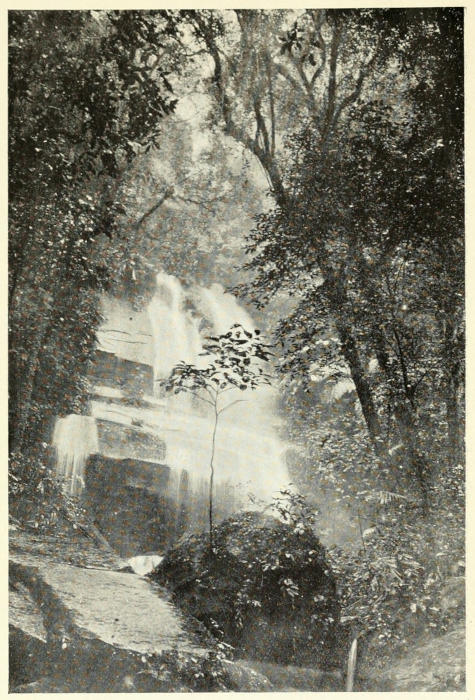
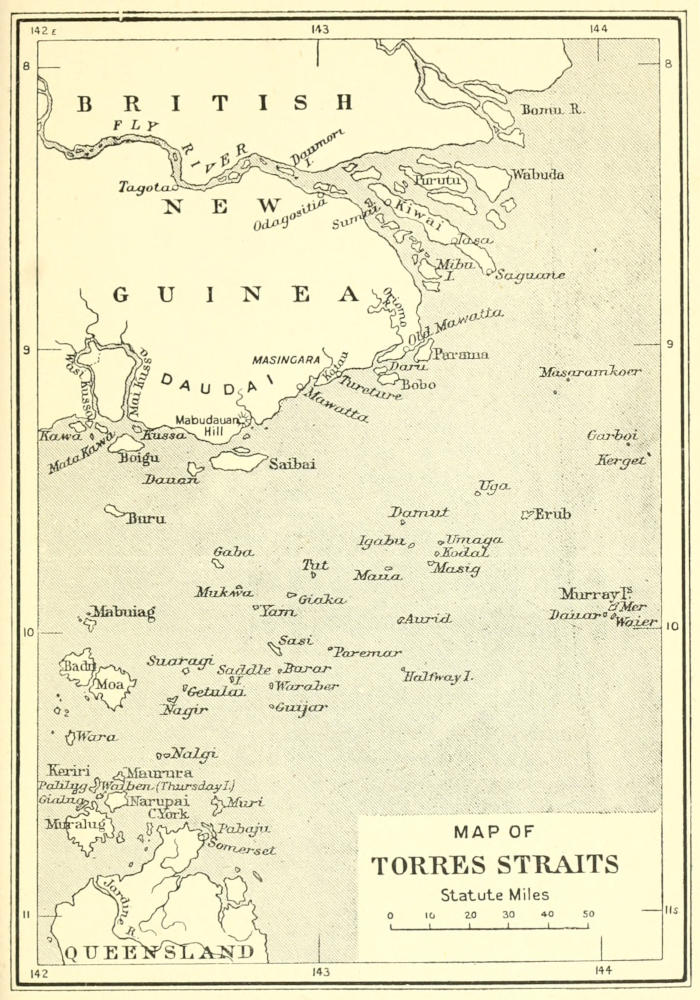
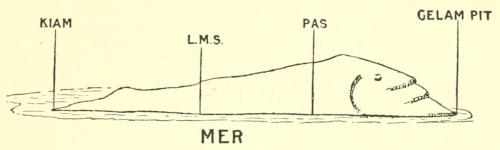
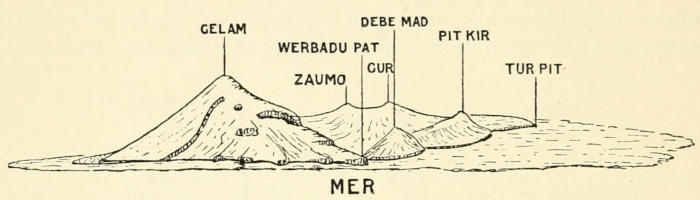

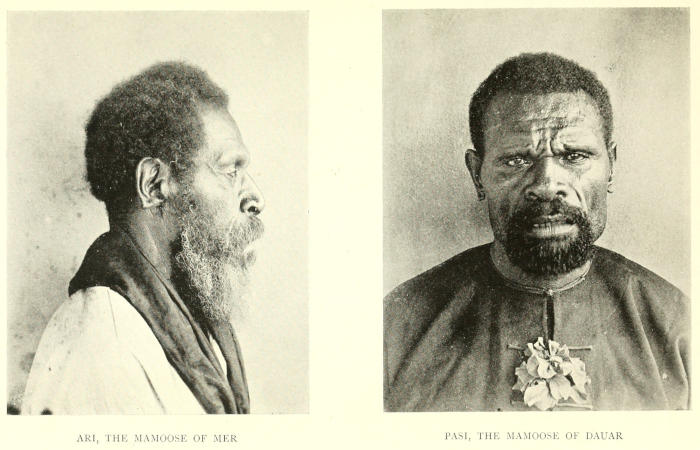
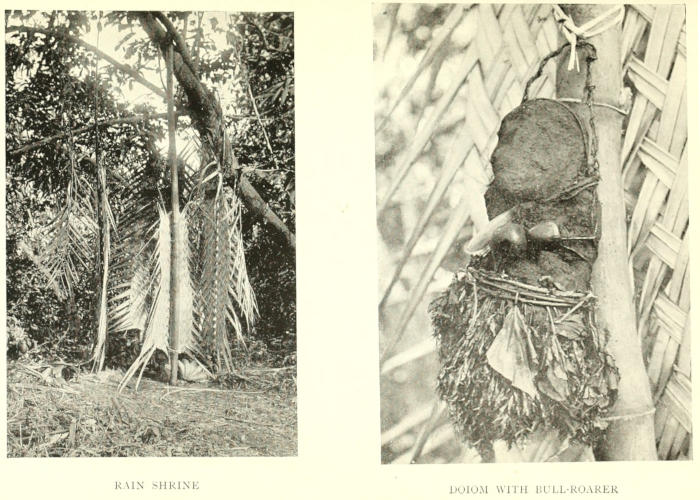
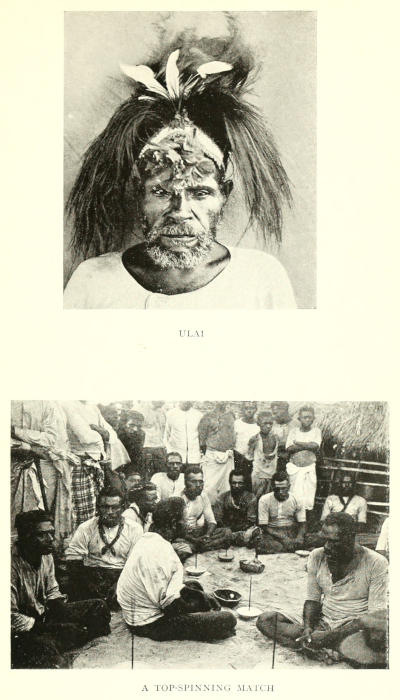
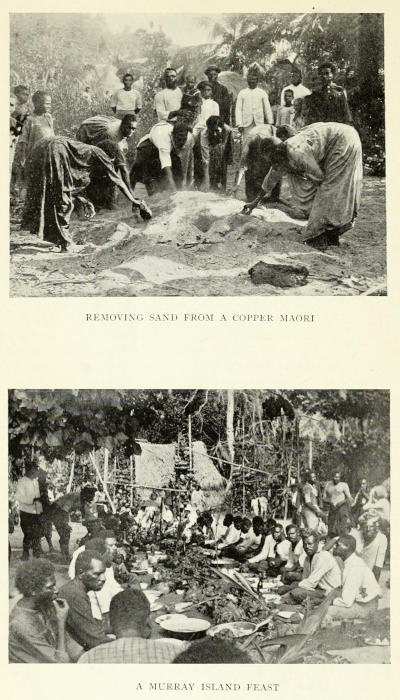
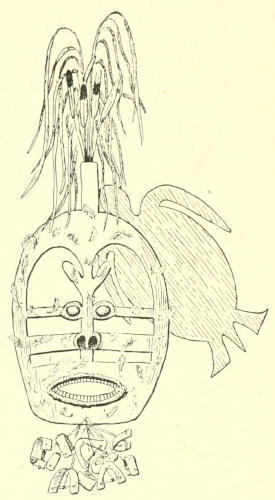
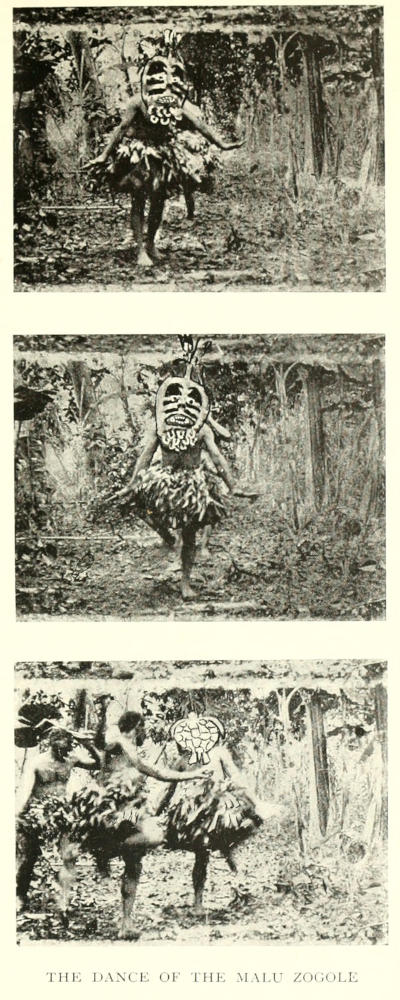
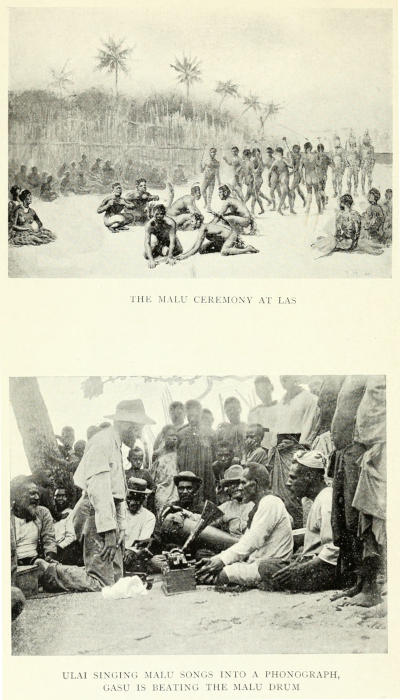
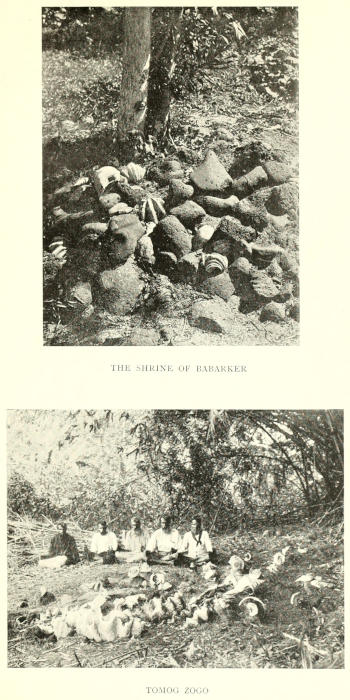
 were made in the sand, and the spokesman
said the village would belong to him if no one could guess it.
He then came up to me, and in a loud whisper said it was not
meant for me, and besought me not to disclose the answer.
Of course I did not dream of giving the show away. No one
gave the answer, which, of course, was the addition of five
strokes
 to the others to make
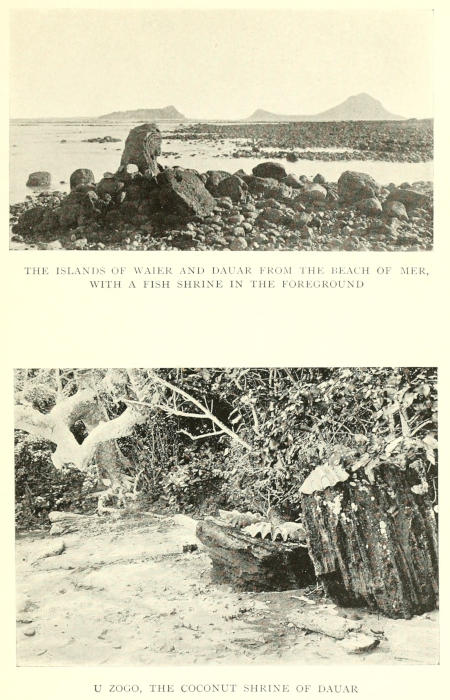
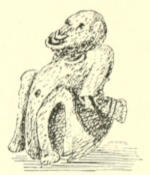
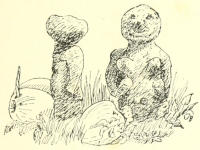
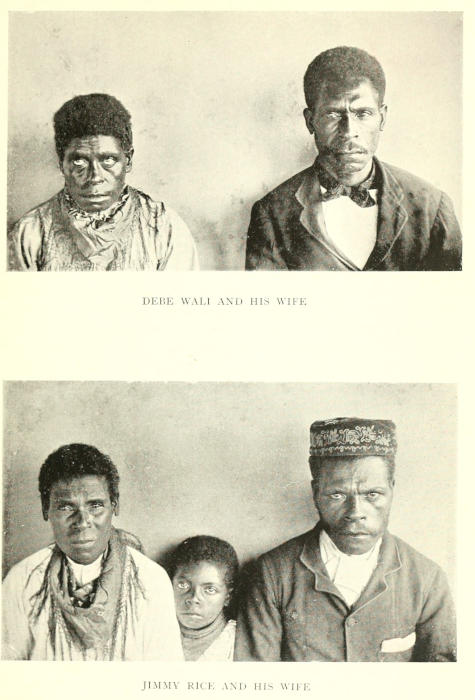
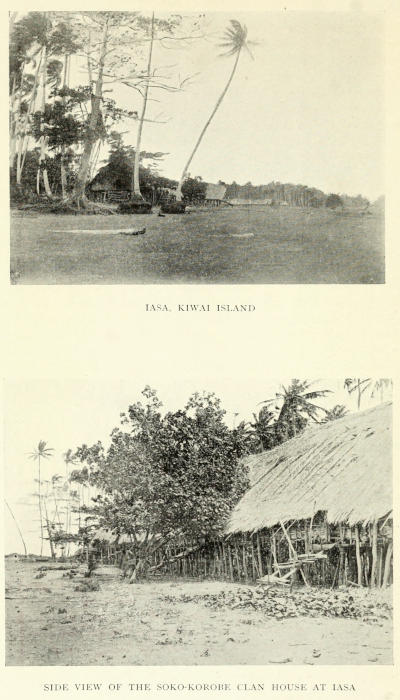
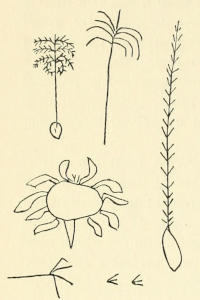
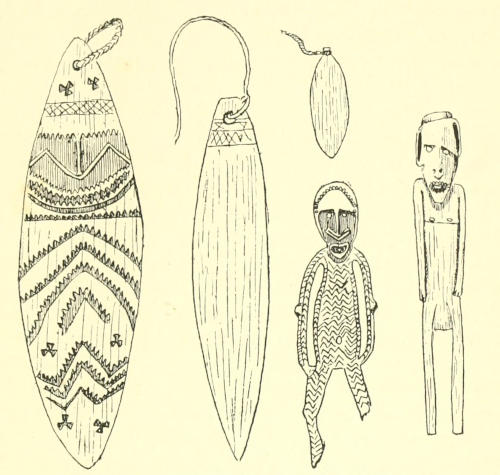
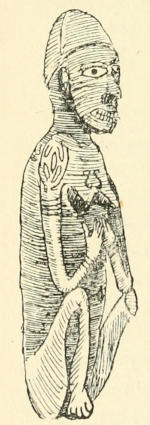
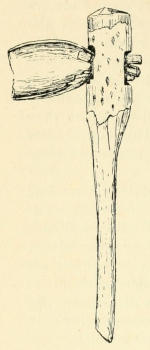
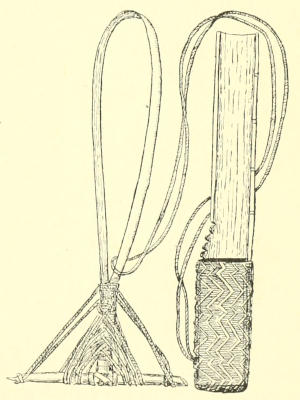
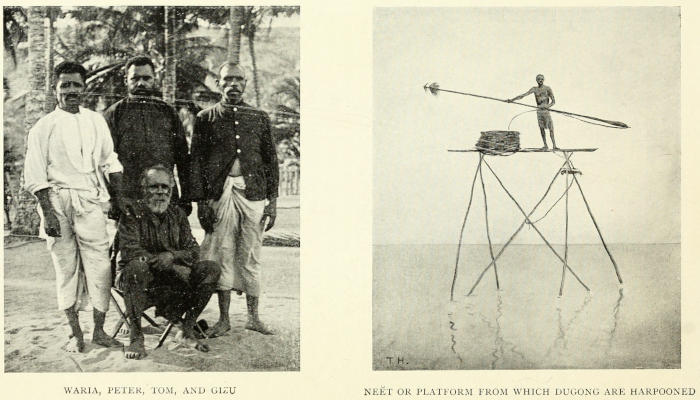
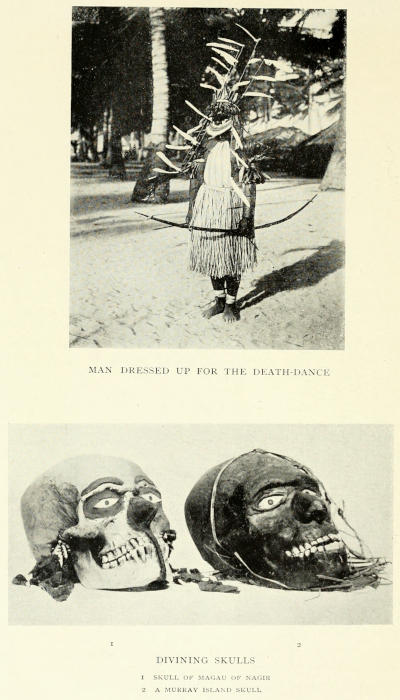
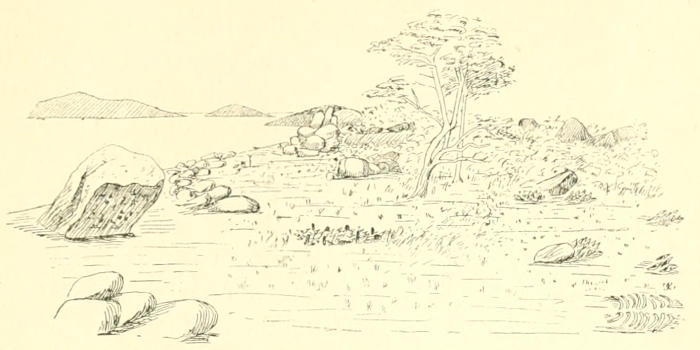
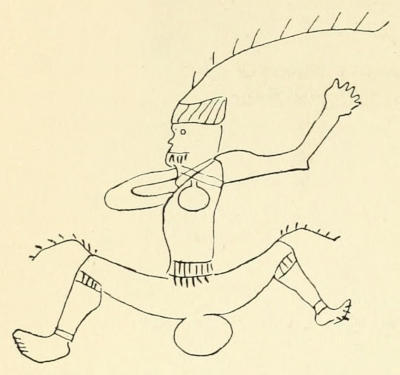
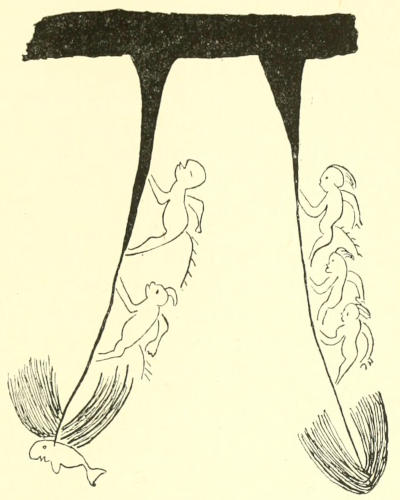
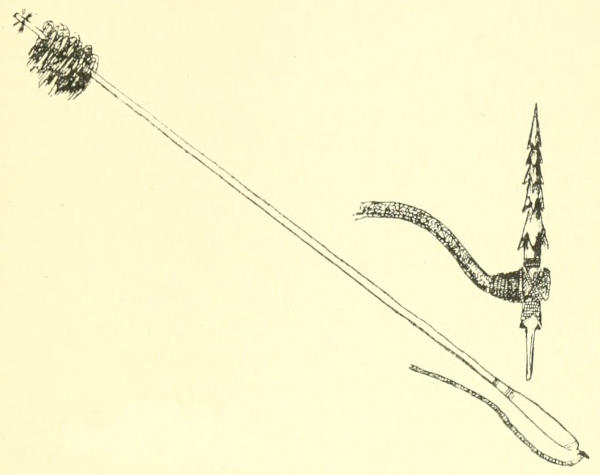
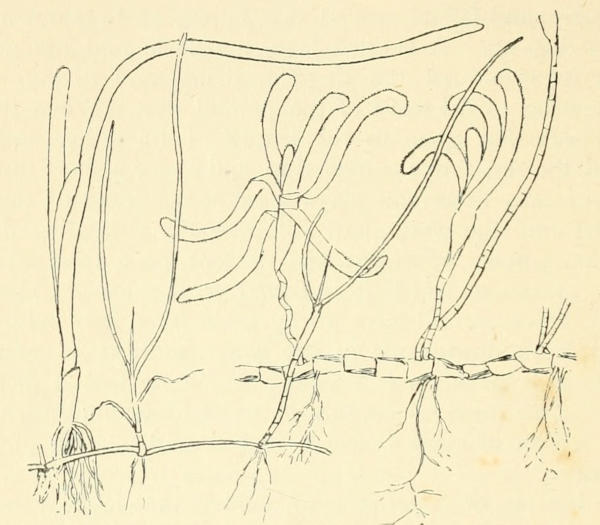
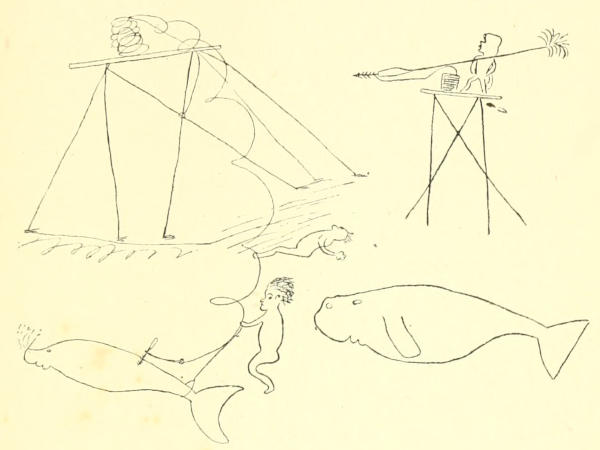
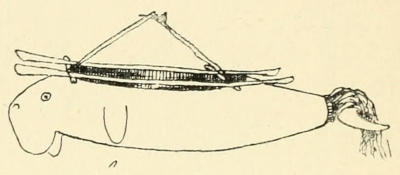
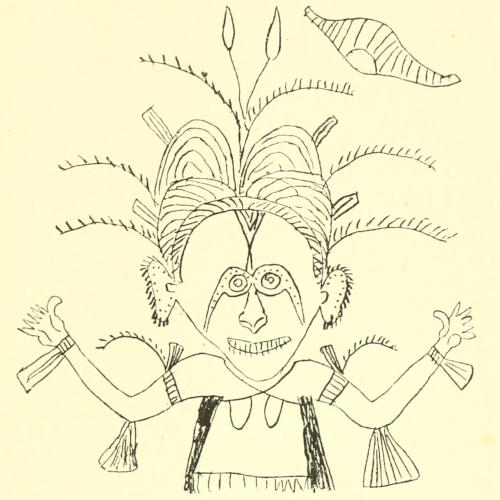
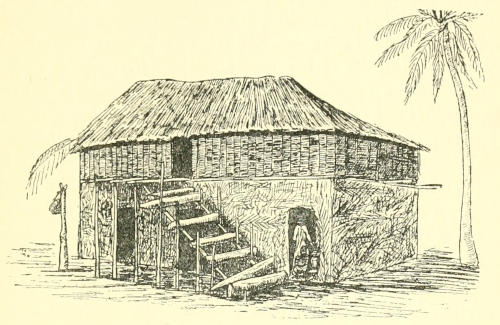
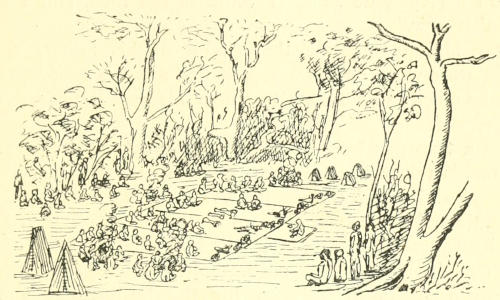
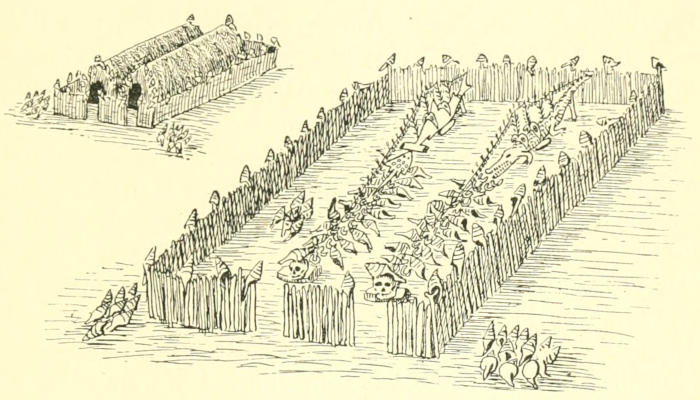
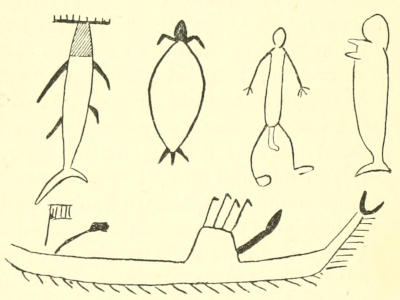
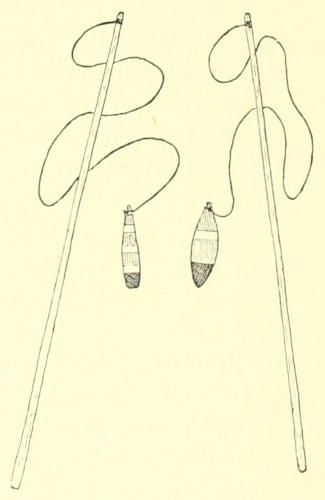
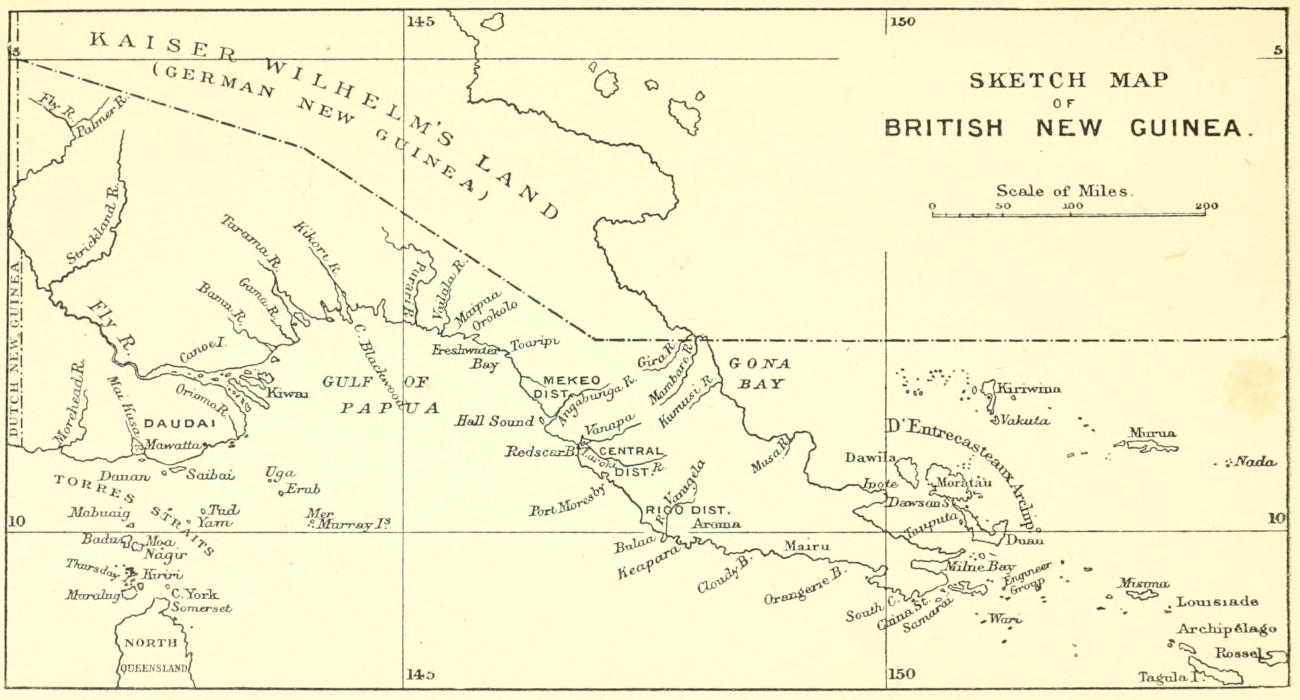
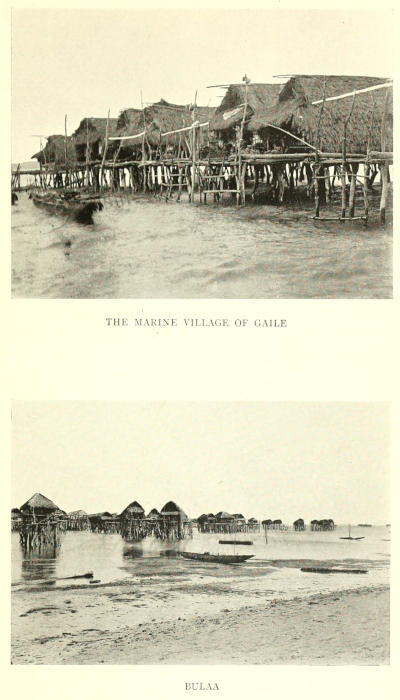
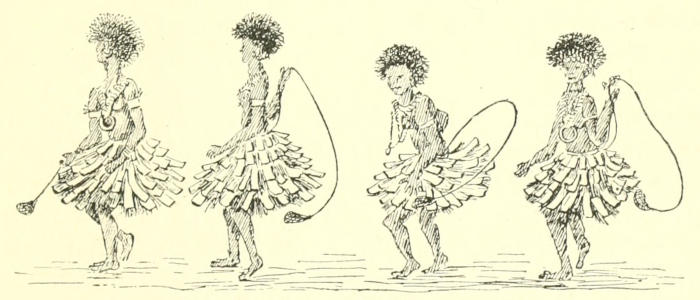
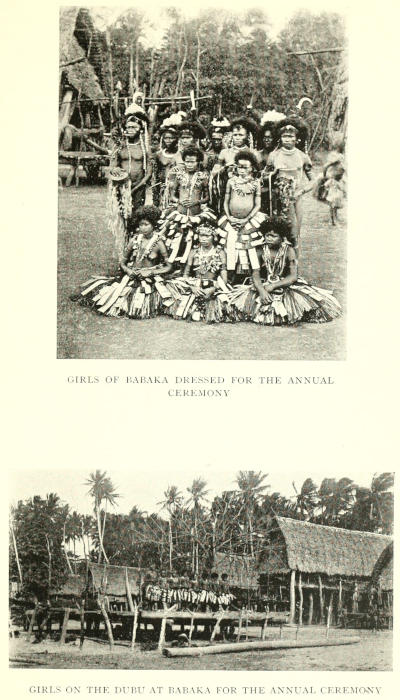
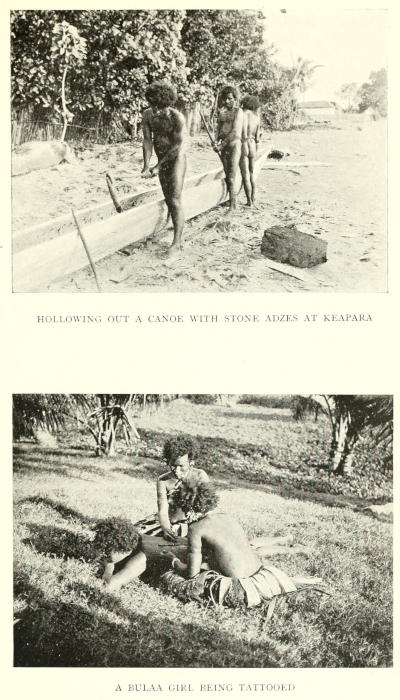
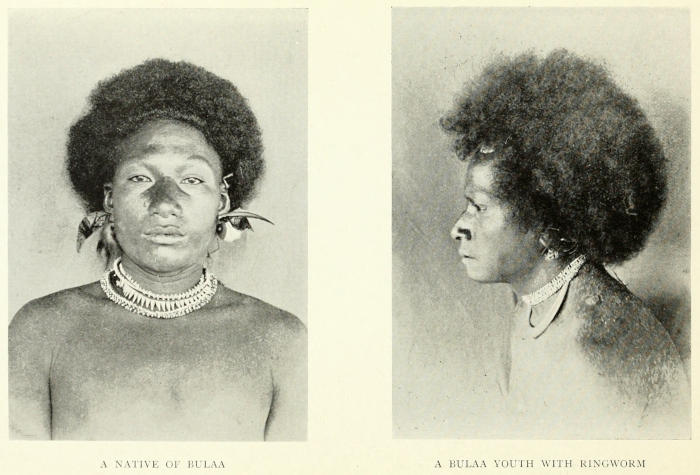
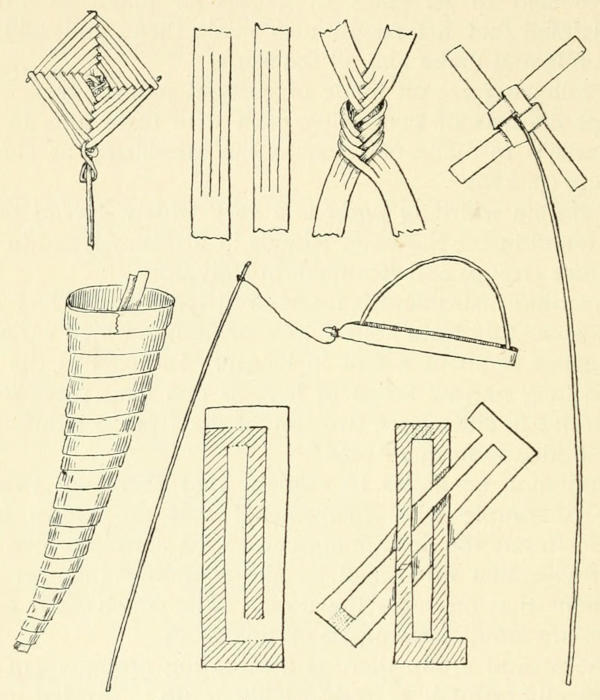
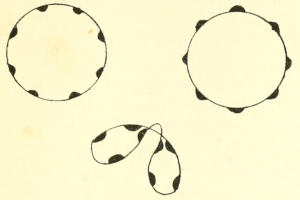
 ). There was very little
movement in the dancing. The men flexed their knees slightly,
and the girls swayed their petticoats laterally; in some figures
they swayed them backwards and forwards.
 shaped group, lads and
lassies alternating; all these remained in their places. Other
dancers, men only, advanced in couples, beating their drums
and capering up the central space. In some figures the dancing
men zigzagged across the space in a prancing manner as they
proceeded up and down; in others they formed two parallel
rows, all facing one side of the hollow oblong, and pranced sideways
a few steps up and down the space. Then they jumped
right round, so as to face the opposite way, and repeated the
same process; then back again, and so on. In this dance the
girls swayed their petticoats backwards and forwards.