“Yes, sir; he was what I call a
godly man. Fact is, I never
knew anybody I felt so sure
would walk straight into Heaven, everybody
welcomin’ him, nobody fussin’ or
fumin’ about his bein’ let in as Abraham
Lincoln.”
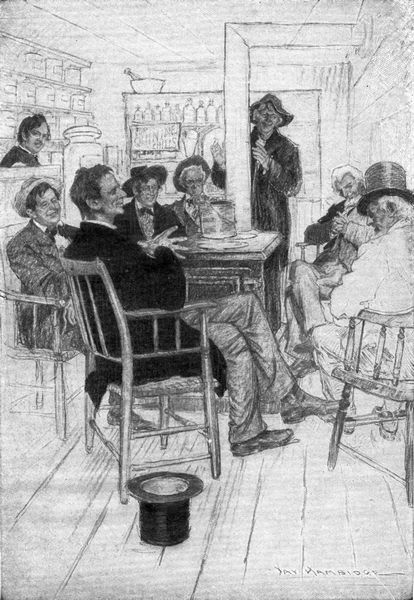
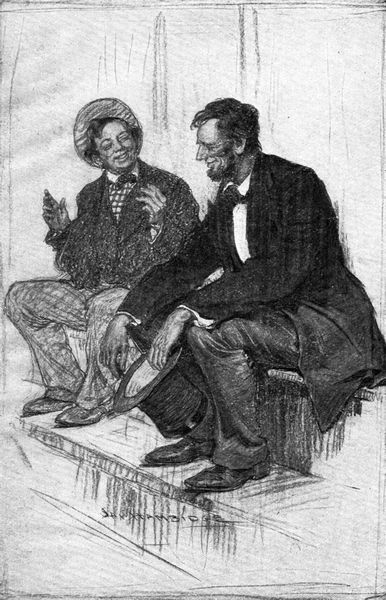
Billy was tilted back in a worn high-back
Windsor, I seated properly in his famous
“Lincoln’s chair,” a seat too revered for
anybody to stand on two legs. It was a
snowy blusterly day and the talk had run
on uninterruptedly from the weather to
the campaign. (The year was 1896, and
Billy, being a gold Democrat, was gloomy
over politics.) We had finally arrived,
as we always did when we met, at “when
Mr. Lincoln was alive,” and Billy had
been dwelling lovingly on his great
friend’s gentleness, goodness, honesty.
“You know I never knew anybody,” he
went on, “who seemed to me more interested
in God, more curious about Him,
more anxious to find out what He was
drivin’ at in the world, than Mr. Lincoln.
I reckon he was allus that way. There
ain’t any doubt that from the time he was
a little shaver he grabbed on to everything
that came his way—wouldn’t let it go ’til
he had it worked out, fixed in his mind
so he understood it, and could tell it the
way he saw it. Same about religion as
everything else. Of course he didn’t get
no religious teachin’ like youngsters have
nowadays—Sunday schools and church
regular every Sunday—lessons all worked
out, and all kinds of books to explain ’em.
Still I ain’t sure but what they give so
many helps now, the Bible don’t get much
show.
“It wa’n’t so when Mr. Lincoln was a
boy. No, sir. Bible was the whole thing,
and there ain’t any doubt he knew it pretty
near by heart, knew it well before he ever
could read, for Lincoln had a good mother,
that’s sure, the kind that wanted more
than anything else in the world to have
her boy grow up to be a good man, and
she did all she knew how to teach him
right.
“I remember hearin’ him say once how
she used to tell him Bible stories, teach
him verses—always quotin’ ’em. I can
see him now sprawlin’ on the floor in front
of the fire listenin’ to Nancy Hanks tellin’
him about Moses and Jacob and Noah
and all those old fellows, tellin’ him about
Jesus and his dyin’ on the cross. I tell
you that took hold of a little shaver, livin’
like he did, remote and not havin’ many
books or places to go. Filled you chuck
full of wonder and mystery, made you lie
awake nights, and sometimes swelled you
all up, wantin’ to be good.
“Must have come mighty hard on him
havin’ her die. Think of a little codger
like him seein’ his mother lyin’ dead in
that shack of theirs, seein’ Tom Lincoln
holdin’ his head and wonderin’ what he’d
do now. Poor little tad! He must have
crept up and looked at her, and gone out
and throwed himself on the ground and
cried himself out. Hard thing for a boy
of nine to lose his mother, specially in
such a place as they lived in.
“I don’t see how he could get much
comfort out of what they taught about
her dyin’, sayin’ it was God’s will, and
hintin’ that if you’d been what you ought
to be it wouldn’t have happened, never
told a man that if he let a woman work
herself to death it was his doin’s she died—not
God’s will at all—God’s will she
should live and be happy and make him
happy.
“But I must say Mr. Lincoln had luck
in the step-mother he got. If there ever
was a good woman, it was Sarah Johnston,
and she certain did her duty by Tom
Lincoln’s children. ’Twa’n’t so easy either,
poor as he was, the kind that never really
got a hold on anything. Sarah Johnston
did her part—teachin’ Mr. Lincoln just as
his own mother would, and just as anxious
as she’d been to have him grow up a good
man. I tell you she was proud of him
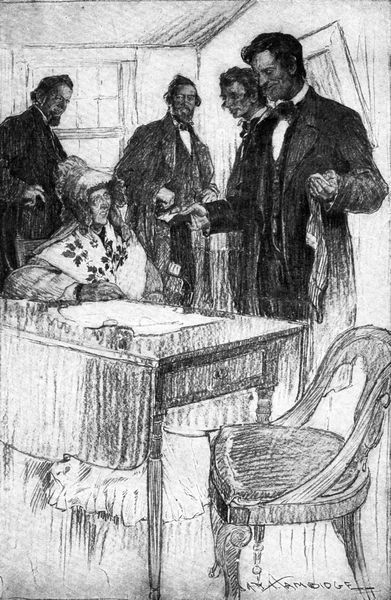
when he got to be President. I remember
seein’ her back in ’62 or ’3 on the farm Mr.
Lincoln gave her, little ways out of
Charleston. One of the last things Mr.
Lincoln did before he went to Washington
was to go down there and see his step-mother.
He knew better than anybody
what she’d done for him.
“Yes, sir, the best religious teachin’ Mr.
Lincoln ever got was from Tom Lincoln’s
two wives. It was the kind that went
deep and stuck, because he saw ’em livin’
it every day, practicin’ it on him and his
sister and his father and the neighbors.
Whatever else he might have seen and
learnt, when he was a boy he knew what
his two mothers thought religion meant,
and he never got away from that.
“Of course he had other teachin’, principally
what he got from the preachers
that came around, now and then. Ramblin’
lot they was, men all het up over the
sins of the world, and bent on doin’ their
part towards headin’ off people from hell-fire.
They traveled around alone, sometimes
on horseback, sometimes afoot—poor
as Job, not too much to wear or to
eat, never thinkin’ of themselves, only
about savin’ souls; and it was natural that
bein’ alone so much, seein’ so much misery
and so much wickedness, for there was lots
that was bad in that part of the world in
them times—natural enough meditatin’ as
they did that they preached pretty strong
doctrine. Didn’t have a chance often at
a congregation, and felt they must scare
it to repentance if they couldn’t do no
other way. They’d work up people ’til
they got ’em to shoutin’ for mercy.
“I don’t suppose they ever had anybody
that listened better to ’em than Mr.
Lincoln. I can just see him watchin’ ’em
and tryin’ to understand what they meant.
He was curious, rolled things over, kept
at ’em and no amount of excitement they
stirred up would ever have upset him.
No, he wa’n’t that kind.
“But he remembered what they said,
and the way they said it. Used to get the
youngsters together and try it on them. I
heard him talkin’ in here one day about
the early preachin’ and I remember his
sayin’: ’I got to be quite a preacher myself
in those days. You know how those
old fellows felt they hadn’t done their duty
if they didn’t get everybody in the church
weepin’ for their sins. We never set
much store by a preacher that didn’t draw
tears and groans. Pretty strong doctrine,
mostly hell-fire. There was a time
when I preached myself to the children
every week we didn’t have a minister.
I didn’t think much of my sermon if I
didn’t make ’em cry. I reckon there was
more oratory than religion in what I had
to say.’
“I reckon he was right about that, allus
tryin’ to see if he could do what other
folks did, sort of measurin’ himself.
“Yes, sir, so far as preachin’ was concerned
it was a God of wrath that Abraham
Lincoln was brought up on, and there
ain’t any denyin’ that he had to go through
a lot that carried out that idea. A boy
can’t grow up in a backwoods settlement
like Gentryville, Indiana, without seein’ a
lot that’s puzzlin’, sort of scares you and
makes you miserable. Things was harsh
and things was skimpy. There wa’n’t
so much to eat. Sometimes there was
fever and ague and rheumatiz and milk
sick. Woman died from too much work.
No medicine—no care, like his mother did.
I expect there wa’n’t any human crime or
sorrow he didn’t know about, didn’t
wonder about. Thing couldn’t be so terrible
he would keep away from it. Why
I heard him tell once how a boy he knew
went crazy, never got over it, used to sing
to himself all night long, and Mr. Lincoln
said that he couldn’t keep away, but used
to slip out nights and listen to that poor
idiot croonin’ to himself. He was like
that, interested in strange things he didn’t
understand, in signs and dreams and
mysteries.
“Still things have to be worse than they
generally are anywhere to keep a boy
down-hearted right along—specially a
boy like Mr. Lincoln, with an investigatin’
turn of mind like his, so many new things
comin’ along to surprise you. Why it
was almost like Robinson Crusoe out there—wild
land, havin’ to make everything
for yourself—hunt your meat and grow
your cotton, mighty excitin’ life for a boy—lots
to do—lots of fun, too, winter and
summer. Somehow when you grow up
in the country you can’t make out that
God ain’t kind, if he is severe. I reckon
that was the way Mr. Lincoln sized it up
early; world might be a vale of tears, like
they taught, but he saw it was mighty interestin’
too, and a good deal of fun to be
got along with the tears.
“Trouble was later to keep things balanced.
The older he grew, the more he
read, and he begun to run up against a
kind of thinkin’ along about the time he
was twenty-one or twenty-two that was a
good deal different from that he’d been
used to, books that made out the Bible
wa’n’t so, that even said there wa’n’t any
God. We all took a turn at readin’ Tom
Paine and Voltaire out here, and there was
another book—somebody’s ‘Ruins’—I
forget the name.”
“Volney?”
“Yes, that’s it. Volney’s Ruins.”
“Do you know I think that book took
an awful grip on Mr. Lincoln. I reckon
it was the first time he had ever realized
how long the world’s been runnin’; how
many lots of men have lived and settled
countries and built cities and how time and
time again they’ve all been wiped out.
Mr. Lincoln couldn’t get over that. I’ve
heard him talk about how old the world
was time and time again, how nothing
lasted—men—cities—nations. One set
on top of another—men comin’ along just
as interested and busy as we are, in doin’
things, and then little by little all they
done passin’ away.
“He was always speculatin’ about that
kind of thing. I remember in ’48 when
he came back from Congress he stopped
to see Niagara Falls. Well, sir, when he
got home he couldn’t talk about anything
else for days, seemed to knock politics
clean out of his mind. He’d sit there that
fall in that chair you’re in and talk
and talk about it. Talk just like it’s
printed in those books his secretary got
up. I never cared myself for all those
articles they wrote. Wrong, am I?
Mebbe so, but there wa’n’t enough of Mr.
Lincoln in ’em to suit me. I wanted to
know what he said about everything in
his own words. But I tell you when I
saw the books with the things he had said
and wrote all brought together nice and
neat, and one after another, I just took to
that. I’ve got ’em here in my desk, often
read ’em and lots of it sounds just as natural,
almost hear him sayin’ it, just as if
he was settin’ here by the stove.
“Now what he tells about Niagara in the
book is like that—just as if he was here.
I can hear him sayin’: ‘Why, Billy, when
Columbus first landed here, when Christ
suffered on the Cross, when Moses crossed
dry-shod through the Red Sea, even when
Adam was first made, Niagara was roarin’
away. He’d talk in here just as it is
printed there; how the big beasts whose
bones they’ve found in mounds must have
seen the falls, how it’s older than them
and older than the first race of men.
They’re all dead and gone, not even bones
of many of ’em left, and yet there’s
Niagara boomin’ away fresh as ever.
“He used to prove by the way the water
had worn away the rocks that the world
was at least fourteen thousand years old.
A long spell, but folks tell me it ain’t
nothin’ to what is bein’ estimated now.
“Makes men seem pretty small, don’t
it? God seems to wipe ’em out as careless
like as if He were cleanin’ a slate.
How could He care and do that? It
made such a mite of a man, no better’n
a fly. That’s what bothered Mr. Lincoln.
I know how he felt. That’s the way it
hit me when I first began to understand
all the stars were worlds like ours.
What I couldn’t see and can’t now is how
we can be so blame sure ours is the only
world with men on. And if they’re
others and they’re wiped out regular like
we are, well it knocked me all of a heap at
first, ’peared to me mighty unlikely that
God knew anything about me.
“I expect Mr. Lincoln felt something
like that when he studied how old the
world was and how one set of ruins was
piled on top of another.
“Then there was another thing. Lots
of those old cities and old nations wa’n’t
Christian at all, and yet accordin’ to the
ruins it looked as if the people was just
as happy, knew just as much, had just
as good laws as any Christian nation now;
some of them a blamed sight better. Now
how was a boy like Lincoln going to
handle a problem like that? Well I
guess for a time he handled it like the man
who wrote about the Ruins. Never
seemed queer to me he should have written
a free-thinkin’ book after that kind
of readin’. I reckon he had to write something
to get his head clear. Allus had
to have things clear.
“You know that story of course about
that book. First time I ever heard it
was back in 1846 when him and Elder
Cartwright was runnin’ for Congress.
You know about Cartwright? Well, sir,
he made his campaign against Lincoln
in ’46, not on politics at all—made it on
chargin’ him with bein’ an infidel because
he wa’n’t a church member and because
he said Mr. Lincoln had written a free
thought book when he was a boy. He
kept it up until along in the fall Mr.
Lincoln shut him up good. He’d gone
down to where Cartwright lived to make
a political speech and some of us went
along. Cartwright was runnin’ a revival,
and long in the evening before startin’
home we went in and set in the back of
the church. When it came time to ask
sinners to come forward, the elder got
pretty excited. ‘Where be you goin’?’ he
shouted. ‘To Hell if you don’t repent
and come to this altar.’ At last he began
to call on Mr. Lincoln to come forward.
Well, you know nobody likes to be called
out like that right in meetin’. Mr. Lincoln
didn’t budge, just set there. The
elder he kept it up. Finally he shouted,
‘If Mr. Lincoln ain’t goin’ to repent and
go to Heaven, where is he goin’?’ Intimatin’,
I suppose, that he was headed for
Hell. ‘Where be you goin’, Mr. Lincoln?’
he shouted.
“Well, sir, at that Mr. Lincoln rose up
and said quiet like:
“‘I’m goin’ to Congress.’
“For a minute you could have heard a
pin drop and then—well, I just snorted—couldn’t
help it. Ma was awful
ashamed when I told her, said I oughtin’
to done it—right in meetin’, but I couldn’t
help it—just set there and shook and
shook. The elder didn’t make any more
observations to Mr. Lincoln that trip.
“Goin’ home I said, ‘Mr. Lincoln, you
just served the elder right, shut him up,
and I guess you’re right; you be goin’ to
Congress.’
“‘Well, Billy,’ he said, smilin’ and
lookin’ serious. ‘I’ve made up my mind
that Brother Cartwright ain’t goin’ to
make the religion of Jesus Christ a political
issue in this District if I can help it.’
“Some of the elder’s friends pretended
to think Mr. Lincoln was mockin’ at the
Christian religion when he answered back
like that. Not a bit. He was protectin’
it accordin’ to my way of thinkin’.
“I reckon I understand him a little because
I’m more or less that way myself—can’t
help seein’ things funny. I’ve done
a lot of things Ma says people misunderstand.
A while back comin’ home from
New York I did somethin’ I expect some
people would have called mockin’ at religion;
Mr. Lincoln wouldn’t.
“You see I’d been down to buy drugs
and comin’ home I was readin’ the Bible
in the mornin’ in my seat in the sleepin’
car. Allus read a chapter every mornin’,
Ma got me in the way of it, and I like it—does
me good—keeps me from burstin’
out at somebody when I get mad, that is,
it does for the most part.
“Well, as I was sayin’, I was readin’
my chapter, and I reckon mebbe I was
readin’ out loud when I looked up and
see the porter lookin’ at me and kinda
snickerin’.
“‘See here, boy,’ I says, ‘you smilin’ at
the Bible. Well, you set down there. Set
down,’ I says. I’m a pretty stout man as
you can see, weigh 200, and I reckon I can
throw most men my size. Why, I’ve
wrestled with Mr. Lincoln, yes, sir, wrestled
with Abraham Lincoln, right out there
in the alley. You see, I ain’t used to bein’
disobeyed, and that nigger knew it, and
he just dropped.
“‘Boy,’ I says, ‘I’m goin’ to read you a
chapter out of this Bible, and you’re goin’
to listen.’ And I did it. ‘Now,’ I says,
‘down with you on your knees, we’re goin’
to have prayers,’ Well, sir, you never
seen such a scared darky. Down he went,
and down I went, and I prayed out loud
for that porter’s soul and before I was
through he was sayin’ ‘Amen.’
“Of course the passengers began to
take notice, and about the time I was done
along came the conductor, and he lit into
me and said he wa’n’t goin’ to have any
such performances in his car.
“Well, you can better guess that gave
me a text. He’d a man in that car fillin’
himself up with liquor half the night, just
plain drunk and disorderly. ‘I ain’t
heard you makin’ any loud objections to
the drinkin’ goin’ on in this car,’ I says.
‘If that don’t disturb the peace, prayin’
won’t.’ And two or three passengers just
chimed right in and said, ‘That’s so.
Do us all good if we had more prayin’ and
less drinkin’.’ Fact was, I was quite
popular the rest of the trip.
“Now I reckon some would a been
shocked by what I done. Ma said when
I told her. ‘Now you know, William, it
wasn’t that porter’s soul you was interested
in half as much as gettin’ a little fun
out of him.’ Well, mebbe so. I won’t
deny there was some mischief in it. But
it wouldn’t have shocked Mr. Lincoln.
He’d understood. Seems a pity I can’t
tell him about that. He’d enjoyed it.
“Well, to go back to Cartwright and the
free thought book he said Lincoln wrote
when he was a boy. The elder didn’t
pretend he’d seen the book; said the reason
he hadn’t was that it was never printed,
only written, and that not many people
ever did see it because Sam Hill, the storekeeper
down to New Salem, thinkin’ it
might hurt Lincoln had snatched it away
and thrown it into the stove and burnt it
up. Now what do you think of that?
“Well, Cartwright didn’t get elected—got
beaten—beaten bad and nobody
around here ever talked about that book
when Mr. Lincoln was runnin’ for President
that I heard of. It was after he
was dead that somebody raked up that
story again and printed it. It never made
much difference to me. I allus thought
it likely he did write something along
the lines he’d been readin’ after. But
sakes alive, you ought to seen the fur fly
out here. All the church people riz right
up and proved it wa’n’t so; and those that
didn’t profess lit in and proved it was so.
They got all the old inhabitants of Sangamon
County who knew Mr. Lincoln to
writin’ letters. Lot of them published
in the papers.
“One of the most interestin’ accordin’ to
my way of thinkin’ was a letter that came
out from Mentor Graham, Lincoln’s old
school-master. I don’t remember it exact,
but near as I can recall he said Lincoln
asked him one day when he was livin’
at his house going to school what he
thought about the anger of the Lord, and
then he went on to say that he had written
something along that line and wished
Mr. Graham would read it. Well, sir,
Mr. Graham wrote in that letter that this
thing Lincoln wrote proved God was too
good to destroy the people He’d made, and
that all the misery Adam brought on us
by his sin had been wiped out by the atonement
of Christ. Now mind that was an
honest man writin’ that letter, a man
who’d been Lincoln’s friend from the
start. To be sure it was some time after
the event—pretty near 40 years and I
must say I always suspicion a man’s remembering
anything very exact after 40
years. But one thing is sure, Mentor
Graham knew Lincoln in those days, and
that’s more than most of them that was
arguin’ this thing did.
“Always seemed to me about as reliable
testimony as anybody offered. I contended
that most likely Lincoln did write
just what Mentor Graham said he did, and
that the brethren thought it was dangerous
doctrine to make out God was that good,
and so they called him an infidel. Nothin’
riled those old fellows religiously like tryin’
to make out God didn’t damn everybody
that didn’t believe according to the
way they read the Scriptures. Seemed
to hate to think about Mr. Lincoln’s God.
I almost felt sometimes as if they’d rather
a man would say there wa’n’t no God than
to make him out a God of Mercy.
“But sakes’ alive, Mentor Graham’s
letter didn’t settle it. The boys used to
get to rowin’ about it in here sometimes
around the stove until I could hardly
keep track of my perscriptions. The
funniest thing you ever heard was one
night when they were at it and an old
fellow who used to live in New Salem
dropped in, so they put it up to him; said
he lived in New Salem in ’33; said he
knew Lincoln. Wanted to know if he
ever heard of his writin’ a book that Sam
Hill burned up in the stove in his store.
The old fellow listened all through without
sayin’ a word, and when they was finished
he said, solemn like, ‘Couldn’t have
happened. Wa’n’t no stove. Sam Hill
never had one.’
“Well, sir, you ought to seen their
jaws drop. Just set starin’ at him and I
thought I’d die a laffin’ to see ’em collapse.
I wish Mr. Lincoln could have heard that
old fellow, ‘Wa’n’t no stove.’ How he’d
enjoyed that—‘Wa’n’t no stove.’
“But for all that I never regarded that
witness over high. Of course Sam Hill
must have had a stove otherwise there
wouldn’t have been a place for folks to
set around.
“It ain’t important to my mind what
was in that book. What’s important is
that Abraham Lincoln was wrestlin’ in
those days to find out the truth, wa’n’t
content like I was to settle down smotherin’
any reservations that I might a had.
He never did that, grappled hard with
everything touchin’ religion that came up,
no matter which side it was. He never
shirked the church if he wa’n’t a member,
went regular, used to go to revivals and
camp meetings too in those days when he
was readin’ the ‘Ruins.’ Most of the
boys who didn’t profess went to camp
meetings for deviltry—hang around on
the edges—playin’ tricks—teasin’ the
girls—sometimes gettin’ into regular
fights. Mr. Lincoln never joined into
any horse play like that. He took it
solemn. I reckon he wouldn’t ever hesitated
a minute to go forward and ask
prayers if he’d really believed that was
the way for him to find God. He knew
it wa’n’t. The God he was searchin’ for
wa’n’t the kind they was preachin’. He
was tryin’ to find one that he could reconcile
with what he was findin’ out about
the world—its ruins—its misery. Clear
as day to me that that was what he was
after from the start—some kind of plan
in things, that he could agree to.
“He certainly did have a lot to discourage
him—worst was when he lost his
sweetheart. I’ve allus figured it out that
if Ann Rutledge had lived and married
him he’d been a different man—leastwise
he’d been happier. He might have even
got converted and joined the church, like
I did after I courted Ma. A good woman
sort of carries a man along when he loves
her. It’s a mighty sight easier to believe
in the goodness of the Lord and the happiness
of man when you’re in love like
I’ve allus been, and like he was with that
girl.
“‘There was no doubt she was a fine girl—no
doubt he loved her. When she died
he was all broke up for days. I’ve heard
his old friends tell how he give up workin’
and readin’—wandered off into the fields
talkin’ to himself. Seemed as if he
couldn’t bear to think of her covered over
with snow—beaten on by rain—wastin’
away—eaten by worms. I tell you he
was the kind that saw it all as it was.
That’s the hard part of bein’ so honest
you see things just as they are—don’t pretend
things are different—just as they
are. He couldn’t get over it. I believe
it’s the Lord’s mercy he didn’t kill himself
those days. Everybody thought he was
goin’ crazy, but I rather think myself he
was wrestlin’ with himself, tryin’ to make
himself live. Men like him want to die
pretty often. I reckon he must have
cried out many a night like Job did,
‘What is mine end that I should prolong
my life? My soul chooseth strangling
and death rather than life. I loathe it.
I would not live alway.’
“He pulled out, of course, but he never
got over havin’ spells of terrible gloom.
I expect there was always a good many
nights up to the end when he wondered if
life was worth keepin’. Black moods
took him and he’d go days not hardly
speakin’ to people—come in here—set by
the stove—not sayin’ a word—get up—go
out—hardly noticin’ you. Boys understood,
used to say ‘Mr. Lincoln’s got
the blues.’
“Curious how quick things changed
with him. He’d be settin’ here, laffin’
and jokin’, tellin’ stories and somebody’d
drop some little thing, nobody else would
think about, and suddent his eyes would
go sad and his face broodin’ and he’d stop
talkin’ or like as not get up and go out.
I don’t mean to say this happened often.
Of course that wa’n’t so; as I’ve told you
no end of times, he was the best company
that ever was—the fullest of stories and
jokes, and nobody could talk serious like
him. You could listen forever when he’d
get to arguin’, but spite of all that you
knew somehow he was a lonely man who
had to fight hard to keep up his feelin’
that life was worth goin’ on with. Gave
you queer feelin’ about him—you knew
he was different from the others, and it
kept you from bein’ over-familiar.
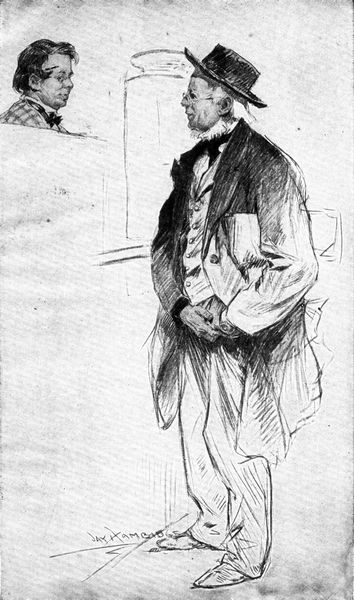
“There was a man in here the other day
I hadn’t seen for years—used to be a conductor
between here and Chicago—knew
him well. It tickled him to death to have
me set him in that chair you’re in—looked
it all over, said it seemed as if he could
just see Mr. Lincoln settin’ there. Well,
he got to talkin’ about all the big bugs
that used to travel with him, Little Dug,
Judge Davis, Logan, Swett, Welden,
and all the rest; and he said something
about Mr. Lincoln that shows how he
struck ordinary people. He said Lincoln
was the most folksy of any of them, but
that there was something about him that
made everybody stand a little in awe of
him. You could get near him in a sort
of neighborly way, as though you had always
known him, but there was something
tremendous between you and him all the
time.
“This man said he had eaten with him
many times at the railroad eatin’ houses.
Everybody tried to get near Lincoln
when he was eatin’, because he was such
good company, but they looked at him
with a kind of wonder, couldn’t exactly
make him out. Sometimes there was a
dreadful loneliness in his look, and the
boys used to wonder what he was thinkin’
about. Whatever it was, he was thinkin’
all alone. No one was afraid of him,
but there was something about him that
made plain folks feel toward him a good
deal as a child feels toward his father,
because you know every child looks upon
his father as a wonderful man.
“There ain’t any doubt but there was
a good many years after Mr. Lincoln got
started and everybody in the state held
him high, when he was a disappointed man
and when he brooded a good deal over the
way life was goin’. Trouble was he
hadn’t got a grip yet on anything that
satisfied him. He hadn’t made a go of
politics, had quit it. Of course he had
plenty of law practice, but, Lord a
mighty, you take a town like this was
along in the ’40’s and ’50’s, when Mr. Lincoln
was practicin’ here, and get right
down to what was really happenin’, and it
was enuff to make a broodin’ man like him
sick, and want to quit. He had to handle
it all, a lawyer does, men fightin’ over a
dollar, gettin’ rich on cheatin’, stingy with
their wives, breakin’ up families, quarrelin’
over wills, neglectin’ the old folks
and yet standin’ high in the church, regular
at prayer meetin’, and teachin’ in Sunday
School. There was a lot of steady
meanness like that all around, and it made
him feel bad.
“And then there was dreadful things
happened every now and then, men takin’
up with girls when they had good wives
of their own. There’s more than one
poor child lyin’ over there in the graveyard
because some onery old scoundrel
got the better of her, and there’s more
than one good man been put to shame in
this town because some woman who was
no better than she ought to be run him
down. Lord, it makes you sick, and then
every now and then right out of a clear
sky there’d be a murder somewhere in the
country. Nobody would talk of anything
else for days. People who hardly
ever opened their mouths would find their
tongues and tell the durnedest things.
“It was so all the time Mr. Lincoln
was practicin’ out here. And it made
him pretty miserable sometimes, I reckon,
to see so much meanness around. I
never knew a man who liked people better’n
Mr. Lincoln did—seemed as if he
felt the world ought to be happy, and
that it could be if people would only do
the right thing. You’ve heard people
tellin’ how he’d refuse a case often if he
didn’t think it ought to be brought.
Well, sir, that’s true. I’ve heard him
argue time and again with the boys about
the duty of lawyers to discourage lawsuits.
‘It’s our business to be peacemakers,’
he used to tell ’em, ‘not to stir up
quarrels for the sake of makin’ a little
money.’ I remember somebody tellin’
how they heard him lecturin’ a man who’d
brought him a case, and pointed out that
by some sort of a legal trick, he could get
$600. Made Lincoln mad all through.
‘I won’t take your case,’ he said, ‘but I’ll
give you some free advice. You’re a
husky young man. Go to work and earn
your $600.’
“I’ve always figured it out that he was
a sight more contented after he got his
grip on the slavery question. You know
how he felt about slavery; thought it was
wrong, and when he began to see there
was a chance to fight it in a way that
would count, he felt different towards his
life, saw it did mean something, began to
feel he was some real use. I reckon he
began to believe God had a place for him—that
he was put into the world for a
good and sufficient reason. Now as I
see Mr. Lincoln, that was all he ever
needed to reconcile him to things. As he
began to see more and more that he had
his argument sound, and that it was
takin’ hold in the country, that men was
listenin’ to him and sayin’ he had it right,
why more and more he was something like
happy. He made up his mind that the
time had come when God meant to say to
slavery, ‘Thus far and no farther,’ and he
was ready to put in his best licks to help
Him.
“He wrestled with that question till he
drove it clean out of politics right down
onto bed rock of right and wrong, and
there he stood; slavery was wrong, and
accordin’ to his way of lookin’ at it, people
who pretended to regulate their lives
on religion ought to be agin it. Allus
troubled him a lot and sometimes made
him pretty bitter that so many folks that
stood high as Christians was for slavery.
I remember Newt Bateman tellin’ how
Lincoln came in his office one day after
his nomination—Newt was State School
Superintendent, and he and Mr. Lincoln
was always great friends,—well, he said
Mr. Lincoln came in with a report of a
canvass of how people in Springfield were
goin’ to vote, and he said:
“‘Let’s see how the ministers in this
town are goin’ to vote,’ and he went
through the list pickin’ ’em out and settin’
’em down, and, would you believe it
now, he found that out of 23 ministers 20
were against him. He was dreadfully
upset, and talked a long time about it.
Newt said he pulled a New Testament
out of his pocket.
“‘What I don’t understand,’ he said,
‘is how anybody can think this book stands
for slavery. Human bondage can’t live
a minute in its light, and yet here’s all
these men who consider themselves called
to make the teachin’ of this book clear
votin’ against me. I don’t understand
it.
“‘They know Douglas don’t care
whether slavery’s voted up or down, but
they ought to know that God cares and
humanity cares and they know I care.
They ain’t been readin’ their Bibles right.
“‘Seems to me sometimes as if God had
borne with this thing until the very teachers
of religion had come to defend it out
of the Bible. But they’ll find the day
will come when His wrath will upset it.
I believe the cup of iniquity is full, and
that before we get through God will make
the country suffer for toleratin’ a thing
that is so contrary to what He teaches in
this Book.’
“As I see it, that idee grew in him.
You know how he hated war. Seemed
as if he couldn’t stand it sometimes, but
there ain’t no doubt that more and more
he looked at it as God’s doin’—His way
of punishin’ men for their sin in allowin’
slavery. He said that more’n once to the
country. Remember what he wrote in
his call for a fast-day in the spring of
’63? No? Well, I’ve got it here—just
let me read it to you.”
Billy rose, and after lingering long
enough at the window to remark that the
“storm wa’n’t lettin’ up any,” went to a
scratched and worn desk, a companion
piece to “Mr. Lincoln’s chair,” and took
from the drawer where he kept his precious
relics a bundle of faded yellow newspapers
and selected a copy of the New
York Tribune of March 31, 1863.
“Now you listen,” said Billy, “and see
if I ain’t right that his idee when he talked
to Newt had takin’ hold of him deep.”
So Billy read sonorously the sentences
which seemed to him to demonstrate his
point:
“‘Insomuch as we know that by His divine
law nations, like individuals, are subjected
to punishments and chastisements
in this world, may we not justly fear that
the awful calamity of civil war which now
desolates the land may be but a punishment
inflicted upon us for our presumptuous
sins, to the needful end of our national
reformation as a whole people.’
“Isn’t that just what he said to Newt
Bateman,” Billy stopped long enough to
remark.
“‘We have been the recipients of the
choicest bounties of Heaven. We have
been preserved, these many years, in
peace and prosperity. We have grown
in numbers, wealth, and power as no other
nation has ever grown; but we have forgotten
God. We have forgotten the
gracious hand which preserved us in
peace, and multiplied and enriched and
strengthened us; and we have vainly imagined,
in the deceitfulness of our hearts,
that all these blessings were produced by
some superior wisdom and virtue of our
own. Intoxicated with unbroken success,
we have become too self-sufficient to
feel the necessity of redeeming and preserving
grace, too proud to pray to the
God that made us.
“‘It behooves us, then, to humble ourselves
before the offended Power, to confess
our national sins, and to pray for
clemency and forgiveness.’
“The longer the war went on, the more
and more sure he was that God was
workin’ out something, and hard as it was
for him, the more and more reconciled he
got to God’s Government. Seems to me
that’s clear from what he said in his last
Inaugural. You remember:
“The Almighty has His own purposes.
‘Woe unto the world because of offenses!
For it must needs be that offenses come;
but woe to that man by whom the offense
cometh.’ Fondly do we hope, fervently
do we pray that this mighty scourge of
war may speedily pass away, yet if God
wills that it continue until all the wealth
piled by the bondsman’s two hundred and
fifty years of unrequited toil shall be
sunk, and until every drop of blood drawn
with the lash shall be paid by another
drawn with the sword, as was said three
thousand years ago, so still it must be
said, ‘The judgments of the Lord are
true and righteous altogether.’
“I like to say that just like he said it.
Seems kinda like music. He was that
way sometimes, swung into sort of talk
and made your heart stop to listen; it was
so sweet and solemn-like.
“Makes me ache though to think what
he had to go through to come out where
he could talk so sure and calm about
things; for certain as he was that God
had a purpose in it all, he wa’n’t so sure
always that he was proceedin’ along the
lines the Almighty approved of. He
never got over that struggle long as he
was President, always askin’ himself
whether he was on God’s side. Puzzled
him bad that both sides thought God was
with ’em. He pointed out more than
once how the rebel soldiers was prayin’
for victory just as earnest as ours—how
the rebel people got the same kind of help
out of prayer that the Union people did.
And both couldn’t be right.
“There isn’t any doubt he often tested
out whether God agreed with his argument
or not, by the way things swung.
It was that way about the Emancipation
Proclamation. You know how he
thought about that for months, and for
the most part kept it to himself. He
didn’t want to do it that way, was dead
set on the North buying the slaves instead
of takin’ ’em. But he had the
Emancipation Proclamation ready, and
he’d told God he’d let it loose if He’d
give us the victory. Sounds queer,
mebbe, but that’s what he did. He told
the Cabinet so, and they’ve told about it.
A little mite superstitious, some would
say. But Mr. Lincoln was a little superstitious,
interested in things like signs and
dreams—specially dreams, seemed to feel
they might be tryin’ to give him a hint.
He’s told me many a time about dreams
he’d had, used to have same dream over
and over, never got tired studyin’ what it
meant. You remember that happened in
the war. He’d used to dream he saw a
curious lookin’ boat runnin’ full speed toward
a shore he couldn’t make out clear,
had that dream before nearly all the big
battles—had it the night before they
killed him, and told the Cabinet about it—thought
it meant there’d be good news
from Sherman.
“He got powerful discouraged sometimes,
for it did seem the first three years
of the war as if the Almighty wa’n’t sympathizin’
over much with the North.
You remember how I told you once of
havin’ a long talk with him at night that
time I went down to Washington to see
him. Things was bad, awful bad. Country
just plumb worn out with the war.
People was beginnin’ to turn against it.
Couldn’t stand the blood lettin’, the sufferin’,
and the awful wickedness of it.
There was a lot of that feelin’ in ’64.
People willin’ to give up anything—let
the South go—let her keep her slaves—do
anything to put an end to the killin’.
I tell you a man has to keep his eyes ahead
in war—keep tellin’ himself over and over
what’s it all about. Mr. Lincoln had to.
They were talkin’ peace to him, riotin’
about the drafts, stirrin’ up more kinds of
trouble for him than he ever knew there
was, I reckon. And he felt it—felt it
bad; and that night it seemed to do him
good to talk it out. You see I come from
home, and I didn’t have no connection
with things down there, and ’twas natural
he’d open up to me as he couldn’t to them
on the ground; and he did.
“‘I’ve studied a lot, Billy,’ he said,
‘whether this is God’s side of this war.
I’ve tried my best to figure it out straight,
and I can’t see anything but that He must
be for us. But look how things is goin’.
“‘One thing sure all I can do is to follow
what I think’s right. Whatever shall
appear to be God’s will, I’ll do. There’s
quite a number of people who seem to
think they know what God wants me to
do. They come down every now and
then and tell me so. I must say as I’ve
told some of them that it’s more’n likely
if God is goin’ to reveal His will on a
point connected with my duty He’d naturally
reveal it to me. They don’t all lay
it up against me when I talk that way.
Take the Quakers. They’re good people,
and they’ve been in a bad fix for they
don’t believe in slavery, and they don’t
believe in war, and yet it seems to have
come to the point that out of this war
started to save free government, we’re going
to get rid of slavery. But they can’t
accept that way. Still they don’t lay it
up against me that I do, and they pray
regular for me.
“‘We’ve been wrong, North and South,
about slavery. No use to blame it all on
the South. We’ve been in it too, from
the start. If both sides had been willin’
to give in a little, we might a worked it
out, that is if we’d all been willin’ to admit
the thing was wrong, and take our share
of the burden in puttin’ an end to it. It’s
because we wouldn’t or mebbe couldn’t
that war has come.
“‘It’s for our sins, Billy, this war is.
We’ve brought it on ourselves. And
God ain’t goin’ to stop it because we ask
Him to. We’ve got to fulfill the law.
We broke the law, and God wouldn’t be
God as I see Him if He didn’t stand by
His own laws and make us take all that’s
comin’ to us. I can’t think we won’t win
the war. Seems to me that must be God’s
way, but if we don’t, and the Union is
broken and slavery goes on, well, all it
means accordin’ to my way of seein’
things is that the laws ain’t satisfied yet,
that we ain’t done our part. There’ll
be more trouble until the reason of trouble
ends.
“‘But I don’t lay it up against God,
Billy. What it seems to me He’s tryin’
to do is to get men to see that there can’t
be any peace or happiness in this world
so long as they ain’t fair to one another.
You can’t have a happy world unless
you’ve got a just world, and slavery ain’t
just. It’s got to go. I don’t know
when. It’s always seemed to me a pretty
durable struggle—did back in ’58, but I
didn’t see anything so bad then as we’ve
come to. Even if I’d known I couldn’t
have done different, Billy. Even if we
don’t win this war and the Confederates
set up a country with slavery in it, that
ain’t going to end it for me. I’ll have to
go on fightin’ slavery. I know God
means I should.
“‘It takes God a long time to work out
His will with men like us, Billy, bad men,
stupid men, selfish men. But even if
we’re beat, there’s a gain. There are
more men who see clear now how hard it
is for people to rule themselves, more people
determined government by the people
shan’t perish from the earth, more people
willin’ to admit that you can’t have
peace when you’ve got a thing like slavery
goin’ on. That’s something, that’s goin’
to help when the next struggle comes.
“‘You mustn’t think I’m givin’ in,
Billy. I ain’t, but look how things are
goin’. What if we lose the election, and
you must admit it looks now as if we
would, what if we lose and a Copperhead
Government makes peace—gives the
South her slaves—lets the “erring sisters”
set up for themselves. I’ve got to think
about that, Billy.
“‘Seems to me I can’t bear the idea all
this blood-lettin’ should end that way, for
I know lasting peace ain’t in that set of
circumstances. That means trouble,
more trouble, mebbe war again until we
obey the law of God, and let our brother
man go free.’
“And he just dropped his head and
groaned, seemed as if I could hear him
prayin’, ‘Oh, my Father, if it be possible,
let this cup pass from me!’
“Think he prayed? Think Abraham
Lincoln prayed?” Billy’s eyes were
stern, and his voice full of reproachful
surprise.
“I know he did. You wouldn’t ask
that question if you could have heard him
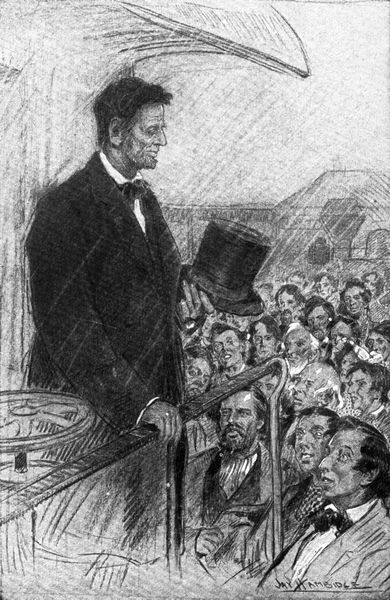
that night he left here for Washington
sayin’ good-by to us in the rain, tellin’ us
that without God’s help he could not succeed
in what he was goin’ into—that with
it, he could not fail; tellin’ us he was turnin’
us over to God, and askin’ us to remember
him in our prayers. Why, a man
can’t talk like that that don’t pray, leastwise
an honest man like Abraham Lincoln.
“And he couldn’t have stood it without
God, sufferin’ as he did, abused as he was,
defeated again and again, and yet always
hangin’ on, always believin’. Don’t you
see from what I’ve been tellin’ you that
Abraham Lincoln all through the war
was seekin’ to work with God, strugglin’
to find out His purpose, and make it prevail
on earth. A man can’t do that unless
he gets close to God, talks with Him.
“How do you suppose a man—just a
common man, like Abraham Lincoln, could
ever have risen up to say anything like
he did in ’65 in his Inaugural if he hadn’t
known God:
“‘With malice toward none, with charity
for all; with firmness in the right, as
God gives us to see the right, let us strive
on to finish the work we are in; to bind
up the nation’s wounds; to care for him
who shall have borne the battle and for
his widow and his orphan—to do which
may achieve a just and lasting peace
among ourselves and with all nations.’
“That ain’t ordinary human nature—particularly
when it’s fightin’ a war—that’s
God’s nature. If that ain’t what
Christ had in mind, then I don’t read the
Bible right.
“Yes, sir, he prayed—that’s what carried
him on—and, God heard him and
helped him. Fact is I never knew a
man I felt so sure God approved of as
Abraham Lincoln.”
Transcriber’s Notes:
Illustrations have been moved to follow the text that they
illustrate, so the page number of the illustration may not
match the page number in the List of Illustrations.
Contents page references refer to the first page of content,
not the story's title page.
Punctuation and spelling inaccuracies were silently corrected.
Archaic and variable spelling has been preserved.
Variations in hyphenation and compound words have been preserved.