Whilst in Port-au-Prince, a Spanish colleague once
remarked to me, “Mon ami, if we could return to
Hayti fifty years hence, we should find the negresses
cooking their bananas on the site of these warehouses.”
Although this judgment is severe, yet from what we
have seen passing under the present Administration, it
is more than probable—unless in the meantime influenced
by some higher civilisation—that this prophecy
will come true. The negresses are in fact already cooking
their bananas amid the ruins of the best houses of the
capital. My own impression, after personally knowing
the country above twenty years, is, that it is a country
in a state of rapid decadence. The revolution of 1843
that upset President Boyer commenced the era of
troubles which have continued to the present day. The
country has since been steadily falling to the rear in
the race of civilisation.
The long civil war (1868-1869) under President
Salnave destroyed a vast amount of property, and
rendered living in the country districts less secure, so
that there has been ever since a tendency for the more
civilised inhabitants to agglomerate in the towns, and
leave the rural districts to fetish worship and cannibalism.
Fires, most of them incendiary, have swept
over the cities; in the commercial quarters of Port-au-Prince,
it would be difficult to find any houses which
existed in 1863, and the fortunes of all have naturally
greatly suffered.
When I reached Hayti in January 1863, the capital
possessed several respectable public buildings. The
palace, without any architectural beauty, was large and
commodious, and well suited to the climate; the Senate,
the House of Representatives, the dwellings occupied by
several of the Ministers, the pretty little theatre, were
all features which have now entirely disappeared.
The town of Pétionville or La Coupe, the summer
and health resort of the capital, where the best families
sought a little country life during the great heats, was
almost entirely destroyed during the revolution of 1868,
and nothing has taken its place. People are still too
poor to afford to rebuild.
Society also has completely changed. I saw at balls
given in the palace in 1863 a hundred well-dressed
prosperous families of all colours; now political dissensions
would prevent such gatherings, even if there
were a building in the city which could receive them,
and poverty has laid its heavy hand more or less on all.
It is the same in a greater or lesser degree in every
other town of the republic.
Agriculture in the plains is also deteriorating, and
the estates produce much less than formerly, though
their staple produce is rum, to stupefy and brutalise
the barbarous lower orders.
Foreigners, nearly ruined by their losses during the
constant civil disturbances, are withdrawing from the
republic, and capital is following them; and with their
withdrawal the country must sink still lower. The
best of the coloured people are also leaving, as they
shun the fate reserved for them by those who have
already slaughtered the most prominent mulattoes.
In fact, the mulatto element, which is the civilising
element in Hayti, is daily becoming of less importance;
internal party strife has injured their political standing,
and constant intermarriage is causing the race to breed
back to the more numerous type, and in a few years
the mulatto element will have made disastrous approaches
to the negro. The only thing which could
have saved the mulatto would have been to encourage
the whites to settle in their country; yet this step the
coloured men have blindly resisted.
In spite of all the civilising elements around them,
there is a distinct tendency to sink into the state of an
African tribe. It is naturally impossible to foretell the
effect of all the influences which are now at work in the
world, and which seem to foreshadow many changes.
We appear standing on the threshold of a period of
great discoveries, which may modify many things, but
not man’s nature. The mass of the negroes of Hayti
live in the country districts, which are rarely or ever
visited by civilised people; there are few Christian
priests to give them a notion of true religion; no
superior local officers to prevent them practising their
worst fetish ceremonies.
In treating of the Black and the Mulatto as they
appeared to me during my residence among them, I
fear that I shall be considered by some to judge harshly.
Such, however, is not my intention. Brought up under
Sir James Brooke, whose enlarged sympathies could
endure no prejudice of race or colour, I do not remember
ever to have felt any repugnance to my fellow-creatures
on account of a difference of complexion.
I have dwelt above thirty-five years among coloured
people of various races, and am sensible of no prejudice
against them. For twelve years I lived in familiar and
kindly intercourse with Haytians of all ranks and
shades of colour, and the most frequent and not least-honoured
guests at my table were of the black and
coloured races.
All who knew me in Hayti know that I had no
prejudice of colour; and if I place the Haytian in
general in an unenviable light, it is from a strong conviction
that it is necessary to describe the people as
they are, and not as one would wish them to be. The
band of black and coloured friends who gathered round
me during my long residence in Port-au-Prince were
not free from many of the faults which I have been
obliged to censure in describing these different sections
of the population, but they had them in a lesser degree,
or, as I was really attached to them, I perhaps saw
them in a dimmer light.
The most difficult chapter to write was that on
“Vaudoux Worship and Cannibalism.” I have endeavoured
to paint it in the least sombre colours, and
none who know the country will think that I have exaggerated;
in fact, had I listened to the testimony of many
experienced residents, I should have described rites at
which dozens of human victims were sacrificed at a
time. Everything I have related has been founded
on evidence collected in Hayti, from Haytian official
documents, from trustworthy officers of the Haytian
Government, my foreign colleagues, and from respectable
residents—principally, however, from Haytian sources.
It may be suggested that I am referring to the past.
On the contrary, I am informed that at present cannibalism
is more rampant than ever. A black Government
dares not greatly interfere, as its power is founded
on the good-will of the masses, ignorant and deeply
tainted with fetish worship. A Haytian writer recently
remarked in print, “On se plaisit beaucoup de ce que le
Vaudoux a reparu grandiose et sérieux.” The fetish
dances were forbidden by decree under the Government
of President Boisrond-Canal. That decree has
been since repealed, and high officers now attend these
meetings, and distribute money and applaud the most
frantic excesses.
President Salomon, who is now in power, lived for
eighteen years in Europe, married a white, and knows
what civilisation is. He probably, on his first advent
to the Presidency, possessed sufficient influence in the
country to have checked the open manifestations of
this barbarous worship; but the fate of those of his
predecessors who attempted to grapple with the evil was
not encouraging. It was hoped, however, that he would
make the attempt, and that, grasping the nettle with
resolution, he might suffer no evil results; but many
doubted not only his courage to undertake the task,
but even the will; and they, I fear, have judged correctly.
Whenever all the documents which exist on
this subject are published, my chapter on Cannibalism
will be looked upon but as a pale reflection of the
reality.
With regard to the history of the country, materials
abound for writing a very full one, but I do not think
it would prove interesting to the general reader. It
is but a series of plots and revolutions, followed by
barbarous military executions. A destructive and
exhausting war with Santo Domingo, and civil strife
during the Presidency of General Salnave, did more to
ruin the resources of the country than any amount of
bad government. The enforced abandonment of work
by the people called to arms by the contending parties,
introduced habits of idleness and rapine which have
continued to the present day; and the material losses,
by the destruction of the best estates and the burning
of towns and villages, have never been fully repaired.
From the overthrow of President Geffrard in 1867
the country has been more rapidly going to ruin. The
fall was slightly checked during the quiet Presidency
of Nissage-Saget; but the Government of General
Domingue amply made up for lost time, and was
one of the worst, if not the worst, that Hayti has ever
seen. With the sectaries of the Vaudoux in power,
nothing else could have been expected.
I have brought my sketch of the history of Hayti
down to the fall of President Boisrond-Canal in 1879,
and shall not touch on the rule of the present President
of Hayti, General Salomon. I may say, however, that
he is the determined enemy of the coloured section of
the community; is credited with having been the chief
adviser of the Emperor Soulouque in all his most
disastrous measures; and the country is said to have
sunk into the lowest depths of misery. The civil war,
which by last accounts was still raging in Hayti, has
been marked by more savage excesses than any previously
known in Haytian history, the black authorities,
hesitating at no step to gain their object, which is
utterly to destroy the educated coloured class. They
care not for the others; as they say, “Mulatte pauvre,
li negue.”
A few words as to the origin of this book. In 1867
I was living in the country near Port-au-Prince, and
having some leisure, I began to collect materials and
write rough drafts of the principal chapters. I was
interrupted by the civil war, and did not resume work
until after I had left the country. It may be the
modifying effect of time, but on looking over the
chapters as I originally wrote them, I thought that I
had been too severe in my judgments on whole classes,
and have therefore somewhat softened the opinions I
then expressed; and the greater experience which a
further residence of seven years gave me enabled me
to study the people more and avoid too sweeping condemnations.
I have not attempted to describe the present condition
of the republic of Santo Domingo, but from all I
can hear it is making progress. The Dominicans have
few prejudices of colour, and eagerly welcome foreign
capitalists who arrive to develop the resources of their
country. Already there are numerous sugar estates in
operation, as well as manufactories of dyes, and efforts
are being successfully made to rework the old gold-mines.
The tobacco cultivation is already large, and
only requires hands to develop it to meet any demand.
I hear of a railway having been commenced, to traverse
the magnificent plain which stretches from the Bay of
Samana almost to the frontiers of Hayti.
After having written the chapter on Vaudoux Worship,
my attention was called to a communication which
appeared in Vanity Fair of August 13, 1881, by a
reply published in a Haytian journal. It is evident
that the writer in Vanity Fair was a naval officer or a
passing traveller in the West Indies, and he probably
carefully noted the information given him. He was,
however, too inclined to believe what he heard, as he
gravely states that a Haytian told him that the kidneys
of a child were first-rate eating, adding that he
had tried them himself; and the writer remarks that
the Haytian did not seem to think it strange or out of
the way that he had done so. No Haytian would have
ever stated seriously that he had eaten human flesh.
Probably, amused by the eagerness of the inquirer, he
told the story to test his powers of belief, and must
have been diverted when he found his statement was
credited. Cannibalism is the one thing of which
Haytians are thoroughly ashamed.
This communication makes mention of the herb-poisonings
and their antidotes; of the midwives who
render new born-babes insensible, that are buried, dug
up, restored to life, and then eaten. In May 1879 a
midwife and another were caught near Port-au-Prince
eating a female baby that had been thus treated; he adds
that a Haytian of good position was discovered with
his family eating a child. In the former case the
criminals were condemned to six weeks’ imprisonment,
in the latter to one month. (I may notice that I never
heard of a respectable Haytian being connected with
the cannibals.) The light punishments inflicted were
due to the fear inspired by the Vaudoux priests. In
January 1881 eight people were fined for disinterring
and eating corpses. An English medical man purchased
and identified the neck and shoulders of a
human being in the market at Port-au-Prince. In
February 1881, at St. Marc, a cask of so-called pork was
sold to a foreign ship. In it were discovered fingers and
finger-nails, and all the flesh proved to be that of human
beings. An English coloured clergyman at Cap Haïtien
said that the Vaudoux did away with all the
effect of his ministry; and that his wife was nearly
purchasing in the market human flesh instead of pork.
Four people were fined in that town for eating corpses.
When the writer arrived at Jacmel he found two men
in prison for eating corpses, and on the day of his
arrival a man was caught eating a child. Near the
same town nine thousand people met at Christmas
to celebrate Vaudoux rites. At Les Cayes a child of
English parents was stolen, and on the thieves being
pursued, they threw it into a well and killed it.
These are the statements made by the writer in
Vanity Fair, and nearly all are probable. If correct,
the open practice of Vaudoux worship and cannibalism
must have made great strides since I left Hayti, and
shows how little a black Government can do, or will
do, to suppress them. The digging up and eating of
corpses was not known during my residence there.
This communication to Vanity Fair provoked a reply
in a journal published at Port-au-Prince called L’Œil,
October 1, 1881. It denies everything, even to the
serious existence and power of the Vaudoux priests, and
spends all its energies in abuse. The article is quite
worthy of the editor,[1] who was one of the most active
supporters of President Salnave, whose connection with
the Vaudoux was notorious. It is in this angry spirit
that the Haytians generally treat any public reference
to their peculiar institution.
Standing on one of the lofty mountains of Hayti,
and looking towards the interior, I was struck with the
pertinence of the saying of the Admiral, who, crumpling
a sheet of paper in his hand, threw it on the table
before George III., saying, “Sire, Hayti looks like
that.” The country appears a confused agglomeration
of mountain, hill, and valley, most irregular in form;
precipices, deep hollows, vales apparently without an
outlet; water occasionally glistening far below; cottages
scattered here and there, with groves of fruit-trees
and bananas clustering round the rude dwellings. Gradually,
however, the eye becomes accustomed to the
scene; the mountains separate into distinct ranges, the
hills are but the attendant buttresses, and the valleys
assume their regular forms as the watersheds of the
system, and the streams can be traced meandering
gradually towards the ocean.
If you then turn towards the sea, you notice that
the valleys have expanded into plains, and the rushing
torrents have become broad though shallow rivers, and
the mountains that bound the flat, open country push
their buttresses almost into the sea. This grand variety
of magnificent scenery can be well observed from a
point near Kenskoff, about ten miles in the interior
from the capital, as well as from the great citadel built
on the summit of La Ferrière in the northern province.
Before entering into particulars, however, let me give
a general idea of the country.
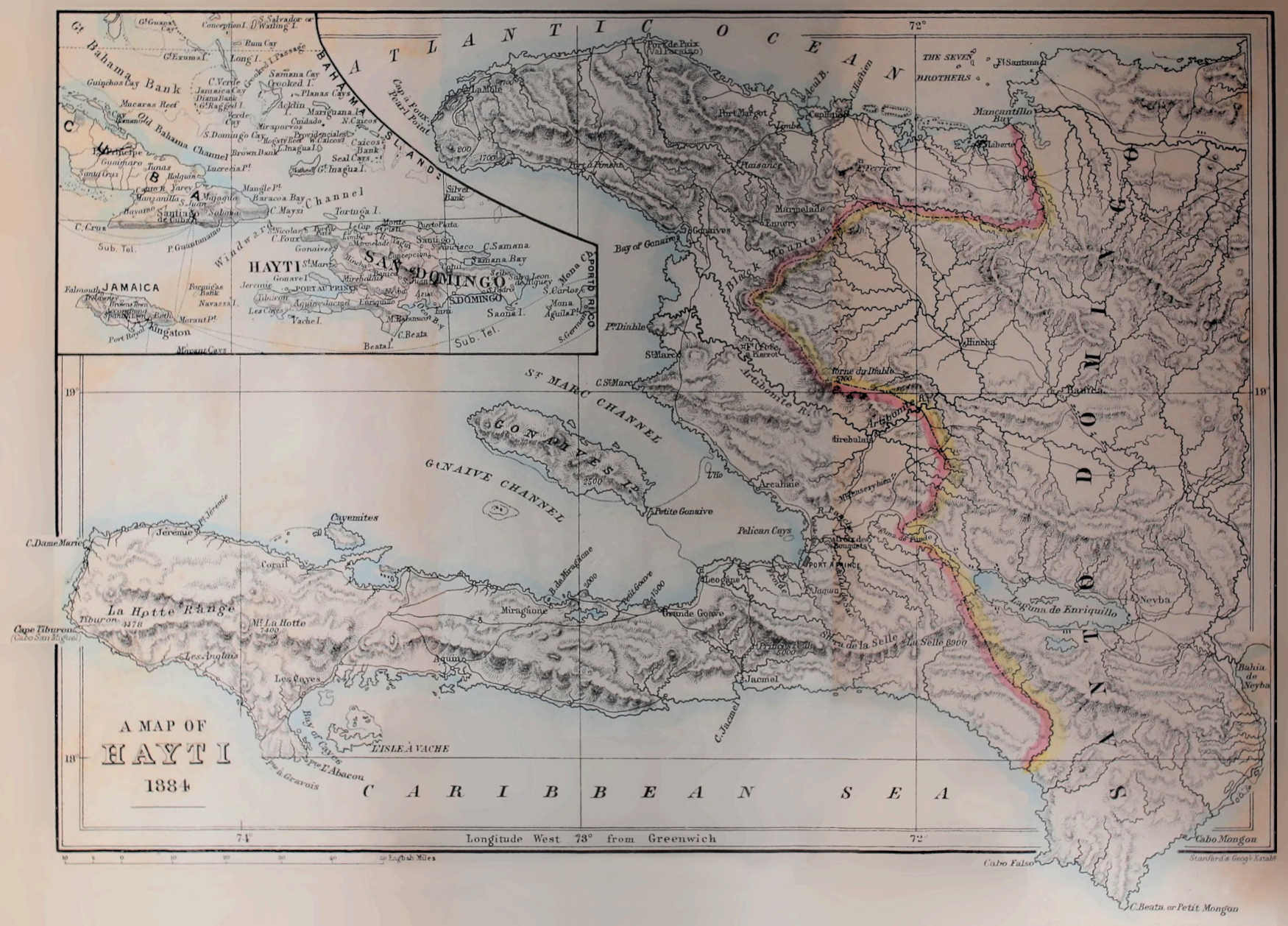
The island of Santo Domingo is situated in the West
Indies between 18° and 20° north latitude and 68°
20’ and 74° 30’ west longitude. Its greatest length is
four hundred miles, its greatest breadth one hundred
and thirty-five miles, and is calculated to be about the
size of Ireland. Hayti occupies about a third of the
island—the western portion—and, pushing two great
promontories into the sea, it has a very large extent of
coast-line. It is bounded on the north by the Atlantic
Ocean, on the east by the republic of Santo Domingo,
on the south by the Caribbean Sea, and on the west by
the passage which separates it from Cuba and Jamaica.
Its most noted mountain-ranges are La Selle, which
lies on the south-eastern frontier of Hayti; La Hotte,
near Les Cayes; and the Black Mountains in the
northern province; but throughout the whole extent
of the republic the open valleys are bounded by lofty
elevations. In fact, on approaching the island from
any direction, it appears so mountainous that it is difficult
to imagine that so many smiling, fertile plains are to
be met with in every department. They are, however,
numerous. The most extensive are the Cul-de-Sac, near
Port-au-Prince, the plains of Gonaives, the Artibonite,
Arcahaye, Port Margot, Leogâne, that of Les Cayes, and
those that follow the northern coast.
Hayti has the advantage of being well watered,
though this source of riches is greatly neglected. The
principal river is the Artibonite, which is navigable for
small craft for a short distance; the other streams have
more the character of mountain torrents, full to overflowing
during the rainy season, whilst during the dry
they are but rivulets running over broad pebbly beds.
The lakes lying at the head of the plain of Cul-de-Sac
are a marked feature in the landscape as viewed
from the neighbouring hills. They are but little visited,
as their shores are marshy, very unhealthy, and uninhabitable
on that account, while the swarms of mosquitoes
render even a temporary stay highly disagreeable.
The waters of one of them are brackish, which
would appear to indicate more salt deposits in the
neighbourhood.
There are a few islands attached to Hayti, the principal,
La Tortue, on the north, Gonaives on the west,
and L’Isle-à-Vache on the south coast. Some attempts
have been made to develop their natural riches, but
as yet with but slight success. The first two named
are famous for their mahogany trees.
The principal towns of the republic are Port-au-Prince,
the capital, Cap Haïtien in the north, and
Les Cayes in the south. Jacmel, Jérémie, Miragoâne,
St. Marc, and Gonaives are also commercial ports.
Port-au-Prince is situated at the bottom of a deep
bay, which runs so far into the western coast as almost
to divide Hayti in two. It contains about 20,000
inhabitants, and was carefully laid out by the French.
It possesses every natural advantage that a capital
could require. Little use, however, is made of these
advantages, and the place is one of the most unpleasant
residences imaginable. I was one day talking to a
French naval officer, and he observed, “I was here as
a midshipman forty years ago.” “Do you notice any
change?” I asked. “Well, it is perhaps dirtier than
before.” Its dirt is its great drawback, and appears
ever to have been so, as Moreau de St. Méry complained
of the same thing during the last century.
However, there are degrees of dirt, and he would probably
be astonished to see it at the present day. The
above paragraph was first written in 1867; since that
it has become worse, and when I last landed (1877), I
found the streets heaped up with filth.
The capital is well laid out, with lines of streets
running parallel to the sea, whilst others cross at right
angles, dividing the town into numerous islets or blocks.
The streets are broad, but utterly neglected. Every
one throws out his refuse before his door, so that heaps
of manure, broken bottles, crockery, and every species
of rubbish encumber the way, and render both riding
and walking dangerous. Building materials are permitted
occasionally to accumulate to so great an extent
as completely to block up the streets and seriously
impede the traffic. Mackenzie, in his notes on Hayti,
remarks on the impassable state of the streets in 1826;
torn up by tropical rains, they were mended with refuse
(generally stable dung to fill up the holes, and a thin
layer of earth thrown over), only to be again destroyed
by the first storm. Ask Haytians why they do
not mend their streets and roads, they answer, “Bon
Dieu, gâté li; bon Dieu, paré li” (God spoilt them, and
God will mend them). Then, as now, the roads were in
such a state in wet weather that only a waggon with
a team of oxen could get through the muddy slough.
On first entering the town, you are struck with the
utter shabbiness of the buildings, mean cottages and
grovelling huts by the side of the few decent-looking
dwellings. Most of the houses are constructed of
wood, badly built with very perishable materials, imported
from the United States or our Northern colonies.
The idea that originally prevailed in the construction
of the private houses was admirable; before each was
a broad verandah, open to all passers, so that from one
end of the town to the other it was intended that there
should be cool, shady walks. But the intolerable stupidity
of the inhabitants has spoilt this plan; in most
streets the level of the verandahs of each house is of a
different height, and frequently separated by a marshy
spot, the receptacle of every species of filth; so that you
must either walk in the sun or perform in the shade a
series of gymnastic exercises exceedingly inconvenient
in a tropical climate.
On either side of the street was a paved gutter, but
now, instead of aiding the drainage, it is another cause
of the accumulation of filth. The stones which formerly
rendered the watercourses even are either removed or
displaced, and the rains collecting before the houses form
fetid pools, into which the servants pour all that in
other countries is carried off by the sewers. In a few
of the more commercial streets, where foreigners reside,
more attention is paid to cleanliness, but still Port-au-Prince
may bear the palm away of being the most foul-smelling,
dirty, and consequently fever-stricken city in
the world.
The port is well protected, but is gradually filling up,
as the rains wash into it not only the silt from the
mountains, but the refuse of the city, and no effort is
made to keep it open. As there is but little tide, the
accumulations of every species of vegetable and animal
matter render the water fetid, and when the sea-breeze
blows gently over these turbid waves, an effluvia is
borne into the town sickening to all but native
nostrils.
The most remarkable edifice of Port-au-Prince was
the palace, a long, low, wooden building of one storey,
supported on brick walls: it contained several fine
rooms, and two halls which might have been rendered
admirable for receptions; but everything around it was
shabby—the stables, the guard-houses, the untended
garden, the courtyard overrun with grass and weeds,
and the surrounding walls partially in ruins. This spacious
presidential residence was burnt down during the
revolutionary attack on Port-au-Prince in December
1869, and no attempt has been made to rebuild it.
The church is a large wooden building, an overgrown
shed, disfigured by numerous wretched paintings
which cover its walls; and, as an unworthy concession
to local prejudice, our Saviour is occasionally represented
by an ill-drawn negro.
The senate-house was the building with the most
architectural pretensions, but its outer walls only remained
when I last saw it, fire having destroyed the
roof and the interior wood-work. There is no other
edifice worthy of remark; and the private houses, with
perhaps a score of exceptions, are of the commonest
order.
The market-places are large and well situated, but
ill-tended and dirty, and in the wet season muddy in
the extreme. They are fairly supplied with provisions.
I may notice that in those of Port-au-Prince very
superior meat is often met with, and good supplies of
vegetables, including excellent European kinds, brought
from the mountain gardens near Fort Jaques.
The supply of water is very defective. During
the reign of the Emperor Soulouque a luminous idea
occurred to some one, that instead of repairing the old
French aqueduct, iron pipes should be laid down. The
Emperor had the sagacity to see the advantage of the
plan, and gave orders for the work to be done. As an
exception to the general rule, the idea was to a certain
extent well carried out, and remains the only durable
monument of a most inglorious reign. Had the iron
pipes been entirely substituted for the old French
work, the inhabitants would have enjoyed the benefit
of pure water; but when I left in 1877, the people in
the suburbs were still breaking open the old stone-work
to obtain a source of supply near their dwellings;
and pigs, children, and washerwomen congregated
round these spots and defiled the stream.
The amount of water introduced into the town is still
most inadequate; and though numerous springs, and one
delightful stream, La Rivière Froide, are within easy
distance of the port, no effort has been made to increase
the supply. La Rivière Froide—name redolent
of pleasant reminiscences in a tropical climate—could
easily fill a canal, which would not only afford an inexhaustible
supply for the wants of the town and shipping,
but, by creating an outward current, would carry off
the floating matter which pollutes the port. Since my
departure a Mr. Stephens commenced some works to
afford the town a constant supply of water, but these, I
understand, have as yet only been partially carried out.
If ever finished, they will afford to the inhabitants a
great boon.
The cemetery is situated outside the town. I never
entered it except when compelled to attend a funeral,
and hastened to leave it as soon as possible, on account
of an unpleasant odour which pervades it. It is not
kept in good order, though many families carefully
attend to the graves of their relatives, and there are
several striking tombs. People of all religions are
buried here; but it is on record that a brawling Irish
priest once attempted to disinter a Protestant child.
His brawling subsequently led to his banishment.
I noticed on my first arrival in Port-au-Prince two
marble coffins, very handsome, lying neglected on the
ground outside the palace. I was told they had been
brought from abroad in order that the remains of Pétion
and Boyer, two of their best Presidents, should repose in
them; but for many years I saw them lying empty on
the same spot, and I never heard what became of them.
The curse of Port-au-Prince is fire. Every few years
immense conflagrations consume whole quarters of the
town. Nothing can stop the flames but one of the
few brick-houses, against which the quick-burning fire
is powerless. During my residence in Port-au-Prince
five awful fires devastated the town. On each occasion
from two to five hundred houses were destroyed. And
yet the inhabitants go on building wretched wooden
match-boxes, and even elaborate houses of the most inflammable
materials. Companies should be careful how
they insure property in Port-au-Prince, as there are some
very well-authenticated stories of frauds practised on
them both by Europeans and natives.
Port-au-Prince, on my first arrival in 1863, was
governed by a municipality, over which presided a very
honest man, a Monsieur Rivière, one of those Protestants
to whom I have referred in my chapter on religion.
As a new arrival, I thought the town sufficiently
neglected, but I had reason to change my opinion.
It was a pattern of cleanliness to what it subsequently
became. The municipality, when one exists, has for its
principal duties the performance or neglect of the registration
of all acts relating to the “état civil,” and to
divide among its members and friends, for work never
carried out, whatever funds they can collect from the
city.
At the back of the capital, at a distance of about five
miles, was the village of La Coupe, the summer residence
of the wealthier families. As it was situated
about 1200 feet above the level of the sea and was
open to every breeze, it afforded a delightful change
from the hot, damp town; but during the civil war of
1868 the best houses were destroyed and never reconstructed.
There is a natural bath there, the most
picturesque feature of the place; it is situated under
lofty trees, that cast a deep shade over the spot, and
during the hottest day it is charmingly cool.
Cap Haïtien is the most picturesque town in Hayti;
it is beautifully situated on a most commodious harbour.
As you enter it, passing Fort Picolet, you are struck by
its safe position—a narrow entrance so easily defended.
My first visit was in H.M.S. “Galatea,” Captain Macguire;
and as we expected that we might very possibly
be received by the fire of all the batteries, our own crew
were at their guns, keeping them steadily trained on
Fort Picolet, whose artillery was distant about a couple
of hundred yards. Having slowly steamed past forts
and sunken batteries, we found ourselves in front of
the town, with its ruins overgrown with creepers, and in
the background the rich vegetation sweeping gracefully
up to the summit of the beautiful hill which overshadows
Cap Haïtien.
Cap Haïtien never recovered from the effects of the
fearful earthquake of 1842, when several thousands of
its inhabitants perished. To this day they talk of that
awful event, and never forget to relate how the country-people
rushed in to plunder the place, and how none
lent a helping-hand to aid their half-buried countrymen.
Captain Macguire and myself used to wander
about the ruins, and we could not but feel how little
energy remained in a people who could leave their property
in such a state. It was perhaps cheaper to build
a trumpery house elsewhere.
One of those who suffered the most during that
visitation wrote before the earth had ceased trembling,
“Against the acts of God Almighty no one complains,”
and then proceeded to relate how the dread
earthquake shook down or seriously injured almost
every house; how two-thirds of the inhabitants were
buried beneath the fallen masonry; how the bands
of blacks rushed in from mountain and plain, not to
aid in saving their wretched countrymen, whose cries
and groans could be heard for two or three days, but
to plunder the stores replete with goods; and—what
he did complain of—how the officers and men of the
garrison, instead of attempting to keep order, joined
in plundering the small remnants of what the rest of
the inhabitants could save from the tottering ruins.
What a people!
The most striking objects near Cap Haïtien are
the remains of the palace of Sans Souci, and of the
citadel constructed by King Christophe, called La
Ferrière. It requires a visit to induce one to believe
that so elaborate, and, I may add, so handsome a structure,
could exist in such a place as Hayti, or that a
fortification such as the citadel could ever have been
constructed on the summit of a lofty mountain, five
thousand feet, I believe, above the level of the sea.
Some of the walls are eighty feet in height, and sixteen
feet in thickness, where the heavy batteries of
English guns still remain in position. All is of the
most solid masonry, and covering the whole peak of
the mountain.
We were really lost in amazement as we threaded
gallery after gallery where heavy fifty-six and thirty-two
pounders guarded every approach to what was
intended to be the last asylum of Haytian independence.
Years of the labour of toiling thousands
were spent to prepare this citadel, which the trembling
earth laid in ruins in a few minutes. What
energy did this black king possess to rear so great a
monument? but the reverse of the medal states that
every stone in that wonderful building cost a human
life.
It is a popular idea in Hayti that the superiority of
the northern department, and the greater industry of
its inhabitants, date from the time of Christophe, and
some express a belief that his iron system was suitable
to the country; but the fact is that Moreau de St. Méry,
writing in the last century, insists on the superior advantages
of the northern province, its greater fertility,
the abundance of rain, and consequently the number of
rivers, as well as the superior intelligence and industry
of the inhabitants, and their greater sociability and
polish. They are certainly more sociable than in the
capital, and people still seek northern men to work
on their estates. As for Christophe’s system, no
amount of increase in produce could compensate for
its brutality.
Gonaives is a poor-looking town, constantly devastated
by revolutions and fires, with a few broad, unfinished
streets, and some good houses among the
crowds of poor-looking buildings. This neighbourhood
is famous for what are called white truffles. They are
dried and sent to the different parts of the republic.
St. Marc, though not so scattered as Gonaives, is a
small place. It was formerly built of stone; a few
specimens of this kind of building still remain. Jacmel
has a very unsafe harbour, but possesses importance as
one of the ports at which the royal mail steamers call,
and has a large export trade in coffee. Les Cayes,
Jérémie, and other smaller ports I have only seen at
a distance, but I hear they are much like the other
cities and towns of the republic. Mackenzie says that
the city and environs of Les Cayes are described as
“très riante,” and that in his time it was kept in better
order than the capital. This is said still to be the case.
My last long ride in Hayti was from Cap Haïtien to
Gonaives, and nestling in the hills I found some very
pretty villages, planted in lovely sites, with fresh,
babbling streams, and fruit groves hiding the inferior-looking
houses. The place I most admired was, I think,
called Plaisance. There was a freshness, a brightness,
a repose about the village that made me regret it was
situated so far from the capital.
Wherever you may ride in the mountains, you cannot
fail to remark that there is scarcely a decent-looking
house out of the towns. The whole of the country
is abandoned to the small cultivators, whose inferior
cottages are met with at every turn, and, as might be
expected from such a population, very dirty and devoid
of every comfort, rarely any furniture beyond an old
chair, a rickety table, a few sleeping-mats, and some
cooking utensils. There is no rule, however, without
an exception, and I remember being much struck by
seeing at Kenskoff, a small hamlet about ten or twelve
miles direct from Port-au-Prince, a good house, where
there were some chairs, tables, and bedsteads, and
around this dwelling several huts, in which the wives
of our host lived separately.
Now and then a peasant will build a larger house
than usual; we met with one, the last we slept in on
our ride to the mountain, La Selle, whose proprietor
had really some ideas of comfort, and before whose
dwelling coffee-plants were growing, trimmed to the
height of six feet, planted separate from one another,
perfectly clean, and covered with indications of an
abundant crop. They had been planted there in former
days by an intelligent proprietor, and the peasant had
the merit of not neglecting them.
The plain of Cul-de-Sac, adjoining the north side of
Port-au-Prince, was one of the richest and most cultivated
during the time of the French; and as all
regular cultivation depends on the amount of water,
their engineers had constructed the most careful system
for the storage and distribution of the supplies. Properly
managed, all the large estates could receive the
quantity necessary for their lands, but for many years
the stone-work was neglected, and the grand barrage
was becoming useless, when President Geffrard placed
the affair in the hands of an able French engineer,
Mons. Ricard, who efficiently restored the main work,
but had not funds to complete the canals for distributing
the waters. As usual in all enterprises in that
country, the money voted had to pass through so many
hands, that before it reached the engineer it had
diminished to less than half.
The soil of the plain is most fertile, and only appears
to require water to give the most promising crops of
sugar-cane. There are some very extensive estates
that could afford work for a large population, but the
ever-increasing disturbances in the country render
Capital shy of venturing there.
As might readily be supposed, the roads are greatly
neglected, and during the rainy season are almost
impassable. They are composed simply of the surrounding
soil, with a few branches thrown into the
most dangerous holes. The bridges are generally
avoided; it is a saying in Hayti, that you should go
round a bridge, but never cross it, and the advice is
generally to be followed. For the main streams there
are fords. An attempt was once made to bridge over
La Grande Rivière du Cul de Sac, but the first freshet
washed away all the preliminary work.
In the mountains there are only bridle-paths, though
occasionally I came across the remains of old French
roads and good paths. On the way to Kenskoff there is a
place called L’Escalier, to escalade the steepest side of
the mountain. The horses that are used to it manage
well, but those from the plains find the steps awkward.
On the road from Gonaives to the northern province
there is a very remarkable paved way, the work so
well done that it has resisted the rain during a hundred
years of neglect. Some of the bridle-paths in the north
are exceedingly good, and are admirably carried up the
sides of hills, so as to avoid the most difficult spots.
In the range above Tourjeau I came across a very
pretty grassy bridle-path, and near I found the remains
of a large French country-house, evidently the residence
of some great proprietor. The tradition in the neighbourhood
is that there was an indigo factory adjoining,
but I could scarcely imagine the site suitable. Wherever
you may go in Hayti you come across signs of
decadence, not only from the exceptional prosperity of
the French period, but even of comparatively recent
years. After the plundering and destruction of 1868
and 1869, few care to keep up or restore their devastated
houses, and it is now a hand-to-mouth system.
Cul-de-Sac is a glorious plain, and in good hands
would be a fountain of riches; and the same may be
said of the other splendid plains that abound throughout
the island. Every tropical production grows freely,
so that there would be no limit to production should
the country ever abandon revolutions to turn its attention
to industry. About three-fourths of the surface
of the plains are occupied by wood or prickly acacia,
that invades every uncultivated spot.
The mountains that bound these plains and extend
to the far interior present magnificent sites for pleasant
residences; but no civilised being could occupy them
on account of the difficulty of communication and the
doubtful character of the population. Up to the time
of the fall of President Geffrard it was possible; now
it would be highly imprudent. In one of the most
smiling valleys that I have ever seen, lying to the left
whilst riding to the east of Kenskoff, a friend of mine
possessed a very extensive property. The place looked
so beautiful that I proposed to him a lengthened visit,
to which he acceded. Delay after delay occurred,
and then the civil war of 1865 prevented our leaving
Port-au-Prince. In 1869 there were arrested in that
valley a dozen of the worst cannibals of the Vaudoux
sect, and the police declared that the whole population
of that lovely garden of the country was given up to
fetish worship. It was probably a knowledge of this
that made my friend so long defer our proposed visit,
as the residence of a white man among them might
have been looked upon with an evil eye.
I have travelled in almost every quarter of the
globe, and I may say that, taken as a whole, there is
not a finer island than that of Santo Domingo. No
country possesses greater capabilities, or a better geographical
position, or more variety of soil, of climate,
or of production; with magnificent scenery of every
description, and hill-sides where the pleasantest of
health-resorts might be established. And yet it is
now the country to be most avoided, ruined as it has
been by a succession of self-seeking politicians, without
honesty or patriotism, content to let the people sink to
the condition of an African tribe, that their own selfish
passions may be gratified.
The climate of Hayti is of the ordinary tropical
character, and the temperature naturally varies according
to the position of the towns. Cap Haïtien, being
exposed to the cooling influence of the breezes from
the north, is much more agreeable as a residence than
Port-au-Prince, which is situated at the bottom of a
deep bay.
In summer, that is, during the months of June, July,
August, and September, the heat is very oppressive.
The registered degrees give one an idea of the disagreeableness
of the climate. In my house at Tourjeau, near
Port-au-Prince, 600 feet above the level of the sea, I
have noted a registering thermometer marking 97° in the
drawing-room at 2 P.M. in July, and 95° in the dining-room
on the ground-floor; and in a room off a court
in the town I have heard of 103°—no doubt from
refraction.[2] At the Petit Séminaire the priests keep
a register, and I notice that rarely is the heat marked
as 95°, generally 93.2° is the maximum; but the thermometer
must be kept in the coolest part of the college,
and is no criterion of what is felt in ordinary rooms.
The nights also are oppressively warm, and for days I
have noticed the thermometer seldom marking less
than 80° during the night. In August the heat is
even greater than in July, rising to 97° at the Petit
Séminaire, whilst in September the maximum is registered
as 91.5°; and this heat continues well on into
November, the maximum being the same. I have
not the complete returns, but generally the heats of
September are nearly equal to those of August. In
what may be called winter, the thermometer rarely
marks over 84°, and the nights are cool and pleasant.
In fact, I have been assured of the thermometer having
fallen as low as 58° during the night, but I never
saw it myself below 60°. It is a curious fact that
foreigners generally suffer from the heat, and get ill in
consequence, whilst the natives complain of the bitter
cold of the winter, and have their season of illness then.
Port-au-Prince is essentially unhealthy, and yellow fever
too often decimates the crews of the ships of
war that visit its harbour. In 1869, on account of the
civil convulsion, French and English ships remained
months in harbour. The former suffered dreadfully;
the “Limier,” out of a crew of 106 men and eight
officers, lost fifty-four men and four officers, whilst
the “D’Estrés” and another had to mourn their captains
and many of their crew. Who that ever knew him
can forget and not cherish the memory of Captain De
Varannes of the “D’Estrés,” one of the most sympathetic
of men, a brilliant officer, and a steady upholder
of the French and English alliance? De Varannes
was an Imperialist, an aide-de-camp of the Empress,
and thoroughly devoted to the family that had made
his fortune. When the medical men announced to
him that he had not above two hours to live, he
asked the French agent if he had any portraits of
the Imperial family; they were brought and placed
at the foot of the bed where he could see them. He
asked then to be left alone, and an hour after, when a
friend crept in, he found poor De Varannes dead, with
his eyes open, and apparently fixed on the portraits
before him. I should add that both these vessels
brought the fever to Port-au-Prince from Havana and
Martinique.
The English ships suffered less, as our officers are
not bound by the rigid rules that regulate the French
commanders, who would not leave the harbour without
express orders from their Admiral, though their men
were dying by dozens. Captain Hunter of the “Vestal”
and Captain Salmon of the “Defence” knew their duty
to their crews too well to keep them in the pestilential
harbour, and as soon as yellow fever appeared on board,
steamed away; and the latter went five hundred miles
due north till he fell in with cool weather, and thus
only lost three men. A French officer told me that
when the sailors on board the “Limier” saw the “Defence”
steam out of harbour, they were depressed even
to tears, and said, “See how the English officers are
mindful of the health of their men, whilst ours let us
die like flies.” Captain Hunter of the “Vestal” never
had due credit given him for his devotion to his crew
whilst suffering from yellow fever. He made a hospital
of his cabin, and knew no rest till he had reached the
cool harbours of the north.
Merchant seamen in certain years have suffered dreadfully
from this scourge, both in Port-au-Prince and in
the neighbouring port of Miragoâne. Two-thirds of
the crews have often died, and every now and then
there is a season in which few ships escape without
loss.
Yellow fever rarely appears on shore, as the natives
do not take it, and the foreign population is small and
mostly acclimatised. The other diseases from which
people suffer are ordinary tropical fevers, agues, small-pox,
and the other ills to which humanity is subject;
but although Port-au-Prince is the filthiest town I
have ever seen, it has not yet been visited by cholera.
In the spring of 1882 small-pox broke out in so virulent
a form that the deaths rose to a hundred a day.
This dreadful visitation continued several months, and
it is calculated carried off above 5000 people in the
city and its neighbourhood.
If Hayti ever becomes civilised, and if ever roads are
made, there are near Port-au-Prince summer health-resorts
which are perfectly European in their climate.
Even La Coupe, or, as it is officially called, Pétionville,
about five miles from the capital, at an altitude of 1200
feet, is from ten to twelve degrees cooler during the day,
and the nights are delicious; and if you advance to
Kenskoff or Furcy, you have the thermometer marking
during the greatest heat of the day 75° to 77°, whilst
the mornings and evenings are delightfully fresh, with
the thermometer at from 57° to 68°, and the nights
cold. On several occasions I passed some months at
Pétionville, and found the climate most refreshing after
the burning heats of the sea-coast.
The regular rainy season commences about Port-au-Prince
during the month of April, and continues to the
month of September, with rain again in November
under the name of “les pluies de la Toussaint.” After
several months of dry weather one breathes again as the
easterly wind brings the welcome rain, which comes with
a rush and a force that bends the tallest palm-tree till
its branches almost sweep the ground. Sometimes,
whilst dried up in the town, we could see for weeks
the rain-clouds gathering on the Morne de l’Hôpital
within a few miles, and yet not a drop would come to
refresh our parched-up gardens.
During the great heats the rain is not only welcome
as cooling the atmosphere, but as it comes in torrents,
it rushes down the streets and sweeps clean all those
that lead to the harbour, and carries before it the
accumulated filth of the dry season. In very heavy
rains the cross streets are flooded; and one year the
water came down so heavily and suddenly that the
brooks became rushing rivers. The flood surprised a
priest whilst bathing, swept him down to the Champs
de Mars, and threw his mangled body by the side of a
house I was at that moment visiting.
That evening, as I was already wet, I rode home
during the tempest, and never did I see more vivid
lightning, hear louder thunder, or feel heavier rain.
As we headed the hill, the water rushing down the path
appeared almost knee-deep; and to add to the terror of
my animal, a white horse, maddened by fear, came
rushing down the hill with flowing mane and tail, and
swept past us. Seen only during a flash of lightning,
it was a most picturesque sight, and I had much difficulty
in preventing my frightened horse joining in
his wild career.
The rainy season varies in different parts of the
island, particularly in the north. I am surprised to
observe that the priests have found the annual fall of
rain to be only 117 inches. I had thought it more.
Perhaps, however, that was during an exceptionally
dry year.
The great plain of Cul-de-Sac is considered healthy,
although occasionally intensely warm. It is, however,
freely exposed not only to the refreshing sea-breezes,
but to the cooling land-winds that come down from the
mountains that surround it. There is but little marsh,
except near La Rivière Blanche, which runs near the
mountains to the north and is lost in the sands.
On the sugar-cane plantations, where much irrigation
takes place, the negro workmen suffer somewhat from
fever and ague, but probably more from the copious libations
of new rum, which they assert are rendered necessary
by the thirsty nature of the climate.
I had often read of a clap of thunder in a clear sky,
but never heard anything like the one that shook our
house near Port-au-Prince. We were sitting, a large
party, in our broad verandah, about eight in the evening,
with a beautiful starlight night,—the stars, in fact,
shining so brightly that you could almost read by
their light,—when a clap of thunder, which appeared to
burst just over our roof, took our breath away. It was
awful in its suddenness and in its strength. No one
spoke for a minute or two, when, by a common impulse,
we left the house and looked up into a perfectly clear
sky. At a distance, however, on the summits of the
mountains, was a gathering of black clouds, which
warned my friends to mount their horses, and they
could scarcely have reached the town when one of the
heaviest storms I have known commenced, with thunder
worthy of the clap that had startled us. Though all
of us were seasoned to the tropics, we had never been
so impressed before.
In the wet season the rain, as a rule, comes on at
regular hours and lasts a given time, though occasionally
it will continue through a night and longer,
though rarely does it last above twenty-four hours
without a gleam of sunshine intervening.
CHAPTER II.
HISTORY BEFORE INDEPENDENCE.
I do not doubt but the discovery of America by
Columbus was good in its results to mankind; but
when we read the history of early Spanish colonisation,
the predominant feeling is disgust at the barbarities
and fanaticism recorded in almost every page. We
generally overlook much of this, being dazzled by
pictures of heroic deeds, as set forth in the works of
Prescott and Robertson—heroic deeds of steel-clad
warriors massacring crowds of gentle, almost unresisting
natives, until despair, lending energy to their
timid natures, forced them occasionally to turn on
their savage persecutors.
In no country were the Spaniards more notorious for
their cruelty than in the first land in America on which
Columbus established a settlement. The population
was then variously estimated, the numbers given varying
between 800,000 and 2,000,000, the former calculation
being the more probable. They were indeed a
primitive people, the men moving about entirely
naked, the women wearing a short petticoat. They are
said to have been good-looking, which, if true, would
mark them as a people distinct from any other in
America, as the Indians, who still remain by millions
in South America and Mexico, are as a race the most
ill-favoured natives I have seen in any portion of
the globe. That was my impression when I travelled
among them, though I have seen among the young
women who followed the Indian regiments to Lima a
few who might almost be considered handsome, but these
by their appearance were probably of mixed breed.
Columbus only stayed two months in Santo Domingo,
but left behind him forty of his companions in an
entrenched position. They now began to commit excesses;
and hearing that a cacique in the interior had
a large store of gold, they penetrated to his town and
robbed him of his riches. This roused the population
against them; they were pursued and killed in detail.
In the meantime Columbus had revisited Spain, been
received with honour, and seventeen vessels, laden with
every kind of store and domestic animal, as well as a
large force, were placed at his disposal. On his arrival
his first thoughts were for gold, and he marched in
search of the mines, which, being pointed out to him,
were soon in full work, the Indians by force being
compelled to this task. The conduct of these white
men appears to have been so wantonly cruel, that the
population rose en masse, and a hundred thousand
Indians are said to have marched to attack the
Spaniards, two hundred and twenty of whom put this
crowd to flight without the loss of a single man. These
are the heroic deeds we are called upon to admire. It
has often been declared impossible that such, on one
side, bloodless encounters could take place; but I am
well assured that two hundred well-armed Englishmen
could in the present day march through any number
of the Land Dyaks of Borneo, and defeat them without
loss.
It is not necessary to trace in detail the history of
the island; but I may notice that in 1507 the population
was estimated at 60,000, which shows that the original
reckoning must have been greatly exaggerated, as not
even these early apostles of the religion of charity
could have thus wiped out the population by millions.
The story of what one called the early exploits of the
Spaniards in Santo Domingo has been so often related
that it is useless to tell it over again, especially as it
would present but a sequence of sickening events, of
murders, executions, robbery, and lust, with but few
traits of generosity and virtue to record.
These foreign settlers soon saw that the island would
be useless to them without population, so they early
began to introduce negroes from Africa, as well as
families from the neighbouring isles. The Coral Indians
were not spared, and the Spanish historians themselves
are the chroniclers of this record of infamy. Now not
a descendant of an Indian remains.
Santo Domingo, deprived of population, with its
mineral wealth, for want of hands, no longer available,
and agriculture neglected, rapidly degenerated, and
little was left but the city of Santo Domingo and in
the interior a population of herdsmen. Then the
famous buccaneers appeared to inflict on the Spaniards
some of the misery they had worked on the Indians.
Notwithstanding every effort to prevent them, the
French adventurers gradually spread through the
western end of the island, and began to form towns
and settlements.
In 1640 Levasseur was sent from France as Governor
of these irregularly-acquired possessions, and from that
time the French may be said to have established themselves
firmly in the western part of Santo Domingo—which
hereafter I may call by its present name, Hayti,
to simplify the narrative—but their rule was not recognised
by Spain until the year 1697.
From this date to the breaking out of the French
Revolution the colony increased in prosperity, until it
became, for its extent, probably the richest in the world.
Negroes were imported by thousands from the coast
of Africa, and were subjected to as harsh a slavery as
ever disgraced the worst system of servitude.
Two events occurred during this period of prosperity
which were worthy of being noted: First, the fearful
earthquake which destroyed Port-au-Prince in 1770,
when for fifteen days the earth trembled under repeated
shocks, and left the city a heap of ruins.[3] The second
was the war in which France engaged to aid our colonists
to acquire their independence. To increase their
forces the French commanders permitted the free
blacks and mulattoes to enlist, and they did good
service; and when they returned to their country, they
spread widely a spirit of disaffection, which no ordinances
could destroy.
When England in 1785 was forced to acknowledge
the independence of the United States, how despotic
France and Spain rejoiced over the downfall of the
only country where liberty was known! The results
were, for France, the Revolution, which, with all its
crimes, did unspeakable good, and deprived her of the
finest colony that any country ever possessed. To
Spain it brought the loss of world-wide possessions, and
a fall in power and prestige which to this day she
shows but few signs of recovering.
On the eve of the great Revolution, France possessed,
as I have said, the finest colony in the world. Her
historians are never weary of enumerating the amount
of its products, the great trade, the warehouses full
of sugar, cotton, coffee, indigo, and cocoa; its plains
covered with splendid estates, its hill-sides dotted with
noble houses; a white population, rich, refined, enjoying
life as only a luxurious colonial society can enjoy it;
the only dark spot, then scarcely noticed, the ignorant,
discontented mass of black slavery, and the more
enlightened disaffection of the free mulattoes and
negroes.
It has often been a subject of inquiry how it was
that the Spaniards, who were the cruellest of the cruel
towards the Indians, should have established negro
slavery in a form which robbed it of half its terrors,
whilst the French, usually less severe than their
southern neighbours, should have founded a system
of servitude unsurpassed for severity, cruelty, nay,
ferocity.
To this day the barbarous conduct of the Marquis
of Caradeux is cited as a justification for the savage
retaliation of the insurgent negroes. I think that the
explanation of the different conduct of the Spanish and
French slave-owner may be, that the former is indolent
and satisfied with less, whilst the latter, in his fierce
struggle to be rich, cared not how he became so, and
worked his negroes beyond human endurance, and then,
to keep down the inevitable discontent, sought to terrorise
his slaves by barbarous punishments.
The true history of Hayti commences with the
French Revolution, when, amid the flood of impracticable
and practicable schemes, a few statesmen turned
their generous thoughts towards the down-trodden
African, and firing assembled France with their enthusiasm,
passed laws and issued decrees granting freedom
to the black; but before these had any practical effect,
Hayti had to pass through scenes which have left
blood-stains that nothing can wash away.
When reading the different accounts which have
been written of the state of Hayti when France was
upsetting the accumulated wrongs of ages, I have often
desired to disbelieve them, and place to exaggerated
feelings of sympathy the descriptions of the prejudices
of the planters and the atrocities committed under
their influence. But I have lived long in the West
Indies, and know that there are many whites born in
our colonies, who not only look upon the negro as of an
inferior species—which he may be—but as fit only for
servitude, and quite unworthy of freedom, and on an
alliance with a coloured person as a disgrace which
affects a whole family. They speak of a mulatto as
they would of one affected with leprosy. If in these
days such sentiments exist, we can readily believe that
they existed even in a greater degree before, awakened
to a feeling of justice, most European nations formally
abolished slavery, and let the black and the coloured
man have an equal chance in the struggle of life.
For some years before the meeting of the States-General,
philanthropists who had inquired into the
condition of the slave had had their compassion aroused,
and to give direction to their efforts to ameliorate it,
had founded in Paris a society called “The Friends of
the Blacks.”
The summoning of the States-General in France
created much enthusiasm throughout Hayti; the
planters now reckoned that justice would be done,
and that a share would be accorded them in the
government of the colony; the lower class of whites
had a vague idea that their position must be improved,
and hailed the movement as the promise of better
times—though in truth these two classes had little of
which to complain; the former were rolling in wealth,
and the latter were never in want of high-paid employment.
Another class felt even greater interest—that
of the free black and coloured men; they thought that
no change could occur which would not better their
condition, which was one of simple toleration; they
might work and get rich, have their children educated
in France, but they had no political rights, and the
meanest white considered himself, and was treated, as
their superior. The slaves, although discontented, were
only formidable from their numbers.
Exaggerated expectations were naturally followed by
disappointment. The planters, finding that the French
Government had no intention of employing them to
administer the colony, began to think of independence;
whilst the lower whites, passionately attached to the
dream of equality, thought that that should commence
by an apportionment among them of the estates of
the rich. A third party consisted of the Government
employés, whose chiefs were Royalists under the leadership
of Penier, the Governor-General, and Mauduit,
colonel of the regiment of Port-au-Prince.
The Colonial party, or rather that of the planters, in
order to increase their power, which had hitherto been
disseminated in local assemblies, determined to have
the law carried out which authorised a General
Assembly. This was elected, and held its first meetings
in St. Marc in March 1790. The leaders soon
commenced to quarrel with the Government authorities,
and dissensions rose to such a height that both
parties began to arm; and on the Assembly decreeing
the substitution of another Governor for Penier, he was
roused to resistance, and in a brief struggle he forced
the General Assembly to dissolve, a portion of the members
seeking refuge on board of a ship of war, whose
crew they had induced to mutiny and sail with them
to France.
The white population thus set the example of
internal strife, and in their struggle for mastery called
in the aid of the freedmen, and then after victory
insulted them. These, however, began gradually to
understand the advantages they possessed in being
able to support the climate, and the persecutions and
cruelties of the French made them feel that those who
would be free themselves must strike the blow.
Among the educated and intelligent mulattoes who
had gone to France to urge on the National Assembly
the rights of their colour was Ogé. He naturally
thought that the time had arrived for justice to be
done, when the President of the “Constituant” had
declared that “aucune partie de la nation ne réclamera
vainement ses droits auprès de l’assemblée des représentants
du peuple français.” He visited the Club
Massiac, where the planters held supreme sway, and
endeavoured to enlist their sympathy, but he was
coldly received. He then determined to return to
Hayti to support the rights of his caste, which, though
ambiguously, had been recognised by the legislature;
but unexpected obstacles were thrown in his way by
the Colonial party, and an order to arrest him was
issued should he venture to embark for his native
land. By passing through England and the United
States he eluded these precautions, and landed privately
at Cap Haïtien. When the news of his arrival on
his property at Dondon reached the authorities, they
endeavoured to capture him; then he, with a few
hundreds of his colour, rose in arms, but after a few
skirmishes they dispersed, and Ogé was forced to seek
refuge in the Spanish settlement of Santo Domingo.
There he was arrested, and, on the demand of the
Governor of the French colony, handed over to his
enemies. He was tried as a rebel and broken on the
wheel, together with three companions; others were
hung, the rest sent to the galleys.
Ogé’s armed resistance had encouraged the men of
colour in the south to demand their rights; but they
were easily dispersed, and their chief, Rigaud, taken
prisoner. These isolated and irresolute outbreaks
rendered the division between the coloured and the
white population more marked than ever; the latter
despised the former for their wretched resistance,
while the coloured men were indignant at the cruel
and unsparing executions which marked the close of
Ogé’s career.
Monsieur Blanchelande was then Governor, a weak
man at the head of the Royalist party, who had not
the courage to follow the energetic counsels of Colonel
Mauduit. By his vacillation all discipline was lost both
in the army and in the fleet, and the revolutionary
party rose in arms in Port-au-Prince, murdered Colonel
Mauduit, and drove the pusillanimous Governor to seek
refuge in the plain of Cul-de-Sac. Thus the whites
were everywhere divided, but were still strong enough
to disperse any assembly of the freedmen.
The news of the troubles in Hayti produced a great
effect in Paris, and the Constituent Assembly determined
to send three commissioners to restore tranquillity;
but they prefaced this measure by decreeing
(May 15, 1791) that every man of colour born of free
parents should enjoy equal political rights with the
whites. On the planters declaring that this would
bring about civil war and the loss of the colony, the
famous phrase was uttered, “Perish the colonies rather
than a principle,” which phrase has not been forgotten
by those amongst us who would sacrifice India to the
perverse idea of abandoning our high political status
in the world.
When the substance of this decree reached Hayti, it
roused to fury the passions of the whites; all sections
united in declaring that they would oppose its execution
even by force of arms, and a strong party was
formed either to declare the independence of the
colony, or, if that were not possible, to invite England
to take possession. The coloured men, on the other
hand, determined to assert their rights, and held secret
meetings to bring about an accord among all the
members of their party; and when they heard that
Governor Blanchelande had declared he would not
execute the decree, they summoned their followers to
meet at Mirebalais in the western department.
The whites in the meantime determined that the
second Colonial Assembly should be elected before the
official text of the dreaded decree of the 15th May should
arrive; and so rapidly did they act, that on the 1st
August 1791 the Assembly met at Leogâne, and was
opened under the presidency of the Marquis de Cadusch,
a Royalist. They called Governor Blanchelande to the
bar of the House, and made him swear that he would
not carry into effect the law giving equal rights to
the freedmen. As Cap Haïtien had become in reality
the capital of the colony, both the Governor and the
Assembly soon removed there.
The Royalist party, headed by the Governor, found
their influence gradually declining, and, to strengthen
their hands against both the Colonial Assembly with
its traitorous projects and the violence of the lower
part of the white population, are accused of having first
thought of enlisting the blacks to further their schemes
and to strengthen their party. It is said that they
proposed to Toussaint, a slave on the Breda estates, to
raise the negroes in revolt in the name of the King.
This account I believe to be a pure invention of the
coloured historians, and the conduct of the blacks
clearly proved that they were not moved by French
officers. Whoever was the instigator, it is certain that
the negroes in the northern province rose in insurrection,
put to death every white that fell into their
hands, began to burn the factories, and then rushed en
masse to pillage the town of Cap Haïtien. Here, however,
their numbers availed them little against the
arms and discipline of the French troops, and they
were driven back with great slaughter, and many then
retired to the mountains. It would naturally be suspected
that the coloured people were the instigators of
this movement, were it not certain that they were as
much opposed to the freedom of the blacks as the
most impassioned white planter.
The insurgent slaves called themselves “Les Gens du
Roi,” declaring that he was their friend, and was persecuted
for their sake; they hoisted the white flag, and
placed an ignorant negro, Jean François, at their head.
The second in command was a Papaloi or priest of the
Vaudoux, named Biassou. He encouraged his followers
to carry on the rites of their African religion, and when
under its wildest influence, he dashed his bands to the
attack of their civilised enemies, to meet their death
in Hayti, but to rise again free in their beloved
Africa. The ferocity of the negro nature had now full
swing, and the whites who fell into their hands felt
its effects. Prisoners were placed between planks and
sawn in two, or were skinned alive and slowly roasted,
the girls violated and then murdered. Unhappily some
of these blacks had seen their companions thus tortured,
though probably in very exceptional cases. Descriptions
of these horrors fill pages in every Haytian
history, but it is needless to dwell on them. On either
side there was but little mercy.
The Governor at length collected 3000 white troops,
who, after various skirmishes, dispersed these bands
with much slaughter; but as this success was not followed
up, Jean François and Biassou soon rallied their
followers.
In the meantime the coloured men at Mirebalais,
under the leadership of Pinchinat, began to arouse their
brethren; and having freed nine hundred slaves, commenced
forming the nucleus of an army, that, under
the leadership of a very intelligent mulatto named
Bauvais, gained some successes over the undisciplined
forces in Port-au-Prince, commanded by an Italian
adventurer, Praloto. The Royalists, who had been
driven from the city by the mob, had assembled at “La
Croix des Bouquets” in the plains, and to strengthen,
their party entered into an alliance with the freedmen.
This alarmed the inhabitants of Port-au-Prince, and
they also recognised the existence of Pinchinat and his
party by entering into a regular treaty with them.
The Haytians, as I may call the coloured races, began
now to understand that their position must depend on
their own courage and conduct.
When everything had been settled between the chiefs
of the two parties, the Haytians returned to Port-au-Prince,
and were received with every demonstration of
joy; they then agreed to a plan which showed how
little they cared for the liberty of others, so that they
themselves obtained their rights. Among those who
had fought valiantly at their side were the freed slaves
previously referred to. For fear these men should
incite ideas of liberty among those blacks who were
still working on the estates, the coloured officers consented
that they should be deported from the country.
In the end they were placed as prisoners on board a
pontoon in Mole St. Nicolas, and at night were for
the most part butchered by unknown assassins. And
Bauvais and Pinchinat, the leaders and the most
intelligent of the freedmen, were those that agreed to
this deportation of their brethren-in-arms who had the
misfortune to be lately slaves! I doubt if the blacks
ever forgot this incident.
The coloured men gained little by this breach of
faith, as shortly after news arrived that the French
Assembly had reversed the decree of May 15, which
gave equal rights to the freedmen; and then dissensions
broke out, and the coloured men were again driven from
Port-au-Prince with heavy loss. This was the signal for
disorders throughout the whole country, and the whites
and the freedmen were skirmishing in every district.
Praloto and the rabble reigned supreme in Port-au-Prince,
and soon made the rich merchants and shopkeepers
feel the effects of their internal divisions. They
set fire to the town, and during the confusion plundered
the stores, and exercised their private vengeance on
their enemies.
The whole country was in the greatest disorder when
the three commissioners sent by the French Government
arrived in Hayti. The Colonial Assembly was
still sitting at Cap Haïtien, and the insurgent negroes
were encamped at no great distance. They immediately
endeavoured to enter into negotiations with them, which
had little result, on account of the obstinacy of the
planters. The three commissioners were Mirbeck, St.
Leger, and Roume. Finding that their influence was
as nought, the former two returned to France, whilst
Roume went ultimately to Santo Domingo.
The state of the colony may be imagined when it is
remembered that the whites were divided into three
distinct sections. The coloured men, jealous of each
other, did not combine, but were ready to come to blows
on the least pretext; while the blacks, under Jean
François, were massacring every white that fell into their
hands, and selling to the Spaniard every negro or
coloured man accused of siding with the French. The
planters wanted independence or subjection to England;
the poorer whites anything which would give them the
property of others; the coloured were still faithful to
France; whilst the blacks cared only to be free from
work; yet among them was Toussaint, who already had
fermenting in his brain the project of a free black
State.
It would interest few to enter into the details of this
history of horrors, where it is difficult to feel sympathy
for any party. They were alike steeped in blood, and
ready to commit any crime to further their ends.
Murder, torture, violation, pillage, bad faith, and treachery
meet you on all sides; and although a few names
arise occasionally in whom you feel a momentary interest,
they are sure soon to disgust you by their utter
incapacity or besotted personal ambition.
The National Assembly in Paris, finding that their
first commissioners had accomplished nothing, sent three
others, two of whom, Sonthonax and Polvérel, are well
known in Haytian history. They had full powers, and
even secret instructions, to do all they could to give
freedom to the slaves.
These two commissioners were of the very worst
kind of revolutionists, talked of little but guillotining
the aristocrats, and were in every way unsuited to
their task; they dissolved the Colonial Assembly, and
substituted for it a commission, consisting of six whites
of the stamp suited to them, and six freedmen. They
decided to crush the respectable classes, whom they
called Royalists, because they would not join in revolutionary
excesses, and the massacre commenced at
the Cape.
Polvérel appears to have had some idea of the
responsibility of his position, though both cruel and
faithless; but Sonthonax was but a blatant babbler, with
some talent, but overwhelmed by vanity. He caused
more bloodshed than any other man, first setting the
lower white against the rich, then the mulatto against
the white, and then the black against both. Well
might the French orator declare on Sonthonax’s return
to France that “il puait de sang.” The third commissioner,
Aillaud, thinking, very justly, that his companions
were a couple of scoundrels whom he could not control,
embarked secretly and left for home. Whilst these
commissioners were employed in destroying the fairest
colony in the world, France, in a moment of excited fury,
declared war against the rest of Europe, and a new era
opened for Hayti.
Many of the more influential and respectable inhabitants
of all colours, utterly disgusted by the conduct
of the different parties, thought that the war between
England and France would give them some chance of
rest from the excesses of the insurgent blacks; and
the factious freedmen, supported by that fou furieux,
Sonthonax, sent to Jamaica to invite the Governor to
interfere and take possession of the colony.
England did interfere, but in her usual way, with
small expeditions, and thus frittered away her strength;
but the resistance made was in general so contemptible,
that with little effort we succeeded in taking Jérémie
in the south, and then St. Marc, and subsequently Port-au-Prince.
Had we sent a large army, it is equally
possible that we should not have succeeded, as the
intention was to reimpose slavery. As the garrison of
Jamaica could only furnish detachments, the British
authorities began to enlist all who wished to serve irrespective
of colour, and being supported by those who
were weary of anarchy and revolutionary fury, were soon
able to present a very respectable force in the field.
The Spaniards, aided by the bands of revolted negroes,
overran most of the northern province; in this they
were greatly aided by Toussaint L’Ouverture, who now
began to come to the front. Sonthonax, whose idea of
energy was simply to massacre and destroy, ordered
that every place his partisans were forced to evacuate
should be burnt. At the same time he thought that a
little terror might be of service, so he erected a guillotine
in Port-au-Prince; and having at hand a Frenchman
accused of being a Royalist, he thought he would try
the experiment on him. An immense crowd of Haytians
assembled to witness the execution; but when they saw
the bright blade descend and the head roll at their
feet, they were horror-stricken, and rushing on the
guillotine, tore it to pieces, and no other has ever
again been erected in Hayti.
Curious people! they who never hesitated to destroy
the whites, guilty or innocent, or massacre, simply
because they were white, women and children, down
to the very babe at the breast, who invented every
species of torture to render death more hideous, were
horrified because a man’s head was chopped off, instead
of his being destroyed in a fashion to which they were
accustomed, and this at a time when white, coloured,
and black were vying with each other in arts of bloodthirsty
cruelty!
The whole country was in terrible confusion; the
French had not one man who had the talent or influence
to dominate their divided factions; the coloured
were represented by such respectabilities as Pinchinat,
Bauvais, and Rigaud, but without one of incontestable
superiority; the blacks were as yet led by such men
as Jean François and Biassou, who must even make
the respectable negroes blush to acknowledge that they
were of the same race; yet, as I have said, there was
one man coming to the front who was to dominate all.
Amid the many heroes whose actions the Haytians
love to commemorate, Toussaint L’Ouverture does not
hold a high rank. And yet the conduct of this black
was so remarkable as almost to confound those who
declare the negro an inferior creature incapable of
rising to genius. History, wearied with dwelling on
the petty passions of the other founders of Haytian
independence, may well turn to the one grand figure
of this cruel war. Toussaint was born on the Breda
estate in the northern department, and was a slave
from birth; it has been doubted whether he was of
pure negro race. His grandfather was an African
prince, but if we may judge from the portraits, he was
not of the pure negro type. Whether pure negro or
not, there is no doubt of the intelligence and energy
of the man. Though but a puny child, by constant
exercise and a vigorous will he became as wiry and
active as any of his companions, and, moreover, gave
up much of his leisure time to study. He learnt to
read French, and, it is said, in order to understand the
Prayer-Book, a little Latin; but he never quite mastered
the art of writing. He was evidently trusted and
kindly treated by his master’s agent, who gave him
charge of the sugar-mills. There is an accusation constantly
brought against Toussaint, that of being a
religious hypocrite, but his early life shows that it is
unfounded. Whilst still a slave, his principles would
not allow him to follow the custom of his companions
and live in concubinage; he determined to marry,
though the woman he chose had already an illegitimate
son named Placide, whom he adopted. It is pleasing to
read of the happy domestic life of Toussaint, and it
is another proof of that affectionate disposition which
made those who served him devoted to him.
When the insurrection broke out in the northern
province, Toussaint remained faithful to his master, and
prevented any destruction on the estate; but finding
ultimately that he could not stem the tide, he sent his
master’s family for safety into Cap Haïtien, and joined
the insurgents. He was at first appointed surgeon to
the army, as among his other accomplishments was a
knowledge of simples, which had given him great influence
on the estate, and was now to do so in the
insurgent forces. He liked this employment, as it
kept him free from the savage excesses of his companions,
who were acting with more than ordinary
barbarity.
The three leaders of the insurgents were then Jean
François, a negro, about whom opinions differ. St.
Remy says he was intellectual, though the general idea is
more probable, that he was an energetic savage. Biassou
was sensual and violent, as cruel as man could be and
an avowed leader of the Vaudoux sect, and apparently
a Papaloi; but the vilest of the three was Jeannot.
He loved to torture his white prisoners, and drank their
blood mixed with rum; but he was as cowardly as he
was cruel, and the scene at his execution, when he
clung to the priest in frantic terror, must have afforded
satisfaction to the friends of those whom he had pitilessly
murdered. Jeannot was also a great proficient
in Vaudoux practices, and thus gained much influence
with the ignorant slaves; it was this influence, not
his cruelties, which roused the anger of Jean François,
who seized and summarily shot him.
It is curious to read of the projects of these negro
leaders. They had no idea of demanding liberty for
the slaves; they only wanted liberty for themselves.
In some abortive negotiations with the French, Jean
François demanded that 300 of the leaders should be
declared free, whilst Toussaint would only have bargained
for fifty. The mulatto leaders, however, were
most anxious to preserve their own slaves, and, as I
have related, gave up to death those blacks who had
aided them in supporting their position; and a French
writer records that up to Le Clerc’s expedition, the
mulattoes had fought against the blacks with all the
zeal that the interests of property could inspire.
The blind infatuation of the planters prevented their
accepting Jean François’ proposition; they even rejected
it with insult, and savagely persecuted the
negroes who were living in Cap Haïtien. Biassou then
ordered all his white prisoners to be put to death; but
Toussaint, by his eloquent remonstrances, saved them.
Other negotiations having failed, Biassou attacked the
French lines, and carried them as far as the ramparts
of the town. The planters had brave words, but not
brave deeds, with which to meet their revolted bondsmen.
All the black prisoners taken by the insurgents
were sent over the frontiers and sold as slaves to the
Spaniards. Toussaint remonstrated against this vile
traffic, but never shared in it. The new Governor,
Laveaux, at this time nearly stifled the insurrection,
dispersing all the insurgent forces; but, as usual, not
following up his successes, allowed the negroes again
to concentrate. No strength of position as yet enabled
the blacks successfully to resist the white troops.
When the negro chiefs heard of the death of Louis
XVI., they thought they had lost a friend, and openly
joined the Spaniards in their war on the French
Republic.
At this time Sonthonax and Polvérel acted as if
they intended to betray their own country, by removing
the chief white officers from command and entrusting
these important posts to mulattoes. It was
not, however, treachery, but jealousy, as such a man
as General Galbaud could not be made a docile instrument
in their hands. Then finding that power was
slipping from them, they proclaimed (1793) the liberty
of all those slaves who would fight for the Republic.
In the meantime Toussaint was steadily gaining
influence among his troops, and gradually freeing himself
from the control of Biassou, whose proceedings
had always shocked him; and some successful expeditions,
as the taking of Dondon, added to his prestige.
Whilst fighting was going on throughout the northern
provinces, Sonthonax and Polvérel were solemnising
pompous fêtes to celebrate the anniversary of the
taking of the Bastile. It is singular what a passion
they had for these childish amusements.
Rigaud, a mulatto, in future days the rival of
Toussaint, now appears prominently upon the scene,
being appointed by the commissioners as chief of the
northern department.
Toussaint continued his successes, and finding that
nothing could be done with the estates without the
whites, appeared anxious to induce them to return
to superintend their cultivation, and he succeeded in
inducing many hundreds to reside in their devastated
homes.
Alarmed by the continued successes of Toussaint,
Sonthonax proclaimed in August 29, 1793, the liberty
of all, which, under the circumstances, may be considered
the only wise act of his administration.
The people of the north-west, however, were weary
of the tyranny of the commissioners, and, being probably
privately informed of Toussaint’s intentions, surrendered
Gonaives to him, and the rest of the neighbouring
districts followed. A new enemy, however, now
appeared in the shape of the English, who took possession
of St. Marc with seventy-five men,—so like our
system! In June 1794 Port-au-Prince surrendered to
the English after a faint resistance, the commissioners
retiring to Jacmel, from whence they embarked for
France, to answer for their conduct. At that time
Port-au-Prince was in a fair state for defence; but
Captain Daniel of the 41st took the famous fort of
Bizoton by storm with sixty men, and then the
English advanced on the town. The effect of having
replaced the French officers by untrained mulattoes
was here apparent: though everything had been prepared
to blow up the forts, nothing was done; the garrison
fled, leaving 131 cannon, twenty-two laden vessels,
with 7000 tons more in ballast, and all their stores and
ammunition.
At this time Jean François became suspicious of
Toussaint and arrested him, but he was delivered by
Biassou. Toussaint had for some time been meditating
a bold stroke. The proclamation by Sonthonax of the
freedom of the blacks probably worked on him, and he
determined to abandon the party of the king of Spain,
which was that of slavery, and join the French Republic.
He did so, proclaiming at the same time the
freedom of the slaves. His soldiers sullied the change
by massacring two hundred white planters, who, confiding
in the word of Toussaint, had returned to their
estates.
The new General of the republic now acted with
energy against Jean François, drove him from the
plains, and forced him to take refuge with his followers
in the Black Mountains. Success followed success,
until Toussaint found himself opposite St. Marc; but
his attack on that town was easily repulsed by its garrison
in English pay. His activity was incessant, and he
kept up constant skirmishes with all his enemies. He
appeared ever unwearied, whatever might be the fatigue
of his companions.
Toussaint had naturally observed, that however his
men might succeed against the undisciplined hordes of
Jean François, they could do nothing against a disciplined
force. He therefore, in 1795, formed four regiments
of 2000 men each, whom he had daily drilled by
French soldiers, his former prisoners; and, I may notice
here, with such success, that English officers were subsequently
surprised at their proficiency.
Rigaud had, in the meantime, with his usual jactancy,
marched on Port-au-Prince to expel the English, but
was repulsed. Toussaint assembled all his army for
another attack on St. Marc, and for three days, from
the 25th to 27th July 1795, tried by repeated assaults
to capture the town; but English discipline prevailed,
and the small garrison foiled every attempt.
It is noticed by St. Remy that Toussaint, when once
he gave his word, never broke it, which was a new
experience among these unprincipled leaders; and it is
added, that he never had any prejudice of colour.
An important event for the French in 1795 was the
peace made between France and Spain, by which Santo
Domingo was ceded to the former.
The year 1796 was ushered in by various English
expeditions and skirmishes, and their failure to take
Leogâne. Some of the Haytian accounts are amusing.
Pétion defended the fort of Ça-ira against the whole
English fleet until the fortifications were demolished.
Fifteen thousand English bullets were showered into
the place, and yet only seven Haytians were killed. It
looks as if the garrison had quietly retired and left us
to batter away at the earthworks.
One is often surprised, in reading Haytian accounts
of the war, at the defeats of the English, which make
one wonder what could have become of the proverbial
courage and steadiness of our men; but a little closer
inquiry shows that in most of these instances there
were few or no English present, only black and coloured
men in our pay, or planters who had taken our side in
the war, none of whom were more than half-hearted in
our cause.
The French were also weakened by internal dissensions.
General Vilatte, a mulatto, incited a revolt in
the town of Cap Haïtien, arrested the French governor,
Laveaux, and threw him into prison. The latter called
on Toussaint to aid him, and the black general had the
supreme satisfaction of marching into the town and
freeing the white governor. With what curious sensations
must Toussaint have performed this act of authority
in a place that had only known him as a slave!
Laveaux received him with enthusiasm, and promoted
him from the grade of General of Brigade, in which the
French Government had confirmed him, to be Lieutenant-General
of the Government, April 1, 1796. This
successful movement confirmed the ascendancy of the
blacks in the north, and Vilatte had shortly to sail for
France, from whence he returned with the expedition
sent to enslave his countrymen.
Sonthonax and a new commission now arrived at
Cap Haïtien, to find Rigaud almost independent in
the south, and Toussaint master in the north. Both
Laveaux and Sonthonax are accused of endeavouring to
set the blacks against the mulattoes. Laveaux having
returned to France as deputy for the colony, Sonthonax
remained at the head of affairs, and one
of his first acts was to name Toussaint General of
Division.
Toussaint was in the meantime organising his army
and working hard at its drill; he then started to the
attack of Mirebalais, a port occupied by a French
planter in our service, the Count de Bruges, who
appears to have retired, with numerous forces, without
much resistance. He probably could scarcely trust his
raw levies. Sonthonax was so pleased with this important
success that he named Toussaint Commander-in-Chief
of the army in Santo Domingo, which step
displeased Rigaud, who was thus placed under the
orders of a black general.
Toussaint appears to have felt a justifiable distrust of
Sonthonax. He saw that he desired to set black against
coloured, that he was even talking of the independence
of the island, perhaps only to test Toussaint’s fidelity;
but he had no difficulty in assuring himself that wherever
Sonthonax was, mischief was sure to be brewing.
He therefore had him elected deputy, and sent him to
follow Laveaux. Sonthonax did not like this step, and
made some show of opposition, but Toussaint informed
him that if he did not embark immediately he would
fall on Cap Haïtien with 20,000 men. This irresistible
argument made Sonthonax give way. As he went down
to the boat that was to take him on board, the streets
were lined by crowds of all colours; but not one said,
“God bless him,” as he had betrayed every party in turn;
and his one wise act of proclaiming the liberty of the
slaves was simply a political expedient, wrung from
him by the circumstances of the hour. He was a
boasting, bad man, whose history is written in the blood
of thousands of every colour.
The Directory, alarmed at the growing influence of
Toussaint, sent out General Hédouville as pacificator of
the island, and, to produce harmony, gave him power to
defeat Rigaud. On his arrival at Cap Haïtien he summoned
the rivals to confer with him, and Rigaud and
Toussaint, meeting at Gonaives, went together to the
capital. Hédouville, jealous of the power of the latter,
gave all his attention to the former, whilst the newly-arrived
French officers laughed at the negro and his
surroundings. Toussaint, suspecting a plot to arrest
him and send him off to France, and probably very
jealous of the superior treatment of his rival, withdrew
from the city and returned to his army.
The English had now become convinced that it was
useless to attempt to conquer the island; their losses
from sickness were enormous, and the influence of the
planters was of no avail. Their black and coloured
mercenaries were faithless, and ready to betray them,
as at St. Marc, where the English governor had to shoot
a number of traitorous mulattoes who would have
betrayed the town into the hands of the blacks. They
therefore determined to treat with Toussaint, and evacuated
St. Marc, Port-au-Prince, and L’Arcahaye. He
thus gained at one stroke what no amount of force
could have procured for him.
Toussaint, with a greatness of mind which was really
remarkable, agreed to allow those French colonists who
had sided with us to remain, and promised to respect
their properties; and as it was known that this
magnanimous black ever kept his word, no important
exodus followed our retreat. Admiral Maitland had
arranged for the surrender of the mole with General
Hédouville, but on finding his hostility to the French
planters, whom he insisted on Toussaint expelling the
country, our naval chief made a new settlement with
the black general and handed the mole over to him.
Maitland invited Toussaint to visit him, and reviewed
before him the English army collected from the rest
of the country. He was exceedingly pleased by the
treatment he received from our people, and ever after
showed a kindly feeling towards them.
One can scarcely understand why the English gave
up the mole, which a small garrison could have defended,
and the importance of the position in naval
warfare is indisputable. If we wanted to gain Toussaint
and induce him to declare the island independent,
we should have held it until that desirable event had
happened.[4]
Toussaint treated the old colonists with distinction,
and left many of them in the commands they had
held under the English. Hédouville protested against
this good treatment of his own countrymen, and
annoyed Toussaint so much that he began to consider
whether it would not be prudent to send Hédouville to
follow Sonthonax.
Hédouville was not the only one who objected to
the good treatment of the planters; his opinion was
shared by the black general, Moïse, then commanding
in the northern department. To show his displeasure
at Toussaint’s humanity, he caused some white colonists
to be murdered in the plains near Cap Haïtien.
Hédouville, frightened by the practical result of his
teaching, summoned Toussaint to his aid; but doubtful
of his general, he escaped on board a vessel in harbour.
In order to do all the mischief he could before leaving,
he wrote to Rigaud, saying he was no longer to
obey Toussaint, but consider himself the governor of
the southern department, adding that Toussaint was
sold to the English and the émigrés.
It was Hédouville who thus laid the foundation of
that civil war which degenerated into a struggle of
caste. The agents sent by France proved each worse
than the other. Rigaud, with the true spirit of a
mulatto, also wrote to Toussaint to drive out the white
planters. When his teaching had incited his soldiers to
murder his white countrymen, all Rigaud could say
was, “Mon Dieu, qu’est que le peuple en fureur?”
On the departure of Hédouville, Toussaint invited
Roume to leave Santo Domingo and come and reside
at Port-au-Prince, where they met in January 1799.
Roume appears to have had a profound admiration for
Toussaint. We find him writing to General Kerverseau
as early as February 1795, and describing the negro
chief as a philosopher, a legislator, a general, and a
good citizen.
Roume had a difficult part to play. He was most
anxious to bring about concord among the different
generals, and therefore invited Rigaud and Bauvais to
meet Toussaint on the fête of the 4th of February to
commemorate the memorable day when the National
Convention proclaimed full liberty to the slaves. A
little outward concord was obtained, but soon after,
Toussaint, suspecting a plot, arrested some mulattoes.
A slight disturbance among the negroes taking place
at Corail, thirty were captured and died in prison,
from “the effect of the gas created by white-washing
the prison.” This remarkable excuse did not satisfy
Toussaint, who believed the men to have been assassinated
by Rigaud’s officers.
Toussaint and Roume had in the meantime left for
Cap Haïtien, where they appear to have negotiated a commercial
treaty with the Americans, and some arrangement
was also, it is said, made with Admiral Maitland.
It was during this year that Captain Rainsford
visited Cap Haïtien. As we were at war with France,
our officer passed as an American, and soon after
landing was met by Toussaint in the street, who came
up to him to ask the news. He next saw him at a
restaurant where all classes dined, and he sat down at
a long table with a drummer-boy next him and the
general not far off. The latter used to say that except
on service he did not see the necessity of making distinctions.
In the evening Captain Rainsford played
billiards with Toussaint at the public tables.
Rainsford appears to have been as much struck
with Toussaint as Roume. He says he was constrained
to admire him as a man, a governor, and a general.
He describes him as a perfect black, then about
fifty-five years of age, of a venerable appearance, and
possessed of uncommon discernment and great suavity
of manners. He enters fully into a description of his
dress. The general wore as a uniform a kind of blue
spencer, with a large red cape falling over his shoulders,
and red cuffs, with eight rows of lace on the arms, and
a pair of huge gold epaulettes, a scarlet waistcoat,
pantaloons and half-boots, a round hat with red feather
and national cockade, and an extremely large sword
was suspended from his side. Rainsford adds: “He
receives a voluntary respect from every description of
his countrymen, which is more than returned by the
affability of his behaviour and the goodness of his
heart.” The vessel in which Rainsford was a passenger
was next driven by stress of weather into Fort Liberté.
Arrested as a spy, he was condemned to death; but
Toussaint would not permit the sentence to be carried
out. He dismissed him with a caution not to return
without passports.
There is much exaggeration in the account given by
Rainsford of what he saw and heard at Cap Haïtien.
He talks of 62,000 inhabitants leaving the city after
the great fire, and of Toussaint reviewing his army of
60,000 men and 2000 officers. He was a better judge
probably of their manœuvres. He says that the soldiers
went through their exercises with a degree of expertness
he had seldom before witnessed. At the signal of
a whistle, a whole brigade ran three or four hundred
yards, and then separating, threw themselves on the
ground, keeping up a heavy fire from every kind of
position. The complete subordination and discipline
astonished him.
Rigaud having evidently decided to carry out General
Hédouville’s instructions and defy both Toussaint and
Roume, it became necessary to subdue him. Ten
thousand men were collected at Port-au-Prince, whilst
Rigaud concentrated his army at Miragoâne, and commenced
the war by seizing Petit Goave, and there,
without the slightest excuse, murdered all the white
inhabitants. It is singular to contrast the conduct of
the two generals: Toussaint, without the slightest prejudice
of colour, and Rigaud, the mulatto, the son of a
Frenchman, showing “how he hated his father and
despised his mother” by murdering the whites and
refusing to obey a black.
Roume published a proclamation, calling on the
north and west to march against the south to restore
unity of command; but before entering on the campaign,
Toussaint had to return to the north to repress some
movements, and on his journey back almost fell into
two ambuscades, from which he was saved by the fleetness
of his horse. Toussaint shot those who were concerned
in these conspiracies, whether black or coloured;
but the stories told by St. Remy of his ordering 180
young mulatto children to be drowned at L’Arcahaye,
is so contrary to everything we know of his character,
that we may set this fable down to caste hatred. That
he was severe with his enemies is no doubt true.
Then began the wearisome civil war in the south by
Dessalines driving back Rigaud’s army, and by the
siege of Jacmel, which lasted four months. Pétion
greatly distinguished himself in the defence, and conducted
the evacuation. It appears unaccountable that
while the main body of Toussaint’s army was thus
engaged, Rigaud remained passive; it can only be
explained by mean jealousy, which was his characteristic
to the last year of his life. But his principal
fault was jactancy, shown by his proclamation, saying,
“Let the enemy appear and I’ll slay them,” which was
answered by another from Toussaint offering pardon
and peace.
Toussaint’s army in the south was commanded by
Dessalines and Christophe, or, in other words, by two
ferocious blacks, to whom pity was unknown. Dessalines
soon forced the strong position near Miragoâne, and
defeated Rigaud and Pétion, driving them before him
towards Les Cayes. Rigaud ordered his officers to burn
and destroy everything in their retreat, which naturally
roused the inhabitants against these measures of defence,
and they became clamorous for peace.
In the meantime the Consular Government at Paris
sent out officers to Hayti, among whom was Colonel
Vincent. Toussaint was confirmed in his position as
General-in-Chief, but the war in the south was disapproved.
Colonel Vincent was enabled to tell him of
all the changes that had taken place in France, but the
black chief could readily see that he was suspected by
the French Government. He, however, sent Vincent
and other officers to Les Cayes to offer peace. It is
amusing to read the account given of Rigaud. He went
to see the French officers, a blunderbuss on his shoulder,
pistols in his belt, a sword on one side and a dagger on
the other. On hearing that his conduct did not meet
with the support of the French Government, he drew
his dagger as if to stab himself, but did not do so: he
preferred making a truce and embarking for France,
together with his principal officers.
Toussaint entered Les Cayes on the 1st August 1800,
and showed the grandeur of his character by implicitly
carrying out his original proclamation. He again
proclaimed union and peace, and pardoned all those
who had been led into rebellion against him; and, to
the astonishment of his enemies, he kept his word and
behaved with great magnanimity. Even his worst
opponents were then constrained to allow that, when
once given, he never broke his word.
If Toussaint was clement, Dessalines was the reverse;
and the mulattoes declare that he killed upwards of ten
thousand of their caste, which is probably more of that
colour than the southern province ever contained.
Whilst this campaign was at its height, Roume committed
the indiscretion of trying to raise a revolt in
Jamaica. His agents were taken and hung; and as a
punishment the English captured one of Toussaint’s
convoys destined for Jacmel. The General, very angry
with Roume, sent for him; he refused to come, upon
which Toussaint went to Cap Haïtien, and after reproaching
him, insisted on his giving him an order to
invade the eastern end of the island. He refused at
first, but ultimately yielded to the menaces of General
Moïse.
When the southern campaign was over, Toussaint
began to prepare for the occupation of Santo Domingo,
but finding that Roume was inclined to withdraw his
permission, he arrested him and sent him back to
France. Toussaint’s prestige was now so great in the
island, that little resistance was made, and he occupied
the city of Santo Domingo almost without a shot being
fired, and established his brother Paul as governor.
The whole of the island being now under one chief,
Toussaint decided to put into execution a constitution
which he had already promulgated. It was certainly
a model of liberality. It placed all colours equal before
the law; employments might be held by black, white,
or coloured; as much freedom of trade as possible; a
governor to be named for five years, but on account of
the eminent services of Toussaint, he was to occupy
that post for life, with power to name his successor.
He sent this constitution to Buonaparte for approval;
but evidently it was too much or too little. Had he
boldly proclaimed the independence of the island,
he might have saved the country from great misfortunes.
Peace being now re-established over all the island,
Toussaint began his civil administration. All accounts
are unanimous in declaring that he himself governed
admirably, but the instruments he had to employ
were too often utterly unworthy. He organised the
country into districts, and appointed inspectors to
see that all returned to their work, and decreed that
a fifth of the produce should be given to the
labourers. Dessalines was appointed inspector-in-chief;
and if a man without any sentiment of humanity
was required for that post, surely Dessalines
was a good choice, as he was ready to beat to death
any man, woman, or child whom he chose to accuse of
idleness. Toussaint, looking to difficulties ahead, continued
to pay the greatest attention to his army,
organised it with care, and preserved the strictest discipline.
The stick appears to have been as popular in
that day as it is now.
Toussaint was very friendly to the whites, and was
most anxious to encourage them to aid in developing
the country. This excited the jealousy of some of his
generals; among others, of Moïse, his nephew, who to
thwart his uncle’s projects incited a movement in the
north to massacre the French. Several having fallen
victims, Toussaint hastened to the spot, and finding
that Moïse was the real instigator of the murders, sent
him before a court-martial. He was sentenced to death,
and very properly shot on the 26th November 1800.
Had Toussaint connived at these crimes, he would
have upset all confidence in his trusted word.
All was now progressing on the island; the government
was regularly administered, the finances were
getting into order, and agriculture was beginning to
raise its head, when Buonaparte, having secured peace
in Europe, determined to recover the Queen of the
Antilles and restore slavery. The story of this attempt
may be told in a few words. General Leclerc started
with 30,000 men to subdue the island, and although
the evident intention of the French Government was
to restore slavery, the principal mulatto officers accompanied
him, chief among whom were Rigaud, Pétion,
and Vilatte. It is true the mulattoes had not yet
frankly accepted the full freedom of the blacks.
General Leclerc did all he could to cause an armed
resistance, as a peaceful solution would have given him
no military glory; therefore, instead of sending Toussaint
his children and the letter he bore from Buonaparte,
he tried to surprise Cap Haïtien. But General
Christophe, before retiring with its garrison, set fire to
the town and almost destroyed it; and Toussaint sent
instructions to his other generals to follow this example.
Leclerc, mortified by the result of his first attempt, now
thought of writing to Toussaint, and sent him his two
boys. Toussaint behaved with great nobility of character,
and asked naturally, “Why words of peace but
acts of war?” Finding that he could not circumvent
his black opponent, Leclerc published a decree in
February 1802 placing both Toussaint and Christophe
“hors la loi.” This was followed by the burning of the
towns of St. Marc and Gonaives, and a retreat of the
black troops towards the interior.
Whenever you see a fortress in Hayti, you are sure
to be told that it was built by the English; among
others thus known was La Crête à Pierrot. The French
general Debelle, treating with contempt these negro
troops, attacked this fort with an inefficient force and
was beaten; then Leclerc made an assault in person,
but he also was beaten, and was forced to lay siege to
it. The attack and defence were conducted with singular
courage, particularly the latter, considering the
quality of the men, who had never before been measured
with real white troops: however, after having
repulsed several assaults, the garrison evacuated the
forts. Pétion commanded a portion of the French
artillery in this attack on his countrymen struggling
for freedom. If he loved France but little, he hated
Toussaint more.
Even the enemies of the great black general are
full of admiration of the courage displayed by him
during all this important struggle, and especially dwell
on his devotion to his wounded officers. I may here
remark that the French general Rochambeau distinguished
himself for his cruelties, and shot every
prisoner that fell into his hands; which fully justified
the retaliation of the Haytians.
Discouraged by a series of reverses which followed
the loss of La Crête à Pierrot, where it was amply
proved that the negro soldiers, even among their
mountains, were no match for the disciplined troops
of France, some of the black generals, as Christophe,
began to make terms with the French; and Toussaint,
finding himself thus abandoned, wrote to Leclerc
offering submission. As it was accepted, he went to
Cap Haïtien to meet the commander-in-chief, and was
received and treated with much distinction. He then
returned to the village of Marmalade, and there issued
orders to all his officers to cease opposition and acknowledge
the French authorities, and peace was established
throughout the island.
General Leclerc was but temporising with these
black leaders; his secret orders were, not only to
arrest Toussaint, Dessalines, and Christophe, but to
re-establish slavery. He found, however, the last two
so zealous in carrying out his instructions to disarm
the population, that he preserved them in their commands.
Toussaint himself, having ever kept his word, could
not believe that the French commander-in-chief would
not keep his, and therefore, in spite of all warnings that
treachery was meditated, stayed quietly on his estate
at Ennery. He there received a letter from General
Brunet, asking for an interview at a certain spot;
Toussaint went, and was immediately arrested under
circumstances of the greatest treachery. He was bound
with ropes and embarked on board the French ship
“Creole;” then put on board the “Héros” with all his
family and sent to France. When received on board
by Savary, Chef de Division, he said to him, “En me
renversant on n’a abattu à Saint Domingue que le
tronc de l’arbre de la liberté des noirs; il repoussera,
parceque les racines en sont profondes et nombreuses.”
When reading this account of the capture of Toussaint,
we can scarcely credit that we are recording the acts
of French officers, whose plighted word was thus
broken.[5]
On Toussaint’s arrival in France he wrote to the
French Chief Consul; but he might as well have
written to Dessalines as expect either mercy or justice
from the despot who then ruled France. He was
separated from his family and hurried off to the
Château de Joux in the Alps, where his rival Rigaud
was already confined. Here he died from cold and
neglect, under circumstances which raised the suspicion
that the close of this illustrious life was hastened
by unfair means. It is some satisfaction to think that
his executioner died also a prisoner in exile, though
surrounded by every comfort that the generous English
Government could afford him.
We have all heard or read something of Toussaint
L’Ouverture, and been taught to think well of him: I
was therefore the more surprised, on my arrival at Port-au-Prince,
to hear his memory so depreciated. I do
not remember any Haytian having voluntarily spoken
of him, though they never wearied of talking of Dessalines,
Christophe, and Rigaud. I at first thought that
Toussaint never having unnecessarily shed white blood,
whilst the others may be said to have rejoiced at the
sight of it, was one of the chief causes; but the real
reason why the historians and biographers of Hayti
would lower Toussaint’s memory is the energy with
which he acted against the rebellious mulattoes, and his
firm determination that all colours should be equally
respected by the law, and that all should have equal
rights.
It is impossible not to be struck with almost the
unanimous opinion favourable to Toussaint which has
been recorded by all parties, even by his enemies. The
Marquis d’Hermonas says that “God in this terrestrial
globe could not commune with a purer spirit;” the
French general Pamphile Lacroix records that “Nul
n’osait l’aborder sans crainte, et nul ne le quittait sans
respect.” We have seen the opinion of Roume and
Rainsford, that Toussaint was “a philosopher, a legislator,
a general, and a good citizen,” and that the latter
was compelled to admire him as “a man, a governor,
and a general.”
He was personally brave, and being a splendid rider,
loving from his earliest childhood to be on horseback,
he never appeared fatigued even after the greatest
exertions. As a general he is thought to have shown
much skill; and, what proves his sense, but does not
add to his popularity among Haytians, he did not
believe that his men were fitted to cope with the
trained bands of France. He constantly said that they
must trust to climate and yellow fever as their best
allies. As an administrator he had much capacity,
and his influence being unbounded, he would probably
have restored its old prosperity to Hayti, had not
Leclerc’s expedition arrived to throw the whole island
into confusion.
Toussaint’s personal qualities appear to have been
equal to his public: his word was sacred, he was
humane on most occasions, yet with a firmness and
decision which astonished his enemies. In his family
relations he showed the most tender affection for wife
and children; his fine nature was apparent on all
occasions in his solicitude for his wounded officers and
soldiers, and the thoughtful care of the prisoners that
fell into his hands. His affectionate treatment of animals
was also greatly noticed, and whenever he came
upon fugitive women and children of any colour, his
first thought was for their comfort.
Our Consul-General Mackenzie (1827) often talked to
the black officers of Toussaint; they described him as
stern and unbending, but just, and intimately acquainted
with the habits of the people and the best interests of
his country.
The one mistake of his life appears to have been his
refusal, when urged to do so by England, to declare the
independence of Hayti. Had he accepted the English
proposals and entered into a treaty with us and with
the Americans, it is not likely that Buonaparte would
have ever attempted an expedition against him, and
the history of Hayti might have been happier.
There is one fact which strikes the reader of the
histories of these times, and that is, the soldiers are
described as veritable sans-culottes, without pay and
without proper uniforms, and yet all the chiefs, as
Toussaint, Dessalines, and Christophe, were living in
splendid houses in the greatest luxury. Toussaint is
recorded to have lent the French Treasury 600,000
livres, an enormous sum for a slave to possess after a
few years of freedom. Gragnon-Lacoste, who published
a Life of Toussaint L’Ouverture in 1877, founded on
family papers, says that this general had a marble
house in Cap Haïtien, elegantly furnished, and that he
kept up the same style in all his plantations. His
descendants in late years claimed about the fourth of
Hayti as the estates of the black general.[6]
Toussaint was also a fervent Roman Catholic, and
was greatly attached to the priesthood; he did all he
could to repress the Vaudoux, and he published a
strong proclamation forbidding all fetish rites.[7]
The treachery of Leclerc towards Toussaint had its
reward; it could not but excite suspicion among the
black leaders, as the previous deportation of Rigaud
had done among the mulattoes. And now the most
fearful epidemic of yellow fever fell upon the French
army, and almost annihilated it. Forty thousand are
reported to have been lost during the years 1802 and
1803: among the victims were Leclerc and twenty
other French generals. The Haytians saw their opportunity,
and Dessalines, Christophe, and Pétion abandoned
the invaders, and roused their countrymen to
expel the weak remnants of the French army. War
had now been declared between France and England,
and our fleets were soon off the coasts. The French
were driven from every point, and forced to concentrate
in Cap Haïtien. Rochambeau, who had succeeded
Leclerc, did all that man could do to save his army;
but besieged by the blacks to the number of 30,000,
and blockaded by our fleet, pinched by hunger, and
seeing no hopes of reinforcements, he surrendered to
the English and embarked for Europe.
Thus ended one of the most disastrous expeditions
ever undertaken by France, and ended as it deserved
to end. Its history was sullied by every species of
treachery, cruelty, and crime; but we cannot but admire
the splendid bravery of the troops under every discouragement,
in a tropical climate, where the heat is so
great that the European is unfitted for continued exertion,
but where yellow fever and death follow constant
exposure.
CHAPTER III.
HISTORY SINCE INDEPENDENCE.
“Que deviendra notre pays quand il sera livré à la
vanité et à l’ignorance,” exclaimed Bauvais, one of the
leaders of the mulatto party. I am afraid this sketch
of the history of Hayti since the war of independence
will show what are the results to a country when
governed by vanity and ignorance.
Having driven out the French by deeds of unquestioned
valour and energy, and with a cruelty which
the infamous conduct of Rochambeau could palliate,
if not justify, the Haytians determined to throw off
all allegiance to France and establish an independent
government.
At Gonaives, on the 1st January 1804, General
Dessalines assembled all his military chiefs around
him and had read to them the Act of Independence,
which terminated with the words, “for ever to renounce
France, and to die rather than live under her dominion.”
In a proclamation, Dessalines was careful to declare
that it was not their mission to disturb the tranquillity
of neighbouring islands, but in unmistakable language
he called upon them to put to death every Frenchman
who remained in the island. This was followed by
a declaration signed by the chief generals choosing
Dessalines as Governor-General of Hayti for life, with
power to name his successor, and to make peace or
war. He was thus invested with arbitrary power, and
proceeded to exercise it.
His first act was the one on which his fame rests,
and which endears his memory to the Haytians. He
in fact decreed that all the French who were convicted
or suspected of having connived at the acts of the
expelled army, with the exception of certain classes, as
priests and doctors, should be massacred; and this
applied not only to those suspected of guilt, but to all
their wives and children. Fearing that some of his
generals, from interest or humanity, might not fully
carry out his decree, he made a tournée through the
different departments, and pitilessly massacred every
French man, woman, or child that fell in his way. One
can imagine the saturnalia of these liberated slaves
enjoying the luxury of shedding the blood of those in
whose presence they had formerly trembled; and this
without danger; for what resistance could those helpless
men, women, and children offer to their savage
executioners? Even now one cannot read unmoved
the records of those days of horror.
Dessalines, like most of those who surrounded him,
was in every way corrupt; he is said to have spared
no man in his anger or woman in his lust. He was
avaricious, but at the same time he permitted his friends
to share in the public income by every illicit means.
His government was indeed so corrupt, that even the
native historians allow that the administration was
distinguished “for plunder, theft, cheating, and smuggling.”
Dessalines, when he appointed an employé,
used to say, “Plumez la poule, mais prenez garde
qu’elle ne crie,”—the rule by which the Government
service is still regulated.
The tyranny exercised by Dessalines and his generals
on all classes made even the former slaves feel that
they had changed for the worse. There were no courts
to mitigate the cruelty of the hard taskmasters, who
on the slightest pretext would order a man or woman
to be beaten to death.
In the month of August 1804 news arrived that
Buonaparte had raised himself to the imperial throne;
Dessalines determined not to be behindhand, and immediately
had himself crowned Emperor. His generals
were eager that a nobility should be created, but
he answered, “I am the only noble in Hayti.” As
the eastern portion of the island was still occupied by
the French, he determined to drive them out; but he
was unable to take the city of Santo Domingo, and
retired again to the west.
In June 1805 he published a constitution, which
was worked out without consulting his generals, and
created discontent among them. A conspiracy was
organised; a rising in the south followed a visit
from Dessalines, where he had given full scope to his
brutality, and the insurgents marched forward and
seized Port-au-Prince. When the Emperor heard of
this movement, he hastened to the capital, fell into an
ambuscade, and was shot at Pont Rouge, about half a
mile from the city.
The only good quality that Dessalines possessed was
a sort of brute courage: in all else he was but an
African savage, distinguished even among his countrymen
for his superior ferocity and perfidy. He was
incapable as an administrator, and treated the public
revenue as his own private income. He had concubines
in every city, who were entitled to draw on the
treasury to meet their extravagance; in fact, the native
historians are in truth utterly ashamed of the conduct
and civil administration of their national hero.
The death of Dessalines proved the signal of a long
civil war. A National Assembly met at Port-au-Prince,
voted a constitution prepared by General Pétion, by
which the power of the chief of the state was reduced
to a minimum, and then elected Christophe as first
President of the republic. He in some respects was
another Dessalines, and resented this effort to restrain
his authority. He marched on the capital of the west
with twelve thousand men, but after various combats
failed to capture the city; then retired to Cap Haïtien,
and there had a constitution voted which proclaimed
him President of Hayti.
The Senate again met in Port-au-Prince in 1806
to elect a President, and their choice fell on Pétion,
who, of all the influential men in the west and south,
certainly appeared the most deserving. He had scarcely
been installed, when his generals began to conspire
against him, and the war with Christophe absorbed
most of the resources of the country. No event, however,
of any great importance occurred till the year
1810, when Rigaud, having escaped from France, arrived
in Hayti, and was received with much enthusiasm.
Pétion apparently shared this feeling for his old chief,
and imprudently gave him the command of the
southern department. Rigaud was too vain to remain
under the authority of Pétion, his former subordinate,
and therefore separated the south from the west.
The President would not attempt to prevent this by
war, and accepted the situation, so that the island was
divided into five states,—Christophe in the north, the
old Spanish colony in the east, Pétion in the west,
Rigaud in the south, and Goman, a petty African chief,
in the extreme west of the southern department.
Christophe in 1811 proclaimed himself King and
created a nobility. Rigaud died, and soon after the
south rejoined the west, which was menaced by a new
invasion from the north. In 1812 Christopher’s army
advanced to besiege Port-au-Prince; but finding their
attacks frustrated, the soldiers, weary of the war, began
to desert to Pétion, and had not the King hastened to
raise the siege, it is probable his army would have gone
over to the enemy.
King Henry I., as he was called, appears then to
have abandoned himself to his savage temper, and his
cruelties might be compared to those of Dessalines,
and prepared the way for that union of the whole
island which followed. Pétion, though rather an incapable
ruler, was not cruel, and attached the people to
his government.
In 1814, the fall of Napoleon brought about peace
in Europe, and the French Government hastened to
send agents to Hayti to claim submission to the mother
country. Pétion refused, whilst offering an indemnity
to the colonists; but Christophe, having secured the
secret instructions of the French agent, did not hesitate
to execute them. These proceedings of the French
made the rival chiefs forget their own dissensions and
prepare to receive another French expedition. Orders
were given that on its appearance off the coast every
town and village should be burnt down, and that
the inhabitants should retire to the mountains. The
old planters were urging their Government to destroy
all the inhabitants of Hayti and repeople it from Africa;
but a discovery of their projects produced so great an
effect in England, that public opinion forced the Congress
of Vienna to declare that the slave-trade was for
ever abolished.
In 1816 Pétion named a commission to revise the
constitution; the principal alterations were to elect a
President for life and to add to the Senate a Chamber
of Deputies. Pétion, however, did not long enjoy his
new dignity; he died in 1818, at the early age of forty-eight,
it is said of fever, but the opinion is still prevalent
in Hayti that he died of weariness of life, brought on by
the loss of all his illusions and the constant public and
private annoyances to which he was subject. During
his illness he is said to have refused all restoratives,
and even to have rejected food. Pétion, though not a
great man, sincerely loved his country, and devoted his
energies to govern it well; but he was feeble in his
measures, and from love of popularity allowed every
kind of abuse to flourish in the financial administration.
M. Robin, however, says truly that he was “the most
popular and humane chief that Hayti ever possessed.”
Boyer, through the energetic intervention of the
military, was unanimously chosen by the Senate President
of the republic, and commenced his long career
as chief of the state in March 1818. Though he committed
many faults, he appears to have been the most
energetic and honest of the series of Haytian rulers.
His first care was to establish order in the finances; and
if his only errors were not to have erected a statue to
his predecessor or founded an hospital for beggars, with
which M. Robin appears to reproach him, his friends
may still be permitted to admire him. Fortune, or
rather his energy, everywhere favoured him. In 1819
he put down the long-neglected insurrection of Goman
in the far west, and then prepared to move against
King Henry, whose savage rule had alienated the affection
even of his own guards. Struck down by apoplexy,
the chief of the northern department was deserted by
all, and sought refuge from anticipated indignities in
suicide.
The north almost unanimously determined to rejoin
the rest of the republic, and Boyer marched on Cap
Haïtien, to be received there with enthusiasm as the
first President of United Hayti.
Christophe was no doubt a very remarkable man,
with indomitable energy, who saw the necessity of
developing his country, but whose despotic nature cared
not for the means, so that the end were attained. In
spite of many admitted atrocities, however, there is
no doubt he acquired a marked ascendancy over the
minds of the people, which even to this day is not
completely lost. Discussions still continue as to the
rival systems of Pétion and Christophe, but if to
secure the greatest happiness to the greatest number
be the object of government, the laisser-aller system of
the former was more suited to Haytian nature than the
severity of the latter. As far as material prosperity
was concerned, there was no comparison between the
two departments, though the productiveness of the
north was founded on the liberal application of the
stick. On many of the large estates, a certain number
of lashes was served out every morning as regularly as
the rations.
Boyer’s fortune continued. In 1822 Santo Domingo
separated from Spain and placed herself under the
command of the President of Hayti, who was welcomed
in the Dominican capital with every demonstration
of joy.
In the next important event of his Presidency, Boyer
was not so fortunate. From the year 1814 France had
been continually tormenting the Governments of Hayti
with the claims of her colonists, and negotiations were
carried on by the two parties without much success till
1825, when Baron de Mackau was sent with a fleet to
enforce the acceptance of French terms. Though the
wording of the royal ordinance was mortifying to the
Haytians, and the indemnity demanded (£6,000,000)
out of the power of that little country to pay, yet
Boyer and the senate thought it better to acquiesce, to
avoid the evils of a blockade which would have followed
refusal. The indemnity was so enormous, that
although it was subsequently reduced to £3,600,000, it
has not yet been completely discharged. The terms of
the royal ordinance created great indignation amongst
the people, and the French Government acting evasively
added to the excitement, and a plot was formed to
overthrow Boyer. But he showed his usual energy;
arrested four conspirators and sent them before a court-martial,
which, with thorough Haytian disregard of
justice, allowed no defence, as a pure waste of time,
and condemned them to death. They were shot under
circumstances of even unusual barbarity.
These negotiations with France continued to unsettle
the country until 1838. M. Dupetit Thomars
had come to Port-au-Prince, and being convinced
that Hayti was really unable to pay this great indemnity,
induced his Government to reconsider the matter;
and a fresh mission was sent, consisting of Baron
de Lascases and Captain Baudin. Two treaties were
negotiated—one political, by which France acknowledged
the complete independence of the republic; the
second financial, by which the balance to be paid of the
indemnity was reduced to £2,400,000. As thirty years
were allowed for this payment, in annual instalments
on an average of £80,000, no doubt Hayti could have
paid it had the country remained quiet. The acknowledgment
of this debt, however, was seized on by the
political enemies of Boyer to undermine his position,
and the cry was raised that he had sold the country to
the whites. The continued necessity of sending French
naval expeditions to enforce the payment of the
arrears of this debt has been injurious to the interests
of all Europeans, has increased the unpopularity of
foreigners, and helped to support the policy of those
who wish to keep the white man out of the country.
Among the people, the popular song
“Blancs français viennent demander l’argent”
implies that they have unfairly made use of their naval
power in order to extract money which was not due to
them from a people incapable of effectual resistance.
This wretched debt to France has been the cause of half
the misfortunes of Hayti.
The Government of General Boyer had certainly the
merit of preserving tranquillity, and if ever population
should have increased in Hayti, it was during this tranquil
epoch, when for above twenty years no blood was
shed in warlike operations, and very little in repressing
conspiracies. In 1825 England formally acknowledged
the republic of Hayti by entering into relations with her,
sending Mr. Mackenzie as Consul-General. His reports
and writings drew considerable attention to the country.
In March 1836 Dr. England negotiated a concordat
by which the Pope was acknowledged head of the
Haytian Church, with the power of confirming the
nomination of bishops. However, this arrangement had
little practical effect, as the clergy remained without
control, and were a scandal to every true Catholic.
I am quite unable to reconcile the reports made of
the state of affairs in Hayti at this time. After a
twenty years’ peace, the country is described as in a
state of ruin, without trade or resources of any kind;
with peculation and jobbery paramount in all the public
offices; an army supposed to consist of 45,000 men,
according to the budget; in reality few soldiers, but
many officers, among whom the appropriations were
divided. I feel as if I were reading of more modern
times instead of the halcyon days of Haytian history.
Another of the evils which arose from the indemnity
question was the special position which it gave to
French agents, who, even after the independence of the
republic had been recognised, affected to treat Hayti
as a dependency until all the debt should have been
paid. The most pretentious of these agents at this
time threw the whole country into commotion on
account of an article in a newspaper, and continued to
harass the Government on every possible occasion with
his absurd pretensions.
The close of Boyer’s career was as unfortunate as its
commencement had been the reverse. To the humiliations
inflicted by the French Consul-General was now
added the necessity of saluting the Spanish flag under
threat of bombardment. Throughout Haytian history
these affairs are continually recurring; no people are
more ready to insult foreigners, nor more humiliated by
the necessary reparation.
The greatest calamity, however, was the earthquake
of 1842, which injured every city in the northern
department, and almost annihilated Cap Haïtien. I
have referred to this event in a previous chapter, when
the peasantry from the plains and mountains, and the
officers and soldiers of the garrison, vied with each other
in plundering the city, whilst 5000 of their countrymen
were buried in the ruins, the cries of many of whom
could for days be heard imploring that help which could
readily have been afforded, but whose supplications
were unheeded by the brutal populace.
This calamity in the north was followed by another
in Port-au-Prince, where a large portion of the city
was burnt down. These extensive fires appear to be
incendiary, as they almost always occur at moments of
political disturbance.
The humiliations inflicted on President Boyer by the
French and Spaniards, and the discontent that followed
the great losses in the northern department, encouraged
the ill-affected, and early in 1843 an insurrection broke
out under Hérard-Rivière, a fair mulatto. After a brief
show of resistance, Boyer abdicated in March, thus
closing a Presidency of twenty-five years.
General Boyer showed considerable talent during his
administration, but he was essentially narrow-minded,
and full of prejudice against foreigners. During the
last ten years of his rule he had conceived the project
of expelling them from Hayti in a legal manner by
refusing any fresh licenses to trade; but though he in
some measure succeeded, he increased the discontent
against him, as his countrymen are only capable of
conducting with success a retail business, and require
foreigners for the larger operations of commerce.
Boyer had the rare quality of being honest, and left
in the treasury, on his departure, the sum of £200,000,
the first and last chief who was ever guilty of so unaccountable
a weakness. His time is still remembered
as one of repose, and the troubles which followed his
departure soon made even his enemies regret his fall.
Her Majesty’s corvette “Scylla” had the honour of conducting
General Boyer and his family to Jamaica. It
will be noticed hereafter that almost every President
has died prematurely, or claimed the hospitality of a
foreign ship of war to bear him into exile.
When the popular army entered Port-au-Prince, it
was hailed as the precursor of better days, but scarcely
had a Provisional Government been organised than the
blacks began to conspire, as they wanted a President
of their own colour. General Dalzon went so far as to
propose that they should put to death every mulatto.
However, the latter had now the upper hand, and the
general was taken, and disappeared from the scene.
The most serious result of the overthrow of General
Boyer was the separation of the eastern end of the
island and its formation into a distinct republic. The
brutality of the Haytian officers and soldiers who
garrisoned that part of the country no doubt hastened
this secession. I have often listened to President Geffrard
when he was describing his own conduct and that
of others towards the Dominicans, and my only wonder
is that they did not separate before.
On December 30, 1843, the Constituent Assembly
finished their new constitution, and then elected
General Hérard-Rivière President of Hayti; contemporary
accounts say “with much enthusiasm.” He
soon found it was not a bed of roses. M. Barrot
arrived with the object of obtaining a monopoly of the
Haytian trade for France, by relieving the Government
of the immediate payment of the instalments due on
the indemnity. But the President was more anxious
to subdue the Dominicans than to negotiate, and on
their proclaiming their independence in February 1844,
he collected an army, it is said of from 24,000 to 30,000
men, and marched to attack them. The numbers must
be greatly exaggerated; but whatever they were, they
did nothing, and after many skirmishes they only
penetrated as far as Azua, and there the President
halted, complaining that he was harassed by French
intrigues in favour of the Dominicans.
How Boyer must have smiled when he heard, within
a twelvemonth of his departure, that the Government of
his successor was considered more arbitrary and was
more unpopular than his own. In April, after four
short months of power, Hérard-Rivière was deposed,
amidst even greater enthusiasm than marked his accession,
and banished. General Guerrier was elected in
his place, and died after a twelvemonth of debauchery.
In his political acts he appears to have managed fairly
well, and he had to contend against the French agents,
who were working for either a protectorate, or, if that
were not possible, commercial advantages for their
country. They made themselves so unpopular that
their officers and men were insulted in the streets, and
their almost open support of the Dominican revolt rendered
them obnoxious to the Government.
As the popular wish for a black President had been
unmistakably expressed at the election of Guerrier, an
incapable black of the name of Pierrot was chosen to
succeed him; but his Government was upset in less
than a twelvemonth, and President Riché, another
black, was chosen by the troops at St. Marc, who did
not wish to march against the Dominicans (March
1, 1846). In almost every encounter the Haytian
troops were defeated by a handful of their enemies;
they had no heart in the war, and the exaggerated
stories of the peculiarly objectionable mutilations
from which their prisoners suffered, and the arrival of
some of these unfortunates, spread a panic in the
Haytian army, and they would not march!
Riché has left a very good reputation as a President,
which may partly be accounted for by his judicious
choice of ministers. He had Celigny-Ardruin and
Dupuy among them, and both these men were considered
capable administrators, and both will again
appear upon the scene.
The black mob in the south rose in arms against
Riché, but after some resistance the movement was
suppressed. Unfortunately for the country, this Presidency
did not last a twelvemonth, as Riché died on
the 27th February 1847. He was sincerely regretted,
as, although an ignorant man, he was capable of choosing
good advisers. He left the country perfectly
tranquil, with reduced expenditure, order in the
finances, and his firm hand had been felt throughout
the republic. He protected foreigners, without whom
he saw there was no prosperity possible. During the
time of Guerrier and Pierrot there was a perfect mania
for public employment, and every officer appeared to
wish to live in luxury at the expense of the state; but
Riché’s prudent management checked this infatuation.
His Government restored the constitution of
1816, which, though it included Article 7, directed
against foreigners acquiring real property, yet assured
freedom of worship. He too is said to have died at
an advanced age from the effects of debauchery.
On March 2 the enlightened Ministers of the late
General Riché chose as President of the republic a
black captain of the guards of the name of Soulouque.
He was an ignorant, stupid man, completely unfit for
any public employment, but it is said that he was
chosen as an instrument that could be easily handled
by his Ministers. He was known to be given up to
fetish worship, and soon after his election he began to
fear that some wanga or poison might be given him.
He put aside Riché’s Ministers, to supply their place
with nonentities, and advanced to the first rank the
most ignorant blacks of the army. He excited hatred
against the men of colour, whom he feared for their intelligence;
but, alarmed by his growing unpopularity,
he dismissed his incapables and restored Dupuy and
others to power.
Soulouque had placed in command of his guards a
general of the name of Similien, who was the black
the most notorious for his hatred of the mulattoes that
he could find. During the absence of the President in
the north, this man refused to obey the orders of the
Government, seized the palace, and threatened to
massacre the mulattoes, but this result was deferred
for a short time.
A curious affair occurred towards the end of 1847.
A senator of the name of Courtois had written an article
in a newspaper at which the President took offence;
though Courtois was a scurrilous writer who had been
previously tried for an insolent article, but who had
been triumphantly acquitted when it was found he
only insulted the foreign community, and had on this
last occasion written some reasonable comments on the
attitude assumed by General Similien and his followers.
The Senate, to please the President, sentenced Courtois
to a month’s imprisonment. But when Soulouque
heard of this, he went into one of his ungovernable
passions, assembled his generals, called out his troops,
and condemned Courtois to death, and ordered the
immediate execution of the culprit. The sentence
would certainly have been carried into effect had not
our agents, Consul Ussher, Vice-Consul Wyke, and
the French Consul-General Raybaud interfered, and
persuaded Soulouque to pardon him; he was, however,
banished. And Senator Courtois, who owed his life to
foreigners, had spent his best energies in abusing them!
Throughout the spring of 1848 an uneasy feeling
appears to have pervaded the country that some calamity
was about to take place. On the 9th April the
rabble assembled round the palace and demanded that
the respectable Ministry then in power should be dismissed.
As this movement was evidently encouraged
by Soulouque, they resigned; but all were assembled
at the palace on the 16th April, when suddenly the
guards, who had been drawn up before it, opened fire
upon the crowd in the galleries and rooms, and a
sauve qui peut followed. General Dupuy told me
that in a moment he comprehended that a massacre of
the mulattoes was meant; he sprang on a horse, and
dashed for the high iron railings that surrounded the
palace gardens, jumped down, and although closely
pursued, managed to get over these high rails, how he
knew not, and escaped. Celigny-Ardruin, less fortunate,
was severely wounded, and as he lay on a sofa
was reviled by the President, who said he should be
shot. Consul Ussher was present in the palace during
this scene, and acted admirably, with his colleague of
France, in trying to save those who had not been able
to put themselves under their direct protection. He
ran the greatest personal dangers, and narrowly escaped
being shot by the excited soldiery.
From the palace the massacring passed on to the town,
where every mulatto who showed himself was shot;
many assembled in groups to defend themselves, but
only hastened their fate, whilst hundreds ran for refuge
to the Consulates. The news spread to the southern
department, and murder and plunder followed in every
district, and the property of the mulattoes was given to
the flames. A few black generals who tried to preserve
order were shot as accomplices of the mulattoes in their
supposed conspiracy. The President was delighted
with the energy of his supporters in the south, and went
in person to thank them. On his return he pardoned
six innocent men, and thus gained a little popularity
among his cowed adversaries. It is pleasant to know
how our acting Consul Wyke worked to save those
menaced with death. But even he had little influence
over the faithless President, who would grant a pardon
at his intercession, and then shoot the pardoned
prisoner. After General Desmaril and Edmond Felix
had been executed in 1849 in the market-place, and
died after receiving twenty discharges, Soulouque went
with his staff to inspect their mangled bodies and
gloat over the scene. Naturally Celigny-Ardruin did not
escape; he was shot, but Wyke was enabled to save
many others and send them out of the country. In
fact, the chiefs of the mulatto party who escaped death
had all to go into exile.
In January 1849, I may notice, Soulouque had abolished
the Ministry and named as Secretary-General
Dufrène, and as Minister of Finance Salomon, the present
President of Hayti; and in April, invigorated by his
massacre of the mulattoes, invaded Santo Domingo with
a numerous army. He had some success at Azua and
St. Jean, but he was surprised at Ocoa by General
Santana, and the whole Haytian army fled before 500
Dominicans. And these were the descendants of the
men who fought so bravely against the French. It
was after this defeat that Soulouque returned to his
capital, and, full of anger at his discomfiture, committed
the judicial murders previously recorded.
All black chiefs have a hankering after the forms as
well as the substance of despotic power, and Soulouque
was no exception to the rule. He therefore decided to
follow in the footsteps of Dessalines, and was elected
Emperor, August 26, 1849. A fresh constitution was
naturally required, and this was a strange medley of
republican and aristocratic institutions. Soulouque did
not disappoint his generals, and created a nobility: four
princes and fifty-nine dukes headed the list, to be
followed by innumerable marquises, counts, and barons.
This contented the chiefs, and quiet reigned for a short
time.
In 1850, England, France, and the United States
united to oppose diplomatically the war with Santo
Domingo; during these long negotiations the Haytian
Government appeared influenced by the conviction
that to concede independence to Santo Domingo would
introduce the foreign element into the island, and, by the
development of the eastern province, end in robbing
Hayti of its independence. A year’s truce was obtained,
however, in October 1851. The negotiations were admirably
conducted by our agent, Consul-General Ussher.
One of the difficulties against which the diplomatists
had to contend was the personal feelings of the Emperor,
which had been outraged by the Dominicans calling
him a rey de farsa, an opera bouffé king. There is no
doubt but that they really did look for assistance
abroad, owing to the poverty of the country arising
from their eight years’ war with Hayti, and the internal
dissensions which always follow national financial
pressure.
On the 18th April 1852 Soulouque was crowned
Emperor under the title of Faustin I. He had no fear
of exciting discontent by lavish expenditure. He paid
£2000 for his crown, and spent £30,000 for the rest of
the paraphernalia. He was liberal to his nobility, and
had few internal troubles after he shot his Grand Judge
Francisque and four companions for supposed conspiracy,
and had condemned Prince Bobo for some
imprudent words.
Soulouque, it is fair to say, gained the good opinion
of many of our countrymen on account of the protection
which he generally accorded to foreigners, and a
supposed predilection for the English, which the manly
and conciliatory conduct of our agents had greatly
fostered, and which contrasted with that of the French
agents, who brought a fleet to Port-au-Prince under
Admiral Duquesne to threaten to bombard the capital
(1853). No events occurred worthy of record, except
the interminable negotiations to induce the Emperor to
conclude peace with Santo Domingo, which occupied
1853 and 1854.
The year 1855 was enlivened by a very comic
quarrel between the Haytian Government and the
Spanish agent. The Emperor had decided that every
one that passed the palace should show his respect
for his office by raising his hat. It appears that a
Spanish employé did not observe this formality, and
was stopped by the guard, who insisted on his complying
with it. The Emperor, attracted by the altercation,
put his head out of a window of the palace and cried,
“Qui moun-ça sacré f—— blanc qui veut pas saluer
mon palais, f——?” The Spaniard had a long discussion
with the Haytian Foreign Office, and would not accept
the denial by the Emperor of his having used these
words—in fact, there was much ado about nothing.
In spite of all the efforts of the foreign agents,
Soulouque in December 1855 marched with all his forces
to attack the Dominicans—those under his personal
command numbering, it is said, 15,000 men. But in
January 1856 he was disgracefully beaten by the
enemy. His troops fled at the first volley, and losing
their way in the woods, fell into the hands of their
enemies, who did not spare them. The Emperor, furious
at his defeat, shot several superior officers for treachery
or cowardice, and then returned with the remains of his
army to his capital, where he was received in mournful
silence, amid the scarcely-concealed murmurs of the
people; the muttered curses of the women at the loss
of their relatives being particularly remarked.
This dissatisfaction could not escape the notice of the
Emperor, and to assuage his outraged feelings he shot
sixteen men in Les Cayes, amid such circumstances of
barbarity that even Haytians of all classes were moved
by feelings of indignation and disgust. But Soulouque
cared not; he shot three more and condemned above
fifty to his dungeons, where little more was heard of
them; in fact, they are said to have been beaten or
starved to death.
After renewed efforts on the part of foreign agents,
a truce of two years was negotiated with Santo Domingo.
The fall of the empire was now a mere matter
of time. The people were disgusted with the losses
incurred during the last invasion of the eastern province,
which had been more disastrous than all the
former attacks; the finances were in the greatest disorder;
peculation and pillage were the order of the day;
a great incendiary fire in Port-au-Prince occurred in
1857, and in 1858 heavy commercial failures followed
a wild speculation in bills and coffee. Discontent was
rife, and all turned their eyes to General Geffrard as
the only man that could rescue them from this disastrous
condition of affairs. He had gained great popularity
in the army during the last invasion, when he
commanded the rear-guard, and it was acknowledged
that his bravery and devotion had saved the remnants
of the troops from destruction. The Haytians had had
four black rulers in succession, and thought they
could not be less prosperous under the rule of an intelligent
mulatto.
The Emperor kept a watch on Geffrard, but he behaved
with so much prudence that there was no excuse
to imprison him. At last, in December 1858, the order
for his arrest was given; but warned by a friend, he
embarked during the night in an open boat with a few
followers, and on his arrival at the town of Gonaives
proclaimed the deposition of the Emperor and the re-establishment
of the republic. He was received “with
enthusiasm,” and in a few days all the north and north-west
adhered to the revolution, and he began his march
on Port-au-Prince with an army of about 6000 men.
On hearing of this insurrection, the Emperor moved
out to meet his opponent, but with only 3000 discontented
men, who, after a skirmish with the insurgents,
retreated, and Soulouque re-entered Port-au-Prince
with his forces reduced by desertion to 1500. Finding
that the whole country had declared against him,
the Emperor abdicated on the 15th January 1859, and
retired for safety to the French Legation.
On his first arrival on the 10th, Soulouque, furious
with his rival, ordered Madame Geffrard and her
daughters to be put to death, but yielded to the intercession
of our agents. However, the populace of all
colours were so united against the ex-Emperor and some
of his chiefs, that fears were entertained that they
would break into the French Legation and kill all the
refugees. The attitude of the tumultuous crowd became
so menacing, and the indifference of the Haytian guard
so marked, that M. Mellines appealed to our acting
Consul-General Byron for protection.
Hearing of the danger to which all foreigners were
exposed in Port-au-Prince, the captain of an English
transport, the “Melbourne,” with the consent of Captain
M’Crea, who commanded a detachment of artillery on
board, steered for the capital and arrived at a critical
moment. Seeing that the French Legation was about to
be invaded, Byron took the bold resolution of calling on
Captain M’Crea to land his artillerymen and protect
the refugees. This they did, and, strange to say,
the mob, instead of resenting this armed interference,
were delighted at the magnificent appearance of the
men and their perfect discipline, and cheered them
more than ever they cheered one of their own regiments.
This movement saved the Emperor; he and his followers
were subsequently embarked on board the
“Melbourne,” and followed Boyer and Hérard-Rivière
to Jamaica.
Too much credit cannot be given to this bold proceeding
of Mr. Byron and of Captain M’Crea; it had
an admirable effect, and for years after, the landing
of these fine men was a subject of conversation among
the people. All felt that more had been saved than
the French Legation and the lives of the refugees, as
once pillage had commenced it would have been difficult
to prevent it spreading through the town.
Thus closed the ignoble reign of Soulouque, one
of the most contemptible that ever existed even in
Hayti. Peculation on the one hand, and cruelty and
cowardice on the other, marked almost every event of
these disastrous twelve years of misgovernment.
When ignorance ceased to govern, vanity appeared
to follow. Judging after the events, it seems clear that
General Geffrard might have avoided many of the difficulties
of his Presidency, had he called good men to
his councils and listened to their advice. He, however,
would do all himself, and treated his Ministers as if they
were but head clerks. He really thought he knew more
than any of those who surrounded him, and perhaps he
did.
The revolution was conducted with exemplary moderation,
and the great and small plunderers of the
preceding reign succeeded in securing their ill-gotten
wealth; for though the properties of certain persons
were sequestrated, it had little practical effect. I have
seen a trustworthy paper of the amounts taken by
the Emperor and his followers, and they were so enormous
as to surpass belief.
Geffrard’s difficulties were great, as he had to conciliate
the black party and appoint as Ministers certain foremost
generals of that colour, and their ignorance and
stupidity were almost beyond anything that can be
conceived; and this is the President’s best excuse for
having tried to govern himself. And yet the extreme
section of the party was not satisfied, and soon after
Geffrard’s advent to power began to conspire against
him, and to raise the cry that he was about to sell the
country to the whites. As soon as a coloured chief
shows the slightest desire to modify any legislation
hostile to foreigners, this cry is raised, and prevents
many improvements.
To show of what a negro conspirator is capable, I
must enter into a few particulars of what was called
the conspiracy of General Prophète. In September of
1859, the year of Geffrard’s advent to power, a section
of the blacks determined to murder him. They knew
that he was a most affectionate father, and accustomed
to visit every evening Madame Blanfort, his newly-married
daughter; they therefore laid an ambush for
him behind a ruined wall that skirted the street that
led to her house. The usual hour having passed for
the evening visit, the conspirators began to fear that
their project might fail that night and be discovered,
so they moved quietly towards Madame Blanfort’s
residence, and looking through the window, saw the
young bride seated reading, evidently awaiting her
father’s arrival. The conspirators held a hurried consultation,
and decided to murder the daughter, in the
expectation that Geffrard, on hearing what had occurred,
would rush out. They therefore returned to the window,
and a negro named Sarron raised his blunderbuss,
fired at the girl, and killed her on the spot. Geffrard
heard the shot, and rushing to the palace door, would
have fallen into the ambush had not some friends
seized and detained him.
Fortunately these conspirators were as stupid as they
were brutal, and the whole of them were taken. The
chief of the political conspiracy was allowed to depart,
whilst the others, to the number of sixteen, were shot.
It was stated at the time that too many suffered, but
they were all equally guilty, for although all had not
been consulted as to murdering the daughter, all meant
to assassinate the father. These conspirators were most
of them aides-de-camp to the President, and belonged
to what are called the best families of the capital.
What is a President to do with such people?
In March 1860 a concordat was signed with the
See of Rome, an account of which as amended is given
in another chapter. In September there was a fresh
conspiracy to murder Geffrard, in which a man named
Florosin was implicated, and therefore the plot was
called after him. In the following year Hayti reaped
the fruit of her obstinacy in refusing to acknowledge
the independence of the eastern province. Discouraged
by the continual state of tension in their relations with
the black republic, the Dominicans decided to return
to their allegiance to Spain, and in March 1861 Santo
Domingo was declared a Spanish colony, with the
Dominican General Santana as first Governor-General.
Geffrard thus found himself face to face with a new
danger, as every question remained unsettled, including
the important one of boundaries.
The annexation to Spain had been brought about by
Santana and his party, but was opposed by another
faction, who crossed over into Hayti, and there being
secretly furnished with arms and money by the authorities,
invaded the Spanish colony and commenced a
guerilla warfare. They were beaten, and twenty-one
being taken, were summarily shot by Santana.
Proofs having then been obtained of the complicity
of the Haytian Government in this movement, Spain
determined to punish these intermeddlers. A fleet was
sent to Port-au-Prince, with orders to demand an
indemnity of £40,000, to be paid in forty-eight hours,
and a salute which was not to be returned. The
money was not to be had at so short a notice, and the
discontented blacks threatened to upset the Government
and massacre the whites if a salute were fired first.
At that time the chief representative of the foreign
powers was Mr. Byron, our acting Consul-General, and
on him fell the sole responsibility of effecting an
amicable arrangement and preventing the threatened
bombardment. He saw the Spanish admiral Rubalcava,
of whom he ever spoke in the highest terms,
explained the difficulties of Geffrard’s position, and
obtained important concessions—first, as to the payment
of the indemnity, which was ultimately reduced
to £5000, and, second, that the Haytian salute should
be returned. He then went to the palace, smiled at
the fears of the rabble, and gave the resolute advice
to brave them and fire the salute. This was done, and
all passed off as well as he had predicted. Throughout
their history, the Haytians have been thus beholden
to the agents of England and France.
In November 1861, General Legros père conspired
to upset the Government, but these mild plotters were
only banished or imprisoned. This abortive movement
was followed (1862) by an attempted insurrection
of the Salomon family in the south. This conspiracy,
the third in which they were accused of being
engaged, was a complete fiasco, but it cost the lives of
fourteen of their members.
One of the promises made by the new Government
was a reform in the finances and a reduction of useless
expenditure; but Geffrard’s incapable or corrupt Ministers
had not fulfilled that promise. The Chambers
were naturally curious as to the disappearance of
millions of dollars without any explanation being
forthcoming, and forced two incapables to resign, and
General Dupuy, the Minister of Riché, was summoned
from London to take charge of the finances. He was
a very intelligent man, quite worthy of the post, and
his appointment inspired confidence; but the Opposition
in the Chambers continued their attacks on the
Government, and at last Geffrard was forced to dissolve
and order fresh elections. There can be no
doubt that so many abuses were protected as to justify
much discontent, but the Opposition might have been
more moderate considering the difficulties of the situation,
the insurrection in the east against the Spaniards,
and the continued conspiracies of the blacks.
Geffrard and Dupuy were both anxious to modify
Article 7 of the constitution, aimed against foreigners,
but the proposition was so badly received that it was
withdrawn.
Another rising (May 1863) of the Legros family followed
in Gonaives. As they had been the principal
instruments of the revolution in favour of Geffrard,
their defection can only be accounted for by unsatisfied
ambition and the desire to secure the spoils of office.
It failed, and eight were shot.
In September 1863 Monseigneur Testard de Cosquer
was named Archbishop of Port-au-Prince. He was one
of the most agreeable men I have ever met, remarkably
eloquent, and of fine presence; he did not, however,
arrive at the capital until June of the following year.
Disgusted with what was passing in his country,
General Dupuy resigned his position as Minister of
Finance and Foreign Affairs, and was succeeded by
M. Auguste Elie, than whom a better choice could not
have been made.
The year 1864 was distinguished for its conspiracies.
In May a Colonel Narcisse denounced four coloured
men of the best position in the capital as being
engaged in a plot. The proofs of an active conspiracy
were wanting. As I have given details of the trial
in another chapter, I need only say that they were
condemned to death, but their sentence was commuted
at the intercession of the diplomatic corps. In July
there was a conspiracy at Cap Haïtien by General
Longuefosse, but the people not joining, he was taken
and shot, with three of his companions. This was
followed by another, in which Salnave, afterwards a
revolutionary President of Hayti, first made his appearance
in rather an interesting manner. General Philippeaux,
Minister of War, had been sent by Geffrard
to Cap Haïtien to restore order after Longuefosse’s
abortive plot, when a conspiracy was formed in an
artillery corps to murder Philippeaux, and Salnave was
chosen to carry it into execution. One evening the
Minister of War was sitting playing cards in a
verandah, when Salnave, ensconced behind a neighbouring
tree, raised his carbine and fired at him; the ball
struck Philippeaux above the temple and glanced off.
Not even the solid skull of a black could have resisted
the bullet, had not the Minister, at the moment when
Salnave fired, slightly turned his head.
I may notice that in 1865 Spain abandoned Santo
Domingo, and the Dominican republic was restored.
If ever the true history be written of that temporary
resuscitation of a colony, Spaniards themselves will
be astonished at the revelations of iniquity and fraud
that brought about the revolution against them.
The year 1865 was an unfortunate one for Hayti.
First a great fire burnt down three hundred and fifty
houses in the best part of the capital; then there was
a movement in the south; then one in the north, where
Salnave, invading that department from Santo Domingo,
found all ready to receive him. The regiments
joined him or dispersed; but the rapid movement of
Geffrard’s troops under Generals Morisset and Barthélemy,
both of whom were killed fighting, disconcerted
the conspirators, and they were soon driven from
the country districts and forced to take refuge in Cap
Haïtien. Had not many of the chiefs of Geffrard’s
army been traitors to his cause, the whole affair might
have been over in a month. A siege commenced,
which appeared likely to endure long, when an incident
occurred which forced on foreign intervention.
Salnave was a bold, unscrupulous man, who had been
put forward by some discontented deputies and others
to do their work; but his main reliance was on the mob.
Those of Geffrard’s friends who could not escape from
the town took refuge with the Consuls, and the English
and American naval officers had constantly to interfere,
even by landing men, to prevent the violation of the
Consulates. Captain Heneage, of H.M.S. “Lily,” conspicuously
distinguished himself. At last Geffrard left
the capital to command the army, but he found he could
do little among his intriguing officers: he, however,
certainly showed want of dash on this occasion.
Then came the “Bulldog” incident. Captain Wake
had excited the ire of the insurgents by protecting a
British vessel; and to show their anger, under the
direction of Delorme, Salnave’s principal adviser, they
rushed down to our Consulate, and took by force
certain persons who were under the protection of our
flag. The “Bulldog” steamed into harbour to obtain
redress, and ran aground. A combat ensued, and finding
he could not get his vessel off, Captain Wake blew
her up, and retired with the crew in his boats.
All the persons taken from our Consulate had in the
meantime been murdered. On hearing of these transactions,
I went up in H.M.S. “Galatea” with the
“Lily,” and being unable to obtain any adequate satisfaction,
the outer forts were bombarded. Geffrard’s
army rushed in, and the insurrection was at an end.
Salnave and followers escaped in the United States
ship “Desoto,” after leaving orders to burn down the
town, which his men only partly effected.
I may notice that the right of asylum under foreign
flags is considered so sacred in Hayti, that it
was once introduced as an article of the constitution.
All parties are equally interested in its observance, as
only thus can they hope to escape the first fury of
their adversaries, and give time for passions to cool.
If 1865 was a disastrous year for Hayti, 1866 was
worse. A great fire broke out in Port-au-Prince, and
eight hundred houses are said to have been destroyed.
I again noticed the apathy of the negroes, whether official
or otherwise. They came and looked on, but did nothing
either to check the flames or arrest the incendiaries.
Whilst we were working to save our Legation from the
fire, which was already scorching its walls, my servant
called my attention to some negroes that had entered
with torches ill concealed under their coats. I had
to seize a revolver and hold it to a man’s head before
I could force them to retire. Had our brick house taken
fire, they knew the rest of the town must go. Few
except the Europeans cared to exert themselves, and
when they brought out a fire-engine the mob instantly
cut the hose and gave themselves up to pillage. The
French chargé d’affaires asked a man why he did
not assist in putting out a fire burning before him?
His answer was, “My house is already burned: why
should I aid others?”
Geffrard could not but notice, in his opening speech
to the Chambers, that the northern insurrection had
created so great an expenditure that all progress was
checked; but it had no effect. Another effort at revolution
was made at Gonaives, where the mob plundered
and burnt about fifty houses, to be followed by further
troubles and incendiary fires at Cap Haïtien, Port-au-Prince,
and St. Marc. The arsenal in the capital was
blown up in September; two hundred houses were
overthrown, and the guard killed, besides many of the
inhabitants. One little boy whom I knew had his ear
taken off by a piece of shell without further injury.
During these occurrences, bands of negroes were wandering
through the south burning and pillaging, unchecked
by the local authorities. It was asked, how could a
people exist under such circumstances? But people must
eat; the majority do not join in these disorders, and all
the women and children work. The following years
showed to what a country can submit from the perverse
conduct of interested politicians.
It was now evident that Geffrard must give up power,
as, rightly or wrongly, people were dissatisfied with him,
find wanted a change. In February 1867 there was
a hostile movement on the part of some companies of
Geffrard’s favourite troops, the tirailleurs, the only disciplined
battalions that I ever saw in Hayti; and though
this was suppressed by their companions, the Government
was irretrievably shaken. The comparatively bad
crops of 1865 and 1866 were said to be the fault of
the authorities, and no amnesties or changes in the
Ministry could satisfy the discontented. Geffrard determined
therefore to abdicate, and on March 13, 1867,
he embarked for Jamaica. He had convoked the
Senate for the 16th in order to give over the reins
of power to them, but his timid friends persuaded him
to go at once, as the north was in insurrection. The
Spanish chargé d’affaires was with him throughout
these scenes, and Geffrard’s last words were, “Poor
country! what a state of anarchy will follow my
departure!”
In my chapter on the Mulattoes, I have given a
sketch of Geffrard, and I need not repeat it here. I
was not blind to his faults, but of all the rulers of
Hayti he was certainly the most enlightened, and
the most thoroughly devoted to his country. Had he
been as perfect a ruler as the world could produce,
he would never have satisfied his countrymen. The
blacks wanted a black, the mulattoes wanted any one
else, so that there was a change. And yet I believe
the mass of the people cared little except for tranquillity.
A committee was formed to revise the constitution,
but Salnave had landed in Cap Haïtien, assumed power,
and proceeded to exercise it. He arrested some chiefs
of the negroes dwelling in the Black Mountains, and
instantly shot them; their friends took up arms, and,
under the name of the “Cacos,” were a thorn in
the side of the new régime. He then marched on
Port-au-Prince, seized the Government, and arrested
General Montas, who had commanded in the north
under Geffrard. Tired of the delays of a Constituent
Assembly, he sent a mob to frighten them. They took
the hint, voted the constitution the next day, and,
l’epée à la gorge, elected Salnave President of Hayti,
June 16, 1867. In July a treaty was signed between
Hayti and Santo Domingo, thus ending the long war.
The Chambers met in the autumn, and Madame
Montas presented a petition on the subject of the
imprisonment of her husband. On some deputies
insisting on an explanation, Delorme, the Chief Minister
of Salnave, sprang on the table and denounced these
deputies as enemies of Government. Pistol-shots were
fired; Salnave advanced at the head of his guards, and
the Assembly dispersed. Riots followed. The Government
attempted to arrest five prominent members of
the Opposition, but they escaped and returned home
to their constituents, and constitutional government
ceased to exist.
The movement of the Cacos in the Black Mountains
now began to alarm the Government, and Salnave
started for the north to put himself at the head of
the army operating against the insurgents. There were
many skirmishes, that at Mombin Crochu being the
most important, where Salnave lost heavily.
I do not think it necessary to do more than briefly
notice the events of Salnave’s Presidency of thirty
months. It was one long civil war. Disgusted at the
treatment of their deputies, the towns began to declare
against the Government. The uprising was accelerated
by the meeting of the Chambers being postponed and
Salnave being declared Dictator. In April 1868,
Nissage-Saget took up arms in St. Marc; the south
was in movement and the insurgents marching towards
the capital, where a crowd of young men armed with
swordsticks and pocket-pistols made a feeble attempt
at insurrection, but dispersed at the first fire. In the
midst of this commotion Salnave came into the harbour
with five hundred men, to whom he gave permission
to plunder the Rue de Frentfort, where the principal
retail dealers live. The phrase of their colonel on this
occasion has become a proverb: “Mes enfans, pillez
en bon ordre.” Only the vigorous remonstrances of
the diplomatic corps prevented further outrages.
Delorme, accused by Salnave of having shown weakness
whilst in charge of the Government during his
absence, retired from office and left the country.
The insurgent armies closed in round Port-au-Prince,
but as the town did not capitulate at their
martial aspect, they did nothing, whilst the garrison
was only waiting for the excuse of an attack in order
to disperse. This delay was fatal; the chiefs, instead
of confronting the common enemy, were quarrelling
as to the choice of the future President, each thinking
himself the most worthy, when the negroes of the
mountains, encouraged by the Government, rose in
arms to attack the towns, and forced the besieging
army to retire to protect their own families and property.
These bands of negroes, under the name of
“Piquets,” were only formidable from their numbers,
but the injuries they did in the south have not been
repaired to this day. The insurgents raised the siege
of the capital in August; and in September, to prevent
further dissensions, Nissage-Saget was chosen President
for the north at St. Marc, and Domingue at Les Cayes
for the south.
The year 1869 was the most disastrous I have
known in Haytian history. Fighting was going on
in every district. In the north the insurgents were
besieging Cap Haïtien; in the south the Government
was vainly attacking Jacmel, Jérémie, and Les Cayes.
In the beginning of the year President Salnave had
the advantage of commanding the seas with his
steamers, and surrounding Les Cayes on every side,
he vigorously pressed the siege. When it was about
to fall, General Monplaisir-Pierre assembled a small
army around him, cut his way through the besieging
forces, and arrived just in time to save Domingue
and his Government, who were preparing to embark
for Jamaica. This was one of the few gallant actions
of the war.
Another was General Brice’s splendid defence of
Jérémie when attacked by superior forces and bombarded
by vessels purchased by Salnave in America.
In July 1869 the insurgents obtained a couple of
steamers, and the aspect of the war changed. They
were enabled thus to relieve the south by capturing
the vessels that blockaded Les Cayes; and then, returning
north, excited the fears of the Government partisans.
Gonaives surrendered to the insurgents under
conditions, and General Chevalier arrived with the
garrison to increase the confusion at the capital. The
Ministry resigned under his threats, and only the
sudden arrival of Salnave from the south prevented
Chevalier from usurping his place.
From this time forward the fortunes of Salnave
paled. Cap Haïtien surrendered to the insurgents; the
President’s army under Chevalier besieging Jacmel
went over to the enemy; and suddenly, on the 18th
December 1870, the insurgents made the most gallant
dash of the whole war. Before daylight, two vessels
laden with troops steamed quietly into the harbour,
surprised a new gunboat belonging to the Government,
and then immediately landed about a thousand men.
The leaders of this expedition were Generals Brice and
Boisrond-Canal. It was a splendid coup, as Salnave’s
garrison consisted of over three thousand men. Some
sharp fighting occurred, and the insurgents could just
hold their own, when General Turenne-Carrié arrived
by land with strong reinforcements, and rendered the
combat more equal.
Whilst the fighting was going on, a strong appeal
was made by chiefs of both parties to the diplomatic
corps to interfere and try to save the town, which
was menaced with destruction. The representatives of
France, England, and the United States therefore went
to the palace, but could do no more than effect a truce
till the next morning.
Salnave, however, hoping to surprise his enemies
during this truce, made a sudden onslaught on them;
but after about two hours’ fighting, his men were
repulsed with heavy loss. Early in the morning, the
gunboat that had been surprised in harbour opened
fire upon the palace under the direction of the insurgents,
and its heavy shell falling in the courtyard
began to disperse the garrison, when another pitched
on the palace ignited a small powder-magazine, and a
severe explosion took place. As great stores of powder
existed there, every one near fled. Salnave and his
troops retired to the mountains viâ La Coupe, and soon
after another terrific explosion took place that shook
the town, followed by one still more severe. Fortunately
the fire did not reach the great magazine, or
few houses would have resisted the concussion.
Before leaving, Salnave ordered fire to be set to the
town to retard pursuit. Our men were disembarked
from H.M.S. “Defence” under the present admiral,
Noel Salmon, and greatly contributed to prevent the
spread of the flames; but it was calculated that at
least a thousand houses and huts were destroyed.
I have passed rapidly over the events of this year,
but it was certainly the most trying I have ever known.
The diplomatic corps was continually forced to interfere
to check the arbitrary conduct of the authorities,
who seized our ships, arrested our subjects, insulted
us in the streets, and to awe the disaffected employed
bands of villanous negroes and negresses to parade the
town, who murdered those selected by their enemies,
wantonly killing a young Frenchman and many others.
Nothing was saved from them, neither our mail-bags
nor our property. Fortunately we were well supported
by our naval officers, and we were thoroughly well
backed by the French marine. Admiral Mequet and
Captain De Varannes of the “D’Estrés” were conspicuous
by their friendly feeling; and as Admiral Phillimore
was at that time commodore in Jamaica, the English
were sure of receiving all the support that it was in
his power to give. I think we owed our lives to the
aid we received from the presence of our ships, commanded
by Captains Kelly, M’Crea, Glynn, Murray
Aynesley, Carnegie, Lowther, Allington, and many
others.
I may conclude my account of Salnave by saying
that he attempted to reach Santo Domingo city, but
was stopped on the frontiers by the Dominican insurgent
Cabral, who took him and his followers prisoners,
and sent them to Port-au-Prince. Six chiefs were shot
as insurgents taken with arms in their hands, whilst
Salnave was brought into the capital, tried by a military
commission under General Lorquet, condemned
to death for incendiarism and murder, and shot that
same evening at sunset. He behaved with considerable
coolness and calmness, and when he heard the
sentence pronounced, asked for a quarter of an hour’s
respite, and then wrote his wishes as to the disposition
of his property, and a few words to his family.
Salnave was in every respect unfitted to be a ruler;
he was ignorant, debauched, and cruel; loved to be
surrounded by the lowest of the low, who turned the
palace into a rendezvous where the scum of the negresses
assembled to dance and drink, so that no respectable
person ever willingly entered it. He attended the
meetings of the Vaudoux, and is accused of joining in
their greatest excesses. He first brought himself prominently
forward by attempting to murder General
Philippeaux, and during his Presidency shot his enemies
without mercy. I do not think that he had a redeeming
quality, except a certain amount of determination,
and perhaps bravery, though he was never known to
expose himself to personal danger.
General Nissage-Saget was elected President of
Hayti on the 19th March 1870, and four years of peace
followed. The country was so exhausted by the long
civil war, that although there was some discontent
among the followers of Salnave and the extreme black
party, no movement had a chance of success. The
Chambers occasionally quarrelled with the executive,
but their title to esteem rests on their efforts to restore
the currency. They decided to withdraw the depreciated
paper notes and introduce silver dollars, and in
this they completely succeeded. It caused some suffering
at first, but on the whole it was a sound measure,
wisely carried out.
Nissage-Saget, though incapable in many respects,
generally adhered to the constitution. However, in 1872
he created some commotion by pardoning all political
prisoners at the demand of the army, though legally
such a measure required the previous assent of the
Chambers. But Haytians like their Presidents to show
authority.
In 1873 there was a formal quarrel in the Chambers
which led to all the subsequent disasters. A question
arose as to the validity of the election of Boyer-Bazelais,
deputy for Port-au-Prince. It was decided in
his favour by forty-four to twenty-one, upon which the
minority retired, and left the House without a quorum.
As the Government sided with the minority, no steps
were taken to fill vacancies, but a session was called
for the month of July.
The real question at issue was a serious one. The
Opposition wished to elect as the next President
General Monplaisir-Pierre, a respectable black, whilst
the Government favoured General Domingue, an ignorant
and ferocious negro born in Africa, whose party
had rendered itself notorious by the massacre of
all the prisoners confined in the jail in Les Cayes in
1869.
The Senate and Chambers met in July, and it was
evident that a great majority were hostile to the
Government. Boyer-Bazelais, rendered imprudent by
the strong party he led, passed a vote of want of confidence
in two Ministers, and refused to receive their
budgets, upon which the President adjourned the
session to April 1874. He did this to prevent the
public discussion of the scandalous jobbery of his
Ministers and to aid Domingue in his candidature.
When the Congress met in April 1874, there was no
doubt as to the feeling of the people being hostile to
Domingue and his nephew, Septimus Rameau, the most
grasping and unpopular jobber that the country had
ever seen. The Government had used all its influence
and had employed the military to support Domingue
candidates, but in spite of this pressure his opponents
had been returned. But the Government persevered,
and Nissage retired May 15, handing over power to a
Council of Ministers that named Domingue commander-in-chief.
A Constituent Assembly was called
for June 10, which was quite unconstitutional, and
under violent military pressure Government nominees
were chosen, who unanimously elected General
Domingue President of Hayti.
As soon as this Government was in power, it was
clearly seen that all the constitutional leaders had
better go into exile, as their death was certain if they
remained. Many prudently retired to the neighbouring
colonies, but the three gallant leaders of the war
against Salnave, Monplaisir-Pierre, Brice, and Boisrond-Canal,
remained, and turned their attention to industrial
pursuits. I could not but warn Brice that I knew for
certain that if they remained they would fall victims,
but they had a better opinion of their rulers than I
had.
Naturally a new constitution was voted, by which
the President was chosen for eight years; the Senate
was to be selected from a list sent in to Government;
the executive had power to dissolve the Chambers and
to establish a Council of State to aid the Government.
Power was also given for one year to change the judges
and magistrates, thus to fill the bench with their own
creatures.
The Government was not slow to show its intentions.
The first was to render the residence of foreigners
impossible by passing a law of license to trade which
would have been prohibitive; but through the interference
of the diplomatic corps the application of this
law was postponed. At the head of the Ministry was
Domingue’s nephew, Septimus Rameau, who considered
that “the whites had no rights which the blacks were
bound to respect.” His own friends had foretold an
age of peace and enlightenment when Septimus came
to power, but of all the narrow-minded negroes with
vast pretensions to superiority, none equalled this man.
As a rule, the abler a negro is, the more wicked and
corrupt he appears. But we could never discover this
much-vaunted ability, though the wickedness and corruption
were manifest to all.
The only wise act by which Domingue’s Government
will be known was the signing of a treaty of
peace, friendship, and commerce with Santo Domingo;
and this was brought about by foreign aid, which
smoothed down the difficulties raised by the intolerable
pretensions of the Haytian Ministers.
As usual, when there was political discontent, the
year 1875 was ushered in by a great fire in Port-au-Prince.
On May 1, taking advantage of an assembly of
troops to celebrate the “Fête de l’Agriculture,” Rameau
ordered an attack to be made on the three rivals he
most feared. General Brice was sitting writing in his
office when the soldiers sent to murder him appeared;
his bravery, however, was so well known, that they
dreaded to approach him, but firing at a distance, gave
him time to seize his arms and defend himself. But
having only revolvers, he thought it prudent to endeavour
to take refuge in the English Legation. He
was wounded fatally in doing so, and died, notwithstanding
the care bestowed upon him by the Spanish
Consul Lopez and his wife, who were then residing
there.
Monplaisir-Pierre was also attacked in his own house,
but being better armed, he made a long defence; he
killed seventeen soldiers, wounded thirty-two, mostly
mortally, and could only be subdued by the employment
of artillery. Then finding he could do no more, as,
severely wounded, he could not escape, he put an end
to his existence. General Lorquet commanded this
attack of the garrison of Port-au-Prince on two veritable
heroes.
The third destined to death by the Government
was Boisrond-Canal. Whilst defending himself Brice
had thought of his friend, and had sent his clerk to
warn him of his danger. On the approach of the
soldiers he and his friends readily put them to flight,
but then were forced to disperse, Canal taking refuge
with the American Minister, who, after five months of
tedious correspondence, was enabled to embark him in
safety.
Decrees followed banishing forty-three eminent citizens,
and later on seventeen were condemned to death
for a pretended conspiracy. Thus Rameau thought to
clear the country of his enemies or rivals.
The Government finding that the amount received in
taxes would not satisfy their cupidity, decided to raise
a loan in Paris of about £2,500,000. The history of
this scandalous transaction is about the worst of its
kind. A portion of the money was raised and divided
among the friends of the Government; but the details
are not worth recording.
The murder of Brice and Monplaisir-Pierre made
a profound impression on the country, as it justified
all previous apprehensions; and the conduct of the
Government was such, that it appeared as if it were
guided by a madman. Decrees against the trade
carried on by foreigners, hatred of the whites shown
by Domingue, Rameau, and Boco, then insults in the
official journal, in which even foreign agents were not
spared, followed by the illegal expulsion of Cuban
refugees, at length roused the country, and a general
movement commenced.
Domingue and Rameau were furious: an order was
given to murder all the political prisoners confined in
the jail, but the chief jailer escaped with them to a
Legation, and leaving the gates open, three hundred
and fifty malefactors got away at the same time. Then
the Government tried to rouse the masses, and issued
orders to fire the town and pillage it, and murder the
whites and coloured; but even the lowest negroes
felt that these were the decrees of a madman. Finding
that the Government could not hold its own in
Port-au-Prince, Rameau determined to retire to Les
Cayes; but being unwilling to leave behind him the
money destined to form the capital of a National Bank,
he sent it down to the wharf to be embarked. This at
length roused the population, and a tumult ensued.
Abandoned by all, Domingue abdicated, and the French
Minister De Vorges and the Spanish Consul Lopez
went to the palace to try and save the President and
his Chief Minister. The crowd was large and threatening,
but the two brave diplomats took these despicable
chiefs under their protection and endeavoured to
escort them to the French Legation; but the crowd
was so excited against these murderers, that Rameau
was killed in the streets and Domingue was seriously
wounded.
General Lorquet had been sent at the head of a force
to check the advance of the northern insurgents; but,
as might be expected, he joined them and marched at
their head to take possession of the Government. But
no sooner had he entered the town than a murmur
arose. The friends of those he had murdered, as
Monplaisir-Pierre, Brice, and Chevalier, began to
collect. Lorquet fled to his house, but was pursued
and attacked, and killed whilst trying to hide in a
cupboard.
Thus fell the very worst Government that even Hayti
had ever seen. Cruel and dishonest, it had not a redeeming
quality. Domingue, brutal and ignorant, was
entirely dominated by his nephew, Septimus Rameau,
whose conduct has been only excused by his friends on
the ground of insanity. There was too much method in
his madness for that plea to be accepted. His hatred
of foreigners may be partly accounted for by his being
a member of the Vaudoux; it is even asserted that he
was a Papaloi or priest of the sect.
When Domingue fell there was a struggle for the
succession between Boisrond-Canal and Boyer-Bazelais,
but the former was preferred on account of his energy
and courage. He had a difficult task, as the dilapidations
of the late Government had ruined the finances,
and France insisted that the Domingue loan should
be recognised before she would acknowledge the new
President.
Boyer-Bazelais, although, like Boisrond-Canal, a man
of colour, bitterly resented his rival being chosen
President, and created every difficulty possible for the
new Government. These events, however, are too
recent for me to dwell on them. I may, however,
notice that the principal attention of both Government
and Opposition was directed to the finances, and that
in 1879 the French Government forced Hayti to
acknowledge the Domingue loan.
In July 1879 a disturbance took place in the House
of Representatives, and it was adjourned amidst much
tumult. Boyer-Bazelais and his party retired to his
house and took up arms, they said, to defend themselves.
Their opponents attacked them, and a desperate
fight ensued. Fire was put to the adjoining houses,
and amidst this fierce conflict our acting Consul-General
Byron and the French Chancellor Hullinot
intervened, and at the greatest personal risk rescued
the ladies from the burning houses and took them to
a place of safety. A sauve qui peut soon followed,
and Boyer-Bazelais’ party was dispersed with heavy
loss, two of his brothers being killed in the fight.
The insane ambition of what was called the Liberal
party thus ruined the most honest Government that
Hayti had seen since the days of Boyer. These disorders
in the capital were followed by others in the
provinces; and Boisrond-Canal, disgusted with the treatment
he had received from those who should have
supported him, resigned, and left the country with his
chief Ministers, July 17, 1879. Great sympathy was
shown him by the people, who cheered him as he left
the wharf. As usual, he was embarked by a foreign
officer, Commander Allington of H.M.S. “Boxer.”
What would these exiled Presidents do without the
foreign element?
Boisrond-Canal, though not a brilliant ruler, was
thoroughly honest, and if he had been supported instead
of being opposed by the Liberal party, his four years’
Presidency would have been a happy one. His coloured
opponents used to call him a putate or sweet potato—in
fact, a King Log. They soon had a chance of comparing
his Government with that of a King Stork.
Boyer-Bazelais’ party now thought that they would
have all their own way, but they soon found that the
country would have none of them. The blacks were
again in the ascendant, and after some feeble attempts
at revolution, the Liberal chiefs had to take the path of
exile, and be thankful that it was no worse.
The mob of Port-au-Prince, wearied by the long
debates, forced the Assembly to close its discussions,
and General Salomon was elected President of Hayti,
October 23, 1879, and in December of the same year a
twelfth constitution was promulgated, by which the
chief of the state was chosen for seven years.
Illegal military executions, murder, and pillage,
encouraged by the authorities, have been the principal
episodes of the history of the last four years.
CHAPTER IV. — The Negro . — The Mulattoes.
THE POPULATION OF HAYTI.
The amount of the population in Hayti is not accurately
known, as no census has been taken since the
country became independent. At the close of the
last century the population was found to consist of—
Whites
46,000
Freed men, black and coloured
56,666
Slaves of both colours
509,642
———
602,308
In giving these figures, Mr. Madion adds (“Histoire
d’Haïti,” vol. i. p. 29) that the planters, in order
not to have to pay the full capitation-tax, omitted
from their return of slaves all the children, as well
as those over forty-five years of age, so that at least
200,000 should be added to those in servitude, among
whom were 15,000 coloured of both sexes. Up to
1847 Mr. Madion considered that the population had
neither increased nor decreased. Deducting the whites,
there would remain about 750,000.
Mr. Mackenzie, in his “Notes on Hayti,” vol. ii.,
discusses the question of population, but the tables he
inserts in his work vary so greatly that no reliance
can be placed on them. In one, the population in
1824 of the French portion of the island is stated to
be 351,716; in another, given in full detail as to each
district, it is put at 873,867, whilst he adds that
Placide Justin had previously estimated the population
at 700,000, and General Borgella, a good authority,
stated it at a million. It is evident that no one had
very precise data on which to found an estimate.
During the struggle between the French and the
coloured races, the whole of the whites were either
driven out of the country or killed, and some slaves
were exported to Cuba and the United States. What
remained, therefore, of the two other sections constituted
the population of the empire of Dessalines.
During the Presidency of General Geffrard (1863),
I heard him remark, that from the best official information
he could get, the population had increased to
over 900,000. This estimate must be largely founded
on conjecture. The negro race is undoubtedly prolific,
and in a hundred years ought to have more than
doubled—nay, in so fertile a country, with unlimited
supplies of food, more than quadrupled its population.
The losses during the war of independence were considerable,
as there was no mercy shown by either side,
and the sanguinary strife lasted many years. The
long civil war between Pétion and Christophe was
kept up during the whole reign of the latter, but
probably did not cost the country so many lives as
the building of the great mountain-fortress of La
Ferrière and the handsome palace of Sans Souci. During
the Presidency of Boyer, lasting twenty-five years,
there was peace, and ample time was given, for the
population to make up for all previous losses; but after
his departure came the wars with Santo Domingo and
civil strife.
All these causes, however, would only have slightly
checked population. If you ask a Haytian how it is
that his country remains comparatively so thinly
peopled, he will answer that the negresses take but
little care of their children, and that at least two-thirds
die in infancy. After reading the chapter on
Vaudoux worship and cannibalism, I fear some of my
readers may come to another conclusion. I cannot,
however, think that these fearful excesses can be carried
to the extent of greatly checking the increase of
population. That the negresses are careless mothers
is highly possible, and in the interior there are few, if
any, medical men to whom they can apply in case of
need.
After carefully examining every document on the
subject which came before me, and noting the state
of those portions of the country through which I have
passed, and comparing all the information I received
during my twelve years’ stay, I have come to the
conclusion that the population has greatly increased,
probably doubled, since 1825. All the old residents
appear to be of the opinion that the Haytian is lazier
than ever, and many intelligent natives decidedly hold
that view; and yet we find that the exports and imports
have doubled in quantity during this period, which
can only be accounted for by a very great increase in
the population. It is possible, however, that the augmentation
is much less than it should have been.
Either on account of losses from warlike operations,
or more probably by diseases produced from the greater
excesses of the men, the female population is much
larger than that of the male. Some go so far as to say
there are three women to one man; others, two-thirds
females. I am myself inclined to fix it at about three-fifths.
The great disproportion in the amount of the
women has often been observed among the negro tribes
on the coast of Guinea. In Hayti there is no emigration
to account for the disproportion; in fact, the movement
of population has been the other way, and many
recruits arrive from the United States and the European
colonies in the West Indies.
The population is generally supposed to consist of
at least nine-tenths black to one-tenth coloured, and
that the coloured is decidedly more and more approaching
the black type. It is natural that, continually
breeding in and in, they should gradually assimilate to
the more numerous race. As a rule, the coloured population
may be said to reside chiefly in the towns and
villages.
Mackenzie speaks of some Maroon negroes who lived
in the mountains near La Selle in the north-eastern
district of Hayti, and held no intercourse with the
other inhabitants, but fled at their approach. They
were doubtless the descendants of fugitive slaves.
When we paid a visit to the mountain above referred
to, we heard the peasantry speaking of these people,
but it appeared more of a tradition than an ascertained
fact. They call them the Vien-viennent, from their
cry on seeing strangers. From what is told of their
being seen in the deep woods at midnight dancing and
going through certain ceremonies, it is probable that
these strange people were only sectaries of the Vaudoux
worship practising their African rites.
The vexed question as to the position held by the
negroes in the great scheme of nature was continually
brought before us whilst I lived in Hayti, and I could
not but regret to find that the greater my experience
the less I thought of the capacity of the negro to hold
an independent position. As long as he is influenced by
contact with the white man, as in the southern portion
of the United States, he gets on very well. But place
him free from all such influence, as in Hayti, and he
shows no signs of improvement; on the contrary, he is
gradually retrograding to the African tribal customs,
and without exterior pressure will fall into the state
of the inhabitants on the Congo. If this were only my
own opinion, I should hesitate to express it so positively,
but I have found no dissident voice amongst experienced
residents since I first went to Hayti in January 1863.
I now agree with those who deny that the negro
could ever originate a civilisation, and that with the
best of educations he remains an inferior type of man.
He has as yet shown himself totally unfitted for self-government,
and incapable as a people to make any
progress whatever. To judge the negroes fairly, one
must live a considerable time in their midst, and not
be led away by the theory that all races are capable
of equal advance in civilisation.
The mulattoes have no doubt far superior intelligence,
and show greater capacity for government, but
as yet they have had no marked success. It is pitiable
to read their history, and see how they are almost
ever swayed by the meanest impulses of personal
interest and ambition, and how seldom they act from
patriotic motives. During the twenty years which have
elapsed since I first became acquainted with the
country, what a dreary succession of meaningless conspiracies,
from the abortive attempt of General Legros
in 1863, to the disastrous civil strife between two
sections of the mulatto party, led by Boisrond-Canal
and Boyer-Bazelais, when the latter completed the
ruin of those of his own colour, and let in their worst
enemies, the blacks, who had dreamed for twenty years
of their extermination (1879).
Scarcely one of these plots and insurrections, by which
the country has been bathed in blood, but was founded
on the hope of office and the consequent spoils. The
thoughts of the conspirators are concentrated on the
treasury and the division of its contents. “Prendre
l’argent de l’état ce n’est pas volé,” is the motto of all
parties, of every shade of colour.
Politically speaking, the Haytians are a hopeless
people, and the most intelligent and best educated
among them are more and more inclined to despair of
the future of their country when they see the wreck
that follows each wave of barbarism which every few
years passes over their republic. President Geffrard,
on going into exile in 1867, remarked to my Spanish
colleague, that, putting aside all personal feelings and
regrets, he could only foresee for his country a disastrous
series of convulsions. He spoke prophetically;
for Hayti has never recovered from the effects of the
civil war which followed his expulsion, and he must
have observed, from his secure retreat in Jamaica, how
the leaders of every section of his enemies were, one
by one, executed, killed in battle, or sent into exile.
I will now attempt to examine some characteristic
traits of the Haytian negro and mulatto.
A French admiral once asked me, “Est-ce que vous
prenez ces gens au sérieux?” And at first sight it is
impossible to do so in Hayti; but after the eye becomes
used to the grotesque, the study of the people is both
interesting and instructive. To a foreigner accustomed to
regard the negro as he is depicted by our latest travellers,
a half-naked savage, brutal and brute-like, it is not possible
to contemplate as otherwise than incongruous a
black general with heavy gold epaulettes and gorgeous
uniform galloping on a bedizened steed, surrounded by
a staff as richly apparelled, and followed by an escort of
as ragged a soldiery as ever Falstaff was ashamed to
march with. The awkward figure, the heavy face, the
bullet head, the uncouth features, the cunning bloodshot
eyes, seen under the shade of a French officer’s
cocked hat, raise the hilarity of the newcomer, which
is not lessened when he discovers that this wretched
imitation of a soldier declares himself the most warlike
of a warlike race. But putting aside the absurdities
which appear inherent to the blacks, you soon discover
that there is something sympathetic in that stolid
being.
In treating of the Haytians, one must carefully separate
the lower-class negro as he appears in a large commercial
town from the black who lives in the plains
or mountains. The former, brought into constant contact
with the roughest of the white race, as represented
by an inferior class of merchant seamen, is too often
insolent and dishonest, whilst the countryman, who only
sees a select few of the whites, appears to have an innate
idea of their superiority, and almost always treats them
with respect and deference, and with a hospitality and
kindness which is not found in the cities.
Whilst the civilised Haytian is essentially inhospitable
towards foreigners, the contrary is the case among
the country population. They have the virtues as well
as the vices of wild races; and although their long
intercourse with their more civilised compatriots has
given them a species of French varnish, yet they are
essentially an African people removed from their parent
country.
Circumstances, however, have naturally modified their
character. After the departure of the French, their
estates ultimately fell into the hands of the coloured
freedmen and enfranchised slaves. Many of the latter
squatted among the coffee plantations, regardless of the
nominal proprietor, and there gathered and sold the
crops without paying much attention to the rights of the
owner. With the thirst, however, to be the real possessor
of land, so characteristic of all peasantry, as soon
as the negro acquired a little capital from savings, his
first thought was turned to secure the tenure of his
household, and in many parts the land has been morselled
out among them. President Pétion encouraged
this system by the action of Government.
The popular stories current in Hayti of the difference
between the races that inhabit it are rather
characteristic. It is said that a white man, a mulatto,
and a negro were once admitted into the presence of
the Giver of all good gifts, and were asked what they
wished to possess. The first-named desired to acquire
a knowledge of the arts and sciences; the second
limited his pretensions to fine horses and beautiful
women; the third, on being asked, shuffled about and
said that he had been brought there by the mulatto,
but being pressed to answer, replied he should like a
bit of gold lace.
They say again, Mark the difference of the three
when arrested and thrown into prison: the white man
demands paper and ink in order to draw up a protest;
the second looks about for the means of escape; whilst
the third lies down and sleeps twenty-four hours at a
stretch; then waking up, he grumbles a little, but soon
turns on the other side and sleeps a second twenty-four
hours.
Another curious saying among them is:—
“Nègue riche li mulatte,
Mulatte pauvre li nègue.”
These trifles indicate the opinion the different sections
of the people have of each other, and there is much
truth in the estimation.
The politeness of the country negro is very remarkable,
and you hear one ragged fellow addressing another
as monsieur, frère, or confrère; and this civility is very
pleasing, as it gives promise of better things whenever
education shall be extended to the country population.
The town negro rarely, however, equals the peasant
in manners, though among each other there is not much
left to be desired. Both classes, at the same time, are
infinitely superior to our colonial negroes, who are in
Port-au-Prince proverbial for their insolence.
Every one who mixes in Haytian society is struck by
the paucity of black gentlemen to be met with at balls,
concerts, or the theatre, and the almost total absence
of black ladies. At some of the largest parties given
by the late President Geffrard, I have counted but three
black ladies to perhaps a hundred coloured; and although
the gentlemen were more numerous, it was evident that
their presence arose from their official positions, and not
from a desire to mix with the society.
There is a marked line drawn between the black
and the mulatto, which is probably the most disastrous
circumstance for the future prosperity of the country.
A faithful historian, after carefully studying past events,
can come to no other conclusion than that the low
state of civilisation which still obtains in the island
arises principally from this unmeaning quarrel. The
black hates the mulatto, the mulatto despises the
black; proscriptions, judicial murders, massacres have
arisen, and will continue to arise as long as this
deplorable feeling prevails. There is no sign of its
abatement; on the contrary, never was it so marked as
at the present day. A black Minister once said to
me, “We blacks and whites like and respect each
other, because we are of pure race, but as for those
mulattoes”——
I remember, on my arrival in Port-au-Prince in 1863,
having a conversation with a young mulatto lady, no
longer in the freshness of youth, on the subject of
intermarriage; and having faintly indicated that I
thought she had been unwise in refusing the hand of
one of the best-mannered, best-educated, and richest
blacks in the country, I received a reply which completely
surprised me, “Sir, you insult me to imagine I
would marry a black. No, I will never marry any one
but a white.” I soothed her as well as I could, but
on looking at her faded charms, her unhealthy-looking
skin, and her heavy under-jaw, I thought with reason
that she might wait long; and, poor girl, she waited in
vain till death released her.
This contempt of the black is felt by nearly every
coloured girl, and is bitterly resented. I have seen
young mulatto women refusing to dance with blacks
at a ball, and the latter, in fury, threatening to call out
the father or brother of the offending beauty. Yet
what can be more absurd than such a pretension or
prejudice, when, but two generations removed, their
mothers were African slaves! I have heard coloured
women talking about their families and their aristocratic
connections, when I have known that in a back-room,
slowly fading away, was some black “mamselle,”
the grandmother of the proud beauties.
The blacks naturally feel and resent this childish
insolence, and when they get the upper hand, as in
the time of Soulouque and since, they unfortunately
quench in blood their outraged feelings.
Towards the white man, whatever jealousy he may
feel on account of former political questions, the black
is usually both respectful and cordial, and in return is
liked by them. I heard a black magistrate say, “My
father came from Africa. He was apparently a respectable
man in the kingdom of Congo, because he was not
only treated with distinction by his countrymen on
board the slaver, but on landing was taken into confidence
by a white planter, who ultimately made him his
partner. That is the history of my family.” Certainly
as respectable as any other in Hayti.
Notwithstanding all the interested denials of the
mulattoes, there is no doubt but that the lower-class
negro, in particular, respects the white man as a superior
being, and therefore respects his religion as superior
to his own; but, as I shall show in my chapter on
the Vaudoux, although he follows the white man’s
religion to a certain extent, he does not in consequence
forsake his serpent-worship, which appeals to his
traditions, to the Africa of his nursery tales, and,
above all, to his pleasures and his passions. The
Vaudoux priest encourages lascivious dancing, copious
drinking, and the indiscriminate intercourse of the
sexes, but he at the same time inculcates the burning
of candles in the Roman Catholic churches. He keeps
a serpent in a box in his temple, whilst the walls are
covered with the pictures of the Virgin Mary and the
saints. No other brain but that of a negro could
accept such a juxtaposition of opposing beliefs.
Occasionally a negro will say to a white in an insolent
manner, “Nous sommes tous égaux içi;” but
he does not believe it, and shows he does not believe
it by soon sneaking away with his invariable oath,
“F——.” The crowd may grunt acquiescence, and
though they may appear amused by the fellow’s insolence,
they are still more amused by his slinking off. Burton,
speaking of the people on the coast of Africa, says that a
negro will obey a white man more readily than a mulatto,
and a mulatto more so than one of his own colour.
Among the black gentlemen you find some of polished
manners and cultivated minds, as my friend Alexander
Delva and the late M. Paul, or a genial companion
like Lubin, the son-in-law of the late Emperor Soulouque.
Yet, notwithstanding these exceptions, and
the more remarkable ones I have noticed in my historical
chapter, there can be no doubt that the blacks
have not yet arrived at that state of civilisation which
would enable one to compare them favourably with any
other civilised race, or to say that they are competent
to govern a country.
During the reign of Soulouque, Chancellor Delva
and General Salomon were considered great statesmen,
but between them they managed to exhaust the
country, and no monument remains of their rule. But
when an example is required of a man who applies
his official position to his own benefit, it is said, “He will
become as rich as Chancellor Delva.”
Another negro who was expected by his own party
to show himself a great statesman was Septimus
Rameau, of Les Cayes. When, however, he obtained
unlimited power under his doting uncle, President
Domingue, he proved himself a mere visionary, incapable
of a single sensible measure, and turning every
project into a fresh means of plundering the State.
Whilst the people were sinking daily into greater
poverty, and the public service was starved for want
of funds, he ordered an expensive Pantheon to be
constructed, in which should be erected statues to
Hayti’s famous men; and for fear posterity should be
oblivious of his own merits, he ordered a statue of himself,
which, however, was never erected, as before it
arrived he had, by a violent death, paid the penalty of
his crimes.
During my twelve years’ residence in Hayti, no
black statesman appeared who was capable of managing
with credit any important official position, with
the exception of General Lamothe, a talented and
agreeable man; but I fear that the charity which
begins at home so predominated in him, that the interests
of his country were sometimes forgotten.
Though very unwilling to meet death on the field of
battle when a loophole to escape is at hand, yet no
one faces it more courageously than the Haytian, both
black and coloured, when on the place of execution.
He stands dauntless before the trembling soldiers, who,
shutting their eyes or turning away their heads, fire at
random, and who too often only wound, and have to
charge and recharge their muskets before their prisoner
dies. The soldiers have a superstitious dread of shooting
any particular man in cold blood, and fancy that
his spirit will haunt that individual whose bullet has
sent him into the other world.
The black in his family relations is in general kindly,
though few of the lower orders go through any civil
or religious marriage ceremony; in fact, it was at one
time the custom of all classes to be “placé,” and only
since the priests have regained some of their ancient
influence have those who are considered respectable
consented to go to church. The first daring innovators
were almost stoned by the people, and even such men
as Presidents Pétion and Boyer were only “placed,”
the latter succeeding to the authority and “placée”
of the former. Yet the children of these unions are
by Haytian law legitimate, as the agreement to live
together, as in our old common law, was considered
equivalent to marriage.
In the interior a well-to-do black lives openly with
several women as wives, and I have seen the patriarch
sitting at the door of the central house, with huts all
around in which his younger wives lived, as they could
not be made to dwell under the same roof. On Friday
evenings he descends to market on a horse or mule, perhaps
holding in his arms the latest born, while following
in his train are a dozen women and sturdy children
either carrying loads or driving beasts of burden. No
one is mounted but himself. The French priests
attempted to alter this state of things, but they did not
succeed, as the wives, surrounding the intruder, asked
him what was to be their position if the husband
selected one among them and abandoned the rest. The
priests have for the most part wisely decided not to
meddle with the present, but rather endeavour to act
upon the minds of the younger generation. They can
hardly expect success as long as the numbers of women
greatly exceed those of the men.
The blacks, though in general kind to their children,
neglect them, and the mortality is said to be great.
They are, however, very passionate, and in their anger
they use in correction the first thing that comes
to hand. A Spanish friend with a tender heart was
riding one day in the country when his attention was
drawn by the piercing shrieks of a child. He turned
his head, and saw a black woman holding a little boy
by the arm and beating him with the handle of a
broom. He rode up, and catching the next blow on
the handle of his whip, said, “Don’t beat the child in
that manner.” The woman looked up surprised at the
interference, and coolly replied in their patois, “Consite,
li nègue; li pas fait li mal.”—“Consul, it is a
negro; it will do him no harm.”
Another day he saw a gigantic black beating with
his club an interesting-looking young negress, giving
blows that only a black could stand without being
maimed. Again he interfered, but both set upon him,
first with foul words, and then with such menacing
gestures, that he was too glad to put spurs to his horse
and gallop away. He found he had been interfering
in a domestic quarrel.
The brutal use of the cocomacaque or club is universal,
as I shall have to notice when describing the
police. Under Toussaint’s regulations the use of the
whip, as an unpleasant memento of slavery, was abolished,
but the club was introduced. Dessalines, as
Inspector-General of Agriculture, brought it into vogue.
At Les Cayes he one day ordered a woman to be beaten
for neglecting some agricultural work; she was far
advanced in pregnancy, and her child was prematurely
born whilst the punishment was being inflicted. Whenever
Dessalines’ name is mentioned, it is associated with
some act of fiendish cruelty.
As might be expected, few marriages take place
between the whites and blacks; the only instance of
which I heard was a German clerk who married the
daughter of a Minister in the hope of making his fortune
through the contracts he expected to obtain from
his unscrupulous father-in-law; but within a fortnight
of the marriage the Minister was expelled from office.
Contrary to general expectation, the German boldly
faced his altered prospects, and the marriage appeared
to have turned out more happily than could have been
anticipated from so ill-assorted a union.
Whilst travelling in Hayti one is often surprised at
the extraordinary difference in the appearance of the
population, many being tall, fine men with open countenances,
whilst others are the meanest-looking gorillas
imaginable. Then their colour: some have shiny skins,
that look as if blacking and the blacking-brush had
been conscientiously applied, whilst others have the
skin completely without lustre, looking almost as if
disease were there. Again, others are of the deepest
black, whilst their next neighbours may be of a reddish
tinge.
During my residence in Hayti I only saw one
handsome negress, and she was a peasant girl of La
Coupe near Port-au-Prince: her features were almost
perfect, and she might well have said—
“Mislike me not for my complexion,
The shadowed livery of the burnished sun,
To whom I am a neighbour and nigh bred.”
She was not misliked, but she apparently stood the
test of every temptation that her white admirers could
offer. She had soft pleasant ways and a sweet voice,
and talked her jargon of a language in so pretty a
manner as almost to make one inclined to admit the
Creole into the list of things civilised. But such a girl
must be rare indeed, for I saw no other. In general
they are very ugly, having no point of beauty. The
marked difference in the appearance of the negroes in
Hayti doubtless arises from their origin, as they were
brought from every tribe in Africa, not only from those
frequenting the coast, but also as prisoners from the
interior. From all I have read of the African negro,
the Haytian must be far advanced from that low type.
It is a curious trait that the negro has a shy dislike
of monkeys; he has an uneasy feeling that the whites
imagine that there is no great difference between a
very ugly negro (and there are ugly ones) and a handsome
gorilla. The first evening I went to the theatre
in Port-au-Prince, I was started by the exclamation
of my companion, “Qui est ce monstre africain?” I
turned, and saw in the President’s box a perfect horror;
but use reconciled me even to this man. An Italian
once came to the capital with a dancing-monkey.
Crowds followed him everywhere. One day he stopped
before a German merchant’s, and a fair little girl came
out. The monkey would not dance, whereon the disappointed
child said to her father in Creole, “Faut-il
batte petit nègue là.” The mob were furious at the
mistake, and the father was too glad to hurry in with
his child to escape a shower of stones.
There are still many negroes in Hayti who were born
in Africa, being principally the remains of certain
cargoes of slaves which the English cruisers captured
and landed among their free brethren. One whom I
knew had been taken, then freed by an English officer,
sent to England, and educated at the expense of
Government. When of age he was asked what he
would desire to do. He replied, “I should wish to go
to Hayti.” When I knew him he was an old man, and
had risen to occupy the position of Minister of Justice.
The principal trouble to the female negro mind is
her unfortunate wool. How she envies her more
favoured sisters their long tresses! how she tries to
draw out each fibre, and endeavours to make something
of it by carefully platting it with false hair!
Even the smallest negro servant will spend hours in
oiling, brushing, and tending this poor crop, whose
greatest length will only compass three or four inches.
It is only when women are more than half white that
the wool turns into hair, and even then it has sometimes
a suspicious crispy wave, which, however, looks
well. Of late years chignons have been a regular
importation from France, and the little negresses are
delighted with them.
The negroes have a very curious habit of talking
aloud to themselves. You will hear them in the
streets or in the country roads carrying on apparently
a long conversation, repeating all they have said or
intended to say on a certain occasion, and in a very
loud voice; every other sentence is varied by a grunt
or guttural ejaculation. Sometimes they are evidently
excited, and are enacting a violent quarrel. They are
apparently oblivious that all their remarks are heard,
or may be; they are delighted to take so many people
into their confidence. It is a general observation that
in nine cases out of ten the subject of which they are
treating is money.
It has often been remarked what curious names are
affixed to negroes, as Cæsar, Lord Byron, Je-crois-en-Dieu.
This doubtless arose from a rule which existed
during the French occupation, that no slave could be
given a name which was used by their masters, so that
the latter were driven to very curious expedients to
find appellations for their bondsmen; this rule applied
in a lesser degree to the freedmen.
Blanc pas trompé nègue is the name given by the
Haytians to common blue shirting.
I may notice another peculiarity of the negresses.
They object to carrying anything in their hands—they
will invariably poise it on their heads. I have often
seen them carrying a bottle thus, talking, laughing, running,
without having the slightest fear of its falling.
The negroes have very singular words of insult, and
I remember seeing a man roused to fury by a little
black servant of mine, who, after exhausting every
offensive word in her vocabulary, suddenly said in
Creole-negro, “Mangé chien.” The black fellow darted
at her, and had she not made a precipitate retreat into
the house, she would have felt his club on her shoulders.
It is an offensive custom among people of all classes
in Hayti to repeat, as a sort of ejaculatory oath, a
rather dirty Creole word. Men educated in a former
generation cannot get rid of the habit, and many of
the lower orders appear to use it at the close of every
sentence. When Soulouque was Emperor he often
consulted our Acting Consul-General, the present Sir
Charles Wyke, now our Minister in Lisbon, as to the
usages of the Courts of St. James’s and Hanover, and
it is said that our agent gave him a hint that habitual
swearing was certainly contrary to courtly usages.
Soulouque took this hint in good part, and thought
that he would try his hand on an old general notorious
for this habit. So the Emperor watched his opportunity,
and the first time his victim swore, he called
him up and said, “General, I have decided that no one
who comes to court can be permitted to use that offensive
word with which you interlard your conversation.”
The general looked surprised, and answered, “Emperor,
f——, of course I will obey, f——, your commands,
f——.” “There, you see,” replied his “Altesse,” “you
have used the forbidden word three times.” The poor
general now completely lost his head, and answered,
“F——, Emperor, f——, if, f——, I am not allowed,
f——, to use the word f——, I will cease, f——, from
coming to court, f——.” The Emperor could not but
laugh, and troubled the general no more, for the habit
was too engrained. I should have treated this story
as an exaggeration had not I myself heard an old
officer equally profuse in his ejaculations.
The Emperor Soulouque was a very ignorant man,
and a good story is told in illustration. The French
Consul-General, Raybaud, I believe, went once to plead
some cause before his Majesty, and wound up by saying
that if he did what was required, he would be considered
“plus grand qu’Annibal.” “Comment, Consite,”
replied the startled Emperor, “moué cannibal!” And it
required all the Frenchman’s tact to explain his reference.
As Soulouque was known to be affiliated to
the Vaudoux sect, the illustration was not happy in its
sound.
The negroes and mulattoes are very fond of queer
expressions, and their odd noises in conversation quite
disconcert a stranger. Assent, dissent, anger, playful
acquiescence, are all expressed by the variety in which
’ng-’ng are sounded, though a modified or even a musical
grunt can scarcely be expressed on paper. The untravelled
ladies in Hayti are very proud of thus being
able to express their sentiments without having recourse
to words.
The negroes of the lower orders are, like all other
inhabitants of hot countries, very fond of bathing, but
they are careless as to the cleanliness of their clothes.
This I also noticed among the Malays and Dyaks of
Borneo; they would bathe several times a day, and
then return to their dirty garments. The dress of the
peasantry in Hayti is often but an imitation of their
European neighbours, though the females generally keep
to a long white chemise, covered over with a blue
cotton dress that reaches to their bare feet, and is
drawn in round the waist. They wear a coloured
handkerchief on their heads. On feast days and other
gala occasions the young negresses dress in white,
which makes a pleasant contrast of colour.
Markets used formerly to be held on Sundays.
When this custom was abolished the female peasantry
began to frequent the churches, and the comparison
between their blue cotton gowns and the silk dresses
of the ladies created envy. But when, in 1863, the
price of cotton trebled, the peasantry had the means
placed at their disposal to vie with the rich in Gonaives
and St. Marc, and many availed themselves of it to go
to church richly dressed. This fashion, however, lasted
but a short time, and certainly did not survive the
great fall in prices which followed the conclusion of
the civil war in the United States.
The upper classes dress exactly like European ladies,
but they never look well in fashionable Parisian hats,
while their tignon, or handkerchief, tied gracefully
round the head, is most becoming. A white tignon is
a sign of mourning. There is nothing of which a
Haytian lady is more proud than the amount of her
personal and household linen. Her armoires are generally
full of every kind, and the finer they are in
quality the more they are esteemed; and the blacks
are, if anything, more particular than the coloured in
securing the most expensive underclothing. How they
plume themselves on the condition of their best bedroom!
It is fitted up expensively, in order that people
may see it, but it is very seldom used, except to receive
their lady friends in. Then they bring out with great
pride the treasures of their armoires, and show how
well supplied they are with what they do not make
a general use of.
There is one thing for which all Haytians are equally
remarkable—their love of “remèdes.” For everything,
from a toothache to yellow fever, they have a
variety of prescriptions, which are probably well suited
to the country, but which a foreigner should be wary
in taking. I have not yet forgotten a remède, consisting
partly of the juice of the sour orange, which a good
old lady gave me on my first arrival in the country.
It was my first and my last experience. The natives
like being physicked, and apothecary shops appear to
thrive in every town and village. I remember a
Haytian doctor, educated in Paris, telling me how he
lost his patients when he first commenced practice by
not dosing them enough.
The lower orders in Hayti have been accused of great
incontinence, and the higher classes have not escaped
the same accusation; but in no tropical country are the
lower orders continent. People affect to say that it is
the effect of climate, but I have never thought so. You
have but to put your hand on the skin of a negro or of
any tropical race, to find it as cold as that of a fish,
and their blood is but little warmer. Their food of
vegetables would alone prevent their having the fiery
blood of a well-fed people.
The fact is, that continence is not considered a virtue
by the lower orders in the tropics, and love-stories are
told by mothers before their young daughters in all
their crudest details, and no effort whatever is made to
keep the minds or bodies of the young girls chaste.
The consequence is that in early life, particularly
among relatives, intercourse is almost promiscuous.
As amusements are very scarce, young and old give
themselves up to gallantry; but it is constant opportunity
and the want of occupation and amusement which
are the causes of incontinence, not their warm blood.
There are two things on which both negroes and
mulattoes pride themselves: their fine ear for music,
and their proficiency in dancing. A talented French
bandmaster told me, that, if taken young, he thought
he could train his Haytian pupils to be excellent
musicians; and as they are fond of the study and
practice, he had no difficulty whatever in keeping them
to their classes; and many of the military band in
Port-au-Prince played fairly well, though, from inefficient
and irregular instruction under native teachers,
much was still to be desired. The drum, however, was
a very favourite instrument, and the noise produced
was sometimes startling. The travelled wife of a
President used to say that she thought no music in
Paris equal to the Haytian, especially the drums.
The dancing of the upper classes is much the same
in all countries, though in Hayti the favourite dance is
a special one, called “Carabinier.” Among the people,
however, are still to be observed the old dances they
brought from Africa.
Moreau St. Mèry, in his admirable work on Santo
Domingo during the French colonial days (new edition,
p. 52), has described the dances of the slaves as
he saw them previous to 1790, and his words might
be used to depict what occurs at the present day.
With the negroes dancing is a passion, and no
fatigue stands in the way of their indulging in it. The
announcement that a dance will take place brings
people from surprising distances, and the sound of the
drums acts like a charm, and all fatigue is forgotten.
Young and old, although they may have walked twenty
miles, with heavy burdens for the next day’s market,
join in it with enthusiasm.
But the most interesting dances are those performed
by the professionals. Generally they consist of a couple
of men to beat the drums, a very fat woman as treasurer,
and three or four younger woman famous for
their skill. Soon after President Salnave came into
power I was a guest at a picnic at a place where some
famous dancers had invited the young men of the district
to come and meet them.
Our hosts had heard of this affair, and invited us to
go down to the spot, where a large space was covered in
with the leaves of the palm tree, as even there seasoned
performers could not stand the burning mid-day sun.
The two men with the drums were there, coarse instruments
made out of a hollowed piece of wood, one
end open, the other closed with the skin of a goat or
sheep, on which the men play with their knuckles,
one slowly and the other faster; calabashes with
pebbles or Indian corn in them are shaken or stricken
against the hand, and the spectators intone a chant.
Then the master of the ceremonies and the chief of the
band calls out a name, and one of the professionals
stands forth and begins to perform. Any man from the
crowd may come and dance with her, holding his hand
raised over his head with a small sum in paper money,
worth perhaps a penny. When she wishes a change she
takes this money in her hand, and one of the impatient
lookers-on cuts in and supplies the place of the first;
other performers arise, until the whole shed is full. As
the excitement grows, some of the young girls of the
neighbourhood also join in. I noticed that every note
collected was religiously handed to the treasurer, to be
employed in supporting the band and paying for the
dresses, which, however, did not appear expensive, as
the women were clothed in white gowns, coloured headdresses,
and handkerchiefs always carried in their right
hands. I noticed, however, that what could be seen of
their under-linen was remarkably fine.
The dance itself is not striking or interesting, but
they keep time very exactly. To show how African
it is, I may mention that an officer from our West
Coast squadron was one day passing near these performers,
when he was suddenly seized with a desire to
dance, and struck in before the prettiest negress of the
band. His dancing was so good that gradually all the
blacks sat down, and left these two performers in the
midst of an interested crowd, who by shouting, clapping
their hands, and singing urged on the pair to renewed
exertions; and I have heard several who were present
say that never had they seen anything equal to this
dancing in Hayti. Our friend had learnt the art on the
coast of Africa, and was as strong as a lion and as active
as a gazelle; he was called “the pocket Hercules.”
To return to our party. After some very insignificant
dancing, a new tune was struck up, and the performers
began to go through something more attractive
to the crowd. This dance was called chica, but popularly
I have heard it named bamboula, from the
drum, which often consists of a hollow bamboo: so it
is said. This lascivious dance is difficult to describe.
I think I will let Moreau St. Méry do it for me:—
“Cette danse a un air qui lui est spécialement consacré
et où la mesure est fortement marquée. Le
talent pour la danseuse est dans la perfection avec
laquelle elle peut faire mouvoir ses hanches et la partie
inférieure de ses reins, en conservant tout le reste du
corps dans une espèce d’immobilité, que ne lui font
même pas perdre les faibles agitations de ses bras qui
balancent les deux extrémités d’un mouchoir ou de son
jupon. Un danseur s’approche d’elle, s’élance tout-à-coup,
et tombe en mesure presque à la toucher.
Il recule, il s’élance encore, et la provoque à la
lutte la plus séduisante. La danse s’anime, et bientôt
elle offre un tableau dont tous les traits d’abord
voluptueux, deviennent ensuite lascifs. Il serait impossible
de peindre le chica avec son véritable caractère,
et je me bornerai à dire que l’impression qu’il cause
est si puissante que l’Africain ou le Créole de n’importe
quelle nuance, qui le verrait danser sans émotion,
passerait pour avoir perdu jusqu’aux dernières étin
celles de la sensibilité.”
I watched its effect on the bystanders of all colours,
and St. Méry has not exaggerated: the flushed faces,
the excited eyes, the eager expression, the looks of ill-concealed
passion, were fully shared by all. No modest
woman would be present at such a scene; but the young
females of the neighbourhood were delighted. Drink
was flying freely about, and all the performers appeared
half-intoxicated: the dance grew fast and furious; as
night came on a few candles were lit, and then all are
said to give themselves up to the most unreserved
debauchery. I ought to add that few respectable girls
of the peasant class would care to be seen at one of
these dances, where the professionals, without shame,
perform regardless of appearances. The bamboula, as
practised among the peasantry, is more quiet, but sufficiently
lascivious.
I was once witness of a rather curious scene. A
French opera company arrived at Port-au-Prince with
a couple of ballet-girls. On the opening night of the
theatre they commenced dancing; the pit, crowded with
negroes, was at first quiet. The untravelled Haytian
could not at first understand it; but shortly the applause
became uproarious; shouts filled the house; the unaccustomed
sight of two white girls thus exhibiting themselves
provoked the sensuality of the negro nature
to such a degree that it was almost impossible to keep
them quiet, and their admiration was so warmly expressed
as even to frighten the girls, who turned pale
with astonishment mingled with fear. This kind of
applause made the foreigners feel uncomfortable, and
we were not sorry when the ballet ceased.
I have not noticed any particular ceremonies at the
birth of children, nor at marriages. In the latter some
are striving to imitate the upper classes, and marry in
church, but the mass of the people are still not regularly
married. I have noticed, however, their great fondness
for a display of jewellery on these occasions, and if they
do not possess enough themselves, they borrow among
their friends, and every one who lends is sure to attend
the wedding, as much to keep an eye on their cherished
property as to join in the amusements inherent to these
occasions.
Though I have attended many funerals of the upper
classes, I have had no occasion to be present at one
of the peasantry, though I have seen the body being
carried at night from the town to the house of the
deceased in the hills. One evening, at about ten, we
heard a roar of voices in the distance; presently we
saw torches flashing in the road, and soon after a crowd,
perhaps of a hundred people, swept by at a running
pace, all screaming, yelling, or shrieking at the top of
their voices. Those who led this awful din were hired
mourners, who pass the night near the corpse, making
it hideous with their professional lamentations. There
are regular wakes, at which eating and drinking are
permitted, and drunkenness not prohibited. All classes
in Hayti, like their brethren on the Guinea coast,
love pompous funerals, and it is quite a passion among
the female portion of the community to attend them, as
it is only at funerals and at church that the ladies can
see and be seen in their most careful toilettes.
The most curious wake I ever saw was at Santo
Domingo city. I was walking about after dark, when
my attention was drawn to a house where music and
dancing were going on. I approached, and looking
through a window, saw a most singular sight. In a
high chair was placed in a sitting position the corpse
of a child, dressed up in its very best clothes, as if a
spectator of the scene. The music was playing briskly,
and a regular ball appeared to be going on, in which the
mother of the child took the principal part. I inquired
of my companion what this meant, and he said that
the people explained it thus:—The priests had taught
them not to weep, but rather rejoice, at the death of a
child, as it passed directly to heaven. They took this
teaching literally, and danced and made merry.
“Whom the gods love, die young.”
The negroes, as a rule, live to a good old age, and
bear their age well; they also keep their magnificent
white teeth to the last, which they ascribe to diligent
cleanliness and the crushing of the sugar-cane under
their strong grinders: their hair also preserves its
colour much later than that of the white. In fact, it
is difficult to guess the age of a negro.
The negro is rarely seriously ill, though he often
fancies himself so; he suffers most from his indulgences
and the indifferent skill of those who undertake his
cure. He bears pain exceedingly well, which may
partly arise from his nerves not being highly strung.
The negro is distinguished for his (for want of a better
word I may call) insouciance. It is a most provoking
characteristic, and one of the causes of his want of
progress.
The general impression is that serious crime is rare
in Hayti, except that which is connected with the
Vaudoux worship. This, however, is a mistake; crime
is treated with too much indifference, and the professional
poisoners are well known to the police. Before
the civil war of 1868 and 1869 crimes of violence were
more rare; that civil strife, however, demoralised the
population. Pilfering is their great failing, and it is
said a negro never leaves a room without looking round
to see that he has not forgotten something.
They have much superstition with regard to zombis,
revenants, or ghosts, and many will not leave the house
after dark; yet the love of pleasure often overcomes
this, and the negro will pass half the night hieing to
his lusting-place.
Of their pleasures, smoking is one equally enjoyed
by every class, and quietly by most women after a
certain age. The cheapness of tafia or white rum has
an evil effect on the male population, who as a rule
drink to excess.
The black Haytians resent being spoken of by
foreigners as negroes, though they use the word freely
among themselves. They prefer being called gens de
couleur, as both the expressions nègres and mulâtres
are considered as implying contempt. During the tiresome
quarter of an hour before dinner, my friend Villevalein
(coloured) turned round to a Minister of State
(black) and said, “What do you think the French
chargé d’affaires remarked when he first saw you?—‘Quel
beau nègre!’” The blood rushed to the face of
the Haytian, and his cheeks became of a deeper black;
and we were all thankful that at the moment dinner
was announced. I doubt whether the Minister ever
forgave the author or the repeater of the remark.
The negro has the greatest, in fact, an almost superstitious,
reverence for the flags of foreign nations. A
well-known partisan chief, Acaau, came once to the
English Consulate at Les Cayes, and demanded that all
the refugees there should be given up to him to be
shot. Our Acting Vice-Consul, Charles Smith, refused,
and as Acaau insisted, the Vice-Consul took up the
Union Jack, and placing it on the staircase, said to the
chief, “If any of you dare to tread on that flag, he may
go upstairs and seize the refugees.” Acaau looked at
the flag a moment, and then said, “Not I,” and walked
away, followed by his men. This was not from fear of
material consequences, although there were two English
ships of war in harbour, as, when one of the captains
threatened to bombard the town if foreigners were
troubled, Acaau answered, “Tell me which end you
will begin with, and I will commence to burn the other
end.” He was a mountaineer, who would have been
delighted to burn and destroy the whole place. Many
years afterwards, to avoid being shot by the Government,
he perished by his own hand.
I must add an anecdote to mark the respect shown
by the negro to the white. In April 1866, on account
of a quarrel between an officer on board a steamer and
some blacks, the mob determined to revenge themselves.
Watching their opportunity, they seized an
English sailor belonging to the ship and bound him to
a log. Hundreds of excited negroes surrounded him
with drawn razors and knives, threatening to cut him to
pieces; when Mr. Savage, an English merchant, happening
to be passing by, inquired the cause of the disturbance,
and hearing what had happened to his countryman,
forced his way through the mob, and when he reached
the sailor, drew a penknife from his pocket, and, despising
the yells and threats of the crowd, cut the cords,
freed the man, and walked him down to the steamer’s
boat. The cool courage shown by Mr. Savage perfectly
awed the mob. As the Haytian police who were present
had not interfered to prevent this outrage on the
sailor, a hundred pounds indemnity was demanded of
the Haytian Government, which was paid, and subsequently
transmitted to the sailor.
I will conclude with noticing that the apathy and
listlessness of the Haytians, mentioned by Mackenzie in
1826, might apply to the present day, as well as his
reference to the lean dogs and leaner pigs which infest
the capital. He heard an Englishman say one day,
“D—— these Haytians; they can’t even fatten a pig.”
“They hate their fathers and despise their mothers,” is
a saying which is a key to the character of the mulatto.
They hate the whites and despise the blacks, hence their
false position. That they are looked down upon by
the whites and hated by the blacks is the converse
truth, which produces an unfortunate effect upon their
character. They have many of the defects of the two
races, and few of their good qualities. Those who have
never left their country are too often conceited, and
presumptuous to a degree which is scarcely credible;
whilst many who have travelled appear but little
influenced by bright examples of civilisation, or by
their intercourse with civilised nations, retaining but
the outward polish of a superficial French education.
Foreigners who casually meet Haytians are often only
struck by their agreeable manners, but to understand
their real character one must live among them, hear
their talk among themselves, or read the newspapers
published for local circulation.
Travel, indeed, has little outward effect on the majority;
and they return to their own country more presumptuous
than ever. It has struck many attentive
observers that this outward parade of conceit is but
a species of protest against the inferior position they
occupy in the world’s estimation, and that with their
advance in civilisation and education they will rise in
the opinion of others, and thus lose the necessity for
so much self-assertion. I believe this to be highly
probable, but until the mulattoes are convinced of their
present inferiority, the improvement must be slow
indeed.
It may be remarked, however, that those who have
been educated in Europe from their earliest years show
few or none of those defects which are implanted in
them by their early associations. I have known coloured
men whose first real knowledge of their own country
was acquired in manhood, who were in every respect
equal to their white companions, as manly and as free
from absurd pretensions, and naturally without that
dislike of foreigners which is instilled into home-educated
mulattoes. These men, knowing the consideration
in which they were held by all, had no
necessity for any self-assertion.
The early training in Hayti is much at fault; their
mothers, generally uninstructed, have themselves but
few principles of delicacy to instil into their children’s
minds. I will mention a case in illustration. A lady
was asked to procure some article for a foreign visitor.
She readily undertook the commission, and sent her son,
a boy of ten, to seek the article. He returned shortly
afterwards and said to his mother, “Our neighbour has
what you want, but asks twenty-seven paper dollars
for it.” “Go and tell our friend that you have found it
for forty, and we will divide the difference between
us.” A mutual acquaintance heard of this transaction,
and subsequently reproached the lady for the lesson of
deceit and swindling she had taught her child; she
only laughed, and appeared to think she had done a
very clever thing. The subsequent career of that boy
was indeed a thorn in her side.
Their financial morality is very low indeed. A
friend of mine expressing his surprise to one of the
prettiest and most respectable girls in Port-au-Prince
that such open robbery of the receipts of the custom-house
was permitted, received for answer, “Prendre
l’argent de l’état, ce n’est pas volé.”—“To take Government
money is not robbery.” With such ideas instilled
into the minds of all from their earliest youth, it is
scarcely to be wondered at that the Haytians grow
up to be completely without financial honour. Truth
is another virtue which appears to be rarely inculcated
by parents, and this perhaps may be accounted for by
their origin. Slaves are notoriously given to falsehood,
and this defect has been inherited by succeeding generations,
and can scarcely be eradicated until a higher
moral teaching prevails.
I was struck by an anecdote told me by a French
gentleman at Port-au-Prince: it is a trifle, but it shows
the spirit of the Haytian youth. A trader, in very
moderate circumstances, sent a half-grown son to be
educated in Paris, and as the father had no friends
there, he said to my informant, “Will you ask your
family to pay my son a little attention?” In consequence,
a lady called at the school and took the youth
for a walk in the Luxembourg Gardens. Approaching
the basins, she said, “I suppose you have none like
these in Hayti?” “Oh,” was his reply, “my father has
finer ones in his private grounds;” the fact being,
that he had nothing there but a bath a few feet square.
This miserable pretence is one of the causes of the slow
improvement in Hayti; they cannot or they will not
see the superiority of foreign countries.
A late Secretary of State was present at a review in
Paris, when ten thousand splendid cavalry charged up
towards the Emperors of France and Russia. “It is
very fine,” he said; “but how much better our Haytian
soldiers ride!” Another gentleman, long employed as a
representative at a foreign court, returning home, could
find nothing better to say to President Geffrard than,
“Ah! President, you should send some of our officers to
Paris, that their superiority of tenue may be known in
Europe.” I wish I could present some photographic
illustrations of a Haytian regiment in support of this
assertion.
I am, in fact, doubtful whether travel as yet has
done much good to the general public, as they see their
young men returning from Europe and America, after
having witnessed the best of our modern civilisation,
who assure them that things are much better managed
in Hayti.
Their self-importance may be illustrated by the
following anecdote of another ex-Secretary of State.
He went with a friend to see the races at Longchamps.
They had their cabriolet drawn up at a good spot,
when presently an acquaintance of the driver got up
on the box-seat to have a better view. “I must tell
that man to get down,” said the ex-Minister. “Leave
him alone,” answered his French friend. “It is all
very well for you, a private individual, to say that; but
I, a former Secretary of State, what will the people say
to my permitting such familiarity?” and he looked
uneasily around, thinking that the eyes of the whole
Parisian world were bent on their distinguished visitor.
I once saw some boxes addressed thus:—“Les demoiselles
——, enfants de M. ——, ex-Secrétaire d’Etat.”
Of the profound dislike of the genuine coloured
Haytian for the whites I will give an instance. We
were invited to a school examination given by the
Sisters of Cluny, and naturally the official guests were
put in the front rank, with the officers of a French
gunboat, from which position we assisted at a distribution
of prizes, and some little scenes acted by the
pupils. The next day a Haytian gentleman, one who
was an ornament to his country for his extensive
knowledge and legal erudition, made this remark—“When
I saw those whites put into the front row, it
reminded me of the time when the ancient colonists
sat arms akimbo watching the dances of their slaves.”
As he said this before a party of white gentlemen, we
may imagine what were his utterances before his own
countrymen.
Moreau de St. Méry gives a table of the different
combinations of colour among the mixed race, amounting
to one hundred and twenty, which produce thirteen
distinct shades between the pure white and the pure
black. Each has a name, the most common of which
are: Quateron, white and mulatto; mulatto, white
and black; griffe, black and mulatto. These were
the original combinations, but constant intermarriages
have produced a great variety of colour, even in the
same families, some breeding back to their white,
others to their black forefathers. It appears as if the
lighter shades of mulatto would die out, as many of
this class marry Europeans, and leave the country with
their children, and the others marry Haytians more
or less dark, and the tendency is to breeding back to
their black ancestors. There are too few whites settled
in the country to arrest this backward movement. In
Santo Domingo, however, the stay for a few years
(1859-64) of a large Spanish army had a very appreciable
effect on the population.
The personal appearance of the coloured Haytians is
not striking. Being in general a mixture of rather a
plain race in Europe with the plainest in Africa, it is
not surprising that the men should be ugly and the
women far from handsome. Of course there is a
marked distinction between the men who have more
dark blood in their veins and those who approach the
white; in fact, those who are less than half-European
have in general the hair frizzled like a negro’s, the
forehead low, the eyes dark in a yellow setting, the
nose flat, the mouth large, the teeth perfect, the jaw
heavy; whilst as they approach the white type they
greatly improve in appearance, until they can scarcely
be distinguished from the foreigner, except by the dead
colour of the skin and some trifling peculiarities.
Of the women it is more difficult to speak; they are
rarely good-looking, never beautiful. As they approach
the white type, they have long, rather coarse hair,
beautiful teeth, small fleshless hands and feet, delicate
forms, and sometimes graceful movements, due
apparently to the length of the lower limbs. Their
principal defects are their voices, their noses, their
skins, and sometimes the inordinate size of the lower
jaw. Their voices are harsh, their skins blotchy or of a
dirty brown, their noses flat or too fleshy, and the jaw,
as I have said, heavy. Occasionally you see a girl
decidedly pretty, who would pass in any society, but
these are rare. In general they are very plain, particularly
when you approach the black type, when the
frizzled hair begins to appear.
There is one subject necessary to mention, though it
is a delicate one. Like the negroes, the mulattoes have
often a decided odour, and this is particularly observable
after dancing or any violent exercise which provokes
perspiration, and then no amount of eau de cologne or
other scents will completely conceal the native perfume.
The griffes, however, are decidedly the most subject to
this inconvenience, and I met one well-dressed woman
who positively tainted the air.
With the exception of those who have been sent
abroad, the Haïtiennes have had until lately but few
chances of education, and are therefore little to be
blamed for their ignorance. This want of instruction,
however, has an ill effect, as the time necessarily hangs
heavy on their hands, and they can neither give those
first teachings to their children which are never forgotten,
nor amuse themselves with literature or good
music.
It is the fashion in Hayti to vaunt the goodness and
tenderness of their women in sickness; but what women
are not good and tender under similar circumstances?
I have received as much kindness in suffering from
the Malays when wandering in Borneo as any one has
perhaps ever received elsewhere. The fact is, that these
qualities are inherent to women in general. Perhaps
the greatest praise that can be given to the Haytian
ladies is, that they do not appear inferior to others
who reside in the tropics in the care of their children,
or in the management of their households, or in their
conduct towards their husbands.
They have their ways in public and their ways in
private, but their greatest defect is their want of cleanliness,
which is observable in their houses, their children,
and their own clothes. Without going so far as
to say, with the naval officer, that “their customs
are dirty, and manners they have none,” I may say
that they have habits which are simply indescribable;
and when not dressed to receive company they are
veritable slatterns, sauntering about their houses
all day in dirty dressing-gowns, and too often in
unchanged linen. Their bedrooms have a close, stuffy
smell, the consequence of the above referred to indescribable
habits, which is highly displeasing to a
stranger, and induced an American gentleman to remark
that their rooms had the smell of a stable. They are
also very careless in another way, and will go into their
kitchens even in their silks, and aid in preparing sweetmeats;
and the stains on their clothes from this cause
reminded me of a young Malay lady cooking a greasy
curry whilst dressed in a rich gold brocade, and upsetting
half of it over her dress in an endeavour to
conceal herself or her work.
The conduct of the Haytian ladies who are married
to foreigners is much to their credit, as rarely a case
occurs to draw the attention of the public to their
private life; and almost the same may be said of their
married life in general, and this in defiance of the debauchery
of their Haytian husbands. This virtue was,
perhaps, unfairly ascribed by a French diplomatist to
their sluggish temperaments and their want of imagination.
But, whatever may be the cause, it appears to
exist to a considerable extent.
The habit of having no fixed hours for meals appears
to prevail in most tropical countries; and in Hayti,
though there are fixed times for the husband and the
other males of a family, who can only return from
business at certain hours, yet the ladies of the family
prefer cakes, sweetmeats, and dreadful messes at all
hours, and only sit down to the family meal pro formâ.
No wonder they are ever complaining of indigestion, and
taking their wonderful remèdes.
From my own observation, and that of many of my
friends, I may assert with confidence as a general proposition,
that the Haytian black or mulatto is more
given to drink, and to a forgetfulness of his duty to
his family, than any other people with whom we were
acquainted. With some marked, and I should add
numerous exceptions, after his early coffee the Haytian
begins the day with a grog or cocktail, and these grogs
and cocktails continue until at mid-day many of the
young men are slightly intoxicated, and by night a
large minority at least are either in an excited, a sullen,
or a maudlin state.
It appears also to be a rule among them, that, whether
married or not, a Haytian must have as many mistresses
as his purse will permit him; these are principally
drawn from the lower classes. This practice is
not confined to any particular rank; from the Presidents
downwards all are tainted with the same evil. The
mistresses of the first-named are always known, as they
are visited publicly, often accompanied by a staff or a
few select officers. I have met them even at dinner in
respectable houses, and have been asked to trace a
resemblance between their children and the reputed
father. No one seeks to conceal it, and the conversation
of married ladies continually turns on this subject.
One excuse for it is that many of the ladies whom you
meet in society were only married after the birth of
their first children. However, according to French law,
that ceremony renders them all legitimate.
Some of those admitted into society are not married
at all, but their daughters’ being married prevents notice
being taken of the false position of the mother.
An excuse has been made for the debauchery of the
Haytians. It is said that there are three women to
every two men, which is probably true, and that therefore
the latter are exposed to every kind of temptation,
which is also true.
I have already referred to the want of financial
honour observable in Hayti; but what is equally pernicious
is their utter forgetfulness of what is due to their
military oath. As I shall have to notice in my remarks
on the army, scarcely a single name can be cited of
a superior officer who under President Geffrard did
not forget his duty, and either conspire against him
or betray him to the enemy. This was particularly
observable during the siege of Cap Haïtien in 1865.
And yet were these officers who were false to their
military honour looked down upon by their countrymen?
On the contrary, their only title to consideration
was their treachery to their former superior, who in
turn is said to have betrayed every Government he had
served.
A Frenchman once wittily said, that when Geffrard
was made President, being no longer able to conspire
against the Government, he conspired against his own
Ministers. It is the whole truth in a few words. No
encouragement is given to those who hold firmly to
their duty; and an officer who did not desert a tottering
Government would be sure to be neglected, perhaps
even punished, by those who succeeded to power.
One reason for the dislike entertained by the mulatto
for the white man is the evident partiality of their fair
countrywomen for the latter. It is well known that
the first dream or beau ideal of the young Haïtienne is
a rich, and if possible a good-looking European, who
can place her in a respectable position, give her the
prospect of occasional visits to Europe, with the ultimate
expectation of entirely residing there. Few young
girls lose the hope of securing this desirable husband,
particularly among those who have received their
education in Europe, until their charms begin slightly
to fade, when they content themselves with the least
dark among their countrymen. It is unfortunate
that this should be the case, as those who are most
enlightened among the Haytian ladies are thus withdrawn
from the civilising influence they would otherwise
naturally exert. This preference for the white
to the coloured man was also very conspicuous during
the French occupation; and all things considered, it is
not to be wondered at, as the whites make much better
husbands.
The young mulatto, seeing this evident partiality for
the foreigner, naturally resents it, but instead of trying
to put himself on an equality of position with his rival
by the exercise of industry and by good conduct, expends
his energies in furious tirades in the cafés or by
low debauchery.
The Haytians are distinguished for what the French
call jactance, a better word than boasting. Mackenzie
tells the story of a mulatto colonel saying to him,
“Je vous assure, monsieur, que je suis le plus brave de
tous les mulâtres de ce pays-ci.” He was lost in admiration
of his own noble qualities. At the fortress of
La Ferrière, during Mackenzie’s visit, a Captain Elliot
said about some trifle, “N’ayez pas peur?” Immediately
the officers of the garrison clapped their hands to their
swords and talked five minutes of inflated nonsense.
I remember a Haytian general once calling upon me,
and asking me to get inserted in the daily London
papers a long account of the battles in which he had
been engaged, and of his personal exploits. He was
anxious that the English people should know what a
hero they had among them. As he was really a brave
fellow, and a man whom I liked, I was anxious that
he should not make himself ridiculous by publishing a
pompous account of battles which were but skirmishes
among the peasantry. I therefore gave him a letter of
introduction to an editor, who, I was sure, would explain
to him that the English public would not be interested
in the affair. I heard no more of it, but my friend
was persuaded that since Napoleon no greater general
than he had arisen.
As an ideal type of the better class of mulatto, I
would take the late President Geffrard; he had all the
qualities and defects of the race, and was one whom I
had the best opportunity of studying. In a report
which for some reason I never forwarded, I find myself
thus sketching his portrait when almost in daily intercourse
with him (1866):—“I am loth to analyse the
character of President Geffrard, but as he is the Government
itself, it is necessary to know him. In manner
he is polished and gentle, almost feminine in his gentleness,
with a most agreeable expression, a winning
smile, and much fluency in conversation. But the impression
soon gains possession of the listener that, with
all his amiable qualities, the President is vain and
presumptuous, absorbed in himself and in his own
superiority to the rest of mankind. He imagines himself
a proficient in every science, although he is as ignorant
as he is untravelled. There is not a subject on
which he does not pretend to know more even than
those whose studies have been special, as lawyers,
doctors, architects, and engineers. He seriously assures
you that he discovered the use of steam by independent
inquiries, and that he is prepared to construct
a machine which shall solve the problem of perpetual
motion; and he who has not ridden anything larger
than a middle-sized pony imagines he could give hints
in riding to our Newmarket jockeys.”
Geffrard, like many other coloured men, was much
distressed by the crispness of his hair and his dark
colour, and having a half-brother very fair, he persisted
in assuring us that he had been born nearly
white, with straight hair, but that having unfortunately
bathed in the streams of Sal Tron during many months,
the water, being deeply impregnated with iron, had
curled his hair and darkened his skin. In any other
man I should have suspected a jest.
One of the things which contributed to the unpopularity
of the Emperor Soulouque was the waste of the
public finances and the extravagance of his court.
General Geffrard, who lived in penury before becoming
President, promised to reform this; but instead of
doing so, he gradually raised his own allowance to
£10,000 a year; he also had the sole control of £4000
a year for secret service, and another £4000 a year for
the encouragement of the arts and sciences. The grateful
country had also presented him with two large
estates, the expenses of which were largely borne by
the State, whilst the profits were Geffrard’s.
As nearly every one of his countrymen would have
acted in the same manner if he had had the opportunity,
Geffrard’s conduct excited envy rather than
blame. Even in the smallest details of the household
there was a mean spirit; the expenses of the meat of
the family were put down to the tirailleurs, whilst some
exquisite champagne purchased of a colleague was
charged to the hospital. Geffrard was certainly one of
the most distinguished of his race, yet he sullied his
good name by all these petty meannesses. I once
asked a Haytian friend why she and others were
always running down Geffrard and his family. She
answered, “Because when I knew them intimately,
they were as poor as myself, but now Madame Geffrard
insults me by calling on me in a carriage. What right
has she to a carriage more than I?”
Geffrard was personally brave, which quality is not
too common among his countrymen, who are rather
wanting in martial qualities. He had no idea of true
liberty, nor of freedom of discussion. A son of a black
Minister wrote a pamphlet in favour of strict protection
for the manufactures of Hayti, in order to encourage
native industry. A young mulatto replied, demolishing
with ease the absurd idea that manufactures could
be readily established in a tropical country, which
could only be made to prosper by encouraging agriculture.
The father was offended by this liberty, and,
to soothe his wounded feelings, Geffrard had the young
mulatto arrested, put as a common soldier into a regiment,
and set to work to carry on his head barrels of
powder to a village five miles in the mountains. The
argument was unanswerable, and it is no wonder that
the pamphleteer became a protectionist, though I believe
that subsequently, when he was made a senator,
he was inclined to return to his primitive views.
If I wished to describe a mulatto of the most unscrupulous
type, I should have selected the late
General Lorquet, but I have already referred to him.
There are among the mulattoes men eminently
agreeable, and perhaps the one who best pleased me was
Auguste Elie, at one time Minister for Foreign Affairs.
He had been brought up in France, was highly educated,
and had an astonishing memory. My Spanish
colleague and myself used to visit him almost every
evening, and pass a pleasant hour in varied conversation.
One day my friend remarked, “I am often surprised
at the knowledge shown by Auguste Elie, and
the elegance of the language in which it is expressed.”
I replied, “This evening turn the conversation on agriculture
in the South of France.” He did so, and he
was again struck by the minute knowledge shown and
the manner in which it was conveyed. On our return
home, I opened the last number of “La Revue des
Deux Mondes,” and showed him paragraph after paragraph
which Auguste Elie had repeated almost word for
word. I knew that he read the review regularly, and
was persuaded he had not missed reading the article
on the agriculture of that part of France which interested
him most, and his memory was so exact that
he had forgotten nothing. I had often remarked his
quotations, but he could digest what he read as well as
remember. A few men like Auguste Elie would have
given a better tone to Haytian society.
A strong desire to appear what they are not is a
defect from which the best-known Haytians are not
free. A French colleague once called upon a Secretary
of State, whose writings have been compared to those of
Plato, and found him, book in hand, walking up and
down his verandah. “Ah! my friend, you see how I
employ my leisure hours. I am reading Demosthenes
in the original.” But the sharp Frenchman kept his
eye on the volume, and soon found that it was an
interlinear translation.
Every Haytian appears fully persuaded that his
countrymen never seek office except for the purpose of
improving their private fortunes, and the most precise
stories of official robbery were falsely made against
Auguste Elie and M. Bauce, both Secretaries of State. At
Auguste Elie’s death there was little left for the family,
and Madame Bauce declined the succession to her husband’s
effects, as the debts were not covered by the
inheritance. Liaulaud Ethéart and M. Darius Denis,
though long Secretaries of State, afterwards honourably
supported their families, the one in retail trade, the
other by keeping a school.
Perhaps, as a rule, the accusation is well founded,
and nearly all, black and coloured, believe in the saying,
“Prendre l’argent de l’état, ce n’est pas volé.”
When I first arrived in Port-au-Prince a small club
was formed among the foreigners, and one of the first
rules was, “No Haytian to be admitted.” I asked why,
and was answered, that they introduced politics into
every place they entered. I soon found, however, that
the real reason was that their society was disliked; and
one day, after listening for an hour or two to the criticism
on the people—and be it remembered that half
those present were married to Haytian ladies—I could
not help remarking, “If I had such an opinion of this
race, I would not have sought my wife among them.”
The married men looked foolish, the bachelors laughed,
and one of the former observed, “The women are so
superior to the men.”
The following story shows some delicacy of feeling;
it is told by Mackenzie, and I have heard it repeated.
When the decree was issued by Dessalines that mulatto
children should inherit the estates of their white fathers,
two young men met, and one said to the other, “You
kill my father and I will kill yours;” which they
accordingly did, and took possession of their estates.
On another occasion, the Emperor Dessalines said to
a young man who claimed to be a mulatto, “I don’t
believe it, but you can prove it by going and poniarding
your French friend.” The man did not hesitate, and
was accepted as a Haytian citizen. A negro general,
grandfather of a lady I knew in Hayti, went to Dessalines
after the appearance of the decree to murder
all the white French left in the island and said, “Emperor,
I have obeyed your decree: I have put my white
wife to death.” “Excellent Haytian,” answered he,
“but an infernal scoundrel. If ever again you present
yourself before me I will have you shot,”—the only
saying of his that I have seen recorded showing any
humane feeling.
CHAPTER V.
VAUDOUX WORSHIP AND CANNIBALISM.
When the news reached Paris of the massacres in
Port-au-Prince of the mulattoes by orders of the black
President Soulouque in April 1849, it is said that
Louis Napoleon took the opportunity of saying at a
public reception, in presence of the sable representative
of Hayti, “Haïti, Haïti! pays de barbares.”
Had he known all the particulars relating to Vaudoux
worship and cannibalism, he would have been still
more justified in so expressing himself.
There is no subject of which it is more difficult to
treat than Vaudoux worship and the cannibalism that
too often accompanies its rites. Few living out of
the Black Republic are aware of the extent to which it
is carried, and if I insist at length upon the subject, it
is in order to endeavour to fix attention on this frightful
blot, and thus induce enlightened Haytians to take
measures for its extirpation, if that be possible.[8]
It is certain that no people are more sensitive to
foreign public opinion than the Haytians, and they
therefore endeavour to conceal by every means this
evidence of the barbarism of their fellow-countrymen.
It is, however, but the story of the foolish ostrich over
again; every foreigner in Hayti knows that cannibalism
exists, and that the educated classes endeavour to
ignore it instead of devising means to eradicate it.
The only Governments that endeavoured to grapple
with the evil were those of President Geffrard and President
Boisrond-Canal, and probably they in some
measure owe their fall to this action on their part.
The first question naturally asked is, “Who is
tainted by the Vaudoux worship?” I fear the answer
must be, “Who is not?” This does not necessarily
imply that they are tainted with cannibalism, as I
shall hereafter explain. It is notorious that the Emperor
Soulouque was a firm believer, and that the
mulatto general Therlonge was one of its high priests,
and in his younger days used to appear in a scarlet
robe performing antics in the trees. A late Prime
Minister, whose bloody deeds will be an everlasting
reproach to his memory, was said to be a chief priest
of the sect, and many others whom I will not at
present indicate.
If persons so high placed can be counted among its
votaries, it may be readily believed that the masses are
given up to this brutalising worship. During the
reign of Soulouque, a priestess was arrested for having
performed a sacrifice too openly; when about to be
conducted to prison, a foreign bystander remarked aloud
that probably she would be shot. She laughed and
said, “If I were to beat the sacred drum, and march
through the city, not one, from the Emperor downwards,
but would humbly follow me.” She was sent to jail,
but no one ever heard that she was punished.
President Salnave (1867), inclined at first to court
the support of the educated classes, kept clear of the
Vaudoux. But when he found his advances repulsed,
for the gross debauchery at the palace prevented any
respectable person from ever willingly entering it, and
when the fortunes of the civil war that then raged
began to turn against him (1869), he, from some
motive or other, whether superstition or the desire to
conciliate the mass of his ignorant troops, went to consult
a well-known priest living near Marquissant, in
the neighbourhood of Port-au-Prince, and there went
through all the ceremonies that were required. He
bathed in the blood of goats, made considerable presents
to the priests and priestesses, and then feasted
with the assembly, who all gave themselves up to the
lowest debauchery, and kept up these festivities so long
that even the iron frame of the President gave way,
and he was confined to his bed for many days after.
The fortunes of war still continuing adverse, he
again consulted the Papaloi or priest, who insisted
that he must now go through the highest ceremony;
that the “goat without horns” must be slain, and that
he must be anointed with its blood. If he agreed to
this, then the priest assured him of certain victory over
his enemies.
Whether Salnave gave in or not I cannot say positively.
His enemies of all classes declared he did; his
friends among the lower orders confirmed the story;
but the few respectable people who adhered to his
cause naturally denied the truth of the accusation. I
think the weight of evidence was more against him
than for him.
To explain the phrase of “the goat without horns,”
I must notice that there are two sects which follow the
Vaudoux worship—those who only delight in the blood
and flesh of white cocks and spotless white goats at
their ceremonies, and those who are not only devoted
to these, but on great occasions call for the flesh and
blood of the “goat without horns,” or human victims.
When Hayti was still a French colony Vaudoux
worship flourished, but there is no distinct mention of
human sacrifices in the accounts transmitted to us. In
Moreau de St. Méry’s excellent description of the colony,
from whose truthful pages it is a pleasure to seek for
information, he gives a very graphic account of fetishism
as it existed in his day, that is, towards the close
of the last century.
After describing certain dances, he remarks that the
Calinda and the Chica are not the only ones brought
from Africa to the colony. There is another which
has been known for a long time, principally in the
western part of the island (Hayti), and which has the
name of Vaudoux.[9] But it is not merely as a dance
that the Vaudoux merits consideration; at least it is
accompanied by circumstances that give it a rank
among those institutions in which superstition and ridiculous
practices have a principal part.
According to the Arada negroes, who are the true
sectaries of the Vaudoux in the colony, who maintain
its principles and its rules, Vaudoux signifies an all-powerful
and supernatural being, on whom depend all
the events which take place in the world. This being
is the non-venomous serpent, and it is under its
auspices that all those assemble who profess this doctrine.
Acquaintance with the past, knowledge of the
present, prescience of the future, all appertain to this
serpent, that only consents, however, to communicate
his power and prescribe his will through the organ
of a grand priest, whom the sectaries select, and still
more by that of the negress whom the love of the
latter has raised to the rank of high priestess.
These two delegates, who declare themselves inspired
by their god, or in whom the gift of inspiration
is really manifested in the opinion of their followers,
bear the pompous names of King and Queen, or the
despotic ones of Master and Mistress, or the touching
titles of Papa and Mama. They are during their
whole life the chiefs of the great family of the
Vaudoux, and they have a right to the unlimited respect
of those that compose it. It is they who decide
if the serpent agrees to admit a candidate into the
society, who prescribe the obligations and the duties he
is to fulfil; it is they who receive the gifts and presents
which the god expects as a just homage to him. To
disobey them, to resist them, is to disobey God himself,
and to expose oneself to the greatest misfortunes.
This system of domination on the one hand, and of
blind obedience on the other, being well established,
they at fixed dates meet together, and the King and
Queen of the Vaudoux preside, following the forms
which they probably brought from Africa, and to
which Creole customs have added many variations,
and some traits which betray European ideas; as, for
instance, the scarf, or rich belt, which the Queen
wears at these assemblies, and which she occasionally
varies.
The reunion for the true Vaudoux worship, for
that which has least lost its primitive purity, never
takes place except secretly, in the dead of night, and
in a secure place safe from any profane eye. There
each initiated puts on a pair of sandals and fastens
around his body a number, more or less considerable, of
red handkerchiefs, or of handkerchiefs in which that
colour predominates. The King of the Vaudoux has
finer handkerchiefs and in greater number, and one
that is entirely red, with which he binds his forehead
as a diadem. A girdle, generally blue, gives the finishing-stroke
to the tokens of his resplendent dignity.
The Queen, dressed with simple luxury, also shows
her predilection for the red colour,[10] which is generally
that of her sash or belt.
The King and Queen place themselves at one end
of the room, near a kind of altar, on which is a box
where the serpent is kept, and where each adept can
see it through the bars of its cage.
When they have verified that no curious stranger
has penetrated into the place, they commence the ceremony
by the adoration of the serpent, by protestations
of being faithful to its worship and entirely submissive
to its commands. They renew, holding the hands of
the King and Queen, the oath of secrecy, which is
the foundation of the association, and it is accompanied
by everything horrible which delirium could imagine
to render it more imposing.
When the followers of the Vaudoux are thus prepared
to receive the impressions which the King and
Queen desire them to feel, they take the affectionate
tone of a tender father or mother; vaunt the happiness
which is the appanage of those who are devoted
to the Vaudoux; they exhort them to have
confidence in him, and to give him the proofs of it by
taking his counsel in all the most important circumstances
of their lives.
Then the crowd separates, and each one who may
desire it, and according to his seniority in the sect,
approaches to implore the aid of the Vaudoux. Most
of them ask for the talent to be able to direct the conduct
of their masters. But this is not enough: one wants
more money; another the gift of being able to please
an unfeeling one; another desires to reattach an unfaithful
lover; this one wishes for a prompt cure or long
life; an elderly female comes to conjure the god to end
the disdain with which she is treated by the youth whose
love she would captivate; a young one solicits eternal
love, or she repeats the maledictions that hate dictates
to her against a preferred rival. There is not a passion
which does not give vent to its vow, and crime itself
does not always disguise those which have for object
its success. At each of these invocations the King of
the Vaudoux appears absorbed in thought. The spirit
seizes him; suddenly he takes hold of the box in
which the serpent is confined, places it on the ground,
and commands the Queen to get on it. As soon as the
sacred ark is beneath her feet, the new Pythoness is
filled by the spirit of their god; she trembles, all her
body is in a state of convulsion, and the oracle speaks
by her mouth. Now she flatters and promises happiness,
now she bursts into reproaches; and according
to her wishes, her interest, or her caprice, she
dictates as decrees without appeal everything which
she is pleased to prescribe, in the name of the serpent,
to this imbecile crowd, that never expresses the
slightest doubt of the most monstrous absurdity, and
that only knows how to obey what is despotically
dictated to it.
After all these questions have received some kind
of an answer from the oracle, many of which are not
without ambiguity, they form a circle, and the serpent
is again placed on the altar. Then his followers
bring as tribute the objects they think most worthy,
and that no jealous curiosity shall raise a blush, the
offerings are placed in a covered hat. The King and
Queen then promise that the offerings shall be accepted
by their god. It is from this collection that the expenses
of the meetings are paid, that aid is afforded
to absent members, or to those present who may be in
want, or to others from whom the society may expect
something in favour of its glory or renown. They now
propose and settle their future plans, they consider
what is to be done, and all this is declared by the
Queen the will of the god; often enough these plans
have not for object either good order or public tranquillity.
A fresh oath, as execrable as the first, engages
each one to be silent as to what has passed, to aid in
what has been settled; and sometimes a vase, in which
there is the blood of a goat, still warm, seals on the lips
of those present the promise to suffer death rather than
reveal anything, and even to inflict it on any one who
may forget that he is thus so solemnly bound to secrecy.
After these ceremonies commences the dance of the
Vaudoux.
If there should be a new candidate, it is by his
admission that the fête commences. The King of the
Vaudoux, with some black substance, traces a large
circle, and in this the novice is placed; and in his
hand he puts a packet of herbs, horsehair, pieces of horn,
and other trifling objects. Then lightly touching him
on the head with a slight wooden wand, he thunders forth
an African song, which is repeated in chorus by those
who stand around the circle; then the new member begins
to tremble and to dance, which is called to practise
Vaudoux. If, unhappily, excess of excitement makes
him leave the circle, the song immediately ceases, the
King and Queen turn their backs to avert the evil omen.
The dancer recollects himself, re-enters the circle, again
trembles, drinks, and arrives at length at so convulsive
a state, that the King orders him to stop, by striking him
lightly on the head with his wand, or, should he think
it necessary, with a heavy kurbash. He is taken to
the altar to swear, and from that moment he belongs
to the sect.
This ceremony over, the King places his hand or his
foot on the box in which the serpent is confined, and
soon becomes agitated. This impression he communicates
to the Queen, and from her it gains the whole
circle, and every one commences certain movements, in
which the upper part of the body, the head and shoulders,
appear to be dislocated. The Queen above all is
a prey to the most violent agitation. From time to time
she approaches the serpent in order to add to her frenzy;
she shakes the box, and the hawkbells attached to it
sound like a fool’s bauble, and the excitement goes on
increasing. This is augmented by the use of spirituous
liquors, which the adepts do not spare. With some,
fainting fits follow, with others a species of fury; but
a nervous trembling seizes them all, which they appear
unable to master. They go on spinning round, and in
their excitement some tear their clothes, others bite
their own flesh; then again many fall to the ground
utterly deprived of sense, and are dragged into a neighbouring
dark apartment. Here in the obscurity is too
often a scene of the most disgusting prostitution.
At length lassitude puts an end to these demoralising
scenes, to be renewed again at a date which is
carefully settled beforehand.
In reading this account, freely given from Moreau de
St. Méry, I have been struck how little change, except
for the worse, has taken place during the last century.
Though the sect continues to meet in secret, they do
not appear to object to the presence of their countrymen
who are not yet initiated. In fact, the necessity of
so much mystery is not recognised, when there are no
longer any French magistrates to send these assassins
to the stake.
Notwithstanding their efforts to keep strangers far
from their sacrifices, two Frenchmen succeeded in being
present on different occasions.
At a dinner at which I was present, I heard the
Archbishop of Port-au-Prince give the following
account of what had occurred the preceding week (in
1869). A French priest who had charge of the district
of Arcahaye, had the curiosity to witness the
Vaudoux ceremonies, and he persuaded some of his
parishioners to take him to the forest, where a meeting
of the sect was to be held. They were very
unwilling, saying that, if discovered, he and they
would be killed; but he promised faithfully that, whatever
happened, he would not speak a word. They
blacked his hands and face, and disguising him as a
peasant, took him with them. In Salnave’s time the
Vaudoux priests were so seldom interrupted, that few
precautions were taken against surprise, and the neighbouring
villagers flocked to the ceremony. With these
the Catholic priest mixed, and saw all that went on.
As in the previous description, the people came to ask
that their wishes should be gratified, and the priestess
stood on the box containing the serpent. At first she
went into a violent paroxysm, then, in a sort of half-trance,
she promised all that they could desire. A
white cock and then a white goat were killed, and
those present were marked with their blood. Up to
this point, it appeared as if Monseigneur were repeating
some pages from Moreau de St. Méry, but it soon
changed. He continued:—Presently an athletic young
negro came and knelt before the priestess and said,
“O Maman, I have a favour to ask.” “What is it, my
son?” “Give us, to complete the sacrifice, the goat
without horns.” She gave a sign of assent; the crowd
in the shed separated, and there was a child sitting
with its feet bound. In an instant a rope already
passed through a block was tightened, the child’s
feet flew up towards the roof, and the priest approached
it with a knife. The loud shriek given by
the victim aroused the Frenchman to the truth of
what was really going on. He shouted, “Oh, spare
the child!” and would have darted forward, but he
was seized by his friends around him, and literally
carried from the spot. There was a short pursuit, but
the priest got safely back to the town. He tried to
rouse the police to hasten to the spot, but they would
do nothing. In the morning they accompanied him to
the scene of the sacrifice. They found the remains of
the feast, and near the shed the boiled skull of the
child.
The authorities at Arcahaye were exceedingly incensed
with the priest for his interference, and, under
pretence that they could not answer for his safety,
shipped him off to Port-au-Prince, where he made his
report to the Archbishop.
Another Frenchman, who resided in a village in the
southern department, witnessed the whole ceremony,
and, as he remained silent, was undiscovered; but on its
being rumoured that he had been present, his wife’s
Haytian family insisted on his leaving the district, as
his life was in danger.
I have frequently heard similar details from educated
Haytians, and a proof will presently be given.
I may notice that the Haytians have corrupted the
compounds Papa Roi and Maman Roi into Papaloi and
Mamanloi.
The temples of the Vaudoux, called Humfort, are to
be found in every district of the country. They are in
general small, though one I visited in the interior was
spacious, and was papered with engravings from the
Illustrated London News, and the walls were hung with
the pictures of the Virgin Mary and of various saints.
I may notice that in every one I entered I found
similar pictures. In the largest one, a Catholic priest
had often said mass during his inland tours. Though he
could not prove it, he shrewdly suspected that the
Vaudoux worship was carried on there during his
frequent absences. He showed me some very curious
polished stones of various forms, which he had induced
some of his disciples to give up. One was a stone axe
in shape of a crescent; and the negroes said that they
had been brought from Africa, and formed part of the
relics they worshipped. I believe my informant obtained
these stones from a young negress during the absence
of her husband, who was very indignant on discovering
their loss. The French priest destroyed them, to
prevent their falling again into the hands of his congregation.
Beside various Christian emblems, I found in one of
the temples a flag of red silk, on which was worked the
following inscription:—“Société des Fleurs za Dahomïan,”
whatever that may refer to. This flag was said
to have been the gift of the Empress, the consort of the
Emperor Soulouque.
Once whilst strolling with a friend in the mountains
at the back of La Coupé, about six miles from Port-au-Prince,
I was shown another small temple. As
the guardian was a sort of dependant of the Haytian
gentleman who was with me, we were allowed to
enter, and were shown a box under a kind of altar,
in which we were told the serpent was confined, but
we could not induce the man to let us see it, as he
feared the anger of the Papaloi.
I have remarked that the temples are generally
small. To accommodate the crowd, however, permanent
or temporary sheds are erected near, and there is
generally the guardian’s house besides, in which to take
shelter or carry on their debauch.
The Papalois may generally be distinguished by
the peculiar knotting of their curly wool, which must
be a work of considerable labour, and by their profusion
of ornaments. We noticed the former peculiarity
at the trial of some sorcerers, whilst the jailers probably
had relieved them of the latter. I have frequently
remarked these knotted-headed negroes, and
the attention they received from their sable countrymen.
In general, when incidents are spoken of in society
in Hayti relating to the Vaudoux worship, Haytian
gentlemen endeavour to turn the conversation, or they
say you have been imposed upon, or the events have
been exaggerated. But the incidents I am about to
relate formed the subject of a trial before a criminal
court, and are to be found detailed in the official journal
of the period, and I was present during the two
days that the inquiry lasted.
It occurred during the Presidency of General Geffrard,
the most enlightened ruler that that unfortunate
country possessed since the time of President Boyer;
it too plainly proved that the fetish worship of the
negroes of Africa had not been forgotten by their
descendants, nor to be denied by any one, and the attention
of the whole country was drawn to the subject of
cannibalism. As the case greatly interested me, I
made the most careful inquiries and followed it in its
most minute particulars. It is worth while relating
the whole story in its disgusting details, as it is
one of the truth of which there is not a shadow of a
doubt.
A couple of miles to the west of Port-au-Prince
lies the village of Bizoton, in which there lived a man
named Congo Pellé. He had been a labourer, a gentleman’s
servant, an idler, who was anxious to improve
his position without any exertion on his own part. In
this dilemma he addressed himself to his sister Jeanne,
who had long been connected with the Vaudoux—was,
in fact, the daughter of a priestess, and herself a well-known
Mamanloi—and it was settled between them
that about the new year some sacrifice should be
offered to propitiate the serpent. A more modest man
would have been satisfied with a white cock or a white
goat, but on this solemn occasion it was thought better
to offer a more important sacrifice. A consultation
was held with two Papalois, Julien Nicolas and Floréal
Apollon, and it was decided that a female child
should be offered as a sacrifice, and the choice fell on
Claircine, the niece of Jeanne and Congo.
This was the account given in court; but it appears
also to be an undoubted fact that human sacrifices are
offered at Easter, Christmas Eve, New Year’s Eve,
and more particularly on Twelfth Night, or Les Fêtes
des Rois.
On the 27th December 1863, Jeanne invited her
sister, the mother of Claircine, to accompany her to
Port-au-Prince, and the child, a girl of about twelve
years of age, was left at home with Congo. Immediate
advantage was taken of the mother’s absence,
and Claircine was conducted to the house of Julien,
and from thence to that of Floréal, where she was
bound, and hidden under the altar in a neighbouring
temple. In the evening, the mother, returning home,
asked for her child, when her brother Congo told her
it had strayed away; a pretended search was made by
those in the plot, and another Papaloi was consulted.
This man told the mother not to be uneasy, as the
Maître d’Eau, or the spirit of the water, had taken her
daughter, but that in a short time her child would be
restored to her. The woman believed, or pretended
to believe, this story, and, by the papa’s recommendation,
burnt candles before the altar of the Virgin Mary
for the prompt return of her offspring,—another proof
of the strange mingling of Catholicism and Vaudoux
worship.
On the evening of the 31st of December a large
party assembled at the house of Jeanne to await the
arrival of the child, who had remained for four days
bound under the altar. When the chief members
of the plot came to the temple to bring her out, she,
guessing the fate reserved for her, gave two or three
piercing shrieks, which were soon stifled, and, gagged
and bound, she was carried to Jeanne’s house, where
preparations were made for the human sacrifice. She
was thrown on the ground, her aunt holding her by
the waist, whilst the Papaloi pressed her throat, and
the others held her legs and arms; her struggles soon
ceased, as Floréal had succeeded in strangling her.
Then Jeanne handed him a large knife, with which he
cut off Claircine’s head, the assistants catching the
blood in a jar; then Floréal is said to have inserted
an instrument under the child’s skin, and detached
it from the body. Having succeeded in flaying
their victim, the flesh was cut from the bones, and
placed in large wooden dishes; the entrails and skin
being buried near to the cottage. The whole party
then started for Floréal’s house, carrying the remains
of their victim with them. On their arrival Jeanne
rang a little bell, and a procession was formed, the
head borne aloft, and a sacred song sung. Then preparations
were made for a feast.
Roused by the noise caused by the arrival, a woman
and girl sleeping in another chamber looked through
some chinks in the wall and saw all that passed,—Jeanne
cooking the flesh with Congo beans, small and
rather bitter (pois congo), whilst Floréal put the head
into a pot with yams to make some soup. Whilst the
others were engaged in the kitchen, one of the women
present, Roséide Sumera, urged by the fearful appetite
of a cannibal, cut from the child’s palm a piece of flesh
and ate it raw (this I heard her avow in open court).
The cooking over, portions of the prepared dish were
handed round, of which all present partook; and the
soup being ready, it was divided among the assistants,
who deliberately drank it. The night was passed in
dancing, drinking, and debauchery. In the morning
the remains of the flesh were warmed up, and the two
witnesses who had watched the proceedings were invited
to join in the repast: the young woman confessed
that she had accepted the invitation, but the
girl did not.
Not satisfied with this taste of human flesh, the
priests now put the young girl, who had watched their
proceedings from a neighbouring room, in the place of
Claircine, and she was bound in the temple, to be sacrificed
on Twelfth Night. It came out in evidence that
she had been decoyed to the house for that purpose,
and that the young woman who was sleeping in the
same room was in reality in charge of her.
Fortunately for her, the inquiries which Claircine’s
mother had made on her first arrival home and the
disappearance of the second girl had roused the attention
of an officer of police, and a search being made,
the freshly-boiled skull of the murdered girl was found
among the bushes near Floréal’s house, where careless
impunity had induced the assassins to throw it. A
further search led to the discovery of the girl bound
under the altar and the other remains of Claircine.
Fourteen persons were arrested, against eight of
whom sufficient evidence could be obtained, and these
were sent to prison to answer for their crime before a
criminal court. The trial commenced on the 4th
of February 1864, and lasted two days. Incidents
were related in the course of the evidence which
showed how the lower classes are sunk in ignorance
and barbarity, and renewed the proofs, if any fresh
proofs were required, that the Vaudoux worship is
associated by them with the ceremonies of the Catholic
religion, even the Papalois recommending the burning
of tapers in the Christian churches, and the having
crosses and pictures of the Virgin Mary strangely
mingled on their altars with the objects of their superstition.
In the dock we saw the eight prisoners, four men and
four women, with faces of the ordinary Haytian type,
neither better nor worse. Their names were: men—Julian
Nicholas, a Papaloi; Floréal Apollon, another
Papaloi; Guerrier François and Congo Pellé: the
women—Jeanne Pellé, a Mamanloi, Roséide Sumera,
Neréide François, and Beyard Prosper. Some had
been servants to foreigners, others had been gardeners
and washerwomen. The French procedure is observed
in all trials in Hayti, and to an Englishman the
procedure, as practised in that republic, is contrary
to the first principles of justice. The prisoners were
bullied, cajoled, cross-questioned, in order to force
avowals, in fact, to make them state in open court
what they were said to have confessed in their preliminary
examinations. I can never forget the manner
in which the youngest female prisoner turned to the
public prosecutor and said, “Yes, I did confess what
you assert, but remember how cruelly I was beaten
before I said a word;” and it was well known that
all the prisoners had at first refused to speak, thinking
that the Vaudoux would protect them, and it required
the frequent application of the club to drive
this belief out of their heads. That prisoners are
tortured to make them confess is known to be a common
practice in Hayti.
However this may have been in the present case,
there, on a table before the judge, was the skull of the
murdered girl, and in a jar the remains of the soup
and the calcined bones; and the avowals of the
prisoners in court and the testimony of the witnesses
were too clear and circumstantial to leave a doubt as
to their criminality.
As I have remarked, I was in court during the two
days’ trial, and I never was present at one where the
judge conducted himself with greater dignity. His
name was Lallemand, and he was one of the few
magistrates who had the courage to do justice, even
when political passion would have condemned victims
unheard.
Among those who gave their evidence was the
young girl who witnessed the ceremonies, and for
whom was reserved the fate of Claircine. The judge
called her up to his side, and gently asked her to tell
the court what she had seen; but, with a frightened
look, she started and burst into tears, and the judge,
looking up sharply, saw the prisoners making the most
diabolical grimaces at the poor child. He then turned
round to the jury and said, in view of the intimidation
attempted, he would do what was not strictly regular;
the child should whisper the story to him, and he
would repeat it to the court. He placed her with her
back to the prisoners, and putting his arm round her,
drew her gently to him, and said in a soft voice, “Tell
me, chère, what occurred.” The girl, in a very low tone,
began her testimony, but the silence in court was so
profound, that not a word she uttered was lost, and,
almost without faltering, she told her story in all its
horrible details; but her nerves then gave way so
completely, that she had to be taken out of court, and
could not be again produced to answer some questions
the jury wished to ask.
Then the young woman, her companion of that night,
was called, and she confirmed the account, and confessed
that in the morning she had joined in the feast;
the mother’s testimony followed, and that of numerous
other witnesses. The guilt of the prisoners was thus
fully established, when one of the female prisoners,
Roséide, in the hopes perhaps of pardon, entered into
every particular of the whole affair, to the evident
annoyance of the others, who tried in vain to keep her
silent. Her testimony was the most complete, and
left not a doubt of the culpability of the whole of the
prisoners. I did in consequence suggest that her life
should be spared, but President Geffrard reminded me
that it was she who had confessed, in open court, that
she had eaten the palms of the victim’s hands as a
favourite morsel.
Jeanne, the old woman, though she showed the
utmost coolness during the trial, did at length appeal
for mercy, saying she had only been practising what
had been taught her by her mother as the religion of
her ancestors. “Why should I be put to death for
observing our ancient customs?”
They were all found guilty of sorcery, torture, and
murder, and condemned to death.
I asked the public prosecutor if he thought that
the mother had been really ignorant of the fate reserved
for her child. He replied, “We have not
thought proper to press the inquiry too closely, for
fear that we should discover that she partook of the
feast; we required her testimony at the trial.” After
a pause, he added, “If full justice were done, there
would be fifty on those benches instead of eight.”
The execution took place on Saturday, February
13, 1864, the authorities wisely selecting a market-day,
in order that the example might have the greater
effect. The following particulars relating to it I received
from the American Commissioner, Mr. Whiddon,
who was present at this last scene. The prisoners,
men and women, were all clothed in white robes and
white headdresses, the garments reserved for parricides,
and were drawn in carts to the place of execution,
and all but one had a sullen look of resignation, and
neither uttered a word nor a complaint, whilst the
eighth, the young woman Roséide, kept up a continued
conversation with the crowd around her.
Every effort was made by the Government to give
solemnity to the occasion; the troops and National
Guard were summoned, for even the word “rescue” had
been pronounced; the principal authorities attended;
and thousands of spectators gathered round the spot.
The prisoners, tied in pairs, were placed in a line,
and faced by five soldiers to each pair; they fired
with such inaccuracy, that only six fell wounded on
the first discharge. It took these untrained men fully
half an hour to complete their work, and the incidents
were so painful, that the horror at the prisoners’
crimes was almost turned into pity at witnessing
their unnecessary sufferings. As usual, the prisoners
behaved with great courage, even the women standing
up unflinchingly before their executioners, and receiving
their fire without quailing, and when at last they
fell wounded, no cry was heard, but they were seen
beckoning the soldiers to approach, and Roséide held
the muzzle of a musket to her bosom and called on
the man to fire.
The Vaudoux priests gave out, that although the
deity would permit the execution, he would only do
it to prove to his votaries his power by raising them
all again from the dead. To prevent their bodies
being carried away during the night (they had been
buried near the place of execution), picquets of troops
were placed round the spot; but in the morning three
of the graves were found empty, and the bodies of
the two priests and the priestess had disappeared.
Superstitious fear had probably prevented the soldiers
from staying where they had been posted, and as most
of the troops belonged to the sect of the Vaudoux,
they probably connived at, rather than prevented, the
exhumation.
Among those who attended the trial were the
Spanish chargé d’affaires, Don Mariano Alvarez, and
the Admiral, Mendez Nuñez, but they were so horrified
by the sight of the child’s remains on the judge’s
table and the disgusting evidence, that they had precipitately
to leave the court. For years Congo beans
were forbidden at our table.
Mr. Alvarez had a great liking for Haytian society,
and lived much with certain families, and was very
familiar with what was occurring in the country.
I therefore asked him if he had any objection to give
me some extracts from his official reports on the
subject of the Vaudoux; he freely consented, and
authorised me to publish the same in any way I
pleased. I propose to insert some extracts in this
chapter, as they confirm my own inquiries.
I have elsewhere remarked, but I may repeat it,
that all prisoners condemned to death in Hayti,
whether their crimes be political or otherwise, are
shot, and as but two or three soldiers are told off to
each prisoner, the consequence is that almost every
execution that takes place resembles, instead of a
solemn warning, a frightful and pitiable butchery.
President Geffrard behaved with great courage on
this occasion, for though continued appeals were made
for pardon, he remained firm. He was warned that
such an execution would sap the attachment of the
masses, but he insisted that the condemned should be
put to death. The example probably deterred others
from openly committing such crimes, or from committing
them near civilised centres; but when Geffrard
quitted power, the sect again raised its head, and human
sacrifices became common. We, however, heard little of
these dreadful rites after the fall of Salnave. It can
scarcely be said that civilisation is making progress; it
is more probable that the authorities, absorbed in their
petty intrigues to maintain power, did not care to
inquire too closely into the disappearance of children.
I believe that the latter is the true explanation, and
that instead of there having been any amelioration, the
subject is only ignored, as one likely to give trouble.
Instead of the country advancing in civilisation since
the fall of Geffrard, it has retrograded. Civil wars
and the imbecile Government of Nissage-Saget followed,
and then again insurrections and civil war. It
cannot be supposed that under the Government of
General Domingue (1874 and 1875) the Vaudoux worship
was discouraged, when it was openly stated and
believed that one of his Ministers was a Papaloi, and
head of the sect in the southern province. His
brutal character and love of bloodshed would add to
the suspicion. Under the next President (1876-78),
Boisrond-Canal, a decree was issued forbidding any
Vaudoux dances, as, under cover of these, other rites
were carried on; but that decree has, I hear, been since
repealed. Who is to think of the improvement of
the masses whilst struggling to maintain a precarious
tenure of power?
Mr. Alvarez’s account of the Claircine incident differs
only in a few trifles from mine, but he had not the
opportunities I had fully to investigate it. He says:—“I
have previously reported on the subject of the fetish
sect of Vaudoux, imported into Hayti by the slaves
coming from the tribes on the western coast of Africa,
and mentioning the crimes of these cannibals. To-day I
enclose an extract from the official Moniteur, in which
they have commenced to publish the process against four
men and four women, who were shot near this capital
on the 13th instant, convicted on their own confession
of having eaten, in Bizoton, near Port-au-Prince, on the
night of the 10th of December last, a young child of
six years old, called Claircine, whose own aunt delivered
her to these anthropophagi, and for having another
child that they were feeding up to sacrifice and eat
on the first days of January, in commemoration of the
feast of the King of Africa. I assisted at the trial, and
there appeared to have been no doubt that if the public
prosecutor had desired to verify the case minutely, not
only the witnesses, but even the mother of the victim,
merited the same fate as the cannibals who were proved
to have eaten her.”
“President Geffrard, who is not afraid of the Vaudoux,
although all the mountains and plains of the
republic are full of these anthropophagi, with an energy
which does him honour has caused the authorities to
throw down the altars, collect the drums, timbrels, and
other ridiculous instruments which the Papalois use in
their diabolical ceremonies, and in the district of Port-au-Prince
has imprisoned many individuals of both sexes,
who, on being interrogated, confessed what had been the
fate of other children who had disappeared from their
homes, and whose whereabouts were unknown.”
As an instance of what occurred in the time of the
Emperor Soulouque, I may again seek the testimony of
Mr. Alvarez. In 1852, in consequence of a denunciation,
Vil Lubin, governor of Port-au-Prince, arrested in
the neighbourhood of that city about fifty individuals of
both sexes. On examining the house in which human
sacrifices were offered, packages of salted human flesh
were found rolled up in leaves. These were thrown into
the sea. During the examination of the prisoners, they
declared that among the members of the best families of
the city were many associates of the society of the Vaudoux,
and that if the authorities desired to be satisfied
of this assertion, let them be permitted to beat the little
drum. They would present themselves even to the
Emperor Soulouque himself, for among the Vaudoux worshippers
no one under peril of his life would be wanting
to his engagements. This case was allowed to drop.
In part proof of the above statement, Mr. Alvarez
tells the following story:—One of the principal ladies
of Port-au-Prince, rich, and of good family, was found
late at night by General Vil Lubin stretched out at the
door of the Catholic cathedral, wearing only the blue
dress of the country negresses, without shoes, and
going through certain incantations called wanga. The
governor accompanied this lady to her house. I knew
the person to whom Mr. Alvarez alludes, and certainly
she was one of the last women whom I should have suspected
to have belonged to the Vaudoux.
I add some further observations of Mr. Alvarez, as
they give the view held by a Catholic who represented
a Catholic power:—“1862.—The delegate of
his Holiness, Monseigneur Testard du Cocquer, has left,
much disgusted with this country on account of the
corruption of its customs, the dearth of religion among
the sectaries of the Vaudoux, and the opposition and
want of confidence with which he met in what is
called in Hayti civilised society. In order that you
may appreciate the accuracy of the incidents which
pass here, a simple narration of some of a very recent
epoch will be sufficient to show the powerful influence
exercised on the inhabitants by the sect or the society
of the Vaudoux, so spread throughout the country;
this, with other causes inherent in the race, to which
it would be tiresome to refer, prove that Hayti is, of
all the republics in America, the most backward and
the most pernicious in every point of view. From the
same motive, I will not stop to speak of the origin
of the fetish religion of the Vaudoux, or the worship
of the serpent, imported from the tribes of the
west coast of Africa by the slaves coming from that
country, and I now pass to facts.
“In the month of August past (1862) there died,
in the section called Belair, a negro, and his body was
taken to the Catholic church. The defunct belonged
to the society of the Vaudoux. The men and women
who accompanied the corpse began in the temple to
scream like those possessed, and they commenced a
scene such as might occur in Mid-Africa. The Abbé
Pascal tried to re-establish order; his requests that
they should respect the sacred precincts were useless;
and the Abbé having refused, on account of this
scandalous conduct, to accompany the body to the
cemetery, the mourners fell upon him, seized him by
the collar, and he had to fly to the sacristy, the interference
of a foreigner alone saving him from further ill-treatment;
but the tumult was so great that even the
cross which is used at funerals was broken to pieces.
Two women were taken out fainting, and the rabble
marched off to the cemetery to bury the body; some
arrests were made, but it is not known what punishment
was inflicted, as the tribunals always leave unpunished
the misdemeanours of the sectaries of the
Vaudoux, as I am going to prove.”
Mr. Alvarez then tells a horrible story, to which I
shall refer farther on, as it belongs to a different
section of this chapter.
“In February 1862 a negro was taken prisoner at
Ouanaminthe for having assassinated his father. He
was condemned to death by the tribunals; but he
defended himself by saying that he had done no more
than follow the orders of the serpent. In a few
months he was set at liberty.
“It is not long since that in one of the streets of
Port-au-Prince was found at early morn the body of
an unknown youth, of about twenty years of age,
who had a weapon piercing his heart, and attached
to that a thin hollow cane. It was supposed that he
was assassinated in order to suck his blood. I might
cite many other facts of which I have taken note,
but what I have related appear sufficient for the
object I have proposed to myself. The disappearance
of children is frequent at certain epochs or seasons,
and it is supposed that they are eaten by the cannibals
of this society.
“In the secret ceremonies of the Vaudoux the
drink in use is the blood of animals mixed with
white rum, and the Papaloi, either from the immoderate
use they make of alcohol mixed with
blood, or from the handling of the poisons they use
in their devil craft, die in general, although at an
advanced age, covered with leprosy and incurable
sores.” I myself heard this stated whilst in Hayti,
but I fear that a few exceptions have in this case made
the rule.
“The people endure every possible oppression from
the Papaloi, and if you ask them why they permit
these vexations and the abuses which are committed
against one another, they answer, ‘We are indeed
obliged, unhappy that we are: if we denounced our
neighbours, certainly we should quickly die.’ From
which it may be inferred that they tolerate this
conduct because they fear, and they fear because they
know each other.” This fear of one another is
noticed by all foreign residents in Hayti: it extends
to the higher classes.
“The society of the Vaudoux, although now (1862,
time of Geffrard) not so preponderant as in the time
of Soulouque, who was one of its most believing
followers, is very extended in all the republic, but
there are few initiated into the secrets; they have
their signs and symbols, and the society meddles in
the politics of every Government which has existed
in Hayti; they sometimes sustain them, as in certain
cases they will act as a secret police, and the Vaudoux
is looked on as one of the firmest props of the independence
of the country.”
I may notice that the Papaloi lead the most depraved
lives. They are feared by all, and the fear
inspired is so great, that few women among the lower
orders would resist their advances. It may probably
be looked upon as an honour. Unlimited drink is
the next idea of happiness to a negro, and in this
the offerings of their followers enable the priests to
indulge to their hearts’ content.
After studying the history of Hayti, one is not
astonished that the fetish worship continues to flourish.
The negroes imported from the west coast of Africa
naturally brought their religion with them, and the
worship of the serpent was one of its most distinguishing
features. St. Méry speaks of the slaves
arriving with a strange mixture of Mohammedanism
and idolatry, to which they soon added a little
Catholicism. Of Mohammedanism I have not myself
observed a trace. When they found the large, almost
harmless, serpent in Hayti, they welcomed it as their
god, and their fetish priests soon collected their followers
around them. The French authorities tried
to put down all meetings of the Vaudoux, partly
because they looked upon them as political, but they
did not succeed in their object. Many of the tribes
in Africa are to this day cannibals, and their ancestors
imported probably this taste into the French colony.
It was difficult at that epoch to indulge in it, as all
the children of the slaves were carefully registered,
and their disappearance would have been immediately
remarked; they may, however, have made use of the
expedients for producing apparent death, to which I
will presently refer.
Many persons appear to think that cannibalism is a
later importation, and came with the Africans freed by
our cruisers. If it were so, the seed fell on good ground,
as the practice has spread to every district of the island.
This opinion, however, can scarcely be correct, as Moreau
de St. Méry, in naming the different tribes imported into
Hayti, says:—“Never had any a disposition more hideous
than the last (the Mondongues), whose depravity
has reached the most execrable of excesses, that of eating
their fellow-creatures. They bring also to Santo
Domingo those butchers of human flesh (for in their
country there are butcheries where they sell slaves as
they would calves), and they are here, as in Africa, the
horror of the other negroes.”
This is a fitting introduction to the second part of this
chapter, in which I must refer to the great knowledge of
herbs as poisons and antidotes shown by the Papaloi—which,
though possibly exaggerated by some inquirers, is
no doubt very great—and to cannibalism as not connected
with religious rites.
In the following passages from Mr. Alvarez’s notes,
the first impression will be that there must be gross
exaggeration. I thought so when I first read them, but
the more my inquiries extended, the less I was inclined
to doubt them. If not exactly true, it is the firm belief
of all classes of society that they are so. During thirteen
years, I had the best opportunities of hearing the
opinion of Presidents, intelligent Secretaries of State, the
principal members of the medical profession, lawyers,
merchants, both foreign and native, as well as other
residents, who had passed a lifetime in the republic,
and the testimony was more or less unanimous as to
the profound knowledge of the use of herbs possessed
by the Papaloi.
“The human imagination cannot conceive anything
more absurd, more barbarous, or more ridiculous than
the acts committed by these ferocious sectaries, who are
called Papaloi, Papa Boco, or other names as stupid as
they are ill-sounding. They produce death—apparent,
slow, or instantaneous—madness, paralysis, impotence,
idiocy, riches or poverty, according to their will.
“It has happened on occasions that persons have
retired to bed in the possession of their senses to
awaken idiots, and remain in that state in spite of the
aid of science, and in a few days to be completely
cured, when the causes which have produced the
alienation have ceased. One individual struck another;
the latter threatened him with impotency. At
the end of fifteen days he was paralytic in all his
members.[11] Following the counsels of a friend, he consulted
a Papaloi, who had the coolness to confess that
he had himself sold to his enemy the philter that had
reduced him to that state, but for the sum of about
£20 he would cure him. In fact, in a few days, by
means of the remedies of the Papa, he was completely
restored to health. And if it be doubted that
these individuals, without even common sense, can
understand so thoroughly the properties of herbs and
their combinations, so as to be able to apply them to
the injury of their fellow-creatures, I can only say
that tradition is a great book, and that they receive
these instructions as a sacred deposit from one generation
to another, with the further advantage that in
the hills and mountains of this island grow in abundance
similar herbs to those which in Africa they employ
in their incantations.”
One case occurred in 1860, which was really so
remarkable, and drew so much attention at the time,
that there was no possibility of doubting it. It was
supported by ample testimony. It was first told me
by one of the most eminent medical men in Port-au-Prince,
and confirmed by another, who had been an eyewitness
of some of the details, and pledged his word
as to its truth. I one day mentioned the story in the
French Legation, as I was still somewhat sceptical,
when, to my surprise, I found that it had been made
the subject of an official report. Count Mégan, at that
time chargé d’affaires (1867), offered to give me an
extract relating to that crime, with permission to publish
it in any book I might write.
The following are the particulars:—“The police
having been informed that some shrieks had been
heard at night in the cemetery of Port-au-Prince, went
there in the morning, and found a grave disturbed, and
near it an open coffin, and lying at the side the body
of a lady that had been buried on the previous day.
A dagger had been thrust into her bosom, and as blood
covered her burial clothes, it was evident that she
had been buried alive. Many arrests took place, but
the affair was hushed up. It was currently reported,
however, that the husband had a mistress, whom he
neglected after marriage, and that this woman applied
to a Mamanloi for aid. She received a sleeping potion
which she contrived to give to the lady during her
first confinement, and she was hurriedly buried, to be
restored to consciousness in the graveyard at dead of
night, with her rival armed with a dagger before her.
Her shrieks drew the attention of some Jamaica
negroes, who ran towards the spot shouting, but whom
superstition prevented from entering the cemetery.
Their shouts, however, caused the murderers to fly, and
leave the corpse where it was found next morning.”
This is the story as told me by my medical friends, and
it was universally believed to be true, and in fact was
true, and was never denied by those in authority with
whom I conversed on the subject.
The accounts given by my French and Spanish colleagues
were more complete, and probably more exact,
as they were both in Port-au-Prince when this tragedy
occurred. My previous French colleague (the Marquis
de Forbin Janson) wrote, 2d August 1860:—
“Deux jours après mon arrivé à Port-au-Prince,
une femme endormie au moyen d’un narcotique et enterrée
le soir au cimetière de la ville, fut exhumée
dans la nuit; elle respirait encore, on la tua, puis on
enleva la cervelle, le cœur et la foi de la victime, dont
on retrouva de débris près de la tombe: le lendemain
matin une enquête fut ordonnée, on fit plusieurs arrestations,
entre autres celle d’une prêtresse du Vaudoux
(Mamanloi). Cette femme fit des révélations y, offrit
même de livrer à la justice les auteurs du meurtre et
de la profanation en les attirant à la prison par une
puissance irresistible ou ballant de son tambour d’une
manière particulière. La justice et la police, déjà
effrayées du nombre et de l’importance des personnes
compromises, reculèrent devant cette nouvelle épreuve.
On ordonna aux journaux de se taire et l’affaire fut
étouffée. On croit que la principale mobile du crime
fut un sentiment de vengeance, mais on tient pour certain
que les parties mutilées ont été destinées à la
célébration de quelque mystère Vaudoux du fetichisme
africain encore pratiqué, quoiqu’on dise, par la grande
majorité des Haïtiens.”
I think this case of so much importance, that, at the
risk of repetition, I will give the report made by Mr.
Alvarez:—
“In July of 1860 there was committed in Port-au-Prince
a horrible, almost an incredible crime. A young
woman died suddenly, and was buried on the following
day. At night several individuals of both sexes
went to the cemetery, dug up the coffin, and opened
it. What they actually did is not known, but what
is positive is that the unburied began to shriek and
shout for help. The guard near the cemetery, composed
of Jamaicans, Louisianians, and Creoles, approached,
and saw the woman sitting in the coffin, and
various persons—a torch in one hand and a dagger
in the other—vociferating words they could not understand.
The Creole soldiers of the country fled dismayed,
but the Louisianians, as soon as they had
overcome the first feeling of terror, ran to the succour
of the unburied; already it was too late, they
found her dead from the stroke of a dagger, and her
heart and lungs torn from her bosom. The assassins
escaped, but subsequently some prisoners were made.
In a few days the prisoners were at liberty; and it is
related that the lungs and the heart had been cooked
and eaten in one of the country-houses in Bizoton.”
My friend, Auguste Elie, Secretary of State for
Foreign Affairs, deplored but could not deny the truth
of this story; and having no Vaudoux prejudices himself,
having been born and bred in France, conversed
freely on the subject, and told us many particulars
that had come to his knowledge.
Of the truth of the following story I had the testimony
of ocular witnesses. A lady hearing that a
child near her house was ill, went down to see it.
She found it lying stupefied in the mother’s lap. Her
suspicions were aroused, and she sharply questioned
the mother as to what had been done to the child.
Her answers were so unsatisfactory, yet mournful, that
the lady determined to keep a watch on the case.
She called in the evening, and was told the child was
dead. She insisted on seeing the corpse, and found
that though the heart was still and the pulse had
ceased to beat, yet that the child did not look dead,
and made the remark to the bystanders, but they
answered, “Yes, it is dead.” She told the mother
she was not satisfied, and that she would return in
the morning with her husband, and that in the meantime
the body must not be buried. Next day she and
her husband walked down to the house, and asked to
see the body. The mother replied that the neighbours
having insisted, she had allowed them to bury her
child, and pointed out the grave. The French gentleman
called to some of his labourers, and had the grave
opened. There they found the coffin, but the child’s
body was absent. Arrests were made, but nothing
came of it. It is supposed that it was by this means
that the Papalois were enabled to obtain victims during
the French colonial period.
It is useless to multiply instances of these horrors;
but that they are practised all over the island more or
less under every government that has existed in Hayti
is certain.
You often hear the expression used in Hayti, “Li
gagné chagrin,” which, though, referring occasionally
to a known cause, often applies to a sort of anæmia of
the mind, when a person appears to care for nothing,
or for what becomes of him. I have inquired as to
what had been done to the man, and the answer, if in
company, was, “We don’t know;” if you asked a person
privately, he would probably reply that somebody
had given him wanga, a generic word for poisons, philters,
and charms.
The remark I made when I first began to inquire
into this subject may naturally be repeated by others.
If the majority of Haytians be tainted by the Vaudoux,
who is it that denounces these horrible crimes, and
how could a remedy be found? The answer is, that
there are in Hayti, as I have before noticed, two sects
of Vaudoux worshippers; one, perhaps the least numerous,
that indulges in human sacrifices, the other that
holds such practices in horror, and is content with the
blood of the white goat and the white cock. At one
time the police took no notice of the latter, and permitted
them to carry on their ceremonies in Port-au-Prince
in a large courtyard adjoining a house in
which a friend of mine lived. To preserve as much
secrecy as possible, the courtyard was hung round
with cloth hangings, and watchmen placed to keep
prying eyes at a distance; but my friend, though not
curious, occasionally got a glimpse of the proceedings.
They were much as those described by Moreau de St.
Méry. In the country districts the Catholic priests
say this sect calls themselves, “Les Mystères,” and
that they mingle Christian and Vaudoux ceremonies
in a singular manner. The name probably refers to
the rites they practise. I have been assured by many
gentlemen connected with the Haytian police, that if
the followers of this sect did not secretly denounce to
them the crimes committed by the others, it would be
almost impossible for them to keep the assassin sect
in check. It is probable that, acting with these comparatively
harmless savages, the Haytian Government
might be able to do much, if ever it seriously desires to
put an end to the shedding of human blood.
I have been told that, besides the goat and cock, the
Vaudoux occasionally sacrifice a lamb; this idea they
have probably taken from the Catholic Church—the
paschal lamb; it is carefully washed, combed, and ornamented
before being sacrificed.
All that I have hitherto related refers more or less
to human sacrifices as connected with religion; but
there is another phase—cannibalism as practised for
the sake of the food which the slaughtering of human
beings affords to a vile section of the community.
In Mr. Consul Hutchinson’s paper on the traits of
African tribes, published in the “Transactions of the
Ethnological Society,” New Series, vol. i. p. 338, he
states: “I have during the last year seen it stated in
a Sierra Leone newspaper, on the authority of Mr.
Priddy, a missionary of the Countess of Huntingdon’s
Connection in that colony, not that he had heard of,
but that he had seen hampers of dried human flesh carried
about on men’s backs, to be sold for eating purposes,
in the progress of a recent civil war between the
Soosoo and Tisnney tribes.”[12] This is very similar to
what was seen by a lady of my acquaintance in Hayti.
A lady, the widow of a missionary, was forced to
stay in the interior of Hayti (north-east of Gonaives),
after the death of her husband, on account of the civil
war in the surrounding districts in the years 1868 and
1869, and she related some horrible incidents which
were of her own knowledge. She declared that human
sacrifices were constant, that human flesh was openly
sold in the market. One would willingly have believed
in exaggeration; but similar incidents, which occurred
during the reign of Soulouque, related to me by one so
intelligent and truthful as Auguste Elie, compelled me
to accept as veritable the horrible stories she told in
full detail.
Monsieur Desjardins, an eminent French merchant
in Port-au-Prince, remarked to me that, walking
near Cap Haïtien, he met a party of soldiers beating
a man with their clubs; he inquired the reason, and
they told their prisoner to open his basket, and there
he saw the body of a child cut up into regular joints.
Auguste Elie told me he knew the following incident
as a fact, which occurred during the reign of
Soulouque. A man with whom he was acquainted was
visiting in the plains with his wife, when she complained
of feeling unwell, and they mounted their
horses to return to town. At sunset, a violent storm
coming on, they determined to halt at a cottage they
saw near. They entered, and found two men and a
woman there; his wife becoming worse, he determined
to seek help, but was a long time before he could find
any one to accompany him. On his return to the
house, he inquired for his wife, and the people said that,
becoming uneasy at his long absence, she had followed
him. He rode away without saying a word, and calling
at the next police station, induced the men to follow
him; they surrounded the cottage, arrested the
three inmates, and on searching the premises, found the
body of the woman, already dismembered, in a cask in
an outhouse. A thick layer of salt had been thrown
over the remains. The only punishment these assassins
received was that administered by the clubs of the
police whilst conducting them to prison.
The Haytians occasionally publish accounts of these
crimes. I read the following in one of their local
papers. At Jacmel, on the southern coast, an old
woman, a midwife, was lying on her death-bed surrounded
by her neighbours, and they were somewhat
surprised at her long struggles and loud groaning. At
last she said, “I cannot die in peace; put aside the
bed and dig underneath;” and on doing so, great was
their astonishment to come on numerous small skeletons,
which the old fiend acknowledged were the remains
of children she had eaten. After this confession they
say she died quietly. One cannot but be reminded of
the horrible picture in the Wiertz Gallery in Brussels
of the woman cutting up and cooking the infant. It must
have been painted under the influence of nightmare.
That the practice of midwives slaying children for
the purpose of eating them is an old one in Hayti is
proved by the following story, related by Moreau de
St. Méry:—
“On a eu à Saint Domingue (Haïti) des preuves
que les Mondongues y avait gardé leur odieuse inclination,
notamment en 1786, dans une negresse accoucheuse
et hospitalière sur une habitation aux environs de
Jérémie. Le propriétaire ayant remarqué que la plupart
des negrillons périssait dans les huit premiers
jours de leur naissance, fit épier la matrone; on l’a surpris
mangeant un de ces enfans récemment inhumé, et
elle avoua qu’elle les faisait périr dans ce dessin.”
As late as 1878, the last year of which I propose
to treat, two women were arrested in a hut near Port-au-Prince.
They were caught in the act of eating the
flesh of a child raw. On further examination it was
found that all the blood had been sucked from the body,
and that part of the flesh had been salted for later use.
In 1869 the police arrested, in that beautiful valley
to which I have referred in my first chapter, about a
dozen cannibals, and brought them bound to La Coupe.
They had been denounced by the opposing sectaries of
the Vaudoux. From the time they were taken from
their houses they were beaten in the most unmerciful
manner, and when thrown into prison they were
tortured by the thumbscrew and by tightened cords
round their foreheads, and under the influence of these
they made some fearful avowals, in which, however,
little confidence could be placed. A French priest,
with whom I was on intimate terms, hearing of their
arrest, had the curiosity to go and see them. At first
they would not converse with him, but when they
found him protesting against the inhumanity with
which they had been treated, and threatening the
jailer that he would officially report him should such
conduct continue, they placed more confidence in him.
He visited them nearly every day, and had many conversations
with them in private. They confessed to him
that their avowals under torture were true; and when
the priest, horrified by the details, said to a mother,
“How could you eat the flesh of your own children?”
she answered coolly, “And who had a better right,—est-ce
que ce n’est pas moi qui les ai fait?”[13]
One of these prisoners died under the torture of the
cord tightened round his forehead.
Though the Haytians believe in the mythical “loup
garou,” they have also the fullest faith in his counterpart
among their fellow-countrymen. It is the loup
garou who is employed by the Papaloi to secure a
child for sacrifice in case the neighbourhood does not
furnish a suitable subject; and they are supposed to
hang about lonely houses at night to carry off the
children. I have often heard my young Haytian servants
rush into my country-house laughingly saying
that they had seen a loup garou—their laugh, however,
tinged with a sort of dread. They have often
said that these human monsters prowl about the house
at night, and that nothing but the presence of my
dogs kept them in respect. I have occasionally seen
the object of their fear in an ill-looking negro hanging
about the gate, but the sight of my dogs was enough
to induce him to move on. The negroes have fortunately
an almost superstitious terror of dogs.
There is no doubt that these loup garous do carry
off many children, not only for the priests, but for cannibals.
They generally look only for native children,
and I have only heard of one instance in which they
attempted to carry off a white girl. She was snatched
from the arms of her nurse, whilst walking on the
Champs de Mars, by a huge negro, who ran off with
her towards the woods, but being pursued by two
mounted gentlemen who accidentally witnessed the
occurrence, he dropped the child to save himself.
One of my Haytian friends who had studied botany
informed me that the number of poisonous plants to
be found on the island is very great, and that it was
absolutely certain that the Papalois made use of them
in their practices. I believe in some French botanical
works lists of these plants have been published,
and their medical value would appear to merit further
study. It is not more remarkable that the Papalois
should know the properties of the plants in Hayti than
that the Indians of Peru and Bolivia should have discovered
the properties of the cinchona bark and the
coca-leaf.
If it be remembered that the republic of Hayti is
not a God-forsaken region in Central Africa, but an
island surrounded by civilised communities; that it
possesses a Government modelled on that of France,
with President, Senate, and House of Representatives;
with Secretaries of State, prefects, judges, and all the
paraphernalia of courts of justice and of police; with a
press more or less free; and, let me add, an archbishop,
bishops, and clergy, nearly all Frenchmen,—it
appears incredible that sorcery, poisonings for a fee
by recognised poisoners, and cannibalism, should continue
to pervade the island. The truth is, that except
during one year of Geffrard’s Presidency, no Government
has ever cared resolutely to grapple with the
evil. If they have not encouraged it, they have ignored
it, in order not to lose the favour of the masses.
CHAPTER VI.
THE GOVERNMENT.
The government of Hayti[14] is in form republican, but is
in fact a military despotism, all power being concentrated
in the hands of the President, who carries out or
ignores the laws according to his pleasure. There are
Secretaries of State, a Senate, and House of Representatives;
but in General Geffrard’s time the Ministers
had no power in their respective departments, but were
simply clerks to register the will of the chief of the
state. The Senate was very humble, whilst the House
of Representatives, when it showed any signs of independence,
as in the memorable session of 1863, was summarily
dismissed, and a packed Chamber substituted.
During the time of the next President, General Salnave,
the civil war prevented the Congress meeting
regularly. The Chambers met once; but drawn swords,
pistol-shots, and yelling mobs caused the deputies to
understand that with Salnave as chief of the State
constitutional government had disappeared. “In revolutionary
times, revolutionary measures,” said Salnave’s
Chief Minister; “we must return to the immortal
principles of 1793.” He talked much of cutting off
heads, but, to his credit be it said, whilst Minister he
never shed a drop of blood. Enough had been done of
that during the revolution of 1865.
The presidency of Nissage-Saget followed. Though
the shooting of General Chevalier showed that he could
act as illegally as any of his predecessors, yet he was a
quiet man, who would have worked with the House of
Representatives if they had connived at some of his
peccadilloes, and been blind to those of his Ministers, who
were often most unhappily chosen. But they were of
more than Roman sternness with their friends in power.
However, both the Senate and the Chamber of Deputies
certainly influenced the Government; but as the majority
was generally in opposition, quarrels with the
executive followed, and Nissage-Saget, in revenge, connived
at the illegal appointment of General Domingue
to the presidentship in the spring of 1874. From
this time forward Hayti has been going from bad to
worse, until revolution after revolution has brought
the old Finance Minister of Soulouque into the Government,
and General Salomon is now President of Hayti.
It may be seen from the above sketch that constitutional
government is not likely to be favourably
developed in such a soil as that of Hayti. The mass
of the population, being ignorant Africans, wish to be
governed by a despotic chief, and not by what they
irreverently call a “tas de voleurs.” No constitutional
checks are sufficiently strong to overcome the
popular will, and as yet few Presidents have been
able to resist the desire of the people for personal
government. They themselves seldom show any disposition
to thwart this national predilection.
I have known Hayti for upwards of twenty years, and
I must confess that one by one my illusions have passed
away, and my opinions are very changed indeed from
what they were during my first year’s residence in that
country. I then knew a number of enthusiastic young
lawyers and others, deputies and government employés,
who talked admirably of their projects of reform, and of
their desire to see the country advance in civilisation.
I believed in this party, and was eager to see it arrive
at power; but when it did have a chance of having a
Government united with the Legislature in carrying out
judicious reforms, it proved a most lamentable failure.
Boisrond-Canal was President, a man full of good intentions,
honest, who had fought gallantly against the
savage tyranny of Salnave, and whose conduct then
had merited the eulogium passed on him of a man
“sans peur et sans reproche.” No sooner was this
chief in power, than his former friends, jealous of his
advancement, fell away from him, raised opposition in
the Chambers, thwarted every project of Government,
and at last, by their plots and an appeal to arms, brought
on a revolution, which ultimately swept Boisrond-Canal
and all his mean plotting and scheming opponents out
of the country, and brought in General Salomon. The
question of “What will he do with it?” is anxiously
watched; and there are many who believe that a paternal
despotism is the best solution, and may give the country
some years of comparative peace.
The Government of General Salomon has had its
baptism of blood, and dozens of those whom I well
knew have been shot since its advent. The Government
accuse these gentlemen of having conspired.
Their friends declare that General Salomon wished to
revenge private wrongs of old standing, and imitate
General Soulouque in terrifying the coloured population
by wholesale massacres. Septimus Rameau,
under President Domingue, followed this policy. He
selected three of his most formidable adversaries to
murder; succeeded with two, and drove many of the
coloured population into exile. This is what is termed
energetic action. It appears the starting-point for black
Presidents, who know that no sooner are they installed
in power than the coloured population begin to conspire.
How far there is any truth in the charge of conspiracy
against those gentlemen who were then residing in
Hayti, I will not at this distance of time attempt to
determine; but it is probable that their deaths may be
somewhat laid at the door of those who, from their
secure retreat in Jamaica, launched their pamphlets
against the new Government.
Constitution-making is almost the necessary result
of any change of government in Hayti. In 1805
Dessalines issued the first constitution, which was revised
next year by President Pétion. In the northern
province Christophe had his own constitution as
President, which he also had to revise in 1811 when
he became King. In the western and northern provinces
under Pétion, the constitution was also changed
in 1816, and had a long life, as it lasted till the
expulsion of President Boyer in 1843, when the
successful insurgents determined to have a fresh constitution,
which, however, did not last long, as President
Riché returned in 1846 to that of Pétion of
1816, only somewhat revised. In 1849 Soulouque,
becoming Emperor, had a new constitution to suit the
occasion, which lasted till his expulsion. Geffrard did
not attempt to construct a new social pact; but the
revolution under Salnave voted one in 1867, which was
set aside in 1874 by Domingue. The last constitution
is that which was voted in 1879 under General
Salomon, and is the one now in force in Hayti.
On the 23d October 1879, General Salomon was
elected President for seven years, and the constitution
is dated 18th December 1879. It consists of 205
Articles.
Article 1. “The republic of Hayti is one and
indivisible; its territory and the dependent islands
are inviolable, and cannot be alienated by any treaty
or convention.” This is a very favourite formula in
America, and was the pretext for continuing a useless
war on the Pacific coast, as both Peru and Bolivia
declared that their constitutions forbid a cession of
territory. That its territory should remain inviolable
depends on its own conduct and the will of others,
and is therefore rather superfluous.
The articles relating to Haytians and their rights
have been somewhat modified, and are more liberal
than in former constitutions. Article 4 declares that
every African or Indian and their descendants are
capable of becoming Haytians; and a concession is
added, that, on the proposition of the President of
Hayti, any foreigner fulfilling certain conditions may
became a citizen.
Article 6 declares that only a Haytian can become
the possessor of real property. This is less
offensive than the form of the old article:—“Aucun
blanc quelque soit sa nation ne pourra mettre le pied
sur ce territoire à titre de maître ou de propriétaire.”
It would be better for their prosperity to allow every
one to acquire property in their country, but one is
not surprised that their fear of the interference of
foreign Governments should make them exclusive.
Articles 8 to 13 contain the civil and political
rights of the citizens. Article 8 in the constitution
of 1874 is omitted. It declared the right of asylum
(in legations and consulates) to be sacred and inviolable,
a curious subject to mention in a constitution.
Articles 14 to 40 are devoted to public right.
Article 14. Haytians are equal before the law, but
a naturalised foreigner is not admissible to legislative
and executive functions.
Article 16. “Individual liberty is guaranteed.”
This article has never been attended to by any Government.
Every petty official thinks he has a right to
“flanqué en prison” any one he pleases; and the
next article, Art. 17, that he must be sent before the
judge named by the constitution is also forgotten,
and people have been kept years in prison without
redress. Art. 18. Every house in Hayti is an inviolable
asylum.
Article 24 declares “en matière politique elle (la
peine de mort) est abolie, et remplacée par la détention
perpétuelle dans une prison.” Nothing could better
illustrate the absurdity of Haytian laws and Haytian
constitutions. The pen was scarcely dry that signed
this constitution than political proscriptions commenced,
and there is scarcely a city in Hayti that is not red
with the blood of men accused or suspected of conspiring
against the Government of General Salomon.
Article 25. “Every one has the right to express his
opinions on every subject, and to write, print, and
publish his thoughts,” &c. &c.,—full liberty of the
press. This is on a par with Article 24.
Article 26. Liberty of worship. This is carried to
its full extent, and every religion, African and Christian,
is free.
Article 30. “Instruction is free. Public instruction
is free and gratuitous. Primary instruction is obligatory
and gratuitous.” This is for the future. In
Hayti to decree the establishment of anything is supposed
to be sufficient for its fulfilment.
Article 31. Trial by jury is established in all
criminal and political cases.
Article 35. “The secrecy of letters is inviolable.”
In President Salnave’s time, the letters were taken to
the Prefect of Police, opened and read, and then
delivered without any attempt to close them; the
letters addressed to foreigners were not respected.
Article 40. “Public debts are guaranteed and placed
under the safeguard of the loyalty of the nation.”
When General —— went to a famous banker in Paris
to contract a debt for Hayti, the capitalist asked him
what security he proposed to offer. The Minister
replied, “La constitution place les dettes publiques
sous la sauvegarde de la loyauté de la nation.” The
banker looked fixedly at him for a moment and
then coolly said, “I have business to attend to,—good
morning.”
Articles 41 to 49 are on the sovereignty and the
exercise of the powers therefrom derived. Art. 41.
The national sovereignty resides in the universality of
the citizens. Art. 42. The exercise of that sovereignty
is delegated to three powers. The three powers are
the legislative, the executive, and the judicial. They
form the government of the republic, which is essentially
democratic and representative. Art. 44. The
legislative power is exercised by two representative
chambers,—a chamber of deputies and a senate.
Art. 45. These two can be united in a National
Assembly according to the constitution.
Article 46. The executive power is delegated to a
citizen, who takes the title of President of the republic.
Article 47. Affairs which exclusively relate to the
communes are regulated by the communal councils,
under the control of the executive power.
Article 48. The judicial power is exercised by a
court of cassation, civil courts, courts of appeal, of
commerce and of police.
Article 49. Individual responsibility is distinctly
attached to every public function.
Articles 50 to 56. Representatives are elected by
the primary assemblies of each commune. Representatives
must be twenty-five years of age, and are
elected for five years, and are paid £60 a month,
during the duration of the session.
Articles 57 to 66 treat of the Senate: it consists
of thirty members elected for six years. The senators
are elected by the Chamber of Deputies from two
lists of candidates, one presented by the electoral assemblies,
and the other by the executive power. A senator
must be thirty years of age; the Senate is renewed
by thirds every two years. The Senate can only
meet during the legislative session, save in exceptional
cases: on adjournment it leaves a standing
committee composed of five members. The salary of
each senator is £360 a year.
Articles 67 to 69 refer to the National Assembly,
or union of the Senate and House of Representatives
in one chamber. The National Assembly meets at
the opening of every session. The prerogatives of the
National Assembly are:—To elect a president, to declare
war, to approve treaties, which will have no
effect until so approved, to authorise the contraction
of loans, the establishment of a national bank, to
change the capital of the republic, to revise the constitution,
to give letters of naturalisation.
Articles 70 to 100 refer to the exercise of the
legislative power.
Article 71. The Legislature meets by full right on
the first Monday in April of each year.
Article 73. The President, with the consent of two-thirds
of the Senate, can dissolve the Chambers.
Article 77. Every member takes an oath to maintain
the rights of the people, and to be faithful to the
constitution.
Article 79. Money bills must originate in the Commons.
The rest of the articles refer to the duties
and the rights of the members.
Articles 101 to 123 refer to the President. He is
elected for seven years, and not immediately re-eligible—must
be forty years of age and proprietor of
real estate. The President is called upon to swear the
following oath:—“Je jure devant Dieu, devant la
nation, d’observer, de faire observer fidèlement la constitution,
et les lois du peuple Haïtien, de respecter
ses droits, de maintenir nationale et
l’intégrité du territoire.” I wonder whether any President,
when he took that oath, really intended to observe
it. For example—
Article 24. On the non-punishment with death of
political offences. General Salomon must have suffered
greatly on this account.
Articles 110 and 111. The President commands
the forces by sea and land, and confers rank in the
army according to law, and appoints as well all civil
functionaries.
Article 112. He makes treaties.
Article 114. He has the right of amnesty and
pardon.
Article 115. Every measure must be submitted to
a council of Secretaries of State, and (Art. 116) every
act countersigned by one of them.
Article 120. The Chamber can impeach the President
before the Senate.
Article 122. Salary of President, £5000 a year.
Articles 124 to 131 treat of the Secretaries of State,
who must be thirty years of age; they form a council
presided over by the President; they have free
entry into both Chambers, to institute measures or
to oppose others; they can be called before the Chambers
to answer interpellations, which they must answer
in public or in secret session; they are responsible for
all acts they may sign or countersign; their pay is
£1200 a year.
Articles 132 to 135 relate to communal institutions.
Each commune has an elective council, of
which the paid head, under the title of communal
magistrate, is named by the President of the republic.
Articles 136 to 158 refer to the judicial authority.
Article 138 is especially important in Hayti: “No
extraordinary tribunals can be created under any denomination
whatever, particularly under the name of
courts-martial.” A court of cassation is established in
the capital; five courts of appeal are established, one
for each of the departments. Each commune has at
least a justice of the peace; civil courts are established
for one or more arrondissements. All judges are
appointed by the President; they are immovable, and
cannot be transferred without their own consent. Tribunals
of commerce are also established. No political
or press offences can be judged in secret session. The
other articles relate to the usual functions of judges.
Articles 159 to 165 treat of primary and electoral
assemblies. Every citizen over twenty-one has the
right to vote, voting being by ballot. At one election
at Port-au-Prince, the Government were very desirous
to defeat the popular candidate, and therefore placed
soldiers round the polling-booth armed with clubs, who
demanded from each elector for whom he was going to
vote. Whenever a known supporter of the candidate
approached, he was beaten or hustled away by the soldiers;
the Government finding that, in spite of these
precautions, the election was going against them, occupied
the booth and stopped the voting, under the plea
of disturbance of the peace.
Articles 166 to 178 refer to the finances. No imports
can be levied except according to law; taxes are
voted yearly; no emissions of money without legal
sanction; no pensions, gratifications, &c., except according
to law; no plurality of functions; every minute
precaution is taken to ensure the most careful management
of the finances, including audit of accounts; no
money can be coined abroad or bear any effigy but
that of the republic. I understand, however, that all
the new dollars were coined abroad.
Articles 179 to 188 relate to the armed forces.
The army must not deliberate; no privileged corps;
no one but a soldier can be promoted to a military
grade. In my time the majority of officers had never
been soldiers. The National Guard is composed of
those citizens who are not in the active army.
Articles 189 to 205 refer to miscellaneous subjects.
The national colours are blue and red, placed
horizontally. The white was long ago banished from
the flag. The arms of the republic are the palm-tree
surmounted by the cap of liberty and adorned by a
trophy of arms, with the motto, “L’union fait la force.”
Article 192. “No Haytian or foreigner can claim
damages for losses incurred during civil troubles.” A
most ridiculous article, to which no foreign Government
would pay the slightest attention.
Article 194. The national fêtes are those of the independence
of Hayti and its heroes, the great hero being
Dessalines, who decreed the massacre of every defenceless
man, woman, or child of white French parentage
to be found in the republic, and who was perhaps,
without exception, one of the vilest of men. January
1st is given up to his memory, and the Haytians glory
in his bloodthirsty deeds. The second national fête
is to agriculture—May 1st, which is one of the most
ludicrous imaginable in its surroundings. A few cultivators
are collected with bunches of bananas and other
products, and prizes are distributed by the President, surrounded
by hundreds of sneering officers. Even they
can but smile at the absurdity called “encouragement
to agriculture.”
Article 197. No state of siege can be declared except
during times of civil trouble, and then the decree must be
signed by the President and all the Secretaries of State.
Article 200. The constitution cannot be suspended,
in whole or in part, on any excuse whatever. It can,
however, be revised under certain conditions.
Article 204. This is a very remarkable article. It
suspends those articles for a year which proclaim
the immovability of the judges, in order that the
President may raise the magistracy to the height of
its mission.
Although this constitution appears very elaborate
and proclaims great principles, it leaves all details to
be settled by special laws, which are seldom passed,
and never acted on unless it may suit the pleasure of
the chief of the State.
With the habits of the country, the framers of this
constitution must have known that, in making the
President of Hayti swear to observe it, they were
forcing him to commit perjury by anticipation. The
President swore to it, but has not kept it, and probably
never intended to keep it. Article 24, which
abolishes the punishment of death in political cases,
has been completely set aside, and dozens of coloured
men of mark have been sentenced to death and shot.
As the Russian Government is said to be a despotism
tempered by assassination, so the Haytian
Government may be called a despotism tempered by
revolution and exile, and occasionally by death.
Their first ruler, Dessalines, was shot. Christophe
committed suicide to escape a worse fate. Pétion died
President after twelve years of power. Boyer was
exiled after a Presidency that lasted for twenty-five
years. Hérard-Rivière was proclaimed President on
December 30, 1843, amid much enthusiasm, but on
May 7, 1844, following he was deposed amid greater
enthusiasm, and exiled, and General Guerrier was named
President. Within less than a year he died, April 15,
1845, and General Pierrot was elected by the Council
of State, March 1, 1846. The troops at St. Marc proclaimed
Riché President, and Pierrot abdicated. On the
27th February following (1847) Riché died, and on the
2d March Soulouque was elected President. He soon
tired of this form of government, and proclaimed himself
Emperor in August 1849, and held that position till
January 1859, when he was upset by General Geffrard
and exiled.
Geffrard restored the republic, and held the Presidency
till February 1867, when he also went into
exile, to be succeeded by General Salnave in April
1867. In January 1870 the latter was overthrown
and shot.
The only President who carried through his term
of office, and was neither exiled nor shot, was Nissage-Saget.
At the completion of his four years, he retired
on a pension to his native city, and I believe still lives.
After Saget, General Domingue seized the reins of
government, but was expelled in 1876, and sent
wounded into exile. Boisrond-Canal followed. In
the third year of his Presidency he was overthrown
and banished, and in October of the same year (1879)
General Salomon was elected for seven years.
It will thus be seen that two only of all these rulers
completed their terms of office.
As was natural in an old French colony, the divisions
of the country are French. It is divided into
departments, arrondissements, and communes, and the
governing machinery is most elaborate. There are no
lack of candidates for every post. The general of the
department and the general of the arrondissement are
the officers in whom all power is really delegated, and
they are generally absolute in their districts. The Government
often, however, trust more to their general of
arrondissement than to that of the department, as they
fear to render the latter too powerful. They are veritable
despots as a rule, and ride roughshod over every
law at their pleasure, and are seldom called to account
by the supreme authority.
The republic of Hayti is divided as follows:—
Departments.
Chief Cities.
Arrondissements.
Communes.
North
Cap Haïtien
7
18
North-West
Port de Paix
2
5
Artibonite
Gonaives
3
9
West
Port-au-Prince
5
14
South
Les Cayes
6
21
—
—
23
67
The department of the north is generally the most
troublesome, from the separatist ideas of the inhabitants.
King Christophe carried out that idea, and
kept them independent for many years; and in 1865
Salnave tried the same project, but failed. They are,
however, always restless, and dislike the other departments
of the republic.
The department of the south is, on the whole, the
most backward of all, and has been generally neglected,
but the present holder of power, being a native of Les
Cayes, may aid its progress.
All the other departments are jealous of that of the
west, as in it are the capital, the seat of Government,
and the Treasury, to which contributions flow from
the other departments. Their object is always to
divert to local wants as much of the general revenue
as possible, and they think that if they could form
separate republics, they would have their whole income
to spend.
To sum up: At the head of the Government is a
President chosen for seven years. He is supported by
four or five Secretaries of State, who, when the chief
is strong, are but his head clerks. A legislative body
exists, consisting of a Senate of thirty paid members,
generally very tractable; of a Chamber of Representatives
of sixty members, also paid, who, under
a chief who has the power of life and death, give
him but little trouble. His main reliance, however, as
also his main danger, is the army. General Salomon
pays particular attention to that institution; has it
strongly recruited, and, as long as its chiefs are satisfied,
may defy the isolated revolutionary attempts of
his enemies. The army is generally composed of
blacks, and they look on a black President as their
rightful head. They obey a coloured chief, but it is
not willingly, and murmur at his punishments, whilst
a black general might have a man beaten to death
without exciting any dissatisfaction among his comrades.
CHAPTER VII. — Religion. — Education. — Justice.
RELIGION, EDUCATION, AND JUSTICE.
During the long Presidency of General Geffrard, the
concordat with Rome was carried out in some of its
most essential points. Until then the Roman Catholic
clergy in Hayti were a byword and a reproach to
every one who respected religion. There were few
priests who were not the expelled of other countries,
and even adventurers had assumed the clerical garb to
obtain an easy and lucrative living. There was one
priest in the south, who was considered a bon enfant
and inclined to luxurious cheer, who turned his attention
to money-making, and every week he sallied forth
from the town of Les Cayes to forage in the country
districts. So that he was paid his fees, it was immaterial
to him what he was called upon to bless; he
would indifferently sprinkle holy water on a new
house or a freshly built temple dedicated to the Vaudoux
worship. The simple inhabitants would bring out
their stone implements, imported in former days from
Africa and used in their fetish rites, and the priest
would bless them; then he would return to town in a
jovial mood and chuckle over his gains. In comparatively
a few years that man remitted to Europe through
an English house the sum of twelve thousand pounds
sterling.
Another, whom I knew personally, lived in a town
not far from the capital, and his amours somewhat
scandalised the Archbishop. He tried in vain to have
him removed from his parish. The priest was popular,
had influence in Government circles, and defied
his superior. He might have defied him to the end
had he not mixed in politics; but having embraced the
losing side, he was ultimately banished.[15]
In the same neighbourhood there lived another
priest whom the Archbishop had dismissed for living
in the same house with his large family, and for
engaging in commerce; and Monseigneur also applied
to the Government to have him expelled from the
republic. The curé appealed for protection to the
French Legation, saying that he should be completely
ruined if forced suddenly to abandon the country.
The representative of France, thinking he ought to
have time granted him to settle his affairs, stated the
case to the Haytian Minister of Public Worship, who
agreeing with him, remarked, “Il est peut-être mauvais
prêtre, mais bon père de famille.”
There was a priest who formerly lived at La Coupe,
the summer resort of the inhabitants of Port-au-Prince—a
dapper Parisian—who was perfectly astonished
by the accounts the peasantry gave of one of his
predecessors; and I could gather from him that, short
of being present at human sacrifices, the man would
join in any feast given by the negroes in a district as
full of Vaudoux worshippers as any in the island, and
his immorality equalled his other qualities.[16]
Several of these ignoble priests were Corsicans who
had been driven from their country on account of
crime. For fear, however, any one should consider
these statements to be exaggerated, I will add to the
testimony given by the Archbishop an extract from
a speech of M. Valmy Lizaire, Minister of Public Worship
(1863):—
“N’éprouve-t-on pas un sentiment pénible et douloureux
en contemplant l’état de notre église depuis sa
naissance jusqu’à ce jour, en voyant la dignité du
saint ministère souvent menacée et compromise par
des inconnus sans qualités, par quelque moines la plus
part du temps échappés de leur convents et venant
offrir jusqu’à chez nous le dangereux spectacle de leurs
dérèglements? Je ne ferai point l’horreur à plaisir
en essayant de retracer içi tout ce que nos annales
religieuses renferment de désordres et d’excès. Il
suffit de dire que nulle part, peut-être dans la chrétienté,
le clergé n’a profané autant qu’en Haïti le sacerdoce
dont il est revêtu.”
At length the scandal became so intolerable that
the Government of Hayti determined to negotiate a
concordat at Rome, and after many difficulties had
been overcome, it was signed in 1860, and the Pope
sent as his delegate Monseigneur Testard de Cosquer
to bring it into practice. He was one of the most
pleasing of men, handsome, eloquent, and the romantic
but terrible episode related of him as the cause of
his leaving the army and entering into holy orders rendered
him an object of great interest to the fair sex.
He brought with him a body of French clergy, whom
he gradually installed in the different parishes of the
republic, not, however, without a difficult struggle with
those who formerly held possession and disgraced the
Church.
The concordat consisted of seventeen articles and
two additions, which provided first for the special
protection of the Catholic religion; the establishment
of an archbishopric at Port-au-Prince, and as
soon as possible other dependent bishoprics, paid by
the State; nomination by the President of three
bishops subject to the approval of the Holy See,—the
clergy to take an oath of fidelity to the Government;
establishment of seminaries and chapters; nomination
of priests by the bishops of persons approved of by
the Government, and a few other arrangements of
lesser importance.
The Roman Catholic Church, however, although
the religion of the State, has never been popular in
Hayti. Amongst the upper classes, disbelief, among
the lower the influence of the Vaudoux, and the
fanatical opposition of the Catholic priesthood to
Freemasonry, have combined to prevent the Church
from gaining either the confidence or the affection of
the nation. Even over the women the priests exercise
less influence than in other countries.
Although the Roman Catholic religion is that of
the State, all others are tolerated, and many Haytian
Ministers have felt inclined to encourage the Protestants,
not only to counterbalance any political influence
of the priests, but with the object of creating a rivalry
in the performance of their missionary duties. These
passing fits of enlightenment, however, have been but
of short duration, and little has been done to encourage
any form of religion.
At present Hayti is divided into five dioceses; but
at the time of the last report I have seen, there were
only one archbishop and two bishops; these were aided
by four vicars-generals.
Port-au-Prince, being the capital, is the seat of
the archbishopric, where Monseigneur Guilloux still
worthily holds sway, and he is aided in his duties by
a vicar and chapter. He has always had a difficult
part to play, and during the civil war of 1869 ran
many risks, and was nearly expelled the country.
The budget makes allowance for one archbishop at
£800 a year; two bishops at £480 a year; the vicar
of Port-au-Prince at £160 a year; three other vicars
at £120 a year; and sixty-seven parish priests at
£48 a year.
Besides this regular pay, the Government is bound
to furnish the clergy with suitable residences. The
Archbishop has a very comfortable and spacious house,
sufficiently furnished for the climate, and situated in
the healthiest quarter of the town. The clergy receive
also many fees, the amount for baptisms, marriages,
and funerals having been fixed by arrangement with
the Government. When I was in Port-au-Prince
there was a very warm discussion as to whether the
fees were to be employed towards the payment of
salary, each party accusing the other of wishing to
violate the concordat.
After the expulsion of President Geffrard, the revolutionary
party desired to upset all his arrangements,
even to the concordat. Monseigneur Guilloux
published a strong defence of that treaty, taking
very high ground, and claiming a great deal for the
Church.
This pamphlet called forth the following epigram
from General Alibé Féry:—
Les Deux Enclos.
César ne doit au Christ rien soustraire à la vigne
Dit notre bon prélat plus absolu qu’un czar.
D’accord; mais ce gardien d’un végétal insigne
Doit-il parfois glaner dans le champ de César?
This was a much-admired specimen of Haytian
wit.
As I have previously observed, Hayti has never
quite reconciled herself to the clergy, and therefore
the influence exercised by the priest is less than
in other Catholic countries. There are two patent
causes: first, the hold that the Vaudoux worship has
on the mass of the people, and, second, the pertinacious
opposition of the Church to Freemasonry.
It is the fashion to extol the intelligence and far-sightedness
of the Church of Rome, but certainly the
opposition shown to Freemasonry, that harmless institution
in Hayti, has done more to injure the influence
of the Catholic clergy among the educated classes
than any other cause. All who know what Freemasonry
is, know that its objects are to promote
good-fellowship, with a modicum of charity and mutual
aid. The exercise of ancient rites, which, though a
mystery, are as harmless, and perhaps as childish, as
the scenes of a pantomime, never deserved the opposition
of a serious clergy.
The Haytians are devoted to Freemasonry, and love
to surround the funerals of their brethren with all
the pomp of the order. I was once invited to a
masonic funeral, and we marched through the town
with banners displayed, each member wearing the
insignia of his rank; but I noticed that as soon as
the church was reached, everything pertaining to the
order was removed from the coffin, and the members
pocketed their insignia. We then entered the sacred
building. The funeral was one that greatly touched
us all, as it was that of a young officer who had that
morning been killed in a duel, under peculiarly unfortunate
circumstances. The priests came forward,—suddenly
they stopped, and with signs of anger retreated
up the church. A gentleman followed to inquire
the cause. The abbé answered that until all signs of
Freemasonry were removed he would not perform the
ceremony. What signs? He replied that all the
mourners had little sprigs in their button-holes, which
was a masonic sign. We had all to conceal the sprigs
until the ceremony was over. It was a trifle, but it
excited the utmost anger among the mourners present.
My deceased friend, Seguy-Villevalien, wrote me
an account of what occurred on another occasion. A
general and high officer in the brotherhood died, and
the Freemasons determined to give him a grand funeral,
and President Domingue signified his intention to
be present. A great procession was organised, and
was preparing to start for the cathedral, when a
messenger arrived from the vicar to say that he would
not allow the funeral to enter the church unless the
masonic procession was given up. The President was
furious, and being a very violent man, was ready
to order a battalion to force a way for the funeral,
when a prudent adviser said to Domingue, “The
Protestants do not object to Freemasonry; let us send
for Bishop Holly, and ask him to perform the service
for us.”
Bishop Holly willingly consented, and the procession
started for the Protestant cathedral, where the funeral
service was performed, with banners displayed, and
every other masonic sign in full view. Nearly every
man present was a Roman Catholic, and probably for
the first time in Hayti had a President, his ministers,
his aides-de-camp and followers been present in a Protestant
church.
The strongest feeling, however, against the Church
arises from the prevalence, not only of the Vaudoux
worship, but of its influence. There are thousands
who would never think of attending one of its ceremonies
who yet believe in and fear the priests of
this fetish worship. The Papalois, however, as I have
stated in Chapter V., do not disdain to direct their
followers to mix up with their own the ceremonies
of the Christians. They will burn candles before the
church doors; will place on the cathedral steps all
the rubbish of hair and bone which are religious
emblems with them; and will have in their temples
pictures of the Virgin Mary and of Jesus Christ. In
former times they would gladly pay heavily to the degenerate
priests of the ante-concordat days to sprinkle
with holy water the altars of the temples under which
their slimy god was held confined.
When it is remembered how imbued Haytian
society has been with this degrading worship, it is
perhaps not a matter of surprise how small is the
influence of the clergy among the rural population.
The Catholic priests are also comparatively few in
number, dislike heartily the life in the interior, and
are paid by the State. There is also little enthusiasm
awakened by that rivalry which a successful Protestant
Church would have brought forth.
There is no doubt but that the conduct of the
clergy has been very much criticised in Hayti, and
none, from the Archbishop downwards, have escaped
the attention of the teller of merry anecdotes; but, as
far as I could myself observe, their moral conduct,
with very few exceptions indeed, was all that could
be desired. At the same time they showed little enthusiasm,
cared little for their congregations, were
inclined to domineer, and preferred the comfort of
their town-houses to missionary toils in the interior,
and were persistently opposed to every liberal measure.
Whilst I was in Port-au-Prince, a priest slapped
a lady’s face in church for some error in ceremonial.
The priests of the ante-concordat period no doubt
rendered the task of the new clergy as difficult as
possible, first by their pernicious example, and then
by their opposition; but Archbishop Guilloux has now
completely cleared the island of them, and has established
a respectable clergy in their place. His friends
say that their influence is daily increasing throughout
the republic.
The Protestants have not had much success in
Hayti. The Episcopalians are represented by a bishop.
Mr. Holly, a convert from Romanism and a black,
was the first representative of that Church whom I
met with in Port-au-Prince. He had many of the
qualities which ensure a good reception. He had
pleasant manners, was well educated, and was thoroughly
in earnest; but the pecuniary support he
received was so slight that he never could carry out
his views. I believe that those who attend the
Anglican services in the whole of Hayti number less
than a thousand, and the majority of these are probably
American and English coloured immigrants.
The Wesleyans had for their chief pastor Mr. Bird,
who was an institution in Hayti. He had a very good
school, and was highly respected. There are several
chapels in different parts of the island, and I notice,
in a recent consular return, that as many as 1400
attend the services. With other denominations combined,
the Protestant population may be considered to
amount to between 3000 and 4000.
When I first arrived in Hayti, and was curious as to
the character of certain individuals, I was often struck
by the reply, “Oh! he is an honest man, but then he
is a Protestant,”—and this from Roman Catholics!
The Protestants are not yet in any way sufficiently
numerous or influential to be a counterpoise to the
Catholic clergy, and do not, therefore, incite the latter
to exertion. I did suggest that the Protestant clergy
should all join the Freemasons’ lodges, and be ready to
perform the religious ceremonies required at funerals.
It would have greatly increased their popularity and
influence in the country; but I believe my advice was
considered too worldly.
Divorce is another bone of contention between the
Catholic clergy and the people. By the civil law
divorce is recognised, and cases occur every year. The
clergy denounce those who re-marry civilly as living in a
state of concubinage, and much ill-feeling is the result.
Although, as I have before remarked, the Catholic
clergy have greatly improved in conduct since the
concordat, yet, in popular estimation, there is still
something wanting. I have not forgotten the excitement
caused by a song which a young Haytian (black)
wrote on the subject. A very good-looking priest had
at all events been indiscreet, and the Archbishop decided
to banish him from the capital to a rural district. A
deputation of females, early one morning, waited on
Monseigneur to remonstrate, but he was firm, and then
the song declared:—
“Il fallait voir pleurer les mulâtresses,
En beaux peignoirs et les cheveux au vent;
Il fallait voir sangloter les négresses
Tout ce tableau par un soleil levant.
Bon voyage,
Cher petit blanc!
Tu vas troubler l’église et le ménage.
Bon voyage,
Saint petit blanc!
Que de regrets, O mon sacré galant!”
As there was a certain amount of truth in the
scandalous stories afloat, Monseigneur was very irritated
with the author, and imprudently applied to
Government to have him arrested. He was arrested,
but his influential relatives soon procured his release,
but under the condition of suppressing the song. Of
course he was the hero of the hour, and his verses had
a greater success than ever.
Although “the complete ascendancy of the Church
of Rome is incompatible with liberty and good government,”
yet it is a matter of regret that in Hayti the
Roman Catholic priests have had so little success.
Their task is no doubt difficult, and, under present
circumstances, almost a hopeless one. They cannot
cope with so vast a mass of brutal ignorance and gross
superstition, and one of the best men among them used
often to complain of the little assistance they received
from what might be considered the enlightened classes.
My friend Alvarez, the Spanish chargé d’affaires, was
very indignant at the idea presented by a French author,
Monsieur Bonneau, that Catholicism was incapable of
contending with the Vaudoux worship; but there is no
doubt that as yet nothing has had much influence in
suppressing it.
The Roman Catholic Church, however, has been
greatly reinforced since I left Hayti in 1877. It
now counts as many as seventy priests, and had above
64,000 Easter communicants in 1863. How many of
these were in secret followers of the Vaudoux?
To afford a special supply of priests for Hayti, the
Archbishop Testard de Cosquer established in 1864 a
Haytian seminary in Paris, to the support of which the
Chambers in Port-au-Prince voted 20,000 francs a year.
This allowance being irregularly paid, the seminary was
closed, but was reopened by Monseigneur Guilloux,
who obtained a yearly sum of 10,000 francs from the
Haytian Government. It is perhaps needless to say
that even this small amount is generally greatly in
arrear.
There can be no doubt that Monseigneur Guilloux
and his clergy are fighting a good fight in the cause
of civilisation, but with such a Government and such
a people their progress must be slow.
The following anecdote aptly illustrates the saying,
Who shall teach the teachers? It is a custom in Hayti
that in all schools, public as well as private, there
shall be once a year a solemn examination in the presence
of a commission appointed by Government. M.
Seguy-Villevalien kept the best private school or
college that Port-au-Prince had ever seen, and on the
appointed day for the public examination the official
commission arrived, and having been duly installed in
the seats of honour, teachers and pupils presented
themselves, and the work commenced. All went well
till the exercises in orthography were nearly over,
when unfortunately M. Villevalien turned to the president
of the commission, a negro of the deepest dye,
but a high Government functionary, and said, “Would
you like to try the boys yourself?” “Certainly;” and
various words were given, which were written down
on the black-board to the satisfaction of all. At last
the president gave the word “Pantalon,” and a smart
boy carefully chalked it up. “Stop!” cried the sable
chief, “there is a mistake in that spelling.” The
master, the teachers, and the boys carefully scanned
the word, and could detect no mistake. The black
had a smile of conscious superiority on his lips. At
length the master said, “I see no mistake, president.”
“You don’t! Do you not know that it is
spelt with an e—‘pentalon’?” After a severe glance
at his pupils to prevent an explosion of laughter, my
friend, perfectly equal to the occasion, answered, “It
used to be spelt so, president, but the Academy has
lately changed the mode, and it is now spelt with an
a.” The courtesy and gravity of M. Villevalien’s
manner was such that the president of the commission
was quite satisfied and pleased with himself.
He wrote a favourable report on the condition of the
school. Had the almost uncontrollable laughter of
the boys burst forth, what would have been the report?
And yet this man was a leading spirit in his country,
and thought fit for the highest offices, though he was
as stupid as he was ignorant.
I arrived at the college just too late for this scene,
but in time to hear the cheerful laughter of the boys,
who, after the departure of the commission, made the
playground ring with their merry jokes.
President Geffrard, whose term of office extended
from January 1859 to February 1867, did more than
any other chief to encourage education, and yet, even
in his time, not more than one in ten of the children
of school-age attended the educational establishments.
Major Stuart, in his report on Hayti for the year
1876, gives some statistical tables which show the
state of these establishments in the year 1875, and
little has changed since, so that his figures will sufficiently
serve the purpose required. There were—
4 lyceums
with
543
pupils.
6 superior girl schools
”
563
”
5 secondary schools
”
350
”
165 primary schools
”
11,784
”
200 rural schools
”
5,939
”
1 school of medicine
”
25
”
1 school of music
”
46
”
———
19,250
”
To these may be added the pupils in the private
schools and in those of the Christian Brothers and the
Sisters of Cluny.
It is very difficult to test the results attained at
the official schools, but I think, judging from my
own experience in Hayti, that they are small indeed.
Some of the commissions appointed to examine the
scholars report favourably, but, after the example of
Monsieur Pentalon, I put but little faith in these judgments.
In the official report for the year 1878 there is much
shortcoming confessed, and the feeling after reading it
is, that the majority of the teachers are incompetent,
as all negligently-paid service must be. Good teachers
will not remain in employment with salaries often six
months in arrear, and only those who can find nothing
else to do will carry on the schools. Negligence is
the result, and negligence in the masters acts on the
scholars, and their attendance is irregular; and the
means of teaching are often wanting, as the money
voted for the purchase of books goes in this revolutionary
country for arms and powder. Parents,
particularly negro parents, rarely appreciate the value
of the knowledge to be acquired in schools, and are
apt to send their children late and take them away
early, in order to aid in the family’s support.
The best school in the country is the Petit Séminaire,
conducted by priests—Jesuits, it is said, under
another name. The head of the college in my time,
and, I believe, to the present day, was Père Simonet,
a very superior man, quite capable of directing the
institution aright; and I have been informed that the
favourable results of their system of education have
been very marked. In September 1883 this establishment
was directed by fifteen priests of the Congregation
of the Holy Spirit, and contained as many as
300 pupils.
The Sisters of Cluny have also an establishment near
Port-au-Prince, where the daughters of the chief families
of the capital receive their education, and their
institution is well spoken of. I attended one of their
examinations and school exhibitions, when recitals and
acting by the young girls were the amusements afforded
us. Some of the pupils appeared to be remarkably
bright, and they acquitted themselves of their tasks
in a very pleasing manner. Since I left Hayti, these
establishments for girls have greatly increased in importance.
There are now as many as sixty sisters, and
twenty others called “Filles de la Sagesse,” who have
established schools throughout the country, which in
1883 were attended by about 3000 pupils.
The Christian Brothers have also many schools dispersed
throughout the country, principally, however, in
the larger towns, which are fairly well attended. They
are reported to have had also in 1883 as many as 3000
boys under tuition.
It is generally thought that the teaching in all these
schools is not such as to develop the intellect of the
pupils. As might have been expected, too much time
is given to trifling with religious subjects, as teaching
the girls an infinity of hymns to Mary, and to the
study of the lives of the saints. Such, at least, was
the complaint made to me by the relatives of the girls.
Nothing appears to be able to avert the evil influence
of the immodest surroundings of these schools.
A gentleman told me that, entering a room where his
nieces were sitting sewing, he heard them singing a
most indecent song in Creole, probably quite innocent
of the real meaning, and they told him that they had
learnt it from the native servants at the school; whilst
the pupils at the Petit Séminaire have often suffered
from the utter depravity of some of the lower portion
of the population.
In one of the official reports on the principal lyceum,
the Minister of Public Instruction remarks:—“As regards
studies, discipline of pupils and teachers, the
national lyceum has fallen into a shameful state. It
is to the superior direction that this abasement of the
lyceum is in part to be attributed. It so far forgets
itself, as to give to professors and pupils scandalous
spectacles, which attest the disregard of propriety and
of the most ordinary reserve that a teacher ought to
observe in presence of early age and youth.”
By this account it would appear that the pupils have
often but a poor example to imitate. I should have
set down to political feeling this strong censure had I
not known the lyceum in my time to have fallen very
low indeed in public estimation.
Poor, however, as the education is that is given in
Hayti, it is nevertheless an advance; and if ever revolutions
cease and peace be kept for a few years, the
Government may yet turn its attention to founding
educational establishments on a solid basis. Of this,
however, there is very little hope.
There are several private schools in Hayti. The best,
as I have previously observed, was kept by the late M.
Seguy-Villevalien. He had a very high opinion of the
capacity of Haytian boys to learn, and he turned out
some excellent scholars. His school, however, deteriorated
in late years from his inability to secure superior
teachers, arising first from parents not paying their
school-bills, and secondly from the Government omitting
to settle their accounts with him for the bursars.
I mention this to show what a people the Haytians are.
During the civil war in 1868 and 1869, M. Villevalien
spent all his capital in supporting some dozens of
boarders, whose parents were among the insurgents, and
by his energy saved them from being drafted into the
army. Yet when the war was over, few, if any, paid
him what was due, or did it in depreciated paper, which
was almost equivalent to not paying at all.
Education in Hayti is too often sacrificed to political
exigencies, and a master of a high school is not
chosen for his capacity, but for his political leanings.
We all noticed what has often been remarked in
Africa, that negro boys, up to the age of puberty,
were often as sharp as their coloured fellow-pupils; and
there can be no doubt that the coloured boys of Hayti
have proved, at least in the case of one of their number,
that they could hold their ground with the best of the
whites. Young Fénélon Faubert obtained the “prix
d’honneur au grand concours” at Paris in rhetoric,
“discours latin,” and only missed it the next year
by unpardonable carelessness.
Some of the Haytian lads have the most extraordinary
memories. M. Villevalien mentioned one to
me who came to his school rather over the usual
age. My friend took up a book on rhetoric and
asked him a few questions, which were answered in
the words of the author without an error; curious
as to the extent of his proficiency, the schoolmaster
kept turning page after page, and found, to his surprise,
that the boy knew nearly the whole volume by
heart. He then began to converse with him, and
found, that although he could repeat his lesson perfectly,
he did not really understand the sense of what
he was repeating.
Whilst I was at Port-au-Prince the following
affecting incident occurred:—Many families who have
accumulated a certain amount of wealth by retail
trade are desirous of having their children well
educated, and therefore send them to France. A
Haïtienne of this description placed her daughter at
the Convent of the Sacré Cœur in Paris. After seven
years’ residence there, she passed a few months with
a French family, and saw a little society in the capital.
She then returned to Port-au-Prince, was received
at the wharf by a rather coarse-looking fat woman,
whom her affectionate heart told her was her mother,
and accompanied her home. Here she found a shop
near the market-place, where her mother sold salt
pork and rum by retail; the place was full of black
men and women of the labouring class, who were, as
usual, using the coarsest language, and who pressed
round to greet her as an old acquaintance. Traversing
the shop, she found herself in a small parlour, and
here she was destined to live. Her mother was doing
a thriving trade, and was always in the shop, which
was a receptacle of every strong-smelling food, whose
odours penetrated to the parlour. There the young
girl sat within earshot of the coarse language of the
customers. What a contrast to the severe simplicity
of the convent, the kindness of the nuns, the perfect
propriety! and add to this the recollection of the
society she had seen in Paris! She was but a tender
plant, and could not stand this rude trial, and sickened
and died within the first two months. At her funeral
many speeches were made, and the doctor who had
attended her, whilst declaring that she died of no
special malady, counselled parents not to send their
children to be educated in Europe, unless, on their
return, they could offer them a suitable home. No
wonder, under these circumstances, that every educated
Haytian girl desires to marry a foreigner and quit the
country.
The well-known lawyer, Deslandes, objected to Haytian
children being sent to Paris for their education,
as likely to introduce into the country French ideas
and sympathies, and thus imperil their independence.
At the present time education must be completely
neglected, as the whole attention of the country is
devoted to mutual destruction.
My first experience of a court of justice in Hayti
was a political trial. Four of the most respectable
and respected inhabitants of Port-au-Prince were to
be tried for their lives on a charge of conspiracy
against the government of President Geffrard. My
colleagues and I decided to be present. On approaching
the courthouse, we saw a considerable crowd collected
and some military precautions taken. Forcing
our way through to some reserved seats, we found
ourselves in a perfectly plain room,—a dock on the
left for the prisoners, opposite to them the jury seats,
behind a table for three judges, and a tribune for the
public prosecutor.
After a few preliminaries, the trial began with a
violent denunciation of the accused by the public
prosecutor—a stuggy, fierce-looking negro with bloodshot
eyes, named Bazin, who thought he best performed
his duty by abuse. As one of the prisoners
was a lawyer, all the bar had inscribed their names as
his defenders, and they showed considerable courage
in the task they had undertaken. On the least sign
of independence on their part, one after the other was
ordered to prison, and the accused remained without
a defender.
The principal judge was Lallemand, of whom I
have elsewhere spoken as combining gentleness with
firmness; but he could scarcely make his authority
respected by Bazin, the military termagant who led
the prosecution. He browbeat the witnesses, bullied
the jury, thundered at the lawyers, and insulted the
prisoners. He looked like a black Judge Jeffreys.
At last his language became so violent towards the
audience, of whom we formed a part, that the diplomatic
and consular corps rose in a body and left the
court. I never witnessed a more disgraceful scene.
I may add that the prisoners were condemned to
death; but we interfered, and had their sentence commuted
to imprisonment, which did not last long; whilst
their black persecutor, seized by some insurgents the
following year, was summarily shot.[17]
This experience of the working of the trial-by-jury
system did not encourage frequent visits to the tribunals,
and afterwards I rarely went, except when
some British subject was interested.
In the capital are the court of cassation, the civil
and commercial courts, and the tribuneaux de paix;
and in the chief towns of the departments similar ones,
minus the court of cassation. In fact, as far as possible,
the French system has been taken as a model.
The form is there, but not the spirit.
The statistical tables connected with this subject
have been very fully worked out in Major Stuart’s
very interesting Consular Reports for 1876 and
1877. Here I am more concerned in describing how
justice is administered. I may at once say that few
have any faith in the decisions of the courts; the
judges, with some bright exceptions, are too often influenced
by pecuniary or political considerations, and the
white foreigner, unless he pay heavily, has but slight
chance of justice being done him.
In the police courts they know their fate beforehand.
During my stay in Port-au-Prince foreigners
avoided them, but sometimes they had unavoidably to
appear. An elderly Frenchman was summoned before
a juge de paix for an assault upon a black. The
evidence was so much in favour of the white that
even the Haytian magistrate was about to acquit him,
when shouts arose in different parts of the court,
“What! are you going to take part with the white?”
and the Frenchman was condemned. So flagrant an
abuse of justice could not be passed over, and the
authorities, afraid to have the sentence quashed by a
superior tribunal, allowed the affair to drop without
demanding the fine.
An American black came one day to Mr. Byron,
our Vice-Consul, and said he had been accused of
stealing a box of dominoes from his landlady, and asked
him to accompany him to court to see justice done
him. Mr. Byron, knowing the man to be respectable,
did so. The accuser stated that whilst sitting at her
door talking to a neighbour, she saw her lodger put
the box of dominoes into his pocket and walk off with
it. She made no remark at the time, but next day
accused him. The man denied having touched the
box. The magistrate, however, observed, “She says
she saw you; you can’t get over that,”—and had
not Mr. Byron remarked that the prisoner’s word was
as good as the accuser’s, being at least as respectable
a person, he would instantly have been sent to
prison.
A remarkable trial was that of two brothers, who
were accused of having murdered a Frenchman, their
benefactor. The evidence against them appeared
overwhelming, and their advocate, a thorough ruffian,
was at a loss for arguments to sustain the defence.
At last he glanced round the crowded court, and then
turned to the jury with a broad grin and said, “Après
tout, ce n’est qu’un blanc de moins.” The sally
produced a roar of laughter, and the prisoners
were triumphantly acquitted by the tribunal, but
not by public opinion; and the people still sing a
ditty of which the refrain is, I think, “Moué pas
tué p’tit blanc-là,”—“I did not kill that little white
man.”
In 1869, among about fifty political refugees that
lived for months in the Legation was one of the
accused. I was standing watching him play draughts
with another refugee, who did not know the name of
his opponent, and he kept humming the song about
the murder, and every time he made a move he repeated
the refrain, “Moué pas tué p’tit blanc-là.” I
noticed his opponent getting paler and paler. At last
he pushed aside the board, started to his feet, and
said, “Do you wish to insult me?” We were all surprised,
when a friend called me aside and told me the
story of the trial.
Though more attention has since been paid to
words, the spirit of the old saying remains—that the
whites possess no rights in Hayti which the blacks
are bound to respect.
In civil cases bribery of the judges is notorious,
and the largest or the most liberal purse wins. Most
persons carefully avoid a lawsuit, and prefer submitting
to injustice.
The judges, curiously enough, are rarely selected
from among the lawyers. The Government can appoint
any one it pleases, and as these posts are awarded for
political services, those selected consider that the appointments
are given to enable them to make their
fortunes as rapidly as possible. As the pay is small,
their wives often make it an excuse to keep shops
and carry on a retail trade; but the fact is that the
Haïtienne is never so happy as when behind a counter.
The active bar of Port-au-Prince is composed of
very inferior men. I often heard my friend Deslandes
address the courts. He was at the summit of his profession,
and to have him for your advocate was popularly
supposed to secure the success of your cause.
And yet I heard this eloquent and able advocate, as
he was called, whilst defending an Englishman charged
with having criminally slain an American negro, drop
the legitimate argument of self-defence, and weary his
audience for a couple of hours trying to prove that the
Englishman was an instrument of Divine Providence
to rid the world of a ruffian. Naturally the Englishman
was condemned.
Whilst in court the lawyers surround themselves
with heaps of books, and continually read long extracts
from the laws of the country, or—what they greatly
prefer—passages from the speeches of the most celebrated
French advocates; whether they explain or not
the subject in hand is immaterial. I have often heard
my French colleagues say that they have tried in vain
to discover what these extracts had to do with the case
in point. Few of these lawyers bear a high character,
and they are freely accused of collusion, and of other
dishonest practices. Unhappy is the widow, the orphan,
or the friendless that falls into their hands. Many of
my Haytian friends have assured me that, though they
had studied for the bar, they found it impossible to
practise with any hope of preserving their self-respect.
No doubt the bar of Hayti contains some honest men,
but the majority have an evil reputation.
The laws of Hayti are not in fault, as they are as
minutely elaborate as those of any other country, and
the shelves of a library would groan beneath their
weight. Had M. Linstant Pradine been able to continue
the useful publication he commenced—a collection of
the laws of Hayti—it was his design to have united in
a regular series all the laws and decrees by which his
country was supposed to be governed.
Though a few young men of good position have
studied for the legal profession in France, yet the
majority of the members of the bar are chosen among
the lawyers, clerks, and others who have studied at
home. A board is appointed to examine young aspirants.
It consists of two judges and three lawyers;
and if the young men pass, they each receive a certificate
of qualification, countersigned by the Minister
of Justice. After this simple process they can open
an étude on their own account.
One of the greatest difficulties of the diplomatic and
consular officers in all these American republics is to
obtain prompt and legal justice for their countrymen.
Although the juge d’instruction ought to finish his
work at the utmost in two months, prisoners’ cases
drag on, and as the law of bail is unknown, they may be,
and have been, confined for years before being brought
to trial.
The President of the republic names the justices
of the peace and their deputies, the judges of the
civil and criminal courts, the courts of appeal, and
the members of the court of cassation. All but the
first-named judges are irremovable according to the
constitution; but revolutionary leaders are not apt to
respect constitutions, and during President Domingue’s
time his Ministers upset all the old legal settlements.
The last constitution, that of 1879, permitted the President
to remove judges for the space of one year, in
order that the friends of the Administration should be
appointed to carry out their destined work.
It would be perhaps useless to describe in detail the
other legal arrangements in Hayti, as they are founded
on French precedents.
CHAPTER VIII. — The Army. — The Police.
ARMY AND POLICE.
A large portion of the revenues is spent in keeping
up a nominally numerous army, but in reality the
most undisciplined rabble that ever were assembled
under arms. With the exception of a few hundred
tirailleurs, who were, in the time of President Geffrard,
disciplined by an intelligent officer, Pétion Faubert, a
man who had seen service in the French army, the
regiments have been always composed of the peasantry,
without any discipline, and officered by men as
ignorant as themselves. I have seen a battalion on
parade numbering thirteen privates, ten officers, and six
drummers—the rest of the men thinking it unnecessary
to present themselves except on pay-day.
A French admiral asked permission to see a Sunday
morning’s review. On approaching a cavalry regiment
equally low in numbers with the battalion
mentioned above, the President gravely turned to the
Frenchman and said, “Beaucoup souffert dans la dernière
guerre.”
A more motley sight can scarcely be imagined than
a full regiment marching past. Half the men are in
coats wanting an arm, a tail, or a collar, with a broken
shako, a straw or round hat, a wide-awake, or merely
a handkerchief tied round the head; officers carrying
their swords in their right or their left hands according
to caprice; the men marching in waving lines,
holding their muskets in every variety of position;
whilst a brilliant staff, in all the uniforms known to
the French army, gallops by. President Geffrard
used to look on with a smile of satisfaction on his
face, and gravely ask you whether there were any
finer troops in the world. As I have elsewhere related,
the Treasurer-in-chief, who had passed some
time in Paris, assured him that although the soldiers
there were more numerous, they had not the tenue of
the Haytian, and suggested that it would be as well
for the President to send some of his officers to France
as models for the French army to imitate. This is no
exaggeration. I have myself heard similar observations.
The negro is generally an ill-made shambling fellow,
who rarely looks well in uniform and detests the service;
but in order to render the work less fatiguing
for the poor fellows, the sentries are provided with
chairs!
It was after watching such a march-past as I have
described above that a French naval officer asked
me, “Est-ce que vous prenez ces gens au serieux?”
And yet they look upon themselves as a military
nation, and constantly boast that they drove the English
and French out of the island; forgetting the part
taken by their most potent allies, climate and yellow
fever; and until disease had carried off the mass of
their oppressors, and the renewal of the war in Europe
enabled the English to lend their aid, they were crushed
under the heel of the French.
The Haytian army has greatly varied in numbers.
In the early years (1825 to 1830) of General Boyer’s
Presidency it was calculated at 30,000 men, with
only a fair proportion of officers. Some months after
the fall of General Geffrard (1867) an account was
published stating that the army in round numbers
consisted as follows:—
General officers and staff
6500
Regimental officers
7000
Soldiers
6500
———
20,000
It is never possible to say what is the exact force of
the army; in a late return it is stated at 16,000, and
among the non-effectives are about 1500 generals of
division. However, the old system continues, and to
most of the battalions the President’s observation,
“Beaucoup souffert dans la dernière guerre,” could be
aptly applied. As Gustave d’Alaux somewhere remarks,
“Tout Haïtien qui n’était pas général de division
était au moins soldat.”
The cause of the great superabundance of general
officers arises from nomination to a superior grade
being a form of reward for political services which
costs little. Every successful revolution brings with
it a fresh crop of generals and colonels, as a lesser
rank would be despised. I know a general who kept
a small provision shop, and have seen him selling
candles in full uniform. A counter-revolution made
him fly the country, and for some time after he was
acting as groom in some French seaport.[18] A Minister
of War wishing to please a courtesan, gave her a commission
in blank, which she sold for about five
pounds.
President Salnave raised a common workman to the
rank of general of brigade. As he had no money to
buy a uniform, he began by stealing a pair of gold-laced
trousers from a tailor’s shop, but did not do it
unobserved. Chase was given, and the culprit fled to
the palace, and took refuge in Salnave’s own room,
who, however, handed him over to the police. The
stolen trousers were then fastened round his neck and a
rope secured to one ankle, and in this manner the new
general was led round the town, receiving every now
and then blows from the clubs of the soldiers. When
he was quite exhausted, they mounted him on a donkey
with his face to the tail, a placard with the word
“Thief” fixed on his breast, and the gold-laced trousers
still tied round his neck.
The great majority of the officers are in reality
civilians, without any military training whatever, but
they have a hankering for wearing a uniform, which is
partly excusable on account of the respect with which
the lower classes regard an officer.
The blacks laugh a little at their own love of gold
lace. One day, whilst entering the cathedral with the
diplomatic and consular corps in full uniform, I heard
a negro say to his companions, “Gardé donc, blancs
là aimé galon too!” (“Look, the whites also like gold
lace!”), and a grunt of acquiescence showed that they
were not a little pleased to find that the whites shared
their weakness. “Too,” by the way, is almost the only
English word which remains to testify to our former
presence in the island.
Military honour has never been a distinguished
feature in the Haytian army,—I mean that military
honour which implies fidelity to the Government that
they have sworn to serve. This was most marked in
the revolution which broke out at Cap Haïtien in
1865 under Salnave and Delorme. Nearly every
superior officer appeared more or less to have betrayed
General Geffrard; but as they hated Salnave more,
their treachery consisted in plots, in preventing
successes, but not in aiding the enemy. Geffrard
knew this, and so put over the army General Nissage-Saget,
an ex-tailor, I believe, who was utterly incapable
and as unsuccessful as the rest. Salnave could not
have held his position a week had the officers done
their duty; but they appeared to think only of how
their personal interests could be best served, and never
of the honour or dignity of the Government and
country. Some entered into a conspiracy to murder
the President, but being discovered, the most compromised
fell on his knees before Geffrard and pleaded for
mercy, which was somewhat contemptuously granted,
with the remark, “You are not of the stuff of which
conspirators should be made.”
There was no want of personal courage shown by
the chiefs during the long civil war between civilisation
and barbarism in 1868 and 1869, and some
officers showed conspicuous dash and bravery, as Monplaisir-Pierre
(negro) and Brice (coloured), (who subsequently
were foully murdered by order of their
then ally, Septimus Rameau), and Boisrond (coloured),
who really merited the epithet of sans peur et sans
reproche which was given him at a banquet at Port-au-Prince.
Traits of individual courage were constantly occurring,
as during the defence of the town of Les Cayes,
when young Colonel Lys distinguished himself. He,
as all the bravest and best, has lately fallen a victim
to the ferocity of the negro authorities; The Haytian,
however, is not a fighting animal. Roused to fury by
the excesses of his French masters, the negro of the
time of the Revolution fought well, but since then
many of his military qualities have departed. He
is still a good marcher, is patient and abstemious;
but Soulouque’s ignominious campaigns in Santo
Domingo showed that the Haytian soldier will not
fight. There has been little or no real fighting since;
overwhelming numbers would sometimes endeavour to
capture a post, but no battle took place during the
civil war of 1869. The only really daring act performed
by numbers was the surprise of Port-au-Prince
in December of that year, and the chiefs of the expedition
were Brice and Boisrond-Canal, supported by a
land force under General Carrié.
The ignorance of the officers often leads them into
ludicrous mistakes. A general commanding at Port-au-Prince
saw a boat entering the harbour with the
Spanish flag flying, and he instantly went down to
the wharf. “Who are you?” said he to the officers.
“Spaniards,” was the reply. “Paniols!” exclaimed he,
“then you are enemies!” and proceeded to arrest
them, under the mistaken idea that all Spaniards must
be Dominicans, with whom Hayti was at war. It required
the most vigorous language, and some emphatic
gestures with his foot on the part of the French Consul-General,
to prevent the Spanish officers being thrust into
the common jail. The negro had never heard of Spain,
although Cuba is within sight of Haytian shores.
An English admiral came into the harbour of the
capital, and President Salnave sent an officer on board
to welcome our naval chief. This was a black general,
who, when he got on board, was so tipsy that he
commenced making formal bows to the mainmast,
under the mistaken idea that it was the admiral, who,
hearing of his maudlin state, came to receive him on
deck, and soon dismissed him. I heard that he afterwards
declared he had seen two admirals on board.
I knew this man well, and though a tipsy savage, was
intrusted with a most important military command.
The army is legally recruited by conscription, the
term of service being seven years, though volunteers
serve only four; this, however, is purely nominal.
During my stay, the invariable practice was for a
colonel of a regiment to send out parties of soldiers,
who seized in the streets any man whom they thought
would suit. As this only occurred in times of danger,
or when the President’s body-guard had to be completed,
these captured volunteers had the greatest difficulty
in getting free from the clutches of the recruiting
sergeant. I have seen even deputies and senators
walked off to the barracks.
As soon as it is known that the recruiting parties
are about, men begin to stay at home, and only women
come in from the country. This brutal system of
enlistment was one of the causes of the fall of President
Geffrard. To punish the inhabitants of Cap
Haïtien for their unsuccessful insurrection in 1865,
the President had recruiting parties sent out into that
town, and the respectable young men were captured by
dozens, transferred to Port-au-Prince, and forcibly incorporated
into the battalions of tirailleurs. It was
they who in 1867 gave the signal for those revolutionary
movements which finally upset the President.
The brutality shown by these recruiting parties is revolting,
as the men are armed with clubs, and permitted
to use them at discretion.
General Geffrard used to harangue these unhappy
volunteers as if they were burning with enthusiasm
to join the army, whilst, bleeding, tattered, and torn,
they listened sulkily to his words, all the time carefully
guarded by their brutal captors. Their chief
pretended not to see their state.
This reminds me of an incident which occurred
during the late war between Chili and Peru. Some
hundreds of Indians had been lassoed in the interior,
and brought down to Lima to fill up the regiments.
President Prado was urged to address them, and they
were collected under one of the windows of the palace.
The general approached with his staff, and leaning out
of window began—“Noble volunteers,” when he perceived
that the men were tied together, and that a
dozen pairs were secured by a long rope. He drew
back hastily and said, “Noble volunteers indeed. I
cannot lend myself to such a farce;” and no persuasion
would induce him to return to continue his
speech. President Prado has been deservedly criticised
for his conduct during this war; but had his
countrymen listened to his advice, there would have
been no war between Chili and Peru.
The pay of the Haytian army is nominally as
follows:—
General of division
£140
a year.
General of brigade
105
”
Adjutant-general
75
”
Colonel
40
”
Commandant or major
20
”
Captain
12
”
Lieutenant
10
”
Sub-lieutenant
7
”
Non-commissioned
from £3 to £5
”
Private
£2 10
”
The rations of a foot-soldier on duty are about two
shillings a week, whilst that of a cavalry-man are three
shillings. As the soldiers not on duty are allowed to
work, they receive no rations. The President’s guard,
consisting of several battalions, was composed principally
of the mechanics and respectable labourers of
the town and neighbourhood, who often paid the
colonels so much per week to be exempt from active
service.
The ordinary battalions are recruited among the
country people, and these rarely present themselves
except on pay-day. Even for this there is little encouragement,
as if they do not present themselves at the
appointed time, the officers divide the balance of the
pay amongst themselves. If any man persistently comes
to receive his dues, he is detained to do active duty for
a month or two, which effectually checks his zeal and
his love of dollars.
When the pay of officers is so trifling, it is to be
supposed that the better classes do not enter the
army as a profession. The higher grades are generally
named for political services, whilst the lower are filled
by men raised from the ranks. Except in a few special
cases, it is rare for a man to have gone through all the
grades of officer.
The generals are a power in the State, and have to
be conciliated. The most ignorant blacks, as I have
mentioned, are given the most important commands,
from their supposed influence among the lower orders,
whom they perfectly resemble in everything but uniform.
They supplement their inadequate pay by every
illegitimate means.
President Geffrard had really a desire to form an
army, but the materials at hand were poor. His
lower officers were as usual taken from the ranks, and
inclined to pilfering. A captain was detected in the
act of robbing the custom-house. As he had charge
of the guard, the President determined to make an
example. I find the incident recounted in my journal
written at the time, and as the incidents are very characteristic
of the people, I will tell the whole story.
The danger of not knowing the connections of those to
whom you are speaking may be exemplified by the
following:—During the inevitable quarter of an hour
before dinner, I was sitting next a charming Haytian
lady, educated in England and married to an
Englishman, when she began to tell me the news
of the day. At the parade that morning the President
had ordered the epaulettes of an officer to be
torn off his coat on account of a petty theft he had
committed at the custom-house. After he had given
the order, the President turned away his head, but
presently remarked, “Is he dead yet?” “Dead!
your Excellency,” exclaimed an aide-de-camp. “Yes,
dead. I thought that an officer of my army so publicly
disgraced would instantly have put an end to
his existence.” The lady’s anecdote produced a hearty
laugh, first at the acting of the President, and then at
the idea of any Haytian officer having a notion of such
delicate honour. I remarked to my companion that the
President would have done better, instead of only punishing
the petty thieves, to lay a heavy hand on the great
robbers, as for instance Mr. ——. The lady quietly
turned to me and said, “I am sure you do not know
that Mr. —— is my brother.” The start I gave convinced
her that I did not; but I felt uncomfortable until,
during dinner, with a nod and a smile, she asked me
to take wine with her. Mr. —— had been engaged
with some others in a détournement, as it was delicately
called, of about seventy thousand dollars, but
when I knew him afterwards, he was Secretary of State
for Foreign Affairs, and a more unworthy man it would
have been difficult even for Hayti to produce.
President Salnave had a favourite regiment that he
kept up to its full strength, and the men were fairly
well disciplined. They were the only men in his pay
who really looked like soldiers, but they were most
insolent and overbearing. In order to strike terror
into the town, Salnave ordered their colonel to march
them down to the “Rue des Fronts Forts,” where the
retail shopkeepers live, and there gave them leave
to plunder. His little speech on this occasion has
become a proverb in Hayti—“Mes enfans, pillez en
bon ordre.” Whenever there were any political executions,
the shooting squad was chosen from among
them, and they have the discredit of having been
employed to murder all the political prisoners confined
in the jail at Port-au-Prince in December 1869.
The only battalions which, in time of peace, are
kept up to their full strength, are those which are
sent from their own districts to garrison distant towns,
where those not actually on duty are allowed to look
for work.
Of all the institutions in Hayti, the police is certainly
the worst conducted. There are regular commissaries
employed under the prefects, but ordinary
soldiers do the work of constables. In my time they
went about the streets with a thick stick of heavy wood
in their hands called a cocomacaque, and they used it
in such a way as to confirm the remark that cruelty is
an innate quality with the negro. Never did I see a
Haytian of the upper classes step forward to remonstrate—probably
he knew his countrymen too well—whilst
the lower orders simply laughed and enjoyed
the sight of punishment.
Every one arrested accused of a crime is immediately
treated as if he were guilty, and the cocomacaque
is brought to play on his head and shoulders. As an
observer remarked, “In Hayti no prisoner has any
right to be considered innocent.” A woman was
arrested near my house accused of having killed the
child of a neighbour from motives of jealousy. They
said she was a loup garou, and as soon as the soldiers
seized her they began to beat her. Before she reached
the prison she was covered with wounds, and a relative
who endeavoured to interfere shared the same fate.
One day, whilst at the American Consulate, I heard
a disturbance outside. I took no notice at first, but
presently looking out, saw the police raising a prostrate
man. He had been insolent to his overseer, and a
passing general ordered him to be taken to prison by
the soldiers who were following him. They fell upon
the man, and in a few moments he was a mass of
bruises, and died before he reached his destination. A
few weeks after, I saw a body of a negro lying near
the same spot; this was that of a thief, on whom the
police had executed summary justice with their clubs.
An English merchant saw two soldiers arrest a man
accused of murder. As he resisted, they tied his feet
together and dragged him along the streets, his head
bumping against the stones. The Englishman remonstrated,
but he was threatened with the same treatment.
A negro arrested for stealing fowls had his arms bound
behind him and a rope attached to one ankle, which was
held by a policeman, while another kept close to the
prisoner, beating him with his club, and as he darted
forward to avoid a blow, the other would pull the rope,
and the unfortunate accused would fall flat on his face.
And all this done in public before the authorities,
both civil and military, and no man raising his voice
to stop such barbarous work! I have myself seen so
many of these brutal scenes that I feel convinced that
no account can be exaggerated.
As detectives these soldier-police are quite useless,
and crime, unless openly committed, is rarely detected.
Robbers have continued in their profession for years
though perfectly well known, and no attempt has been
made to capture them. There was one who was notorious
for the impunity with which he had committed
a long series of crimes. When he entered a house he
intended to rob, he stripped, rubbed his body with oil,
and crawled in, knife in hand. Unluckily for him, one
night, being disturbed in his operations, he stabbed
his assailant, who proved to be a Senator. It was
all very well to rob and stab common people, but a
Senator could not be thus treated with impunity; and
the man, fearing no pursuit, was quietly captured in
bed. The commissary of police, thinking that the fellow
had had rope enough given him, and being sure that
he would again escape from prison if sent there, had
him taken out of town, and he was promptly shot,
under pretence of having attempted to escape—la ley
de fuga, as the Spaniards call it.
General Vil Lubin was, during the time of the
Emperor Soulouque, in command of the arrondissement
of Port-au-Prince; he proved efficient in his
post, but he was a hard man, and one day ordered
two soldiers to be beaten. Their comrades carried out
the order so effectually that in a short time two bruised
corpses were lying at the barrack door. Soulouque
heard of it, and, furious at the treatment of two of
his own guard, bitterly reproached Vil Lubin, and for
months could not meet him without using the expression,
“Rendez-moi mes soldats.” Yet how many hundreds
met their death by his order! In both the civil
and military administration brutality is the rule, not
the exception.
There has been much talk of establishing a rural
police, but nothing effective has come of it.
The Government rely for the detection of conspiracies
more upon informers than on the police, and as
they are to be found in all ranks, friendship is often
used for the purpose of obtaining information. President
Geffrard sometimes referred to conversations to
which members of the diplomatic corps had been
parties, and perhaps too often, as, on comparing notes,
they were enabled to fix on their communicative
friends, and were thus free to let the President hear
their real opinion about his measures, only so far, however,
as it suited their purpose. Under Soulouque the
system was carried to a greater extent, and his suspicious
mind made him treat as truth every assertion of
a spy. One day an old beggar-woman, passing before
the palace, asked alms of some officers who were conversing
together; on being refused, she ran under the
Emperor’s window and began to shout, “Emperor,
they are conspiring against you!” and made so great a
disturbance that the guard turned out. The officers
were too happy to get rid of the old woman by giving
her money; she went off laughing, with her hands full
of notes.
Under Salnave and Domingue the spy system was
much employed, and it appears likely that, under the
present Government, it is rampant, if we may judge
by the series of military executions which have marked
this Presidency.
The jails, as might be expected in such a country,
are filthy places. I have often visited that of Port-au-Prince;
it is a cluster of low buildings, surrounded by
a wall perhaps ten feet in height, so insecure that no
European could be kept there a night except by his own
good-will. The ordinary negro prisoner, however, has no
enterprise, and, rather liking the lazy life, lies down
to sleep out his sentence.
Prisoners condemned to death, and too often political
suspects, are confined in cells, and are manacled
to a bar running across the room. I looked into one,
and saw five men fixed to the same bar. As I knew
that there were only four condemned to death, I asked
what was the crime of the fifth. “Oh, he is a military
defaulter, and we did not know where else to put
him.”
In President Geffrard’s time a little attention was
paid to the cleanliness of the jails, but during Soulouque’s
reign and after Geffrard’s time everything
was neglected. A friend once visited the prison, to
find nine negroes manacled to the same bar, lying naked
on the floor on account of the stifling heat, and the
jailer admitted that he had not freed them from the bar
for above a week, nor had he thought of having the
cell cleaned out. The horrible odour issuing from the
place when the door was opened fully confirmed the
latter assertion.
I knew a general, still living, who had been confined
from political motives in one of these cells, I believe for
seven years, and his manacles were only occasionally
secretly removed by the jailer. Murderers serving out
their sentences, thieves, unimportant political prisoners,
imprisoned sailors, are all indiscriminately confined in
regal rooms opening on a court, and receive their food
from friends or relatives. Unhappy would be the
wretch who had no one to care for him, as the pitiful
allowance for the prisoners, irregularly paid, rarely if
ever reaches them.
Female prisoners are confined in the same building,
but their rooms open on a separate court. The wife
of a revolutionary general was imprisoned there in
1869. She was for a long time kept in irons, but
at length heed was given to our remonstrances, and
her irons were removed. She was a handsome negress,
and took the jailer’s fancy, who tried to violate her,
but the powerful woman thrust him from her cell.
He threatened vengeance; but a few nights after she
escaped from prison, and fled to our Legation, where
she remained over three months, and it required the
vigorous remonstrances of Lord Clarendon to enable
us to embark her for Jamaica. On the day that we
did so, as we approached the wharf, we noticed a
crowd of negroes assembling with the object of insulting
their countrywoman, but on my giving my arm to
the black lady, an old negro remarked in their jargon,
“Consite specté negresse-çi-là” (“The Consul shows
respect to that negress”), and allowed us to pass without
a word. This lady was from Cap Haïtien, and I
may add that she was the only refugee out of many
hundreds that I can remember who ever showed any
gratitude for the services rendered them.
All the members of the diplomatic corps, since the
first acknowledgment of the independence of Hayti,
have at various times attempted to persuade successive
Governments to look to their prisons, but never
with much result. The prisons are indeed thoroughly
bad, as might be expected among such a people. The
worst on the island, however, is probably at Puerto
Plata, in the Dominican republic.
Murder is sometimes punished with death, but that
punishment is generally reserved for political opponents.
I remember an instance which is worth relating,
as it displays the Haytian character in the form
it assumes when excited by political passion. In the
autumn of 1868, five merchants of the southern province
were captured and brought to Port-au-Prince.
As they were connected with members of the revolutionary
party then in arms, the mob clamoured for
their lives, and they were ordered by President Salnave,
to be shot. As we knew that these men were perfectly
innocent, the French, Spanish, and English representatives
made an effort to save them, and called
on the Foreign Minister to ask him to accompany us
to the palace to see the President. We were told
that he was ill in bed, and could not accompany us.
We insisted upon seeing him, and found this functionary
covered up and trembling, not with ague, but
fear. We begged him to get up, but he obstinately
refused, declaring he was too unwell. We could not
waste further time, as the execution was to take place
within an hour. So we left, but I could not refrain
from saying to this bedridden gentleman, “In such
times as these, sir, a Minister has no right to be ill.”
He never forgave me.
We went to the palace, but were refused admittance,
and only got back to the French Legation in time to
see the five prisoners pass to execution. Presently
one returned whom the President had pardoned.
When the procession arrived at the place of execution,
there was a mob collected of several thousand
spectators, principally ferocious negresses. A shout
arose, “We were promised five! where is the fifth?”
and the crowd closed in on the procession, with knives
drawn and pistols ready. The cowardly officers replied,
“The fifth is coming,” and sent word to President
Salnave. He, unwilling to disappoint his most
faithful followers, looked over the list of those in
prison, and finding that there was a parricide, whom
he had pardoned but the day before, ordered him to
execution. In the meantime, the four others had been
kept waiting, exposed to the insults of the people—particularly
one prisoner, whose long white beard and
hair and white skin made him particularly obnoxious.
The arrival of the fifth prisoner pacified the crowd.
The five were clumsily shot, and then the spectators
rushed in with their knives and mangled the bodies
under every circumstance of obscenity. Such are the
negresses when excited by political leaders, and such
are evidently the most devoted followers of President
Salomon, if we can place any faith in the accounts of
the fearful atrocities perpetrated by them during the
massacres of September 1883.
The chief of this ferocious band was a young
negress who went by the name of Roi Petit Chout,
to whom President Salnave gave a commission as
general. She used to come in front of the Legation
with some of her companions, knife in one hand and
pistol in the other, and utter ferocious threats, on
account of our having received some political refugees.
These women were used as a high police to keep
down disaffection, and horrible stories are told of the
murders and cruelties practised by these wretches.
When the revolution triumphed, Roi Petit Chout was
arrested, but though murder could readily have been
proved against her, she was soon restored to liberty.
As all the police department is most inefficiently
paid, its members are generally open to bribes, and
are accused of levying black-mail on the poorer
inhabitants. During the time of Salnave they were
unbridled in their savage acts, and every man they
met in the streets, foreign or native, was liable to be
seized and sent to the forts as a recruit. As regular
police commissaries accompanied these groups, these
arrestments were made in a spirit of wanton mischief;
at other times it was to obtain a pecuniary recompense
for their good-nature in letting a foreigner go.
To show how ordinary police affairs are managed in
Hayti, I must give an account of an incident which
occurred to the Spanish chargé d’affaires and myself.
A dishonest servant forced open the window of
our wine-cellar and stole eighteen dozen of claret, and
then fled. We gave notice to the police, who were
very energetic in taking up the case, and every now
and then brought us information of their proceedings.
At last they recovered some of the wine, and in
triumph brought us two dozen and seven bottles. A
few days passed, and a Haytian friend happening to
breakfast with us, took up a claret bottle and saw
the mark, “Château Giscours, De Luze, Bordeaux.”
He laughed and said, “Now I understand a remark
made by the Minister of the Interior, when he said
what capital wine the English Minister imported.”
On further inquiry, we found that the police had
recovered fourteen dozen of our wine (the other four
had been bought knowingly by our most intimate
friend), and that they had divided eleven dozen and
five bottles among various high officials. The only
observation my colleague made was, “Quel pays!”
but I felt inclined to agree with the people when
they say of the officials, “Quel tas de voleurs!” The
robber was afterwards arrested for another offence,
and I could not but pity him, when I saw him tied,
bleeding and stumbling under the blows of a policeman’s
club.
During the siege of Port-au-Prince in the civil war
(1868) my French and Spanish colleagues and I
were walking through the town, when we were startled
by the sound of firing in the next street. On arriving
at the spot, we found that the police had arrested
a young Frenchman. As he objected that he was
a foreigner and not liable to conscription, a crowd
soon assembled, and a follower of Roi Petit Chout’s
band, a ferocious negro, raised his carbine and shot
the lad through the body, and my French colleague
had barely time to catch his last words before he
expired.
Nothing that the French representative could say
had any effect on the Haytian Government; the murderer
was promoted to be a sergeant, and sent to
the army to get him out of the way; but he soon
came back to Port-au-Prince, to be more insolent than
ever. We had, however, the satisfaction of knowing
that, when the revolution triumphed, this man was
condemned to death for his other crimes and shot,
my French colleague taking care to be present at
the final ceremony, to see that the sentence was not
evaded. For killing a white he would never have
been executed.
It must not be supposed, because I generally refer
to my own experiences, that things mended afterwards.
Probably during the presidencies of Generals
Nissage-Saget and Boisrond-Canal the police, though as
dishonest, were less insufferable; but under Domingue
and Salomon they were worse than ever, as they always
are under the government of the black section of the
community.
Under the present regime neither the white nor
the coloured man has any rights which the black is
bound to respect.
CHAPTER IX.
LANGUAGE AND LITERATURE.
There are two languages spoken in Hayti, French and
Creole. French is the language of public life and of
literature, whilst Creole is the language of home and of
the people. President Geffrard, among other eccentricities,
used to extol the Creole as the softest and most
expressive of languages, and his countrymen are unanimously
of his opinion; but no Frenchman can accept
as a language this uncouth jargon of corrupt French in
an African form.
No doubt, African languages, like those of other
savages, are very simple in their construction, and the
negroes imported into Hayti learned French words and
affixed them to the forms of their own dialects. Mr.
J. J. Thomas of Trinidad has published a very painstaking
grammar of the Creole language as spoken in
that island. I gather from it that this patois is much
the same as that spoken in Hayti; but in our colony it
holds the position of the Saxon in the Norman period,
and interpreters are required in our law-courts to explain
the language of the people. It shows also that in the
French colonies of Martinique and Guadaloupe, as in
our French-speaking colonies, wherever the negroes
attempt to speak French, they do so in the same way
that the Creole is spoken in Hayti. I may add that
the patois of the inhabitants of the interior is so corrupt
and African, that those who can converse freely
with the negroes of the coast are often puzzled when
they visit the mountains, and require an interpreter.
As this Creole language is spoken by about a million
and a half of people in the different islands of
the West Indies, it merits the attention which Mr.
Thomas has bestowed upon it; and I would refer
those curious on the subject to this elaborate work,
in which everything possible is done to raise the
status of a patois which remains still, in my opinion,
but an uncouth jargon.
There is naturally no Creole literature, but there are
many songs and proverbs, some of which may serve to
show the kind of language spoken by the Haytians.
The only songs which I can quote are written by
persons familiar with the French language, and therefore
do not sufficiently represent the pure Creole. The
proverbs, however, are genuine, and are therefore the
reflex of popular ideas.
Moreau de St. Méry, who lived in Hayti during the
latter part of last century, quotes a song written about
the year 1750, which, though often reprinted, I will
insert here, with a translation made by a Creole some
years later. St. Méry has all Geffrard’s admiration
for the Creole language, and thinks that the inarticulate
sounds, which cannot be rendered on paper, are the
most admirable part of the language of the Haytians,
and perhaps it may be so:—
Creole.
French.
Lisette quitté la plaine,
Lisette tu fuis la plaine,
Mon perdi bonheur à moué,
Mon bonheur s’est envolé,
Gié à moin semblé fontaine,
Mes pleurs en doubles fontaines
Dipi mon pas miré toué.
Sur tous tes pas out coulé.
La jour quand mon coupé canne,
Le jour moissonnant la canne
Mon songé zamour à moué,
Je rêve à tes doux appas,
La nuit quand mon dans cabane
Un songe dans ma cabane
Dans dromi mon quimbé toué.
La nuit te met dans mes bras.
Si to allé à la ville
Tu trouveras à la ville
Ta trouvé geine candio,
Plus d’un jeune freluquet,
Qui gagné pour trompé fille
Leur bouche avec art distille
Bouche doux passé sirop.
Un miel doux mais plein d’apprêt.
To va crér yo bin sincère
Tu croiras leur cœur sincère,
Pendant quior yo coquin ho,
Leur cœur ne veut que tromper:
C’est serpent qui contrefaire
Le serpent sait contrefaire
Crié rat, pour tromper yo.
Le rat qu’il veut dévorer.
Dipi mon perdi Lisette,
Mes pas loin de ma Lisette
Mon pas souchié Calenda,
S’éloignent du Calenda,
Mon quitté bram bram sonnette,
Et ma ceinture à sonnette
Mon pas batte bamboula.
Languit sur mon bamboula.
Quand mon contré lant’ négresse
Mon œil de toute autre belle
Mon pas gagné gié pour li,
N’aperçoit plus le souris,
Mon pas souchié travail pièce
Le travail en vain m’appelle
Tout qui chose à moin mourri.
Mes sens sont anéantis.
Mon maigre tant com ’guon souche,
Je péris comme la souche,
Jambe à moin tant comme roseau,
Ma jambe n’est qu’un roseau,
Mangé na pas doux dans bouche,
Nul mets ne plaît à ma bouche,
Tafia même c’est comme dyo.
La liqueur se change en eau.
Quand mon songé toué Lisette,
Quand je songe à toi, Lisette,
Dyo toujours dans gié moin,
Mes yeux s’inondent de pleurs,
Magner moin vini trop bête
Ma raison, lente et distraite,
A force chagrin magné moin.
Cède en tout à mes douleurs.
Liset’ mon tardé nouvelle,
Mais est-il bien vrai, ma belle,
To compté bintôt tourné,
Dans pen tu dois revenir:
Vini donc toujours fidèle,
Ah! reviens toujours fidèle,
Miré bon, passé tandé.
Croire est moins doux que sentir.
N’a pas tardé davantage,
Ne tarde pas d’avantage,
To fair moin assez chagrin,
C’est pour moi trop de chagrin,
Mon tant com ’zozo dans cage,
Viens retirer de sa cage
Quand yo fair li mouri faim.
L’oiseau consumé de faim.
It will readily be remarked that every word is a
corruption of a French one, and as no standard of
spelling can exist in what may be called an unwritten
language, every writer has a distinct system of representing
Creole sounds. The seductive beauty of this
language can only be for the initiated, as the beauty of
the native women is rarely remarked except by those
who have made a long voyage, and have almost forgotten
what beauty is. The versified translation of the song
does not give an exact idea of the construction of the
Creole sentence, I may therefore insert one verse with
an interlined literal translation:—
Lisette, quitté la plaine,
Lisette, quitta la plaine,
Mon perdi bonheur à moué,
Je perdis mon bonheur,
Gié à moin semblé fontaine
Mes yeux semblaient une fontaine
Dipi mon pas miré toué.
Depuis je ne te vois pas.
La jour quand mon coupé canne
Le jour quand je coupe la canne
Mon songé zamour à moué;
Je pense à mes amours;
La nuit quand mon dans cabane
La nuit quand je suis dans ma cabane
Dans dromi mon quimbé toué.
Dans un songe je te tiens.
It is very difficult to find any very definite rules
of grammar in this song—
Lisette quitté (Lisette has left or left),
Past.
Mon coupé canne (I cut the cane),
Present.
Si to allé (if thou shouldst go),
Subjunctive.
Ta trouvé (thou wilt find),
Future.
Qui gagné (who possess),
Present.
Absolutely the same form is preserved in all tenses
and moods, and in conversation various expedients are
adopted to render the meaning clear.
A. M. L’Hérison, a Haytian, has written a song,
which is quoted in Mr. Thomas’s grammar, and as it
represents the cultivated Creole of the present day,
it is worth while inserting it:—
Badinez bien avec Macaque.
Grand ’maman moïn dit: nans Guinée
Grand mouché rassemblé youn jour
Toute pêpe li contré nan tournée
Et pis li parlé sans détour:
Quand zôt allez foncer nan raque
Connain coûment grand moune agi
Badinez bien avec Macaque,
Mais na pas magnié queue à li
Grand ’maman moïn, dit moïn bon qui chose
Lô li prend bon coup malavoume.
Li dit moin you ça, “Mourose,”
Nan tout ’grand zaffaires faut dit “Houme”
Mais peut-on flanqué moin youn claque
On pilôt terminer ainsi;
Badinez bien avec Macaque
Mais na pas magnié queue à li.
To get the true ring of popular Creole it is necessary
to examine their proverbs. M. J. J. Audain, a
well-known Haytian, whose first literary efforts brought
him into trouble, has published a collection which is
very complete.[19] As Hayti becomes older as a nation
and loses its French element, we may have a distinct
Creole literature. There are many proverbs in M.
Audain’s collection that would be quite incomprehensible
to an untravelled Frenchman:—
16. Soufflé fatras pou ou bonais d’lo.
17. Bonais d’lo, ranne couie.
124. Quand digdale vernis piquée, cale basse vide douée pringa corps li.
The following are easy enough to understand:—
174. Bouré empile pas allé avec piti figu.
(Too much hair does not suit a little face.)
60. Gé ouait, bouche pé.
(The eyes see, the mouth speaks.)
73. Chique pas jaimain respecté pié grand mouché.
(Jiggers never respect the feet of the gentry.)
Some are so simple that they do not require translation,
as—
Moune qui rond pas capable vini carré zafaire mouton, pas zafaire cabrite.
Calle pouésson, pas l’agent.
Toute bois cé bois, main mapon pas cajou.
Cé soulier qui connain si chanssons gangnain trou.
Quand ravette fait dause li pas janmain invité poule.
Pas janmain couri deux chimins à la fois.
Toute pouésson mangé moune, cé requin seul qui pôté blâme.
La fimée pas janmain lévée sans difé.
M. Audain’s collection contains one thousand and
eleven proverbs; they are constantly quoted by the
people, who interlard their conversations with them
as much as ever Sancho Panza did. When speaking
of a very talkative person, they say, “Bouche li pas
gagné dimanche” (his mouth has no Sunday or day
of rest).
It is scarcely necessary to multiply specimens of
Creole proverbs or translations. The former certainly
convey a better idea of the language spoken by the
negroes than the latter, though, as written, it is much
more easily understood than when it is spoken. The
negroes appear often to clip their sentences, and leave
it to the intelligence of the hearer to divine their
meaning.
Official documents are always written in French,
more or less correct; it is therefore unnecessary to
refer particularly to them; but I may remark that
they have a set stock of phrases which are constantly
repeated. I will, however, quote a short official letter
which amused us.
A Haytian had committed, or was supposed to have
committed, a crime, and instead of being arrested and
tried, he was ordered to be banished. The letter addressed
to him was as follows:—
Liberté, Égalité, Fraternité.
République d’Haïti.
No. 392.
Quartier-Général de Port-au-Prince, Le 30 Avril 1867,
An 64ᵉ de l’Independance.
Le Général de Division, Chef d’éxécution de la volonté du
peuple souvrain, et de ses résolutions, et Vice-Président du
Governement Provisoire,
Au Citoyen Jules C——.
Monsieur,—Dès la présente reçue, vous aurez à chercher une
occasion pour les plages étrangères, afin que vous partiez du pays
qui a reconnu en vous l’homme qui cherche à pervertir la société
haïtienne.—Je vous salue.
(Signed) V. Chevalier, G.
This Monsieur Chevalier had been educated in
France, and was shrewdly suspected of having had a
hand in drawing up the Acte de déchéance launched
by the revolutionary committee of St. Marc in 1867
against President Geffrard. Amongst the different
articles are the following:—
“Attendu que le Général F. Geffrard assassine et empoisonne
les citoyens les plus éminents d’Haïti: attendu qu’il entretient à
l’étranger un très grand nombre d’espions et d’empoisonneurs à un
prix exorbitant: attendu que toutes les écoles de filles de la république,
notamment celles de Port-au-Prince, ont pour maîtresses des
femmes d’une vie dissolue, afin de faire de ces établissements des
maisons de séduction à son profit,” &c., &c.
A Frenchman inquired, “Etait-il indispensable pour
incriminer Geffrard sur ce dernier chapître de faire tort
à toutes les demoiselles du pays?”
Among the most remarkable works published in
Port-au-Prince may be noticed the History of Hayti by
Thomas Madiou (clear mulatto). As it was written in
the republic by a Haytian for Haytians, it may be
judged from that point of view. I have read it with
great care and with considerable interest, and some of
the descriptions have been much admired, as the detailed
account of the attacks of the French on the
Crête-à-Pierrot. As an historical production it is a
work of considerable value and merit, for although full
of prejudiced statements, and with a strong leaning
against foreigners, there is, as far as local politics are
concerned, an apparent desire to be impartial. This,
however, is not the general opinion. St. Rémy, in his
Life of Toussaint L’Ouverture, speaking of Madiou’s
history, says, “Du reste qu’il soit dit en passant que
tout le livre de Monsieur Madiou n’est qu’un tissu de
faits érronés et de fausses appréciations.” The French
condemn it as a false account of the war of independence,
and resent the implied defence of Dessalines’
massacres. His partiality may be proved by his
asserting that the French Governor Blanchelande was
the instigator of the black insurrection. Madiou
wrote his history whilst in Hayti, and after searching
for materials among the old survivors of the war,
whose prejudices were still warm. No doubt he was
influenced by them, but the industry shown is undoubted.
The friends and admirers of Toussaint had,
however, a right to complain of the evident wish to
depreciate the qualities of almost the only black Haytian
who rose above mediocrity.
Occasionally M. Madiou’s style is very extravagant,
as in the description of a battle (see below[20]) which took
place between the coloured men of Jacmel and their
black antagonists. Never was there such desperate
fighting since the days when—
“For Witherington needs must I wayle,
As one in doleful dumps,
For when his legs were smitten off,
He fought upon his stumps.”
M. Madiou is a mulatto, who has played a prominent
part in the history of his country, and his leanings
are evidently in favour of his own colour, and, as
I have observed, he is severe on Toussaint L’Ouverture
for his endeavours to crush the attempts at independent
command made by Rigaud.
Another work of inestimable value for the students
of Haytian history is the one written by M. Beaubrun-Ardouin
(fair mulatto). It is entitled “Études
sur l’Histoire d’Haïti.” M. Ardouin attempted to collect
in this work all the documents that could illustrate
the history of his country, and, at the time of his
death, ten volumes had already been published. He
was for many years Haytian Minister in Paris, which
gave him full opportunities for examining the French
archives. I only knew him slightly; he was evidently
a man of talent and industry, but as he was justly
credited with a prejudice against the whites, he was
generally avoided by them.
A Monsieur St. Rémy of Les Cayes wrote a Life of
Toussaint, which is but a poor production, and is full
of prejudice and virulence against both black and white.
A Frenchman, M. Edgar la Selve, has published a
work called “L’Histoire de la Littérature Haïtienne.”
It is a volume of some interest, containing as it does
a collection of poetry written by natives, but it is considered
to be inferior in point of style and extravagant
in its appreciations. When you find M. La Selve
ranking the crude productions of a rude school with
the writings of the most distinguished among ancient
and modern authors, one may readily feel that this
work is an offering to the vanity of acquaintances.
It is to be regretted that a person like M. La Selve
should have undertaken this task, as, instead of real
criticism, which might have proved of value, he puffs
up the vanity and presumption of Haytian writers by
such observations as the following:—“Rapelle l’invotion
de Pindare”—“La grande éloquence et la magnificence
des images”—“Sa plume magique”—“La
délicatesse de Charles Dovalle combinée avec la grâce
de Lamartine”—“Le nom modestement glorieux”—“Esprit
vraiment prodigieux et universel”—“Trois
génies supérieurs”—“Cet autre Augustin Thierry”—“Comparer
aux dialogues de Platon.”
What more could be said of the best classics? No
wonder this work was unable to command any attention.
In the collection of poetry, it will be noticed that
although there are some very pretty verses, there are
none of any remarkable merit. It is not a special
literature; there is seldom much local colouring: it is
rather a reflection of French productions where Lamartine
holds the place of honour.
It has been remarked by a French critic that the
further we recede from the time of the Declaration of
Independence the worse the poetry. The expressions
become less exact, the phraseology common, the style
incorrect, with less cadence in the verses. The versification
is seldom accurate throughout any of these
poems. It is but another proof of what I have elsewhere
stated, that Hayti is in a state of decay.
I may mention a few pieces that have struck a
French friend as being among the best. I prefer his
judgment to my own, as I am one of those who
believe that no one can appreciate fully the poetry of
another nation; but as, in this case, my own opinion
agrees with that of my friend, I can take the responsibility
of the judgment.
Coriolan Ardouin (mulatto) has written a very
charming piece called “Alaïda,” beginning thus:—
“Sur la natte de jonc qu’aucun souci ne ronge,
Ses petits bras croisés sur un cœur de cinq ans,
Alaïda someille, heureuse, et pas un songe
Qui tourmente ses jeunes sens.”
There is no local colour in this sonnet beyond, perhaps,
the natte de jonc. Only in the tropics are children
to be seen sleeping on mats.
Dupré has written a patriotic hymn which might
pass muster among many others of the same kind. It
closes with the following ferocious sentiment:—
“Si, quelque jour, sur tes rives
Osent venir nos tyrans,
Que leurs hordes fugitives
Servent d’engrais à nos champs.”
Pierre Faubert (mulatto) has written several pieces
which might be quoted:—
La Negresse.
Le suis fier de te dire, O négresse, je t’aime,
Et la noir couleur me plaît, sais-tu pourquoi?
C’est que nobles vertus, chaste cœur, beauté même
Sont ce qui charme enfin, le ciel a mis en toi.
These lines might have been addressed to the
pretty negress of Pétionville of whom I have elsewhere
spoken.
Another, “Aux Haïtiens,” is an appeal to union
among blacks and coloured.
There is a pretty song by Milscent (mulatto), in the
style of Béranger, commencing:—
“J’entends en mainte occasion
Prêcher contre l’ambition;
Mon âme en est ravie—(bis.)
Mais ceux qui nous parlent si bien
Regorgent d’honneurs et de biens
Cela me contrarie”—(bis.)
Ignace Nau (mulatto) contributes a very attractive
piece called “Le ‘Ttchit’ et l’Orage:”—
“Voici, voici l’orage,
Là bas dans le nuage;
Voici le vent, le vent
Tourbillonnant au champ,
Et disant au feuillage
Repliez votre ombrage.
Au lac, à ses bambous,
‘Roulez, agitez vous.’
Au parfum ses délices
‘Refermez vos calices;’
Au palmier haut dans l’air,
‘Gardez-vous de l’éclair.’
Pauvre tchit égaré, chétif oiseau des champs!
Le mont a disparu sous les rideaux de pluie.
Hâte-toi, cher oiseau; viens t’abriter du temps,
Déjà l’eau du lac est ternie.”
And many more verses equally good.
Perhaps the most poetic piece in the collection
is that written by a Haïtienne, Virginie Sampeur,
“L’Abandonnée,” which I will quote entire:—
Je dirais, il est mort, mais il sait bien m’entendre;
Et peut-être en mourant n’a-t-il peut se defendre
De murmurer:—Pardon.
Mais vous n’êtes pas mort! Oh! douleur sans mesure,
Regret qui fait jaillir le sang de ma blessure:
Je ne puis m’empêcher, moi, de me souvenir,
Même quand vous restez devant mes larmes vraies
Sec et froid, sans donner à mes profondes plaies
L’aumône d’un soupir.
Ingrat! vous vivez donc, quand tout me dit vengeance!
Mais je n’écoute pas! à defaut d’espérance
Une fantôme d’idole est mon unique port,
Illusion, folie, ou vain rêve de femme,
Je vous aimerais tant, si vous n’étiez qu’un âme.
Ah! que n’êtes vous mort.”
There is something superior in the tone and sentiment
of this piece, the only one of the author that
M. La Selve publishes. I may notice that Virginie
Sampeur is a lady of colour. As she is still living, I
will only add that her poem tells her own story. As
a rule, these Haytian poets express fairly well all
tender sentiments, but they are wanting in a careful
literary education, and they have not a very exact
appreciation of the genius of the French language.
In miscellaneous literature there are many publications
of merit. Emile Nau wrote an interesting book
called “Histoire de Casiques,” although a critic might
fail to discover in it “une mine immense d’érudition.”
It is seldom that a Haytian writer dedicates himself
to anything useful, so that the efforts of Eugène Nau
to bring superior agriculture into vogue have a double
merit. He is best known for his two productions,
“L’influence de l’Agriculture sur la Civilisation des
Peuples” and his “Flore Indienne.” I knew Eugène
Nau very well. He was married to a very charming
woman, a sister of Auguste Elie, and no one who has
passed a few days at their estate in the plains of Cul-de-Sac
will ever forget the pleasant gaiety that reigned
in that house. Civil war has, however, devastated
that portion of the country, and I fear that even the
inexhaustible spirits of Eugène Nau will scarcely be
able to bear him through such accumulated misfortunes.
The small diplomatic corps were ever welcome
guests at Digneron, and I recall with pleasure
the evenings spent there with my French and Spanish
colleagues. He had a fund of intelligence and good
sense; and his steady advocacy of a metallic currency
did honour to his perspicacity.
As might have been anticipated, the black portion
of the population has shown no literary aptitudes.
Occasionally an Edmond Paul has written a political
essay which has fallen flat, or a Salomon has indited
a vigorous defence of his policy; but, as a rule, the
coloured portion of the population has produced the
historians and poets of Hayti.
M. Eugène Nau, in his pamphlet on the influence of
agriculture on civilisation, endeavoured to bring his
countrymen to look with favour on the principal source
of prosperity in all tropical countries; but the seed
he sowed fell on revolutionary soil, and agriculture is
more neglected than ever.
And yet in all the wide world there is not a country
more suited to agriculture than Hayti; not one where
the returns for labour are more magnificent; a rich,
well-watered soil, with a sun which actually appears
to draw vegetation towards itself with such energetic
force that the growth of plants, though not actually
visible to the eye, may be almost daily measured.
The system of cultivation varies greatly. In the
north an effort was made by King Christophe to keep
up large estates, whilst in the west and south President
Pétion encouraged the division of the land among
peasant proprietors. Large estates still remain, however,
in these provinces, which are cultivated under
different arrangements, to which I will hereafter refer.
The general rule is that large estates obtain mostly in
the plains, whilst in the mountains the land is practically
in the hands of the peasantry, though many
large estates exist nominally.
In 1877 a law was passed for regulating the management
of the State domains, for selling them or
leasing them for nine years. A longer lease would
require a special authorisation of the Legislature. This
last clause is principally aimed at foreigners, whom the
Haytians desire to keep away from all interest in
land.
The national estates lie in different parts of the
country, and the extent of them in the aggregate is
but imperfectly known, owing to careless administration.
According to an official return published in
1877, there were under lease 2105 farms of national
land, containing about 230,000 acres, let on an average
at the rate of two shillings per acre.
The laws on the tenure of real estate are, with some
modifications, the same as the agrarian laws that were
framed by the French during their possession of the
country, and are remarkable for that minute accuracy
and definition of right which characterise French laws
in general.
For the better elucidation of the subject a few
retrospective notices are necessary.
Going back to 1804, the year of independence, one
of the first acts of Dessalines was to create a national
domain out of the following elements:—
All the real estate which constituted the State domains
during the French period.
All the real estates of the whites which had not
been legally transferred.
All land without owners.
Confiscated lands.
In furtherance of his project to get the best part of
the land into the hands of Government, Dessalines is
accused of resorting to every kind of arbitrary and
cruel act, and did not even disdain to encourage forgery
in order to dispossess those proprietors who stood
firm to their rights. This attack on private property
was one of the main causes of the successful plot
against his life.
Of the national estate thus formed a great part was
subsequently parcelled out by Pétion in donations to
those who had deserved well in the war of independence,
whilst other lots were sold in fee-simple.
Of the class of large proprietors created under the
republic of Pétion, but few undertook the cultivation
of their own lands. The usage at once came into
favour of letting them out in small lots to working
men on the Metayer system, the landlord to receive
half the produce, on the condition of furnishing, on
sugar-cane estates, the mill and the other necessary
appliances. With regard to produce, there are two
classes recognised and kept distinct by law, namely,
“la grande culture” (large farming) and “la petite culture”
(small farming). The first consists in the cultivation
of sugar-cane and similar articles; the second in
the cultivation of provisions for the market. As in
the “grande culture” half went to the proprietor, the
tendency has been for some years to encroach with the
“petite culture” on the lands reserved for the former.
Each peasant is allowed a patch of ground near his
portion of the cane-field on which to grow vegetables,
and it has been found that his attention is more directed
to this than formerly. As long as the sugar-cane is reserved
for the manufacture of cheap rum to keep the
population in a continued state of intoxication, the
falling off in its culture is not to be regretted. In fact,
the “great” and “little” culture did very well when
anything exportable was cultivated, but now are of
little practical importance, as they do not so much
affect the great stay of the country, the coffee crop.[22]
I may repeat that the first thing in point of importance
in Haytian agriculture is the coffee-tree, which grows
almost wild in every mountainous part of the country
and around the cottages of the peasantry at elevations of
from 500 to 7000 feet above the level of the sea—wild
in the sense that the plants appear to spring from the
seeds that have fallen from the parent trees, though
occasionally I have seen them carefully planted round
the cottages.
There is a notion in Hayti that the coffee crop
will come to an end by the old trees dying out. I
was told this twenty years ago, and the story is still
repeated; but any one who observantly travels in
the interior would find the old trees surrounded by
younger ones that spring from the teeming soil from
seeds scattered by the wind or rain. The idea, also
prevalent among many foreigners in Hayti, that the
coffee collected now is taken from the original trees
planted by the French, is untenable. As soon as the
civil war caused by King Christophe’s assumption of
power ceased (1820), a marked progress took place
in the production of coffee. There is another fact
which is also forgotten; coffee-plants in wet tropical
countries generally bear from twenty to twenty-five
years; therefore their age may be taken at about
thirty years. If this statement be correct, the trees
must have been renewed three times since the old
colonial days. Most of the coffee plantations I saw
in Hayti contained shrubs that have seldom exceeded
from seven to ten feet in height, though on the way
to Kenskoff I noticed many from twelve to fifteen
feet. At Furcy and at La Selle we saw some very
good plants, properly cleaned and attended to, and
kept at a suitable height for picking the berries.
Mackenzie noticed, in 1827, whole sides of mountains
covered with coffee-trees of spontaneous growth, two-thirds
of the produce being lost for want of hands to
gather it. So prolific, he says, were the bushes, that
many which were carefully tended produced from five
to six lbs. and some were known to give nine lbs.
I have never noticed the peasantry use more than
the mauchette, a sort of chopper almost as long as a
sword, whilst cleaning their coffee plantations. They
simply cut down the weeds and creepers, but never
stir the soil around the roots with a hoe. The use of
manure is unknown.
The only preventable cause for any decline in the
coffee crop would be the neglect following the withdrawal
of the peasantry to take part in civil wars and
revolutions, and the lazy habits engendered by camp
life. When riding through coffee plantations after
the civil wars of 1868 and 1869, I noticed a marked
deterioration from 1864. Creepers of every description
were suffered to grow over and almost choke
the plants, and poor crops were sometimes the result.
In Geffrard’s time, though the cultivation was slovenly,
efforts were made to keep the plants clean, and during
the quiet four years of Nissage-Saget’s presidency the
peasantry returned to their old habits.
Notwithstanding this occasional neglect, there appears
no progressive falling off in the crops; they vary as
before, but on the whole keep up to the average.
The quality of Haytian coffee is excellent, but its
price in the market is low, from various causes. Sometimes
the crop is gathered hastily, and ripe and unripe
seeds are mixed; and then it is dried on the bare
ground, regardless of the state of the weather; and
when swept up into heaps, it is too often intermingled
with small stones, leaves, and dirt; and fraudulent
cultivators or middle-men add other substances to
increase the weight. I have known carefully-selected
parcels sent to France marked Mocha, and there
realising full prices. Nowhere is coffee made better
than in Hayti; it is roasted to a rich brown, ground
and prepared with a sufficient allowance of the material,
all on the same day, and the result is perfect.
As with other crops in the world, there are good
years and bad years; but with neglected plants, the
bad come oftener than they would if due attention
were paid to their cultivation.
In 1789, when the French possessed the island,
the amount produced greatly exceeded anything seen
since, with the exceptions of 1863, 1875, and 1876.
In those years above 71,000,000 lbs. passed through
the custom-house, and it is calculated that about
15,000,000 lbs. were smuggled.
The variations have been as follows:—
Lbs.
1789
88,360,502
1818
20,280,589
1824
46,000,000
1835
48,352,371
1845
41,002,571
1860
60,514,289
1861
45,660,889
1863
71,712,345
1864
45,168,764
1873
64,786,690
1874
54,677,854
1875
72,637,716
1876
72,289,504
1877
52,991,861
1878
63,255,545
1879
47,941,506
1880
55,562,897
This striking increase in the amount of coffee
produced since the great war would appear somewhat
to contradict the theory of the degeneracy and idleness
of the Haytians, but it must be remembered that
the women and children are very hard-working; that
the women are in a majority, and that the work is
mostly done by Nature; the men, also, are not very
light-handed taskmasters. If a space be cleared round
the bushes with a mauchette—easy work that a child
can do—the increase in a plantation will continue, as
I have remarked, by the beneficent hand of Nature;
the heavy rains knock off the ripe berries and scatter
them down the mountain-sides, and give rise to those
matted undergrowths of coffee-bushes whose fecundity
often surprises the traveller. It is not likely that the
produce of the coffee-plants will decrease.
During the French colonial days the principal product
was sugar, and in the year 1789 they exported
54,000,000 lbs. of white sugar and 107,000,000
lbs. of brown. As the slaves left the estates, so production
decreased, and was fast disappearing when
Christophe in the north forced the people by severe
measures to resume its manufacture. He gave the
great estates of the old colonists to his generals and
courtiers, with an order that they should produce a
certain amount of sugar under pain of forfeiture. As
they had the population under their command, and an
unrestrained use of the stick, they succeeded fairly;
but as soon as this pressure was removed, the manufacture
of sugar ceased, and it is no longer found in
the list of exports, except as a fancy article to obtain
bounties.
In 1818 the export of sugar had fallen from
161,000,000 to 1,900,000 lbs., and in 1821 to
600,000 lbs., then to disappear from the custom-house
lists.
The prejudice against sugar-making is still strong,
though, could the owners of estates prove to their
people that large profits would accrue to them from its
manufacture, it is very probable that the prejudice
would die out. A friend of mine tried to persuade
one of his cultivators to aid him in a sugar-making
project, but the man answered sulkily, “Moué pas
esclave” (“I’m not a slave”), and walked away. The
negroes do not like a bell to be used to ring them to
work, as it reminds them of colonial days, but some
bold innovators have introduced and continued the
practice, without producing any other effect than occasional
grumbling.
Sugar-cane, however, is still very extensively cultivated,
and succeeds admirably, the soil appearing
peculiarly adapted to it. The cane is now grown for
making tafia or white rum, and for molasses, which
the people use instead of sugar. Most of the factories
built by the French were destroyed, and inferior buildings
have been erected in their stead. Watermills
are generally used, as being economical, and the never-failing
streams from the hills afford abundant power.
A few proprietors have put up extensive machinery
for sugar-making, but their success has been so doubtful
as not to encourage others. A Haytian knows
that during a revolution his property would not be respected,
and, if a defeated partisan, would be either
confiscated or destroyed: so no encouragement is held
out to agricultural enterprise; and, what adds to his
difficulties, a dangerous spirit of communism has
spread among the people, and in many districts the
peasantry begin to regard the estates as their own.
Of cotton 8,400,000 lbs. were exported in 1789.
This amount, however, soon decreased under independent
rule:—
In
1835
there were exported
1,649,717
lbs.
”
1842
”
880,517
”
”
1853
”
557,480
”
”
1859
”
938,056
”
”
1860
”
688,735
”
to rise, on the outbreak of the civil war in the United
States, to—
In
1861
1,139,439
lbs.
”
1862
1,473,853
”
increasing until 1865, when the crop was over
4,000,000 pounds; but the fall of prices, occasioned
by the collapse of the civil war in the States, from
2s. 6d. to 11d. in the course of a few months, discouraged
the agriculturists, and cotton was again
neglected. In the last commercial reports the amount
of cotton exported from the whole republic is not
given.
During the Great Exhibition held in London in
1862, the report on the cotton exhibited there by
Hayti mentioned very favourably the two bales which
were sent as specimens, and it remarked that England
required at least 2,000,000 bales of each of the
qualities exhibited. It has been calculated that there
is sufficient suitable land in Hayti to furnish half the
quantity required. This, however, appears to me an
over-estimate.
President Geffrard was fully aware of the importance
of taking advantage of the opportunity offered by the
civil war in the United States, and supported two
measures to encourage cotton cultivation. The first
was the immigration of free blacks from America, and
the next the offer of bounties.
The immigration was badly managed, as blacks
from the North were sent, instead of Southern cultivators.
Most of those who arrived, being unfitted for
field-labour in a tropical climate, added but little to
the production of cotton. A few kept to the work, but
many died, and most of the others either migrated
to the towns or left the country. As might have
been expected, the Haytian arrangements were as bad
as they could be. Settlers were given ground without
any water, but were told that a canal should some
day be cut; food and money were distributed irregularly,
and malversation added to the other difficulties.
Bounties were scarcely required, as the price rose
from 4d. in 1859 to 1s., 1s. 2d., and 1s. 5d. in 1863,
and 2s. 6d. in 1864; and many Haytians tried to do
something in order to win a portion of this harvest.
Field-hands, however, were scarce, and in order to
get in their crops the proprietors had to offer half the
amount to those who would come and gather it for
them. One peasant proprietor, in 1863, managed
with his family to secure 8000 lbs. of cotton, which
he sold for £500, a sum to which he was wholly
unaccustomed. The comparative large amounts to be
received would have had a very great effect on the
prosperity of the country had there been the necessary
hands ready to take advantage of the opportunity
offered. The industrious, however, were few, and many
proprietors had to leave a portion of their crop to rot
on the plants.
When the prices rose to three or four times the
former value, the Government abolished the system
of bounties, and imposed a tax of one penny a pound,
but had to abolish it in 1865 on the sudden fall in
prices. The cultivation is now again neglected, as
Haytian cotton has returned to its old level in price,
and the land must be more valuable for provision
crops. With the uncertainty which characterises the
supply of labour in Hayti, it is not likely that cotton
will again become an important export.
The French appear to have paid but little attention
to the cultivation of the cacao-tree, and in 1789
only exported 600,000 lbs. Even this small quantity
decreased, and the amount that passed through
the custom-house in 1821 fell to 264,792 lbs. The
crops have since much varied, but the export rose
gradually, until, in 1863, the amount was 2,217,769
lbs. As far as I have been able to ascertain, no subsequent
year has produced so abundant a crop.
Cacao is principally grown near the farthest point
of the peninsula, west of Jérémie, amid a population
rarely visited, and reported as among the most barbarous
of the island.
Tobacco is not mentioned in the list of exports
during the French period, and only appears in those
returns which were published when the Dominican end
of the island formed part of the Haytian republic. A
little has been occasionally grown for home consumption,
as at the Fonds-aux-Nègres.
Logwood is found in all parts of the country, and is
a very important article of export.
There is nothing else grown in Hayti which can be
called an article of commerce, but the peasantry cultivate
large amounts of garden produce, and some rice and
Indian-corn, but they do not do so in sufficient quantities
to supply the market. Bananas for cooking purposes
are a valuable crop, as they take the place of bread
in the daily consumption of the people. Fruit-trees
abound, particularly mangoes, sour oranges, and the
avocado (alligator pear). The last fruit comes to great
perfection, whilst the mango is inferior except in a
few localities, and is not to be compared to the “number
elevens” grown in Jamaica.
The markets of the capital are well supplied with
European vegetables, which are grown in the mountains
at the back of La Coupe, the old summer resort
of the people of the capital. When staying there, I
have often walked to the gardens at the foot of Fort
Jaques, where not only vegetables may be found, but
many orchards full of peach-trees—sadly neglected, however—with
their branches covered with long moss, to the
exclusion of leaf and fruit. A few apples and chestnuts
are occasionally brought to market. Fort Jaques
is situated about 6000 feet above the level of the sea.
I may notice that the peaches are usually picked before
they ripen, on account of the pilfering habits of
the people.
There is little to be said about the domestic animals.
The horses are generally small, but strong and full of
endurance, and are of Spanish breed. Mules and donkeys
are plentiful, as no person is satisfied unless he
possesses some beast of burden. The cattle are supplied
from the Dominican part of the island, and are
much used for traction. Good beef may often be
found in the markets. Sheep and goats are plentiful,
but of inferior breeds, whilst pigs wander about
untended, and are generally so lean that they warrant
the reproach that the Haytians cannot even
fatten a pig. Poultry are thought to be getting
scarcer than formerly: they are generally of an inferior
kind.
Hayti has for many years carried on a very fair
commerce with Europe and America, though probably
not a quarter of what she might have if her inhabitants
were industrious. In the colonial days, the
exports were valued at from £6,000,000 to
£8,000,000 a year, and in 1790 had reached nearly
£11,000,000 with a less numerous population, whilst
the highest since the independence has probably not
exceeded £2,300,000.
Notwithstanding foreign wars, civil wars, insurrections,
and those continued conspiracies which have
almost every year disturbed the country, the productive
powers of the soil are so great, that nothing
appears permanently to depress the exports, and therefore
the imports.
The export trade of Hayti in 1835, which then
included the whole island, was as follows:—
Lbs.
Value.
Coffee
48,352,371
$6,812,849
Logwood
13,293,737
86,409
Cotton
1,649,717
247,457
Mahogany, feet
5,413,316
405,998
Tobacco
2,086,606
125,196
Cacao
397,321
47,678
—————
$7,725,587
At the exchange of the day this represented just
£1,000,000 sterling. The last year in which the
statistics refer to the whole island is 1842.
M. Madiou, in his “History of Hayti,” vol. i. p. 31,
gives the amount of the produce exported in the years
1842 and 1845, but does not affix a value to them:—
1842.
Coffee
40,759,064
lbs.
Cotton
880,517
”
Logwood
19,563,147
”
Tobacco
2,518,612
”
Cigars
700,000
No.
Mahogany
4,096,716
feet
and various small amounts of miscellaneous articles.
It will be remarked that in the returns for 1845
tobacco has ceased to appear, as Santo Domingo
had by this time separated from Hayti. M. Madiou
considers that about 5,000,000 lbs. of coffee are consumed
in the island, which is probably an under-estimate,
considering the lavish manner in which it
is used, and that 20,000,000 lbs. are exported as
contraband, to avoid the heavy duties. This calculation
appears too high. Whilst I was in Hayti, the
illicit trade was considered to represent from 15 to
20 per cent of the acknowledged exports. Much,
however, depends on the character of the men in
power.
1845.
Lbs.
Coffee
41,002,571
Cotton
557,480
Logwood and other woods
68,181,588
Mahogany, feet
7,904,285
The other woods consist of lignum vitæ, &c. It is
curious that he makes no mention of cacao.
In the next returns it will be noticed how mahogany
decreased—the cuttings near the coast were beginning
to be exhausted—whilst the exports of logwood were
greatly increased. This is work that just suits the
negro; it can be done by fits and starts, and never
requires continuous labour. The following tables may
appear superfluous, but they show the effect of comparatively
orderly government. These six years were
free from any serious civil trouble, and no foreign
complications prevented all development that was possible.
The war in the States gave trade considerable
impulse.
1859.
Coffee
41,712,106
lbs.
Logwood
88,177,600
”
Cotton
938,056
”
Cacao
1,397,364
”
Mahogany
2,690,044
feet
1860.
Coffee
60,514,289
lbs.
Logwood
104,321,200
”
Cotton
668,735
”
Cacao
1,581,806
”
Mahogany
2,264,037
feet
1861.
Coffee
45,660,889
lbs.
Logwood
105,757,050
”
Cotton
1,139,439
”
Cacao
1,304,561
”
Mahogany
1,659,272
feet
1862.
Coffee
54,579,059
lbs.
Logwood
167,005,650
”
Cotton
1,473,853
”
Cacao
1,743,853
”
Mahogany
2,441,887
feet
1863.
Coffee
71,712,345
lbs.
Logwood
116,669,400
”
Cotton
2,217,769
”
Cacao
2,338,400
”
Mahogany
2,016,557
feet
1864.
Coffee
45,168,764
lbs.
Logwood
153,235,100
”
Cotton
3,237,594
”
Cacao
1,399,941
”
Mahogany
2,369,501
feet
No trustworthy statistics could be obtained for the
time of Soulouque, on account of the monopolies and
the various interferences with commerce. In 1865
the siege of Cap Haïtien, and the disturbances which
followed in 1866, the fall of Geffrard in 1867, and
the civil war of 1868 and 1869, completely disturbed
trade, and no reliable statistics can be obtained.
The latest trade return which I have seen is of
the year 1880:—
Lbs.
Coffee
55,562,897
Logwood
321,729,801
Cacao
2,729,853
Cotton
957,962
Mahogany, feet
71,478
Sugar
2,397
Mr. Mackenzie, who was English Consul-General
at Port-au-Prince during the years 1826 and 1827,
gives a table of the commerce of Hayti in 1825,
which includes the whole island.
Imports.
Vessels.
Tonnage.
Value of cargoes.
American
374
39,199
£391,784
British
78
11,952
291,456
French
65
11,136
152,681
German
17
3,185
85,951
Others
18
1,328
10,162
————
£932,034
The large amount of American vessels will be
noticed, and the comparative extent of their trade.
In 1864 English-sailing shipping rose to 281 vessels
(of 41,199 tonnage) and 74 steamers, against those
under the American flag, 88 sailing vessels (of 16,316
tonnage) and two steamers. This, however, was only
nominal, the ravages of the Alabama having induced
American shipowners to transfer their vessels to the
British flag.
In 1877 the tonnage of vessels calling at the three
chief ports of Hayti (Port-au-Prince, Cap Haïtien, and
Les Cayes) was as follows:—
Flag.
Tonnage.
British
184,331
French
91,562
German
80,561
American
22,350
It must be noticed, however, that the English,
French, and German tonnage consists principally of
steamers, which have ports of call on the island,
whereas the Americans have two-fifths of the sailing
tonnage.
In 1863 the imports into Hayti amounted to
£1,743,052, and in 1864 to £2,045,333. The
United States then held the first place, having sent
£762,724 and £994,266, their imports, as usual,
being principally provisions and lumber. England
occupied the second position with £503,630 and
£626,624; France, £255,747 and £273,778.
Both in the years 1863 and 1864 there was a great
decrease in the amount of provisions grown in the
country, partly on account of the increase of cotton
cultivation; hence the very heavy imports of provisions
from the United States.
The exports in 1863 and 1864 were valued at
£2,458,000 and £1,895,000, the decrease arising
from the inferiority of the coffee crop, and the fall in
the price of goods. The average value of the principal
articles of export varied as follows:—
Articles.
1863.
1864.
Coffee, per 100 lbs.
£2
9
3½
£2
5
0
Logwood, per 1000 lbs.
1
2
9
0
17
10
Cotton, per lb.
0
1
4
0
2
0
Cacao, per 100 lbs.
1
9
4
1
6
0
Present Prices.
Prices have fallen lately to an unprecedented extent.
During the autumn of the year 1882, coffee was once
quoted as low as 16s. per 100 lbs., but rose afterwards
to 24s.; and all other produce was also depreciated in
value.
In 1876 the total imports into the island were
£2,110,000; the total exports, £2,200,000.
In 1877 the total imports were £1,594,200; the
total exports, £1,694,800, which was below the average.
In 1877 the imports into the capital were as follows,
which shows a marked change in the position
of the importing countries:—
Great Britain
£619,900
United States
110,200
France
103,100
Germany
36,880
In some of the smaller ports the position of the
trade of the United States was relatively better. In
Les Cayes, for instance:—
United States
£119,172
Great Britain
23,692
France
22,030
Germany
1,715
A portion of these imports from the United States
consisted of manufactures in transit from England.
We appear to be holding our own everywhere as
regards piece goods and iron, whilst five-sixths of the
imports of the United States consist of flour, salt pork,
and other provisions. The Haytians are French in
their tastes, but the cheapness of our Manchester goods
enables our importers to hold their own. The great
export, coffee, appears in great part ultimately to
reach French ports, as it is not appreciated in other
countries, whereas its cheapness and good quality recommend
it strongly to the French Government for
the use of the army.
When in Port-au-Prince I drew the attention of the
Secretary of State for Foreign Affairs to the great discrepancy
between their published returns and those
of our Board of Trade. In 1865 our exports are set
down at £1,163,274, and in 1866 at £1,425,402,
for the whole island. Santo Domingo takes but a
small amount, whilst the Haytian custom-house did
not acknowledge more than half the amount of our
returns. Either we overvalue our goods in England,
or the smuggling must be large.
The imports from the United States appear to have
greatly fallen off since 1864, which must imply that
the peasantry are planting more food and consuming
a very much smaller amount of imported provisions.
As in most American republics, the income of the
Haytian state depends chiefly on the custom-house.
It is said the people will not bear direct taxation, and
that therefore the Government must rely on import
and export duties. The heavy debt which was imposed
on Hayti by France nearly sixty years ago has been
the principal cause of the financial embarrassments of
the republic.
The mission of Baron Mackau, sent by Charles X. in
1825, had for object the imperfect recognition of the
independence of the republic of Hayti, on condition
of their paying £6,000,000 as an indemnity to the
old colonists—a sum quite out of the power of the
country to raise—and only five years were allowed to
complete the transaction. One is at a loss to understand
how President Boyer could have consented to
so burdensome an arrangement. Subsequently the
indemnity was reduced to £3,600,000, but although
fifty-eight years have passed, a balance still remains
due. It was not till 1838 that these arrangements
were concluded, and France definitively recognised the
independence of Hayti. The republic had effected a
loan in Paris in 1825 of £1,200,000 nominal to pay
the first instalment due, and even this debt has not
been completely settled. The whole transaction proved
a cruel burden to the country, and, by introducing
heavy export duties and the curse of paper money,
greatly injured agricultural and every other interest.
The import duties average about 30 per cent. on
the value, whilst the export duties are at so much
a quintal on coffee, and have varied according to the
exigencies of the moment. Major Stuart’s Report for
1877 enters into many details which may be found
interesting. I propose to give here only the general
results; but I may say that the duties embrace almost
every article, and are as high as they can bear.
The progress of the revenue collected in Hayti is
another proof to me that the population has greatly
increased.
It is not necessary to examine the budgets of many
years. In 1821, before the union with Santo Domingo,
the income is stated by Mackenzie to have been
$3,570,691, and the expenditure $3,461,993. In
these sums must be included some exceptional receipts
and expenditure, as the revenue of the whole island in
1825 was only $2,421,592. The long and quiet Presidency
of Boyer, coupled with his honest administration,
enabled him not only to pay off considerable
sums to France, but to leave a heavy balance in the
treasury. Boyer, however, has the demerit of having
introduced the paper currency, and of having put into
circulation $2,500,000 more than he withdrew, thus
reducing the exchange of the doubloon from 16 to 1
(par) to 40 to 1.
After Boyer came the period of revolutions, and consequent
deficits and heavy issues of paper money. In
four years they had sent down the exchange to $60
to one doubloon. But the disastrous period of Haytian
financial history was the reign of Soulouque, when millions
of paper dollars were issued every year, sending
down the exchange to $289 to one doubloon.
In 1849 no less than $4,195,400 were issued to
meet the expenses of the establishment of the empire.
The budget for 1848, the last year of the republic,
is nominally a very modest one (exchange $25 to
£1):—
Army
$3,232,238
=
£129,289
Interior
770,395
=
30,815
Finance and foreign affairs
668,814
=
26,752
Justice, education, public worship
303,393
=
12,135
————
£198,993
But as 2,200,000 paper dollars were issued during
the year, it is probable that this budget was not adhered
to.
The budget for the year in which the empire was
established is given as follows (exchange $40 to £1):—
Army
$3,810,216
=
£95,255
Interior
735,937
=
18,398
Finance, &c.
2,237,389
=
55,934
Justice, &c.
309,293
=
7,732
————
————
$7,092,835
=
£177,319
But these budgets are not to be trusted, and do not
represent the real expenses.
When the accounts were examined subsequent to the
fall of Soulouque, it was found that of the coffee monopoly
alone £400,000 had been abstracted for the use of
the Emperor and some of his Ministers and favourites.
The comparative large sums of £40,000, £20,000, and
£12,000 were taken at a time, without any account being
rendered. During Soulouque’s reign over $28,000,000
were added to the currency.
In June 1863, General Dupuy, Finance Minister
to President Geffrard, published a very clear financial
statement. The total debt remaining due to France
was £1,436,000. The custom duties produced:—
In
1860
£511,666
”
1861
463,333
”
1862
566,000
Minor taxes, £26,341.
Deficits.
In
1859
£30,276
”
1860
35,904
”
1861
81,193
”
1862
81,483
These were calculated on the amount of paper money
signed to meet them, but at the close of 1862 there
was £79,834 in hand.
The budget of 1863-64 was fixed as follows:—
Expenses.
Finance
£67,776
Foreign Office
171,828
War
138,361
Interior
171,692
Public instruction
44,825
Justice and public worship
27,714
————
£622,196
Receipts.
Duties
£564,050
Minor taxes
24,725
————
£588,775
The deficit was met by adding ten per cent. to the duties.
During the Presidency of General Geffrard the
finances were better administered than under Soulouque,
but millions of dollars disappeared, without any
one being found willing to give an account of what
had become of them. One coloured and two black
generals are supposed to have appropriated the principal
portion. On the Chamber of Deputies venturing
to make inquiries on this interesting point, it was summarily
dismissed, and a packed Chamber substituted.
Civil war ended by General Geffrard resigning and
quitting the country. I do not believe, however, that
he carried with him more than he could have fairly
saved out of his salary. He, moreover, was the only
President that I knew who kept up the position of
chief of the State with any dignity.
No budgets were procurable during Salnave’s time,
and the civil war that was carried on during three
years caused the Government and insurgents to issue
paper money, so that before Salnave’s fall this paper
currency was to be obtained at 3000 paper to one
silver dollar. It was withdrawn by the subsequent
Government at 10 to 1 for their own paper.
The finances under General Nissage-Saget were, for
Hayti, at first decently administered; but when the
bad black element from the south entered into its
councils, malversation became the order of the day.
But during this Presidency a great change was made
in the currency: all paper money was withdrawn at
an exchange of 300 to 1, and American silver dollars
substituted. This change was much criticised both
before and since, as unsuited to the circumstances of
the country. On the whole, the balance of arguments
was in favour of a metallic currency.
Under President Domingue there were no honest
financial measures taken. Everything was done to
suit the pleasure of Septimus Rameau, and a loan was
raised in France, and the largest portion distributed
among the friends of the Minister in a manner which
astonished even Haytians. It was a disgraceful transaction,
that the next Chamber endeavoured to ignore;
but as it was supported by the French agents, the
Government of Boisrond-Canal had to yield and
acknowledge it.
For the years 1876 and 1877 we have the receipts
and expenditure stated in detail. The income
from duties, &c., was £805,900; the expenditure,
£804,737; including £202,876 to the sinking fund.
The army and navy figure for only £167,568, and
public instruction was increased to £82,245. In
Soulouque’s budget of 1849, justice, education, and
public worship were credited with only £7732.
Budget for 1876-77.
Finance and commerce
£89,558
Foreign relations
46,714
War and marine
167,568
Interior and agriculture
111,931
Justice
36,095
Public instruction
82,245
Public worship
12,586
District chest (communes)
75,160
Sinking fund
202,876
————
£824,733
The latest budget I have before me is that of 1881.
It is as follows:—
Finance and commerce
£67,610
Foreign relations
48,954
War
214,837
Interior
298,913
Justice
54,565
Public instruction
115,037
Public worship
13,875
————
£813,791
The amount of the income to meet this expenditure is
not stated.
The circulating medium in the early days of Haytian
independence consisted of foreign gold and silver
coins, and then some fabricated in the country, of inferior
quality and appearance, of both silver and copper.
In 1826, President Boyer beginning to feel the pressure
of his engagements with France, issued paper
notes of different values. Being irredeemable, they
soon fell to a heavy discount, 3½ to 1. The succeeding
Governments, as I have noticed, continued the
same course, until, on the accession of Soulouque to
power, the exchange was about 4½ to 1. The unchecked
emissions after he ascended the imperial
throne gradually lessened the value of the paper,
until, in 1858, it was 18 to 1.
Some order having been put into the finances by
General Dupuy, the exchange in 1863 was more
favourable, being 12½ to 1; the troubles which succeeded
in 1865 sent it to 17 to 1; and with the
revolutionary Government of Salnave and the civil
war that followed it went down like the assignats
during the French Revolution,—in 1857, 30 to 1;
in 1859, 3000 to 1.
The issues of Salnave’s Government were so discredited
that they were at one time exchanged at
6500 paper dollars for one of silver. Until lately
the American dollar and its fractions, with a plentiful
bronze currency, sufficed for all wants. Now, however,
a special Haytian dollar is being coined, with
the object apparently of preventing its export—a very
futile expedient, as experience proves.
A sort of National Bank, managed principally by
Frenchmen, was established a few years since, but its
operations do not as yet appear to have had much
influence on the country. As the bank, however, has
some control over the collection of duties, it may introduce
a more honest perception of these imports; but I
do not think the managers will find that their lines have
fallen in pleasant places.
THE END.
PRINTED BY BALLANTYNE, HANSON AND CO.
EDINBURGH AND LONDON.
[1] Ever since the reign of Soulouque, professional authors have been
paid by the Haytian Government to spread rose-tinted accounts of the
civilisation and progress of Hayti. But twenty-four hours in any town
of that republic would satisfy the most sceptical that these semi-official
accounts are unworthy of belief.
[2] Mackenzie states that he noticed the thermometer marking 99°
every day for considerable periods.
[3] It is a well-known fact that the noise of the approach of an earthquake
is generally heard; but in Port-au-Prince there is a curious
phenomenon which I have never known explained. A subterranean
noise is frequently heard approaching from the plains, and appears to
pass under the town without any movement of the earth being perceptible.
The Haytians call it “le gouffre,” or “le bruit du gouffre,”
and many fancy the whole of that portion of the island to be undermined,
and predict a fearful fate for the capital.
[4] Our unsuccessful attempt to conquer Hayti does not merit to be
recorded in detail, but it is humiliating to read of the stupidity of
our chiefs at Port-au-Prince, who made our soldiers work at fortifications
during the day and do duty at night. No wonder that we find
a regiment 600 strong losing 400 in two months, and the 82d
landing 950 men, to be reduced in six weeks to 350.
[5] St. Remy, speaking of Toussaint’s capture, says, “Embarquement
par les blancs.” How like a mulatto not to say “par les français!”
[6] This biography, as well as the others I have seen, is full of absurdities;
talks of Toussaint advancing with an imposing army, which
turns out to be of 950 men. At the battle of Verretes 1500 blacks
drive 3500 English troops from their intrenchments, and then 6000
English are defeated and cut to pieces by a few squadrons. As far as
I can learn, Brisbane had eighty English soldiers and some untrustworthy
black and coloured allies, mixed with French planters. Even
a moderately sensible Haytian could not accept so absurd a biography.
[7] I am glad to be able to notice that M. Robin (mulatto), in his
“Abrégé de l’Histoire d’Haïti,” remarks in relating Toussaint’s sad
death:—“Ainsi fut récompensé de ses longs et éminents services cet
illustre enfant d’Haïti, qui pouvait bien se dire le premier des noirs,”
&c. &c. Dessalines appears to have encouraged Leclerc to arrest
Toussaint, and then dishonourably betrayed Charles Belair (black),
nephew to Toussaint, and his wife into the hands of the French, who
shot Belair and hung his wife.
[8] One thing I wish distinctly to state, that I never heard of any
mulatto, except Generals Salnave and Therlonge, who was mixed up
with the cannibalism of the Vaudoux, nor of any black educated in
Europe.
[9] On the African coast the word is Vodun. Burton mentions that
the serpents worshipped at Whydah were so respected that formerly to
kill one by accident was punished by death. Now a heavy fine is inflicted.
Bosman states that the serpent is the chief god in Dahomey,
to whom great presents are made. They are harmless; white, yellow,
and brown in colour, and the largest was about six feet long, and as
thick as a man’s arm. Fergusson, in his introductory essay on “Tree
and Serpent Worship in India,” mentions that at a place called Sheik
Haredi, in Egypt, serpent-worship still continues, and that the priests
sacrifice to them sheep and lambs. On the west coast of Africa, women,
when touched by the serpent, are said to become possessed; they are
seized with hysteria, and often bereft of reason; they are afterwards
considered priestesses. The whole essay of Fergusson is exceedingly
interesting.
[11] Burton, in his “Mission to the King of Dahomey,” notices that the
fetish priests are a kind of secret police for the despotic king, and
exercise the same influence as in Hayti. They are supposed to be able
to give health, wealth, length of days, and can compass the destruction
of the applicant’s foes, all for a fee. Bosman, in his account of the
slave coast of Guinea, says that a negro who offered opposition to the
priests was poisoned by them, and became speechless and paralysed in
his limbs; and that if any woman betrays the secrets of the priests, she
is burnt to death.
[12] Barbot states that the common food of the natives of the kingdom
of Ansiko (west coast of Africa) is man’s flesh, insomuch that their
markets are provided with it, as ours in Europe with beef and mutton.
All prisoners of war, unless they can sell them alive to greater advantage,
they fatten for slaughter, and at last sell them to butchers to supply
the markets, and roast them on spits, as we do other meat (date
1700).—Churchill’s Collection, vol. v. p. 479. Barbot also notices that
the people of Jagos, Congo, and Angola were also cannibals.
[13] Barbot, in his account of the Ansiko kingdom, says: “That which
is most inhuman is, that the father makes no difficulty to eat the
son, nor the son the father, nor one brother the other; and whosoever
dies, be the disease ever so contagious, yet they eat the flesh immediately
as a choice dish.”—Barbot, in Churchill’s Collection, vol. v. p. 479.
[14] I may here notice that the Haytians have chosen the mountain
cabbage-palm (Palma nobilis) as the tree of liberty in the national
arms. It is in nature a beautiful palm, with its dark-green foliage and
perfect shape. The cap of liberty stuck on the top of it makes it look
rather ludicrous, and the arms around its base are not very appropriate
to so unmilitary a people.
[15] “Nous ne sommes plus aux temps où quelques rares curés, repartis
dans les principales paroisses de la république faisaient d’énormes bénéfices
par des moyens souvent hélas reprouvés par la conscience et par
les lois de l’église.... Qu’ai-je besoin d’évoquer dans le passé les
lamentables souvenirs de l’église en Haïti. Je suis prêtre, et je voudrais
pour l’honneur du sacerdoce pouvoir laver son opprobre de mes
larmes et de les plonger dans un éternel oubli. Mais il ne dépend
ni de moi ni de personne d’en effacer la triste mémoire.”—Monseigneur
A. Guilloux, Archbishop of Port-au-Prince.
[16] “Ne suffit-il pas d’ailleurs de parcourir les villes et les bourgades de
la république pour rencontrer encore les témoins vivants d’un libertinage
sans exemple.”—Guilloux.
[17] Military trials have always been a disgrace to Hayti. Even under
their model President Boyer (1827) they were as bad as they were
under the Emperor Soulouque or the present President Salomon.
Mackenzie, in his notes on Hayti, states that no defence was allowed,
as that would have been waste of time. Four officers were tried and
condemned to death: their arms were tied, and they were led by a
police officer to the place of execution. They showed great intrepidity,
though the soldiers fired a hundred shots before they killed them.
President Geffrard had certainly more respect for the forms of law.
[18] Mackenzie tells a story of a town-adjutant calling on him in gorgeous
uniform; he next met him cooking the dinner of his host.
[19] Recueil de Proverbes Creoles. Port-au-Prince, 1877.
[20] Vol. ii. p. 24:—“Les légionnaires au nombre de 800 environ furent
enveloppés de toutes parts; ils se trouvaient sans nul espoir; assurés
de leur mort, mais résolus de se bien défendre, ils se retranchaient sous
la mitraille la plus meurtrière, les uns derrière des arbres renversés,
d’autres derrière d’énormes? pierres; percés de coups de baïonettes,
criblés de balles, ils combattaient toujours avec une intrépidité sans
égale: plusieurs ayant le bras coupé se défendaient avec celui qui
leur restait; ceux qui par la perte de leur sang ne pouvaient plus se
tenir debout se trouvaient sur leurs génoux, combattaient encore avec
fureur, se faisaient un rempart des corps expirés de ceux qui étaient
tombés,” &c., &c.
[21] There is a line wanting in this stanza, which the authoress herself
has not been able to remember.
[22] I would refer to Major Stuart’s excellent Report for 1877 for details
on these subjects. I have myself partly founded my observations
on this Report.
Transcriber’s Note.
The following changes were made to the text as printed:
vi “climate; the Senate the House” changed to “climate; the Senate, the
House”.
ix “goodwill of the masses” changed to “good-will of the masses”.
xv “The Army and Police” changed to “Army and Police”.
3 “the Artibonite, Arcahaie, Port Margot” changed to “the Artibonite,
Arcahaye, Port Margot”.
17 “hand-to-mouth system” changed to “hand-to-mouth system.”
20 “and yellow-fever too often” changed to “and yellow fever too often”.
21 “as yellow-fever appeared” changed to “as yellow fever appeared”.
22 “Yellow-fever rarely appears” changed to “Yellow fever rarely
appears”.
48 “Biasson then ordered all his white prisoners” changed to “Biassou
then ordered all his white prisoners”.
77 “effort to restrain is authority” changed to “effort to restrain his
authority”.
112 “Nissage-Saget took up arms” changed to “Nissage Saget took up
arms”.
125 “Bosroind-Canal, though not a brilliant ruler” changed to
“Boisrond-Canal, though not a brilliant ruler”.
143 “coromacaque” changed to “cocomacaque”.
169 “exercise which provokes Perspiration” changed to “exercise which
provokes perspiration”.
172 “The mistresses of the firstnamed” changed to “The mistresses of
the first-named”.
194 “The authorities at L’Arcahaie” changed to “The authorities at
L’Arcahaye”.
209 “associaties of the society” changed to “associates of the society”.
212 “cannibals of this society.”” changed to “cannibals of this
society.”
243 “Hérard Rivière was proclaimed” changed to “Hérard-Rivière was
proclaimed”.
245 “head-clerks” changed to “head clerks”.
247 A subheading reading “Religion.” was added, to standardise the
formatting of the chapter.
The anchor to the footnote on page 248 was missing from the printed
text; it has been placed by the transcriber in what seemed the most
probable intended location.
250 “arrangements of lesser importance” changed to “arrangements of
lesser importance.”
276 A subheading reading “The Army.” was added, to standardise the
formatting of the chapter.
282 “is purely nominal” changed to “is purely nominal.”
286 “Mr. —— The lady” changed to “Mr. ——. The lady”.