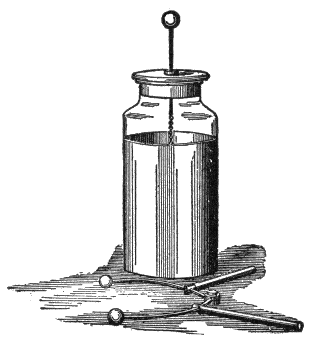
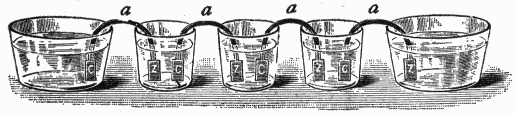
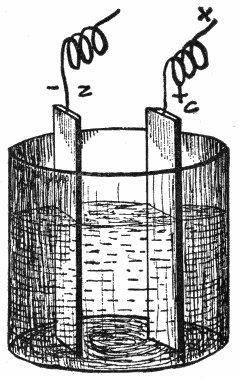
The word “battery” is a much abused word, being often used incorrectly for
“cell,” as in fig. 40. Hence, careful distinction should be made between
the two terms.
A battery consists of two or more cells joined together so as to form a
single unit.
There are numerous forms of primary cell; they may be classified as
follows:
1. According to the service for which they are designed;
2. According to the chemical features.
With respect to the first method cells are classified as:
1. Open circuit cells;
Used for intermittent work, where the cell is in service for
short periods of time, such as in electric bells, signaling
work, and electric gas lighting. If kept in continuous service
for any length of time the cell soon polarizes or “runs down,”
but will recuperate after remaining on open circuit for some
little time.
2. Closed circuit cells.
This type of cell is adapted to furnishing current continuously,
as in telegraphy, etc.
With respect to the second method, cells are classified as:
- 1. One fluid;
- 2. Two fluid;
Ques. Describe a primary cell.
Ans. A primary cell consists of a vessel containing a liquid in which two
dissimilar metal plates are immersed.
In one fluid cells both metal plates are immersed in the same
solution. In two fluid cells each metal plate is immersed in a
separate solution, one of which is contained in a porous cup
which is immersed in the other liquid.
Ques. What name is given to the metal plates?
Ans. They are called elements.
Ques. What is the fluid called?
Ans. The electrolyte or exciting fluid.
The term “electropoion” is a trade name for the electrolyte
employed in the Fuller cell.
Action of a Primary Cell.—The fundamental fact on which the
electro-chemical generation of current depends is, that if a plate of
metal be placed in a liquid there is a difference of electrical condition
produced between them of such sort that the metal either takes a lower or
higher electrical potential than the liquid, according to the nature of
the metal and the liquid. If two different metals be placed in one
electrolytic liquid, then there is a difference of state produced between
them, so that, if joined by wire outside the liquid, a current of
electricity will traverse the wire. This current proceeds in the liquid
from the metal which is most acted upon chemically to that which is least
acted upon.
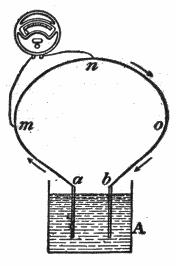
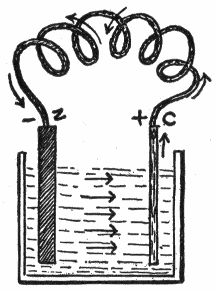
Referring to fig. 41, the construction and action of a simple primary cell
may be briefly described as follows:
Place in a glass jar some water having a little sulphuric or other acid
added to it. Place in it separately two clean strips, one of zinc, Z, and
one of copper, C. This cell is capable of supplying a continuous flow of
electricity through a wire
whose
ends are brought into connection with
the two strips. When the current flows, the zinc strip is observed to
waste away, its consumption in fact furnishing the energy or electromotive
force required to drive the current through the cell and the connecting
wire. The cell may therefore be regarded as a kind of chemical furnace in
which the fuel is the zinc.
Fig. 40.—Simple primary cell. It consists of two
dissimilar metal plates (such as copper and zinc which are called the
elements), immersed in the electrolyte or exciting fluid contained in
the glass jar.
Ques. How are the positive and negative elements of a primary cell
distinguished?
Ans. The plate attacked by the electrolyte is the negative element, and
the one unattacked the positive element.
Chemical Changes; Polarization.—The chemical changes which take place in
a simple cell, consisting of zinc and copper elements in an electrolyte of
dilute sulphuric acid, may be
briefly
described as follows: When the two
elements are connected and the current commences to flow, the sulphuric
acid acts on the surface of the zinc plate and forms sulphate of zinc. The
formation of this new substance necessitates the liberation of some of the
hydrogen contained in the sulphuric acid, and it will be found that
bubbles of free hydrogen gas speedily appear on the surface of the
negative element, that is, on the copper plate.
While the zinc is being dissolved to form zinc sulphate, hydrogen gas is
liberated from the sulphuric acid.
Fig. 41.—Simple primary cell with circuit closed,
showing direction of the current.
Some bubbles of the gas rise to the surface of the electrolyte and so
escape into the air, but much of it clings to the surface of the copper
element which thus gradually becomes covered with a thin film of
hydrogen.
Partly on account of the decreased area of copper plate in contact with
the electrolyte, and partly because the hydrogen tends to produce a
current in the opposite direction, the useful electrical output becomes
considerably diminished and the cell is said to be polarized. This state
of affairs may be
rectified
by stirring up the electrolyte, or by shaking
the cell, so as to assist the hydrogen bubbles to detach themselves from
the surface of the copper plate and make their way to the atmosphere
through the electrolyte. This, however, is only a temporary remedy, as the
polarized condition will soon be reached again, and a further agitation of
the cell will be necessary. Hence, a simple cell of this kind is not
desirable for practical work, and it must be modified to adapt it to
constant use.
When the sulphuric acid in a cell acts in the zinc element and produces
sulphate of zinc, a certain amount of work is done which is manifested
partly in the form of useful electric energy, and partly as heat which
warms the electrolyte and which is thereby lost for all practical
purposes.
Ques. If the zinc and copper electrodes of a simple cell be not connected
externally what changes take place within the cell?
Ans. The zinc plate immediately becomes strongly charged with negative
electricity, and the copper plate weakly so. As long as the plates remain
unconnected, and the zinc is pure, no further action takes place.
Ques. If the electrodes be connected externally what happens?
Ans. If the plates be connected by a wire outside the electrolyte, the
tendency which dissimilar electrical charges have to neutralize one
another causes a flow of negative electricity through the wire from zinc
to copper, and a positive flow in the opposite direction. The “static”
charge being thus disposed of, a fresh charge is given to the plates by
the action of the acid, which commences to dissolve the zinc. As long as
the wire connects the copper and zinc plates, the acid will continue its
action on the zinc until either acid or zinc is
exhausted.
The reader may ask: how can there be a positive flow when both
plates are negatively electrified?
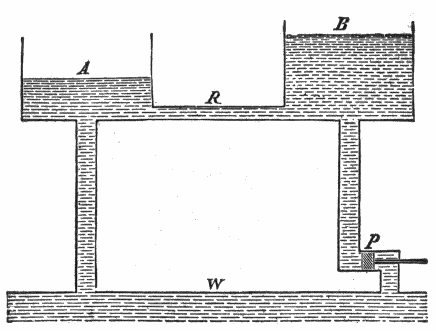
An analogy is the best way to make this point clear: Imagine two
equal vessels, from each of which the air has been partially
exhausted, but from one (A) 10 times as much air has been taken
as from the other (B). Connect A and B by a tube. Now, although
both vessels have less than the atmospheric pressure, that is,
both have “negative” pressures, yet a current of air will flow
from B to A until the pressures in each are equalized; that is,
until both have equal “negative charges” of air.
There is a second important effect of the acid solution or electrolyte in
a cell. If pure sulphuric acid were used, the first action or production
of an electrical charge on the zinc plate would be the same, but when the
plates were joined by the wire the current would soon cease. The reason
for this lies in the fact that the sulphate of zinc, which is the compound
produced by the acid plus the zinc, being insoluble in pure undiluted
sulphuric acid, remains on the surface of the zinc plate. The coating of
sulphate of zinc thus formed also operates as a protective agent, and no
further electrical charge can be induced until it is removed. The addition
of water to the acid has the effect of allowing the sulphate of zinc to
dissolve, and the zinc plate is left free for further action.
Ques. What governs the rate of current flow of a primary cell?
Ans. The size of the elements and their proximity.
Effects of Polarization.—The film of hydrogen bubbles affects the
strength of the current of the cell in two ways:
1. It weakens the current by the increased resistance which it offers to
the flow, for bubbles of gas are bad conductors;
2. It weakens the current by setting up an opposing electromotive
force.
Hydrogen is almost as oxidizable a substance as zinc, especially
when freshly deposited (in the “nascent” state), and is
electro-positive; hence, the hydrogen itself produces a
difference of potential, which would tend to start a current in
the opposite direction to the true zinc-to-copper current. It is
therefore an important matter to abolish this polarization,
otherwise the currents furnished by batteries would not be
constant.
Methods of Depolarizing.—One of the chief aims in the arrangement of the
numerous cells which have been devised is to avoid polarization. The
following are the methods usually employed:
1. Chemical methods;
a. Oxidation of the hydrogen by potassium bichromate and by
nitric acid.
b. Substitution of the hydrogen by some other substance which
does not give a counter electromotive force of polarization; for
instance, in the Daniell cell by replacement of the copper in
copper sulphate by the hydrogen, the copper being deposited on
the positive pole.
2. Electro-chemical means;
It is possible by employing double cells, to secure such action
that some solid metal, such as copper, shall be liberated
instead of hydrogen bubbles, at the point where the current
leaves the liquid. This electro-chemical exchange obviates
polarization.
3. Mechanical methods.
a. Agitation of the liquid or of the positive electrode, in
order to prevent the accumulation of hydrogen thereon.
b. Corrugating or roughing the positive electrode, as in the
Smee cell. This causes the hydrogen gas to form in large bubbles
which rise to the surface more rapidly than the small bubbles
which form on a smooth electrode.
In the simplest form of cell, as zinc, copper, and dilute sulphuric acid,
no attempt has been made to prevent the evil of polarization, hence, it
will quickly polarize when the current is closed for any length of time,
and may be classified as an open circuit
cell.
When polarization is remedied by chemical means, the chemical added is one
that has a strong affinity for hydrogen and will combine with it, thus
preventing the covering of the negative plate with the hydrogen gas.
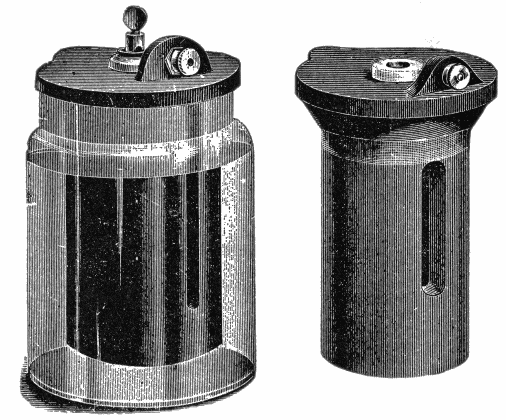
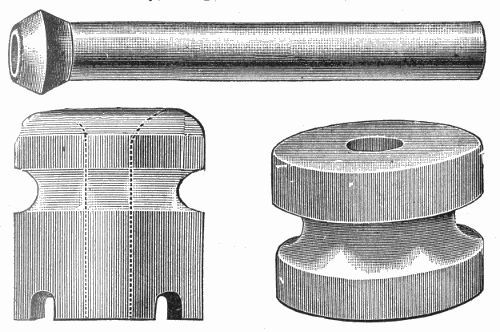
Figs. 42 and 43.—Carbon cell and carbon
cylinder. Carbon possesses a natural power to prevent a limited amount of
polarization by absorbing the hydrogen gas coming from the zinc rod; hence
it is used in various shapes for open circuit cells, which gives rise to
as many different names, such as Samson, Hercules, Law, National,
Standard, etc. In all these types of cell, sal-ammoniac and zinc are
used, and by corrugating the carbon, fluting it, or making concentric
cylinders, special merits are obtained in each case. The carbon element is
usually made in the form of a porous cup, filled with oxide of manganese
to prevent polarization, and then sealed. The zinc rod is inserted through
a porcelain insulator. About 4 to 6 ounces of sal-ammoniac are generally
used for cells of ordinary size. The salt is placed in the jar, water
poured in until it is about two-thirds full, and then stirred till all the
salt is dissolved. When the carbon cylinder is inserted, the solution
should be within 11⁄2 inches of the top of the jar. The electromotive
force is from 1.0 to 1.4 volts for the different forms of carbon cell.
Ques. What is a depolarizer?
Ans. A substance employed in some types of cell to combine with the
hydrogen which would otherwise be set free at the positive electrode and
cause
polarization.
The chemical used for this purpose may be either in a solid or
liquid form, which gives rise to several types of cell, such
as cells with a single fluid, containing both the acid and the
depolarizer, cells with a single exciting fluid and a solid
depolarizer, and cells with two separate fluids.
In the two fluid cell, the zinc is immersed in the liquid
(frequently dilute sulphuric acid) to be decomposed by the
action upon it, and the negative plate is surrounded by the
liquid depolarizer, which will be decomposed by the hydrogen gas
it arrests, thereby preventing polarization.
In open circuit cells polarization does not have much opportunity to
occur, since the circuit is closed for such a short period of time; hence,
these cells are always ready to deliver a strong current when used
intermittently.
In closed circuit cells polarization is prevented by chemical action, so
that the current will be constant and steady till the energy of the
chemicals is expended.
Ques. What is a depolarizer bag?
Ans. A cylinder of hemp or other fabric used in place of a porous pot in
some forms of Leclanche cell, and also as a support for the depolarizing
mass in some forms of dry cell where the electrolyte is of a thin
gelatinous nature.
Volta’s Contact Law.—When metals differing from each other are brought
into contact, different results are obtained, both as to the kind of
electrification as well as the difference of potentials.
Volta found that iron, when in contact with zinc, becomes negatively
electrified; the same takes place, but somewhat weaker, when iron is
touched with lead or tin. When, however, iron is touched by copper or
silver, it becomes positively electrified. Volta, Seebeck, Pfaff, and
others have investigated the behavior of many metals and alloys when in
contact with each
other.
The following lists are so arranged that those metals first in each list
become positively electrified when touched by any taking rank after them:
CONTACT SERIES OF METALS
| According to Volta. | According to Pfaff. |
| + | zinc | + | zinc |
| | lead | | cadmium |
| | tin | | tin |
| | iron | | lead |
| | copper | | tungsten |
| | silver | | iron |
| | gold | | bismuth |
| | graphite | | antimony |
| - | manganese ore | | copper |
| | | | silver |
| | | | gold |
| | | | uranium |
| | | | tellurium |
| | | | platinum |
| | | - | palladium |
Volta laid down a law regarding the position of the metals in his table
which may be stated as follows:
The difference of potential between any two metals is equal to the sum of
the differences of potentials of all the intermediate members of the
series.
Hence, it is immaterial for the total effect whether the first and the
last are brought into contact directly, or whether the contact is brought
about by means of all or any of the intermediate metals.
Volta’s law further asserts that when any number of metals are
brought into contact with each other, but so that the chain
closes with the metal with which it was begun, the total
difference must be
zero.
Laws of Chemical Action in the Cell.—There are two simple laws of
chemical action in the cell:
1. The amount of chemical action in a cell is proportional to the
quantity of electricity that passes through it.
One coulomb of electricity in passing through the cell liberates
.000010352 of a gramme of hydrogen, and causes .00063344 of a
gramme of zinc to dissolve in the acid.
2. The amount of chemical action is equal in each cell of a battery
connected in series.
Requirements of a Good Cell.—The several conditions which should be
fulfilled by a good cell are as follows:
- 1. Its electromotive force should be high and constant;
- 2. Its internal resistance should be small;
- 3. It should be perfectly quiescent when the circuit is open;
- 4. It should give a constant current, and therefore must be free from polarization, and not liable to rapid exhaustion;
- 5. It should be easily cared for, and if possible, should not emit corrosive fumes;
- 6. It should be cheap and of durable materials.
Single and Two Fluid Cells.—The distinction between a single and a two
fluid cell has already been given. The single fluid cell of Volta with its
zinc and copper plates represents the simplest form of primary cell.
In the two fluid cell, the positive (zinc) plate is immersed in the
exciting liquid (usually dilute sulphuric acid) and is decomposed by the
action upon it, while the negative plate is placed in the liquid
depolarizer which is decomposed by the hydrogen arrested by it, thus
preventing polarization.
In some forms of cell, the two liquids are separated by a porous partition
of unglazed earthenware, which, while it
prevents
the liquids mixing
except very slowly, does not prevent the passage of hydrogen and
electricity.
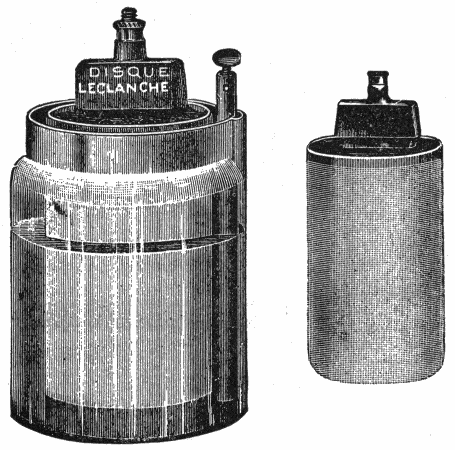
Figs. 44 and 45.—Leclanche cell and porous
cup. This very common form of cell is an example of the single fluid type,
with a solid depolarizer surrounding the negative element; the latter is
generally carbon, the positive element being zinc. The liquid used is a
strong solution of ammonium chloride, commonly known as sal-ammoniac, and
which resembles table salt. In the porous cup type of cell, a carbon slab
is placed in the porous cup, and is surrounded by a mixture of small
pieces of carbon and manganese dioxide, the top being covered by means of
pitch, leaving one or two small holes for air and gas to pass through. The
depolarizer will take care of a limited amount of the hydrogen produced
when the cell is on closed circuit, but if the circuit be closed for any
length of time polarization occurs. The cell is thus of the open circuit
class, and will furnish a good current where it is required only
intermittently. Zinc is dissolved only when the cell is being used. This
type of cell, or its modification, is used for gas lighting and bell work.
The cell requires very little attention. Water must be added as the
solution evaporates, and the zinc rod replenished when necessary. The
electromotive force is about 1.48 volts and the internal resistance about
4 ohms.
Complete depolarization is usually obtained also in single fluid cells,
having in addition a depolarizing solid body, such as oxide of manganese,
oxide of copper, or peroxide of lead, in contact with the carbon pole.
Such cells really do not
belong
to the single fluid cells, and are
considered in the two fluid class.
A few examples of single and double fluid primary cells will now be
described.
The Leclanche Cell.—This cell was invented by Leclanche, a French
electrician, and was the first cell in which sal-ammoniac was used. This
form of cell, as shown in fig. 45, is in general use for electric bells,
its great recommendation being that, once charged, it retains its power
without attention for considerable time.
Two jars are employed in its construction; the outer one is of glass,
contains a zinc rod, and is charged with a solution of ammonium chloride,
called sal-ammoniac.
The inner jar is of porous earthenware, containing a carbon plate, and is
filled with a mixture of manganese peroxide and broken gas carbon. When
the carbon plate and the zinc rod are connected, a steady current of
electricity is set up, the chemical action which takes place being as
follows: the zinc becomes oxidized by the oxygen from the manganese
peroxide, and is subsequently converted into zinc chloride by the action
of the sal-ammoniac.
After the battery has been in continuous use for some hours, the manganese
becomes exhausted of oxygen, and the force of the electrical current is
greatly diminished; but if the battery be allowed to rest for a short
time, the manganese obtains a fresh supply of oxygen from the atmosphere,
and is again fit for use.
After about 18 months work, the glass cell will probably require
recharging with sal-ammoniac, and the zinc rod may also need renewing; but
should the porous cell get out of order, it is better to get a new one
than to attempt to recharge
it.
The directions for setting up a Leclanche cell are as follows:
- 1. Place in the glass jar six ounces of sal-ammoniac, and pour
in water until the jar is one-third full, then stir thoroughly.
- 2. Place the porous cup in the solution, and if necessary add
water until it rises to within 11⁄2 inches of the top of the
porous cup.
- 3. Put the zinc rod in place and set the cell away (not
connected up), for about 12 hours, so as to allow the liquid to
thoroughly soak into the porous cup. This will lower the level
of the liquid to about one-third the height of the jar. The cell
will then be ready for use. As the level of the liquid is
lowered by evaporation, it should be maintained at the stated
height by adding water.
The Leclanche cell is adapted to open circuit work, being extensively used
for ringing electric bells.
The objections to the Leclanche cell are:
- 1. Rapid polarization;
- 2. High internal resistance due to porous pot;
- 3. Restricted space for electrolyte causing rapid lowering of level of liquid by evaporation;
- 4. Eating away of the zinc rod at the surface of the liquid, rendering the rod useless before the lower part is consumed.
Fuller Bichromate Cell.—In the bichromate cells or the chromic acid
cells, bichromate of soda, or bichromate of potassium, is used for the
depolarizer, water and sulphuric acid being added for attacking the zinc.
The Fuller cell is of the two fluid type. A pyramidal block of zinc at the
end of a metallic rod covered with gutta-percha is placed in the bottom of
a porous cup containing an ounce of mercury. The cup is then filled with a
very dilute solution of sulphuric acid or water and placed in a jar of
glass or earthenware containing the bichromate solution and the carbon
plate. The diffusion of the acid through the porous cup is sufficiently
rapid to attack the zinc, which being well amalgamated, prevents local
action; while the hydrogen passes through the porous cup and combines with
the oxygen in the bichromate of
potassium.
This type of cell has an
electromotive force of 2.14 volts, and is suited to open circuit, or
semi-closed circuit work. The directions for setting up a Fuller cell are
as follows:
- 1. To make the “electropoion” fluid, mix together one gallon of
sulphuric acid and three gallons of water, and in a separate
vessel, dissolve six pounds of bichromate of potash in two
gallons of boiling water; then thoroughly mix together the two
solutions.
- 2. Immerse the zinc in a solution of dilute sulphuric acid, and
then in a bath of mercury, and rub it with a brush or cloth so
as to reach all parts of the surface.
- 3. Pour into the porous cell one ounce (a tablespoonful) of
mercury, and fill the porous cell with water up to within two
inches of the top.
- 4. Place the porous cell and the carbon plate in the glass jar,
as in fig. 46, and fill glass jar to within about three inches
of the top with a mixture of three parts of electropoion fluid
to two parts of water.
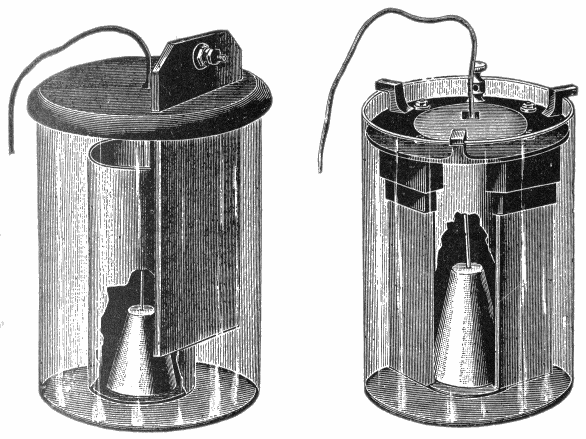
Figs. 46 and 47.—The telephone standard and
compound forms of the Fuller cell. The type shown in fig. 46 is especially
adapted to long distance telephoning, and that shown in fig. 47 to
incandescent lamps, motors, nickel and other electroplating. The Fuller
cell is a double fluid variety and has the advantage over the Grenet type,
in that the zinc is always kept well amalgamated and does not require
removal from the solution. The Fuller cell is suitable for open and
semi-closed circuit work; its electromotive force is about 2.14 volts.
- 5. The zinc should be lifted out occasionally and the sulphate
washed off.
- 6. The supply of mercury in the porous cell should be
maintained, so as to have the zinc always well amalgamated.
- 7. To renew, clean all deposits from carbon plate and zinc, and
set up with fresh solution.
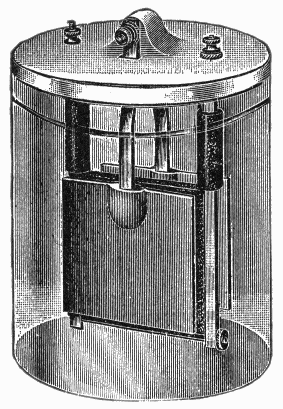
The Edison Cell.—This is a single fluid cell with a solid depolarizer, as
shown in fig. 48, and is well adapted for use on closed circuits.
Fig. 48.—Edison cell, type R R. The electrolyte
used is caustic soda, the positive element zinc, and the negative element
copper oxide. The Edison cell is suitable for large stationary gas engine
ignition, railroad crossing signals, electroplating, fire alarms,
telephone circuits, etc.
The positive element is zinc, and the negative element black oxide of
copper. The exciting fluid is a solution of caustic potash. The black
oxide of copper plates are suspended from the cover of the jar by a light
framework of copper, one end
of
which forms the positive pole of the
battery. A zinc plate is suspended on each side of the copper oxide
element and kept from coming in contact with the latter by means of
vulcanite buttons.
When the cell is in action, the water is decomposed, and the oxygen thus
liberated combines with the zinc and forms oxide of zinc, which combines
with the potash to form a double salt of zinc and potash. The last
combination dissolves as rapidly as it is formed. The hydrogen liberated
by the decomposition of the water reduces the copper oxide to pure
metallic copper. It is highly important that the copper oxide plates be
completely submerged in the solution of caustic potash, and that heavy
paraffin oil be poured on top of the solution to the depth of about 1⁄4 of
an inch to exclude the air. If oil be not used, the formation of creeping
salts will reduce the life of the battery fully two-thirds. The battery
has a low electromotive force, about 0.7 of a volt, but as the internal
resistance is also very low, quite a large current can be drawn from the
cell.
The Bunsen Cell, shown in figs. 49 and 50, is a two fluid cell
constructed with zinc and carbon electrodes. The negative plate is carbon,
the positive plate amalgamated zinc. The excitant is a dilute solution of
sulphuric acid. The top part of the carbon is sometimes impregnated with
paraffin (to keep the acid from creeping up).
The force of the Bunsen cell increases after setting up for about an hour,
and the full effect is not attained until the acid soaks through the
porous cell. Carbons are not affected and last any length of time. The
zinc is slowly consumed through the mercury coating.
Grenet Bichromate Cell.—In this cell, as shown in figs. 49 and 50, the
positive element is zinc and the negative element
carbon.
The electrolyte
is a solution of bichromate of potash in a mixture of sulphuric acid and
water.
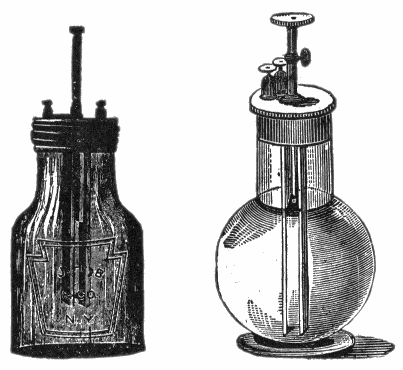
Figs. 49 and 50.—American and French forms of
Grenet cell. The elements are zinc and carbon. In the Grenet cell, a zinc
plate is suspended by a rod between two carbon plates, so that it does not
touch them, and when the cell is not in use the zinc is withdrawn from the
solution by raising and fastening the rod by means of a set screw, as the
acid attacks the zinc when the cell is on open circuit. This cell has an
electromotive force of over 2 volts at first, and gives a strong current
for a short time, but the liquid soon becomes exhausted, as will be noted
by the change in the color of the solution from an orange to a dark red,
and must be replenished. The zinc should be kept well amalgamated and out
of the solution except when in use. It is a good type of cell for
experimental work. To make the electrolyte take 3 ounces of finely
powdered bichromate of potash and 1 pint of boiling water; stir with a
glass rod and after it is cool, add slowly, stirring all the time, 3
ounces of sulphuric acid. The electrolyte may also be prepared as follows:
take 4 ounces of bichromate of soda, 11⁄4 pints of boiling water, and 3
ounces of sulphuric acid.
The cell consists of a glass bottle containing the electrolyte and fitted
with a lid from which the elements are supported. There is a zinc plate in
the center and a carbon plate on each side. The two carbon plates are
connected to the same terminal, thus forming a large negative surface, and
the zinc plate to a terminal on the top of the brass rod to which it is
attached.
This rod slides through a hole in the lid so that the zinc
plate can be lifted out of the electrolyte when the cell is not at work,
thus preventing wasteful consumption of zinc and of the electrolyte.
Bichromate cells give a strong current, the electromotive force of a
single cell being 2 volts.
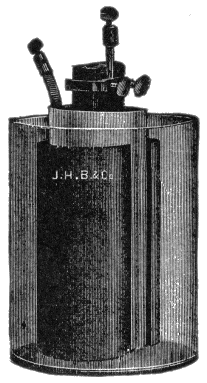
Daniell Cell.—This is one of the best known and most widely used forms of
primary cell. It is a double fluid cell, composed of an inner porous
vessel containing an electrolyte of
either
dilute sulphuric acid or
dilute zinc sulphate solution, and an outer vessel containing a saturated
solution of copper sulphate.
A zinc rod is placed in the inner electrolyte, and a thin plate of sheet
copper in the outer electrolyte. Sometimes this arrangement of the
elements is modified, the outer vessel being made of copper and serving as
the copper plate. This would then contain the copper sulphate solution,
while the zinc sulphate and the zinc rod would be contained in the porous
pot as before.
The chemical reactions which take place in a Daniell cell are as follows:
The zinc dissolves in the dilute acid, thus producing zinc
sulphate, and liberating hydrogen gas. The free hydrogen passes
through the walls of the porous pot, but when it reaches the
copper sulphate solution it displaces some of the copper
therefrom, and combines with this solution, forming sulphuric
acid. The copper, which is thus set free, is deposited on the
surface of the copper plate. In this way polarization is
avoided, and a practically constant current is obtained.
When the zinc sulphate solution is employed in place of dilute
acid, a similar series of chemical reactions occur, except that
the zinc is liberated instead of hydrogen.
Daniell cells are used especially for electroplating, electrotyping and
telegraphic work. The electromotive force of a single cell is 1.079 volts.
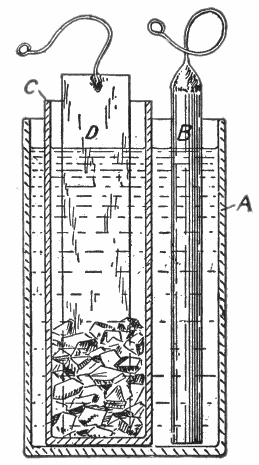
Directions for Making a Daniell Cell.—The simple Daniell cell shown in
fig. 52 may be easily made as follows: The outer vessel A, consists of a
glass jar (an ordinary glass jam jar will do) containing a solution of
sulphuric acid (1 part in 12 to 20 parts of water), and a zinc rod B.
Inside the jar is placed a porous pot C containing a strip of thin sheet
copper D, and a saturated solution of sulphate of copper (also called
“blue stone” and “blue vitrol”).
The zinc is preferably of the Leclanche form, which will
be
found to be
cleaner, more durable, and cheaper than a zinc sheet. The porous pot
should be dipped in melted paraffin wax, both top and bottom, to prevent
the solution mingling too freely and “creeping.” A few crystals of copper
sulphate are placed in the pot as shown.
Fig. 52.—Simple Daniell cell for closed circuit work. To
maintain a constant current for an indefinite time, it is only necessary
to maintain the supply of copper crystals and zinc. The cell as shown in
the figure is easily made by following the direction given in the
accompanying text.
In mixing the sulphuric acid and water, the acid should be added to the
water—never the reverse. Zinc sulphate is sometimes used instead, as it
reduces the wasteful consumption of the zinc, but it should be pure.
With care the cell will last for weeks. When it weakens or “runs down,” an
addition of sulphuric acid to the outer jar
and
a few more crystals
placed in the porous pot will put the cell in good condition.
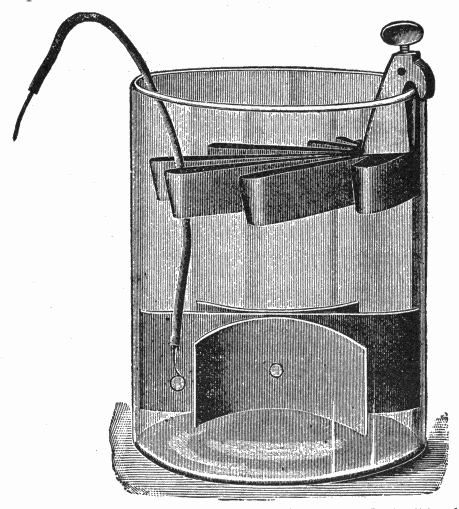
Fig. 53.—Daniell gravity cell, “crowfoot” pattern. This is
a two fluid cell in which gravity instead of a porous cup is depended upon
to keep the liquids separate. The two solutions consist of copper sulphate
and dilute sulphuric acid, the elements being made of zinc and
copper.
Gravity Cells.—In a two liquid cell, instead of employing a porous cell
to keep the two liquids separate, it is possible, where one of the liquids
is heavier than the other, to arrange that the heavier liquid shall form a
stratum at the bottom of the cell, the lighter floating upon it. Such
arrangements are called gravity cells; but the separation is never
perfect, the heavy liquid slowly diffusing
upwards.
Daniell Gravity Cell.—In this cell, shown in fig. 53, the same elements
are used as in the ordinary Daniell cell, but the porous pot is dispensed
with, the two solutions being separated by the action of gravity as
explained in the preceding paragraph.
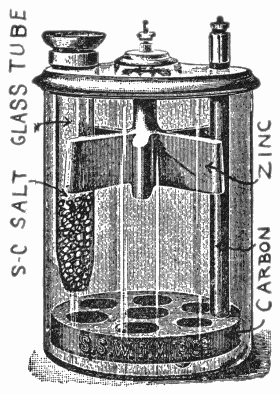
Fig. 54.—Partz acid gravity cell. In this form of cell,
the electrolyte which surrounds the zinc is either magnesium sulphate or
common salt. The depolarizer is a bichromate solution which surrounds the
perforated carbon plate located in the bottom of the jar. A vertical
carbon rod fits snugly into the tapered hole in the carbon plate, and
extends through the cover forming the positive pole. The depolarizer,
being heavier than the electrolyte, remains at the bottom of the jar, and
the two liquids are thus kept separate. This depolarizer is placed on the
market in the form of crystals, known as sulpho-chromic salt, made by the
action of sulphuric acid upon chromic acid. When dissolved, its action is
similar to that of the chromic acid solution. After the cell has been set
up with everything else in place, the crystals are introduced into the
solution, near the bottom of the jar, through the vertical glass tube
shown, and slowly dissolve and diffuse over the surface of the carbon
plate. When the cell current weakens a few tablespoonfuls of the salt
introduced through the tube will restore the current to its normal value.
The cell should remain undisturbed to prevent the solution from mixing.
Its electromotive force is from 1.9 to 2 volts, and the 6 in. × 8 in. size
has an internal resistance of about .5 ohm. Since the depolarizer is quite
effective, the cell may be used on open or closed circuit work.
The copper sulphate solution, being the heavier of the two, rests at the
bottom of the battery jar, while the dilute sulphuric acid remains at the
top. To suit this arrangement the copper and zinc elements are located as
shown, the copper
elements
being at the bottom, and the zinc element,
shaped like a crow’s foot (hence the name “crowfoot cell”) is suspended at
the top.
The absence of the porous pot decreases the internal resistance, but the
electromotive force is the same as in the ordinary type of Daniell cell.
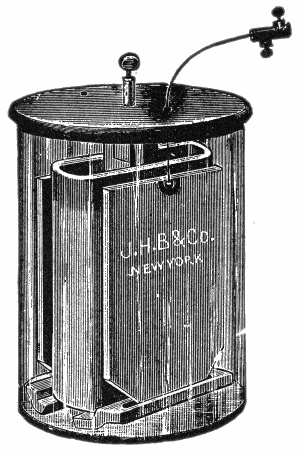
Fig. 55.—Wheelock cell; the elements are carbon and zinc.
To set up, place the grid in the bottom of the jar and fill its two
troughs each about half full of mercury. Place the porous cell in position
on the grid so that it sits perfectly upright, resting in the recess of
the latter. The zincs stand with lower ends resting in mercury in the
troughs of the grid. Into the porous cell, to a height of only
two-thirds full, pour solution consisting of equal parts water and
sulphuric acid, by measure. Add to this 1⁄2 pound nitrate soda, 1 ounce
chromic acid. This solution may be made up in the above proportion and
kept in covered receptacle in any desired quantity, ready for use. In the
outer jar for 6 × 8 size, 21⁄2 pints of water, and 1⁄2 gill sulphuric
acid, 1 part sulphuric acid to 20 parts water, or as much sulphuric acid
as it will take without boiling. When a charge becomes exhausted it may be
renewed by adding sulphuric acid and salts in the proportions given above,
after drawing out with syringe enough of the old solutions to make room
for the additions, but the best action is obtained with entirely new
solutions. Zincs must be kept thoroughly amalgamated by keeping a good
supply of mercury in the troughs.
When a current is produced by a Daniell cell:
- 1. Copper is deposited on the copper plate;
- 2. Copper sulphate is consumed;
- 3. The sulphuric acid remains unchanged in quantity;
- 4. Zinc sulphate is formed;
- 5. Zinc is consumed.
If, however, the copper sulphate solution be too weak, the water
is decomposed instead of the copper sulphate, and hydrogen is
deposited on the copper plate. This deposit of hydrogen lowers
the voltage, hence care should be taken to maintain an adequate
supply of copper sulphate.
The voltage of a Daniell cell varies from about 1.07 volt to 1.14 volt,
according to the density of the copper sulphate solution and the amount of
zinc sulphate present in the dilute sulphuric acid.
“Dry” Cells.—It is often necessary to use cells in places where there is
considerable jarring or motion, as for automobile or marine ignition. The
ordinary cell is not well adapted to this service on account of the
liability of spilling the electrolyte, hence, the introduction of the
so-called dry cell.
A dry cell is composed of two elements, usually zinc and carbon, and a
liquid electrolyte. A zinc cup closed at the bottom and open at the top
forms the negative electrode; this is lined with several layers of
blotting paper or other absorbing material.
The positive electrode consists of a carbon rod placed in the center of
the cup; the space between is filled with carbon—ground coke and dioxide
of manganese mixed with an absorbent material. This filling is moistened
with a liquid, generally sal-ammoniac. The top of the cell is closed with
pitch to prevent leakage and evaporation. A binding post for holding the
wire connections is attached to each electrode and each cell is placed in
a paper box to protect the zincs of adjacent cells from coming into
contact with each other when finally connected together to form a
battery.
Points Relating to Dry Cells.—The following instructions on the care and
operation of dry cells should be carefully noted and followed to get the
best results:
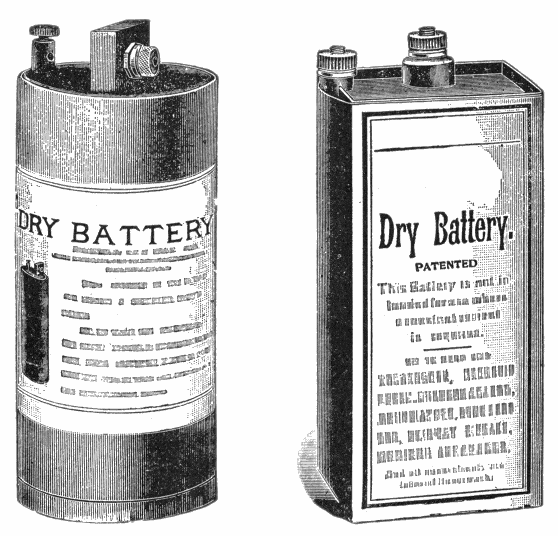
Figs. 56 and 57.—Round and rectangular types of the
so-called “dry” cell.
- 1. In renewing dry cells (or any other kind of cell), a greater
number should never be put in series than was originally
required to do the work, because the additional cells increase
the voltage beyond that required, which causes more current than
is necessary to flow through the coil. This increased current
flow shortens the life of the battery.
- 2. In connecting dry cells in places where there is vibration,
heavy copper wire should not be used, because vibration will
cause it to break.
- 3. Water should not be allowed to come in contact with the paper
covers of the cells because they form the insulation, hence,
when
moist,
current will leak across from one cell to another,
resulting in running down the battery.
- 4. Dry cells will deteriorate when not in use, making it
necessary to renew them about every sixty days. The reason dry
cells deteriorate is because the moisture evaporates. Freezing,
exposure to heat, and vibration which loosens the sealing,
causes the evaporation.
- 5. Weak cells can be strengthened somewhat by removing the paper
jacket, punching the metal cup full of small holes, and then
placing in a weak solution of sal-ammoniac, allowing the cells
to absorb all they will take up. This is only to be recommended
in cases of emergency when they are hard to get.
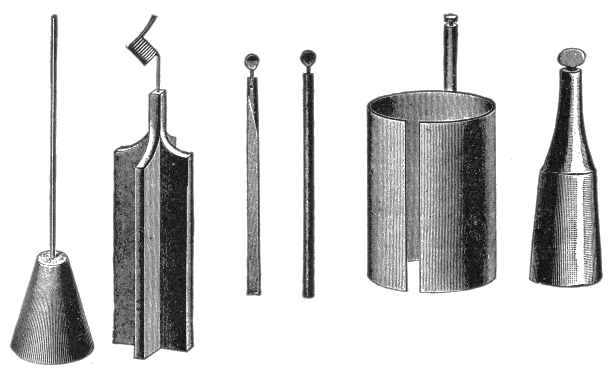
Figs. 58 to 63.—Various zincs; fig. 58 Fuller; fig. 59
Daniell; fig. 60 Leclanche square; fig. 61 Leclanche round; fig. 62
Sampson; fig. 63, bottle.
- 6. The average voltage of a dry cell when new is one and
one-half volts, while the amperage ranges from about twenty-five
to fifty amperes according to size.
- 7. A dry cell when fresh should show from 20 to 25 amperes when
tested; the date of manufacture should also be noted as fresh
cells are most efficient.
- 8. Dry cells should be tested with an ammeter, care being taken
to do it quickly as the ammeter being of a very low resistance
short
circuits
the cell. A volt meter is not used in testing
because, while the cells are not giving out current, their
voltage remains practically the same, and a cell that is very
weak will show nearly full voltage. When no ammeter is at hand,
the battery current may be tested by disconnecting the end of
one of the terminal wires and snapping it across the binding
post of the other terminal; the intensity of the spark produced
will indicate the condition of the battery.
Points Relating to the Care of Cells.—To get the best results from
primary cells, they should receive proper attention and be maintained in
good condition. The instructions here given should be carefully followed.
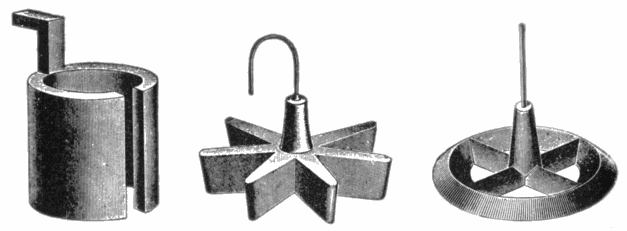
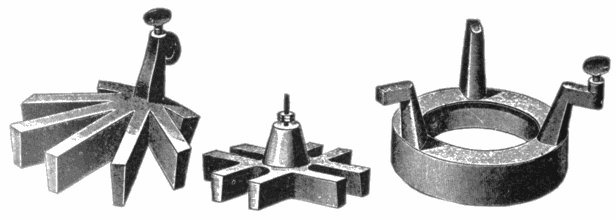
Figs. 64 to 66: Various carbons; fig. 61 Cylindrical form;
fig. 65 Calland star; fig. 66, wheel.
Cleanliness.—In the care of batteries, cleanliness is essential in order
to secure best results. Zincs and coppers should be thoroughly cleaned
every time a cell is taken out of use. The zinc, after being thoroughly
cleaned, should be rubbed with a little mercury. This prevents local
action. Porous cups should be soaked in clean water four or five hours and
then wiped dry.
The terminals of each cell should be thoroughly cleansed and scraped
bright so as to get good contact of the connecting wires and thus avoid
extra resistance in the
circuit.
Separating the Elements.—Obviously the positive and negative elements of
a cell must not be in contact within the exciting fluid; they should be
separated by a space of 3⁄8 to 1⁄2 inch. In the case of cells without
porous cups, periodic attention must be given to ensure this condition
being maintained.
Figs. 67 to 69.—Various zincs: fig. 67 Crowfoot; fig. 68
Lockwood; fig. 69 fire alarm.
Creeping.—As evaporation of the electrolyte takes place in a cell, it
increases in strength, and crystals are left on the sides of the jar
previously wetted by the solution, the action being very marked when the
solution is a saturated one. The space between these crystals and the side
of the jar acts as a number of capillary tubes, and draws up more liquid,
which itself evaporates and deposits crystals above the former ones. So
that finally the film of crystals passes over the edge of the jar and
forms on the outside, thus making a kind of syphon which draws off the
liquid. This action may, to a great extent, be prevented by warming the
edges of the glass, or stoneware, jars, and of the porous pots, before the
cells are made up, and dipping them while warm into some paraffin wax
melted
in
warm oil, a precaution that should always be carried out when a
dense solution of zinc sulphate is employed in the cell.
Amalgamated Zinc.—To “amalgamate” a piece of zinc, dip it into dilute
sulphuric acid to clean its surface, then rub a little mercury over it by
means of a piece of rag tied on to the end of a stick, and lastly, leave
the zinc standing for a short time in a dish to catch the surplus mercury
as it drains off.
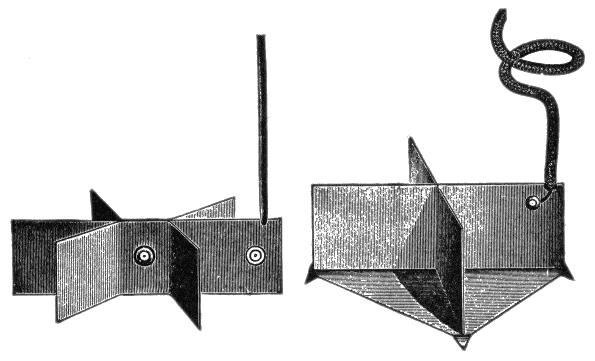
Figs. 70 and 71.—Two forms of copper element: fig. 70,
regular form for crowfoot cell; fig. 71, signal pan bottom copper.
The action of the amalgamated zinc is not well understood; by some it is
considered that amalgamating the zinc prevents local currents by the
amalgam mechanically covering up the impurities on the surface of the
zinc and preventing their coming into contact with the liquid. By others
it is thought that amalgamating the zinc protects it from local action by
causing a film of hydrogen gas to adhere to it. This theory is based
on
the fact that while no action takes place when amalgamated zinc is placed
in dilute sulphuric acid at ordinary atmospheric pressure, the creation of
a vacuum above the liquid causes a rapid evolution of hydrogen, which,
however, stops on the readmission of the air.
Amalgamating a zinc causes it to act as a somewhat more positive substance
than before, therefore the voltage of a cell containing amalgamated zinc
is slightly higher than that of a cell constructed with unamalgamated
zinc.
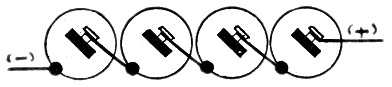
Fig. 72.—Diagram of a series battery connection: four
cells are shown connected by this method. If the cell voltage be one and
one-half volts, the pressure between the (+) and (-) terminals of the
battery is equal to the product of the voltage of a single cell
multiplied by the number of cells. For four cells it is equal to six
volts.
The addition of a very small amount of zinc to mercury causes the mercury
to act as if it were zinc alone, arising perhaps from the amalgam having
the effect of bringing the zinc to the surface.
Battery Connections.—There are three methods of connecting cells to form
a battery; they may be connected:
- 1. In series;
- 2. In parallel;
- 3. In series multiple.
A series connection consists in joining the positive pole of one cell to
the negative pole of the other, as shown in fig. 72; this adds the voltage
of each cell.
Thus, connecting in series four cells of one and one-half volts
each will give a total of six
volts.
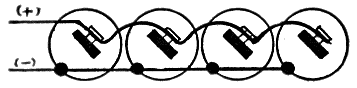
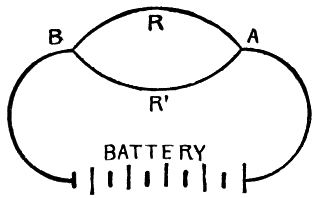
Fig. 73 illustrates a parallel or multiple connection; this is made by
connecting the positive terminal of one cell with the positive terminal of
another cell and the negative terminal of the first cell with the negative
terminal of the second cell.
Fig. 73.—Diagram of a multiple or parallel connection.
When connected in this manner the voltage of the battery is the same as
that of a single cell, but the current is equal to the amperage of a
single cell multiplied by the number of cells. Thus with 11⁄2 volt 15
ampere dry cells, the combination or battery connected as shown would give
4 × 15 = 60 amperes at a pressure of 11⁄2 volts.
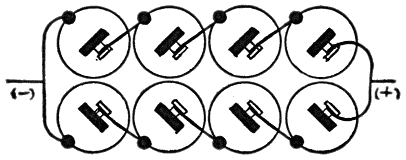
Fig. 74.—Diagram of a series multiple connection. Two sets
of cells are connected in series and the two batteries thus formed,
connected in parallel. The pressure equals the voltage of one cell,
multiplied by the number of cells in one battery, and the amperage, that
of one cell multiplied by the number of batteries. This form of connection
is objectionable unless all the cells be of equal strength. If old cells
be placed on one side and new cells on the other, current will flow (as in
fig. 75) from the stronger through the weaker until the pressure of all
the cells thus becomes equal. This process therefore wastes some of the
energy of the strong cells.
A paralleled or multiple connection adds the amperage of each cell; that
is, the amperage of the battery will equal the sum of the amperage of each
cell.
For instance, four cells of twenty-five amperes each would give
a total of one hundred amperes when connected in
parallel.
A series multiple connection, fig. 74, consists of two series sets of
cells connected in parallel. In series multiple connections the voltage of
each set of cells or battery must be equal, or the batteries will be
weakened, hence each battery of a series multiple connection should
contain the same number of cells.
The voltage of a series multiple connection is equal to the voltage of
one cell multiplied by the number of cells in one battery, and the
amperage is equal to the amperage of one cell multiplied by the number of
batteries.
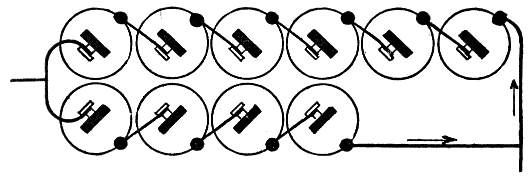
Fig. 75.—Diagram to illustrate incorrect wiring. The
current pressure of the six cell battery being greater than that of the
smaller unit, current will flow from the former through the latter until
the pressure of the six cells is equal to that of the four cells.
Fig. 75 shows an incorrect method of wiring in series multiple connection.
If the circuit be open, the six cells, on account of having more
electromotive force than the four cells, will overpower them and cause a
current to flow in the direction indicated by the arrows until the
pressure of the six cells has dropped to that of the four. This will use
up the energy of the six cells, but will not weaken the four cell battery.
This action can be corrected by placing a two-way switch in the circuit at
the junction of the two negative terminals so that only one battery can be
used at a time.

 ,
, ,
, ,
, ,
, ,
, ,
, ,
, ,
, , OR
, OR  ,
, ,
, ,
, ,
, ,
, ,
, ,
, ,
,