So the feeding of the tissues could not sufficiently
account, to Harvey's mind, for the swiftness of the
circulation. What could? It is easy for us to recite
the multitudinous modern duties of the blood as a
bearer of cells and of chemicals from point to point
and as a protector against poisoning; above all it is
easy to exclaim "respiration";—to read the most
striking part of the riddle by knowing the answer
which was wrung laboriously from Nature after Harvey
had died. It is easy for us to see that speedy death
from loss of the circulating blood is practically the
same as death from ligature of the arteries of the brain,
or from drowning, or strangulation, or a broken neck.
But this was veiled from him, and what best accounts
for the volume and swiftness of the Harveian circulation
was, in Harvey's day, a stumbling block to its
acceptance; for no adequate reason was apparent why
the whole mass of the blood should traverse the lungs,
or why, if the veins receive their blood from the arteries,
the venous blood should differ in color from the arterial.
Let us remember that throughout Harvey's life air
was still an elementary body in the eyes of many and,
for all, blood was a quite mysterious, ruddy, hot, vital
liquid. Only weak magnifying glasses were available
for him, and the powerful lenses of Malpighi and van
Leeuwenhoek had not yet revealed to the world either
capillary or blood-corpuscle. Moreover, the gossiping
John Aubrey, the man who had been advised about his
youthful studies by Harvey, wrote of him some years
after his death, that "he did not care for Chymistrey,
and was wont to speake against them [the chemists]
with an undervalue."[19] Where would physiology be
to-day, had not histology and chemistry long stood in
the forefront beside her?
In a passage of the treatise of 1628 Harvey speaks
of respiration, as follows:—
"And now it has come to this, that it would seem better worth
while and more straightforward for those who seek the path by which
in man the blood passes through the vena cava into the left ventricle
and the venous artery,[20] to be willing to search for the truth by
dissecting animals, in order to look for the reason why in the larger
and more perfect animals, when full grown, nature chooses to make
the blood percolate through the parenchyma of the lungs rather
than take wide open paths as in all other animals (it being understood
that no other path and transit can be thought out):—whether
it is because the larger and more perfect animals are hotter
and when they are full grown their heat is more ignited, so to speak,
and prone to be smothered, that there is this permeation and
transfer through the lungs in order that the heat may be tempered
by the inspired air and guarded from boiling up and smothering—or
for some other similar reason. But to determine these matters
and explain them completely were to enter on a speculation as to
the purpose for which the lungs are made. About these and their
use and motion, and the whole subject of ventilation and the need
and use of air, and other matters of this sort, and about the various
different organs created in animals by reason thereof, although I
have made a vast number of observations, I shall not speak till I
can more conveniently set them forth in a treatise apart, lest by
wandering at this point too far from my subject, which is the motion
and use of the heart, I should seem to deal with something else and
leave my position, to confuse and evade the question."[21]
Farther on in the same treatise Harvey says:—
"Moreover, the reason why the lungs have vessels so ample,
both vein and artery, that the trunk of the venous artery exceeds
in size the crural and jugular branches taken both together; and
the reason why the lungs are so full of blood as we know them to
be by experience and inspection (heeding Aristotle's warning,[22]
and not deceived by the inspection of such lungs as we have removed
from dissected animals from which all the blood had flowed
out)—the reason is, that in the lungs and heart is the storehouse,
the source, the treasury of the blood, the workshop of its perfection."[23]
So the great Englishman gropes for a moment or two
by the light of ancient Greek doctrines and puts the
question of respiration by. But this very attitude
shows Harvey's thought to be in such contrast with
the thought of to-day that in order to understand him
we need to learn more fully his views of respiration;
and we find with satisfaction that in his lecture notes
of more than eleven years before he had not put this
question by, for he had been called upon to lecture upon
the uses of the lungs. We must seek in his lecture notes,
therefore, for what he had thought those uses to be.
These notes, however, we shall be unable to follow
unless now, first of all, we shall give the floor for a while
to the ancients; for from their doctrines Harvey necessarily
took his cue, like the other thinkers of his time.
The momentous physiological facts that the living
body of man, beast, or bird, is warm of itself and that
its cooling means its death, must always have struck
and impressed the human mind, whether trained or untrained.
More than nineteen centuries before Harvey
certain thoughts of Aristotle were recorded as follows:—
"In animals all the parts and the entire body possess a certain
innate natural heat; wherefore they are sensibly warm when living,
the reverse when making an end and parting with life. In the
animals which have blood the origin of this heat is necessarily in
the heart, in the bloodless kinds in the analogue thereof; for all
work up and concoct the nourishment by means of the natural
heat, the master part most of all. Life persists, therefore, when
the other parts are chilled; but if what resides in this one be so
affected total destruction ensues, because upon this part they all
depend as the source of their heat, the soul being as it were afire
within this part; that is, within the heart in the animals which
have blood, in the bloodless kinds in the analogue thereof. Necessarily,
therefore, the existence of life is coupled with the preservation
of the heat aforesaid, and what is called death is the destruction
thereof."[24]
This heat which is innate in all living animals was
styled by Aristotle not only "innate" but "natural,"
"vital,"[25] and "physical,"[26] it being indispensable to
life and to the working of the soul. He held the continued
existence of the innate heat to depend upon conditions
similar to those under which a fire is kept alive,
viz.: protection both from burning out and from extinction
due to external forces. Yet the true nature of
combustion was not settled till more than a century
after Harvey's death. The fact that air is necessary
to fire must always have been a matter of common
knowledge. Therefore, the views of the relations of air
to fire maintained by Aristotle nearly twenty-one
centuries before the discovery of oxygen did not seem
naïve to Harvey, whatever they may seem to us.
Aristotle held that air exerts upon fire a cooling influence
which saves it from burning out too fast; and that
the same influence is exerted upon the vital innate heat
of animals by the air which they breathe in, or the
water which bathes their gills.[27] Moreover, Aristotle
says:—
"Why those animals breathe most which have lungs containing
blood, is plain from this: that the warmer an animal is, the greater
need it has of cooling, while at the same time the breath passes
easily toward the source of warmth within the heart. But the
way in which the heart is pierced through toward the lung must
be studied from dissections and from the history of animals which
I have written. In general terms, then, it is the nature of animals
to need cooling on account of the firing of the soul within the
heart."[28]
In the treatise styled the "History of Animals," to
which he refers us, Aristotle says:—
"There are also channels from the heart which lead into the
lung and divide in the same way as the windpipe, and they accompany
the channels from the windpipe throughout the entire lung.
The channels from the heart lie uppermost; but no common channel
exists, for it is by contact[29] that they receive the breath and
transmit it to the heart."[30]
The collection of ancient Greek commonly called the
"Works of Hippocrates" is judged to be of the fifth
and fourth centuries B.C. There is included in this
collection a brief treatise on the heart; and in this
occurs the earliest known account of the structure and
use of the semilunar valves, which together with the
rest of the cardiac valves were unknown to Aristotle.
In the same Hippocratic treatise the doctrine is adhered
to of the entrance of air into the heart for cooling
purposes, both the right and the left ventricle being
specified as receiving it. The author says:—
"The vessel which leads out of the right ventricle ... closes
toward the heart, but closes imperfectly, in order that air may
enter, though not very much."[31]
This piece of incorrect physiology may well have received
support from the fact that the pulmonary semilunar
valve is commonly found to be not quite competent
when the dead and dissected pulmonary artery of
the bullock is distended with water—an observation
which the ancient author intimates that he has made,[32]
though he does not specify the creature dissected.
Nearly five hundred years after the death of Aristotle,
the analogy between life and flame was discussed,
formally and at some length, by Galen. He knew his
Aristotle well, and agreed with him as to the importance
of respiratory cooling for protracting the indispensable
heat of animals.[33] But we find Galen dealing with the
uses of respiration in a less simple way than Aristotle.
In a polemical treatise Galen debates the question
whether "the breath drawn in in respiration" actually
enters the heart, or whether it cools it without entering
it. He says:—
"It is possible that the whole is breathed out again, as was
believed by most physicians and philosophers, and those the
keenest, who say that the heart, while it craves to be cooled, is in
need not of the substance, but of the quality[34] of the breath, and that
the use of respiration is indicated by the part.... I have
shown in my treatise on the use of respiration that either an absolutely
minute quantity, or none at all, of the substance of the air, is
taken into the heart."[35]
It is clear, however, that Galen, when delivering himself
of the foregoing, was a trifle carried away by the
ardor of contention; for in the very treatise to which
he refers us, as well as elsewhere, he not only dilates
upon the cooling effects of breathing, but admits the
entrance of air into the heart for a definite physiological
purpose. This purpose, however, which we shall
study later, is not cooling and is counted of secondary
importance by Galen. Nevertheless, he goes so far
as to say this:—
"That some portion of the air is drawn into the heart in its
diastole and fills the vacuum which is produced, is sufficiently shown
by the very magnitude of the dilation."[36]
In his treatise "On the Use of the Parts of the Human
Body" Galen takes a more judicial tone in the following
brief, calm summary:—
"The use of the respiration of animals arises from the heart,
as has been shown. The heart itself needs in some sort the substance
of the air; but, first and foremost, it craves to be cooled,
because it boils with heat. The heart is cooled by the cool quality
of inspiration; but expiration also cools, by pouring out that which
seethes within the heart and is, in a way, burned up and sooty."[37]
Thus do we see the modern products of respiration
foreshadowed.
Galen believed that the heat of animals is safeguarded
also by the entrance of cooling air through the pores of
the skin into the arterial system, and by the exit through
these pores of injurious fumes out of the arteries.[38] In
the introduction to Harvey's great treatise of 1628[39]
the English physician riddles with adverse arguments
this doctrine of Galen; to this we shall return later,
as we shall to Galen's belief that the brain draws cooling
air directly into its ventricles out of the nares through
the cribriform plate of the ethmoid bone.[40]
In passing from Aristotle to Galen we have crossed
nearly five centuries. Now let us pass at a leap across
fourteen centuries more, from Galen at imperial Rome
under Septimius Severus to Harvey at London under
King James the First. Having briefly scanned the doctrines
of the Greeks, let us take up our study of respiration
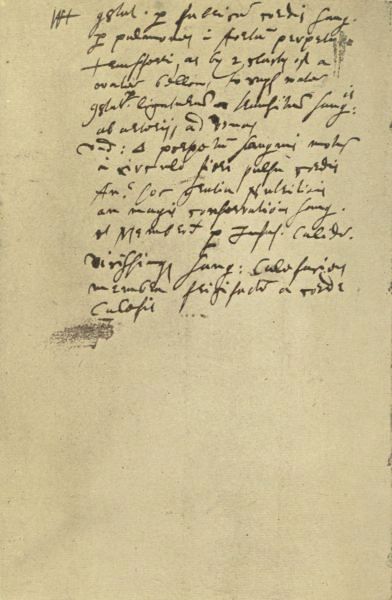
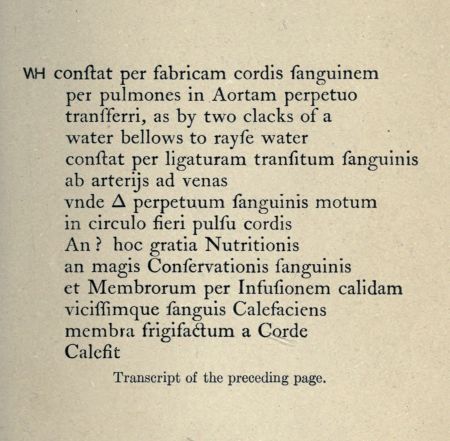
in Harvey's private lecture notes of 1616. His
crabbed handwriting has been deciphered by experts,
and his notes have been both photographed and printed.
If we seek therein for his thoughts about respiration,
and track them through the jungle of abbreviated
careless Latin and racy English in which they were
jotted down, we shall find them Galenic in part, but
also denying a truth which Galen had accepted. Harvey's
notes are often too disconnected for quotation,
calling rather for paraphrase or summary; and to
make either is a task which one cannot approach without
diffidence, especially as this task involves translation
also. Of what I have ventured to prepare to
represent parts of Harvey's note-book in the present
paper some passages are simple translations, such
English words as Harvey interspersed being transcribed.
Naturally such passages are included between
quotation marks. These are not used, however, in the
case of a paraphrase or summary, even if it contains
scattered English words which are Harvey's own.
Harvey fully shared the ancient view of the supreme
importance of the heat of animals. In his note-book
he, like Galen, deals with respiration under the heads:
first, of a possible absorption of some of the substance
of the air; and, second, of cooling and ventilation.
Let us first take up the second head. Harvey says:—
"Without nourishment life cannot be, nor nourishment without
concoction, nor concoction without heat, nor heat without
ventilation;" for heat perishes either of wasting or of smothering;
"so there is cooling and ventilation of the native heat,
ventilation especially."[41]
His words contain reminders of Aristotle;[24] and he
continues about respiration in a vein as ancient as
Hippocrates,[42] as follows:—
"Nothing is so necessary, neither sense nor food. Life and respiration
are convertible terms, for there is no life without breathing
and no breathing without life. If the eye be cut out there is
an end of seeing; if the legs be cut off there is an end of walking;
if the tongue, of speech, et cetera; if respiration, there is an end of
everything immediately."[43]
When Harvey jotted this down he had in mind a
Galenic passage which doubtless had become the common
property of all physicians in his day; for the
removal of eye and legs figures in the first chapter of
Galen "On the Use of Respiration."[44] Harvey continues:—
"Hence large animals are much warmer and breathe frequently,
because they have need of greater cooling and ventilation inasmuch
as they very greatly abound in blood and heat."[45]
In the margin opposite this passage there is written:—
"Why and how air is needed by animals which breathe and also
air is necessary to a candle and to fire see W. H."
We may conjecture that this note refers to Harvey's
promised treatise on respiration, which was never
published.
So far Harvey has simply reiterated the ancient
doctrine of cooling and ventilation, as in the passages
quoted previously from the treatise of 1628. We shall
find it very interesting to see how he deals with the
other ancient doctrine that some of the substance of
the air joins the blood in respiration. That this is
true, gas analysis and the mercurial air-pump have
taught us; but in this matter modern demonstration
does but confirm, extend, and make precise one of the
oldest of physiological beliefs. Regarding this we
must now give the floor once again to the ancients, in
order to make Harvey comprehensible.
Even in the days of Empedocles and Hippocrates,
in the fifth and fourth centuries before Christ, men
wrote of something derived from the outer air being
present, for the use of the organism, in the vessels
which also contain the blood.[46] To express this derivative
of the outer air the ancient Greeks employed
the word "pneuma" (πνεῦμα), the fundamental meaning
of which seems to have been "air in motion."
Various meanings were acquired by "pneuma," such
as the breath of living things, the wind, or simply the
air, or what we mean by the words "gas," "vapor,"
"steam," "exhalation," "emanation." The Latin word
equivalent to "pneuma" is "spiritus," and so the English
derivative of this, the word "spirits," came into
use to express various meanings of the Greek "pneuma."
A Hippocratic writer tells us that "the spirits cannot
stand still, but go up and down" in the blood vessels.
The word "spirits" here designates a derivative of the
outer air crudely mingled with the blood.[47] To this
writer the distinction between veins and arteries was
unknown.
In the genuine works of Aristotle this Hippocratic
doctrine does not reappear, though it is fairly certain
that Hippocratic treatises which contain it were written
before Aristotle's time. We have seen that the entrance
of air into the heart, to cool the same, is an important
feature of the Aristotelian physiology. Beyond
the Aristotelian heart, however, we cannot trace the
air which enters it. Yet we find "pneuma," "spirits,"
referred to by Aristotle, not seldom obscurely or in
very general terms, as doing service, sometimes momentous
service, in the physiology of generation and
in certain workings within the bodies of full-grown
creatures. In disease also spirits may play a very
important part. These Aristotelian spirits, however,
when their origin can be traced at all, are either innate
or appear to be vapor produced within the body itself
by heat or by disease. They do not appear to be
recruited from the outer air which has penetrated the
lungs and heart, that air seeming to complete its
function within the lungs or within the heart itself by
sustaining the native heat which is the great instrument
of the soul, and in which the very soul itself is fired.[48]
Physicians of Aristotle's time, however, revived and
handed on the doctrine that not only blood but a
derivative of the air is distributed to the body at large
through the vessels. After the distinction between
veins and arteries had been clearly made and the latter
had received their present name, a striking modification
of this doctrine of the spirits was adopted and pressed
by the Greek physician Erasistratus, about 300 B.C.,
not many years after the death of Aristotle. This
modified doctrine separated the paths taken within the
vessels by the blood and the spirits derived from the
air, and declared the transmission of the necessary
blood to the body at large to be by the veins only, that
of the necessary spirits, styled "vital," to be by the
arteries only. More than four hundred and fifty
years later Galen shattered this doctrine and incorporated
the vital spirits in the arteries with the blood,
which he proved by epoch-making experiments to be
normally present in the arteries, he, however, clearly
recognizing differences between the cruder blood in the
veins and the spirituous blood in the arteries. The
tissues, therefore, still received vital spirits by way of
the arteries, according to Galen, but not spirits in their
pure gaseous Erasistratean state.[49] Now let Galen
tell us more in his own words:—
"The breath from the windpipes, which had been drawn in from
without, is worked up in the flesh of the lungs in the first place;
in the second place in the heart and arteries, and especially in
those of the net-like plexus; and to perfection in the ventricles of
the brain, where the spirits become completely animal. But what
the use may be of these animal spirits and why we have the temerity
to call them so, when we confess that we are still utterly ignorant
as to the substance of the anima [i.e., of the soul], this is not the
moment to say."[50]
The complex physiology of this passage is so obsolete
that its very phraseology is meaningless without a commentary.
In the first place, what are the animal
spirits? This expression, once a technical term of
physiology, survives only in colloquial English, and
even there merely as a label of which the origin is
known to few. In this phrase the adjective "animal"
does not refer to lower creatures as opposed to man,
but is used in its obsolete original sense of "pertaining
to the soul," for which latter the Latin word is "anima,"
the Greek word "psyche" (πσυχή). "Psychical spirits"
would best translate into the English of to-day either
the original Greek expression "pneuma psychikon"
(πνεῦμα ψυχικόν) or its Latin equivalent "spiritus
animalis." But the expression "animal spirits" was
for too long a time an English technical term to be
superseded now. These animal spirits, that is, spirits
of the soul, were not peculiar to man, but were possessed
by lower creatures also; for neither the Latin word
"anima" nor the Greek word "psyche" implied immortality,
as the English word "soul" is now so commonly
understood to do. Plato formally recognized a
mortal and an immortal part of the human psyche;[51]
and Aristotle admitted the existence in animals lower
than man of the lower grades of psyche, and conceded
the lowest grade even to plants.[52] The perfected animal
spirits were of the very highest physiological importance,
as their name implies, they being for Galen no less than
"the first instrument of the soul,"[53] and thus assuming
the lofty rank given by Aristotle to the native heat.
For Galen the animal spirits were the medium of sensation
and volition and were imparted by the ventricles
of the brain to the spinal cord and nerves, the fibers
of which were believed, accordingly, to consist of tubes
in which the subtile animal spirits were contained, the
bore of these tubes being too small to be visible.
We can now follow the quoted Galenic passage and
trace the full significance of that entrance of the substance
of the air into the heart which Galen repeatedly
acknowledged, though sometimes grudgingly. According
to Galen whatever air was taken into the heart had
first been "concocted" in "the flesh of the lungs."
Next, this aërial substance had been worked up in the
heart with the vapor of the blood into vital spirits, and
these became incorporated with the finer blood destined
for the arteries. Moreover, as each arterial diastole was
due to an active expansion of the arterial wall, at each
diastole there became blended with the contents of the
arteries still more of the substance of the air, which was
sucked into the arterial skin through the countless
pores of the bodily skin, these being too fine to permit
bleeding. The vital spirits, thus formed and modified,
were blended with the blood of the arteries and supplied
to the body at large. A part of these vital spirits
mounted with the blood into the carotid arteries. In
the swine and the ruminants, notably in the calf, the
branch given to the brain by each carotid artery breaks
up at the base of the skull within the cranial cavity
into numerous fine twigs, which form collectively a
net-work, styled in the passage from Galen already
quoted the "net-like plexus." This plexus is called
by modern anatomists the rete mirabile. It was falsely
assumed by Galen to exist in man. The plexuses of the
two sides anastomose freely across the median line,
and through them passes the entire blood supply of
the brain; in the animals which possess them these
plexuses seem the terminal branches of the vertebral
arteries also. The small vessels of each net-like plexus
reunite, and thus reconstitute the artery of the brain
before this artery has pierced the dura mater. Galen
regarded the net-like plexus as an organ of much importance
intercalated in the course of the artery for the
still further elaboration of the vital spirits, which, thus
altered, were exhaled from the cerebral arteries into
the cerebral ventricles.[54] In these ventricles the spirits
attained their final perfection, becoming "completely
animal," by the aid of still more of the substance of the
air, which the diastole of the pulsating brain had
drawn into its cavities directly from the nares through
the numerous holes in the ethmoid bones. It is a
striking fact in this connection that in some of the
domestic animals on each side of the head the cavity
of the nares is separated from the ventricular cavity
of the brain by an exceedingly thin, though complex,
partition: as may be seen on dissection, if the nares
and the brain in situ be opened at the same time.
Now let Galen speak again as follows:—
"I have clearly shown that the brain is, in a way, the source of
the animal spirits, watered and fed by inspiration and by the
abundance supplied from the net-like plexus. The proof was not
so clear as to the vital spirits, but we may deem it not at all unlikely
that they exist, contained in the heart and arteries, they, too,
fed by respiration mainly, but to some degree by the blood also. If
there be such a thing as the natural spirits, these would be found
contained in the liver and veins."[55]
The animal spirits were sustained, as we have seen, by
three kinds of respiration which might be called pulmonary,
cutaneous and cerebral. We may perhaps
conjecture that it was largely Galen's acceptance of the
two latter, the last especially, which enabled him sometimes
to treat as doubtful the entrance into the heart
of that air from which the vital spirits were held to be
derived. Of the natural spirits he evidently made
small account.[56]
A modern physiologist, musing upon all this, might
see in the vital spirits a dim foreshadowing of oxyhæmoglobin;
might see in the operation of the animal spirits
a plainer foreshadowing of the nerve impulse of to-day.
Some account, such as the foregoing, of the very
complex ancient doctrine of the spirits is indispensable
for the study of Harvey; for that doctrine, more or
less modified, was still the accepted medical doctrine
of his time. After this renewed study of the ancients
let us now return again to Harvey's note-book at the
place where he takes up the question of the action of
the lungs upon the blood otherwise than by the cooling
and ventilation of the innate heat. It is necessary in
his opinion that a further concoction of the blood into
spirituous arterial blood should be accomplished by the
fleshy parenchyma of the lungs in animals which require
a warmer, thinner, "sprightly kind of aliment," as
his own English styles it.[57] The probability of such a
concoction is shown by the separation of excreta which
indicate it, such as sputa, at the lung.[58] On the other
hand, in such creatures as frogs and turtles the lungs
are fleshless, spongy, and vesicular, and give no sign of
blood or excreta. Hence we may infer that the pulmonary
concoction of the blood, though it probably
occurs, is limited to such animals as possess fleshy and
sanguinolent lungs. Hence, again, it follows that the
concoction aforesaid is a function of secondary importance,
because it is not universal; and that the
foremost function of the lungs is their motion, the
windpipes constituting their most important part,
rather than the parenchyma.[59] Two functions of the
lungs, says Harvey, are affirmed by the medical authorities:
first, the cooling and tempering of the blood;
second, the preparation of natural spirits and air to be
made into vital spirits in the heart. From all this there
result the excreta of pulmonary concoction, which
are something between water and air, and the fumes
which are breathed out in expiration continually and
incessantly. Harvey observes correctly that Realdus
Columbus had declared himself to have discovered the
continual motion of the lung to be the means whereby
the spirits are prepared; the blood being thinned by
the agitation, thoroughly mixed with air, beaten, and
prepared.[60] Harvey also cites Galen as saying that
the parenchyma of the lung concocts spirits out of air
as the flesh of the liver concocts the blood.[61] On
turning to the Galenic passage cited by Harvey one
finds that it is out of the food that the blood is thus
concocted by the liver.
Realdus Columbus, to whom Harvey refers, was the
Italian anatomist who in 1559, fifty-seven years before
the Harveian circulation was verbally announced,
gave to the world the important truth that such blood as
the right ventricle imparts to the left reaches the latter
by traversing the pores of the texture of the lungs,[62]
instead of the pores of the septum of the ventricles, as
Galen had taught. The existence of these pores of
the septum Vesalius had pointedly wondered at in 1543
and had emphatically doubted in 1555.[63] Four years
later his former assistant and temporary successor,
Columbus, flatly denied the existence of the pores.
It was natural, therefore, that in the same book in
which Columbus brought forward the path through
the lungs to replace that through the septum he should
declare that the vital spirits are made out of air worked
up with the blood in the lungs and then merely perfected
in the left ventricle. This doctrine was an
important advance beyond what Galen had taught, viz.:
that the spirits are but slightly prepared in the lungs
out of air and then sent to the left ventricle to undergo
their main preparation and to be worked up therein
with the blood which had filtered into it directly out
of the right ventricle.
So much for the views of the medical authorities.
We have found Harvey agreeing with them that the
ancient doctrine of the cooling and ventilation of the
native heat by respiration is sound. We have found
him acknowledging that in some animals some sort of
concoction also of the blood destined for the arteries
may be brought about by the pulmonary parenchyma
as a function of secondary importance. But now we
shall find him rejecting the second accepted doctrine
of the physicians, viz.: that some of the substance of
the air is taken into the pulmonary vessels and enters
the blood. This conjecture had had believers for two
thousand years, and was destined to be proved true
triumphantly after Harvey's death. In rejecting it
he threw away a precious clue to the meaning of his
own great discovery.
"It is more philosophical," he says, "not to share the common
belief that the spirits are distinct and separate from the humors
and parts because the spirits are produced in diverse places or
contained in diverse things," but to hold that the spirits and the
blood are one thing, like the cream and watery part (serum) in
milk or, to borrow a simile from Aristotle's reasonings about the
blood,[64] like heat and water in hot water, or like flame and a vapor
which feeds it (nidor). As light is to a candle, so are the spirits to
the blood.[65]
In this passage the discoverer's thought rises high,
but in the next it stoops again. The next passage is
headed "Spirits not from air"; and Harvey says in
effect, as I understand his difficult words:—
If spirits are made by concoction out of air, the air is made either
thinner or thicker in the process. If made thick, how does it get
from the windpipes into the venous artery? If the spirits be thinner
than air, how are they held[66] by the tunic of the lung, since this
lets pass the pus and serum of empyema?[65]
In the treatise of 1628 Harvey says that Laurentius
"asserts and proves that, in empyema, serosities and pus absorbed
from the cavity of the chest into the venous artery may be expelled
and got rid of with the urine and fæces through the left ventricle
of the heart and the arteries."[67]
Harvey's argument in his note-book continues thus:—
"How, since mixture consists in the union of altered matters, can
air be thoroughly mixed and made one with blood? What is that
which mixes and alters? If it be heat, the air is made thinner
thereby. If it be urged that the air is thickened by cold during
preparation (which is impossible in the lungs), then Aristotle's[68]
argument holds good: if spirits be from the air, how about fishes,
which are agile and abound in spirits?"[69]
At this point we may call to mind passages in the
introduction to Harvey's treatise of 1628, published
more than eleven years after he had written the notes
which we are now studying. In one of these passages
he speaks of what is now called the pulmonary vein,
saying:—
"If it be contended that fumes and air pass to and fro by this road,
as through the bronchia of the lungs, why can we find neither air
nor fumes on dissection, when the venous artery has been cut out or
cut into? And how comes it that we always see the aforesaid venous
artery to be full of thick blood and never of air, while we perceive
that there is air remaining in the lungs?"[70]
Immediately after the foregoing passage Harvey says
that should an experimenter
"make a cut in the trachea of a living dog, forcibly fill the lungs
with air by means of a bellows and, when they have been distended,
apply a firm ligature, on opening the chest shortly after, he would
find great abundance of air in the lungs, up to their outermost
tunic, but none at all in the venous artery or in the left ventricle
of the heart. If in the living dog the heart drew air out of the
lungs or the lungs transmitted it, much more ought they to do so
in this experiment. Who, indeed, could doubt that even in a dissection,
if the lungs of a dead body had been inflated, air would
enter at once, as aforesaid, did any passages exist?"[71]
Yet we have found Aristotle, more than nineteen
centuries before Harvey, recognizing that no passages
are needed for the transfer of air out of the windpipe,
and saying, of the channels from the heart, that "it is
by contact that they receive the breath[72] and transmit
it to the heart."[73] Moreover, sixty-nine years before
Harvey's publication Columbus had repeatedly recommended
the experiment of opening the venous
artery[20] in a living dog and noting that the "said
venous artery" is full of blood, not of air or fumes.
But Columbus held this observation rather to confirm
than to disprove his doctrine that the blood in the
venous artery is imbued with vital spirits derived in
the lungs from the substance of the air. Indeed, he goes
so far as to call the contents of this vessel "modified
blood and air."[74] In this matter the earlier observer,
Columbus, shows keener insight than the later, Harvey.
Decidedly, however, the stage waits for the chemists,
despite Harvey's poor opinion of them. Despite that
poor opinion, too, Harvey himself turns to making chemical
conjectures in the next passage of his note-book,
to the study of which latter we will now return. The
passage is as follows:—
"Conclusion. Opinion of W. H.
"In animals in which lungs are fleshy and full of blood these
concoct the blood, seeing that spirits and blood are one thing, in
the same way that the liver does and by reason of the same arguments;
indeed, the lungs may rather detain fatty and oleaginous
vapor by a cooling process, as oil or balsam or nutritious fat is
cooled in alembic and serpentina"[75]—
"alembic" and "serpentina" answering to the "still"
and "worm" of the modern distiller. Harvey, therefore,
utilizes the Galenic analogy between concoction
in the lungs and that of the blood and the vapors thereof,
rejecting not only Galen's preliminary concoction of air
into spirits in the lungs, but also Columbus's union in
the lungs of blood with spirits produced in the lungs
themselves out of air. Of the entrance of "the substance
of air" into the blood Harvey makes emphatic
denial and, by so doing, reduces the spirits either to
emanations from ingredients of the body itself (thus
reminding us of Aristotle), or to a mere name with
which to label qualities of the blood, in treating of
which he often uses the word "spirits" as a current
term. Naturally, therefore, where in his lecture notes
he treats of the spirits in relation to the brain and
nerves his conclusions are not clearly defined, but seem
consistent with his views as to the spirits in the blood,
though his jotted words are not very easy to understand.
On this subject he refers by name to Galen,
three alternatives discussed by whom appear to be
reviewed by Harvey, viz.: that sensation and motion
result either from a progression from elsewhere of
spirits in substance along and within the nerves; or
from a vibration of spirits in substance which have their
native seat within the nerves; or, lastly, from no movement
of a substance, but from a transfer of "faculty"
along the nerves by means of progressive qualitative
alteration thereof, "such as is produced in air by the
brightness of the sun."[76] Of these three alternatives,
the last seems to commend itself most to Harvey, as
we should expect; the second, next; and the first, not
at all;—that is, if one may so interpret the following
brief passage of his lecture notes:—
"I believe that in the nerves there is no progression of spirits,
but irradiation; and that the actions from which sensation and
motion result are brought about as light is in air, perhaps as the
flux and reflux of the sea."[77]
Also we find Harvey long years afterward saying to
Riolanus:—
"Moreover, the spirits, animal, natural, vital, which dwell,
contained within blind windings, in solid parts, to wit, in ligaments
and nerves (especially if there be so many kinds),—these spirits
are not to be regarded as so many diverse aëreal forms, nor as so
many kinds of vapors."[78]
In Harvey's lecture notes the subject of respiration is
brought to an end with an abrupt interrogation, which
seems to reveal a sudden return of doubt as to whether
too much may not have been conceded in admitting a
pulmonary concoction of any sort. We read:—
"N.B. If the blood receive concoction in the lungs, why does
it not traverse the lungs in the embryo?"[79]
It would seem to be Harvey's tendency to adhere to
the view which limited the use of respiration entirely to
the cooling and ventilation of the innate heat, by which
according to ancient doctrine the heart was the central
hearth, embedded in the cooling and ventilating lungs;
although this ancient doctrine tallied well in most eyes
with the belief that only a portion of the blood ever
entered the heart at all.[80] In the first of the two Exercises
which Harvey, when seventy years old, in 1649,
addressed to Riolanus in defense of the circulation, the
ancient respiratory cooling and ventilation take their
place again as follows:—
"Thus by the aid of two extremes, viz.: cold and heat, is the
temperature of the animal body retained at its mean. For as the
air inspired tempers the too great heat of the blood in the lungs and
centre of the body and effects the expulsion of suffocating fumes,
so in its turn does the hot blood, thrown through the arteries into the
entire body, cherish and nourish and keep alive all the extremities,
preventing extinction due to the power of external cold."[81]
In none of the writings of his old age does Harvey deal
expressly with concoction in the lungs, or more than
cursorily with the entrance of the substance of air into
the blood. But he repeatedly and emphatically reaffirms
that blood and spirits are one thing;[82] he even
declares the blood in comparison with the other parts
of the body to be "possessed of powers of action beyond
all the rest, and therefore, in virtue of its preëminence,
meriting the title of spirit."[83] He castigates those
who give the rein to overmuch speculation about the
spirits. We learn that some suppose that the spirits
"are engendered and are fed and increased from the
thinner part of the blood"; that others suppose "the
primigenial moisture" to engender and support them.[84]
Then there are "those who tell us that the spirits are
formed in the heart, being compounded of the vapours
or exhalations of the blood (excited either by the heat
of the heart or the agitation) and the inspired air"[85]—the
Galenic doctrine.
"Such spirits," says Harvey of these last mentioned, "are rather
to be regarded as fumes and excrementitious effluvia of the blood
and body, like odours, than as natural artificers; ... whence it
seems probable also that pulmonary expiration is for the ventilation
and purifying of the blood by the breathing out of these;
while inspiration is in order that the blood, in passing through between
the two ventricles of the heart, may be tempered by the
ambient cold; lest the blood, being hot and swollen, blown up in
a sort of ferment, like milk and honey boiling up, should so distend
the lungs that the animal would be suffocated."[86]
As we read these words, published in Harvey's old age,
we recollect the following words, written in his note-book
more than thirty-three years before, viz.: "So
there is cooling and ventilation of the native heat,
ventilation especially."[87]
We may recall also that the preservation of the native
heat had sufficed to explain respiration to Harvey's
ancient teacher, Aristotle, while the tenor of Aristotle's
genuine works well accords with the following dictum
which we have found in Harvey's note-book: "Spirits
not from air." Yet the more firmly this dictum was upheld,
and the more simply Aristotelian in principle did
Harvey's doctrine of respiration remain, so much the
less called for must have seemed that swift and endlessly
repeated passage through the lungs of the whole mass
of the blood, which was involved in the Harveian circulation.
In the actual phenomena of respiration, however,
positive obstacles confronted the doctrine of the circulation
which were harder to surmount than cobwebs
of speculation, or than the mere question "cui bono"
which latter the steadfast observer could simply wave
aside. Spirits or no spirits, there were opponents of
the circulation, even in Harvey's old age, who insisted
that the blood in the arteries was so different from
the blood in the veins that the same blood could not
be changing perpetually from arterial to venous, and
vice versa. There was always that stubborn difference
of color, plainly to be seen in man and beast, but so hard
to account for in Harvey's day. Therefore, we find
Harvey leaving the realm of subtleties and taking up
his old weapon of demonstration, in order to minimize
the differences between arterial and venous blood.
Twenty years after the publication of his discovery he
says to Riolanus:—
"You may also perform another experiment at the same time.
If you fill two cups of the same measurement with blood, one with
that which issues by leaps from an artery, the other with venous
blood from a vein of the same animal, you can observe the sensible
differences between the two, both immediately and later, when the
blood in either cup has become coagulated and cold. This experiment
will contradict those who pretend that the blood in the
arteries is of one kind, that in the veins of another, on the ground
that that in the arteries is more florid and seethes and is blown up
with copious spirits, I know not how, like milk or honey boiling
upon the fire, swelling and filling a larger space. For, were the
blood which is thrown from the left ventricle of the heart into the
arteries fermented thus into a frothy and flatulent condition, so
that a drop or two distended the whole cavity of the aorta, unquestionably,
upon the subsidence of this fermentation, the volume of
the blood would return to that of a few drops (and this is, indeed,
the reason that some assign for the empty state of the arteries in
the dead body); and this would be apparent in the cup which is
full of arterial blood, for so we find it to happen in milk and honey
when they come to cool. But if in both cups you find blood nearly
of the same colour, not of very different consistency in the coagulated
state, forcing out serum in the same manner and filling each cup
to the same height when cold that it did when hot, this will be
enough for any one to rest his faith upon, and afford argument
enough, I think, for rejecting the dreams of certain people. On
investigation sense and reason alike assure us that the blood of the
left ventricle is not of a different kind from that of the right....
The blood, then, when imbued with spirits to the utmost, is not
swollen with them, or fermented or blown up so as to crave and
require more ample room (as can be determined with the greatest
certainty on trial by the measurement of the cups); we should
rather understand this blood to be possessed, after the manner of
wine, of greater strength, and of an impetus to action and effectiveness,
in accordance with the view of Hippocrates.
"So the blood in the arteries is the same as that in the veins;
even though the former be acknowledged more spirituous and
possessed of greater vital force; but the blood in the arteries is not
converted into something more aëreal or rendered more vaporous;
as though there were no spirits not aëreal, nor anything which
gives an impetus except wind and flatulence."[88]
It is well, one may be inclined to mutter, as one reads
this, but how about the color? It may be nearly the
same, but certainly there is a difference. In his book
"On Generation" Harvey himself describes in more detail
the changes which occur in shed blood on standing,
and says: "Of the red parts the upper are more florid,
those below are blackish." In the same description
he refers shortly after to "the florid and ruddy part
which is commonly thought to be arterial blood."[89]
The words last quoted evidently refer to the upper part
of coagulating blood as commonly seen. This in medical
practice would be blood drawn from a vein, and
Harvey says nothing of arteriotomy in this passage.
Indeed, he refers in the context to venesection; and
earlier in the same chapter he wrote: "Physicians
observe only human blood, and this shed by venesection
into a basin, and coagulated."[90]
The foregoing passages show at once that opinions
had been clarified very little by the suggestive change
of color caused in shed blood by contact with air.
Years before, in jotting down his lecture notes, Harvey
had noted that the arterial blood is redder;[91] Galen
had known it;[92] it must always have been known. In
1649 Harvey wrote:—
"Three things are especially apt to give rise to this opinion of
the diversity of the blood: the first is that the blood which is drawn
in arteriotomy is more florid....[93] Whenever and wherever
blood issues through a narrow orifice it is strained, as it were, and
the thinner and lighter part, which usually swims on top and is
the more penetrating, is emitted."[94]
A number of observations follow, of appearances noted
in nosebleed, in the use of leeches, in cupping, and in
blood-letting from veins and arteries. All these appearances
are adduced in support of the view that it is
the straining of the blood which renders it more florid,
and they all show that the brightening of the color of
shed blood on exposure to air served only to lead Harvey
off on a false scent. Continuing he refers, as follows, to
direct inspection of the dissected lungs:—
"The blood is found to be much more florid within the lungs and
after it is squeezed out of them, than in the arteries."[95]
A few pages farther on he states, categorically, the false
conclusion to which he has been driven, saying:—
"It is no less plain why the blood of the lungs is so ruddy; for
it is thinner, because there it is filtered through."[96]
Nothing indicates better Harvey's readiness to minimize
the essential differences between venous and
arterial blood than a passage in the treatise of 1628,
in which he says that, compared with the left ventricle,
the right ventricle "is of greater capacity, that it may
supply not only matter to the left ventricle, but also
nourishment to the lungs."[97] It should be remembered
that, in Harvey's day, the so-called bronchial arteries
were still unknown, through which the tissues of the
lungs are supplied with arterial blood from the aorta.[98]
Not only Columbus,[99] but even Galen,[100] had each
devised an erroneous way in which to provide the
lungs with "spirituous" or "vital" blood, in addition
to the venous blood from the right ventricle; but Harvey
is obviously content to let the latter suffice for their
nutrition.
What has gone before indicates how erroneous it is
to speak of the pulmonary transit, as Columbus had
set it forth in 1559, nineteen years before Harvey's
birth, as though Columbus were in some sort a sharer
in the discovery of the circulation. Those who so
speak fail to note the difference between blood and the
blood. Although Columbus girded at Galen and corrected
him, Columbus's pulmonary transit of a fraction
of the blood by curing more than one defect of the
Galenic doctrine strengthened the erroneous Galenic
physiology of the blood-movement. Of these larger
features Columbus not only was no enemy, but remained
a devoted adherent. His doctrine certainly paved the
way for Harvey's, but in no more immediate sense than
did Galen's doctrine that blood is naturally contained
in the arteries.[80]
Indeed, Harvey categorically stated that the movement
of blood through the lungs had nothing to do with
his discovery. In a Latin letter from London written
in 1651 to P. M. Siegel in Hamburg, Harvey says in
his old age:—
"Meantime, as Riolanus uses his utmost efforts to oppose the
passage of blood into the left ventricle through the lungs, and
brings it all hither through the septum, and so vaunts himself as
having upset the very foundation of the Harveian circulation,
(although I have nowhere laid that down as a foundation for my
circulation; for the blood fetches a circuit in very many red-blooded
animals in which no lungs are to be found), it may be well here to
relate an experiment which I lately tried in the presence of several
of my colleagues, and from the cogency of which there is no escape."[101]
The parenthesis certainly is a striking one.
No less striking is the last word published by Harvey
about respiration. We have heard him deny the
entrance of air into the blood and doubt the occurrence
of any concoction in the lungs. Now we shall hear
him throw over even the cooling of the innate heat, a
respiratory doctrine to which he has seemed hitherto to
hold with conviction. In the essay "On Parturition"
published in 1651 with the treatise "On Generation,"
he says:—
"In the meantime I would propose this question to the learned:
How comes it that the fœtus continues in its mother's womb after
the seventh month? If brought forth at that time it breathes
at will, indeed could not survive one little hour without breathing;
yet, as I have said, if it remain in the womb it keeps alive and
well beyond the ninth month without the aid of respiration....
Whoso shall attend carefully to these things and consider more
closely the nature of air, will, I think, readily grant that air is given
to animals neither for cooling nor as nutriment; for it is a fact that
after the fœtus has once drawn breath it may be suffocated more
quickly than when entirely excluded from the air; as though
heat were unkindled by air within the fœtus rather than allayed.
Thus much, merely by the way, on the subject of respiration;
perhaps I shall treat of it more fully in its proper place. Surely a
more knotty subject could hardly be found, as the arguments on
both sides are very evenly balanced."[102]
So we find Harvey in his old age induced by lifelong
study to question, if not deny, even the cooling effects
of respiration, and to end with a practical confession of
ignorance. Instead, therefore, of the circulation and
its swiftness being explained by the urgent need of
"the substance of the air" experienced by certain tissues,
that movement of the whole mass of the blood
through the lungs, which was so novel a physiological
fact, does not seem to have affected his view of the
problems of respiration. Nor could he properly explain
the respiratory change in the color of the blood, which
seemed to support the ancient doctrine that the blood
is of two different kinds. Since he could not invoke
respiration to elucidate the circulation and its rapidity,
and since he himself declared that such rapidity could
not be needed for the simple feeding of the tissues, what
was left to be invoked? It is no wonder that eight
years[103] after the publication of his discovery Harvey
denied that he had ever seriously undertaken to explain
the use of the circulation; that at the end of thirteen
years more he repeated this denial in his old age;[104]
although he had not refrained from expressing such conjectures
as must always be evoked in the mind of a
great observer by a discovery of the first importance
made by himself. Yet the phenomena of the very
circulation used were so striking as to cry aloud for
elucidation; for Harvey's own clinching statement that
the heart drives into the aorta at least one thousand
drachms of blood in half an hour,[105] this reductio ad
absurdum, which cut the ground from under the feet of
his opponents, left him helpless in his turn to account
for the need of so huge a flooding of the arteries.
Since it was not to be swiftly altered in the lungs that
the whole mass of the blood hurried back from all parts
of the chest, what then?