TRAP-DOOR SPIDERS.
PART II.
TRAP-DOOR SPIDERS.
It is now one hundred and sixteen years since
Patrick Browne gave an illustration in his Civil and
Natural History of Jamaica[43] of the nest of a trap-door
spider, the first record of the kind with which I am
acquainted. Seven years later the careful observations
of the Abbé Sauvages appeared,[44] in which he
gave a very good description of the nests of the
"araignée maçonne" (Nemesia cæmentaria), which he
discovered near Montpellier, likening them to little
rabbit burrows lined with silk and closed by a tightly-fitting
moveable door. In 1778 and 1794 Rossi[45]
published an interesting account of the nest and
habits of a trap-door spider which he had observed in
Corsica and near Pisa; and from that time up to the
present day the curious dwellings of these creatures,
many species of which have been discovered in warm
climates, have continued to attract the attention of
naturalists.
Very little, however, has been added to our knowledge
of the life-history of these remarkable architects
for several years past, and, indeed, I think it
may be safely asserted that the study of the habits
and interdependence of the members of the animate
world has not, during the last fifty years, made anything
like a corresponding progress to that which
may be seen in classification and description. The
microscope has led many who, a century ago,
would have found their chief delight in observing
those points in the habits and external characters of
living creatures which the naked eye could readily
seize upon, to look much closer, to anatomize and
describe in detail every organism, great and small,
and to examine every tissue and cell.
It is, however, to the materials now being amassed
by these modern "cabinet naturalists" that recourse
must be had if we wish to form a true comprehension
of the functions and habits of living things. They
must tell us, for example, what instruments, tactile
and visual, an animal possesses if we wish to understand
how it constructs a particular fabric, so that the
"field naturalist" will have to apply to his brother
of the "cabinet" before he can turn his observations
to good account.
Still, the fact remains that the habits of plants and
animals afford many openings for careful investigation,
and such as are especially within the reach of
those lovers of nature who have ample time at their
disposal, and the opportunity to spend it in a warm
climate where life abounds, and is never wholly
checked even in the depth of winter. It seems
strange to think that collectors so frequently take
creatures out of wonderfully constructed nests and yet
never observe, or at any rate never describe, the
structure of these fabrics. Thus, for example, the
dwellings of only eight out of the thirty-six species
of trap-door spider stated by Prof. Ausserer[46] to belong
to the Mediterranean region are known in books,
those of the remaining twenty-eight being, as far as
I have been able to learn, yet to be discovered. This
is the more strange as from the nocturnal habits of
these creatures it is almost always necessary to dig
them out of their nests; indeed it is more than probable
that if all the dwellings which have been destroyed
had been described, the following pages would
never have appeared.
Before proceeding to pass briefly in review what
has been written on the subject of trap-door spiders,
it will be well to take one glance at the relation which
these spiders bear to their fellows. The great order
of spiders (Araneæ) has recently[47] been divided into
seven sub-orders, the fourth of which, Territelariæ,
includes all the trap-door spiders, and some others
which do not construct trap-doors. This sub-order
corresponds with that which was formerly called
Mygalidæ, but this name, as well as that of Mygale,
originally given to all trap-door spiders, has been
abandoned because this latter name had previously
been applied to a genus of Mammals, and it was
feared that confusion might arise.
The Territelariæ [or underground weavers] are distinguished
from all other spiders by the position of
their falces,[48] which have the fang directed downwards,
and move vertically parallel to one another. Thus
when a victim is seized by one of the Territelariæ it
receives a downward blow, while other spiders strike
sideways, the falces moving in a horizontal or oblique
direction. With very few exceptions this sub-order
may also be known by the presence of four blotches
of paler colour at the base of the abdomen underneath,
indicating the position of four air-sacs, almost all, or
indeed perhaps all, other spiders having but two.
Certain species of Territelariæ are the only spiders
known to construct nests closed with a door, and these
creatures must be admitted to rank among the first
of Nature's handicraftsmen and inventors.
The geometrical webs of many common spiders
are very beautiful structures, but these are for the
most part only snares for prey, and not permanent
dwellings, although the cocoons in which the eggs
are placed are often most ingeniously contrived. Thus
in the south we may sometimes find an inverted balloon
of strong silk about an inch long attached to
heath and other bushes, which, if examined during
the winter, will be found to contain in its centre a
case enclosing a mass of eggs about one-third the bulk
of the entire cocoon. This inner case is shaped exactly
like the outer, and both have a circular silk lid
carefully closed, and the space between the two is
filled with a dense mass of golden-brown silk, which
acts no doubt as an excellent non-conductor. This
cocoon is the work of Epeira fasciata, a species apparently
only found in southern Europe.
Other spiders again, such as Theridion,[49] suspend by
a long and delicate cord of silk a minute balloon,
scarcely larger than a seed-pearl, containing their
eggs, which sways to and fro in the lightest breath
of air. But admirable as these cocoons and geometrical
snares are, the homes of these and of spiders
generally do not exhibit much contrivance or ingenuity,
or cannot at any rate be ranked in the same category
as those of the trap-door spider. But it may be asked,
why should we admire the one more than the other,
since it is clear that the most squalid and mean-looking
nest exactly serves the purpose of its occupant,
whether for shelter or defence, and in many cases
a spider might even say with truth that as for her
home it would not be so safe if it were not so dirty.
But the answer is simple: the trap-door spider's
dwelling is to that of common spiders what the
Mont Cenis tunnel is to other tunnels, and something
besides.
What delights us is to see how by clever contrivance
and great perseverance new and multiplied
difficulties have been overcome, and dangers avoided,
and the interest aroused is exactly proportionate to
the amount of these difficulties and dangers.
It is hoped that the following pages and their accompanying
illustrations will vindicate the claims of
these spiders to the marked attention and admiration
which is here asserted to be their due as architects
and engineers.
There is but one British or North European representative
of the Territelariæ—namely, Atypus piceus (or
Sulzeri),[50] and this creature does not appear to
deserve the name of trap-door spider, for in three
nests which M. H. Lucas kindly showed me, preserved
at the Jardin des Plantes at Paris, the mouth
of the tube was destitute of any covering. I gathered
from what I saw, and from what M. Lucas told
me, that these nests [which he had taken in the
neighbourhood of Paris], consist of a silk tube from
eight to ten inches long, of which about one inch
only at the lower extremity penetrates the earth, the
remainder being carried upwards in an irregular and
sinuous course among the stems and leaves of small
plants and grasses to which it is attached. When the
tube is removed from these supports it collapses, and
appears like a rather coarsely woven ribbon-shaped
strip of silk.[51]
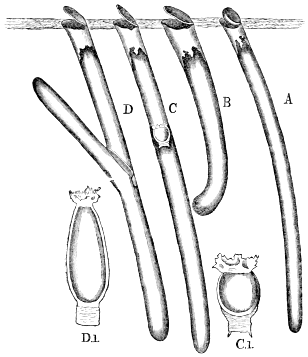
Four types of trap-door nest, properly so called, may
now be distinguished in the world at large, and these
are represented diagrammatically in the following
woodcut.[52]
Of these two only (A and B) were known up to
the present time, the construction of which is much
simpler than that of the two new types (C and D),
which I have hitherto only found at Mentone and
Cannes.[53]
It will be seen at a glance that A and B have but
one door, while C and D have two, these latter having
a surface door, and also another door a short way
under ground.
All the nests consist of a tube excavated in the
earth to a greater or less depth, unbranched in all but
D, and in every case lined with silk, this lining being
continuous with the lining of the door or doors of
which it forms the hinge.
I have found it convenient to distinguish these
four types of nests by the following names:—A, the
single door cork nest, or shortly the cork nest; B, the
single door wafer nest; C, the double door unbranched
nest; and D, the double door branched nest.
The type B has only been found in the West India
Islands, and is chiefly distinguished from A by having
a thin and wafer-like door, wholly constructed of
silk, without admixture of earth, lying on rather
than fitting into the aperture of the tube; while in
A the door is much thicker, made of layers of earth
and silk, and so contrived that it tightly closes the
mouth of the tube, which is bevelled to receive it,
much as a cork closes the neck of a bottle.[54]
The West Indian nests are of a much tougher and
coarser texture than those which I have seen in
Europe, and vary somewhat in the shape of their
tube, which is curved or straight, and sometimes has
near its lower extremity a short spur-shaped enlargement,
giving to the whole a ludicrous resemblance
to a stocking, of which this spur is the heel.
Mr. Gosse,[55] in his Naturalist's Sojourn in Jamaica,
has given an admirable description of one of these
single door wafer nests, the work of Cteniza nidulans,
which I cannot do better than quote:—
The nest is "cylindrical, or nearly so, from four to
ten inches deep, and about one inch in diameter; the
bottom is rounded; and the top, which is at the surface
of the soil, is closed very accurately with a circular
lid. They are not all equally finished, some being
much more compact, and having the lid more closely
fitted than others. Some have irregular bulgings, and
ragged laminated offsets on the outer surface; but all
are smooth and silky on the inside.... The mouth
of the tube, and the parts near it, are very strong;
the walls here often having a thickness of from one-eighth
to one-fourth of an inch; but the lower parts
are much thinner. The lid is continuous with the
tube for about a third of its circumference, and this
part may be called the hinge, though it presents no
structure peculiar to itself; it is simply bent at a right
angle, as is manifest, if a nest be cut longitudinally
through with scissors, the incision passing through
the midst of the lid. The mode of construction, I
judge, from examination of many nests, to be this.
The spider digs a cylindrical hole in the moist earth,
with her jointed fangs or mandibles, carrying out the
fragments as they are dislodged. When the excavation
has proceeded a little way, she begins to spin the
lining which forms the dwelling. I conclude thus,
because nests are occasionally found a few inches in
length, with the lid and upper part perfect, but without
any bottom, these being evidently in the course of
formation. I suppose that she weaves her silk at first
in unconnected patches, against the earthy sides,
perhaps where the mould is liable to fall in; and thus
I account for the loose rough laminæ of silk that are
always found projecting from the outer surface. These
are overlaid with other patches more and more extensive,
until the whole interior walls are covered;
after which the silk is spun evenly and continuously
all round the interior, in successive layers of very dense
texture, though thin. Under the microscope, with a
power of 220 diameters, these layers are resolved into
threads laid across each other and intertwined in a
very irregular manner; some are simple, varying from
1/7000 to 1/2000 of an inch in diameter, and others are
compound, several threads, in one part separate, being
united into one of greater thickness which cannot then
be resolved.... The mouth of the tube is commonly
dilated a little, so as to form a slightly recurved
brim or lip; and the lid is sometimes a little convex
internally, so as to fall more accurately into the mouth
and close it.
"The thickening of the hinge by additional layers is,
I think, accidental only, as, out of the many specimens
that I have examined, only one or two had such a
structure. In the neatest examples, the lid is of equal
thickness throughout its extent, agreeing also with
the walls for the first few inches of their depth."
Mr. Gosse says that he possesses one specimen of
peculiar compactness, which differs from all the others
that he has examined in having "a row of minute
holes, such as might be made by a very fine needle,
pierced around the free edge of the lid, and a double
row of similar ones just within the margin of the
tube. There are about fifteen or sixteen punctures
in each series, and they penetrate through the whole
substance, the light being clearly seen through each
hole. I do not think, as I have somewhere seen
suggested, that they are intended to afford a hold for
the spider's claws when she would keep her door shut
against the efforts of an enemy, for what would be
the use of having them in the tube close to the lid, so
close that not the eighth of an inch intervenes between
the surface of the lid and that of the tube, when the
former is tightly closed? I would suggest whether
they may not be air-holes, for so tight is the fitting
of the lid, and so compact the texture of the material,
that I should suppose the interior would be impermeable
to air but for this contrivance."[56] "The spider
that inhabits this nest is black, with the thorax of an
exceedingly lustrous polish, its abdomen is full and
round, its legs very short."
Another form of this single door wafer nest is described
by Mr. Sells,[57] in which there is a hinge-like
thickening of the silk lining of the tube about an inch
below the actual hinge of the door, which it is suggested
may serve to give additional elasticity. This
was not found, however, in all the nests examined,
and Mr. Sells conjectures that in newly constructed
nests the lid may close sufficiently firmly without
this contrivance, and that it is only added in older
nests.
Patrick Browne's figure, to which reference has been
made above, represents a nest with two doors, one
applied against the other, at the mouth of the tube,
and it has often been asked what this could possibly
mean.
Some have thought that the drawing was fanciful,
others that it was made from an abnormal or injured
nest. However, I believe that the drawing, though
rude, is, in fact, not very incorrect, and shows a case
of repair or enlargement of the nest, a subject to be
treated of more fully further on. There is a specimen
exhibited in the British Museum which in this respect
very nearly corresponds with Browne's figure; it is
labelled "Nest of Trap-door Spider with two doors,
from the spider having enlarged its abode.—Jamaica."
Here one sees that the spider has prolonged its tube
about half an inch beyond the original mouth of the
nest, where it has constructed a new mouth and door,
the old door standing straight up at the back of and
behind the new one.
I imagine that the explanation of this curious piece
of cobbling may be somewhat as follows:—When the
nest was in its original state and had but one door,
this door became by some accident covered over with
earth to about the depth of half an inch, and the inmate
was thus imprisoned. Then the spider, being,
like most other members of its order, very unwilling
to abandon its home, determined to clear away the
entrance to its nest, and to lengthen the tube so that
it should reach up to the new level of the surface of
the earth.... If I am right, this should rather be
called a lengthening than an enlargement of the tube.
The nests of the cork type (A, p. 79) may usually be
distinguished at a glance from those of the wafer type
by the greater thickness of the door, and by its manner
of shutting, but a nest from Morocco has been figured
and described by Prof. Westwood,[58] which seems intermediate
between the two. The door in this case
may perhaps be considered as of the cork type,
though it is very thin, for it does fit into the mouth
of the tube, which is bevelled to receive it.
These nests were forwarded with their living occupants
(Cteniza [Actinopus] ædificatorius) from Tangiers
to Prof. Westwood, who describes the nests as being
"about four inches deep, slightly curved within, about
three quarters of an inch in diameter, the valve at the
mouth not being circular, but rather of an oval form,
one side where the hinge is placed being straighter
than the other. The valve is formed of a number of
layers of coarse silk, in the upper layers of which are
imbedded particles of the earth, so as to give the
cover the exact appearance of the surrounding soil,
the several successive layers causing it, when more
closely inspected, to resemble a small flattened oyster-shell."
The resemblance between this nest and that of the
West Indian species is the more interesting as Prof.
Westwood says that both belong to the same genus,
(Cteniza or Actinopus of different authors,) and are so
closely allied as to present scarcely any important
distinction but that of size.
We shall find, however, on comparing the nests of
these trap-door spiders and their occupants, that we
cannot as yet make any rule as to the kind of nest
which we may expect from a given spider.
It will be seen that species belonging to the same
genus, and closely resembling one another, sometimes
build dissimilar nests; while others, belonging to
different genera, and unlike in many important
respects, construct almost identical nests.
This is the more strange, because, if we examine
the structure of the claws and palpi, they often seem
to be specially adapted to serve as carding instruments
and to play a very important part in the weaving of
the silk linings of the nest; and yet nests of the same
type are occasionally produced by spiders in which these
appendages are quite unlike, and dissimilar nests where
the claws and palpi are to all appearance identical.
Thus, for example, if the reader will examine the
drawings of part of the foremost right foot of Cteniza
fodiens, figs. A, 9 and 10, Plate VII., p. 88, with that of
Nemesia cæmentaria, figs. A, 9 and 10, Plate VIII., p. 94,
both of which make nests of the cork type, he will see
that in the former the last joint of the tarsus is armed
along the inner side, with many moveable spines, and
that each of the two curved terminal claws has only
one very strong tooth near the base; while the same
joint of the latter (N. cæmentaria) has no spines, and the
claws have three minute comb-like teeth near the base.
On the other hand, in the reverse case, where the
structure of the same joint is very similar, the nests
may be wholly unlike, as in Nemesia Eleanora, Plate
XII., p. 106, and N. cæmentaria, Plate VIII., where the
nest of the former is of the double-door unbranched
type, and that of the latter of the single-door cork
type.
It is probable however that a fuller and closer
comparison of, and a more exact acquaintance with the
several parts and their functions might show us that
all spiders which spin similar webs are furnished with
equivalent instruments, so that what one leg lacks
another may possess in some shape or another; brushes
of stiff hairs in one place, compensating for a toothed
claw, or for a row of moveable spines in another.[59]
It would be interesting, from this point of view, to
draw all the parts which may be supposed to aid in the
act of weaving, and so to contrast the corresponding
limbs of different spiders, the nests of which are known,
that one might see at a glance in what they differed
and agreed. I have done this for the falces and the
last joint of the foremost right foot of the four spiders
figured in Plates VII., VIII., IX., and XII., but to
make the case complete all the limbs should be represented
in the same way.
Of the two spiders which are shown with their cork
nests in Plates VII. and VIII., the purplish grey
Cteniza fodiens, (Plate VII.) appears to be much rarer
than the brown striped Nemesia cæmentaria (VIII.), at
any rate at Mentone. I have hitherto only succeeded
in obtaining four specimens of the former, though I
have searched repeatedly for them at Cannes and
Mentone, while the latter species is tolerably common.
The nests are, however, often extremely hard to
find, and in some cases it is only by chance that I have
been able to light upon them. All these trap-door
spiders seem usually to prefer rather moist and shady
places, and sloping banks or loose terrace walls where
the interstices between the stones are filled up with
earth, and concealment is afforded by the creeping
lycopodium (Selaginella denticulata), Ceterach, spleen-wort
or maiden-hair ferns, with short moss and splashes
of white lichen to distract the eye.
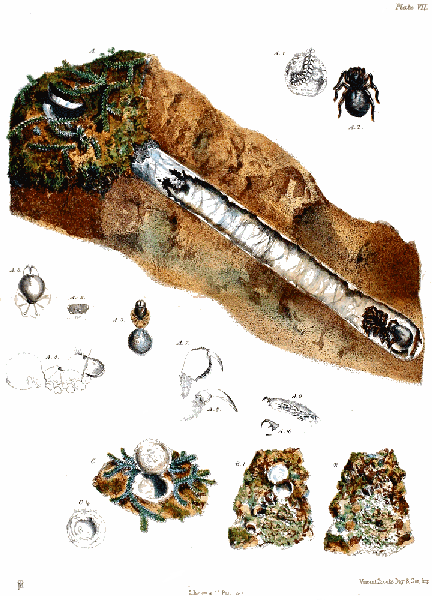
It was from such a terrace wall at Mentone, on March
26, 1872, that the nest A in Plate VII. was taken,
the tube running obliquely back into the earth between
the stones, and the door being concealed by a net-work
of lycopodium, one spray of which had been allowed
to grow on its upper surface.
The tubes of these as of the other kinds of nest are
sometimes straight, but more frequently they are bent,
and almost always take a downward course.
The following is Mr. Pickard-Cambridge's description[60]
of Cteniza fodiens, the spider which constructs
this nest.
Plate VII.
 Click on image to view larger copy.
FAM. THERAPHOSIDES.
Gen. Cteniza, Latr.
Cteniza fodiens. Plate VII.
Syn. Mygale fodiens, Walck. Ins. Apt., i. p. 237.
M. Sauvagei, Ausserer, Beiträge zur Kenntniss der Arachniden
Familie der Territelariæ (Thor.), p. 36.
Female adult length 10 lines.
Cephalothorax oblong oval, somewhat truncate at each end, and
of a dull whitish-yellow brown colour, the normal grooves and
furrows are strongly marked, the caput is large and elevated,
rounded on the sides and slightly higher near the occiput than at
the ocular area, the junction of the thoracic segments is indicated
by a strong deep curved indentation, the curve directed backwards;
there are a few strong black bristles of different lengths within the
ocular space, and several others run backwards in the central line to
the occiput. The height of the Clypeus is equal to rather more than
the diameter of one of the foremost eyes. The Eyes are eight, and
form a rectangular figure whose transverse diameter is the longest,
and whose fore side is a little shorter than the hinder one; the longitudinal
diameter is about equal to the space between the two foremost
eyes; these are the largest of the eight, and are separated by
an interval of very nearly two eyes' diameters; the two central
eyes are the smallest, and are distant from each other just about
one eye's diameter, the eyes of the hinder row are in two pairs
forming the hinder corners of the rectangle, those of each pair are
nearly contiguous to each other, and the inner one of each is the
smallest; these last in the figure appear to be the smallest of the
eight, but this arises from the point of view whence the figure was
drawn; the two central eyes occupy as nearly as possible the centre
of the figure formed by the two foremost eyes, and the two inner
ones of the hinder row, and are seated on a large black spot. The
Legs are short, strong, and similar to the Cephalothorax in colour,
their relative length appeared to be 4, 3, 1, 2, they are furnished
with hairs, bristles, and short strong spines. These latter are on
those of the two first pairs, situated chiefly in two longitudinal
parallel rows beneath the tibiæ, metatarsi, and tarsi; on those of
the third pair they are situated on the sides and upper sides of those
joints, while the fourth pair has them only beneath the metatarsi
and tarsi; all the tarsi terminate with three claws, the two superior
ones are much the longest and strongest, and have a single short
strong tooth inside near the base. Near the union of the femora
and genuæ of the legs of the fourth pair are numerous short strong
spines, hairs, and bristles. The Palpi are similar in colour to the
legs; they are strong and about equal in length to the legs of the
second pair, and have a double longitudinal row of strong spines
widely separated and divergent from each other beneath them; the
digital joint (like the tarsi of the legs) is furnished with other
spines between these two rows; each palpus terminates with a single
untoothed curved claw. The Falces are strong, prominent, rounded
in the profile line, and have some hairs, bristles, and spines near
their fore extremities; the longest and strongest of the spines are
three in number, and form a kind of transverse row or comb at the
extreme inner point on the upper side of each falx; besides these
there is a row of short tooth-like spines on either margin of the furrow
on the under side of each falx in which the fang lies concealed
when at rest. The Maxillæ are short and strong; the palpi issue
from their extremity on the outer side, and the inner extremity is
somewhat prominent and pointed.
The Labium is small, short, somewhat rectangular in form, and
broader than high; the apex is a little rounded, and furnished
with a single transverse row of small tooth-like spines.
The Sternum is somewhat subtriangular in form, much broader
behind, where it is rounded on the outer angles.
The Abdomen is short oval, very convex above, where it is of a
yellowish vinous brown colour, with a slightly darker longitudinal
tapering, indistinct central stripe on the fore part; it is sparingly
clothed with hairs, and the under side is of a pale dull yellowish
colour; the spinners are four in number, and those of the superior
pair are the strongest, three jointed and upturned.
Adults and immature examples (all females) were found in
tubular holes lined with silk and closed at the orifice with a strong
solid hinged lid, shutting into the opening like a cork.
The portions of nests at B and C in Plate VII.
also belong to Cteniza fodiens, the latter being very
similar to A in its surroundings, but having a
rather thinner door, slightly hollowed out above
(C 1). The smaller nest shown shut at B and
open at B 1,[61] is admirably concealed by mosses and
lichens, some of which actually grow upon the door,
and here two minute trap-doors, belonging to infantine
examples of a distinct species of spider (Nemesia
meridionalis), are seen on the left hand below.
It is not rare to find small colonies of nests of the
same or distinct species grouped closely together in
this way, though I greatly doubt whether one can
safely assume their sociability from this fact.
I have very seldom seen nests on the flat ground,
where the door would lie horizontally when closed, a
sloping or nearly vertical bank being usually chosen,
where the door will fall to by its own weight.
In the Ionian Islands another species or variety of
Cteniza, described under the name of Cteniza (or
Mygale) ionica, and represented as being of an uniform
yellow-brown colour, is said to make its nests in the
earth of the terraces round the roots of the olive
trees.
Mr. Saunders[62] gives admirable figures and descriptions
which show us at once that these nests, which
he discovered in rather elevated situations in the island
of Zante, are of the cork type; but, in this case, the
entire door does not shut flush with the surface, as in
ordinary cork nests, but has a short spur-like projection
above and behind the hinge, serving, as is conjectured,
like a lever, by pressing on which from the
outside the lid may easily be raised.[63] When I come
to speak of the manner of constructing and repairing
nests I shall have occasion to refer to these nests
again.
I have not as yet found any nests on the Riviera
which can be said to correspond accurately with those
of Ct. ionica, the only builders of cork nests yet discovered
in this district being Cteniza fodiens and
Nemesia cæmentaria.
This latter species is described by Mr. Pickard-Cambridge,[64]
in the following terms:—
Gen. Nemesia (Savigny).
Nemesia cæmentaria. Plate IX.
Syn. Mygale cæmentaria (Latr.), H. N. des Crust. t. vii.
p. 164.
M. cæmentaria (Walck), Ins. Apt. i. p. 135.
Female adult, length 9 to 11 lines.
Cephalothorax rather elongate, oval, and somewhat truncated
at each extremity; the caput is elevated and rounded on the sides
and upper part, but less elevated than in Cteniza; the normal
grooves and indentations are well marked, and the junction of the
cephalic and thoracic segments is indicated by a strong deep impression
or cleft, of a transverse, curved, or somewhat bent angular
form, the curve or angle directed forwards. The colour of the
cephalothorax is yellow-brown tinged with olive, the margins are
paler, but have no distinctly defined marginal band. On the
hinder part of the caput are three clear brown-yellow longitudinal
stripes; the central one reaches from behind the two hind central
eyes to the thoracic junction, the lateral ones converge a little to
the same point, but do not reach nearly, in fact not much more
than half way, to the eyes. The clypeus is of a clear brown-yellow
colour also, and on either side of it (extending from each fore
lateral eye), is an irregular patch of the same. The ocular region
and clypeus are furnished with a few strongish black bristles, and the
three yellow stripes above mentioned have a few more, those on
the central stripe being the longest and strongest, and disposed in
a single longitudinal row.
The Eyes, eight in number, are seated on a transverse oval
eminence, and form a rectangular figure, whose transverse diameter
is double the length of its longitudinal diameter: their relative
position is similar to that of Cteniza, but in the present species
they are smaller than in C. fodiens: those of the hind central pair
are the smallest of the eight, and each is very nearly contiguous
to the hind lateral on its side; the interval between those of each
lateral pair is small; the space between the two central eyes of the
eight is equal to an eye's diameter, and each of these is separated
from the hind central and fore lateral nearest to it by a similar
interval. The Legs are strong, moderately long, their relative
length 4, 1, 3, 2?, but little difference is observable between 1, 3,
and 2; they are furnished with hairs, bristles, and a few, not very
strong, spines; each tarsus terminates with three curved claws, the
two superior ones much the longest and strongest, and have a few
small teeth near their base inside.
The Palpi are strong and similar in colour and armature to the
legs; each is terminated with a curved black claw.
Falces strong, prominent, and rounded in the profile line; they
are furnished with hairs, bristles, and strong tooth-like spines; the
four strongest of these latter form a transverse row at the inner
extremity of each; besides these there is a row of short tooth-like
spines on the inner margin of the furrow on the underside of
each falx, in which the fang lies concealed when at rest. The
Maxillæ are strong, with a small angular prominence at their inner
extremities (when looked at from beneath), and each has three to
four small dark-coloured teeth in a short, straight, obliquely transverse
row at the base on the inner side. Labium broad but short,
its breadth is double its height, and the upper corners are rounded
off. The Sternum is of a somewhat pentagonal form.
Abdomen rather elongate oval, tolerably, but not excessively,
convex above; it is of a dull yellowish whitey-brown colour
marked and mottled above with dark chestnut brown; the markings
are rather irregular, but a general disposition in the form of
a longitudinal central, and oblique lateral, stripes or bars may be
traced on the hinder half; the superior spinners are short and
three-jointed, those of the inferior pair are exceedingly minute.
Adult females were found in nests similar to those of Cteniza
fodiens.
The cork nests are the simplest form of nest, with
the exception of those described above from Jamaica,
and have constituted, up to the present time, the only
type known in Europe. Their chief claims to our
admiration lie in the perfection of workmanship which
the doors usually exhibit, and the marvellous concealment
which they afford when closed. These doors as
a rule fit so tightly [thanks to the accurate adjustment
of their sloping sides to the bevelled lip of the tube
which receives them,] that they afford a certain amount
of mechanical resistance, even when the spider is
away. But, after examining a very large series of
these cork nests, I find that there is some variation in
the degree of perfection attained in their work by
different individuals of the same kind. The mechanical
resistance is greater or less in proportion to the thickness
and weight of the door, and to the slope of its
sides, and of the bevelled edges of the tube; and in
each of these details a marked difference may be
observed.
One might suppose from what has so often been
repeated as to the habits of N. cæmentaria, that, whenever
any one attempts to open the door, the spider,
which is always at home in the day time, would dart
up from the bottom of the tube and endeavour to
keep it closed by holding on from within.
Plate VIII.
 Click on image to view larger copy.
I cannot say what may take place during the summer
months; but from October to May I have but rarely
found one of these spiders ready to oppose me, though
Nemesia meridionalis and N. Eleanora frequently
did so. Many times, wishing to provoke them, I have
tapped at the door in order to apprise the occupant of
my arrival, or lifted it and let it fall again, and always
in vain, though the spider was there, crouching at
the bottom of her tube.
Indeed I can only recall six or eight instances in
which this spider did hold down her door, and on
three of these she was captured.
I will now relate what I saw on one of these
occasions,[65] for there has been much speculation as to
the manner in which the spider clings to the door and
offers the determined resistance which is experienced.
No sooner had I gently touched the door with the
point of a penknife than it was drawn slowly downwards,
with a movement which reminded me of the
tightening of a limpet on a sea-rock, so that the crown
which at first projected a little way above, finally lay
a little below the surface of the soil. I then contrived
to raise the door very gradually, despite the strenuous
efforts of the occupant, till at length I was just able
to see into the nest, and to distinguish the spider
holding on to the door with all her might, lying back
downwards, with her fangs and all her claws driven
into the silk lining of the under surface of the door.
The body of the spider was placed across, and filled
up, the tube, the head being away from the hinge, and
she obtained an additional purchase in this way by
blocking up the entrance.
I did not force the spider to release her hold, but,
by a rapid stroke with a long-bladed knife, cut out the
upper part of the tube with the surrounding mass of
soil, and thus secured the trap-door and its owner.
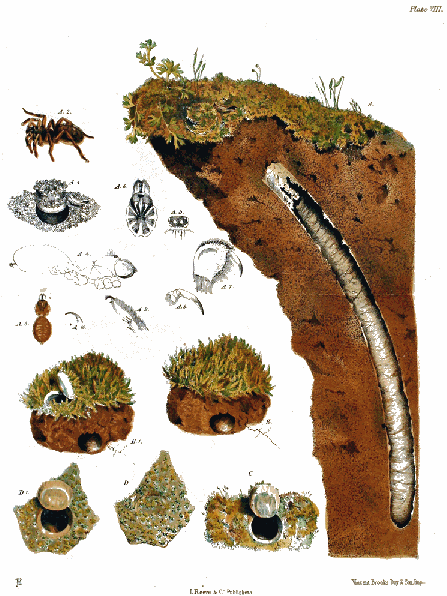
This specimen is represented at fig. C, Plate VIII.,
where the pin-point holes made by the claws may be
seen in pairs round the whole circumference of the
flatter portion of the lower surface of the door except
on the side next to the hinge.
Whenever a spider resists in this way she must
make these holes, but I have very rarely seen them
in other nests; this may perhaps be accounted for by
their having been effaced by the action of moisture
which would stretch the silk. However this may be,
this specimen showed the claw marks quite distinctly
on my return to England after the lapse of several
weeks.
Much has been written about these marks, which
are frequently spoken of as holes purposely made in
the silk in order to give the spider a better purchase.
It has also been stated that two holes may be seen in
the silk of the tube near the mouth on the side away
from the hinge, but these I have never been able to find.
The door of nest A in Plate VIII. is rather abnormal,
as it is made up of two doors, the smaller one being
spun into the top of the one now in use. This is, I
believe, an abnormal and rather clumsy example of
the ordinary way of enlarging the nest, but of
this we shall see more when we come to speak of
the construction and repairing of these nests generally.
Fig. B in this plate represents a moss-covered sod
pierced by the tube of a nest, the door of which is
entirely concealed from view, and only discovered
when opened as at B 1.
This nest was found accidentally by Mr. Robert
Lightbody, who kindly brought it to me, its presence
having been betrayed by the tube, which he happened
to cut through in digging up a plant. The moss on
the door grew as vigorously, and had in every way
the same appearance, as that which was rooted in the
surrounding earth; and so perfect was the deception
that I found it impossible to detect the position of
the closed trap even when holding it in my hand.
There can be no doubt that many nests escape observation
in this way, and the artifice is the more surprising
because there is strong reason to believe that this
beautiful door-garden is deliberately planted with
moss by the spider, and not the effect of a mere
chance growth. I shall adduce evidence in support
of this statement by-and-by.
I alluded to the nest C (Plate VIII.) when speaking
of the claw marks which it exhibits, and that
figured at D and D 1 in this plate is merely an instance
of a good example of this type. I have taken
nests of N. cæmentaria both at Cannes and Mentone,
and have little doubt that this species will be discovered
at many points along the Riviera. I detected
two abandoned nests of the cork type, which I fully
expect had belonged to N. cæmentaria, in an enclosed
space called the Campagne de Garonne in Marseilles
itself. These nests lay in the little mound of undisturbed
earth between the divided trunks of the small
olive-trees, and I do not doubt that if I had had time
to search I should have discovered more nests, and
perhaps others which were still tenanted.
We now turn from the single-door nests to those
with double doors, and from the well known to the
new types of structure.
In these we have a thin and wafer-like door at the
mouth of the nest, and from two to four inches lower
down, a second and solid underground door. These
lower doors are characteristic of the nests to which
they belong, that of the branched nest (Nemesia meridionalis,
Plate IX.) being long and more or less
tongue-shaped, while that of the unbranched double-door
nest (N. Eleanora, Plate XII. p. 106) is somewhat
horse-shoe shaped.
The surface doors of these two kinds of nest do not
appear to differ, and, though rather thinner, may be
compared to those of the single-door wafer kind from
Jamaica.
The commonest form at Mentone is the branched
nest, which may be found in abundance in many of
the loosely-built walls of the lemon and olive terraces
or on sloping banks, but they are rarely to be
met with on flat ground.
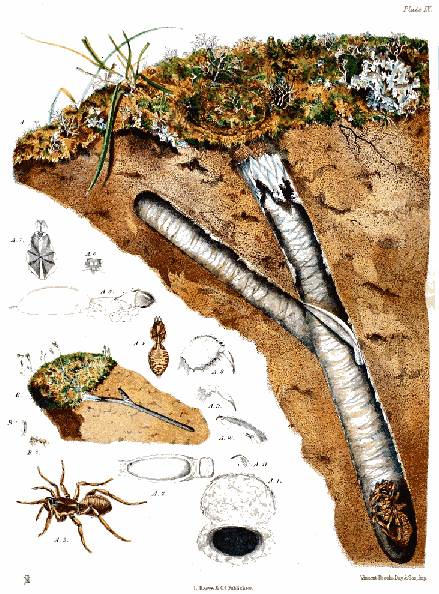
In the nests of Nemesia meridionalis the tube,
instead of being simple, as it is in all other known
nests, is invariably branched, a second tube joining
the first at the point where the lower door is hung
and forming with it an angle of about 45°. The main
tube descends and is frequently curved, or sometimes
doubly bent like the spout of a tea-kettle (A, Plate X.
p. 100), while the branch ascends, and in some few
instances reaches the surface, though it is usually a cul
de sac (Plate IX.)
Plate IX.
 Click on image to view larger copy.
In the exceptional cases where the nests have two
superficial openings, one of the two surface doors
always appears neglected and going to decay, or is
covered with earth which chokes the upper part of
its tube. The explanation of this probably is that
the spider found the original entrance blocked up or
in some way unfitted for use, and then prolonged
what was the blind branch until it reached the surface
and replaced the former doorway. However this
may be it is certain that in the great majority of
nests it will be found that the branch ends in the
earth, and is a cul de sac, and this I have invariably
observed to be the case in the nests of very young
spiders of this species (fig. B, Plate IX.)
The tube is frequently enlarged at the mouth, and
forms a spreading lip which the surface door is usually
large enough to cover (A 1, Plate IX.)
In these branched double-door nests the upper door
does not fit into, but merely lies upon, the mouth of
the tube, the elasticity of the hinge and its own weight
being sufficient to keep it closed. The lower door is
suspended by a hinge placed at the apex of the angle
formed by the bifurcation of the tube, and is hung in
such a manner that it can either be pushed upwards
so as to lie diagonally across and block the main tube,
or be drawn back so as to fit into and close the
entrance to the branch.
This will, I think, best be understood by reference
to the drawings of a small nest of this type given at
B 1 and B 2 in Plate XI. p. 105, where the second door
is shown in its two positions. This lower door is from
1 to 11/2 lines thick, channeled above, but nearly flat
on the back, and of an elliptic form, with a loose appendage
at its lower end, the whole being made of
earth enclosed in a case of silk.[66] When the lower
door is drawn back so as to close and conceal the entrance
to the branch, it lies in the same plane, and
closely corresponds in curvature with the lining of
the main tube and almost appears to form part of it
(fig. A, Plate X. p. 100, and fig. B 1, Plate XI. p. 105).
When digging out these nests, after carefully removing
the upper portion, I have frequently seen the
lower door move across and block up the main tube
in a mysterious manner, it being in reality pushed by
the spider from below, and she may sometimes be captured
at her post with her back set against the door.
More frequently, when the spider finds that resistance
is hopeless and sees the earth crumbling in, she drops
to the bottom of her nest and lies there helpless, with
her legs folded against her body like an embryonic
creature; some, however, more savage than their
neighbours, fly out and strike at the intruder with
their fangs.
Plate X.
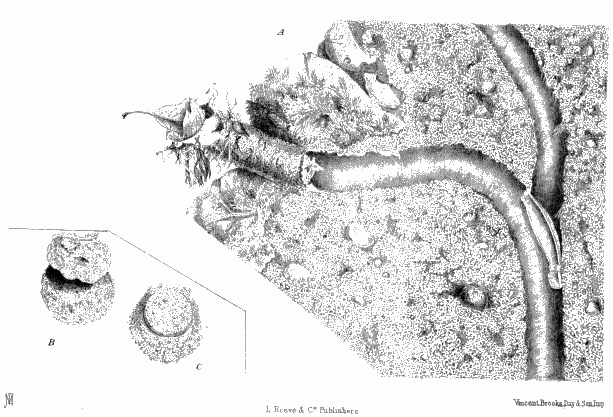 Click on image to view larger copy.
What then, it may be asked, is the use of the
branch? I do not think that we can draw any safe
conclusion from what takes place when we dig out a
spider, as to what would occur if she were besieged by
one of her natural enemies, such as ichneumons, sand-wasps,
centipedes (Scolopendra), small lizards &c.[67]
Let us suppose, however, that one of these creatures
has found its way into the nest and is crawling down
the tube. What will probably happen? Why, in
the first place, the spider will slam the second door in
the face of the intruder, and then, if worsted in the
pushing match which follows, quickly draw this door
back again and run up into the safety branch, when
the enemy, after descending precipitately to the bottom
of the main tube, will look in vain for the spider as
it searches on its way up for the secret passage now
closed by its trap-door. This is but a purely imaginary
case, and it may be that the branch has some wholly
different purpose.
It seems very improbable, however, that it should
be mainly intended as a safety place for the eggs or
offspring; at least if this were the case we should not
expect to find it, as we do, in the nests of very young
spiders (fig. B, Plate IX.), which could have no use
for it.
The large spider and its nest figured at A and A 3
in Plate IX. were taken at Mentone on March 17,
1872, and the following is the technical description of
the species, written by Mr. Pickard-Cambridge:—
Nemesia Meridionalis. Plate IX.
Syn. Mygale meridionalis (Costa). Fauna del Regno di Napoli,
p. 14, Pl. I., figs. 1-4, ad partem.
Female adult, length 11 to 13 lines.
This spider is very nearly allied to N. cæmentaria both in
general structure and colours, but it may be distinguished by the
more elongate form both of the cephalothorax and abdomen; the
colours also of the present species are more distinctly distributed; a
well-defined narrow marginal band, irregular on the inside, surrounds
the thorax; and the caput has a large curved patch of the same
on either side of the ocular area, with a broad tapering band tinged
with orange, which runs from immediately behind the eyes to the
thoracic junction, where it ends in a point. The transverse diameter
of the ocular area is also less in proportion to its longitudinal
diameter than in N. cæmentaria, and the eyes are all smaller, but
placed on a similar oval eminence, and several bristles are directed
forwards from the middle of the lower margin of the clypeus, while
one or two others are found in the ocular area, and three or four
more (long, strong, and nearly erect) form a longitudinal row
along the middle of the central tapering thoracic band. The Falces
are deeply yellow-brown, with two to three elongate oval patches
or short longitudinal parallel bands on their upper sides; in their
armature the falces are similar to those of N. cæmentaria. The
Labium appeared to be less broad in proportion to its height, and
the Sternum smaller and of a more oval form than in that species.
The Abdomen is similarly marked, though the chocolate-brown
markings appeared to be less deep and dense, being more broken
up, but still forming several fairly defined, bold, and broad angular
bars or chevrons on the upper side. The inferior spinners, though
small (like most of the corresponding pair in species of this family),
are yet considerably stronger than in N. cæmentaria.
Adult females of this spider were found in tubular silk-lined
holes in the earth, closed at the external orifice with a flat scale-like
hinged lid, covered with lichens and mosses. Not quite half
way down this tube is a tubular branch running off upwards at an
angle of 45° or less; the main tube also at this point is furnished
with an elliptical-hinged valve, with which the spider appears to
have the power to close the entrance to the branch or to shut off
the upper part of the main tube. This branch (found also in the
tubes of very young examples) seems to be certainly a strong distinguishing
character in the economy of the species, and separates
it at once from N. cæmentaria. In the nest of N. meridionalis the
tube also projects at times above the surface of the soil upwards
among the herbage which serves to conceal it. Costa appears to
have had before him this latter species as well as what is here
taken as the typical N. meridionalis, as he speaks of the nests
under his observation as being frequently branched, while his
description would suit both species; his figure, however, more
nearly agrees in the thoracic pattern with the spider above described.
Ausserer, in his elaborate paper on the Mygalides, lately
published (Beiträge &c. vide supra), appears to have overlooked
M. meridionalis (Costa) altogether; while Canestrini and Pavesi
(Catal. degli Araneidi italiani in Atti Soc. Ital. Sc. Nat. xi. (1869)),
p. 25, include it under the synonyms of M. fodiens Walck., from
which it is undoubtedly distinct, as may be seen at once, even if it
were only by the difference in the form and structure of the lid
with which the external orifice of the tubular nest is closed.
In the case of the upper door of these branched
nests, as there is but a very thin coating of earth on
their upper surface, it is rare to find any of the larger
mosses or lichens growing upon them; but, as if to
compensate for this deficiency, a variety of foreign
materials are employed which are scarcely ever found
in cork doors, such as dead leaves, bits of stick, roots,
straw of grasses, &c., and I have even seen freshly-cut
green leaves, apparently gathered for the purpose,
spun into a door which had recently been constructed.
But here again there is the widest possible difference
between nest and nest in the degree of perfection in
their concealment; and, although as a rule the surface
of the upper door harmonizes well with the general
appearance of its surroundings, there are some individual
nests in which it readily catches the eye and
even attracts attention.
Thus, I have seen nests in mossy banks where the
doors, being made of nothing but earth and silk,
showed distinctly as brown patches against the green;
and those doors which are covered with earth only,
even when they are surrounded by earth, are often
easily detected, because when they dry up, as they
quickly do, they become much paler in colour than
the earth of the bank, which retains its moisture.
Perhaps in no case is the concealment more complete
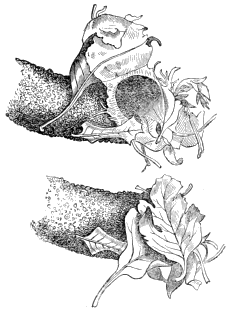
than when dead leaves are employed to cover the door.
In some cases a single withered olive leaf only is spun
in and suffices to cover the trap; in others, several are
woven together with bits of wood and roots, as in the
accompanying woodcut, which represents different
views of the upper door of the nest which is drawn
in Plate X. p. 100.
Plate XI.
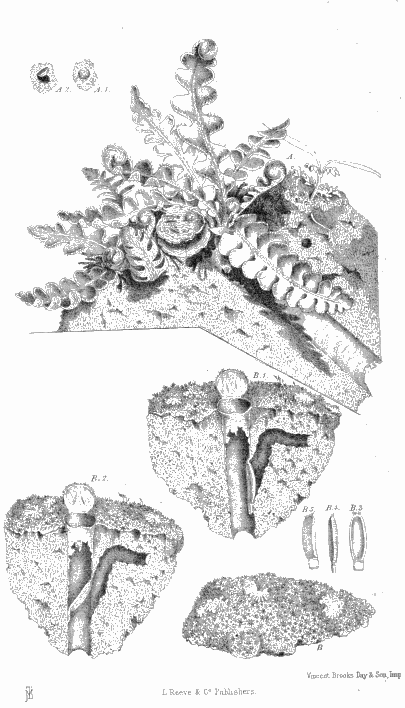 Click on image to view larger copy.
In this nest another interesting feature presents
itself, for here the tube projects a short way beyond
the surface of the ground and is hardened and coated
with earth and fine gravel in such a way that it
requires no other support. This is not commonly the
case, and may perhaps be the result of a contrivance
to meet the necessities of a nest which has had the
surface earth washed away from it. But I have frequently
observed nests in which the upper part of the
tube is carried up for two or three inches through
grass, moss, ferns, pellitory, or the like, the stems of
the sheltering plants being interwoven with and made
to support the tube.[68] In every case the second door,
which is designed for resistance and requires a firm-walled
tube into which it may be wedged, is below
ground, and for the same reason we scarcely ever
find cork nests constructed with any part of the tube
projecting beyond the surface of the soil.
At fig. A, Plate XI., one of these branched nests is
seen concealed in a plant of ceterach fern, and here
the tube is raised a short way above the soil; while
in fig. B of the same plate the common form is
represented, the upper door lying flat on the surface
of the ground, from which, thanks to its covering of
small mosses, it is scarcely to be distinguished.
The figs. B 1 and B 2 show this door open and the
lower door in its two positions.
Now that attention has been drawn to the existence
of this new type of nest, I fully expect that Nemesia
meridionalis will be found at many points along the
Riviera and in the whole Mediterranean region, but
I have hitherto only discovered it at Mentone and
Cannes. Mrs. Boyle saw one of these nests in the
Pallavicini gardens near Genoa, and there seems every
reason to believe that certain nests which have been
detected near Naples and in Ischia, will, when better
known, be found to be of the branched double-door type.
It seems probable that our spider belongs to the
species which was first described by M. Costa,[69] under
the name of Mygale meridionalis, though, if we are to
rely implicitly on the figures and detailed account
given by this naturalist, we must suppose that it constructs
a different nest in Southern Italy from that
which it makes on the Riviera, and one which,
although it agrees in most other respects, is destitute
of the characteristic subterranean door.
It is more likely, however, that M. Costa has overlooked
the existence of the lower door, though it is
strange that he should have done so, as he says that
the nests "sometimes have a double aperture, and the
upper portions of the burrows meet and anastomose
at about two inches distance," thus showing that he
was aware that the tube is branched.
One more nest only now remains to be described,
and this is again an example of a new type—namely, of
that which I have distinguished as the unbranched
double door (Plate XII.), the work of Nemesia
Eleanora. This nest is never branched, and its second
and subterranean door is situated from one to four
inches below the surface door, and only serves to close
the one tube which is narrowed above the insertion of
this lower door. Here, as in the branched nest, the
thin and wafer-like surface door appears to serve
principally for concealment and the lower one for
resistance. This latter, made out of earth encased
in strong white silk, is from one to two lines thick,
and has, at the end away from the hinge, a similar
appendage to that found in the lower door of the
branched nest. This appendage serves, I imagine, as
a kind of ear by which the door, when firmly jammed
into the tube on the approach of an enemy, may be
pulled down again as soon as the alarm is over. As
in the branched nest it has the upper surface concave
and the lower slightly rounded, so that when
drawn back and not in use it may not obstruct the
passage. The sides of this lower door slope a little,
so that the crown is smaller than the base; and this
is important, because it causes the door to fit more
tightly when driven upwards into the tube, acting on
the principle of an inverted cork door.
Plate XII.
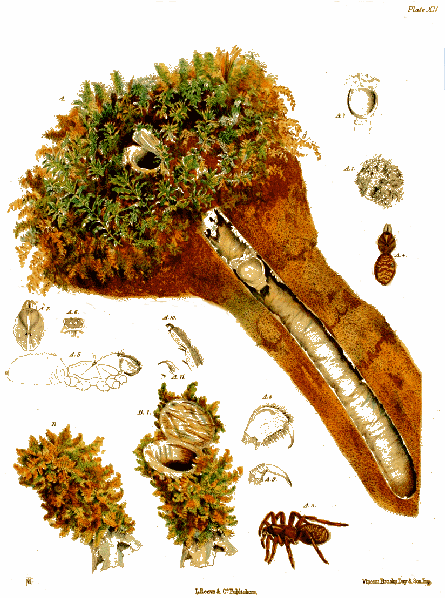 Click on image to view larger copy.
In form this door is somewhat elliptic, but much
broader and shorter than the second door of the
branched nest, and it is frequently of a nearly horse-shoe
shaped outline. The second door of the branched
nest is necessarily longer, having to perform the
double function of closing the opening to the branch
and the passage of the main tube.
In either case, however, these doors will be found to
be more or less elliptic, and this is necessarily so, for,
lying as they do when in use in a plane which cuts
the subcylindrical tube obliquely, they have to fill a
somewhat elliptical area.[70]
I have observed some variation as to the exact
proportions of these doors, and it is quite possible
that in many cases they are specially adapted to meet
peculiarities in the curvature of the tube.
The nest and spider drawn at figs. A and A 3 of
Plate XII. were first discovered by the Honourable Mrs.
Richard Boyle at Mentone, on March 26th, 1872, and
the following is the description of the species kindly
prepared by Mr. Pickard-Cambridge:—
Nemesia Eleanora, sp. nov. Plate XII.
Female adult, length 11 to 12 lines.
This spider, which has (like N. meridionalis) probably been
confused with its near ally N. cæmentaria, is yet easily distinguished
from both by its deeper and richer colouring, as well as
by other characters.
The Abdomen has a far more spotted appearance; in some examples
a similar series of dark, broken, slightly angular bars is
indistinctly visible on the hinder half of the upper side; in others
(the more common type) the darker colouring preponderates, and
some transverse, broken, slightly angular, or nearly curved bars or
lines of pale spots constitute the pattern; the lateral margins of
the thorax are not so distinctly yellow as in N. meridionalis, and
there is a single longitudinal stripe on the caput, of a dull orange-yellow
brown, commencing directly behind the eyes and tapering
to the thoracic junction; the depression or pit at this point is more
strongly marked than in either of the two foregoing species; the
ocular area is also smaller, and its transverse diameter is less in
proportion to its width; the bristles on the margin of the clypeus,
as also those within the ocular area and in the central longitudinal
line of the caput, are similarly disposed to those in N. meridionalis,
but are more numerous; in some details, however, of form and
structure—viz., the Labium and Sternum—the present species is
more nearly allied to N. meridionalis than to N. cæmentaria. The
Legs seemed to be rather longer and stronger than in either; the
tarsi and metatarsi of the two first pairs, as well as the digital
joints of the palpi, are rather densely clothed a little underneath
on their outer sides with a kind of fringe or pad of close-set hairs;
in other respects the armature of the legs appeared to be similar
to that of the other two species, except that in the present one
there are three short strong red-brown spines in a longitudinal row
on the outer sides of the genual joints of the third pair; these spines
were plainly visible in all the examples found, but did not exist in
any one of those of the two former species. The armature of the
falces, which are of a uniform yellow-brown colour, is similar to
that of those species.
Adult females were found in tubular silk-lined unbranched holes,
closed at the orifice with a flat scale-like hinged lid concealed by
mosses and lichens, and having a horse-shoe shaped second valve or
door less than half way down the tube, of which it serves to shut off
the upper part. In this nest, as in that of N. meridionalis, the
upper part of the tube often projects above the surface of the soil.
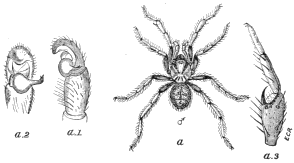
Nemesia Eleanora ♂ Adult, natural size.]
Since the above description of the female of this species was
written, an example of the adult male has been most opportunely
discovered. It is much smaller than the female, its length being
only six lines. The Cephalothorax is of an uniform clear yellow-brown
colour, tinged with orange, and thinly clothed with a greyish
pubescence: the oblique indentations marking the union of the
cephalic and thoracic segments are indicated by a strongish black-brown
band on either side, which becomes obsolete as each approaches
the other near the central curved indentation; there are
also two or three converging suffused blackish stripes on the hinder
slope. The relative length of the Legs is the same in both sexes,
4, 1, 2, 3, but in the male those of the fourth are longer in
proportion to those of the third pair than in the female; the spines
also on the legs are more numerous and stronger, the upper sides
of the femora of all the legs are deeply suffused with black, while
in the female this suffusion is not nearly of so marked a character,
though the genua of the different females examined had a strong
brown-black macula on the outer side of each, while the corresponding
maculæ in the single male examined were but just visible; the
three spines observed on the outer side of the genua of the third
pair of legs in the female are of even a more marked character in
the male, and hence they may be considered a good and tangible specific
difference from other nearly allied species; the tibiæ of the first
pair are considerably enlarged on the under side at the fore extremity,
where each is armed with a single, longish, strong, slightly curved,
pointed black spine directed forwards (fig. a, 3). The Abdomen is small
and of an oval form; its colours and markings resemble those of the
female, but on the hinder half of the upper side two or three indistinctly
traced pale angular bars or chevrons are formed by the distribution
of the black-brown colours and markings; the under side of
the abdomen is of a uniform pale whitish yellow, except the spiracular
plates, which are yellow-brown. The Palpi are moderately long
and strong; the radial joint is longer than the cubital, and is of a
tumid and somewhat oval form, suffused over most of its surface
with dark brown, the rest of the palpus being of a yellowish-brown
colour; the digital joint is small and somewhat oblong-oval,
curved downwards, and very slightly concave on its inside; the
palpal organs consist of a nearly globular, basal, corneous bulb
prolonged into a strongish, curved, but not very long, pear-stem
form, the stem being distinctly cleft or bifid at its extreme
point (vide figs. a 1, and a 2), one portion of the bifid part is larger
than the other, though both are equal in length, and the stem of
the palpal bulb is directed transversely outwards, almost at right
angles with the digital joint.
Until the discovery of the male spider now described, and which
is, without doubt, the male sex of the female described immediately
before, this latter was thought to be the female of Nemesia
Manderstjernæ (Ausserer), and it had indeed been so determined by
Professor Ausserer himself. But the form of the palpal organs
differs so decidedly from those of N. Manderstjernæ (Ausserer,
Beiträge ... der Territelariæ, Verhandl. Z. B. Gesllsch: Wien,
1871, Bd. xxi. p. 170), that all doubts as to the present being a
distinct (and as it is believed to be) a hitherto undescribed species,
are removed. From M. Ausserer's description, the pear shaped
stem of the palpal bulb in N. Manderstjernæ is comparatively
slender, ending in a fine and uncleft point, whereas, in N. Eleanora,
the stem is strong and its extremity cleft: other differences are
also observable in the two spiders, but this one is well marked and
the most tangible.
The specific name, Eleanora, now conferred upon the species, is
taken from the Christian name of the Hon. Mrs. Boyle, reference
to whom has been before made, and of whose kind exertions some
acknowledgment is thus permanently recorded.
In fig. A, Plate XII., the upper door, which, if
closed, would be entirely hidden by the long filmy
mosses which surround and cover it, is represented
open; but it should be clearly understood that this is
artificial and not natural, as in reality these doors
close of their own accord by means of their weight
and the elasticity of the hinge. It will be seen that
living mosses of two kinds are worked into the upper
surface of this door, which was admirably concealed.
(fig. A 1, Plate XII.).
It is chiefly in the absence of the branch and the
different form of the lower door that the nest of
Nemesia Eleanora differs from that of N. meridionalis;
and, as they inhabit the same localities, it is
only when one has dug down as far as the lower
door that it can be known to which of the two species
the nest belongs. When once this point is reached
however, all doubt is at an end; for in this case the
unbranched double-door nest differs from the branched
in a way which any child could realize, though the
respective spiders are not very dissimilar when seen
with the naked eye alone. This affords a good
instance of the benefit which may accrue to a collector
from a study of the habits of the creatures which he
collects, for it is certain that it was the nest in this
case which first proclaimed the distinctness of its
tenant.
Nemesia Eleanora is rather less common at Mentone
than N. meridionalis, but at Cannes I found the
reverse to be the case. At the latter place, on the
northern slope of the little hill of St. Cassien, branched
and unbranched double-door nests may, however, be
found in tolerable abundance, the traps being frequently
concealed by fallen leaves from the cork oaks, which
are woven into their upper surface.
The nest of N. Eleanora often has the upper part
of the tube prolonged above the surface of the ground
and carried up through mosses, grasses, and the like.
An example of this is seen in figs. B and B 1, Plate XII.,
in which the upper part of the tube is represented
with the surface door open in the one case and shut in
the other.
The concealment here was so complete that I should
never have discovered the nest but for the merest
accident. I happened to want some moss to lay with
flowers in my botanical tin, and in one handful which
I plucked up this trap-door lay concealed. It should
be observed that the upper part of the tube and its
surface door were covered with growing moss, and
this moss must have lived exclusively upon the moisture
which the very damp and shady situation afforded,
as there was no earth mixed with the silk.
When digging out the nests of N. Eleanora, I
have frequently seen the lower doors pushed forwards
so as to close the tube; and it is my belief that the
spider, after having thus barred the passage, puts her
back against the door and resists in this way. I must
own, however, that, though I believe I have seen the
spider in this attitude when I have severed the tube
from below, I am not quite certain about it.
I have twice in the months of April and May, and
frequently in October and November, found young of
this species in the nests with their mother. Usually
they were all very small and not larger than that
represented at fig. B 2, Plate IX., p. 98, but occasionally
in October I have found two or three young
spiders thrice the size of their companions still in the
nest. On one occasion (in April) I found twenty-four
small spiders clustered beneath and beside their
mother.[71] I secured the whole family by quickly
cutting out the mass of earth containing the lower door
on the under side of which they remained crouched,
and brought them home alive. I had up to this
time been in the habit of killing the spiders by placing
them in a stopper bottle full of strong spirit of wine,
but on treating these spiders in this way I saw
reason to regret having done so. I knew that these
large spiders, when thrown into spirit of wine, would
continue to struggle for an hour or more, spasmodically
spreading out their legs as if swimming; but I had
supposed that this was only muscular motion, and was
not in the least aware that the unfortunate creatures
were probably conscious all the while. In this
instance I first placed the mother spider in the bottle,
and then, after the lapse of about ten minutes, when
I supposed that the spider, though still struggling,
was dead to sense, I dropped in the young spiders.
No sooner, however, had I done this than the mother,
perceiving them, gathered all her young to her, and,
after placing them beneath her, with her legs drawn
up round them, as a hen screens her chickens with her
wings, never stirred again, and retained this attitude
until death released her, and the limbs, no longer under
the control of this wonderful maternal resolution,
slackened and fell abroad.[72]
I need scarcely say that the small spiders were
killed by the spirit in a very few instants, but
it is almost certain that the mother was alive
and conscious for half an hour. Now this pain can
easily be spared by placing large spiders for about
ten minutes in a closed box with a piece of cotton
wool steeped in chloroform beside them, before dropping
them into the spirit of wine, a system which I
have since that day adopted and found to answer
perfectly.
I examined these young spiders carefully, hoping
to detect some males among them, but the males,
though they differ markedly from the females when
adult in their smaller size and curiously enlarged
palpi, do not appear to afford any distinctive mark at
this early period. It appeared that these spiders had
been but recently hatched, for some among them
were still semi-transparent.
I have never found young spiders in the nests of
Cteniza fodiens or Nemesia cæmentaria.
M. de Walckenaer[73] quotes a statement made by
M. Rossi to the effect that Cteniza fodiens carries
its young on her back, as certain species of Lycosa
(Tarantula) do. He points out the interest which
would attach to this observation if confirmed, as showing
a similarity in habit between the two groups,
which are otherwise nearly related.
Observations of this kind are difficult to make satisfactorily,
at least in the case of the trap-door spiders
with which I am acquainted, and which appear to be
nocturnal in their habits. I have certainly never
seen them out of their nests in the daytime, and but
rarely detected one of them (Nemesia cæmentaria) even
venturing to peer out of her door set ajar for the
purpose.[74]
The following very singular account is given by
M. Erber[75] of the habits of Cteniza ariana, which he
watched in the island of Tinos. I quote from the
abstract given in the Zoological Record cited below:—"At
night these spiders come out of their nests,
fasten the open trap-door to neighbouring objects,
and spin a net, about six inches long by scarcely half
an inch in height. In the morning the nets were
removed, and Erber believes that the net of each
night is added to the trap-door. He found eggs at
the bottom of the tubes, attached singly to threads, to
the number of about sixty. The young seem to form
dwellings very early."
It would be very interesting to know whether
these nocturnal habits are also found in our spiders
on the Riviera.
I have been favoured[76] with a sight of an unpublished
manuscript by Mr. Hansard giving an account
of his observations on Cteniza fodiens, made in Corfu.
This gentleman states that some of these spiders
which he kept in captivity, used to come out at night,
and might sometimes be surprised roaming about the
room at a very early hour in the morning. He, however,
relates that he had received from a friend an
account of a trap-door spider inhabiting the island of
Formosa, in the China seas, which constructed nests
similar to those of Cteniza fodiens, but which were
habitually to be seen outside their nests in the daytime,
attracting attention by "staring at" any one
who might approach, and then hurrying back to
their nests and closing their doors after them.
Lady Parker has also told me of some black trap-door
spiders which were so common about Paramatta,
near Sydney, in Australia, that scarcely any one paid
attention to them, and which might habitually be
seen out on the garden paths in the daytime near
their holes, to which they would run in all haste
when alarmed. The eye of the passer-by was attracted
by the open doors, which were about the size
of a sixpence, and fall over backwards when the spider
makes her exit, but when closed, on her return, they
fit so neatly that it is extremely difficult to detect
them.
It will, perhaps, have been observed that I have
throughout spoken of the female spider only, scarcely
any allusion having been made to the male. The
truth is that, though I have carefully searched for
them, I have never been able to secure more than
a single male spider.[77] During the winter, spring,
and late autumn (October) the female appears to live
solitary, in the daytime at least, and the male probably
hides in the crevices of old walls and in similar
places. I have diligently turned over piles of stone,
greatly to the annoyance of many little scorpions, but
have never secured, or even seen, another male spider.
This is the more to be regretted as the species of
trap-door spider are much better characterized in the
male than in the female sex, the bulb-like enlargement
which is found at the end of the palpi in the
former taking on a great variety of forms, each of
which is distinctive.
M. de Walckenaer[78] says:—"C'est toujours pendant
la nuit que ces aranéides travaillent à leurs
habitations et courent après leur proie. C'est en
Août que la Mygale maçonne (Nemesia—or Mygale—cæmentaria)
atteint toute sa grosseur.... En
Septembre elle devient mère et méchante en même
temps ... les mouches, les moucherons, les
petits vers lui servent de pâture; elle les prend dans
les filets qu'elle étend et attache sur les inégalités des
terres voisines de sa demeure. Elle vit après la ponte
en société avec son mâle. Dorthès a vu plusieurs fois,
dans la même habitation, le mâle et la femelle avec
une trentaine de petits."
Any one, therefore, who has an opportunity of examining
the nests during the early autumn, might
perhaps, discover the happy families spoken of by M.
Dorthès, but which it has never been my good fortune
to see. It is not known positively whether the
male spider ever assists in the construction of the
nest, but, as we know that the female is able to make
it without his aid, there seems no reason to suppose
that he does.
I have seen the female Nemesia meridionalis construct
a trap-door in captivity, after having been placed on a
flower-pot full of earth in which I had made a cylindrical
hole.[79] She quickly disappeared into this hole,
and, during the night following the day of her
capture, she made a thin web over the aperture, into
which she wove any materials which came to hand.
The trap-door at this stage resembled a rudely constructed,
horizontal, geometrical web, attached by two
or three threads to the earth at the mouth of the hole,
while in this web were caught the bits of earth, roots,
moss, leaves &c. which the spider had thrown into it
from above. After the second night the door appeared
nearly of the normal texture and thickness, but in no
case would it open completely, and it seemed that the
spider was too much disgusted with her quarters to
think it worth while to make a perfect door. I believe
that when a door is finished the few threads which
served as supports and connected it with the earth on
either side of the hinge are severed, and this is borne
out by the following instance. While I was at work
one evening drawing the spider's nest concealed in the
plant of ceterach fern (Plate XI., fig. A, p. 105) which
I had dug out for the purpose, I detected something
moving at the mouth of a tiny hole [just large enough
to admit a crowquill pen] in the mass of earth on the
opposite side of the fern, to that in which the large
trap-door lay.
The lamp-light fell full upon it, and I soon saw that
the moving object was a very small spider, not bigger
than that drawn at B 2 in Plate IX., which was at work
in the mouth of its tube. Whether I had, in removing this
mass of earth, destroyed the door I cannot say, but it
is certain that the opening of the tube was completely
uncovered, and it soon became apparent that the little
spider was intent upon remedying this deficiency.
After a few threads had been spun from side to side of
the tube I watched the spider make one or two hasty
sorties, apparently spinning all the while, and finally I
saw her gather up an armful, as it were, of earth and lay
this on the web. After this the occupant of the tube
was concealed, but I could see from the movement of
the particles of earth that they were being consolidated,
and that the weaving of the under surface of the door
was being completed. Next morning I was able to
lift up the door, which had the form of a small cup of
silk, in which the earth lay. It was then soft and
pliant, but in ten days time it had hardened and
become a very fair specimen of a minute cork door (see
figs. A 1, A 2, of Plate XI.).
On one occasion a captive Nemesia meridionalis
employed some pieces of scarlet braid which I had
purposely strewed, along with bits of moss and fragments
of leaves, in a circle round the opening of, and
about two inches away from, the hole.
It is probable that these spiders have in times past
learned by experience that they cannot do better than
take such materials as come to hand, as these will
ordinarily serve for the concealment of their door.
However, these trap-door spiders do seem to exercise
some discrimination in the choice of materials; for I
have observed several instances in which, when the
door of a cork nest has been removed, if the door was
originally covered with moss, moss will again be used
in its reconstruction, even though the mouth of the
tube be then surrounded by bare earth.
Thus, for example, in one case where I had cut out
a little clod of mossy earth, about two inches thick
and three square on the surface, containing the top of
the tube and the moss-covered cork door of N. cæmentaria,
I found, on revisiting the place six days later,
that a new door had been made, and that the spider
had mounted up to fetch moss from the undisturbed
bank above, planting it in the earth which formed
the crown of the door.[80] Here the moss actually called
the eye to the trap, which lay in the little plain of
brown earth made by my digging.
I have seen the same thing happen when the door
of N. Eleanora has been removed and replaced, moss
being again used in the work of reconstruction. Trap-door
spiders in warm weather very quickly replace
their trap-doors; and if you pass by a wall where
several nests have been robbed of their doors only
a week before, they will usually be found quite perfect
again.
It has been stated[81] that, if the door of a cork nest
be fastened down with a pin, a second door will be
found next day by the side of the former one. No
doubt spiders not unfrequently find their doors
blocked up by a fall of earth, and are thus obliged
either to make a new opening or to prolong the old
tube.
I once fastened open the surface doors of three of
the double-door nests by passing a thread through
the silk of the door and tying it back to some twigs
above. The doors were thus turned backwards, and
the aperture of the tubes, which lay in a vertical terrace
wall, exposed to view.
Next day, after a night of very heavy rain, I found
the doors as I had left them, but in one nest the
lip of the tube had been dragged inwards so as
partially to close the tube; in the second nothing
appeared to have been done, but in the third nest a
new covering had been very cleverly extemporized
out of three fallen olive-leaves, which were loosely
spun together and attached by one or two threads to
the margin of the tube. This formed an admirable
concealment, but did not move freely as a door, the
web being too imperfect. Two days later, however, it
was completed and had become a perfect door, moving
on a hinge just within and below that of the
former door, which still remained as I had fastened
it. The other nests remained in the same condition
as before, only that a little moss had been
dragged into the mouth of the tube of the nest,
which had been partially closed with its own lip.
The extreme reluctance which these spiders show
to abandon their dwellings is curiously exemplified
by what follows.
Certain nests which were furnished with two doors
of the cork type were observed by Mr. S. S. Saunders[82]
in the Ionian Islands. The door at the surface of
these nests was normal in position and structure, but
the lower one was placed at the very bottom of the
nest and inverted, so that, though apparently intended
to open downwards, it was permanently closed
by the surrounding earth. The presence of a carefully
constructed door in a situation which forbade
the possibility of its ever being opened seemed,
indeed, something difficult to account for. However,
it occurred to Mr. Saunders that, as these nests were
found in the cultivated ground round the roots of
olive-trees, they may occasionally have got turned
topsy-turvy when the soil was broken up. The
spider then, finding her door buried below in the
ground and the bottom of the tube at the surface,
would have either to seek new quarters or to adapt
the nest to its altered position, and make an opening
and door at the exposed end. In order to try
whether one of these spiders would do this Mr.
Saunders placed a nest, with its occupant inside, upside
down in a flower-pot. After the lapse of ten
days a new door was made, exactly as he had conjectured
it would be, and the nest presented two doors
like those which he had found at first.
There is a specimen of one of these inverted nests,
with its two doors, in the British Museum, and this
might easily be supposed, at first sight, to be an
example of a new kind of double-door nest. On close
inspection, however, it will be seen that one of the
two doors is discoloured and partly decayed, this
being, no doubt, the one which had been buried beneath
in the earth and so rendered useless.
Questions have often been asked as to the manner
in which trap-door nests are commenced in the first
instance, and whether the weaving of the silk lining
is begun at the top or the bottom of the tube.
The structure of the cork door also, which often
appears so perfectly turned as to resemble the work
of a potter's lathe, is another difficulty.
These questions have, as it seems to me, been
needlessly complicated by taking it for granted that
the perfect nest of the mature spider is made all at
one time, that the tube, perhaps of a foot in length,
is excavated, lined, and furnished with a door within
some short period of time, such as ten days or a
fortnight, perhaps.
On the contrary, I believe that the nests are, as a
rule, the result of many successive enlargements, and
that the nest of the infant, the tube of which is no
bigger than a crowquill, is not abandoned, but becomes
that of the full-grown spider. This must
require time, but how long, whether months or years,
we have yet to learn.
Very little is known at present as to the longevity
of spiders, but Mr. Blackwall[83] says that some live
only one year, while others, such as Tegenaria civilis
and Segestria senoculata, have been known to live four.
Whether the trap-door spiders are very long lived
or not I cannot positively say, but, from the appearance
of the growth of moss and lichen on the doors
of some nests which I have observed, I am inclined
to think that they must have been inhabited for
more than a twelvemonth.
Evidence of the enlargement of the door is not
very rare to meet with, though, as a rule, the new
piece is woven on to the old with such neatness as
more or less to obscure this. In fig. B, Plate X., p. 100,
the old and smaller surface-door of a nest of Nemesia
meridionalis is seen partially attached to the larger
new door, which has been constructed below it; while
in fig. C of the same plate, three doors, or rather three
enlargements of one door, may be traced. It is this,
I believe, that gives rise to the tiled appearance
which these trap-doors sometimes present, and which
has caused them to be compared to oyster-shells.
Something similar may also be occasionally seen in
doors of the cork type, as, for example, in that figured
at A and A 1 in Plate VIII., p. 94, where the old and
smaller door is seen partially raised above the surface
of the new one. This I imagine to be merely an
example of rather clumsy workmanship, as, if I am
right, a full-sized cork door usually incloses within
itself several lesser doors, which formerly fitted the
tube and have had to be enlarged.
This is borne out by the fact that such a door will,
on examination, be found to consist of several layers of
silk, with more or less earth between each, these layers
decreasing in size from without inwards, and together
forming a sort of saucer in which the small central mass
of earth lies. Thus by moistening a series of the cork
doors of Nemesia cæmentaria, I have been able to detach,
in one of medium size, from six to fourteen circular
patches of silk, of which the outermost, or that which
forms the lower surface of the door, is the largest, and
the innermost the smallest, the others being intermediate
in size as in position. Perhaps if I had had
larger doors at my disposal for examination I might
have found more layers, as other authors[84] speak of a
much greater number of layers in the cork doors of
Cteniza fodiens. Be this as it may, I am confirmed in
my opinion that the layers of silk mark the successive
enlargements of the nest by the additional fact
that in very small doors the layers of silk are few or
single, and that a proportion is observable as a rule
between the size of the door and the number of layers
of which it is composed.[85]
Another proof that enlargement takes place, may at
times be found in the nests of N. Eleanora, where one,
or even two useless doors may be detected behind the
lower door.
Now when there are three lower doors in this way
the one which is in use is the largest, and the door lying
nearest to this one the next in size, while the hindmost
is the smallest of all. But though those abandoned
doors are now too small to fit the existing tube, they
did so, no doubt, in their day, for they are exact copies
in miniature of the ordinary horse-shoe shaped lower
doors. The lower door actually in use may sometimes
be found to have two separable cases of thick silk
enclosing the central mass of earth, and this also, very
probably, represents enlargement. In the nests of N.
meridionalis I have never found any of these abandoned
doors behind the one in use, nor should I expect
to find any, for if they were present they would
permanently obstruct the entrance from the main tube
to the branch.
It is clear that it is better economy on the part of
the spider to enlarge its nest rather than build a new
one each time. If we compare the infant spider and its
nest (fig. B, Plate IX., p. 98) with the full-grown
creature and its nest (fig. A, Plate IX.), it becomes
evident that the growing spider must either construct
many nests of intermediate size, or frequently enlarge
the original domicile. And we do in fact find nests
of all sizes between the two extremes.
I cannot help thinking that these very small nests,
built as they are by minute spiders probably not very
long hatched from the egg, must rank among the most
marvellous structures of the kind with which we are
acquainted. That so young and weak a creature should
be able to excavate a tube in the earth many times its
own length, and know how to make a perfect miniature
of the nest of its parents, seems to be a fact which has
scarcely a parallel in nature.
When we remember how difficult a thing it is for
even a trained draughtsman to reduce by eye a complicated
drawing or model to a greatly diminished
scale, we must own that the performance of this feat
by a baby spider is so surprising as almost to exceed
belief.
And yet even the most complicated form of nest—namely,
that of the branched double-door type—is
perfectly reproduced in miniature by these tiny
architects, with the upper door, lower door, main
tube, and branch (fig. B, Plate IX., p. 98).
In order to test whether the doors are enlarged or
not I measured the surface doors of seven double-door
nests and one minute cork door on April 30th, making
a careful plan of the terrace wall in which they lay, in
order to make sure of finding them again on my return
to Mentone in October.
The following table will show that all were enlarged,
the average rate of increase being 17/10 lines in the
five and a half months which had elapsed:—
| Measured April 30, 1872. |
Measured Oct. 18, 1872. |
| No. I. |
9 |
lines across |
|
No. I. |
101/2 |
lines across |
| II. |
4 |
" |
|
II. |
51/2 |
" |
| III. |
41/2 |
" |
|
III. |
51/2 |
" |
|
| IV. |
4 |
" |
|
IV. |
41/2 |
" |
|
| V. |
2 |
" |
|
V. |
3 |
" |
| VI. |
21/2 |
" |
|
VI. |
|
missing |
| VII. |
1 |
" |
(the cork) |
VII. |
2 |
lines across |
| VIII. |
5 |
" |
|
VIII. |
71/2 |
" |
We can scarcely venture from such limited premises
to draw any precise conclusions, but if we suppose
that during the entire course of the year the nests
increase on an average by about four lines in
diameter, and assume that the rate of growth continue
the same, the nest of the infant spider, whose surface
door measures scarcely a line across, would still
require four years to attain the dimensions of some
of the largest double-door nests, whose surface doors
measure sixteen lines across.
It seems to be the rule with spiders generally that
the offspring should leave the nest and construct
dwellings for themselves when very young.
Mr. Blackwall,[86] speaking of British spiders, says:—"Complicated
as the processes are by which these
symmetrical nets are produced, nevertheless young
spiders, acting under the influence of instinctive impulse,
display, even in their first attempts to fabricate
them, as consummate skill as the most experienced
individuals."
Again, Mr. F. Pollock[87] relates of the young of
Epeira aurelia, which he observed in Madeira, that
when seven weeks old they made a web the size of
a penny, and that these nets have the same beautiful
symmetry as those of the full-grown spider. Those
of the latter are vertical, circular, made of about 250
feet of thread, having about 35 radial lines and 38
concentric circles, the outermost of which is some 20
inches in diameter. After the lapse of a day or two
the web loses its adhesive property and a new one is
made. In about six months the female Epeira has
completed her ten changes of skin, one of which takes
place in the cocoon, and "at the end of eight months
the spider is 2700 times as heavy as at its birth."
This Epeira lives, we are told, for about eighteen months.
One can scarcely contemplate the work of these
architects and weavers, and especially of the trap-door
makers, without being carried away into the whirlpool
of discussion which has so long raged round the word
instinct.
Do the young spiders build their first nest by instinct—that
is to say, independently of all teaching or
personal experience—or do they copy the nests in
which they were hatched?
What is wanting, however, is not discussion, of
which we have had enough, but demonstration, and
demonstration is hard to come by, depending as it
must upon careful and repeated experiment.
If it were practicable, and I have no reason to know
that it is not, to rear spiders from the egg away from
the nest, and then to cause them to build in places
where they should be perfectly at home and yet cut
off from all communication with their kind, we might
hope to learn whether they can construct the characteristic
nests of their species without ever having
seen one.
Mr. Wallace[88] shows that there is some reason to
doubt whether birds, which are so frequently said to
build by instinct, would, under parallel circumstances,
construct the nest proper to their kind; and he states
that birds brought up from the egg in cages do not
do so, nor do they even sing their parents' song without
being taught.
Of course we can scarcely compare birds and spiders
together, but we should hesitate, in view of Mr.
Wallace's expressed opinion as to the nest-building
habits of the former, to assume that the latter are
independent of teaching and personal experience. It
may very possibly be so, but it has never been proved.
I have endeavoured to gather together all the published
records of the nests of spiders belonging to the
sub-order Territelariæ, with a view, if possible, to trace
out the geographical range of the several types of
structure. I have, however, met with but a small
amount of success, and even among the limited number
of tolerably complete accounts of nests which I have
been able to discover, several made no mention of the
spider to which the nest belongs.
Prof. Ausserer[89] has enumerated 215 species of
Territelariæ as having been found in the world at
large, but of this large number ten only, as far as I
have been able to learn, have been described in connexion
with their nests, and eight of these belong to
the Mediterranean region.[90] To these we may now
add two more, namely, Nemesia meridionalis, with its
branched double-door nest, and N. Eleanora the builder
of the unbranched double-door nest, thus making
twelve in all.
Three of the twelve, however, Atypus piceus, A.
Blackwallii, and Nemesia cellicola,[91] do not appear to
build true trap-doors, but only a simple silk tube
without any covering at the mouth.
The following tabular view will show to which of
the four types of trap-door nest those of the remaining
nine spiders belong, and their geographical distribution:—
TRAP-DOOR SPIDERS WHICH BUILD
Nests of the cork type.
Idiops syriacus, Beirût.
Cteniza fodiens (Ct. Sauvagei), Corsica, Pisa, Mentone.
Ct. ædificatoria, Tangiers.
Ct. (Cyrtocarenum) ionicum, Ionian Islands.
Ct. (Cyrtocarenum) Ariana, Naxos, Tinos.
Nemesia cæmentaria, South of France, Spain, Sardinia, Corsica,
Sicily, Algiers, and the var. germanica from Wippach, near
Görz.
[Nests, apparently of the true cork type, have also been found in
Australia, New Granada, India, and the island of Formosa, but their
occupants are unknown.]
Nests of the single-door wafer type.
Cteniza nidulans, West Indies (and South America?)
Nests of the double-door branched type.
Nemesia meridionalis, Mentone, Cannes, and Sestri, near Genoa.
Nests of the double-door unbranched type.
Nemesia Eleanora, Mentone, and Cannes.
As far, therefore, as I know at present, the cork
type of nest is the only one which is widely spread,
and which is constructed by spiders of more than one
species. For, while the single-door wafer, and the
branched and unbranched double-door nests are each
the work of one particular spider, we see that nests
of the cork type are made by spiders of six distinct
species, belonging to at least three genera.
It is almost certain that a much larger number of
spiders of different kinds, though all probably members
of the sub-order Territelariæ, construct nests of the
cork type, for descriptions and specimens of trap-doors
of this kind are brought from the most distant
parts of the globe. It is true that these specimens
and descriptions usually only show us the surface-door,
but as far as our present knowledge goes, we
are led to suppose that a door of the cork type is
always associated with a simple tube, in which there
is no trace of a second door or valve, so that, judging
of the unknown by the known, we conclude that
nests which possess the characteristic peculiarity of
a true cork door are true cork nests in other respects
also. Further research may possibly show that there
are exceptions to this generalization, but I do not
at present know of any.
I have seen Australian specimens of large trap-doors,
of the cork type, measuring from one to two
inches across. In some of these the doors were scarcely
more than semicircular but very thick, and having
their edges bevelled so as to correspond with the
sloping margin of the tube;[92] in others, found at
Paramatta, and described to me by Lady Parker
as being tenanted by a black spider, the doors were
said to be circular and much smaller, scarcely larger
than a sixpence, and of the cork type.
The upper portion of a nest from New Granada has
been figured and described by M. Victor Audouin,[93]
which closely resembles that drawn at Fig. A in Plate VII.,
p. 88, but the door is about a third larger.
I have also been assured that nests of the cork
type are found in many parts of India, and we have
seen above that they are reported to be common in
the island of Formosa.
Putting all this together, it will be seen that nests
of this type are found all round the globe; in Formosa,
India, Syria, the Grecian Archipelago, Italy,
and the adjacent islands, Trieste, South France, Spain,
Morocco, New Granada, and Australia; while the
single-door wafer nest is only known at present in
the West India islands;[94] the branched double-door
nest at Mentone, Cannes, and Pegli near Genoa, and
[doubtfully] near Naples and in Ischia; and the unbranched
double-door type at Mentone and Cannes
alone. It is quite probable that these three latter
forms of nest will some day be found to have a much
wider range than that assigned to them here, but I
can scarcely think it likely that they will ever be
shown to claim the world-wide distribution of the
cork type. Supposing that these nests are eventually
discovered in many widely distant localities, a very
interesting question will arise as to the specific characters
of the spiders which inhabit and construct
them. Shall we then find, for example, that nests of
the unbranched double-door type are not tenanted
and fabricated by Nemesia Eleanora alone, as we
have hitherto found to be the case, but by many
other distinct species also, each in its peculiar
district?
That is to say, will the type of nest remain the
same while the occupants vary, as in the cork
nests?
If, on the other hand, we learn that these three
types, the single-door wafer, the branched and unbranched
double-door nests, are very local, we shall
be led to inquire into the probable causes of this
limitation.
But we must study much more closely the habits of
these trap-door spiders, and the difficulties and dangers
to which they are exposed, if we wish to appreciate
fully the true meaning and intention of the structure
of their nests, and to find the clue to the difficult
question why one type should be more frequently
adopted than another. Above all, we must discover
what are their enemies, and how and when they are
most exposed to them. M. de Walckenaer gives an
entertaining account[95] of the enemies to which spiders
generally are exposed, and of this the following list is
an abstract.
Many kinds of monkeys, squirrels, and several sorts
of birds, as well as lizards, tortoises, frogs, and toads
prey upon spiders. A species of black sheep, found in
the steppes of Asiatic Russia, unearths the tarantulas
(Lycosa), and eats them. ("Une espèce de brebis noire,
dans les steppes de la Russie asiatique, déterre les
tarentules et les mange"). In the East India Archipelago
there is an entire genus of birds of the passerine
order, which have been named "Arachnoptères"
because the different species of which it is composed
live exclusively on spiders. Besides these, the centipede
(Scolopendra), and the following Hymenopterous
insects, Philanthes, Sphex, Pompilus, Pimpla Ovivora,
and P. Arachnitor [which last lay their eggs in the
eggs of spiders], carry on perpetual hostilities against
them.
I have seen it stated that ants are among the worst
enemies of spiders, driving their galleries through the
silk tubes of the latter and devouring their eggs. Of
this I have never seen any trace, and, on the contrary,
have on four occasions found the remains of ants'
bodies at the bottom of the trap-door spiders'
nests.
I have but seldom detected any refuse in these nests,
and this accords with what M. Erber tells us[96] of the
care with which Cteniza Ariana, which he watched by
moonlight in the island of Tinos, carried away the
empty bodies of the beetles, the juices of which had
been sucked out, to a distance of some feet from its
hole. In October, 1872, however, I found a black
layer of débris at the bottom of five nests of Nemesia
Eleanora, and this was composed principally of
the remains of insects, and among others of some
rather large beetles.
As far as I am aware, M. Erber is the only naturalist
who has ever placed any detailed observations on
record as to the nocturnal habits of a trap-door spider
in its native haunts; and we may learn from him
how we should watch these creatures, if we wish to
discover the manner in which they take their prey,
and of what their prey consists.
He relates how he witnessed the capture, in the
long low snare which Cteniza Ariana spreads close to
the ground, of two strong, night-flying beetles (Pimelia
and Cephalostenus), and how these were at once devoured,
and their horny coats thrown away.
More observations of this kind are greatly wanted,
as it is most important that we should know what are
the principal sources of food upon which these spiders
depend for their existence.
If we could answer the questions, what do they eat?
and what do they fear? we should have advanced a
long way towards resolving the larger problem as to
the causes which limit particular species to certain
districts.
I greatly envy those who are able to travel, and
who have it in their power to investigate the habits
of these creatures at several widely separated points;
for there seems every probability that other new types
of nest remain to be detected in warm climates, some
of which may perhaps exceed those we have been
here studying in beauty of workmanship and adaptation;
it is at least certain that an abundant harvest of
interesting facts in the life history of trap-door spiders
remains yet to be gathered in.
Indeed it appears to me that we are only on the
threshold of discoveries of this kind, and that the
materials brought together in the preceding pages
may be considered as but a small sample of what may
be collected on the outermost edge of this great
domain.
I shall be satisfied if I have been able in the present
little work, to hold the door sufficiently ajar to permit
those who love nature and her ways to catch a glimpse
of the wonders and beauties of the untrodden land
that lies beyond.