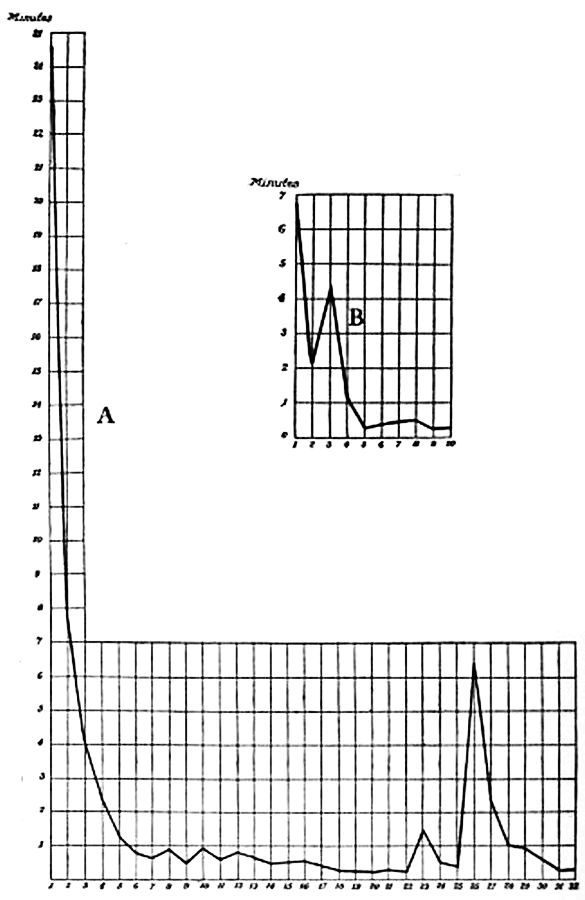
BY ELEANOR HARRIS ROWLAND
The object of this paper is to discover some of the sources of our
pleasure in repeated space forms, and the laws which govern this
repetition. The repetition of an object, and its regular recurrence
subject to certain possible variations, is one of the basal principles
of art, and of architecture in particular.
It is necessary at the outset to define our use of the word repetition
more exactly, for there are obviously different meanings of the
word, which may lead to confusion.
1. The term repetition may be applied to the existence of any
two objects similar to each other, whether they are near together
or widely sundered. Our pleasure in such a repetition would be
merely that of re-seeing and recognizing the two as counterparts of
each other. This kind of repetition I call conceptual, for it requires
only that the memory-picture of the object be held in mind and
the two recognized as similar when met again. This is not the
kind of repetition which I have in mind, and I shall never use the
word in this sense during the discussion.
2. In any one work of art there may be some feature repeated,
some motif which is taken up and carried out in different ways
throughout the whole, and these features we recognize as having
an orderly relation to one another in the unity. This might be termed
repetition of content, and be applied to the recurrence of some type
of decoration over a window or a peculiar arch taken up in various
ways throughout a cathedral. I do not use the word in this sense,
but limit it still further.
3. By repetition is meant during this discussion the regular recurrence
of an object, and an equally regular recurrence of intervals.
The repeated object must come at uniform intervals, and this restricts
us to the consideration of that repetition alone which consists
of recurrence at regular intervals of some object more or less
beautiful in itself, and the description of the nature of our æsthetic
feeling in experiencing such a series.
Although this discussion is divided into the two divisions of experiments
and analysis of architectural examples, and the experiments
are described first, the investigation was not carried out separately
in this order. The two went along together, the art-analysis suggesting
experiments, and the experiments in turn throwing light on the
analysis. The two parts of the discussion are kept separate merely
for the convenience of the reader, and in the experimental discussion
all allusions to the art-illustrations are excluded in order to avoid
confusion. In reality the two went hand in hand, but the connection
between the experiments and art-analysis will be reserved for the
latter half of the paper.
The experiments were begun in the following manner: In a velvet
screen about a foot high was cut a window 460 mm. by 35 mm.
in size. Behind the window was a metre measure and a rod from
which hung small strips of cardboard 10 mm. wide. First two, three,
and four strips were hung behind the window, and the subjects
were required to arrange them at the intervals where they preferred
to see them repeated. The results were uniform in certain particulars
and very suggestive. In their arrangements of two, three and four
strips, the subjects were guided by considerations of symmetry or
proportion. They insisted that although they knew that the strips
were repeated, they did not feel the repetition, but the strips seemed
like parts of some larger unity to be arranged with reference to the
unity of the whole. With the addition of the fifth strip came a
difference in their apperception. Instead of the strips seeming parts
of a whole including figure they seemed like repeated units.
FAVORITE ARRANGEMENTS
| |
2 strips |
3 strips |
4 strips |
5 strips |
| J. |
30 mms. |
4 mms. |
{ mid. sp. = 25 |
any symmetrical |
| |
|
|
{ ends = 10 |
arrangement better than equality |
| S. |
170 |
12 |
{ mid. sp. = 15 |
{ mid. sp. = 40 |
| |
|
|
{ ends = 12 |
{ ends = 30 |
| U. |
40 |
20 |
30 |
35 |
| R. |
30 |
130 |
{ mid. sp. = 30 |
|
| |
|
|
{ ends = 10 |
10 |
| L. |
23 |
40 |
70 |
70 |
| W. |
40 |
10 |
30 |
30 |
| V. |
20 |
10 |
{ mid. sp. = 100 |
|
| |
|
|
{ ends = 60 |
15 |
It will be seen, from the table, that with two exceptions they preferred
five strips equally distant from one another, while with four
strips, four subjects had preferred a symmetrical arrangement.
These gave as their reason that with five strips the latter appeared
more definitely to be repetitions of one another, while the four strips
seemed more like parts of a whole which required symmetry in its
arrangement. Moreover the two subjects who preferred five strips in
symmetrical arrangement instead of at equal distances affirmed that
a distinct feeling of repetition came with five strips that had not been
felt before, only they did not enjoy this feeling of repetition as well
as one of symmetry. After having seen the five strips, some subjects
could feel the repetition with four strips, but none with three.
The question naturally arose, what is this feeling of repetition which
makes one say that four or five repeated objects deserve the name,
while three or less are regarded in a different light? The analogy between
the apperception of this visual repetition and auditory rhythm
seemed so strong as to deserve attention.
In auditory rhythm it is necessary that there be recurrence of
more than two elements; they must come at a certain rate and within
a certain temporal space to seem connected with each other, and
they may be subjectively grouped in different ways. The apperception
of both kinds of repetition had so many analogies as to suggest
that some of the factors in both experiences were identical.
To focus the problem I took a definite thesis in regard to it. Our
apperception of repeated space forms is due to the rhythm of our
own motor adjustments which are excited in face of repetition,
harmoniously if they accord with certain rhythmic laws in us, inharmoniously
if they do not. It was then necessary to find what
facts would support such a thesis, to see if in reality such facts could
be marshalled, and if the explanation and support they offered was
conclusive enough to make it needless to look farther.
It would seem, if our pleasure in repetition depended on temporal
motor responses in us, that if the amount of time normally
taken to traverse a repeated series were shortened, or if the eyes
were fixed and not allowed to move over the field at all, our
enjoyment would cease altogether, or at least be seriously diminished.
If we found it impossible to enjoy the series except when
seen for a certain time, long enough for the eyes to go over it in the
rhythm peculiar to each subject, we should then conclude that our
enjoyment did depend, to some extent, on such temporal rhythm.
I experimented on this question with nine subjects, and the results
brought out different ways of apperceiving repetition, which
divided the observers into two rather well-marked types.
The apparatus was of the simplest, consisting of white silk strings
hung on a wire against a black background across one side of the
room. The strings were attached to the wire by little hooks, which
enabled one to change their position easily, while a cloth hid the
weights on the ends of the strings, so that nothing but the vertical
white lines were visible.
Fifty strings (50 mm. apart) were hung before the subjects, and
they were asked to survey the field and give a signal as soon as the
experience became pleasant. Then having found the average length
of time for each subject to enjoy these simple repetitions, a shorter
period was given when they were to shut their eyes at a given signal,
and see if in that shortened time they were still able to enjoy the
series. Next they fixated the eyes and kept the whole body rigid,
to see if pleasure was still possible when all outward motor response
was checked, so far as possible.
The results of this experiment were very suggestive. Of nine
subjects, all felt pleasure when allowed to move the eyes over the
series at random; with eyes fixed, five felt their pleasure much
altered in its quality as well as lessened, while with one it was altogether
destroyed. With four, however, although there was considerable
alteration in the quality of the pleasure, its amount was increased
rather than lessened.
B. (1) Average time necessary to enjoy the series: 4.7 seconds.
(2) Three-second exposure. No pleasure, needs more time during the movement.
(3) Eyes fixed: 4 secs. = Av. time necessary to enjoy it. Lines bunch toward centre and fade away at sides, giving a kind of unity, but he feels constraint.
R. (1) Av. time: 4.3. Sees them in pairs.
(2) Two-sec. exposure. Very faint pleasure; feels that only a part is perceived.
(3) Eyes fixed: 4.3. One pair fixated, the others fade away, making a kind of figure. Pleasure faint and constrained.
L. (1) Av. time: 2.1.
(2) 1-sec. exposure. Pleasure faint and incomplete. He feels the pleasure comes from memory of the previous experience.
(3) Eyes fixed: 2.2. Great effort to find any pleasure. It consists mainly in seeing a few strings, and feeling there are others, even though they are not distinguished.
V. (1) Av. time: 2.2. Sees them in pairs.
(2) 1.5-sec. exposure. Enjoys the experience in memory after the eyes are shut again.
(3) Eyes fixed: 1.9. Still sees them in pairs, but cannot see enough of them, hence they are less pleasant.
W. (1) Av. time: 4.3.
(2) 2-sec. exposure. Not enough time to feel any relation between the strings, most of the pleasure supplied by the memory.
(3) Eyes fixed: 5.3. Pleasure is very faint, and consists in having the strings appear to converge to a central point, and fade at the sides.
J. (1) Av. time: 2.3. Sees them in pairs.
(2) 1.5 exposure. Less pleasant.
(3) Eyes fixed: 2.7. Series seems more like a unity and he enjoys it more, since no time is spent in exploring the field, but it is one unified experience.
U. (1) Av. time: 28. Only enjoys it by ignoring all except those in the centre—does not want so many.
(3) Eyes fixed: 18 secs. Enjoys it when eye lights on one string, so that the others can fade away equally at the sides, in one figure.
S. (1) Av. time: 5.
(2) 3-sec. exposure. Less pleasant.
(3) Eyes fixed: 8.8. Pleasure consists in converging of lines toward central point. It appears like one figure and is more intense than (1).
H. (1) Av. time: 9. Sees them in pairs.
(2) 1 sec. Just as pleasant as before.
(3) Eyes fixed: 4.6. Pleasure in unity of whole series with centre of fixation emphasized. Only felt pleasure anyhow when the eyes had stopped moving,
so now it comes all the sooner.
From these introspections it is obvious that there are two distinct
ways of apperceiving repetition: One in which the rhythmic
element is pronounced, so that when the time necessary for such
a rhythm is shortened, or by fixating the eyes the motor response
is hindered, the pleasure in the repetition is either altered or destroyed
altogether. The other type takes a repeated series in the
sense of a unified presentation and wants it all at once in a symmetrical
whole. The rhythmic factor is present in both, as is shown
by the fact that the quality of the pleasure was changed in every
case when the time of exposure was shortened. But in the latter
type of subject the pleasure felt in the presentation of the whole at
once, and the feeling of symmetry around a middle point, are more
intense than a rhythmic apperception. These two kinds of apperception
remain fairly constant throughout the experiments, and
for convenience' sake we shall call them spatial and temporal types.
With the former, the value of the experience consists especially in
having a central fixation-point from which the repeated elements
fade away equally on the sides, making a symmetrical whole. With
the temporal type, the pleasure is felt by means of the rhythmical
passage from one element of the series to the other. In passing from
point to point the rest of the field still remains in indirect vision,
so to the distinctly temporal a distinctly spatial factor is also present.
For this reason the temporal type of apperception is the richer
of the two, and a description of it comes more nearly to the essence
of repetition as such.
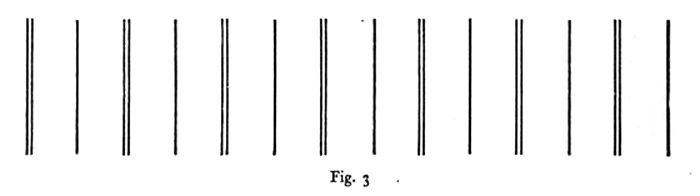
Up to this time, the repeated element had always been a single
string. This was varied and the strings hung in pairs (50 mm. wide,
100 mm. between pairs). When the strings had hung at equal distances
from each other, six out of the nine subjects had seen them
in pairs while enjoying them, and had found such grouping more
or less essential to enjoyment. In seven cases the pleasure was increased
by this grouping. They expressed their preference in various
ways: "Easier to keep track of where we are going." "Can
go quicker over field, for repetitions are more well-marked." "Single
line is too thin to rest on, this gives broader space for repose."
All these introspections instanced the necessity of the rhythm being
marked and made plain, so that there should be no confusion of
point with point. The two who disliked this grouping were of the
spatial type, who found no pleasure in traversing the field, hence too
little content in it, in this arrangement, at any one time. Grouping
of some kind would seem to faciliate the apperception to a certain
class of subjects, while with others the amount and quality of the
content of the field is of more consequence.
Since accents are such an important factor of auditory rhythm,
the next experiment was to see if the apperception of a series of
repeated elements would be facilitated by accenting every other
one.
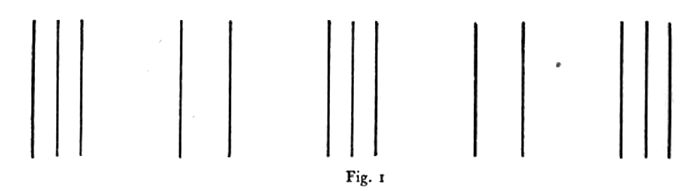
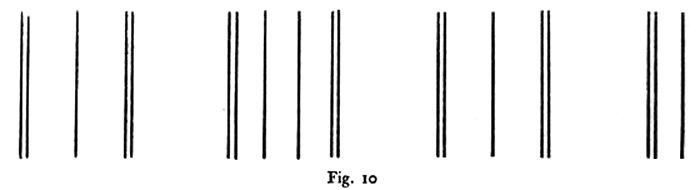
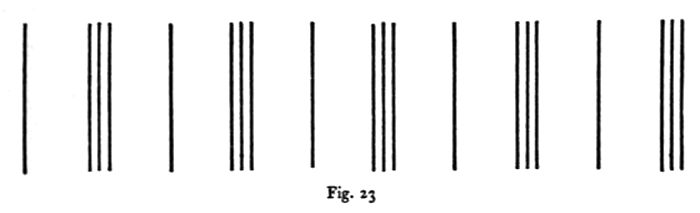
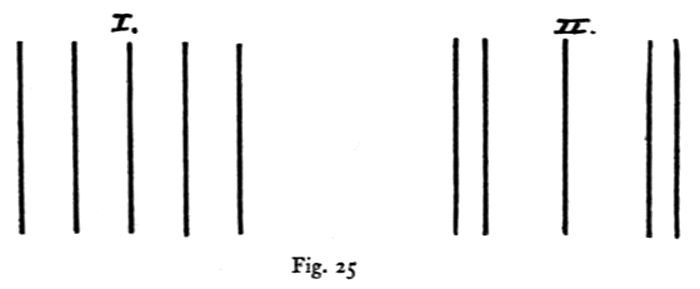
Another string was hung in every other pair thus making it more
striking, but here came a difference between the feeling of accent
in auditory and visual rhythms. The subjects declared the pairs
in which a third line was hung were not intensified alone, as when
a greater stress is put on a tone in auditory rhythm, but the pairs
were changed qualitatively. The group of three became the repeated
element, while the pair was only an alternating figure different
from the principal unit. This unanimous testimony brought up
a variety of questions. 1. Is any purely intensive accent, without
involving qualitative changes, possible in visual repetition? 2.
What factor makes us choose one object rather than another as
the repeated element? 3. What is the value of the alternating figure
in such a series? 4. What is the value of the empty space between
repeated figures, and does it have as distinct a value as an alternating
figure? 5. Are all the recurring objects and spaces felt as
separate repetitions; if so, how many can be carried on at once?
These questions were put to the subjects in regard to the series
just described with considerable uniformity of answer.
(1) No such thing as purely stress accent seemed possible. The
word, signifying greater intensity without change of quality, did
not apply. If one attempted to intensify the repeated object in any
way, either hanging another string, thickening the strings, or any
similar device, it ceased to be the old unit but became a new one,
whose repetition was followed for its own sake, while the weaker
one retired into the background, and was not felt as the element
repeated in the series.
(2) Any regular change of the element which made it more interesting
or caught the attention, fixed it as the chosen unit of the
series, whose repetition was followed.
(3) Concerning the exact value of the alternating figure in the
series, there was great difficulty in introspection. They all "knew
the alternate figure was just as truly repeated as the principal one,
but could not feel it so." The three-group formed the unit of the
repeated series, and although the pair was clearly part of the experience
and distinctly perceived, for some reason it was not felt as
repeated in the same way as the other. It was merely an alternate,
a filling, which was essential to the other, but which had no significance
in itself as a repeated thing. Two subjects were able (if they
tried) to carry both repetitions along together, i. e., not only feel the
three-groups as coming at regular distances from each other, but
the pairs as forming another interlacing series. This kind of apperception
was very fatiguing, however, and they could not enjoy it.
For any pleasure to be derived, the pairs must retire into the background,
and attention be fastened on the three-group.
(4) If the alternating figure was to be so subordinate, was there
any difference between its significance, and that of an empty space?
This was everywhere answered in the same way. The alternating,
or minor figure, had a very distinct value, and any irregularity in
it was even more irritating than in the principal unit itself. When
the space was empty they thought nothing of it, the equality of the
interspacing was taken for granted; while if they felt an irregularity
in it, it destroyed their pleasure in the whole series. But there
was no feeling for the empty space until its regularity had been violated,
while there was a distinctly pleasant factor in the minor
figure, even though different in quality from the principal element.
In the foregoing experiment the differences between the spatial
and temporal type of observer were still strongly marked. The former
type invariably grouped the elements (usually with the three-group
in the centre and a pair on each side) and they took their
pleasure in the symmetry of each figure so made, moving from the
centre of one to the centre of the next adjacent. In this method of
apperception there was no empty space between repetitions, for the
whole group of three figures was taken as the repeated unit. The
empty or rest-phase was gotten in moving from the centre of one
to the next, in which passage the limiting pair was ignored. One
spatial subject, finding the proportions of this artificial grouping
poor, got no enjoyment at all.
With the temporal type, the experience was quite different. They
moved across the field with the three-group as their stopping-points.
These principal elements were what they looked for, and their pleasure
seemed to consist in expecting and meeting it. What part the
pair played, they had difficulty in analyzing. Some said that while
the three-groups occupied most of their attention, they gave a lesser
degree to the pair, so that the rhythm of the passage across was
marked by heavier and lighter beats. Another found the figure in
the alternate space only an obstacle, and felt he was hindered in
the passage from unit to unit, the only compensation being, that
the "hindrance" came at regular distances. Others felt that two
repetitions were actually being carried on at once. By this they
meant that the two sets of elements were kept distinct, although
objectively combined, but the repetition of the pair was subordinate
in interest to that of the three-groups.
I tested the same thing (accents or major elements, and the value
of the alternating minor elements) by simply doubling every other
string of the series 50 mm. apart. In every case the effect was
found poor. It was "confusing," "too much work." They all felt
adjusted to the repetition of the double string and then encountered
the single one, which hindered them, and by trying to keep
both elements going at once they were fatigued. Most of them had
a distinct feeling that they wanted to swing from one element to
the next, and were baffled by the alternate. In this arrangement,
even members of the spatial type who had not been able to get any
rhythmic feeling before, felt the movement in the series as if they
were going across, although they went (in two cases) in groups instead
of single elements. They all, however, felt the single string
as an obstacle which hindered their enjoyment, whether the double
string or a group was taken as element. This suggested the question:
What makes the difference between the minor figure being
an enrichment to the experience and being a hindrance? They insisted
some rest-period was necessary; some really empty space between
the repeated units, and when in place of rest they had more
to do, it spoilt the pleasure.
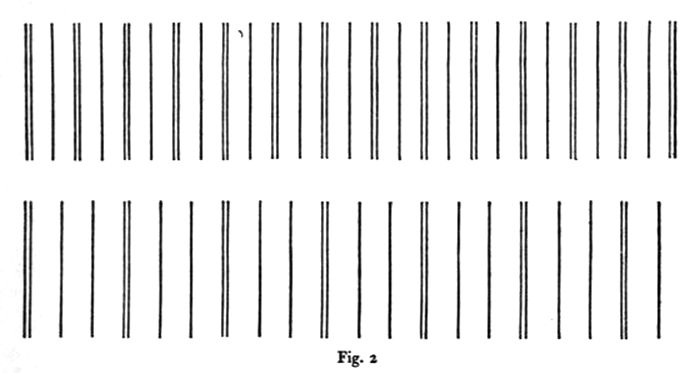
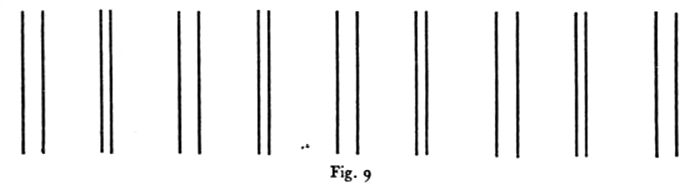
Next, two strings were hung at equal distances between the double
strings, and the latter put 100 mm. instead of 50 mm. apart. This
was liked better in every case, and the reasons given were much alike.
The double string was still the repeated unit, while the two strings
between did not feel repeated. In spite of the obvious inconsistency
of the statement that they did not feel the alternates to be repeated
even when they knew that they were so, just as much as the double
string, several subjects made the same remark. V. felt the series as
a rhythm, where the double strings were all he was interested in,
although he knew he should notice if the others were changed. B.
could not detect that they were of any importance, except as he imagined
them absent. B. could feel either the double strings or the
two strings between them as the major unit, only, whichever one
he took, the other retired into obscurity. He felt the minor units
in a different way as being repeated together with the majors, but
very weakly, and not at all unless he previously considered that he
ought to do so. L. said his attention was fastened on the double
strings, but it was the "effort or ease with which he passed over
the alternates which formed the pleasure." Another temporal subject
felt the rhythm as the others did, with more emphasis on the
double strings. But the major units seemed the rest-phase in his
rhythm, i. e., he paused here in observation of the series, although
his attention was most active; vice versa, the minor units required
little attention, but were the active or moving parts of the rhythm.
Since they all considered the strings in the alternate space merely
as steps or lesser beats on the way to the major element which they
sought, and as obstacles rather than otherwise, why did they prefer
the space with two strings rather than one? This suggested that
some factor in the alternate spaces was important other than simply
the amount of resistance to overcome in getting past the two lines.
In answer to this they could only say that the two strings in the
alternate space formed a pleasanter unity by itself, although, as they
went across, they did not think of it in terms of unity.
What, then, is the real rest-phase of the rhythm of alternating
repeated objects?
In the beginning of the discussion, when the analogy between
visual and auditory rhythm was felt so strongly in a certain type
of subject, they had expressed themselves as if the object which
they called the unit of the repeated series were the active stimulated
part of the experience, while the alternate space was the rest-phase,
valuable only as a period of repose or blankness before the
object was again encountered. But in this case, although they felt
they were putting no attention or emphasis on this space, in reality
they were keenly alive to what was hung in it, even preferring more
"hindrance" in the way of strings than less, which suggested that
the alternate space was of more value than they were conscious of.
(Some of this increase in pleasure was of course due to the increased
actual distance between the double strings, but some also to the
extra string.) The introspection on this question as to which part
of the rhythm was actually the rest-phase (if there were any such)
was difficult for them all. They felt they spent more time on the
major element; that was what they looked for and found pleasure
in meeting again.
One said, "The unit is what I look for; as soon as I have it the
pleasure ends and I want to move on again. The pleasure does not
consist in resting on it after it is found, but in knowing I am going
to meet it again, and in doing so." As to the alternate spaces, he
could only say he was not consciously interested in them, he took
them for granted, but knew he should feel it, if they were changed.
His feeling for them was wholly negative. The other temporal subjects
agreed essentially with this. The alternate figures had to be
passed, but passing them was only of importance as it helped or
hindered the perceiving of the major elements. All agreed that
any change was noticed and felt irritating at once, although they
could not understand how it should, since so little attention was
paid them normally. One subject felt the alternating strings only
as obstacles between the doubles, and demanded an actual, empty
rest-period between any repeated units. When asked if it were really
the rest-period between elements or on them, he said he felt there
was a complete discharge of attention on the major units, and an
attempted one on the minor or alternate units, and the attempted
ones became confused.
These introspections would point to the fact that alternate minor
spaces while affording rest for the attention were periods of activity
of some other kind. The fact that no one could say what kind, and
yet insisted on the feeling of its being important and distinctive,
and moreover repudiated the idea of change in a minor space even
more than in a major—this seemed to show that there was a value
in the alternate spaces quite aside from attention, but fully as distinct
in its own way.
As might be expected, those of my subjects to whom rhythm was
not a conscious factor of the experience of repetition could not understand
exactly what was meant by the distinction between rest-phase
and emphasis of rhythm. In all the preceding cases where
the temporal type gave the introspection I have described, the spatial
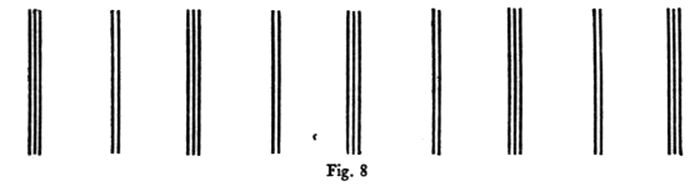
subjects grouped the single lines, in Fig. 2, about the heavier
pair as centre, and moved from the centre of one such group to
the next. The experience then consisted of a succession of adjacent
symmetrical groups, connected by movement from centre to centre.
When asked if there was no pleasure in finding equal distances
between their centres, i. e., any temporal element whatever, they
all denied feeling any. They could not detect that they felt the distances
between their centres as equal, although they knew them to
be. They spent so much attention on the group that all feeling of
the distance between its centre and the last was lost before going
on to the next.
These two marked types of apperception of an alternating series
seem varieties of emphasis, rather than of actual experience. It was
evident that those in the spatial type must have some recollection
of the amount of distance passed over between the various groups
to feel the whole series as connected in any way; while those of the
temporal type could not be wholly absorbed with the separate lines
of the series as they traversed it, but were distinctly conscious of
the space relations of those in the side of the field that they had
just passed or were coming to.
Next, I tried to see what were the different factors which made
up the value of the minor spaces. By varying both their size and
filling, and doing the same to the major element, I could judge the
relative value of these changes on the two, and their effect on the
whole series.
The test was made in the following manner. The series as it
stood consisted of a double line alternating with a single one.
With every temporal subject the double line was conceived to
be the repeated thing, and the space between considered as an alternate,
with a repeated line of its own, to be sure, but not felt in the
same way as the other. With the spatial type, the single line was
merely the limiting edge of the symmetrical figure, with a double
line in the centre. One subject varied back and forth in his method
of apperception, and considered the richness and variety of these
different apperceptions as one of the chief sources of the pleasure
therein.
Variation of alternating spaces: The minor spaces were varied
by hanging two strings in one, and one in the other, and subject
asked how such a change affected his feeling for them. The change
was marked.
The spaces which had before been minor were so no longer. The
alternate space in which two strings were hung with the boundary-line
of the two double strings became the new element, and the
alternate in which only one string was hung continued to be the
alternate in the new series. The whole series shifted itself, and
settled into a new equilibrium. Some of the subjects were able to
feel all the former minor spaces still as such, but only by a definite
effort, and not while taking any pleasure in it. The change in the
alternates spoilt the whole scheme of the repetition as it already
stood, and made a regrouping necessary. I next tried varying
alternates by removing a string at intervals.
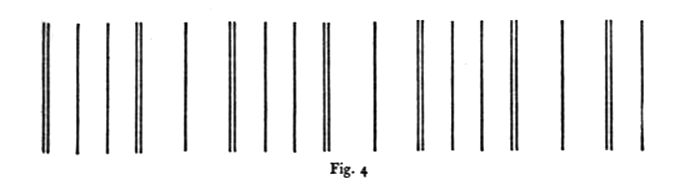
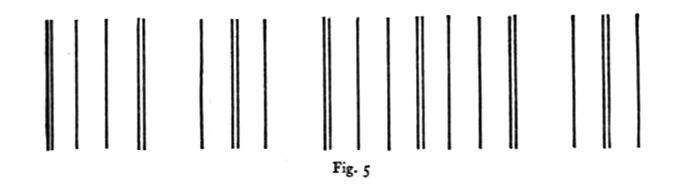
Since the strings were not removed in any regular fashion, and
because the subject could not find any possible consecutive way
to group them with the double strings, this variation was partially
overlooked, and although confusing the series somewhat, repetition
of the double strings could still be felt. Thus a mere gap where
the scheme remained the same was not so disturbing as an extra
feature inserted, or one noticeably changed. Something could be
supplied by the subject, but not altered so easily. In these cases,
however, the change was only tolerated because it was ignored.
They felt it as a mistake and so overlooked it, but, accepted as a
component part of the series, it was impossible to feel it as a repetition
or get pleasure from it.
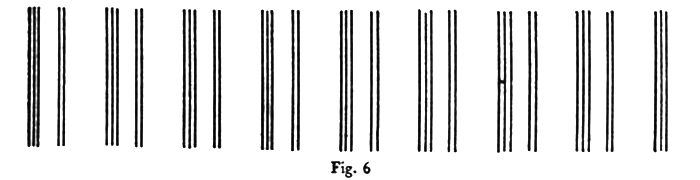
The next variation was in the position of alternate figures. With
a three-group as the major element of the repetition and a pair of
strings in the alternate space, the size of the two minor spaces was
altered, thus making the distance between the three-group and adjacent
pair shorter than between that and the next three-group. This
immediately threw out the feeling for the old series and made a
new one. The new series thus formed varied with the different
subjects, although no particular difference was noticed between
spatial and temporal types. They all disliked the new arrangement,
in whichever of a variety of ways it was apperceived. (It will be
noted the actual distance between the three-groups was not varied,
but the size of the spaces each side of the minor figure, i. e., the
minor figure was shifted from its central position.) One typical
spatial subject took it in either of three ways: (1) He grouped the
three-group and pair nearest together, into the repeated element of
the new series; (2) he ignored the pair and regarded it as a repetition
of three-groups; or (3) ignored the difference in the division of
the alternates, and regarded them as alike. The artificiality of the
latter methods of taking the series is evident. What pleasure survived
after such a strain was very slight, and was moreover not of
the series as given, but as imagined differently, which was not a
valid judgment. Most of the subjects grouped both figures into one,
and, finding the unity thus made ugly and unsymmetrical, derived
no pleasure from it. One tried to keep both elements in separate
series and have them go along together, equally distant from those
of their own kind, although not from each other. This was, however,
very fatiguing and unsatisfactory. Those who grouped the
different figures said they did so because they could not help it, not
because they liked it, and said it was impossible to regard the alternate
figure as such, if varied from its central position. If they were
all varied together, they were grouped, with the major unit, into a
new one. If varied irregularly the series was spoiled—no rhythm
whatever remained. It became a heap.
Next, I tried varying the size of the alternate spaces, keeping the
filling in its central position.
Here also it was universally regrouped. They found it more
difficult to feel the rhythm of the three-groups as separate elements
than when the minor spaces had remained uniform in size, but
different in the position of the filling. The alternate space, then,
which had at first seemed the unimportant part of the rhythm and
for which no subject could assign any conscious value whatever,
was evidently a potent factor of the experience, and when varied
either in size or filling (especially the former) it not only changed
the feeling-tone, but shifted the entire scheme of the rhythm, or broke
it up altogether.
Variation of major units: Was variation more allowable in the
major than in the minor unit of a series? This was tested first in
the same manner as for accents. In a series of which a double string
was the major element, a third string was hung with every such
double, thus changing the unit in both size and content.
The series immediately readjusted itself with the three-group
as element for most of the subjects, although one was still able to
feel them all as one unit, varied by the added string. Varying only
the size of the major unit gave the same result.
The pairs, instead of remaining the same size, were made alternately
larger and smaller, and a new repetition was made, i. e., with
the larger pair as major element and the smaller one as minor.
They all agreed, however, that less change was made in these cases
than when the minor spaces had been changed in size. In the latter
case either a regrouping was made, changing the whole character
of the series, or it was spoiled altogether. With change of major
units alone, however, although a new element was made, it was
still possible to take it in the old way without much difficulty or
change in feeling-tone.
It was then necessary to see how change of content would affect
the major unit, the size remaining constant. A group of two sets
of double strings 10 ccm. apart was taken as the repeated element,
and these groups placed at 10 ccm. from each other.
Within one element was hung one string, and within the next
two, thus varying the content while the size remained constant.
In every case the answer was the same. It was not so pleasant as
when the filling was the same, but the group still remained the unit
of the repetition, and the series essentially the same.
Several variations were made in this element. Instead of hanging
strings regularly (1 in one, and 2 in the next) they were hung
irregularly, i. e., an extra one here and there at intervals in no special
order. As long as the boundary-lines of each group remained at the
same distance from each other, and from the next group, thus keeping
the unit at uniform size, although the pleasure-tone varied, the
balance of the series was not changed. No regrouping or shifting
of the equilibrium resulted.
It would seem from the preceding experiments that in any series
variation of the major unit was tolerated more than of the alternate;
while in either case variation in content had less influence than
variation in size.
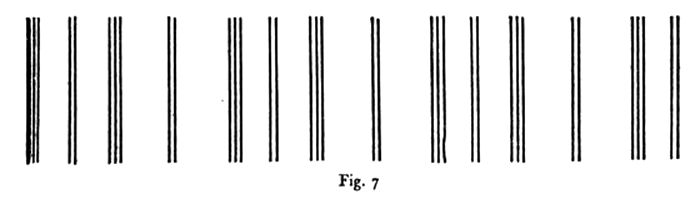
Symmetry: In the previous experiment, three subjects had insisted
on symmetry as a necessary attribute both of the unit and
its alternate. U. (spatial type) described his experience as "a succession
of symmetrical experiences or states of equilibrium; when
they are not so, they must be regrouped, or pleasure is impossible."
R. (temporal type) insisted especially on the necessity of the alternate
figure being symmetrical as regards the major units, i. e., halfway
between them; and also on symmetry as regards itself. One
temporal subject said there was some pleasure in merely going
from one unit to the next, even though no repose was possible on
each because of its asymmetry. This suggested experiments on the
importance of symmetry in repeated series. Is it necessary that the
separate elements of a series be symmetrical? Must both major
and minor element be symmetrical? Does this necessity vary according
to the temporal or spatial type of the subject, i. e., is it more
necessary to the spatial type, whose pleasure depends more on repose
in the unit, than to the temporal type, whose enjoyment rests
mainly in the rhythm of movement from one unit to the next? Or
is it a common demand? This experiment was begun in the following
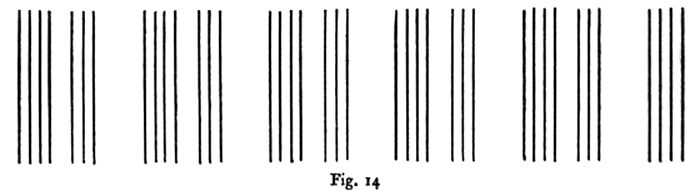
simple way. The strings were hung in two group-forms;
one with three and the other with four.
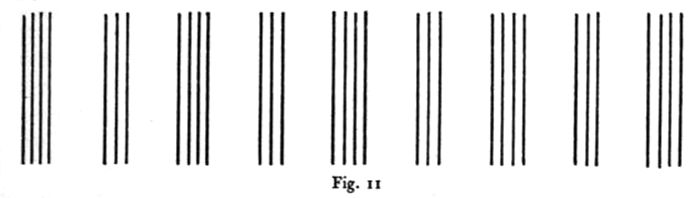
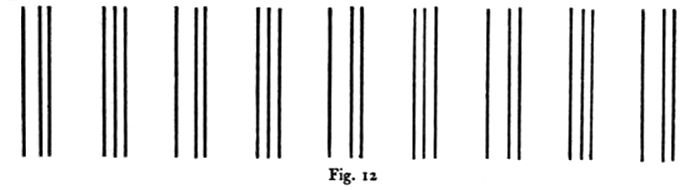
This was a symmetrical grouping and uniformly pleasant. The
series was then changed by removing the second string in the four-group,
thereby making it unsymmetrical.
This change made the repetition less pleasant in every case, but
did not spoil it. Instead of the four-groups becoming more prominent
they seemed less so, and the three-group on account of its "compactness"
became in most cases the major element, thereby shifting
the balance of the repetition, but not detracting very much from
the pleasure. Next the three-group was changed by moving the
middle string to the left. By this means the group which had been
minor in Fig. 11, became unsymmetrical, while the four-group was
regular.
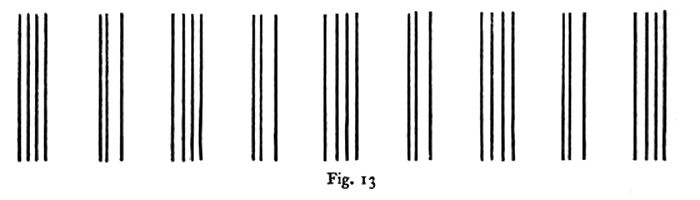
This change was preferred to that in Fig. 12, although different
reasons were given. One said it was because this change in arrangement
made the elements more distinct, hence easier to keep apart,
while in Fig. 12 they were made more alike. Moreover, one element
seemed as important as the other. He did not class them as major
or minor, so he could not compare the relative values of symmetry
in principal and alternate units, for in this series he did not feel
the distinction. The other answers to this question were rather incoherent,
but the series did not seem to suffer much change, either
pleasantly or otherwise. Since lack of symmetry in the element was
at least tolerated in the examples already given, would it be allowable
so to place the units that the two adjacent to any one unit should
lie unsymmetrically on either side, that is, may the elements lie
unsymmetrically with regard to one another? Suppose a four-group
to be repeated at regular intervals, and a three-group likewise;
if the two series were combined, must they occur halfway
between each other? That is, must they be symmetrically placed
as regards the intervening space, or could they be put to one side?
The subject was asked not to group them (as in previous similar
arrangements), but to keep them as separate repetitions if possible,
and to see if this equal distance was necessary to keep them apart.
The result was the same in all cases. The subjects could not help
grouping them, and found it impossible to keep them distinct unless
so much effort was put into it that no pleasure was left. They
said they "knew each unit was as equally distant from the next
unit in its own series, as if it did not come at unequal distances
from the units in the other, but they could not feel it so, and were
obliged to group the two together." For this reason the experiments
did not satisfactorily illustrate the point in question. It was necessary
to have a series of elements whose unity was more strongly
marked, and whose different parts would still remain one whole
even after variations, instead of shifting into each other. It was
suggested by these imperfect experiments that symmetry was not
so important a factor in the different units of a series as the subjects
had previously supposed; but that, on the other hand, the
different units must be placed at equal distances from each other,
if they are to be kept distinct either as two series or as one. Moreover,
that two series could not be kept distinctly in mind as separate,
anyway, without fatigue, the tendency being always to group
them into one series with a new repeated element, composed of a
combination of the other two. It was necessary, however, to test
this more completely. By a simple device the former series was
changed radically, so that the difficulties mentioned were overcome.
The strings of both the three and four groups were twisted
together at the bottom, thus binding them closely into separate
unities. By remaining attached at the bottom, whatever variations
might occur elsewhere in the figures, they could not lose their individuality
and become merged in each other as before. They remained
distinct groups without effort on the part of the subject.
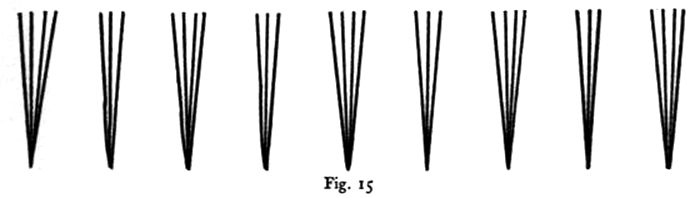
With this I began as in the previous experiment. The subject
was asked to look at the series of repetitions, enjoy them as much
as possible, telling what was the pleasant factor in the experience,
and how he apperceived the series. The subjects separated into
types as before; the spatial type immediately grouping the elements
into a larger unity and enjoying the groups more for their
own sake than for their repetition, while the temporal type went
from one to the next in the series, enjoying the rhythm more than
the elements as such. (It may be remarked here that the subjects
were perfectly naïve as to their apperception. They did not know
they were separated into types, nor were they urged to be consistent.
Even the experimenter did not know of the distinctness with which
these types separated themselves, and consistently held to their
own method of apperception, until looking over the records afterwards.)
With the temporal type the four-group was the major group.
Some expressed its prominence in terms of time, i. e., they spent
more time on it, and less on the three-group. One felt it as emphasized,
because he moved from one four-group to the next like
it, and at each step moved back and forth from left to right, to see
the alternate three-groups on each side, always resting on the four-groups.
It is noticeable with these subjects, in whom the rhythmic element
was more strongly developed, that although they admitted
that the language of "temporal rhythm" did not adequately cover
their experience (because the element did not disappear after perception
as in auditory rhythm, but remained in the visual field),
still they could not express themselves in other terms. L., the most
extreme of this type, insisted that the experience of repetition would
be exactly as pleasant if he saw the elements pass one by one behind
a moving window, with never more than one in the field at once.
In other words, their temporal relations were all he felt.
The others did not go so far as this, and agreed to the significance
of the whole field, even while especially interested in passing
from one to the next. B. partook of the characteristics of both
types, and by combining the apperceptions of both bridged the
chasm between them.
With the four spatial subjects, the apperception showed its usual
divergence. Three grouped the elements, either with the three-group
in the centre on account of its being more compact and graceful,
or the four-group because it was heavier. One of them could
group it either way, distinguishing between the prominence in an
element due to interest and due to beauty, i. e., he found the four-group
more noticeable and interesting on account of its size, while
the three-group was more beautiful as a unity, on account of its
proportion and grace. Therefore according as one factor or the
other predominated, one or the other figure was taken as the more
prominent element, and placed in the centre of the group. Sometimes
they separated into two series running along together, but
this was not usual.
Having got these varied introspections, with yet a certain likeness
running through them, the balance of the four-group and
of the three-group were varied in turns, to see how the change in
symmetry of elements would affect the series; and the relative value
of symmetry for the major and minor units of a series.
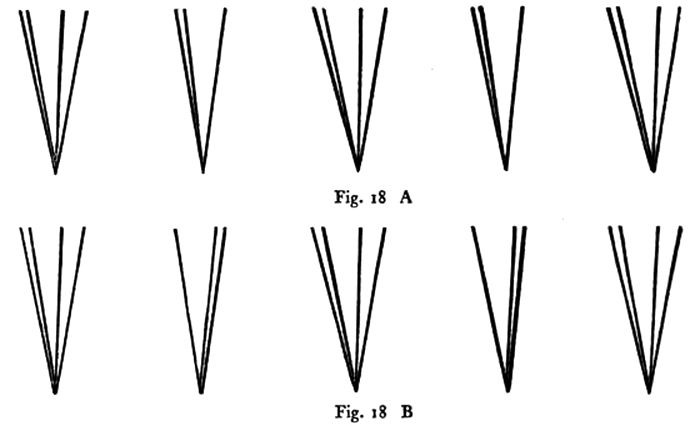
First, the four-group was altered, by moving the second string
further to the left, while the three-group remained symmetrical.
In three cases this arrangement was preferred to the regular one
previous, and each time for the same reason. The four-group was
made more noticeable by being unsymmetrical, and hence more
easily distinguished from the other. The two were easier kept apart,
and the alternation between the two was made more clear-cut and
obvious. With others the change was unpleasant for the reason
that it affected them in an exactly opposite manner. The four-group
lost its individuality, and, by separation into two unsymmetrical
parts, could not be distinguished so well from the three-groups
as formerly, hence the effect was spoiled.
A distinction was made between the relative importance and interest
attached to the units, when symmetrical and when unsymmetrical.
Every one agreed that making the four-group unsymmetrical
gave it more prominence of a certain kind. With the first
three subjects mentioned, this prominence was enough to accent
the rhythm still more than before, and differentiate the two units
more strongly. But with the other there was a feeling that while it
gained prominence and was more noticeable, it lost coherence and
interest, thence it could not be kept as the principal unit, but the
attention passed over to the three-group which maintained its unity.
It would seem, then, that the mere fact of one unit in a series
alternating with another, and being more noticeable, taking up
a larger space, being more complicated, etc., did not insure its being
the chief unit in the series. One subject voiced essentially the
feeling of all, in his comment on the series: "There is a constant
struggle between the prominence which the four-group gains from
size and eccentricity, and the insignificance which it deserves on
account of its looseness and lack of unity; it cannot hold its own
as one individual thing, and because the three-group still does, it
becomes in one way more prominent, while the four-group remains
so in another." Another subject felt he gave more time to the four-group
than before, because being separated it would not bind together
again without effort. At the same time the three-group gained
in interest because it was easy to find and did not vary. Another
subject felt that the time spent on a unit had nothing to do with
its rhythm; it was all a matter of interest and attention. Often he
looked a longer time at one unit, choosing another for the chief
element in his series, because it interested him more.
All this introspection brought out two things clearly:
(1) The apperception of a series of alternating units, whether
of the spatial or temporal type, is not fixed, but any variation of its
unit is liable to shift the emphasis. Thus, as in the present case,
when a symmetrical major unit is made unsymmetrical, it may not
remain the principal unit, but becomes the minor one, because the
attention shifts to the other which was before relatively unimportant.
(2) Whether either element shall be the principal one or not,
does not depend wholly on its objective prominence, but on the
amount of beauty or interest which it holds for the observer. Neither
size, complexity, nor eccentricity can force a certain unit to be taken
as the major in a series, unless it thereby presents an interest which
makes the observer choose it.
The next change was to vary the three-group in a similar way,
by pushing the middle string to the left, thereby making it unsymmetrical.

The responses were as follows: Five said it did more violence
to the series to have the alternate varied than the major unit; it
was more confusing. Three preferred it, giving as their reason that
it made the elements more different from each other than before,
hence more easily distinguished. The preponderance of evidence
was, therefore, that, although any variation from symmetry in a
unit was likely to be detrimental to the repetition, it was more
likely to be tolerable in the major unit than in the alternate space.
In either case it was demanded that the two units be distinctly different,
and it depended on the individual subject, whether in this
experiment the variation of one unit or the other brought out this
distinction more obviously. Aside from this consideration, however,
it appeared that the alternate spaces as such required equilibrium
more than the principal unit. Also, variation of symmetry in
the major unit, while it made it more prominent in the way of eccentricity,
also made the symmetrical minor unit more prominent in the
way of interest. As one subject expressed it, "Since the others vary,
the attention requires something which does not vary, and forces
prominence on the minor unit, because it remains symmetrical";
and "The minor unit is too small to merit such prominence as it
gets by lack of symmetry. It is distorted, and has not enough content
to bear it."
These introspections from temporal and spatial subject alike,
all point to the fact of a certain value attached to the alternating
units in a series. (1) The units must not be too much alike in interest,
or they rival each other. (2) They must not have more prominence
given them as regards the whole than they have interest to
sustain. (3) There must be a congruity between the two elements
so that one shall not be noticeable in one way, and one in another,
thus carrying the attention in two different directions.
One more thing was suggested by this experiment: (4) The subjects
who had invariably grouped their different elements in other
series found it very difficult to do so in this, or wholly impossible.
None of them did so when taking the series naturally, but moved
on from one to the next just as the rhythmic type did. They felt
"forced to move on," "no place to rest," while one in whom the
rhythmic feeling was weakest was much fatigued by this movement,
and insisted on having something stable to rest upon if he
was to gain any pleasure at all.
Next the series was varied by making both units unsymmetrical;
first with the balance tipping the same, and second in opposite
ways.
Those who preferred this gave essentially the same reason. They
agreed that the unity of both elements was broken up by this change,
and they did not stand out distinctly from each other; but all felt
a certain congruity in having both major and minor units follow
the same scheme in composition. They were not distinctly an
alternating series, but harmonized better as lines. The two spatial
subjects, who disliked this arrangement more than the other, gave
the same reason: the unity of the elements was spoiled, they did
not "hang together." Their dislike was similar in kind to that of
the others, only the congruity which made up for it with the former
failed to satisfy these. With the symmetry broken and the balance
tipping in different ways, the feeling was not strong in either direction.
They still criticised it in the same terms of congruity and distinctness,
with no especial change on account of this modification.
These experiments all pointed to the fact that (1) a certain amount
of congruity and equality was necessary between elements of a
series (although it did not establish what were the essential features
of such a harmony). (2) It is more pleasant, as a rule, to have
the elements symmetrical, although symmetry was not a necessity
for an agreeable series. (3) Provided the change in the symmetry of
the units was not enough to shift the whole order of the series, changing
the major to minor units (and vice versa), any varying of the
symmetry of a minor unit was more disturbing to the repetition
than of the major, while varying their symmetrical position, as
regards the unit on either side, was absolutely destructive to the
order.
The next experiment dealt with a different side of the question.
Since the unit of a repeated series may be a group with repetitions
inside itself, does the repetition of lines or figures inside the group
differ from the repetition of the groups as a whole? If so, how?
That is, in the enjoyment of a series of groups with repeated lines
in the group, in what respect does our apperception of the repetition
differ in the two cases? Or does it in reality differ at all?
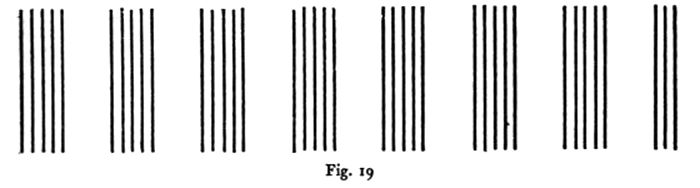
To test this, the strings were arranged in the following way. 10
groups of five strings were hung 100 mm. wide and 100 mm. apart.
Each unit had, then, five repetitions within it.
The arrangement was pleasant to all the subjects, and they described
the effect of the experience, falling at once into the spatial
and temporal types as before (this was wholly naïve, for the same
questions were asked of each, and they had no idea of being grouped
in types). The introspection of both types must be taken in some
detail, to fully analyze the experience.
Spatial: J. felt he took in all groups at once. Each unit seemed
like a rich experience in itself, but he could not detect any rhythm
in it, nor in the whole series. The pleasure consisted in getting a
number of similar objects in the field at once, and enjoying the combination
of them all, feeling that they stretched away in each direction.
H. and U. grouped several unit-groups into a larger unity and
enjoyed the cluster as a whole. They did not group them in any
particular system, nor could they detect the slightest pleasure in
moving from one such group to the next. One found his enjoyment
solely in the contrast effects in each, while the other laid it to the
space relations of each independently. The pleasure only came when
each group of groups was spread before him. Those outside the
immediate field meant nothing to him, and the movement between
them had absolutely no conscious interest for him. S. said that
enjoyment stopped altogether during motion of any kind, and
the experience was pleasant only during total repose, on whatever
happened to be in his field at once.
With the temporal type came a marked difference in apperception.
B. affirmed the pleasure to consist in going from one cluster to
another, and to begin just at the point where he meets the next
stimulation and feels it is going to be the same as the one previous.
It is the expectation, rather than the verification recurring at intervals,
which makes up the pleasure; not the actual movement, or
subsequent contemplation of a group. The pleasure came in pulses;
in knowing by seeing from the side of the eyes that the experience
is to be repeated, and on reaching the edge of a new group, in the
feeling that the experience is just about to begin.
R. felt that she "wriggled around" in each group of lines, and
that a certain feeling came from "wriggling" among the lines in
a particular fashion.
The pleasure consisted in having this feeling recur at regular
intervals. The repetitions inside the group and of the group as a
whole differed in this respect: For the separate unit-group, it apparently
consisted in repeated short irregular movements, back and
forth, enough to bring about a certain feeling which seemed pleasant
and sufficient unto itself. Repetition of the groups as a whole
meant movement across the field in one direction, for the purpose
of meeting another group, and getting the required feeling from it
again. The pleasure was not in the movement or in any repose
(she could detect no repose at all), but in experiencing the group
again, feeling that it had been so before, and would be again.
L. (the most extreme of the temporal type) agreed with R. that
the lines inside the group were perceived and enjoyed temporally,
as well as the groups as a whole. There was no experiencing the
groups at once. He felt that he moved regularly across the field encountering
five lines, one after the other, then an empty space, then
five lines more. The only meaning which the group as such had
for him was the five accents which came near one another in time.
He could feel no unity whatever apart from this. He was even certain
that his pleasure would be identical if in some mechanical
way the same figure could be pushed forward, so that the same
amount of time and movement would be necessary to reach it that
was required to move from one figure to the next on the field.
The experience was in every way analogous to auditory rhythm
with him, and he was unable to express himself in other than temporal
terms. Immediate perception, repose on the object, or groupings,
had no significance for him.
The other two subjects were links between the extremes already
described. They could feel each group, and sometimes even the
whole series at once apparently, and yet were all the time conscious
of a certain rhythm in going from one to the next. The whole experience
seemed immediate at first, but on reflection a certain alternate
rhythm was felt to be present, which was too rapid to take
any considerable time, but yet had to be included as a factor in
the experience. These introspections I believe to throw light on
the nature of the whole experience of repetition. Since there are
two methods of apperception so extreme, but moreover certain subjects
partake of the characteristics of both, it might seem that both
types represent but one side of the experience. Since both are enjoying
the same objective series, but in their description of their
feeling in face of it emphasize such different sides (leaving at the
same time the other side unaccounted for), and since certain subjects
share the experience of both, it might be that the sum of both
methods of apperception was necessary to the fullest appreciation
of the repetition in question, only in certain subjects one aspect of
it was so much stronger that the other possible factors in the experience
were overlooked.
It would tend to bear out this view, that when it was suggested to
those of the temporal type (always excepting L.) that according
to their description the other groups remaining in the field, after
having performed their part in a temporal series, ought to have no
further influence in the repetition, whereas they did in reality, they
admitted the fact, but could not account for it. Moreover, those
of the spatial type admitted that their enjoyment in having spaces
equal, and in having repeated objects exactly like one another, had
a certain character which no other experience possessed. This did
not seem accounted for by any description they could give of its
effect on them, although they could not detect what this other
elusive factor might be.
These introspections, therefore, and the confessions on the part
of both that there was a feeling of something more which they could
not hold long enough to describe, suggested that both types were
but opposite ends of a series of possible apperceptive types, and
that in both cases certain essential features were emphasized at the
expense of the others.
After these experiments, the next step was to find how a series
of groups was apperceived when the lines in each group were arranged
symmetrically about a centre, as distinguished from their
arrangement at invariable distances apart. The same number and
size of groups were taken, but the arrangement of lines in each
varied as stated above.
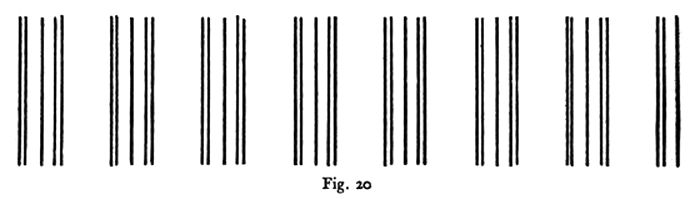
Spatial subjects: J. felt a different kind of pleasure from that
felt with Fig. 19. Here the enjoyment was in each unit for itself,
a certain repose in its symmetry. Although he fixated on the centre
of the groups, and in going across the field moved from centre to
centre, there was no feeling of rhythm whatever, merely enjoyment
of the unit itself. Moreover, although he had detected no rhythm
in the previous experience, this one seemed distinctly different in
having lost a feature that the other had. He felt by comparison
that the other had had a temporal character, some movement in
the groups, which was wholly lacking in this. This was more beautiful
and restful, the other more exciting and rich.
H. and S. both enjoyed this series better on account of possibility
of greater repose in the unit-groups. The pleasure was solely
in each unit for itself, not in their repetition, so the group which
offered most balance and equilibrium in itself was pleasantest. S.
also found enjoyment in slight variations in the groups (trifling
difference in distance, different light effect, etc.). It is noticeable
that when repetition alone was the main feature of the series, any
variation was either ignored or found unpleasant. But when the
unit for itself is the object of enjoyment, variation if slight is another
element of pleasure.
There is also pleasure in the mere repeating of symmetrical groups,
although, when the attention is turned to this feature, the feeling
of symmetry is less felt. Even when attending chiefly to the repetition
of the groups, the symmetry of each is felt somewhat, which
makes the whole experience better than Fig. 19, but the two attitudes
seem to hinder, rather than help each other.
This introspection was suggestive, giving rise to two more questions:
(1) When is variation allowable, and when not? Is it adapted
only to objects when taken, as ends-in-themselves, and not when
considered as means to something else, i. e., as means to make a
series or border, or anything which takes attention from themselves
as unities with individual meaning? (2) Is a distinctly symmetrical
group as adapted to repetition, as such, as one with merely equal
divisions? Does it not tend more to repose in itself, instead of to
the motion necessary for the apperception of a repeated series?
These questions will be considered later.
Temporal type: R. felt a difference in the movement across, in
that in Fig. 20 it was from the centre of one unit to the next, while
in Fig. 19 there was no regularity in the movement.
L. felt the difference between the two apperceptions very strongly.
In Fig. 20 the movements seemed organized. He felt as if his attention
(if not his eyes) went back and forth from edge to edge of the
unit, finally settling in the centre; while in Fig. 19 the very essence
of the apperception was that every line was compared with every
other, meaning a great number of movements in both directions,
not stopping in the centre. If he did rest finally in the centre,
in the unit of Fig. 19, instead of seeming evenly repeated, it too became
symmetrically perceived, but the usual way to get from one
such unit to the next was to move from and to any point in the next
adjacent, other than the central one. In either case the pleasure
came in identification of the second figure with the first, and the
feeling, "I have seen it before." The pleasure lay in the process
of recurrence of sameness.
V. also, who had not felt much motion in Fig. 19 at first, felt it
strongly now in comparison with Fig. 20. He said in the former,
although he did not make actual movements across (in fact his
eyes were plainly at rest), he was sure he felt "dispositions to do
so" which were lacking in Fig. 20. The pleasure came in the first
moment of repose after finding the new unit was the same as the
old.
After we had investigated the different methods of apperceiving
groups of repeated lines, and compared the effects of different groupings,
and studied the feeling of one unit alternating with another,
another question arose.
These questions had all referred to the alternation of two units;
either a unit with an empty space, or with a space of different filling.
How did the apperception differ when three repeated units
alternated with each other? To test this, three spaces were taken
equally wide (110 mm.) and equally distant from each other (150
mm.), but with three different designs within them. These designs
were of the same general character and importance although different,
and repeated themselves regularly.
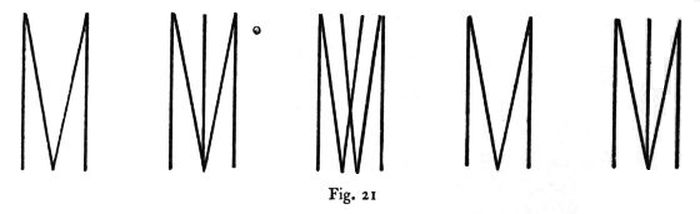
The subjects were asked as before to describe their reaction on
the series. Not one of all the number was able to feel the repetition
of the three units; what pleasure they got from the series (if
indeed they got any) was from other sources. The general type of
answer was formulated more fully by L. He saw 1, then looked
for 2 and found it different, but could have included it in the series
if it were not for 3. That being still different sent 1 and 2 out of
mind, so that he could not feel any repetition of 1 when he met it
again. He felt a certain sense of repetition in that the spacing and
general motifs were the same, but there was no pleasure in that.
What pleasure he got was wholly intellectual, not immediate, except
for a slight pleasure in their uniformity of position. In him
the rhythmic feeling had always been of the strongest, but he found
in this experience none whatever. It was simply impossible to keep
the three units going at once. Another temporal subject tried to
group 2 and 3 as one element, with one as an alternate, thus reducing
it to a rhythm of twos. This process was labored, but otherwise
no enjoyment was possible. The spatial subjects derived what
pleasure they could, either from the units separately, with no regard
to their repetition, or from some method of grouping, by which
their difference could be overlooked. One expressed his pleasure
solely in terms of contrast of the white strings against a black ground.
Any immediate feeling for the repetition was impossible for either
type. It will be noticed that the feeling of the repetition is quite
different from the knowing it is there. They were all perfectly conscious
that 1 was repeated again after 3, but could not feel it, while
repeated simply after 2, they could feel it.
Next, the series was varied again. The size of the blocks, instead
of being alike, was varied three ways, while the designs remained
similar.
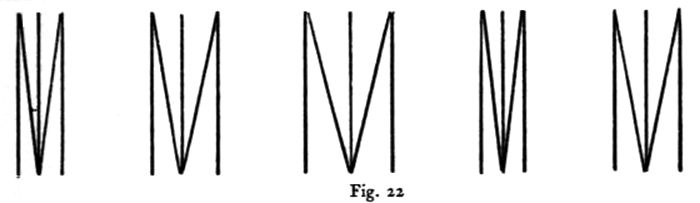
The interspaces were 150 mm. in every case, but 1 was 150 mm.
wide; 2 = 110 mm.; 3 = 70 mm. All the spatial subjects found
Fig. 22 worse than Fig. 21. The irregularity and general disorder
was more pronounced. Although the rhythm had never consciously
given them pleasure, and, when not violated, was never noticed,
still the threefold difference in size violates some feeling which
they can only express in rhythmic terms. Some tried to group the
three units into a larger group, but this being unsymmetrical displeased
them. Others picked out the most satisfactorily proportioned
unit and ignored the others, but any possible apperception
was irritating. The temporal subjects found it equally poor. They
felt the continual dissatisfaction of having their expectation, that
the adjacent unit should be the same, disappointed. They all said
that they could carry the feeling of repetition over one dissimilar
unit (i. e., in an alternating series of two different units), but that
the third difference completely upset the scheme. When only the
filling varied as in Fig. 21, it could be partially ignored, but difference
in size could not be ignored, and only the equal distances apart
kept them from being a heap. They could not feel the evenness of
the empty interspaces, however. They were not consciously present
in the experience at all, they merely knew they must be even. There
was no feeling-tone whatever to the empty alternates.
Only one subject preferred Fig. 22 to Fig. 21, and the reason
was obvious. 1, 2, and 3 appeared as the same unit where variation
in size was apperceived as due to perspective. Thus, instead
of appearing as three units repeated, they were one set which progressed
by means of "pulsations" or regular intervals of perspective.
This gave an added richness to the rhythm, and was very
pleasant. As three separate units of different size, there was no
meaning in the series whatever.
It is evident from these introspections that, although the likes
and dislikes may vary, the principles on which they are based have
much in common.
The points on which they agreed unanimously were the following:
(1) There is no feeling of repetition for three separate units.
The series may be enjoyed by means of subjective grouping of one
kind or another, but as separate elements, the feeling of repetition
is broken by adding the third.
(2) There is a distinction between perceiving or knowing a repetition,
and feeling it. Even though a subject is equally conscious
that elements are repeated according to some scheme in two different
cases, he may feel it in one case and not in the other.
(3) The empty spaces between the elements have no conscious
part to play in the experience. Even when there is a figure in the
alternate space, it comes very little into consciousness as part of
the repetition, yet it is alterations in these alternates which make
or mar the feeling of repetition. A series may not be beautiful
in itself, but if the alternates are regular, it feels repeated. Vice
versa, the units may be enjoyable in themselves, but they do not
feel repeated unless the alternates are regular and conform to certain
requirements. In the units lies the meaning of the repetition,
in the regular alternates the possibility of its expression.
(4) The rhythmic character of repetition is not felt by a certain
type of subject, when it goes smoothly. When a variation is made
which would destroy any possible rhythm, its lack is felt, and its
violation finds expression only in rhythmic terms.
(5) More violation is done to a series to have the size of units
varied than the filling. (This corroborates previous experiments.)
(6) A certain amount of ignoring and regrouping can be done
by the subject. The series is not taken exactly as given, but with
selective attention.
(7) In a series of different elements alternating, the most prominent
one is chosen for the major unit, and the others for alternates.
This prominence is more influenced by size than any other factor,
but may be due to intrinsic interest of any kind.
(8) The major and minor elements must have a certain difference
from each other, both in appearance and interest, and they
must be different enough for the difference to be easily perceived,
but not enough to be incongruous. They must differ in interest
enough, so that one is easily more prominent than the other, or
may be made subservient to the other, in the apperception.
(9) Variations are pleasant in the principal unit repeated, but
not in the alternating figure unless very slight indeed, or affecting
only secondary parts of the figure, not the main lines.
(10) Not the time actually spent on a unit makes it more or less
prominent, but the feeling of more or less "energy" expended on it.
Ends: In an alternating repetition, must the series end on a light
or heavy beat? That is, must the major or minor unit be on the
end?
To test this a series of strings was hung in which a group of three
alternated with a single string.
The subjects were asked to look at it with the three-groups on the
end, and with the single string. In every case the three-group ending
was emphatically declared the best. What reasons were given
were much the same, although most of them could give no explanation
at all. S. said the minor space on the end left him "hanging
in mid-air, it needs the heavy beat to land me again." Others said
it was "ragged" unless the three-group ended the series. R. said
anything interesting would do on the end, as well as the larger-sized
unit, it simply needed something of sufficient interest to stop the
rhythmic process and keep one from going on.
It was impossible to describe the experience except in rhythmic
terms, and those in whom this sense was not strong could give no
account whatever for the difference in their feeling for end.
It will be remembered that some experiments were previously
described relating to the difference in apperception of a group of
lines equally distant from one another, and a group averaged at
equal distances each side of a middle point, but unequally from each,
to emphasize the bilateral symmetry. Two such series were now
taken to find if there were any difference necessary in appropriate
endings. Since the two types of groups differed so much in apperception,
did that difference so extend to the whole series that a different
space was needed at the end to finish them off?
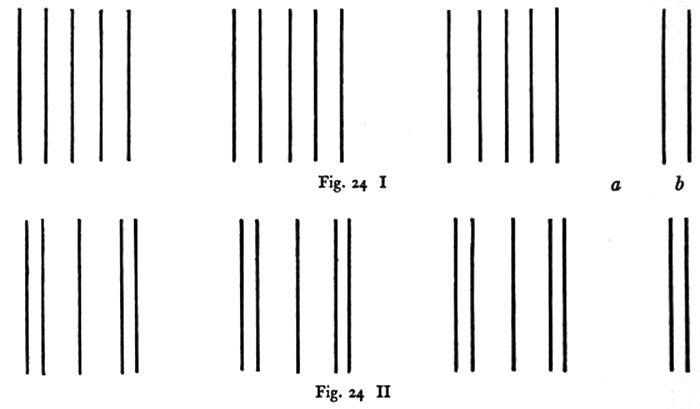
The method of experiment was the following: Two series of
repeated groups were hung (100 mm. wide and 100 mm. between)
with the design of the groups varied as described. At the end of each
a strip of cardboard was hung, which the subject was asked to move
so that it bounded the amount of space at the end, necessary to
finish the series adequately.
Thus b is the cardboard strip, and a the space which was to be
varied according to his taste. The same experiment was tried with
each series, with the following results:
| I |
II |
| U. |
a = 96 |
mm. |
a = 90 |
| J. |
33 |
|
50 |
| S. |
97 |
|
90 |
| H. |
109 |
|
104 |
| R. |
160 |
|
150 |
| V. |
170 |
|
135 |
| T. |
145 |
|
125 |
| W. |
80 |
|
68 |
In the case of every one but J. the subjects preferred a longer end
space with I than with II. J. was, however, of the extreme spatial
type who gave as his explanation that with II, when the central line
was prominent, the end (a) must equal just the distance to another
middle line, while with I it must harmonize with the shorter distances
in the group, but not exactly equal them, for that would make
it too narrow.
It would mean, then, that the apperception of the repeated group
in I (if it accords with the subject's own introspection) consists in
repeated fluctuations of attention over the five strings, with no repose
on any one more than another. The movement is back and forth from
edge to edge, and hence needs more of an end to finish it than in
a series of symmetrical units where the movement is not back and
forth, but balanced and resting on the central point. In other
words, in Group I there is a rhythm of movement within the group
itself, as well as of the whole, while in II it is balanced and coördinated
from the centre of each group, out and back, so that a longer,
or at least more important end of some description is necessary to
break the rhythm, and stop the series in I than in II.
It is noticeable also that H. and S. thought in both cases they
were making the end spaces equal to the interspaces; but after
Series I, a was made 102 and 109; and after Series II 95 and 104
respectively. This naturally raised another question: Does a series
of groups, with repetitions within each, tend to make one overestimate
distances between or at the end, or at least does one overestimate
these distances in comparison with a series of symmetrical units?
The subjects were so unanimous in preferring a larger "embankment"
after Series I than II, that it was useless to test them further
on that point, and the experiment was changed to the other question
according to the suggestion above.
A series of eight cards was prepared (125 mm. wide) on four of
which five heavy black strips were drawn equally distant from each
other, and on the others a much wider strip in the centre with another
on each side near the edges. Of the two series just made, one
was composed of what we have called "rhythmic units" and the
other of "symmetrical units."
The subjects were asked to arrange the two separate series so that
the interspaces should be exactly equal to the units. It will be observed
that the rhythmic unit had a black strip on each edge, thereby
apparently decreasing its size, while the edge of the symmetrical
unit was white. In this respect the comparison was hardly fair, but
the result was the following. The figures represent an average of
two trials, and stand for the size estimate of the interspaces for each
subjects respectively, in the two series.
| I |
II |
| J. |
132.5 |
130 |
| S. |
125 |
122 |
| U. |
133 |
129 |
| H. |
128 |
124 |
| R. |
126 |
122 |
| W. |
136 |
133 |
| V. |
129 |
131 |
Average difference of estimate of both series = 2.64. Mean variation = 1.37.
It might be contended, however, that Series I is an example of
optical illusion, that the card was overestimated for that reason,
and the interspaces necessarily made wider. To avoid this difficulty
another series was made. Two sets of cards (125 mm. wide) were
prepared; one with five black strips at equal distances apart as before
(excepting that the strips were made heavier), the other with six
strips. The card with an odd number of strips had thereby a strip in
the middle upon which the attention could centre,—possessed a kind
of balance. The card with an even number of strips had, moreover,
no such central line but only a space, thus preventing repose of
attention, and making the unit more pronouncedly rhythmic. (It will
be noticed in the foregoing table that one subject, V, made narrower
interspaces in I than in II. He said he felt the units as centring
around the group of three lines in the centre, not as proceeding equally
to the edge. The unit became thus for him symmetrical instead
of rhythmic, which could easily account for the difference in estimation.)
The results in the present case are an average of three trials:
| |
I, 5 strips |
II, 6 strips |
| J. |
129 |
137 |
| S. |
125 |
129 |
| U. |
132 |
133 |
| H. |
125 |
131 |
| R. |
127 |
138 |
| W. |
126 |
133 |
| V. |
123 |
129 |
Average difference in estimate of both series = 6.1. Mean variation = 2.1.
Since both these figures represent an effect usually explained by
optical illusion, that factor may be counted out, and the difference
in the estimate be accounted for by the difference in the rhythm
of the units. The difference in estimation between the two rhythmic
units, differing only in odd and even number of strips, is greater
than between the rhythmic and more strictly symmetrical, and yet
the two were more comparable in construction. It would seem,
then, that the greater overestimation of II is due to the rhythmic
movement which is not limited or driven back to a central line as in
I, but, by continuing over the limits, produces a greater feeling of
breadth.
The same question was experimented on in another way. Smaller
strips of cardboard all 50 mm. wide, but with different designs,
were hung behind the narrow window previously used. Four of each
set were hung at a time behind the window, and subjects arranged
them so that the interspaces appeared to equal the strips. These
designs were to illustrate different points in question. The difference
in estimation for an empty card, and a filled one; the difference according
to the strongly centred, or rhythmic, or slant lines of the
filling. These experiments were not so complete as the former ones,
since the subjects were scattered; hence they represent only one
trial or an average of two. But the results conform with what we
have been led to expect.
| |
I |
II |
III |
IV |
V |
| J. |
49 |
57 |
52.5 |
52 |
53 |
| S. |
51 |
56 |
50 |
49 |
51 |
| U. |
53 |
54 |
49 |
50 |
48 |
| H. |
53 |
52 |
49 |
51 |
| R. |
52 |
52 |
51.5 |
48 |
51 |
| W. |
50 |
55 |
50 |
50 |
52 |
| V. |
51 |
53 |
49 |
48 |
51 |
| Average = |
51 |
54 |
50.6 |
49.4 |
51 |
| Mean Variation = |
1.5 |
1.4 |
1.2 |
1.06 |
.9 |
These results point to the fact that there is a tendency to overestimate
the strips unless there is a strong central accent, which
draws the attention back to the middle of the strip, in which case it
is slightly underestimated. This would seem to be contradicted in I,
where the centre is strongly marked by slant lines coming toward it.
But the subjects, instead of taking the lines as pointing towards the
centre, in almost every case felt them as leading away from it, and
the oblique lines gave an appearance of greater breadth, which
result was carried out by the greater overestimation of II. In this
case, in addition to slant lines, there was no central accent, and the
overestimation was proportionately large. III and IV were intended
to illustrate the difference in estimate of rhythmic and symmetrical
units, but although a slight difference is apparent, the subjects did
not feel III as strongly rhythmic, because the black lines on the ends
of the strip were ignored against the black background, and only
the two central lines were taken. This made it more a balanced than
a rhythmic unit, so it is not a fair type of the point in question.
We may say, in conclusion, that oblique lines (which involve a
more complex muscular adjustment to perceive them) give an impression
of greater distance traversed, hence are overestimated; of
two rhythmic groups, the one containing an even number is more
overestimated than the odd, since the movement across is unchecked,
and not balanced around a central line; a series of strongly centred
groups is more correctly estimated as to its interspacing, and even
slightly underestimated, because of the check imposed by the centre
of fixation in each group. Although these results are very uniform,
a more complete series of experiments should be done on this subject,
to make the conclusions thoroughly valid.
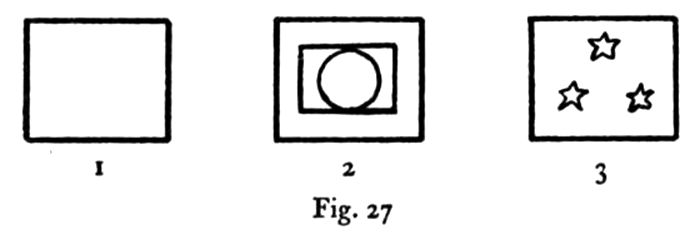
Another question was suggested by these results: Is it more agreeable
to have a series of repeated space forms nearer or farther apart
when a design is within? Does the design, by drawing attention to
itself (especially if it be markedly central), make the objects demand
narrower or wider interspacing? To test this question, four blank
strips of cardboard were hung behind the narrow window, and the
subjects arranged them at the distance apart which suited them best.
Then two other sets of cards, of the same size, but of different designs,
were hung successively the same way, and these arranged also at the
most agreeable distances.
One decorated card had a
circle within a rectangle,
the other a triangle of gilt
stars. The judgments were
made in pairs, i. e. the blank
cards and the one with the circular design were arranged twice in
succession; then the blank cards and the star design. This gives
three judgments for the blank cards, two for the circular, and one
for the star design, and the judgments are given in full, since an
average would disguise the point in question.
| |
I |
II |
III |
| J. |
50 |
50 |
|
| |
55 |
52 |
|
| |
55 |
|
50 |
| S. |
35 |
70 |
|
| |
45 |
20 |
|
| |
55 |
|
35 |
| H. |
85 |
75 |
|
| |
90 |
|
65 |
| U. |
50 |
45 |
|
| |
50 |
48 |
|
| |
57 |
|
50 |
| R. |
45 |
25 |
|
| |
15 |
10 |
|
| |
45 |
|
23 |
| L. |
90 |
35 |
|
| |
65 |
|
65 |
| W. |
20 |
10 |
|
| |
25 |
10 |
|
| |
25 |
|
0 |
| V. |
45 |
60 |
|
| |
30 |
35 |
|
| |
30 |
|
25 |
Although the favorite arrangements varied somewhat on the different
days, the filled cards were with only four exceptions preferred nearer
together than the empty ones at any one trial, and two of these put
them equal. (The choice of V. was affected by the fact that the circular
designs produced such strong after-images that he was obliged to
put them farther apart, to avoid confusion with the real design.) The
reason suggested by the subjects for a narrower interspacing with
decorated cards was that, when they attended to the design, they
paid no attention to the actual edge of the card, but the card ended
so far as its interest was concerned with the design. Therefore they
had to be nearer together to bring the designs, not the whole field
of the cards, into a series. If, then, the design extended over all the
card, and its interest was no more in the centre than the ends, would
this difference in interspacing cease to be demanded?
Another series of cards was hung with a design of oblique lines
over the whole field, and these arranged as the others were, at the
most agreeable distances.
| |
I |
|
IV |
| J. |
53 mm. |
J. |
53 mm. |
| S. |
45 |
S. |
47 |
| U. |
52 |
U. |
50 |
| R. |
35 |
R. |
37 |
| W. |
23 |
W. |
43 |
| V. |
35 |
V. |
34 |
If, for the sake of comparison, the average be taken of the favorite
arrangements of the four blank cards, and they compared with the
interspacing of the oblique line design, it
will be seen they approach each other
closely, except in the case of W.
These experiments would seem to show
that an empty space, or one completely
covered with decoration, is taken in its
entirety when repeated in the series. But when decorated, especially
toward the centre, the design, instead of the whole including space,
is taken as the repeated unit, and for this reason the different units
must approach each other to make a satisfactory series.
To what extent does change in level and plane affect the units of
a series? To test this, a series of diamond shapes was hung on the
same level and at equal distances, and the subjects enjoyed them as
a repeated series.
Then another row was hung above them, and halfway between.
The subjects grouped them either in twos or threes, thus transforming
them into one series of similar group-units of triplets and
pairs. They were asked if they could take them up and down, one
after the other without grouping, as they would have done when on
the same level. With a little practice two of them succeeded, but
they found the series tiresome when taken in this way, and deprived
of much of its pleasure.
The series was then changed by hanging a smaller diamond between
the others, at the same level.
This was enjoyed even more than the other, as an alternating series,
but when the smaller diamond was hung between but on a higher level
although it could still be included if grouped in some way with one
or two of the larger diamonds, it baffled all attempts to include it as
an alternate minor unit in the other series. The two series separated,
and one ran along above the other, or else a definite grouping took
place, so that the large and small diamonds made one group-unit
which was repeated. But to combine two different elements as major
and minor units of one series, when the two were on different levels,
was generally declared impossible.
Provided units stay on the same level, however, a difference in
plane does not prevent their being in one series, provided the plane
varies regularly, and the variation is not too great. The variation in
plane of a few inches, used with these shapes, did not prevent their
being taken as one series, although it much facilitated their being
taken as two, if desired.
These experiments have all pointed to the fact that our pleasure
in repeated space forms is an immediate experience. We do not
look over the series and merely recognize that regular repetitions
occur, but there is an immediate feeling of repetition, analogous to
our feeling of auditory rhythm. This feeling does not always accompany
a recognition that certain repetitions occur, but is a distinct
experience in itself dependent upon certain conditions in the series.
The series excites a certain response in the observer, which, if it corresponds
with his rhythmic organization, is pleasant, and if not, is
otherwise.
With a certain class of subjects this rhythmic response is very
noticeable, and they feel it as a conscious part of the experience.
With others, the symmetrical properties of the series are the more
prominent, and they detect no rhythmic response until the necessary
objective conditions for such a rhythm are violated. Then they feel
it as keenly as the other type.
In a series of units, there is a rhythmic discharge of energy on
each, the fixed temporal intervals being regulated by the alternating
space. When the units are too near together, or when the alternating
spaces vary irregularly in size, this rhythm is disturbed. If the alternating
spaces vary regularly in size, a richer rhythm is introduced,
which increases the pleasure up to a certain point when more variation
makes it too complicated, and confusion results. When one
element alternates with another, the one on which more energy is
expended for any reason becomes the principal unit. The other
has less significance as to its content than as to its size, for on this
depends the regularity of the rhythm. Variations in the content of
alternating figures must be cautious not to disturb, by the extra attention
necessary to take them in, the rhythm of the whole. Variation
in the principal unit may take place almost without limit, provided
there is an equal amount of interest in each, thus making a rhythm
of equal discharges. There must be an alternation of two, i. e. of discharge
of attention and rest. However rich the rhythm is made by
greater and lesser accents or groupings, the rhythm must fall eventually
into a discharge of attention, and a rest-period. In the temporal
type of subject, to whom the actual motion across the series is a
necessary factor of the pleasure, this discharge and rest-period of
attention is exactly inverse to the motion across the alternate and
rest upon the unit. That is, on the principal unit is the discharge of the
attention, but the rest-period of the motion across; while the alternate
unit supplies the field which is travelled over, but requires but little
attention.
The rhythm of the series may be not only of the units, but inside
the units as well, in groups of elements. The rhythm inside such a
group may be of two kinds: (1) a rhythm, which is at the same time
restrained and coördinated about a central point or line, and (2) a
rhythm which goes back and forth from edge to edge, and has a
tendency to overstep its limits, thereby carrying on the series with
more activity. The former is more connected with odd-number
groups, and the latter with even, although modifications in their
arrangement may reverse the effect. Since the eye moves more slowly
and intricately over a curve than over a straight line,[86] it may be that
that is the reason why an arched series is taken as the unit of a series,
rather than the vertical supports (as it invariably is in some unfinished
experiments not recorded here), whereas in a series of lintels
the horizontal line of the lintels requires less muscular adjustment
to perceive it than the vertical support, therefore the latter are taken
as the units.
In any case, the unit of the series which attracts the most attention
and interest, for whatever reason, is taken as the principal unit, and
may vary in details, while the alternate must be invariable, except in
certain cases where it meets other demands. There may be rhythm
in a series, and at the same time symmetry with respect to a middle
point. In such a case a balance must be obtained between the two
different motor responses.
A series of analogies between the rhythm of sounds and of visual
objects, will illustrate more forcibly the similar demands of both.
(1) Auditory Rhythm: Periodicity is necessary. Accentuation
may be supplied by the subject, but there must be fixed temporal intervals,
and if the temporal conditions are not fulfilled, no impression
of rhythm is possible.[87]
Visual Repetition: Alternate spaces must be of invariable size, or
the series is broken up. Different degrees of interest may attach to
the principal unit, or the subject may group them in different ways,
but the alternate spaces must be uniform, or there is no feeling of
rhythmic repetition.
(2) Auditory Rhythm: Sounds must recur within a certain rate.
When succession falls below, or rises above a certain rate, no impression
of rhythm results.[88] A certain voluminousness is necessary
for very slow measures, to make the separate elements connect themselves
in a series.[89]
Visual Repetition: Objects must recur at certain proportionate
distances from each other, to connect themselves into a series. Larger
objects may be at a greater distance from each other than smaller
ones, and still form a series.
(3) Auditory Rhythm: "Perception of rhythm is an impression,
an immediate affection of consciousness, depending on a particular
kind of sensory experience. It is never a construction or reflective
perception that certain relations of intensity, duration, etc., do obtain."[90]
Visual Repetition: The feeling of rhythm in a visual series is
immediate, and wholly distinct from the knowledge that certain
objects do recur. This is especially illustrated in repetitions of three
distinct units, when subjects saw and understood the scheme of
repetition, but could not feel it.
(4) The number of units in an auditory group depends on the
rate of succession, but any higher number of elements in a group
than six or eight falls back into smaller groups.[91] Eight is about the
highest number that can be held in a rhythmic group.[92]
Visual Repetition: Eight is the highest number that can be held in
a rhythmic group, and some subjects can only hold seven. Many
more units can be felt in a group, when the size of the including space
is taken as the measure and compared; but no more than eight
can be felt and recognized as the number of units it is. (There may
be exceptions to this rule in either auditory or visual rhythm, but
this is the norm in both cases.)
(5) Auditory Rhythm: In all long series, there is a subordination
of the higher rhythmic quantities, so that opposition of simple alternate
phases tends more and more to predominate over triplicated
structures.[93]
Visual Repetition: However complicated the repetition becomes,
with regular variations of the size of major or alternate units, the
units tend to re-group themselves, and so resolve ultimately into a
simple alternate repetition of two group-elements.
(6) Auditory Rhythm: "The introduction of variations in the
figure of a group does not in any way affect the sense of equivalence
between the unlike units."[94]
Visual Repetition: Changes in the content of the major unit do
not affect the repetition provided the alternate space remains invariable.
(7) "Feeling of rhythm is more definite as we proceed in a verse,
or in a series of simple sound sensations. At first the cycle is not
perfectly adjusted, and complete automatism established."[95]
Visual Repetition: Observers often had to look over a series
several times "to learn it" as they said, before the rhythm was felt.
To these may be added several other analogies, which, owing to the
fact that visually repeated objects remain in the field, while auditory
rhythm is purely successive, have other features which somewhat
confuse the resemblance. The principle, however, is the same in both.
(8) Auditory Rhythm: "At the close of a period, we have a pause,
during which the tension between the two opposing muscle-sets dies
out, and we have a feeling of finality."[96]
Visual Repetition: An alternating series must end on the heavy
unit, but since one does not look at series from left to right any more
than from right to left, a heavy unit must be at both ends, not on
one alone. In auditory rhythm, this final pause is not a function of
any of the intervals of the period, for it comes at the end, when the
sounds are no more present. But in visual repetition, after feeling
the series rhythmically, it is still in the field, either as an unending
series, or as a whole, in which each part is equally related to all the
others. The final pause of a series that ends must be at each end,
and the series perfect from either point of view. It therefore fulfils
the demands of symmetry as well as rhythm, but since symmetry in
its strict sense has no meaning for sound-series, this double finality
of visual repetition cannot be analogued in auditory rhythm.
(9) I have found no recorded experiments of rhythms of sounds
of different timbre and pitch, i. e., a regular rhythm of a bell with a
violin, a piano with a whistle, etc. It would seem, however, that such
a succession would produce the same irritation as a visual repetition
of incongruous elements; as a circle introduced into the Greek fret, or
a series of Renaissance columns and Egyptian monoliths. In both
cases, the whole set of adjustments for each element would be thrown
into confusion by encountering the next one, which would require
a different attitude. Such a readjustment would be impossible in the
space necessary for the perception of any rhythm, hence there must
be congruity in elements, either auditory or visual, to be in a series
at all.
(10) Auditory Rhythm: "If every alternate element of a temporally
uniform sound-series receive increased stress, the interval
which succeeds the unaccented sound will appear of greater duration."[97]
Visual Repetition: The distance between unit groups with a
strongly accented centre appeared shorter than between rhythmic
groups where the movement was not restrained at the centre, but
went from edge to edge. The principles which explain these similarities
are, however, different.
In the auditory rhythm, the stronger accented beat excites a greater
response than the unaccented. This lasts over longer in consciousness,
and for that reason the interval after the accent seems shorter.
In visual rhythm, however, the symmetrically rhythmic group
drives the attention in toward the centre, and whatever excursion it
makes to either side, it returns finally to the centre. In the even-number
rhythmic group, there is no such central line to restrain it, and as
one goes across it one has less check at the edge, the rhythm does not
wholly finish, and the space is thereby overestimated. The overestimation
is due to the rhythmic activity in the group which oversteps
its limit.
The essentially rhythmic character of the experience is, however,
the same in both. The experience of visual repetition is only one-sided
when the symmetry or proportion of a finished series is regarded
as the explanation of its essential character, and when the temporal
rhythmic factor is neglected.
The purpose of the latter half of this discussion of repetition is
to consider a certain number of examples of its use in typical
buildings of all the European styles of architecture from Greece
down, and to show that the principles laid down in the earlier half
have been expressed almost without exception in those of recognized
merit. In other words it is to show that the laws of repetition,
which have been brought out in the experiments of the first
part, and which would of necessity be true if that explanation were
correct, have indeed been exemplified in types of architecture universally
accepted as beautiful.
The illustrations have all been drawn from architecture beginning
with Greece, and not from the older Eastern styles. Egyptian
architecture, although it recognized the importance of repetition
to some extent, in its colonnades, avenues of sphinxes, and hieroglyphic
decoration, never reduced it to any principle, nor adhered to
any one scheme throughout a piece of work. Supports of the same
kind and diameter have no fixed relation to each other, they may
be of the same or different lengths, and may vary in diameter as
well.[98] Spaces between columns of one size and design may vary
considerably, and the entablatures be of different proportions. The
art of Egypt was not rhythmic.
The architecture of Assyria and Chaldea had even less of repeated
forms in its style. They made but little use of columns or
piers, and had few arches.[99] The bare Assyrian edifice was like a
great box, perpendicular to its foundations, and the long walls pierced
by hardly an opening in the way of windows or doors.
Persian architecture was noted for extreme nicety of execution,
but a monotony in all its forms, and conventionality about its use
of the column, which makes it little more fruitful for our study of
repetition as an artistic value. In its decorations of bas-relief, the
pose and gesture of each figure is so exactly similar that they appear
almost machine-made.[100] When a little variety is introduced,
it is evidently done with misgivings, and shows none of the spontaneity
or first-hand pleasure in either repetition or variation which
would make it profitable for illustration.
Such a lack of feeling for repetition is, indeed, according to the
peculiar genius of these styles of architecture, what might have
been expected. The ruling idea, especially in Egyptian and Assyrian
architecture, was ponderous strength. Everything was built
with the idea of remaining immoveable through centuries to come.
The enormous temples and tombs, the long palaces with their heavy
walls without an opening to relieve them, the pyramids themselves
like mountains of rock—all these meant strength and immutability,
to which the motion and rhythm involved in repetition was totally
foreign in spirit. In Persia indeed (as well as India and China,
which will not be considered here) there was a change in tone.
The column was used, not the massive one of Egypt, but a lighter
shaft, which showed a tendency toward other effects than immensity
and strength.
With this change of ideal, repetition in some kind of system made
its appearance, but its variations were tentative. It had not become
used to its new sense, and it was left for Greece to develop the
rhythm and movement of repetition, and to combine it with proportion
and symmetry into its perfection.
The method of analysis employed has been to go through a certain
number of architectural photographs, picking out all the examples
of repeated forms of any description, and classifying them
according to the principles which they exemplified or seemed to
violate. For this purpose a collection of about five thousand photographs
from the library of Robinson Hall, Harvard University,
was analyzed. The photographs were taken in order of styles: Greek,
Roman, Romanesque, Gothic, Italian and French Renaissance,
and modern. The examples of the different points in question were
taken as they came in the cataloguing of the library stacks, without
respect to whether they appeared to bear out the previous conclusions
or not.
VARIATION OF ALTERNATING UNITS
The first principle which we shall consider is the variation allowable
in the units of an alternating series. It will be remembered
that the principle was as follows: (1) In any series of two alternating
units, the one on which the most energy is expended is regarded
as the principal unit, the less important one as an alternate.
Variation of the principal unit is allowable, often desirable
and even necessary; variation of the alternate never allowable,
unless other circumstances change the situation. If the minor unit
is changed, so that in interest it equals the major unit, the rest-phase
of the rhythm is destroyed, the effect is of two rival repetitions going
along together, and fatigue results. If variation in the alternates
exceeded that of the principal units, the balance of the rhythm
would change, the alternate become the major unit, and a new series
begin.
From the very nature of the case, then, it will be impossible to
look for variations in alternates, which make it exceed the principal
units in interest. We must investigate alternating series, in
order to see if one of the elements remains the same, while the other
may or may not vary. If this were true, a rest-phase for the rhythm
would be assured in the series, while the principal unit might vary,
provided the same amount of attention were required in each case.
(2) It will also be remembered that size and limiting shape were the
factors that could not vary without doing violence to the rhythm,
while content might vary almost without restriction. (3) The position
of alternating units as regards each other cannot vary; the two
units are so dependent on each other that the position of one must
remain halfway between two of the opposite kind. In other words,
if the two series of units run between each other, they form one
series or rhythm. Two rhythms cannot be kept up alongside; so if
one unit, however regularly placed with regard to another of its
own kind, recurs at unequal distances from the other units, the
feeling of the repetition is lost, the rhythm broken, unless the two
units can be grouped into one, and so make a single rhythm again.
We shall, then, look for alternating series, of which the two units
are at equal and invariable distances from each other; the variations
of content (if such there are) occur only in the major unit; and are
of the filling, not of the including shape or size.
It may be readily seen that there are difficulties in finding alternating
series which exactly illustrate this particular point, or in reducing
them to any system. It was necessary to look through many
photographs to find one that presented the required conditions
(i. e., two repeated series of units, alternating with each other), and
when found, they were of so many different varieties, from windows
in an apse to reliefs on a fountain, that each has had to be described
by itself, and any rigid classification was impossible. Moreover, it
was difficult to find a scale of judgment by which to decide whether
a series was really alternating or plain repetition. From one point
of view, every repetition is alternating, that is, the repeated unit
always alternates with an empty space. Although such repetitions
bear out the theory still further, and emphasize yet more strongly
the invariability of alternates, and the possibility of variations in
the principal units, I have used the term in a stricter sense, and
only given illustrations of repeated objects, when one unit actually
alternated with another definite unit.
Had the other sense of the term been used, examples might have
been multiplied without limit, of slightly varying repeated units,
and unvarying alternate blank spaces. But it was felt that such
accumulation of illustration was unnecessary, and that what was
true in a stricter sense of the term would be recognized as true for
the larger number of cases that might be cited with a wider meaning.
If the minor units had a definite enclosing outline, they were counted
even though they were blank within, but without an enclosing outline,
that is, if they were mere spaces, they were not considered, although
the fact that there is such universal use of this type of decoration
shows only more conclusively how the necessity of the invariability
of alternates is taken for granted as an axiom of design.
Another type of alternate repetition was not included in the illustrations,
i. e., when two sets of units alternated, without variation
in either one. To this class belong all the conventionalized designs
used so much in all kinds of decoration, and of which a very full
account is given in Owen Jones's Grammar of Ornament.
These, to be sure, illustrate the negative points, viz., that size
and shape are unalterable for rhythmic repetition; that distances must
be equal and invariable; and that alternate units must not vary.
But since the principal units do not vary either, it seemed needless
to give them as examples of the point in question. A mention of this
class of alternating repetitions, of which there is such a great number,
is enough to show that they fall within the theory. But one example
is as good as a thousand, and their inclusion among the illustrations
for rhythmic alternates will be taken for granted without further
mention.
We are left, then, to the consideration of those alternating repetitions
alone, where both have a definite outline, and one or both
varies to a greater or lesser extent. The effort will be to show that
the unit which for some reason is of principal importance in the
rhythm, is the one chosen to vary, and if not that the repetition
suffers thereby.
125 EXAMPLES
- A. Variations in Principal Unit alone: 87.
-
- I. Content alone:
-
- a. Metopes and Tryglyphs in Friezes: 9.
- b. Arches and Columns: 2.
- c. Statues in niches alternating with supports: 37.
- d. Windows alternating with supports or decorations: 12.
- e. Paintings or mosaics: 7.
- f. Carved designs in screens or ceilings: 17.
-
- II. Size and Content.
- a. Doors, paintings and reliefs on façades.
- Vary in size to emphasize symmetry: 4.
- b. Statues or shields over arcades.
- Vary in size to complicate rhythm: 1.
-
- B. Variations in Principal Unit AND Alternate: 37.
-
- I. Content alone:
-
- a. Windows and decorations on façades.
- Alternates vary in design to emphasize symmetry: 4.
- b. Windows and turrets. Vary alternately in design to complicate rhythm: 2.
- c. Reliefs alternating with tablets; reliefs or statues and pillars: Alternates
- vary in design to give richer effect: 11.
- d. Alternate unit is human figure: 9.
- e. Alternate unit varies in design, but is on a different level: 3.
- f. Irregular variation in alternates (windows, shields, and railings): 3.
-
- II. Of Size of Alternate Unit.
-
- a. Windows and supports. Vary in size to emphasize symmetry: 1.
- b. Statues and pillars; windows and pilasters.
- Alternates vary in size to complicate rhythm: 3.
- c. Vary in size irregularly. Disorder: 1.
-
- C. Variation of Distance.
-
- Row of windows—Distance between first two is wider: 1.
The 125 illustrations of alternating repetition which were taken
at random among 5000 photographs show a decided compliance
with the principles already laid down. But there are many divergences
as well, which it is necessary to consider, to see whether they
are really contrary in principle or fall under its wider application.
Eighty-two accord exactly with the principles with which we started.
The distances between each set of units are equal and invariable;
one unit varies in content but not in size or including shape; the alternating
unit is invariable.
There is an interesting modification of this principle in the case
of the metopes and triglyphs of the Greek friezes. Here the triglyphs
are unquestionably the principal units structurally, and to
many observers the principal beat of the rhythm when taken rhythmically.
But the triglyphs never vary and the metopes do, which would
seem at first to violate the rule that principal units alone, and not
alternates, should vary. This difficulty is obviated in two ways. With
the spatial type of observer, the triglyph is indeed the principal beat
of the rhythm when the series is at such a distance that the difference
in the metopes (if there is such) cannot be detected. When,
however, the series is nearer at hand, there ceases to be any rhythm,
but each carved relief is taken for itself without regard to the others.
With the rhythmic type of observer, if the triglyph has been the
principal unit before, the principal beat changes on nearer approach
to the metope and the whole series shifts its accent. It is impossible
for any observer to keep the triglyph as the principal unit of the
rhythm, when so near that differences in the metope are easily perceived.
There are still thirty-eight cases which vary from these rules, and
many of them vary in more than one respect. These exceptions
fall into several classes, quite distinctly marked off from one another,
and will be taken up in turn.
In five cases, the size of the principal unit varies as well as the content,
but in four cases the variation of size is either at each end, or
in the centre unit, to emphasize bilateral symmetry of the series as a
whole. The series in this case is taken as a larger unity of which the
separate units are parts; and hence they are not only repeated with
respect to themselves, but are symmetrical with respect to the whole.
In the other case where the size of the principal unit varies, it varies
on every other one, thereby complicating but not confusing the rhythm,
i. e., a stronger accent comes on every other principal unit.
There are also five cases in which the alternate spaces vary in size.
Three vary regularly, thereby enriching the rhythm by introducing
alternate heavy beats, and one varies at each end of the series to
emphasize bilateral symmetry of the whole, with regard to the central
unit. In the other case the alternates vary in both shape and size,
with no regularity and from the point of view of repetition alone,
disorder is all that results. This is on the Palazzo Pretoria in Pistoia,
where carved shields occur at equal distances between windows.
These shields are not component parts of the building, but were
added with some other kind of significance; hence they express nothing
so far as repetition for its own sake is concerned.
The other variations are all in the content of the alternate, minor
space. Four vary symmetrically in the designs on each side of the
central point, so as to accent the bilateral symmetry of the whole
taken as a unity. Two vary rhythmically in design, i. e., there are
two sets of designs which alternate with each other in the unaccented
spaces. When they vary regularly in design, the rhythm of the
whole is enriched not confused, provided there are only two sets, not
three or more. The alternate spaces are passed over on the way to the
principal unit, but by having an alternating design between them
(varying only in detail, but of the same general character) a more
complex rhythm is introduced which is good, since in both cases the
alternates and principal units are so different they could not possibly
be confused with each other, even though both varied. (In one case,
turrets and statues vary with windows of the same shape but different
decorations; in the other, arched windows and arched spaces alternate
with statues.)
Eleven more cases of variation in the minor as well as major spaces
fall under another head. These do not vary with regularity, but are
different in each case—the detail of the design varying, while
the shape, size, and distance remain unchanging. It is interesting
to notice that these examples of variations of alternates were almost
all taken from examples of Renaissance architecture, where
a richness of effect was desired, even at the expense of regular rhythm.
This could, indeed, be attained in no other way so well as this. In
all these eleven cases, the conditions are alike: both of the repeated
units are enclosed by limiting lines of unchanging outline. The
principal units are more prominent than the others on account of
greater size or interest, but the alternates, instead of retiring entirely
into the background, have slight variations in decoration. This variation
is always only in detail: the tracery on the pillars of the tomb
of Louis XII, of the Loggia dei Novoli, in the Chiesi di Frari, Venice,
etc. So unimportant in fact is the variation that it is not observed
until one attends closely to it, and yet the rhythm is just enough disturbed
by its presence to give a feeling of extra sensation or luxuriance
which cannot be attained through variation of the major units
alone. It is in the alternate spaces that the feeling of repetition lies.
Any material change in them destroys the series, but a slight variation
in the lines of decoration, a little rearrangement of the conventional
curves in each alternate, gives, even though unattended to, in
fact partly because unattended to, a vague feeling of variety, of some
superfluous sensation being brought into consciousness, although
the regular shape, size, and distance of the objects remains unchanged.
It is this feeling of superfluity and slight disturbance which constitutes
the peculiar richness of certain styles. These examples, then,
far from falling outside of the laws of repetition, owe their opulence
of sensations to the very principles of regular rhythm which they
violate.
Another set of exceptions will involve more searching analysis.
Nine of the examples described have the human form for the alternate
unit, and in every case where this happens, the alternate varies.
In the majority of cases where statues of the human form alternate
with any other object, the statue is taken as the principal unit on
account of its superior interest, but this is not always the case. In
the Padua Basilica, and in the Church of St. Guistiana, cherubs alternate
with conventional decorations, but the latter are so much larger
and more elaborate that they would naturally be taken as the principal
units. In the other seven cases, statues alternate with bas-reliefs which
also have human figures in them; hence, since the bas-reliefs equal
the statues in interest and exceed them in size and importance, they
are taken as principal units.
It might at first be expected from the previous discussion that, in
order not to shatter the repetition, the alternate statues must be
alike, must be conventionalized into identity; but this is not the
case. Another principle now comes into play. We demand variation
in the human form whatever its place in art, even in the unimportant
position of alternate in a repetition, and although they are kept as
much alike in pose, size, level of head and feet, general character
(i. e., cherubs do not alternate with old men, nor draped figures with
undraped), yet there is some variation of pose or direction of glance,
to keep them from being duplicates. We should expect this variety
of repetition to be in danger of becoming fatiguing because of its
lack of an unchanging rest-phase, but this difficulty was evidently felt
in building them, for in every case some unchanging element has been
supplied to the series to bind it together and to keep the constant
changes of attention from upsetting the series. The cherubs of the
Padua Basilica are in high relief against a uniform rectangular
background which does not vary, and which furnishes an alternate
just in character with the principal unit, the bas-relief. In the
Cantoria of Donatello, although the dancing children move across
the whole space, uniform double columns occur at intervals, and
supply an unchanging alternate, while the children vary in position
behind them. Around the pulpit of Lincoln Cathedral, although
both units, reliefs, and statues vary, the pilasters behind the statues
are invariable and supply a constant, unchanging factor in the series.
In the alternating reliefs and statues of the Milan Cathedral or in
the paintings of different sizes in All Souls Church, Oxford, an
unchanging element is supplied in the frame, which is of like design
in every case, so that in passing from one to the other an unvarying
alternate is always present. In the Sienna font, and in the statue to
Leonardo da Vinci, which are types of a vast quantity of repeated
forms, there is uniformity in the minor pedestals and in the frames
of the alternating bas-reliefs, which supplies the unchanging factor.
Moreover, another factor is noticeable in this kind of repeated
series,—it is never long. The fatigue which would certainly result
from a too long continuance of varied alternates, even with unvarying
factors in the way of supports, pillars, and frames, is obviated in
various ways. The series is either short and the whole has a definite
bilateral symmetry, as in the Padua Basilica, and in the Oxford
church; or, as in a great number of cases, the series goes around
a fixed central point so that only three units are seen at a time. It is
thus especially that this method is used in fonts, pulpits, and monuments,
where from the circular arrangement enough can never be
brought into the field at once to fatigue the attention.
This consideration of alternates which vary widely, as do human
figures, even when they are alike in size, general shape, and character,
and, moreover, the discovery that there is almost without exception
an invariable element between the other alternating units, i. e., a third
alternate; or behind them, as in the case of the pilaster behind the
statue, may well bring up two questions:
(1) When the unchanging factor comes between the other two units,
is not it in reality the alternate, and the two other units either variations
of shape and size of one principal unit or two sets of principal
units? In other words, do we not actually apperceive the two principal
objects as the units of importance, and take the unvarying factor
which comes between, no matter how slight it may be, as the alternate?
Do we not demand the unvarying as our alternate, no matter how
many variations may be in the other figures?
(2) When the unchanging factor comes behind the alternating
statue, in the same plane with the bas-relief, do we not inevitably
take it as the alternate in the series, and regard the statues more as
episodes or attendants on the series but with real values of their
own? Is not the fact that the unvarying factor and principal units are
in the same plane an indication that they constitute a real series,
while the statues or paintings which are in a plane by themselves
make a series, harmonizing with the other, it is true, and in part coinciding
with it, but felt in a different way? Therefore the actual
repeated series conforms to the given conditions and is made to do so
in every case by its unchanging alternate in the same plane; while
human figures with values of their own never can be considered
quite as alternates, but are really felt to be a series by themselves.
This introduces another question. In two more cases of varying
alternates, there was variation in decoration above the level of the
rest of the series. In the Borghese Casino, there is variation in the
busts placed over the alternate windows. In the Venice rood-screens,
there is variation in the carving of the alternating supports, which
rise above the rest of the series. Is that part of the series above the
level of the principal units really included in its perception? It would
seem rather that when the series as a whole is being taken, those
variations above the level of the main units (if they are not very
marked, and they were not in either of these two cases) are ignored
or only felt in a vague way as added richness. When, however, the
attention is turned toward them especially, they form a series of their
own, in which they become the principal units, and alternate with
empty spaces. There is no limit to the changes possible in apperception,
according to the level and plane of the alternating units.
There are three cases left; two where alternates vary in content
with no system, and one with variation in distance. The first two
are differently carved sections of railing on the side of Freiburg
Cathedral, and a differently decorated frieze of squares and circles
in the S. Lorenzo Cloisters, Rome. The effect is only of disconnected
and fragmentary series in both cases, and especially in the latter
case it is impossible to feel it as a repetition at all unless the variations
are ignored, and the attention fixed on the unvarying factor of size.
The variation of distance is in the Beauvais Palais de Justice,
where the first window is at an unequal distance from the others in
the series. The effect is only of disorder and accident.
We have, then, surveyed all our examples of alternate repetition,
and found that in the exceptions to the general principles laid down
some other effect than repetition as such was sought. Either (1) symmetry
for the series as a unity was required, which demanded variation
of the end or central units. In so far, then, as it fulfilled the
requirements of symmetry, those of repetition were disregarded.
(2) Richness of effect was accomplished by those slight variations
in decoration of alternates as well as the principal units. These by
their vague suggestions of different combinations of similar elements,
and minor differences felt but not attended to, gave a superfluity of
experience which made up its peculiar richness.
(3) When the human form (or any other form of especial meaning
in itself) makes the alternate unit, some variation is demanded as
in keeping with its own significance, since in proportion as a thing
has meaning in itself, it must not be exactly duplicated. But an invariable
alternate is always supplied in the way of a frame, or background,
which is felt as the real rest-phase of the rhythm, while the
varying alternate forms have a place in a series of their own. Also,
since such a complex attitude would be fatiguing, such series are
always short, or circular, so that few units are in the field at once.
(4) Regular variations in size or content, in either major or minor
which recur at fixed intervals, give a heightened rhythmical effect
by making certain beats heavier than the rest. As has been stated
before, the major unit holds within it the real significance of the
content of the experience; the minor unit holds the secret of the
rhythmic effect.
(5) Only 4 examples of the 125 were found to repeat themselves
alternately with irregular variation of alternates and violation of
the other principles laid down at the start. These can only be regarded
as accidents, as faulty examples of art, whose virtue lies in
some other part of the work as a whole, and not by any beauty they
possess in themselves as repeated series.
SUMMARY
125 Illustrations.
- I. Variations in Principal Unit alone, 87
- 82 Content
- 5 Size 4 Symmetry
- 1 Rhythm
- II. Variations in Alternate Unit (and Principal Unit)
- 32 Content 11 Richness
- 9 Human figure
- 2 Rhythm
- 4 Symmetry
- 3 Different level
- 3 Disorder
- 5 Size 1 Symmetry
- 3 Rhythm
- 1 Disorder
- III. Variation in Distance
- 1 Disorder
Several questions have been raised in this discussion of variations,
but one which seems directly leading from it will be considered next.
When is variation necessary in a repeated series? We have considered
the numerous cases where variation is possible, and the different
ways in which a series may vary according to the idea to be expressed.
Moreover, what appeared to be exceptions to the rule were
shown to be guided by a desire for some other effect than repetitions
as such.
But when do we demand variation in a series? Is there any case
where variation of the unit is not only allowable, but positively
necessary to its æsthetic value?
There were no experiments on this question, for it will be seen
from what follows that they would have been impracticable. But
observation of several thousand photographs has made the following
clear: When the series consists of objects having an æsthetic
significance of their own, not depending on something else for their
value, then variation is demanded. In other words, when a thing
is an end in itself, we do not tolerate an exact duplicate. It may
have a place in a series of others similar to it, but its own meaning
loses force if another is beside it precisely alike. When, however,
an object has no great significance by itself, or when however great
its value, it be regarded as means to something greater, hence not
an end in itself, it may be repeated without variation.
This principle may be stated from another point of view: Any
work of art, of the highest significance in itself alone, must not be
repeated at all. There must not be even the suggestion of repetition.
The highest values are individual, and to have a copy or a series
defeats its whole reason for being. Thus, a second Sistine Madonna,
or a series of Venuses, would shock our whole æsthetic feeling.
Moreover, we do not want a suggestion of repetition; even a series
of different Madonnas in similar frames would take away from the
significance of each, in so far as they were regarded as a series, and
not as a mere collection of detached units.
But grading down from these works of the highest value in art,
there comes a point where an object, although possessing considerable
value in itself, is not so intensely individual but that it can gain
somewhat by a place in a series of others like it in some respects, but
differing enough so that each still keeps its own meaning distinct
from the rest.
The balance between these two artistic aims, i. e., the significance
of the unit, and the rhythm of the series, must be adjusted with great
nicety, and certain principles obtain wherever such series are found.
It would be useless to cite the numberless cases where such series
occur. Many have already been given in the examples of statues of
saints, paintings on altar-pieces, and reliefs alternating with statues.
One such series is a type of all. The human form represents that
which has the most significance in itself, so when it is used in a rhythmic
series, its individuality must be toned down and conventionalized;
it must have no marked feature in one unit that does not appear in
another; the head and feet must be on the same level, or vary with
regularity; the general character and spirit of all must be similar,
but never identical.
The reducing to a common type is the demand of the rhythmic
series; the difference in attitude and arrangement of detail is the
demand of the unit.
Thus, the subjects chosen for repetition of this kind are in the
majority of cases apostles and saints, whose spirit and general conception
are the same; typical representations of abstract qualities,
such as Virtue, Courage, etc.; or conventionalized cherubs, and
even animals. As has been stated before, a long series of this kind
is impossible without fatigue. In proportion as the object is repeated
the individual units lose their own meaning, and they must have
their individuality definitely toned down and conventionalized to
avoid the clash between the two artistic values. Yet their essential
peculiarity must always be maintained, for we refuse to admit or
allow the total identity of any expression of living values, especially
as expressed in the human form.
It may be urged that statues are often arranged at regular intervals
around a building, where the effect of repetition is distinct,
and yet each statue is distinctly valuable for itself. But a distinction
must be insisted upon. The statues form a repeated series as regards
uniformity in position, height, pedestal, and color, so that the direct
sensuous effect may be called rhythmic. But as the attention fastens
on each for itself and takes it for its own meaning, it ceases to be part
of a series at all, but becomes a unit in a world of its own.
But what of the cases where the human form is repeated in a
series, and does not vary? Examples of this are rare, but they do
occur, and are interesting, since they throw light on what has been
already said. In the whole collection of photographs only two were
found where a series of identical statues of the human form occurred,—The
Porch of the Maidens in the Erectheum of Athens, and the
Baths of the Forum in Pompeii. In the former case the left knee of
the caryatids on the right of the centre, and the right knee of those
on the left of it, are raised a little; but aside from this slight variation
the six statues are exactly alike. In the latter case a row of titans
all around the interior bear the ceiling on their uplifted forearms
and are all alike. These two examples are very perfect of their kind,
and, far from offending us, are very satisfactory. The reason is
obvious. In both cases the statues are not the æsthetic end in themselves,
but are there for a purpose, namely, that of a support. They
are not ends but means to something else, and as soon as we feel
that in regard to any work which would otherwise be of individual
significance, it ceases to be individual, or to demand a peculiar expression
different from all others, but may be duplicated without
offence. Therefore, since the support of the superstructure obviously
is dependent on the maidens in the one case and on the giants
in the other, and since instead of existing simply for their own value
they are there to hold up the roof, their artistic significance changes
at once from ends to means, and variation is not required. Moreover,
it will be found in the majority of cases that we demand this
invariability in actual supports. Although we find but these two cases
where caryatids are actually identical, we find also that in most cases
the caryatids do not really uphold the weight, but a pillar or pier
behind them supplies the real architectural support, and, that although
they have a place in front of the pillar and give an apparent
assistance in bearing the weight of the roof, yet the eye is not deceived.
We see that the work is really done by the pillar behind them, so
they that resume their place as artistic ends demanding variation,
and not as means to something else. The following examples were
found:
Milan. Arca di S. Pietro Martire. Pillars uphold the arch while
four statues of women stand just in front. The pillars bear the weight
although the statues add strength to the whole. The statues are
varied.
Dijon. House of Caryatids. Piers behind the caryatids give real
supports to the roof, while the figures added for decoration are all
varied.
Dresden. Zwinger. Conventionalized figures ending at the waist
are put on the outside of unvarying piers which bear the actual weight
of the superstructure. The figures are all varied, but they cannot
be conceived as really bearing the strain, since they have no foundation,
but are merely added to the pier as a decoration.
Rouen. Tomb of Duc de Brezé. Four caryatids, all different, under
four jutting projections of the arch. These projections are built securely
into the rest of the structure and do not depend in the slightest
on the figures for support. The figures are not integral parts of the
whole architecturally, for the arch would stand exactly as well if
they walked away, which indeed they are apparently in the act of
doing.
Toulouse. Hotel de la Borde. Two caryatids under jutting projections
of a window. The projections are securely built into the
lintel and no weight rests on the caryatids nor even appears to. They
are there solely as decorations and are different.
Paris. Hotel de Ville. Two caryatids under jutting projection of
a window, again. Here is a very slight variation of the two female
figures. The position of each is reversed to accent the symmetry
of the whole. Very little weight is actually borne by them, but more
than in the former cases, and we find proportionately less variation
in the figures. They approach identity, but there is variation in detail.
These were the main instances found of the point in question,
and are a type of the other minor ones found in support of pulpits,
choir-stalls, and windows. It will be seen that in no case but the two
classic ones given at the beginning are the human figures architecturally
necessary to the structures, and in these cases they do not
vary. In the other cases they are more or less playful, and the effect
of the whole would be very unsteady did the superstructure actually
depend upon them for support; but since piers rise invariably
behind them and bear the weight, they fall into the sphere of decoration
and from that point of view they must and do vary.
We have, then, considered variation of units in a repeated series,
where they may vary and where they must, and we find the real
value of repetition to appear in inverse proportion to the individual
significance of the separate units; the more interesting or expressive
the unit is in itself with individual significance, the less do we want
it repeated; and so repetition of the human form must be conventionalized
to the type (or to the same unvarying features), with
enough individual differences still remaining to meet the demands
both of the series and the individual. What apparent exceptions we
have found to this rule have been shown to be meeting, in reality,
another artistic demand.
ENDS OF SERIES AND ARRANGEMENT OF REPETITIONS WITHIN
THE UNIT
The next question to consider is the ends necessary for a repeated
series. Do they end with a heavier or with a lighter unit than the
rest of the series, or with a unit of the same size? It will be remembered
in the experiments touching this point that the subjects, without
exception, preferred the series ending with heavier units. We
should then expect, in examples of repeated groups of posts, pillars,
etc., alternating with wider or more prominent ones of the same kinds,
that the series would end with the heavier or more prominent one.
Examples of railings or balustrades alternating with heavier supports
are so common, and the supports come so invariably on the
end, that repeated examples seem almost unnecessary. But another
question arose in connection with this: Does not the apperception
of a group of lines equidistant from each other consist in going back
and forth over them from edge to edge, with no rest on one point
more than on another; while in a group of lines arranged at equal
distances each side of the centre but not from each other, to emphasize
bilateral symmetry, does not the attention rest on the centre,
and move from the centre of one group to the next?
Moreover, we found that a wider space or embankment of some
sort was necessary, to finish off a series of groups in which the separate
lines were equidistant from each other, than to finish the groups
whose lines were symmetrically arranged. This suggests that the
activity which goes back and forth in the former case, being less
coördinated and not bound to a middle point, needs more at the end
to stop it than is needed in the latter case, when the attention is
more upon the centre of each figure. It would seem, then, that the former
arrangement would be appropriate for railings and balustrades,
where the effect is of continuity either running wholly around the
structure and into itself again or where a continuity of parts is desired
and a connected series. The other arrangement divides the
series into discrete parts. If the attention is stopped at every central
point, the effect is less of continuity and more of separate unities
bound together externally by their equal distances. We should, then,
expect such series of units much less in continuous balustrades,
but if they occurred at all, that they would be in connection with
separate unities that did not want continuity or place in a series
emphasized at the expense of their individuality. All this we might
expect from the experiments alone, although whether such a refinement
would have got into architecture seems questionable. Moreover,
the question whether a symmetrical group of units needs a less
heavy end to finish it than a group of the equidistant type is even
more difficult to illustrate. Although the two types may be given
under some conditions in experiments, in actual architecture they
never appear so, for the two types never appear in the same buildings
allowing them to be compared. Besides, few photographs are
taken exactly in front, and no two at just the same angle. Any accurate
measurement of such end piers and any comparison of them
is out of the question in the present methods of research.
One other question may be considered here. Does a series ever
occur in which three units are repeated regularly, instead of one or
two? In experiments we discovered that the subject found it impossible
to feel repetitions of three in a series, and the only way that
such a series was tolerable was when the three could be grouped
somehow into one or two units. Therefore we should not expect to find
such repetitions frequently, if at all.
To sum up: Do series always end with a heavier unit? Are units
equally distant from each other more adapted to continuous or run-on
railings, while units with symmetrical arrangements within themselves
are found more often where separateness of objects enclosed
is more aimed at than their connection? Is a less heavy end found
after symmetrical series than after the other kind? Are repetitions
of three units used at all, and if so in what way?
Obviously the only illustrations of these questions will be found
in the arrangement of posts and pillars in balustrades of whatever
description. In these cases alone do we find repeated series, with
repetitions within the unit, as well as of the unit as a whole. The
following examples have been taken by looking over about one
thousand photographs and by recording every instance that occurred.
- 100 Examples
- A. 73 Continuous Railings: Balustrades across façades; around roofs; up
- flights of stairs; around towers and baptisteries.
-
- I. 57 Rhythmic Units:
- a. 31 Even numbers of units in group. Support arches 5.
- b. 26 Odd number of units in group.
- 11 Support even number of arches.
- 6 More than eight units in group.
- 1 Two sections of railing. Odd number in ends, decoration in centre section to emphasize symmetry.
- 4 No grouping. Too many to count.
- 4 Other reasons not assignable.
-
- II. 16 Symmetrical units: Slabs with carved reliefs or plain; Carved scroll
or diamond designs alternating with posts; Heraldic designs on shields;
Conventional decorations in stone or wrought iron.
- B. 27 Detached enclosures: Separate windows and doors.
-
- I. 4 Symmetrical units:
- II. 23 Rhythmic unit-groups.
- a. 10 Odd number of units in group.
- b. 11 Even number of units in group.
- 4 Support odd number of arches.
- 4 Although before separate windows make a continuous row across the side of the building.
- 2 Three sections of railing. Odd number in ends, even in centre section to emphasize symmetry.
- 1 No reason assignable.
- c. Indefinite number in group. Iron bars in railings, and slender pillars on façade.
- C. 8 Do not end on the heaviest unit.
- D. No cases of regular repetition of three units.
Having 100 illustrations of repetitions of groups, with units repeated
equidistantly between them, and of elements distinctly symmetrical,
several new factors came to light. In all the one thousand
photographs looked over, not a single instance was found of
unit-groups with the units within, arranged at other than equal distances.
There were many variations in the number of units in the
groups; but the number being given, the units were arranged at
equal distances from each other wherever the effect desired was of
detached sections or of continued series. There are obvious structural
reasons for this. Any repetition of groups for a balustrade or
protective railing, which is the almost exclusive use of this variety
of repetition, would be weakened by wider apertures on either side
of the centre. A reasonably enclosed space is necessary to make the
railing of value, therefore the specifically symmetrical unit as opposed
to the rhythmic unit was found always in carvings, scrolls,
bas-reliefs, etc., alternating with vertical supports. We should expect,
then, in general, that in railings where an aspect of continuity
of progress along some border or a tendency to go around an enclosure
was sought, the units would be rhythmic in character, impelling
one to motion and to carrying the eye and general organism out
of repose into movement. We should expect, on the contrary, that
symmetrical units would be found where repose or partial distinctness
of the separate elements enclosed was desired, and where the
attention was not to be carried away in so marked a degree. Seventy-three
of the one hundred illustrations were of balustrades where the
rhythmic factor was presumably aimed at.
The Rathaus at Braunschweig had a symmetrical design alternately
occurring, but with four in a section, so that the section as
a whole was not symmetrical and the attention was driven on, and
in the other cases some other effect than rhythm was obviously
aimed at. The genius of the structures was heavy and massive and
the balustrade made in keeping with them, since an effect of motion
or rhythm would have clashed with the spirit of the whole.
These examples have all been of the balustrades around enclosures,
balconies, etc. Since the rhythmic unit has been found more fitting
for them, we should expect, conversely, that in front of separate
unities, such as windows, doors, etc., the symmetrical unit would
be more in evidence. At first sight, the facts do not seem to bear
us out in this. Of twenty-seven examples of separate windows,
doors, and gates enclosed by railings, only four had distinctly symmetrical
designs. (Casa Palladio, Bergamo Chapel, Petit Trianon.)
These are wrought-iron designs in the centre with repeated rods on
each side, or a row of six pillars with the central two larger and
more decorated. Twenty-three, however, remain to be accounted
for, and the solution of the difficulty is observed at once in the distinction
between odd and even numbers. As was previously suggested
there are obvious difficulties in having posts in a balustrade at any
but equal distances, since the gaps left by unequal distances from
the centre would destroy their reason for being. This difficulty can
easily be overcome in wrought iron by extra central decoration, although
it is not always done by any means; but in stone balustrades,
unless there is carved open-work, or solid reliefs, there is no
other choice than repeated posts, either divided into sections or continuous,
and no variation is possible except to have an even or odd
number of them. We should then expect that there would be an odd
number in separate detached enclosures, bringing a post in the
centre to emphasize the balance, while in a continuous series each
group would have an even number, thus giving no centre to fixate
upon, but driving the attention on without repose at any one point
more than another. It might seem doubtful that any such refinement
should have been actually expressed in architecture, but
examination of these examples shows this treatment to be very
general. Of the twenty-three examples of separate enclosed details,
eleven have an odd number of posts. Of the ten that remain, four
are examples of windows along the side of a building, with separate
detachments of balustrade in front of each. By having an even number
of group-units the continuity of the row is maintained in spite
of a separation of the sections. Two of the ten are sections of balustrade
over the central doorway of a building. These balustrades
are divided into three sections, of which the centre is widest and
the ends only half as wide. Thus, although there are six posts in the
central section, the balustrade as a whole is distinctly divided into
a bilateral symmetrical arrangement. Three of the others have an
even number of pillars, but they support an odd number of arches;
and the arch, not the pillar, is taken as the unit of the repeated
series. (Arches will be discussed later.) The one example unaccounted
for represents a number of possible cases, where for some
reason, following out a general scheme of building, or what not,
the odd number is not insisted upon for separate clusters. But the
fact that only one out of twenty-three is thus unexplained shows an
unmistakeable tendency in the other direction.
A distinction between odd and even numbers cannot be felt above
eight repetitions without actual counting, and often not even then.
The two final exceptions are of a gate and a decoration over a
door (Fontainebleau, Piacenza) where there are nine or more units
in the group. It is impossible to feel the system of this arrangement,
and the result is proportionately confusing. A reservation must be
made here concerning iron railings. There is no discrimination between
odd and even in the number of iron rods in a section of railing
and no tendency to symmetrical designs rather than rhythmic
before detached enclosures. This is because from the nature of
the case, there is no distinction possible between odd and even in
the number of slender iron rods necessary to enclose a space with
any security. There must of necessity be so many of them that the
difference cannot be perceived, and so slight is the importance of
each rod that the effect is more of a variegated surface than of actual
beats of a rhythm. As soon as iron is wrought into large enough
shapes, each repeated detail is of the same importance as in stone,
but the slender rods commonly used in iron railings, although their
repetition is rhythmic like all the others, give too slight a motor impulse
to carry the attention past the heavy limits of whatever they
enclose. They are found in front of many windows, but on account
of the lightness of their rhythm compared with the solidity of limiting
piers, no confusion results.
Having thus concluded that the odd numbers of units in groups
is more adapted for separate enclosures, is the opposite true? In
the continuous balustrade, previously discussed, are the units of groups
made up of an even number of elements? Of the fifty-seven examples
cited of continuous railings, thirty-one have an even number
of posts in their groups. These conform to the rule: but what will
explain the twenty-six remaining? It will be noticed that six of
these have too many in a group for the eye to perceive any difference
between odd and even, since they range from nine to thirteen.
When so many units are in a group, the effect is always of the run-on
type, whether the actual number turns out to be odd or even on
subsequent count. One has a balustrade with only two sections on
a side, each side of the centre door. Seven are in each section, and
since the appearance of a symmetrical whole is the desired effect, an
odd number is more in keeping than an even; in fact, this example,
Monte Berico, might better come under the other head of separate
enclosures, although it partakes of the character of both. Another
balustrade with three in a section (Blois Château) is so heavy and
massive in all its parts that fixity and solidity is more in keeping
with it than rhythm. Eleven of them, that is, the larger proportion
of all those with an odd number of pillars in a section, support
arches, and the arch is taken as the unit instead of the separate
pillar; and we find an even number of arch-units in each section,
which is what we should have expected. It is a noticeable fact,
which was previously suggested in connection with separate enclosures,
that when a row of pillars supports a plain lintel, the pillar
is taken as the unit of repetition. (When the row is on the front of
a building, temple, etc., the opening may be the unit, if the purpose
of the central door or the fact of going through is in the mind:
but when the series stands for itself, the pillar is the unit.) When
pillars support arches, the arch is the unit, unless it is very narrow
as in the Moorish style, when the pillar is often so high and the arch
so narrow in comparison that its value is weakened.
Of the thirty-one balustrades with an even number of parts in
a section, four sets of pillars bear arches, and make an odd number
of them. This would seem to make an exception to the rule
were they not so narrow in two cases that the pillar was still the
unit, and in the other two the motif of the arch was built around
the intervening piers, so that they did not seem divided into sections
at all, but continuous.
We have thus surveyed the whole field of repetitions of rhythmic
and symmetrical units, and their difference in treatment according
to the end they serve, and the results bear out our expectations.
The symmetrical unit, as exemplified chiefly by an odd number
of units in groups, is more used for detached enclosures; and the
rhythmic type, with even numbers, is used more especially for continuous
ones. In the former case the motor tendency is toward the
central balance, while in the latter it is driven on out of itself through
the series. When pillars support arches, the arch is the unit; when
they support lintels, the pillars themselves remain the unit. Any
number of units over eight loses its value of odd or even, since the
difference can no longer be perceived and becomes rhythmic whether
odd or even.
It must not be supposed that these rules are inevitably carried
out or that the effect is necessarily poor if they are not. It shows
a general æsthetic demand, however, which in individual cases
may be modified by other demands, or altered in parts to make a
more unified whole. When, however, the series is taken for itself,
and judged entirely on its own merits, these conclusions will be
found generally valid.
We have still to consider whether series always end with a heavy
unit. All the series examined do end in this way; in fact we feel
the necessity of this so clearly that one illustration would be as
good as a hundred. But there is a difference in the use of the end
unit, which is noticeable in any two series of symmetrical and rhythmic
units. Of the sixteen examples of continuous series whose
units were distinctly symmetrical instead of rhythmic, eight of them,
although ending on supports, do not end on the principal unit of
the series. This can be best shown by one or two examples. The
Orvieto Cathedral has on the façade a balustrade of rectangular
reliefs alternating with supports. The reliefs are undoubtedly the
more interesting and important element of the series, yet the series
ends with the less important element, the support or post, and we
feel that it must do so. The Palazzo Contarini has a balustrade
on its façade in which carved wheel-like designs alternate with
supports which come at the ends. Why, in these cases, do we feel
it as inevitable that the heavier and more important unit should not
come at the end, as with rhythmic units we feel that they should?
The answer to this is partly structural and partly æsthetic. We must
feel, first of all, that the series is properly supported, that it will
not fall away at the ends or down in the middle, and for this reason
support of some kind must come at the end to hold it up and give
a feeling of solidity and stability. But why are not these supports
made the more interesting and important unit so that they might
still bear up the superstructure and end the series as well? Here
the æsthetic demand appears. As soon as the object is regarded as
an æsthetic unity and care put upon it to make it beautiful for its
own sake, it must not be thought of as the end of any series. It must
be cut off from the rest of the world by supports or framed in some
way, and while it still may have a place in a series, provided it is
sufficiently conventionalized and not too important in itself, it must
not be thought of as either ending or beginning, as depending on
a series to give it importance, or lending support to anything else.
It simply exists, cut off from the world, even though in the balustrade
not an integral part of it, and one ought to be able to remove
it without affecting the stability of the structure.
The question whether series of symmetrical units have less heavy
ends to finish them than series of rhythmic units cannot be settled
by these methods of analysis. While it seems certain that the rhythmic
series drives the attention on by its greater motor activity,
and hence would need more of an end to stop it, so many other
factors enter in of more importance, such exact measurements would
be necessary (quite impossible with the photographs of the scale
here used), the refinement would be so great, since the stone of which
most of the examples are made, by its own weight supplies a check
to rhythmic activity, all these considerations make it impossible to
illustrate this conclusion and it must remain an experimental
result alone.
There remains one question: Is regular repetition of three units
ever found? They may be in combination of some kind so that they
fall into a rhythm of twos, but are they ever found repeated as three
separate and distinct units? The answer to this is without exception.
Of the five thousand photographs analyzed, not one instance
of this kind of series was found. In many cloisters the pillars are
of different design, and often one design is repeated through an
otherwise varying series, but their repetition is either without scheme
of any kind, or in some combination that falls into a rhythm of twos.
No three-rhythm has been used in art, any more than it has been
found possible in experiments.
ARCHES
It has been noticed in the preceding discussion that when a series
of pillars supports arches, the arch, not the pillar, is taken as the
unit. If this is so, it would seem that the arch by binding two pillars
together with a curve awakens a more vigorous response than the
vertical line of the pillars, and this greater expenditure of activity
makes it to be taken as the element of repetition. It suggested that
the arch (like the rhythmic unit) tends to drive attention on out of
one unit to the next in the series. The outward thrust of the arch
arouses an outward-tending activity, and for this reason a row of
arches would need, to give a finished, stable effect, a wider and heavier
embankment at the end than a series of lintels. The experiments
on this point were inconclusive owing to the difficulty of obtaining
a series of arches and of lintels which should be comparable in size.
For this reason the validity of this suggestion must depend upon
the actual treatment of arches in architecture. It would seem that
the arch would, like the rhythmic unit, be more appropriate for continuous
series than for detached short rows; or if the series were
short, the ends should be treated in some way, by reduction in
size, change in width of pillar, pier, or decoration, so that the
outward-activity might be counteracted by some inward thrust or
some accentuation of the centre. Thus the unity or balance of the
series as a whole would prevent the arches from seeming to "run
away" which they might appear to do without such treatment. We
shall, then, look through photographs of buildings where arches are
used, to find if their treatment carries out the supposition.
It may be seen at once that such a treatment of arches differs
from the arrangement necessary to make plain lintels effective. The
pillars on the front of Greek temples were indeed slightly farther
apart at the middle entrance, and the centre was moreover further
accented by the point of the pediment. But on the sides the rows
of from thirteen to sixteen columns had equal interspace and no
noticeably heavier columns or embankment of any kind at the ends,
for none was necessary. The series appeared ended whenever it
stopped, and did not carry the attention over, nor demand some
finish to "hold it down," as does the arch. The pillars, to be sure,
completely surrounded the temple, and so were, in name, continuous.
But on a building with square corners, the other sides do not
carry the series on to the eye (with variations in foreshortening of
the ends) as in a circular structure, and the effect of continuity is
not immediate.
Many examples might be given of buildings with pillars and
lintels on the façade, which have no visible modifications of central
or end columns to give balance or symmetry to the whole, and yet
which are perfectly satisfactory as repeated series and do not demand
either such treatment or further continuation, but are complete and
finished: London, Trafalgar Square; Rome, Pantheon; Vienna,
St. Karl, Barrome Kirche; Berlin, Schillerplatz, etc. These have
the centre accented by the superstructure, but there is no discernible
modification of the series itself.
Examples might be multiplied, but there are sufficient to illustrate
the essential stability of repeated vertical units and to contract them
with the outward-tending, run-on effect of arches which need various
kinds of treatments to finish a series.
kinds of treatments to finish a series.
- 165 Arch Series.
- A. 45 Go completely around exteriors: Colosseum, arenas, baptisteries, towers, cloisters, courts, basilicas, tombs.
- 59 Series that end:
- B. I. 30 Central arch largest: triumphal arches, doors and windows on façades of churches.
- II. 1 Central arch smallest: doors on Peterborough Cathedral.
- III. 4 End arches larger: windows or decorative arches on the walls of buildings.
- IV. 6 End arches smaller: windows, decorative arches, or arches halfway around a court.
- V. 6 Arches go obliquely into higher central point and back: decorative arches running into the pointed roof on Romanesque façades.
- VI. 6 Central arch accented by decoration: windows and gates.
- VII. 6 End arches in different planes: doors on façades of buildings or in gates.
- C. 20 Arches go around interiors: up naves and across the apse of churches, halls, and loggias.
- D. 27 Around the outside of porches, apses, etc.; diminish in size at ends; are
carried on in the transepts; motif is carried on, although whole arch is not;
end arches are closed, or centres decorated.
- 7 Good
- E. 14 Other arrangements: Roman aqueducts (endless); interlacing arches;
filled with statues; finished by gables or turrets; bridges (land on each side
a sufficient embankment); arches included in large ones.
- 7 Poor
- Series not sufficiently finished at the ends; only two arches in series; three
arches, with first arch different from the others.
Of one hundred and sixty-five examples of such series examined,
only seven do not conform to the principles we have considered,
and these are proportionately unsatisfactory. Forty-five illustrate
buildings where the arches go completely around the outside of a
structure, so that the series instead of requiring an end simply runs
into itself again. It will be noticed further, that unlike series of columns
around rectangular Greek temples, these are around circular structures
where the series does not change its direction suddenly but by
degrees. With the exception of courts and cloisters where the observer
stands within and sees the whole series, these are all around
domes, baptisteries, etc., where the end arches in the field at any one
point of view are seen in perspective gradually fading off and yet
leading attention on around the building. There may indeed be arches
which go across square-cornered buildings or even around them,
but in these cases some other device is necessary to make each side
a finished series in itself. The mere fact of its continuance around
a corner where it cannot be seen from the same point of view is not
enough. (These various arrangements of arches on a flat façade
will be taken up later.) Rows of arches are often used around towers
square as well as round, but towers from their very shape and size
allow the observer to see different sides from nearly the same point
of view, so the series is not broken up into sections on different sides
of the tower as it is in a larger building. Twenty more examples
are of arches in interiors and are all of arches down a nave, with
either a regular arch or an arch motif carried across the apse. It
might be supposed that an arrangement of arches in an interior
would be more difficult than on an exterior surface, since the genius
of an arch is its outward thrust and its tendency to run on. Without
careful treatment it would spoil the interior by trying to overstep
its bounds; by making certain walls look wider than others;
the arched sections utterly discrete in general character from the
plain or otherwise decorated section. In point of fact, the use of
the arch-series in interiors is quite conventionalized, and all the illustrations
are of loggias, or of churches where the arch goes down the
nave and in a more or less modified form across the apse. In the
Sistine Chapel the arched windows go down the side walls and across
the end in a vaulted double-arch. In some cases a series of Roman
arches down the nave has a more or less pointed arch across the
apse, but in every case the continuity has been kept in some way so
that the series is unbroken. Moreover the columns in the cathedral
naves are often so high and the arches so proportionally narrow
that the pillar instead of the arch is taken as the unit. This is somewhat
true in St. Mark, Venice, also in St. Sophia, Constantinople,
where the large arches are divided into sections of seven smaller
ones, each one of which is so narrow that the pillar is felt as the
repeated unit instead of the arch; or if the arch be taken, the narrow
span prevents it from too great outward thrust.
Thirty of the arch-series are on façades of buildings or in structures
by themselves, as gates and triumphal arches, where the central
arch is larger than the other, thereby emphasizing the middle
point and drawing attention to it away from the ends. This centralizing
a series or balancing it as a whole may be accomplished
in various ways. Two examples make the central arch larger instead
of smaller. Six make the end arches smaller while four make them
larger. It will be readily seen that just which one of these variations is
chosen for the series depends on the function of the series. The central
arch is wider, with only one exception, when the series is of arched
doors and the central door is the main entrance; while the end
arches are more apt to be varied when the series is purely decorative
and serves no function. The central balance may be further
gained by differences of level. In the decorations of many façades,
especially the early Romanesque, rows of arches go obliquely into
the point of the roof and by this strong pointing toward the centre
create an inward tendency. Six of the illustrations have the central
arch accented by decoration; seven have heavier piers around the
central and end arches; six have the end arches brought out into
a nearer plane which effectually finishes the series. All these examples
illustrate the necessary disposition of arches on a flat wall or
façade where the series in the field of vision must end suddenly,
that is, cannot gradually fade away around a corner. The variety
and yet invariability of these devices shows the need felt for some
finish at the end, some balance of the whole with the central accent,
which need, apparently, is not felt for pillars and lintels.
When the arch-series is on a circular structure, such as apses,
porches, and the like, even when it does not entirely surround it, as
an arena or spire, the regular diminishing of the series on either side,
owing to the curve, supplies the finish necessary, and the size and
arrangement of the arches need not vary otherwise. Twelve of the
examples illustrate such a use of the arch, and although in some cases,
Morano Cathedral, Nomantala Church, the arches are continued
into the transepts gradually tapering in size, or are modified in size
growing narrower from the centre, as in the Bergamo Church, such
a treatment is not necessary for finished effect. The difference in
proportion resulting from a curved series, or even on arches carried
around a square corner (as in porches on Goslar and Braunschweig
Rathäuser), where the series is open enough to clearly see its continuity
as it runs into the main building, will suffice to make a series
finished without modifications of the arch-units.
There are many instances of long rows of very narrow arches on
cathedral façades which are too narrow to give outward tendency,
or else they have statues within them which really take the attention
and form a series of vertical units in place of the arches. There
is also the common device of interlacing arches, where a supporting
pillar of another arch stands in the centre of every arch, thereby
always driving the attention backward and restraining it. Perhaps
the natural outward tendency of the arch-series and the necessity
for its limitation can be seen by violations of the principle. Seven
of the examples do not conform to any application of this rule and
the results are not satisfactory so far as the mere series itself is concerned.
Over the right and left doors of the Piacenza Cathedral
are sections of nine arches which end abruptly and do not even meet
each other. The Fredericksborg Schloss at Copenhagen has a row
of fifteen arches enclosing a court. These run into wings on each
side, to be sure, but all seen at once as they are and without central
or end modification they are too sharply cut off and inclined to overstep
their limits. The Loggia dei Lanzi at Florence, with its three
wide arches and narrow pillars, the William Tell Chapel in Switzerland,
with only two arches, illustrate forcibly the tendency of an
arch to move outward, to appear too wide for the superstructure
and too "active" unless bound down in some way. Four arches
on the right and left of the façade of Marmonte Church, but not
across the centre, have the same unfinished effect. The roman arch
on one side of the St. Lo Cathedral façade with two gothic arches
on the other defy every principle of repetition and symmetry as well.
From this survey of one hundred and sixty-five of arch-series we
find through a variety of means a uniformity of purpose in their
treatment; that all point to a common demand, however differently
expressed, according to the function of the series. The series must
be prevented from "running away." It must either run completely
around a structure into itself, or be balanced as a whole so that the
attention which naturally runs off the ends is driven towards the
centre. This may be accomplished by enlarging, decreasing, decorating,
or pointing toward centre of the arch by means of the obliquity
of both halves of the series. It may also be brought by enlarging,
decreasing, changing the plane of the end arches or altering the
size of the limiting piers. The essential value of the arch may be
altered by narrowing it, by filling it with something more important
than itself, thereby making it only an attendant series upon its content,
by interlacing it, or by any device that transforms or revises its
outward tendency.
- 165 Examples of Arch-Series.
- 45 Go around outside a circular structure.
- 32 Go around interior and apses.
- 30 Central arch largest.
- 2 Central arch smallest.
- 4 Ends largest.
- 6 Ends smallest.
- 6 Central arch accented by decoration.
- 6 Central arch accented by upward incline of two halves.
- 6 Ends in different planes.
- 7 Different width of piers around centre and ends.
- 5 Very narrow arches.
- 9 Other reasons.
- 7 Unaccounted for.
The question discussed in the experiments, as to whether narrower
interspacing was required between units decorated toward
the centre, and units blank, or covered entirely with non-centrally
accented decoration, could not be taken up in the latter analysis.
To settle such a point, illustrations would have to be found of blank
and decorated units of the same shape and size, in the same structure,
and their relative interspacing compared. But no such examples
were found, where the spacing was not regulated by some obvious
structural reason other than pure pleasure in the repetition. This
must stand, therefore, solely as an experimental result.
The use made of difference in plane or end, to facilitate two series
being taken along together, whereas they would be fatiguing if the
same in those respects, has been touched upon in the discussion of
statues and bas-reliefs, and other series of more complicated units.
Where the unit and alternate are both rich and significant, and would
tire the observer by following each other at the distances they are
obliged to be in a series, a slight difference in plane relieves the situation,
and is used largely in monuments, fountains, pulpits, and such
structures.
Many other questions have come up in the investigation which
might be discussed in the same manner as the preceding, but can
only be hinted at in conclusion:
Just what factors make an element and its alternate congruous?
What is the exact relation of lines, which makes the scroll decoration
in a balustrade alternate satisfactorily with an upright support,
while the alternation of the arches in the Colosseum with the
Greek pillars between them is incongruous?
In what does the pleasure in repeated series differ, when the observer
is not certain just what is the repeated element? May there
be a bare rhythmic pleasure, when the series is too far away to distinguish
what the elements are, or when they run together, so that
no definite demarcation is felt between them? Do such series excite
a pleasure of repetition without content as to elements, and does
it differ from mere variation and contrast?
The series of unsymmetrical units was found in the experiments
to have a peculiarly unstable run-on effect similar to that of rhythmic
units and of arches. Are they used in the same kind of cases as the
others were, when a particularly active effect is desired?
Must a space be wholly enclosed, to be taken as a unit?
In a series of projections along a wall, the projections are taken
as the unit, even when they almost meet at the top of the alternate
space. When they actually do meet at the top, the enclosed space
becomes the unit instead.
These questions and others similar might be experimented upon,
and examples of their treatment analyzed, as in the previous questions
discussed.