Across the way from the Stanley boys' home a new house was being built.
A pile of lumber lay just outside of the sidewalk in front of the new
building, and it was piled so irregularly that the upper boards extended
out considerably beyond the lower ones, thus forming a sheltered spot
below. The ends of some of the lower boards, too, projected in such a
way as to make little shelves at different heights, and even a rude seat
and table. The boys had often gathered under this shelter for a chat,
and when John and Bob Stanley announced that they saw in it the making
of a fine store, all the other boys groaned inwardly, and said to
themselves, "Why did not I think of that?"
Of course Bob and John did not plunge into the risks of business without
first counting the cost. The plan was well digested. They had talked it
over fully three days before it was publicly announced.
The chief difficulty was about the amount of capital to be invested.
John had been saving up his money for a long time toward buying a
bicycle, and Bob—well, Bob was not so thrifty; there was not much
"save" about him, though when it came to needing the money to set him up
in business, he saw clearly that he must mend his ways.
"I declare, John," he said, gloomily, "I don't believe I can rake up
twenty-five cents toward starting the store. I wish I'd thought of it
before. It was only last week I bought ten cents' worth of marbles."
"Put them in stock, and sell out at an advance," suggested John.
Bob shook his head. "The boys aren't going to pay me more for marbles
than they can get them for at Thompson's. Besides, I was dunce enough to
show them off at recess, so the boys would call them second-hand, and
want a reduction."
"That's true. But you had better lose on them for the sake of getting
some cash in hand that you could lay out in something you could make
money on."
"But I don't see how we are to make money, anyhow. The other boys can
buy as cheap as we can."
"No; Thompson would come down in his prices if we told him we were
buying to sell again. Buying at wholesale, you know, they always do."
"So they do;" and Bob's face brightened. "You have a lot of money to put
into the business," he said, admiringly.
"I sha'n't put all my money in," said the prudent John. "It's too much
risk. I'd rather begin small; and then I could get my bicycle even if we
failed in business."
For it must be admitted that, like reasonable beings, they looked
forward to failure as the most probable ending to their enterprise. Nine
men out of every ten who start in business for themselves fail; and why
should not they close in this exciting and approved manner? As far back
as the time of Macbeth such things were not unknown; and the boys said
bravely to themselves, "'If we fail, we fail'; and so much the more
interesting."
"But how much capital are you going to put in?" persisted Bob.
"Well, now, really, Bob, if we are to be even partners, I can't put any
more money in than you do. It would make the thing too complicated, and
not be fair to me, you know."
Bob sighed. "Only half a dollar to start the business! It will look
mean. I wish I had not got so many glasses of soda-water this season.
It's worse than marbles for running away with money."
"We might take in some more partners," said John, after a thoughtful
pause.
"But Dick says he don't care about it, and every cent of Sam's money
goes for his bantams and pigeons."
"What do you say to asking Tom Fleming?"
"No," said Bob, decisively. "When a gold mine opens before you, keep it
all in the family, I say."
But the difficulty of the small capital still remained. Their anxiety
lost the boys at least an hour's sleep that night, and when they woke in
the morning, the same burden at once took possession of them.
"Let's tell Aunt Sue about it," said Bob.
Aunt Sue was much pleased with the plan. She thought the effort to
conduct the little business would give them business habits and tact.
She made suggestions that helped them greatly.
"You won't need much money to start with," she said. "Look over your
closets and boxes, and see what you have already that you would like to
dispose of. You have a good many toys and other things that you will
never use again, and you might sell them for something. Call your shop a
new and second-hand store, and that will make it all fair. What kind of
a stock were you thinking of keeping?"
"Oh, almost anything. Like a country store, you know. Marbles, and tops,
and slate-pencils, and—"
"And chewing-gum," suggested Bob. "The boys and girls buy more of that
than of anything else lately."
"I wouldn't keep it if I were you," said Aunt Sue. "It's a bad habit to
use it, and you want to establish your business on good principles. I
hope you'll keep bird-seed, though. You could count on me as a
customer."
"Well, we will, and we'll give up the chewing-gum. But, Aunt Sue," and
Bob assumed his most persuasive tones, "I'll tell you one thing we could
sell like wild-fire, and it would not cost us anything, either."
"What?" asked Aunt Sue, smiling, but mentally bracing herself for
opposition.
"Cookies."
"Not of my baking, Bob. You ought to know too much of the trouble and
expense of cake-making to think of it. I can't undertake to supply the
town with cookies."
Bob sobered at this reference to his prowess at cake-baking; but Sister
Bess, regardless of his feelings, mischievously suggested,
"You might make molasses candy for sale."
"It's out of season," returned Bob, with dignity. "I guess we'll lay in
a stock of sour-balls."
"I'll tell you what I'll do for you," said Bess, relenting. "I'll make
you some button-hole bouquets."
"Well, but I don't know who'll buy them."
"They'll help to fill up the shelves and make the place look pretty, at
any rate."
Bob and John began to feel that the store was going to be a success, and
proceeded to overhaul the attic for salable articles.
The sign-board was a very important matter. Dick undertook to paint them
one. But as it would take some days for the paint to dry, it was decided
that they could begin with a sign chalked on an old slate.
There was not much to be done toward fitting up the store. A piece of
canvas was hung on one side, and a loose board was laid across the
entrance for protection against the rabble, for as the store was only
large enough to hold the proprietors and their goods, the customers were
exacted to make their purchases over the counter from the outside.
Saturday was to be "Opening Day," and the very earliest people on their
way to market saw the two boys working like beavers to get the place to
rights in good season. By the time the village boys and girls had
breakfasted the new store shone out in all its glory, with the sign
"Stanley Brothers" the most conspicuous thing about it.
The marbles and other small articles were arranged as neatly as possible
in boxes on the irregular little shelves. Some old story-books with the
boys' dictionary were piled modestly in the background, while the jar of
sour-balls and the row of tasty little bouquets were paraded on the
counter.
This plan, however, did not work well, for the boys found themselves
obliged to keep a sharp eye on these attractive goods to prevent their
being snatched by evil-disposed visitors, and it was very harassing. The
business had been so well advertised beforehand, at recesses and on
other occasions, that the whole juvenile population made a point of
repairing thither in the course of the day. Most of them came only to
look, but that was to be expected on Opening Day.
The boys had not thought of putting up a notice to the effect that it
was no trouble to show goods; but if they had, that day's experience
would have decided them against it. Some of the boys, and girls too, for
that matter, were very provoking, and insisted on seeing everything that
was in the store, when they had not the least intention of buying
anything.
Some of them, too, were very frank in expressing their opinion about the
stock. They would not open a store at all if they could do no better
than that.
But the very worst of it all was that all the boys that did want to buy
always wanted to trade off something else for the goods; and the girls
were more unreasonable still, for they thought that Bob and John ought
to be willing to sell everything for pins.
By noon the boys were beginning to feel quite dejected. To be sure, they
had taken in a few cents for sour-balls; but then they had reason to
believe that several had been feloniously abstracted while the throng
was greatest—for part of the time the little counter had been lined
three or four deep—so that, on the whole, they would probably lose on
this most popular article. Bob and John each ate a sour-ball to restore
their spirits.
"They'll melt in this bright sun," said Bob, "and the flowers are
wilting. We had better put them back in the shade. What shall we put
front instead?"
"Slate-pencils," suggested John.
"Pooh! Catch a boy buying a slate-pencil on Saturday."
The question was still unsettled when the welcome sound of the dinner
bell was heard. Obeying the first impulse, both boys started for home.
Then Bob stopped.
"I don't believe it's safe to leave the store alone," he said.
"No, of course not. You stay till I come back. I'm awfully hungry."
"I guess I'm as hungry as you are," returned Bob, but John was half-way
across the street; so Bob, calling to him to hurry back, sat down,
hungrier than ever, to nurse his provocation over that selfish John.
There was no help for it; he must try if another sour-ball would stop
the gnawings of hunger and sweeten his temper for the next customer.
It seemed as if the whole town must dine at the same hour, for Bob was
left quite lonely for a while.
Then John came back, devouring a biscuit as he came, and making some
remarks beginning, "Aunt Sue says," which Bob did not stop to hear, for
the boys passed each other in the middle of the street like two
oppositely bound locomotives.
Bob staid a long time. Neither did he move as swiftly on his return trip
as he had when he started out.
"I'll tell you what it is, John," he said, at the first opportunity,
"we'll have to take in some outside partners, after all. A couple of the
Flemings could help us first-rate. They always have their meals later
than we do."
"Well," said John, "I don't know but it would be a good thing to have
somebody to share the responsibility."
"But I don't see how we can make room for any more boys inside here.
It's crowded enough now."
"We don't all need to be inside at once. One could be floor-walker, and
one a detective, or something in the crowd. I'd like it. It's tiresome
sitting in this little place all day. I got awfully cramped this
morning."
So overtures were made to Tom and Fred Fleming, who felt quite
flattered, and accepted the honor at once. After some discussion they
were installed as silent partners, and contributed their quota of
fish-hooks and decalcomanie pictures, etc., to the now flourishing
business.
The shop being so near, Aunt Sue and Bessie visited it in the afternoon
to see how the boys were getting on. They were shocked to see some of
their own possessions airing in the new store. An old set of false curls
hung dangling on a nail, like a scalp adorning an Indian wigwam as an
honorable trophy.
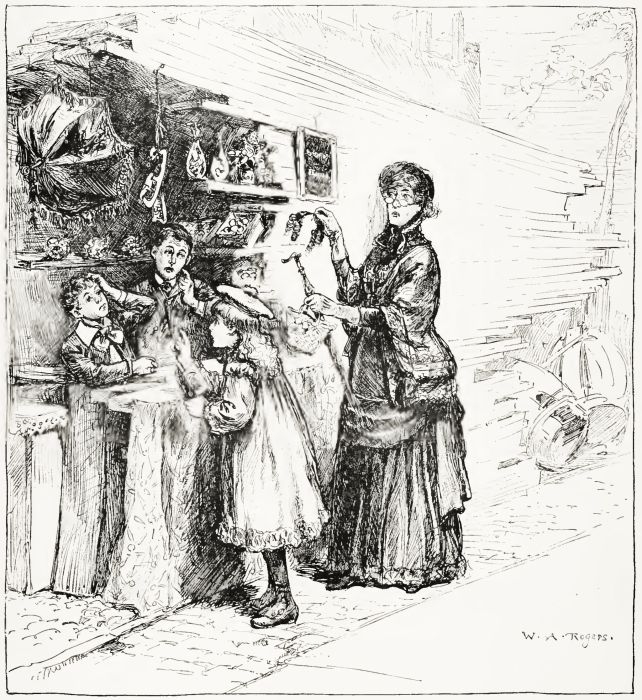 "'YOU OUTRAGEOUS BOYS!' EXCLAIMED AUNT SUE."
"You outrageous boys!" exclaimed Aunt Sue, as she seized and confiscated
it. "Where did you get this?"
"Out of the attic," said Bob, meekly. "I thought you were done with it."
"But it's not for sale if I am done with it. I'm surprised at you."
Aunt Sue seemed really hurt, and was scarcely mollified by Bob's saying,
coaxingly, "Oh, now, Aunt Sue, don't be vexed. I always liked to see
them hanging down your neck. They looked so pretty, I thought somebody
else might be glad to get them."
By this time Bessie had discovered a tin-type of herself among a lot of
cheap pictures, and her wrath burst forth on John, who was just
congratulating himself on having escaped his aunt's wrath.
"I'd like to know what right you have to offer my picture for sale," she
said, indignantly.
"It's not yours. It's mine. You gave it to me on my birthday."
"And that's all you care for it! I'll be careful how I ever give my
picture to another boy. Give it to me this minute."
"Why, no, Bess. It shows how much we admire it. Other folks do too. I
had an offer for it this morning, but I couldn't make the change."
Bessie's eyes flashed; and Aunt Sue, coming to the rescue, quietly laid
the picture in her bag with the curls.
"I think you had better show us your whole stock, boys," she said,
calmly. "What are your skates doing here?"
"I'm going to sell them. I'd rather have a bicycle than skates any day."
"Very well; only if you part with them don't expect to have a new pair
given to you when winter comes. What books have you? Why, boys, you are
not going to sell your dictionary!"
"Oh, I'm tired of looking through it. The old bother!"
"It must be taken home," said Aunt Sue, with decision. "It won't do to
have your father's dictionaries thumbed and dog-eared in this way. You
must keep your own."
The boys were beginning to think that the custom of their immediate
relatives was not going to be profitable. But the seizures were over
now, and Aunt Sue actually bought in John's old copy of Original
Poems. Bessie, too, concluded to be forgiving, and she and Aunt Sue
made several other purchases, so that they left the boys in good spirits
in spite of the bad beginning.
In the trying morning hours the boys had decided to close early every
Saturday afternoon "for the sake of their clerks." But they felt better
after the Flemings came to their assistance, and did not close until six
o'clock, when everything had to be packed in boxes and carried home
until Monday. Before doing this, however, they took an account of stock
and balanced their accounts, which was a comparatively simple matter, as
they sold nothing on credit. Aunt Sue had bought half their supply of
bird-seed, and Molly Fleming had taken all the bouquets at half price to
distribute in the infant school the next morning. The boys spent the
evening in talking over the events of the day.
"If we did so well on the first day, what may we not expect on the
second?" was the feeling with which the young merchants began business
on Monday. But Monday brought new trials. The goods had all to be packed
away, and the store closed by school-time, which seemed rather
humiliating. Of course the boys intended to resume punctually at twelve
o'clock. But how unlucky! They all unaccountably missed their lessons,
and were kept in to correct them, so that they lost the whole of their
noon trade.
Perhaps this only gave greater zest to the afternoon spell, for they
kept open quite late that evening. Still, with all their devotion,
business flagged. Infant schools could not absorb a stock of bouquets
every day, and Aunt Sue had enough bird-seed to last her a week. The
sour-ball business proved to be quite a losing one, for the luscious
things melted away mysteriously even when kept in the shade, although
each partner kept a strict watch on himself, and seldom, oh, very
seldom, refreshed himself with one.
Things got so serious that the four partners held a business meeting
that evening after the store closed.
"We've got to do something, boys, or we'll break before the week's out,
sure as fate," said Fred Fleming.
By Tuesday the boys had that care-worn look that men acquire when they
can't make both ends meet. The other boys really pitied them, and some
of them actually bought slate-pencils on their way to school in the
afternoon, though they did not need them.
That very afternoon an occurrence took place which threatened to end the
boys' store-keeping quite tragically.
An organ grinder, with his red-coated monkey, planted himself just
beside the pile of lumber and began to play. This pleased Tom and Bob,
who happened to be in sole charge at the time. They enjoyed a monkey's
antics as well as any one.
Perhaps it was the flag waving over the sign of the "Stanley Brothers"
that suggested to the man to play "Rally round the Flag, Boys." He
played it with a will, and the boys, and girls too, rallied with a
vengeance. The young merchants found their store again a grand centre of
attraction.
The monkey seemed particularly delighted with it, for, after dancing and
bowing on the organ-top a short time, he leaped upon the counter, and
before the proprietors knew what he was about he had thrust his paw into
the box of rubber balls, and was throwing a ball into the crowd.
A shout of delight greeted this feat. Tom and Bob each made a dive after
the monkey, but he dexterously eluded them, and threw another ball.
Of course the balls were thrown back at him, and in a moment the air
seemed full of them, flying in every direction. The boys could not turn
their heads but bounce would come a ball into their eyes, and if they
tried to say, "You rascal," the words would be cut short by a ball
flying into their mouths. The uproar was tremendous, and the crowd grew
larger every minute. The monkey seemed to be in his element, dancing and
jumping from shelf to shelf, grinning and chattering with all his might,
and when there was no ball convenient he did not hesitate to throw
something else.
The boys grew desperate when they saw their slate-pencils and
Jew's-harps flying through the air.
"See here!" they shouted to the organ-grinder, who was now peacefully
playing the "Marseillaise Hymn," "this thing is getting dangerous. Take
your old monkey away, will you? You'll have to pay for all the damage.
Do you hear?"
It would have been surprising if he had heard in all that uproar, but he
gave no sign.
Tom made another lunge at the monkey, and fell sprawling over the
counter. Then Bob dived at him, but the monkey, reaching down from a
high perch, deftly lifted Bob's hat, and threw it into the crowd.
"You rascal. I'll pay you for this," screamed Bob.
But the next thing the monkey did was to plant himself on Bob's head.
Bob, with his face as red as the monkey's coat, clutched wildly at him,
but the monkey clutched the tighter.
Bob could do nothing but scream and beat at the mischievous animal,
first with one hand, then with the other, then with both at once, while
the crowd shouted with laughter, until the organ-grinder, seeing that
his monkey was really in danger, stopped his music, called off his pet,
and began to move away. Then the crowd of children dispersed.
John and Fred, who had been taking their turn "off" when these
proceedings began, now made their way to their crest-fallen comrades.
Bob was too angry to make any attempt to collect his property. He picked
up his battered hat and walked home, saying, "I don't care what becomes
of the old things. I've done with them."
A few of their friends were kind enough to assist them in the search,
but it was a sorry-looking set of goods that were collected.
"They're half of them gone," said Tom. "I do believe that monkey went
off with his cheeks and pockets full of our things."
"I'll have that man prosecuted," said John, fiercely. "Which way did he
go?"
"Oh, he's more likely to prosecute us. He says Bob half killed his
monkey."
Sadly the boys packed up their damaged goods and carried them home,
protesting that they had had enough of store-keeping. The monkey had
scratched Bob's head so hard that he was really suffering, and Bess had
to run for the arnica bottle, and bandage his head.
Aunt Sue was particularly liberal with the cake and preserves that
evening at tea, and if anything could have comforted the boys, it was
such thoughtfulness.
 A FLIRTATION.