Early the next morning the door of the little mountain cottage grated on
its hinges, and Mr. Seymour entered the small apartment, eagerly
welcomed by Walter, who ran forward to meet him.
"What! you are up already, my boy, and as fresh and lively as if nothing
had happened!" said he. "I fully expected to find you knocked up and ill
after all the exertion and fatigue of yesterday; but I am glad to see
that you are so much stronger than I gave you credit for. How is your
back, though, Walter? Don't the wounds made by the vulture's claws pain
you very much?"
"They were very sore last night, Sir," replied the boy; "but father
bound them up nicely for me, and says they will be much better in a
week."
"Delighted to hear it. But where is your father? I don't see him."
"He is outside. Sir, with Liesli, the cow that we recovered through your
kindness," replied Walter, with a grateful look. "She is the best cow in
the valley."
"Ah, here comes your father," said Mr. Seymour, with a smile, stepping
forward to grasp the hand which Toni Hirzel held out toward him, while
thanking him in hearty but simple words for the kindness he had shown to
his boy.
"Don't mention it, my friend. What I gave to the boy was given very
willingly, and he has richly earned not only that, but a few francs
more, which I am still owing him. But we will square accounts now. Here,
Walter; there is forty francs for the old vulture which you captured so
bravely; and here is another sixty francs for the torn trousers and the
knife you lost."
With these words Mr. Seymour counted out five bright gold pieces on the
table, to the wonderment of Toni Hirzel and his son, neither of whom
could utter a word.
"But, Sir," exclaimed Walter, finding his voice at last, "the vulture,
the trousers, and the knife all put together are not worth twenty
francs!"
"They are worth more to me," replied the gentleman, "and you must allow
me to pay for them according to my opinion of their value. So make no
more words about it, my boy, but put the money in your pocket. I hope it
may prove useful to you."
Tears started into Walter's eyes. "Oh, father!" he exclaimed, "only look
at all this money! We shall be able to buy another cow, and make twice
as much cheese as we do now. We sha'n't have to borrow anything from
Neighbor Frieshardt any more, and if everything goes on well, we shall
soon be able to build a house as good as his. It will be a blessing for
you to have a comfortable home in your old age."
But Toni Hirzel shook his head. "Don't talk so fast, my boy," said he,
quietly. "That is a great deal more money than we can think of taking.
Pray take it back, Mr. Seymour. Watty is quite right. Twenty francs will
amply suffice, especially when you were so liberal toward him
yesterday."
"Very well, friend, so be it," was the reply. "If you won't let me pay
you the money as a debt, I hope you will allow me to give it to Walter
as a present. I'm sure you won't object to that. He can save it till
he's a few years older, if he doesn't require to spend it now; so let
the matter drop, unless you really wish to annoy me."
Seeing that Mr. Seymour was in earnest, Toni Hirzel made no further
objections, and lifted the money from the table.
"Well, then, Walter, I will take care of this handsome gift for you
until you are old enough to make a good use of it," said his father, as
he placed the money in a leather pocket-book, which he deposited in a
secret drawer of the cupboard. "Rest there quietly," said he, in a
whisper; "when I am dead and gone, it will be a nest-egg for Watty to
fall back upon."
Mr. Seymour then rose to take his departure: and before saying farewell,
Walter asked and obtained leave to visit the friendly traveller soon;
but when he went to Rosenlanibad three or four days afterward, he found
that Mr. Seymour had received a letter from home, which had compelled
him to take his immediate departure.
The summer passed away; autumn came, and stripped the leaves from the
trees; the first flakes of snow fluttered in the air; the days were
growing shorter, and the quiet and solitary valley took its turn in the
changes of fortune which so frequently occur in the outer world.
Although Toni Hirzel was sober and industrious, he could not escape the
common lot of humanity. He sustained a heavy loss at the beginning of
winter in the death of his favorite cow. Soon afterward the severity of
the weather drove from the mountains the wolves, which broke into the
stable during the night and killed two of his five goats.
These losses were serious to the poor man. The only property he
possessed in addition to his cottage consisted of the cow and the goats,
which supplied him with the barest necessaries of life; and now he was
deprived of them almost at one stroke. It was hard to bear; but
by-and-by the recollection of the money which Mr. Seymour had given him
came as a ray of sunshine to Walter, who begged his father to take it
and buy another cow.
"No, Walter," was his reply. "The money is yours. Mr. Seymour made you a
present of it, and it shall remain untouched until you are old enough to
spend it for some good purpose. You are too young and inexperienced yet;
so don't say any more about it. Now that we have lost Liesli and the
goats, we must bestir ourselves to do something else for a living, until
the spring, when we may perhaps be fortunate with the chamois. There are
plenty of chamois on the hills, and my gun on the wall there has brought
down many a fine buck. When spring comes we'll go out together, and you
will see that your father has still a firm hand and a sure foot."
The winter wore away by degrees. The warm south wind crept slowly
through the valleys, melting the snow from the mountain-sides, and
calling into life hundreds of sparkling streams. Waterfalls foamed and
thundered; enormous masses of snow came crashing down from the
mountain-peaks; while amid the noise and thunder of avalanches the sun
exercised its silent but mighty influence, renewing the mountain
greenery, converting the barren ground into a verdant carpet. The birds
returned from their winter home, and again burst into joyous song; and
again the budding trees proclaimed that winter was over and gone.
During the dreary winter-time the simple wants of the two mountaineers
had been supplied by much toil and much privation, so that the return of
the vernal season was hailed with joyful acclamation.
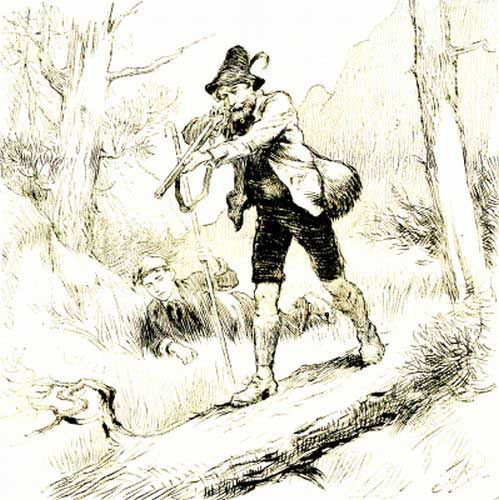 WATTY AND HIS FATHER HUNTING.
"It is time for us to be off now," said the hunter one morning to his
boy; and day after day, whenever the weather was favorable, they might
have been seen climbing the lofty mountain ranges in search of game,
sometimes not returning to their little cottage for several days. At
other times, however, after unspeakable trouble and danger, they would
return home in great glee, the father bearing a large chamois slung
across his shoulders, to be sold for a good price to the landlord of the
inn.
Toni was looked upon by all the country round as the best hunter in the
district, and he was determined to maintain his reputation. By the end
of August, when the summer was approaching its end, he had shot thirty
chamois, and the best of the season was still before him.
"Now, Watty," said he, "we must look out for the winter. We have got on
famously through the fine weather, and have made a little money; but
there's not enough yet for what we require, and we must work away for
some time still before we get as much as will replenish our empty byre."
"I will do all I can to help you, father," replied the boy. "I saw a
track on the Wellhorn yesterday that promises a finer buck than we have
taken yet."
"On the Wellhorn! On which side?"
"On the glacier side, father. It is not so very difficult to get up
there; but I noticed that whenever he was disturbed, the chamois went
across the glacier toward the Engelhorn, and I am afraid it would be
rather dangerous to follow him. There are cracks in the ice hundreds of
feet deep, and how well we know that whoever falls into one of them
would never see the light of day again."
"That is very true," said his father, thoughtfully. "But we must have
the buck at any risk. Do you know the spot on the glacier where he makes
for the Engelhorn?"
"Yes; it is quite at the top, where the ice is spread out like a sea."
"Well, then," said the experienced mountaineer, "we must try and avoid
following the chamois over the ice, and rather wait for him on the
Engelhorn, and get a shot at him as he passes. You must go to the
Wellhorn, my boy, and drive him toward me."
"Yes; that will be the best, father," replied Walter. "I thought of that
myself."
"Well, then, let it be so. We must be off before daybreak to-morrow
morning."
Toni made the necessary preparations the same evening, and long before
the first beams of Sol were visible on the following morning, he left
the cottage with his son. After a toilsome ascent of half an hour, they
separated. The father turned to the left toward the steep and craggy
Engelhorn, after he had described the exact point toward which Walter
was to drive the animal, while the boy scrambled up the dangerous ridges
of the Wellhorn, to find the chamois, and drive it to the place where
his father was to lie in wait.
"Be very careful, Watty," said his father to him ere they parted; "don't
be reckless or foolhardy."
The boy promised to be watchful, and they separated, each to his own
share of the toilsome and perilous undertaking. Taking advantage of the
rocks and stones which marked the path of a former glacier, Walter
reached the summit of the Wellhorn without much difficulty, after an
hour and a half's climb. Taking a small telescope from his pocket, he
peered anxiously across the field of ice which separated him from the
Engelhorn, and descried his father working his way cautiously along the
edge of the glacier till he gained a part of the rocks that seemed to
afford a possibility of climbing. He then had the satisfaction of seeing
him sit down to rest.
"He has got just to the right spot," said he to himself. "He must have
seen the track. It is just fifty feet from there that the chamois
springs across a crack in the ice to get to the pasture higher up; and
when he once gets sight of him, father won't let him escape. But, first
and foremost, I must find the game, and start it across."
No sooner said than done. Clambering from rock to rook, always observant
and watchful, the resolute youth pursued his way. Suddenly, however, he
stood still, and threw himself flat on the ground.
"I thought so—there he is!" said he to himself. "I must work my way
carefully round to the right, and then frighten him off with a shout."
Taking stealthy advantage of every rock that could screen him from
observation, Walter raised his head now and then to make sure that the
chamois had not taken fright and removed from the spot. When he had thus
reached the right position, he started to his feet and uttered a loud
halloo! With a bound the chamois sprang down to the field of ice, which
it crossed with light and rapid strides.
"The game is ours!" exclaimed Walter, with delight. But his joy was
premature. Now began a chase, which lasted nearly an hour, until the
animal approached the spot where Walter's father lay, when it suddenly
stopped, gave a tremendous spring to the right, fled across the glacier
with the speed of an arrow, and was out of sight in an instant.
"He must have seen father, or else scented him," said Walter to himself.
"Our trouble is all in vain for to-day, so I must go acquaint father
with the result."
A few minutes brought the lad to where his father was awaiting the
appearance of the buck; but Walter saw at once that the older sportsman
was aware of what had happened. His father beckoned to him to be silent,
and pointed to a small green spot above the steep sides of the
Engelhorn. Turning his eyes in that direction, Walter recognized the
chamois standing on the scrap of meadow.
"Now we've got him," whispered his father. "He can't take the steep
sides of the mountain, and we've cut off his retreat; so come along, my
boy, as fast as you can."
Moving hurriedly over the ice, they soon reached a point from which they
could get a good view of the chamois. Unfortunately, however, a large
chasm in the ice lay right before them, and stopped their progress. The
chamois had cleared it, but it was quite beyond human strength and
agility.
 THE DAY BEFORE THANKSGIVING.