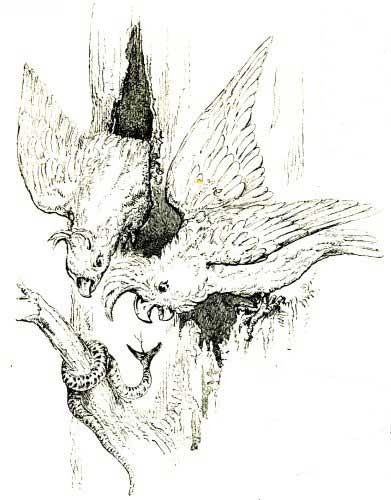
 PAPA FIGHTS THE SERPENT.
A baby parrot who has just burst forth from his shell is not pretty to
look at; indeed, I dare say you would have thought me exceedingly ugly.
Like my brother and sister, I had a big bald head and a tremendous beak,
while my wrinkled body was very small. I seemed to be all head, beak,
and claws. Yet I remember perfectly well hearing our parents say to the
many friends who came flying from all parts to offer them
congratulations that we were the three most beautiful children ever
born. I believe parents always think their children beautiful, and of
course no one is ever so impolite as to contradict them.
We were very hungry babies, and poor papa had very hard work to bring
home enough food to fill our three big beaks, which we kept wide open
from morning till night. Mamma was very particular that our food should
be of the most delicate kind, and papa often had to make long journeys
through the forest to gather seeds and berries. He was a very kind papa,
and if, as sometimes happened, he complained that his wings ached from
flying so much, and that we made so much noise he could not sleep, mamma
had only to call his attention to our rapid growth, and the beauty of
our soft gray feathers, to put him at once in the best of humor. "They
are magnificent children," he would say at such times, "and when they
grow up I shall do as well by them as my father has done by me." Little
did he think in those happy days that I, his eldest son, would soon be
lost to him forever.
Our life was indeed peaceful, although we were subject at times to some
anxiety from the attacks of certain wicked creatures which haunted the
shores of our beautiful river. I remember, as if it had taken place
yesterday, what happened one beautiful morning while papa had gone out
to find our breakfast. Mamma had nestled down with us, and had soothed
us into taking a little nap, when we were all startled by loud, shrill
cries. Mamma recognized papa's voice at once. She was naturally very
brave, and I think, to protect her children, she would have flown in the
face of a lion. She now rushed to the door of our nest, where she stood,
her feathers bristling, ready to give fight to whatever might try to
enter. As she filled the whole doorway with her spread wings, we could
not peep out to see what was the danger, although we stood on tiptoe and
tried with all our strength to push our heads through her feathers. She
gave us some smart taps with her claw, and ordered us back to the
interior of the nest; and when she at length told us in a frightened
whisper that papa was fighting with a ferocious serpent, we huddled
together as close as we could in the very bottom of our hole. We knew
that serpents murdered young parrots and ate them, for only the day
before we had heard a neighbor telling mamma that one of these monsters
had eaten six little parrots, children of a dear friend of hers, for his
breakfast. Although mamma had said, after she went away, that she was
only a gossip, and said such things to frighten us, now we were sure it
was the truth, and we expected to see the serpent's head thrust into our
nest, his mouth open to devour us. My brother and sister were half dead
with fright. I tried to cheer them, assuring them that papa was strong
enough to drive away a whole army of monsters, and when mamma suddenly
flew away from the door, I crept up cautiously and peeped out. What was
my relief to see papa flying rapidly toward the river, with an enormous
serpent hanging dead in his claws! I screamed the good news to my
brother and sister, but they refused to be comforted. In vain I assured
them that the danger was over, that the serpent was conquered—was dead,
in fact;—and that papa had thrown the loathsome body into the river,
that we might not be frightened at the horrible sight. My brother and
sister continued crying and trembling until papa and mamma returned.
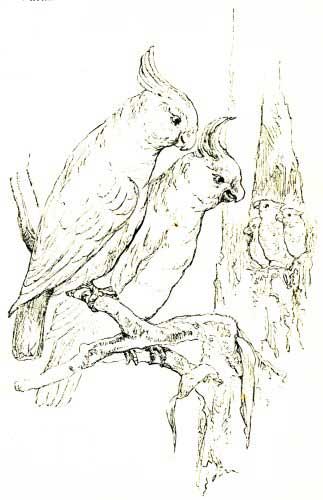 "MY DARLINGS ARE SAVED."
When at last we heard their joyful cries as they approached the nest,
all three of us crept up to the doorway to welcome them. I shall never
forget the tenderness with which they regarded us. Papa, who was still
trembling with excitement, kissed us gently, while my poor mamma
exclaimed, "Saved! my darlings are saved!" and her eyes shone with pride
at the courage of her husband.
My feathers grew so rapidly that papa, who was very proud of me, I being
much larger than my brother, would often say, "Bravo, my boy! You will
soon be strong enough to go out with me into the forest."
In our first attempts to fly we were guided by mamma, who assisted us to
hop about on the branches near our nest. After several of these short
trials of strength papa took my brother and myself to visit our
grandparents, who lived in a noble tree not far away. Never shall I
forget my joy and pride when I first spread my wings and flew through
the air at papa's side.
We had already made several short excursions, when one day—the most
sorrowful day of my life—a boat, which we had been watching anxiously
as it came up the river, stopped at the very roots of our tree. There
were two men in it. As I peeped from the door I saw one man leave the
boat and begin to climb up the trunk toward our nest. Mamma had told us
only that morning that robbers had been seen on the opposite shore of
our river, and that they were searching for young parrots, whom they
tore away from their parents, and sent far away to a foreign country to
be sold. "At the least danger," mamma had said to us, "fly. Man is a
more formidable enemy than the serpent."
The man climbed nearer and nearer to our nest. Our parents were both
away from home, and upon me, as the strongest and oldest, fell the
responsibility of saving the family. There was not a moment to be lost.
Aided by my brother, I threw my little sister, who was half dead with
fright, headlong from the nest, and had the satisfaction to see her fly
safely into the neighboring thicket. She used her little wings with
strength and courage which would have been impossible for her to show
except under the excitement of such terrible circumstances.
When my sister was saved, I hurried my brother after her, and he too
escaped. Faithful to my duty, I remained the last in the nest, and at
the instant when I spread my wings to fly away, the cruel hand of the
robber closed tight around me. At that dreadful moment I fainted, and I
remember nothing more until I found myself in a large cage with a number
of other parrots, prisoners like myself.
Of the monotonous misery of the long sea-voyage that followed I can not
even now endure to think. More than half my companions perished; and
when at last we reached this great city, which I hear men call New York,
I myself was nearly dead from confinement and sea-sickness.
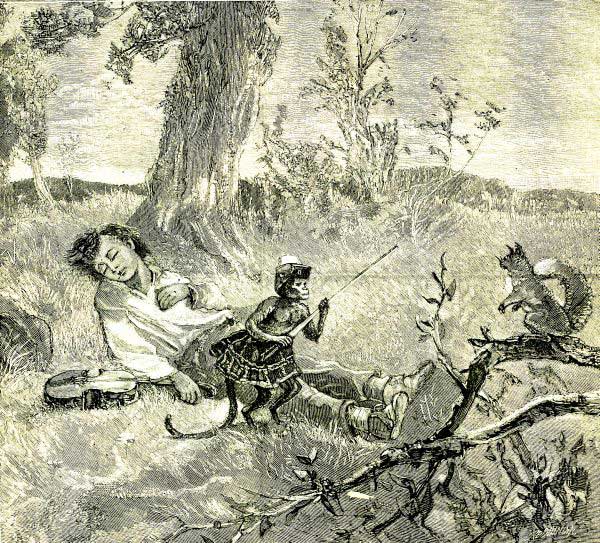
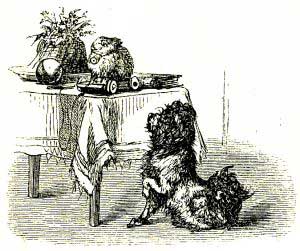
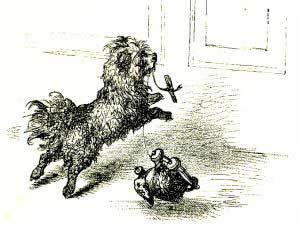
Here, Bunny! Now for lots of fun;
Get down, and have a jolly run.
I've moped about the house all day with
The want of somebody to play with.
How stupid on the floor you lie!
Come, jump about, and let's be spry.
What, can't you even lift a paw?—
The dullest beast I ever saw!
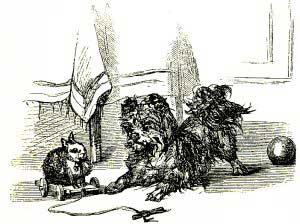
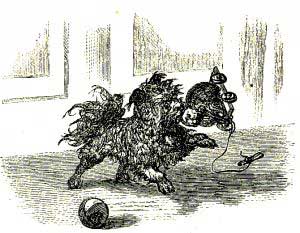
I won't be patient any more,
But drag you all about the floor;
I'll make you run, I'll make you jump—
How do you like that?—bump, bump, bump.
What, haven't yet a mind to play?
I'll quickly teach you to obey.
You needn't hope now to get clear off:
Look out there, or I'll bite your ear off!
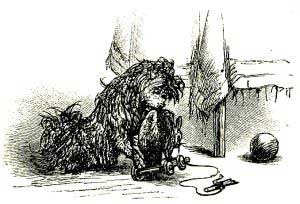
I'm certain nothing can be done
To make you join in any fun;
It does no good to shake or beat you,
So now I've half a mind to eat you.
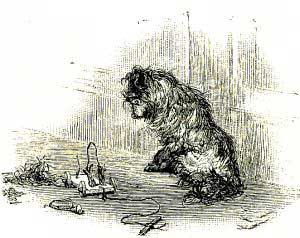
Well, there! you're done for now! Oh dear!
What makes me feel so very queer?
What were you good for, anyway,
Not fit to eat, and wouldn't play?
 FUN
FUN
Table Tactics.—Old Francis was a wag; and once, when early peas were on
the table, he emptied the contents of his snuff-box over them. "Francis!
Francis!" they exclaimed, "what are you about?" "I like them that way,"
was the answer. He, of course, had the dish to himself, and when he had
concluded, remarked: "You thought it was snuff, did you? Nothing but
black pepper."
A cat caught a sparrow, and was about to devour it; but the sparrow
said, "No gentleman eats till he washes his face." The cat, struck with
this remark, set the sparrow down and began to wash his face with his
paw, but the sparrow flew away. This vexed puss extremely, and he said,
"As long as I live I will eat first and wash my face afterward"—which
all cats do even to this day.
"What dogs are these?" inquired a gentleman of a lad who was drawing a
couple of terriers along. "I dinna ken, Sir," replied the boy; "they
cam' wi' the railway, and they ate the direction, and dinna ken where to
gang."
Numerical Charade.—I am a word of 8 letters. My 1, 6, 3 is a domestic
animal; my 8, 6, 3 is a grain; my 7, 4, 3 is an adverb; my 5, 2, 3 is
damp; my 4, 5, 2 is an animal; my 1, 8, 3 is a dwelling; and my whole
a black man very notorious of late.
Say this correctly without stopping: "Bandy-legged Borachio Mustachio
Whiskerifusticus the bold and brave Bombardino of Bagdad helped
Abomilique Blue-beard Bashaw of Babelmandeb to beat down an abominable
Bumble-Bee at Balsora."
A lady making inquiries of a boy about his father, an intemperate man,
who had been sick for some time, asked whether he had regained his
appetite. "No, ma'am," said the boy, "not exactly; his appetite is very
poor, but his drinkatite is as good as ever."
There is one thing which a man with two eyes can never see with one of
them, and that is the other one.
"I expend a good deal of panes at my work," as the glazier said to the
window-sash.
Miss Jemima Wilhelmina, when her parents refuse to allow her to go to a
ball, sets to and has a bawl at home.
The man who was lost in slumber found his way out on a nightmare.
A school-master asked one of his boys, on a cold winter morning, what
was the Latin word for cold. The boy hesitated a little, when the master
said, "What, sirrah, can't you tell?" "Yes, Sir," said the boy, "I have
it at my finger-ends."
Two countrymen were going along the road, each driving sheep.
Said one, "Hi, neighbor, give me one of your sheep, and then I shall
have twice as many as you will have."
"Nay, neighbor," replied the other, "give me one of your sheep, and then
we shall both have the same number."
How many sheep did each have?
An old man lived in a little hut by a bridge which crossed a deep river.
One day a wicked water-spirit appeared to him and said: "My friend, I
know you are very poor. Now I will increase whatever money you may have
twofold, asking only in return this small favor, that every time you
cross the bridge you will throw twenty-four cents into the water, and at
the same time the money you have left shall be doubled." The poor old
man was delighted at what he thought a generous offer of the
water-spirit, and faithfully fulfilled all the conditions; but, to his
sorrow and astonishment, when he had three times thrown the tribute of
twenty-four cents to the water-spirit, he found himself penniless.
How much money did he have when the water-spirit first appeared to him?
A good mother went to buy eggs for her children, for the Easter season
was approaching, and the eggs were to be colored red and blue. She
bought from a grocer half of his entire stock and half an egg more. Then
a second woman came, and she bought half of what the grocer had
remaining and half an egg more. A third woman and a fourth woman did the
same thing, and in the end the grocer had one egg left.
How many had he in the beginning?
A man had seven sons, and a property of $49,000. Now the younger sons
were jealous because their father spent more for the elder brother than
he did for them, and they entreated him to make his will in their favor.
To satisfy their demands he made his will, and the younger sons were
contented. This is the will: The oldest son to have $1000 and an eighth
of what remained; the second son to have $2000 and an eighth of what
remained; the third, $3000 and an eighth of what remained; the fourth,
$4000 and an eighth of what remained; the fifth, $5000 and an eighth of
what remained; the sixth, $6000 and an eighth of what remained; the
seventh and youngest to have all that remained when the sixth had taken
his share.
What share of the $49,000 did each receive?