We've had a most awful time in our house. There have been ever so many
robberies in town, and everybody has been almost afraid to go to bed.
The robbers broke into old Dr. Smith's house one night. Dr. Smith is one
of those doctors that don't give any medicine except cold water, and he
heard the robbers, and came down-stairs in his nigown, with a big
umbrella in his hand, and said, "If you don't leave this minute, I'll
shoot you." And the robbers they said, "Oho! that umbrella isn't
loaded;" and they took him and tied his hands and feet, and put a
mustard plaster over his mouth, so that he couldn't yell, and then they
filled the wash-tub with water, and made him sit down in it, and told
him that now he'd know how it was himself, and went away and left him,
and he nearly froze to death before morning.
Father wasn't a bit afraid of the robbers, but he said he'd fix
something so that he would wake up if they got in the house. So he put a
coal-scuttle full of coal about half-way up the stairs, and tied a
string across the upper hall just at the head of the stairs. He said
that if a robber tried to come upstairs, he would upset the
coal-scuttle, and make a tremendous noise, and that if he did happen not
to upset it, he would certainly fall over the string at the top of the
stairs. He told us that if we heard the coal-scuttle go off in the
night, Sue and mother and I were to open the windows and scream, while
he got up and shot the robber.
The first might, after father had fixed everything nicely for the
robbers, he went to bed, and then mother told him that she had forgotten
to lock the back door. So father he said, "Why can't women sometimes
remember something," and he got up and started to go down-stairs in the
dark. He forgot all about the string, and fell over it with an awful
crash, and then began to fall down-stairs. When he got half-way down, he
met the coal-scuttle, and that went down the rest of the way with him,
and you never in your life heard anything like the noise the two of them
made. We opened our windows, and cried murder and fire and thieves, and
some men that were going by rushed in and picked father up, and would
have taken him off to jail, he was that dreadfully black, if I hadn't
told them who he was.
But this was not the awful time that I mentioned when I began to write,
and if I don't begin to tell you about it, I sha'n't have any room left
on my paper. Mother gave a dinner party last Thursday. There were ten
ladies and twelve gentlemen, and one of them was that dreadful Mr.
Martin with the cork leg, and other improvements, as Mr. Travers calls
them. Mother told me not to let her see me in the dining-room, or she'd
let me know; and I meant to mind, only I forgot, and went into the
dining-room, just to look at the table, a few minutes before dinner.
I was looking at the raw oysters, when Jane—that's the girl that waits
on the table—said, "Run, Master Jimmy; here's your mother coming." Now
I hadn't time enough to run, so I just dived under the table, and
thought I'd stay there for a minute or two, until mother went out of the
room again.
It wasn't only mother that came in, but the whole company, and they sat
down to dinner without giving me any chance to get out. I tell you, it
was a dreadful situation. I had only room enough to sit still, and
nearly every time I moved I hit somebody's foot. Once I tried to turn
around, and while I was doing it I hit my head against the table so hard
that I thought I had upset something, and was sure that people would
know I was there. But fortunately everybody thought that somebody else
had joggled, so I escaped for that time.
It was awfully tiresome waiting for those people to get through dinner.
It seemed as if they could never eat enough, and when they were not
eating, they were all talking at once. It taught me a lesson against
gluttony, and nobody will ever find me sitting for hours and hours at
the dinner table. Finally I made up my mind that I must have some
amusement, and as Mr. Martin's cork leg was close by me, I thought I
would have some fun with that.
There was a big darning-needle in my pocket, that I kept there in case I
should want to use it for anything. I happened to think that Mr. Martin
couldn't feel anything that was done to his cork leg, and that it would
be great fun to drive the darning-needle into it, and leave the end
sticking out, so that people who didn't know that his leg was cork would
see it, and think that he was suffering dreadfully, only he didn't know
it. So I got out the needle, and jammed it into his leg with both hands,
so that it would go in good and deep.
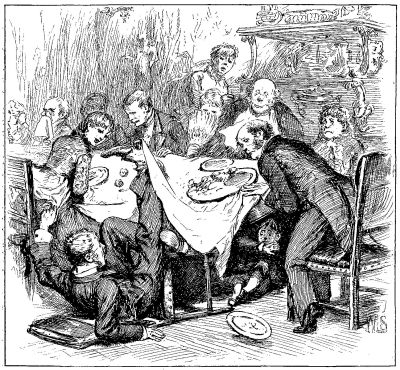 "WASN'T THERE A CIRCUS IN THAT DINING-ROOM!"
Mr. Martin gave a yell that made my hair run cold, and sprang up, and
nearly upset the table, and fell over his chair backward, and wasn't
there a circus in that dining-room! I had made a mistake about the leg,
and run the needle into his real one.
I was dragged out from under the table, and— But I needn't say what
happened to me after that. It was "the old, old story," as Sue says when
she sings a foolish song about getting up at five o'clock in the
morning—as if she'd ever been awake at that time in her whole life!
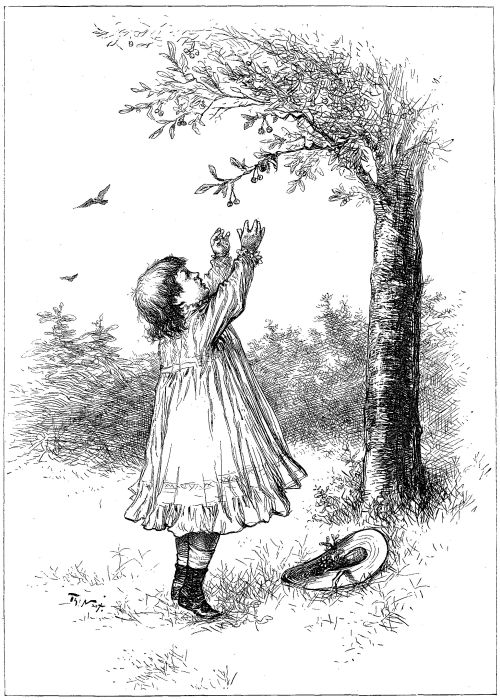 "CHERRIES ARE RIPE."
Three cheers for the Fourth of July! What American boy does not love it?
Where is the little girl who is not glad when it arrives? We hope you
will all have a splendid time on the happy holiday, meet with no
accidents, and when night comes, go to bed, to enjoy pleasant dreams.
Vacation has come to many of you by this time. You have said good-by to
school and teachers, and have laid aside lessons and slates for a while.
Be out-doors all you can in these bright summer days, and lay in a good
stock of health for future use when the play spell is over.
We think you will all be pleased with the feast Our Post-office Box
gives you in this Fourth-of-July number.
Orworth, Kansas.
Have you ever seen a Kansas dug-out? If you have not, I will write
you a description of one. In the first place, a hole is dug in the
ground four or five feet deep, and walled up with limestone or
sandstone about six feet high, and covered with a dirt roof. They
make these dirt roofs by putting a log lengthwise of the building,
and laying poles crosswise; then they cover the poles with
sunflowers, and place hay next, and on top of that usually a foot
or more of dirt. They usually have earth floors, and sometimes
there isn't a solitary window. I have seen dug-outs built of sod.
Wouldn't you like to live in such a house, where it is a common
thing for mice to tumble into the water bucket? The Wiggle I send
is a picture of the dug-out we used to live in when we first came
here. Will you please give it to the Wiggle master?
We had a beautiful sunset not very long ago. It was grand. It had
been raining, and it slacked up as the sun was going down. Off in
the north-west there were some very black clouds; one of them
looked like a whale's back, another like a volcano in action. In a
few minutes they changed shape, and the best idea I can give of
them is a lot of giants contending together. The clouds seemed to
come clear to the ground. Papa said he never saw anything like it
before. The most beautiful of all was the rainbow. There was at
first a perfect arch, with rays of glory coming from the centre. In
a few minutes there was a reflected rainbow. All the time that the
rainbows lasted there was a very peculiar light, which I can't
describe.
Papa and I are alone here, and I have to do the cooking. We will
begin to harvest next week. I am to have fifty cents per day for
cooking. I hope my letter is not too long to be published.
Theodore G. B.
Philadelphia, Pennsylvania.
I am a little boy nine years old. Papa takes Harper's Young People
for my sister and me, and we like it very much. I have had the
pneumonia, and have been kept in the house two weeks, but that is
not so bad as it is for the little boy I read about in Our
Post-office Box who had to stay in the house two months, and can
not walk yet. I feel so sorry for him! I have a pet cat, and I love
it very dearly.
Ruliff Y. L. H.
By this time, Ruliff, I hope you are well, and able to fire off
torpedoes as gayly as did the boys in Miss Porter's story.
London, Ontario, Canada.
I wrote a letter some time ago, and have been watching for it ever
since, and I was much disappointed, and think perhaps you did not
get it, and I thought I would try again. I have three little
sisters, and they all enjoy Harper's Young People, and I think
"Toby Tyler" was the best story in it, and we have great laughs
over Jimmy Brown. We have five hens, and they all lay eggs; we get
four or five every day. Papa and I are gardening to-day, and we
have a lovely garden, and it is pretty hard work attending to it,
and we have hard times looking after our chickens; they dig holes
in the ground with their feet, and we are trying to shut them up
for the summer.
Freddie W. F.
New York City.
I am a little girl nine years old. I have no pets except four
dolls. One has not any head. Their names are Maud, Mabel, Emily,
and Sadie. I wish somebody would write more fairy stories. I am
very fond of them. I used to live in Brooklyn, and like it much
better than here. I am glad Mr. Otis has written more about Toby
Tyler, because I like him very much. My brother and I had scarlet
fever this winter, but we are all well now. I like Harper's Young
People very much. I have had it since it began. We have a parrot
here who cries like a baby and then imitates a nurse singing to it.
We go to the country every summer.
Bessie H.
What a charming parrot! Who taught him to cry and sing so cleverly? Dear
Bessie, can not you put a new head on the poor dolly who has not any? I
feel quite sad on her account.
Now, Bumble-bee, you just keep still; you needn't jump and buzz.
I've had such a time to catch you as never, never wuz.
I've chased you round the garden; a-cause I didn't look,
I almost fell right over into that drefful brook.
And I'm going to put you in it, though I s'pose you think you're hid.
For last week you stung my pussy; you know very well you did.
Yes, and you made us 'fraid that she was going to have a fit,
She jumped up so, and tried to catch the place where you had bit.
Yes, I shall surely drown you. But p'r'aps you've got a home,
And your little ones will wonder why you don't ever come;
And I think p'r'aps you're sorry you went and acted so:
If you'll only wait till I run away, I b'lieve I'll let you go.
Parkersburg, West Virginia.
I have been taking Young People ever since it was published, and I
like it very much. This is the first letter I have ever written to
Our Post-office Box. We have a nice little pet canary-bird and a
little monkey. We have had the monkey four years, but we can not
tame him. Last winter it was so cold that once he was almost
frozen. At first we thought he was dead, and mamma was about to
throw him away, when she saw him move. Then she took him by the
stove to warm him, and he got well again.
Victoria R.
"Halloa! Walter, wake-up!" cried Georgie. "Don't you know it's the
Fourth of July, and we must get up and celebrate it? All the rest of the
folks are going to the Town-Hall to hear a speech and get their dinner,
and we'll have a good time by ourselves. Do you know what the Fourth of
July is for?"
"No," answered Walter, in a very sleepy way.
"Well, I do; mamma told me last night. It's the anniversary of the time
when the United States made up their mind to take care of themselves.
That was more than a hundred years ago; that's ever so long, mamma says.
Now to-day, Walter, you and I will be like the United States, and take
care of ourselves; that's what independence means, and this is
Independence-day. Say, Walter, don't let anybody know that I told you,
but I heard papa telling mamma that he's going to s'prise us each with
lots of fire-works. Now I guess you'll wake up."
"Guess I will, too," said Walter, springing to his feet.
It did not take the boys long to dress. Sure enough they were surprised
and delighted when to each was given a toy gun and a package of
torpedoes, and then they were left to amuse themselves.
"Tell you what I'll do," said Georgie. "I'll make an oration, and you
must be the audience, and when I get through, you must clap very hard,
and make me do it all over again."
"All right," said Walter. "Jump up there on papa's desk, so I can hear
you better."
Georgie mounted the desk, and began "Ladies and gentlemen,—I s'pose you
know this is the Fourth of July." Then he couldn't think of anything
else to say, so he jumped down. In doing so his foot hit the inkstand,
and a black, black stream of ink followed him to the floor.
"Oh, dear! that's too bad!" he exclaimed. "Won't papa be sorry? Wish I
hadn't made a speech. Hurry up, Walter; get something to wipe it off
with."
Walter tried hard; but he could not wipe away all the ink. Several big
spots remained.
"Never mind," he said; "we'd better go out-doors and forget about it.
Let's play soldier. You and I'll be the Americans, and Brush can be the
British."
Brush was the Newfoundland dog.
This plan suited Georgie, and he and Walter looked about for a red coat
to put on Brush. They soon found Cousin Sarah's embroidered jacket,
which they thought would do nicely. Then they went into the yard and
coaxed Brush to be dressed up. He looked very funny when he stood on his
hind-legs with the jacket buttoned around him.
"Now we must stand before him and present arms," said Georgie.
"Yes, and then I'll turn around quick, and fire a torpedo. Won't that
frighten the old fellow?"
So, after presenting arms, Walter turned his back to the enemy, and
threw a torpedo into the grass. Brush jumped after it, and in doing so
he knocked both of the Americans to the ground. Walter was a little
hurt, and he began to whimper, but Georgie helped him up, saying, "Don't
you know that soldiers never cry?"
When the rest of the family came home, and found the ink spots in the
parlor, and Cousin Sarah's jacket spoiled, they thought it was a poor
plan to leave little boys to take care of themselves, even on the Fourth
of July.
As our great national holiday approaches, perhaps the readers of Young
People would like to hear something about Genoa, where the great
Christoforo Colombo, as the Genoese call him, was born. Genoa is
situated at the foot of the Appenine range. The town, which is a very
ancient and picturesque one, commences at the river-front, and extends
some distance up these mountains. A friend of mine writes that there you
can not go up town in the sense that we do here, for so steep is the
incline that all carriages have to be furnished with brakes, lest, after
having once gone up town, one should not be able to get down town again.
The drive overlooking the river is delightful. This place is a great
stopping-point for ships plying the Mediterranean.
The seasons there are far in advance of ours, and at this present time
the climate is intensely hot. Genoa has many beautiful buildings. The
people are so proud of their favorite that they name their hotels after
him, and also very many minor places of trade. Thus the name of Colombo
meets the traveller nearly everywhere. These devoted countrymen have
also erected a handsome monument to perpetuate his memory. Ancient as is
the city, yet they regard this noble hero with the freshness of
yesterday. Well may they be proud of a man capable of such grand
achievements, the conception of which was regal in its grandeur.
You all know that to him we owe the blessing of our beautiful America.
What wonder that we sing so sweetly and so often, "Hail, Columbia!"
Let us always revere his name as devoutly as his countrymen, who hug the
memory of this noble hero as close as Patti did her doll, when at the
age of ten she could not sing without it; it was an inspiration to the
little songstress.
Let then this great man, Genoa's hero, command our love and gratitude,
while it inspires to noble deeds.
Washington Heights, New York.
I have taken your paper for some time, and I look forward from week
to week with so much pleasure, thinking of reading the pretty
stories; and I am very much interested in the puzzles; I find the
answers out myself. I am eleven years old, and have a little sister
Mollie, who is a very quaint child. We love to read about all the
little girls' pets, especially the cats and kittens, for we have
two; the mother we call Dud, and her kitten Gipsy we nickname Gip.
They are very knowing and cunning. Dud follows us when we go out,
and sometimes, when she has gone very far, waits an hour in one
place until we come back, delighted when she sees us, and runs
along perfectly contented. Our birds, Pete and John, both died, one
of old age, and the other of fits. We are to have a little dog
soon. A gentleman has made us a present of him—an English fox
terrier. We have never been to school, but are taught at home, and
I have read quite a number of letters from little girls in Young
People that have lessons at home also. We get along, because we
study, and enjoy our books. I read music quite well, so can Moll;
we practice an hour a day. We have each a baby doll that we are
very fond of; Violet Depeyster is the name of mine, and Daisy
Livingston Moll's, named after some aunties. They are very pretty
and good; they have very many pretty things we make them, for we
can both sew. I write to an uncle in Europe, and a little cousin in
the country, and rather like letter-writing, and hope this is not
too long.
Lulu K.
Your puzzle will appear before long. It is very nicely done.
Crete, Nebraska.
I want to tell you what I did two years ago, when I was six years
old. My papa and uncle bought a drove of cattle in Colorado when
they were in the western part of the State. Papa took me out there,
and I rode one of the ponies, and helped to drive the cattle about
two weeks. I could ride just as fast as the pony could go, and
often beat the men in a race.
I have a little saddle. We had a tent, and camped out; it was rare
fun, except when it rained. My sister Myrtle and I have a pair of
pet doves, a Maltese cat, and two dogs. I like all the stories and
letters very much.
George A. J.
Kau, Hawaii, Sandwich Islands.
We live on a sugar plantation, and the flume that carries the cane
to the mill runs near our house. The whole length of the flume is
eight miles. We have lots of hens, and we children take care of and
feed them, and so mother lets us sell some of them, and we saved
the money and bought a cow. She had a calf, but she was so wild
that we sold her and got another. She had a pretty little white
calf; it is real tame. We call him David. He has a collar on, and
we put a rope through the collar and lead him anywhere, and he
kicks up his heels, and seems to enjoy the play. We children have
three horses that we can ride whenever we like—Flora, Maud, and
Nellie. Nellie is very small, because she lost her mother when she
was small (a few weeks old), and had to be fed with a bottle, but
she is very gentle now.
Fred N. H.
Of course you all think I am a pussy cat. No wonder, when folks
call me Pussy. But you must know that one cold day in March I was
hatched. Did you ever hear that a pussy was hatched, I'd like to
know?
Laugh away, Sue and Ned, Joe and Tom, Mattie and Artie, Polly and
Fanny! It is all true.
One day my master went out to the barn, and there were a whole
dozen of us, shivering with cold. He brought us into the kitchen
and put us right down by the stove. Everybody came to see us, and
they all said: "Oh, the cunning little chicks! Where has the
naughty mother hen gone?"
Then my mistress ran and brought a box, and lined it with soft wool
and warmed it, and then all of us little brothers and sisters were
crowded into it.
The others slept like good chicks all night, but I just cried and
cried. Even the grandma was kept awake, and said, "That chicken
will not live."
The next morning we were taken out to be fed, but my mistress said,
when she saw me, "Oh, here is one poor little fellow dead.
"No," said grandma; "I think there is a little life in him still."
I tried hard, and made a faint motion of my eyes, and so I was put
back under the stove. As I grew warm I kicked my little feet about,
and then the children screamed, "The chick is alive; it was in a
trance."
So for two days they called me Cat-a-lep-sy. When I began to run
around and eat crumbs, they called me Puss-a-lep. By-and-by they
named me Pussy-willow, when the pussy-willows pushed out their
funny little fuzzy buds.
Do you know I have been a traveller? Yes, indeed. When I was two
weeks old I was carried in a tiny basket over a hundred miles. Two
children had me, and we went in the cars.
When we got to the new home, I was lifted out and set—where do you
suppose? Why, right in the middle of the tea table. I tell you,
things looked nice, I was so hungry.
It is June now, and I have grown so big that my old friends would
not know me. I like the folks here. I eat out of their hands, I
perch on their heads, and hop about after them all day long, and my
name being Pussy, I try to behave as much like a kitten as
possible.
That's all. Good-by.
Pussy-Chick ——.
You could not possibly find a prettier bit of verse than this to learn
by heart or to copy in your book of choice quotations, even though you
hunted through great volumes. It is by Lord Houghton (Richard Monckton
Milnes), and we are sure he had some dear child in his mind's eye when
he wrote it:
A fair little girl sat under a tree,
Sewing as long as her eyes could see;
Then smoothed her work, and folded it right,
And said, "Dear work, good-night, good-night."
Such a number of rooks came over her head,
Crying, "Caw, caw," on their way to bed;
She said, as she watched their curious flight,
"Little black things, good-night, good-night."
The horses neighed, and the oxen lowed,
The sheep's "Bleat, bleat," came over the road,
All seeming to say, with a quiet delight,
"Good little girl, good-night, good-night."
She did not say to the sun, "Good-night,"
Though she saw him there, like a ball of light;
For she knew he had God's time to keep
All over the world, and never could sleep.
The tall pink fox-glove bowed his head,
The violet courtesied, and went to bed,
And good little Lucy tied up her hair,
And said, on her knees, her favorite prayer.
And while on her pillow she softly lay,
She knew nothing more till again it was day—
And all things said to the beautiful sun,
"Good-morning, good-morning; our work is begun."
Did you ever wonder where the word etiquette came from? In former times
it was the custom in France on occasions of ceremony, or at fêtes and
festivals, to give each guest a little slip of paper, on which was
written the order of the proceedings, and some rules for the conduct of
the company. Then, if things were properly done, they were said to be
done by ticket. After a while the word etiquette, being a convenient
one, was brought into use in English. It is a short word for describing
how to do things in the right way.
There is no charge for the publication of exchanges. Birds' eggs and
fire-arms are prohibited as articles of exchange.
We would call the attention of the C. Y. P. R. U. this week to "Burning
the 'Toro'," by Mrs. Helen S. Conant, and to the conclusion of the
heart-rending story of Wager Island by Mr. James Payn. Then we hope the
boys will all read and profit by the "A Fourth-of-July Warning."
Contributions received for Young People's Cot, in Holy Innocent's Ward,
St. Mary's Free Hospital for Children, 407 West Thirty-fourth Street:
Cash, New York, $1.25; Warrie and Edna, Sheridan, Nevada, 30c.;
Emily and Josephine Patterson, Cassel Prairie, $1; Annie Hindley,
Broadalbin, N. Y., $1.50; Clara M. Shank, Dayton, Ohio, 50c.; May,
Fred, Charlotte, and Annie Haley, Kau, Hawaii, Sandwich Islands,
$4; Willie Pier, Richland Centre, Ohio, $1; Fred Russell, Detroit,
Mich., 50c.; Ella H. and Arthur B. Poindexter, Jeffersonville,
Ind., 50c.; Mite Chest in Holy Innocent's Ward, $2.67; Nellie and
Charlie Rowe, New Haven, 75c.; Lulu and Anna Burrows, Melroy, Neb.,
30c.; James A. Nelson, Arbana, Ohio, 30c.; A. Mixia, $1; Richard B.
Morgan, Harrison, Ohio, 10c.; F. W., Gloversville, N. Y., 54c.;
total, $16.21. Previously acknowledged, $1154.14; grand total, June
15, $1170.35.
E. Augusta Fanshawe, Treasurer, 43 New St.
New Haven, Connecticut.
Please find inclosed seventy-five cents from Nellie and Charlie
Rowe for Young People's Cot. They have saved their pennies for this
purpose instead of spending them for candy and the like.
Respectfully yours,
Mrs. James B. Rowe.
The dollar I inclose I saved during Lent, but have neglected
sending before now.
A. Mixia.
P. S.—It is for the Young People's Cot.
Kau, Hawaii, Sandwich Islands.
Inclosed please find four dollars, which my young people send to
Young People's Cot. There are four of them, May L. Haley, Fred N.
Haley, Charlotte A. Haley, and Annie S. Haley. Little Annie is only
three years old, and of course is too young to know or care
anything about it, but the others want me to send a dollar for her,
and when she is older, they say they will tell her all about it,
and read the papers to her, and she will be so glad that her name
is on the list, and that some little baby is lying in the Cot that
she helped to pay for. My children talk often of that little Cot
that they feel will belong partly to them. I think it was such a
beautiful idea for the children to each give their mite toward
buying it. It seems to me to be something that they will always
think of with real pleasure; it will be a little warm spot in their
hearts that will do them good, and help to make them think more of
those that are not so well off as themselves. If we did not live so
far away, we would only be too glad to send picture-books, toys,
etc. But we can only send kind wishes, and hope that you will soon
get enough money to pay for the Cot.
Mrs. C. E. Haley.
Cassel Prairie, Wisconsin.
We are two little sisters; I am ten years old, and my little sister
will be six years old in July. We live in a nice valley a little
way from the Wisconsin River; it is called the Patterson Valley. We
often climb on the bluffs and pick flowers. We have to walk a mile
and a half to school. We have a very nice lady teacher. I am in the
Fourth Reader. I study reading, writing, arithmetic, and geography.
I also take music-lessons. We like Young People very much. Two kind
friends in New York made us a present of it at Christmas for this
year. We send one dollar for Young People's Cot. We like to read
the letters in Our Post-office Box. I hope you will print my letter
in it. My sister and I have four dolls. We have a dog named Dixie.
Emily C. and Josephine N. Patterson.
Correct answers to puzzles have been sent by Alfred Bruno, "Bo-Peep,"
Clarence Stimson, C. B. K., Ted, Blanche Foster, "Butterfly," Ethel Cox,
"I. Scycle," Lucy A. Moise, Gustav Metz, Arthur A. Beebe, George J.
Fiske, Carrie, Charlie, and Willie Lloyd, May Wilson, Emma L. Gilbert,
Elvira R. U., Florence, Annie, and Mabel Knight, Lottie Lee Buxton,
Clara N. B., Percy M. B., Lizzie P. A., Frank Lomas, "Eureka," Frank
Millspaugh, "Sam Weller, Jun.," Allie C. Little, Bessie W. Spaulding, R. B.
Beals, Ella M. Brotherton, "North Star," Edna S., Eda C. Baldwin,
Cortland F. Bishop, E. G. Holmes, and Lulu Kirtland.
1. An article of food popular in summer. 2. A feminine occupation. 3. A
Dutch cake. 4. A wild flower. 5. Something sweet. 6. A fairy. 7. A
cloud. 8. A mark of beauty. 9. Rest for the weary. 10. A sleeping
potion. 11. A confection. 12. A lofty perch. 13. A planet. 14. A bird.
15. The happiest time of life. Primals spell the name of a favorite
American holiday.
Mother Bunch.
| First in cradle, not in bed. |
| Second in barn, not in shed. |
| Third in one, not in ten. |
| Fourth in quail, not in wren. |
| Fifth in under, not in over. |
| Sixth in rover and in clover. |
| Seventh in top, not in cover. |
| My whole is considered a charming game, |
| And the answer to this will be its name. |
Eda L. B.
| In dog, not in cat. |
| In mouse, not in rat. |
| In man, not in boy. |
| In marble, not in toy. |
| In ale, not in wine. |
| In rose-bush, not in vine. |
| In Kate, not in Jane. |
| My whole is a brave little land, |
| Which gave birth to an author charming and bland. |
Sam Weller, Jun.
| First in line, not in mark. |
| Second in dog, not in bark. |
| Third in clasp, not in ring. |
| Fourth in queen, not in king. |
| Fifth in stone, not in fling. |
| Sixth in time, not in hour. |
| My whole a tree with a fragrant flower. |
| First in snow, not in hail. |
| Second in arrest, not in jail. |
| Third in drink, not in sot. |
| Fourth in pan, not in pot. |
| Fifth in wood, not in tree. |
| Sixth in bone, not in knee. |
| Seventh in ear, not in mouth. |
| Eighth in north, not in south. |
| Ninth in ripe, not in sweet. |
| Tenth in tidy, not in neat. |
| My whole is a thing delicious to eat. |
Queen City of the Lakes.
1.—1. A letter. 2. An exclamation. 3. To fascinate. 4. Skill. 5. A
letter.
2.—1. A letter. 2. A serpent. 3. Not old. 4. A girl's name. 5. A
letter.
3.—1. A letter. 2. Quick. 3. A country. 4. A fastening. 5. A letter.
Eureka.
| I am composed of ten letters, and am a city in the United States. |
| My 3, 5, 10, 7 is a musical act. |
| My 1, 2, 5, 8 is to tarry. |
| My 2, 3, 4 is a tree. |
| My 1, 5, 6, 7 is part of a bird. |
| My 4, 9, 8 is warm. |
Arthur A. B.
1. An omen. 2. A Latin pronoun. 3. Joy. 4. Want.
Emma L. G.
1. An article of luxury. 2. An adjective. 3. Very cold. 4. To ascend. 5.
An additional clause.
Edgar S.
Mount Washington.
| T | riden | T |
| I | ndig | O |
| M | a | B |
| A | bilit | Y |
| N | augh | T |
| D | iml | Y |
| T | il | L |
| I | mped | E |
| P | oke | R |
Crow. Robin. Snow-birds. Swan. Hawk.
Egypt. Obelisk.
[For Exchanges, see 2d and 3d pages of cover.]
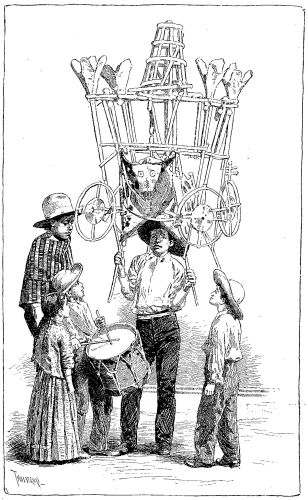
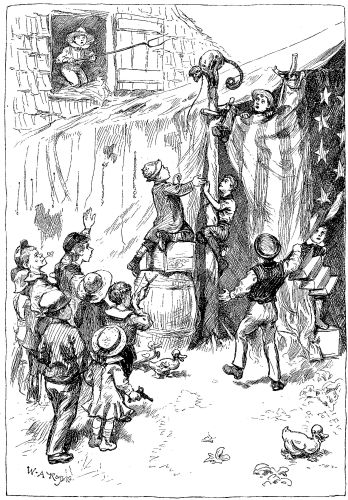
WONDERFUL FIRE-WORKS. — BY A. W. ROBERTS. — BROTHER JONATHAN. — "DUCK." — FOOTNOTES:
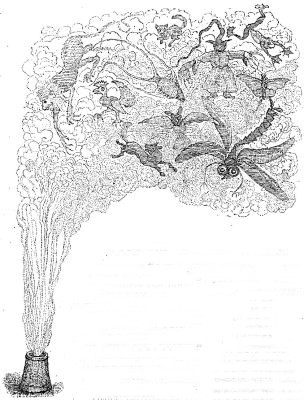
Among the many ingenious devices of the Chinese and Japanese in the way
of Hirayama, or day fire-works, is a huge bomb, which, when fired off,
ascends to a great height and explodes, at the same time releasing
hundreds of highly colored paper figures of both patriotic and comic
designs.
Other varieties of this new Japanese day fire-work set free innumerable
miniature Japanese fans, parasols, and small toys, or produce grotesque
and beautiful designs in colored smoke. I have tried to give you in the
illustration an idea how they look.
As each one of you boys who are well enough to go about is sure to set
off a certain number of "paper caps" before night comes on this Fourth
of July, 1882, I want to call your attention to a little toy that is not
only most novel and comical, but which will insure you against all
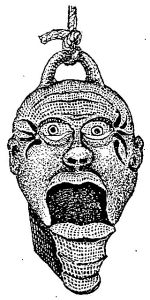
dangers from these explosives. It consists of a clown's head with a
movable jaw. At the top of the head a long string is fastened. A paper
cap is placed in the clown's mouth, and by means of the string the head
is caused to strike the pavement, the concussion causing the cap to
explode. All first-class conscientious dealers in fire-works are
refusing to sell the dangerous and so very often fatal toy cartridge
pistol, for which the clown's head forms such an excellent substitute.
The origin of this term, as applied to the United States, is as follows:
When General Washington, after being appointed commander of the army of
the Revolutionary war, came to Massachusetts to organize it, and make
preparations for the defense of the country, he found a great want of
ammunition and other means necessary to meet the powerful foe he had to
contend with, and great difficulty to obtain them. If attacked in such
condition, the cause at once might be hopeless.
On one occasion, at that anxious period, a consultation of the officers
and others was held, when it seemed no way could be devised to make such
preparations as were necessary. His Excellency Jonathan Trumbull the
elder was then Governor of the State of Connecticut, on whose judgment
and aid the General placed the greatest reliance, and remarked, "We must
consult Brother Jonathan on the subject."
The General did so, and the Governor was successful in supplying many of
the wants of the army. When difficulties afterward arose, and the army
was spread over the country, it became a by-word, "We must consult
Brother Jonathan." The term Yankee is still applied to a portion, but
Brother Jonathan has now become a designation of the whole country, as
John Bull has for England.
"Duck" is a game that should be played by a number exceeding three, but
not more than six or eight. Each of the players being provided with a
large pebble or stone about twice the size of a cricket-ball, called a
"duck," one of them, by chance or choice, places his duck on a large
smooth-topped stone fixed in the ground. An offing being marked at eight
or ten yards' distance from the stone, the other players cast their
ducks at it in turn, endeavoring to knock the duck off its place.
Each player, as soon as he has cast his duck, watches for an opportunity
of carrying it back to the offing, so as to cast again. If the player
whose duck is on the stone can touch another after he has taken up his
stone, and before he reaches the offing, provided his own duck remain on
the large stone, then the player so touched is out, and changes places
with the player at the stone. It sometimes happens that three or four of
the players' ducks lie so close together that the player whose duck is
on the stone can stand in a situation to be within reach of all of them;
in this case they can not, without running the risk of being touched,
pick up until one of those who are at the offing is lucky enough to
strike the duck off the large stone; then, before its owner can replace
it, which he must do before he can touch a player, they all take up
their ducks and run to the offing, where, of course, they are safe.
Another way of playing this game is to mount three or four brickbats one
on top of the other, and to try to dislodge the upper one by throwing
the duck at it before the keeper of the castle can touch the thrower.
The player so touched becomes keeper.
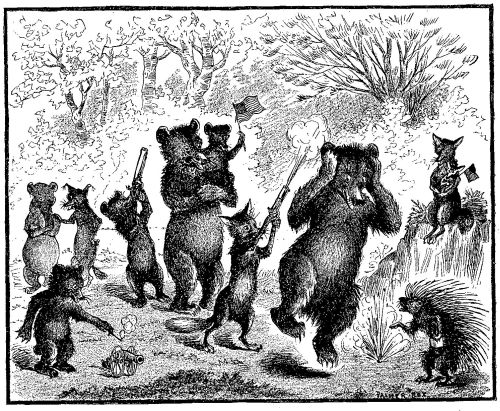 CELEBRATING THE FOURTH OF JULY IN THE WOODS.
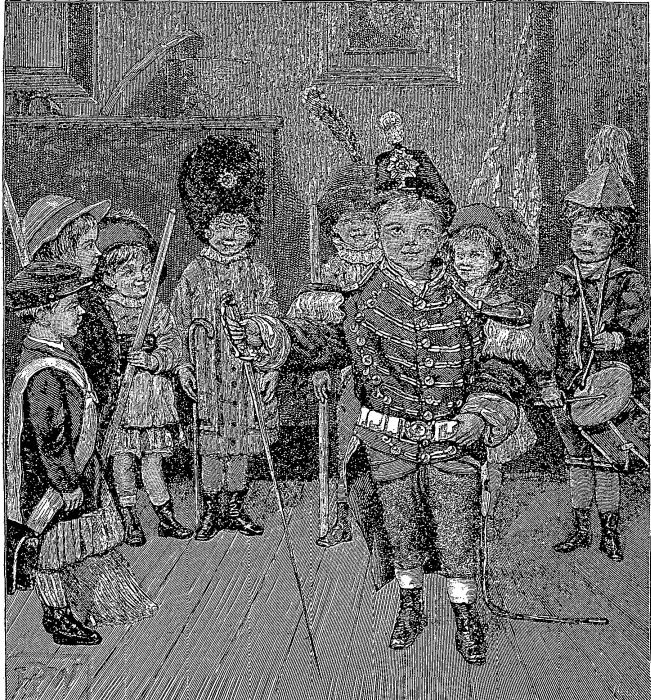 "ORDER ARMS!"