The snow was on the ground—the lovely white snow, the peaceful snow,
which covered the country landscape with billows of alabaster. In the
distance the feathery woods made a purple fringe between the earth and
sky, while in the foreground a crinkled rail fence ran irregularly along
the side of the country road, and near it stood a splotch of red and
black, the only marked color in the whole landscape. The red and black
was crying bitterly, for the red and black represented a little girl
with a scarlet hood, and crimson stockings, and a bundle of books. She
was on her way to school, and in great grief.
While she still stood by the fence, sobbing, a black object appeared
over the brow of the hill, and slowly moved toward the foreground,
until, pausing in front of the weeping child, it stood, as jolly, as
genial, as comfortable an old gentleman as ever wore broadcloth.
"Why, what is the matter, little one?" he asked, in a kindly voice.
The child looked up into the pleasant face and answered:
"They are always worrying me at home; they are always taking my things,
and when I ask for them they get mad, and if I take any of their things,
they come and take them away, and then if I don't like it, they tell
mother; and oh! I declare it's too mean for anything. It wasn't her
doll, anyway, for Cousin May left it behind, and she didn't give it to
anybody, and she'd had it all day; and then she took my sun-shade, and
broke the hook off, and because I asked her for it she got mad and
wanted the doll, and it wasn't her doll, and then mother made me give it
up, and I think it's real mean—that's just what I think it is."
"Well, well, well, that was too bad. I think it was real mean myself,"
said the old gentleman. "But I tell you what you should do—you should
keep two bears, as I do, and then you would be happy all the time."
"Two bears?" ejaculated the little girl, opening her large round blue
eyes.
"Yes, two bears. We have two bears up at my house, and they make us so
happy!"
"Don't they bite?"
"Oh no, they don't bite a mite."
"But they growl, don't they?"
"Oh, no, no; they don't growl either. But if you like to come home with
me, I will show them to you."
In an instant the little girl's hand was in that of the old gentleman,
and they were trotting along the road side by side. There was something
so kind and gentle and yet so jovial in his manner that it never entered
her head to be afraid of him. After turning down one road and up
another, and walking about a mile altogether, they at last came to a
long low house, with large windows, which were filled with bright
flowers, and draped with red curtains, and in every window hung a
bird-cage with some strange or beautiful bird.
A number of children came running out of the house, crying, "Oh, papa!
papa! here's papa!" as they gathered round him, clinging to his arms.
"Children," he said, "I have brought a little stranger to visit you. I
do not know her name, but I am sure you will be kind to her, and show
her the two bears, which I have promised she should see."
They entered a large, comfortable sitting-room, hung round with pictures
and bird-cages; in the centre was a long table covered with books, and
on each side of the fire-place, in a big easy-chair, sat a great rough
bear; one was brown, and the other was black.
The old gentleman led the little girl up to the brown bear, and said,
"Brown Bear, here is a little girl who is very miserable. I have told
her that you and Black Bear have made us all so happy, and that perhaps
you can help her to be happy too."
Brown Bear gave a good-humored sort of sniff, and put his big paw gently
on the head of the little stranger.
"What is your name, child?" asked the gentleman: "you have not told me
that yet."
"Frances Louisa Caroline Bounce, but they call me Fanny. What a nice
bear! Will he be angry if I feel his fur?"
"No, indeed, not even though you rub it the wrong way."
After she was introduced to both bears, she played with the children,
Carry and Sarah, George and Philip, and then they all went into another
room to dinner. On their way, however, Philip, who had a long switch,
with which he had been amusing himself, persisted in tickling the back
of his sister Sarah's ear with it, until she grew out of patience, and,
turning round, told him, rather sharply, to stop; but Philip, who was
only in fun, seemed somewhat nettled at being scolded, and was just on
the point of repeating the offense, when Black Bear, who was walking
behind, put his paw gently on his shoulder, while at the same moment
Brown Bear took Sarah by the arm and led her into the dining-room.
Philip threw away his switch, both burst into a merry laugh, and sat
down to the table with smiling faces. During the dinner both bears kept
walking round the table, looking so kind and gentle that they seemed to
put every one in good-humor. When Carry upset a tumbler of water over
Sarah's frock, Brown Bear immediately picked it up, while Carry begged
pardon, and Sarah laughed. When George was going to tell some little
tale out of school about Philip, Black Bear put his big paw in front
of his mouth, and George stopped at once.
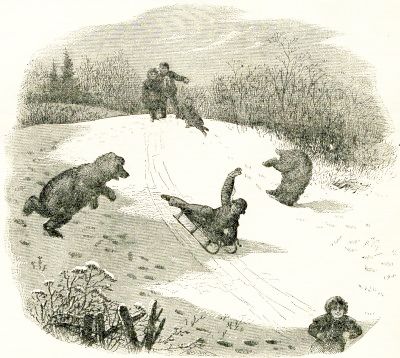 THE CHILDREN AND THEIR BEARS.
After dinner they all went out into the snow to have some coasting down
a hill close to the house. Both the boys had sleds, but Philip's was a
bright new one, while George's was old and rather clumsy. Philip had
been saving up his money for some time to buy this treasure, and was
very proud of it; therefore when George seized his new sled and ran off
with it, he called after him with some anger to bring it back, and not
to use it; but George had reached the top of the hill, and had just
planted the sled, ready to start down hill, when Brown Bear came to the
side of the angry Philip, and touched him with his paw. Phil's manner
and voice changed at once, as he called out, "Well, brother George, you
can use my sled, and I'll use yours." But Black Bear had reached the top
of the hill nearly as soon as George, and with his great big paw patted
him on the back, and grunted something in his ear. George took up the
sled very quietly, and carried it back to his brother, saying, "I am
sorry, Phil; here is your sled."
After that all was fun, tumbles, and laughter, the two bears joining in
it as actively and enjoying it just as much as the children. In fact,
the bears seemed to make the whole party happy. At last it became time
for Frances Louisa Caroline Bounce to go home. She felt sad at the
thought of leaving the bears, and of going to her own home, where there
were no bears at all.
"Well," said the old gentleman, "how do you like our bears, Fanny?"
"Oh, I think they are just too splendid for anything. I wish we had a
bear, even if it was only a little one."
"Well, you can easily have bears. All children can have them if they
like. Perhaps you would be obliged to begin with young ones; but then
they would be sure to grow up if you only took care of them."
"Oh, dear, dear! is that really so?" cried Fanny, in an ecstasy.
"Yes, my child, it is really so; every one can have two bears in his or
her house, like mine. But do you know what we call those bears which
make us all so happy? Bear and Forbear."
"Bear and Forbear!" echoed Fanny. "Oh, I will try to get two of those
bears in our house, and if they are ever so weak and sickly, I will feed
them and nurse them till they grow big and strong like yours."
Fanny trotted home with the old gentleman, and told her brothers and
sisters everything about the two good-natured bears; and they all agreed
that they would try to raise a pair like them.
I am happy to add that Fanny and her family have a pair of very
promising young bears, which already afford them a great deal of
happiness, and bid fair in the future to be fine healthy animals.
New York City.
I am making a steam-engine according to the directions given in
Young People No. 49. I have just soldered on the lid, and have made
the hole for the water to be let into the engine. I hope to finish
it soon. I am eight years old. I go to school, and I like Young
People very much. I like to read the letters from the children, so
I thought I would send one, and thank the "Professor" for writing
about the steam-engine.
John A. J.
Cresco, Iowa.
I have just commenced taking Young People, and we all like it very
much. The story of "Paul Grayson" was splendid, but I think "Toby
Tyler" is the best of all. My brother Charlie and I each have an
Indian pony. Charlie's pony has been trained by the Indians to
stand wherever you leave her, without being tied. And if any one is
riding her and falls off, no matter how fast she is going, she will
stop, and not move one step farther until her rider mounts again.
My pony throws me over her head sometimes, but she will not stop
until she gets to the barn.
Allie C.
Nacoochee, Georgia.
I send an experiment for the chemistry club. To make cyanogen gas
the apparatus necessary is this: one test-tube, a cork, six inches
of glass tube one-quarter of an inch in diameter, an alcohol lamp,
and a round file. Now hold the glass tube over the flame of the
lamp until the glass is soft, when by pulling it apart you will
have two tubes, with one end of each drawn to a fine point. Break
off the point of one, and you will have a tiny jet. Make a hole in
the cork just large enough for the large end of the tube to go
into. Put into the test-tube as much cyanide of mercury as will lie
on the point of a penknife. Fit the cork tightly in the test-tube.
Wave the test-tube over the flame of the lamp for five or ten
minutes, and then apply a lighted match to the jet, when the gas
will burn with a bluish flame. Pour some melted tallow or bees-wax
over the cork to keep the gas from escaping before reaching the
jet.
John R. G.
Nashville, Tennessee.
I read the letters in the Post-office Box with so much pleasure! I
have every number of Young People. All my young friends that read
it like it very much. We have formed a juvenile club, and I am
president. Reading Young People is a part of our programme.
Randolph H.
San Francisco, California.
I thought I would write and tell you about our club. It is called
the "Silver Crescent Dramatic Club." We were going to call it
"Golden Crescent," but when the club gets a little richer it is
going to buy some medals for each member to wear; they will be the
shape of a crescent, and if they had to be of gold, they would cost
more than silver ones. We meet once every week, and make by-laws
and suggestions, and vote on them, and we rehearse. We also have a
monthly paper; it is called "The Monthly Crescent." Of course it is
not printed, and we have only one copy. Each member edits it in
turn, and the others send in contributions. Everything has to be
original. The paper is read at every fourth meeting.
We charge five cents to join the club, and every two months each
member has to pay five cents dues. New members are voted for, and
the majority rules. We have five officers—a president,
vice-president, treasurer, secretary, and stage-manager. I am the
secretary.
We prepared a grand entertainment for the Christmas holidays. It
was a tragedy in three acts. I arranged it. In the first part of
Little Women, by Miss Alcott, they had a play called the
"Witch's Curse." Only the plot was given. I took it and made up
the dialogue, added some more characters, and changed it to make
it turn out differently. It makes a very nice little play.
Ida B. D.
Argenta, Illinois.
I am a little girl ten years old. I think Young People is a very
nice paper. My sister and I go to school. We have a very nice
teacher. I like to go very much. We study pieces from Young People
to speak in school. My teacher says all little boys and girls ought
to take it.
Minnie S.
Downieville, California.
I thought I would try to describe a trip I took with auntie to a
little town called Eureka. After a short ride we came to the main
trail leading from Downieville to the northern part of Sierra
County. The trail winds in and out, following every curve and bend
of the mountain. In some places it is quite steep, and in others
almost level. How tired I was when we got to Eureka, having been
two hours in the saddle! When we reached the ridge, we heard some
one playing on some instrument, and it sounded so sweet that we
stopped a few minutes to listen to it.
Uncle tells me that Eureka used to be quite a large place, with
hotels, stores, private houses, a school-house, and a Masonic
Hall; but now it consists of only half a dozen dwellings and the
school-house.
A little girl has written to Young People that she found two peach
blossoms in September, and she wants to know if any other little
girl has found any so late. Now I want to know if any little girl
or boy has ever picked ripe peaches near the 13th of November, as
I have.
Mary A. R.
Vicksburg, Mississippi.
I have only been taking Harper's Young People a short time, but I
think it is a very nice little paper. I saw that one of the little
girls said that she had seen a peach blossom in September. Here we
often have figs in December.
Lily V. F.
Brooklyn, Long Island.
I am eleven years old; but my eyes are not strong, and mamma has
not thought it best to send me to school till this fall, so that I
can not write very well. I would like to tell Reba H. that there
were apple blossoms on our tree in Oil City, Pennsylvania, in
September, 1879.
Winifred C.
Bath, New Hampshire.
I have just finished the embroidery of Fig. 12 in Young People No.
59. I received the paper Tuesday night, and if I had had all the
crewels, I could have finished it on Thursday. But I had to send to
Boston for some of them, and wait nearly four days before they
came.
The day I began the embroidery mamma went up garret, and found an
old quilt of my grandmother's, all embroidered with the same
stitch. I have done a table-cover in the South Kensington stitch,
but I think the New England stitch is prettier, easier, and takes
less time.
I did pattern No. 12 on a bureau-cover of Russian crash. I am very
glad you print the articles on embroidery. They are a great help.
I enjoy fancy-work very much, and do a great deal of it. I was
fourteen last July.
Helen C.
This is the first report on embroidery, and, according to promise, the
old embroidery pattern has been sent to the writer.
Sullivan, Indiana.
I am almost eight years old. I do not go to school. I have two
little sisters. My papa prints a newspaper. I take Young People,
and I think it is the best paper in the world, except papa's. I get
papa to read it to me, and then I send it to a little boy who has
no money to buy it.
Harald C. H.
East Canaan, New Hampshire.
I am only six years old, but I can read all the stories in Young
People alone. I have some very playful kittens, and one night they
tipped over the big rocking-chair. I had six white geese, but one
died.
Lester O. B.
Passaic, New Jersey.
I am ten years old. I have two pretty kittens, exactly alike. They
are yellow and white. The other day I got a pretty dove from the
dove-house, and kept him in a large cage; but I felt sorry for him,
and one day opened the window and let him out. He flew to the top
of the carriage-house, and all of the doves came to meet him and
kept flying around him. I like Harper's Young People so much that I
can not wait patiently until it comes.
Willie G.
Foster Brook, Pennsylvania.
I am spending the winter very pleasantly out among the Red Rock
Mountains. Our cottage is in a valley, surrounded by high hills,
which are covered with wintergreen berries from one year's end to
another. During the winter months the berries swell very large, and
they are delicious fruit in the spring. There is a great deal of
iron ore here, and also a great deal of snow. We live in a very
small house, with only four rooms; but, for all that, it is very
cozy. I look forward with much pleasure every week for the coming
of Young People.
M. Ada T.
Clanton, Alabama.
My brother and I take Young People, and like it very much. We had a
pet 'coon, which got very thirsty one day, and crawled into our big
glass water-pitcher head first. After helping himself to water, he
turned round in the pitcher, and came out again. Afterward the cat
killed him.
St. Clair T.
Brookhaven, Mississippi.
My papa takes Harper's Magazine, and I take Young People, which I
like very much, especially the letters written by the children. I
wish all the boys and girls in the South could get your paper.
I am eight years old, and go to school. There is a great deal of
cotton shipped from here to New Orleans, and a great deal of
lumber to St. Louis and Chicago. I have two little sisters younger
than I.
Archie McM.
Windsor Heights, Maryland.
I have taken Young People since the story called "Who was Paul
Grayson?" began. My brother and I have for pets a flock of pigeons,
which are quite tame, two pair of rabbits, and two dogs, named
"Duke" and "Terry." Duke will go into the corn-patch, select a soft
ear of corn, and husk and eat it. He sometimes goes to the
blackberry bushes, and holds down a branch with one paw while he
eats the berries. He is also very fond of persimmons.
James S.
Moberly, Missouri.
I will send a nice recipe for ice-cream in the winter. Take a
glassful of snow, and put in just enough cream to make it thick,
with some sugar, and just a little extract of vanilla or lemon. My
brother and I have ice-cream all summer, and winter too. I am nine
years old.
Maggie B.
Pearl A. Hare, of Lynchburg, Harris County, Texas, accidentally omitted
the little word "for" in her letter published in Young People No. 56,
which made her appear to offer birds' eggs and postage stamps for
exchange, when she wished to obtain them in exchange for Texas snail
shells. Our readers will please note the correction.
I am a boy eleven years old. I was born in Cairo, Egypt, and came
to America in 1876. I am living on a farm now, and like it very
much.
I have some Egyptian stamps I would like to exchange for any other
foreign stamps.
Ambrose Strang, Lincoln, Tennessee.
The following exchanges are also offered by correspondents:
M. P. Rich,
50 West Thirty-eighth Street, New York City.
German postage stamps for any other foreign stamps.
Maude Buckner,
1208 Russell Street, Covington, Ky.
Postage stamps and postmarks for foreign postage stamps and coin.
S. New,
127 East Sixty-ninth Street, New York City.
Postmarks for postage stamps.
Thomas K. Durham,
P. O. Box 735, New York City.
Postmarks and War Department stamps for stamps and monograms.
Campbell T. Hamilton,
Fort Preble, Portland, Maine.
Shells for Indian relics, shells, ore, or petrified wood.
Henry Scott,
20 Patchen Avenue, Brooklyn, N. Y.
Postmarks for postmarks and stamps.
Al. E. Barker,
P. O. Box 115, Judsonia, White County, Ark.
Foreign postage stamps for minerals, fossils, shells, sea-weed, or
birds' eggs.
Louis D. Orrison,
Care of Abernathy, North, & Orrison,
Kansas City, Missouri.
Southern moss for a Chinese coin or any old relic.
Daisy Rollins,
P. O. Box 186, Columbus, Missouri.
Twenty-five postmarks for two rare stamps.
W. W. Elhose,
22 Brill Street, Newark, N. J.
Foreign postage stamps or postmarks for all kinds of United States
internal revenue stamps.
George Wells,
P. O. Box 466, New York City.
Curiosities, postage stamps, or sea-shells for curiosities. Or
thirty postmarks for five birds' eggs. No duplicates.
Harry Madison,
206 Stockton Street, San Francisco, California.
One hundred postage stamps for ten coins, or for ten birds' eggs.
No duplicates.
Frank Knox,
2318 Third Avenue, New York City.
Minerals, fossils, rare stamps, or monograms for coats of arms,
crests, and monograms.
A Reader of "Young People,"
Lock Box 42,
Little Falls, Herkimer County, N. Y.
California curiosities, shells, or minerals for old or rare
American coins.
C. W., Jun.,
P. O. Box 2305, San Francisco, California.
Foreign stamps for postmarks and postal cards. Postmarks must be
cut square.
C. S. Petrasch,
13 West Thirty-second Street, New York City.
Two fine specimens of Southern fern, or some evening-glory seeds,
for United States postage stamps.
Emma Bruff,
238 Felicity Street, New Orleans, La.
Hawley Webster,
394 Clinton Avenue, Brooklyn, Long Island.
Louis Gibbs,
Care of J. J. Carter, Titusville, Penn.
C. H. L.—The old scrip which you inclose is probably a genuine
five-franc assignat, as the paper money was called which was first
issued by the French government in 1790, and afterward by the
Revolutionary authorities. It was based on the security of the public
domain, consisting of the confiscated estates of the Church and wealthy
exiles. The value of these assignats, which were issued to the amount of
45,578,000,000 francs, declined rapidly after the reign of terror. In
the summer of 1793, one franc in silver was worth three francs in paper.
Three years later, one franc in gold was worth three hundred francs in
paper, although the government, in order to check this depreciation, had
passed a law to regulate the price of commodities.
The inscription on your assignat shows that it was issued in October or
November, 1793, the second year of the French Republic. The lettering in
the corners proclaims death to any one who should dare to counterfeit
the assignat. The livre, which name appears on the scrip, was a French
coin about the value of a franc, by which it was superseded in 1795.
Eighty francs were equal in value to eighty-one livres.
If you examine your assignat carefully you will see to the left the dim
and faded stamp of the figure of Liberty, and if you have a strong
magnifying-glass, you can amuse yourself by trying to make out the
lettering around it. This little scrap of coarse paper, not quite a
hundred years old, may incite you to read the story of the terrible time
of which it is a relic. If you are not old enough to enjoy Carlyle's
History of the French Revolution, you will find the scenes vividly
portrayed in Charles Dickens's Tale of Two Cities, and Victor Hugo's
novel entitled "'93."
Henry H. T.—Your proposal to found a Natural History Society, composed
of contributors to Harper's Young People, is hardly practical. The
exchange of specimens, etc., would be dilatory and difficult, as our
contributors are scattered over the whole continent. Local societies of
the kind you mean might be formed to advantage, and the officers of
different associations could correspond with each other, and exchange
views and information.
L. M. F. and L. L. P.—Your plan for a reading and debating club is
excellent, and if well carried out must have good results. You will find
suggestions that may be useful in some remarks appended to a letter from
Violet S. in Harper's Young People No. 53, and also in a book called
Stories of the Sea, noticed in No. 61. We would advise you not to
waste your time over fourth-rate literature (to which the books you
mention belong), but to select the best authors, whose works will not
only entertain but instruct you. An excellent guide for you would be
William Swinton's Masterpieces of English Literature, recently
published by Harper & Brothers.
Violet S.—Your account of the proceedings of your society is not full
enough. Can you not favor us with a sprightly description of what is
done and said at your meetings, instead of giving the "order of
exercises" merely?
John N. H.—Either hickory or sassafras wood is good material for bows.
Helen G.—How to make the "Wiggles" was fully explained at the end of
the Post-office Box in No. 51 of Young People.
R. T. F.—Amber is not, as you suppose, made from "the sap of a tree in
South Africa," but is a fossil resin from several species of coniferous
or cone-bearing trees of a very remote geological period. More than 800
species of insects have been found preserved in amber, and leaves of 160
species of plants. Fine pieces of amber are very highly prized, and are
sometimes worth more than their weight in gold. The largest mass known
is in Berlin, Prussia. It weighs eighteen pounds, and is valued at
$30,000. Amber is extensively used for ornaments, the mouth-pieces of
pipes, etc. You may be able to procure a piece of some manufacturer of
meerschaum pipes.
The ancients prized amber very highly, and it was an important article
of commerce in early times. From the fact that it is found in large
quantities in the remains of the lake-villages of Switzerland, we know
that it must have been an article of exchange in prehistoric times.
Floy.—If you have any pressed flowers, leaves, or other pretty objects
which can be sent easily by mail, we have no doubt some of our readers
would be glad to send you postage stamps in exchange for them. You can
put your offer in the Post-office Box.
Jesse H., Jun.—The English noun envelop, as well as the verb, is
accented on the second syllable. The French form of the word,
envelope, has an even accent on the three syllables. Our word is
derived from the French.
Jean C. P.—Please give the name of the county in which the town of
Warren, where you live, is situated. There are several towns of that
name in Ohio, and correspondents will not know where to address you
unless the county is given also.
Ford D. Lyon.—The controversy about the origin of the phrase,
"Consistency, thou art a jewel," has not been satisfactorily settled.
The saying has been floating about for a great many years, but no one
has been able to find out who started it on its travels.
Grace.—The ü in Olmütz is sounded like the French u, very difficult
to catch without the aid of a teacher. You can come very near it by
pronouncing the vowel o and changing to e without altering the
position of the lips.
C. G. G.—The time required for the transmission of a signal through the
Atlantic cable varies according to the condition of the batteries. A
dispatch has been sent from New York to London and the answer received
within an hour.
James McK.—No charge is made in the matter about which you ask.
Sallie K., Cincinnati, Ohio.—The name of the street in which you live
is so obscurely written that we can not make it out. Write it very
plainly, and we will print your request.
Daisy R.—Send enough to make a pretty wreath.
Jennie S. M.—A very good recipe for butterscotch was given in a letter
from Kittie G. in the Post-office Box of Young People No. 37.
Henry C. D.—Glass for windows was made during the Middle Ages in all
European countries. In England glass-painting for windows was practiced
in 1338. Some splendid windows of York Cathedral were painted at that
period by John Thornton, of Coventry. In the fifteenth century English
window-glass was more expensive than any other kind of glass. The
Egyptians made glass at a very early period of their national existence.
Paintings representing glass-blowers making a very large vase show that
nearly 4000 years ago the Egyptians were far advanced in this art.
Favors are acknowledged from Garrett Waggener, Bertha Herron, C. C.
Shelley, Jun., Stella Pratt, George W. Taymun, Flora C. B., Mabel White,
Alice Brown, J. W. Menefee, Orrie H. Clark, Shelton H. Hibbs, H. H. J.,
S. H. R., W. H. Scherzer, Carrie and Belle N., Albert Woolley, B. D.
Ellis, C. G. Myers, B. Tompkins, E. Fay Stevens, H. McIlvain, Frank A.
Harmony, Annie S. and Bennie C. Duffie, F. H. Kellogg, Everett Jones,
Lewis B. Frazier, Lyman Perley, Sidney J. Carson, Katie Dale, Louis
Mareé, Tamar Love, Thomas Buford, Fredy Leser.
Correct answers to puzzles are received from C. H. McB., Hugh Pilcairn,
Thomas Cook, George Dudley Kyte, "Lone Star," Harry and Isobel Jacob.
1. First, a piece of ordnance formerly used for blowing up barricades
and other defensive works. Second, a female name. Third, to feel a
sharp, pricking sensation. Fourth, a state in Africa. Fifth, part of a
printing-press. Sixth, having a melancholy appearance.
Zelotes.
2. First, to disturb. Second, to weaken. Third, a Turkish coin. Fourth,
absent without leave. Fifth, to show clearly. Sixth, leased.
Bolus.
A letter. A small vessel. A hut. A celebration. A guide. A snare. A
letter.
Wennie.
An ensign. A boy's name. A wonder. Finished. Answer.—Two things to gain
which men often make great sacrifices and devote all their energies.
Lone Star.
First in sieve, not in pail.
Second in rum, not in ale.
Third in calf, not in ox.
Fourth in cat, not in fox.
Fifth in rude, not in kind.
Sixth in brain, not in mind.
Seventh in wheat, not in hay.
The whole a savage bird of prey.
Oscar.
Place seven divisions of the United States in such order that,
their initials read downward spell the name of another.
Bolus.