On one of the fjords, or bays, which so deeply indent the coast of
Norway lived two lads, sons of well-to-do farmers, who, besides their
fields of rye and wheat, their marks, or pasture fields, and their
säters, or hay-making fields, farther away, had also an interest in
the fisheries for which Norway is so famous. The salmon, the herring,
and the cod are all caught in great numbers; so also is the shark, and
used for its oil, which passes for cod-liver oil.
The fathers of Lars and Klaus were, however, peasants. They worked on
their farms, and above their green pastures rose lofty mountains clad in
fir-trees, dusky pines, mottled beeches, and silver birches. Klaus and
Lars explored together the recesses of these mountains; together they
hunted for bears; together they sailed over the blue waters of the
fjord, in and out of the swift currents, and on and up into the
streams fed by the great ice fjelds. They were always together. If any
one wanted Klaus, he asked where Lars had gone; and if one had seen
Lars, he knew Klaus would soon follow. It was their delight to see which
could excel the other in the management of their fishing jagts, those
square-sailed slow craft, and for days they would cruise about the
haunts of the eider-duck—not to kill it, for that is forbidden, the
bird being too valuable, but to filch from the sides of its nest the
lovely down which the birds pluck from their own breasts.
They went to school, too, in the winter, and both were confirmed by the
village pastor as soon as they had been well prepared for that solemn
rite, which is of so much social as well as religious importance in
their country.
In the short hot summer they helped the fishermen split the cod and
spread them on the rocks to dry, or they made lemming traps and sought
to see how many of the hated vermin they could capture.
In short, their life was active, hardy, and full of keen enjoyment; they
were good-natured, and did not quarrel. Both were tall, finely grown as
to muscle, but they would have been handsomer had they eaten less salt
fish and more beef.
In a quaint little house at the foot of the mountains, near where
tumbled in snowy foam a beautiful foss, lived an old woman and her
grandchild Ilda. They were really tenants of Klaus's father; and in
their wanderings the boys often stopped for a glass of milk or a slice
of fladbröd (oat-cake), which the old woman was glad to give them.
Ilda, too, in her red bodice and white chemisette, and her pretty, shy
ways, was almost as attractive as the birds or beasts they were seeking.
Neither the old woman nor Ilda often left their cottage, and so the boys
were the more welcome for the news they carried.
They were able to give them the latest bit of gossip—how many men were
off on the herring catch; if any strangers had come through the town in
their carrioles on their way to the noted and beautiful Voring Foss
and Skjaeggedal Foss (two water-falls of great renown); or who had the
American fever, and were going to emigrate. Or they talked about the
ducks and geese of which Ilda was so proud, and of the pigeons which
Klaus had given her when they were wild, but which had grown tame and
lovable under her gentle care. Then the old woman related in turn many a
legend and fable, tales of the saintly King Olaf, or the doings of Odin
and Thor.
Thus the days glided by, and the boys became men, and still they were
together in their work as they had been in their play. In the rye fields
and the potato patches they toiled side by side, and in the last nights
of summer—the three August nights which they call iron nights, because
of the frosts which sometimes come and blight all the wheat crop—they
watched and waited, hoping for the good luck which did not always come
to them; for the soil is a hard one to cultivate, and many are the
trials which farmers have to meet in that bleak land. Soon after they
became of age they were called upon to share the grief of their friend
Ilda, whose grandmother died. After this they did not go so often to the
cottage. One bright evening, however, as Lars was on his way up the
mountain, he saw Klaus emerging from the little door beneath the shed of
which they had so often sat. As they met, Klaus turned his face away,
remarking, however, upon the beauty of the evening. Lars thought his
friend's manner somewhat strange, and asked him if Ilda was well. Klaus
said she was quite well—was he going to see her?
"Yes," said Lars. "I have some fresh currants from our garden, the only
fruit which will grow in it, and I thought perhaps she might care for
them, poor little thing. She is so lonely now!"
Klaus turned off down the road, whistling, while Lars went into the
cottage. To his surprise he found Ilda crying, but supposing that the
sight of Klaus had revived recollections which were painful, some sad
thoughts of her grandmother, he tried to soothe her. She shook her head
mournfully at his kind words, and told him that she had just done a
cruel thing, that Klaus had asked her to be his wife, and she had said
no to him. This came upon Lars very much like a thunder-bolt, for he had
no idea that Klaus had any such wish; and much as he pitied his friend,
he was not entirely sorry that Ilda had said no. So he asked her why she
had refused to be Klaus's wife, when, with much embarrassment, she told
him that she cared more for some one else.
Lars did not urge her to say any more, but leaving his currants, he
followed Klaus down the mountain.
A few days after this, to the surprise of every one, Klaus bade his
friends good-by, and took passage on the little steamer to
Christiansand, from whence he would cross the Skagerrack, and sailing
down the coast of Denmark, past Holland and Belgium, through the English
Channel, he would be on the broad Atlantic, which was to bear him to a
new home in the far western land.
Lars was not merely surprised, he was stunned, and thought his friend
almost an enemy to go in that manner without consulting him, without
even asking his advice or company. They had never before been separated.
He could not understand it; and when Klaus bade him good-by he looked
into his face as if to seek the reason for this strange conduct, but
Klaus gave him no chance to ask it. He simply grasped his hand in
silence, giving it a close clasp, and then he was off.
Days, weeks, months, went by, and no one heard from Klaus; at last his
mother had a letter from him. He wrote cheerfully; said he liked
America, but that he could not make up his mind to go far away to the
prairies, where he could never see the blue ocean or the white gulls, or
hear the splash of oars.
Meanwhile Lars was very unhappy. Everything seemed to go wrong with
him—the crops failed, his share in the fisheries was small, and his
father was hard and close with him. He missed his friend sadly; he cared
no longer to do the daring things they had attempted together. He had
never been to see Ilda since the day she had told him that she did not
love his friend Klaus. As the spring advanced into summer, he met her
one day in the pine woods near her cottage, and she looked so pleased to
see him that he was tempted to tell her of all his troubles, especially
of how disappointed and hurt he was by the departure of Klaus; and this
reminded him of what she had told him about caring for some one else;
but when he asked her who it was, to, his great happiness she told him
that he, Lars, was the one, and that was the reason why Klaus had gone
away. Then, for the first time, he saw how generously his friend had
acted; he had gone away that he might not interfere with his friend, for
Klaus had found out that Ilda loved Lars. So in due time they were
married in the simple fashion of the Norwegian people. But the crops
were not more nourishing; and work as hard as he would, Lars could not
do as well for himself as he would have liked. So he took all his money
and bought a bigger jagt, and carried klip (or split) fish to the south,
from whence they would be sent to Spain.
This separated him from Ilda and the little yellow-haired Hanne, his
child; and his voyages were not very prosperous, so at last they
determined to do as did the Norsemen and Vikings of old, set sail for
the land of the setting sun.
It was hard to give up Norway, but Ilda was willing to do that which was
for the best, and quietly filled the big boxes and chests with the linen
she had spun herself, and made stout flannel clothes for little Hanne,
and said "good-by" to every one she knew, and then they got off as fast
as the slow jagt would carry them: off, out of the beautiful fjord with
its green banks and snowy-topped mountains, away from the rocks and
fjelds so dear to them, on to the broad, the mighty ocean.
They sailed and sailed for many a day, and Ilda knit while the little
lassie, Hanne, played at her feet, and Lars smoked his pipe, and talked
of the glorious land of liberty and fertile fields which they were
approaching.
They had pleasant weather for a long while, and it did seem as if the
kind words, the lycksame resa, or lucky journey, which their friends
had wished them, was really to be experienced. Little Hannchen was a
merry, bright little companion, and made all the rough sailors love her.
Her evening meal was milk and fladbröd, and she always threw some over
the ship's side for the "poor hungry fishes," while she prattled in
Norsk to the sailors, who were mostly Swedes and Finns. But whether they
understood her or not, they liked to watch her blue eyes sparkle, and
her yellow hair fly out like freshly spun flax, as she merrily danced
about the slow old jagt; and they called her "Heldig Hanne," or "happy
Hanne." But they were now approaching land, and fogs set in which were
more to be dreaded than high winds, and the helmsman looked anxious, and
Lars could not sleep. The atmosphere seemed to get thicker and thicker,
and where they could for a while see the faint yellow twinkle of the
stars all was now an opaque film.
One night as Ilda was singing a little song to Hanne a great crash came,
a terrible thump, and then a queer grating sound. All had been still on
deck, but now came hoarse shouts and cries, and Lars rushed down to the
cabin, saying, "We are on the rocks! we are lost, Ilda!"
Ilda clasped little Hanne still closer as she said, tremulously, "Is it
true, Lars? is there no way of escape? are we so near land?"
"Yes; come up on deck. The ship is already settling. We must try to get
you and the child off in one of the boats."
"Not without you, Lars; we will not move an inch without you."
"See," he replied, as he helped her up the steps, "the gulls are flying
over our heads: land must be near."
It was horribly true that the vessel was thumping and bumping on the
rocks; the surf was roaring, and it seemed impossible for a boat to be
launched. The sailors were making ready to cast themselves into the sea.
Some were cursing, others praying, and others tying and lashing
themselves to spars which they had taken from their fastenings. Two of
them came up to Lars.
"Sir, for the sake of the child there, we will swim, if we can, to the
shore, and get help."
"It would be useless," said Lars.
"Oh no," said Ilda; "let them try. They are brave. Perhaps they will
succeed."
They nodded, and went off, Lars looking after them hopelessly as he
muttered: "I might have known this; it is just my luck. Oh, Ilda! Ilda!
why did I bring you with me?—and poor little Hanne!"
The child clung to her mother, her blue eyes dilated with fear, and her
little hands about her mother's neck.
"Hush, Lars," said Ilda; "where thou art, there I would be, and so would
Hannchen. God is yet able to save us."
The moments seemed like days; presently the vessel gave a great lurch to
one side, and Lars had just time to tie Ilda to him as the waves broke
over the jagt.
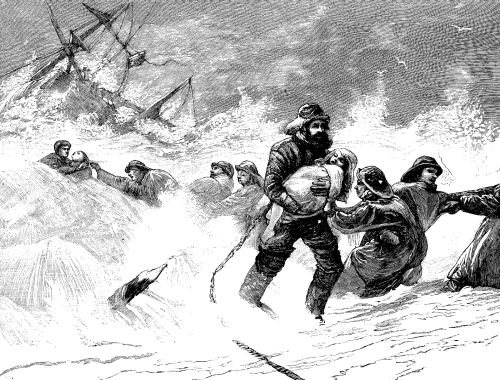 "SAVED AT LAST!"
"Farväl!" was all he said to her, as they were plunged into the water;
but as he saw the waves closing about them, he heard a cry from the
sailors—a cry of joy, of welcome—and he felt a strong hand reached out
to him, and a coil of rope flung about them. He had his arm under the
fainting Ilda, but surely he had seen the face of the brave fellow who
took Hanne in his arms from Ilda's clasp. He could not think; he only
knew that they were saved at last—that a dozen strong men, some on
land, some in the water, were dragging them to shore.
Ah! what rest and peace and thankfulness after a night like that! and
with what strange and solemn emotions did Lars and Ilda look about them
when they discovered that the house they were in belonged to the one who
had carried their little Hanne in his arms from the ocean, and was none
other than their old friend Klaus. Klaus the fisherman, Klaus the
sailor, as he was known on that shore. The same Klaus, merry and brave,
with a house of his own and a wife of his own, ready to share all he
possessed with Lars, if Lars would only stay and settle near him. The
jagt had gone down with all Lars's worldly goods; but Ilda was safe and
Hanne was safe, and with so good a friend as Klaus, surely Lars could
begin the world anew. And so he staid; and the tide turned, and fair
weather prevailed.