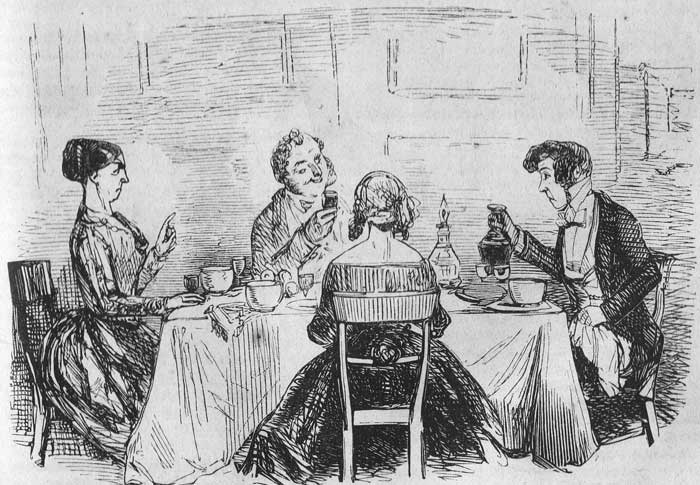
"What is courage?" said my uncle Roland, rousing himself from a reverie
into which he had fallen after the Sixth Book in this history had been
read to our family circle.
"What is courage?" he repeated more earnestly. "Is it insensibility to
fear? That may be the mere accident of constitution; and, if so, there
is no more merit in being courageous than in being this table."
"I am very glad to hear you speak thus," observed Mr. Caxton, "for I
should not like to consider myself a coward; yet I am very sensible to
fear in all dangers, bodily and moral."
"La, Austin, how can you say so?" cried my mother, firing up; "was it
not only last week that you faced the great bull that was rushing after
Blanche and the children?"
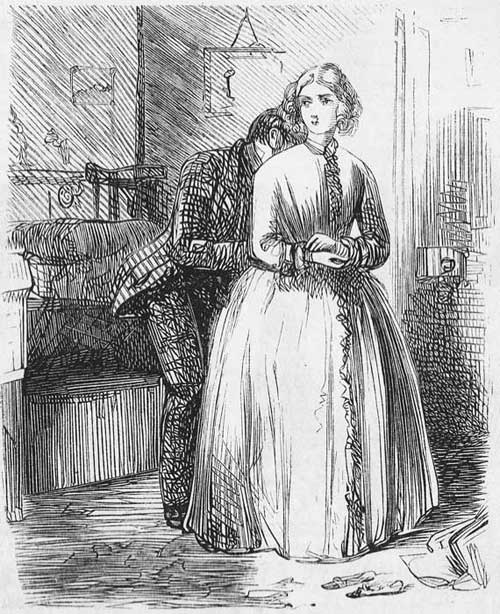
Blanche at that recollection stole to my father's chair, and, hanging
over his shoulder kissed his forehead.
Mr. Caxton (sublimely unmoved by these flatteries).—"I don't deny that
I faced the bull, but I assert that I was horribly frightened."
Roland.—"The sense of honor which conquers fear is the true courage of
chivalry: you could not run away when others were looking on—no
gentleman could."
Mr. Caxton.—"Fiddledee! It was not on my gentility that I stood,
Captain. I should have run fast enough, if it had done any good. I stood
upon my understanding. As the bull could run faster than I could, the
only chance of escape was to make the brute as frightened as myself."
Blanche.—"Ah, you did not think of that; your only thought was to save
me and the children."
Mr. Caxton.—"Possibly, my dear—very possibly I might have been afraid
for you too—but I was very much afraid for myself. However, luckily I
had the umbrella, and I sprang it up and spread it forth in the animal's
stupid eyes, hurling at him simultaneously the biggest lines I could
think of in the First Chorus of the 'Seven against Thebes.' I began with
Eledemnas pedioploktupos; and when I came to the grand howl of Iô, iô, iô, iô—the
beast stood appalled as at the roar of a lion. I shall never forget his
amazed snort at the Greek. Then he kicked up his hind legs, and went
bolt through the gap in the hedge. Thus, armed with Æschylus and the
umbrella, I remained master of the field; but (continued Mr. Caxton,
ingenuously), I should not like to go through that half minute again."
"No man would," said the Captain, kindly. "I should be very sorry to
face a bull myself, even with a bigger umbrella than yours, and even
though I had Æschylus, and Homer to boot, at my fingers' ends."
Mr. Caxton.—"You would not have minded if it had been a Frenchman with
a sword in his hand?"
Captain.—"Of course not. Rather liked it than otherwise," he added,
grimly.
Mr. Caxton.—"Yet many a Spanish matador, who doesn't care a button for
a bull, would take to his heels at the first lunge en carte from a
Frenchman. Therefore, in fact, if courage be a matter of constitution,
it is also a matter of custom. We face calmly the dangers we are
habituated to, and recoil from those of which we have no familiar
experience. I doubt if Marshal Turenne himself would have been quite at
his ease on the tight rope; and a rope-dancer, who seems disposed to
scale the heavens with Titanic temerity, might possibly object to charge
on a cannon."
Captain Roland.—"Still, either this is not the courage I mean, or there
is another kind of it. I mean by courage that which is the especial
force and dignity of the human character, without which there is no
reliance on principle, no constancy in virtue—a something," continued
my uncle, gallantly, and with a half bow toward my mother, "which your
sex shares with our own. When the lover, for instance, clasps the hand
of his betrothed, and says, 'Wilt thou be true to me, in spite of
absence and time, in spite of hazard and fortune, though my foes malign
me, though thy friends may dissuade thee, and our lot in life may be
rough and rude?' and when the betrothed answers, 'I will be true,' does
not the lover trust to her courage as well as her love?"
"Admirably put, Roland," said my father. "But apropos of what do you
puzzle us with these queries on courage?"
Captain Roland (with a slight blush).—"I was led to the inquiry
(though, perhaps, it may be frivolous to take so much thought of what,
no doubt, costs Pisistratus so little), by the last chapters in my
nephew's story. I see this poor boy, Leonard, alone with his fallen
hopes (though very irrational they were), and his sense of shame. And I
read his heart, I dare say, better than Pisistratus does, for I could
feel like that boy if I had been in the same position; and, conjecturing
what he and thousands like him must go through, I asked myself, 'What
can save him and them?' I answered, as a soldier would answer,
'Courage!' Very well. But pray, Austin, what is courage?"
Mr. Caxton (prudently backing out of a reply).—"Papæ! Brother, since
you have just complimented the ladies on that quality, you had better
address your question to them."
Blanche here leant both hands on my father's chair, and said, looking
down at first bashfully, but afterward warming with the subject, "Do you
not think, sir, that little Helen has already suggested, if not what is
courage, what at least is the real essence of all courage that endures
and conquers, that ennobles, and hallows, and redeems? Is it not
Patience, father?—and that is why we women have a courage of our own.
Patience does not affect to be superior to fear, but at least it never
admits despair."
Pisistratus.—"Kiss me, my Blanche, for you have come near to the truth
which perplexed the soldier and puzzled the sage."
Mr. Caxton (tartly).—"If you mean me by the sage, I was not puzzled at
all. Heaven knows you do right to inculcate patience—it is a virtue
very much required in your readers. Nevertheless," added my father,
softening with the enjoyment of his joke—"nevertheless, Blanche and
Helen are quite right. Patience is the courage of the conqueror; it is
the virtue, par excellence, of Man against Destiny—of the One against
the World, and of the Soul against Matter. Therefore this is the courage
of the Gospel; and its importance, in a social view—its importance to
races and institutions—can not be too earnestly included. What is it
that distinguishes the Anglo-Saxon from all other branches of the human
family, peoples deserts with his children, and consigns to them the
heritage of rising worlds? What but his faculty to brave, to suffer, to
endure—the patience that resists firmly, and innovates slowly. Compare
him with the Frenchman. The Frenchman has plenty of valor—that there is
no denying; but as for fortitude, he has not enough to cover the point
of a pin. He is ready to rush out of the world if he is bit by a flea."
Captain Roland.—"There was a case in the papers the other day, Austin,
of a Frenchman who actually did destroy himself because he was so teased
by the little creatures you speak of. He left a paper on his table,
saying that 'life was not worth having at the price of such
torments.'"[7]
Mr. Caxton (solemnly).—"Sir, their whole political history, since the
great meeting of the Tiers État, has been the history of men who would
rather go to the devil than be bit by a flea. It is the record of human
impatience, that seeks to force time, and expects to grow forests from
the spawn of a mushroom. Wherefore, running through all extremes of
constitutional experiment, when they are nearest to democracy they are
next door to a despot; and all they have really done is to destroy
whatever constitutes the foundation of every tolerable government. A
constitutional monarchy can not exist without aristocracy, nor a
healthful republic endure with corruption of manners. The cry of
Equality is incompatible with Civilization, which, of necessity,
contrasts poverty with wealth, and, in short, whether it be an emperor
or a mob that is to rule, Force is the sole hope of order, and the
government is but an army.
"Impress, O Pisistratus! impress the value of patience as regards man
and men. You touch there on the kernel of the social system—the secret
that fortifies the individual and disciplines the million. I care not,
for my part, if you are tedious so long as you are earnest. Be minute
and detailed. Let the real human life, in its war with Circumstance,
stand out. Never mind if one can read you but slowly—better chance of
being less quickly forgotten. Patience, patience! By the soul of
Epictetus, your readers shall set you an example!"
Leonard had written twice to Mrs. Fairfield, twice to Riccabocca, and
once to Mr. Dale; and the poor proud boy could not bear to betray his
humiliation. He wrote with as cheerful spirits—as if perfectly
satisfied with his prospects. He said that he was well employed, in the
midst of books, and that he had found kind friends. Then he turned from
himself to write about those whom he addressed, and the affairs and
interests of the quiet world wherein they lived. He did not give his own
address, nor that of Mr. Prickett. He dated his letters from a small
coffee-house near the bookseller, to which he occasionally went for his
simple meals. He had a motive in this. He did not desire to be found
out. Mr. Dale replied for himself and for Mrs. Fairfield, to the
epistles addressed to these two. Riccabocca wrote also. Nothing could be
more kind than the replies of both. They came to Leonard in a very dark
period in his life, and they strengthened him in the noiseless battle
with despair.
If there be a good in the world that we do without knowing it, without
conjecturing the effect it may have upon a human soul, it is when we
show kindness to the young in the first barren footpath up the mountain
of life.
Leonard's face resumed its serenity in his intercourse with his
employer; but he did not recover his boyish ingenuous frankness. The
under-currents flowed again pure from the turbid soil and the splintered
fragments uptorn from the deep; but they were still too strong and too
rapid to allow transparency to the surface. And now he stood in the
sublime world of books, still and earnest as a seer who invokes the
dead. And thus, face to face with knowledge, hourly he discovered how
little he knew. Mr. Prickett lent him such works as he selected and
asked to take home with him. He spent whole nights in reading; and no
longer desultorily. He read no more poetry, no more Lives of Poets. He
read what poets must read if they desire to be great—Sapere principium
et fons—strict reasonings on the human mind; the relations between
motive and conduct, thought and action; the grave and solemn truths of
the past world; antiquities, history, philosophy. He was taken out of
himself. He was carried along the ocean of the universe. In that ocean,
O seeker, study the law of the tides; and seeing Chance nowhere—Thought
presiding over all—Fate, that dread phantom, shall vanish from
creation, and Providence alone be visible in heaven and on earth!
There was to be a considerable book-sale at a country house one day's
journey from London. Mr. Prickett meant to have attended it on his own
behalf, and that of several gentlemen who had given him commissions for
purchase; but, on the morning fixed for his departure, he was seized
with a severe return of his old foe, the rheumatism. He requested
Leonard to attend instead of himself. Leonard went, and was absent for
the three days during which the sale lasted. He returned late in the
evening, and went at once to Mr. Prickett's house. The shop was closed;
he knocked at the private entrance; a strange person opened the door to
him, and in reply to his question if Mr. Prickett was at home, said with
a long and funereal face—"Young man, Mr. Prickett senior has gone to
his long home, but Mr. Richard Prickett will see you."
At this moment a very grave-looking man, with lank hair, looked forth
from the side-door communicating between the shop and the passage; and
then stepped forward—"Come in, sir; you are my late uncle's assistant,
Mr. Fairfield, I suppose?"
"Your late uncle! Heavens, sir, do I understand aright—can Mr. Prickett
be dead since I left London?"
"Died, sir, suddenly last night. It was an affection of the heart; the
doctor thinks the rheumatism attacked that organ. He had small time to
provide for his departure, and his account books seem in sad disorder: I
am his nephew and executor."
Leonard had now followed the nephew into the shop. There, still burned
the gas lamp. The place seemed more dingy and cavernous than before.
Death always makes its presence felt in the house it visits.
Leonard was greatly affected—and yet more, perhaps, by the utter want
of feeling which the nephew exhibited. In fact, the deceased had not
been on friendly terms with this person, his nearest relative and
heir-at-law, who was also a bookseller.
"You were engaged but by the week I find, young man, on reference to my
late uncle's papers. He gave you a £1 a week—a monstrous sum! I shall
not require your services any further. I shall move these books to my
own house. You will be good enough to send me a list of those you bought
at the sale, and your account of traveling expenses, &c. What may be due
to you shall be sent to your address. Good evening."
Leonard went home, shocked and saddened at the sudden death of his kind
employer. He did not think much of himself that night; but, when he rose
the next day, he suddenly felt that the world of London lay before him,
without a friend, without a calling, without an occupation for bread.
This time it was no fancied sorrow, no poetic dream disappointed. Before
him, gaunt and palpable, stood Famine.
Escape!—yes. Back to the village; his mother's cottage; the exile's
garden; the radishes and the fount. Why could he not escape? Ask why
civilization can not escape its ills and fly back to the wilds and the
wigwam?
Leonard could not have returned to the cottage, even if the Famine that
faced had already seized him with her skeleton hand. London releases not
so readily her fated stepsons.
One day three persons were standing before an old book-stall in a
passage leading from Oxford-street into Tottenham-court-road. Two were
gentlemen; the third, of the class and appearance of those who more
habitually halt at old book-stalls.
"Look," said one of the gentlemen to the other, "I have discovered here
what I have searched for in vain for the last ten years—the Horace of
1580, the Horace of the Forty Commentators—a perfect treasury of
learning, and marked only fourteen shillings!"
"Hush, Norreys," said the other, "and observe what is yet more worth
your study;" and he pointed to the third bystander, whose face, sharp
and attenuated, was bent with an absorbed, and as it were, with a
hungering attention over an old worm-eaten volume.
"What is the book, my lord?" whispered Mr. Norreys.
His companion smiled, and replied by another question, "What is the man
who reads the book?"
Mr. Norreys moved a few paces, and looked over the student's shoulder.
"Preston's translation of Boethius, The Consolations of Philosophy,"
he said, coming back to his friend.
"He looks as if he wanted all the consolations Philosophy can give him,
poor boy."
At this moment a fourth passenger paused at the book-stall, and,
recognizing the pale student, placed his hand on his shoulder and said,
"Aha, young sir, we meet again. So poor Prickett is dead. But you are
still haunted by associations. Books—books—magnets to which all iron
minds move insensibly. What is this? Boethius! Ah, a book written in
prison, but a little time before the advent of the only philosopher who
solves to the simplest understanding every mystery of life—"
"And that philosopher?"
"Is Death!" said Mr. Burley. "How can you be dull enough to ask? Poor
Boethius, rich, nobly born, a consul, his sons consuls—the world one
smile to the Last Philosopher of Rome. Then suddenly, against this type
of the old world's departing wisdom, stands frowning the new world's
grim genius, force—Theodoric the Ostrogoth condemning Boethius the
Schoolman; and Boethius, in his Pavian dungeon, holding a dialogue with
the shade of Athenian Philosophy. It is the finest picture upon which
lingers the glimmering of the Western golden day, before night rushes
over time."
"And," said Mr. Norreys abruptly, "Boethius comes back to us with the
faint gleam of returning light, translated by Alfred the Great. And,
again, as the sun of knowledge bursts forth in all its splendor, by
Queen Elizabeth. Boethius influences us as we stand in this passage; and
that is the best of all the Consolations of Philosophy—eh, Mr. Burley?"
Mr. Burley turned and bowed.
The two men looked at each other; you could not see a greater contrast.
Mr. Burley, his gay green dress already shabby and soiled, with a rent
in the skirts, and his face speaking of habitual night-cups. Mr.
Norreys, neat and somewhat precise in dress, with firm lean figure, and
quiet, collected, vigorous energy in his eye and aspect.
"If," replied Mr. Burley, "a poor devil like me may argue with a
gentleman who may command his own price with the booksellers, I should
say it is no consolation at all Mr. Norreys. And I should like to see
any man of sense accept the condition of Boethius in his prison, with
some strangler or headsman waiting behind the door, upon the promised
proviso that he should be translated, centuries afterward, by Kings and
Queens, and help indirectly to influence the minds of Northern
barbarians, babbling about him in an alley, jostled by passers-by who
never heard the name of Boethius, and who don't care a fig for
philosophy. Your servant, sir—young man, come and talk."
Burley hooked his arm within Leonard's, and led the boy passively away.
"That is a clever man," said Harley L'Estrange. "But I am sorry to see
yon young student, with his bright, earnest eyes, and his lip that has
the quiver of passion and enthusiasm, leaning on the arm of a guide who
seems disenchanted of all that gives purpose to learning, and links
philosophy with use to the world. Who, and what is this clever man whom
you call Burley?"
"A man who might have been famous, if he had condescended to be
respectable! The boy listening to us both so attentively interested me
too—I should like to have the making of him. But I must buy this
Horace."
The shopman, lurking within his hole like a spider for flies, was now
called out. And when Mr. Norreys had bought the Horace, and given an
address where to send it, Harley asked the shopman if he knew the young
man who had been reading Boethius.
"Only by sight. He has come here every day the last week, and spends
hours at the stall. When once he fastens on a book, he reads it
through."
"And never buys?" said Mr. Norreys.
"Sir," said the shopman, with a good-natured smile, "they who buy seldom
read. The poor boy pays me two-pence a day to read as long as he
pleases. I would not take it, but he is proud."
"I have known men amass great learning in that way," said Mr. Norreys.
"Yes, I should like to have that boy in my hands. And now, my lord, I am
at your service, and we shall go to the studio of your artist."
The two gentlemen walked on toward one of the streets out of
Fitzroy-square.
In a few minutes more Harley L'Estrange was in his element, seated
carelessly on a deal table, smoking his cigar, and discussing art with
the gusto of a man who honestly loved, and the taste of a man who
thoroughly understood it. The young artist, in his dressing robe, adding
slow touch upon touch, paused often to listen the better. And Henry
Norreys, enjoying the brief respite from a life of great labor, was
gladly reminded of idle hours under rosy skies; for these three men had
formed their friendship in Italy, where the bands of friendship are
woven by the hands of the Graces.
Leonard and Mr. Burley walked on into the suburbs round the north road
from London, and Mr. Burley offered to find literary employment for
Leonard—an offer eagerly accepted.
Then they went into a public house by the wayside. Burley demanded a
private room, called for pen, ink, and paper; and placing these
implements before Leonard, said, "Write what you please, in prose, five
sheets of letter paper, twenty-two lines to a page neither more nor
less."
"I can not write so."
"Tut, 'tis for bread."
The boy's face crimsoned.
"I must forget that," said he.
"There is an arbor in the garden under a weeping ash," returned Burley.
"Go there, and fancy yourself in Arcadia."
Leonard was too pleased to obey. He found out the little arbor at one
end of a deserted bowling-green. All was still—the hedgerow shut out
the sight of the inn. The sun lay warm on the grass, and glinted
pleasantly through the leaves of the ash. And Leonard there wrote the
first essay from his hand as Author by profession. What was it that he
wrote? His dreamy impressions of London? an anathema on its streets, and
its hearts of stone? murmurs against poverty? dark elegies on fate?
Oh, no! little knowest thou true genius if thou askest such questions,
or thinkest that there, under the weeping ash, the taskwork for bread
was remembered; or that the sunbeam glinted but over the practical
world, which, vulgar and sordid, lay around. Leonard wrote a fairy
tale—one of the loveliest you can conceive, with a delicate touch of
playful humor—in a style all flowered over with happy fancies. He
smiled as he wrote the last word—he was happy. In rather more than an
hour Mr. Burley came to him, and found him with that smile on his lips.
Mr. Burley had a glass of brandy and water in his hand; it was his
third. He too smiled—he too looked happy. He read the paper aloud, and
well. He was very complimentary. "You will do!" said he, clapping
Leonard on the back. "Perhaps some day you will catch my one-eyed
perch." Then he folded up the MS., scribbled off a note, put the whole
in one envelope—and they returned to London.
Mr. Burley disappeared within a dingy office near Fleet-street, on which
was inscribed—"Office of the Beehive," and soon came forth with a
golden sovereign in his hand—Leonard's first fruits. Leonard thought
Peru lay before him. He accompanied Mr. Burley to that gentleman's
lodging in Maida Hill. The walk had been very long; Leonard was not
fatigued. He listened with a livelier attention than before to Burley's
talk. And when they reached the apartments of the latter, and Mr. Burley
sent to the cookshop, and their joint supper was taken out of the golden
sovereign, Leonard felt proud, and for the first time for weeks he
laughed the heart's laugh. The two writers grew more and more intimate
and cordial. And there was a vast deal in Burley by which any young man
might be made the wiser. There was no apparent evidence of poverty in
the apartment—clean, new, well furnished; but all things in the most
horrible litter—all speaking of the huge literary sloven.
For several days Leonard almost lived in those rooms. He wrote
continuously—save when Burley's conversation fascinated him into
idleness. Nay, it was not idleness—his knowledge grew larger as he
listened; but the cynicism of the talker began slowly to work its way.
That cynicism in which there was no faith, no hope, no vivifying breath
from Glory—from Religion. The cynicism of the Epicurean, more degraded
in his style than ever was Diogenes in his tub; and yet presented with
such ease and such eloquence—with such art and such mirth—so adorned
with illustration and anecdote, so unconscious of debasement.
Strange and dread philosophy—that made it a maxim to squander the gifts
of mind on the mere care for matter, and fit the soul to live but as
from day to day, with its scornful cry, "A fig for immortality and
laurels!" An author for bread! Oh, miserable calling! was there
something grand and holy, after all, even in Chatterton's despair!
[Pg 670]
The villainous Beehive! Bread was worked out of it, certainly; but
fame, but hope for the future—certainly not. Milton's Paradise Lost
would have perished without a sound, had it appeared in the Beehive.
Fine things were there in a fragmentary crude state, composed by Burley
himself. At the end of a week they were dead and forgotten—never read
by one man of education and taste; taken simultaneously and
indifferently with shallow politics and wretched essays, yet selling,
perhaps, twenty or thirty thousand copies—an immense sale; and nothing
got out of them but bread and brandy!
"What more would you have?" cried John Burley. "Did not stern old Sam
Johnson say he could never write but from want?"
"He might say it," answered Leonard; "but he never meant posterity to
believe him. And he would have died of want, I suspect, rather than have
written Rasselas for the Beehive! Want is a grand thing," continued
the boy, thoughtfully. "A parent of grand things. Necessity is strong,
and should give us its own strength; but Want should shatter asunder,
with its very writhings, the walls of our prison-house, and not sit
contented with the allowance the jail gives us in exchange for our
work."
"There is no prison-house to a man who calls upon Bacchus—stay—I will
translate to you Schiller's Dithyramb. 'Then see I Bacchus—then up come
Cupid and Phœbus, and all the Celestials are filling my dwelling.'"
Breaking into impromptu careless rhymes, Burley threw off a rude but
spirited translation of that divine lyric.
"O materialists!" cried the boy, with his bright eyes suffused.
"Schiller calls on the gods to take him to their heaven with him; and
you would debase the gods to a gin palace."
"Ho, ho!" cried Burley, with his giant laugh. "Drink, and you will
understand the Dithyramb."
Suddenly one morning, as Leonard sate with Burley, a fashionable
cabriolet, with a very handsome horse, stopped at the door—a loud
knock—a quick step on the stairs, and Randal Leslie entered. Leonard
recognized him and started. Randal glanced at him in surprise, and then,
with a tact that showed he had already learned to profit by London life,
after shaking hands with Burley, approached, and said, with some
unsuccessful attempt at ease, "Unless I am mistaken, sir, we have met
before. If you remember me, I hope all boyish quarrels are forgotten?"
Leonard bowed, and his heart was still good enough to be softened.
"Where could you two ever have met?" asked Burley.
"In a village green, and in single combat," answered Randal, smiling;
and he told the story of the Battle of the Stocks with a well-bred jest
on himself. Burley laughed at the story. "But," said he, when this laugh
was over, "my young friend had better have remained guardian of the
village stocks, than come to London in search of such fortune as lies at
the bottom of an inkhorn."
"Ah," said Randal, with the secret contempt which men elaborately
cultivated are apt to feel for those who seek to educate
themselves—"ah, you make literature your calling, sir? At what school
did you conceive a taste for letters? not very common at our great
public schools."
"I am at school now for the first time," answered Leonard, drily.
"Experience is the best schoolmistress," said Burley; "and that was the
maxim of Goethe, who had book-learning enough, in all conscience."
Randal slightly shrugged his shoulders, and, without wasting another
thought on Leonard, peasant-born and self-taught, took his seat, and
began to talk to Burley upon a political question, which made then the
war-cry between the two great Parliamentary parties. It was a subject in
which Burley showed much general knowledge; and Randal, seeming to
differ from him, drew forth alike his information and his argumentative
powers. The conversation lasted more than an hour.
"I can't quite agree with you," said Randal, taking his leave; "but you
must allow me to call again—will the same hour to-morrow suit you?"
"Yes," said Burley.
Away went the young man in his cabriolet. Leonard watched him from the
window.
For five days consecutively, did Randal call and discuss the question in
all its bearings; and Burley, after the second day, got interested in
the matter, looked up his authorities—refreshed his memory and even
spent an hour or two in the Library of the British Museum.
By the fifth day Burley had really exhausted all that could well be said
on his side of the question.
Leonard, during these colloquies, had sate apart, seemingly absorbed in
reading, and secretly stung by Randal's disregard of his presence. For
indeed that young man, in his superb self-esteem, and in the absorption
of his ambitious projects, scarce felt even curiosity as to Leonard's
rise above his earlier station, and looked on him as a mere journeyman
of Burley's. But the self-taught are keen and quick observers. And
Leonard had remarked that Randal seemed more as one playing a part for
some private purpose, than arguing in earnest; and that when he rose and
said, "Mr. Burley, you have convinced me," it was not with the modesty
of a sincere reasoner, but the triumph of one who has gained his end.
But so struck, meanwhile, was our unheeded and silent listener, with
Burley's power of generalization, and the wide surface over which his
information extended, that when Randal left the room the boy looked at
the slovenly, purposeless man, and said aloud—"True; knowledge is not
power."
"Certainly not," said Burley, drily—"the weakest thing in the world."
"Knowledge is power," muttered Randal Leslie, as, with a smile on his
lip, he drove from the door.
Not many days after this last interview there appeared a short pamphlet;
anonymous, but one which made a great impression on the town. It was on
the subject discussed between Randal and Burley. It was quoted at great
length in the newspapers. And Burley started to his feet one morning,
and exclaimed, "My own thoughts! my very words! Who the devil is this
pamphleteer?"
Leonard took the newspaper from Burley's hand. The most flattering
encomiums preceded the extracts, and the extracts were as stereotypes of
Burley's talk.
"Can you doubt the author?" cried Leonard, in deep disgust and ingenuous
scorn. "The young man who came to steal your brains, and turn your
knowledge—"
"Into power," interrupted Burley, with a laugh, but it was a laugh of
pain. "Well, this was very mean; I shall tell him so when he comes."
"He will come no more," said Leonard. Nor did Randal come again. But he
sent Mr. Burley a copy of the pamphlet with a polite note, saying, with
candid but careless acknowledgment, that "he had profited much by Mr.
Burley's hints and remarks."
And now it was in all the papers, that the pamphlet which had made so
great a noise was by a very young man, Mr. Audley Egerton's relation,
and high hopes were expressed of the future career of Mr. Randal Leslie.
Burley still attempted to laugh, and still his pain was visible. Leonard
most cordially despised and hated Randal Leslie, and his heart moved to
Burley with noble but perilous compassion. In his desire to soothe and
comfort the man whom he deemed cheated out of fame, he forgot the
caution he had hitherto imposed on himself, and yielded more and more to
the charm of that wasted intellect. He accompanied Burley now where he
went to spend his evenings, and more and more—though gradually, and
with many a recoil and self-rebuke—there crept over him the cynic's
contempt for glory, and miserable philosophy of debased content.
Randal had risen into grave repute upon the strength of Burley's
knowledge. But, had Burley written the pamphlet, would the same repute
have attended him? Certainly not. Randal Leslie brought to that
knowledge qualities all his own—a style simple, strong, and logical; a
certain tone of good society, and allusions to men and to parties that
showed his connection with a cabinet minister, and proved that he had
profited no less by Egerton's talk than Burley's.
Had Burley written the pamphlet, it would have showed more genius, it
would have had humor and wit, but have been so full of whims and quips,
sins against taste, and defects in earnestness, that it would have
failed to create any serious sensation. Here, then, there was something
else besides knowledge, by which knowledge became power. Knowledge must
not smell of the brandy bottle.
Randal Leslie might be mean in his plagiarism, but he turned the useless
into use. And so far he was original.
But one's admiration, after all, rests where Leonard's rested—with the
poor, shabby, riotous, lawless, big fallen man.
Burley took himself off to the Brent, and fished again for the one-eyed
perch. Leonard accompanied him. His feelings were indeed different from
what they had been when he had reclined under the old tree, and talked
with Helen of the future. But it was almost pathetic to see how Burley's
nature seemed to alter, as he strayed along the banks of the rivulet,
and talked of his own boyhood. The man then seemed restored to something
of the innocence of the child. He cared, in truth, little for the perch,
which continued intractable, but he enjoyed the air and the sky, the
rustling grass and the murmuring waters. These excursions to the haunts
of youth seemed to rebaptize him, and then his eloquence took a pastoral
character, and Izaak Walton himself would have loved to hear him. But as
he got back into the smoke of the metropolis, and the gas lamps made him
forget the ruddy sunset, and the soft evening star, the gross habits
reassumed their sway; and on he went with his swaggering, reckless step
to the orgies in which his abused intellect flamed forth, and then sank
into the socket quenched and rayless.
Helen was seized with profound and anxious sadness. Leonard had been
three or four times to see her, and each time she saw a change in him
that excited all her fears. He seemed, it is true, more shrewd, more
worldly-wise, more fitted, it might be, for coarse daily life; but, on
the other hand, the freshness and glory of his youth were waning slowly.
His aspirings drooped earthward. He had not mastered the Practical, and
moulded its uses with the strong hand of the Spiritual Architect, of the
Ideal Builder: the Practical was overpowering himself. She grew pale
when he talked of Burley, and shuddered, poor little Helen! when she
found he was daily and almost nightly in a companionship which, with her
native honest prudence, she saw so unsuited to strengthen him in his
struggles, and aid him against temptation. She almost groaned when,
pressing him as to his pecuniary means, she found his old terror of debt
seemed fading away, and the solid healthful principles he had taken from
his village were loosening fast. Under all, it is true, there was what a
wiser and older person than Helen would have hailed as the redeeming
promise. But that something was grief—a sublime grief in his own
sense of falling—in his own impotence against the Fate he had provoked
and coveted. The sublimity of that grief Helen could not detect: she saw
only that it was grief, and she grieved with it, letting it excuse
every fault—making her more anxious to comfort, in order that she might
save. Even from the first, when Leonard had exclaimed, "Ah, Helen, why
did you ever leave me?" she had revolved the idea of return to him; and
when in the boy's last visit he told her that Burley, persecuted by
duns, was about to fly from his present lodgings, and take his abode
with Leonard in the room she had left vacant, all doubt was over. She
resolved to sacrifice the safety and shelter of the home assured her.
She resolved to come back and share Leonard's penury and struggles, and
save the old room, wherein she had prayed for him, from the tempter's
dangerous presence. Should she burden him? No; she had assisted her
father by many little female arts in needle and fancy work. She had
improved herself in these during her sojourn with Miss Starke. She could
bring her share to the common stock. Possessed with this idea, she
determined to realize it before the day on which Leonard had told her
Burley was to move his quarters. Accordingly she rose very early one
morning; she wrote a pretty and grateful note to Miss Starke, who was
fast asleep, left it on the table, and before any one was astir, stole
from the house, her little bundle on her arm. She lingered an instant at
the garden-gate, with a remorseful sentiment—a feeling that she had
ill-repaid the cold and prim protection that Miss Starke had shown her.
But sisterly love carried all before it. She closed the gate with a
sigh, and went on.
She arrived at the lodging-house before Leonard was up, took possession
of her old chamber, and, presenting herself to Leonard as he was about
to go forth, said (story-teller that she was)—"I am sent away, brother,
and I have come to you to take care of me. Do not let us part again. But
you must be very cheerful and very happy, or I shall think that I am
sadly in your way."
Leonard at first did look cheerful, and even happy; but then he thought
of Burley, and then of his own means of supporting her, and was
embarrassed, and began questioning Helen as to the possibility of
reconciliation with Miss Starke. And Helen said gravely, "Impossible—do
not ask it, and do not go near her."
Then Leonard thought she had been humbled and insulted, and remembered
that she was a gentleman's child, and felt for her wounded pride—he was
so proud himself. Yet still he was embarrassed.
"Shall I keep the purse again, Leonard?" said Helen coaxingly.
"Alas!" replied Leonard, "the purse is empty."
"That is very naughty in the purse," said Helen, "since you put so much
into it."
"I?"
"Did not you say that you made, at least, a guinea a-week?"
"Yes; but Burley takes the money; and then, poor fellow! as I owe all to
him, I have not the heart to prevent his spending it as he likes."
"Please, I wish you could settle the month's rent," said the landlady,
suddenly showing herself. She said it civilly, but with firmness.
Leonard colored. "It shall be paid to-day."
Then he pressed his hat on his head, and putting Helen gently aside,
went forth.
"Speak to me in future, kind Mrs. Smedley," said Helen with the air of
a housewife. "He is always in study, and must not be disturbed."
The landlady—a good woman, though she liked her rent—smiled benignly.
She was fond of Helen, whom she had known of old.
"I am so glad you are come back; and perhaps now the young man will not
keep such late hours. I meant to give him warning, but—"
"But he will be a great man one of these days, and you must bear with
him now." And Helen kissed Mrs. Smedley, and sent her away half inclined
to cry.
Then Helen busied herself in the rooms. She found her father's box,
which had been duly forwarded. She re-examined its contents, and wept as
she touched each humble and pious relic. But her father's memory itself
thus seemed to give this home a sanction which the former had not; and
she rose quietly and began mechanically to put things in order, sighing
as she saw all so neglected, till she came to the rose-tree, and that
alone showed heed and care. "Dear Leonard!" she murmured, and the smile
re-settled on her lips.
Nothing, perhaps, could have severed Leonard from Burley but Helen's
return to his care. It was impossible for him, even had there been
another room in the house vacant (which there was not), to install this
noisy riotous son of the Muse by Bacchus, talking at random, and
smelling of spirits, in the same dwelling with an innocent, delicate,
timid female child. And Leonard could not leave her alone all the
twenty-four hours. She restored a home to him, and imposed its duties.
He therefore told Mr. Burley that in future he should write and study in
his own room, and hinted with many a blush, and as delicately as he
could, that it seemed to him that whatever he obtained from his pen
ought to be halved with Burley, to whose interest he owed the
employment, and from whose books or whose knowledge he took what helped
to maintain it; but that the other half, if his, he could no longer
afford to spend upon feasts or libations. He had another to provide for.
Burley pooh-poohed the notion of taking half his coadjutor's earnings,
with much grandeur, but spoke very fretfully of Leonard's sober
appropriation of the other half; and, though a good-natured,
warm-hearted man, felt extremely indignant against the sudden
interposition of poor Helen. However, Leonard was firm; and then Burley
grew sullen, and so they parted. But the rent was still to be paid.
How? Leonard for the first time thought of the pawnbroker. He had
clothes to spare, and Riccabocca's watch. No; that last he shrank from
applying to such base uses.
He went home at noon, and met Helen at the street-door. She too had been
out, and her soft cheek was rosy red with unwonted exercise and the
sense of joy. She had still preserved the few gold pieces which Leonard
had taken back to her on his first visit to Miss Starke's. She had now
gone out and bought wools and implements for work; and meanwhile she had
paid the rent.
Leonard did not object to the work, but he blushed deeply when he knew
about the rent, and was very angry. He paid back to her that night what
she had advanced; and Helen wept silently at his pride, and wept more
when she saw the next day a woeful hiatus in his wardrobe.
But Leonard now worked at home, and worked resolutely; and Helen sate by
his side, working too; so that next day, and the next, slipped
peacefully away, and in the evening of the second he asked her to walk
out in the fields. She sprang up joyously at the invitation, when bang
went the door, and in reeled John Burley—drunk:—And so drunk!
And with Burley there reeled in another man—a friend of his—a man who
had been a wealthy trader and once well to do, but who, unluckily, had
literary tastes, and was fond of hearing Burley talk. So, since he had
known the wit, his business had fallen from him, and he had passed
through the Bankrupt Court. A very shabby-looking dog he was, indeed,
and his nose was redder than Burley's.
John made a drunken dash at poor Helen. "So you are the Pentheus in
petticoats who defies Bacchus," cried he; and therewith he roared out a
verse from Euripides. Helen ran away, and Leonard interposed.
"For shame, Burley!"
"He's drunk," said Mr. Douce, the bankrupt trader—"very drunk—don't
mind—him. I say, sir, I hope we don't intrude. Sit still, Burley, sit
still, and talk, do—that's a good man. You should hear him
ta—ta—talk, sir."
Leonard meanwhile had got Helen out of the room, into her own, and
begged her not to be alarmed, and keep the door locked. He then returned
to Burley, who had seated himself on the bed, trying wondrous hard to
keep himself upright; while Mr. Douce was striving to light a short pipe
that he carried in his button-hole—without having filled it—and,
naturally failing in that attempt, was now beginning to weep.
Leonard was deeply shocked and revolted for Helen's sake; but it was
hopeless to make Burley listen to reason. And how could the boy turn out
of his room the man to whom he was under obligations?
Meanwhile there smote upon Helen's shrinking ears loud jarring talk and
maudlin laughter, and cracked attempts at jovial songs. Then she heard
Mrs. Smedley in Leonard's room, remonstrating, and Burley's laugh was
louder than before, and Mrs. Smedley, who was a meek woman, evidently
got frightened, and was heard in precipitate retreat. Long and loud talk
recommenced, Burley's great voice predominant, Mr. Douce chiming in with
hiccupy broken treble. Hour after hour this lasted, for want of the
drink that would have brought it to a premature close. And Burley
gradually began to talk himself somewhat sober. Then Mr. Douce was heard
descending the stairs, and silence followed. At dawn, Leonard knocked at
Helen's door. She opened it at once, for she had not gone to bed.
"Helen," said he, very sadly, "you can not continue here. I must find
out some proper home for you. This man has served me when all London was
friendless, and he tells me that he has nowhere else to go—that the
bailiffs are after him.—He has now fallen asleep. I will go and find
you some lodging close at hand—for I can not expel him who has
protected me; and yet you can not be under the same roof with him. My
own good angel, I must lose you."
He did not wait for her answer, but hurried down the stairs.
The morning looked through the shutterless panes in Leonard's garret,
and the birds began to chirp from the elm-tree, when Burley rose, and
shook himself, and stared round. He could not quite make out where he
was. He got hold of the water-jug which he emptied at three draughts,
and felt greatly refreshed. He then began to reconnoitre the
chamber—looked at Leonard's MSS.—peeped into the drawers—wondered
where the devil Leonard himself had gone to—and finally amused himself
by throwing down the fire-irons, ringing the bell, and making all the
noise he could, in the hopes of attracting the attention of somebody or
other, and procuring himself his morning dram.
In the midst of this charivari the door opened softly, but as if with
a resolute hand, and the small quiet form of Helen stood before the
threshold. Burley turned round, and the two looked at each other for
some moments with silent scrutiny.
Burley (composing his features into their most friendly
expression).—"Come hither, my dear. So you are the little girl whom I
saw with Leonard on the banks of the Brent, and you have come back to
live with him—and I have come to live with him too. You shall be our
little housekeeper, and I will tell you the story of Prince Prettyman,
and a great many others not to be found in Mother Goose. Meanwhile, my
dear little girl, here's sixpence—just run out and change this for its
worth in rum."
Helen (coming slowly up to Mr. Burley, and still gazing earnestly into
his face).—"Ah, sir, Leonard says you have a kind heart, and that you
have served him—he can not ask you to leave the house: and so I, who
have never served him, am to go hence and live alone."
Burley (moved).—"You go, my little lady?—and why? Can we not all live
together?"
Helen. "No sir. I left every thing to come to Leonard, for we had met
first at my father's grave. But you rob me of him, and I have no other
friend on earth."
Burley (discomposed).—"Explain yourself. Why must you leave him because
I come?"
Helen looks at Mr. Burley again, long and wistfully, but makes no
answer.
Burley (with a gulp).—"Is it because he thinks I am not fit company for
you?"
Helen bowed her head.
Burley winced, and after a moment's pause said—"He is right."
Helen (obeying the impulse at her heart, springs forward and takes
Burley's hand).—"Ah, sir," she cried, "before he knew you he was so
different—then he was cheerful—then, even when his first
disappointment came, I grieved and wept; but I felt he would conquer
still—for his heart was so good and pure. Oh, sir, don't think I
reproach you; but what is to become of him if—if—No, it is not for
myself I speak. I know that if I was here, that if he had me to care
for, he would come home early and—work patiently—and—and—that I
might save him. But now when I am gone, and you with him—you to whom he
is grateful, you whom he would follow against his own conscience (you
must see that, sir)—what is to become of him?"
Helen's voice died in sobs.
Burley took three or four long strides through the room—he was greatly
agitated. "I am a demon," he murmured. "I never saw it before—but it is
true I should be this boy's ruin." Tears stood in his eyes, he paused
abruptly, made a clutch at his hat, and turned to the door.
Helen stopped the way, and taking him gently by the arm, said—"Oh, sir,
forgive me—I have pained you;" and looked up at him with a
compassionate expression, that indeed made the child's sweet face as
that of an angel.
Burley bent down as if to kiss her, and then drew back—perhaps with a
sentiment that his lips were not worthy to touch that innocent brow.
"If I had had a sister—a child like you, little one," he muttered,
"perhaps I too might have been saved in time. Now—"
"Ah, now you may stay, sir; I don't fear you any more."
"No, no; you would fear me again ere night-time, and I might not be
always in the right mood to listen to a voice like yours, child. Your
Leonard has a noble heart and rare gifts. He should rise yet, and he
shall. I will not drag him into the mire. Good-by—you will see me no
more." He broke from Helen, cleared the stairs with a bound, and was out
of the house.
When Leonard returned he was surprised to hear his unwelcome guest was
gone—but Helen did not venture to tell him of her interposition. She
knew instinctively how such officiousness would mortify and offend the
pride of man; but she never again spoke harshly of poor Burley. Leonard
supposed that he should either see or hear of the humorist in the course
of the day. Finding he did not, he went in search of him at his old
haunts; but no trace. He inquired at the Beehive if they knew there of
his new address, but no tidings of Burley could be obtained.
As he came home disappointed and anxious, for he felt uneasy as to the
disappearance of his wild friend, Mrs. Smedley met him at the door.
"Please, sir, suit yourself with another lodging," said she. "I can have
no such singings and shoutings going on at night in my house. And that
poor little girl too!—you should be ashamed of yourself."
Leonard frowned, and passed by.
Meanwhile, on leaving Helen, Burley strode on; and, as if by some better
instinct, for he was unconscious of his own steps, he took the way
toward the still green haunts of his youth. When he paused at length, he
was already before the door of a rural cottage, standing alone in the
midst of fields, with a little farm-yard at the back; and far through
the trees in front was caught a glimpse of the winding Brent.
With this cottage Burley was familiar; it was inhabited by a good old
couple who had known him from a boy. There he habitually left his rods
and fishing-tackle; there, for intervals in his turbid, riotous life, he
had sojourned for two or three days together—fancying, the first day
that the country was a heaven, and convinced before the third that it
was a purgatory.
An old woman of neat and tidy exterior came forth to greet him.
"Ah, Master John," said she, clasping his nerveless hand—"well, the
fields be pleasant now—I hope you are come to stay a bit? Do; it will
freshen you: you lose all the fine color you had once, in Lunnon town."
"I will stay with you, my kind friend," said Burley, with unusual
meekness—"I can have the old room, then?"
"Oh yes, come and look at it. I never let it now to any one but
you—never have let it since the dear beautiful lady with the angel's
face went away. Poor thing, what could have become of her?"
Thus speaking, while Burley listened not, the old woman drew him within
the cottage, and led him up the stairs into a room that might have well
become a better house, for it was furnished with taste, and even
elegance. A small cabinet pianoforte stood opposite the fire-place, and
the window looked upon pleasant meads and tangled hedgerows, and the
narrow windings of the blue rivulet. Burley sank down exhausted, and
gazed wistfully from the casement.
"You have not breakfasted?" said the hostess anxiously.
[Pg 675]
"No."
"Well, the eggs are fresh laid, and you would like a rasher of bacon,
Master John? And if you will have brandy in your tea, I have some that
you left long ago in your own bottle."
Burley shook his head. "No brandy, Mrs. Goodyer; only fresh milk. I will
see whether I can yet coax Nature."
Mrs. Goodyer did not know what was meant by coaxing Nature, but she
said, "Pray do, Master John," and vanished.
That day Burley went out with his rod, and he fished hard for the
one-eyed perch: but in vain. Then he roved along the stream with his
hands in his pockets, whistling. He returned to the cottage at sunset,
partook of the fare provided for him, abstained from the brandy, and
felt dreadfully low. He called for pen, ink, and paper, and sought to
write, but could not achieve two lines. He summoned Mrs. Goodyer, "Tell
your husband to come and sit and talk."
Up came old Jacob Goodyer, and the great wit bade him tell him all the
news of the village. Jacob obeyed willingly, and Burley at last fell
asleep. The next day it was much the same, only at dinner he had up the
brandy bottle, and finished it; and he did not have up Jacob, but he
contrived to write.
The third day it rained incessantly.
"Have you no books, Mrs. Goodyer?" asked poor John Burley.
"Oh, yes; some that the dear lady left behind her; and perhaps you would
like to look at some papers in her own writing?"
"No, not the papers—all women scribble, and all scribble the same
things. Get me the books."
The books were brought up—poetry and essays—John knew them by heart.
He looked out on the rain, and at evening the rain had ceased. He rushed
to his hat and fled.
"Nature, Nature!" he exclaimed when he was out in the air, and hurrying
by the dripping hedgerows, "you are not to be coaxed by me! I have
jilted you shamefully, I own it; you are a female and unforgiving. I
don't complain. You may be very pretty, but you are the stupidest and
most tiresome companion that ever I met with. Thank heaven, I am not
married to you!"
Thus John Burley made his way into town, and paused at the first
public-house. Out of that house he came with a jovial air, and on he
strode toward the heart of London. Now he is in Leicester-square, and he
gazes on the foreigners who stalk that region, and hums a tune; and now
from yonder alley two forms emerge, and dog his careless footsteps; now
through the maze of passages toward St. Martin's he threads his path,
and, anticipating an orgy as he nears his favorite haunts, jingles the
silver in his pockets; and now the two forms are at his heels.
"Hail to thee, O Freedom!" muttered John Burley; "thy dwelling is in
cities, and thy palace is the tavern."
"In the king's name," quoth a gruff voice and John Burley feels the
horrid and familiar tap on the shoulder.
The two bailiffs who dogged have seized their prey.
"At whose suit?" asked John Burley falteringly.
"Mr. Cox, the wine-merchant."
"Cox! A man to whom I gave a check on my bankers, not three months ago!"
"But it warn't cashed."
"What does that signify?—the intention was the same. A good heart takes
the will for the deed. Cox is a monster of ingratitude; and I withdraw
my custom."
"Sarve him right. Would your honor like a jarvey?"
"I would rather spend the money on something else," said John Burley.
"Give me your arm, I am not proud. After all, thank heaven, I shall not
sleep in the country."
And John Burley made a night of it in the Fleet.
Miss Starke was one of those ladies who pass their lives in the direst
of all civil strife—war with their servants. She looked upon the
members of that class as the unrelenting and sleepless enemies of the
unfortunate householders condemned to employ them. She thought they ate
and drank to their villainous utmost, in order to ruin their
benefactors—that they lived in one constant conspiracy with one another
and the tradesmen, the object of which was to cheat and pilfer. Miss
Starke was a miserable woman. As she had no relations or friends who
cared enough for her to share her solitary struggle against her domestic
foes; and her income, though easy, was an annuity that died with
herself, thereby reducing various nephews, nieces, or cousins, to the
strict bounds of a natural affection—that did not exist; and as she
felt the want of some friendly face amidst this world of distrust and
hate, so she had tried the resource of venal companions. But the venal
companions had never staid long—either they disliked Miss Starke, or
Miss Starke disliked them. Therefore the poor woman had resolved upon
bringing up some little girl whose heart, as she said to herself, would
be fresh and uncorrupted, and from whom she might expect gratitude. She
had been contented, on the whole, with Helen, and had meant to keep that
child in her house as long as she (Miss Starke) remained upon the
earth—perhaps some thirty years longer; and then, having carefully
secluded her from marriage, and other friendship, to leave her nothing
but the regret of having lost so kind a benefactress. Agreeably with
this notion, and in order to secure the affections of the child, Miss
Starke had relaxed the frigid austerity natural to her manner and mode
of thought, and been kind to Helen in an iron way. She had neither
slapped nor pinched her, neither had she starved. She had allowed her
to see Leonard, according to the agreement made with Dr. Morgan, and had
laid out tenpence on cakes, besides contributing fruit from her garden
for the first interview—a hospitality she did not think fit to renew on
subsequent occasions. In return for this, she conceived she had
purchased the right to Helen bodily and spiritually, and nothing could
exceed her indignation when she rose one morning and found the child had
gone. As it never had occurred to her to ask Leonard's address, though
she suspected Helen had gone to him, she was at a loss what to do, and
remained for twenty-four hours in a state of inane depression. But then
she began to miss the child so much that her energies woke, and she
persuaded herself that she was actuated by the purest benevolence in
trying to reclaim this poor creature from the world, into which Helen
had thus rashly plunged.
Accordingly, she put an advertisement into the Times, to the following
effect, liberally imitated from one by which, in former years, she had
recovered a favorite Blenheim:
TWO GUINEAS REWARD.
Strayed, from Ivy Cottage, Highgate, a Little Girl, answers to the name of Helen; with blue eyes and brown hair; white muslin frock, and straw hat with blue ribbons. Whoever will bring the same to Ivy Cottage, shall receive the above Reward.
N.B.—Nothing more will be offered.
Now, it so happened that Mrs. Smedley had put an advertisement in the
Times on her own account relative to a niece of hers who was coming
from the country, and for whom she desired to find a situation. So,
contrary to her usual habit, she sent for the newspaper, and, close by
her own advertisement, she saw Miss Starke's.
It was impossible that she could mistake the description of Helen; and,
as this advertisement caught her eye the very day after the whole house
had been disturbed and scandalized by Burley's noisy visit, and on which
she had resolved to get rid of a lodger who received such visitors, the
good-hearted woman was delighted to think that she could restore Helen
to some safe home. While thus thinking, Helen herself entered the
kitchen where Mrs. Smedley sate, and the landlady had the imprudence to
point out the advertisement, and talk, as she called it, "seriously" to
the little girl.
Helen in vain and with tears entreated her to take no step in reply to
the advertisement. Mrs. Smedley felt it was an affair of duty, and was
obdurate, and shortly afterward put on her bonnet and left the house.
Helen conjectured that she was on her way to Miss Starke's, and her
whole soul was bent on flight. Leonard had gone to the office of the
Beehive with his MSS.; but she packed up all their joint effects, and,
just as she had done so, he returned. She communicated the news of the
advertisement, and said she should be so miserable if compelled to go
back to Miss Starke's, and implored him so pathetically to save her from
such sorrow that he at once assented to her proposal of flight. Luckily,
little was owing to the landlady—that little was left with the
maid-servant; and, profiting by Mrs. Smedley's absence, they escaped
without scene or conflict. Their effects were taken by Leonard to a
stand of hackney vehicles, and then left at a coach-office, while they
went in search of lodgings. It was wise to choose an entirely new and
remote district; and before night they were settled in an attic in
Lambeth.
As the reader will expect, no trace of Burley could Leonard find: the
humorist had ceased to communicate with the Beehive. But Leonard
grieved for Burley's sake; and, indeed, he missed the intercourse of the
large wrong mind. But he settled down by degrees to the simple loving
society of his child companion, and in that presence grew more tranquil.
The hours in the day time that he did not pass at work he spent as
before, picking up knowledge at bookstalls; and at dusk he and Helen
would stroll out—sometimes striving to escape from the long suburb into
fresh rural air; more often wandering to and fro the bridge that led to
glorious Westminster—London's classic land—and watching the vague
lamps reflected on the river. This haunt suited the musing melancholy
boy. He would stand long and with wistful silence by the
balustrade—seating Helen thereon, that she too might look along the
dark mournful waters which, dark though they be, still have their charm
of mysterious repose.
As the river flowed between the world of roofs, and the roar of human
passions on either side, so in those two hearts flowed Thought—and all
they knew of London was its shadow.
There appeared in the Beehive certain very truculent political
papers—papers very like the tracts in the Tinker's bag. Leonard did not
heed them much, but they made far more sensation in the public that read
the Beehive than Leonard's papers, full of rare promise though the
last were. They greatly increased the sale of the periodical in the
manufacturing towns, and began to awake the drowsy vigilance of the Home
Office. Suddenly a descent was made upon the Beehive, and all its
papers and plant. The editor saw himself threatened with a criminal
prosecution, and the certainty of two years' imprisonment: he did not
like the prospect, and disappeared. One evening, when Leonard,
unconscious of these mischances, arrived at the door of the office, he
found it closed. An agitated mob was before it, and a voice that was not
new to his ear, was haranguing the bystanders, with many imprecations
against "tyrans." He looked, and, to his amaze, recognized in the orator
Mr. Sprott the Tinker.
The police came in numbers to disperse the crowd, and Mr. Sprott
prudently vanished. Leonard learned then what had befallen, and again
saw himself without employment and the means of bread.
Slowly he walked back. "O, knowledge, knowledge!—powerless indeed!" he
murmured.
As he thus spoke, a handbill in large capitals met his eyes on a dead
wall—"Wanted, a few smart young men for India."
A crimp accosted him—"You would make a fine soldier, my man. You have
stout limbs of your own." Leonard moved on.
"It has come back, then, to this. Brute physical force after all. O
Mind, despair! O Peasant, be a machine again."
He entered his attic noiselessly, and gazed upon Helen as she sate at
work, straining her eyes by the open window—with tender and deep
compassion. She had not heard him enter, nor was she aware of his
presence. Patient and still she sate, and the small fingers plied
busily. He gazed, and saw that her cheek was pale and hollow, and the
hands looked so thin! His heart was deeply touched, and at that moment
he had not one memory of the baffled Poet, one thought that proclaimed
the Egotist.
He approached her gently, laid his hand on her shoulder—"Helen, put on
your shawl and bonnet, and walk out—I have much to say."
In a few moments she was ready, and they took their way to their
favorite haunt upon the bridge. Pausing in one of the recesses or nooks,
Leonard then began—"Helen we must part."
"Part?—Oh, brother!"
"Listen. All work that depends on mind is over for me; nothing remains
but the labor of thews and sinews. I can not go back to my village and
say to all, 'My hopes were self-conceit, and my intellect a delusion!' I
can not. Neither in this sordid city can I turn menial or porter. I
might be born to that drudgery, but my mind has, it may be unhappily,
raised me above my birth. What, then, shall I do? I know not yet—serve
as a soldier, or push my way to some wilderness afar, as an emigrant,
perhaps. But whatever my choice, I must henceforth be alone; I have a
home no more, but there is a home for you, a very humble one (for you,
too, so well born), but very safe—the roof of—of—my peasant mother.
She will love you for my sake, and—and—"
Helen clung to him trembling, and sobbed out, "Any thing, any thing you
will. But I can work; I can make money, Leonard, I do, indeed, make
money—you do not know how much—but enough for us both till better
times come to you. Do not let us part."
"And I—a man, and born to labor, to be maintained by the work of an
infant! No, Helen, do not so degrade me."
She drew back as she looked on his flushed brow, bowed her head
submissively, and murmured, "Pardon."
"Ah," said Helen, after a pause, "if now we could but find my poor
father's friend! I never so much cared for it before."
"Yes, he would surely provide for you."
"For me!" repeated Helen, in a tone of soft deep reproach, and she
turned away her head to conceal her tears.
"You are sure you would him remember if we met him by chance?"
"Oh yes. He was so different from all we see in this terrible city, and
his eyes were like yonder stars, so clear and so bright; yet the light
seemed to come from afar off, as the light does in yours, when your
thoughts are away from all things round you. And then, too, his dog,
whom he called Nero—I could not forget that."
"But his dog may not be always with him."
"But the clear, bright eyes are! Ah, now you look up to heaven, and
yours seem to dream like his."
Leonard did not answer, for his thoughts were indeed less on earth than
struggling to pierce into that remote and mysterious heaven.
Both were silent long; the crowd passed them by unheedingly. Night
deepened over the river, but the reflection of the lamplights on its
waves was more visible than that of the stars. The beams showed the
darkness of the strong current, and the craft that lay eastward on the
tide, with sailless, spectral masts and black dismal hulks, looked
death-like in their stillness.
Leonard looked down, and the thought of Chatterton's grim suicide came
back to his soul, and a pale scornful face with luminous haunting eyes
seemed to look up from the stream, and murmur from livid lips, "Struggle
no more against the tides on the surfaces—all is calm and rest within
the deep."
Starting in terror from the gloom of his reverie, the boy began to talk
fast to Helen, and tried to soothe her with descriptions of the lowly
home which he had offered.
He spoke of the light cares which she would participate with his
mother—for by that name he still called the widow—and dwelt, with an
eloquence that the contrast round him made sincere and strong, on the
happy rural life, the shadowy woodlands, the rippling corn-fields, the
solemn lone church-spire soaring from the tranquil landscape.
Flatteringly he painted the flowery terraces of the Italian exile, and
the playful fountain that, even as he spoke, was flinging up its spray
to the stars, through serene air untroubled by the smoke of cities, and
untainted by the sinful sighs of men. He promised her the love and
protection of natures akin to the happy scene: the simple affectionate
mother—the gentle pastor—the exile wise and kind—Violante, with dark
eyes full of the mystic thoughts that solitude calls from
childhood—Violante should be her companion.
"And oh!" cried Helen, "if life be thus happy there, return with me,
return—return!"
"Alas!" murmured the boy, "if the hammer once strike the spark from the
anvil, the spark must fly upward: it can not fall back to earth until
life has left it. Upward still, Helen—let me go upward still!"
The next morning Helen was very ill—so ill that, shortly after rising,
she was forced to creep back to bed. Her frame shivered—her eyes were
heavy—her hand burned like fire. Fever had set in. Perhaps she might
have caught cold on the bridge—perhaps her emotions had proved too much
for her frame. Leonard, in great alarm, called on the nearest
apothecary. The apothecary looked grave, and said there was danger. And
danger soon declared itself.—Helen became delirious. For several days
she lay in this state, between life and death. Leonard then felt that
all the sorrows of earth are light, compared with the fear of losing
what we love. How valueless the envied laurel seemed beside the dying
rose.
Thanks, perhaps, more to his heed and tending than to medical skill, she
recovered sense at last—immediate peril was over But she was very weak
and reduced—her ultimate recovery doubtful—convalescence, at best,
likely to be very slow.
But when she learned how long she had been thus ill, she looked
anxiously at Leonard's face as he bent over her, and faltered forth,
"Give me my work! I am strong enough for that now—it would amuse me."
Leonard burst into tears.
Alas! he had no work himself; all their joint money had melted away; the
apothecary was not like good Dr. Morgan; the medicines were to be paid
for, and the rent. Two days before, Leonard had pawned Riccabocca's
watch; and when the last shilling thus raised was gone, how should he
support Helen? Nevertheless he conquered his tears, and assured her that
he had employment; and that so earnestly that she believed him, and sank
into soft sleep. He listened to her breathing, kissed her forehead, and
left the room. He turned into his own neighboring garret, and, leaning
his face on his hands, collected all his thoughts.
He must be a beggar at last. He must write to Mr. Dale for money—Mr.
Dale, too, who knew the secret of his birth. He would rather have begged
of a stranger—it served to add a new dishonor to his mother's memory
for the child to beg of one who was acquainted with her shame. Had he
himself been the only one to want and to starve, he would have sunk inch
by inch into the grave of famine, before he would have so subdued his
pride. But Helen, there on that bed—Helen needing, for weeks perhaps,
all support, and illness making luxuries themselves like necessaries!
Beg he must. And when he so resolved, had you but seen the proud, bitter
soul he conquered, you would have said—"This which he thinks is
degradation—this is heroism. Oh strange human heart!—no epic ever
written achieves the Sublime and the Beautiful which are graven, unread
by human eye, in thy secret leaves." Of whom else should he beg? His
mother had nothing, Riccabocca was poor, and the stately Violante, who
had exclaimed, "Would that I were a man!" he could not endure the
thought that she should pity him, and despise. The Avenels! No—thrice
No. He drew toward him hastily ink and paper, and wrote rapid lines that
were wrung from him as from the bleeding strings of life.
But the hour for the post had passed—the letter must wait till the next
day; and three days at least must elapse before he could receive an
answer. He left the letter on the table, and, stifling as for air, went
forth. He crossed the bridge—he passed on mechanically—and was borne
along by a crowd pressing toward the doors of Parliament. A debate that
excited popular interest was fixed for that evening, and many bystanders
collected in the street to see the members pass to and fro, or hear what
speakers had yet risen to take part in the debate, or try to get orders
for the gallery.
He halted amidst these loiterers, with no interest, indeed, in common
with them, but looking over their heads abstractedly toward the tall
Funeral Abbey—Imperial Golgotha of Poets, and Chiefs, and Kings.
Suddenly his attention was diverted to those around by the sound of a
name—displeasingly known to him, "How are you, Randal Leslie? coming to
hear the debate?" said a member who was passing through the street.
"Yes; Mr. Egerton promised to get me under the gallery. He is to speak
himself to-night, and I have never heard him. As you are going into the
House, will you remind him?"
"I can't now, for he is speaking already—and well too. I hurried from
the Athenæum, where I was dining, on purpose to be in time, as I heard
that his speech was making a great effect."
"This is very unlucky," said Randal. "I had no idea he would speak so
early."
"M—— brought him up by a direct personal attack. But follow me;
perhaps I can get you into the House; and a man like you, Leslie, of
whom we expect great things some day, I can tell you, should not miss
any such opportunity of knowing what this House of ours is on a field
night. Come on!"
The member hurried toward the door; and as Randal followed him, a
bystander cried—"That is the young man who wrote the famous
pamphlet—Egerton's relation."
"Oh, indeed!" said another. "Clever man, Egerton—I am waiting for him."
"So am I."
"Why, you are not a constituent, as I am?"
"No; but he has been very kind to my nephew, and I must thank him. You
are a constituent—he is an honor to your town."
"So he is; enlightened man!"
"And so generous."
"Brings forward really good measures," quoth the politician.
"And clever young men," said the uncle.
[Pg 679]
Therewith one or two others joined in the praise of Audley Egerton, and
many anecdotes of his liberality were told.
Leonard listened at first listlessly, at last with thoughtful attention.
He had heard Burley, too, speak highly of this generous statesman, who,
without pretending to genius himself, appreciated it in others. He
suddenly remembered, too, that Egerton was half-brother to the Squire.
Vague notions of some appeal to this eminent person, not for charity,
but employ to his mind, gleamed across him—inexperienced boy that he
yet was! And while thus meditating, the door of the House opened, and
out came Audley Egerton himself. A partial cheering, followed by a
general murmur, apprised Leonard of the presence of the popular
statesman. Egerton was caught hold of by some five or six persons in
succession; a shake of the hand, a nod, a brief whispered word or two,
sufficed the practiced member for graceful escape; and soon, free from
the crowd, his tall erect figure passed on, and turned toward the
bridge. He paused at the angle and took out his watch, looking at it by
the lamp-light.
"Harley will be here soon," he muttered "he is always punctual; and now
that I have spoken, I can give him an hour or so. That is well."
As he replaced his watch in his pocket, and re-buttoned his coat over
his firm, broad chest, he lifted his eyes, and saw a young man standing
before him.
"Do you want me?" asked the statesmen, with the direct brevity of his
practical character.
"Mr. Egerton," said the young man, with a voice that slightly trembled,
and yet was manly amidst emotion, "you have a great name, and great
power—I stand here in these streets of London without a friend, and
without employ. I believe that I have it in me to do some nobler work
than that of bodily labor, had I but one friend—one opening for my
thoughts. And now I have said this, I scarcely know how or why, but from
despair, and the sudden impulse which that despair took from the praise
that follows your success. I have nothing more to add."
Audley Egerton was silent for a moment, struck by the tone and address
of the stranger; but the consummate and wary man of the world,
accustomed to all manner of strange applications, and all varieties of
imposture, quickly recovered from a passing effect.
"Are you a native of ——?" (naming the town he represented as member.)
"No, sir."
"Well, young man, I am very sorry for you; but the good sense you must
possess (for I judge of that by the education you have evidently
received) must tell you that a public man, whatever be his patronage,
has it too fully absorbed by claimants who have a right to demand it, to
be able to listen to strangers."
He paused a moment, and, as Leonard stood silent, added, with more
kindness than most public men so accosted would have showed—
"You say you are friendless—poor fellow, in early life that happens to
many of us, who find friends enough before the close. Be honest, and
well-conducted; lean on yourself, not on strangers; work with the body
if you can't with the mind; and, believe me, that advice is all I can
give you, unless this trifle," and the minister held out a crown piece.
Leonard bowed, shook his head sadly, and walked away. Egerton looked
after him with a slight pang.
"Pooh!" said he to himself, "there must be thousands in the same state
in the streets of London. I can not redress these necessities of
civilization. Well educated! It is not from ignorance henceforth that
society will suffer—it is from over-educating the hungry thousands who,
thus unfitted for manual toil, and with no career for mental, will some
day or other stand like that boy in our streets, and puzzle wiser
ministers than I am."
As Egerton thus mused, and passed on to the bridge, a bugle-horn rang
merrily from the box of a gay four-in-hand. A drag-coach with superb
blood-horses, rattled over the causeway, and in the driver Egerton
recognized his nephew—Frank Hazeldean.
The young Guardsman was returning, with a lively party of men, from
dining at Greenwich; and the careless laughter of these children of
pleasure floated far over the still river.
It vexed the ear of the careworn statesman—sad, perhaps, with all his
greatness, lonely amidst all his crowd of friends. It reminded him,
perhaps, of his own youth, when such parties and companionships were
familiar to him, though through them all he bore an ambitious, aspiring
soul—"Le jeu, vaut-il la chandelle?" said he, shrugging his
shoulders.
The coach rolled rapidly past Leonard, as he stood leaning against the
corner of the bridge, and the mire of the kennel splashed over him from
the hoofs of the fiery horses. The laughter smote on his ear more
discordantly than on the minister's, but it begot no envy.
"Life is a dark riddle," said he, smiting his breast.
And he walked slowly on, gained the recess where he had stood several
nights before with Helen; and dizzy with want of food, and worn out for
want of sleep, he sank down into the dark corner; while the river that
rolled under the arch of stone muttered dirge-like in his ear; as under
the social key-stone wails and rolls on forever the mystery of Human
Discontent. Take comfort, O Thinker, by the stream! 'Tis the river that
founded and gave pomp to the city; and without the discontent, where
were progress—what were Man? Take comfort, O Thinker! wherever the
stream over which thou bendest, or beside which thou sinkest, weary and
desolate, frets the arch that supports thee—never dream that, by
destroying the bridge, thou canst silence the moan of the wave.
(to be continued.)
[Pg 680]