"Bother," said Dick! "What do women know about politics. I wish you'd
mind the child—it is crumpling up and playing almighty smash with that
flim-flam book, which cost me a one pound one."
Mrs. Avenel submissively bowed her head, and removed the Annual from
the hands of the young destructive; the destructive set up a squall,
as destructives generally do when they don't have their own way. Dick
clapped his hands to his ears. "Whe-e-ew, I can't stand this; come and
take a walk, Leslie; I want stretching!" He stretched himself as he
spoke, first half way up to the ceiling, and then fairly out of the room.
Randal with his May Fair manner, turned toward Mrs. Avenel as if to
apologize for her husband and himself.
"Poor Richard?" said she, "he is in one of his humors—all men have
them. Come and see me again soon. When does Almack's open!"
"Nay, I ought to ask you that question, you who know every thing that
goes on in our set," said the young serpent. Any tree planted in "our
set," if it had been but a crab-tree, would have tempted Mr. Avenel's
Eve to a jump at its boughs.
"Are you coming, there?" cried Dick from the foot of the stairs.
"I have just been at our friend Levy's," said Randal when he and
Dick were outside the street door. "He, like you, is full of
politics—pleasant man—for the business he is said to do."
"Well," said Dick slowly, "I suppose he is pleasant, but make the best
of it—and still—"
"Still what, my dear Avenel?" (Randal here for the first time discarded
the formal Mister.)
Mr. Avenel.—"Still the thing itself is not pleasant."
Randal (with his soft hollow laugh).—"You mean borrowing money
upon more than five per cent?"
"Oh, curse the per centage. I agree with Bentham on the Usury Laws—no
shackles in trade for me, whether in money or any thing else. That's not
it. But when one owes a fellow money even at two per cent, and 'tis not
convenient to pay him, why, somehow or other, it makes one feel small;
it takes the British Liberty out of a man!"
"I should have thought you more likely to lend money than to borrow it."
"Well, I guess you are right there, as a general rule. But I tell you
what it is, sir; there is too great a mania for competition getting up
in this rotten old country of ours. I am as liberal as most men. I like
competition to a certain extent, but there is too much of it, sir—too
much of it!"
Randal looked sad and convinced. But if Leonard had heard Dick Avenel,
what would have been his amaze! Dick Avenel rail against competition!
Think there could be too much of it? Of course, "heaven and earth are
coming together," said the spider when the housemaid's broom invaded its
cobweb. Dick was all for sweeping away other cobwebs; but he certainly
thought heaven and earth coming together when he saw a great Turk's-head
besom poked up at his own.
Mr. Avenel in his genius for speculation and improvement, had
established a factory at Screwstown, the first which had ever eclipsed
the church spire with its Titanic chimney. It succeeded well at first.
Mr. Avenel transferred to this speculation nearly all his capital.
"Nothing," quoth he, "paid such an interest. Manchester was getting worn
out—time to show what Screwstown could do. Nothing like competition."
But by-and-by a still greater capitalist than Dick Avenel, finding out
that Screwstown was at the mouth of a coal mine, and that Dick's profits
were great, erected a still uglier edifice, with a still taller chimney.
And having been brought up to the business, and making his residence
in the town, while Dick employed a foreman and flourished in London,
this infamous competitor so managed, first to share, and then gradually
to sequester, the profits which Dick had hitherto monopolized, that
no wonder Mr. Avenel thought competition should have its limits. "The
tongue touches where the tooth aches," as Dr. Riccabocca would tell us.
By little and little our juvenile Talleyrand (I beg the elder great
man's pardon) wormed out from Dick this grievance, and in the grievance
discovered the origin of Dick's connection with the money-lender.
"But Levy," said Avenel, candidly, "is a decentish chap in his
way—friendly too. Mrs. A. finds him useful; brings some of your young
highflyers to her soirées. To be sure, they don't dance—stand all in
a row at the door, like mutes at a funeral. Not but what they have been
uncommon civil to me lately—Spendquick particularly. By-the-by, I dine
with him to-morrow. The aristocracy are behindhand—not smart, sir—not
up to the march; but when a man knows how to take 'em, they beat the New
Yorkers in good manners. I'll say that for them. I have no prejudice."
"I never saw a man with less; no prejudice even against Levy."
"No, not a bit of it! Every one says he's a Jew; he says he's not. I
don't care a button what he is. His money is English—that's enough
for any man of a liberal turn of mind. His charges, too, are moderate.
To be sure, he knows I shall pay them; only what I don't like in him
is a sort of way he has of mon-chering and my-good-fellowing one,
to do things quite out of the natural way of that sort of business.
He knows I have got parliament influence. I could return a couple of
members for Screwstown, and one, or perhaps two, for Lansmere, where
I have of late been cooking up an interest; and he dictates to—no,
not dictates—but tries to humbug me into putting in his own men.
However, in one respect we are likely to agree. He says you want to come
into Parliament. You seem a smart young fellow; but you must throw over
that stiff red tapist of yours, and go with Public Opinion, and—Myself."
"You are very kind, Avenel; perhaps when we come to compare opinions we
may find that we agree entirely. Still, in Egerton's present position,
delicacy to him—however, we'll not discuss that now. But you really
think I might come in for Lansmere—against the L'Estrange interest,
too, which must be strong there?"
"It was very strong, but I've smashed it, I calculate."
"Would a contest there cost very much?"
"Well, I guess you must come down with the ready. But, as you say,
time enough to discuss that when you have squared your account with
'delicacy;' come to me then, and we'll go into it."
Randal, having now squeezed his orange dry, had no desire to waste his
time in brushing up the rind with his coat-sleeve, so he unhooked his
arm from Avenel, and looking at his watch, discovered he should be just
in time for an appointment of the most urgent business—hailed a cab,
and drove off.
Dick looked hipped and disconsolate at being left alone; he yawned very
loud, to the astonishment of three prim old maiden Belgravians who were
passing that way; and then his mind began to turn toward his factory
at Screwstown, which had led to his connection with the Baron; and he
thought over a letter he had received from his foreman that morning,
informing him that it was rumored at Screwstown that Mr. Dyce, his
rival, was about to have new machinery, on an improved principle; and
that Mr. Dyce had already gone up to town, it was supposed with the
intention of concluding a purchase for a patent discovery to be applied
to the new machinery, and which that gentleman had publicly declared in
the corn-market, "would shut up Mr. Avenel's factory before the year was
out." As this menacing epistle recurred to him, Dick felt his desire to
yawn incontinently checked. His brow grew very dark; and he walked with
restless strides, on and on, till he found himself in the Strand. He
then got into an omnibus, and proceeded to the city, wherein he spent
the rest of the day, looking over machines and foundries, and trying in
vain to find out what diabolical invention the over-competition of Mr.
Dyce had got hold of. "If," said Dick Avenel to himself, as he returned
fretfully homeward—"if a man like me, who has done so much for British
industry and go-ahead principles, is to be catawampously champed up by
a mercenary selfish cormorant of a capitalist like that interloping
blockhead in drab breeches, Tom Dyce, all I can say is, that the sooner
this cursed old country goes to the dogs the better pleased I shall be.
I wash my hands of it."
Randal's mind was made up. All he had learned in regard to Levy had
confirmed his resolves or dissipated his scruples. He had started from
the improbability that Peschiera would offer, and the still greater
improbability that Peschiera would pay him ten thousand pounds for
such information or aid as he could bestow in furthering the Count's
object. But when Levy took such proposals entirely on himself, the main
question to Randal became this—could it be Levy's interest to make so
considerable a sacrifice? Had the Baron implied only friendly sentiments
as his motives, Randal would have felt sure he was to be taken in; but
the usurer's frank assurance that it would answer to him in the long
run to concede to Randal terms so advantageous, altered the case, and
led our young philosopher to look at the affair with calm contemplative
eyes. Was it sufficiently obvious that Levy counted on an adequate
return? Might he calculate on reaping help by the bushel if he sowed it
by the handful? The result of Randal's cogitations was, that the Baron
might fairly deem himself no wasteful sower. In the first place, it was
clear that Levy, not without reasonable ground, believed that he could
soon replace, with exceeding good interest, any sum he might advance to
Randal, out of the wealth which Randal's prompt information might bestow
on Levy's client, the Count; and, secondly, Randal's self-esteem was
immense, and could he but succeed in securing a pecuniary independence
on the instant, to free him from the slow drudgery of the bar, or from a
precarious reliance on Audley Egerton, as a politician out of power—his
convictions of rapid triumphs in public life were as strong as if
whispered by an angel, or promised by a fiend. On such triumphs, with
all the social position they would secure, Levy might well calculate
for repayment, through a thousand indirect channels. Randal's sagacity
detected that, through all the good-natured or liberal actions ascribed
to the usurer, Levy had steadily pursued his own interests—he saw
that Levy meant to get him into his power, and use his abilities as
instruments for digging new mines, in which Baron Levy would claim the
right of large royalties. But at that thought Randal's pale lip curled
disdainfully; he confided too much in his own powers not to think that
he could elude the grasp of the usurer, whenever it suited him to do
so. Thus, on a survey, all conscience hushed itself—his mind rushed
buoyantly on to anticipations of the future. He saw the hereditary
estates regained—no matter how mortgaged—for the moment still his
own—legally his own—yielding for the present what would suffice for
competence to one of a few wants, and freeing his name from that title
of Adventurer, which is so prodigally given in rich old countries to
those who have no estates but their brains. He thought of Violante but
as the civilized trader thinks of a trifling coin, of a glass bead,
which he exchanges with some barbarian for gold dust; he thought of
Frank Hazeldean, married to the foreign woman of beggared means, and
repute that had known the breath of scandal—married, and living on
post-obit installments of the Casino property; he thought of the poor
Squire's resentment; his avarice swept from the lands annexed to Rood
on to the broad fields of Hazeldean; he thought of Avenel, of Lansmere,
of Parliament; with one hand he grasped fortune, with the next power.
"And yet I entered on life with no patrimony—(save a ruined hall and a
barren waste)—no patrimony but knowledge. I have but turned knowledge
from books to men; for books may give fame after death, but men give
us power in life." And all the while he thus ruminated, his act was
speeding his purpose. Though it was but in a miserable hack-cab that
he erected airy scaffoldings round airy castles, still the miserable
hack-cab was flying fast, to secure the first foot of solid ground
whereon to transfer the mental plan of the architect to foundations of
positive slime and clay. The cab stopped at the door of Lord Lansmere's
house. Randal had suspected Violante to be there; he resolved to
ascertain. Randal descended from his vehicle and rang the bell. The
lodge-keeper opened the great wooden gates.
"I have called to see the young lady staying here—the foreign young
lady."
Lady Lansmere had been too confident as to the security of her roof to
condescend to give any orders to her servants with regard to her guest,
and the lodge-keeper answered directly—
"At home, I believe, sir. I rather think she is in the garden with my
lady."
"I see," said Randal. And he did see the form of Violante at a distance.
"But since she is walking, I will not disturb her at present. I will
call another day."
The lodge-keeper bowed respectfully, Randal jumped into his cab—"To
Curzon-street—quick!"
Harley had made one notable oversight in that appeal to Beatrice's
better and gentler nature, which he intrusted to the advocacy of
Leonard—a scheme in itself very characteristic of Harley's romantic
temper, and either wise or foolish, according as his indulgent theory
of human idiosyncracies in general, and of those peculiar to Beatrice
di Negra in especial, was the dream of an enthusiast, or the inductive
conclusion of a sound philosopher.
Harley had warned Leonard not to fall in love with the Italian—he had
forgotten to warn the Italian not to fall in love with Leonard; nor
had he ever anticipated the probability of that event. This is not
to be very much wondered at; for if there be any thing on which the
most sensible men are dull-eyed, where those eyes are not lightened by
jealousy, it is as to the probabilities of another male creature being
beloved. All, the least vain of the whiskered gender, think it prudent
to guard themselves against being too irresistible to the fair sex; and
each says of his friend, "Good fellow enough, but the last man for
that woman to fall in love with!"
But certainly there appeared on the surface more than ordinary cause for
Harley's blindness in the special instance of Leonard.
Whatever Beatrice's better qualities, she was generally esteemed
worldly and ambitious. She was pinched in circumstances—she was
luxurious and extravagant; how was it likely that she could distinguish
any aspirant, of the humble birth and fortunes of the young peasant
author? As a coquette she might try to win his admiration and attract
his fancy; but her own heart would surely be guarded in the triple
mail of pride, poverty, and the conventional opinions of the world in
which she lived. Had Harley thought it possible that Madame di Negra
could stoop below her station, and love, not wisely, but too well,
he would rather have thought that the object would be some brilliant
adventurer of fashion—some one who could turn against herself all
the arts of deliberate fascination, and all the experience bestowed
by frequent conquest. One so simple as Leonard—so young and so new!
Harley L'Estrange would have smiled at himself if the idea of that image
subjugating the ambitious woman to the disinterested love of a village
maid, had once crossed his mind. Nevertheless, so it was, and precisely
from those causes which would have seemed to Harley to forbid the
weakness.
It was that fresh, pure heart—it was that simple, earnest
sweetness—it was that contrast in look, in tone, in sentiment, and in
reasonings, to all that had jaded and disgusted her in the circle of
her admirers—it was all this that captivated Beatrice at the first
interview with Leonard. Here was what she had confessed to the skeptical
Randal she had dreamed and sighed for. Her earliest youth had passed
into abhorrent marriage, without the soft, innocent crisis of human
life—virgin love. Many a wooer might have touched her vanity, pleased
her fancy, excited her ambition—her heart had never been awakened: it
woke now. The world, and the years that the world had wasted, seemed to
fleet away as a cloud. She was as if restored to the blush and the sigh
of youth—the youth of the Italian maid. As in the restoration of our
golden age is the spell of poetry with us all, so, such was the spell of
the poet himself on her.
Oh, how exquisite was that brief episode in the life of the woman palled
with the "hack sights and sounds" of worldly life! How strangely happy
were those hours, when, lured on by her silent sympathy, the young
scholar spoke of his early struggles between circumstance and impulse,
musing amidst the flowers, and hearkening to the fountain: or of his
wanderings in the desolate, lamp-lit streets, while the vision of
Chatterton's glittering eyes shone dread through the friendless shadows.
And as he spoke, whether of his hopes or his fears, her looks dwelt
fondly on the young face, that varied between pride and sadness—pride
ever so gentle, and sadness ever so nobly touching. She was never weary
of gazing on that brow, with its quiet power: but her lids dropped
before those eyes, with their serene, unfathomable passion. She felt,
as they haunted her, what a deep and holy thing love in such souls must
be. Leonard never spoke to her of Helen—that reserve every reader can
comprehend. To natures like his, first love is a mystery; to confide it
is to profane. But he fulfilled his commission of interesting her in
the exile and his daughter. And his description of them brought tears
to her eyes. She inly resolved not to aid Peschiera in his designs on
Violante. She forgot for the moment that her own fortune was to depend
on the success of those designs. Levy had arranged so that she was not
reminded of her poverty by creditors—she knew not how. She knew nothing
of business. She gave herself up to the delight of the present hour, and
to vague prospects of a future, associated with that young image—with
that face of a guardian angel that she saw before her, fairest in
the moments of absence: for in those moments came the life of fairy
land, when we shut our eyes on the world, and see through the haze of
golden reverie. Dangerous, indeed, to Leonard would have been the soft
society of Beatrice di Negra, had his heart not been wholly devoted to
one object, and had not his ideal of woman been from that object one
sole and indivisible reflection. But Beatrice guessed not this barrier
between herself and him. Amidst the shadows that he conjured up from his
past life, she beheld no rival form. She saw him lonely in the world as
she was herself. And in his lowly birth, his youth, in the freedom from
presumption which characterized him in all things (save that confidence
in his intellectual destinies which is the essential attribute of
genius), she but grew the bolder by the belief that, even if he loved
her, he would not dare to hazard the avowal.
And thus, one day, yielding as she had been ever wont to yield, to
the impulse of her quick Italian heart—how she never remembered—in
what words she could never recall—she spoke—she owned her love—she
pleaded, with tears and blushes, for love in return. All that passed
was to her as a dream—a dream from which she woke with a fierce sense
of agony, of humiliation—woke as the "woman scorned." No matter how
gratefully, how tenderly, Leonard had replied—the reply was refusal.
For the first time she learned she had a rival; that all he could give
of love was long since, from his boyhood, given to another. For the
first time in her life that ardent nature knew jealousy, its torturing
stings, its thirst for vengeance, its tempest of loving hate. But, to
outward appearance, silent and cold she stood as marble. Words that
sought to soothe fell on her ear unheeded: they were drowned by the
storm within. Pride was the first feeling that dominated the warring
elements that raged in her soul. She tore her hand from that which
clasped hers with so loyal a respect. She could have spurned the form
that knelt, not for love, but for pardon, at her feet. She pointed to
the door with the gesture of an insulted queen. She knew no more till
she was alone. Then came that rapid flash of conjecture peculiar to
the storms of jealousy; that which seems to single from all nature the
one object to dread and to destroy; the conjecture so often false, yet
received at once by our convictions as the revelation of instinctive
truth. He to whom she had humbled herself loved another; whom but
Violante?—whom else, young and beautiful, had he named in the record of
his life? None! And he had sought to interest her, Beatrice di Negra,
in the object of his love—hinted at dangers, which Beatrice knew too
well—implied trust in Beatrice's will to protect. Blind fool that she
had been! This, then, was the reason why he had come, day after day,
to Beatrice's house; this was the charm that had drawn him thither;
this—she pressed her hands to her burning temples, as if to stop the
torture of thought. Suddenly a voice was heard below, the door opened,
and Randal Leslie entered.
Punctually at eight o'clock that evening, Baron Levy welcomed the
new ally he had secured. The pair dined en tête-à-tête, discussing
general matters till the servants left them to their wine. Then said the
Baron, rising and stirring the fire—then said the Baron, briefly and
significantly—
"Well!"
"As regards the property you spoke of," answered Randal, "I am willing
to purchase it on the terms you name. The only point that perplexes me
is how to account to Audley Egerton, to my parents, to the world, for
the power of purchasing it."
"True," said the Baron, without even a smile at the ingenious and truly
Greek manner in which Randal had contrived to denote his meaning, and
conceal the ugliness of it—"true, we must think of that. If we could
manage to conceal the real name of the purchaser for a year or so—it
might be easy—you may be supposed to have speculated in the Funds;
or Egerton may die, and people may believe that he had secured to you
something handsome from the ruins of his fortune."
"Little chance of Egerton's dying."
"Humph!" said the Baron. "However, this is a mere detail, reserved for
consideration. You can now tell us where the young lady is?"
"Certainly. I could not this morning—I can now. I will go with you to
the Count. Meanwhile, I have seen Madame di Negra: she will accept Frank
Hazeldean if he will but offer himself at once."
"Will he not?"
"No! I have been to him. He is overjoyed at my representations, but
considers it his duty to ask the consent of his parents. Of course
they will not give it; and if there be delay, she will retract. She is
under the influence of passions, on the duration of which there is no
reliance."
"What passions? Love?"
"Love; but not for Hazeldean. The passions that bring her to accept his
hand are pique and jealousy. She believes, in a word, that one, who
seems to have gained the mastery over her affections with a strange
suddenness, is but blind to her charms, because dazzled by Violante's.
She is prepared to aid in all that can give her rival to Peschiera; and
yet, such is the inconsistency of woman" (added the young philosopher,
with a shrug of the shoulders), "that she is also prepared to lose all
chance of securing him she loves, by bestowing herself on another!"
"Woman, indeed, all over!" said the Baron, tapping the snuff-box (Louis
Quinze), and regaling his nostrils with a scornful pinch. "But who is
the man whom the fair Beatrice has thus honored? Superb creature! I had
some idea of her myself when I bought up her debts; but it might have
embarrassed me, on more general plans, as regards the Count. All for the
best. Who's the man? Not Lord L'Estrange?"
"I do not think it is he; but I have not yet ascertained. I have told
you all I know. I found her in a state so excited, so unlike herself,
that I had no little difficulty in soothing her into confidence so far.
I could not venture more."
"And she will accept Frank?"
"Had he offered to-day she would have accepted him!"
"It may be a great help to your fortunes, mon cher, if Frank Hazeldean
marry this lady without his father's consent. Perhaps he may be
disinherited. You are next of kin."
"How do you know that?" asked Randal, sullenly.
"It is my business to know all about the chances and connections of any
one with whom I do money matters. I do money matters with young Mr.
Hazeldean; so I know that the Hazeldean property is not entailed; and,
as the Squire's half-brother has no Hazeldean blood in him, you have
excellent expectations."
"Did Frank tell you I was next of kin?"
"I rather think so; but I am sure you did."
"I—when?"
"When you told me how important it was to you that Frank should marry
Madame di Negra. Peste! mon cher, do you think I am a blockhead?"
"Well, Baron, Frank is of age, and can marry to please himself. You
implied to me that you could help him in this."
"I will try. See that he call at Madame di Negra's to-morrow, at two
precisely."
"I would rather keep clear of all apparent interference in this matter.
Will you not arrange that he call on her?"
"I will. Any more wine? No;—then let us go to the Count's."
The next morning Frank Hazeldean was sitting over his solitary
breakfast-table. It was long past noon. The young man had risen early,
it is true, to attend his military duties, but he had contracted the
habit of breakfasting late. One's appetite does not come early when one
lives in London, and never goes to bed before daybreak.
There was nothing very luxurious or effeminate about Frank's rooms,
though they were in a very dear street, and he paid a monstrous high
price for them. Still, to a practiced eye, they betrayed an inmate
who can get through his money and make very little show for it. The
walls were covered with colored prints of racers and steeplechases,
interspersed with the portraits of opera-dancers—all smirk and caper.
Then there was a semicircular recess, covered with red cloth, and fitted
up for smoking, as you might perceive by sundry stands full of Turkish
pipes in cherry-stick and jessamine, with amber mouth-pieces; while a
great serpent hookah, from which Frank could no more have smoked than he
could have smoked out of the head of a boa constrictor, coiled itself
up on the floor; over the chimney-piece was a collection of Moorish
arms. What use on earth, ataghan and scimitar, and damasquined pistols,
that would not carry straight three yards, could be to an officer in
his Majesty's Guards, is more than I can conjecture, or even Frank
satisfactorily explain. I have strong suspicions that this valuable
arsenal passed to Frank in part-payment of a bill to be discounted. At
all events, if so, it was an improvement on the bear that he had sold
to the hairdresser. No books were to be seen any where, except a Court
Guide, a Racing Calendar, an Army List, the Sporting Magazine complete
(whole bound in scarlet morocco, at about a guinea per volume), and a
small book, as small as an Elzevir, on the chimney-piece, by the side of
a cigar-case. That small book had cost Frank more than all the rest put
together; it was his Own Book, his book par excellence; book made up
by himself—his Betting-Book!
On a centre-table were deposited Frank's well-brushed hat—a satin-wood
box, containing kid-gloves of various delicate tints, from primrose to
lilac—a tray full of cards and three-cornered notes—an opera-glass,
and an ivory subscription ticket to his opera stall.
In one corner was an ingenious receptacle for canes, sticks, and
whips—I should not like, in these bad times, to have paid the bill
for them,—and, mounting guard by that receptacle, stood a pair of
boots as bright as Baron Levy's—"the force of brightness could no
further go." Frank was in his dressing-gown—very good taste—quite
Oriental—guaranteed to be true India cashmere, and charged as
such. Nothing could be more neat, though perfectly simple, than the
appurtenances of his breakfast-table;—silver tea-pot, ewer and
basin—all fitting into his dressing-box—(for the which may Storr
and Mortimer be now praised, and some day paid!) Frank looked very
handsome—rather tired, and exceedingly bored. He had been trying to
read the Morning Post, but the effort had proved too much for him.
Poor dear Frank Hazeldean! true type of many a poor dear fellow who
has long since gone to the dogs. And if, in this road to ruin, there
had been the least thing to do the traveler any credit by the way!
One feels a respect for the ruin of a man like Audley Egerton. He is
ruined en roi! From the wrecks of his fortune he can look down and
see stately monuments built from the stones of that dismantled edifice.
In every institution which attests the humanity of England, was a
record of the princely bounty of the public man. In those objects of
party for which the proverbial sinews of war are necessary—in those
rewards for service, which private liberality can confer—the hand of
Egerton had been opened as with the heart of a king. Many a rising
member of Parliament, in those days when talent was brought forward
through the aid of wealth and rank, owed his career to the seat which
Audley Egerton's large subscription had secured to him; many an obscure
supporter in letters and the press looked back to the day when he had
been freed from the jail by the gratitude of the patron. The city he
represented was embellished at his cost; through the shire that held his
mortgaged lands, which he had rarely ever visited, his gold had flowed
as a Pactolus; all that could animate its public spirit, or increase
its civilization claimed kindred with his munificence, and never had
a claim disallowed. Even in his grand careless household, with its
large retinue and superb hospitality, there was something worthy of a
representative of that time-honored portion of our true nobility—the
untitled gentlemen of the land. The great commoner had, indeed,
"something to show" for the money he had disdained and squandered. But
for Frank Hazeldean's mode of getting rid of the dross, when gone, what
would be left to tell the tale? Paltry prints in a bachelor's lodging; a
collection of canes and cherry sticks; half-a-dozen letters in ill-spelt
French from a figurante; some long-legged horses, fit for nothing
but to lose a race; that damnable Betting-Book; and—sic transit
gloria—down sweeps some hawk of a Levy, on the wings of an I O U, and
not a feather is left of the pigeon!
Yet Frank Hazeldean has stuff in him—a good heart, and strict honor.
Fool though he seem, there is sound sterling sense in some odd corner of
his brains, if one could but get at it. All he wants to save him from
perdition is, to do what he has never yet done—viz., pause and think.
But, to be sure that same operation of thinking is not so easy for folks
unaccustomed to it, as people who think—think!
"I can't bear this," said Frank, suddenly, and springing to his feet.
"This woman, I can not get her out of my head. I ought to go down to the
governor's; but then if he gets into a passion and refuses his consent,
where am I? And he will too, I fear. I wish I could make out what Randal
advises. He seems to recommend that I should marry Beatrice at once, and
trust to my mother's influence to make all right afterward. But when I
ask, 'Is that your advice?' he backs out of it. Well I suppose he
is right there. I can understand that he is unwilling, good fellow, to
recommend any thing that my father would disapprove. But still—"
Here Frank stopped in his soliloquy, and did make his first desperate
effort to—think!
Now, O dear reader, I assume, of course, that thou art one of the class
to which thought is familiar; and, perhaps, thou hast smiled in disdain
or incredulity at that remark on the difficulty of thinking which
preceded Frank Hazeldean's discourse to himself. But art thou quite sure
that when thou hast tried to think thou hast always succeeded! Hast
thou not often been duped by that pale visionary simulacrum of thought
which goes by the name of reverie? Honest old Montaigne confessed
that he did not understand that process of sitting down to think, on
which some folks express themselves so glibly. He could not think unless
he had a pen in his hand, and a sheet of paper before him; and so, by
a manual operation, seized and connected the links of ratiocination.
Very often has it happened to myself, when I have said to Thought,
peremptorily, "Bestir thyself—a serious matter is before thee—ponder
it well—think of it," that that same Thought has behaved in the most
refractory, rebellious manner conceivable—and instead of concentrating
its rays into a single stream of light, has broken into all the
desultory tints of the rainbow, coloring senseless clouds, and running
off into the seventh heaven—so that after sitting a good hour by the
clock, with brows as knit as if I was intent on squaring the circle, I
have suddenly discovered that I might as well have gone comfortably to
sleep—I have been doing nothing but dream—and the most nonsensical
dreams! So when Frank Hazeldean, as he stopped at that meditative "But
still"—and leaning his arm on the chimney-piece and resting his face
on his hand, felt himself at the grave crisis of life, and fancied he
was going "to think on it," there only rose before him a succession of
shadowy pictures. Randal Leslie, with an unsatisfactory countenance,
from which he could extract nothing:—the Squire, looking as black as
thunder in his study at Hazeldean:—his mother trying to plead for
him, and getting herself properly scolded for her pains;—and then off
went that Will-o'-the-wisp which pretended to call itself Thought, and
began playing round the pale charming face of Beatrice di Negra in the
drawing-room at Curzon-street, and repeating, with small elfin voice,
Randal Leslie's assurance of the preceding day, "as to her affection
for you, Frank, there is no doubt of that; she only begins to think
you are trifling with her." And then there was a rapturous vision of a
young gentleman on his knee, and the fair pale face bathed in blushes,
and a clergyman standing by the altar, and a carriage and four with
white favors at the church-door; and of a honeymoon which would have
astonished as to honey all the bees of Hymettus. And in the midst of
these phantasmagoria, which composed what Frank fondly styled "making
up his mind," there came a single man's elegant rat-tat-tat at the
street-door.
"One never has a moment for thinking," cried Frank, as he called out
to his valet, "Not at home."
But it was too late. Lord Spendquick was in the hall, and presently
within the room. How d'ye do's were exchanged and hands shaken.
Lord Spendquick.—"I have a note for you, Hazeldean."
Frank (lazily).—"From whom?"
Lord Spendquick.—"Levy. Just come from him—never saw him in
such a fidget. He was going into the city—I suppose to see X. Y. Dashed
off this note for you—and would have sent it by a servant, but I said I
would bring it."
Frank (looking fearfully at the note).—"I hope he does not
want his money yet. Private and confidential—that looks bad."
Spendquick.—"Devilish bad indeed."
Frank opens the note and reads half aloud, "Dear Hazeldean."
Spendquick (interrupting.)—"Good sign! He always 'Spendquicks'
me when he lends me money; and 'tis 'My dear Lord' when he wants it
back. Capital sign!"
Frank reads on, but to himself, and with a changing countenance:
"Dear Hazeldean—I am very sorry to tell you that, in
consequence of the sudden failure of a house at Paris, with which I had
large dealings, I am pressed, on a sudden, for all the ready money I can
get. I don't want to inconvenience you; but do try and see if you can
take up those bills of yours which I hold, and which, as you know, have
been due some little time. I had hit on a way of arranging your affairs;
but when I hinted at it, you seemed to dislike the idea; and Leslie has
since told me that you have strong objections to giving any security
on your prospective property. So no more of that, my dear fellow. I am
called out in haste to try what I can do for a very charming client of
mine, who is in great pecuniary distress, though she has for her brother
a foreign Count, as rich as Crœsus. There is an execution in her
house. I am going down to the tradesman who put it in, but have no hope
of softening him; and I fear there will be others before the day is out.
Another reason for wanting money, if you can help me, mon cher! An
execution in the house of one of the most brilliant women in London—an
execution in Curzon-street, May Fair! It will be all over the town, if I
can't stop it.—Yours in haste. Levy.
"P.S.—Don't let what I have said vex you too much. I should not trouble
you if Spendquick and Borrowell would pay me something. Perhaps you can
get them to do so."
Struck by Frank's silence and paleness, Lord Spendquick here, in
the kindest way possible, laid his hand on the young Guardsman's
shoulder, and looked over the note with that freedom which gentlemen
in difficulties take with each other's private and confidential
correspondence. His eye fell on the postscript. "Oh, damn it," cried
Spendquick, "but that's too bad—employing you to get me to pay him!
Such horrid treachery. Make yourself easy, my dear Frank; I could never
suspect you of any thing so unhandsome. I could as soon suspect myself
of—paying him—"
"Curzon-street! Count!" muttered Frank, as if waking from a dream.
"It must be so." To thrust on his boots—change his dressing-robe
for a frock-coat—catch at his hat, gloves, and cane—break from
Spendquick—descend the stairs—a flight at a leap—gain the
street—throw himself into a cabriolet; all this was done before his
astounded visitor could even recover breath enough to ask, "What's the
matter?"
Left thus alone, Lord Spendquick shook his head—shook it twice, as
if fully to convince himself that there was nothing in it; and then
re-arranging his hat before the looking-glass, and drawing on his gloves
deliberately, he walked down stairs, and strolled into White's, but with
a bewildered and absent air. Standing at the celebrated bow-window for
some moments in musing silence, Lord Spendquick at last thus addressed
an exceedingly cynical, skeptical old roué:
"Pray, do you think there is any truth in the stories about people in
former times selling themselves to the devil?"
"Ugh," answered the roué, much too wise ever to be surprised. "Have
you any personal interest in the question?"
"I—no; but a friend of mine has just received a letter from Levy, and
he flew out of the room in the most extra-or-di-na-ry manner—just as
people did in those days when their time was up! And Levy, you know,
is—"
"Not quite so great a fool as the other dark gentleman to whom you would
compare him; for Levy never made such bad bargains for himself. Time up!
No doubt it is. I should not like to be in your friend's shoes."
"Shoes!" said Spendquick, with a sort of shudder: "you never saw a
neater fellow, nor one, to do him justice, who takes more time in
dressing than he does in general. And, talking of shoes—he rushed out
with the right boot on the left foot, and the left boot on the right.
Very mysterious." And a third time Lord Spendquick shook his head—and a
third time that head seemed to him wondrous empty.
But Frank had arrived in Curzon-street—leapt from the
cabriolet—knocked at the door, which was opened by a strange-looking
man in a buff waistcoat and corduroy smalls. Frank gave a glance at
this personage—pushed him aside—and rushed up-stairs. He burst into
the drawing-room—no Beatrice was there. A thin elderly man, with
a manuscript book in his hands, appeared engaged in examining the
furniture and making an inventory, with the aid of Madame di Negra's
upper servant. The thin man stared at Frank, and touched the hat which
was on his head. The servant, who was a foreigner, approached Frank, and
said, in broken English, that his lady did not receive—that she was
unwell, and kept her room. Frank thrust a sovereign into the servant's
hand, and begged him to tell Madame di Negra that Mr. Hazeldean
entreated the honor of an interview. As soon as the servant vanished on
this errand, Frank seized the thin man by the arm: "What is this? an
execution?"
"Yes, sir."
"For what sum?"
"Fifteen hundred and forty-seven pounds. We are the first in possession."
"There are others, then?"
"Or else, sir, we should never have taken this step. Most painful to our
feelings, sir; but these foreigners are here to-day, and gone to-morrow.
And—"
The servant re-entered. Madame di Negra would see Mr. Hazeldean. Would
he walk up-stairs? Frank hastened to obey this summons.
Madame di Negra was in a small room which was fitted up as a boudoir.
Her eyes showed the traces of recent tears, but her face was composed,
and even rigid, in its haughty though mournful expression. Frank,
however, did not pause to notice her countenance—to hear her dignified
salutation. All his timidity was gone. He saw but the woman whom he
loved, in distress and humiliation. As the door closed on him, he flung
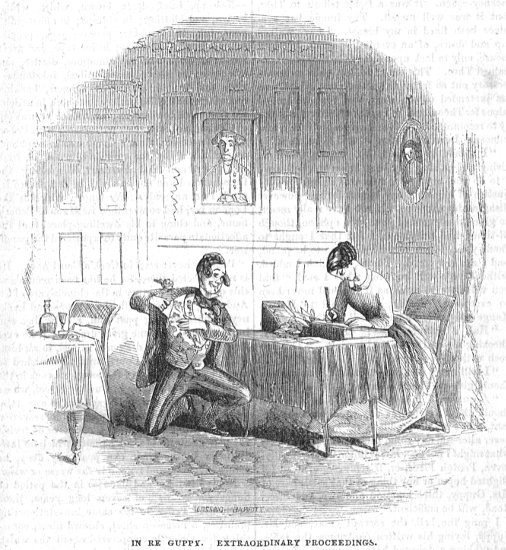
himself at her feet. He caught at her hand—the skirt of her robe.
"Oh! Madame di Negra!—Beatrice!" he exclaimed, tears in his eyes, and
his voice half-broken by generous emotion; "forgive me—forgive me;
don't see in me a mere acquaintance. By accident I learned, or, rather,
guessed—this—this strange insult to which you are so unworthily
exposed. I am here. Think of me—but as a friend—the truest friend. O!
Beatrice"—and he bent his head over the hand he held—"I never dared
say so before—it seems presuming to say it now—but I can not help it.
I love you—I love you with my whole heart and soul—to serve you—if
only but to serve you!—I ask nothing else." And a sob went from his
warm, young, foolish heart.
The Italian was deeply moved. Nor was her nature that of the mere sordid
adventuress. So much love, and so much confidence! She was not prepared
to betray the one, and entrap the other.
"Rise—rise," she said, softly; "I thank you gratefully. But do not
suppose that I—"
"Hush—hush!—you must not refuse me. Hush!—don't let your pride speak."
"No—it is not my pride. You exaggerate what is occurring here. You
forget that I have a brother. I have sent for him. He is the only one
I can apply to. Ah! that is his knock! But I shall never, never forget
that I have found one generous, noble heart in this hollow world."
Frank would have replied, but he heard the Count's voice on the stairs,
and had only time to rise and withdraw to the window, trying hard to
repress his agitation and compose his countenance. Count di Peschiera
entered—entered as a very personation of the beauty and magnificence
of careless, luxurious, pampered, egotistical wealth. His surtout,
trimmed with the costliest sables, flung back from his splendid chest.
Amidst the folds of the glossy satin that enveloped his throat gleamed
a turquoise, of such value as a jeweler might have kept for fifty years
before he could find a customer rich and frivolous enough to buy it. The
very head of his cane was a masterpiece of art, and the man himself,
so elegant despite his strength, and so fresh despite his years! It is
astonishing how well men wear when they think of no one but themselves!
"Pr-rr!" said the Count, not observing Frank behind the draperies of
the window; "P-rr—. It seems to me that you must have passed a very
unpleasant quarter of an hour. And now—Dieu me damne—quoi faire!"
Beatrice pointed to the window, and felt as if she could have sunk into
the earth for shame. But as the Count spoke in French, and Frank did not
very readily comprehend that language, the words escaped him, though his
ear was shocked by a certain satirical levity of tone.
Frank came forward. The Count held out his hand, and, with a rapid
change of voice and manner, said, "One whom my sister admits at such a
moment must be a friend to me."
"Mr. Hazeldean," said Beatrice, with meaning, "would indeed have nobly
pressed on me the offer of an aid which I need no more, since you, my
brother, are here."
"Certainly," said the Count, with his superb air of grand seigneur; "I
will go down and clear your house of this impertinent canaille. But I
thought your affairs were with Baron Levy. He should be here."
"I expect him every moment. Adieu! Mr. Hazeldean." Beatrice extended
her hand to her young lover with a frankness which was not without a
certain pathetic and cordial dignity. Restrained from farther words by
the Count's presence, Frank bowed over the fair hand in silence, and
retired. He was on the stairs, when he was joined by Peschiera.
"Mr. Hazeldean," said the latter, in a low tone, "will you come into the
drawing-room?"
Frank obeyed. The man employed in his examination of the furniture was
still at his task; but at a short whisper from the Count he withdrew.
"My dear sir," said Peschiera, "I am so unacquainted with your English
laws, and your mode of settling embarrassments of this degrading
nature, and you have evidently showed so kind a sympathy in my sister's
distress, that I venture to ask you to stay here, and aid me in
consulting with Baron Levy."
Frank was just expressing his unfeigned pleasure to be of the slightest
use, when Levy's knock resounded at the street-door, and in another
moment the Baron entered.
"Ouf!" said Levy, wiping his brows, and sinking into a chair, as if he
had been engaged in toils the most exhausting—"Ouf! this is a very sad
business—very; and nothing, my dear Count, nothing but ready money can
save us here."
"You know my affairs, Levy," replied Peschiera, mournfully shaking his
head, "and that though in a few months, or it may be weeks, I could
discharge with ease my sister's debts, whatever their amount, yet at
this moment, and in a strange land, I have not the power to do so. The
money I brought with me is nearly exhausted. Can you not advance the
requisite sum?"
"Impossible!—Mr. Hazeldean is aware of the distress under which I labor
myself."
"In that case," said the Count, "all we can do to-day is to remove my
sister, and let the execution proceed. Meanwhile, I will go among my
friends, and see what I can borrow from them."
"Alas!" said Levy, rising and looking out of the window—"alas! we can
not remove the Marchesa—the worst is to come. Look!—you see those
three men; they have a writ against her person; the moment she sets her
foot out of these doors she will be arrested."[4]
"Arrested!" exclaimed Peschiera and Frank in a breath.
"I have done my best to prevent this disgrace, but in vain," said the
Baron, looking very wretched. "You see, these English tradespeople fancy
they have no hold upon foreigners. But we can get bail; she must not go
to prison—"
"Prison!" echoed Frank. He hastened to Levy and drew him aside. The
Count seemed paralyzed by shame and grief. Throwing himself back on the
sofa, he covered his face with his hands.
"My sister!" groaned the Count—"daughter to a Peschiera, widow to di
Negra!" There was something affecting in the proud woe of this grand
patrician.
"What is the sum?" whispered Frank, anxious that the poor Count
should not overhear him: and indeed the Count seemed too stunned and
overwhelmed to hear any thing less loud than a clap of thunder.
"We may settle all liabilities for £500. Nothing to Peschiera, who is
enormously rich. Entre nous, I doubt his assurance that he is without
ready money. It may be so, but—"
"£500! How can I raise such a sum!"
"You, my dear Hazeldean? What are you talking about? To be sure, you
could raise twice as much with a stroke of your pen, and throw your own
debts into the bargain. But—to be so generous to an acquaintance!"
"Acquaintance—Madame di Negra!—the height of my ambition is to claim
her as my wife!"
"And these debts don't startle you?"
"If a man loves," answered Frank, simply, "he feels it most when the
woman he loves is in affliction. And," he added, after a pause,
"though these debts are faults, kindness at this moment may give me the
power to cure forever both her faults and my own. I can raise this money
by a stroke of the pen! How?"
"On the Casino property."
Frank drew back.
"No other way?"
"Of course not. But I know your scruples; let us see if they can be
conciliated. You would marry Madame di Negra; she will have £20,000
on her wedding-day. Why not arrange that, out of this sum, your
anticipative charge on the Casino property be paid at once? Thus, in
truth, it will be but for a few weeks that the charge will exist. The
bond will remain locked in my desk—it can never come to your father's
knowledge, nor wound his feelings. And when, you marry (if you will but
be prudent in the meanwhile), you will not owe a debt in the world."
Here the Count suddenly started up.
"Mr. Hazeldean, I asked you to stay and aid us by your counsel; I see
now that counsel is unavailing. This blow on our house must fall! I
thank you, Sir—I thank you. Farewell. Levy, come with me to my poor
sister, and prepare her for the worst."
"Count," said Frank, "hear me. My acquaintance with you is but slight,
but I have long known and—and esteemed your sister. Baron Levy has
suggested a mode in which I can have the honor and the happiness of
removing this temporary but painful embarrassment. I can advance the
money."
"No—no!" exclaimed Peschiera. "How can you suppose that I will hear of
such a proposition? Your youth and benevolence mislead and blind you.
Impossible, sir—impossible! Why, even if I had no pride, no delicacy of
my own, my sister's fair fame—"
"Would suffer indeed," interrupted Levy, "if she were under such
obligation to any one but her affianced husband. Nor, whatever my regard
for you, Count, could I suffer my client, Mr. Hazeldean, to make this
advance upon any less valid security than that of the fortune to which
Madame di Negra is entitled."
"Ha!—is this indeed so? You are a suitor for my sister's hand, Mr.
Hazeldean?"
"But not at this moment—not to owe her hand to the compulsion of
gratitude," answered gentleman Frank.
"Gratitude! And you do not know her heart, then? Do not know—" the
Count interrupted himself, and went on after a pause. "Mr. Hazeldean, I
need not say, that we rank among the first houses in Europe. My pride
led me formerly into the error, of disposing of my sister's hand to one
whom she did not love—merely because in rank he was her equal. I will
not again commit such an error, nor would Beatrice again obey me if I
sought to constrain her. Where she marries, there she will love. If,
indeed, she accept you, as I believe she will, it will be from affection
solely. If she does, I can not scruple to accept this loan—a loan
from a brother-in-law—loan to me, and not charged against her fortune!
That, sir (turning to Levy, with his grand air), you will take care
to arrange. If she do not accept you, Mr. Hazeldean, the loan, I repeat
it, is not to be thought of. Pardon me, if I leave you. This, one way or
other, must be decided at once." The Count inclined his head with much
stateliness, and then quitted the room. His step was heard ascending the
stairs.
"If," said Levy, in the tone of a mere man of business—"if the Count
pay the debts, and the lady's fortune be only charged with your
own—after all it will not be a bad marriage in the world's eye, nor
ought it to be in a father's. Trust me, we shall get Mr. Hazeldean's
consent, and cheerfully too."
Frank did not listen; he could only listen to his love, to his heart
beating loud with hope and with fear.
Levy sate down before the table, and drew up a long list of figures
in a very neat hand—a list of figures on two accounts, which the
post-obit on the Casino was destined to efface.
After a lapse of time, which to Frank seemed interminable, the Count
reappeared. He took Frank aside, with a gesture to Levy, who rose, and
retired into the drawing-room.
"My dear young friend," said Peschiera, "as I suspected, my sister's
heart is wholly yours. Stop; hear me out. But unluckily, I informed her
of your generous proposal. It was most unguarded, most ill-judged in me,
and that has well-nigh spoiled all; she has so much pride and spirit;
so great a fear that you may think yourself betrayed into an imprudence
you may hereafter regret, that I am sure she will tell you she does not
love you, she can not accept you, and so forth. Lovers like you are not
easily deceived. Don't go by her words; but you shall see her yourself
and judge. Come."
Followed mechanically by Frank, the Count ascended the stairs and threw
open the door of Beatrice's room. The Marchesa's back was turned; but
Frank could see that she was weeping.
"I have brought my friend to plead for himself," said the Count in
French; "and take my advice, sister, and do not throw away all prospect
of real and solid happiness for a vain scruple. Heed me!" He retired
and left Frank alone with Beatrice.
Then the Marchesa, as if by a violent effort, so sudden was her
movement, and so wild her look, turned her face to her wooer, and came
up to him, where he stood.
"Oh!" she said, clasping her hands, "is this true? You would save
me from disgrace, from a prison—and what can I give you in return?
My love! No, no. I will not deceive you. Young, fair, noble, as you
are, I do not love you as you should be loved. Go; leave this house;
you do not know my brother. Go, go—while I have still strength,
still virtue enough to reject whatever may protect me from him!
whatever—may—Oh—go, go."
"You do not love me," said Frank. "Well, I don't wonder at it; you are
so brilliant, so superior to me. I will abandon hope—I will leave you
as you command me. But at least I will not part with my privilege to
serve you. As for the rest—shame on me if I could be mean enough to
boast of love, and enforce a suit, at such a moment."
Frank turned his face and stole away softly. He did not arrest his steps
at the drawing-room, he went into the parlor, wrote a brief line to Levy
charging him quietly to dismiss the execution, and to come to Frank's
rooms with the necessary deeds; and, above all, to say nothing to the
Count. Then he went out of the house and walked back to his lodgings.
That evening Levy came to him, and accounts were gone into, and papers
signed; and the next morning Madame di Negra was free from debt; and
there was a great claim on the reversion of the Casino estates; and
at the noon of that next day Randal was closeted with Beatrice; and
before the night, came a note from Madame di Negra, hurried, blurred
with tears, summoning Frank to Curzon-street. And when he entered the
Marchesa's drawing-room, Peschiera was seated beside his sister; and
rising at Frank's entrance, said, "My dear brother-in-law!" and placed
Frank's hand in Beatrice's.
"You accept me—you accept me—and of your own free will and choice?"
And Beatrice answered, "Bear with me a little, and I will try to repay
you with all my—all my—" She stopped short, and sobbed aloud.
"I never thought her capable of such acute feeling, such strong
attachment," whispered the Count.
Frank heard, and his face was radiant. By degrees Madame di Negra
recovered composure, and she listened with what her young lover
deemed a tender interest, but what, in fact, was mournful and humbled
resignation, to his joyous talk of the future. To him the hours passed
by, brief and bright, like a flash of sunlight. And his dreams, when he
retired to rest, were so golden! But when he awoke the next morning, he
said to himself, "What—what will they say at the Hall?"
At that same hour, Beatrice, burying her face on her pillow, turned
from the loathsome day, and could have prayed for death. At that same
hour, Giulio Franzini Count di Peschiera, dismissing some gaunt,
haggard Italians, with whom he had been in close conference, sallied
forth to reconnoitre the house that contained Violante. At that same
hour, Baron Levy was seated before his desk, casting up a deadly array
of figures, headed "Account with the Right Hon. Audley Egerton, M.P.,
Dr. and Cr."—title-deeds strewed around him, and Frank Hazeldean's
post-obit peeping out fresh from the elder parchments. At that same
hour, Audley Egerton had just concluded a letter from the chairman of
his committee in the city he represented, which letter informed him he
had not a chance of being re-elected. And the lines of his face were
as composed as usual, and his foot rested as firm on the grim iron box;
but his hand was pressed to his heart, and his eye was on the clock;
and his voice muttered—"Dr. F—— should be here!" And at that hour
Harley L'Estrange, who the previous night had charmed courtly crowds
with his gay humor, was pacing to and fro the room in his hotel with
restless strides and many a heavy sigh;—and Leonard was standing by
the fountain in his garden, and watching the wintry sunbeams that
sparkled athwart the spray;—and Violante was leaning on Helen's
shoulder, and trying archly, yet innocently, to lead Helen to talk of
Leonard;—and Helen was gazing steadfastly on the floor and answering
but by monosyllables;—and Randal Leslie was walking down to his office
for the last time, and reading, as he passed across the Green Park, a
letter from home, from his sister; and then, suddenly crumpling the
letter in his thin, pale hand, he looked up, beheld in the distance the
spires of the great national Abbey; and recalling the words of our hero
Nelson, he muttered—"Victory and Westminster, but not the Abbey!"
And Randal Leslie felt that, within the last few days, he had made a
vast stride in his ambition;—his grasp on the old Leslie lands—Frank
Hazeldean betrothed, and possibly disinherited—and Dick Avenel, in the
back-ground, opening, against the hated Lansmere interest, that same
seat in Parliament which had first welcomed into public life Randal's
rained patron.
"But some must laugh, and some must weep;
Thus runs the world away!"
It is not an uncommon crotchet among benevolent men to maintain that
wickedness is necessarily a sort of insanity, and that nobody would make
a violent start out of the straight path unless stung to such disorder
by a bee in his bonnet. Certainly, when some very clever, well-educated
person, like our friend, Randal Leslie, acts upon the fallacious
principle that "roguery is the best policy," it is curious to see how
many points he has in common with the insane: what over-cunning—what
irritable restlessness—what suspicious belief that the rest of the
world are in a conspiracy against him, which it requires all his wit to
baffle and turn to his own proper aggrandizement and profit. Perhaps
some of my readers may have thought that I have represented Randal as
unnaturally far-fetched in his schemes, too wire-drawn and subtle in
his speculations; yet that is commonly the case with very refining
intellects, when they choose to play the knave; it helps to disguise
from themselves the ugliness of their ambition, just as the philosopher
delights in the ingenuity of some metaphysical process, which ends in
what plain men call "atheism," who would be infinitely shocked and
offended if he were entitled an atheist. As I have somewhere said or
implied before, it is difficult for us dull folks to conceive the glee
which a wily brain takes in the exercise of its own ingenuity.
Having premised thus much on behalf of the "Natural" in Randal Leslie's
character, I must here fly off to say a word or two on the agency in
human life exercised by a passion rarely seen without a mask in our
debonair and civilized age—I mean Hate.
In the good old days of our forefathers, when plain speaking and hard
blows were in fashion—when a man had his heart at the tip of his
tongue, and four feet of sharp iron dangling at his side, Hate played
an honest, open part in the theatre of the world. In fact, when we read
history, it seems to have "starred it" on the stage. But now, where
is Hate?—who ever sees its face? Is it that smiling, good-tempered
creature, that presses you by the hand so cordially? or that dignified
figure of state that calls you its "right honorable friend?" Is it
that bowing, grateful dependent?—is it that soft-eyed Amaryllis? Ask
not, guess not; you will only know it to be Hate when the poison is in
your cup, or the poniard in your breast. In the Gothic age, grim Humor
painted "the Dance of Death;" in our polished century, some sardonic wit
should give us "the Masquerade of Hate."
Certainly, the counter-passion betrays itself with ease to our gaze.
Love is rarely a hypocrite. But Hate—how detect, how guard against
it? It lurks where you least suspect it; it is created by causes that
you can the least foresee; and Civilization multiplies its varieties,
while it favors its disguise: for Civilization increases the number
of contending interests, and Refinement renders more susceptible to
the least irritation the cuticle of Self-Love. But Hate comes covertly
forth from some self-interest we have crossed, or some self-love we
have wounded; and, dullards that we are, how seldom we are aware of our
offense! You may be hated by a man you have never seen in your life; you
may be hated as often by one you have loaded with benefits; you may so
walk as not to tread on a worm; but you must sit fast on your easy-chair
till you are carried out to your bier, if you would be sure not to tread
on some snake of a foe. But, then, what harm does the Hate do us? Very
often the harm is as unseen by the world as the hate is unrecognized by
us. It may come on us, unawares, in some solitary by-way of our life;
strike us in our unsuspecting privacy; thwart us in some blessed hope
we have never told to another: for the moment the world sees that it is
Hate that strikes us, its worst power of mischief is gone.
We have a great many names for the same passion—Envy, Jealousy, Spite,
Prejudice, Rivalry; but they are so many synonyms for the one old
heathen demon. When the death-giving shaft of Apollo sent the plague to
some unhappy Achæan, it did not much matter to the victim whether the
god were called Helios or Smintheus.
No man you ever met in the world seemed more raised above the malice
of Hate than Audley Egerton: even in the hot war of politics he had
scarcely a personal foe; and in private life he kept himself so aloof
and apart from others that he was little known, save by the benefits
the waste of his wealth conferred. That the hate of any one could reach
the austere statesman on his high pinnacle of esteem,—you would dare
smiled at the idea! But Hate is now, as it ever has been, an actual
Power amidst "the Varieties of Life;" and, in spite of bars to the door,
and policemen in the street, no one can be said to sleep in safety while
there wakes the eye of a single foe.
The glory of Bond-street is no more. The title of Bond-street lounger
has faded from our lips. In vain the crowd of equipages and the blaze of
shops: the renown of Bond-street was in its pavement—its pedestrians.
Art thou old enough, O reader! to remember the Bond-street Lounger and
his incomparable generation? For my part, I can just recall the decline
of the grand era. It was on its wane when, in the ambition of boyhood,
I first began to muse upon high neck-cloths and Wellington boots. But
the ancient habitués—the magni nominis umbræ—contemporaries
of Brummell in his zenith—boon companions of George IV. in his
regency—still haunted the spot. From four to six in the hot month of
June, they sauntered stately to and fro, looking somewhat mournful
even then—foreboding the extinction of their race. The Bond-street
Lounger was rarely seen alone: he was a social animal, and walked
arm-in-arm with his fellow-man. He did not seem born for the cares of
these ruder times; not made was he for an age in which Finsbury returns
members to Parliament. He loved his small talk; and never since then
has talk been so pleasingly small. Your true Bond-street Lounger had a
very dissipated look. His youth had been spent with heroes who loved
their bottle. He himself had perhaps supped with Sheridan. He was by
nature a spendthrift: you saw it in the roll of his walk. Men who make
money rarely saunter; men who save money rarely swagger. But saunter
and swagger both united to stamp PRODIGAL on the Bond-street
Lounger. And so familiar as he was with his own set, and so amusingly
supercilious with the vulgar residue of mortals whose faces were strange
to Bond-street. But He is gone. The world, though sadder for his loss,
still strives to do its best without him; and our young men, nowadays,
attend to model cottages, and incline to Tractarianism—I mean those
young men who are quiet and harmless, as a Bond-street Lounger was of
old—redeunt Saturnia regna. Still the place, to an unreflecting
eye, has its brilliancy and bustle. But it is a thoroughfare, not a
lounge. And adown the thoroughfare, somewhat before the hour when the
throng is thickest, passed two gentlemen of an appearance exceedingly
out of keeping with the place. Yet both had the air of men pretending
to aristocracy—an old-world air of respectability and stake in the
country, and Church-and-Stateism. The burlier of the two was even
rather a beau in his way. He had first learned to dress, indeed,
when Bond-street was at its acmé, and Brummell in his pride. He still
retained in his garb the fashion of his youth; only what then had spoken
of the town, now betrayed the life of the country. His neckcloth ample
and high, and of snowy whiteness, set off to comely advantage a face
smooth-shaven, and of clear, florid hues; his coat of royal blue, with
buttons in which you might have seen yourself veluti in speculum,
was, rather jauntily, buttoned across a waist that spoke of lusty
middle age, free from the ambition, the avarice, and the anxieties that
fret Londoners into thread-papers; his small-clothes of grayish drab,
loose at the thigh and tight at the knee, were made by Brummell's own
breeches-maker, and the gaiters to match (thrust half-way down the
calf) had a manly dandyism that would have done honor to the beau-ideal
of a county member. The profession of this gentleman's companion
was unmistakable—the shovel-hat, the clerical cut of the coat, the
neckcloth without collar, that seemed made for its accessory—the band,
and something very decorous, yet very mild, in the whole mien of this
personage, all spoke of one who was every inch the gentleman and the
parson.
"No," said the portlier of these two persons—"no, I can't say I like
Frank's looks at all. There's certainly something on his mind. However,
I suppose it will be all out this evening."
"He dines with you at your hotel, Squire? Well, you must be kind to him.
We can't put old heads upon young shoulders."
"I don't object to his head being young," returned the Squire; "but I
wish he had a little of Randal Leslie's good sense in it. I see how
it will end: I must take him back into the country; and if he wants
occupation, why, he shall keep the hounds, and I'll put him into
Brooksby farm."
"As for the hounds," replied the Parson, "hounds necessitate horses; and
I think more mischief comes to a young man of spirit, from the stables,
than from any other place in the world. They ought to be exposed from
the pulpit, those stables!" added Mr. Dale, thoughtfully; "see what
they entailed upon Nimrod! But agriculture is a healthful and noble
pursuit, honored by sacred nations, and cherished by the greatest men in
classical times. For instance, the Athenians were—"
"Bother the Athenians!" cried the Squire, irreverently; "you need not
go so far back for an example. It is enough for a Hazeldean that his
father, and his grandfather, and his great-grandfather all farmed before
him; and a devilish deal better, I take it, than any of those musty old
Athenians—no offense to them. But I'll tell you one thing, Parson—a
man, to farm well, and live in the country, should have a wife; it is
half the battle."
"As to a battle, a man who is married is pretty sure of half, though
not always the better half, of it," answered the Parson, who seemed
peculiarly facetious that day. "Ah, Squire, I wish I could think
Mrs. Hazeldean right in her conjecture!—you would have the prettiest
daughter-in-law in the three kingdoms. And I think, if I could have a
good talk with the young lady apart from her father, we could remove the
only objection I know to the marriage. Those Popish errors—"
"Ah, very true!" cried the Squire; "that Pope sticks hard in my gizzard.
I could excuse her being a foreigner, and not having, I suppose, a
shilling in her pocket—bless her handsome face!—but to be worshiping
images in her room instead of going to the parish church, that will
never do. But you think you could talk her out of the Pope, and into the
family pew?"
"Why, I could have talked her father out of the Pope, only, when he had
not a word to say for himself, he bolted out of the window. Youth is
more ingenuous in confessing its errors."
"I own," said the Squire, "that both Harry and I had a favorite notion
of ours, till this Italian girl got into our heads. Do you know we
both took a great fancy to Randal's little sister—pretty, blushing,
English-faced girl as ever you saw. And it went to Harry's good heart
to see her so neglected by that silly, fidgety mother of hers, her hair
hanging about her ears; and I thought it would be a fine way to bring
Randal and Frank more together, and enable me to do something for Randal
himself—a good boy, with Hazeldean blood in his veins. But Violante is
so handsome, that I don't wonder at the boy's choice; and then it is our
fault—we let them see so much of each other, as children. However, I
should be very angry if Rickeybockey had been playing sly, and running
away from the Casino in order to give Frank an opportunity to carry on a
clandestine intercourse with his daughter."
"I don't think that would be like Riccabocca; more like him to run
away in order to deprive Frank of the best of all occasions to court
Violante, if he so desired; for where could he see more of her than at
the Casino?"
Squire.—"That's well put. Considering he was only a foreign
doctor, and, for aught we know, went about in a caravan, he is a
gentlemanlike fellow, that Rickeybockey. I speak of people as I find
them. But what is your notion about Frank? I see you don't think he is
in love with Violante, after all. Out with it, man; speak plain."
Parson.—"Since you so urge me, I own I do not think him in
love with her; neither does my Carry, who is uncommonly shrewd in such
matters."
Squire.—"Your Carry, indeed!—as if she were half as shrewd as
my Harry. Carry—nonsense!"
Parson (reddening).—"I don't want to make invidious remarks;
but, Mr. Hazeldean, when you sneer at my Carry, I should not be a man if
I did not say that—"
Squire (interrupting).—"She was a good little woman enough;
but to compare her to my Harry!"
Parson.—"I don't compare her to your Harry; I don't compare
her to any woman in England, sir. But you are losing your temper, Mr.
Hazeldean!"
Squire.—"I!"
Parson.—"And people are staring at you, Mr. Hazeldean. For
decency's sake, compose yourself, and change the subject. We are just at
the Albany. I hope that we shall not find poor Captain Higginbotham as
ill as he represents himself in his letter. Ah! is it possible? No, it
can not be. Look—look!"
Squire.—"Where—what—where? Don't pinch so hard. Bless me, do
you see a ghost?"
Parson.—"There—the gentleman in black!"
Squire.—"Gentleman in black! What!—in broad daylight!
Nonsense!"
Here the Parson made a spring forward, and, catching the arm of the
person in question, who himself had stopped, and was gazing intently on
the pair, exclaimed—
"Sir, pardon me; but is not your name Fairfield? Ah, it is Leonard—it
is—my dear, dear boy! What joy! So altered, so improved, but still the
same honest face. Squire, come here—your old friend, Leonard Fairfield."
"And he wanted to persuade me," said the Squire, shaking Leonard
heartily by the hand, "that you were the gentleman in black; but,
indeed, he has been in strange humors and tantrums all the morning.
Well, Master Lenny; why, you are grown quite a gentleman! The world
thrives with you—eh! I suppose you are head-gardener to some grandee."
"Not that, sir," said Leonard, smiling. "But the world has thriven with
me at last, though not without some rough usage at starting. Ah, Mr.
Dale, you can little guess how often I have thought of you and your
discourse on Knowledge; and, what is more, how I have lived to feel the
truth of your words, and to bless the lesson."
Parson (much touched and flattered).—"I expected nothing
less of you, Leonard; you were always a lad of great sense, and sound
judgment. So you have thought of my little discourse on Knowledge, have
you?"
Squire.—"Hang knowledge! I have reason to hate the word. It
burned down three ricks of mine; the finest ricks you ever set eyes on,
Mr. Fairfield."
Parson.—"That was not knowledge, Squire, that was ignorance."
Squire.—"Ignorance! The deuce it was. I'll just appeal to
you, Mr. Fairfield. We have been having sad riots in the shire, and the
ring-leader was just such another lad as you were!"
Leonard.—"I am very much obliged to you, Mr. Hazeldean. In
what respect?"
Squire.—"Why, he was a village genius, and always reading some
cursed little tract or other; and got mighty discontented with King,
Lords, and Commons, I suppose, and went about talking of the wrongs of
the poor, and the crimes of the rich, till, by Jove, sir, the whole
mob rose one day with pitchforks and sickles, and smash went Farmer
Smart's thrashing-machines; and on the same night my ricks were on fire.
We caught the rogues, and they were all tried; but the poor deluded
laborers were let off with a short imprisonment. The village genius,
thank heaven, is sent packing to Botany Bay."
Leonard.—"But did his books teach him to burn ricks, and smash
machines?"
Parson.—"No; he said quite the contrary, and declared that he
had no hand in those misdoings."
Squire.—"But he was proved to have excited, with his wild
talk, the boobies who had! 'Gad, sir, there was a hypocritical Quaker
once, who said to his enemy, 'I can't shed thy blood, friend, but I
will hold thy head under water till thou art drowned.' And so there is
a set of demagogical fellows, who keep calling out, 'Farmer This is an
oppressor, and Squire That is a vampire! But no violence! Don't smash
their machines, don't burn their ricks! Moral force, and a curse on all
tyrants!' Well, and if poor Hodge thinks moral force is all my eye, and
that the recommendation is to be read backward, in the devil's way of
reading the Lord's Prayer, I should like to know which of the two ought
to go to Botany Bay—Hodge who comes out like a man, if he thinks he is
wronged, or t'other sneaking chap, who makes use of his knowledge to
keep himself out of the scrape?"
Parson.—"It may be very true; but when I saw that poor fellow
at the bar, with his intelligent face, and heard his bold, clear
defense, and thought of all his hard struggles for knowledge, and how
they had ended, because he forgot that knowledge is like fire, and must
not be thrown among flax—why, I could have given my right hand to
save him. And, oh, Squire, do you remember his poor mother's shriek of
despair when he was sentenced to transportation for life—I hear it now!
And what, Leonard—what do you think had mislead him? At the bottom of
all the mischief was a Tinker's bag. You can not forget Sprott?"
Leonard.—"Tinker's bag!—Sprott!"
Squire.—"That rascal, sir, was the hardest fellow to nab
you could possibly conceive; as full of quips and quirks as an Old
Bailey lawyer. But we managed to bring it home to him. Lord! his bag
was choke-full of tracts against every man who had a good coat on his
back; and as if that was not enough, cheek by jowl with the tracts were
lucifers, contrived on a new principle, for teaching my ricks the theory
of spontaneous combustion. The laborers bought the lucifers—"
Parson.—"And the poor village genius bought the tracts."
Squire.—"All headed with a motto—'To teach the
working-classes that knowledge is power.' So that I was right in saying
that knowledge had burnt my ricks; knowledge inflamed the village
genius, the village genius inflamed fellows more ignorant than himself,
and they inflamed my stack-yard. However, lucifers, tracts, village
genius, and Sprott, are all off to Botany Bay; and the shire has gone
on much the better for it. So no more of your knowledge for me, begging
your pardon, Mr. Fairfield. Such uncommonly fine ricks as mine were,
too! I declare, Parson, you are looking as if you felt pity for Sprott;
and I saw you, indeed, whispering to him as he was taken out of court."
Parson (looking sheepish).—"Indeed, Squire, I was only asking
him what had become of his donkey—an unoffending creature."
Squire.—"Unoffending! Upset me amidst a thistle-bed in my own
village green. I remember it. Well, what did he say had become of the
donkey?"
Parson.—"He said but one word; but that showed all the
vindictiveness of his disposition. He said it with a horrid wink, that
made my blood run cold. 'What's become of your poor donkey?' said I, and
he answered—"
Squire.—"Go on. He answered—"
Parson.—"'Sausages.'"
Squire.—"Sausages! Like enough; and sold to the poor; and
that's what the poor will come to if they listen to such revolutionizing
villains. Sausages! Donkey sausages!—(spitting)—'Tis as bad as eating
one another; perfect cannibalism."
Leonard, who had been thrown into grave thought by the history of
Sprott and the village genius, now pressing the Parson's hand, asked
permission to wait on him before Mr. Dale quitted London; and was about
to withdraw, when the Parson, gently detaining him, said, "No; don't
leave me yet, Leonard—I have so much to ask you, and to talk about.
I shall be at leisure shortly. We are just now going to call on a
relation of the Squire's, whom you must recollect, I am sure—Captain
Higginbotham—Barnabas Higginbotham. He is very poorly."
"And I am sure he would take it kind in you to call, too," said the
Squire, with great good-nature.
Leonard.—"Nay, sir, would not that be a great liberty?"
Squire.—"Liberty! To ask a poor sick gentleman how he is?
Nonsense. And I say, sir, perhaps, as no doubt you have been living
in town, and know more of new-fangled notions than I do—perhaps you
can tell us whether or not it is all humbug, that new way of doctoring
people?"
"What new way, sir? There are so many."
"Are there? Folks in London do look uncommonly sickly. But my
poor cousin (he was never a Solomon) has got hold, he says, of a
homely—homely—what's the word, Parson?"
Parson.—"Homœopathist."
Squire.—"That's it. You see the Captain went to live with
one Sharpe Currie, a relation who had a great deal of money, and very
little liver;—made the one, and left much of the other in Ingee, you
understand. The Captain had expectations of the money. Very natural,
I dare say; but, Lord, sir! what do you think has happened? Sharpe
Currie has done him! Would not die, sir; got back his liver, and the
Captain has lost his own. Strangest thing you ever heard. And then the
ungrateful old Nabob has dismissed the Captain, saying, 'He can't bear
to have invalids about him;' and is going to marry, and I have no doubt
will have children by the dozen!"
Parson.—"It was in Germany, at one of the Spas, that Mr.
Currie recovered; and as he had the selfish inhumanity to make the
Captain go through a course of waters simultaneously with himself, it
has so chanced that the same waters that cured Mr. Currie's liver have
destroyed Captain Higginbotham's. An English homœopathic physician,
then staying at the Spa, has attended the Captain hither, and declares
that he will restore him by infinitesimal doses of the same chemical
properties that were found in the waters which diseased him. Can there
be any thing in such a theory?"
Leonard.—"I once knew a very able, though eccentric
homœopathist, and I am inclined to believe there may be something
in the system. My friend went to Germany: it may possibly be the same
person who attends the Captain. May I ask his name?"
Squire.—"Cousin Barnabas does not mention it. You may ask it
of himself, for here we are at his chambers. I say, Parson (whispering
slily), if a small dose of what hurt the Captain is to cure him, don't
you think the proper thing would be a—legacy? Ha! ha!"
Parson (trying to laugh).—"Hush, Squire. Poor human nature! We
must be merciful to its infirmities. Come in, Leonard."
Leonard, interested in his doubt whether he might thus chance again upon
Dr. Morgan, obeyed the invitation, and with his two companions followed
the woman—who "did for the Captain and his rooms"—across the small
lobby, into the presence of the sufferer.
Whatever the disposition toward merriment at his cousin's expense
entertained by the Squire, it vanished instantly at the sight of the
Captain's doleful visage and emaciated figure.
"Very good in you to come to town to see me—very good in you, cousin;
and in you too, Mr. Dale. How very well you are both looking. I'm a sad
wreck. You might count every bone in my body."
"Hazeldean air and roast beef will soon set you up, my boy," said
the Squire kindly. "You were a great goose to leave them, and these
comfortable rooms of yours in the Albany."
"They are comfortable, though not showy," said the Captain,
with tears in his eyes. "I had done my best to make them so. New
carpets—this very chair—(morocco!)—that Japan cat (holds toast and
muffins)—just when—(the tears here broke forth, and the Captain fairly
whimpered)—just when that ungrateful, bad-hearted man wrote me word 'he
was—was dying and lone in the world;' and—and—to think what I've gone
through for him!—and to treat me so. Cousin William, he has grown as
hale as yourself, and—and—"
"Cheer up, cheer up!" cried the compassionate Squire. "It is a very hard
case, I allow. But you see, as the old proverb says, ''tis ill waiting
for a dead man's shoes;' and in future—I don't mean offense—but I
think if you would calculate less on the livers of your relations, it
would be all the better for your own. Excuse me."
"Cousin William," replied the poor Captain, "I am sure I never
calculated; but still, if you had seen that deceitful man's
good-for-nothing face—as yellow as a guinea—and have gone through all
I've gone through, you would have felt cut to the heart as I do. I can't
bear ingratitude. I never could. But let it pass. Will that gentleman
take a chair?"
Parson.—"Mr. Fairfield has kindly called with us, because he
knows something of this system of homœopathy which you have adopted,
and may, perhaps, know the practitioner. What is the name of your
doctor?"
Captain (looking at his watch).—"That reminds me, (swallowing
a globule.) A great relief these little pills—after the physic I've
taken to please that malignant man. He always tried his doctor's stuff
upon me. But there's another world, and a juster!"
With that pious conclusion, the Captain again began to weep.
"Touched," muttered the Squire, with his forefinger on his forehead.
"You seem to have a good tidy sort of nurse here, Cousin Barnabas. I
hope she's pleasant, and lively, and don't let you take on so."
"Hist! don't talk of her. All mercenary; every bit of her fawning.
Would you believe it? I give her ten shillings a week, besides all
that goes down of my pats of butter and rolls, and I overheard
the jade saying to the laundress that 'I could not last long; and
she'd—EXPECTATIONS!' Ah, Mr. Dale, when one thinks of the
sinfulness there is in this life! But I'll not think of it. No—I'll
not. Let us change the subject You were asking my doctor's name? It is—"
Here the woman 'with expectations' threw open the door, and suddenly
announced—"Dr. Morgan."
The Parson started, and so did Leonard.
The Homœopathist did not at first notice either. With an unobservant
bow to the visitors, he went straight to the patient, and asked, "How go
the symptoms?"
Therewith the Captain commenced, in a tone of voice like a schoolboy
reciting the catalogue of the ships in Homer. He had been evidently
conning the symptoms, and learning them by heart. Nor was there a single
nook or corner in his anatomical organization, so far as the Captain
was acquainted with that structure, but what some symptom or other was
dragged therefrom, and exposed to day. The Squire listened with horror
to the morbific inventory—muttering at each dread interval, "Bless me!
Lord bless me! What, more still! Death would be a very happy release!"
Meanwhile the Doctor endured the recital with exemplary patience, noting
down in the leaves of his pocket-book what appeared to him the salient
points in this fortress of disease to which he had laid siege, and then,
drawing forth a minute paper, said—
"Capital—nothing can be better. This must be dissolved in eight
table-spoonfuls of water; one spoonful every two hours."
"Table-spoonful?"
"Table-spoonful."
'Nothing can be better,' did you say, sir?" repeated the Squire, who, in
his astonishment at that assertion applied to the Captain's description
of his sufferings, had hitherto hung fire—"'nothing can be better?'"
"For the diagnosis, sir!" replied Dr. Morgan.
"For the dogs' noses, very possibly," quoth the Squire; "but for the
inside of Cousin Higginbotham, I should think nothing could be worse."
"You are mistaken, sir," replied Dr. Morgan. "It is not the Captain
who speaks here—it is his liver. Liver, sir, though a noble, is an
imaginative organ, and indulges in the most extraordinary fictions. Seat
of poetry, and love and jealousy—the liver. Never believe what it says.
You have no idea what a liar it is! But—ahem—ahem. Cott—I think I've
seen you before, sir. Surely your name's Hazeldean?"
"William Hazeldean, at your service, Doctor. But where have you seen me?"
"On the hustings at Lansmere. You were speaking on behalf of your
distinguished brother, Mr. Egerton."
"Hang it!" cried the Squire: "I think it must have been my liver that
spoke there! for I promised the electors that that half-brother of mine
would stick by the land; and I never told a bigger lie in my life!"
Here the patient, reminded of his other visitors, and afraid he was
going to be bored with the enumeration of the Squire's wrongs, and
probably the whole history of his duel with Captain Dashmore, turned,
with a languid wave of his hand, and said, "Doctor, another friend
of mine, the Rev. Mr. Dale—and a gentleman who is acquainted with
homœopathy."
"Dale? What, more old friends!" cried the Doctor, rising; and the Parson
came somewhat reluctantly from the window nook, to which he had retired.
The Parson and the Homœopathist shook hands.
"We have met before on a very mournful occasion," said the Doctor, with
feeling.
"The Parson held his finger to his lips, and glanced toward Leonard. The
Doctor stared at the lad, but he did not recognize in the person before
him the gaunt, care-worn boy whom he had placed with Mr. Prickett, until
Leonard smiled and spoke. And the smile and the voice sufficed.
"Cott—and it is the poy! cried Dr. Morgan; and he actually caught
hold of Leonard, and gave him an affectionate Welsh hug. Indeed,
his agitation at these several surprises, became so great that he
stopped short, drew forth a globule—"Aconite—good against nervous
shocks!"—and swallowed it incontinently.
"Gad," said the Squire, rather astonished, "'tis the first doctor I ever
saw swallow his own medicine! There must be something in it."
The Captain now, highly disgusted that so much attention was withdrawn
from his own case, asked in a querulous voice, "And as to diet? What
shall I have for dinner?"
"A friend!" said the Doctor, wiping his eyes.
"Zounds!" cried the Squire, retreating, "do you mean to say, sir, that
the British laws (to be sure, they are very much changed of late) allow
you to diet your patients upon their fellow-men? Why, Parson, this is
worse than the donkey sausages."
"Sir," said Dr. Morgan, gravely, "I mean to say, that it matters little
what we eat, in comparison with care as to whom we eat with. It is
better to exceed a little with a friend, than to observe the strictest
regimen, and eat alone. Talk and laughter help the digestion, and are
indispensable in affections of the liver. I have no doubt, sir, that it
was my patient's agreeable society that tended to restore to health his
dyspeptic relative, Mr. Sharpe Currie."
The Captain groaned aloud.
"And, therefore, if one of you gentlemen will stay and dine with Mr.
Higginbotham, it will greatly assist the effects of his medicine."
The Captain turned an imploring eye, first toward his cousin, then
toward the Parson.
"I'm engaged to dine with my son—very sorry," said the Squire. "But
Dale, here—"
"If he will be so kind," put in the Captain, "we might cheer the evening
with a game at whist—double dummy."
Now, poor Mr. Dale had set his heart on dining with an old college
friend, and having, no stupid, prosy double dummy, in which one can not
have the pleasure of scolding one's partner, but a regular orthodox
rubber, with the pleasing prospect of scolding all the three other
performer's. But as his quiet life forbade him to be a hero in great
things, the Parson had made up his mind to be a hero in small ones.
Therefore, though with rather a rueful face, he accepted the Captain's
invitation, and promised to return at six o'clock to dine. Meanwhile,
he must hurry off to the other end of the town, and excuse himself
from the pre-engagement he had already formed. He now gave his card,
with the address of a quiet family hotel thereon, to Leonard, and not
looking quite so charmed with Dr. Morgan as he was before that unwelcome
prescription, he took his leave. The Squire, too, having to see a new
churn, and execute various commissions for his Harry, went his way
(not, however, till Dr. Morgan had assured him that, in a few weeks,
the Captain might safely remove to Hazeldean); and Leonard was about to
follow, when Morgan hooked his arm in his old protégé's, and said,
"But I must have some talk with you; and you have to tell me all about
the little orphan girl."
Leonard could not resist the pleasure of talking about Helen; and he got
into the carriage, which was waiting at the door for the homœopathist.
"I am going into the country a few miles to see a patient," said the
Doctor; "so we shall have time for undisturbed consultation. I have so
often wondered what had become of you. Not hearing from Prickett, I
wrote to him, and received an answer, as dry as a bone, from his heir.
Poor fellow! I found that he had neglected his globules, and quitted
the globe. Alas, pulvis et umbra sumus! I could learn no tidings of
you. Prickett's successor declared he knew nothing about you. I hoped
the best; for I always fancied you were one who would fall on your
legs—bilious-nervous temperament; such are the men who succeed in
their undertakings, especially if they take a spoonful of chamomilla
whenever they are over-excited. So now for your history and the little
girl's—pretty little thing—never saw a more susceptible constitution,
nor one more suited—to pulsatilla."
Leonard briefly related his own struggles and success, and informed the
good Doctor how they had at last discovered the nobleman in whom poor
Captain Digby had confided, and whose care of the orphan had justified
the confidence.
Dr. Morgan opened his eyes at hearing the name of Lord L'Estrange.
"I remember him very well," said he, "when I practiced murder as an
allopathist at Lansmere. But to think that wild boy, so full of whim,
and life, and spirit, should become staid enough for a guardian to that
dear little child, with her timid eyes and pulsatilla sensibilities.
Well, wonders never cease. And he has befriended you, too, you say. Ah,
he knew your family."
"So he says. Do you think, sir, that he ever knew—ever saw—my mother?"
"Eh! your mother?—Nora?" exclaimed the Doctor quickly; and, as if
struck by some sudden thought, his brows met, and he remained silent
and musing a few moments; then, observing Leonard's eyes fixed on him
earnestly, he replied to the question:
"No doubt he saw her; she was brought up at Lady Lansmere's. Did he not
tell you so?"
"No." A vague suspicion here darted through Leonard's mind, but as
suddenly vanished. His father! Impossible. His father must have
deliberately wronged the dead mother. And was Harley L'Estrange a man
capable of such wrong? And had he been Harley's son, would not Harley
have guessed it at once, and so guessing, have owned and claimed him?
Besides, Lord L'Estrange looked so young;—old enough to be Leonard's
father!—he could not entertain the idea. He roused himself, and said
falteringly—
"You told me you did not know by what name I should call my father."
"And I told you the truth, to the best of my belief."
"By your honor, sir?"
"By my honor, I do not know it."
There was now a long silence. The carriage had long left London, and was
on a high-road somewhat lonelier and more free from houses than most of
those which form the entrances to the huge city. Leonard gazed wistfully
from the window, and the objects that met his eyes gradually seemed
to appeal to his memory. Yes! it was the road by which he had first
approached the metropolis, hand-in-hand with Helen—and hope so busy at
his poet's heart. He sighed deeply. He thought he would willingly have
resigned all he had won—independence, fame, all—to feel again the
clasp of that tender hand—again to be the sole protector of that gentle
life.
The Doctor's voice broke on his reverie. "I am going to see a very
interesting patient—coats to his stomach quite worn out, sir—man of
great learning, with a very inflamed cerebellum. I can't do him much
good, and he does me a great deal of harm."
"How harm?" asked Leonard, with an effort at some rejoinder.
"Hits me on the heart, and makes my eyes water—very pathetic
case—grand creature, who has thrown himself away. Found him given over
by the allopathists, and in a high state of delirium tremens—restored
him for a time—took a great liking to him—could not help it—swallowed
a great many globules to harden myself against him—would not
do—brought him over to England with the other patients, who all pay
me well (except Captain Higginbotham). But this poor fellow pays me
nothing—costs me a great deal in time and turnpikes, and board and
lodging. Thank Heaven I'm a single man, and can afford it! My poy, I
would let all the other patients go to the allopathists if I could but
save this poor, big, penniless, princely fellow. But what can one do
with a stomach that has not a rag of its coat left? Stop—(the Doctor
pulled the check-string). This is the stile. I get out here and go
across the fields."
That stile—those fields—with what distinctness Leonard remembered
them. Ah, where was Helen? Could she ever, ever again be his
child-angel?"
"I will go with you, if you permit," said he to the good Doctor. "And
while you pay your visit, I will saunter by a little brook that I think
must run by your way."
"The Brent—you know that brook? Ah, you should hear my poor patient
talk of it, and of the hours he has spent angling in it—you would not
know whether to laugh or cry. The first day he was brought down to the
place, he wanted to go out and try once more, he said, for his old
deluding demon—a one-eyed perch."
"Heavens!" exclaimed Leonard, "are you speaking of John Burley?"
"To be sure, that is his name—John Burley."
"Oh, has it come to this? Cure him, save him, if it be in human power.
For the last two years I have sought his trace every where, and in
vain, the moment I had money of my own—a home of my own. Poor, erring,
glorious Burley. Take me to him. Did you say there was no hope?"
"I did not say that," replied the Doctor. "But art can only assist
nature; and, though nature is ever at work to repair the injuries we do
to her, yet, when the coats of a stomach are all gone, she gets puzzled,
and so do I. You must tell me another time how you came to know Burley,
for here we are at the house, and I see him at the window looking out
for me."
The Doctor opened the garden-gate to the quiet cottage to which poor
Burley had fled from the pure presence of Leonard's child-angel. And
with heavy step, and heavy heart, Leonard mournfully followed, to behold
the wrecks of him whose wit had glorified orgy, and "set the table in a
roar."—Alas, poor Yorick!
Audley Egerton stands on his hearth alone. During the short interval
that has elapsed since we last saw him, events had occurred memorable
in English history, wherewith we have naught to do in a narrative
studiously avoiding all party politics even when treating of
politicians. The new Ministers had stated the general programme of their
policy, and introduced one measure in especial that had lifted them at
once to the dizzy height of popular power. But it became clear that
this measure could not be carried without a fresh appeal to the people.
A dissolution of Parliament, as Audley's sagacious experience had
foreseen, was inevitable. And Audley Egerton had no chance of return for
his own seat—for the great commercial city identified with his name.
Oh sad, but not rare instance of the mutabilities of that same popular
favor now enjoyed by his successors! The great commoner, the weighty
speaker, the expert man of business, the statesman who had seemed a type
of the practical steady sense for which our middle class is renowned—he
who, not three years since, might have had his honored choice of the
largest popular constituencies in the kingdom—he, Audley Egerton, knew
not one single town (free from the influences of private property or
interest) in which the obscurest candidate, who bawled out for the new
popular measure, would not have beaten him hollow. Where one popular
hustings, on which that great sonorous voice that had stilled so often
the roar of faction, would not be drowned amid the hoots of the scornful
mob?
True, what were called the close boroughs still existed—true, many a
chief of his party would have been too proud of the honor of claiming
Audley Egerton for his nominee. But the ex-Minister's haughty soul
shrunk from this contrast to his past position. And to fight against the
popular measure, as member of one of the seats most denounced by the
people—he felt it was a post in the grand army of parties below his
dignity to occupy, and foreign to his peculiar mind, which required the
sense of consequence and station. And if, in a few months, these seats
were swept away—were annihilated from the rolls of Parliament—where
was he? Moreover, Egerton, emancipated from the trammels that had
bound his will while his party was in office, desired, in the turn
of events, to be nominee of no other man—desired to stand at least
freely and singly on the ground of his own services, be guided by his
own penetration; no law for action, but his strong sense and his stout
English heart. Therefore he had declined all offers from those who could
still bestow seats in Parliament. Those he could purchase with hard gold
were yet open to him. And the £5000 he had borrowed from Levy were yet
untouched.
To this lone public man, public life, as we have seen, was the all in
all. But now more than ever it was vital to his very wants. Around
him yawned ruin. He knew that it was in Levy's power at any moment to
foreclose on his mortgaged lands—to pour in the bonds and the bills
which lay within those rosewood receptacles that lined the fatal lair of
the sleek usurer—to seize on the very house in which now moved all the
pomp of a retinue that vied with the valetaille of dukes—to advertise
for public auction, under execution, "the costly effects of the Right
Hon. Audley Egerton." But, consummate in his knowledge of the world,
Egerton felt assured that Levy would not adopt these measures against
him while he could still tower in the van of political war—while he
could still see before him the full chance of restoration to power,
perhaps to power still higher than before—perhaps to power the highest
of all beneath the throne. That Levy, whose hate he divined, though he
did not conjecture all its causes, had hitherto delayed even a visit,
even a menace, seemed to him to show that Levy still thought him one
"to be helped," or, at least, one too powerful to crush. To secure
his position in Parliament unshackled, unfallen, if but for another
year—new combinations of party might arise, new reactions take place in
public opinion! And, with his hand pressed to his heart, the stern, firm
man muttered: "If not, I ask but to die in my harness, and that men may
not know that I am a pauper, until all that I need from my country is a
grave."
Scarce had these words died upon his lips ere two quick knocks in
succession resounded at the street-door. In another moment Harley
entered, and, at the same time, the servant in attendance approached
Audley, and announced Baron Levy.
"Beg the Baron to wait, unless he would prefer to name his own hour to
call again," answered Egerton, with the slightest possible change of
color. "You can say I am now with Lord L'Estrange."
"I had hoped you had done forever with that deluder of youth," said
Harley, as soon as the groom of the chambers had withdrawn. "I remember
that you saw too much of him in the gay time, ere wild oats are sown;
but now surely you can never need a loan; and if so, is not Harley
L'Estrange by your side?"
Egerton.—"My dear Harley! doubtless he but comes to talk to me
of some borough. He has much to do with those delicate negotiations."
Harley.—"And I have come on the same business. I claim the
priority. I not only hear in the world, but I see by the papers, that
Josiah Jenkins, Esq., known to fame as an orator who leaves out his h's,
and young Lord Willoughby Whiggolin, who is just now made a Lord of the
Admiralty, because his health is too delicate for the army, are certain
to come in for the city which you and your present colleague will as
certainly vacate. That is true, is it not?"
Egerton.—"My old committee now vote for Jenkins and Whiggolin.
And I suppose there will not be even a contest. Go on."
"So my father and I are agreed that you must condescend, for the sake of
old friendship, to be once more member for Lansmere!"
"Harley," exclaimed Egerton, changing countenance far more than he had
done at the announcement of Levy's portentous visit—"Harley—No, no!"
"No! But why? Wherefore such emotion?" asked L'Estrange in surprise.
Audley was silent.
Harley.—"I suggested the idea to two or three of the late
Ministers; they all concur in advising you to accede. In the first
place, if declining to stand for the place which tempted you from
Lansmere, what more natural than that you should fall back on that
earlier representation? In the second place, Lansmere is neither a
rotten borough, to be bought, nor a close borough, under one man's
nomination. It is a tolerably large constituency. My father, it is true,
has considerable interest in it but only what is called the legitimate
influence of property. At all events, it is more secure than a contest
for a larger town, more dignified than a seat for a smaller. Hesitating
still? Even my mother entreats me to say how she desires you to renew
that connection."
"Harley," again exclaimed Egerton; and, fixing upon his friend's earnest
face, eyes which, when softened by emotion, were strangely beautiful
in their expression: "Harley, if you could but read my heart at this
moment, you would—you would—" His voice faltered, and he fairly bent
his proud head upon Harley's shoulder; grasping the hand he had caught,
nervously, clingingly: "Oh, Harley, if I ever lose your love, your
friendship!—nothing else is left to me in the world."
"Audley, my dear, dear Audley, is it you who speak to me thus? You, my
school friend, my life's confidant—you?"
"I am grown very weak and foolish," said Egerton, trying to smile. "I
do not know myself. I, too, whom you have so often called 'Stoic,' and
likened to the Iron Man in the poem, which you used to read by the
river-side at Eton."
"But even then, my Audley, I knew that a warm human heart (do what you
would to keep it down) beat strong under the iron ribs. And I often
marvel now, to think you have gone through life so free from the wilder
passions. Happier so!"
Egerton, who had turned his face from his friend's gaze, remained silent
for a few moments, and he then sought to divert the conversation, and
roused himself to ask Harley how he had succeeded in his views upon
Beatrice, and his watch on the Count.
"With regard to Peschiera," answered Harley, "I think we must have
overrated the danger we apprehended, and that his wagers were but an
idle boast. He has remained quiet enough, and seems devoted to play. His
sister has shut her doors both on myself and my young associate during
the last few days. I almost fear that, in spite of very sage warnings of
mine, she must have turned his poet's head, and that either he has met
with some scornful rebuff to incautious admiration, or that he himself
has grown aware of peril, and declines to face it; for he is very much
embarrassed when I speak to him respecting her. But if the Count is not
formidable, why, his sister is not needed: and I hope yet to get justice
for my Italian friend through the ordinary channels. I have secured
an ally in a young Austrian prince, who is now in London, and who has
promised to back, with all his influence, a memorial I shall transmit
to Vienna. Apropos, my dear Audley, now that you have a little
breathing-time, you must fix an hour for me to present to you my young
poet, the son of her sister. At moments the expression of his face is
so like hers."
"Ay, ay," answered Egerton, quickly, "I will see him as you wish, but
later. I have not yet that breathing-time you speak of; but you say he
has prospered; and, with your friendship, he is secure from fortune. I
rejoice to think so."
"And your own protégé, this Randal Leslie, whom you forbid me to
dislike—hard task!—what has he decided?"
"To adhere to my fate. Harley, if it please heaven that I do not live
to return to power, and provide adequately for that young man, do not
forget that he clung to me in my fall."
"If he still cling to you faithfully, I will never forget it. I will
forget only all that now makes me doubt him. But you talk of not living,
Audley! Pooh!—your frame is that of a pre-destined octogenarian."
"Nay," answered Audley, "I was but uttering one of those vague
generalities which are common upon all mortal lips. And now farewell—I
must see this Baron."
"Not yet, until you have promised to consent to my proposal, and be
once more member for Lansmere. Tut! don't shake your head. I can not be
denied. I claim your promise in right of our friendship, and shall be
seriously hurt if you even pause to reflect on it."
"Well, well, I know not how to refuse you, Harley; but you have not
been to Lansmere yourself since—since that sad event. You must not
revive the old wound—you must not go; and—I own it, Harley; the
remembrance of it pains even me. I would rather not go to Lansmere."
"Ah! my friend; this is an excess of sympathy, and I can not listen to
it. I begin even to blame my own weakness, and to feel that we have no
right to make ourselves the soft slaves of the past."
"You do appear to me of late to have changed," cried Egerton, suddenly,
and with a brightening aspect. "Do tell me that you are happy in the
contemplation of your new ties—that I shall live to see you once more
restored to your former self."
"All I can answer, Audley," said L'Estrange, with a thoughtful brow,
"is, that you are right in one thing—I am changed; and I am struggling
to gain strength for duty and for honor. Adieu! I shall tell my father
that you accede to our wishes."
When Harley was gone, Egerton sunk back on his chair, as if in extreme
physical or mental exhaustion, all the lines of his countenance relaxed
and jaded.
"To go back to that place—there—there—where—Courage, courage—what
is another pang?"
He rose with an effort, and folding his arms tightly across his breast,
paced slowly to and fro the large, mournful, solitary room. Gradually
his countenance assumed its usual cold and austere composure—the secret
eye, the guarded lip, the haughty collected front. The man of the world
was himself once more.
"Now to gain time, and to baffle the usurer," murmured Egerton, with
that low tone of easy scorn, which bespoke consciousness of superior
power and the familiar mastery over hostile natures. He rang the bell:
the servant entered.
"Is Baron Levy still waiting?"
"Yes, sir."
"Admit him."
Levy entered.
"I beg your pardon, Levy," said the ex-minister, "for having so long
detained you. I am now at your commands."
"My dear fellow," returned the Baron, "no apologies between friends so
old as we are; and I fear that my business is not so agreeable as to
make you impatient to discuss it."
Egerton (with perfect composure).—"I am to conclude, then,
that you wish to bring our accounts to a close. Whenever you will, Levy."
The Baron (disconcerted and surprised).—"Peste! mon cher,
you take things coolly. But if our accounts are closed, I fear you will
have but little to live upon."
Egerton.—"I can continue to live on the salary of a Cabinet
Minister."
Baron.—"Possibly; but you are no longer a Cabinet Minister."
Egerton.—"You have never found me deceived in a political
prediction. Within twelve months (should life be spared to me) I shall
be in office again. If the same to you, I would rather wait till then,
formally and amicably to resign to you my lands and this house. If you
grant that reprieve, our connection can thus close, without the éclat
and noise, which may be invidious to you, as it would be disagreeable
to me. But if that delay be inconvenient, I will appoint a lawyer to
examine your accounts, and adjust my liabilities."
The Baron (soliloquizing).—"I don't like this. A lawyer! That
may be awkward."
Egerton (observing the Baron, with a curl of his lip).—"Well,
Levy, how shall it be?"
The Baron.—"You know, my dear fellow, it is not my character
to be hard on any one, least of all upon an old friend. And if you
really think there is a chance of your return to office, which you
apprehend that an esclandre as to your affairs at present might
damage, why, let us see if we can conciliate matters. But, first, mon
cher, in order to become a Minister, you must at least have a seat in
Parliament; and, pardon me the question, how the deuce are you to find
one?"
Egerton.—"It is found."
The Baron.—"Ah, I forgot the £5000 you last borrowed."
Egerton.—"No; I reserve that sum for another purpose."
The Baron (with a forced laugh).—"Perhaps to defend yourself
against the actions you apprehend from me?"
Egerton.—"You are mistaken. But to soothe your suspicions, I
will tell you plainly, that finding any sum I might have insured on my
life would be liable to debts pre-incurred, and (as you will be my sole
creditor) might thus at my death pass back to you; and doubting whether,
indeed, any office would accept my insurance, I appropriate that sum to
the relief of my conscience. I intend to bestow it, while yet in life,
upon my late wife's kinsman, Randal Leslie. And it is solely the wish
to do what I consider an act of justice, that has prevailed with me to
accept a favor from the hands of Harley L'Estrange, and to become again
the member for Lansmere."
The Baron.—"Ha!—Lansmere! You will stand for Lansmere?"
Egerton (wincing).—"I propose to do so?"
The Baron.—"I believe you will be opposed, subjected to even a
sharp contest. Perhaps you may lose your election."
Egerton.—"If so, I resign myself, and you can foreclose on my
estates."
The Baron (his brow coloring).—"Look you, Egerton, I shall be
too happy to do you a favor."
Egerton (with stateliness).—"Favor! No, Baron Levy, I ask
from you no favor. Dismiss all thought of rendering me one. It is but a
consideration of business on both sides. If you think it better that we
shall at once settle our accounts, my lawyer shall investigate them. If
you agree to the delay I request, my lawyer shall give you no trouble;
and all that I have, except hope and character, pass to your hands
without a struggle."
The Baron.—"Inflexible and ungracious, favor or not—put it as
you will—I accede, provided first, that you allow me to draw up a fresh
deed, which will accomplish your part of the compact; and secondly, that
we saddle the proposed delay with the condition that you do not lose
your election."
Egerton.—"Agreed. Have you any thing further to say?"
The Baron.—"Nothing, except that, if you require more money, I
am still at your service."
Egerton.—"I thank you. No; I owe no man aught except yourself.
I shall take the occasion of my retirement from office to reduce
my establishment. I have calculated already, and provided for the
expenditure I need, up to the date I have specified, and I shall have no
occasion to touch the £5000 that I still retain."
"Your young friend, Mr. Leslie, ought to be very grateful to you," said
the Baron, rising. "I have met him in the world—a lad of much promise
and talent. You should try and get him also into Parliament."
Egerton (thoughtfully).—"You are a good judge of the practical
abilities and merits of men, as regards worldly success. Do you really
think Randal Leslie calculated for public life—for a Parliamentary
career?"
The Baron.—"Indeed I do."
Egerton (speaking more to himself than Levy).—"Parliament
without fortune—'tis a sharp trial; still he is prudent, abstemious,
energetic, persevering; and at the onset, under my auspices and advice,
he might establish a position beyond his years."
The Baron.—"It strikes me that we might possibly get him into
the next Parliament; or, as that is not likely to last long, at all
events into the Parliament to follow—not for one of the boroughs which
will be swept away, but for a permanent seat, and without expense."
Egerton.—"Ay—and how?"
The Baron.—"Give me a few days to consider. An idea has
occurred to me. I will call again if I find it practicable. Good day to
you, Egerton, and success to your election for Lansmere."
Peschiera had not been so inactive as he had appeared to Harley and
the reader. On the contrary, he had prepared the way for his ultimate
design, with all the craft and the unscrupulous resolution which
belonged to his nature. His object was to compel Riccabocca into
assenting to the Count's marriage with Violante, or, failing that, to
ruin all chance of his kinsman's restoration. Quietly and secretly
he had sought out, among the most needy and unprincipled of his own
countrymen, those whom he could suborn to depose to Riccabocca's
participation in plots and conspiracies against the Austrian dominions.
These his former connection with the Carbonari enabled him to track in
their refuge in London; and his knowledge of the characters he had to
deal with fitted him well for the villainous task he undertook.
He had, therefore, already collected witnesses sufficient for his
purposes, making up in number for their defects in quality. Meanwhile,
he had (as Harley had suspected he would) set spies upon Randal's
movements; and the day before that young traitor confided to him
Violante's retreat, he had, at least, got scent of her father's.
The discovery that Violante was under a roof so honored, and seemingly
so safe as Lord Lansmere's, did not discourage this bold and desperate
adventurer. We have seen him set forth to reconnoitre the house at
Knightsbridge. He had examined it well, and discovered the quarter which
he judged favorable to a coup-de-main, should that become necessary.
Lord Lansmere's house and grounds were surrounded by a wall, the
entrance being to the high-road, and by a porter's lodge. At the rear
there lay fields crossed by a lane or by-road. To these fields a small
door in the wall, which was used by the gardeners in passing to and
from their work, gave communication. This door was usually kept locked;
but the lock was of the rude and simple description common to such
entrances, and easily opened by a skeleton key. So far there was no
obstacle which Peschiera's experience in conspiracy and gallantry did
not disdain as trivial. But the Count was not disposed to abrupt and
violent means in the first instance. He had a confidence in his personal
gifts, in his address, in his previous triumphs over the sex, which
made him naturally desire to hazard the effect of a personal interview;
and on this he resolved with his wonted audacity. Randal's description
of Violante's personal appearance, and such suggestions as to her
character, and the motives most likely to influence her actions, as that
young lynx-eyed observer could bestow, were all that the Count required
of present aid from his accomplice.
Meanwhile we return to Violante herself. We see her now seated in
the gardens at Knightsbridge, side by side with Helen. The place was
retired, and out of sight from the windows of the house.
Violante.—"But why will you not tell me more of that early
time? You are less communicative even than Leonard."
Helen (looking down, and hesitatingly).—"Indeed there is
nothing to tell you that you do not know; and it is so long since, and
things are so changed now."
The tone of the last words was mournful, and the words ended with a sigh.
Violante (with enthusiasm)—"How I envy you that past which
you treat so lightly! To have been something, even in childhood, to the
formation of a noble nature; to have borne on those slight shoulders
half the load of a man's grand labor. And now to see Genius moving calm
in its clear career; and to say inly, 'Of that genius I am a part!'"
Helen (sadly and humbly).—"A part! Oh, no! A part? I don't
understand you."
Violante.—"Take the child Beatrice from Dante's life, and
should we have a Dante? What is a poet's genius but the voice of its
emotions? All things in life and in Nature influence genius; but what
influences it the most, are its sorrows and affections."
Helen looks softly into Violante's eloquent face, and draws nearer to
her in tender silence.
Violante (suddenly).—"Yes, Helen, yes—I know by my own heart
how to read yours. Such memories are ineffaceable. Few guess what
strange self-weavers of our own destinies we women are in our veriest
childhood!" She sunk her voice into a whisper: "How could Leonard fail
to be dear to you—dear as you to him—dearer than all others?"
Helen (shrinking back, and greatly disturbed).—"Hush, hush!
you must not speak to me thus; it is wicked—I can not bear it. I would
not have it be so—it must not be—it can not!"
She clasped her hands over her eyes for a moment, and then lifted her
face, and the face was very sad, but very calm.
Violante (twining her arm round Helen's waist).—"How have I
wounded you?—how offended? Forgive me—but why is this wicked? Why must
it not be? Is it because he is below you in birth?"
Helen.—No, no—I never thought of that. And what am I? Don't
ask me—I can not answer. You are wrong, quite wrong, as to me. I can
only look on Leonard as—as a brother. But—but, you can speak to him
more freely than I can. I would not have him waste his heart on me,
nor yet think me unkind and distant, as I seem. I know not what I say.
But—but—break to him—indirectly—gently—that duty in both forbids us
both to—to be more than friends-than—"
"Helen, Helen!" cried Violante, in her warm, generous passion, "your
heart betrays you in every word you say. You weep; lean on me, whisper
to me; why—why is this? Do you fear that your guardian would not
consent? He not consent! He who—"
Helen.—"Cease—cease—cease."
Violante.—"What! You can fear Harley—Lord L'Estrange? Fie;
you do not know him."
Helen (rising suddenly).—"Violante, hold; I am engaged to
another."
Violante rose also, and stood still, as if turned to stone; pale as
death, till the blood came, at first slowly, then with suddenness from
her heart, and one deep glow suffused her whole countenance. She caught
Helen's hand firmly, and said, in a hollow voice—
"Another! Engaged to another! One word, Helen—not to him—not
to—Harley—to—"
"I can not say—I must not. I have promised," cried poor Helen, and as
Violante let fall her hand, she hurried away.
Violante sat down, mechanically. She felt as if stunned by a mortal
blow. She closed her eyes and breathed hard. A deadly faintness seized
her; and when it passed away, it seemed to her as if she were no longer
the same being, nor the world around her the same world—as if she were
but one sense of intense, hopeless misery, and as if the universe were
but one inanimate void. So strangely immaterial are we really—we human
beings, with flesh and blood—that if you suddenly abstract from us but
a single, impalpable, airy thought, which our souls have cherished, you
seem to curdle the air, to extinguish the sun, to snap every link that
connects us to matter, and to benumb every thing into death, except woe.
And this warm, young, southern nature, but a moment before was so full
of joy and life, and vigorous, lofty hope. It never till now had known
its own intensity and depth. The virgin had never lifted the veil from
her own soul of woman. What, till then, had Harley L'Estrange been to
Violante? An ideal—a dream of some imagined excellence—a type of
poetry in the midst of the common world. It had not been Harley the
Man—it had been Harley the Phantom. She had never said to herself, "He
is identified with my love, my hopes, my home, my future." How could
she? Of such, he himself had never spoken; an internal voice, indeed,
had vaguely yet irresistibly whispered to her that, despite his light
words, his feelings toward her were grave and deep. O false voice! how
it had deceived her. Her quick convictions seized the all that Helen
had left unsaid. And now suddenly she felt what it is to love, and what
it is to despair. So she sat, crushed and solitary, neither murmuring
nor weeping, only now and then passing her hand across her brow, as if
to clear away some cloud that would not be dispersed; or heaving a deep
sigh, as if to throw off some load that no time henceforth could remove.
There are certain moments in life in which we say to ourselves, "All
is over; no matter what else changes, that which I have made my all is
gone evermore—evermore." And our own thought rings back in our ears,
"Evermore—evermore!"
As Violante thus sat, a stranger, passing stealthily through the trees,
stood between herself and the evening sun. She saw him not. He paused a
moment, and then spoke low, in her native tongue, addressing her by the
name which she had borne in Italy. He spoke as a relation, and excused
his intrusion: "For," said he, "I come to suggest to the daughter the
means by which she can restore to her father his country and his honors."
At the word "father" Violante roused herself, and all her love for that
father rushed back upon her with double force. It does so ever—we love
most our parents at the moment when some tie less holy is abruptly
broken; and when the conscience says, "There, at least, is a love that
never has deceived thee!"
She saw before her a man of mild aspect and princely form. Peschiera
(for it was he) had banished from his dress, as from his countenance,
all that betrayed the worldly levity of his character. He was acting a
part, and he dressed and looked it.
"My father!" she said quickly, and in Italian. "What of him? And who are
you, signior? I know you not."
Peschiera smiled benignly, and replied in a tone in which great respect
was softened by a kind of parental tenderness.
"Suffer me to explain, and listen to me while I speak." Then quietly
seating himself on the bench beside her, he looked into her eyes, and
resumed.
"Doubtless you have heard of the Count di Peschiera?"
Violante.—"I heard that name, as a child, when in Italy. And
when she with whom I then dwelt (my father's aunt), fell ill and died, I
was told that my home in Italy was gone, that it had passed to the Count
di Peschiera—my father's foe."
Peschiera.—"And your father, since then, has taught you to
hate this fancied foe?"
Violante.—"Nay; my father did but forbid me ever to breathe
his name."
Peschiera.—"Alas! what years of suffering and exile might have
been saved your father, had he but been more just to his early friend
and kinsman; nay, had he but less cruelly concealed the secret of his
retreat. Fair child, I am that Giulio Franzini, that Count di Peschiera.
I am the man you have been told to regard as your father's foe. I am the
man on whom the Austrian emperor bestowed his lands. And now judge if I
am in truth the foe. I have come hither to seek your father, in order
to dispossess myself of my sovereign's gift. I have come but with one
desire, to restore Alphonso to his native land, and to surrender the
heritage that was forced upon me."
Violante.—"My father, my dear father! His grand heart
will have room once more. Oh! this is noble enmity, true revenge. I
understand it, signior, and so will my father, for such would have been
his revenge on you. You have seen him?"
Peschiera.—"No, not yet. I would not see him till I had seen
yourself; for you, in truth, are the arbiter of his destinies, as of
mine."
Violante.—"I—Count? I—arbiter of my father's destinies? Is
it possible?"
Peschiera (with a look of compassionate admiration, and in a
tone yet more emphatically parental)—"How lovely is that innocent joy;
but do not indulge it yet. Perhaps it is a sacrifice which is asked
from you—a sacrifice too hard to bear. Do not interrupt me. Listen
still, and you will see why I could not speak to your father until I
had obtained an interview with yourself. See why a word from you may
continue still to banish me from his presence. You know, doubtless,
that your father was one of the chiefs of a party that sought to free
Northern Italy from the Austrians. I myself was at the onset a warm
participator in that scheme. In a sudden moment I discovered that some
of its more active projectors had coupled with a patriotic enterprise
schemes of a dark nature—and that the conspiracy itself was about to
be betrayed to the government. I wished to consult with your father;
but he was at a distance. I learned that his life was condemned. Not an
hour was to be lost. I took a bold resolve, that has exposed me to his
suspicious, and to my country's wrath. But my main idea was to save him,
my early friend, from death, and my country from fruitless massacre.
I withdrew from the intended revolt. I sought at once the head of the
Austrian government in Italy, and made terms for the lives of Alphonso,
and of the other more illustrious chiefs, which otherwise would have
been forfeited. I obtained permission to undertake myself the charge
of securing my kinsman in order to place him in safety, and to conduct
him to a foreign land, in an exile that would cease when the danger was
dispelled. But unhappily he deemed that I only sought to destroy him.
He fled from my friendly pursuit. The soldiers with me were attacked by
an intermeddling Englishman; your father escaped from Italy—concealing
his retreat; and the character of his flight counteracted my efforts to
obtain his pardon. The government conferred on me half his revenues,
holding the other at its pleasure. I accepted the offer to save his
whole heritage from confiscation. That I did not convey to him, what
I pined to do—viz., the information that I held but in trust what
was bestowed by the government, and the full explanation of what
seemed blamable in my conduct—was necessarily owing to the secrecy he
maintained. I could not discover his refuge; but I never ceased to plead
for his recall. This year only I have partially succeeded. He can be
restored to his heritage and rank, on one proviso—a guarantee for his
loyalty. That guarantee the government has named: it is the alliance
of his only child with one whom the government can trust. It was the
interest of all Italian nobility, that the representation of a house so
great falling to a female, should not pass away wholly from the direct
line; in a word, that you should ally yourself with a kinsman. But one
kinsman, and he the next in blood, presented himself. Brief—Alphonso
regains all that he lost on the day in which his daughter gives her
hand to Giulio Franzini, Count di Peschiera. Ah," continued the Count,
mournfully, "you shrink—you recoil. He thus submitted to your choice is
indeed unworthy of you. You are scarce in the spring of life. He is in
its waning autumn. Youth loves youth. He does not aspire to your love.
All that he can say is, love is not the only joy of the heart—it is joy
to raise from ruin a beloved father—joy to restore to a land poor in
all but memories, a chief in whom it reverences a line of heroes. These
are the joys I offer to you—you, a daughter, and an Italian maid. Still
silent! Oh speak to me!"
Certainly this Count Peschiera knew well how woman is to be wooed and
won; and never was woman more sensitive to those high appeals which most
move all true earnest womanhood, than was the young Violante. Fortune
favored him in the moment chosen. Harley was wrenched away from her
hopes, and love a word erased from her language. In the void of the
world, her father's image alone stood clear and visible. And she who
from infancy had so pined to serve that father, who had first learned to
dream of Harley as that father's friend! She could restore to him all
for which the exile sighed; and by a sacrifice of self! Self-sacrifice,
ever in itself such a temptation to the noble! Still, in the midst of
the confusion and disturbance of her mind, the idea of marriage with
another seemed so terrible and revolting, that she could not at once
conceive it; and still that instinct of openness and honor, which
pervaded all her character, warned even her inexperience that there was
something wrong in this clandestine appeal to herself.
Again the Count besought her to speak; and with an effort she said,
irresolutely—
"If it be as you say, it is not for me to answer you; it is for my
father."
"Nay," replied Peschiera. "Pardon if I contradict you. Do you know so
little of your father as to suppose that he will suffer his interest
to dictate to his pride. He would refuse, perhaps, even to receive my
visit—to hear my explanations; but certainly he would refuse to buy
back his inheritance by the sacrifice of his daughter to one whom he
has deemed his foe, and whom the mere disparity of years would incline
the world to say he had made the barter of his personal ambition. But
if I could go to him sanctioned by you—if I could say, Your daughter
overlooks what the father might deem an obstacle—she has consented
to accept my hand of her own free choice—she unites her happiness,
and blends her prayers, with mine—then, indeed, I could not fail
of success: and Italy would pardon my errors, and bless your name.
Ah! Signorina, do not think of me save as an instrument toward the
fulfillment of duties so high and sacred—think but of your ancestors,
your father, your native land, and reject not the proud occasion to
prove how you revere them all!"
Violante's heart was touched at the right chord. Her head rose—her
color came back to her pale cheek—she turned the glorious beauty of her
countenance toward the wily tempter. She was about to answer, and to
seal her fate, when at that instant Harley's voice was heard at a little
distance, and Nero came bounding toward her, and thrust himself, with
rough familiarity, between herself and Peschiera. The Count drew back,
and Violante, whose eyes were still fixed on his face, started at the
change that passed there. One quick gleam of rage sufficed in an instant
to light up the sinister secrets of his nature—it was the face of the
baffled gladiator. He had time but for few words.
"I must not be seen here," he muttered; "but to-morrow—in these
gardens—about this hour. I implore you, for the sake of your
father—his hopes, fortunes, his very life, to guard the secret of this
interview—to meet me again. Adieu!"
He vanished amidst the trees, and was gone—noiselessly, mysteriously,
as he had come.
The last words of Peschiera were still ringing in Violante's ears when
Harley appeared in sight, and the sound of his voice dispelled the vague
and dreamy stupor which had crept over her senses. At that voice there
returned the consciousness of a mighty loss, the sting of an intolerable
anguish. To meet Harley there, and thus, seemed impossible. She turned
abruptly away, and hurried toward the house. Harley called to her by
name, but she would not answer, and only quickened her steps. He paused
a moment in surprise, and then hastened after her.
"Under what strange taboo am I placed?" said he gayly, as he laid his
hand on her shrinking arm. "I inquire for Helen—she is ill, and can not
see me. I come to sun myself in your presence, and you fly me as if gods
and men had set their mark on my brow. Child!—child!—what is this? You
are weeping?"
"Do not stay me now—do not speak to me," answered Violante through her
stifling sobs, as she broke from his hand and made toward the house.
"Have you a grief, and under the shelter of my father's roof? A grief
that you will not tell to me? Cruel!" cried Harley, with inexpressible
tenderness of reproach in his soft tones.
Violante could not trust herself to reply. Ashamed of her
self-betrayal—softened yet more by his pleading voice—she could have
prayed to the earth to swallow her. At length, checking back her tears
by a heroic effort, she said, almost calmly, "Noble friend, forgive
me. I have no grief, believe me, which—which I can tell to you. I was
but thinking of my poor father when you came up; alarming myself about
him, it may be, with vain superstitious fears; and so—even a slight
surprise—your abrupt appearance, has sufficed to make me thus weak and
foolish; but I wish to see my father!—to go home—home!"
"Your father is well, believe me, and pleased that you are here. No
danger threatens him; and you, here, are safe."
"I safe—and from what?"
Harley mused irresolute. He inclined to confide to her the danger which
her father had concealed; but had he the right to do so against her
father's will?
"Give me," he said, "time to reflect, and to obtain permission to
intrust you with a secret which, in my judgment, you should know.
Meanwhile, this much I may say, that rather than you should incur the
danger that I believe he exaggerates, your father would have given you
a protector—even, in Randal Leslie."
Violante started.
"But," resumed Harley, with a calm, in which a certain deep mournfulness
was apparent, unconsciously to himself—"but I trust you are reserved
for a fairer fate, and a nobler spouse. I have vowed to live henceforth
in the common workday world. But for you, bright child, for you, I am a
dreamer still!"
Violante turned her eyes for one instant toward the melancholy speaker.
The look thrilled to his heart. He bowed his face involuntarily. When he
looked up, she had left his side. He did not this time attempt to follow
her, but moved away and plunged amidst the leafless trees.
An hour afterward he re-entered the house, and again sought to see
Helen. She had now recovered sufficiently to give him the interview he
requested.
He approached her with a grave and serious gentleness,
"My dear Helen," said he, "you have consented to be my wife, my life's
mild companion; let it be soon—soon—for I need you. I need all the
strength of that holy tie. Helen, let me press you to fix the time."
"I owe you too much," answered Helen, looking down, "to have a will but
yours. But your mother," she added, perhaps clinging to the idea of some
reprieve—"your mother has not yet—"
"My mother—true. I will speak first to her. You shall receive from my
family all honor due to your gentle virtues. Helen, by the way, have you
mentioned to Violante the bond between us?"
"No—that is, I fear I may have unguardedly betrayed it, against Lady
Lansmere's commands too—but—but—"
"So, Lady Lansmere forbade you to name it to Violante. This should not
be. I will answer for her permission to revoke that interdict. It is due
to Violante and to you. Tell your young friend all. Ah, Helen, if I am
at times cold or wayward, bear with me—bear with me; for you love me,
do you not?"
That same evening Randal heard from Levy (at whose house he staid late)
of that self-introduction to Violante which (thanks to his skeleton-key)
Peschiera had contrived to effect; and the Count seemed more than
sanguine—he seemed assured as to the full and speedy success of his
matrimonial enterprise. "Therefore," said Levy, "I trust I may very soon
congratulate you on the acquisition of your family estates."
"Strange!" answered Randal, "strange that my fortunes seem so bound up
with the fate of a foreigner like Beatrice di Negra and her connection
with Frank Hazeldean." He looked up at the clock as he spoke, and added—
"Frank, by this time, has told his father of his engagement."
"And you feel sure that the Squire can not be coaxed into consent?"
"No; but I feel sure that the Squire will be so choleric at the first
intelligence, that Frank will not have the self-control necessary for
coaxing; and, perhaps, before the Squire can relent upon this point,
he may, by some accident, learn his grievances on another, which would
exasperate him still more."
"Ay, I understand—the post obit?"
Randal nodded.
"And what then?" asked Levy.
"The next of kin to the lands of Hazeldean may have his day."
The Baron smiled.
"You have good prospects in that direction, Leslie: look now to another.
I spoke to you of the borough of Lansmere. Your patron, Audley Egerton,
intends to stand for it."
Randal's heart had of late been so set upon other and more avaricious
schemes, that a seat in Parliament had sunk into a secondary object;
nevertheless, his ambitious and all-grasping nature felt a bitter pang,
when he heard that Egerton thus interposed between himself and any
chance of advancement.
"So!" he muttered sullenly—"so. This man, who pretends to be my
benefactor, squanders away the wealth of my forefathers—throws me
penniless on the world; and, while still encouraging me to exertion and
public life, robs me himself of—"
"No!" interrupted Levy—"not robs you; we may prevent that. The Lansmere
interest is not so strong in the borough as Dick Avenel's."
"But I can not stand against Egerton."
"Assuredly not—you may stand with him."
"How."
"Dick Avenel will never suffer Egerton to come in; and though he can
not, perhaps, carry two of his own politics, he can split his votes
upon you."
Randal's eyes flashed. He saw at a glance, that if Avenel did not
overrate the relative strength of parties, his seat could be secured.
"But," he said, "Egerton has not spoken to me on such a subject; nor can
you expect that he would propose to me to stand with him, if he foresaw
the chance of being ousted by the very candidate he himself introduced."
"Neither he nor his party will anticipate that possibility. If he ask
you, agree to stand—leave the rest to me."
"You must hate Egerton bitterly," said Randal; "for I am not vain enough
to think that you thus scheme but from pure love to me."
"The motives of men are intricate and complicated," answered Levy, with
unusual seriousness. "It suffices to the wise to profit by the actions,
and leave the motives in shade."
There was silence for some minutes. Then the two drew closer toward each
other, and began to discuss details in their joint designs.
(TO BE CONTINUED.)