BY CHARLES DICKENS.
The long vacation saunters on toward term-time,
like an idle river very leisurely strolling
down a flat country to the sea. Mr. Guppy saunters
along with it congenially. He has blunted
the blade of his penknife, and broken the point
off, by sticking that instrument into his desk in
every direction. Not that he bears the desk any
ill-will, but he must do something; and it must
be something of an unexciting nature, which will
lay neither his physical nor his intellectual energies
under too heavy contribution. He finds that
nothing agrees with him so well, as to make little
gyrations on one leg of his stool, and stab his
desk, and gape.
Kenge and Carboy are out of town, and the
articled clerk has taken out a shooting license and
gone down to his father's, and Mr. Guppy's two
fellow stipendiaries are away on leave. Mr.
Guppy, and Mr. Richard Carstone divide the dignity
of the office. But Mr. Carstone is for the
time being established in Kenge's room, whereat
Mr. Guppy chafes. So exceedingly, that he with
biting sarcasm informs his mother, in the confidential
moments when he sups with her off a lobster
and lettuce, in the Old Street Road, that he
is afraid the office is hardly good enough for swells,
and that if he had known there was a swell coming,
he would have got it painted.
Mr. Guppy suspects every body who enters on
the occupation of a stool in Kenge and Carboy's
office, of entertaining, as a matter of course, sinister
designs upon him. He is clear that every
such person wants to depose him. If he be ever
asked how, why, when, or wherefore, he shuts up
one eye and shakes his head. On the strength
of these profound views, he in the most ingenious
manner takes infinite pains to counterplot, when
there is no plot; and plays the deepest games of
chess without any adversary.
It is a source of much gratification to Mr. Guppy,
therefore, to find the new comer constantly
poring over the papers in Jarndyce and Jarndyce;
for he well knows that nothing but confusion and
failure can come of that. His satisfaction communicates
itself to a third saunterer through the
long vacation in Kenge and Carboy's office; to
wit, Young Smallweed.
Whether Young Smallweed (metaphorically
called Small and eke Chick Weed, as it were
jocularly to express a fledgling), was ever a boy,
is much doubted in Lincoln's Inn. He is now
something under fifteen, and an old limb of the
law. He is facetiously understood to entertain a
passion for a lady at a cigar shop, in the neighborhood
of Chancery Lane; and for her sake to
have broken off a contract with another lady, to
whom he had been engaged some years. He is
a town-made article, of small stature and weazen
features; but may be perceived from a considerable
distance by means of his very tall hat. To
become a Guppy is the object of his ambition.
He dresses at that gentleman (by whom he is
patronized), talks at him, walks at him, founds
himself entirely on him. He is honored with Mr.
Guppy's particular confidence; and occasionally
advises him, from the deep wells of his experience,
on difficult points in private life.
Mr. Guppy has been lolling out of window all
the morning, after trying all the stools in succession,
and finding none of them easy, and after
several times putting his head into the iron safe
with a notion of cooling it. Mr. Smallweed has
been twice dispatched for effervescent drinks, and
has twice mixed them in the two official tumblers
and stirred them up with the ruler. Mr.
Guppy propounds, for Mr. Smallweed's consideration,
the paradox that the more you drink the
thirstier you are; and reclines his head upon the
window-sill in a state of hopeless languor.
While thus looking out into the shade of Old
Square, Lincoln's Inn, surveying the intolerable
bricks and mortar, Mr. Guppy becomes conscious
of a manly whisker emerging from the cloistered
walk below, and turning itself up in the direction
of his face. At the same time, a low whistle is
wafted through the Inn, and a suppressed voice
cries, "Hip! Guppy!"
"Why, you don't mean it?" says Mr. Guppy,
aroused. "Small! Here's Jobling!" Small's
head looks out of window too, and nods to Jobling.
"Where have you sprung up from?" inquires
Mr. Guppy.
"From the Market Gardens down by Deptford.
I can't stand it any longer. I must enlist. I
say! I wish you'd lend me half-a-crown. Upon
my soul I'm hungry."
Jobling looks hungry, and also has the appearance
of having run to seed in the Market Gardens
down by Deptford.
"I say! Just throw out half-a-crown, if you
have got one to spare. I want to get some dinner."
"Will you come and dine with me?" says Mr.
Guppy, throwing out the coin, which Mr. Jobling
catches neatly.
"How long should I have to hold out?" says
Jobling.
"Not half an hour. I am only waiting here,
till the enemy goes," returns Mr. Guppy, butting
inward with his head.
"What enemy?"
"A new one. Going to be articled. Will you
wait?"
"Can you give a fellow any thing to read in
the mean time?" says Mr. Jobling.
Smallweed suggests the Law List. But Mr.
Jobling declares, with much earnestness, that he
"can't stand it."
"You shall have the paper," says Mr. Guppy.
"He shall bring it down. But you had better
not be seen about here. Sit on our staircase and
read. It's a quiet place."
Jobling nods intelligence and acquiescence.
The sagacious Smallweed supplies him with the
newspaper; and occasionally drops his eye upon
him from the landing as a precaution against his
becoming disgusted with waiting, and making
an untimely departure. At last the enemy retreats,
and then Smallweed fetches Mr. Jobling
up.
"Well, and how are you?" says Mr. Guppy,
shaking hands with him.
"So, so. How are you?"
Mr. Guppy replying that he is not much to
boast of, Mr. Jobling ventures on the question,
"How is she?" This Mr. Guppy resents as a
liberty; retorting, "Jobling, there are chords in
the human mind—" Jobling begs pardon.
"Any subject but that!" says Mr. Guppy,
with a gloomy enjoyment of his injury. "For
there are chords, Jobling—"
Mr. Jobling begs pardon again.
During this short colloquy, the active Smallweed,
who is of the dinner party, has written in
legal characters on a slip of paper, "Return immediately."
This notification to all whom it
may concern, he inserts in the letter-box; and
then putting on the tall hat, at the angle of inclination
at which Mr. Guppy wears his, informs
his patron that they may now make themselves
scarce.
Accordingly they betake themselves to a neighboring
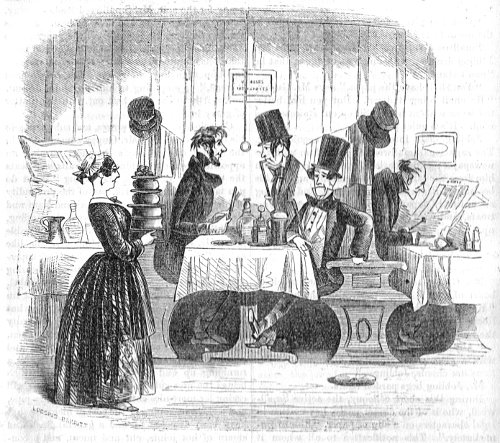
dining-house, of the class known among
its frequenters by the denomination Slap-Bang,
where the waitress, a bouncing young female of
forty, is supposed to have made some impression
on the susceptible Smallweed; of whom it may
be remarked that he is a weird changeling, to
whom years are nothing. He stands precociously
possessed of centuries of owlish wisdom. If he
ever lay in a cradle, it seems as if he must have
lain there in a tail-coat. He has an old, old eye,
has Smallweed; and he drinks, and smokes, in a
monkeyish way; and his neck is stiff in his
collar; and he is never to be taken in; and he
knows all about it, whatever it is. In short, in
his bringing up, he has been so nursed by Law
and Equity that he has become a kind of fossil
Imp, to account for whose terrestrial existence it
is reported at the public offices that his father
was John Doe, and his mother the only female
member of the Roe family; also that his first
long-clothes were made from a blue bag.
Into the Dining House, unaffected by the
seductive show in the window, of artificially
whitened cauliflowers and poultry, verdant baskets
of peas, coolly blooming cucumbers, and joints
ready for the spit, Mr. Smallweed leads the way.
They know him there, and defer to him. He has
his favorite box, he bespeaks all the papers, he is
down upon bald patriarchs, who keep them more
than ten minutes afterward. It is of no use trying
him with any thing less than a full-sized
"bread," or proposing to him any joint in cut,
unless it is in the very best cut. In the matter
of gravy he is adamant.
Conscious of his elfin power, and submitting to
his dread experience, Mr. Guppy consults him in
the choice of that day's banquet; turning an
appealing look toward him as the waitress repeats
the catalogue of viands, and saying "What do
you take, Chick?" Chick, out of the profundity
of his artfulness, preferring "veal and ham and
French beans—And don't you forget the stuffing,
Polly," (with an unearthly cock of his venerable
eye); Mr. Guppy and Mr. Jobling give the like
order. Three pint pots of half-and-half are
super-added. Quickly the waitress returns, bearing
what is apparently a model of the tower of Babel,
but what is really a pile of plates and flat tin
dish-covers. Mr. Smallweed, approving of what
is set before him, conveys intelligent benignity
into his ancient eye, and winks upon her. Then,
amid a constant coming in, and going out, and
running about, and a clatter of crockery, and a
rumbling up and down of the machine which
brings the nice cuts from the kitchen, and a shrill
crying for more nice cuts down the speaking-pipe,
and a shrill reckoning of the cost of nice cuts that
have been disposed of, and a general flush and
steam of hot joints, cut and uncut, and a considerably
heated atmosphere in which the soiled
knives and table-cloths seem to break out spontaneously
into eruptions of grease and blotches
of beer, the legal triumvirate appease their
appetites.
Mr. Jobling is buttoned up closer than mere
adornment might require. His hat presents at
the rims a peculiar appearance of a glistening
nature, as if it had been a favorite snail-promenade.
The same phenomenon is visible on some
parts of his coat, and particularly at the seams.
He has the faded appearance of a gentleman in
embarrassed circumstances; even his light whiskers
droop with something of a shabby air.
His appetite is so vigorous, that it suggests
spare living for some little time back. He makes
such a speedy end of his plate of veal and ham,
bringing it to a close while his companions are
yet midway in theirs, that Mr. Guppy proposes
another. "Thank you, Guppy," says Mr. Jobling,
"I really don't know but what I will take
another."
Another being brought, he falls to with great
good-will.
Mr. Guppy takes silent notice of him at intervals,
until he is half way through this second
plate and stops to take an enjoying pull at his
pint pot of half-and-half (also renewed), and
stretches out his legs and rubs his hands. Beholding
him in which glow of contentment, Mr.
Guppy says:
"You are a man again, Tony!"
MR. GUPPY'S ENTERTAINMENT.
"Well, not quite, yet," says Mr. Jobling.
"Say, just born."
"Will you take any other vegetables? Grass?
Peas? Summer cabbage?"
"Thank you, Guppy," says Mr. Jobling. "I
really don't know but what I will take summer
cabbage."
Order given; with the sarcastic addition (from
Mr. Smallweed) of "Without slugs, Polly!"
And cabbage produced.
"I am growing up, Guppy," says Mr. Jobling,
plying his knife and fork with a relishing steadiness.
"Glad to hear it."
"In fact, I have just turned into my teens,"
says Mr. Jobling.
He says no more until he has performed his
task, which he achieves as Messrs. Guppy and
Smallweed finish theirs; thus getting over the
ground in excellent style, and beating those two
gentlemen easily by a veal and ham and a
cabbage.
"Now, Small," says Mr. Guppy, "what would
you recommend about pastry?"
"Marrow puddings," says Mr. Smallweed instantly.
"Ay, ay!" cries Mr. Jobling, with an arch
look. "You're there, are you? Thank you,
Guppy, I don't know but what I will take a
marrow pudding."
Three marrow puddings being produced, Mr.
Jobling adds, in a pleasant humor, that he is
coming of age fast. To these succeed, by command
of Mr. Smallweed, "three Cheshires;" and
to those, "three small rums." This apex of the
entertainment happily reached, Mr. Jobling puts
up his legs on the carpeted seat (having his own
side of the box to himself), leans against the
wall, and says, "I am grown up, now, Guppy.
I have arrived at maturity."
"What do you think, now," says Mr. Guppy,
"about—you don't mind Smallweed?"
"Not the least in the world. I have the
pleasure of drinking his good health."
"Sir, to you!" says Mr. Smallweed.
"I was saying, what do you think now," pursues
Mr. Guppy, "of enlisting?"
"Why, what I may think after dinner," returns
Mr. Jobling, "is one thing, my dear Guppy,
and what I may think before dinner is another
thing. Still, even after dinner, I ask myself the
question, What am I to do? How am I to live?
Ill fo manger, you know," says Mr. Jobling, pronouncing
that word as if he meant a necessary
fixture in an English stable. "Ill fo manger.
That's the French saying, and mangering is as
necessary to me as it is to a Frenchman. Or
more so."
Mr. Smallweed is decidedly of opinion "much
more so."
"If any man had told me," pursues Jobling,
"even so lately as when you and I had the frisk
down in Lincolnshire, Guppy, and drove over to
see that house at Castle Wold—"
Mr. Smallweed corrects him: "Chesney Wold."
"Chesney Wold. (I thank my honorable friend
for that cheer.) If any man had told me, then,
that I should be as hard up at the present time
as I literally find myself, I should have—well, I
should have pitched into him," says Mr. Jobling,
taking a little rum-and-water with an air of desperate
resignation; "I should have let fly at his
head."
"Still, Tony, you were on the wrong side of
the post then," remonstrates Mr. Guppy. "You
were talking about nothing else in the gig."
"Guppy," says Mr. Jobling, "I will not deny
it. I was on the wrong side of the post. But I
trusted to things coming round."
That very popular trust in flat things coming
round! Not in their being beaten round, or
worked round, but in their "coming" round!
As though a lunatic should trust in the world's
"coming" triangular!
"I had confident expectations that things
would come round and be all square," says Mr.
Jobling, with some vagueness of expression, and
perhaps of meaning, too. "But I was disappointed.
They never did. And when it came
to creditors making rows at the office, and to
people that the office dealt with making complaints
about dirty trifles of borrowed money,
why there was an end of that connection. And
of any new professional connection, too; for if I
was to give a reference to-morrow, it would be
mentioned, and would sew me up. Then, what's
a fellow to do? I have been keeping out of the
way, and living cheap, down about the market-gardens;
but what's the use of living cheap when
you have got no money? You might as well live
dear."
"Better," Mr. Smallweed thinks.
"Certainly. It's the fashionable way; and
fashion and whiskers have been my weaknesses,
and I don't care who knows it," says Mr. Jobling.
"They are great weaknesses—Damme, sir,
they are great. Well!" proceeds Mr. Jobling,
after a defiant visit to his rum-and-water, "what
can a fellow do, I ask you, but enlist?"
Mr. Guppy comes more fully into the conversation,
to state what, in his opinion, a fellow can
do. His manner is the gravely impressive manner
of a man who has not committed himself in
life, otherwise than as he has become the victim
of a tender sorrow of the heart.
"Jobling," says Mr. Guppy, "myself and our
mutual friend Smallweed—"
(Mr. Smallweed modestly observes, "Gentlemen
both!" and drinks.)
"Have had a little conversation on this matter
more than once, since you—"
"Say, got the sack!" cries Mr. Jobling, bitterly.
"Say it, Guppy. You mean it."
"N-o-o! Left the Inn," Mr. Smallweed delicately
suggests.
"Since you left the Inn, Jobling," says Mr.
Guppy; "and I have mentioned, to our mutual
friend Smallweed, a plan I have lately thought
of proposing. You know Snagsby, the stationer?"
"I know there is such a stationer," returns
Mr. Jobling. "He was not ours, and I am not
acquainted with him."
"He is ours, Jobling, and I am acquainted with
him," Mr. Guppy retorts. "Well, sir! I have
lately become better acquainted with him, through
some accidental circumstances that have made
me a visitor of his in private life. Those circumstances
it is not necessary to offer in argument.
They may—or they may not—have some reference
to a subject, which may—or may not—have
cast its shadow on my existence."
As it is Mr. Guppy's perplexing way, with
boastful misery to tempt his particular friends
into this subject, and the moment they touch it,
to turn on them with that trenchant severity
about the chords in the human mind; both Mr.
Jobling and Mr. Smallweed decline the pitfall, by
remaining silent.
"Such things may be," repeats Mr. Guppy,
"or they may not be. They are no part of the
case. It is enough to mention, that both Mr.
and Mrs. Snagsby are very willing to oblige me;
and that Snagsby has, in busy times, a good deal
of copying work to give out. He has all Tulkinghorn's,
and an excellent business besides. I
believe, if our mutual friend Smallweed were put
into the box, he could prove this?"
Mr. Smallweed nods, and appears greedy to be
sworn.
"Now, gentlemen of the jury," says Mr. Guppy, "—I
mean, now Jobling—you may say this
is a poor prospect of a living. Granted. But
it's better than nothing, and better than enlistment.
You want time. There must be time
for these late affairs to blow over. You might
live through it on much worse terms than by
writing for Snagsby."
Mr. Jobling is about to interrupt, when the
sagacious Smallweed checks him with a dry
cough, and the words, "Hem! Shakspeare!"
"There are two branches to this subject, Jobling,"
says Mr. Guppy. "That is the first. I
come to the second. You know Krook, the Chancellor,
across the lane. Come, Jobling," says Mr.
Guppy, in his encouraging cross-examination
tone, "I think you know Krook, the Chancellor,
across the lane?"
"I know him by sight," says Mr. Jobling.
"You know him by sight. Very well. And
you know little Flite?"
"Every body knows her," says Mr. Jobling.
"Every body knows her. Very well. Now it
has been one of my duties of late, to pay Flite a
certain weekly allowance, deducting from it the
amount of her weekly rent: which I have paid
(in consequence of instructions I have received)
to Krook himself, regularly, in her presence.
This has brought me into communication with
Krook, and into a knowledge of his house and
his habits. I know he has a room to let. You
may live there, at a very low charge, under
any name you like; as quietly as if you were a
hundred miles off. He'll ask no questions; and
would accept you as a tenant, at a word from
me—before the clock strikes, if you chose. And
I'll tell you another thing, Jobling," says Mr.
Guppy, who has suddenly lowered his voice, and
become familiar again, "he's an extraordinary
old chap—always rummaging among a litter of
papers, and grubbing away at teaching himself to
read and write; without getting on a bit, as it
seems to me. He is a most extraordinary old
chap, sir. I don't know but what it might be
worth a fellow's while to look him up a bit."
"You don't mean—?" Mr. Jobling begins.
"I mean," returns Mr. Guppy, shrugging his
shoulders with becoming modesty, "that I can't
make him out. I appeal to our mutual friend
Smallweed, whether he has or has not heard me
remark, that I can't make him out."
Mr. Smallweed bears the concise testimony,
"A few!"
"I have seen something of the profession, and
something of life, Tony," says Mr. Guppy, "and
it's seldom I can't make a man out more or less.
But such an old card as this; so deep, so sly, and
secret (though I don't believe he is ever sober;)
I never came across. Now, he must be precious
old, you know, and he has not a soul about him,
and he is reported to be immensely rich; and
whether he is a smuggler, or a receiver, or an unlicensed
pawnbroker, or a money-lender—all of
which I have thought likely at different times—it
might pay you to knock up a sort of knowledge
of him. I don't see why you shouldn't go
in for it when every thing else suits."
Mr. Jobling, Mr. Guppy, and Mr. Smallweed,
all lean their elbows on the table, and their chins
upon their hands, and look at the ceiling. After
a time, they all drink, slowly lean back, put their
hands in their pockets, and look at one another.
"If I had the energy I once possessed, Tony!"
says Mr. Guppy with a sigh. "But there are
chords in the human mind—"
Expressing the remainder of the desolate sentiment
in rum and water, Mr. Guppy concludes
by resigning the adventure to Tony Jobling, and
informing him that, during the vacation and
while things are slack, his purse, "as far as three
or four or even five pound goes," will be at his
disposal. "For never shall it be said," Mr. Guppy
adds with emphasis, "that William Guppy turned
his back upon his friend!"
The latter part of the proposal is so directly to
the purpose, that Mr. Jobling says with emotion,
"Guppy, my trump, your fist!" Mr. Guppy presents
it, saying, "Jobling, my boy, there it is!"
Mr. Jobling returns. "Guppy, we have been
pals now for some years!" Mr. Guppy replies,
"Jobling, we have." They then shake hands,
and Mr. Jobling adds in a feeling manner, "Thank
you, Guppy, I don't know but what I will take
another glass for old acquaintance sake."
"Krook's last lodger died there," observes Mr.
Guppy, in an incidental way.
"Did he though!" says Mr. Jobling.
"There was a verdict. Accidental death. You
don't mind that?"
"No," says Mr. Jobling, "I don't mind it;
but he might as well have died somewhere else.
It's devilish odd that he need go and die at my
place!" Mr. Jobling quite resents this liberty;
several times returning to it with such remarks
as, "There are places enough to die in, I should
think!" or, "He wouldn't have liked my dying
at his place, I dare say!"
However, the compact being virtually made,
Mr. Guppy proposes to dispatch the trusty Smallweed
to ascertain if Mr. Krook is at home, as in
that case they may complete the negotiation without
delay. Mr. Jobling approving, Smallweed
puts himself under the tall hat and conveys it
out of the dining-rooms in the Guppy manner.
He soon returns with the intelligence that Mr.
Krook is at home, and that he has seen him
through the shop-door, sitting in his back premises,
sleeping, "like one o'clock."
"Then I'll pay," says Mr. Guppy, "and we'll
go and see him. Small, what will it be?"
Mr. Smallweed, compelling the attendance of
the waitress with one hitch of his eyelash, instantly
replies as follows: "Four veals and hams
is three and four potatoes is three and four and
one summer cabbage is three and six and three
marrows is four and six and six breads is five and
three Cheshires is five and three and four pints
of half-and-half is six and three and four small
rums is eight and three and three Pollys is eight
and six. Eight and six in half a sovereign, Polly,
and eighteen-pence out!"
Not at all excited by these stupendous calculations,
Smallweed dismisses his friends, with a
cool nod, and remains behind to take a little admiring
notice of Polly, as opportunity may serve,
and to read the daily papers: which are so very
large in proportion to himself, shorn of his hat,
that when he holds up The Times to run his eye
over the columns, he seems to have retired for
the night, and to have disappeared under the bedclothes.
Mr. Guppy and Mr. Jobling repair to the rag
and bottle shop, where they find Krook still sleeping
like one o'clock; that is to say, breathing
stertorously with his chin upon his breast, and
quite insensible to any external sounds, or even
to gentle shaking. On the table beside him,
among the usual lumber, stand an empty gin
bottle and glass. The unwholesome air is so
stained with this liquor, that even the green eyes
of the cat upon her shelf, as they open and shut
and glimmer on the visitors, look drunk.
"Hold up here!" says Mr. Guppy, giving the
relaxed figure of the old man another shake. "Mr.
Krook! Halloa, sir!"
But it would seem as easy to wake a bundle
of old clothes, with a spirituous heat smouldering
in it. "Did you ever see such a stupor as he
falls into, between drink and sleep?" says Mr.
Guppy.
"If this is his regular sleep," returns Jobling,
rather alarmed, "it'll last a long time one of these
days, I am thinking."
"It's always more like a fit than a nap," says
Mr. Guppy, shaking him again. "Halloa, your
lordship! Why he might be robbed, fifty times
over! Open your eyes!"
After much ado, he opens them, but without
appearing to see his visitors, or any other objects.
Though he crosses one leg on another, and folds
his hands, and several times closes and opens
his parched lips, he seems to all intents and purposes
as insensible as before.
"He is alive at any rate," says Mr. Guppy.
"How are you, my Lord Chancellor. I have
brought a friend of mine, sir, on a little matter
of business."
The old man still sits, often smacking his dry
lips, without the least consciousness. After some
minutes, he makes an attempt to rise. They
help him up, and he staggers against the wall,
and stares at them.
"How do you do, Mr. Krook?" says Mr. Guppy,
in some discomfiture. "How do you do sir?
You are looking charming, Mr. Krook. I hope
you are pretty well?"
The old man, in aiming a purposeless blow at
Mr. Guppy, or at nothing, feebly swings himself
round, and comes with his face against the wall.
So he remains for a minute or two, heaped up
against it; and then staggers down the shop to
the front door. The air, the movement in the
court, the lapse of time, or the combination of
these things, recovers him. He comes back pretty
steadily, adjusting his fur cap on his head, and
looking keenly at them.
"Your servant, gentlemen; I've been dozing.
Hi! I am hard to wake, odd times."
"Rather so, indeed, sir," responds Mr. Guppy.
"What? You've been a-trying to do it, have
you?" says the suspicious Krook.
"Only a little," Mr. Guppy explains.
The old man's eye resting on the empty bottle,
he takes it up, examines it, and slowly tilts it
upside down.
"I say!" he cries, like the Hobgoblin in the
story. "Somebody's been making free here!"
"I assure you we found it so," says Mr. Guppy.
"Would you allow me to get it filled for
you?"
"Yes, certainly I would!" cries Krook, in high
glee. "Certainly I would! Don't mention it!
Get it filled next door—Sol's Arms—the Lord
Chancellor's fourteenpenny. Bless you, they
know me!"
He so presses the empty bottle upon Mr. Guppy,
that that gentleman, with a nod to his friend,
accepts the trust, and hurries out and hurries in
again with the bottle filled. The old man receives
it in his arms like a beloved grandchild,
and pats it tenderly.
"But, I say!" he whispers, with his eye
screwed up, after tasting it, "this ain't the Lord
Chancellor's fourteenpenny. This is eighteen-penny!"
"I thought you might like that better," says
Mr. Guppy.
"You're a nobleman, sir," returns Krook, with
another taste—and his hot breath seems to come
toward them like a flame. "You're a baron of
the land."
Taking advantage of this auspicious moment,
Mr. Guppy presents his friend under the impromptu
name of Mr. Weevle, and states the
object of their visit. Krook, with his bottle under
his arm (he never gets beyond a certain point
of either drunkenness or sobriety), takes time to
survey his proposed lodger, and seems to approve
of him. "You'd like to see the room, young
man?" he says. "Ah! It's a good room!
Been whitewashed. Been cleaned down with
soft soap and soda. Hi! It's worth twice the
rent; letting alone my company when you want
it, and such a cat to keep the mice away."
Commending the room after this manner, the
old man takes them up-stairs, where indeed they
do find it cleaner than it used to be, and also
containing some old articles of furniture which
he has dug up from his inexhaustible stores.
The terms are easily concluded—for the Lord
Chancellor can not be hard on Mr. Guppy, associated
as he is with Kenge and Carboy, Jarndyce
and Jarndyce, and other famous claims on his
professional consideration—and it is agreed that
Mr. Weevle shall take possession on the morrow.
Mr. Weevle and Mr. Guppy then repair to Cook's
Court, Cursitor Street, where the personal introduction
of the former to Mr. Snagsby is effected,
and (more important) the vote and interest of
Mrs. Snagsby are secured. They then report
progress to the eminent Smallweed, waiting at
the office in his tall hat for that purpose, and
separate; Mr. Guppy explaining that he would
terminate his little entertainment by standing
treat at the play, but that there are chords in
the human mind which would render it a hollow
mockery.
On the morrow, in the dusk of evening, Mr.
Weevle modestly appears at Krook's, by no means
incommoded with luggage, and establishes himself
in his new lodging; where the two eyes in
the shutters stare at him in his sleep, as if they
were full of wonder. On the following day Mr.
Weevle, who is a handy good-for-nothing kind
of young fellow, borrows a needle and thread of
Miss Flite, and a hammer of his landlord, and
goes to work devising apologies for window-curtains,
and knocking up apologies for shelves, and
hanging up his two tea-cups, milk-pot, and crockery
sundries on a pennyworth of little hooks, like
a shipwrecked sailor making the best of it.
But what Mr. Weevle prizes most, of all his
few possessions (next after his light whiskers, for
which he has an attachment that only whiskers
can awaken in the breast of man), is a choice
collection of copper-plate impressions from that
truly national work, The Divinities of Albion, or
Galaxy Gallery of British Beauty, representing
ladies of title and fashion in every variety of
smirk that art, combined with capital, is capable
of producing. With these magnificent portraits,
unworthily confined in a band-box during his
seclusion among the market-gardens, he decorates
his apartment; and as the Galaxy Gallery
of British Beauty wears every variety of fancy-dress,
plays every variety of musical instrument,
fondles every variety of dog, ogles every variety
of prospect, and is backed up by every variety of
flower-pot and balustrade, the result is very imposing.
But fashion is Mr. Weevle's, as it was Tony
Jobling's weakness. To borrow yesterday's paper
from the Sols' Arms of an evening, and read
about the brilliant and distinguished meteors that
are shooting across the fashionable sky in every
direction, is unspeakable consolation to him. To
know what member of what brilliant and distinguished
circle accomplished the brilliant and
distinguished feat of joining it yesterday, or contemplates
the no less brilliant and distinguished
feat of leaving it to-morrow, gives him a thrill
of joy. To be informed what the Galaxy Gallery
of British Beauty is about and means to be about,
and what Galaxy marriages are on the tapis, and
what Galaxy rumors are in circulation, is to become
acquainted with the most glorious destinies
of mankind. Mr. Weevle reverts from this intelligence,
to the Galaxy portraits implicated;
and seems to know the originals, and to be known
of them.
For the rest he is a quiet lodger, full of handy
shifts and devices as before mentioned, able to
cook and clean for himself as well as to carpenter,
and developing social inclinations after the
shades of evening have fallen on the court. At
those times, when he is not visited by Mr. Guppy,
or by a small light in his likeness quenched
in a dark hat, he comes out of his dull room—where
he has inherited the deal wilderness of
desk bespattered with a rain of ink—and talks to
Krook, or is "very free," as they call it in the
court, commendingly, with any one disposed for
conversation. Wherefore, Mrs. Piper, who leads
the court, is impelled to offer two remarks to
Mrs. Perkins: Firstly, that if her Johnny was to
have whiskers, she could wish 'em to be identically
like that young man's; and secondly, Mark
my words, Mrs. Perkins, ma'am, and don't you
be surprised, Lord bless you, if that young man
comes in at last for old Krook's money!
In a rather ill-favored and ill-savored neighborhood,
though one of its rising grounds bears
the name of Mount Pleasant, the Elfin Smallweed,
christened Bartholomew, and known on
the domestic hearth as Bart, passes that limited
portion of his time on which the office and its
contingencies have no claim. He dwells in a little
narrow street, always solitary, shady, and sad,
closely bricked in on all sides like a tomb, but
where there yet lingers the stump of an old forest
tree, whose flavor is about as fresh and natural
as the Smallweed smack of youth.
There has been only one child in the Smallweed
family for several generations. Little old
men and women there have been, but no child,
until Mr. Smallweed's grandmother, now living,
became weak in her intellect, and fell (for the
first time) into a childish state. With such infantine
graces as a total want of observation,
memory, understanding and interest, and an
eternal disposition to fall asleep over the fire and
into it, Mr. Smallweed's grandmother has undoubtedly
brightened the family.
Mr. Smallweed's grandfather is likewise of
the party. He is in a helpless condition as to
his lower, and nearly so as to his upper limbs;
but his mind is unimpaired. It holds, as well as
it ever held, the first four rules of arithmetic, and
a certain small collection of the hardest facts.
In respect of ideality, reverence, wonder, and
other such phrenological attributes, it is no worse
off than it used to be. Every thing that Mr.
Smallweed's grandfather ever put away in his
mind was a grub at first, and is a grub at last.
In all his life he has never bred a single butterfly.
The father of this pleasant grandfather of the
neighborhood of Mount Pleasant was a horny-skinned,
two-legged, money-getting species of
spider, who spun webs to catch unwary flies, and
retired into holes until they were entrapped.
The name of this old pagan's God was Compound
Interest. He lived for it, married it, died
of it. Meeting with a heavy loss in an honest
little enterprise in which all the loss was intended
to have been on the other side, he broke something—something
necessary to his existence;
therefore it couldn't have been his heart—and
made an end of his career. As his character
was not good; and he had been bred at a Charity
School, in a complete course, according to question
and answer, of those ancient people the
Amorites and Hittites; he was frequently quoted
as an example of the failure of education.
His spirit shone through his son, to whom he
had always preached of "going out," early in
life, and whom he made a clerk in a sharp scrivener's
office at twelve years old. There, the young
gentleman improved his mind, which was of a
lean and anxious character; and, developing the
family gifts, gradually elevated himself into the
discounting profession. Going out early in life
and marrying late, as his father had done before
him, he too begat a lean and anxious-minded
son; who, in his turn, going out early in life
and marrying late, became the father of Bartholomew
and Judith Smallweed, twins. During
the whole time consumed in the slow growth
of this family tree, the house of Smallweed,
always early to go out and late to marry, has
strengthened itself in its practical character, has
discarded all amusements, discountenanced all
story-books, fairy tales, fictions, and fables, and
banished all levities whatsoever. Hence the
gratifying fact, that it has had no child born to
it; and that the complete little men and women
whom it has produced, have been observed to
bear a likeness to old monkeys with something
depressing on their minds.
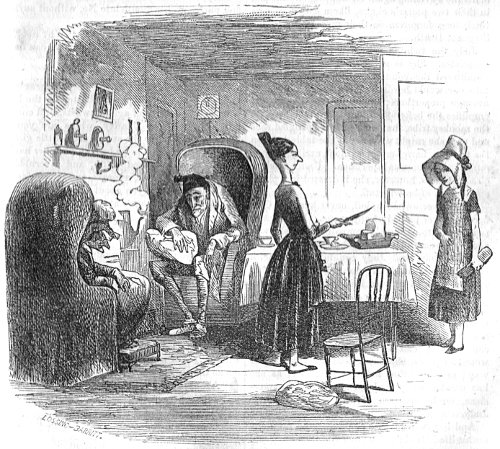
At the present time, in the dark little parlor
certain feet below the level of the street—a grim,
hard, uncouth parlor, only ornamented with the
coarsest of baize table-covers, and the hardest of
sheet iron tea-trays, and offering in its decorative
character no bad allegorical representation of
Grandfather Smallweed's mind—seated in two
black horsehair porter's chairs, one on each side
of the fire-place, the superannuated Mr. and Mrs.
Smallweed wile away the rosy hours. On the
stove are a couple of trivets for the pots and kettles
which it is Grandfather Smallweed's usual
occupation to watch, and projecting from the
chimney-piece between them is a sort of brass
gallows for roasting, which he also superintends
when it is in action. Under the venerable Mr.
Smallweed's seat, and guarded by his spindle
legs, is a drawer in his chair, reported to contain
property to a fabulous amount. Beside him is a
spare cushion, with which he is always provided,
in order that he may have something to throw at
the venerable partner of his respected age when
ever she makes an allusion to money—a subject
on which he is particularly sensitive.
"And where's Bart?" Grandfather Smallweed
inquires of Judy, Bart's twin-sister.
"He an't come in yet," says Judy.
"It's his tea-time, isn't it?"
"No."
"How much do you mean to say it wants
then?"
"Ten minutes."
"Hey?"
"Ten minutes."—(Loud on the part of Judy.)
"Ho!" says Grandfather Smallweed. "Ten
minutes."
Grandmother Smallweed, who has been mumbling
and shaking her head at the trevets, hearing
figures mentioned, connects them with money,
and screeches, like a horrible old parrot without
any plumage, "Ten ten-pound notes!"
Grandfather Smallweed immediately throws
the cushion at her.
"Drat you, be quiet!" says the old man.
The effect of this act of jaculation is twofold.
It not only doubles up Mrs. Smallweed's head
against the side of her porter's chair, and causes
her to present, when extricated by her grand-daughter,
a highly unbecoming state of cap, but
the necessary exertion recoils on Mr. Smallweed
himself, whom it throws back into his porter's
chair, like a broken puppet. The excellent old
gentleman being, at these times, a mere clothes-bag
with a black skull-cap on the top of it, does
not present a very animated appearance until
he has undergone the two operations at the hands
of his grand-daughter, of being shaken up like a
great bottle, and poked and punched like a great
bolster. Some indication of a neck being developed
in him by these means, he and the sharer
of his life's evening again sit fronting one another
in their two porter's chairs, like a couple of sentinels
long forgotten on their post by the Black
Sergeant Death.
Judy the twin is worthy company for these
associates. She is so indubitably sister to Mr.
Smallweed the younger, that the two kneaded
into one would hardly make a young person of
average proportions; while she so happily exemplifies
the before-mentioned family likeness to
the monkey tribe, that, attired in a spangled robe
and cap, she might walk about the table-land on
the top of a barrel-organ without exciting much
remark as an unusual specimen. Under existing
circumstances, however, she is dressed in a plain,
spare gown of brown stuff.
Judy never owned a doll, never heard of Cinderella,
never played at any game. She once or
twice fell into children's company when she was
about ten years old, but the children couldn't get
on with Judy, and Judy couldn't get on with
them. She seemed like an animal of another
species, and there was instinctive repugnance
on both sides. It is very doubtful whether Judy
knows how to laugh. She has so rarely seen the
thing done, that the probabilities are strong the
other way. Of any thing like a youthful laugh,
she certainly can have no conception. If she
were to try one, she would find her teeth in her
way; modeling that action of her face, as she
has unconsciously modeled all its other expressions,
on her pattern of sordid age. Such is
Judy.
And her twin brother couldn't wind up a top
for his life. He knows no more of Jack the Giant
Killer, or of Sinbad the Sailor, than he knows of
the people in the stars. He could as soon play
at leap-frog, or at cricket, as change into a cricket
or a frog himself. But he is so much the better
off than his sister, that on his narrow world of
fact an opening has dawned, into such broader
regions as lie within the ken of Mr. Guppy.
Hence, his admiration and his emulation of that
shining enchanter.
Judy, with a gong-like clash and clatter, sets
one of the sheet-iron tea-trays on the table, and
arranges cups and saucers. The bread she puts
on in an iron basket; and the butter (and not
much of it) in a small pewter plate. Grandfather
Smallweed looks hard after the tea as it is served
out, and asks Judy where the girl is?
"Charley, do you mean?" says Judy.
"Hey?" from Grandfather Smallweed.
"Charley, do you mean?"
This touches a spring in Grandmother Smallweed
who, chuckling, as usual, at the trevets,
cries—"Over the water! Charley over the water,
Charley over the water, over the water to
Charley, Charley over the water, over the water
to Charley!" and becomes quite energetic about
it. Grandfather looks at the cushion, but has
not sufficiently recovered his late exertion.
"Ha!" he says, when there is silence—"if
that's her name. She eats a deal. It would be
better to allow her for her keep."
Judy, with her brother's wink, shakes her head,
and purses up her mouth into No, without saying
it.
"No?" returns the old man. "Why not?"
"She'd want sixpence a-day, and we can do it
for less," says Judy.
"Sure?"
Judy answers with a nod of deepest meaning;
and calls, as she scrapes the butter on the loaf
with every precaution against waste, and cuts it
into slices, "You Charley, where are you?"
Timidly obedient to the summons, a little girl in
a rough apron and a large bonnet, with her hands
covered with soap and water, and a scrubbing
brush in one of them, appears, and courtesies.
"What work are you about now?" says Judy,
making an ancient snap at her, like a very sharp
old beldame.
"I'm a cleaning the up-stairs back room, miss,"
replies Charley.
"Mind you do it thoroughly, and don't loiter.
Shirking won't do for me. Make haste! Go
along!" cries Judy, with a stamp upon the ground.
"You girls are more trouble than you're worth,
by half."
On this severe matron, as she returns to her
task of scraping the butter and cutting the bread,
falls the shadow of her brother, looking in at the
window. For whom, knife and loaf in hand, she
opens the street door.
"Ay, ay, Bart!" says Grandfather Smallweed.
"Here you are, hey?"
"Here I am," says Bart.
"Been along with your friend again, Bart?"
Small nods.
"Dining at his expense, Bart?"
Small nods again.
"That's right. Live at his expense as much
as you can, and take warning by his foolish example.
That's the use of such a friend. The
only use you can put him to," says the venerable
sage.
His grandson without receiving this good
counsel as dutifully as he might, honors it with
all such acceptance as may lie in a slight wink
and a nod, and takes a chair at the tea-table.
The four old faces then hover over tea-cups, like
a company of ghastly cherubim; Mrs. Smallweed
perpetually twitching her head and chattering at
the trevets, and Mr. Smallweed requiring to be
repeatedly shaken up like a large black draught.
"Yes, yes," says the good old gentleman, reverting
to his lesson of wisdom. "That's such
advice as your father would have given you, Bart.
You never saw your father. More's the pity.
He was my true son." Whether it is intended
to be conveyed that he was particularly pleasant
to look at, on that account, does not appear.
"He was my true son," repeats the old gentleman,
folding his bread and butter on his knee;
"a good accountant, and died fifteen years ago."
Mrs. Smallweed, following her usual instinct,
breaks out with "Fifteen hundred pound. Fifteen
hundred pound in a black box, fifteen hundred
pound locked up, fifteen hundred pound put
away and hid!" Her worthy husband, setting
aside his bread and butter, immediately discharges
the cushion at her, crushes her against the side
of her chair, and falls back in his own overpowered.
His appearance, after visiting Mrs. Smallweed
with one of these admonitions, is particularly
impressive and not wholly prepossessing:
firstly, because the exertion generally twists his
black skull-cap over one eye and gives him an
air of goblin rakishness; secondly, because he
mutters violent imprecations against Mrs. Smallweed;
and thirdly, because the contrast between
those powerful expressions and his powerless figure
is suggestive of a baleful old malignant, who
would be very wicked if he could. All this, however,
is so common in the Smallweed family circle,
that it produces no impression. The old
gentleman is merely shaken, and has his internal
feathers beaten up; the cushion is restored to its
usual place beside him; and the old lady, perhaps
with her cap adjusted, and perhaps not, is
planted in her chair again, ready to be bowled
down like a ninepin.
Some time elapses, in the present instance,
before the old gentleman is sufficiently cool to
resume his discourse; and even then he mixes
it up with several edifying expletives addressed
to the unconscious partner of his bosom, who
holds communication with nothing on earth but
the trevets. As thus:
"If your father, Bart, had lived longer, he
might have been worth a deal of money—you
brimstone chatterer!—but just as he was beginning
to build up the house that he had been
making the foundations for, through many a
year—you jade of a magpie, jackdaw, and poll-parrot,
what do you mean!—he took ill and
died of a low fever, always being a sparing and
a spare man, full of business care—I should like
to throw a cat at you instead of a cushion, and
I will, too, if you make such a confounded fool
of yourself!—and your mother, who was a prudent
woman, as dry as a chip, just dwindled
away like touchwood after you and Judy were
born. You are an old pig. You are a brimstone
pig. You're a head of swine!"
Judy, not interested in what she has often
heard, begins to collect in a basin various tributary
streams of tea, from the bottoms of cups
and saucers and from the bottom of the teapot,
for the little charwoman's evening meal. In
like manner she gets together, in the iron bread-basket,
as many outside fragments and worn-down
heels of loaves as the rigid economy of the
house has left in existence.
"But your father and me were partners, Bart,"
says the old gentleman; "and when I am gone,
you and Judy will have all there is. It's rare
for you both, that you went out early in life—Judy
to the flower business, and you to the law.
You won't want to spend it. You'll get your
living without it, and put more to it. When I
am gone, Judy will go back to the flower business,
and you'll still stick to the law."
One might infer, from Judy's appearance, that
her business rather lay with the thorns than the
flowers; but she has, in her time, been apprenticed
to the art and mystery of artificial flower-making.
A close observer might perhaps detect both
in her eye and her brother's, when their venerable
grandsire anticipates his being gone, some
little impatience to know when he may be going,
and some resentful opinion that it is time he
went.
"Now, if every body has done," says Judy,
completing her preparations, "I'll have that girl
into her tea. She would never leave off, if she
took it by herself in the kitchen."
Charley is accordingly introduced, and, under
a heavy fire of eyes, sits down to her basin and
a Druidical ruin of bread and butter. In the active
superintendence of this young person, Judy
Smallweed appears to attain a perfectly geological
age, and to date from the remotest periods.
Her systematic manner of flying at her, and
pouncing on her, with or without pretense, whether
or no, is wonderful; evincing an accomplishment
in the art of girl-driving, seldom reached
by the oldest practitioners.
"Now, don't stare about you all the afternoon,"
cries Judy, shaking her head and stamping
her foot, as she happens to catch the glance
which has been previously sounding the basin
of tea, "but take your victuals and get back to
your work."
"Yes, miss," says Charley.
"Don't say yes," returns Miss Smallweed,
"for I know what you girls are. Do it without
saying it, and then I may begin to believe you."
Charley swallows a great gulp of tea in token
of submission, and so disperses the Druidical
ruins that Miss Smallweed charges her not to
gormandize, which "in you girls," she observes,
is disgusting. Charley might find some more
difficulty in meeting her views on the general
subject of girls, but for a knock at the door.
"See who it is, and don't chew when you
open it!" cries Judy.
The object of her attentions withdrawing for
the purpose, Miss Smallweed takes that opportunity
of jumbling the remainder of the bread and
butter together, and launching two or three dirty
tea-cups into the ebb-tide of the basin of tea;
as a hint that she considers the eating and drinking
terminated.
"Now! Who is it, and what's wanted?"
says the snappish Judy.
It is one "Mr. George," it appears. Without
other announcement or ceremony, Mr. George
walks in.
"Whew!" says Mr. George. "You are hot
here. Always a fire, eh? Well! Perhaps you
do right to get used to one." Mr. George makes
the latter remark to himself, as he nods to Grandfather
Smallweed.
"Ho! It's you!" cries the old gentleman.
"How de do? How de do?"
"Middling," replies Mr. George, taking a chair.
"Your grand-daughter I have had the honor of
seeing before; my service to you, miss."
"This is my grandson," says Grandfather
Smallweed. "You han't seen him before. He
is in the law, and not much at home."
"My service to him, too! He is like his sister.
He is very like his sister. He is devilish like his
sister," says Mr. George, laying a great and not
altogether complimentary stress on his last adjective.
"And how does the world use you, Mr. George?"
Grandfather Smallweed inquires, slowly rubbing
his legs.
"Pretty much as usual. Like a football."
He is a swarthy browned man of fifty; stoutly
built, and good-looking; with crisp dark hair,
bright eyes, and a broad chest. His sinewy and
powerful hands, as sunburnt as his face, have
evidently been used to a pretty rough life. What
is curious about him is, that he sits forward on
his chair as if he were, from long habit, allowing
space for some dress or accoutrements that he
has altogether laid aside. His step, too, is measured
and heavy, and would go well with a
weighty clash and jingle of spurs. He is close-shaved
now, but his mouth is set as if his upper
lip had been for years familiar with a great
mustache; and his manner of occasionally laying
the open palm of his broad brown hand upon it, is
to the same effect. Altogether, one might guess
Mr. George to have been a trooper once upon a
time.
A special contrast Mr. George makes to the
Smallweed family. Trooper was never yet billeted
upon a household more unlike him. It is
a broad-sword to an oyster-knife. His developed
figure, and their stunted forms; his large manner
filling any amount of room, and their little
narrow pinched ways; his sounding voice, and
their sharp spare tones, are in the strongest and
the strangest opposition. As he sits in the middle
of the grim parlor, leaning a little forward,
with his hands upon his thighs, and his elbows
squared, he looks as though, if he remained there
long, he would absorb into himself the whole
family and the whole four-roomed house, extra
little back-kitchen and all.
"Do you rub your legs to rub life into 'em?"
he asks of Grandfather Smallweed, after looking
round the room.
"Why, it's partly a habit, Mr. George, and—yes—it
partly helps the circulation," he replies.
"The cir-cu-la-tion!" repeats Mr. George,
folding his arms upon his chest, and seeming to
become two sizes larger. "Not much of that, I
should think."
"Truly, I'm old, Mr. George," says Grandfather
Smallweed. "But I can carry my years.
I'm older than her," nodding at his wife, "and
see what she is!—You're a brimstone chatterer!"
with a sudden revival of his late hostility.
"Unlucky old soul!" says Mr. George, turning
his head in that direction. "Don't scold the old
lady. Look at her here, with her poor cap half
off her head, and her poor chair all in a muddle.
Hold up, ma'am. That's better. There we are!
Think of your mother, Mr. Smallweed," says Mr.
George, coming back to his seat from assisting
her, "if your wife an't enough."
"I suppose you were an excellent son, Mr.
George," the old man hints, with a leer.
The color of George's face rather deepens, as
he replies: "Why no. I wasn't."
"I am astonished at it."
"So am I. I ought to have been a good son,
and I think I meant to have been one. But I
wasn't. I was a thundering bad son, that's the
long and the short of it, and never was a credit
to any body."
"Surprising!" cries the old man.
"However," Mr. George resumes, "the less
said about it, the better now. Come! You know
the agreement. Always a pipe out of the two
months' interest! (Bosh! It's all correct. You
needn't be afraid to order the pipe. Here's the
new bill, and here's the two months' interest-money,
and a devil-and-all of a scrape it is to
get it together in my business.")
Mr. George sits, with his arms folded, consuming
the family and the parlor, while Grandfather
Smallweed is assisted by Judy to two
black leathern cases out of a locked bureau; in
one of which he secures the document he has just
received, and from the other takes another similar
document which he hands to Mr. George,
who twists it up for a pipe-light. As the old
man inspects, through his glasses, every up-stroke
and down-stroke of both documents, before he releases
them from their leathern prison; and as
he counts the money three times over, and requires
Judy to say every word she utters at least twice,
and is as tremulously slow of speech and action
as it is possible to be; this business is a long
time in progress. When it is quite concluded,
and not before, he disengages his ravenous eyes
and fingers from it, and answers Mr. George's
last remark by saying, "Afraid to order the pipe?
We are not so mercenary as that, sir. Judy, see
directly to the pipe and the glass of cold brandy
and water for Mr. George."
The sportive twins, who have been looking
straight before them all this time, except when
they have been engrossed by the black leathern
cases, retire together, generally disdainful of the
visitor, but leaving him to the old man, as two
young cubs might leave a traveler to the parental
bear.
"And there you sit, I suppose, all the day long,
eh?" says Mr. George, with folded arms.
"Just so, just so," the old man nods.
"And don't you occupy yourself at all?"
"I watch the fire—and the boiling and the
roasting—"
"When there is any," says Mr. George, with
great expression.
"Just so. When there is any."
"Don't you read, or get read to?"
The old man shakes his head with sharp, sly
triumph. "No, no. We have never been readers
in our family. It don't pay. Stuff. Idleness.
Folly. No, no!"
"There's not much to choose between your two
states," says the visitor, in a key too low for the
old man's dull hearing, as he looks from him to
the old woman and back again. "I say!" in a
louder voice.
"I hear you."
"You'll sell me up at last I suppose, when I
am a day in arrear."
"My dear friend!" cries Grandfather Smallweed,
stretching out both hands to embrace him.
"Never! Never, my dear friend! But my friend
in the city that I got to lend you the money—he
might!"
"O! you can't answer for him?" says Mr.
George; finishing the inquiry, in his lower key,
with the words "you lying old rascal!"
"My dear friend, he is not to be depended on.
I wouldn't trust him. He will have his bond,
my dear friend."
"Devil doubt him," says Mr. George. Charley
appearing with a tray, on which are the pipe, a
small paper of tobacco, and the brandy and water,
he asked her, "How do you come here! you
haven't got the family face."
"I goes out to work, sir," returns Charley.
The trooper (if trooper he be or have been)
takes her bonnet off, with a light touch for so
strong a hand, and pats her on the head. "You
give the house almost a wholesome look. It
wants a bit of youth as much as it wants fresh
air." Then he dismisses her, lights his pipe, and
drinks to Mr. Smallweed's friend in the city—the
one solitary flight of that esteemed old gentleman's
imagination.
"So you think he might be hard upon me, eh?"
"I think he might—I am afraid he would. I
have known him do it," says Grandfather Smallweed,
incautiously, "twenty times."
Incautiously, because his stricken better-half,
who has been dozing over the fire for some time,
is instantly aroused and jabbers. "Twenty
thousand pounds, twenty twenty-pound notes in
a money-box, twenty guineas, twenty million
twenty per cent., twenty—" and is then cut short
by the flying cushion, which the visitor, to whom
this singular experiment appears to be a novelty,
snatches from her face, as it crushes her in the
usual manner.
"You're a brimstone idiot. You're a scorpion—a
brimstone scorpion! You're a sweltering
toad. You're a chattering, clattering, broom-stick
witch, that ought to be burnt!" gasps the
old man, prostrate in his chair. "My dear friend,
will you shake me up a little?"
Mr. George, who has been looking first at one
of them and then at the other, as if he were demented,
takes his venerable acquaintance by the
throat on receiving this request, and dragging
him upright in his chair as easily as if he were
a doll, appears in two minds whether or no to
shake all future power of cushioning out of him,
and shake him into his grave. Resisting the
temptation, but agitating him violently enough
to make his head roll like a harlequin's, he puts
him smartly down in his chair again, and adjusts
his skull cap with such a rub, that the old
man winks with both eyes for a minute afterward.
"O Lord!" says Mr. Smallweed. "That'll
do. Thank you, my dear friend, that'll do. O
dear me, I'm out of breath. O Lord!" And
Mr. Smallweed says it, not without evident apprehensions
of his dear friend, who still stands
over him looming larger than ever.
The alarming presence, however, gradually
subsides into its chair, and falls to smoking in
long puffs; consoling itself with the philosophical
reflection, "The name of your friend in the city
begins with a D, comrade, and you're about right
respecting the bond."
"Did you speak, Mr. George?" inquires the
old man.
The trooper shakes his head; and leaning forward
with his right elbow on his right knee and
his pipe supported in that hand, while his other
hand, resting on his left leg, squares his left elbow
in a martial manner, continues to smoke.
Meanwhile he looks at Mr. Smallweed with grave
attention, and now and then fans the cloud of
smoke away, in order that he may see him the
more clearly.
"I take it," he says, making just as much and
as little change in his position as will enable him
to reach the glass to his lips, with a round, full
action, "that I am the only man alive (or dead
either), that gets the value of a pipe out of you?"
"Well!" returns the old man, "it's true that
I don't see company, Mr. George, and that I
don't treat. I can't afford to do it. But as
you, in your pleasant way, made your pipe a
condition—"
"Why, it's not for the value of it; that's no
great thing. It was a fancy to get it out of you.
To have something in for my money."
"Ha! You're prudent, prudent, sir!" cries
Grandfather Smallweed, rubbing his legs.
"Very. I always was." Puff. "It's a sure
sign of my prudence, that I ever found the way
here." Puff. "Also, that I am what I am."
Puff. "I am well known to be prudent," says
Mr. George, composedly smoking. "I rose in
life, that way."
"Don't be down-hearted, sir. You may rise yet."
Mr. George laughs and drinks.
"Ha'n't you no relations now," asks Grandfather
Smallweed, with a twinkle in his eyes,
"who would pay off this little principal, or who
would lend you a good name or two that I could
persuade my friend in the city to make you a
further advance upon? Two good names would
be sufficient for my friend in the city. Ha'n't
you no such relations, Mr. George?"
Mr. George, still composedly smoking, replies,
"If I had, I shouldn't trouble them. I have
been trouble enough to my belongings in my
day. It may be a very good sort of penitence
in a vagabond, who has wasted the best time of
his life, to go back then to decent people that he
never was a credit to, and live upon them; but
it's not my sort. The best kind of amends then,
for having gone away, is to keep away, in my
opinion."
"But, natural affection, Mr. George," hints
Grandfather Smallweed.
"For two good names, hey?" says Mr. George,
shaking his head, and still composedly smoking.
"No. That's not my sort, either."
Grandfather Smallweed has been gradually
sliding down in his chair since his last adjustment,
and is now a bundle of clothes, with a
voice in it calling for Judy. That Houri appearing,
shakes him up in the usual manner,
and is charged by the old gentleman to remain
near him. For he seems chary of putting his
visitor to the trouble of repeating his late attentions.
"Ha!" he observes, when he is in trim again.
"If you could have traced out the Captain, Mr.
George, it would have been the making of you.
If, when you first came here, in consequence of
our advertisements in the newspapers—when I
say 'our,' I'm alluding to the advertisements of
my friend in the city, and one or two others who
embark their capital in the same way, and are
so friendly toward me as sometimes to give me
a lift with my little pittance—if, at that time,
you could have helped us, Mr. George, it would
have been the making of you."
"I was willing enough to be 'made,' as you
call it," says Mr. George, smoking not quite so
placidly as before, for since the entrance of Judy
he has been in some measure disturbed by a fascination,
not of the admiring kind, which obliges
him to look at her as she stands by her grandfather's
chair; "but, on the whole, I am glad I
wasn't now."
"Why, Mr. George? In the name of—of
Brimstone, why?" says Grandfather Smallweed,
with a plain appearance of exasperation. (Brimstone
apparently suggested by his eye lighting on
Mrs. Smallweed in her slumber).
"For two reasons, comrade."
"And what two reasons, Mr. George? In
the name of the—"
"Of our friend in the city?" suggests Mr.
George, composedly drinking.
"Ay, if you like. What two reasons?"
"In the first place," returns Mr. George; but
still looking at Judy, as if, she being so old and
so like her grandfather, it is indifferent which of
the two he addresses; "you gentlemen took me in.
You advertised that Mr. Hawdon (Captain Hawdon,
if you hold to the saying, Once a captain
always a captain) was to hear of something to
his advantage."
"Well?" returns the old man, shrilly and
sharply.
"Well!" says Mr. George, smoking on. "It
wouldn't have been much to his advantage to
have been clapped into prison by the whole bill
and judgment trade of London."
"How do you know that? Some of his rich
relations might have paid his debts, or compounded
for 'em. Beside, he had taken us in.
He owed us immense sums, all round. I would
sooner have strangled him than had no return.
If I sit here thinking of him," snarls the old man,
holding up his impotent ten fingers, "I want to
strangle him now." And in a sudden access of
fury he throws the cushion at the unoffending
Mrs. Smallweed, but it passes harmlessly on one
side of her chair.
"I don't need to be told," returns the trooper,
taking his pipe from his lips for a moment, and
carrying his eyes back from following the progress
of the cushion to the pipe-bowl, which is
burning low, "that he carried on heavily and
went to ruin. I have been at his right hand
many a day, when he was charging upon ruin
full-gallop. I was with him, when he was sick
and well, rich and poor. I laid this hand upon
him, after he had run through every thing and
broken down every thing beneath him—when he
held a pistol to his head."
"I wish he had let it off!" says the benevolent
old man, "and blown his head into as many
pieces as he owed pounds!"
"That would have been a smash indeed," returns
the trooper, coolly; "any way, he had been
young, hopeful, and handsome in the days gone
by; and I am glad I never found him, when he
was neither, to lead to a result so much to his
advantage. That's reason number one."
"I hope number two's as good?" says the old
man.
"Why, no. It's more of a selfish reason. If
I had found him, I must have gone to the other
world to look. He was there."
"How do you know he was there?"
"He wasn't here."
"How do you know he wasn't here?"
"Don't lose your temper as well as your
money," says Mr. George, calmly knocking the
ashes out of his pipe. "He was drowned long
before. I am convinced of it. He went over a
ship's side. Whether intentionally or accidentally,
I don't know. Perhaps your friend in the
city does. Do you know what that tune is, Mr.
Smallweed?" he adds, after breaking off to
whistle one, accompanied on the table with the
empty pipe.
"Tune!" replies the old man. "No. We
never have tunes here."
"That's the Dead March in Saul. They bury
soldiers to it; so it's the natural end of the subject.
Now, if your pretty grand-daughter—excuse
me, miss—will condescend to take care of this
pipe for two months, we shall save the cost of one,
next time. Good evening, Mr. Smallweed!"
"My dear friend!" The old man gives him
both his hands.
"So you think your friend in the city will be
hard upon me, if I fail in a payment?" says the
trooper, looking down upon him like a giant.
"My dear friend, I am afraid he will," returns
the old man looking up at him like a pigmy.
Mr. George laughs; and with a glance at Mr.
Smallweed, and a parting salutation to the scornful
Judy, strides out of the parlor, clashing imaginary
sabres and other metallic appurtenances
as he goes.
"You're a damned rogue," says the old gentleman,
making a hideous grimace at the door as
he shuts it. "But I'll lime you, you dog, I'll
lime you!"
After this amiable remark, his spirit soars into
those enchanting regions of reflection which its
education and pursuits have opened to it; and
again he and Mrs. Smallweed wile away the rosy
hours, two unrelieved sentinels forgotten as aforesaid
by the Black Sergeant.
While the twain are faithful to their post, Mr.
George strides through the streets with a massive
kind of swagger and a grave enough face. It is
eight o'clock now, and the day is fast drawing in.
He stops hard by Waterloo Bridge, and reads a
playbill; decides to go to Astley's Theatre.
Being there, is much delighted with the horses
and the feats of strength; looks at the weapons
with a critical eye; disapproves of the combats,
as giving evidences of unskillful swordmanship;
but is touched home by the sentiments. In the
last scene, when the Emperor of Tartary gets up
into a cart and condescends to bless the united
lovers, by hovering over them with the Union-Jack,
his eye-lashes are moistened with emotion.
The theatre over, Mr. George comes across the
water again, and makes his way to that curious
region lying about the Haymarket and Leicester
Square, which is a centre of attraction to indifferent
foreign hotels and indifferent foreigners,
racket-courts, fighting-men, swordsmen, foot-guards,
old china, gaming houses, exhibitions,
and a large medley of shabbiness and shrinking
out of sight. Penetrating to the heart of this
region, he arrives, by a court and a long whitewashed
passage, at a great brick building, composed
of bare walls, floor, roof-rafters, and skylights;
on the front of which, if it can be said to
have any front, is painted George's Shooting
Gallery, &c.
Into George's Shooting Gallery, &c., he goes;
and in it there are gas-lights (partly turned off
now), and two whitened targets for rifle-shooting,
and archery accommodation, and fencing appliances,
and all necessaries for the British art of
boxing. None of these sports or exercises are
being pursued in George's Shooting Gallery to-night;
which is so devoid of company, that a
little grotesque man, with a large head, has it
all to himself, and lies asleep upon the floor.
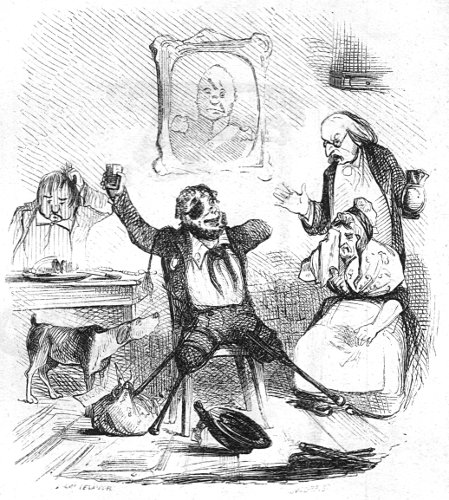
The little man is dressed something like a gunsmith,
in a green baize apron and cap; and his
face and hands are dirty with gunpowder, and
begrimed with the loading of guns. As he lies
in the light, before a glaring white target, the
black upon him shines again. Not far off, is the
strong, rough, primitive table, with a vice upon
it, at which he has been working. He is a little
man with a face all crushed together, who appears,
from a certain blue and speckled appearance
that one of his cheeks presents, to have
blown up, in the way of business, at some odd
time or times.
"Phil!" says the trooper, in a quiet voice.
"All right!" cries Phil, scrambling up.
"Any thing been doing?"
"Flat as ever so much swipes," says Phil.
"Five dozen rifle and a dozen pistol. As to
aim!" Phil gives a howl at the recollection.
"Shut up shop, Phil!"
As Phil moves about to execute this order, it
appears that he is lame, though able to move
very quickly. On the speckled side of his face
he has no eyebrow, and on the other side he has
a bushy black one, which want of uniformity
gives him a very singular and rather sinister appearance.
Every thing seems to have happened
to his hands that could possibly take place, consistently
with the retention of all the fingers; for
they are notched, and seamed, and crumpled all
over. He appears to be very strong, and lifts
heavy benches about as if he had no idea what
weight was. He has a curious way of limping
round the gallery with his shoulder against the
wall, and tacking off at objects he wants to lay
hold of, instead of going straight to them, which
has left a smear all round the four walls, conventionally
called "Phil's mark."
This custodian of George's Gallery in George's
absence concludes his proceedings, when he has
locked the great doors, and turned out all the
lights but one, which he leaves to glimmer, by
dragging out from a wooden cabin in a corner two
mattresses and bedding. These being drawn to
opposite ends of the gallery, the trooper makes
his own bed, and Phil makes his.
"Phil!" says the master, walking toward him
without his coat and waistcoat, and looking more
soldierly than ever in his braces, "You were found
in a doorway, weren't you?"
"Gutter," says Phil. "Watchman tumbled
over me."
"Then, vagabondizing came natural to you,
from the beginning."
"As nat'ral as possible," says Phil.
"Good-night!"
"Good-night, guv'ner."
Phil can not even go straight to bed, but finds
it necessary to shoulder round two sides of the
gallery, and then tack off at his mattress. The
trooper, after taking a turn or two in the rifle-distance,
and looking up at the moon, now shining
through the skylights, strides to his own mattress
by a shorter route, and goes to bed too.
Allegory looks pretty cool in Lincoln's Inn
Fields, though the evening is hot; for, both Mr.
Tulkinghorn's windows are wide open, and the
room is lofty, gusty, and gloomy. These may
not be desirable characteristics when November
comes with fog and sleet, or January with ice
and snow; but they have their merits in the sultry
long vacation weather. They enable Allegory,
though it has cheeks like peaches, and knees
like bunches of blossoms, and rosy swellings for
calves to its legs and muscles to its arms, to look
tolerably cool to-night.
Plenty of dust comes in at Mr. Tulkinghorn's
windows, and plenty more has generated among
his furniture and papers. It lies thick every
where. When a breeze from the country that has
lost its way, takes fright, and makes a blind hurry
to rush out again, it flings as much dust in the
eyes of Allegory as the law—or Mr. Tulkinghorn,
one of its trustiest representatives—may scatter,
on occasion, in the eyes of the laity.
In his lowering magazine of dust, the universal
article into which his papers and himself, and
all his clients, and all things of earth, animate
and inanimate, are resolving, Mr. Tulkinghorn
sits at one of the open windows, enjoying a bottle
of old port. For, though a hard-grained man,
close, dry, and silent, he can enjoy old wine with
the best. He has a priceless bin of port in some
artful cellar under the Fields, which is one of his
many secrets. When he dines alone in chambers,
as he has dined to-day, and has his bit of fish and
his steak or chicken brought in from the coffee-house,
he descends with a candle to the echoing
regions below the deserted mansion, and, heralded
by a remote reverberation of thundering doors,
comes gravely back, encircled by an earthly atmosphere,
and carrying a bottle from which he
pours a radiant nectar, two score and ten years
old, that blushes in the glass to find itself so
famous, and fills the whole room with the fragrance
of southern grapes.
Mr. Tulkinghorn, sitting in the twilight by the
open window, enjoys his wine. As if it whispered
to him of its fifty years of silence and seclusion,
it shuts him up the closer. More impenetrable
than ever, he sits, and drinks, and mellows
as it were in secrecy; pondering, at that twilight
hour, on all the mysteries he knows, associated
with darkening woods in the country, and vast
blank shut-up houses in town; and perhaps sparing
a thought or two for himself, and his family
history, and his money, and his will—all a mystery
to every one—and that one bachelor friend
of his, a man of the same mould, and a lawyer
too, who lived the same kind of life until he was
seventy-five years old, and then, suddenly conceiving
(as it is supposed) an impression that it
was too monotonous, gave his gold watch to his
hair-dresser one summer evening, and walked
leisurely home to the Temple, and hanged himself.
But Mr. Tulkinghorn is not alone to-night, to
ponder at his usual length. Seated at the same
table, though with his chair modestly and uncomfortably
drawn a little away from it, sits a
bald, mild, shining man, who coughs respectfully
behind his hand when the lawyer bids him fill
his glass.
"Now, Snagsby," says Mr. Tulkinghorn, "to
go over this odd story again."
"If you please, sir."
"You told me, when you were so good as to
step round here, last night—"
"For which I must ask you to excuse me if it
was a liberty, sir; but I remembered that you
had taken a sort of an interest in that person, and
I thought it possible that you might—just—wish—to—"
Mr. Tulkinghorn is not the man to help him to
any conclusion, or to admit any thing as to any
possibility concerning himself. So Mr. Snagsby
trails off into saying, with an awkward cough,
"I must ask you to excuse the liberty, sir, I am
sure."
"Not at all," says Mr. Tulkinghorn. "You
told me, Snagsby, that you put on your hat and
came round without mentioning your intention to
your wife. That was prudent, I think, because
it's not a matter of such importance that it requires
to be mentioned."
"Well, sir," returns Mr. Snagsby, "you see my
little woman is—not to put too fine a point upon
it—inquisitive. She's inquisitive. Poor little
thing, she's liable to spasms, and it's good for
her to have her mind employed. In consequence
of which, she employs it—I should say
upon every individual thing she can lay hold of,
whether it concerns her or not—especially not.
My little woman has a very active mind, sir."
Mr. Snagsby drinks, and murmurs with an admiring
cough behind his hand. "Dear me, very
fine wine indeed!"
"Therefore you kept your visit to yourself, last
night?" says Mr. Tulkinghorn. "And to-night,
too?"
"Yes, sir, and to-night, too. My little woman
is at present in—not to put too fine a point upon
it—in a pious state, or in what she considers such,
and attends the Evening Exertions (which is the
name they go by) of a reverend party of the name
of Chadband. He has a great deal of eloquence
at his command, undoubtedly, but I am not quite
favorable to his style myself. That's neither here
nor there. My little woman being engaged in
that way, made it easier for me to step round in
a quiet manner."
Mr. Tulkinghorn assents. "Fill your glass,
Snagsby."
"Thank you, sir, I am sure," returns the stationer,
with his cough of deference. "This is
wonderfully fine wine, sir!"
"It is a rare wine now," says Mr. Tulkinghorn.
"It is fifty years old."
"Is it indeed, sir? But I am not surprised to
hear it, I am sure. It might be—any age almost."
After rendering this general tribute to
the port, Mr. Snagsby in his modesty coughs an
apology behind his hand for drinking any thing
so precious.
"Will you run over, once again, what the boy
said?" asks Mr. Tulkinghorn, putting his hands
into the pockets of his rusty smallclothes, and
leaning quietly back in his chair.
"With pleasure, sir."
Then, with fidelity, though with some prolixity,
the law stationer repeats Joe's statement made
to the assembled guests at his house. On coming
to the end of his narrative, he gives a great
start, and breaks off with—"Dear me, sir, I
wasn't aware there was any other gentleman
present!"
Mr. Snagsby is dismayed to see, standing with
an attentive face between himself and the lawyer,
at a little distance from the table, a person
with a hat and stick in his hand, who was not
there when he himself came in, and has not since
entered by the door or by either of the windows.
There is a press in the room, but its hinges have
not creaked, nor has a step been audible upon the
floor. Yet this third person stands there, with
his attentive face, and his hat and stick in his
hands, and his hands behind him, a composed
and quiet listener. He is a steady-looking, sharp-eyed
man in black, of about the middle age. Except
that he looks at Mr. Snagsby as if he were
going to take his portrait, there is nothing remarkable
about him at first sight but his ghostly
manner of appearing.
"Don't mind this gentleman," says Mr. Tulkinghorn,
in his quiet way. "This is only Mr.
Bucket."
"O indeed, sir?" returns the stationer, expressing
by a cough that he is quite in the dark as to
who Mr. Bucket may be.
"I wanted him to hear this story," says the
lawyer, "because I have half a mind (for a reason)
to know more of it, and he is very intelligent
in such things. What do you say to this, Bucket?"
"It's very plain, sir. Since our people have
moved this boy on, and he's not to be found on
his old lay, if Mr. Snagsby don't object to go
down with me to Tom-all-Alone's and point
him out, we can have him here in less than a
couple of hours' time. I can do it without Mr.
Snagsby, of course; but this is the shortest
way."
"Mr. Bucket is a detective officer, Snagsby,"
says the lawyer in explanation.
"Is he indeed, sir?" says Mr. Snagsby, with a
strong tendency in his clump of hair to stand on
end.
"And if you have no real objection to accompany
Mr. Bucket to the place in question," pursues
the lawyer, "I shall feel obliged to you if
you will do so."
In a moment's hesitation on the part of Mr.
Snagsby, Bucket dips down to the bottom of his
mind.
"Don't you be afraid of hurting the boy," he
says. "You won't do that. It's all right as far
as the boy's concerned. We shall only bring him
here to ask him a question or so I want to put to
him, and he'll be paid for his trouble, and sent
away again. It'll be a good job for him. I promise
you, as a man, that you shall see the boy sent
away all right. Don't you be afraid of hurting
him; you an't going to do that."
"Very well, Mr. Tulkinghorn!" cries Mr. Snagsby,
cheerfully, and reassured, "since that's the
case—"
"Yes! and lookee here, Mr. Snagsby," resumes
Bucket, taking him aside by the arm, tapping
him familiarly on the breast, and speaking in a
confidential tone. "You're a man of the world,
you know, and a man of business, and a man of
sense. That's what you are."
"I am sure I am much obliged to you for your
good opinion," returns the stationer, with his
cough of modesty, "but—"
"That's what you are, you know," says Bucket.
"Now it an't necessary to say to a man like
you, engaged in your business, which is a business
of trust, and requires a person to be wide awake
and have his senses about him, and his head
screwed on right (I had an uncle in your business
once)—it an't necessary to say to a man like
you, that it's the best and wisest way to keep
little matters like this quiet. Don't you see?
Quiet!"
"Certainly, certainly," returns the stationer.
"I don't mind telling you," says Bucket, with
an engaging appearance of frankness, "that, as
far as I can understand it, there seems to be a
doubt whether this dead person wasn't entitled
to a little property, and whether this female
hasn't been up to some games respecting that
property, don't you see!"
"O!" says Mr. Snagsby, but not appearing to
see quite distinctly.
"Now, what you want," pursues Bucket, again
tapping Mr. Snagsby on the breast in a comfortable
and soothing manner, "is, that every person
should have their rights according to justice.
That's what you want."
"To be sure," returns Mr. Snagsby, with a
nod.
"On account of which, and at the same time
to oblige a—do you call it, in your business, customer
or client? I forget how my uncle used to
call it."
"Why, I generally say customer, myself," replies
Mr. Snagsby.
"You're right!" returns Mr. Bucket, shaking
hands with him quite affectionately—"on account
of which, and at the same time to oblige a real
good customer, you mean to go down with me,
in confidence, to Tom-all-Alone's, and to keep the
whole thing quiet ever afterward and never mention
it to any one. That's about your intentions,
if I understand you?"
"You are right, sir. You are right," says Mr.
Snagsby.
"Then here's your hat," returns his new friend,
quite as intimate with it as if he had made it;
"and if you're ready, I am."
They leave Mr. Tulkinghorn, without a ruffle
on the surface of his unfathomable depths, drinking
his old wine; and go down into the streets.
"You don't happen to know a very good sort of
person of the name of Gridley, do you?" says Bucket,
in friendly converse as they descend the stairs.
"No," says Mr. Snagsby, considering, "I don't
know any body of that name. Why?"
"Nothing particular," says Bucket; "only,
having allowed his temper to get a little the better
of him, and having been threatening some respectable
people, he is keeping out of the way of
a warrant I have got against him—which it's a
pity that a man of sense should do."
As they walk along, Mr. Snagsby observes, as
a novelty, that however quick their pace may be,
his companion still seems in some undefinable
manner to lurk and lounge; also, that whenever
he is going to turn to the right or left, he pretends
to have a fixed purpose in his mind of going
straight ahead, and wheels off, sharply, at the
very last moment. Now and then, when they
pass a police constable on his beat, Mr. Snagsby
notices that both the constable and his guide fall
into a deep abstraction as they come toward
each other, and appear entirely to overlook each
other, and to gaze into space. In a few instances
Mr. Bucket, coming behind some under-sized
young man with a shining hat on, and his sleek
hair twisted into one flat curl on each side of his
head, almost without glancing at him touches
him with his stick; upon which the young man,
looking round, instantly evaporates. For the
most part Mr. Bucket notices things in general,
with a face as unchanging as the great mourning
ring on his little finger, or the brooch, composed
of not much diamond and a good deal of setting,
which he wears in his shirt.
When they come at last to Tom-all-Alone's,
Mr. Bucket stops for a moment at the corner, and
takes a lighted bull's-eye from the constable on
duty there, who then accompanies him with his
own particular bull's-eye at his waist. Between
his two conductors, Mr. Snagsby passes along the
middle of a villainous street, undrained, unventilated,
deep in black mud and corrupt water—though
the roads are dry elsewhere—and reeking
with such smells and sights that he, who has
lived in London all his life, can scarce believe his
senses. Branching from this street and its heaps
of ruins, are other streets and courts so infamous
that Mr. Snagsby sickens in body and mind, and
feels as if he were going, every moment deeper
down, into the infernal gulf.
"Draw off a bit here, Mr. Snagsby," says
Bucket, as a kind of shabby palanquin is borne
toward them, surrounded by a noisy crowd.
"Here's the fever coming up the street."
As the unseen wretch goes by, the crowd, leaving
that object of attraction, hovers round the
three visitors, like a dream of horrible faces, and
fades away up alleys and into ruins, and behind
walls; and with occasional cries and shrill whistles
of warning, thenceforth flits about them until
they leave the place.
"Are those the fever-houses, Darby?" Mr
Bucket coolly asks, as he turns his bull's-eye on
a line of stinking ruins.
Darby replies that "all them are," and further
that in all, for months and months, the people
"have been down by dozens," and have been
carried out, dead and dying "like sheep with the
rot." Bucket observing to Mr. Snagsby as they
go on again, that he looks a little poorly, Mr.
Snagsby answers that he feels as if he couldn't
breathe the dreadful air.
There is inquiry made, at various houses, for
a boy named Jo. As few people are known in
Tom-all-Alone's by any Christian sign, there is
much reference to Mr. Snagsby whether he means
Carrots, or the Colonel, or Gallows, or Young
Chisel, or Terrier Tip, or Lanky, or the Brick.
Mr. Snagsby describes over and over again. There
are conflicting opinions respecting the original of
his picture. Some think it must be Carrots; some
say the Brick. The Colonel is produced, but is
not at all near the thing. Whenever Mr. Snagsby
and his conductors are stationary, the crowd flows
round, and from its squalid depths obsequious advice
heaves up to Mr. Bucket. Whenever they
move, and the angry bull's-eyes glare, it fades
away, and flits about them up the alleys, and in
the ruins, and behind the walls, as before.
At last there is a lair found out where Toughy,
or the Tough Subject, lays him down at night;
and it is thought that the Tough Subject may be
Jo. Comparison of notes between Mr. Snagsby
and the proprietress of the house—a drunken, fiery
face tied up in a black bundle, and flaring out of
a heap of rags on the floor of a dog-hutch, which
is her private apartment—leads to the establishment
of this conclusion. Toughy has gone to the
Doctor's to get a bottle of stuff for a sick woman,
but will be here anon.
"And who have we got here to-night?" says
Mr. Bucket, opening another door, and glaring in
with his bull's-eye. "Two drunken men, eh?
And two women? The men are sound enough,"
turning back each sleeper's arm from his face to
look at him. "Are these your good men, my
dears?"
"Yes, sir," returns one of the women. "They
are our husbands."
"Brickmakers, eh?"
"Yes, sir."
"What are you doing here? You don't belong
to London."
"No, sir. We belong to Hertfordshire."
"Whereabouts in Hertfordshire?"
"Saint Albans."
"Come up on the tramp?"
"We walked up yesterday. There's no work
down with us at present; but we have done
no good by coming here, and shall do none, I
expect."
"That's not the way to do much good," says
Mr. Bucket, turning his head in the direction of
the unconscious figures on the ground.
"It an't, indeed," replies the woman with a
sigh. "Jenny and me knows it full well."
The room, though two or three feet higher than
the door, is so low that the head of the tallest of
the visitors would touch the blackened ceiling if
he stood upright. It is offensive to every sense;
even the gross candle burns pale and sickly in the
polluted air. There are a couple of benches, and
a higher bench by way of table. The men lie
asleep where they stumbled down, but the women
sit by the candle. Lying in the arms of the woman
who has spoken, is a very young child.
"Why, what age do you call that little creature?"
says Bucket. "It looks as if it was born
yesterday." He is not at all rough about it; and
as he turns his light gently on the infant, Mr.
Snagsby is strangely reminded of another infant,
encircled with light, that he has seen in pictures.
"He is not three weeks old yet, sir," says the
woman.
"Is he your child?"
"Mine."
The other woman, who was bending over it
when they came in, stoops down again, and
kisses it as it lies asleep.
"You seem as fond of it as if you were the
mother yourself," says Mr. Bucket.
"I was the mother of one like it, master, and
it died."
"Ah Jenny, Jenny!" says the other woman
to her; "better so. Much better to think of
dead than alive, Jenny! Much better!"
"Why, you an't such an unnatural woman, I
hope," returns Bucket, sternly, "as to wish your
own child dead?"
"God knows you are right, master," she returns.
"I am not. I'd stand between it and
death, with my own life if I could, as true as any
pretty lady."
"Then don't talk in that wrong manner," says
Mr. Bucket, mollified again. "Why do you do
it?"
"It's brought into my head, master," returns
the woman, her eyes filling with tears, "when I
look down at the child lying so. If it was never
to wake no more, you'd think me mad, I should
take on so. I know that very well. I was with
Jenny when she lost hers—warn't I Jenny?—and
I know how she grieved. But look round
you, at this place. Look at them;" glancing at
the sleepers on the ground. "Look at the boy
you're waiting for, who's gone out to do me a
good turn. Think of the children that your business
lays with often and often, and that you see
grow up!"
"Well, well," says Mr. Bucket, "you train
him respectable, and he'll be a comfort to you,
and look after you in your old age, you know."
"I mean to try hard," she answers, wiping
her eyes. "But I have been a thinking, being
over-tired to-night, and not well with the ague,
of all the many things that'll come in his way.
My master will be against it, and he'll be beat,
and see me beat, and made to fear his home, and
perhaps to stray wild. If I work for him ever so
much, and ever so hard, there's no one to help
me; and if he should be turned bad, 'spite of all I
could do, and the time should come when I should
sit by him in his sleep, made hard and changed,
an't it likely I should think of him as he lies in
my lap now, and wish he had died as Jenny's
child died."
"There, there!" says Jenny. "Liz, you're
tired and ill. Let me take him."
In doing so she displaces the mother's dress,
but quickly readjusts it over the wounded and
bruised bosom where the baby has been lying.
"It's my dead child," says Jenny, walking up
and down as she nurses, "that makes me love
this child so dear, and it's my dead child that
makes her love it so dear too, as even to think of
its being taken away from her now. While she
thinks that, I think what fortune would I give to
have my darling back. But we mean the same
thing, if we knew how to say it, us two mothers
does in our poor hearts!"
As Mr. Snagsby blows his nose, and coughs
his cough of sympathy, a step is heard without.
Mr. Bucket throws his light into the doorway, and
says to Mr. Snagsby, "Now, what do you say to
Toughy? Will he do?"
"That's Jo!" says Mr. Snagsby.
Jo stands amazed in the disc of light, like a
ragged figure in a magic lantern, trembling to
think that he has offended against the law in
not having moved on far enough. Mr. Snagsby,
however, giving him the consolatory assurance,
"It's only a job you will be paid for, Jo," he
recovers; and, on being taken outside by Mr.
Bucket for a little private confabulation, tells his
tale satisfactorily, though out of breath.
"I have squared it with the lad," says Mr.
Bucket, returning, "and it's all right. Now,
Mr. Snagsby, we're ready for you."
First, Jo has to complete his errand of good-nature
by handing over the physic he has been to
get, which he delivers with the laconic verbal
direction that "it's to be all took d'rectly." Secondly
Mr. Snagsby has to lay upon the table half-a-crown,
his usual panacea for an immense variety
of afflictions. Thirdly, Mr. Bucket has to take
Jo by the arm a little above the elbow and walk
him on before him: without which observance,
neither the Tough Subject nor any other subject
could be professionally conducted to Lincoln's Inn
Fields. These arrangements completed, they
give the women good-night, and come out once
more into black and foul Tom-all-Alone's.
By the noisome ways through which they descended
into that pit, they gradually emerge from
it; the crowd flitting, and whistling, and skulking
about them, until they come to the verge,
where restoration of the bull's-eyes is made to
Darby. Here the crowd, like a concourse of imprisoned
demons turns back, yelling and is seen
no more. Through the clearer and fresher
streets, never so clear and fresh to Mr. Snagsby's
mind as now, they walk and ride, until they come
to Mr. Tulkinghorn's gate.
As they ascend the dim stairs (Mr. Tulkinghorn's
chambers being on the first floor), Mr.
Bucket mentions that he has the key of the outer
door in his pocket, and that there is no need to
ring. For a man so expert in most things of
that kind, Bucket takes time to open the door,
and makes some noise too. It may be that he
sounds a note of preparation.
Howbeit, they come at last into the hall, where
a lamp is burning, and so into Mr. Tulkinghorn's
usual room—the room where he drank his old
wine to-night. He is not there, but his two
old-fashioned candlesticks are; and the room is
tolerably light.
Mr. Bucket, still having his professional hold
of Jo, and appearing to Mr. Snagsby to possess
an unlimited number of eyes, makes a little way
into this room, when Jo starts, and stops.
"What's the matter?" says Bucket in a whisper.
"There she is!" cries Jo.
"Who?"
"The lady!"
A female figure, closely vailed, stands in the
middle of the room, where the light falls upon it.
It is quite still, and silent. The front of the figure
is toward them, but it takes no notice of their
entrance, and remains like a statue.
"Now, tell me," says Bucket aloud, "how you
know that to be the lady."
"I know the wale," replies Jo, staring, "and
the bonnet, and the gownd."
"Be quite sure of what you say, Tough," returns
Bucket, narrowly observant of him. "Look
again."
"I am a-looking as hard as ever I can look,"
says Jo, with starting eyes, "and that there's the
wale, the bonnet, and the gownd."
"What about those rings you told me of?"
asks Bucket.
"A sparkling all over here," says Jo, rubbing
the fingers of his left hand on the knuckles of his
right, without taking his eyes from the figure.
The figure removes the right hand glove, and
shows the hand.
"Now, what do you say to that?" asks Bucket.
Jo shakes his head. "Not rings a bit like
them. Not a hand like that."
"What are you talking of?" says Bucket;
evidently pleased though, and well pleased too.
"Hand was a deal whiter, a deal delicater, and
a deal smaller," returns Jo.
"Why, you'll tell me I'm my own mother,
next," says Mr. Bucket. "Do you recollect the
lady's voice?"
"I think I does?" says Jo.
The figure speaks. "Was it at all like this.
I will speak as long as you like if you are not
sure. Was it this voice, or at all like this voice?"
Jo looks aghast at Mr. Bucket. "Not a
bit!"
"Then, what," retorts that worthy, pointing
to the figure, "did you say it was the lady for?"
"Cos," says Jo, with a perplexed stare, but
without being at all shaken in his certainty, "Cos
that there's the wale, the bonnet, and the gownd.
It is her and it an't her. It an't her hand, nor
yet her rings, nor yet her woice. But that there's
the wale, the bonnet, and the gownd, and they're
wore the same way wot she wore 'em, and its
her height wot she wos, and she give me a sov'ring
and hooked it."
"Well!" says Mr. Bucket, slightly, "we haven't
got much good out of you. But, however, here's
five shillings for you. Take care how you spend
it, and don't get yourself into trouble." Bucket
stealthily tells the coins from one hand into the
other like counters—which is a way he has, his
principal use of them being in these games of
skill—and then puts them, in a little pile, into
the boy's hand, and takes him out to the door;
leaving Mr. Snagsby, not by any means comfortable
under these mysterious circumstances, alone
with the vailed figure. But on Mr. Tulkinghorn's
coming into the room, the vail is raised, and a
sufficiently good-looking Frenchwoman is revealed,
though her expression is something of the
intensest.
"Thank you, Mademoiselle Hortense," says
Mr. Tulkinghorn, with his usual equanimity.
"I will give you no further trouble about this
little wager."
"You will do me the kindness to remember, sir,
that I am not at present placed?" said Mademoiselle.
"Certainly, certainly!"
"And to confer upon me the favor of your distinguished
recommendation?"
"By all means, Mademoiselle Hortense."
"A word from Mr. Tulkinghorn is so powerful."—"It
shall not be wanting, Mademoiselle."—"Receive
the assurance of my devoted gratitude
dear sir."—"Good-night." Mademoiselle goes
out with an air of native gentility; and Mr.
Bucket, to whom it is, on an emergency, as
natural to be groom of the ceremonies as it is to
be any thing else, shows her down stairs, not
without gallantry.
"Well, Bucket?" quoth Mr. Tulkinghorn on
his return.
"It's all squared, you see, as I squared it myself,
sir. There an't a doubt that it was the
other one with this one's dress on. The boy was
exact respecting colors and every thing. Mr.
Snagsby, I promised you, as a man, that he should
be sent away all right. Don't say it wasn't
done!"
"You have kept your word, sir," returns the
stationer; "and if I can be of no further use,
Mr. Tulkinghorn, I think, as my little woman
will be getting anxious—"
"Thank you, Snagsby, no further use," says
Mr. Tulkinghorn. "I am quite indebted to you
for the trouble you have taken already."
"Not at all, sir. I wish you good-night."
"You see, Mr. Snagsby," says Mr. Bucket,
accompanying him to the door, and shaking hands
with him over and over again, "what I like in
you, is, that you're a man it's of no use pumping;
that's what you are. When you know you
have done a right thing, you put it away, and
it's done with and gone, and there's an end of it.
That's what you do."
"That is certainly what I endeavor to do, sir,"
returns Mr. Snagsby.
"No, you don't do yourself justice. It an't
what you endeavor to do," says Mr. Bucket,
shaking hands with him and blessing him in the
tenderest manner, "it's what you do. That's
what I estimate in a man in your way of business."
Mr. Snagsby makes a suitable response; and
goes homeward so confused by the events of the
evening, that he is doubtful of his being awake
and out—doubtful of the reality of the streets
through which he goes—doubtful of the reality
of the moon that shines above him. He is presently
reassured on these subjects, by the unchallengeable
reality of Mrs. Snagsby, sitting up
with her head in a perfect beehive of curl-papers
and nightcap; who has dispatched Guster to the
police station with official intelligence of her
husband's being made away with, and who, within
the last two hours, has passed through every
stage of swooning with the greatest decorum.
But, as the little woman feelingly says, many
thanks she gets for it!