[Continued from the August Number]
CHAPTER XIII.
Leonard and Helen settled themselves in two little chambers in a small
lane. The neighborhood was dull enough—the accommodation humble; but
their landlady had a smile. That was the reason, perhaps, why Helen
chose the lodgings: a smile is not always found on the face of a
landlady when the lodger is poor. And out of their windows they caught
sight of a green tree, an elm, that grew up fair and tall in a
carpenter's yard at the rear. That tree was like another smile to the
place. They saw the birds come and go to its shelter; and they even
heard, when a breeze arose, the pleasant murmur of its boughs.
Leonard went the same evening to Captain Digby's old lodgings, but he
could learn there no intelligence of friends or protectors for Helen.
The people were rude and surly, and said that the Captain still owed
them £1 17s. The claim, however, seemed very disputable, and was
stoutly denied by Helen. The next morning Leonard set off in search of
Dr. Morgan. He thought his best plan was to inquire the address of the
Doctor at the nearest chemist's, and the chemist civilly looked into the
Court Guide, and referred him to a house in Bulstrode-street,
Manchester-square. To this street Leonard contrived to find his way,
much marveling at the meanness of London: Screwstown seemed to him the
handsomer town of the two.
A shabby man-servant opened the door, and Leonard remarked that the
narrow passage was choked with boxes, trunks, and various articles of
furniture. He was shown into a small room, containing a very large round
table, whereon were sundry works on homeopathy, Parry's Cymbrian
Plutarch, Davies' Celtic Researches, and a Sunday newspaper. An
engraved portrait of the illustrious Hahnemann occupied the place of
honor over the chimney-piece. In a few minutes the door to an inner room
opened, and Dr. Morgan appeared, and said politely, "Come in sir."
The Doctor seated himself at a desk, looked hastily at Leonard, and then
at a great chronometer lying on the table. "My time's short, sir—going
abroad; and now that I am going, patients flock to me. Too late. London
will repent its apathy. Let it!"
The Doctor paused majestically, and, not remarking on Leonard's face
the consternation he had anticipated, he repeated peevishly—"I am going
abroad, sir, but I will make a synopsis of your case, and leave it to my
successor. Hum! Hair chestnut; eyes—what color? Look this way—blue,
dark blue. Hem! Constitution nervous. What are the symptoms?"
"Sir," began Leonard, "a little girl—"
Dr. Morgan (impatiently).—"Little girl! Never mind the history
of your sufferings; stick to the symptoms—stick to the symptoms."
Leonard.—"You mistake me, Doctor; I have nothing the matter
with me. A little girl—"
Dr. Morgan.—"Girl again! I understand! it is she who is ill.
Shall I go to her? She must describe her own symptoms—I can't judge from
your talk. You'll be telling me she has consumption, or dyspepsia, or some
such disease that don't exist: mere allopathic inventions—symptoms, sir,
symptoms."
Leonard (forcing his way).—"You attended her poor father,
Captain Digby, when he was taken ill in the coach with you. He is dead,
and his child is an orphan."
Dr. Morgan (fumbling in his medical pocket-book).—"Orphan!
nothing for orphans, especially if inconsolable, like aconite and
chamomilla."[5]
With some difficulty Leonard succeeded in bringing Helen to the
recollection of the homeopathist, stating how he came in charge of her,
and why he sought Dr. Morgan.
The Doctor was much moved.
"But really," said he, after a pause, "I don't see how I can help the
poor child. I know nothing of her relations. This Lord Les—whatever his
name is—I know of no lords in London. I knew lords, and physicked them,
too, when I was a blundering allopathist. There was the Earl of
Lansmere—has had many a blue pill from me, sinner that I was. His son
was wiser; never would take physic. Very clever boy was Lord
L'Estrange—I don't know if he was as good as he was clever—"
"Lord L'Estrange!—that name begins with Les—"
"Stuff! He's always abroad—shows his sense. I'm going abroad too. No
development for science in this horrid city; full of prejudices, sir,
and given up to the most barbarous allopathical and phlebotomical
propensities. I am going to the land of Hahnemann, sir—sold my
good-will, lease, and furniture, and have bought in on the Rhine.
Natural life there, sir—homeopathy needs nature: dine at one o'clock,
get up at four—tea little known, and science appreciated. But I forget.
Cott! what can I do for the orphan?"
"Well, sir," said Leonard rising, "Heaven will give me strength to
support her."
The Doctor looked at the young man attentively. "And yet," said he, in a
gentler voice, "you, young man, are, by your account, a perfect
stranger to her, or were so when you undertook to bring her to London.
You have a good heart—always keep it. Very healthy thing, sir, a good
heart—that is, when not carried to excess. But you have friends of your
own in town?"
Leonard.—"Not yet, sir; I hope to make them."
Doctor.—"Pless me, you do? How?—I can't make any."
Leonard colored and hung his head. He longed to say, "Authors find
friends in their readers—I am going to be an author." But he felt that
the reply would savor of presumption, and held his tongue.
The Doctor continued to examine him, and with friendly interest. "You
say you walked up to London—was that from choice or economy?"
Leonard.—"Both, sir."
Doctor.—"Sit down again, and let us talk I can give you a
quarter of an hour, and I'll see if I can help either of you, provided
you tell me all the symptoms—I mean all the particulars."
Then, with that peculiar adroitness which belongs to experience in the
medical profession, Dr. Morgan, who was really an acute and able man,
proceeded to put his questions, and soon extracted from Leonard the
boy's history and hopes. But when the Doctor, in admiration at a
simplicity which contrasted so evident an intelligence, finally asked
him his name and connections, and Leonard told them, the homeopathist
actually started. "Leonard Fairfield, grandson of my old friend, John
Avenel of Lansmere! I must shake you by the hand. Brought up by Mrs.
Fairfield! Ah, now I look, strong family likeness—very strong!"
The tears stood in the Doctor's eyes. "Poor Nora!" said he.
"Nora! Did you know my aunt?"
"Your aunt! Ah—ah! yes—yes! Poor Nora! she died almost in these
arms—so young, so beautiful. I remember it as if yesterday."
The Doctor brushed his hand across his eyes, and swallowed a globule;
and, before the boy knew what he was about, had in his benevolence
thrust another between Leonard's quivering lips.
A knock was heard at the door.
"Ha! that's my great patient," cried the Doctor, recovering his
self-possession—"must see him. A chronic case—excellent patient—tic,
sir, tic. Puzzling and interesting. If I could take that tic with me, I
should ask nothing more from Heaven. Call again on Monday; I may have
something to tell you then as to yourself. The little girl can't stay
with you—wrong and nonsensical. I will see after her. Leave me your
address—write it here. I think I know a lady who will take charge of
her. Good-by. Monday next, ten o'clock."
With this, the Doctor thrust out Leonard, and ushered in his grand
patient, whom he was very anxious to take with him to the banks of the
Rhine.
Leonard had now only to discover the nobleman whose name had been so
vaguely uttered by poor Captain Digby. He had again recourse to the
Court Guide; and finding the address of two or three lords the first
syllable of whose titles seemed similar to that repeated to him, and all
living pretty near to each other, in the regions of May Fair, he
ascertained his way to that quarter, and, exercising his mother-wit,
inquired at the neighboring shops as to the personal appearance of these
noblemen. Out of consideration for his rusticity, he got very civil and
clear answers; but none of the lords in question corresponded with the
description given by Helen. One was old, another was exceedingly
corpulent, a third was bed-ridden—none of them was known to keep a
great dog. It is needless to say that the name of L'Estrange (no
habitant of London) was not in the Court Guide. And Dr. Morgan's
assertion that that person was always abroad unluckily dismissed from
Leonard's mind the name the homeopathist had so casually mentioned. But
Helen was not disappointed when her young protector returned late in the
day, and told her of his ill success. Poor child! she was so pleased in
her heart not to be separated from her new brother; and Leonard was
touched to see how she had contrived, in his absence, to give a certain
comfort and cheerful grace to the bare room devoted to himself. She had
arranged his few books and papers so neatly, near the window, in sight
of the one green elm. She had coaxed the smiling landlady out of one or
two extra articles of furniture, especially a walnut-tree bureau, and
some odds and ends of ribbon—with which last she had looped up the
curtains. Even the old rush-bottom chairs had a strange air of elegance,
from the mode in which they were placed. The fairies had given sweet
Helen the art that adorns a home, and brings out a smile from the
dingiest corner of hut and attic.
Leonard wondered and praised. He kissed his blushing ministrant
gratefully, and they sate down in joy to their abstemious meal; when
suddenly his face was overclouded—there shot through him the
remembrance of Dr. Morgan's words—"The little girl can't stay with
you—wrong and nonsensical. I think I know a lady who will take charge
of her."
"Ah," cried Leonard, sorrowfully, "how could I forget?" And he told
Helen what grieved him. Helen at first exclaimed that "she would not
go." Leonard, rejoiced, then began to talk as usual of his great
prospects; and, hastily finishing his meal, as if there were no time to
lose, sat down at once to his papers. Then Helen contemplated him sadly,
as he bent over his delighted work. And when, lifting his radiant eyes
from his MS., he exclaimed, "No, no, you shall not go. This must
succeed—and we shall live together in some pretty cottage, where we can
see more than one tree"—then Helen sighed, and did not answer this
time, "No, I will not go."
Shortly after she stole from the room, and into her own; and there,
kneeling down, she prayed, and her prayer was somewhat this—"Guard me
against my own selfish heart: may I never be a burden to him who has
shielded me."
Perhaps, as the Creator looks down on this world, whose wondrous beauty
beams on us more and more, in proportion as our science would take it
from poetry into law—perhaps He beholds nothing so beautiful as the
pure heart of a simple loving child.
CHAPTER XIV.
Leonard went out the next day with his precious MSS. He had read
sufficient of modern literature to know the names of the principal
London publishers; and to these he took his way with a bold step, though
a beating heart.
That day he was out longer than the last; and when he returned, and came
into the little room, Helen uttered a cry, for she scarcely recognized
him. There was on his face so deep, so silent, and so concentrated a
despondency. He sate down listlessly, and did not kiss her this time, as
she stole toward him. He felt so humbled. He was a king deposed. He
take charge of another life! He!
She coaxed him at last into communicating his day's chronicle. The
reader beforehand knows too well what it must be, to need detailed
repetition. Most of the publishers had absolutely refused to look at his
MSS.; one or two had good-naturedly glanced over and returned them at
once, with a civil word or two of flat rejection. One publisher
alone—himself a man of letters, and who in youth had gone through the
same bitter process of dis-illusion that now awaited the village
genius—volunteered some kindly though stern explanation and counsel to
the unhappy boy. This gentleman read a portion of Leonard's principal
poem with attention, and even with frank admiration. He could appreciate
the rare promise that it manifested. He sympathized with the boy's
history, and even with his hopes; and then he said, in bidding him
farewell—
"If I publish this poem for you, speaking as a trader, I shall be a
considerable loser. Did I publish all I admire, out of sympathy with the
author, I should be a ruined man. But suppose that, impressed as I
really am with the evidence of no common poetic gifts in this MS., I
publish it, not as a trader, but a lover of literature, I shall in
reality, I fear, render you a great disservice, and perhaps unfit your
whole life for the exertions on which you must rely for independence."
"How, sir?" cried Leonard. "Not that I would ask you to injure yourself
for me," he added, with proud tears in his eyes.
"How, my young friend? I will explain. There is enough talent in these
verses to induce very flattering reviews in some of the literary
journals. You will read these, find yourself proclaimed a poet, will
cry, 'I am on the road to fame.' You will come to me, 'And my poem, how
does it sell?' I shall point to some groaning shelf, and say, 'Not
twenty copies!' The journals may praise, but the public will not buy it.
'But you will have got a name,' you say. Yes, a name as a poet just
sufficiently known to make every man in practical business disinclined
to give fair trial to your talents in a single department of positive
life; none like to employ poets; a name that will not put a penny in
your purse—worse still, that will operate as a barrier against every
escape into the ways whereby men get to fortune. But, having once tasted
praise, you will continue to sigh for it: you will perhaps never again
get a publisher to bring forth a poem, but you will hanker round the
purlieus of the Muses, scribble for periodicals, fall at last into a
bookseller's drudge. Profits will be so precarious and uncertain, that
to avoid debt may be impossible; then, you who now seem so ingenuous and
so proud, will sink deeper still into the literary mendicant—begging,
borrowing—"
"Never—never—never!" cried Leonard, vailing his face with his hands.
"Such would have been my career," continued the publisher. "But I
luckily had a rich relative, a trader, whose calling I despised as a
boy, who kindly forgave my folly, bound me as an apprentice, and here I
am; and now I can afford to write books as well as sell them. Young man,
you must have respectable relations—go by their advice and counsel;
cling fast to some positive calling. Be any thing in this city rather
than poet by profession."
"And how, sir, have there ever been poets? Had they other callings?"
"Read their biography, and then envy them!"
Leonard was silent a moment; but, lifting his head, answered loud and
quickly, "I have read their biography. True, their lot
poverty—perhaps hunger. Sir, I envy them!"
"Poverty and hunger are small evils," answered the bookseller, with a
grave, kind smile. "There are worse—debt and degradation,
and—despair."
"No, sir, no—you exaggerate; these last are not the lot of all poets."
"Right, for most of our greatest poets had some private means of their
own. And for others, why, all who have put into a lottery have not drawn
blanks. But who could advise another man to set his whole hope of
fortune on the chance of a prize in a lottery? And such a lottery!"
groaned the publisher, glancing toward sheets and reams of dead authors
lying like lead upon his shelves.
Leonard clutched his MSS. to his heart, and hurried away.
"Yes," he muttered, as Helen clung to him and tried to console—"yes,
you were right: London is very vast, very strong, and very cruel," and
his head sank lower and lower yet upon his bosom.
The door was flung widely open, and in, unannounced, walked Dr. Morgan.
The child turned to him, and at the sight of his face she remembered her
father; and the tears that, for Leonard's sake, she had been trying to
suppress, found way.
The good Doctor soon gained all the confidence of these two young
hearts. And after listening to Leonard's story of his paradise lost in a
day, he patted him on the shoulder, and said: "Well, you will call on me
on Monday, and we will see. Meanwhile, borrow these of me," and he tried
to slip three sovereigns into the boy's hands. Leonard was indignant.
The bookseller's warning flashed on him. Mendicancy! Oh, no, he had not
yet come to that! He was almost rude and savage in his rejection; and
the Doctor did not like him the less for it.
"You are an obstinate mule," said the homeopathist, reluctantly putting
up his sovereigns. "Will you work at something practical and prosy, and
let the poetry rest awhile?"
"Yes," said Leonard, doggedly, "I will work."
"Very well, then, I know an honest bookseller, and he shall give you
some employment; and meanwhile, at all events, you will be among books,
and that will be some comfort."
Leonard's eyes brightened—"A great comfort, sir." He pressed the hand
he had before put aside, to his grateful heart.
"But," resumed the Doctor, seriously, "you really feel a strong
predisposition to make verses?"
"I did, sir."
"Very bad symptom, indeed, and must be stopped before a relapse! Here, I
have cured three prophets and ten poets with this novel specific."
While thus speaking, he had got out his book and a globule. "Agaricus
muscarius dissolved in a tumbler of distilled water—tea-spoonful
whenever the fit comes on. Sir, it would have cured Milton himself."
"And now for you, my child," turning to Helen; "I have found a lady who
will be very kind to you. Not a menial situation. She wants some one to
read to her, and tend on her—she is old and has no children. She wants
a companion, and prefers a girl of your age to one older. Will this suit
you?"
Leonard walked away.
Helen got close to the Doctor's ear, and whispered, "No, I can not leave
him now—he is so sad."
"Cott!" grunted the Doctor, "you two must have been reading Paul and
Virginia. If I could but stay in England, I would try what ignatia
would do in this case—interesting experiment! Listen to me—little
girl, and go out of the room, you, sir."
Leonard, averting his face, obeyed. Helen made an involuntary step after
him—the Doctor detained and drew her on his knee.
"What's your Christian name?—I forget."
"Helen."
"Helen, listen, in a year or two you will be a young woman, and it
would be very wrong then to live alone with that young man. Meanwhile,
you have no right to cripple all his energies. He must not have you
leaning on his right arm—you would weigh it down. I am going away, and
when I am gone there will be no one to help you, if you reject the
friend I offer you. Do as I tell you, for a little girl so peculiarly
susceptible (a thorough pulsatilla constitution) can not be obstinate
and egotistical."
"Let me see him cared for and happy, sir," said she, firmly, "and I will
go where you wish."
"He shall be so; and to-morrow while he is out, I will come and fetch
you. Nothing so painful as leave-taking—shakes the nervous system, and
is a mere waste of the animal economy."
Helen sobbed aloud; then, writhing from the Doctor, she exclaimed, "But
he may know where I am? We may see each other sometimes? Ah, sir, it was
at my father's grave that we first met, and I think Heaven sent him to
me. Do not part us forever."
"I should have a heart of stone if I did," cried the Doctor, vehemently,
"and Miss Starke shall let him come and visit you once a week. I'll give
her something to make her. She is naturally indifferent to others. I
will alter her whole constitution, and melt her into sympathy—with
rhododendron and arsenic!"
CHAPTER XV.
Before he went, the Doctor wrote a line to Mr. Prickett, bookseller,
Holborn, and told Leonard to take it, the next morning, as addressed. "I
will call on Prickett myself, to-night, and prepare him for your visit.
But I hope and trust you will only have to stay there a few days."
He then turned the conversation, to communicate his plans for Helen.
Miss Starke lived at Highgate—a worthy woman, stiff and prim, as old
maids sometimes are. But just the place for a little girl like Helen,
and Leonard should certainly be allowed to call and see her.
Leonard listened and made no opposition; now that his day-dream was
dispelled, he had no right to pretend to be Helen's protector. He could
have bade her share his wealth and his fame; his penury and his
drudgery—no.
It was a very sorrowful evening—that between the adventurer and the
child. They sate up late, till their candle had burned down to the
socket; neither did they talk much; but his hand clasped hers all the
time, and her head pillowed itself on his shoulder. I fear, when they
parted, it was not for sleep.
And when Leonard went forth the next morning, Helen stood at the street
door, watching him depart—slowly, slowly. No doubt, in that humble lane
there were many sad hearts; but no heart so heavy as that of the still
quiet child, when the form she had watched was to be seen no more, and,
still standing on the desolate threshold, she gazed into space and all
was vacant.
CHAPTER XVI.
Mr. Prickett was a believer in homeopathy, and declared to the
indignation of all the apothecaries round Holborn, that he had been
cured of a chronic rheumatism by Dr. Morgan. The good Doctor had, as he
promised, seen Mr. Prickett when he left Leonard, and asked him as a
favor to find some light occupation for the boy, that would serve as an
excuse for a modest weekly salary. "It will not be for long," said the
Doctor; "his relations are respectable and well off. I will write to his
grand-parents, and in a few days I hope to relieve you of the charge. Of
course, if you don't want him, I will repay what he costs meanwhile."
Mr. Prickett, thus prepared for Leonard, received him very graciously,
and, after a few questions, said Leonard was just the person he wanted
to assist him in cataloguing his books, and offered him most handsomely
£1 a week for the task.
Plunged at once into a world of books vaster than he had ever before won
admission to, that old divine dream of knowledge, out of which poetry
had sprung, returned to the village student at the very sight of the
venerable volumes. The collection of Mr. Prickett was, however, in
reality by no means large; but it comprised not only the ordinary
standard works, but several curious and rare ones. And Leonard paused in
making the catalogue, and took many a hasty snatch of the contents of
each tome, as it passed through his hands. The bookseller, who was an
enthusiast for old books, was pleased to see a kindred feeling (which
his shop-boy had never exhibited) in his new assistant; and he talked
about rare editions and scarce copies, and initiated Leonard into many
of the mysteries of the bibliographist.
Nothing could be more dark and dingy than the shop. There was a booth
outside, containing cheap books and odd volumes, round which there was
always an attentive group; within, a gas-lamp burned night and day.
But time passed quickly to Leonard. He missed not the green fields, he
forgot his disappointments, he ceased to remember even Helen. O strange
passion of knowledge! nothing like thee for strength and devotion.
Mr. Prickett was a bachelor, and asked Leonard to dine with him on a
cold shoulder of mutton. During dinner the shop-boy kept the shop, and
Mr. Prickett was really pleasant as well as loquacious. He took a liking
to Leonard—and Leonard told him his adventures with the publishers, at
which Mr. Prickett rubbed his hands and laughed as at a capital joke.
"Oh, give up poetry, and stick to a shop," cried he; "and, to cure you
forever of the mad whim to be an author, I'll just lend you the Life
and Works of Chatterton. You may take it home with you and read before
you go to bed. You'll come back quite a new man to-morrow."
Not till night, when the shop was closed, did Leonard return to his
lodging. And when he entered the room, he was struck to the soul by the
silence, by the void. Helen was gone!
There was a rose-tree in its pot on the table at which he wrote, and by
it a scrap of paper, on which was written:
"Dear, dear Brother Leonard, God bless you. I will let you know when
we can meet again. Take care of this rose, Brother, and don't forget
poor Helen."
Over the word "forget" there was a big round blistered spot that nearly
effaced the word.
Leonard leant his face on his hands, and for the first time in his life
he felt what solitude really is. He could not stay long in the room. He
walked out again, and wandered objectless to and fro the streets. He
passed that stiller and humbler neighborhood, he mixed with the throng
that swarmed in the more populous thoroughfares. Hundreds and thousands
passed him by, and still—still such solitude.
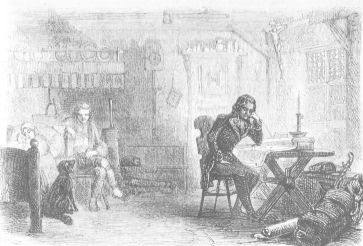
He came back, lighted his candle, and resolutely drew forth the
"Chatterton" which the bookseller had lent him. It was an old edition in
one thick volume. It had evidently belonged to some contemporary of the
Poet's—apparently an inhabitant of Bristol—some one who had gathered
up many anecdotes respecting Chatterton's habits, and who appeared even
to have seen him, nay, been in his company; for the book was
interleaved, and the leaves covered with notes and remarks in a stiff
clear hand—all evincing personal knowledge of the mournful, immortal
dead. At first, Leonard read with an effort; then the strange and fierce
spell of that dread life seized upon him—seized with pain, and gloom,
and terror—this boy dying by his own hand, about the age Leonard had
attained himself. This wonderous boy, of a genius beyond all
comparison—the greatest that ever yet was developed and extinguished at
the age of eighteen—self-taught—self-struggling—self-immolated.
Nothing in literature like that life and that death!
With intense interest Leonard perused the tale of the brilliant
imposture, which had been so harshly and so absurdly construed into the
crime of a forgery, and which was (if not wholly innocent) so akin to
the literary devices always in other cases viewed with indulgence, and
exhibiting, in this, intellectual qualities in themselves so
amazing—such patience, such forethought, such labor, such courage, such
ingenuity—the qualities that, well directed, make men great, not only
in books, but action. And, turning from the history of the imposture to
the poems themselves, the young reader bent before their beauty,
literally awed and breathless. How had this strange Bristol boy tamed
and mastered his rude and motley materials into a music that
comprehended every tune and key, from the simplest to the sublimest? He
turned back to the biography—he read on—he saw the proud, daring,
mournful spirit, alone in the Great City like himself. He followed its
dismal career, he saw it falling with bruised and soiled wings into the
mire. He turned again to the later works, wrung forth as tasks for
bread—the satires without moral grandeur, the politics without honest
faith. He shuddered and sickened as he read. True, even here his poet
mind appreciated (what perhaps only poets can) the divine fire that
burned fitfully through that meaner and more sordid fuel—he still
traced in those crude, hasty, bitter offerings to dire Necessity, the
hand of the young giant who had built up the stately verse of Rowley.
But, alas! how different from that "mighty line." How all serenity and
joy had fled from these later exercises of art degraded into
journey-work. Then rapidly came on the catastrophe—the closed
doors—the poison—the suicide—the manuscripts torn by the hands of
despairing wrath, and strewed round the corpse upon the funeral floors.
It was terrible! The spectre of the Titan boy (as described in the notes
written on the margin), with his haughty brow, his cynic smile, his
lustrous eyes, haunted all the night the baffled and solitary child of
song.
CHAPTER XVII.
It will often happen that what ought to turn the human mind from some
peculiar tendency produces the opposite effect. One would think that the
perusal in the newspaper of some crime and capital punishment would warn
away all who had ever meditated the crime, or dreaded the chance of
detection. Yet it is well known to us that many a criminal is made by
pondering over the fate of some predecessor in guilt. There is a
fascination in the Dark and Forbidden, which, strange to say, is only
lost in fiction. No man is more inclined to murder his nephews, or
stifle his wife, after reading Richard the Third or Othello. It is the
reality that is necessary to constitute the danger of contagion. Now,
it was this reality in the fate, and life, and crowning suicide of
Chatterton, that forced itself upon Leonard's thoughts, and sate there
like a visible evil thing, gathering evil like cloud around it. There
was much in the dead poet's character, his trials, and his doom, that
stood out to Leonard like a bold and colossal shadow of himself and his
fate. Alas! the bookseller, in one respect, had said truly. Leonard came
back to him the next day a new man; and it seemed even to himself as if
he had lost a good angel in losing Helen. "Oh, that she had been by my
side," thought he. "Oh, that I could have felt the touch of her
confiding hand—that, looking up from the scathed and dreary ruin of
this life, that had sublimely lifted itself from the plain, and sought
to tower aloft from a deluge, her mild look had spoken to me of
innocent, humble, unaspiring childhood! Ah! If indeed I were still
necessary to her—still the sole guardian and protector—then could I
say to myself, "Thou must not despair and die! Thou hast her to live and
to strive for." But no, no! Only this vast and terrible London—the
solitude of the dreary garret, and those lustrous eyes glaring alike
through the throng and through the solitude."
CHAPTER XVIII.
On the following Monday, Dr. Morgan's shabby man-servant opened the door
to a young man, in whom he did not at first remember a former visitor. A
few days before, embrowned with healthful travel—serene light in his
eye, simple trust in his careless lip—Leonard Fairfield had stood at
that threshold. Now again he stood there, pale and haggard, with a cheek
already hollowed into those deep anxious lines that speak of working
thoughts and sleepless nights: and a settled, sullen gloom resting
heavily on his whole aspect.
"I call by appointment," said the boy testily, as the servant stood
irresolute. The man gave way. "Master is just called out to a patient;
please to wait, sir;" and he showed him into the little parlor. In a few
moments two other patients were admitted. These were women, and they
began talking very loud. They disturbed Leonard's unsocial thoughts. He
saw that the door into the Doctor's receiving-room was half open, and,
ignorant of the etiquette which holds such penetralia as sacred, he
walked in to escape from the gossips. He threw himself into the Doctor's
own well-worn chair, and muttered to himself, "Why did he tell me to
come?—What new can he think of for me? And if a favor, should I take
it? He has given me the means of bread by work; that is all I have a
right to ask from him, from any man—all I should accept."
While thus soliloquizing, his eye fell on a letter lying open on the
table. He started. He recognized the handwriting—the same as the letter
which had inclosed £50 to his mother—the letter of his grand-parents.
He saw his own name: he saw something more—words that made his heart
stand still, and his blood seem like ice in his veins. As he thus stood
aghast, a hand was laid on the letter, and a voice, in an angry growl,
muttered, "How dare you come into my room, and be reading my letters?
Er—r—r!"
Leonard placed his own hand on the Doctor's firmly, and said in a fierce
tone, "This letter relates to me—belongs to me—crushes me. I have seen
enough to know that. I demand to read all—learn all."
The Doctor looked round, and seeing the door into the waiting-room still
open, kicked it to with his foot, and then said, under his breath, "What
have you read? Tell me the truth."
"Two lines only, and I am called—I am called,"—Leonard's frame shook
from head to foot, and the veins on his forehead swelled like cords. He
could not complete the sentence. It seemed as if an ocean was rolling up
through his brain, and roaring in his ears. The Doctor saw, at a glance,
that there was physical danger in his state, and hastily and soothingly
answered, "Sit down, sit down—calm yourself—you shall know all—read
all—drink this water;" and he poured into a tumbler of the pure liquid
a drop or two from a tiny phial.
Leonard obeyed mechanically, for indeed he was no longer able to stand.
He closed his eyes, and for a minute or two life seemed to pass from
him; then he recovered, and saw the good Doctor's gaze fixed on him with
great compassion. He silently stretched forth his hand toward the
letter. "Wait a few moments," said the physician judiciously, "and hear
me meanwhile. It is very unfortunate you should have seen a letter never
meant for your eye, and containing allusions to a secret you were never
to have known. But, if I tell you more, will you promise me, on your
word of honor, that you will hold the confidence sacred from Mrs.
Fairfield, the Avenels—from all? I myself am pledged to conceal a
secret, which I can only share with you on the same condition."
"There is nothing," announced Leonard indistinctly, and with a bitter
smile on his lip—"nothing, it seems, that I should be proud to boast
of. Yes, I promise—the letter, the letter!"
The Doctor placed it in Leonard's right hand, and quietly slipped to the
wrist of the left his forefinger and thumb, as physicians are said to do
when a victim is stretched on the rack. "Pulse decreasing," he muttered;
"wonderful thing, aconite!" Meanwhile Leonard read as follows, faults
in spelling and all:
"Dr. Morgan.
"Sir—I received your favur duly, and am glad to hear that the pore boy
is safe and Well. But he has been behaving ill, and ungrateful to my
good son Richard, who is a credit to the whole Famuly, and has made
himself a Gentleman, and Was very kind and good to the boy, not knowing
who and What he is—God forbid! I don't want never to see him again—the
boy. Pore John was ill and Restless for days afterwards. John is a pore
cretur now, and has had paralytiks. And he Talked of nothing but
Nora—the boy's eyes were so like his Mother's. I cannot, cannot see the
Child of Shame. He can't cum here—for our Lord's sake, sir, don't ask
it—he can't—so Respectable as we've always been!—and such disgrace!
Base born—base born. Keep him where he is, bind him prentis, I'll pay
any thing for That. You says, sir, he's clever, and quick at learning;
so did Parson Dale, and wanted him to go to Collidge and make a
Figur—then all would cum out It would be my death, sir; I could not
sleep in my grave, sir. Nora that we were all so proud of. Sinful
creturs that we are! Nora's good name that we've saved now, gone, gone.
And Richard, who is so grand, and who was so fond of pore, pore Nora! He
would not hold up his Head again. Don't let him make a Figur in the
world—let him be a tradesman, as we were afore him—any trade he Takes
to—and not cross us no more while he lives. Then I shall pray for him,
and wish him happy. And have not we had enuff of bringing up children to
be above their birth? Nora, that I used to say was like the first lady
o' the land—oh, but we were rightly punished! So now, sir, I leave all
to you, and will Pay all you want for the boy. And be Sure that the
secret's kep. For we have never heard from the father, and, at leest, no
one knows that Nora has a living son but I and my daughter Jane, and
Parson Dale and you—and you Two are good Gentlemen—and Jane will keep
her word, and I am old, and shall be in my grave Soon, but I hope it
won't be while poor John needs me. What could he do without me? And if
that got wind, it would kill me straight, sir. Pore John is a helpless
cretur, God bliss him. So no more from your servant in all dooty,
"M. Avenel."
Leonard laid down this letter very calmly, and, except by a slight
heaving at his breast, and a deathlike whiteness of his lips, the
emotions he felt were undetected. And it is a proof how much exquisite
goodness there was in his heart that the first words he spoke were,
"Thank Heaven!"
The Doctor did not expect that thanksgiving, and he was so startled that
he exclaimed, "For what?"
"I have nothing to pity or excuse in the woman I knew and honored as a
mother. I am not her son—her—"
He stopped short.
"No; but don't be hard on your true mother—poor Nora!"
Leonard staggered, and then burst into a sudden paroxysm of tears.
"Oh, my own mother!—my dead mother! Thou for whom I felt so mysterious
a love—thou, from whom I took this poet soul—pardon me, pardon me!
Hard on thee! Would that thou wert living yet, that I might comfort
thee! What thou must have suffered!"
These words were sobbed forth in broken gasps from the depth of his
heart. Then he caught up the letter again, and his thoughts were changed
as his eyes fell upon the writer's shame and fear, as it were, of his
very existence. All his native haughtiness returned to him. His crest
rose, his tears dried. "Tell her," he said, with a stern unfaltering
voice—"tell Mrs. Avenel that she is obeyed—that I will never seek her
roof, never cross her path, never disgrace her wealthy son. But tell her
also, that I will choose my own way in life—that I will not take from
her a bribe for concealment. Tell her that I am nameless, and will yet
make a name."
A name! Was this but an idle boast, or was it one of those flashes of
conviction which are never belied, lighting up our future for one lurid
instant, and then fading into darkness?
"I do not doubt it, my prave poy," said Dr. Morgan, growing exceedingly
Welsh in his excitement; "and perhaps you may find a father, who—"
"Father—who is he—what is he? He lives then! But he has deserted
me—he must have betrayed her! I need him not. The law gives me no
father."
The last words were said with a return of bitter anguish; then, in a
calmer tone, he resumed, "But I should know who he is—as another one
whose path I may not cross."
Dr. Morgan looked embarrassed, and paused in deliberation. "Nay," said
he at length, "as you know so much, it is surely best that you should
know all."
The doctor then proceeded to detail, with some circumlocution, what we
will here repeat from his account more succinctly.
Nora Avenel, while yet very young, left her native village, or rather
the house of Lady Lansmere, by whom she had been educated and brought
up, in order to accept the place of governess or companion in London.
One evening she suddenly presented herself at her father's house, and at
the first sight of her mother's face she fell down insensible. She was
carried to bed. Dr. Morgan (then the chief medical practitioner of the
town) was sent for. That night Leonard came into the world, and his
mother died. She never recovered her senses, never spoke intelligibly
from the time she entered the house. "And never, therefore, named your
father," said Dr. Morgan. "We knew not who he was."
"And how," cried Leonard, fiercely, "how have they dared to slander this
dead mother? How knew they that I—was—was—was not the child of
wedlock?"
"There was no wedding-ring on Nora's finger—never any rumor of her
marriage—her strange and sudden appearance at her father's house—her
emotions on entrance, so unlike those natural to a wife returning to a
parent's home: these are all the evidence against her. But Mr. Avenel
deemed them strong, and so did I. You have a right to think we judged
too harshly—perhaps we did."
"And no inquiries were ever made?" said Leonard, mournfully, and after a
long silence—"no inquiries to learn who was the father of the
motherless child?"
"Inquiries!—Mrs. Avenel would have died first. Your grandmother's
nature is very rigid. Had she come from princes, from Cadwallader
himself," said the Welshman, "she could not more have shrunk from the
thought of dishonor. Even over her dead child, the child she had loved
the best, she thought but how to save that child's name and memory from
suspicion. There was luckily no servant in the house, only Mark
Fairfield and his wife (Nora's sister): they had arrived that same day
on a visit.
"Mrs. Fairfield was nursing her own infant, two or three months old; she
took charge of you; Nora was buried, and the secret kept. None out of
the family knew of it, but myself and the curate of the town, Mr. Dale.
The day after your birth, Mrs. Fairfield, to prevent discovery, moved to
a village at some distance. There her child died; and when she returned
to Hazeldean, where her husband was settled, you passed for the son she
had lost. Mark, I know, was as a father to you, for he had loved Nora:
they had been children together."
"And she came to London—London is strong and cruel," muttered Leonard.
"She was friendless and deceived. I see all—I desire to know no more.
This father, he must indeed have been like those whom I have read of in
books. To love, to wrong her—that I can conceive; but then to leave,
to abandon; no visit to her grave—no remorse—no search for his own
child. Well, well; Mrs. Avenel was right. Let us think of him no
more."
The man-servant knocked at the door, and then put in his head. "Sir, the
ladies are getting very impatient, and say they'll go."
"Sir," said Leonard, with a strange calm return to the things about him,
"I ask your pardon for taking up your time so long. I go now. I will
never mention to my moth—I mean to Mrs. Fairfield—what I have learned,
nor to any one. I will work my way somehow. If Mr. Prickett will keep
me, I will stay with him at present; but I repeat, I can not take Mrs.
Avenel's money and be bound apprentice. Sir, you have been good and
patient with me—Heaven reward you."
The doctor was too moved to answer. He wrung Leonard's hand, and in
another minute the door closed upon the nameless boy. He stood alone in
the streets of London; and the sun flashed on him, red and menacing,
like the eye of a foe!
CHAPTER XIX.
Leonard did not appear at the shop of Mr. Prickett that day. Needless it
is to say where he wandered—what he suffered—what thought—what felt.
All within was storm. Late at night he returned to his solitary lodging.
On his table, neglected since the morning, was Helen's rose-tree. It
looked parched and fading. His heart smote him: he watered the poor
plant—perhaps with his tears.
Meanwhile Dr. Morgan, after some debate with himself whether or not to
apprise Mrs. Avenel of Leonard's discovery and message, resolved to
spare her an uneasiness and alarm that might be dangerous to her health,
and unnecessary in itself. He replied shortly, that she need not fear
Leonard's coming to her house—that he was disinclined to bind himself
an apprentice, but he was provided for at present; and, in a few weeks,
when Dr. Morgan heard more of him through the tradesman by whom he was
employed, the doctor would write to her from Germany. He then went to
Mr. Prickett's—told the willing bookseller to keep the young man for
the present—to be kind to him, watch over his habits and conduct, and
report to the doctor in his new home, on the Rhine, what avocation he
thought Leonard would be best suited for, and most inclined to adopt.
The charitable Welshman divided with the bookseller the salary given to
Leonard, and left a quarter of his moiety in advance. It is true that he
knew he should be repaid on applying to Mrs. Avenel; but, being a man of
independent spirit himself, he so sympathized with Leonard's present
feelings, that he felt as if he should degrade the boy did he maintain
him, even secretly, out of Mrs. Avenel's money—money intended not to
raise, but keep him down in life. At the worst, it was a sum the doctor
could afford, and he had brought the boy into the world.
Having thus, as he thought, safely provided for his two charges, Helen
and Leonard, the doctor then gave himself up to his final preparations
for departure. He left a short note for Leonard with Mr. Prickett,
containing some brief advice, some kind cheering; a postscript to the
effect that he had not communicated to Mrs. Avenel the information
Leonard had acquired, and that it were best to leave her in that
ignorance; and six small powders to be dissolved in water, and a tea
spoonful every fourth hour—"Sovereign against rage and sombre
thoughts," wrote the doctor.
By the evening of the next day Dr. Morgan, accompanied by his pet
patient with the chronic tic, whom he had talked into exile, was on the
steamboat on his way to Ostend.
Leonard resumed his life at Mr. Prickett's; but the change in him did
not escape the bookseller. All his ingenuous simplicity had deserted
him. He was very distant, and very taciturn; he seemed to have grown
much older. I shall not attempt to analyze metaphysically this change.
By the help of such words as Leonard may himself occasionally let fall,
the reader will dive into the boy's heart, and see how there the change
had worked, and is working still. The happy, dreamy peasant-genius,
gazing on Glory with inebriate, undazzled eyes, is no more. It is a man,
suddenly cut off from the old household holy ties—conscious of great
powers, and confronted on all sides by barriers of iron—alone with hard
Reality, and scornful London; and if he catches a glimpse of the lost
Helicon, he sees, where he saw the Muse, a pale, melancholy spirit,
vailing its face in shame—the ghost of the mournful mother, whose child
has no name, not even the humblest, among the family of men.
On the second evening after Dr. Morgan's departure, as Leonard was just
about to leave the shop, a customer stepped in with a book in his hand,
which he had snatched from the shop-boy, who was removing the volumes
for the night from the booth without.
"Mr. Prickett, Mr. Prickett!" said the customer, "I am ashamed of you.
You presume to put upon this work, in two volumes, the sum of eight
shillings."
Mr. Prickett stepped forth from the Cimmerian gloom of some recess, and
cried, "What! Mr. Burley, is that you? But for your voice, I should not
have known you."
"Man is like a book, Mr. Prickett; the commonalty only look to his
binding. I am better bound, it is very true."
Leonard glanced toward the speaker, who now stood under the gas-lamp,
and thought he recognized his face. He looked again. Yes; it was the
perch-fisher whom he had met on the banks of the Brent, and who had
warned him of the lost fish and the broken line.
Mr. Burley (continuing).—"But the 'Art of Thinking!'—you
charge eight shillings for the 'Art of Thinking.'"
Mr. Prickett.—"Cheap enough, Mr. Burley. A very clean copy."
Mr. Burley.—"Usurer! I sold it to you for three shillings. It
is more than 150 per cent you propose to gain from my 'Art of
Thinking.'"
Mr. Prickett (stuttering and taken aback).—"You sold it to
me! Ah, now I remember. But it was more than three shillings I gave. You
forget—two glasses of brandy-and-water."
Mr. Burley.—"Hospitality, sir, is not to be priced. If you
sell your hospitality, you are not worthy to possess my 'Art of
Thinking.' I resume it. There are three shillings, and a shilling more
for interest. No: on second thoughts, instead of that shilling, I will
return your hospitality; and the first time you come my way you shall
have two glasses of brandy-and-water."
Mr. Prickett did not look pleased, but he made no objection; and Mr.
Burley put the book into his pocket, and turned to examine the shelves.
He bought an old jest-book, a stray volume of the Comedies of
Destouches—paid for them—put them also into his pocket, and was
sauntering out, when he perceived Leonard, who was now standing at the
doorway.
"Hem! who is that?" he asked, whispering Mr. Prickett.
"A young assistant of mine, and very clever."
Mr. Burley scanned Leonard from top to toe.
"We have met before, sir. But you look as if you had returned to the
Brent, and been fishing for my perch."
"Possibly, sir," answered Leonard. "But my line is tough, and is not yet
broken, though the fish drags it among the weeds, and buries itself in
the mud."
He lifted his hat, bowed slightly, and walked on.
"He is clever," said Mr. Burley to the bookseller: "he understands
allegory."
Mr. Pickett.—"Poor youth! He came to town with the idea of
turning author: you know what that is, Mr. Burley."
Mr. Burley (with an air of superb dignity).—"Bibliopole, yes!
An author is a being between gods and men, who ought to be lodged in a
palace, and entertained at the public charge upon Ortolans and Tokay. He
should be kept lapped in down, and curtained with silken awnings from
the cares of life—have nothing to do but to write books upon tables of
cedar, and fish for perch from a gilded galley. And that's what will
come to pass when the ages lose their barbarism, and know their
benefactors. Meanwhile, sir, I invite you to my rooms, and will regale
you upon brandy-and-water as long as I can pay for it; and when I can
not, you shall regale me."
Mr. Prickett muttered, "A very bad bargain, indeed," as Mr. Burley, with
his chin in the air, stepped into the street.
CHAPTER XX.
At first, Leonard had always returned home through the crowded
thoroughfares—the contact of numbers had animated his spirits. But the
last two days, since his discovery of his birth, he had taken his way
down the comparatively unpeopled path of the New Road.
He had just gained that part of this outskirt in which the statuaries
and tomb-makers exhibit their gloomy wares—furniture alike for gardens
and for graves—and, pausing, contemplated a column, on which was placed
an urn half covered with a funeral mantle, when his shoulder was lightly
tapped, and, turning quickly, he saw Mr. Burley standing behind him.
"Excuse me, sir, but you understand perch-fishing; and since we find
ourselves on the same road, I should like to be better acquainted with
you. I hear you once wished to be an author. I am one."
Leonard had never before, to his knowledge, seen an author, and a
mournful smile passed his lips as he surveyed the perch-fisher.
Mr. Burley was indeed very differently attired since the first interview
by the brooklet. He looked much less like an author—but more perhaps
like a perch-fisher. He had a new white hat, stuck on one side of his
head—a new green overcoat—new gray trowsers, and new boots. In his
hand was a whalebone stick, with a silver handle. Nothing could be more
vagrant, devil-me-carish, and, to use a slang word, tigrish, than his
whole air. Yet, vulgar as was his costume, he did not himself seem
vulgar, but rather eccentric—lawless—something out of the pale of
convention. His face looked more pale and more puffed than before, the
tip of his nose redder; but the spark in his eye was of livelier light,
and there was self-enjoyment in the corners of his sensual humorous lip.
"You are an author, sir," repeated Leonard. "Well. And what is your
report of the calling? Yonder column props an urn. The column is tall,
and the urn is graceful. But it looks out of place by the road-side:
what say you?"
Mr. Burley.—"It would look better in the church-yard."
Leonard.—"So I was thinking. And you are an author!"
Mr. Burley.—"Ah, I said you had a quick sense of allegory. And
so you think an author looks better in a church-yard, when you see him
but as a muffled urn under the moonshine, than standing beneath the
gas-lamp in a white hat, and with a red tip to his nose. Abstractedly,
you are right. But, with your leave, the author would rather be where he
is. Let us walk on." The two men felt an interest in each other, and
they walked some yards in silence.
"To return to the urn," said Mr. Burley—"you think of fame and
church-yards. Natural enough, before illusion dies; but I think of the
moment, of existence—and I laugh at fame. Fame, sir—not worth a glass
of cold without! And as for a glass of warm, with sugar—and five
shillings in one's pocket to spend as one pleases—what is there in
Westminster Abbey to compare with it?"
"Talk on, sir—I should like to hear you talk. Let me listen and hold my
tongue." Leonard pulled his hat over his brows, and gave up his moody,
questioning, turbulent mind to his new acquaintance.
And John Burley talked on. A dangerous and a fascinating talk it
was—the talk of a great intellect fallen. A serpent trailing its length
on the ground, and showing bright, shifting, glorious hues, as it
groveled. A serpent, yet without the serpent's guile. If John Burley
deceived and tempted, he meant it not—he crawled and glittered alike
honestly. No dove could be more simple.
Laughing at fame, he yet dwelt with an eloquent enthusiasm on the joy of
composition. "What do I care what men without are to say and think of
the words that gush forth on my page?" cried he. "If you think of the
public, of urns, and laurels, while you write, you are no genius; you
are not fit to be an author. I write because it rejoices me—because it
is my nature. Written, I care no more what becomes of it than the lark
for the effect that the song has on the peasant it wakes to the plough.
The poet, like the lark, sings 'from his watch-tower in the skies.' Is
this true?"
"Yes, very true!"
"What can rob us of this joy! The bookseller will not buy, the public
will not read. Let them sleep at the foot of the ladder of the
angels—we climb it all the same. And then one settles down into such
good-tempered Lucianic contempt for men. One wants so little from them,
when one knows what one's-self is worth, and what they are. They are
just worth the coin one can extract from them, in order to live. Our
life—that is worth so much to us. And then their joys, so vulgar to
them, we can make them golden and kingly. Do you suppose Burns drinking
at the ale-house with his boors around him, was drinking, like them,
only beer and whisky? No, he was drinking nectar—he was imbibing his
own ambrosial thoughts—shaking with the laughter of the gods. The
coarse human liquid was just needed to unlock his spirit from the
clay—take it from jerkin and corduroys, and wrap it in the 'singing
robes' that floated wide in the skies: the beer or the whisky needed but
for that, and then it changed at once into the drink of Hebé. But come,
you have not known this life—you have not seen it. Come, give me this
night. I have moneys about me—I will fling them abroad as liberally as
Alexander himself, when he left to his share but hope. Come!"
"Whither?"
"To my throne. On that throne last sate Edmund Kean—mighty mime. I am
his successor. We will see whether in truth these wild sons of genius,
who are cited but 'to point a moral and adorn a tale,' were objects of
compassion. Sober-suited cits to lament over a Savage and a Morland—a
Porson and a Burns!—"
"Or a Chatterton," said Leonard, gloomily.
"Chatterton was an impostor in all things; he feigned excesses that he
never knew. He a bacchanalian—a royster! He!—No. We will
talk of him. Come!"
Leonard went.
CHAPTER XXI.
The room! And the smoke-reek, and the gas glare of it. The whitewash of
the walls, and the prints thereon of the actors in their mime-robes, and
stage postures; actors as far back as their own lost Augustan era, when
the stage was a real living influence on the manners and the age. There
was Betterton in wig and gown—as Cato, moralizing on the soul's
eternity, and halting between Plato and the dagger. There was Woodward
as "The Fine Gentleman," with the inimitable rake-hell air in which the
heroes of Wycherly and Congreve and Farquhar live again. There was
jovial Quin as Falstaff, with round buckler and "fair round belly."
There was Colly Cibber in brocade—taking snuff as with "his Lord," the
thumb and forefinger raised in air—and looking at you for applause.
There was Macklin as Shylock, with knife in hand: and Kemble, in the
solemn weeds of the Dane; and Kean in the place of honor over the
chimney-piece.
When we are suddenly taken from practical life, with its real workday
men, and presented to the portraits of those sole heroes of a
World—Phantastic and Phantasmal, in the garments wherein they did
"strut and fret their hour upon the stage," verily there is something in
the sight that moves an inner sense within ourselves—for all of us have
an inner sense of some existence, apart from the one that wears away our
days: an existence that, afar from St. James's and St. Giles's, the Law
Courts and Exchange, goes its way in terror or mirth, in smiles or in
tears, through a vague magic land of the poets. There, see those actors!
They are the men who lived it—to whom our world was the false one, to
whom the Imaginary was the Actual. And did Shakspeare himself, in his
life, ever hearken to the applause that thundered round the Personators
of his airy images? Vague children of the most transient of the arts,
fleet shadows on running waters, though thrown down from the steadfast
stars, were ye not happier than we who live in the Real? How strange you
must feel in the great circuit that ye now take through eternity! No
prompt-books, no lamps, no acting Congreve and Shakspeare there! For
what parts in the skies have your studies on the earth fitted you? Your
ultimate destinies are very puzzling. Hail to your effigies, and pass we
on!
There, too, on the whitewashed walls, were admitted the portraits of
ruder rivals in the arena of fame—yet they, too, had known an applause
warmer than his age gave to Shakspeare; the champions of the
ring—Cribb, and Molyneux, and Dutch Sam. Interspersed with these was an
old print of Newmarket in the early part of the last century, and sundry
engravings from Hogarth. But poets, oh! they were there too; poets who
might be supposed to have been sufficiently good fellows to be at home
with such companions. Shakspeare, of course, with his placid forehead;
Ben Jonson, with his heavy scowl; Burns and Byron cheek by jowl. But the
strangest of all these heterogeneous specimens of graphic art was a
full-length print of William Pitt!—William Pitt, the austere and
imperious. What the deuce did he do there among prize-fighters, and
actors, and poets? It seemed an insult to his grand memory. Nevertheless
there he was, very erect, and with a look of ineffable disgust in his
upturned nostrils. The portraits on the sordid walls were very like the
crambo in the minds of ordinary men—very like the motley pictures of
the Famous hung up in your parlor, O my Public! Actors and
prize-fighters, poets and statesmen, all without congruity and fitness,
all whom you have been to see or to hear for a moment, and whose names
have stared out in your newspapers, O my Public!
And the company? Indescribable! Comedians, from small theatres, out of
employ; pale haggard-looking boys, probably the sons of worthy traders,
trying their best to break their fathers' hearts; here and there the
marked features of a Jew. Now and then you might see the curious,
puzzled face of some greenhorn about town, or perhaps a Cantab; and men
of grave age, and gray-haired, were there, and among them a wondrous
proportion of carbuncled faces and bottle noses. And when John Burley
entered, there was a shout that made William Pitt shake in his frame.
Such stamping and hallooing, and such hurrahs for "Burly John." And the
gentleman who had filled the great high leathern chair in his absence
gave it up to John Burley; and Leonard, with his grave observant eye,
and lip half sad and half scornful, placed himself by the side of his
introducer. There was a nameless expectant stir through the assembly, as
there is in the pit of the opera when some great singer advances to the
lamps, and begins "Di tanti pal piti." Time flies. Look at the Dutch
clock over the door. Half-an-hour! John Burley begins to warm. A yet
quicker light begins to break from his eye; his voice has a mellow,
luscious roll in it.
"He will be grand to-night," whispered a thin man, who looked like a
tailor, seated on the other side of Leonard.
Time flies—an hour! Look again at the Dutch clock. John Burley is
grand, he is in his zenith, at his culminating point. What magnificent
drollery!—what luxuriant humor! How the Rabelais shakes in his easy
chair! Under the rush and the roar of this fun (what word else shall
describe it), the man's intellect is as clear as gold sand under a
river. Such wit and such truth, and, at times, such a flood of quick
eloquence. All now are listeners, silent, save in applause. And Leonard
listened too. Not, as he would some nights ago, in innocent,
unquestioning delight. No; his mind has passed through great sorrow,
great passion, and it comes out unsettled, inquiring, eager, brooding
over joy itself as over a problem. And the drink circulates, and faces
change; and there are gabbling and babbling; and Burley's head sinks in
his bosom, and he is silent. And up starts a wild, dissolute
bacchanalian glee for seven voices. And the smoke-reek grows denser and
thicker, and the gas-light looks dizzy through the haze. And John
Burley's eyes reel.
Look again at the Dutch clock. Two hours have gone. John Burley has
broken out again from his silence, his voice thick and husky, and his
laugh cracked; and he talks, O ye gods! such rubbish and ribaldry; and
the listeners roar aloud, and think it finer than before. And Leonard,
who had hitherto been measuring himself, in his mind, against the giant,
and saying inly, "He soars out of my reach," finds the giant shrink
smaller and smaller, and saith to himself, "He is but of man's common
standard, after all!"
Look again at the Dutch clock. Three hours have passed. Is John Burley
now of man's common standard? Man himself seems to have vanished from
the scene: his soul stolen from him, his form gone away with the fumes
of the smoke, and the nauseous steam from that fiery bowl. And Leonard
looked round, and saw but the swine of Circe—some on the floor, some
staggering against the walls, some hugging each other on the tables,
some fighting, some bawling, some weeping. The divine spark had fled
from the human face; the beast is every where growing more and more out
of the thing that had been Man. And John Burley, still unconquered, but
clean lost to his senses, fancies himself a preacher, and drawls forth
the most lugubrious sermon upon the brevity of life that mortal ever
heard, accompanied with unctuous sobs; and now and then, in the midst of
balderdash, gleams out a gorgeous sentence, that Jeremy Taylor might
have envied: driveling away again into a cadence below the rhetoric of
a Muggletonian. And the waiters choked up the doorway, listening and
laughing, and prepared to call cabs and coaches; and suddenly some one
turned off the gas-light, and all was dark as pitch—howls and laughter,
as of the damned, ringing through the Pandemonium. Out from the black
atmosphere stept the boy-poet; and the still stars rushed on his sight,
as they looked over the grimy roof-tops.
CHAPTER XXII.
Well, Leonard, this is the first time thou hast shown that thou hast in
thee the iron out of which true manhood is forged and shaped. Thou hast
the power to resist. Forth, unebriate, unpolluted, he came from the
orgy, as yon star above him came from the cloud.
He had a latch-key to his lodging. He let himself in, and walked
noiselessly up the creaking, wooden stair. It was dawn. He passed on to
his window, and threw it open. The green elm-tree from the carpenter's
yard looked as fresh and fair as if rooted in solitudes, leagues away
from the smoke of Babylon.
"Nature, Nature!" murmured Leonard, "I hear thy voice now. This
stills—this strengthens. But the struggle is very dread. Here, despair
of life—there, faith in life. Nature thinks of neither, and lives
serenely on."
By-and-by a bird slid softly from the heart of the tree, and dropped on
the ground below out of sight. But Leonard heard its carol. It awoke its
companions—wings began to glance in the air, and the clouds grew red
toward the east.
Leonard sighed and left the window. On the table, near Helen's
rose-tree, which he bent over wistfully, lay a letter. He had not
observed it before. It was in Helen's hand. He took it to the light, and
read it by the pure healthful gleams of morn:
"Oh my dear brother Leonard, will this find you well, and (more happy I
dare not say, but) less sad than when we parted? I write kneeling, so
that it seems to me as if I wrote and prayed at the same time. You may
come and see me to-morrow evening, Leonard. Do come, do—we shall walk
together in this pretty garden; and there is an arbor all covered with
jessamine and honeysuckle, from which we can look down on London. I have
looked from it so many times—so many—trying if I can guess the roofs
in our poor little street, and fancying that I do see the dear elm-tree.
"Miss Starke is very kind to me; and I think, after I have seen you,
that I shall be happy here—that is, if you are happy.
"Your own grateful sister,
"Helen.
"Ivy Lodge."
"P.S.—Any one will direct you to our house; it lies to the left, near
the top of the hill, a little way down a lane which is overhung on one
side with chestnut trees and lilies. I shall be watching for you at the
gate."
Leonard's brow softened, he looked again like his former self. Up from
the dark sea at his heart smiled the meek face of a child, and the waves
lay still as at the charm of a spirit.
CHAPTER XXIII.
"And what is Mr. Burley, and what has he written?" asked Leonard of Mr.
Prickett when he returned to the shop.
Let us reply to that question in our own words, for we know more about
Mr. Burley than Mr. Prickett does.
John Burley was the only son of a poor clergyman, in a village near
Ealing, who had scraped, and saved, and pinched, to send his son to an
excellent provincial school in a northern county, and thence to college.
At the latter, during his first year, young Burley was remarked by the
undergraduates for his thick shoes and coarse linen, and remarkable to
the authorities for his assiduity and learning. The highest hopes were
entertained of him by the tutors and examiners. At the beginning of the
second year his high animal spirits, before kept down by study, broke
out. Reading had become easy to him. He knocked off his tasks with a
facile stroke, as it were. He gave up his leisure hours to symposia by
no means Socratical. He fell into an idle, hard-drinking set. He got
into all kinds of scrapes. The authorities were at first kind and
forbearing in their admonitions, for they respected his abilities, and
still hoped he might become an honor to the university. But at last he
went drunk into a formal examination, and sent in papers, after the
manner of Aristophanes, containing capital jokes upon the Dons and
Big-wigs themselves. The offense was the greater, and seemed the more
premeditated, for being clothed in Greek. John Burley was expelled. He
went home to his father's a miserable man, for, with all his follies, he
had a good heart. Removed from ill-example, his life for a year was
blameless. He got admitted as usher into the school in which he had
received instruction as a pupil. This school was in a large town. John
Burley became member of a club formed among the tradesmen, and spent
three evenings a week there. His astonishing convival and conversational
powers began to declare themselves. He grew the oracle of the club; and,
from being the most sober, peaceful assembly in which grave fathers of a
family ever smoked a pipe or sipped a glass, it grew under Mr. Burley's
auspices the parent of revels as frolicking and frantic as those out of
which the old Greek Goat Song ever tipsily rose. This would not do.
There was a great riot in the streets one night, and the next morning
the usher was dismissed. Fortunately for John Burley's conscience, his
father had died before this happened—died believing in the reform of
his son. During his ushership, Mr. Burley had scraped acquaintance with
the editor of the county newspaper, and given him some capital
political articles; for Burley was, like Parr and Porson, a notable
politician. The editor furnished him with letters to the journalists in
London, and John came to the metropolis and got employed on a very
respectable newspaper. At college he had known Audley Egerton, though
but slightly: that gentleman was then just rising into repute in
Parliament. Burley sympathized with some question on which Audley had
distinguished himself, and wrote a very good article thereon—an article
so good that Egerton inquired into the authorship, found out Burley, and
resolved in his own mind to provide for him whenever he himself came
into office. But Burley was a man whom it was impossible to provide for.
He soon lost his connection with the newspaper. First, he was so
irregular that he could never be depended upon. Secondly, he had strange
honest eccentric twists of thinking, that could coalesce with the
thoughts of no party in the long run. An article of his, inadvertently
admitted, had horrified all the proprietors, staff, and readers of the
paper. It was diametrically opposite to the principles the paper
advocated, and compared its pet politician to Catiline. Then John Burley
shut himself up and wrote books. He wrote two or three books, very
clever, but not at all to the popular taste—abstract and learned, full
of whims that were caviare to the multitude, and larded with Greek.
Nevertheless they obtained for him a little money, and among literary
men some reputation. Now Audley Egerton came into power, and got him,
though with great difficulty—for there were many prejudices against
this scampish, harum-scarum son of the Muses—a place in a public
office. He kept it about a month, and then voluntarily resigned it. "My
crust of bread and liberty!" quoth John Burley, and he vanished into a
garret. From that time to the present he lived—Heaven knows how.
Literature is a business, like every thing else; John Burley grew more
and more incapable of business. "He could not do task-work," he said; he
wrote when the whim seized him, or when the last penny was in his pouch,
or when he was actually in the spunging-house or the Fleet—migrations
which occurred to him, on an average, twice a year. He could generally
sell what he had positively written, but no one would engage him
beforehand. Magazines and other periodicals were very glad to have his
articles, on the condition that they were anonymous; and his style was
not necessarily detected, for he could vary it with the facility of a
practiced pen. Audley Egerton continued his best supporter, for there
were certain questions on which no one wrote with such force as John
Burley—questions connected with the metaphysics of politics, such as
law reform and economical science. And Audley Egerton was the only man
John Burley put himself out of the way to serve, and for whom he would
give up a drinking bout and do task-work; for John Burley was grateful
by nature, and he felt that Egerton had really tried to befriend him.
Indeed, it was true, as he had stated to Leonard by the Brent, that,
even after he had resigned his desk in the London office, he had had the
offer of an appointment in Jamaica, and a place in India from the
Minister. But probably there were other charms then than those exercised
by the one-eyed perch that kept him to the neighborhood of London. With
all his grave faults of character and conduct, John Burley was not
without the fine qualities of a large nature. He was most resolutely his
own enemy, it is true, but he could hardly be said to be any one else's.
Even when he criticised some more fortunate writer, he was good-humored
in his very satire: he had no bile, no envy. And as for freedom from
malignant personalities, he might have been a model to all critics. I
must except politics, however, for in these he could be rabid and
savage. He had a passion for independence, which, though pushed to
excess, was not without grandeur. No lick-platter, no parasite, no
toadeater, no literary beggar, no hunter after patronage and
subscriptions; even in his dealings with Audley Egerton, he insisted on
naming the price for his labors. He took a price, because, as the papers
required by Audley demanded much reading and detail, which was not at
all to his taste, he considered himself entitled fairly to something
more than the editor of the journal, wherein the papers appeared, was in
the habit of giving. But he assessed this extra price himself, and as he
would have done to a bookseller. And when in debt and in prison, though
he knew a line to Egerton would have extricated him, he never wrote that
line. He would depend alone on his pen—dipped it hastily in the ink,
and scrawled himself free. The most debased point about him was
certainly the incorrigible vice of drinking, and with it the usual
concomitant of that vice—the love of low company. To be King of the
Bohemians—to dazzle by his wild humor, and sometimes to exalt by his
fanciful eloquence, the rude gross natures that gathered round him—this
was a royalty that repaid him for all sacrifice of solid dignity; a
foolscap crown that he would not have changed for an emperor's diadem.
Indeed, to appreciate rightly the talents of John Burley, it was
necessary to hear him talk on such occasions. As a writer, after all, he
was only capable now of unequal desultory efforts. But as a talker, in
his own wild way, he was original and matchless. And the gift of talk is
one of the most dangerous gifts a man can possess for his own sake—the
applause is so immediate, and gained with so little labor. Lower, and
lower, and lower had sunk John Burley, not only in the opinion of all
who knew his name, but in the habitual exercise of his talents. And this
seemed willfully—from choice. He would write for some unstamped journal
of the populace, out of the pale of the law, for pence, when he could
have got pounds from journals of high repute. He was very fond of
scribbling off penny ballads, and then standing in the street to hear
them sung. He actually once made himself the poet of an advertising
tailor, and enjoyed it excessively. But that did not last long, for John
Burley was a Pittite—not a Tory, he used to say, but a Pittite. And if
you had heard him talk of Pitt, you would never have known what to make
of that great statesman. He treated him as the German commentators do
Shakspeare, and invested him with all imaginary meanings and objects,
that would have turned the grand practical man into a Sibyl. Well, he
was a Pittite; the tailor a fanatic for Thelwall and Cobbett. Mr. Burley
wrote a poem, wherein Britannia appeared to the tailor, complimented him
highly on the art he exhibited in adorning the persons of her sons; and,
bestowing upon him a gigantic mantle, said that he, and he alone, might
be enabled to fit it to the shoulders of living men. The rest of the
poem was occupied in Mr. Snip's unavailing attempts to adjust this
mantle to the eminent politicians of the day, when, just as he had sunk
down in despair, Britannia reappeared to him, and consoled him with the
information that he had done all mortal man could do, and that she had
only desired to convince pigmies that no human art could adjust to
their proportions the mantle of William Pitt. Sic itur ad astra. She
went back to the stars, mantle and all. Mr. Snip was exceedingly
indignant at this allegorical effusion, and with wrathful shears cut the
tie between himself and his poet.
Thus, then, the reader has, we trust, a pretty good idea of John
Burley—a specimen of his genus, not very common in any age, and now
happily almost extinct, since authors of all degrees share in the
general improvement in order, economy, and sober decorum, which has
obtained in the national manners. Mr. Prickett, though entering into
less historical detail than we have done, conveyed to Leonard a
tolerably accurate notion of the man, representing him as a person of
great powers and learning, who had thoroughly thrown himself away.
Leonard did not, however, see how much Mr. Burley himself was to be
blamed for his waste of life; he could not conceive a man of genius
voluntarily seating himself at the lowest step in the social ladder. He
rather supposed he had been thrust down there by Necessity.
And when Mr. Prickett, concluding, said, "Well, I should think Burley
would cure you of the desire to be an author even more than Chatterton,"
the young man answered gloomily, "Perhaps," and turned to the
book-shelves.
With Mr. Prickett's consent, Leonard was released earlier than usual
from his task, and a little before sunset he took his way to Highgate.
He was fortunately directed to take the new road by the Regent's Park,
and so on through a very green and smiling country. The walk, the
freshness of the air, the songs of the birds, and, above all, when he
had got half-way, the solitude of the road, served to rouse him from his
stern and sombre meditations. And when he came into the lane overhung
with chestnut trees, and suddenly caught sight of Helen's watchful and
then brightening face, as she stood by the wicket, and under the shadow
of cool murmurous boughs, the blood rushed gayly through his veins, and
his heart beat loud and gratefully.
CHAPTER XXIV.
She drew him into the garden with such true childlike joy!
Now behold them seated in the arbor—a perfect bower of sweets and
blossoms; the wilderness of roof-tops and spires stretching below, broad
and far; London seen dim and silent, as in a dream.
She took his hat from his brows gently, and looked him in the face with
tearful, penetrating eyes.
She did not say, "You are changed." She said, "Why, why did I leave
you?" and then turned away.
"Never mind me, Helen. I am man, and rudely born—speak of yourself.
This lady is kind to you, then?"
"Does she not let me see you? Oh! very kind—and look here."
Helen pointed to fruits and cakes set out on the table. "A feast,
brother."
And she began to press her hospitality with pretty winning ways, more
playful than was usual to her, and talking very fast, and with forced
but silvery laughter.
By degrees she stole him from his gloom and reserve; and, though he
could not reveal to her the cause of his bitterest sorrow, he owned that
he had suffered much. He would not have owned that to another living
being. And then, quickly turning from this brief confession, with
assurances that the worst was over, he sought to amuse her by speaking
of his new acquaintance with the perch-fisher. But when he spoke of this
man with a kind of reluctant admiration, mixed with compassionate yet
gloomy interest, and drew a grotesque though subdued sketch of the wild
scene in which he had been spectator, Helen grew alarmed and grave.
"Oh, brother, do not go there again—do not see more of this bad man."
"Bad!—no! Hopeless and unhappy, he has stooped to stimulants and
oblivion; but you can not understand these things, my pretty preacher."
"Yes I do, Leonard. What is the difference between being good and bad?
The good do not yield to temptations, and the bad do."
The definition was so simple and so wise that Leonard was more struck
with it than he might have been by the most elaborate sermon by Parson
Dale.
"I have often murmured to myself since I lost you, 'Helen was my good
angel;' say on. For my heart is dark to myself, and while you speak
light seems to dawn on it."
This praise so confused Helen that she was long before she could obey
the command annexed to it. But, by little and little, words came to both
more frankly. And then he told her the sad tale of Chatterton, and
waited, anxious to hear her comments.
"Well," he said, seeing that she remained silent, "how can I hope,
when this mighty genius labored and despaired? What did he want, save
birth and fortune, and friends, and human justice."
"Did he pray to God?" said Helen, drying her tears.
Again Leonard was startled. In reading the life of Chatterton, he had
not much noted the skepticism, assumed or real of the ill-fated aspirer
to earthly immortality. At Helen's question, that skepticism struck him
forcibly.
"Why do you ask that, Helen?"
"Because, when we pray often, we grow so very, very patient," answered
the child. "Perhaps, had he been patient a few months more, all would
have been won by him, as it will be by you, brother; for you pray, and
you will be patient."
Leonard bowed his head in deep thought, and this time the thought was
not gloomy. Then out from that awful life there glowed another passage,
which before he had not heeded duly, but regarded rather as one of the
darkest mysteries in the fate of Chatterton.
At the very time the despairing poet had locked himself up in his
garret, to dismiss his soul from its earthly ordeal, his genius had just
found its way into the light of renown. Good and learned and powerful
men were preparing to serve and save him. Another year—nay, perchance
another month—and he might have stood acknowledged and sublime in the
foremost front of his age.
"Oh, Helen!" cried Leonard, raising his brows from which the cloud had
passed, "why, indeed, did you leave me?"
Helen started in her turn as he repeated this regret, and in her turn
grew thoughtful. At length she asked him if he had written for the box
which had belonged to her father, and been left at the inn.
And Leonard, though a little chafed at what he thought a childish
interruption to themes of graver interest, owned with self-reproach that
he had forgotten to do so. Should he not write now to order the box to
be sent to her at Miss Starke's.
"No; let it be sent to you. Take care of it. I should like to know that
something of mine is with you; and perhaps I may not stay here long."
"Not stay here? That you must, my dear Helen—at least as long as Miss
Starke will keep you, and is kind. By-and-by (added Leonard, with
something of his former sanguine tone) I may yet make my way, and we
shall have our cottage to ourselves. But—Oh Helen!—I forgot—you
wounded me; you left your money with me. I only found it in my drawers
the other day. Fie!—I have brought it back."
"It was not mine—it is yours. We were to share together—you paid all;
and how can I want it here too?"
But Leonard was obstinate; and as Helen mournfully received back all
that of fortune her father had bequeathed to her, a tall female figure
stood at the entrance of the arbor, and said, in a voice that scattered
all sentiment to the winds, "Young man, it is time to go."
CHAPTER XXV.
"Already!" said Helen, with faltering accents, as she crept to Miss
Starke's side while Leonard rose and bowed. "I am very grateful to you,
madam," said he, with the grace that comes from all refinement of idea,
"for allowing me to see Miss Helen. Do not let me abuse your kindness."
Miss Starke seemed struck with his look and manner, and made a stiff
half courtesy.
A form more rigid than Miss Starke's it was hard to conceive. She was
like the grim white woman in the nursery ballads. Yet, apparently, there
was a good nature in allowing the stranger to enter her trim garden, and
providing for him and her little charge those fruits and cakes, which
belied her aspect. "May I go with him to the gate?" whispered Helen, as
Leonard had already passed up the path.
"You may, child; but do not loiter. And then come back, and lock up the
cakes and cherries, or Patty will get at them."
Helen ran after Leonard.
"Write to me brother—write to me; and do not, do not be friends with
this man, who took you to that wicked, wicked place."
"Oh, Helen, I go from you strong enough to brave worse dangers than
that," said Leonard almost gayly.
They kissed each other at the little wicket gate, and parted.
Leonard walked home under the summer moonlight, and on entering his
chamber, looked first at his rose-tree. The leaves of yesterday's
flowers lay strewn round it; but the tree had put forth new buds.
"Nature ever restores," said the young man. He paused a moment, and
added, "Is it that Nature is very patient?"
His sleep that night was not broken by the fearful dreams he had lately
known. He rose refreshed, and went his way to his day's work—not
stealing along the less crowded paths, but with a firm step, through the
throng of men. Be bold, adventurer—thou hast more to suffer! Wilt thou
sink? I look into thy heart, and I can not answer.
(TO BE CONTINUED.)