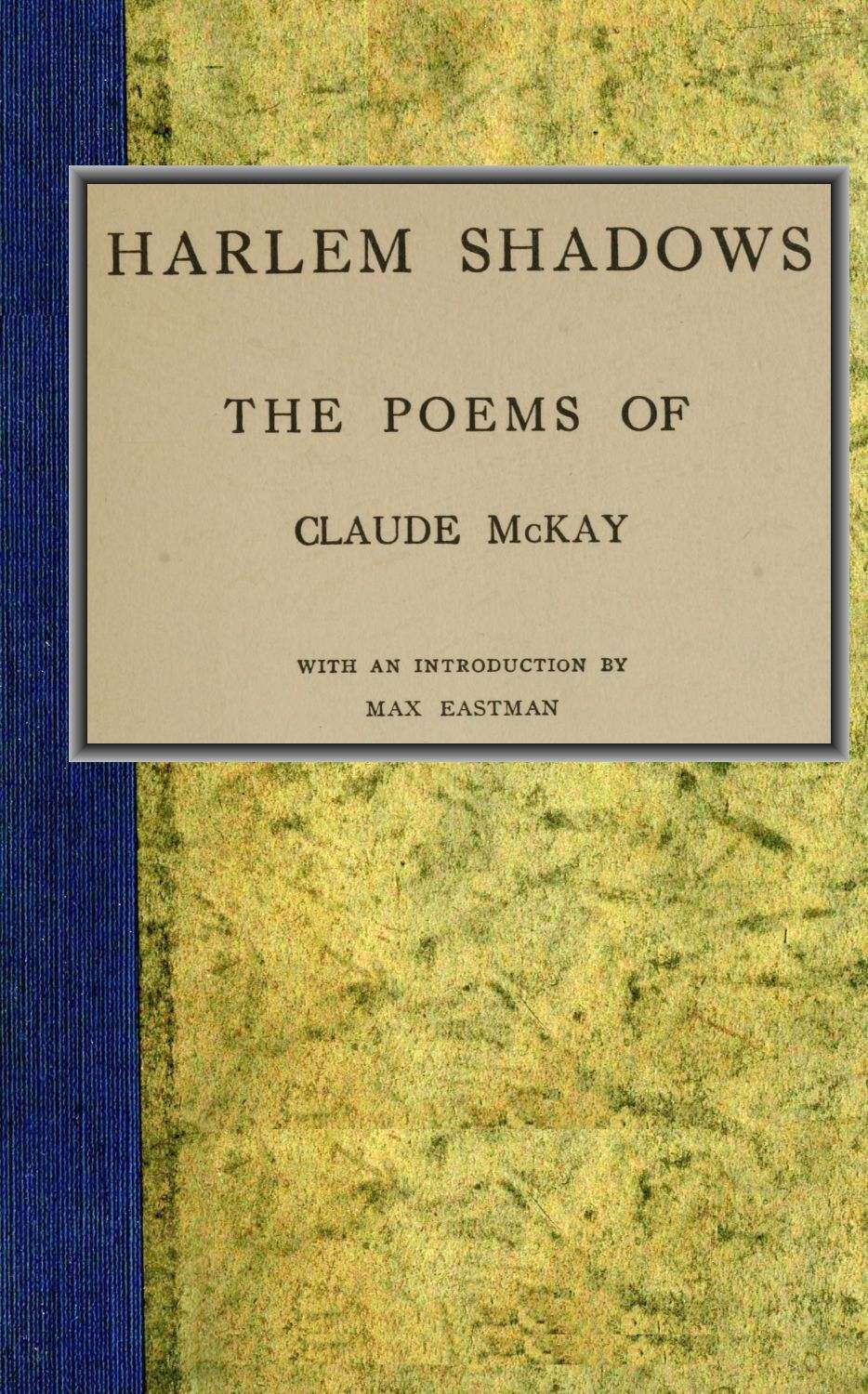
These poems have a special interest for all the races of man because
they are sung by a pure blooded Negro. They are the first significant
expression of that race in poetry. We tried faithfully to give a
position in our literature to Paul Laurence Dunbar. We have excessively
welcomed other black poets of minor talent, seeking in their music some
distinctive quality other than the fact that they wrote it. But here for
the first time we find our literature vividly enriched by a voice from
this most alien race among us. And it should be illuminating to observe
that while these poems are characteristic of that race as we most admire
it—they are gentle-simple, candid, brave and friendly, quick of
laughter and of tears—yet they are still more characteristic of what is
deep and universal in mankind. There is no special or exotic kind of
merit in them, no quality that demands a transmutation of our own
natures to perceive. Just as the sculptures and wood and ivory carvings
of the vast forgotten African Empires of Ifé and Benin, although so
wistful in their tranquillity, are tranquil in the possession of the
qualities of all classic and great art, so these poems, the purest of
them, move with a sovereignty that is never new to the lovers of the
high music of human utterance.
It is the peculiarity of his experience, rather than of his nature, that
makes this poet’s race a fact to be remembered in the enjoyment of his
songs. The subject of all poetry is the experience of the poet, and no
man of any other race in the world can touch or imagine the experience
of the children of African slaves in America.
Claude McKay was born in 1890 in a little thatched house of two rooms in
a beautiful valley of the hilly middle-country of Jamaica. He was born
to the genial, warm, patient, neighborly farmer’s life of that island.
It was a life rich in sun and sound and color and emotion, as we can see
in his poems which are forever homeward yearning—in the midst of their
present passion and strong will into the future, forever vividly
remembering. Like a blue-bird’s note in a March wind, those sudden clear
thoughts of the warm South ring out in the midst of his northern songs.
They carry a thrill into the depth of our hearts. Perhaps in some sense
they are thoughts of a mother. At least it seems inevitable that we
should find among them those two sacred sonnets of a child’s
bereavement. It seems inevitable that a wonderful poet should have had a
wise and beautiful mother.
We can only distantly imagine how the happy tropic life of play and
affection, became shadowed and somber for this sensitive boy as he grew,
by a sense of the subjection of his people, and the memory of their
bondage to an alien race. Indeed the memory of Claude McKay’s family
goes back on his mother’s side beyond the days of bondage, to a time in
Madagascar when they were still free, and by the grace of God still
“savage.” He learned in early childhood the story of their violent
abduction, and how they were freighted over the seas in ships, and sold
at public auction in Jamaica. He learned another story, too, which must
have kindled a fire that slept in his blood—a story of the rebellion of
the members of his own family at the auction-block. A death-strike, we
should call it now—for they agreed that if they were divided and sold
away into different parts of the country they would all kill themselves.
And this fact solemnly announced in the market by the oldest
white-haired Negro among them, had such an effect upon prospective
buyers that it was impossible to sell them as individuals, and so they
were all taken away together to those hills at Clarendon which their
descendants still cultivate. With the blood of these rebels in his
veins, and their memory to stir it, we cannot wonder that Claude McKay’s
earliest boyish songs in the Jamaica dialect were full of heresy and the
militant love of freedom, and that his first poem of political
significance should have been a rally-call to the street-car men on
strike in Kingston. He found himself by an instinctive gravitation
singing in the forefront of the battle for human liberty. A wider
experience and a man’s comprehension of the science of history has only
strengthened his voice and his resolution.
Those early songs and the music he composed for them, were very popular
in Jamaica. Claude McKay was quite the literary prince of the island for
a time—a kind of Robert Burns among his own people, as we can imagine,
with his physical beauty, his quick sympathy, and the magnetic wayward
humor of his ways. He received in 1912 the medal of the Institute of
Arts and Sciences in recognition of his preëminence. He was the first
Negro to receive this medal, and he was the first poet who ever made
songs in the quaint haunting dialect of the island. But nevertheless it
was not until he came to the United States that Claude McKay began to
confront the deepest feelings in his heart, and realize that a delicate
syllabic music could not alone express them. Here his imagination awoke,
and the colored imagery that is the language of all deep passion began
to appear in his poetry. Here too he conceived and felt the history and
position of his people with mature poetic force. He knew that his voice
belonged not only to his own moods and the general experience of
humanity, but to the hopes and sorrows of his race.
A great many foolish things are said even by wise people upon the
subject of racial inferiority. They seem to think that if science could
establish a certain difference of average ability as between the whites
and blacks, that would justify them in placing the whole of one of
these races in a position of inferior esteem. The same fallacy is
committed in the discussions of sex-inferiority, and it is worth while
to make clear the perfect folly of it. If any defined quantitative
difference is ever established between the average abilities of such
groups, it will be a relatively slight one. The difficulty of
establishing it, is a proof of that. And a slight difference in the
general average would have no application whatever as between any two
individuals, or any minor groups of individuals. The enormous majority
of both races, as of both sexes, would show the same degree of ability.
And so great is the factor of individual variation that we could not
even be sure an example of the highest ability might not arise in the
group whose average was “inferior.” This simple consideration of fact
and good logic should suffice to silence those who think they can ever
appeal to science in support of a general race or sex prejudice.
But in so far as the problem arises between a dominant and a subjected
race, it is impossible for science to say anything even as to averages.
For a fair general test is impossible. The children of the subjected
race never have a chance. To be deprived at the very dawn of selfhood of
a sense of possible superiority, is to be undernourished at the point of
chief educative importance. And to be assailed in early childhood with a
pervading intimation of inferiority is poison in the very centers of
growth. Except for people of the highest force of character, therefore,
to be born into a subjected race is to grow up inferior, not only to the
other race, but to one’s own potential self. We see an example of this
kind of growth in the bombastic locutions of the traditional “darkie”
who has acquired a little culture. Those great big words and long
sentences are the result of a feeling of inferiority. They are a
pathetic over-correction of the very quality of simple-heartedness which
is carried so high in these poems of Claude McKay. It is carried so
high, and made so boldly beautiful, that we can not withhold a tribute
to his will, as well as to his music and imagination. The naked force of
character that we feel in those two recent sonnets, “Baptism” and “The
White City,” is no mere verbal semblance. Its reality is certified by
the very achievement of such commanding art in the face of a
contemptuous or condescending civilization.
Claude McKay came to the United States in 1912, having been offered an
education here by a friend in Jamaica who believed in his abilities. His
intention was to learn scientific farming, and return to the island to
offer practical wisdom as well as music to his people. He went at first
to one of our established philanthropic institutions for the training of
colored people. He stayed there a few months—long enough to weary of
the almost military system of discipline. And then he went to the
Agricultural College of Kansas, where he had learned that a free life
and a more elective system of education prevailed. He studied for two
years there, thinking continually less about farming and more about
literature, and gradually losing away altogether the idea of returning
to live in Jamaica. He left the college in 1914, knowing that he was a
poet—and imagining, I think, that he was a rather irresponsible and
wayward character—to cast in his lot with the working-class Negroes of
the north. Since then he has earned his living in every one of the ways
that the northern Negroes do, from “pot-wrestling” in a boarding-house
kitchen to dining-car service on the New York and Philadelphia Express.
But like all true poets, he failed to take the duty of “earning a
living” very seriously. It was a matter of collecting enough money from
each new job to quit for a while and live. And with each period of
living a new and a more sure and beautiful song would come out of him.
The growth of beauty and sureness in these songs would be apparent if
they were arranged in the order of their creation. As it is, the reader
will observe occasional lapses of quality. One or two of the rhythms I
confess I am not able to apprehend at all. Perhaps they will be picked
up by receivers who are attuned to a different wave-length. But the
quality is here in them all—the pure, clear arrow-like transference of
his emotion into our breast, without any but the inevitable words—the
quality that reminds us of Burns and Villon and Catullus, and all the
poets that we call lyric because we love them so much. It is the quality
that Keats sought to cherish when he said that “Poetry should be great
and unobtrusive, a thing which enters into the soul, and does not
startle or amaze with itself but with its subject.” Poetry with this
quality is not for those whose interest is mainly in the manufacture of
poems. It will come rather to those whose interest is in the life of
things. It is the poetry of life, and not of the poet’s chamber. It is
the poetry that looks upon a thing, and sings. It is possessed by a
feeling and sings. May it find its way a little quietly and softly, in
this age of roar and advertising, to the hearts that love a true and
unaffected song.
Max Eastman.