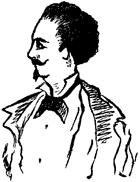
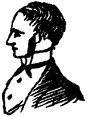
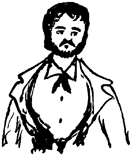
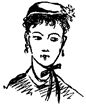
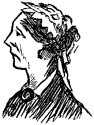
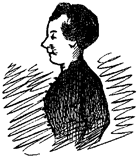
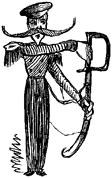
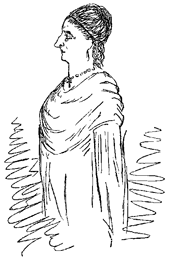
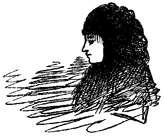
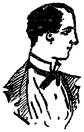
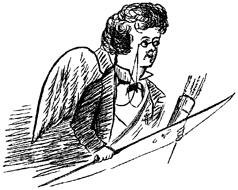
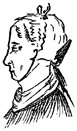
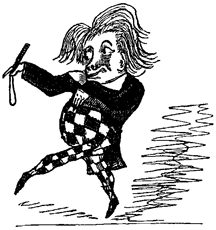
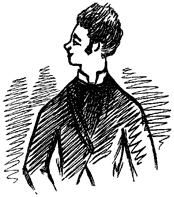
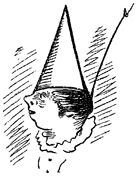
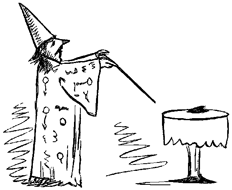
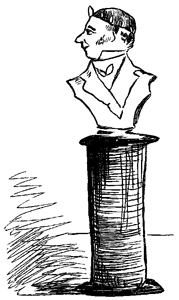
For some days Milburd, Mrs. Orby Frimmely, Cazell, Chilvern,
and the Medfords have been working hard at a new piece.
The order of the evening is dinner for a few, then theatricals
to amuse the many, then refreshments, then a dance, and
finally supper.
The Signor is in great force.
“My dear,” he says to his wife, “I shall do my lit-tel step.
I shall valse.”
“Mr. Regniati,” returns Madame, severely, “you will do
nothing of the sort.”
This rather damps his ardour; and the fact of being unable
to consult his nephew on the best means of obtaining his chance
of doing his “lit-tel steps,” still further depresses him.
He is perpetually looking into the theatre-room, and as often
begging pardon, and being turned out.
The night arrives. I receive the guests as president, and
I take the lady I don't want to in to dinner.
Dinner successful.
Madame rises at the proper moment; and after an hour, and
the arrival of several carriages full, the gong summons us to the
theatre.
Here Medford and myself hand round the programmes, and
Miss Medford performs on the piano.
The programmes are in her writing too. Most neatly done.
This evening will be represented, for the first time on any stage, an
entirely new and original Musical Farce, entitled
PENELOPE ANNE.
WRITTEN BY R. MILBURD, ESQ.
Dramatis Personæ.
| Don José John Boxos de Caballeros y
Carvalhos y Regalias di Salamanca,
generally known, and without familiarity
mentioned, as “John Box” |
|
|
S. Cazell. |
| |
|
| |
| Count Cornelius de Coxo, Land-Margrave
of Somewhere, with a Palazzo in Venice,
commonly known as “James Cox” |
|
|
R. Milburd. |
| |
|
| |
| Karl, the German Waiter |
T. Chilvern. |
| |
| Mrs. Penelope Anne Knox |
Mrs. Orby Frimmely. |
| |
| Major-General Bouncer, B.L.H. |
Captain Byrton. |
The Scene is laid in Aix-la-Chapelle, at the Hotel known as Die
Schweine und die Pfeiffer.
Time.—There being no time like The Present, we choose the
present time.
The Orchestra under the superintendence of Miss Catherine
Medford.
Stage Manager, R. Milburd.
Prompter, George A. Medford.
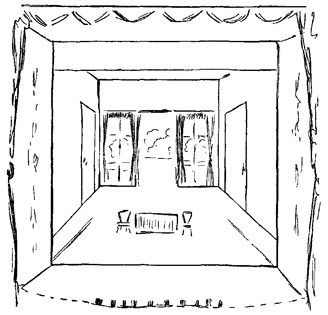 OUR STAGE.
PENELOPE ANNE.
The Curtain being drawn up:—
The scene represents a public room in the small Hotel above-mentioned,
at Aix-la-Chapelle.
Doors R.H. and L.H. Also a door C. leading on to a garden.
Time, late in Autumn.
On the table are various papers, books, &c.
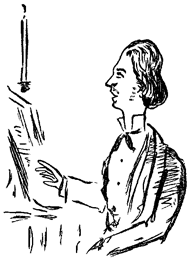
Enter Cox.
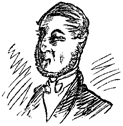
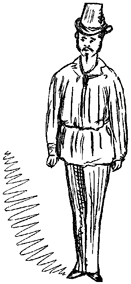 COUNT COXO.
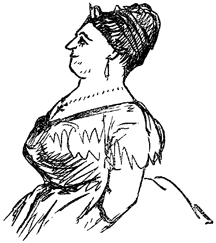
Everybody applauds him. The
Signor says, aloud, “Oh
'ow good! eet is Deeck,”
and looks about, proud
of his penetration of his
nephew's disguise, when
Madame observes, “Mr.
Regniati, if you can't be
quiet, you'd better go
out,” whereupon the Signor
confines himself to smiling
and nodding to
different people among
the audience, intimating
thereby his intense satisfaction with everything that is
taking place on the stage.
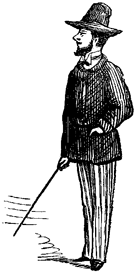
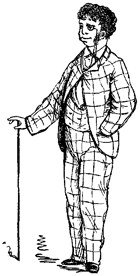
Cox is in full tourist style of the most recent fashion.
Over this he wears a top-coat and round his throat
a cache-nez. In one hand he holds a large glass of
water.
He walks up and down on entering. Drinks a little. Takes
off his coat, which he throws on the sofa. Then drinks
again. Then walks. Then removes the cache-nez, which
he throws on to coat, then he stands still and respires
freely.
COX.
Phew! I'm only gradually cooling. This is the sixth day
I've taken the waters of Aix-la-Chapelle . . . and I'm beginning
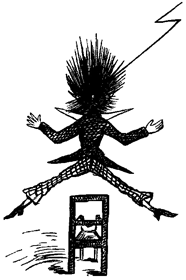
to be so sulphurous all over, that, if anybody was to rub against
me suddenly, I should ignite and go off with a bang. I've
written to my friend Box an account of it. I haven't seen Box
for some years; but as I particularly wish him to remain in
England just now, I've commenced a correspondence with him.
I've told him that the doctor's orders here are very simple . . . .
“Herr Cox,” says he to me—Herr's German—I must explain
that to Box, because, though Box is a good fellow, yet—he's—in
fact—he's an ass. “Herr Cox,” says he, “you must drink a
glass of sulphur wasser.” Wasser's German too; it didn't take
long for my naturally fine intellect to discover that it meant
water. But Box doesn't know it . . . for though he's an excellent
fellow, he is—in fact he's an ignoramus. “Herr Cox,”
says he to me, “you must take the sulphur wasser, and then
walk about.” “What next, Herr Doctor?” says I. Note to
Box. Herr Doctor doesn't mean that he's anything to do
with a Hair-cutter. No, it's the respectful German for
Mister—must explain that to Box, for though he's a tiptop
chap, yet Box is—is—in fact, Box is a confounded idiot.
“Herr Doctor,” says I, “what next?” “Well,” says he
“when you've taken the sulphur water and walked about,
then you must walk about and take the sulphur water.”
Simple. The first glass . . . ugh! I shan't forget it. I
never could have imagined, till that moment, what the
taste of a summer beverage made of curious old eggs . . . a
trifle over ripe . . . beaten up with a lucifer match, would be
like . . . now I know. But I was not to be conquered. Glass
number two was not so bad. Glass number three . . . . less
unpalatable than glass number two—glass number four . . .
um, between number three and number four a considerable
time was allowed to elapse, as I found I had been going it too
fast. But now my enfeebled health is gradually being renovated,
and they tell me that when I leave this, I shall be “quite
another man.” I don't know what other man I shall be.
Yes I do. I am now a single man. I hope to leave here a
double, I mean a married man. Cox, my boy, that's what
you've come here for. Cox, my boy, that's why you want to
keep, diplomatically, Box, my boy, in England, and in ignorance
of your proceedings. Herr Cox, you're a sly dog. If I
could give myself a dig in the ribs without any internal injury,
I'd do it. I came here for the rheumatism. By the way I
needn't have come here for that, as I'd got it pretty strongly.
I caught it, without any sort of trouble. I bathed, at Margate,
in the rain. Before I could reach my bathing machine, I was
drenched through and through, I don't know where to, but long
beyond the skin. The injury was more than skin deep. No
amount of exterior scrubbings could cure me. Brandies and
waters hot internally, every day for two months, produced
more than the desired effect. I began to wander. I finished
by travelling. And here I am. In six more lessons on the
sulphur spring, I shall be quite the Cure. (Dances and sings.)
“The Cure, the Cure, the Cure, &c.”
(Great applause: from the Signor especially.)
Enter Waiter.
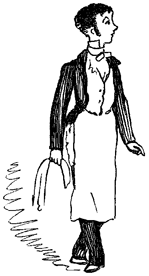 THE WAITER.
(More applause. An
elderly lady with eye-glasses
asks audibly
if that isn't Captain
Byrton?)
WAITER (putting newspaper
on table).
Aachen Zeitung, Herr Cox.
(More applause for his German
accent.)
COX.
Nein danky. I mean, no
thank you. Nix—nein—don't
want any.
WAITER.
Nein, Herr Cox, zis ees de baber—de daily baber at Aix.
Beebels come.
[Exit.
(The Signor here observes aloud, “Eet is so like
ven I——” Madame says, sternly, “Hush, Mr.
Regniati,” and he contents himself by finishing
with a wink privately to me.)
COX.
Ja. Goot. I flatter myself I'm getting on with my German.
Here's the arrival column . . English . . I look at this every
day . . . because . . . um (reading it) . . . “Mr. and Mrs. Bloater,
from Yarmouth, and all the little Bloaters . . . Major
Bouncer” . . . goodness gracious! how extraordinary! . . .
Major Bouncer . . . Oh it can't be the same, it must be one
of his ancestors . . . or his posterity . . . “Major Bouncer of the
Royal Banbury Light Horse” . . . pooh! fancy Bouncer on a
light horse!
Ride a cock horse
To Banbury gorse
To see Major Bouncer
Upon a light horse;
Rings on his fingers . . . .
Stop a minute . . . Rings . . . Ah! (reads) “accompanied by
Mrs. Bouncer, also of the Banbury Light Horse.” Of course,
that settles it. It is not old Bouncer. Next, “Mr. and Mrs.
Winkle, from Pinner.” Ah! at last . . . “Arrived at the Hotel,
der Schwein und die Pfeife,” that's here—“Mrs. Penelope Anne
Knox.” I only heard it the other day at Margate. There she
sat. Radiant as ever. A widow for the second time. Originally
widow of William Wiggins, of Margate and Ramsgate, and
now widow of Nathaniel Knox, of the Docks, with a heap—a
perfect heap—of money. Then my old passion returned.
I determined to propose to her. I was about to do so, when
on the very morning that I was going to throw myself at her
feet, I caught this infernal rheumatism, which laid me on
my back. When I recovered she was gone. “Where to?”
says I. “Aix!” says they. My spirits mounted. I took a vast
amount of pains to get to Aix, and here I am. I had heard of
some property in Venice, which belonged to the Coxes some
hundreds of years ago, and so I thought I'd join pleasure with
business, and take Aix and Penelope Anne on the road. And
now here she is. If Box had only known it, he'd have been
after her. He's a first-rate fellow, is Box, but abominably
mercenary and mean. He'd think nothing of proposing to
Penelope Anne merely for her money. And I think nothing
of a man who could do such a thing. So I've written to Box
telling him to go to the North, and I'll come and stay with him
for the shooting season. A little shooting Box in Scotland.
Ha! ha! when I do go, it will be with Penelope Anne on my
arm, as Mr. and Mrs. Cox. Let me see, when the hour strikes
again, it will be time for my third tumbler—here it is—and the
promenade. The Doctor says I must be punctual in drinking
the water, so I'll put myself straight, and then, so to speak, lay
myself out for the capture of Penelope Anne.
VERSES.
(“Les Pompiers de Nanterre.”)
I'm so very glad,
Feel so very jolly,
Like a little lad
Who has come home to play.
Now about I'll gad!
Widow melancholy!
She will be delighted
When I my addresses pay.
Tzing la la la! Tzing la la la!
I'm an artful dodger!
Tzing la la la! Tzing la la la!
Hey! for Victory!
[Exit out of room R.H.
(Immense applause. The Signor insisting upon joining in
the chorus, which he thinks he knows. Milburd sings it
again and then makes his exit.)
Enter Waiter with portmanteau.
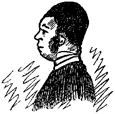
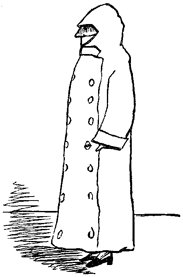
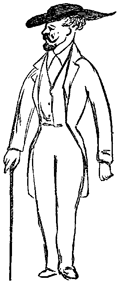 DON BOXOS.
Applause. Then enter Box as
if from a long journey; he
is wrapped up to the eyes,
and above them. Questioning
among audience, “Who's
that?” Waiter points to
room L.H. Box inclines his
head. Exit Waiter. Box
commences unbuttoning long
foreign overcoat with hood.
Then takes off hood, then
takes off immense wrapper.
When free of these he appears
dressed in very foreign
fashion.
Re-enter Waiter.
WAITER (puzzled).
'Ave you zeen a Herr mit ein long code, . . . long tail?
BOX.
A what? A hare with a long tail?
WAITER.
Ah! ah! (laughing). You are him I zee (pointing to coat).
Dat vas you dere. Zo ist goot.
BOX.
Oh, I see. Yes, that's me, I mean that was me, only now
I've come out like the butterfly out of a grub. (Aside.) I
forgot that this is Germany. (Aloud.) Ja.
WAITER.
Ach! der Herr sprech Deutsch?
(Great applause.)
BOX.
Yah. (Aside.) That's more like a nigger. (Aloud.) On
second thoughts, nein.
WAITER.
Vill you your name in dese book write? (Presenting visitors'
book.)
BOX.
I will. (Writes.) Don José John de Boxos Cazadores
Regalias, Spain.
WAITER.
Dank you, milor!
[Exit Waiter C.
BOX.
We know what we are, but we never know what we shall be.
I am not quite clear at present, by the way, what I am, let
alone what I shall be. If anybody three months ago had said
to me, “Box, my boy, you are a grandee of Spain” . . . I should
have said that he was a . . . in point of fact I shouldn't have
believed him. But still I am—that is, partially so—I'm gradually
becoming one. At present I'm only half a grandee. Three
months ago a friend, my legal adviser, a law stationer's senior
clerk, near Chancery Lane, said to me, “Box, my boy, you've
got Spanish blood in you.” I said that I had suspected as
much from my peculiar and extreme partiality for the
vegetable called a Spanish onion, and I was going to a doctor,
when my friend and legal adviser said to me, “Box, my boy,
I don't mean that. I mean that your great grandmother
was of Spanish extraction.” I replied that I had heard that
they had extracted my great grandmother from that quarter,
“I came across some papers,” continued my legal adviser,
“which allude to her as Donna Isidora y Caballeros, Carvalhos
y Cazadores y Regalias, Salamanca, Spain, who married
John Box, trader, of Eliza Lane, St. Margaret's Wharf,
Wapping. Date and all correct. Go,” says he—I mean my
legal adviser—“go to Spain, and claim your title, your estates,
and your money, and I'll stand in with you, and take half the
profits.” I was struck by this remarkably handsome offer, and
went down to Margate to cultivate a Spanish moustache and
think about it. Whenever I want to think about anything
deeply, I go down to Margate. Well, one morning as I was
examining the progress of my moustache, after shaving my chin
and letting out some of the blue blood of the Hidalgos in a
most tremendous gash, judge of my astonishment, when, walking
on the beach, in among the donkeys and the Ethiopian serenaders,
I saw in widow's weeds, as majestic as ever, Penelope Anne!
(Sings) “I saw her for a moment, but methinks I see her now,
with the wreath of—something or other—upon her—something
brow”——and then I lost sight of her. But my Spanish
blood was up. The extraction from the sunny South boiled in
my veins . . . boiled over, when I learnt, on referring to the
visitors' list, that Penelope Anne was the relict of the short-breath'd—I
mean short-lived but virtuous—Knox, who had left
her his entire fortune. All my long-stifled passion returned—the
passion which the existence of a Wiggins, her first, had not
quenched, which the ephemeral life of a Knox had not extinguished,
a passion which I have felt for her before I knew that
the blue ink—I mean the blue blood, of the Hidalgos danced
in my veins, and while she was only a sweet village maiden
eighteen years old, and known to all as Miss Penelope Anne,
of Park Place, Pimlico! I determined to go out and throw
myself at her feet, declare my passion, and take nothing
for an answer except “Box . . . John . . . I'm yours truly,
Penelope!” I couldn't present myself before her with a
scrubbing-brush on my upper lip. So that afternoon I
sacrificed Mars to Venus—I mean I shaved off my moustache
for the sake of Penelope Anne. The next morning . . . .
Toothache wasn't the name for what I suffered. Face-ache
fails to describe my agonies. Neuralgia doesn't give the
faintest idea of my tortures. The left side of my face looked
exactly as if I was holding a large dumpling in my mouth, or
a gigantic ribston-pippin which I couldn't swallow. Swallow!
Not a bit of food passed these lips, except slops, beef-tea, and
tea without the beef, for days. At the end of a week I was a
shadow. Penelope Anne had gone. Where, no one knew.
Somebody said they thought it was the Continent. I bought
a map and looked out the Continent, but it wasn't in that. I
suppose it was an old edition—there have been so many
changes, and they're building everywhere—so I consulted my
medical man and my legal adviser. The first said, “Get change
of air. Go abroad!” The second said, “Seize the opportunity
and go to Spain. And,” he added, “come home by the
Continent.” That suited me down to the ground. I should get
my title, my lands, and my money, meeting Penelope Anne on
the Continent. As I was coming back I should be able to offer
her the hand and heart of either Don José John de Boxos y
Cazadores y Regalias y Caballeros y Carvalhos of Salamanca,
Spain, or of plain John Box, of Barnsbury. So here I am. I
haven't got the whole title yet, as the Spanish legal gentleman
and I didn't hit it off exactly. . . . If I'd only known what he
was talking about, it would have shortened the proceedings.
However, as that remark applies to all legal business, I couldn't
quarrel with a foreigner on that point. Besides, if you quarrel
with a Spaniard, his southern blood can't stand it. He stabs
you. He's sorry for it afterwards, but that's his noble nature.
So I've adopted half the title, and the rest will be sent on to me
if the suit is gained. But up to this moment I've not met
Penelope Anne. I've had so much of the wines of Spain, that
my medical man wrote and advised me to try the waters of
Germany. So here I am. (Takes up paper). What's this?
Comic Journal, um. “We are sorry to announce the death
of . . .” um, um. (reads) “Spain on the eve of a crisis.” . . .
There were three while I was there. Nobody took any notice
of them. What's this? “Hotel der Schwein and die Pfeife”—that's
here—“Mrs. Penelope Anne Knox.” . . . . Don José de
Boxos, she's yours. You've only got to propose, and she's
yours. Tell her you're a Spanish grandee, and offer her a
position as Spanish grandshe. Don Boxos, you've only got to
give yourself a brush up, and she's yours. (Taking up Cox's
glass of water which he has left on table) I wish myself
every possible success! To my future happiness! (drinks.)
Ugh! (suddenly makes fearfully wry faces. The clock
strikes. Re-enter Cox, R.H.)
COX.
Punctual to the moment. (Seeing glass empty) Confound it,
dash it—who's taken my sulphur wasser? I say who (sees Box
who is slowly recovering)—Have you—(starts) Can I believe
my eyes?
BOX.
I don't know.
COX.
It must be—.
BOX.
If it must be, then in that case (opens his eyes and recognises
Cox). Ah!
COX.
Box!
BOX.
Cox!
[They are about to rush into each other's arms,
when they think better of it, and shake hands
rather coolly.
BOX.
How d'ye do?
COX.
How are you?
BOX.
Very well, sir.
COX.
Very well, sir! (Aside) I don't like the look of this.
BOX (aside).
I don't like the taste of that.
COX (aside).
What's Box here for?
BOX (aside).
Has Cox been trying to poison himself—and poisoned me?
COX (aside).
He mustn't stay here.
BOX (aside).
Cox must go. I don't think I feel as well as I did.
COX.
Ahem!
BOX.
Ahem!
COX.
I beg your pardon, you were going to say—
BOX.
On the contrary, I interrupted you—
COX.
No, you speak first. Seniores priores.
BOX.
In that case you have the preference. Why, I'm quite a
chicken by the side of you.
COX.
Pooh, sir.
BOX.
Well, if you don't like “chicken” I'll say gosling.
COX.
Don't be absurd, sir. At what age were you born?
BOX.
What's that to you? I'm six years younger than you, whatever
you are.
COX.
So am I. So you speak first.
BOX.
This is absurd. I'm only a visitor. You're a resident.
COX.
No I'm not. I'm only ong parsong.
BOX.
Ong Parsong? Why, you don't mean to say you've become a
clergyman? Archbishop Cox, I congratulate you.
(Our two curates, who are among the audience, see the joke
and laugh sweetly.)
COX.
Don't be a fool. Are you stopping here?
BOX.
Well, that depends. Are you?
COX.
Well—(shrugging his shoulders and stretching out his
hands).
BOX.
Ah! (imitates action) That's exactly my case.
COX.
It's time for me to go out and take the waters. You've taken
mine for me.
BOX.
If you don't feel any better after it than I do—What's the
effect of the waters?
COX (aside).
I'll frighten him. (Aloud) If you're unaccustomed to them—poisonous.
BOX.
Good gracious! The first draught then is—
COX.
Fatal. Deadly.
BOX.
Then you don't have much chance of getting accustomed to
it. You look very well.
COX.
Yes. I could have taken that glass with impunity. It was
my eighteenth tumbler.
BOX.
Then I'm safe. I began with the eighteenth. Aha! I shall
smoke a cigar and read the paper.
COX (aside).
The paper!
BOX.
Don't stop for me. (Aside) I wonder if he's seen the news.
COX (aside).
He mustn't know she's here. He's got it. (Seeing Box reading
the paper.) Would you allow me to look at the paper?
BOX.
There's nothing in it.
COX (coming up to table and putting his hand suddenly down
on it).
Sir!
BOX (taking no notice).
Come in.
COX.
No, sir, I shall not come in. I'm going to come out, sir, and
come out pretty strongly too. (Suddenly pathetic) Box, my
boy—
BOX (the same).
Cox, my boy. (Turns and allows the smoke of his pipe to
come under Cox's nose just as Cox is attempting to take the
paper.)
COX (sneezing).
Excuse my emotion (sneezes).
BOX.
It does honour to your head and heart—specially to your
head. (Offers his pocket-handkerchief.)
COX.
Thank you. I can't forget that we were once brothers.
BOX.
We were.
COX.
We had no secrets from each other. At least you had none
from me, had you?
BOX.
No, not unless you had any from me.
COX.
Then I will confide in you. I don't mind telling you—
BOX.
I have no objection to inform you—
COX.
That I am—
BOX.
So am I—
COX.
Here—
BOX.
Exactly my case—
COX.
To marry—
BOX.
Yes, to espouse—
COX.
Eh?
BOX.
It's the same thing.
COX.
Oh. To marry Penelope Anne.
BOX.
Penelope Anne! So am I!
COX.
You!
BOX.
I.
COX.
Then, Box, I'm sorry for you. You've no chance. Go.
BOX.
On the contrary, Cox, as there can't be the smallest possibility
of your being accepted, it's for you to retire. Allez.
COX.
I shan't allez.
BOX.
No more shall I.
COX.
Mr. Box, since we last met, circumstances have changed.
You no longer speak to a gentleman—
BOX.
You needn't explain that—
COX.
I say, to a gentleman connected with the Hatting interest.
No, my family solicitor discovered that my great grandfather
had been a Venetian Count, or a Margrave, or a Hargrave,
or a something of that sort, and that therefore my proper title
was Count Cox The Landgrave.
BOX.
The Landgrave—you might as well be a tombstone at
once.
COX.
I am serious. I have come over to mix pleasure with business,
and to offer to Penelope Anne the hand of The Landgrave,
or of the Venetian Count. So yield to the aristocracy;
and, Printer, withdraw.
BOX.
Excuse me, Cox, but since our parting I have discovered that
in my veins flows the blue blood of the Hidalgos—
COX.
How many “goes”?
BOX.
Don't be profane—of the Hidalgos of Spain. I have
already assumed half the title. The rest will be sent on to me
in a few days, and I am here to offer to Penelope Anne the
hand and coronet of Don José John de Boxos y Caballeros
y Regalias de Salamanca. Fuego, as we say in Spain,
Fuego.
COX.
Never, while I live, shall you marry Penelope Anne.
BOX.
Never, while I marry Penelope Anne, shall you live. I've
Spanish blood in my veins. Pistols!
COX.
Swords!
BOX.
When?
COX.
Now. (Clock strikes). That's the second glass of water you
have made me lose. You are ruining my health.
BOX.
Then let me shoot you at once. By the way, I haven't got a
pistol.
COX.
Paltry evasion! There's a shooting gallery here where they
let 'em out by the hour.
BOX.
How many hours shall we take 'em for?
COX.
Well—we've got to pay in advance.
BOX.
Well, you advance the money and I'll pay.
COX.
No. We'll borrow it from the waiter.
BOX.
Yes, and leave it to be paid by our executors out of the
estate. Come.
BOTH.
DUETT.
(“Suoni la tromba.”)
Off to the tented field!
Pistols! revolvers they shall be!
Sooner than ever yield
I'll fight for death or victoree!
BOX (aside).
Yes! he must be my target.
Must the unhappy Cox.
COX (aside).
What will they say at Margate
When I have shot poor Box.
BOTH.
Ah!
[“Off to the tented,” &c. They repeat the duett
and are about to exit, when they stop at the
door and return.
BOX.
Hem! I say, sir.
COX.
Well, sir?
BOX.
I intend to exterminate you.
COX.
I mean to blow you to atoms.
BOX.
But if we don't exterminate each other it will be rather
awkward.
COX.
Yes. I shouldn't like to be wounded. It hurts.
BOX.
Besides, if we both came off without our noses, or with only
two eyes between us, we should neither be able to marry
Penelope Anne.
COX.
True. I have it.
BOX.
So have I.
COX.
The Lady shall decide.
BOX.
Just exactly what I was going to propose.
[A female voice heard without, singing a jödel.
⁂ This is Mrs. Frimmely. She sings a
Tyrolienne by Offenbach, and in French.
Every one delighted. Being encored, she
appears at the door, curtseys, retires and
sings again, “without.”]
COX.
'Tis she! What superb notes!
BOX.
It's a rich voice.
COX.
She's a rich widow.
BOTH.
She comes.
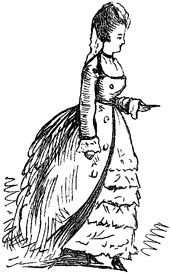
[Penelope Anne appears C. in ultra Parisian
watering-place toilette. They bring her down
between them, each taking a hand.
BOTH.
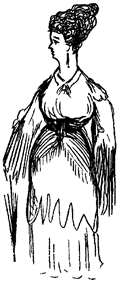 PENELOPE ANNE.
Penelope Anne!
[Both kneel R. and L.C.
PENELOPE.
Mr. James Cox. Ah! (starts).
BOX.
You've frightened her. You're
so ugly.
PENELOPE.
Mr. John Box. Oh! (faints,
and falls into a chair placed C.)
COX.
You've killed her. You Gorilla.
BOX.
Gorilla—(they are about to fight, when she screams again).
What shall we do?
COX (excitedly).
Cold key—Senna—no, I mean Salts.
BOX (more excitedly).
Pooh! Cold water . . . . with something in it.
COX.
Where's the sulphur water—throw it—
PENELOPE (shrieking).
Ah! (rising). How dare you! (calls). Husband!
BOX.
She said Husband. Dearest—
[Penelope slaps his face.
COX.
She means me. I knew it. Angel—
[Penelope repeats the slap on HIS face.
BOX.
You did say “Husband?” Surely you can't be blind to the
fascination of Don Boxos de Regalias Salamanca—
COX.
When you said “Husband” you must have been dreaming of
Count Cornelius Cox, Landgrave.
PENELOPE.
Gentlemen. Mr. Cox . . . Mr. Box—if the truth must be
told—
BOX.
It will be painful for Cox—but tell it, brave woman, tell it.
COX.
It will be harrowing for Box—but out with it, courageous
Penelope, out with it.
PENELOPE.
Well—when—I said—“Husband”—I meant . . .
COX.
Me—
PENELOPE.
No—
BOX.
Ha! ha! hooray! Me—
PENELOPE.
No . . . .
BOTH.
Then whom did you mean?
PENELOPE.
When I said “Husband” I meant—
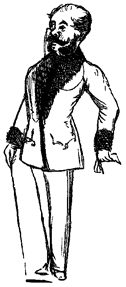 MAJOR-GEN. BOUNCER.
MAJOR BOUNCER, suddenly entering.
BOUNCER.
Me. (Sings in military style)
“Rataplan! Rataplan!”
(Immense applause. “Why
that's Captain Byrton,” exclaims
the elderly lady, who,
up to that moment, has
been under the impression
that he was playing the
waiter.)
BOTH.
Him! You! Bouncer!
BOUNCER.
Major Bouncer, of the Banbury Light Horse, at your
service. We were married this morning.
COX.
Stop! Virtuous but misguided Penelope. Bouncer is
married already!
ALL.
Ah!
COX.
Behold! and tremble! Read it, Box (giving newspaper).
BOX (reads).
At the hotel So-and-so—um—Major and Mrs. Bouncer.
[PENELOPE and BOUNCER laugh.
COX.
They laugh! Horrible depravity.
BOUNCER.
Nonsense! Mrs. Bouncer mentioned there—
BOX.
Is not the Mrs. Bouncer we see here.
BOUNCER.
True. The Mrs. Bouncer here is Mrs. Penelope Bouncer,
My Mrs. Bouncer; but the Mrs. Bouncer there is your old
landlady, your Mrs. Bouncer, now, the Dowager Lady
Bouncer.
BOX AND COX.
Good gracious!
BOX.
Has she any money?
COX.
Is she well off?
BOUNCER.
No. I support her entirely.
BOX.
Oh! Then bless you, Bouncer. Persevere. Go on supporting
her.
COX.
I congratulate you, Bouncer. You may keep your Dowager
to yourself.
PENELOPE.
And if you like to join us at the wedding-breakfast—
BOUNCER.
We shall be delighted—
PENELOPE.
Now, as always—
BOUNCER.
To see—
PENELOPE.
Two old friends.
BOUNCER.
Come, join hands. I'm an old soldier.
BOX.
You are.
BOUNCER.
I've stolen a march upon you.
COX.
You have.
BOUNCER.
But forgive and forget.
BOX.
I'll forget you with pleasure, but forgive—oh! Penelope
Anne!
COX.
Well, I'll forgive you; but don't do it again.
BOUNCER.
I promise.
PENELOPE.
So do I.
BOX.
Do you? Then there's my hand, and when I've got my
Castle in Spain you shall come and stop with me. (Aside) I'll
have old Bouncer up before the Inquisition.
COX.
And when I've got my Palazzo di Coxo at Venice, you shall
always find a knife and fork at your service. (Aside) I'll take
him out for a walk by a canal and upset him.
[Enter Waiter with tray, which he puts down. Everything is
placed ready for déjeûner à la fourchette.
WAITER.
Das Frühstuck ist fertische.
(Applause.)
ALL.
Eh?
WAITER.
Break-a-fast.
[They sit.
BOX.
Permit me—
COX.
And me—
BOX.
To propose—
COX.
The health—
BOTH.
Of the Happy Pair. Major and Mrs. Bouncer. Hip! hip!
hip! Hurrah!
BOX (singing).
It's a way we have in the army.
[They all join in chorus.
Solos and Chorus.
(“Ha, ha!” “Les Dames de la Halle.”)
BOX.
I drink the health of Madame Bouncer,
And of the Major Bouncer, too!
SOPRANO ET TENOR.
Too too too too too too too!
BASSI.
Too too too too too too too!
COX.
Of his foes he is a trouncer,
Equal to any Horse Guard Blue.
ALL.
BOX.
All our jealousy we smother
From this happy bridal day.
COX.
We'll embrace him like a brother
BOX.
PENELOPE ANNE.
Ah!
BOX AND COX (together).
Viva, Viva Rataplan!
Oh! Rataplan Penelope Anne,
Oh! Rataplan Penelope-ĕlŏpĕ
Anne, Anne, Anne!
Chorus (including the Waiter, all at table standing up, glasses in
hand convivially).
Viva, viva Rataplan!
Oh! Rataplan Penelope Anne!
Oh! Rataplan Penelope-ĕlŏpĕ
Anne, Anne, Anne!
Tableau.—Bouncer on chair, with dish-cover and carving-knife.
Waiter at side, waving napkin. Penelope between
Cox and Box in centre.
Curtain descends.
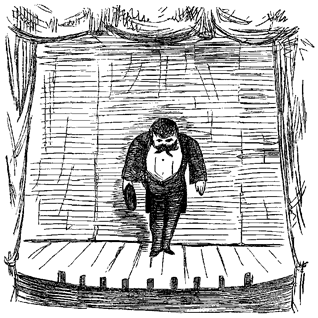 “AUTHOR! AUTHOR!”