New original cover art included with this eBook is granted to the public domain.
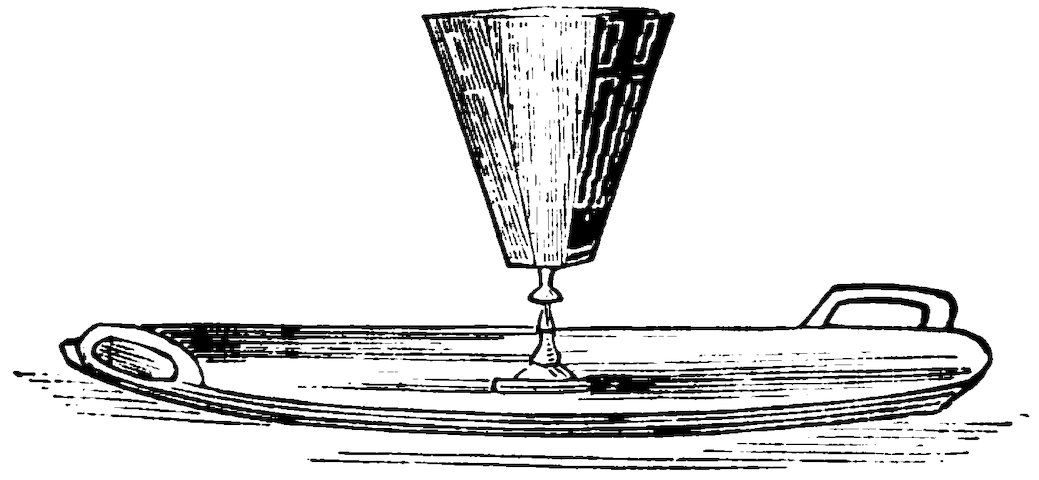
BY THE AUTHOR OF “THE SECRET OUT.”
EDITED BY W. H. CREMER, JUN.
Very Easy Tricks and very Difficult Tricks, Diversions with Dice, Conjuring with Cards, Jugglery with and without Assistants, Gamblers’ Deceptions Exposed, &c.
WITH 250 PRACTICAL ILLUSTRATIONS.
LONDON.
JOHN CAMDEN HOTTEN, 74 & 75, PICCADILLY.
PRELIMINARY.
The great and deserved success of “The Secret Out;
or, One Thousand Tricks in Drawing-Room or White
Magic,” edited by W. H. Cremer, Jun., of Regentstreet,
has suggested an entirely new Edition of the
same Author’s world-famous “Hanky Panky: Very Easy
Tricks and Very Difficult Tricks, Diversions with Dice,
Conjuring with Cards, Jugglery with and without
Assistants, Gamblers’ Deceptions Exposed.” The Publisher
has again secured the services of Mr. Cremer—the
gentleman whose wonderful display of the Toys of
the World attracted so much notice in the recent International
Exhibition—and an eminently entertaining,
but, at the same time, thoroughly practical, book is
now before the reader.
The present work, therefore, may be considered in
the light of a supplement or addition to the Author’s
well-known “Magician’s Own Book.”
The Publisher will, he trusts, be pardoned for here
directing attention to another book of this class, “The
Art of Amusing,” a Collection of graceful Arts, Games,
Tricks, Puzzles, and Charades, considered by The
Athenæum as being “the best and most entertaining
work of the kind with which we are acquainted.”
A companion volume, under the title of “The
Merry Circle: A Book of New Games and Intellectual
Amusements,” with nearly Two Hundred Illustrations,
has just been issued by Mrs. Clara Bellew.
Piccadilly.
CONTENTS. — I.—SIMPLE TRICKS. — FLY AWAY, JACK! — DANCE, BOATMAN, DANCE! — BUY A BIRD. — LITTLE WATCHMAN. — TO ADD FIVE TO SIX AND YET MAKE BUT NINE. — TO CARRY HOT COALS IN THE HAND.
Take two pieces of white paper, about the size of a
sixpence, and moisten them well on both sides. Put one
on the first joint of each forefinger, just at the root of
the nail, and place these fingers on the edge of the
table, straight out, while the rest are closed up under
the hands.
14Then say:
“Two little dickey birds sat on the sill,
One named Jack—t’other named Jill!
Fly away, Jack!”
Close the right forefinger, and with the middle finger
remove the paper and retain it there, while the forefinger
is quickly replaced in the first position to show
the veritable flight of Jack. Then say,
“Fly away, Jill!”
And repeat with the left forefinger. Then say:
“Come back, Jack!”
And take the piece of paper from the right middle finger
upon the forefinger as at first, and replace it on the
table.
“Come back, Jill.”
The same with the other hand. Then conclude:
“The two little birds are sitting there still!”
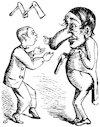
Fig. 2.—The Perplexed Spectator.
(From the German.)
Herr Professor Bobine von Rhumkorff amuses little
children by holding up his hand, with the thumb and
finger thus posed:—
The thumb is made to spring up and down to a lively
air and to the words “Dance, de Boatman, dance!”
15Then the thumb stops while the fingers are set leaping,
to the words:
“Boatman’s piccaninnies dance, ’cause fader dance all alone by heself!”
Then leave the forefinger capering and sing:
“Eldest son of de Boatman, dance!”
Then all the fingers but the first leap about to the words:
“De whole family dance, ’cause him eldest son he dance all alone!”
So on with the other fingers, the little one being the
baby, and the middle one Mrs. Boatman.
Some put on a black glove and make four chalk spots
on the fingertip to represent eyes, nose, and mouth.
Fold each finger over the next, the forefinger undermost
upon the thumb, and say:
“Who will buy my birds?”
On one saying he or she will make the purchase, you
quickly open your hand and cry:
“They all have flown away!”
(For Children):
Hold up the left hand, open.
“This is the thumb!”
Touch the three principal fingers.
“This, this, this a plum!”
Put down forefinger.
“He eats this one!”
Put down middle finger.
“He takes his brother!”
16Put down third finger.
“And grabs the other!”
Hold up little finger and wag it sadly.
“And little Watchman’s left alone!”
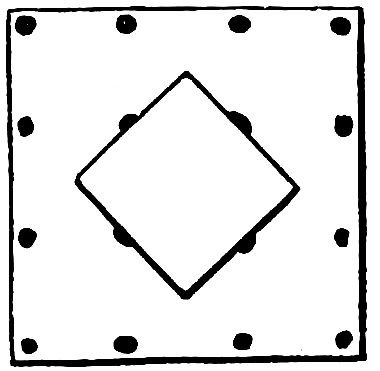
Having drawn six-straight lines, by adding five more,
as in figure 3, only Nine is seen.
Fig. 3.
Cover the palm with sand, ashes, or any non-conductor,
and calmly put the live coals on it. Which ancient
“sell” will be found in the first German mediæval play,
entitled “The Burning Iron,” by Hans Sachs, “performed
17for the first time in Nuremberg in the year 1531.”
A peasant woman suspects her husband of some crime,
and she arranges with her mother that he must pass
under the ordeal of the “burning iron”—that is, a piece
of iron made red-hot must be picked up with his bare
hand, and carried round the room. If his hand remain
unscathed, he is innocent; if he be burnt, then he
is guilty. The husband promises to undergo the ordeal;
but before doing so, manages to place, unseen by his
wife, a flat piece of wood upon the hollow of his hand,
and with this deception he passes through the ordeal
successfully. Mr. Hanky Panky believes this gentleman
to have been his “long-lost brother.”
II.—TRICKS WITH COINS. — THE COIN TRICK, FROM AN HIBERNIAN POINT OF VIEW. — THE NEW TRICK OF MELTING MONEY. — TO REDUCE A SHILLING TO A SIXPENCE. — THE UNCRUSHABLE FLOWER. — THE FLYING COTTON REEL. — THE OBEDIENT SIXPENCE. — THE INVISIBLE TRANSIT. — THE DIE AND DOVE TRICK. — THE COIN WAND. — THE GARLAND OF ROSES. — THE BEWITCHED PICTURE FRAME. — THE GUERIDON AND GOLDEN RAIN.
18
Fig. 4.
Our brother magician, Signor Blitz, tells us the
following tale, which is useful as a warning:—
While conversing in a grocery store with the proprietor,
an Irishman came in to make some purchases.
The trader was extremely anxious for me to astonish
him by performing some feat, which I complied with.
Before concluding I requested the loan of a quarter of a
dollar from the Hibernian, which he at first refused, and
even when the storekeeper pledged himself responsible
for it, he reluctantly gave it to me. I desired him to
close his hand, and hold the money secure, and I would
change it into a five-dollar gold piece.
“Faith!” he muttered, as he grasped the quarter,
“it is just as I would like to have ye after doing, but I
don’t believe you can coin money so aisy. Let me see
if you can do it!” he exclaimed.
19“It is already done,” I said. “Open your hand and
see.”
The man cautiously relaxed his fingers, and, at the
first glimpse of the gold, jumped and hurrahed wildly,
as an Irishman only can; but when his curiosity was
entirely satisfied as to its reality, he carefully deposited
it in his pocket, with many thanks, declaring me to be
the most wonderful man in the world.
I here desired him to replace the money in my hand,
and I would again convert it to the original quarter.
“Sure, afther Mike being rich, would ye make him
poor again?”
“But you know it is only a trick,” I answered.
“A thrick? Divil a one! Sure, man, it is a rale
piece of goold,”—thrusting his hand into his pocket to
protect it from any sudden or unperceived effort on my
part to extract it.
“You know it is but a joke,” I repeated. “Return
me the gold, and I will astonish you by transforming it
into silver once more.”
“By St. Patrick, you had better not do that.”
“Yes, you must give me back the gold.”
“I would not part with it if Priest McDermott bid me.”
Finding my efforts to procure the money a failure, I
resorted to artifice by exciting his fears of my power
to do good or evil. I assured him that unless he returned
the piece of gold, he would be a miserable man
all his life; for it was Satan’s coin, who was always in
search of his own, and would take him away with the
gold.
“Och, shure, yer honour, the Holy Father will save
Mike, and if ye want any more silver quarters to change
into goold, come to Michael MacCarty. He is the man
for you.” And with these consoling words he walked
rapidly away, leaving me minus my half-eagle, while
20the storekeeper laughed immoderately at the magician
being outwitted by a son of the Emerald Isle.
All Louisville became cognizant of “the joke,” as
they called it, and hugely enjoyed it at my expense;
but I could not see it.
In our former works have been given revelations by
means of which the disappearance of coins can be accomplished.
The present act of prestidigitation is quite
new, and never before discovered by magicians to their
audiences.
Performance.—A drinking-glass having been passed
around amongst the audience, that the absence of
mechanism may be generally manifest, Mr. Hanky Panky
borrows a half-crown and a handkerchief, and pours
some pure water (which may be tasted) into the glass,
held by one of the company. Though this essence of
the New River has no corrosive properties perceptible
to the tongue, Mr. Panky confidently asseverates that it
is bewitched into the power of annihilating silver.
He then places the coin in the centre of the handkerchief,
and puts it over the mouth of the glass, where the
volunteer holds it by its edge through the silk, so that
the pendent corners hide the coin and glass.
Fig. 5.
21The person is notified that Mr. Panky will count
three, at the last of which numbers he is to let the piece
fall into the glass, as the sound will betoken.
One, two, three, chink.
The coin is distinctly heard to fall, so that there can
linger no doubt whatever of its presence in the glass.
Nevertheless, Mr. Panky, with his usual assurance,
announces that—without his approaching—he has the
power to attract the coin to him, and, in truth, he suddenly
holds it up in plain sight. The person takes
away the handkerchief, and is even more astounded
than the most impressionable amongst the spectators,
to see nothing but the water in the glass—of which
the magician relieves him by swallowing it.
Fig. 6.
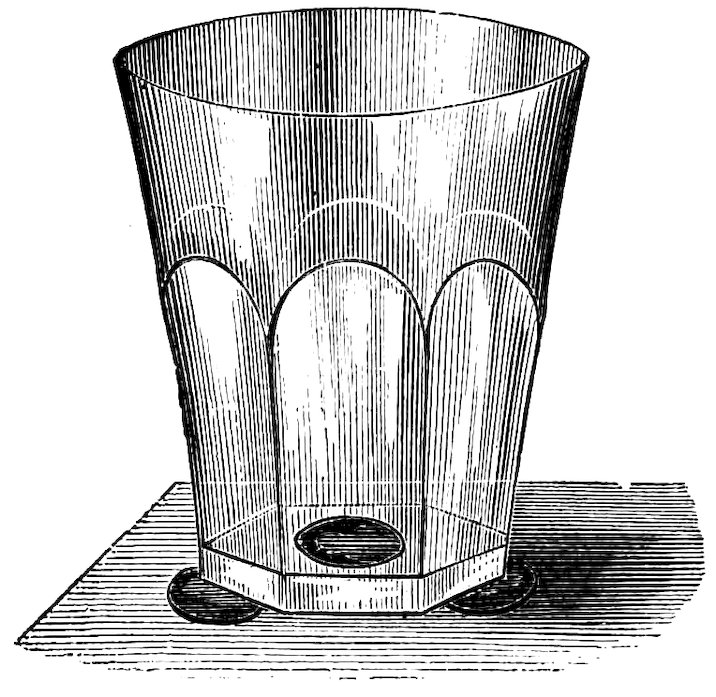
Explanation.—The bottom of the glass is of the same
dimension as a half-crown. A disc of sheet-glass is cut
of the same size exactly. This is substituted for the
coin, and is felt within the handkerchief. When it falls,
the sound is so like that of metal that all are filled with
error. When the cover is removed, the water prevents
the glass piece being seen at the bottom even by the
operator himself.
The coin wand can be used in connection with this
trick, for which see a description following.
22
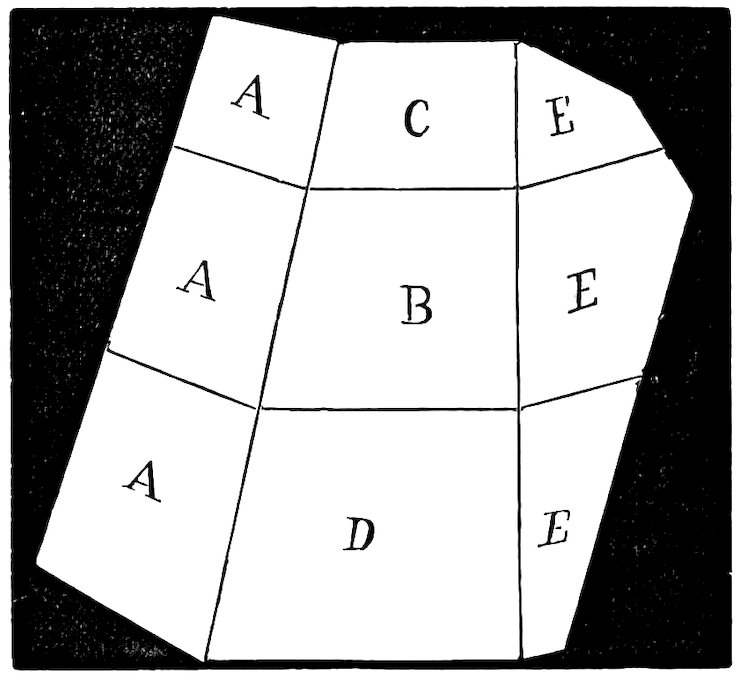
Take two pieces of fancy paper with one side in
colours, patterns, or marbling, about seven inches
square, put the coloured sides together, and cut them
at the same time in the shape of Fig. 7.
Fig. 7.
The success of the trick depends on their being
exactly alike in size. Place a sixpence in the centre of
one of the pieces at the place marked A, then fold it
carefully over at the crease on the side marked B, and
also again at the side marked C. When you have done
this, turn down the end marked D upon the centre A and
again fold over on E. You have thus formed a small
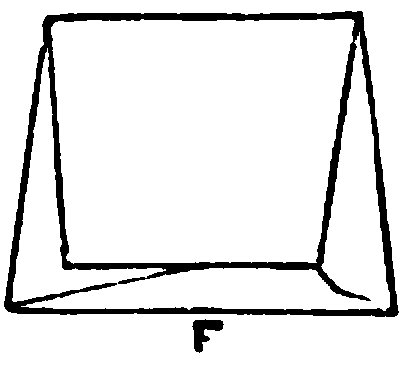
parcel the shape of Fig. 8, with a sixpence in the
middle. You must then put a shilling in the centre of
the other piece of paper, and fold it up exactly the same
23size and shape as the first piece. When you have done
this, paste the two parcels together at the back of the
ends marked F in Fig. 8, and the sides will be so even
that both will appear as one. You can then open the
side of the paper containing the smaller coin, and show
it to your audience, at the same time informing them
that you are going to open a mint on a small plan, and
coin a shilling from a sixpence. Dexterously turn over
the side containing the shilling, and upon opening the
paper, to the general astonishment, instead of a sixpence
they will behold a shilling.
Fig. 8.
At the time of the amusing warfare between the
perennial Charles Mathews (“the Younger!” what
happy augury in the title!) and the Great Wizard of the
North, the former, who was assisted by Mr. Cremer in
many of his diversions, created much surprise by the
exhibition of a flower, as fragile as a rose, which could
not be lastingly injured.
He would pluck this flower from his button-hole, and,
in sight of the audience, who wondered “What he Would
Do with It?” would dash it to the stage, stand on it,
shut it up in a book, and martyrise it in various other
modes.
24In spite of this, he had but to take it up and tenderly
wave it in the air, and gently breathe a tender sigh on
it, and kiss it for its mother, when it would resume its
pristine fulness of bloom—not a pistil broken, not a petal
injured.
Explanation.—The flower is artificial, and carefully
made of choice Berlin wool, which material will bear
much ill-usage without injury to its elastic filaments.
Fig. 9.—The Victim of this Mystification.
25
Wind off a ball of cotton cord (piping) upon a tin
tube six inches long, and of the diameter of a half-crown
or florin, or rather a trifle wider.
Borrow a coin which you have had marked, and
change it by means of the magic salver.
Fig. 10.
Pass the marked coin off the stage to your confederate,
who puts it down the tube into the ball of cotton,
and leaves it there in the centre; on withdrawing the
tube the hole can be completely covered up by pressing
the cord around it.
Thus prepared, the ball is brought to you in a glass
cup, having a hole in the rim through which you pass
one end of the cotton. Fasten this to a winding-off
wheel (broad-tired), and as your assistant winds off the
cord, you pretend to throw the coin into the ball.
26Immediately, the marked piece falls into the bottom of
the vessel, in which it is taken to the owner.
Fig. 11.—The Owner of the Coin.
Fig. 12.
Lay a sixpence between two shillings on a table-cloth,
and cover them with a tumbler, and offer to remove the
27middle one without touching the others or the glass.
To do so scratch the cloth with the finger-nail, and the
lesser coin will move out towards you, the others being
held by the tumbler.
(Le Vase aux Grains.)
Mr. Panky borrows a half-crown, which he politely
requests some one in the party to mark, and having had
a fruit examined, such as a shaddock, melon, marrow,
&c., he puts it in a box.
Then holding a large cup or vase full of seed or corn,
as he proves by taking a pinch out of it, and casting the
grain amongst the audience, he sets it on a table.
At a word, the coin vanishes to enter the fruit. Next,
the fruit is commanded to cross and bury itself in the
vase filled with seed, without displacing its contents,
which is assuredly remarkable. Indeed, on plunging
the hand into the vessel, the fruit is produced, and in
its centre is found the marked coin. The seed has disappeared.
Fig. 13.
Explanation.—The vase is of metal with a secret
bottom or with a trap in the stand, by which the contents,
in this case seed, will run down out of it and
28down through the hollow leg of the table on which it is
placed. The box in which the fruit is put is that called
the Box of Disappearances.
Fig. 14.—The Box of Disappearances.
It is a case with a double drawer, into the inner of
which an object is placed and both shut up; only the
outer or false drawer is pulled out, and the disappearance
is performed.
As for the fruit, the coin is placed in it beforehand,
or introduced by means of the coin knife.
Performance.—The marked coin is passed to your
agent, who pushes it into a fruit by a cut made in it
while you are letting a duplicate fruit be examined.
The prepared one is buried in seed in the vase which is
brought in upon the stage. The second fruit is put into
the disappearing box and made away with. A touch to
the spring releasing the trap of the vase makes all the
seed run off, and the fruit containing the coin is triumphantly
opened.
You have the double die described in The Secret Out,
composed of a hollow tin case, painted like a die, and
a die in solid wood.
You hold up a borrowed hat and say that you will
visibly pass that die (both being as one) into the hat.
Upon the crown you leave the cover and the solid cube
29you put inside the hat—or you say—“Now you see
this die, and now you do not see it!” and pass it down
on the secret shelf behind your table. Or, again, you
exchange it for a hollow die holding a live bird, and
opening with a sliding side.
Fig. 15.
You place this die on a plate, and, in covering it, and
turning it over, open the slide, so as to have the now
open face down on the plate.
You have a small cage containing another bird, on
which you set a handkerchief, in the centre of which is
sewn a square plate of metal of the size of a cage, at top.
Your table trap takes in the cage, and you hold the
handkerchief by the square plate at the proper distance
from the table, so that the way the folds fall from its
edge will resemble their draping the cage.
Now, say—“I shall make that die pass into the hat
and this bird take its place!”
You shake the handkerchief and show that the cage
has departed—a most effective illusion.
You pick up the mock die in the case, and, of course,
the liberated bird flies away.
30You lift the hat and push the solid die so as to make
it fall.
Then you put into the hat a set of cups, Chinese
lanterns, dolls, or other objects made for that purpose,
to fit inside each other, and so take up little space—and
express your astonishment that the owner should fill
his hat with anything but brains.
Let your ebony wand be hollowed out at one end
and bored clear through for a movable rod to work in
it. In the space at the end have a half-crown cut into
three pieces, thus—
Fig. 16.
with a simple mechanism worked by a spiral spring at
the end of the rod, by which these three pieces, overlapping
one another when drawn into the wand, unfold
upon the same plane like a perfect coin when the spring
is liberated.
You can by its means appear to draw a coin by the
mere tap of your wand from any place whatever—the
wall, a table, a person’s ear, nose, or pocket—and as often
as desirable, since you pretend to remove the half-crown
each time that it is shown, and actually show a real one
in your hands.
31
You have borrowed
three or
four coins from
the company,
changed them
for the ones
used in your
juggling, and
passed them to
your assistant.
Then you
have as many
cards drawn
out of a prepared
pack
(see “How to
force a Card,”
page 43, The
Secret Out.)
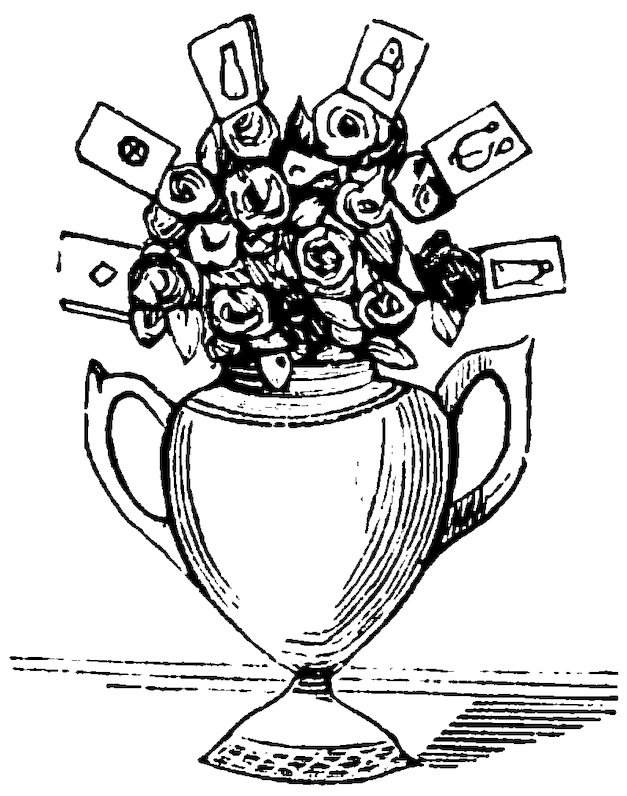
Your attendant brings in a wreath of flowers, which
is suspended from the ceiling by two silken cords.
You lay the coin on a little glass table, and only let
one piece slide off at a time.
The coin wand can be used in connection with this
stand, and rings and other objects can be substituted
for the coin top, set on an iron frame.
On crying out, “I now take these sovereigns and throw
them into the centre of that garland!” a chink of coin is
heard, and on the instant the money is seen, held by invisible
means, in the wreath.
Next you stuff the cards into a pistol, and, on firing
at the garland, they appear within it.
Explanation.—This magnificent trick is simply but
requires electrical appliances.
32The action of a battery makes the duplicate coin on
the table fall into a recess in its edge, while the real ones
and the chosen cards, by the same power, are thrust
out from the wreath by secret wires with pincer heads.
(Le Cadre à l’Assiette.)
Did you ever see such a
lovely bit of Sèvres as
this plate? Observe the
delicacy of the tints and
the dainty outlines of the
floral decoration.
If I were in the musing
mood, I might form quite
a lecture on the scenes
which this piece of porcelain
conjures up: the
rise of Dubarry; her
downfall—Oh! the plate
has slipped through my
fingers, and I take it up to find it broken.
Let me see: what is smashed china fit for? I forget—but
I wonder, now, if it would not make excellent
wadding for a pistol! Let us try. Here is the firearm,
which I will load—on the powder I put the fragments
of the plate—Time severs many a beauty from her mate—Plenty
of room yet. I must add these rings, with
which my obliging auditors have furnished me, and this
ribbon. A very formidable charge!
Boy! a target!
Call that a target?
Why, it is a black board in a frame. Never mind; it
will do, unless I make a butt of you! [Exit the
Attendant.]
33Click! bang!
When the smoke clears away, there is seen in the
middle of the framed black space the ribbon, rings,
watches, or whatever was used for cartridges, and
the plate restored except for one small fragment. It
seems that I left a piece out of the barrel. Oh! Is it
not here under this obliging young lady’s fan? I
thought so; thank you.
I will throw it into its place.
Fig. 17.
One, two, three, and an off! I mean on!
You will observe that Richard is himself again—as
rich and hard as ever.
Fig. 18.
34Explanation.—For the appearance of the entire objects,
the enchanted target described on page 194, The
Secret Out, is used, with the following additional contrivance
for the china plate restoration, namely:—The
duplicate plate is covered, as are the other articles, with
a black blind, made to disappear into the frame by an
electric shock, or the action of a piston-rod, while a
scrap of black cloth to be pulled away by a wire leading
secretly to your assistant, gives it the semblance of a
broken one.
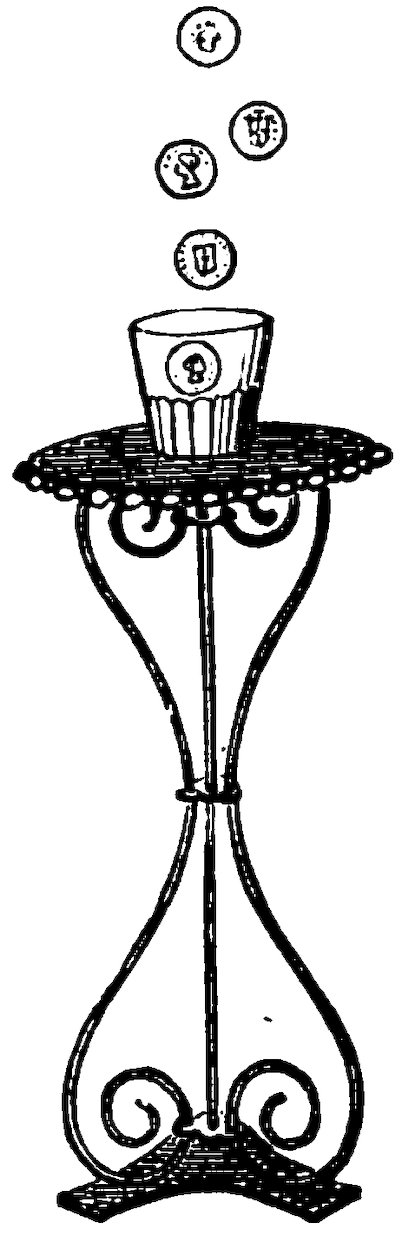
By the orders of Mr. Hanky Panky, his attendant
brings out before the audience a small round table
(guéridon), a more guileless means of mystification
being impossible, with its thin, flat top, slender leg, and
general simplicity of outline.
Half a dozen florins or half-crowns being borrowed
from the audience, they are marked by one of them and
placed in a pile upon the table, whence they disappear
one by one.
This is, perhaps, not so very astounding, for no fellah
ever yet clearly understood how money goes. But, to
really make the deception a startling one, Mr. Panky
puts a hat, a scarf, or a handkerchief on the table, and
commands the money to return from its refuge of
nothingness. The half-crowns—a great deal more eager
to be restored to their owners than whole crowns now-a-days
are—are heard to fall upon the table, without a
trace of their passage through the hat or handkerchief.
On removing the cover, indeed, the attendant has but
to go to the table to fill a salver with the money, and
distribute among the rightful proprietors.
Explanation.—The table-leg is hollow and a rod works
35in it, on the head of which the bottom coin is placed;
when the rod is lowered, which is done by simple mechanism
(for which see “Grand Magic,” in The Secret
Out), the coins gradually vanish. The reappearance
is managed by the reverse action, and the rod may be
fitted with a joint a few inches from the top, so that the
pieces will fall off on one side, the more noisily the
better.
When the coins are to drop audibly into a metal or
glass vase set on the table, the rod may terminate in a
tube to contain the money.
Fig. 19.
36
Fig. 20.
III.—WITH ROPE AND STRING. — THE SKIPPING-ROPE TRICK. — TO RESTORE A CUT STRING. — TO CUT THE BRAID OF A BUTTONHOLE WITHOUT LEAVING A MARK. — THE DEMON CORD. — TO TIE A KNOT ON ONE WRIST WITHOUT THE TOUCH OF THE OTHER HAND. — TO CUT YOUR NOSE OFF WITH A STRING. — THE MARVELLOUS RELEASE. — THE MAGIC UNTYING. — ROBERT HOUDIN’S FAMOUS RABBIT TRICK. — THE MAGIC PICTURE FRAME AND VANISHING PLAYING CARDS. — THE MAGIC FLOWER, APPEARING AND BLOOMING AT COMMAND.
(Hamilton’s l’Entente Cordiale.)
Provide a skipping-rope,
and, having had your wrists
firmly bound together, let
the person who thus tied
your hands pass one end
of the rope between your
arms and join its ends, by
which act the cord and
your united arms will form
two endless links or rings,
to separate which, and
instantaneously, will seem
materially impossible.
However, it can be done.
Pull at the cord as if to
make sure it is held fast,
and, while so doing, catch
between the wrists the part of the rope that happens
to be there, and work the rope up so as to get the
37looped end through the handkerchief in your hands.
Through this loop pass your left hand. Turn slightly
to the right and jerk the rope a little, when it will fall
to the floor, while your hands remain attached.
In the couple of seconds which this feat requires,
move your hands up and down mysteriously, to baffle
the attention of the bystanders on what you are doing.
(Decremp’s Garter Trick.)
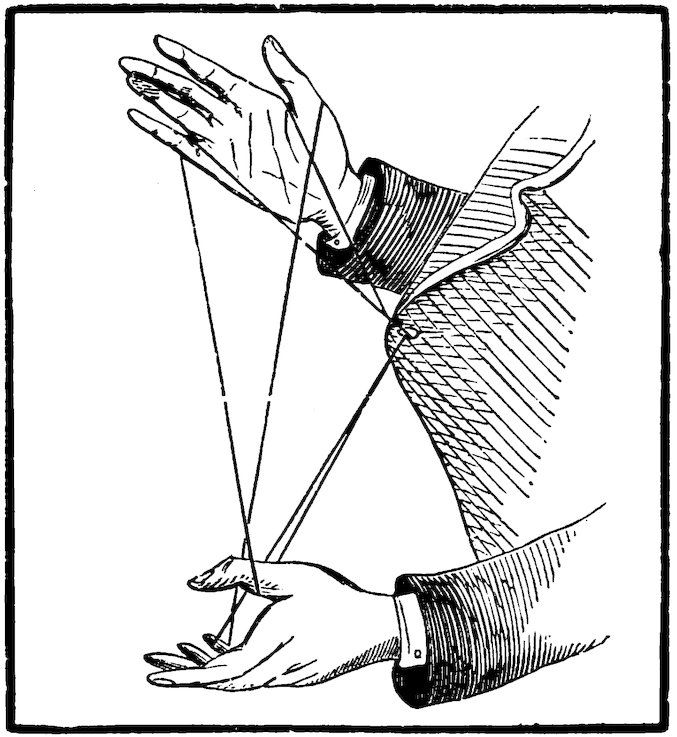
Having a piece of string, with the ends tied, run one
hand through each end, twist it once round (Fig. 21),
and put both ends into the left hand. Draw the right
hand quickly along the double strings to where the
strings cross, and conceal the join with the right thumb
and forefinger (Fig. 22).
Figs. 21 and 22.
Hold the strings in the same way with the left hand,
38and let some one cut the string between them. You
show that the string has been divided into two pieces,
and assert that you can join them by mastication. Put
all four ends into your mouth, and remove with your
tongue the little cut off loop.
When you take the string out of your mouth no one
will notice the absence of so small a portion of its
length, and will fancy that you really have joined them.
Take an opportunity of getting rid of the fragment you
retained in your mouth.
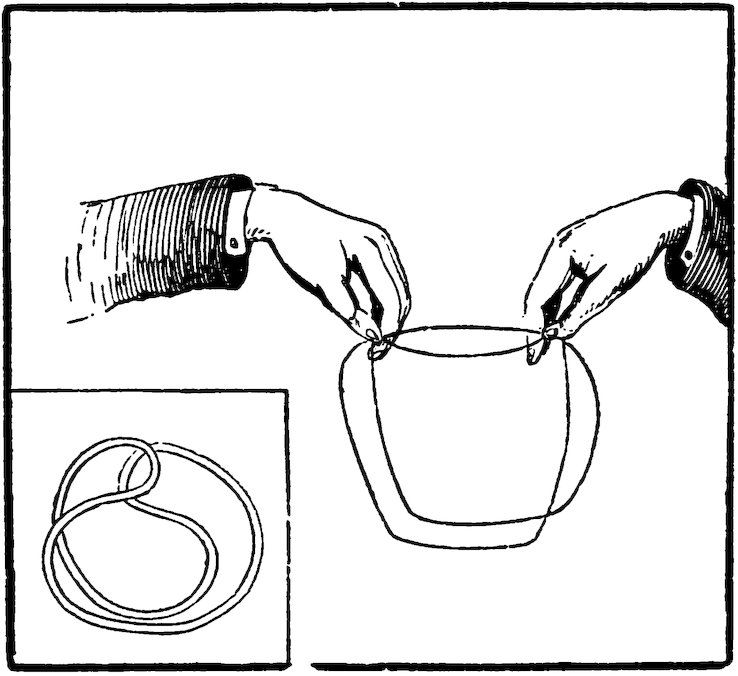
Fig. 23.
Tie the ends of two feet of string together. Put it
through a button-hole of your coat (or the ring of a key
in the door); stick one thumb in each end, and each
39little finger in the upper string of the other hand.
Draw out the hands, and present the figure traced in the
illustration.
Let go with the right thumb and left little finger,
and thrust your hands quickly apart, when you will
seem to have pulled the string through the braid of the
button-hole, and yet there will be no trace of the passage.
It is best, when you let go with the right
thumb, to change the string from the right little finger
to it.
Fig. 24.
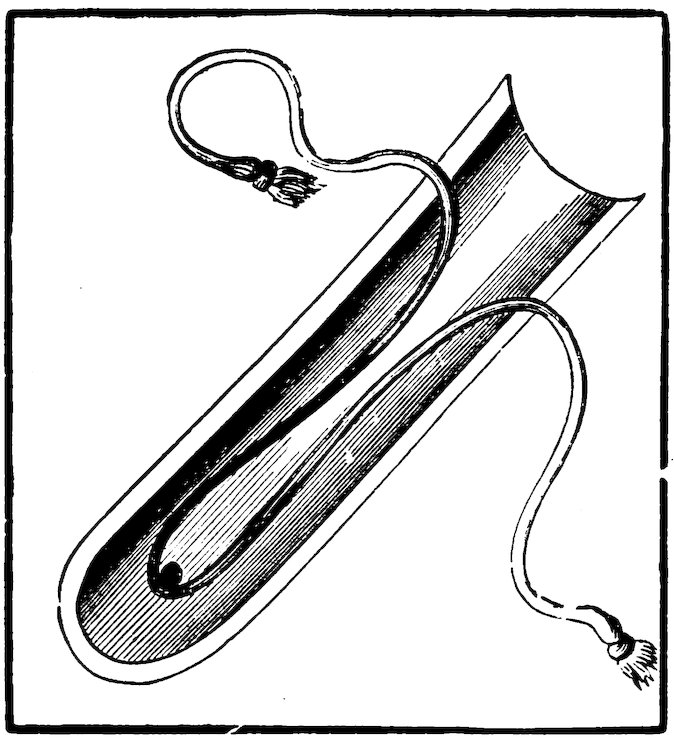
Saw a tube in half lengthwise, and at one end mount
a grooved wheel, over which passes the bight of a cord,
40with its two ends passing out of the hollow cylinder
at the sides of the other end. Tint one half of the cord
a different colour from the other, close it in; varnish
well to hide the crack, and your trick is complete.
The cord seems to have the chameleon property of
changing its hue.
Fig. 25.
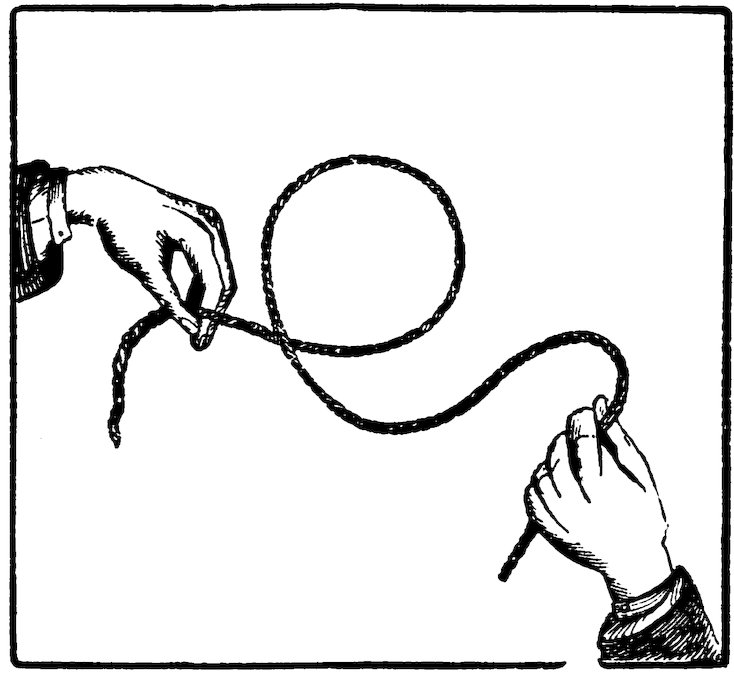
Take a yard of whipcord, or stout fishing-line, one
end in each hand, and with the right throw a loop over
upon the left hand. Instantly draw back the right
41hand to tighten the loop, and let go both ends the
moment the knot has been made.
Fig. 26.
Tie the ends of twelve or fifteen inches of string
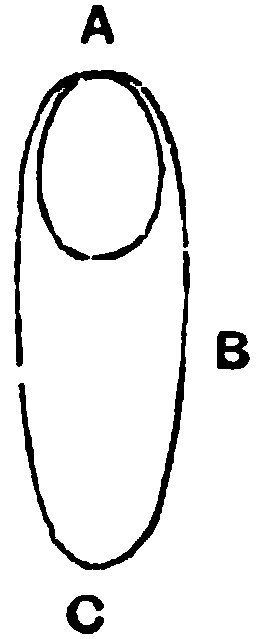
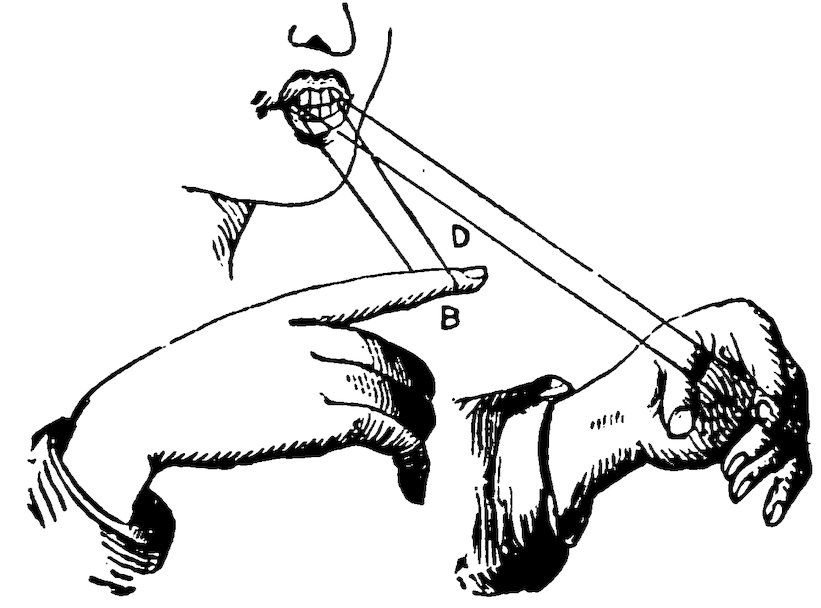
together, and make a loop, as shown in the illustration.
Fig. 27.
Place the loop in the teeth at A. Put the right forefinger
in loop B, holding the other bight (or bend), C,
on the left forefinger, as in the second illustration.
42With the right forefinger remove the loop B, by raising
it over the string D, and carrying it under that string.
Put the top of the forefinger (the loop B being on it) on
the tip of the nose.
Fig. 28.
(Le Captif Emancipé de M. Cleverman.)
A ponderous ladder, composed of three uprights and
crossbeams, is drawn in upon the stage, and inspected,
as well as a new rope, by one of the company, and pronounced
solid. The Magician’s assistant is then bound
to the centre post, and all the knots are sealed by one
of the spectators. A light basket-work shade, covered
with canvas, is put on over all, and in a few seconds the
man is found tied as before, but without his coat. On
being concealed and discovered again he is found completely
freed, and the rope on the stand without a seal
being broken.
Explanation.—The centre post is apparently quite
firmly bolted into the cross pieces, but in reality the
screw heads have no pin attached except one, which is
43withdrawn by the tied man, who has his hands bound
behind him just where he wishes to use them. On being
unpinned, the beam drops down into a socket in the
stand, and the rope can be pulled through the open
space. The sealing of the knots keeps the ropes in
their place.
A chair can be constructed in the same manner, and,
if the deception be practised in a dark cabinet, one of
the Davenport Brothers’ feats can be imitated.
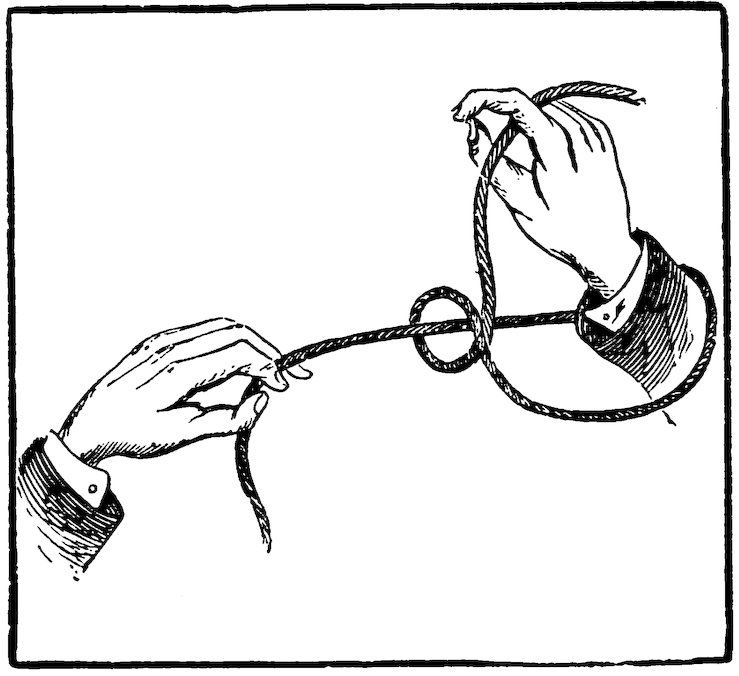
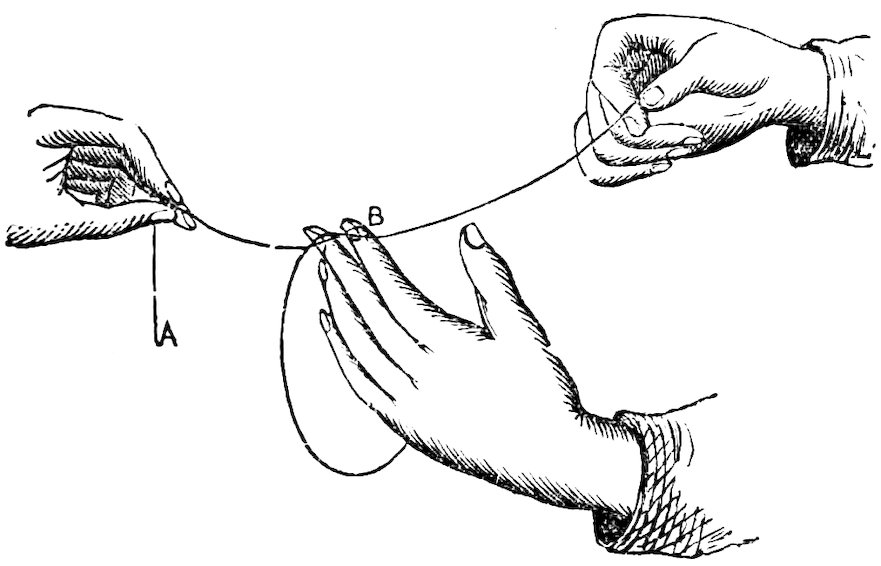
Give one end of a yard of strong, stiff, smooth twine
to a person to hold, while you retain the other in your
right hand. Put your left hand under the twine, half
way between the ends, and make a single tie (or, in
sailor phrase, a half hitch) over the string between your
left hand and the end A in the illustration.
Fig. 29.
44
Fig. 30.
Fig. 31.
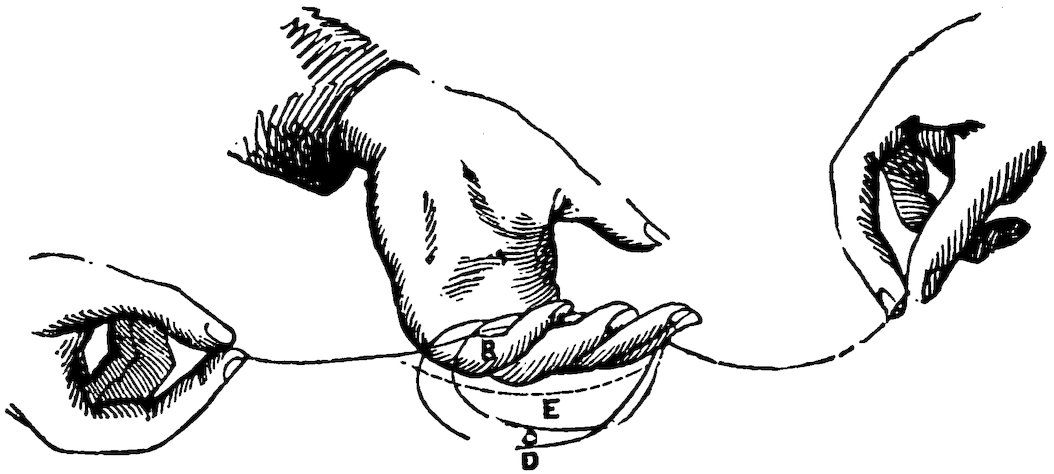
Draw the tie close but not tight over the left hand,
B being the tie. Open out the left hand so that, when
closed, the loop will be loose on the hand. Pass the
end in the right hand over the left palm on the inside
of the string already there, and make another single
tie over the string at the same place as where you
formed the first one, closing your left hand, which
loosens the strings around its fingers. After the tie,
45pass the twine under the back of the left hand, between
the strings C and D (in the second illustration)
Fig. 30.
The dotted line E is the string A. Take that string
up on the left hand fingers as in the third illustration.
By practice this can be done unseen by the lookers
on. Draw the end tight till it reaches B. Pass the
end A under C and D strings, which cross the palm,
drop the whole string off the left hand and pull gently
and steadily the end A with the right hand, and the
string pulls out straight.
46
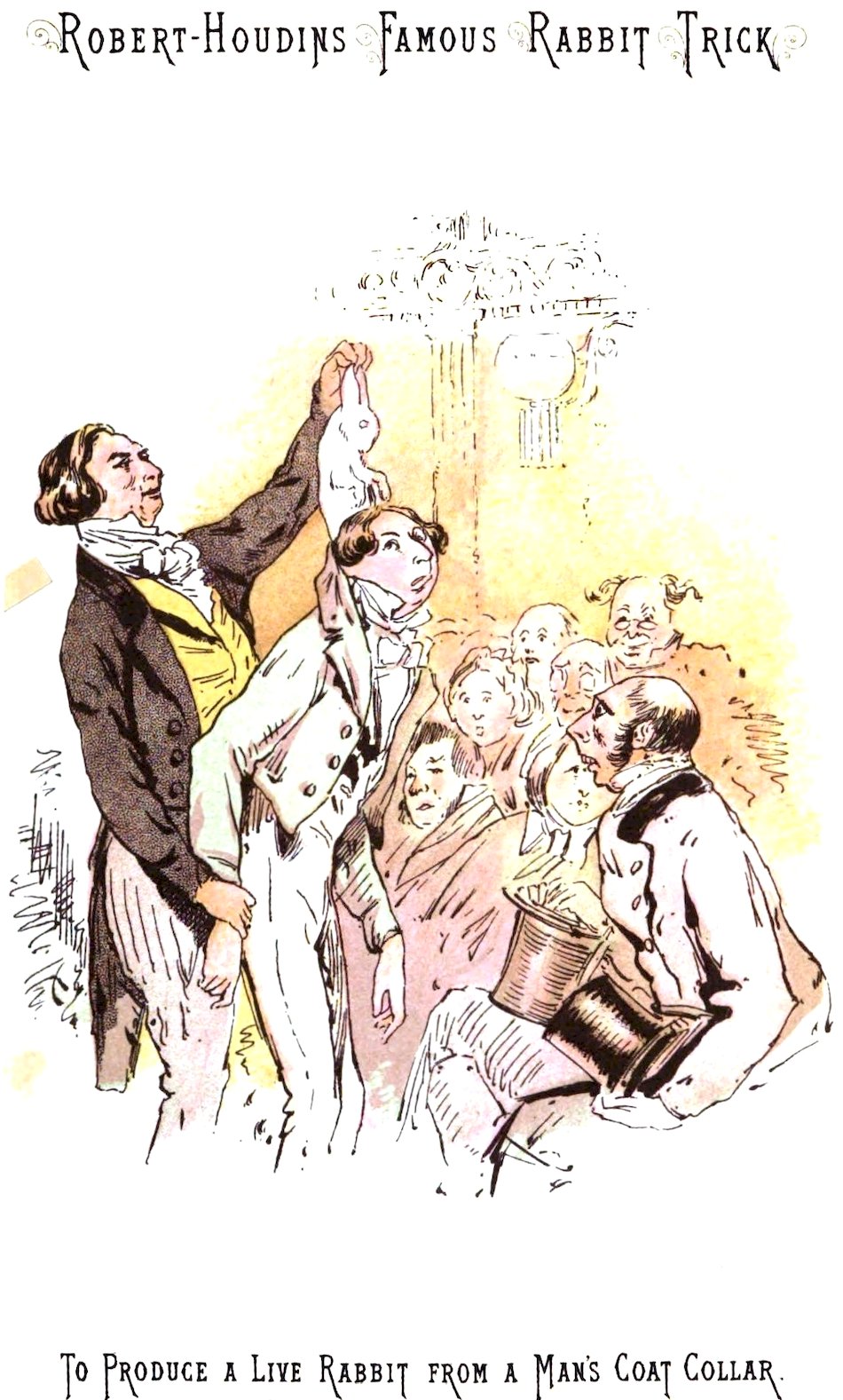
Preparation.—Have a small white, long-eared rabbit
hidden in a secret pocket inside the right breast of your
coat.
Performance.—On requiring a rabbit for a trick, you
select a simple-looking member of the company. On
his rising, you stand behind him so as to cover your body
with his. Take his right wrist in your right hand as if
to keep him steady, by which act you open your coat
out naturally to the right. Now flourish your left hand
with the arm extended, and bring it round to the level
of the back of the party’s neck. Then, at the same time
that you forcibly thrust your three last fingers well
down within the simple gentleman’s coat collar, you
seize the rabbit’s ear or ears between your forefinger
and thumb. Now lift up the rabbit, and the simple
gentleman will be too much confused by the shock to
perceive how the deception was managed. The audience
will be equally astonished.
47
The magician Bosco, of Milan, numbered among his
acquaintances the negro prima donna whose advent as
“the Black Malibran” caused quite an operatic warfare
in our fathers’ time, from a certain opposition being
waged against a Desdemona of Othello’s colour presuming
to darken the stage.
One afternoon previous to Signor Bosco’s performance
at the Rooms at the back of the Princess’s Theatre, which
veteran playgoers will remember, he took tea with the
lady.
It was his habit, a pleasant one, of experimenting with
his really remarkable inventions upon his friends before
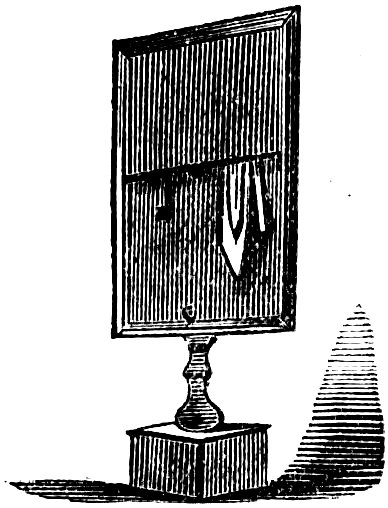
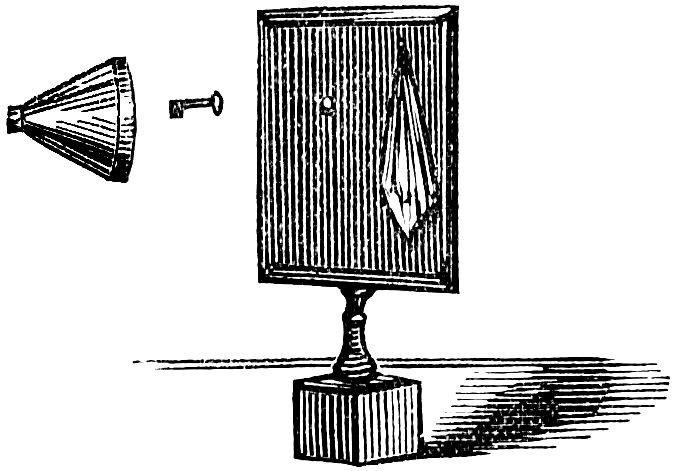
unveiling them to the public.
On this occasion he produced at the tea-table a pretty
little picture frame. It was simply a border of wood
around a square of quite clear glass, with coloured paper
pasted over the back to keep out the dust.
Taking up a pack of cards, he had one drawn by the
lady—let us suppose the ten of diamonds. This he made
to vanish in the air.
Then he again had the picture frame observed, that
it might be beyond doubt that nothing but the clear
glass in the front, and the coloured opaque back, were
visible. And over the frame, held in the lady’s hand, he
lightly threw a handkerchief.
He uttered a magic phrase or two, took the frame,
still in the handkerchief, waved it in the air, and made
a pass or two over it. Then removing the handkerchief
he held up the frame to the lady, who, to her astonishment,
perceived a card in its centre—the card she had
drawn.
Again covering the frame with the handkerchief,
Bosco once more bewitched it. On taking away the
48handkerchief this time, the picture frame was found to
have resumed its original condition; in other words, the
card had vanished, and there was nothing visible but
the border, the clear glass, and the opaque back.
Explanation.—The frame is hollow at top and bottom,
so that these two places are receptacles to contain a
quantity of sand. This sand is dyed of the same colour
as the paper used to cover the back of the frame. Two
pieces of glass are placed in the frame, a little apart.
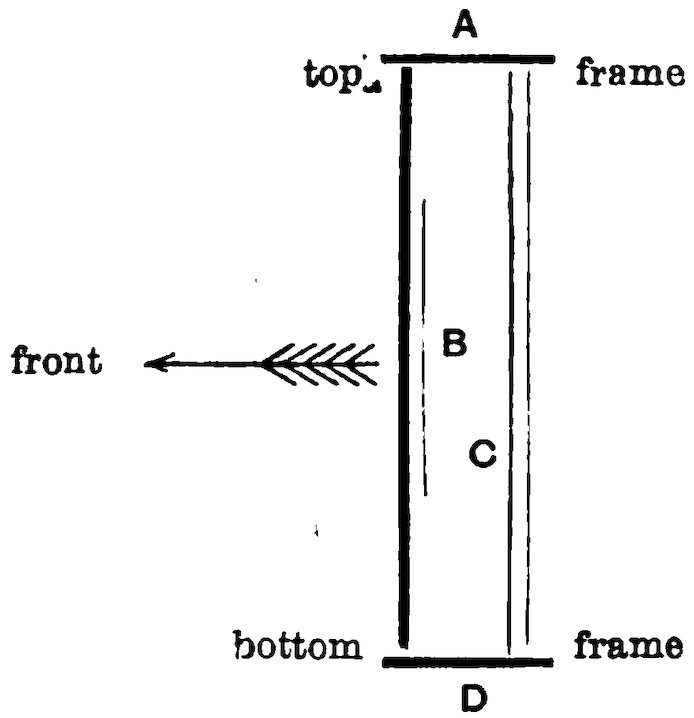
SIDE-VIEW OF PICTURE FRAME.
A, the plain glass. B, card corresponding to that which the spectator has been forced to draw. C, the front side of the second glass. D, the other side, over which is pasted coloured paper.
To prepare for performance, fill the receptacle at the
top part of the frame with the sand dyed the same colour
as the paper at the back, and let it run down till it fills
the space between the two panes of glass, and consequently,
conceals the card, and is itself unnoticeable,
from looking exactly like the paper.
After the handkerchief has covered the frame, and
you take it into your own hands, reverse it unseen, so
that all the sand shall run down into the receptacle.
On showing it now, the card will appear.
By turning the frame again so that the sand shall run
out, and once more hide the card, it becomes invisible,
as at first. The trick can be repeated at pleasure.
49
(The Invention of M. Robert Houdin, and as Improved by
Mr. Cremer.)
Mr. Hanky Panky, attired in a faultless evening dress,
has presented himself to the audience with the air of
being quite perfect in his appearance, when he suddenly
becomes confused. By his nervous glances, and their
direction, it is perceived that he has omitted an indispensable
article of costume, and that is, the flower in his
button-hole.
However, quickly recovering from his surprise and
trouble, he smilingly observes that this misfortune,
irreparable without a certain delay to ordinary members
of society, is easily rectified by a conjuror.
To make good this assertion, he takes up his wand,
and waving it gracefully three times, the company is
startled to see a beautiful rose appear instantaneously
in his button-hole.
Explanation.—This charming little deception is as
simple as effective. A child can perform it, and at the
cost only of a few pence.
You must have twelve or fifteen inches of common
elastic cord, fine but strong, covered with thread of the
same colour as your coat. To one end firmly fasten an
artificial flower, or it may be a real one if you strengthen
its stalk by the insertion of florists’ wire. The place of
fastening is close to, and just under, the flower.
Punch out a small hole in your coat, on the point corresponding
to that button-hole in which a flower is
usually worn, and just under the button-hole itself.
In this hole insert a metal “eye,” such as is put in
boots for the laces to run through, and fasten it there.
It is for the cord to run smoothly through. This eye is
not visible, even to yourself.
50On the other end of the elastic make a small loop.
When ready for the performance, take your elastic
cord, to which is attached the flower, and pass the loop
end through the button-hole from the outside. Then pass
it through the eye in the same direction, and bring it
down along inside the coat to the button on your trousers,
at the left side, or you may have a button sewn on
your vest about the same place. There fasten the end
of the cord by the loop.
The elasticity of the cord now draws the flower up to
the button-hole.
Pull the flower back, just a little behind the left armpit,
and let the left arm hang loosely by the side. As
long as the upper left arm is kept close to the side, the
flower must remain secure, and concealed at the back of
the shoulder.
But, on opening out the arm, the flower must be
drawn by the elastic cord up to the button-hole, through
which it cannot pass, from its size.
Therefore, in entering the room where the audience
await you, you have nothing to observe but to keep your
face to the company. No one can perceive the cord,
even at a little distance.
You take up your wand with your left hand, still
keeping the left upper arm by your side; move your
left hand and wand across the body to the right, then
take the wand with your right hand, while your left
hand remains across the body, with the hand on a level
with the button-hole. Wave the wand to the left, and
take it with the left hand again. Now wave the wand
to the left, and on extending the left arm fully, you of
course open it out, and the flower—under cover of the
arm—is made to appear suddenly in the button-hole.
These three movements should be gracefully done,
and with the happy medium between hurry and slowness.
IV.—WITH HANDKERCHIEFS. — THE MELTING EGG AND THE BEWITCHED HANDKERCHIEF. — TO UNDO A KNOTTED HANDKERCHIEF BY A SHAKE. — THE HANDKERCHIEF AND EGG TRICK.
51
A glass is shown, and can be examined by the company.
Into it is put an egg, and the whole is covered
with a handkerchief. To prove that the egg is really
within the vessel, it may be heard striking its sides.
Mr. Hanky Panky stands at a distance and rubs a
small coloured handkerchief up into a ball in his hands,
when it is suddenly seen to become an egg.
Returning to the holder of the glass vase, the handkerchief
is taken away, and, instead of the egg, a
coloured handkerchief shown. The handkerchief can
be examined.
Explanation.—Run a fine black thread through a
52perforated egg, and fasten the other end of the thread
to the middle of an ordinary handkerchief. (If you are
skilful of hand, you can have a bent pin at the end of
the thread and perform with a borrowed white handkerchief.)
You only pretend to put the egg within the glass
vessel, and really place a small coloured handkerchief
therein, while the egg remains attached to the large
handkerchief.
You have an egg made of enamelled tin in your hand,
which you conceal with a duplicate coloured handkerchief,
as you state your intention of executing the
double change of egg into handkerchief, and vice versâ.
As you speak, you dexterously stuff the little handkerchief
into the egg, and in holding up the latter hide
the aperture with your thumb. When you quickly lift
the white handkerchief you carry away the egg, and
discover the coloured one.
With practice, this is a most effective hanky-pankian
feat.
53
Mr. Panky takes up a soft silk handkerchief, and
holding the ends in his hands throws the right hand
end over the left, and pulls it through as if tying a knot.
Again throwing the same end over the left, he passes
the latter to one of the company to pull it.
Fig. 32.
His left thumb holds the handkerchief just behind
the knot, while he is pulling the right hand end against
the person. He facetiously begs the pull to be hard, as
the handkerchief is a borrowed one.
In the same way he seems to tie knots, really tying
the right hand end round the silk, but this is not remarked,
because he makes a great to do of drawing the
knots hard, and—since the right hand decreases in
length by thus enwrapping the rest—works up the slack
to shorten the left end proportionably to the other.
54The company is allowed to test the security of the
knots.
On regaining the handkerchief, Mr. Hanky Panky
covers the knots with the loose flap in the centre, and
has one end held again.
The knot can be felt through the silk, but still, on
seizing the loose end and the assistant letting go, Mr.
Panky shakes the handkerchief out as one snaps a
whip, and proceeds to find a rabbit or bottle of wine in
the folds.
This is a modification of the above.
An egg is passed round for free examination. A handkerchief
is held up in the performer’s hands by any two
of its corners, and flourished to and fro to prove its
innocency. It is then spread out on the table, the egg
laid in its centre, and the handkerchief taken by its four
ends, so that the audience cannot doubt that the “hen-fruit”
is really in the middle.
Fig. 33.
The Magician undertakes to fling the egg by this
impromptu sling farther than David did the stone that
slew the giant, and, what is more, make it alight in any
place previously searched and found empty.
55Then, taking the handkerchief by one corner, it is
shaken about, and the egg, mysteriously vanished, is
found in the designated spot.
Explanation.—The egg is a small one, hard-boiled.
There are two handkerchiefs alike sewn together at the
edge all round. The one considered as the outside has
a slit in the middle, through which the egg glides as into
a bag, when the handkerchief is lifted with it in the
middle. The egg is let slip into one corner, which is
that held by the performer, while the handkerchief is
shaken in the air, and thus proven to be empty. A
second egg is presently deposited in the place where one
was to be found.
V.—WITH RINGS. — THE PENETRATIVE RING. — THE RING AND GLOVE PILLAR.
56
Fig. 34.
Fasten one end of a needleful of silk, of the colour
of a handkerchief, to the middle of the handkerchief,
and to its hanging end tie a brass ring. Always keep
the ring on your own side, so that no one can see it
while you shake and rumple the handkerchief. Offer to
send a ring through a cup and saucer and the table they
are on.
Take the borrowed ring in your left hand, and keep
it there; pretend to pass it to the right hand, and ask
one of the party to step forward and hold the (mock)
ring in the handkerchief. Now that the cup and saucer
are empty, place the cup in the saucer at the centre of
57the table, and ask the person to hold the ring in the
handkerchief over the cup. The party will hear the
ring fall into the cup, yet at your command it passes
into a hat, which you hold under the table. In so doing,
you put the real ring into the hat. Cry out some cabalistic
words, and negligently take the handkerchief. The
party may inspect the cup and saucer, but there the
sorcery does not lie. The hat has but to be held upside
down for the ring to fall out on the table.
Fig. 35.
Variation.—By using a stocking instead of the handkerchief,
and letting the mock ring in the toe be tied
up by a string a little farther up around the foot, the
feat may be likewise executed.
Variation.—Borrow a silk handkerchief from a gentleman,
and a plain gold ring from a lady. Request some
one to hold two of the corners of the handkerchief, and
another to hold the other two, keeping them at full
58stretch. You next exhibit the ring to the company, and
announce to them that you will make it pass through
the handkerchief. You have substituted for the ring
one made by bending a piece of wire into a circle of the
same size, with one or both of the ends finely pointed.
Placing your hand under the handkerchief with this
duplicate, you press it against the centre of the handkerchief,
and desire a third person to take hold of the
ring through the handkerchief, and to close his finger
and thumb through the middle of the ring, which proves
that the ring has not been placed within a fold, as may
have been hinted when you performed a similar trick.
The holders of the corners of the handkerchief let go,
while the holder of the ring retains his hold. Another
person now grasps the handkerchief as tight as he
pleases, three or four inches down, so tightly that the
ring cannot possibly pass, and you request him to
permit you to take the ring in your fingers. Cover your
hands with a hat to prevent the company from seeing
your operations, and pull the mock ring open, draw it
through the handkerchief, and, putting the handkerchief
through the real ring, which you have ready in your
hand, you remove the hat and the piece of brass together.
Rub out the hole marks with the false ring in a
purse or stocking. The trick becomes still more easy,
since it readily can be passed through the meshes without
a trace of its passage.
59
(La Colonne au Gant.)
Mr. Panky introduces to the company his Magic
Sportsman, of which there is an extended description in
The Secret Out, “The Marvellous Musket Shot.” The
automaton salutes the audience, and makes ready to fire
his gun.
Several rings are borrowed and placed in the gun,
with a lady’s glove.
Fig. 36.
For a target there is brought in a stand with an ornamental
pillar, on the summit of which is a golden
ball. At the signal, the miniature marksman fires, the
globular casket splits open, and the glove appears on
the top of the pillar, as if containing a hidden hand, and
with the rings on the fingers.
Explanation.—When the rings and glove are borrowed,
others are instantly substituted for them, which
are put into the gun. The real ones are taken out of
the room and arranged, the rings on the glove inside the
ball on the pillar. This pillar is hollow, and is in connection
60with a gutta percha tube leading down within
the table into the confederate’s room. At the proper
signal, the piston-rods work, and the sportsman discharges
the gun, and a strong current of air forces the
ball to open and inflates the glove. For the table, see
The Secret Out.
VI.—SIMPLE TRICKS WITH KNIVES. — THE OBEDIENT KNIFE.
61
In a former work (The Secret Out) the secret spring
literally to make a knife leap out of a cup at the conjuror’s
call, was revealed. We give here several other
modes of compassing the same end, that the performer
may have several strings to his bow.
1. “You have objected,” says Panki-pan-ki, the Fakir
of Hanki, “that I have executed this trick by hidden
mechanism. Very well. At present I lay these three
knives on the edge of the mouth of the cup, and yet at
the instant named, that one which is chosen shall leap
off in obedience,” and it does so.
It is answered, truly, that a magnet under the table
is made to attract the knife, which is delicately poised
on the rim, thanks to an unseen confederate.
2. “As you please,” proceeds the magician, taking
the table up and setting it down in the centre of the
62room, to make it manifest that there was no wire of
complicity attached. I now repeat the experiment with
the same result. This being done, only the readers of
our works—being the most intelligent body of perusers
existent—could have seen that in lifting the table a
thread of communication was snapped asunder, and that
this second obedience of the knife was owing to the
magnet again, set in motion by a wire acted on by a
treadle.
3. Mr. Panky hastens then to show how ludicrous is
the supposition that a magnet has anything to do with
the feat, by doing the same on a chair. Few or none
remark that the chair being shaky, a wedge of wood had
to be put under the cup to steady it. A large watch
movement, with a bit of magnetized iron at the end of
the second-hand, which coming round under the knife
in a minute, produced the desired effect.
4. Mr. Panky shrugs his shoulders in deprecation of
such absurd solutions of the problem, and employs a glass
table, mounted on glass legs. But the apparently unprepared
transparent board is made of two sheets of
glass, set a little apart so that the air, blown in between
by one of the legs being hollow, shall go out by a minute
hole in the upper plate, just under the cup, which is
also perforated at the bottom. The magician in walking
about, treads on one plank of the flooring, where a bellows
is concealed. The wind goes up into the cup, and
as the selected knife is delicately poised on the edge
while the others rest on little interior cleats, it falls off
at the first puff.
Observation.—The knife must be marked so that it can
be placed exactly on its balance without delay. Also,
the rim of the cup should be flattened a little so as to be
the twenty-fourth of an inch broad.
5. With borrowed knives.—As these cannot be prepared,
there must be a drop or two of mouth glue or other
63sticky substance, at a couple of places on the cup rim,
on which the knives not to be moved are laid.
6. With pretendedly borrowed knives.—Let the audience
furnish the knives, but to a great number, amongst
which you mix three of your own, prepared for the performance.
On taking up these, each owner of the knives
will imagine that his remains on the table and his neighbours’
are being used. Even if he suspected a substitution,
that would not account for the trick.
Ingenious Variation.—One knife is laid on the cup
with its handle outside to maintain the balance; a long
knitting-needle, fastened to the knife-handle with a lump
of sealing wax, while a leaden bullet at the other end
and knife point serves as counterpoise. The glass table
is used, and the Magician withdraws to a distance. All
of a sudden though, the knife leaps off from the cup.
Explanation.—The column of air is again employed,
for which the cup is set a little way from the hole in
the glass plate, and the knife-handle bearing the sealing
wax is adjusted over it. The air is heated this time,
and on melting the wax the released needle is dragged
into the cup by the bullet, and the knife falls.
7. Instead of the glass table, have a sheet iron case
in the shape of a book, and painted and gilt to resemble
one. This is put on top of two or more real books, on
which the cup is placed, to be the better seen by the
audience. One end of the mock book contains a lamp,
which heats the iron above it, and the rays of caloric
act on the wax as before.
8. With a Silver Cup.—The knife is poised, as before,
on the rim of a silver cup, and leaps out at command.
Mr. Panky had stuck the point in a lump of tallow, and
a lamp in the base of the cup had no sooner melted it,
than the loss of its weight made the knife-handle bear
itself down.
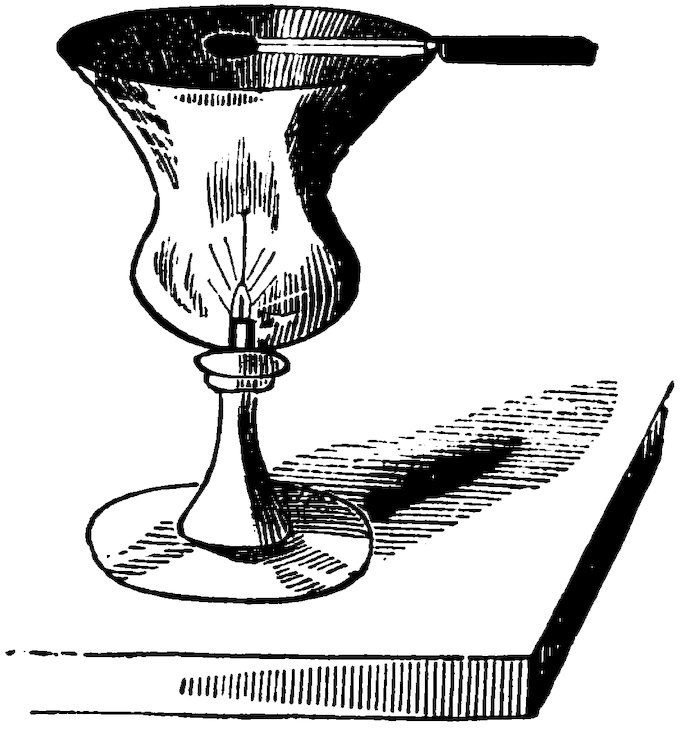
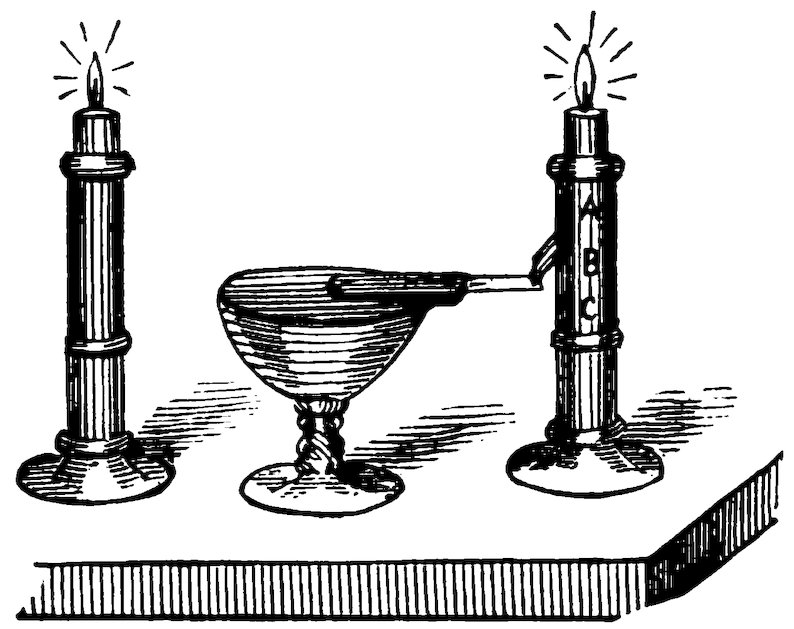
649. Mechanically.—The knife is again laid on the cup,
to show that there is no machinery attached to it; a
candle is placed each side of the cup, fully illuminating
it. Nevertheless the same result follows.
Fig. 37.
Fig. 38.
Explanation.—One of the candlesticks is hollow, and
contains in the upper part, A, some fine sand, which
65escapes by the hole, B, to run down into the receiver, C.
When the latter is full up to D, it runs out by that hole,
and falls on the blade of the knife to destroy its equilibrium.
As the time of the sand reaching the level of the
outlet is regulated by the dimensions of the receptacle,
C, its bottom, E, is made movable, and consequently by
fixing it at certain points the moment of action can be
timed to one, two, or three minutes.
10. The Loaded Knife.—The handle is hollow, and
divided into three compartments.
In the section A, is quicksilver, running by a hole, B,
into the division, C. So far the knife remains balanced,
but when the mercury rises as far as D, it overflows into
the part G, when the end being overweighted, the knife
must fall.
Fig. 39.
VII.—FORTUNE TELLING TRICKS. — CATCHES AND QUIBBLES. — ADDRESS ON A LETTER. — ALGEBRAIC SQUARING OF THE CIRCLE. — A BUNCH OF ANAGRAMS. — THE GRAMMATICAL WORD. — HANKY PANKY TO HIS NIECES, WITH A SET OF CHESSMEN. — COMIC FORTUNE TELLING. — THE ALPHABETICAL FORTUNE TELLER. — TO GUESS THE POINTS THROWN WITH DICE. — ARITHMETICAL FORTUNE TELLING.
66
For a wager, two men ate
nuts: the one ate ninety-nine,
the other a hundred
and won [one], how many
did the winner eat more
than the loser?—One.
A specimen of that noble
animal, the horse, having
been paraded before a company
enthusiastic upon its
faultlessness, modestly but
firmly insist upon it, that—without
pretending to
any great veterinary knowledge—you
can see with a
quarter of an eye that the
gorgeous steed has “the lifts.” The name of this
mysterious complaint being somewhat analogous to that
of the “heaves,” a torrent of indignation will doubtlessly
burst upon you. On being forced to give an explanation,
you can, with the fearlessness of truth, explain that if
the creature did not have “the lifts,” could it move its
feet off the ground.
How to Push a Lady’s Head through a Wedding
Ring.—Run your finger through the ring and touch the
lady’s head with the tip.
67How many Bank of England notes will weigh down
a sovereign? Only seven will more than equal the coin
in weight.
How to Make a Lady Stick out Her Little
Finger.—The best way of securing this effect is to put
on the finger a diamond ring. The mere desire to display
the diamond to the best advantage is sure to make
the lady stick out her little finger in the most charming
manner possible. When the effect begins to fail, substitute
another ring of greater brilliancy.
Addendum.—A ring at the door-bell has been known
to make a lady stick her head out of the window.—Hanky
Panky.
One of the company having related a story which
lauds his moral excellence, observe that, spite of his
pretentions, you know what will hang him! At the end
of his indignation—answer, a rope!
Squaring Accounts.—A day or two since an inveterate
joker met his friend, Hanky Panky, Esq., in the street,
whom he knows to be a great dog fancier. With a
twinkle in his eye and an inquiring look in his countenance
he anxiously asked him if he had seen the new
breed of imported dogs, the “Sooner.” Professor Panky
replied that he had not, and wished to know the peculiarity
of the breed.
“They’d sooner stay in the house than go out of doors,”
was the reply, as the joker cautiously moved away,
shaking his sides and winking.
The prestidigitateur determined to be even, and the
next time he met the joker he seriously remarked:
“You’ve been to Smith de Brown’s, haven’t you?”
“No, why?”
68“I thought you knew he had got back his tray of
diamonds.”
“No, is that so? How did he get it?”
“He took it with the four ‘spot.’”
The playful youth suddenly remembered a very pressing
engagement and hurried away, remarking, “I—I—I’ll
see you again, Doctor Hanky, I—I—I don’t quite
understand.”
A lady occupying a room, letter B, at an hotel, wrote
on the slate as follows: “Wake letter B at seven; and
if letter B says ‘let her be,’ don’t let her be, nor let
letter B be, because if you let letter B be letter B will
be unable to let her house to Mr. B., who is to call at
half-past ten.” The porter—a much better bootblack
than orthographist—after studying the above all night,
did not know whether to wake letter B or let her be.
A young man asked a young
lady how old she was, and
replied “6 times 7 and 7 times
3 added to my age will exceed
6 times 9 and 4, as double
my age exceeds 20.” The young
man thought she looked much
older.
What is the difference between twice twenty-eight and
twice eight and twenty?—Twenty; because twice
twenty-eight are fifty-six, and twice eight and twenty
are thirty-six.
69One of 10 loves what
1028.
W O O D
J O H N
H A N T S.
Answer.—John Underwood,
Andover,
Hants.
C I R C L E
I C A R U S
R A R E S T
C R E A T E
L U S T R E
E S T E E M
A good anagram was once made from the translation
in the Vulgate of Pontius Pilate’s last question to our
Saviour, “What is truth”—“Quid est veritas?” The
anagram answers, “Est vir qui adest”—“It is the man
who is before you.” This example complies with the
conditions of a perfect anagram. It employs all the letters—does
not depend on pronunciation—and makes the
anagramatised sentence an answer to the direct form.
Wilkie Collins.—We coil in skill.
Guiseppe Garibaldi.—Gape Pig! as I re-build.
Eugénie Imperatrice.—Mere Peace! I intrigue.
70
There is a word of 14 letters of which the 3rd and
14th form an article; 6, 10, 5, and 1 a noun; 12,
a pronoun; 6, 10, and 2, a verb; 4, 13, and 11, an
adverb; 8, 9, 7, and 6, an adjective; 14, 13, 9, a conjunction;
3, 11, a preposition; and the 13th an interjection:
thus the word contains in itself the whole 8
parts of speech, and its meaning is in accordance with
its anagrammatic changes. The word is
Start not! contains Men, though in thirty-two pieces.
But may each of you meet with one perfect and whole,
For a partner through life, with a heart and a soul;
May you each in life’s Game e’er successfully move,
And all conquests achieved prove the conquests of love;
May you ever be able—on banks—to give check,
And may Bishops and Knights bow down at your beck.
May Castles surrender whene’er you attack ’em,
And staunch prove your Men, with your good Queen to back ’em;
May your fortunes permit you to dwell in the Squares,
And enjoy life’s delights without tasting its cares;
May you each find a Mate, life’s journey to sweeten,
And if mated oft,—may you never be beaten!
71
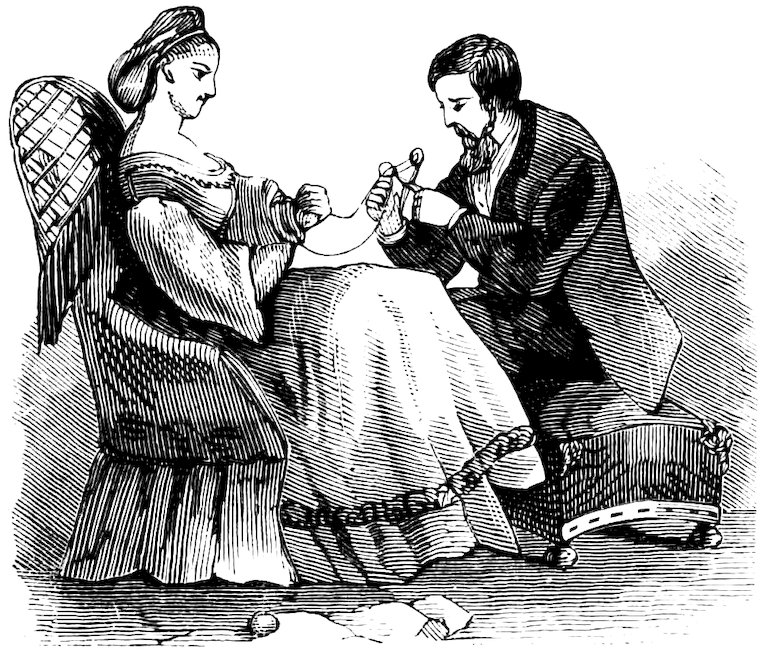
Zadkiel: I foresee that you have had a misfortune with one of your legs. It will never happen again.
The Moslems have recourse, to determine them when
they are in doubt as to any action, to a table called
Zairgeh, divided into a hundred squares, in each of
which is written some Arabic letter. The person who
consults it, repeats three times the opening chapter of
the Koran, and 58th verse of the sixth chapter. “With
Him are the keys of the secret things: none knoweth
them but him. He knoweth whatever is on the dry
ground or in the sea; there falleth no leaf but He
knoweth it; neither is there a single grain in the dark
72parts of the earth, nor a green thing, nor a dry thing,
but it is written in a perspicuous book.” He places his
finger at random upon the table; he then looks to see
upon what letter his finger is placed, writes that letter,
the fifth following it, and the fifth following this, until
he comes to the first which he wrote, and these letters
together compose the answer. The construction of the
table is thus:—
d
w
w
a
w
o
h
a
b
h
i
o
i
s
o
t
d
t
t
w
w
o
a
a
a
i
e
n
i
i
t
s
d
n
t
h
i
a
a
e
o
t
t
n
t
u
w
t
d
h
t
i
a
e
s
f
l
i
n
u
e
l
u
j
c
a
d
t
o
c
r
o
h
y
e
o
w
y
p
e
f
r
w
e
d
i
o
i
a
e
l
n
s
c
t
l
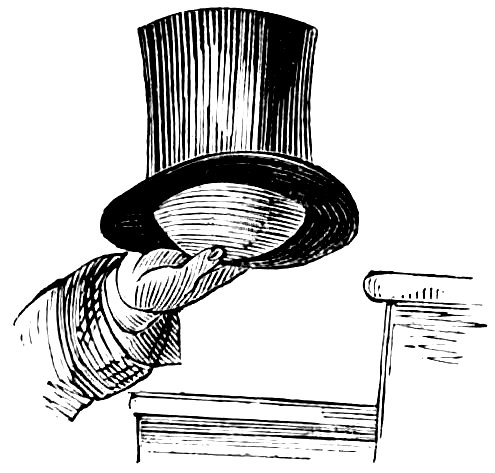
g
h
e
h
Fig. 40.
For example, suppose the finger to be placed on the
letter s, second in the fourth line, we take from the
table the letters:—
s—i—t—w—i—l—l—d—o—w—r—o—n—g—w—a—i—t—a—n,
which forms the answer:—“Wait an(d) sit
will do wrong,” an incentive to action quite clear.
The sentence always commences with the first of the
letters taken from the uppermost line. It will be seen
73that the table gives only five answers, one of these with
whatever letter of the alphabet we commence. The
framer of the table, knowing that men very frequently
wish to do wrong, and seldom to do what is right, and
that it is generally safer for them to abstain when in
doubt, has given but one affirmative answer, and four
negative.
It was by this means that the dishonest Arab found
out that Livingstone was dead and did not want the
goods he was taking to him, which shows how reliable
a forecast can be thus made. (See The Finding of
Livingstone.)
A Chinese Puzzle.—A Chinaman died, leaving his
property by will to his three sons, as follows: “To
Fum-Hum, the eldest, one half thereof; to Nu-Pin, his
second son, one-third thereof; and to Ding-Bat, his
youngest, one-ninth thereof.” When the property was
inventoried, it was found to consist of nothing more nor
less than seventeen elephants, and it puzzled these three
heirs how to divide the property according to the terms
of the will without chopping up the seventeen elephants,
and thus perhaps injuring their lives. Finally, they
applied to a wise Neighbour, Y-sa-cur, for advice. Y-sa-cur
had an elephant of his own. He drove it into the
yard with the seventeen, and said, “Now, we will suppose
74that your father left these eighteen elephants.
Fum-Hum, take your half, and depart.” So Fum-Hum
took nine elephants and went his way. “Now, Nu-Pin,”
said the wise man, “take your third, and remove!” So
Nu-Pin took six elephants and travelled. “Now Ding-Bat,”
said the wise man, “take your ninth, and begone.”
So Ding-Bat took two elephants and absquatulated. Then
Y-sa-cur took his own elephant and drove home again.
Query: Was the property divided according to the
terms of the will?
While I turn away my head, let some one throw a pair
of dice and count the pips, and add to this sum the
amount on the bottom face of either one of them. Now,
throw again and add these new points.
I now turn and look, and tell the whole number
thrown.
Explanation.—When you look, you count the faces
seen, and add seven. This is a pretty little trick.
Arithmetically speaking, would not the world be
happier if all were 2 B 1 0 0 1 5 1 5 0. C I V I L 2 1 another.
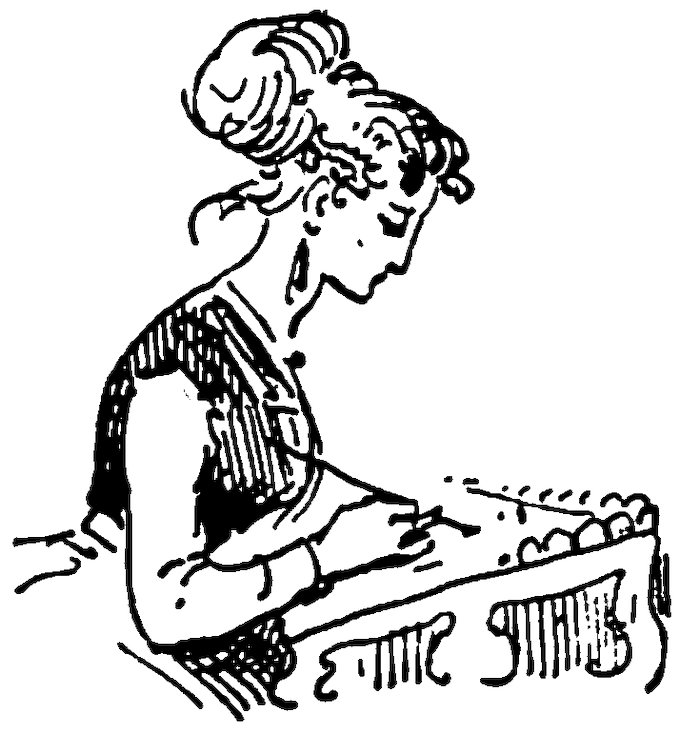
Fig. 41.—The Fair Arithmetician.
75
Dates of important events
in the lives of eminent
men are supposed to have
a mysterious meaning of a
prophetical tendency.
The process of forecasting
is to take the number
of years between
a man’s birthday and that
of his marriage or first
notable occurrence, which
number added to the second
date should give the
year of his next distinguished
action. For instance,
by comparing the dates of special significance in
the life of Pius IX. we discover that the figures of each
sum up to 19. Thus Mastai Ferretti was born in 1792,
ordained in 1819, chosen pope in 1846. The next year
distinguished by the same peculiarity is 1873, when
consequently some great event will again happen to him.
What this is to be, time will show.
VIII.—SIMPLE TRICKS WITH BOXES. — THE MAGIC TABLE AND SEALED CASKET. — THE 100 RINGS OF SMOKE. — TO INTRODUCE CIGAR SMOKE INTO AN AIR-TIGHT VASE.
76
Fig. 42.
The magician’s bottle is shown to the company, and a
little wine poured from it to prove it is not empty. A
handkerchief and ring are borrowed, and put into the
bottle.
A borrowed casket is then held up in view, fastened
with sealed thread, and Senor Don Hanquey y
Panquey announces his intention to break it open to
see the contents, but previously will return the
borrowed articles. Out of the bottle, then, he pulls the
handkerchief and ring, dripping with wine, and places
them upon the sealed box, in plain view. The bottle is
taken away.
The wine-soaked handkerchief is crammed into a pistol
and fired at the box. On opening it there is found
a second box within, which being also opened, discovers
the handkerchief, ironed and perfumed, and the ring.
Explanation.—The table is made with a hollow leg as
usual, but with a larger aperture, closed with a double
trap, through which a piston rod may push up a box
deposited at its base.
The borrowed ring and handkerchief are put into the
77secret compartment of the bottle (see The Secret Out,
and The Magician’s Own Book), where they remain until
the bottle is taken out of the room. The wine-saturated
handkerchief and ring put upon the sealed box are duplicated.
When the assistant receives the bottle, he
takes out the real ring and handkerchief, which latter
he places in a box going into the casket, which has
no bottom, the better for the two to be pushed up within
the gueridon. The table has the double in its base when
it is brought on the stage, and the duplicate handkerchief
is fired at it. Consequently, you are sure to find
the borrowed articles in the casket when it is opened.
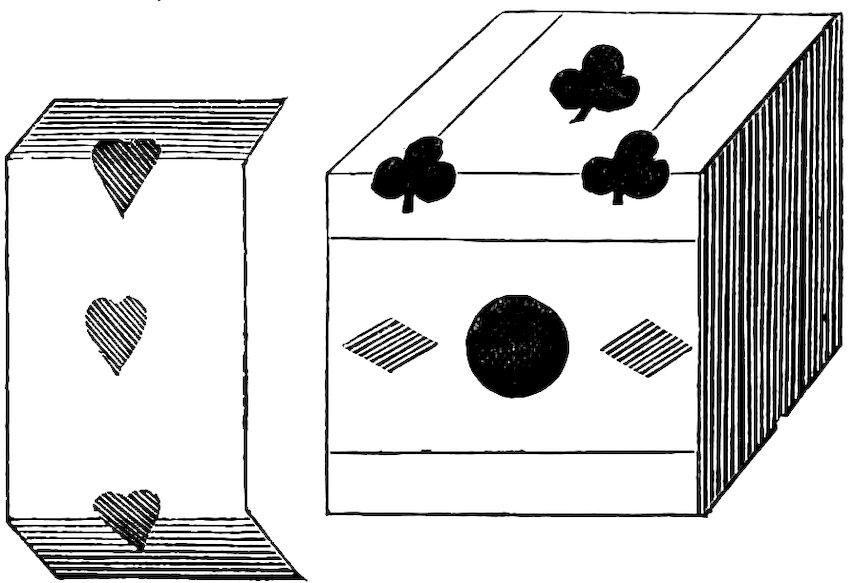
Take six playing cards and turn up half an inch of
the ends of each, the same side. With them form a
hollow cube or box by the arrangement here depicted:
Fig. 43.
In the centre of one side cut out a small circle.
After filling this box with tobacco smoke, you can
78make a ring of it issue from the aperture by giving a tap
to the opposite side, just as the pressure of the flexible
bottom of an oil-can makes the fluid spurt out.
Certain old dames of Mr.
Panky’s acquaintance are
prejudiced upon the subject
of tobacco smoke. To
believe them, you would
become of the impression
that cigar vapour penetrates
the thickest curtain,
wall, or any partition
whatever.
I beg to show you that
these estimable ladies are
not so far wrong.
I have in my hand a
glass cup with a cover of the same material, as transparent
as possible.
I put on the lid, and let this volunteer hold it at a
distance from me, whilst I puff towards it the smoke of
this perfumed cigarette.
Keep your eyes on the covered cup, for you will see
that the smoke enters it, though hermetically sealed.
To convince you that there is no ocular illusion, let my
obliging Ganymede lift off the cover.
There, away flies the smoke caught in it.
Again close it, while I again despatch more smoke to
it. Shall I repeat the experiment, for I warn you I am
prepared to continue till morning. Three or four times
will suffice, eh? So much the better for your patience.
79Explanation.—Into the cup put a few drops of alkali,
and move the vessel about so that the inside is coated
with the liquid; treat the cover with chloridric acid, in
the same way. When these two are brought into contact
by the junction of the cover and vase, a thick vapour
is produced, which resembles tobacco smoke. Take care
not to cover the cup until just when you wish the vapour
to appear, as its formation is instantaneous.
Fig. 44.
IX.—SIMPLE TRICKS WITH HATS. — THE MAGICIAN’S BIRDCAGE. — THE GARDEN HAT; OR, FLOWERS GROWING VISIBLY IN A HAT. — TO RUN THE FINGER THROUGH A HAT AND YET RETURN IT INTACT.
80
Fig. 45.—The Gentleman who Lends his Hat.
(Les Oiseaux Ranimés.)
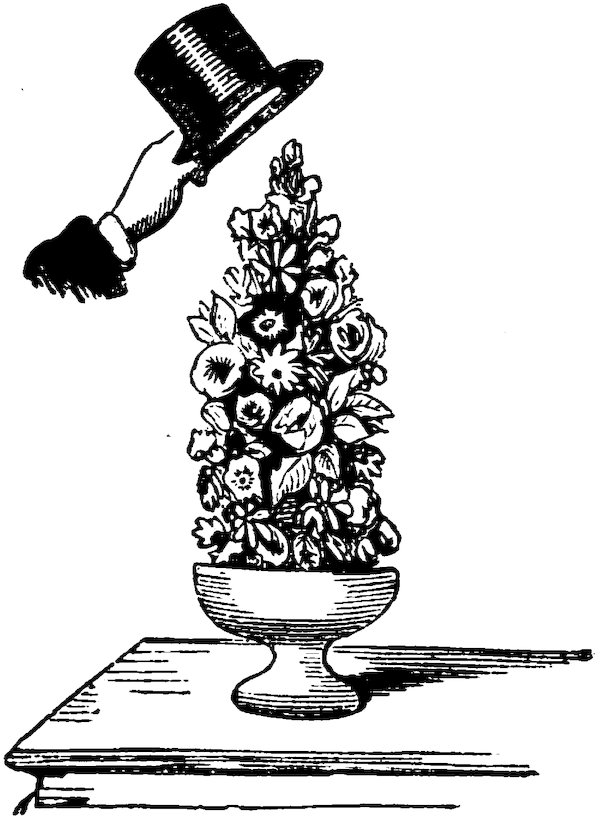
There is an universal
exclamation
of sorrow
from the ladies
when the inmates
of the pretty cage—suddenly
produced
from a gentleman’s
hat, as a
conclusion to a
trick—are found
to be lifeless.
Participating in
the distress, Monsieur
Hanky Panky
seeks to remove
its cause,
and for that purpose
borrows from the audience a pocket handkerchief.
81
Fig. 46.
Hardly has he drawn it two or three times over and
around the cage, than the pitying faces are seen beaming
with wonderment and joy, for the inanimate birds
have been resuscitated, and are flying and chirping
within the gilded bars.
Fig. 47.
Explanation.—Some wondrously scientific gentleman
will probably descant upon the marvellous effects of training
of canaries, or, perhaps, of the administering angels,
ether and chloroform. Let him do so, for you will learn
on an inspection of the cage, that it has a double bottom,
in the receptacle of which, at first, the live birds are
82kept unseen, and, on the pressure of a spring in the
knob at the top, the stuffed ones descend, thanks to the
false bottom sinking in the middle, if its halves are on
pivots at each side; or, one half sinking one side and the
other opposite, if they turn lengthwise.
An egg can be made to transform itself into a live
bird or mouse, and other changes can be wrought by
this same apparatus.
Fig. 48.—“And when the Pie was opened,” &c.
A hat being about to be returned
to the owner from
having been shockingly maltreated
in the concoction of
an omelette, it occurs to Herr
Harngy Barngy, that, while
it is unfit for adorning the
human head, it may be available
for other purposes.
“Hang it!” says the Professor,
with his genial smile,
83which is never so sweet and placid as when he is working
his will with borrowed property, “I see such a
resemblance in it to a flowerpot, that flowerpot it shall
be. So I will hang it here—on this little shelf—hanging
from the ceiling by three cords.”
For seed, a few rose leaves; for mould, some shreds
of handkerchief, &c., which are put into the hat.
Then Mr. H. B. retires in amongst the audience. At
the wave of his wand, a tender stalk is seen to peep over
the edge of the hat, and by degrees a bush of flowers
rise out of this novel jardinière, whilst a perfume as of
newly blooming flowers pervades the air.
Fig. 49.
Explanation.—In our former works will be found full
directions to manage the miraculous birth of flowers by
mechanical means. In the present case the result is
brought about by a less complicated method.
You have a tin vessel of the size and shape of a hat,
to fit inside it. In it is a bush, with natural flowers
attached, mounted on a large cork, the whole to move
upwards without impediment.
In going up to the hanging shelf you slip this prepared
84vessel into the hat. When the whole is in its place, your
signal to your confederate sets him to turn on perfumed
water, which runs into the vessel through one of the suspending
cords, which is a gutta percha tube covered
with silk. As the water enters, the cork is floated.
Fig. 50.
Having concluded a performance in which a borrowed
hat was employed, you pretend to hesitate about handing
it to the owner, and, in fact, whilst you are mumbling
excuses, reveal that, by some bungling, you have
made so large a hole in the crown, that a finger—yours,
for instance (suiting the action to the word), can go
through it, to do which you thrust a hand within the
hat.
The forefinger is seen issuing through the top of the
hat, where it wags in an amusing manner. Nevertheless,
85on instantly giving the hat to the owner, not the
slightest trace of the fracture can be perceived.
Fig. 51.
Explanation.—The finger shown is one made of gutta
percha, with a little cup valve at the base, from which
the air is exhausted by a simple pressure, when the adhesion
is perfect. To remove it, pick up the edge of the
valve with the thumb-nail. This little diversion causes
that hilarity always befitting a magical entertainment.
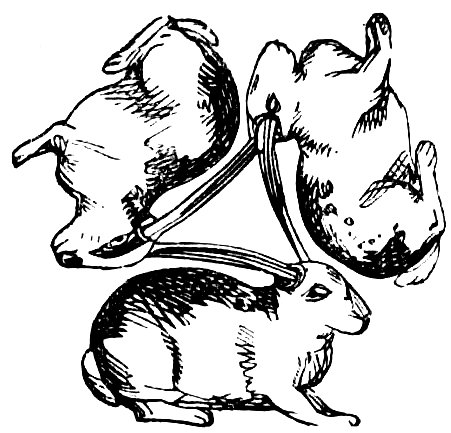
X.—AMUSING TRICKS WITH VARIOUS ARTICLES. — TO TAKE A PORTRAIT IN THREE MINUTES. — A REMBRANDT ETCHING IN FIVE MINUTES. — THE ONE-EARED HARES. — DOING A GOOSE IN THE TURN OF A HAND. — VAPOURGRAPHIC PICTURES. — CHANGEABLE PICTURES. — MAGIC DRAWING. — TRANSPARENCIES. — MOVABLE TRANSPARENCIES. — TO WRITE ON WOOD. — THE PIG’S-EYE GAME. — EVERLASTING WRITING ON GLASS. — MOSS PICTURES. — THE PUNCTUATION PUZZLE. — OIL PICTURES.
86
“The mind of man, like a bow, if always bent would in the end
lose its elasticity, and become useless; by giving it occasional
freedom you preserve its tone, and it will serve your purpose.”—Æsop.
Draw on coloured paper with another coloured crayon
the likeness of a confederate, and dust the lines with a
powder of the same hue as the paper.
Fig. 52.
In your pencil-case have a hard brush, and when you
appear to draw, remove the coloured powder.
This trick is used in connection with disappearing
87feats, where you undertake to make the drawing of a
card, a flower, or any vanished article, which you are
not supposed to have seen.
Smoke a glazed card over a tallow candle till the
surface is completely blackened. With a needle scratch
out a landscape with a moonlight effect, or a figure in
shadow, except on one side, where a strong light falls,
after the fashion of the photographs by Solomon,
Kliemeck, &c. The weird aspect will be quite like a
Doré or Van Schendel.
Draw three hares, so that each shall appear to have
two ears, while they really have only three ears between
them.
Fig. 53.
88
Fig. 54. THE SHADE OF NAPOLEON VISITING HIS TOMB. A full-length Portrait of Napoleon I. may be traced in the above Engraving
89
(Story and Drawing Lesson.)
There was once upon a time a farmer who built a
house with one window and two doors. A path led to
a pool adorned with sedge. But up to the pool, by two
crooked paths, came a gang of robbers, who caught a
goose.
Fig. 55.
Write on glass with a quill full of hydrofluoric acid.
After two minutes’ action of the mordant, wash in clean
water, and polish with silk or soft dry cloth. The bitten
away lines are invisible, but will appear on the plate
being exposed to the breath or steam from a kettle.
90
Paint any subject on thin paper slightly with light
colours, so arranged that by painting the paper stronger
on the other side, it may be disguised. Then cover the
last side with a piece of white paper to conceal the
second subject, and frame the whole. It may even be
put between two pieces of clear glass.
On holding up this picture to the light, a different
scene is presented to what is usually beheld.
Take a box about 18 inches long by six deep, and
remove the lid and one side. In the centre set a square
of glass at right angles to the bottom, and parallel with
the plane of the ends.
Place a picture which you wish to copy on the left of
this upright glass, and a sheet of paper on the right.
On holding the head on the left of the glass, and
looking into it downwards, the reflection or spectre of
the picture will be seen on the paper, where the lines
may be traced.
Put a chafing-dish or gas-stove under a wooden frame
on which you strain, that is, stretch, a piece of strong
linen or silk, while you do it over with a solution of
wax in oil of turpentine. It will then be equally
diffused.
Paint with oil colours mixed with spirits of turpentine.
91
Mount the transparency on a light circular frame, on
an axis easily turned. Close the upper end of the
hollow cylinder with a disc of tin, cut into inclined
planes like the ventilator let into window panes (fanlight).
A lamp placed inside the cylinder will illuminate the
transparency at the same time that it makes it turn
round by the current of heated air striking the tin
plate.
Vary the subject of the pictures as you please. Mr.
Panky’s represent hideous serpents twisting round a
column, and other delicious spectacles.
Fig. 56.
To make the above magical figure without taking the
hand off, begin at A, thence to B, to C, to D, to E, and so on.
Rub the wood with powdered resin, and ink will not
spread or run when you write upon it.
92
Shut the eyes and draw the figure of an animal without
taking the hand off. Still not seeing it, remove the
hand and try to put the eye in its proper place.
The ludicrous outline made, and the absurd position
of the eye in most attempts, are remarkable.
After covering a sheet of glass with visible colour or
colours, write or scratch the inscription so as to remove
the pigment in those places where the pen touches. Put
the glass in the furnace for the colours to set with running
so as to obliterate the marks, and after the proper
cooling, the writing will be unalterably fixed. Designs
of transparency for a tinted ground can be thus made.
Take a board with a smooth face, and stripe it lengthwise
with three bands of colour sky-blue and grass
green, with a pale blue or pale yellow between, which
will be the sky, the middle distance and horizon, and
foreground of a picture. With coloured moss, varying
in tint from yellow to deep brown, form trees, bushes,
hedges, foliage, &c., by glueing the sprigs. The effect
is often charming.
Whoever writes this on the wall has ten fingers on
each hand; five and twenty on hands and feet; guess
who this may be.
93
If you drop oil or fat on water it spreads and breaks
into variegated patterns as beautiful as snow-flake
figures.
Have a vessel of pure cold water, still as possible.
Let one drop of oil fall on the surface from about four
inches height.
Lay a piece of glazed surface paper on the oil pattern,
take it instantly off, place it on the surface of a
plate of ink for a moment, remove and wash off the
excess of ink, and you will have a black picture closely
resembling a photograph. For red use cochineal or the
aniline reds.
Pure sperm oil takes a minute to form a pattern;
green rape oil is slower; Lucca oil three minutes; green
olive one minute, &c. Oils can be mixed and tried.
The formation can be shown by the magic lantern,
from which is removed its nozzle pipe for a shorter one,
so as to form the oleographs properly, and yet leave
room enough for a small pipe to be thrust between the
nozzle and the trough containing the water on which
swims the oil.
The lantern is turned back so that the chimney is
horizontal; the hole is then perpendicular; on it is set a
trough made of two plates of glass joined together, the
upper, which has a hole in it, to be filled with water.
On the nozzle is placed a prism, which reflects the picture
on the screen.
XI.—AMUSING TRICKS WITH VARIOUS ARTICLES. — TO DIVIDE A HORSESHOE INTO SEVEN PIECES BY TWO CUTS. — TO MAKE AN ANTI-MACASSAR OF A SHEET OF PAPER. — SYMPATHETIC CURRENTS OF DIVINATION. — THE TURNING SHEARS. — THE SIMULACRUM. — PRIMITIVE WOLF TRAP. — THE CELEBRATED HONEY-BEE TRICK. — TO PROTECT A HOUSE FROM RATS AND MICE. — TO SHOW THE FUTURE IN A PAIL OF WATER. — THE INTELLIGENT PARROT. — CLOVES. — DANDELION RING CHAINS. — IMMORTELLES. — THE POLITICAL TEETOTUM. — ORTHOGRAPHICAL DICE. — THE HEXAGON. — THE MAGIC OCTAGON. — THE PARALLELOGRAM. — MOCK LACES. — TO CUT OUT A CROSS. — THE MAGICIAN’S SPELL. — CHERRY-STONE BASKETS. — HANKY PANKY BURGLAR ALARM. — MOCK TURTLE. — MYSTIC CHANGES IN COSTUME. — THE ANIMATED CRYSTAL. — THE SPINELESS GIANTESS. — TO COLOUR AGATES. — CARD CASTLE.
94
Make a horseshoe of a slice of pear or apple, potato,
&c., and cut off the long arms at AB. Range all in a
row, and cut them across into seven pieces.
Fig. 57.
Take a newspaper and fold one end transversely, so
that the edge is parallel with one side, by which a square
is obtained.
Fold this square to make a right-angled triangle;
fold this to make another triangle, and so on until the
last shape is an acute triangle.
95The end A is just half as thick as the rest of the
paper. Tear this off at the dotted line, by which the
square of paper becomes a sixteen-sided figure, nearly
circular.
Fig. 58.
To make the pattern, tear off the point of the folded
mass, by which a central hole will be made in the whole
piece. Then tear from the sides and the broad edge
small pieces, varying in size, by which a certain pattern
will be made. Once having found the proper
points whence to remove the ground, such counterparts
of lacework can be so rapidly and bewilderingly done
that the spectators will be amazed upon your unfolding
the paper completed. It is needless to say tearing of a
common newspaper makes the trick apparently more
difficult than the most elaborate cutting out of coloured
tissues with scissors.
Fig. 59.
96
A brother philosopher of mine (says Hanky Panky)
has written about sympathetic atoms of communication.
Descartes, as he is named, maintained that any one
could put himself in correspondence with another so as
to read in his mind as in a book, by aid of connecting
atoms. Ahem!
I will now (continues Mr. H. Panky) apply to a lady
and a gentleman, to whom I give each a sealed letter,
with the request for them to take the best of care of
them, and not to open them until permission is given.
I have here a pack of ordinary playing cards, which
may be freely examined, from which are excluded all
below the value of seven, being what is known as a
piquet or euchre pack.
I make eight piles here on the table of four cards
each, and number them. The gentleman holding the
letter will kindly point out which one he selects.
Observe that the gentleman has taken the third pile.
I beg to offer it to him while I pick up the other
cards.
I now spread out a set of dominoes on the table, of
which I form four rows of seven each, face down on the
table. I part the four rows into two ranks, separated
by the empty domino-box between them.
The gentleman will please choose one of the rows,
and then one of the piles in it. I give him that pile
and turn up the dominoes to show that no two are
alike.
I present to the lady a pencil, and ask her to mark
one of the three flowers painted on the board held out
to her.
The lady has marked the lily.
97The gentleman can now open the letter, when he may
read as follows:—
“Sir—The four cards chosen by you are the king of spades, the
eight of diamonds, the ace of hearts, and the knave of hearts.
The pile of seven dominoes contains the blank-two, three-two,
double-four, four-five, deuce-ace, cinq-three, double-one, in all thirty-seven
points.
“Signed Hanky Panky.”
On opening the lady’s letter, she may read:—
“Madam—You were destined to choose the lily.
“Signed H. Panky.”
And I shake the envelope out to produce a lovely lily,
which was the flower the lady preferred.
Explanation.—The cards were eight sets of four,
which were respectively the spade king, the eight of
diamonds, ace of hearts, and knave of hearts. Consequently,
wherever the choice fell it was sure to light on
the cards which were named in the letter previously
prepared.
The dominoes were placed in the box face up, as
usual, but the bottom row was composed of the series
which you wish to come out. On putting them on the
table place the prepared lot on your left hand. If the
right-hand lot should be chosen, quietly remove it, saying
that you put it out of the way, and we will use the other
(for it seems perfectly fair that the choice should as
well exclude as include the lot). In the same way deal
with the other rows so as to have the prepared set in
any case.
The three names of flowers, or the flowers themselves,
painted on a board, have the one to be selected somewhat
prominent, and, with a little art, you can always
induce a lady to mark the desired one. (See directions
to “force a card,” in The Secret Out.)
98
Take a large pair of scissors
or shears in your
hands, which you hold out,
palms upwards. Hang
them by their rings on the
little fingers. Close the
hands with a slight inclination
towards the scissors,
so that the finger
tips only are in the rings,
and the blade is supported
on the inner fleshy part
of the palms.
As you turn your closed
hands, the scissors will
turn, and on bringing the knuckles upward the point
will be forward, and you can open and shut them
freely.
Ladies and Gentlemen: One of the superstitions of
the Middle Ages made it credible that if a person hating
another bought of a regular magician an enchanted doll,
resembling that object of enmity, any treatment of the
representative, say, the insertion of pins into its wax,
the twisting of its limbs, and so on, would be felt by the
living being.
This was acting upon a person through his likeness.
On this principle I—Signor Hanchio Panchio, at your
service—have succeeded in opening locks without going
near them with the key.
I have a facsimile of my front door lock in my own
99study, and on hearing a knock I merely turn a key in
the duplicate lock, when the door flies open so mysteriously
that the visitor believes the agent an electric
medium of mine.
I am going to perform this most curious experiment
before the present company, by aid of the massive padlock
which I take out of its box.
There never was a more simple padlock. I shall lock
it here under your eyes, and yet engage to open it without
turning the key.
It is now locked, and any gentleman may test its
security. I can even hang it on my wand by the ring
to prove it, and in that way my friend by my side can
hold it for a moment whilst I make a drawing of it on a
sheet of innocent white paper.
Open. Fig. 60.
Closed. Fig. 61.
Once more let me show that the fastening holds firm.
All are satisfied.
100I will now apply the key to the hole in the drawing,
and turn it once—twice—and cry:—
“Open, Sesame!”
The padlock is open!
For your kindness in assisting me, sir, you may retain
the drawing. You have watched me so closely that I
see you have imbibed the art, and henceforth all the
doors of society are open to you.
We borrow from The Magician’s Own Book the illustration
of a magic padlock. In the present case, the instrument
contains a powerful spring which forces the
key-bolt back out of the socket of the pin, and is set in
action by pressure on one of the nail heads adorning the
plate. This is done when the second testing of the lock
is made. You keep up the chatter as long as the time
required for the spring to work.
A double circular stockade, or palisade, is erected too
high for a wolf to leap over, with one entrance, closed
by a gate.
Fig. 62.
This is open, and the animal, hearing a tied-up sheep
bleating in the centre, passes in and goes the round,
101seeking the entrance to the prey, when he pushes the
gate to, and is imprisoned till morning.
Get possession of the queen bee, and confine her by a
hair or fine silken thread by a running noose fast around
her corslet.
Explanation.—Be Wise in Time.
The bees, attentive to her movements, will surround
her, and go to and fro, as if in obedience to the will of
the captor of the mother bee.
A swarm can be made to pass from one hive to another
at pleasure.
The Japanese, from time immemorial, have manufactured
china cats, with open eyes, so faithfully copied
102from nature that one of these toys, with a rush-light inside,
will protect a whole house during the night.
The image might contain a clockwork by which an
intermittent sound would still farther alarm the rats.
Bid the person desirous of seeing his or her future
partner’s face look into a pail of water.
The reflection will certainly be of their own features,
but as marriage makes each the other’s, you can safely
maintain your credit as a soothsayer. “That face will
be your husband’s when you marry.”
Have a parrot, or other bird, carved and painted, with
simple springs to make the head turn and the mouth to
open, mounted on a hollow shelf against the wall.
Through its body, one leg, the hollow shelf, and thence
through the wall, into an adjoining apartment, where
your confederate can overhear, run a tube with a mouthpiece,
to which the lips or a bellows can be applied.
On pretty Polly being addressed, she will whistle, sing,
scream at command, and answer to sensible questions.
Cloves are the unopened flowers of a small evergreen
tree that resembles, in appearance, the laurel or the bay.
Each clove consists of two parts, a round head, which is
the four petals or leaves of the flowers rolled up, enclosing
a number of small stalks or filaments. The other
part of the clove is terminated with four points, and is,
in fact, the flower-cup, and the unripe seed-vessel. All
103these parts may be distinctly shown if a few leaves are
soaked for a short time in hot water, when the leaves of
the flowers soften, and readily unroll.
Pull some dandelions with long stems and cut off the
flowers. As the stems are hollow, the upper or smaller
end can be bent round to enter the other, so making a
link, of a number of which a chain can be formed.
When fresh, scrape the flower leaves with a blunt
knife to make each petal curl.
Fig. 63.
For a green hue, dip the flower, but not the stalk, or
the former will fall off, in a brass or copper vessel full
of vinegar and salt, for half a day, or not so long in oil
of tartar; wash in water, and dry them, keeping the
stem up. For a straw-yellow tint, keep them two days
in oil of tartar. For yellow, or another shade of green,
104in quick lime, slightly liquefied with water. For grey,
in vinegar, milk with a little black dye. For jet, put the
stems through holes in a plate of metal fitting a vessel
by which the flowers can be exposed to the fumes of
sulphur. They will be blanched at first, but will then
redden, and finally become black. To varnish: Melt
down some Flanders glue, strain it, and brush it on
thoroughly. Put them away to dry where no dust will
fall on them. Perfume at pleasure.
Fig. 64.
(No personal allusion intended to H. Panky, Esq.,
M.P.) Cut the edge of a teetotum into six faces, and
put on them the letters D, R, C M, &c., standing for
Despotism, Republic, Constitutional Monarchy, and any
other form of government which may visit a country.
The game is to pretend to tell the future rule by the
first face which comes up three times.
105
Paste or paint
upon four cubes of
wood, metal, stone,
or bone, the vowels
and consonants.
Attach a value to
them, and play with
them in the same
manner as if they
were dice. The
whimsical words
which the upturned
letters will often
produce occasion
laughter, and the
compulsion to name them will help slow juveniles on
with their alphabet.
The six-sided figure is to be cut through the lines, and
re-made.
Fig. 65.
106
Upon a piece of cardboard draw
The three designs below;
I should have said of each shape four,
Which when cut out will show,
If joined correctly, that which you
Are striving to unfold,—
An octagon, familiar to
My friends both young and old.
Fig. 66.
Fig. 67.
107
A parallelogram, Fig. 68, may be cut into two pieces,
by which two other figures can be formed.
Fig. 68.
Take a piece of linen or “long-cloth” and stamp, or
paint gum on all the parts of a pattern which is to remain
intact, and soak it in a potash-bath at 22° Centigrade.
In a short time the process of felting, analogous
with that of skeletonizing leaves, will act exclusively on
the ungummed places, and eat away about a twentieth.
Only the experienced eye can tell it from embroidery.
Shirt-fronts are thus worked.
Fig. 69.
Fig. 70.
Fig. 71.
To cut out of a single piece of paper, and with one cut
of the scissors, a perfect cross, and all the other forms
here shown, take a six-inch length of a piece of foolscap
two inches wide, and fold the upper corner down, as
shown in A, Fig. 72; then fold the upper corner over
108the first, in B. Next fold the paper in half lengthwise,
as in C. The last fold is made lengthwise also, in the
middle of the paper, to form D. Cut this through
with the scissors lengthways, for the forms shown in
Figs. 69, 70, 71.
Fig. 72.
A B R A C A D A B R A
B R A C A D A B R
R A C A D A B
A C A D A
C A D
A
Secure a cherry-stone in a vice, and having traced a
line around it the longest way, and another at right
angles, file out the space, both sides of the latter, down
to the surrounding mark. There will then be left a
miniature basket with handle complete.
Fig. 73.
109
(Diablotins.)
Exploding crackers are used for awaking a sleeper
by the detonation when any one attempts to enter the
room without permission. They are fastened across the
crack of the door, as if to seal it.
These explosive papers are made by taking strips of
half an inch to an inch wide, and of a convenient length.
By means of a little gum-water or paste a small quantity
of coarsely pounded glass is attached to one end, on one
side of each strip about one-fourth of an inch. A little
fulminating powder is spread over the glass and the
moistened end of the paper, and it is dried in the air:
two of these strips are then laid with their covered
surfaces nearly in contact, and so that their uncovered
ends may project different ways. A narrow strip of paper
or parchment is then wrapped round the coated ends
and fastened to one of them, but not binding them so
tightly as to prevent their being drawn, by taking hold
of the projecting ends, one over the other. The friction
occasions their detonation.
The quantity of fulminating powder must be proportioned
to the effect intended.
Take a piece of paper stained or painted like tortoiseshell,
and cut out a piece of the shape of a turtle’s upper
shell; make claws and head, and paste them on. Bend
up the middle and put on a bottom, which you also push
up in the centre, where with a drop of shoemaker’s
wax you secure a large live fly. The efforts of the latter
to escape will cause him to carry the paper shape about
the table. Except for the fright—and the absence of
110mental emotions in such low animals debars much fear
of that—the creature need suffer no hurt.
We are all familiar with the excellent surprises in
quick dressing shown by Woodin, Love, and the latest
polyphonist, Mr. Maccabe. An American entertainer
has carried this address in dress to its climax. He comes
upon the stage attired in a black dress coat, black trousers,
having in his hand a high opera crush hat, and
sings a collection of songs, at the end of each one of
which he, without leaving the stage, and while standing
in full view of the audience, makes several changes in
his costume, as follows:—Upon the coat, which is closely
buttoned, in place of the black buttons there suddenly
appear and disappear double rows of gilt buttons.
Closing his crush hat and affixing it to a rear button on
his coat, he produces from a pocket a small cap, with
wig attached, which he places upon his head; quickly
turning his trousers up above the knee, to give them the
appearance of knee breeches, we find his lower limbs
encased in neatly fitting white gaiters, and, producing
a telescopic cane, we are presented with an excellent
portraiture of an old man in the full costume of years
gone by. By a sudden movement from the neck the
entire costume is changed to full female attire. He
then sings “Tassels on her Boots,” and at the conclusion
of the first verse, as he slightly raises the skirt of his
dress in front, we see that the gaiters have disappeared,
and that his feet are encased in neatly fitting ladies’
boots with tassels thereon. Succeeding this he makes
several entire changes of costume, all being, however, of
female attire, differing materially in style and colour.
He wears a jaunty little hat upon his head, which is
111changed in colour and style to suit the various costumes,
without removing it: also, different wigs are seen upon
his head after the latest fashion of ladies’ hair dressing.
Alum put into a tumbler of water, as it dissolves will
assume the shape of a pyramid. When the solution has
nearly terminated, you will find the mass covered with
geometrical figures, cut out, as it were, in relief upon
the mass. This experiment having succeeded, take up
a crystal quartz which has six sides, and cut accurately
from each face to a perfectly convex surface, and place
it on a piece of plate or common window glass, a china
or glazed plate, or any smooth surface, perfectly clean,
as grease or a particle of dust would impede its motion.
Wet the surface, and give the plane a slight inclination,
when, if properly managed, a rotatory motion will commence,
which may be kept up for any length of time
by giving alternate inclinations to the plane surface,
according to the movements of the crystal; to heighten
the pleasing effect of which, a variety of paper figures,
harlequins, waltzers, &c., may be attached. The first
trial of the experiment had better be made by giving a
slight rotatory motion to the crystal.
In The Merry Circle a full explanation was given
of the mode of manufacturing a giant or giantess. A
slight yet telling modification has occurred to us.
Let the skirts of a dress be fastened with its waistband
around a boy’s chest just under his armpits., He
forms the body of the Colossus. Half open an umbrella
and secure it in that position. Tie a shawl to the ferule
112so that it will fall over the umbrella and conceal the
boy. On the top fasten a muff or bale of cloth, which
serves as a head on which a coal-scuttle bonnet may be
fitted, with a thick veil to hide the absence of countenance.
If the umbrella has a hinge in it, as parasols
are often made, the animating principle of this “ten
footer” may execute a bow with the upper part of the
contrivance which a courtier could never surpass.
Fig. 74.
Brown.—Soak the stone in a solution of silver in
spirits of nitre, dry in the sun, then put in a damp place,
and on again exposing it to solar light, the colour will
appear. Repeat to deepen shade.
Light Brown.—A solution of gold.
113Gray.—Add to the silver solution a quarter of its
weight of lard and red tartar.
Deep Violet.—Add to the silver solution some plumose
alum.
White.—The action of bismuth bleaches it so that it
looks white; it will appear pale brown in the shades.
To draw Figures on the Stone.—Rough it, write with a
quill, and the silver solution will dry it quickly.
With a pack of cards make houses in this manner.
Place two on their narrow ends, fixing the tops level.
Fig. 75.
On each side of the opening stand a card longwise.
And place two other cards at the end of the last pair,
to form a square surrounding the triangle.
114
Fig. 76.
Fig. 77.
115Each side of the central cards lay two more, flat upon
the outward pair, like a roof.
Fig. 78.
On this platform rear cards like the first pair,
and continue till the whole pack is used; with care
many of the under cards at the side can be removed to
continue the structure.
Fig. 79.
XII.—INTERLUDES, PUZZLES, &c. — PUZZLES. — TO FORM A SQUARE. — A SQUARE OF FOUR PIECES. — The Puzzle of Five Pieces. — Another of Triangles. — Another. — A SQUARE OF SEVENTEEN SQUARES. — Another of Four Triangles and a Square. — Of Four Squares and Eight Triangles. — Of Nine Pieces. — Of Ten Pieces. — Of Twenty Triangles. — Of Eleven Pieces. — THE OVAL PUZZLE. — CHECKER PUZZLE. — THE UNDETACHABLE CYLINDER. — TRIUMPHANT COLUMN. — A PRETTY TRICK IN BALANCING. — THE ANGULAR PUZZLE. — THE POSTS AND PADDOCK PUZZLES. — THE LANDLORD TRICKED. — THE DIVIDED ORCHARDS. — THE OBLONG PUZZLE. — THE ONE-QUARTERLESS SQUARE. — COUNTER PUZZLE.
116
The best material for these geometrical puzzles is
hard wood about an eighth of an inch thick; but pasteboard,
cardboard, and stiff paper are efficient substitutes.
To cut a card of the shape and in the proportions of
Fig. 79, into three parts, to form a perfect square, you
117must cut through the lines of the obtuse angle, and it
will then be an easy task.
Fig. 80.
In a square card punch twelve holes, or make them
with a pencil, and then cut it into four equal-sized pieces,
each of the same shape, and containing three holes or
marks.
Fig. 81.
118
Find the centre of one side of four out of five squares,
and cut them from that point to the opposite corner;
place them around the perfect square, and they will
form the figure here presented.
A Fig. 82.
B Fig. 83.
With the five triangles make a square.
Fig. 84.
Dot a square card in eight places, which dots are to
be divided by straight lines, so as to cut the cross into
119five pieces, two dots to each piece except the centre
one, which must comprise eight.
Fig. 85.
Fig. 86.
To divide a square into seventeen squares, begin by
dividing each side of the square into four portions,
drawing lines across each way to these points to make
120sixteen squares. Unite the points of the diamond,
within which is a square one-quarter the size of the first.
A second diamond within this quarter-sized square, cut
by a Saint Andrew’s Cross—gives the points for the
seventeenth square.
Cut the card first into a ten-inch length, two inches
wide; and then of the pieces form a square.
Fig. 87.
Fig. 88.
121
Fig. 89.
Fig. 90.
First cut the square into pieces of the three shapes
shown, four of A, four of B, and two of the small one C.
122The formation of a perfect square with them will be a
difficult task.
Begin by placing four triangles at the sides of a square
of four triangles, when the rest of the shape can be filled
in readily.
Fig. 91.
Cut up a square into four sets of two each, A a square,
B and C a triangle; three of the triangle D, and one each
of E and F. Begin at the left lower corner with A, to
its top and right side place two of D, then a large
triangle C; a square is now made, one quarter of the
large one. The second square to the right requires but
123the two pieces, E and B. The other half, from there
only being five pieces to fit, will take but little time and
trouble.
Fig. 93.
Fig. 92.
Fig. 94.
Hanky Panky has to make two oval boards: but it
so happens that the area, exclusive of hand-holes in the
centre, and the circular piece, are the same. To cut his
stuff, on finding the centre of the circle, he strikes a
second circle, half the diameter of the first, with the
same centre. Then he cuts the whole into quarters, by
means of two lines drawn at right angles to each other,
then cuts along the inner circle (Fig. 92) and puts the
pieces together, as in Figs. 93, 94.
124
Fig. 95.
The puzzle is as follows:—After placing three red wafers in the squares Nos. 1, 2 and 3, and
three blue wafers in Nos. 5, 6 and 7, you are to move the three blues into the squares occupied by
the reds and the three reds into the squares occupied by the blues (keeping within the squares), the
reds moving towards the right, and the blues to the left, not being allowed to move back after once
moving forward. You are to jump only one at a time, and have the privilege of moving either card
into a vacant square adjoining. The first move, of course, is either from 3 or 5 into 4.
Explanation. Move blue wafer from 5 to 4; red wafer from 3 to 5, jumping 4; red from
2 to 3; blue 4 to 2, jumping 3; red from 6 to 4, jumping 5; blue from 7 to 6; red from 5 to 7,
jumping 6; red from 3 to 5, jumping 4; red from 1 to 3, jumping 2; blue from 2 to 1; blue
from 4 to 2, jumping 3; blue from 6 to 4, jumping 5; red from 5 to 6; red from 3 to 5, jumping 4;
125and blue from 4 to 3, which performs the puzzle, having
changed the three blue wafers from their former places
into those of the red, and the red into those of the
blue. This may be shown to a person a number of
times, and if done quickly not one in ten will be able to
perform it.
Cut a slit close to one edge lengthwise of half a
playing card, and of the other piece make a cutting in
the following shape:—
Fig. 97.
Pass the thin long ends through a button, a perforated
disc of paper, or a piece of pipe-stem, after
having taken the slip of card in its loop, and unfold the
large square wings.
126If the bands are not shown, the way to get the little
cylinder off is truly undiscoverable.
Fig. 98.
It is done, of course, by doubling the flat card till the
slip can be pulled through the pipe-stem, when one of
the square wings will go through it, and the release
follows naturally.
Take a number of smooth true cylinders, of metal or
hard wood, and, by carefully placing one upon another,
rear a slender column. If the ground is firm and
level, such a pillar may attain a somewhat astonishing
height.
127
Put an orange, apple,
or other tempting object
fifteen inches from the wall,
and present it to any one
who can pick it up while
standing against the wall,
or rather while keeping his
legs against it. Or, again,
challenge whoever has been
distinguishing himself in
agility to keep upright on
the inner leg while sidewise
against a wall.
Then—as probably you
will be asked to perform
some feat yourself after
having thus set impossible
tasks to others—put a cork
in a bottle. Drive a large
pin into it horizontally,
and, having previously stuck two steel forks opposite
each other in a second cork, with their handles inclining
downwards, and run the head of a needle into the
bottom of this cork, set the needle point on the pin’s
head, when the forkified cork will be delicately balanced,
and may even be turned round without falling.
Cut a piece of cardboard into the form of, and of equal
proportions to, the figure given here, after which, produce,
with the same, three successive pyramidal or
angular boxes, alternately bearing the respective numbers
128of 7, 6, and 5 corners, still keeping the cardboard in one
piece. After cutting the card half through at the dotted
lines, so that it will bend more squarely, bring the ends
of 1—2 and 3—4 together; bend the whole in the
middle at 5—6: fold 1—2 and 3—4 over one another,
and the six-cornered box is formed. By again placing the
angular sections inwards, the box will be finished. If
larger, gum the parts as you fold them, and a curious
box will be the result; if covered with Dutch metal so
as to conceal all the seams, it may be a puzzle-box
indeed.
Fig. 99.
129
I have a paddock found, which is neither square nor round,
But an octagon; and this I have laid out
In a novel way, though plain in appearance, and retain
Three posts in each compartment; but I doubt
Whether you discover how I apportioned it, e’en though
I inform you ’tis divided into four.
But, if you solve it right, ’twill afford you much delight,
And repay you for the trouble, I am sure.
Fig. 100.
Twenty-one persons sat down to dinner at an inn,
with the landlord at the head of the table. When
dinner was finished it was resolved that one of the
number should pay the whole score; to be decided as
follows. A person should commence counting the
company, and every seventh man was to rise from his
seat, until all were counted out but one, who was to be
the individual who should pay the whole bill. One of
130the waiters was fixed upon to count the company out,
who, owing his master a grudge, resolved to make him
the person who should have to pay. How must he
proceed to accomplish this?
Explanation.—Commence with the sixth from the
landlord. You illustrate with counters.
To a house where dwell four persons, (see the
windows to their rooms) is an orchard; each man
wishes to enclose his two fruit-trees in a space equal to
his neighbour’s. The dotted lines show the position of
the hedges.
Fig. 101.
131
Fig. 102.
Having cut up a square of card by the lines shown,
reform it. By remembering how to form one quarter of
the figure, the whole will be so simplified that you can
perform it under the spectator’s eyes with a rapidity
which will bewilder them.
132
To divide a square less one-quarter, triangularly
shaped, into four parts of the same shape and size,
follow the lines here described.
Fig. 103.
Place eight counters as here given:
The puzzle is to play them in twos, taking up only one
at a time, and, each time, skipping two with the one in
your hand. Answer: Put 4 on 7, 6 on 2, 1 on 3, 8 on
5; or, 5 on 2, 3 on 7, 8 on 6, 4 on 1, &c. For ten, put
the 4th on the 1st, the 6th on the 9th, the 8th upon the
3rd, the 2nd on the 5th, and the 7th on the 10th.
XIII.—TRICKS IN THE WATER. — THE FANE OF AQUARIUS. — WATER RISING ABOVE ITS LEVEL. — WATER IN PERPETUAL MOTION. — TO PLACE TWENTY SHILLINGS IN A WINE-GLASS. — THE HYDRAULIC DANCER.
133
Make a stand with a box upon it, having the roof and
front of an ancient temple, the front of the stand being
in steps leading up to the porch. This conceals a simple
apparatus of glass tubes, receivers and siphons.
Fig. 104.
The four tubes are shown just above and below the
bends, so as to appear to be solid glass pillars. The
water from the upper reservoir fills them in running to
find its level in the other container. Little figures are
made of wax and pith, two having cork in their heads,
two leaden feet, and they are placed in the tubes alternately.
134A valve below prevents them sinking, and a
fine hair prevents them rising into the bends. On the
water being let flow, the figures are imbued with motion,
and their rising and falling will greatly puzzle the
spectators, for the fluid is not seen to run.
Fig. 105.
Take two panes of common
window-glass, about six
inches square, set them together
at one side, and at
the other side prevent them
exactly joining by a little
wax, so that the two planes
form a very small angle, as
one or two degrees. Then
place the bottom edge about
an inch down into a dish of water, when the water will
rise between the panes in the form of a hyperbola.
135
There is shown to the audience a singular instrument
composed of glass, two bulbs connected by two tubes.
Fig. 106.
Water, which may be tinctured with indigo for the
better effect, flows from the bulb A very slowly into the
136bulb B, whence it quickly and plainly runs up by the
tortuous tubing, so thin as to scarcely let a hair pass
through it back into the bulb A. The drops of ascending
water are separated by air bubbles, so that the current
can be clearly studied.
Now, though the laws of nature forbid that water can
by any power in itself lift itself up to the height of the
reservoir originally holding it, here seems a contradiction.
For a time, friction and the resistance of the air appears
to be done away with. But this paradox is readily accounted
for after close watching.
It will be found that the descending liquid does not
ascend from ball B into the winding tube without part
of it being left in that ball. It is this filling the space
which gradually forces the air upwards (since it cannot
go down through the column of water from A). The
only cause of the liquid rising beyond B is its being filled,
and once it is full the movement must stop.
The same appearances of drops of water divided by
air bubbles is shown in the windows of filter-dealers,
who use great lengths of bent glass piping for the purpose
of display; but a small force-pump is the active
agent as regards their apparatus.
Full to the brim, without spilling one drop.—Take
care that the edge of the glass is quite dry: pour the
water into the glass gently, until it is quite full; then
drop the shillings in one by one very gently, and on
their edges. If you act otherwise, the water will run
over the edge of the glass.
137
Shape out a doll, A B, of light material, and paint or
dress him prettily, as your fancy suggests, and between
his legs set the cone, C, made of thin sheet-copper.
Fig. 107.
138On placing this aquatic Blondin on a perpendicular
jet of water, it will balance itself on the top, while rising
and falling divertingly.
A hollow copper ball, an inch in diameter, will balance
itself in the like manner, turning continually round its
centre, and casting the water from its surface.
XIV.—TRICKS WITH MUSICAL AND OTHER SOUNDS. — HINTS FOR PUBLIC SPEAKERS. — THE MERIDIAN ALARUM. — MUSICAL WATER. — THE ÆOLIAN WHISTLE. — SIMPLE ÆOLIAN HARP. — TO PLAY ON TWO WHISTLES AT ONCE — ECHOES. — WHISPERING GALLERIES. — THE INTELLIGENT ECHO. — TO SHIVER GLASSES BY SINGING. — THE WOODEN HARMONICON. — THE STONE HARMONICON. — THE LYRE WITH A GOOD MEMORY. — THE TARTINI FIDDLE TRICK. — THE DEMON VIOLIN. — PRACTICAL JOKES IN THE ORCHESTRA. — THEATRICAL THUNDER. — TO IMITATE THE CRASH OF A THUNDERBOLT STRIKING. — THE CRASH BAG. — TO IMITATE RAIN AND HAIL.
139
In a large room, nearly square, speak from one corner
to the other corner, diagonally. In ordinary rooms, the
lowest pitch that will reach across the room is best. In
the same, speak along the length. Low ceilings carry
sound better than the high.
There are other ways of utilising the burning-glass
to give a signal than to adjust it so that the rays, at
noon, shall fire off a cannon, as at the Palais Royal,
Paris. For instance, let the action of the focussed light
and heat operate on a delicate spring retaining the
hammer of a bell, the valve of a chamber of compressed
air, with its outlet forming a whistle, &c., &c.
140
A jet of water, passing through a hole in a brass plate
fixed at the end of a glass tube will emit a musical sound,
in consequence of the intermittent flow of the liquid
through the orifice. Again, a slender vein of water,
some twelve inches long, on being allowed to fall vertically
from a vessel, will break at the lower end of the
vein into drops. This vein of water should be brightly
illuminated from above by a beam of light sent through
it from an electric lamp, so that the thread of water will
look like a line of light, from the end where it breaks
into drops to the orifice from which it issued. A musical
note of constantly-increasing pitch being then set up by
means of the wind instrument known as a “syren,” when
the note reaches a sufficiently high pitch, the sound will
act upon the luminous column of water, which will
shorten itself by four or five inches, in response to the
one particular sound to which it was sensitive. The
same jet of water will respond to the beats produced by
two organ-pipes, &c.
The Chinese fasten a whistle to their kites, so that the
mouth always faces the wind, and the sound is almost
continuous.
Fasten the ends of a length of waxed saddler’s silk to
pegs or nails, which insert in the crack between the two
sashes midway in a window, so as to stretch the cord
well. The entering air will call out the musical vibrations.
141
Double a length of
gutta percha tubing,
say two yards
long, and cut a slit
in the centre, where
you insert one end
of another piece of
tubing, of the same
or a greater length.
In the two end
openings put whistles,
and make the
whole air-tight.
Place the free end
of the long piece
around the nozzle
of a bellows, and on
forcing the air from
which into this novel
instrument a double
succession of sounds can be produced. The whistles
should be pitched differently, and more than two can be
used.
A good ear cannot distinguish one sound from
another unless there is an interval of one-ninth of a
second between the arrival of the two sounds. Sounds
must, therefore, succeed each other at an interval of one-ninth
of a second in order to be heard distinctly. Now,
the velocity of sound being eleven hundred and twenty
feet a second, in one-ninth of a second the sound would
142travel one hundred and twenty-four feet. Repeated
echoes happen when two obstacles are placed opposite
to one another, as parallel walls, for example, which reflect
the sound successively.
Fig. 108.—Miss Echo.
A certain river has a bend in it, avoided by every one,
as it was supposed to be haunted. At a certain hour in
the evening, for many years, terrible curses were distinctly
heard. Suddenly they ceased. Hearing an
account of the strange phenomena, Mr. H. Panky determined
to ascertain the cause, and carefully examined
the river on each side for about a mile above and below
the bend. He ascertained that at about the time
the sounds ceased an old fisherman, who had lived
on the opposite side of the river, full a mile from the
spot where the curses where heard, had died. He was
told that the fisherman was in the habit of crossing the
river to a village, where he found a market for his fish,
and where he spent his money for liquor; and that after
143drinking freely on his way home, while rowing across
the river at night, he would swear terribly. This gentleman
then persuaded a friend to go down the river to
the place where the curses were formerly heard, while
he remained in a boat on the river at the point at which
the old man usually crossed. He then played on a bugle
and sang several songs. His friend soon returned, and
with eager delight exclaimed, “O, Hanky, such glorious
music fills the air, just where the oaths used to be
heard!” The neighbours came rushing down to hear
it, and some fell on their knees, praying. They said,
“The angels have driven the devil away.” Mr. Panky
then asked what were the songs they heard. His friend
described them correctly, and said he understood even
the words, one of them being the famous Marseillaise,
another a German song. The foreign words made the
ignorant more sure that the sounds were supernatural.
The magician then played on the bugle, and sang again
the same songs, while his friend stood by; but his friend
said the music was not equal to that he had heard below,
where the sounds had really seemed heavenly.
The peculiar configuration of the river-banks had concentrated
the sounds, and the distance and the water
had softened them.
As a rule a smooth-walled room of an elliptical shape
will be found most probably gifted in this mysterious
way.
Find a building, with a wall at an angle where an
obstacle will send the voice from the one side around to
144the other instead of reflecting it as an echo. Then
have a friend able to imitate voices concealed round the
corner, so that, when your victim calls out, “Who are
you?” the answer will come, apparently from echo, in
the questioner’s own voice, “I, A or B, of course.”
It is known that glasses may be broken by the note,
powerfully sounded, which is that given when it is struck,
or the octave of that note. Thin and convex glasses
are best. But, to make sure, nick or scratch the object
with a diamond to start the fracture. A trumpet will
not succeed while a violin will.
On a firm stand erect a three-inch soft wood board,
a yard high and half a yard broad, in which stand twenty
deal rods. The longest should be about five feet. The
ones representing semi-tones should be painted a different
colour from the others, which can be left plain.
Rub the fingers in rosin-dust and set the rods vibrating
with friction, and you will have a manageable instrument,
sweet and expressive.
Stones must be found which, when freely suspended,
are sonorous when struck, and those giving out the
notes and half-notes of the diatonic and chromatic
gamut are to be hung in a frame in proper order.
They are played upon with blows of a little hammer.
Hard wood can be also employed, mounted on a frame,
and struck at one end, being the “bones” of the African
under another phase.
145
A proverb assures us that a teller of untruths should
be skilled in mnemonics.
We exclaim, quite apropos of this remark, that we
have a mystic harp which retains for our pleasure the
airs which it has heard or played.
Amidst the murmur of incredulity, take the lyre and
hang it to a wire luckily pendent from the ceiling.
On the unbeliever placing his ear close to it, the air
is heard as of a whole band, at a distance, brilliant in its
minuteness.
Explanation.—In the upper room is a piano, a square
or grand being preferable: a wire runs directly from its
sounding-board to the room below where the lyre is
suspended. For convenience, the wire can be bent or
formed of several portions overlapping where the join
occurs.
146
Granting any two
sounds are drawn from
two instruments at the
same time, there will be
heard a third sound, the
more perceptible as the
listener is near the middle
of the distance between
them.
If the two sounds are
succeeding ones in the order
of consonance, as,
for instance, the octave
and the twelfth, the double
octave and the seventeenth
major, &c., the sound resulting will be the octave
of its principal.
Hang a fiddle behind a partition, and, on striking a
note on a second instrument on the other side of the
wall, the unseen one will sound in unison.
147
Andy Andy’s adventure
with the trumpet will
be remembered. Hardly
less amusing experiments
are practised in the orchestras
of theatres, especially
when a play has run
its hundred nights and
time hangs heavy.
A handful of bluebottle
flies inserted within the
bass-vial, or the greasing
the fiddle-bows to make
the instrument play a perpetual
mute, may be numbered
among them. A
little lather put into a
cornet will be blown out
into soap-bubbles when it
is played.
Suspend a sheet of iron, five feet wide by six or seven
feet long, from the centre of one end by a cord. At
the lower end, about five feet from the ground, fasten a
handle. On seizing this, and shaking the sheet so that
it shall wave in horizontal rolls from your hand upwards,
the sound of thunder will be heard, and you will say,
with Gainsborough, “Our thunder is decidedly the
best.”
148Another Way.—Make a square drum-head of wood, a
yard long by half as much wide, over which you spread
and firmly glue a sheet of parchment, rather thick, wet
on being put on, so as to dry very tight. Hang this up,
and, on tapping it with your fingers, the reverberation
will imitate a thunder-peal closely. Thus, in the theatre,
a tap on the big drum often serves for this purpose.
Fig. 109.
It may have happened to you to have been present
when a servant’s awkwardness has let a Venetian blind
come down by the “run,” when you surely cannot have
failed to notice the terrific noise resulting. By a similar
fall of slats, of which the sudden contact gives a number
149of sharp clatters, blended by the rapidity of their succession
into one crash, the semblance of a thunderbolt’s
fall is given.
A A, stout iron rods, to which is fastened, at the lower
ends, a board C; they rise perpendicularly, and are fastened
above, being about 10 feet in length. B B are
ropes, to which, at E E, are fastened firmly the slats D D
(of which but two are represented, but there are as
many as will cover the whole space enclosed in the rods,
set 6 or 10 inches apart). These slats slide freely up
and down the rods. The ropes, when drawn up taut,
retain the slats apart, but, on being released, the slats
fall, each striking the under one, and all coming down
on C with a fearful crash.
To excite a laugh,
you may pretend to
be angered by the
stupidity of your assistant,
whom, at the
end of your recrimination,
you thrust out
of doors. Suddenly
a frightful sound is
heard, a clatter of
broken glass, and
you exclaim in horror,
“He has gone clear
through the window!”
(He shows
his face at a door or
window at the other side of the room, and laughs.)
150This illusion of a broken window is made in two ways;
one by an enlarged watchman’s rattle, the ratchet-wheel
of which is turned rapidly by hand; and by your letting
a stout bag, partly filled with old metal and glass, suspended
by a rope, fall a few feet, and be abruptly
checked in its descent.
Out of stout pasteboard cut twenty circles, five inches
wide, and cut them all from the edge to the centre, as
marked.
Fig. 110.
Bore a hole through them an inch wide. Join them
together by glueing the cut side C of circle A to the cut
side D of circle B, and so on, till all the circles form but
one piece, which, being thus lengthened, has the shape
of a screw. Let them dry. Through the hole run a
wooden rod to thread them, and set them three or four
inches apart; glue them in that position. Cover them
along their outer edge, and at one end with parchment-paper,
wet, so as to dry tight, like a drum-head. When
dry, put in about a pound of fine shot, more or less,
according to the size of the instrument, and close the
open end with strong paper.
151The lead being at one end of this case, horizontally,
if you lift it up gently by the end with the shot, they
will run slowly to the other end in the road formed
between the circles, and their strokes against the paper
cover will closely imitate the patter of rain. If the case
is tilted up suddenly, the much louder sounds will resemble
hail. By alternately depressing and elevating
the case, to keep the shot in motion, the effect can be
made continuous.
XV.—TRICKS WITH WIND AND AIR. — INFLAMMABLE AIR. — CURIOUS VIVIFICATION. — FIERY SHOWER. — THE COIN AND WINE-GLASS PUZZLE. — THE WEATHER PROPHETS. — THE DANCER ON AN INVISIBLE MOUNTAIN.
152
Put a sponge saturated with ether in a bladder. Let
some one inflate this apparently empty vessel with
common air with a bellows. On applying a lighted
match to a nozzle tied in the mouth of the bladder the
gas will take fire and burn, and the spectators will be
compelled to believe you rendered common air inflammable.
Take any number of two-inch tubes, ten inches long,
and close the bottom except one small hole. Place a
piston in each, as in a syringe. In the bottom place a
worm spring under a figure of a man or woman, each
one different and in a different attitude, and of such a
size as to fill up the hollow cylinders.
Set them all in a circular wooden frame, and create a
vacuum under each piston by pushing them down, stopping
the hole, and drawing them up to any height you
please.
153On placing the frame in the receiver, and exhausting
the air, the force of the spring being greater than the
friction of the piston and the weight of the figure, they
will rise up gradually in their proper attitudes. On
admitting the air into the receiver they will retire.
If the tubes be inflated with air, they will be extended
when the pressure of that in the receiver is taken.
Fig. 111.
What is the difference between this subject and a
young widow? The latter is a widdy girl, while the
above is a giddy whirl.
Bore out a small reservoir in a piece of hard wood,
in the shape of a cup or inverted cone, and fill it with
quicksilver in the upper aperture of the receiver of an
air-pump. On exhausting the air, the atmospherical
pressure will force the mercury through the wood so
that it will fall in a luminous shower.
154
Place a half-crown in a wine-glass over a sixpence.
To remove the latter without touching the glass, blow
down into it, when the larger coin will turn and let
the other pass up out over the other side.
Fig. 112.
Suspend a small circular plate by its centre of gravity,
by a fine string or piece of catgut, and attach the other
end to a hook. As the air is more or less moist, the
plate will turn. A bell-glass may cover it to prevent
the wind deranging it, but the air must have access to
the string.
155Make a box, representing with one side a housefront
with two doors, and mount on one side of the
turning-plate a man with an umbrella, and on the other
a lady with a fan. When the man comes out it indicates
damp, whilst the appearance of the lady foretels dry
weather. Unfortunately, as the atmospherical changes
affect it but by degrees, these weather prophets are
unreliable.
Mr. Panky’s friends, invited to his country seat,
having admired a beautiful little dancer on the summit
of a fountain-jet (page 137), he no sooner has led them
into the house than he points to a figure, much of the
same appearance, which waltzes a few inches above
the surface of his glass table. There is no visible
cause.
Explanation.—The figure is made of a cone of silver-foil,
the dress of silver-paper, and the head of the seed-vessel
of the antirrhinum, which is extremely light and
properly shaped. The base can be weighted with lead
pellets to keep the head uppermost, and the whole
dances on a current of air. A funnel of pasteboard,
with the small end encircling the hole in the table, will
catch the figure so that it must roll down into the
proper place for an ascension again.
XVI. ELECTRICAL TRICKS. — THE CONTINUOUS CHIME. — SIMPLE ELECTROSCOPE. — THE OBEDIENT BROWNIE. — THE FEATHER PENDULUM. — THE MAGNETIC FOX-HUNT. — THE SPIRIT DRUM.
156
Make a “dry pile” as follows:—Cut out of silver-paper
used by fancy boxmakers, leaf zinc and writing-paper
discs, of the same size, with a die or punch.
Dry the paper in a gentle heat, and arrange the whole
in two well-dried glass tubes, beginning with the zinc,
next silver-paper, paper side down, the writing-paper,
the silver-paper as before, and so on. Cement in brass
caps at one end of the tube, with screws to compress
the pile, and fasten a second cap after the column is
inserted. This secures the perfect metallic current.
Connect the tops with a wire, from the centre of which
hangs a brass ball to a raw-silk thread, to come in
contact with a bell on the base of each column when
reared upright upon a stand. One column has its positive
end opposed to the other’s negative one, which makes
157the two, when connected above, one continuous column.
Groove the stand, and cover all with a glass shade
oval or round.
The ball will swing to and fro between the bells,
repelled and attracted alternately.
To recover lost power, insulate the columns for a few
days.
Drive the eye of a needle
into a cork and stop a
bottle with it, the point
being up. At the balancing-spot
of an eagle’s feather
glue a little hard
socket or cup of glass or
metal, and place it on the
needle point.
Sealing wax, a vulcanite
comb passed rapidly
through the hair, or
other “excited” electrifier,
will cause the feather to
whirl round and follow it
as iron will the magnet.
Hang a penny between the poles of an electro-magnet,
and spin it round. On making the connection with
the battery, the coin will be stopped short, and will
place itself in the equatorial position.
158
A feather suspended between the positive and negative
knobs of an electric battery will fly to and fro as it
is attracted and repelled.
Fig. 113.
On a table, at the back, rear a grove of trees cut out
of pasteboard, and with moss gummed on for foliage.
Near each side make two doors, and leave the table-top
free on the segment of a circle. The rest of this circle is
imaginarily described on the other part of the table. A
fox, several huntsmen and dogs, made of iron, are placed
in the grove, from which they issue and frantically course
round back under cover, as if animated with the most
frantic spirit.
159The chase is suspended at any point in the course, at
will of the magician.
Explanation.—Under the table is a wheel, moved by
clockwork, the outer rim of which corresponds with
the imaginary circle above in circumference. A strong
magnet is attached to the edge, which attracts the iron
toys.
Instead of a hunt, a ship sailing under two Colossi
of Rhodes, or into two harbours defended by forts, a
duck or swan coming out at the call (the water being
represented by looking-glass), a dog rushing out of one
house and retiring rapidly, when you say, à la clown,
“I’ll tell your mother!” into another—these and many
other subjects are easily contrived.
Fig. 114.
Have two electric magnets fastened to the side within
a drum. Let the wires run up the cord or strap of suspension
of the drum, so as to be in contact, when hung
by a hook or silken cord in the ceiling, with the wires
of a battery behind a partition or under the floor. One
160magnet is to imitate the sound of the drumstick making
the taps, whilst the other executes the roll or accompaniment.
Fig. 115.
When the drum is hung upon a figure, the arms of
the latter are worked by strings, and the wires from the
battery are led up through the figure from the table on
which it is placed. (For the construction of such tables,
see The Secret Out and The Magician’s Own Book.)
XVII.—TRICKS WITH FIRE AND HEAT. — THE FOUNTAIN OF FIRE. — LIGHT ON THE WATER. — SPONTANEOUS COMBUSTION. — THE PILLAR OF FIRE. — THE MINIATURE MOUNT VESUVIUS. — A FIRE OF TIN. — THE DIVING LIGHT. — TO DECORATE METAL. — FIRE FROM TWO COLD LIQUIDS. — A GREAT FLAME. — FIRE BY PERCUSSION. — THE DANCING FLAME. — FIRE FROM WOOD. — HARMLESS EXPLOSION. — GUNPOWDER IGNITED WITHOUT EXPLOSION. — SALAMANDER PAPER. — FIRE-PROOFING ONESELF. — DIFFERENT TEMPERATURE OF WATER IN THE SAME VESSEL. — THE MAGIC FLUID. — BLUE TO WHITE. — HEAT IN POWER. — GREEN TO BLACK. — COLOURS VANISHING AND REAPPEARING. — RED TO PURPLE, GREEN, AND CRIMSON. — ENCHANTED TAPERS. — THE INEXTINGUISHABLE CANDLE. — THE FROZEN CANDLE. — BLACK MORE LUMINOUS THAN WHITE. — INVISIBLE COMBUSTION. — DAZZLING LIGHT. — WALKING ON BURNING COALS. — THE DIVING LIGHTS. — THE SYMPATHETIC LAMP. — PROOF THAT FLAME IS HOLLOW. — MAGIC LAMP. — TO BURN THE POKER IN THE CANDLE. — FIRE FOR AMATEUR THEATRICALS. — A LAMP WITHOUT FLAME. — RAYS OF THE SUN. — COMMON GAS. — THE FAIRY IRIS. — THE COLD LIQUID BECOMING SOLID UNDER HEAT. — INVISIBLE GASES MAKE A SOLID. — GASES MAKE A LIQUID. — CHEMICAL CURIOSITY.
161
For the most strong, and therefore most suitable of
the ancient elements for effect, we begin with tricks
executed with real fire, with the caution that they
were right who first declared fire and water to be good
servants, but very bad masters.
To six ounces of water in an earthenware dish add by
degrees one ounce of sulphuric acid (dangerous), and
then three quarters of an ounce of granulated zinc with
three or four large grains of phosphorus. These form
162a gas, amidst much effervescence, take fire and kindle
the entire surface, coruscations and spirts of flame
leaping out swiftly and most brilliantly; while a beautiful
column of smoke will rise above the blue flames.
Note.—Always cut phosphorus under water, and, if
burnt by it, apply hartshorn spirits.
Drop a little phosphoric ether on a lump of sugar, and
throw it into a glass of water. The flame arising will
look very pretty in a dark room. On blowing gently
on it phosphoric emanations will form and light the air
above the water.
1st. In a thick saucer make a paste of chlorate of
potass with spirits of wine; on adding some sulphuric
acid vapour will arise, and its orange-coloured clouds
will burst with a snapping noise into flames.
2nd. Variation.
Pound together a grain and a half of chlorate of
potash and two grains of sulphur, a pinch of which
mixture dropped into a phial holding a little sulphuric
acid will give rise to a splendid column of flame.
3rd. Powdered antimony dropped into a phial of
chlorine gas will take fire spontaneously and make a
splendid light.
4th. With a glass rod put a couple of leaves of Dutch
metal (copper imitating gold leaf) into a phial of
chlorine gas, when they will flare up with a red light.
Gold leaf will make a red light. Two or three
grains of phosphorus thus served will also take fire.
163A strip of cloth or soft paper, soaked in oil of turpentine,
will be similarly ignited.
Fig. 116.
5th. Having some finely pulverised loaf-sugar and
some chlorate of potash, also in powder, the same
quantity in weight of each, they are well mixed together
and placed in a crockery vessel, which will prevent injury
to the table or stand. Having a glass rod for a wand,
you have but to dip one end in sulphuric acid, and
touch the compound with it, to produce a vivid
flame.
6th. In a small retort put an ounce of a strong liquor
of potash in water, and one drachm of phosphorus. Dip
the mouth of the retort half an inch under water in a
saucer. Gradually heat the liquid in the retort with a
spirit-lamp until it boils. In a few minutes the retort
will be filled with a white cloud, then the gas generated
will begin to bubble at the end of the saucer; a minute
more, each bubble, as it issues from the boiling fluid, will
164spontaneously take fire as it comes into the air, forming
at the mouth a ring.
7th. Into the jar of chlorine gas pour finely powdered
charcoal, when a display of great beauty will be made.
8th. A grain of potassium mixed with the same
quantity of sodium is to have a drop of quicksilver
added to it, when agitation of the three will cause them
to ignite and burn brightly.
9th. Potassium and sulphur, heated together, will
show a brilliant light. Or, holding some nitre on a
metal plate, flowers of sulphur sprinkled on it will
ignite. Be careful not to breathe the fumes of sulphur
at any time. Iron filings thrown upon red-hot nitre will
burn and explode.
10th. Put some phosphorus in a bottle of water, in
the proportion of ten grains of the former in one ounce
of the latter, and, boiling it over a lamp, fire will burst
forth, each particle of the phosphorus becoming a
flaming ball, which will beautifully coruscate.
11th. Make a solution of tartaric acid, which, poured
into sugar of lead dissolved in distilled water, will
precipitate a white powder. Dry this sediment, and
put it into a glass phial. Cover this with clay, and bake
it in an oven. Now you can put this phial upon a
charcoal fire, which you will increase in power until the
glass is red-hot and no smoke leaves the mouth; stopper
it up with a dab of clay or a lump of mastic, and take it
away from the fire to cool. The contents are now fine
powdered lead intermingled with the charcoal of the
tartaric acid, which will take fire on contact with the
open air. Iron and other metals, when reduced to an
impalpable powder, will similarly ignite in the common
air.
165
On tinfoil put some freshly powdered crystals of
nitrate of copper; moisten with water; fold up the foil
gently, wrap it up in paper, and the tin will soon
begin to swell and send out flashes of light while burning
away.
On a good-sized cork or bung
place a small lighted taper, and
then set it afloat in a pail of
water. Invert a large drinking-glass
over the light, and push it
carefully down into the water.
The glass being full of air, prevents
the water entering it.
The candle will burn under
water, and come up again to the
surface still alight. The largest
drinking-glass holds but half a
pint, so that your diving light
soon goes out for the want of
air. A burning candle consumes
as much air as a man,
and he requires nearly a gallon
of air every minute, so that, according to the size of the
glass over the flame, you can calculate how many
seconds it will remain alight, a large flame requiring
more air than a small one. A quart bell-glass is very
useful. A substitute is easily made from a green glass
pickle bottle, with the bottom cut off.
166
A brilliant and varied
display of colours can be
made on metal by dipping
the piece in a solution,
heated to 212 degrees
Fahrenheit, of hyposulphite
of lead in hyposulphite of
soda.
Add three drops of any
essential oil, such as that
of carraway or turpentine,
to a teaspoonful of aquafortis
in a saucer, to have
a bright flame instantly start up.
Put half an ounce of sal ammoniac, one ounce of
camphor, and two ounces of water in a narrow-mouthed
pipkin. Set fire to the gas arising, and a
vast column of flame will be produced.
Take a hollow cylinder, in fact, a syringe or pop-gun,
of some bad conductor of heat—wood or thick glass—with
this difference, that one end must be perfectly
closed; it must have a piston like the syringe, also a bad
conductor of heat, and which must be made to move in
the cylinder perfectly air-tight. Place a bit of tinder or
167amadou, steeped in a solution of saltpetre in water and
then dried, in the cylinder; then place the piston at the
cylinder’s mouth, and with a sudden and powerful thrust
condense the air in the cylinder: the tinder will ignite.
Phosphorus wrapped in paper, and struck with a hammer
on an anvil, will likewise enflame.
Make a very small gas jet, to which
fit a minute burner; Sugg’s steatite
pinhole burner answers best. Above
the burner, at a distance of two
inches, fix a seven-inch square piece
of wire gauze; ordinary window-blind
gauze of thirty-two meshes
to the lineal inch acts perfectly.
Turn the gas on, and light the
flame above the gauze. Keep the
room free from draught, and the
flame will be steady; but at the
least sound the flame is certain to
move. It is a slender cone, about
four inches high, the upper portion
giving a bright yellow light,
the base being a non-luminous blue flame. At the least
noise the flame roars, sinking down to the surface of the
gauze, and becoming almost invisible. It is very active
in its responses, and, being rather a noisy flame, it is heard
immediately. To the vowel sounds it does not appear
to answer discriminately. It is extremely sensitive to
A, very slightly to E, more so to I, entirely insensitive
to O, but slightly sensitive to U. It dances admirably
to a musical box, and is highly sensitive to most sonorous
vibrations.
168A jet of gas issuing through a circular orifice being
lighted, and the pressure of the gas then slowly augmented
by means of weights placed on the gasometer
until such a pressure is reached that the jet of flame
is nearly, but not quite, on the point of flaring. The
flame will be about two feet long, and so sensitive to
sound that a slight chirrup or a hiss from any part of
the theatre will make the flame shorten itself to seven
or eight inches.
Dry rattan, or bamboo, struck together or on steel,
will emit sparks, on account of the flint minutely intermingled
with its outer coating.
Powder four grains of chlorate of potash in a mortar,
and add a little flower of sulphur, pulverized very finely.
On rubbing the two powders together, a sharp but
harmless detonation will result.
Expose a towel or cloth to a strong fire till it becomes
very hot; carry it into a dark room, and, while it is cooling,
throw upon it some grains of gunpowder, which will at
first inflame. Leave it to cool a little, till the powder no
longer detonates. If you then cover it with fresh powder,
the latter, when it acquires the same heat as the cloth,
will emit in the dark a faint light or weak flame, which
will consume all the sulphur without causing the nitre
to detonate.
169
Tightly and smoothly
wrap a clean piece of
writing-paper around
a smooth metal cylinder,
half a dozen inches
in length, and an inch
and a half thick, and,
though held in the flame
of a spirit-lamp, it will
not catch fire; and yet,
apart from the metal
cylinder, it will readily
ignite.
An old book says, if you anoint your hands with two
ounces of bol armenian, one ounce of quicksilver, half an
ounce of camphor, and two ounces of brandy (well mixed
together), it seems that you may steep them in a pot of
boiling lead. If you prepare yourself with liquid storax
(a juice produced from a tree called casper bauhine in
Italy and elsewhere), you may enter fire—eat fire—have
a coal put on your tongue—or, finally, swallow boiling
oil (!). This storax also enables you to undergo baking
in an oven: and as for taking poisons, the author says
it is easy enough, if you take an antidote afterwards.
To handle boiling lead, no preparation is required, as
the perspiration generated by the heat forms a coating
of steam on the skin, impermeable to the metal, which
feels like liquid velvet.
In the writer’s youth, before he ever thought of
parading his acquirements, he remembers being one of a
170party of boys around a caldron of molten lead, used to
solder gas-pipes in the street, all of us scrambling in the
pot for coppers which a practical joker dropped in.
The jest was most amusing when a penny had remained
some time on the surface of the dross, and was thoughtlessly
put into the cold hand to be transferred to the
pocket.
Nevertheless it is a feat which had better be witnessed
than performed by oneself.
As for dry heat, men have borne it up to 300 deg.
Fahrenheit. The writer has been in the inner drying-rooms
of an oil-silk factory where the workmen put
their tea and coffee to boil, and experienced no ill effects,
though a knife could not be touched without a disagreeable
sensation.
To put a coal on the tongue, the skin is prepared, and
must be thoroughly calloused, which no amateur would
for a moment think of doing.
With a mixture of size and
lamp-black paint half the
outside of a tin pot. Fill
with boiling water, when,
by trial with a thermometer,
or your finger if you are
hardened, the water will be
found to cool more quickly
on the blackened than on
the polished side.
171
Mr. Hanky Panky displays to the audience a little
fragment of a Tuscan temple, being a slab of marble, at
the ends of which stand two black marble columns, two
feet high, eight inches apart. Two glass tubes, almost
as fine as capillary ones, cross the intervening space, in
a direction inclined to the horizon.
A coloured liquid is distinctly seen running upwards
through the lower tube from one column to the other,
and thence back again by the upper tube. The colour
is pleasing to the eye, and the regularity of the flow
well illustrates the theory of the circulation of the blood.
Fig. 117.
It is impossible to believe there are pumps concealed
in the pillars and clockwork, while the low price at
which such toys can be sold precludes the idea of costly
mechanism.
Indeed, the two glass tubes are what is commonly
known as a pulse-glass.
The glass tube ends in glass bulbs full of coloured
172spirits of wine. When one bulb is held in the hand and
a slight inclination given to the tube, the animal heat
will excite the fluid, and drive it continually from one
ball to the other.
Fig. 118.
As for Mr. Panky’s machine, he had filled the two
columns, which were hollow, with hot sand, which produced
the same effect as the heat of the hand. The
sand will not cool for about half an hour, nowhere near
which time need the apparatus be kept before the
audience.
There could be, with larger columns, small spirit-lamps
or gas introduced. Let a tube in the column fit
into an orifice in your table, and ignite the gas thus
admitted by a spark of frictional electricity. The heat
would be continuous during many hours.
Dissolve a small lump of indigo in sulphuric acid by
the aid of moderate heat, and you will obtain an intense
blue colour; add a drop of this to half a pint of water,
so as to dilute the blue; then pour some of it into strong
chloride of lime, and the blue will be bleached with
almost magical velocity. This trick is called “The
Restoration”—of the Bourbons understood, since their
colour, the Royalist white, replaces the Republican blue.
173
Cork a brass tube,
holding water, and attached
to a whirling
table, and if it chafes
against a wooden rubber
in its motion the
frictional heat will make
the water boil, and the
stopper will be blown
out.
Make a cup of strong
green tea; dissolve a
little green copperas in
water, which add to the
tea, and its colour will
be black.
Dissolve brass filings in volatile alkali, which will be
a liquid of a blue colour while exposed to the air, but,
on corking a phial of it, the colour will disappear.
To nine parts of water in a glass put one part of nitric
acid; a red ribbon dipped in this will have its hue
“killed,” but it will come again when washed in a solution
of fuller’s earth in water.
Slice a little red cabbage; pour boiling water upon it,
and when cold decant the clear infusion, which divide
174into three wine-glasses; to one, add a small quantity of
solution of alum in water; to the second, a little solution
of potash in water; and to the third, a few drops of
muriatic acid. The liquor in the first glass will assume
a purple colour, the second a bright green, and the third
a rich crimson.
Mr. Panky has concluded a trick in which a borrowed
hat was used, and out of it has produced a number
of lanterns. These he ranks on the table, and, taking
up a glass rod, has but to touch the little tapers to have
them catch fire.
Fig. 119.
Explanation.—The lantern frames are telescopic, so
that a dozen fold into the space of one. The tapers are
prepared by being once lit, blown out, and when cold a
grain of phosphorus is put on the wick. One end of the
glass rod is red-hot; for a glass stick a foot long may be
hot enough at one end to inflame phosphorus, and yet
be harmless to finger at the other.
The wicks may be prepared with match composition,
and have a glass drop containing sulphuric acid; on
breaking this with a pinch the acid will fire the wick,
but, unfortunately, the fizz betrays too much.
175
Fill a wheat-straw with live sulphur; wrap it about
with lint or cotton, so as to be a wick, and run wax
round it in a mould, so as to form a candle.
When this is blown out, the warm snuff ignites from
the sulphur.
(Kunstliches Nordlicht.)
Soak a candle in a mixture of sulphur and charcoal-dust,
and you may dip it in water and freeze it, and dip
again and again till it is thoroughly iced, and yet it will
burn. The wick should be kept dry during the operation.
If you heat a black and white encaustic tile, the black
part will glow the brighter.
Pour a very little liquid ether into a half-gallon bottle,
and the ether, in evaporating, will, of course, fill the
bottle with its vapour. Then make a glass rod very
hot, but not red-hot, and dip it for half a minute into
the neck of the large bottle, and although no smoke, fire,
flame, or mist is to be seen, an invisible combustion of
the ether vapour does go on inside the bottle. This is
proved by inserting a thermometer in the neck of the
bottle, when a high temperature is very soon indicated
by the instrument.
176
Suspend a bullet of antimony in a jar of chlorine gas,
in which, after the lapse of many minutes, it will acquire
a red heat, and slowly burn away. Then pour finely-divided
metallic antimony into a tall jar containing
chlorine; the metal instantly ignites, and falls to the
bottom as a fiery shower; yet the nature of the chemical
action in both these experiments is the same. Make a
piece of thick iron wire white hot, and insert it in a
large tube containing vapour of sulphur, made by boiling
some brimstone in the bottom of the tube; the white-hot
iron will catch fire, and burn away like wax, and
with intense brilliancy, in the sulphur vapour. The
iron must first be raised to an intensely white heat, or
it will not burn under these conditions.
Sir David Brewster assumes that the power of walking
upon coals and hot iron unharmed depends partly
upon a certain horny hardness of the cuticle, and partly
upon the action of some chemical substance with which
the cuticle has been smeared. The conjuror Richardson
made himself famous in England by chewing burning
coals, pouring melted lead upon his tongue, and
swallowing melted glass. Sir David Brewster considers
these feats to have been in part real, and in part a
deception.
177
Have a long glass
bottle and a glass
tube of the same
length. Into the
phial put two
drachms of chlorate
of potass, and upon
it nine or ten pieces
of phosphorus. Then
insert the tube, and
pour down it half an
ounce, by measure,
of strong sulphuric
acid. The liquid will
turn yellow, and a
gas will arise and
be inflamed by the
phosphorus most effectively.
A few
lumps of phosphoret of lime will turn the flame emerald-green.
2nd. Drop several pieces of phosphoret of lime
into pure water in a tumbler, and flashes of fire will suddenly
dart about and end in wreaths of smoke, which
will rise to the surface very prettily.
3rd. Three (3) ounces of sulphur of iron, one (1)
ounce of saltpetre, and three (3) ounces of gunpowder
being beaten up thoroughly together, put the composition
in a paper or cardboard mould or cup, and,
touching a light to it, and putting it in a vessel of
water, it will burn to the last grain, though after
sinking to the bottom.
4th. Into a glass vessel of hot water, put a small
178piece of phosphorus, and instantly direct a stream of
oxygen upon it from a bladder with pipe-end cut off.
The phosphorus will blaze up brightly under the
water.
This lamp is put upon a table; the conjurer gives a
signal to the assistant to blow in a pipe, without
directing the wind to the place where it is laid, and
nevertheless it extinguishes it immediately, as if some
person had blown it out.
Explanation. The stand which holds the lamp contains
a pair of bellows in its base, by which the wind is conveyed
straight to the flame through a little pipe. An
assistant under the floor (or behind the curtain), by
moving machinery concealed under the table, works
the bellows below to extinguish the lamp at the moment
desired.
Pour some spirit of wine into a watch-glass, and
inflame it; place a straw across this flame, and it will
only be ignited and charred at the outer edge; the middle
of the straw will be uninjured, for there is no
ignited matter in the centre of the flame. Or if you
hold a card over a candle-flame where it will be singed
you will find a browning ring and not a solid scorch.
Put some granulated zinc in an ordinary wine-bottle,
and pour in a mixture of water and sulphuric acid,
four parts of the former to one of the acid; through a
179hole in the cork run a glass tube, and cork the bottle.
The decomposition of the water will send up some
hydrogen gas, which will drive out the common air,
and then the touch of a light to the tip of the tube will
inflame the gas as it rises, and produce a faint light,
scarcely visible by day. The heat, however, is so
intense that it will melt metal and make platinum white
hot. You may collect the steam inside a tumbler
held over the flames, being caused by the hydrogen
forming water by its union with the oxygen of the
air.
2nd. In the cork of a jar of oxygen, is a long wire,
at the lower end of which is a copper cup, to contain a
piece of lighted phosphorus. In an instant a light
more extreme than the sight can sustain, is produced
and the bottle will seem to be full of light. Pure
oxygen would probably cause the jar to be burst by its
heat, so its weakening by one-quarter of its bulk by
air will be advisable.
3rd. Fasten a point of charcoal on the end of a coil of
soft iron wire, which is hung from the cork of the jar
of oxygen, and on lighting the charcoal the flame will
catch the wire and throw out a brilliant light. The
sparks will be formed by the union of the metal and
gas forming oxide of iron. They will be very hot, and
may even pierce the side of the bottle.
4th. Light some sulphuret of carbon in a dish, and
on presenting a brush of steel wire to the flames an
illumination will be had.
5th. A small coil of platinum wire put in, or a little
oxide of zinc poured on, the flame of a lighted jet of
hydrogen gas will furnish a bright light.
6th. Magnesium ignited gives a brilliant flame. The
wire is to be fed by clockwork to a light, or simply
held by the hands.
1807th. A red-hot iron wire dropped into a jar of oxygen
gas, tightly covered over, will scintillate and be strongly
luminous. The sparks that fall will break the glass,
except for the precaution of a layer of fine sand at the
bottom. Into the same gas place a firefly, “lightning
bug,” or glow-worm, and the light will be uncommonly
vivid. So with a lighted candle.
File off an ounce from the fire-end of a poker. The
iron filings produced are perfectly combustible, as may
be proved by sprinkling them over the flame of a candle.
As they descend into the flame they take fire, each
particle burning like a star—producing, in fact, miniature
fireworks. Any iron filings will burn in the same
way; but a poker is the handiest means to prove that
while iron, in a solid mass, will not burn, in small atoms
it takes fire readily. It is just for the same reason that
a fire is better lighted with chips than with a log of
wood.
Put a lump of fresh quicklime in a cup, pour water
it, and the heat will be very great. A pailful of quicklime,
if dipped in water, and shut closely into a box constructed
for the purpose, will give sufficient heat to
warm a room, and is the source of steam vapour in
theatrical representations.
Wind a platinum wire spirally round the wick of a
spirit-lamp; light the wick, and let it burn till the wire
is red-hot; then remove the wick, but the wire will
181remain red as long as there is spirit in the lamp; and
though there be no flame, it will give out enough
light for one to read by, if not too far off.
The invisible, and not the visible, rays of the sun
have the greatest heating power, and do the principal
work in the melting of the mountain snows, and in
vaporising the waters of the seas and rivers. Water
absorbs or filters away the dark rays from the light
ones; so that, if you pass the rays from an electric lamp
through a narrow glass trough filled with water, and
then bring them to an intensely sharp and brilliant
focus, although the rays thus filtered contain sufficient
heat to set fire to brown paper, hoar-frost is not touched
by them, because, being transparent to these rays, it lets
them pass through without absorption. Proof:—You
can and do set fire to paper in the focus, and then place
a flask, covered outside with hoar-frost, in the same
focus, yet the snow remains unmelted. Then you can
stop all the visible rays by the interposition of a glass
trough filled with solution of iodine in bisulphide of
carbon—which is, however, transparent to the invisible
rays—and on removing the trough of water, this allows
invisible rays to pass on to the focus, whilst the visible
rays are cut off by the solution of iodine. When the
flask coated with hoar-frost is placed in the dark focus,
the heat at once melts it from the surface, wherever the
glass is brought into the centre of action.
Bituminous coal contains chemical compounds, nearly
all of which can, by distillation, be converted into an
182illuminating gas, and with this gas cities are lighted.
Fill with coal dust (or walnut or butternut meats) the
bowl of a tobacco-pipe; then cement the top over with
some clay, place the bowl in the fire, and soon smoke
will issue from the end of the stem. When that has
ceased coming, apply a light, and it will burn brilliantly
for several minutes; after it has ceased, take the pipe
from the fire, and, when cool, remove the clay, and a
piece of coke will be found inside. Toy balloons can
be filled by this means. They are made of goldbeater’s
skin, sheet gutta percha, &c., and are miniatures
of the aëronautic machines seen on gala occasions.
Fig. 120.
Well mix in two ounces of spirits of wine half a
drachm each of nitrate of baryta, nitrate of copper,
chloride of copper, and nitrate of strontian. Put this
liquid in a strong metal globe, holding a quarter of a
pint, by an aperture into which screws tightly a small
183fountain-jet with a tap. Boil over a spirit-lamp. When
the spirit boils, shut off steam for five minutes. On
turning the tap the whole of the spirit will blow out
and spread like a cloud, to which a light being applied,
the whole will become a fiery spray, tinted blue, green,
red, yellow, &c.
Perform only in an empty room, where no harm can
be done by an explosion.
Put equal parts of fixed alkali and of powdered quicklime,
and boil them in sufficient water rapidly; filter,
and put in a well-stoppered bottle. Again boil this
liquor, either in the bottle or another container, until
it becomes pasty, or like thick glue. Let it cool, and
it will become a transparent liquid again. Repeat at
pleasure.
Muriatic acid and ammonia will combine to make a
visible solid. Also ammonia and carbonic acid.
Oxygen and hydrogen form water.
The double salt potassio-chromic oxalate presents the
curious anomaly of being pure deep blue when in crystal,
claret-red in strong solution, and dusky green if further
184diluted. The crystals appear black by reflected, but
blue by transmitted light. A solution made by dissolving
ten grains of potassium bichromate, twenty grains of
oxalic acid, and twenty grains of potassium binoxalate
in four ounces of hot water, if put into a white glass
bottle, appears to be a red solution when seen in the
direction of the longer diameter, but a green liquid
viewed through the shorter.
XVIII.—OPTICAL TRICKS. — THE ILLUSION OF SUBTRACTION. — VARIATION. — COLOURED GLASSES IN FOGS. — JAPANESE MYSTIC MIRRORS. — TRANSFIGURATION PICTURES. — SUBJECTS. — THE EIDOTROPE. — WRITING ON THE WALL. — THE THEATRE WITH THE CURTAIN DOWN AND UP. — THE MAGIC INVERSION. — THE PRETENDED ENDLESS ARCADE. — THE WITCHES’ DANCE. — PENETRATIVE SIGHT. — THE BLIND SPOT IN THE EYE. — THE BEWITCHED PLAYING CARD. — THE MAGIC CUBE-BOX. — YELLOW AND BLUE DO NOT MAKE GREEN. — THE MAGIC TEMPLE. — THAUMATROPE, OR WONDER TURNER. — THE ARCADE OF VERDURE. — THE PERSPECTIVE GLASS. — THE ENCHANTED LOOKING-GLASS. — THE OCULAR AND OLFACTORY HARPSICHORD. — SHADOWS ON THE WALL. — IRREGULAR PROFILES FORMING SYMMETRICAL SHADOWS. — CHINESE SHADOWS. — ANAMORPHOSES; OR, DISTORTED FIGURES. — OPTICAL FIREWORKS. — TO GIVE MOTION. — THE SULTAN’S SUMMER PALACE ILLUMINATED. — THE PENETRATIVE EYEGLASS. — THE POLEMOSCOPE. — THE HEAD DECAPITATED AND FLOATING IN THE AIR THREE YARDS FROM THE BODY. — THE ILLUMINATED HEAD OF ISIS. — A NIGHT WATCH LAMP. — DOUBLE-COLOURED REFLECTION. — THE PHANTOM FLOWER. — THE MAGIC CAMERAS. — THE IMAGE LIKE LIFE. — THE NOSTRADAMUS TRICK. — PROTEUS. THE INCREDIBLE TRANSFORMATION. — THE ENCHANTED TELESCOPE. — THE HEAD OF JOHN THE BAPTIST. — THE DAGGER OF MACBETH. — THE GHOST ILLUSION. — THE SAINT’S HEAD IN A GLORY.
185
Against the wall of a room fix three small pieces of
paper, about the size of a sixpence; let them be about
half a foot asunder, and the height of the eye; stand
about a yard distant, and, keeping both eyes steadfastly
fixed on the centre piece, all three pieces are visible.
Now shut the right eye (keeping the left still on the
centre), and the piece which is opposite to the left eye
disappears; or close the left eye, and the right piece
cannot be seen: so that if either eye be shut, the paper
opposite its fellow becomes invisible; plainly proving,
that some objects opposite the left eye are viewed by the
right, and vice versâ, with the left eye closed, and the
right piece consequently invisible; remove the right eye
186from the centre, and carry it to the piece on the left;
the right piece now becomes visible, but the centre disappears;
and so on alternately, the three pieces not being
visible at the same time, as when both eyes are open,
showing one of the uses of having two eyes.
Another method of trying this experiment is by
holding both the thumbs together at a little distance
from, and at the height of the eyes: shut the left eye,
and keep the right steadfastly fixed on the left thumb-nail;
move the right thumb gently away in a horizontal
direction, and at the distance of two or three inches, the
top of the thumb disappears; but by carrying it a little
further, it becomes visible again.
When there is a fog between two places, so that the
one station can with difficulty be seen from the other, if
the observer passes a coloured glass between his eye and
the eye-piece of his telescope, the effect of the fog is
very sensibly diminished, so that frequently signals from
the other station can be very plainly perceived, when,
without the coloured glass, the station itself could not
be seen. The different colours do not at all produce
this effect in the same degree. The red seems the most
proper for the experiment. Those who have good sight
prefer the dark red: those who are short-sighted like
light red better.
The bronze looking-glasses of Japan have the curious
property of showing in their reflection of a strong light
187on a screen, not only their own polished surface, but the
figures on the back.
These figures are fashioned by striking them out;
they are then ground down till the raised metal is
levelled to the deepest indentation, when the pattern is
stamped once more, the face again ground, and the
operation repeated.
The alteration in the metal where this compression
has visited it, is not perceptible even with a magnifying
glass, but in reflection it is shown.
Fig. 121.
Having a picture on thin cardboard or paper, representing
an interior or exterior of a building, cut out three
sides of a door, so that it will bend back as if on hinges;
behind the opening thus made fasten a second picture,
depicting a landscape, or the inside of a room, as the
case requires.
188
“Pity the Sorrows of a Poor Old Man.” The upper
picture is that of a room with a fire in the chimney-place
on one side, a well-filled supper table on the other,
the door in the middle. The under picture has a background
of a winter landscape, with an old blind man,
leaning on his staff, and taking off his hat, so placed as
to seem to be on the threshold.
“How glad they will be to see me!” The upper
picture is a street, with a man about to open the door;
the under picture a room, in which several children are
quarrelling, amidst a chaos of broken toys, furniture,
and looking-glass, with mamma upsetting the tea-table
in trying to beat a bad boy teasing the cat.
Perforate two metal or board discs, and make one
turnable around in front of the other, by means of a
band and pulley, while both are mounted as a magic-lantern
slide.
When their shadows are thrown on the screen, the
effect of the revolving plate more or less eclipsing the
other, is to create singular forms.
To imitate watered silk, use wire gauze. For effect,
let the light pass through tinted glass.
189
A hand appears on the wall, and writes, and then rubs
out what it has written. Light the gas in a dark room.
Next procure a mirror, stand at the door of the room,
and hold the mirror so that it will throw the light of
the gas on the wall or a white sheet outside of the room.
Now observe that, by holding your hand over the face of
the mirror, the same hand appears on the white wall or
sheet. Next procure a small paint-brush, about the
size of a pen, and dip it in black paint, and then make
any figure or character the reverse way on the mirror,
and of course the same will appear on the wall on which
the mirror reflects. Now lay the brush aside, and
rub out the figures or characters off the mirror, and of
course they will disappear off the wall also.
The sides of the proscenium and stage before the
curtain unfold, and the curtain is a slip of paper which
is pulled up to discover the tableau as above. The two
figures are cut out and mounted on small spiral springs,
which make them stand out upon the stage when released
from pressure.
Join two square parallel ends by a third piece, half
an inch broad and an inch and a half long, using a piece
of cardboard doubled up, with that interval between, as
the simplest material. In the middle of one end make
a round hole, a little more than one-twelfth of an inch
wide, and in the centre of it fix the head of a pin or
190point of a needle. Directly opposite, in the other side,
make a large pinhole. If the latter is held to a strong
light, and the eye is applied to the other hole, the head
of the pin will be seen, not only greatly magnified, but
turned upside down.
In public gardens an apparently endless walk, under
arches of gas-jets, is often seen. But, on walking down
it, it is seen to be of restricted length, the illusion being
obtained by an artful lessening of the sweep and height
of the arch, after, during a certain distance, the arches
have been regularly spaced out. This being done according
to the rules of perspective, the keenest are deceived.
191
Draw a figure of a witch
riding on a broomstick, or
a capering demon, on a
sheet of cardboard, and
cut it clean out.
Make a square aperture
in a partition facing a
transparent screen, large
enough to comprise the
figure, say twelve inches,
and place the cut-out board
in it, tight as a pane of
glass in its frame.
Let the part of the room
where the audience sit be
darkened, and the only
light pass through the hole
in the partition, or rather
through the cut-out cardboard.
If but one light is held to the figure, the counterpart,
enlarged according to the distance between the screen
and the picture, will be single, but, on having three or
more candles, the figures will be trebled or quadrupled,
and the effect will be startling and whimsical.
The limbs of such figures can be fashioned of wire,
and the result is highly amusing when a score of such
figures are to be seen capering. The jaws can move as
if masticating, the arms may brandish a club, a somersault
may be executed, and so on. A ratchet and cogged wheel
action will make the movement backward and
forward regular and fully controllable.
The screen should be of cambric muslin, strained
192tightly, and soaked with a varnish composed of picked
gum-arabic and white starch, which renders it diaphanous.
Take a piece of pasteboard,
about five inches square,
roll it into a tube with
one end just large enough
to fit round the eye, and the
other end rather smaller.
Hold the tube between
the thumb and finger of
the right hand; put the
large end close against the
right eye, and with the
left hand hold a book
against the side of the
tube. Be sure and keep
both eyes open, and there will appear to be a hole
through the book, and objects, seem as if through the
hole instead of through the tube. The right eye sees
through the tube, and the left eye sees the book, and
the two appearances are so confounded together that
they cannot be separated. The left hand can be held
against the tube instead of a book, and the hole will
seem to be as if through the hand.
L.
R.
Look with both eyes on these two letters; then shut the
right eye while you look at the R, and gradually bring the
book near your face. There is a point where the L will
disappear. Repeat with a change of the eye employed.
193
The dioptrical paradox consists of a hard-wood base,
A, B, C, D, about eight inches square, with a groove in
which slides coloured prints or drawings. Connected with
the base are a pillar (E), a horizontal bar (F), with a tube
(G) directly over the centre of the base, and containing
a peculiarly shaped glass.
Fig. 122.
Performance.—An ace of diamonds, when placed on
the base, will be actually shown as an ace of clubs to
anybody looking down through the glass, or one animal
is seen as another; in fact, any shape is presented as
something different.
Explanation.—The glass (G) is like the common
multiplying glass, except that its sides are flat and
diverge from its hexagonal base upwards to a point in
the axis of the glass, like a pyramid, each facet being an
isosceles triangle.
Regulate its distance from the eye so that each side
194will refract the various parts of the drawing on the
border so as to form one figure, and the centre object be
entirely unreflected.
The ace of clubs is, therefore, drawn mechanically
on the circle of refraction at six different parts of the
border, and blended in with it. So with the other
drawings.
An illusion is often practised at fancy fairs and
bazaars, when a spectator, looking into what he supposes
to be an ordinary looking-glass, sees his companion
instead of himself. Of course the exhibitor endeavours
to show the illusion to two persons at once; and if they
are strangers to each other, and of opposite sex, a great
deal of fun is made out of the trick. Showmen at the
fairs have made immense harvests by showing two such
mirrors, one to all the young girls who wished to see
their future husbands, and the other to all the young
men who wished to see their future wives.
Explanation.—Make a cube-box, fifteen inches, say,
each way, and stand it on a pedestal to bring it to the
height of the eye. In each side of this box let there be
an opening of an oval form, ten inches high and seven
wide. In this box place two mirrors with their backs
against each other. Let them cross the box in a
diagonal line, and in a vertical position. Decorate the
openings in the side of this box with four oval frames
and transparent glasses, and cover each with a curtain
so contrived that all draw up together.
Place four persons (in the case first mentioned two
are confederates) in front of the four sides, and at equal
distances from the box, and then draw them up that they
may see themselves in the mirrors, when each of them,
195instead of his own figure, will see that of the person
next to him, but who will appear to him to be placed on
the opposite side. Their confusion will be the greater,
as it will be very difficult, if not impossible, for them to
discover the mirrors concealed in the box. The reason
is that though the rays of light may be turned aside by a
mirror, yet they always appear to proceed in right lines.
Fig. 123.
With an electric or lime-light throw a disc of blue
light and of yellow light upon a screen, and cause them
to overlap each other. Where they overlap the space on
the screen will be, not green, but a pure white. If you
then place a rod or pencil near the two sources of light, so
that two shadows of it shall fall on the white space where
196the discs overlap, one shadow will be of brilliant blue
colour, and the other deep yellow. Mixed blue and
yellow lights, therefore, do not make green. Mixed
blue and yellow paints make green, because between
them they absorb nearly all the rays of the spectrum
except green, so green is the only colour which escapes
from the mixture.
A very curious practical illustration of this may be
given. Everybody has a yellow spot, more or less
marked, on the retina of the eye; and this yellow spot
absorbs some of the greenish-yellow rays of the spectrum.
If you throw on the screen a circle of light,
coloured by passing the rays from the electric lamp
through chloride of chromium, the disc will then consist
chiefly of red rays mixed with the rays which are absorbed
by the yellow spot. If the observers in the
darkened theatre look at the disc and wink slowly, they
will see, with more or less distinctness, an illusion like
red clouds floating over the disc, in consequence of most
of the rays other than the red being absorbed by the
yellow spots in their eyes.
197
Trace on the hexagonal ground-plan, A, B, C, D, E, F,
which serves as base to the building, the six semi-diameters,
G A, G B, G C, G D, G E, G F, and on each of
them rear perpendicularly two plain mirrors, joining all
exactly at the centre, G. These glasses should be very
thin, set back to back in each pair, and cut with a double
bevel where the point of junction falls.
Fig. 124.
Ornament the six corners of the outer edge of the
structure with as many columns and their bases, into
which the outer edge of the mirrors fit by their grooves.
Make the roof in any fashion you please.
In each of the six triangular spaces comprised between
198every two of the glass walls little pasteboard
figures in relief, representing six different subjects,
which will have a pleasing effect in a hexagonal form.
With some ornament harmonizing with the temple
hide the junction of the mirrors.
Action.—When any one looks into one of the six openings
between any two of the columns, the object there
will be repeated six times, which will be an extraordinary
illusion if the subjects are suitable to the arrangement
of the mirrors.
Observation.—If a part of a fortification is mounted
between two of the mirrors, such as a curtain and two
demi-bastions, the entire citadel will be seen, surrounded
by six bastions; apportion of a ball-room, with a quadrille
party and one gaselier, will be multiplied, and so on.
The construction can be made on a triangular or
square base, and is equally agreeable; but as only three
or four subjects can be shown, and the parts of those
subjects are parallel with the sides of the temple, and
therefore take a form like that at its base, the result is
not so wonderful.
Fig. 125.
199
Cut out a disc of cardboard or pasteboard, and drill
three holes near the edge on two opposite sides, in each
of which tie a length of string. In the centre on one
side paint a jockey seated, and on the other centre,
upside down as compared with the man, a running horse.
Performances.—If you take the strings, one set in
each hand, and whirl the disc round as on a horizontal
axle, the strings will twist and keep up the movement,
during which the two pictures will unite as one. Other
objects may be a bird and cage, a juggler doing the
knife or ball tossing trick, a rat and trap, &c.
(Unter den Linden.)
Make a box half as wide and high as long. At one end
place a mirror, exactly the size of the board, and fixed
firmly against it, and remove the quicksilver within a
circle agreeing with an eyehole cut in the end. Back
the opposite end in the same way with a plane mirror.
Prepare grooves at right angles across the box, in
which will slide two sheets of cardboard, painted on
both sides with trees and overarching foliage, with the
lights cut clear out, taking care that a bough will prevent
the eyehole being reflected in the opposite glass.
Paint two other boards similarly with foliage, and cut
the lights out and set them against the mirrors.
Cover the box with gauze, and frame a sheet of
ground glass to form the lid, which should be firmly
fastened on. The bottom is to be painted sandy colour
or green, or may be varnished and strewn with moss
whilst wet. When viewed with a strong light, the
200effect will be as of an endless vista, gradually fading
away in the distance.
(See “The Endless Vista,” p. 300, Magician’s Own
Book.)
At one end of a box, twenty inches long and twelve
high and wide, place a concave mirror, of which the
focus should be about fifteen inches from the reflecting
surface. Blacken the other end inside, and cut an eyehole
in it.
Darken the mirror by covering the top in from it to
a little less than half way along the box, where a
blackened frame should be set, with a sufficient opening
to let the mirror reflect any object just under the eyehole
at the other end, where a grooved cleat permits
picture-slides to be inserted. Cover the other part of
the box with ground glass or other transparent media,
to keep the inside from being seen.
Fig. 126.
If you must use artificial light, let an aperture be
practised in the mirror end, so that the source of the
illumination cannot be perceived.
Simple as is this contrivance, the figure drawn on a
plane surface will be given a natural perspective as
wonderful as entertaining.
201
Take a life-size picture of a man in a full-bottomed
wig, or a lady in a head-dress with head and shoulders
only shown, and, having cut out the face and all the
background, glue it to the back of a looking-glass, from
which you have scraped away all the quicksilver just
where this cut-out picture goes.
Undertake to show any one his forefather, or her
ancestress, as the case may be, in their habiliments as
they lived, and, on standing before the mirror, their
face will be reflected in the vacant place.
Fig. 127.
202
Reverends Père Castel and the Abbé Poncell have
constructed, on the supposed connection of flavours, perfumes,
and colours, the following amusing scales:—
Ut
blue
sharp.
Ut dièze
sea-green
Re
bright green
sickly, insipid.
Re dièze
olive
Mi
yellow
sweet.
Fa
deep yellow
bitter.
Fa dièze
orange
Sol
red
bitter-sweet.
Sol dièze
crimson
La
violet
harsh.
La dièze
violet-blue
Si
iris blue
piquant.
It is true that a blind man, noted in ocular science,
likened the blast of a trumpet to scarlet, and Shakspeare
speaks of the sweet south wind, but for the
greater part of the above comparisons there is a deficiency
of authorities.
203
Take a print of a human face, with a Rembrandt or
Tintoretto effect of deep shadows and soft lights, and
cut out the whole outline and all the lights, picking
with a pin the thin lines and spots. Heads of Christ,
and the Madonna as Our Lady of Sorrows, are excellent,
for this purpose.
Fig. 128.
On holding these up between the white wall and a
lighted candle, in a position found on trial, the figure
formed seems to float vaguely instinct with mournful
life, the indistinctness of the outline aiding the illusion.
Nearly everybody has at some time been struck by
the strangely accurate shapes made by the shadows
204cast by the edges of a pile of irregular formation, such
as a heap of books, &c.
Fig. 129.
Fig. 130.
The heads of pipes, sword-hilts, umbrellas, and canes
can be turned into shapes unrecognizable as at all
human, yet giving a shadow, of which the outline reproduces
the profile of some eminent man.
Opaque bodies, cut in various shapes, are held against
a transparent screen, with a powerful light behind them.
The audience are in a dark room.
Fig. 131.
205To increase the effect, make the figures of acrobats,
rope-dancers, performers on the horizontal bar, &c., of
sheet metal, and fit them with joints, so that the limbs
can be moved by mounting them on thin rods at right
angles with the rope on which they seem to walk.
These rods can be turned by cranks, or end in a cogged
wheel locking in a ratchet.
Having drawn a subject, such as a human face, on a
piece of paper, enclose it in a square, as A, B, C, D
(Fig. 130), and divide it into smaller squares by marking
off equal parts of the sides and drawing straight lines
across, as when you wish to make a reduced copy of a
picture.
Fig. 132.
Describe a parallelogram, E, B, F, G, the short side,
E, G, being divided into as many equal parts as A B,
in our example 7. From the centre of the side, B F,
draw straight lines to the points of division on the side
206E G. Assume the point I, on the side B F, as the
height of the eye above the picture; draw from I to the
point E the straight line, which cuts the lines diverging
from H at the points 1, 2, 3, 4, 5, 6, 7. Through these
intersecting points draw parallel straight lines to divide
the triangle into as many trapeziums as there are small
squares in the square A, B, C, D.
Now fill up all the cells of the triangle with corresponding
parts of the drawing, taking the base of the
triangle to be the head of the picture transferred, and
the comical distortion will be made. To see it, however,
like its original, bore a hole, K, in a board, L,
placed upright in H, so that the height, L K, equals H I,
which must not be great, in order that the distortion
may be remarkable.
Several lines of letters forming a phrase or sentence,
can be distorted in a similar manner, so as to be read
only by holding the paper so inscribed at a certain
position as regards the eye. Further anamorphoses may
be made by painting on curved surfaces, cylindrical,
conical, or spherical, which appear natural when seen
from a certain point of view. Still another way is to
look at the reflection on a cylindrical mirror of a drawing
made only so to appear regular.
Another way to obtain the distorted picture is to
prick out the outlines of the original drawing, and hold
it at an angle to a sheet of paper, so that the light on
the other side, streaming through the pinholes, shall
form a figure, which you can trace with pencil, more or
less out of the true position. To see this changed picture
corrected, you must place your eye where the light
was.
By varying such pictures, they can be adapted to
being seen aright by reflections in cylindrical, conical,
pyramidal, and prismatic mirrors.
207
A Gerb of Fire.—On white paper draw the figure of
a gerb of fire, lay it on quite opaque paper, black on
both sides, and with a very sharp penknife cut several
slashes at unequal intervals from the gerb centre;
pierce these breaks with holes to represent the sparks.
The lines and holes both paint the effect of burning
powder issuing from a small aperture.
Fig. 133.
Globes, Pyramids, or Revolving Columns.—Draw the
outlines on paper, and cut them out in a helical or spiral
form. For the various tints, paste coloured transparent
paper at the back.
Jet of Fire.—Prick various sized holes at unequal
distances apart in a band of paper, but few in
one part, others thinly scattered, others profusely
sprinkled, to represent the sudden bursts of sparks.
208This band is to ascend between a light and the jet
made on paper as above.
Cascade.—The same perforated band is to move downwards
instead of upwards, which is done by making the
band wind off one roller as another winds it on.
Fig. 134.
Globes, Columns, Pyramids.—The band of paper cut
out in apertures inclined at a somewhat different angle
from that of their spirals, must move upwards vertically.
Thus the fire will seem to be continually
ascending along these spirals, and the machine will
appear to revolve with them.
Suns.—These are more difficult, as you must picture
209fire proceeding from the centre to the circumference.
On strong paper describe a circle a little larger than
the surface of your sun. On this trace two spirals, one-twelfth
of an inch apart, and open the intervening space
with a knife, cutting the paper from the circumference,
decreasing in breadth to a certain distance from the
centre. Then cut the remainder of the circle into similar
spirals, alternately open and close. Paste it on an iron
hoop, supported by an iron cross, and set all on a stand
which will let it freely turn round its centre.
Fig. 135.
Fig. 136.
On placing this between a light and your sun, and
moving it towards that side to which the convexity of
the spiral is turned, the opening will give, on the image
210of the sun’s rays or jets of fire, the appearance of fire
continuously flowing from the centre to the circumference.
Take a print of an Oriental palace, and colour it properly.
On the back paste paper to make it but partially
transparent. With differently sized points prick small
holes in the places, and on the lines where lamps and
lanterns are generally placed, as along the sides of
windows, cornices, arches of doors, balustrades,
and as if suspended from trees. The greater the supposed
distance of these architectural and decorative
features, the smaller and closer these punctures must be.
With large punches cut out the stronger lights, as of
Bengal fires in pots, and so forth.
Cut out the panes of some of the windows, and paste
at the back gelatine paper of green or red colour, as if
they were curtains within an illuminated room.
Place the print thus prepared in the front of a box
representing a miniature theatre, strongly lighted from
the back, and look at it through a convex glass of a
rather long focus.
There may be added some pieces of Chinese or artificial
fireworks, moved by clockwork.
Perhaps some one in the company has made use of
the saying that he “can see as far through a millstone
as anybody.”
Eagerly espouse his cause, and declare him, indeed,
gifted with preternatural vision, as you will prove to him
by your magic spyglass.
211A box is made with two upright extensions, in which
are placed the tubes of telescopes, with plain glass eyepieces.
AAAA are plane mirrors, set all at an angle of
45 degrees, so that any one looking in at either end,
sees whatever is visible at the other extremity.
Fig. 137.
This is an utilisation of the last-mentioned trick.
If the higher glass is placed behind the other, or even
with its sides parallel with its own, the latter could be
behind an impenetrable wall to shelter the observer,
without the landscape being out of the scope of vision.
Another plan is to place the upper mirror without a
window above the house-door, to reflect the part of the
street beneath upon a mirror within on the sill.
A third is in miniature, by which an opera-glass has
an opening at the side of the barrel, by which one’s
neighbours are scrutinized while, to all appearance,
one is intently examining the performers. Happily the
frequenters of the playhouse of the present day are less
sensitive than our forefathers, and no such deceptions to
avoid showing impoliteness are in request.
212
This is a modification of “The Sphinx,” or “The
Head of the Decapitated Speaking,” as it is called,
of which The Magician’s Own Book contains a full
explanation.
A hole is made in a large plane mirror, through
which the actor puts his head. It is set at an angle so
as to reflect the ceiling of the little chamber where the
decapitation has occurred; hence the spectators believe
they see it suspended in the air. The front corners and
edge of the mirror are artfully masked by architectural
ornaments, and the upper edge enters at the joining
point of the ceiling and supposed wall.
213
The description of the fiery-faced God of the Egyptians
in Lord Lytton’s “Last Days of Pompeii” is
vivid enough for it almost to provide data for an illusion
in itself. However, we can form one upon it.
Fig. 138
Get a false face made of the Egyptian type (the
Sphynx would be suitable), of fine muslin, and dressed
with wax to make it transparent. Fasten it on a board
with drapery in accordance with it; cut out at the back
a place where a white glass bottle can stand on a shelf,
closed in on all sides by that in the opening, and containing
a solution of a few grains of phosphorus in
some essential oil of cloves. Have the stopper at the
end of a rod working on a pivot, so that a touch will
lift it out of the bottle. When out, the air entering
makes the phosphorus glow with a mysterious light.
The impression can be enhanced by a few chords on a
celestine or harmonica.
214
Contrive a six-sided
box, six inches in diameter
and ten deep, lined with
tin or other polished surface,
and with a double
convex lens in the centre
of one side. On the opposite
side, exactly in its
middle, cut out a hole to
receive the face of a watch,
with a little shelf outside
to hold the case firmly.
Support the box in the
centre on a hollow leg,
which is watertight and is
filled with water, to float a
night-light, and let the leg
fit into a stand to go on a
table by the bed-side or on a shelf at the foot of the bed.
Action.—The lens will magnify the reflection of the
watchface so that the figures can be clearly distinguished.
Bore a hole through a disc of tinted glass with a
bradawl, kept moist with oil of turpentine, frame it in
your forefinger and thumb held around the edge, and let
a strong light pass through it.
With a blue glass the centre spot will be orange;
with green, red; with red, green, &c.
215
(Palingenesia.)
A plain white glass decanter is taken up and placed
on a table, when it is filled with water. It is pretended
that this fluid is enchanted, since, after a flower has
been selected from a bouquet and burnt by the spectator
himself, its exact image is presented in the
bottle.
Fig. 139.
Fig. 140.
Explanation.—Behind a partition, A B (Fig. 140),
place a concave mirror E F, ten inches diameter, and
at a distance three-fourths from its centre, somewhat
216inclined. In the partition cut a square or circular
opening, about eight inches wide, directly opposite the
mirror. Behind have a light to illuminate any object
at C, without shining on the mirror or being visible at
the opening. Behind the aperture and beneath it place
inverted the object of which a phantom is to appear.
Before the partition, just under the hole, set a bouquet-holder
or flowerpot (or, at the opening, as in this case,
the bottle of water), that the image may seem to be
standing in it.
All extraneous light must be kept from the mirror by
blackening the surfaces around it.
The spectator will see the image so real that he will
be apt to attempt to pluck it, if a flower and a flowerpot
is substituted for the bottle.
The different flowers of a bouquet have counterparts
set on the circumference of a disc, of which the edge
comes to the proper point to present one of them to the
mirror.
The magician, on seeing a certain flower taken to be
destroyed, has ample time to set the disc in motion and
place the duplicate in position.
217
The Chadburn attachment to the oxyhydrogen
microscope serves its purpose excellently, but a singular
means of exhibiting opaque bodies, of any description
whatever, has been contrived by the Optician Kruss, of
Hamburg.
Fig. 141.
A tin box, 4 4 4 4, a foot cube, or a little less high
than broad and long, is divided by a tin partition, M,
into two compartments, A and B, dark chambers, in fact.
In the room, B, a lamp, C, has a concave reflector, D,
which concentrates the light upon a condensing lens
(commonly called a bull’s eye), E. This light is directed
upon the place F, where a door is made with a convenient
slit for the insertion of prints, cartes de visite,
or other photographs, lace, gems, jewels (the most intricate
218patterns afford pictures of great beauty, and the
scintillations of colour from diamonds and other stones
are perfectly bewitching), &c. Or the door can be
opened, and one’s hand, eye, ear, or any other object
held to the light, is likewise projected on the screen
through the tube H H. This tube is solidly inserted in
the end of the room A, diametrically opposite an
imaginary circle drawn on the side or end of the door F.
A second tube slides freely in and out, containing two
lenses, as in ordinary magic lanterns.
A screen is constructed of an upright frame, on which
is smoothly stretched common white tissue-paper, or
the same oiled, or linen or silk made transparent.
An object being placed in the door F, the light being
turned on and the focus being properly obtained, the
picture projected on the screen will be seen by persons
on its other side greatly magnified.
Where the oxyhydrogen light cannot be used the
lamp should furnish the next best light. Pure sperm
oil, in which crushed camphor, an ounce to half a pint,
has been dissolved in gentle heat, in a suitable lamp,
with an argand chimney to prevent flickering, will be
sufficient.
We should add that a tin chimney, bent as in magic
lanterns, will, of course, be required to complete the
apparatus.
219
Take a concave mirror of
the diameter of 40 inches,
and three in concavity,
made by cementing pieces
of looking-glass on a
wooden mould. The focus
will be three feet six inches
or so from the mirror.
The image of a person
standing before it will be
so vivid and seemingly
solid that it will terrify
even a strong-minded experimentalist.
As a reflector of light or a burning-glass, the effects
are wonderful, even with an English sun.
The story goes that Nostradamus, the great trickster of
France in the days of Francis and the Henries, showed
the Queen Dowager Marie de Medicis a throne occupied
by Henry the Fourth.
Upon a throne he had a confederate, costumed and
“made up” to resemble the Béarnais. In the wall of
the room, at a point opposite him, an opening was made
by which a plane mirror hidden in a canopy in another
room should reflect the figure upon a second mirror
naturally visible. As the two reflectors were set at the
same angle, the picture presented by the second was an
exact counterpart of the counterfeit prince.
220
Memoirs are but too
often dull reading, but
those of Robertson, the
French perfector of
phantasmagorian exhibitions
under the Revolution,
contain some
valuable revelations.
That of the mode of
executing transformations
of a human
being beyond the wildest
dreams of the fabulist
who created Proteus,
is here given.
In the partition between two rooms make a horizontal
slit, and apply on one side a sliding frame containing a
flint-glass prism, and a piece of ordinary white glass,
which can be moved up and down by wires set in
motion in the room overhead, so as to present at will
one or the other of the glasses, through which may be
seen the interior, or scene of the experiment. But the
rays from an object entering a prism are deflected, and
as a consequence, the whole apartment is reversed, so
that the ceiling and floor change places. If a chair is
lowered through a hole in the ceiling, it will seem to be
standing on the floor.
The audience are allowed to inspect the inner room,
and see that the wall and floor are solid and the chair
there is without secret machinery. Then, on their withdrawal
into the adjoining apartment, and looking
through the plain glass, they will see the performer seat
himself in the chair.
221He asks—in a prearranged order—what transformation
is desired, such as that he shall be capped, in
Bottom’s fashion, with an ass’s head, a bear’s, lion’s,
wolf’s, and so forth, and, on receiving an answer,
declaims a magical formula, as:
At the last word a pistol is fired unawares, and, as
the lookers involuntarily start, the prism is substituted
for the plain glass, and there is seen a duplicate chair
let down from the ceiling, in which is seated a puppet
dressed like the magician, but with an animal’s head.
Observation.—The slit must not permit the ends of the
legs of the chair to be seen, or the vision would see the
floor at the same time as the prism was showing the
ceiling, which would be ruinous.
All the room must be of the same colour, and without
ornaments or hangings, for the prism turns them topsy
turvy.
It is to be added that the change of the plain glass
for the other replaces the performer before the eye, for,
indeed, he has not stirred.
222
In this variation of the Nostradamus Trick, a telescope-tube
is mounted, instead of the false mirror, on a stand
on a table. It has a plane mirror set in it at an angle
of forty-five degrees over the stand, which is hollow
and communicating with a drawer of the table, opening
into the next room, with a second plane mirror, to reflect
any person therein, up to the tube reflector.
The inner room should be dark, so that, when the
light is cut off, the figure will vanish.
Before a concave mirror, which the spectator sees,
have a little railway with a head on a dish, in wax or
plaster, strongly illuminated, and concealed from him.
Let a wire in the hands of an assistant, or wound on a
drum by the release of a detaining spring, draw this
head on its carriage into the focus of the mirror, when
it will seem to start out and fly towards the beholder.
A table is shown on which is a looking-glass. The
room is darkened, when a white arm and a hand brandishing
a dagger is seen suddenly to appear and menace
the spectator.
Explanation.—The glass of the mirror slides out of
the frame at a signal. Behind it is a concave mirror set
on the floor at an angle in an opening in the wall.
Within the other room an arm and hand of wax, holding
a dagger, are mounted so as to descend, while brilliantly
illumined, towards the concave mirror.
A person can show his or her face instead of his arm
223or the false limb, and something rather laughable than
terrifying is recommended for such experiments to a
juvenile auditory.
In The Secret Out the explanation of “The Witch
of Endor” trick showed how spectres may be made to
appear by aid of the magic lantern.
Fig. 142.
In the Middle Ages phantoms were called up by that
means or by reflectors, but the inability to procure apparatus
in perfection seems to have delayed the complete
achievement of a success.
In 1847 M. Robin, the Parisian prestidigitateur,
startled Lutetia with his presentation of ghosts, almost
solid forms, through which, nevertheless, swords were
passed, to prove their intangibility.
Robertson had attempted the same, but with a complication
224of mirrors, plane and convex, which were
hardly workable.
But, in seeking simplicity, the later inventor left a
difficulty unavoided. In the front of a stage, below it,
he places the personator of the ghost, illumined with a
powerful light. A part of the stage is open, over which
leans, at an angle of forty-five degree, a very smoothly
polished plate of glass, as large as the stage from the
“flies” to the boards, and its edges hidden from the
audience by trees, &c.
The reflected figure appears on the stage as far
behind the glass as its cause is before it.
The trouble is that, to counterbalance the inclination
of the glass, the actor must stand vertically on an
inclined platform.
Professor Pepper and Mr. Tobin place a plane
mirror exactly opposite the plate-glass below it, which
reflects an actor who may stand in a natural position.
This suffices for a single figure; but for more than one
the Robin inconvenience has to be endured.
Fig. 143.—An Oriental Magician.
225The phantascope, spectroscope, are other names for
this deception.
The Eastern jugglers are spoken of as executing
a trick which seems done by this means.
A chain is seen in the air up which animals ascend;
after all have disappeared, the chain is apparently pulled
up by them, for it is lost to sight. This could be represented
by this means, at all events.
Mr. Panky, in showing
his Gallery of Art to some
friends, suddenly directs
attention to a painting of
a saint, upon whose head
a mysterious and divinely
golden light seems continuously
to glow. To
add to the bewilderment
of the gazers, the light
suddenly ceases to descend,
and, in a twinkling, emanates
from the saint’s head
in a magnificent nimbus.
There is no resemblance to
electric light or any other
known, and the undulating
motion is incomprehensible
under natural laws.
Explanation.—The painting is set in a small frame in
the centre of a larger one.
At the back of the picture is a cogged wheel, of which
the teeth move a series of pinions. In each of these
226latter is immovably inserted one end of a white glass
rod, around which runs a spiral thread of gold (colours
may be substituted), and its other end terminating in a
point. These points work freely in sockets on the rim
of the larger circle, equally distant, to which, consequently,
they diverge.
Fig. 144.
When the cogwheel turns the pinions the glass
cylinders revolve, and the spiral lines change their
position continually to the vision, and, as the wheel turns
to the left or right, the light seems to run up from or
flow down to the picture.
XIX.—COMPLICATED TRICKS IN MECHANICAL MAGIC. — THE POTATO MANNIKIN. — A MASQUERADE TRICK. — THE COMIC ANATOMIST AND DANCING BOGIE. — THE GYROSCOPE. — EXPERIMENT WITH THE GYROSCOPE. — THE HIGHFLYER. — THE MECHANICAL ÆROSTAT. — ARTIFICIAL SNAKES. — THE PIPING BULLFINCH. — THE WONDERFUL WELL. — THE TWIN SINGING-BIRDS. — THE AUTOMATON ARTIST AND WRITER. — THE AUTOMATON PERFORMER ON THE HORIZONTAL BAR. — THE AUTOMATON TUMBLER. — THE AUTOMATON FLUTE-PLAYER. — THE AUTOMATON DRUMMER.
227
PUPPETS, MARIONETTES, FANTOCCINI, &c., &c.
For an impromptu puppet to answer questions about
cards, concealed watches, and so forth, cut a hole in a
228potato at one end for a forefinger to enter. Scoop out
for eyes, nose, and mouth; put on a horsehair wig and
beard. Drape the hand in a handkerchief to represent
the cloaked body, while the thumb and middle finger
play the part of arms, and you have such an improvised
Talking Hand as Edmund Kean employed to hold
Byron spellbound for hours, and as is described of more
elaborate manufacture in the “Art of Amusing.”
Fig. 145.
At the height of the merriment of a grand ball in an
opera house, there suddenly is heard in an upper tier, a
sound as of a violent quarrel, amidst which uproar
such shouts of terrible import as, “Over with him!”
“Turn him out!” “Throw him over!” are distinguishable.
Suddenly a tumultuous group are seen from below
to approach the railing, among the furious combatants
of which one figure is seen battling fiercely. But all
his frantic resistance is seen to be useless; his hold is
detached from the seats, and slowly but surely he is
bent over the rail, and—as a cry of horror breaks from
229the onlookers’ pale lips—is flung over upon the mass of
spellbound revellers beneath.
Fig. 146.
Dashed to the floor? Dear, no! for his descent is
abruptly suspended at about the height of a man, and
he swings calmly above the plumes and head-dresses.
It was but a puppet with a rope round under the
armpits regulated to prevent it from falling among the
people in the pit.
230
The negro minstrels excite much laughter by a burlesque
anatomical lecture upon a ludicrous skeleton
drawn on a slate or blackboard.
Fig. 147.
Having traced the figure with chalk, after a short
introductory speech, proceed with the lecture, and at
the end express amazement that the audience should not
have been impressed with the solemnity of your discourse,
you, of course, being unaware that the drawing
has mysteriously become animated.
You suddenly perceive that the figure has taken to
dancing, and, inexpressibly shocked, you endeavour to
quell its Terpsichorean propensities. Finding that in
vain, you cut the Gordian knot by seizing the board, and
running out of the room with it, despite the vigorous
kicking of the anatomy.
The next instant you return, and, making your bow,
say gravely:
“Ladies an’ gemblemen: If de skillingtums ack dis
yere way wid de perfessers, what will dey do when de
medical men is all lady doctors?” And exit.
Explanation.—The black board has both sides alike.
On the one not seen at first by the audience a skeleton,
drawn on black cardboard, is cut and pinned up by the
231head. The thread connecting the limbs at the joints
and the pulling string should be black.
After making a few chalk marks on the board, you
turn it and chalk the edges of the skeleton, the limbs,
the ribs, &c., without moving it. Then take the pulling
string in your left hand, held behind the board, whilst
your right gesticulates and points out the osteological
peculiarities, and set the figure dancing as you please.
If made of metal, strings can be adjusted to shake the
head, unfold the fingers, &c.
Fig. 148.
Dolls with ball-and-socket joints to the limbs make
excellent marionettes. Suspend them as in figure 148.
The rod A is held in the left hand, and the different
threads are worked with the right fingers. If the
figure has many articulations and threads to control
232their movements, hang the stick on a hook at its centre,
and use both ends.
A proscenium is constructed, with “a scene flat” set
far enough back to let your hands play freely in the
intervening space.
This instrument illustrates the law, that the axis of
rotation is preserved, in any fixed direction, immovable,
while the particles surrounding it are in rapid rotary
motion. Hence the humming and the peg-top stand
erect, the axis of rotation—the spike or the peg—being
kept in a vertical position while in motion; it falls as
soon as this motion sinks below a certain rate. This
power may be illustrated by placing a disc of wood, or of
metal, upon one end of a weighing beam, from which one
of the scales has been removed. The disc being equipoised
by weights in the opposite scale, place the beam at an
angle of 45—the disc being the lowest end—then, by
striking the disc, get it into rapid rotation. It will be
found that, while spinning, the beam is preserved rigidly
in its position; but, as the disc comes to rest, the beam
is restored to its horizontal position. Several small
weights may be placed in the scale, while the disc is
rotating, without disturbing the position of the beam.
233
(From the Mechanic.)
Fig. 149.
The ordinary gyroscopic action takes place when the
lever D is held, the weight F being carried horizontally
round the vertical axis, passing through the pivots C C.
When the wheel is not spinning, the weight F turns the
ring A A into the vertical position, so that the weight
pulls downwards in the vertical line passing through the
centre of the wheel. The parts carried by the lever D
are then accurately balanced by means of the adjustable
weight H. The ring A A is next held, in the position
shown, by the thread G being hooked on the pivot screw
opposite the weight F. If now the ring B is turned
round on the pivots C C, the gyroscope or the weight H
will preponderate accordingly as the weight F is further
from or nearer to the supporting point of the pillar E
than the centre of the wheel. Finally, spin the wheel,
234and throw off the thread G. It will then be found that
although the weight F, in being carried round by the
gyration, is continually altering its distance from the
point of support, the apparatus keeps in balance. The
gravitation of the weight F is not, as some think, annihilated
or converted into horizontal action, but still tells
fully, doing so, however, as though acting at the centre
of the wheel. If any of my readers should wish to try
this experiment, they must have the apparatus very
carefully made; and they must bear in mind that the
conditions required for the experiment cannot be maintained
for many seconds, as the friction of the pivots
and other resistances cause the introduction of forces
which, slowly at first, but with increasing rapidity,
change the relative positions of the parts.—E. H.
Fig. 150.
235
In two corks, A and B, insert four wing-feathers from
any bird, so as to be slightly inclined, like the sails of a
windmill, but in opposite directions to each set. A round
shaft is fixed in the cork A, which ends in a sharp point.
At the upper part of the cork B is fixed a whalebone
bow, having a small pivot-hole in its centre, to receive
the point of the shaft. The bow is then to be strung
equally on each side to the upper portion of the shaft,
and the little machine is completed. Wind up the string
by turning the bow, so that the spring of the bow may
unwind the corks, with their anterior edges ascending;
then place the cork, with the bow attached to it, upon a
table, and with a finger pressed on the upper cork, press
strongly enough to prevent the string from unwinding,
and taking it away suddenly, the instrument will rise
to the ceiling.—Dr. Piesse.
Fig. 151.
236
Make a “flyer” by attaching three vanes to a common
centre, mounted perpendicularly on a pin. These
vanes are segments of a circle of which the obliquity
increases as they recede from the centre of motion.
Fig. 152.
A stand is made to hold it while a cord is wound
round the spindle. On pulling the string, it will ascend.
The vanes must be adjusted angularly for the best
effect.
String on three parallel threads a number of small
wooden scales, somewhat thick in the middle, and
rounded at the edges, to form a length tapering to a
point, while the other end is furnished with a carved
head as of a serpent. Fasten the threads so that they
are moderately tight. When taken up by the middle
horizontally the two ends have a tendency to sink, but
being prevented by the connection, they move to one
237side or the other. They can also be made of flat pieces,
with one thread running straight through all to form a
length, and a thread to run through them all alternately
on one side and the other, opposite each other. If
turned, boxwood is better than ivory, which easily
breaks.
Fig. 153.
238
If one of the mechanical singing-bird toy-boxes is
opened so that the machinery is laid bare, the mystery
will disappear.
Fig. 154.
The little bird who pops up on his feet when the lid
of the box is opened, flutters his wings, and opens his
mouth as the trill comes forth, has nothing to do with
the sound.
That comes from a short tube, which has a supply of
air from a little bellows, regulated by a piston. Its
action is controlled by a lever, acted on by the same
clockwork which works the bellows, and turns a barrel
set with pins for the tune like any barrel-organ.
To make one, get a toy bird, and mount it on a box,
concealed in which is such an instrument as is found in
musical albums and valentines; the opening of its bill
and wings needs a very simple connection with the
wheel of the barrel.
A little model well, mounted on a stand, is shown to
the company, and is held upside down to prove that it
239is empty. Four different kinds of seed, as rape, hemp,
canary, millet, and so on, are mixed together (or coloured
sweetmeats, those called “hundreds-and-thousands” being
suitable), and the mass is thrown down the well. The
company then decide in what order they will have the
sorts of seed separately drawn up, and this had better
be written down to prevent difficulties, as
A little bucket attached to a revolving beam above
the well is let down, and each time that it is drawn up,
bring up the seeds in the order prearranged.
Explanation.—In the lower half of the well, level
with each other, are four cells, at the height of the
bucket from the bottom of the well. The floor of these
cells is inclined towards the well, so that, on the doors
of these cells being opened, their contents must slide out
into the well. In each cell is one sort of seed. The
doors are valves opened by pressure on secret springs
on the outside of the well, like the keys of a flute. The
well narrows at the bottom so as to only admit the
bucket. At the bottom of the well is a secret trap,
down which the mixed seed falls and is no more seen.
Operation.—When the mixed seed has been thrown
down and falls into the secret receptacle, the performer
takes the well in his hand, and places his fingers on the
little slightly projecting pins which work the valves
of the cells. All that is now to be done is to make
that valve open which will open the cell of the seed
demanded.
240
Mr. Panky brings forward a cage in which are two
birds, perched on different branches of a tree, which
sing, one the first part, the other the second, of a piece
of music, which would hardly let anyone to believe them
live birds trained to so exquisite a degree.
But when their bodies are found to be covered with
shells, and their eyes made of precious stones, that illusion
cannot for a moment be entertained. And yet it is
unreasonable that mechanism should impel their action,
when they are seen to spring from one bough to another,
while perfectly detached from the cage itself.
The smallness of their size, and the multiplicity and
variety of their movements, preclude the supposition of
their tiny bodies being the cases of clockwork.
Explanation.—The birds are really attached by wires
of communication.
Their perches, on which they alternately alight, join
at one end so as to form an angle of forty-five degrees.
The birds are in no wise attached to either of them, but
at the outer extremity of fine tubes—the other end
being on a joint at the place of junction of the two
perches—which tubes contain the fine wires which
open the bill and wings. The outer point carries the
bird, in each case, along the line of an arc of forty-five
degrees. It passes so quickly through the air that a
forewarned spectator would hardly perceive it; but as
the exchange of position is made when attention is
diverted by Mr. Panky, no clue is given.
This movement is a great improvement on the ordinary
twin singing-birds of the conjurors, which simply
stand on a cross-handled perch, or fixed tube, through
which the wires pass.
241
(Robert Houdin’s Improvement.)
Mr. Panky introduces to
the audience his young
friend, a puppet, arrayed as
the secretary to royalty, in
an exquisite court dress of
the time of Louis XV., and
removes him from a sideboard
to his table set in
front of the audience, that
they may see no deception
is possible.
The mannikin has a little
table before him, on which
his hands rest, but can be
lifted up.
Mr. Panky furnishes him
with paper and a pencil,
and begs the audience to
suggest a subject for the
exercise of his artistic skill.
The ladies’ voice is for a rose or a bird. The secretary
moves his eyes, bows, and at once sets to tracing before
him an excellent picture of the objects voted for.
He also writes down answers to questions, tells the
time to a second, the age of the inquirer, and all without
the least vestige or sound of hidden mechanism.
At the end, Mr. Panky takes the figure up bodily
from his little chair, and pops him into a hat, whence
he mysteriously vanished.
Explanation.—A pantograph is required, and upon
that a preliminary description is given.
Four rules are mounted as a square, so as to move
242freely on the nails D, E, F, G; when the instrument is
fastened on a table at the point C, and a pin at B traces
the lines of a picture, the pencil placed at A duplicates
the marks double that size. By shifting the slide
attached to the fixed point C and the slide carrying
the pencil along their respective arms, the proportion
will be varied.
Fig. 155.
A fixed arm from F to G would conduce to the steadiness
and reliability of the apparatus.
However, it suffices for Mr. Hanky Panky’s experiment.
The puppet seems to be completely isolated from any
underhand management, because it can be detached
from its seat and the table; but a real communication
exists between its right arm and that of a confederate
in the room beneath.
When the automaton is in his seat, the needle A B is
thrust up through the floor, carpet, and table, E F, to
enter the cylinder, C D, concealed in the chair at the
part of the pantograph B.
Then the part A B, hidden in the room below, forms
one with the part C D, within the figure, and the two
united become the end of the pantograph.
Performance.—All the drawing done by the assistant
unseen must be repeated at the point K. Now, the pantograph
243being within the body of the automaton, and
setting its arm in motion, it seems as if it was drawing
of its own volition.
Fig. 156.
Observation.—The needle A B, and the cylinder C D,
when in junction, form a kind of lever with its fulcrum
in the room below, and, consequently, all the movements
given to the point B are first repeated in miniature
at B of the pantograph in reverse, and then large
at A.
244
Make a puppet with its arms inflexible at the elbow;
put on a ball-and-socket joint at the shoulder; the arms
are bent as shown in the illustration.
At the points G H and L M on the bar are tubes,
covering it; with the joins hidden by mock garlands of
flowers; the tube can, however, enter the two supports.
To this tube the figure is fastened by the forearms.
Fig. 157.
An assistant of Mr. Panky is concealed on the side
C, where he turns the crank R, to make the figure
execute a quarter turn to the left. The automaton now
moves, from having his arms parallel with the horizon;
rises gradually until his arms are placed vertically and
parallel to the rest of his body.
245If another quarter turn be made in the same direction,
the upper arms then lean towards the spectator, and
necessarily drag the body after them. The limbs offer
no resistance, as they are jointed at the hip and knee.
The confederate, being on the watch, can take advantage
of the moment when one leg passes before the
other to let the mannikin drop astride the bar. Then
he makes him swing, and finally execute a somersault;
all to the movements of a piece of music.
As a finish, a jerk is given to a wire, and the figure is
detached and falls to the floor. It will be believed thereby
that mechanism made it grasp the bar, perform, and
detach itself.
As the tube wraps the bar in all places except where
the figure is attached, and hides all the turnings of the
bar, no complicity is ever suspected.
246
Figure 158 represents the only motor of a little figure
which, placed in a cell on top of a flight of stairs, will,
upon the bell of his residence being pulled, fly out heels
over head, and, tumbling somersaults down the steps,
alight in a chair at the bottom, in order to be at his ease
before his visitor.
Fig. 158.
It is a small piece of light wood, two inches long, one-sixth
of an inch thick, half an inch broad.
At its two ends are two holes, C and D, which receive
two pins, around which the legs and arms of the figure
play. At each end also is a small receptacle, nearly
concentric with the holes C and D, having an oblique
prolongation towards the middle of the piece of wood.
From their ends proceed two grooves, G and F, in the
wood, a-twelfth of an inch wide.
Nearly fill one of these receptacles with quicksilver,
and glue pasteboard on the sides to close it up.
To the axis passing through C fix two legs with long
feet. The other has the arms with hands so placed as to
become a base when the figure is turned backwards. On
the G H part a head of elder-pith is glued, painted and
dressed with a wig and cap. The body is made of the
same substance, and a silk petticoat or skirted coat is
added.
To prevent the figure or its legs turning any more
247after reaching the resting-place of the feet, two small
pegs are made to meet a prolongation of the thighs.
Fig. 159.
Fig. 160.
To make the arms present themselves firmly and
horizontally when the figure turns backwards, furnish
248the arms with two small pulleys, concentric to the axis
of the motion of these arms, over which run two silk
threads, uniting under the front of the figure, and fixed
to a small cross-bar joining the middle of the thighs.
Adjust these threads till there is no unsteadiness in the
figure when it is placed up or down on its four supporters.
Generally a box is made to contain this figure, and
open out into being the flight of stairs to be performed
upon.
249
(The Masterpiece of Vaucanson.)
A figure is made of about quarter life size. (Vaucanson’s
stood five feet and a half.) In it and its pedestal
are contained these works:—A strong spring, which,
when wound up, moves nine bellows, three rows of three
each. One set is soft, one medium, and one forte. Three
separate reservoirs receive the air from each series, each
by a valve letting it then into a single pipe ending in
the figure’s mouth.
The same spring makes a barrel, on which is mounted
an air, as usual in organs, revolve. Its pins set three
levers in play, which connect, by chains, with the three
valves, and so control the force required, whether natural,
forte, or piano.
Another lever moves a chain which opens or shuts a
tongue in the figure’s mouth, in order to emit or stop all
sounds.
Of four other levers, one opens the lips, one closes
them; one draws them back, and one moves them forward.
Seven other levers communicate with the seven fingers,
which do all the fingering, and make them move
properly.
As there will be breaks in the direct line of action,
use bell-levers where required.
Explanation of the Action.—To sound the mi base, the
cylinder-pin for that note would move that lever of the
right third finger, which opens the first flutehole; another
pin moves the lever of the tongue; a third, the piano
valve; a fourth is the lip-opener, and a fifth draws the
lips back from the flutehole. In all, five movements,
executed at the same time.
250
This figure is worked after the same plan. But it
has been superseded for magicians by the “Spirit
Drum.”
Performance.—If the machine can play but one tune,
the following trick is devised to make it seem that it
plays at will any one of twelve airs. Twelve blocks
are shown to the company, on which are written the titles
of as many airs for the flute or drum. These are put into
a bag, and any one in the company is allowed to insert
his hand and draw out one at random, the music on which
the automaton will play. The bag is double, and the
part where the hand is thrust contains twelve blocks,
like the others, except that all have the same named
tune on them.
TRICKS WITH CARDS, DICE, DOMINOES, &c. — THE GARCIA SLIP, OR TOUR D’HOMBOURG. — TO TELL A CARD THOUGHT OF. — TO GUESS THE SPOTS ON A CARD. — TO TELL TWO CARDS OUT OF TWENTY. — TO BRING ALL THE CARDS OF THE SAME KIND TOGETHER. — THE FOUR INDIVISIBLE KINGS. — TO GUESS CARDS SELECTED BY SEVERAL PERSONS. — A NEW THREE-CARD TRICK. — TO TELL THE SPOTS ON ALL THE BOTTOM CARDS OF SEVERAL HEAPS. — TO NAME ALL THE CARDS OF A PACK. — ORDER OF THE CARDS. — EVEN OR ODD. — TO TELL THE SPOTS ON SELECTED CARDS. — TO TELL A CHOSEN CARD OF FOUR. — TOPSY TURVY. — THE CONJUROR’S CARD CASTLE. — ODD OR EVEN. — MYSTERIOUS TRICK OF THIRTY-SIX CARDS. TELLING THE CARD YOU LOOK AT WITHOUT SEEING THE PACK. — THE FOUR ASSOCIATES. — HOW TO CHANGE CARDS TO PICTURES. — MAGIC DISAPPEARANCE. — SIXTEEN CARDS BEING IN TWO ROWS, TO FIND THAT WHICH A PERSON HAS THOUGHT OF. — A CERTAIN NUMBER OF CARDS BEING SHOWN TO A PERSON, TO GUESS THAT WHICH HE HAS THOUGHT OF. — THE RESTORATIVE CARD. — THE FOUR CONFEDERATE CARDS. — THE MAGIC POCKET-BOOK. — TO GUESS SEVERAL DRAWN CARDS. — THE BUTCHER’S GRIP, OR “HOLD IT FAST.” — TO PREVENT ANY ONE DRAWING A CARD WHICH YOU HOLD UP PLAINLY BEFORE HIM. — THE RECOVERABLE CARD. — A PACK OF CARDS KEPT TOGETHER IN THE AIR. — TO CHANGE A CARD BY WORD OF COMMAND. — TO PLACE THE FOUR KNAVES UPON ONE ANOTHER SO THAT ONLY THE UPPER HALF OF EACH CARD IS VISIBLE. — TO CHANGE FIVE KINGS INTO FIVE QUEENS. — THE SHUFFLED TEN. — THE MYSTIC CHANGE. — TO SEPARATE A CHOSEN CARD FROM THE PACK AT A BLOW. — KNOCKING A CARD OUT OF THE PACK. — TO NAME EVERY CARD IN A PACK SUCCESSIVELY TURNED UP BY A SECOND PARTY. — TO WIN EVERY TRICK AT WHIST. — TO TELL WHAT CARD A PERSON THINKS UPON. — HOW TO DELIVER OUT FOUR ACES, AND CONVERT THEM TO FOUR KNAVES. — TO TELL A SELECTED CARD, WITHOUT SEEING IT TILL YOU FIND IT IN THE PACK — TO NAME THE NUMBER OF CARDS THAT A PERSON SHALL TAKE OUT OF THE PACK. — THE CARD IN THE MIRROR. — THE DIVINING SPY-GLASS. — THE CARDS IN THE OPERA-GLASS. — TO TELL THE CARDS BY THEIR WEIGHT. — TO DISCOVER A SELECTED CARD BY A THROW OF A DIE. — TO PLACE NINE CARDS IN TEN ROWS OF THREE EACH. — TO NAME SEVERAL CHOSEN CARDS OUT OF A PACK DIVIDED INTO TWO HEAPS. — TO MAKE TWO PERSONS DRAW THE SAME CARD OUT OF TWO PACKS. — TO PRODUCE A CARD WITHOUT SEEING THE PACK. — HOW TO KEEP A ROADSIDE INN. — TO TELL FOUR CARDS IN A LOOKING-GLASS. — THE CENTURY OF CARDS. — THE NINE DIGITS. — TO DIVIDE THE RED CARDS FROM THE BLACK BY A SINGLE CUT OF THE PACK. — THE CARD OF ONE COLOUR FOUND IN A PACK OF THE OTHER. — TO IMPALE A CARD. — CARDS TOLD BY POETICAL INSPIRATION. — THE CARD NAILED TO THE WALL WITH A PISTOL-SHOT. — THE CARDS IN TEA-CADDIES. — THE CARDS NAMED, DISCOVERED WITH THE EYES BLINDED. — THE CARD SPRINGING UP INTO THE AIR, FROM THE PACK, WITHOUT BEING TOUCHED. — TO SHOW A CARD CHOSEN BY THE AUDIENCE IN A DARK ROOM. — THE DOUBLE CONFEDERATES. — FINALE TO A CARD TRICK. — JACK TAR’S PRAYER-BOOK, OR THE COMPREHENSIVE CARDS.
251
As the deceptions performed by sleight of hand at
cards rely, notwithstanding their variety, on only a few
easily acquired movements, and these have been fully
explained, with illustrative diagrams, in “The Secret
Out,” we do not repeat the revelation, in all cases, of
these processes.
The tricks immediately following are quite innocent,
and may be performed in any private circles. We have
thought it advisable to append an exposure of the
devices by which gamblers or any persons who cheat
their associates and strangers, deceive the inexperienced.
The conjuror always warns the company that his
252exhibitions of dexterity, are meant to delude the inattentive
and untaught, so that he can do no harm and
occasion no loss.
You must remember the bottom card of the pack,
which you hold face down in your left hand. Cover
the cards with your right hand, held over them palm
down, and run the cards one by one in under the right
hand by means of the finger ends. One of the company
is to lay his finger on any card he pleases and stop it.
Let us call this one A.
On his doing so you secretly slip back the bottom card,
and, opening the pack at the card A, get the bottom
card up next under it. Now bring the lower portion
to the top of the other, and show B as the bottom card.
The audience having fully taken note of it, you let
them shuffle the cards as much as they please, for it
little matters while you know what the card is.
On receiving the cards again, you spread them out on
the table, face up, and readily point to the card B as if
it were the card A which was really selected, but for
which B was substituted.
Take a pack containing fifty-two cards, then lay out
one card, any card you see proper. Then divide the
cards into three rows, by laying them down face upwards.
When you have laid down three begin at the left and lay
one upon the first, so continue to the right until you have
laid out the fifty-one; at the same time request some
person to think of a card. When they are laid out, ask
which parcel the card is in; he tells you, place that parcel
253in the middle of the other. This done, lay them out
again in three parcels; so continue to do for four times,
and the card he thought of will be the twenty-sixth
card.
Take a whole pack, consisting of 52 cards, and desire
some person in company to draw out any card, at pleasure,
without showing it. Having assigned to the
different cards their usual value, according to their spots,
call the knave 11, the queen 12, and the king 13. Then
add the spots of the first card to those of the second;
the last sum to the third; and so on, always rejecting
13, and keeping the remainder to add to the following
card. It may be readily seen that it is needless to reckon
the kings, which are counted 13. If any spots remain
at the last card, you must abstract them from 13, and
the remainder will indicate the card that has been drawn:
if 12 remains, it has been an ace; but if nothing remains,
it has been a king.
Demonstration.—Since a complete pack contains 13
cards of each suit, the values of which are 1, 2, 3, &c., as
far as 13, the sum of all the spots of each of the different
suits will be 7 times 13 (91), which is a multiple of 13;
consequently the quadruple is also a multiple of 13: if
we add the spots of all the cards, always rejecting 13,
the remainder at last must be 0. Hence it is evident,
that if a card, the spots of which are less than 13, be
drawn, the difference between its spots and 13 will be
what is wanting to complete the number. If, at the end,
then, instead of attaining to 13, we attain only to 10, for
example, it is plain, that the card wanting is a 3; and if
we attain exactly to 13, the card missing must be equivalent
to 13; that is, it must be a king.
254
You must retain in your memory the four following
words, with the arrangement of the letters which compose
them:—
m
i
s
a
i
t
a
t
l
o
n
e
m
o
n
v
e
s
u
l
Collect all the cards into the left hand, two by two, as
they lay on the table, and then place them, one by one,
in the same order as the preceding letters, taking care to
place the two first as the two m, the two next as the
two i, the two following as the two s, and so on.
Ask each person in which horizontal row his two cards
are. If he says they are both in the same row, for
example the third, they will be pointed out by the letters
n and n, contained in that row; if they are in two different
rows, as the first and last, the letters s and s will
indicate the place which they occupy.
Have in readiness a pack, all the cards of which are
arranged in successive order; that is to say, if it consists
of 52 cards, every 13 must be regularly arranged, without
a duplicate of any one of them. After they have been
cut as many times as a person may choose, form them
into 13 heaps of 4 cards each, with the coloured faces
downwards. When this is done, the 4 kings, the 4
queens, the 4 knaves, and so on, must necessarily be
together.
255
Take four kings, and place between the third and fourth
any two common cards whatever, which must be neatly
concealed; then show the four kings, and place the six
cards at the bottom of the pack; take one of the kings,
and lay it on the top, and put one of the common cards
into the pack nearly about the middle; do the same with
the other, and then show that there is still one king at
the bottom: desire any one to cut the pack, and as three
of the kings were left at the bottom, the four will therefore
be found together in the middle of the pack.
256
Show as many cards to each person as there are persons
to choose; that is to say, 3 to each, if there are three
persons. When the first has thought of one, lay aside
the three cards in which he has made his choice. Present
the same number to the second person, to think of one,
and lay aside the three cards in the like manner. Having
done the same in regard to the third person, arrange all
these cards in three rows, with their faces turned downwards,
and then put them together in order. If you
take the 3 first, and present them successively to the
different persons, and do the same thing with the others,
you may easily guess the cards, by observing, that the
card thought of by each person will have the same place
among the cards as the person has in regard to the other
two; that is to say, the card thought of by the first
person will be first of that packet in which he discovered
it; that thought of by the second will be the second in
the packet where he recognized it; and that of the third
will be the last and in the last packet.
The operation is exactly the same when the number of
persons is greater. If, instead of 3, there are 4 or 5
persons, four or five cards must be presented to each.
As it is necessary that the cards presented should be
distinguished, we shall call the first A, the second B,
and the third C. Let the persons, whom we shall distinguish
by first, second, and third, choose privately
whichever of the cards they think proper, and when
they have made their choice, which is susceptible of six
variations, give the first person 12 counters, the second
25724, and the third 36: then desire the first person to add
together the half of the counters of the person who has
chosen the card A; the third of those of the person who
has chosen B; and the fourth part of those of the person
who has chosen C; and ask the sum, which must be
either 23 or 24, 25 or 27, 28 or 29, as in the following
table:
First.
Second.
Third.
Sums.
12
24
36
A
B
C
23
A
C
B
24
B
A
C
25
C
A
B
27
B
C
A
28
C
B
A
29
This table shows, that if the sum is 25, for example,
the first person must have chosen the card B, the second
the card A, and the third the card C; and that, if it be
28, the first person must have chosen the card B, the
second the card C, and the third the card A; and so of
the rest.
Arrange each heap of cards in such a manner that the
spots on the bottom one, added to the cards above it,
may always amount to twelve; continue to make as many
heaps as possible, in the manner above prescribed, and
place the remaining cards on one side. Then separate
in your mind four heaps, and multiply the heaps which
remain, after these are deducted, by 13; this product,
added to the number of cards, will be that of the spots
required. We give the solution of this problem by an
analysis in “To Guess the Spots on a Card,” p. 253.
258
Have a complete pack of 52 cards, and arrange them
according to the order of the following words, which you
must retain in your memory.
Unusquinquenovemfamulussexquatuorduo
Ace five nine knave six four two
Rexseptemoctofœminatrinadecem
King seven eight queen three ten
Besides this first order, you must arrange them also
according to the order of the colours, spades, hearts,
259clubs, and diamonds; so that the 52 cards may be disposed
as follows:
1
Ace of spades
2
Five of hearts
3
Nine of clubs
4
Knave of diamonds
5
Six of spades
6
Four of hearts
7
Two of clubs
8
King of diamonds
9
Seven of spades
10
Eight of hearts
11
Queen of clubs
12
Three of diamonds
13
Ten of spades
14
Ace of hearts
15
Five of clubs
16
Nine of diamonds
17
Knave of spades
18
Six of hearts
19
Four of clubs
20
Two of diamonds
21
King of spades
22
Seven of hearts
23
Eight of clubs
24
Queen of diamonds
25
Three of spades
26
Ten of hearts
27
Ace of clubs
28
Five of diamonds
29
Nine of spades
30
Knave of hearts
31
Six of clubs
32
Four of diamonds
33
Two of spades
34
King of hearts
35
Seven of clubs
36
Eight of diamonds
37
Queen of spades
38
Three of hearts
39
Ten of clubs
40
Ace of diamonds
41
Five of spades
42
Nine of hearts
43
Knave of clubs
44
Six of diamonds
45
Four of spades
46
Two of hearts
47
King of clubs
48
Seven of diamonds
49
Eight of spades
50
Queen of hearts
51
Three of clubs
52
Ten of diamonds
This order is of such a nature that, by knowing any
one of the 52 cards, that which follows it may be also
known.
Thus, for example, if it were required to know what
card follows the king of spades, it will be sufficient to
260recollect that septem, in the two Latin lines above given,
which follows that of rex, denotes that it is a seven; and
as the colour which follows the spades is hearts, it is the
seven of hearts, and so for the rest.
Everything being thus arranged, having retained in
your memory the above words, and the order of the
colours, desire any person to cut the pack as many times
as he chooses; for it will be easy to name all the cards
in order provided you have found means, by some dextrous
manœuvre, to observe that one which is at the
top of the pack.
The same arrangement of the cards may be employed
for the following two tricks especially, as well as others.
First, find out whether the last card in the pack be
black or red; then, on the pack being cut into two parts,
if the card found at the bottom of the upper division is
of the same colour as that at the bottom of the pack,
the two parts which have been separated, contain each
an even number; on the other hand, if it be of a different
colour, they contain each an odd number.
Having presented the pack, that the person may choose
several succeeding cards at pleasure, privately observe
the card which is above those he has chosen, and how
many he has drawn from the pack; it will then be easy
to count how many spots they ought to contain.
For example, if the observed card be a nine, and four
cards have been drawn, it may readily be seen that those
drawn must be a knave, equivalent to 10 spots: a six, a
four, and a two. You may then announce, that the cards
in the person’s hand contain 22 spots.
261
Let the person draw four cards from the pack at pleasure,
and desire him to think of one of them; then take
these four cards back, and place two of them at the top
and two at the bottom of the pack, in a dextrous manner,
so as not to be perceived: under the two last, place
any four cards whatever; then display the lower part of
the pack on the table, showing only 8 or 10 cards, and
ask the person whether the one he thought of be among
them. If he says No, you may be sure that it is one of
the two which you put at the top of the pack; in that
case you must transfer them to the bottom, and then,
showing the bottom of the pack, say, Is not this your
card? If he replies No, turn aside that card with your
third finger, which you must have previously moistened,
and desire him to draw out his card himself from the
bottom of the pack.
If the person should say, that the card he thought of
is among the first shown to him, dextrously remove the
four cards put at the bottom of the pack, in order that
the two, one of which is the card he thought of, may be
the lowermost of the pack, and you may then either show
him his card, or make him draw it out himself, as above
explained.
262
On receiving the selected card pretend to shuffle it
amongst the others, but really bring it to the top. The
rest of the pack you arrange with their edges even,
whilst the top card projects a little.
On pushing that card a little out, at the same time as
you drop the pack perpendicularly, the resistance of
the air will turn the single card upside down, so that it
will rest face up on the top of the fallen cards.
From a pack of cards two are forced upon two of
the company. They are replaced, and the pack is
shuffled. While this is being done, a little model house
is brought into the room and placed on the table.
In its front are two windows, with closed blinds, and
a door.
The pack is thrust down the chimney of the house,
when, instantly, the door flies out and emits the pack
of cards without the two selected cards, which appear
one at each window.
Explanation.—The house is already prepared with a
pack of cards, the duplicate of that used, less the two
cards like the couple forced. These two are placed in
the windows behind the closed shutters or drawn blinds,
as the case may be.
When the second pack is thrust down the chimney,
it touches a lever, which at the same time throws open
the door and pushes out the other pack, and discloses
the cards in the windows.
263
Let one of the company take in each hand several
cards, an even number in one hand, and an odd in the
other.
You engage to tell in which hand he holds the even
number.
To do so, bid him multiply the number held in his
right hand by three, and that in his left hand by two,
and add the product together. He is then to answer
whether the sum is odd or even.
If even, the right hand contained an even number,
and vice versâ.
To perform this trick you must take a pack of cards
containing fifty-two in number. Then take out the two,
three, four, and five spots of each suit (meaning the
spades, hearts, diamonds and clubs). Then commence
as follows with the remaining thirty-six: Commencing
with six of diamonds, face downwards, seven of clubs,
eight of hearts, nine of spades, ten of diamonds, jack of
clubs, queen of hearts, king of spades, ace of diamonds,
six of clubs, seven of hearts, eight of spades, nine of
diamonds, ten of clubs, jack of hearts, queen of spades,
king of diamonds, ace of clubs, six of hearts, seven of
spades, eight of diamonds, nine of clubs, ten of hearts,
jack of spades, queen of diamonds, king of clubs, ace of
hearts, six of spades, seven of diamonds, eight of clubs,
nine of hearts, ten of spades, jack of diamonds, queen of
clubs, king of hearts, ace of spades.
After having arranged the cards in the order above
mentioned, they may be cut by all in the house, or as
264many as please, and by placing the cut under the pack
each time the relative position will not be changed.
Then ask the person who has the cards in his hand what
card he has at the bottom of the pack (the faces being
down); he answers, giving the name of the bottom card;
then you can answer positively, by calling the card one
less in value. For example, the nine of clubs is at the
bottom, the eight of diamonds will be upon the top, the
second will be the seven of spades, the third the six of
hearts, the fourth the ace of clubs, the fifth the king of
diamonds, and thus you will find them completely
arranged throughout the pack. At the conclusion of
this feat you may shuffle them over and under by holding
the main pack in the left hand, and slipping the
cards off one at a time in the right hand, one over and
the other under, until you change them entirely through
the pack, then return the pack to the right hand and
repeat the over and under shuffle. Then you can deal
them out into four parcels, nine at a time, and you will
find the nine hearts in one pile, the nine diamonds in
the second, the nine spades in the third, and clubs in the
fourth.
Let a person draw four cards from the pack, and tell
him to think of one of them. When he returns you the
four cards, dextrously place two of them under the
pack, and two on the top. Under those at the bottom
you place four cards of any sort, and then, taking eight
or ten from the bottom cards, you spread them on the
table, and ask the person if the card he fixed on be
among them. If he say no, you are sure it is one of the
two cards on the top. You then pass these two cards
to the bottom, and drawing off the lowest of them, you
265ask if that be not his card. If he again say no, you take
that card up, and bid him draw his card from the bottom
of the pack. If the person say his card is among those
you first drew from the bottom, you must dextrously
take up the four cards that you put under them, and
placing those on the top, let the other two be the bottom
cards of the pack, which draw in the manner before
described.
266
Take a pack of cards, and paint the backs of one half
of the pack with what figures you think fit, as men,
birds, women, flowers, &c. Also, paint the faces of the
other half of the cards in the same manner; thus, you
will have a complete pack of odd pictures, and may—by
showing the faces of that part of the pack whose backs
only have been painted, and then by a momentary
shuffle, apparently transforming them into a set of grotesque
figures—produce much amusement.
There is another manner of making the pack; it is as
follows:—Take a dozen cards or more, and draw a line
from the right-hand upper corner, to the left-hand lower
corner of the face of each of them; they will thus be all
equally divided. Then paint part of some odd figure on
the right division of each card, leaving the left untouched.
By a little dexterity, you may now seem to
transform a set of common cards into a painted pack.
Divide the pack, placing one half in the palm of the
left hand, with the face of the cards downwards; then
take the balance of the pack in the right hand, holding
them between the thumb and three first fingers, and place
the cards upright, so that the edges of the cards in your
right hand will rest upon the back of those lying in the
palm of the left hand perpendicularly, and forming
a right angle with them, by which means you will
perceive that the four fingers of the left hand touch the
last card of the upright cards in your right hand. Be sure
you get this position correctly, for the rest of the trick is
very simple. You now request any one of your audience
to examine the top card of the half pack that rests in the
267palm of your left hand, and to replace it again. Having
done this, you request him to look at it again, and to his
amazement it will have disappeared, and another card
will appear in its place.
To perform this trick after you have assumed the
position already described, you must dampen the tips of
the four fingers that rest against the last card of the
upright cards in your right hand. You must now raise
the upright cards in your right hand very quickly, and
the last card, No. 1, will adhere to the dampened fingers
of your left hand.
As you raise the upright cards you must close your
left hand skilfully, and you will thereby place the last
card of the upright cards—which adheres to the fingers
of your left hand—upon the top of the cards in the
palm of your left hand, and when you request the person
who examined the top card in your hand to look at it
once more, he will see the card you have just placed
there, instead of the card he first examined.
Observe, be very rapid and dextrous in slipping the
card at the back of the upright card from its position
there to the top of the cards in the palm of your left
hand.
268
The cards being arranged as follow, desire the person
to think of one, and to observe well in which row it is:
A
B
C
D
E
F
H
I
0
0
0
0
0
0
0
*
0
0
0
0
*
0
0
0
0
0
*
0
0
0
0
0
0
0
0
0
0
0
0
0
*
0
0
0
0
0
0
0
0
0
0
0
0
0
0
0
0
0
0
0
0
0
0
0
0
0
0
0
0
0
0
0
Let us suppose that the card thought of is in the row
A: take up the whole row in the order in which it now
stands, and dispose it in two rows C and D, in such a
manner, that the first card of the row A may be the first
of the row C; the second of the row A, the first of the
row D; and so on, transferring the 16 cards from A and
B, to C and D. This being done, again ask in which of
the vertical rows the card thought of stands. We shall
suppose it to be in C; remove that row as well as D,
observing the same method as before; and continue in
this manner until the card thought of becomes the first
of the row I. If you then ask in which row it is, it may
be immediately known, because after the last operation
it will be the first in the row said to contain it; and as
each row has a distinguishing character or sign, you may
cause them all to be mixed with each other, and still be
able to discover it by the sign you have remarked.
If a greater number of cards be employed, disposed
in two vertical rows, the card thought of will not be at
the top of the row after the last transposition: if there
are 33 cards, 4 transpositions will be necessary; if 64
there must be 5; and so on.
269
To perform this trick, the number of the cards must
be divisible by 3; and to do it with more convenience,
the number must be odd.
The first condition, at least, being supposed, the cards
must be disposed in three heaps, with their faces turned
upwards. Having then asked the person in which heap
is the card thought of, place the heaps one above the
other, in such a manner that the one containing the card
thought of may be in the middle. Arrange the cards
again in three heaps, and having asked in which of them
is the card thought of, repeat the operation as before.
Arrange them a third time in three heaps, and having
once more asked the same question, form them all into
one heap, that containing the card thought of being in
the middle. The card thought of must then necessarily
be the middle one; that is to say, if 15 cards have been
employed, it will be the eighth from the top; if 21, the
eleventh; if 27, the fourteenth; and so on. When the
number of the cards is 24, it will be the twelfth, &c.
Secretly coil up a needle-full of thread by winding it
round a ruler and slipping it off; and hide this in a
card as you roll it up. Wind around this card a needleful
of the same thread, which you then clip to pieces
with scissors, shaking the bits into the fire or into your
magic box by which they disappear. On unrolling the
card, you seem to reproduce the destroyed thread.
270
A person draws four cards from the pack, and you
tell him to remember one of them. He then returns
them to the pack, and you dexterously place two of
them under, and two on the top of the pack. Under
the bottom ones you place four of any sort, and then
taking eight or ten from the bottom cards, you spread
them on the table, and ask the person if the card he
fixed on is amongst them. If he says No, you are sure
it is one of the two cards on the top. You then pass
those two cards to the bottom, and drawing off the lowest
of them, you ask if that is not his card. Should he
again say No, you take up that card, and bid him draw
his card from the bottom of the pack. But if, on the
contrary, he says his cards are amongst those you first
drew from the bottom, you must dexterously take up
the four cards you put under them, and place them on
the top. The other two are the bottom cards of the
pack, and are to be drawn in the manner before
described.
(Die zwei magichen Brieftaschen.)
Cut out two rectangular pieces of pasteboard three
inches by three and a half inches, A B. Run a band
of tape on the board A, from C to E, and from D to F:
then turn over and glue the tape at C D at the back of
A; and at E F at the back of B.
Fasten two other tapes in the same way on card B
at G L on the back of it, and at G H on the back of A.
The two boards will now form a book of two leaves,
opening as on hinges.
Bring four other tapes under those already fastened,
marked M H Q R, and glue their ends down at the back
271of the card; and two more tapes on O and B sides of
B; all of which form borders and are for no other
purpose.
Make two envelopes like those for letters, and fasten
down the front, where the address is written—which must
be the same size as the card, so as to cover all the
tapes G J and H L as well as the space between them;
one envelope being thus face down upon the ribbons to
which it is glued, the second envelope is pasted to the
first one, face to face, one hiding the other and both,
of course, hiding the tapes from view.
As the book can be opened twice over, by bringing the
leaf on the left upon that next to it, and that again
over on the other, when the envelope now open and
alone shown is the duplicate, and not that first seen, a
deception is easily performed.
Performance. A coin is borrowed and marked, or a
question is written, and the coin or the paper is put
into one of the envelopes, and folded up. In closing up
the book you secretly reverse it, and bring the second
envelope up so as to be shown open and empty, or
with an answer to the question.
272Performance with cards. Having had a drawn card
carefully noted, you undertake to change it into another
one altogether. Placing it in your magic book and
proceeding as with the coin above, the transformation is
readily accomplished.
A pack of similar cards is offered, from which two or
three persons draw cards. They should not sit too
closely together, however, lest one should see the cards
drawn by the others. They note their cards and replace
them in the pack. You turn, and while pretending to
look through the pack, you take two other cards which
you must have at hand, place with them a card out of
the pack, and approach those persons who have drawn
cards, asking each if his card is not among the three.
On receiving an answer in the affirmative, you point
out the drawn card.
Asking the most athletic person in company whether he
is nervous, he will most probably answer in the negative;
then ask whether he thinks he can hold a card
tightly. If he answers, “No,” ask the question of some
one else, till you obtain an answer in the affirmative.
Desire the party to stand in the middle of the room, and
holding up the pack of cards, you show him the bottom
card, and request him to proclaim what card it is; he
will say it is the knave of spades; you then tell him to
hold the card tightly at the bottom, and look to the
ceiling. While he is looking up, ask him if he recollects
his card; if he says, “Yes,” desire him to draw it away,
273and ask him what it is; he will, of course, answer, “The
knave of spades.” Tell him he has made a mistake, for if
he looks at his card, he will find it to be the knave of
hearts, which will be the case. Then give him the
remainder of the pack, telling him that if he looks over
it he will find the ace of spades in quite a different
situation.
Explanation.—An extra knave of spades is cut in half,
the upper part alone retained. When commencing your
feat, get the knave of hearts to the bottom of the pack,
and lay over the upper part of it, unperceived, your half
knave of spades; and, under pretence of holding the
pack very tight, throw your thumb across the middle of
the knave, so that the joining may not be perceived, for
the legs of those two knaves are so much alike that
there is no danger of detection. You, of course, give
him the legs of the knave of hearts to hold, and, when
he has drawn the card away, hold your hand so that the
faces of the cards will be turned towards the floor, and
take an opportunity of removing the half knave: you
may vary the feat by having a half knave of hearts.
274
Place the four kings face up upon the top of the pack,
their feet towards the company. As you place the topmost
king upon the pack, you bend it secretly in the
middle, folding the lower part back upon the upper half
of the card, the head of which is now only visible, the
feet of the king below seeming to belong to it. You
conceal the deception by placing your two thumbs across
the middle of the pack.
In this manner you can let three persons draw, and
neither will draw the king that is on the top of the
pack.
Procure fifty-three cards exactly the same. Let a
person draw from them, as from a regular pack, one
card which he may burn or otherwise destroy.
Nevertheless, on his or another’s picking a second
card at will out of the pack, it will appear to be the
same as that destroyed.
It will possibly be observed: “You had two similar
cards!” and a wiseacre will defy you to let the cards
be counted, since he will suppose you were not prepared
for this objection.
You can count them out, face down, and prove there
are, indeed, fifty-two.
If other remarks are made substitute a regular pack
of the same appearance.
Variation.—With two duplicate cards. After having
shuffled the pack let the bottommost be drawn, examined,
and destroyed.
Go to the chimney place and whistle: “Father, come
275home!” and, on returning to your former place, pull
the duplicate card from the selector’s ear.
Modification.—Let a corner of the destroyed card be
given to you. For this substitute a corner of the duplicate
card. On returning and producing the card it is
found to want that very piece by which it is to be
identified.
Have a pack of cards bound together with a hair, on
the shelf at the back of your table. After having
shuffled another pack of cards, bunch them rapidly, and,
in lowering your hand as if to throw them away—substitute
the prepared pack. These will fly through the
air like a solid body until it comes in contact with ceiling,
wall, or floor, when it will fall asunder.
276
Have two cards of the same sort in the pack (say the
ace of hearts). Place one next the bottom card (say
ten of clubs), and the other at top. Shuffle the cards
without displacing those three, and show a person that
the bottom card is the ten of clubs. This card you slip
aside with your moistened finger, and, taking the ace
of hearts from the bottom, which all suppose to be the
ten of clubs, lay it on the table, telling him to cover it
with his hand. Shuffle the cards again, without displacing
the first and last card, and, shifting the other
see of hearts from the top to the bottom, show it to another
person.
You then draw that secretly away, and, taking the
bottom card, which will then be the ten of clubs, you
lay that on the table, and tell the second person (who
believes it to be the ace of hearts) to cover it with his
hand.
You then command the cards to change places; and
when the two parties take off their hands and turn up
the cards, they will see, to their great astonishment,
that your commands are obeyed.
Upon the lower half of one of four knaves place the
upper half of the second at right angles; upon the lower
half of the second knave place the upper half of the
third, also rectangularly; then the upper half of the
fourth knave upon the under half of the third; and
lastly push the under half of the fourth knave under
the upper half of the first, and the trick is done.
277
Draw a sharp knife gently across the middle of four
kings of an ordinary pack. Peel the picture carefully
from one half of the cards, and paste upon the blank
part the four half pictures of four queens, which have
been peeled off in the same manner. In this way you
have four cards, each representing both a king and a
queen.
To these prepared cards add an ordinary king and
queen. These six cards you fan out, from the left to the
right, in such a manner that only the kings are visible.
This is easily done if you keep the ordinary king at
the end of the fan to the right, and the queen concealed
behind it. You show the five kings, say that you will
change them into five queens, blow upon the cards,
reverse them, placing the king behind the queen, and
display them as five queens.
278
Let a person remember the numerical position of a
chosen card replaced in the pack. On taking the pack
into your hand, bring a certain number of cards, say ten,
from the top to the bottom.
Mentally take that number from the whole number
of cards, fifty-two with a full pack, and boldly tell the
company that the selected card will be the forty-second,
reckoning from the card itself. If his card was the
tenth, you count it eleven, twelve, thirteen, and so on,
and his card will come out as announced.
Take the four kings into your hand in such a manner
that one slightly overlaps the other, yet so that each can
easily be distinguished when held closely in the hand.
After showing them to the company, you slide them
together, and place them, thus joined, upon the top of
the pack, held in your right hand. You then draw off
the four top cards, and lay each in a person’s lap, face
downwards, directing them to place the flat of the hand
upon them. You now draw four other cards from the
pack, and place them each upon the lap of a neighbour of
each of the four above persons, and direct them also to
cover them with the flat of the hand. You now step
with the rest of the cards, in front of each of these eight
persons, flirt the cards towards the lap of each, and when
each lifts his card from his lap, and looks at it, it appears
that the four persons, upon whose lap you have placed
the four kings, have altogether different cards, and their
neighbours have now the four kings.
This is done in the following manner. While you are
drawing the four kings from the pack, and placing them
279as described, one upon the other in your hand, you, at
the same time, unperceived, carry off four other cards,
and place them behind the four kings, so that they lie in
the hollow of your hand, and cannot be seen. When,
after having showed the four kings, you push them together
in a heap, the four kings, of course, come in front
of the four other cards, which latter now lie on the top
of the pack; these you distribute to the first four persons,
and then deal out the four kings to their neighbours.
If the pack is placed between the finger and thumb
of one of the company, holding it by one corner, and
you strike them abruptly upwards with your wand
while the grasp is tight, the cards will fly away, except
the uppermost one. This will be caught between the
fingers, on their coming naturally together on closing
the pack between them.
Variation.—If the blow is given downwards the
bottom card will be similarly retained.
It follows that if you have placed a selected card in
either of the above positions described, it must be the
one which is thus left in the person’s hold.
When a chosen card is replaced in the pack, bring it
to the middle as you pretend to shuffle them.
The backs of the cards will be uppermost, so that no
one can see where you have placed it.
Upon any one striking the cards you have merely to
tighten your grip on the others and entirely release the
centre one, for it to fall on the floor, where it will be
discovered to be the selected card itself.
280
Begin by laying out the cards in four rows according
to the suits, all of a suit in a row side by side. The
cards must now be arranged. Take up the six in the top
or bottom row, then the two in the next row, the ten in
the third, and the nine in the fourth, placing them one
upon the other in the left hand. Then begin again with
the row from which you took the six, and take up the
three. From the next row take the king. These numbers
will be easily remembered with a little practice,
amounting altogether to 30, made up thus—6 and 2 are
8, 8 and 10 are 18, 18 and 9 are 27, 27 and 3 are 30—King.
By repeating this addition a few times, it will
be fixed in the memory. Proceed by next beginning
with the row next to the one from which you took the
last card or the king, and take the eight; from the next
row take the four; from the next the ace; from the next
the knave. These cards make up 13. Therefore say, 8
and 4 are 12 and one are 13—knave. From the next row
to that whence you took the knave, take the seven; from
the next row take the five; from the next the queen.
These cards makeup 12. Thus—7 and 5 are 12—queen.
It thus appears that you have taken up thirteen cards
consisting of the four suits, successively taken and being
arranged as follows—6, 2, 10, 9, 3, king; 8, 4, 1, knave;
7, 5, queen. Proceed in like manner with the remainder
of the cards, beginning with the row next to that from
which you took the queen, and take the six, then from
the next row the two, and so on as before, making up
another batch of 13 cards. Repeat the process for a
third batch, and finish with the remainder for the fourth—always
remembering to take the card from the next
row in succession continually; in other words, only one
card must be taken from each row at a time. When the
281cards are thus arranged, request a party to cut them.
This is only pretence; for you must take care dexterously
to replace the cut just as it was before. Let them
be cut again, and replace them as before. Your ruse
will not be detected, simply because nobody suspects the
possibility of the thing. Now take up the pack, and
from the bottom take the first four cards handing the
remainder to a party sitting before you, saying, “I shall
now call every card in succession from the top of the
pack in your hand.” To do this, two things must be
remembered; and there is no difficulty in it. First, the
numbers 6, 2, 10, 9, 3, king, &c., before given; and next
the suit of those cards. Now you know the numbers by
heart, and the suit is shown by the four cards which you
hold in your hand, fan-like, in the usual way. If the
first of the four cards be a club, the first card you call
will be the six of clubs; if the next be the heart, the next
card called will be the two of hearts, and so on throughout
the thirteen made up from every row, as before given,
and the suits of each card will be indicated successively
by the suit of each of your four indicator cards; thus,
as the case may be, clubs, hearts, diamonds, spades; clubs,
hearts, diamonds, spades, and so on. After a little private
practice, you will readily and rapidly call, as the
case may be, from the four cards in your hand:—the
six of clubs, two of hearts, ten of diamonds, nine of
spades, three of clubs, king of hearts, eight of diamonds,
four of spades, ace of clubs, knave of hearts, seven of
diamonds, five of spades, queen of clubs—and so on to
the last card in the pack.
In the midst of the astonishment produced by this
seemingly prodigious display of memory, say—“Now,
282if you like, we will have a hand at whist, and I undertake
to win every trick if I be allowed to deal.” Let the
whist party be formed, and get the cards cut as usual—on
taking care to replace them, as before enjoined,
precisely as they were. Deal the cards, and the result
will be that your thirteen cards will be all trumps. Let
the game proceed until your opponents “give it up” in
utter bewilderment.
To do this trick you must lay a wager that you will
tell the card the person has touched, though you do not
see it. Let several cards be laid out on a table, 1, 2, 3,
4, 5, 6, or any number, then turn your back, or leave
the room while the person makes choice; on your return
you must inquire what he will lay, having your eye upon
the cards laid out: if he says he will lay six to one, or
ten to one, you must take the highest number, as that
will, in all probability, be the card he had fixed on. You
must seem to pause about counting the cards as they lay
and choosing the farthest off.
Take a pack of eight cards, viz., four aces and four
knaves, and let them be laid in this order: an ace and a
knave, and so alternately through all the eight cards;
then shuffle them, so that always at the second shuffling
or at least when you have done shuffling them, one of
the aces may be the lowermost card; then putting your
hand with the cards to the edge of the table, let out
privately a piece of the second card, which is one of the
knaves: then showing to the audience the lower card,
283which is one of the aces, be sure to cover the piece of
the knave with your fingers; then draw out the same
knave, laying it down on the table; then shuffle the
cards as before, and you will have two aces at bottom;
therefore take off the uppermost card, and thrust it in to
the middle of the pack; do the same with the lowermost
card, which is one of the aces, then you may show another
ace as before; and instead of that lay down another
knave; proceed in the same method, till, instead of the
four aces, you have laid down the four knaves.
The beholders, all the time thinking that they lay four
aces on the table, are greatly deceived when the cards
are turned up, and will wonder at the transformation.
As you hold the cards in your hand, let any one take
a card out of the pack, and look at it; then take the
card from them with your eyes shut, and put it at the
bottom of the pack; then shuffle the cards till you know
it is come to the bottom again: then putting the cards
behind you, pretend you shuffled them behind you, but
let your shuffling be only this; take off the uppermost
card, and put it at the bottom, reckon that two; then
take off another card, and reckon that three; then take
off as many as you please from the top, and put them at
the bottom, counting to yourself how many you take off:
then bring the cards forth, and hold them with their
faces towards you; then take off one by one, privately
counting the number, and smell them, as though you
found it out by your nose, till you come to the right card;
then produce it, saying this is it: and they will wonder
how you found it out.
284
To perform this recreation you must so arrange a
piquet pack of cards that you can easily remember the
order in which they are placed. Suppose, for example,
that they are placed according to the words in the following
line.
Seven aces, eight kings, nine queens, and ten knaves,
and that every card be of a different suit, following
each other in this order; spades, clubs, hearts, and diamonds.
Then the eight first cards will be the seven of
spades, ace of clubs, eight of hearts, king of diamonds,
nine of spades, queen of clubs, ten of hearts, and knave
of diamonds; and so on.
You show that the cards are placed promiscuously,
and then offer them with the backs upward, to any one,
that he may draw what quantity he pleases; which, when
he has done, you secretly look at the card that precedes,
and that which follows those he has taken. After he
has well regarded the cards, you take them from him,
and putting them into different parts of the pack, shuffle
them, or give them to him to shuffle. During which you
recollect by the foregoing line all the cards he took out;
and as you lay them down, one by one, you name each
card.
Provide a mirror, either round or oval, the frame of
which must be at least as wide as a card. The glass in
the middle must be made to move in the two grooves,
and so much of the quicksilver must be scraped off as
is equal to the size of a common card. You will observe
that the glass must likewise be wider than the distance
between the frame by at least the width of a card.
285Then paste over the part where the quicksilver is
rubbed off, a piece of pasteboard, on which is a card,
exactly fitting the space, which must at first be placed
behind the frame.
This mirror must be placed against a partition, through
which is to go two strings, by which an assistant in the
adjoining room can easily move the glass in the grooves,
and consequently make the card appear or disappear at
pleasure.
Without an Assistant.—Place a table against the partition,
and let the string from the glass pass through a
hollow leg of it, and communicate with a small trigger,
which you may easily push down with your foot, and
at the same time be wiping the glass with your handkerchief,
that the card may appear the more conspicuous.
It may also be diversified by having the
figure of a head, say of some absent friend, in the place
of the card.
Matters being thus prepared, you contrive to make a
person draw the same sort of card with that fixed to the
mirror, and place it in the middle of the pack: you then
make the pass, and bring it to the bottom; you then
direct the person to look for his card in the mirror, when
the confederate behind the partition is to draw it slowly
forward, and it will appear as if placed between the
glass and the quicksilver. While the glass is coming
forward you slide off the card from the bottom of the
pack, and juggle it away.
The card fixed to the mirror may easily be changed
each time the experiment is performed. This trick may
be also made with a print that has a glass before it, and
a frame of sufficient width, by making a slit in the
frame through which the card is to pass; but the effect
will not be so striking as in the mirror.
286
Let a small perspective glass be made, that is wide
enough at the end where the object-glass is placed, to
hold a table similar to the following:—
1.131
10..132
19.133
2.231
11..232
20.233
3.331
12..332
21.333
4.121
13..122
22.123
5.221
14..222
23.223
6.321
15..322
24.323
7.111
16..112
25.113
8.211
17..212
26.213
9.311
18..312
27.313
Take a pack of cards that consists of 27 only, and
giving them to a person, desire him to fix on any one,
then shuffle them and give the pack to you. Place the
twenty-seven cards in three heaps, by laying down one
alternately on each heap, but before you lay each card
down, show it to the person without seeing it yourself;
and when the three heaps are finished, ask him at what
number, from 1 to 27, he will have his card appear, and
in which heap it then is. Then look at the heap through
the glass, and if the first of the three numbers which
stands against that number it is to appear at, say 1, put
that heap at top; if the number be 2, put it in the
middle; and if it be 3, put it at bottom. Then divide
the cards into three heaps, in the same manner, a second
and a third time, and his card will then be at the number
he chose.
Example.—Suppose he desire that his card shall be
the 20th from the top, and the first time of making
the heaps he says it is in the third heap; you then look
287at the table in the perspective, holding it at the same
time over that heap, and seeing that the first figure
is 2, you therefore put that heap in the middle of the
pack. The second and third times you in like manner
put the heap in which he says it is, at the bottom, the
number each time being 3. Then looking at the pack
with your glass, as if to discover which the card was,
you lay the cards down one by one, and the twentieth
card will be that he fixed on.
Provide an opera-glass about two inches and a half
long, the tube of which is to be of ivory, and so thin that
the light may pass through it. In this tube place a lens
of two inches and a quarter focus, so that a card of
about three quarters of an inch long may appear of
the size of a common card. At the bottom of the tube
there is to be a circle of black pasteboard, to which
must be fastened a small card with figures on both sides,
by two threads of silk, in such manner that by turning
the tube either side of the card may be visible.
You then offer two cards in a pack to two persons,
which they are to draw, and which are the same as those
in the glass. After which you show each of them the
card he has drawn, in the glass, by turning it to the
proper position.
The better to induce the parties to draw the two
cards, place them first on the top of the pack, and then,
by making the pass, bring them to the middle. When
you can make the pass in a dextrous manner, it is preferable,
on many occasions, to the long card, which
obliges you to change the pack frequently; for otherwise
it would be observed that the same card is always
drawn, and doubtless suspicion arise.
288
Ask a person to cut the pack as often as he likes, undertaking
by weighing each card for a moment on your
finger, not only to tell the colour, but the suit and number
of spots, and, if a court card, whether it is king, queen,
or knave.
Have two packs of cards exactly alike: one pack to
be constantly in use during the evening in performing
your other tricks; the second, or prepared pack, in your
pocket, which take an opportunity of exchanging, so
that it may be believed that the pack of cards of which
you tell the names is the same as that you have been
doing your other tricks with, and which they must know
have been well shuffled.
The manner of preparing your pack (which must be
done previously) is by the following line, which you
commit to memory, the words in italics forming the key:
Eight Kings threa-tened to save nine fair Ladies for one sick Knave.
EightKingthree tentwo seven nine fiveQueenfour acesixKnave.
The initial letter of the words in the line and the
names of the cards are identical. The word “threatened”
is divided into two words, in order that it may answer
for the three and ten; pay attention to this, or you may
forget the ten altogether, which would set you entirely
wrong. You should likewise commit to memory the order
in which the suits come, viz. hearts—spades—diamonds—clubs.
You should now separate the different suits, and lay
them on the table, face upwards, hearts first, then spades,
diamonds next, and clubs last. Having done so, begin
to sort (to yourself), according to your key: take up the
eight of hearts, placing it in the left hand face up; then
the king of spades, which you lay upon it, next the three
of diamonds, next the ten of clubs, then the two of
289hearts, and so on, until you finish your line, which will
terminate with the knave of hearts. You then take up
the eight of spades, and go on in the same way till you
come to the knave of spades, when you begin again
with the eight of diamonds, and go on until you come to
the knave of diamonds and beginning again with the
eight of clubs, you go on until you come to the knave of
clubs, which finishes the pack, and which is now ready
for use; when you have made your exchange, and
brought forward your prepared pack, hand it round
to be cut.
You now want to know the first card, as a clue to the
rest; and therefore take off the top card, and, holding it
up between you and the light, you see what the card is,
saying, at the same time, that the old way of performing
the trick was by doing so, but that was very easily
detected.
Having thus obtained a knowledge of the first card,
which we will suppose to be the ten of diamonds, you
then take the next card on your finger, and, while pretending
to weigh it, you have time to recollect what is
the next word in your key, to ten’d, which is to; you
consequently know that this card is a two; you must
then recollect what suit comes after diamonds, which is
clubs; you, therefore, declare the card you are now
weighing on your finger to be the two of clubs; the
next will of course be the seven of hearts, the next
to that the nine of spades, and so on as long as you
please.
Variation.—Take a parcel of cards, suppose 40,
among which insert two long cards; let the first be, for
example, the 15th, and the other the 26th from the top.
Seem to shuffle the cards, and then cutting them at the
first long card, poise those you have cut off in your left
hand, and say, “there should be here fifteen cards.”
290Cut them again at the second long card, and say, “There
are here only eleven cards.” Then poising the remainder,
you say, “Here are fourteen cards.”
Prepare a pack of cards in which there are only six
sorts of cards. Dispose these cards in such manner
that each of the six different cards shall follow each
other, and let the last of each suit be a long card. The
cards being thus disposed, it follows that if you divide
them into six parcels, by cutting at each of the long
cards, those parcels will all consist of similar cards.
Let a person draw a card from the pack, and let him
replace it in the parcel from whence it was drawn, by
your only offering that part. Cut the cards several
times, so that a long card may be always at bottom.
Divide the cards in this manner into six heaps, and
giving a die to the person who drew the card, tell him
that the point he throws shall indicate the parcel and
show him the card.
You should put the cards in your pocket immediately
after performing this recreation, and have another pack,
ready to show, if any one should ask to see the cards.
291
Arrange as in this figure.
Fig. 161.
A complete pack is divided into two such lots that all
the aces, nines, sevens, fives, and threes, are in one, and
all the kings, queens, knaves, tens, eights, sixes, fours,
and twos, are in the other.
Let several of the company draw cards out of either
of the heaps, change the heaps unperceived, and let the
persons place the odd cards, as ace, nine, &c., into the
heap of even cards, and vice versâ. On running over
the cards, you easily discover the drawn cards, the even
cards being in the heap of odd cards, and the odd cards
in the heap of even cards.
You arrange with your confederate that he shall select
a certain card, say the tenth from the top, in a prepared
292pack. From a second pack you force a similar card on
an innocent member of the company. On the two
comparing notes, the truth of your assertion will be
made manifest.
Take a pack of cards with the corners at one end
slightly cut off. Place them all one way, and ask a
person to draw a card; when he has done so, while he
is looking at it, reverse the pack, so that when he returns
the card to the pack the corner of it will project from
the rest; let him shuffle them; he will never observe the
projecting card. Hold them behind your back. You
can feel the projecting card; draw it out, and show it.
Pick out all the aces and picture cards, and then place
an ordinary card upon the table. “This card,” you
say, “we will call an inn.” You commence your story
as follows:
“On a dark night there come four rustics to this inn,
and ask for a night’s lodging. As none of the landlord’s
four rooms are occupied, he shows each of the yokels to
one of the rooms, and goes quietly to bed. (Lay the
four knaves around the card which represents the
hostelry, and proceed.)
“Not long afterwards four policemen knock at the
door, and request also a night’s lodging. As Boniface
has now no chamber unoccupied he puts an officer in
with each of the clowns. (Lay the four aces upon the
four knaves.)
“Presently four fine gentlemen come along, and these
293want a night’s lodging. Mine host is now in great
embarrassment, but there is nothing left for him to do
but to put a gentleman in each of the four tenanted
chambers. (Here you lay a king upon each ace.)
“Thus far times went tolerably well, although not
meeting with general approbation. But now come four
fine ladies, who also must have a night’s lodging. The
landlord is now beside himself with perplexity; indeed
he fairly loses his senses, for the stupid fellow, not
knowing where to halve them, actually quarters a lady
in each of the already occupied rooms! (Lay the
queens upon the four other cards.)
“The ladies are highly indignant. ‘Could he not
have put like and like together?’ they ask. So he
ought to have done, for policemen and louts, lords and
ladies are badly assorted. The fellow is out of his wits!
“‘Well,’ cried the landlord, at last, ‘if you are agreed,
I will lodge you like with like.’ All readily consent,
and soon all the rustics are lodged in one chamber, all
the constables in another, all the gentlemen in a third,
and all the ladies in a fourth.”
While you are saying this, you lay the four heaps one
upon another, and let the company cut them as often as
they choose. But, notwithstanding all their cutting, if
you now tell them off in order from the bottom of the
pack, and place them about the tavern, all the knaves
will be in one heap, all the aces in another, and so on.
Prepare a pack of cards thus: eight aces of diamonds,
eight eights of clubs, as many tens of hearts, and a last
octave of queens of spades. These sets are arranged
in the order as described, the last bottommost.
The four persons who draw are forced to select each
294from a set of eight, in order from the top downwards.
Do not allow the drawers to look at the cards, but keep
them in their hands or pockets. You now hand around
a mirror, and ask the spectators whether they see in it
anything else except their own faces. On their replying
in the negative, you say, with an air of mystery, that
you can see something else in it, and then call off, as if
out of the mirror, the card which each person has
drawn.
Arrange the nine cards below ten, ace included, so
that by adding the spots on them together the amount
will be 100.
Fig. 162.
295
Place the cards of one suit from one to nine, inclusive,
in three rows, so that, in whatever direction you
add the rows, the amount will be fifteen.
Fig. 163.
Screw a pack of cards up tightly in a vice, and shave
the edges so as to make the cards narrower at one end
than at the other. You then arrange these cards in
such a manner that the broad ends of the black cards
lie all in one direction, and the broad ends of the red
cards in the contrary direction. Now let any of the
company shuffle it and return it to you. You then ask
in which hand they wish the red, and in which the
black cards to appear. On receiving a reply, you grasp
the pack firmly at both ends, with both hands, and
draw them apart, when you will have in each hand
those cards whose broad ends lay in its direction.
296Sometimes you will have to draw the card several times
before you can get them entirely separated.
Observe.—This recreation should not be repeated,
unless you have another pack of cards to adroitly substitute
for the former, in which you may separate the pictured
cards from the others, they being prepared for
that purpose; which will afford a fresh surprise. You
may also write on a number of blank cards certain
letters or words that form a question, and on others the
answer.
Put all the red cards in one heap, and all the black
cards in the other. One of these packs you conceal in
your pocket. You let any person draw a card from the
other pack, and while he is examining the card, substitute
the pack in your pocket for the one you hold in
your hand. Let him place his card in the pack you have
taken from your pocket, and shuffle as much as he
pleases. On receiving back the pack, you will at once
recognize the card he has drawn by the difference of
colour.
Take any card with a pip in the middle—as an ace,
five, nine, &c., and thrust through the centre a short
tack, of which the head is flat and broad, and the point
made very sharp.
At the conclusion of a trick with a borrowed card like
the one prepared as above, juggle the former away, and
bring the other to the bottom of the pack, the tack
point outwards. On hurling the pack horizontally
297against a door or other wood-work, the pack will act
like a solid body and drive the nail in fast, when the
chosen card will be displayed, while the others fall to
the floor.
Lay sixteen cards on the table in four rows of four
each, face up.
You state that you will leave the room, and, on your
return, name any one card touched in your absence.
Fig. 164.
All the clue you ask is such a one as may be found in
a passage read out of any poet on your return by any
one. This any one, however, must be your confederate.
The cards should be placed in the order in which they are
298here shown, you previously making your confederate
acquainted with your mode of proceeding, which is thus:
The cards are supposed to be divided into four classes,
as A, B, C, D; you class everything in the world as
biped (A), quadruped (B), vegetable (C), and mineral
(D). Each class is subdivided similarly Class A, No. 1
is the biped; 2, the quadruped; 3, the vegetable; and 4,
the mineral; and so with the other classes. When performing
the trick your confederate must take care to
select an appropriate passage. For example, we will
suppose the card No. 12 to have been touched, and that,
a volume of Wordsworth having been presented to your
confederate to select from, he gives the following lines to
be read:
“A violet by a mossy stone,” &c.
The first word which can be classed as above is
“violet;” you may thus be certain that the card touched
is in class C, a violet being a vegetable. The next word
you can fix upon is “stone,” which you rank in the
mineral class, and know that card No. 12 was the one
touched, it being the mineral of the vegetable class.
Suppose the trick to be repeated, as is very likely, and
that Shakspeare is given to your partner; he selects the
passage in “Othello” commencing:
“My mother had a maid called Barbara, &c.”
You know, “mother” being the first word that can be
classed, the card touched must be in class A (biped),
and the next word “maid” being also a biped, the card
touched must have been No. 1, which is the biped of the
biped class. Many appropriate passages may be easily
selected, and your confederate should select a long passage
to be read, as it gives greater scope, and helps to
mislead the rest of the company; for should they imagine
that the card is discovered by the number of lines read,
299and they touch the same card again, he can select another
passage, desiring them to read only as many lines as
they choose.
The conjuror obtains a card drawn, and requests the
person who has chosen it to tear off one of its corners,
and to observe it well to know it again; he takes the
card thus torn and tears it all to pieces, burns it, and
reduces it to ashes; he then gets a pistol loaded with
powder, mixed and confounded with the said ashes, and,
instead of a leaden ball, a nail, marked by one of the
company, is put into the barrel; then the pack of cards
is thrown up into the air, the pistol is fired, and the
burnt card is found nailed against the wall; the piece
torn from it is then produced, and found to fit exactly
the place from whence it was torn, and the nail is acknowledged
to be the same by the person who marked it.
Explanation.—A corner of the chosen card being torn,
the conjuror steps from the stage, takes a similar card
and tears a corner of it exactly in the same manner;
returning, he asks for the chosen card, places it secretly
under the pack, and expertly substitutes that which he
has prepared, in order to burn it in its stead; he then
lays hold of the pistol for the first time, under pretence
of showing how it should be cocked, fired, and handled;
one of the company is then desired to load the pistol
with some powder and paper; he seizes this interval
to convey the card to his invisible agent, who speedily
nails it upon a square piece of board, which serves to
shut up hermetically a hole made in the partition and
the hangings, but which is invisible, being covered with
a piece of the same; by this means the card nailed to
300the wall or partition does not yet appear; the piece
of tapestry with which it is covered is slightly fastened on
one side with two pins, and on the other to a thread, the
loose end of which the accomplice holds in his hand.
As soon as the latter hears the pistol fired, he draws the
thread, and rapidly pulls the piece of tapestry behind
the glass; the card consequently appears, and as it is the
same that had been marked with the nail just put into
the pistol, it is no wonder that this trick, so difficult to
account for, obtains applause. It depends entirely on
first loading the pistol with powder, after which a tin
tube is covered on the charge of powder, the card and
nail being rammed down in the tin tube; the pistol being
inverted, the tube and its contents fall into the conjurer’s
hand to convey to his invisible agent.
Two cards being drawn by different persons, are put
into separate tea-caddies and locked up. The performer
changes the cards without touching them, or any
confederacy.
The caddies are made with a copper flap, which has a
hinge at the bottom, open against the front, where it
catches under the bolt of the lock, so as when the lid is
shut and locked, the flap will fall down upon the bottom;
the performer places two cards that he intends to be
chosen between the flap and the front, which being lined
with green cloth, may be handled without any suspicion;
he then desires the first person to put his card into one
of the caddies, taking care it be that which contains the
contrary card from the one that he chose, and the
second into the other; he then desires they will lock them
up, which unlocks the flaps, covers their cards, and
when opened, presents the contrary ones.
301
A pack of cards are caused to be drawn by some person.
A person arriving in the room names all the
cards just drawn, without making the least mistake
with regard to their colour, number, &c.
Explanation.—The cards are disposed as we observed
before. The conjurer having, unnoticed, observed the
card drawn, he informs his agent, even at the very instant
he promises he will take particular care he or his
agent shall know nothing about it: he says he will not
speak a word while his agent names the cards, and that
the person who holds them shall be confined to show
them to the company, by saying this is such and such a
card, &c. It is in this last phrase he names the card,
which is underneath; his accomplice, who hears him,
and who knows by heart the disposition of the pack,
names the cards which follow it; that is to say, for
instance, if he is given to understand that the 19th is
underneath, he names the 10th, the 17th, &c. Having
mentioned the whole pack, his friend, who, during this
time, never speaks a word, resumes the use of his speech,
and begs of the person who had chosen them, to ask
what are the others that remain unnamed; the confederate
is informed by this question that there is not
one remaining, and answers accordingly.
One of the cards is drawn, which is afterwards put in,
and shuffled with the rest of the pack; then the pack
is put into a kind of a square spoon, placed upright
upon a bottle, which serves it as a pedestal, and at the
302company’s pleasure the card instantly flies up into
the air.
Explanation.—In the first place, a forced card must
be chosen, in the manner described; then the pack must
be placed in the spoon so that the chosen card may lean
on a pin, bent in the form of a hook; this pin is fastened
to a thread, and ascending through a pack, leans upon
the upper end of the spoon; then it descends under the
room, through the table. Thus arranged, the confederate
cannot pull the thread without dragging along with it
the hook and card, which causes it to be perceived as
flying in the air. The thread slides upon the blunt edge
of the spoon as easily as if it run in a pulley.
In order to place the cards in the spoon quick enough,
that the spectators may perceive no preparation, care
must be taken that another pack is presented dextrously
on the table. The chosen card in the other, with the
hook and thread, must be previously prepared as above
described.
Arrange the cards of a pack so as to name them all
according to their positions after several changes. This
is done in various ways, as explained in The Secret Out
and the last few pages.
After the pack has been cut by different persons
spread it out on the table and ask one of the company
to select a card quite at random. Take up the pack,
and in doing so divide it into two parcels, and place the
one which preceded the drawn card below the other.
While pretending that you wish to convince the
audience that the cards are of different suits, hold the
pack in such a position that your accomplice in the
303next room can see which is the last card. Knowing,
then, that the following one is the drawn card, he writes
the name or draws the figure of it in black on a transparent
screen in the adjoining room.
This screen is to be placed within an aperture in the
wall, on withdrawing a curtain to which, the person who
selected the card has but to look in to see the writing or
picture of it “staring him in the face.”
The inner room should be quite dark, so that nothing
but the writing is perceived.
Two accomplices are required. Each, however,
supposes that he alone is in the secret. To the first
accomplice, for instance, you say that the card to be
noted is the king of hearts. You take this card from
the pack, and give it to the second accomplice to hide
somewhere. You then shuffle the cards, let Accomplice
A shuffle them also, and then begin a conversation like
the following:
You say to Accomplice A, “Kindly note a card in
this pack. Shuffle the cards again, and then tell me the
name of the card you noted. The king of hearts, is it?
Thank you for the king of hearts.”
“But I cannot find that card.”
“Was it really the king of hearts that you noted?”
“Certainly.”
“Ah, I see how it is. His Majesty has gone out for
a stroll. Perhaps, sir,” addressing Accomplice No. 2.
“you saw which road the runaway went.”
“I rather fancy I saw him hide behind the clock.”
“Will one of you be so good as to look behind the
clock?”
304And to the general astonishment the missing card is
actually found behind the clock, or where else it was
placed.
You ask a person to draw a card, which he does, and
putting the pack of cards in a boy’s mouth, you tell
him that card only shall remain there. You then give
the card a blow, and all fall down except the card that
was drawn.
Explanation.—Having forced a particular card upon
a lady or gentleman, you take care to put this card only
between the boy’s teeth, and the rest you can easily
jerk away.
Variation.—You may put the cards into the boy’s
pocket, and ask the lady or gentleman whether you
shall draw that card out, or leave it by itself. Whichever
is desired, you can easily do, having already separated
the card from the pack while putting them into
the pocket.
Improvement.—Your confederate is prepared by filling
his pockets with cards. On his being called in, you send
him among the audience to let several cards be selected.
You pretend then to shuffle the selected cards into the
pack but you (knowing them from the first, though
even this is not necessary) really place them in order
at the top or bottom of the pack. The whole pack
is then placed in the confederate’s breast coat-pocket.
He is then asked to draw the cards out one at a time,
and show them to the audience, who recognize their
selection. This being done, you ask your man to hand
you the pack. He does so.
You tap the outside of the pocket, and say, “You
have not given me all.” He denies that he omitted to
305empty his pocket, but on trial, discovers another entire
pack. This can go on as long as his supply lasts, and
you conclude by inserting your left hand in the man’s
pocket (up the sleeve of your left arm are several packs)
as if merely to keep it open, while with your right hand
you shower out several hundreds of the cards.
A nobleman, who kept a great number of servants,
had employed as a confidential servant an old superannuated
Jack Tar. Jack soon became the decided
favourite, and upon him did he place all of his most
important services. This excited great jealousy among
the others, who, in order to prejudice their master, put
into his pocket a pack of cards, and then accused Jack
in broad terms of being a gambler. Jack was called up,
and closely interrogated, but he denied the fact, at the
same time declaring he never played a card in his life.
To be more fully convinced, the gentleman ordered him
to be searched, when behold a pack of cards was found
in his pocket. Highly incensed at Jack’s want of
veracity, the nobleman demanded, in a rage, how he dared
persist in an untruth?
“My lord,” replied he, “I certainly do not know the
meaning of a card: the bundle in my pocket is my
almanac.”
“Your almanac, indeed? then I desire you to
prove it.”
“Well, sir, I will begin. There are four suits in the
pack, that intimate the four quarters in the year. There
are thirteen cards in a suit: so there are thirteen weeks
in a quarter. There are also the same number of
lunations; twelve signs of the zodiac, through which the
306sun steers his diurnal course in one year. There are
fifty-two cards in a pack; that directly answers to the
number of weeks in a year. Examine them more
minutely, and you will find three hundred and sixty-five
spots, as many as there are days in a year; these multiplied
by twenty-four and sixty, and you have the exact
number of hours and minutes in a year. Thus, sir, I
hope I have convinced you it is my almanac; and by
your lordship’s permission, I will prove it my prayer-book
also. I look upon the four suits as representing the
four prevailing religions, Christianity, Judaism, Mahometism
and Paganism; the twelve court cards remind
me of the twelve patriarchs, from whom sprang the
twelve tribes of Israel; the twelve Apostles; the twelve
Articles of the Christian faith.
“The queen reminds me of the allegiance due to her
Majesty. The ten brings to my recollection the ten cities
in the plains of Sodom and Gomorrah, destroyed by fire
and brimstone from heaven; the ten plagues of Egypt;
the ten commandments; the ten tribes cut off for their
vice. The nine remind me of the nine Muses; the nine
noble orders among men. The eight reminds me of the
eight beatitudes; the eight persons saved in Noah’s
ark; also the eight persons mentioned in the Scripture
to be released from death to life. The seven reminds
me of the seven ministering spirits that stand before the
holy throne; the seven seals wherewith the book of
life is sealed; the seven liberal arts and sciences given
for the instruction of man; the seven wonders of the
world. The six reminds me of the six petitions contained
in the Lord’s Prayer. The five reminds me of
the senses—hearing, seeing, feeling, tasting, and smelling.
The four puts me in mind of the four evangelists; the
four seasons of the year. The three reminds me of the
Trinity: the three hours of agony on the cross; the
307three days in the Holy Sepulchre. The two reminds
me of the two Testaments; the two contrary principles
struggling in man, virtue and vice. The ace reminds me
of the only true God to adore, to worship, to serve; one
faith to believe; one truth to practise, and one good
master to serve and to obey.”
“So far is all very well,” said the nobleman; “but I believe
you have omitted one card, the knave.”
“True, my lord; the knave reminds me of your lordship’s
informer.”
The nobleman became more pleased with Jack than
before, freely forgave him, raised his wages, and discharged
the informer.
APPENDIX. — GAMBLERS’ TRICKS WITH CARDS, EXPOSED AND EXPLAINED. — GAMBLERS’ PREPARATION OR DOCTORING OF CARDS. — REFLECTORS. — THE LONGS AND SHORTS — SAUTER LA COUPE, OR SLIPPING THE CARDS. — CONVEX AND CONCAVE CARDS — HANDLING THE CARDS. — WALKING THE PEGS — THE BRIDGE; or, “THE OLD GENTLEMAN” — SKINNING. — SHUFFLING OR WEAVING. — THE GRADUS, OR STEP. — SLIPPING THE FIVES. — SADDLING THE CARDS. — DEALING FROM THE BOTTOM. — STEALING OUT CARDS, AND PALMING. — CUTTING, SHUFFLING, DEALING, STEALING, &c. — DIAMOND CUT DIAMOND. — GAMBLERS’ MEANS OF SECRET COMMUNICATION. — TRICKS AND ROULETTE. — ENGLISH ROULETTE. — ROUGE-ET-NOIR , OR, TRENTE ET QUARANTE .
308
Of cards which are “marked” as they come from the
manufacturers there is elsewhere mention. But it
sometimes happens that the player cannot understand
the peculiar patterns of the back, and hence has to mark
them himself as he plays.
This is generally done, while he is holding them, by
denting them with the nail, scratching the edges or
face, or bending the corners.
When the cards have backs perfectly white, the
swindling manufacturer can, at a moment’s glance, tell
you what is on the face of the card; and this secret he
communicates to others, whom he employs to go out,
and by means of these cards to swindle people out of
their money. This may seem quite incredible to some;
it is, nevertheless, done, and very successfully too,
and it is accomplished by embossing the paper on the
back, so as to form a small, fine grain, which the eye
would take to be the grain of the paper, this grain
running different ways to represent different cards.
And there is only one position in which this card must
be held that it can be told; and that is, hold the end of
the card that is from you the highest, and then the
shade will cast the grain in a way that you can plainly
see the marks.
309
The cards so named are, by a mechanical process
equally distinguishable to the initiated by their backs as
by their faces; but, from the expense of manufacturing
them, they are not often had recourse to. They nearly
resemble those ingenious landscapes which, at first sight,
present to our view some beautiful scene in nature, but,
upon a more minute inspection, give us portraits of
human faces with great exactness and fidelity. Some
years back this trick was played off on the Continent,
to the enriching of a German Jew and two or three of
his confederates. He attended the fairs of Frankfort
and Leipzic with a large quantity of these cards, which
he sold at a price which bade defiance to competition.
Visiting the country again, by the time he thought they
would be in circulation at the various spas and watering-places
where high play was going on, himself and his
friends, by being alone able to decipher the apparently
invisible hieroglyphics, made a fortune out of this
scheme.
Consist of having all cards above the number eight
a trifle longer than those below it. This is accomplished
with great nicety, by a machine invented for that purpose.
By this means, nothing under an eight can be
cut; and the chances against an honour being turned up
at whist are reduced two to one.
An adept at this trick can cheat and swindle at pleasure.
Wherever it is practised the fair player has no
310earthly chance of rising from the table other than a loser.
The trick, too, is much practised. By its means the
wealth of the unwary and inexperienced player is transferred
to the pocket of the cheat.
The following simple exposition of the manner in which
this trick is performed, will be of essential service to the
player. It will enable him to detect the sharper and
black-leg; and thus protect himself from their nefarious
scheme.
Sauter la Coupe is the French term for “Slipping the
Cards.” It is practised at whist, when the cards are cut,
and placed in the hands of the dealer. By a dexterity,
easily acquired by practice, he changes the cut card, by
slipping from its position in the pack, either from the top
or the middle, the ace, and thus secures its “turning
up.” The practiser of Sauter la Coupe, to cover the
trick he is resorting to, invariably ruffles the cards,
making with them a loudish noise. While the apparently
simple action he thus performs, with the consequent
noise, distracts attention, he slips the card, the ace, which
he has hitherto concealed for the purpose, and dextrously
placed on the head of the pack when passing it from one
hand to another to deal, or ascertains its position in the
pack by one of the many means resorted to for that
purpose. Whenever the player begins to ruffle the cards,
instead of dealing quietly, suspect foul play. It is a
symptom of cheating.
The fair player has no chance with the cheater by
means of Sauter la Coupe. Suppose that during an
evening twenty games have been played. The cheat and
his partner would thus have to deal the cards at least
ten times. During these ten deals the cards might be
slipped six times, giving the cheat an advantage over
the fair player of at least twenty to one.
311
Are both of the same genus with the foregoing ones.
All from the eight to the king are cut convex, and all
from the deuce to the seven, concave. Thus, by cutting
the pack in the centre, a convex card is cut; and by
taking hold of the cards, in cutting them, at either end
of the pack, a concave card is secured.
Fig. 165.
Sometimes these cards are cut the reverse way to the
foregoing one, so that if suspicion arises, a pack of this
description is substituted for the others. But here the
sharper has not so great a pull in his favour, because
the intended victim may cut in the usual way, and so
cut a low card to the dealer. But the possibility, or
rather certainty, of his being able, by any means to cut
or deal a high or low card at pleasure, is an advantage
against which no skill in the game can avail.
312
So called from the cards being secured in the palm of
the hand. The person who practises this art at cribbage
generally takes care to get two fives, with any
other two cards, placing one of the two ordinary cards
at the top, next to it one five, then the other ordinary
card, and under it the other five. These four cards, so
placed, he secures in the palm of his hand, while he
desires his adversary to shuffle the cards, and being
very generous, also tells his opponent to cut them; when
this is done, he puts his hand which contains the four
cards upon that part of the pack which is to be uppermost,
and then leaves the cards on the same; consequently,
when he deals, the two fives will fall to his own
hand of cards. By these means when a person who can
handle, deals, he is pretty sure of two or more fives.
“GARRETTING.”
Is so called from the practice of securing the cards
either under your hat or behind your head.
The method of doing this is to select out three or
four extraordinary good cards, while your adversary
is marking his hand of crib. This being done, and the
cards properly dealt, you take up your own cards, which
you take care to examine pretty quickly, and after
laying out any two you think proper for crib, you immediately,
with one hand, put your other remaining card
on the pack, and with your other hand take down the
cards which have been secured; then in lieu of very
bad cards, which you might possibly have had, you have
the best which can be got.
313
Means either putting your own pegs forward, or those
of your adversary back, as they may best suit your
purpose; and it is always executed while you are laying
out your cards for crib.
The method generally adopted for this business is to
take the two cards which you intend to put out for the
crib, and fix them with your third finger on the back
of the cards, and your others on the front; then holding
them fast in your hand, you cover the pegs in the board
from the sight of your adversary, while with your first
finger and thumb on the same hand, you take out unperceived
any peg you like, and place the same wherever
you think proper.
Is a card slightly curved. By introducing it carelessly
into the pack, and shuffling them, it can be cut
at pleasure. The trick of the “Old Gentleman” consists
in merely introducing into the pack a card of
thicker substance than the rest, which can likewise be
cut at pleasure, by being properly placed by the shuffler.
It is by this operation that unfair cards are introduced,
and too often without creating suspicion, by the
ingenuity with which it is performed. Certain fair
cards are taken out of the original stamped cover, without
injury to it, and in their stead either concave, convex,
or pricked ones, or reflectors, are placed. The
stamp being stuck on the cover by means of gum, which
the application of warm water dissolves, or deprives of
314its tenacity: a kettle of hot water and a sponge are the
only things requisite. The exchange being completed,
the unfair pack finds its way into societies of a certain
description, where it is contrived to be placed on the
card-tables unobserved. Plunder is the inevitable
result.
Much fraud is practised by the help of dextrously
shuffling, by which the power to place cards in certain
parts of the pack is under the control of the sharper,
when become an adept in the art. The preparatory
step is a strict observance of the tricks taken up on
both sides, and their contents, when those rich in
trumps or court cards are selected to be operated upon
by the shuffler, when it is his turn to deal.
Consists in one particular card being so placed by the
shuffler, on handing them to his adversary to be cut, as
to project a little beyond the rest, and thus to insure
its being the turn-up card, either at whist or ecarté.
Slipping the fives at cribbage is an amazing strong
advantage. The mode of doing this is first to mark
them in any manner so as to know them; and whenever
it happens that you observe one coming to your
adversary, you give him the next card under in lieu
thereof, which many who are in the habit of playing
much perform with extraordinary dexterity.
315
Is frequently practised at cribbage, This is bending
the sixes, sevens, eights, and nines, in the middle, long
ways, with the sides downwards; by which it is extremely
easy for you to have one of those cards for a
start, by cutting where you perceive a card bent in that
manner, taking due care to have the card so bent
uppermost.
Is a very common practice; it is, therefore, very
necessary for you to be very watchful over your adversary
while he deals.
This is a device of old date, but it is easier to be performed
with the small cards used at ecarté than those
generally played with at whist. It consists in secreting
a certain card until an opportunity presents itself of
its being available when it is produced, as implied,
from the palm of the hand that secretes it. The story
of the hand that was nailed to the table with a fork,
and the proffered apology for the act if no card was
found under it, is too well known to be repeated: but
it is not a solitary instance in the play world. Some
sixty years since a member of Brookes’s Club was playing
at quinze with Mr. Fox. At this game a five is a principal
card, and on the person alluded to displaying a
five in his hand, after Mr. Fox supposed them all to
have been played, he complained, with evident chagrin,
of the increasing inaccuracy of his memory. Others,
however, were less charitably disposed. The unfair
gamester was watched, and detected in introducing a
fifth five!
316
The cheat of stealing cards is practised as often,
perhaps, as any other fraud in card playing. It is of
great advantage to the gambler, and gives him an opportunity
of forming very good winning hands. In whist,
the most desirable cards to steal out are the “honours,”
and sometimes all four will be stolen out by one man,
that is, the honours of one suit; and then he will
make that suit trump by keeping one of them at the
bottom. This can be done by the backs as well as by
the faces, for the cards in general use now by the
gamblers can all be known by the backs, and a player
will know by the backs where any particular card is
dealt; and if he should not steal the honours, he can
deal them to himself or his partner, by dealing off the
second card instead of the top card, whenever the top
card is one that he may want for himself; and if he
should steal two of the honours out, he will hide the
theft by dealing each player two cards twice; then all
will have their proper number, and his theft remains
hid; or he will miss giving himself a card twice during
the deal, and hide the theft by that means; or he
will give himself two twice during the deal, and
have sixteen, while the others have but twelve
each; he will then hide his theft by concealing four
cards that are poor in the palm of his hand, and in
gathering a trick will place all upon his bunch of tricks.
And as his tricks are all bunched, the players will depend
on counting the tricks of the other party to determine
who has won the odd trick; and hence he succeeds
in hiding his theft.
317
No man is secure from the artifice of the gambler; so
long as he will play at all, he may rest assured that he
will, in the end, come out loser, for the methods of cheating
are almost innumerable. A majority of gamblers
have arrived at such perfection in the art of dealing
that they will deal the second card from the top instead
of the top card, and will go all through the pack in that
manner: and you may look directly at them, and will
not be able to detect the cheat. They will, at other
times, have a hand which they have stolen out, and will
smuggle it under the bottom; then, in the course of
dealing, they will deal this hand just where they please,
and defy you to discover their dealing from the bottom.
A gambler will often deal himself six or seven cards,
when he should have but five, and if he can make a good
hand, by laying out the two poorest in his lap, he will
do so; or if he cannot make a good hand, he will take
the two best to help him in his next hand. This cheat
is very often practised.
1 will here relate a case which occurred not long
since, as going to show how well-experienced men will
play more than their number. A gambler got to playing,
coming up from Goodwood, with a man whom he mistook
for a “greeney” that knew nothing of playing
scientifically. But he was sadly deceived. The gambler
from the beginning played somewhat carelessly, supposing
that it needed no science to beat the stranger; but
the gambler lost, and commenced playing as scientifically
as he could. He still lost, and finally lost nearly all he
had before he left off; and after quitting, they went to
318the buffet to drink. The gambler said to his antagonist,
“You beat any man for luck I ever played with. I’ve
lost my money with you, but it makes no difference: I
will be honest with you; you did not know it, but I
played six cards all the time, and your luck beat it.”
“Well,” said the innocent chap, “since you have been
so frank, I will also be frank; I have played seven cards
all the way through, besides stocking and palming and
occasionally stealing, for the sake of variety.” The
gambler was greatly surprised, and swore that he would
not have supposed that he knew much more than
one card from another; but he was deceived in the
man, and it would not have done for him to have
shown any anger, as he first confessed having cheated
the other, who was in reality a most expert gambler,
and had purposely assumed that disguise.
Again, gamblers, for mutual advantage, generally
travel in small companies, and in secret partnership. I
have again adverted to this, in order to mention one of
the ways in which they often turn their partnership to
good account. They almost invariably feign to be total
strangers to each other, the better to carry out their
base designs; and when one or two of them are seated at
a table at play with some whom they wish to fleece,
one of the company will seem to be a total stranger to
everybody, seats himself in sight of a man’s hand, who is at
play, and is not one of the confederates; and if he shows,
by word or act, that he would rather he would not, he will
readily protest that his only motive is the gratification
of an idle curiosity; that he scarcely knows one card
from another. And very probably, after such protestations
from one who appears a stranger, and withal an
319honest gentleman, he is suffered to continue to look into
the player’s hand. If he should be asked to play, he will
say, “I cannot, as I have never learned; indeed, I
scarcely know the cards.” He will take this course in
order that his looking into the hands of the players may
not be objected to. And his motive in looking into the
hands is to give his secret partners signs. This he will
do in various ways. I have known men who would give
signs, that were perfectly intelligible, by the different
manner in which they would blow their cigar smoke.
In even such simple and imperative acts as holding the
cards a gambler can give intelligence to his partner.
As for his fingers, their slightest movement, however
natural, conveys information. And in order to evade
suspicion, I have also known signs to be conveyed
through two and three different persons, who were
secret partners of the players, and were sitting in
different parts of the same room; and the signs would
always reach the player in time to benefit him. This is
often done when there is danger of being detected, if he
should look at the man who is looking in the other’s
hands for his signs. Nor is it a matter of importance
whether there is a room full or not; for they will practise
these artifices before a room full as well as if there
was a very small number of persons present.
At other times, when a man loses heavily, one of the
company will go to him and form an acquaintance, if it
does not already exist, and will say to him, “You are much
the loser with A or B, and I am acquainted with him, and
if you will in confidence accept the offer, I will do you
a favour, by which you will stand a chance of getting
your money back again. Do you engage with him in
play, and I will sit back of him, and give you correct
signs from his hand, so that you can know how to
govern your bets.” Nothing appears more generous than
320this; and a weak man is apt to be eager to avail himself
of any means that promises to restore him his lost
money, and will feel highly elated that he has met with
an unexpected friend, and will flatter himself with the
idea of winning all the man has; feeling that if his pretended
friend should succeed in giving him correct
signs one hand out of four, it will be sufficient to enable
him to win much from him. This is all the basest deception.
The man proposing this mode of playing is a secret
partner of the winner, and their design is to swindle
the man still further. Both are fully apprised of the
plan, and when they succeed in getting the loser to play
again (they generally have cards which they know as
well by the backs as by the faces), if the winner should
have a large hand, and the loser a larger one, he (the
winner) will bunch his cards so closely that the one
behind cannot see to give signs, and he then suffers himself
to be run off. And if you should have one or two
pairs (which he will know by the backs), and he should
get the same, though a little larger, he will then permit
the man to give signs that he has only one or two pairs,
as the case may be, and all that he can entice the loser
to bet, he will win from him.
The gambler will only bet on small worthless cards
when his hand is better than his opponent’s; and, frequently,
by such contrivances as we explain, will deal
the latter three aces and a pair of kings to his own four
tens or knaves.
Anybody would bet largely on such a hand, and thus,
a gambler will ruin a man in a few games.
321
Roulette is played upon a long table, of which we give a representation. This table is
covered with green cloth. In its centre is a movable cylinder, on the circumference of which
are thirty-seven divisions, separated from each other by wires, and numbered from 6 to 36.
DIAGRAM OF ROULETTE.
This cylinder is made to revolve, by the hand, at the same time that a small ball is thrown
in the opposite direction upon the fixed parts of the machine, where, after several circuits, it
falls into one of the numbered compartments, which are alternately black and red.
322At each end of the table, numbers corresponding with
the thirty-seven upon the cylinder, are stamped on the
cloth in three columns, with the words manque (“dead”
or missed), pair (even), and rouge (red), on one side of
the columns; and passe (stake), impair (odd), and noir
(black), on the other side. While, in the line below the
columns and the divisions mentioned (namely, manque,
pair, impair, &c., &c.) are nine spaces, marked below
the columns, first C, second C, third C; and to the
right and left three spaces marked first D, second D,
third D.
Mode of Playing.—The smallest stake allowed by the
foreign tables is one florin. If the player bet upon any
odd number, and the ball drops into the compartment
so numbered, he receives thirty-six times the amount of
his stake; but since there are always thirty-eight
chances against him, he may lose a very large sum
before winning at all.
To simplify matters, and to encourage the player, he
is at liberty to divide his stakes among several numbers,
lay his wagers upon any of the columns containing
twelve numbers each, or upon the first, second, or third
series of twelve numbers (in these cases he is paid
double if he win); or play upon red or black, odd or
even—the former including the numbers from 1 to 18,
and the latter from 19 to 36.
The three D’s printed on the cloth stand for Douzaine,
and signify the first, second, or third dozen on the red
or black side; and the three C’s similarly stand for the
column of figures under which they are placed.
The game, however complicated it may appear at
first glance, is really quite simple, as a little attention to
the explanation will attest, and affords great variety in
the betting.
As the bank must win in the long run, and its percentage
323is but small, the “regular” places can afford to
dispense with deceptions. In private gaming-houses,
however, as many tricks as ingenuity can invent are
employed to fleece the unwary.
(From Rogues and Vagabonds of the Race-Course.)
The thirty-six divisions of the English roulette-table
into which the ball falls, are thus designated:—
Two Crowns.
Two Feathers.
Three Yellows.
Four Blues.
Ten Reds.
Fifteen Blacks.
The odds laid are—
The proper odds being—
Against
Crown
12 to 1
17 to 1
„
Feather
12 to 1
17 to 1
„
Yellow
8 to 1
11 to 1
„
Blue
5 to 1
8 to 1
„
Red
2 to 1
13 to 5
„
Black
1 to 1
7 to 5
Any one not acquainted with the roulette man
would almost marvel that with such immense odds in
his favour, he should think it necessary to cheat; but to
cheat is his delight and recreation.
The man who enters the roulette-tent on the racecourse,
should he be the only bonâ fide player, may
well leave all hope behind. Supposing that he commenced
playing with the determination of losing a
certain sum only, he would save himself trouble by
paying down that sum then and there.
True, if several are playing at the same time, he
does stand a chance; a poor one, perhaps, but yet he
324may win considerably—for however sharp the man at
the wheel may be, he cannot fleece everybody at once.
If anything delights the roulette man, it is to slay his
victims one by one; for where there are many playing,
some shrewd man is sure to place his sovereign or two
exactly opposite the large stakes; and should he vary
this amusement by an occasional half-sovereign on zero,
when heavy stakes are on the black and red, he becomes
an intolerable nuisance. In this game the ball can be
made to fall into zero at will, and very often into any
other number. Should a heavy stake be placed on red,
it is any odds on black turning up, and vice versâ; and
should, as is often the case, a large stake be on both
red and black, provided there is no stake on zero, then
zero will inevitably turn up.
On examining a roulette wheel, it will be found, probably,
that the brass partition on one, and often on each
side of zero, can be drawn out slightly, thus causing a
projection. We say probably, for in case of any untoward
event, a perfectly fair duplicate movable bottom,
with which most tables are provided, will be substituted
for the unfair one with marvellous rapidity.
Supposing that the man at the wheel wishes zero to
turn up, by the same movement with which he starts
the wheel to the right, he dexterously pulls out the
brass partition on the left of zero, causing a projection
which, in the rapid rotary motion, escapes notice; he
then carefully sends the ball in the opposite direction,
which, as it encounters the projection, jumps forcibly,
making a peculiar clicking noise. As it lessens its
speed the jumping becomes less violent, till, at last,
the ball has not impetus sufficient to clear the projection;
it therefore calmly “refuses,” or, in other words
falls into zero “dead beat.” Of course, the same principle
holds good conversely, for by drawing out the other
325partition, or by turning the wheel to the left, it is a
moral impossibility for the ball to rest in zero.
To stand a chance, then, the player should never on
any account stake until the ball is fairly in play.
The clever way in which the partitions are restored
to their proper places is worthy of notice. After the
ball has fallen into the desired place, but before the
wheel has ceased to revolve, the roulette man places his
hand, apparently with the intention of stopping the
wheel, but in reality so as to make each partition, as
it passes his finger, strike up against it. Those that
have been pulled out are thus driven back again.
There is another way of preparing the table, bungling
and apparent; but it is only attempted upon the intoxicated
and very inexperienced young men.
In this case, though only one or two of the brass partitions
can be pulled out, on the left of the crowns,
feathers, yellow, and blue, the partitions were all fixed
projecting more or less, so that no sleight of hand was
at all necessary in the manipulation of the wheel; for
when it is turned to the right, and the ball of course
thrown in the opposite direction, the ball must necessarily
fall into one of the above-mentioned divisions;
but, on the other hand, were the wheel turned to the
left, red or black would necessarily turn up.
If the roulette man cannot by this system, as he can
by the other, turn up what he likes, he can, at all
events, prevent anything turning up that he would lose
upon.
Roulette is considered vulgar compared with 30-and-40
(Trente et Quarante), otherwise Red and
Black (Rouge-et-Noir).
326
This game is played, like roulette, on a table covered with green cloth.
DIAGRAM OF ROUGE-ET-NOIR.
The tailleur (“cutter of the cards,” banker or dealer) seats himself at the centre of the table,
while opposite him, and at each end, are croupiers (rakers-in), to see that no mistakes are
made, to aid bettors in placing stakes, and to draw or push money lost or won with long
wooden rakes.
327On one side of the table is a piece of red cloth, diamond
shaped, and, opposite it, a piece of black cloth of
the same shape.
The bettors who believe that red will win, put their
money on the red side, and those who believe in black,
lay their wagers on the black side.
The dealer continually calls out, “Faites votre jeu”
(Make your play), and when he sees that all the stakes
are down on the table, he adds, “Le jeu est fait” (The
game is made), closing, as he begins to deal out the
cards, “Rien ne va plus” (no more stakes can be received).
All bets are then rejected, and all stakes pushed back.
Mode of playing.—The game is played with six packs
of cards, the court cards counting ten each, and all the
others according to the number of spots upon their
faces. They are shuffled and held face down, and laid
on the cloth face up in two rows or series. The dealer
continues dealing out, and counting in a loud voice,
until the added numbers reach thirty-one, but they must
not be beyond forty. The first row counts for black,
and the second for red. Supposing that the first row
or series of black came thus:
This makes in all 32, completing that series.
Now, supposing that the second row or series of red
came thus:
This makes in all, 37. In this case, black wins, because
32 is nearer 31 than 37.
328The dealer, therefore, declares, “Noir gagne” (Black
wins), or “Rouge perd” (Red loses), whereupon all bets
upon black are paid, and all the stakes upon red taken
in by the croupiers.
Wagers on colour are made during the play, and decided
by the colour of the last card in the winning series.
Thus: if black wins, and the last card of that series
be clubs or spades, colour wins; but if hearts or diamonds
has been turned up last, colour loses.
The bank has, in the long run, advantages enough to
defeat all players. The advantage at Rouge-et-Noir is
called the refait (drawn game), which happens when
there is a tie between the two series, and both count the
same number between 32 and 40. For instance, 34 or
39 for both the series, red and black.
In this case, neither bank nor players win or lose.
The players may change their stakes, or let them
remain, at pleasure.
Should each of the series count 31 (which occurs
once in thirty-eight or forty times), bets are en prison
(dead); that is, there they must remain until the
next deal decides their fate. This seems fair, but it is
equivalent to giving the bank half the stakes. The
Homburg Bank, which is the most liberal, puts the
stakes en prison only when the last card of the second
series is black.
The refait at Rouge-et-Noir is estimated to make the
percentage of the bank about two and two-thirds,
which is diminished at Homburg to one and a third.
The advantage at Rouge-et-Noir is less than at roulette;
while the minimum stake is two florins, and the
maximum is 5,600 florins. The bank capital at the
present game must be something like five times that at
roulette. The extent of stake, on a simple chance, is
4,000 francs.
J. Ogden and Co., Printers, 172, St. John Street, E.C.
Clarendon House, upon the site and with the materials of which 74 Piccadilly was built.—SeeEvelynandPepys.
VERY IMPORTANT NEW BOOKS.
Special List for 1873.
⁂ Note.—To ensure the correct delivery of the actual Works or
Particular Editions specified in this List, the Name of the PublisherMUST BE DISTINCTLY GIVEN. Stamps or P.O. Order may be sent to
the Publisher, who will forward per return. When “DIRECTapplication”
is requested, the Trade will please communicate with Mr. Hotten.
Splendid New Gift-Books.
Illustrated by Steel Engravings, not by evanescent Photographs.
COURT BEAUTIES of the REIGN of CHARLES II.
From the Originals in the Royal Gallery at Windsor, by Sir
Peter Lely. Engraved in the highest style of Art. With Memoirs
by Mrs. Jameson, Author of “Legends of the Madonna.” The
Illustrations, Proofs Before Letters. New and Sumptous
“Presentation Edition.” Price £1 1s.
“This truly beautiful and splendid production is equally a gem among the
Fine Arts and in Literature.”—Quarterly Review.
MACLISE’S PORTRAIT GALLERY OF LITERARY
CELEBRITIES. With Notes by the late William Maginn,
LL.D. Edited, with Copious Notes, by William Bates, B.A.,
Professor of Classics in Queen’s College, Birmingham. Demy 4to.
83 Splendid and most Characteristic Portraits. Now first
issued in a complete form. Price 31s. 6d. Morocco elegant, 70s.
BEAUTIFUL PICTURES BY BRITISH ARTISTS.
A Gathering of Favourites from our Picture Galleries, 1800–1870.
Wilkie, Constable, J. M. W. Turner, Mulready, Sir Edwin
Landseer, Maclise, Leslie, E. M. Ward, Frith, Sir John Gilbert,
Ansdell, Marcus Stone, Sir Noel Paton, Eyre Crowe,
Faed, Madox Brown. All Engraved in the highest style of Art.
With Notices of the Artists by Sydney Armytage, M.A. A
Magnificent Volume, in Byzantine cloth gilt, 21s.
AARON PENLEY’S SKETCHING IN WATER-COLOURS.
21s. By the Author of “The English School of Painting in Water-Colours,”
&c. Illustrated with Beautiful Chromo-Lithographs,
resembling original Water-Colour Drawings. In
handsome binding, gilt edges, suitable for the Drawing-room table,
price 21s.
⁂ It had long been felt that the magnificent work of the great English master of
Painting in Water-colours, published at £4 4s., was too dear for general circulation.
The above embodies all the instructions of the distinguished author, with fine specimens
of Water-colour Painting.A most charming Present for a Young Lady.
A truly Magnificent Work.
LIVES OF THE SAINTS. Enriched with 51 exquisite
Full-page Miniatures, in Gold and Colours. Every page of
the Text within Engraved Borders of Beautiful Design.
Thick 4to, sumptuously printed, and bound in silk velvet, enriched
with gold, preserved in a case, £7 7s.; in morocco, extra gilt,
inlaid, £10 15s.
THIS VERY IMPORTANT WORK, commenced three years since, has at
length been completed, and fully justifies the high expectations formed of it during its
progress through the press. Taking the text of the Rev. Alban Butler as his guide, the
Editor has, wherever practicable, carefully verified the references of that eminent
divine. The delicacy and finish of the beautiful miniatures have never before been
approached in any similar work in this country. They exhibit a beauty and exquisite
softness of colour which have hitherto only been realized by the most expensive miniature
paintings. The work must be seen to be appreciated; it is like no other of the kind.
A very Splendid Volume.
SAINT URSULA, Princess of Britain, and her Companions.
With 25 Full-page 4to Illuminated Miniatures from the Pictures
of Cologne, and exquisitely designed Woodcut Borders. In crown
4to, beautifully bound in satin and gold, £3 15s.
⁂ The Finest Book-Paintings of the kind ever Published. The Artist obtained the Gold Prize at the Paris Exposition.
THE BOOK MUST BE SEEN TO BE APPRECIATED. The illustrations
are exact reproductions of the exquisite paintings of the Van Eyck school, and in
finish and beauty are far above any similar book-paintings issued in this country.
Exquisite Miniatures and Illuminations.
GOLDEN VERSES FROM THE NEW TESTAMENT.
With 50 Illuminations and Miniatures from celebrated Missals and
Books of Hours of the 14th and 15th Centuries, in Gold and Colours.
The Text very beautifully printed in Letters of Gold on fine Ivory
Paper. 4to, in a handsome cloth case, with silk ribbons, 30s.; or
bound in a volume, morocco, gilt edges, £2 5s.
BRUNET’S MANUEL DU LIBRAIRE, 5 vols., royal 8vo,
half morocco, top edge gilt, 25s. only. (Apply direct.)
THE STORY of the LONDON PARKS. By Jacob Larwood.
With numerous Illustrations, Coloured and Plain. Vol. I.
Hyde Park; Vol. II., St. James’s Park and the Green Park. Price
of the Two Volumes, 18s.
⁂ This is a new and most interesting work, giving a complete History of these
favourite out-of-door resorts, from the earliest period to the present time, together with
the fashions, the promenades, the rides, the reviews, and other displays.
CURIOSITIES OF LONDON. Exhibiting the most Rare
and Remarkable Objects of Interest in the Metropolis; with nearly
Sixty Years’ Personal Recollections. By John Timbs, F.S.A.
New Edition, Corrected and Enlarged, 21s.
⁂ “A most valuable and interesting work, and a mine of information to all who
desire any particulars about London, past and present. It contains nearly 1,000 closely
printed pages.”
Beef and Liberty.
CLUBS AND CLUB-LIFE
IN LONDON.
With Anecdotes of
its Famous Coffee
Houses, Hostelries,
and Taverns.
By John Timbs, F.S.A.
New Edition, uniform
with the “History of
Signboards;” with Numerous
Illustrations, drawn expressly
for this Popular Edition.
Crown 8vo, 600
pages, 7s. 6d.
LONDON CHARACTERS: The Humour, Pathos, and
Peculiarities of London Life. By Henry Mayhew (Author of
“London Labour and the London Poor”) and other Writers. With
upwards of 70 Characteristic Illustrations of London Life. Crown
8vo, 480 pages, 7s. 6d.
KNIGHT’S (Charles) PICTORIAL HISTORY OF LONDON,
Ancient and Modern. With nearly 700 Engravings of Buildings,
Antiquities, Costumes, Remarkable Characters, Curiosities, &c., &c.
6 vols., imp. 8vo, bound in 3, cloth neat, 35s.
⁂ The most delightful book ever written about Old and Modern London. It
is a perfect mine of information, and should be in every English Library. If looked at
from the point of cheapness alone, the work is a perfect marvel, containing as it does
more than 2,500 large and handsomely printed pages, crowded with pictures.
New Books of Humour.
See also “Artemus Ward,” “Mark Twain,” and “Bret Harte.”
“The public are indebted to Mr. Hotten for theBESTcollection ofHUMOROUS WORKSin the English language; and living as we do in
the midst of sufferings, anxieties, and serious occupations, which tend
to produce solemn rather than light, blithesome thoughts, the public
ought to be, and are, very much indebted to him.”—Tablet, May
20, 1871.
HOLMES’S POET AT THE BREAKFAST TABLE. From
Jan. to June. 1s.
DIVERSIONS OF THE ECHO CLUB. A Delightful Volume
of Refined Literary Humour. Cloth, 2s.; paper, 1s. 6d.
A Companion to the “Autocrat of the Breakfast Table.”
UNLIKELY TALES AND WRONG-HEADED ESSAYS.
By Charles H. Ross. Fcap., with amusing Illustrations.
Price 1s.
HATTON’S (Joseph) KITES AND PIGEONS. A most amusing
Novelette. Illustrated by Sambourne. 1s.
MR. BROWN on the GOINGS ON of MRS. BROWN at the
Tichborne Trial and in her own Family, with the sad end of the
Unfortunate Lady thro’ a Writin’ of Books.
SHAVING THEM; or, The Adventures of Three Yankees
on the Continent of Europe. By Titus A. Brick, Esq. 1s.
LITTLE BREECHES, and JIM BLUDSO. By Col. John
Hay. Cloth, 2s. 6d.; paper, 1s. 6d.
BIGLOW PAPERS. By J. R. Lowell. The best and
fullest edition of these Humorous and very Clever Verses. 1s.
ORPHEUS C. KERR [Office-Seeker] PAPERS. By R. S.
Newell. A most mirth-provoking work. 1s.
JOSH BILLINGS: His Book of Sayings. Exceedingly
droll, and of world-wide reputation. 1s.
VERE VEREKER’S VENGEANCE. By Tom Hood. A delightful
piece of humour. Idiotically illustrated by Brunton. 1s.
WIT AND HUMOUR. Verses by O. W. Holmes, Author
of the “Autocrat of the Breakfast Table.” 1s.
BOCCACCIO. THE DECAMERON. Now fully translated
into English, with Introduction
by Thomas Wright, F.S.A.,
(Uniform with our Edition of
“Rabelais.”) Crown 8vo, with the
Beautiful Engravings by
Stothard which adorned Pickering’s
fine Edition, published at
£2 12s. 6d. This New Edition is
only 7s. 6d.
⁂ A faithful translation, in which are
restored many passages omitted in former
Editions.
EDGAR ALLAN POE. Complete Prose and Poetical
Works; including the Additional Tales and fine Essays by this
great Genius. Now First Published in this Country. With
Charles Baudelaire’s “Essay on Poe.” 750 pages, crown 8vo,
Fine Portrait and Illustrations, 7s. 6d.
⁂ After much searching, Mr. Hotten has succeeded in identifying the School near
London where Poe remained for five years. Interior and Exterior Views are given.
JOAQUIN MILLER. “JOAQUIN ET AL.” By Cincinnatus
H. Miller. Royal 16mo, 4s. 6d.
⁂ The first drafts of some of his finest Poems will be found here, together with
compositions which will be quite new to English readers. The “Standard” places
Mr. Miller first amongst contemporary poets.
SHELLEY’S EARLY LIFE. From Original Sources.
With Curious Incidents, Letters, and Writings, now first Published
or Collected. By Denis Florence Mac-Carthy. Crown 8vo,
with Illustrations, 440 pages, 12s. 6d.
⁂ A most interesting volume of new Biographical Facts. The work will possess
special interest to Irish readers; as the poet’s political pamphlets, advocating Home
Rule and other Rights, are here given for the first time in a collected form. It was
these pamphlets which Shelley and his wife threw from the balcony of a window in
Sackville Street, as the best means of publishing the poet’s political principles.
MODERN BABYLON, and other Poems. By H. Cholmondeley
Pennell, Author of “Puck on Pegasus.” Cr. 8vo., 4s. 6d.
JENNINGS (HARGRAVE). ONE OF THE THIRTY. With
Curious Illustrations. Crown 8vo, 10s. 6d.
⁂ An extraordinary narrative, or story, tracing down one of the accursed pieces of
silver for which Jesus of Nazareth was sold. Through eighteen centuries is this fated
coin tracked, now in the possession of the innocent, now in the grasp of the guilty, but
everywhere carrying with it the evil that fell upon Judas.
Capital Shilling Books.
PEACE. By Erckmann-Chatrian. A Charming Story. 1s.New.
WAR. By Erckmann-Chatrian. A Powerful Story. 1s.
POLISH JEW. By Erckmann-Chatrian. A Thrilling
Story. 1s.
CONSCRIPT. By Erckmann-Chatrian. Only Unabridged
translation. 1s.
WATERLOO. By Erckmann-Chatrian. Only Unabridged
translation. 1s.
BISMARCK: The Story of his Career, told for Popular
Reading. By Mr. Geo. Bullen, of the British Museum. 1s.
KILLED AT SAARBRÜCK: An Englishman’s Adventures
during the War. By Edward Legge, Correspondent at the Seat
of War. Cloth, 2s. 6d.; paper, 1s.
NEVER CAUGHT: The thrilling Narrative of a Blockade
Runner during the American War. 1s.
CHIPS FROM A ROUGH LOG. Amusing Account of a
Voyage to the Antipodes. 1s.
DICKENS: The Story of his Life. By the Author of
“The Life of Thackeray.” 360 pages, 2s.
THACKERAY, the Humourist and Man of Letters. The
Story of his Life. By the Author of the “Life of Dickens.” 1s.
HOWARD PAUL’S New Story Book, Lord BYRON in LOVE,
&c. 1s.
ROGUES AND VAGABONDS OF THE RACE-COURSE. How
they Cheat at Roulette, Three Cards, Thimblerig. By Alfred
Toulmin, late 65th Regiment. Price 1s.
MYSTERY OF MR. E. DROOD. A delightful Adaptation.
By Orpheus C. Kerr, 1s.
POLICEMAN Y: His Opinions on War and the Millingtary.
With Illustrations by Soden. Cloth, 2s. 6d.; paper, 1s.
⁂ Readers of Thackeray’s “Policeman X Ballads” will be much amused by
the “Opinions” of his brother officer, “Policeman Y.”
THE HISTORY OF ADVERTISING, in all Ages and Countries.
A Companion to the “History of Signboards.” With
many very amusing Anecdotes and Examples of Successful Advertisers.
By Messrs. Larwood and Hotten. [In Preparation.]
Walk up! Walk up! and see the FOOL’S PARADISE; with the Many Wonderful Adventures there, as seen in the strange, surprising PEEP-SHOW OF PROFESSOR WOLLEY COBBLE,
Raree Showman these Five-and-Twenty Years.
N.B.—Money returned if Performance not approved of. Private Parties
attended on the Shortest Notice. Crown 4to, with nearly 200 immensely funny
Pictures, all beautifully Coloured. Price 7s. 6d.
The Professor’s Leetle Music Lesson. ⁂ One of the drollest, most comical books ever published.
YANKEE DROLLERIES. Edited by Sala. Containing
Artemus Ward, Biglow Papers, Orpheus C. Kerr, Major
Jack Downing, and Nasby Papers. One of the Cheapest Books
ever published. Cloth, 700 pages, 3s. 6d.
MORE YANKEE DROLLERIES. Second Series of the
best American Humourists. Artemus Ward’s Travels; Hans
Breitmann; Professor at Breakfast-Table; Biglow Papers,
Part II.; Josh Billings. Introduction by Sala. 700 pp., cloth, 3s. 6d.
Third Supply of YANKEE DROLLERIES. The best recent
American Humourists. A. Ward’s Fenians, Mark Twain,
Autocrat of Breakfast Table, Bret Harte, Innocents
Abroad. Introduction by G. A. Sala. 700 pages, cloth, 3s. 6d.
⁂ An entirely new gathering of Transatlantic humour. Fourteen thousand
espies have been sold of the first and second series.
WORKS by BRET HARTE.
Widely Known for their Exquisite Pathos and Delightful Humour.
☞ Blackwood’s Magazinegoes into raptures over this Author, and gives page
after page to prove that he is a literary star of undoubted brilliancy.
1. LUCK OF ROARING CAMP, and other Stories. By
Bret Harte. Crown 8vo, toned paper, 3s. 6d.; a paper edition, 1s.
2. THAT HEATHEN CHINEE, and other Humorous Poems.
By Bret Harte. Cloth, very neat, 2s. 6d.; paper, 1s. 6d.
3. SENSATION NOVELS. Condensed by Bret Harte.
Price 2s. 6d., cloth, neat; or, in paper, 1s. 6d.
⁂ A most enjoyable book.
4. LOTHAW; or, The Adventures of a Young Gentleman
in Search of a Religion. By Mr. Benjamins (Bret Harte). Price
6d. Curiously Illustrated.
⁂ Readers of a recent popular novel will enjoy it with considerable relish.
6. EAST AND WEST. The New Volume of Verse. By
Bret Harte, Author of “That Heathen Chinee.” Cloth, very
neat, 2s. 6d.; or in paper, 1s. 6d.
7. STORIES of the SIERRAS; and other Sketches. By
Bret Harte. With a Wild Story of Western Life by Joaquin
Miller, Author of “Songs of the Sierras.” 2s. 6d. cloth; 1s. paper.
8. THE LITTLE DRUMMER; or, The Christmas Gift that
came to Rupert. A Story for Children, by Bret Harte. With Six
Illustrations in Sepia byHenry H. Banks. 4to, cloth gilt. 5s.
⁂ An exquisite story. No other author could have written it except Bret Harte.
The late Charles Dickens would have been delighted with it.
9. MISS SKAGG’S HUSBAND, and other Stories. By
Bret Harte. Uniform with the “Luck of Roaring Camp.”
[Shortly.
10. BRET HARTE’S COMPLETE WORKS, IN PROSE AND
POETRY. Now First Collected. With Introductory Essay by J.
M. Bellew. Portrait of the Author, and Fifty Illustrations.
Crown 8vo, 650 pages, cloth extra, 7s. 6d.
⁂ Some of the finest and most moving of Mr. Bellew’s inimitable readings are
from the works ofBret Harte. The complete edition, now first published, will receive
a hearty welcome from the Author’s numerous admirers; and those who assist at penny
readings will find it invaluable—a perfect cyclopædia of the most telling stories and
humorous verse of the past half century.
Uniform with Mr. Ruskin’s Edition of “Grimm.”
AS PRETTY AS SEVEN, and
other Popular German Stories. Collected
by Ludwig Bechstein.
With additional Tales by the Brothers
Grimm. 100 Illustrations by
Richter. Small 4to, green and
gold, 6s. 6d.
⁂ One of the most delightful books for
children ever published. It is, in every way, a
Companion to the German Stories of the Brothers
Grimm, and the tales are equally pure
and healthful. The quaint simplicity of
Richter’s engravings will charm every lover of
legendary lore. The publisher hopes to make
this book as well known here as it deserves
to be.
GOLDEN TREASURY of THOUGHT. The Best Encyclopædia
of Quotations and Elegant Extracts ever formed. Edited by
Theodore Taylor, Author of “Thackeray, the Humourist and
Man of Letters.” 8vo, 700 pages, 7s. 6d.
THEODORE HOOK. The choice Humorous Works,
Ludicrous Adventures, Bon-mots, Puns and Hoaxes of Theodore
Hook. With a new Life of the Author. Portraits and Illustrations.
8vo, 7s. 6d.
⁂ As a wit and humourist of the highest order “his name will be preserved.
His political songs and jeux d’esprit, when the hour comes for
collecting them, will form a volume of sterling and lasting attraction!”—J. G.
Lockhart. The time has arrived, and Hook’s inimitable songs, jokes, and stories
are here for the first time gathered together for the amusement of readers who
delight in the hearty waggeries of the old school of humourists.
SKETCHES OF IRISH CHARACTER. By Mrs. S. C. Hall.
With numerous Illustrations on Steel and Wood, by Daniel
Maclise, R.A., John Gilbert, W. Harvey, and G. Cruikshank.
8vo, pp. 450, cloth, gilt edges, 7s. 6d.
“The Irish sketches of this lady resemble Miss Mitford’s beautiful English
Sketches in ‘Our Village,’ but they are far more vigorous and picturesque
and bright.”—Blackwood’s Magazine.
DROLLS OF OLD CORNWALL; or, Popular Romances of
the West of England. Collected and Edited by Robert Hunt,
F.R.S. New Popular Edition, Complete in One Vol., with Illustrations
by George Cruikshank. Price 7s. 6d.
⁂ “Mr. Hunt’s charming book on the Drolls and Stories of the West of
England.”—Saturday Review.
GESTA ROMANORIUM; or, Entertaining Stories invented
by the Monks as a Fireside Recreation, and commonly applied in
their Discourses from the Pulpit. With Introduction by Thomas
Wright, Esq., M.A., F.S.A. 2 vols. 8vo, only 250 copies printed,
on fine ribbed paper, 18s.; large paper, only 50 copies printed, 30s.
WORKS by MARK TWAIN.
Widely Known for their Fresh and Delightful Humour.
1. PLEASURE TRIP ON THE CONTINENT OF EUROPE.
By Mark Twain. 500 pages, 2s.; or in cloth, 2s. 6d.
⁂ Twain’s Pleasure Tripis also issued in Two-vol. form, under the title of
2. “INNOCENTS ABROAD.” By Mark Twain. THE
VOYAGE OUT. Cloth, neat, fine toned paper, “Superior Edition,”
3s. 6d.; or in paper, 1s.
3. NEW PILGRIM’S PROGRESS. By Mark Twain. THE
VOYAGE HOME. Cloth, neat, fine toned paper, “Superior
Edition,” 3s. 6d.; or in paper, 1s.
4. THE JUMPING
FROG,
AND
other Humorous
Sketches.
By Mark Twain, 1s.
“An inimitably funny
book.”—Saturday Review.
5. BURLESQUE
Autobiography
First Mediæval
Romance,
AND
On Children.
By Mark Twain. 6d.
6. EYE-OPENERS. A volume of immensely Funny
Sayings, and Stories that will bring a smile upon the gruffest
countenance. By Mark Twain. Cloth, neat, 2s. 6d.; paper, 1s.
7. SCREAMERS. A Gathering of Delicious Bits and
Short Stories, by Mark Twain. Cloth, neat, 2s. 6d.; paper, 1s.
8. PRACTICAL JOKES; or, Mirth with Artemus Ward.
And other Papers. By Mark Twain, and other Humourists. Price
1s.; cloth, 2s. 6d.
⁂ The connection of two such names as Mark Twain and Artemus Ward will
indicate to the reader the pleasant feast in store for him.
9. A FURTHER GATHERING OF MARK TWAIN’S
DELIGHTFUL PAPERS. Price 1s.
[Shortly.
10. MARK TWAIN’S CHOICE WORKS. Now First
Collected. With extra passages to the “Innocents Abroad,” now
first reprinted, and a Life of the Author. 50 Illustrations by
Mark Twain and other Artists, also Portrait of the Author. 700
pages, cloth gilt, 7s. 6d.
⁂ Admirers of Mark Twain’s Humorous Works will be glad to possess such a
choice gathering as the above.
MAGICIAN’S OWN BOOK. Containing Ample Instructions
for Performances in Legerdemain with Cups and Balls, Eggs,
Hats, Handkerchiefs, &c. By the Author of “The Secret Out.”
All from Actual Experience, and Edited by W. H. Cremer, Jun.,
of Regent Street. Crown 8vo, with 200 Illustrations, 4s. 6d.
THE SECRET OUT; or, One Thousand Tricks with Cards,
and other Recreations; with Entertaining Experiments in Drawing-Room
or “White Magic.” By the Author of the “Magician’s Own
Book.” Edited by W. H. Cremer, Jun., of Regent Street. With
300 Engravings. Crown 8vo, cloth, 4s. 6d.
⁂ These Books are complete Cyclopædias of Legerdemain. Under the title of “Le
Magicien des Salons,” the first has long been a Standard Magic Book with all French
and German Professors of the Art. The tricks are described so carefully, with engravings
to illustrate them, that anybody can easily learn how to perform them.
ENTIRELY NEW GAMES.
THE MERRY CIRCLE. A Book of New, Graceful, and
Intellectual Games and Amusements. Edited by Mrs. Clara
Bellew. Crown 8vo, numerous Illustrations, 4s. 6d.
⁂ A new and capital book of Household Amusements. These are in every way
Intellectual Games, and will please both old and young. It is an excellent book to
consult before going to an evening party.
THE ART OF AMUSING. A Collection of Graceful Arts,
Games, Tricks, Puzzles, and Charades, intended to amuse everybody,
and enable all to amuse everybody else. By Frank Bellew.
With nearly 300 Illustrations. Crown 8vo, 4s. 6d.
⁂ One of the most entertaining handbooks of amusement ever published.
HANKY-PANKY. A New and Wonderful Book of Very
Easy Tricks; Very Difficult Tricks; in fact, all those
startling Deceptions which the Great Wizards call “Hanky-Panky.”
Edited by W. H. Cremer, of Regent Street. With nearly 200
Illustrations. Price 4s. 6d.
⁂ Sure to be aVERY POPULAR BOOK.
WORKS OF THE LATE ARTEMUS WARD.
New Edition, price 1s.; by post 1s. 2d.
ARTEMUS WARD: HIS BOOK. The Author’s Enlarged
Edition. With Notes and Introduction by the Editor of the “Biglow
Papers.” One of the wittiest, and certainly one of the most mirth-provoking,
books published for many years. Containing the whole of the Original,
with the following extra chapters:—Babes in the Wood; Tavern Accommodation,
Betsy-Jain-Re-Organized; A. Ward’s First Umbrella; Brigham
Young’s Wives; Artemus Ward’s Brother; Mormon Bill of Fare.
NOTICE.—Mr. Hotten’s Edition it the only one published in this country with the
sanction of the Author.
The Saturday Review says of Mr. Hotten’s edition: “The author combines the powers of
Thackeray with those of Albert Smith. The salt is rubbed in by a native hand—one which
has the gift of tickling.”
“We never, not even in the pages of our best humorists, read anything so laughable and so
shrewd as we have seen in this book by the mirthful Artemus.”—Public Opinion.
ARTEMUS WARD: His Travels Among the Mormons
and on the Rampage. Edited by E. P. Hingston, the Agent and Companion
of A. Ward whilst “on the Rampage.” New Edition, price 1s.
⁂ Some of Artemus’s most mirth-provoking papers are to be found in this book. The
chapters upon the Mormons will unbend the sternest countenance. As bits of fun they
areIMMENSE!
ARTEMUS WARD AMONG THE FENIANS: with the
Showman’s Experiences of Life at Washington, and Military Ardour at Baldinsville.
Toned paper, price 6d.; by post, 7d.
ARTEMUS WARD’S LECTURE AT THE EGYPTIAN HALL,
with the Panorama. Edited by the late T. W. Robertson (Author of
“Caste,” “Ours,” “Society,” &c.) and E. P. Hingston. Small 4to,
exquisitely printed, bound in green and gold, with numerous Tinted Illustrations,
price 6s.
“Mr. Hotten has conceived the happy idea of printing Artemus Ward’s ‘Lecture’ in such a
way as to afford the reader an accurate notion of the emphasis, by-play, &c., with which it was
delivered. We have no hesitation in saying that Mr. Hotten has almost restored the great
humourist to the flesh.”—Daily Telegraph.
“The tomahawk fell from our hands as we roared with laughter—the pipe of peace slipped
from between our lips as our eyes filled with tears! Laughter for Artemus’s wit—tears for his
untimely death! This book is a record of both. Those who never saw Artemus in the flesh,
let them read of him in the spirit.”—Tomahawk.
“It actually reproduces Ward’s Lecture, which was brimful of first-class wit and humour.”—Daily
News.
“It keeps you in fits of laughter.”—Leader.
“One of the choice and curious volumes for the issue of which Mr. Hotten has become famous.”—City
Press.
“The Lecture is not alone droll: it is full of information.”—Examiner.
“It adds one to our books of genuine fun.”—Sunday Times.
12mo, 200 pages, 1s. 6d.; or cloth, neat, 2s.
ARTEMUS WARD IN LONDON. Comprising the Letters
to “Punch,” and other Humorous Papers, now first collected.
⁂ Contains some quaint and humorous compositions which were found upon the
authors table after his decease.
ARTEMUS WARD, Complete. The Works of Charles
Farrer Browne, better known as “Artemus Ward,” now first collected.
Crown 8vo, with fine Portrait, facsimile of handwriting, &c., 540 pages,
cloth neat, 7s. 6d.
⁂ Comprises all that the humourist has written in England or America. Admirers
of poor Artemus Ward will be glad to possess his writings in a complete form.
GUSTAVE DORÉ’S MOST CHARACTERISTIC WORKS.
RABELAIS. Faithfully translated
from the French, with variorum
Notes, and numerous characteristic
Illustrations by Gustave Dore.
Cloth neat, 600 pages. Price 7s. 6d.
⁂ When it is stated that this is a “faithful
translation,” scholars will know what is meant.
The 60 full-page Illustrations are in the Artist’s
best and most fantastic manner.
COCKAYNES IN PARIS, The;
or, an English Family Abroad. By
Blanchard Jerrold. With MOST
AMUSING thumb-nail Sketches of the
English by Gustave Dore, taken
on the Rail, the Steam-boat, and the
Pavement. Price 7s. 6d.
⁂ Returned tourists who would like to see themselves from a French point of view,
will be greatly diverted with this new travel-book. The pictures are very droll,
and give the exact notions of foreigners concerning us. One of these notions is that all
English ladies and gentlemen breathe through their mouths instead of through their
noses, hence our mouths are always open, our teeth protrude, and we are continually on
the grin. Some of their caricatures of our weaknesses are not wholly devoid of truth.
COUNTRY OF THE DWARFS, The. By Paul Du Chaillu.
New Book of Hair-breadth Escapes. Reveals a New World to the
reader. 1s. in paper; 3s. 6d. in cloth. Full-page Illustrations.
Hotten’s Edition of “CONTES DROLATIQUES” (Droll
Tales collected from the Abbeys of Lorraine), par Balzac. With
425 Marvellous, Extravagant, and Fantastic Woodcuts by Dore.
Beautifully printed, thick 8vo, half morocco, Roxburghe. 12s. 6d.
⁂ The most singular designs ever attempted by any artist. So crammed is the book
with pictures that even the contents are adorned with thirty-three illustrations.Directapplication must be made to Mr. Hottenfor this work.
Gustave Dore’s Favourite Pencil Sketches.
HISTORICAL CARTOONS; or, Rough Pencillings of the
World’s History from the First to the Nineteenth Century. By Gustave
Dore. With admirable letterpress descriptions by Thomas
Wright, F.S.A. Oblong 4to, handsome Table Book. Price 7s. 6d.
⁂ This is a
new book of daring
and inimitable
designs,
which will excite
considerable
attention, and
doubtless command
a very
wide circulation.
AN EPIC OF WOMEN, and other Poems. By Arthur
W. E. O’Shaughnessy. With Original Designs by Mr. J. T.
Nettleship. Cloth, neat, price 6s.
“What he has given us is remarkable. With its quaint title, and quaint
illustrations, ‘An Epic of Women’ will be a rich treat to a wide circle of
admirers.”—Athenæum, Nov. 5, 1870.
“Combine Morris and Swinburne, and inspire the product with a fervour
essentially original, and you have, as we take it, a fair notion of Mr. O’Shaughnessy’s
poems.”—Dispatch, Oct. 30, 1870.
ANACREON. Illustrated by the Exquisite Designs of
Girodet. Translated by Thomas Moore. Bound in vellum cloth
and Etruscan gold, 12s. 6d.
⁂ A MOST BEAUTIFUL AND CAPTIVATING VOLUME. The well-known
Paris house, Firmin Didot, a few years since produced a miniature edition of
these exquisite designs by the photographic process, and sold a large number at £2 per
copy. The designs have been universally admired by both artists and poets.
ECHOES FROM THE FRENCH POETS. An Anthology
from Baudelaire, Alfred de Musset, Lamartine, Victor
Hugo, A. Chenier, T. Gautier, Beranger, Nadaud, Dupont,
Parny, and others. By Harry Curwen. Fcap. 8vo, cloth, 5s.;
half morocco, 6s.
“A pleasant little volume of translations from modern French poets.”—Graphic,
Aug. 20, 1870.
FAIR ROSAMOND, and other Poems. By B. Montgomerie
Ranking (of the Inner Temple). Fcap. 8vo, price 6s.
HOGARTH’S FIVE DAYS’
Frolic; or, “Peregrinations
by Land and Water.” Illustrated
with Tinted Drawings,
made by Hogarth and
Scott during the Journey. 4to,
beautifully printed, 10s. 6d.
⁂ A graphic and most extraordinary
picture of the hearty English times in
which these merry artists lived.
ACROSTICS, in Prose and
Verse. Edited by A. E. H.
12mo, gilt cloth, gilt edges, 3s.
—— Second Series, cloth gilt, 3s.
—— Third Series, cloth gilt, 3s.
—— Fourth Series. With 8 Pictorial Acrostics. Cloth gilt, 3s.
—— Fifth Series. An entirely New and Original Work. Cloth
elegant, 4s. 6d.
—— Supplement, under the title of “Easy Double, Historical, and
Scriptural Acrostics.” Cloth gilt, 3s.
⁂ Each series sold separately. These are the best volumes of Acrostics ever issued.
They comprise Single, Double, Treble, and every variety of acrostic, and the set would
amuse the younger members of a family for an entire winter.
The Five Series Complete in a Case, “The Acrostic Box,” price 15s.
WONDERFUL CHARACTERS: Memoirs and Anecdotes
of Remarkable and Eccentric Persons of Every Age and Nation.
From the text of Henry Wilson and James Caulfield. 8vo,
with Sixty-one full-page Engravings of Extraordinary
Persons, price 7s. 6d.
⁂ There are so many curious matters discussed in this volume, that any person who
takes it up will not readily lay it down. The introduction is almost entirely devoted to
a consideration of Pig-Faced Ladies, and the various stories concerning them.
THE COLLECTOR; Essays on Books, Newspapers,
Pictures, Inns, Authors, Doctors, Holidays, Actors, Preachers. By
Henry T. Tuckerman; with an Introduction by Dr. Doran.
Half morocco, 6s.
⁂ A charming volume of delightful Essays, and, a Companion to John Hill
Burton’s “Book-Hunter.”
LITERARY COPYRIGHT. Seven Letters addressed by
permission to Earl Stanhope, D.C.L., F.R.S. By John Camden
Hotten. Price 5s.
“A sensible and valuable little book.”—Athenæum.
“We agree with Mr. Hotten.”—Saturday Review.
OLD DRAMATISTS—NEW EDITIONS.
MARLOWE’S (Christopher) WORKS; Including his
Translations. Edited, with Notes and Introduction, by Lieut. Col.
F. Cunningham. Cr. 8vo, Portrait. Cloth, 6s.; cloth gilt, 6s. 6d.
MASSINGER’S (Philip) PLAYS. From the Text of Wm.
Gifford. With the addition of the Tragedy of “Believe as You
List.” Edited by Lieut. Col. Francis Cunningham. Crown 8vo,
Portrait. Cloth, 6s.; cloth gilt, 6s. 6d.
BEN JONSON’S WORKS. With Notes, Critical and Explanatory,
and a Biographical Memoir by William Gifford.
Edited by Lieut. Col. Francis Cunningham. Complete in 3 vols.,
crown 8vo, Portrait. Cloth, 6s. each; cloth gilt, 6s. 6d. each.
LIFE AND NEWLY-DISCOVERED WRITINGS OF DANIEL
DEFOE. Comprising Several Hundred Important Essays, Pamphlets,
and other Writings, now first brought to light, after many years’ diligent
search. By William Lee, Esq. With Facsimiles and Illustrations.
3 Vols., uniform with “Macaulay’s History of England.” 36s.
A Very Useful Book.—In folio, half morocco, cloth sides, 7s. 6d.
LITERARY SCRAPS, CUTTINGS from NEWSPAPERS,
EXTRACTS, MISCELLANEA, &c. A Folio Scrap-Book of 340
Columns, formed for the reception of Cuttings, &c., with guards.
⁂ A most useful volume, and one of the cheapest ever sold.
THE ROSICRUCIANS; their Rites and Mysteries.
With Chapters on the Ancient Fire and Serpent Worshippers, and
Explanations of the Mystic Symbols represented in the Monuments
and Talismans of the Primeval Philosophers. By Hargrave
Jennings. 10s. 6d.
⁂ A volume of startling facts and opinions upon this very mysterious subject, illustrated
by nearly 300 engravings.
“Curious as many of Mr. Hotten’s works have been, the volume now under
notice is, among them all, perhaps the most remarkable. The work purports
to describe the Rites and Mysteries of the Rosicrucians. It dilates on the ancient
Fire and Serpent Worshippers. The Author has certainly devoted an
enormous amount of labour to these memorials of the Rose-Cross—otherwise
the Rosicrucians.”—The Sun.
The New Books.
The Standard Edition.
ROBINSON CRUSOE. Profusely Illustrated by Ernest
Griset. Edited, with a New Account of the Origin of Robinson
Crusoe, by William Lee, Esq. Crown 8vo, 5s.
⁂ This edition deserves special attention from the fact that it is the only correct
one that has been printed since the time of Defoe. All those alterations and blunders
which have been discovered in every recent edition are here avoided. There is no living
artist better adapted to the task of illustrating Crusoe than Ernest Griset.
LIVINGSTONE. THE
FINDING OF LIVINGSTONE
BY H. M. STANLEY,
Special Commissioner of the
New York Herald. With the
full text of Mr. Stanley’s
graphic and very interesting
Despatches, now first printed
in this Country, and the
whole of Dr. Livingstone’s
Despatches and Letters to
the Government. With numerous
full-page Illustrations
and Portraits. 8vo, 350 pages,
cloth gilt, 5s.
“Letters like these reveal the man
more than books which are composed in
comfort and peace of mind after a return
home.”—Times, Aug. 12.
⁂ It was thought that a graphic account of the discovery of Livingstone, in Mr.
Stanley’s own words, and offered at a low price, with admirable Illustrations, would be
acceptable to those readers who have not a guinea to spare.
HENRY M. STANLEY: The Story of his Life; from
his Birth, in 1841, to his Discovery of Livingstone, in 1871. With
Portraits, Views of his Birth-place and School; Facsimiles of Handwriting,
&c. By Cadwalader Rowlands. 8vo, 12 Illustrations,
cloth gilt, 5s.
“We desire to do honour to his energy, courage, and pluck.”—Sir Henry Rawlinson.
Notice.—This work answers the question which has been in everybody’s mouth for
some time past. It gives interesting anecdotes of Stanley’s youth and early adventures;
also gives a graphic account of a previous expedition successfully undertaken by him—an
expedition attended with so many dangers that a United States Minister declared
“his search after Livingstone to be a safe trip compared with it.”
BOOK OF HALL-MARKS; or, Manual of Reference for
the Goldsmith and Silversmith. By Alfred Lutschaunig, Manager
of the Liverpool Assay Office. 8vo, with 46 Plates of the Hall-Marks
of the different Assay Towns of the United Kingdom, as
now stamped on Plate and Jewellery, 7s. 6d.
⁂ This work gives practical methods for testing the quality of gold and silver. It
was compiled by the author for his own use, and as a Supplement to “Chaffers.”
For Gold and Silversmiths.
PRIVATE BOOK OF USEFUL ALLOYS AND MEMORANDA
for GOLDSMITHS and JEWELLERS. By James E. Collins. C.E.,
of Birmingham. Royal 16mo, 3s. 6d.
⁂ The secrets of the Gold and Silversmiths’ Art are here given, for the benefit of
young Apprentices and Practitioners. It is an invaluable book to the Trade.
THE STANDARD WORK ON DIAMONDS AND PRECIOUS
STONES: their History, Value, and Properties; with Simple Tests
for ascertaining their Reality. By Harry Emanuel, F.R.G.S.
With numerous Illustrations, tinted and plain. New Edition.
Prices brought down to the present time, full gilt, 6s.
“Will be acceptable to many readers.”—Times’ review of three columns.
“An invaluable work for buyers and sellers.”—Spectator.
⁂ This Second Edition is greatly superior to the previous one. It gives the
latest market value for Diamonds and Precious Stones of every size.
GUNTER’S MODERN CONFECTIONER. The Best Book
on Confectionery and Desserts. An Entirely New Edition of this
Standard Work, adapted for Private Families or Large Establishments,
By William Jeanes, Chief Confectioner at Messrs.
Gunter’s, Berkeley Square. With Plates, 8vo, cloth, 6s. 6d.
“All housekeepers should have it.”—Daily Telegraph.
⁂ This work has won for itself the reputation of being the Standard English Book
on the preparation of all kinds of Confectionery, and on the arrangement of Desserts.
HOUSEKEEPER’S ASSISTANT. A Collection of the most
valuable Recipes, carefully written down for future use by Mrs.
B——, during her Forty Years’ active Service. Cloth, price 2s. 6d.
⁂ As much as two guineas have been paid for a copy of this invaluable little work.
THE YOUNG BOTANIST: A Popular Guide to Elementary
Botany. By T. S. Ralph, of the Linnæan Society. In 1 vol.,
with 300 Drawings from Nature, 2s. 6d. plain; 4s. Coloured by hand.
⁂ An excellent book for the young beginner. The objects selected as illustrations
are either easy of access as specimens of wild plants, or are common in gardens.
CHAMPAGNE: its History, Manufacture, Properties,
&c. By Charles Tovey, Author of “Wine and Wine Countries,”
“British and Foreign Spirits,” &c., Cr. 8vo, numerous illustrations, 5s.
⁂ A practical work, by one of the largest champagne merchants in London.
BRIGHAM’S (Dr. A.) MENTAL EXERTION: Its Influence
on Health. With Notes and Remarks on Dyspepsia of
Literary Men. By Arthur Leared, M.D. 8vo, boards, 1s. 6d.
NAPOLEON III., THE MAN OF HIS TIME:
Part I.—The Story of the Life of Napoleon III., as told by
Jas. W. Haswell.
Part II.—The Same Story, as told by the Popular Caricatures
of the past Thirty-five Years. Crown 8vo, 400 pages, 7s. 6d.
⁂ The object of this Work is to give Both Sides of the Story. The Artist has gone
over the entire ground of Continental and English Caricatures for the last third of a
century, and a very interesting book is the result.
CRUIKSHANK’S COMIC ALMANACK. A Nineteen Years’
gathering of the Best Humour, the Wittiest Sayings, the
Drollest Quips, and the Best Things of Thackeray, Hood, Mayhew,
Albert Smith, A’Beckett, Robert Brough, 1835–1853.
With nearly Two Thousand Woodcuts and Steel Engravings by
the inimitable Cruikshank, Hine, Landells, &c. Two Series,
Crown 8vo,
each of 600
pages, price
7s. 6d. each.
⁂ A most extraordinary
gathering
of the
best wit and
humour of the
past half-century.
Readers
can purchase one
Series and judge
for themselves.
The work forms
a “Comic History
of England”
for twenty
years.
Original Edition of the Famous JOE MILLER’S JESTS;
the politest Repartees, most elegant Bon-Mots, and most pleasing
short Stories in the English Language. London: printed by T.
Read, 1739. Remarkable facsimile. 8vo, half morocco, price 9s. 6d.
⁂ ONLY A VERY FEW COPIES OF THIS HUMOROUS AND RACY
OLD BOOK HAVE BEEN REPRODUCED.
HISTORY OF PLAYING CARDS. With Sixty curious Illustrations,
550 pp., price 7s. 6d.
“A highly interesting volume.”—Morning Post.
Anecdotes, Ancient and Modern Games, Conjuring, Fortune Telling and Card-Sharping, Skill and Sleight of Hand, Gambling and Calculation, Cartomancy and Cheating, Old Games and Gaming-Houses, Card Revels and Blind Hookey, Picquet and Vingt-et-un, Whist and Cribbage, Old-Fashioned Tricks.
SLANG DICTIONARY; or, The Vulgar Words, Street
Phrases, and “Fast” Expressions of High and Low Society; many
with their Etymology, and a few with their History traced. With
curious Illustrations. A New Dictionary of Colloquial English.
Pp. 328, in 8vo, price 6s. 6d.
SeeTwo upon Ten, in the Dictionary, p. 264.
Egyptian Hieroglyphic verb, to be drunk, showing the amputation of a man’s leg. See underBreaky Leg (viz. Strong Drink) in the Dictionary, p. 61.
“It may be
doubted if there
exists a more
amusing volume
in the English
language.”—Spectator.
“Valuable as a
work of reference.”—Saturday
Review.
“All classes of
society will find
amusement and instruction
in its
pages.”—Times.
CAPTAIN GROSE’S DICTIONARY of the VULGAR TONGUE,
1785. A genuine unmutilated Reprint of the First Edition. Price 8s.
⁂ Only a small number of copies of this very vulgar, but very curious, book have
been printed for the Collectors of “Street Words” and Colloquialisms, on fine toned
paper, half-bound morocco, gilt top.
THE NEW “PUNIANA” SERIES OF
CHOICE ILLUSTRATED WORKS of HUMOUR.
Elegantly printed on toned paper, full gilt, gilt edges, for the Drawing-Room, price 6s. each.
1. CAROLS OF COCKAYNE. By
Henry S. Leigh. Vers de Société,
and charming Verses descriptive of
London Life. With numerous exquisite
little Designs by Alfred Concanen
and the late John Leech.
Small 4to, elegant, uniform with “Puniana,”
6s.
2. COUNTRY-HOUSE CHARADES,
for Acting. By Capt. E. C. Nugent.
With Illustrations by W. R. Snow.
Small 4to, green and gold, 6s.
⁂ An entirely new book of Household Amusements.
An Appendix gives the various Songs set to
Music for accompaniment upon the Pianoforte.
“An awfully Jolly Book for Parties.”
3. PUNIANA: Thoughts Wise and Otherwise. Best
Book of Riddles and Puns ever formed. With nearly 100 exquisitely
fanciful Drawings. Contains nearly 3,000 of the best Riddles and
10,000 most outrageous Puns, and is one of the most Popular Books
ever issued. New Edition, uniform with the “Bab Ballads.” Price 6s.
Why did Du Chaillu get so angry when he was chaffed about the Gorilla?—Why?
we ask.
Why is a chrysalis like a hot roll?—You will doubtless remark, “Because it’s the
grub that makes the butter fly!” But see “Puniana.”
Why is a wide-awake hat so called?—Because it never had a nap, and never wants
one.
The Saturday Review says of this most amusing work:—“Enormous burlesque—unapproachable
and pre-eminent. We venture to think that this very queer
volume will be a favourite. It deserves to be so; and we should suggest that,
to a dull person desirous to get credit with the young holiday people, it would
be good policy to invest in the book, and dole it out by instalments.”
New Society Book by the Author of “Puniana.”
4. GAMOSAGAMMON;
or, Advice to Parties
about to Connubialise.
By the Hon. Hugh
Rowley. With numerous
exquisite and fanciful
designs from his
pencil. Small 4to, green
and gold, 6s.
⁂ The Quaintest, Funniest,
most Original Book published
for a long time.
PIERCE EGAN’S “FINISH” TO “LIFE IN AND OUT OF
LONDON.” Royal 8vo, cloth extra, with spirited Coloured
Illustrations by Cruikshank, 21s.
⁂ An extraordinary picture of “London by Night” in the Days of George
the Fourth. All the strange places of Amusement around Covent Garden and in St.
James’s are fully described, and very queer places they were too!
LIFE IN LONDON; or, The Day and Night Scenes of
Jerry Hawthorn and Corinthian Tom. Crown 8vo. With the
whole of Cruikshank’s very Droll Illustrations, in
Colours, after the Originals. Cloth extra, 7s. 6d.
Tom and Jerry Taking a Stroll.
⁂ One of the most popular books ever issued. It was an immense favourite with
George IV., and as a picture of London life fifty years ago was often quoted by
Thackeray, who devotes one of his “Roundabout Papers” to a description of it. Clean
Second-hand copies of this work always realize from £1 to £2.
VYNER’S NOTITIA VENATICA: A Treatise on Fox-Hunting,
the General Management of Hounds, and the Diseases of
Dogs; Distemper and Rabies; Kennel Lameness, &c. Sixth Edition,
Enlarged. By Robert C. Vyner, Esq., of Eathorpe Hall, Warwickshire.
Royal 8vo. With spirited Illustrations in
Colours, by Alken, of Memorable Fox-Hunting Scenes. 21s.
⁂ An Entirely New Edition of the best work extant upon Fox-Hunting.
“TOM SMITH.”
REMINISCENCES OF THE LATE THOMAS ASSHETON
SMITH, Esq.; or, The Pursuits of an English Country Gentleman.
By Sir John E. Eardley Wilmot, Bart. With Illustrations
Coloured and Plain. New Edition, uniform with Nimrod’s
“Chase, Turf, and Road.” Price 7s. 6d.
FINE OLD HUNTING BOOKS, with Coloured Plates.
MR. JORROCKS’S JAUNTS AND JOLLITIES.
LIFE AND ADVENTURES OF JACK MYTTON.
ANALYSIS OF THE HUNTING FIELD.
LIFE OF A SPORTSMAN. By NIMROD.
Apply to Mr. HottenDIRECTfor these books.
HISTORY OF CARICATURE AND THE GROTESQUE in
Art, Literature, Sculpture, and Painting, from the Earliest Times
to the Present Day. By Thomas Wright, F.S.A. (Author of “A
Caricature History of the Georges.”) 4to, profusely illustrated by
Fairholt. 21s.
⁂ A valuable historical, and at the same time most entertaining work. The author’s
first idea was to call it a “History of Comic Literature and Art in Great Britain.”
The illustrations are full of interest.
George III. wondering how the Apples got Inside the Dumplings.
CARICATURE HISTORY OF THE GEORGES (House of
Hanover). Very Entertaining Book of 640 pages, with 400 Pictures,
Caricatures, Squibs, Broadsides, Window Pictures. By T.
Wright, F.S.A. 7s. 6d.
⁂ Companion Volume to “History of Signboards.” Reviewed in almost every
English journal with the highest approbation.
“A set of caricatures such as we have in Mr. Wright’s volume brings the
surface of the age before us with a vividness that no prose writer, even of the
highest power, could emulate. Macaulay’s most brilliant sentence is weak by
the side of the little woodcut from Gillray, which gives us Burke and Fox.”—Saturday
Review.
“A more amusing work of its kind was never issued.”—Art Journal.
“It is emphatically one of the liveliest of books, as also one of the most
interesting. It has the twofold merit of being at once amusing and edifying.
The 600 odd pages which make up the goodly volume are doubly enhanced by
some 400 illustrations, of which a dozen are full-page ones.”—Morning Post.
Large Paper Edition, 4to, only 100 printed, on extra fine paper,
wide margins, for the lovers of choice books, with extra Portraits, half
morocco (a capital book to illustrate). 30s.
A Companion Table Book to “Leech’s Sketches.”
MAIDEN HOURS AND MAIDEN WILES. Designed by
“Beaujolais” (Captain Hans Busk). A Series of remarkably
clever Sketches, showing the Occupations of a
Fashionable Young Lady at All Hours of the Day. With appropriate
Text. Folio, half morocco, blue and gold, gilt edges, 10s. 6d.
A Clever and Brilliant Book,
Companion to the “Bon Gaultier Ballads.”
PUCK ON PEGASUS. By
H. Cholmondeley Pennell.
In 4to, printed within an India-paper
tone, and elegantly bound, gilt, gilt
edges, price 10s. 6d. only.
⁂ This most amusing work has already
passed through Five Editions, receiving everywhere
the highest praise as “a clever and
brilliant book.” To no other work of the
present day have so many distinguished Artists
contributed Illustrations. To the designs
ofGeorge Cruikshank, John Leech,
Julian Portch, “Phiz,” and other Artists,
Sir Noel Paton, Millais, John Tenniel,
Richard Doyle, andM. Ellen Edwards,
have now contributed several exquisite pictures,
thus making the New Edition—which is Twice
the Size of the old one, and contains irresistibly
funny pieces—the best book for the
Drawing-room table now published.
AUSTIN’S (Alfred) THE SEASON: A Satire.
Elegantly bound for the Drawing-room, 5s.
⁂ An entirely New Edition of this famous Work, it having been out of
print seven years.
SIGNBOARDS: Their History. With Anecdotes of Famous
Taverns and Remarkable Characters. By Jacob Larwood and
John Camden Hotten. “A book which will delight all.”—Spectator.
Fourth Edition, 580 pp., price 7s. 6d. only.
From the “Times.”
BULL AND MOUTH.
“It is not fair
on the part of a
reviewer to pick
out the plums
of an author’s
book, thus filching
away his
cream, and leaving
little but
skim-milk remaining;
but,
even if we were
ever so maliciously
inclined,
we could not in
the present instance
pick out
all Messrs. Larwood
and Hotten’s
plums, because
the good
things are so
numerous as to
defy the most
wholesale depredation.”—Review
of three columns.
⁂ Nearly 100 most curious illustrations on wood are given, showing the various
old signs which were formerly hung from taverns and other houses.
ROMANCE OF THE ROD: An Anecdotal History of the
Birch, in Ancient and Modern Times. With some quaint Illustrations.
Crown 8vo, handsomely printed.
[In preparation
THE FAMOUS “DOCTOR SYNTAX’S” THREE TOURS.
One of the most amusing and Laughable Books ever published.
With the whole of Rowlandson’s very droll full-page
Illustrations, in Colours, after the Original Drawings.
Comprising the well-known Tours—
1. In Search of the Picturesque.
2. In Search of Consolation.
3. In Search of a Wife.
The Three Series Complete and Unabridged in One Handsome Volume
with a Life of this industrious Author—the English Le Sage—now first
written by John Camden Hotten. This Edition contains the whole
of the original, hitherto sold for 31s. 6d., now published at 7s. 6d. only.
Uniform with “Wonderful Characters.”
REMARKABLE TRIALS AND NOTORIOUS CHARACTERS.
From “Half-Hanged Smith,” 1700, to Oxford who shot at the
Queen, 1840. By Captain L. Benson. With spirited full-page
Engravings by Phiz. 8vo, 550 pages, 7s. 6d.
⁂ A Complete Library of Sensation Literature! There are plots enough here
to produce a hundred “exciting” Novels, and at least five hundred “powerful”
Magazine Stories. The book will be appreciated by all readers whose taste lies in this
direction. Phiz’s pictures are fully equal to those in “Master Humphrey’s Clock.”
A Keepsake for Smokers.
“THE SMOKER’S TEXT-BOOK.” By J. Hamer, F.R.S.L.
Exquisitely printed from “silver-faced”
type, cloth, very neat, gilt
edges, 2s. 6d., post free.
“A pipe is a great comforter, a pleasant
soother. The man who smokes, thinks
like a sage, and acts like a Samaritan.”—Bulwer.
“A tiny volume, dedicated to the votaries
of the weed; beautifully printed on
toned paper, in, we believe, the smallest
type ever made (cast especially for show
at the Great Exhibition in Hyde Park),
but very clear, notwithstanding its minuteness....
The pages sing, in various
styles, the praises of tobacco. Amongst
the writers laid under contribution are
Bulwer, Kingsley, Charles Lamb, Thackeray,
Isaac Browne, Cowper, and Byron.”—The
Field.
MR. SWINBURNE’S ESSAY.
⁂ “A wonderful literary performance.”—“Splendour of style and majestic beauty of diction never surpassed.”
WILLIAM BLAKE: A Critical Essay. With facsimile
Paintings, Coloured by Hand, from the Original Drawings painted
by Blake and his Wife. Thick 8vo, pp. 350, 16s.
“An extraordinary
work: violent,
extravagant, perverse,
calculated to
startle, to shock,
and to alarm many
readers, but abounding
in beauty, and
characterized by intellectual
grasp....
His power
of word-painting is
often truly wonderful—sometimes,
it
must be admitted, in
excess, but always
full of matter, form,
and colour, and
instinct with a sense
of vitality.”—Daily
News, Feb. 12, 1868.
“It is in every
way worthy of Mr.
Swinburne’s high
fame. In no prose
work can be found
passages of keener
poetry, or more
finished grace, or
more impressive
harmony. Strong,
vigorous, and musical,
the style
sweeps on like a
river.”—The Sunday
Times, Jan. 12, 1868.
MR. SWINBURNE’S SONG OF ITALY. Fcap. 8vo, toned
paper, cloth, price 3s. 6d.
⁂ The Athenæum remarks of this poem—“Seldom has such a chant been
heard, so full of glow, strength, and colour.”
MR. SWINBURNE’S POEMS AND BALLADS. Fourth
Edition. Price 9s.
MR. SWINBURNE’S NOTES ON HIS POEMS, and on the
Reviews which have appeared upon them. Price 1s.
MR. SWINBURNE’S ATALANTA IN CALYDON. New Edition.
Fcap. 8vo, price 6s.
MR. SWINBURNE’S CHASTELARD. A Tragedy. New
Edition. Price 7s.
MR. SWINBURNE’S QUEEN MOTHER AND ROSAMOND.
New Edition. Fcap. 8vo, price 5s.
MR. SWINBURNE’S BOTHWELL. A New Poem.
[In preparation.
CHARLES DICKENS—The Story of his Life. By the
Author of “The Life of Thackeray.” Price 7s. 6d., with numerous
Portraits and Illustrations, 370 pp.
Dickens’s Summer House.
“Anecdotes seem to have
poured in upon the author
from all quarters.... Turn
where we will through these
370 pleasant pages, something
worth reading is sure
to meet the eye.”—The Standard.
Dickens’s Life: Another
Edition, without
Illustrations, uniform
with the “Charles
Dickens Edition,”
and forming a Supplementary
Volume to
that favourite issue,
crimson cloth, 3s. 6d.
Dickens’s Life.—Cheap Popular Edition, in paper, 2s.
DICKENS’S SPEECHES, Literary and Social.—Now first
collected. With Chapters on “Charles Dickens as a Letter Writer,
Poet, and Public Reader.” Price 7s. 6d., with Fine Portrait by
Count D’Orsay, 370 pages.
⁂ “His capital speeches. Every one
of them reads like a page of ‘Pickwick.’”—The
Critic.
“His speeches are as good as any of his
printed writings.”—The Times.
Dickens’s Speeches.—Uniform
with the “Charles Dickens Edition,”
and forming a Supplementary
Volume to that favourite issue,
crimson cloth, 3s. 6d.
Dickens’s Speeches.—Cheap
Edition, without Portrait, in paper
wrapper, 2s.
HUNTED DOWN. A Story by Charles Dickens. With
some Account of Wainewright, the Poisoner. Price 6d.
⁂ A powerful and intensely thrilling story, now first printed in book-form in
this country.
GEORGE COLMAN’S HUMOROUS WORKS.
BROAD GRINS. My Nightgown
and Slippers, and other Humorous
Works, Prose and Poetical, of George
Colmanthe Younger. Now first collected,
with Life and Anecdotes of the
Author, by George B. Buckstone.
Crown 8vo, 500 pages, 7s. 6d.
⁂ Admirers of genuine old English wit and
humour—irresistible and always fresh—will be
delighted with the collected edition of George
Colman’s humorous works. As a wit, he has had
no equal in our time; and a man with a tithe of
his ability could, at the present day, make the
fortune of any one of our so-called “comic
journals,” and bankrupt the rest.
Are you Engaged? If so, procure
ADVICE TO PARTIES ABOUT
TO MARRY. A Series of Instructions
in Jest and Earnest. By the
Hon. Hugh Rowley. With Humorous Illustrations. Price 3s. 6d.,
elegantly bound.
⁂ Before taking the “awful plunge” be sure to consult this little work. If it is
not a guarantee against life-long misery, it will at least be found of great assistance
in selecting a partner for life.
SEYMOUR’S SKETCHES. A Companion Volume to
“Leech’s Pictures.” The Book of Cockney Sports, Whims, and
Oddities. Nearly 200 highly amusing Illustrations. Oblong 4to,
a handsome volume, half morocco, price 12s.
⁂ A re-issue of the famous pictorial comicalities which were so popular thirty years
ago. The volume is admirably adapted for a table book, and the pictures will doubtless
again meet with that popularity which was
extended towards them when the artist projected
with Mr. Dickens the famous “Pickwick
Papers.”
THE GENIAL SHOWMAN; or,
Adventures with Artemus Ward,
and the Story of his Life. By E.
P. Hingston, companion of Artemus
Ward during the latter’s Adventures.
Cheap and popular
Edition, cr. 8vo, illustrated by
Brunton, 7s. 6d.
⁂ This is a most interesting work. It
gives Sketches of Show-Life in the Far West,
on the Pacific Coast, among the Mines of
California, in Salt Lake City, and across the
Rocky Mountains; including chapters descriptive
of Artemus Ward’s visit to England.
RUSKIN AND CRUIKSHANK. “German Popular Stories.”
Collected by the Brothers Grimm. Translated by Edgar Taylor.
Edited by John Ruskin. With Twenty-two Illustrations after the
inimitable designs of George Cruikshank. Both Series Complete.
Cloth, 8vo, 6s. 6d.; gilt leaves, 7s. 6d.
⁂ These are the designs which Mr. Ruskin has praised so highly, placing them far
above all Cruikshank’s other works of a similar character. So rare had the original
book (published in 1823–1826) become, that £5 to £6 per copy was an ordinary price.
“FAMILY FAIRY TALES;” or, Glimpses of Elfland at
Heatherston Hall. Edited by Cholmondeley Pennell, Author
of “Puck on Pegasus,” &c. Adorned with beautiful Pictures of “My
Lord Lion,” “King Uggermugger,” and other Great Folks. Handsomely
printed on toned paper, in cloth, green and gold, price 4s. 6d.
plain, 5s. 6d. coloured.
⁂ This charming volume has been universally praised by the critical press.
SCHOOL LIFE AT WINCHESTER COLLEGE; or, The
Reminiscences of a Winchester Junior. By the Author of “The
Log of the Water Lily,” and “The Water Lily on the Danube.”
Second Edition, Revised, Coloured Plates, 7s. 6d.
⁂ This book does for Winchester what “Tom Brown’s School Days” did for Rugby.
PRINCE UBBELY BUBBLE’S NEW STORY BOOK. The
Dragon all Covered with Spikes; The Long-tailed Nag; The Three
One-legged Men; The Old Fly and the Young Fly; Tom and the
Ogre; and many other Tales. By J. Templeton Lucas. With
numerous Illustrations by Matt Morgan, Barnes, Gordon
Thompson, Brunton, and other Artists. In small 4to, green
and gold, 4s. 6d.; gilt leaves, 5s. 6d.
⁂ The Times devoted a special column in praise of this New Story Book.
MADGE AND THE FAIRY CONTENT. A charming Child’s
Story. By Blanchard Jerrold. Intended to inculcate a spirit
of Contentment. With nearly 100 Pictures of the Industry requisite
to produce the Christmas Pudding. 4s. 6d.
LITTLE CHARLIE’S LIFE OF HIMSELF. Edited by the
Rev. W. R. Clark, M. A., Vicar of Taunton. 4to, cloth, full of
curious Illustrations, 3s. 6d.
⁂ A most amusing Present for a child. It is an exact facsimile of the autobiography
of a boy between six and seven years of age, as written by himself in his copy-book.
FLAGELLATION and the FLAGELLANTS; A History of the
Rod in all Countries, from the Earliest Period to the Present Time.
By the Rev. William Cooper, B.A. With numerous Illustrations.
Thick crown 8vo, 12s. 6d.
THE ROD in The Church, Convent, Monastery, Prison, Army, Navy, In Public and In Private.
THE BIRCH in The Family, Ladies’ Seminaries, Boys’ Schools, Colleges, The Boudoir, Ancient and Modern.
⁂ “A very remarkable, and certainly a very readable volume. Those who
care for quaint stories of the birch will find much matter for reflection, and not
a little amusement, in Mr. Cooper’s ‘Flagellation’ Book.”—Daily Telegraph.
The ENGLISHMAN’S HOUSE, from a Cottage to a Mansion.
A Practical Guide to Members of Building Societies, and all interested
in Selecting or Building a House. By C. J. Richardson,
Architect, Author of “Old English Mansions,” &c. Second Edition,
Corrected and Enlarged, with nearly 600 Illustrations. Crown 8vo,
550 pages, cloth, 7s. 6d.
⁂ This Work might
not inappropriately be
termed “A Book of
Houses.” It gives every
variety of house, from a
workman’s cottage to a
nobleman’s palace. The
book is intended to supply
a want long felt, viz., a
plain non-technical account
of every style of
house, with the cost and
manner of building.
⁂ Mr. Hottenis enabled to afford most material and important
assistance to all interested in Genealogical Inquiries, difficult Pedigree
Researches, or in the Compilation of Family Histories. He has the
following FAMILY HISTORIES FOR SALE:—
FORSTER AND FOSTER FAMILIES.
4to, 31s. 6d.
BAIRD FAMILY. Roy. 8vo, 10s. 6d.
CHICHESTER AND RALEIGH
FAMILIES. 4to, 21s.; with Arms
Emblazoned, 31s. 6d.
WASHINGTON FAMILY. Preparing.
MILLAIS FAMILY. With Etchings
by Millais. 28s.
COLE FAMILY. 5s. 6d.
STUART FAMILY. 8s. 6d.
CHICHELE FAMILY. (Contains
Pedigrees of many other Families.)
17s. 6d.
HANDBOOK OF FAMILY HISTORY OF THE ENGLISH
COUNTIES: Descriptive Account of 20,000 most Curious and Rare
Books, Old Tracts, and Ancient Manuscripts. 350 pages, 5s.
THE BEST HANDBOOK of HERALDRY.
Profusely Illustrated with Plates and
Woodcuts. By John E. Cussans. 8vo,
pp. 360. in emblazoned gold cover, with
copious Index, 7s. 6d.
Best Guide to Reading Old MSS., Records, &c.
WRIGHT’S COURT HAND RESTORED;
or, Student’s Assistant in Reading
Old Deeds, Records, &c. 4to, 10s. 6d.
LISTS OF ROMAN CATHOLICS AND
RECUSANTS IN YORKSHIRE., temp.
James I. (A. D. 1604.) With copious Genealogical
Notes, by Edward Peacock, F.S.A.
Small 4to, 15s.
ROLL OF CAERLAVEROCK; with Arms of Knights present
at the Siege in Scotland, A.D. 1300. In Gold and Colours, 4to, 12s.
MAGNA CHARTA. Exact Facsimile of Original Document.
Arms and Seals of Barons in Gold and Colours, 5s.
⁂ Framed in Carved Oak, 22s. 6d.A full translation, with notes, price 6d.
ROLL OF BATTLE ABBEY: List of the Normans who
came with William the Conqueror, and settled in this Country,
A.D. 1066–1067. Arms of Barons in Gold and Colours. Price 5s.
⁂ Of great interest to all of Norman descent. Framed in carved oak, 22s. 6d.
WARRANT TO EXECUTE CHARLES I. Exact Facsimile,
with the 59 Signatures of Regicides, and Seals. 2s.; by post, 2s. 4d.
WARRANT TO EXECUTE MARY QUEEN OF SCOTS. Signature
of Elizabeth, and Great Seal of England. 2s.; by post, 2s. 4d.
⁂ Both warrants, carved oak and glazed, 14s. 6d.
John Camden Hotten, 74 and 75, Piccadilly, London.
Hotten’s “Golden Library”| OF THE BEST AUTHORS.
⁂ A charming collection of Standard and Favourite Works, elegantly printed in
Handy Volumes, uniform with the Tauchnitz Series, and published at exceedingly low
prices. The New Volumes are—
ROCHEFOUCAULD.—Reflections and Moral Maxims. 1s.;
cloth, 1s. 6d. Essay by Sainte-Beuve.
SHELLEY.—Poetical Works. From the Author’s
Original Editions. First Series, Queen Mab
and Early Poems. 1s. 8d.; in cloth, 2s. 2d.
HOLMES.—Autocrat of the Breakfast Table.
1s.; cloth, 1s. 6d.
THE CLERGY.—The Book of Clerical Anecdotes and
Pulpit Eccentricities. 1s. 4d.; cloth, 1s. 10d.
CHARLES LAMB.—The Essays of Elia. Complete.
Both Series. 1s.; cloth, 1s. 6d.
DICKENS.—Life. By the Author of the “Life of
Thackeray.” 2s.
DICKENS.—Speeches upon Literary and Social
Topics. 2s.
“His Speeches are as good as any of his printed writings”—The Times.
ARTEMUS WARD.—In London; with the “Punch”
Letters. 1s. 6d.; cloth, 2s. 6d.
TENNYSON.—Old Prose Stories of Idylls of the
King. 1s.; cloth, 1s. 6d.
DISRAELI’S, GLADSTONE’S, AND BRIGHT’S SPEECHES
in separate vols., at 1s. 4d.; cloth, 1s. 10d.
Comprise all the Important Speeches of these Statesmen during the past 25 years.
CARLYLE.—On the Choice of Books. 1s.; cl. 1s. 6d.
Should be read and re-read by every young man in the three kingdoms.
HOLMES.—Professor at the Breakfast Table.
1s.; cloth, 1s. 6d.
LEIGH HUNT.—Tale for a Chimney Corner, and
other Essays. 1s. 4d.; cloth, 1s. 10d.