HANEY’S ART OF TRAINING ANIMALS. A PRACTICAL GUIDE FOR AMATEUR OR PROFESSIONAL TRAINERS. GIVING FULL INSTRUCTIONS FOR Breaking, Taming and Teaching all kinds of Animals INCLUDING AN IMPROVED METHOD OF HORSE BREAKING, MANAGEMENT OF FARM ANIMALS, TRAINING OF SPORTING DOGS; SERPENT CHARMING, CARE AND TUITION OF TALKING, SINGING AND PERFORMING BIRDS; AND DETAILED INSTRUCTIONS FOR TEACHING ALL CIRCUS TRICKS, AND MANY OTHER WONDERFUL FEATS.
Transcriber’s Note:
The cover image was created by the transcriber and is placed in the public domain.
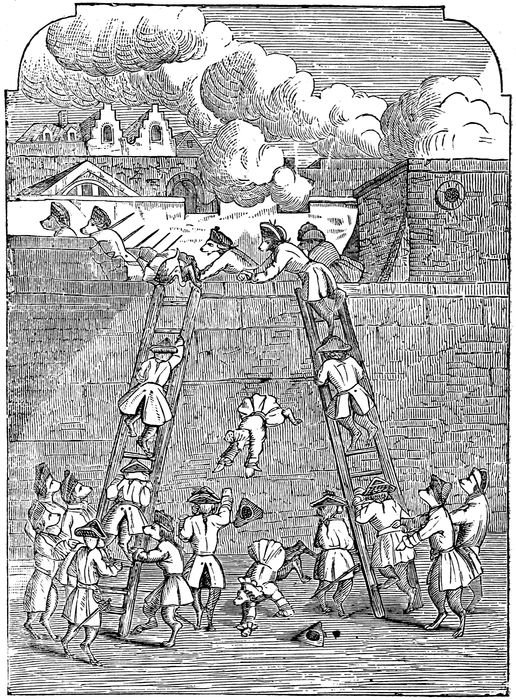
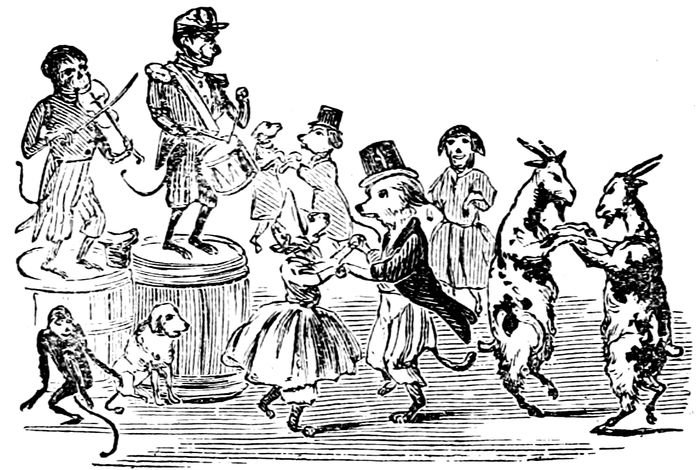
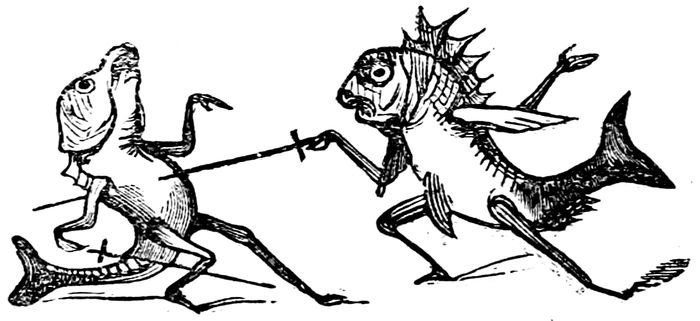
THE SIEGE—PERFORMED BY DOG AND MONKEY ACTORS
CONTENTS
PREFACE.
The intention of the present volume is to initiate the reader into all the mysteries and secrets of the “Art of Training Animals,” and to give full and clear explanations of, and instructions in, every branch of that art. It is believed that the reader will find it acceptable whether he desires using its instructions practically either for profit or as an agreeable recreation, or as merely a curiosity to know how the feats herein described are taught.
This is believed to be the first and only attempt made to treat this subject fully and systematically. Fragmentary articles have occasionally appeared, and some works, treating of one or another of the various animals, have given a few brief though interesting paragraphs touching their educatability or sagacity. Even combined these form but a comparatively meager collection, and the volume herewith presented has the essential part of all this as well as a very large amount of matter which is entirely new. The aim has been to make the book as complete as possible, and to do this the author has profited by the experience and writings of others wherever they could be made available. He has, however, striven in all such cases to give full credit. As far as it was possible to communicate with the parties in question, their consent was explicitly obtained, and in no case to the best of his knowledge (certainly not intentionally) has any material been used contrary to the wishes of its owner, or without due acknowledgment, and he would respectfully ask any who may desire to make use of any part of his own labors to a reasonable extent, the same courtesy of full credit to Haney’s Art of Training Animals.
To many gentlemen in the profession we are indebted for 12details of their experience, and material of various kinds. Much of information relating to birds is derived from the works of the celebrated German fancier Bechstein; while to Mons. Emil de Tarade is due a portion of that about the French dogs. To Mr. Robert Jennings, whose works on the horse, as well as on cattle, are deservedly popular, we are also indebted; also to Mr. Smith of the New York Courier.
While attempting to give plain practical instruction in the art we profess to teach, we have also designed to make a readable book, and it is hoped that its perusal may prove pleasant as well as profitable. That money can be made by training animals, is unquestionably true—even a boy can make his pets more valuable by teaching them a few simple tricks.
In conclusion we may add that to amateurs interested in the subject, a visit to either of the really fine collections of trained and wild animals of Van Amburgh or “Yankee” Robinson, will prove most thoroughly enjoyable. To the proprietors of both of these establishments we are indebted for valuable assistance.
CHAPTER I. INTRODUCTORY—GENERAL PRINCIPLES OF TRAINING.
Dr. Kemp thus concisely and clearly stages the difference between instinct and reason: “In the former there is an irresistible impulse to go through a certain series of motions after a certain fashion, without knowing why they are performed, or what their result will be. In the latter the actions depend upon previous mental judgments, are performed or not at will, and the end of them is early anticipated and defined.”
We believe the evidence is too strong to be doubted that many animals do perceive the relation between cause and effect, and that many of their actions, especially when the animals are surrounded by the unnatural circumstances of a state of domestication, must be ascribed to the reasoning power. There was a dog who lived in a strict monastery where the monks dined alone, and who, instead of asking for their meals, obtained them by knocking at the buttery door, the cook answering by opening the door and pushing the allowance through. The dog observed this proceeding and accordingly knocked at the door and laid in wait until the meal was placed outside, and the door shut, when he ran off with it. This he repeated a number of times.
The contrast between instinct and reason is displayed in the coursing of hares. If an old and a young grayhound be employed we have examples of both instinct and reason. The young one instinctively pursues his game, following every turn and winding, while the old dog, reasoning from past experience, knows that the hare will double, and accordingly does not exactly follow her, but goes across. A similar example is afforded by the dogs employed in hunting the deer in South America. The newly imported dog, in approaching the deer, flies at it in front and is often injured by the concussion. The 14native dogs have learned to avoid this danger and they invariably keep from the front, and attack from the side or rear.
Instances might be multiplied indefinitely, but our object is only to show the distinction made between reason and instinct; those who desire to investigate the subject more thoroughly can do so through works specially devoted to natural history. No doubt any observing person can recall instances in his own experience with animals, where their actions showed evidence of a greater or less degree of reasoning power.
An action may be partly instinctive and partly the result of reasoning, but a purely instinctive action never changes except under the influence of reason. A hen sits on her eggs from an instinctive impulse to do so. If chalk ones be substituted for the real eggs she tends them with equal care and will not desert them any sooner than she would the others. And yet in other matters perhaps hens have reasoning powers.
Without the possession of these powers we believe no education of animals would be possible; and we farther believe that the capacity for learning is in exact proportion to the ability to reason. A horse or dog can be readily taught things which a hog can never learn, and in the lower scales of animal life all attempts at education become failures. Under the tuition of man the reasoning powers are undoubtedly developed to an extent to which they would never attain in a state of nature, and by judicious and persistent teaching numerous animals have been educated to an almost startling degree. How this has been done we shall show as we proceed.
Not only does the amount of reason vary with different species but with different individuals of the same species, and much of the trainer’s success will depend on the judicious selection of his pupil. Professional trainers take the utmost pains in this selection, and they usually consider that the descendants of an educated animal have, by inheritance, a greater aptitude for learning than others.
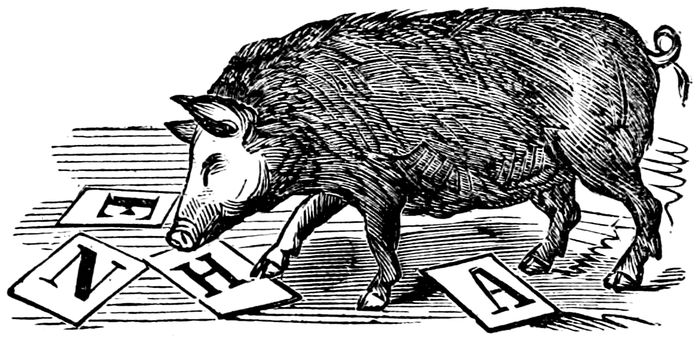
The young trainer must not fall into the mistaken notion that mere quickness in picking up a trick is the best quality in an animal. There may be such a thing as learning a lesson too rapidly, and what is learned with but slight effort is sometimes forgotten with equal readiness. Another thing, too much should not be expected of one pupil. Public exhibitors are able to show a large array of tricks because of the number of animals they have, each, as a rule, knowing a comparatively few of these tricks, or, in the case of some of the “sensation” tricks, perhaps only one. Still any animal of ordinary capacity ought, with proper tuition, to be able to learn a sufficient variety to satisfy 15a reasonable trainer. Judicious management on the part of the exhibitor will often make a variety of tricks out of a single one which the animal has been taught; an example of this is afforded by the “educated hog.”
The first essential for success in training animals is patience. At first many lessons may be given without the slightest apparent impression being made upon the mind of the pupil and an uncommon degree of patience and good temper is required to bear up against such discouraging results. By-and-by, however, the pupil will suddenly appear to realize what is required of him, and will perform his task with surprising accuracy at the very moment his teacher is about to give up in despair. Then each successive lesson is learned with greater ease and rapidity than the preceding one; the weariness and disappointment of the trainer is changed to pleasure at his success, and even the animal appears to sympathize with his master’s joy, and to take pride in his performance.
As it is impossible to explain to an animal what is required of him he can be taught an action only by its constant repetition until he becomes familiar with it. When he knows what you want him to do he will in almost all cases comply with your wishes promptly and cheerfully. For this reason punishments seldom do any good, unless the animal is willful, which is rare. On the contrary they, as a general rule, interfere with the success of the lessons. If the pupil is in constant fear of blows his attention will be diverted from the lesson, he will dread making any attempt to obey for fear of failure, and he will have a sneaking look which will detract materially from the appearance of his performance. This is the case with the animals instructed by a trainer of this city who “trains his horses with a club,” the animals never appearing as well as those taught by more gentle means. But for a rare natural talent this man’s success would have been utterly defeated by his brutality. He is the only one we know of in the profession who does not base his tuition on kindness to the pupil. A sharp word or a slight tap with a small switch will as effectually show your displeasure as the most severe blows. It is both cruel and unwise to inflict needless pain.
All trainers make use of various little tit-bits as rewards for successful performance of tricks. These serve as a powerful incentive to the animal as well as to show him when he has done right. Withholding the accustomed reward when he fails or but imperfectly performs his duty is much more effective than any corporeal punishment. The repetition of the lesson until the animal will himself perform the required action, and the bestowal 16of these rewards whenever he obeys your order, is really the main secret of training. Of course there are many important details in the practical application, and many clever devices resorted to by trainers to increase the effectiveness of tricks, as well as skillful combinations of simple tricks to produce elaborate and astonishing feats. These we shall fully explain in their proper places.
To certain scents has sometimes been ascribed a mysterious influence upon animals, rendering them docile and subservient to the human will. To the use of these many persons imagine trainers owe their success. Though some scents are relished by certain animals, we doubt whether, as a rule, they have so great a fondness for them as has been asserted. Certainly there is no general use of them in the profession, though they may have been sold to the credulous by ignorant or unprincipled persons, for this purpose. Cats are fond of catnip, and we know of instances where kittens, displaying a violent resistance to being carried in a basket, have been quieted by being given some leaves of this herb. Animals no doubt receive pleasure from the gratification of their sense of smell, but there is about as much reason in conquering an unruly school-boy by giving him a sniff of cologne water, as in taming a colt by causing him to smell that or any other perfume.
To the oil of rhodium is most frequently ascribed the greatest and most general influence over the animal kingdom, almost all animals, according to this theory being powerfully affected by it. This is the “horse taming secret” sometimes sold for considerable sums. There is no good reason to believe it has any important influence over either the disposition or actions of any animal.
The horse taming powders, composed of “a horse’s corn grated, some hairs from a black cat’s tail,” and like absurd ingredients, are too nonsensical to deserve serious notice, though once a staple part of the veterinary art, and still, possibly, believed in by a few persons.
To a certain extent many animals are able to understand the meaning of words. That is, if any particular word of command be used in instructing an animal to do a particular act he will learn to associate that word with the action, and be able to distinguish between a variety of words and apply each to the act associated with it, without confusing them. In training animals it is important that each word of command should be used only in its proper place. The common habit ignorant drivers have of using the words “back,” “whoa,” and others indiscriminately is absurd, and it is not wonderful that their horses sometimes 17fail to understand them. A story is told of a farmer who had recently purchased a new yoke of oxen, and was driving them in a cart. Slipping from his seat he fell before one of the wheels and very naturally got run over. “Back! back!” he cried to the oxen, meaning for them to stop, but, like many another man, using words which meant something else. The oxen happened to be better linguists, or else had been accustomed to obey literally, and in this case did so by backing as ordered, running over the man for the second time.
CHAPTER II. HORSE TAMING AND HORSE TRAINING—HORSE MANAGEMENT—WHIP TRAINING—CURING BAD HABITS, ETC. — POWELL’S MANAGEMENT OF WILD HORSES. — MANAGING HORSES BY KINDNESS. — TO CURE A STUBBORN DISPOSITION. — THE CORD AND LINE WEBBING. — TO TEACH A HORSE TO STOP. — TO TEACH A HORSE TO BACK. — TO MAKE A HORSE FOLLOW YOU. — TO STAND WITHOUT HOLDING. — WHIP TRAINING. — TO CURE BALKY HORSES. — HOW TO PREVENT HARNESSED HORSES FROM RUNNING AWAY. — HOW TO INSTANTLY STOP RUNAWAY HORSES.
Some few persons imagine that to possess a proper mastery over their horses, they must maintain their authority by brute force. This is a great mistake. More work, within the limit of safety, can be got out of a horse by kindness than by cruelty, and as far as managing a horse is concerned the chief point is to teach him confidence in you. If he believes you to be his friend he will not only strive to please you, but will have less fear of strange objects which otherwise might startle him and render him refractory.
The Rareys—there are two or three of them—taught the world a most important lesson when they taught it the “power of kindness” and “self-control” in the management of horses, donkeys, zebras, and other animals. How often do we see inconsiderate parents fly into a passion and, without reason or religion, thrash the object of their displeasure. So of brutal, heartless drivers, when the “blinded” horses chance to misstep, get off the track, stumble, or in the wrong place. By their actions it would appear that they expected a horse or an ass to reason quite as well as themselves. Employers may not look for the same talent in their apprentices as in their foreman. Teachers may expect every little urchin to be self-regulating and to mind his books; but this it is his duty to teach him to do, and he should be all patience, all kindness, affection, perseverance, if he would produce the best results. The same spirit is required to subdue and manage a horse. If you say you are not equal to the task; if you say your child, your horse, or 18your ox knows more than you, is your master, then you are not the one to manage him, and you should resign in favor of one who is superior to child, horse, or ox. A weak man in intellect may indeed be outwitted by a sagacious child or horse.
There is no disguising the fact that viciousness is innate with some horses. But far more so with some, nay, most, men, from whom they get it. It is no doubt sometimes hereditary, and follows some of the best strains of blood we have. That viciousness should accompany a highly nervous organization is not to be wondered at. Hence it causes no surprise when we find such dispositions among the finely organized thoroughbreds—animals of a most sensitive and nervous organization—from which the common expression “thin skinned,” as applied to a too sensitive man, is obviously derived. The treatment horses receive, and the moral atmosphere in which they are thrown, have a much greater influence than most horsemen are generally inclined to admit. The pinching, tickling, rough, boisterous stable boy who annoys a spirited horse for the sake of enjoying his futile, though almost frantic kicks and leers, is affecting the disposition of the horse and his descendants for generations to come, besides putting in jeopardy the lives and limbs of those who are brought in contact with the horse so tampered with. A horse is surely influenced by the character of the men with whom he associates.
Sometimes, however, it is necessary to conquer a bad tempered horse, and if possible to secure a radical conversion or change of character which shall be lasting. No timorous man need undertake this task; he will only make matters worse. A horse tamer should be calm, cool, brave, and fearless—the horse will know it; he should be quiet, for then the horse will be put off his guard; he should be firm and give the brute no advantage, but crowd him up to doing something, and that, invariably, what the tamer wants him to do. Thus any ordinary horse will soon give up and own man his master. The kindest treatment and even petting must always follow yielding; and if possible to help it, the horse should never be frightened by any treatment, and above all things he should never be angered by petty torture. His own contrariness should appear to him to be the cause of all his trouble, and man his best friend. This principle is at the foundation of Rarey’s successful practice.
Place your horse in a small yard, or in a stable or room. If in a stable or room, it ought to be large, in order to give him some exercise with the halter before you lead him out. If the 19horse belongs to that class which appears only to fear man, you must introduce yourself gently into the stable, room, or yard, where the horse is. He will naturally run from you, and frequently turn his head from you; for you must walk about extremely slow and softly, so that he can see you whenever he turns his head toward you, which he never fails to do in a short time, say in a quarter or half an hour. I never knew one to be much longer without turning toward me.
At the very moment he turns his head, hold out your hand toward him, and stand perfectly still, keeping your eyes upon the horse, watching his motions, if he makes any. If the horse does not stir for ten or fifteen minutes, advance as slowly as possible, and without making the least noise, always holding out your left hand, without any other ingredient in it than what nature put in it. I have made use of certain ingredients before people, such as the sweat under my arm, etc., to disguise the real secret and many believed that the docility to which the horse arrived in so short a time was owing to these ingredients; but you see from this explanation that they were of no use whatever. The implicit faith placed in these ingredients, though innocent of themselves, becomes “faith without works.” And thus men always remained in doubt concerning the secret. If the horse makes the least motion when you advance toward him, stop, and remain perfectly still until he is quiet. Remain a few moments in this condition, and then advance again in the same slow and almost imperceptible manner. Take notice, if the horse stirs, stop, without changing your position. It is very uncommon for the horse to stir more than once after you begin to advance, yet there are exceptions. He generally keeps his eyes steadfast on you, until you get near enough to touch him on the forehead. When you are thus near to him, raise your hand slowly and by degrees, and let it come in contact with that part just above the nostrils as lightly as possible. If the horse flinches (as many will,) repeat with great rapidity these light strokes upon the forehead, going a little farther up toward his ears by degrees, and descending with the same rapidity until he will let you handle his forehead all over. Now let the strokes be repeated with more force all over his forehead, descending by lighter strokes to each side of his head, until you can handle that part with equal facility. Then touch in the same light manner, making your hands and fingers play around the lower part of the horse’s ears, coming down now and then to his forehead, which may be looked upon as the helm that governs all the rest.
Having succeeded in handling his ears, advance toward the 20neck with the same precaution, and in the same manner; observing always to augment the force of the strokes whenever the horse will permit it. Perform the same on both sides of the neck, until he lets you take it in your arms without flinching.
Proceed in the same progressive manner to the sides, and then to the back of the horse. Every time the horse shows any nervousness, return immediately to the forehead, as the true standard, patting him with your hands, and thence rapidly to where you had already arrived, always gaining ground a considerable distance farther on every time this happens. The head, ears, neck, and body being thus gentled, proceed from the back to the root of the tail.
This must be managed with dexterity, as a horse is never to be depended on that is skittish about the tail. Let your hand fall lightly and rapidly on that part next to the body a minute or two, and then you will begin to give it a slight pull upward every quarter of a minute. At the same time you continue this handling of him, augment the force of the strokes as well as the raising of the tail, until you can raise it and handle it with the greatest ease, which commonly happens in a quarter of an hour in most horses, in others almost immediately, and in some much longer. It now remains to handle all his legs; from the tail come back again to the head, handle it well, as likewise the ears, breast, neck, etc., speaking now and then to the horse. Begin by degrees to descend to the legs, always ascending and descending, gaining ground every time you descend, until you get to his feet.
Talk to the horse while thus taming him; let him hear the sound of your voice, which at the beginning of the operation is not quite so necessary, but which I have always done in making him lift up his feet. “Hold up your foot,” you will say; at the same time lifting his foot with your hand. He soon becomes familiar with the sounds, and will hold up his foot at command. Then proceed to the hind feet and go on in the same manner; and in a short time the horse will let you lift them, and even take them up in your arms.
All this operation is no magnetism, or galvanism; it is merely taking away the fear a horse generally has of a man, and familiarizing the animal with his master. As the horse doubtless experiences a certain pleasure from this handling, he will soon become gentle under it, and show a very marked attachment to his keeper.
A lady visiting Egypt some years ago, gave in one of her 21letters to her friends at home, an instance of the power of gentleness in controlling even the most spirited of horses. She gives the following description of her experience with the Arabian horses: “I fear you may deem me rather boastful of my horsemanship when I tell you that the two Arab horses which threw their cavaliers did not throw me. The cause of the exception was not in me or my skill; it was the very remarkable predilection these intelligent animals feel toward individuals of the weaker sex. Let the wildest and fiercest Arabian be mounted by a woman, and you will see him suddenly grow mild and gentle as a lamb. I have had plenty of opportunities to make the experiment, and in my own stables there is a beautiful gray Arabian which nobody but myself dares to ride. He knows me, anticipates my wishes, and judiciously calculates the degree of fatigue I can bear without inconvenience. It is curious to see how he can manage to quicken his pace without shaking me, and the different sorts of steps he has invented to realize those contradictory purposes. Horses being as liable to forgetfulness as other organized beings, my incomparable gray would allow his natural ambition to overcome his gallantry, and if another horse threatened to pass him, would start off with the speed of the whirlwind. Woe to me if, under these circumstances, I were to trust to the strength of my arm or the power of the bridle! I knew my gallant charger better. Leaving my hand quite loose, and abandoning all thoughts of compulsion, I would take to persuasion; pat him on the neck; call him by his name; beg him to be quiet and deserve the piece of sugar waiting for him at home. Never did these gentle means fail. Instantly he would slacken his pace, prick up his ears as if fully comprehending his error, and come back to a soft amble, gently neighing as if to crave pardon for his momentary offense.”
This power of women over the Arabian horses is partly due, no doubt, to the fact that when still a colt he is reared in the back part of the tent, the movable harem of the Arab. He is constantly petted, and it is the women who see that he is supplied with food, and tenderly cared for. It is the attachment which is by these means awakened in the horse that leads him to so cheerfully yield obedience to the female voice. Deservedly high as may stand the Arabian horse for docility and sagacity, it should not be forgotten that, in the absence of all other amusements, the education of the foal becomes a pleasure as well as a business; it thus becomes attached to its biped companions, and takes a pride in enacting all that is required of him. If his rider falls, the horse will stand by and neigh for assistance; if he lies down to sleep, the horse will watch over him 22and give notice of the approach of man or beast. Similar anecdotes are related of all horses kindly treated, no matter where may be their home. We heard of one who had a drunken master, and this horse surpassed the Arab example even in intelligence, for he would modify his gait so as to keep his reeling rider from falling off; and if this catastrophe did happen, the horse would stand for hours, regardless of food or drink, and with anger and determination attack man or beast that would approach too near.
If your horse, instead of being wild, seems to be of a stubborn or mulish disposition; if he lays back his ears as you approach him, or turns his heels to kick you, he has not the regard or fear of man that he should have to enable you to handle him quickly and easily; and it might be well to give him a few sharp cuts with the whip, about the legs, pretty close to the body. It will crack keenly as it plies around his legs, and the crack of the whip will affect him as much as the stroke; besides one sharp cut about his legs will affect him more than two or three over his back, the skin on the inner part of his legs or about his flank being thinner, more tender, than on his back. But do not whip him much—just enough to frighten him; it is not because we want to hurt the horse that we whip him—we only do it to frighten vice and stubbornness out of him. But whatever you do, do quickly, sharply, and with a good deal of fire, but always without anger. If you are going to frighten him at all, you must do it at once. Never go into a pitched battle with your horse, and whip him until he is mad and will fight you; it would be better not to touch him at all, for you will establish, instead of fear and respect, feelings of resentment, hatred, and ill-will. It will do him no good, but harm, to strike him, unless you can frighten him; but if you can succeed in frightening him, you can whip him without making him mad; for fear and anger never exist together in the horse, and as soon as one is visible, you will find that the other has disappeared. As soon as you have frightened him, so that he will stand up straight and pay some attention to you, approach him again, and caress him a good deal more than you whipped him; thus you will excite the two controlling passions of his nature, love and fear; he will love and fear you too; and, as soon as he learns what you require, will obey quickly. The stubbornness once broken down, there is seldom any farther trouble of that score, if the horse be afterward managed with judgment and kindness. He will appreciate your kindness and become desirous of pleasing you.
One of the main appliances used by horse tamers is a three or four ply cord or rope, one of cotton being the best, such as is used by the Indians for subduing their horses. This cord is a powerful instrument for either good or evil, as it is properly or improperly used. It may be prepared by any one in the manner shown in the engraving:
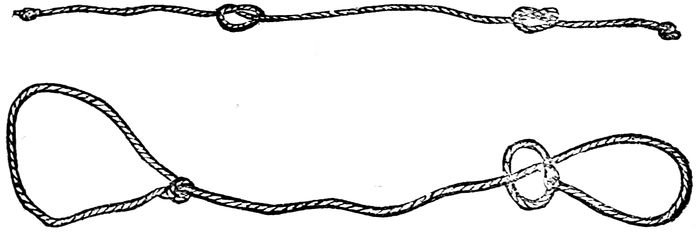
LOOPING THE CORD.
A knot is to be tied in each end, then make a loop by doubling the cord and passing the knot through as represented above. Be careful to make the loops at such a distance from the knot as will allow the cord to pass around the neck at one end, and the lower jaw at the other, passing the knot through the loop from the opposite side of the loop to where it passed through in making the lap. The necessity for this will be seen on applying the cord. The object is to obtain steady pressure upon the lower jaw, as well as friction in the mouth.
In addition to the cord a piece of worsted webbing, such as is used for driving lines should be prepared in the following manner: Divide it into two parts, one piece being of sufficient length to girt the body. Make a loop in one end large enough for the other end to pass through, so as, when adjusted it is sufficiently long to tie. These pieces of webbing will be useful in carrying out future directions.
The word “whoa” should be used only to stop a horse when he is in motion. Never use it when you approach a horse standing quietly. Horses soon learn to distinguish any word often addressed to them, and they should learn to associate it with some definite and exact duty which you wish them to perform. If any word of command is used indiscriminately, or out of its proper place, the animal becomes confused and loses the association between the word and the object desired.
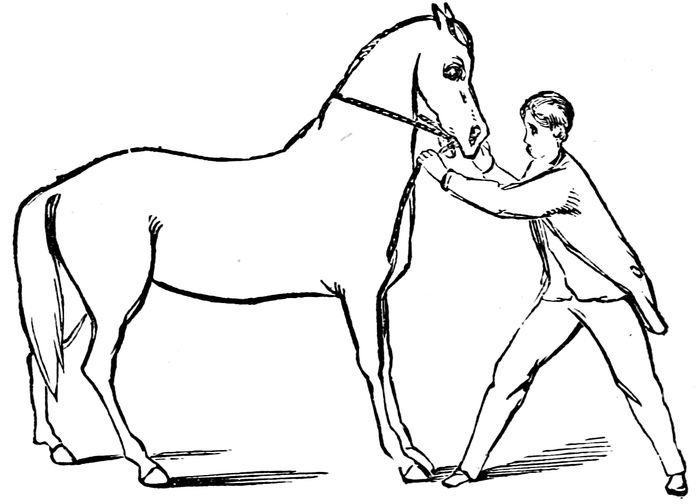
To teach a horse the meaning of the word “whoa,” the arrangement shown in the accompanying illustration may be used. Put the large web, previously described, around his 24near fore foot, pass it under the girth; and as the animal walks along, pull up the foot, saying at the same instant, “Whoa.” He will be brought to a stop, and by repeating the lesson he will soon raise the foot and stop even though the web is not pulled upon.
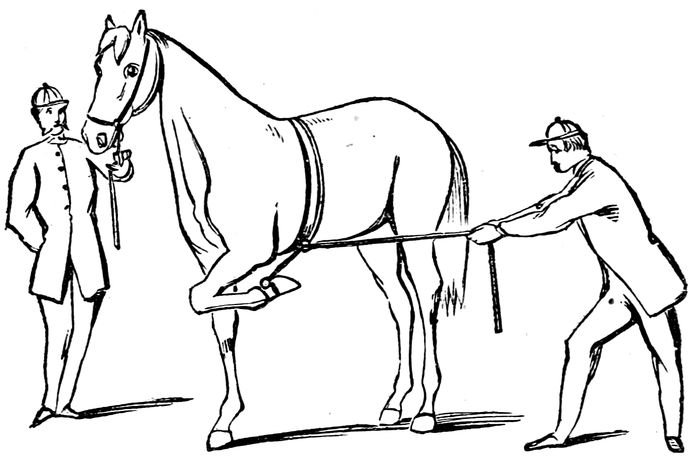
“WHOA.”
TEACHING THE HORSE TO BACK.
Put the cord upon the horse, using the small loop; draw it with a steady pull; this brings the horse’s nose toward his body. Keep a firm hold upon the cord until he steps back a little, using at the same time the word “back.” Then caress him; by doing so you show him that he has done exactly as you wished him to, and the caresses should be repeated every 25time he obeys. The utmost gentleness must be observed in order not to excite him, and the lesson should not be long enough to tire him. Five to ten minutes being the best length, repeated at intervals of a few hours. As soon as he understands what you desire he will probably back promptly at command.
The directions make simple what have hitherto been among the mysteries of the circus. Turn the horse into a large stable or shed, where there is no chance to get out, with a halter or bridle on. Go to him and gentle him a little, take hold of his halter, and turn him toward you, at the same time touching him lightly over the hips with a long whip. Lead him the length of the stable, rubbing him on the neck, saying in a steady tone of voice, “Come along, boy!” or use his name instead of “boy,” if you choose. Every time you turn, touch him slightly with the whip, to make him step up close to you, and then caress him with your hand. He will soon learn to hurry up to escape the whip and be caressed, and you can make him follow you around without taking hold of the halter. If he should stop and turn from you, give him a few sharp cuts about the hind legs, and he will soon turn his head toward you, when you must always caress him. A few lessons of this kind will make him run after you, when he sees the motion of the whip—in twenty or thirty minutes he will follow you about the stable. After you have given him two or three lessons in the stable, take him out into a small field and train him; and thence you can take him into the road and make him follow you anywhere, and run after you.
To make a horse stand without holding, after you have him well broken to follow you, place him in the center of the stable—begin at his head to caress him, gradually working backward. If he moves give him a cut with the whip, and put him back to the same spot from which he started. If he stands, caress him as before, and continue gentling him in this way until you can get round him without making him move. Keep walking around him, increasing your pace, and only touch him occasionally. Enlarge your circle as you walk around, and if he then moves, give him another cut with the whip, and put him back to his place. If he stands, go to him frequently and caress him, and then walk around him again. Do not keep him in one position too long at a time, but make him come to you occasionally, and follow you around the stable. Then make him stand in another 26place, and proceed as before. You should not train your horse more than half an hour at a time.
So accustomed are we to the use of bit and reins for driving that we have got to consider them absolutely requisite for guiding a horse. Horses however may, if properly taught, be driven without either bit or reins, merely by signals with the whip. Probably the simplest and most concise directions for whip training are given by Mr. Jennings in his valuable work on training horses. Mr. Jennings says:
“To train a horse thoroughly to drive without bit or line, under the whip, requires from four to six weeks’ time; it requires also a man of strong nerve and self-control to be a successful trainer in this particular branch. Whip training illustrates the beauty and power of our system of horse training. Such a feat as driving a horse without bit or line cannot be accomplished by any other system known to man. Having selected a horse with a moderate share of intelligence, the next thing is to secure a suitable place for training. An enclosure twenty-five or thirty feet square is required. If you have it smaller, and your horse should be disposed to kick, you would be in danger; if larger it gives the animal too much room to get away from the whip. It is better that you go in with the horse alone, as then the animal will have no other object to take his attention. Turn him loose without bridle or halter in the enclosure; take your position in the centre, holding in your right hand a straight whip nine or ten feet long; you crack the whip as you take your position; this alarms the horse and causes him to run into one corner of the enclosure; crack it several times that he may learn that you do not intend to hurt him; now commence tapping him lightly upon the near shoulder, but not to hurt him; if a nervy fellow he is all excitement for a few minutes; continue the tapping until he turns his head toward you, which he will do in a short time. The moment he turns it, however slight it may be, cease the whipping; as soon as he turns it away again repeat the tapping with the whip; in a few minutes he again turns his head toward you; stop the motion of the whip; as he turns away repeat the whip tapping as before; in a very short time he turns around so that you can approach him; now gently caress him; move away and again approach him; should he turn away repeat the whipping, by this means you teach him to come to you on the near side. After he has learned this thoroughly, which requires about one week’s training, half an hour each day, then proceed in the same manner upon the off side; as soon as 27he obeys the motion of the whip upon this side, take your position behind him, and turn him by the motion of the whip to the right or to the left; as soon as he performs nicely, put the harness upon him, take the lines behind him, and, as you give him the word to go forward, throw the whip down by his right side without touching him, at the same time have the long web around the near fore foot, and give it to an assistant; you want him to stop, give him the word ‘Whoa,’ at the same time your assistant pulls up the foot, turn the whip in a horizontal position above your head—in this way you teach him that the whip in that position means ‘Whoa.’ By repeating these motions, he learns in about four weeks to turn to the right whenever the whip is thrown toward the right shoulder; to the left when thrown toward the left shoulder; to go ahead when thrown down by the right side; and to stop when held in a horizontal position. You now want to teach him to back; having previously instructed him according to our rule, put the cord, using the small loop, in his mouth; take the cord in your hand with the reins, pull upon the reins and say ‘Back,’ at the same time keep the whip directly over the animal’s back, giving it an upward and downward motion, or you may tap him gently upon the back with the whip—this is best done in a sulky. If he starts forward, set him back by pulling quickly upon the cord; repeat the operation until he will go back by the motion of the whip alone. Should he make repeated efforts to go forward, bring the whip quickly once or twice down over his nose, he will not then repeat the operation very often; with this training, it is necessary to use an open bridle, so that the animal will see the motion of the whip; you are now prepared to hook him up for the first drive. Take an assistant with you; have the foot strap or long web secured upon the near fore foot; give it in charge of your assistant; let the lines lie over the dash, as a matter of precaution. Now commence operations with the whip; if the animal acts promptly, remove the foot web and begin again, having the lines over the dash as before; drive the animal in this way at least two or three weeks before removing the bit from the mouth. Your horse is now safe to drive under the whip.”
The large and noble looking horses which draw the trucks of the safe manufacturers in this city, are hitched in single file, only the rear one having reins attached. Sometimes six or eight horses will be required to draw the ponderous load, and the coolness and dexterity with which they wend their way through the confused mass of vehicles in the crowded streets is a truly remarkable sight. Without any guidance the leader will press onward through the mass, deftly avoiding collisions 28and entanglement. Changes of route, stoppages, etc., are effected by such orders as “Whoa,” “Gee,” “Haw,” which the leader promptly and intelligently obeys.
From the number of “infallible recipes” given in the papers for curing balky horses we should judge a little light on the subject is called for by horsemen. The various remedies which different correspondents describe as having proved effective in their own experience would form a curious collection, though some of them betray a remarkable lack of real knowledge about the matter. One genius has discovered that stuffing a horse’s mouth and nostrils with road dust is highly successful. Another humane individual deeply deplores the barbarous practice of whacking balky horses over the head and legs, and suggests that there should be substituted a system of steady, but not very severe, pounding in one spot with a “smooth club,” until “the pain grows intolerable and he starts nervously forward.” One hero, whose valor deserves to be chronicled for the admiration of future ages, thus modestly relates his experience with “one of the perverse animals,” as he calls his horse:
“The first work I did with him after he came into my possession was to draw a load of hay from the meadow. He started a few rods and then stood still, and no amount of urging that I could command would induce him to budge an inch. I took the pitchfork and sat down on the fore end of the load and began to prick him about the root of his tail, inserting the tines just through the skin. He kicked, but the load of hay was a complete protection. I kept on, moderately and persistently pricking for about five minutes, when he started for the barn. He never attempted to balk but once after, when the mere sight of the pitchfork was sufficient to make him draw.”
In Cecil county, Maryland, a farmer resorted to a rather novel expedient for getting some “go” out of a balky horse. Having loaded his wagon rather heavily with wheat, the horses were either unable or refused to draw it. After trying for some time to put them in motion, he set fire to a sheaf of wheat, and applied the flame to one of the horses. The horse, not relishing the application, by a well directed kick deposited the blazing sheaf in the load of wheat. This becoming ignited, was entirely consumed, together with the wagon. One of the horses, also, narrowly escaped perishing in the conflagration.
Many of the cases of “balkiness” are nothing but want of power to perform the task assigned; a necessary pause from temporary exhaustion. A driver who understands his business 29will give his team a breathing spell occasionally while pulling a heavy load. Another thing, if you find your team becoming exhausted and about to give out, it is well to stop them of your own accord; and it is well, too, to give them a few moments rest before encountering a peculiarly difficult part of the route.
If you have balky horses, it is your own fault, and not the horse’s, for if they do not pull true there is some cause for it, and if you will remove the cause the effect will cease. When your horse balks he is excited and does not know what you want him to do. For instance, a young horse that has never been “set” in a gully with a load before, is whipped by his owner or driver because he does not draw the load out. The animal is willing to do what he can, but he does not know how to draw out the load. He tries and finds that it does not move, not knowing that a steadier and stronger pull would do it, and when the lash comes down upon him and he hears the yells of his driver he is frightened, and jumps and rears through fear rather than ugliness or balkiness. No better way could possibly be devised to make a horse balky than to beat him under such circumstances. When he gets a little excited, stop him five or ten minutes, let him become calm; go to the balky horse, pat him and speak gently to him, and as soon as he is over his excitement, he will, in nine cases out of ten, pull at the word. After you have gentled him a while, and his excitement has cooled down, take him by the bits; turn him each way a few minutes as far as you can; gentle him a little; unrein him; then step before the balky horse, and let the other start first, then you can take them anywhere you wish. A balky horse is always high spirited and starts quick; half the pull is out before the other starts; by standing before him the other starts first. By close application to this rule, you can make any balky horse pull. If a horse has been badly spoiled you should hitch him to the empty wagon, and pull it around a while on level ground; then put on a little load and increase it gradually, caressing as before, and in a short, time you can have a good work horse.
You might as well attempt to make a horse move a three story building and draw it off, as to get out of a slough with a heavy load, when the animal has never been taught by degrees to draw a load out of such places. It is true that it is bad policy to unhitch a horse from a load under such circumstances, but it is far worse to beat him an hour and then have to do it. Our way of teaching colts is as follows: We put on light loads, after they are well broken to a harness, and go into bad places where it requires hard pulling by degrees; and the animal learns how to draw the load out. He reasons as a man does, thus: 30“I have been here before and got out, and I can do it again,” and out he goes. We add to the load one or two hundred pounds, and go through the same process, then wait a day or two and try him again, taking care that we require nothing to be done extra except with a lighter load. This is teaching a horse to have confidence in himself, which is the basis of all good draught horses.
A Scotch paper describes a curious case of horse management, and though the same treatment has been equally successful in other instances we are inclined to believe the true secret lies partly in gentling the animal while the preparations are being made. The fact related is curious and may be useful, so we reproduce it:
“On Saturday last a groom, mounted on a high mettled hunter, entered the High street of Coldstream, and, when opposite Sir John Majoribank’s monument, the horse began to plunge and rear to a fearful extent, swerving to the right and then to the left, but go forward he would not, nor could all the exertions of the groom overcome his obstinacy. The street was filled with people expecting to see the animal destroy himself on the spikes of the iron railing around the monument, when Mr. McDougal, saddler, walked up to the groom, and said: ‘I think, my man, you are not taking the proper method to make the horse go; allow me to show you a trick worth knowing.’ ‘Well,’ says the groom, ‘if you can make him go, it’s more than I can;’ when Mr. McDougal took a piece of whipcord, which he tied with a firm knot on the end of the animal’s ear, which he bent gently down, fastening the end of the string to the check buckle of the bridle, which done, he patted the horse’s neck once or twice, and said, ‘Now, let me see you go quietly home like a good horse,’ and, astonishing to relate, it moved off as gently as if nothing had happened. Mr. McDougal says he has seen, in London, horses which no manner of force could make go, while this mild treatment was always successful.”
For the following useful suggestion we are indebted to Mr. Robert McClure:
“It has often occurred to our mind, on account of the many and destructive runaways of horses harnessed to sleighs, that have taken place in this city and its neighborhood the present winter, that some mode of training might be adopted for family or carriage horses, which would entirely prevent or at least mitigate the violence and excitement of horses that may take fright. A good plan, based upon our knowledge and observation 31of the excitability and nervous temperament of horses disposed to take fright, would be to harness them with strong harness to an old but stout carriage a few times before the sleighing season, and have them taken slowly out of the city to a country road, not too hard for the horses’ feet, and drive them at a full run or gallop for a few rods at a time. Repeating this several times during the drive will so accustom the horses to the excitement of a run in harness and the rattle of a carriage behind them, that it will become familiar, and when occasions arise, as they sometime will in all large cities, to start them to run, they can be at once brought up and kept under complete control. The training to an occasional run has familiarized such horses with the excitement; but conversely, once let a team not used to it in harness, get a start and run, the excitement every moment becomes greater, takes the place of animal instinct, and all control of them is lost—till brought up against some obstacle, with a general smash of all surroundings, and perhaps the loss of valuable and useful life. Whether the horse be hurt or not, they are forever of no value for family purposes, and the groom or coachman not unfrequently loses both situation and character as a driver. To familiarize your horse to an occasional run in harness will do them no harm; and our word for it, much good will be done, and safety insured.”
When a Canadian family party, traveling in winter over ice covered rivers and swamps, is so unlucky as to cross a place where the horse sinks, they save him from drowning, and themselves from the danger of sharing the same fate, by pulling a rope so arranged that it chokes him. The water being thus prevented from entering his gullet or windpipe, he floats on the surface, and it only requires a long and firm pull to bring him to solid ground, when the rope being relaxed he quickly recovers his wind and is ready once more to start on his journey.
Perhaps profiting by this example, a similar means has been adopted with success for stopping runaway and subduing infuriated horses whether in riding or driving. It consists of a rein composed partly of thread-covered cat-gut, and partly of common leather, one end of which is attached to the bridle at the top of the horse’s head, while the other rests at the pummel of the saddle, or on the coach box, as the case may be. Running upon the cat-gut part by means of loops, is a short cross piece of cat-gut which rests against the windpipe of the animal, ready to be pulled up against it by taking hold of the nearer end of the rein. A quick and firm pull, to stop the breathing of the 32animal, is all that is necessary to bring him to an instantaneous pause. He may be in a state of panic, running off with the bit between his teeth in spite of every ordinary means of checking him: but no sooner does he feel the stricture on his breathing than he is conscious of being outwitted and nonplussed and becomes instantly as quiet as a lamb; at the same time he keeps quite firm upon his legs—the check not being by any means calculated to bring him down. On the contrary, from the position in which it places the horse, his shoulders being brought up, and being pressed back upon his haunches, the check is, indeed, calculated to keep him up.
CHAPTER III. ENGLISH SYSTEM OF TRAINING HUNTERS.
Owing to difference in customs of the two nations, such horses as the English hunters are not the most desirable for use in this country, and the system of training adopted to suit the animals to the requirements of English gentlemen, are seldom called into requisition here. Still, as we desire our work to be as complete as possible, and as the method of training is interesting, though it may prove useful to but few of our readers, we introduce it. We take this spirited description from “A Holiday on Horseback,” from the pen of an English writer whose name is not given:
“A light built, gaylooking thoroughbred was passing into a paddock for a lesson in jumping over a swivel bush hurdle. Without spur or whip, the rider—the horsebreaker’s son—rode the mare steadily at the fence, and she went over without touching a top twig, clearing nine yards in the leap. ‘The great thing, sir, is to bring them into workmanlike ways; not to be fussy and flurried at their fence, so as to take off at the right spot.’ Then he went on to inform us that hunters should be carefully handled at a very early age, if they are intended to become temperate and handy. They may be ridden gently by a light weight with good hands, at three years old, over small fences. At four they ought to be shown hounds, but they should only be allowed to follow them at a distance, after the fences are broken down, for if you put them to large leaps at that age they are apt to get alarmed and never make steady fencers 33afterward. Above all things, avoid getting them into boggy ditches, or riding them at brooks; but they should be practiced at leaping small ditches, if possible, with water in them, the rider facing them at a brisk gallop, for this gives a horse confidence and courage. The old custom of teaching colts to leap, standing, over a bar is now obsolete, and they are taught to become timber jumpers simply by taking timber as it comes across the country—the present rate of hounds gives no time for standing leaps. The circular bar, however, is not a bad thing if in a good place and well managed. Every description of fence that your hunter is likely to meet with should be placed within a prescribed circle on soft ground, the man who holds him standing on a stage in the center. Another man, following the colt with a whip, obliges him to clear his fences at a certain pace, and in a very short time a good tempered colt will go at his jumps with pleasure.
“Here let me observe—for the conversation had ended—that no matter how carefully a hunter may have been trained, until you taste and try him in the field, it is hard to say whether the right stuff be in him. The best judges are often deceived by outsides and school performances. A few general rules may, however, be given, which will be found of certain application. In a hilly country, for instance, nothing has a chance against a pure thoroughbred. Lengthy horses always make the best jumpers, if they have good hind quarters, good loins and good courage. Extraordinary things have been done by such horses. In 1829 Dick Christian jumped thirty-three feet on King of the Valley; and Captain Littler’s horse, Chandler, cleared thirty-nine feet over a brook at Leamington. The most dangerous of all horses in the field is a star gazer. A hunter should carry his head low, as by so doing he is less liable to fall, and gives his rider a firmer seat. All wild horses lower their crests in leaping. It is, however, the peculiar excellence of going well through dirt which decides the real value of a horse for our best hunting counties. To find out this quality he must be ridden fair and straight. If he flinch on soft ground he is of no use. No matter how wide a horse may be, if he is not deep in the girth he cannot carry weight, and is very seldom a good winded horse, even under a light man. One of the best things that can be said of a hunter is, that at first sight he appears two inches lower than he really is. Short legged horses leap better and safer than long legged cattle, and go faster and farther under hard riders. Horses with straight hind legs never can have good mouths. He should have well placed hind legs with wide hips, well spread gaskins, as much as possible of the vis a 34lergo, well knit joints, short cannon bone, oblique pasterns and largish feet. The bone of a hunter’s hock cannot be too long. These are the points for strength and bottom.
“‘Handsome is as handsome does,’ and an old whip once said to a nobleman who remarked that his staunch old horse who had carried him through so many troubles had an awkward head: ‘Never mind his ’ed, my lord; I ain’t a going to ride on his ’ed.’ Indeed, what is called the perfect model horse is by no means the best. A horse’s constitution may be too good. Horses of a very hard nature, and very closely ribbed up, are large feeders, with great barrels, and do not make brilliant hunters. They require so much work to keep them in place and wind that their legs suffer, and often give way when their constitution is in its prime. Horses with moderate carcasses last much longer, and, provided they are good feeders, are usually bright and lasting enough, if otherwise well shaped. Finally, a hunter should be well seasoned. Few five year old horses are fit to carry a gentleman across country; for they cannot be sufficiently experienced to take a straight line. About fifteen hands two inches is the best hight for a hunter. His action should be smooth, or it cannot last. The movement of the fore legs should be round, not high; the horse should be quick on his legs as well as fast.”
CHAPTER IV. TRICKS OF PERFORMING HORSES, AND HOW THEY ARE TAUGHT. — THE SHORT AND LONG STRAPS. — TO TEACH A HORSE TO SIT UP. — KICKING AT WORD OF COMMAND. — TALKING HORSES. — TEACHING HORSES TO JUMP. — TO MAKE A HORSE STAND ERECT. — TO “PIROUETTE.” — THE PEDESTAL. — TO TEACH A HORSE TO KISS. — TO MAKE A HORSE FETCH AND CARRY. — FINDING A HIDDEN HANDKERCHIEF. — TO SELECT A CHOSEN CARD. — TO FIRE OFF A PISTOL. — TO TEACH A HORSE TO DANCE. — TO EAT AT TABLE. — TO TURN A HAND ORGAN. — TO FEIGN LAMENESS. — TO TEACH A HORSE TO WALK OVER YOU. — ORDINARY CIRCUS HORSES.
Horses may be taught many amusing tricks, some of which are really wonderful. For teaching horses tricks the implements known as the Rarey straps are requisite, to teach the animal to lie down, etc. The piebald or spotted horses are generally supposed by trainers to be more tractable as well as to possess more talent than others.
A common breaching strap is used to strap up the foot. For using, open the loop, keeping the buckle on the outside, put the loop over foot, then raise foot and pass the strap around the fore-arm from the inside, and buckle it tight; this holds the foot up firmly. The long strap is the one which buckles around the foot. To a ring in this is buckled another strap seven or eight feet long. This is attached to the right foot and passes under the girth, or over the back. Its use is to raise the foot when you wish to bring the horse upon his knees.
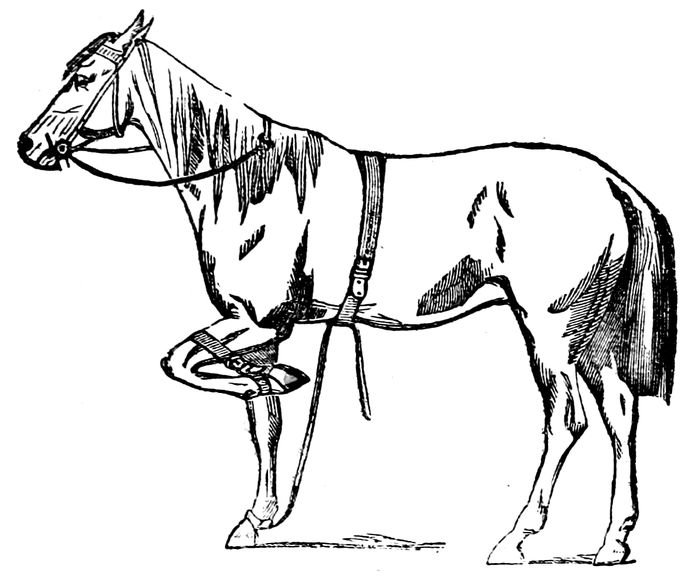
THE SHORT AND THE LONG STRAPS.
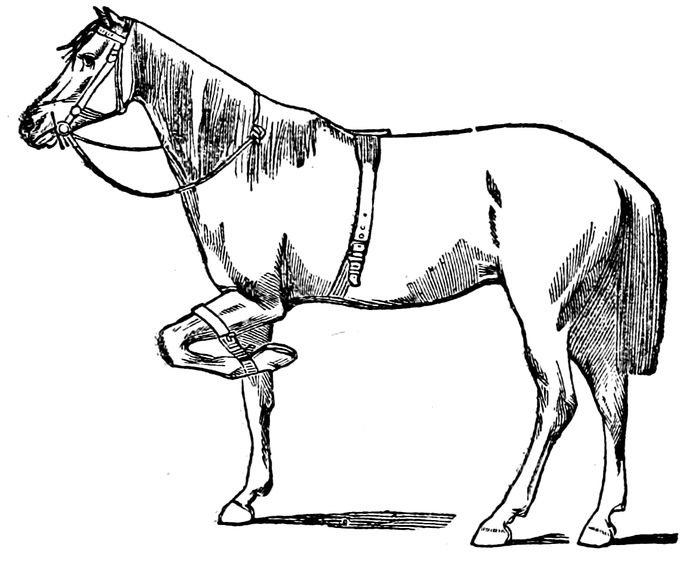
THE SHORT STRAP IN USE.
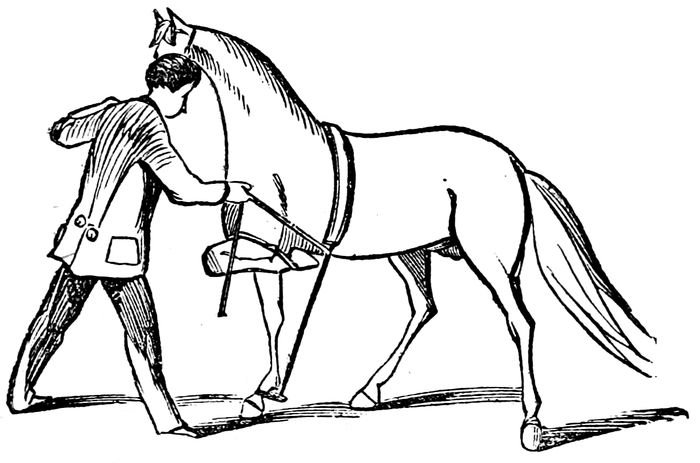
TEACHING THE HORSE TO LIE DOWN.
THE APPLICATION OF BOTH STRAPS.
Bend his left fore leg and slip a loop over it, so that he cannot get it down. Then put a surcingle around his body, and fasten one end of the long strap around the other fore leg, just above the hoof. Place the other end under the surcingle, so as to keep the strap in the right direction; take a short hold of it with your right hand; stand on the left side of the horse, grasp the bit in your left hand, pull steadily on the strap with your right; bear against his shoulder till you cause him to move. As soon as he lifts his weight, your pulling will raise the other foot, and he will come on his knees. Keep the strap tight in your hand, so that he cannot straighten his leg if he rises up. Hold him in this position, and turn his head toward you; bear against his side with your shoulder, not hard, but with a steady, equal pressure, and in about ten minutes he will lie down. As soon as he lies down he will be completely conquered, and you 37can handle him as you please. Take off the straps, and straighten out his legs; rub him lightly about the face and neck with your hand the way the hair lies; handle all his legs, and after he has lain ten or twenty minutes, let him get up again. After resting him a short time, make him lie down as before. Repeat the operation three or four times, which will be sufficient for one lesson. Give him two lessons a day, and when you have given him four lessons, he will lie down on your taking hold of one foot. As soon as he is well broken to lie down in this way, tap him on the opposite leg with a whip when you take hold of his foot, and in a few days he will lie down from the mere motion of the whip.
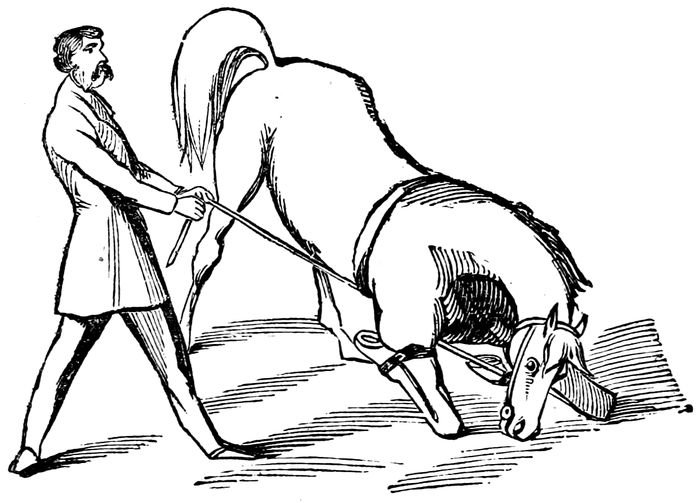
BRINGING THE HORSE TO HIS KNEES.
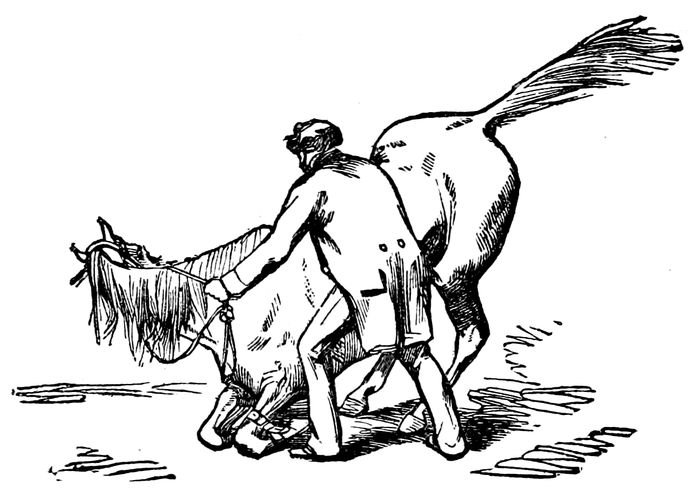
PREPARING TO LIE DOWN.
Use great gentleness during the operation. Compel the horse to comply with your wishes, but do not frighten or excite him.
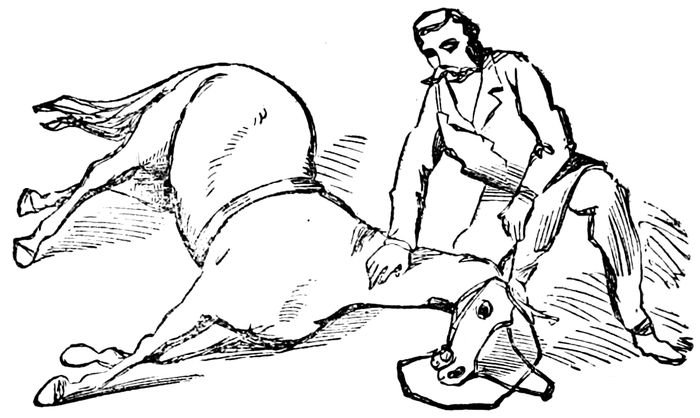
THE HORSE LYING DOWN.
A common winding-up of the “grand entree” which usually commences the performances at most circuses, is for the horses of all the riders to lie down at the word of command, and at another command, to sit up on their haunches. The lying down part we have already explained; the getting up is taught by Jennings as follows:
“Lay the animal down as previously directed, having a collar upon him; place a hobble or strap, with a ring in it, around each hind foot; take a pair of ordinary driving lines, pass the buckle end through the collar back to the ring in the hobble, and buckle them; pull the feet up toward the shoulders, and carry the lines back to the hind quarters, hold them firmly in one hand, or give them to an assistant. Have a bridle with a long rein upon the animal; take the rein in your hand, stand upon the tail, and pull upon the bridle rein, keeping the lines firm at the same time; this brings him up in front, and prevents his getting his hind feet back far enough to rise upon them, they being drawn forward and securely held by the lines.”
Jennings gives the following instructions for teaching horses a very common trick performed at circus exhibitions:
“Care must be taken in teaching this trick, that you have a horse not predisposed to vicious propensities, or you may make a confirmed kicker; and then you will have the habit to break-up. A horse of a mild disposition may be taught to perform thus without the risk of his becoming a kicker. I have taught one of my ponies to kick when I desire him to do so, and he cannot be made to kick unless the whip is used lightly upon his 39hind parts. Having selected your animal, take a pin in your right hand, prick the near hind leg with it and say, ‘Kick with the left foot;’ the animal soon learns to obey. Then proceed with the opposite leg in the same manner. After the horse will kick, with either foot, by a motion of the hand without pricking him you will stand off a short distance, with a long whip in your hand; touch the near hind foot and say, ‘Kick with the left foot;’ then proceed in the same manner with the right foot. By proceeding thus once a day the animal will soon learn to do his part very nicely.”
If neatly managed one of the most “taking” performances of the “arena” is the answering of questions by the horse. Yankee Robinson has a very fine animal, who replies to his master’s interrogations with much seeming judiciousness. Horses may be taught to shake and nod their heads as negative or affirmative replies, in either of two ways. The first method of training is this: Take your position at the horse’s head with a pin in your hand. Gently prick the animal’s breast. The horse bobs his head, just as he would had a fly alighted on the spot. Repeat the operation several times, each time caressing him, and perhaps rewarding him with a bit of apple occasionally. He will soon learn to nod his head on merely having the hand pointed toward his breast, or he may be trained to do the same by a motion of the foot. To teach the horse to shake his head it is only necessary to prick him slightly anywhere along the mane or over the withers. After a little teaching he will do so on your raising your hand to your head, a motion whose connection with the horse’s action will scarcely be suspected by the audience.
The second method is by pricking his breast at the same moment that you say “yes,” or any other particular word; and by pricking his withers at the same time you say the word “no.” He will soon learn to make the desired motion on hearing the word, even though no motion whatever is made. When exhibiting, the questions should be asked first, and immediately after the signal given to the horse. He, of course, knows nothing of the question, but obeys a definite command, just as he would if ordered to “back” or “whoa.”
Madame Tournaire, who performed her horse by the first method, had a way of coquettishly toying with her whip, and would give the horse the requisite signals by what the public imagined to be a mere display of feminine grace.
Where the horse obeys a word, that word must be incorporated 40into the question asked, in such a way as to attract his attention. If used too near the commencement of the sentence he will reply before the question is out of your mouth. It is not necessary to use the exact word that he “works” by, provided it sounds to him like it; thus, Yankee Robinson says to his horse during the performance, “I guess you’re as handsome a fellow as these ladies and gentlemen ever saw—don’t you guess so?” The horse nods his head at the emphasized word “guess,” supposing it to be his command “yes.” The next question, perhaps, is, “But others know the most?” In this case the horse, not being posted on Webster, and being guided by the sound, gives his head a negative shake, considering “no” and “know” synonymous.
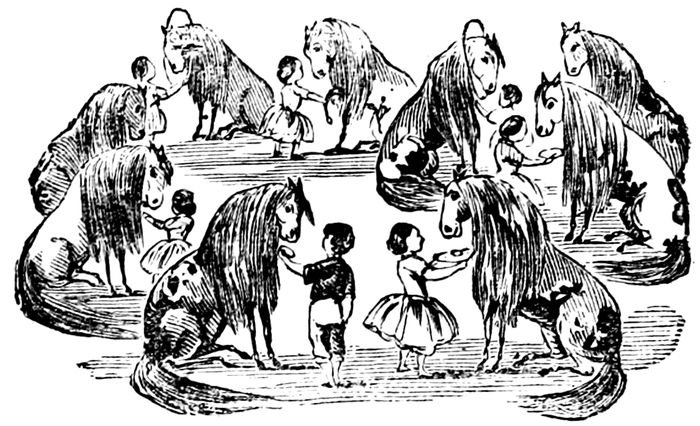
PERFORMING PONIES.
Colts should not be trained in jumping until at least four years old. Until this age the muscles and sinews are too pliable, and there is danger of the animal being strained. It is better never to urge a horse to attempt a leap which he cannot readily accomplish, for severe injury might result from his striking his feet, besides any failure to perform the leap will discourage him.
The bar should at first be placed very low and only raised very gradually. About knee high or less will do to commence with. Commence the instructions by letting one man lead the colt, while another man follows with a whip. The former walks over the bar encouraging the colt with his voice to follow. The man with the whip is only to prevent the horse backing, the whip should never be applied unless the animal is positively restive. With a little coaxing he will soon go over, and having once done so, he will readily repeat it. A few pieces of apple may be advantageously used to induce him to leap the bar, and to reward him for doing so. By using the word “hip” or any 41other as he jumps, he may be taught to make the leap on hearing it. This is the common method for horses in the ring.
The first lesson should be confined to the standing or walking leap, and if the horse is led half a dozen times over in the manner described this will suffice for the first day. The next day he may be trotted up to it, or more lessons may be devoted to teaching him to leap at command. With each succeeding lesson the bar may be raised until it is as high as the horse’s breast, but beyond this there is no necessity with common animals intended merely for private riding. Neither should the horse be wearied and disgusted with too long lessons. When perfect in his lessons a boy may be placed upon his back to ride him over. The boy must be a good rider, for should the horse stop suddenly at the bar and throw his rider the maneuver will be repeated. A sack containing a couple of bushels of corn is sometimes used instead of the boy, but the boy is better.
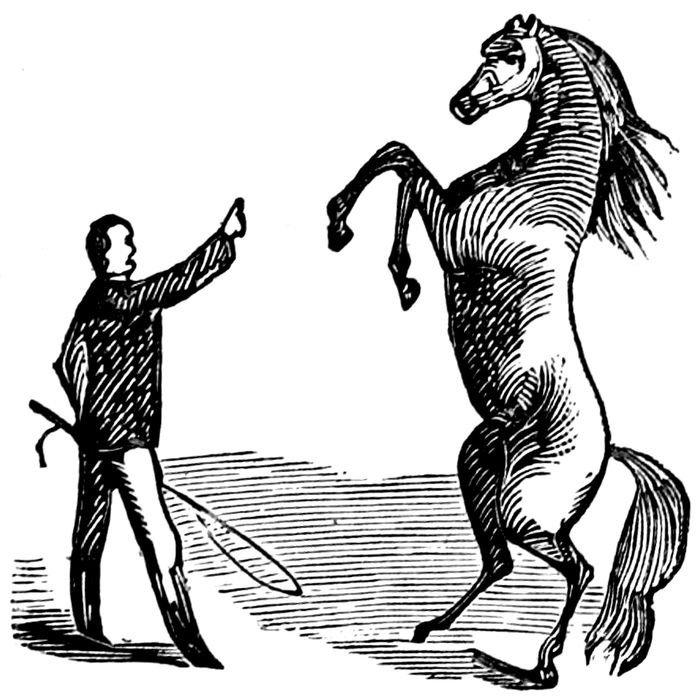
STANDING ERECT.
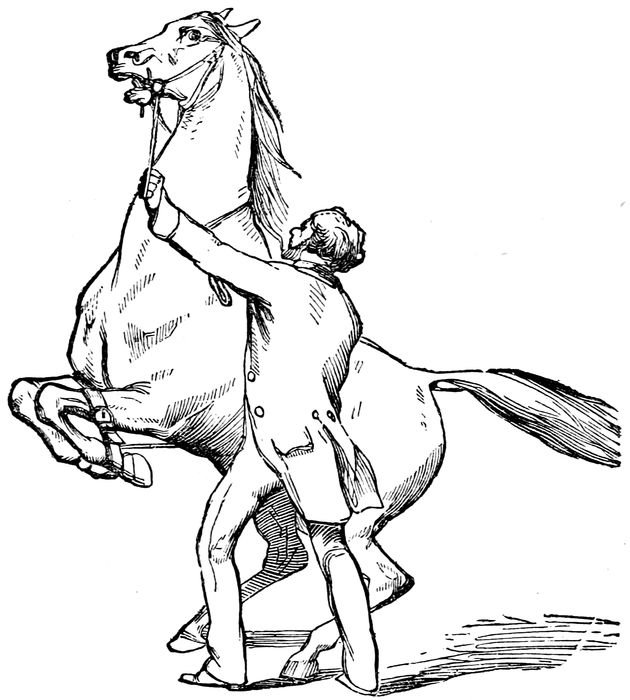
To make a horse stand upon his hind feet it is only necessary to compel him to rear up, and then to keep him in that position by gently striking him with the whip either under the fore-arm or under the chin. At first it will be necessary to allow him to resume his natural position after standing erect for a moment or two, but in a little while he will learn to keep his balance for a considerable time. Care should be taken not to excite or keep him in the erect position too long at first. There is also some danger of his falling over backward if too urgently pressed. Ponies may be placed upon their hind feet by lifting them up by the reins, taking hold under the chin close to the bit. By 42giving the command, “Erect up,” when teaching the animal to take the required position, he may be taught to do so at this command, or he will soon learn to stand up by merely being tapped lightly under the chin. Now give him a few pieces of apple, and by holding out pieces of apple or other “horse” dainties, you may teach him to follow you walking erect.
“Pirouetting” consists merely in the horse turning around while standing erect upon his hind feet. He may be taught to do this very easily, either by coaxing him to turn by the use of pieces of apple, or by gentle taps upon the cheek. He soon learns to turn at a circular sweep of the whip or at the command to “Pirouette.” This action is the same as is made use of when a horse is supposed to “waltz.”
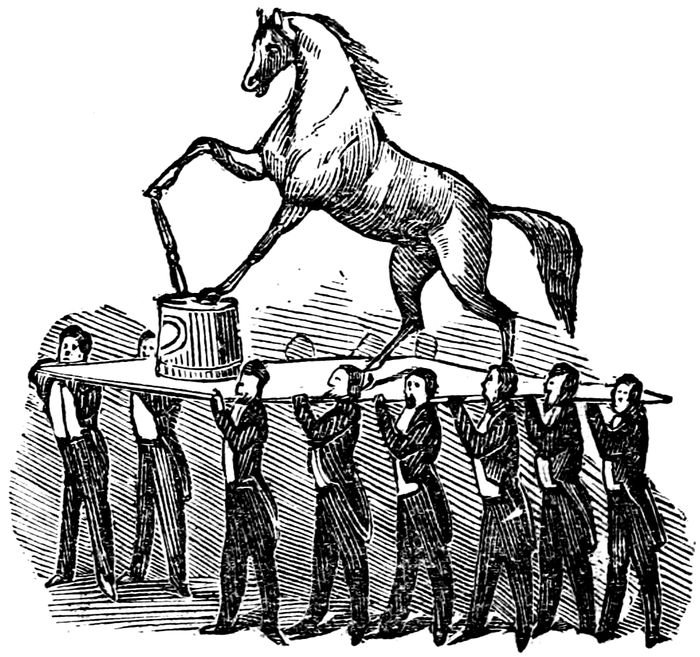
PEDESTAL TRICK.
One of the most common tricks displayed in circuses, and one which is usually hailed with applause, is what is termed the “pedestal” trick. A stout platform is used, to which is attached a wooden “drum” some two feet in hight, out of which projects a wooden rod or post at a slight angle. The horse first steps upon the platform, then places one fore foot upon the drum, and lastly places his other fore foot upon the point of the projecting post. In this position a handsome animal forms a really beautiful picture, and the effect is sometimes enhanced by having a number of men raise the platform upon their 43shoulders, and bear the horse, high up above the heads of the spectators, like some equestrian statue, around the ring.
To teach this trick some patience is necessary but the method is quite simple. The horse is first led upon the platform several times, being allowed to remain a moment or more each time. He will soon understand when brought into the vicinity of the platform that he is to take his position upon it. Now compel him to raise his foot, and as he attempts to put it down again, guide it with your hand to the required position upon the drum. After a few times he will place it upon the drum of his own accord on being made to raise it. Then in the same manner make him raise the other foot and place it upon the post. This is the most difficult part of the performance on account of the post presenting only a slight foothold, and the horse having only limited power to guide his foot to this position; it is also quite difficult to make the hoof retain its hold even after the right position is gained. After the horse thoroughly understands what is wanted of him he will go through the performance without prompting, for the sight of the platform suggests to him the desired actions. The “carrying around” part is, of course, strictly a ring performance which few persons would care to undertake for private amusement, but if the horse is gentle and has been taught to have entire confidence in his master, and to obey him implicitly, there is little difficulty in this part of the exhibition if done with care.
Give the horse a few pieces of apple from your hand, then place a piece between your teeth, letting it project so that the horse can readily seize it. When he has become used to taking the apple in this way, say, “Kiss,” or “Kiss me,” to him each time before putting the apple in your mouth, and he will by and by put his mouth to your lips at this command. In every case he should be rewarded by a piece of apple, for, to him, “kiss me” means apple, and if he is deceived in getting it he will not so readily obey.
For this purpose a small basket or some light article which he can easily seize with his mouth, should be used. Place the handle in his mouth and shut his mouth upon it. Should he drop it when you remove your hand, speak sharply to him, and replace it in his mouth. When he retains it you are to let it remain a few moments, then remove it, pat him, speak encouragingly to him, and reward him. In a short time offer it to 44him again saying, “Take it,” and he will probably do so; if not place it his mouth and repeat the course already described. When he has learned to take the basket on its being offered, let him follow you around with it in his mouth; then let some one else give it to him while you stand at a distance; now call him toward you and reward him for bringing it to you. He will thus learn in a short time to bring you any article given him. After this, place the basket upon the ground, call his attention to it, order him to “take it,” and he probably will obey, if not, place it in his mouth and repeat the instruction until he will pick it up from the ground. Then a handkerchief or other article may be substituted for the basket, which articles he will soon understand are to be picked up also. He will soon learn to pick up anything you may drop in his presence, or to seize hold of any article that may be offered him, and this latter act may be applied to many tricks, as hereafter described.
Having taught the horse to pick up any article dropped in his presence, take a handkerchief and cover it partially with loose earth, leaving it sufficiently exposed for him to readily seize it. Repeat the operation, each time covering the handkerchief more and more completely until it is entirely concealed. He will by this means be led to look for it even when it is entirely covered up. An assistant may now hold his hands over the horse’s eyes while the handkerchief is being concealed. Before an audience this adds to the credit of the performance, but as the handkerchief is hidden in nearly the same place, the horse knows where to look for it and will soon unearth it. Even when hidden at the option of the spectator it is easy to indicate to the horse where to look, by a signal, or his sense of smell will lead him to the spot. Oil of rhodium is said by some to be employed in this trick, to guide the animal to the hidden article. This may be true in some cases but the horse can so easily be taught to accomplish the thing desired without its use that we doubt its being used to any considerable extent.
Another plan adopted for teaching this trick is the following: Spread on the sawdust a white cloth containing a liberal supply of oats, lead the animal around the ring and let him take some of the oats. This is lesson first; its object being to fix in the horse’s mind a connection between the cloth and the oats. The march around the circle being once or twice repeated, he stops at the handkerchief as a matter of course. By dint of practice, say in a couple of weeks, he will learn to stop as readily in a trot or a gallop as in a walk. After a time the handkerchief 45must be doubled over and tied in a knot; the animal shakes it to get at the grain, but not succeeding, lifts it from the ground, which is just the thing wanted. When the horse has done this a few times, and finds that though he can shake nothing out he will receive a handful of oats as a reward, he may be trusted to perform in public.
In performing this trick in public one of the audience is allowed to choose a card from the pack, and this card, with several others is thrown on the ground. The horse is then asked by his master to select the chosen card from among them, and to give it to the person who chose it. This sounds like quite a difficult feat, especially, as is usually the case, if he has had his eyes blindfolded while the selection of the card was being made.
Having taught the horse to find and pick up the handkerchief it is very easy to substitute any other article in its place. If a card should be substituted it would be picked up just as anything else would be. The main difficulty is to teach the horse to pick the one desired from among the others, and that one only. To do this, spread half a dozen cards upon the ground at intervals of about ten feet. Let the horse go to one end of this line of cards. He will naturally stop at the first one he comes to, and, if left to himself, will pick it up. Instead of allowing him to do this, start him ahead with the voice using the term “Get up,” or any other which he has been taught means “go ahead.” Do this until he reaches the card which you desire him to pick up, at this you must remain silent unless he is about to pass it by like the former ones, in which case you say “Whoa,” and keep him standing before it until he picks it up. When he does this, reward him and speak encouragingly to him, that he may know he has done what you wished. If you make a practice of speaking to him when he stops at the wrong cards, and of keeping silent when he reaches the right one he will soon come to understand that “silence gives consent,” and that that is the proper card to select. The order in which the chosen card is placed in the row should be varied so that the horse may not learn to select the card by its position instead of obeying your signal. This enables you to let your auditors place the cards in any position or order their fancy may dictate without interfering at all with the successful “working” of the horse.
After he has learned to select the desired card without hesitation, he must be so taught that he will hand it to the person who may have selected it, when he comes to perform in public. 46To teach him this, have an assistant stationed at some distance from you, and when the horse comes to you with the card, instead of taking it from him as you have been accustomed to do, turn his head in the direction of your assistant and start him up. He will go to the assistant if the latter holds out his hand, and, perhaps, whistles to him. Pretty soon the whistling may be dispensed with, and he will carry the card in any direction indicated in search of some one to receive it. When he comes to perform in the ring he will go around the edge looking for somebody to whom he may relinquish the card. The proper person will probably hold out his hand to take it, but a hundred others will quite as certainly do the same thing. Now if the horse selects the right person in spite of the other claimants to lead him astray, a round of applause is pretty sure to crown his success. To insure this he should be taught to relinquish the card at some particular signal given by the trainer. A cough will answer, or any word which can be incorporated into a sentence addressed to him, without being detected by the audience. We have given sufficient instruction on this point in preceding pages, we believe, to enable the trainer to use his own discretion as to the manner of associating the signal with the giving-up of the card, in the horse’s mind.
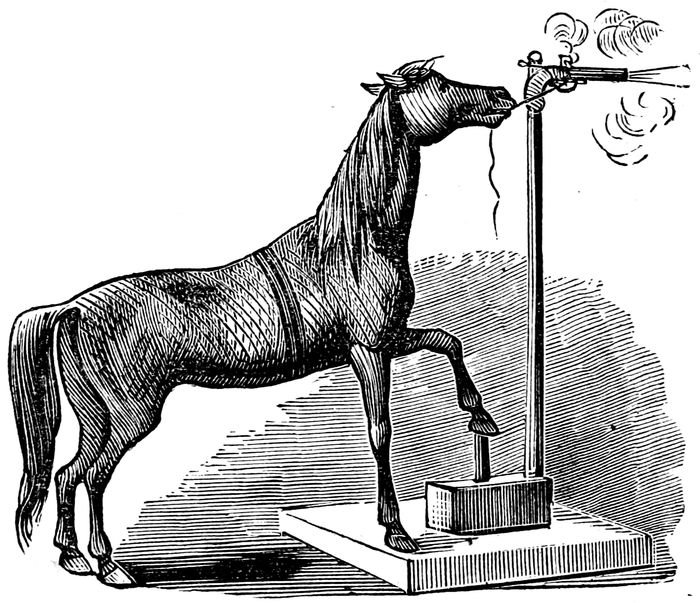
FIRING OFF THE PISTOL.
In performing this trick the pistol (unloaded) should be firmly secured to a post or some other convenient support, as high as 47the horse can conveniently reach. To the trigger attach a small wisp of hay by a string, so arranged that by pulling at the hay the pistol will go off. Lead the horse up to this, that the savory morsel may attract his attention. He will probably pull at the hay, and in his efforts to get it, will pull the trigger. Let him eat the hay, and repeat the operation several times, patting and speaking kindly to him each time. Now attach a piece of rag to the trigger instead of the hay; show it to him and induce him to take hold of it. Every time he pulls at it, and makes the hammer click, reward him with a piece of apple. When he has become used to pulling the rag when it is shown him, the pistol may be capped. The explosion of the cap may startle him somewhat at first; but gentle treatment and a little encouragement will soon banish his fears, especially if the noise of the explosion be only slight, which would be desirable. When he will snap caps without hesitation a small charge of powder may be tried. A heavy charge only makes a nuisance of the trick, and should only be used when displaying before an audience; even then the desirableness of such a proceeding is very questionable.
A horse may be taught to dance thus: Fasten the animal with two side-reins between the posts supporting the leaping bar. Take a whip, and, as the music plays, gently touch him with it, using the “jik, jik,” of the groom as you go on. The horse being tied to the posts can move neither backward nor forward, but he will be induced to lift his legs and thereby gain the rudimentary movement of his lesson. After a while the teacher must mount on his back; the horse being fastened by the side reins. Just when he is to raise his leg, a gentle pull must be given to the rein at the proper side to help the movement. In course of time the reins must be loosened, and the horse, if tolerably ready, will soon learn to mark time, quick or slow, in answer merely to a slight jerk of the bridle. The rider must then dismount, and coming before the horse, teach him to dance, or keep time, with a wave of the hand, or by a pat on the foot which he is wanted to lift.
It may be remarked here that, though the dancing horses at the circuses appear to keep time with the music of the band, it is really, in most cases, the band that accommodates its music to the movements of the horse.
An amusing scene often enacted in the ring is to have a horse 48seated on his haunches before a table, while the clown obsequiously serves him. A bell is attached to the table, so arranged that the horse can ring it by pulling at a bit of rag, and as the horse is almost continually ringing the bell, and the clown makes apparently frantic efforts to answer this summons each time, while bringing in plates, etc., a vast amount of laughter is usually created. The same instructions which we have given in previous pages relative to sitting down, firing off the pistol, etc., will apply to this trick. It is usual, when the table is finally set, for the clown to seat himself opposite the horse and pretend to share his meal. As the food commonly consists of hay pies, with brown paper crusts, the actual eating, we presume, is generally confined to the horse, but the fun is much increased by the clown taking a huge mouthful of hay, as though intensely hungry, and the horse then snatching it from his mouth, and devouring it himself. This latter feat is a mere modification of the kissing trick, where he takes the piece of apple from the trainer’s mouth.
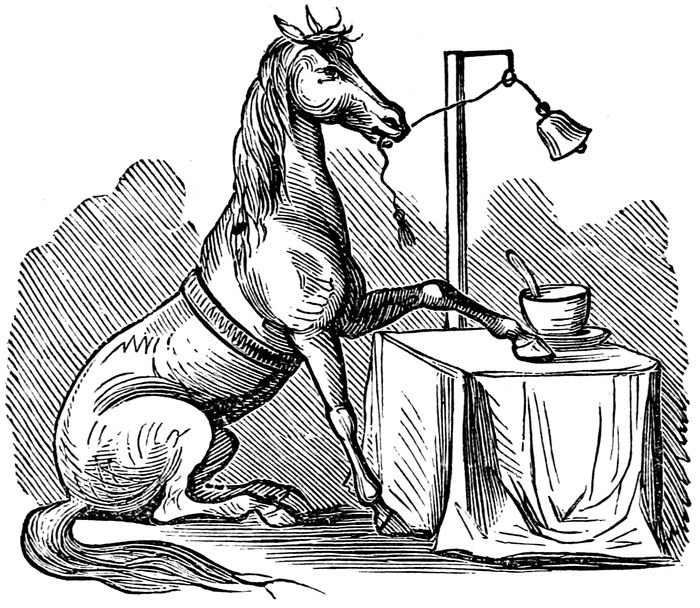
AN EQUESTRIAN EPICURE.
This feat may be easily accomplished by the application of the plan already described, which we may term the “pistol principle.” After the horse has learned to take hold readily of anything offered to him, which knowledge he will have acquired if he has already learned to perform the tricks heretofore mentioned, the only additional instruction necessary will be to 49initiate him into the mysteries of turning the handle. When he has taken hold of the handle, gently move his head so as to produce the desired motion. If, when you let go of his head, he ceases the motion, speak sharply to him and put his head again in motion. With almost any horse a few lessons, and judicious rewards when he does what is required, will accomplish the object, and he will soon both be able and willing to grind out Old Dog Tray, or Norma, if not in exact time at least with as much correctness as many performers on this instrument. Some time since there was a horse connected with Franconi’s circus in Paris, whose education had progressed finely until the organ was reached, as it was in due course of time; this appeared to be the stumbling block in his progress.
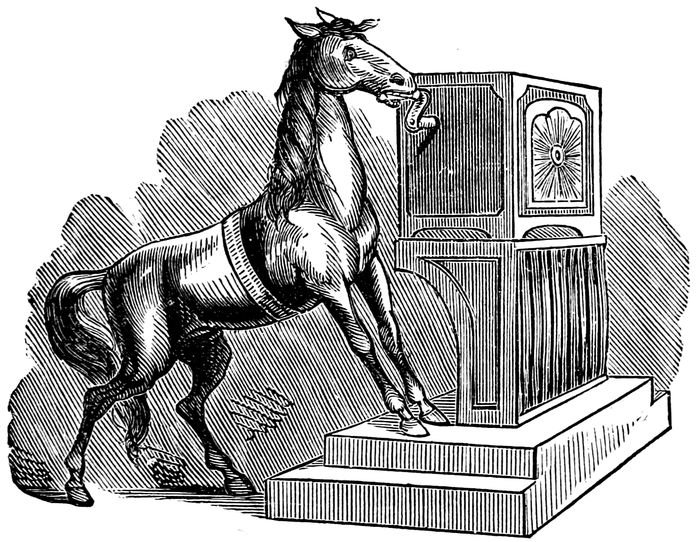
THE HAND ORGAN PERFORMANCE.
It seems that the horse in question had already, under the lessons of his master, developed an unusual degree of intelligence, his eyes in particular becoming so full of expression that one could hardly doubt that he understood very much of what was said to him. His master had great hopes of him; he had been in training only a year, and he had already learned to lie down and get up as ordered, to enact the dead horse, to fire a pistol, and to give whichever of his fore hoofs was asked for. At length the professor began the task of teaching this promising pupil to turn a barrel organ; but either this particular species of exercise was repugnant to his tastes, or the sound of the organ was disagreeable to his ears. Certain it was that the 50animal, usually so docile, was resolute in his refusal to touch the handle of the barrel organ. His preceptor labored at this point for a month without being able to vanquish the repugnance of the horse for the object so constantly presented to his attention. Coaxing, caresses, and the whip were employed in turn, and equally without success. On these occasions the horse’s eyes expressed as clearly as though he had spoken it in so many words the absolute determination not to touch the handle of the organ. The trainer, though naturally of a violent temper, was always patient and gentle with his equine pupil. Whenever he felt that the obstinacy of the horse was on the point of getting the better of his apparent calmness, he would leave the stable to give vent to his irritation out of the sight or hearing of the animal. To those who prophesied that the horse would never turn the handle of the organ, he replied, “He shall turn or die.” At length, perceiving that he made no progress in the work of vanquishing the animal’s obstinacy, he caused the windows of the stable to be stuffed with hay and then boarded over, so that not a ray of light was visible, and a couple of men, hired for the purpose, beat a drum incessantly beside the animal’s stall, relieving one another at stated intervals. The struggle was continued for four days and nights, during which the professor returned to the charge once every hour, presenting the handle of the organ to his refractory pupil, renewing his command to the latter to take hold of it.
The neighborhood was beginning to threaten the trainer with a summons before the police court, to answer to the charge of disturbing its slumbers with the perpetual beating of the horrible drum, which the unfortunate horse, comprehending at last that there was no other chance of deliverance left to him, suddenly seized the handle of the organ with his teeth and turned with all the little strength that was left to him. Daylight was at once restored to the stable, the drummers were dismissed, all possible caresses and the finest oats were lavished on the now docile scholar, who never forgot the terrible lesson of his four days struggle, but, whatever may have been the sentiments with which he regarded the operation, never failed vigorously to turn the handle of the barrel organ whenever the word of command was given.
To teach a horse this trick requires a greater decree of labor and perseverance than is necessary to instruct him in almost any other. So wearisome is the task, and so long is the time required in its accomplishment, that in ordinary cases it is not 51worth attempting. We propose, however, in this little work to tell all that there is to be told about our subject, even though most of our readers should find many things impracticable in their own cases; and it is well worth while to explain all these matters though it be only to gratify the curiosity which is very naturally felt. An uninitiated person would probably be entirely at a loss how to set about accomplishing this feat, and it is doubtful whether he would succeed in discovering the secret of it without assistance. The mystery is not such a very great matter after all, and may be disclosed in a few words.
If you observe a really lame horse—if you haven’t any in your neighborhood just visit New York and you will find some beautiful specimens of the article—you will perceive that there is a constant jerking or bobbing of his head, caused by his lowering it as he treads upon the lame foot and raising it as he raises the foot again. Now the appearance of lameness is caused just as much by the motion of the head as anything else, and a really sound horse, if he bobbed his head as he lowered and raised a particular foot, would appear lame; in fact he would actually go lame with this foot because the motion of his head would compel him to tread more lightly on that than he did on the others, exactly as in the case of the bona fide lameness. This is the secret, and the trainer’s efforts are directed to producing this motion of the head. To make a horse bob his head is a trifling matter, but to make him do so every time he treads on one particular foot, and to do so at the right moment, without hesitation or mistake, requires many weary lessons, and a stock of patience equal to that popularly supposed to have been possessed by the ancient Job.
Commence by taking the horse by the bridle, close to his mouth, and walking him very slowly. Watch the foot with which you desire him to go lame, and each time that it comes that foot’s turn to step, press the horse’s head gently upward as he raises his foot, and downward as he again places it on the ground. Let your motions be simultaneous with the movement of the foot, proceeding so slowly that there is no danger of becoming confused. By-and-by you may release your hold of the bridle and make the motion with your hand, which he will soon obey. You may then accompany the motion by any sound or word of command, and he will learn finally to make the motion on hearing this sound.
A correspondent of an English journal lately described a pony in his possession who in some way had picked up a knowledge of this trick and applied it very acutely to his own advantage. The gentleman thus describes the proceedings of 52the animal: “Whenever the pony had been turned out to graze and was afterward brought up to be hitched into the carriage, it invariably turned lame after going a few yards—so lame in fact that I frequently turned back, being ashamed to drive an animal in such apparent pain; I say apparent, because no sooner had the pony been relieved of its harness than it used to canter around. The same pony when brought from the stable would go perfectly well as long as it wished, but when I drove it in any direction contrary to its inclination it became lame immediately; as soon as its head was turned homeward the lameness entirely disappeared.”
This trick is sometimes exhibited by persons desirous of displaying either their own courage or the docility of their horses. There is a natural aversion felt by horses, and indeed by most animals, to treading on a living object. Few horses will, of their own accord, unless they are under excitement, trample upon a child who may chance to be in the way. Many instances are related of horses lifting infants from their pathway and gently putting them down on one side, where they were out of danger. It is therefore pretty safe to allow your horse to step over you, while you lie upon the ground. To insure against accidents, however, a little preliminary training is advisable. First, let an assistant lead the horse over your legs while you are seated upon the ground with those members extended. Then, after a few repetitions, lie down at full length and let the assistant lead the horse over you in various directions. Very soon the horse may be entrusted to walk over you, merely guided by the snapping of your fingers in the direction you desire him to go.
The common horses ridden by circus performers require some training before they are available in the “circle,” though it is slight compared with the instructions of the “trick” horses. The main thing is to break them to trot evenly and steadily around the ring. They may be taught this in an open field by attaching a line to the nose piece of the halter, which line the trainer holds in his left hand while in his right he has a long whip. Starting the horse, the trainer turns slowly as the horse goes around; the line keeps the horse from going away from the trainer in any direction and so forces him to go in a circle; the whip is used to keep him at the proper distance from the man, and so preserve always the same sized circle. The whip 53should be held on a level with the horse’s shoulder and should be moved so as to accompany him around. Subsequently the line may be removed and the horse will still follow the circle pointed out by the whip, and increase or abate his speed to correspond with its movements. The horse is then ready for the rehearsals of the rider, and soon learns to preserve his pace unbroken, regardless of the movements of the man upon his back.
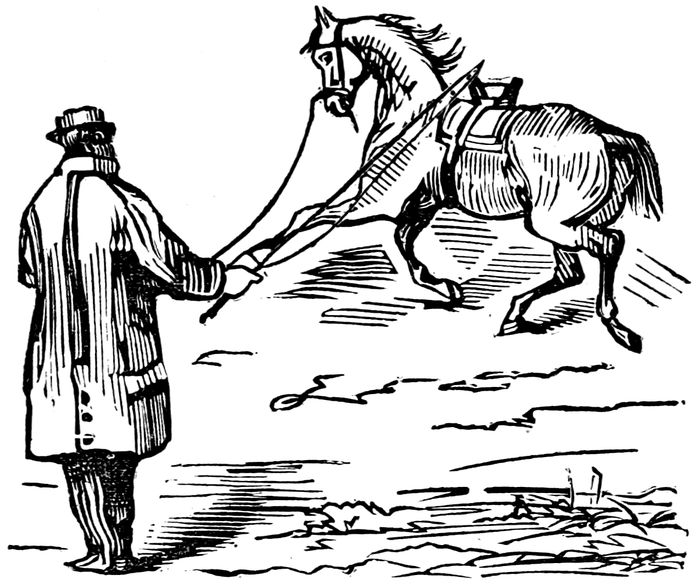
BREAKING HORSE FOR THE “CIRCLE.”
CHAPTER V. THEATRICAL HORSES AND THE HORSE DRAMA.
The exact date at which horses were introduced upon the stage we are unable to state. It is the custom with many writers to trace everything back to the ancient Greeks or Romans and build up their subject from this classic foundation; perhaps we might be able to do likewise were we to try, but we prefer to be excused. Certain it is that for many years such dramas as Mazeppa, Herne the Hunter, Putnam, and others of a certain kind have maintained a steady popularity. At first the characters of the heroes in these pieces were performed by males, and their popularity depended upon the beauty and spirit of the horse, the daring of the rider, and the general excellence of the drama—combats, processions, and startling effects being 54always taking ingredients. By-and-by, however, an adventurous rider of the other sex entered the lists in competition with the gentlemen. Her success inspired others to follow her example, until a dozen or more actresses were found performing the various rôles of the “horse drama.”
In all these pieces the principal attraction, next to the lady rider, is the performance of the horse, which, with very little variation, is generally the same in all. At the back of the stage, crossing and re-crossing it, and rising higher and higher at quite a steep inclination, is a plank gangway, some two or three feet wide. This is technically termed the “run,” and is supported by stout scaffolding, which is hidden by the scenery. At each turn, which is concealed by the “wings,” is a sort of platform to enable the horse to turn and to get a fair position for making the next rush across. The scenery is usually painted to represent mountains, and the canvas which conceals the run is painted to resemble rocks. Ravines and other results of the skillful scene painter’s talents often add to the seeming danger of the pass. Usually a series of different plays are produced during the engagement of the horse and rider, and the same run serves to represent the mountains of Tartary in Mazeppa, the Yankee hills in Putnam, or the natural elevations of any other portion of the world in which the scenes of any particular play may chance to be located. At the proper moment the horse dashes over precipices, rushing torrents, or fearful mountain gorges, (all canvas of course), with his rider astride his back, or strapped upon the “untamed steed,” as the stage business may require. To enable the horse to climb or descend the run without slipping, small pieces of sharpened steel are screwed into his shoes previous to his coming upon the stage. When it is a man who is strapped upon the horse he is usually merely secured by the waist, he holding the girth firmly with his hands. When a woman performs the part it is customary to secure her ankles as well, mainly for the purpose of keeping her on top of the horse should he by any accident fall. In playing Mazeppa the rider is utterly helpless, and without this precaution serious and even fatal injuries might be received. The gentlemen consider their muscle sufficient to enable them to dispense with this care. Some years ago a popular equestrian actress while performing in a western city met with a fearful accident from having one of her feet free in order that she might tickle the horse with her spur, to make him prance and curvette before the audience. On leaving the stage the horse stumbled over some stray scenery or other obstacle, and fell. Had the rider been lashed according to custom 55on top of the horse the only danger would have been the risk of striking against some projection, for the horse could not fall upon his back. As it was, her leg slipped under the horse as he fell, and his weight coming suddenly upon it, the thigh was broken. It is said that as she was conveyed to the boat the horse followed with every appearance of sorrow, whinnying softly, as though striving to express his sympathy. Many months after the accident, when the rider mounted him for practice previous to resuming her profession, an eye-witness related that it was really wonderful to see how gentle were all the horse’s movements, and how, of his own accord, he would check himself whenever his motion extorted the slightest cry of pain, almost suppressed though it was, from his rider.
In these plays very little training is required by the horse. After the ordinary breaking he is frequently exercised in going over the run. Owing to the restricted space it is very difficult for the horse to display any degree of speed, and as this is the main thing to be accomplished, he is therefore taught to start instantly at a rate which an ordinary horse could not by any means attain within the prescribed limits. We have seen Mazeppa played where the stage was so small that while the horse’s tail was against the wall of the theater his nose was barely prevented protruding beyond the scenes, previous to his starting to rush before the audience, from an imaginary journey of some score of miles. When he did come before the public it was difficult for them to see the whole of him at one time even with the scenes run back as far as possible. How the poor animal managed to travel over the diminutive run which was provided we cannot imagine, and yet the sight from the body of the theater was quite respectable.
After ascending the run the horse and rider must remain high up in the lofty region of the “floats” until a change of scene permits them to descend unobserved, or the play requires their descent in public. A perilous, and consequently attractive, feat has been introduced into this play by one or two unusually reckless and daring riders, consisting of an extension of the run around the gallery of the theatre. Over this narrow road above the heads of the spectators, some hundred feet or more from the ground, amid the glare or the lights, the banging of the orchestra, and the thunders of the multitude, dashes the horse, bearing in triumph “the sensation rider of the world.” A single misstep, the displacement of a single plank in that frail support, and horse and rider would lie a mangled mass below. And this is the very reason the house is jammed with eager throngs—not that they wish the rider to meet the horrible death thus 56courted night after night, but it is certainly this possibility which renders the performance so attractive. Playing Mazeppa is not always the hight of felicity.
There is a story told of a horse who probably never had the honor of figuring on either posters or play bills, which we think may be appropriately recorded here. A traveler on a dark night presented himself at the door of a country inn, and demanded lodging. The landlord, after some general remarks, suddenly turned pale and asked his guest by what road he had come. Upon being informed he almost fainted with terror. On examination in the morning it was found that the horse ridden by the traveler had walked with safety the string piece of a long bridge, and maintained his footing on the single extended timber, scarcely a foot wide. The planks of the bridge had been torn up for repairs the day previous; a misstep of the sure footed animal would have precipitated himself and rider into a chasm a hundred feet below.
In Mazeppa and similar plays the horse is “worked” by his trainer or master who comes on the stage attired as one of the retinue or attendants. In other pieces the rider himself manages the horse. These horses are seldom used for any other purpose, as ordinary riding or driving would make their mouths hard and render them less easily controlled upon the stage. In the summer their shoes are taken off and they are allowed a holiday in the country pastures. Mr. Collins, an actor of considerable celebrity who played successfully all the range of equestrian characters, and who trained several of the most popular “star” horses, had a magnificent stallion of large size which was probably the handsomest horse in the profession. He was a trifle too large to display his speed to the best advantage in the theater, but on the road, where Mr. C. occasionally displayed his points, there were few animals who could contest the palm with him for speed. He was a fiery fellow, and if annoyed would bite his tormentor fiercely, and few cared to excite his anger. This was made a “point” of on the stage, Mr. C. plaguing him a little unnoticed by the public, and the spirit the horse displayed always “took” with the audience. Mr. C., however, found it necessary to keep out of reach of the animal’s teeth, or even his influence over the horse might not have preserved him from an uncomfortable nip.
Years ago when horse dramas reigned in the Broadway theaters, as well as in the less aristocratic locality of the Bowery, an enterprising manager determined to bring out Herne the Hunter, “in the highest style of the art.” A number of horses, circus men and innumerable supernumeraries were engaged, and 57the piece produced under the most horse-piece-cious circumstances. The eventful night arrived, the house was crammed. The play progressed, people came on and off the stage, talked, raced, shouted, went through traps, climbed canvas rocks, and indulged in all the customary motions of a grand “spectacle.” There has always been a natural feud between actors and circus folks. The ring people despise those who can only “cackle,” (flash term for talk), while the stage fellows say that folks who travel on their shape, and have no brains to back them up, are contemptible. In those days there was even less good feeling between the two professions than at present. The supes aspiring to the dignity of “the stage” were more intense in their antipathy to the riders than were the actors themselves, and being always ready for a lark, some of them procured a lot of a peculiar kind of tinder which is readily lighted and could be surreptitiously blown into a horse’s nostrils without the culprit being detected. Suddenly in the midst of the performance the horses became restive, and in a moment became unmanageable. Some reared and kicked, some broke through the stage, while others, trampling the foot lights under foot, plunged into the orchestra. All was confusion. An actor advances to the foot lights and assures the audience that they need feel no alarm—nothing of importance is amiss—it is “all right.” At this very moment two horses are murdering their riders in the orchestra. One of the men, literally impaled upon the spikes around the railing, presents a sickening, horrifying, spectacle as he writhes in his death agony. Of course the play was not concluded; the audience departed shocked at the awful sight they had witnessed, and the supes, who had intended no farther harm than a little amusement at the expense of the circus men, now bitterly repented their thoughtless folly. They did what they could to atone for trick by making up a purse for the benefit of the families of the principal victims of the unfortunate affair, but the horse drama had received its death blow on Broadway.
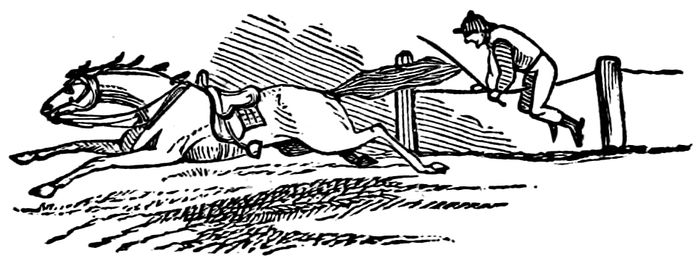
CHAPTER VI. BREAKING AND TRAINING MULES—PERFORMING AND “COMIC” MULES. — PERFORMING MULES.
Mules appear fated to labor under an unfavorable and unenviable reputation. Not only has that rather objectionable quality of stubbornness been supposed to exist in their disposition to such an undue degree as to give rise to the saying, “as stubborn as a mule,” but this general reputation for intelligence is by no means first rate. That the mule is by nature inclined to be rather stubborn is undoubtedly true, but it is very questionable whether the wonderful displays of this quality sometimes met with, are not actually as much due to the very measures adopted to overcome the fault as to the natural disposition of the animal. With proper treatment and a little judicious training the objectionable features in a mule’s disposition might be easily remedied.
A LAZY CURE FOR LAZINESS.
59There is a clever invention attributed to a certain lazy Hindoo, for overcoming the proverbial laziness of the mule. It appears that the man was employed to oversee a mule working one of those primitive mills in use to this day in India. The man seems to have been slightly inclined toward laziness himself, and was anxious to contrive some plan which would enable him to keep the mule in motion and monopolize all the indolence himself. This he at last accomplished with the aid of a clever device, shown in the accompanying illustration, which explains itself. We give it as a curiosity in the “art of training animals,” without vouching for its strict fidelity to the truth.
The following instructions are given by Mr. Riley, an experienced authority, for breaking mules:
“In breaking the mule, most persons are apt to get out of patience with him. I have got out of patience with him myself. But patience is the great essential in breaking; and in the use of it you will find that you get along much better. The mule is an unnatural animal, and hence more timid of man than the horse; and yet he is tractable and capable of being taught to understand what you want him to do. And when he understands what you want, and has gained your confidence, you will, if you treat him kindly, have little trouble in making him perform his duty.
“In commencing to break the mule, take hold of him gently, talk to him kindly. Don’t spring at him, as if he were a tiger you were in dread of. Don’t yell at him; don’t jerk him; don’t strike him with a club, as is often done; don’t get excited at his jumping and kicking. Approach and handle him the same as you would an animal already broken, and through kindness you will, in less than a week, have your mule more tractable, better broken, and kinder than you would in a month, had you used the whip. Mules, with very few exceptions, are born kickers. Breed them as carefully as you will, the moment they are able to stand up, and you put your hand on them, they will kick. It is, indeed, their natural means of defense, and they resort to it through the force of instinct. In commencing to break them, then, kicking is the first thing to guard against and overcome. The young mule kicks because he is afraid of a man. He has seen those entrusted with their care beat and abuse the older ones, and he very naturally fears the same treatment as soon as a man approaches him. Most persons entrusted with the care of these young and green mules have not had experience enough with them to know that this defect of kicking is soonest remedied by kind treatment. Careful study of the animal’s nature, and long experience with the animal have 60taught me that, in breaking the mule, whipping and harsh treatment almost invariably make him a worse kicker. They certainly make him more timid and afraid of you. And just as long as you fight a mule and keep him afraid of you, just so long will you be in danger of his kicking you. You must convince him through kindness that you are not going to hurt or punish him. And the sooner you do this, the sooner you are out of danger from his feet.”
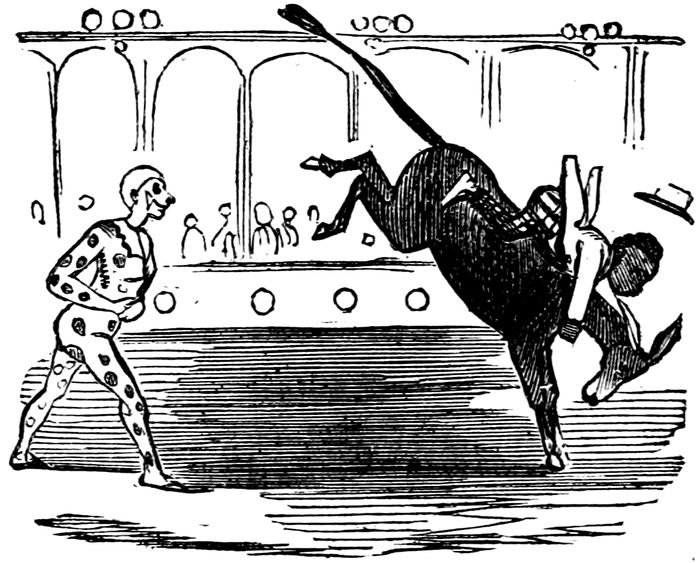
A “COMIC” MULE.
Chief among circus attractions, especially in the eyes of the boys, are the trick or “comic” mules. A couple of these animals are attached to nearly every troupe, and quite a variety of tricks are performed by them. The performance usually the most eagerly looked forward to, is that reserved for the final part of the exhibition. The regular performances being concluded, one of the mules is retained in the ring and the ring-master invites some boy present among the audience to come forward and take a ride—if he can. There are generally plenty of eager respondents to this invitation, one of whom is permitted to enter the ring. The ring-master leads the mule up to the boy as though to assist him in mounting. If the boy is “green” he will probably be somewhat astonished, as soon as the mule is brought near him, at having the pit of his stomach made a target for the reception of the said mule’s heels. If he has already seen a similar performance he will have anticipated this little episode, which can always be calculated upon without fear of disappointment. After many struggles the boy perhaps succeeds in mounting the mule and then an amusing contest ensues between them—the boy’s efforts being directed 61to maintain his hold, and the mule’s to dislodge him. Running at full speed, the animal tries to throw his rider by stopping suddenly, and if successful in this attempt, the boy is either thrown head first among his companions, or, if he lands in the ring, is chased out by the mule.
It is rarely that any one succeeds in maintaining his hold for more than a few minutes, unless he is a capital rider, in which case he may be able to master the animal; should this result be at all likely, the ring-master will, on some pretext, interfere and select some less expert rider from the audience. Finally an attaché of the circus, disguised as a countryman, volunteers to ride the mule, and after considerable caricature riding, and ridiculous posturing, he concludes the performance.
Sometimes to enhance the interest in the affair a reward of five dollars is offered to any one who will ride the mule three times around the ring. This was usually done by Dan ——, a prominent circus manager. We were present on one occasion when a big burly “rough” entered the ring at Dan’s general invitation, to compete for the prize. The mule was particularly spunky but he was finally forced to succumb, and notwithstanding all Dan’s attempts to balk the rider, the mule was ridden the requisite number of times around the ring. Lest any of our readers should be led to cherish the delusion that they might thus earn a reward for displaying their mule breaking abilities, we may mention that, in this case at least, the rider did not receive the money. The showman assured him that the offer was only in fun and declined to hand over the amount. The rough thereupon “pitched in” and administered a thrashing to the showman before he could be prevented. A general fight was only averted by the exertions of the police. We believe Dan, while he remained in that locality, did not repeat his offer.
Very little special instruction is required for “comic mules.” The kicking part of the performance may be taught according to the instructions given for teaching horses the same act. The mule is allowed with strangers to give full vent to all the natural viciousness of his nature, and is encouraged therein. Toward his trainer, and those connected with the establishment, such conduct is not allowed. He soon learns from experience that the worst conduct toward boys in the ring is meritorious, and being annoyed by their persistent efforts to ride him, he resorts to every possible device, without requiring any instruction, to get rid of his tormentors.
Another humorous scene sometimes enacted by the mules is a prize fight, the principals being rigged up in costume and 62furnished with boxing gloves, while two small donkeys are made to seat themselves and hold sponges, as though personating the seconds. Sometimes this latter character is assumed by the clown and ring-master, though it makes little difference. The actions of the mules have a very slight resemblance to a combat and the costumes make them look funny and satisfy the audience. The training required is merely to make them stand erect.
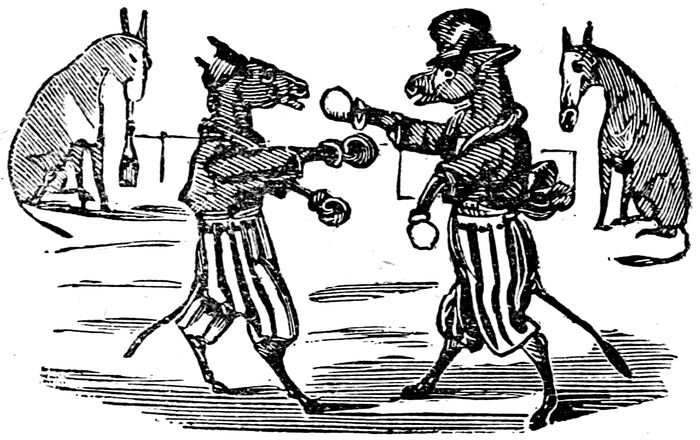
AN ASININE PRIZE FIGHT.
Mules, though possessing less intelligence than horses, may be taught many of the tricks which the latter perform, and the same instructions will suffice for training them.
The sure-footedness of mules has enabled trainers to teach them, in several cases, a very effective and showy trick—that of walking over a number of empty bottles placed upright on a floor or platform. This feat is always highly successful wherever performed, and it is really an excellent one. The bottles used are large, stout porter bottles, which will readily sustain a great weight if placed directly on top. To teach the trick the bottles are at first secured in a platform composed of a double thickness of planks, in the upper one of which holes are cut. In these holes the bottles are placed; the bottoms resting on the lower layer of planks, while the upper one holds them securely in place.
Before teaching this trick the animal is usually taught the ordinary pedestal trick, as explained in a preceding chapter, as a preparatory lesson. He will then more readily acquire the bottle feat. He is first made to place one fore foot on top of a bottle’s neck, then the other fore foot on another. Then the first foot is tapped with the whip to make him raise it and advance it to the succeeding bottle; as he does this his hind foot is struck gently to force him to place it on the vacated 63bottle. Six or eight bottles are sufficient to commence with, additions being made as the animal becomes proficient. When the trick is learned it is unnecessary to secure the bottles in any way; if the mule places his foot squarely on the top, as he should be made to do, there is no danger of either breaking or upsetting them.
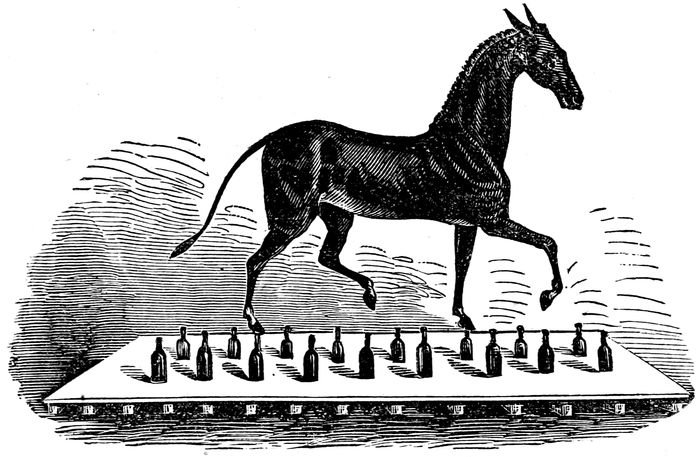
THE PORTER BOTTLE FEAT.
There is a trick related of a couple of English costermongers, or perambulating vegetable dealers, which is amusing if not of practical value. These two worthies were in the habit of passing their donkey through a Devonshire toll gate, on their return trip, free of charge, by making him walk through on his hind legs, arm in arm with them, and taking advantage of the twilight to represent him as a friend slightly under the influence of liquor!
At the south, where mules are almost universally used for many purposes for which horses are used at the north, the negroes are in the habit of directing their movements in many cases entirely by the voice. The animals of that section being as a rule more gently treated, are of a better disposition than their northern brethren. The course of training practiced by their stable masters is by no means systematic, but the animals manage by some means to learn to understand and obey the far from lucid commands. We have often been surprised to see how readily the mules would detect the meaning of what, to our ears, was entirely unintelligible. Probably practice had taught them what was required just as the mules which convey travelers through the wild mountain passes of Spain are 64reported to stop immediately upon hearing the hail of any of the banditti who infest those regions—habitual experience of the customs of those gentry having taught them to come to a stand still.
There is an amusing, though, possibly, not strictly authentic, story told in connection with the performance of the pantomime of Humpty Dumpty, some years ago, in this city. In this spectacle a small mule was made to appear quite comically by the dexterity of his heels. During the season the regular animal fell ill, and an amateur was substituted. When one of the characters touched the new mule to make him kick, he began in admirable style. He kicked off the fellow and kicked him twice before he touched the boards. Then he ran toward several of the other dramatis personæ, and kicked them. Every movable object on the stage, animate or inanimate, he kicked off. Next he began on the scenery. He kicked down a whole forest, three good sized cottages, a picturesque cascade, a granite prison, a robber’s cave, a royal palace, the Rialto and Vesuvius in eruption, and was about to attack the grand transformation scene from Midsummer Night’s Dream, when a rope was thrown around his neck, and he was dragged off by the whole strength of the company, assisted by all the able bodied supernumeraries. The audience, many of whom supposed the obstreperous mule part of the performance, were delighted at his energy, and demanded with deafening plaudits, a repetition of the scene. The uproar was so great that the manager came out and said that an intermission of fifteen minutes would be given to enable some of the actors to recover the breath that the active mule had kicked out of them, and pledged his honor that the brute should never make another appearance on the Olympic stage. At this the audience roared louder than ever, and for nearly half an hour the performance was suspended by the universal guffaw. Every night afterward while the piece ran, the kicking mule was called for, and the manager of the theater it is said, in consequence, had to insert an advertisement in the daily papers, stating that the animal was mysteriously knocked in the head the same night of his highly successful débût.
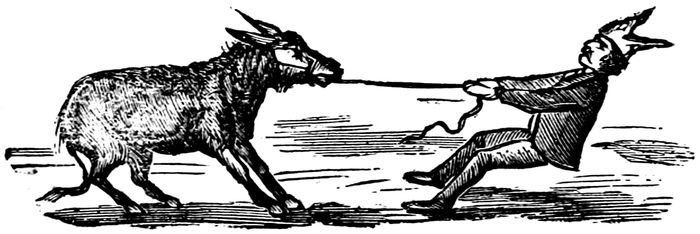
CHAPTER VII. SOME HINTS FOR FARMERS—MANAGEMENT AND TRAINING OF ANIMALS ON THE FARM—SOME EVILS AND HOW TO REMEDY THEM—GOOD TRAINING VS. BAD.
Farmers would find it of great advantage to pay more attention to the education of their domestic animals. Many things may be taught them without any appreciable trouble, which will prove not only convenient, but profitable in the saving of time and labor that may be effected. For instance, any animal on the farm may be taught to come on being called, instead of requiring to be hunted for and chased home whenever wanted. All that is necessary is to give him some dainty as a reward, each time, and the thing will be accomplished almost before you are aware of it. By giving each animal a particular name and calling him by that, you teach each individual to come to you when wanted, and if you reward only the one you call, the others will soon learn to come only when desired. This custom is observed with the sheep in Greece; the shepherd has only to call any one he wants, and the animal will instantly leave its pasturage and its companions and run to the hand of the shepherd, with every token of pleasure. Those which have not learned their name are called “wild,” while the others are termed “tame.”
Animals cannot associate with man without learning something. Many of those habits and tricks which farmers deplore in their stock, are due to the unintentional training that has been given the animals. If your stock run from you, appear to dread your presence and can never be made to stand quietly, perhaps this state of things may be accounted for if you reply candidly to the question whether they have not been accustomed to tormenting or annoyance, and so taught to be wild. No wonder there is complaint of cows being unquiet, when the habit is so general of pelting them with stones, or punching them with sticks, while driving home to milk.
How often instead of attempting to teach the animals proper behavior do we see an apparently contrary course adopted? The “American Stock Journal” has some sensible remarks on this subject:
“We find many persons, when turning stock into or out of pasture, instead of letting down all the bars, leaving two or three of the lower rails in their place; and then, by shouting or beating, perhaps, force the animals to leap over. This is capital 66training, the results of which are seen in the after disposition of animals to try their powers of jumping where a top rail happens to be off, and this accomplished, to set all fences at defiance, and make a descent upon the corn or grain field, as their inclination, ability or hunger may prompt them. Another good lesson is to open a gate but a little way, and then, as in the case of the bars, force the cattle forward, and by threats and blows compel them to pass through it. The result of this teaching is shown in the determined spirit manifested by some cattle to make a forcible entry into the stable, yards, fields, or in fact, to almost every place where a gate or door may, by accident, be left slightly open. A western farmer says he makes it a rule whenever cattle are made to pass a fence, whether through bars or ‘slipgap,’ to leave one rail for them to pass under. This gives them a downward tendency, and lessens their inclination to jump or look upward, as they are sure to do when a lazy attendant throws down a part of the rails, and makes them vault the rest. Cattle may be taught to go over any fence by the careful training they often get for this end, performed as follows: First, starve them or give them poor feed, which will make them light and restless. As soon as they go over the lowest part of the fence after better provender, make them jump back again, and put on one more rail, saying, ‘I guess that will keep them out.’ Next day, (of course they will be in mischief again) repeat the process, adding another rail; in a short time they will take care of themselves, and harvest the crops without charge.”
That gentleness and good treatment will subdue even naturally unamiable dispositions in animals, is shown by the example of the bulls intended for the bull fights at Havre during the marine exhibition in 1868. The bulls, selected for their ferocity on the plains of the Guadalquiver, were so kindly treated by the railway servants during their journey across Spain and France, that, on arriving at their destination, they had become perfectly tame and could not be induced to fight. The sight-seers were obliged to solace themselves with a regatta in lieu of their anticipated combat.
It may be interesting here to refer briefly to the proper management of bulls. There has been some discussion as to whether or not it is advisable to use bulls for purposes of draught. The advocates of the plan consider that a bull should do some labor and that exercise would be beneficial. The opponents say that the main object of keeping bulls is to breed, and that exhaustive labor would impair the vigor of the descendants. Though the latter is probably the true case bulls should 67be exercised in the open air if it is desired to keep them in health and vigor. They should always have a ring inserted through the nose that they may be held in control, but they should never be tied up by anything attached to this ring. Always use a rope tied around the horns; a sudden jerk is very apt to tear the ring from the nose. Never fool with bulls, and beware of trusting yourself in their power. They are subject to sudden fits of fierceness, when any defenceless person is liable to be horribly destroyed.
One of the most important duties on the farm is the breaking of steers. It is best to begin with them as calves, and let the boys play with them, and drive them tied or yoked together, taking care they are not abused. When a pair of old steers are to be put together and broken to the yoke, or a pair of bulls, as not unfrequently happens, it is usually best to yoke them, and tie their tails together, in an extempore stall, in a well fenced yard, and then turn them loose in the yard, which should not be large enough for them to run in and get under much headway. If the tails are not tied together they will frequently turn the yoke, which is a very bad habit. After half a day’s association, the lesson of “gee up!” and “whoa!” may be inculcated—and when well learned, probably the next day, “haw” and “gee.” The daily lesson should be given after they have stood yoked a while. They should not be taken from the yard until they have become used to the yoke, and are no longer wild and scary, as they are apt to be at first. Each day all previous lessons should be repeated. Put them before an ox-sled or a pair of cart wheels at first, rather than to a stone boat, as they are apt to step on the chain, and that frightens them. All treatment should be firm but mild, and no superfluous words should be employed.
As regards training heifers, a Pennsylvania farmer who has trained and milked heifers for more than fifty years, and never has any trouble about their jumping, kicking, or running, gives the following as his secret: “When I intend to raise a heifer calf for a milch cow, I always raise it by hand, and when feeding, frequently handle it by rubbing it gently over the head and neck until it becomes tame and gentle. The rubbing is begun at the first feeding with milk, and continued until I quit feeding it; I never afterward have any trouble about milking them.”
CHAPTER VIII. DOGS IN GENERAL—WATCH DOGS—THE SHEPHERD’S DOG. — WATCH DOGS. — THE SHEPHERD’S DOG.
Among all the animals the dog seems preëminently intended by nature for the companion and friend of man. Even the instinctive passions all animals have for their own kind appear to be in a measure sacrificed to human influence, for the dogs often care more for the society of man than for that of their own kind. Not only is the dog a trusty and valuable friend and associate of man, but the companionship between the human and the canine races developes in the latter many of those noble qualities not possessed under other circumstances. The Turks look upon the dog with abhorrence, and almost universally in the East he is an outcast from human society. The consequence is that all his good qualities are lost; he is no longer the faithful companion, ready to defend his master with his life, but on the contrary, he is deceitful, bloodthirsty, and as unlike the more favored dog of other countries as it is possible to imagine.
Many kinds of dogs are used as watch dogs, and where all that is required of them is a notification of nightly intruders, and the awakening of the household, perhaps the species used is of comparatively little consequence. Where the dog is intended to act as a defender as well as a sentinel, strength and courage are important requisites. With many the bull dog is a favorite for this purpose. Though the least intelligent of his species his unflinching and unconquerable courage renders him a terrible opponent. So utterly without intellect is his courage, however, that no consideration of his foe’s powers deters him from attacking the most formidable thing that gives offense. Striking examples of this quality are displayed in England in what are termed “bull baits,” exhibitions whose cruelty and brutality are scarcely excelled in the customs of any other country. In these bull baits the dog, while fastened to the nose of some unfortunate bull, has had one leg after another cut off with a knife to test his courage. So persistent is the dog in maintaining his hold that the most frightful mutilation will not compel him to relinquish it until his strength is exhausted from loss of blood; he has been known to die from this inhuman hacking with his death grip firmly holding the bull.
Probably the best watch dog is the mastiff. Capable of 69great attachment to his master, he unites strength with intelligence, and, while implacable toward intruders, toward members of his master’s family he is docile and gentle. His hearing is remarkably acute, for he can detect the difference between a familiar and a strange footstep, however light it may be.
The rapid increase in the importance of sheep husbandry in this country will soon direct attention to the value of proper dogs for assisting in their management and protection. There are several different breeds used for this purpose, varying in different countries with their several local requirements. In Spain the Pyrenean, or St. Bernard’s dogs, are found valuable to accompany the large merino flocks on their annual migrations to the mountains, as a protection against the wolves infesting the Pyrenees. In Spain, too, the mastiff is highly prized, an improved, large breed, with strong feet, short hair and slightly pointed nose, being much in use.
A gentleman of Delaware gave, some years ago, the following account of a shepherd’s dog of the Spanish breed in his possession:
“The dog is three times as large as the shepherd’s dog described by Buffon, but is endowed with the same good qualities: immense strength and great mildness in his usual deportment, though ferocious toward other dogs. I can say, without exaggeration, that at least twenty dogs have been killed in my barnyard, or on my farm, by my dog Montague. His dimensions are three feet eleven inches from his eyes to the root of his tail, and two feet eight inches high over the shoulders. He is a fine animal, entirely white. I prefer that color in recollection of the story of old Jacob. In fact, I had formerly a black dog, and many of my lambs were born black. Since I have had Montague and his mother I have very few black lambs. The natural instinct of this animal is to guard your sheep against wolves and dogs. No other training is required, but to keep them constantly with your flock, the moment they are from the litter, until they are grown.”
What is commonly known as the shepherd’s dog is a smaller breed, seldom more than two feet high. Those in France are usually black with white touches on breast, face, legs, etc.; with sharp head and nose, and with a countenance full of alertness and intelligence. In Great Britain, particularly in Scotland, the colors of the shepherd’s dog are more mixed with shades of red and brown; or black dogs with sharp ears, turning down at the tips. The Scotch breed, or colley, is a light and active one, 70probably the best adapted for those portions of our own country where there is no danger from wild animals. It is pretty extensively diffused in the United States and British America, and is very useful to the farmer, shepherd or drover.
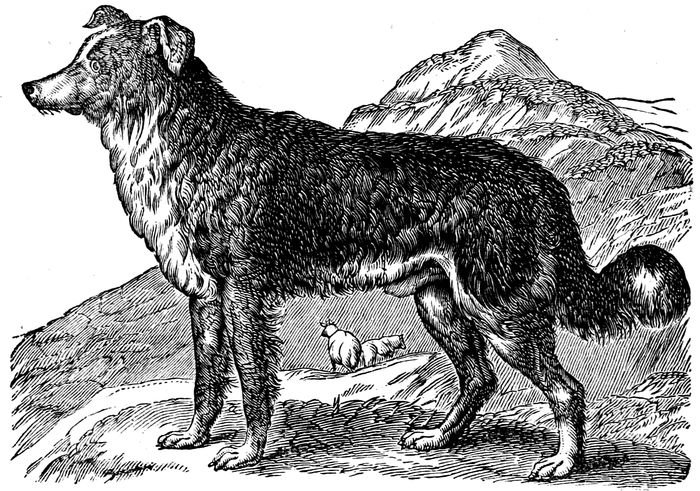
SCOTCH COLLEY, OR SHEPHERD’S DOG.
The Mexican shepherd’s dog is doubtless a descendant of the Spanish ones introduced at the time of the conquest, and is a marvel of fidelity and intelligence. In training these dogs the method is to select from a multitude of pups a few of the healthiest and finest looking, and to put them to a sucking ewe, first depriving her of her own lamb. By force, as well as from a natural desire she has to be relieved of the contents of her udder, she soon learns to look upon the little interlopers with all the affection she would manifest for her own natural offspring. For the first few days the pups are kept in the hut, the ewe suckling them morning and evening only; but gradually, as she becomes accustomed to their sight, she is allowed to run in a small enclosure with them, until she becomes so perfectly familiar with their appearance as to take entire charge of them. After this they are folded with the whole flock for a fortnight or so; they then run about during the day with the flock, which after a while becomes so accustomed to them, as to be able to distinguish them from other dogs—even from those of the same litter which have not been nursed among them. The shepherds usually allow the slut to keep one of a litter for her own particular 71benefit; the balance are generally destroyed. After the pups are weaned, they never leave the particular drove among which they have been reared. Not even the voice of their master can entice them beyond sight of their flock; nor can hunger or thirst.
A remarkable example of the intelligence of these dogs is displayed when two flocks approach within a few yards of each other; their respective protectors will place themselves in the space between them, and as is very naturally the case, if any adventurous sheep should endeavor to cross over to visit her neighbors, her dog protector kindly but firmly leads her back, and as it sometimes happens, it may make a rush and succeed in joining the other flock, the dogs under whose charge they are go over and bring them all out, but strange to say, under such circumstances they are never opposed by the other dogs. They approach the strange sheep only to prevent their own from leaving the flock, though they offer no assistance in expelling the other sheep. But they never permit sheep not under canine protection, nor dogs not in charge of sheep, to approach them. Even the same dogs which are so freely permitted to enter their flocks in search of their own are driven away with ignominy if they presume to approach them without that laudable object in view.
The English sheep dog, or drover’s dog, is a tailless animal, larger, coarser, and stronger than the colley. It is very easily trained and is very well adapted for working among cattle, keeping the herd from straggling when on the road or the prairie, and acting as an aid to the farmer in the management of his flocks and herds. One of this breed was used by an American farmer to drive home his cows. It was only necessary to tell him it was time to bring the cows, and he would scour the farm and bring them from all parts safely into the yard. On the prairies such dogs would be of great use.
A careful, well tempered shepherd never allows his dog to harass or worry the sheep. He walks his regular rounds quietly, the dog following at his heels, appearing to take no notice of the sheep, and they almost unconscious of his presence. Should anything occur in which the aid of the dog is needed, he is at hand to perform the will of his master. If the sheep break through a fence into forbidden ground, one word from the shepherd is enough, the dog drives them back without causing much alarm. If a sheep breaks away from the flock, the dog is not allowed to bite it; he is taught to run before it and bark, in order to drive it back to its place.
A dog which has been properly trained will be continually on 72the look out for stray sheep, and will, of his own accord, visit those parts of the pastures where the fences are weakest, and where ditches or ravines exist, into which the sheep may be in danger of falling. Heavy sheep, with large fleeces, will sometimes lie on their backs for a whole day or night, being unable to get up. When in this position, instances have occurred of their eyes being picked out either by ravens or carrion crows. They are all subject to the attacks of dogs and foxes. A well trained shepherd’s dog will find sheep that are in this position, and attract attention to them.
Well trained dogs will not annoy ewes with lambs, nor show any signs of irritation when assaulted by the ewe for the protection of her young. They keep at a respectable distance from quarrelsome rams, not considering it to be any part of their business to fight with them. They are very watchful at night, especially during the lambing season, guarding the lambs from the attacks of foxes and dogs and all other intruders.
In training a young shepherd’s dog, the services of a well trained, experienced dog will be almost indispensable. The ardent temperament of the young dog must be subdued, and there is no better mode of doing so than by compelling him to accompany a well trained dog and imitate his actions. A long line in the hands of the trainer, attached to a collar or belt on the neck of the young dog is generally necessary in the training process. With the aid of this contrivance the dog may be perfectly subdued, and made to obey all the commands of the trainer. He can be taught to “go away,” “come back,” “come in front,” “come behind,” “bark,” “lie down,” “be quiet,” “get over the fence,” “slop them,” “bring them back,” and every other evolution in the field exercise of the sheep dog. The training should commence when the pup is five or six months old. The older the animal is, the more difficult will it be to train him.
The shepherd’s dog of any of the breeds we have mentioned, has a natural inclination for working among sheep, but he may be spoiled by improper management, and then he becomes an enemy to the flock instead of a protector. A cross between the mastiff, bull dog or cur, and the shepherd’s dog, produces a mongrel which has an insatiate thirst for the blood of the sheep, and can scarcely be restrained from destroying them. The shepherd’s dog should be full blood, anything less is worse than useless. Dogs even of the best breeds may be spoiled by neglect or mismanagement in the training. The shepherd must himself treat the sheep with gentleness if he desires the dog to do so; the dog will act as his master does.
CHAPTER IX. SPORTING DOGS AND THEIR MANAGEMENT AND TRAINING. — PRELIMINARY TRAINING. — LESSONS IN THE FIELD. — WATER DOGS.
The pointer and the setter are the two universally recognized dogs for hunting game birds. As to which of the two is the better variety authorities differ, and much depends upon circumstances. For hot climates the pointer has more endurance than the setter, but he is also more tender and would suffer in a cold climate. Pointers do not require so careful training, and with sportsmen who are, as is the case with many, loose in their manner of training, a pointer will be a passably well behaved dog where, with the same laxity, a setter would be utterly worthless. As the value of a dog in hunting depends in such a great degree upon his proper understanding of the work in hand, and his prompt and faithful execution of the duties incumbent upon him, too much pains cannot be taken with his training.
The education of sporting dogs should begin in earliest puppyhood. Unless they are early taught obedience, it will be difficult to overcome this neglect by after training. His first lesson may be given with the aid of a piece of beef placed before him on a plate. Naturally he will evince an eagerness to obtain it. Prevent his doing so, by gently tapping him upon the head, at the same time cry, “toho!” By repeating this word each time you check his eagerness, he is taught to associate the slap with the word and to stop when the word is used. This makes the “point.” In a few moments after you must cry, “hie on,” and allow him to seize the meat. “Steady” is the next lesson, and consists in allowing him slowly to approach the plate as you keep repeating the word at short intervals. When near the plate cry, “toho,” and never allow him to reach the meat until you give the command, “hie on!” When you wish him to break his point but not to “pitch in” to the meat, the command, “close on” should be used. Before he reaches the plate, cry, “toho,” and then, “hie on;” when he has pointed, by “close on” he must understand that he is to move cautiously, and this he is taught by the oft repeated command of “steady.” All these commands may be taught with patience, and patience is absolutely necessary. No harshness should be used, and no new lesson should be attempted until the old one is fully mastered. You should always feed the dog yourself.
When the preceding lessons are thoroughly acquired, 74“charge” may be taught. Gently force him down as you give the command, extend his fore paws and gently place his head between them. Each time he moves, tap him lightly and repeat the command. No more force should be used than is absolutely requisite. Practice him frequently by crying, “charge—charge,” with your hand upraised, and forcing him into the desired position. To make him rise, you should cry, “hie up,” and gently raise him. Repeat these instructions until they are fully understood and readily obeyed, doing a little each day, but doing that thoroughly.
To retrieve is the next lesson to be taught. An old glove or other soft substance should be used, and after allowing the pup to play with it, toss it from you and he will rush to get it. Call him to you after he has got it, and take it from him, rewarding him with caresses and kind words. Repeat this plan using the command, “hie fetch,” when you wish him to go, and “come in,” when you wish him to return. By using the command, “come in,” on all occasions when he is a little distance from you—when you call him to feed him—etc., he will learn to obey it. Hooper in his excellent work[1] gives the following directions for teaching a dog to retrieve: “Begin by placing your glove within his mouth, making him retain it; if he rejects it, replace it, gently correcting him, crying, ‘fetch! fetch!’ After he understands the meaning of the word fetch you may let him accompany you in a walk, in some quiet place. Whenever he drops the glove you must gently and encouragingly replace it, crying, ‘fetch! fetch!’ If he rejects it the lash must be used, but sparingly. If you study the disposition of your dog and manage properly, he will soon perfectly understand you, and gaily and happily gambol alongside of you, seldom dropping his charge, and if he should, he will only need the words, ‘hie fetch! fetch!’ to make him bound back with eagerness to regain the lost glove. You may now take the glove, cast it from you, and tell him to ‘hie, fetch!’ He will immediately return with the glove. You may now let him see you drop the glove, walk off thirty or forty yards, wave your hand in the direction of the glove, and cry, ‘hie, fetch!’ He will of course regain the glove. After practising him at this often, you may drop the glove unobserved by him. He will soon follow your track for a considerable distance for a lost article, by receiving the command, ‘hie, fetch!’ You may now give the glove to another person to hide, first permitting the dog to see it in his possession, and he will be almost certain to find it, if it is at all 75accessible. In your first lessons be careful to place the glove where your dog will be certain to find it—not too far off.”
1. Dog and Gun.—Price thirty cents, post paid. An interesting and useful work for every amateur sportsman.
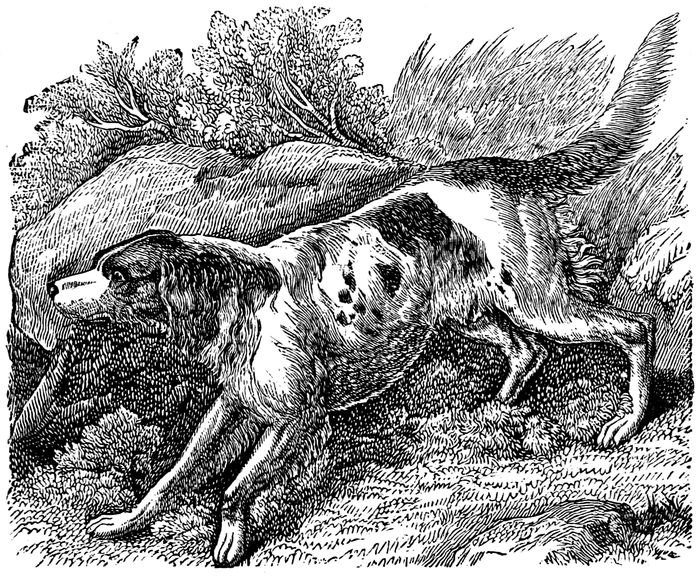
THE SETTER.
He should also be taught to follow closely on at the sportsman’s heel when they are out together; this may be done by saying, “back, back!” and striking him gently with the whip when he attempts to press forward. Any hunting dog may be taught to retrieve notwithstanding the complaints some sportsmen make to the contrary. Great patience is required to teach the dog, but the result of careful training amply compensates for the trouble. Hooper recommends that, after the dog has learned the preceding lessons, he be made to practice them often, playing with a ball.
After the dog has been thoroughly drilled in the preliminary exercises we have described, it will be necessary to teach him their practical application. Much of the future value and usefulness of the dog depends upon his first day’s shooting and the manner in which he is initiated into the sport. We again avail ourselves of Mr. Hooper’s instructions for managing him the first day he is taken out:
76“When you observe Dash more excited than usual, you may reasonably expect a bevy near. They will not probably be far off, as he has not become accustomed to the familiar and welcome scent that will enable him to wind them at a distance. Now comes the trying hour for master and pupil. The former should be perfectly cool, and should consider the killing of game a secondary affair—let him give his attention to Dash. The dog seems too eager for the scent—you cry ‘steady! steady!’—if he is apparently near the game, and you are afraid he will flush, you cry ‘toho!’ You approach and find the quail do not raise—you tell him to close on, which he does by moving rather rapidly—you check him by crying ‘steady! steady!’ he points, ‘toho!’ You now approach and flush the bevy; be sure you bring down one bird, and it will be well that you only fire one barrel, that you may have more time to look after Dash, who of course scampers after the whirring bevy. You immediately cry ‘toho! come in!’—on, on he goes; in his wild excitement he disregards your will entirely. You now use your whistle. By this time the birds are out of sight (but you, of course, have marked them), and he is running helter skelter. You must soon get hold of his collar, drag him rather roughly back to where he pointed—lashing him slightly—and make him ‘charge,’ and keep his position until you reload; after which you will take him to where your bird has fallen—indicate the place with your hand, crying ‘hie, fetch! fetch! fetch!’ From his previous lessons he will know that you wish him to look for something, and his nose will soon tell him what it is. Do not let him mouth or toy with it, or he will soon get in the habit of roughly mouthing your game, than which I scarcely know a worse habit.
“You may now rest for a short time, that the bevy may get over their fright; after which they will be more easily found, for if they have been very much frightened, they will not give out sufficient odor to enable your pupil to point well, and he may consequently flush them, thereby doing great harm. You cannot do better than to spend your time in repeating your house training with the dead quail: casting it from you, telling him to ‘close on! steady! charge! hie on! fetch!’ Cast it some distance unobserved—waft your hand in the proper direction, and tell him ‘hie, fetch! fetch! fetch!’ After a short time has elapsed, you may take Dash to where you have marked the birds. When near the birds, keep Dash near you, that he may be the more easily controlled. If he seem too eager he only needs the command of ‘steady!’ to control him. Let the command be in rather an undertone—never get into the snobbish habit of 77bawling at your dog. Apart from its being an ungentlemanly habit, it frightens the quail more or less, and they will not lie so well to the dog. Ha! but Dash has come down to a point most beautifully, ‘toho!’ You carefully approach, flush and shoot the bird, and immediately give your attention to the dog, crying ‘charge!’ in a strong and emphatic tone; if he breaks, get hold of his collar as soon as possible and lash him, and at the same time drag him to his ‘point’ and make him ‘charge’ and keep his position until you reload. You then cry ‘hie up,’ make friends with him, and cast him off—he soon points again. You manage to get very near the dog, and when you fire, immediately cry ‘charge!’ and it would be well to accompany ‘the word with a blow,’ at this juncture. You make him charge, reload, cry ‘hie up,’ indicate the point where the bird has fallen, and command him to ‘hie fetch!’ You cast him off again, and always manage to control him after you fire—never, never suffering him to break shot without feeling the lash. Remember this is the most critical time for yourself and dog. Never suffer yourself to become excited; do not for some time fire more than one barrel, that you may sooner give your attention to Dash, and you will accomplish much if you can be near enough to Dash to give him the lash as he first springs from the point, at the same time crying ‘charge!’ If you do not suffer yourself to become excited, and lose sight of your dog after your shot, you will soon have him drop at the report of the gun; but rest assured, if you let him have his own way a few times, in your eagerness to secure game, you will rue it for many a day to come. You cannot have this fact too strongly impressed upon yourself. If you control him from the first, your object will be attained. If Dash evinces unusual perverseness in this, it will be well to make him ‘charge’ while on a ‘point.’ Even should he see a dead bird fall, he should not retrieve without permission.”
It is a maxim in hunting never to allow a dog to run ahead of another in a point, but either to make him back, or come in to heel. Besides the danger of flushing your game, it would be permitting an unfair advantage to be taken of the dog doing his duty in the lead, of both which a dog of nice sensibility will show himself to be conscious. It happened, some years since, that a party was out, near Old Point Comfort in Virginia, with a fine pointer belonging to Mr. A——. A small terrier had accompanied them, and whenever the pointer would take his stand, the terrier would rush by him, and put up the birds. Repeating this vexatious, ungentlemanly conduct several times, the pointer was seen to grow impatient. At last having found 78another bevy, as the terrier attempted to pass him, the pointer seized him, and placing his fore paws on him, held him fast, growling to keep him quiet, and maintaining his point until the sportsmen came up.
The Newfoundland is unquestionably the water dog par excellence, and probably the best individuals of the variety are the celebrated dogs used for duck shooting on the margin of Chesapeake Bay and commonly called the Chesapeake Bay Water Dog. These animals being derived from ancestors of pure breed, and the constant training from generation to generation having caused the transmission of their excellent qualities in increased measure to each successive generation, are probably unrivalled by any other in their particular forte. Owing to thoughtless and injudicious mixing of breeds a true Newfoundland is rarely seen. Although the purer the breed the better water dog he will be, yet many dogs of mixed breeds possessing considerable Newfoundland blood, make excellent dogs for ordinary aquatic sporting.
On breeding the water dog little need be said, for, like Dogberry’s reading and writing, his education “comes by nature.” In his infancy he may be taught to bring a glove and lay it down at your feet as he should do; and, by practice, the comprehension and fulfillment of his various duties will soon follow. He will be found, with judicious encouragement and exercise of authority, more docile than a child. They have been known at four months old to fetch a duck, but lest the constitution be impaired, they should not be put too early at hard service.
“Canton,” a celebrated Newfoundland, owned by Dr. Stewart, of Sparrow’s Point—a great sportsman in his day—was noted for a number of remarkable feats in securing “canvas backs” on the Chesapeake. She surpassed her species generally in unrivalled devotion to the water, and to the sport of ducking, as carried on by the doctor’s colored man, Varnell, with his murderous swivel gun. Her patience and endurance were almost incredible. She was the heroine of many desperate encounters with wounded swans, often pursuing them for miles, and many were her exploits among rotten and floating ice, in pursuit of wounded ducks, sometimes, in fogs and darkness. On one occasion she brought out twenty-two or twenty-three ducks, all killed or wounded by Varnell at a single shot. A good deal of time was lost in pursuing these wounded ducks, and at the close of this pursuit, it being then dark, Varnell gave up the slut as lost, so many hours had she been engaged in bringing 79out her game; but after Varnell had sorrowfully turned his face homeward, she overtook him with one or two ducks in her mouth; and the old doctor stated that he remembered Varnell saying that at one time, when she was most fatigued, she climbed on a cake of floating ice, and after resting herself on it, renewed the pursuit of the ducks.
CHAPTER X. ORDINARY TRICKS PERFORMED BY DOGS. — TO TEACH HIM HIS NAME. — TO LEAP. — TO WALK ERECT. — TO DANCE. — TO JUMP ROPE. — TO SIT AND LIE DOWN. — TO BEG. — TO GIVE HIS PAW. — TO SNEEZE. — TO SPEAK FOR IT. — TO FETCH AND CARRY. — TO BRING HIS TAIL IN HIS MOUTH. — THE ROLLING BALL. — TO WALK ON STILTS. — TO GO UP AND DOWN A LADDER. — TO STAND ON HIS HEAD AND TO WALK ON HIS FORE LEGS. — TO “SING.” — THE LUMP OF SUGAR TRICK. — TO FEIGN DEATH.
Every dog who has the good or ill fortune to be a member of civilized society is usually fated to undergo a more or less systematic education “in the way he should go.” This education may be either in the primitive style illustrated by the administration of a vigorous kick accompanying the command “get out,” to teach the dog to leave you, or the more elaborate training which culminates in the production of a canine prodigy. The capacity for education in dogs varies much with different varieties, and even with individuals of the same variety. While some are taught with the greatest difficulty, others display a wonderful aptitude for learning, and acquire a proficiency which is often really surprising. Whether it is proposed to educate the animal as much as his capacity will admit of, or merely to teach him the things necessary for common convenience, the first thing is
If a dog has any particular name by which he is usually addressed, he will in time learn to answer to it. With a little system, however, he will learn much sooner than otherwise, and where there are several dogs it is a good plan to make each know his own distinctive title thoroughly, and to respond promptly to it. This will render your intercourse with, and your management of them, both easier and pleasanter. It may be accomplished by a very simple process. When you feed them, call each one by name to his food. If any of the others come forward, send them back. By dividing the food into small morsels and calling each dog in turn to receive his piece, always insisting that he and no other shall receive it, considerable of a lesson may be derived from each meal. When convenient take 80them out to walk, being careful to provide yourself with a few crackers or a piece of bread. Allow the dogs to ramble about at their pleasure, and whenever you choose call some particular one by his name; when he comes to you reward him with a piece of cracker. By-and-by call some other one, and continue the plan at your discretion. At the end of ten or a dozen lessons they will have pretty well learned their names, and come at your call. If you have only one dog, the plan would be about the same.
This is very a simple trick and easily taught. A line or pole may be extended from any convenient supports, just so high that the dog cannot step over. Take your station on one side of this barrier with a supply of bread or cracker. By the offer of a small piece induce him to approach as near as possible to the line or pole, keeping the tid-bit close to his nose, but raised a trifle above it. Now, with a sudden movement, extend your hand beyond the barrier, crying at the same moment, “hip,” or any other quick, inspiring exclamation. Eager to get the tempting morsel he will leap over, and the same proceeding may be repeated once or twice, when he should be rewarded with the bait he has been striving for. After a few repetitions he will probably leap over at a motion of the hand and the word of command. He should always be rewarded for obeying, and it is well to have a light switch with which to give him a gentle cut should he attempt to run under, which he should never be permitted to do. The hight of the barrier may be increased gradually from day to day, taking care never to over-task his powers. With practice many dogs acquire the ability of making very creditable leaps. We had an old dog who had been attached to a circus in his youth, and had been rather “fast” in his proclivities. Not being content to settle down to the quiet peacefulness of a back-yard existence, which he probably considered rather slow, he was in the habit of leaping over a fence at least ten feet high and plentifully studded with spikes, that he might indulge in a nightly canine spree with other festive dogs of his acquaintance.
When the dog leaps readily over a bar, a hoop may be held in the hand and the same system pursued. The hoop may be gradually lessened in size until the dog finally leaps through one hardly bigger around than his own body, but to do this the trainer must display some skill in conforming the motions of the hoop to those of the dog as he passes through.
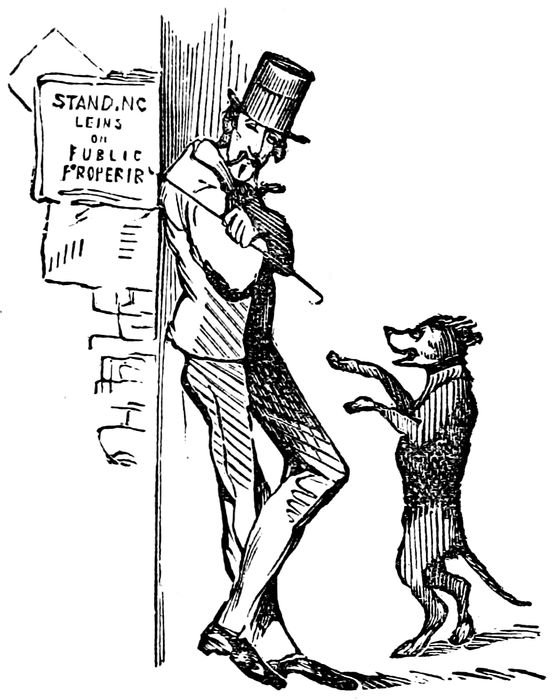
WALKING ERECT.
Hold a bone or other like temptation a little above the dog’s nose, but not so high as to lead him to jump to get it. As he reaches for it raise it so as to induce him to rise up on his hind feet, saying as you do so, “up, up!” When he reaches the proper stand-point, let him remain there a moment or two and then let him have the bone. Soon he will stand up on your merely holding your hand in the position described and saying, “up, up.” Then he may be taught to walk in this position by slowly moving the bone or your hand slightly in advance. These exercises should not be tediously prolonged, especially at first, for the position is an unnatural and very fatiguing one to the animal. After he thoroughly understands what is required of him you may check any attempt he may make to regain his natural position before you are willing, by a gentle tap under the chin or under the fore paws.
A dog is generally considered sufficiently accomplished in this “graceful and agreeable art” when he has learned to hop around on his hind legs, and to keep turning completely around at short intervals. There are several modes of arriving at this result, the most simple of which is, probably, to take a long 82switch, after the dog has learned to stand erect, and to this switch attach a piece of meat. With this you can trace out in the air, in tempting proximity to his nose, the figures you wish him to take, and you may depend upon his instinct leading him to follow the motions of the switch. This may seem rather an absurd plan for initiating your pupil into the mysteries of the ball-room, but it is nevertheless one of the most effective that can be devised. The dog should be rewarded with the meat after he has danced enough to fairly earn it, and after a few lessons the switch may be used without any bait attached. He will at first follow its motions in the hope that there is something attached, and if he be rewarded for doing so, he will soon comprehend that following the switch means meat by-and-by. If he is dressed up in feminine apparel, as is generally done at public exhibitions, the absurd figure he cuts, and the ridiculous caricature of a lady “tripping the light fantastic toe” which he presents, is extremely laughable.
After the dog has learned to leap at your command a light rope may be substituted for the pole, one end of the rope being attached to some stationary object while the other end is held in your hand. Exercise the dog a few times at leaping the rope while it is without motion, and near the ground, using the command “hip,” or whatever one he has been trained to leap with, each time. Then give the rope a slight motion and at the proper moment give the dog the usual command and he will obey it. By increasing the motion very gradually he will, after many lessons, be able to jump rope very creditably. He may be taught either to jump while standing on his full complement of legs, or in the perpendicular fashion.
It is one thing to have your dog do a thing at his own convenience and of his own free will, and quite another thing to have him perform the same action at your desire, especially if he had a little rather not do it. This applies particularly to sitting or lying down, for it usually happens that when you desire him to do so he feels least inclined; but it is the trainer’s business to bend the animal’s will to his own, and in this case it may be done thus: Taking your position with the dog in front of you, raise one hand over his head and make a motion with it as though about to strike him on the top of his head with your palm; as you do so repeat the word “down” distinctly and commandingly, with each motion of the hand. This should not 83be done as a menace, but to indicate your wishes. While you do this, press firmly with your other hand upon his back, just over the hips,—this pressure will assist in making him take the desired position. When he has done so he should be patted and made to understand that he has done right. Repeat until he obeys the command readily, and then teach him to lie down, which consists in forcing him into a recumbent posture, as you command him to “lie down!”
After the dog has learned to stand erect he may easily be taught to beg. All that is requisite is to press him down in the desired position; if he attempts to leave it a gentle tap on the head with the switch will be sufficient to control him. He may, if preferred, be taught to beg without learning to stand erect; in this case he may be made to sit down and then, pressing his haunches down to prevent his rising to his feet, tap him under the chin till he takes the right position. Repetition is of course necessary until he learns what is desired, and each time you place him in position it is well to say “beg” two or three times so he may associate the word with the act. Dogs, like many of the human race, after they have “got the hang of it,” will beg persistently for the sake of an occasional trifling reward.
There is scarcely a boy’s pet dog who has not acquired this very simple trick, though his master probably would not recollect how it was taught. Perhaps it was the dog’s sociable feelings that led him to perform the kindly ceremony of “shaking hands,” or perhaps it was due to the instinctive good breeding which is sometimes accredited to some people—and why not also to some dogs? Whether politeness is a grace which adorns the canine character, however, is a question we hardly feel prepared to discuss, and it is much more probable that Master Harry, (or James, or whatever his name may be), with no special thought in regard to the matter, hit upon the secret which underlies all animal training—compelling obedience to a command until the command is obeyed without compulsion. What was more natural for our friend Harry, when he first gave the momentous command of “paw,” and Carlo utterly in the dark as to its signification, taking no notice of it—than to grip Carlo’s fore “limb” and give it a shake? Nothing in the world more natural. This is probably repeated at odd times until Carlo learns to give his paw when Harry says “paw,” or holds out his paw.
84If the same paw is always given, as it will be if during the training that one be always taken, the dog may be taught to offer the other one when you ask for the “other paw,” by merely taking it a few times when you make the request. By using “paw” for one and “other paw” for the other—“paw” first—the dog will seldom get them confused. It is preferable and makes the performance seem better, while it is really no more difficult, if the words “right” and “left” are used in connection with the commands. It is just as easy for a dog to learn the difference between “right paw” and “left paw,” as between “paw” and “other paw.” It is well to lay extra stress upon “right” and “left” while training, and these words should be pronounced very distinctly. Should the dog offer the wrong paw merely repeat your former command until he changes it, then take it in your hand, call him “good dog,” and pat his head to let him know he has done right.
A little boy of our acquaintance had a very handsome Newfoundland dog, and having often heard the family physician desire members of the family to let him feel their pulse, he thought it would be a capital idea, and having coaxed the cook to give him some choice bits of beef-steak, he commenced practice. “Let me feel your pulse, Bruno,” says he, and taking Bruno’s paw in his fingers he imitated the doctor with a comical childish assumption of professional gravity. He scarcely intended, when he commenced, to make Bruno offer his pulse for examination at his desire, but Bruno was an intelligent dog and the beef-steak was very good, and before long he would stick his paw out as nicely as could be desired. Our little friend, delighted with the result of his efforts, lost no opportunity of showing off Bruno’s accomplishment, and the dog was continually holding out his “pulse” for the examination of visitors. The doctor calling some time after was somewhat amused at our little friend’s request to Bruno to “let the doctor feel your pulse,” and Bruno’s ready compliance therewith.
We had a half-grown puppy of one of the larger breeds some years since, which by constant training became so used to offering his paw that he would do so to visitors or others without being ordered to. One day a strange cat intruded upon the premises, and puppy made a rush at it with every token of hostility. When near it, however, habit appeared to gain a mastery, for he held out his paw as usual. The cat being irritated by his previous threatening aspect merely struck at him with her claws, inflicting quite a severe scratch, whereupon puppy, perceiving politeness to be at a discount, pitched in and routed the enemy gallantly.
On a recent visit to a friend we came across a dog who would sneeze in a most natural manner whenever his master said, “Sneeze, Zip.” This being the only example of a dog performing this trick which we had ever seen we desired our friend to give us some particulars of the manner of teaching the trick, which he obligingly did, to this effect: “One afternoon, having nothing more important to do, I was amusing myself by bothering Zip with a long feather which I poked in his face, to induce him to snap at it. While doing this I by chance tickled his nose, he immediately commenced sneezing. Once commenced, it seemed as though he would never stop, and I said, rather sarcastically, ‘Sneeze, Zip.’ I don’t suppose my words had any effect, but he certainly did sneeze; this gave me the idea of teaching him to repeat it at my bidding. Armed with my feather I commenced operations; tickling his nose gently each time I repeated the command. He didn’t like the feather very well, and by-and-by, as though his imagination foreshadowed its effects, he would sneeze on having it pointed in close proximity to his nose. At odd times when I had a little idle time on my hands, I repeated the exercise, and the dog in a few weeks would sneeze very creditably when I commanded. I was in the habit of rewarding every first rate sneeze with a butter cracker, of which Zip was very fond. Zip has since had the reputation of suffering from severe colds in the head.”
This was the only special accomplishment which Zip possessed, and whether this was the result of peculiarly sensitive olfactory organs or his master’s training we are unable to say. Of the merits of the latter we are not prepared to speak, having never given the system an actual trial, but we should imagine that such a course might succeed.
This may be taught either in connection with the preceding trick, as a portion of it, or by itself. If the former, it is better to let the dog thoroughly master the first part, begging, before it is attempted to teach him to “speak for it.” Take a piece of some article of food which he is fond of, and allowing him to see it, command him to “speak for it!” Of course he will not understand what you mean, and will probably only gaze wistfully at the morsel. By-and-by he will grow impatient and give vent to a sharp bark. The moment he has done this give him the article, for although he has not understood you he has done what you desired, and by rewarding him he learns that 86this is the case. Practice him a little at some of his old tricks with another reward at hand to encourage him. Should he try the experiment of barking while thus engaged no notice should be taken of it, for it is not desired that he should bark except he be told to, and his doing so in other cases should never be rewarded. When you wish it, repeat the command of “speak for it,” and when he obeys reward him. If at first he does not show an inclination to bark he may be stimulated to do so by your giving a “bow-wow” yourself in as doggish a manner as you are able. This encroachment on his language will generally have the desired effect, for few dogs can resist replying to this act which they no doubt deem an impertinent meddling with their “mother tongue.”
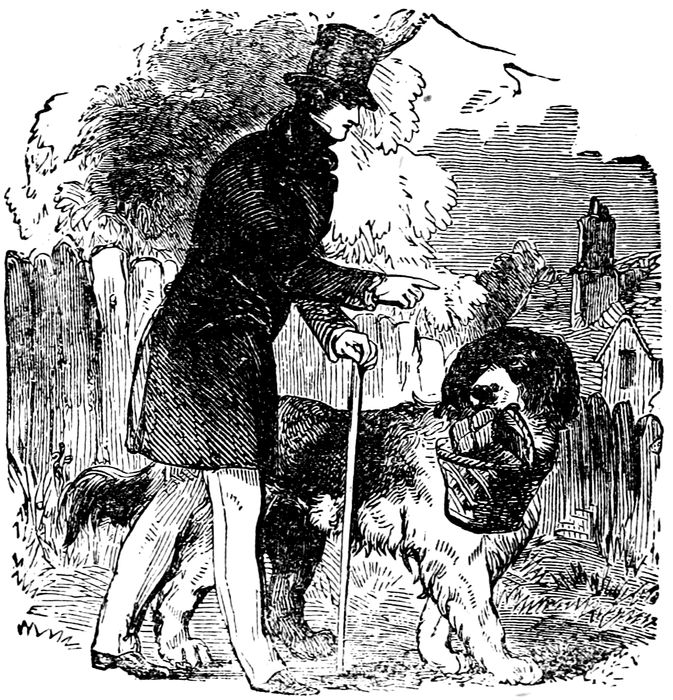
DOG TAUGHT TO CARRY BASKET.
This accomplishment may often be put to great practical use, and it is an excellent plan to teach all dogs, which are large enough to be of any service in this manner, to carry baskets or parcels when accompanying their masters. The mode of training is very simple, consisting of merely placing the article in the dog’s mouth, and when he lets go of it give him a slight box on the ear and replace the article in his mouth. Whatever is given him to carry should be of such a form as to be grasped 87easily by him without hurting his mouth or teeth. The weight should at first be very light and never more than he can easily carry. Most dogs will take a real pleasure in carrying articles in this manner, and they seem to feel the responsibility attached to their duty, for they will carry their own or their master’s dinner without attempting to appropriate any portion of it until the proper time when their share shall be given them. In teaching dogs to carry food, however, it is necessary to take a little special pains to overcome their instinctive inclinations to eat it. A good plan is to place the article in a covered basket which they cannot open, and when the dog has learned to carry an ordinary parcel give him this. If he attempts to get at the food, which he readily detects by his sense of smell, box his ears. By-and-by reward him with the food, and then try him with a basket from which he can abstract the contents; if he tries to do so punish him slightly, never permitting him to steal the food. If a dog ever deserves a reward for well doing he certainly does in this case, for it is too bad to tantalize him with the smell of some dainty and then not to let him finally have something for his good conduct.
To make a dog carry articles from one person to another it is only necessary for two persons to take their position at some distance from one another. One gives the dog some article saying, “go, sir,” at the same time. As the first says this let the other person call or whistle to the dog. Now let this one give the dog some thing and let the other one call him, and so on back and forth until he will go from one to the other at the command, “go, sir.” The distance between the parties may be increased from time to time, and the trick may be varied by one of them hiding himself, this will teach the dog to hunt for the person to whom he is to deliver the article, which will prove useful when you by-and-by desire to send him on an actual errand to a distance.
The extent to which any dog may be educated in this matter depends very much upon his natural intelligence and the skill and perseverance of his teacher. Many anecdotes are told of dogs going on errands. In some cases they go to the post-office for letters, in other cases to the store for groceries, etc., and we recollect several instances cited where dogs would, on being given a piece of money, go to the baker’s and purchase cake on their own account. The baker, in one of these instances, is said to have one day palmed a stale bun upon a dog who had been in the habit of coming to him regularly with pennies, and the animal, to show he was not to be imposed upon, transferred his custom to a rival establishment. In none of these accounts 88have we ever seen any mention of the dogs having been subjected to any special training, and it is more than likely that they never were. Animals, like men, are creatures of habit. If a man becomes accustomed to a certain routine it is difficult for him to change. Many merchants, retired from business, continue to pay a daily visit to their old offices, their brokers or lawyers, just because not to do so would make them uncomfortable and restless. So a dog who has become used to accompanying his master on any regular round of duties will often show that he understands where it is they are going by running ahead and stopping at the accustomed place. We call to mind a dog belonging to a gentleman residing some miles from this city, who will serve as an example of what we have stated, though probably all of our readers are familiar with instances equally, if not more, remarkable. The gentleman was accustomed to walk from his residence some half mile to take the morning train for the city, and to return by a particular train in the evening. The dog accompanied him to the cars in the morning, and would again meet him on the arrival of the train at night. It took him some weeks to learn when to expect his master, but after that he never made any mistakes.
A writer in one of the magazines mentions a poodle who was in the habit of going to church with his master and sitting with him in the pew during the whole service. Sometimes his owner did not come, but the poodle was always promptly in his place, remaining during the service and departing with the rest of the congregation. One Sunday the dam at the head of a lake in the neighborhood gave way, and the whole road was inundated. The attendance at church that morning was therefore restricted to a few individuals who came from near by. But by the time the clergyman had commenced, he saw our friend the poodle coming slowly up the aisle dripping with water, having been obliged to swim a quarter of a mile to get there.
It is not very difficult to teach a dog to go on errands. Suppose you wish him to go to market for you of a morning; take him with you regularly for a few mornings, letting him carry the basket. In a few days he will understand when you start where it is you propose to go, and will, perhaps, run on ahead and arrive there some minutes before you. It would be well on all occasions before starting to give the command, “Go to market,” which will accustom him to it.
We do not vouch for the truth of the story of the dog who, on being given—when purchasing one time on his own account, with money given him for that purpose—a piece of meat inferior to what he considered his due, went and brought a policeman.
The dog having been taught to fetch and carry, an amusing application of this knowledge can be made by having him bring his own tail in his mouth. This trick is exceedingly funny and is always hailed with roars of laughter. The feat is rather difficult for while his tail is in his mouth, the dog can only advance in something like crab fashion, or sideways, with an almost irresistible tendency to go around in a circle without getting ahead any. To attain success in teaching this trick the dog must be gifted with a good deal of tail, and the trainer with a good deal of patience. Dogs will in play grasp their tails, and most persons have noticed while frolicking with a dog that if the dog’s tail be taken hold of with one’s hand, the dog will attempt to seize the hand with his mouth, and if his tail be now dexterously placed in his way, he will seize that. This perhaps first suggested the idea of the trick, and this is the initial step of the training. When the dog takes hold of his tail praise him, and after he has held it a little while bid him “let go,” and reward him. Should he relinquish his hold before you order him to, speak sharply to him and commence again. When he has learned to retain hold of his tail until ordered to relinquish it, the more difficult part of his lesson may be taught—the bringing it to the trainer. The trainer at first takes his place a few feet from the dog in the direction in which the dog can most easily advance, and calls the dog; should he let go his tail to come, he is to be scolded, and the tail replaced in his mouth. When he comes without letting go, he should be rewarded. Gradually the distance he is required to come may be increased, but it would be cruel to make this distance more than half a dozen yards. When the tail is placed in his mouth it is well to say, “Bring me your tail,” to accustom him to the order. By-and-by when you give this order merely hold his tail for him to grasp, and at last let him seize it without any assistance from you.
There are several modifications of this trick, or rather there are several feats all performed with this instrument—a globe of wood or other material some two feet in diameter. One of these feats consists in the dog standing with his hind feet upon the ground, and resting his paws on the ball, pushing it forward, or up and down an inclined plane. This is easily taught, and the only difficult part of the performance is the descent of the inclined plane, where the ball is apt to roll away from the animal. To teach this trick it is only requisite to place the dog’s paws upon 90the ball and set it slowly in motion; as you do this tap his hind legs gently from behind to urge him to step forward. It may be necessary to hold him in position by the nape of the neck at first, but he should very soon learn to retain his position without this aid. When he rolls the ball readily upon a level, substitute a wide plank very slightly inclined, up which he should be required to roll the ball. Increase the inclination of the plank slightly with each lesson, but the descent should only be attempted after he has been thoroughly drilled in the preceding exercises. It will be necessary to commence with a very slight inclination and to promptly stop the ball should the dog begin to lose control of it. The width of the plank may be decreased eventually to some ten or twelve inches.
To stand entirely upon the ball while it is in motion, and to propel it backward and forward, and up and down the inclined plane, starting and stopping it as well as guiding its motions in the desired direction—is a more difficult feat. In this the dog must be practiced in standing upon the ball while it has no motion; in several lessons in this just the barest possible motion is to be given to the ball while a slight hold upon the dog’s neck keeps him in position. The motion may be slowly increased with each lesson, but the ball must for many lessons be held firmly with the hand to prevent it becoming unmanageable. When the dog becomes able to maintain his position he may be required to manage the ball without any assistance. In all cases where he gets down from the ball, accidentally or willfully, he should be spoken to sharply, but the trainer should be equally prompt to praise and reward success.
The stilts used in this trick are about twelve or fifteen inches in length, made to fasten to the leg just below the knee joint, with tape or thin flexible leather straps. When four are used there is no particular training required to make the dog walk upon them; it being only necessary to put him “on his pins” again whenever he upsets. The tumble is sufficient punishment for his failures. Walking man fashion on only two stilts is a much more difficult task, though it has been accomplished in some cases. The dog should be first thoroughly taught the walking erect trick, then stilts may be put on his hind legs. A cord attached to his collar and held in the trainer’s hand will aid in maintaining the dog’s balance until he becomes accustomed to his novel position. Of course the dog cannot raise himself upon the stilts, but must be placed erect by the trainer. The farther training is similar to that described for teaching 91him to walk erect. A story is told of a dog who actually found a wooden leg of practical use; one having been furnished him by a whimsical surgeon who had amputated an injured limb for him.
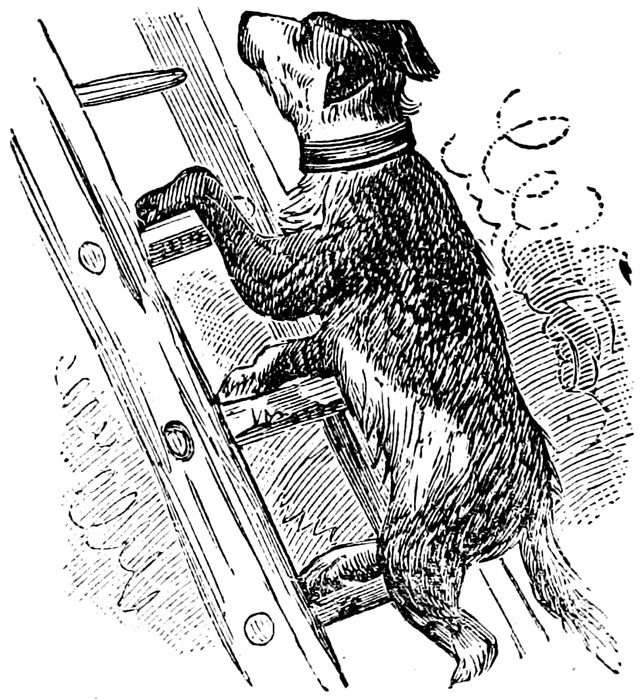
CLIMBING THE LADDER.
In teaching this trick two ladders should be provided about six feet in length and joined together at the top ends so as to form an angle when the other ends are placed on the ground. The bars of these ladders should be flat and sufficiently near together to enable the dog easily to step from one round to another. Standing at the side of this ladder with a switch in your right hand you whistle to the dog, or call him by name, and tap the first round of the ladder with your switch to indicate he is to step upon it. When he places his fore paws on this round, tap the next in the same manner, saying, “Go on,” to him. If he does not obey strike his hind legs lightly from behind, while you encourage him with your voice and snap your fingers in front of him to urge him forward. A tid-bit of some kind held in tempting proximity to his nose may have an encouraging effect. After ascending one ladder he should be made to go down the other. He will be inclined to jump to the ground in preference to descending step by step; should he do this he must be punished and made to commence over again. When on the ladder if he hesitates about proceeding gently tap the toes of the foot he should next advance. When two dogs have been taught to go over the ladders a race may be arranged, the dog who first goes three times over to be rewarded. The dogs 92will soon understand that when they are both ordered to go over, speed is expected; the dainty given to the winner will be an incentive to exertion. By making one dog go up to where the ladders join, turning half around and forming an arch of his body, the other dog can go over the ladders, passing beneath the belly of the “arch.” This is a very trifling feat but it generally pleases an audience.
The ladder climbing forms really the principal part of the celebrated siege scene, performed by dogs and monkeys. This scene, we believe, was first enacted in London in the year 1753, by a troupe of dogs and monkeys which acquired considerable celebrity by their performances. They were owned by a lady, who had also taught them, and went by the name of Mrs. Midnight’s Animal Commedians. A small stage was specially fitted up for their performances, furnished with scenery, decorations, etc., and to these adjuncts was no doubt due much of the success of the troupe. The performance was much like modern ones; the tricks are all included in this chapter and the one on monkeys; the famous siege being only a clever combination of the different tricks. Each animal was taught a particular part and merely obeyed the signals of the exhibition.
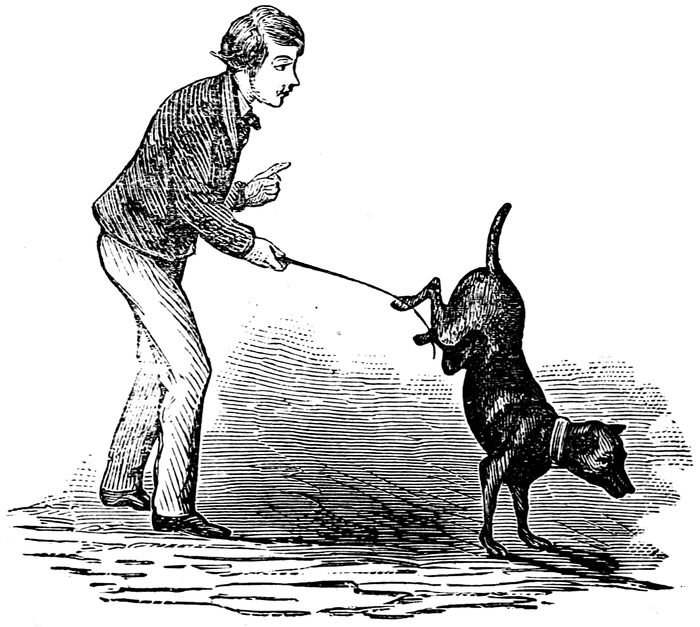
WALKING ON FORE LEGS.
The term “standing on the head” is applied to a “wrong end up” position though the animal is actually supported by his 93fore paws, his head not necessarily touching the ground. To teach the trick, provide yourself with a switch twenty inches in length, and moderately stout. This switch, held in your right hand, you place under the dog’s belly, and while you raise up his hind quarters with it, you place your left hand on his head to keep him from moving away, and to make him retain his reversed position. As the dog rises into position the switch should be gradually carried along until it supports his hind feet. This is the process for the first few lessons, until the dog understands what is required; after that it is better merely to tap his ankles from in front with your switch, giving at the same time whatever order you have accustomed him to in teaching the trick. He should eventually take the position without any hint or help from the switch.
When the preceeding trick is thoroughly mastered, the walking part may be easily added. Taking your position a little in front of your pupil when he is in his upside-down position, you encourage him to come to you. At the same time you must keep your switch in handy proximity to his toes, which you tap lightly on any signs of his relinquishing his position. By-and-by he may be made to walk quite a distance.
When a dog howls in time, we think it fair to call his performance “singing.” Dogs may be taught to do this; at least they have been, and it is reasonable to presume it may be done again. In only one case of this kind do we know positively the mode of tuition, but it was probably pretty much the same in all cases. This consisted in keeping the dog without food until his appetite was quite sharp. When food was shown him, he naturally whined for it. Now, a dog may be made to whine, howl, or bark, if you make any of those noises yourself; almost any dog will imitate you, and not only that, but the pitch and style of noise he makes will be somewhat regulated by that made by you. The hungry dog is in prime mental condition for this exercise, and if rewarded when he hits pretty near upon the right degree of noise, he will learn to follow your tones quite accurately. If exercised in a regular scale, or in a simple tune, he will by-and-by go through it without requiring your prompting, with sufficient accuracy to be recognized—if the hearers know beforehand what melody to expect.
It is not pretended, of course, that dogs trained as above described, do anything but repeat a series of noises mechanically in a prescribed rotation. We find recorded, however, one instance of a dog learning to discriminate between the different 94notes, and to detect false ones in a musical performance. The story seems improbable, but may be true; however, it is worth telling:
“Frederick Schwartz, a merchant retired from business in Darmstadt, occupied his leisure hours, which were many, almost exclusively with music. His passion for the art acquired such an intensity that he required every one about him to fall in with his musical predilections by either vocal or instrumental coöperation. Poodle, the dog, was the only one unable to render any musical assistance. As worthy Herr Schwartz felt the utter impossibility of making Poodle afford any practical aid, he determined to train him to fill the office of critic in his own harmonious community. He succeeded, too, by an ingenious method. Whenever a note out of tune proceeded from a voice or an instrument; every time that a musical fault was committed by any member of the family—and such faults were committed purposely—the rod was applied to Poodle’s back, and he naturally began to bark and howl. He was exactly in the position of the whipping boy, who pursued his studies with the royal prince. Whenever the prince made a grammatical blunder, the whipping boy had to smart for it. Before long, simple threats were substituted for smitings of his (Poodle’s) back; afterward a look sufficed to set the creature barking; and little by little Poodle familiarized himself with wrong notes and other musical atrocities, until at last a mistake could not be committed without his rebuking it either by a bark or a growl. He thus became, as far as music was concerned, the most impartial judge, the most conscientious critic in the whole grand duchy of Hesse Darmstadt.
“Unfortunately, his appreciation of musical art was completely and solely negative. He bestowed no praise, but only blame. Sing with expression, perform with talent, the dog would remain impassive and cold; but at the slightest incorrectness of intonation he ground his teeth, lashed his tail, growled, yelped, and barked aloud. So long as he flourished—and he may flourish still—not a concert or an opera was rehearsed in Darmstadt without inviting Herr Frederick Schwartz and his dog—but more especially the dog. If the prima donna made the slightest slip, the dog looked at his master with an air of disapprobation. If the hautboys came in too late, Poodle pricked up his ears; if the clarionet hurried the movement, Poodle fidgeted on his bench; if the kettle-drummer broke the time, Poodle uttered audible murmurs. In fact, no piece was considered properly executed unless the canine connoisseur remained quiet on his seat.
95“Nor must it be supposed that Poodle’s instinct was limited to forming a judgment of the execution only. His intelligence, trained by hearing classical works, seemed to have penetrated some of the secrets of composition. An abrupt modulation, a false resolution, would produce symptoms of doubt on Poodle’s muzzle; consecutive fifths made him shudder, and a halting melody set his teeth on edge. Sometimes Herr Schwartz and his intimate friends, in the privacy of a snug little quartette party, would amuse themselves by producing discordant sounds, for the sake of tormenting the sensitive animal. On such occasions Poodle lost all self-command: his hair stood on end, his eyes became bloodshot, and frightful howlings answered to the discord produced by the fiddles of the mystificators. Moreover, they were obliged to keep within certain bounds. Poodle possessed only a limited stock of forbearance. If the cacophony was too intense or too prolonged, Poodle, carrying out his sense of duty, upset everything. Music-stands, music-stools, and instruments, were strewed in confusion about the room.”
This consists in placing a lump of sugar on the dog’s nose, and having him toss it up and catch it in his mouth. It is not essential that sugar should be used; any other dainty will do as well, indeed a piece of meat will answer better in teaching the trick. In teaching, hold your switch under the dog’s chin, and tap him whenever he tries to lower his head to let the meat drop. If he does not presently jerk his head up, and so throw the morsel into the air, you should strike him under the chin a pretty smart rap to make him do so. When it leaves his nose there will be no instruction required to make him seize it promptly before it has a chance to reach the ground; should it, however, touch the ground, it is well to take it from him, and make him toss it again.
A dog may be placed on his back or in almost any other posture, and by speaking sharply to him and threatening him with your forefinger, you can prevent his changing his position. In this manner the trick of feigning death is taught. If a special word of command be used when placing him, he will learn to take the position on hearing that command.
CHAPTER XI. WONDERFUL FEATS PERFORMED BY DOGS—MOST CELEBRATED DOGS OF THE WORLD—LEARNING THE ALPHABET—TO PLAY CARDS AND DOMINOES—TO SELECT ANY ARTICLE DESIRED AND PUT IT ANYWHERE DIRECTED.
Our last chapter gave a wide range of tricks performed by dogs, most of which can be taught by the amateur trainer. There is another class of tricks, requiring great intelligence on the part of the dog, and rare skill and patience on the part of the trainer, for their successful mastery. Though these may be beyond the abilities of ordinary dogs and ordinary trainers—for such feats are very rare, even in public exhibitions, and when performed, are looked upon almost as miracles—they cannot fail to prove interesting to our readers, and it is barely possible that some reader of this book may yet astonish the world with some equally proficient animal, to rival those whose deeds are herein recorded.
The French trainers have probably brought the education of the dog to a point achieved in no other country, and several of these canine celebrities have become subjects of history. Emil de Tarade gives a very interesting account of two of these, the principal part of which account we translate, as follows:
“In 1840 I was acquainted with M. Leonard, of Lisle, (an inspector of the revenue) who possessed two well taught dogs. Braque and Philax, as they were named, were two grayhounds, with large brown ears. Their eyes alone would tell you how much intelligence had been developed in these interesting animals. Words were fixed in their memory with a positive meaning. These dogs knew as well as we do the meaning of ‘above,’ ‘below,’ ‘before,’ ‘behind,’ etc. They made a proper application of the name of a color, of a number up to a certain point; knew what was meant by ‘parlor,’ ‘corridor,’ ‘stairs;’ knew the furniture, utensils, small objects of the pocket and toilet; and when one bade these dogs perform in the absence of their master, one was seized with astonishment and admiration.
“If you said to one: ‘Go sit down in front of the lady in the rose-colored dress,’ the dog went immediately to seek the lady so designated, seated himself upon his haunches, wagging his tail, and regarding the lady with a very expressive look. ‘Ask the lady for her thimble.’ The lady offered successively her handkerchief, gloves, etc., but the animal did not move. 97As soon as she presented the thimble, he ran off, making a thousand gambols at having obtained it. After this he passed gravely about the room, as if to say: ‘What shall I do with it?’ On saying to him: ‘Go to the sofa in front of the fireplace—there is a hat upon it—put the thimble in the hat, and carry it to the lady in blue,’ the dog would strictly carry out the order.
“Placing a piece of meat on a piece of bread, and putting the whole into a corner of the room, you might say to either of these dogs: ‘Seek it! Seize it!’ The animal would run toward the object in question, but on nearing it, he would face about, seat himself before you with a pleasant air, as if to say: ‘I only eat what my master gives me—is Mons. Leonard present?’ The latter would say: ‘Leave the meat—put it on the ground—eat the bread.’ The order would be executed.
“Both these dogs knew how to play dominoes, and this is the method in which it was done: One dog was made to seat himself upon a chair before a table on which were placed the dominoes, and opposite a human player. It was necessary to give the dog only four dominoes, which were laid out in a row, the faces toward him. If he had a double six he played it at once, placing it in the middle of the table. If he had not, he waited for his opponent to play. Then, if he had a domino proper to play, he did not fail to do it, though he never adjusted it nicely—contenting himself with placing it at the end to which it belonged. If you attempted to cheat, by placing a two, for instance, where a six belonged, he contented himself (if it was a lady) with returning the wrong domino; but if it was a gentleman, he accompanied the correction with a growl, as if to say: ‘Do not revoke, sir.’ These feats were performed by these dogs either in the presence or absence of their master.
“One day, walking in the country, I asked M. Leonard to order the dogs to go over a fence right and left. He did so by command only, Philax going over on our left, and Braque on the right, as they were ordered. Then he ordered them to kiss each other; they pushed muzzle to muzzle in quite an amusing way. Another thing, the dogs were frequently sent to the butcher, baker, or grocer, with a basket and written message, and on these occasions it was only necessary to say: ‘Go to the butcher!’ ‘Go to the baker!’ or, ‘Go to the grocer!’ and the command was always obeyed without fail. On these occasions, one would carry the basket, and the other would act as guard.
“One may see from this that if the grayhound, the least intelligent of his kind, is capable of such instruction, all dogs are 98capable of being taught to do things which seem apparently impossible.”
Still another French celebrity of the canine kind is described by a writer in Le Siecle, a Paris journal. Mlle. Bianca, as she was called, one of the pug breed, created quite a sensation among amusement seekers at the time she was exhibited, and her wonderful feats were witnessed by large audiences. We did not see her performance, but have been assured by persons who did, that the following, though perhaps a little highly colored—as is the habit of most French writers—is yet substantially an accurate description of the dog’s feats. Le Siecle’s reporter says:
“As most of the Parisian papers have mentioned this little phenomenon, who reminds the public of the genius of the illustrious Munito, I, in turn, wished to make Mlle. Bianca’s acquaintance. She did me the honor to accord a private audience to me, for which I am extremely grateful. To see artists on the theater of their exploits is doubtless very agreeable, but to be introduced into their intimate circle of friendship, is still more precious. If these lines should fall under Mlle. Bianca’s eyes—as it is not improbable, for artists generally do not disdain to read newspapers where their merits are vaunted—she may see that, though I am only a man, may hert is no stranger to every sentiment of gratitude. Let me say, in the first place, in praise of my heroine, that her modesty exceeds even that of male and female literary people, who are, as everybody knows, a most modest race. Vanity, that horrible fault which some observers have insisted they were able to detect in some men and women—fortunately extremely rare—is no canine vice; and great as are Mlle. Bianca’s talents, she remains what nature made her—simple and good natured, and as sprightly as beautiful.
“She reads fluently, writes in her way, corrects faults of orthography, takes part in a game of ecarte, forms a bouquet by the names of flowers or their colors, and barks, or at least is familiar with, nineteen languages. Even if we admit the natural affection which Mlle. Bianca’s professor has for his excellent pupil has betrayed him into exaggerating the talents of Mlle. Bianca some fifteen more tongues than she really possesses, nevertheless she will still be a most distinguished polyglotist. This I can affirm. I gave her the English word ‘God’ to translate into Latin. She instantly, and without hesitation, composed the word ‘Deus.’ This is her modus operandi: She is placed on a table sufficiently large to allow her to move easily in every direction. She is in the center of the table. All 99around her are small bits of pasteboard, bearing each a letter of the alphabet. When a spectator gives a word, or asks for a translation, Mlle. Bianca seems to think a moment, half closes her eyes, like a poet hunting for a rhyme, and moves around the table, taking pasteboard, letter after letter, until she completes the word. She does this quietly, easily, without ever being betrayed into hurry. The word formed, she gravely takes her seat and gives one bark, as a printer places a period at the end of a sentence. She plays cards, and forms nosegays in the same way. While this intellectual animal is at work, her master stands motionless, some three or four paces from the table, but does not say a word. He sometimes disappears entirely behind a door, and Mlle. Bianca works wonders as effectually as when he is present. I said to her tutor: ‘So your dog really reads and understands what is said to her?’
“‘How can you doubt it, as you see she does so as well when I am absent as when I am by her side?’
“‘She really is the worthy peer of Munito, the Newton of the canine race.’
“‘Munito!’ quickly exclaimed Mlle. Bianca’s tutor, his lip curling with contempt as he spoke. ‘Munito was a miserable humbug; one of those dogs who abuse the public credulity.’
“‘What? Munito a humbug? You astound me!’
“‘Yes, sir; and were Munito here, I should tell him so to his face. Impostors and dogs of real talents should not be confounded. Munito did not know B from a bull’s foot, while Bianca has learned by rule. What she knows, she knows thoroughly.’
“‘Is it possible Munito knew nothing, and merely concerted with his master to appear learned?’
“‘You have hit the nail on the head.’
“‘Do you mean to tell me there are pseudo savants among dogs? I thought men had a monopoly of that plague.’
“‘Dogs don’t escape it.’
“‘Good heavens! can a fellow trust neither man nor dog? Do enter into particulars; and since I am doomed, it seems, to lose one more illusion, let the loss, at least, turn to the profit of my knowledge.’
“‘I, too, was a dupe to Munito’s merits; but one fine morning the scales fell from my eyes, and I discovered the truth. Like my Bianca—forgive me the odious comparison, dear!—Munito stood in the center of a circle formed of bits of pasteboard bearing letters, or figures, or colors. I grant you, Munito had a good deal of brains; he was no fool, I admit, and his ear was exquisitely delicate. Had he been trained by a good method, 100he would have attained high rank; but his master, who was an Italian, preferred turning his delicacy of hearing to profit, rather than bringing him up by rule.’
“‘Ah! Munito was no classic. But, pray tell me, did he then belong to the romantic school?’
“‘Not a bit more than he belonged to the classical school. All his talents lay in obeying his master’s signals. Munito walked gravely around the table, assuming the airs of a member of the French academy; but incapable as he was of reading or distinguishing colors, he never stopped to pick up the bit of pasteboard except when his master gave him the signal. Munito’s master stood with his hand in his breeches pocket. He would snap a finger nail or a tooth pick, and this click, though so slight as to escape the attention of the spectators, was caught by the dog’s ear, and who instantly received the reward of his criminal comedy. He was given a bonbon. Do you know of what that so-called bonbon was made? ’Twas nothing but bread and meat hashed fine and rolled in the shape of a ball; but there was no more sugar in it than there is in a black draught. Such cheating really deserves the brand of history. If you think I speak harshly of Munito, my excuse is, he is dead. We owe nothing but truth to dead dogs as well as dead men.’”
The reader will perceive that, for the best results, a systematic course of education is necessary rather than the teaching of a mere trick, to be performed at a recognized signal from the trainer. Presuming that the dog has been taught to fetch and carry, as described in the preceding chapter, and may thereby be considered to be well up in the rudiments of canine education, the following, which may be termed the “classical” course, would be the system of instruction—it is, indeed, the same as was pursued with Braque and Philax:
Having taught your dog the meaning of the words, “go fetch it,” “bring it,” “drop it,” “bring it back,” you will next teach him the names of different articles. Let us first take a handkerchief, and placing it upon the ground, order him to “bring the handkerchief,” until the name is impressed on his memory. Now we will add a glove, and direct the dog to “bring the glove.” Should he bring the handkerchief instead, we scold him, but should he bring the glove, we reward him. When he has thoroughly learned to distinguish these articles by name, a key may be added, and the same method of teaching continued. One by one other articles may be added, until the number is sufficiently large to make the trick entertaining. When he has been exercised in picking out on command the desired article 101from those-placed on the ground, hide one of them, and, calling the hidden article by name, order him to bring it. If, after examining the objects before him, he shows by his distressed looks that he knows the article required is not among the others, you may be assured he has thoroughly acquired his lesson. If he brings a wrong article, it is certain that either he is careless, or not sufficiently drilled.
Differences of color come next. Take, for example, a red, white, or blue handkerchief, and placing it on the ground, direct the dog to bring it, calling it by color as well as name. At first he will bring it, because he knows what the word “handkerchief” means, and without giving consideration to the color; but when you add a handkerchief of a different color, still ordering him to bring the former one, he will remember the new word and its application to the right handkerchief. Supposing you have commenced with the red one, and have added the white, should he bring the white, you say sternly, “No! the red handkerchief,” making him replace the white, and bring the red. Now repeat the lesson, calling at will for first one and then the other, until he makes no mistakes. Then add the blue handkerchief, and repeat the lesson. Gloves of various colors may then be added, one by one, in all cases naming the color as well as the article when directing him to bring it. The number of objects may be increased to whatever extent the patience of the trainer and the capacity of the pupil will admit of.
After that it will be found convenient to teach him the names of the more common articles of furniture. Pointing to a table, you will say to him: “Go to the table.” The motion of your hand will probably direct him to the designated spot; and by repeating the lesson, he will learn to associate the name of “table” with that article. Of course, “chair,” “sofa,” and other objects may be added as he progresses.
Then he may be taught to distinguish between the meanings of such words as “on,” “under,” etc. This is done by emphasizing the prepositions as: “Put the glove on the chair;” “Put the handkerchief under the table,” etc., in each case repeating the order until he obeys correctly. If all preceding lessons have been thorough, he will readily comprehend all of the order but the new part, and as his attention will only be required by that, he will soon learn it. Then the titles of individuals, as “lady,” “gentleman,” and “child,” may be taught in the same manner, reproving his failures and rewarding his successful attempts.
To secure a valuable dog against accidental or malicious injury from poisonous or improper food, it is well to accustom 102him to take his food from the hand of his master, or some other trustworthy person, and never to eat anything unless it be so given. This is the foundation of several tricks spoken of in a preceding page. After the dog’s intelligence has been so cultivated that he quickly understands your wishes, and has become accustomed to rendering implicit obedience thereto, place within his reach a piece of meat, or a saucer of milk, and order him not to touch it. Then retire to a short distance, but be ready to check any attempt to seize the food, by repeating the command, “Don’t touch it,” and by force if necessary. Do not tantalize him too long, but soon give him some tid-bit as a reward for his self-control, and repeat the lesson. By-and-by he may be left alone, at first only for a few minutes, then for a longer and longer time.
It is possible—and, indeed, it is the common method—to teach a dog to pick out any desired letters from a number of printed cards, in obedience to signals given by the exhibitor. This method of training is essentially the same as that adopted with the “educated hog;” so it is unnecessary to describe it here. But dogs, as in the case of those described in the preceding pages, may be taught to know the letters, and to recognize them when named; so that the performance can be conducted more openly, and without risk of the clap-trap of signals being detected.
But how is this to be taught? Why, very much as a child is taught—by constant drilling until the name and looks of each letter are perfectly associated together. Pieces of pasteboard should be provided, on each of which one letter is marked large and plain. Placing the A and B cards side by side, tell the dog to bring you the A. If he brings the B, scold him; make him return it to its place, and again order him to bring the A. As soon as he does so, pat him, speak encouragingly to him, and repeat the lesson, not calling the letters in any regular rotation, but at random. Add letter by letter each day as the dog learns thoroughly those already given him, until he can select without hesitation any letter of the alphabet that may be called for. He may then be made to spell words by your calling the letters composing them. If thoroughly trained, he will bring the proper letters when shown a card on which the word you desire him to spell is printed. Of course, only capitals should be used in these exercises, for otherwise the labor of teaching would be doubled, besides confusing the dog between capitals and small letters, without gaining anything.
On the same principle the dog may be taught what, with a little license, may be called playing cards. Pieces of pasteboard 103several times the size of ordinary playing cards should be provided, one side of each being printed to represent one card. As with the letters, these cards are to be placed on the floor, at first only two, then three, increasing the number as the dog learns those already shown him. Suppose the ace of clubs and the ace of hearts be used to commence with: direct the dog to bring the ace of clubs; if he does so, reward him, but if he brings the heart, scold him, and order him to return it; again directing him to bring the ace of clubs. So on with each lesson until he can distinguish between all the cards, and bring any one desired. After this, cards a little smaller may be substituted for those at first used, and then smaller and smaller ones until the customary playing cards are used. We give this feat on the authority of M. de Tarade, never having personally seen it performed, but it is really not so difficult as might at first be imagined; the dog, even to know the whole pack, needing only to learn the thirteen values of the cards, and to then distinguish between the four suits.[2]
2. Even this would be a greater feat of intelligence than we have ever seen exhibited by a dog, and we are inclined to think there was some aid afforded in this case of the French dogs, by arranging the cards systematically, or by some other means. It is harder to count (or to distinguish between) the number of dots, than to distinguish between a blue handkerchief and a red stocking. The dog who is described as playing dominoes, it should be remembered, used only four pieces at one time. Possibly the dog recognized the cards by the general appearance of each, not the number of spots thereon.
The “playing” part consists in the trainer directing the dog to bring the particular card required; wherever it is pretended that the dog of his own accord selects the proper card for taking a trick, there is really deception; the dog in such a case must be secretly directed by signals which he has been taught to obey.
To teach a dog to play dominoes, provide some pieces of board or thick card, some eight or ten inches long, on which paint conspicuously in black the required dots. Having provided two sets in this manner, spread one set upon the floor, and taking in your hand the blank domino of the other set, you say: “Bring the white.” Being familiar, from his previous training, with the color, he will doubtless select the correct domino. Then you show him the one spot, directing him to “bring the one.” Should he hesitate, repeat the command, showing him the spot on the domino in your hand. As soon as he has learned this difference, cease your instruction for the day, as it is unwise to attempt to go too fast. On the next day the two, three, and four may be included in the lesson; and so on each day, adding two or three, until the whole are learned. Having learned so much, the dog is prepared to play 104a game of dominoes, for the game consists merely in matching certain pieces.
Munito, the dog to whom reference is made in a preceding page, was a French poodle, very handsome, with a fine silky, white, woolly coat, half shaved. A gentleman who saw him exhibited in Piccadilly, London, nearly fifty years ago, thus describes his performance, disclosing at the same time the secrets thereof:
“He performed many curious feats, answering questions, telling the hour of the day, the day of the week, or date of the month, and picking out any cards called for from a pack spread on the ground. At the corner of the room was a screen, behind which the dog and his master disappeared between each feat for a short time. We watched him narrowly; but it was not until after our second visit that the mystery was solved. There were packs of ordinary cards, and other cards with figures, and others with single letters. One of the spectators was requested to name a card—say the queen of clubs—the pack was spread on the floor in a circle, faces upward. Munito went around the circle, came to the queen of clubs, pounced upon it, and brought it in his mouth to his master. The same process was repeated with the cards with figures, when he brought the exact numbers which answered the questions put as to dates, or days, or hours; in the same way with the letter cards, when he picked out the necessary letters to spell any short word called for, always making a full circle of the whole of the cards for each letter, or for each number, and never taking up two letters or two numbers consecutively, though they might chance to lie close together. This fact we made out at the first visit, but nothing more. On the second occasion we watched more narrowly, and with that object took a side seat, so that we had a partial view behind the screen. We then noticed that between each feat the master gave the dog some small bits of some sort of food, and that there was a faint smell of aniseed from that corner of the room. We noticed that the dog, as he passed around the circle of cards, with his nose down, and his eyes directed to the ground, never pounced on the right card as his eyes covered it, but turned back and picked it out. It was clear that he chose it by the smell, and not by the sense of sight. We recalled that, each time before the dog began his circuit, the master arranged and settled the cards, and we then found that he pressed the fleshy part of his thumb on the particular card the dog was to draw, which thumb he previously put into his waistcoat pocket for an instant; and as he passed close to us, his waistcoat had an aniseed scent.”
105Dogs have been made to take part in stage representations, their performances being but applications of simple tricks taught in our tenth chapter. The good dog who recognizes the murderer of his master and seizes him by the throat; the other good dog who prevents an assassination by flying at the would-be assassin, and having a scuffle; and the still other good dog who rescues the child from drowning, or some other impending danger, are all “worked” by signals, or obey understood commands—the actor’s “cue” serving as well as any other word.
An amusing story is told of an accident which befell a penurious manager of a minor play-house, in endeavoring to avoid an engagement with the owner of the wonderful dogs, when their services and not his were to constitute the principal attraction. The owner persisted; it must be his dogs and himself, or no dogs at all; the sagacious animals would perform their marvels with no one else. The huckstering manager doubted this, and craved permission to try whether, by running across the room, and using the words repeated by the owner in the play, one of the animals would not seize him by the coat collar as well, without doing him any injury. The master consented, but the experiment failed entirely. The dog remained doggedly motionless. “It strikes me,” said the disappointed manager, “that if you were to say, ‘Go, sir!’ in a harsh tone, when I repeat the words, that he would at once perform the feat.” “Very well, sir,” replied the owner, “we will try the experiment, if you wish it.” The preliminaries were again gone through with; and the master said, “Go, sir!” The gigantic dog did go with a vengeance. He dashed off like an arrow; seized the manager by the nape of his neck, threw him violently on the floor, and giving two or three tremendous growls, seemed on the point of making mince-meat of his prey, who, petrified with fright, was glad enough to be rescued, and to permit the master to perform with his dogs, and on his own terms. He never was quite satisfied, however, that there was not some peculiarity in the “Go, sir,” used on that particular occasion.
CHAPTER XII. TAMING AND TRAINING ELEPHANTS—CAPTURE AND TREATMENT—ELEPHANTS AS LABORERS AND AS CIRCUS PERFORMERS. — THE WAY THAT ELEPHANTS ARE TRAINED. — HOW “HUNTING ELEPHANTS” ARE TRAINED. — PERFORMING ELEPHANTS.
In telling how elephants are trained, so interwoven is our subject with that of the capture of the animals, that perhaps our best plan will be to take a hint from Mrs. Glass’s recipe for cooking the hare, viz., catch him first—and commence with the capture of the animals. Although authentic instances are on record of elephants breeding in captivity, it is of very rare occurrence, so that, practically, it may be said that the entire supply of domesticated elephants has been obtained by conversion from a wild state.
The device of taking them in pitfalls still prevails in India, but this is a laborious operation, often unsuccessful, owing to the caution of the animal; besides this, if caught, the great weight of the elephant, and the inability of his legs to withstand any severe direct shock, too frequently cause so much injury to the game as to render this mode of capture unprofitable. A writer on Ceylon, nearly two hundred years ago, describes another method which is still practiced. Describing the captures of elephants for the stud of the king of Kandy, he says:
“After discovering the retreat of such as have tusks, unto these they drive some she elephants, which they bring with them for the purpose, which, when once the males have got a sight of they will never leave, but follow them wheresoever they go; and the females are so used to it, that they will do whatsoever, either by word or beck, their keepers bid them. And so they delude them along through towns and countries, and through the streets of the city, even to the very gates of the king’s palace, where sometimes they seize them by snares, and sometimes by driving them into a kind of pound, they catch them.”
Throughout the China-Indian peninsula the natives use female elephants in approaching males detached from the herd, or selected as desired captives on account of their beauty—the capture being effected by casting a noose over the foot of the victim. Probably, however, the Moormen of Ceylon are unexcelled in daring or adroitness in this vocation. So fearless are these professional catchers, or panickeas as they are termed, that two will, without aid or attendants, attempt the capture of the largest sized elephant. Their only weapon is a flexible rope of deer’s or buffalo’s hide. Stealing behind the animal 107when at rest, or stealthily following in his footsteps if in motion, they attach this rope to his hind legs. When at rest the elephant has a habit of swinging his hind feet, which aids the catchers in slipping the noose over the leg. Should the noosing be effected in open ground where there is no tree to which to secure the prize, one man allows himself to be pursued by the enraged elephant, and thus entices him to a more favorable locality, where the other man seizes the trailing rope and winds it around some convenient tree. The animal now turns upon his new assailant, but the first provokes him with gesticulations and taunting shouts of “dah! dah!” of which word the animal has a remarkable dislike. Meanwhile, the man’s comrade has secured the first noose, entangles one foot after the other until all are secured, and the capture complete.
Then a shelter of branches is put up for the men, and day and night they remain encamped before their prisoner. The elephant, in a few days at the farthest, becomes submissive, subdued by exhaustion and hunger, the terror of the fire which he dreads, and the smoke which he detests. Then an abundance of plantains and other dainties are given him, he is supplied with plenty of water, of which he is very fond, and gradually he becomes reconciled to his keepers, and finally they venture to start with their huge prisoner for their own village, generally many miles away, with forests and jungles intervening. Still too morose to permit his captors to ride him, and too powerful to be led or driven, this forced march taxes the ingenuity of the hunters to the utmost. Alternately vexing and eluding him, they keep his attention constantly attracted, and so induce him to move in the desired direction. The rope with which the capture was effected is of some assistance, besides being used to tie up the animal at night, and this is never removed from his leg until he is sufficiently tame to be entrusted with partial liberty.
GROUND PLAN OF A CORRAL.
METHOD OF FENCING A CORRAL.
Frequently a whole herd, numbering from thirty to one hundred individuals, is captured at once, but in this case a different plan from the foregoing is adopted. The custom in Bengal is to construct a strong enclosure (called a keddah) in the heart of the forest, formed of the trunks of trees firmly secured by transverse beams and buttresses, and leaving a gate for the entrance of the elephants. A second enclosure, opening from the first, contains water (if possible a rivulet;) this again communicates with a third, which terminates in a funnel-shaped passage, too narrow to admit of an elephant turning, and within this the captives being driven in line, are secured with ropes introduced from the outside, and led away in custody of tamed ones trained for the purpose. The keddah being prepared, the first operation is to drive the elephants toward it, for which purpose vast bodies of men fetch a compass in the forest around the haunts of the herds, contracting it by degrees till they complete the enclosure of a certain area, round which they kindle fires, and cut footpaths through the jungle, to enable the watchers to communicate and combine. All this is performed in cautious silence and by slow approaches, to avoid alarming the herd. A fresh circle nearer to the keddah is then formed in the same way, and into this the elephants are admitted from the first one, the hunters following from behind, and lighting new fires around the newly enclosed space. Day after day the process is repeated; till the drove having been brought sufficiently close to make the final rush, the whole party close in from all 109sides, and with drums, guns, shouts, and flambeaux, force the terrified animals to enter the fatal enclosure, when the passage is barred behind them, and retreat rendered impossible. Their efforts to escape are repressed by the crowd, who drive them back from the stockade with spears and flaming torches; and at last compel them to pass on into the second enclosure. Here they are detained for a short time, and their feverish exhaustion relieved by free access to water—until at last, being tempted by food, or otherwise induced to trust themselves in the narrow outlet, they are one after another made fast by ropes, passed in through the palisade, and picketed in the adjoining woods to enter on their course of systematic training. These arrangements vary in different districts of Bengal; and the method adopted in Ceylon differs in many essential particulars from them all; the keddah, or, as it is here called, the corral or korahl (from the Portuguese curral, a “cattle-pen,”) consists of but one enclosure instead of three. A stream or watering place is not uniformly enclosed within it, because, although water is indispensable after the long thirst and exhaustion of the captives, it has been found that a pond or rivulet within the corral itself adds to the difficulty of leading them out, and increases their reluctance to leave it; besides which, the smaller ones are often smothered by the others in their eagerness to crowd into the water. The funnel-shaped outlet is also dispensed with, as the animals are liable to bruise and injure themselves within the narrow stockade; and should one of them die in it, as is too often the case in the midst of the struggle, the difficulty of removing so great a carcass is extreme. The noosing and securing them, therefore, takes place in Ceylon within the area of the first enclosure into which they enter, and the dexterity and daring displayed in this portion of the work far surpasses that of merely attaching the rope through the openings of the paling, as in an Indian keddah, and affords a much more exciting sport.
In Ceylon, in former times, the work connected with these hunts was performed by forced labor extorted from the natives by their sovereigns as a part of the feudal service termed “rajakaríya,” and this labor was in succession demanded by the Portuguese, Dutch and English, as the island passed successively into their possession. Since the abolition of this compulsory duty, there has been no difficulty in securing all required assistance voluntarily. From fifteen hundred to two thousand men are required to construct the corral, drive in the elephants, maintain the cordon of watch-fires and watchers, and attend to other duties. Many weeks are occupied in putting up the 110stockades, cutting paths through the jungle, and surrounding and driving in the elephants.
POSITION OFTEN TAKEN IN ATTEMPTING TO BREAK THE ROPE.
In selecting the scene for an elephant hunt a position is chosen which lies on some old and frequented route of the animals, in their periodical migrations in search of forage and water; and the vicinity of a stream is indispensable, not only for the supply of the elephants during the time spent in inducing them to approach the enclosure, but to enable them to bathe and cool themselves throughout the process of training after capture. In constructing the corral itself, care is taken to avoid disturbing the trees or the brushwood within the included space, and especially on the side by which the elephants are to approach, where it is essential to conceal the stockade as much as possible by the density of the foliage. The trees used in the structure are from ten to twelve inches in diameter; and are sunk about three feet in the earth, so as to leave a length of from twelve to fifteen feet above ground; with spaces between each stanchion sufficiently wide to permit a man to glide through. The uprights are made fast by transverse beams, to which they are lashed securely by ratans and flexible climbing plants, or as they are called, “jungle ropes,” and the whole is steadied by means of forked supports which grasp the tie beams, and prevent the work from being driven outward by the rush of the wild elephants.
111The space enclosed varies, but 500 feet in length by 250 wide is a fair average. At one end an entrance is left open, fitted with sliding bars, so prepared as to be capable of being instantly shut; and from each angle of the end by which the elephants were to approach, two lines of the same strong fencing were continued, and cautiously concealed by the trees, so that the animals would be prevented from making their escape at the sides while being forced forward to the entrance of the corral.
The corral being prepared, the beaters address themselves to driving in the elephants. For this purpose it is often necessary to make a circuit of many miles in order to surround a sufficient number, and the caution to be observed involves patience and delay; as it is essential to avoid alarming the animals, who might otherwise escape. Their disposition being essentially peaceful, and their only impulse to browse in solitude and security, they withdraw instinctively before the slightest intrusion, and advantage is taken of this timidity and love of seclusion to cause only just such an amount of disturbance as will induce them to retire slowly in the direction which it is desired they should take. Several herds are by this means concentrated within such an area as will admit of their being completely surrounded by the watchers; and day after day, by slow degrees, they are moved gradually onward toward the immediate confines of the corral. When their suspicions become awakened and they exhibit restlessness and alarm, bolder measures are adopted for preventing their escape. Fires are kept burning at ten paces apart, night and day, along the circumference of the area within which they are detained. At last the elephants are forced onward so close to the enclosure, that the investing cordon is united at either end with the wings of the corral, the whole forming a circuit of about two miles, within which the herd is detained to await the signal for the final drive.
Suddenly the signal is given, and the silence is broken by shouts from the guard, the banging of drums and tom-toms, and the discharge of muskets. Amid this noise the elephants are driven forward to and through the gate, which is instantly closed to cut off their retreat. In a moment more they rush wildly about the enclosure, trampling the brushwood beneath their ponderous tread, and charge against the palisades, screaming with rage at each unsuccessful effort. By degrees their efforts slacken, and in about an hour the whole herd, exhausted and stupified, stand motionless.
SECURING CAPTURED ELEPHANTS WITH THE AID OF THE TAME ONES.
The next operation is to introduce the tame elephants into the corral to aid in securing the captives. Cautiously the bars which secure the entrance are let down, and the trained elephants, each mounted by its mahout and one attendant, enter the corral. Around the elephant’s neck is a strong collar composed of ropes of coconut fiber, from which hangs on either side cords of elk’s hide prepared with a ready noose. Gradually each trained animal approaches one of the wild ones, until being sufficiently near, the nooser watching his opportunity, slips the noose over one of its legs. Immediately the tame elephant retires with its riders, drawing the rope tight, and hauling the captive toward some large tree. In this the other tame animals lend assistance, pushing with their heads and shoulders. The first tame one now winds the rope around the tree, and the others crowd up to the wild animal, and keep him in position while his other legs are being secured. The tame elephants in all these proceedings appear to feel a sportsman’s interest, and are as eager to secure the victim as are their human assistants. Of their own accord they will perform any act which reason would naturally suggest for overcoming any difficulty that arises, or which seems necessary under any given circumstances. Thus Major Skinner relates an instance where a wild 113elephant raised with her trunk the rope which had been attached to her foot, succeeded in carrying it to her mouth, and would have bitten it through and escaped, but was prevented by a tame elephant placing his foot on the rope, and pressing it downward out of her jaws. On another occasion, the same authority says a tame animal watched her opportunity, and placed her foot under that of the wild one as he raised it, so as to prevent his replacing it upon the ground, enabling the nooser to attach the rope.
In all this though the tame elephants bend all their energies to securing the captives, and seem to really enjoy what is going on, they show no malignity, carefully avoid doing any injury to the prisoners, and even when it is necessary in binding new animals to walk over those already secured—usually sprawling on the ground struggling to get free—they take the utmost pains not to tread on them.
When first secured, the elephant struggles fiercely to break his bonds, writhing in a manner one would think impossible for so bulky and unwieldly an animal. Failing in this, he seems to give way to despair, and utters the most pitiable moans. Food is now placed within their reach, which at first they spurn indignantly, the older ones frequently trampling it under foot. The milder ones, as they become composed, allow themselves to be tempted by the delicacies before them, and commence listlessly chewing the juicy morsels. The mellow notes of a kandyan flute sometimes aid in soothing and composing the captives. It may be remarked that elephants are greatly influenced by music, being soothed and quieted by soft plaintive melodies, while it is also recorded that in the old wars in which they were used, their courage in battle was excited by the martial strains.
The last operation of the corral is to slacken the ropes and march each captive elephant down to the river between two tame ones. Both of the tame elephants are furnished with strong collars, and a similar collar is formed on the neck of the wild one, who stands between them, by successive coils of coconut; then these collars are connected, and the prisoner made secure between his guards. Then the nooses which have confined his feet are removed, and the three animals march to the river, where they are allowed to bathe. After the bath the captive elephant is made fast to some tree in the forest, keepers are assigned to him, as well as a retinue of leaf-cutters, whose duty it is to keep him supplied with such food as he most relishes. These arrangements being made, he is left to the care of his new masters, who will see that he is trained up in the way he should go.
It is a very general impression that the training of these huge and powerful animals is a work of great difficulty and tediousness. This is a mistake. Elephants are naturally of a mild and docile nature, although hunters and travelers, to add luster to their own exploits, have represented them otherwise. Even the notorious “rogues”[3] are not such wholly bad fellows as has been asserted by some of these writers, and the Mayne Reid style of natural history must be taken with considerable allowance. In their wild state it is very seldom that they attack any person or animal, unless provoked or assailed, and even when some heroic hunter sneaks up to shoot them unawares, or from some secure position peppers them with his rifle, the animals usually appear only anxious to escape from their aggressor.[4]
3. Most readers are familiar with the term “rogue” as applied to elephants, but probably some are not aware of its exact meaning. A herd of elephants is a family, and not a group collected by accident or attachment. The usual number of individuals in a herd is from ten to twenty, though the latter number is sometimes exceeded. In their visits to water-courses and migrations, alliances are formed between members of different herds, thus introducing new blood into the family. If an individual becomes separated from his herd, however, he is not permitted to introduce himself into another. He may browse in their vicinity, or resort to the same stream to bathe or drink, but farther than this no acquaintance is allowed. An elephant who has lost his herd, and is by this habit of exclusiveness made an outcast, is a “rogue,” and this ban under which he suffers tends to excite that moroseness and savageness for which rogues are noted. Another conjecture is, that as rogues are almost always males, the death or capture of particular females has led them to leave their herds to seek new alliances. A tame elephant escaping from captivity, unable to find his former companions, becomes of necessity a rogue.
4. We could never experience any other feelings than disgust at the cruelty, and pity for the animals, at reading the sickening details with which, with a slaughter-house gusto, certain heroes have graced the narratives of their exploits. Gordon Cummings gives an account of his pursuit of a wounded elephant which he had lamed by lodging a ball in its shoulder blade. It limped slowly toward a tree, against which it leaned itself in helpless agony, whilst its pursuer seated himself in front of it, in safety, to boil his coffee, and observe its sufferings. The story is continued as follows: “Having admired him for a considerable time, I resolved to make experiments on vulnerable points; and approaching very near I fired several bullets at different parts of his enormous skull. He only acknowledged the shots by a salaam-like movement of his trunk, with the point of which he gently touched the wounds with a striking and peculiar action. Surprised and shocked at finding that I was only prolonging the sufferings of the noble beast, which bore its trials with such dignified composure, I resolved to finish the proceeding with all possible despatch, and accordingly opened fire upon him from the left side, aiming at the shoulder. I first fired six shots with the two-grooved rifle, which must have eventually proved mortal. After which I fired six shots at the same part with the Dutch six-pounder. Large tears now trickled from his eyes, which he slowly shut and opened, his colossal frame shivered convulsively, and falling on his side, he expired.”
In another place, after detailing the manner in which he assailed a poor animal, he says: “I was loading and firing as fast as could be, sometimes at the head, sometimes behind the shoulder, until my elephant’s forequarter was a mass of gore: notwithstanding which he continued to hold on, leaving the grass and branches of the forest scarlet in his wake. * * * * * Having fired thirty-five rounds with my two-grooved rifle, I opened upon him with the Dutch six-pounder, and when forty bullets perforated his hide, he began for the first time to evince signs of a dilapidated constitution.” The disgusting description is closed thus: “Throughout the charge he repeatedly cooled his person with large quantities of water, which he ejected from his trunk over his sides and back, and just as the pangs of death came over him, he stood trembling violently beside a thorn tree, and kept pouring water into his bloody mouth until he died, when he pitched heavily forward with the whole weight of his fore-quarters resting on the points of his tusks. The strain was fair, and the tusks did not yield; but the portion of his head in which the tusks were imbedded, extending a long way above the eye, yielded and burst with a muffled crash.”
“Sport” is noble, but a butcher is not necessarily a sportsman, and a useless destruction of life, where no more danger is incurred than in a butcher’s shambles, is not an absolute proof of courage or heroism, and the “noble hunters” have not the butcher’s excuse for the bloodshed. Whatever of heroism there is in these encounters, we cannot help thinking, is displayed by the elephants, and not by their aggressors. For a hunter to put such achievements as we have just quoted on record merely displays the egotism and cruelty of the man.
115The training is simple, and the intelligence and obedience of the pupil are developed with remarkable rapidity. For the first three days, or until they will eat freely, which they seldom do in a shorter time, the newly captured elephants are allowed to remain perfectly quiet; and if practicable, a tame elephant is tied near them to give the wild ones confidence. Where many elephants are being trained at once, it is customary to put each new captive between the stalls of half-tamed ones, thereby inducing it to more readily take to its food. The next stage of the training process is commenced by placing a tame elephant on each side of the pupil, with the “cooroowe vidahn,” or head of the stables, standing in front, holding a long stick with a sharp iron point. Two men are then stationed one on either side, each holding an iron instrument furnished with both a sharp point and a hook. This is called a “hendoo” in Ceylon, and a “hawkus” in Bengal, and is the principal weapon used in guiding and controlling elephants, as it has been from very ancient times. This instrument is held toward the animal’s trunk, while one or two assistants rub their hands over his back, keeping up while doing so a soothing and plaintive chant, interspersed with endearing epithets, such as, “ho! my son,” or “ho! my father,” or “my mother,” as may be applicable to the age and sex of the captive. At first the elephant is furious, and strikes in all directions with his trunk; but the men in front receiving these blows on the points of their weapons, the extremity of the trunk becomes so sore that the animal curls it up close, and seldom afterward attempts to use it offensively. The first dread of man’s power being thus established, the process of taking him to bathe between two tame elephants is greatly facilitated, and by lengthening the neck rope, and drawing the feet together as close as possible, the process of laying him down in the water is finally accomplished by the keepers pressing the sharp points of their hendoos over the backbone.
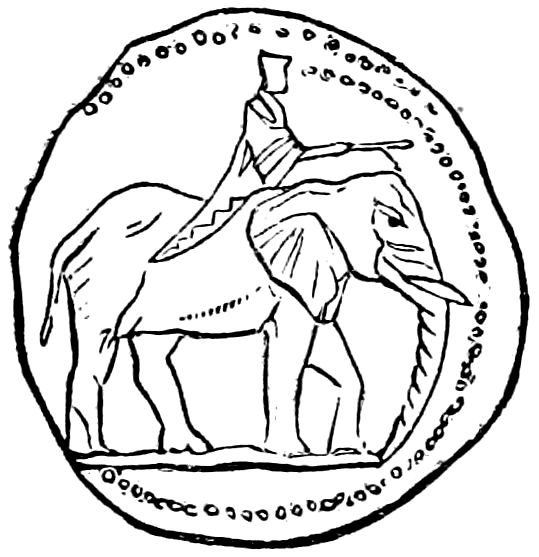
MEDAL OF NUMIDIA, GIVING A REPRESENTATION OF AN ANCIENT HENDOO.
For many days the roaring and resistance which attend the 116operation are considerable, and it often requires the sagacious interference of the tame elephants to control the refractory wild ones. It soon, however, becomes practicable to leave the latter alone, only taking them to and from the stall by the aid of a decoy. This step lasts, under ordinary treatment, for about three weeks, when an elephant may be taken alone with his legs hobbled, and a man walking backward in front with the point of the hendoo always presented to the elephant’s head, and a keeper with an iron crook at each ear. On getting into the water, the fear of being pricked on his tender back induces him to lie down immediately on the crook being held over him in terrorem. Once this point has been achieved, the farther process of taming is dependent upon the disposition of the creature.
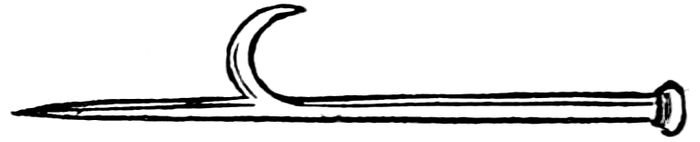
MODERN HENDOO.
The greatest care is requisite, and daily medicines are applied to heal the fearful wounds on the legs which even the softest ropes occasion. This is the great difficulty of training; for the wounds fester grievously, and months and sometimes years will elapse before an elephant will allow his feet to be touched without indications of alarm and anger.
The observation has been frequently made that the elephants most vicious and troublesome to tame, and the most worthless when tamed, are those distinguished by a thin trunk and flabby pendulous ears. The period of tuition does not appear to be influenced by the size or strength of the animals: some of the smallest give the greatest amount of trouble; whereas, in the instance of the two largest that have been taken in Ceylon within the last thirty years, both were docile in a remarkable degree. One in particular, fed from the hand the first night it was secured, and in a very few days evinced pleasure on being patted on the head. The males are generally more unmanageable than the females, and in both an inclination to lie down to rest is regarded as a favorable symptom of approaching tractability, some of the most resolute having been known to stand for months together, even during sleep. Those which are the most obstinate and violent at first are the soonest and most effectually subdued, and generally prove permanently docile and submissive. But those which are sullen or morose, although they may not provoke chastisement by their viciousness, are always slower in being trained, and are rarely to be trusted in after life.
But whatever may be his natural gentleness and docility, the temper of an elephant is seldom to be implicitly relied on in a 117state of captivity and coercion. The most amenable are subject to occasional fits of stubbornness; and even after years of submission, irritability and resentment will sometimes unaccountably manifest themselves. It may be that the restraints and severer discipline of training have not been entirely forgotten; or that incidents which in ordinary health would be productive of no demonstration whatever, may lead, in moments of temporary illness, to fretfulness and anger.
In his native country the first employment to which an elephant is put is treading clay in a brick-field, or to draw a wagon in double harness with a tame elephant. After this he is promoted to moving heavy stones or other material, or in piling lumber. In these occupations he has an opportunity to display that natural sagacity for which he is noted. It is only necessary to make him understand the object desired to be accomplished, and he will himself devise means to attain that result. In the detail of the work it is seldom necessary to prompt him, and he will even resent an attempt to compel him to adopt a different plan from the one he has selected. His trunk is the instrument on which he principally relies for moving timber and masses of rock; his tusks, if he possess them, are also of service. Most persons entertain an exaggerated opinion of the elephant’s strength. It is currently believed that with but slight exertion he can uproot forest trees, and is in the habit of doing so as a species of mild recreation. It is true he is of considerable service in clearing paths through the jungle, but the removal of even a small tree is a matter of both time and labor. Another common error is the assumption that elephants are so thoroughly creatures of habit, that their movements are purely mechanical, and that any deviation from accustomed ways is excessively annoying and disconcerting to them. The best informed authorities assert that changes of treatment, or of hours of occupation, are as easily made as with a horse. Still another mistake, derived no doubt from the intelligence and earnestness he displays in work, is the idea that he actually enjoys his labor, and will perform his task as faithfully in the absence of his keeper as when he is present. The elephant, however, loves his ease, and unless his attendant has a watchful eye upon him, he will, on completing the task immediately in hand, stroll off to browse, or to enjoy the luxury of blowing dust over his back.
The impulse of obedience is very strikingly manifested in the patience with which, at the command of his keeper, he will swallow the nauseating medicines of the native elephant doctors. The fortitude with which he submits to excruciating 118surgical operations for the relief of ulcers, would indicate that he comprehends in a measure the purpose of them. Obedience to his keeper’s orders is not in all cases proof of a perception of the object to be attained by compliance. This is shown in the touching incident which took place at the slaughter of the elephant at Exeter, England, when after receiving fully one hundred and twenty balls in various parts of his body, and these proving ineffectual to end his existence, he turned his face to his assailants on hearing the voice of his keeper, and kneeled down at the accustomed word of command, so as to bring his forehead within view of the rifles.
The affection for his keeper is a great incentive to obedience on the part of the elephant, but although this attachment is often great, there is not that unwillingness to transfer his affection and obedience to a new keeper, which has been very frequently asserted. If treated with equal kindness he will obey readily and acquire an affection for a new attendant as soon as he becomes familiar with his voice. He no doubt often remembers an old friend and many of the anecdotes told of elephants recognizing an old keeper from whom they have long been parted, and being rejoiced thereat, are doubtless true. Founded on very good authority is the story of an animal of particularly stubborn disposition who, on the death of his keeper, refused to obey any other, until some attendants bethought them of a boy some twelve years old in a distant village where the elephant had been formerly picketed, and to whom it had displayed considerable attachment. The child was sent for, and on his arrival was immediately recognized with many manifestations of pleasure and to him the elephant yielded obedience, until by degrees he became reconciled to a new keeper.
Probably all readers are familiar with the fact that, in their native countries, elephants are not only used to aid in the capture of their own species, but also in the pursuit of various wild beasts of the jungle. In tiger hunting especially is this the case, and this sport furnishes one of the chief and most exciting amusements of the English troops in India. In this sport the elephant is rather an unwilling participant. In his wild state there is no occasion for any conflict between himself and other dwellers of the forest. Living entirely on vegetable food, and so under no necessity of preying upon other animals; too peaceful to molest others, and too powerful to be molested by them, in a state of nature each seems anxious to avoid rather than to provoke any encounter. Should a tiger and an elephant 119meet in the jungle each would probably be only anxious to get out of the other’s way as quickly as possible.
The principal difficulty in training elephants for hunting is to overcome the excessive antipathy, and even dread, they entertain toward tigers. To accomplish this a tiger’s skin is stuffed and placed partially concealed among the undergrowth skirting some road. Along the road the elephant is then conducted; always observant, he quickly detects the unwelcome neighbor and considerable urging is required to induce him to pass it. After passing it several times he becomes more indifferent to its presence and may be gradually induced to approach it. Then he is made to turn it over and get thoroughly familiar with it; this accustoms him to the tiger in a state of quietude. Then the stuffed figure is thrown toward him and he is taught to receive it upon his tusks. The next lesson may be to drive his tusks into the body. The last operation is to teach the elephant to allow the stuffed tiger to be placed upon his back; this is the most difficult part of all.
When the elephant is properly trained and ready for service the hunter takes his place in the howdah—a sort of box-seat fastened on the animal’s back—while the mahout sits astride the neck. Behind the hunter, in the howdah, rides the shikaree, or native gun carrier, whose duty it is to “play second fiddle” in the expedition. A number of natives are also usually employed as “beaters” to start the game. These men go on foot, seeking safety, in case of danger, by climbing trees or by being lifted up by the elephant upon his back. The elephants are now formed in line and the jungle beaten, in all parts if a small one, or if very extensive in those portions only which appear most likely to contain game. As soon as a tiger is started the line advances upon him, each hunter watching for an opportunity to fire as his elephant charges. Notwithstanding the most careful training instinct often proves an overmatch for the elephant’s education and, he takes to flight in spite of all the driver’s efforts to prevent him. One hunter relates an incident of his elephant being seized with a panic and dumping hunter, driver and all upon his back, into the very midst of a number of tigers which the party were in pursuit of.
In taking a dead tiger home the elephant lies on his side until the body is fastened to him, and then rises with it.
The liability to be seized with a panic at trifling circumstances is probably due in a measure to the elephant’s limited range of vision, the short neck preventing his looking much above the level of his head. An anecdote illustrative of this is told by Sir J. E. Tennent: “In 1841 an officer was chased by an 120elephant that he had slightly wounded. Seizing him near the dry bed of a river, the animal had his fore foot already raised to crush him; but its forehead being touched at the same instant by the tendrils of a climbing plant which had suspended itself from the branches above, it suddenly turned and fled, leaving him bodily hurt, but with no limbs broken.”
Elephants seldom use their tusks as weapons unless they have been trained to do so; their vertical position, and the structure of the neck preventing their being effective unless the object of attack being directly below them. The stories told of the execution of criminals by elephants when Ceylon was under the rule of native kings, generally describe the elephant as killing the victim by running its tusks through his body. An eye-witness of one of these executions, however, says the animal never used his tusks at all, but placed his foot upon the prostrate man and tore off his limbs in succession by a sudden movement of the trunk. Hunters have frequently described their escape from elephants when the latter might easily have killed them by a thrust of their tusks, but apparently did not even know how to use them for that purpose.
The elephant’s dependence is really upon his trunk and his ponderous feet. It is related that in an encounter between two elephants, one a tusker and the other without tusks, the latter proved the victor, breaking off one of the former’s tusks with his trunk.
From very early times elephants have not only been used in war, in industrial pursuits, and to add to the pomp and display of powerful rulers, but ages ago they were made to amuse the multitude by performances not very dissimilar to those witnessed in our modern circuses. An old Roman writer describes a number of elephants exhibited in Rome by a nephew of the emperor Tiberius, who were taught “to twist their limbs and to bend them like a stage dancer,”—Roman stage dancers could not have been remarkable for grace or agility we should fancy—“the whole troop came forward from this and that side of the theater, and divided themselves into parties; they advanced walking with a mincing gait, and exhibiting in their whole bodies and persons the manners of a beau, clothed in the flowery dresses of dancers; and on the ballet master giving a signal with his voice they fell into line and went round in a circle, and if it were necessary to display they did so. They ornamented the floor of the stage by throwing flowers upon it, and beat a measure with their feet and keep time together.” Another feature 121of the entertainment was a banquet prepared for the elephants; “tables were placed then of sweet smelling wood and ivory very superb,” with goblets “very expensive, and bowls of gold and silver.” When all was ready the banqueters came forward, six male and an equal number of female elephants; the former had on a male dress and the latter a female; and on the signal being given they stretched forward their trunks in a subdued manner, and took their food in great moderation. The last exploit of these animals related by an old Roman was writing on tablets with their trunks, “neither looking awry or turning aside. The hand, however, of the teacher was placed so as to be a guide in the formation of the letters; and while it was writing the animal kept its eye fixed down in an accomplished and scholarlike manner.”
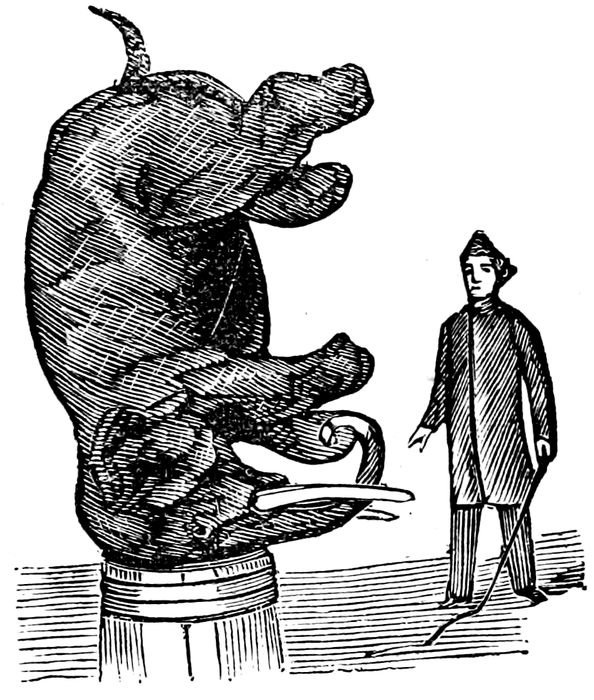
PERFORMING ELEPHANT.
In addition to the training elephants receive immediately after their capture, and which we have described, very little instruction is required to prepare them for those performances which delight circus-goers. The performances in question consist usually of lying down, walking on their legs, standing on the head, walking up an inclined plane formed of a narrow plank, standing on a pedestal, holding a rope for a dancer or acrobat to perform upon, and similar feats. These are nearly all but modifications of his labors when a captive in his native country. Holding a line for a gymnast is not very different to the elephant from doing the same thing to draw a load or raise a weight.
In compelling the elephant to perform these acts advantage is taken of the fact that the feet of the elephant are peculiarly sensitive and he dreads any injury to them. While a spear held 122at his head will cause him little uneasiness, if the same be directed toward his feet it will cause him to display evident symptoms of anxiety. So by threatened attacks he may be induced to move in any desired direction. By tapping them gently from below he may be made to raise them; and by persevering he is made to raise both hind feet—lowering his head as a natural result of this rear movement—and thus is accomplished the feat of standing on his head. In the pedestal performance the pedestal is comparatively low, and with the upper surface of just sufficient area to accommodate the elephants four feet, placed close together. He is first made to place one fore foot upon this, then the other, and then in succession the two hind feet. The trainer must be watchful and prevent the elephant’s very natural attempt to replace his fore feet on the ground when he places his hind one on the pedestal. This is done by striking his toes whenever he makes the attempt.
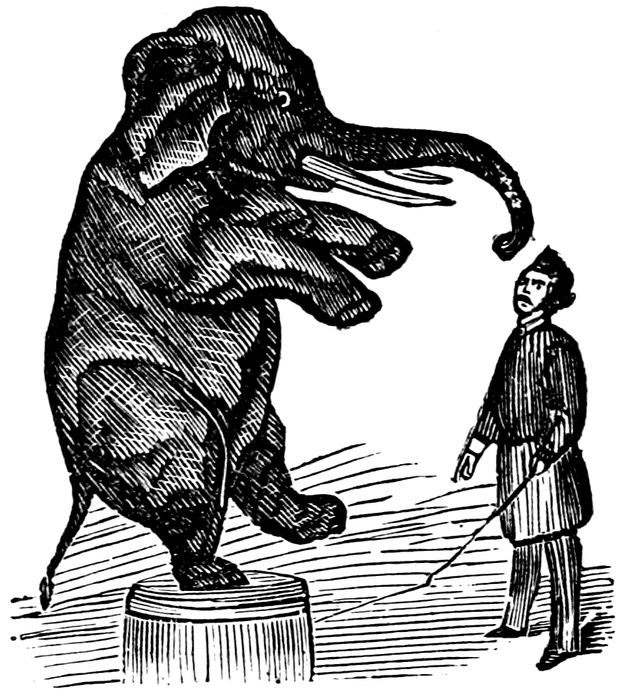
PERFORMING ELEPHANT.
The delicacy of touch possessed by the elephant’s trunk enables him to use it for many purposes with as much dexterity as a human being would his hands. Thus he easily performs the amusing trick of opening and drinking a bottle of soda water; holding the bottle with his feet while he removes the cork with his trunk and then lifting the bottle in his trunk and pouring the contents down his throat. Similar tricks are readily acquired by the elephant without any particular training, all that is necessary in the soda-water trick is to let him know there is something in the bottle and his ingenuity may be depended upon to get at the contents. We some years ago witnessed a novel feat at a circus. A small table was brought 123into the ring and the clown seated himself on one side of it. On the other side the elephant who had been performing squatted on his haunches. The “supes” then brought in plates of apples, bread, etc., and arranged them on the table. A large two-pronged fork was now handed to the elephant, and with this he dexterously “speared” his provender and conveyed it to his mouth. This appeared quite wonderful, and was hailed with rounds of applause, but it was a trick very easily taught. The animal had been first given apples on a fork, and not being allowed to eat them except on taking them off the fork with his mouth he soon learned to do so. Then he was given the fork, and the apples placed before him, his trunk was guided by his trainer’s hand to strike the fork into the apple and then he was allowed to carry it to his mouth. If the apples be good ones he will soon learn to do all this without prompting, and will very willingly perform the trick for the sake of the “perquisites.”
We do not imagine that many of our readers will have occasion to train an elephant; still there is often an opportunity afforded at traveling exhibitions, should you desire it, to make an elephant go through a little performance for you, such as picking up your hat, catching apples or nuts thrown him, etc. A judicious outlay in ginger-bread and like delicacies will induce his elephantship to be quite obliging, and if your stock of edibles be purchased at the stand in the tent, probably the proprietors will offer no objection to your feeding their elephant with them.
Speaking of amateur elephant exhibitors recalls an adventure of our own youthful days. Visiting a menagerie early one afternoon when comparatively few visitors were present, and anxious to “show of” before some less venturesome youths, we had, at the expense of all our pocket money, caused one of the elephants to pick up our cap when thrown down and hand it back to us, to insert his trunk in our pockets after cake, and finally, as a crowning feat, to take bits of cake from between our lips. Had we been contented with these achievements our performance would have been a triumph; but, alas, our ambition was not satisfied, and we thought it would be a still greater display to make the elephant take the cake from the inside of our mouth. So a piece was a placed therein and the mouth held invitingly open. Mr. Elephant unhesitatingly inserted his proboscis, but unfortunately our supply of cake had been well nigh exhausted, and the piece used for the experiment was very small, so either from inability to find it, a mistake in the article, or as a punishment for reducing the rations, he got hold of our tongue, and the first thing we knew he was attempting to pull it 124out. Luckily his keeper came to our rescue at this critical moment, and we retired uninjured but rather crestfallen.