The Handel family was of Silesian origin.[1] The grandfather, Valentine
Handel, was a master coppersmith at Breslau. The father, George Handel,
was a barber-surgeon, originally attached to the service of the armies
of Saxony, then of Sweden, later of the French Emperor, and finally in
the private service of Duke Augustus of Saxony. He was very rich, and
purchased at Halle in 1665 a beautiful house, which is still in
existence. He was married twice; in 1643 he married a widow of a barber,
who was ten years older than himself (he had six children by her); and
in 1683, the daughter of a pastor who was thirty years younger than he
was: he had four children by her, of which the second was George
Frederick.
Both parents sprang from that good old bourgeois stock of the
seventeenth century which was such excellent soil for genius and for
faith. Handel, the surgeon, was a man of gigantic stature, serious,
severe, energetic, religiously attached to duty, upright and affable in
his dealings with those around him.
His portrait exhibits a large clean-shaven face which has the impression
of one who never smiled. The head is carried high, the eyes morose;
prominent nose and a pleasant but obstinate mouth; long hair with white
curls falling on his shoulders; black cap, collar of lace, and coat of
black satin: the aspect of a parliamentary man of his time.—The mother
was no less sturdy a character. Of a clerical family on the maternal
side as well as on the paternal side, with a spirit imbued with the
Bible, she had a calm courage, which came out prominently when the
country was ravaged by pestilence. Her sister and her elder brother were
both carried off by the plague; her father was also affected. She
refused to leave them and remained quietly at home. She was then engaged
to be married.—This sturdy couple transmitted to their distinguished
son in place of good looks (which he certainly had not, and which never
disquieted him) their physical and moral health, their stature, their
keen intelligence and common sense, their application to work, and the
indestructible essence of their quiet, calm spirit.
. . . . .
. . . . .
. . . . .
. . . . .
. . . . .
George Frederick Handel was born at Halle on Monday, February 23,
1685.[2] His father was then sixty-three years, and his mother
thirty-four.[3]
The town of Halle occupied a singular political situation. It belonged
originally to the Elector of Saxony; by the Treaties of Westphalia it
was ceded to the Elector of Brandenburg; but it paid tribute to the Duke
Augustus of Saxony during his lifetime. After the death of Augustus in
1680, Halle passed definitely to Brandenburg; and in 1681 the Grand
Elector came to receive homage there. Handel then was born a Prussian;
but his father was in the service of the Duke of Saxony, and he retained
relationship with the son of Augustus, Johann Adolf, who moved his court
after the Prussian annexation to the neighbouring town of Weissenfels.
Thus the childhood of Handel was influenced by two intellectual forces:
the Saxon and the Prussian. Of the two the more aristocratic, and also
the more powerful was the Saxon. Most of the artists had emigrated with
the Duke to Weissenfels. It was there that the genial Heinrich Schütz
was born and died:[4] it was there that Handel found his first impetus,
and where the calling of the child was first recognized. The precocious
musical tendencies of the little George Frederick were somewhat curbed
by the formal opposition of his father.[5] The sturdy surgeon had more
than objection—he possessed an aversion to the profession of artist.
This sentiment was shared by nearly all the sturdy men of Germany. The
calling of musician was degraded by the unedifying spectacle of many
artists in the years of relaxation which followed the Thirty Years’
war.[6] Besides which, the bourgeois German of the seventeenth century
had a very different idea of music from that of our French middle
classes of the nineteenth century. It was with them a mere art of
amusement, and not a serious profession. Many of the masters of that
time, Schütz, Rosenmüller, Kuhnau, were lawyers, or theologians, before
they devoted themselves to music; or they even followed for a time the
two professions. Handel’s father wished his son to follow his own
profession, that of law; but a journey to Weissenfels overcame all his
objections. The Duke heard the little seven-year-old Handel play the
organ, with the result that he sent for the father to see him and
recommended him not to thwart the child’s obvious musical talents. The
father, who had always taken these counsels very badly when they came
from anyone else, doubtless appreciated them when they came from the
lips of a prince; and without renouncing his own right over his son
(for he still had the legal plan in his head) consented to let him learn
music; and on his return to Halle he placed him under the best master in
the town, the organist Friedrich Wilhelm Zachau.[7]
. . . . .
. . . . .
. . . . .
. . . . .
. . . . .
Zachau was a broad-minded man and moreover a good musician, whose
greatness was only appreciated many years after his death.[8] His
influence on Handel was splendid. Handel himself did not conceal it.[9]
This influence affected the pupil in two ways: by his method of
teaching, and by his artistic personality. “The man was very well up in
his art,” says Mattheson,[10] “and is possessed of as much talent as
beneficence.”
. . . . .
. . . . .
. . . . .
. . . . .
. . . . .
Handel’s devotion to Zachau was so great that he seemed never able to
show him sufficient affection and kindness. The master’s first efforts
were devoted to giving the pupil a strong foundation in harmony. Then he
turned his thoughts towards the inventive side of the art; he showed
him how to give his musical ideas the most perfect form, and he refined
his taste. He possessed a remarkable library of Italian and German
music, and he explained to Handel the various methods of writing and
composing adopted by different nationalities, whilst pointing out the
good qualities and the faults of each composer; and in order that his
education might be at the same time theoretical and practical, he
frequently gave him exercises to work in such and such a style.
. . . . .
. . . . .
. . . . .
. . . . .
. . . . .
This education with a true European catholicity was not confined to one
particular musical style, but spread itself out over all schools, and
caused him to assimilate the best points of all, for who can fail to see
that the conception and practice of Handel, and indeed the very essence
of his genius, was the absorption of a hundred different styles! “One of
his manuscripts dated 1698, and preserved carefully all his life,
contains,” so says Chrysander, “some airs, choruses, capriccios, and
fugues of Zachau, Alberti (Heinrich Albert), Froberger, Krieger, Kerl,
Ebner, Strungk, which he had copied out whilst studying with Zachau.”
Handel could never forget these old masters, distinct traces of whom are
found from time to time in his best-known works.[11] He would doubtless
too, with Zachau, have seen the first volumes of the clavier works of
Kuhnau, which were published at that time.[12]
Moreover, it seems that Zachau knew the work of Agostino Steffani,[13]
who later on took a fatherly interest in Handel; and Zachau followed
sympathetically the dramatic musical movement in Hamburg. Thus the
little Handel had, thanks to his master, a living summary of the musical
resources of Germany, old and new; and under his direction he absorbed
all the secrets of the great contrapuntal architects of the past,
together with the clear expressive and melodic beauty of the
Italian-German schools of Hanover and Hamburg.
But the personal influence of the character and the art of Zachau
reacted no less strongly on Handel than did his methods of instruction.
One is struck by the relationship of his works[14] to those of Handel;
they are similar in character and style. The reminiscences of motives,
figures, and of subjects count for little;[15] there is the same essence
in the art of both master and pupil; there is the same feeling of light
and joy; there is nothing of the pious concentration and introspection
of Bach, who goes down into the deeps of thought, and who loves to probe
into all the innermost recesses of the heart, and—in silence and
solitude—converse with his God. The music of Zachau is the music of
great spaces, of dazzling frescoes, such as one sees on the domes of the
Italian cathedrals of the sixteenth and seventeenth centuries; but
Zachau’s work contains more religion than these. His music pulses with
action like the bounding and rebounding of great springs of steel. It
has triumphant subjects with expositions of great solemnity. There are
victorious marches, carrying everything before them, which go crashing
on without stopping, ever spurring on the sparkling and joyous patterns.
There are also pastoral themes, pure and voluptuous reveries,[16]
dances, and songs accompanied by flutes, with a Grecian perfume,[17] and
a smiling virtuosity, a joy intoxicated with itself, twisting lines, and
vocal arabesques, vocalizations, trills for the voice which gambol
light-heartedly with the little wave-like arpeggios of the violins.[18]
Let us unite these two traits: the heroic and the pastoral, the
warriors’ marches and the jubilant dances. There you have the Handelian
tableaux: the people of Israel and the women dancing before the
victorious army. You find in Zachau a sketch for the monumental
constructions of Handel in his Hallelujahs; those mountains of sound
which resound their joy, the colossal Amens which crown his oratorios
like the dome of St. Peter at Rome.[19]
Add to this also Zachau’s marked liking for instrumental music,[20]
which makes him combine it so happily with the vocal solos; and very
often he imagines the voice as an instrument, which combines and gambols
with the other instruments, thus forming a decorative garland
harmoniously woven.
To sum up, it was an art less intimate than expansive, an art newly
born; not devoid of emotion though,[21] but above all, restful, strong,
and happy—an optimistic music like that of Handel.
Truly Handel in miniature, with much less breadth, less richness of
invention, and particularly a smaller power of development. There is
nothing of the attractiveness of Handel’s colossal movements, like an
army which marches and sings; and more solid strength is necessary to
carry the weight right to the end without bending. Zachau flinches on
his way; he has not the vital force of Handel, but in compensation he
has more naïveté, more tender candour, more of the childlike
chasteness and evangelic grace.[22] Certainly there we have the master
really necessary to Handel, a master more than one great man had the
good fortune to find (it is Giovanni Santi for Raphael; it is Neefe for
Beethoven): good, simple, straightforward, a little dull, but giving a
steady and gentle light where the youth may dream in peace and abandon
himself with confidence to a guide almost fraternal, who does not seek
to dominate him, but rather strives to fan the little flame into a
greater fire; to turn the little rivulet of music into the mighty river
of genius.
. . . . .
. . . . .
. . . . .
. . . . .
. . . . .
Whilst studying with Zachau the young Handel visited Berlin. After
having paid his homage to his former master, the Elector of Saxony, he
was wise enough also to present himself to the new one, the Elector of
Brandenburg. It seems that this journey took place about 1696 when the
boy was eleven years old, and his father, being ill, did not accompany
him.
The Berlin Court lived a very short life of artistic brilliance between
the wars of the Grand Elector and those of the Prince-Regent. Music was
greatly in honour, thanks to the Electress, Sophia Charlotte, daughter
of the celebrated Sophia of Hanover. She attracted to her the best
Italian instrumentalists, singers, and composers.[23] She founded the
Berlin Opera,[24] and even conducted several concerts at Court.
Doubtless the movement was but superficial. It was only held together by
the impulse of the Electress, who had more spirit than earnestness. Art
was for her only a fond distraction; so that after her death the musical
fêtes in Berlin became extinct. But it was something to have lighted,
only for a brief hour, this flame of beautiful Italian art, and it was
thus that the little Handel came into contact for the first time with
the music of the South.[25] The child, who displayed his powers on the
clavecin before a princely audience, had so much success that the
Elector of Brandenburg wished him to enter his service. He offered
Handel’s father to send the child to Italy to finish his studies. The
old man refused. “He had a stubborn pride, and did not desire,” so says
Mainwaring, “that his son should be tied too soon to a Prince.” He
wished to see his child again, as he considered that he himself might
die at any moment.
Little Handel returned. Too late! He learnt en route that his father
had died on February 11, 1697. The principal obstacle in the way of his
musical vocation had now disappeared, but he had so profound a respect
for his father’s wishes that he forced himself to study law for many
more years. After having completed in due course his classes at the
college he was entered for the Faculty of Law at the University of Halle
on February 10, 1702, five years after his father’s death.
University life in Halle at that time was of a revolting character. But,
in spite of this, an intense life of thought and religion was also to be
found there. The Faculty of Theology was the centre of Pietism.[26] The
students devoted themselves to religious exercises which led to
ecstasy.—Handel, independent as he always was, kept clear of the brutal
amusements, just as he did of the mystic contemplation. He was religious
without being sentimental. For the rest, an artist could only listen to
the Pietists with difficulty, for their religious devotion was too often
oppressive to art. Even J. S. Bach, Pietist at heart, by his public acts
declared himself opposed to the Pietists, who were on certain marked
occasions inimical to music.[27] For a still stronger reason Handel had
no leaning towards mysticism.
Religion was not his business; Law certainly was not. However, he had
for his master the most remarkable professor in Germany, Christian
Thomasius, the advocate in the arraignment of witchcraft,[28] the
reformer of the teaching of law, who himself made a thorough study of
German customs, and who did not cease to make battle with the gross and
stupid abuses of the universities, with their spirit of caste, pedantry,
ignorance, hypocrisy, and judicial and religious acerbity. If such a
training was not of the nature to retain Handel it was certainly not the
fault of the professor; there were no more vital lessons in the whole
of the Germany of that day; none which offered a more fruitful field of
activity to a young man. Let us be sure that a Beethoven would not have
been insensible to them. But Handel was a pure musician; he was music
itself; nothing else could occupy his thoughts.
In the year in which he had completed his terms in the Faculty of Law he
found a post of organist at Halle: and in a church more than strictly
Lutheran, being of the Reformed order, where the organist had expressly
to conform to the new cult. However, he was only seventeen years
old.[29] This simple fact showed what musical authority he already
exercised in the town where he had studied law.[30] Not only was he
organist, but he was also Professor at the College of the Reformists; he
took vocal music there for two hours every week; he selected the most
gifted of his pupils and formed from them a vocal and instrumental body
which was to be heard every Sunday in one church or another of the town.
He included in his musical repertoire, chorales, Psalms, motets,
cantatas—which were changed every Sunday. Truly an excellent school for
learning to write quickly and well. Handel there formed his creative
fecundity.[31] Of hundreds of cantatas which he then wrote, none were
preserved by him.[32] But it is certain that his memory retained more
than one idea to serve in later compositions, for he never lost
anything, and from that time for the rest of his life he retained in his
mind his earlier musical ideas. This should not be attributed to his
speed in working, but to the unity of his thought and his strenuous
search for perfection.
Handel renewed neither his yearly engagement at the Cathedral of Halle
nor at the University. In his period as organist he had gauged his own
musical force and he no longer wished to constrain it. A wider field of
activity was necessary. He quitted Halle in the spring of 1703, and
guided both by his instincts and by a preference of his master
Zachau[33] he betook himself to Hamburg, the city of German Opera.
Hamburg was the Venice of Germany. A free town far from the noise of
wars, a refuge of artists, and people of large fortunes, the centre of
the commerce of Northern Europe, a cosmopolitan city where they spoke
all languages and especially the French tongue, it was in continual
relationship with both England and Italy, and particularly with Venice,
which constituted for it a model for emulation. It was by way of Hamburg
that the English ideas were circulated in Germany. It was there where
the first German newspapers appeared.[34] In the time of Handel, Hamburg
shared with Leipzig the intellectual prestige of Germany. There was no
other place in Germany where music was held in such high esteem.[35] The
artists there hobnobbed with the rich merchants. Christoph, pupil of
Schütz, had founded there a celebrated Collegium Musicum, a Society of
Musicians, and started there in 1677-8 the first theatre of German
Opera. It was not a princely opera open only to those invited by the
prince, but a public opera, popular in spirit and in prices. It was the
example of Italy, notably that of Venice, which called forth this
foundation, but the spirits of the two theatres were very different.
Whilst that of Venice satisfied itself with fantastic melodramas,
curiously devised from the ancient mythology and history, the Hamburg
Opera retained, despite the grossness of taste and licentiousness of
manners, an old religious foundation. The Hamburg opera was inaugurated
in 1678 by the production of Joh. Theile’s Creation of the World. The
composer was a pupil of Schütz. From 1678 to 1692 a large number of
religious dramas were given there; some of an allegorical character,
others inspired by the Bible. In certain of these subjects one can
already see the future oratorios of Handel.[36] Feeble as these pieces
were, they were yet on the definite road for the founding of a real
German theatre. It seems to have been the idea of one of these poets,
Pastor Elmenhorst, who wished to give to the religious opera the value
of a classic form of art.[37] Unfortunately, the public spirit was on
the decline; its religious resources, however, were well protected, save
in a minority where religion took a more aggressive character as it felt
itself less able to hold people. There were two factions in the Hamburg
public; one (the most numerous) whom religion bored, and who wished to
amuse themselves at the theatre. The other party was religious and would
not have anything to do with the opera under the impression that it was
a work of Satan, opera diabolica.[38] The struggle was warmly
contested between the two factions, and religious opera came to grief.
The last representation took place in 1692. When Handel arrived it was
truly the opera diabolica which ran with its many extravagances and
its licentious habits.
I have told elsewhere[39] the story of this period of theatrical history
in Hamburg, of which the golden age was certainly between 1692 and 1703.
Many conditions contributed to the establishment of a good Theatre and
Opera at Hamburg; money and the wealthy patrons disposed to expend it,
an excellent band of instruments, good but small in number, a scenic art
well advanced, a luxury of decoration and machinery, renowned poets,
musicians of great value, and, rarest of all, the poets and musicians
who assembled from “die sich wohl verstanden,” as Mattheson wrote. The
poets were named Bressand of Wolfenbüttel, who was inspired by the
French theatre, and Christian Postel, whom Chrysander calls very
complacently a German Metastasio. The feeblest part was the singing. For
a long time the Hamburg Opera had no professional singers. The rôles
were taken by students and artisans, by shoemakers, tailors, fruiterers,
and girls of little talent and less virtue; generally the artisans found
it more convenient themselves to take the female rôles. Men and women
alike had a profound ignorance of music. Towards 1693 the Opera at
Hamburg was fortunately completely transformed from top to bottom by the
great Kapellmeister Sigismund Cousser, who introduced reforms in the
orchestra after the French model, and in the singing on Italian lines.
France was represented in his eyes (as for all foreign musicians) by the
personage of Lully, by whom Cousser was trained for six years in Paris.
Italy was represented by a remarkable artist settled at Hanover from
1689 to 1696, who produced ten operas; Agostino Steffani from the
province of Venice.
This dual model from Italy and France, aided by the personal example of
Cousser, played the chief part in producing the best musician of the
Hamburg Opera, Reinhard Keiser, a man who, despite his character and
presumptuous knowledge, had certainly genius.[40]
Keiser was under thirty years old when Handel arrived, but he was then
at the zenith of his fame. Kapellmeister of the Hamburg Opera since
1695, then director of the theatre since the end of 1702, very highly
gifted, but of scanty culture, dissipated, voluptuous, careless, he was
the incontestable ruler of the German Opera; the artist type of that
epoch, overflowing with material life, and devoting itself to the love
of pleasure. The influence of both Lully[41] and that of Steffani[42] is
shown in his first operas. But his own personality is easily
recognizable under these traces of borrowing. He has a very fine sense
of instrumental colour, widely differing from that of the followers of
Lully, who were a little disdainful of expressive power in the
orchestra, and were always disposed to sacrifice it to the primacy of
the voice.[43] He believed, as did his admirer and commentator,
Mattheson, that one can express the feelings by means of the orchestra
alone.[44]
He was, moreover, a true master of recitative; one might say that he
created the German recitative. He attached extreme importance to it,
saying that the expression in recitative often gave the intelligent
composer much more trouble than the invention of the air.[45] He sought
to note with exactitude, accent, punctuation, the living breath itself,
without sacrificing anything of the musical beauty. His Recitative
arioso takes an intermediate place between the oratorical recitative
of the French, and the recitative secco of the Italians, and was one
of the models for the recitative of J. S. Bach,[46] and even not
excepting Bach and Handel, Mattheson persists in seeing in Keiser the
master of this style.—But the real supreme gift of Keiser was his
melodic invention. In that he was one of the first artists in Germany,
and the Mozart of the first part of the eighteenth century. He had an
abundant and winning inspiration. As Mattheson said, “His true nature
was tenderness, love....” From the commencement to the end of his career
he could reproduce voluptuous feelings with such exquisite art that no
one could surpass him. His melodic style, much more advanced than that
of Handel—not only at this particular epoch but at any moment of his
life—is free, unsophisticated and happy. It is not the contrapuntal
style of Handelian Opera, but it inclines rather to that of Hasse (who
was trained entirely in it), to the symphonists of Mannheim, and to
Mozart. Never has Handel, greater and more perfect as he was, possessed
the exquisite note which breathes in the melodies of Keiser—that fresh
perfume of the simple flower of the field.[47] Keiser had the taste for
popular songs and rustic scenes,[48] but he knew also how to rise to the
very summits of classical tragedy, and some of his airs of stately
grief might have been written by Handel himself.[49] Keiser was, then,
full of lessons and of models for Handel, who was not slow to take
them,[50] but he also set him several bad examples too. The worst was
the renunciation of the national language. Whilst Postel and Schott had
been at the head of the Hamburg Opera the Italian language had been kept
within bounds,[51] but since Keiser had become Director he had changed
all that. In his Claudius (1703) he made the first barbarous attempt
at a mixture of Italian and German languages. It was for him a pure
fanfare of virtuosity, and he wished to show, as he explained in his
Preface, that he was capable of beating the Italians on their own
ground. He took no account of the detriment to German Opera. Handel,
following his example, mixes, in his first operas, the airs with Italian
words with those set to German words.[52] Since that time he no longer
wrote Italian operas; and after that, his musical theatre was without
foundation and without public. The sanction of this error resulted in
Germany’s neglect of Keiser’s operas and even of those of Handel,
despite the genius of both composers.
. . . . .
. . . . .
. . . . .
. . . . .
. . . . .
Handel arrived at Hamburg during the summer of 1703. One can imagine him
there at that time of life as in the portrait painted by Thornhill,
which is in the Fitzwilliam Museum at Cambridge: a long face, calm, but
a little coarse, large and serious eyes, large and straight nose, ample
forehead, vigorous mouth, with thick lips, cheeks and chin already full,
very straight head without wig, and covered with a biretta after the
manner of Wagner. “He was rich in power, and strong in will,” says
Mattheson, who, by the way, was the first acquaintance he made in
Hamburg. Mattheson, who was then twenty-two,[53] four years older than
Handel, came from a rich Hamburg family, and possessed vast knowledge.
He spoke English, Italian, French, was trained for the law, well
grounded in music, could play nearly all the instruments, and wrote
operas, of which he was the poet, the composer, and the actor all in
one. Above all he was a master theorist, and the most energetic critic
of German music. With an immense amour-propre and many passionate
dislikes, he had a robust spirit, very sound, and very honest, a sort of
Boileau or of Lessing in music half a century before la Dramaturgie.
On the one side he combated scholastic routine and abstract science in
the name of nature, and laid down the rule that “music is that which
sounds well” (“Musik müsse schön klingen”).[54] He played his part in
the banishment of the obsolete theories (solmisation, ecclesiastical
modes) and the definition of our modern system.[55] On the other hand,
he was the champion of German art and German spirit. From Lessing he
derived his patriotism, his rough independence, his impetuosity, which
seemed to possess a violence almost brutal. All his books cry “Fuori
Barbari.”[56] One of his works was entitled The Musical Patriot (Der
Musikalische Patriot, 1728).
In 1722 he founded the first German musical journal, Critica
Musica,[57] and all his life he waged a vigorous war for good sense,
real musical intelligence, music which speaks to the heart and not to
the ear, moving and strengthening the soul of the intelligent man with
beautiful thoughts and melodies.[58] He saw in music a religious
idea.[59] By his wide culture, his knowledge of the artistic theories of
the past, his familiarity with all the important French and Italian
works, his relationships with the principal German masters, with Keiser,
Handel, J. S. Bach, by his rich practical experience, his acute critical
sense, his ardent patriotism, his virile and flowing language, he was
well fitted to be the great musical educator of Germany, and he
accomplished his task well. In the dispersion of German artists which
took place then, in addition to the many vicissitudes of their work,
there was chiefly lacking a support of political solidarity which could
cause music to rise above the fluctuations of the tastes of little towns
and the small coteries. Mattheson was then for half a century the sole
tribune of German music, the intellect where thoughts concentrated from
all quarters, and from him radiated an influence over all the country
in return. It was thus that he preserved the ideas of Keiser, which
apart from him would have fallen into oblivion without leaving any
traces of their existence. It was these traces that he rescued out of
the débâcle and preserved for us—a multitude of imperishable
souvenirs for the musical history of the eighteenth century—which
Mattheson gathered together and published in his monumental
Ehrenpforte.[60] He acted powerfully on his times. His books laid down
the law for the Kapellmeisters, the Cantors, the organists, and the
teachers.
His criticisms, his advice on style in singing, on gesture in acting,
were no less efficacious. He possessed the real “theatre” feeling. He
expected life in the stage action, attaching considerable importance to
the pantomime “which is a silent music.”[61] He waged war against the
impossible action and the want of intelligence amongst the German
singers and choralists, and he desired that the composer should think
always in writing of the action of the player. “The knowledge of facial
expression by the actors on the stage,” says he, “can often be a source
of good musical ideas.”[62] This is indeed the language of a true man of
the theatre.[63] For the rest, Mattheson was too good a musician to
serve music in words. He sought to unite them by safeguarding the
independence of both, but ended by giving the preference to the soul
over the body, the melody over the words. The words he wrote are the
body of the discourses; the thoughts are the soul; the melody is the sun
shining on the soul, the marvellous atmosphere which envelops it all. We
have said enough to give some idea of this great critic, intelligent and
intrepid, who, with many faults, has yet many virtues. One will see how
important it was to the young Handel to meet such a guide, even though
they were both too original and too self-sufficient for the association
to last long.
. . . . .
. . . . .
. . . . .
. . . . .
. . . . .
Mattheson did Handel the honours of Hamburg. He introduced him at the
Opera, and the concerts, and it was through him that Handel entered for
the first time into negotiations with England, which was to become his
second country.[64] They helped one another mutually. Handel had
already an exceptional power on the organ, and in fugue and
counterpoint; above all, in improvisation. He shared his knowledge with
Mattheson, who in return helped him to perfect his melodic style.
Mattheson believed him to be a very feeble melodist. He wrote his
melodies at that time, “Oh, long, long, long” (sehr lange lange
Arien), and cantatas without end, which had neither ability nor good
taste, but perfect harmony.[65] It is very remarkable that melody was
not a natural gift with Handel, for he now appears to us as a melodic
genius. It is not necessary to believe that the simple, beautiful
melodies rushed forth without effort from his brain. The melodies of
Beethoven, which seem the most spontaneous, cost him years of thoughtful
work during which he brooded continually over them, and so Handel also
only came to his full power of melodic expression after years of severe
discipline, where he learnt as an apprentice-sculptor to model beautiful
forms, and to leave them neither complex nor unfinished.
Handel and Mattheson spent several months in intimate friendship.[66]
Handel joined Mattheson at table for meals, and in July and August,
1703, they made a journey together to Lubeck to hear the renowned
organist, Dietrich Buxtehude.[67] Buxtehude had thoughts of retiring,
and was looking for a successor. The two young men were greatly affected
by his talent, but they did not care to succeed him in the post, for it
was necessary to wed his daughter[68] to have his organ, and, said
Mattheson, “neither of them wanted her.”—Two years later they would
have met on the road to Lubeck a young musician also going, like them,
to pay Buxtehude a visit, not like them, however, in a carriage, but
more humbly on foot: J. S. Bach.[69] Nothing makes us realise the
importance of Buxtehude in German music better than this magnet-like
attraction which he exercised over the German musicians of the
eighteenth century. Pirro has remarked at some length his influence on
the organ style of J. S. Bach. I consider that it was no less marked,
though quite different, on the oratorio style of Handel.[70]
Buxtehude gave at St. Mary’s Church, Lubeck, his celebrated
Abendmusiken (evening concerts), which took place on Sundays from St.
Martin’s Day to Christmas,[71] by the request of the Merchants’ Guilds
at Lubeck, which occupied themselves keenly with music.[72] His
cantatas, of which the number is considerable,[73] were all composed for
these occasions. Writing for a concert public, and not for a religious
service, he felt the need of making his music of a kind which would
appeal to everyone. Handel later on found himself in similar
circumstances, and the same need led them both to a similar technique.
Buxtehude avoided in his music the ornate and clustering polyphony which
was really his métier.[74] He sought nothing but clear, pleasing, and
striking designs, and even aimed at descriptive music. He willingly
sacrificed himself, by intensifying his expression, and what he lost in
abundance he gained in power. The homophonic character of his writing,
the neatness of his beautiful melodic designs of a popular clarity,[75]
the insistence of the rhythms and the repetition of phrases which sink
down into the heart in so obsessive a manner, are all essentially
Handelian traits. No less is the magnificent triumph of the ensembles,
his manner of painting in bold masses of light and shade.[76] It is to a
very high degree, as with the art of Handel, music for everyone.
But much time passed before Handel profited by the examples of
Buxtehude. On his return from Lubeck he seems to have forgotten them. It
was not so, however, for nothing was ever lost on him.
At the end of August, 1703, Handel entered the Hamburg orchestra as a
second violinist. He loved to amuse himself amongst his kind, and he
often made himself appear more ignorant than he was. “He behaved,” said
Mattheson, “as if he did not even know how to count five, for he was a
‘dry stick.’”[77] That year at Hamburg, Reiser’s Claudius was given at
the Opera, and many of the phrases registered themselves in Handel’s
marvellous memory.[78]
When the season was finished, Mattheson made a journey to Holland, and
Handel profited by the absence of his young adviser to assert his own
individuality. He had made the acquaintance of the poet Postel, who,
old, ill, and troubled by religious scruples, had given up the writing
of opera libretti, and no longer wished to compose anything but sacred
works. Postel furnished Handel with the text for a Passion according to
Saint John, which Handel set to music, and performed during Holy Week
in 1704.[79] Mattheson, piqued at the volte face which had happened in
his relationship with Handel, criticised the music severely, but not
unjustly.[80] Despite the intense feeling of certain pages, and the fine
dramatic nature of the choruses, the work was uneven, and occasionally
lacked good taste.
From this moment the friendship between Handel and Mattheson was
finished. Handel became conscious of his own genius, and could no longer
stand the protectorship of Mattheson. Other occurrences aggravated the
misunderstanding, which ended in a quarrel, which narrowly escaped a
fatal issue.[81] Following the altercation at the Opera on December 5,
1704, they fought a duel in the market-place at Hamburg, and Handel only
escaped being killed by a stroke of luck: for Mattheson’s sword snapped
on a large metal button on Handel’s coat, after which they embraced, and
the two companions, reconciled by Keiser, took part together in the
rehearsals of Almira, the first opera of Handel.[82] The first
representation took place on January 8, 1705, and the work was a
brilliant success. A second opera of Handel, Nero[83] was played on
February 25 following, but it had not quite the success of Almira.
Handel himself occupied the placards of the opera during the whole of
the winter season. It was a fine début. Too fine indeed, and Keiser
became jealous of him. The Hamburg Opera, however, was gradually waning.
Keiser gaily led it to its ruin. He led the life of a gay libertine,
and all the artists around him rivalled him in his follies. Alone Handel
held aloof from the follies, working hard, and spending only what was
barely necessary.[84] After the success of these two operas he resigned
his post as second violin and clavecinist to the orchestra, but
continued to give lessons, and his reputation as a composer kept pace
with that of his teaching. Keiser was uneasy. Handel’s increasing
reputation aroused his amour-propre. Nothing was more stupid, however,
than his jealousy. He was Director of the Opera, and it was in his
interest to give those pieces which were written by popular composers,
and to maintain relationships with successful composers, but jealousy
knows no reason. He reset Almira and Nero to music in order to put
Handel out of joint,[85] and as he had not the opportunity of publishing
his opera in toto he hastily printed the most taking solos from
each.[86] But, however quickly he went, his downfall followed faster.
Before the volume of his opera airs appeared he had to fly. This was in
the end of 1706.[87] Handel and he were destined never to meet again.
. . . . .
. . . . .
. . . . .
. . . . .
. . . . .
Keiser having brought disaster to the Hamburg Opera, there was nothing
left to keep Handel in that city. The direction of the theatre had
fallen into the hands of a Philistine, who, to make money, played
musical farces. He certainly commissioned Handel for the opera Florindo
und Daphne, but he mutilated the work on its presentation “for fear,”
so he said in the Preface of the libretto, “that the music might tire
the hearers”; and lest the public should find the work too serious, he
intersected it with a farce in low German, Die lustige Hochzeit (The
Joyous Wedding). One can well understand that Handel was little
interested in his piece so disfigured, and that he did not himself
attend the production, but quitted Hamburg. It was about the autumn of
1706 that he made the journey to Italy.[88] It was not, however, that
Italy particularly attracted him. Strange to say—it is not unique in
the history of art—this man, who was later on to be caught by the
fascination of Italy, and secure an European musical triumph in the
beautiful Italian style, had then a very strong repugnance for the
foreign art. When Almira was being given, he made the acquaintance of
the Italian prince, Giovanni Gastone dei Medici, brother of the Grand
Duke of Tuscany.[89] He was astonished that Handel interested himself so
little in the Italian musicians, and bought him a collection of their
best works, offering to take him to Florence to hear them performed. But
Handel refused, saying that he could find nothing in these works which
deserved the Prince’s eulogies, and that angels would be necessary to
sing them in order to make such mediocre things sound even
agreeable.[90] This disdain of Italy was not peculiar to Handel. It
characterised his generation, and above all, the cult of German
musicians who lived at Hamburg. Before then, and later on, the
fascination of Italy took hold of Germany. Even Hasler, Schütz, Hasse,
Gluck, and Mozart made long and earnest pilgrimages to that country, but
on the other hand J. S. Bach, Keiser, Mattheson, and Telemann never went
there. The Hamburg musicians truly wished to assimilate the Italian art,
but they never wished to place themselves under the thraldom of the
Italian school. They had the laudable ambition of creating a German
style independent of foreign influences. Handel shared these great
hopes, sustained for a time by the theatre at Hamburg, but the sudden
collapse of this theatre made him see little ground on which to build up
the taste of the musical public in Germany, and against his own
inclinations, he turned his eyes towards that habitual refuge of German
artists: Italy, which the older ones so affected to disdain, that
country where music expanded itself in the sun, where it was not cheated
out of its right of existence as with the Hamburg Pietists. It
flourished in all the Italian cities, and in all classes of Italian
society with the transports of love. And all around it was an
efflorescence of the other arts, a superior civilization, a life smiling
and radiant, of which Handel had some foretaste in his dealings with the
Italian nobles who passed through Hamburg.
He departed. His leaving was so brusque that his friends knew nothing of
it. He did not even say good-bye to Mattheson.
The period at which he arrived in Italy was not the most fortunate. The
war for the Spanish Succession was in full swing, and Handel met at
Venice, in the winter of 1706, Prince Eugène and his staff-major, who
were resting after their victorious campaign in Lombardy. He did not
stay there, but went right on to Florence, where he remained till the
end of the year.[91]
Doubtless he bore these offers of protection in mind which the Prince
Gastone dei Medici had made him. Was such protection as useful to Handel
as he had hoped? One may be allowed to doubt it. In truth the son of the
Grand Duke of Tuscany, Ferdinand, was a musician. He played the clavier
well;[92] he had caused an opera house to be built in his villa at
Pratolino; he chose the libretti, advised the composers, corresponded
with Alessandro Scarlatti, but he had never a very reliable taste. He
found Scarlatti’s style too learned. He begged him to write some easier
music, and, as far as possible, lighter.[93] He himself did not continue
the fastidiousness of the Medici, his ancestors. He somewhat stinted his
outlay on music. He decided not to appoint Scarlatti his chapel-master,
and when this great artist asked for money at a period of embarrassment
he responded “that he would pray for him.”[94] One can scarcely believe
that he was less economical in his dealings with Handel, who had less
reputation than Scarlatti. He seems to have paid little attention to him
during his first visit. The Prince himself seemed out of his element in
this new world. It was necessary for him to catch up with his times.
Handel certainly wrote some cantatas, only one of which, Lucretia,
with a dramatic character, was very popular in Italy and in Germany
later on.[95] Its style was nearly completely German.
From Florence he went to Rome for the Easter festivals in April, 1707.
Even there the moment was not very favourable for him. The Grand Opera
House, the Tor di Nona, had been destroyed as immoral by an edict of
Pope Innocent XII ten years before. Since 1700, things had been a little
easier for the musicians, but in 1703 a terrible earthquake had
desolated the country, and reawakened religious qualms.[96] Even in
1709, during the whole of Handel’s sojourn in Italy, there was not a
single representation of Opera at Rome. On the other hand, religious
music and chamber music were enjoying a great vogue. Handel, during the
first months, listened and studied the religious music at Rome, and
tried his hand on similar works. From this period dated his Latin
Psalms.[97] Thanks to the letters of recommendation he had from the
Medici, he had also been introduced into the Roman salons. He became
famous there, more on account of his virtuoso powers on the keyboard
than of those of composer. He remained at Rome until the autumn of
1707.[98] Doubtless, he returned to Florence in the month of October,
and it appears that he then produced Roderigo for the first time.
Handel had then been nearly a year in Italy. He set about writing an
opera in Italian. His boldness was justified. Roderigo was successful.
Handel gained through it the favour of the Grand Duke, and the love of
the Prima Donna, Vittoria Tarquini.[99] Fortified by his first victory
he went on to try his luck at Venice.
Venice was then the musical metropolis of Italy. It was in a way the
real kingdom of Opera. The first public opera house had been already
open there for half a century, and after it, fifteen other opera houses
had sprung into being. During the Carnival no less than seven opera
houses were open each evening there. Every night also a musical union
was held at the Academy of Music, and occasionally twice or even three
times in one evening. Every day in the churches, musical solemnities
and concerts, which lasted for many hours, with several orchestras, many
organs, and numerous full and echo choirs,[100] and on Saturday and
Sunday the famous Vespers of the Hospitals, those conservatoires for
women where they taught music to orphans and foundlings, or, more
frequently, to the girls who had fine voices. They gave orchestral and
vocal concerts, over which all Venice raved. Venice, indeed, was bathed
in music, the entire life was threaded with it. Life was a perpetual
round of pleasure.
When Handel arrived, the greatest of the Italian musicians, Alessandro
Scarlatti, was about to produce at St. John Chrysostom’s Theatre his
chief work, Mitridate Eupatore, one of the rare Italian operas of
which the dramatic beauty is on a par with the musical value. Was
Alessandro Scarlatti still in Venice when Handel met him? We do not
know, but in any case he encountered him at Rome some months later, and
it appears that at that time Handel was tied by bonds of friendship to
the son of Alessandro,—Domenico.[101] He also made many other
encounters in Venice, which were destined to change his life. The
Prince of Hanover, Ernest Augustus, and the Duke of Manchester, the
English Ambassador Extraordinary at Venice, were both passionate
music-lovers, and interested themselves in Handel. The first invitations
which Handel received to go to Hanover, and to London, dated doubtless
from that time.
But if the visit to Venice was not fruitless to the future of Handel, it
brought him very little at the time. Handel could produce nothing at any
of the seven opera houses.[102] He was much happier at Rome, where he
returned at the beginning of March, 1708.[103] The renown of his
Roderigo had preceded him. All the Italian merchants strove to receive
him with honour. He was the guest of the Marquis Ruspoli, whose gardens
on the Esquilino formed the bond of reunion for the Academy of the
Arcadians.[104] Handel found himself agreeably placed amongst the most
illustrious men which Italy boasted in literature, the arts, and in the
aristocracy. Arcadia, which united the nobility and the artists,[105] in
a spiritual brotherhood, counted amongst its members, Alessandro
Scarlatti, Archangelo Corelli, Bernardo Pasquini, and Benedetto
Marcello.[106] A similar élite society was found at the soirées of
the Cardinal Ottoboni.[107] Every Monday, in the palace of Ottoboni, as
at the meetings of the Arcadia, concerts and poetical recitations were
given. The Cardinal Prince, Superintendent of the Pontifical chapel, had
in his service the finest orchestra in Italy,[108] and the singers of
the Sistine Chapel. At the Arcadia there was also to be heard a numerous
orchestra, under the direction of Corelli, of Pasquini, or of Scarlatti.
Musical and poetical improvisation was also given there. It was that
which provoked the artistic jousts between poets and musicians.[109] It
was for the concerts at the palace of Ottoboni that Handel wrote his
two Roman oratorios, The Resurrection and The Triumph of Time and
Truth,[110] which were really but disguised operas. One finds traces of
the Arcadia coterie in the compositions which are perhaps the most
characteristic of this period in the life of Handel: the Italian
cantatas,[111] of which the reputation spread itself very wide, for J.
S. Bach made a copy of one of them before 1715.[112] Handel passed three
or four months at Rome. He was friendly with Corelli, and with the two
Scarlattis, especially with the son, Domenico, who made many trials of
virtuosity with him.[113] Perhaps he also played with Bernardo Pasquini,
whom he doubtless heard more than once on his organ at Great St. Mary’s.
He was interested in the life of the Vatican, and they tried to convert
him to Catholicism, but he refused. Such was the friendly tolerance
which prevailed then at the Court of Rome that, notwithstanding the war
between the Pope and Emperor, this refusal did not alter the friendly
relationships between the young German Lutheran and the Cardinals, his
patrons. He became so attached to Rome, that it was difficult for him to
leave it until the war which approached the city obliged him to take his
way in the month of May or June, 1708, to Naples. One of the Italian
cantatas entitled Partenza shows his grief at leaving the lovely
banks, the dear walls, and the beautiful waters of the Tiber.
Soon after his arrival at Naples, Alessandro Scarlatti returned to
settle there after seven years of absence.[114]
Thanks to this friendship, and his membership of the Arcadia, Handel was
received into the best circles of Neapolitan society. He remained at
Naples for nearly a year, from June, 1708, to the spring of 1709,
enjoying princely hospitality, “which placed at his disposal,” says
Mainwaring, “a palace, a well-supplied table, and a coach.” If the
softness of the Italian life enervated him, he appears to have wasted no
time. Not only did he assimilate the style of his friend Corelli—he
conceived in Italy a passionate love of pictures[115]—but he attempted
with a carefully cultivated dilettantism the most diverse styles, with
which the cosmopolitan society of Naples amused its careless curiosity.
Spanish and French influence fought for the honours of this city.
Handel, as indifferent as Scarlatti to the victory of either of these
parties, tried to write in the style of both.[116] He interested himself
also in the Italian popular songs and noted down the rustic melodies of
the Calabrian Pifferari.[117] For the Arcadians of Naples he wrote his
beautiful serenata, Acis and Galatea.[118] Finally he had the good
fortune to please the Viceroy of Naples—the Cardinal Grimani. He was a
Venetian and his family owned the theatre of San Grisostomo at Venice.
Grimani wrote for Handel the libretto of the opera Agrippina, of which
Handel probably composed part of the music at Naples. A similar
collaboration assured it of being produced at Venice without trouble.
He left Naples in the springtime, and returned to Rome, where he met, at
the Palace of the Cardinal Ottoboni, Bishop Agostino Steffani, who by a
curious combination of attributes was at the same time Kapellmeister at
the Court of Hanover, and charged with secret missions by different
German princes.[119] Steffani was one of the most finished musicians of
his time. He established a firm friendship with Handel, possibly when
travelling together to Venice, where Handel’s Agrippina was played at
the opening of the Carnival season, 1709-10, at the theatre of San
Giovanni Grisostomo.[120] The success exceeded all anticipations.
Mainwaring says that he took all his hearers by storm. There were great
acclamations, and cries of Viva il caro Sassone and extravagances
impossible to record. The grandeur of the style struck them all like
thunder. The Italians had good reason to rejoice, for they found in
Handel a most brilliant exponent, and Agrippina is the most melodious
of his Italian operas. Venice then made and unmade reputations. The
enthusiasm aroused by the representations at San Giovanni Grisostomo’s
spread itself out over the whole of musical Europe. Handel remained the
whole of the winter at Venice. He seemed undecided as to what course to
follow. It was quite on the cards that he should pass through
Paris.[121] Handel had familiarised himself with the French
language.[122] He showed, as it happened, a singular attraction for the
most beautiful subjects of our French tragedy.[123] With his prodigious
adaptability, and his Latin qualities, the clarity of his lines, his
eloquence, logic, and his passionate love for form, he would have
rejoiced exceedingly in assimilating the tradition of our art, and
taking it up with an irresistible vigour.[124] But at Venice, whilst he
was still hesitating what to do, he encountered the Hanoverian nobles,
amongst whom was the Baron Kielmansegg, who invited him to follow them.
Steffani himself had offered him with a charming grace his post as
Kapellmeister at the Court of Hanover. Handel went then to Hanover.
. . . . .
. . . . .
. . . . .
. . . . .
. . . . .
There were four brothers who became in turn Dukes of Hanover: Christian
Louis, George William, John Frederick, and Ernest Augustus.[125] All
four were under the spell of France and Italy. They passed the greater
part of their time away from their own States, choosing Venice for
preference. George William married morganatically a French lady of the
noble family of Poitou, Eléonora d’Olbreuse. John Frederick was
pensioned by Louis XIV, and became Catholic. He took Versailles for his
model, and founded an Opera in 1672 at Hanover. He had also the acumen
to call Leibnitz into his States,[126] but he took great care on his
side that he should remain there. He died in the course of a journey to
Venice. Ernest Augustus, who succeeded him, in 1680, was the patron of
Steffani. He married the beautiful and intelligent Duchess Sophia, a
Palatine princess, stepdaughter of James I Stuart, aunt of the Palatine
of France, and sister of the Princess Elizabeth, friend of
Descartes.[127] She herself was the friend and correspondent of
Leibnitz, who admired her. She had great intellectual gifts, spoke seven
languages, read widely, and had a natural taste for the beautiful. “No
one had greater gifts,” said Madame her niece, Michel de Montaigne. With
great lucidity of thought, decidedly outspoken, she professed an
epicurean materialism of great superiority and intelligence.[128] Her
husband valued her little, but he was brilliant and ostentatious. They
were the most polished and distinguished couple in Germany at the Court
of Hanover.[129] Both loved music, but Ernest Augustus seems never to
have dreamt that it existed anywhere outside of Italy, and he might
almost as well have been called the “Duke of Venice” as the Duke of
Hanover, for he was constantly in Venice, and never wished to leave it
for long.[130]
The Hanover people began to murmur. The only means they could find of
keeping their Prince at home with them was to build a magnificent opera
house where spectacles and fêtes resembling those in Venice could be
given. The idea was good. Ernest Augustus warmly took up the scheme for
his opera house, which, built and decorated by the Italians between 1687
and 1690, was the most beautiful in all Germany.[131] For this opera
house Steffani was engaged as Kapellmeister.[132] Agostina Steffani is
one of the most curious figures in history.[133] Born in 1653 at
Castelfranco, near Venice, of a poor family, after being a choir-boy at
St. Mark’s, he was taken in 1667 to Munich by the Count of Tattenbach,
who had been the pupil of Ercole Bernabei, a master brought up in the
purest Roman style.[134] At the same time he had been given a very
complete education in literature, science, and theology, for he was
destined for the priesthood, and with a view to becoming Abbé.[135] He
was appointed organist at the Court, and music-director. Since 1681 a
set of his operas, played at Munich (and especially Servio Tullio in
1685[136]), spread his renown through Germany. The Duke of Hanover
enticed him to his Court, and in 1689 the new Hanoverian theatre was
inaugurated by one of Steffani’s operas, for which the Duchess Sophia
furnished, it is said, the patriotic subject Henrico Leoni.[137] Then
followed a set of fifteen operas of which the mise en scène and music
had an amazing popularity in Germany.[138] Cousser introduced them at
Hamburg as models of true Italian song, and Keiser modelled himself
partly on them, ten years before Handel in his turn followed Keiser’s
pattern. The Opera did not enjoy a long life at Hanover. The Duke alone
liked it. The Duchess Sophia had much less sympathy for this kind of
art.[139] The ballets and the masquerades put the Opera to shame.
Steffani was otherwise occupied with more serious business elsewhere. In
the Treaty of Augsburg, Ernest Augustus of Hanover had taken sides with
the Emperor. To recompense his fidelity the Emperor bestowed on him the
dignity of Prince-Elect, but in the confusion of the Empire it was not
easy to clear up the situation. It was necessary to send an Ambassador
Extraordinary to the great German Courts. The choice of all fell on
Steffani, who, being a Catholic Abbé, could more easily serve as
intermediary between the Protestant Court of Hanover and the Catholic
Courts;[140] his mission was so well accomplished that in 1697 the Duke
of Hanover obtained for him the title of Elector. This astonishing
diplomat had found the means of writing operas. After the death of
Ernest Augustus in 1698 he gave up opera writing, but continued to
occupy himself with politics. He became in 1703 the secret adviser to
the Elector Palatine, the President of the Religious Council, who was
created a noble. At the same time Pope Innocent II made him in 1706
Bishop of Spiga.[141] The Elector Palatine created him his Grand Almoner
and gave him charge of the Italian and Latin correspondence with the
Duke of Brunswick. From November, 1708, to April, 1709, Steffani stayed
at Rome, where the Pope crowded honours on him, making him Prelate of
the Chamber, Assistant to the Throne, Abbé of St. Steffano in Carrara,
and Apostolic Vicar of the north of Germany, with the supervision of the
Catholics in Palatine, Brunswick, and Brandenburg.[142] Then it was, as
we have seen, that he met Handel. It is necessary to sketch briefly the
life of this extraordinary personage, who was at the same time Abbé,
Bishop, Apostolic Vicar, intimate Councillor and Ambassador of Princes,
organist, Kapellmeister, musical critic,[143] chief singer,[144] and yet
composer—not only for the interest of his personality, but because he
exercised considerable influence on Handel, who always retained a
pleasant remembrance of him.
The feature in Steffani’s art, and that by which he is superior to all
of his own time, is his mastery of the art of singing. Well accustomed
as all the Italians were to it, none wrote so purely for the voice as
he. Scarlatti was not concerned with carrying the voice to its full
limits, either for an expressive purpose or with a concerted intention.
Thus in Steffani, as Hugo Goldschmidt says, “the singer held the pen.”
His work is the most perfect picture of Italian song in a golden age,
and Handel owes to it his very refined feeling for the bel canto. In
truth Steffani’s operas gained little by this virtuosity. They were
mediocre from the dramatic point of view, not very expressive, abused
the vocalisation, and were essentially operas for singers.[145] They
revealed a curious harmonic vein, and a contrapuntal alertness, which
strongly contrasted with the nearly homophonic writing of Lully,[146]
but the principal glory of Steffani was in his chamber vocal music, and
especially in his duets.[147] These duets are of various types, and of
various lengths. One is a single piece. Others are in the Da Capo
form. Some are veritable cantatas with recitatives, soli, and duets.
Others are consecutive pieces, forming, as it were, little song-cycles.
The writing in this form was evolved from Schütz and Bernabei to Handel
and Telemann, but their inner construction is usually the same: the
first voice announces alone the first phrase, which reflects the poetic
emotion of the piece; the second voice repeats the subject in the unison
or in the octave; with the second subject the voices leave the unison
and indulge in canonic imitations which are freely treated. Then a
return is made to the first part, which concludes the piece. When the
duet is more developed, after the first air in the minor key, a second
one comes in the major, where virtuosity is given free play, after which
the minor air recurs. These works possess an admirable melodic beauty,
and an expression often quite profound. In the lighter subjects Steffani
has an easy gracefulness, the elegant fancy of Scarlatti. In his sad
moments he reaches the highest models: from Schütz, from Provenzale,
even to J. S. Bach. He is one of the greatest lyricists in the music of
the seventeenth century.[148] These duets set the style in this form of
work. The rôle played by Steffani in music can very well be compared
with that of Fra Bartolommeo in painting;—both applied themselves with
perfect art, and steadfast spirit, to find the laws of composition in
limited and restrained forms: Fra Bartolommeo sought for the balance of
groups, and the harmony of lines in scenes, with three or four persons
grouped in a round picture; Steffani concentrated all the efforts of his
ingenuity, invention, and artistic science into the somewhat limited
form of the duet. These two religious artists both have a luminous art;
both are sure of themselves, have learning and simplicity, with little
or no passion. Their souls are noble, pure, a little impersonal. They
were intended to prepare the way for others. As Chrysander says, “Handel
walked in the steps of Steffani, but his feet were larger.”
. . . . .
. . . . .
. . . . .
. . . . .
. . . . .
Handel made only a short stay at Hanover in 1710. Hardly had he taken up
his duties when he asked and obtained leave to go to England, from
whence proposals had been made to him. He crossed Holland, and arrived
at London at the end of the autumn, 1710. He was then twenty-five years
old. The English musical era was broken off. Fifteen years before,
England had lost its greatest musician, Henry Purcell, who died
prematurely at the age of thirty-six.[149]
In his short life he had produced a considerable amount of work: operas,
cantatas, religious music, and instrumental pieces. He was a cultured
genius, and intimately acquainted with Lully, Carissimi, and the Italian
sonatas, at the same time very English, possessing the gift of
spontaneous melody, and never losing contact with the spirit of the
British race. His art was full of grace and delicacy, much more
aristocratic than that of Lully. He is the Van Dyck of music. Everything
of his is of extreme elegance, refinement, ease, slightly exsangue.
His art is natural: always steeped in the country life which is indeed
the source of the English inspiration. There are no operas of the
seventeenth century where one finds fresher melodies which are more
inspired and yet of a popular character. This charming artist was
delicate, of a weak constitution, somewhat feminine in character,
feeble, and of little stamina. His poetic languor was his strongest
appeal, and at the same time his weak point; he was prevented from
following his artistic progress with the tenacity of a Handel. Most of
his works lack finish. He never tried to break down the final barriers
which separated him from perfection. His musical compositions are
sketches of genius with strange weaknesses. He produced many hastily
finished operas with singular awkwardnesses in the manner of treating
the instruments and the voice,—ill-fitting cadences, monotonous
rhythms, a spoilt harmonic tissue, and, finally, in his larger pieces
and those of grander scale, there is a lack of breath, a sort of
physical exhaustion, which prevents him reaching the end of his superb
ideas. But it is necessary to take him for what he is, one of the most
poetic figures in music—smiling, yet a little elegiac—a miniature
Mozart eternally convalescent. Nothing vulgar, nothing brutal, ever
enters his music. Captivating melodies, coming straight from the heart,
where the purest of English souls mirrors itself. Full of delicate
harmonies, of caressing dissonances, a taste for the clashing of
sevenths and seconds, of incessant poising between the major and minor,
and with delicate and varied nuances of a pale tint, vague and slightly
blurred, like the springtime sun piercing through a light mist.[150] He
only wrote one real opera, the admirable Dido and Æneas, of 1680.[151]
His other dramatic works, very numerous, were music for the stage, and
the most beautiful type of this kind is that which he wrote for Dryden’s
King Arthur in 1691. This music is nearly all episodical. One cannot
remove it without causing the essential action to suffer. The English
taste was impatient of operas sung from one end to the other, and in
Handel’s time Addison endeavoured to voice this national repugnance in
his Spectator.
It was a good thing that Handel had an altogether different idea of
opera, and that his personality differed greatly from that of Purcell,
which left him no point for profiting (as he had done with others) by
the genius of his predecessor. Arriving in a strange country, of which
he did not even know the language or the spirit, it was natural that he
should take the English master as his guide. Hence the analogies between
them. Purcell’s Odes often give one the impression of being merely a
sketch of the cantatas and oratorios of Handel. One finds there the same
architectural style, the same contrast of movements, of instrumental
colours, of large ensembles, and of soli. Certain dances,[152] some of
the heroic airs, with irresistible rhythms and triumphant fanfares,[153]
are there already before Handel, but they are only there as brilliant
flashes with Purcell. Both his personality and his art were different.
Like so many fine musicians of that time, he has been swallowed up in
Handel, just as a stream of water loses itself in a river. But there was
nevertheless in this little spring a poetry peculiar to England, which
the entire work of Handel has not—nor can have.
Since the death of Purcell the fount of English music had dried up.
Foreign elements submerged it.[154] A renewal of Puritanical opposition
which attacked the English stage contributed to the discouragement and
abdication of the national artists.[155] The last master of the great
epoch, John Blow, an estimable artist, famous in his time, whose
personality is a little grey and faded, was not wanting in distinction
or in expressive feeling—but he had then withdrawn himself into his
religious thoughts.[156]
In the absence of English composers, the Italians took possession of the
field.[157] An old musician of the Chapel Royal, Thomas Clayton, brought
from Italy some opera libretti, scores, and singers. He took an old
libretto from Boulogne, caused it to be translated into English by a
Frenchman, and clumsily adapted it to music of little worth; and, such
as it was, he proudly called it “The first musical drama which has been
entirely composed and produced in England in the Italian style,
Arsinoé, Queen of Cyprus.” This nullity, played at Drury Lane in 1705,
had a great success, which even exceeded the authentic Italian opera
given in the following year in London, Camilla, regina de’ Volsci, by
Marc Antonio Bononcini.[158] Vainly Addison tried to battle against the
Italian invasion. By writing skits on the snobbism of the public with
pleasant irony, he endeavoured to oppose the Italian Opera with a
national English one.[159] He was defeated, and with him the entire
English theatre collapsed.[160] “Thomyris” in 1707 inaugurated the
representations half in Italian and half in English, and after the
Almahade in January, 1710, all was in Italian. No English musician
attempted to continue the struggle.[161]
When Handel arrived then, at the end of 1710, national art was dead. It
would be absurd to say, as some have often done, that he killed English
music. There was nothing left to kill. London had not a single composer.
On the other hand, she was rich in excellent players. Above all she
possessed one of the best troupes of Italian singers which could be
found in Europe. Having been presented to the Queen Anne, who loved
music, and played the clavier well, Handel was received with open arms
by the Director of the Opera, Aaron Hill. He was an extraordinary
person, who travelled in the East, wrote a history of the Ottoman
Empire, composed tragedies, translated Voltaire, founded the “Beech Oil
Company” for extracting the oil from the wood of the beech, mixing it
with chemicals and using it for the construction of ships. This
orchestral man composed during a meeting the plan of an opera, after
Jerusalem Delivered. It was Rinaldo, which was written, poem and
music, in fourteen days, and played for the first time on February 24,
1711, at the Haymarket.
Its success was immense. It decided the victory of the Italian Opera in
London, and when the singer, Nicolini, who took the rôle of Renaud,
left England he carried the score to Naples, where he had it produced in
1718, with the aid of young Leonardo Leo. The Rinaldo marked a
turning-point in musical history. The Italian Opera, which had conquered
Europe, began to be conquered in its turn by foreign musicians, who had
been formed by it—the Italianised Germans. After Handel it was Hasse,
then Gluck, and finally Mozart; but Handel is the first of the
conquerors.[162] After Rinaldo, and until the time when Handel had
settled definitely in London, that is to say, between 1711 and the end
of 1716, was an indecisive period which oscillated between Germany and
England, and between religious music and the Opera.
Handel, who bore the title of Kapellmeister of Hanover, returned to his
post in June, 1711.[163] At Hanover he found the Bishop Steffani again,
and attempted to write in his style. In this imitation he composed some
twenty chamber duets, which did not come up to their model, and some
beautiful German songs on the poems by Brockes.[164] Several of his best
instrumental pages, his first Oboe Concertos, his Sonatas for Flute and
Bass,[165] seem to date from this time. The cavaliers of the Court of
Hanover were ardent flautists, and the orchestra, under the direction of
Farinel, was excellent; especially had the oboes reached a high degree
of virtuosity, which has hardly been approached at the present day. On
the other hand, the Opera at Hanover was closed, and Handel could not
even give Rinaldo.
He had a taste of the theatre, and did not like abandoning his plan; so
he turned his eyes again towards London. Having tested the soil of
England, and judged it favourable, Handel decided to establish himself
there. He received regular news from England whilst in Hanover.[166]
Since his departure no opera could hold its own except Rinaldo. The
English amateurs recalled him, and Handel, burning to depart, asked for
a new leave from the Court of Hanover. This was granted on the easiest
of terms: “on condition that he returned after a reasonable time.”[167]
He returned to London towards the end of November, 1712, in time to
supervise the representation of a pastoral, Il Pastor Fido, a hasty
work, from which he abstracted the best airs later on.[168] Twenty days
later he had finished writing Teseo, a tragic opera in five very short
acts,[169] full of haste and of genius, which was given in January,
1713.
Handel endeavoured to settle himself firmly in England. He associated
himself with the loyalty and pride of the nation by writing for
political celebrations. The conclusion of the Peace of Utrecht, a
glorious day for England, approached. Handel prepared a Te Deum, which
was already finished in January, 1713, but the laws of England forbade
a foreigner to be charged with composing music for official ceremonies.
Parliament alone could authorise the representation of this production.
Handel cleverly wrote the flattering Ode for the anniversary of the
birth of Queen Anne, Birthday Ode of Queen Anne. The Ode was performed
at St. James’s on February 6, 1713, and the Queen, enchanted with the
work, commanded Handel to write the Te Deum and the Jubilate for the
Peace of Utrecht, which was played on July 7, 1713, at a solemn service
at St. Paul’s, on which occasion the Members of Parliament attended.
These works, in which Handel was helped by the example of Purcell,[170]
were his first great efforts in the monumental style.
Handel had succeeded in securing, despite precedent, the post of
Official Composer to the English Court. But he had not acted without
grave neglect of his duties towards other masters, the princes of
Hanover, in whose services he still was. The relationship was extremely
strained between the cousin by heritage and her poor parents at Hanover.
Queen Anne had taken a dislike to them, especially as she could not
endure the intelligent Duchess Sophia. She made up songs about her, and
dealt secretly with the Pretender Stuart, for whom she wished to secure
the Heritage. In remaining in her service then, Handel took sides
against his sovereign at Hanover. Certain historians have even breathed
the word “treason.” It is the only fault which his biographer,
Chrysander, does not excuse, for it wounded his German patriotism. But
it is very necessary to say here that of German patriotism Handel had
hardly any. He had the mentality of the great German artists of his
time, for whom the country was art and religion; the State mattered
little to him.
He lived then amongst the English patrons—for a year with a wealthy
music lover in Surrey—then in Piccadilly at Lord Burlington’s palace.
He remained there three years. Pope and Swift were familiars in the
house, which Gay had described. Handel performed there on the organ and
clavecin before the élite of London society by whom he was much
admired—with the exception of Pope, who did not like music. He composed
a little,[171] being satisfied to exist, as in his sojourn at Naples,
waiting without hurry to be saturated by the English atmosphere. Handel
was one of those who can write three operas in two months, and then do
nothing more for a year. It is the rule of the torrential river which
sometimes overflows, and then runs dry. He awaited the course of events.
The inheritors of Hanover seemed decidedly ousted. The Duchess Sophia
died on June 7, 1714, Chrysander says of grief (but it was certainly
also apoplexy)—convinced that the Stuart would attain the coveted
heritage. Less than ever did Handel breathe a word of returning to
Hanover, but chance upset all his plans. Two months after the death of
the Duchess Sophia, Queen Anne died suddenly on August 1, 1714. The same
day, in the confusion into which events had thrown the Stuart party,
George of Hanover was proclaimed King by the secret council. On
September 20 he arrived in London. He was crowned at Westminster on
October 20, and Handel, very perturbed at the thought of his Ode to
Queen Anne, had the mortification of seeing that had he waited another
year his Te Deum would have served for the enthronement of the new
dynasty.
To do him full justice, he did not seem much discomfited by this turn of
fortune’s wheel. He did not put himself about to ask for pardon. He set
to work instead and wrote Amadigi. It was the very best way for him to
plead his cause. George I of Hanover had many faults, but he had one
good quality. He loved music sincerely, and this passion was shared by
very many of the people more or less notable in his Court. Music had
always been for Germany the fountain where soiled hearts purified
themselves, the redemption from the petty basenesses of “the daily
round, the common task.” Whatever King George thought of Handel, he
could not punish him without punishing himself. After the success of his
charming Amadigi, played for the first time on May 25, 1715, he had
not the courage to harbour malice any longer against his musician. They
were reconciled.[172] Handel resumed his post of Kapellmeister at
Hanover by now acting as the music master to the little princesses, and
when the King went to Hanover in July, 1716, Handel travelled with him.
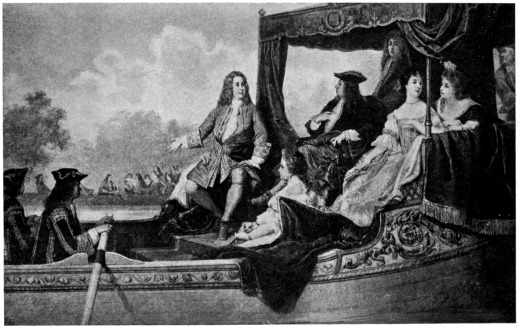
GEORGE I., IN HIS ROYAL BARGE, LISTENING TO HANDEL’S
“WATER-MUSIC.”
(From a Painting.)
It was not that he had much occupation at the Court. The King was too
engrossed in State business, and with hunting. He did not even find time
to be anxious about his old retainer, Leibnitz, who died at Hanover on
November 14, 1716, unnoticed at Court. Handel took advantage of this
leisure to renew his acquaintance with the German art.
There was then in Germany a fashion for musical Passions. There was a
religious and theatrical tendency at that time. One cannot separate the
influence of Pietism and that of the Opera. Keiser, Telemann, Mattheson,
all wrote Passions, which caused a great stir[173] at Hamburg, on the
famous text of the Senator Brockes. Following their example, perhaps in
order to measure himself with these men, who had all three been rivals
or friends,[174] Handel took the same text and wrote on it in 1716 his
Passion after Brockes. This powerful and disparate work, where bad
taste mingles with the sublime, where affectation and pomposity are
mingled with the most profound and serious art—a work which J. S. Bach
knew well, and very carefully remembered—was for Handel a decided
experience. He felt in writing it what a great gulf separated him from
the Pietist German art, and on his return to England[175] he composed
the Psalms and Esther.
. . . . .
. . . . .
. . . . .
. . . . .
. . . . .
This was the principal epoch of his life. Between 1717 and 1720, whilst
he was in the service of the Duke of Chandos,[176] he made a careful
examination of his own personality, and created a new style in music,
and for the theatre.
The Chandos Anthems or Psalms[177] stand, in relationship to Handel’s
oratorios, in the same position as his Italian cantatas stand to his
operas: they are splendid sketches of the more monumental works. In
these religious cantatas, written for the Duke’s chapel, Handel gives
the first place to the choruses: it is the exact words of the Bible
which they sing. Strong heroic words, freed from all the commentary and
sentimental effusions with which German Pietism had loaded them. There
is already in them the spirit and the style of Israel in Egypt, the
great monumental lines, the popular feeling.
It was only a step from this to the colossal Biblical dramas. Handel
took the step with Esther, which in its first form was entitled Haman
and Mordecai, a masque.[178]
Quite possibly the work had its first presentation at the Duke of
Chandos’, but on August 29, 1720, it was presented on the stage. It was
in any case one of the greatest tragedies in the old style which had
been written since the Grecian period. It was as though the spirit of
Handel had been led insensibly towards the Hellenic ideal, for he
composed nearly at the same time his pastoral tragedy Acis and
Galatea, to which he also gave the name of masque,[179] and which did
not disengage itself from the complete idea of a free theatre. This
little masterpiece of poetry,[180] and of music, where the beautiful
Sicilian legend unfolds itself in pictures smiling and mournful, has a
classical perfection which Handel never surpassed.
. . . . .
. . . . .
. . . . .
. . . . .
. . . . .
Esther and Acis bore witness to Handel’s desire to bring to the
surface of dramatic action all the powers of choral and symphonic music.
Even in these two works, which unquestionably opened up the way for his
future oratorios, it is not the oratorio which is his aim, but the
opera. Always attracted by the theatre, only a succession of disasters
of accumulating ruin thrust him away later against his will. So it is
natural to find him at the same time when he was writing Esther and
Acis, also undertaking the musical direction of a theatre enterprise,
which led later on to one of the most important steps of his life, the
Academy of Italian Opera.[181]
Handel saw, it is said, in the year 1720 the end of his years of
apprenticeship; he certainly terminated (although he knew it not) his
years of tranquillity. Up to then he had led the life of numberless
other great musicians, who lived under the protection of princes, and
wrote for a select audience. He had only occasion to leave this path,
with his religious and national works, where he had voiced a people’s
feelings. After 1720, and indeed up to the time of his death, all the
rest of his art belonged to everybody. He put himself at the head of a
theatre, and opened a struggle with the public at large. He exerted
prodigious vitality, writing two or three operas every year, knocking
into shape an undisciplined troupe of virtuosi smothered with pride,
harassed with intrigues, hindered by bankruptcy, using his genius for
twenty years in the paradoxical task of thrusting on London a shaky and
shallow Italian opera, which could not live under a sun and in a climate
unsuitable to it. At the end of this strife, enraged, conquered, but
invincible, sowing on his way all his masterpieces, he reached the
pinnacle of his art—those grand oratorios which rendered him immortal.
After a voyage in Germany to Hanover, to Halle, to Düsseldorf, and to
Dresden, to recruit for his troupe of Italian singers,[182] Handel
inaugurated at the Haymarket Theatre the London Opera of April 27, 1720,
with his Radamisto, which was dedicated to the King.[183] The rush of
the public was very great indeed, but it was due more to curiosity than
to the turn of the fashion. Soon the snobbishness of the amateurs could
no longer content itself with Italianized German as the representative
of Italian Opera, and finally Lord Burlington, Handel’s former patron,
went to Rome to induce the king of the Italian style, Giovanni
Bononcini, to come over.[184]
Bononcini came from Modena. He was about fifty years old,[185] son of an
artist of great merit, Giovanni Bononcini, whose premature death cut
short a career rich with promise.[186] Brought up with an almost
paternal affection by one of the first masters of that epoch, one of the
few who had preserved the cult and the science of the past, Giampaolo
Colonna, organist of St. Pietronio at Bologna, he had benefited early in
life by a high princely, even Imperial,[187] protection. More precocious
even than Handel, he published his first works at the age of thirteen,
was member of the Philharmonic Academy of Bologna at fourteen, and
master of the Chapel at fifteen. His first works were instrumental. This
was his speciality, having inherited his gift from his father.[188] He
only reached the Opera after having tried all the other styles. It was
not with him a natural calling. He was a born concert musician, and he
remained so even in the Opera. His tours in Germany and in Austria,
where he was created Imperial Composer in 1700, and gave his Polifemo
at Berlin in 1703,[189] fully established his renown in Europe. His
music spread in France after 1706 and excited there an almost incredible
infatuation.[190] When in Italy his reputation surpassed even that of
Scarlatti, who himself, according to Mr. Dent, came under his influence
to a small extent. He had a European vogue for about ten or fifteen
years. He was, so to speak, the reflection of the society of his time.
What strikes one in his music, if we are to believe Lecerf de la
Viéville, is the boldness of his modulations, the abundance of his vocal
ornaments, the unruliness of his mind. His style seemed to the Lullyists
that of the affected and distorted order as opposed to the school of
common sense. Bononcini was a “verticalist” then, differing from the
“horizontalists” of the preceding epoch.[191] He was essentially a
sensuous musician, and an anti-intellectualist. Right from the
beginning, as an instrumental composer he always remained indifferent to
his poems, to his subjects, and to everything which was outside of
music. In his music he set a pleasing sonority above everything;[192]
and it was evidently on this account that his work required less effort
of the intelligence than was necessitated by the severe art of
Scarlatti, or the recitative and expressive art of Lully.[193] In him
was inaugurated the reaction of fashionable good taste in the general
public against that of the savant.[194] Contrast the grand airs Da
Capo, broadly developed in a more or less contrapuntal fashion, with
his tiny little airs, also Da Capo, but in miniature, easy to
understand, which touched the popular feeling for melody. He carefully
perfumed it and served it up for the taste of the elegant and
fashionable.[195] This distinguished simplicity, this delicate
sensibility, rather feeble, always so correct in its audacities and
restrained in its pleasures, made Bononcini a drawing-room favourite, a
fashionable revolutionary. The more he worked, the more his traits were
accentuated, and became permanent. As happens to all artists who enjoy
too much success, this reacted on his art, and imposed on him the
repetition of certain fixed patterns. The natural laziness of Bononcini
only exaggerated this tendency, so that from year to year this
affectedness appeared in his art, making it quite mechanical. His music,
often beautiful and gracious, always harmonious, never expressive,
unrolled itself as a succession of elegant and highly finished subjects,
all cut out as if with scissors on the same pattern, and indefinitely
repeated. At first in London one was only conscious of his charm. The
personality of the musician added to the attractions of his music. The
gentle Italian had polished manners, a quality at once lovable, and
penetrated by a bold courage. He was a virtuoso like Handel, but on an
instrument more distinguished than the clavier—on the violoncello; and
he was listened to with respect in the aristocratic salons. He was, so
to speak, the author à la mode; and his Astarto,[196] given at the
end of 1720, erased the impression made by Handel’s Radamisto.
Handel had his work cut out. He was not suited to strive with Bononcini
on the ground of Italianism. However, he was up against the wall. The
English public, always keen on bear fights, cock fights, and virtuoso
contests, amused themselves by arranging a joust between Bononcini and
Handel. They were to be tested by an opera written in combination.
Handel took up the glove—and was beaten. His Muzio Scevola[197]
(March, 1721) is very feeble, and the Floridante which followed
(December 9, 1721) is little better. The success of the Italian
increased his fame, and the pretty Griselda (February, 1722)
consummated Bononcini’s glory. He benefited by the strenuous opposition
of the English littérateurs, and the leading aristocrats, against the
Hanoverian Court and the German artists.
Handel’s situation was much involved, but he took his revenge with the
melodious opera Ottone (January 12, 1723), which was the most popular
of all his operas. Victorious then,[198] he went straight ahead without
troubling himself about Bononcini, and he composed, one after another,
three masterpieces in which he inaugurated a new musical theatre, as
musically rich, and more dramatic than that of Rameau, some ten years
later: Guilio Cesare (February 20, 1724); Tamerlano (October 21,
1724), and Rodelinda (February 13, 1725). The last of Tamerlano is a
magnificent example of the great music drama, an example nearly unique
before Gluck, in its poignancy and passion. Bononcini’s party was
definitely ruined,[199] but the greatest difficulties now began for
Handel. The London Opera was delivered over into the hands of Castrati
and Prime Donne, and the extravagances of their supporters. In 1726
there arrived the most celebrated Italian singer of the time, the famous
Faustina.[200] From this moment the London representations became mere
jousts of song between Faustina and Cuzzoni—jousts as strenuous as the
shouting of their various partisans. Handel wrote his Alessandro (May
5, 1721) for an artistic duel between the two stars of his troupe, who
acted as the two mistresses of Alessandro.[201] In spite of all, his
dramatic genius won the day by several sublime scenes from Almeto
(January 31, 1727), the grandeur of which veritably seized hold of the
public. But the rivalry of the singers, far from being appeased,
redoubled in fury. Each party had its hired pamphleteers, who let loose
on the adversary the most degrading libels. Cuzzoni and Faustina
reached such a state of rage that on June 6, 1727, during the play, they
fought and tore each other’s hair unmercifully, amidst the yells of the
audience, the Princess of Wales being present.[202]
After this everything went to the dogs. Handel tried hard to take the
reins, but, as his friend Arbuthnot said, “the devil was loose, and
could never be caged again.” The battle was lost, despite three new
works of Handel, where his genius again shone forth: Riccardo I
(November 11, 1727); Siroe (February 17, 1728); and Tolomeo (April
30, 1728). A little venture by John Gay and by Pepusch, The Beggar’s
Opera (A War Opera) finished the defeat of the London Academy of
Opera.[203] This excellent operetta, spoken in dialogue, with popular
songs interspersed, was at the same time a trenchant satire on Walpole,
and a spirited parody of the ridiculous sides of the opera.[204] Its
immense success took the character of a national manifestation. It was
a reaction of popular common sense against the pompous childishnesses of
the Italian Opera, and against the snobbishness which attempted to
impose it on other nations. We see in this the first blow struck at the
triumphant Italianism. Nationality awoke. In 1729 the Passion according
to St. Matthew was given. Some years later Handel’s earlier oratorios
were performed, and also the first operas of Rameau. In 1728 to 1729
Martin Heinrich Fuhrmann entered the campaign against Italian Opera with
his famous pamphlets. After him, Mattheson re-entered the ring: The
Goths and their Hippogriffs to be purified in the crater of Etna. But
nowhere was this national reaction so widely spread as in England, where
it roused itself with such robust humour, as with Swift and with Pope,
those famous layers of ghosts[205] and dreams.
. . . . .
. . . . .
. . . . .
. . . . .
. . . . .
Handel felt this. After 1727 he sought steadily to establish himself on
the national English soil. He had become a naturalized Englishman on
February 13, 1726. He wrote for the Coronation of the new King, George
II, his Coronation Anthems,[206] September 11, 1727.[207] He returned to
his plans for the English oratorios.
But he was not yet sufficiently sure of his ground, nor of the public
taste, to justify him in completely throwing over the Italian Opera, for
he realized more than before the resources of the people and what he
could do with them. Besides, the collapse of the London Academy of Opera
had not touched his personal prestige. He was regarded, not only in
England, but also in France, as the greatest man of the Lyric
Theatre.[208] His London Italian operas became known all over Europe.
Flavius, Tamerlan, Othon, Renaud, César,
Admete, Siroé, Rodelinde, et Richard,
Éternels monumens dressés à sa mémoire,
Des operas Romains surpassèrent la gloire,
Venise lui peut-elle opposer un rival?[209]
One can well understand, then, that Handel was tempted by the desire of
taking on his own shoulders, without the control which hampered him, the
complete enterprise of the Italian Opera. At the end of the summer of
1728 he went to Italy in search of new arms for the strife. In the
course of this tour, which lasted nearly a year,[210] he recruited his
singers, renewed his collection of libretti and Italian scores. Above
all, he refreshed his Italianism at the source of the new School of
Opera, founded by Leonardo Vinci,[211] which reacted against the concert
style in the theatre, and sought to give back to Opera a more dramatic
character, even at the risk of impoverishing the music.
Without sacrificing the richness of his style, Handel did not neglect to
profit by these examples in his new operas: Lotario (December, 1729),
Partenope (February, 1730), Poro (February, 1731), Ezio (January,
1732), which are notable (particularly the last two) by the beauty of
the melodic writing, and the dramatic power of certain pages. The
masterpiece of this period is Orlando (January 27, 1733), of which the
richness and musical perfection are on a level with the insight into the
characters, and the spirited and passionate life of the piece. If the
Tamerlano of 1724 awakens ideas of Gluck’s tragedies, it is the
beautiful operas of Mozart which come to mind in Orlando.
In continuation of the strife for the Italian Opera, Handel profited by
the unexpected success with which the English people had met the
reproduction of his Acis and Galatea and his Esther,[212] written to
English words, and he attempted again, in a more conscientious fashion
than ten years before at Chandos’, to found a form of musical theatre,
freer and richer, where the lyricism of the choruses had free play. For
the reproduction of Esther in 1732 he introduced into the work of 1720
the most beautiful choruses from the Coronation Anthems. In the
following year he wrote Deborah (March 17, 1733), and Athaliah (July
10, 1733), where the chorus took first place. These grand Biblical
dramas would have been able to have awakened in the English nation an
enthusiastic response, were it not that this attempt was damaged by a
violent quarrel inspired by personal reasons, where art counted for
nothing. A dead set was made against Deborah,[213] and though
Athaliah succeeded at Oxford,[214] Handel did not present it in London
until two years later.
Once again Handel returned to Italian Opera. The public hatred pursued
him here also. The royal family of Hanover was detested. It added to its
own discredit by the scandalous disputes which took place between the
King and his son. The Prince of Wales, in a spirit of petty spite
against his father, who showed his affection for Handel, amused himself
by attempting to ruin the composer. Encouraged by the opposition, and
enchanted by the idea of making sport against the King, he founded a
rival opera house, and as he could no longer set Bononcini up against
Handel, as the former had been discredited by a case of flagrant
plagiarism, which had an European circulation,[215] he approached
Porpora, with a view to directing his theatre. “Then,” says Lord Hervey,
“the struggle became as serious as that of the Greens against the Blues
at Constantinople under Justinian. An anti-Handelian was regarded as an
anti-Royalist, and in Parliament, to vote against the Court was hardly
more dangerous than to speak against Handel.” On the other hand, the
immense unpopularity of the King redounded on Handel, and the
aristocracy combined to secure his downfall.
He accepted the challenge, and after a third tour in Italy during the
summer of 1733, again to recruit more singers, he bravely took up the
fight with Porpora, to whom was added Hasse in 1734. They were the
greatest rivals against which he had yet measured himself. But Hasse and
Porpora had strong dramatic feeling, and especially were they the most
perfect masters of the beautiful art of Italian melody and singing.[216]
Nicolo Porpora, who came from Naples, was forty-seven years old. He had
a cold but vigorous spirit, intelligent and possessing more than anyone
else, except Hasse, all the resources of the Italian singing. His style
was very beautiful, and it was not less broad than that of Handel. No
other Italian musician of his time had such ample breadth of
phrasing.[217] His writings seem of a later age than Handel’s, and
approximate to the time of Gluck and Mozart. Whilst Handel, despite his
marvellous feeling for plastic beauty, often treated the voices as an
instrument, and in his development the beautiful Italian lines
occasionally became weighed down by German complexity, Porpora’s music
always kept within the bounds of classic purity, though the form was a
little uninteresting in design. History has never done him sufficient
justice.[218] He was quite worthy of measuring himself against Handel,
and the comparison between Handel’s Arianna and that of Porpora,
played at an interval of a few weeks,[219] did not prove to the
advantage of the former. Handel’s music is elegant, but one does not
find the breadth of certain airs in Porpora’s Arianna à Naxos. The
form of these airs is perhaps of too classic a correctness, but the
right Grecian breezes blow across his Roman temples.[220] He has been
claimed as an Italian disciple of Gluck—a curious criticism which is
bestowed occasionally on precursors. It was so with Jacopo della
Quercia, who inspired Michael Angelo, and to whom the latter seems to
owe something.
Hasse was even superior to Porpora in the charm of his melody, which
Mozart alone has equalled, and in his symphonic gifts, which showed
themselves in his rich instrumental accompaniments no less melodious
than his songs.[221] Handel was not slow to discover the folly of
striving with Hasse on Italian ground. His superiority was with the
choruses; he sought to introduce them into the Opera after the French
model. The situation was even less promising for him on the departure of
his best protectrix, the Princess Anne, sister of the Prince of
Wales.[222] After having compromised Handel by the strong feeling which
she had shown in defending him, she left him to the tender cares of the
enemies which she had made for him. She left England in April, 1734, to
join her husband the Prince of Orange[223] in Holland.
Handel came to be abandoned by his old friends. His associate,
Heidegger, the proprietor of the Haymarket Theatre, took the hall for a
rival opera, and Handel, driven from the house in which he had worked
for fourteen years, had to emigrate with his troupe to John Rich’s place
at Covent Garden[224]—a sort of music-hall where Opera took its turn
with all kinds of other spectacles: ballets, pantomimes, and
harlequinades. In Rich’s troupe some French dancers were to be found,
amongst whom was “la Salle,”[225] who was shortly to arouse great
enthusiasm amongst the English public with two tragic dances:
Pygmalion and Bacchus and Ariadne.[226] Handel, who had known the
French art[227] for a long time, saw how far he could draw on these new
resources, and he opened the season of 1734 at Covent Garden with a
first attempt in the field of the French ballet opera: Terpsichore
(November 9, 1734), in which “la Salle” took the principal rôle. A
month later a Pasticcio followed, Orestes, where Handel gave a
similar important part to “la Salle,” and to her expressive dances.
Finally, he intermingled the dance and the choruses closely with the
dramatic action in two masterpieces of poetry and beautiful musical
construction—Ariodante (January 8, 1735), and especially Alcina
(April 16, 1735).
Bad luck still pursued him. Some gross national manifestations compelled
“la Salle” and her French dancers to leave London.[228] Handel gave up
the ballet opera. To leave at this moment, if he was to continue the
struggle with the theatre, went badly against the grain, and was
tantamount to declaring himself vanquished. At the opening of his
theatrical enterprise he had saved, so it is said, £10,000. All this was
absorbed, and already he was £10,000 more to the bad. His friends did
not understand his obstinacy, which seemed about to involve him in
complete ruin. “But,” says Hawkins, “he was a man of intrepid spirit,
and in no ways a slave to mere interest. He raised himself again for the
battle rather than bow down to those whom he regarded as infinitely
beneath him.” If he could no longer be conqueror, still less would he
hand the reins to his adversaries. He overcame them—but a little more
would have vanquished himself in the same stroke.
He persisted then in writing his operas,[229] of which the series spread
out until 1741, marking work after work with a growing tendency towards
the opéra-comique and the style of romances[230] so dear to the
people at the second half of the eighteenth century. But since 1735 he
felt more than ever that the true musical drama for him was the
oratorio. He returned victoriously with Alexander’s Feast, which was
composed on the Ode to St. Cecilia, by Dryden,[231] and given for the
first time on February 19, 1736, at the Covent Garden Theatre.
Who would have believed that this work, robust and sane throughout, was
written in twenty days, that it was performed in the midst of his
business worries, within an ace of ruin, and when he was threatened with
that grave malady which was to throw the mind of Handel for evermore
into gloom?
. . . . .
. . . . .
. . . . .
. . . . .
. . . . .
For several years trouble pursued him. Work and excessive worry had
undermined an iron constitution. He tried the baths at Tunbridge Wells
during the summer of 1735, and probably also in 1736, but with no
success. He could not sleep. His theatre was always on his mind. He made
superhuman efforts to keep it going. From January, 1736, to April, 1737,
he directed two seasons of Opera, two seasons of oratorio, and composed
a song, an oratorio, a Psalm, and four operas.[232] On April 12, or 13,
1737, the machine broke down. He was smitten with paralysis, his right
side was attacked, his hand refused all service, and even his mind was
affected. In his absence his theatre closed its doors, bankrupt.[233]
During the whole of the summer Handel remained in a pitiful state of
depression. He refused to care for anything; all hope was lost. Finally,
his friends succeeded in inducing him, towards the end of August, to try
the baths at Aix-la-Chapelle. The cure had a miraculous effect. In a few
days he was restored. In October he returned to London, and immediately
the refreshed giant resumed the struggle, writing in three months two
operas, and the magnificent Funeral Anthem on the death of the
Queen.[234]
Sad days were in store, however. His creditors seized him, and he was
threatened with imprisonment. Happily a sympathetic movement was
inaugurated in favour of the artist so harassed by his kind. A benefit
concert, to which his pride reluctantly submitted,[235] at the end of
March, 1738, had an unexpected success. It freed him from the most
pressing of his debts. In the following month a token of public
admiration was given him. His statue was erected in the Vauxhall
Gardens.[236] In the springtime of 1738 he began to feel, with returning
strength, confidence in the future. The horizon cleared. He was
encouraged by such faithful sympathy. He returned to life, and made his
presence felt again.
On July 23 he commenced Saul; on August 8 he had written two acts of
it; by September 27 the work was finished. On October 7 he began Israel
in Egypt; by October 28 the work was achieved. Still pushing
strenuously forward, on October 4 he launched the first volume of his
organ concertos with the publisher Walsh, and on the 7th he took to him
his Seven Trios or Sonatas in two parts, with bass, Opus 5. For those
who know these joyful works, which dominate like two Colossi the two
oratorios of victory, this superhuman effort had the effect of a force
of Nature, like a field which breaks into flower in a single night of
springtime.
Saul is a great epic drama, flowing and powerful, where the humorous
and the tragic intermingle. Israel is one immense chorale, the most
gigantic effort which has ever been made in oratorio, not only with a
single but with combined choirs.[237] The audacious originality of the
conception and its austere grandeur almost stunned the public of his
day. The living Handel breathes throughout the work.
The hopes which Handel had founded on England caused him fresh
uneasiness. Times were hard. Since the winter of 1739, theatrical
performances, and even concerts, were suspended for several months on
account of the war, and the extreme cold. Handel, to keep himself warm,
wrote in eight days the little Ode to St. Cecilia (November 29, 1739);
in sixteen days L’Allegro, Il Penseroso, ed Il Moderato of Milton
(January-February, 1740); in a month the Concerti Grossi, Opus 6.[238]
But the success of these charming works, graven out with loving care,
into which Handel had perhaps put more than into any other his own
personal feelings, his poetic and humorous reproductions of nature,[239]
was hardly sufficient yet to establish his affairs, at one time so
embarrassed. Once more, as in the time of Deborah and Arianna, he
was attacked by a coalition of fashionable people. One does not know
how Handel had wounded them,[240] but they were resolved on his
downfall. They avoided his concerts. They even paid men to pull down his
placards in the streets. Handel, tired and disheartened, suddenly threw
up the combat.[241] He decided to leave England, where he had lived for
nearly thirty years, and where he had increased his fame so much. He
announced his last concert for April 8, 1741.[242]
. . . . .
. . . . .
. . . . .
. . . . .
. . . . .
It is a remarkable thing that often in the lives of the great men, just
at the moment when all seems lost, or things are at their lowest ebb,
they are nearest to the fulfilment of their destiny. Handel appeared
vanquished. Just at that very hour he wrote a work which was destined to
establish permanently his immortality.
He left London.[243] The Lord-Lieutenant of Ireland invited him to
Dublin to direct some concerts. Thus it was, so he said, “in order to
offer this generous and polished nation something new” that he composed
The Messiah on a poem by his friend Jennens.[244] They had already
given many of his religious works in Dublin for charitable
concerts.[245] Handel was received enthusiastically. The letter which he
wrote on December 29 to Jennens bubbles over with joy. The time which he
passed in Dublin was, together with his early years in Italy, the
happiest in his life. From December 23, 1741, to April 7, 1742, he gave
two series of six concerts, and always with the same success. Finally,
on April 12, the first hearing of The Messiah took place in Dublin.
The proceeds of the concert were devoted to charitable objects, and the
success was very considerable.[246]
Eight days after having finished The Messiah (that is to say, before
he had yet arrived in Ireland) Handel had commenced Samson, which was
finished in five weeks, from the end of September to the end of October,
1741. However, he did not give it in Dublin. Doubtless he could not find
the interpreters which he desired for this colossal drama, rich in
choral scenes and in difficult rôles.[247] Perhaps also he reserved
the work for the following season in Dublin, when he hoped to return,
but the expected invitation which he awaited in London did not come, and
it was in London that Samson reached its first hearing on February 18,
1743.
To this heroic oratorio, based on the sublime Samson Agonistes of
Milton,[248] succeeded a light opera, which bore, nevertheless, the name
of oratorio, the libretto of which was based on a poem by Congreve:
Semele (June 3 to July 4, 1743). It afforded a relief for him between
these two Herculean works. In the same month in which he finished
Semele, Handel wrote his monumental Dettingen Te Deum, to celebrate
the victory of the Duke of Cumberland over the French.[249] Joseph,
written in August and September of the same year, on a very touching
poem by James Miller, reveals a sweet yet melancholy fancy, a little
insipid, on which, however, the strong portrait of Simeon projects
itself forcibly.
1744 was one of Handel’s most glorious years from the creative point of
view, but one of the most miserable in outward success. He wrote nearly
simultaneously his two most tragic oratorios, the great Shakespearian
drama of Belshazzar (July-October, 1744), the rich poem of which was
furnished for him by his friend Jennens;[250] and the sublime tragedy of
the ancient Hercules, a musical drama,[251] which marks the
culmination of the Handelian musical drama, and indeed one might say of
the whole musical theatre before Gluck.
Never was the hostility of the English public more roused against him.
The same hateful cabal which had already thrice threatened to bring
about his downfall again rose against him. They invited the fashionable
world in London to their fêtes, specially organised on the days when
the performances of his oratorios were to have taken place, with the
object of robbing him of his audience. Bolingbroke and Smollett both
speak of the plots of certain ladies to ruin Handel. Horace Walpole says
that it was the fashion to go to the Italian Opera when Handel directed
his oratorio concerts. Handel, whose force of energy and genius had
weakened since his first failure of 1735, was involved afresh in
bankruptcy at the beginning of 1745. His griefs and troubles, and the
prodigious expenditure of force which he made, seemed again on the point
of turning his brain. He fell into extreme bodily prostration and
lowness of spirit, similar to that of 1737, and this lasted for the
space of eight months, from March to October, 1745.[252] By a miracle he
was able to rise out of this abyss, and by unforeseen events, where
music was his only aid, he became more popular than he ever was before.
The Pretender, Charles Edward, landed in Scotland; the country rose up.
An army of Highlanders marched on London. The city was in consternation.
A great national movement arose in England, Handel associated himself
with it. On November 14, 1745, he brought to light at Drury Lane his
Song made for the Gentlemen Volunteers of the City of London,[253]
and he wrote two oratorios, which were, so to speak, immense national
hymns: the Occasional Oratorio,[254] where Handel called the English
to rise up against invasion, and Judas Maccabæus[255] (July 9 to
August 11, 1746), the Hymn of Victory, written after the rout of the
rebels at Culloden Moor, and for the fête on the return of the
conqueror, the ferocious Duke of Cumberland, to whom the poem was
dedicated.
These two patriotic oratorios, where Handel’s heart beat with that of
England, and of which the second, Judas Maccabæus, has retained even
to our own day its great popularity, thanks to its broad style and the
spirit which animates it,[256] brought more fortune to Handel than all
the rest of his works together. After thirty-five years of continuous
struggle, plot and counterplot, he had at last obtained a decisive
victory. He became by the force of events the national musician of
England.
. . . . .
. . . . .
. . . . .
. . . . .
. . . . .
Freed from material cares, which had embittered his life,[257] Handel
took up the work of his composition again, with more tranquillity, and
in the following years came many of his happiest works. Alexander
Balus (June 1 to July 4, 1747)[258] is, like Semele, a concert opera,
well developed; the orchestration being exceptionally rich and subtle.
Joshua (July 30 to August 18, 1747)[259] is a somewhat pale replica
of Judas Maccabæus. A gentle love idyll blossoms amidst the pompous
choruses. Solomon (June, 1748)[260] is a musical festival, radiating
poetry and gladness. Susanna (July 11, 1724, to August, 1748), grave
and gay by turns, realistic yet lyric, is a hybrid kind of work, but
very original.
Finally, in the spring of 1749, which marks, so it seems, the end of
Handel’s good fortune, he wrote his brilliant Firework Music—a model
for popular open-air fêtes—produced on April 27, 1749, by a monster
orchestra of trumpets, horns, oboes, and bassoons, without stringed
instruments, on the occasion of the Firework display given in Green Park
to celebrate the Peace of Aix la Chapelle.[261]
More solemn works followed these gay pieces. At this moment of his life
the spirit of melancholy raised its grey head before the robust old man,
who seemed to be obsessed by the presentiment of some coming ill
fortune.
On May 27, 1749, he conducted at the Foundling Hospital[262] for the
benefit of waifs and strays, his beautiful Anthem for the Foundling
Hospital,[263] which was inspired by his great pity for these little
unfortunates. From June 28 to July 31 he wrote a pure masterpiece,
Theodora, his most intimate musical tragedy, his only Christian
tragedy besides The Messiah[264]. From the end of that same year dates
also his music for a scene from Tobias Smollett’s Alceste, which was
never played, and from which Handel took the essential parts for his
Choice of Hercules.[265] A little time after he made his last voyage
to Halle. He arrived on German soil at the moment when Bach died, July
28, 1750. Indeed he nearly ended his life there himself in the same week
by a carriage accident.[266]
He recovered quickly, and on January 21, 1751, when he commenced the
score of Jephtha, he appeared to be in robust health, despite his
sixty-six years. He wrote the first act at a stretch in thirteen days.
In eleven days more he had arrived at the last scene but one of Act II.
Here he had to break off. Already in the preceding pages he only
progressed with difficulty; his writing, so clear and firm at the
commencement, became sticky, confused, and trembling.[267] He had
started on the final chorus of Act II: “How dark, O Lord, are Thy Ways.”
Hardly had he written the opening Largo than he had to stop working.
He wrote:
“I reached here on Wednesday, February 13, had to discontinue on
account of the sight of my left eye.”[268]
The work was broken off for ten days. On February 23 (which was his
birthday) he wrote in:
“Feel a little better. Resumed work”;
and he wrote the music to those foreboding words:
“Grief follows joy as night the day.”
He took hardly five days to finish this chorus, which is really sublime.
He stopped then for four months.[269] On June 18 he resumed the third
act. He was again interrupted in the middle.[270] The last four airs and
the final chorus took more time than a whole oratorio usually occupied.
He did not finish it until August 30, 1751. His sight was then gone.
. . . . .
. . . . .
. . . . .
. . . . .
. . . . .
After that, all was ended. Handel’s eyes were closed for ever.[271] The
sun was blotted out, “Total eclipse....” The world was effaced.
He had never suffered so much as in the first year of his illness, when
he was not yet completely blind. In 1752 he was unable to play the organ
at the productions of his oratorios, and the public, moved by sympathy,
saw him tremble and blanch in listening to the admirable complaint of
his blind Samson. But in 1753, when the evil was incurable, Handel
regained his self-possession. He played the organ again at the twelve
performances of oratorios which he gave each year in Lent, and he kept
up this custom until his death.
But with his vanished sight he had lost the best source of his
inspiration. This man, who was neither an intellectual nor a mystic, one
who loved above all things light and nature, beautiful pictures, and the
spectacular view of things, who lived more through his eyes than most of
the German musicians, was engulfed in deepest night. From 1752 to 1759
he was overtaken by the semi-consciousness which precedes death. He only
wrote in 1758 a duet and chorus for Judas Maccabæus, “Zion now her
head shall raise,” and reviving in that the happy times of other days he
took up a work of his youth, the Trionfo del Tempo,[272] which he now
gave in a new version in March, 1757: The Triumph of Time and
Truth.[273]
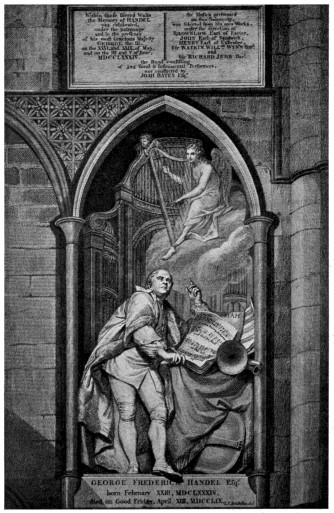
HANDEL’S MONUMENT IN WESTMINSTER ABBEY.
(In the “Poets’ Corner.”)
On April 6, 1759, he again took the organ at a production of The
Messiah. His powers failed him in the middle of a movement. He soon
recovered himself and improvised (it is said) with his habitual
grandeur. Returned home he took to bed. On April 11 he added a last
codicil to his will,[274] bequeathing munificently £1000 sterling to
the Society for the Maintenance of Poor Musicians, and expressing, with
tranquillity, his desire of being buried in Westminster Abbey. He said:
“I want to die on Good Friday in the hope of rejoining the good God, my
sweet Lord and Saviour, on the day of his Resurrection.” His wish was
accomplished. On Holy Saturday, April 14, at eight in the morning, the
sweet singer of The Messiah slept with his Lord.
. . . . .
. . . . .
. . . . .
. . . . .
. . . . .
His glory spread after his death. On April 20 he was interred in
Westminster Abbey, as he had requested.[275] The annual performances of
his oratorios continued in Lent under the direction of his friend,
Christopher Smith. Popular performances of them were soon given. The
great festival of his Commemoration celebrated at Westminster Abbey and
in the Pantheon, from May 26 to June 5, 1784, for the centenary of his
birth,[276] was observed all over Europe. New festivals took place in
London in 1785, 1786, 1787, 1790, and 1791. On the last occasion more
than a thousand executants[277] took part. Haydn was present, and he
said, through his tears, “He is master of us all.”
The English performances attracted the attention of Germany. Two years
after the Commemoration, Johann Adam Hiller produced The Messiah in
the Cathedral Church at Berlin, then at Leipzig, and then at Breslau.
Three years later, in 1789, Mozart made his arrangements of The
Messiah, of Acis and Galatea, of the Ode to St. Cecilia, and of
Alexander’s Feast.[278] The first complete edition of Handel was
commenced in 1786. A strong feeling of emulation made itself felt in
Germany to imitate the English festivals, and to restore choral singing,
and to found the Singakademien for the preservation of the national
glories.[279] The rendering of Handel’s oratorios inspired Haydn to
write The Creation. Beethoven at the end of his life said of Handel:
“See there is the truth.”[280] Poets also vied equally in rendering him
homage. Goethe admired him, and Herder devoted a chapter to him in his
Adrastea of 1802. The wars of Independence gave an access of favour to
the oratorio of freedom, to Judas Maccabæus.
With romanticism the feeling for the genius of Handel was lost. Berlioz,
who, if he had but known him truly, and had found a model for that grand
popular style which he sought, never understood him. Of all other
musicians, those who approached to the spirit of Handel nearest were
Schumann and Liszt,[281] but they were exceptional in the lucidity of
their perception, and their generous sympathies. It might be said that
Handel’s art, distorted by the editions and false renderings—quite as
much those in Germany as the ridiculously colossal representations in
England—would have been completely lost except for the foundation in
1856 of the Handel Society, which devoted itself to the object of
publishing an exact and complete edition of the works of the master.
Gervinus was the promoter and Friedrich Chrysander alone accomplished
the task. It did not aim at being a critical edition of his works. His
ardent apostle sought simply to revive them in their pristine
force.[282] He was seconded by the choral societies of north Germany,
particularly by the Berlin Singakademien, which from 1830 to 1860
never ceased to perform all the oratorios of Handel. On the contrary,
Austria remained a long way behind. In 1873, Brahms conducted the first
production of Saul in Vienna, but the veritable awakening of Handel’s
art in Germany only dates back about half a score years. One recognized
his grandeur, and did not doubt that he had lived. It was chiefly (so it
seems) at the first Handel Festival of Mayence in 1895, where Hercules
and Deborah were given, that his astounding dramatic genius was first
truly felt there.
To us in France we still await the full revelation of the living scenes
of this great and luminous tragic art, so akin to the aims of Ancient
Greece.[283]