The Severn, like other English rivers, may be said to have been the
pioneer of railways along its banks: first, in having done much to correct
the inequalities of the surface; secondly, in having indicated the direction
in which the traffic flowed; so that early in the history of railway
enterprise eminent engineers, like the late Robert Stephenson, saw the
desirability of following its course, and thus meeting the wants of
towns that had grown into importance upon its banks, wants which the
river itself was unable to supply. In 1846 the route was finally
surveyed by Robert Nicholson, with a view to a through traffic in connection
with other railways. The scheme met with opposition from advocates
of rival lines. Ultimately, however, the Bill passed the committees
of the two Houses, and the promoters were successful, whilst the expenses
of counsel and witnesses were enormous. The original estimate
for the line was £600,000: £110,000 for land, and £490,000
for works. £8,500 was down for a girder bridge at Arley,
£8,000 for one near Quatford, £9,000 for one above Bridgnorth,
and £10,000 for one at Shrewsbury. The two bridges near
Bridgnorth and the one near Shrewsbury were abandoned, and a considerable
saving was effected by shortening the line at Hartlebury, by a junction,
with the Oxford, Wolverhampton, and Worcester higher up than was originally
intended. The estimated cost of the works, in consequence of these
reductions, and of the determination of the company to make it a single
line, was thus reduced to nearly one-half the original sum.
Although the Severn Valley Railway joins the Main Trunk line at Hartlebury,
Worcester is regarded as its proper terminus; and at that point we commence
our description.
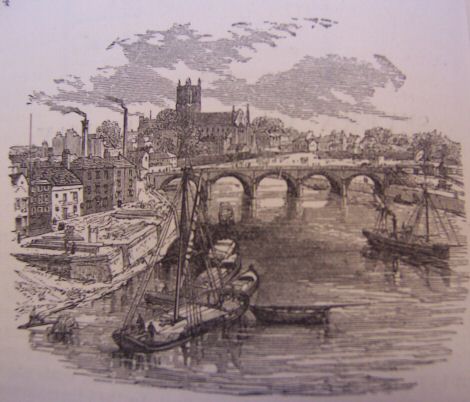
Population, 31,123. Returns two Members to Parliament
Market days—Wednesdays and Saturdays Fair days—Saturday
before Palm Sunday, Saturday before Easter Day, August 15th, September
19th, and first Monday in December.
Our engraving represents the “faithful city” as it appears
from a point between the bridges, with the Cathedral rising from an
eminence above the river. The venerable pile was raised by the
brave and pious bishop Wulstan, upon the site of an earlier edifice,
formerly the church of a priory founded by one of the Saxon kings.
Recent restorations, carried on under the direction of the Dean and
Chapter, have led to the correction of defects, resulting from time,
and ignorance on the part of past builders, and have disclosed features
which add much to the grandeur of the edifice; so that in addition to
impressions its magnificence creates upon the mind of the general visitor,
it now affords a rich treat to all who delight to trace the boundary
lines of ecclesiastical architecture, as they approach or recede from
the present time. First, there is the Norman or Romanesque of
the period of its erection, of which the crypt and part of the central
transept are specimens; secondly,
the First Pointed or Early English, as seen in the eastern transept;
thirdly, the Middle Pointed or Decorated, as in the tower, guesten hall,
and refectory; and, fourthly, the Third Pointed or Perpendicular, as
in the north porch, in the cloisters, and Prince Arthur’s Chapel.
Amongst ancient mural monuments, covering the dust or commemorating
the virtues of the great, will be found King John’s tomb, in the
centre of the choir; one in white marble of Prince Arthur; and those
of bishops Sylvester, Gauden, Stillingfleet, Thornborough, Parry, and
Hough, the latter a chef d’œuvre of Roubilliac’s;
also that of Judge Lyttleton, “the father of English law;”
and others of men renowned for learning, piety, or bravery. Near
this fine old ecclesiastical edifice once stood the feudal stronghold
that protected it, the only remaining portion of which is a crumbling
mass of stone known as Edgar’s Tower. From standing in the
college precincts it is sometimes mistaken for a portion of the cathedral;
it is, however, a relic of the old castle, the keep of which rested
on a mound of sand and gravel, which was found to contain, upon its
removal in 1833, Roman remains of the reigns of Augustus, Nero, Vespasian,
and Constantine. In High Street, leading from the Cathedral to
the Cross, is the Guildhall, erected from a design by a pupil of the
great Sir Christopher Wren, and considered to be one of the most handsome
brick-fronted structures in the kingdom. It is decorated with
statues of Charles I., Charles II., Queen Anne, and with emblematic
figures of Justice, Peace, Labour, &c.; whilst over the doorway
is the city coat of arms, with the motto, “Floreat semper fidelis
civitas.” The lower hall contains a collection of interesting
specimens of ancient armour, gleaned from the battlefields of Worcester,
and one of those quaint old instruments of punishment formerly used
for scolds, called a “brank.” In the municipal hall,
on the second floor, is a portrait of George III., who presented it
to the inhabitants, and others of citizens who have done good service
to the town, or in some way distinguished themselves, the last added
being that of Alderman Padmore, one of the members for the city.
The churches are fifteen in number, some being ancient edifices,
others recent erections built on the sites of older structures, whilst
a few are copies of the originals. There are nearly as many dissenting
and other chapels, several of which are handsome specimens of modern
architectural skill. Among
instances of domestic architecture of past centuries may be mentioned,
“The Old House” in “New Street,” from which
Charles II. escaped after the battle of Worcester. It was the
house also in which Judge Berkeley was born, and has over the door the
inscription, “Love God (W. B. 1557, R. D), Honor the King.”
Worcester is rich in schools, almshouses, and institutions, whose
united incomes, representing a total of £4,000, speak much for
the public spirit and large-hearted benevolence of the inhabitants.
The Museum and Natural History Society, in Foregate Street, to which
visitors are admitted on Mondays, Wednesdays, and Saturdays, {6}
with its collection of antiquities, fossils, and objects of natural
history, should be visited. Also, the Arboretum and Public Pleasure
Grounds, near Sansome Walk, where fêtes are given and bands frequently
play. The grounds are tastefully laid out, portions being set
apart for games of archery, cricket, bowls, and quoits. The usual
admission fee is sixpence, but on Mondays they are free to the inhabitants.
In describing Worcester it would be unpardonable not to allude to
its hops, from 2,000 to 3,000 pockets of which, it is said, not unfrequently
change hands, in the market in the Foregate, during the season.
Glove making also is still one of the staple trades, nearly half
a million being annually manufactured by Messrs. Dent and others.
Worcester is celebrated for Porcelain of a very superior kind; and
facilities are afforded to strangers visiting the manufactory, both
in Diglis, and in Lowesmoor. The productions of the former are
highly esteemed by connoisseurs. The works have the good fortune
to receive distinguished and even royal patronage; and the show-rooms
form one of the attractions of the city.
The Iron trade, so far as regards the manufacture of bridges, machinery,
and general castings, notwithstanding the distance from the iron making
districts, is well represented by the Vulcan Works, and those of Messrs.
Padmore and Hardy. Other establishments on a large scale have
sprung into existence in the city and its suburbs, in which chemistry
and machinery, singly or combined, produce results the
most astounding. Among them are those of Hill, Evans, and Co.,
where the visitor wanders amidst enormous vats, from which as many as
1,208,600 gallons of vinegar have been produced in a single year; and
those of Lewis, Watkins, and Co., where a large portion of the vinegar
is used in preparing pickles, and where hundreds of tons of preserved
fruits and jam are annually produced for sale. There are also
those of the well-known firm of Lea and Perrin; the chemical works of
Webb; the extensive carriage manufactory of McNaught and Smith, and
others upon which space forbids us to dwell.
The Severn supplies the inhabitants with water, which is purified
by means of extensive filter-beds at the upper end of Pitchcroft, and
then thrown by machinery to the top of Rainbow Hill, a position sufficiently
elevated to ensure its distribution over the upper stories of the highest
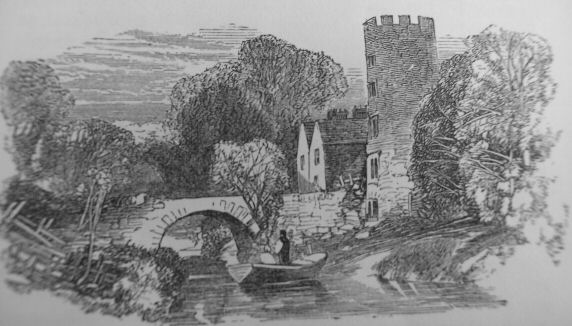
houses. The “Old Waterworks” remain, and, as will
be seen from our sketch, form a picturesque object in the landscape.
The Severn is, however, no longer the fast-flowing stream poets have
described it, but what it has lost in speed it has gained in depth,
breadth, and majesty; the locks and weirs at Diglis—the former
two abreast, and the latter stretching 400 feet across the stream—giving
to it the aspect of a lake, an aspect aided by the appearance upon its
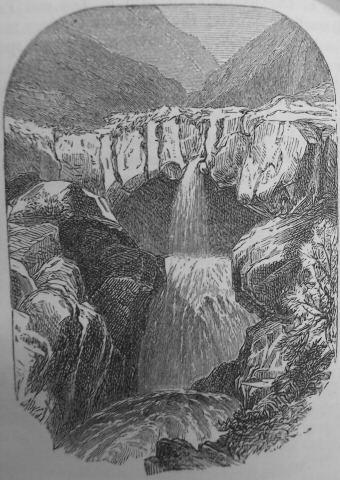
surface of a number of swans. Its
contrast with itself, whilst yet in its rocky cradle on Plinlimmon,
will be seen from the accompanying sketch of Blaen Hafren, or
the “Head of the River,” two miles from its source.
Anglers will find pleasant spots at which to indulge in the “gentle
art,” near Henwick, where the old Worcester monks had weirs; also
near Bevere Island, and Holt Castle; at the confluence of the Severn
with the Teme (two miles
below Worcester), thence to the tail of Kempsey Lake; and still better
near the Rhydd (the seat of Sir E. A. H. Lechmere, Bart.). Worcester
is surrounded by very many spots of interest to lovers of natural scenery,
to archæologists, botanists, and geologists. Among those
within easy reach, and deserving of special notice, may be mentioned
Croome Court, the seat of the Earl of Coventry (nine miles); and Witley
Court, backed by the Abberley and Woodbury hills, (ten miles); also
Madresfield Court, the seat of the Earl of Beauchamp (six miles); Cotheridge
Court, the seat of W. Berkeley, Esq. (four miles); and Strensham village,
the birthplace of Butler, the author of “Hudibras” (three
miles from Duffore station, on the Bristol line). Leaving Worcester
at Shrub Hill—a portion of a long natural terrace commanding pleasing
views of the city and of the Malvern range of hills—we pass the
cemetery; then Hindlip Hall, the residence of Henry Alsop, Esq., a handsome
modern mansion standing in the midst of a very pleasant country on the
left, and approached by an avenue of trees nearly a mile in length.
The “Old Hall,” upon the site of which the present one is
built, was constructed by some quaint architect having less peaceful
times in view, who contrived numerous secret chambers, of which the
conspirators Garnet and Oldcorn are known to have availed themselves.
Here also lived the sister of Lord Monteagle, whose letter to her brother
is said to have led to the discovery of Gunpowder Plot. Near the
hall is the old ivy-towered church of the hamlet, with its rustic graveyard.
At a distance of six miles from Worcester is the borough town of
Population, 3,123
Market day—Friday. Fairs—Friday in Easter week,
June 18th, September 24th, and December 18th.
The town, which lies beneath the embankment of the railway, in the
valley of the river Salwarp, on the right, is on weekdays so enveloped
in steam, that little beyond its stacks, and the murky tower of St.
Andrew’s Church, are seen. Its staple trade is salt, for
the export of which the canal, the Severn, and modern railways offer
great facilities. From early times, the subterranean river beneath
the town has yielded an uninterrupted supply of the richest brine in
Europe; and it is curious to observe how the vacuum created by the amount
raised has caused the ground to collapse and crack, as shown by the
decrepit state of the buildings, many of which are broken-backed, twisted,
and contorted—although the intermediate earth is about 200 feet
in thickness. The place, therefore, has a sort of downcast look,
and the streets have a melancholy appearance; whilst the sheds of the
brine
works, made to appear more murky by contrast with heaps of white salt
refuse, suggest the thought that the town has gone into mourning.
Exception must be taken to St. Peter’s Church, which stands outside
the town, and is surrounded by green fields, with no building near,
except an exceedingly dilapidated half-timbered mansion, the property
of Lord Somers. Tradition says that this church once adjoined
the town, but that the latter shifted in the direction of the springs;
if so, the injunction over the doorway, to “Remember Lot’s
wife,” seems a strange rebuke, if intended for the inhabitants.
The building has many features of interest, the Norman, the Transition,
and subsequent styles of architectural decoration being observable.
The old town has an interesting charity, founded by Lord Coventry,
for the support of poor people, and the education of poor children.
The almshouses, which have recently been rebuilt,
and are eighteen in number, are commodious and convenient, with garden
plots at the back; whilst the inmates have 3s. 6d. per
week, or 5s. if upwards of 70 years of age, beside clothing.
Connected with these is an infirmary, in which at the time of our visit
were three old ladies, who looked particularly clean and comfortable,
and whose ages were respectively 83, 89, and 93.
On a red marlstone cliff, {11}
rising above the river Salwarp, and overlooking the town of Droitwich,
is the church of Dodderhill, belonging to the parish of that name.
It gave shelter to the Royalists during the civil wars, and suffered
much from an attack of the Parliamentary forces, who battered down its
nave and tower. The former has never been rebuilt, and the latter,
instead of being placed in the position it formerly held, has been made
to fill up the south transept.
On the left of the line is the seat of Sir John Packington, the present
member for Droitwich. It may be reached from the town by a pleasant
walk; first by the side of the canal and river, and then through the
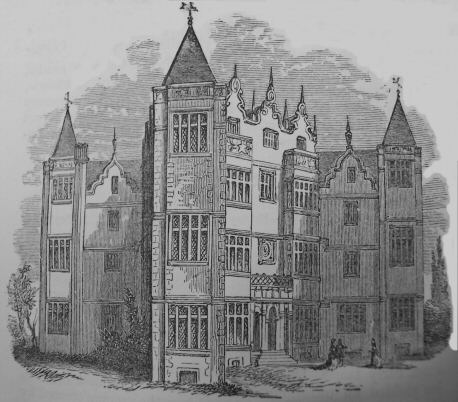
park. Westwood was given by Henry VIII. to an ancestor of the
present baronet, in consequence of his residence at Hampton Lovett having
been injured during the civil wars; and the house is one of the most
interesting specimens of Elizabethan architecture in the kingdom.
The railway passes Hampton Lovett church, near which are neat model
cottages erected by Sir John; and at a distance of eleven miles from
Worcester we arrive at
Hartlebury, which is about a mile from the station, has been for
a thousand years the residence of the bishops of Worcester; the old
castle having remained entire until the middle of the 17th century,
when, from having given shelter to the Royalists, it became a heap of
ruins, and the present palace was erected in its stead. It is
approached by a noble avenue of limes, and is surrounded by pleasure-gardens,
fashioned out of its ancient moat, one portion of which is still a
quiet lake. It has a park with well-timbered tracts adjoining,
one of which is called the Bishop’s Wood, and near which is the
famous Mitre Oak.
Derives its name from the great basins constructed by Brindley upon
the canal, and also from the river Stour, which here enters the Severn.
The advantages of position led to the erection of large manufacturing
establishments on the spot. Steam has been brought to aid the
Stour, whose waters are pounded back to create a capital of force to
turn great wheels that spin, and weave, and grind; whilst iron works,
vinegar works, and tan works, upon a large scale, have also sprung into
existence. On the opposite bank of the Severn, about three-quarters
of a mile from Stourport, is Arley Kings, or Lower Arley; and about
a mile lower down the river is Redstone Cliff, in which is the famous
hermitage of Layamon, a monkish historian of the 13th century, who is
said to have composed a “Chronicle of Britain,” embracing
that mythical period extending from Brute to Cadwallader.
On leaving Stourport, the traveller passes Burlish Common, and plunging
into a deep cutting, terminated by a dark tunnel, emerges in sight of
the little town of
Population, 2,900.
Market day—Saturday. Fair days—Last Tuesday in
February, April 23rd, the Monday before St. Ann’s, second Tuesday
in October, and December 11th.
Principal Hotels—The George, and the Wheatsheaf.
Bewdley is an ancient borough town, corporate and parliamentary,
returning one member. The place long ago obtained the appellation
“beautiful.” Leland says, “because of its present
site men first began to resort there;” adding, “the towne
itself of Bewdley is sett on the side of a hille, so comely that a man
cannot wishe to see a towne better. It riseth from Severne banke
by east, upon the hille by west, so that a man standing on the hille
trans-pontem by east may discern almoste every house in the towne;
and att the rising of the sun from east, the whole towne glittereth,
being all of new building, as it were of gould.” Bewdley
has been said to
resemble the letter Y in form—the foot in the direction of the
river being more modern, and the extremities stretching out against
the hills the more ancient, portions. It was privileged as a place
of sanctuary when Wyre Forest was infested by men who lived merry lives,
and who did not refuse to shed their brothers’ blood. It
had the privilege of taxing traders upon the Severn, as appears from
a petition presented by “the men of Bristowe and Gloucester”
in the reign of Henry IV., praying for exemption. It obtained
its charter of incorporation from Edward IV., and one granting the elective
franchise from James I.
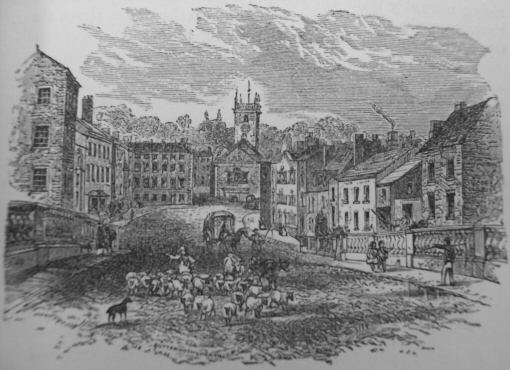
Wribbenhall, on the same side the river as the station, is a hamlet
belonging to Kidderminster, from which town it is distant about three
miles. Bewdley and Wribbenhall are surrounded by pleasant spots,
not a few of which are occupied by mansions, handsome villas, and gentlemen’s
seats, seen from the line.
Winterdyne is one of these; from dark rocks above the Severn it overlooks
the valley, and is surrounded by walks and grounds commanding magnificent
prospects, the one from the
Fort being perhaps the most romantic. Lovers of quiet rambles,
anglers, or botanists, would do well to take up their quarters at Bewdley,
as a centre from which to explore the neighbourhood. There are
few more charming spots than Ribbesford, a mile lower down the river;
it is a sylvan bit of landscape, with grassy flats and weathered cliffs,
the latter, rising abruptly from the stream, being delicately tinted
into harmony with the boles, and foliage of the trees above them.
Opposite is Burlish Deep, noted for its pike.
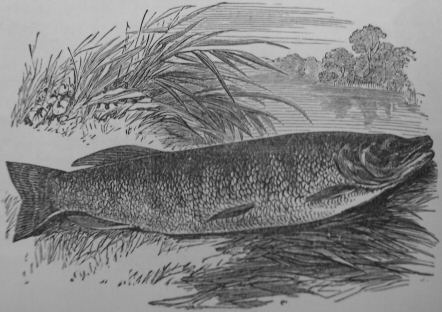
As at Worcester, the Severn here is a quiet, slow-flowing river.
From Gloucester to Bewdley the old gravelly fords and sandy shallows
have disappeared, and the “gentle art” has had to adapt
itself to these changes; fish once familiar to anglers are now strangers,
rarely, if ever seen on this side Gloucester; but the regulations enforced
by the Severn Fisheries Commission, and the vigilance of local associations,
will, it is hoped, soon be the means of repeopling the Severn with those
members of the finny tribe once common to its waters. Steam-tugs
and trows, propelled by screw or paddle, now navigate the river, each
with a dozen old-fashioned barges at its stern; but this portion of
the Severn being comparatively free, it is a favourite breeding place
with pike, who for reproductive purposes seek the stillest portions
of the stream. Dowles Ford, at
the mouth of the brook of that name, which enters the river a little
above Bewdley, also Laxlane Ford, and Folly’s Ford, are each famous
for their trout.
Leaving Bewdley, we pass the line of railway to Tenbury, but confine
ourselves to the Valley of the Severn, along which the river and the
rail are now close companions nearly all the way to Shrewsbury.
The elevation of the embankment above the river affords glimpses of
Bewdley Forest, or, as Drayton calls it, the Stately Wyre.
“These scenes are desert now and bare,
Where nourished once a forest fair;
When these waste glens with copse were lined,
And peopled with the hart and hind.”
But portions of the district still are wooded, affording famous fields
for botanists. Seckley Wood comes down to meet the bold projecting
rocks above the river; and we have Eyemoor Wood and others right and
left on approaching Upper or Over Arley.
Twenty miles from Worcester, is one of the sweetest little villages
along the line. Its ferry on the river, its timbered cottages,
partially concealed in green indentations of the hill, its grey church
tower, and those of the castle near, are a picture of themselves; but
when showers of blossoms crown the orchard trees in spring, or ruddy
fruits hang ripe in autumn, the scene is more enchanting still.
The castle tower is 120 feet in height, and commands an extensive
sweep of country, through which the Severn in the distance winds its
way, in and out, like a silver thread. The gardens and grounds
contain rare shrubs and trees, imported by the late Earl Mountnorris;
to visit which R. Woodward, Esq., the present proprietor, like the late
earl, very rarely refuses his permission.
The railway having crossed the Severn by the Victoria Bridge, an
iron structure, 200 feet in span, now continues its course along the
right bank of the stream, disclosing glimpses now and then of gentle
sweeps and undulating lines of wood and field, where quiet tones of
light and shade, with sweet harmonious tints, refresh and please.
Wandering at its own sweet
will, the river here goes freely on its way, bubbling and brawling at
the fords, gathering itself up into deep, dark lakes carved out of the
softer rocks over which it flows, or dividing to embrace some willow-covered
island in its course. Between Arley and Bewdley it is well stocked
with grayling, dace, and that king of Severn fish, the salmon which
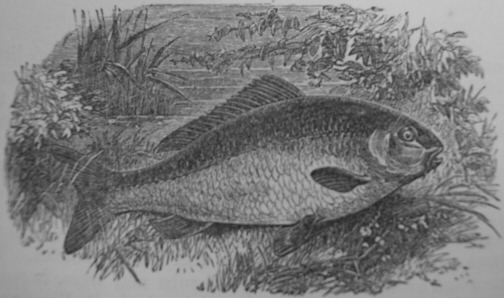
is often taken hero; also with that “queen of fresh-water fish”
the carp, speaking of which an old distich says:—
“Hops and turkeys, carps and beer,
Came into England all in one year.”
Like pike, they are long-lived; referring to which, Ben Jonson says:—
“Fat, aged carps, that run into thy net,
And pikes, now weary their own kind to eat.”
During the winter months carp are caught in broad, quiet parts of
the river; in summer, in holes and reaches, under hollow banks, and
near beds of weeds or flags. All kinds of bait are recommended,
but a well-scoured worm is often best.
Or Higley, as it is commonly called, is two and a half miles from
Arley. The village is situated high upon the hill, and consists
of scattered cottages, with a sprinkling of goodly houses,
some half timbered, after the quaint fashion of former times.
The church has an ancient chancel window, and in the graveyard is an
old cross, elaborately carved in freestone, a material found very extensively
in the neighbourhood. Highley was an old Saxon manor, which, with
Chetton, belonged to the widow of Leofric—Godiva, of Coventry
celebrity. Kinlet, four miles distant, occupies a picturesque
eminence of a horse-shoe form; the church is an ancient structure, containing
noble altar tombs, one of which has a rich canopy, with the figure of
a knight and lady kneeling.
Lode was a Saxon term for ford, and the name here, as elsewhere,
denotes an ancient passage of the Severn. In this case, it was
one by which the inhabitants of Highley, Billingsley, and Chelmarsh
formerly passed to Quatt and Alveley. A ferry has long been substituted,
but the old load still winds along the hillside, past an old stone cross,
in the direction of Alveley, an old Saxon manor. The tall grey
tower of the old church is seen from the line, occupying a high position
on the right. The building is an ancient and interesting structure,
with many Norman features, and is greatly admired by antiquarians.
Judging from the materials used in older portions of the building, the
first church would appear to have been built of travertine. Above
Hampton’s Loade, the wooded heights of Dudmaston and of Quatford,
with the red towers of Quatford Castle, come into view; but a deviation
of the line, and a deep cutting through the Knoll Sands, prevent more
than a passing glimpse. Quat is an old British word for
wood, and refers to a wide stretch of woodland once included in the
great Morfe Forest; and ford to an adjoining passage of the river—one,
half a mile higher up, being still called Danes’ Ford.
On a bluff headland, rising perpendicularly 100 feet above the Severn,
close by, the hardy Northerners, who thus left their name in connection
with the Severn, established themselves in 896, when driven by Alfred
from the Thames; and on the same projecting rock, defended on the land
side by a trench cut in the solid sandstone, Roger de Montgomery afterwards
built himself a house.
And tradition adds that, in consequence of a vow made by his second
wife, Adeliza, the church close by was built upon the
borders of the forest, then the favourite hunting-ground of the Norman
earl. The church, like other neighbouring structures of ancient
date, was built of tuffa, or travertine, a material found in the beds
of brooks in the district, and portions of the chancel, including its
fine Norman arch and pillars, are still composed of the same.
Among old endowments of the church, is one, from a source unknown, of
a piece of land, the proceeds of which defray the expense of ferrying
persons attending church across the Severn.
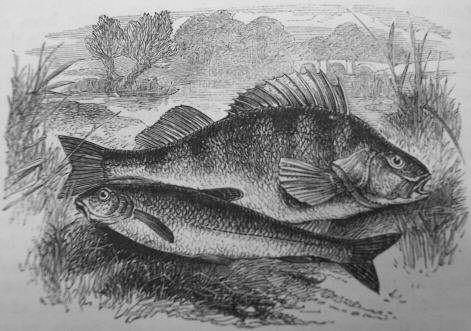
The old man at the ferry is a fisherman, who knows well where to
get “a rise” of trout, or to hook a grayling, and where
to look for pike, or perch, or gudgeon.
In the parish of Quatford is Eardington, celebrated for the manufacture
of iron for guns, wire, and horse nails; and parochially and manorially
combined with Eardington is the More, the ancient tenure of which indicates
the manufacture of iron here at a very early period. By it the
tenant was required to appear yearly in the Exchequer, with a hazel
rod of a year’s growth, and two knives, the treasurer and barons
being present. The tenant was to attempt to sever the rod with
one of the knives, the other knife was to do the same work at one stroke,
and then be given up to the king’s chamberlain; a custom which
was continued until recently.
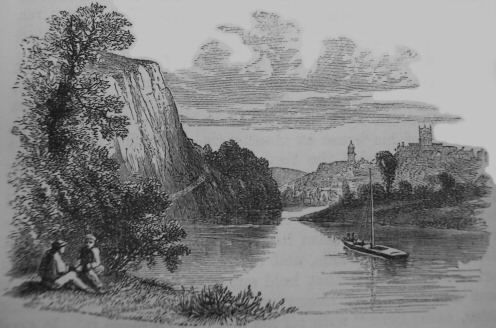
Population, 6,569.
Market day—Saturday. Fairs—January 20th, February
17th, May 1st, June 9th, July 14th, August 18th, September 15th, October
29th, December 28th.
Principal Hotel—The Crown, for which, as well as for the Swan,
the Raven, and the George, see Advertisements.
The station, at the southern termination of the tunnel, is a chaste
building of freestone, and forms an additional ornament to the town.
It occupies a position from which its two divisions come pleasantly
into view, the Low Town lying peacefully in the valley by the Severn,
the High Town dotting the terraced sides, and crowning the bold impending
rocks that give it, in the eyes of travellers, such an eastern aspect.
Caverned in the hill, at many stages from its foot, and reached by winding
walks, are picturesque holes and habitations—happily now no longer
used, excepting in very few instances indeed—where the first settlers
crowded when the ruthless Dane perched himself like a famished eagle
on the rocks of Quatford down below. In the foreground are the
time-worn relics of its two castles, to which the little colony was
indebted for protection from fierce and threatening foes. The
one opposite is Pampudding Hill, a smooth, grassy mound, on which the
daughter of the great Alfred, Queen Ethelfleda, built a fortress.
According to Florence of Worcester, what we now call Bridgnorth
was then Brycge. In his time, as in that of Leland, who
so well described its position, the Severn ran nearer to the frowning
cliffs on which the town is built than at present.
The discriminating eye of the outlawed Belesme was not slow to perceive
the advantages nature had given to the place, when he sought to raise
a fortress that should shield him from the wrath of his royal master,
and he removed the materials, it is said, of his house at Quatbrigia—a
bridge having, it is supposed, succeeded the ford—to Brycge,
afterwards Bridgnorth, or the bridge north of the one at Quatford.
Florence of Worcester says: “Earl Robert carried on the works
night and day, exciting Welshmen to the speedy performance of his wishes
by awarding them horses, lands, asses, and all sorts of gifts.”
With such aids, and advantages of site, the Norman earl erected a castle
that held out three weeks against a large force marshalled by Henry,
who, as an old Saxon chronicle states, came here “with all his
army” to besiege it. It stood a second siege when Hugh de
Mortimer espoused the cause of Stephen, and was attacked by Henry II.,
whose life was saved by the zeal of an attendant, who received a well-aimed
arrow intended for the king. It was taken by the confederate barons,
and retaken by Edward II., who afterwards marched to Shrewsbury, where
the proud Mortimers humbled themselves and sued for mercy. It
served not only as a garrison and a prison, but, from its position on
the frontier of Wales, very often as a royal residence. King John
came with a splendid retinue, of which the bishops of Lincoln and Hereford,
the earls of Essex, Pembroke, Chester, Salisbury, Hereford, and Warwick
formed part; upon which occasion the entertainment is said to have cost,
for the three days it lasted, a sum equal to £2,000 of modern
currency. Prince Edward was a visitor after the battle of Evesham;
and the second Edward too—the first time at the head of his army,
the second, as a fugitive, crossing the Severn in a small boat at nightfall.
Henry IV. was here:
“On Wednesday next, Harry, thou shall set forward;
On Tuesday, we ourselves will march.
Our meeting is Bridgnorth; and, Harry, you
Shall march through Gloucester; by which account
Our general forces at Bridgnorth shall meet.”
Charles I. arrived here from Shrewsbury, October, 1642, when
he remained three days and gave expression to the eulogium, which townsmen
quote for the benefit of strangers, respecting the beauty of the castle
walk. It was garrisoned for this unfortunate monarch, too, in
the struggle which cost him his head, upon which occasion the town was
stormed by three divisions of the Parliamentary army, March, 1646.
The fight waxed hottest near the north gate, and in the old churchyard,
where the leader of the loyalists fell. That the adherents of
the king were not “all on one side,” would appear from the
fact that the town’s defenders were pelted upon retiring to the
castle by the inhabitants, treatment which they seem to have deserved
in setting fire to the town, bombarding St. Leonard’s, burning
the adjoining buildings and driving the wretched population in search
of such shelter as the rocks and woods afforded.
The garrison capitulated on the 26th of April, 1646, in consequence
of a mine, by which the Parliamentary leader proposed to blow up the
castle and set fire to their magazine, then in St. Mary’s Church,
which stood within the castle walls. Ecclesiastical dignitaries
often then wore coats of mail as well as cassocks, and daggers in addition
to their girdles; and this old church being collegiate, had for one
of its deans Rivallis, who forged the charter and seal of Henry III.,
by which the Irish possessions of the Earl of Pembroke were invaded,
and that nobleman cruelly treated and killed. The more distinguished
William of Wykeham, who held the Great Seal in the reign of Edward III.,
and exercised considerable influence in his day, both in church and
state, was also a dean of St. Mary’s.
St. Leonard’s occupies a position at the opposite extremity
of the town. Its crumbling tower, shattered by the cannon of Charles’
army, remains, but the nave and side aisles have recently been restored—that
on the south side at the sole expense of John Pritchard, Esq., M.P.,
in memory of his brother. The celebrated divine, Richard Baxter,
began his ministry at St. Leonard’s, apparently with little success,
as he is said to have shook the dust from his feet upon leaving, declaring
the hearts of the inhabitants to have been harder than the rock on which
their town was built. Nevertheless, he afterwards dedicated his
well-known book, “The Saint’s Rest,” to them.
Adjoining the churchyard is a hospital for ten poor widows, built and
endowed, as a brass plate over the
entrance informs us, by a relative of Colonel Billingsly, who fell in
the service of “King Charles ye First,” and whose sword
is said now to be in the possession of a descendant of the family, in
the parish of Astley Abbots.
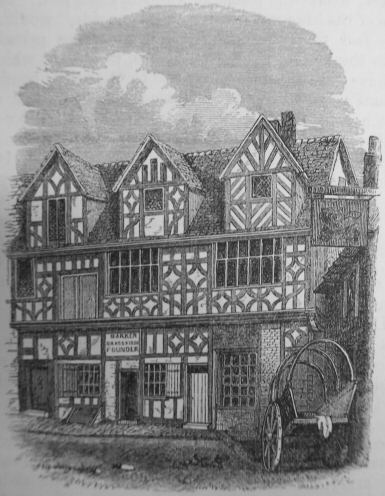
Like other ancient towns, Bridgnorth had places founded for the relief
of the poor, the destitute, and the diseased. The house of the
monks of the “Friars of the Order Grey,” stands near where
a dilapidated sign of the Preaching Friar still swings over the entrance
of a public-house. It forms part of the carpet works of Mr. Martin
Southwell, who uses its oak panelled hall, and a number of cells carved
out of the solid rock, as storerooms. In making some alterations
recently the little cemetery was disturbed, and skeletons of several
of the monks, embedded in spaces cut out of the rock, in the form of
a sarcophagus, were exposed. In the Cartway is the
“Old House” in which Bishop Percy, author of the “Relics
of Ancient English Poetry,” was born, a fine specimen of the domestic
architecture of the 16th century; and in the entrance-hall of which
are the following words in large letters in relief, “Except the
Lord BVILD THE OWSE The Labourers Thereof Evail Nothing. Erected
by R. For * 1580.” Another of these quaint old structures,
called Cann Hall, contains some curious unlighted double dormitories
in the roof; one is called King Charles’ Room, and another is
pointed out as that in which his nephew, Prince Rupert, is said to have
slept. The house is supposed to be haunted, and the present tenant
is not loth to admit that he sometimes hears strange noises, a fact,
if such it be, at which one can scarcely wonder, seeing that the wind
and the bats have undisputed sway. The Townhall, in the Market
Square, built in the place of the one destroyed during the civil wars,
is thus noticed in the “Common Hall Order Book” of the Corporation:
“The New Hall set up in the Market Place of the High Street of
Bridgnorth was begun, and the stone arches thereof made, when Mr. Francis
Preen and Mr. Symon Beauchamp were Bayliffs, in Summer, 1650; and the
timber work and building upon the same stone arches was set up when
Mr. Thomas Burne and Mr. Roger Taylor were Bayliffs of the said town
of Bridgnorth, in July and August, 1652.” The new Market
Hall, with the Assembly Room, the rooms of the Mechanics’ Institution,
&c., is a handsome building, situated at the lower end of the same
large open square.
The grand promenade round the Castle Hill, which King Charles pronounced
the finest in his dominion, commands a prospect that cannot fail to
interest. Below, the river winds like a thing of life; around,
are wave-like sweeps of country, red and green, broken by precipitous
rocks into a succession of natural terraces, many of which, being higher
than the town itself, afford the most enchanting views.
The Hermitage is one of these, the prospect from which, on a clear,
sunny day, is such as to commend the choice of the anchorite, who is
said to have exchanged the excitements of a court for retirement in
such a spot. The tradition is, that Ethelwald, brother of King
Athelstan, who succeeded his father, Edward (924), retired here to escape
the perils of the period; a tradition which receives support from the
following royal presentations found on the rolls of Edward: “On
the 2nd
of February, Edward III., 1328, John Oxindon was presented by the king
to the hermitage of Athelardestan, near Bridgnorth. On 7 Edward
III., Andrew Corbriggs was similarly presented to the hermitage of Adlaston,
near Bridgnorth. On 9 Edward III., 1335, Edmund de la Marc was
presented to the hermitage of Athelaxdestan,” a name signifying
the stone or rock of Ethelwald.
The Cemetery lies embosomed in a sunny opening of the rocks below
the Hermitage, where nature and art combined—the former predominating
so much by means of a noble amphitheatre of rocks—have given to
the spot a quiet, pleasing interest. Outside the Cemetery, a winding
path leads to the High Rocks, the road to which the inhabitants have
recently improved. This elevated position above the Severn well
deserves a visit, commanding as it does the Vale, through which the
river winds amidst alluvial lands, bounded by the heights of Apley and
Stanley, the hills of the Wrekin and Caradoc, and those of the Brown
and Titterstone Clees, with the Abberley and Malvern hills in the distance.
The castellated structure at the foot of the High Rocks, now used for
manufacturing purposes, occupies the site of the Old Town’s Mills,
given by Henry III. to the inhabitants, and out of which he made provision
for the hermit of Mount St. Gilbert.
On leaving Bridgnorth the scenery becomes exceedingly interesting.
On the left is Hoard Park, Severn or Sabrina Hall, and Little Severn
Hall. Astley Abbots and Stanley lie higher up on the hill on the
same side; whilst on the right, rocks, crowned by trees, rise from the
river in undulating lines, and introduce us to the picturesque grounds
of Apley. The house is a castellated structure of fine freestone,
with a domestic chapel on the north side; it occupies a slight elevation
above the river, where it is thrown into pleasing relief by woods that
crown still greater heights. The park is diversified by clumps
of noble trees, by projecting rocks, pleasing glades, and grassy flats,
on which groups of browsing deer are seen; and the terrace is one of
the finest and most extensive in England. From its great elevation
it commands pleasing views of the park, of the Severn, and of wide,
undulating districts on either side, rich in sylvan beauty. The
proprietor is T. C. Whitmore, High Sheriff of the county, whose ancestors,
from the time of Sir William Whitmore (1620), have occasionally enjoyed
that honour. Opposite to Apley is
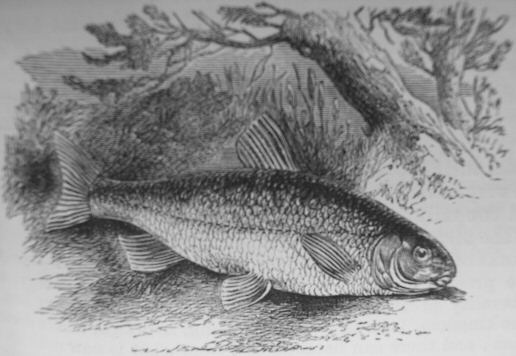
The angler, desirous of a few hours’ amusement, may here find
good sport at the fords, where the brooks come down and enter the river.
Grayling and trout are often caught, and chub, less in favour with fishermen,
of large size.
If the tourist be a geologist he will find it pleasant to follow
the course of Linley Brook, on the banks of which he may find fish of
ancient date, in beds forming a passage from the Upper Ludlow to the
Old Bed Sandstone. He will be interested, too, in noticing the
angles at which the latter dip beneath the carboniferous strata, and
these again beneath the overlying permians.
A series of interesting dingles now occur, where the nightingale
is heard in May and June, through which whimpering streams come down,
and where Tom Moody hunted with the famous “Willey Squire.”
Tom’s exploits have been immortalised by Dibden in the song,—
“You all knew Tom Moody, the whipper-in, well,
The bell that’s done tolling is honest Tom’s knell.”
A
plain slab in Barrow churchyard covers Tom’s remains, and simply
records the date at which he died. At
Seven miles from Bridgnorth, and thirty-six from Worcester, the Severn
is crossed by a handsome iron bridge, at the opposite extremity of which
is the London and North-Western Company’s line to the Shropshire
Union at Hadley.
The China Works are about five minutes’ walk from the station;
they are extensive, and were established during the latter half of the
last century, at which time they were removed here from Caughley.
The productions are of a high order of merit, and combine those distinctive
characters for which Caughley and Nantgarw were celebrated. They
were successful, some years ago, in obtaining a medal awarded by the
Society of Arts; in obtaining a First Class Exhibition Medal in 1851,
also in 1855, and again in 1862. The works are very advantageously
situated, having the river, the canal, and two railways adjoining.
The Art-Journal, in giving the history of these works, thus
speaks of them: “The productions of the Coalport Works at the
present day, thanks to the determination, energy, and liberality of
the proprietor, take rank with the very best in the kingdom, both in
body, in potting, in design, and in decoration; and there can be no
doubt, from what is now actively in progress, that the stand taken by
Coalport is one of enviable eminence among the ceramic manufactories
of the world.”
Edge and Son’s chain and wire rope works are situated not far
from these; and between the two, at the foot of the inclined plane,
an ingenious device for transferring boats from one canal to the other,
is the celebrated “Tar Tunnel,” driven into the coal measures,
from which petroleum was formerly exported on a large scale, under the
name of Betton’s British Oil.
Our view of the Valley of the Severn, with Ironbridge in the distance,
is from the hill overlooking the handsome mansion of John Anstice, Esq.
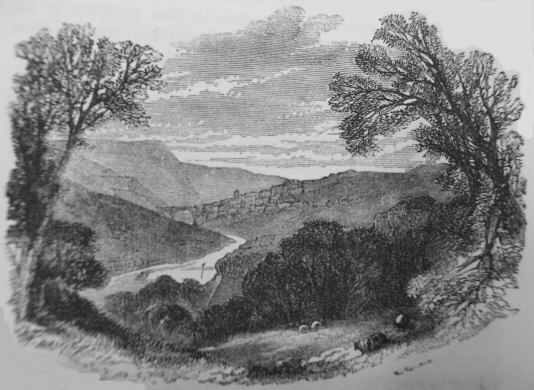
Coalport is in the parish of Madeley, the village of which is now
looped in by railways. Madeley is one of those names or word-pictures
by which our ancestors, with a touch alike of poetry and feeling, were
wont to convey their meaning. The place,
however, has lost those sylvan features that distinguished it when described
in Domesday, as part of the possessions of St. Milburgh; and the old
Court House, surrounded by its park, where the prior of that monastery
received his perquisites, is strangely changed in aspect. Although
little beyond the foundations exist to show where the hall stood from
whence the house derives its name—where festivals were held, suitors
heard, or penalties inflicted—the present edifice has many points
of interest. The arms of the Ferrers family, in a shield, over
the principal doorway, may still be seen, indicating the proprietorship
at one time of some member of that family. It was also the residence
of Sir Basil Brooke, fourth in descent from a noble knight of that name;
a zealous royalist in the time of Charles I. The substantial,
roomy, and well-panelled apartments, and the solid trees, one upon the
other, forming a spiral staircase, are objects of interest. Ascending
these stairs, the visitor finds himself in the chapel, the ceiling of
which is of fine oak, richly carved, with the fleur-de-lis and
other devices. In the garden, which formed an enclosed court,
upon an elegant basement approached by a
circular flight of steps—the outer one being seven feet in diameter
and the inner one about three—is a very curious planetarium, or
horological instrument, serving the purpose of a sun dial, and that
of finding the position of the moon in relation to the planets.
In niches outside the parish church are finely sculptured, full-length
figures of some of the early proprietors of the Court House; and in
the register is an entry dated April, 1645, stating that the edifice
was at that time garrisoned by a Parliamentary regiment, commanded by
Captain Harrington. Six years later than the event recorded, we
have the story of King Charles’ visit to the village in disguise,
after the battle of Worcester, and of his being lodged in a barn belonging
to Mr. Wolfe. At the Restoration the king did not forget his host,
but presented him with a very handsome tankard, with the inscription,
“Given by Charles II., at the Restoration, to F. Wolfe, of Madeley,
in whose barns he was secreted after the defeat at Worcester.”
The tankard is now in the possession of W. Rathbone, Esq., and a print
of it hangs in the old house, now the possession of C.
J. Ferriday, Esq. The tankard has upon the cover a coat of arms;
the crest is a demi-wolf supporting a crown. In the hall there
is also an old panel, containing the initials F. W. W. Mr. and Mrs.
Wolfe, with the date 1621.
Madeley is also celebrated as the scene of the labours of the venerated
Fletcher, so much so, that admirers of his life and writings come long
distances to visit his tomb, a plain brick structure, with a simple
inscription upon an iron plate.
Is nine miles from Bridgnorth, and thirteen and a half from Shrewsbury.
From the disposition of the buildings on the hill side, it has a novel
and romantic aspect, whilst the high grounds adjoining afford varied
views of interesting scenery. Underneath the lofty ridge of limestone,
the higher portion of which is planted with fir and other trees, are
extensive caverns, which are open to visitors, who will find these fossiliferous
rocks, rising immediately from beneath the coal measures, highly instructive.
Is celebrated all the world over for its pipes, a branch of manufacture
for which it is now as famous as of yore. Partly in this parish
and partly in that of Benthall, and only about 300 yards from the station,
are the geometrical, mosaic, and encaustic tile works of the Messrs.
Maw. They were removed here a few years since from Worcester,
the better to command the use of the Broseley clays, since which they
have attained to considerable importance, and now rival the great house
of Minton.
On leaving Ironbridge, the line passes by a sea wall the foot of
Benthall Edge—a limestone ridge, continuous with that of Wenlock,
so famous for that class of silurian fossils to which the town of Wenlock
has lent its name.
Benthall is a name significant of its elevated position—Bent,
meaning the brow, and al or hal, a hill.
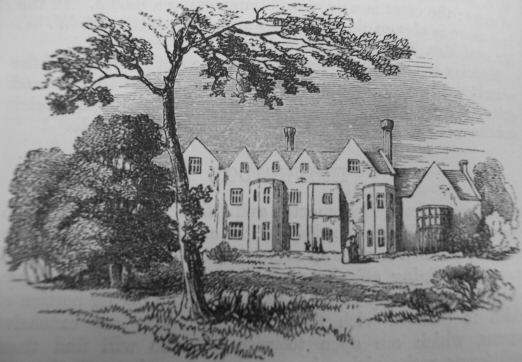
Benthall Hall, the property of Lord Forester, and in the occupation
of George Maw, Esq., F.L.S., F.S.A., is a fine specimen of Elizabethan
architecture, built by William Benthall in 1535, on the site of a former
house.
At the foot of Benthall Edge the Wellington and Severn Junction railway
crosses the river by a bridge 200 feet in span, and brings before us,
at a glance, this interesting little valley, with its church, its schools,
and its palatial-looking Literary and Scientific Institution.
The name has long been famous, as well for its romantic scenery as for
its iron works. Notices of these occur from the reigns of Henry
VIII. and Edward VI., down to the period of 1711, when the Darby family
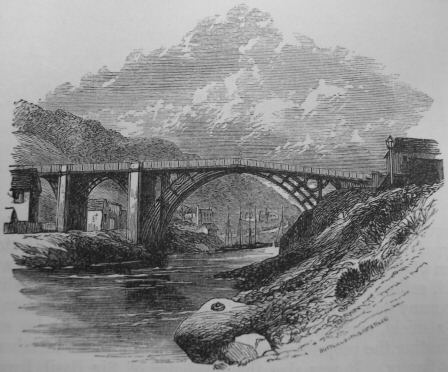
first settled here. It was here that the first iron bridge—the
elegant structure that gave both name and existence to the little town
adjoining—was cast in 1779; the first iron rails were laid here
in 1768, and the first successful use of mineral fuel for smelting iron
was introduced in 1718. For metal castings these works were celebrated
as early as the time of Boulton and Watt, when those for their early
engines were produced here; whilst the Exhibitions of London and Paris
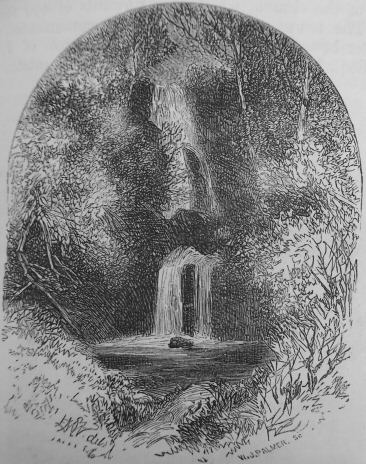
show that they have lost none of their prestige. The brook from
which the place derives its name, and which was formerly of more importance
than at present, is still a pleasing feature in the landscape,
swelling out into shining sheets, or forming pleasant waterfalls as
at La Mole, from which our view is taken.
The Wellington and Severn Junction line through Coalbrookdale is
joined by the branch line to
one of the oldest borough towns in the kingdom. Its chief attraction
is the Abbey, founded by St. Milburgh, a Saxon saint, and daughter of
Penda, one of the last and fiercest of the Saxon heathen kings.
It fell before the Danes, but was rebuilt by Earl Leofric and his wife
Godiva. A second time it fell, and was again rebuilt; this time
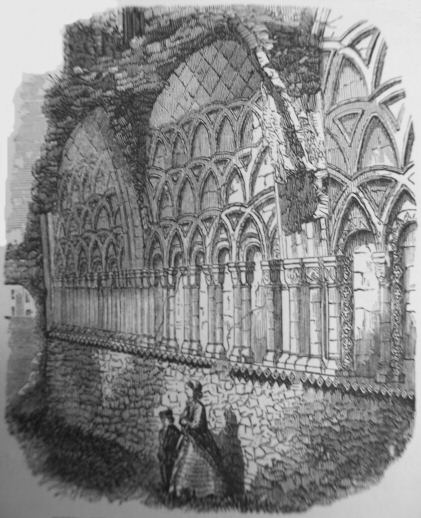
by Norman masons, in greater splendour than before. Of the architecture
of this period the present ruins show some fine examples, and none finer
than the chapter-house, the clustering arches of which are shown in
our engraving.
The
south transept, with a portion of the nave, of the Early English style
of architecture, remind the visitor of the stately grandeur of the church,
which was upwards of 400 feet in length. The house of the prior,
which communicated with the chapter-house, is now the private residence
of J. M. Gaskell, Esq., M.P., the present proprietor of the estate.
The parish church has several points of interest, one of which is its
fine Norman front, hidden from the street by the present tower.
To this may also be added the arches which separate the nave and side
aisles, rising from clustering pillars of great beauty; also the one
dividing the nave from the chancel, where there is an elegant sedilia.
Wenlock grew up beneath the patronage and protection of its Priory,
by means of which it received many royal favours, and was protected
by many royal charters, one of which conferred the right, at a very
early period, of representation in the Commons House of Parliament.
The
Guildhall is an ancient building of timber and plaster, with a projecting
upper story resting on piazzas. The room used for quarter sessions
has the arms of Charles II. over the recorder’s chair, and the
Inner or Municipal Court is beautifully furnished with elaborately-carved
oak panellings and furniture. The borough is nearly the same now
as formerly, the modern franchise extending over the ancient possessions
of the church, wherein the prior of the monastery had jurisdiction over
eighteen parishes.
In descending the dingle between Wenlock and Buildwas, at a point
described by an old writer as the boundary of the domains of the two
abbeys, is Lawless Cross, formerly one of those ancient sanctuaries,
the resort of outlaws who, having committed crime, availed themselves
of that security from punishment such places afforded. The monks,
in the exercise of that excessive influence they had in those days,
provided places, deemed sacred, which should serve for refuge for criminals.
A cross was erected for the lawless; from which even the monarch
had no power to take them. Villains doubly dyed in crime were
wont to rush out from such hiding-places, commit crimes with impunity,
and return. The evil, indeed, had become so great, that the Courts
of Westminster, in Hilary Term, 1221, were employed in considering the
expediency of altering “a certain pass in the Royal Forest
near to Buldewas,” from its having become “the haunts of
malefactors, and from its notoriety for the constant commission of crime.”
Below this is the Abbey Mill, and lower still is the Abbey. The
line passes through what was once the cemetery, and over ground formerly
occupied by the industrial courts of the establishment. A fine
view is obtained of the church, which presents a good specimen of a
Cistercian edifice, every part of the original arrangement being distinctly
traceable.
The massive proportions of its arcades, and the scolloped capitals
of their columns, indicate the Norman style of architecture; whilst
the pointed arches show an approach towards that which superseded it,
which began about the year 1150. The clerestory remains entire
on both sides, with round arched windows throughout. Between the
columns are indications of a screen, which shut off the eastern aisles;
at the end
of the fifth arch from the west, the choir, or portion devoted to the
monks, commences; and at the intersection of the transepts still stands
the tower, resting on four pointed arches. At the eastern end,
beneath long windows, which at some period or other have been formed
out of smaller ones, stood the altar, and near it the sedilia; whilst
on the south side are the doorways which led to the dormitories of the
monks engaged in the night services of the church. On the side
next the river, a long line of building forms the eastern cloister and
the crypt; on the same side is a handsome archway leading into the chapter-house,
the roof of which is vaulted, groined, and supported by beautiful slender
columns. Beyond are the remains of the refectory, and the room
of audience—the only place where, according to the strict rules
of the order, the monks were permitted to converse; and here also was
the warm-room, kitchen, and lavatory. On the same side are remains
of a string of offices for novices, and for scribes employed in multiplying
copies of the Scriptures and other books.
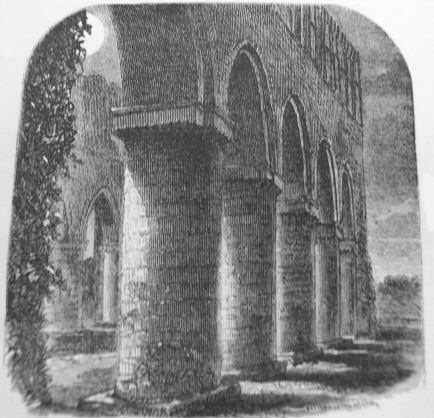
Our
engraving represents the church as seen by moonlight, when strong lights
and shadows bring to mind the well-known lines of Sir Walter Scott:—
“If thou wouldst view fair Melrose aright,
Go visit it by the pale moonlight.
For the gay beams of lightsome day
Gild but to flout the ruins gray:
When the broken arches are black in night,
And each shafted oriel glimmers white;
When the cold light’s uncertain shower
Streams on the ruin’d central tower;
When buttress and buttress alternately
Seem framed of ebon and ivory.”
The traveller by the Severn Valley Railway can scarcely fail to notice
here, and at other points along the line, beds of sand and gravel at
levels above the highest points now reached by the river; wave-like
sweeps of water-worn materials still higher up are no less conspicuous.
In both these are found the Turritella terebra, and other shells
of modern seas, identifying them with the period when a marine strait
extended the whole distance from the Dee to the Bristol Channel.
The cutting near Coalbrookdale has yielded a rich harvest of these marine
remains, sufficient satisfactorily to indicate the true position of
the beds, and to associate them with others of great interest elsewhere.
Along one of the ancient estuaries of this recent sea, now the Vale
of Shrewsbury, the Severn winds in curious curves, and almost meets
in circles, imparting a pleasing aspect to the valley. On leaving
Buildwas, Buildwas Park is passed on the left, and Leighton Hall and
church are seen on the opposite side of the river; while on the left
again are Shineton, Shinewood, and Bannister’s Coppice; the latter
famous as the hiding-place of the Duke of Buckingham, when unable to
cross the river with his army at its mouth. Shakspere alludes
to the event, in “King Richard,” thus:—
“The news I have to tell your majesty
Is, that by sudden flood and fall of waters,
Buckingham’s army is dispersed and scatter’d,
And he himself wandered away alone,
No man knows whither.”
Tradition says that the fallen nobleman was betrayed by an old servant
to whom the wood belonged, named Bannister; and an old writer thus records
the curses which he says befel the traitor: “Shortly after he
had betrayed his master, his sonne
and heyre waxed mad, and dyed in a bore’s stye; his eldest daughter,
of excellent beautie, was sodaynelie stryken with a foulle leperze;
his seconde sonne very mervalously deformed of his limmes; his younger
sonne in a smal puddell was strangled and drowned; and he, being of
extreme age, arraigned and found gyltie of a murther, was only by his
clergye saved; and as for his thousand pounde, Kyng Richard gave him
not one farthing, saying that he which would be untrew to so good a
master would be false to al other; howbeit some saie that he had a smal
office or a ferme to stoppe his mouthe withal.”
Is forty-three miles from Worcester, and eight and a half from Shrewsbury.
The name is an abbreviation of Christsache, ache been
the old Saxon term for oak. The folk-lore of the district is,
that the old tree was one under which the early Christian missionaries
preached, that it stood in the centre of the village, and that upon
its decay it was supplanted by a market cross, which cross itself has
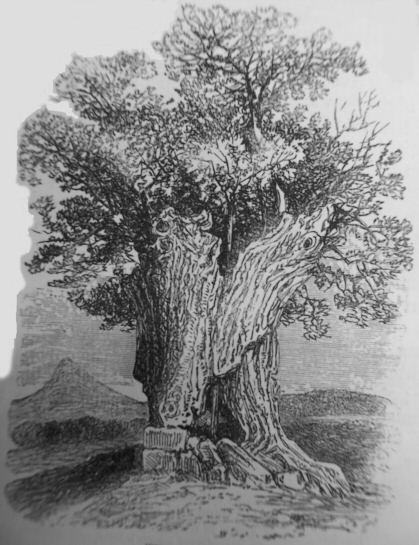
disappeared. Our engraving represents another of these venerable
trees standing a quarter of a mile from the village, known as the Lady
Oak.
Before the railway caused a deviation in the road, it stood by the
wayside, where it was regarded with veneration by the inhabitants, who
cramped it with iron, and propped it with blocks of wood to preserve
it; they also planted an acorn within its hollow trunk, from which,
as will be seen by our engraving, a young tree mingles its foliage with
that of the parent oak. About a mile from Cressage is Belswardine,
the seat of Sir George Harnage, an old border estate, in possession
of the same family which received it from the Conqueror. Cressage
station is the nearest and most convenient on the Severn Valley line
from which to reach the Wrekin. The distance is three miles.
The road crosses the river by an ancient wooden bridge, and at Eaton
Constantine passes the house in which Richard Baxter lived when a boy;
and which the great Puritan divine describes as “a mile from the
Wrekin Hill.” The visitor, in his ascent of the hill, passes
a conical knoll of deep red syenite, clothed with verdure, and known
as Primrose Hill. The summit is 1,320 feet above the level of
the sea, and commands a prospect embracing a radius of seventy miles.
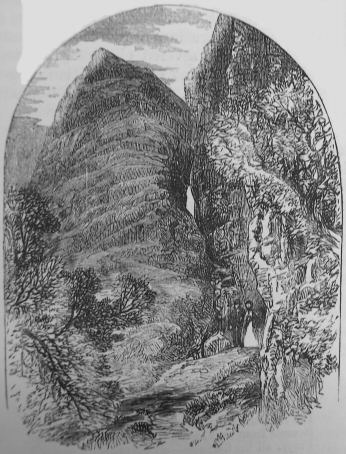
Our engraving represents a severed cliff of greenstone at the top, called
the Needle’s Eye, and which tradition alleges to have been riven
at the Crucifixion. Near it is a culminating boss of pinkish felspar
known as the Bladder Stone, a name derived, it is supposed, from Scandinavian
mythology; whilst at a short distance is the Ravens’ Bowl, a basin
in the hard rock, always containing water. On its sides are stratified
rocks which the trap has pierced in its ascent; and which, by the action
of heat, have been changed into a white crystalline substance.
At the northern termination is an entrenched fortification called Heaven
Gate, supposed to be of British origin; and near it is another, called
Hell Gate, with what is supposed to be a tumulus. In the valley
at the foot of the hill, on the eastern side, tumuli have been opened,
in which hundreds of spear heads and other broken weapons have been
found. Here formerly,
“Unknown to public view,
From youth to age a reverend hermit grew.
The moss his bed, the cave his humble cell,
His food the fruit, his drink the crystal well.
Remote from man, with God he passed his days,
Prayer all his business—all his pleasure praise.”
Henry III., in order to afford the said anchorite, Nicholas de Denton,
greater leisure for holy exercises, and to support him during his life,
or so long as he should be a hermit on the aforesaid mountain, granted
him six quarters of corn, to be paid by the Sheriff of Shropshire out
of the Town’s Mills of Bridgnorth.
On leaving Cressage, Eyton-upon-Severn is seen on the right,
and on an eminence close by is the “Old Hall,” built by
Lord Chancellor Sir Thomas Bromley. It was the birthplace of Lord
Herbert of Chirbury, of whom Ben Jonson wrote:—
“If men get fame for some one virtue, then
What man art thou that art so many men,
All virtuous Herbert! on whose every part
Truth might spend all her voice, Fame all her art?”
The railway now passes Cound Hall, Cound Church, and Cound Mill,
a manor which Henry III. gave to his brother-in-law, Llewellyn, and
which was afterwards held by Walter Fitz-Alan, who entered the service
of David, King of Scotland, and became head of the royal house of Stuart.
It crosses the Devil’s Causeway, and passes Venus Bank, with Pitchford
and Acton Barnell on the left; the latter celebrated for the ruins of
the old castle where Edward I. held his parliament, the Commons sitting
in a barn.
Berrington, forty-seven miles from Worcester, and four and a half
from Shrewsbury, lies a short distance from the station. Its church
has many points of interest, being of Anglo-Norman and Early English
architecture; it also possesses a fine Norman font, and a curious monumental
figure of a cross-legged knight, carved in wood.
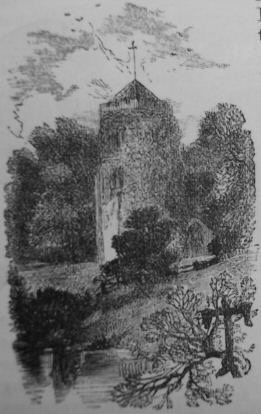
The little village of Atcham may be reached from here by a very pleasant
foot walk of about a mile through the fields. It is celebrated
as the birthplace of Ordericus Vitalis, chaplain to William the Conqueror,
and a famous historian of that time. The church is an ancient
structure reared on the little grassy flat round which the river bends;
tresses of luxuriant ivy conceal its walls, in which are found sections
of a Roman arch and a sculptured Roman column, part of the spoil of
the city of Uriconium. Among its relics is a reading-desk, carved,
it is
supposed, by Albert Durer, with panels representing passages in the
parable of the Prodigal Son.
Lord Berwick’s park adjoins the village, and in front of the
mansion the Tern comes down to join the Severn. From the Bridge
it is one and a half miles to
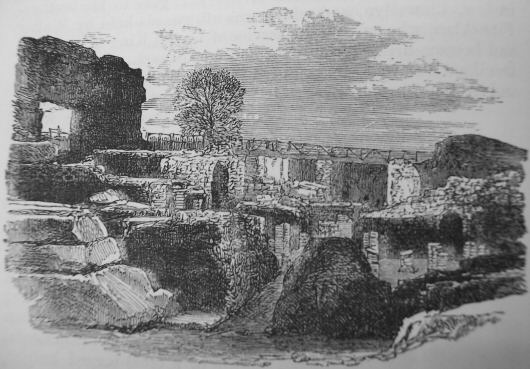
Where the ruins of Uriconium are still exposed to view. Here,
after a lapse of 1,500 years, the visitor may tread the streets and
pavements, handle the implements which the old Romans used, admire their
well-turned arches, and see the paint and plaster upon the walls of
their apartments. The “Old Wall,” so long a sphinx
by the roadside, suggesting enigmas to passers-by, has found an interpreter
in revelations which the spade and pickaxe have made within its shadow.
From the time when its walls first fell down, it has furnished plunder
to the country round. The old monks, finding it easier to take
down its stones than to quarry now ones, built their churches with its
spoil, whilst the “old wall” left standing served as an
advertisement of the treasures buried around it. The Romans who
selected the spot no doubt did so
on military grounds; but, looking at its position on the river, and
the scenery surrounding it, one can readily imagine that an eye for
the beautiful, and a love of nature, had some influence in the choice.
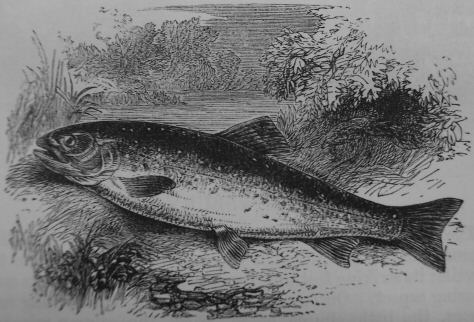
The Severn, near Wroxeter, is famous for grayling, which seldom exceed
three-quarters of a pound, but which have here been caught two pounds
and a half in weight. The ford has a marly or shaly bottom, and
the stream is quick and clear, conditions such as this famous fish,
described by Dr. Fleming as the “grey salmon,” has a liking
for. It has grey longitudinal lines—hence its name—and
a violet-coloured dorsal fin barred with brown; it is best in the winter
and early spring months, and spawns in those of April and May.
The French, who denounce the chub as “un villain,”
pronounce the grayling “un chevalier.” And
Gesner says, that in his country, which is Switzerland, it is accounted
the choicest fish in the world. As bait, grass-hoppers or large
dun flies are used, and hooks covered with green or yellow silk; in
July, black and red imitation palmer worms are recommended; in August,
the artificial house fly, or blue-bottle; and in winter, black or pale
gnats are often used. The fords, too, from here to Buildwas are
good for trout, that near Cound, from the entrance of Cound Brook into
the Severn, being best.
On
leaving Berrington, we come in sight of the wooded steep of Haughmond,
Shakspere’s “bosky hill.” It commands the field
where Falstaff fought “an hour by the Shrewsbury clock;”
and has still a thicket, called the Bower, from which Queen Eleanor
is said to have watched the battle in which the fortunes of her husband
were involved. A castellated turret crowns the summit of the rock
next the Severn; beyond, is Sundorne Castle and the ruins of Haughmond
Abbey.
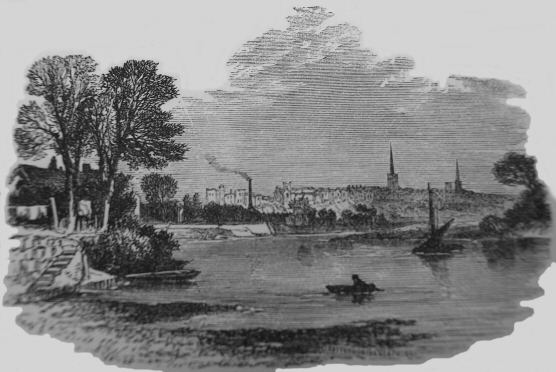
The Severn Valley Railway affords a very interesting approach to
the old Salopian capital, by bringing before the traveller its striking
features, its singular situation, and its most pleasing aspect.
On one side are groups of villa-looking residences, the little church
of St. Giles, the column raised to Lord Hill, and the Abbey Church and
buildings. On the other is the town, with its spires and towers
and red-stone castle rising from an eminence above the river.
The station occupies a narrow isthmus of the latter within the precincts
of the castle, and is a handsome structure, of the Gothic style of architecture.
The castle was built by the first Earl of Shrewsbury, who obtained so
many favours of a like kind from
the Conqueror. Among portions which the old Norman masons raised,
is the inner gateway, through which, it is said, the last Norman earl,
in token of submission, carried the keys to Henry I. From its
position upon a troubled frontier, it changed masters many times, and
suffered much from the attacks of assailants. It was fortified
by William Fitz-Alan when he espoused the cause of the Empress Maude;
and in favour of Henry IV., in his quarrel with the Earl of Northumberland,
when the Shrewsbury abbot went forth from its gates to offer pardon
to Hotspur, on condition that he would lay down his arms; and it was
taken by storm by the Parliamentary army in 1644. It now belongs
to the Duke of Cleveland, and has been converted into a dwelling-house,
the present drawing-room having been the guard chamber in the reign
of Charles. To the right of the castle gates is the Royal Grammar
School, founded in 1551 by King Edward VI., and subsequently endowed
with exhibitions, fellowships, and scholarships connected with Oxford
and Cambridge, to the number of twenty-six. A little higher is
the Chapel of St. Nicholas, an old Norman structure, which belonged
to the outer court of the castle, but is now used as a coach-house and
stable.
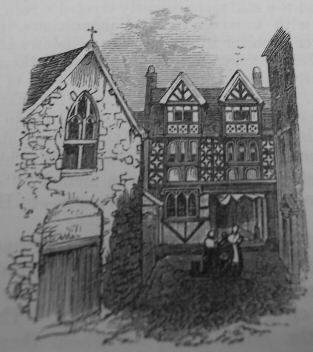
Close by is a highly ornamental timber gateway, erected in 1620,
leading to the Council House, the temporary residence, during
feudal times, of the Lords President of the Marches. Continuing
along this street, we pass the Raven Hotel, recently rebuilt at a cost
of nearly £20,000. It was here George Farquhar wrote his
comedy of the “Recruiting Officer,” which he dedicated to
“All friends round the Wrekin.” Descending Pride Hill,
the eye rests upon a number of rare old specimens of domestic architecture,
which, like those in High Street and others, were the homes of the ancient
burghers; mansions here and there of more pretension are also to be
seen, mingling an air of antiquity with one of comfort. The town
is rich in specimens of ecclesiastical architecture, and possesses some
very handsome churches. Of the four whose towers and spires are
seen within the circle of the Severn, St. Mary’s is the most interesting.
Its site is 100 feet above the river, and its tall and graceful spire
is a landmark seen for many miles. The lower portion of the tower,
the nave, transepts, and doorway, are of the 12th century, whilst other
portions are of the 15th and 16th. The interior, with its clustered
columns, decorated capitals, moulded arches, and its oak-panelled ceiling,
ornamented with foliage, has a fine effect; added to which, the exquisitely-sculptured
pulpit, given in memory of a former minister, and the still more recently
erected screen, in memory of another, with numerous mural monuments,
in stone and marble, are of peculiar interest. The windows are
of stained glass, some being very ancient, and most of them elaborately
and beautifully painted, and highly deserving of attention.
Near to St. Mary’s are the churches of St. Alkmund and St.
Julian, the former indebted for its foundation to the piety of Ethelfleda,
daughter of Alfred; the latter, also of Saxon origin, to Henry IV.,
who in 1410, attached it to his new foundation of Battlefield College,
raised in memory “of the bloody rout that gave to Harry’s
brow a wreath—to Hotspur’s heart a grave.”
The old collegiate church of St. Chad, founded, it is supposed, soon
after the subjugation of the country by Offa, and transformed, as tradition
alleges, out of one of the palaces of the Kings of Powis, is now a ruin.
The modern one, dedicated to the same saint, of whom there is an ancient
carved figure in the vestry, is now the fashionable church of the town.
The Abbey Church of St. Peter and St. Paul, built upon the
site of a Saxon one of wood, with the abbey ruins and the famous old
stone pulpit of the refectory, should also be visited.
In the centre of the Market Square still stands the old Market House,
erected in 1595 by the corporation. It has a statue of Richard,
Duke of York, father of Edward IV., in an embattled niche in front,
and a surcoat, with armorial bearings, moved from the tower of the old
Welsh Bridge; also the arms of the town, sculptured in relief.
In the immediate neighbourhood of these relics of antiquity is the
recently-erected statue to the great Lord Clive, the Townhall, the Working
Man’s Hall, the Music Hall, the public news-room, and a group
of other handsome buildings. A passage near the Music Hall leads
to the Museum of the Shropshire and North Wales Natural History and
Antiquarian Society, which no visitor with time on his hands should
neglect to visit. In addition to objects of natural history, it
contains others of interest obtained from Wroxeter, and is open daily
from ten to four to visitors upon payment of twopence. Portions
of the town walls, erected in the reign of Henry III., with one of the
ancient towers, are still standing, and form a pleasant walk.
But the grand promenade is the Quarry Avenue, which, with Kingsland
on the opposite side, is the common property of the inhabitants.
The former is a sloping piece of meadow land, intersected by limes,
whose intertwining branches make a fretted archway of living green,
whilst the latter is the spot where the trade pageant, called Shrewsbury
Show, is held. In addition to objects of interest which we have
enumerated, our readers will find materials for observation and study
for themselves; as a further aid to which, we would commend them to
“Sandford’s Guide to Shrewsbury.”


