The Central Building of The New York Public Library is on the western
side of Fifth Avenue, occupying the two blocks between 40th and 42nd
Streets. It stands on part of the site of the old Croton distributing
reservoir, and it was built by the City of New York at a cost of about
nine million dollars.
Competitions to choose the architect for the building were held in 1897,
two years after The New York Public Library was incorporated. The result
of the competition was the selection of Messrs. Carrère and Hastings, of
New York, as architects. In 1899 the work of removing the old reservoir
began. Various legal difficulties and labor troubles delayed beginning
the construction of the building, but by November 10, 1902, the work had
progressed so far that the cornerstone was laid. The building was opened
to the public May 23, 1911, in the presence of the President of the
United States, the Governor of the State of New York, the Mayor of New
York, and an audience of about six hundred persons.
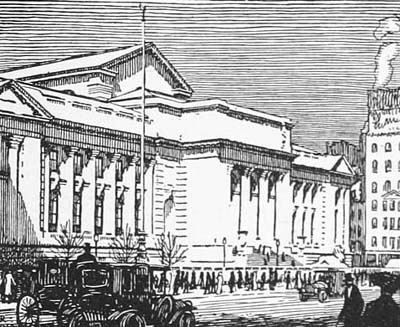
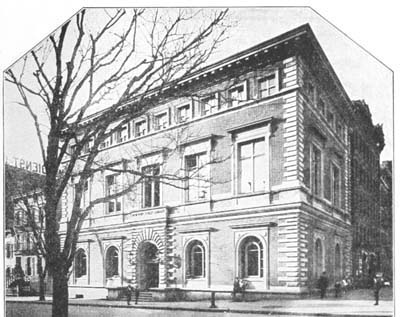
Exterior. The material of the building is largely Vermont marble, and
the style that of the modern Renaissance, somewhat in the manner of the
period of Louis XVI, with certain modifications to suit the conditions
of to-day. It is rectangular in shape, 390 feet long and 270 feet deep,
built around two inner courts. It has a cellar, basement or ground
floor, and three upper floors.
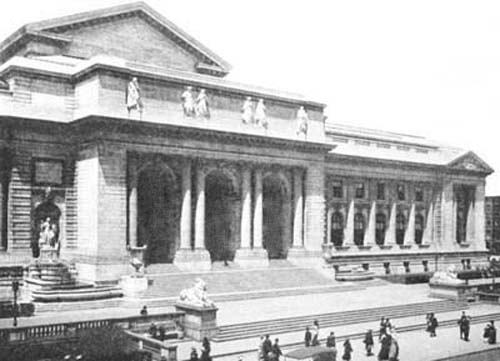 MAIN ENTRANCE
"The Library," wrote Mr. A. C. David, in the Architectural Record[1],
"is undeniably popular. It has already taken its place in the public
mind as a building of which every New Yorker may be proud, and this
opinion of the building is shared by the architectural profession of the
country. Of course, it does not please everybody; but if American
architects in good standing were asked to name the one building which
embodied most of what was good in contemporary American architecture,
The New York Public Library would be the choice of a handsome majority."
Mr. David continued: "The Library is not, then, intended to be a great
monumental building, which would look almost as well from one point of
view as another, and which would be fundamentally an example of pure
architectural form. It is designed rather to face on the avenue of a
city, and not to seem out of place on such a site. It is essentially and
frankly an instance of street architecture; and as an instance of street
architecture it is distinguished in its appearance rather than imposing.
Not, indeed, that it is lacking in dignity. The façade on Fifth Avenue
has poise, as well as distinction; character, as well as good manners.
But still it does not insist upon its own peculiar importance, as every
monumental building must do. It is content with a somewhat humbler rôle,
but one which is probably more appropriate. It looks ingratiating rather
than imposing, and that is probably one reason for its popularity. It is
intended for popular rather than for official use, and the building
issues to the people an invitation to enter rather than a command....
"The final judgment on the Library will be, consequently, that it is not
a great monument, because considerations of architectural form have in
several conspicuous instances been deliberately subordinated to the
needs of the plan. In this respect it resembles the new Museum of Fine
Arts in Boston. The building is at bottom a compromise between two
groups of partly antagonistic demands, and a compromise can hardly ever
become a consummate example of architectural form. But, on the other
hand, Messrs. Carrère and Hastings have, as in so many other cases, made
their compromise successful. Faithful as they have been to the
fundamental requirement of adapting the building to its purpose as a
library, they have also succeeded in making it look well; and they have
succeeded in making it look well partly because the design is
appropriate to its function as a building in which books are stored,
read and distributed. A merely monumental library always appears
somewhat forbidding and remote. The Library looks attractive, and so far
as a large building can, even intimate....
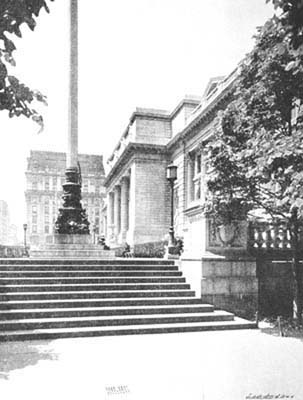 TERRACE IN FRONT OF LIBRARY
Looking South
 By Edward C. Potter
"The popularity of the Library has, consequently, been well earned. The
public has reason to like it, because it offers them a smiling
countenance; and the welcome it gives is merely the outward and visible
sign of an inward grace. When people enter they will find a building
which has been ingeniously and carefully adapted to their use.
Professional architects like it, because they recognize the skill, the
good taste and the abundant resources of which the building, as a whole,
is the result; and while many of them doubtless cherish a secret
thought that they would have done it better, they are obliged to
recognize that in order to have done it better they would have been
obliged to exhibit a high degree of architectural intelligence. In the
realism of its plan and in the mixture of dignity and distinction in the
design, The New York Public Library is typical of that which is best in
the contemporary American architectural movement; and New York is
fortunate, indeed, that such a statement can be made of the most
important public building erected in the city during several
generations."
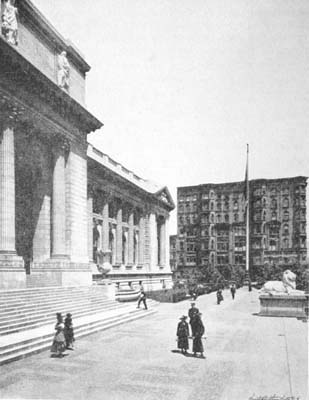 TERRACE LOOKING NORTH
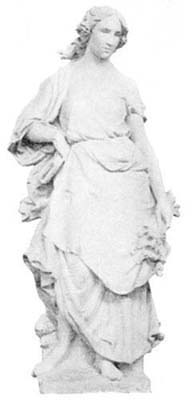 ROMANCE By Paul Bartlett
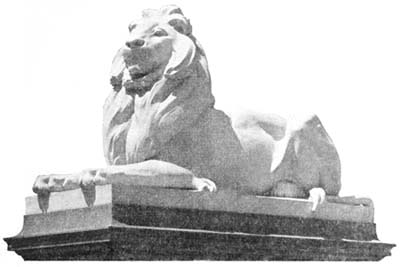
Sculpture. Of the sculptural designs, the two lions on either side of
the main approach are by E. C. Potter. They have been subjected to much
criticism, mainly of a humorous nature, and in the daily press. This
adverse comment has not been endorsed by critics of art and
architecture. Mr. Potter was chosen for this work by Augustus St.
Gaudens, and again, after Mr. St. Gaudens' death, by Mr. D. C. French,
also an eminent sculptor. Any layman can satisfy himself, by a brief
observation of the building as a whole, that the architectural balance
of the structure demands figures of heroic size to flank the main
approach. With that requirement in view, the designer of such figures
has but a limited choice of subject, since there are few living
creatures whose forms possess dignity without being cumbrous. The
sculptor in this instance has followed well-established precedents in
designing the lions according to the canons of decorative art. They are
as realistic as would be suitable for figures of this size, and in this
position.
The groups in the pediments are by George Gray Barnard; the one in the
northern pediment represents History, and the one in the southern, Art.
The figures above the fountains on either side of the main entrance are
by Frederick MacMonnies; the man seated on the Sphinx, on the northern
side of the entrance represents Truth. On the southern side, the figure
of the woman seated on Pegasus represents Beauty. Above the figure of
Truth is this inscription from the Apocrypha (1 Esdras, chapter 3):
BUT ABOVE ALL THINGS
TRUTH
BEARETH AWAY
THE VICTORY
The inscription above the figure of Beauty is:
BEAUTY
OLD YET EVER NEW
ETERNAL VOICE
AND INWARD WORD
This is from the twenty-first stanza of Whittier's poem, "The Shadow and
the Light."
The six figures above the main entrance are by Paul Bartlett; naming
them from north to south they are: History, Drama, Poetry, Religion,
Romance, and Philosophy. Above the entrance are inscriptions concerning
three of the component parts of The New York Public Library. They are as
follows:
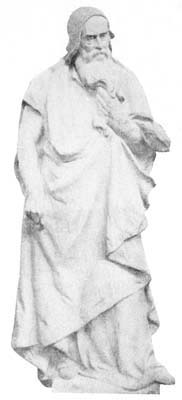 PHILOSOPHY By Paul Bartlett
THE LENOX LIBRARY
FOUNDED BY
JAMES LENOX
DEDICATED TO HISTORY
LITERATURE AND THE FINE ARTS
MDCCCLXX
THE ASTOR LIBRARY
FOUNDED BY
JOHN JACOB ASTOR
FOR THE
ADVANCEMENT OF USEFUL KNOWLEDGE
MDCCCXLVIII
THE TILDEN TRUST
FOUNDED BY
SAMUEL JONES TILDEN
TO SERVE THE INTERESTS OF
SCIENCE AND POPULAR EDUCATION
MDCCCLXXXVI
Beneath these is this inscription:
MDCCCXCV THE NEW YORK PUBLIC LIBRARY MDCCCCII
Of the dates in this inscription, the first, 1895, is that of the
incorporation of The New York Public Library; the second, 1902, is that
of the laying of the cornerstone.
The statue of William Cullen Bryant, behind the Library, is by Herbert
Adams.
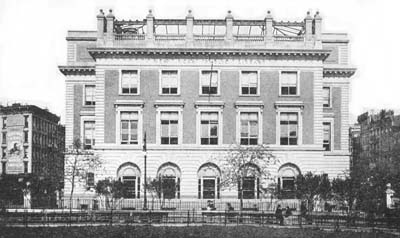
The rear of the building should be viewed from Bryant Park. The long
windows are to light the bookstack. Some critics have commended the
rear of the building very highly. Mr. A. C. David, in the article
previously quoted, says:
"This façade is very plainly treated, without any pretence to
architectural effect. It is, indeed, designed frankly as the rear
of a structure which is not meant to be looked at except on the
other sides. Any attempt, consequently, at monumental treatment has
been abandoned. The building is designed to be seen from Fifth
Avenue and from the side streets. The rear, on Bryant Park, merely
takes care of itself; and one of the largest apartments in any
edifice in the United States is practically concealed, so far as
any positive exterior result is concerned."
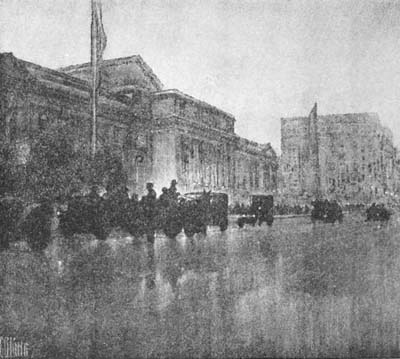 A RAINY DAY—FIFTH AVENUE
From an Etching by Charles B. King
The large apartment referred to in this quotation is the Main Reading
Room of the Library, which is described farther on in this Handbook.
FIRST FLOOR
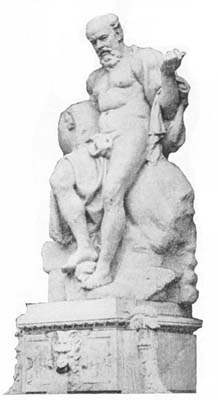 TRUTH
TRUTH
By Frederick MacMonnies
Entrances. There are two entrances to the Library, the main entrance on
Fifth Avenue, and the side door on 42nd Street, which gives admission to
the basement, where the Central Circulation Room, the Newspaper Room and
the Central Children's Room are to be found. On a first visit, however,
the sightseer should use the main entrance on Fifth Avenue, in order to
see the lobby, which rises through two stories, with broad staircases to
the right and left. The flying arches of these staircases are of
seventeen feet span, and are all of marble without any brick or metal
work whatever. The marble used in the lobby is from Vermont. The ceiling
is a true marble vault of forty feet span, supporting itself and the
floor over it, with no metal whatever, except some reinforcing rods
buried in the concrete filling in the floor above.
Between the pillars facing the entrance are two inscriptions. At the
left is this:
THE CITY OF NEW YORK
HAS ERECTED THIS BUILDING
TO BE MAINTAINED FOREVER
AS A FREE LIBRARY
FOR THE USE OF THE PEOPLE
And at the right:
ON THE DIFFUSION OF EDUCATION
AMONG THE PEOPLE
REST THE PRESERVATION
AND PERPETUATION
OF OUR FREE INSTITUTIONS
The latter is a quotation from an address by Daniel Webster at Madison,
Indiana, June 1, 1837.
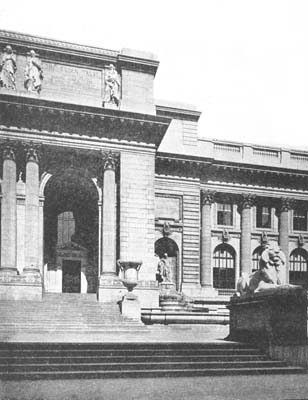 PART OF MAIN FAÇADE
Elevators are near the northern or 42nd Street end of the building.
There is also a staircase at this end of the building, in addition to
the staircases near the main entrance.
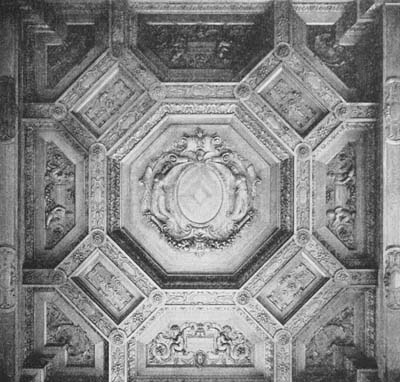
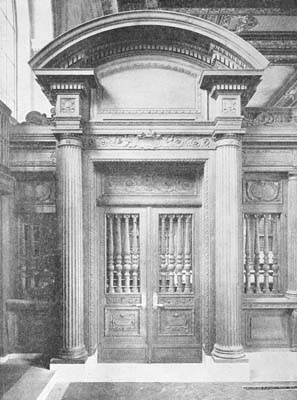
Exhibition Room. Directly opposite the main entrance is the Exhibition
Room, finished in white Vermont marble. The ceiling is supported by
twenty-four columns of green veined white marble. The ceiling itself is
elaborately and beautifully carved in oak. This room is devoted to
exhibitions of rare books, manuscripts and prints. The exhibitions are
changed from time to time, usually as often as three or four times a
year. Open 9 a. m. to 6 p. m. on week days; 1 to 5 p. m. Sundays.
Current Periodicals Room. The corridor to the south from the main
entrance leads to the Current Periodicals Room (Room Number 111). Here
about 4,500 current periodicals are on file. A hundred of these are on
open racks. The others may be obtained upon application at the desk. A
classified finding list gives the reader the titles of periodicals kept
here. As this room is sometimes confused in the public mind with a
popular or club reading room, it should be remembered that this is one
department in a building primarily devoted to the reference work of the
Library. The few restrictions which are imposed are only for the purpose
of keeping the files intact for binding. The Branches of The New York
Public Library contain reading rooms where all the periodicals are on
open racks.
Business Offices. Following the corridor leading south and then turning
to the right along the 40th Street side of the building, one reaches
some of the business offices of the Library—the office of the Bursar
(No. 104), of the Building Superintendent (No. 103), of the Chief of the
Circulation Department (No. 102), and of the Supervisor of work with
children (No. 105). These offices are open for any persons who have
occasion to visit them for business reasons, but they are of no interest
to sightseers. In Room 100, devoted mainly to the cataloguing work of
the Circulation Department, there is a card catalogue of all the books
in this Department,—that is, in the Branches of the Library. The Room
is open to the public, for the consultation of this catalogue, on week
days from 9 a. m. to 5 p. m.
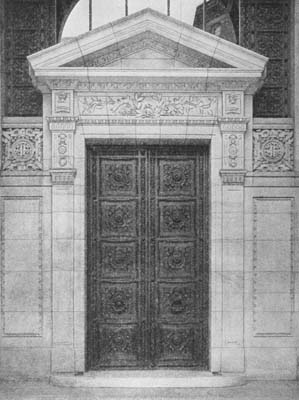 FRONT DOOR
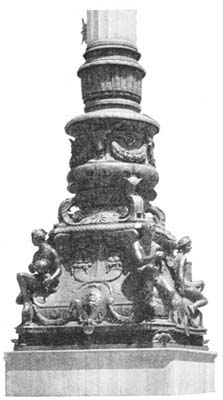 BASE OF FLAGPOLE
Technology Division. Following the corridor leading to the north from
the main entrance, there is, on the right, the room of the Technology
Division (No. 115), devoted to applied science and engineering. The
collection of books in this Division, or under its control, numbers
about 65,000. In this room, as in all the special reading rooms, with a
few exceptions, books are on open shelves for the free access of readers
and students.
Patents Room (No. 121). At the end of the corridor parallel to 42nd
Street, is the Patents Room, a part of the Technology Division. It is
open from 9 a. m. to 6 p. m. on week days, and is closed on Sundays.
Patents may be consulted evenings and Sundays by arrangement with the
technology librarian, Room 115.
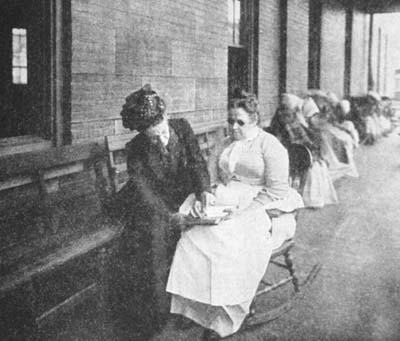
The Library for the Blind (No. 116) is on the inner or western side of
the corridor leading north from the main entrance. This collection
contains about 8,000 books in embossed type for blind readers, and, in
addition, 5,500 music scores, also in embossed type. These books are
lent not only in Greater New York, but are sent free by mail to blind
readers in all parts of the States of New York, New Jersey, and
Connecticut. A teacher employed by the Library goes to homes and
institutions in the City of New York to teach adult blind persons to
read by touch. The room is open on week days from 9 a. m. to 5 p. m. A
bronze tablet on the wall bears the following inscription:
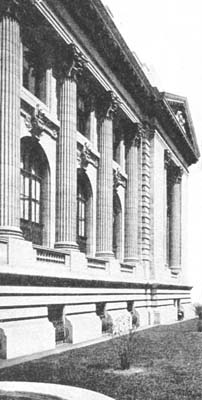 NORTH WING
THE NEW YORK
FREE CIRCULATING LIBRARY FOR THE BLIND
WAS FOUNDED BY RICHARD RANDALL FERRY
THROUGH THE EXERTIONS OF CLARA A. WILLIAMS
THIS LIBRARY WAS PERMANENTLY ESTABLISHED
INCORPORATED, JUNE 3, 1895
TRANSFERRED TO THE N. Y. PUBLIC LIBRARY, FEB. 21, 1903
TRUSTEES
WILLIAM B. WAIT
CLARA A. WILLIAMS
CLARK B. FERRY
RICHARD RANDALL FERRY
CHARLES W. WESTON
The trustees named on the tablet are, of course, those of the former
organization: the "New York Free Circulating Library for the Blind."
SECOND FLOOR
On the second floor a corridor runs along the front of the building,
turning into short corridors at the north and south, and also into a
central corridor. From these corridors open studies, offices and special
reading rooms. In the central corridor, four studies open on the right,
while the fifth room on this side is devoted to the:
Oriental Division (No. 219), with a collection of about 20,000 books and
pamphlets in Arabic, Persian, Turkish, Chinese, Japanese, and other
eastern languages. Open 9 a. m. to 6 p. m. week days.
Jewish Division (No. 217). Opposite the Oriental Division, on the south
side of this central corridor, is the reading room devoted to the Jewish
Division. There are about 24,000 books in the collection.
Slavonic Division. The room devoted to the Slavonic Division (No. 216)
is also on the south side of the central corridor. The resources of this
Division, books and periodicals in the various Slavonic languages,
number about 23,000.
Science Division. On the corridor parallel to Fifth Avenue, and leading
north from the main staircase, the room on the right contains the
Science Division (No. 225). There are about 35,000 books under the
control of this Division.
Economics Division. From the corridor on the northern or 42nd Street end
of the building open the rooms devoted to Public Documents (No. 229) and
Economics and Sociology. These were formerly separate divisions, but now
united, and the entrance is through Room 229. The resources of the
Division (including the large collection of Public Documents) number
about 400,000 books and pamphlets.
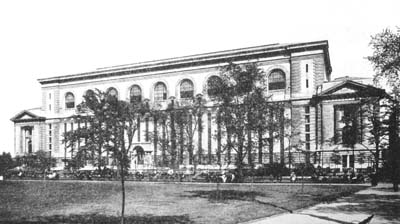 REAR OF LIBRARY FROM BRYANT PARK
Business Offices. The rooms opening from the corridor running south from
the main staircase are mostly business offices, devoted to the
administration of the Library. They are of little interest to
sightseers, but are open to any persons who have occasion to visit them.
They include, on the front of the building, a lecture room (No. 213),
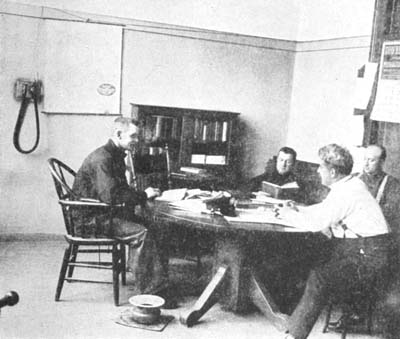
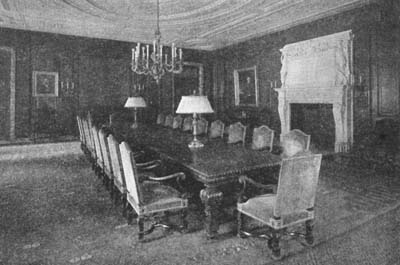
the office of the Director of the Library (No. 210), and the meeting
room of the Board of Trustees (No. 205). On the inner or western side of
the corridor are: a study (No. 214), the office of the Editor of
Publications (No. 212), and of the Reference Librarian (No. 211). The
Trustees' Room may be seen on special application at the Director's
office. Over the mantelpiece in this room is the inscription:
THE CITY OF NEW YORK HAS ERECTED THIS
BUILDING FOR THE FREE USE OF ALL THE PEOPLE
MCMX
I LOOK TO THE DIFFUSION OF LIGHT AND EDUCATION
AS THE RESOURCE MOST TO BE RELIED ON FOR
AMELIORATING THE CONDITION PROMOTING THE VIRTUE
AND ADVANCING THE HAPPINESS OF MAN
THOMAS JEFFERSON
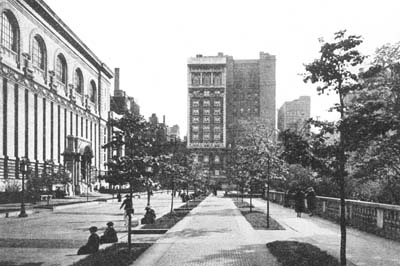 MALL BEHIND LIBRARY
On the corridor leading west, and running along the 40th Street end of
the building, are workrooms, open only to visitors having business
engagements. These rooms are the office of the Order Division (No. 204)
and of the Cataloguing and Accessions Divisions (No. 200 and No. 201).
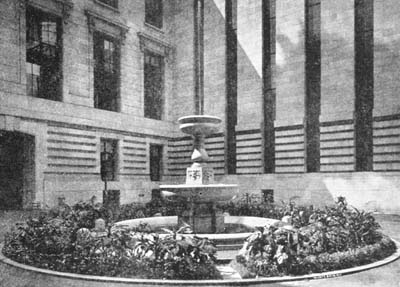 SOUTH COURT
THIRD FLOOR
The most important room on the third floor and, indeed, the centre of
activity of the entire Reference Department of the Library, is the Main
Reading Room, approached through the Public Catalogue Room. The latter
opens from the western side of the corridor at the head of the
staircases.
Public Catalogue Room. This room (No. 315) contains the catalogue of the
books in the Reference Department of the Library,—that is, the books
available to readers in the Main Reading Room and in the special reading
rooms of the Central Building. It is a dictionary catalogue, on cards,
in which the books are entered by author, by subject, and by title, when
the title is distinctive. The catalogue is in trays arranged in
alphabetical order, beginning on the northwest wall of the room and
running to the right. At the end of this catalogue, and on the southern
side of the room, is an author catalogue of the books in the Central
Circulation Branch and Central Children's Room, Rooms 78 and 80, in the
basement. At the end of this second catalogue and separated from it by a
public telephone, is a catalogue of the books in the Library of Congress
for which printed catalogue cards have been issued.
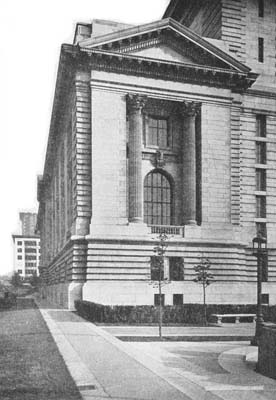 NORTHWEST CORNER
Near the entrance to the Public Catalogue Room, and at the right, is a
bronze tablet:
BORN A.D. MDCCCXIII
(Bas-relief of Sir Isaac Pitman)
TABLET ERECTED A.D. MCMXIII
TO COMMEMORATE
THE
ONE HUNDREDTH ANNIVERSARY
OF THE BIRTH OF
SIR ISAAC PITMAN
AND IN RECOGNITION OF THE
IMPORTANT COLLECTION OF
SHORTHAND LITERATURE
IN THE
NEW YORK PUBLIC LIBRARY
Over the door leading from the Public Catalogue Room to the Main Reading
Room is inscribed the famous quotation from Milton's "Areopagitica":
A good Booke
is the precious life-blood of a
master spirit, embalm'd and treasur'd
up on purpose to a life beyond life
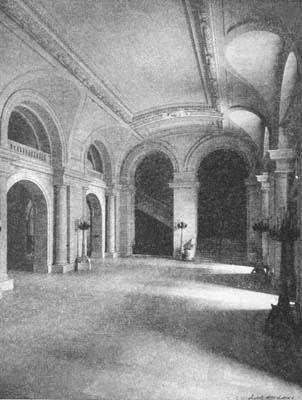 ENTRANCE LOBBY
Information Desk. The Information Desk of the Library is in the Public
Catalogue Room, and here inquiries should be made about the resources
and regulations of the Library, the use of the catalogue, and any other
matter upon which the visitor may have a question to ask.
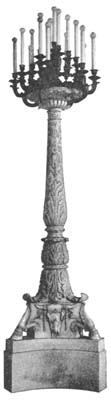
Application for books to be used in the Main Reading Room should be made
in the Public Catalogue Room. The applicant writes his request upon the
slip furnished for the purpose, and files it at the desk in this room. A
numbered ticket is handed him, which he takes into the Main Reading
Room, going to the right if the ticket number is odd; to the left if the
number is even. He then waits at the indicator at the western end of the
delivery desk until the number on his ticket appears. This means that
his books are ready for him at the desk. If, however, he prefers first
to select a seat in the Main Reading Room, he should write the number of
that seat on his application, and his books will be left at that seat,
if he is there to receive them.
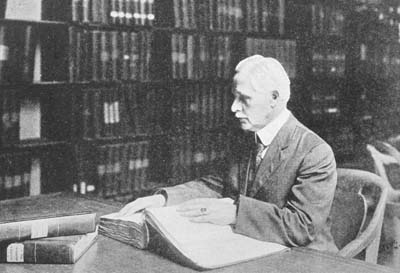
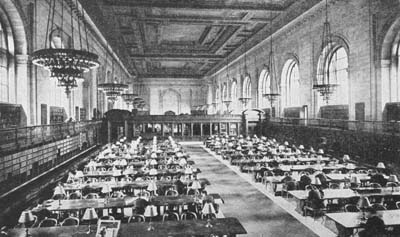
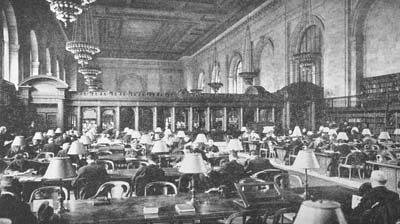
The Main Reading Room, in the rear, extends nearly the entire length of
the building. It has a floor area of half an acre, and is divided in the
middle by a booth from which books are delivered. There are seats for
768 readers. Mr. A. C. David, in the article previously quoted from the
Architectural Record, says:
"The Main Reading Room is one of the most spacious rooms in the
world—beautifully proportioned, lighted by a series of windows on
both the long sides of the room, and entirely accessible to the
stacks. To have obtained a room of these dimensions, so excellently
adapted to its purpose in every respect, was a great triumph for
the architects."
The shelves along the walls contain a collection of about
25,000 volumes. These books are not only the usual works of
reference,—dictionaries, encyclopaedias, and the like, but they also
include a good working library of general literature,—philosophy,
religion, science, history, law, biography, standard novels, poetry, and
the drama. These books are for the free use of anyone in this room,
without the need of making any application. The reader has only to
select the book he wishes, and to take it to a table, where he may
consult it. When he has finished he should leave it on the table, rather
than attempt to return it to its place, since a misplaced book is
temporarily lost.
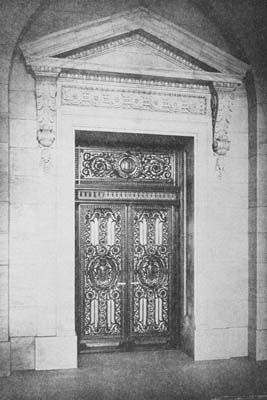 DOOR OF EXHIBITION ROOM
The Library's Books. It should be kept in mind that the books of the
Reference Department are all in the Central Building, and must all be
used in that building. The great body of them are in the stack beneath
the Main Reading Room. In addition, there are the books in the Main
Reading Room itself, and in the special reading rooms in other parts of
the building. Books and pamphlets number, altogether, about one million
and a quarter.
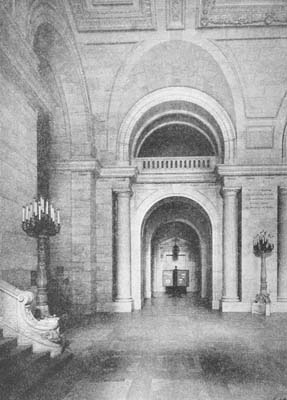 ENTRANCE LOBBY, LOOKING WEST
The books in the Central Circulation Room and in the Children's Room in
the basement, the books in the Library for the Blind, those in the
Travelling Libraries office in the basement, and those in the
forty-three Branch Libraries in other parts of the Boroughs of
Manhattan, The Bronx, and Richmond are under control of the
Circulation Department of the Library. Nearly all of these books are
lent to borrowers for home use. They number about 1,100,000 volumes.
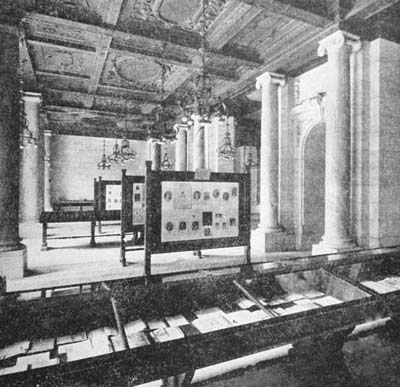 SOUTH SIDE OF EXHIBITION ROOM
 MAIN READING ROOM
In regard to the books in the Reference Department, it is correct to say
that in them the Library owns a well-balanced collection for research in
nearly every branch of human knowledge. The books formerly in the Astor
and Lenox Libraries compose the foundation of the collection. The
subjects most adequately represented are those of American history, of
topics connected with the American continents, and the economic and
social sciences. There are also extensive sets of public documents, of
the publications of learned institutions, as well as comprehensive files
of periodicals. In recent years not so much attempt has been made to get
publications on law, theology, medicine and biology, since there are
special libraries, elsewhere in the City, where these subjects are
covered. The reader is nevertheless sure to find in the special reading
rooms, and in the books which may be brought to the Main Reading Room
for his use, the fundamental printed sources in practically every field
of knowledge.
 PANEL IN CEILING, EXHIBITION ROOM
 DOOR IN SCREEN
Main Reading Room
Use of Books. The Library's situation in the metropolis, and its freedom
from restrictions (according to the custom of American libraries) have
caused the use of its books to become two or three times greater than
that of any of the other large libraries of the world; the average daily
number of readers is more than double the number in any foreign library.
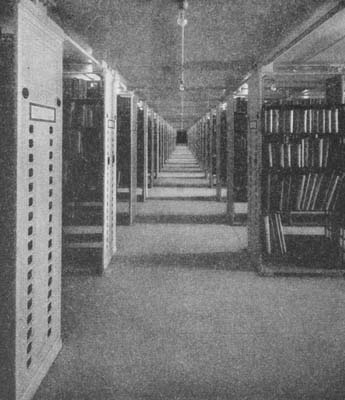
Stack. Underneath the Main Reading Room is the steel stack, in seven
decks, containing 334,500 feet, or 63.3 miles, of shelving. It has room
for about 2,500,000 books. (The special reading rooms have a shelf
capacity for about 500,000 books.) The books in the stack are brought by
electric elevators to the Main Reading Room, as they are called for by
readers. The stack is not open to readers or visitors.
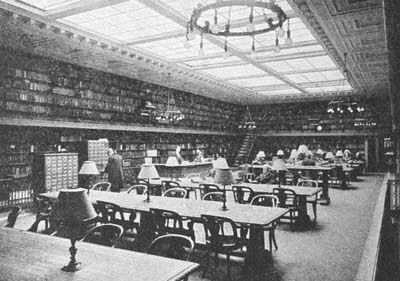
Genealogy Room. At the northern end of the Main Reading Room is the room
devoted to Local History and Genealogy (No. 328). The collection numbers
about thirty thousand volumes.
American History Division. At the southern end of the Main Reading Room
is the room devoted to American history (No. 300). It is one of the
strongest divisions of the Library, since its books are so
distinguished among collections of this kind as to make them of the
greatest importance to students and scholars in the field of American
history. The foundation of this collection was formed by the books on
American history owned by James Lenox, the founder of the Lenox Library,
one of the components of the present New York Public Library. The tablet
in the floor near the entrance of Room 300 is inscribed as follows:
IN MEMORY OF
JAMES LENOX
A NATIVE AND RESIDENT OF THE CITY OF NEW YORK
BORN AUGUST 19 1800
DIED FEBRUARY 17 1880
THE TRUSTEES OF
THE NEW YORK PUBLIC LIBRARY
ASTOR LENOX AND TILDEN FOUNDATIONS
IN PERFORMANCE OF A GRATEFUL DUTY
HAVE CAUSED THIS TABLET TO BE PLACED
HERE AMONG THE BOOKS HE CHERISHED
AS A MEMORIAL OF HIS SERVICES
TO THE HISTORY OF AMERICA
From the corridors on the front and sides of the third floor, rooms open
in the following order, beginning with the corridor at the south,
running along the 40th Street side of the building:
 PART OF MAIN READING ROOM
Reserve Books (No. 303): In this room are kept the rare and reserved
books of the Library.
Among the foremost treasures of the Library are: the Gutenberg Bible
(printed by Gutenberg and Fust about 1455, one of the earliest books
printed from movable types); the Coverdale Bible (1535); Tyndale's
Pentateuch (1530) and New Testament (1536); and Eliot's Indian Bible. In
fact, the collection of early Bibles in English is one of the great
collections of the kind in existence. The Library also owns four copies
of the First Folio Shakespeare (1623); several copies of the Second,
Third, and Fourth Folios (1632, 1663-64, 1685); thirty-five editions of
the Shakespeare Quartos, before 1709; eight works printed by William
Caxton (1475-90); the Bay Psalm Book, the first book printed in the
territory now comprised in the United States (Cambridge, 1640); and the
Doctrina Christiana, printed in Mexico in 1544.
 BOOK STACK
(Showing Half the Length of One Deck)
One contribution to the Library has been commemorated by a tablet near
the door of this room. It bears the inscription:
THE
BAILEY MYERS COLLECTION
OF
AMERICANA
FORMED BY
THEODORUS BAILEY MYERS
OF
NEW YORK CITY
1821-1888
GIVEN BY HIS WIDOW, DAUGHTER
AND DAUGHTER-IN-LAW AS A
MEMORIAL OF HIM AND HIS SON
THEODORUS BAILEY MYERS MASON
LIEUTENANT COMMANDER
UNITED STATES NAVY
Opposite, in Room 304, is the office of the Bibliographer of the
Library, and of the Chief of the American History Division.
Prints Room. Opening from the corridor on the east (the front) of the
Library is the Prints Room (No. 308). Open 9 a. m. to 6 p. m. week days;
1 to 6 p. m. Sundays. Here is the Samuel P. Avery Collection of 18,000
prints. They are mainly French and other modern etchings and
lithographs. There is also a large collection of modern American prints,
a collection of Japanese prints in color, and a collection of old prints
illustrating the development of reproductive graphic art to the present
day.
Art and Architecture. Room 313 is the reading room devoted to Art and
Architecture. The resources of the collection, about 25,000 books, deal
with art and craftsmanship in the widest sense.
 TRUSTEES' ROOM
Map Room. On the inner, or western, side of this corridor, opposite Room
313, is the Map Room (No. 312), a part of the American History Division.
Open 9 a. m. to 6 p. m. on week days.
Stuart Gallery. Opening from the corridor on the front of the building,
and directly opposite the entrance to the Public Catalogue Room, is the
room devoted to the Stuart Collection (No. 316). Open 9 a. m. to 6 p. m.
on week days. Closed on Sundays. This contains pictures, books, and
other objects of art bequeathed by Mrs. Robert L. Stuart. On the east
wall of the Gallery is a tablet with this inscription:
THE
ROBERT L. STUART
COLLECTION
THE GIFT OF HIS WIDOW,
MRS. MARY STUART.
BEQUEATHED TO THE
LENOX LIBRARY
1892.
Catalogues of the paintings are on sale for ten cents.
General Gallery. The next room to the north is the general gallery (No.
318). (Sign reads "Picture Gallery.") The pictures in this room are
largely from the collection of James Lenox. The catalogue, mentioned in
the preceding paragraph, gives a list of them, and a brief description
of many. Open 9 a. m. to 6 p. m. week days and 1 to 5 p. m. Sundays.
Prints Gallery. Opening from No. 318, and also from the north end of the
front corridor, is the Prints Gallery (No. 321). Here are held
exhibitions of prints, changed several times each year. Open 9 a. m. to
6 p. m. on week days and 1 to 5 p. m. Sundays.
Manuscript Division. On the west or inner side of the front corridor is
the research room of the Manuscript Division (No. 319). This is open
only to those who hold cards signed by the Director of the Library. Open
9 a. m. to 6 p. m. week days. The Division has a good selection of
Oriental manuscripts, and of European illuminated manuscripts. Among
these older ones may be mentioned an "Evangelistarium, sive Lectiones ex
Evangeliis," a French-Carlovingian manuscript on 200 vellum leaves, date
about 870 A. D. Another manuscript of special note is the work of Giulio
Clovio, his "Christi Vita ab Evangelistis descripta," sometimes called
"The Towneley Lectionary." It was made for Alexander, Cardinal Farnese,
and was presented by him to Pope Paul III.
 ONE OF THE SPECIAL READING ROOMS
(Genealogy and Local History)
The collection of American historical manuscripts ranks as one of the
best in the United States. Here, for example, is the original manuscript
of Washington's "Farewell Address," a copy of the Declaration of
Independence in Jefferson's autograph, and many other letters and
original sources for research. Lists of the principal manuscripts have
been printed in the Bulletin of The New York Public Library (Volume 5,
page 306-336, and volume 19, page 135-162).
Music Division. Turning to the west, the corridor along the 42nd Street
side of the building leads to the Music Division (No. 324), which opens
from the north side of the corridor. It is open week days from 9 a. m.
to 6 p. m. The resources of the Division number about twenty-two
thousand volumes and pieces of music.
A tablet at the north end of the room bears this inscription:
DREXEL MUSICAL LIBRARY.
THE LEGACY OF JOSEPH W. DREXEL 1888.
On the east wall is a tablet reading as follows:
IN MEMORY OF
1855 JULIAN EDWARDS 1910
WHOSE COLLECTION OF MUSIC SCORES
AND BOOKS WAS GIVEN TO THIS LIBRARY
BASEMENT
The basement contains three rooms of public interest. The entrance from
42nd Street is the most convenient way to reach these rooms from the
outside of the building, but a visitor on one of the upper floors should
take the elevator or the staircase, both near the north end of the
building.
 CENTRAL CIRCULATION ROOM
Newspaper Room. In the Newspaper Room (No. 84) about sixty daily
newspapers are on racks for free use, without the need of any
application. About twenty-five foreign newspapers are obtainable upon
application at the desk. A bulletin board at the right of the entrance
gives full information about these and other resources of the Newspaper
Room.
On the western side of the entrance corridor, near the door of the
Circulating Library, is a bronze tablet with the following inscription:
[Seal of The New York Public Library]
THIS BUILDING IS ERECTED
UPON A PART OF THE COMMON LANDS
WHICH WERE GRANTED BY ROYAL CHARTER
TO THE MAYOR ALDERMEN AND COMMONALTY
OF THE CITY OF NEW YORK
IN 1686,
THE SECOND YEAR OF THE REIGN OF JAMES THE SECOND
KING OF ENGLAND.
THE CITY OF NEW YORK IN 1897,
WILLIAM L. STRONG BEING MAYOR,
UNDERTOOK TO CONSTRUCT,
AT THE PUBLIC EXPENSE,
A BUILDING UPON THIS SITE
TO BE USED AND OCCUPIED BY
THE NEW YORK PUBLIC LIBRARY,
ASTOR, LENOX AND TILDEN FOUNDATIONS
SO LONG AS IT SHOULD MAINTAIN HEREIN
A FREE LIBRARY AND READING ROOM FOR THE PEOPLE.
WORK WAS BEGUN BY THE CITY IN 1899,
ROBERT ANDERSON VAN WYCK BEING MAYOR.
THE CORNERSTONE WAS LAID IN 1902,
SETH LOW BEING MAYOR.
THE BUILDING WAS COMPLETED IN 1909,
GEORGE BRINTON McCLELLAN BEING MAYOR.
IT WAS OCCUPIED AND OPENED TO THE PUBLIC IN 1911
WILLIAM JAY GAYNOR BEING MAYOR.
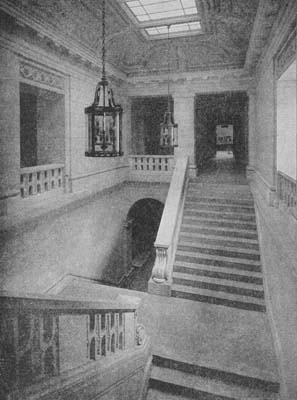 NORTH STAIRCASE
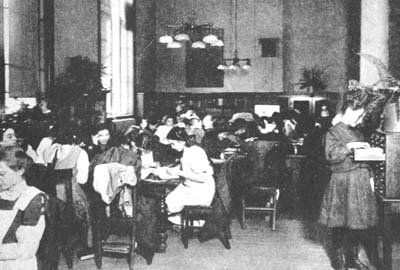
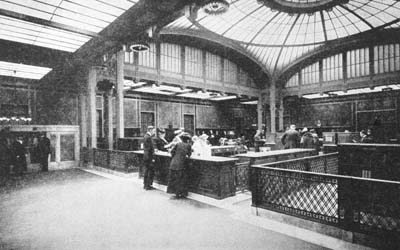
Central Circulation Branch (sign over door reads, "Circulating Library")
(No. 80). This is one of the forty-four Branches of The New York Public
Library, intended for the circulation of books for home use. In this
instance alone the Branch is situated in the Central Building and is
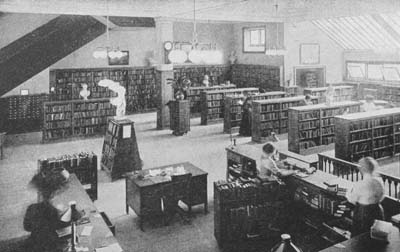
supported by the funds of the Library and not by the City. The room is
interesting because of its activity. The view of it reproduced in this
book had to be taken when but few people were there, but during
afternoons and evenings, especially in the autumn, winter, and spring
months, the room is frequently over-crowded with readers and borrowers
of books. As over 500,000 books were borrowed from this one room during
1915 it may be said that there are few, if any, busier library rooms in
the country, or, indeed, in the world. There is a collection of over
50,000 books, with a reserve collection of somewhat more than 70,000.
The room is open 9 a. m. to 10 p. m. week days, including all holidays,
and 2 to 6 p. m. on Sundays.
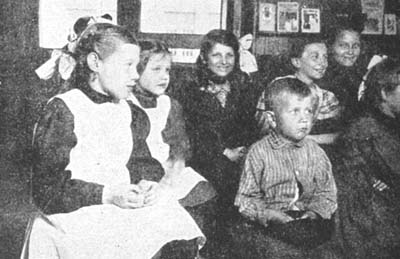
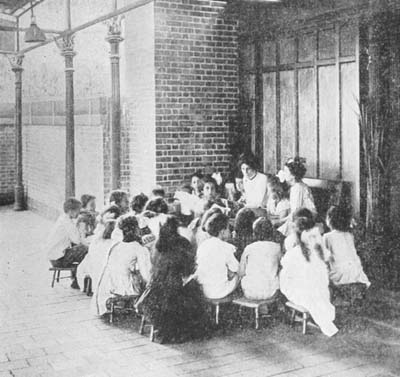
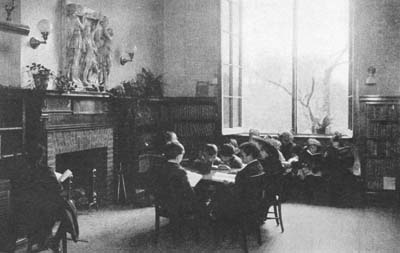
Children's Room. Near the 42nd Street entrance a corridor runs east to
the Children's Room (No. 78). The visitor to the building should not
fail to see this room, with its attractive furnishings, its collections
of brightly colored picture-books, and pictures.
The object of the room is not only to perform the usual work of a
children's room, but also to interest and help parents and others in
selecting children's reading. Authors, artists, and publishers come here
for information about books for children. Another purpose is to furnish
suggestions for similar rooms elsewhere. A number of libraries, in other
parts of the world, have adopted suggestions which they found here.
Exhibitions on various subjects are held from time to time, and there is
a collection of children's books of the old-fashioned kind. Open 9 a. m.
to 6 p. m. week days.
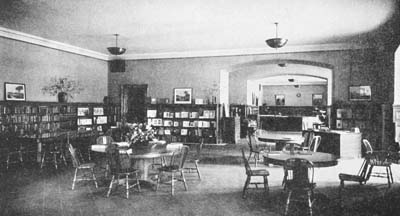 CHILDREN'S ROOM
Library School. Here a two years' course in training for library work is
given to a body of students averaging about seventy-five in number. The
office of the School (where inquiries should be made) is in Room 75,
on the inner or western side of the corridor which runs along the front
of the building, parallel to Fifth Avenue. The Library School class
room, not open to the public, is on the other side of the corridor.
Public Telephones. The public telephones are in Room 70, on the inner or
western side of the front corridor.
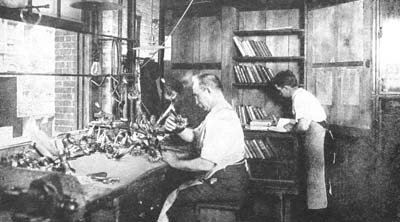
Business Offices. The rest of the basement floor is occupied by offices,
open only to those who have business engagements therein. The offices
include that for Printing and Binding (No. 58), and the Shipping Room
(No. 51). In the Printing Office the catalogue cards of the Library,
printed forms, and all the Library's publications are printed. For the
publications, see page 78.
Travelling Libraries Office. The entrance to the Travelling Libraries
office is from Bryant Park, at the southwest corner of the building. The
office itself is not of interest to sightseers. As it is under control
of the Circulation Department, its work is described on page 59.
FOOTNOTE:
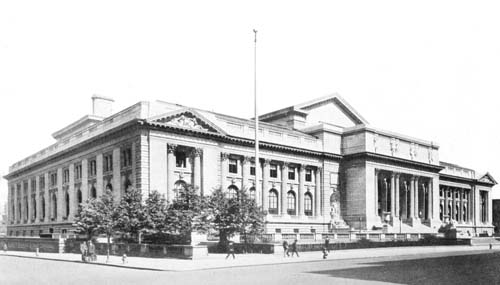 CENTRAL BUILDING