| Page |
| History of the Library | 2 |
| The Burning by the British Troops | 2 |
| The Acquisition of Jefferson’s Library | 3 |
| Mr. Spofford’s Administration | 3 |
| The Old Quarters in the Capitol | 4 |
| The Agitation for a New Building | 4 |
| The New Building | 6 |
| The General Decoration; Mr. Garnsey and Mr. Weinert | 7 |
| The General Character of the Building | 8 |
| The Exterior of the Building | 9 |
| The Façade | 10 |
| The Entrance Pavilion | 11 |
| Mr. Hinton Perry’s Fountain | 12 |
| The Ethnological Heads | 13 |
| The Portico Busts | 16 |
| Mr. Pratt’s Spandrel Figures | 17 |
| The Main Entrance | 18 |
| Mr. Warner’s Bronze Doors | 18 |
| Mr. Macmonnies’s Bronze Door | 20 |
| Main Entrance Hall | 21 |
| The Vestibule | 21 |
| The Stucco Decoration of the Vestibule | 22 |
| The Marble Flooring | 22 |
| The Staircase Hall | 23 |
| The Commemorative Arch | 23 |
| Mr. Warner’s Spandrel Figures | 24 |
| Mr. Martiny’s Staircase Figures | 24 |
| The Ceiling of the Staircase Hall | 27 |
| The Mosaic Vaults of the First Floor Corridors | 28 |
| Mr. Pearce’s Paintings | 28 |
| Mr. Walker’s Paintings | 30 |
| Mr. Alexander’s Paintings | 33 |
| Mosaic Decorations of the East Corridor | 33 |
| The Librarian’s Room | 34 |
| The Lobbies of the Rotunda | 35 |
| Mr. Vedder’s Paintings | 36 |
| The Second Floor Corridors | 39 |
| The Decoration of the Vaults | 39 |
| The Printers’ Marks | 42 |
| Mr. Hinton Perry’s Bas-reliefs | 43 |
| Mr. Shirlaw’s Paintings | 44 |
| Mr. Reid’s Paintings | 46 |
| Mr. Barse’s Paintings | 48 |
| Mr. Benson’s Paintings | 50 |
| The Decoration of the Walls | 51 |
| Mr. Maynard’s Pompeiian Panels | 52 |
| The Inscriptions along the Walls | 53 |
| The Entrance to the Rotunda | 55 |
| Mr. Van Ingen’s Paintings | 55 |
| Mr. Vedder’s Mosaic Decoration | 56 |
| The Rotunda | 57 |
| The Importance of the Rotunda | 58 |
| The General Arrangement | 60 |
| The Alcoves | 61 |
| The Symbolical Statues | 62 |
| The Portrait Statues | 64 |
| Mr. Flanagan’s Clock | 66 |
| The Lighting of the Rotunda | 67 |
| The Semicircular Windows | 68 |
| The Dome | 70 |
| The Stucco Ornamentation | 70 |
| Mr. Blashfield’s Paintings | 71 |
| The Rotunda Color Scheme | 76 |
| Provision for Readers | 77 |
| The Book-Carrying Apparatus | 78 |
| Connection with the Capitol | 79 |
| The Book-stacks | 80 |
| Arrangement and Construction | 80 |
| Ventilation and Heating | 82 |
| The Shelving | 82 |
| Lighting | 82 |
| The Lantern | 84 |
| The Rectangle | 84 |
| Southeast Gallery | 86 |
| Mr. Cox’s Paintings | 86 |
| The Pavilion of the Discoverers | 88 |
| Mr. Pratt’s Bas-reliefs | 89 |
| Mr. Maynard’s Paintings | 89 |
| The Pavilion of the Elements | 93 |
| Mr. R. L. Dodge’s Paintings | 93 |
| The Pavilion of the Seals | 94 |
| Mr. Van Ingen’s Paintings | 96 |
| Mr. Garnsey’s Ceiling Panel | 98 |
| The Pavilion of Art and Science | 99 |
| Mr. W. de L. Dodge’s Paintings | 99 |
| The Northwest Gallery | 101 |
| Mr. Melchers’s Paintings | 101 |
| The Rectangle: First Floor Corridors | 101 |
| Mr. McEwen’s Paintings | 102 |
| The House Reading Room | 106 |
| Mr. Dielman’s Mosaics | 107 |
| Mr. Gutherz’s Paintings | 109 |
| The Senate Reading Room | 110 |
| The North Corridor | 111 |
| Mr. Simmons’s Paintings | 111 |
| Special Rooms | 112 |
| The Basement | 112 |
| The Architecture, Sculpture and Painting | 113 |
| The Function of a National Library | 123 |
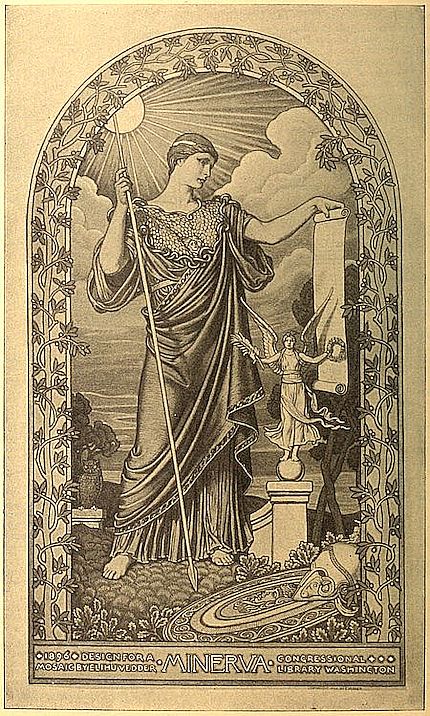
MINERVA
1896 DESIGN FOR A MOSAIC BY ELIHU VEDDER
CONGRESSIONAL LIBRARY WASHINGTON
THE NEW
LIBRARY OF CONGRESS
IN WASHINGTON
BY HERBERT SMALL
THE NEW LIBRARY OF CONGRESS IN WASHINGTON
BY HERBERT SMALL
The Library of Congress in Washington is not the mere reference
library for the legislative branch of the Government that its name
would imply. It is, in effect, the library of the whole American
people, directly serving the interests of the entire country. It was,
it is true, founded for the use of the members of the Senate and House of
Representatives; but, although the original rule still holds good that only they
and certain specified Government officials may take books away from the
building,[1] the institution has developed, especially during the last quarter of a
century, into a library as comprehensively national as the British Museum in
London, the Bibliothèque Nationale in Paris, or the Imperial Library in Vienna.
It is more freely open to the public than any of these, everyone of suitable
age being permitted to use its collections without the necessity of a ticket
or formal permission, while in scope it is their equal, however much it may for
the time being be inferior to them in certain branches of learning. Its aim in
the accumulation of books is inclusive and not exclusive, as Mr. Spofford explains
elsewhere in this Handbook, in his article on The Function of a National
Library.
This development amounts almost to a change of front, in spite of the fact
that the original purpose of the Library as an aid to the legislation and debates
of Congress has been fully preserved. The change has been brought about in
many ways, but principally by the exchange system of the great governmental
scientific bureau, the Smithsonian Institution, and by the operation of the national
copyright law.
The Smithsonian Institution issues each year a large number of scientific publications
of the highest interest and importance. It distributes these throughout
the world, receiving in exchange a body of scientific literature which comprehends
practically everything of value issued by every scientific society of standing
both in this country and abroad. With the exception of a small working library
retained by the Smithsonian Institution for the immediate use of its officers, the
splendid collection of material which has been gathered during the forty years
in which this exchange system has been in operation is deposited in the Library
of Congress, forming a scientific library unrivalled in this country.
By the operation of the copyright law, any publisher, author, or artist
desiring to obtain an exclusive privilege of issuing any publication whatever,
must send two copies of the publication on which a copyright is asked to the
Librarian of Congress to be deposited in the Library. By this means, during
the twenty-five years that the law has been in force, the Library has been enabled
to accumulate approximately the entire current product of the American
press, as well as an enormous number of photographs, engravings, and other
works coming under the head of fine arts. The possession of this material
would alone give the Library a special national character possible to no other
library in the country.
The Library of Congress was founded in the year 1800, about the time that
the government was first established in Washington. Five thousand dollars
was the first appropriation, made April 24, 1800, while Congress was still
sitting in Philadelphia. Some of the Democratic Congressmen, as strict constructionists,
opposed the idea of a governmental library, but their party
leader, Thomas Jefferson, then President, warmly favored it. He called it,
later in life, with a sort of prophetic instinct, the “Library of the United
States,” and his support of it from the very beginning was so hearty and consistent
that he may perhaps be regarded in the broad sense as the real founder
of the institution.
The Library was shelved from the first in a portion of the Capitol building.
The first catalogue was issued in April, 1802. It appears that there were then,
in accordance with the old-fashioned method of dividing books according to
size, not subject, 212 folios, 164 quartos, 581 octavos, 7 duodecimos, and 9
maps.
The Burning by the British Troops.—The War of 1812 wrecked the
slender accumulations of the first dozen years of the Library’s existence. The
collection was entirely destroyed by fire by the British troops which entered
Washington August 24, 1814. The burning is described by a writer in an old
magazine. “The British,” he says, “first occupied the Capitol, only the two
wings of which were finished, and connected by a wooden passageway erected
where the Rotunda now stands. The leading officers entered the House of Representatives,
where Admiral Cockburn of the Royal Navy (who was co-operating
with General Ross), seating himself in the Speaker’s chair, called the assemblage
to order. ‘Gentlemen,’ shouted he, ‘the question is, Shall this harbor of
Yankee democracy be burned? All in favor of burning it will say Aye!’
There was a general affirmative response. And when he added, ‘Those
opposed will say Nay,’ silence reigned for a moment. ‘Light up!’ cried the
bold Briton; and the order was soon repeated in all parts of the building, while
soldiers and sailors vied with each other in collecting combustible material for
their incendiary fires. The books on the shelves of the Library of Congress
were used as kindling for the north wing; and the much admired full-length
portraits of Louis XVI. and his queen, Marie Antoinette, which had been
presented by that unfortunate monarch to Congress, were torn from their
frames and trampled under foot. Patrick Magruder, then Clerk of the House
of Representatives and Librarian of Congress, subsequently endeavored to
excuse himself from not having even attempted to save the books; but it was
shown that the books and papers in the departments were saved, and that the
Library might have been removed to a place of safety before the arrival of the
British.”
The Acquisition of Jefferson’s Library.—Jefferson was then living in
retirement at Monticello. He was in some financial difficulty at the time, and
he offered the Government the largest portion of his library, comprising some
6,700 volumes, for the price which he had originally paid for them—$23,700.
The offer was accepted by Congress, although it met with much opposition.
Among those who objected to the bill were Daniel Webster, then a Representative
from New Hampshire; while Cyrus King, a Federalist member of
the House from Massachusetts, “vainly endeavored to have provision made for
the rejection of all books of an atheistical, irreligious, and immoral tendency”—a
curious example of the many attacks of a similar nature made upon Jefferson
by his political opponents.
With Jefferson’s books as a nucleus, the Library of Congress began to make
substantial gains. In 1832, a law library was established as a distinct department
of the collection. At present it numbers some 85,000 volumes, but for
the greater convenience of the Supreme Court, which sits in the old Senate
Chamber of the Capitol, it has not been removed from its former quarters in
that building. It is always reckoned, however, as a portion of the collection
of the Library of Congress.
In 1850, the Library contained about 55,000 volumes. December 24, 1851,
a fire broke out in the rooms in which it was shelved, consuming three-fifths of
the whole collection, or about 35,000 volumes. A liberal appropriation for
the purchase of books in place of those destroyed was made by Congress, and
from that time to the present day the growth of the Library has been unchecked.
Mr. Spofford’s Administration.—In December, 1864, the present Librarian,
Mr. Ainsworth Rand Spofford, was appointed by President Lincoln[2]. The
general management of the Library has always been in the hands of a joint
committee of Congress; but the membership of the committee is constantly
changing, so that the Librarian is practically the real head and director of the
institution. During the time that Mr. Spofford has occupied his position, not
only has the growth of the collection been little short of marvellous, but so
many changes of system have been introduced as almost completely to transform
the old Library of half a century ago. The year following Mr. Spofford’s
appointment, the previous copyright law was modified so as to require the deposit
in the Library of Congress of a copy of every publication on which copyright
was desired, the second copy required being deposited elsewhere. The administration
of the law was still divided, however, in that each State had its
own office for copyright—some States more than one—with the result that
the volumes due the Government were sometimes received and sometimes not.
There was no way to call the negligent publisher or author to account, for no
single office contained the complete information necessary. Such system as
existed was often invalidated by the carelessness of the officials—the Clerks
of the United States District Courts—in charge in the various States. In
1870, therefore, Congress still further amended the copyright law by consolidating
the entire department in the hands of the Librarian of Congress, as
Registrar of Copyrights, with the provision that both copies of the publication
copyrighted should go to the Library. Since then, the law has worked with
perfect smoothness, and with the result of enormous additions to the Library—numbering,
in the year 1896, no less than 55,906 publications of all kinds.
Naturally enough, therefore, the Library has grown in the last quarter of a
century to be by far the largest in the country. In 1896 it contained, roughly
estimated, 755,000 volumes of books, 250,000 pamphlets, 500,000 separate
pieces of music, 25,000 maps, and 256,000 engravings, photographs, lithographs,
etchings, photogravures, and pictorial illustrations in general.
The Old Quarters in the Capitol.—For many years the Library had
been kept in the west front of the Capitol. Here there was provision for perhaps
350,000 volumes. With the great increase, the old quarters had long
been utterly inadequate. The crypts in the basement of the Capitol afforded
room for storage, but the hundreds of thousands of books, pieces of music,
and engravings thus stored were for the most part entirely inaccessible to the
student—a serious loss to the usefulness of the Library, in spite of the fact
that, so far as the books were concerned, only duplicates and such volumes as
were seldom called for were thus laid away. The copyright business could
be kept up to date only by the greatest effort. The rooms regularly devoted to
the Library were so small, and so over-crowded with books, that there was
almost no opportunity for quiet study, while the ordinary official routine was carried
on with the greatest difficulty and inconvenience. That the Library
should be able to keep its doors open at all, much more that it should continue
promptly to furnish books to applicants, was a sufficient cause for wonder.
The Agitation for a New Building.—In his report for 1872, Mr. Spofford
first laid before Congress the necessity of a new building for the accommodation
of the Library. It was fourteen years, however, before any decided action was
taken in response to this appeal, annually repeated, and twenty-five years before
the present building was finally ready for occupancy. During these fourteen years,
to quote Mr. Spofford, “various schemes for continuing the Library within the
Capitol were brought forward. One was to extend the west front of the edifice
one hundred feet, to hold the books; another, to project the eastern front two
hundred and fifty feet, thus making a conglomerate building out of what is now
a purely classic edifice; a third, and more preposterous scheme, was to accommodate
the Library growth within the great inner concave of the dome, which was
to be literally honeycombed with books from the floor of the Rotunda to the
apex: a plan which would have given space for only twelve years’ growth of
the Library, besides increasing incalculably all the difficulties of its administration.
Every plan for enlarging the Capitol would have provided for less than
thirty years’ increase, after which Congress would be confronted with the same
problem again, and forced to erect a new building after all the cost (estimated
at four millions of dollars) of such enlargement. At length a commission of
architects reported against disturbing the symmetry of the Capitol, and that
illusive spectre was laid to rest. Then ensued difficulties and dissensions about
a site, about plans, about architects, and about cost. Some wanted to save
money by planting a building in the Botanic Garden, or on the Mall, sites
which have been twice under water in the last twenty years, from the overflow
of the Potomac River. Some wanted a plain storehouse of brick, after the
model of the Pension Building, but it was wisely concluded that one such
architectural monstrosity was enough for our Government.
“At length all differences between Senate and House were harmonized; the act
for a separate building received over two-thirds majority in 1886; a site of ten
acres was purchased on a plateau near the Capitol for $585,000; work was begun
on a large scale, but cut down in 1888 to smaller dimensions, with a limitation
of ultimate cost of $4,000,000; restored in 1889 to the original size, and the
limitation of cost was raised to $5,500,000, in addition to sums heretofore appropriated,
thus providing for an ample and thoroughly equipped edifice, with
ultimate accommodations for four and one-half millions of volumes.”
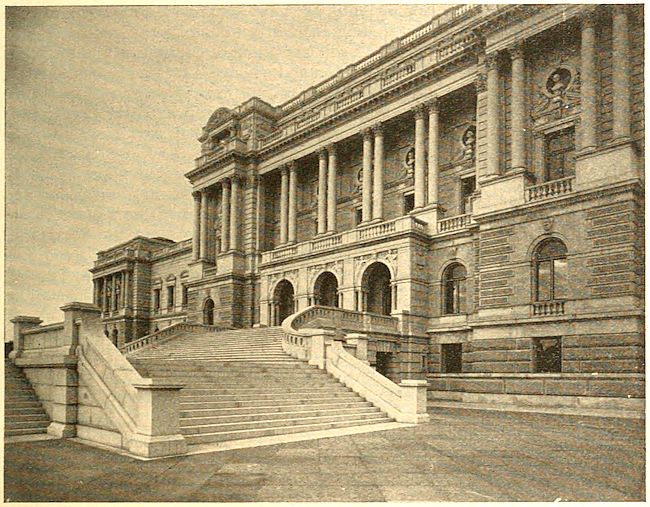
THE ENTRANCE PAVILION.
The first act of Congress providing for the construction of the building was
approved April 15, 1886. Its terms adopted the plan submitted by Mr. John
L. Smithmeyer; created a commission consisting of the Secretary of the Interior,
the Architect of the Capitol Extension, and the Librarian of Congress,
to have charge of and carry forward the work; and selected the present site.
The year 1886 was occupied in appraising and taking possession of the ground;
the next year in clearing the site, making the principal excavation for the
foundations, and laying the drainage system; and the year 1888 in laying one
half of the concrete foundation footings on the plan adopted by the act above
mentioned. On October 2, 1888, a new act of Congress was approved, repealing
so much of the act of April 15, 1886, as provided for a commission
and the construction of the building according to the plan therein specified.
This act placed the work under the sole control and management of the Chief
of Engineers of the Army, Brigadier-General Thomas Lincoln Casey, requiring
him to report direct to Congress annually and to prepare general plans for the
entire construction of the building, subject to the approval of the Secretary of
War and the Secretary of the Interior, and within a total cost of $4,000,000,
exclusive of appropriations previously made.
The preparation of the new design was at once entered upon, using the
previous one of Mr. Smithmeyer as a basis by reducing its dimensions and
otherwise considerably modifying it to bring the cost within the required limit.
The new plans were completed and submitted for approval to the Secretaries
on November 23, 1888, but no action was taken by them. At the same time
this design, together with another modification of the original, retaining the full
dimensions of the building, but modifying its ground-plan and other architectural
features, within and without, in many important particulars, was placed
before Congress. The cost of the building by the latter design was estimated
at $6,003,140, and the time for its construction at eight years. Toward the
close of the session Congress again took up the subject of plans in connection
with the sundry civil appropriation bill and adopted the larger modified design
by the act approved March 2, 1889, directing that the building be erected in
accordance therewith, and at a total cost not to exceed $5,500,000, exclusive
of appropriations previously made. The amount of the previous appropriations
was $1,000,000, of which a balance of $745,567.94 remained after the
expenses of operations on the old plan had all been defrayed. Thus the total
limit of cost of the new plan was fixed by law at $6,245,567.94. It may be
added that none of the plans, drawings, or designs made prior to General
Casey’s taking charge of the work were used, all having been new and different.
In the meantime many detailed plans of stonework for the exterior walls,
foundations, etc., had been prepared, and the working up of the details of design
and construction in general had been actively going on in the drafting
room, so that all was in readiness for the prompt and vigorous commencement
of operations, which took place on the ground as soon as Congress had passed
the act of March 2, 1889.
In the execution of the work General Casey had the entire responsible
charge under Congress from October 2, 1888, until his death, on March 25,
1896, and he also disbursed the funds during that period. He held general
supervision, gave general direction to all principal proceedings, and maintained
an intimate knowledge of the work at all times, while performing the duties of
his more absorbing and important office of Chief of Engineers of the Army at
the War Department, to which he succeeded a few months before he was
placed in charge of the Library building by Congress. General Casey had been
connected with some of the most important pieces of construction ever undertaken
by the Government, including the erection of the State, War and Navy
Building and the completion of the Washington Monument. The last was
an especially difficult task, as it had been necessary to strengthen the old foundations
of the shaft before it was possible to proceed with the work. In this
delicate and hazardous undertaking, as well as in the erection of the State, War
and Navy Building, and other works, General Casey had been assisted by Mr.
Bernard R. Green, C. E., whom he now appointed to be superintendent and
engineer of the construction of the new Library building, and put in full local
charge of the entire work.
To aid in designing the artistic features of the architecture—that is, exclusive
of arrangement, construction, utility, apparatus, and the management of
the business—Mr. Paul J. Pelz was employed under the immediate direction
of General Casey and Mr. Green. Mr. Pelz had been in partnership with Mr.
Smithmeyer in the production of the original general plan and design. In this
way the design of the building, as it now appears in the main in the exterior
and court walls, the dome, the approaches to the west front, was evolved, Mr.
Pelz thereby fixing the plan and main proportions of the building. In the
spring of 1892 Mr. Pelz’s connection with the work ceased. At that time the
building had reached but little more than one-half its height.
In the fall of that year Mr. Edward Pearce Casey, of New York City, was
employed as architect and also as adviser and supervisor in matters of art.
His designs principally include all of the most important interior architecture
and enrichment in relief and color. Mr. Casey continued as architect until the
completion of the building. On the death of General Casey, in March, 1896, he
was immediately succeeded by Mr. Green, under whose charge the building was
completed, in February, 1897, within the limit of time set by Congress in 1888,
and about $140,000 below the limit of cost—or, in round numbers, for
$6,360,000.
General Decoration: Mr. Garnsey and Mr. Weinert.—In addition
to those whose work has been described in the preceding paragraphs, two other
men remain to be mentioned in giving any general account of the construction
of the new building: Mr. Elmer E. Garnsey, who was in charge, under the
general supervision of the architect, of the conventional color decoration of the
interior, and Mr. Albert Weinert, who, in the same way, was in charge of the
stucco ornamentation. Mr. Weinert was put at the head of a staff of modellers,
who executed on the spot the great variety of relief arabesque and minor sculpture
required in the comprehensive scheme of stucco ornament adopted by Mr.
Casey as a chief factor in the decoration of the main halls and galleries throughout
the building. For the general color decoration of the building—which extends
into every room in the building, and includes the many elaborate and
beautiful arabesques which decorate the vaulting of the main halls—Mr. Elmer
E. Garnsey, who had been concerned in similar work at the World’s Fair, the
Boston Public Library, and the Carnegie Library in Pittsburgh, was engaged. A
large studio was fitted up in the building and a staff of designers and fresco-painters
was organized. Mr. Edward J. Holslag was appointed foreman; Mr.
William A. Mackay and Mr. Frederick C. Martin were employed to carry out
on the walls the finer portions of the designs; and Mr. W. Mills Thompson
and Mr. Charles Caffin to make the finished cartoons from the original
sketches for the use of the fresco-painters. The latter numbered about twenty-five,
and the larger portion of them were kept constantly busy for nearly a year
and a half.
The General Character of the Building.—Of the splendid and monumental
building itself, it may be stated, before entering upon a detailed
description—and stated, too, with hardly any fear of contradiction—that it
is the most perfectly adapted for the convenient use and storage of books of any
large library in the world. It is the largest, the costliest, and the safest. It is
absolutely fire-proof, not through any ingenious arrangement or contrivance, but
by the very quality of the materials of which it is built—granite, brick, marble,
iron, steel, and terra-cotta. Wood floors are used in many of the rooms, but
they are merely a carpet of boards laid upon terra-cotta or brick vaults. It
would be impossible for the Library to burn down; a fire would nowhere have
an opportunity to spread. The great size of the building is perhaps best appreciated
from a statement of the amount of some of the materials used in it:
409,000 cubic feet of granite, 500,000 enamelled brick, 22,000,000 red brick,
3,800 tons of steel and iron, and 73,000 barrels of cement. The draughting
office turned out, during the eight years that the Library was under construction,
1,600 plans and drawings. Exclusive of the cellar, the total floor-space
is 326,195 square feet, or nearly eight acres; and the whole number of windows
is about 2,165.
As a matter of “library economy,” the arrangement of the building is of
great interest. The problems to be solved were mostly new ones. In a paper
on the Library, read before the American Library Association, Mr. Green said:
“Its design was preceded by few or no good examples of library architecture,
and was therefore the outcome of theory and deduction rather than the application
of established principles.” This task was not undertaken in any dogmatic
way, however; “the effort was,” as Mr. Green went on to say, “to plan
on general rather than particular principles, and afford the largest latitude for
expansion and re-arrangement in the use of the spaces.”
So far, however, as general interest is concerned, it is the magnificent series
of mural and sculptural decorations with which the architecture is enriched
that has contributed most to give the Library its notable position among American
public buildings. Although a similarly comprehensive scheme of decoration
was carried out at the World’s Fair in Chicago, and afterwards in the new
Public Library in Boston, the Government itself had never before called upon
a representative number of American painters and sculptors to help decorate,
broadly and thoroughly, one of its great public monuments. Commissions
were here given to nearly fifty sculptors and painters—all Americans—and
their work, as shown throughout the building, forms the most interesting record
possible of the scope and capabilities of American art.
It may be noted here, also, that, both inside and out, the Library is, in the
main, in the style of the Italian Renaissance—derived, that is to say, from the
architecture of the buildings erected in Italy during the period (roughly speaking,
the fifteenth century or earlier) when the elements of classic art were revived
and re-combined in a Renascence, or New Birth, of the long-neglected
models of Greece and Rome.
The site of the Library originally comprised two city blocks, containing
seventy houses, with an extent, as has been said, of ten acres. It is
bounded by First, East Capitol, Second, and B Streets, and forms a partial
continuation of the band of parks which stretches east from the Washington
Monument, including the Agricultural Grounds, the Smithsonian Grounds,
Armory Square, the Public Gardens, the Botanic Garden, and the Capitol
Grounds. The general effect of the grounds enclosing the Library is that of
an extension of the Capitol Grounds, the street separating the two, for example,
being treated, so far as possible, as a driveway through a park, and both being
enclosed by low or “dwarf” walls of the same height and design.
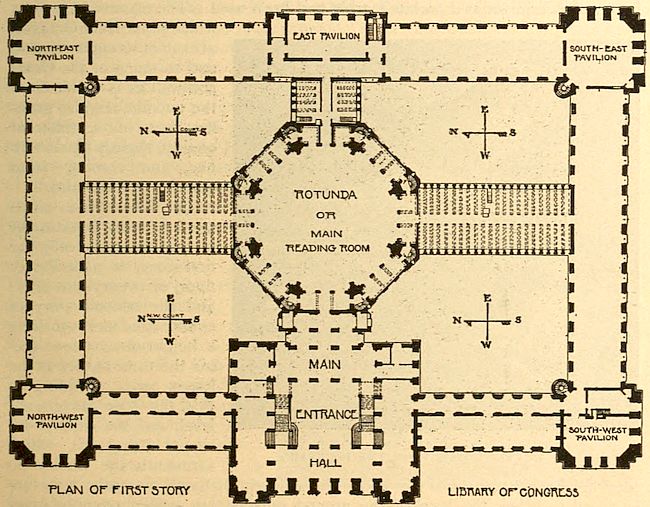
PLAN OF FIRST STORY LIBRARY OF CONGRESS
The Library faces exactly west. It is four hundred and seventy feet long
(from north to south), and three hundred and forty deep (from west to east).
It occupies, exclusive of approaches, three and three-quarters acres.
The general disposition of the building may best be seen by a glance at the
ground plan given on the present page. The exterior walls are thus seen to
belong to a great rectangle, which encloses a cross dividing the open space
within into four courts, each one hundred and fifty feet long by seventy-five or
one hundred feet wide. At the intersection of the arms of the cross is an octagon,
serving as the main reading room, and conspicuous by reason of its dome
and lantern, which, rising well above the walls of the Rectangle, are the first
feature of the building to attract the attention of the visitor. The lantern is
surmounted by a great blazing torch with a gilded flame—the emblematic
Torch of Learning—which marks the centre and apex of the building, a hundred
and ninety-five feet above the ground. The dome and the domed roof of
the lantern are sheathed with copper, over which, with the exception of the
ribs of the dome, left dark to indicate their structural importance, is laid
a coating of gold leaf, twenty-three carats fine. The surface covered is so
large that one’s first thought is apt to be of the expense. As a matter of
fact, however, the total cost—including the gilding for the flame of the torch—was
less than $3,800. Since it will require to be renewed much less frequently
its use was considerably more economical than painting.
The Façades.—The exterior walls of the Library are constructed wholly
of granite, quarried in Concord, New Hampshire. The stone is a close-grained
variety, so even and light in tone that when the sun is shining upon it the effect
is almost as brilliant as if a white marble had been used. The massive buttresses
which support the Octagon
at each of its eight corners,
and so much of the Octagon
wall as is visible from
the outside, are also granite,
but of a different
quality, slightly darker in
hue, and coming from
quarries in Maryland.
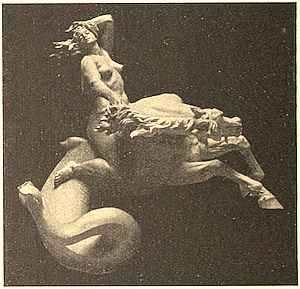
NYMPH AND SEA-HORSE, FROM THE FOUNTAIN.
The Library is in three
stories: the basement
story of fourteen feet; the
first story, or main library
floor, of twenty-one feet;
and the second story of
twenty-nine feet-making
a height of sixty-four feet
for the three stories at the
lowest point. Adding to
this the base at ground
level, and the simply designed
balustrade which
surmounts the whole, the
total height is seventy-two feet above the ground. Beneath the entire structure
is a cellar, below the level of the ground outside, but within opening upon
the interior courts. The granite of which the walls are constructed is rough,
or “rock-faced,” in the basement story; much more finely dressed in the story
above; and in the second story brought down to a perfectly smooth surface.
The windows in the basement are square-headed, as also on the library floor,
except along the west front, where they are arched, with ornamental keystones.
Throughout the second story they are again square-headed, but with casings
in relief, surmounted by pediments alternately rounded and triangular, and,
along the west front, railed in at the bottom by false balustrades.
To prevent the monotony incident to a long, unrelieved facade, the walls are
projected at each of the four corners and in the centre of the east and west
sides, into pavilions, which, in addition to being slightly higher than the rest of
the rectangle—thus allowing space for a low attic-story—are treated with
greater richness and elaboration of ornamental detail. The corners are set with
vermiculated granite blocks—blocks whose surface is worked into “vermiculations”
or “wormings.” The keystones of the window-arches in the first
story are sculptured with a series of heads illustrating the chief ethnological
types of mankind. Along the second-story front runs a portico supported upon
a row of twin columns, each a single piece of granite, with finely carved Corinthian
capitals. The pedestals which support the columns are connected by
granite balustrades, so that the portico forms a single long balcony, with an entrance
through the windows which look out upon it.
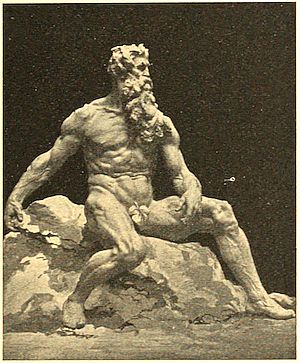
NEPTUNE, FROM THE FOUNTAIN.
Of all these pavilions the West, or Main Entrance, Pavilion, is by far the
largest as well as by far the most ornate. It is one hundred and forty feet
long, or almost a third the total
length of the building, and
about seven feet higher than
either of the other five pavilions.
At either end it is itself projected,
or pavilioned. The Main
Entrance is through a porch
of three arches, on the main
library floor. The approaches
are extensive and imposing.
A flight of steps, constructed
of granite from Troy, New
Hampshire, ascends from either
side to a central landing, laid
with flags of red Missouri granite.
Thence the stairway leads in
a single flight to the Entrance
Porch, with space underneath
for a porte cochère in front of
the doors admitting to the basement.
The central landing just
spoken of is protected by a
high retaining wall which forms
the background for a splendid
fountain by Mr. Roland Hinton
Perry, ornamented with a profusion of allegorical figures in bronze—the
chief figure representing Neptune enthroned in front of a grotto of the sea.
The posts of the granite railing of the steps support elaborate bronze
candelabra, bearing clusters of electric lamps for illumination at night.
The spandrels of the Entrance Porch—the approximately triangular
spaces flanking the three arches—are ornamented with female figures
sculptured in high relief in granite, representing Literature, Science, and
Art. They were modelled by Mr. Bela L. Pratt. Above the main
windows of the library floor is a series of smaller, circular windows,
which serve as a background for a series of granite busts (the pedestals of
which rest in the pediments below) of men eminent in literature. There
are nine in all, seven along the front, and one at each end of the pavilion.
They are flanked by boldly sculptured figures of children, reclining upon
the sloping pediments, or, alternately, by massive garlands of fruits. The
keystones of the circular windows each support the standing figure of a winged
cherub, or genius, all sculptured from a single design, and introduced as the
accentuating feature of a frieze of foliated ornament extending along the three
sides of the pavilion. Like the garlands and figures on the pediments, they
were modelled by Mr. William Boyd. At either end of the attic story Mr.
Boyd’s hand appears again in the sculptural embellishment of the little porch—as
one may perhaps call it—which looks out upon the balcony formed by the
granite railing. The rounded pediment contains a group in granite consisting
of the American eagle flanked by two seated children. Each pediment is
supported on the shoulders of two conventional Atlases—“Atlantides” is
the technical name—figures of gigantic strength, so called because in the Greek
and Roman mythology Atlas was fabled as a giant supporting the vault of
heaven by his unaided strength.
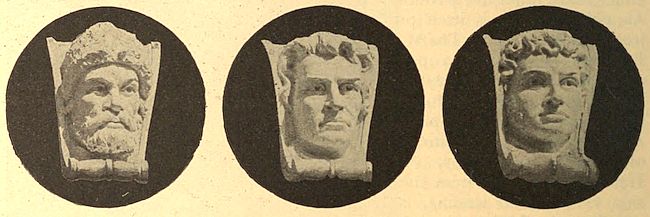
RUSSIAN SLAV. BLONDE EUROPEAN. BRUNETTE EUROPEAN.
A more particular description is required of the fountain, the ethnological
heads, the series of busts in the portico of the Entrance Pavilion, and the spandrel
figures ornamenting the Entrance Porch.
Mr. Hinton Perry’s Fountain.—Of Mr. Perry’s fountain, it may be
said at once that it is the most lavishly ornamental of any in the country. It
occupies a semicircular basin fifty feet broad, containing a dozen bronze figures
disposed to represent a scene—so one may take it—in the court of Neptune,
the classic god of the sea. The granite wall of the terrace against which the
fountain is placed contains three deep niches, in the spandrels of which are four
dolphins sculptured in relief from models by Mr. Albert Weinert. The niches
themselves are treated with an evident suggestion of a grotto worn by the sea,
with a hint, also, at the formation of stalactites by the constant dripping of
water. In front of the central niche Neptune is seated in a majestic attitude
on a bank of rocks. He is represented as an old man with a long flowing
beard, but the lines of his naked figure indicate the energy and great muscular
strength befitting the Ruler of the Deep. The figure is of colossal size; it would
be, that is, if standing, about twelve feet in height. On either side of the
bank lolls a figure of Triton, one of the minor sea-gods, blowing a conch shell
to summon the water-deities to the throne of their sovereign. In front of
each of the niches at the side is a sea-nymph triumphantly bestriding an infuriated
sea-horse, his ears laid back and his fish’s tail writhing with anger on
account of a jet of water constantly thrown against his head. The basin is
crossed and re-crossed by similar jets, which furnish the whole flow of water,
and proceed from the mouths of sea-monsters in various places throughout
the fountain. There are seven of them in all. The first is a serpent just showing
itself above the water in front of the bank on which Neptune is seated.
Higher up, to the right and left, two gigantic frogs lurk in crevices of
the rocks; and floating along the outer edge of the basin are four huge Florida
turtles, their heads raised a little above the water and their long fins making as
if swimming.
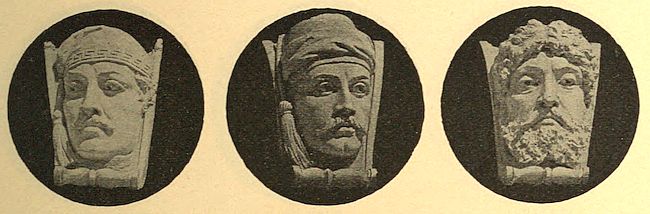
MODERN GREEK. PERSIAN. CIRCASSIAN.
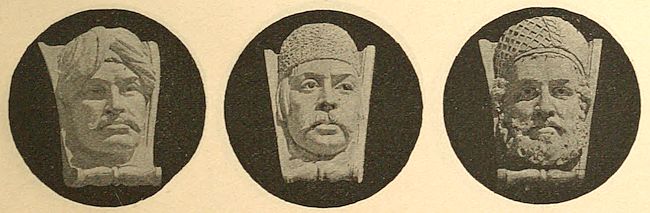
HINDOO. HUNGARIAN. SEMITE.
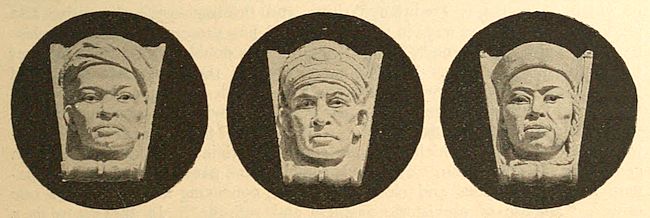
The Ethnological Heads.—The ethnological heads ornamenting the keystones
of the first-story pavilion windows offer as interesting material for study
as any of the decorations of the Library. The series is unique in that it is the
first instance of a comprehensive attempt to make ethnological science contribute
to the architectural decoration of an important public building. It was at first
proposed to employ a more conventional kind of ornament, such as the familiar
Gorgons’ heads so often found in connection with Renaissance architecture.
The present idea was carried out with the assistance of Professor Otis T.
Mason, the Curator of the Department of Ethnology in the National Museum for
the last twelve years. The heads, thirty-three in number, are about a foot
and a half in height, and were modelled, some by Mr. Boyd and others
by Mr. Henry J. Ellicott, after data accumulated by Professor Mason as the
result of some six months’ special study of the ethnological collections in the
possession of the National Museum—which contains, indeed, practically all the
material (books, photographs, carefully verified measurements) necessary for
such an undertaking. The large collection of authentic, life-size models,
chiefly of savage and barbarous peoples, which the visitor may see in its exhibition
halls, is the most extensive in the country, and many of the heads on the
Library keystones are taken directly from these.
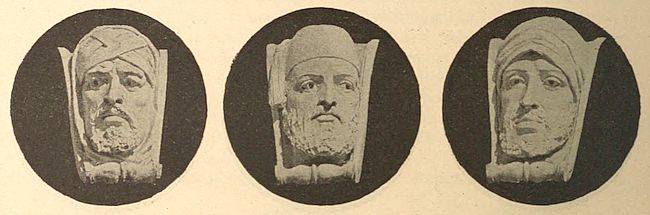
ARAB. TURK. MODERN EGYPTIAN.
Taking into consideration the difficulty of obtaining the more delicate differentiation
of the features in a medium so unsatisfactory, from its coarseness
of texture, as granite, the result of Professor Mason’s work is one of the most
scientifically accurate series of racial models ever made. Still another difficulty,
it may be added, lay in the fact that each head had to be made to fit the keystone.
Besides the necessity of uniform size, the architect demanded also, as
far as possible, a generally uniform shape, which it was often very hard to give
and still preserve the correct proportions of the racial type. The face had to
be more or less in line with the block it ornamented, and, especially, the top of
the head had to follow, at least roughly, a certain specified curve. This last
point was met either by using or not using a head-dress, whichever best met the
difficulty. In one case the problem was a little puzzling—that of the Plains
Indian, with his upright circlet of eagle’s feathers, which were bound to exceed
the line, if accurately copied. The difficulty was frankly met by laying the
feathers down nearly flat upon the head.
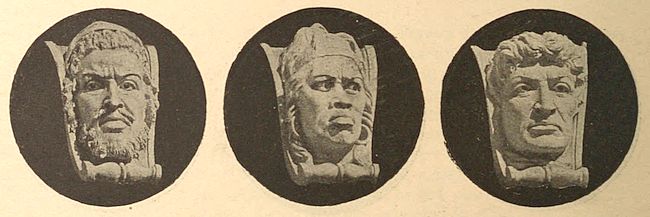
ABYSSINIAN. MALAY. POLYNESIAN.
In preparing the models, accuracy was the chief thing considered. Any
attempt at dramatic or picturesque effect, except what was natural to the type
portrayed, was felt to be out of place. Each head was subjected to the strict
test of measurement—such as the ratio of breadth to length and height, and
the distance between the eyes and between the cheek bones—this being the
most valuable criterion of racial differences. All portraiture was avoided, both
as being somewhat invidious and unscientifically personal, and, more especially,
because no one man can ever exemplify all the average physical
characteristics of his race. On the other hand, the heads were never permitted
to become merely ideal. It will be noticed that all are those of men in the
prime of life.
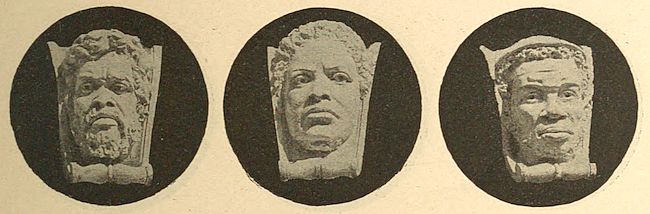
AUSTRALIAN. NEGRITO. ZULU.
The list of the races, beginning at the north end of the Entrance Pavilion, and
thence continuing south and round the building to the Northwest Pavilion, is
as follows, each head being numbered for convenience in following the order
in which they occur: 1, Russian Slav; 2, Blonde European; 3, Brunette
European; 4, Modern Greek; 5, Persian (Iranian); 6, Circassian; 7, Hindoo;
8, Hungarian (Magyar); 9, Semite, or Jew; 10, Arab (Bedouin); 11,
Turk; 12, Modern Egyptian (Hamite); 13, Abyssinian; 14, Malay; 15, Polynesian;
16, Australian; 17, Negrito (from Indian Archipelago); 18, Zulu
(Bantu); 19, Papuan (New Guinea); 20, Soudan Negro; 21, Akka (Dwarf
African Negro); 22, Fuegian; 23, Botocudo (from South America); 24, Pueblo
Indian (as the Zuñis of New Mexico); 25, Esquimaux; 26, Plains Indian
(Sioux, Cheyenne, Comanche); 27, Samoyede (Finnish inhabitant of Northern
Russia); 28, Corean; 29, Japanese; 30, Aino (from Northern Japan); 31,
Burmese; 32, Thibetan; 33, Chinese.
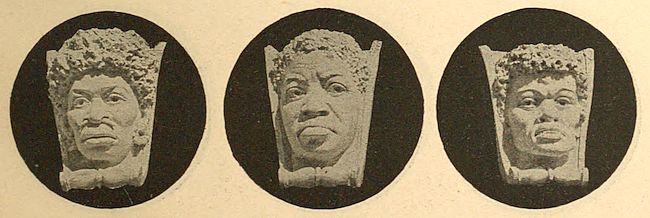
PAPUAN. SOUDAN NEGRO. AKKA.
It will be seen that the various races are grouped so far as possible according
to kinship. There is not, however, space—and this is hardly the place—in
which to explain the many points which might be brought up in connection
with this interesting series of heads. For such information the reader is referred
to any good text-book on ethnology.[3] One or two special details, however,
may properly be mentioned. The selection of the Pueblo Indian, for
example, was a second choice. Professor Mason would have preferred one of
the ancient Peruvian Incas, but no satisfactory portrait could be found to work
on. The Thibetan is a Buddhist priest, as indicated by his elaborate turban.
The Chinese belongs to the learned, or Mandarin class. The Russian with his
fur cap is the typical Slavic peasant. The Blonde European is of the educated
German type, dolichocephalic, or long-headed; the Brunette European is
the Roman type, brachycephalic, or broad-headed. The architect has introduced
a Greek fret on the turban of the Greek to symbolize the importance of
ancient Greek art. The Egyptian is the typical Cairo camel-driver. The
Corean wears the dress and hat of the courtier, and the Turk also is depicted
as a member of the upper classes. The Hungarian wears the astrachan or
lambswool cap of the peasant. Many of the heads of savage or barbarous
races are shown with their peculiar ornaments—the Malay with his earrings,
the Papuan with his nose-plug, the Botocudo with studs of wood in his ears
and lower lip, and the Esquimaux with the labret or lip-plug of walrus ivory.
The face of the Polynesian, finally, is delicately incised with lines, copied from
a specimen of Maori (New Zealand) tattooing.
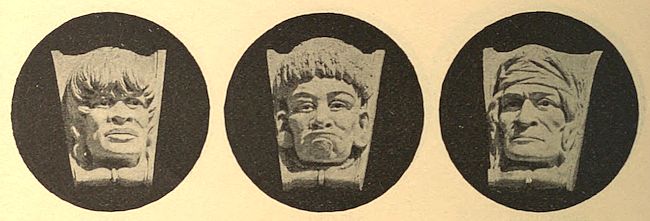
FUEGIAN. BOTOCUDO. PUEBLO INDIAN.
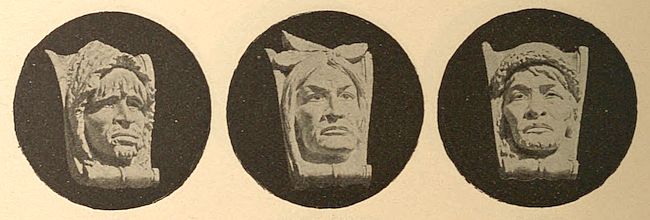
ESQUIMAUX. PLAINS INDIAN. SAMOYEDE.
The Portico Busts.—The list of the men commemorated by the nine busts
in the portico is as follows: Demosthenes, Emerson, Irving, Goethe, Franklin,
Macaulay, Hawthorne, Scott, and Dante. The Demosthenes, Scott, and Dante
were modelled by Mr. Herbert Adams; the Emerson, Irving, and Hawthorne
by Mr. J. Scott Hartley; and the Goethe, Franklin, and Macaulay by Mr. F.
Wellington Ruckstuhl. The reader will see that so far as possible with an odd
number, the work of each sculptor is, so to say, in balance—Mr. Ruckstuhl’s
in the centre, flanked by Mr. Hartley’s, and Mr. Adams’s at either end—thus
avoiding any possible confusion of style, and giving the artist all the advantage
which comes from a symmetrical disposition of his productions. There is, as a
matter of fact, very little diversity in the present series. Each bust is of uniform
height—about three feet, not reckoning the pedestal—with a uniform
background. The statue of Franklin, coming in the centre, has, intentionally,
a certain effect of pre-eminence. The sculptor conceived him “as one of the
greatest men of this country, and as a writer and philosopher the patriarch, and
therefore aimed to make him dominate the rest.” A word should be said
regarding the background of the busts—the glass enclosed in the framing of
the circular windows. The effect, as always of a window, is dark, as granite
would not have been, thus throwing the busts, which are of the same material
as the walls, into sharp, strong relief.
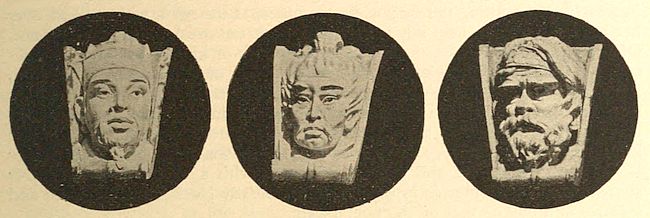
COREAN. JAPANESE. AINO.
BURMESE. THIBETAN. CHINESE.
Mr. Pratt’s Spandrel Figures.—The beautiful spandrel figures of the
Entrance Porch modelled by Mr. Bela L. Pratt are six in number.[4] All are
about life-size, and are shown leaning gracefully against the curve of the arches.
After what has been said of the intractability of granite as a medium for any
but the bolder sorts of sculpture, it is not out of place to call attention to the
exceptional delicacy and refinement with which these figures have been chiselled.
They represent, as has been said, Literature (the left hand arch), Science
(in the centre), and Art (to the right). In the background of each spandrel
the sculptor has introduced a branch of walnut, oak, laurel, or maple leaves.
Of the figures themselves, the two to the left stand respectively for the contemplative
and the productive sides of Literature—reflection and composition.
The one is writing upon a tablet, although for a moment she turns aside as if
in search of the fitting phrase; while the other, at the right, with a hood over
her head and a book held idly in her hand, gazes out dreamily into the distance.
Of the figures of Science, the first holds the torch of knowledge, and the second,
with the celestial globe encircled by the signs of the zodiac in her arm,
looks upward, as if to observe the courses of the stars. Here, also, it will be
seen that something of the same distinction as in the first arch is drawn
between the abstract and the practical. In the third group, the figure to the
left represents Sculpture, and that to the right, Painting. The latter busies
herself with the palette and brush. Sculpture, with a mallet in her hand, is
studying a block of marble in which she has already blocked out the head and
features of a bust—that of the poet Dante.
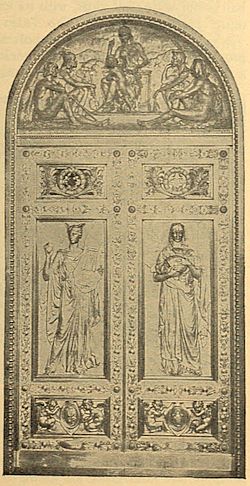
The three deep arches of the Entrance Porch terminate with three massive
bronze doors, covered with a design of rich sculptural ornament in relief. Each
is fourteen feet high to the top of the arch, with an extreme width, including
the framing, of seven and a half feet, and a total weight of about three and a
half tons. The subject of the decoration is, in the central door, The Art of
Printing, modelled by Mr. Frederick Macmonnies; in the door to the left,
Tradition, by the late Olin L. Warner; and to the right, Writing, begun by Mr.
Warner, but left unfinished at his death (in August, 1896), and completed by
Mr. Herbert Adams. The three thus indicate in a regular series—the sequence
of which, of course, is Tradition, Writing, and Printing—the successive and
gradually more perfect ways in which mankind has preserved its religion, history,
literature, and science. Each of the doors is double, with a tympanum at
the top closing the arch. The various portions of the design are comprised
in a high and rather narrow panel in each leaf, with small panels above and
below, and finally the large semicircular panel occupying the tympanum above.
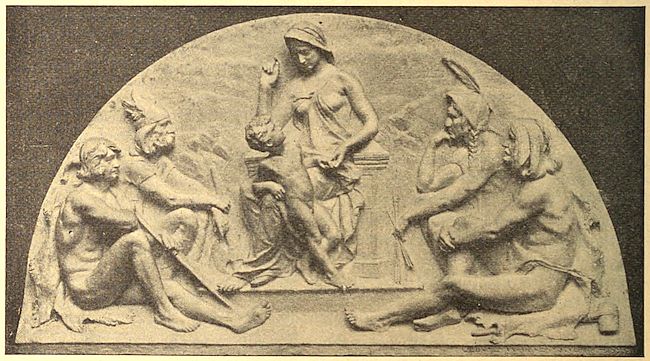
Mr. Warner’s Bronze Doors.—Mr. Warner’s first door, Tradition, illustrates
the method by which all knowledge was originally handed down from
generation to generation. The background of the panel in the larger tympanum
is a mountainous and cloudy landscape, conveying admirably, says one
critic[5], “a sense of prehistoric vastness and solitude.” In the centre is a
woman, the embodiment of the subject, seated on a throne. Against her knee
leans a little boy, whom she is instructing in the deeds and worship of his
fathers. The visitor will not fail to notice the unusual expressiveness of the
group—the boy with eager, attentive face, and the woman holding his hand in
one of hers, and raising the other in a gesture of quiet but noble emphasis.
Seated on the ground, two on either side, and listening intently to her words,
are an American Indian, holding a couple of arrows in his hand; a Norseman,
with his winged steel cap; a prehistoric man, with a stone axe lying by his
side; and a shepherd with his crook, standing for the nomadic, pastoral races.
The four are typical representatives of the primitive peoples whose entire lore
was kept alive by oral tradition. The face of the Indian is understood to be
a portrait of Chief Joseph, of the Nez Percés tribe, from a sketch made from
life by Mr. Warner in 1889.
Of the panels below, that to the left contains the figure of a woman holding
a lyre, and the other the figure of a warrior’s widow clasping the helmet and
sword of her dead husband to her breast. The first represents Imagination,
and the second Memory, the former
being the chief quality which distinguishes
the nobler sorts of traditional
literature, as exemplified in the true
epics, springing from the folk-tales of
the people, and the latter standing for
that heroic past with which it so constantly
deals.
BRONZE DOOR, MAIN ENTRANCE.
BY OLIN L. WARNER.
The same general arrangement of
figures is followed in the second door—the
one representing Writing—as in
the first. In the tympanum of the door,
a female figure is seated in the centre,
holding a pen in her hand and with a
scroll spread open in her lap. Beside
her stand two little children, whom she
is teaching to read or write. To the
right and left are four figures representing
the peoples who have had the most influence
on the world through their written
memorials and literature—the Egyptian
and the Jew to the right, and the
Christian and Greek to the left. The
Jew and the Christian are represented
as kneeling, in allusion to the religious
influence which they have exerted. The
former holds a staff in his hand, and
may be taken as one of the ancient
Jewish patriarchs; the latter bears a
cross. The Greek has a lyre, for Poetry,
and the Egyptian holds a stylus in his
hand.
The standing figures in the door proper are of women, and represent Truth
(on the right) and Research (on the left). Research holds the torch of
knowledge or learning, and Truth a mirror and a serpent, the two signifying
that in all literature, wisdom (of which the serpent is the emblem) and careful
observation (typified by the mirror, with its accurate reflection of external
objects) must be joined in order to produce a consistent and truthful impression
upon the reader. The smaller panels below contain a design of conventional
ornament with cherubs or geniuses supporting a cartouche, on which the mirror
or serpent of the larger panels is repeated.
Mr. Macmonnies’s Bronze Door.—In Mr. Macmonnies’s design the
tympanum is occupied by a composition which he has entitled, Minerva Diffusing
the Products of Typographical Art. The Goddess of Learning and Wisdom—a
fit guardian to preside at the main portal of a great library—is seated in
the centre upon a low bench. On either side is a winged genius, the messengers
of the goddess, each carrying a load of ponderous folios which she is
dispatching as her gift to mankind. To the right is her owl, perched solemnly
on the bench on which she is sitting. She wears the conventional helmet and
breastplate—the latter the Ægis, with its Medusa’s Head—of ancient art,
but in her wide, full skirt, with its leaf-figure pattern, the artist has adopted a
more modern motive. The Latin title of Mr. Macmonnies’s subject, Ars
Typographica, and various symbolical ornaments are introduced in the background.
To the left and right, enclosed in a laurel wreath, are a Pegasus and
a stork. The former stands, of course, for the poetic inspiration which gives
value to literature. The stork, commonly symbolizing filial piety, may be taken
here, if one chooses, as typifying the faithful care of the inventors of printing
and their disciples in multiplying the product of that inspiration. To the left,
also, are an hour-glass, an inking-ball, and a printer’s stick; and on the other
side of the panel, an ancient printing-press.
TRADITION—TYMPANUM OF BRONZE DOOR.—BY OLIN L. WARNER.
Each of the small panels in the upper portion of the doors below is in the
shape of a tympanum, and is occupied by a conventionally decorative design
composed of a wreath with floating ribbons, enclosing a cartouche on which are
inscribed the words “Honor to Gutenberg”—the Inventor of Printing. Each
of the upright panels contains the figure of a young and beautiful woman, clad
in a robe of the same design as that worn by Minerva, and carrying two tall
flaming torches. The figure in the left-hand leaf represents The Humanities,
the soft contours of her face expressing the gentle and generous liberalities of
learning. Her companion stands for Intellect, and the lines of her face are of
a bolder and severer character.
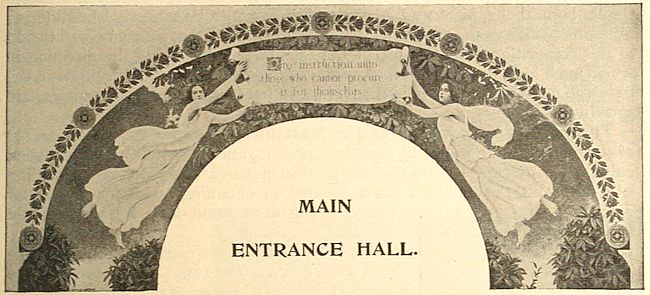
MAIN ENTRANCE HALL
Entering by either of these three bronze doors, one passes immediately
through a deep arch into the Main Entrance Hall. It is constructed of gleaming
white Italian marble, and occupies very nearly the whole of the Entrance
Pavilion. By reason of a partial division of the hall into stories and open
corridors, and on account of the splendor and variety of the decoration everywhere
so liberally applied, the eye is attracted to a number of points of interest
at once. The arrangement, however, is really simple and well defined, as
may be seen by looking at the plan on page 9. With the exception of
a portion of the attic story and of two or three small rooms partitioned off
in the southeast and northeast corners of the first floor, the entire pavilion
serves as a single lofty and imposing hall. In the centre is a great well, the
height of the pavilion—seventy-five feet—enclosed in an arcade of two stories,
the arches of the first supported on heavy piers and of the second on paired
columns. The centre of the well is left clear; on either side, north and south,
is a massive marble staircase, richly ornamented with sculpture. On the east
side of the pavilion a broad passageway, treated as a part of the general
architectural scheme of the Entrance Hall—though really an arm of the
interior cross already referred to—connects it with the Main Reading
Room.
The Vestibule.—The arcades surrounding the well, or Staircase Hall, as
it would better be called, screen two stories of corridors. The corridor which
the visitor has now entered—the West Corridor, on the library floor—serves
as the general vestibule of the building, and appropriately, therefore, is more
sumptuously decorated than any of the others. The most striking feature is a
heavily panelled ceiling, finished in white and gold—perhaps as fine an
example of gold ornamentation on a large scale as can be found in the country.
It is impressively rich and elegant without in the least overstepping the line of
modesty and good taste.
The corridor is bounded by piers of Italian marble ornamented with pilasters.
There are five piers on each side, those on the west terminating the deep arches
of the doors and windows, and one at either end. It will be noticed that these
piers, like all the others on this floor, are wider than they are deep, so that the
arches they support are of varying depth—the narrow ones running from north
to south, and the deeper ones from east to west, invariably. This difference of
depth, both of the piers and of the arches, is apt to be somewhat bewildering
until one perceives the system on which it is based, so that it may be well to add
in this connection that the same rule of broad and narrow, and the direction in
which each kind runs, holds good, also, of the corridors on the second floor, the
only variation being that paired columns, as has already been pointed out, are
substituted for piers.
The Stucco Decoration of the Vestibule.—Above the marble arches
of the Vestibule the wall with its ornamentation, and the whole of the panelled
ceiling, are of stucco. By the use of this material, especially in connection
with the gold, the architect has succeeded in obtaining a warmer and softer
tone of white than would have been possible in
marble.
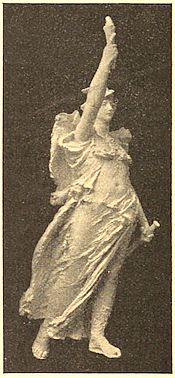
THE MINERVA OF WAR.
BY HERBERT ADAMS.
Above each of the side piers are two white-and-gold
consoles, or brackets, which support the
panelled and gilded beams of the ceiling. In front
of every console—and almost, but not quite,
detached from it—springs a figure of Minerva,
left the natural white of the stucco. The figures
are about three feet in height, and were executed
from two different models, each the work of Mr.
Herbert Adams. They are skilfully composed in
pairs: the first (the Minerva of War) carrying
in one hand a falchion or short, stout sword, and
in the other holding aloft the torch of learning;
and the second (the Minerva of Peace) bearing
a globe and scroll—the former significant of
the universal scope of knowledge. Although
thus differing, the figures are of the same type;
both wear the Ægis and the same kind of casque,
and both are clad in the same floating classic
drapery.
Modelled in relief upon the wall between the
two Minervas is a splendid white-and-gold Greek
altar, used as an electric light standard. The bowl
is lined with a circle of large leaves, from which
springs a group of nine lamps, suggesting, when
lighted, a cluster of some brilliant kind of fruit.
Above the piers at either end of the corridor is another altar, somewhat narrower
and of a different design, but used for the same purpose.
It should be noted that, for the most part, both in the ceiling and on the
walls, the gold has been dulled or softened in tone in order to avoid any
unpleasing glare or contrast with the white. This effect, however, is regularly
relieved by burnishing the accentuating points in certain of the mouldings.
The Marble Flooring.—Before leaving the Vestibule, the visitor may be
interested to notice the design of the marble flooring. The body of it is
white Italian, with bands and geometric patterns of brown Tennessee, and
edgings of yellow mosaic. It will be seen at once that the design is harmonious
with the lines of the arcade and the ceiling. These are not slavishly mimicked,
but are developed, varied, and extended. Sometimes a circle is used to
draw together two opposite arches; sometimes a square echoes the pattern of
the ceiling; lines of beaming—as they may be called in an easy metaphor—connect
opposite piers; and finally the boundaries of the corridor are outlined
in a broad border enclosing the whole. It has been said that in hardly any
other building in the country has so much pains been taken by the architect to
make the lines of his floor designs consistent with those of the architecture and
the general decorative scheme. Throughout the Library, wherever marble or
mosaic is used for this purpose, the visitor will find this phase of the ornamentation
of the building of the highest interest and importance.
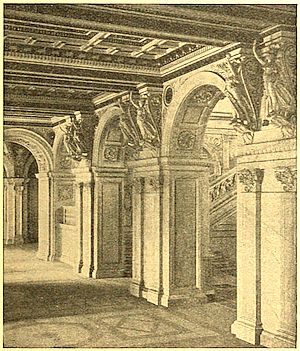
THE MAIN VESTIBULE.
The Staircase Hall.—The floor of the Staircase Hall, into which one
passes next, is an excellent
example of this
point. Besides the
marble, the pattern
contains a number of
modelled and incised
brass inlays. The one
in the centre is a large
rayed disc, or conventional
sun, on which
are noted the four
cardinal points of the
compass, which coincide
with the direction
of the main axes of
the Library. The disc
thus performs the same
service for the building—only
more picturesquely
and vividly—as
an arrow-head cross for
a chart or plan. From
the sun as a centre
proceeds a great circular
glory—or “scale
pattern,” as it is technically,
and more descriptively,
called—of
alternate red and yellow
Italian marble, the former from Verona and the latter from Sienna. Other
inlays are arranged in a hollow square, enclosing the sun as a centrepiece.
Twelve represent the signs of the zodiac; the others are in the form of rosettes,
in two patterns. They are embedded in blocks of dark red, richly mottled,
French marble, around which are borders of pure white Italian marble.
The Commemorative Arch.—On the easterly side of the Staircase
Hall, on the way to the Reading Room, the regularity of the arcade is interrupted
by a portico of equal height, which does duty as a sort of miniature
triumphal arch, commemorating the erection of the Library. The spandrels
contain two sculptured figures in marble by the late Olin L. Warner,
the sculptor of the bronze doors previously described. Along the frieze are
the words LIBRARY OF CONGRESS, inscribed in tall gilt letters. A second
inscription, giving the names of those concerned in the erection of the Library,
is cut upon the marble tablet which forms part of the parapet above. It is
flanked by lictors’ axes and eagles, sculptured in marble, and reads as follows:
ERECTED UNDER THE ACTS OF CONGRESS OF
APRIL 15 1886 OCTOBER 2 1888 AND MARCH 2 1889 BY
BRIG. GEN. THOS. LINCOLN CASEY
CHIEF OF ENGINEERS U. S. A.
BERNARD R. GREEN SUPT. AND ENGINEER
JOHN L. SMITHMEYER ARCHITECT
PAUL J. PELZ ARCHITECT
EDWARD PEARCE CASEY ARCHITECT
Mr. Warner’s Spandrel Figures.—Mr. Warner’s figures in the spandrels
of this commemorative arch are life-size, and are entitled The Students.
Both figures—one in either spandrel—are
represented in an easy,
but dignified and sculptural attitude,
leaning on one arm against
the curve of the arch. That to the
left is of a young man seeking to
acquire from books a knowledge
of the experience of the past.
That to the right is an old man
with flowing beard, absorbed in
meditation. He is no longer concerned
so much with books as with
observation of life and with original
reflection and thought. The sculptor
has thus naturally indicated the
development of a scholar’s mind,
from youth to old age. As an ornament of the approach to the Reading
Room, the appropriateness of the figures is obvious.
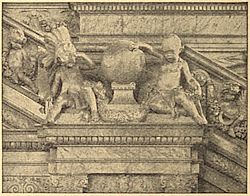
AMERICA AND AFRICA.—BY PHILIP MARTINY.
Within the arch, the pier on either side is decorated with a bit of relief
work, consisting of the seal of the United States flanked by sea-horses, by Mr.
Philip Martiny. It is Mr. Martiny’s sculpture, also, which ornaments the staircase,
the coved ceiling, and the lower spandrels of the Staircase Hall. With
the exception of Mr. Warner’s figures, just described, and of a series of cartouches
and corner eagles which occupy the spandrels of the second-story
arcade—the work of Mr. Weinert—Mr. Martiny has this central hall to himself,
so far as the sculpture is concerned.
Mr. Martiny’s Staircase Figures.—The spandrels in the first story
are unusually delicate and pretty. The design comprises wreaths of roses and
oak and laurel leaves, with oak or palm for a background. It is in the staircases,
however, that Mr. Martiny’s work is most varied and elaborate. On
the piers between which they descend into the hall, he has sculptured a striking
female head of the classic type, with a garland below and a kind of foliated
arabesque on either side. Upon the newel post which terminates the railing
of each staircase is placed a bronze female figure upholding a torch for electric
lights. The two figures are somewhat taller than life, measuring six and a half
feet, or eight feet to the top of the torch, and ten feet including the rounded
bronze base on which they stand. Each has a laurel wreath about her head,
and is clad in classic drapery.
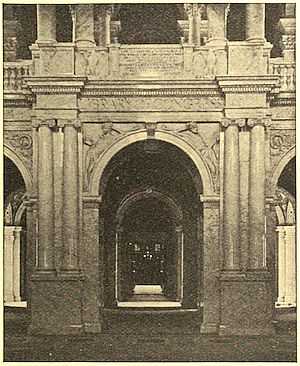
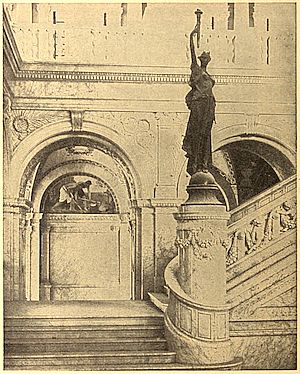
THE COMMEMORATIVE ARCH.
Halfway up the staircase is a sort of buttress, which serves as a pedestal for
a group representing, on the south side of the hall, Africa and America, and
on the other side, Europe and Asia. The four continents are typified, very
delightfully, by little boys, about three feet high, seated by the side of a large
marble globe, on which appear the portions of the earth’s surface which they
are intended to personify.
America is an Indian, with
a tall headdress of feathers,
a bow and arrow, and a
wampum necklace. With
one hand he shades his eyes
while he gazes intently into
the distance, awaiting, one
may fancy, the coming of
his conqueror, the white
man. Africa is a little
negro, with a war-club and
his savage necklace of wild
beasts’ claws. Asia is a
Mongolian, dressed in flowing
silk robes, the texture
of which, as the visitor will
notice, is very perfectly indicated
by arranging the
folds of the marble so that
they receive the proper
play of light and shade.
In the background is a sort
of dragon-shaped jar of
porcelain. Europe is clad
in the conventional classic
costume, and has a lyre and
a book; and a Doric
column is introduced beside
him—the three objects symbolizing, specifically, Music, Literature, and
Architecture, and, more broadly, the pre-eminence of the Caucasian races in
the arts of civilization generally, just as the dragon-jar on the other side of
the globe stands for the admirable ceramic art of China and Japan; and,
also, as the wampum and bow of the Indian indicate his advance in culture
over the stage of evolution typified by the rude war-club and savage necklace
of the negro.
The balustrade of the top landing on either side is ornamented with the figures
of three children in relief representing certain of the Fine Arts. In the
south staircase, beginning at the left as one looks up from the floor, are Comedy,
Poetry, and Tragedy. The first has a comic mask and the thyrsus or ivy-wreathed
wand of Bacchus, to whom the first comedies were dedicated.
Poetry has a scroll, and Tragedy the tragic mask. Opposite, the figures, taking
them again from left to right, represent Painting, with palette and brushes;
Architecture, with compasses and a scroll, and behind him the pediment of a
Greek temple; and Sculpture, modelling a statuette.
DETAIL OF THE GRAND STAIRCASE.
In the ascending railing of each staircase Mr. Martiny has introduced a
series of eight marble figures in high relief. These, also, are of little boys, and
represent various occupations, habits and pursuits of modern life. The procession
is bound together
by a garland
hanging in heavy
festoons, and beneath
is a heavy
laurel roll. In the
centre the series is
interrupted by the
group on the buttress
just described.
At the bottom it
begins quaintly with
the figure of a stork.
Thence, on the
south side of the
hall, the list of subjects
is as follows:
A Mechanician,
with a cog-wheel,
a pair of pincers,
and a crown of laurel,
signifying the
triumphs of invention;
a Hunter,
with his gun, holding
up by the ears
a rabbit which he
has just shot; an infant
Bacchanalian,
with Bacchus’s ivy
and panther skin,
hilariously holding
a champagne glass
in one hand; a Farmer, with a sickle and a sheaf of wheat; a Fisherman, with
rod and reel, taking from his hook a fish which he has landed; a little Mars, polishing
a helmet; a Chemist, with a blow-pipe; and a Cook, with a pot smoking
hot from the fire.
In the north staircase are: A Gardener, with spade and rake; an Entomologist,
with a specimen-box slung over his shoulder, running to catch a butterfly
in his net; a Student, with a book in his hand and a mortar-board cap on his
head; a Printer, with types, a press, and a type-case; a Musician, with a lyre
by his side, studying the pages of a music book; a Physician, grinding drugs
in a mortar, with a retort beside him, and the serpent sacred to medicine; an
Electrician, with a star of electric rays shining on his brow and a telephone
receiver at his ear; and lastly, an Astronomer, with a telescope, and a globe
encircled by the signs of the zodiac which he is measuring by the aid of a pair
of compasses.
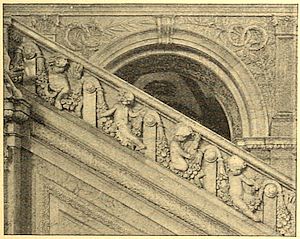
THE STAIRCASE FIGURES.—BY PHILIP MARTINY.
The Ceiling of the Staircase Hall.—Beneath the second-story cartouches
on the east and west sides of the hall are tablets inscribed in gilt letters
with the names of the following authors: Longfellow, Tennyson, Gibbon, Cooper,
Scott, Hugo, Cervantes. A single moulding in the marble cornice above is
touched with gold, as an introduction to the rich coloring and profuse use of
gilding in the coved ceiling which it supports. The cove itself is of stucco,
and is painted blue—the color of the sky, which it is intended to suggest—with
yellow penetrations. These penetrations are outlined by a heavy gilt
moulding, and give space for ten semicircular latticed windows opening into
the rooms of the attic
story. In the centre
of each penetration is
painted a white tablet
supported by dolphins,
and bearing the name
of some illustrious
author—Dante, Homer,
Milton, Bacon,
Aristotle, Goethe,
Shakespeare, Molière,
Moses, and Herodotus.
In each corner of the
cove are two female
half-figures, as they are
called, supporting a
cartouche, on which
are a lamp and a book,
the conventional symbols
of learning. The
figures and cartouche
are of stucco, and were modelled by Mr. Martiny. Around them the cove is
sprinkled with stars. Higher up are the figures of flying geniuses, two in each
corner, painted by Mr. Frederick C. Martin, of Mr. Garnsey’s staff.
Between the penetrations, the curve of the cove is carried upon heavy gilt
ribs, richly ornamented with bands of fruit. In the spandrel-shaped spaces thus
formed on either side, Mr. Martin has painted another series of geniuses, which,
by reason of the symbolical objects which accompany them, reflect very
pleasantly the intention of Mr. Martiny’s sculpture in the staircases below. The
significance of most of the things they bear is obvious. Beginning at the southwest
corner, and going to the right, the list is as follows: a pair of Pan’s pipes;
a pair of cymbals; a caduceus, or Mercury’s staff; a bow and arrows; a shepherd’s
crook and pipes; a tambourine; a palette and brushes; a torch; a
clay statuette and a sculptor’s tool; a bundle of books; a triangle; a second
pair of pipes; a lyre; a palm branch and wreath (the rewards of success); a
trumpet; a guitar; a compass and block of paper (for Architecture); a censer
(for Religion); another torch; and a scythe and hour-glass—the attributes of
Father Time.
The ceiling proper rests upon a white stylobate supported on the cove. It
is divided by heavy beams, elaborately panelled, and ornamented with a profusion
of gilding, and contains six large skylights, the design of which is a scale pattern,
chiefly in blues and yellows, recalling the arrangement in the marble flooring
beneath.
First Floor Corridors: the Mosaic Vaults.—The North, South, and
East Corridors on the first floor of the Entrance Hall are panelled in Italian
marble to the height of eleven feet, and have floors of white, blue, and brown
(Italian, Vermont, and Tennessee) marble, and beautiful vaulted ceilings of
marble mosaic. These last will immediately attract the attention of the visitor.
The working cartoons were made by Mr. Herman T. Schladermundt from preliminary
designs by Mr. Casey as architect. The body of the design is in a light,
warm grayish tone, relieved by richly ornamental bands of brown which follow
pretty closely the architectural lines of the vaulting—springing from pier to
pier or outlining the penetrations and pendentives. In all three corridors
tablets bearing the names of distinguished men are introduced as a part of the
ornament, and in the East Corridor are a number of discs, about eighteen
inches in diameter, on which are depicted “trophies,” as they are called, emblematic
of various arts and sciences, each being made up of a group of representative
objects such as the visitor has seen used to distinguish the subjects of
Mr. Martiny’s staircase figures.
The method of making and setting such a mosaic ceiling is interesting
enough to be described. The artist’s cartoon is made full size and in the
exact colors desired. The design, color and all, is carefully transferred by
sections to thicker paper, which is then covered with a coating of thin glue. On
this the workman carefully fits his material, laying each stone smooth side down.
The ceiling itself is covered with a layer of cement, to which the mosaic is
applied. The paper is then soaked off, and the design pounded in as evenly as
possible, pointed off, and oiled. As the visitor may see, however, it is not
polished, like a mosaic floor, but is left a little rough in order to give full value
to the texture of the stone.
At the east end of the North and South Corridors is a large semi-elliptical
tympanum, twenty-two feet long. Along the walls are smaller tympanums,
below the penetrations of the vault. At the west end, over the arch of the
window, is a semicircular border. These spaces are occupied by a series of
paintings—in the North Corridor by Mr. Charles Sprague Pearce, and in the
South Corridor by Mr. H. O. Walker. Like most of the special mural decorations
in the Library, they are executed in oils on canvas, which is afterwards
affixed to the wall by a composition of whitelead.
Mr. Pearce’s Paintings.—Mr. Pearce’s decorations are seven in number.
The subject of the large tympanum at the east end is The Family.[6] The smaller
panels along the north wall, taking them from left to right, are entitled
Religion, Labor, Study, and Recreation. The single painting on the south side
of the corridor, occurring opposite the panel of Recreation, represents Rest.
The broad, arched border at the west end contains two female figures floating
in the air and holding between them a large scroll on which is inscribed the
sentence, from Confucius: “Give instruction unto those who cannot procure
it for themselves.”
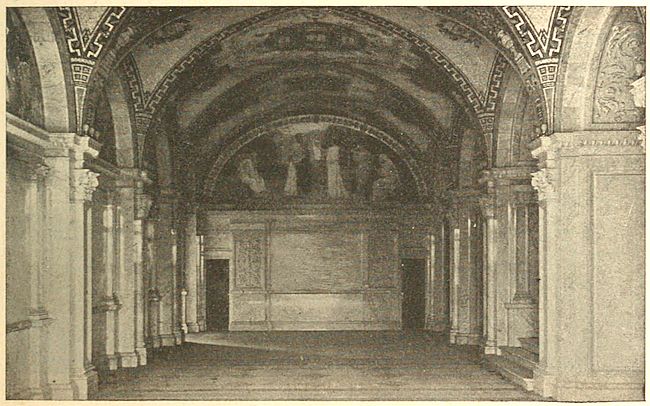
THE NORTH CORRIDOR.—MAIN ENTRANCE HALL.
The series, as seen by the list of titles just given, illustrates the main phases
of a pleasant and well-ordered life. The whole represents the kind of idyllic
existence so often imagined by the poets—showing a people living in an
Arcadian country in a state of primitive simplicity, but possessing the arts and
habits of a refined cultivation. This life is very well summed up in the first of
Mr. Pearce’s paintings—that representing The Family. The subject is the
return of the head of the household to his family, after a day spent in hunting.
He stands in the centre, his bow not yet unstrung, receiving a welcome home.
His aged mother, with her hands clasped over the head of her staff, looks up
from the rock on which she is sitting, and the gray-bearded father lays aside the
scroll in which he has been reading. The hunter’s little girl has hold of his
garment, and his wife holds out his baby son. An older daughter leans her
elbow against a tree. The scene is in the open air, at the mouth of a cave,
with a view beyond into a wooded valley bounded by high mountains.
The smaller tympanums illustrate the simple occupations and relaxations of
such an existence as is here depicted. Recreation shows two girls in a glade of
the forest playing upon a pipe and a tambourine. In the panel of Study, a girl,
sitting with her younger companion on a great rock, is instructing her with the
aid of a book and compasses and paper. Labor is represented by two young
men working in the fields. One is removing the stump of a tree, and the
other is turning over the newly cleared soil to fit it for planting. In Religion,
a young man and a girl are kneeling before a blazing altar constructed of two
stones, one set upon the other. In Rest, two young women are sitting quietly
beside a pool, where they have come with their earthen jars for water.
The penetrations in the vault of Mr. Pearce’s corridor contain the names of
men distinguished for their work in furthering the cause of education: Froebel,
Pestalozzi, Comenius, Ascham, Howe, Gallaudet, Mann, Arnold, Spencer. It
is of some interest to note that among the hundreds of names inscribed in the
Library only three are those of men still living. Herbert Spencer, the last-named
in the list just given, is one, and the other two are Alexander Graham
Bell and Thomas A. Edison.
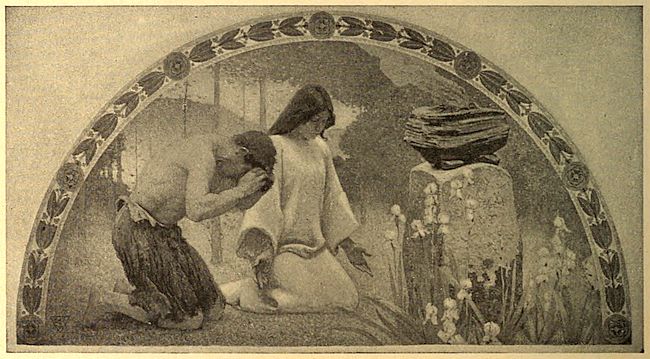
RELIGION—BY CHARLES SPRAGUE PEARCE.
Mr. Walker’s Paintings.—The general subject of Mr. Walker’s decorations
is Lyric Poetry. Like Mr. Pearce’s, in the corresponding position, the
painting in the large tympanum at the east end of the corridor sums up in
a general way the subject of the whole series. The scene is a wood, with a
vista beyond into a wide and open champagne. Down the centre a brook
comes tumbling and splashing over its rocky bed. Although wild, and thus
suggestive, perhaps, of the inspiration of poetry, the landscape purposely has,
as a whole, a touch of artfulness, hinting therefore at the formalities of metre
and rhyme. The titles of the figures which enter into the composition—all,
with one exception, those of women—are named in the conventional border
with which the artist has enclosed his painting. The figure standing boldly
forward in the centre represents Lyric Poetry. She is crowned with a wreath
of laurel, and is touching the strings of a lyre. The feelings which most commonly
inspire her song are personified on either side. To her left are Pathos,
looking upward, as if calling on Heaven to allay her grief; Truth, a beautiful
nude woman (the Naked Truth) standing securely upright, and seeming by
her gesture to exhort the central figure not to exceed the bounds of natural
feeling; and in the corner of the tympanum, Devotion, sitting absorbed in
contemplation. On the other side of the panel are Passion, with an eager
look, and her arms thrown out in a movement at once graceful and enraptured;
Beauty, sitting calmly self-contained; and Mirth, the naked figure of
a little boy, inviting her to join his play.
For the smaller tympanums, Mr. Walker has taken single youthful male
figures suggested by various poems by English and American poets—on the
south side of the corridor, Tennyson, Keats, Wordsworth, and Emerson, and
on the north side, Milton and Shakespeare. Although not always from lyrics,
the general spirit of the scene selected is invariably lyrical. The first painting
shows Ganymede upon the back of the eagle—the form taken by
Jupiter when he brought the boy from his earthly home to be the cup-bearer
of the gods. The lines referred to are in Tennyson’s Palace of Art:—
Flushed Ganymede, his rosy thigh
Half-buried in the Eagle’s down,
Sole as a flying star shot thro’ the sky
Above the pillar’d town.
The next panel represents Endymion, in Keats’s poem of that name, lying
asleep on Mount Latmos, with his lover, Diana, the Moon, shining down upon
him. The painter, however, had no special passage of the poem in mind.
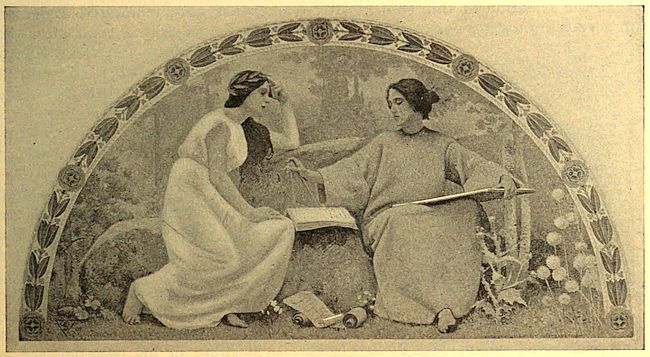
STUDY.—BY CHARLES SPRAGUE PEARCE.
The third panel is based on Wordsworth’s lines beginning, “There was a
Boy.” A boy is seated by the side of a lake the surface of which reflects
the stars:—
There was a Boy; ye knew him well, ye cliffs
And islands of Winander!—many a time,
At evening, when the earliest stars began
To move along the edges of the hills,
Rising or setting, would he stand alone,
Beneath the trees, or by the glimmering lake;
And there, with fingers interwoven, both hands
Pressed closely palm to palm and to his mouth
Uplifted, he, as through an instrument,
Blew mimic hootings to the silent owls,
That they might answer him....
Then, sometimes, in that silence, while he hung
Listening, a gentle shock of mild surprise
Has carried far into his heart the voice
Of mountain-torrents; or the visible scene
Would enter unawares into his mind
With all its solemn imagery, its rocks,
Its woods, and that uncertain heaven received
Into the bosom of the steady lake.
For Emerson, Mr. Walker has selected the poem of Uriel, representing the
angel retired in scorn from his companions, on account of the anger with
which they have received his proposition:—
Line in nature is not found;
Unit and universe are round;
In vain produced, all rays return;
Evil will bless, and ice will burn.
GANYMEDE.—H. O. WALKER.
In the selection of this subject, Mr. Walker has commemorated Emerson
in a very interesting personal way—for the poem was written soon after the
famous Phi Beta Kappa
oration of 1838, and is
understood to voice
Emerson’s feelings regarding
the storm of opposition
which that address
had called forth.
Milton is represented
by a scene out of the
masque of Comus—the
vile enchanter Comus (in
the guise of a shepherd)
entranced at hearing the
song of the Lady. The
words which he speaks in
the poem, and which Mr. Walker seeks to illustrate in his painting, are as
follows:—
Can any mortal mixture of earth’s mould
Breathe such divine enchanting ravishment?
In Shakespeare, the artist has gone to Venus and Adonis, showing the dead
body of Adonis, killed by the boar, lying naked in the forest. The painting
refers to no particular lines in the poem.
The broad border at the west end is occupied by an idyllic summer landscape
containing three seated female figures and a youth—the two figures to
the left, one of them caressing a lamb, representing the more joyful moods of
lyric poetry, and the other two its more solemn feelings. At the top is a
streamer, with the words, from Wordsworth:—
The Poets, who on earth have made us heirs
Of truth and pure delight by heavenly lays!
In the mosaic of the vault are the names of lyric poets, six Americans occupying
the penetrations on the north side: Longfellow, Lowell, Whittier,
Bryant, Whitman, Poe; and the following English and foreign or ancient
lyrists along the centre of the vault and in the south penetrations: Browning,
Shelley, Byron, Musset, Hugo, Heine, Theocritus, Pindar, Anacreon, Sappho,
Catullus, Horace, Petrarch, Ronsard.
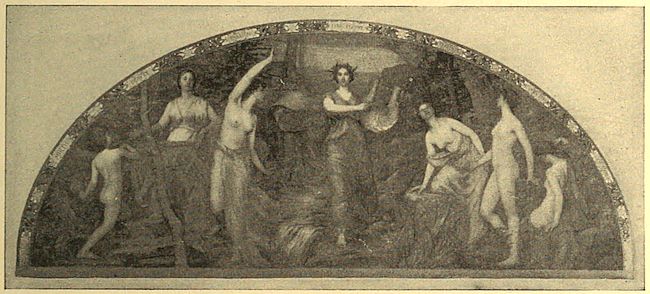
LYRIC POETRY.—BY H. O. WALKER.
Mr. Alexander’s Paintings.—In the East Corridor are six tympanums
of the same size as the smaller panels of Mr. Walker and Mr. Pearce, by Mr.
John W. Alexander, illustrating The Evolution of the Book. The subjects are,
at the south end, The Cairn, Oral Tradition, and Egyptian Hieroglyphics;
and at the north end, Picture Writing, The Manuscript Book, and The
Printing Press. In the first of these, a company of primitive men, clad
in skins, are raising a heap of stones on the seashore, perhaps as a memorial
of some dead comrade, or to commemorate some fortunate event,
or, perhaps, merely as a record to let others know the stages of their journey.
In the second panel, an Arabian story-teller stands relating his marvellous tales in
the centre of a circle of seated Arabs. The third shows a scaffolding swung in
front of the portal of a newly erected Egyptian temple. A young Egyptian
workman is cutting a hieroglyphic inscription over the door, while an Egyptian
girl, his sweetheart, sits watching the work beside him. Picture Writing represents
a young American Indian, with a rudely shaped saucer of red paint beside
him, depicting some favorite story of his tribe upon a dressed and smoothed
deer-skin. An Indian girl lies near him, attentively following every stroke of his
brush. The next panel gives the interior of a convent cell, with a monk, seated
in the feeble light of a small window, laboriously illuminating in bright colors
the pages of a great folio book. The last of the series shows Gutenberg, the
inventor of printing, in his office: the master, with his assistant beside him,
examining a proof-sheet, and discussing the principle of his great invention.
To the right is an apprentice, swaying upon the handle-bar of the rude press.
Mosaic Decorations of the East Corridor.—The various trophies
already spoken of as ornamenting the mosaic of the vault of the East Corridor
are ten in number, each occurring in one of the pendentives, at the ends and
along the sides. Below each are the names of two Americans (only those
actually born in the United States being included) eminent in the art or science
typified. The list of trophies, with the names, is as follows: Architecture (the
capital of an Ionic column, with a mallet and chisel), Latrobe and Walter;
Natural Philosophy (a crucible and pair of balances, etc.), Cooke and Silliman;
Music (a lyre, flute, horn, and music-sheet), Mason and Gottschalk;
Painting (a sketch-book, palette, and brushes), Stuart and Allston; Sculpture
(the torso of a statue), Powers and Crawford; Astronomy (a celestial globe),
Bond and Rittenhouse; Engineering (including an anchor, protractor, level,
etc.), Francis and Stevens; Poetry (a youth bestriding Pegasus), Emerson
and Holmes; Natural Science (a microscope and a sea-horse), Say and Dana;
Mathematics (a compass and counting-frame), Peirce and Bowditch. In the
vault proper is inscribed a list of names of Americans distinguished in the three
learned professions: under Medicine, Cross, Wood, McDowell, Rush, Warren;
under Theology, Brooks, Edwards, Mather, Channing, Beecher; and under
Law, Curtis, Webster, Hamilton, Kent, Pinkney, Shaw, Taney, Marshall, Story,
and Gibson.
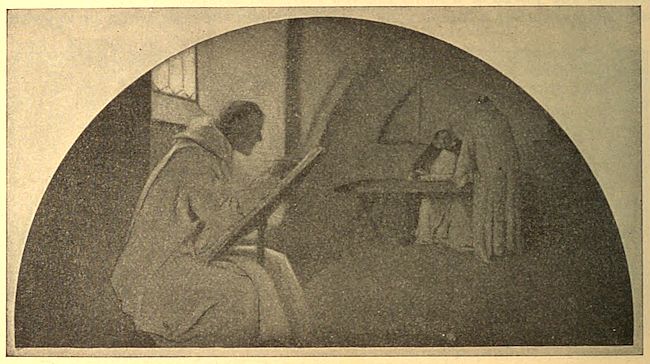
THE MANUSCRIPT BOOK.—BY JOHN W. ALEXANDER.
From the East Corridor, entrance to the basement may be had through a
little lobby with a domed mosaic ceiling under either of the main staircases.
At the north end of the corridor is the Librarian’s Room, and at the south end
are a toilet-room for ladies and a cloak-room. The little lobby of the latter is
especially bright and attractive, with deep, velvety red walls, a high arabesque
frieze, and ceiling decorations of lyres and a disc containing a large honeysuckle
ornament.
The Librarian’s Room.—The Librarian’s Room is one of the most
beautifully finished of any in the Library. It is divided into two by a broad,
open arch, leaving the office proper on one side, and a smaller, more private
office, with a gallery above, on the other. The fittings are in oak, with oak
bookcases. The windows look out upon the Northwest Court. The gallery
has a groined ceiling, and over the main office is a shallow dome, with stucco
ornamentation in low relief by Mr. Weinert. Standing in a ring around a central
disc are the figures of Grecian girls, from two slightly differing models,
holding a continuous garland. Other ornaments are gilded tablets and square
or hexagonal panels, bearing an owl, a book, or an antique lamp. The central
disc is occupied by a painting by Mr. Edward J. Holslag, already spoken of as
the foreman of Mr. Garnsey’s staff, representing Letters—the seated figure of
a beautiful woman holding a scroll in her hand and accompanied by a child
with a torch. The following Latin sentence is inscribed in a streamer: Litera
scripta manet.
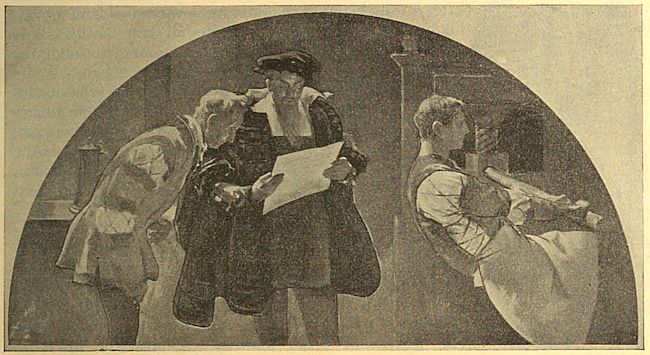
THE PRINTING-PRESS.—BY JOHN W. ALEXANDER.
In the pendentives of the dome, Mr. Weinert has modelled a figure, about
two feet in height, of a boy holding a palm-branch and blowing a trumpet. Like
the ring of girls in the dome, the figures are of an alternating design. Above
each is a circular panel with the half-length figure of a woman, painted by Mr.
Holslag. The four decorations are intended to supplement, in a general way,
the idea of Mr. Holslag’s ceiling disc; one of the figures, for example, holds a
book, another a lute (for the musical quality of literature), and so on. Each
painting contains a Latin inscription, as follows:—Liber dilectatio animae;
Efficiunt clarum studio; Dulces ante omnia Musae; In tenebris lux.
The color scheme adopted for the room is chiefly green. A green tinge is
used in the dome to emphasize the outline of the ornament, and green, on a
blue ground, predominates in the arabesques contained in the tympanums
below. The design of these last—where complete, that is, for the tympanums
are variously intercepted by door- and window-arches—is a pleasant little study
of the evolution of the poet. At the bottom, a little boy is playing a pastoral tune
on his oaten pipe; above, two little trumpeters blare at him to join them in the
joy of battle; and at the top, a fourth child, the full-fledged bard, sits astride
his modern hobby-horse. The centre of the decoration shows either a Pegasus
or a Pandora, the latter opening the famous box containing all the ills which
plague mankind, and only Hope for a blessing.
The Lobbies of the Rotunda.—Beyond the East Corridor, and separated
from it by an arcade, is the broad passageway leading to the Reading
Room. The entrance for visitors, however, is by way of the second story, the
doors on the library floor being open only to those desiring to consult books.
The passageway is divided by a second arcade into two transverse lobbies. The
ceiling of each is vaulted, with a mosaic design of much the same pattern as
those in the corridors already described.
The second lobby is the immediate vestibule of the Reading Room,
and contains the two main passenger elevators, one at either end. They start
at the basement and ascend to the attic story, where, among other rooms, are
a commodious and well-equipped kitchen and restaurant for the use of visitors
and students, and the attendants in the Library.
Mr. Vedder’s Paintings.—The lobby contains five tympanums, of the
same size as Mr. Alexander’s, which are filled by a series of paintings by Mr.
Elihu Vedder, illustrating, in a single word, Government. Small as it is, the
little lobby offers the painter one of the most significant opportunities in the
whole interior; work here placed, in an apartment of the
Library which serves at once as elevator-hall and as vestibule
to the Main Reading Room, can hardly fail to
attract the attention of everyone passing through the
building. It could not be more conspicuous anywhere
outside the central Reading Room, and the selection of
such a subject as Government is therefore peculiarly
appropriate. In every sort of library the fundamental
thing is the advancement of learning—illustrated in the
Reading Room dome, as the visitor will see later—but in
a library supported by the nation the idea of government
certainly comes next in importance.
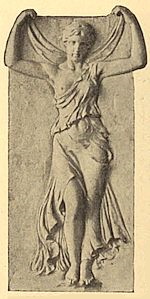
A CEILING FIGURE.
BY ALBERT WEINERT.
The painting in the central tympanum, over the door
leading into the Reading Room, is entitled simply Government.
It represents the abstract conception of a republic
as the ideal state, ideally presented. The other tympanums
explain the practical working of government, and
the results which follow a corrupt or a virtuous rule.
The figures in these four tympanums are therefore
appropriately conceived somewhat more realistically.
The decoration to the left of the central tympanum
illustrates Corrupt Legislation, leading to Anarchy,
as shown in the tympanum at the end of the lobby, over the elevator. Similarly,
on the other side, Good Administration leads to Peace and Prosperity.
In all five, the composition consists of a central female figure, representing the
essential idea of the design, attended by two other figures which supplement
and confirm this idea.
In the first painting, Government, the central figure is that of a grave and
mature woman sitting on a marble seat or throne, which is supported on posts
whose shape is intended to recall the antique voting-urn—a symbol which
recurs, either by suggestion or actually, in each of the other four tympanums.
The meaning is, of course, that a democratic form of government depends for
its safety upon the maintenance of a pure and inviolate ballot. The throne is
extended on either side into a bench, which rests, at each end, upon a
couchant lion, with a mooring-ring in his mouth, signifying that the ship of
state must be moored to strength. The goddess—for so, perhaps, she is to be
considered—is crowned with a wreath, and holds in her left hand a golden
sceptre (the Golden Rule), by which the artist means to point out that no
permanent good can accrue to a government by injuring another. With her
right hand she supports a tablet inscribed with the words, from Lincoln’s Gettysburg
address, “A government of the people, by the people, for the people.”
To the right and left stand winged youths or geniuses, the first holding a
bridle, which stands for the restraining influence of order, and the other with
a sword with which to defend the State in time of danger, or, if one chooses,
the sword of justice—it may be taken either way. The background of the
group is the thick foliage of an oak tree, emblematic of strength and stability.
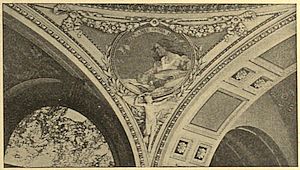
MUSIC.—BY EDWARD J. HOLSLAG.
In the second panel, Corrupt Legislation is represented by a woman with a
beautiful but depraved face sitting in an abandoned attitude on a throne the
arms of which are cornucopias overflowing with the coin which is the revenue of
the State. But this revenue is represented not as flowing outward, for the use
and good of the people, but all directed toward the woman herself. The artist’s
idea was that when revenue is so abundant, as here depicted, that it greatly
exceeds the needs of government, then government becomes a temptation to all
kinds of corrupt practices.
The path in front of the
throne is disused and
overgrown with weeds,
showing that under such
a corrupt government the
people have abandoned
a direct approach to Justice.
With her right
hand, the woman waves
away, with a contemptuous
gesture, a poorly clad
girl—representing Labor—who
comes, showing
her empty distaff and
spindle, in search of the
work which should be hers by right, but which she cannot obtain under
a government inattentive to the wrongs of the people. In her left hand the
woman holds a sliding scale—used as being more easily susceptible of fraud
than a pair of balances, and the proper emblem therefore of the sort of justice
in which she deals. A rich man is placing in it a bag of gold; he sits confidently
beside her, secure of her favors in return for his bribe. At his feet
are other bags of gold and a strong box, together with an overturned voting-urn
filled with ballots, signifying his corrupt control of the very sources of
power. In his lap he holds the book of Law, which he is skilled to pervert to
his own ends. In the background are his factories, the smoke of their chimneys
testifying to his prosperity. On the other side the factories are smokeless
and idle, showing a strike or shut-down; and the earthen jar in which the savings
of Labor have been hoarded lies broken at her feet.
The logical conclusion of such government is Anarchy. She is represented
entirely nude, raving upon the ruins of the civilization she has destroyed. In
one hand she holds the wine cup which makes mad, and in the other the incendiary
torch, formed of the scroll of learning. Serpents twist in her dishevelled
hair, and she tramples upon a scroll, a lyre, a Bible, and a book—the symbols,
respectively, of Learning, Art, Religion, and Law. Beneath her feet are the dislocated
portions of an arch. To the right, Violence, his eyes turned to gaze
upon the cup of madness, is prying out the corner-stone of a temple. To the
left, Ignorance, a female figure, with dull, brutish face, is using a surveyor’s
staff to precipitate the wreckage of civilization into the chasm which opens in
the foreground. Beyond, lying in an uncultivated field, are a broken mill-wheel
and a millstone. But the end of such violence is clearly indicated; no
sooner shall the corner-stone be pried from the wall than the temple will fall
and crush the destroyers; and beside the great block on which Anarchy has
placed her foot lies a bomb, with a lighted fuse attached. Such a condition,
says the painting, must inevitably contain the seeds of its own destruction.
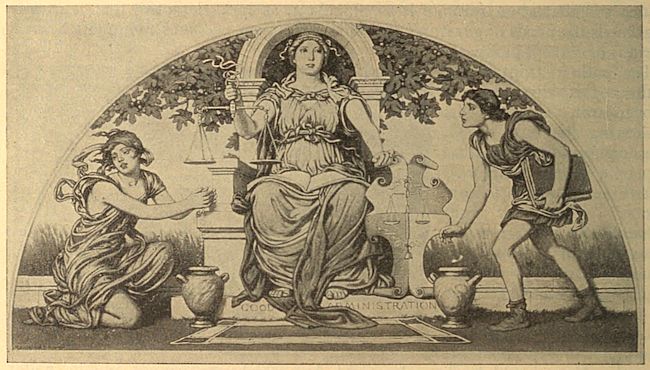
GOOD ADMINISTRATION.—BY ELIHU VEDDER.
On the other side of the central tympanum, Good Administration sits holding
in her right hand a pair of scales evenly poised, and with her left laid upon a
shield, quartered to represent the even balance of parties and classes which
should obtain in a well ordered democracy; on this shield are emblazoned, as
emblems of a just government, the weight, scales, and rule. The frame of her
chair is an arch, a form of construction in which every stone performs an equal
service—in which no shirking can exist—and therefore peculiarly appropriate
to typify the equal part which all should take in a democratic form of government.
On the right is a youth who casts his ballot into an urn. He carries
some books under his arm, showing that education should be the basis of the
suffrage. To the left is another voting-urn, into which a young girl is winnowing
wheat, so that the good grains fall into its mouth while the chaff is scattered
by the wind—an action symbolical of the care with which a people should
choose its public servants. In the background is a field of wheat, a last touch
in this picture of intelligence and virtue, and, in itself, symbolical of prosperous
and careful toil.
In the last panel, that of Peace and Prosperity, the central figure is crowned
with olive, the emblem of peace, and holds in her hands olive-wreaths to be
bestowed as the reward of excellence. On either side is a youth, the one to
her right typifying the Arts, and the other, Agriculture. The former sits upon
an amphora or jar, and is engaged in decorating a piece of pottery; behind
him is a lyre, for Music, and in the distance a little Grecian temple, for Architecture.
The other is planting a sapling,—an act suggestive of a tranquil,
just, and permanent government, under which alone one could plant with any
hope of enjoying the shade and fruit of after years. The background of the
picture is a well-wooded and fertile landscape, introduced for much the same
purpose as the wheat-field in the preceding tympanum.
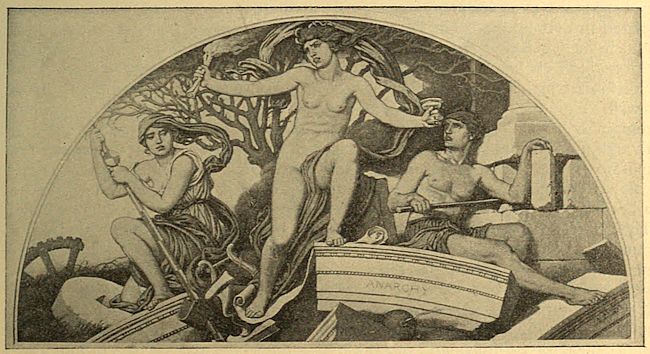
ANARCHY.—BY ELIHU VEDDER.
Still another piece of symbolism is expressed in this interesting series of pictures
by the trees, their foliage forming the background against which the central
figure is placed. The oak in the central panel has been spoken of. In
the design representing Peace and Prosperity, an olive-tree typifies not only
Peace but Spring; in the next panel, that of Good Administration, the tree is
the fig, and the season summer; in that of Corrupt Legislation, the autumnal
vine, hinting at a too abundant luxury, and with its falling leaves presaging
decay; and in that of Anarchy, bare branches and Winter.
The Second Floor Corridors.—Returning again to the Entrance Hall
proper, the visitor may most conveniently continue his tour of the Library by
ascending the Grand Staircase to the beautifully decorated corridors of the
second-story arcade, on his way to the public galleries of the Main Reading
Room. The corridors are arranged like those which the visitor has already
passed through on the first floor, but their greater height and the brighter tone
of the decoration give an effect of considerably greater spaciousness.
The Decoration of the Vaults.—The floors of the corridors are laid in
mosaic of varying patterns. The ceilings are uniformly a barrel vault, with
pendentives—the same, that is, as those of the North, East, and South Corridors
below. The vaults are covered with a painted decoration of Renaissance ornament
which for variety and interest is hardly surpassed anywhere else in
the building. The decorative scheme which has been adopted was planned
throughout by Mr. Casey, and elaborated, especially in the matter of color,
and carried into effect, by Mr. Garnsey, working under Mr. Casey’s direction.
In addition, each corridor contains, as a distinctive accent of color and design,
a series of paintings by a specially commissioned artist—in the West
Corridor by Mr. Walter Shirlaw, in the North Corridor by Mr. Robert Reid, in
the East Corridor by Mr. George R. Barse, Jr., and in the South Corridor by
Mr. Frank W. Benson. In the side corridors, also, at the west end, the arch of
the vault is spanned by a broad band of stucco ornament containing a series of
octagonal coffers, ornamented in relief by Mr. Hinton Perry.
The decoration is varied, of course, from corridor to corridor, in order to
prevent any monotony of impression, but the main principles on which it
is based are everywhere the same. Thus the color scheme—which was suggested
in part by the beautiful Library in Sienna—comprises in every corridor
blue in the pendentives, golden yellow in the penetrations, and a grayish white in
the body of the vault. The only exception to this rule is in the West and East
Corridors, which are terminated by double arches instead of ending directly upon
a wall. Here the end penetrations are red and the pendentive yellow. The others
remain as before. The delineation of the spaces is at bottom very simple, and
though more elaborate, a good deal like that already noted in describing the
mosaic in the lower corridors. The penetrations are outlined by a bright
colored border, on which, where the lines converge to a point at the top, rests a
border of greater width, enclosing the entire vault in a single great rectangle.
This, in turn, is divided into compartments by bands of ornament, varying in
number according to the requirements of the decoration, but always occurring immediately
over the columns of the arcade. These bands, coming where they do,
perform a vital service for the decoration in continually reminding the visitor,
if only by a painted arabesque, of the importance of the arch in such a piece of
construction as a vault. In the spaces between them are garlands and wreaths,
and panels for paintings and inscriptions—the whole making part of one great
arabesque, which is as easily intelligible and coherent as it is various, but
which would have been bewildering in its wealth of ornament and color if it had
not been for the fundamental service performed by these various bands and
borders and broad masses of color.
The penetrations and pendentives are richly embellished with a great variety
of ornament, both conventional and otherwise. The treatment differs in different
corridors, however, on account of the varying relative position of the paired
columns which support the arcade—from which results first a series of wide
and then a series of narrow pendentives. Where the former occur—in the
West and East Corridors—they are ornamented with the decorations of Mr.
Shirlaw and Mr. Barse; while the narrower pendentives on the north and south
carry simple medallions and tablets, and Mr. Reid’s and Mr. Benson’s paintings
find place in the arabesque of the ceiling vault and in circular frames along
the wall beneath. The balance is restored, however, by introducing a series of
medallions, corresponding to Mr. Benson’s and Mr. Reid’s, though smaller and
of less importance, in the vaults east and west, and by ornamenting the penetrations
in the side corridors with greater richness and elaboration.
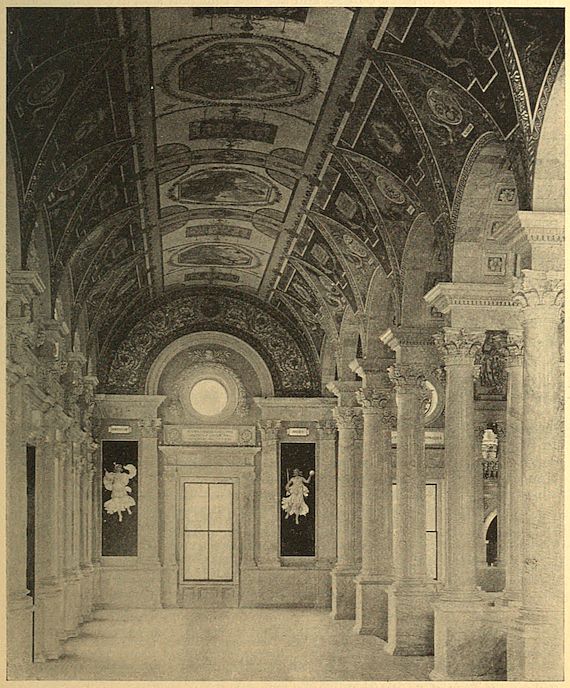
THE NORTH CORRIDOR, SECOND STORY, MAIN ENTRANCE HALL.
SHOWING DECORATIONS BY GEORGE W. MAYNARD AND ROBERT REID.
The Printers’ Marks.—The most interesting decoration of the penetrations,
however, is a series of “Printers’ Marks” which is continued through all
four corridors. Altogether there are fifty-six of them—sixteen in each of the
side corridors, ten in the West Corridor, and fourteen in the East Corridor.
They are painted in black outline, and are of a sufficient size, averaging about a
foot and a half in height, to be easily made out from the floor. By a printer’s
mark, it should be explained, is meant the engraved device which the old
printers used in the title-page or colophon of their books, partly as a kind of
informal trade-mark guarding against counterfeited editions, and partly as a personal
emblem, such as a publisher of good standing would like to see on a long
list of worthy books. For this latter reason, and in order to be able to add an
interesting piece of ornament to the title-page, the mark has been revived of
late years by a considerable number of modern publishing and printing
houses.
Very often, as the visitor will see, the printer’s mark is, in its way, a really beautiful
piece of design; many have an interest as being associated with the reputation
of a famous printer like Caxton, or Aldus, or Elzevir; while others depend
mainly for their point upon some special symbolical meaning, very frequently
taking the form of an illustrated pun. Thus, in the West Corridor, the
mark of Lotter—which means “vagrant” in German—is a mendicant supplicating
alms. In the South Corridor, the mark of Geoffroy Tory commemorates
the death of his little daughter—the broken vase, with a book symbolizing
the literary studies of which she had been fond.
There is no necessity, however, of describing the marks in detail, for, with
the exception of two or three American examples, they were all taken from
Mr. William Roberts’s Printers’ Marks (London, 1893), in which they are
illustrated and explained. Those thought best adapted for decorative effect
were chosen throughout, although the marks of as many of the better known
printers as possible were included. Occasionally a border or a motto was
omitted, but in the main Mr. Roberts’s engravings were pretty exactly copied.
In the West Corridor the marks are mostly those of German printers; in the
South Corridor, French; in the East Corridor, Italian and Spanish; in the
North Corridor, English and Scottish and American.[7]
Mr. Hinton Perry’s Bas-Reliefs.—Mr. Perry’s bas-reliefs, at the west
end of the north and south vaults, have already been referred to. They are four
in number, and measure three feet eight inches from one side to another. Taken
as a series they represent what may be called, for lack of a better title, Ancient
Prophetic Inspiration. The chief figure in each is a sibyl or priestess—Greek,
Roman, Persian, Scandinavian—in the act of delivering the prophetic warnings
which have been revealed to her in the rapture of a divine frenzy. She is
regarded as the mouthpiece of the god, and therefore as the fountain of religion,
wisdom, literature, art, and success in war—all of which are typified, in
one panel or another, in the figures of her auditors.
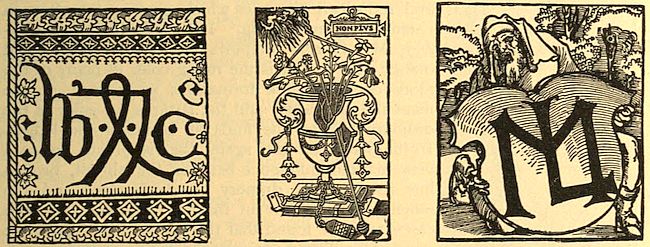
PRINTERS’ MARKS.—CAXTON, TORY, LOTTER.
Beginning in the South Corridor, the first panel shows the Cumæan or
Roman Sibyl. She is represented, in accordance with the ancient histories, as
an old and withered hag, whose inspiration comes from an infernal, rather than
a celestial source. Two figures, as in all the panels, complete Mr. Perry’s
group, one male and the other female. The first is clad in the splendid armor
of a Roman general; the woman is nude, and stands for Roman Art and Literature.
At her feet is a box of manuscripts, and she takes in one hand an
end of the long scroll (representing one of the Sibylline Books, so famous in
Roman history) which the Priestess holds in her lap. The panel on the other
side of the arch represents a Scandinavian Vala or Wise Woman, with streaming
hair and a wolf-skin over her head and shoulders. She typifies, in her bold
gesture and excited gaze, the barbaric inspiration of the Northern nations. To
the left is the figure of a Norse warrior, and to the right a naked woman lies
stretched upon the ground, personifying the vigorous life and fecundity of
genius of the North.
In the North Corridor, the subjects of Mr. Perry’s two decorations are
Greek and Persian Inspiration. The former is represented by the Priestess of
the world-renowned Oracle of Apollo at Delphi. She is seated upon a tripod,
placed above a mysterious opening in the earth, from which the sacred fumes
rise to intoxicate the Priestess, and fill her with the spirit of prophecy. On one
side of the panel, an old man, standing for Greek science and philosophy,
takes down her words on a tablet; on the other is a nude female figure, personifying
Greek art and literature. In the second panel, that of Persia, the
face of the Sibyl is veiled, to signify the occult wisdom of the East. A man
prostrates himself at her feet in a fervor of religious devotion, and a woman,
nearly nude, stands listening in the background. With her voluptuous figure
and her ornaments of pearl and gold—a fillet, anklets, armlets, and necklace—she
represents the luxuriance and sensuousness of Eastern art and poetry.
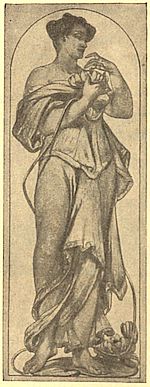
BOTANY.
BY WALTER SHIRLAW.
Mr. Shirlaw’s Paintings.—The subjects of Mr. Shirlaw’s figures in
the vault of the West Corridor are, on the west, beginning at the left:
Zoölogy, Physics, Mathematics, and Geology; and on the east, again beginning
at the left: Archæology, Botany, Astronomy, and Chemistry. Each science is
represented by a female figure about seven and a half feet in height. The figures
are especially interesting, aside from their artistic merit, for the variety of
symbolism by which every science is distinguished from the others, and for the
subtlety with which much of this symbolism is expressed.
Not only is each accompanied by various
appropriate objects, but the lines of the drapery, the
expression of the face and body, and the color itself
are, wherever practicable, made to subserve the idea
of the science represented. Thus the predominant
colors used in the figure of Chemistry—purple, blue,
and red—are the ones which occur most often in
chemical experimenting. In the pendentive of Geology,
Mr. Shirlaw employs principally purple and
orange; the former is the ruling color in many of the
more common rock formations when seen in the
mass and naturally; and the latter is the color of the
ordinary lichens one finds on boulders and ledges.
In the matter of line, again, the visitor will notice a
very marked difference between the abrupt, broken
line used in the drapery of Archæology, and the
moving, flowing line in that of Physics. In both
cases it will be found that the line is in very complete
sympathy with the character of the science depicted.
The method of archæology is largely excavation carried
on among sculptural and architectural fragments.
The swirling drapery of Physics is suggestive of
flame and heat.
Zoölogy is represented with a lion seated beside
her, her hands clasping his mane. She is the huntress
and student of wild life, and her body is powerfully
developed, like an Amazon’s. She is clad in the
pelt of an animal, the head forming her cap, and in
buskins of skin. She stands on a rocky piece of ground, like a desert. The
chief colors employed in the pendentive are the typical animal colors, browns
and yellows.
Physics stands on an electric globe, from which emanate rays of light. She
carries a torch in her left hand, and she holds up an end of her drapery in her
right in such a way that it seems to start from the flame and flow in sympathy
with it over her whole body, so that it conveys the idea of the unceasing motion
of fire. The same colors as those used in the pendentive of Geology,
purple and orange, are used here also, but in this case standing, of course, for
the colors of flame.
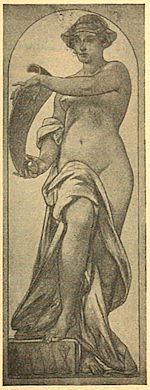
MATHEMATICS.
BY WALTER SHIRLAW
Mathematics, the exact science, is represented as almost entirely nude,—like
“the Naked Truth” of Mr. Walker’s tympanum on the floor below. Her
right foot is on a stone block inscribed with the conic sections, and on a shield
which she holds are various geometrical figures. Her scanty drapery is appropriately
disposed in the severest lines.
Geology, a sculpturesque figure, stands squarely and firmly upon a mountain
top, beyond which is seen the setting sun. A fold of her drapery forms a
receptacle for the specimens she has gathered. In her left hand is a globe,
and in her right a fossil shell. Her hair is confined by a head-dress of bars of
silver and gold. The embroidered pattern of her garment has a suggestion
of fossil forms and of the little lizards which are found among the rocks.
Archæology is clad in the Roman costume, and
wears the helmet of Minerva; the helmet is wreathed
with olive, the emblem of peace, which was sacred to
Minerva, and is here used with special reference to
the peaceful character of the science, which can pursue
its labors only in an orderly society. The figure
stands on a block of stone, the surface of which is
carved to represent a scroll, the ancient form of book.
A vase, copied from the manufacture of the Zuñi
Indians of New Mexico, stands beside her. In her
right hand she holds a large book, the pages of which
she examines with the aid of a magnifying glass in
order to spell out its half obliterated text. Around
her neck is coiled a chameleon, whose changing hues
are intended to symbolize the varying nature of the
theories she propounds.
The countenance of Botany is expressive of a joyous
sympathy with nature. She stands on the pad of a
water-lily, engaged in analyzing its flower, the long
stem of which coils gracefully about her body to the
water. Her drapery flows and breaks as a half-opened
flower might arrange itself.
Astronomy holds a lens, such as is used in a telescope,
in her right hand, and in her left the globe of Saturn
surrounded by its rings—selected as being perhaps the
best known and most easily distinguished of all the
planets. She stands on the sphere of the earth, beyond
which, to the left, is the quarter moon. The lines of her drapery with their slow
curves are suggestive, in a way, of the orbits of the heavenly bodies. They
flow in long lines, enveloping her figure in the strength which proceeds from
complete harmony.
Chemistry is shown with her left foot placed upon a piece of chemical apparatus
and holding in her right hand a glass retort, in which she is distilling a
liquid. The necessary heat, manifested by the ascending vapor which curls
about the vessel, is from the mouth of the serpent—the emblem of fecundity
and life, breathing the element of life, fire. The serpent is coiled about an
hour-glass, which is significant of the exact measurement of time necessary in
chemical experiments. The face of the figure is more worn, on account of the
anxious nature of her employment, than would comport with the character of
an out-of-door science like Botany or Zoölogy. She is draped somewhat in the
eastern manner, like a sibyl, thus recalling the occult character ascribed to the
science during the Middle Ages—when it was called alchemy—and, for that
matter, the marvellousness of its results in the laboratories of to-day. A snake
wound as a fillet about her hair still further emphasizes this mystic quality.
At either end of the corridor is a tablet bearing a list of names of men
distinguished in the sciences which Mr. Shirlaw has depicted; at the north
end: Cuvier, the Zoölogist; Linnæus, the Botanist; Schliemann, the Archæologist;
and Copernicus, the Astronomer; at the south end: La Grange, the
Mathematician; Lavoisier, the Chemist; Rumford, the Physicist; and Lyell,
the Geologist. In the penetrations on either side of these two lists of names
are the following appropriate inscriptions:—
The first creature of God was the light of sense; the last was the light of reason.
Bacon.
The Light shineth in darkness, and the darkness comprehendeth not.
John 1, 5.
All are but parts of one stupendous whole,
Whose body Nature is, and God the soul.
Pope.
In nature all is useful, all is beautiful.
Emerson.
Along the centre of the vault, three
medallions by Mr. William B. Van Ingen
represent respectively Sculpture, Architecture,
and Painting. In each the art is
represented by a female figure engaged
either in chiselling the features of a bust
(that of Washington), drawing the plan
of a building, or painting at an easel.
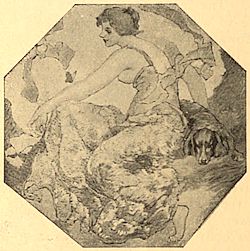
TOUCH.—BY ROBERT REID.
Mr. Reid’s Paintings.—Passing
to the North Corridor, the attention is
at once attracted to the brilliant coloring
of Mr. Reid’s decorations in the vault
and along the north wall. The former are five in number, and represent
the Five Senses. They are octagonal in form, measuring within an inch of six
feet and a half across. The order of the subjects, beginning at the westerly
end, is Taste, Sight, Smell, Hearing, Touch. In each the sense suggested is
represented by a beautiful young woman, more of the modern than the antique
type of beauty, and clad in drapery which recalls contemporary fashions rather
than the classic conventions which are usually followed by artists in their treatment
of ideal subjects. Being painted upon a ceiling, so that the visitor is required
to look directly upward in order to study them, the figures, though, in a
sense, represented as seated, are rather to be imagined as poised in the air,
without any special reference to the law of gravitation. They are shown as
supported upon cloud-banks, and the backgrounds of the panels are sky and
clouds.
The suggestion of the subject is as simply as it is ingeniously and unconventionally
conveyed. A large portion of this suggestion must be looked for, of
course, in the expression of the face and the attitude as well as in the action
of the figures. Taste is shown drinking from a shell. She is surrounded by
foliage, and a vine grows beside her laden with bunches of ripe grapes. She
wears flowers in her hair, and the idea throughout may perhaps be taken as
that of the autumnal feast of the wine-press. Sight is looking at her reflection
in a handglass, and smiling with pleasure at the evidence of her beauty. A
splendid peacock, the emblem of beauty and pride in beauty, is introduced beside
her. Smell is represented seated beside a bank of lilies and roses. From
this mass of flowers she has selected a great white rose, which she presses to
her nose. Hearing holds a large sea-shell to her ear, and dreamily listens to
its roaring. Touch is delightedly observing a butterfly which has alighted on
her bare outstretched arm—the touch of its tiny feet as it walks over her flesh
imparting an unaccustomed sensation to her nerves. A setter dog, which she
has just ceased from caressing, lies asleep behind her.
Mr. Reid’s subjects in the four circular panels along the wall are entitled,
in order from left to right: Wisdom, Understanding, Knowledge, and Philosophy.
Each is represented by a half-length seated female figure—more solidly
painted, but of much the same type as the figures representing The Senses—holding
a scroll, book, or tablet. In
the panel of Philosophy, a Greek temple
is seen in the background, emblematic
of the Greek origin of philosophy.
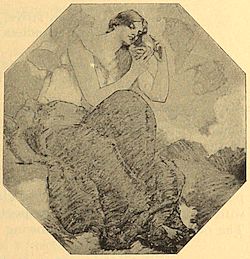
HEARING.—BY ROBERT REID.
Alternating with Mr. Reid’s ceiling
paintings, is a series of rectangular
panels, in which are depicted, in low
tones of color and in a style somewhat
suggestive of a classic bas-relief, a number
of ancient out-door athletic contests.
Beginning at the west end of the
vault, the first of these represents a
group of young men throwing the discus.
Then come Wrestling and Running.
In the fourth panel, the athletes are
being rubbed down by attendants, to clear
them of the sweat and heat of the conflict;
and in the fifth, the successful
contestants are kneeling to receive the crown of victory at the hands of a
woman seated on a dais. The last picture represents the return home, a tripping
company of youths and maidens crowned with garlands.
The visitor will remember what was said concerning the special enrichment
of the penetrations in the side corridors for the sake of compensating in a way
for the absence of such decorations as Mr. Shirlaw’s in the pendentives. In
the present instance, this enrichment takes the form of dragons and swans,
which serve as “supporters” of the panels containing the printers’ marks.
In the pendentives, tablets for inscriptions alternate with medallions containing
trophies of various trades and sciences. The list of the latter, beginning
at the left over the north wall, is as follows: Geometry, represented by a
compass, a protractor, and a scroll, cone, and cylinder; Meteorology, the barometer,
thermometer, and anemometer; Forestry, a growing tree, and an axe and
pruning-knife; Navigation, the chronometer, log, rope, rudder, and compass;
Mechanics, the lever, wedge, and pulley-block; and Transportation, with a piston,
propeller, driving-wheel, and locomotive head-light.
The inscriptions are from Adelaide A. Procter’s poem, Unexpressed, and
are as follows:—
Dwells within the soul of every Artist
More than all his effort can express.
No great Thinker ever lived and taught you
All the wonder that his soul received.
No true painter ever set on canvas
All the glorious vision he conceived.
No musician....
But be sure he heard, and strove to render,
Feeble echoes of celestial strains.
Love and Art united
Are twin mysteries, different yet the same.
Love may strive, but vain is the endeavor
All its boundless riches to unfold.
Art and Love speak; and their words must be
Like sighings of illimitable forests.
The only other decoration which there is space to mention is the broad,
semicircular border which follows the line of the vault on the wall at either end
of the corridor. At the east end, this border is ornamented with a bright-colored
arabesque, mainly in violet and greens, with a medallion in the centre
bearing a map of the Western Hemisphere. At the west end, the border is
plainer, with five semicircular or circular tablets, two of which are ornamented
with the obverse and reverse respectively of the Great Seal of the United States.
The other three carry the following inscriptions:—
Order is Heaven’s first law.
Pope.
Memory is the treasurer and guardian of all things.
Cicero.
Beauty is the creator of the universe.
Emerson.
Mr. Barse’s Paintings.—In the East Corridor, the pendentive figures
of Mr. Barse represent, beginning on the east side, at the north end: Lyric
Poetry (entitled by the artist, Lyrica), Tragedy, Comedy, and History; and on
the west, again beginning at the north, Love Poetry (Erotica), Tradition,
Fancy, and Romance. The subject of the entire series, therefore, may be
called simply Literature. The figures, as the visitor will perceive, need but
little explanation. All are those of women clad in graceful, classic robes, represented
throughout as seated, and depicted with little attempt at dramatic
expression or action. Lyric Poetry is playing on the lyre. Tragedy and Comedy
have a tragic and comic mask respectively, and Comedy a tambourine.
History has a scroll and palm-branch, and an ancient book-box for scrolls, such
as was used by the Romans, is set at her feet. Romance has a pen and a scroll.
Fancy clasps her hands, and gazes upward with a rapt expression on her face.
Tradition wears the Ægis, and holds a statue of the winged goddess of Victory
in her hand—both introduced as symbols of antiquity. Erotica is writing on
a tablet.
Along the centre of the vault, occupying a similar position to the medallions
in the opposite corridor, is another series of three paintings, executed by Mr.
William A. Mackay, which represent The Life of Man. One will best understand
the meaning of the paintings by first reading the inscriptions which are
placed immediately above and below each medallion. On one side they refer
to the ancient allegory of the Three Fates, Clotho, Lachesis, and Atropos—the
first of whom spun, the second wove, and the third cut, the Thread of
Life—and are as follows:—
For a web begun God sends thread.
Old Proverb.
The web of life ... is of a mingled yarn, good and ill together.
All’s Well that Ends Well.
Comes the blind Fury with th’ abhorred shears
And slits the thin-spun life.
Milton.
On the other side the inscriptions, which compare the life of a man to the life
of a tree, are taken from Cardinal Wolsey’s speech in Henry VIII:—
This is the state of man: to-day he puts forth
The tender leaves of hopes.
To-morrow blossoms.
And bears his blushing honors thick upon him.
The third day comes a frost, ...
And ... nips his root,
And then he falls.
Accordingly, in the present series, the first medallion shows a woman
(Clotho) with her distaff and a baby lying in her lap. The sun is rising above
the horizon, a sapling begins to put out its branches, and near by is a little
spring. In the next picture, Lachesis has a loom and shuttle. The spring has
grown into a river, and the mature man bears in his hand a basket of fruit
gathered from the abundance of the full-grown tree, while the sun in the
heavens marks the high noon of life. In the last medallion the sun is setting,
the tree has fallen in ruin on the ground, and the stream has dried up. The
man, grown old and crippled, faints by the roadside, and Atropos opens her
fatal shears to sever the thread of his existence.
At each end of the corridor is a tablet containing the names of eminent
American printers, and men who have contributed to the improvement of
American printing machinery. At the north these names are: Green, Daye,
Franklin, Thomas, Bradford; and at the south, Clymer, Adams, Gordon, Hoe,
Bruce.
Mr. Benson’s Paintings.—Mr. Benson’s decorations in the vault of the
South Corridor and along the wall below are of the same size and shape as those
of Mr. Reid in the North Corridor. The arabesque ornament of the ceiling is
so arranged, however, as to allow space for only three instead of five of these
hexagonal panels. The subject of the paintings they contain is The Graces—Aglaia
(at the east), Thalia (in the centre) and Euphrosyne (at the north).
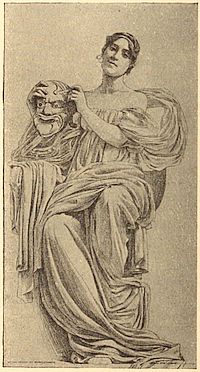
COMEDY.
BY GEORGE R. BARSH, JR.
The three figures are almost invariably represented in a group, in both
ancient and modern art. Taken together, they stand, of course, for beauty and
graciousness, and typify, also, the agreeable arts and occupations. In separating
them, Mr. Benson has considered Aglaia as the patroness of Husbandry; Thalia
as representing Music; and Euphrosyne, Beauty. The first, therefore, has a
shepherd’s crook, the second a lyre, and the
last is looking at her reflection in a hand-mirror.
All are shown sitting in the midst
of a pleasant summer landscape, with trees
and water and fertile meadows.
For the four circular panels Mr. Benson
has chosen as his subject The Seasons. Each
is represented by a beautiful half-length figure
of a young woman, with no attempt, however,
at any elaborate symbolism to distinguish the
season which she typifies. Such distinction
as the painter has chosen to indicate is to be
sought rather in the character of the faces,
or in the warmer or colder coloring of the
whole panel—in a word, in the general
artistic treatment.
At either end of the vault is a rectangular
panel painted in the same style as those depicting
the ancient games in the North Corridor,
but in this case representing the modern
sports of Football and Baseball. The former,
occurring at the east end of the vault, is a
more or less realistic picture of a “scrimmage.”
The latter is more conventionalized, showing
single figures, like the pitcher and catcher,
in the attitude of play, and others with bats,
masks, and gloves.
Instead of the swans and dragons of the
North Corridor, the printers’ marks in the penetrations of the present corridor
are supported between the figures of mermen and fauns, and mermaids and
nymphs, the male figures, with their suggestion of greater decorative strength,
occurring at the ends of the corridor, and the nymphs and mermaids alternating
between. Altogether there are thirty-two figures, each painted by Mr.
Frederick C. Martin.
On the pendentives, the series of trophies begun in the North Corridor is
continued, giving place, as before, in every other pendentive, to a tablet bearing
an inscription. Beginning on the south side, at the east end, the trophies
are as follows: Printing, with a stick, inking-ball, and type-case; Pottery,
three jugs of different kinds of clay; Glass-making, three glass vases of different
shapes; Carpentry, a saw, bit, hammer, and right angle; Smithery, the anvil,
pincers, hammer, bolt, and nut; Masonry, a trowel, square, plumb, and mortar-board.
The following are the eight inscriptions:—
Studies perfect nature and are perfected by experience.
Bacon.
Dreams, books, are each a world; and books, we know,
Are a substantial world, both pure and good.
Wordsworth.
Learning is but an adjunct to ourself.
Love’s Labor’s Lost.
A little learning is a dangerous thing;
Drink deep, or taste not the Pierian spring.
Pope.
The universal cause
Acts to one end, but acts by various laws.
Pope.
Vain, very vain, [the] weary search to find
That bliss which only centres in the mind.
Goldsmith.
Creation’s heir, the world, the world is mine!
Goldsmith.
The fault ... is not in our stars,
But in ourselves, that we are underlings.
Shakespeare (Julius Cæsar).
The semicircular borders at either end are practically the same in color and
design as in the North Corridor. At the east end, the Eastern is substituted
for the Western Hemisphere, and at the west end, a caduceus and a lictor’s
axe for the United States Seal. The accompanying inscriptions are as follows:
Man raises but time weighs.
Modern Greek Proverb.
Beneath the rule of men entirely great,
The pen is mightier than the sword.
Bulwer Lytton.
The noblest motive is the public good.
Virgil.
The Decoration of the Walls.—The decoration of the vaults of the
four corridors is distinctly Renaissance in character; the walls beneath, however,
are colored and decorated in accordance with a Pompeiian motive. It
may seem at first thought illogical thus to join two styles so remote from each
other in point of time, but it must be remembered that, in both art and literature,
the Renaissance was literally, as has been pointed out, the new birth of
Greek and Roman forms, in the course of which the Italian painters adapted
to their use and subdued to their style the sort of wall decoration which we
know as Pompeiian, from the discovery of so many examples of it in the excavations
at Pompeii. The two styles, as used in conjunction in the Library of
Congress, not only in these corridors but
throughout the building, are perfectly
harmonious in color and design; from
the explanation just given the visitor will
see that they have long ago been brought
into a historical unity as well, through
the conventions established by the great
and authoritative school of the Renaissance
artists.
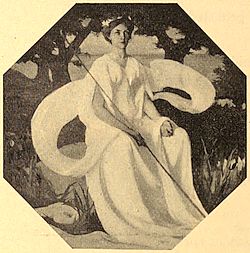
AGLAIA.—BY F. W. BENSON.
Mr. Maynard’s Pompeiian Panels.—The
frequent occurrence of windows,
doors, and pilasters cuts the wall
into narrow spaces, which, at the north
and south, are colored a plain olive, and
at the east and west the familiar rich
Pompeiian red, ornamented with simple
arabesques and, at the ends, with
female figures representing The Virtues, by Mr. George Willoughby Maynard.
There are eight of these figures in all, two in each corner of the hall. Each
figure is about five and a half feet high, clad in floating classic drapery, and
represented to the spectator as appearing before him in the air, without a support
or background other than the deep red of the wall. The style of the paintings
is Pompeiian; the general tone is somewhat like that of marble, although
touched with color so as to remove any comparison with the marble framing.
Beginning at the left in each case, the
names and order of the Virtues are
as follows: At the northeast corner,
Fortitude and Justice; at the southeast
corner, Patriotism and Courage; at the
southwest corner, Temperance and Prudence;
at the northwest corner, Industry
and Concord. The number of
virtues to be represented was determined
beforehand, of course, by the number
of spaces at the disposal of the painter.
The selection, therefore, was necessarily
somewhat arbitrary.
Each figure is shown with certain
characteristic attributes. In the case of
Industry, Courage, and Patriotism, Mr.
Maynard has himself selected these
attributes; in the other five figures he
has followed the usual conventions.
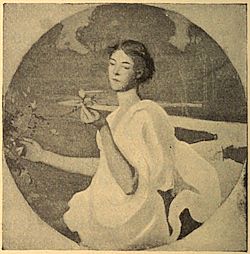
SPRING.—BY F. W. BENSON.
Fortitude is shown fully armed—the mace in her right hand and the buckler
on her arm, and protected by cuirass, casque, and greaves. She is thus represented
as ready for any emergency—living in continual expectation of danger,
and constantly prepared to meet it. Justice holds the globe in her right hand,
signifying the extent of her sway. She holds a naked sword upright, signifying
the terribleness of her punishment. Patriotism is feeding an eagle, the
emblem of America, from a golden bowl—an action which symbolizes the
high nourishment with which the Virtue sustains the spirit of the country.
Courage is represented as armed hastily with the buckler, casque, and sword—not,
like Fortitude, continually on guard, but snatching up her arms in the
presence of an unforeseen danger. Temperance—figured as the classic rather
than the modern virtue—holds an antique pitcher in her right hand, from
which a stream of some liquor, whether wine or water, descends into the bowl
she holds in her left. Her buoyancy and air of health betoken her moderation
of living. Prudence looks in a hand-glass to discover any danger which
may assail her from behind. In her right hand she holds a serpent—the emblem
of wisdom. Industry draws the flax from a distaff, the end of which is
stuck in her girdle, and twists it into thread, to be wound upon the spindle
which hangs at her side. Concord—the Roman goddess Concordia—illustrates
the blessings of peace. In her right hand she bears an olive-branch, and
in her left she carries a cornucopia filled with wheat.
The Inscriptions along the Walls.—Before taking leave of the corridors
of the Entrance Hall, one more feature of the decoration requires
notice, namely the twenty-nine inscriptions occupying the gilt tablets below the
stucco frames which surround the circular windows and the wall-paintings of
Mr. Benson and Mr. Reid. They are as follows:—
Too low they build who build beneath the stars.
Young.
There is but one temple in the Universe and that is the Body of Man.
Novalis.
Beholding the bright countenance of Truth in the quiet and still air of delightful
studies.
Milton.
The true university of these days is a collection of books.
Carlyle.
Nature is the art of God.
Sir Thomas Browne.
There is no work of genius which has not been the delight of mankind.
Lowell.
It is the mind that makes the man, and our vigor is in our immortal soul.
Ovid.
They are never alone that are accompanied by noble thoughts.
Sidney.
Man is one world and has
Another to attend him.
Herbert.
Tongues in trees, books in the running brooks,
Sermons in stones, and good in everything.
As You Like It.
The true Shekinah is man.
Chrysostom.
Only the actions of the just
Smell sweet and blossom in the dust.
Shirley.
Art is long, and Time is fleeting.
Longfellow.
The history of the world is the biography of great men.
Carlyle.
Books will speak plain when counsellors blanch.
Bacon.
Glory is acquired by virtue but preserved by letters.
Petrarch.
The foundation of every state is the education of its youth.
Dionysius.
The chief glory of every people arises from its authors.
Dr. Johnson.
There is only one good, namely knowledge, and one only evil, namely ignorance.
Diogenes Laertius.
Knowledge comes, but wisdom lingers.
Tennyson.
Wisdom is the principal thing; therefore get wisdom: and with all thy getting get understanding.
Proverbs iv, 7.
Ignorance is the curse of God,
Knowledge the wing wherewith we fly to heaven.
2 Henry IV.
How charming is divine Philosophy!
Milton.
Books must follow sciences and not sciences books.
Bacon.
In books lies the Soul of the whole past time.
Carlyle.
Words are also actions and actions are a kind of words.
Emerson.
Reading maketh a full man, conference a ready man, and writing an exact man.
Bacon.
Science is organized knowledge.
Herbert Spencer.
Beauty is truth, truth beauty.
Keats.
The vaulting of the broad passageway leading to the Reading Room consists
of a series of six small domes, the ornamentation of which is similar, in its more
modest way, to that of the vaulted corridors which the visitor has just left.
The colors are light and bright, and the three different patterns employed consist
mainly of garlands and ribbons, and of simple bands of color radiating
from a central medallion. Swans, eagles, or owls are introduced both in the
domes and as the ornament of the pendentives, and eagles occur between the
double consoles which receive the weight of the domes upon the east wall. In
the medallions just referred to are various
objects symbolizing the Fine Arts—tragic
and comic masks, for Acting; a
lyre, for Music; a block of marble, half
shaped into a bust, and sculptors’ tools,
for Sculpture; a lamp, scrolls, and an
open book, for Literature; and the capital
of an Ionic column, a triangle, and some
sheets of parchment, for Architecture.
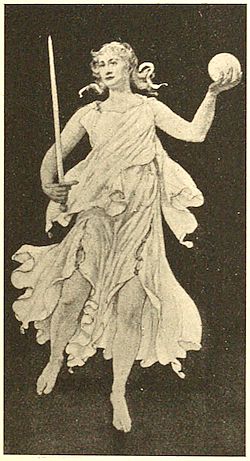
JUSTICE.
BY GEORGE W. MAYNARD.
The trophies of Sculpture and Architecture,
it should be added, are accompanied
by appropriate names—comprising those
of cities, statues, and buildings—inscribed
both in the arabesques and in the
pendentives of certain of the domes.
For Architecture, the buildings commemorated
are the Colosseum, the Taj
Mahal, the Parthenon, and the Pyramids;
while the cities are those with whose fame
these four great monuments are connected—Rome,
Agra, Athens, and Gizeh.
The sculptures are the Farnese Bull, the
Laocoön, the Niobe, and the Parthenon
Pediment, and in the bordering arabesques
are the names of the four divinities often
taken as the subject of ancient statuary—Venus,
Apollo, Hercules, and Zeus.
Mr. Van Ingen’s Paintings.—In
the centre of the passage a marble staircase,
dividing to the right and left at a
landing halfway up, leads to the gallery
of the Reading Room. Beneath, on either side, is a little bay, giving access to
the elevators. In the decoration of the ceiling the effect aimed at is that of
an arbor, with a vine, climbing over a trellis, painted against a sunny yellow
background. Each contains a small tympanum, in which Mr. Van Ingen has
suggested the subjects of Milton’s well-known companion poems, L’Allegro
and Il Penseroso—Mirth, and Melancholy or Thoughtfulness. The decorations
are not illustrations, as the word is usually understood, like some of Mr. Walker’s
panels, already described; they have no reference to any particular scene or
incident in the poems, but are intended as an interpretation of their general
spirit and meaning. In the first, Il Penseroso, the time of year is autumn;
in the other it is spring. Similarly, in L’Allegro the landscape is shown in
morning light, while in Il Penseroso the time is evening. The latter panel is
in the bay to the north of the staircase. A single figure, that of a beautiful
woman with dark hair and soft, pensive eyes, is shown at half length, leaning
her head upon her hand in an attitude and with an expression of deep contemplation.
L’Allegro is represented by a young woman, light-haired and
sparkling with laughter, who is playing under the trees with two little children.
In the pendentives of the bays are inscribed portions of the two poems illustrated.
The lines from L’Allegro are as follows:—
... Come, thou Goddess fair and free,
In heaven yclept Euphrosyne,
And by men heart-easing Mirth;
Haste thee, Nymph, and bring with thee
Jest, and youthful Jollity,
Quips and cranks and wanton wiles,
Nods and becks and wreathèd smiles,
Such as hang on Hebe’s cheek,
And love to live in dimple sleek.
The lines from Il Penseroso are:—
Hail! thou Goddess, sage and holy!
Hail, divinest Melancholy!
Come; but keep thy wonted state,
With even step, and musing gait,
And looks commercing with the skies,
Thy rapt soul sitting in thine eyes:
There, held in holy passion still,
Forget thyself to marble....
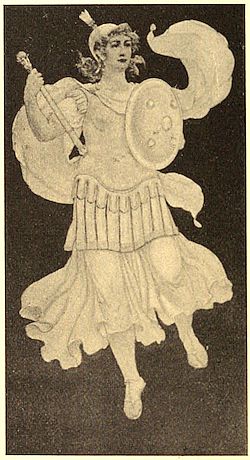
FORTITUDE.
BY GEORGE W. MAYNARD.
Mr. Vedder’s Mosaic Decoration.—The
wall of the landing of the staircase
is occupied by an arched panel,
fifteen and a half feet high and nine feet
wide, containing a marble mosaic by Mr.
Elihu Vedder.[8] The artist has chosen
for his subject Minerva, her armor partly
laid aside, appearing as the guardian of
civilization. She is the Minerva of Peace,
but Mr. Vedder indicates that the prosperity
which she now cherishes has been attained only through just and righteous
war, whether waged against a foreign enemy or against the forces of
disorder and corruption within. Beside her is a little statue of Victory, such
as the Greeks were accustomed to erect in commemoration of their success in
battle. The figure is that of a winged woman standing on a globe, and holding
out the laurel-wreath and palm-branch to the victors. In the sky the clouds
of disaster and discouragement are rolled away and about to disappear, while
the sun of reappearing prosperity sends its rays into every quarter of the land.
Although her shield and helmet have been laid upon the ground, the Goddess
still retains the Ægis, and holds, in one hand, like a staff, her long, two-headed
spear, showing that she never relaxes her vigilance against the enemies of the
country which she protects. For the present, however, her attention is all directed
to an unfolded scroll which she holds in her left hand. On this is written
a list of various departments of learning, science, and art, such as Law, Statistics,
Sociology, Botany, Bibliography, Mechanics, Philosophy, Zoölogy, etc.
To the left of Minerva is the owl, perched upon the post of a low parapet.
Olive trees, symbolizing peace, grow in the field beyond. The armor of the
Goddess is carefully studied from ancient sculptures. The character of the Ægis
can here be more easily made out than in any of the other representations of
Minerva to be found in the building. Traditionally a cape of goat-skin, the
Greek artists finally came to overlay it with metal scales, like scale-armor.
The border is composed of twisting serpents. The head of the Gorgon Medusa,
which forms the central ornament, is used also as the decoration of the
large shield lying in the foreground of the picture. The helmet is decorated
with a pair of rams’ heads. Mr. Vedder’s whole design is surrounded by a
border containing, on either side, a conventionalized laurel-tree displayed like
a vine.
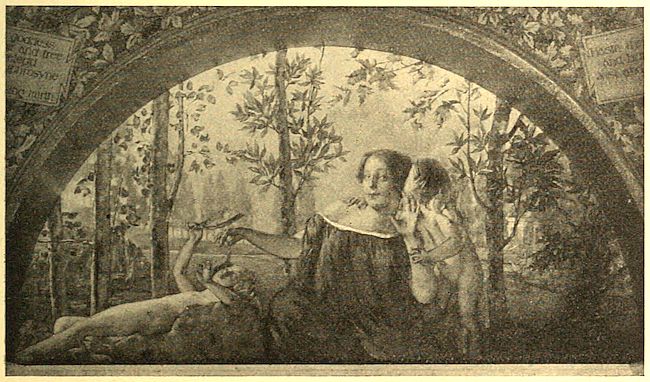
L’ALLEGRO.—BY W. B. VAN INGEN.
Entering by either of the doors at the head of the staircase, the visitor at
once steps out upon an embayed gallery, affording a spacious and uninterrupted
view of the great domed Reading Room, or Rotunda, which, in every sense, is
the central and most important portion of the Library. As such, it is marked
by a magnificence of architecture and decoration nowhere else to be found in
the building. Outside, from whatever direction one approaches, the gilded
dome which forms its outer shell is the first thing to catch the eye; and the
golden flame of the torch which surmounts the lantern indicates to the passer-by
at once the central and the highest point of the whole structure. Within, richer
materials have been used, and decoration has been more freely employed than in
any other part of the Library. Sculpture and paintings, rare marbles, and a
broad scheme of color and of ornamentation in stucco relief unite with a lofty
architectural design to form what is one of the most notable interiors in the
country.
The Importance of the Rotunda.—The detailed description of the
Rotunda may be deferred a little, however, in order to explain its relation to the
rest of the building, and, especially, the reason for its central position. Besides
accumulating books and providing the student with proper accommodations for
his work—such as good light and convenient chairs and tables—it is the
business of every well managed library to supply its readers with the books they
desire in the shortest possible time and with the least possible amount of
friction. A well digested catalogue is the first requisite; the second is that
the books should be stored in a place as closely accessible to the reading room
as may be. In a small library this is a simple matter; the same room will be
sufficient for both books and readers. When the number of volumes increases
it is necessary to shelve them in a compact system of bookcases called a
“stack”—or, as in the Library of Congress, in a series of stacks—which
must occupy a portion of the building by itself. The reading room and the
stacks being thus separated, it is still the aim of the architect to place them in
such a way as to retain as far as possible the practical convenience of the
smaller library, where every reader is almost within reaching distance of every
book. This end is most easily attained by adopting what is called the “central
system” of library construction, which is the system followed in the Library of
Congress. It has already been seen that the building is in the form of a cross
enclosed within a rectangle, thus allowing space for four courts for light and air.
At the intersections of the arms of the cross is the Rotunda, the main entrance
to which is through the west arm of the cross. The other three arms are
occupied by the stacks; the East Stack, directly opposite, is the second short
arm; the North and South Stacks, each the same length, are the two long
arms. It is obvious that by this arrangement the books can be more easily
reached than in any other way. The axes of the stacks are continued radii of
the Rotunda, and, so far as the ground plan is concerned, the shortest way
from any part of the cross to the Distributing Desk which the visitor sees below
in the centre of the room is always along a straight line. This Distributing
Desk, of course, being in the exact centre of everything, is the vital point, the
kernel, of the whole arrangement. No part of the stack, it will be noted, is far
enough away from it to delay the transmission of a book unreasonably, as might
very well be the case if the three stacks were in one. Moreover, by the use of
a mechanical contrivance, which will be explained later, even this distance is in
effect very greatly reduced.
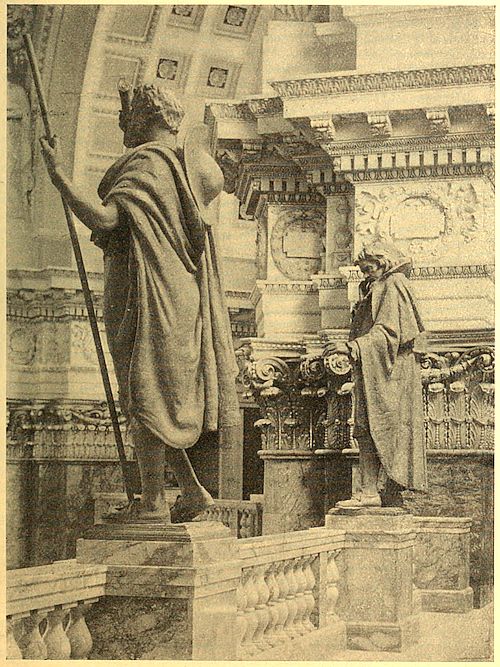
THE GALLERY OF THE ROTUNDA.
SHOWING THE STATUES OF HERODOTUS AND BEETHOVEN.
Another thing may well be noted in this connection although it has already
been referred to in the preliminary description of the building—and that is,
the comparative unimportance, from the standpoint of the real requirements of
the Library, of the great Rectangle which encloses the stacks and the Rotunda,
and necessarily appears from the street to be the main portion of the building.
It contains rooms which, at present, are very convenient for clerical work or as
art galleries and special reading rooms, and which may in time be necessary to
accommodate an overflow of books; but it must steadily be borne in mind that
the Rotunda and the stacks contain the real life of the institution. They
are the only really essential and vital portion of the building; without them,
there could hardly be a library; and by themselves they would be sufficient for
almost every present need.
The General Arrangement.—The character of the Rotunda is warm
and rich in ornament as befits a room where people remain to read. It is naturally
not so formal as the Rotunda of the Capitol. The height of the room from
the floor to the top of the dome, where it converges upon the lantern, is one hundred
and twenty-five feet, and from the floor to the crown of the domed ceiling
of the lantern itself, one hundred and sixty feet. This latter point, however, is
quite shut off from the view of a person standing in the gallery and can be seen
only from a position near the centre of the room.
The ground plan of the room is octagonal in
shape, measuring one hundred feet from one side
to another. Eight massive clustered piers, each
set some ten feet forward from a corner of the
octagon, support a series of heavy arches running
entirely round the room. These piers serve, as
it were, to stake out the limit of the Reading
Room proper; between them are marble screens
arcaded in two stories, and behind they are connected
with the outer wall by partitions which
divide the octagon into eight bays or alcoves,
each fourteen feet deep and thirty wide. In
each alcove, at the height of the screen, is a gallery
like that which the visitor has already entered,
one connecting with another, through doors
pierced in the partition walls, so as to form a
continuous promenade—as it may be called,
considering its purpose—in which the sightseer
may walk without fear of disturbing the readers
below.
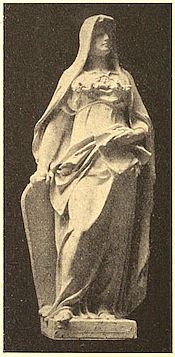
LAW.
BY PAUL W. BARTLETT.
The alcoves are arched and enclose great semi-circular
windows filled with stained glass, which
furnish the greater part of the light needed for the
room. The arches springing from the piers support
a heavy circular entablature, immediately
above which is the dome, arched in the line of
an exact circle and supported upon eight ribs dividing it into eight sections
or compartments. The ribs are the essential feature of the dome construction,
and continue naturally the line of support of the great piers which
are the ultimate support of the whole interior—a fact which is more
clearly brought out to the eye by paired consoles or brackets introduced
in the entablature between the two and seeming to carry the weight from one
to the other.
The surface of the dome is of stucco, attached to a framework of iron and
steel filled in with terra cotta, and richly ornamented with coffers and with a
very elaborate arabesque of figures in relief. At the top, where the dome prepares
to join the lantern, the ribs terminate against a broad circular “collar,”
so called, containing a painted decoration by Mr. Edwin Howland Blashfield.
Finally comes the lantern, thirty-five feet in height, and pierced by eight windows,
recalling the octagonal arrangement with which the construction began. The
shallow dome which covers the lantern is ornamented with a second painting
by Mr. Blashfield, summing up the idea of his decoration in the collar.
At the risk of some tediousness, perhaps, but thinking that afterwards the
connection between the decoration and the architecture would be more clearly
understood, the writer has given this general description of the Rotunda, in
order that the visitor might immediately see what portion of the whole was
essential and what not essential; what was “structural” and vital, in other
words, and what not. It will have been observed that we have, on the outside,
an octagon supporting a shallow dome, on which rests the lantern. Well within
this is an octagonal arrangement of piers carrying
a much steeper dome. Alcoves occupy the space
between the inner and outer octagons. Between
the two domes—the inner shell and the outer—is
vacancy. The whole exterior—walls, dome,
and lantern—the partitions back of the piers,
and the connecting screens: all could be torn
away and the inner dome still remain secure on
its eight massive piers.
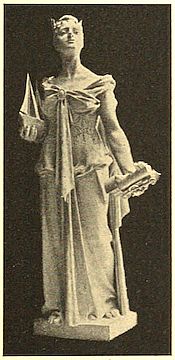
COMMERCE.
BY JOHN FLANAGAN.
The piers are constructed of brick, veneered
with marble from Numidia in Africa, curiously
mottled and in color a sort of dusky red. The
high base on which the pier rests is sheathed with
a chocolate brown variety of the familiar close-grained
Tennessee marble. The height of the
piers, including base and capital, is forty-four
feet.
The screens are built solidly of marble from
Sienna, Italy, which encloses in its rich black
veining almost every variety of yellow, from cream
color to dark topaz. Like the piers, the screens
are erected upon a Tennessee marble base, in
this case, however, very much lower—four feet
to the other’s eleven. The arcading of the screens
is in two stories, the first of three and the second
of seven arches. At the top of each screen the
gallery is railed in by a heavy balustrade—still
of the same Sienna marble—connected with which are two marble pedestals
which bear bronze statues of illustrious men. The screens are alike on every
side of the octagon but two, the west and the east—the former the entrance
from the Staircase Hall, and the latter affording a way through to the east side
of the building. In both instances, therefore, the central arch is accentuated by
free standing columns. In the second story of the west screen, also, still another
modification has been made in order to allow space for a large clock—the three
middle arches giving place to a rich architectural setting ornamented with bronze
statuary.
The Alcoves.—The alcoves behind the screens are in two stories, like the
arcading, and are intended to contain a collection of the most necessary
standard books on all important topics. The entrance from the floor of the
Reading Room is through the central arch of the screen. One may pass through
doors in the partitions from one alcove to another, on either floor; and by
means of a winding staircase inside each of the piers one may go up or down,
not only from story to story, but, on the one hand, into the basement below,
and, on the other, to the space between the inner and the outer dome above.
Altogether, the alcoves have a capacity, with their present shelving, of 130,000
volumes. The cases are of iron, and similar in a general way to those in the
large stacks, to be described later; but they are built against the walls, according
to the older method of library arrangement, and with very little attempt to
combine them in a real stack system, properly so called. The upper shelves
in the lower story are reached from a small iron gallery; in the second story a
step-ladder must be used—the only instance in the
whole building where a book-shelf cannot be reached
by a person standing on the floor.
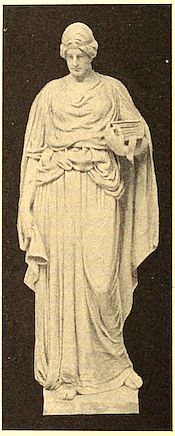
PHILOSOPHY.
BY BELA L. PRATT.
In front of each of the great piers of the Rotunda
is an engaged column, so called because it is not
quite clear of the mass behind it, which serves as the
ultimate support of a statue placed between the arches
upholding the dome. In height, base, and capital, it
is the same as the pier with which it is connected, and,
like it, is sheathed in Numidian marble, but not so
dark in tone, since the burden resting on the column
includes no part of the dome, and is therefore
much lighter than that borne by the pier.
The engaged columns, however, join with the piers
to carry an elaborate entablature some seven feet in
height, which, finding its way in and out of the alcoves
from pier to pier, completely encompasses the room.
The color of the entablature, which is entirely of
stucco, is a cream or ivory white, like the dome,
touched sparingly with gold. The mouldings, which
are of the usual Greek patterns employed in Renaissance
architecture, are very rich and heavy. The
topmost member of the cornice is boldly projected
upon a series of modillions, the soffits between being
ornamented with rosetted coffers—gilt on a blue
ground. The frieze is enriched with an arabesque
of Renaissance ornament in relief, including antique
urns and lamps; garlands enclosing tablets; and
winged half-figures. The general design of the frieze, as of all such work in
the Library, is by Mr. Casey as architect; the individual figures, however, were
modelled by Mr. Weinert.
The Symbolical Statues.—The eight statues set upon the entablature
over the engaged columns represent eight characteristic features of civilized
life and thought. From the floor to the plinth or base on which they stand is
a distance of fifty-eight feet; each is ten and a half feet, or, including the
plinth, eleven feet high. All are of plaster, toned an ivory white to match the
general tone of the stucco decoration throughout the room, and are effectively
placed against the plain red pendentives of the dome as a background. The
title of each is inscribed in gilt letters in a tablet in the frieze below. Beginning
with the figure directly to the right as one enters the west gallery of the
Rotunda, the order is as follows: Religion, modelled by Mr. Theodore Baur;
Commerce, by Mr. John Flanagan; History, by Mr. Daniel C. French; Art,
by a French artist, Mr. Dozzi, after sketches by Mr. Augustus St. Gaudens;
Philosophy, by Mr. Bela L. Pratt, who modelled the granite spandrels of the
Main Entrance; Poetry, by Mr. J. Q. A. Ward; Law, by Mr. Paul W. Bartlett;
and Science, by Mr. John Donoghue.
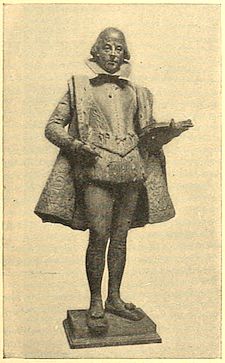
SHAKESPEARE.
BY FREDERICK MACMONNIES.
Nearly all bear some appropriate and distinguishing object. Religion holds
a flower in her hand, seeming to draw from it the lesson of a God revealed in
Nature. Commerce, crowned with a wreath of the peaceful olive, holds in her
right hand a model of a Yankee schooner, and in her left a miniature locomotive.
History has a book in her hand,
and with an obvious symbolism holds up
a hand-glass so that it will reflect things
behind her. Art is unlike the other
figures in being represented as nearly
nude. She is crowned with laurel, and
bears a model of the Parthenon. Beside
her is a low tree, in the branches
of which are hung a sculptor’s mallet
and the palette and brush of the painter.
Philosophy is a grave figure with downcast
eyes, carrying a book in her hand.
The garment of Poetry falls in severe
lines, which suggest the epic and the
more serious forms of the drama, rather
than the lighter aspects of the Muse.
Law has a scroll in her hand; a fold of
her robe is drawn over her head to signify
the solemnity of her mission; and
beside her is the stone Tablet of the
Law. Science holds in her left hand a
globe of the earth, surmounted by a triangle.
In her right hand is a mirror,
not, like History’s, turned backward, but
held forward so that all may perceive the
image of Truth.
Above each statue the pendentive of
the dome is occupied by a group in
plaster, sculptured by Mr. Martiny, consisting of two winged geniuses, modelled
as if half flying, half supported on the curve of the arches, and holding between
them a large tablet carrying an inscription in gilt letters. Above the tablet is
a pair of crossed palm-branches (meaning peace), and below are the lamp and
open book symbolical of learning, these last being surrounded by an oak-wreath,
typifying strength—the whole group thus signifying the power and
beneficence of wisdom.
The inscriptions were selected by President Eliot of Harvard University,
who several years before had furnished the memorable sentences carved upon
the Water Gate at the World’s Fair in Chicago. Each is appropriate to the
subject of the statue below it.
Thus, above the figure of Religion are the words:—
What doth the Lord require of thee, but to do justly, and to love
mercy, and to walk humbly with thy God?
Micah vi, 8.
Above the figure of Commerce:—
We taste the spices of Arabia yet never feel the scorching sun
which brings them forth.
Anonymous.[9]
Above the figure of History:—
One God, one law, one element,
And one far-off divine event,
To which the whole creation moves.
Tennyson.
Above the figure of Art:—
As one lamp lights another, nor grows less,
So nobleness enkindleth nobleness.
Lowell.
Above the figure of Philosophy:—
The inquiry, knowledge, and belief of truth is the sovereign good of
human nature.
Bacon.
Above the figure of Poetry:—
Hither, as to their fountain, other stars
Repairing, in their golden urns draw light.
Milton.
Above the figure of Law:—
Of law there can be no less acknowledged than that her voice is the
harmony of the world.
Hooker.
Above the figure of Science:—
The heavens declare the glory of God; and the firmament sheweth
his handiwork.
Psalms xix, 1.
The Portrait Statues.—The sixteen bronze statues set along the balustrade
of the galleries represent men illustrious in the various forms of thought
and activity typified in the figures just described. The arrangement of the
statues is in pairs, each pair flanking one of the eight great piers of the Rotunda.
The list of those who have been thus selected to stand as typical representatives
of human development and civilization is as follows: Under Religion,
Moses and St. Paul; Commerce, Columbus and Robert Fulton; History,
Herodotus and Gibbon; Art, Michael Angelo (a single figure, but standing at
once for Architecture, Sculpture, and Painting) and Beethoven; Philosophy,
Plato and Lord Bacon; Poetry, Homer and Shakespeare; Law, Solon and
Chancellor Kent (the author of the well-known Commentaries); Science, Newton
and Professor Joseph Henry. The sculptors were: of the Moses and Gibbon,
Mr. Charles H. Niehaus; St. Paul, Mr. John Donoghue (the sculptor of the figure
of Science); Columbus and Michael Angelo, Mr. Paul W. Bartlett (who modelled
the figure of Law); Fulton, Mr. Edward C. Potter; Herodotus, Mr. Daniel C.
French (History); Beethoven, Mr. Theodore Baur (Religion); Plato and
Bacon, Mr. John J. Boyle; Homer, Mr. Louis St. Gaudens; Shakespeare,
Mr. Frederick Macmonnies (who did the central doors at the Main Entrance);
Solon, Mr. F. Wellington Ruckstuhl (the sculptor of the busts of Goethe, Macaulay,
and Franklin, in the Entrance Portico); Kent, Mr. George Bissell;
Newton, Mr. C. E. Dallin; and Henry, Mr. Herbert Adams, whom the visitor
already knows for his work in connection with Mr. Warner on the bronze entrance
doors, as well as for his little figures of Minerva in the Main Vestibule.
Of these figures, two, the Moses and St. Paul, are ideal, though modelled, in
a general way, according to conventions long established in Christian art. The
Solon is an original study, although, of course, aiming to be entirely Greek in
spirit and costume. The Homer follows an ancient ideal bust. The Herodotus
and Plato are studied from original Greek sculptures. The features of the other
ten are taken from portraits from life, and the costumes are accurately copied
from contemporary fashions.
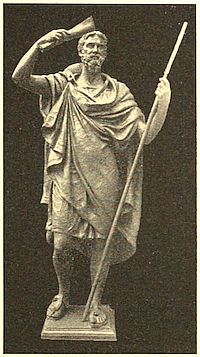
HERODOTUS.
BY DANIEL C. FRENCH.
The Moses of Mr. Niehaus holds the Table
of the Law, and, like Michael Angelo’s famous
figure, is horned—a curious convention
which crept into art from an ancient mistranslation
of a passage in Exodus. The St. Paul
is a bearded figure, one hand on the hilt of a
great two-edged sword, and the other holding
a scroll. Mr. Ruckstuhl has conceived his
Solon as the typical law-giver of the ancient
world. He is represented as stepping forward,
clothed in all the power of the state, to
announce at a solemn gathering of the people
the supremacy of Law over Force. A fold
of his garment is drawn over his head with
a certain priestly suggestion, as if the laws
he proclaimed were of divine origin. He
holds aloft, in his left hand, a scroll bearing
the Greek words OI NOMOI, which, though
meaning simply “The Law,” were understood
as referring especially to Solon’s enactments.
His right hand rests upon a sheathed
and inverted sword, which is wreathed with
laurel. The idea is that law has supplanted
force, but that force is always ready to carry
out the mandates of the law. Homer is represented
with a staff in his hand and a wreath
of laurel crowning his head. Mr. French represents Herodotus as a traveller,
searching the known world for the materials of his histories. His garments are
girt up, he bears a long staff in one hand, and shades his eyes with a scroll as
he gazes into the distance to discover his destination. The Fulton carries a
model of a steamboat, and the Henry an electro-magnet, for discoveries in
electrical science. The Beethoven shows the composer with his hand uplifted
as if to beat the measure of the harmony which has suddenly come into
his mind—so suddenly that in the eagerness of his movement he has pulled
the pocket of his greatcoat inside out. Mr. Macmonnies’s Shakespeare is a
somewhat novel study, so far as the head is concerned; it is a composite of
the portrait in the first collected edition of the Plays and of the Stratford bust.
The figure of Kent wears the judicial ermine; he carries in one hand the manuscript
of his Commentaries, and holds a pen in the other. Of the other figures,
some, like the Gibbon, carry a book or pen; but in most instances the sculptor
has sought merely to give his subject an appropriately noble and contemplative
attitude and expression, without trying to introduce any special symbol of
his work.
Mr. Flanagan’s Clock.
[10]—Still another piece of sculpture—the group
ornamenting the great clock over the entrance to the Rotunda—remains to be
spoken of before passing on to a description of the dome and Mr. Blashfield’s
decorations. It is the work of Mr. John Flanagan, the sculptor of the figure
of Commerce, and, taken altogether, is one of the most sumptuous and magnificent
pieces of decoration in the Library. The clock itself is constructed of
various brilliantly colored precious marbles, and is set against a background of
mosaic, on which are displayed, encircling the clock, the signs of the zodiac,
in bronze. Above is a life-size
figure, executed in high relief in
bronze, of Father Time, striding
forward scythe in hand. To the
left and right are the figures of
maidens with children, also in
bronze, representing the Seasons.
The dial of the clock is about
four feet in diameter; in the
centre is a gilt glory, or “sunburst.”
The hands, which are
also gilded, are jewelled with
semi-precious stones.
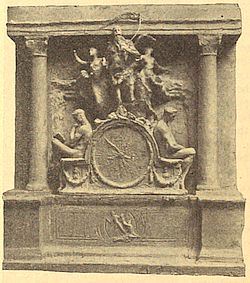
THE ROTUNDA CLOCK.
BY JOHN FLANAGAN.
Including, of course, Mr. Weinert’s
and Mr. Martiny’s work, it
will be seen that no less than
nineteen American sculptors have
contributed to the decoration of
the Rotunda. Considering the
room—just for the moment, and
for the sake of the special point
of view—merely as a Gallery of
Statuary, it will be seen how important
and representative a collection
of American sculpture has been brought together. The choosing of the
sculptors to be commissioned, and of the work to be assigned to each—not
only here but throughout the Library—were necessarily matters of very careful
consideration. To aid in this work, General Casey secured the advice of the
President of the National Sculpture Society (the authoritative organization in
such matters), then as now Mr. J. Q. A. Ward, who associated with him as a
committee two others of the most prominent members of the Society. This
committee went into the question very thoroughly, and as a result recommended
the sculptors for the Entrance Portico, the bronze entrance doors, the Commemorative
Arch in the Staircase Hall, and the Rotunda. Their advice was
accepted in toto, with the result, barring a few changes made necessary by subsequent
circumstances, that the visitor has now seen.
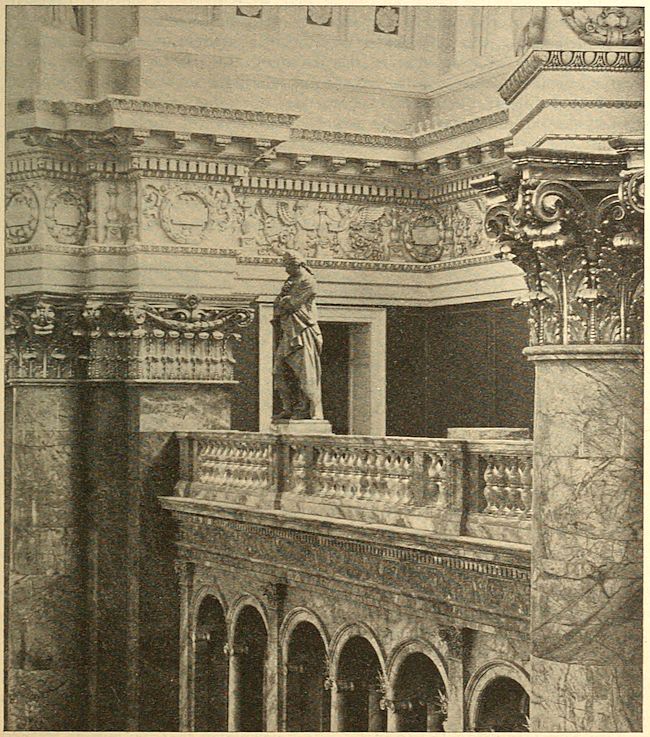
DETAIL OF THE ROTUNDA.
SHOWING THE STATUE OF GIBBON.
The Lighting of the Rotunda.—The soffits of the arches upholding
the dome are ornamented with a row of plain coffers; the larger arches which
roof the alcoves within, carry a triple row of more elaborate coffers, each with
a gilt rosette. The windows of stained glass, already spoken of as enclosed
by these arches, are semicircular in form and measure thirty-two feet across at
the base. They furnish the greater part of the light needed for the illumination
of the room. No shadows are cast in any direction. Being so high above
the floor, the light from them is much more effective than if they were nearer
the level of the reader’s eye. They are better even than skylights, and with
none of the disadvantages of skylights. Other sources of light are the various
little windows pierced in the four walls of the Octagon which face the interior
courts; and, above, the eight windows of the Lantern. It has been said that
no reading room in the world is so well lighted—so steadily, abundantly and
uniformly, whether on the brightest or the darkest day. Mr. Blashfield’s paintings
in the dome, for example, can hardly be said to receive direct light from
a single window in the room, but for all that, so perfectly is the light diffused,
they are as easily made out as any decorations in the building.
In the evening, the light, which is furnished entirely by electric lamps, is
quite as perfect in its way as in the daytime. In the second story of the
arcading of the marble screens, a brass rod runs between the capitals of each
arch, supporting in the centre a brass star of eight points, each point an
electric lamp of thirty-two-candle power. With seven of these in each screen
(except the west, where Mr. Flanagan’s clock leaves room for only four),
and eight screens, one has a total of four hundred and twenty-four lamps
thus used. Above the cornice of the second entablature is a great ring containing
three hundred and eight more. Similarly, a line of fifty lamps occurs
at the bottom of each of the semicircular windows, making four hundred in all;
and in the eye of the lantern, so placed, however, that the lamps themselves are
invisible, is a second ring numbering forty-six. On the floor, the reading desks
are equipped, altogether, with sixty-eight bronze standards, each bearing three
lamps, or two hundred and four in all. Add the number, seventy-six, which
serve to light the Distributing Desk and the lower story of the alcoves, and the
result is a grand total of fourteen hundred and fifty-eight, and a total candle-power
of upwards of forty thousand. When the current is turned on and all
these lamps are lit, the Rotunda presents a spectacle of light and shadow worth
going far to see.
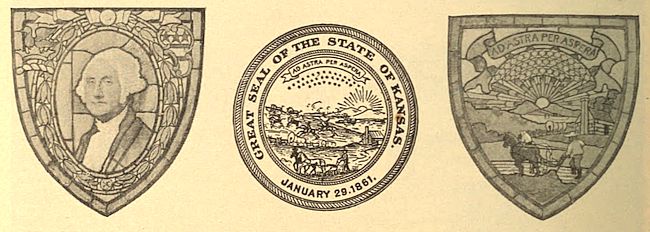
SEALS OF WASHINGTON AND KANSAS.—BY H. T. SCHLADERMUNDT.
WITH AUTHORIZED SEAL OF KANSAS IN THE CENTRE.
The Semicircular Windows.—It is calculated that, by putting stained
glass in the eight semicircular windows, the amount of light admitted has been
diminished almost exactly one-eighth; in other words, the result is the same
as if one of the eight had been quite closed up. The loss, of course, is hardly
appreciated in a room sufficiently supplied with light from such a number of
sources.
The windows are double, with about four inches between the two sashes.
The glass used for the outside is plain, but of different degrees of translucency,
according as it is necessary to prevent the entrance of direct sunshine, which,
if admitted, would be disagreeable to the occupant of the room and would
distort the desirable even effect of the stained glass within. Thus, in the east
and west, ribbed skylight glass is used; in the southeast, south, and southwest,
ribbed and ground glass; while on the other three sides, where the sun never
comes, the glass is left perfectly clear.
The cartoons for the stained glass were made by Mr. Schladermundt, after
designs prepared by the architect, Mr. Casey. The ground is a crackled white,
leaded throughout into small, square panes. In order to give an effect of boldness
and strength, the windows are divided vertically by heavy iron bars. The
design is surrounded by a richly colored border of laurel, combined with
rosettes and Roman fasces. At the top, in the middle of each window, is the
great seal of the United States, four feet high, surmounted by the American
eagle, whose outstretched wings measure eight feet from tip to tip. To the
right and left, following the curve of the window, are the seals of the States
and Territories, three on a side, or six in each window, so that forty-eight—excluding
only Alaska and Indian Territory—are contained in the eight windows.
Torches alternate with the seals, and the fasces are introduced at the
bottom.
The name of the State or Territory is inscribed above each seal, with the
date of the year in which it was admitted to the Union, or organized under a
territorial form of government. The seals occur in the order of their dates, the
series beginning with the Thirteen Original States—which start in the easterly
window in the order in which they signed the Constitution—and continuing
around the room to the three Territories of New Mexico, Arizona, and Oklahoma.
Taken all in all they form one of the most interesting decorations in
the Library, for the reason that the artist has succeeded in making a harmonious
whole out of a very heterogeneous collection of designs. The originals, of
course, were separately drawn, often by persons unacquainted with heraldry,
and never with any particular thought of fitting them into a single series like
the present. The result is that these originals show the greatest diversity of
treatment. The key, so to speak, is continually changing. Sometimes, for example,
a figure introduced in the foreground is dwarfed by an altogether disproportionate
background, while in other cases the figure overpowers everything
else; copied exactly, any heraldic or artistic unity of effect would be
entirely lacking. Accordingly, after getting together a complete collection of
the seals—in every instance an authentic impression of the original obtained
from the State secretary—Mr. Schladermundt re-drew, and often almost redesigned
his material to bring it into accordance with his decorative scheme.
Just what it was that Mr. Schladermundt undertook to do may best be seen in
the accompanying engravings of the Seal of Kansas, the first giving the seal
as used on official papers, the second copied from Mr. Schladermundt’s cartoon.
It will be seen that the spirit of the seal and its heraldic intention are the same
in both. The only difference is that in Mr. Schladermundt’s design certain
changes of proportion have been made to make the seal harmonize with the
style to which the artist wished to have all his designs adhere. In many cases,
particularly in the seals of the Thirteen Original States, the original has hardly
been changed at all. In the seal of the State of Washington, indeed, which
consists merely of a portrait of Washington himself, Mr. Schladermundt has
unobtrusively added the Washington arms in the upper corner of the design,
in order to suggest the desirable heraldic conventionality more fully; occasionally,
too, it has been necessary to omit certain minor details as being
unsuited to the breadth of treatment necessary in stained glass—but, as a
rule, Mr. Schladermundt has followed very carefully the specifications contained
in the authoritative legislative enactments.
DOME ORNAMENT.
BY ALBERT WEINERT.
The Dome.—A vertical section of the dome of
the Rotunda would show an exact half circle, with a
diameter of one hundred feet. As has been said before,
the dome is of stucco, applied to a framework of
iron and steel, filled in with terra cotta. Although, as
previously described, it appears to rest upon the deep
upper entablature, it really springs immediately from
the eight arches resting upon the great piers. The
entablature, as will be seen on a close inspection,
bears no part in the construction. It is projected
so far forward from the dome that one may easily
walk between the two.
The entablature is about seven feet high, with a
richly moulded architrave and a heavy projecting cornice.
The ground of the frieze is gilt, with a relief
ornament in white of eagles standing upon hemispheres
and holding in their beaks a heavy garland of
laurel. Over the north, south, east, and west arches,
are two female figures—the work of Mr. Philip Martiny—represented
as seated upon the architrave
moulding and supporting a heavy cartouche—another
instance of the emphasis which the architect has so
often placed upon the four main axes of the building.
HALF FIGURES.
BY ALBERT WEINERT.
The Stucco Ornamentation.—The dome is so simply planned that a
description of its main features may be given in a very brief space. The surface
is filled with a system of square coffers. The ornamentation of the body
of the dome is in arabesque. The eight ribs which mark off the dome into
compartments are each divided into
two by a band of gilded ornament resembling
a guilloche. The coffers diminish
in size from four and a half feet
square at the bottom to two and a half
feet at the top. The total number of
coffers is three hundred and twenty—or
forty in each compartment, and also
in each horizontal row, and eight in
each vertical row. The ground of the
coffers is blue, the sky-color, as if one
were really looking out into the open
air—and therefore the color traditionally
used in coffering. To give sparkle and brilliancy, many shades and kinds of
blue are used, the darker and heavier at the bottom, and the lighter and airier
toward the top. The transition is so gradual and natural that the eye does not
perceive any definite change, but only a generally increased vividness. The
border mouldings of the coffers are cream-colored—old ivory is the usual term—strongly
touched with gold, and in the centre of each is a great gold rosette.
Although the purpose of the dome arabesque is primarily to give an agreeable
impression of light and shade, the individual figures of which it is composed
are nearly as interesting a study as the general effect of the whole. The
variety of the figures is almost bewildering—lions’ heads, sea-horses, dolphins,
urns, cartouches, griffins, shells, storks, caryatides, tridents, eagles, cherubs,
half-figures, geniuses—altogether something like forty-five principal type-designs,
interwoven with very many smaller but no less beautiful pieces of
ornament. All are adapted from Renaissance models of the best and purest
period, and are combined with the utmost spirit and harmony in an arabesque
whose every portion has equal artistic value. No single figure catches the eye;
broad horizontal and vertical bands of decoration, gradually diminishing as
they approach the top, encircle and ascend the dome, each with its particular
“note” of arrangement and design, but all cunningly united to form an indisputable
whole, everywhere balanced and restrained.
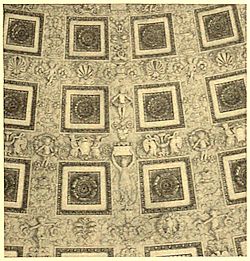
DETAIL OF THE DOME.
It may be of interest to the visitor to learn that one of the most novel and
ingenious pieces of engineering connected
with the construction of the
Library was a so-called “travelling”
or rotary scaffold, devised by Mr.
Green for the use of the workmen
employed on the stucco decorations
of the dome. It may be likened to a
huge pair of steps, ascending from the
upper entablature to the lantern. Its
upper end thrust against an iron pintle
secured to beams laid across the eye
of the lantern, and was steadied at
the bottom by a pair of flanged wheels,
which travelled on a track in the entablature,
so that the whole apparatus
could be traversed entirely round the
room. The various stages or landings
were adjusted to fit the concave of
the dome, with the result that the
accuracy of the curve could be tested with almost mathematical exactness.
At one time two of these scaffolds were swung to the same pintle.
Mr. Blashfield’s Paintings.—The position of Mr. Blashfield’s decorations
in the Collar and Lantern of the dome is the noblest and most inspiring
in the Library. They are literally and obviously the crowning glory of the
building, and put the final touch of completion on the whole decorative scheme
of the interior. The visitor will see how, without them, not a painting in the
building would seem to remain solidly and easily in its place, for they occupy not
only the highest, but the exact central point of the Library, to which, in a sense,
every other is merely relative.
As was hinted in the description of Mr. Vedder’s paintings, Mr. Blashfield
was almost necessarily drawn to select some such subject as he has here chosen—the
Evolution of Civilization, the records of which it is the function of a great
library to gather and preserve.
The ceiling of the Lantern is sky and air, against which, as a background,
floats the beautiful female figure representing the Human Understanding,
lifting her veil and looking upward from Finite Intellectual Achievement (typified
in the circle of figures in the collar) to that which is beyond; in a word,
Intellectual Progress looking upward and forward. She is attended by two
cherubs, or geniuses; one holds the book of wisdom and knowledge, the other
seems, by his gesture, to be encouraging those beneath to persist in their
struggle towards perfection.
The decoration of the collar consists of a ring of twelve seated figures, male
and female, ranged against a wall of mosaic patterning. They are of colossal
size, measuring, as they sit, about ten feet in height. They represent the
twelve countries, or epochs, which have contributed most to the development
of present-day civilization in this country. Beside each is a tablet, decorated
with palms, on which is inscribed the name of the
country typified, and below this, on a continuous
banderole or streamer, is the name of some chief or
typical contribution of that country to the sum of
human excellence. The figures follow each other in
chronological order, beginning, appropriately enough,
at the East, the East being the cradle of civilization.
The list is as follows: Egypt, typifying Written Records;
Judea, Religion; Greece, Philosophy; Rome,
Administration; Islam, Physics; The Middle Ages,
Modern Languages; Italy, the Fine Arts; Germany,
the Art of Printing; Spain, Discovery; England, Literature;
France, Emancipation; and America, Science.
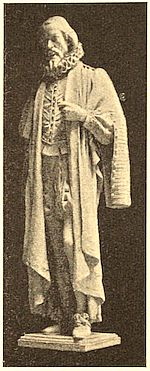
BACON.
BY JOHN J. BOYLE.
Each figure is winged, as representing an ideal, but
the wings, which overlap each other regularly throughout,
serve mainly to unite the composition in a continuous
whole, and in no case have been allowed to
hamper the artist in his effort to make each figure
the picture of a living, breathing man or woman.
Four of the twelve figures, it will be observed, stand
out more conspicuously than the rest on account of
the lighter tone of their drapery—Egypt, Rome,
Italy, and England. They occupy respectively the
east, south, west, and north points in the decoration,
and furnish another instance of the stress that has
been laid, throughout the Library, upon the four cardinal
points of the compass which govern the axial
lines of the building, and which in turn have been enriched and dignified in
the final decorative scheme of the interior. Each of these axial figures is
painted in a more rigid attitude than those beside it, and forms, as will be
noticed, the centre of a triad, or group of three, each of the flanking figures
leaning more or less obviously toward it. It should be noted that there was
no intention on the part of the painter to magnify the importance of the four
figures thus represented over any of the others. The emphasis of color is
solely for decorative purposes. The arrangement being chronological, Mr.
Blashfield was unable to exercise much control over the order in which each
figure should occur, and still retain his original selection of countries.
Egypt is represented by a male figure clad in the waistcloth and cap with
lappets so familiar in the ancient monuments. The idea of Written Records
is brought out by the tablet he supports with his left hand, on which is inscribed
in hieroglyphics the cartouche or personal seal of Mena, the first recorded Egyptian
king; and by the case of books at his feet, which is filled with manuscript
rolls of papyrus, the Egyptian paper. Besides the idea of Writing and Recording,
Mr. Blashfield brings out the fact that the Egyptians were among the first
who held the doctrine of the immortality of the soul. The figure holds in the
right hand the Tau, or cross with a ring head, the emblem of life both in this
world and beyond it; and on the tablet behind his feet is the winged ball, the
more familiar symbol of the same idea.
Judea is shown as a woman lifting her hands in an ecstatic prayer to Jehovah.
The over-garment which she wears falls partly away, and discloses the ephod,
which was a vestment worn by the high priests, ornamented with a jewelled
breastplate and with onyx shoulder clasps set in gold, on which were engraved
the names of the Twelve
Tribes of Israel. On the
face of a stone pillar set
beside her is inscribed, in
Hebrew characters, the
injunction, as found in
Leviticus, xix, 18: Thou
shalt love thy neighbor as
thyself—a sentence selected
as being perhaps
the noblest single text
contributed by the Jewish
race to the system of
modern morality. In her
lap is a scroll, containing,
presumably, a portion of
the Scriptures; and at her
feet is a censer, typical of
the Hebrew ritualism.
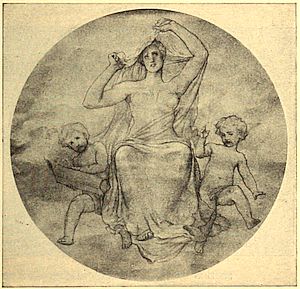
THE HUMAN UNDERSTANDING.—BY E. H. BLASHFIELD.
The figure of Greece is
distinctly suggestive, so
far as attitude and drapery
are concerned, of one of
the beautiful little Tanagra
figures of terra-cotta—so called from the ancient Greek town in which they
were first discovered—which are so familiar to students of Greek art. A
bronze lamp is set beside her, and in her lap is a scroll—the emblems of
wisdom. Her head is crowned with a diadem—possibly with a reference to
the City of the Violet Crown, Athens, the Mother of Philosophy.
Rome, the second axial figure, wears the armor of a centurion, or captain in
a legion. A lion’s skin, the mark of a standard-bearer, is thrown over him, the
head covering the top of his casque. The whole conception is that of the just
but inexorable administration of Rome founded upon the power of its arms.
One foot is planted upon the lower drum of a marble column, signifying stability.
His right arm rests upon the fasces, or bundle of rods, the typical emblem
of the Roman power and rule. In his right hand he holds the baton of
command.
Islam is an Arab, standing for the Moorish race which introduced into Europe
not only an improved science of Physics, as here used by Mr. Blashfield
in its older and less restricted sense—but of mathematics and astronomy also.
His foots rests upon a glass retort, and he is turning over the leaves of a book
of mathematical calculations.
By the term Middle Ages, represented by the female figure which comes next
in the decoration, is usually understood the epoch beginning with the dissolution
of the Western Roman Empire in 455 and ending with the discovery of America
in 1492. No single country is here indicated, for Europe was throughout
that period in a state of flux, so to say, in the movement of which the principal
modern languages were finally evolved from the Latin and Teutonic tongues.
But it was an epoch notable for many other things, also. The figure typifying
the epoch is distinguished by an expression at once grave and passionate, and
has a sword, casque and cuirass, emblematic of the great institution of Chivalry;
a model of a cathedral, standing for Gothic Architecture, which was brought to
its greatest perfection in these thousand years; and a papal tiara and the keys
of St. Peter, signifying mediæval devotion and the power of the Church.
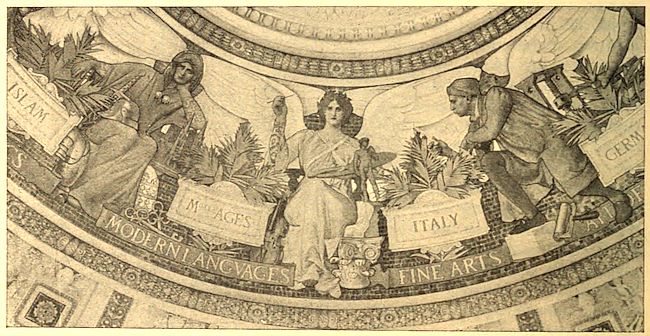
SECTION OF THE DOME DECORATION.—BY EDWIN H. BLASHFIELD.
The next figure, Italy—the Italy of the Renaissance—is shown with symbols
of four of the Fine Arts which she represents—Painting, Sculpture, Architecture,
and Music. She holds a palette in her left hand, and with the brush
in her right seems about to lay another stroke of color on her canvas. To her
left is a statuette after Michael Angelo’s celebrated David, in Florence. At her
feet is a Renaissance capital; and leaning against the wall a violin, at once the
typical musical instrument and that in the manufacture of which the Italians
peculiarly excelled.
Germany is the printer, turning from his press—a hand-press, accurately
copied from early models—to examine the proof-sheet he has just pulled.
His right foot is placed upon a pile of sheets already corrected, and a roller for
inking lies convenient to his hand.
Spain is the sixteenth century Spanish adventurer. He wears a steel morion
on his head, and is clad in a leathern jerkin. Holding the tiller of a ship in
his right hand, he seems to be watching for land to appear in the sea.
Beside him is a globe of the earth, and at his feet a model of a caravel, the sort
of ship in which Columbus sailed on his voyages, is introduced.
England wears the ruff and full sleeves of the time of Elizabeth—the era
when English Literature, both poetry and prose, was at its highest. She is
crowned with laurel—the reward of literature—and bears in her lap an open
book of Shakespeare’s Plays—the right-hand page with a facsimile of the title-page
of the first edition of A Midsummer Night’s Dream, dated 1600.
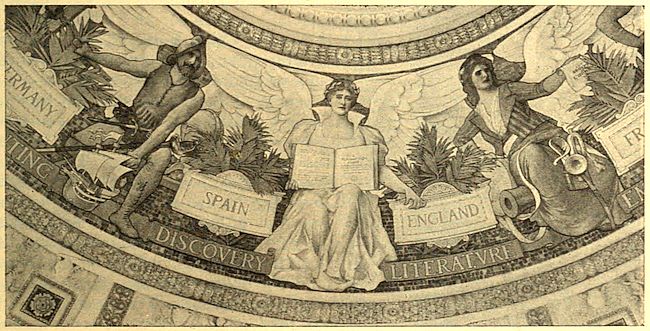
SECTION OF THE DOME DECORATION.—BY EDWIN H. BLASHFIELD.
France, standing for Emancipation and the great revolutionary upheaval of
the eighteenth century, is dressed in a characteristic garb of the First Republic—a
jacket with lapels, a tricolor scarf, and a liberty-cap with a tricolor cockade.
She sits on a cannon and carries a drum, a bugle, and a sword—emblems
of her military crusade in behalf of liberty. In her left hand she displays a
scroll bearing the words “Les Droits de l’Homme,” the famous Declaration of
the Rights of Man adopted by the French Assembly in 1789.
The twelfth and last figure, bringing us once more round to the east, is that
of America—represented as an engineer, in the garb of the machine-shop,
sitting lost in thought over a problem of mechanics he has encountered. He
leans his chin upon the palm of one hand, while the other holds the scientific
book which he has been consulting. In front of him is an electric dynamo—recalling
the part which the United States has taken in the advancement of
electrical science.
On the base of the dynamo, Mr. Blashfield has signed his work in an inscription
which recalls also the name of the artist who assisted him in laying it
upon the plaster: “These decorations were designed and executed by Edwin
Howland Blashfield, assisted by Arthur Reginald Willett, A. D. MDCCCLXXXXVI.”
The visitor will perhaps have been a little perplexed by the familiar appearance
of some of the faces in Mr. Blashfield’s decoration. It is an interesting
fact that in several cases Mr. Blashfield has introduced a resemblance, more or
less distinct, to the features of some real person in order to give greater variety,
and, above all, greater vitality to his figures. The persons chosen were
selected because the character of their features seemed to him peculiarly suited
to the type which he wished to represent. In the case of Abraham Lincoln—the
figure of America—and of General Casey—the Germany—the choice
was fitting for other reasons. Among the female figures, The Middle Ages is
Mrs. De Navarro (Mary Anderson), and England, Miss Ellen Terry. The
faces of Italy and Spain are from sketches made from Miss Amy Rose, a young
sculptor in New York, and Mr. William Bailey Faxon, the painter, respectively.
France suggests the features of the artist’s wife.
Throughout, however, it must be remembered
that, to use Mr. Blashfield’s own words, “no
portraiture has been attempted, but only characterization.”
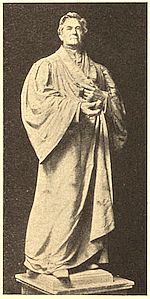
HENRY.
BY HERBERT ADAMS.
The Rotunda Color Scheme.—One can
hardly leave this description of the decoration of
the Rotunda without a word respecting the general
color scheme. Beginning with the brown,
red, and yellow marbles at the base, one ends
with the pure whites and bright greens and violets
of Mr. Blashfield’s final decoration. The difference
between these two extremes has been
bridged over by the use of harmonizing colors
on the walls and in the dome. The Pompeiian
red of the alcove walls and the pendentives is
suggested by the Numidian marble of the piers.
A touch of brown on the wall below the semicircular
windows echoes the brown Tennessee base, and
the yellow predominant in the alcove arches
above derives from the Sienna screens. These
last, again, in their lightest portions, strike the
key for the “old ivory”—the delicate gray
yellow—which, either deeper or lighter, is always
the ruling tone of the entablature, the dome,
and the sculptural figures in plaster. The
coffers of the dome, one will notice by looking closely, are defined by a
narrow band of yellow or red—yellow throughout one whole compartment,
and red in the next. The former carries up (more markedly than in the
ivory-toned stucco) the color of the screens; the latter the color of the
piers. The blue ground, moreover, and the yellow stripe create together,
whether one will or not, an impression of green upon the eye, because green
is compounded of blue and yellow; and the blue and the red, in turn, create
an impression of violet, for a similar reason. Thus, the visitor, glancing up to
the decorations of the collar, is already prepared for Mr. Blashfield’s two dominating
tones. The white is expected as the natural result of a color scheme
which has been steadily growing lighter from the beginning, and, after being
used in Mr. Blashfield’s painting, it is at last appropriately employed almost
solely in the lantern which crowns the whole Rotunda. Finally, considering
the room as a whole, it will be noted that the profuse use of gold throughout
the dome and lantern is not only legitimately suggested by the Sienna marble,
but of itself helps to keep the various colors—in marble or stucco—in what
may be called a more complete “state of solution” than would otherwise have
been possible. By attracting attention to itself, it softens the contrasts between
the other colors.
The floor of the Rotunda is a kind of mosaic, known as terrazzo, ornamented
with great concentric bands of Tennessee marble. Terrazzo, sometimes called
“chip mosaic” or “granito,” is made by sprinkling a layer of small pieces of
marble upon a bed of Portland cement,
rolling it all down so that the pieces are
thoroughly embedded, and, after it is dry,
rubbing it down smooth with sandstone.
When carefully prepared, it makes an
especially durable floor.
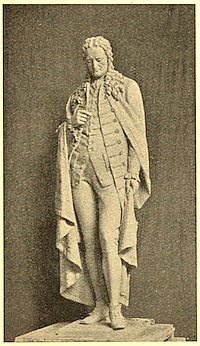
NEWTON.
BY C. E. DALLIN.
Provision for Readers.—The
reading desks are arranged in three circles,
surrounding the Distributing Desk as
a centre. Each row contains eight desks,
leaving room between for aisles radiating
from the central desk. They are constructed
of dark, heavy mahogany, and are
supported on iron standards with gratings
admitting warm or fresh air, for heating
and ventilation. The inmost row is a
combination of reading-tables, settees,
and standing writing-desks, with shelves
for reference books,—encyclopædias,
dictionaries, directories, atlases, etc.,—of
which there is a very full selection.
The outer rows are double-faced, and
arranged exclusively for persons reading
and studying. Allowing each a space of
four feet, the desks are capable of seating
altogether two hundred and forty-six
readers. Including the alcoves, which, on
account of the number of separate spaces
they contain, are well adapted to the use of
special students, particularly those desiring to turn over a large number of
books at one time, the total number of readers that can be accommodated in
the Rotunda is two hundred and eighty-nine.
The Distributing Desk is surrounded by a circular counter for attendants,
and for delivering and receiving books, and cases containing a card catalogue
of the Library, arranged alphabetically in shallow drawers according to the subject,
author, and title. It has been the policy of the Library from the beginning,
moreover, to issue its catalogue in printed volumes, new editions being
prepared as the old ones became obsolete on account of fresh accessions. Of
late years, however, the Library has grown so enormously that the annual appropriations
of Congress have not been sufficient to warrant this undertaking.
The latest volumes were published in 1881, and carried the catalogue only
through the letter “C.”
Within the enclosures formed by these various desks and cabinets is a small
elevator for bringing books by the truck-load from the basement story. The
Distributing Desk itself is built of mahogany, ornamented with panelling and
carving. On the east side it consists of a high station for the use of the Superintendent—the
officer in charge in the Rotunda—who is thus able to keep
in touch with everything doing in the room. On the other side is a cabinet
containing the terminus of the system of book-carrying apparatus connecting
the Reading Room and Stacks, and in the centre is a stairway leading to the
basement. Along the front of the desk, also, is a row of twenty-four pneumatic
tubes for the transmission of messages,
either in cylindrical pouches, as in the case of
the written applications which those desiring to
draw books are required to make out, or verbally,
by means of a mouth-piece with which each tube
is equipped. Nine tubes go to the North Stack
and nine to the South Stack, or one for every
floor. Four go to the East Stack, or one to every
other floor. An attendant for any portion of the
stack system can thus be reached at a moment’s
notice. Of the other two tubes, one goes to the
Librarian’s Room and the other connects with
the Capitol.
Each tube is numbered, and is operated by
pressing a button, the action of which indicates,
also, when the pouch is delivered at the other end.
Each tube terminates in a separate bronze case
or box, which is heavily cushioned, and closed
by self-shutting glass doors in order to prevent
noise. The tube enters at the bottom, and the
pouch is thrown against a curved “hood,” so
called, which guides it to one side so that it may
not fall back into the mouth of the tube.
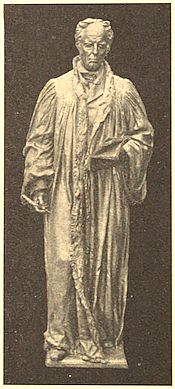
KENT.
BY GEORGE E. BISSELL.
The Book-Carrying Apparatus.—The
main features of the book-carrying apparatus
were suggested by Mr. Green, although worked
out with the assistance of ingenious mechanics.
The apparatus is in two parts, each separately
operated, the first of which connects with the North Stack and the second
with the South Stack. The East Stack is so much less extensive than the other
two that it was thought more economical to rely solely upon the services of the
attendants for the delivery and return of the books it contained. Each section
of the apparatus (north or south) consists of a pair of endless chains kept continuously
in motion, at the rate of about one hundred feet a minute, by means
of power furnished by an electric dynamo. These two chains run from the
terminal cabinet to the basement; thence on a level to the stacks; and from
there directly up a small well to the top floor, where they turn and descend.
The cable carries eighteen trays, distributed at regular intervals. Each tray
is capable of carrying a volume the size of the ordinary quarto, (say eleven
inches by ten, and four inches thick), or its equivalent in smaller volumes.
Larger books must be carried by hand down the elevator with which each stack
is provided. The tray is of brass, made in the form of a hooked comb, the
ends of the teeth being left free. The terminal cabinet and all the stack
stories are provided with toothed slides, the teeth of which engage with those
of the trays, and rake off or deliver the books, as the case may be. If one
bends and slightly opens the fingers of both hands, and then draws the fingers
of one through those of the other, the general principle of the arrangement will
immediately be seen. The tray, however, can receive books only when going
up, and can deliver them only when coming down. When a book is received
by a slide it falls into a padded basket, ready to be taken to its place on the
shelves or delivered to the reader. When the
attendant desires to deliver a book to the Rotunda,
he places it on the slide, and sets the latter so that
it will be ready to meet the first tray which arrives.
In returning books, the officer at the Distributing
Desk must set a little lever on a dial at the number
of the stack for which the book is intended. When
the tray approaches the proper floor, the slide is
automatically pushed out to receive the load.
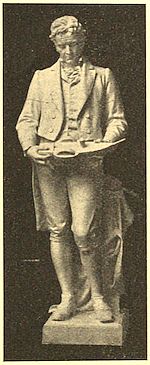
FULTON.
BY EDWARD C. POTTER.
Connection with the Capitol.—It is calculated
that, by means of the pneumatic tubes and the
book-carrying apparatus, it will require no more than
six or seven minutes to bring a book from the stacks,
from the time it is first called for. Valuable, however,
as is the use of machinery in connecting widely
distant portions of the Library, it is even more important
as a factor in bringing together the Library
itself and the Capitol, where hardly an hour passes,
during a session of Congress, but some member
desires to draw books for immediate use in debate or
committee work. The distance between the two
buildings is about a quarter of a mile (twelve hundred
and seventy-five feet). This is covered by a tunnel
having at one end a terminus in the basement almost
immediately beneath the Distributing Desk, and at the
other end in a room in the Capitol about midway
between the Senate and House of Representatives.
The tunnel is built of brick, is perfectly dry, and about six feet high and four feet
wide, or just large enough for a man to enter and make any needed repairs. An
endless cable, kept moving by a similar force to that which supplies the apparatus
connecting with the stacks, carries two trays back and forth between the terminals,
receiving and delivering books by the same arrangement of teeth as has
just been described. The trays are much larger, however, than the others, and
are capable of containing the largest volumes, such as bound volumes of newspapers.
The speed at which the cable runs is about six hundred feet a minute,
delivering a book at the Capitol within three minutes after it has left the
Library. In addition to the book-carrier, the tunnel contains the pneumatic
tube already spoken of, and the wires of private telephones connecting the
two Houses of Congress with the Distributing Desk. So quickly can a
message be sent and a book returned, that it is said that a Congressman can
get the volumes he desires in less time than it would have taken him when the
Library occupied its old quarters in the Capitol itself.
From the point of view of library equipment and management, however,
the three great book-stacks radiating from the Rotunda are the most interesting
and remarkable feature of the building. They were entirely planned by Mr.
Bernard R. Green, the engineer in charge of the construction of the Library.
The word “planned,” indeed, is hardly adequate; “invented” would be nearer
the exact fact. The idea of a book-stack, as distinguished from a mere arrangement
of bookcases, is so new that such examples as
were in existence when Mr. Green entered upon the
work were imperfect in many very important points.
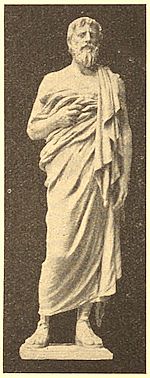
PLATO.
BY JOHN J. BOYLE.
The root purpose of a book-stack, of course, is to
make it capable of holding the greatest number of
volumes in the smallest possible space—always, however,
bearing in mind that every book must be perfectly
accessible and so placed that it can be easily
and quickly handled. The space being limited and the
number of volumes large, the old way of arranging
cases along the walls, even when the wall space is
materially increased by dividing a room into alcoves,
has to be abandoned in favor of a more compact system.
The modern substitute is to erect the cases in stories,
or tiers, with corridors and passages only large enough
to give convenient access to the books. Throughout,
the aim of the builder is to dispose of every inch of
space as economically as possible. Of the three stacks
in the Library of Congress, those to the north and south
are, as the visitor has seen, the largest, each having a
length of one hundred and twelve feet against thirty
for the East Stack. All three are of the same width,
however—forty-five feet—and the same height—sixty-three
feet. The method of construction is the
same throughout, and each is absolutely fireproof, the
only materials used being steel, iron, brick, glass, and
marble. Few things which can be destroyed by fire at all are more difficult to
burn than books, and a fire in the stacks, even if carefully nursed by an incendiary,
could hardly do more than a trifling injury.
Arrangement and Construction.—The stacks are divided into nine
tiers, each tier being seven feet high, and into an equal number of stories the
same distance apart. This distance was adopted in order that the books on
the highest shelf of a tier might not be beyond the convenient reach of a man
of average height, or so far away that he could not easily read their titles. By
the present arrangement every book can be handled or its title read without
effort.
The stacks begin at the basement story, which is fourteen feet below the level
of the floor of the Rotunda. They are sixty-three feet in height—the sum, that is,
of the nine seven-foot stories—and are topped by an iron covering, so that any
water which might by accident come through the roof would be shed without
harming the books. The construction of the shelving is entirely of steel and
iron. The unit of construction, as it may be technically called, is a steel
column erected on a firm foundation and extending the height of the stack.
There are over three hundred of them in each of the two large stacks. At the
bottom of every tier above the basement is a horizontal framework of steel bars,
running between the columns, the length and width of the stack, and securely
anchored to the walls. These cross-pieces perform a double service: they brace
the upright columns and prevent them from bending under the weight they
bear, and they are supports on which to lay the decks. The cases, that is, do
not rest on the flooring, but the flooring on the
general system of the cases. It may be added that
with the strong and simple framing that is used
the stacks might very well have been carried a dozen
stories higher without materially increasing the size of
the columns.
The ranges—by which is meant the cases for books—are
of iron, divided into six compartments by
partitions bolted to the columns. They are double-faced,
each side being a foot deep, and have no backs.
On the front edge of each partition are blunt teeth,
and near the back edge is a vertical row of horns, both
serving to hold the shelves in place. The ranges are
at right angles with the wall, so that there is no
opportunity for the occurrence of what are called
“dead angles”—waste spaces in which it is impossible
to put books.
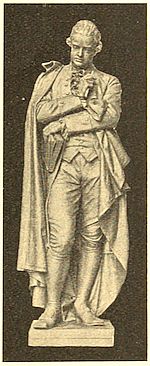
GIBBON.
BY CHARLES H. NIEHAUS.
The ranges are nineteen and a quarter feet long,
and in both of the larger stacks are forty-two in
number, twenty-one on each side of the stack, leaving
a corridor between every story the length of the gallery.
Between them are aisles three feet four inches
wide. Near the middle of the stack a couple of
ranges are omitted to give room for staircases up and
down, an elevator well, large enough to carry an
attendant and a truck-load of books; and the shaft
or well for the book-carriage service.
The decks themselves are of white marble, two and a half feet wide in the
aisles and five and a half in the corridors, set in an iron frame. This leaves a
five-inch slit on either side, between it and the range. The space is too narrow
and too close to the range for anyone to step through, and in order that
any small article may not roll off, the deck is protected by a raised edge. It
would, of course, be possible, though difficult, to drop a book down the slit,
in which case, however, it would be very sure to lodge long before it struck
the basement floor. If found necessary, any such accident could be prevented
by protecting the opening with a wire netting. The advantages of an open
space are many, however: attendants may speak to one another from deck to
deck without the trouble of going to the stairways; light is diffused through
it; and it keeps the books on the lower shelves from damage, either by being
carelessly struck by the foot or one of the wheeled trucks used to carry books
from the shelves to the elevator well.
Ventilation and Heating.—Especially, by allowing a free circulation
of air, these desk-slits help to heat and ventilate the stacks. Ventilation is
especially important. Books require pure air almost as much as human beings
do; if they do not get it they grow “musty,” and gradually decay. As will have
been seen, the whole structure of the stack is open; nothing is closed, even the
partitions in the ranges being made in the form of gratings. The system of
ventilation and heating is one and the same, and both require the freest
circulation of air. Air is taken into the cellar through the windows looking
out into the court-yards, first, however, passing through filters of cotton cloth
to exclude all dust; after being warmed it ascends through gratings to the roof,
where it passes out through ventilating flues. In this way the temperature is
everywhere kept very nearly even. Electric fans are ready for use in case of
any sluggishness in the circulation, and in summer are also used for sending
cooled air into the stack.
The Shelving.—The shelves themselves are open, being composed of
parallel strips of steel with a narrow space between. The total number of
shelves in the three stacks is sixty-nine thousand two hundred. Each is one
foot wide and thirty-eight inches long, with a total length of forty and a
half miles. They are capable of sustaining a weight of forty pounds a square
foot—more than will ever be required of them—with practically no deflection.
Nevertheless, though so much stiffer, they are as light as the ordinary
board shelf of the same size. They can be easily and quickly adjusted at any
height, without the need of pegs or loose screws. Once in place they cannot
slip or tip, and being made in a uniform size (with some small exceptions for
certain irregular spaces around stairways, etc.), every shelf is available for use
anywhere. There are no rough edges or projections on which a book can
wear, and the parallel strips of steel are rounded and highly polished by means
of the Bower-Barff process of coating with magnetic oxide of iron, so that the
surface is as smooth as glass—which not only helps to preserve the books, but
can offer no lodgement for dust or insects. The open spaces, also, afford an
opportunity for using a workable book-brace, specially devised by Mr. Green.
Furthermore, the shelves can be removed from any compartment as desired,
and space thus made for a table, a cabinet, or a desk, as needed; or an extra
corridor can be at once opened for any distance. Then again, in case of the
extra large books, sufficient space may be made by placing the shelves of both
sides of the range on a level.
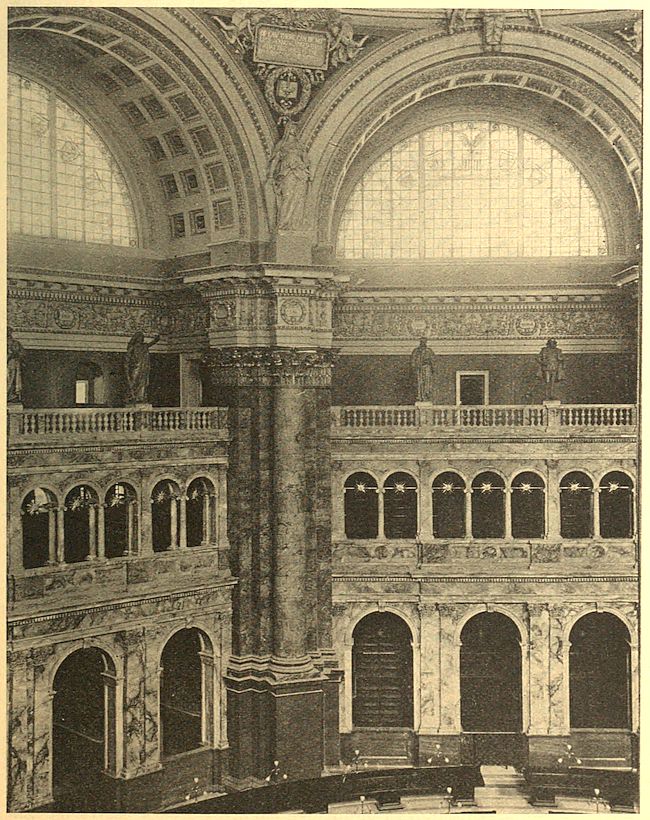
THE ROTUNDA, LOOKING EAST.
Lighting.—No point was more carefully studied in the construction of
the stacks than the lighting. Preliminary plans requiring an immense amount
of labor were made, showing the amount of direct sunlight which any portion
of the three arms would receive at any hour of the day, any month in the
year. Skylights along the line of the corridors help light the upper tiers.
The walls are honeycombed with windows from top to bottom. In the north
and south stacks there are no less than three hundred and sixty. They occur
at the ends of the passageways between the ranges, being placed at the intersections
of the decks, so that each may diffuse direct light into two tiers at
once. In this way there can be no perceptible difference in the amount of
light cast into the upper and lower portions of the tiers. At the end of each
passageway the window is fitted with a seat for the use of the readers admitted
to the stacks, or attendants. Ground glass is employed for the windows on the
east side of the south stack, where the sunlight is so abundant and continuous
that it would be inconvenient if admitted, besides being likely to cause the
bindings of the books to fade; everywhere else the clear open plates invite the
entrance of all the illumination which can be obtained. Each window consists
of a single piece of polished plate glass three feet wide, and permanently
sealed, so that no dust or moisture can ever penetrate it. In order to wash
the glass from the outside the wall is fitted at convenient intervals with skeleton
galleries. The courts themselves give an abundance of full, bright light;
and that none of it may be wasted, and in order that it may be evenly distributed
through the tiers, both at the bottom and top of the stacks, the
walls of the courts are constructed of yellow enamelled brick, which makes an
admirable reflector, on rainy as well as on sunny days. Inside, the marble
decks are highly polished, so that they, too, serve as efficient reflectors, casting
the light which they receive into every nook and cranny of the stack. Evenings,
the light is furnished by incandescent lamps, with which the passages and
corridors are abundantly equipped, and here again the polished decks serve a
most useful purpose in diffusing the brilliant illumination throughout the whole
system of shelving. Altogether, it may be very confidently stated that no
great collection of books was ever before so thoroughly and conveniently
lighted, whether in the day or at night.
Before leaving the Rotunda it should be added that it is possible to ascend
into the Lantern by taking either of the winding iron staircases in the piers on
the left and right of the west gallery. The staircases in all the piers carry
one up into the space between the two shells of the dome, where it will be
necessary from time to time for workmen to go in order to paint the iron
framing and thus preserve it from rust and decay, but only these two are open
to the public. On the way up one has a chance to observe the interesting
construction of the dome; and in the Lantern, which is left unfinished except
in the portions seen from below, one may look over the parapet and down into
the Rotunda.
By taking the staircase to the right, moreover—to the right as one originally
enters the gallery from the Entrance Hall, that is—one reaches a door through
which one may pass out to a little gallery encircling the Rotunda in the
open air and affording a beautiful view of Washington and the surrounding
country.
Or, if one chooses to defer this little expedition, it is possible to make the
trip without retracing one’s steps by taking the elevator on the first story of the
Entrance Hall and getting out on the attic floor, from which one may enter
either of the two stairways just described.
In going through the various galleries and pavilions of the Rectangle it is
perhaps more logical to begin on the library floor, but supposing the visitor to
be about to leave the Rotunda by the way in which he has come, it will save a
little time to take the second story first. Both are alike, so far as the arrangement
of rooms is concerned, except that on the first story one leaves the Entrance
Hall by a narrow corridor, while above one enters the galleries directly.
The arrangement is very simple, as will be seen by looking at the plan of the
building. The pavilions are connected by long galleries, two on the west and
east sides, where the Rectangle is interrupted by the centre pavilions, and one
each on the north and south sides. The corner pavilions of both floors
contain octagonal-shaped rooms, which, in the second story, have domed ceilings
and mosaic floors, and are richly embellished with paintings and sculpture
and relief decoration in stucco. The East Pavilion contains a small staircase
and a good sized but plainly finished room on both stories.
The rooms on the second story are intended for the most part as exhibition
halls for the display of works of art which have come into the possession of the
Library through the operation of the copyright law, or of books and manuscripts
of special interest on account of their rarity and curiosity. One room,
for example, is intended to contain a collection of early printed books and, in
general, such volumes as best illustrate the history of printing; another room is
for books relating to the early history of America. The North Gallery is the
Map Room; the South Gallery is the Print Room, for engravings, lithographs,
etchings, photographs, etc., illustrating the progress and development of the
reproductive arts.
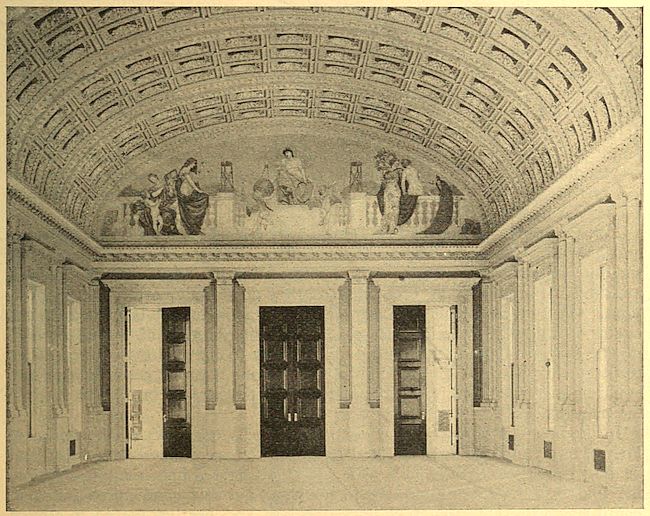
SOUTHWEST GALLERY.—THE SCIENCES.—BY KENYON COX.
There is space here to speak only of the more richly decorated of these
rooms—the corner pavilions and the two galleries on the west side. The
others, as the visitor will see in walking through them, require no special description.
The walls are decorated in broad masses of plain color, with deep
friezes of simple but interesting patterns. The decoration varies from room
to room, but all are united in a single intelligent harmony of color. Each contains
a long skylight surrounded by a stucco border left plain in most of the
galleries, but in the Print Room enriched by coffering decorated with gilt
“cherubs’ wings.” The skylights are ornamented with a simple design of
stained glass. The chief colors employed are purple and pale green and yellow,
and the design includes the names of men distinguished in American history
and in art, letters, and science.[11]
The chief decorations of the gallery into which one goes from the South
Corridor of the Entrance Hall are two large tympanums by Mr. Kenyon Cox,
one at each end of the room over the triple doors by which one enters or
leaves. For the rest, the room is lighted, like the other galleries, on both
sides, so that one may look out toward the Capitol, or, on the east, into one of
the interior courts. The ceiling is an elliptical barrel vault, rising to a height
of twenty-nine feet. It is set with square coffers in blue and gold, and divided
by double ribs which spring from the paired pilasters. Between the pilasters
a bright-colored arabesque is introduced, in which blue is the prevailing color.
It is continued in the ceiling by an arabesque in relief, the most conspicuous
features of which are seated cherubs, and medallions with the letters “C. L.”—standing
for “Congressional Library.” The floor is Vermont, Italian, and
Georgia marble, laid in square panels, so as to reflect, in a way, the pattern of
the coffers in the ceiling above.
Mr. Cox’s Paintings.—Mr. Cox’s tympanums are thirty-four feet long
and nine and a half feet high. At the south end of the room the subject of
the decoration is The Sciences, and at the north end, The Arts. The panels
are similar in composition, occupying as they do exactly corresponding positions.
On each the design is drawn together by a low marble balustrade, at the
centre of which is a semicircular recess enclosing a kind of throne or high
marble seat. At either end of the recess, so as to come directly over a pilaster
occurring between the doors, is a post bearing a tripod on which incense
is burning. The effect is to carry the lines of the architecture below up into
the painting.
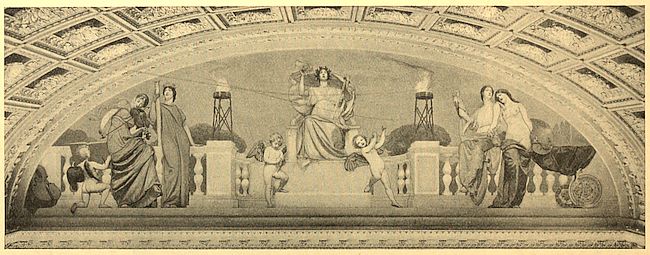
THE ARTS.—BY KENYON COX.
In the panel of The Arts, the central throne is occupied by the figure of
Poetry, represented as a young and beautiful woman crowned with laurel and
bearing an antique lyre. She is seated in an attitude of immediate inspiration,
the fold of her garment blowing in the wind, her left hand raised from the
chord which she has just struck upon the lyre, and her lips parted in a burst
of song. On the steps of her throne are two little geniuses, one writing down
her words on a tablet, and
the other raising his arms
in sympathy as he joins
in the rhythmical swing of
her song. The first may
be taken as personifying
the more strictly literary
and reflective side of poetry,
and the other as
standing for its feeling for
harmony and music, or, in
general, the lyrical element
in poetry. In the
left-hand portion of the
decoration are Architecture
and Music, and to the
right, Sculpture and Painting—all
typified by female
figures bearing some appropriate
object identifying
the art which they
represent. Architecture is
conceived as the sternest
and most dignified of the
arts, as shown by her expression
of proud abstraction
and the severe lines of
her drapery. She holds a
miniature marble column,
and her head is crowned
with a circlet of battlements.
Music is playing
upon a violin, and looking
the while upon the pages
of a great music-book
which a kneeling genius
holds open before her.
Beside her is a violoncello.
Sculpture holds a statuette
of a nude female figure,
and talks with Painting,
who has a palette and
brushes. The latter, as
representing the gentler
and more luxurious art,
is shown partly nude, and
leaning her head affectionately
upon the shoulder of
her companion. In the
corner of the picture are
a vase and two large plates in different styles of decorated pottery—standing
for the minor decorative arts.
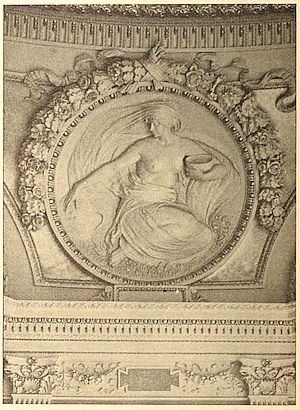
SPRING.—BY BELA L. PRATT.
In the tympanum of The Sciences the central figure is Astronomy. She
holds a pair of compasses, and leans forward on her throne to make measurements
upon the celestial globe which a genius holds up before her. Another
genius to the right looks through a telescope. To the left of the panel are
Physics and Mathematics. Physics holds an instrument designed to show the
law of the balance of different weights at different distances from the point of
support. Mathematics has an abacus, or counting-frame, with which she is instructing
a little genius in
the elements of figures.
The beads of the abacus
are so placed that they
give the date, “1896”—the
year the picture was
painted. Beside her, in
the extreme left-hand corner,
are various figures
illustrating plane and solid
geometry. The former
kind are so arranged, as
the visitor will see by
looking carefully, that
they form all the letters
of the artist’s name—KENYON
COX. On the
other side of the throne
are Botany, bearing a
young oak tree, and wearing
a green and white figured
gown; and Zoölogy,
a nude figure holding out
her hand to caress a magnificent
peacock perched
on the coping of the balustrade.
In the corner
are a shell and various
kinds of minerals, for
Conchology, Mineralogy,
Geology, and so forth.
On tablets over the doors and windows are the names of men distinguished
in Science and Art. Those representing Art are Wagner, Mozart, Homer,
Milton, Raphael, Rubens, Vitruvius, Mansard, Phidias, and Michael Angelo.
The Scientists are Leibnitz, Galileo, Aristotle, Ptolemy, Dalton, Hipparchus,
Herschel, Kepler, La Marck, and Helmholtz.
The Southwest Pavilion—or the Pavilion of the Discoverers, as it may better
be called, from the subject of the paintings with which it is ornamented—opens
immediately from the Southwest Gallery. The domed ceiling is richly
coffered and profusely ornamented with gilding, except for a large central space
in the form of a disc, which contains a painted decoration. Below the dome
are four tympanums, also occupied by paintings. The walls are ornamented
with paired pilasters, bearing a narrow frieze decorated with lions’ heads and
festoons of garlands.
Mr. Pratt’s Bas-Reliefs.—In the pendentives is a series of four
large circular plaques in relief, representing The Seasons. The series, which
is repeated in each of the other three pavilions, is the work of Mr. Bela L.
Pratt. Spring is the figure of a girl sowing the seed, her garment blown into
graceful swirls by the early winds of March. Summer is a maturer figure, sitting,
quiet and thoughtful, in a field of poppies. Autumn is a mother nursing
a baby. An older child—a little boy—stands beside her, and the abundance
and fruitfulness of the season are still further typified in the ripe bunches of
grapes which hang from the vine. Winter is an old woman gathering faggots
for the hearth. Behind her is a leafless tree, on which is perched an owl. A
garland appropriate to the season hangs over each of the four plaques—fruits
for Spring and Summer, grains for Autumn, and oak leaves and acorns
for Winter.
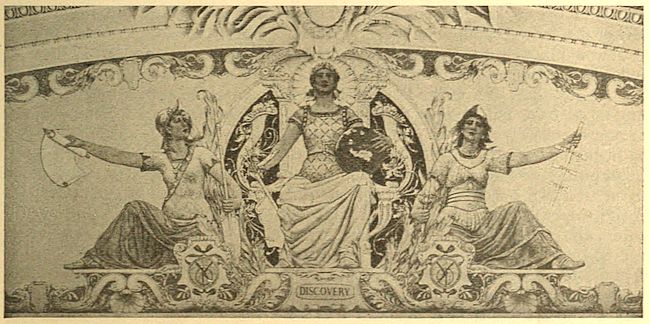
CENTRAL GROUP OF DISCOVERY.—GEORGE W. MAYNARD.
Mr. Maynard’s Paintings.—The paintings in the tympanums and the
disc are the work of Mr. George W. Maynard, whose panels in the Main
Entrance Hall have already been described. In the tympanums the sequence
of Mr. Maynard’s subjects begins on the east side and continues to the right,
as follows: Adventure, Discovery, Conquest, Civilization—the bold roving
spirit of Adventure leading to Discovery, which in turn results in Conquest,
bringing at last a settled occupation of the land and final Civilization. In the
disc of the ceiling, Mr. Maynard has depicted the four qualities most appropriate
to these four stages of a country’s development—Courage, Valor, Fortitude,
and Achievement.
Since the tympanums are the same in shape and of the same size, measuring
each thirty-one feet by six, and since all stand in the same relation toward
the whole room, Mr. Maynard has followed throughout a single method of
arrangement. Each tympanum is over three doors or three windows, as the
case may be. In accordance, therefore, with this exactly balanced architectural
scheme, a pyramidal group of three female figures—pyramidal because
any other form would have looked top-heavy—is placed above the central opening.
Balancing or, so to say, subsidiary figures, which, if only from their position
at the diminishing ends of the tympanum, are necessarily of less importance,
are placed over the doors or windows to the side. Thus the decoration
is poised in complete accordance with the disposition of the wall which it
crowns. The figures at the ends, it will be noticed, are of two sorts, mermaids
and emblazoned shields; but since they alternate in pairs from tympanum to
tympanum, the shields occurring in the east and west and the mermaids in the
north and south, this variety serves very well to accentuate the unity of the
composition of the four paintings. The ornament, also, is the same in its
more important features: the throne in the centre, flanked by cornucopias;
the arabesque border with its dolphins, suggestive of seafaring; and the lists of
names of discoverers and colonizers which occupy the spaces to the right and
left of the central group, and serve to draw together the whole composition.
It would be well if the visitor were to hold in mind these points, for in the two
following pavilions on this floor, where the conditions governing the painter
are exactly the same as in the present room, it will be seen that the artists
employed have followed in their work the same orderly and logical plan of
arrangement which Mr. Maynard has here adopted.
In the first tympanum, Adventure, seated on her throne, holds in her right
hand a drawn sword, in instant readiness for the combat; her left hand rests
upon an upright caduceus, the emblem of Mercury, the god of the traveller,
merchant, and thief, and fit, therefore, to be the patron of the restless adventurers
who sailed westward in the sixteenth century, impelled as well by a desire
for booty as for legitimate trade. To the right and left are seated female
figures, representing respectively Spanish and English adventure—the two
countries which furnished America with the largest part of its early buccaneers
and adventurers. Like the central figure, the two are clad in rich and elaborate
armor, accurately copied, as is that in the other tympanums, from
authentic sixteenth-century models. The figure to the left, typifying England,
holds a cutlass in her right hand, while her left hand buries itself in a heap of
pieces-of-eight, the pirate and buccaneering coin par excellence. The companion
figure to the right holds a battle-axe in her right hand, and in her left
one of the little figurines, or miniature idols of gold, which the Spaniards in
Peru sought so eagerly, and with so much cruelty, to secure from the natives.
At either side of the throne is a shield, on which an old Norse Viking ship,
propelled by oars and sail, is depicted. At either end of the tympanum is a
shield, that to the right bearing the arms of Spain, and that to the left those
of England. On the Spanish side of the decoration is the following list of
names of Spanish adventurers: Diaz, Narvaez, Coello, Cabeza, Verrazano, Bastidas.
On the other side is the English list: Drake, Cavendish, Raleigh, Smith,
Frobisher, Gilbert. Each group of names is surmounted by the heraldic form of
the naval crown, ornamented with alternate sterns and squaresails of ships,
which was given by the Romans to a successful naval commander, or to the
sailor who first boarded an enemy’s ship. In either corner of the tympanum
still another emblem of sea-power, the trident, is introduced.
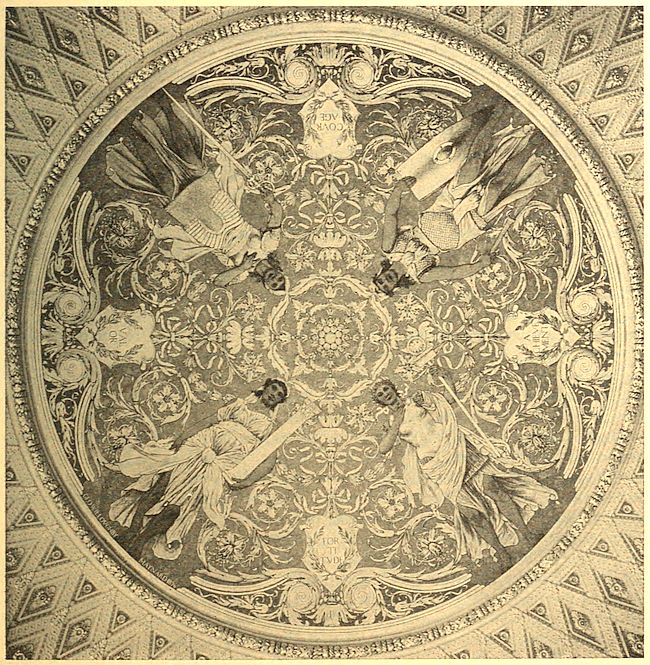
CEILING DISC.—GEORGE W. MAYNARD.
In the second tympanum, Discovery, crowned with a laurel wreath of gold
and wearing a leather jerkin, sits on her throne, holding a ship’s rudder in her
right hand, and with her left upon a globe of the earth, which is supported
on her knee. The rude map of America, which appears on it, is copied from
a portion of a mappemonde, or chart of the world, which was discovered a few
years ago in England, and which has been ascribed to Leonardo da Vinci. It
dates from the second decade of the sixteenth century.[12] The two seated figures
to the right and left are clad in armor; the first holds a sword and “Jacob’s
staff,” or cross staff, a device used by the early navigators instead of a quadrant
or sextant to determine the altitude of the sun and stars. The figure to
the left, with paddle and chart, points towards the distance with outstretched
arm, and turns to her companions to beckon them onwards. The two shields
at the foot of the throne bear an astrolabe, an obsolete instrument used for the
same purpose as the cross staff. At either end of the tympanum, a mermaid, with
a seashell for cap, and with seaweed twined about her body, invites the voyagers
with strings of pearls and coral. Lists of names occur at the left and right,
surmounted, as before, with the naval crown. The first list is: Solis, Orellana,
Van Horn, Oieda, Columbus, Pinzon; the second, Cabot, Magellan, Hudson,
Behring, Vespucius, Balboa.
In the third tympanum, that of Conquest, the idea expressed in the central
group is that of the proud tranquillity which follows triumph in battle. The
figures carry the insignia of victory. The one seated upon the throne has
pushed back her casque and lets her left hand hang idly over the crosspiece of
the sword. But there is still danger of a renewal of the struggle; the right
hand rests clenched upon an arm of the throne, the armor has not yet been
laid aside, and the sword not yet sheathed. The figures to the left and right
are in a like attitude of readiness, though they carry in addition to their
swords the emblems of peace—the first, representing Southern Conquests, a
sheaf of palms; and the second, representing Northern Conquests, chaplets of
oak-leaves, which wreathe her casque and sword. The two shields bear a
heraldic representation of the Pillars of Hercules, with the motto Ne plus ultra
twined about them, and between them, in the distance, the setting sun—perhaps
an ironical allusion to the ancient idea which set the limits of the earth at
the Straits of Gibraltar, or perhaps simply an adaptation and extension of it to
the new conditions of knowledge. At the ends of the tympanum the arms of
England and Spain are again introduced, as significant of the general division of
North and South America into English and Spanish territory. The names to the
left are: Pizarro, Alvarado, Almagro, Hutten, Frontenac, De Soto; to the right,
Cortes, Standish, Winslow, Phipps, Velasquez, De Leon. Over each group is the
battlemented mural crown given by the Romans to the soldier who first succeeded
in planting a standard upon the wall of a besieged city.
The fourth tympanum, Civilization, is the flowering of the other three. The
armor has been laid aside, and the three figures in the centre are clad simply
in classic garments. Civilization, crowned with laurel and seated on her
throne, holds up the torch of learning, or enlightenment, and displays the
opened page of a book—an idea which is repeated in the lamp and book
which compose the device on the two shields below. To the left is Agriculture,
crowned with wheat, and holding a scythe and a sheaf of wheat. To the
right is Manufactures with distaff and spindle, twisting the thread. The mermaids
at the ends of the decoration hold up, one an ear of corn, and the other
a branch of the cotton-plant bearing both the flower and the boll—the two
chief products respectively of the northern and the southern portions of our
country. The names are: to the left, Eliot, Calvert, Marquette, Joliet, Ogelthorpe,
Las Casas; and to the right, Penn, Winthrop, Motolinia, Yeardley, La
Salle. Over each list is a wreath of laurel.
Mr. Maynard has represented in the ceiling the four qualities most pertinent
to the character of his four tympanums. All four are shown as female figures,
displayed against a background of arabesque. The first, Courage—a brute,
animal courage—is clad in a coat of coarse scale-armor, over which a lion’s
skin is drawn, the head of the beast serving her for a cap. She is armed with
a war-club and a shield. The next, Valor, is a nobler figure, more beautiful
and wearing more beautiful armor. Her right hand holds a sword, and her
left is pressed to her breast. The third, Fortitude, is unarmed. In her left
arm she carries an architectural column, the emblem of stability. Achievement,
the last, is clad in armor, but is without offensive weapon. She wears a
laurel crown, and in her left hand she carries the Roman standard, surmounted
by its eagle and laurel wreath, the symbol of a strong and just government.
In the order named, therefore, it will readily be seen how these figures may be
said to typify the successive tympanums of Adventure, Discovery, Conquest,
and Civilization.
In the same way that the room decorated by Mr. Maynard has been called
the Pavilion of the Discoverers, so the Southeast Pavilion may be called the
Pavilion of the Elements, from the subject of the paintings ornamenting the
tympanums and the disc. The tympanums are by Mr. Robert L. Dodge, and
the disc by Mr. Garnsey and Mr. Dodge working in conjunction, the former
making the ornamental design and the latter designing and carrying out the
figure-work.
Mr. R. L. Dodge’s Paintings.—Each of the four tympanums is devoted
to a single Element: the east tympanum to Earth, the north to Air, the west
to Fire, and the south to Water. The composition, which is very simple, is
uniform throughout. In the middle of the tympanum is a group of three figures
typifying the subject of the decoration—the central figure standing and
the other two seated. The latter are of women, but to prevent monotony, the
standing figures are alternately male and female—male in the tympanums of
Earth and Fire, and female in those of Air and Water. The central figure
holds up in either hand an end of a heavy garland of flowers, which, stretching
in a single festoon to the extremity of the tympanum, is there caught up by a
little boy or genius. In the middle of each half of the picture, and in each
tympanum the same on both sides, is an ornamental bronze column flanked
on either hand by a bronze standard or tripod, all three united by floating
streamers or ribands into a single group, and each serving as a pedestal on
which to place some emblems of the Element represented.
In the tympanum of Earth the idea is the fertility and bounteousness of the
soil. In the central group the figure to the right leans her arm upon an amphora
or ancient wine-jar, and holds in her hand a rose. The figure to the left
is that of a reaper, with a wreath of grains on her head and a bundle of wheat
by her side, and holding in her hand a sickle. The geniuses at the ends of
the decoration are dancing for jollity. The background is a smiling and luxuriant
summer landscape, the fruits of which, the peach, the plum, the pear, the
grape and the rest, are displayed in the great garlands which the central figure
holds up with outstretched arms. The bronze columns support baskets of fruit,
and on the accompanying standards are perched magnificent peacocks. The
border of the decoration includes masks, urns and lions, the last emblematic of
the subject of the decoration.
The central figure in the decoration typifying Air stands upon a bank of
clouds; she is winged, and a large star blazes on her forehead. Of the figures
to her right and left, the first is winged and the second carries the caduceus.
The festoons are of morning glories, upheld at the further ends by flying geniuses.
The background is sky and clouds. The central standards carry astrolabes,
as being the typical astronomical instrument of a few centuries ago,
and eagles are perched on those to the side. In the border, winged griffins
are substituted for lions.
The background of the third tympanum, Fire, is a mountainous and volcanic
region, its peaks touched with lurid light from constant eruptions. The festoons
are composed of sunflowers, and the seated figures in the centre carry
each a flaming torch. The columns to the right and left bear flaming globes,
while the flanking standards support the fiery nest of the phœnix—the bird
which was fabled by the ancients to live, sole of its species, five hundred years,
at the end of which time it repaired to the desert and built a funeral pyre, in
the flames of which it was consumed. From its ashes as a nest a new phœnix
arose, as here depicted. In the border of the decoration are salamanders,
which, according to the old superstition, lived in the midst of fire.
In the last tympanum, Water, the central figure, clad in green, holds festoons
of seaweed and water-lilies—flowers, buds and pads. On either side is a mermaid,
one of them with a seashell. The background is the open sea. The
standards are in the form of rostral columns (such as the Romans erected in
honor of their victorious admirals) ornamented with garlands of laurel and the
beaks and sterns of captured ships. On top is set a galley, with oars and sails.
Over each of the standards to the side hovers a sea gull. The geniuses at the
end of the picture have tails like mermaids, and in the border are dolphins.
The disc of the ceiling repeats in another form the general idea of the decorations
of the tympanums. In the centre is the sun, across which the sun-god,
Apollo, drives his four-horse chariot. The sun, however, is still the sun, and
not a yellow background; the dusky picture outlined against it is to be taken
as a vision, so to say, of its attributes.
Around the sun as a centre, is painted a chain of alternate medallions and
cartouches—four of each, or eight in all—which typify the Four Elements
represented in the tympanums below. A medallion and a cartouche are devoted
to each. The former sort are painted so as to suggest a cameo design. The
first of them, which occurs, like the other three, on the side nearest the tympanum
of the corresponding subject, typifies Earth, a female figure reclined amidst a
summer landscape. In her hand is a scythe, and behind her is a plow, standing
in the midst of a wheat field. Water is a mermaid riding off a rocky shore on
the back of a dolphin. In her hand she holds an oar. Fire is a woman
watching the smoke which floats away from the flame of a little brazier at her
side. Behind her is a tripod on which incense is burning. In the distance is
Mt. Vesuvius, sending out a steady cloud of smoke, and in the plain beneath
are the ruins of Pompeii. Air is a female figure clad in flowing drapery, and
floating among the clouds on the outstretched wings of an eagle.
The cartouches are more simply designed. That of Earth contains a tortoise,
on the back of which, according to the Hindoo mythology, the earth is
ultimately supported. Air is typified by a swan; Fire, by a lamp; and Water
by two intertwined dolphins. Finally the whole decoration is surrounded by a
broad band of arabesque ornament, in which are placed the signs of the Zodiac.
The third of the second-story pavilions is the Pavilion of the Seals, at the
northeast corner of the building. The walls in this room, it may be noted, are
treated differently from those of the other three pavilions. Instead of the
frieze and the paired pilasters, one has wall-surfaces covered with gilding and
ornamented with painted laurel-bands arranged in regular patterns recalling the
designs of the parterres of an old-fashioned garden.
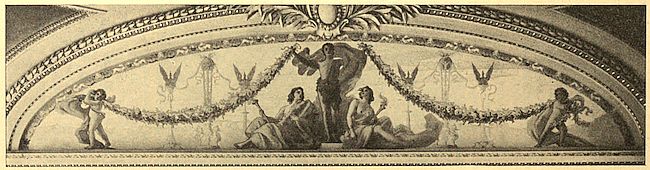
FIRE.—BY R. L. DODGE.
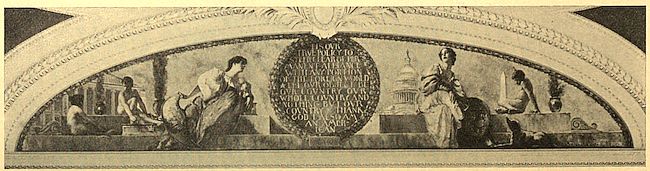
STATE AND TREASURY.—BY W. B. VAN INGEN.
The paintings in the tympanums are by Mr. W. B. Van Ingen, and illustrate
the seals of the various Executive Departments of the United States Government.
The disc of the domed ceiling was designed by Mr. Garnsey, and shows the Great
Seal of the United States surrounded by allegorical emblems.
Mr. Van Ingen’s Paintings.—As in the previous pavilions on this floor,
the general arrangement of the decoration is the same in all four tympanums.
In each the artist has introduced a low terrace or wall of masonry running from
end to end, thus serving both to ballast the picture, as it were, and to bind its
parts more strongly together. A recess in the centre of the terrace allows space
for a circular tablet, painted to represent wood, about six feet in diameter, or
nearly the height of the tympanum. On this are inscribed, as if in raised letters,
one or more quotations from the writings or speeches of great American statesmen.
These were selected by the Librarian, Mr. Spofford, mainly for their
general patriotic application, but, of course, as far as possible with some special
reference to the subject of the decoration. The border of each tablet, as of the
decoration itself, is a band of laurel-leaves, suggested by the laurel-roll which
outlines the disc of the ceiling.
On either side of the tablet is a female figure, seated against the terrace,
personifying a Department of the Government, in token of which she supports
a shield or cartouche on which the seal of that Department is conspicuously
displayed. The visitor will notice that these figures (in this respect like Mr.
Reid’s in the Entrance Hall) illustrate the American type of woman, and wear
modern gowns and not conventional Greek or Roman drapery.
The two figures and the tablet between form the necessary central pyramidal
composition. For a limit and balance to the decoration the artist has painted,
at either end, a cypress-tree and, in all but one of the tympanums, one or two
nude children or geniuses, usually engaged in some action which shall be useful
in explaining the purport of the picture, the meaning of which is still further
brought out, in most cases, by introducing into the background a well known
monument or building, or some conventional object, suggestive of the functions
of the Department represented.
The west tympanum is devoted to the Department of the Treasury and the
Department of State; the north tympanum to the Department of Justice and
the Post-Office Department; the east tympanum to the Departments of Agriculture
and the Interior; and the south tympanum to the War and Navy Departments.
Half a tympanum is devoted to each. The Department of the Treasury—to
begin with the one first named in the above list—is sufficiently indicated by
the introduction of the Treasury Building in the background. Two children are
playing on the parapet, one of them with his foot on a strong-box. The background
of the other portion of the tympanum—illustrating the Department of
State—exhibits the dome and west front of the Capitol and, to the right, the
Washington Monument. The vital thing about a nation—that which it is the
first business of a Department of State to help preserve—is its independence.
The Monument may be taken, therefore, as standing for the establishment of that
independence, and the Capitol for its maintenance. A dog, typical of fidelity,
lies in the foreground. The cypress trees, it may be noted before passing to
the next tympanum, are introduced purely for their decorative effect, and are
without any symbolical meaning. In all the decorations they are set in jars
copied from Zuñi originals in the National Museum.
In the north tympanum, the figure of Justice is clad in ermine. On the terrace
is a high bronze standard, carrying a pair of evenly balanced scales. The
genius at the left holds a measuring rod, for exact justice. In the other half of
the painting, devoted to the Post-Office Department, the genius is represented
with a pair of compasses marking out mail routes on a globe. Mercury was
the Messenger of the Gods, according to classic mythology, and a bronze statue
of him with his winged sandals, staff, and cap, is appropriately set upon the
stone terrace to typify
the dispatch and celerity
of the Department.
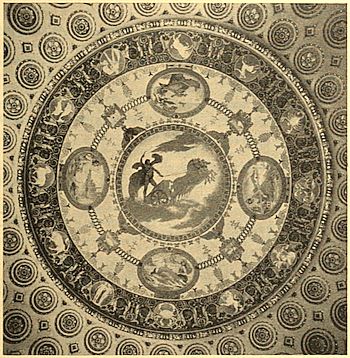
CEILING DISC.—BY ELMER E. GARNSEY.
Agriculture, in the
next tympanum, is
symbolized solely in
the fertile and well
cultivated landscape
which forms the background
of her portion
of the decoration.
The chief duty of the
Department of the
Interior—to protect
and control the Indians—is
indicated
in the background of
the other half of the
picture by a representation
of the curious
method of burial, if
one may use the word,
which prevails among
certain of the western
tribes—the body,
lashed to a few poles
for a bier, being laid away in the branches of a tree.
In the last tympanum, that of War and the Navy, the terrace is nicked and
shattered by the bullets of the enemy. The figure to the left, representing the
Department of War, holds a regulation army sword, and the figure to the right
a naval sword. To the left the two children are engaged in combat; one is
falling, stained with blood, while the other presses upon him with a falchion, or
Roman sword. The corresponding composition to the right is much the same;
the chief difference being the trident which the victor aims at his opponent’s
breast. War is accompanied by a Roman standard adapted to an American use
by altering the old initials “S.P.Q.R.”—“The Senate and People of Rome”—to
“U.S.A.” In the background is Bunker Hill Monument in Boston. On
the other side are the masts of the recently constructed battleship Indiana, and
a rostral column of the same sort as those used in the tympanum representing
Water in the Pavilion of the Elements, but in this case copied exactly from the
one erected in honor of Commodore Decatur and afterwards removed to Annapolis,
where it is now. The inscriptions on the tablets in the four tympanums
may most conveniently be inserted here. In the west tympanum, that of the
State and Treasury Departments, the quotations are as follows:—
’Tis our true policy to steer clear of permanent alliance with any
portion of the foreign world.—Washington.
Let our object be our country, our whole country, and nothing but
our country.—Webster.
Thank God I also am an American.—Webster.
In the north tympanum:—
Equal and exact justice to all men, of whatever state or persuasion,
religious or political: peace, commerce and honest friendship with all
nations—entangling alliance with none.—Thomas Jefferson.
In the west tympanum:—
The agricultural interest of the country is connected with every
other, and superior in importance to them all.—Andrew Jackson.
Let us have peace.—U. S. Grant.
In the south tympanum:—
The aggregate happiness of society is, or ought to be, the end of all
government.—Washington.
To be prepared for war is one of the most effective means of preserving
peace.—Washington.
Mr. Garnsey’s Ceiling Painting.—The disc of the dome contains one
of the most interesting and ingeniously arranged of the purely conventional
decorations which ornament the Library. In the centre is the great seal of the
United States, which puts the final touch of significance upon the series of
paintings in the tympanums. Surrounding it is a circular band containing
forty-eight stars, one for each State and Territory. On the diagonal axes of the
room are four medallions containing heads symbolizing the Four Winds—North,
South, East and West—each blowing a gale from his mouth, as in the classical
representations. They stand, of course, for the four great natural divisions of
the country. Below each medallion is a garland of fruits or grains, festooned
from bunches of eagles’ feathers which spring from the central panel of the
decoration, and indicating the nature of the products of each section. The
garland under the medallion of the North Wind, for example, is composed of
apples, pears, peaches, and similar fruits; that under the East Wind, of various
vegetables and berries; under the West Wind, grains, as wheat, oats, and
maize; and under the South Wind, bananas, pomegranates, oranges, lemons,
and so forth.
Other emblematic objects introduced into the decoration are lyres, each
flanked on either side by a horn of plenty filled with fruits; and flaming torches,
set between a pair of dolphins. There are thus two sorts of groups, each of
which occurs four times in the decoration in accordance with the standard fixed
by the four medallions of the Winds. The four different objects depicted
signify four of the great interests of the country—the lyre, the Fine Arts;
the cornucopia, Agriculture; the torch, Learning and Education; and the
dolphin, Maritime Commerce. Finally the composition is united by American
flags festooned from the lyres to the garlands of fruit which underhang the
medallions of the Winds. And around the whole is a narrow border, on which
are inscribed the following words from Lincoln’s Gettysburg address, used also,
in part, by Mr. Vedder in his decorations in the Entrance Hall:—
That this nation, under God, shall have a new birth of freedom; that
government of the people, by the people, for the people, shall not perish
from the earth.
The entablature and paired pilasters which decorate the walls of the two
pavilions to the south, are resumed in the Northwest Pavilion, or Pavilion of
Art and Science, if one choose to name it, as the three corresponding rooms on
this floor were named, from the subject of the paintings which it contains.
Mr. W. de L. Dodge’s Paintings.—These paintings, both in the tympanums
and in the ceiling disc, are the work of Mr. William de Leftwich
Dodge. The subjects are as follows: in the west tympanum, Literature; north
tympanum, Music; east tympanum, Science; south tympanum, Art; and in the
ceiling disc, Ambition, considered as the incentive of all human effort, whether in
art, science, or affairs. Comparing them with the other decorations in the
Library, the visitor will be struck with the unusually large number of figures
which Mr. Dodge has introduced into his canvases, all, of course, helping to
illustrate some phase of the subject under which they are grouped. Throughout,
however, the meaning is unusually clear, the special significance of every
figure being indicated either by some expressive attitude or action, or by the
introduction of some appropriate and typical object.
Literature shows a varied group of male and female figures sitting or standing.
The scene is along the steps of an old Greek temple. The God of Letters—or
Apollo, if one wishes—sits in the foreground holding an open book. Behind
him is a company of maidens reading in an ancient scroll, which they unroll
from hand to hand. To the right, a woman is instructing two children in
the rudiments of learning. Comedy, a nude and easy figure, is looking at the
ludicrous features of a comic mask, and Tragedy stands in an attitude of recitation,
lifting her arms in an emphasizing gesture. In the corner is a little boy
working over an ancient hand-press. To the left a poet sits with his head
bowed in thought, perhaps in despair that his verses have not received their
due meed of applause; but Fame stands behind him holding out the wreath of
laurel with which, after many years, she means to crown him. Further on is
another poet, who, as he reclines half dreaming on the ground, is suddenly inspired
with the rapture of the Muse. In the corner is a bust of Homer, with a
pile of books for pedestal.
In Music, Apollo, as the God of Song and Harmony, is seated in the centre
of a long marble bench playing upon a lyre. Other figures, variously disposed
throughout the panel, play upon a number of different musical instruments,
illustrating at once the development and present scope of the art. One plays
a violin, two others are blowing trumpets, a fourth has the double pipes, another
a mandolin—and so on.
The central figure of Science—the background of which is again the columns
and marble steps of a temple—is a winged female figure descending through
the air to crown the inventor of the phonograph, who kneels on the steps before
her with a simple electrical instrument beside him. More broadly considered,
the group typifies the triumphs of modern electrical science, summed
up indeed, in the invention of the phonograph, but including as well the electric
telegraph and the telephone. To the right is a man holding the model of a propeller
steamship, and further on a husbandman with his team of horses, gathering
the fruits of Agriculture. To the left is a table, on which are set two alembics
for Physics, and around which is gathered a group of scientists, one holding
a human skull, which forms the subject of their discussion. The group may be
taken to represent the various medical and surgical sciences, such as Physiology,
Anatomy, and so forth. Further to the left is a figure looking at a
kite lying on the ground—a reminder of Benjamin Franklin’s famous electrical
experiment with the kite and the key. In the background is a little
camp-fire over which a tea-kettle is suspended, for Watt’s celebrated discovery
of the power of steam.
Art shows a student sketching a nude model. Behind him is his instructor
criticizing his work. Sculpture is symbolized to the left, and, to the right, a
young woman is painting a design upon a great Greek vase. Behind her are
the capitals of a number of the more familiar orders of Architecture, as the
Egyptian and the Doric.
In the painting of Ambition in the ceiling, the scene is supposed to be the
top of a high mountain, but only the marble terrace which marks the summit
is actually visible in the painting. Here is gathered a group which has toiled
along a weary path up the mountain side to comparative success; but none is
satisfied. Above them, the Unattainable Ideal, a figure holding aloft in mockery
the palm branch of complete achievement, rides through the air on a great
winged horse. In front is Fame, grasping the horse’s bridle with one hand,
and turning to those below to sound a derisive note on her trumpet. The figures
on the mountain top are involved in a scene of mad confusion; some for
the moment are distracted by crime or lust, or cynical contempt, but most
reach out their arms in ineffectual eagerness to attain the glorious vision above
them. They have leapt to the top of the terrace in their fierce desire to gain
the slightest advantage. To the left, a murderer shrinks back in horror from
the body of the miser whom he has just slain; as he starts away, aghast at his
crime, he topples over a flaming tripod which had been set on a post of the
terrace. Conspicuous figures in the mad struggle for success are a warrior, with
sword, greaves, and helmet, and a sculptor, bearing a statuette of the Venus of
Milo. In front of them is the seated figure of a poet, with a bandage over his
eyes to indicate the abstraction and ideality of his thought. Further on, a
man flings out both arms in a mad appeal, and on the moment is grasped in
the arms of a woman, who drags him back to the level of her own baseness.
A jester, one of Shakespeare’s fools, in his cap and parti-colored coat, stands
near by, holding a bauble surmounted by a skull in one hand, and a statuette
of Victory in the other. That fame comes only after death, and that the
promptings of personal ambition are but a hollow mockery, is the moral that
he preaches.
From Mr. Dodge’s Pavilion, one goes into the Northwest Gallery, which leads
directly into the Main Entrance Hall once more. In dimensions, arrangement,
and general architectural scheme it corresponds to the Southwest Gallery, with
which the visitor began his tour through the Rectangle. The prevailing color,
however, is red, and not blue, both in the walls and in the coffers of the vaulted
ceiling.
Mr. Melchers’s Paintings.—At either end, occupying the same position
as Mr. Cox’s decorations, and of the same size and shape, is a painting by Mr.
Gari Melchers, illustrating, at the north, War, and at the south, Peace. The
same subjects, it is interesting to note, and as many readers will remember,
were chosen by Mr. Melchers for his decorations at the World’s Fair in Chicago.
The present paintings may be taken, therefore, as representing the development
and completion of a favorite idea of the artist.
In the panel of War, the scene represented is that of a chieftain of some
primitive tribe returning home with his clansmen across a desolate tract of
open country from a successful battle. He is crowned with a wreath of laurel,
and sits proudly astride a magnificent white horse. A second horseman rides
beside him, and another a little behind. Three men carry a roughly constructed
bier on which they are bringing home the dead body of a warrior for burial in
his native soil. In the right-hand corner a woman kneels to care for a wounded
man who has just sunk exhausted to the ground. Behind, a trumpeter sounds
his horn, exulting in this dearly bought victory. To the left two foot-soldiers
carry shields emblazoned with devices of primitive heraldry. One of them
holds in a leash two straining bloodhounds, eager for their kennels, and leading
the way toward home.
Mr. Melchers’s other painting, Peace, represents an early religious procession.
The inhabitants of some little village, perhaps in prehistoric Greece, have come
to the border of a grove bearing the image of their tutelar goddess, a small
seated figure set on a little platform covered with an embroidered cloth. The
procession has halted, and the priest is reading from a paper which he holds in
his hand, containing, very likely, a blessing in the name of the goddess upon
the fields and orchards of the villagers. Various objects, one of them the
model of a ship, are carried in the procession to be offered up as memorials in
the temple of the goddess, and in the rear a boy leads to the sacrifice a bull
wreathed with garlands.
The following names—forming a list of the world’s most famous generals
and admirals—are inscribed in tablets above the doors and windows of the
gallery: Cyrus, Alexander, Hannibal, Cæsar, Charles Martel, William the Conqueror,
Frederick the Great, Charlemagne, Eugene, Marlborough, Napoleon,
Wellington, Nelson, Washington, Jackson, Scott, Grant, Farragut, Sherman, and
Sheridan.
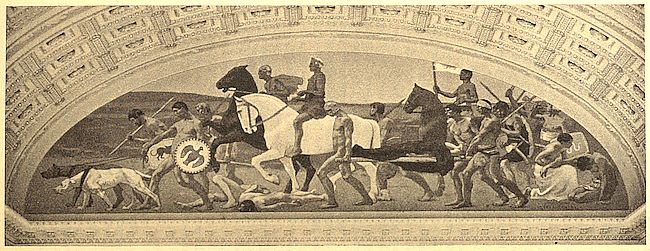
WAR.—BY GARI MELCHERS.
The only rooms on the first story of the Rectangle which require a special
description are the galleries and pavilions stretching from the Main Entrance
Hall along the west front of the building. As has been said before, entrance
to these is through two corridors, leading to the north and south. The corridors
look out upon the interior
courts; the floors are
of mosaic, and the walls are
painted in simple tones of
color with pilasters of Vermont
marble polished to a
peculiarly soft and waxy
surface. The ceiling is a
succession of small domes
in white and gold. In the
centre of each is a large gilt
rosette. Around it are hexagonal
coffers, or panels
ornamented with painted
figures. The broad arches
between are decorated with
coffers and panels in relief,
and, finally, the tympanums
beneath the domes (one at
either end of the corridor,
and seven along the west
wall) are occupied with
panels representing, in the
corridor to the south, which
the visitor is now supposed
to have entered, The Greek
Heroes.
Mr. McEwen’s Paintings.—The
series is the
work of Mr. Walter McEwen.
The special subjects are incidents,
as related in Greek
mythology, in the lives of
the following heroes, taking
the paintings in order from
north to south: Paris,
Jason, Bellerophon, Orpheus,
Perseus, Prometheus,
Theseus, Achilles, and Hercules.
Paris, son of Priam, King
of Troy, was brought up as
a shepherd on Mt. Ida.
When a dispute arose among
the three goddesses, Juno,
Minerva and Venus, as to
who should possess a golden
apple inscribed “To the
Fairest,” which Eris (Strife)
had flung in the midst of an
assembly of the deities, Paris was selected by Jupiter to decide their quarrel.
He awarded the apple to Venus, who promised him the most beautiful woman
in the world to be his bride. Hearing of the charms of Helen, wife of Menelaus,
King of Sparta, Paris sailed to Greece, and by the aid of Venus carried her
away to Troy—thus provoking the expedition of the Grecian chiefs, and the
ten years’ siege of Troy. Mr. McEwen’s painting shows Paris at the court of
Sparta, conversing with Menelaus, while Helen sits listening beside her husband.
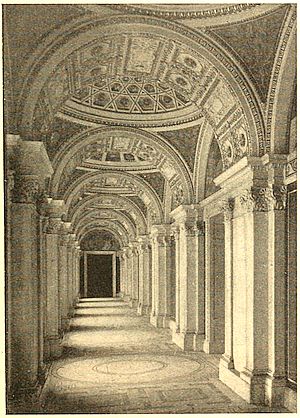
CORRIDOR OF THE SPECIAL READING ROOMS.
Pelias, King of Iolchos in Thessaly, was warned by the oracle to beware of
his nephew Jason. He
therefore sent him in
search of the Golden
Fleece. This had belonged
to a ram which
had miraculously carried
Phryxus and Helle, a
brother and sister in danger
of their lives through
the cruelty of a stepmother,
across the sea to
Colchis. Here, when the
ram died, Phryxus hung
up its fleece in the grove
of Mars, where it was
guarded by a sleepless
dragon. Jason accepted
the quest, and is here
shown inviting the Grecian
heroes to join in the
voyage which he is to
make to Colchis in the
ship Argo—to enroll
themselves in the famous
band of the “Argonauts.”
The third painting
shows Bellerophon receiving
from Minerva a
golden bridle with which
he may guide the winged
horse, Pegasus. The
hero had incurred the
dislike of his kinsman,
Proteus, King of Argos, who sent him with a sealed message to Iobates, King
of Lycia. The message desired Iobates to cause Bellerophon to be slain.
Being unwilling to do this directly, Iobates sent him to encounter the Chimæra,
a horrible monster, part lion, part goat, and part serpent, which was devastating
his domains, and which had overpowered all who had ventured to attack
it. By the help of Minerva and the winged horse, Bellerophon was successful.
Orpheus, who charmed with his song the rocks, the trees, the wild beasts,
and even the infernal powers, incurred the wrath of Bacchus, whose divinity he
refused to worship. Bacchus therefore inflamed his priestesses, the Mœnads,
or Bacchantes, against the poet, who was slain, as here represented by Mr.
McEwen, in one of their orgies.
Perseus was the son of Jupiter and Danaë. Danaë’s father had heard that
his daughter’s son would be the cause of his death. He therefore set the
mother and child afloat in the sea in a chest, which was safely cast upon the
island of Seriphos, the ruler of which was Polydectes. By the time Perseus
had grown to manhood, Polydectes had fallen madly in love with Danaë, and,
fearing lest Perseus should be a bar to his passion, he ordered him to cut off
the head of the Gorgon Medusa, whose face turned to stone everyone who
looked upon it. Assisted by Minerva, Perseus succeeded in his adventure.
Returning to Seriphos he found Danaë persecuted by Polydectes, and, appearing
at the palace of the king while he and his court were sitting at dinner, he drew
the head of Medusa from his wallet and turned the whole company into stone.
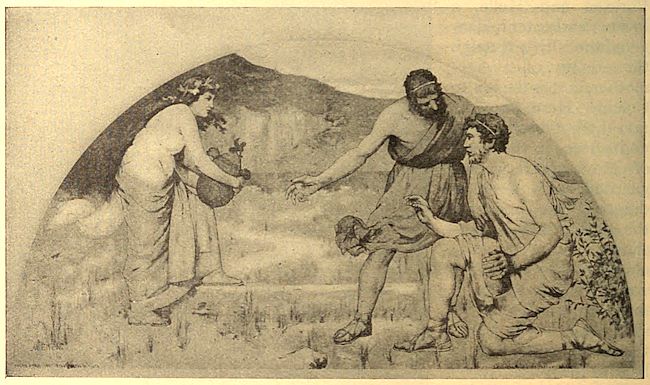
PROMETHEUS AND PANDORA.—BY WALTER McEWEN.
Prometheus is represented as warning his brother Epimetheus not to accept
Pandora from the gods. Prometheus, who, with his brother, was the first of
mankind, had outwitted Jupiter in the matter of offering sacrifices; Jupiter,
in return, had withheld fire from earth. Prometheus, however, secured it
by stealth from heaven, and Jupiter in revenge formed Pandora, the first woman,
and sent her to become the bride of Epimetheus. Epimetheus disregarded
his brother’s advice and took Pandora and with her the fatal box, which, when
opened, let loose a cloud of evils to torment, with only delusive Hope to console,
mankind.
Theseus is directed by Minerva to leave Ariadne, who sleeps beside him,
and proceed to Athens alone. Athens had been compelled for years to
send an annual tribute of youths and maidens to Minos, king of Crete, to
be devoured by the Minotaur, a savage monster, half bull, half man, who was
confined in a Labyrinth. Theseus voluntarily sailed on the tribute-ship, and
reaching Crete gained the love of the daughter of Minos, Ariadne, by whose
aid he was enabled, after slaying the Minotaur, to find his way out of the
Labyrinth. Returning, he bore Ariadne away with him, but deserted her at
the island of Naxos, as here depicted, at the command of Minerva. There
she was found by Bacchus, who made her his bride.
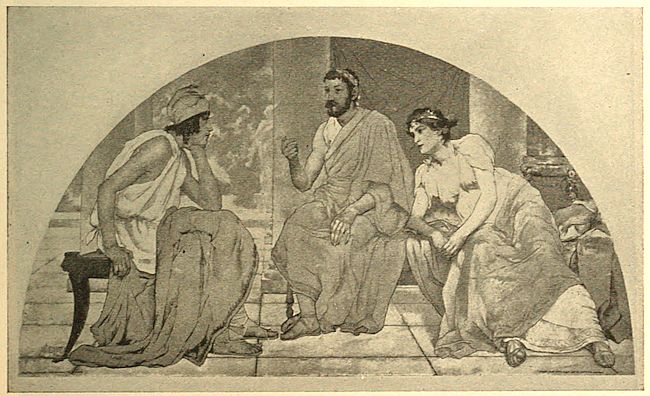
PARIS AND HELEN.—BY WALTER McEWEN.
Achilles, disguised as a maiden, and living among the women of the court
of Lycomedes, king of Scyros, is discovered by Ulysses. Thetis, the mother
of Achilles, had been forewarned that her son would die an early death, as it
turned out afterwards that he did, being slain by Paris before the walls of Troy.
She therefore dipped him, while still an infant, in the River Styx. He was
thus made invulnerable in every part of his body except his heel, by which his
mother had held him, and which therefore remained unaffected by the sacred
water. To make assurance doubly sure, Thetis sent him to Lycomedes to be
reared as a maiden, far from the dangers of war. When the Greeks were arming
for the siege of Troy, the oracle informed them that without Achilles the
city could never be taken. The crafty Ulysses was therefore sent in search of
him. He arrived at the court of Lycomedes disguised as a pedler, bearing in
his basket weapons of war and feminine trinkets. Showing these among the
women, all were eager to examine the ornaments; Achilles clutched at the
sword and shield, thus discovering himself immediately to the keen eye of
Ulysses.
Hercules was sold as a slave by Mercury to Omphale, Queen of Lydia.
They became enamored of each other, and Hercules, to please her, wore female
garments, and spun among the female slaves. The artist here exhibits him
aiding the queen in her task.
Mr. McEwen’s corridor opens directly into a richly decorated gallery, serving
as a special reading room for members of the House of Representatives. No
apartment in the Library is more lavishly and sumptuously ornamented. The
floor is dark quartered oak; the walls have a dado of heavy oak panelling about
eleven feet high; and the deep window-arches are finished entirely in the same
material. Above the dado the walls are hung with olive green silk. The ceiling
is beamed and panelled, and is finished in gold and colors, with painted decorations
in the panels, and encrusted conventional ornament in cream white
along the beams. Over the three doors are carved oak tympanums, by Mr.
Charles H. Niehaus, comprising two different designs—the first a central
cartouche bearing an owl, and supported on either side by the figure of a
seated youth; the other, the American eagle flanked by two cherubs. At either
end of the room is a magnificent mantel of Sienna marble. Over the fireplace
is a large mosaic panel by Mr. Frederick Dielman, representing, at one end of
the room, Law, and at the other, History. Above is a heavy cornice, supported
on beautiful columns of Pavannazzo marble, the general color of which
is gray instead of yellow, but with a system of veining which agrees very well
with that of the Sienna. In the centre of the cornice is a small cartouche, of
green onyx in the mantel to the south, and of labradorite, or Labrador spar,
in the other, the latter stone being remarkable for its exquisite gradations of
deep peacock-blue, continually changing with the light and the point from
which it is seen.
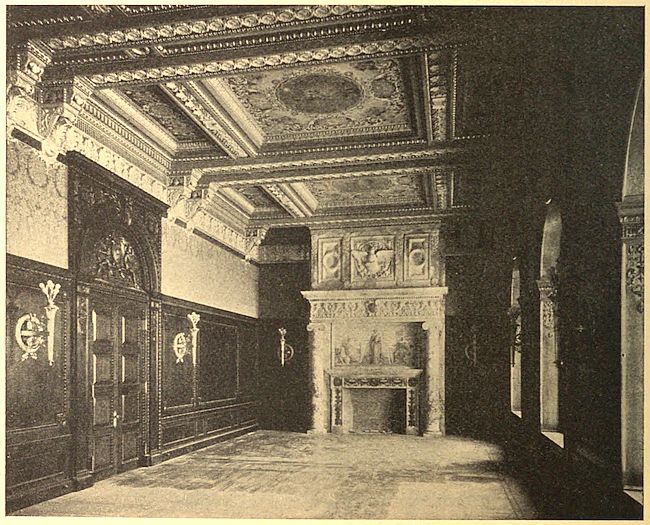
THE HOUSE READING ROOM.
Mr. Dielman’s Mosaics.—Mr. Dielman’s mosaic panels are of the same
size and shape, each being seven and a half feet wide and three feet seven inches
high. They were executed in Venice, which for generations has been celebrated
for the delicacy, accurate coloring, and nicety of fitting, of its mosaics.
The process and methods used in this work are much the same as in the ordinary
sorts of mosaic—such as would be required for a ceiling, for example—although,
of course, the pieces, or tesseræ, must be fitted with much greater
care and patience, so that every piece may take its place in a perfect gradation
of color. The work of the painter consisted in making full size cartoons
in the exact colors desired in the mosaic; from these the Italian workmen
prepared the finished panels, and sent them to this country ready to be
put in place. The cartoons, however, were necessarily painted as much as
possible in simple outlines and shades of color, for, although the Italian shops
are said to have at their command enamels of no less than twenty-five thousand
different tints, it would be obviously impossible with such a material to reproduce
exactly every variation of tone and line of which the brush is capable.
Certain refinements of technique, therefore, and more especially the vagueness
of color which is often so desirable in the painted canvas, must be avoided in
a cartoon made for such a purpose as Mr. Dielman’s.
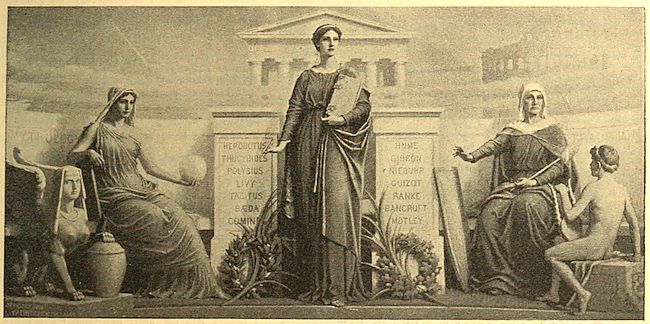
HISTORY.—BY FREDERICK DIELMAN.
The mosaic at the north end of the room represents Law, typified by a
young and beautiful woman seated on a massive marble throne and holding in
one hand a sword with which to chastise the guilty, and in the other a palm
branch with which to reward the meritorious. Her head is surrounded by a
glory, and she wears on her breast the Ægis of Minerva to signify that she is
clad in the armor of righteousness and wisdom. On the steps of her throne
are the scales of Justice and the book of Law, and a pair of white doves emblematic
of mercy. The visitor will notice that Mr. Dielman’s conception of
Law includes the conventional typification of Justice, but at the same time slightly
differs from it. The reason is that he has wished to indicate not only the judicial
but the legislative side of Law; hence the freer air of command, and, in
particular, the outdoor landscape of woods and hills, signifying a less restricted
authority than that of the courtroom. Such a typical symbol of Justice as
the scales is less conspicuously introduced, and the usual globe is entirely
omitted.
To the left of the central throne are three figures representing, as one may
see by the names in the streamer above them, respectively Industry, Peace, and
Truth, the friends and supporters of Law; while to the left Mr. Dielman introduces
three other figures typifying Fraud, Discord and Violence, the enemies
of Law. Industry and Violence are represented as male figures; the other
four as female. Very appropriately, the first group seems to be advancing
unafraid toward the throne of the Goddess; while the figures to the right
shrink terrified from her presence. The emblems which distinguish the various
figures are easily understood:
Industry with a wheel and hammer;
Peace with an olive-branch
and crown of olive; Truth with
the lilies; Fraud, represented
as a withered hag; Discord, with
disordered hair and garment,
and holding a pair of knotted
serpents; and Violence, in a
steel cap with the blazing torch
lying on the ground before him.
GOVERNMENT.—BY CARL GUTHERZ.
Mr. Dielman’s second panel
represents History. The titular
figure, that of a woman of great
charm and beauty, stands in the
centre holding a pen and a book.
On either side are marble tablets
bearing the names of great
historians—Herodotus, Thucydides,
Polybius, Livy, Tacitus,
Baeda, Comines, Hume, Gibbon,
Niebuhr, Guizot, Ranke,
Bancroft, Motley. At the foot of one tablet is a laurel wreath, for peace,
and on the other side an oak wreath, for war—the twin topics of history—each
accompanied by a palm branch, the general reward of success.
On either side of the panel extends a marble bench on which are seated
two female figures representing Mythology and Tradition, the predecessors
of history. Mythology, the expounder of the ancient tales of the gods
and heroes, stands for theories of the system of the universe, in token
of which she holds in her right hand a globe of the earth. Beside her is a
sphinx—the female sphinx of the Greeks, not the male sphinx of Egypt—suggesting
the eternally insoluble Riddle of the World. At the other end of
the panel, Tradition, an aged granddame, relates her oldwives’ tales to the boy
who sits listening before her. The figure represents the whole body of mediæval
legend and folk-tale. Reminders of a past age are brought out in the distaff
she holds in her lap, the Romanesque capital on which the boy sits, the harp
he holds in his hand—with its reference to the wandering minstrel of the
Middle Ages and his store of tales—and in the shield, very likely the text of
the story which is being told, which leans against the tablet.
In the background of the panel, seeming to float amidst the clouds, are three
ancient buildings, an Egyptian pyramid, a Greek temple, and a Roman amphitheatre—signifying
the three nations of antiquity in which History was most
highly developed.
Mr. Gutherz’s Paintings.—Along the centre of the ceiling are seven
panels containing decorations by Mr. Carl Gutherz, representing The Spectrum
of Light. Each of the seven colors shown in the spectrum is typified by a central
figure standing for some phase of achievement, human or divine. Other
features of the panel are two cherubs in each corner, representing arts or sciences,
and a series of eight escutcheons, one with the title of the decoration,
and the other containing the seals of the various States, the whole being combined
in a single arabesque pattern by an elaborate design of scroll ornamentation.
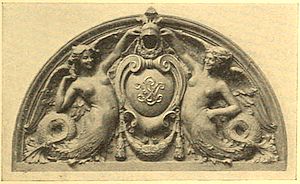
OAK DOORHEAD.—SENATE READING ROOM.
BY HERBERT ADAMS.
The order of the subjects begins in the centre and goes first north and then
south from that point.
The color of the centre
panel is Yellow, and the
subject The Creation of
Light. The Divine Intelligence,
sitting enthroned
in the midst of
Space, and enveloped in
mist and clouds, utters
the words, “Let there be
Light.” The corner figures
represent Physics,
Metaphysics, Psychology,
and Theology.
The second color is
Orange, and the subject
The Light of Excellence,
suggested to the artist by Longfellow’s poem, Excelsior. A spirit stands midway
on a pyramid of steps (signifying Progress), which is lost in the unknown distance.
She beckons to man to join her on the heights where she is standing,
and holds in one hand the wreath which crowns every effort for Excellence. In
the corner, the cherubs typify Architecture and Sculpture; Transportation; the
Phonograph and Telephone; and Invention and Design.
The third panel is Red, representing The Light of Poetry. Poetry, mounted
upon Pegasus, holds a torch in one hand and with the other reaches toward that
light of the ideal for which he must always strive, but which he can never attain.
In the background half-seen figures represent the afterglow of Tradition and
Mythology. The corner groups stand for Tragedy and Comedy; Lyric Poetry;
Pastoral Poetry; and Fable.
Violet, the fourth color, is symbolized as The Light of State. The United
States being regarded as the highest form of government yet achieved, its emblems
are selected as the best expression of the ideal State. This being the
case, Violet was the color under which, according to the conception of the
artist, the United States might best be represented, since violet results from
the union of the American colors, Red, White, and Blue. The figure is that of
Columbia, with a shield emblazoned with the United States flag, and carrying
a staff surmounted by a liberty-cap, while the American eagle hovers above her
shoulder. The cherubs in the corners represent the Suffrage, Justice, Liberty,
and Equality.
The next subject is Green, or The Light of Research. The central figure is
the Spirit of the Lens, which in the telescope and the microscope reveals to the
scientist the secrets of the universe. She is surrounded by the sea, with its
myriad forms of life furnishing her with the material for her investigations.
The cherubs in one corner have a microscope. In another, they represent
Chemistry; in the third Archæology (Egyptology deciphering the hieroglyphics);
and in the fourth, Mineralogy—all selected as being especially concerned
with original investigation and research.
Blue is The Light of Truth. The Spirit of Truth crushes the dragon of Ignorance
and Falsehood under foot, and reaches to heaven for a ray of light
with which to inflict the final wound. The blue of the background is the blue
of daylight,—light from darkness. The cherubs hold the level, the plumb, and
the Bible, each considered as an agent in indicating the presence of a universal
law.
The last panel represents Indigo as The Light of Science. The figure represents
Astronomy, who is guided by the soul (figured as a butterfly fluttering
above her head) to explore the movement of the stars. The cherubs represent
various phases of astronomical study. One of the figures, for example,
explains the theory of mathematics, showing on the fingers of the hand that
one is the unit of everything; a second looks through a telescope; and others
are studying books and making calculations.
At the end of the corridor leading to the House Reading Room, is a little
lobby, from which one enters the Southwest Pavilion, or Senate Reading Room,
reserved for the use of members of the Senate. The little lobby itself is one of
the most beautiful examples of pure architectural design to be found in the
Library. The walls are of Vermont marble—the same as in the corridor—panelled
with Sienna marble. The moulded ceiling is finished entirely in gold,
with a central rosette, surrounded by coffers and conventional Greek mouldings,
one of which, a rather elaborate fret, is laid upon a ground of deep red.
The whole effect of the decoration, taken in connection with the low light which
prevails, is remarkably fine—a combination of great richness with soberness
and refinement.
The Senate Reading Room is finished in much the same style as the House
Reading Room, but with less elaboration of ornament. On the whole, the effect,
though quieter, is perhaps more restful and satisfying. A toilet room,
leading from the lobby just spoken of, cuts off a portion of the pavilion, but
allows space above for a low gallery enclosed by a delicately carved balustrade
of Sienna marble. Below, the oak dado is ornamented with delicate inlaid
arabesques of white mahogany. Above the dado the walls are covered with
figured red silk. In the southwest corner is a fireplace of Sienna marble,
with a sculptured panel of the same material by Mr. Herbert Adams. The design
shows an eagle with arrows in his claws, and an American shield supported
by flying cherubs. The doorhead tympanum is of oak, like those in the House
Reading Room, and contains a carved panel, also by Mr. Adams, with a heraldic
shield bearing the monogram, “U. S. A.,” and supported by mermaids.
The gold ceiling contains six square panels, each containing four graceful female
figures holding garlands in their hands—the work of Mr. William A. Mackay.
The corridor leading to the north from the Main Entrance Hall is, as has
been said, similar in design to that opening into the Congressional Reading
Rooms. The design of the floor and ornament upon the arches is somewhat
different, however. The tympanums which it contains are ornamented by a
series of paintings, by Mr. Edward Simmons, representing the nine Muses.
Mr. Simmons’s Paintings.—The Muses, according to the Greek mythology,
were the goddesses of the various departments of Art, Poetry, and
Science. Apollo, the God of Song, was their father, and Mnemosyne (Memory)
their mother. Their names, given in the order in which they occur in Mr.
Simmons’s series, beginning at the south end of the corridor, were as follows:
Melpomene, Clio, Thalia, Enterpe, Terpsichore, Erato, Polyhymnia, Urania,
and Calliope. Melpomene was the Muse of Tragedy; Clio, of History; Thalia,
of Comedy and Bucolic Poetry; Enterpe, of Lyric Song; Terpsichon, of Dancing;
Erato, of Erotic Poetry; Polyhymnia, of Sacred Song; Urania, of Astronomy;
and Calliope, of Epic Poetry.
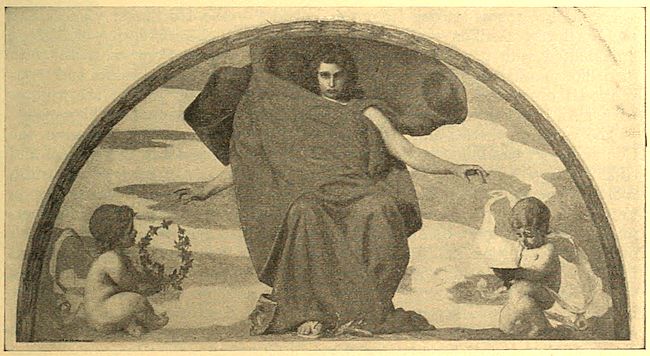
MELPOMENE.—BY EDWARD SIMMONS.
In Mr. Simmons’s panels, each of the Muses is shown as a seated figure. On
either side a laurel wreath is displayed, as the general symbol of intellectual
pursuits, and the background is diversified by curving lines of smoke proceeding
from the flame of a torch or a censer—thus signifying the inspiration of
Art and Poetry. In several of the tympanums the Muse is accompanied by
little geniuses who serve to bring out the special character of the central figure.
In the panel devoted to Thalia the genius is a satyr, with goat’s legs, and carrying
a pair of Pan’s pipes. The Muse playfully catches him in a fold of her
garment—the whole suggesting the rustic sportiveness of the early Greek
Comedy. Certain of the panels, also, contain various distinguishing objects.
Melpomene, for example, is accompanied by a tragic mask; Clio by a helmet,
for the warlike exploits recorded by History; Thalia, by a comic mask; Urania
by a celestial globe. Terpsichore is represented as if swaying to the music of
the dance, and is striking a pair of cymbals. Erato is nude, and bears a rose—the
flower of love—in her hand. Polyhymnia holds an open book in her
lap. One of the geniuses in the tympanum of Calliope holds a scroll, and the
other some peacock’s feathers—the latter symbolical, perhaps, of the dignity
and beauty of the Epic.
Of the two rooms leading from this corridor—the Northwest Gallery and
the Northwest Pavilion—the first is decorated in a cheerful spring-like green
ornamented with garlands, and the Pavilion in a deep Pompeiian red with
medallions containing figures of dancing girls, by Mr. R. L. Dodge, and conventional
ornaments adapted from Pompeiian designs. In the six window
bays, also, is the series of the signs of the zodiac, designed by Mr. Thompson.
The various galleries and pavilions on this floor, excepting, of course, the
Congressional Reading Rooms, are designed to accommodate the clerical and
cataloguing work of the Library and the Copyright Department, or to furnish
room for special collections of books. There is every reason to hope that in
time many valuable private libraries throughout the country will find their permanent
home in some one of these apartments, given or bequeathed by their
owners to the Nation, and preserved for all time in convenient, well lighted and
fireproof rooms as a memorial to the liberality of their donors. Already one
such collection has been received, presented several years ago to the Library
by the late Dr. J. M. Toner of Washington. It is kept by itself in the Northeast
Pavilion. The most remarkable feature is its Washington letters, gathered
either in the original or in copies, during a period of many years.
The basement of the Library, which may be reached through the doors under
the staircases in the Main Entrance Hall, is arranged in the same way as the
first and second stories, except that the whole floor is connected by a series of
corridors which extend entirely round the building.
The walls of the West Pavilion are sheathed in a dado of white Italian marble
about ten feet high, above which is a vaulted ceiling ornamented with a bright,
open arabesque in green, blue, and yellow on a cream-colored ground. The
corridors have dados of American marbles, usually dark in color, as Lake Champlain
or Tennessee. For the walls and vaults, plain colors harmonizing with
the marble and set off with simple arabesques and borders, have been used.
The effect is well worth the attention of the visitor—the rich tones of the
marble and the brighter coloring of the walls and vaults framing a long vista
seen through a succession of low, narrow arches.
THE
ARCHITECTURE
SCULPTURE AND PAINTING
BY CHARLES CAFFIN
THE ARCHITECTURE SCULPTURE AND PAINTING
BY CHARLES CAFFIN
It is interesting to note that the ground plan of the new Library of Congress
was suggested by that of the British Museum. There, however, the
central reading room was placed inside the quadrangle as an afterthought.
Building on this, as well as on the architectural experience of
other libraries, our own Library has had the advantage of organic growth.
Every part is related to the whole, and practical and æsthetic requirements
are logically and naturally fulfilled.
These requirements were: an imposing edifice, with plenty of well-lighted
rooms; facilities for the storing of books; and ample space for the reading and
general public. With one exception the exterior of the building indicates the
character and relative importance of the interior divisions. That exception is
the book-stacks, radiating from the sides of the Rotunda or central reading
room. But their position is in completely natural relation to the rest, and by
being hidden from the outside, they could be made just what they pretend to
be, viz. huge book-shelves of iron, bricks, and marble, well lighted and ventilated.
Their construction is æsthetically perfect, and yet without injury to the
façades.
The latter, albeit severe and lacking the indefinable artistic spirit of the
Capitol, are grand and imposing. The ground floor, resting on a continuous
plinth, is constructed of huge blocks, quarry or rock-faced, with bold joints and
square lights. The masonry of the first story is fine pointed with vermicular or
coral-like quoins at the angles of the pavilions. In the second story, the bel
étage, the face of the granite is smooth; the windows are framed with pilasters
and surmounted with pediments; the pavilions are emphasized by porticoes
resting on Corinthian columns. The horizontal mouldings are boldly accentuated
and carefully graduated, terminating in a modillioned cornice surmounted
by a balustrade. The shadow effects are strong and tender, and the set-back
of each floor well marked.
While the exterior of the building represents a single thought and one engrossing
individuality, the interior reveals a complexity of thought and a variety
of distinct personal influences, due to the parts played by the sculptors and
painters. Yet there is no lack of homogeneousness. The architect has
balanced the individual notes by the breadth and force with which he has
treated the purely decorative parts of his scheme. His effects are massed.
Sumptuous expanses of mosaic, or painted surfaces, or stuccoed vaults, compel
our attention and divide our interest with the special objects of beauty. The
spectator’s mind is not bewildered by a jumble of elaboration, but passes
quietly from one impression to another. On entering the Entrance Hall, for
instance, marble is beneath our feet and on all sides of us. The impression is
instantaneous, irresistible, and entirely undistracted. In the adjoining halls,
the prevailing theme is varied by the colors of the marble mosaic vaults, which
assert their own beauty at the same time that they modestly bring the painted
compositions of the tympanums into color-relation with the grey-white marble
walls.
Upstairs, in the corridors beyond the arcades, the marble impression is prolonged
in the mosaic floors, delicate in their play of color, and splendid in
their very spaciousness. But the main impression is still that of painted ornament.
In the adjacent galleries marble is continued in the floors, but the chief
architectural interest here is in the stucco work. It is true we are attracted by
the painted lunette at the end, but simultaneously we feel how superbly framed
it is by the vista of vaulted ceiling. The importance of the four pavilions is
emphasized by painted compositions, but here again an equipoise of interest is
maintained by the mosaic floors, and the beautiful lines of the stucco, which
weave the octagon of walls into the circle of the vault. Beneath the great central
dome of the Rotunda all these forces are massed with excellent judgment.
The dome itself rests upon massive columns of Numidian marble connected by
two tiers of arcades of Sienna marble; mounts up in successive gradations of
stucco, from bold accentuation to tender elaboration, till it melts into the calm
of Mr. Blashfield’s painting and ends in the dreamy spirituality of his figure in
the cupola.
In the little corridors to the north and south of the Entrance Hall the architect
has epitomized his methods. They are miniature éditions de luxe, in which
arch and vault, marble, stucco, mosaic, and pictures are blended with the daintiness
of an Elzevir.
Including under Sculpture the plastic, carved, and bronze work, it will be
convenient to consider the sculpture of the Rotunda by itself and apart from
that of the rest of the building, for it consists mainly of statues linked together
by a common thread of thought, while elsewhere the motive is solely decorative.
One of the prominent features of the Entrance Hall is the balustrade of the
staircase, executed by Mr. Martiny. The coil of babies and garlands is irresistibly
fascinating. Bold in line and generous in massing of light and shade,
as befits the grandeur of the construction, the design has, besides, much
daintiness of detail. Joined to an exquisite fancy, playful without grotesqueness,
are a fluency and certainty of technique in the best sense French. In
somewhat the same vein is Mr. Adams’s tympanum over the Senate Reading
Room door. The main masses have an exuberance, boldly contrasting
with the delicate details that overspread the entire panel. The modelling and
lines are so excellently adjusted that the animation of the laughing faces seems
to circulate to the very tips of the tails. In Mr. Perry’s Sibyls the balance between
the filled and empty spaces and the simple force of the beautiful lines and masses
are admirable. The thought embodied is equally admirable. The sculptor has
chosen the four races to which we immediately owe our modern civilization, and
pictured each Sibyl as the personification of the special quality or genius of that
race: Religion, Beauty, Order, Progress. Conspicuous in the four pavilions are
Mr. Pratt’s Seasons. The composition of each is simple and united, while the
circle is well filled with an embroidery of light and shade. In Winter, for example,
the design converges towards the patiently folded hands; in Autumn it
revolves around the infant; we note the circling solicitude of the mother,
centering on the baby at her breast.
In the Rotunda, the statues embody the basic elements of civilization, and
some of its noblest exponents; a theme beautifully appropriate to the soaring
edifice. Primarily, however, the statues have an architectural purpose; the
larger ones to prolong the lines of the columns and emphasize the spring of
the arches, the smaller to break the level of the balustrade with a series of upward
accents. The sculptors have not been as one in interpreting this obligation,
for their work varies from monumental simplicity to extreme characterization.
Mr. Pratt’s Philosophy is grandly simple and reposeful. A little intricacy
of drapery upon the bosom serves to isolate the bowed head and give more
severity to the unbroken folds below. By a calm immobility, also, Mr. Bissell,
Mr. Boyle, and Mr. Dallin have secured impressiveness in their statues of Kent,
of Bacon, and of Newton. Much the same, too, may be said of Mr. St.
Gaudens’s Art.
In Mr. Donoghue’s Science the repose is re-inforced with movement. The
strong masses of drapery on one side contrast with the supple line along the
right of the figure, and with the placidly extended hands. The hands conform
to the spread of the arches, while the whole figure prolongs the columns. Symbolically,
it suggests the combined restlessness and contemplation of Science.
In this brief analysis we must include in one group Mr. Niehaus’s Moses and
Gibbon, Mr. French’s Herodotus, and Mr. Potter’s Fulton. All of them are
rich in characterization, extremely picturesque, and yet sober and controlled in
contour. We shall find examples of exquisite technique in modelling in Mr.
French’s History, Mr. St. Gaudens’s Homer, and Mr. Macmonnies’s Shakespeare.
In Mr. Ruckstuhl’s Solon and Mr. Bauer’s Religion and Beethoven
characterization seems the foremost thought.
Mr. Macmonnies’s door is very noble, with increased richness and emphasis
in the lunette. In thus giving a sense of greater elevation and dignity by lifting
the eye upwards, it is interesting to note how he has adopted a form of
composition similar to that introduced by Mr. Vedder for the same purpose
over the entrance to the Rotunda. The main composition is a square, modelled
in such bold relief that the attention is immediately arrested and directed
upwards. Yet there is no sense of emptiness in the accessory portions of the
lunette, which are richly encrusted with ornament. To assist this elevation the
figures in the panels are in low relief, broadly and simply treated. But the
comparatively emphatic folds of the drapery on each side strengthen the figures,
while the torches seem as a bold frame to the design, with pronounced accent
at the four corners.
Somewhat similar must have been the motive of Mr. Warner. He has made
the interest of his doors ascend, but on reaching the top has spread it throughout
the lunette. In the latter the balance of raised and hollow parts, and the
mingled repetition and contrast in the direction of his lines are admirable.
The general painted decoration, as carried out for the architect by Mr. Garnsey,
is always loyal to the architecture, and yet asserts the essential and peculiar
value of color. First and foremost the constructional value of color is fully
realized. In the central Reading Room, for instance, not only have the white
walls and stucco been brought into color harmony with the rich red and yellow
of the Numidian and Sienna marbles, but the tints have been so distributed
and their strength graduated in relation to the spaces they cover, that a strictly
structural fabric of color has been constructed in and around the architectural
edifice. The grand suite of rooms running round the entire second story is a
charming example of color sequence. The keynote is yellow, the most joyous
of all colors—the hue of sunshine. The note is struck positively in the four
pavilions, where the yellow has been carried as far as possible in the two directions
of red or blue. These positive colors are connected by the tertiary tints
in the intervening rooms, where the walls are dull yellow or olive, relieved by
red and green in the frieze. In the room on the north side the painter has
suffused the olive-green with a neutralized bloom of the complementary violet,
thus securing a harmony of opposition as well as of similarity. In the central
room on the east side, the scheme for a brief space swings to blue, with yellow
in the frieze, and the more important rooms on the west side echo some of the
brilliancy of the adjacent stair-hall. To name but one other phase of this work
in which the decorator has worked so well for the architect, the emotional value
of color or its quality of expression is exhibited in numerous instances. Above
the high oak wainscot of the Librarian’s Room, the panels are a deep blue,
enamelled with subdued arabesques. Age seems to have dimmed them. There
is a patina of green rust upon the ivory ceiling, the tender touch of time upon
the owls and lamps, that hints at the antiquity of thought. Compare with this
the robustness of the design of the ceiling in the Pavilion of the Seals. The
first impression is of a turbulence of gorgeous clouds veiled in a golden haze.
Gradually the details of form and color grow, and we discover an elaborate
harmony in which the great Seal of the United States and the American flag,
are predominating features.
Of the special paintings which complete and accentuate this great general
scheme of architecture, Mr. Blashfield’s occupy the most important position.[13]
The problem was a conflicting one. The space demanded a noble theme and
stately treatment, conforming to the monumental majesty of the structure, and
yet responding to the tenderness and airiness of the cobweb of arabesque. It
was necessary to continue and also to conclude the converging ribs; to solidify
and also to disperse them; to create a design subordinate to the architecture
and yet completing it and dominating it. His treatment is geometrical. Four
figures crown the axial spaces, conspicuously white, full fronted, self-contained,
emphasizing the spaciousness and symmetry of the structure, and symbolizing
the four basic constituents of civilization. Each of these is supported by a
figure to the right and left, which are so subtly posed that they prolong the
converging lines of the ribs of the dome. While the eye is thus continually
carried up, it is diverted horizontally by the interlacing lines of the limbs, the
necklace of recurring banderoles and cartouches, and finally by the majestic
sweep of wings, the sculpturesque simplicity of which merges the painting into
the architecture above. To this wreath of form the artist has imparted a suffused
bloom, tenderly iridescent; giving quiet distinction to each figure and a
satisfying harmony to the whole composition. His intellectuality reveals itself,
not only in the technical solution of his problem, but also in the depth and
comprehensiveness with which he has interpreted his theme. It matters not
which figures one selects; all are beautiful and richly suggestive. Compare the
representation of Religion and of Philosophy; the yearning of the one for outside
strength and light with the calm, passionless scrutiny of the other; or the
dreamy transcendentalism of Islam, and his rounded limbs, with the square
strenuous determination of the young giant, America. This composition, however,
is not a circle, the recognized geometrical symbol of eternal completeness,
but a concave ring whose lines converge toward a centre outside of and
above itself. That centre is the figure in the Lantern, representing that Higher
Wisdom to which the wisest are always striving to attain. This concave ring
represents Civilization, which, kept in perfect balance by the harmony of the
various elements of human life, spins easily and surely upon its axis. This is
the greatest good of all; but it is impossible to maintain Civilization without
Progress; it must forever speed upward to the Higher Wisdom.
Mr. Pearce’s panels in the north corridor are notable examples of decorative
color. The positive tints are clear and fresh against soft backgrounds of
secondary greens and violets. The composition, except in the panel of The
Standard-Bearers, leans to the pictorial rather than to the decorative method.
Perhaps Labor and Religion combine the two methods most happily. In the
former the lines of the limbs repeat and relieve each other most agreeably.
There is enough sameness of movement to emphasize the sharing of toil,
sufficient difference to suggest individual effort. There is a suggestive
contrast in Religion between the man’s awe and the woman’s placid confidence.
He recognizes the mystery, she the comfort of fire. A germ of
the love of the beautiful is shown in the choice for an altar of the curious
stone which they have propped up so unstably, and yet with so much
affectionate care.
In the east corridor, Mr. Alexander’s six panels are to be taken as so many
fragments cut from the picture of the ages. They are terse and vigorous;
they compel our interest. The figures are dramatic, in the true sense that
they are doing something simple and natural, while their local surroundings,
like the old chorus, interpret the significance—in some cases, from the standpoint
of to-day, the insignificance—of the act. For, by the exercise of keen
imagination, and through the resources of his technique, the artist has rendered
with pathetic vividness the dumbness and isolation of early man and the unresponsiveness
of his surroundings. With the skill of an expert dramatist, he
has developed the growing permanence of the record, and the widening of the
circle of influence, and led up to the climax when the written speech of one
becomes the property of all.
In Mr. Walker’s panels, Nature and not Humanity is the inspiration. In his
largest panel, she is exhibited in the unrestraint of stream and rock and verdure.
Yet she is represented in Mr. Walker’s paintings not so much for her own sake
as for the inspiration which she lends to the mind of the poet. It is Nature
viewed through the medium of the imagination—Nature refined by the
alchemy of human emotion.
In the opposite panel, man’s relation to Nature is introduced; in a suggestion
of the old idyllic, pastoral life, with a hint, too, on one side of the panel,
of man’s creative genius, the stately edifice into which, working upon Nature’s
plan, he has built his own personality. The scheme is completed by the
smaller panels in which the artist has suggested the various moods of lyric
poetry, as illustrated by the special genius of Shakespeare, Milton, Tennyson,
Emerson, Keats, and Wordsworth.
Mr. Vedder, in his Government series, has played upon a simple scale of
low-toned reds, blues, greens, and yellows, thus responding in his work to the
mosaic and marble which surround it. Each composition has a separate
geometrical motive, built up by the distribution of the colors, the balance or
contrast of light and dark, the flow of the lines, and, not least, by the arrangement
of the spaces. The central panel succeeds completely in its twofold
purpose of giving dignity and height to the entrance, and of expressing the
solidity and elevation of Government. The use of line is throughout remarkable.
In the panels of Good Administration and Peace and Prosperity the
lines of direction are downward from the zenith. In the former, these lines
fall in tenderly embracing curves; in the latter they widen out and form that
strongest of all structures, a broad-based pyramid. In Corrupt Legislation,
the eye is first arrested by the tilted leg and slovenly slipper, and follows down
to the money-bag. We know it all: the shamelessness, shiftlessness, and corruption.
It is a compression of multiplied experience into one illuminating
flash. The direction of the picture is diagonal, and the masses of form and
color purposely accentuate its lop-sidedness. Yet the picture seems evenly
balanced, for the simplicity and distinctness of the standing figure attracts
one’s eye from the intentional confusion of the opposite side. In the spaces
one will notice the harsh gashes made by the chimneys, and the unpleasant
parallelism of the smoke wreaths, so suggestive of the dead monotony of sordid
lives. The triumph of ordered disorder is reached in the panel of Anarchy,
which is based on a reversal of geometric methods. The masses of dark and
light tumble diagonally across the picture towards the desolate space with the
broken wheel. The spaces at the top are shattered and splintered as if by an
explosion. But most remarkable is the jagged space near the centre. It is
as if a shot had ploughed its way through the chaos and allowed a glimpse of
the void beyond.
Mr. Vedder’s Minerva recognizes at once the strong points and the limitations
of mosaic. The design itself is a mosaic in which the full and empty
spaces, and the light and darker portions, and the embroidery of lines, together
form a rich brocade. Sumptuousness is added by contrasting the smooth outlines
of the one side with the intricate elaboration of the other. It is very
interesting to note how the spear ties together the lighter portions, and prevents
the strong figure from being too sharply silhouetted.
Around the statuesque simplicity of Mr. Shirlaw’s Sciences flows a sinuous
play of lines, and their broad masses of color reflect the surrounding tints, so
that these panels are more than punctuations; they are at once the focus-points
and distributing centres of the whole corridor. There is a geometrical plan
apparent in the building-up of the figures. Often the main lines intersect diagonally,
and one is tranquil, the other energetic; there are centres of repose
and of movement to which these lines converge; and these are also the points
of main interest in the symbolism of the picture. In Mathematics, for instance,
the line of the nude position, suggesting the naked accuracy of figures, leads
up to the calm, frank face; while the more intricate line of the drapery winds
across diagonally, and merges in the convolutions of the scroll, with its hint of
abstruse calculations. The arrangement of the draperies, indeed, is invariably
worthy of close attention. Compare the stem-like lines and petal-shaped folds
which cling to the form of Botany, with the successive eddies that circle round
Astronomy.
In Mr. Reid’s panels the sensitive vibration of color and the luxurious lines
eloquently express the delight of the Senses. But there is no note of decadence.
There is so much decision in the drawing, free expansion in the masses
of form and color, and such energy in the flashing color of the drapery, that we
feel in these beautiful women, not the enervation of pampered senses, but
merely a moment’s pleased suspension of activity. This is least noticeable in
the elegant deliberation of Taste; it is finished to a delicate point in the exquisite
conception of Touch. This is a picture of an instant of arrested energy,
shown in the forward lean of the body, and the momentary stillness of the outstretched
arm on which the butterfly has alighted. In a moment the insect
will be gone, the limbs will relax and vibrate again with active life. Throughout,
it is enjoyment of the senses, not abandonment to them, that the artist has
depicted.
What may be called the debonair quality of Mr. Barse’s figures is very noticeable.
It is due not only to the purity of type, and to the tenderness and
simplicity of the coloring, laid on so flatly in two or at most three tones; but
mainly to the sensitive elaboration of line. The figures are of ample proportion,
and the draperies voluminous, but the artist’s appreciation of the value of
line in mural decoration does not stop with the broad effects. He weaves into
his draperies a diaper of delicate folds, each of which counts. In this way, by
contrasting the smooth portions with the comparative intricacy of others, he
gives to his figures, notwithstanding their simplicity, a certain richness, a quiet
assertiveness, and a most agreeable refinement.
The striking contrast of dark and light in Mr. Benson’s panels gives them
decorative distinction; a nearer view reveals the emotional tenderness of detail.
The white figures, graciously delicate in drawing and color, are silhouetted
against a dark background, brocaded with a bold design, and lustrous with interpenetrating
tints. The originality of conception in the four Seasons is interesting.
They are the four seasons of human feeling: the Springtime of
anticipation; the Summer of possession; the Autumn, not of harvest, but of
waning joyousness; the Winter of accepted loss. Yet hope and youth remain,
and the beauty deepened by experience in the last face is an earnest of still
another spring and summer, which shall be fuller, richer, and more precious.
Mr. Cox’s paintings in the Southwest Gallery exhibit a strong sense of responsibility
to the aims and limits of mural decoration. The method he has
adopted is to carry the surrounding architecture up into his pictures and melt
it into a canopy of sky. Before this he has suspended, in the case of Science,
a delicate arabesque, as it were, of line and color accentuated by three important
masses. Everything that could interfere with the flatness of his decoration
has been rigidly eliminated. It is to the wall and not beyond it that he
would direct our attention. The architectural features are only faintly depicted,
and the foliage breaks up the background without introducing another plane.
But it is in the figures that the artist’s mastery over his restrictions is most
complete. With practically no recourse to light and shade, but relying solely
on drawing and the handling of a few tones, he has given form and substance
to his figures. The work throughout reveals clearness of purpose and certainty
of accomplishment.
The decorations by Mr. Maynard, in the Pavilion of the Discoverers, strike
a distinctly independent note. The starting-point of the scheme is the honor-roll
of illustrious men toward whom the central composition stands as a sort of
coat-of-arms, symbolically expressing the principle which links the names into
a common family. The treatment, in fact, is heraldic, and subtly suggests the
mediæval chivalry out of which the various movements grew. This formal
character is assisted by the symmetrical distribution of the colors. Virility of
mind and method characterizes every detail of the compositions. Compare,
for instance, the panels of Discovery and Adventure. Energy, assertion, and
full-blooded life characterize all the figures. The aims and animating impulse
which especially distinguish the Discoverer are expressed in the eager, generous
movement of one of the flanking figures, and in the strong calm and steadfastness
of the other, shown, for example, in the self-restraint of the sword-arm.
In Adventure, on the other hand, the roystering abandon of the figures, the
easy carriage of the sword, epitomize the Adventurer’s sordid purpose and unscrupulous
methods.
Mr. Maynard’s figures in the Staircase Hall (the Virtues) are dignified and
elegant. Though they are so many vivid interludes to the repose of the architecture,
and are instinct with buoyant vitality, yet, by their coloring, sensitive
refinement, and noble proportions, they echo the surrounding marble.
Mr. R. L. Dodge has adopted a similar composition to Mr. Maynard’s in
the Southeast Pavilion, in his designs symbolizing the four natural elements.
The color schemes are in a light key. The backgrounds, to which the panels
are most indebted for their decorative value, have a considerable poetic quality.
Their intention is clear, and its expression agreeably fanciful. The
names in the tablet below have an interesting significance, recording the Greek
personification of the characteristics of the elements. The majesty of ocean,
for instance, was embodied in Poseidon; Proteus personified its quality of
assuming any shape; Galatea, its surpassing beauty.
In the next pavilion—the Pavilion of the Seals—Mr. Van Ingen has attacked
his problem from the standpoint of color. The treatment of the subject
is formal, for which, however, the artist has abundant warrant in tradition.
The soul is infused into it by color. In the density and richness of the tones,
the sumptuous texture of the surfaces, he has embodied the abstract idea of
the solidity, grandeur, and delicate complexity of well-ordered government.
The color schemes vary. In Post-Office and Justice, there is a diffusion of
motive. Rose and violet penetrate the panel, playing with each other and affecting
the other colors with subtle variations. In Treasury, however, the blue-green
impression, which swims over the whole, is brought into a depth of tone
in the woman’s dress; while in War there is a crispness of color throughout
in quick accord with the alertness of the figure and the flash of her robes.
These panels are essentially a painter’s vision, expressed through a painter’s
special medium.
Mr. W. L. Dodge, in the Pavilion of Art and Science, has grappled with his
problem in a big way; exhibiting an eager acceptance of difficulty, and a resolute
choice of intricate interest. For instance, he has arranged the light to
fall upon his figures at short range, so that, instead of a simple scheme of light
and shade, there is a multiplicity of unexpected effects. This purpose has
expanded under the influence of the various subjects. The panels of Art and
Music are crowded with sensations. We feel that here the painter is consciously
and unconsciously reproducing the sensations of his Art life. In Literature,
however, he has emerged into a more impersonal atmosphere. In
Science the reproduction of sensations even more clearly yields to the creation
of thought. Lastly, the ceiling is the climax of this growing artistic and intellectual
effort. Here the problem is at its biggest, and the technical solution
most successful. It is not by this or that accident of professional attainment
that Mr. Dodge wins us here. It is because we feel that here the technique
finally becomes the handmaid of real creative faculty.
In Mr. Melchers’s War and Peace, it is not beauty, in the popular acceptation
of the term, that attracts us. Our interest is seized by their masterful character,
held by their strong technique, and confirmed by their deep human significance.
The brush-work is simple and sure, applied with breadth and in few
tones, imitating the manner of frescoes in the old manner, painted rapidly
while the plaster was still damp. Everything counts, and the artist’s thought
is brought close to us. The composition varies with the subjects. In Peace,
Mr. Melchers has relied on smooth masses balanced athwart a pleasing leafy
background. Movement is suspended. War, however, shows the vigorous
construction of moving forms: solid masses and a tangle of gnarled limbs displayed
naked against a harsh landscape. We have muscular and mental tension.
We see only the horror and hideousness of war, and none of its pomp
and circumstance. Laurel, indeed, crowns the leader’s head, but his son is
stretched a corpse upon the rude bier. One man blows a trumpet, but none
of the dogged faces kindles. Only the hounds show eagerness, and they are
straining at the leash to get home. The religious procession is in its way just
as strong. It is entirely unsentimental. These simple folk are entering naturally
into what is merely a part of their life and thought.
A great deal of the charm of Mr. McEwen’s panels is due to the landscapes,
which are instinct with poetical imagination. The artist has given them an
atmosphere which sets them back in the past, when the world was in its youth
and full of promise rather than fulfilment. In the episodes selected, it is not
the heyday of heroic achievement that he has commemorated, but the first impulses,
such as those of Jason and Paris, or the reverses and inadequate results
of human effort as illustrated in the other heroes. Stripped of its glamor,
this is perhaps the true story of heroism in all ages.
Mr. Gutherz in his seven panels on the ceiling of the House Reading Room,
has symbolized Light in its physical and metaphysical aspects. The starting-point
of the scheme is the central panel—“Let there be light”—and the
others follow in prismatic sequence. He has not painted the clearness of light,
but its subtle play upon various surfaces. For example, from the central figure,
“whose face no man hath seen and lived,” radiates a pale saffron glow, struggling
through the formless void of primeval chaos, and piercing it with stars and
splinters of light. In the next panel of Progress light is burnishing the dry
atmosphere of an eastern sky; while in that of Research it acts and re-acts upon
the particles of deep water, and spends itself in a soft suffused luminousness.
Mr. Dielman has adopted in his History an almost sculptural design; in Law
rather a pictorial. In the latter the group on the spectator’s right is an especially
attractive portion of the composition. In the case of the centre figure, it
is well worthy of notice how the flexible lines on one side woo the figures, while
on the other the drapery as well as the figure of Fraud slinks away from the
hard line of the sword and the strong angle of the arm.
Mr. Simmons’s Muses exhibit a certain restless power, tempered by the sensibility
of drawing and color. The first impression is of a vivid blue or red
spot. The note is at once daring and original and in time irresistibly persuasive.
For these panels are daring, not only in color but in the treatment of the subject.
The painter has infused into the old Greek conception some of the
intricacy of modern thought, without, however, losing the classic character.
Observe, for instance, his representation of Tragedy. Greek tragedy was concerned
with facts, the sin and the vengeance, not with psychological considerations.
The actor’s mask covered even his face. But in the panel before us is
a suggestion of the whole perplexing problem of human sin and suffering. Or
note the conception of Calliope, with the hands uplifted like Aaron’s, partly in
supplication, partly in encouragement, and with the shadow across those pitying
eyes; it would be unintelligible but for the Inferno or Paradise Lost. In
the thought and execution we feel a certain quality of what one may be allowed
to call, perhaps, diablerie. Sometimes it becomes palpable to sight, as in the
pale yellow flame in the panel of Polyhymnia. It is something more than
technique—it is a spark struck out of the artist’s personal consciousness.
A few words in conclusion upon the significance of this Library. The union
of sculpture and painting with architecture has always marked the brilliant
period of a country, not only in arts and sciences, but in material and social
advancement. The movement in this country, begun by Richardson and John
la Farge, in Trinity Church, Boston, has been steadily fostered by our leading
architects, gained an immense impulse at the World’s Fair, was endorsed by
the Trustees of the Boston Public Library, and may now in the Library of Congress
be said to have received the sanction of Government. It is a pre-eminently
democratic movement, for art so directed becomes an idealized embodiment
of the national life, and is brought within the reach of millions. And the
benefit will react upon Art itself, since her domain is thereby widened, her
opportunities increased, and an incentive supplied to higher and nobler work.
Studied in connection with the great buildings of Europe, this Library, representing
the various aims and methods of so many men, working from different
points of view towards the same purpose, will afford an opportunity for analysis
and comparison that should yield rich fruit. One may even venture to predict
that, properly used, it will lead to that artistic ideal, the formation of a distinctively
American School of Mural Painting. A school, founded upon the methods
of the past; but differing in its animating impulse; no longer catering, as in
the Italian Renaissance, to the cultivated caprice of a few powerful patrons, or
reflecting an age when faith and civic virtues had waned, but broadening out
to express the aspirations of a self-governing People, who profess belief in
Religion, Country, Home, Themselves, and Humanity at large.
THE
FUNCTION
OF A
NATIONAL LIBRARY.
BY AINSWORTH R. SPOFFORD.
THE FUNCTION OF A NATIONAL LIBRARY
BY AINSWORTH R. SPOFFORD
The uses of a great national collection of books are so manifold and
far-reaching that it is difficult to sum them up in any succinct statement.
The Library at Washington, steadily growing for generations,
was founded primarily for the use and reference of Congress. As the
library of our national legislature, whose responsible labors cover the wide field
of domestic welfare and foreign relations; it should contain all that can contribute
to their service and information. This being its primary function, and a
great and comprehensive library having been thus gathered, a far wider field of
usefulness is found in opening its treasures freely to the public. Gathered as
it has been by appropriations of public money, supplemented for more than a
quarter of a century by the steady acquisitions coming in under copyright law,
it has become to a degree the representative of American science, and the
conservatory of the Nation’s literature. As the only Government library of comprehensive
range, every year of its existence should be marked by incessant
progress toward completeness in every department. In the new and splendid
home for the Nation’s books provided by the far-sighted liberality of Congress,
readers whose pursuits are endlessly varied should be assured of finding the
best literature of all lands. It is a fact pregnant with meaning that the nations
which possess the most extensive libraries maintain the foremost rank in civilization.
The universality of its range and of its usefulness should not lead any to
overlook the fact that it is, first of all, the Library of Congress. Here, at the
political capital of the country, the Senators and Representatives who are
responsible for the legislation of seventy millions of people are assembled. In
dealing with the wide range of interests involved, there is almost no knowledge
which may not at some time be wanted, or which can come amiss. Here are
settled or modified the principles of the internal economy and foreign policy of
the Nation. Here resort the innumerable promoters of local, or individual, or
corporate, or State, or Territorial, or National, or foreign interests, all of whose
propositions are to be examined, weighed, and brought to the test of reason,
precedent, justice, and facts of record. Here are apportioned those expenditures
of public money which carry on the Government and tend to the development
of the country. Here questions of internal revenue and tariff taxation,
public land policy, the pension system, patents, copyrights, postal service, agriculture,
education, Indian policy, internal commerce, immigration and naturalization,
the fisheries, merchant shipping, the army, the navy, the coast survey,
the civil service, the public debt, the whole financial system, and the people’s
measure of value, are discussed and settled. In the vast and complicated system
involved in a government so complex as the American, where State rights
and Federal supremacy are constantly brought in question, Congress and its
Committees are taxed with responsibilities which demand the widest political,
historical, and judicial knowledge. Only a library of completely encyclopædic
range, filled with books and periodicals which illustrate every subject, and throw
light upon the history and policy of every nation, is adequate to equip them for
their work.
In like manner, the Supreme Court and the other courts of the United
States, established at the Seat of Government, the Interstate Commerce Commission,
and the tribunals frequently created to consider and report upon questions
of national or international importance, require and receive the constant
aid of the rich assemblage of authorities here gathered. It was found that
more than two-thirds of the books relating to Venezuela and its border-countries
of South America, needed for reference by the Venezuelan Commission,
were in the Library of Congress.
Not less important and valuable is the service rendered by this Library to
all the Departments and Bureaus of the Government. Questions frequently
arise requiring investigations so broad and extensive as to overtax the stores of
even the largest library to supply all the information sought for.
To a National Library which is, in some degree, the intellectual centre of a
great capital, resort numberless seekers after books and information. Here is
found the busy journalist, turning over files of forgotten, but carefully preserved
newspapers, to ascertain or to verify facts, dates, or opinions. Here the Senator
or Representative seeks and finds precedents and illustrations, authorities
and legal decisions, parliamentary history and the experience of nations, to
embody in his reports, or apt citations and poetic gems to adorn his speeches.
Hither come the students of history, American and foreign, assured of finding
the chronicles that illustrate every period, early or recent, in whatever language.
Here are found devotees of art, studying the manuals or the histories of painting
and sculpture, or the engraved galleries of Europe, for examples of the
beautiful. Hither come the architect, the mechanic and the engineer, in
search of designs, of models, or of patents, or of some book which contains the
last word in electrical science. Here, too, come professional men of every
class, lawyers after leading cases, clergymen investigating commentaries or religious
homilies, physicians reading medical or surgical or hygienic treatises,
teachers and professors striving to add to their learning. The readers in the
wide and attractive fields of literature are still more numerous than those who
pursue the graver walks of science. Here, the vast number and variety of
works of fiction have their full quota of absorbed readers. The enthusiasts of
poetry and drama follow close upon, and the student of biography finds no end
of memoirs that are equally full of entertainment and instruction. Essays and
criticism enlist the attention of many, while many more find their delight in
the perusal of voyages and travels. Here the eager student of metaphysics or
moral science feeds his intellect upon the great masters of human thought,
and the man ambitious of great reforms busies himself over the books on social
science. Here comes the student of natural science in quest of botany, zoölogy,
or the other kingdoms of nature, and the politician searches after the
arguments and the history of parties. Here the zealous grubber after facts of
genealogy burrows among endless tables of family births, deaths, and marriages,
and the ever present investigator of heraldry traces the blazonry of crests and
coats-of-arms. Here frequent the feminine searchers after costumes, fanciful or
historical, and here the lovers of music resort to feed their sense of harmony
upon the scores of the great composers. The student of oratory revels in the
masterpieces of ancient or modern eloquence, and the lover of classic lore luxuriates
in the pages of Greek or Roman poets, philosophers, or historians. The
law of nations (that undiscoverable science) engages the baffled researches of
some, while many others pursue, through a world of controversial writings, the
knotty problems of finance. Some readers visit the Library for prolonged and
serious and fruitful investigation—others for only momentary purpose to verify
a quotation, or to settle a wager about the origin, the meaning, or the orthography
of a word. Many books have been written, and many more have been
edited or corrected, by the aid of the copious stores of every great library.
To respond adequately to all these and countless more demands upon its intellectual
resources, a National Library must clearly be one of universal range.
This comprehensive aim for the National Library will appear still more important
when it is considered that it is, in effect, the only really representative
library of the nation. Not that other collections (and many of them, let us
hope) are not equally far-reaching in their scope and their aim at completeness;
but the Government Library being the only one endowed with the full copyright
production of the country, its law of growth is necessarily in advance of that of
other collections, however well endowed—provided only that adequate care be
taken by Congress for its proper increase in other directions. The copyright
law brings into it, year by year, virtually the entire intellectual product of the
nation so far as protected by copyright; as well as a steadily increasing share
(since the extension of the area of copyright protection through the international
provisions of the act of 1891) of the works of foreign authors. Thus the National
Library acquires a great store of publications which the other libraries do
without, from lack of means, or of room, or of disposition to purchase.
It is easy to say that the greater part of the books and periodicals thus acquired
are trash; but it is to be considered that very substantial reasons can be
urged why one library should preserve the entire product of the American press,
irrespective of intrinsic value. First, every nation should have, at its capital
city, all the books that its authors have produced, in perpetual evidence of its
literary history and progress—or retrogression, as the case may be. Secondly,
this complete assemblage of our literature in the Library of the Government
(that is, of the whole people) is an inestimable boon to authors and publishers,
many of whose books, after years have elapsed, may owe to such a collection
their sole chance of preservation. Thirdly, it is a most valuable aid to would-be
writers to have access to all the works that have been published in the special
field they seek to cultivate. Fourthly, one comprehensive library—inclusive
and not exclusive—should exist, because all other libraries must be in a greater
or less degree exclusive. Fifthly, all American books should be preserved as
models—even if many of them are models to be avoided. One learns as much
frequently from the failures of others, as from their successes. Sixthly, it is already
provided by law (and very wisely), that all copyright publications of
whatever character, shall be deposited in the Library of Congress, and the Nation
is as much bound to conserve these things, in evidence of copyright, as to
preserve the models in the Patent Office, in evidence of patent right. Seventhly,
there is no standard of selection or of exclusion that could be adopted which
would stand against the fact of the endlessly varying judgments of different
men, or even of the same men at different periods. What is pronounced trash
to-day may have an unexpected value hereafter, and the unconsidered trifles of
the press of the nineteenth century may prove highly curious and interesting to
the twentieth, as examples of what the ancestors of the men of that day wrote
and thought about.
Of course it should be one of the foremost aims of our National Library to
secure all books, pamphlets, maps and periodicals relating to our own country.
Everything that can illustrate the discovery, settlement, history, biography,
natural history, or resources of America should be gathered. The already rich
collection of Americana comprises a large share of the earlier works respecting
America, nearly all of which are now rare, as well as of the early printed books
of the various American presses, and many published in places where no books
are now printed. Assiduous pains have been taken to increase these collections
from auctions and from sale catalogues in this country and in Europe.
Another function of the Library of the Nation is to furnish a repository for
special collections of books, manuscripts, and memorials, which may be dedicated
by their donors to public use. Now, for the first time, the Government
of the United States is placed in a position where it can receive and preserve
in a fitting manner, in a noble fireproof edifice, of ample proportions, such gifts
of private libraries, etc., as any of its citizens may present. One such donation,
from a public-spirited citizen of Washington, the late Dr. J. M. Toner,
has already been presented and accepted by Congress. It is to be expected
that the example will be followed by other collectors of private libraries, who
feel a natural reluctance that their collections of special value, costing years of
time and much money to assemble, should be scattered abroad after they have
ceased to enjoy them, leaving no memorial behind.
In this connection it should be noted that the National Library furnishes the
most obvious and appropriate repository for special collections of manuscripts.
When organized into departments, the systematic collection, arrangement, and
preservation of manuscripts, with calendars both alphabetical and chronological,
open to public use, will form one of the cardinal objects to be kept in view.
This too long-neglected field, though zealously cultivated by the leading historical
societies of the country, has had no proper recognition at the hands of
the American Government. While the manuscript papers of four American
Presidents have been purchased, because offered to Congress by their heirs,
no attempt to obtain and preserve those of the other Presidents has been
made, nor has any fund been devoted by Congress to secure the papers of other
public men. All the principal nations of Europe, and even the Dominion of
Canada, have an archivist, or custodian of manuscripts, responsible for keeping,
indexing, and increasing these collections, whose importance as original
documents illustrating the history and biography of the nation can hardly be
overrated. To avail of all opportunities offered for securing such manuscript
collections, and to seek out others, thus preserving for posterity unique and
valuable historical materials which would otherwise remain in private hands,
subject to constant diminution or destruction, should be one cardinal function
of the National Library. Many such would be freely given by their owners, if
assured of permanent care and preservation in that institution.
The acquisition and preservation of pamphlet and periodical literature
should be sedulously cultivated by National Libraries. No fact is more familiar
to students than the rapid disappearance of these ephemeral but often valuable
publications. The chances of procuring any desired pamphlet a few months
after its publication are incalculably smaller than those of securing copies of
any book. Hence the importance of adding them to the one representative
library of the Nation while they are yet fresh and procurable. As this species of
literature is seldom protected by copyright, the greater portion of the pamphlets
of any period must remain unrepresented in the Government Library
unless their authors will take the trouble, by wise forethought, to send copies
of their productions to Washington. Of the great value of pamphlets, as exponents
of the thought of the time, and the questions which agitate the public
mind, expressed frequently in condensed and forcible style, there can be no
question.
Of the periodical literature, in its vast extent and variety, now including, in the
United States alone, more than twenty thousand different publications, a National
Library should acquire and preserve the more important portions. These, in
the absence of any possibility of providing room for all, may be held to embrace
(1) All American reviews and magazines, with a selection of the leading
English and European ones. (2) The daily newspapers of the larger cities of
the country, and a few, at least, of the principal journals of England and the
Continent, not forgetting the American republics, and Canada. (3) Two, at
least, of the most widely circulated journals of each State and Territory in the
Union, representing each political party. This has been the established policy
of the Library for thirty years past, and the bound files of these periodicals
constitute one of the most largely used portions of the Library. Only by
keeping up full sets of the notable serials, whether literary, political, religious,
historical, scientific, legal, medical, technical, agricultural, economic, etc., can
the Library answer the just demands of the national legislature and of the public.
In whatever direction American libraries may be inferior to those of other
and older nations, they are (at least in the larger collections) well equipped
with the literature of periodicals. The materials thus furnished to the politician,
the historical writer, or the student of literature, are of great and incalculable
value. A National Library is not for one generation alone, but for all time.
So much the more important is its function of handing down to the readers and
students of the future a full and authentic mirror of each age in its progressive
growth, to be found most vividly in the pages of the daily and weekly journals,
and the magazines and reviews of every class. These periodicals furnish the
best impress of the times which can be derived from any single source. Stored
up in a permanent fireproof repository, they are ever ready to be drawn upon
by those who know how to use them.
One little known and imperfectly understood function of the National Library
is to furnish evidence of literary property to all who are interested in copyrights.
This is rendered possible through the removal to Washington, by the copyright
act of 1870, of all original records of copyright, previously scattered in more
than forty different offices throughout the various States. The registry of copyrights
having been transferred to the Librarian of Congress, at the same time,
and continued ever since, it is easy to follow out the record of any individual
copyright, and thus to trace questions concerning literary property for more
than a century. This facility is of great value to publishers and authors, in the
various negotiations constantly being made in questions of renewal of the terms of
copyrights expiring, or in suits at law seeking to establish or to invalidate copyrights
by litigation, or to prevent infringement. Incident to this, it is a part of
the function of the Library to produce any copyright book, or other publication
in its possession, for inspection by whom ever it may concern.
An incidental benefit of the Library is found in its rich accumulation of works
of the fine arts. These include, besides the multitude of illustrations and galleries
to be found in books, hundreds of thousands of examples of graphic art,
many of them costly and valuable, acquired by copyright. Arranged in classes,
in the spacious art-gallery provided, they form a most instructive and entertaining
exhibit of the progress of the arts of design.
Of the numerous and beautiful works of art embraced in the decoration of
the Library building, full account is taken elsewhere in the present volume.
Suffice it to say here, that readers and frequenters of the Library who are surrounded
with such architectural and artistic attractions, will find rich suggestions
on every hand, as they pursue their several aims. What more inspiring adjuncts
to study or contemplation can exist than the sumptuous marble arches,
the statues of illustrious authors, the graphic paintings and sculptured emblems
illustrative of science, literature, and art, and the many inscriptions drawn from
the writings of the great scholars of the world? The stately Library building
with its precious contents thus contributes not only to the public intelligence,
but also to elevate and to refine the public taste.
While every consideration favors the most liberal hours of frequentation and
use of the collection, it is manifestly not a proper function of a National Library
to furnish a circulating library for the people of the city in which it is located.
All experience proves that a great library of reference cannot be made a library
of general circulation without destroying its function as a reference library.
Every frequenter of the National Library has a right to expect that the books
it contains will be found when called for. This is impossible if a large portion
of them are out in circulation. Nor can this be met by the claim that duplicates
would enable the Library to loan freely. There are no more than enough
duplicates to meet the uses of members of Congress who have the legal
privilege of drawing books. Moreover, the few who would be convenienced by
the loaning out of the books would be favored only to the inconvenience of the
many, who would find very many of them continually absent from the shelves.
The greatest good of the greatest number would thus be unjustly sacrificed.
The suggestion has been made that one of the two copies of books received
by copyright might be utilized for the purposes of circulation. This is conclusively
met by the fact that the copyright deposits are a trust under the law, like
the models in the Patent Office, and while one copy may properly be kept in
the Library, for the use of Congress and for public reference, the other should
be sedulously preserved in the copyright archives. All comers, however, have
free enjoyment of the benefits of this great Library within its attractive walls,
and are welcomed by its liberal management to share its literary, scientific, and
artistic treasures.


