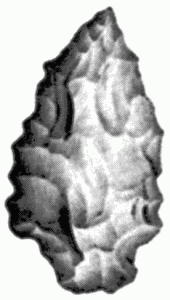
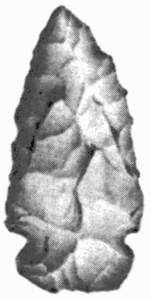
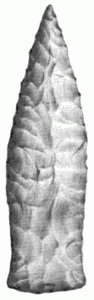
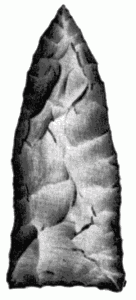
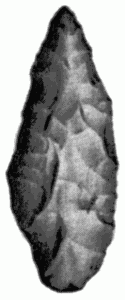
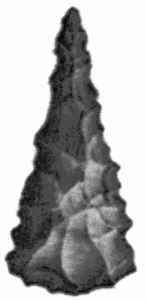
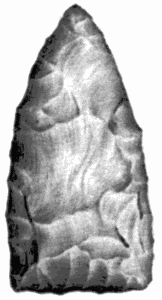
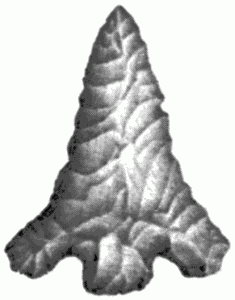
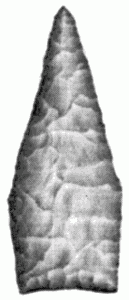
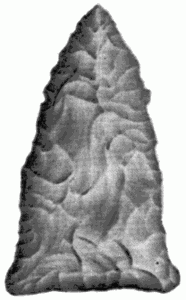
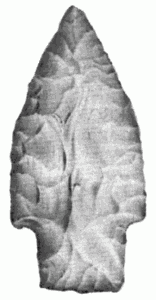
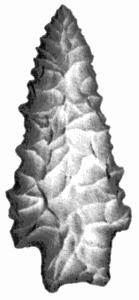
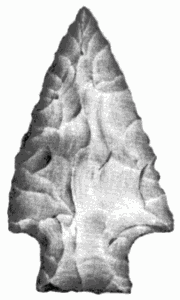
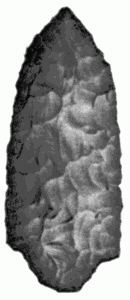
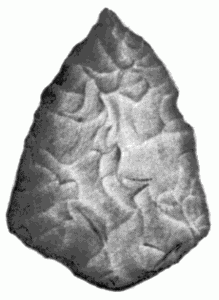
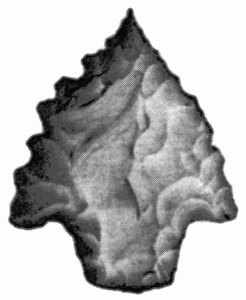
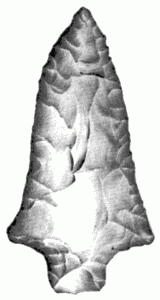
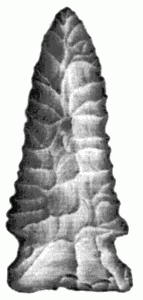
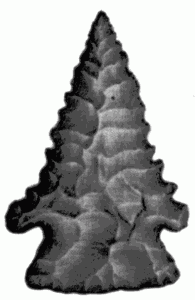
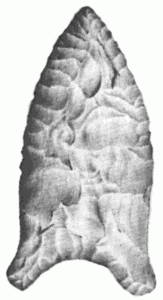
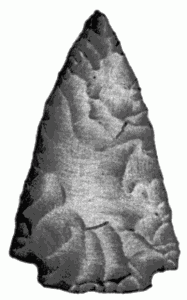
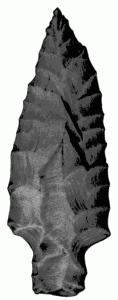
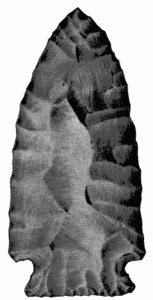
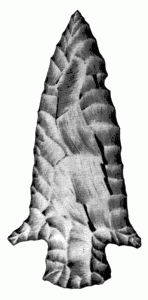
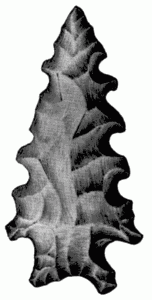
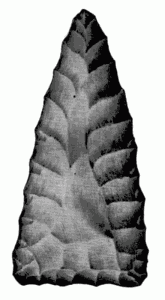
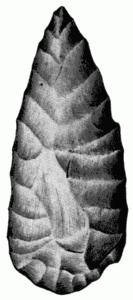
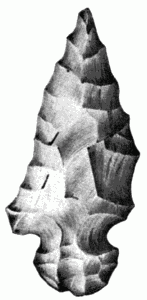
| Adena | 2 |
| Adena Narrow Stemmed | 3 |
| Afton | 4 |
| Angostura | 5 |
| Appalachian | 6 |
| Autauga | 7 |
| Bakers Creek | 8 |
| Beacon Island | 9 |
| Beaver Lake | 10 |
| Benjamin | 11 |
| Benton Broad Stemmed | 12 |
| Benton Stemmed | 13 |
| Big Sandy | 14 |
| Big Sandy Auriculate | 15 |
| Big Sandy Broad Base | 16 |
| Big Sandy Contracted Base | 17 |
| Big Slough | 18 |
| Bradley Spike | 19 |
| Brewerton, Eared-Notched | 20 |
| Buzzard Roost Creek | 21 |
| Camp Creek | 22 |
| Candy Creek | 23 |
| Cave Spring | 24 |
| Clovis | 25 |
| Clovis, Unfluted | 27 |
| Conerly | 28 |
| Coosa | 29 |
| Coosa, Notched | 30 |
| Copena | 31 |
| Copena Triangular | 32 |
| Cotaco Creek | 33 |
| Crawford Creek | 35 |
| Cumberland | 36 |
| Dalton, Colbert | 37 |
| Dalton, Greenbrier | 38 |
| Damron | 40 |
| Decatur | 41 |
| Ebenezer | 42 |
| Ecusta | 43 |
| Elk River | 44 |
| Elora | 46 |
| Eva | 48 |
| Evans | 49 |
| Fairland | 50 |
| Flint Creek | 51 |
| Flint River Spike | 53 |
| Fort Ancient | 54 |
| Frazier | 55 |
| Garth Slough | 56 |
| Gary | 57 |
| Greenbrier | 58 |
| Greeneville | 59 |
| Guilford | 60 |
| Guilford Rounded Base | 61 |
| Guntersville | 62 |
| Halifax | 63 |
| Hamilton | 64 |
| Hamilton Stemmed | 65 |
| Hardaway | 66 |
| Harpeth River | 67 |
| Jacks Reef Corner Notched | 68 |
| Jacks Reef Pentagonal | 69 |
| Jeff | 70 |
| Jude | 71 |
| Kays | 72 |
| Kirk Corner Notched | 73 |
| Kirk Serrated | 74 |
| Knight Island | 76 |
| LeCroy | 77 |
| Ledbetter | 78 |
| Lerma Pointed Base | 79 |
| Lerma Rounded Base | 80 |
| Limestone | 81 |
| Little Bear Creek | 82 |
| Lost Lake | 83 |
| Madison | 84 |
| Maples | 85 |
| McIntire | 86 |
| McKean | 87 |
| Montgomery | 88 |
| Morrow Mountain | 89 |
| Morrow Mountain Rounded Base | 90 |
| Morrow Mountain Straight Base | 91 |
| Motley | 92 |
| Mountain Fork | 93 |
| Mud Creek | 94 |
| Mulberry Creek | 95 |
| New Market | 96 |
| Nodena | 97 |
| Nolichucky | 98 |
| Osceola | 99 |
| Paint Rock Valley | 100 |
| Palmer | 101 |
| Pedernalis | 102 |
| Pickwick | 103 |
| Pine Tree | 104 |
| Pine Tree Corner Notched | 105 |
| Plevna | 106 |
| Quad | 107 |
| Redstone | 108 |
| Rheems Creek | 110 |
| Russell Cave | 111 |
| Sand Mountain | 112 |
| Savage Cave | 113 |
| Savannah River | 114 |
| Smithsonia | 115 |
| South Prong Creek | 116 |
| Stanfield | 117 |
| Stanley | 118 |
| Sublet Ferry | 119 |
| Swan Lake | 120 |
| Turkey Tail | 121 |
| Wade | 122 |
| Washington | 123 |
| Washita | 124 |
| Wheeler Excurvate | 125 |
| Wheeler Recurvate | 126 |
| Wheeler Triangular | 127 |
| White Springs | 128 |
| Provisional Type 1—Stemmed | 129 |
| Provisional Type 2—Expanded Stem | 130 |
| Provisional Type 4—Stemmed Barbed | 130 |
| Provisional Type 5—Stemmed and Serrated | 131 |
| Provisional Type 6—Unfinished Base | 131 |
| Provisional Type 8—Corner Notched | 132 |
| Provisional Type 9—Side Notched | 132 |
| Provisional Type 10—Eccentric Notched | 133 |
| Provisional Type 11—Triangular | 133 |
| Provisional Type 12—Rounded Base | 134 |
| Provisional Type 13—Notched Convex Stem | 134 |
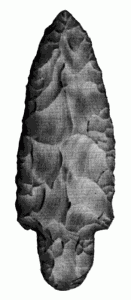
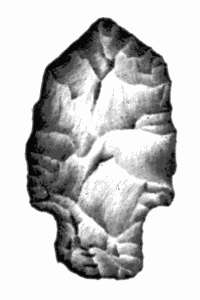
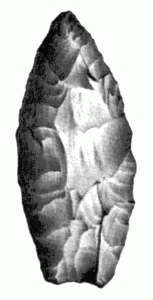
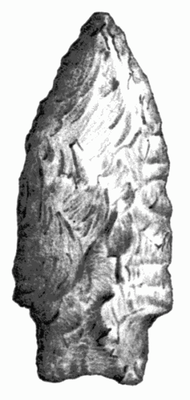
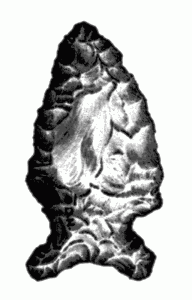
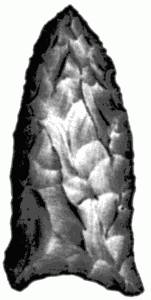
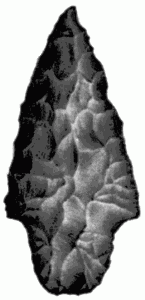
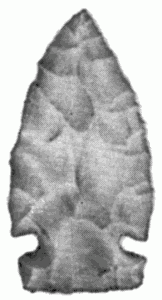
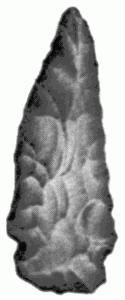
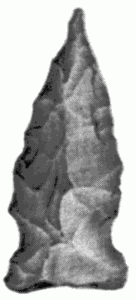
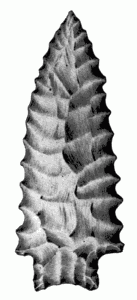
GENERAL DESCRIPTION: This is a
medium sized, stemmed point with incurvate
blade edges that are beveled on
each side of both faces.
MEASUREMENTS: Measurements of
12 cotypes (including the illustrated
example) from which features were taken
ranged as follows: length—maximum,
51 mm.; minimum, 38 mm.; average, 42
mm.: width at shoulders—maximum,
49 mm.; minimum, 32 mm.; average, 41
mm.: stem width—maximum, 21 mm.;
minimum, 14 mm.; average, 18 mm.: stem,
length—maximum 12 mm.; minimum 7 mm.;
average, 9 mm.: thickness—maximum,
9 mm.; minimum, 6 mm.; average, 7 mm.
FORM: The cross-section is flattened.
The shoulders are expanded and are
usually horizontal, but may be inversely
tapered. The blade is incurvate, beveled
on each side of both faces, and is in
rare instances serrated. The distal end
is acute. The stem is usually straight
but may be expanded. The basal edge
may be either slightly excurvate or
straight and is usually thinned.
FLAKING: This type displays well controlled,
broad, shallow, random flaking.
The blade and stem edges were retouched
by shallow, regular, pressure flaking.
Good local materials were used. All examples
are patinated.
COMMENTS: The type was named from
sites near Abbey Creek in Henry and
Houston counties, Alabama. They were
associated with Elora and Maples points
and probably were used during the Archaic
period.
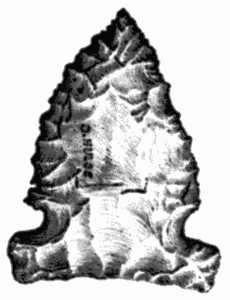
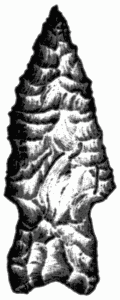
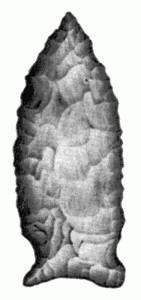
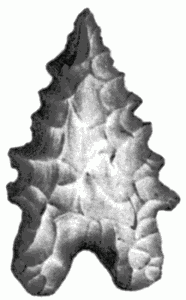
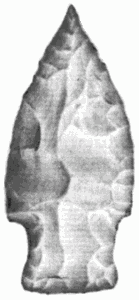
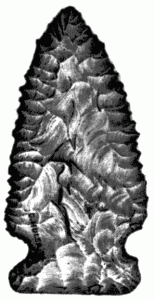
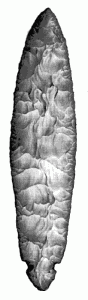
GENERAL DESCRIPTION: This is a
medium to large point with a long,
very broad, sometimes rounded stem.
MEASUREMENTS: The measurements
of seven homotypes from which
traits and measurements were taken are:
length—maximum, 65 mm.; minimum,
50 mm.; average, 56 mm.: shoulder
width—maximum, 35 mm.; minimum,
32 mm.; average, 34 mm.: stem width—maximum,
27 mm.; minimum, 18 mm.;
average, 24 mm.: stem length—maximum,
30 mm.; minimum, 15 mm.; average,
21 mm.: thickness—maximum,
9 mm.; minimum, 7 mm.; average, 8
mm.
FORM: The cross-section is biconvex
with wide proportions. The shoulders
may be horizontal or tapered, with an
occasional weak barb. The blade shape
is excurvate. The distal end is usually
acute. The stem may be straight, contracted
or slightly expanded. Some examples
can be described as having a
rounded stem. The stem base is either
straight or excurvate. The basal edges
may be lightly ground.
FLAKING: The blade and stem are
shaped with strong random flaking, with
some retouch along most edges.
COMMENTS: The name Adena is
derived from the point's association with
the Adena culture. The illustrated specimen
is from Cambron Site 48, Lincoln
County, Tennessee. The measured examples
are from this site and Cambron
Site 50, Limestone County, Alabama.
Most examples are made from local
materials. The type is associated with
early Woodland in the eastern United
States. Kneberg (1956) indicates an
Archaic association in Tennessee. In
Alabama, the Adena point seems to
appear on both Archaic and Woodland
sites. One example was found in Level
1, Zone A, and one example in Zone
C at the Stanfield-Worley Bluff Shelter
(DeJarnette, Kurjack and Cambron,
1962). One example was found in Stratum
II (Archaic) at the Flint Creek Rock
Shelter (Cambron and Waters, 1961).
Scattered examples are known from
most of North Alabama. The Alabama
points closely resemble examples from
Ohio, illustrated by Bell (1958) and
Webb and Baby (1957), as well as
some examples from an Adena mound
at Natrium, West Virginia (Solecki,
1953). Examples from New York with
unground bases are described by Ritchie
(1961). Radiocarbon dates from Adena
sites in Ohio and Kentucky (Webb and
Baby, 1957) suggest an age of from
800 B. C. to 800 A. D.
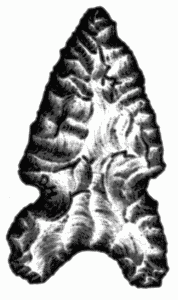
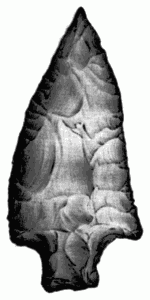
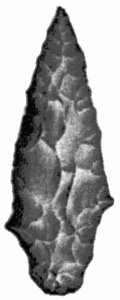
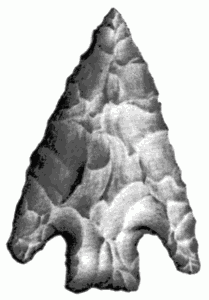
GENERAL DESCRIPTION: This is a
medium to large point with a long,
rounded stem and a long, excurvate
blade.
MEASUREMENTS: The illustrated
example measures 92 mm. in length,
32 mm. in width, 19 mm. in stem width,
21 mm. in stem length, 9 mm. in thickness.
FORM: The cross-section is biconvex.
The shoulders may be horizontal or
slightly tapered. The blade shape is
excurvate but may be almost straight
with an acute distal end. The stem is
long and is usually rounded, but it
may have straight side edges with an
excurvate basal edge. A slightly expanded
stem occurs rarely.
FLAKING: The blade and stem were
produced by broad percussion flaking,
which results in rather uniform flake
scars. The technique may be described
as random flaking, but may approach
collateral flaking on some examples.
The blade edges are finished by secondary
flaking with some fine retouching.
The stem edges were treated in a manner
similar to that of the blade.
COMMENTS: The type is described as
a variant of the classic Adena point.
The illustrated example is from Cambron
Site 76 (Pine Tree). Some sites
have produced only one of the two
Adena variants, which may simply indicate
a high degree of variation of the
Adena point or may, upon further investigation,
prove to be an indication
that the two types are associated with
somewhat different cultures. Several
good examples from Natrium Mound
in West Virginia are illustrated by
Solecki (1953). Some of his points shown
in Plate 28, Figures R, T, and U, were
found arranged in association with a
burial. Classic Adena points (Figures
V and W, Plate 28) and other artifacts
were also found with this burial. Closely
associated with another burial and
accompanying artifacts were points
illustrated as Figures X and Y, Plate
28. At this site, the types were contemporaneous.
An Adena Narrow Stemmed point was
recovered from a feature pit in Stratum
I at the Danley Site (Cambron, Dowell
and O'Mahoney, 1962) along with a
Wheeler Punctate sherd, a Cotaco Creek
point, one polished and three flaked
flint celts, and other artifacts. The Flint
Creek Rock Shelter (Cambron and
Waters, 1961) and Stanfield-Worley
Bluff Shelter (DeJarnette, Kurjack and
Cambron, 1962) produced classic
Adena but no Adena Narrow Stemmed
points. The narrow, stemmed type is
probably coeval with the classic Adena
type on most Alabama sites.
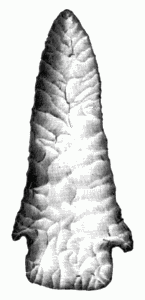
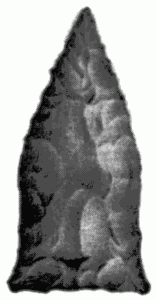
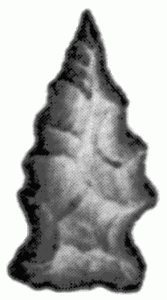
GENERAL DESCRIPTION: The Afton
point is a medium to large, stemmed
point with an angular blade outline.
MEASUREMENTS: The illustrated example
(plesiotype) measures 45 mm.
in length, 25 mm. in shoulder width,
15 mm. in stem width, 12 mm. in stem
length, 6 mm. in maximum thickness.
FORM: The cross-section is flattened.
The shoulders are tapered. The blade
is parallel angular; the distal end, apiculate.
The stem is straight.
FLAKING: The faces of the blade and
stem are shaped by broad percussion
flaking with some fine retouch along the
edges.
COMMENTS: The type was named
from specimens found near Afton, Oklahoma.
The illustrated example is from
Cambron Site 43 in Madison County,
Alabama. Another example of the same
size and material and comparable characteristics
was found on Cambron Site
48 across a small mountain pass in
Lincoln County, Tennessee. To date
(September, 1975) these are the only
examples classified from Alabama and
adjacent areas. Both of these examples
fall into a category described by Bell
(1958) as a sub-variety, since they have
straight—rather than expanded—stems
and no shoulder barbs.
Bell gives the general distribution as
throughout northeastern Oklahoma and
the adjacent regions of Arkansas, Kansas
and Missouri, as well as various
sections of the Ohio Valley, particularly
Ohio. He also indicates a pre-pottery
cultural association.
GENERAL DESCRIPTION: The
Angostura point is a medium to large,
auriculate point with an excurvate
blade.
MEASUREMENTS: Twelve specimens
from nine Tennessee Valley sites
(Soday and Cambron, n. d.) average
76 mm. in length, 28 mm. in width,
and 8 mm. in thickness. The longest
point (Quad Site, Limestone County,
Alabama) measures 101 mm. and the
shortest point (Sweiger 1, Meigs County,
Tennessee) measures 54 mm. The
illustrated example measures 67 mm.
long, 30 mm. wide, 9 mm. thick.
FORM: The cross-section is biconvex.
Some examples have a faint shoulder
at the terminal end of the hafting area.
The blade shape is excurvate; the distal
end, acute. Several local examples are
beveled on one edge of each face. Most
examples have auriculated bases with
contracted, pointed, or rounded basal
edges. Although an incurvate base is
one of the distinguishing characteristics
of the type, some bases may be straight
or even slightly excurvate. The base is
usually thinned and may be ground.
FLAKING: The blade may be shaped
by broad random flaking, crude collateral
flaking or, in some examples
from the west, fine oblique transverse
flaking. Random flaking is by far the
predominant type. Most blades are
finished by secondary flaking, which
appears in some examples to have been
done by the percussion method. As a
final finishing step, fine retouch, carried
out in order to remove irregularities
from the blade edges, is present.
COMMENTS: The type was first described
by Hughes (1949) as Long
points from the Long Site in Angostura
Reservoir, South Dakota. Hughes accepted
all of Suhm's illustrated
examples (Suhm, Krieger and Jelks,
1954) except the beveled ones. Several
beveled examples were illustrated by
Suhm, Krieger and Jelks, 1954. The
example shown here is from Cambron
Site 116, Limestone County, Alabama.
Suhm, Krieger and Jelks (1954) estimate
the age between 6000 B. C. and
4000 B. C. or later. An Angostura
point was recovered from the lower
levels at Stanfield-Worley Bluff Shelter
(DeJarnette, Kurjack and Cambron,
1962), and what appears to be an
Angostura point was associated, along
with a pointed-base Lerma and a biface
knife, with the second mammoth found
at Santa Isabel Iztapan, Mexico
(Wormington, 1957). This example
resembles some Tennessee Valley specimens
which may be late Paleo or early
Archaic (Cambron and Hulse, 1960b).
GENERAL DESCRIPTION: The
Appalachian point is a medium to large,
stemmed point with concave base, made
of quartzite.
MEASUREMENTS: The illustrated
example measures 85 mm. in length,
38 mm. in shoulder width, 27 mm. in
stem width, 16 mm. in stem length,
and 16 mm. in thickness. The length
for the type ranges from 60 mm. to
110 mm. (Harwood, 1959).
FORM: The cross-section is usually
flattened. The shoulders are usually
tapered and narrow. The blade is
usually excurvate, but may be straight
with an acute distal end. The stem is
broad and may be straight, slightly
contracted, or expanded, with an incurvate
basal edge that may be thinned.
The hafting area is usually ground
along the edges.
FLAKING: This point displays well-controlled
percussion flaking with some
retouch along the edges.
COMMENTS: The point is named for
the Southern Appalachian region,
where the type is widely distributed
(Kneberg, 1957). Several examples
were recovered at the Camp Creek Site,
where they may be associated with
Early Woodland (Kneberg, 1957). The
illustrated example is from Harwood
Site 6A on Hominy Creek in Buncombe
County, North Carolina. The part of
the site designated 6A by Harwood
(1959) is pre-ceramic. Large, biface,
quartzite tools are in association with
the points, which are all made from
quartzite. Examples from Cowee Creek,
Macon County, North Carolina, were
recovered below the ceramic zone. This
type is associated with Savannah River
points on several sites. It appears that
the point is associated with the middle
to late Archaic and early Woodland
cultures.
GENERAL DESCRIPTION: The Autauga
is a small, corner-notched, serrated
point with straight blade and base.
MEASUREMENTS: Twelve cotypes,
including the illustrated example, from
sites in Autauga County, Alabama, provided
traits and the following measurements:
length—maximum, 38 mm.; minimum,
23 mm.; average, 32 mm.: shoulder
width—maximum, 21 mm.; minimum, 15
mm.; average, 19 mm.: stem width—maximum,
21 mm.; minimum, 16 mm.;
average, 18 mm.: stem length—maximum,
7 mm.; minimum, 5 mm.; average, 6 mm.:
thickness—maximum, 8 mm.; minimum,
6 mm.; average, 7 mm.
FORM: The cross-section may be either
rhomboid or biconvex. The shoulders
are usually either horizontal or inversely
tapered. The blade is straight. Blade
edges are usually serrated and are steeply
beveled on half of the examples. The
distal end is acute. The corner notches
are usually ground and range in width
from 2 mm. to 4 mm. and in depth from
5 mm. to 7 mm. The expanded stem has
straight or incurvate side edges. The
base is straight and thinned. It is lightly
ground on nearly all examples.
FLAKING: Narrow, shallow, random flaking
was used to form the blade and stem.
Notching, to form the expanded stem,
was accomplished by removal of fairly
deep flakes and finished by light grinding.
COMMENTS: The type was named for
Autauga County, Alabama, where the
examples, used in this paper, were recovered.
All of these points are made
of vein quartz. This type is found in
surface collections with Dalton, Big
Sandy, Kirk Corner Notched, and Crawford
Creek points. This association and
the fact that the type has features
similar to Decatur, Big Sandy, Palmer,
and Crawford Creek points indicates
an Early Archaic or Transitional Paleo-Indian
provenience.
GENERAL DESCRIPTION: This is a
medium-sized, expanded-stem point.
MEASUREMENTS: Eleven cotypes, including
the illustrated example, provide
traits and the following measurements:
length—maximum, 78 mm.; minimum,
43 mm.; average, 55 mm.: shoulder
width—maximum, 28 mm.; minimum,
23 mm.; average, 26 mm.: stem width—maximum,
27 mm.; minimum, 21
mm.; average, 23 mm.: stem length—maximum,
18 mm.; minimum, 12 mm.;
average, 16 mm.: thickness—maximum,
10 mm.; minimum, 7 mm.; average,
8 mm.
FORM: The cross-section is biconvex.
The shoulders are narrow and may be
horizontal or tapered. The blade is
usually straight but may be excurvate.
The distal end is usually sharply acute,
but may approach an acuminate type.
The hafting area consists of an expanded
stem formed by notching into the blade
about one-third of the way from the
base to the distal end. This diagonal
notch tapers from the basal edge, which
is usually unmodified in width. The
basal edge is thinned and usually
straight, but it may be excurvate and
lightly ground. Many examples are
patinated.
FLAKING: The blade and stem are
shaped by broad, random, percussion
flaking. Flake scars indicate a strong
percussion method was used to notch
the hafting area to form the expanded
stem. All edges appear to have been
retouched as a final step in shaping the
point.
COMMENTS: The illustrated specimen
is from Cambron Site 53, the type
site, at the mouth of Bakers Creek in
Morgan County, Alabama. This type
is described by Cambron (1958a) as
Stemmed Copena. It appears in surface
collections along with Copena and triangular
Copena points. Two examples
were recovered from the lower two-thirds
of Stratum I (Woodland) at Flint Creek
Rock Shelter and were illustrated as
Bakers Creek points (Cambron and
Waters, 1961). One example was recovered
from Level 7, Zone A, at the
Stanfield-Worley Bluff Shelter (DeJarnette,
Kurjack and Cambron, 1962).
One example was recovered from the
2-foot level at Little Bear Creek, Ct 8
(Webb and DeJarnette, 1948b). At this
site Copena points were also recovered
from Zone C. This evidence indicates an
early to middle Woodland cultural
association and an estimated age of
somewhere between 1500 B.C. and early
centuries A.D.
GENERAL DESCRIPTION: This is a
medium-sized point with expanded-rounded
stem, straight blade edges and weak to
strong shoulder barbs.
MEASUREMENTS: Seven cotypes, two
from Franklin County, Alabama, three
from Beacon Island and two from Bear
Creek along the Tennessee River below
Florence, Alabama, provided the following
measurements: length—maximum, 73 mm.;
minimum, 48 mm.; average, 61 mm.: shoulder
width—maximum, 28 mm.; minimum,
22 mm.; average, 24 mm.: stem width at
shoulder—maximum, 14 mm.; minimum, 12
mm.; average, 13 mm.: stem width at
widest point—maximum, 19 mm.; minimum,
15 mm.; average, 17 mm.: stem length—maximum,
18 mm.; minimum, 12 mm.;
average, 15 mm.: thickness—maximum,
7 mm.; minimum, 6 mm.; average, 7 mm.
FORM: The cross-section is biconvex.
Shoulders may be barbed or inversely
tapered. Blade edges are straight and may
be finely serrated. The stem is expanded-rounded
with diagonal notches at the
shoulders. The distal end is acute.
FLAKING: Shallow random flaking was
employed to shape the faces of the blade
and stem. Careful pressure flaking was
used to finish the blade edges and to thin
the base.
COMMENTS: The type was named from
Ralph Allen Site 41 on Beacon Island
and was associated with Cotaco Creek,
Flint Creek and Wade points on this site.
Several examples are illustrated as Type 8,
Plate 159 (Webb and DeJarnette, 1952).
A suggested placement is in late Archaic
and early Woodland times.
GENERAL DESCRIPTION: This is a
medium-sized, auriculate point with
recurvate blade edges.
MEASUREMENTS: The lengths of 23
points from 23 sites in the Tennessee
Valley range from a maximum of 86
mm. to a minimum of 47 mm. (average
length, 64 mm.). The average width of
these points is 24 mm. and the average
thickness is 8 mm. (Soday and Cambron,
n. d.). The measurements of the
illustrated (autotype) specimen are:
length, 61 mm.; width of blade, 26
mm.; width at base, 25 mm.; width of
hafting constriction, 21 mm.; thickness,
9 mm.; basal concavity, 3 mm.
FORM: The cross-section is usually
biconvex, but one or both faces may be
median ridged. The blade is recurvate—constricted
in the hafting area above the
auricles. The distal end is usually acute.
The auriculated hafting area is
expanded-rounded. The basal edge is
usually thinned and incurvate, but may
be straight. The hafting constriction
and basal edge are usually ground.
FLAKING: The shallow random
flaking usually employed to shape the
faces sometimes produces a median
ridge. Secondary retouch flake scars
are usually long, evenly spaced, and
struck off on alternate faces, resulting
in an irregular pattern along the blade
edges. This retouch appears to have
been accomplished with indirect percussion
or pressure flaking.
COMMENTS: The type was named
for the Beaver Lake area in Limestone
County, Alabama, where many examples,
including the illustrated specimen
from Cambron (Pine Tree Site 76),
were recovered. Most examples from
this area are made from Ft. Payne
chert, which is usually patinated to a
chocolate brown color. The type has
been called unfluted Cumberland in
several papers, especially Soday and
Cambron (n. d.). Beaver Lake points
are found only on sites that produce
early-man materials. An example was
recovered from the bottom of Stratum
III (pre-Archaic) at Flint Creek Rock
Shelter (Cambron and Waters, 1961).
Examples were recovered from the lowest
culture-bearing stratum at Stanfield-Worley
Bluff Shelter (DeJarnette, Kurjack
and Cambron, 1962). All evidence
indicates the type dates from 10,000
B.P. to an unknown earlier time. It
is considered to be a transitional Paleo-Indian
type.
GENERAL DESCRIPTION: The Benjamin
is a large to medium sized lanceolate
point with straight or excurvate base and
excurvate blade.
MEASUREMENTS: Nine cotypes, including
the illustrated example, ranged in
measurements as follows: length—maximum,
100 mm.; minimum, 54 mm.; average,
66 mm.: width—maximum, 32 mm.; minimum,
22 mm.; average, 26 mm.: thickness—maximum,
12 mm.; minimum, 9 mm.;
average, 11 mm.
FORM: The cross-section is biconvex.
The blade is excurvate. The widest
point may be either at the base or
somewhat below the midsection, making
the hafting area difficult to define. The
distal end is acute. The basal edge is
usually excurvate, but may be straight,
and is usually thinned.
FLAKING: Broad, deep, random flaking
appears on the faces, with some fine
secondary flaking along the blade edges
and sides of the hafting area. Short
random flaking was used to thin the
basal edge. Local materials were used.
COMMENTS: The type was named after
the Benjamin site (Cambron Site 333)
in Lawrence County, Alabama, where it
was first recognized and appears in
association with Woodland artifacts. The
illustrated example is from Cambron
Site 19 in Morgan County, Alabama. At
Cactus Rock Site Dk-101 in DeKalb
County, Alabama, one example was recovered
from Level 1 in association
with Woodland point types and one example
from Level 4 in association with
Woodland and Archaic point types. At
University of Alabama Site Dk-57 in
DeKalb County, Alabama, the type was
associated with Copena and Madison
points. At University of Alabama Sites
Lo-23 in Lowndes County, Alabama,
and Lr-20 in Lamar County, Alabama,
Benjamin points appear in Woodland
strata. The association of Benjamin
points at these sites seems to place
the type within the Woodland period.
GENERAL DESCRIPTION: This is a
medium to large, broad-stemmed point
with steeply beveled stem edges.
MEASUREMENTS: The measurements
of the illustrated example are:
length, 66 mm.; shoulder width, 32 mm.;
stem width, 28 mm.; stem length, 11
mm.; thickness, 9 mm.
FORM: The cross-section may be flattened
or biconvex. The shoulders are
narrow and may be horizontal or tapered.
The blade is usually excurvate, the
distal end acute. The stem is usually
slightly expanded, but may be straight.
It is very broad and short. The stem
side edges are usually incurvate or
straight and beveled. The beveled basal
edge is usually straight but may be
slightly incurvate or excurvate.
FLAKING: The blade and stem display
broad, shallow, random flaking.
Some broad retouching was used to
finish the blade and stem edges. The
stem appears to have been formed by
the removal of the corners of the original
basal edge.
COMMENTS: The type name was derived
from the Benton Stemmed point,
to which it seems to be closely associated
both typologically and culturally. The
outstanding differences between the two
are the exceptionally broad stem and
broader, shorter blade of the Benton
Broad Stem point. The type does not
appear as frequently or in as great
numbers as Benton Stemmed. The illustrated
example is from Cambron Site
48, Lincoln County, Tennessee. Due to
its association with Benton Stemmed
and Buzzard Roost Creek points, it is
considered to be an Archaic point and
is probably coeval with these types,
dating from about 4000 B.C. to 2000
B.C.
GENERAL DESCRIPTION: This is a
medium to large, stemmed point with
steeply beveled stem edges.
MEASUREMENTS: The measurements
of five cotypes from which measurements
and traits were taken are:
length—maximum, 97 mm.; minimum,
45 mm.; average, 65 mm.: shoulder
width—maximum, 30 mm.; minimum,
25 mm.; average, 29 mm.: stem width—maximum,
20 mm.; minimum, 16
mm.; average, 17 mm.: stem length—maximum,
11 mm.; minimum, 8 mm.;
average, 9 mm.: thickness—maximum,
9 mm.; minimum, 5 mm.; average, 7
mm. Measurements of the illustrated
example are: length, 53 mm.; shoulder
width, 28 mm.; stem width, 19 mm.;
stem length, 9 mm.; thickness, 8 mm.
FORM: The cross-section is biconvex
to flattened. The shoulders are narrow
and, rarely, barbed. They may be horizontal
or slightly tapered. The blade is
usually recurvate, but may be excurvate
with an acute distal end. The stem
is relatively broad and short with
straight, beveled side edges. It may be
tapered or expanded. The steeply beveled
basal edge may be straight or incurvate.
FLAKING: The random, primary flaking
used to shape the face of the blade
and stem is broad and shallow. Some
areas seem to be only slightly modified
and exhibit some blade scars. The retouching
along the blade edges is broad
and shallow. Short, broad flakes are
used to shape the stem and bevel the
stem edges. These appear to be the
result of indirect percussion.
COMMENTS: The type was named for
Benton County, Tennessee. The illustrated
example is from Hulse Site 17,
Limestone County, Alabama. The type
is found in the Tennessee River Valley
and in western Tennessee along the
Mississippi River (Bell, 1960). At the
Eva Site, in Benton County, Tennessee,
the cultural association is with the early
Big Sandy component (Lewis and Lewis,
1961). Practically all the types recovered
from Stanfield-Worley Bluff Shelter were
from Zone A, where the first ten levels
contained examples. The more frequent
occurrence of the type in Levels 4
through 9, Zone A, is an indication of
Archaic association (DeJarnette, Kurjack,
Cambron, 1962). At Rock House
Shelter, University of Alabama Site Ms
201, in Marshall County, Levels 5, 7,
8 and 11 produced one point each. This
indicates an early Archaic association
at this site. At Flint Creek Rock Shelter
(Cambron and Waters, 1961), all examples
were in middle- and upper-stratum
II (Archaic). At Little Bear
Creek, Ct 8 (Webb and DeJarnette,
1948b), examples were recovered from
the two-foot level through the eight-foot
level, most examples being from the
lower three levels. The type appeared in
Zones A, B, C and D at Flint River,
Mound Ma 48 (Webb and DeJarnette,
1948a); it was most frequent in Zone C.
A strict Archaic association dating from
about 4000 B.C. to 2000 B.C. is suggested.
GENERAL DESCRIPTION: This is a
small to medium, side-notched point.
The basal edges and/or notches are
usually ground. The blade edges may be
serrated and/or beveled.
MEASUREMENTS: The range of
measurements of 14 examples from an
excavation on the Quad Site (Cambron
and Hulse, 1960a) are: length, 35-56
mm.; width, 18-20 mm.; thickness,
6-8 mm. Measurements of the
illustrated example are: length, 41 mm.;
shoulder width, 20 mm.; width at base,
21 mm.; notch depth, 4 mm.; notch
width, 6mm.; thickness, 6mm. Later
unground examples from the Big Sandy
Site in Henry County, Tennessee, range
in length from 44 mm. to 89 mm. and
average near 64 mm. (Bell, 1960).
FLAKING: The flaking is variable,
but usually is good. Random flaking
is usually employed to shape the faces
of the blade and hafting area; retouch
is evident along the edges. The side
notches appear to have been made by
broad percussion flaking. Rare examples
show oblique flaking (Kneberg, 1956).
FORM: The cross-section is usually
biconvex but may be rhomboid, plano-convex,
or median ridged. The blade
may be excurvate or straight. Of the
22 whole and broken examples recovered,
62% are beveled on one side of
each blade face and 8% are serrated.
The distal end is acute. The hafting
area is side-notched. The notches
average about 5 mm. deep and 7 mm.
wide, and are nearly always ground.
Of the 22 measured examples, 43%
have incurvate bases, 32% have slightly
excurvate bases, and 25% have straight
bases. The bases are usually thinned,
and 50% of the 22 examples have
ground bases. The part of the hafting
area between the notches and the base
may be straight or auriculated. Rarely,
the basal edge is parallel pointed.
COMMENTS: The point is named for
the Big Sandy I phase of the Archaic
period (Lewis and Kneberg, 1959).
The illustrated example is from Hulse
Site 38 (Pine Tree), Limestone County,
Alabama. Examples were found in
association with a fluted midsection,
Wheeler, Dalton, and Quad points on
the Quad Site (Cambron and Hulse,
1960a). Ritchie, in New York (1961),
described the type as the Otter Creek
point. The type was dated at Stanfield-Worley
Bluff Shelter by radiocarbon
method at near 10,000 B.P. (DeJarnette,
Kurjack and Cambron, 1962).
Similar examples from Danger Cave,
Utah, were listed by Jennings (1957)
as types W4, W25, and W26. Type
W4 was recovered only from Level II,
where the radiocarbon dates were 9789
±630 B.P. and 8960 ±340 B.P. This type
was described in earlier editions of this
book as Big Sandy I. An unground variant,
also described in earlier editions of this
book as Big Sandy II, Code, No. A-11, were
numerous in the Three Mile Phase at the
Eva Site (Lewis and Lewis, 1961). Kneberg
suggests a date of from 3500 B.C. to
1000 B.C. for this variant (1959).
GENERAL DESCRIPTION: This is a
small to medium sized, side-notched point
with auriculate, incurvate base and excurvate
blade edges. The basal edges and/or
notches are nearly always ground.
MEASUREMENTS: Eight examples from
Cave Spring (Moebes, 1974) provided the
following measurements: length, 30-45
mm.; average, 39 mm.; shoulder width,
16-26 mm.; average, 22 mm.: stem width,
18-23 mm.; average, 21 mm.: stem length,
10-13 mm.; average, 11 mm.: thickness,
6-9 mm.; average, 8 mm.: basal concavity,
1-3 mm.; average, 2 mm.: width in notches,
10-17 mm.; average, 14 mm.: notch
width, 6-10 mm.; average, 8 mm.: notch
depth, 3-7 mm.; average, 4 mm.: stem
length below notches, 4-6 mm.; average,
5 mm.
FLAKING: Fifty percent show collateral
flaking and 50% show random flaking.
FORM: Seventy-four percent of the cross-sections
are biconvex, 13% are plano-convex
and 13% are median ridged. All
blade edges are excurvate. All bases are
incurvate. All bases and notches are
ground and 75% of the stem edges are
ground. Fifty percent have shoulder barbs
and all examples are patinated. Thirteen
percent have acuminate distal ends and
87% have acute distal ends.
COMMENTS: The provenience of 9 examples,
used to define this type of Big
Sandy point is as follows: Stratum I;
Level 3, 1 (probably out of context); Stratum
II: Level 7, 2; Level 8, 2; Stratum III:
Level 7, 1; Level 10, 1; Level 12, 2. Five
examples of similar type (W4) from Level
II at Danger Cave (Jennings, 1957) were
dated by radiocarbon samples at 9789
±630 B.P. and 8960 ±340 B.P. One
example was recovered from Stratum II at
Flint Creek Rock Shelter, Fig. 55 (Cambron
and Waters, 1958).
GENERAL DESCRIPTION: This is a
medium sized, side-notched, trianguloid
point with blade edges that are usually
excurvate but may be straight or recurvate.
Most examples are serrated. The basal
edges and/or notches are usually ground.
MEASUREMENTS: Eleven examples from
DeKalb County, Tennessee, 1 example
from Warren County, Tennessee, and 3
examples from Cave Spring (Moebes, 1974)
provided the following features and measurements:
length, 37-53 mm.; average,
44 mm.: shoulder width, 21-38 mm.;
average, 25 mm.: stem width, 23-32 mm.;
average, 29 mm.: stem length, 11-17 mm.;
average, 15 mm.: thickness, 5-10 mm.;
average, 7 mm.: basal concavity, 1-4 mm.;
average, 2 mm.: width in notches, 17-23
mm.; average, 19 mm.: notch width, 6-9
mm.; average, 7 mm.: notch depth, 3-5
mm.; average, 4 mm.: stem length below
notches, 6-10 mm.; average, 8 mm.
FLAKING: Random flaking was employed
in shaping the blade and hafting area. The
notches were formed by well controlled
pressure flaking.
FORM: Thirty percent of the cross-sections
are biconvex, 50% are flattened,
5% are plano-convex and 15% are rhomboid.
Eighty percent of the blade edges
are excurvate, 10% are straight, 10% are
asymmetrical, 54% are serrated, 18% are
beveled on one edge of each face, 41%
have incurvate bases, 59% have straight
bases. The basal edges and notches are
usually ground and thinned. All examples
are patinated. Eighty-four percent of the
distal ends are acute and 16 are acuminate.
COMMENTS: The three examples from
Cave Spring were randomly flaked, and
rhomboid in cross-section. All three had
blade edges that were serrated and beveled
on one edge of each face. They were
ground in the notches as well as on the
base and stem edges. The distal ends were
acute. Three other examples from Cave
Spring were either broken or reworked
and could be not meaningfully measured
but the provenience of all six examples is:
Stratum II; Level 5, 1; Stratum III; Level 7,
1; Level 8, 1; Level 9, 1; Level 10, 2. An
early Archaic or Transitional Paleo placement
is suggested.
GENERAL DESCRIPTION: This is a
small to medium sized, side-notched point
with a contracting stem and an incurvate
base. Most examples show collateral flaking
and shallow serrations along the blade
edges.
MEASUREMENTS: Seven cotypes supplied
the following features: length, 35-60
mm.; average, 45 mm.; shoulder width,
20-26 mm.; average, 23 mm.: stem width,
20-25 mm.; average, 23 mm.: stem length,
12-16 mm.; average, 14 mm.: thickness,
5-8 mm.; average, 7 mm.: basal concavity,
3-6 mm.; average, 5 mm.: width in notches,
13-16 mm.; average, 15 mm.: notch width,
3-5 mm.; average, 4 mm.: notch depth,
3-5 mm.; average, 4 mm.: stem length
below notches, 8-13 mm.: average, 11 mm.
FLAKING: Shallow pressure flaking was
used to thin the basal edge. Well controlled
pressure flaking was employed to shape
the side notches. All blade surfaces exhibit
collateral flaking.
FORM: Seventy percent of the cross-sections
are median ridged; 15% are biconvex;
and 15% are plano-convex. Fifty-seven
percent of the blade edges are
straight and 43% are excurvate. Eighty-four
percent have shallow serrations along
the blade edges. Bases are usually thinned
and all of them are ground. Eighty-four
percent of the stem edges and all notches
are ground. All examples are patinated.
Forty percent have acute distal ends and
60% of the distal ends are acuminate.
COMMENTS: The provenience of seven
examples, from the Cave Spring Site,
(Moebes, 1974) used to define this type of
Big Sandy point is as follows: Level 5, 2;
Level 7, 1; Level 8, 1; Stratum II. Level 7,
1; Level 8, 1; Level 9, 1; Level 10, 2; Level
11, 1; Stratum III. A similar type was
described by Jennings (1957) from Danger
Cave, Utah is listed as Type W 17 where
dates of 9787 plus or minus 630 B.P. and
8960 plus or minus 340 B.P. were secured
from levels containing this type. Two
examples were classified from the collection
of Steve Maloney Site DK 2 in DeKalb
County, Tennessee.
GENERAL DESCRIPTION: This is a
medium to large point with a broad
expanded stem.
MEASUREMENTS: The range of
measurements of 11 cotypes from Morgan
and Limestone Counties near
Decatur, Alabama are: length—maximum,
85 mm.; minimum, 49 mm.;
average, 62 mm.: shoulder width—maximum,
42 mm.; minimum, 29 mm.;
average, 34 mm.: stem width—maximum,
28 mm.; minimum, 20 mm.;
average, 25 mm.: stem length—maximum,
17 mm.; minimum, 14 mm.;
average, 15 mm.: thickness—maximum,
9 mm.; minimum, 7 mm.;
average, 8 mm. Measurements of the
illustrated example are: length, 85 mm.;
shoulder width, 38 mm.; stem width,
28 mm.; stem length, 14 mm.; thickness,
9 mm.
FORM: The cross-section is biconvex.
The shoulders are inversely tapered
with narrow barbs that may be expanded,
especially on examples with
recurvate blade edges. The blade may
be excurvate or recurvate; rarely,
excurvate-recurvate. One example of the
cotypes has one straight and one recurvate
blade edge. About half the blade
edges are asymmetrical. The distal end
is usually acute but may be apiculate.
The stem is broad and long and
expanded by shallow diagonal notches.
The stem side edges may be slightly
incurvate, slightly excurvate, or
straight. The basal edge is excurvate,
thin, and usually ground.
FLAKING: Most examples are made
by broad, shallow, random flaking,
but a considerable number show collateral
flaking. Several have random
flaking on one face and collateral on
the other. The blade edges usually show
rather broad retouching with some fine
flaking along the retouched edges that
gives a somewhat crushed effect, as
does the baton method of percussion
flaking. The notches appear to have
been formed by indirect percussion
flaking with some retouch. The basal
edge is thinned by removal of broad,
shallow flakes. The stem is usually
finely retouched on all edges.
COMMENTS: The point is named for
the Big Slough area in Limestone
County, Alabama, where many examples
are found on the surface with early
Archaic types. The illustrated example
is from Hulse Site 18, Limestone
County, Alabama. At Stanfield-Worley
Bluff Shelter (DeJarnette, Kurjack and
Cambron, 1962), one example each
was recovered from Levels 1, 5, 6, 8
and 9 of Zone A. At University of
Alabama Site Ms 201, Rock House
Shelter, in Marshall County, Alabama,
Levels 4 and 5 produced one example
each. One example was recovered from
Zone C (Archaic) at Ma 48, Flint
River Mound (Webb and DeJarnette,
1948a). This evidence suggests a cultural
association of from early Archaic
to middle Archaic times, with a
probable age range of about 5000 B.C.
to 2000 B.C.
GENERAL DESCRIPTION: The Bradley
Spike is a small to medium-sized,
spike-shaped, stemmed point.
MEASUREMENTS: The measurements
of the 13 plesiotypes upon which
description of form was based (included
is the illustrated specimen from Ma 48,
Flint River Site, Webb and DeJarnette,
1948a) are: length—maximum, 65 mm.;
minimum, 40 mm.; average, 51 mm.:
shoulder width—maximum, 17 mm.;
minimum, 10 mm.; average, 15 mm.:
stem width—maximum, 12 mm.; minimum,
8 mm.; average, 11 mm.: stem
length—maximum, 15 mm.; minimum,
7 mm.; average, 11 mm.: thickness—maximum,
14 mm.; minimum, 6 mm.;
average, 10 mm.
FORM: The cross-section is usually
median ridged but may, rarely, be plano-convex
or biconvex. The shoulders are
usually tapered and may be asymmetrical.
The blade may be straight or slightly
convex; the distal end is sharply acute.
The hafting area is stemmed and the
stem is usually straight but may be
tapered. Stem side edges are straight;
the basal edge of the stem is usually
excurvate but may be straight and may
exhibit some of the patinated rind of the
parent material from which the point
was made.
FLAKING: Some examples are almost
as thick as they are broad. The steep,
percussion, random flaking used to
shape the point may be struck from
alternate faces to produce an irregular
blade edge outline. Occasional retouch,
that appears to have been done by percussion
flaking, is evident; but no regular
pressure retouch is present.
COMMENTS: The type was named for
Bradley County, Tennessee, where it was
first recognized. The illustrated specimen
is from Ma 48 (Webb and DeJarnette,
1948a). Ten examples were recovered
from Zone A at the Stanfield-Worley
Bluff Shelter (DeJarnette, Kurjack and
Cambron, 1962), eight specimens from
the upper four levels and one each from
Levels 7 and 9. One example was recovered
from Level 5 at University of Alabama
Site Ms 201 (Rock House). Of
the 34 examples from Flint River Mound
Ma 48 (Webb and DeJarnette, 1948a),
18 were from Zone A and 16 from Zone
B. The evidence supports Kneberg's
(1956) analysis of early Woodland cultural
association since examples are
found in early Woodland association at
these sites. However, most of the points
were found in the upper Woodland stratum,
indicating a later Woodland association
in the North Alabama area, possibly
dating from about 2000 B.C. to
sometime A.D.
GENERAL DESCRIPTION: This is a
small trianguloid point with shallow side
notches.
MEASUREMENTS: The measurements of
four plesiotypes (including the illustrated
example) from which descriptions were
taken are: maximum, 40 mm.; minimum,
27 mm.; average, 33 mm.: shoulder width—maximum,
18 mm.; minimum, 14 mm.;
average, 16 mm.: stem length—maximum,
9 mm.; minimum, 6 mm.; average, 7 mm.:
stem width—maximum, 20 mm.; minimum,
16 mm.; average, 18 mm.: thickness—maximum,
6 mm.; minimum, 5 mm.;
average 6 mm.
FORM: The blade edges may be straight
or excurvate. The cross-section is biconvex.
The base may be straight or excurvate.
The hafting area is shallowly side
notched forming weak auricles.
FLAKING: The blade and hafting area
display broad, shallow random flaking.
Some broad retouching was used to finish
the blade and hafting area edges. The
notches were formed by shallow pressure
flaking after the blade was finished, thus
forming the auricles.
COMMENTS: Brewerton Eared-Notched
is one of four Brewerton types described
by Ritchie (Ritchie, 1961). The other
three types were listed as Brewerton Eared-Triangular,
Brewerton Corner-Notched and
Brewerton Side-Notched. Ritchie (Ritchie,
1961) considers the Brewerton complex to
be a part of the upper middle and late
Archaic horizons in New York and New
England. The examples that provided the
type description, including the illustrated
example, are from the Etowah River Site,
Bartow County, Georgia. They were excavated
by James Chapman and others and
were associated with ceramics at this site.
One example was recovered from Level 6,
Stratum I at Cave Spring in Morgan
County, Alabama (Moebes, 1974).
GENERAL DESCRIPTION: This is a
medium to large, bifurcated-stemmed
point.
MEASUREMENTS: The measurements
of nine cotypes (including
the illustrated example) from which
features were taken are: length—maximum,
104 mm.; minimum, 61 mm.;
average, 82 mm.: shoulder width—maximum,
36 mm.; minimum, 27 mm.;
average, 30 mm.: stem width—maximum,
23 mm.; minimum, 17 mm.; average,
19 mm.: stem length—maximum,
12 mm.; minimum, 10 mm.; average,
11 mm.: thickness—eight examples
measured 8 mm. and one example measured
7 mm.
FORM: The cross-section is biconvex.
The shoulders are usually inversely
tapered and the barbs usually expanded.
The blade is recurvate with an acute
distal end. The stem is usually straight
but may be expanded, with straight or
incurvate side edges. The basal edge of
the stem is usually bifurcated but may
be auriculate. Usually all of the stem
edges are beveled. Points made of adaptable
material are usually patinated.
FLAKING: The flaking used to shape
the blade and stem is usually random,
broad, and thin; rarely, it is collateral.
The secondary flaking along the edges
of the blade is long and shallow. The
short deep scars left by flaking used to
bevel the stem edges may be the result
of indirect percussion, possibly with
some pressure flaking. The flaking used
to bifurcate the stem appears to be of the
same type as that used to bevel the stem
edges.
COMMENTS: The type was named for
Buzzard Roost Creek Site (Cambron
Site 158), in Colbert County, Alabama,
where the illustrated example was recovered.
The original description has been
revised to exclude those examples with
straight or slightly incurvate stem bases,
since these examples are classified as
Benton Stemmed—to which Buzzard
Roost Creek is culturally and typologically
related. Examples at Stanfield-Worley
Bluff Shelter (DeJarnette, Kurjack
and Cambron, 1962) appeared in
Zone A, Levels 2 through 8, with concentrations
in Levels 6 and 7. Three
examples were recovered from the middle
and upper parts of Stratum II at
Flint Creek Rock Shelter (Cambron and
Waters, 1961). At Little Bear Creek
(Webb and DeJarnette, 1948b) examples
were recovered from four-foot
through eight-foot levels, with most examples
from the six-foot level. This
appears to be an early to middle Archaic
type found in northern Alabama and
southern Tennessee.
GENERAL DESCRIPTION: This is a
small to medium, triangular point with
incurvate base.
MEASUREMENTS: The measurements
of the illustrated example are:
length, 35 mm.; width at base, 16 mm.;
thickness, 7 mm.; depth of basal concavity,
2 mm.
FORM: The cross-section is usually
biconvex. The blade is usually straight;
rarely, incurvate or excurvate. The
distal end is acute. The base is incurvate
and usually thinned with some
fine retouch.
FLAKING: The flaking used to shape
the blade and hafting area is random
and fairly well executed. Some fine retouch
is in evidence along the blade
edges. Much of the flint and quartzite
used at the Camp Creek Site has poor
flaking qualities, resulting in a poorly
manufactured point.
COMMENTS: The type was named
from the Camp Creek Site (Cambron
Site 284) on the Nolichucky River in
Greene County, Tennessee. The
illustrated specimen is from Zone A of
the Camp Creek Site (Lewis and Kneberg,
1957). This example was selected
by Cambron from his collection from
Camp Creek (Site 284) as typical of
the type. Although a minority type in
all levels at this site, it is found with
burials more frequently than are other
types. It comprises about 15% of the
stemless points in Level D, but in other
levels does not exceed 6% (Lewis and
Kneberg, 1957). The type appears to
be a part of the Greeneville complex,
found along the western edge of the
Appalachians southwest from the
Greeneville, Tennessee, area into south-central
Alabama. It is usually associated
with the early to middle Woodland
period. Some other points that
appear in this complex are Greeneville,
Nolichucky, Triangular Copena,
Coosa, and possibly Ebenezer. At the
Stanfield-Worley Bluff Shelter (DeJarnette,
Kurjack and Cambron, 1962)
Zone A, four examples were found in
Level 1, five in Level 2, one in Level
3 and three in Level 4. This indicates
a Woodland association at this site.
Most of the examples recovered from
Flint Creek Rock Shelter (Cambron
and Waters, 1961) were in the lower
three-quarters of Stratum I (Woodland).
One example was recovered from
Level 1 and one from Level 2 at Rock
House Shelter in Marshall County, Alabama
(University of Alabama Site Ms
201). Ten examples were recovered
from Zones A and B (Woodland) and
two from Zone D (Archaic) at Flint
River Mound (Webb and DeJarnette,
1948a). Kneberg suggests a date of
from about 1000 B.C. to 500 A.D.
GENERAL DESCRIPTION: This is a
medium-sized, auriculate point with recurvate
edges and incurvate base.
MEASUREMENTS: The illustrated
example measures 50 mm. long, 22 mm.
wide at widest point of blade, 25 mm.
wide at base, 21 mm. wide across hafting
constriction, 9 mm. thick, 3 mm.
deep at basal concavity.
FORM: The cross-section is biconvex.
The blade is recurvate; the distal end,
acute. The auriculated hafting area is
usually expanded-rounded with an incurvate
basal edge. The base is occasionally
fluted or thinned. The hafting
area edges may be lightly ground, as
are most Copena and Copena Triangular
points, with which they are frequently
associated.
FLAKING: The flaking used to shape
the blade and hafting area is usually
shallow and random. Fine retouching
employed to finish the blade and hafting
area edges is usually evident. Although
there appears to be no connection
between this type and Paleo fluted types,
the hafting method must have been very
similar. The flutes, when present, appear
to be nothing more than results of
attempts to thin the base, as they are
usually broad and shallow. Copena and
Copena Triangular types were probably
hafted in about the same manner as
Candy Creek points.
COMMENTS: The name is derived
from Candy Creek Site in Bradley
County, Tennessee. The illustrated specimen
is a plesiotype from Cambron 53,
Morgan County, Alabama. Of 1552
points at Camp Creek, 9 were classified
as Candy Creek (Lewis and Kneberg,
1957). One example was recovered from
Zone A, Level 1 at the Stanfield-Worley
Bluff Shelter (DeJarnette, Kurjack and
Cambron, 1962). Two examples, one
from Level 2 and one from Level 3,
were recovered from Rock House Shelter
in Marshall County, Alabama (University
of Alabama Site Ms 201). Twenty-three
examples from Cambron Site 53
at Bakers Creek in Morgan County,
Alabama, were associated with other
Woodland types. Kneberg (1956) suggests
an age of from 1000 B.C. to 500
A.D.
GENERAL DESCRIPTION: The Cave
Spring is a small to medium sized, bifurcated
point with an expanded stem.
MEASUREMENTS: Seven cotypes from
Strata II and III of the Cave Spring type
site (Moebes, 1974) provided the following
traits and measurements: length, 50-32
mm.; average, 40 mm.: shoulder width,
25-17 mm.; average, 20 mm.: stem width,
17-11 mm.; average, 15 mm.: stem length,
17-10 mm.; average, 13 mm.: thickness,
6-5 mm.; average 6 mm. The illustrated
example, from Stratum III, measures 50
mm. in length, 20 mm. in shoulder width,
14 mm. in stem width, 16 mm. in stem
length and 6 mm. in thickness. Stratum
III points averaged longer and slightly
narrower than points from Stratum II.
FORM: The cross-section is usually biconvex
but may be plano-convex or rarely
median ridged. Shoulders are usually
tapered but may be barbed or rarely horizontal.
Blade edges are nearly always
straight, rarely excurvate. The distal end
is usually acute; rarely broad. The hafting
area consists of an expanded stem that is
shallowly bifurcated. Stem width usually
exceeds the stem length.
FLAKING: Broad, shallow, random flaking
is in evidence on the stem and blade.
Collateral flaking was used to finish the
blades of most examples. Fine retouch is
present along most blade edges. Long
shallow flakes were removed to thin the
base in the basal concavity. One example
from Level 5, Stratum II, had diagonal
flakes struck from the base in the same
tradition as Decatur points. One large
flake was struck from each side of each
face of the stem forming a shallow notch
where the stem joins the blade. These
notches and all other stem edges are usually
ground. All examples were made of
local material and all were patinated.
COMMENTS: The type was named after
the Cave Spring Site in Morgan County,
Alabama, where examples were recognized
during excavation. The illustrated example
is from Level 8, Stratum III. Except for
the bifurcated stem some examples are
similar to some of the Jude points recovered
in this excavation. Some of the
blades of Cave Spring points are similar to
blades of some Big Sandy points recovered
at this site. The provenience and associations
at this site strongly suggest a late
Transitional Paleo-Indian affiliation as well
as early Archaic. One example from the
Big Sandy Site in Tennessee is shown
in Fig. E, Plate 4 (Bell, 1960). One example
is illustrated from the Packard Site,
Mays County, Oklahoma, Plate VIII, Fig. 3
(Wyckoff, 1964).
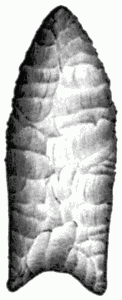
GENERAL DESCRIPTION: This is a
medium to large, auriculate, fluted point
with incurvate base.
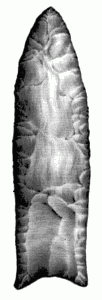
MEASUREMENTS: The maximum measurements,
in mm., of 59 examples from
44 sites in the Tennessee River valley
(Soday and Cambron, n. d.) average:
length, 66; width, 27; thickness, 7. The
length of the longest example is 154; of
the shortest, 35. The weight of the largest
is 60 grams; of the shortest, 5 grams.
Maximum measurements of fourteen examples
of "Fine Clovis" from 13 sites
average 59 mm. long, 25 mm. wide, 6 mm.
thick. The length of the longest is 109
mm.; of the shortest, 29 mm. The weight
of the longest is 27 grams, of the shortest,
3 grams. Texas examples (Suhm, Krieger
and Jelks, 1954) range from 69 mm. to
140 mm. in length and 20 mm. to 40 mm.
in width. The range of 66 examples from
New York State (Ritchie, 1961) is: length,
about 25 mm. to about 127 mm.; thickness,
3 mm. to 10 mm. The illustrated
example measures 110 mm. long, 31 mm.
wide at widest point, 28 mm. wide at
base, 27 mm. wide across basal constriction,
9 mm. thick. The longest flute
measures 29 mm.; the shortest flute, 28.
Flute width is 19 mm.
FORM: The cross-section in the fluted
area of the blade is fluted; in the unfluted
area, biconvex. The blade is usually excurvate
but may be slightly recurvate; the
distal end is usually acute but may be
broad. The hafting area is auriculate and
may be pointed or rounded. It is usually
parallel, but on a few examples may be
expanded or contracted. The basal edge
is incurvate. The hafting area is usually
fluted on both faces; rarely, on one.
Either single or multiple flutes may be
present. Most examples are fluted about
one-third of the total length, but some may
be fluted to near the distal end. Most
examples have ground basal edges, which
may determine the hafting area.
FLAKING: The flaking is usually random
but may be somewhat collateral,
leaving a low median ridge. All examples
are retouched along the edges;
many are very finely pressure flaked.
Flutes appear to have been struck by
indirect percussion after preparation of
a "striking platform" at the base. On
the multiple fluted examples, two or
more primary flutes appear to have
been removed leaving a striking area
near the center of the base from which
the main flute was struck. After one
face was fluted the base was beveled
to facilitate striking flutes from the
opposite face. This resulted in a basal
concavity (Cambron and Hulse,
1961a).
COMMENTS: The point is named for
the Clovis, New Mexico, area, where
examples were found in association
with mammoth remains. The illustrated
example from Hulse Site 54, in Limestone
County, Alabama, was selected
for its similarity to the type specimens
from New Mexico. A date of over
37,000 B. P. was taken from a hearth
containing a Clovis point at Lewisville,
Texas (Crook and Harris, 1958), but
the association has been questioned.
The date from the Naco mammoth find
in Arizona is 9250 ±300 B. P. Many
early-man authorities suggest a date of
about 15,000 years ago. This range
of dates may indicate long use of the
type. The type is distributed over most
of North America. Alabama examples
are found on early sites with blade
tools.
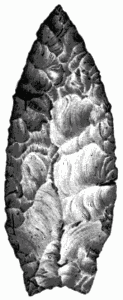
GENERAL DESCRIPTION: The Unfluted
Clovis point is a medium to
large, auriculate point with incurvate
base.
MEASUREMENTS: The average
measurements of samples from seven
sites (Soday and Cambron, n. d.) in
the Tennessee River Valley are: length,
61 mm.; width, 25 mm.; thickness, 6
mm. Length and weight range as follows:
longest, 179 mm.; weight 18
grams: shortest, 46 mm.; weight 4
grams. The detailed measurements of
the illustrated example (one of the cotypes)
are: length, 59 mm.; width at
widest point, 24 mm.; width at base,
21 mm.; maximum thickness, 6 mm.;
depth of basal concavity, 4 mm.; length
of ground hafting area, 29 mm.
FORM: The cross-section is biconvex.
The blade is excurvate and terminates
in an acute, or, sometimes, broad distal
end. The auriculate hafting area is
usually either parallel-pointed or
parallel-rounded; rarely, it is expanded
with an incurvate basal edge which
is usually well thinned. All basal edges
are usually ground—sometimes for almost
half the length of the point. The
shape is similar to, but usually thinner
than, that of the Clovis point.
FLAKING: The flaking used to shape
the blade and hafting area may be
transverse-oblique, random, or collateral
with fine retouch along the blade
edges. Usually several broad, shallow
flakes were removed to thin the basal
edge of the hafting area.
COMMENTS: The type was named
Unfluted Clovis because of its similarity
to the fluted Clovis type. The illustrated
example was found weathered out of
an early stratum along with a fluted
Quad point on Cambron Site 20 in
Morgan County, Alabama. Suhm,
Krieger and Jelks (1954) suggest the
possibility that some Clovis points have
no flutes, and that it would be difficult
to distinguish these examples from
Plainview points. Concerning the fluting
on some of the Clovis points at the
Naco, Arizona Site, Wormington
(1957) says, "In some instances the
grooves had been formed by the removal
of several smaller flakes." At least one
illustrated example appears to be only
basally thinned. The Naco find dates
between 10,000 and 11,000 years ago.
At the Silver Springs Site in Florida,
fluted and unfluted Clovis-like points
(Neill, 1958) were recovered together
from the lowest levels of the site. Alabama
examples usually are recovered
from fluted point sites. It is suggested
that this type may be contemporaneous
with Clovis or may have appeared
later.
GENERAL DESCRIPTION: The Conerly
is a medium to large point with an incurvate
base that is thinned. The stem is
contracted.
MEASUREMENTS: Nine cotypes from
Lively Sites 1, 2, and 4 in the Sardis area
of Burke County, Georgia, provided the
following measurements and traits: length—maximum,
105 mm.; minimum, 57 mm.;
average, 77 mm.: shoulder width—maximum,
31 mm.; minimum. 21 mm.;
average, 27 mm.: stem width—maximum,
21 mm.; minimum, 16 mm.; average, 18
mm.: stem length—maximum 20 mm.;
minimum, 17 mm.; average, 18 mm.: thickness—maximum,
12 mm.; minimum, 9 mm.;
average, 11 mm.: basal concavity—maximum,
4 mm.; minimum, 2 mm.; average,
3 mm.
FORM: The cross-section is biconvex,
rarely flattened. The shoulders are narrow
or lacking. Blade edges may be excurvate
or straight and most examples exhibit
shallow serrations. The distal end is
acute. The stems are contracted with an
incurvate and thinned basal edge.
FLAKING: Mostly broad, shallow, random
flaking was employed to shape the
blade and stem. Two examples exhibited
oblique transverse flaking on the blades.
Short, deep random flaking used to finish
the blade edges often resulted in fine serrations.
A minimum of flaking was used to
finish the sides of the stem. The basal
edge of the stem was flaked to form a
concavity and then thinned. Local materials
were used and all points were
patinated.
COMMENTS: The type was named from
the Conerly Site near Sardis in Burke
County, Georgia. The examples used are
from the collection of Matthew Lively of
Birmingham, Alabama. Associated artifacts
seem to place the type somewhere in
the Archaic period. Physical appearance
of the Conerly points indicate a similarity
to Savannah River points (Bullen, 1968)
as well as Guilford points (Coe, 1959) and
Arredondo points (Bullen, 1968). A suggested
date is somewhere between 7000
and 4000 years B. P.
GENERAL DESCRIPTION: This is a
small to medium-sized, usually thick,
point with a short stem.
MEASUREMENTS: The measurements
of ten plesiotypes, including the
illustrated example, follow (these plesiotypes
also served as a basis for description
of features): length—maximum,
43 mm.; minimum, 31 mm.; average,
37 mm.: width at shoulder—maximum,
23 mm.; minimum, 18 mm.;
average, 20 mm.: stem width—maximum,
13 mm.; minimum, 10 mm.;
average, 12 mm.: stem length—maximum,
7 mm.; minimum, 4 mm.;
average, 6 mm.: thickness—maximum,
8 mm.; minimum, 5 mm.;
average, 7 mm.
FLAKING: Flaking used to shape the
blade and stem is usually of a random
nature; rarely, it is transverse oblique.
On most examples some or all blade
edges may be crudely beveled for about
one-fourth the width of the blade. The
retouch that produces the beveling also
produces fine serrations on some examples.
Points are usually made of a poor
grade local flint in the Coosa River
area.
FORM: The cross-section is usually
biconvex but may be plano-convex or
flattened. The shoulders are usually
horizontal or inversely tapered. The
blade is excurvate and very finely serrated
by secondary flaking; the distal
end is acute. The two examples with
plano-convex cross-sections were unmodified
on the plano face except for
retouch along the edges. The stem is
straight or displays straight side edges
and excurvate stem base edge. The stem
base edge is usually crudely thinned.
COMMENTS: The type was named
for the Coosa River area, where sites
produced the first examples to be
recognized as a type. The illustrated
and measured examples came from
University of Alabama Site Ce 200
(Coker Ford Site), Cherokee County,
Alabama. The main association at this
excavated site was with fabric-marked,
limestone-tempered sherds and simple-stamped,
sand-tempered sherds (DeJarnette,
Kurjack and Keel, 1973). Two
occurrences of association in a stone
mound with plain or brushed limestone-tempered
sherds were also noted. One
example was recovered from B Zone
(Woodland) at Ma 48, Flint River
Mound (Webb and DeJarnette, 1948a).
Nine examples recovered from the
Camp Creek Site in Greene County,
Tennessee, were listed as "straight short
stemmed" (Lewis and Kneberg, 1957).
A date at this homogeneous site of
2050 ±250 years B. P. was obtained.
This evidence suggests a middle Woodland
association in Alabama; the type
may be a part of the Greeneville complex.
This type was associated with
Coosa Notched points at the Coosa
River sites.
GENERAL DESCRIPTION: This is a
small to medium-sized point, usually
thick, with a shallow side notch.
MEASUREMENTS: The four plesiotypes
from which this description was
drawn range in measurements as follows:
length—maximum, 41 mm.;
minimum, 36 mm.; average, 39 mm.:
shoulder width—maximum, 23 mm.;
minimum, 20 mm.; average, 22 mm.:
stem width—maximum, 15 mm.; minimum,
11 mm.; average, 13 mm.: stem
length—maximum, 9 mm.; minimum,
6 mm.; average, 7 mm.: thickness—maximum,
8 mm.; minimum, 7 mm.;
average, 7 mm. The illustrated examples
average 35 mm. in length, 17 mm.
in shoulder width, 14 mm. in stem
width, 7 mm. in stem length and 7 mm.
in thickness.
FORM: The cross-section is usually
plano-convex but may be biconvex. In
most plano-convex examples, the plane
face is unmodified except for retouch.
The shoulders are inversely tapered.
The blade may be excurvate or
straight; the blade edges are usually
finely serrated. The distal end is acute.
Expanded stems are present as a result
of shallow side notching on the hafting
area. The basal edge is usually excurvate
but may be incurvate; it is usually
thinned.
FLAKING: Flaking used to shape the
blade and hafting area is usually random.
Blade edges may be beveled on
one or both sides of each face for about
one-fourth the width of the blade. This
retouch often results in fine serrations
along the blade edges. Notches appear
to have been formed by removal of
short flakes. The points are made of a
poor grade flint in the Coosa River
area.
COMMENTS: The type was named as
a variant of the Coosa point, which
was named for the Coosa River in Alabama,
where many examples are
found. The measured and illustrated
examples are from University of Alabama
Coker Ford Site, Ce 200,
Cherokee County, Alabama. The type
is associated mostly with fabric-marked,
limestone-tempered sherds at
this site but also with simple-stamped,
sand-tempered ware (DeJarnette, Kurjack
and Keel, 1973). The type appears
to be coeval with Coosa, nine examples
of which were recovered from the
homogeneous Camp Creek Site and
listed by Lewis and Kneberg (1957)
as straight short stemmed. A radiocarbon
date of 2050 ±250 B. P. was obtained
from this site. Scattered finds are
made on Woodland sites in the Tennessee
Valley. This evidence suggests a middle
Woodland association in Alabama.
GENERAL DESCRIPTION: This is a
medium to large, trianguloid point with
recurvate edges.
MEASUREMENTS: The illustrated
example is, perhaps, slightly shorter
than average. It measures 80 mm.
long, 22 mm. wide at the widest point
of the blade, 22 mm. wide at the base,
21 mm. wide across hafting constriction
and 7 mm. thick.
FORM: The cross-section is biconvex.
The blade is recurvate as a result of
the hafting constriction. The distal end
is usually acute but may be acuminate.
The hafting area is expanded at the
base. The basal edge is usually straight
but may be excurvate or occasionally
incurvate. It is usually thinned. Light
grinding is usually present on the
hafting area edges.
FLAKING: The blade and hafting
area are shaped by broad, shallow,
random or collateral flaking. The removal
of these flakes occasionally resulted
in a low median ridge. The edges
are finely retouched as from pressure
flaking. Copena points are usually
made of local flint.
COMMENTS: The type was named
after the Copena burial mound culture
of North Alabama. The term "Copena"
is derived from the first three letters
of copper and the last three of galena,
since copper and galena artifacts are
often associated with the burials. The
illustrated example is from Hulse Site
17 in Limestone County, Alabama.
This type was illustrated by Webb and
DeJarnette (1942). Copena is often
called Southern Hopewell. It is a Woodland
point, usually found in burial
mounds, but occasionally on late Archaic
sites in the Tennessee area (Kneberg,
1956). Copena points appeared
in the lower levels of the Woodland
stratum at Flint Creek Rock Shelter
(Cambron and Waters, 1961) and two
examples were recovered from Level
3 (pottery) at University of Alabama
Site Ms 201, Rock House Shelter, in
Marshall County, Alabama, as well as
in the Woodland zone at Ma 48, Flint
River Mound, in Madison County, Alabama
(Webb and DeJarnette, 1948a).
One example was recovered from Level
1 at the Stanfield-Worley Bluff Shelter
(DeJarnette, Kurjack and Cambron,
1962). The type is found eroding out
of several predominately Woodland
shell middens in the Wheeler Basin of
the Tennessee River. A suggested age
is from about 500 B. C. to A. D.
GENERAL DESCRIPTION: This is a
medium to large, trianguloid point. The
sides of the hafting area are usually
parallel.
MEASUREMENTS: The 16 autotypes
(including the illustrated example from
the type site) which provided the features
described below range in measurements
as follows: length—maximum,
74 mm.; minimum, 43 mm.; average,
56 mm.: width at distal end of hafting
area—maximum, 31 mm.; minimum,
20 mm.; average, 24 mm.: width at
base—maximum, 31 mm.; minimum,
19 mm.; average, 25 mm.: thickness—maximum,
10 mm.; minimum, 7 mm.;
average, 8 mm.
FORM: The cross-section is nearly
always biconvex; rarely, it is plano-convex.
Beyond the hafting area, the
blade is usually excurvate but may be
straight. Some examples may have one
excurvate and one straight blade edge.
The distal end is usually acute; rarely,
acuminate. The sides of the hafting area
are usually parallel but may taper from
the base; rarely, they are slightly incurvate.
The basal edge may be either
straight or incurvate to a depth of
about 2 mm. All bases are thinned.
The hafting area edges of most examples
with incurvate bases are lightly
ground. Straight-based examples may
be ground along the hafting area edges.
FLAKING: Faces display random
flaking. Secondary flaking of short,
broad nature appears, followed by fine
retouch, as from pressure flaking,
along the edges. The basal thinning is
usually short, broad and shallow, but
in rare examples it may extend
approximately the length of the hafting
area. Examples are usually made of
local materials.
COMMENTS: The type site is Cambron
53 in Morgan County, Alabama,
where examples were found eroding out
of a shell midden along with Copena
points. The illustrated example is from
this site. Examples were first illustrated
(Webb and DeJarnette, 1942) as
Copena types. At the Stanfield-Worley
Bluff Shelter (DeJarnette, Kurjack and
Cambron, 1962) three examples were
recovered from Level 1, one example
from Level 2 and two examples from
Level 6 in Zone A. This is an indication
of Woodland and possibly Archaic
association. Examples appeared in
Woodland strata at Flint Creek Rock
Shelter (Cambron and Waters, 1961).
One example was recovered from Level
3 (Woodland) at University of Alabama
Site Ms 201, Rock House Shelter,
in Marshall County, Alabama. At
Flint River Mound (Webb and DeJarnette,
1948a) examples were recovered
from both Woodland and Archaic
strata. These associations indicate that
the type originated in Archaic times
and continued into the Woodland
period.
GENERAL DESCRIPTION: This is a
medium to large, straight-stemmed
point with rounded shoulders and
straight blade edges.
MEASUREMENTS: Measurements of
nine cotypes (including the illustrated
example) from which features were
taken ranged as follows: length—maximum,
83 mm.; minimum, 47 mm.;
average, 64 mm.: width at shoulders—maximum,
45 mm.; minimum, 33 mm.;
average, 40 mm.: stem width—maximum,
19 mm.; minimum, 14 mm.;
average, 16 mm.: stem length—maximum,
14 mm.; minimum, 6 mm.;
average, 10 mm.: thickness—maximum,
10 mm.; minimum, 6 mm.;
average, 7 mm.
FORM: The cross-section is usually
flattened but may be rhomboid.
Shoulders may be straight or inversely
tapered with weak barbs and are
usually rounded. The blade is usually
straight, but may be excurvate, finely
serrated and, sometimes, beveled on the
right side (looking toward the distal
end) of one or both faces. One example
is smoothed, as from use, on the edges
adjacent to the distal end. The distal
end is usually apiculate or obtuse;
rarely acute. The stem is usually
straight; rarely, expanded with straight
side edges. The basal edge may be
straight or excurvate. Most basal edges
are thinned. About half the examples
are ground on the basal edge. Occasionally,
the side edges of the stem are
ground.
FLAKING: This type displays well-controlled,
broad, shallow, random
flaking. Edge retouch consisting of the
removal of fine, short, regular flakes
from alternate face edges appears as
fine serrations. Sometimes longer, more
even flakes were removed in beveling
one edge of each face. Some examples
were beveled and then serrated. Points
were made from Ft. Payne chert, Bangor
nodular flint, jasper or other local
materials. Some examples made of Ft.
Payne chert show considerable patination.
COMMENTS: The type was named
for Cotaco Creek in Morgan County,
Alabama, where many examples have
been recovered. The illustrated example
is from Cambron Site 156 (Stone Pipe)
in Limestone County, Alabama. At the
Stanfield-Worley Bluff Shelter (DeJarnette,
Kurjack and Cambron, 1962)
10 examples were recovered from Level
2, 4 from Level 3, 2 from Level 4, 2
from Level 5, 4 from Level 6, 2 from
Level 7, 1 from Level 9 and 1 from
Level 10. These levels—all in Zone
A—are Woodland and Archaic. At the
University of Alabama Site Ms 201 in
Marshall County, Alabama, one example
was recovered from Level 3 (Woodland).
Flint Creek Rock Shelter (Cambron
and Waters, 1961) produced one
example from Stratum I (Woodland)
and five examples from middle and
upper Stratum II (Archaic). Flint River
Mound, University of Alabama Site
Ma 48 (Webb and DeJarnette, 1948a)
produced three examples from Zones
A and B (Woodland) and 18 examples
from the upper part of zones C and D
(Archaic). This evidence suggests a
strong late Archaic occurrence on the
Tennessee River and continued use in
Woodland times, especially at Stanfield-Worley
Bluff Shelter. A variation of
the type called Cotaco Creek Variant
differs from Cotaco Creek in that it is
usually smaller, cruder, often narrower
and has an acute distal end. The blade
of the variant is more apt to be excurvate.
GENERAL DESCRIPTION: This is a
medium-sized, stemmed point with a
blade that is usually straight. Blade
edges are usually finely serrated.
MEASUREMENTS: The 13 cotypes
(including the illustrated example) from
which features were obtained ranged in
measurements as follows: length—maximum,
46 mm.; minimum, 27 mm.;
average, 36 mm.: shoulder width—maximum,
30 mm.; minimum, 20 mm.;
average, 25 mm.: stem width—maximum,
20 mm.; minimum, 13 mm.;
average, 16 mm.: stem length—maximum,
9 mm.; minimum, 6 mm.; average,
8 mm.: thickness—maximum, 9
mm.; minimum, 5 mm.; average, 7
mm.
FORM: The cross-section is biconvex.
Shoulders may be horizontal, slightly
tapered or slightly inversely tapered.
The blade is usually straight, but
several examples have one excurvate
edge. The blade edges of nearly all
examples are finely serrated. Distal
ends are usually acute. The stem is
usually straight but several examples
have expanded stems. Stem sides may
be straight or incurvate. The basal edge
of the stem, strongly thinned on most
examples, is usually straight but may
be excurvate; rarely, it is incurvate. At
Flint Creek Rock Shelter (Cambron
and Waters, 1961) expanded-stemmed
examples appear to pre-date straight-stemmed
examples.
FLAKING: Irregular, random flaking
shapes the blade and hafting area.
Some large flake or blade scars may
be evident on one or both faces. Flakes
removed to form the stem were usually
fairly deep and broad while the flakes
removed to thin the base were broad
and shallow. Fine, often steep, retouch
along the blade edges appears to have
been accomplished by pressure flaking.
Fine serrations were formed by the removal
of small flakes, opposite each
other, from each face. The point is
usually made of local materials.
COMMENTS: The type was named
for Crawford Creek in Morgan County,
Alabama. This creek is near the Flint
Creek Rock Shelter (Cambron and
Waters, 1961) where the type was first
found and called Provisional Type
Three, small, stemmed, serrated. The
illustrated example is from Flint Creek
Rock Shelter, Cambron Site 287. The
name Crawford Creek was used by
Cambron and Hulse (1960b). One example
(plate 13e) from the Eva Site
is illustrated by Lewis and Lewis
(1961) as a unique point. One example
was found among other artifacts in
association with a Morrow Mountain
burial at the Stanfield-Worley Bluff
Shelter (DeJarnette, Kurjack and Cambron,
1962). Zone A (Woodland and
Archaic) at the Stanfield-Worley Bluff
Shelter also yielded two examples from
Level 6, two from Level 8 and one from
Level 9. At University of Alabama Site
Ms 201, in Marshall County, Alabama,
one example was recovered from
Level 5, one from Level 7 and one from
Level 10. Of the 20 examples from
Flint Creek Rock Shelter, two were recovered
from Stratum I (Woodland)
and the other 18 from Stratum II (Archaic),
particularly from the lower half.
Surface finds are usually made on early
Archaic sites. All of the above evidence
indicates an early Archaic association
which lasted into later Archaic. A suggested
date is sometime before 5000
B. C.
GENERAL DESCRIPTION: This is a
medium to large, auriculate, fluted
point displaying hafting constriction.
MEASUREMENTS: Thirty-one plesiotypes
from 28 sites in the Tennessee
River Valley (Soday and Cambron,
n. d.) ranged in measurements as follows:
longest example, 101 mm.; shortest;
37 mm.; average length, 69 mm.;
average width, 23 mm.; average thickness,
8 mm. The illustrated example
measures 77 mm. long, 24 mm. across
the blade, 19 mm. wide at base, 16
mm. wide at hafting constriction, 7 mm.
thick, 2 mm. deep at basal concavity.
Length of flutes measured from basal
concavity: 1st flute, after flaking of
striking platform for 2nd flute, 47 mm.;
2nd flute, 53 mm.
FORM: Cross-section is usually fluted
or median ridged on unfluted faces. The
blade is recurvate; the distal ends,
acute. The auriculate hafting area is
usually expanded-rounded with an incurvate
basal edge. There is no sharp
break between the blade edges and the
ground edges of the hafting area. The
base may be multiple fluted or single
fluted on one or both faces. The main
flute or flutes may extend to near the
distal end.
FLAKING: Collateral flaking was
usually employed to shape the median
ridges on the faces. The hafting constriction
was sometimes partially
worked out before fluting. For multiple
fluting, two short primary flutes were
removed down each side of the median
ridge after the basal edge had been
flaked to the proper degree of pitch to
form a striking platform. This resulted
in the formation of a striking nipple
in the center of the basal edge from
which the main flute was struck by indirect
percussion. The basal edge was
then reflaked to the desired pitch or
level to facilitate repeating the fluting
procedure on the other face. Flaking of
the basal edge was sometimes accomplished
after the second main flute had
been struck. Fine retouch was occasionally
carried out on all side edges.
Finally, the hafting constriction was
completed (Cambron and Hulse,
1961).
COMMENTS: The type was named
for the Cumberland River Valley in
Tennessee where many examples were
collected on the surface. The illustrated
example is from Holland Site 270 in
Colbert County, Alabama. Three examples
of Cumberland points were recovered
from University of Alabama Site
Ms 201, in Marshall County, Alabama,
in the irregular, rocky, lower
part of the lower levels with Big Sandy
I, Dalton and other early types.
They are found with Clovis points in
many surface collections. A Paleo-Indian
association, sometime before
10,000 years ago, is suggested.
GENERAL DESCRIPTION: This is a
medium-sized, auriculate point with a
rectangular hafting area.
MEASUREMENTS: Eleven cotypes
from 11 sites in the Tennessee River
Valley (Soday and Cambron, n. d.)
range in measurements as follows:
longest, 54 mm.; shortest, 33 mm.;
average length, 45 mm.; average width,
18 mm.; average thickness, 6 mm. The
illustrated example measures 51 mm.
long, 15 mm. wide across blade at
junction of hafting area, 18 mm. wide
at terminal end of hafting area, 19 mm.
wide at base, 16 mm. wide across basal
constriction, 6 mm. thick. The hafting
area is 19 mm. long.
FORM: The cross-section is usually
biconvex but may be somewhat
rhomboid. Blade edges are usually
straight but may be excurvate and may
be beveled on one edge and/or serrated.
The distal end is acute. The hafting
area is more or less rectangular with
slightly incurvate, heavily ground side
and basal edges. The base is thinned.
FLAKING: The blade and hafting
area are shaped by shallow, random
flaking. Short, sharp, regular serrations
on the blade edges are the result
of the well-controlled removal, one at
a time on alternate faces, of deep, short,
flakes. Retouch was accomplished by
the removal of broad, shallow flakes
followed by very fine flaking which
helped form smooth edges. Most examples
are made of Ft. Payne chert but
other local materials were also used.
COMMENTS: The type was named for
Colbert County, Alabama, where examples
were recovered from Stanfield-Worley Bluff
Shelter (DeJarnette, Kurjack and Cambron,
1962). The illustrated example is from the
Pine Tree Site, Cambron 76, Limestone
County, Alabama. The type has been referred
to locally as "Square Based Dalton"
for some years (Soday and Cambron, n. d.)
and was illustrated by Cambron and Hulse
(1960a). In the survey of the Tennessee
River Valley by Soday and Cambron only
eleven examples were noted. Forty-three
examples, excluding those from the 100-foot
trench, were recovered from Stanfield-Worley
Bluff Shelter. At this site, in the
other trenches, examples appeared mostly
from Level 7 through Level 14. In the
blocks two examples were recovered from
Zone B, three from Zone C and ten from
Zone D. A radiocarbon date from Zone D
(1960) gave an age of 9640 ±450 B. P.
This appears to be a transitional Paleo-Indian
type. Excavations in 1965 at the
Tensaw Creek Site (1 Lo 9) in Lowndes
County revealed Colbert Daltons and
Greenbrier Daltons in a stratigraphic
sequence (Chase, 1966).
GENERAL DESCRIPTION: The
Greenbrier Dalton is a medium-sized,
auriculate point with expanded auricles
and well-defined hafting area.
MEASUREMENTS: One hundred
fifty-three plesiotypes which may include
some Nuckolls Dalton points,
since the types had not been separated
when the survey was made (Soday and
Cambron, n. d.), from 62 sites in the
Tennessee River Valley ranged from
maximum length of 69 mm. to a minimum
length of 28 mm. The average
length was 47 mm.; the average width,
21 mm.; average thickness, 6 mm. The
illustrated example measured in length,
48 mm.; in width of blade at junction
of hafting area, 18 mm.; in width at
terminal end of hafting area, 19 mm.;
in width at base, 21 mm.; in length of
hafting area, 16 mm.; in width of basal
constriction, 18 mm.; in thickness 6
mm.
FORM: The cross-section is usually
biconvex but may be rhomboid. The
blade is usually excurvate but may be
straight. Blade edges may be beveled
on one edge and/or serrated. The distal
end is acute. The hafting area,
usually well defined by a sharp change
in the contour of the edge of the point
at the junction of the blade, is
auriculated with expanded-rounded,
rarely expanded-pointed auricles. Side
and basal edges of the hafting area are
usually incurvate and ground. The
basal edge is thinned, sometimes fluted.
FLAKING: The blade and hafting
area are shaped by broad, shallow, random
flaking. Retouch along the blade
edges often resulted in serrations and/or
beveling. Retouch along the hafting
area edges was more limited, and
usually finer, which helped to smooth
the hafting area edges. Most examples
are made of local materials.
COMMENTS: The type was named
for the Greenbrier area of Kentucky
Lake. The illustrated example is from
the Quad Site, Cambron 84, Limestone
County, Alabama. Forty-one examples
were recovered from the Stanfield-Worley
Bluff Shelter (DeJarnette, Kurjack
and Cambron, 1962) excluding those
found in the 100-foot trench. Most of
the examples came from the trenches,
and were present in Levels 7 through
15. Zone C produced two examples.
One example was found in each of the
following levels of Zone D: 1, 2, 5, 6,
12. At University of Alabama Site Ms
201, in Marshall County, Alabama,
one example was recovered from Level
10 and two from Level 11. A radiocarbon
date of 9640 ±450 years B. P.
from Zone D material at the Stanfield-Worley
Bluff Shelter suggests a Transitional
Paleo-Indian association, as do
associations of surface finds in Alabama
with other early materials. An
example was found in association with
Quad, Wheeler, Big Sandy I and Stanfield
Triangular points, a fluted midsection
and uniface tools at the Quad
Site (Cambron and Hulse, 1960a). A
variant of the type called Nuckolls Dalton
(by Kneberg, for the Nuckolls Site
in Kentucky Lake, Tennessee) differs
from Greenbrier Dalton in that it has
either parallel-rounded or, rarely,
parallel-pointed auricles. Forty-six examples
of this variant were recovered
from the Stanfield-Worley Bluff Shelter.
No significant difference in distribution
by levels was noted between any of the
Dalton types at this site. Examples with
straight hafting area sides are similar
to Meserve points (Suhm, Krieger and
Jelks, 1954).
GENERAL DESCRIPTION: The Damron
point is a medium-sized point with
shallow side notches.
MEASUREMENTS: Eleven cotypes, including
the illustrated example, provided
traits and the following measurements:
length—maximum, 72 mm.;
minimum, 37 mm.; average, 49 mm.:
shoulder width—maximum, 32 mm.;
minimum, 24 mm.; average, 27 mm.:
stem width—maximum, 29 mm.; minimum,
19 mm.; average, 24 mm.: stem
length—maximum, 11 mm.; minimum,
7 mm.; average, 9 mm.: thickness—maximum,
10 mm.; minimum, 7 mm.;
average, 8 mm.: notch width—maximum,
8 mm.; minimum, 7 mm.; average,
7 mm.: notch depth—maximum,
5 mm.; minimum, 2 mm.; average, 3
mm.
FORM: The cross-section is usually
biconvex but may be flattened or, rarely,
plano-convex. Shoulders are tapered.
The blade may be excurvate or straight.
Some examples have one excurvate and
one straight blade edge. Blade edges
may be finely serrated. The steepness of
some blade edges gives a near-beveled
appearance. The distal end is acute.
The hafting area is notched with shallow,
narrow, side notches situated near
the basal edge. Sides of the expanded
stem are incurvate. The basal edge is
usually excurvate but may be straight.
Rarely, it is ground; usually it is beveled
on one or both faces.
FLAKING: Fairly deep random flaking
shapes the faces of the blade and hafting
area. Fine, regular retouch finishes
the blade edges, often resulting in fine
serrations. Notches, formed by the removal
of one or more flakes, are found
near the basal edge. Short, deep flakes
were removed in order to bevel the basal
edge. Unbeveled faces are thinned. Local
materials were used and all examples
are patinated.
COMMENTS: The type was named
from the Damron Site (Cambron Site
47), Lincoln County, Tennessee, where
many examples were recovered. The
illustrated example is from the Quad
Site (Cambron Site 84) in Limestone
County, Alabama. The type has been
previously classified locally as Upper
Valley Side Notched. One example was
recovered from Level 8 of Zone A (an
Archaic level) at the Stanfield-Worley
Bluff Shelter (DeJarnette, Kurjack and
Cambron, 1962). At Flint Creek Rock
Shelter (Cambron and Waters, 1961)
three examples were recovered from the
middle Archaic Stratum and one from
the upper Woodland Stratum. One example
was recovered from Zone B (a
Woodland level) at the Flint River
Mound (Webb and DeJarnette, 1948a).
The appearance of the type in surface
collections from pre-shellmound sites in
the Wheeler Basin of the Tennessee River
indicates an early Archaic association.
An association with some part of the
Archaic period is suggested.
GENERAL DESCRIPTION: This is a
small to medium-sized point that is corner-notched
and beveled with diagonal
flakes struck from the base and basal
sides of the stem forming an incurvate
base.
MEASUREMENTS: Sixteen autotypes
from sites near Decatur, Alabama,
provided both measurements
and features. Measurements ranged as
follows: length—maximum, 54 mm.;
minimum, 29 mm.; average 42 mm.:
shoulder width—maximum, 38 mm.;
minimum, 22 mm.; average, 28 mm.:
stem width—maximum, 25 mm.; minimum,
13 mm.; average, 19 mm.: stem
length—maximum, 12 mm.; minimum,
4 mm.; average, 7 mm.: thickness—maximum,
7 mm.; minimum,
5 mm.; average, 6 mm. The illustrated
example measures in length, 40 mm.;
in shoulder width, 23 mm.; in stem
width, 17 mm.; in stem length, 5 mm.;
in thickness, 5 mm.
FORM: The cross-section is usually
rhomboid; rarely, biconvex. The
shoulders are usually tapered with
expanded barbs but, rarely, may be
straight, with or without expanded
barbs. The blade may be straight or
incurvate; rarely, recurvate. Blade
edges are usually beveled on one edge
and serrated. The distal end is acute.
The corner notches range in width from
about 3 mm. to 7 mm. and in depth
from about 4 mm. to 7 mm. The expanded
stem usually has straight side
edges; the basal edge is usually incurvate
but may be straight. Rarely, it is
excurvate. It is usually thinned and
nearly always ground.
FLAKING: Most examples exhibit
broad, shallow flaking on the faces.
Blade edges are serrated, either as a
result of retouch accomplished by alternate
removal of deeper flakes from opposite
faces or as a result of beveling.
The bevel angle varies from steep to
a bevel that extends to near the center
of the blade and may overlap from
near halfway the blade length to the
distal end. Most examples have one or
more flakes struck from the basal corners
of the stem to near the center of
the basal edge. On many examples, the
same type of flake may be struck from
the basal corners of the stem up the
sides of the stem towards the shoulders.
This flaking tends to flatten the base
and sides of the stem. Stem edges are
finished by grinding.
COMMENTS: The type was named
for the Decatur, Alabama, area where
it was first recognized. The illustrated
example is from Hulse Site 32 (Stone
Pipe) Limestone County, Alabama.
The type was described by Bell (1960).
Two examples were recovered, one
from upper half of Stratum II and one
from the center third of Stratum II
(Archaic) at Flint Creek Rock Shelter
(Cambron and Waters, 1961). The
type was not found in excavations in
other early strata away from the Tennessee
River. Local examples are found
near the river on pre-shellmound sites.
This evidence suggests an early Archaic
association.
GENERAL DESCRIPTION: The
Ebenezer is a small, short-stemmed,
point with rounded stem and excurvate
blade edges.
MEASUREMENTS: The illustrated
example, which provided the features,
is 38 mm. long, 19 mm. in shoulder
width, 15 mm. in stem width, 6 mm.
in stem length and 7 mm. thick.
FORM: The cross-section is biconvex.
Shoulders are narrow and are usually
tapered but may be straight. The blade
is usually excurvate with an acute distal
end. The stem is short and rounded.
FLAKING: The blade and stem are
shaped by broad, shallow or deep, random
flaking. Short, regular retouch
finishes the blade edges. Use of a rather
poor grade of local flint at the Camp
Creek Site (Lewis and Kneberg, 1957)
may account for the relatively crude
flaking on examples from this site.
COMMENTS: The Ebenezer type was
illustrated as Rudimentary Stemmed at
Camp Creek in Greene County, Tennessee
(Lewis and Kneberg, 1957)
where the illustrated example was recovered
(Cambron Site 284). Fifty-eight
examples were recovered scattered
through the midden. The type was
described as being "associated with
early Woodland artifacts on other
upper eastern Tennessee sites". A radiocarbon
date of 2050 ±250 B. P. was
obtained from the homogeneous midden
at Camp Creek. One example was
recovered from the middle of Stratum
I (Woodland) at Flint Creek Rock
Shelter (Cambron and Waters, 1961).
At Flint River Mound Ma 48 (Webb
and DeJarnette, 1948a) in the Woodland
zone, one example was recovered
from Zone A and one from Zone B.
The Ebenezer point was dominant at
the Rankin Site on French Broad River
(headwaters of Tennessee River) where
most of the ceramics were sand-tempered.
This evidence would place the
type in early to late Woodland association
with a suggested date of from
about 2000 years ago to possibly 1500
years ago or some part thereof. The
type is similar to some illustrated examples
of Cliffton points from Texas
(Suhm, Krieger and Jelks, 1954),
which are estimated to be near the same
age.
GENERAL DESCRIPTION: The
Ecusta is a small, triangular, side-notched
point with serrated and beveled
blade edges.
MEASUREMENTS: The illustrated
example measures 37 mm. long, 24
mm. wide at the base, and 7 mm. thick.
FORM: The cross-section is rhomboid.
The shoulder barbs are weak, and are
usually the result of beveling of the
blade. The blade is straight, and
beveled on one side of each face and,
usually, serrated. The distal end is
acute. The sides of the hafting area display
shallow side notches. The base of
the hafting area is usually broad and
rounded but may be straight or incurvate.
Striking of diagonal flakes from
the basal edge on some examples results
in flattening of the base.
FLAKING: This is a well-made point,
shaped by random, percussion flaking
and retouched with serrations along the
blade edges.
COMMENT: The point was named
"Ecusta" since this is the Cherokee
Indian name for Davidson River, where
the type was first recognized at the
Osborne Site in Transylvania County,
North Carolina (Harwood, 1958). The
illustrated homotype is from Kyle Hardin's
Baker 1 Site in Blount County,
Alabama, where it was recovered along
with four other examples. One example
(No. 1, p. 42) was illustrated by Lewis
(1961) from Guntersville Basin in
North Alabama. Other examples were
found on the surface in North Alabama,
Kentucky Lake in Tennessee,
and Madison County, North Carolina.
The Ecusta is similar to Decatur and
Plevna points inasmuch as all of these
types are notched, beveled and may
have diagonal flakes struck from the
base. Plevna and Decatur points from
Kyle Hardin's Baker 1 Site were very
similar in workmanship to Ecusta
points from this site. All examples are
found with early Archaic materials. An
Alabama pre-shellmound association is
suggested, with a probable date prior
to 5000 years ago.
GENERAL DESCRIPTION: This is
a medium to large, stemmed point with
oblique-horizontal flaking on the blade
faces.
MEASUREMENTS: Measurements
of the 15 paratypes (specimens of the
original series including the holotype)
range as follows: length—maximum,
92 mm.; minimum, 48 mm.; average,
72 mm.: shoulder width—maximum,
38 mm.; minimum, 30 mm.; average,
31 mm.: stem width—maximum, 19
mm.; minimum, 15 mm.; average, 17
mm.: stem length—maximum, 17 mm.;
minimum, 11 mm.; average, 14 mm.:
thickness—maximum, 11 mm.; minimum,
8 mm.; average, 9 mm. The
illustrated example measures 128 mm.
in length; 27 mm. in shoulder width;
20 mm. in stem width; 14 mm. in stem
length; 9 mm. in thickness.
FORM: The cross-section is usually
biconvex; rarely, plano-convex. The
shoulders are usually tapered and may
be expanded. The blade is excurvate;
the distal end, acute. The hafting area
is usually straight-stemmed but the stem
may be expanded or contracted with a
straight or, rarely, excurvate basal
edge. One example could be described
as having shallow side notches. About
one-fourth of the original series have
lightly ground bases.
FLAKING: One or (usually) both
faces are shaped by oblique-transverse
flaking. Retouch is minimized since the
oblique flaking, in most cases, carries
from the blade edges to near the center
of the face and occasionally almost
forms a median ridge. The transverse-oblique
flaking is similar to that seen
on the faces of some Angostura, Scotts-bluff
and Brown Valley points and
Cape Denbigh artifacts illustrated by
Wormington (1957). This flaking
technique was also used on some late
neolithic Danish daggers (Bordaz,
1959).
COMMENTS: The point was named
for the Elk River Site on Elk River in
Limestone County, Alabama. The
illustrated example is from Hulse 38E
(Quad Site), Limestone County, Alabama.
The type was listed in the depth
distribution charts at Flint Creek Rock
Shelter (Cambron and Waters, 1961)
in the middle-Archaic stratum (10 examples)
and Woodland stratum (two
examples). An illustration was listed as
Provisional Type 2, expanded stem.
Two examples of Elk River points from
Perry Site, Lu 25, on Seven Mile
Island in Lauderdale County, Alabama,
were used to illustrate the high
art of flint flaking (Webb and DeJarnette,
1942). Examples from Levels 8
and 9, Zone A, at Stanfield-Worley
Bluff Shelter (DeJarnette, Kurjack and
Cambron, 1962) indicate a late Archaic
association. Examples were recovered
from Zones A, B, C, and D at Flint
River Mound, Ma 48 (Webb and
DeJarnette, 1948a). At Little Bear
Creek, Ct 8 (Webb and DeJarnette,
1948b) six examples were recovered
from the five-foot level and one from the
six-foot level. This again indicates a
middle- to late-Archaic type. Since most
of the associations in the North Alabama—South
Tennessee area are within
the shellmound period, this type very
likely appeared before 5000 years ago.
It is probably not associated with the
western point types with similar flaking.
GENERAL DESCRIPTION: The
Elora is a medium to large, thick,
broad, stemmed point with unfinished
base.
MEASUREMENTS: The 12 cotypes
(including the illustrated example)
which provided the features range in
measurements as follows: length—maximum,
71 mm.; minimum, 53 mm.;
average, 61 mm.: shoulder width—maximum,
57 mm.; minimum, 35 mm.;
average, 43 mm.: stem width—maximum,
22 mm.; minimum, 20 mm.; average,
20 mm.: stem length—maximum,
15 mm.; minimum, 8 mm.; average,
12 mm.: thickness—maximum,
12 mm.; minimum, 7 mm.; average,
10 mm.
FORM: The cross-section is biconvex.
Shoulders are usually rounded and
tapered but may be horizontal or, rarely,
expanded. The blade is usually
straight; rarely, excurvate or incurvate.
Some examples are finely serrated as
a result of retouching along the blade
edges. The distal end is usually acute;
rarely, broad. The hafting area consists
of a thick, contracted stem with side
edges that are straight or incurvate and
a basal edge that is usually straight
but may be excurvate. The crudely
finished stem base found on most examples
often has an intentionally
broken appearance. Removal of one or
more flakes usually results in a relatively
broad, flattened basal edge.
FLAKING: The flaking used to form
the blade and hafting area is broad,
shallow or deep, and random. Fine,
sometimes steep, regular retouching
along the blade edges accomplished by
removal of alternate flakes from each
face sometimes results in fine serrations.
The shoulder and side edges of the stem
may show some secondary flaking. The
basal edge is usually unfinished but
may show a little retouch as broad
flakes were struck off or perhaps intentionally
broken off to form a more or
less flat stem base edge.
COMMENTS: The type was named
from the Elora area of Lincoln County,
Tennessee, where several sites have produced
many examples of the type. The
illustrated example as well as the cotypes
are from Cambron Site 48 in this
area. A variant classified locally as
Elora Serrated is slightly larger than
Elora and is strongly serrated by the
alternate removal of flakes from
opposite faces of the point. The Elora
point was categorized Provisional Type
7, large, thick, stemmed, by Cambron
and Waters (1961). In Zone A at the
Stanfield-Worley Bluff Shelter (DeJarnette,
Kurjack and Cambron, 1962) 2
examples were recovered from Level 1,
1 from Level 2, 2 from Level 3, 1 from
Level 6, 1 from Level 9. One example
of Elora Serrated was recovered from
Level 1 in Zone A and one from Level
1 in Zone D at the Stanfield-Worley
Bluff Shelter. A serrated example was
also recovered from Level 8 at University
of Alabama Site Ms 201 in Marshall
County, Alabama. At Flint Creek
Rock Shelter (Cambron and Waters,
1961) two examples of Elora were recovered
from Stratum I (Woodland)
and 3 examples from upper Stratum II
(Archaic). At Little Bear Creek, Site
Ct 8 (Webb and DeJarnette, 1948b)
two examples were recovered from the
4-foot level, one from the 5-foot level
and one from Zone B, about the 4-foot
level (Archaic). At Flint River, Mound
Ma 48 (Webb and DeJarnette, 1948a)
two examples were recovered from
Zone D (Archaic). This evidence suggests
a middle-to-late, shellmound Archaic
and possibly a very early Woodland
association. Elora Serrated may
be slightly older than Elora. A date of
5000 to 3000 years ago, or some part
thereof, is suggested. Hulse suggests
that Elora Serrated may be a type distinct
from Elora.
GENERAL DESCRIPTION: The Eva
is a medium to large, basally notched
point with an excurvate or recurvate
blade.
MEASUREMENTS: The 10 plesiotypes
which supplied the features (the
illustrated example is included) range
in measurements as follows: length—maximum,
96 mm.; minimum, 48 mm.;
average, 61 mm.: shoulder width—maximum,
39 mm.; minimum, 25 mm.;
average, 33 mm.: stem width—maximum,
26 mm.; minimum, 11 mm.;
average, 18 mm.: stem length—maximum,
7 mm.; minimum, 5 mm.; average,
6 mm.: thickness—maximum, 10
mm.; minimum, 8 mm.; average, 9
mm.
FORM: The cross-section is biconvex.
Shoulders are simple-barbed and inversely
tapered. The blade is usually
excurvate but may be recurvate. The
distal end is acute. Basal notches range
from 1 to 7 mm. deep and average 4
mm. deep. The notch width range is
from 3 to 9 mm.; notch width average
is 6 mm. Retouching often leaves the
stem longer than the barbs. The stem
is either straight or contracted. Stem
side edges may be straight or excurvate.
The stem base is usually straight
but may be excurvate; it is usually
thinned by retouching and may be
lightly ground.
FLAKING: The blade and hafting
area are shaped by strong, broad, shallow,
random flaking. The blade face is
thinned from edge to center by broad
secondary flaking. Some fine retouch
appears along the blade and hafting
area edges. The basal notches are
formed perpendicular to the base by
removal of one broad flake from
opposite faces on each side of the stem.
Retouching often shortened the barbs;
in some cases a barb was almost completely
worked away. No retouch was
noted in the notches.
COMMENTS: The point is named
after the Eva Site in Benton County,
Tennessee. The illustrated example is
among the 10 measured plesiotypes
from the Plevna Site, Cambron 79, in
Madison County, Alabama. Lewis and
Lewis (1961) describe most examples
from the Eva Site as having recurvate
blade edges and sometimes displaying
barbs longer than the stems. Examples
of the type were in association at the
Eva Site with materials dated by radiocarbon
method at 7200 B. P. Lewis
and Lewis (1961) also describe a
smaller, narrower variant found at
later levels as Eva II. Four examples
of the Eva type were recovered from
Zone A—one each from Levels 3, 7,
9 and 11—at Stanfield-Worley Bluff
Shelter in Colbert County, Alabama
(DeJarnette, Kurjack and Cambron,
1962). Four examples were recovered
from the bottom of Stratum II (Archaic)
at Flint Creek Rock Shelter (Cambron
and Waters, 1961). At Little Bear
Creek Site in Colbert County, Alabama
(Webb and DeJarnette, 1948b), one
example was recovered from the 8-foot
level (below the shellmidden). Numerous
surface finds in North Alabama
also indicate an early Archaic association.
The 7200 B. P. date at Eva Site
appears acceptable.
GENERAL DESCRIPTION: This is a
medium-sized point which usually displays
an expanded stem and a notch
flaked into each blade edge above the
shoulders.
MEASUREMENTS: The illustrated
example measures 60 mm. in length,
33 mm. in width, 20 mm. in stem width,
11 mm. in stem length, 11 mm. in
thickness.
FORM: (The following description is
taken from the illustrated example, an
example from Cambron Site 14, Limestone
County, Alabama, and from
illustrations and description by Bell,
1958): The cross-section is biconvex.
Shoulders may be horizontal, inversely
tapered, or tapered. The blade is
usually excurvate but may be straight;
blade edges are deeply notched from the
shoulders to about one-third to nearly
one-half the length of the blade. The
distal end may be acute or broad. The
hafting area may include the notched
portion of the blade as well as the stem.
The stem is usually expanded but may
be straight or, rarely, contracted. The
side edges of the stem may be straight
or incurvate and the basal edge,
straight or excurvate. The excurvate
stem base edge is ground on the Alabama
example.
FLAKING: Broad, irregular, random
flaking appears on the blade and stem.
Some retouch accomplished by the removal
of small, fairly deep flakes is
found along the blade edges. Deep side
notches are the result of removal of a
broad, deep flake from the edges of
opposite faces of the blade. Occasionally,
limited retouch was employed to
broaden the notches after the main
notching flake had been struck.
COMMENTS: The point was named
after examples found at Poverty Point
Site in Louisiana. The illustrated example
is from Holland Site 123 in Franklin
Parish, Louisiana. Bell (1958) gives
the distribution as the northern half of
Louisiana, the adjacent portions of
eastern Texas, southern Arkansas and
western Mississippi. On the basis of
radiocarbon dates from Poverty Point
and the Jaketown Site, Ford and Webb
(1956) suggest an age of around 2600
to 2800 years ago. Points of similar
workmanship but with three or more
notches along each blade edge are
found in North Alabama and classified
as Provisional Type 10, eccentric
notched (Cambron and Waters, 1961;
Cambron and Hulse, 1960b). These
points may or may not be related to
the Evans type.
GENERAL DESCRIPTION: This is a
small to medium-sized point with an expanded
stem, incurvate base and random
flaking.
MEASUREMENTS: Eight cotypes from
sites in South Calhoun County and North
Talladega County, Alabama provided traits
and the following measurements: length—maximum,
52 mm.; minimum, 41 mm.;
average, 45 mm.: shoulder width—maximum,
31 mm.; minimum, 26 mm.; average,
28 mm.: stem width—maximum, 28 mm.;
minimum, 21 mm.; average, 26 mm.: stem
length—maximum, 13 mm.; minimum, 10
mm.; average, 12 mm.: thickness—maximum,
13 mm.; minimum, 8 mm.; average,
9 mm. The illustrated example measures
46 mm. long, 31 mm. wide at the shoulders,
27 mm. wide across the stem, 12
mm. in stem length, and 9 mm. thick.
FORM: The cross-section is usually flattened
but may be biconvex. Shoulders
are inversely tapered. The blade may be
excurvate or straight. The distal end is
usually acute but may be broad. The
stem is expanded and the side edges may
be ground. The basal edge is incurvate and
thinned.
FLAKING: Because of the poor grade of
material used, the shallow, random flaking
which shapes the blade and stem is, in
most cases, poor. Some blade edges may
be finely serrated.
COMMENTS: The type was named from
the Lehmann Rock Shelter in Texas by
J. Charles Kelley (1947b) and was described
by Suhm and Krieger who also
give an estimated age of about 1000 B. C.
to 500 A. D. or part thereof (Suhm, Krieger
and Jelks, 1954). Suhm and Krieger list
the Fairland type as characteristic of Central
Texas. Occasional examples appear in
collections throughout Oklahoma and elsewhere
(Bell, 1960). Four of the eight
measured examples are made of quartzite
and four are made of a poor grade of flint
The illustrated example is made of quartzite.
All examples, including 39 that were
broken and not measured, are from the
collection of Eugene L. Grace of Anniston,
Alabama. They were recovered from late
Archaic and early Woodland sites.
GENERAL DESCRIPTION: The
Flint Creek is a medium to large, finely
serrated, stemmed point.
MEASUREMENTS: Examples which
provided the features (including the
illustrated example) ranged in measurements
as follows: length—maximum,
76 mm.; minimum, 39 mm.; average,
55 mm.: shoulder width—maximum,
29 mm.; minimum, 18 mm.; average,
23 mm.: stem width—maximum, 19
mm.; minimum, 13 mm.; average, 16
mm.: stem length—maximum, 15
mm.; minimum, 7 mm.; average, 11
mm.: thickness—maximum, 12 mm.;
minimum, 7 mm.; average, 10 mm.
FORM: The cross-section is biconvex.
Shoulders are usually inversely tapered
but may be tapered or, occasionally,
horizontal. The blade is excurvate and
is usually finely serrated; the distal end
is acute. The stem, usually formed by
corner or side notching, is expanded.
The side edges of the stem are usually
excurvate; rarely, straight. The stem
base edge is usually excurvate but may,
on rare examples, be straight. It may
be thinned or unfinished with rind still
in evidence. Several examples were
lightly ground on the stem base edge.
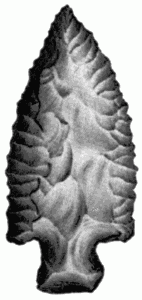
FLAKING: The thick blade is shaped
by broad, random flaking. Deep, narrow,
and often long flakes were removed
from the blade edges to shape
and finish the blade and to form fine
regular serrations. These flakes were
removed alternately from opposite
faces, making the serration projections
rather sharp. Broad, deep flakes, struck
from the basal corners or sometimes
the sides of the hafting area, shape the
stem. Some of the straighter stemmed
examples are reworked along the stem
side edges, but usually no retouch is
noted in the notches. Basal edges are
often slightly thinned by broad shallow
flaking.
COMMENTS: The type was named
from Cambron Site 78 on Flint Creek
in Morgan County, Alabama, where
numerous examples were first collected.
The illustrated example is one of
several from the predominantly Copena
site, Cambron Site 53, in Morgan
County, Alabama. At the Stanfield-Worley
Bluff Shelter (DeJarnette, Kurjack
and Cambron, 1962), 69 examples
were recovered from Zone A,
Levels 1 through 8. Of these 69 examples,
40 per cent were from Levels 3
and 4, indicating a climax in the late
Archaic—early Woodland times. One
example each was recovered from
Levels 4, 5 and 7 at University of Alabama
Site Ms 201 in Marshall County,
Alabama. At Flint Creek Rock Shelter
(Cambron and Waters, 1961), ten
examples were recovered from Stratum
I (Woodland) and one from Stratum
II (Archaic). The Flint Creek type was
important at Flint River Mound (Webb
and DeJarnette, 1948a), where most
examples were found in upper Zone C
(Archaic) and lower Zone B (Woodland).
This is a late Archaic to early
Woodland type. The type appears to
be related to Dustin points illustrated
by Ritchie (1961). Similar examples
may be recognized among points
illustrated as Palmillos by Suhm,
Krieger and Jelks (1954), who give
the distribution as from East Texas
across the state to the Trans-Pecos area,
and from the upper Brazos and Trinity
valleys to the central and eastern
coastal plain. The distribution extends
southward in Mexico to southern
Tamaulipas. The type is associated
with late Archaic and early Woodland
cultures. The Dustin points are from
Michigan and from the Lamoka Lake
Site, Schuyler County, New York.
GENERAL DESCRIPTION: This is a
small to medium, narrow, lanceolate
point.
MEASUREMENTS: Fifteen cotypes
(including the illustrated example) from
University of Alabama Site Ma 48
(Webb and DeJarnette, 1948a) range
in measurements as follows: length—maximum,
58 mm.; minimum, 39 mm.;
average, 50 mm.: width—maximum,
21 mm.; minimum, 12 mm.; average,
16 mm.: thickness—maximum, 11
mm.; minimum, 7 mm.; average, 9
mm.
FORM: The cross-section may be
median ridged or biconvex. The blade
is usually excurvate, but may be
straight with an acute distal end. The
base is usually rounded, but an occasional
example may display a straight,
unfinished basal edge. The hafting area
includes the basal area from the base
to the widest point of the blade, which
is usually less than half way from base
to distal end. The base is usually
thinned.
FLAKING: The blade and hafting
area were shaped by random percussion
flaking. Many of the flakes are
rather deep. Some retouch appears
along the edges, especially along the
blade edges, of about half the examples.
COMMENTS: The type was named
after Flint River Mound at the mouth
of Flint River in Madison County, Alabama
(Webb and DeJarnette, 1948a),
where the illustrated example was recovered.
Of the 41 examples from this
site, 24 were from upper Zone A
(Woodland), 14 from lower Zone A
and Zone B (Woodland) and three
from upper Zone C (Archaic). Two
examples were recovered from Level 3
(Woodland) at University of Alabama
Site Ms 201 in Marshall County, Alabama.
Six examples (excluding material
from the 100-foot trench) were
recovered at the Stanfield-Worley Bluff
Shelter (DeJarnette, Kurjack and Cambron,
1962): two examples were recovered
from Level 1, Zone A, one each
from Levels 2, 3 and 6, Zone A, and
one from Level 1 of Zone B. Flint
River Spike and Bradley Spike appear
to be of late Woodland cultural association
and may be typologically related.
Unlike Bradley Spike, however, Flint
River Spike has no stem and may be
retouched along the blade edges. A late
Woodland association is suggested for
Flint River Spike in North Alabama.
GENERAL DESCRIPTION: This is a
small to medium, thick, triangular
point that may be serrated.
MEASUREMENTS: Bell (1960) lists
the length as from about 30 mm. to
50 mm. and the width as about 15 mm.
or less. The illustrated example
measures 32 mm. long, 14 mm. wide,
and 6 mm. thick.
FORM: The cross-section is usually
biconvex. The blade is usually straight
but may be slightly incurvate near the
distal end or, rarely, excurvate. Blade
edges may be serrated. (Serrated examples
are more readily identified.) The
distal end may be keenly acute or
acuminate. The base may be straight
or excurvate. It is usually thinned and
may be slightly expanded.
FLAKING: The point displays random
flaking which is usually broad
and fairly deep, with some fine retouch
near the distal end. The serrations on
the serrated examples are the result of
the removal of broad regular flakes
from the edge of alternate faces, leaving
an irregular pattern along the blade
edges. Occasionally the basal edge was
retouched as well as thinned by removal
of broad flakes.
COMMENTS: "The Fort Ancient
points are associated with the Feurt
Focus of the Fort Ancient aspect of the
Ohio Valley. The Fort Ancient point
has been recognized among archaeologists,
both amateur and professional,
in the Ohio region for a number of
years." (Bell, 1960). The illustrated
example is from Cambron Site 27,
Limestone County, Alabama. This
Woodland-Mississippian site has produced
Fort Ancient, Madison, Jacks
Reef Corner Notched, Knight Island,
Swan Lake and Copena points. One
Fort Ancient point was recovered from
Level 1 at University of Alabama Site
Ms 201 in Marshall County, Alabama.
Bell (1960) dates the type at some time
from about 1200 A. D. to 1600 A. D.
Morgan (1952), in summarizing the
prehistoric Indian cultures of the Ohio
region, says of the Fort Ancient aspect
of the Mississippian period: "Their trait
assemblage is indicative of a people
with a mixed cultural background, both
Woodland and Mississippi elements being
involved. White trade goods at one
site show that some of these people
were probably still in existence as late
as the last quarter of the seventeenth
century."
GENERAL DESCRIPTION: This is a
medium-sized, narrow, triangular point
with a well thinned basal edge.
MEASUREMENTS: "In size these
points range from 2 to 2¾ inches."
(Bell, 1960.) Alabama examples are
slightly shorter. Measurements of 4
plesiotypes, including the illustrated example,
are: length—maximum, 51
mm.; minimum, 45 mm.; average, 49
mm.: width at base—maximum, 25
mm.; minimum, 21 mm.; average, 23
mm.: thickness—maximum, 8 mm.;
minimum, 6 mm.; average, 7 mm.
Basal depth on one incurvate base example
was 1 mm.
FORM: The cross-section is flattened.
The blade is excurvate. A slightly serrated
appearance is found on some examples
as the result of retouching along
the blade edge. The distal end is acute.
The hafting area includes an undetermined
basal portion of the blade which
is more or less parallel along the basal
edges. The basal edge is usually
straight but may be slightly incurvate;
it is thinned and, rarely, ground.
FLAKING: Large shallow flakes, removed
to shape the faces, were followed
by shorter deeper flaking along all
edges. The secondary flaking along the
basal edge is usually broader and
longer than that used along the blade
and hafting area edges. Some retouching
along the blade edges results in a
finely serrated appearance.
COMMENTS: This point is named
after the Frazier Site in Benton County,
Tennessee. The illustrated example is
from Cambron Site 389 in Limestone
County, Alabama. No examples were
recovered from control sites in the Tennessee
Valley. The type is comparatively
rare in Alabama and the cultural
association is not known, but it usually
appears in surface collections from
early Archaic sites. Kneberg (1956)
suggests a late Archaic association in
Tennessee and a "probable time period
from about 1500 B. C. to early centuries
A. D." The point is similar to
Paint Rock Valley points but is narrower.
The base is not as incurvate
and the flaking is usually better controlled.
GENERAL DESCRIPTION: This is a
small to medium, expanded-barb point.
Barbs are prominent and usually obtuse.
MEASUREMENTS: The measurements of
eight plesiotypes (including the illustrated
example) from which descriptions were
drawn are: length—maximum, 47 mm.;
minimum, 33 mm.; average, 40 mm.:
shoulder width—maximum, 33 mm.; minimum,
26 mm.; average, 29 mm.: stem
width—maximum, 13 mm.; minimum, 8
mm.; average, 11 mm.: stem length—maximum,
7 mm.; minimum, 5 mm.;
average, 5 mm.: thickness—maximum, 7
mm.; minimum, 4 mm.; average, 6 mm.
FORM: The cross-section is biconvex. The
shoulder barbs are usually expanded and
broad; the barb ends may be obtuse or
straight. The blade is usually incurvate;
rarely, recurvate or straight. Most examples
are finely serrated with an acute distal
end. The stemmed hafting area is formed
by diagonal notches. The stems of the
measured examples are straight. The base
may be straight or excurvate, thinned, and
may be ground on some examples.
FLAKING: Remnants of blade scars may
be evident on the faces. Random, secondary
flaking may leave a median ridge on
some examples. This flaking, along with
some fine retouch produced fine serrations
along the blade edges. Broad flakes were
removed to form the basal notches.
COMMENTS: The type was named from
examples from surface sites in the Garth
Slough area in Morgan County, Alabama.
The illustrated example is from Cambron
Site 76 (Pine Tree) in Limestone County,
Alabama. The type is found on Transitional
Paleo and Early Archaic sites in North
Alabama. One example was recovered
from the bottom of Stratum II (Early
Archaic) at Flint Creek Rock Shelter (Cambron
and Waters, 1961). What appears to
be a smaller variant of the type was recovered
from level V at Danger Cave, Utah
(Jennings, 1957) and listed as type W37.
Radiocarbon dates from this level range
from 6863 ±500 B. P. at the base of the
level to 3893 ±240 B. P. in the topmost
part of the level. One example was recovered
from Cave Spring, Level 9, Stratum
III, in association with Big Sandy,
Cave Spring, Colbert Dalton, Decatur,
Frazier, Greenbrier Dalton, Jude, Lerma
Rounded Base, Paint Rock Valley, and
Stanfield points. The Garth Slough point
was formerly but incorrectly, classified
as Catahoula.
GENERAL DESCRIPTION: This is a
medium sized point with contracted stem.
MEASUREMENTS: Bell (1958) gives the
size range as about 40 mm. to 80 mm.
Suhm, Krieger and Jelks (1954) note that
the stem length is more consistent than the
length of the blade. The illustrated example
measures 57 mm. in length, 26 mm. in
shoulder width, 18 mm. in stem width,
14 mm in stem length and 9 mm. in
thickness.
FORM: The cross-section is biconvex.
Shoulders may be horizontal or tapered
and are occasionally rounded or expanded
barbed. The blade is usually straight to
excurvate, but may be incurvate or recurvate
(Suhm, Krieger and Jelks, 1954).
The distal end is acute. The stem is usually
contracted, with straight or excurvate side
edges and a rounded to pointed basal edge.
FLAKING: The blade and hafting area
are shaped by broad random flaking. The
blade edges are retouched by the removal
of deep short flakes. The stem may be
retouched.
COMMENTS: The type was named after
points found in Texas and was formerly
called Gary Contracting Stem. The illustrated
specimen is from Cambron Site 76
in Limestone County, Alabama. There is
considerable variation within the Gary
type, and further study may lead to classification
into separate types (Bell, 1958,
quoting Baerreis, Freeman and Wright,
1958). Several Gary points were recovered
from the Stanfield-Worley Bluff Shelter
(DeJarnette, Kurjack and Cambron, 1962).
Most of the examples were in the upper
half of Zone A, which would indicate a
late Archaic to Woodland association. Flint
Creek Rock Shelter (Cambron and Waters,
1961) and Flint River Mound (Webb and
DeJarnette, 1948a) also produced Gary
points from both Woodland and Archaic
strata. Jenkins (1975) has demonstrated
Gary as the dominant projectile point type
for Middle Woodland in the Central Tombigbee
area (Miller I and II).
GENERAL DESCRIPTION: The
Greenbrier is a medium to large point
with expanded auricles and shallow
ground side notches.
MEASUREMENTS: The illustrated
example measures in length, 63 mm.;
in shoulder width, 25 mm.; in stem
width, 25 mm.; in stem length, 12 mm.;
in thickness, 6 mm.
FORM: The cross-section is usually
flattened but may be biconvex.
Shoulders are tapered and may be
weakly barbed. The blade is usually
parallel, with fine serrations, and may
be beveled on each side of both faces.
The distal end is acute. The hafting
area displays broad side notches,
created as the shoulder tapers in to the
expanded stem. Notches on the illustrated
example are 4 mm. deep and
14 mm. wide. Side edges of the hafting
area are usually heavily ground. The
base is incurvate, thinned and lightly
ground.
FLAKING: Flaking used to shape the
blade and hafting area is broad and
thin. The short flaking which was used
to bevel the blade edges and create fine
serrations may occasionally appear on
the shoulder edges of the hafting area.
The notches were formed by the removal
of one or more fairly large
flakes, followed by secondary flaking.
Most Alabama examples were made of
Ft. Payne chert or other good material.
COMMENTS: The type was briefly
described by Lewis and Kneberg
(1960), who point out that several
examples were illustrated from the
Nuckolls Site (Lewis and Kneberg,
1958). Good examples illustrated in
that paper are Figs. 24-30, 37, and
48-49. The illustrated example is
from Hulse Site 53, Limestone County,
Alabama. Its general appearance is
somewhat similar to that of the Pine
Tree point and it often appears on the
same sites. At the Stanfield-Worley Bluff
Shelter (DeJarnette, Kurjack and Cambron,
1962) one example was recovered
from Level 11 of R-4 trench, one
from Zone C, one from Level 1, Zone
D, and two from Level 2, Zone D. At
Flint Creek Rock Shelter (Cambron
and Waters, 1961) one example was
recovered from the center of Stratum II
(Archaic). One example was recovered
from upper Zone C (Archaic) at Flint
River Mound (Webb and DeJarnette,
1948a). This evidence indicates a shellmound
Archaic association at Flint
River, early Archaic at Flint Creek and
early Archaic to transitional Paleo-Indian
at Stanfield-Worley. A suggested
age is from 5000 years ago to about
9000 years ago.
GENERAL DESCRIPTION: This is a
medium sized trianguloid point with
parallel to excurvate basal edges.
MEASUREMENTS: Kneberg (1957)
lists the range as 1.5 inches to 2.5
inches. The nine plesiotypes, including
the illustrated example (Lewis and Kneberg,
1957), from Cambron Site 284
(Camp Creek Site) are: length—maximum,
40 mm.; minimum, 29 mm.; average,
33 mm.: width—maximum, 25
mm.; minimum, 18 mm.; average, 20
mm.: thickness—maximum, 9 mm.;
minimum, 6 mm.; average, 8 mm.:
width at base—maximum, 25 mm.;
minimum, 16 mm.; average, 19 mm.
FORM: The cross-section is biconvex.
The blade is excurvate or straight above
the hafting area. The distal end is acute.
The hafting area usually has parallel
sides but may taper slightly towards
the blade. Of the nine measured examples,
seven have a basal concavity 1.0
mm. deep and two examples have a
straight basal edge. The basal edge is
usually thinned.
FLAKING: The blade and hafting area
were shaped by random flaking. Most
examples show some secondary flaking
along the blade edges. This flaking
ranges from narrow to broad, but usually
fairly deep flake scars are exhibited.
Points that have secondary flaking may
not be flaked on all blade edges. Basal
thinning appears, accomplished by
broad flaking along the basal edge
which is often followed by some secondary
flaking. Of the nine measured examples,
seven are made of black to gray
local flint, one is quartzite and one
chalcedony.
COMMENTS: The type was named
(Lewis and Kneberg, 1957) after the
Camp Creek Site (Cambron Site 284),
which is near Greeneville, Tennessee.
While the illustrated example is from the
plough level of this site, examples were
recovered from all levels. A radiocarbon
date of 2050 ±250 B. P. was secured at
this site. At the Stanfield-Worley Bluff
Shelter (DeJarnette, Kurjack and Cambron,
1962) Level 1 produced five examples;
Levels 2 and 3, two each; Levels
4, 5 and 8, one each. All were from
Zone A. Four examples, one from Level
1, two from Level 2, and one from
Level 5 were recovered at University of
Alabama Site Ms 201, in Marshall
County, Alabama. Three examples were
recovered from upper Stratum I (Woodland)
at Flint Creek Rock Shelter (Cambron
and Waters, 1961). At Flint River
Mound (Webb and DeJarnette, 1948a)
19 examples were recovered from Zones
A and B (Woodland) and three from
Zone C (upper Archaic). This Woodland
point is scattered along the western
edge of the Appalachians from Greeneville,
Tennessee, to South Alabama as
well as in the Tennessee River Valley
and other areas.
GENERAL DESCRIPTION: This is a
medium to large, lanceolate point with
incurvate base.
MEASUREMENTS: Bell (1960) gives
the range of the length from about 60
mm. to 135 mm. Measurements listed
by Coe (1959) range as follows:
length—maximum, 120 mm.; minimum,
50 mm.; average, 90 mm.: width—maximum,
35 mm.; minimum, 20
mm.; average, 30 mm. The illustrated
plesiotype measures 84 mm. long, 24
mm. in width, 11 mm. wide at the base,
12 mm. thick, 1 mm. deep in basal concavity.
FORM: The cross-section is usually
biconvex and thick but may approach
median ridged. The blade is usually
excurvate but may be nearly straight.
The distal end may be acute or
apiculate. The hafting area is contracted
with short, rounded auricles, incurvate
base and some basal thinning.
Side edges of the hafting area are
usually lightly ground. The hafting
area may be defined by a break in
the contour of the side edges or may
be described as extending to somewhere
near the widest part of the blade.
FLAKING: The blade and hafting
area are usually shaped by well controlled,
random flaking. Coe (1952)
describes some flaking as being transverse-oblique.
Careful secondary
flaking in the form of short, often deep,
flaking appears along the side edges.
The basal concavity is formed by the
removal of broad flakes. A variety of
local materials including quartz,
quartzite, porphyritic rhyolite, andesite
and varieties of argillite or novaculite
were used (Coe, 1959).
COMMENTS: The type was named
after the Guilford focus of the Carolina
Piedmont. The illustrated example is from
Cambron 326, Buncombe County, North
Carolina. The type was described by Bell
(1960). At the Doerschuk Site Coe (1959)
recovered Guilford points above Morrow
Mountain and below Halifax types. He
suggests a date of around 6000 years ago
in the Carolina Piedmont area. He gives
the distribution as widespread throughout
the Piedmont of North Carolina but points
out that they "do not have a distribution
much north of Virginia or south of Piedmont,
Georgia." Examples appear on
several sites in western North Carolina.
Examples were illustrated by Miller (1962)
from Sites 44Mc66 and 44Mc75, Mecklenburg
County, Virginia (Plate 39 W and
X, Plate 40 N, Plate 44 P, T and V,
Plate 45B). An early Archaic association
prior to 5000 years ago is suggested.
Recent evidence from Randolph County
indicates that the Archaic Guilford complex
may extend into the Alabama Piedmont
(O'Hear and Knight, 1975).
GENERAL DESCRIPTION: This is a
medium sized lanceolate point with a
rounded base.
MEASUREMENTS: Ten plesiotypes
from Cambron 326 (Harwood 98), Buncombe
County, North Carolina ranged
in measurement as follows: length—maximum,
72 mm.; minimum, 53 mm.;
average, 61 mm.: width—maximum,
28 mm.; minimum, 17 mm.; average,
23 mm.: thickness—maximum, 13 mm.;
minimum, 8 mm.; average, 10 mm.
The length from base to widest point of
blade ranges from 21 mm. to 35 mm.
and averages 28 mm. The illustrated
example measures about 63 mm. long,
23 mm. wide, 14 mm. thick and 25 mm.
from base to widest point of blade. Coe
(1959) illustrated an example 30 mm.
long.
FORM: The cross-section is biconvex.
The blade is excurvate with widest point
less than halfway from the base to the
distal end. This point of maximum width
may mark the termination of the hafting
area. Some examples are beveled on one
side of each face. Side edges of the hafting
area are tapered. The basal edge is
rounded. Basal edges may be lightly
ground.
FLAKING: The measured examples
(all made of quartzite) are shaped by
well controlled random flaking. Secondary
flaking of a deeper shorter nature
appears on all edges. This flaking may
have been accomplished by a percussion.
COMMENTS: The type was named
after examples illustrated by Coe (1959)
along with Guilford points (Bell, 1960).
The illustrated example is from Cambron
Site 326, Buncombe County, North
Carolina. At the Doerschuk Site, Coe
(1959) recovered examples with Guilford
points above Morrow Mt. and below
Halifax types. He suggests a date
of around 6000 years ago in the Carolina
Piedmont area. He gives the distribution
as Carolina Piedmont and not
much north of Virginia or south of Piedmont,
Georgia. Examples appear on
several sites in western North Carolina.
Miller (1962) illustrated examples from
Roanoke River drainage area in Mecklenburg
County, Virginia, as follows:
Site 44Mc75 (Plate 29, Fig. F, Plate
45, Fig. L); Site 44Mc66 (Plate 40,
Figs. G, H, M; Plate 41, Figs. I, J);
Site 44Mc73 (Plate 42, Fig. D); Bluestone
Creek drainage area (Plate 48,
Figs. 1, 2a). The similarity of the type
to Lerma Rounded Base points may
be an indication that they are coeval.
An early Archaic association prior to
5000 years ago is suggested.
GENERAL DESCRIPTION: This is a
small to medium-sized, lanceolate point
with straight base and excurvate blade.
MEASUREMENTS: Seven cotypes,
including the illustrated example, ranged
in measurements as follows: length—maximum,
50 mm.; minimum, 33 mm.;
average, 35 mm.: width at base—maximum,
18 mm.; minimum, 10 mm.;
average, 14 mm.: thickness—maximum,
6 mm.; minimum, 4 mm.; average,
5 mm. The blade width of four examples
ranged from a maximum of 21
mm. to a minimum of 13 mm. and averaged
16 mm.
FORM: The cross-section is usually
flattened but may be biconvex. The
blade is excurvate. The widest point
may be at the base or somewhat below
the midsection. The distal end is acute.
Side edges of the hafting area may be
parallel or slightly contracted. (It is difficult
to define the extent of the hafting
area on examples with contracted side
edges.) The basal edge is straight and
thinned.
FLAKING: Broad, shallow, random,
flaking appears on the faces with fine
secondary flaking along the blade edges
and sides of the hafting area. Fairly
long, often broad, flakes were removed
in order to thin the basal edge. Local
materials were used.
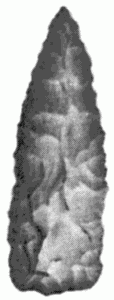
COMMENTS: The type was named
after sites in Guntersville Basin of the
Tennessee River where many examples
are found. The illustrated example is
from Cambron Site 12, Limestone County,
Alabama. Six examples in association
with Madison points, a stone disc
and other artifacts were taken from
Burial 6, Site Lu 92, Lauderdale County,
Alabama (Webb and DeJarnette,
1942). Examples illustrated along with
Madison and Ft. Ancient points, were
described as Dallas component triangular
points by Lewis and Kneberg (1946).
Both Guntersville Lanceolate and Madison
points were illustrated and described
by Kneberg (1956) as Late Mississippi
Triangular. She states, "In eastern Tennessee
it is equally numerous in the Mouse
Creek and Dallas Cultures, and occurs
in smaller numbers in historic Cherokee
sites" (1956). The type was classified as
Type W in the Guntersville Basin where
it appeared in association with trade
goods in several historic burials. A
burial at Lewis Bluff in Wheeler Basin
of Tennessee River (Cambron and
Waters, 1959a) yielded examples in
association with Madison points, complicated-stamped
sherds and plain, shell-tempered
ware, an elbow-clay pipe and
other artifacts. Two examples were recovered
from the middle section of Stratum
I and upper half of Stratum I
(Woodland and Mississippian) at Flint
Creek Rock Shelter (Cambron and Waters,
1961). Guntersville Lanceolate appears
to be associated with late Mississippian
and historic cultures in the Tennessee
Valley. Kneberg (1956) suggests
a probable date of 1300 A. D. to 1800
A. D.
GENERAL DESCRIPTION: The Halifax
is a small to medium-sized, side-notched
point usually made of vein
quartz or, occasionally, quartzite.
MEASUREMENTS: Coe (1959) lists
a range of length from 56 mm. to 29
mm. with an average length of 44 mm.
and a range of width from 25 mm. to
17 mm. with an average width of 20
mm. Measurements of the illustrated
example are: length, 30 mm.; shoulder
width, 21 mm.; stem width, 18 mm.;
stem length, 9 mm.; thickness, 8 mm.;
depth of notch, 3 mm.; width of notch,
10 mm.
FORM: The cross-section is usually
biconvex. Shoulders are tapered. The
blade is usually straight but may be
excurvate. The distal end is acute. The
stem is expanded with straight or incurvate
side edges and straight or excurvate
basal edge. The stem base edge
and side notches of the hafting area
are usually ground.
FLAKING: The blade and stem are
shaped by broad, often deep, random
flaking. Some examples show good
secondary flaking along the blade
edges. The notches were worked out by
the removal of several flakes. Some
points are asymmetrical due to variation
in depth and location of notches.
According to Coe (1959) "The typical
specimen was relatively thick and worked
from a core. These cores, however,
frequently originated as thick spalls
struck from quartz or quartzite
boulders common to this area of the
Roanoke River."
COMMENTS: The type was named after
Halifax County, North Carolina, where
examples were recovered from the Gaston
Site on the Roanoke River. The illustrated
example is from Cambron Site 94, Buncombe
County, North Carolina. A radiocarbon
date of 5440 ±300 B. P. was
secured for the type at the Gaston Site,
where it appeared above Guilford and
below Savannah River points. Coe (1959)
suggests "a relationship to Lamoka points
of the New York area." This, in turn,
indicates that the type is ancestral to
Lamoka points, similar to Swan Lake
points, of Alabama and Tennessee Valley
area. In Alabama Swan Lake is associated
with the Woodland culture. Halifax points
are found on several sites in Buncombe
County, North Carolina. Miller (1962)
illustrated examples (Plate 42, Figs. J, K,
M and U) from Site 44Mc73, which is
described as a pre-pottery site. Swan Lake
points from Site 44Ha7 (Plate 52, Figs. F,
N, T, V and DD) are described by Miller
(1962) as "typical Woodland types." Thus
both Halifax and Swan Lake points appear
in the John H. Kerr Basin of the Roanoke
River, Virginia and North Carolina. A
type resembling Halifax has been isolated
in Randolph County in an Archaic context
(O'Hear and Knight, 1975).
GENERAL DESCRIPTION: The
Hamilton is a small, triangular point
with incurvate blade and incurvate
base.
MEASUREMENTS: Bell (1960) lists
the length range as 22 mm. to 45 mm.;
the length mode, 40 mm. The illustrated
plesiotype measures 37 mm. long, 18
mm. wide at base, 4 mm. thick, 3 mm.
deep in basal concavity.
FORM: The cross-section is flattened.
The blade ranges in shape from near
straight to deeply incurvate but is
usually slightly incurvate. Fine serrations
along the blade edges are rare.
The distal end is acute. The base is
usually incurvate but may be straight
and is always thinned.
FLAKING: According to Kneberg
(1956) "Exceptionally fine pressure
chipping characterizes this type." The
faces are worked by broad, shallow
flaking with fine retouch along the
blade edges. The basal edge is thinned
by the removal of broad shallow flakes
and is rarely retouched except near the
junction of the basal edge with the side
edges.
COMMENTS: "The Hamilton Incurvate
point and Hamilton culture are
named from Hamilton County, Tennessee,
where they were first identified."
(Kneberg, 1956). The illustrated example
is from Cambron Site 27, Limestone
County, Alabama. According to
Kneberg (1956) the Hamilton is "a
late Woodland type associated with the
Hamilton culture. This is the culture
characterized by dome-shaped burial
mounds in eastern Tennessee. It is also
found in middle Tennessee with the
Decatur and Harmon's Creek Woodland
cultures." An example was recovered
from Level 1 at the Stanfield-Worley
Bluff Shelter (DeJarnette, Kurjack
and Cambron, 1962). At University
of Alabama Site Ms 201, Marshall
County, Alabama, two examples were
recovered from Level 1 and one from
Level 5. At the Flint River Site (Webb
and DeJarnette, 1948a) one example
was recovered from each zone: Zones
A and A-B (both Woodland), Zone C,
and Zone D (Archaic). This evidence
indicates a Woodland or possibly late
Archaic association at Flint River. Examples
are found on Woodland and
Mississippian sites in North Alabama.
Kneberg (1956) suggests a probable
age of about 500 A. D. to 1000 A. D.
Bell (1960) suggests a date of about
300 A. D. to 800 A. D.
GENERAL DESCRIPTION: This is a
medium-sized, expanded-stem point with
an excurvate blade.
MEASUREMENTS: Lewis and Kneberg
(1946), Plate 65, illustrate two examples
of Hamilton Stemmed points.
These two are 72 mm. and 76 mm. long
respectively. The illustrated example
measures 75 mm. long, 30 mm. in shoulder
width, 18 mm. in stem width, 12
mm. in stem length, and 9 mm. thick.
FORM: The cross-section is biconvex.
Shoulders are inversely tapered, forming
short sharp barbs. The blade is excurvate.
The rather sharply-acute distal
end gives the blade edge a near-recurvate
appearance. The stem is expanded with
straight side edges; the stem base, thinned
and either straight or slightly excurvate.
FLAKING: The blade and hafting area
are shaped by broad, shallow-to-deep
random flaking. One or all blade edges
may be secondarily flaked by the removal
of fine, shallow flakes or rather
crude deep flakes. The corner notches
are formed by strong, broad flaking
(usually by removal of one flake from
each side of each notch). Stem edges
may be retouched, with fine flaking having
been employed to thin the base of
the stem.
COMMENTS: The type is named after
Hamilton County, Tennessee where the
Hamilton culture was first recognized.
The illustrated plesiotype is from Cambron
Site 27, Limestone County, Alabama,
which has produced several examples
of Hamilton points. It is a late
Woodland type associated with the Hamilton
culture. Kneberg states (1956),
"This is the culture characterized by
dome-shaped burial mounds in eastern
Tennessee. It is also found in middle
Tennessee with the Decatur and Harmon's
Creek Woodland cultures." Local
examples have been classified as Hamilton
corner notched. An example was
illustrated by Rowe (1947) as a rare
Hamilton culture type from eastern
Tennessee.
GENERAL DESCRIPTION: This is a
small to medium-sized, side notched
point with concave base.
MEASUREMENTS: Coe (1959) lists
the measurements of examples from the
North Carolina Piedmont as follows:
length—maximum, 50 mm.; minimum,
28 mm.; average, 35 mm.: width—maximum,
35 mm.; minimum, 23 mm.;
average, 25 mm.: thickness—maximum,
6 mm.; minimum, 3 mm.; average,
4 mm. The length of samples in
the Tennessee Valley ranges from a
maximum of 50 mm. to a minimum of
29 mm. The average measurements of
28 examples from 16 sites follow:
length, 40 mm.; width, 21 mm.; thickness,
6 mm. (Soday and Cambron,
n. d.). The illustrated example
measures 38 mm. long, 23 mm. wide
at the distal end of hafting area, 26
mm. wide at base, 6 mm. thick, 21 mm.
wide across hafting constriction, 4 mm.
deep in basal concavity.
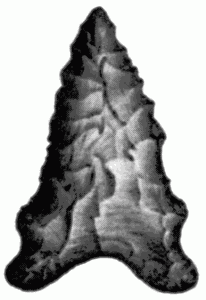
FORM: The cross-section is biconvex.
The blade is usually straight but may
be excurvate. Blade edges may be serrated.
The distal end is usually acute.
The hafting area is auriculate with expanded-rounded
auricles. Coe (1959)
describes the average side notch as
about 4 mm. deep and 5 mm. wide.
This results in a short hafting constriction.
The basal edge is incurvate and
thinned. Both side and basal edges of
the hafting area are usually ground.
FLAKING: The face is shaped by
broad well controlled flaking. A weak
median ridge created by broad, shallow
secondary flaking is often seen near
the distal end of the blade face. The
basal edge of the hafting area is thinned
by the removal of broad flakes. Most
edges of both the hafting area and the
blade are finely retouched.
COMMENTS: The type was named
after the Hardaway Site in Stanley
County, North Carolina and has been
referred to in the Tennessee Valley as
Corner Notched Dalton. The illustrated
example is from Cambron Site 76,
Limestone County, Alabama. Examples
were recovered in Zone IV at the
Hardaway Site in association with Dalton,
Quad, and Hardaway blade types
(Coe, 1959). At Stanfield-Worley Bluff
Shelter (DeJarnette, Kurjack and Cambron,
1962) most examples were recovered
from Zone D in association with
Dalton, Big Sandy I and other early
types. A radiocarbon date of 9640 ±450
B. P. was secured. A transitional Paleo-Indian
association is suggested.
GENERAL DESCRIPTION: The Harpeth
River point is a medium to large side
notched point with flattened blade, beveled
on both sides of each face and displays
shallow serrations.
MEASUREMENTS: Seventeen cotypes
from sites in Cheatham and Dickson
Counties, Tennessee, along the Harpeth
River and one example from near McMinnville,
Tennessee, provided the following
measurements and traits: length—maximum,
90 mm.; minimum, 53 mm.; average, 67
mm.: shoulder width—maximum, 26 mm.;
minimum, 20 mm.; average, 23 mm.: width
at base—maximum, 28 mm.; minimum, 20
mm.; average, 25 mm.: thickness—maximum,
9 mm.; minimum, 7 mm.; average,
8 mm.: hafting area length—maximum, 25
mm.; minimum, 11 mm.; average, 16 mm.:
width of hafting area in notches—maximum,
24 mm.; minimum, 16 mm.; average, 21
mm.
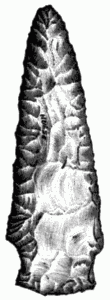
FORM: The cross-section is flattened.
Shoulders are tapered. The blade may be
excurvate or straight with fine serrations
and is beveled on each side of both faces.
The distal end is usually acute but may
be acuminate. The hafting area displays
broad, shallow side notches and is well
defined by a sharp change in the contour
of the edge of the point at the junction of
the blade and is auriculated with expanded-rounded
auricles. Side edges of the hafting
area are incurvate and ground. The basal
edge is straight, usually ground, and is
thinned.
FLAKING: The blade and hafting area
were shaped by broad, shallow, random
flaking. Blade edges are steeply beveled on
each side of both faces by the removal of
deep, short, narrow flakes which resulted
in fine serrations along the blade edges.
The shallow notches that form the hafting
area are steeply flaked. This usually leaves
expanded shoulder barbs.
COMMENTS: The type was named from
sites along the Harpeth River in Cheatham
and Dickson Counties, Tennessee, where
60% of the 50 odd examples were recovered
from one site which had also produced
Big Sandy, Dalton, Greenbrier, P-8 Corner
Notched, Pine Tree, Cumberland, LeCroy,
and Copena points. These points are in the
collection of Wayne Crabtree, Pegram,
Tennessee. In general outline the Harpeth
River points may somewhat resemble Dalton,
Russell Cave, Greenbrier or Pine Tree
points. One example has strong basal
thinning on one face and what appears to
be a flute struck from a prepared striking
platform on the other face. One example
has been recovered from Overton County
and one from Humphreys County, Tennessee.
One site along the Harpeth River
from which 5 examples were recovered
produced Big Sandy, Pine Tree, Turkey
Tail and Cotaco points. The associations
of Harpeth River points with other Early
Archaic and Transitional Paleo points, as
well as their hafting area and flaking
characteristics, indicate a placement of the
type in very Early Archaic or late Transitional
Paleo cultural association. Forty-eight
cotypes of Rockport variety of Harpeth
River are described along with eighteen
illustrations in the Tennessee Archaeologist,
Vol. XXVI, No. 2 (Adair and Sims,
1970).
GENERAL DESCRIPTION: This is a
medium-sized, corner notched point with
a thin, flattened, excurvate (or often
parallel-angular) blade.
MEASUREMENTS: Nine examples,
including the illustrated example from
Limestone County, Alabama, provided
traits and the following measurements:
length—maximum, 60 mm.; minimum,
30 mm.; average, 42 mm.: shoulder
width—maximum, 24 mm.; minimum,
15 mm.; average, 18 mm.: stem width—maximum,
20 mm.; minimum, 13 mm.;
average, 16 mm.: stem length—maximum,
9 mm.; minimum, 6 mm.; average,
8 mm.: thickness—maximum, 5
mm.; minimum, 3 mm.; average, 4 mm.
Ritchie (1961) gives the following
approximate measurements: length—maximum,
57 mm.; minimum, 25 mm.;
average, 47 mm.: approximate average
width—38 mm.: thickness—maximum,
6 mm. (most examples are under
5 mm.). Alabama examples tend to be
longer than New York examples. Corner
notches average about 7 mm. deep
and 5 mm. wide.
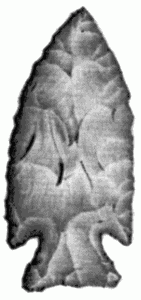
FORM: The cross-section is usually
flattened, rarely, plano-convex. The
shoulders are tapered with sharp thin
barbs. The blade may be excurvate or
parallel-angular. The distal end ranges
from narrow to broad-acute. The hafting
area is corner notched. The base of
the expanded stem is usually straight;
rarely, incurvate. It is thinned and may
be lightly ground. These features are
similar to those of New York points.
FLAKING: The blade and hafting area
are formed by broad, shallow, random
flaking. Retouching was done by carefully
controlled, broad, shallow secondary
flaking followed by fine retouching
along the blade edges. Broad flakes
were struck off to form the notches,
which were then finely retouched. This
point is usually made of local materials.
COMMENTS: The type was named
after the Jacks Reef Site in Onondaga
County, New York. Ritchie previously
referred to the type as "broad corner
notched" or corner notched with angular
edges. The illustrated example is
from Cambron Site 116, Limestone
County, Alabama. A radiocarbon date
of 1056 ±250 B. P. was obtained for
samples from the White Site, Norwich,
New York (Ritchie, 1961). It is considered
to be late middle Woodland and
early late Woodland in New York. It is
an important type in central New York
and occurs in Ohio (Ritchie, 1961). An
example from Site Ct 27 was illustrated
(Plate 294, No. 1) by Webb and DeJarnette
(1942) as Type 47. For several
years, the type has been referred to in
the Tennessee Valley where it is found
on late Woodland sites, as "Corner
Notched Woodland". One example was
recovered from Level 3, Zone A at
Stanfield-Worley Bluff Shelter (DeJarnette,
Kurjack and Cambron, 1962),
six from Zone A (Woodland) at Ma 48
(Webb and DeJarnette, 1948a) and one
example each from Levels 1 and 2 at
Ms 201, Rockhouse Shelter, in Marshall
County, Alabama. Examples from P-12
Pit at Russell Cave in Jackson County,
Alabama, were dated by radiocarbon
method at 1500 ±175 B. P. (John W.
Griffin, personal communication).
GENERAL DESCRIPTION: This is a
thin, small to medium-sized pentagonal
point.
MEASUREMENTS: Fifteen plesiotypes,
including the illustrated example
from Cambron Site 27, Limestone County,
Alabama, provided the following
traits and measurements: length—maximum,
61 mm.; minimum, 25 mm.; average,
42 mm.: width—maximum, 31
mm.; minimum, 14 mm.; average, 20
mm.: width at base—maximum, 23
mm.; minimum, 13 mm.; average, 16
mm.: thickness—maximum, 8 mm.;
minimum, 3 mm.; average, 4 mm.:
length of hafting area—maximum, 28
mm.; minimum, 12 mm.; average, 20
mm.
FORM: The cross-section is flattened.
The blade is straight; the distal end,
acute. The hafting area consists of one-half
to one-third (usually about two-fifths)
of the length of the point. It is
contracted, with straight side edges. The
basal edge may be straight or incurvate
1 or 2 mm. and is thinned. There is
usually a sharp break between the blade
and the hafting area.
FLAKING: The blade and hafting area
are shaped by broad, shallow, random
flaking. Fine retouch was used to finish
all edges. The basal edge is treated in
the same manner as the blade and hafting
area edges. Local materials were
used.
COMMENTS: The type was named
after the late Point Peninsula Jacks Reef
Site in Onondaga County, New York.
The illustrated example is from Cambron
Site 27, Limestone County, Alabama.
Alabama examples are narrower
and longer than New York examples as
described by Ritchie (1961). The type
has been classified locally as "Mississippi
Pentagonal". The type was dated
at the White Site near Norwich, Chenango
County, New York, at 1057 ±250
B. P. (Ritchie, 1961). Ritchie also mentioned
a thicker, cruder middle Archaic
variant. The type is coeval with Jacks
Reef Corner Notched at Point Peninsula
and Owasco sites in New York. At the
Stanfield-Worley Bluff Shelter (DeJarnette,
Kurjack and Cambron, 1962),
two examples were recovered from Level
1 and one from Level 3. This indicates
a late Woodland association at this site.
At the University of Alabama Site Ms
201, in Marshall County, Alabama, one
example was recovered from Level 1,
two from Level 2 and one each from
Levels 4 and 5. This occurrence indicates
a Woodland association. Associations
in surface collections indicate a
late Woodland association. The larger,
broader examples may be derived from
Copena Triangular points, but all examples
were made in a manner similar
to the way in which Madison points
were made. This indicates a transitional
placement between Copena and Mississippian.
The type is probably around
1000 years in age or older in Alabama.
GENERAL DESCRIPTION: The Jeff
is a medium-sized, broad, auriculate
point with straight basal edge and expanded
auricles.
MEASUREMENTS: The range in
length of examples from the Tennessee
Valley is from 69 mm. to 28 mm.;
the average measurements of 10 examples
from 10 sites are as follows: length,
47 mm.; width at base, 25 mm.; thickness,
7 mm. (Soday and Cambron,
n. d.). The illustrated example
measures 49 mm. long, 25 mm. wide
at upper end of hafting area, 30 mm.
wide at base, 7 mm. thick, 2 mm. deep
in basal concavity.
FORM: The cross-section is flattened.
The blade is excurvate and may be
slightly beveled on one side of each face
and/or serrated. The distal end is acute.
The hafting area is auriculate (expanded-rounded).
The basal edge is
usually straight but may be slightly
incurvate and may be beveled or
thinned. Side and basal edges of the
hafting area are usually ground.
FLAKING: The flattened blade is produced
by removal of broad, thin flakes.
Secondary flaking along the blade
edges is shorter and deeper and may
result in weak serrations. Short flakes
were removed along the side and basal
edges of the hafting area. In some cases
the angle of the flaking along the basal
edge produced a short bevel.
COMMENTS: The type was named
after the Jeff area of Madison County,
Alabama, where several examples were
first recognized. The illustrated example
is from Cambron Site 76, Limestone
County, Alabama. Examples are
always found in association with uniface
tools and other early point types
and are not found on shellmound Archaic
middens. This evidence and field
observations suggest a transitional
Paleo association.
GENERAL DESCRIPTION: The Jude
is a small, straight-stemmed point with
a short blade.
MEASUREMENTS: Eight cotypes
from the type site area and one example
from Colbert County, Alabama provided
the traits and the following measurements:
length—maximum, 29 mm.;
minimum, 19 mm.; average, 24 mm.:
shoulder width—maximum, 23 mm.;
minimum, 17 mm.; average, 20 mm.:
stem width—maximum, 16 mm.; minimum,
13 mm.; average, 15 mm.: stem
length—maximum, 12 mm.; minimum,
10 mm.; average, 11 mm.: thickness—maximum,
6 mm.; minimum, 5 mm.;
average, 5 mm. The illustrated example
measures 25 mm. in length, 19 mm. in
shoulder width, 15 mm. in stem width,
11 mm. in stem length and 5 mm. in
thickness.
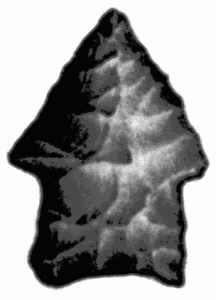
FORM: The cross-section is usually biconvex;
rarely, plano-convex. Shoulders
are usually horizontal; rarely,
tapered or inversely tapered. Blade edges
are nearly always straight; rarely, excurvate.
The distal end is usually acute.
The stem is straight or, rarely, slightly
expanded. Stem width exceeds the stem
length. Side edges of the stem are straight.
The thinned basal edge is usually slightly
incurvate but may be straight. All
stem edges are usually lightly ground.
FLAKING: Broad, shallow, random flakes
shape the blade and stem and are followed
along all edges by similar but somewhat
shorter secondary flaking. All measured
examples were made of local material and
except for one made of smoky quartz, all
were patinated.
COMMENTS: The type was named after
Jude Hollow in Madison County, Alabama,
where examples were first recognized. The
illustrated example is from Brosemer Site 6
in Jude Hollow. Examples from surface
collections have produced a range of cultural
material including Paleo-Indian and
Transitional Paleo-Indian, as well as Archaic
and Woodland. The most frequent
associations indicate early Archaic or
Transitional Paleo-Indian, as do patination
and basal grinding. On at least one site in
Colbert County, Alabama, later Archaic
and Woodland artifacts are absent (Holland,
personal communication). Several examples
were recovered from the Cave Springs
Site (Moebes, 1974) in association with
and below Big Sandy and Dalton points.
This association indicates a Transitional
Paleo-Indian association at this site. The
type seems to be somewhat similar to
Elam points of Texas (Suhm and Jelks,
1962).
GENERAL DESCRIPTION: The Kays
point is a medium to large, straight-stemmed
point with excurvate blade.
MEASUREMENTS: Seven plesiotypes
from Cambron Site 4, Limestone
County, Alabama, provided traits and
the following measurements: length—maximum,
88 mm.; minimum, 56 mm.;
average, 63 mm.: shoulder width—maximum,
32 mm.; minimum, 26 mm.;
average, 30 mm.: stem width—maximum,
17 mm.; minimum, 16 mm.; average,
17 mm.: stem length—maximum,
14 mm.; minimum, 13 mm.; average, 14
mm.: thickness—maximum, 11 mm.;
minimum, 9 mm.; average, 9 mm. The
illustrated example measures 59 mm.
in length, 30 mm. in shoulder width,
17 mm. in stem width, 14 mm. in stem
length, and 9 mm. in thickness.
FORM: The cross-section is biconvex.
Shoulders are usually tapered, but may
be horizontal and may be rounded on
some examples. The blade is excurvate,
but may be nearly straight. The distal
end is acute to sharply acute. The stem
is straight and is slightly wider than
it is long, with a straight basal edge
that may be very slightly incurvate or
excurvate. The edges of the stem are
thinned and may be ground.
FLAKING: The blade and stem are
shaped by broad, shallow to deep
flaking. While a few examples appear
to have been shaped by collateral
flaking, random flaking is usually employed.
Short, regular, secondary
flaking was used to finish the blade
and hafting area edges. All examples
of the measured group are patinated
and are made of local materials.
COMMENTS: The type was named
after the Kays Landing Site in Henry
County, Tennessee. The illustrated example
is from Cambron Site 4, Limestone
County, Alabama. At the Stanfield-Worley
Bluff Shelter (DeJarnette,
Kurjack and Cambron, 1962) one example
each was recovered from Levels
1, 8, 9 and 10 in Zone A. This indicates
an Archaic association. Three examples
were recovered from Stratum II
(Archaic) at the Flint Creek Rock Shelter
(Cambron and Waters, 1961). At
Flint River Mound (Webb and DeJarnette,
1948a) 12 of the 18 examples recovered
were from Zone C (upper Archaic),
two from Zone C-D, two from
Zone D (lower shellmound Archaic)
and one each from Zones A and B
(Woodland). This is a strong indication
of late Archaic association at this
site. Kneberg (1956) suggests a middle
Archaic to late Archaic association and
a date of about 3000 B. C. to A. D.
Ritchie (1961) notes the marked
similarity of Kays points to Genesee
points of New York. The latter have
radiocarbon dates of 4941 ±260 B. P.
to 3684 ±250 B. P. Genesee points average
3 to 3½ inches in length and
range to 6 inches or longer, considerably
larger than Kays points. A middle
to late Archaic association is indicated
by available evidence, including
surface associations.
GENERAL DESCRIPTION: This is a
medium- to large-sized, corner notched
point with blade edges that are usually
serrated.
MEASUREMENTS: Coe (1959) lists
the following measurements for the type:
range of length—40 mm. to 100 mm.,
average length, 60 mm.; range of width—20
mm. to 45 mm., average width,
30 mm.; range of thickness—6 mm. to
12 mm., average thickness, 8 mm. The
measurements of 15 plesiotypes from
Cambron Sites 19 and 20 in Morgan
County, Alabama, range as follows:
length—69 mm. to 39 mm., average,
51 mm.: shoulder width—39 mm. to
29 mm., average, 34 mm.: stem width—29
mm. to 23 mm., average, 25 mm.:
stem length—12 mm. to 9 mm., average,
11 mm.: thickness—10 mm. to 5
mm., average, 7 mm. Measurements of
the illustrated example are: length, 59
mm.; shoulder width, 36 mm.; stem
width, 25 mm.; stem length, 11 mm.;
thickness, 7 mm.
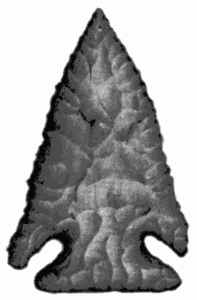
FORM: The cross-section is usually
flattened but may be biconvex. Shoulders
are strongly barbed. The blade is
usually excurvate but may be straight
or recurvate. Blade edges are usually
serrated and beveled on both sides of
each face. The distal end is acute. The
hafting area is corner notched. The
notches average about 11 mm. deep
and 5 mm. wide. Side edges of the expanded
stem are straight and the stem
base edge either straight, slightly incurvate
or, rarely, excurvate. On Alabama
examples, the stem base is thinned and
usually ground, but basal grinding is
rarely found on examples from the North
Carolina Piedmont (Coe, personal communication).
FLAKING: The blade and hafting area
are shaped by broad, shallow, random
flaking. The edges are shaped by fine,
regular, secondary flaking, which often
resulted in serrations and beveled blade
edges. The notches were formed by the
removal of long, broad flakes, one from
each side on each face. The edges of the
notches were often retouched. Broad,
shallow flakes were removed to thin the
basal edge, which was then finely retouched.
Local materials were used in
the manufacture of these points.
COMMENTS: The type is named after
examples excavated in the North Carolina
Piedmont. The illustrated example
is from Cambron Site 19, Morgan County,
Alabama. Coe (1959) estimates the
age as about 8000 years ago at the type
sites. Seven examples were recovered
from Archaic Stratum II at Flint Creek
Rock Shelter (Cambron and Waters,
1961). At the Stanfield-Worley Bluff
Shelter (DeJarnette, Kurjack and Cambron,
1962) one example each was recovered
from Levels 1, 2, 6 and 9 in
Zone A. One example was recovered
from Level 6 at the University of Alabama
Site Ms 201, Marshall County,
Alabama. Practically all examples from
surface collections are from early Archaic
sites. Evidence suggests an early
Archaic association, with ground base
examples being earliest.
GENERAL DESCRIPTION: This is a
medium to large, straight-stemmed
point with deep serrations.
MEASUREMENTS: Measurements
of North Carolina Piedmont examples
range as follows: length—maximum,
120 mm.; minimum, 45 mm.; average,
70 mm.: width—maximum, 35 mm.;
minimum, 25 mm.; average, 30 mm.:
thickness—maximum, 12 mm.; minimum,
8 mm.; average, 9 mm. Eleven
plesiotypes from three sites in Morgan
and Limestone counties, Alabama, near
the Tennessee River provided the following
measurements: length—maximum,
78 mm.; minimum, 45 mm.; average,
56 mm.: shoulder width—maximum,
36 mm.; minimum, 24 mm.; average,
29 mm.: stem width—maximum,
20 mm.; minimum, 15 mm.; average,
17 mm.: stem length—maximum, 11
mm.; minimum, 8 mm.; average, 10
mm.: thickness—maximum, 9 mm.;
minimum, 7 mm.; average, 8 mm. Measurements
of the illustrated example are:
length, 61 mm.; shoulder width, 26
mm.; stem width, 15 mm.; stem length,
11 mm.; thickness, 9 mm.
FORM: The cross-section is usually
biconvex but may be plano-convex.
Shoulders are usually horizontal but
may be inversely tapered. Shoulders or
barbs may be expanded. Most blades
display one excurvate and one recurvate
or, rarely, straight edge. Some
examples have two excurvate blade
edges. Least common are blades with
two recurvate edges. Blade edges are
always serrated. Serration is usually
deeper and broader near the hafting
area and becomes finer and more
regular nearer the distal end, which is
usually acute. The stem has straight
side edges and an incurvate or straight
basal edge. The base is thinned and,
rarely, beveled.
FLAKING: The blade and hafting
area are shaped by broad, shallow,
random flaking followed by deep, short
flaking which forms the serrations
along the blade edges. The stem is retouched
by short, shallow flaking.
COMMENTS: The type was named
after examples from sites in the North
Carolina Piedmont. The illustrated example
is from Hulse Site 32 (Stone
Pipe), Limestone County, Alabama.
Coe (1959) suggests a date of between
5000 B. C. and 6000 B. C., slightly
later than Kirk Corner Notched. At
the Stanfield-Worley Bluff Shelter
(DeJarnette, Kurjack and Cambron,
1962) one example was recovered from
Level 5, one from Level 6, four from
Level 9 in Zone A; one from Level 1
of Zone B. This indicates an early
Archaic association. One example each
was recovered from Levels 1, 7 and
9 at University of Alabama Site Ms
201 in Marshall County, Alabama.
This is also an indication of an early
Archaic association. Nine examples
were scattered through Stratum II (Archaic)
at Flint Creek Rock Shelter
(Cambron and Waters, 1961). One example
was recovered from the eight-foot
level, which was the lowest level
at the Little Bear Creek Site (Webb
and DeJarnette, 1948b). Flint River
Mound (Webb and DeJarnette, 1948a)
produced one example from Zone C
(upper Archaic) and one from Zone
D (lower Archaic). This evidence indicates
an early to middle Archaic association
on some sites.
GENERAL DESCRIPTION: This is a
medium-sized, thin, side notched point.
MEASUREMENTS: Ten cotypes, nine
from North Alabama and one from
Washington County, Alabama, provided
traits and the following measurements:
length—maximum, 60 mm.;
minimum, 40 mm.; average, 49 mm.:
shoulder width—maximum, 20 mm.;
minimum, 15 mm.; average, 18 mm.:
stem width—maximum, 20 mm.; minimum,
14 mm.; average, 17 mm.: stem
length—maximum, 11 mm.; minimum,
5 mm.; average, 9 mm.: thickness—maximum,
6 mm.; minimum, 3 mm.;
average, 5 mm. The illustrated example
measures 55 mm. long, 18 mm.
wide at shoulders, 15 mm. wide across
stem, 16 mm. in stem length, and 11
mm. thick.
FORM: The cross-section is usually flattened;
rarely, plano-convex. The shoulders
are usually straight on narrow-notched
examples and inversely tapered
on the broader-notched examples. The
blade is usually excurvate, but may be
parallel angular. Blade edges of the
Washington County example are finely
serrated. The distal end is acute. The
hafting area is side notched about 3 or
4 mm. from the base. The notches average
about 3 mm. deep and vary from
8 mm. to 3 mm. wide (average width,
5 mm.). The basal edge is straight except
on the Washington County example,
where it is slightly incurvate. The
basal edge is usually thinned, and may
be lightly ground.
FLAKING: The blade and hafting area
are shaped by broad, shallow, random
flaking and retouched by fine, secondary
flaking. The notches, formed by the removal
of broad flakes, are usually finely
retouched.
COMMENTS: The type was named for
Knight Island in the Wheeler Reservoir
of the Tennessee River where examples
were first recognized. The illustrated example
is from Hulse Site 17, Limestone
County, Alabama. The type may be
related to "Upper Valley Side Notched,"
briefly described by Kneberg (1956).
Ritchie's illustrations of Jacks Reef Corner
Notched (1961, page 79, Figure 8
and possibly Figure 7) appear to be of
the Knight Island type. Both types are
usually found on late Woodland sites
in North Alabama. One example was
recovered from Hn 1, Hardin County,
Tennessee (Webb and DeJarnette,
1942), below the three-foot level, which
produced Mississippian point types. It
is possible that the radiocarbon date of
1056 ±250 B. P. obtained for Jacks
Reef Corner Notched at the White Site,
Norwich, New York, (Ritchie, 1961)
applies to Knight Island. A larger variant
is also recognized from Alabama.
Reed points (Bell, 1958) are similar to
Knight Island except that Reed blade
edges are usually straight.
GENERAL DESCRIPTION: This is a
medium-sized, bifurcated-stemmed point
which is usually serrated.
MEASUREMENTS: Fourteen plesiotypes
(including the illustrated example)
from sites in Morgan and Limestone
counties, Alabama, provided the
following measurements: length—maximum,
58 mm.; minimum, 33 mm.;
average, 44 mm.: shoulder width—maximum,
40 mm.; minimum, 23 mm.;
average, 28 mm.: stem width—maximum,
27 mm.; minimum, 21 mm.; average,
23 mm.: stem length—maximum,
16 mm.; minimum, 10 mm.; average,
13 mm.: thickness—maximum,
7 mm.; minimum, 5 mm.; average, 6
mm.
FORM: The cross-section is usually
biconvex; rarely, plano-convex or
hexagonal. Shoulders are expanded on
serrated examples and may be horizontal
or tapered. The blade is nearly
always straight; rarely, incurvate.
Blade edges are usually deeply serrated
and occasionally beveled on both edges
of each face. The distal end is acute.
The hafting area consists of a stem that
is usually expanded (rarely, straight)
and always deeply bifurcated. The
auricles are expanded-rounded and are
usually ground along the edges.
FLAKING: Flaking used to shape the
blade and stem is usually broad, shallow
and random, but removal of broad
flakes to form serrations along the
blade edges sometimes resulted in
flaking of a collateral nature on the
blade faces. Single, broader serrations
may be formed by removal of more
than one flake. Broad, deep flakes were
removed to notch the stem below the
shoulders and on the basal edge. Some
retouch was carried out in these
notches.
COMMENTS: The type was named
after the LeCroy Site on the Tennessee
River in Hamilton County, Tennessee,
and was described by Bell (1960). The
illustrated example is from Cambron
Site 83, Limestone County, Alabama.
At the Stanfield-Worley Bluff Shelter
(DeJarnette, Kurjack and Cambron,
1962) one example was recovered from
Zone C, Block 2, along with transitional
Paleo and early Archaic points.
One example was recovered from the
University of Alabama Site Ms 201 in
Marshall County, Alabama, in Level
10. This indicates early Archaic or
transitional Paleo. Four examples were
recovered from Stratum II (Archaic)
at Flint Creek Rock Shelter (Cambron
and Waters, 1961), mostly from lower
levels. Examples from surface collections
are usually from pre-shellmound
sites in the Wheeler Basin of the Tennessee
River. An early Archaic association
is suggested, and a date of sometime
before 5000 years ago is indicated.
GENERAL DESCRIPTION: This is a
large, stemmed point with asymmetrical
blade edges.
MEASUREMENTS: The illustrated
plesiotype provided the following measurements:
length, 71 mm.; shoulder
width, 36 mm.; stem width, 16 mm.;
stem length, 13 mm.; thickness, 10 mm.
The type "... varies in length from 3 to
7 inches and is usually thick (½" to
¾")." (Kneberg, 1956.)
FORM: The cross-section is biconvex.
Shoulders are usually asymmetrical,
with one being wider than the other.
Shoulders may be tapered or straight.
"The distinctive feature of the blade is its
asymmetry. The side edges are usually
recurvate, but the recurvature is reversed
on the two side edges." (Kneberg, 1956.)
The distal end is acute. The stem may be
straight or slightly expanded. The basal
edge is usually straight; rarely, excurvate
and thinned.
FLAKING: The blade and hafting area
are shaped by broad, shallow, random
flaking. Secondary flaking ranges in extent
from regular flaking along the sides
to the faces with fine retouch along the
blade edges, to practically non-existent
secondary flaking on some examples.
Local materials were generally used.
COMMENTS: The type was named for
the Ledbetter Site in Benton County,
Tennessee. The illustrated example is
from Cambron Site 48 in Lincoln County,
Tennessee. One example was recovered
from Level 4 at the University of
Alabama Site Ms 201 in Marshall
County, Alabama. This indicates a late
Archaic or early Woodland association.
At the Eva Site (Lewis and Lewis, 1961)
most examples appear to have originated
late in the Archaic period. Examples
were recovered from the Big Sandy
component and Stratum II (top) of the
Three Mile component. Examples are
found on Archaic sites in North Alabama.
Kneberg (1956) suggests a date
of from about 2000 B. C. to early centuries
A. D.
GENERAL DESCRIPTION: This is a
medium to large, lanceolate point with
a pointed base.
MEASUREMENTS: Twenty points
from 15 sites in the Tennessee Valley
(Soday and Cambron, n. d.) provided
the following measurements; length—maximum,
104 mm.; minimum, 48
mm.; average, 74 mm.: width—average,
23 mm.: thickness—average, 10
mm. The illustrated example is 110
mm. long, 28 mm. wide, and 9 mm.
thick.
FORM: The cross-section may be
plano-convex or biconvex. The widest
part of the point is usually about one-third
of the length of the point from the
base. From its widest part to the distal
end, the blade is excurvate or sometimes
nearly straight. The distal end is
acute. The base is pointed and may be
broad or acute.
FLAKING: The presence of many
hinge fractures on blade faces indicates
much of the flaking used to shape the
blade and hafting area may be the result
of the baton method of percussion
flaking. Some secondary flaking appears
along the edges. The plane
striking area on the basal edge indicates
manufacture from a blade. Many
examples in the Tennessee Valley are
made of Ft. Payne chert.
COMMENTS: The type site is the Canyon
Diablo Site of Tamaulipas, Mexico
(Mahan, 1955). An example was found
with a mammoth near Mexico City.
The illustrated example is from Hulse
Site 32E, Limestone County, Alabama.
Examples are usually found on the
same sites as Lerma Rounded Base,
but may be somewhat earlier as is the
case with the Mexican examples although
not with Rounded Base Texas
examples. At the Quad Site (Cambron
and Hulse, 1960a) an example reworked
to a drill was recovered from
Stratum III in association with Big
Sandy I, Dalton, Crawford Creek, and
other points. An early Archaic to transitional
Paleo association is suggested.
GENERAL DESCRIPTION: This is a
medium to large sized, lanceolate point
with rounded base.
MEASUREMENTS: Some measurements
of 52 examples from 27 sites in
the Tennessee Valley (Soday and Cambron,
n. d.) follow: length—maximum,
99 mm.; minimum, 51 mm.; average,
80 mm.: width—average, 28 mm.:
thickness—average, 9 mm. The illustrated
example is 90 mm. long, 30 mm.
wide, and 9 mm. thick.
FORM: The cross-section is usually biconvex
but may be somewhat flattened
or plano-convex. The blade is usually
excurvate but may be nearly straight
beyond the hafting area. Some examples
may be beveled on one side of each face
beyond the hafting area. The distal end
is acute. The hafting area may be rounded
or broad-pointed. The basal edge is
thinned, except for the striking platform
of the basic blade, on many examples.
This leaves a plane area on part of the
basal edge.
FLAKING: A combination of broad
shallow flakes and short hinged flakes
were used on many examples to shape
the blade and hafting area. Secondary
flaking is usually present along the
edges. The plane striking area on the
basal edge indicates manufacture from
a blade. Local materials are usually
employed. Many North Alabama examples
are made of Ft. Payne chert.
COMMENTS: The point was named
Lerma Rounded Base by Cambron to
distinguish it from Lerma Pointed Base.
The type is a variant of the Lerma point
as defined by MacNeish (E. C. Mahan,
1955). The illustrated example is from
Hulse Site 37E in Limestone County,
Alabama. Examples from Texas are
illustrated by Suhm and Jelks (1962)
with an estimated age of 2000 B. C. to
1000 A. D. Others from Texas were
described as Archaic and illustrated by
Bell (1958). At the Stanfield-Worley
Bluff Shelter (DeJarnette, Kurjack and
Cambron, 1962) one example was recovered
from Level 1 of Zone D, which
is an indication of pre-Archaic or early
Archaic association at this site. The presence
of one example each from Levels 8
and 9 at the University of Alabama
Site Ms 201 in Marshall County, Alabama,
indicates an early Archaic association.
Three examples were found in
Stratum II at Flint Creek Rock Shelter
(Cambron and Waters, 1961), indicating
an early to middle Archaic association.
Evaluation of this evidence and observations
indicate a possible existence of
from transitional Paleo to middle Archaic
times.
GENERAL DESCRIPTION: This is a
small to medium sized, incurvate-based
point with tapered shoulders.
MEASUREMENTS: Ten cotypes from
Cambron Site 12, Limestone County,
Alabama, provided the following
measurements: length—maximum, 52
mm.; minimum, 38 mm.; average, 48
mm.: shoulder width—maximum, 35
mm.; minimum, 24 mm.; average, 28
mm.: stem width—maximum, 21 mm.;
minimum, 14 mm.; average, 17 mm.:
stem length—maximum, 9 mm.; minimum,
6 mm.; average, 8 mm. Measurements
of the illustrated example are:
length, 51 mm.; shoulder width, 29
mm.; stem width, 20 mm.; stem length,
14 mm.; thickness, 9 mm.
FORM: The cross-section is biconvex.
Shoulders are usually tapered or, rarely,
horizontal and are occasionally
rounded. The blade is straight and the
distal end acute. The stem may be
straight or slightly expanded with
straight or incurvate side edges. The
basal edge is always incurvate and
thinned.
FLAKING: The blade and stem are
shaped by broad, shallow, random
flaking. Secondary flaking along the
blade edge ranges from crude to fine.
Several examples show fine retouch on
only one side of each blade edge, but
this does not appear to be an attempt
to bevel the blade edges. Large deep
flakes were often removed from the
basal corners of the original blade in
order to shape the stem. These
"notches" were then usually retouched
as a final measure. After having been
thinned, the basal edge was often finely
retouched. Bangor flint appears to have
been the most frequently used material
in manufacture of these points.
COMMENTS: The type was named
after examples taken from a shell
mound on the Tennessee River in Limestone
County, Alabama. The illustrated
example is from the type site, primarily
an Archaic shellmound site, Cambron
Site 12 in Limestone County, Alabama.
Surface collections from sites in this
area indicate a late Archaic and/or
Woodland association. At the University
of Alabama Site Ms 201 in Marshall
County, Alabama, two examples
were recovered from Level 4 and one
from Level 7. This is an indication of
late Archaic or early Woodland association
at this site.
GENERAL DESCRIPTION: This is a
medium to large sized, long-stemmed
point with slightly excurvate blade edges.
MEASUREMENTS: Eleven cotypes
from Little Bear Creek, Ct 8 (Webb
and DeJarnette, 1948b), provided the
following measurements: length—maximum,
90 mm.; minimum, 64 mm.; average,
75 mm.: shoulder width—maximum,
28 mm.; minimum, 22 mm.; average,
24 mm.: stem width—maximum,
17 mm.; minimum, 15 mm.; average,
16 mm.: stem length—maximum, 20
mm.; minimum, 16 mm.; average, 18
mm.: thickness—maximum, 11 mm.;
minimum, 7 mm.; average, 9 mm. Measurements
of the illustrated example are:
length, 80 mm.; shoulder width, 30 mm.;
stem width, 15 mm.; stem length, 16
mm.; thickness, 11 mm.
FORM: The cross-section is biconvex.
Shoulders are horizontal or tapered.
Blade edges are excurvate or, rarely,
straight. The distal end is acute. The
hafting area is stemmed. The stem may
be straight or contracted with straight
side edges. Stem edges are usually
ground. The stem base edge is straight
and may be unfinished.
FLAKING: Deep flake scars and hinge
fractures indicate that random percussion
flaking was used to shape the blade
and stem. Some secondary flaking may
also be the result of percussion flaking.
Local materials were used.
COMMENTS: The type was named
after Little Bear Creek Site Ct 8 (Webb
and DeJarnette, 1948b) where it was the
most important type. The illustrated
example is from Hulse Site 17 (Apple
Orchard) in Limestone County, Alabama.
Of the 65 recovered examples
from the Little Bear Creek Site, 58 were
from the upper three feet of the eight-foot
midden with about one-half of these
in the upper foot. This indicates an introduction
of the type in late Archaic
times and a climax in late Woodland.
At Stanfield-Worley Bluff Shelter (DeJarnette,
Kurjack and Cambron, 1962)
three examples were recovered from
Level 1, seven from Level 2, three from
Level 3 and one each from Levels 4, 5
and 7. This indicates a strong late
Woodland association at this site with a
possible introduction somewhat earlier.
Stratum I (Woodland) at Flint Creek
Rock Shelter (Cambron and Waters,
1961) produced two examples, one in
the center third and one from the upper
fifth of the stratum. At Flint River Shell
Mound (Webb and DeJarnette, 1948a)
three examples were recovered from
Zones A and B (Woodland) and six
examples from Zones C and D (Archaic).
This evidence seems to indicate an introduction
in the shellmound Archaic period
of North Alabama and a climax
in late Woodland times, with a suggested
date of 4000 years ago to about
1500 years ago.
GENERAL DESCRIPTION: This is a
medium to large, corner-notched point
beveled on one edge of each blade face
and is rhomboid in cross-section.
MEASUREMENTS: The measurements
of 11 cotypes (including the
illustrated example, from which feature
data were taken) range as follows:
length—maximum, 81 mm.; minimum,
49 mm.; average, 63 mm.:
shoulder width—maximum, 48 mm.;
minimum, 35 mm.; average, 40 mm.:
stem width—maximum, 32 mm.; minimum,
23 mm.; average, 27 mm.: stem
length—maximum, 15 mm.; minimum,
12 mm.; average, 13 mm.: thickness—maximum,
8 mm.; minimum,
7 mm.; average, 7 mm.
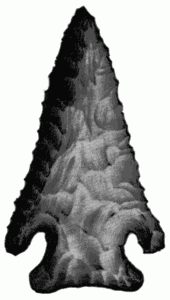
FLAKING: The flaking used on the
faces is broad, shallow and random
leaving the faces flat. The regular retouch
flaking used to bevel the blade
was removed from one side of each face
and often left serrations; much of this
flaking appears to be percussion. One
deep, broad flake was removed on each
face to form the terminal end of the
notches. Apparently small flakes were
removed for about one-third the length
of the finished notch before the large
flakes were struck off. Some retouching
was used to finish the notches. Shallow,
relatively broad, flakes were removed
in thinning the base.
FORM: The cross-section is rhomboid.
As a result of deep, narrow, corner
notches, the barbs are usually simple,
long and may be rounded or acute;
rarely, expanded. The blade is usually
straight; rarely, excurvate or recurvate.
The blade edges may or may not be
serrated but are always beveled on one
edge of each face. The distal end is
usually acute but may approach broad.
The hafting area is usually diagonally
corner notched; rarely, diagonally
basal notched. The notches, as
measured along the stern side edge, are
usually deep and narrow. The sides of
the expanded stem are straight or incurvate.
The stem base is thinned and
may be incurvate, straight or excurvate.
It is usually ground except on
some straight-based examples.
COMMENTS: The type was named
after the Lost Lake area in Limestone
County, Alabama, where many examples
are found. The illustrated example
is from Hulse Site 14a, Limestone
County, Alabama. At the Stanfield-Worley
Bluff Shelter (DeJarnette, Kurjack
and Cambron, 1962) an example
from Level 6, Zone A, and one from
Level 9, Zone A, were recovered. Examples
from North Alabama are from
pre-shellmound sites, and are usually
patinated. This indicates an early Archaic
association prior to 5000 years
ago.
GENERAL DESCRIPTION: This is a
small, thin, triangular point.
MEASUREMENTS: Fifteen plesiotypes,
including the illustrated example
from Cambron Site 27 in Limestone
County, Alabama, provided the following
measurements and traits: length—maximum,
33 mm.; minimum, 17 mm.;
average, 26 mm.: width at base—maximum,
21 mm.; minimum, 12 mm.;
average, 16 mm.: thickness—maximum,
6 mm.; minimum, 3 mm.; average,
4 mm.
FORM: The cross-section is flattened.
Blade edges are straight, rarely slightly
excurvate. The distal end is acute.
There is no way to distinguish the
hafting area from the blade. Some part
of the basal portion of the blade was
used as a hafting area. The basal edge
may be straight—or incurvate one or
two millimeters—and is thinned.
FLAKING: Broad, shallow, random
flaking was used to shape the blade.
Fine secondary flaking was used to thin
and shape the side and basal edges.
Local materials were used.
COMMENTS: According to Ritchie
(1961) this type was described by
Scully as the Mississippi Triangular
point and was later changed by him
to the Madison point (Scully, 1951).
Scully gives the association as "Middle
Mississippi" and the distribution as
"Middle and Upper Mississippi sites in
Illinois, Wisconsin, and Missouri".
Kneberg (1956) refers to a similar
point as "Late Mississippi Triangular."
She suggests a date of 1300-1800
A. D. The length range, as given by
Scully, and measurements of 100 points
from a single prehistoric Iroquois site
in western New York (Ritchie, 1961)
compare favorably with Alabama measurements.
The type is associated with
the middle Mississippi culture in Alabama
and has been referred to locally as Mississippi
Triangular. At Stanfield-Worley
Bluff Shelter (DeJarnette, Kurjack and
Cambron, 1962), of eleven levels in Zone
A, Levels 1 and 2 produced 167 of the
234 examples recovered. At the University
of Alabama Site Ms 201 in Marshall
County, Alabama, 44 of the 52 examples
from 13 levels came from Levels 1 and 2.
Of the 86 examples recovered from Stratum
I (Woodland and Mississippian) at the
Flint Creek Rock Shelter (Cambron and
Waters, 1961) most examples were in the
uppermost levels. Of 11 examples from
Flint River Mound (Webb and DeJarnette,
1948a) 9 were in Zone A (uppermost
zone). The middle Mississippi culture,
with which the points are associated in
Alabama, is considered prehistoric Creek.
Jenkins (1975) has confirmed a pre-Mississippian
(Miller III) provenience for
this type on the Central Tombigbee River.
The Madison point type was also found on
transitional Late Woodland-Early Mississippian
sites (West Jefferson Phase) within
the Warrior drainage (Jenkins and Nielsen,
1974).
GENERAL DESCRIPTION: This is a
large, thin, broad stemmed point with
an excurvate base.
MEASUREMENTS: Seventeen cotypes
from the Tennessee River Valley (with
the exception of length, where only 6
examples were used since the distal ends
of the other 11 examples are missing)
provided the following measurements
and features: length—maximum, 119
mm.; minimum, 61 mm.; average, 93
mm.: shoulder width—maximum, 72
mm.; minimum, 37 mm.; average, 52
mm.: stem width—maximum, 50 mm.;
minimum, 24 mm.; average, 36 mm.:
stem length—maximum, 16 mm.; minimum,
8 mm.; average, 11 mm.: thickness—maximum,
18 mm.; minimum,
10 mm.; average, 14 mm. The illustrated
example provided the following
measurements: length, 104 mm.; shoulder
width, 60 mm.; stem width, 35 mm.;
stem length, 12 mm.; thickness, 14 mm.
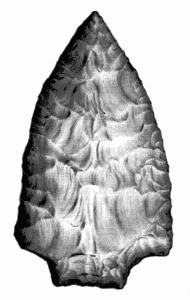
FORM: The cross-section is biconvex.
Shoulders are tapered. Blade edges are
usually excurvate but may be straight.
The distal end is usually acute. The stem
is short and usually contracted-rounded
with excurvate side edges. The basal
edge is excurvate or straight, usually
thinned, and may be ground.
FLAKING: Broad, shallow to deep,
flaking was used to shape the blade and
stem. A minimum of secondary flaking
was used on some examples, sometimes
on only one edge of a face. Other examples
show a considerable amount of
retouching along the blade edges. A
minimum of secondary flaking was used
on the basal edge and sides of the stem.
Local materials were utilized, especially
Ft. Payne chert.
COMMENTS: The type was named
from sites along Elk River near Maples
Bridge in Limestone County, Alabama.
The illustrated example is from Cambron
Site 19, Morgan County, Alabama.
An example from the Eva Site in Benton
County, Tennessee is illustrated in
Plate 4-a, Page 32 (Lewis and Lewis,
1961) and is described as late Archaic.
At Stanfield-Worley Bluff Shelter (DeJarnette,
Kurjack and Cambron, 1962)
an example was recovered from Level 9
of Zone A. This indicates an Archaic
association. Seven examples from the
3-foot level and one from the 5-foot level
at Little Bear Creek Site Ct 8 (Webb
and DeJarnette, 1948b) place the association
as late Archaic at this site. At Flint
River Shell Mound (Webb and DeJarnette,
1948a) one example was recovered
from Zone A (Woodland) and one from
Zone C-D (Archaic). An example was
recovered from Archaic Level 7 at the
University of Alabama Site 1 Ru 28 in
Russell County, Alabama, on the Chattahoochee
River. Evidence indicates a
middle to late Archaic association with a
probable date of about 4000 years ago
or slightly earlier.
GENERAL DESCRIPTION: The McIntire
point is a medium sized, expanded
stem point with straight base and excurvate
blade edges.
MEASUREMENTS: Eleven cotypes, including
the illustrated example, provided
the following measurements and features:
length—maximum, 68 mm.;
minimum, 50 mm.; average, 57 mm.:
shoulder width—maximum, 39 mm.;
minimum, 31 mm.; average, 34 mm.:
stem width—maximum, 21 mm.; minimum,
18 mm.; average, 20 mm.: stem
length—maximum, 13 mm.; minimum,
11 mm.; average, 13 mm.: thickness—maximum,
10 mm.; minimum, 8 mm.;
average, 9 mm.
FORM: The cross-section is biconvex.
Shoulders are usually horizontal, but
may be tapered or inversely tapered
with short barbs. Blade edges are usually
excurvate. Some examples may have
one straight blade edge. The distal end
is acute. The hafting area consists of an
expanded stem with incurvate side edges.
The basal edge is straight, rarely slightly
incurvate, and thinned.
FLAKING: Broad, shallow, random
flaking was employed to shape the blade
and stem with short, sometimes deep,
retouch along the blade edges. Broad
deep flakes were removed by indirect
percussion to form the stem. All stem
edges were then retouched. Local materials
were used and remnants of patinated
rind remain on the base of most examples.
This indicates manufacture from
nodular materials, mostly Bangor flint
in the area of the type site.
COMMENTS: The point is named for
sites near McIntire ditch on the north
bank of the Tennessee River near Decatur
in Limestone County, Alabama. The
illustrated example is from Cambron
Site 28, one of the shellmound type sites
in Limestone County, Alabama. In
North Alabama this type is associated
with Archaic shellmounds along the
Tennessee River. Most expanded stem
examples illustrated as Type 7 by Webb
and DeJarnette (1942) from Pickwick
Basin are probable McIntire points, especially
Numbers 1, 3 and 5 in the bottom
row of top half of Plate 93. At least
one example is included in Type L
(Webb and Wilder, 1951) from Guntersville
Basin shellmounds, and a few
probable examples are illustrated from
Wheeler Basin (Webb, 1939). The type
may be coeval with Limestone Stemmed
points. Associations in surface collections
indicate a middle to late Archaic
placement. Before recognition of the type
some examples may have been classified
as Provisional Type 2, expanded stem.
GENERAL DESCRIPTION: This is a
small to medium sized lanceolate point
with thinned, incurvate base.
MEASUREMENTS: Nine examples
from eastern Wyoming, illustrated by
Bell (1958) after Wheeler (1952) provided
the following measurements:
length—maximum, 61 mm.; minimum,
35 mm.; average, 51 mm.:
width—maximum, 21 mm.; minimum,
14 mm.; average, 17 mm.: width at
base—maximum, 13 mm.; minimum,
11 mm.; average, 12 mm.: depth of
basal concavity—maximum, 6 mm.;
minimum, 2 mm.; average, 4 mm.
Measurements of four points including
the illustrated example, are: length—maximum,
60 mm.; minimum, 52 mm.;
average, 55 mm.: width—maximum,
29 mm.; minimum, 17 mm.; average,
24 mm.: thickness—maximum, 8 mm.;
minimum, 5 mm.; average, 6 mm.:
width at base—maximum, 20 mm.;
minimum, 13 mm.; average, 16 mm.:
basal concavity—maximum, 3 mm.;
minimum, 2 mm.; average, 2 mm.
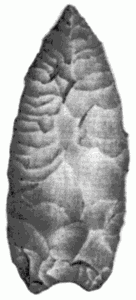
FORM: The cross-section is usually
biconvex, but may be flattened. Blade
edges are usually excurvate, but may
be straight or recurvate. The distal end
is acute. The auriculate hafting area is
usually contracted rounded, but may be
parallel rounded or expanded rounded.
The basal edge is incurvate and
thinned.
FLAKING: Flaking used to shape the
blade and hafting area is usually random
but may be collateral. The side
edges are usually retouched and the
basal edge is well thinned. Some examples
from Idaho (Neisler Collection)
exhibit transverse oblique flaking. Alabama
examples are made of local
materials.
COMMENTS: The type was named
from examples from sites in Keyhole
Reservoir in northeastern Wyoming
(Wheeler, 1952). The illustrated example
is from Hulse Site 55 in Limestone
County, Alabama. About 15 examples
in the collection of W. E. Neisler, from
the Snake River between Kamima and
American Falls, Idaho, were observed
and considered in describing this type
(Neisler, personal communication).
The Idaho points more or less parallel
the Wheeler points in outline, but all
examples are heavily thinned on the
basal edge. One Wheeler point was
observed in the collection but was made
of flint and was on a site separate from
the sites that produced McKean points.
Most of the sites consist of "blow-outs"
that cover an area of from one to ten
acres. Bell (1958) lists radiocarbon
dates from two areas, one from lower
levels at Signal Butte, Nebraska
(Wheeler, 1952) of 3500 to 4000 years
ago. Other dates for sites in Angostura
Basin, South Dakota, are 3630 ±350
and 4230 ±350 B. P. At Danger Cave
near Wendover, Utah, examples listed
by Jennings (1957) as Type W6 were
found in Levels II, III, IV and V
(uppermost) where radiocarbon dates
of from 9789 ±630 to 1930 ±240 B. P.
were secured. More examples were from
Level V. As some examples of W8
(Wheeler points?) were recovered from
the same levels (some A6s may be
Wheeler points), this suggests that
McKean points are derived from
Wheeler points.
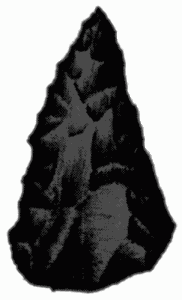
GENERAL DESCRIPTION: The Montgomery
is a small broad, rounded base
point with an excurvate blade.
MEASUREMENTS: Fourteen cotypes from
Montgomery and Escambia counties,
Alabama, provided the following measurements
and traits: length—maximum, 43
mm.; minimum, 23 mm.; average, 37
mm.: width—maximum, 22 mm.; minimum,
10 mm.; average, 16 mm.: thickness—maximum,
10 mm.; minimum, 5 mm.;
average, 6 mm.
FORM: The cross-section is biconvex.
The blade is excurvate. The distal end
is acute. The base is rounded and
thinned.
FLAKING: The blade and hafting area
were shaped by shallow, random, percussion
flaking with some retouch along
the edges, especially near the distal
end.
COMMENTS: The type was named after
Montgomery, County, Alabama, where
many points of this type, including the
illustrated example, were recovered.
The type is associated with sand and
clay-grit tempered pottery in Montgomery
and Escambia counties, indicating a
Woodland association in this area.
GENERAL DESCRIPTION: This is a
medium sized, rounded stem point with
excurvate blade.
MEASUREMENTS: Eleven plesiotypes
from Limestone County, Alabama, including
the illustrated example, provided
the following measurements and
traits: length—maximum, 68 mm.;
minimum, 36 mm.; average, 50 mm.:
shoulder width—maximum, 28 mm.;
minimum, 23 mm.; average, 25 mm.:
stem width—maximum, 20 mm.; minimum,
14 mm.; average, 17 mm.: stem
length—maximum, 11 mm.; minimum,
7 mm.; average, 9 mm.: thickness—maximum,
11 mm.; minimum, 7 mm.;
average, 9 mm.
FORM: The cross-section is biconvex.
Shoulders are narrow, usually horizontal
but may be inversely tapered and
occasionally expanded. Blade edges are
usually excurvate but are recurvate on
examples with expanded shoulders, and
about half the examples have serrated
blade edges. The distal end may be acute
or mucronate, rarely broad. The hafting
area is composed of a rounded,
rarely pointed, stem that is occasionally
ground along the edges.
FLAKING: Rather narrow, shallow,
random flaking was used to shape the
blade and stem. Some fine retouch was
used to complete the shape of all edges.
Short, fairly deep flakes were removed
to form serrations along the blade edges
of serrated examples. These serrations
may appear the full length of the blade
near the basal end or near the distal
end. A variety of local flints and cherts
were used.
COMMENTS: The type was named
from sites near Morrow Mountain in
the Piedmont of North Carolina where
many examples, designated by Coe
(1959) as Morrow Mountain I, were
recovered. The illustrated example is
from Cambron Site 76 (Pine Tree) in
Limestone County, Alabama. The type
had been illustrated as Rounded Stem
Gypsum Cave points by Cambron
(1958a) and designated Three Mile by
Kneberg (personal communication).
Morrow Mountain was adopted at the
suggestion of James B. Griffin (personal
communication). Coe (1959)
places the type later than Stanley and
earlier than Guilford points in the Piedmont
of North Carolina, where he suggests
a date of about 4500 B. C. He
also lists dates in Nevada of Gypsum
Cave points between 6000 and 8000
B. C. Examples were found associated
with two burials at the Stanfield-Worley
Bluff Shelter (DeJarnette, Kurjack and
Cambron, 1962) along with Morrow
Mountain Rounded Base and other early
Archaic points and artifacts. Other
examples recovered from this site as well
as from Flint Creek Rock Shelter (Cambron
and Waters, 1961) and Little Bear
Creek (Webb and DeJarnette, 1948b)
suggest an early Archaic association, as
do surface collections in the Tennessee
River Valley.
GENERAL DESCRIPTION: This is a
medium to large, rounded base point
with an excurvate blade.
MEASUREMENTS: Ten plesiotypes
from Limestone County, Alabama, and
Lincoln County, Tennessee, provided
the following measurements: length—maximum,
58 mm.; minimum, 37 mm.;
average, 45 mm.: width—maximum,
41 mm.; minimum, 24 mm.; average,
30 mm.: thickness—maximum, 10
mm.; minimum, 7 mm.; average, 8
mm. Larger examples are known from
North Alabama, especially from the
Stanfield-Worley Bluff Shelter (DeJarnette,
Kurjack and Cambron, 1962).
FORM: The cross-section may be flattened
or biconvex. Blade edges are excurvate
and rarely serrated. The distal
end is usually acute but may be
mucronate. The hafting area is rounded
and thinned, but rarely ground.
FLAKING: Variable, random flaking
was used to shape the faces. Some examples
were finely retouched along the
blade and hafting area edges, while
others were not retouched at all. In
general the flaking is cruder than that
of Morrow Mountain or Morrow
Mountain Straight Base. Local flints
and cherts were used to make the
points.
COMMENTS: The type was named
because of similarities and associations
with Morrow Mountain points (Coe,
1959) from sites near Morrow Mountain
in the North Carolina Piedmont
area. The illustrated example is from
Cambron Site 76 (Pine Tree) in Limestone
County, Alabama. The type was
listed as Gypsum Cave by Cambron
(1958a). At the Stanfield-Worley Bluff
Shelter (DeJarnette, Kurjack and Cambron,
1962), four examples were associated
with Burial No. 11 and two examples
were found in association with
Burial No. 8 along with Morrow
Mountain points and other early Archaic
points and tools—including a
drill made from a Morrow Mountain
Rounded Base point. At the University
of Alabama Site Ms 201 in Marshall
County, Alabama, one example was
recovered from Level 1. In the Tennessee
Valley of North Alabama the type
is found on early Archaic sites. This
type is similar to Gypsum Cave points,
dated in Nevada at between 6000 and
8000 B. C. (Coe, 1959). An early Archaic
association in Alabama is suggested.
GENERAL DESCRIPTION: This is a
medium sized point with contracted stem
and straight base.
MEASUREMENTS: Eleven plesiotypes,
including the illustrated example,
provided the following measurements
and traits: length—maximum, 51 mm.;
minimum, 37 mm.; average, 42 mm.:
shoulder width—maximum, 35 mm.;
minimum, 25 mm.; average, 28 mm.:
stem width—maximum, 19 mm.; minimum,
16 mm.; average, 17 mm.: width
at base of stem—maximum, 13 mm.;
minimum, 8 mm.; average, 11 mm.:
stem length—maximum, 10 mm.; minimum,
7 mm.; average, 9 mm.: thickness—maximum,
9 mm.; minimum, 7 mm.;
average, 8 mm.
FORM: The cross-section is biconvex.
The narrow shoulders are usually inversely
tapered but may be horizontal.
Blade edges are excurvate and most examples
are serrated. As on Morrow
Mountain points, the serrations may be
near the basal edge of the blade, near
the distal end of the blade, or along the
entire blade edges. Distal ends may be
acute or mucronate. The hafting area
consists of a straight sided, contracted
stem with a straight thinned base. Some
base and/or side edges may be ground.
FLAKING: Shallow, narrow-to-broad,
random flaking was used to shape the
blade and stem. Some fine retouch was
carried out along the blade edges. Short
deep flaking was used to form the serrations.
Occasionally the mucronate distal
end appears to be the result of intentional
termination of serrating at the distal
end. Other mucronate distal ends
were simply flaked out.
COMMENTS: The type was named for
its similarity to Morrow Mountain
points (Coe, 1959) from sites near Morrow
Mountain in the Piedmont of North
Carolina. The illustrated example is
from Cambron Site 76 (Pine Tree) in
Limestone County, Alabama. The type
was first listed as Straight Stemmed
Gypsum Cave by Cambron (1958a).
The greatest differences between this type
and Morrow Mountain is the greater
frequency of shoulder barbs and the
straight base of this type. Also, Morrow
Mountain is more common. Three
examples were recovered from Level 10,
Zone A at the Stanfield-Worley Bluff
Shelter (DeJarnette, Kurjack and Cambron,
1962), which suggests a possibility
of greater age than Morrow Mountain
points. This type was not found with the
two burials from this site which were
associated with Morrow Mountain and
Morrow Mountain Rounded Base
points. At the University of Alabama
Site Ms 201 in Marshall County, Alabama,
this straight based variant was
found below the other two types. A
slightly earlier chronological provenience
is suggested. Based on Coe's
(1959) suggested date of about 4500
B. C. as the earliest appearance of
Morrow Mountain points, a date of
some time prior to 5000 years ago
seems in order.
GENERAL DESCRIPTION: The Motley
point is a medium sized, expanded
stem point with broad side or corner
notches and straight blade edges.
MEASUREMENTS: Eight examples,
including the illustrated specimen, from
North Alabama and the southern part
of Tennessee provided the following
measurements and features: length—maximum,
71 mm.; minimum, 50 mm.;
average, 60 mm.: shoulder width—maximum,
32 mm.; minimum, 27 mm.;
average, 29 mm.: stem width at base—maximum,
26 mm.; minimum, 18 mm.;
average, 22 mm.: stem width at narrowest
point—maximum, 14 mm.;
minimum, 11 mm.; average, 12 mm.:
stem length—maximum, 17 mm.; minimum,
14 mm.; average, 15 mm.: thickness—maximum,
10 mm.; minimum,
7 mm.; average, 8 mm.
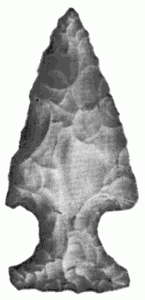
FORM: The cross-section may be
biconvex or flattened. Shoulders may
be horizontal, tapered, or inversely
tapered. Blade edges are more apt to
be straight but may be slightly excurvate,
or one edge may be straight and
the other excurvate. The distal end is
acute. The stem is expanded and
formed by broad deep side or corner
notches. Several examples have one
corner notch and one side notch. The
side edges of the stem are incurvate
and the base is usually straight. It is
usually thinned, but rarely ground.
FLAKING: Shallow to deep random
flaking was used to shape the faces.
The blade edges are usually retouched
by removal of short and fairly deep
flakes. Large deep flakes were removed
to form the notches, usually followed
by secondary flaking along the stem
and shoulder edges. Local materials
were used.
COMMENTS: The Motley point was
named from the Motley Place in northeastern
Louisiana. The illustrated example
is from Cambron Site 301 in
Limestone County, Alabama. Bell
(1958) states, "The type is best represented
from the Poverty Point Culture
in the lower Mississippi Valley" where
radiocarbon dates range from about
1300 B. C. up to 200 B. C. It is also
present in the Archaic sites of Kentucky,
Alabama, and Illinois. It is similar to
Normanskill points of New York
(Ritchie, 1961). The type has been
referred to locally as Sugar Creek. At
Stanfield-Worley Bluff Shelter (DeJarnette,
Kurjack and Cambron, 1962),
five examples were recovered from the
top three levels and one from Level 6.
At the University of Alabama Site Ms
201 in Marshall County, Alabama, one
example each was recovered from
Levels 3 and 4. At Flint River Mound
(Webb and DeJarnette, 1948a) two examples
were taken from Zone A
(Woodland), five from Zone B (Woodland)
and one from Zone C (Archaic).
This evidence indicates a strong early
Woodland association with a beginning
in Archaic times.
GENERAL DESCRIPTION: This is a
small, narrow, thick, stemmed point.
MEASUREMENTS: Eleven cotypes
from sites in Madison and Limestone
counties, Alabama, provided the following
measurements and traits: length—maximum,
51 mm.; minimum, 28 mm.;
average, 40 mm.: shoulder width—maximum,
20 mm.; minimum, 13 mm.;
average, 15 mm.: stem width—maximum,
15 mm.; minimum, 9 mm.; average,
11 mm.: stem length—maximum,
14 mm.; minimum, 7 mm.; average, 11
mm.: thickness—maximum, 8 mm.;
minimum, 6 mm.; average, 7 mm.
FORM: The cross-section is usually biconvex
but may be somewhat median
ridged. Shoulders are narrow and tapered.
Blade edges may be straight or excurvate.
The distal end is acute. Nine of
the eleven measured examples show impact
fractures of the distal end. The stem
is usually straight but may be tapered.
The basal edge may be straight or excurvate
and is usually unfinished, but
may be thinned and is rarely ground.
FLAKING: Short, deep, random flakes
were removed in shaping the faces of
the blade and stem. Retouching of the
edges was accomplished by removal of
very short deep flakes. Local materials
were used, especially Bangor nodular
flint.
COMMENTS: The type was named
from points from sites along Mountain
Fork Creek in Madison County, Alabama,
where they were first recognized.
The illustrated example is from Cambron
Site 103 in this area. The type appears
in surface collections along with
Swan Lake, Flint River Spike, and Bradley
Spike points. At the Stanfield-Worley
Bluff Shelter (DeJarnette, Kurjack and
Cambron, 1962), a few examples were
recovered from the upper levels of Zone
A. This is an indication of late Woodland
association at this site. This was a
prominent type in Zones A and B (Woodland)
at Flint River Mound (Webb and
DeJarnette, 1948a), especially in the upper
levels. A few examples were recovered
from Zones C and D (Archaic) at
this site. Current evidence indicates a
middle to late Woodland association.
Impact fractures on the distal ends of
eight of the eleven measured examples
indicate use of the type as arrow points.
The type is similar to the stemmed
variant of Lamoka, an Archaic type
found in New York and dated by radiocarbon
method at 3500 B. C. (Ritchie,
1961).
GENERAL DESCRIPTION: This is a
medium sized, expanded stem point with
excurvate blade and acuminate distal
end.
MEASUREMENTS: Fourteen cotypes
from Limestone County, Alabama, provided
the following measurements and
traits: length—maximum, 67 mm.;
minimum, 46 mm.; average, 56 mm.:
shoulder width—maximum, 29 mm.;
minimum, 23 mm.; average, 26 mm.:
stem width—maximum, 20 mm.; minimum,
14 mm.; average, 18 mm.: stem
length—maximum, 17 mm.; minimum,
12 mm.; average, 14 mm.: thickness—maximum,
10 mm.; minimum, 8 mm.;
average, 9 mm.
FLAKING: Broad, shallow, random
flaking was used to shape the blade and
hafting area. Small, fairly deep flakes
were removed in retouching the blade
and stem edges. Most stem bases have
been thinned, but a few are crudely finished.
FORM: The cross-section is biconvex.
Shoulders are usually tapered but may
be horizontal and are sometimes rounded.
Blade edges are excurvate. The distal
end is sharply acute or acuminate.
The stem is expanded, sometimes only
slightly. Side edges are usually straight.
The basal edge is usually thinned and
straight but may be excurvate. About
half of the examples have ground bases,
and several bases retain rind from the
parent material.
COMMENTS: It is named from points
found on sites near Mud Creek in Limestone
County, Alabama. The illustrated
example is from Hulse Site 50 in Limestone
County, Alabama. The type is
similar to Lange points (Bell, 1958) in
outline, but is narrower in proportion
and differs in other features. At Stanfield-Worley
Bluff Shelter (DeJarnette, Kurjack
and Cambron, 1962) one example
each was recovered from Levels 1, 2,
and 3; two from Level 5; one from Level
7; two from Level 9. This indicates a late
Archaic to Woodland association at this
site. At Flint Creek Rock Shelter (Cambron
and Waters, 1961) two examples
were recovered from the bottom of Stratum
I (Woodland) and two from the
top of Stratum II (Archaic). One example
appeared in Zone A (early Woodland
or late Archaic) at the Little Bear
Creek Mound (Webb and DeJarnette,
1948b). At Flint River Mound (Webb
and DeJarnette, 1948a) Zone A (Woodland)
produced one Mud Creek point;
Zone B (lower Woodland), two examples;
while the Archaic zones produced
25 examples, 22 from Zone C (upper
Archaic), one from Zone C-D and two
from Zone D (bottom Archaic). This
indicates a strong late Archaic association
at this site. This evidence and surface
associations suggest a strong late
Archaic type that existed into Woodland
times.
GENERAL DESCRIPTION: This is a
medium to large, stemmed point with
pronounced excurvate blade.
MEASUREMENTS: Ten cotypes,
from the Little Bear Creek Shell Mound
(Webb and DeJarnette, 1948b) provided
the following measurements and
traits: length—maximum, 116 mm.;
minimum, 81 mm.; average, 96 mm.:
blade width—maximum, 36 mm.; minimum,
22 mm.; average. 30 mm.:
shoulder width—maximum, 30 mm.;
minimum, 20 mm.; average, 25 mm.:
stem width—maximum, 20 mm.; minimum,
12 mm.; average, 17 mm.: stem
length—maximum, 16 mm.; minimum,
12 mm.; average, 15 mm.: thickness—maximum,
12 mm.; minimum,
9 mm.; average, 10 mm. The illustrated
example provided the following
measurements: length, 81 mm.; blade
width, 30 mm.; shoulder width, 28
mm.; stem width, 17 mm.; stem length,
13 mm.; thickness, 10 mm.
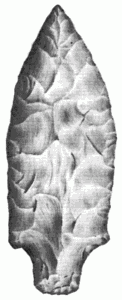
FORM: The cross-section is biconvex.
Shoulders are narrow, usually tapered,
and may be asymmetrical. Blade edges
are excurvate, with the widest point
near the midsection, and may be finely
serrated. The distal end is usually acute
but may be acuminate. The stem may
be tapered or straight, rarely expanded.
The basal edge is usually excurvate,
but may be straight, and is poorly
thinned. Stem edges are usually
ground.
FLAKING: Broad, shallow, random
flaking was used to shape the faces.
Fine retouch was carried out along the
blade edges. The stem edges were usually
more crudely retouched. Local
materials, especially Ft. Payne chert,
were used.
COMMENTS: The type was named
from examples from sites at and near
Mulberry Creek in Colbert County,
Alabama. The illustrated example is
from Cambron Site 8 in Morgan County,
Alabama. One example was recovered
from Level 1, Zone A at the Stanfield-Worley
Bluff Shelter (DeJarnette,
Kurjack and Cambron, 1962). At the
Little Bear Creek Site in Colbert County,
Alabama (Webb and DeJarnette,
1948b), six of the fourteen recovered
examples were from the 2-foot level,
two from the 1-foot level, two from
Zone A (2.75'), two from the 3-foot
level and two from the 6-foot level. This
evidence indicates an introduction in
middle Archaic times, a strong association
to late Archaic, and survival into
early Woodland at this site. At the Flint
River Shell Mound (Webb and DeJarnette,
1948a) two examples were taken
from Zone A (upper Woodland), one
from Zone C (upper Archaic) and one
from Zone D (lower Archaic). Based
on this information and surface collection
associations, a climax of the type
in late shellmound Archaic is suggested
for North Alabama. Distribution seems
to be somewhat limited, although
similar examples are illustrated from
early Woodland Roskamp Focus of
Illinois (Wray, 1950) and from Boone
Focus (early Woodland) of central
Missouri (Chapman, 1948).
GENERAL DESCRIPTION: This is a
medium sized, narrow, rounded stem
point with expanded shoulders.
MEASUREMENTS: Six plesiotypes,
including the illustrated example, provided
the following measurements:
length—maximum, 61 mm.; minimum,
45 mm.; average, 51 mm.:
shoulder width—maximum, 18 mm.;
minimum, 15 mm.; average, 17 mm.:
stem width—maximum, 13 mm.; minimum,
10 mm.; average, 12 mm.: stem
length—maximum, 12 mm.; minimum,
9 mm.; average, 11 mm.: thickness—maximum,
9 mm.; minimum,
6 mm.; average, 7 mm.
FORM: The cross-section is biconvex.
Shoulders are narrow and tapered and
may be expanded. Excluding the expanded
shoulders, the blade is usually
straight but may be slightly excurvate.
The distal end is sharply acute. The
stem is contracted-rounded and thinned
on the edges. Sides of the stem are
usually straight. The basal edge is always
excurvate.
FLAKING: Flaking used to shape the
faces of the blade and stem is usually
fairly deep, as is most of the fine retouching
along the edges. The expanded shoulder is formed by leaving
that area of the blade intact during
finishing of the blade edges. In some
cases the lack of retouch along the
basal edge of the blade resulted in an
absence of expanded shoulders. Local
materials were used.
COMMENTS: The type was named for the
New Market Site near New Market, Alabama,
where the type was first recognized.
The type was described in previous
editions of this book as Randolph, a
historic type named by Coe (1959) from
the Doerschuk Site in Piedmont, North
Carolina. The New Market point has
been found to differ in flaking as well
as culturally from the Randolph type.
The illustrated example is from Cambron
Site 76 (Pine Tree) in Limestone County,
Alabama. The type is similar in some
respects to Bradley Spike, but differs
in that the stem is tapered and rounded,
shoulders may be expanded, and fine
retouch is a feature of the blade. One
example was recovered from Level 2 at
the University of Alabama Site Ms 201
in Marshall County, Alabama. One example
was recovered from Zone A and
two from Zone A-B at the Flint River
Shell Mound (Webb and DeJarnette,
1948a). These proveniences place the
type at these sites in the Woodland
period or later. They are found at Flint
River and nearly always in surface
collections with Swan Lake, Flint River
Spike, and Bradley Spike points.
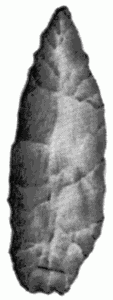
GENERAL DESCRIPTION: The Nodena
is a small to medium-sized, lanceolate
point with rounded base.
MEASUREMENTS: The illustrated
plesiotype measures 46 mm. long, 15
mm. wide and 7 mm. thick. Bell (1958)
gives the range as 1 to 3 inches in length.
FORM: The cross-section is biconvex.
The blade is excurvate with an acute
distal end. The hafting area or basal
edge is usually rounded, but may be
acute.
FLAKING: Broad, shallow, random
flaking was used to shape the blade and
hafting area, leaving a low median
ridge on some examples. The edges of
the blade and hafting area show fine
retouching of a narrow shallow nature.
Local flint was used for the illustrated
specimen.
COMMENTS: The type was named after
the Nodena Site in eastern Arkansas,
but has been referred to as the "Willow-leaf"
type by numerous writers and collectors
for the past 25 years (Bell, 1958).
The illustrated example is from Baker
Site N, Madison County, Alabama. Bell
(1958) gives the distribution as heaviest
in eastern Arkansas, along the Mississippi
and St. Francis river valleys and
also along the Arkansas River Valley
as far as Dardanelle, Arkansas. He lists
the cultural affiliation as late prehistoric
and suggests a date of 1400 to 1600
A. D. The type is rare in Alabama, and
the cultural association of Alabama
points is unknown.
GENERAL DESCRIPTION: The Nolichucky
is a small to medium sized point
with incurvate hafting area.
MEASUREMENTS: The illustrated example
from the type site provided the
following measurements: length, 37
mm.; blade width, 16 mm.; width of
base, 17 mm.; width of hafting constriction,
15 mm.; thickness, 6 mm. "The
size is usually small, but occasional examples
range up to 2 inches in length.
The proportions are usually narrow,
rarely broad." (Kneberg, 1957.)
FORM: The cross-section is biconvex.
Blade edges may be straight or excurvate.
The distal end is acute. The hafting
area consists of an area with incurvate
side edges that may be ground and may
be auriculate with expanded pointed or
rounded auricles. The basal edge is
usually incurvate but may be straight
and is usually thinned.
FLAKING: Deep to shallow random
flaking was employed to shape the faces.
Retouching on all edges is usually evident.
COMMENTS: The type was named for
the Nolichucky River. The type site is
Camp Creek Site at the confluence of
Camp Creek with the Nolichucky River
(Lewis and Kneberg, 1957). The illustrated
example is from Level A of this
homogenous site.
"An early Woodland type associated
with Greeneville and Camp Creek types.
These three types represent 50% of all
points from Camp Creek Site." (Kneberg,
1957). A radiocarbon date of
2050 ±250 B. P. was obtained from
Level C at this site (Lewis and Kneberg,
1957). One example was recovered from
the upper level of Stratum I (Woodland
and Mississippian) at Flint Creek Rock
Shelter (Cambron and Waters, 1961).
At Flint River Mound one example was
taken from Zone A. Greeneville and
Camp Creek points were more numerous
at this site. This evidence indicates a
sparse late Woodland association in
north Alabama. Three examples appear
in the University of Alabama surface
collections from Guntersville Basin of the
Tennessee River.
GENERAL DESCRIPTION: This is a
large, parallel sided point with deep,
narrow side notches.
MEASUREMENTS: Bell (1958) gives
the size as ranging from 3 inches to
9 inches in length with most examples
measuring between 4 inches and 5
inches. The illustrated example provided
the following measurements:
length, 97 mm.; width of blade, 32
mm.; width at base, 27 mm.; thickness,
7 mm.; depth of notches, 7 mm.; width
of notches, 5 mm.
FORM: The cross-section is flattened.
Blade edges are usually near parallel
for most of the length of the blade,
then slope rather abruptly to an acute
distal end. Local examples may be
sparsely serrated along the blade edges.
"The hafting area is notched from the
side edges near the base and may be
either squared or rounded. The stem
base is either straight or incurvate with
the incurvate base being more typical."
(Bell, 1958). The base of the illustrated
example is ground.
FLAKING: Bell (1958) describes the
flaking as well done, first by rather
large percussion flaking and then by
finer flaking along the edges and base.
Long, shallow, random flaking was
usually employed. Local materials were
used.
COMMENTS: The type was named
for the Osceola Site in Wisconsin. The
illustrated example is from Cambron
Site 19, Morgan County, Alabama. A
somewhat similar type is described by
Ritchie (1961) as Otter Creek points
associated with the Archaic cultures of
Vermont and New York. Bell (1958)
states that the type is associated with
the Old Copper Culture of Wisconsin
where radiocarbon dates suggest an
age of 7000 to 5000 years ago. He
also lists distribution as Wisconsin,
Illinois and Missouri. Alabama examples
usually appear on early Archaic
sites. The type is probably related to
the Big Sandy Complex.
GENERAL DESCRIPTION: The Paint
Rock Valley point is a medium sized,
broad, triangular point with incurvate
base and excurvate blade edges.
MEASUREMENTS: Fourteen plesiotypes,
including the illustrated example,
from Cambron Site 48, Lincoln County,
Tennessee, provided the following measurements
and traits: length—maximum,
58 mm.; minimum, 35 mm.; average,
46 mm.: blade width—maximum,
31 mm.; minimum, 25 mm.; average,
28 mm.: width at base—maximum, 30
mm.; minimum, 18 mm.; average, 25
mm.: thickness—maximum, 10 mm.;
minimum, 6 mm.; average, 8 mm.: depth
of basal concavity—maximum, 3 mm.;
minimum, 1 mm.; average, 2 mm.
FORM: The cross-section is biconvex.
Blade edges are usually excurvate, rarely
straight. The distal end is usually
acute but may be broad. The hafting area
consists of an indeterminate basal portion
of the blade that is usually slightly
contracted. The base is usually incurvate,
rarely straight, and may be thinned
or beveled.
FLAKING: Broad, sometimes deep,
random flaking was used to shape the
blade and hafting area. Rather long
secondary flakes were struck off along
the edges, with a minimum of fine retouch
having been carried out. Short
flakes struck from the basal edge often
resulted in a beveling of the basal edge.
Local materials were used.
COMMENTS: This type was named from
points found on sites in the Paint Rock
River Valley in Jackson County, Alabama.
The illustrated example is from Cambron
Site 48, Lincoln County, Tennessee. It
resembles several Texas types (Suhm, Krieger
and Jelks, 1954): Kinney, with an
estimated age of 4000 years ago, which is
shorter and broader; Matamoros with an
estimated age of 500 A. D., which is smaller
and usually beveled; Tortugas, estimated
age 6000 years ago, which is beveled and
has no contraction of the base. At the
University of Alabama Site Ms 201 in
Marshall County, Alabama, two examples
were recovered from Level 11 and one
from Level 9. Other types from these
lower levels include Cumberland, Quad,
Dalton, Wheeler and Big Sandy I points.
One example was recovered from Burial 8
at Stanfield-Worley Bluff Shelter (DeJarnette,
Kurjack and Cambron, 1962) in
association with Morrow Mountain, Crawford
Creek, White Springs and possibly
Eva points, as well as bone points and
other artifacts. These associations indicate
an early Archaic to transitional Paleo-Indian
connection. At the Hardaway Site
(Coe, 1959) points similar to Paint Rock
Valley points were recovered from Stratum
IV along with Dalton and Quad points.
GENERAL DESCRIPTION: The Palmer
point is a small corner notched
point with a straight, ground base and
pronounced serrations (Coe, 1959).
MEASUREMENTS: Coe (1959) lists
the following measurements: length—maximum,
60 mm.; minimum, 28 mm.;
average, 35 mm.: width—maximum,
25 mm.; minimum, 15 mm.; average,
20 mm.: thickness—maximum, 12
mm.; minimum, 5 mm.; average, 8
mm.: average width of notches, 3 mm.:
length of notches, measured along stem
edge, 5 mm. to 7 mm. The illustrated
example provided the following measurements:
length, 46 mm.; width at
shoulders, 25 mm.; width of stem, 21
mm.; thickness, 7 mm.; width of
notches, 3 mm.; depth of notches, 6
mm.
FORM: The cross-section is biconvex.
Shoulders are barbed. Blade edges are
usually straight, but may be slightly
incurvate or excurvate. Most examples
are serrated, some quite deeply. The
hafting area is corner notched. Side
edges of the stem are usually incurvate.
The basal edge is usually straight but
may be slightly incurvate or excurvate.
It is thinned and ground.
FLAKING: "These points were made
by pressure flaking upon a prismatic
flake of the proper proportions. The
serrations apparently were made at the
time when the point was finished, since
the flake scars produced by the serrations
were long and overlapped toward
the center of the blade." (Coe, 1959).
The notches were formed by the removal
of deep broad flakes. Local
materials were used.
COMMENTS: The type was named
from points recovered from the Hardaway
Site in Piedmont, North Carolina.
The illustrated example is from Cambron
Site 92 in Madison County, North
Carolina. Concerning the type at the
Hardaway Site, Coe (1959) states,
"Following the Hardaway occupation,
the style of projectile points changed to
a small corner-notched serrated variety
with extensive grinding along the base.
Along with this the use of the small
hafted snub-nosed scraper increased
considerably." He gives distribution as
"Camp Creek Site in Tennessee and
northward along the Atlantic Coast into
New England." He further states,
"On the basis of excavated data, this
type must have an antiquity of nearly
8000 years." Two examples are listed
by Cambron and Waters (1961) from
the bottom of Stratum II (Archaic) at
Flint Creek Rock Shelter. Three Palmer
points were classified by Cambron from
the surface collection of the University
of Alabama from Guntersville Basin on
the Tennessee River. The type is also
found on western North Carolina sites.
GENERAL DESCRIPTION: This is a
medium to large point with bifurcated
stem.
MEASUREMENTS: Suhm and Jelks
(1962) list some measurements in mm.,
as follows: "Length, max. 130, min. 30,
av. between 60 and 90; average width
30 to 50; stem width 15 to 30; stem
length 15 to 20." The illustrated example
provided the following measurements:
length, 87 mm.; width of shoulders,
32 mm.; width of stem, 28 mm.;
stem length, 25 mm.; thickness, 6 mm.;
depth of basal concavity, 8 mm.
FORM: The cross-section may be biconvex
or flattened. Shoulders may be
horizontal or barbed. "Blade edges are
usually straight or excurvate, but occasionally
incurvate, recurved, or narrowed
to a slim needle-like tip." (Bell, 1958.)
The distal end is usually acute. The stem
is usually straight, but may be slightly
contracted with straight or excurvate
side edges. The basal edge is incurvate,
usually deeply so, and may be thinned
by removal of large flakes, and may be
near beveled on some examples. Grinding
of basal edges is seldom present.
FLAKING: Broad, shallow flakes were
removed to shape the blade and stem.
Deeper shorter flaking was used to finish
all edges. On many examples large
broad flakes were removed to form the
shoulders, especially on barbed examples.
The thinning of the bases of some
examples was accomplished by removal
of one or several large thin flakes. Local
materials were generally used.
COMMENTS: The type was named from
sites in central Texas where it is regarded
as a diagnostic type of the "Round Rock
Focus" (Kelley, 1947a). The illustrated
example is from the Helen Womack collection
of Bedford County, Tennessee. Suhm,
Krieger and Jelks (1954) list Pedernalis as
"very common over all of central Texas."
It is listed as a common point found with
the Edwards Plateau aspect of the Archaic
period with an estimated age of 4000 B. C.
to 500 or 1000 A. D. (Suhm, Krieger and
Jelks, 1954). An example of the type
appears in unknown provenience at Stanfield-Worley
Bluff Shelter (DeJarnette,
Kurjack and Cambron, 1962). A broken
example from the middle of the Archaic
Stratum II at Flint Creek Rock Shelter
(Cambron and Waters, 1961) appears to
have been reworked on one blade edge to
a burin. Two examples were recovered
from Zone C (upper Archaic) at Flint
River Shell Mound (Webb and DeJarnette,
1948a). A suggested association for Alabama
is late Archaic or early Woodland.
GENERAL DESCRIPTION: This is a
medium to large, expanded shoulder
point with recurvate blade edges and
tapered stem.
MEASUREMENTS: Twelve cotypes
from the Tennessee River Valley of
North Alabama provided the following
measurements and traits: length—maximum,
117 mm.; minimum, 71
mm.; average, 85 mm.: shoulder
width—maximum, 48 mm.; minimum,
37 mm.; average, 44 mm.: stem
width—maximum, 24 mm.; minimum,
15 mm.; average, 19 mm.: stem
length—maximum, 12 mm.; minimum,
9 mm.; average, 10 mm. The illustrated
example provided the following measurements:
length, 76 mm.; shoulder
width, 41 mm.; stem width, 19 mm.;
stem length, 13 mm.; thickness, 9 mm.
FORM: The cross-section is biconvex.
Shoulders are usually tapered, but may
be horizontal, and are always expanded.
About one-half of the measured
examples had asymmetrical shoulders.
Blade edges are recurvate and may be
slightly serrated. The distal end is
acute. Stems are thick and tapered,
rarely straight. Side edges of the stem
are usually incurvate and may be
ground. The basal edge may be excurvate
or straight and rarely ground.
FLAKING: Broad, shallow flaking
was used to shape the blade and stem.
Short, deep, regular flaking was used
to finish the blade edges, often resulting
in fine serrations. A minimum of retouch
was used along the stem edges.
Local materials were utilized.
COMMENTS: The type was named
from points found on sites in Pickwick
Basin of the Tennessee River Valley.
The illustrated example is from Cambron
Site 48 in Lincoln County, Tennessee.
It is similar to Ledbetter
Stemmed points (Kneberg, 1956), but
both blade edges are recurvate. At the
Stanfield-Worley Bluff Shelter (DeJarnette,
Kurjack and Cambron, 1962)
five examples were recovered from
Zone A, one from Level 2, two from
Level 3 and one each from Levels 4
and 7. At Little Bear Creek Shell
Mound (Webb and DeJarnette, 1948b)
examples were recovered from levels as
follows: Levels 1 and 2, 1 each; Level
3, 13; Level 4, 3; Level 5, 4; Levels 6
and 7, 1 each. Levels 1 and 2 are
Woodland, the other levels contained
Archaic materials. At Flint River Shell
Mound (Webb and DeJarnette, 1948a)
one each was recovered from Zones A
and B (Woodland), four examples
from Zone C, one from Zone C-D and
three from Zone D. Zones C, C-D and
D are Archaic. The above evidence indicates
a beginning in middle Archaic
and a climax in late Archaic for the
type.
GENERAL DESCRIPTION: This is a
medium sized, side notched, serrated
point with expanded shoulders.
MEASUREMENTS: Seven cotypes
from Limestone County, Alabama, provided
the following measurements and
traits: length—maximum, 66 mm.;
minimum, 50 mm.; average, 59 mm.:
shoulder width—maximum, 29 mm.;
minimum, 25 mm.; average, 27 mm.:
stem width—maximum, 29 mm.; minimum,
26 mm.; average, 28 mm.: stem
length—maximum, 15 mm.; minimum,
11 mm.; average, 12 mm.: thickness—maximum,
9 mm.; minimum, 5 mm.;
average, 7 mm.
FORM: The cross-section is usually biconvex
but may be flattened. Shoulders
are narrow, tapered, and expanded.
Blade edges are recurvate and serrated.
The distal end is acute. The hafting area
is side notched with expanded stem. The
notches average about 9 mm. wide and
3 mm. deep. Side edges of the stem are
incurvate. The basal edge is thinned and
incurvate.
FLAKING: Broad, shallow flaking was
used to shape the blade and stem faces.
Collateral or random flaking was used
to retouch the sides of the blade faces to
a near median ridge resulting in serrations.
The side notches were formed by
the removal of one large flake or several
smaller flakes. Retouch was carried out
along the basal edge. All examples are
patinated and are made of local materials.
COMMENTS: The type was named
from points found on and near Cambron
Site 76, the Pine Tree, (Cambron,
1956) in Limestone County, Alabama.
The illustrated example is from Cambron
Site 4, Limestone County, Alabama.
An example was illustrated by
Webb and DeJarnette (1942) as type
54 from Colbert County, Alabama, Site
Ct 27 (Plate 294). One example, of unknown
provenience, from Site Ms 53A
(Webb and Wilder, 1951) in Marshall
County, Alabama, was recovered (Plate
29-C, No. 16). The type is pre-shellmound
in North Alabama and is considered
an early Archaic point type. One
example was found on a site on Valley
River at Andrews, North Carolina. Other
than this occurrence the known distribution
is Alabama and Southern Tennessee.
GENERAL DESCRIPTION: This is a
medium sized, corner notched, serrated
point with expanded shoulders.
MEASUREMENTS: Seven cotypes, including
the illustrated example, provided
the following measurements and
traits: length—maximum, 72 mm.;
minimum, 40 mm.; average, 54 mm.:
shoulder width—maximum, 32 mm.;
minimum, 23 mm.; average, 27 mm.:
stem width—maximum, 30 mm.; minimum,
25 mm.; average, 28 mm.: stem
length—maximum, 12 mm.; minimum,
10 mm.; average, 11 mm.: thickness—maximum,
8 mm.; minimum, 7 mm.;
average, 7 mm.
FORM: The cross-section is biconvex,
rarely flattened. Shoulders are usually
inversely tapered, rarely horizontal, and
the barbs are expanded. Blade edges are
usually incurvate, rarely straight, and
serrated. The distal end is acute. The
hafting area is usually corner notched,
rarely side-notched, with expanded stem.
Notches measured along the stem edge
average about 11 mm. deep and about
5 mm. wide. Side edges of the stem are
usually straight. The base is thinned
and usually straight, but may be excurvate,
rarely incurvate. Light basal grinding
may be present.
FLAKING: Random flaking was first
employed to shape the blade and stem
faces. This was followed by collateral,
rarely random, flaking, usually resulting
in regular serrations along the blade
edges. Blade edges were worked in to
form expanded barbs. The corner
notches were formed by the removal of
one or more large flakes, with retouch
along the stem edge. Some retouch was
used to finish the basal edge. All examples
are patinated and are usually made
of local materials.
COMMENTS: The type was named
from points found on and near the Pine
Tree Site Cambron 76 (Cambron, 1956)
in Limestone County, Alabama. The
illustrated example is from Cambron
Site 19 in Morgan County, Alabama.
The type was formerly included with the
Pine Tree point (Cambron, 1957) but
was later referred to locally as Pine
Tree Variant. It is a pre-shellmound or
early Archaic type. Physical characteristics
indicate a greater antiquity for this
type than for the Pine Tree type, but
surface collection associations suggest a
contemporaneous existence.
GENERAL DESCRIPTION: The
Plevna is a medium to large, corner
notched point with excurvate base and
beveled on one edge of each face.
MEASUREMENTS: Nine cotypes
from North Alabama and Southern
Tennessee, including the illustrated example,
provided the following measurements
and traits: length—maximum,
95 mm.; minimum, 46 mm.; average,
65 mm.: shoulder width—maximum,
35 mm.; minimum, 26 mm.; average,
30 mm.: stem width—maximum, 31
mm.; minimum, 24 mm.; average, 27
mm.: stem length—maximum, 17 mm.;
minimum, 12 mm.; average, 15 mm.:
thickness—maximum, 10 mm.; minimum,
7 mm.; average, 8 mm.
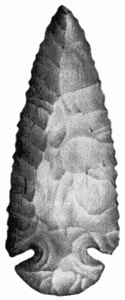
FORM: The cross-section is rhomboid.
Shoulders are inversely tapered or horizontal.
Where shoulder barbs are
present they may be expanded. Blade
edges are usually straight, but may be
incurvate or excurvate and may be
serrated. They are always beveled on
one edge of each face. Distal ends are
acute. The hafting area is corner
notched, with deep narrow notches that
average about 4 mm. wide at the blade
edge, 2 or 3 mm. wide at the bottom
of the notch, and about 6 mm. deep
along the stem edge. The expanded
stem usually has straight side edges,
and the basal edge is always excurvate,
thinned, and ground.
FLAKING: Broad, shallow, random
flaking was employed to produce flattened
faces of the blade. Most blades
were probably excurvate with a gentle
bevel before one edge of each face was
reworked by short, shallow to deep,
flaking which often created serrations.
Repeated reworking of these blade
edges resulted in steep beveling and
often in incurvate blade edges. The
notches were formed at the widest part
of the blade by the initial removal of
one broad deep flake from each side
of each face. The area thus thinned
was then notched by removal of short
fine flakes. The hafting area was
thinned by broad, shallow flaking followed
by the removal of small, shallow
flakes along the basal edge. Local
materials were used, and all examples
showed patination.
COMMENTS: The point is named
from points found on the Plevna Site
(Cambron 79) in Madison County,
Alabama, associated with Eva and
other early Archaic types. The illustrated
example is from Hulse Site 38,
Limestone County, Alabama. The type
is associated with pre-shellmound
materials in North Alabama and is
considered an early Archaic type.
Physical characteristics suggest that
Plevna points may be ancestral to the
unbeveled, late Archaic to early Woodland
St. Charles points (Bell, 1960)
found throughout the Ohio Valley and
in surrounding states. A date of sometime
before 5000 years ago is suggested
for the type in Alabama.
GENERAL DESCRIPTION: The Quad
is a medium sized, broad, unfluted or
fluted, point with an expanded-rounded,
auriculate hafting area.
MEASUREMENTS: Fifty-one examples
from thirty-one sites in the Tennessee
River Valley (Soday and Cambron,
n. d.) provided the following measurements:
unfluted points—maximum
length, 86 mm.; minimum length, 47
mm.; average length, 57 mm.; average
width, 23 mm.; average thickness, 7
mm.: fluted points—maximum length,
79 mm.; minimum length, 39 mm.; average
length, 52 mm.; width, 24 mm.;
average thickness, 7 mm. The illustrated
example provided the following measurements:
length, 60 mm.; width at
base, 31 mm.; width of blade above
hafting area, 29 mm.; width of hafting
constriction, 28 mm.; depth of basal
concavity, 7 mm.
FORM: The cross-section may be flattened
or biconvex. Blade edges above
the hafting area are convex. The distal
end is acute. The auriculate hafting area
is expanded-rounded with a hafting constriction
along the side edges near the
auricles. The base is incurvate and may
be thinned or fluted. Hafting area edges
are usually ground, especially the constriction.
FLAKING: Flaking on the faces is
usually random but may be collateral.
Retouch with short, fairly deep flaking,
is usual on all edges. Because of the
thinness of these points, fluted examples
have short flutes similar to the
Clovis points.
COMMENTS: The type was named
from points found on and near the
Quad Site (Soday, 1954) in Limestone
County, Alabama. The illustrated example
is from Cambron Site 76 (Pine
Tree) near the Quad Site. The unfluted
variant was described by Bell (1960),
and he suggests a date of some portion
of the period from 8000 B. C. to 4000
B. C. He illustrates examples from Tennessee
and Ohio. An unfluted example
was found in Level 11 at the University
of Alabama Site Ms 201 in Marshall
County, Alabama, in the same
stratum as Wheeler, Paint Rock Valley,
Cumberland, Dalton, and other points.
An example from Flint Creek Rock
Shelter (Cambron and Waters, 1961)
was recovered in pre-Archaic Stratum
III along with a Beaver Lake point.
A Quad-like point was recovered from
the Quad Site in the same stratum as
a fluted midsection, Dalton, and Big
Sandy I points (Cambron and Hulse,
1960a). Coe (1959) found similar
points associated with Daltons on the
lower levels of the Hardaway Site in
Piedmont, North Carolina. The above
evidence and surface associations indicate
a transitional Paleo association
with an age of 10,000 years ago or
more.
GENERAL DESCRIPTION: This is a
medium to large, triangular, fluted point
with an incurvate base.
MEASUREMENTS: Seven points from
seven sites in the Tennessee Valley (Soday
and Cambron, n. d.) range in length
as follows: longest, 117 mm. (from
Soday Site 475 in Morgan County,
Alabama); shortest, 67 mm. (from Serio
1, Madison County, Alabama); average,
89 mm. The average width of the
seven points is 37 mm. and the average
thickness, 7 mm. The illustrated specimen
measures in length, 110 mm.; width
at base, 34 mm.; thickness, 6 mm.;
depth of basal concavity, 9 mm.; longest
flute, 70 mm.; shortest flute, 26 mm.
FORM: The cross-section is fluted. The
blade is straight with an acute distal
end. Grinding along the basal edge for
about one-third of the length of the
point designates the hafting area. The
auriculated base is parallel-rounded and
incurvate and may show multiple flutes
on one or both faces. The basal edge is
thinned on each side of the flute and
ground.
FLAKING: The flakes removed in order
to shape the blade and hafting area are
narrow, shallow and random. The edges
were finished by the removal of alternate
flakes along the blade and hafting
area edges, leaving a fine, irregular
pattern. The short flute was removed
first from a flattened face, the longer
flute from a median ridged face that
shows multiple flute scars (Cambron and
Hulse, 1961).
COMMENTS: The type was named
after Redstone Arsenal in Madison
County, Alabama, where the illustrated
specimen, a classic example, was recovered
from Brosemer Site M-17, a site
that has produced other early points.
Several examples have been illustrated
in the Tennessee Archaeologist as follows:
Vol. X, No. 1, p. 17, Fig. 45
(Morgan County, Alabama, Soday,
1954); Vol. X, No. 2, p. 40, Fig. 1,
p. 48, Fig. 87, p. 50, Fig. 96 (Madison
County, Alabama, Mahan, 1954); Vol.
12, No. 1, p. 36, Figs. 3 and 4 (Chickamauga
Lake, Tennessee, Lewis, 1956);
Vol. XIII, No. 2, p. 82, Fig. 7 (Weakley
County, Tennessee, Taylor, 1957);
Vol. XV, No. 2, p. 124, Fig. 19 (Limestone
County, Alabama), p. 142, Fig.
1, (Humphreys County, Tennessee, Lewis,
1959); Vol. XVI, No. 1, p. 58, Figs.
18, 19 (Henry County, Tennessee,
Lewis, 1960a). The Redstone type appears
to be a variant of the Clovis and
probably was in use at about the same
time as Clovis points. Charcoal from
hearths with which a Clovis point was
presumed to have been associated, gave
dates in excess of 37,000 years ago
(Crook and Harris, 1958). When
dating methods were improved, dates in
excess of 42,000 years ago were
obtained at this site. This means the
Redstone, as well as the Clovis, could
have been in use as early as 42,000
years ago, but most archaeologists suggest
a date of about 15,000 years ago.
GENERAL DESCRIPTION: This is a
small to medium sized stemmed point
with straight blade edges.
MEASUREMENTS: Fifteen cotypes
in the Harwood collection from Cambron
Site 326 in Buncombe County,
North Carolina, provided the following
measurements: length—maximum,
60 mm.; minimum, 37 mm.; average,
41 mm.: shoulder width—maximum,
23 mm.; minimum, 18 mm.; average,
21 mm.: stem width—maximum, 16
mm.; minimum, 11 mm.; average, 15
mm.: stem length—maximum, 12
mm.; minimum, 7 mm.; average, 9
mm.: thickness—maximum, 10 mm.;
minimum, 7 mm.; average, 8 mm. The
illustrated example provided the following
measurements: length, 37 mm.;
shoulder width, 19 mm.; stem width,
12 mm.; stem length, 9 mm.; thickness,
7 mm.
FORM: The cross-section is usually
biconvex, rarely plano-convex.
Shoulders are tapered and fairly broad.
Blade edges are usually straight, but
may be excurvate, rarely incurvate.
The distal end is acute. The stem is
usually straight but may be tapered.
The basal edge is excurvate and
usually thick, but may be thinned.
FLAKING: The entire point appears
to have been made by short, fairly
deep, random percussion flaking. The
lack of retouch along the blade edges
leaves an irregular blade edge outline that
somewhat resembles crude serrations on
some examples. All examples from the site
are made of vein quartz.
COMMENTS: The type was named from
the Rheems Creek Site (Cambron Site 326)
in Buncombe County, North Carolina. A
few examples approach Bradley Spike in
size and flaking, but are broader with a
more triangular blade. The smaller examples
somewhat resemble Coosa points, but
are not retouched along the edges and are
made of quartzite. The cultural association
of this type is as yet unknown, as the type
site has produced artifacts belonging to
transitional Paleo, Archaic and Woodland
components. A category of tool types
resembling Rheems Creek has been identified
in Randolph County from Mid-Archaic
to Early Woodland (O'Hear and
Knight, 1975).
GENERAL DESCRIPTION: The Russell
Cave point is a medium sized, expanded
stem point with shallow serrations and
straight blade edges.
MEASUREMENTS: Seven examples, including
the illustrated specimen, from the
lower G layer at Russell Cave in North
Alabama provided the following measurements
and features: length—maximum,
60 mm.; minimum, 44 mm.; average, 54
mm: shoulder width—maximum, 28 mm.;
minimum, 21 mm.; average, 25 mm.:
stem width at base—maximum, 24 mm.;
minimum, 21 mm.; average, 23 mm.:
stem width at narrowest point—maximum,
21 mm.; minimum, 19 mm.; average, 20
mm.: stem length—maximum, 20 mm.;
minimum, 16 mm.; average, 17 mm.:
thickness—maximum, 9 mm.; minimum,
7 mm.; average, 8 mm.
FORM: The cross-section is biconvex.
Shoulders are tapered. The blade is usually
straight; rarely excurvate. Blade
edges are shallowly serrated. The distal
end is acute. The stem is expanded.
The side edges of the stem are incurvate
and usually ground. The basal edge is
straight, usually ground and may be
beveled.
FLAKING: Shallow, broad, random
flaking was used to shape the blade
and stem. Short, fairly deep flakes were
removed to shape and finish the blade
and to form fine regular serrations.
These were flaked alternately from
opposite faces, making the short serration
projections rather sharp. The
sides of the hafting area are usually
steeply flaked to form an expanded stem.
The basal edge is usually thinned by
the removal of broad shallow flakes, but
may be rather steeply flaked.
COMMENTS: The type was named from
Russell Cave in Jackson County, Alabama,
where the seven cotypes were
recovered from lower G layer. This was
the deepest excavated layer and produced
three radiocarbon dates: Level 17,
7565 ±250 years B. P.; Level 20, 8095
±275 and 8435 ±275 years B. P. These
dates place the type in early Archaic
at this site. Distribution of the type is
not known.
GENERAL DESCRIPTION: This is a
small, serrated, triangular point with an
incurvate base.
MEASUREMENTS: Six cotypes from the
Jones Bluff Reservoir in Lowndes County,
Alabama, provided the following
measurements and traits: length—maximum,
27 mm.; minimum, 21 mm.; average,
24 mm.: width at base—maximum, 15
mm.; minimum, 13 mm.; average, 14 mm.:
thickness—maximum, 7 mm.; minimum,
3 mm.; average, 5 mm.: basal concavity—maximum
4 mm.; minimum, 1 mm.;
average, 2 mm.
FORM: The cross-section is usually
biconvex—rarely, flattened. The blade is
usually straight, but may be slightly
incurvate or excurvate. Blade edges are
serrated. The distal end is usually
acute but may be acuminate. The base
is incurvate and may be expanded.
FLAKING: The point displays random
flaking which is usually broad and fairly
deep. The serrations are the result of
the removal of regular flakes from the
edge of alternate faces. The basal edge
was thinned by removal of shallow
flakes. Local materials, generally
quartzites, were used.
COMMENTS: The point is named from
sites on Sand Mountain in North Alabama
where the type was first recognized. The
illustrated example was recovered from
Hulse site 39 near Decatur, Alabama.
No examples were recognized from the
control sites in the Tennessee Valley.
Examples from Sites Lo 32 and Lo 13 in
Jones Bluff Reservoir, Lowndes County,
Alabama, were recovered from
Levels 1 and 2 in association with
Weeden Island pottery. This suggests
an Early Mississippian association at
these sites. In Autauga County, Alabama,
examples were found in association with
Autauga Check Stamped, McLeod
Check Stamped and Wright Check Stamped
pottery. This suggests a late Woodland
association in this area. At Site
Dk-101 in DeKalb County, Alabama,
three examples were recovered from
Level 1 and two from Level 3. This
suggests a late Woodland and Mississippian
association at this site. The
type seems to have appeared in late
Woodland times and lasted into Mississippian
times.
GENERAL DESCRIPTION: This is a
medium to large, side-notched point with
excurvate blade edges, biconvex cross-section,
deep side notches and finely retouched
blade edges.
MEASUREMENTS: The range of measurements
of 14 examples; 7 from New
York, 5 from Savage Cave and 2 from the
Pine Tree Site (Cambron, 1956) at Decatur,
Alabama, are: length 44-75 mm.;
shoulder width, 23-30 mm.; stem width,
18-25 mm.; stem length, 9-10 mm., thickness,
6-9 mm.; notch width, 7-9 mm.;
notch depth, 3-5 mm.
FLAKING: Good random flaking was
employed to shape the faces of the blade
and hafting area. Fine retouch is evident
along the edges. The deep side notches
were finished by the removal of one large
flake from both sides of each notch.
FORM: The cross-section is biconvex.
The blade is excurvate and is finely serrated.
The distal end is acute. The hafting area
is deeply side notched. The basal edge is
nearly always straight, but may be slightly
excurvate. Light grinding may be evident
on most examples. The part of the hafting
area between the notches and the base is
expanded. All examples were patinated.
COMMENTS: This type is named from
Savage Cave, Kentucky, where 8 whole or
broken examples were recovered. One
example was recovered from the surface,
two from Level 1, one from Level 2, three
from Level 3, one of which was worked to
a drill, and one from Level 4. All examples
except one from the surface were recovered
from Stratum II. It appears that the Savage
Cave point overlaps in time with Big Sandy
points at this site, with Savage Cave points
appearing later. One example illustrated
as an Otter Creek point in Plate 21, Fig. 2
from Malta, Saratoga County, New York,
(Ritchie, 1971) appears to be a Savage
Cave point.
GENERAL DESCRIPTION: A medium
to large stemmed point often made of
quartzite.
MEASUREMENTS: Coe (1959) lists
some measurements of North Carolina
examples as follows: length—maximum,
170 mm.; minimum, 70 mm.;
average, 100 mm.: width—maximum,
70 mm.; minimum, 35 mm.; average,
50 mm. These measurements exceed
those from six examples, including the
illustrated example, from Elmore County,
Alabama, and one from Buncombe
County, North Carolina, which are as
follows: length—maximum, 70 mm.;
minimum, 50 mm.; average, 56 mm.:
shoulder width—maximum, 40 mm.;
minimum, 30 mm.; average, 34 mm.:
stem width—maximum, 25 mm.; minimum,
21 mm.; average, 22 mm.: stem
length—maximum, 14 mm.; minimum,
12 mm.; average, 13 mm.: thickness—maximum,
13 mm.; minimum, 10 mm.;
average, 11 mm.
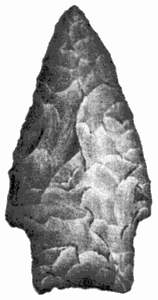
FORM: The cross-section is usually biconvex
but may be flattened, rarely
plano-convex. Shoulders are usually
tapered but may be straight. Blade edges
are excurvate, but may be parallel from
the shoulders for one-third to one-half
the length of the blade. The distal end is
acute. The stem may be straight or
tapered, with incurvate or straight side
edges and a straight or incurvate basal
edge that is usually thinned.
FLAKING: Broad, shallow flaking was
employed to shape the blade and stem
faces, with some retouch along all edges.
Local materials were used.
COMMENTS: The point is named from
points of the Savannah River Focus of
the Archaic period in Redmont, North
Carolina. The illustrated example is
from Amling Site El 4 in Elmore County,
Alabama. This type includes points
illustrated in Caldwell (1947) as belonging
to the Savannah River Focus of
Georgia. Similar points from Camp
Creek were illustrated by Lewis and Kneberg
(1957) as Appalachian Stemmed,
but they seem more acceptable as Savannah
River points. One example each was
recovered from Level 3 and 4 (pre-pottery)
at the University of Alabama
Site 1 Ru 28 in Russell County, Alabama,
on the Chattahoochee River. Coe
(1959) found Savannah River to be late
Archaic. Further excavation in the Roanoke
River area revealed Savannah River
points in early Woodland association
(Coe, personal communication). Savannah
River points overlay the "Old Quartz"
industry in Georgia. The above evidence
places Savannah River points in late
Archaic and early Woodland associations.
GENERAL DESCRIPTION: This is a
medium to large sized, straight stemmed
point with finely serrated blade edges.
MEASUREMENTS: Thirteen cotypes from
sites at Smithsonia, Beacon Island and
Waterloo along the Tennessee River below
Florence, Alabama, provided the following
measurements: length—maximum, 96
mm.; minimum, 61 mm.; average, 77 mm.:
shoulder width—maximum, 35 mm.; minimum
28 mm.; average, 30 mm.: stem
width—maximum, 16 mm.; minimum, 13
mm.; average, 14 mm.: stem length—maximum,
15 mm.; minimum, 12 mm.;
average, 13 mm.: thickness—maximum,
10 mm.; minimum, 8 mm.; average, 9 mm.
Measurements of the illustrated example
are: length, 82 mm.; shoulder width,
33 mm.; stem width, 15 mm.; stem length,
13 mm.; thickness, 11 mm.
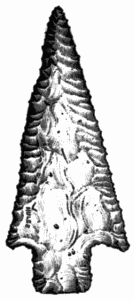
FORM: The cross-section is usually biconvex
but may be flattened. Shoulders
are usually barbed but may be inversely
tapered. Blade edges are serrated and are
usually straight or excurvate but some
examples may have one straight and one
excurvate blade edge. The basal edge and
sides of the stem are thinned, straight and
may be lightly ground. The distal end is
acute. Serrations on the blade edges are
finely executed as opposed to deeper serrations
on the Kirk Serrated projectile point.
The shoulders are usually barbed. The
stem and base are always straight whereas
the Kirk Serrated base may be incurvate.
FLAKING: The blade and hafting area
were formed by broad, shallow, random
flaking. The blade edges were then finely
serrated.
COMMENTS: The type was named from
Ralph Allen Site 41 at Smithsonia, Alabama,
where the type was first recognized.
The illustrated example is from this site
located on the north side of the Tennessee
River in Lauderdale County, Alabama.
Three examples are illustrated in Plate 152
(Webb and DeJarnette, 1942). One is in
the top right of the plate and two are in
the upper left of the lower figure on the
same plate. These examples were recovered
from the Bluff Creek Site Luo 59.
This site was located fourteen miles west of
Florence, Alabama, on the banks of the
Tennessee River. These points were associated
with burials along with other artifacts
that indicate a late Archaic and early
Woodland placement, as does the formal
attributes of this point type.
GENERAL DESCRIPTION: The South
Prong Creek point is a large, broad,
stemmed, and serrated point.
MEASUREMENTS: Examples which provided
the features, including the illustrated
example, ranged in measurements as follows:
length—maximum, 101 mm.; minimum,
46 mm.; average, 72 mm.: shoulder
width—maximum, 59 mm.; minimum, 46
mm.; average, 38 mm.: stem width—maximum,
18 mm.; minimum, 17 mm.;
average, 18 mm.: stem length—maximum,
12 mm.; minimum, 8 mm.; average,
11 mm.: thickness—maximum, 10 mm.;
minimum, 8 mm.; average, 9 mm.
FORM: The cross-section is flattened.
The blade edges are usually straight but
may be slightly excurvate or recurvate and
are always serrated with an acute distal
end that is devoid of serrations. Shoulders
may be straight or tapered. The stem is
short and thinned at the base and along
the side edges. The basal edge may be
straight or excurvate and may exhibit light
grinding.
FLAKING: The thin blade is shaped by
good, broad, and shallow random flaking
on the faces. The removal of small deep
flakes along the blade edges, starting above
the shoulders and ending below the distal
end, produced strong serrations and a
beveling effect. The removal of fairly
large flakes at the junction of the stem
and shoulders thinned the sides of the stem
as well as the shoulders at this point.
COMMENTS: The type was named from
a surface site on South Prong Creek in
Richmond County, Georgia, near Augusta,
in the Red Hills fall line and approximately
300 feet above mean sea level. Eight
examples, including the illustrated example,
were recovered from this site (Lewis
Site No. 606). Two examples of unknown
origin from the Augusta-Richmond County
Museum helped provide additional measurements
and features for the type. Other
artifacts recovered from the type site include:
13 Big Sandy points, 1 Greenbrier
Dalton point, 1 Ecusta point, 1 Plevna
point, 26 Morrow Mountain points, 1
Morrow Mountain Straight Base point,
3 Morrow Mountain Rounded Base points,
3 Guilford Rounded Base points, 1 Guilford
point, 8 Savannah River points, 1 Gary
point, 1 Wade point, 1 Yadkin point,
2 Madison points, 25 P-1 Stemmed points,
1 used scraper, 1 flint gouge, 7 mortars,
3 manos, 1 hammer-abrader, 7 steatite
hammers, and 1 perforater. These artifacts
suggest a Transitional Paleo-Early Archaic
and Archaic occupation of the site with a
sparse occupation by Woodland and Mississippian
people. An age of 3000 to 4500
years B. P. is suggested for the type (Michie,
personal communication, 1975). The association
of other artifacts from the site
indicates an earlier date for the type
(Lewis, personal communication, 1975).
GENERAL DESCRIPTION: A medium
to large sized, narrow, triangular point
with biconvex blade.
MEASUREMENTS: Nine autotypes
from North Alabama, including the
illustrated example, provided the following
measurements and traits:
length—maximum, 118 mm.; minimum,
54 mm.; average, 73 mm.: width
at base—maximum, 30 mm.; minimum,
18 mm.; average, 22 mm.: thickness—maximum,
13 mm.; minimum,
7 mm.; average, 9 mm.
FORM: The cross-section of the blade
is biconvex, and most hafting area
cross-sections are flattened. Blade edges
are usually parallel, rarely excurvate.
The distal end is acute. The hafting
area includes an undetermined basal
portion of the side edges. It is parallel
sided, with a straight, rarely slightly
excurvate, basal edge that is thinned.
The hafting area is usually flattened.
FLAKING: From fairly deep to shallow
random flaking was used to shape
the faces. Usually one third to two
thirds of the total length from the distal
end is flaked to median ridge, and
broader shallower flakes were removed
from the hafting area. Short, broad,
and deeper flakes were removed in retouching
the side edges of the blade
and all edges of the hafting area. Local
materials were usually employed, and
all examples were patinated.
COMMENTS: The type was named
from examples recovered from the Stanfield-Worley
Bluff Shelter (DeJarnette,
Kurjack and Cambron, 1962) in Colbert
County, Alabama. The illustrated
example is from the Pine Tree Site
(Cambron Site 76) in Limestone County,
Alabama. Examples recovered at
Stanfield-Worley were all in Zone D,
two in Level 1 and one in Level 5.
Radiocarbon dates from this zone are
8920 ±400 and 9640 ±450 B. P. Four
examples were recovered from Stratum
III (Cambron and Hulse, 1960a) at
the Quad Site in association with Dalton,
Lerma, Big Sandy I, and other
points and were listed as Type P-11.
All surface finds are made from sites
that have produced early materials. It
is suggested that this type be placed in
the transitional Paleo-Indian cultural
stage with a date of somewhere around
10,000 years ago.
GENERAL DESCRIPTION: The Stanley
is a medium sized point with "a
broad triangular blade, a small squared
stem and a shallow notched base." (Coe,
1959).
MEASUREMENTS: Seven plesiotypes
from North Alabama and South Tennessee
provided the following measurements
and traits: length—maximum,
47 mm.; minimum, 42 mm.; average,
46 mm.: shoulder width—maximum,
33 mm.; minimum, 27 mm.; average,
31 mm.: stem width—maximum, 18
mm.; minimum, 14 mm.; average, 16
mm.: stem length—maximum, 9 mm.;
minimum, 7 mm.; average, 8 mm.:
thickness—maximum, 8 mm.; minimum,
7 mm.; average, 7 mm.
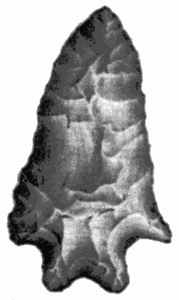
FORM: The cross-section may be biconvex
or plano-convex, rarely flattened.
Shoulders are usually horizontal or tapered,
rarely inversely tapered, and may
be expanded. Blade edges may be excurvate,
straight, or recurvate and usually
have an angular break in the blade
outline near the distal end. Blade edges
may be serrated near the base. The distal
end is usually acute, but may be
somewhat apiculate. The stem is usually
straight. Stems of the plesiotypes are
shorter and broader than stems of the
cotypes. Thus, the basal edge of the
plesiotypes is more incurvate than notched,
as it is in the cotypes.
FLAKING: Blade scars and/or rather
long, shallow, random flakes are in evidence
on the faces of the blade and stem.
On the serrated examples the serrations
are broader and deeper near the shoulders,
and the points are usually serrated
no more than half the length of
the blade. Fine regular retouch was
carried out along the blade edges near
the distal end. Fairly long, often broad,
flakes were removed in order to thin the
basal edge. Local materials were used,
and all points show some patination.
COMMENTS: The type was named
from points found in Piedmont, North
Carolina, especially at the Doerschuk
and Hardaway Sites, where they were
found above Kirk and below Morrow
Mountain occupation levels and are
placed somewhere above 5000 B. C.
(Coe, 1959). The illustrated example is
from Cambron Site 146 in Limestone
County, Alabama. An example was recovered
from Level 11 of Zone A at
the Stanfield-Worley Bluff Shelter (DeJarnette,
Kurjack and Cambron, 1962).
Also in this level (145 trench) were Eva
and Morrow Mountain points. One example
was recovered from Zone C (upper
Archaic) at the Flint River Shell
Mound (Webb and DeJarnette, 1948a).
GENERAL DESCRIPTION: This is a
small to medium sized, serrated, shallowly
side notched point.
MEASUREMENTS: Eleven cotypes,
including the illustrated example, provided
the following measurements:
length—maximum, 48 mm.; minimum,
28 mm.; average, 42 mm.: shoulder
width—maximum, 22 mm.; minimum,
16 mm.; average, 19 mm.: stem
width—maximum, 22 mm.; minimum,
16 mm.; average, 19 mm.: stem length—maximum,
10 mm.; minimum, 7
mm.; average, 8 mm.: thickness—maximum,
8 mm.; minimum, 5 mm.; average,
6 mm.
FORM: The cross-section is biconvex.
Shoulders are tapered and narrow.
Blade edges are usually excurvate, but
may be parallel-angular, and are finely
serrated. The distal end is acute. The
hafting area is shallowly side notched
near the base, with the shoulders and
stem usually nearly the same width.
The basal edge is straight and thinned.
FLAKING: Shallow to deep flaking
was used to shape the blade and stem
faces. Long, narrow flakes were removed
to form serrations along the
blade edges. The hafting notches were
formed by the removal of a fairly large
deep flake from each side of each face
near the base and were sometimes
finished by the removal of several small
flakes in the notches. Broad, thin flakes
were removed in thinning the basal
edge. Local materials were used.
COMMENTS: The type was named
from points found on sites near Sublet
Ferry on the Tennessee River in Jackson
County, Alabama. The illustrated
example is from W. H. Baker Site 16
in the area. Other artifacts from this
site suggest early Woodland and possibly
late Archaic assemblages. Typologically
the Sublet type seems intermediate
between Damron Side Notched
and Knights Island. Cultural association
of the type is at present uncertain,
but surface collection associations indicate
that it is an early Woodland type.
GENERAL DESCRIPTION: This is a
small, thick point with shallow side
notches.
MEASUREMENTS: Fourteen plesiotypes,
including the illustrated example,
from Hulse Site 54 in Limestone County,
Alabama, provided the following
measurements and traits: length—maximum,
41 mm.; minimum, 30 mm.;
average, 38 mm.: shoulder width—maximum,
20 mm.; minimum, 12 mm.;
average, 17 mm.: stem width—maximum,
17 mm.; minimum, 13 mm.; average,
16 mm.: stem length—maximum,
12 mm.; minimum, 9 mm.; average,
11 mm.: thickness—maximum, 9
mm.; minimum, 5 mm.; average, 7
mm.
FORM: The cross-section is usually
biconvex, but is sometimes near
median-ridged. Shoulders are narrow,
tapered, and may be expanded. Blade
edges are usually straight but may be
incurvate or excurvate. Distal ends are
acuminate. The hafting area is shallowly
side notched. Side edges of the
stem are incurvate. The basal edge may
be excurvate or straight. Nearly all examples
retain some rind on the base,
and many basal edges are unfinished.
A few basal edges are lightly ground.
FLAKING: Short, random flaking
was used to shape the faces of the blade
and stem. Flakes removed in retouching
the blade and stem edges are short
and fairly deep. Several flakes were
usually removed to form the side
notches. Local materials were used.
COMMENTS: The type was named
from points recovered from the Swan
Lake area of Limestone County, Alabama.
The illustrated example is from
Hulse Site 54 in this area. The type
may be related to Trinity points (Suhm
and Jelks, 1962) and Halifax points
(Coe, 1959). The side notched variant
of Archaic Lamoka points of New York
(Ritchie, 1961) may be an early variation
of the Swan Lake type. Radiocarbon
dates from 3500 B. C. to 2500
B. C. have been obtained for Lamoka
points (Ritchie, 1961). At the Stanfield-Worley
Bluff Shelter (DeJarnette, Kurjack
and Cambron, 1962) most Swan
Lake points were concentrated in the
first two levels of Zone A, but a few
examples were found as deep as Levels
7 and 8, with one from Level 1 in Zone
B. This indicates Woodland association
at this site, with possibly an Archaic
connection. Four of eight examples
from the University of Alabama Site
Ms 201 in Marshall County, Alabama,
were in the two top levels. All six examples
from Flint Creek Rock Shelter
(Cambron and Waters, 1961) were
from Stratum I (Woodland). At Flint
River Shell Mound (Webb and DeJarnette,
1948a) four examples were recovered
from Zone A, one from Zone
B (Woodland) and one from Zone C
(Archaic). The Swan Lake point
appears to have been introduced in the
Archaic period but reached a climax
in the Woodland period.
GENERAL DESCRIPTION: This is a
medium to large, double pointed lanceolate
point with side notches.
MEASUREMENTS: The type ranges
from about 3 inches to 8 inches in length
with an average length of about 6 inches
(Bell, 1960). The illustrated plesiotype
provided the following measurements:
length, 174 mm.; width at widest part of
blade, 42 mm.; thickness, 8 mm.; length
of stem, 17 mm.; width of stem, 18 mm.;
notch depth, 3 mm.; notch width, 6 mm.
FORM: The cross-section is flattened.
Shoulders may be horizontal or tapered.
Blade edges are excurvate. The distal
end may be acute or broad. The stem
is expanded and pointed with an acute
or broad basal edge that is thinned.
FLAKING: Broad, shallow, random
flaking was used to shape the blade and
stem. Short deep flakes may be removed
to retouch the edges. One or several
flakes were removed from the sides of
each face to form shallow side notches.
A good grade, often exotic, material was
used.
COMMENTS: The type was named because
of the resemblance of the hafting
area to a turkey's tail. The illustrated
example is the shortest of four Turkey
Tail points and one similar unnotched
blade 8 inches long which were recovered
from a shellmound burial by Harry
Smith from Cambron Site 14 in Limestone
County, Alabama. "The type commonly
occurs in caches of several points,
ranging from 4 or 5 up to 40 or more."
(Bell, 1960.) This indicates a ceremonial
usage. A late Archaic or early Woodland
association with a date range from
about 2000 B. C. to 500 B. C. is suggested
by Scully (1951).
GENERAL DESCRIPTION: This is a
medium sized, barbed, straight stemmed
point.
MEASUREMENTS: Fourteen cotypes,
including the illustrated example, provided
the following measurements and
traits: length—maximum, 70 mm.;
minimum, 39 mm.; average, 51 mm.:
shoulder width—maximum, 42 mm.;
minimum, 27 mm.; average, 34 mm.:
stem width—maximum, 16 mm.; minimum,
10 mm.; average, 14 mm.: stem
length—maximum, 12 mm.; minimum,
9 mm.; average, 11 mm.: thickness—maximum,
9 mm.; minimum, 5 mm.;
average, 7 mm.
FORM: The cross-section is biconvex
or flattened. Shoulders are barbed, with
barbs often as long as the stem. Blade
edges may be excurvate or straight.
The distal end is acute. The stem is
usually straight but may be slightly expanded.
Side edges of the stem are usually
straight, and the basal edge may be
straight or slightly incurvate. It is thinned
and may be slightly ground.
FLAKING: Deep to shallow, random
flaking was used on the blade and stem
faces. Short, fairly deep, flakes were removed
in retouching the blade and stem
edges. One large, broad, deep flake was
removed from the basal corners of each
face to form barbs. The resulting notched
edges were usually retouched by the
removal of several small flakes. Local
materials were used.
COMMENTS: The type was named
from points from several sites near Wade
Landing on the Tennessee River, Limestone
County, Alabama, where they were
first recognized. The illustrated example
is from Cambron Site 148 (Ray Site) in
Limestone County, Alabama. Three
Wade points were found with pre-ceramic
sitting burial No. 66 at the University
of Alabama Site Lu 59 (Webb and DeJarnette,
1942) along with one beaver
incisor, three bone awls, one distal end
of a point or knife, one two-hole stone
gorget, and one gorget fragment. At the
Stanfield-Worley Bluff Shelter (DeJarnette,
Kurjack and Cambron, 1962),
points were more numerous in late Archaic
and early Woodland levels. At the
University of Alabama Site Ms 201 in
Marshall County, Alabama, one example
was recovered from Woodland Level
2. One example was recovered from the
Woodland stratum at Flint Creek Rock
Shelter (Cambron and Waters, 1961).
At the Little Bear Creek Site (Webb and
DeJarnette, 1948b) one example was
recovered from the Woodland stratum
and one from late Archaic. Three examples
were recovered from the Woodland
stratum and seven from late Archaic
at the Flint River Shell Mound
(Webb and DeJarnette, 1948a). The
above evidence indicates a strong late
Archaic association and suggests that
the type continued in use as late as middle
Woodland, with a probable date of
2500 B. C. to 1500 B. C.
GENERAL DESCRIPTION: This is a
small, thick, side notched, serrated point.
MEASUREMENTS: Nine cotypes, including
the illustrated example, provided
the following measurements and traits:
length—maximum, 24 mm.; minimum,
16 mm.; average, 20 mm.: shoulder
width—maximum, 13 mm.; minimum,
9 mm.; average, 10 mm.: stem width—maximum,
11 mm.; minimum, 7 mm.;
average, 9 mm.: stem length—maximum,
8 mm.; minimum, 5 mm.; average,
7 mm.: thickness—maximum, 6
mm.; minimum, 4 mm.; average, 5 mm.
FORM: The cross-section is biconvex.
Shoulders are inversely tapered. Blade
edges may be excurvate or straight and
are usually serrated. The distal end may
be acute, sharply acute, or broad. The
hafting area has broad, shallow side
notches from 1 to 2 mm. deep and about
4 to 5 mm. wide. The expanded stem
base may be excurvate or straight and
is usually thinned.
FLAKING: Most of the points are made
of white quartzite but show good workmanship.
The blade and hafting area
were formed by shallow, random flaking.
The blade edges were serrated by
the removal of broad, deep flakes. The
side notches were formed by the removal
of one broad, deep flake from each side
of each face about one-third the length
of the point from the base. Some retouching
was carried out, especially near the
distal end.
COMMENTS: The point was named for
Washington County, Alabama, where
the type was first recognized. Apparently
an important type in this area of the
state, it occurs in surface collections from
late pottery-producing sites. The illustrated
example is from Slater Site 7,
Washington County, Alabama. The size
indicates an arrow point. Perino (personal
communication) reports examples
from Woodland sites in Clinton County,
Illinois.
GENERAL DESCRIPTION: This is a
small, thin, triangular, side notched
point.
MEASUREMENTS: Bell (1958) lists
length as 27 mm. to 19 mm. with the
majority averaging slightly less than
25 mm. Suhm and Krieger (1954)
give the width as 20 mm. to 12 mm.
and state that the notches are usually
2 mm. to 3 mm. deep.
FORM: The cross-section appears to
be flattened. Blade edges may be
straight or excurvate. The distal end
is acute. Side notches forming the hafting
area "are cut in from the edge perhaps
¼ to ⅓ of the distance from
the base to the tip (distal end)." (Bell,
1958.) The base is straight or slightly
incurvate and thinned.
FLAKING: Fairly broad, shallow,
random flaking appears to have been
used to shape the faces, with a minimum
of retouch along the edges.
COMMENTS: The type was named
for the Washita River Focus of Oklahoma.
The illustrated example is after
Bell (1958). The Washita was included
in the Harrell type by Suhm, Krieger
and Jelks (1954). The only appreciable
difference between the two types is the
notched basal edge of the Harrell points.
According to Bell (1958), "the Washita
point is found in Oklahoma, parts of the
Great Plains, Mississippi Valley and in the
Southwest. It is commonly associated
with the Harrell point, pottery and agriculture."
He estimates the age from 1100 or
1200 A. D. up to 1500 or 1600 A. D.
Twenty-one examples were in a cache
found with a burial in a truncated mound
in Elmore County, Alabama (Fundaburk
and Foreman, 1957). Also in the cache
were points similar to Alba, Bassett, Harrell,
and Scallorn types as described and
illustrated by Suhm, Krieger and Jelks
(1954). Along with these were other small
points (Plate 15, p. 36), two of which were
made of obsidian. Since the type is associated
with Harrell points, it is probably
associated with early Mississippi Culture of
the Mississippi and Missouri Valleys (Bennett,
1948 and Chapman, 1948).
GENERAL DESCRIPTION: This is a
small to medium sized auriculate point
with incurvate base, steeply worked
basal edge, and excurvate blade edges.
MEASUREMENTS: Twenty points
from 14 sites in the Tennessee River
Valley (Soday and Cambron, n. d.) provided
the following measurements:
length—maximum, 67 mm.; minimum,
27 mm.; average, 48 mm.: width—average,
21 mm.: thickness—average,
6 mm. The illustrated example provided
the following measurements: length, 46
mm.; width of blade, 20 mm.; width at
base, 17 mm.; thickness, 5 mm.; depth
of basal concavity, 6 mm.
FORM: The cross-section is usually biconvex,
but may be plano-convex. Blade
edges are excurvate. Distal ends are
acute. The hafting area is parallel pointed,
with deeply incurvate, steeply flaked
basal edge. Some examples are fluted,
and an occasional example is ground
along the entire blade and hafting area
edges.
FLAKING: Shallow, random flaking
was used to shape the faces of the blade
and hafting area. Fairly broad flakes
were removed in shaping the blade edges,
followed by very fine secondary retouching
along the edges. Large flakes were
often removed in forming the basal concavity,
and several short narrow flakes
were removed to form a steeply flaked
basal edge. Local materials were used,
especially Ft. Payne chert.
COMMENTS: The type was named
from points found on the Stone Pipe
Site (Cambron, 1955a) in the Wheeler
Basin of the Tennessee River, Limestone
County, Alabama. The illustrated
example is from this site (Cambron,
1956). A fluted example is illustrated by
T. M. N. Lewis (1960b) in Editor's
Notes, page 45, left side of Fig. 3. An
example was recovered from Stratum III
in association with transitional Paleo-Indian
materials at the Quad Site (Cambron
and Hulse, 1960a). The type is
similar to the McKean point, but appears
to be older and, unlike McKean
points, the basal edge is steeply beveled.
This type appears with Wheeler Recurvate
and Wheeler Triangular points on
pre-shellmound sites in North Alabama.
Evidence indicates a transitional Paleo-Indian
association. A reworked Wheeler
point was recovered from Level 11 at the
University of Alabama Site Ms 201 in
Marshall County, Alabama. This also
indicates an early provenience for
Wheeler points.
GENERAL DESCRIPTION: This is a
small to medium sized auriculate point
with incurvate base, steeply worked
basal edge, and recurvate side edges.
MEASUREMENTS: Nine points from
six sites in the Tennessee River Valley
provided the following measurements:
length—maximum, 68 mm.; minimum,
27 mm.; average, 55 mm.:
width—average, 19 mm.: thickness—average,
7 mm. The illustrated example
provided the following measurements:
length, 45 mm.; width of blade, 20
mm.; width at base, 13 mm.; thickness,
5 mm.; depth of basal concavity, 4
mm.
FORM: The cross-section is usually
biconvex, but may be plano-convex.
Blade edges are excurvate above the
hafting area. Distal ends are acute. The
hafting area is expanded pointed, with
deeply incurvate, steeply flaked basal
edge.
FLAKING: Shallow, random flaking
was used to shape the faces of the blade
and hafting area. Fairly broad flakes
were removed in shaping the blade
edges, followed by very fine secondary
retouching along the edges. Large
flakes were often removed in forming
the basal concavity and several short
narrow flakes were removed to form a
steeply flaked basal edge. Local
materials were used, especially Ft.
Payne chert.
COMMENTS: The type was named
from points found on the Stone Pipe
Site (Cambron, 1955a) in the Wheeler
Basin of the Tennessee River, Limestone
County, Alabama. The illustrated
example is from this site (Cambron
156). Two points similar to Wheeler
Recurvate were found at the Scharbauer
Site near Midland, Texas (Wendorf,
Krieger, Albritton and Stewart, 1955).
One was near human bones in Locality
1 and one was from Locality 2. Both
were in association with early materials,
especially Folsom materials. A
radiocarbon date of 20,000 years ago
was secured from fire hearth at the site
(Associated Press story in The Nashville
Tennessean, Oct. 14, 1956). The
type is similar to McKean points, but
appears to be older and, unlike
McKean points, the basal edge is steeply
beveled. This type appears with
Wheeler Excurvate and Wheeler Triangular
points on pre-shellmound sites
in North Alabama. Evidence indicates
a transitional Paleo-Indian association.
GENERAL DESCRIPTION: This is a
small to medium sized auriculate point
with incurvate base, steeply worked
basal edge, and straight blade edges.
MEASUREMENTS: In gathering data
for the type, large Wheeler Excurvate
points were included in the measurements;
therefore, measurements of a
series are not available. The illustrated
example provided the following measurements:
length, 81 mm.; width of
blade, 24 mm.; width at base, 21 mm.;
thickness, 8 mm.; depth of basal concavity,
8 mm.
FORM: The cross-section is usually biconvex,
but may be plano-convex. Blade
edges are straight. Distal ends are acute.
The hafting area is parallel-pointed with
deeply incurvate, steeply flaked basal
edge.
FLAKING: Shallow, random flaking
was used to shape the faces of the blade
and hafting area. Fairly broad flakes
were removed in shaping the blade edges,
followed by very fine secondary retouching
along the edges. Large flakes were
often removed in forming the basal concavity,
and several short narrow flakes
were removed to form a steeply flaked
basal edge. Local materials were used,
especially Ft. Payne chert.
COMMENTS: The type was named
from points found on the Stone Pipe
Site (Cambron, 1955) in the Wheeler
Basin of the Tennessee River, Limestone
County, Alabama. The illustrated
example is from this site, Cambron 156.
At the Quad Site (Cambron and Hulse,
1960a), an example recovered from
Stratum I had probably weathered from
Stratum III, where it would have been
in association with transitional Paleo-Indian
materials.
GENERAL DESCRIPTION: This is a
medium sized point with short, broad
stem and excurvate blade edges.
MEASUREMENTS: Fourteen paratypes,
including the illustrated example,
provided the following measurements:
length—maximum, 66 mm.; minimum,
42 mm.; average, 50 mm.:
shoulder width—maximum, 36 mm.;
minimum, 28 mm.; average, 32 mm.:
stem length—maximum, 24 mm.; minimum,
17 mm.; average, 20 mm.: stem
length—maximum, 7 mm.; minimum,
3 mm.; average, 6 mm.: thickness—maximum,
10 mm.; minimum, 3 mm.;
average, 9 mm.
FORM: The cross-section may be
biconvex or flattened. Shoulders are
horizontal and narrow. Blade edges are
slightly excurvate, rarely incurvate.
The distal end is acute. The hafting
area is stemmed, with straight side
edges. The basal edge is thinned and
usually straight, but may be incurvate
and may be ground.
FLAKING: Shallow, random, rarely
transverse oblique, flaking was used
to shape the blade and stem faces.
Blade and stem edges were retouched
by removal of short, probably pressure,
flakes.
COMMENTS: The type was named
from points found in the White Springs
area on the north side of the Tennessee
River in Limestone County, Alabama.
The illustrated holotype is from Hulse
Site 17 in Limestone County, Alabama.
Examples appear to be more numerous
in the Tennessee River Valley of North
Alabama, where they are found on early
Archaic sites. Three points (l, n, and
o, Plate 12, Page 45) listed among examples
of Sykes points from the Eva
Site (Lewis and Lewis, 1961) appear
to fit into the White Springs type. Most
examples found at Stanfield-Worley
Bluff Shelter (DeJarnette, Kurjack and
Cambron, 1962) were from the lower
levels of Zone A (early Archaic), and
one example was among the artifacts
associated with Burial 8 at this site.
This was an early Archaic burial
featuring Morrow Mountain points.
Examples were illustrated (Webb and
DeJarnette, 1942) from sub-mound
Burial 88 from Site Ct 27 in the Pickwick
Basin of the Tennessee River. Observed
materials from many North Alabama
sites suggest a typological relationship
between White Springs, Benton
Stemmed, and Buzzard Roost Creek
points. Benton Stemmed is thought to
have been in use later than White
Springs and possibly than Buzzard
Roost Creek. An early Archaic association
is suggested, with an estimated
date of 5000 B. C. to about 4000 B. C.
or later.