The parish of Hammersmith is mentioned in Doomsday Book under the name
of Hermoderwode, and in ancient deeds of the Exchequer as Hermoderworth.
It is called Hamersmith in the Court Rolls of the beginning of Henry
VII.'s reign. This is evidently more correct than the present spelling
of the name, which is undoubtedly derived from Ham, meaning in Saxon a
town or dwelling, and Hythe or Hyde, a haven or harbour,
"therefore," says Faulkner, "Ham-hythe, a town with a harbour or creek."
Hammersmith is bounded on the south by Fulham and the river, on the west
by Chiswick and Acton, and on the east by Kensington. Until 1834 it was
incorporated with the parish of Fulham, and on Ascension Day of that
year the first ceremony of "beating the bounds" took place. The West
London Railway runs in the bed of an ancient stream which rose north of
Wormwood Scrubs and ended at Chelsea Creek, and this brook was crossed
by a bridge at the place where the railway-bridge now stands on the
Hammersmith Road. The stream was evidently the determining factor in the
old parish boundary line between Kensington and Hammersmith, but
Hammersmith borough includes this, ending at Norland and St. Ann's
Roads. On the south side it marches with Fulham—that is to say,
westward along the Hammersmith Road as far as St. Paul's School, where
it dips southward to include the school, and thence to the river. From
here it proceeds midway in the river to a point almost opposite the end
of Chiswick Ait, then northward up British Grove as far as Ravenscourt
Gardens; almost due north to within a few yards of the Stamford Brook
Road; it follows the trend of that road to the North and South Western
Junction Railway. It crosses the railway three times before going
northward until it is on a level with Jeddo Road. It then turns
eastward, cuts across the north of Jeddo Road to Wilton Road West.
Northward it runs to the Uxbridge Road, follows this eastward for a few
yards, and strikes again northward up Old Oak Road and Old Oak Common
Road until it reaches Wormwood Scrubs public and military ground. It
then trends north-eastward, curves back to meet the Midland and
South-Western Line as it crosses the canal, and follows Old Oak Common
Road until on a level with Willesden Junction Station, from thence
eastward to the Harrow Road. It follows the Harrow Road until it meets
the western Kensington boundary running between the Roman Catholic and
Protestant cemeteries at Kensal Town. It goes through Brewster Gardens
and Latimer Road until it meets the line first indicated.
With Fulham, Hammersmith shared in the incursion of the Danes in 879,
and it is especially mentioned in the Chronicle of Roger de Hoveden that
they wintered in the island of Hame, which Faulkner thinks is the ait or
island near Chiswick, which, he says, must have considerably decreased
in size during the nine centuries that have elapsed. In 1647 Cromwell
removed his quarters from Isleworth to Hammersmith, and "when he was at
Sir Nicholas Crispe's house, the headquarters were near the church." The
general officers were quartered at Butterwick, now Bradmore House, then
the property of the Earl of Mulgrave.
Perambulation.—The first thing noticeable after crossing the boundary
from Kensington is St. Paul's School. It stands on the south side of the
road, an imposing mass of fiery red brick in an ornamental style. The
present building was erected in 1884 by Alfred Waterhouse, and a statue
to the memory of Dean Colet, the founder, standing within the grounds
was unveiled in 1902. It was designed by W. Hamo Thornycroft, R.A. The
frontage of the building measures 350 feet, and the grounds, including
the site, cover six acres. Dr. John Colet, D.D., Dean of St. Paul's,
founded his school in 1509 in St. Paul's Churchyard, but it is not known
how far he incorporated with it the then existing choir-school. The
number of his pupils was 153, in accordance with the number of fishes in
the miraculous draught, and the foundation scholars are limited to the
same number at the present day. The old school stood on the east side of
St. Paul's Churchyard, and suffered so much in the Great Fire that it
had to be completely rebuilt. When, in the nineteenth century, the site
had become very valuable, the school was removed to Hammersmith, and its
original site is now covered by business premises. Dean Colet endowed
the foundation by leaving to it lands that were estimated by Stow to be
worth £120 annually, and that are now valued at over £20,000. The school
is governed under a scheme framed by the Charity Commissioners in 1900,
and part of the income is diverted to maintain the new girls' school in
Brook Green.
Lily, the grammarian, was the first headmaster, and the roll of the
pupils includes many great names—the antiquaries Leland, Camden, and
Strype; John Milton, prince of poets; Halley, the astronomer; Samuel
Pepys; Sir Philip Francis, supposed author of the "Letters of Junius";
the famous Duke of Marlborough; among Bishops, Cumberland, Fisher,
Ollivant and Lee; among statesmen, Charles, Duke of Manchester, Spencer
Compton (Earl of Wilmington), Prime Minister; and Lord Chancellor Truro;
also Sir Frederick Pollock, Lord Hannen, Sir Frederick Halliday, and
Benjamin Jowett.
The preparatory school, called Colet Court, stands opposite on the
northern side of the road. It was founded in 1881, and owns two and a
half acres of land. On the same side Kensington Co-operative Stores
covers the site of White Cottage, for some time the residence of Charles
Keene.
Next to the Red Cow public-house lived Dr. Burney, D.D., LL.D., learned
father of a celebrated daughter, who became afterwards Madame D'Arblay.
He kept a school here for seven years from 1786. There are other old
houses in the vicinity, but to none of them is there attached any
special interest. The Convent of the Poor Sisters of Nazareth is in a
large brick building on the south side of the road. This was built in
1857 for the convent purposes. It is the mother-house of the Nazareth
nuns, so that the numbers continually vary, many passing through for
their noviciate. The nuns collect alms for the aged poor and children,
and many of the poor are thus sustained. Besides this, there are a
number of imbecile or paralytic children who live permanently in the
convent. The charity is not confined to Roman Catholics.
The Latymer Foundation School is a plain brick building standing a
little back from the highroad. It bears the Latymer arms, and a cross in
stone over the doorway, as well as the date of the foundation. The
Latymer charity was established in 1824 by the will of Edward Latymer.
He left several pieces of land in the hands of trustees, who were to
apply the rents to the following uses:
"To elect and choose eight poor boys inhabiting Hammersmith within
the age of twelve and above the age of seven, and provide for every
boy a doublet and a pair of breeches of frieze or leather, one
shirt, one pair of stockings, and a pair of shoes on the 1st of
November; and also to provide yearly, against Ascension Day, a
doublet and a pair of breeches of coarse canvas lined, and deliver
the same unto the said boys, and also a shirt, one pair of stockings,
and a pair of shoes; and that on the left sleeve of every poor boy's
doublet a cross of red cloth or baize should be fastened and worn;
and that the feofees should cause the boys to be put to some petty
school to learn to read English till they attain thirteen, and to
instruct them in some part of God's true religion. The allowance of
clothing to cease at thirteen. And that the feofees shall also elect
six poor aged men of honest conversation inhabiting Hammersmith, and
provide for every one of them coats or cassocks of frieze or cloth,
and deliver the same upon the 1st of November in every year, a cross
of red cloth or baize to be fastened on the left sleeve; and that
yearly, on Ascension Day, the feofees should pay to each man ten
shillings in money."
To this charity were added various sums from benefactors from time to
time, and the number of recipients was increased gradually, until in
1855 there were 100 boys and 45 almsmen. At that date the men's clothing
consisted of a body coat, breeches, waistcoat, hat, pair of boots,
stockings, and shirt one year, and the next, great-coat, breeches, pair
of boots, stockings, shirt, and hat. The boys received coat, waistcoat,
and trousers, cap, pair of stockings, shirt, pair of bands, pair of
boots. Also on November 1, cap, pair of stockings, shirt, pair of bands,
and pair of boots. At present part of the money is given in alms, and
the rest is devoted to the Lower Latymer School and the Upper Latymer
School, built 1894, situated in King Street West.
At the back of the Latymer Foundation, in Great Church Lane, is the
Female Philanthropic Society. The object is for the reformation of young
women convicted for a first offence or addicted to petty pilfering.
Opposite is a recreation-ground and St. Paul's parochial room, a small
temporary iron building. In King's Mews, Great Church Lane, Cipriani,
the historical painter and engraver, lived at one time. He died here in
1785. The entrance to Bradmore House, the oldest house in Hammersmith,
is in the lane. The grounds stretch out a long way eastward, and one or
two old cedars are still growing here. The eastern portion of the house
has a fine front with fluted pilasters, with Ionic capitals running up
to a stone parapet surmounted by urns. The windows are circular-headed,
and those over the central doorway belong to a great room, 30 feet by
20, and 20 in height. The house, though much altered, is in its origin
part of a very old building named Butterwick House, built by Edmund,
third Baron Sheffield and Earl of Mulgrave, about the latter end of
Queen Elizabeth's reign. The name was taken from a village in
Lincolnshire where the Sheffield family had long lived. This Earl of
Mulgrave was grandfather of John, Duke of Buckingham. He died in 1646,
and is buried in the church. The estate probably passed from the
Sheffield family soon after his death, for in 1653 the manor-house or
farm of Butterwick, called the Great House, "passed to Margaret Clapham,
wife of Christopher Clapham and widow of Robert Moyle, and her son
Walter Moyle after her." In 1677 it was conveyed by Walter Moyle for the
use of Anne Cleeve and her heirs. She aliened it to Mr. Ferne in 1700.
The house was greatly modernized by Mr. Ferne, Receiver-General of the
Customs, who added some rooms to the north-east, "much admired," says
Lysons, "for their architectural beauty."
He intended this part of the house for Mrs. Oldfield, the actress, but
she never inhabited it. One of Mr. Ferne's daughters married a Mr.
Turner, who in 1736 sold the house to Elijah Impey, father of Sir Elijah
Impey, Chief Justice of Bengal. He divided the modern part built by Mr.
Ferne from the older building, and called it Bradmore House, and under
this name it was used as a school for more than a century. It was again
divided into two parts, and the western portion, which fronts the
church, is of dark brick with red-brick facings, which glow through the
overhanging creepers.
The older part was sold by the Impey family in 1821, and fifteen years
later was pulled down. Some small houses, which still stand on the south
side, with irregular tiled roofs and walls covered with heavy green ivy,
were built on the site. St. Paul's Church, the foundation-stone of which
was laid July, 1882, by the late Duke of Albany, is opposite. The square
pinnacled tower rises to a considerable height. The original structure
was much more ancient. Bowack says: "The limits of this chapel was
divided from Fulham before the year 1622, as appears in a benefaction to
the poor of Fulham."
The chapel of ease to the parish of Fulham was founded in 1628, and
opened in 1631. The whole cost was about £2,000, of which Sir Nicholas
Crispe gave £700. This church was the last consecrated by Archbishop
Laud. The old monumental tablets have been carefully preserved, and hang
on the walls of the present building. The most important object in the
church is a bronze bust of Charles I. on a pedestal 8 or 9 feet high, of
black and white marble. Beneath the bust is the inscription:
"This effigies was erected by special appointment of Sir Nicholas
Crispe, knight and Baronet, as a grateful commemoration of that glorious
Martyr Kinge Charles I. of blessed Memory."
Below, on a pedestal of black marble, is an urn containing the heart of
the loyal subject, and on the pedestal beneath is written:
"Within this Urne is entombed the heart of Sir Nicholas Crispe, knight
and Baronet, a Loyall sharer in yhe sufferings of his Late and Present
Majesty. Hee first setled the Trade of Gould from Guyny, and there built
the Castle of Cormantine. Died 25 Feb. 1665 aged 67 years."
Sir Nicholas Crispe's name is closely identified with Hammersmith. He
was born in 1598, the son of a London merchant, and, though inheriting a
considerable fortune, he was bred up to business. He was subsequently
knighted by King Charles I., and made one of the farmers of the King's
Customs. During the whole of the Civil War he never faltered from his
allegiance, but raised money and carried supplies to the King
constantly. He had built Brandenburg House (p. 39), on which he is said
to have spent £23,000. This was confiscated by Cromwell and used by his
troops during the rebellion, but at the Restoration Sir Nicholas was
reinstated and rewarded by a baronetcy. His body was not buried at
Hammersmith, but in the church of St. Mildred in Bread Street with his
ancestors. There is a portrait of him given in Lysons' "Environs of
London." He is "said to have been the inventor of the art of making
bricks as now practised" (Lysons). He left £100 for the poor of
Hammersmith, to be distributed as his trustees and executors should
think fit. This amount, being expended in land and buildings, has
enormously increased in value, and at the present day brings in a yearly
income of £52 15s. 5d., which is spent on blankets for the poor
inhabitants of the parish. The only other monuments worthy of notice in
the church are those of Edmund, Lord Sheffield, Earl of Mulgrave and
Baron of Butterwick, who died 1646; one of the Impey monuments, which
hangs over the north door, which contains no less than nine names, and
another on the wall close by, to the memory of Sir Elijah Impey and his
wife, who are both buried in the family vault beneath the church. These
are plain white marble slabs surmounted by coats of arms.
There is a monument to W. Tierney Clarke, C.E., F.R.S., who designed the
suspension-bridge at Hammersmith and executed many other great
engineering designs; also a monument to Sophia Charlotte, widow of Lord
Robert Fitzgerald, son of James, Duke of Leinster.
These are all on the north wall, and are very much alike.
On the south aisle hangs a plain, unpretentious little slab of marble to
the memory of Thomas Worlidge, artist and engraver, who died 1766. His
London house was in Great Queen Street, and in it he had been preceded
by Kneller and Reynolds, but in his last years he spent much time at his
"country house" at Hammersmith. Not far off is the name of Arthur
Murphy, barrister and dramatic writer, died 1805. Above the south door
is a monument of Sir Edward Nevill, Justice of the Common Pleas, died
1705. In the baptistery at the west end stands a beautiful font cut from
a block of white veined marble. In the churchyard rows of the old
tombstones, which were displaced when the new church was built, stand
against the walls of the adjacent school. Adjoining the churchyard on
the south there once stood Lucy House, for many generations the home of
the Lucys, descendants of the justice who prosecuted Shakespeare for
deer-stealing.
In the churchyard stand the schools, formerly the Latymer and Charity
Schools, now merely St. Paul's National Schools. The school was
originally built in 1756 at the joint expense of the feofees of Mr.
Latymer and trustees of the Female Charity School, and was restored and
added to in 1814. The Charity School was founded in 1712 by Thomas
Gouge, who left £50 for the purpose, which has since been increased by
other benefactions.
On the south side of the church are two picturesque old cottages, which
would seem to be contemporary with the old church itself. Near the north
end of the Fulham Palace Road, which here branches off from Queen
Street, is the Roman Catholic Convent of the Good Shepherd. The walls
enclose nine acres of ground, part of which forms a good-sized garden at
the back. The nucleus of the nunnery was a private house called
Beauchamp House. The convent is a refuge for penitents, of whom some 230
are received. These girls contribute to their own support by laundry and
needle work.
Chancellor Road is so called through having been made through the
grounds of an old house of that name. In St. James Street there is a
small mission church, called St. Mark's, attended by the clergy of St.
Paul's. In Queen Street, which runs from the church down to the river,
there are one or two red-tiled houses, but toward the river end it is
squalid and miserable. Bowack says that in his time (1705) two rows of
buildings ran from the chapel riverwards, and another along the river
westward to Chiswick. One of the first two is undoubtedly Queen Street.
The last is the Lower Mall, in which there are several old houses,
including the Vicarage, but there is no special history attached to any
of them. In 1684 a celebrated engineer, Sir Samuel Morland, came to live
in the Lower Mall. Evelyn records a visit to him as follows:
"25th October, 1695.
"The Abp and myselfe went to Hammersmith, to visite Sir Sam Morland,
who was entirely blind, a very mortifying sight. He showed us his
invention of writing, which was very ingenious; also his wooden
Kalendar, which instructed him all by feeling, and other pretty and
useful inventions of mills, pumps, etc."
Sir Samuel was the inventor of the speaking-trumpet, and also greatly
improved the capstan and other instruments. He owed his baronetcy to
King Charles II., and was one of the gentlemen of the Privy Chamber and
Master of Mechanics. He died in 1696, and was buried at Hammersmith.
There are here also large lead-mills. Behind the Lower Mall is a narrow
passage, called Ashen Place; here is a row of neat brick cottages,
erected in 1868. These were founded in 1865, and are known as William
Smith's Almshouses. Besides the building, an endowment of £8,000 in
Consols was left by the founder. There are ten inmates, who may be of
either sex, and who receive 7s. a week each.
Waterloo Street was formerly Plough and Harrow Lane. Faulkner mentions a
Wesleyan Methodist Chapel here, built in 1809, which probably gave its
name to Chapel Street hard by.
Near the west end of the Lower Mall is the Friends' Meeting House, a
small brick building which, though new, inherits an old tradition; for
there is said to have been a meeting-house here from the beginning of
the seventeenth century, and one of the meetings was disturbed and
broken up by Cromwell's soldiers. At the back is a small burial-ground,
in which the earliest stone bears date 1795.
The Lower is divided from the Upper Mall by a muddy creek. This creek
can now be traced inland only so far as King Street, but old maps show
it to have risen at West Acton. An old wooden bridge, erected by Bishop
Sherlock in 1751, crosses it; this is made entirely of oak, and was
repaired in 1837 by Bishop Blomfield. Near the creek the houses are poor
and mean, inhabited by river-men, etc., and the place is called Little
Wapping. There is a little passage between creek and river, and in it
is a low door marked "The Seasons." It was here that Thompson wrote his
great poem, in a room overlooking the water, in the upper part of the
Doves public-house, which was then a coffee-tavern. The poem was so
little appreciated by the booksellers, who then combined the functions
of publishers with their own trade, that it was with difficulty he
persuaded one of them to give him three guineas for it.
Opposite is Sussex Lodge, once the residence of the Duke of Sussex, who
came to the riverside for change of air. It was afterwards inhabited by
Captain Marryat, the novelist. Sir Godfrey Kneller lived for a time in
the Upper Mall; and Bowack tells us that "Queen Katherine, when
Queen-Dowager, kept her palace in the summer time" by the river. This
was Catherine of Braganza, consort of Charles II. She came here after
his death, and remained until 1692. She took great interest in
gardening, and the elms by the riverside are supposed to have been of
her planting. Her banqueting-hall survived until within the last thirty
years. It was a building with handsome recesses on the front filled by
figures cast in lead. In the reign of Queen Anne the celebrated
physician Dr. Radcliffe lived in the same house. He had the project of
founding a hospital, and began to build, but never carried his intention
into effect. He bequeathed the greater part of his property and his
library to the University of Oxford, and was the founder of the famous
Radcliffe Library there. Bishop Lloyd of Norwich was a near neighbour at
Hammersmith. He died in the Upper Mall in 1710, and left many valuable
books to St. John's College, Cambridge.
In Kelmscott House, No. 26, lived William Morris, R.A., whose influence
on the artistic development of printing and in many other directions is
well known. On a small outer building of the house is a tablet stating
that in this house Sir Francis Ronald, F.R.S., made the first electric
telegraph, eight miles long, in 1816. Turner, R.A., lived in the Upper
Mall, 1808-14, after which he moved to Sandycombe Lodge, Twickenham.
After Riverscourt Road there is a hoarding, behind which was Queen
Catherine of Braganza's mansion already referred to. Mickephor Alphery,
a member of the Russian Imperial Family, took Holy Orders in England in
1618, and lived at Hammersmith. Weltje Street was named after a
favourite cook of George IV.'s, who had a house on its site. He is
buried in the churchyard. Linden House is old, but has no history.
Beavor Lodge, which gives its name to Beavor Lane, was formerly owned by
Sir Thomas Beavor. In it now lives Sir W. B. Richmond, K.C.B., R.A. Old
Ship Lane takes its name from a picturesque old tavern, the Old Ship,
the doorway of which is still standing. Hammersmith Terrace runs from
Black Lion Lane to Chiswick Hall. In it are many old houses remaining.
In No. 13 lived P. J. de Loutherbourgh, an artist and member of the
Royal Academy. He died here in 1812. Arthur Murphy, whose monument in
the church has been mentioned, lived at No. 17. He wrote lives of
Fielding, Johnson, and Garrick, besides numerous essays and plays, and
was well known to his own contemporaries. Mrs. Mountain, the celebrated
singer, also had a house in the terrace.
The fisheries of Hammersmith were formerly much celebrated. They were
leased in the seventeenth century to Sir Nicholas Crispe, Sir Abraham
Dawes, and others for the value of three salmon annually. Flounders,
smelt, salmon, barbel, eels, roach, dace, lamprey, were caught in the
river, but even in 1839 fish were growing very scarce. Faulkner, writing
at that period, says it was ten years since a salmon had been caught.
In Black Lion Lane is St. Peter's Church, built in 1829. It is of brick,
and has a high lantern tower and massive portico, supported by pillars.
Close by are the girls' and infant schools, built 1849-52. From this
point to the western boundary of the parish there is nothing further of
interest.
In King Street West, after No. 229, there is a Methodist Chapel, with an
ornamental porch. A few doors westward are the new or Upper Latymer
Schools, with the arms of the founder over the doorway. The buildings
are in red brick, with stone facings.
Returning to the north side of the Hammersmith Road, which has for some
time been overlooked, we find the King's Theatre, stone-fronted and new,
bearing date 1902. Near it is the West London Hospital, instituted May,
1856, and opened in July of the same year. Since that time it has been
greatly enlarged, and an immense new wing overlooking Wolverton Gardens
has been added. The hospital was incorporated by royal charter, November
1, 1894. It is entirely supported by voluntary contributions.
Near the Broadway is the Convent of the Sacred Heart, standing on ground
which has long been consecrated to religious uses, for a nunnery is said
to have existed here before the Reformation. In 1669 a Roman Catholic
school for girls was founded here, and in 1797 the Benedictine nuns,
driven out of France, took refuge in it. The present buildings were
erected in 1876 for a seminary, and it was not until 1893 that the nuns
of the Sacred Heart re-established a convent within the walls. The
present community employ themselves in teaching, and superintend schools
of three grades.
There stood in the Broadway until within recent years a charming old
building called The Cottage—one of those picturesque but obstructive
details in which our ancestors delighted. Behind the Congregational
Chapel there is an old hall, used as a lecture-hall, which was
originally a chapel, and which is said by Faulkner to be the oldest
place of worship in Hammersmith. It was built by the Presbyterians. The
first authentic mention of its minister is in 1700, when the Rev. Samuel
Evans "collected on the brief for Torrington at a meeting of Protestant
Dissenters held at the White Hart, Hammersmith, 13s. 6d."
In the Brook Green Road Nos. 41 to 45 contain an orphanage called St.
Mary's Catholic Orphanage for Girls. On Brook Green itself one or two
old cottages with tiled roofs are still to be seen—reminiscences of old
Hammersmith. The long strip of grass, in shape like a curving tongue,
justifies the name of "Green." Dr. Iles' almshouses, known as the Brook
Green Almshouses, have long been established here, though the present
buildings date only from 1839. They stand at the corner of Rowan Road,
and are rather ornately built in brick with diamond-paned windows. The
charity was founded in 1635 by Dr. Iles, who left "houses, almshouses,
and land on Brook Green, and moiety of a house in London." The old
almshouses were pulled down in 1839. At the north end of Brook Green,
next door to the Jolly Gardeners public-house, stood Eagle House, a
very fine old mansion, only demolished within the last twenty years.
Bute House stands on the site. Eagle House was built in the style of
Queen Anne's reign, and had a fine gateway with two stone piers
surmounted by eagles. The back of the house was of wood, and the front
of brick, and there was a massy old oak staircase. Like many other old
houses, it became for a time a school.
Sion House is a square stuccoed building, plain and without decoration
either interior or exterior. This was used as a nunnery until about
three years ago, and the wall decorations in the room used by the nuns
as a chapel are still quite fresh. This room is ugly and meagre, and
without attractiveness. It has a fine garden at the back, stretching out
parallel to that of its neighbour, and the two together embrace an area
of close upon four acres, which will make a fine playground for the
projected school. These gardens are at present neglected tangles of
evergreen creepers and trees, but with a little care might be admirably
laid out. On Brook Green is now established St. Paul's School for girls,
a companion to the large school for boys already described. This is
likely to be a very popular institution.
Near the corner of Caithness Road is the Hammersmith and West Kensington
Synagogue, opened on September 7, 1890, which forms one of the thirteen
synagogues in London that constitute together the United Synagogue, of
which Lord Rothschild is the President. The building was designed by Mr.
Delissa Joseph, F.R.I.B.A. The leading features of the design are a
gabled façade with sham minarets, and a recessed porch with overhanging
balcony. The façade is flanked by square towers containing the
staircases.
At the south end of the Green there is quite a Roman Catholic colony.
The Almshouses stand on the west side, facing the road, behind a
quadrangle of green grass. They were founded in 1824, and contain
accommodation for thirty inmates of either sex. Five of the houses are
endowed, and the pensioners pass on in rotation from the unendowed to
the endowed rooms. They must be Roman Catholics and exceed the age of
sixty years before they are received. On the north side of the
quadrangle is the Roman Catholic parish church, a fine building in the
Gothic style, with a high spire and moulded entrance doorway, built in
1851.
Immediately opposite, across the road, is St. Mary's Training College
for elementary school masters. These young men must have passed the
King's Scholarship examination and be over the age of eighteen before
they enter on the two years' course of study. The large building near on
the north side is the practising-school, where the students learn the
art of teaching practically. There is a pretty little chapel in the
college, and the walls enclose three acres of land, including site.
St. Joseph's School for pauper children is adjacent to the
practising-school, on the north side. This building is certified for 180
children, who are received from the workhouse, etc. They enter at the
age of three years, and leave at sixteen for situations. It was founded
and is managed by the Daughters of the Cross, and was established in its
present quarters September 19, 1892. Faulkner says of Brook Green, "Here
is a Roman Catholic Chapel and School called the Arke," so that this
part of Hammersmith has long been connected with the Catholics.
In the Blythe Road, No. 79, is a fine old house with an imposing
portico, which now overlooks a dingy yard. This is Blythe House,
"reported to have been haunted, and many strange stories were reported
of ghosts and apparitions having been seen here; but it turned out at
last that a gang of smugglers had taken up their residence in it." It
was once used as a school, and later on as a reformatory. It is now in
the possession of the Swan Laundry Company.
In Blythe Road there is a small mission church called Christ Church. In
Shepherd's Bush Road, at the corner of Netherwood Road, is West
Kensington Park Chapel of the Wesleyan Methodists. Shepherd's Bush and
many of the adjoining roads are thickly lined with bushy young
plane-trees. St. Simon's Church, in Minford Gardens, is an ugly
red-brick building with ornamental facings of red brick, and a high
steeple of the same materials. It was built in 1879. St. Matthew's, in
Sinclair Road, is very similar, but has a bell-gable instead of a
steeple. The foundation-stone was laid 1870. In Ceylon Road there is a
Board school. Facing Addison Road Station is the well-known place of
entertainment called Olympia, with walls of red brick and stone and a
semicircular glass roof. It contains the largest covered arena in
London.
Returning once more to the Broadway, we traverse King Street, which is
the High Street of Hammersmith. It is very narrow, and, further, blocked
by costers' barrows, so that on Saturday nights it is hard work to get
through it at all. The pressure is increased by the electric trams,
which run on a single set of rails to the Broadway. In King Street is
the Hammersmith Theatre of Varieties, the West End Lecture-Hall, and the
West End Chapel, held by the Baptists. It stands on the site of an older
chapel, which was first used for services of the Church of England, and
was acquired by the Baptists in 1793. The old tombstones standing round
the present building are memorials of the former burial-ground. At the
west end of King Street is an entrance to Ravenscourt Park, acquired by
the L.C.C. in 1888-90. The grounds cover between thirty and forty acres,
and are well laid out in flower-beds, etc., at the southern end. The
Ravenscourt Park Railway-station is on the east side, and the arched
railway-bridge crosses the southern end of the park. A beautiful avenue
of fine old elms leads to the Public Library, which is at the north end
in what was once the old manor-house.
All this part of Hammersmith was formerly included in the Manor of
Pallenswick or Paddingswick. Faulkner says this manor is situated "at
Pallengswick or Turnham Green, and extends to the western road." The
first record of it is at the end of Edward III.'s reign, when it was
granted to Alice Perrers or Pierce, who was one of the King's
favourites. She afterwards married Lord Windsor, a Baron, and Lieutenant
of Ireland. Report has also declared that King Edward used the
manor-house as a hunting-seat, and his arms, richly carved in wood,
stood in a large upper room until a few years before 1813. But the house
itself cannot have been very ancient then, for Lysons says it had only
recently been rebuilt at the date he wrote—namely, 1795. The influence
of Alice Perrers over the King was resented by his courtiers, who
procured her banishment when he died in 1378. After her marriage,
however, King Richard II. granted the manor to her husband.
There is a gap in the records of the manor subsequently until John Payne
died, leaving it to his son William in 1572. This was the "William Payne
of Pallenswick, Esq.," who placed a monument in Fulham Church to the
memory of himself and his wife before his own death, and who left an
island called Makenshawe "to the use of the poor of this parish on the
Hammersmith side." This bequest is otherwise described as being part of
an island or twig-ait called Mattingshawe, situated in the parish of
Richmond in the county of Surrey. At the time the bequest was left the
rent-charge on the island amounted to £3 yearly, which was to be
distributed among twelve poor men and women the first year, and to be
used for apprenticing a poor boy the second year, alternately. Sir
Richard Gurney, Lord Mayor of London, bought the manor in 1631. It was
several times sold and resold, and in Faulkner's time belonged to one
George Scott. It had only then recently begun to be known as
Ravenscourt. The house was granted to the commissioners of the public
library by the London County Council at a nominal rent, and the library
was opened by Sir John Lubbock, March 19, 1890. In a case at the head of
the stairs are a series of the Kelmscott Press books, presented by Sir
William Morris. Round the walls of the rooms hang many interesting old
prints, illustrative of ancient houses in Hammersmith and Fulham. There
is also a valuable collection of cuttings, prints, and bills relating to
the local history of the parish. In the entrance hall are hung prints of
Rocque's and other maps of Hammersmith, and the original document signed
by the enrolled band of volunteers in 1803. Among the treasures of the
library may be mentioned the minute-book of the volunteers, a copy of
Bowack's "Middlesex," and an original edition of Rocque's maps of London
and environs.
Just outside the park, on the east side, is the Church of Holy
Innocents, opposite St. Peter's Schools. It is a high brick building,
opened September 25, 1890. There is a Primitive Methodist chapel with
school attached in Dalling Road near by. In Glenthorne Road is the
Church of St. John the Evangelist, founded in 1858, and designed by Mr.
Butterfield. A magnificent organ was built in it by one of the
parishioners in memory of her late husband.
Behind the church are the Godolphin Schools, founded in the sixteenth
century by the will of W. Godolphin, and rebuilt in 1861. In Southerton
Road there is a small Welsh chapel. The Goldhawk Road is an old Roman
road, a fact which was conclusively proved by the discovery of the old
Roman causeway accidentally dug up by workmen in 1834.
Shepherd's Bush Green is a triangular piece of grass an acre or two in
extent. There seems to be no recognised derivation of the curious name.
At Shepherd's Bush, in 1657, one Miles Syndercomb hired a house for the
purpose of assassinating Oliver Cromwell as he passed along the highroad
to the town. The plot failed, and Syndercomb was hanged, drawn, and
quartered in consequence. The precise spot on which the attempt took
place is impossible to identify. It was somewhere near "the corner of
Golders Lane," says Faulkner, but the lane has long since been
obliterated.
St. Stephen's Church, in the Uxbridge Road, was the earliest church in
this part of Hammersmith. It was built and endowed by Bishop Blomfield
in 1850. Its tower and spire, rising to the height of 150 feet, can be
seen for some distance.
St. Thomas's, in the Godolphin Road, is rather a pretty church of brick
with red-tiled roof, and some ornamental stonework on the south face. It
was built in 1882, designed by Sir A. Blomfield, and the
foundation-stone was laid by the Baroness Burdett-Coutts. The chancel
was added in 1887.
In Leysfield Road stands St. Andrew's Presbyterian Church, of which the
foundation-stone was laid by the present Duke of Argyll, March 30,
1870.
In the extreme west of the Goldhawk Road is St. Mary's Church, in bright
red brick, erected 1886. The Duchess of Teck laid the foundation-stone.
This has brought us to the end of the houses. Behind St. Mary's lie
waste land and market-gardens. Just outside the parish boundary are two
old houses of brick in the style of the seventeenth century; they used
to be known as Stamford Brook Manor House, but they have no authentic
history. Starch Green Road branches off from the Goldhawk Road opposite
Ravenscourt Park; this road, running up into the Askew Road, was
formerly known by the still more extraordinary name of Gaggle Goose
Green.
In Cobbold Road, to the north of the waste land is St. Saviour's. An
iron church was first erected here in 1884, and the present red-brick
building was consecrated March 4, 1889. The chancel was only added in
1894.
In Becklow Road are a neat row of almshouses with gabled roofs. These
are the Waste Land Almshouses. In the words of the charity report,
ordered to be printed by the Vestry of Hammersmith in 1890, "This
foundation owes its origin to a resolution which was entered into by the
copyholders of the Manor on Fulham on the 23rd April, 1810, that no
grants of waste land belonging to the manor should in future be applied
to the purpose of raising a fund and endowing almshouses."
Part of the money received from the Waste Lands Fund thus created has
been appropriated to the Fulham side, and part to the Hammersmith side.
The Hammersmith almshouses were at first built at Starch Green. In 1868
these houses were pulled down and new ones erected. The present
almshouses were erected in 1886 for twelve inmates.
In the Uxbridge Road, opposite Becklow Road, is St. Luke's Church, a
red-brick building with no spire or tower, erected in 1872. The iron
church which it succeeded, stands still behind it, and is used for a
choir-room and vestry.
A short way westward, in the Uxbridge Road, is Oaklands Congregational
Church, a somewhat heavy building covered with stucco, with a large
portico supported by Corinthian columns.
Behind the houses bordering the north of the Uxbridge Road is a wide
expanse of waste land with one or two farms. This part of the Manor of
Fulham was leased in 1549 by Bishop Bonner to Edward, Duke of Somerset,
under the name of the Manor of Wormholt Barns. Through the attainder of
the Duke the Crown eventually obtained possession of it. It passed
through various hands, and was split up at last into two parts,
Wormholt and Eynham lands; these two names are still preserved in
Wormholt and Eynham Farms. In 1812 the Government took a lease of the
northern part of the land for twenty-one years at an annual rent of
£100, which was subsequently renewed. On part of this land was built the
prison of Wormwood Scrubs in 1874. Part is used as a rifle-range, and to
the north is a large public and military ground for exercising troops,
etc. To the east of the prison are the Chandos and the North Kensington
cricket and football ground.
The Prison walls enclose an area of sixteen acres. The building was all
done by convict labour. To the south, without the walls, lie the houses
of the officials, warders, etc. On the great towers by the gateway are
medallions of John Howard and Elizabeth Fry. Within the courtyard are
workshops, etc., and immediately opposite the gateway is a fine chapel
with circular windows built of Portland stone. Four great "halls"
stretch out northward, at right angles to the gates. These measure 387
feet in length, are four stories in height, and each provides
accommodation for 360 prisoners. The three western ones are for men,
that on the east for women. On the male side one "hall" is reserved for
convicts doing their months of solitary confinement before passing on
elsewhere. The men are employed as masons, carpenters, etc., the women
in laundry and needle-work. The exercise-grounds are large and airy;
the situation is very healthy.
The next district, traversed by the Latymer Road, is a squalid,
miserable quarter of the borough, with poor houses on either side. In
Clifton Street is St. Gabriel's, the mission church of St. James's, a
little brick building erected in 1883 by the parishioners and others.
Further northward, beyond the railway-bridge, is Holy Trinity Church.
The foundation-stone was laid on Ascension Day, 1887, by the Duchess of
Albany. It is a red-brick building with a fine east window decorated
with stone tracery. Beyond this there is nothing further of interest
except St. Mary's Roman Catholic cemetery at Kensal Green. It comprises
thirty acres, and was opened in May, 1858. There are many notable names
among those buried here, namely: Cardinals Wiseman and Manning; Clarkson
Stanfield, R.A.; Dr. Rock, who was Curator of Ecclesiastical Antiquities
in the South Kensington Museum; Adelaide A. Proctor, Panizzi, Prince
Lucien Bonaparte, and others. To the west of the cemetery lies a network
of interlacing railways, to the north a few streets, in one of which
there is an iron church.
We have now made practical acquaintance with this vast borough,
stretching from the river to Kensal Green, and including within its
limits an exceptional number of churches and chapels of all
denominations. There are numerous convents, almshouses, and schools.
Hammersmith has always been noted for its charities, and no bequest to
its poor has ever been made without being doubled and trebled by
subsequent gratuities. On a general survey, the three most interesting
places within the boundaries seem to be: St. Paul's School, flourishing
in Hammersmith, but not indigenous; Ravenscourt Park, with its aroma of
old history, and the sternly practical institution of Wormwood Scrubs
Prison. Hammersmith can boast not a few great names among its residents,
by no means least that of the loyal Sir Nicholas Crispe; but with
Kneller, Radcliffe, Worlidge, Morland, Thompson, Turner, and Morris, it
has a goodly list.
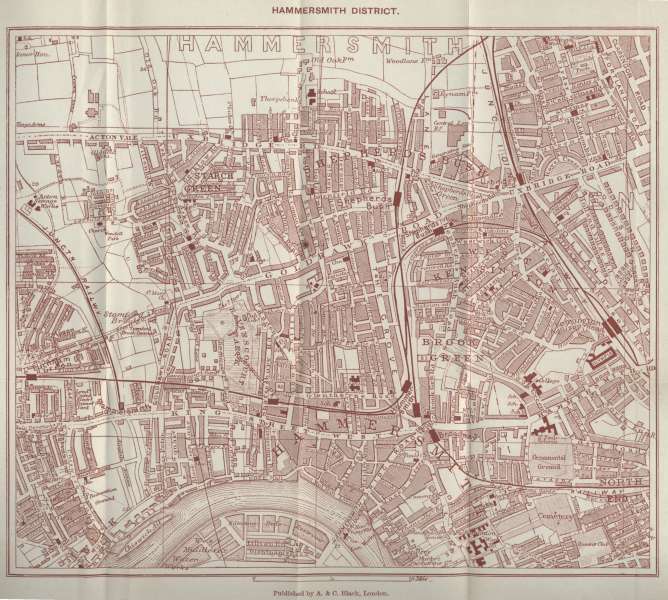 HAMMERSMITH DISTRICT.
Published by A. & C. Black, London.

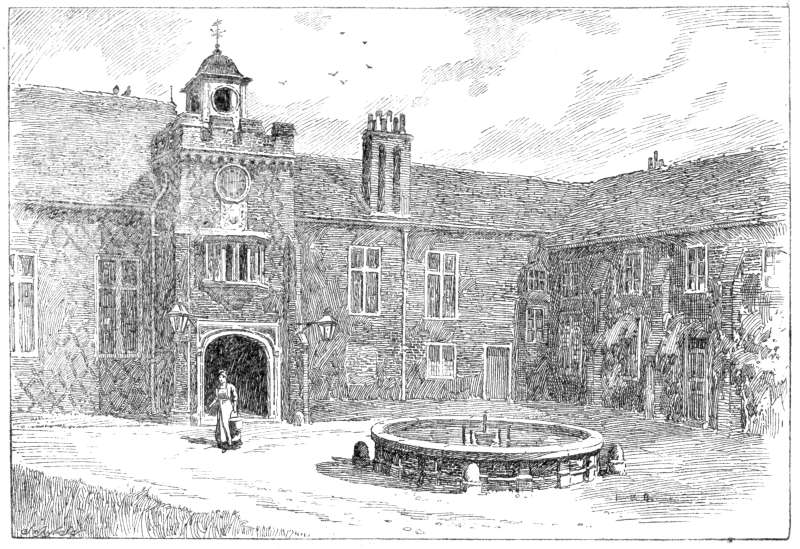 FULHAM PALACE.