It is very easy to gain a knowledge of the stars, if the learner
sets to work in the proper manner. But he commonly meets with a
difficulty at the outset of his task. He provides himself with a
set of the ordinary star-maps, and then finds himself at a loss
how to make use of them. Such maps tell him nothing of the position
of the constellations on the sky. If he happen to recognize
a constellation, then indeed his maps, if properly constructed,
will tell him the names of the stars forming the constellation,
and also he may be able to recognize a few of the neighboring
constellations. But when he has done this he may meet with a new
difficulty, even as respects this very constellation. For if he
look for it again some months later, he will neither find it in
its former place nor will it present the same aspect,—if
indeed it happen to be above the horizon at all.
It is clear, then, that what the learner wants is a set of maps
specially constructed to show him in what part of the sky the
constellations are to be looked for. He ought on any night of the
year to be able to turn at once to the proper map, and in that
map he ought to see at once what to look for, toward what point
of the compass each visible constellation lies, and how high it
is above the horizon. And, if possible (as the present work shows
is the case), one map ought to suffice to exhibit the aspect
of the whole heavens, in order that the beginner may not be confused
by turning from map to map, and trying to find out how each fits
in with the others.
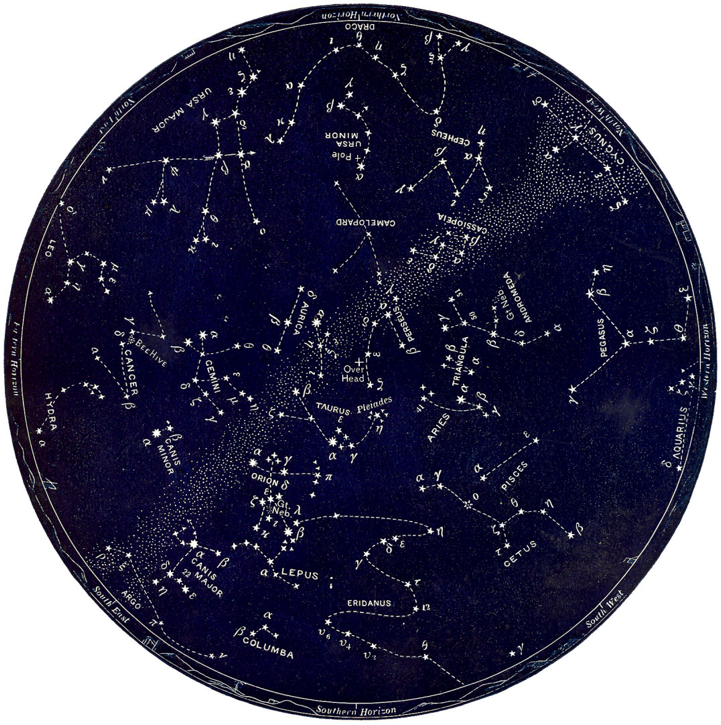
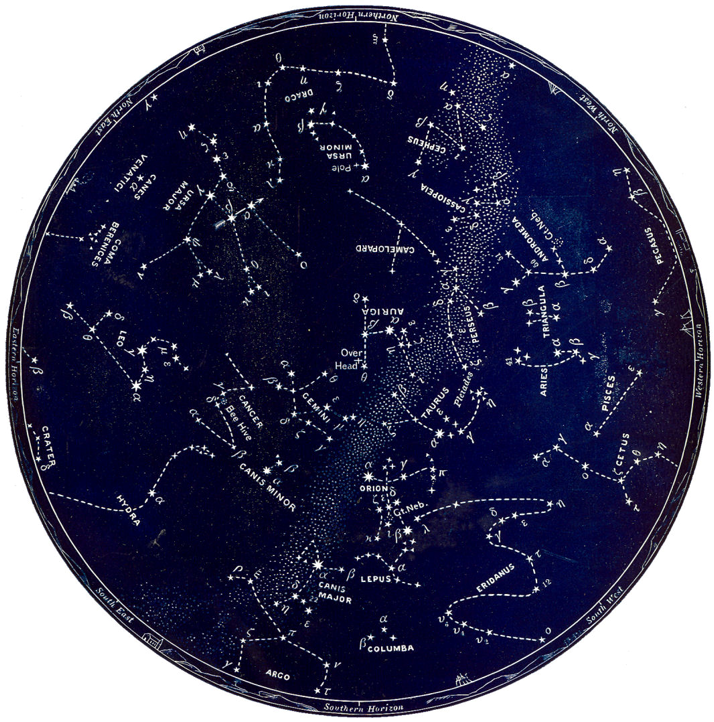
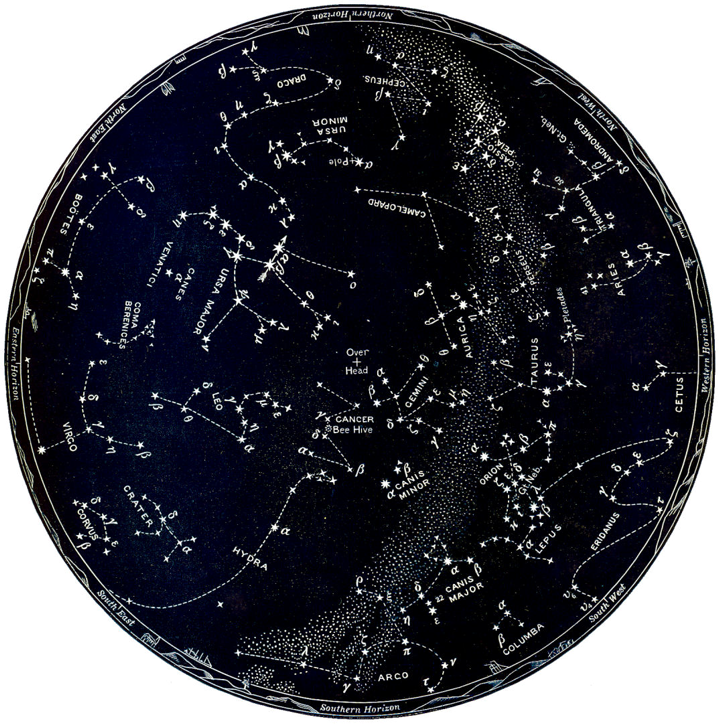
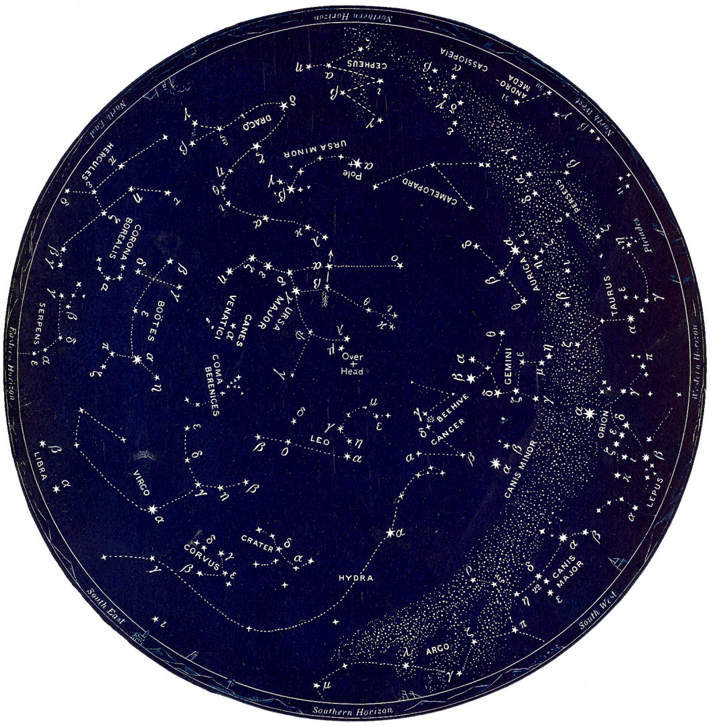
It is to fulfil these requirements that the present maps have been
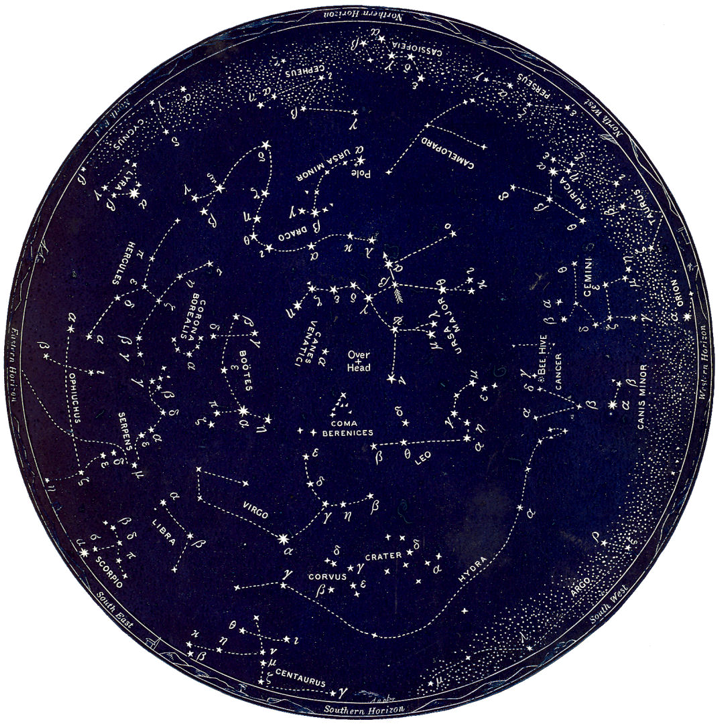
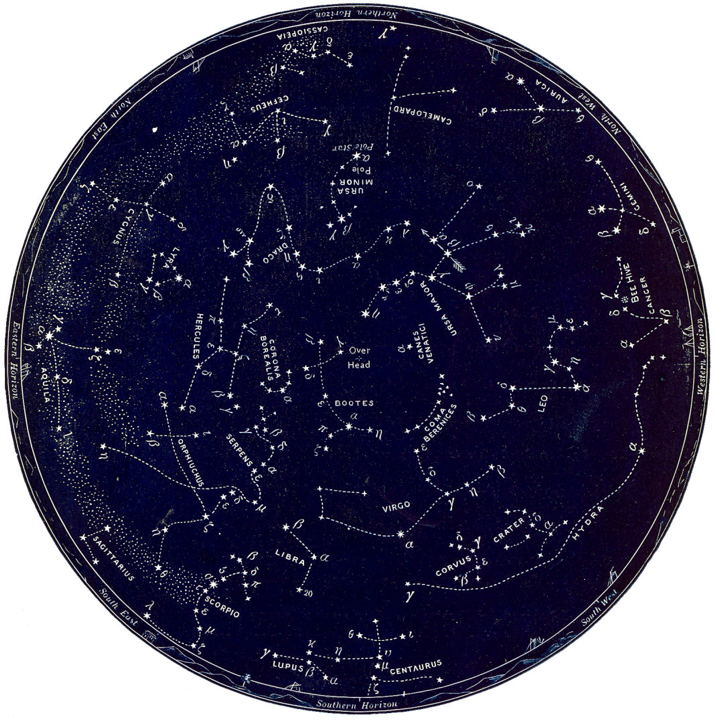
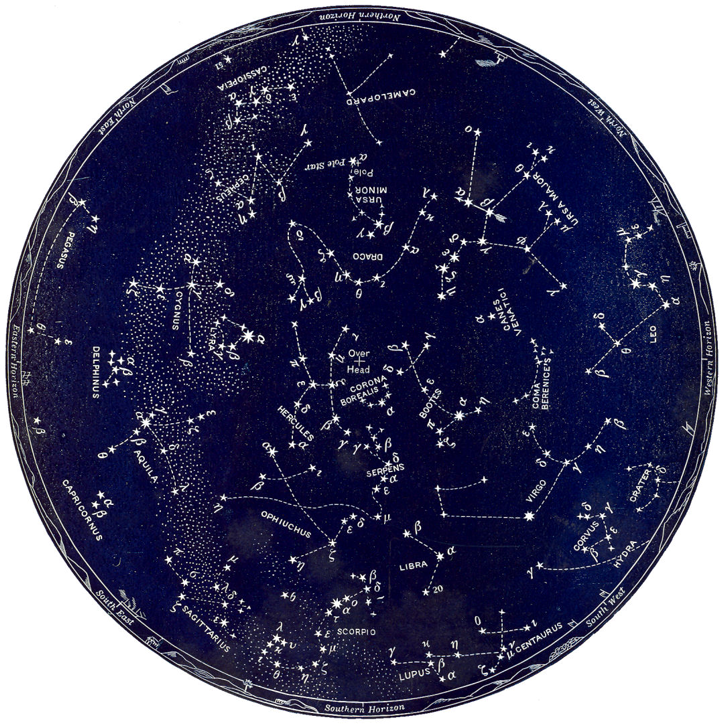
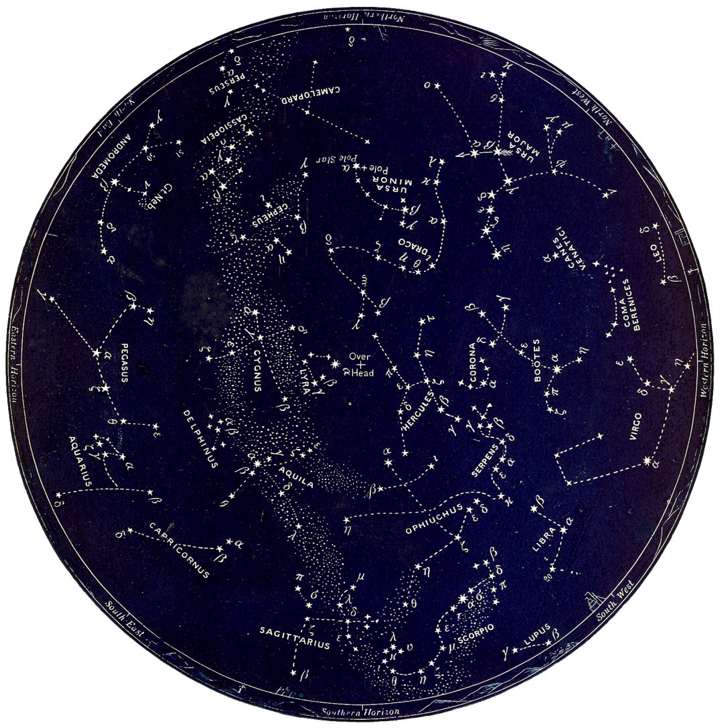
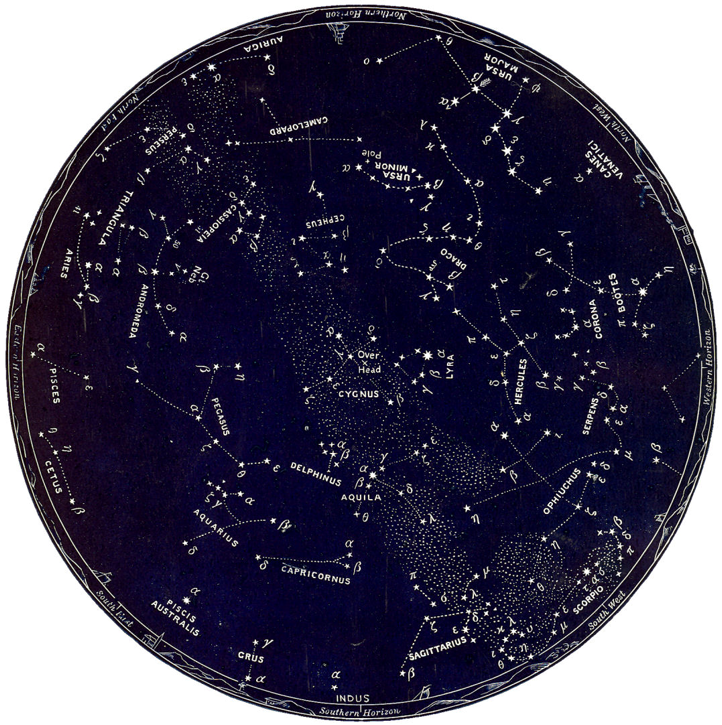
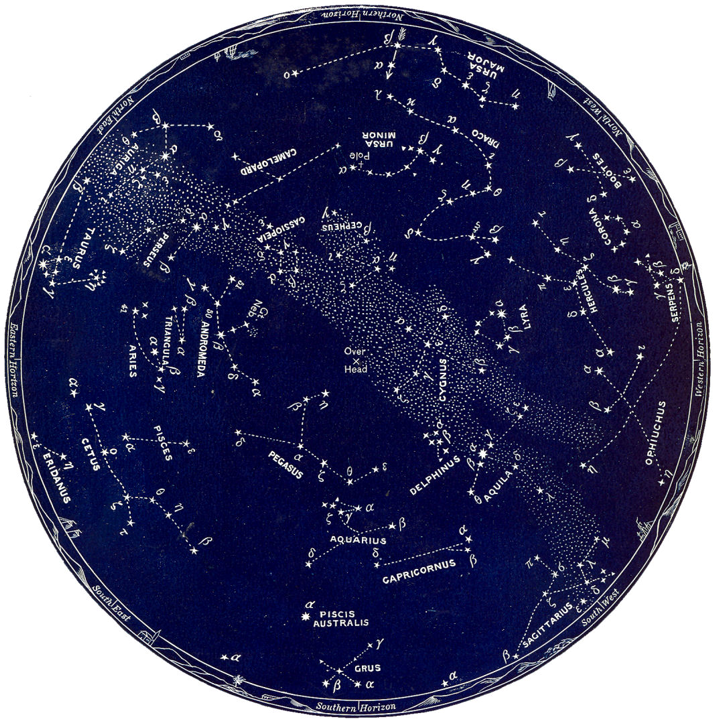
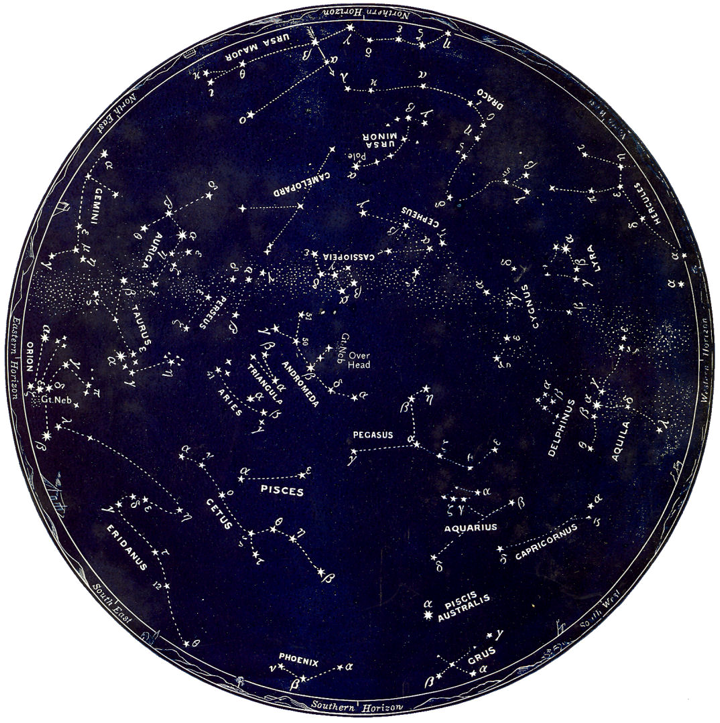
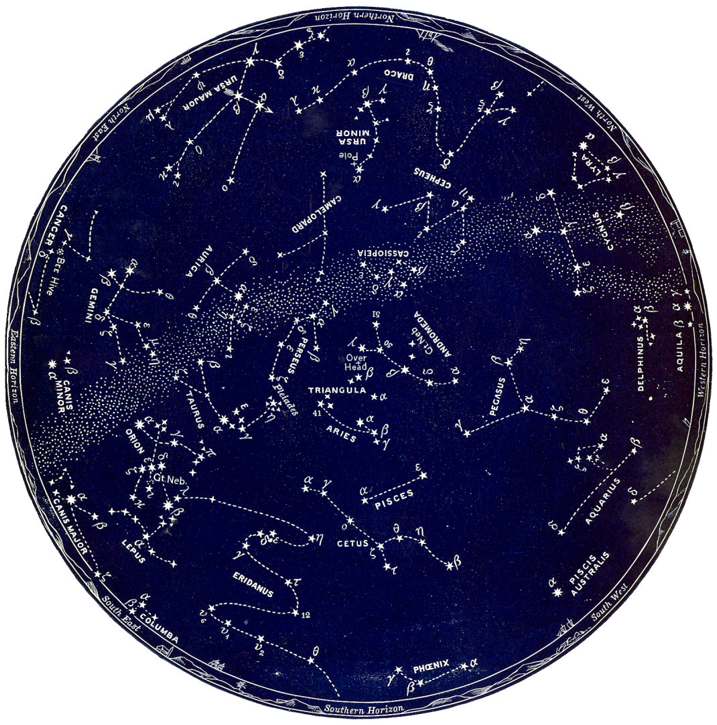
constructed. Each exhibits the aspect of the whole sky at a given
day and hour. The circumference of the map represents the natural
horizon, the middle of the map representing the part of the sky
which lies immediately overhead. If the learner hold one of these
maps over his head, so as to look vertically upwards at it, the
different parts of the horizon marked in round the circumference
being turned towards the proper compass points, he will see the
same view of the heavens as he would if he were to lie on his back
and look upwards at the sky, only that the map is a planisphere
and the sky a hemisphere.
But although this illustration serves to indicate the nature of
the maps, the actual mode of using them is more convenient.
Let it first be noted that properly speaking the maps have neither
top, bottom, nor sides. Each map may be held with any part of the
circumference downward: then the centre of the map is to be looked
upon as the top for that part of the circumference. The portion
of the map lying beneath the centre represents the portion of the
sky lying between the point overhead and a certain part of the
horizon—the part in fact corresponding to the particular
part of the circumference which is turned downwards. Thus if on
any night we wish to learn what are the stars towards the north,
we look for the map corresponding to that night. At the hour named
the stars toward the north will be those shown between the centre
of the map and the top; and, of course, Page 2 we hold the map upside down so as
to bring the centre above the northern part of the circumference.
But this matter will be more clearly understood by comparing the
account of any of the accompanying maps with the map itself.
Again, it must be noted that, although the maps are necessarily
arranged in a certain order, there is in reality no first or last
in the series. The map numbered I. follows the map numbered XII.
in exactly the same manner that the latter follows the map numbered
XI. The maps form a circular series, in fact.
The only reason for numbering the maps as at present, is that the map
numbered I. Happens to exhibit the aspect of the sky at a convenient
hour on the night of January 1st. It will be found that the dates
follow on with intervals of seven or eight days right round the year,
the end of the year falling in the left-hand column of the table
under Map I., while the beginning of the year is in the right-hand
column of the same map.[*]
It will be seen at once that a map can always be found corresponding
to a convenient hour on any night of the year. (In midsummer, on
a few of the dates mentioned under the maps, night has not begun
at the hour named.) On any date named under a map, the aspect of
the sky two hours later than that named is that represented in
the following map. Thus at eight o'clock in the evening of January
22d, the aspect of the stars is as shown in Map I. At ten o'clock
on the same night the aspect of the sky is that shown in Map II., as
a date under that map shows. Applying this rule to the few occasions
on which the hour named is not available for observation (five or
six in all out of ninety-six dates), the observer can manage as
well for those occasions as for any others.
Next, as to finding the north point, or any point of the compass
which will enable the observer to determine the rest. If he is
only familiar with the aspect of those seven bright stars of the
Great Bear which have been called the Dipper, Charles' Wain, (really
"The Churl's Wain,") the Butcher's Cleaver, and by other names,
he can always determine the north point by means of the two stars
called the Pointers, since these seven stars never set. In the
explanation of each map I have shown where the Great Bear is to
be looked for on each night, the observer being assumed to have
such a general knowledge of the direction of the compass-points,
as will suffice for the purpose of finding so marked a collection
of stars. Thus the pole-star is found, and for the purpose of such
observations as are here considered, this star may be looked upon
as marking the exact direction of the north.
Perhaps nothing further is required; but if the observer prefer
it he can determine the north point conveniently at noon by
setting up a vertical stick in the sunlight and noting the direction
in which the shadow lies. Once the observation has been made, he
can note what objects (these should be distant) lie towards the
different points of the compass, and from that time he can use
the accompanying maps without any reference to the Great Bear and
the Pointers.
It is worth noticing that the stars called the Guardians of the
Pole form no bad time-piece when used with the aid of such maps
as the present. They revolve round the pole once in twenty-four
hours (less about four minutes), in a direction contrary to that of
a clock's hands. But stars near the equator, whose motions are much
more rapid, afford a yet better measure of time, if the direction
of the south point is well determined.
Page 3 Of course,
the observer who really wishes to become an astronomer will not
rest satisfied by learning only the principal stars shown in these
maps. By means of the regular star-maps, such as those of my School
Star Atlas, he will be able to explore the depths of all the
constellations, having once learned their position and general
appearance from the accompanying maps. It will be well for the
student to remember that the planets Venus, Mars, Jupiter, and
Saturn will at times appear among the constellations here shown.
Venus and Jupiter can always be recognized by their superior light,
Mars and Saturn by the steadiness with which they shine. The almanac
will always show when these planets and Mercury (often very bright
in the clear skies of America) are above the horizon, and where
they are situate. They never appear except among the zodiacal
constellations.
For particulars and pictures of the different constellations, and
other details associated with the study of the star-groupings,
the reader is referred to my "Easy Star Lessons," published like
the present maps by Messrs. Putnam's Sons.
I have to thank the proprietors of the Scientific American
for permission to publish these maps, which originally appeared
(though in a slightly different form) in the pages of that excellent
magazine. The Latin names of the constellations included in the
maps of this series are as follows:
THE LITTLE BEAR, Ursa Minor (α, the
Pole Star; β, γ, the Guardians).
THE DRAGON, Draco (α, Thuban).
KING CEPHEUS, Cepheus.
THE LADY IN THE CHAIR, Cassiopeia.
THE CHAMPION, Perseus (β, Algol,
remarkable variable).
THE CHARIOTEER, Auriga (α,
Capella).
THE GREATER BEAR, Ursa Major (α, β,
the Pointers).
THE HUNTING DOGS, Canes venatici (α,
Cor Caroli).
QUEEN BERENICE'S HAIR, Coma Berenices.
THE HERDSMAN, Boötes (α,
Arcturus).
THE NORTHERN CROWN, Corona Borealis.
THE SERPENT, Serpens.
THE KNEELER, Hercules.
THE LYRE, Lyra (α, Vega).
THE SWAN, Cygnus (α, Arided;
β, Albireo).
THE WINGED HORSE, Pegasus.
THE CHAINED LADY, Andromeda.
THE TRIANGLES, Triangula.
THE RAM, Aries.
THE BULL, Taurus (α, Aldebaran;
η, Alcyone, the chief Pleiad).
THE TWINS, Gemini (α, Castor;
β, Pollux).
THE CRAB, Cancer (the cluster between γ
and δ is the Beehive).
THE LION, Leo(α, Regulus).
THE VIRGIN, Virgo (α, Spica).
THE SCALES, Libra.
THE SERPENT-HOLDER, Ophiuchus.
THE EAGLE, Aquila (α, Altair).
THE DOLPHIN, Delphinus.
Page 4
THE WATER CARRIER, Aquarius.
THE FISHES, Pisces.
THE SEA MONSTER, Cetus (ο, Mira,
remarkable variable)
THE RIVER, Eridanus.
THE GIANT HUNTER, Orion (α,
Betelgeux; β, Rigel).
THE LESSER DOG, Canis Minor (α,
Procyon).
THE SEA SERPENT, Hydra (α,
Alphard).
THE CUP, Crater (α, Alkes).
THE CROW, Corvus.
THE SCORPION, Scorpio (α,
Antares).
THE ARCHER, Sagittarius.
THE SEA-GOAT, Capricornus.
THE SOUTHERN FISH, Piscis Australis (α,
Fomalhaut).
THE HARE, Lepus.
THE DOVE, Columba.
THE GREATER DOG, Canis Major, (α,
Sirius).
THE SHIP, Argo.
THE CENTAUR, Centaurus.
The following table exhibits the names of all the stars of the
first three magnitudes to which astronomers have given names; at
least, all those whose names are in common use:
|
α Andromedæ, Alpheratz
|
ζ Ceti, Baten Kaitos
| α Ophiuchi, Ras Alhague
|
| β ——, Mirach, Mizar.
| ο ——, Mira
| β ——, Cebalrai
|
| γ ——, Almach.
| α Columbæ, Phact
| α Orionis, Betelgeux
|
| α Aquarii, Sadalmelik
| α Coronæ Bor, Alphecca
| β ——, Rigel
|
| β ——, Sadalsund
| α Corvi, Alchiba
| γ ——, Bellatrix
|
| γ ——, Skat
| δ ——, Algores
| δ ——, Mintaka
|
| α Aquilæ, Altair
| α Crateris, Alkes
| ε ——, Alnilam
|
| β ——, Alshain
| α Cygni, Arided, Deneb Adige
| α Pegasi, Markab
|
| γ ——, Tarazed
| β ——, Albireo
| β ——, Scheat
|
| α Arietis, Hamal
| α Draconis, Thuban
| γ ——, Algenib
|
| β ——, Sheratan
| β ——, Alwaid
| ε ——, Enif
|
| γ ——, Mesartim
| γ ——, Etanin
| ζ ——, Homan
|
| α Aurigæ, Capella
| β Eridani, Cursa
| α Persei, Mirfak
|
| β ——, Menkalinan
| γ ——, Zaurac
| β ——, Algol
|
| α Boötis, Arcturus
| α Geminorum, Castor.
| α Piscis Aust., Fomalhaut
|
| β ——, Nekkar
| β ——, Pollux
| ε Sagittarii, Kaus Australis
|
| ε ——, Izar, Mizar, Mirach
| γ ——, Alhena
| α Scorpionis, Antares, Cor Scorpionis
|
| η ——, Muphrid
| δ ——, Wesat
| α Serpentis, Unukalhai
|
| α Canum Ven., Cor Caroli
| ε ——, Mebsuta
| α Tauri, Aldebaran
|
| α Canis Majoris, Sirius
| α Herculis, Ras Algethi
| β ——, Nath
|
| β ——, Mirzam
| β ——, Korneforos
| η ——, Alcyone (Pleiad)
|
| ε ——, Adara
| α Hydræ, Al Fard, Cor Hydrœ
| α Ursæ Majoris, Dubhe
|
| α Canis Minoris, Procyon
| α Leonis, Regulus, Cor Leonis
| β ——, Merak
|
| β ——, Gomeisa
| β ——, Deneb Aleet, Denebola,
Deneb
| γ ——, Phecda
|
| α2 Capricorni, Secunda
Giedi
| γ ——, Algeiba
| ε ——, Alioth
|
| δ ——, Deneb Algiedi
| δ ——, Zosma
| ζ ——, Mizar
|
| α Cassiopeiæ, Schedar
| α Leporis, Arneb
| η ——, Alkaid, Benetnasch
|
| β ——, Chaph
| α Libræ, Zuben el Genubi
| ι ——, Talitha
|
| α Cephei, Alderamin
| β ——, Zuben el Chamali
| α Ursa Minoris, Polaris
|
| β ——, Alphirk
| γ ——, Zuben Hakrabi
| β ——, Kochab
|
| γ ——, Errai
| α Lyræ, Vega
| α Virginis, Spica Azimech, Spica
|
| α Ceti, Menkar
| β ——, Sheliak
| β ——, Zavijava
|
| β ——, Diphda
| γ ——, Salaphat
| ε ——, Vindemiatrix
|
Page 6
MAP I. NIGHT SKY.—DECEMBER AND JANUARY.
| At 11 o'clock: Dec. 7. |
|
At 9 o'clock: Jan. 7. |
| At 10½ o'clock: Dec. 15. |
At 9½ o'clock: Dec. 30. |
At 8½ o'clock: Jan. 14. |
| At 10 o'clock: Dec. 23. |
|
At 8 o'clock: Jan. 22. |
Stars of the first magnitude are eight-pointed; second magnitude,
six-pointed; third magnitude, five-pointed; fourth magnitude (a
few), four-pointed; fifth magnitude (very few), three-pointed.
For star names refer to page 4.