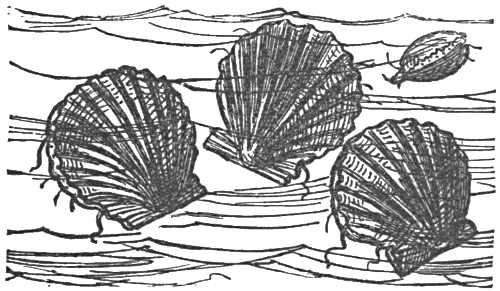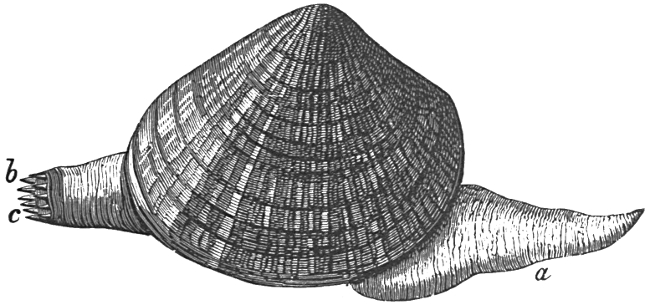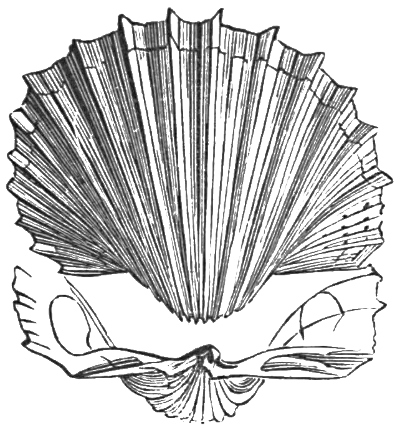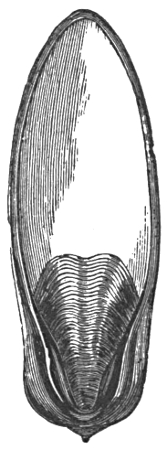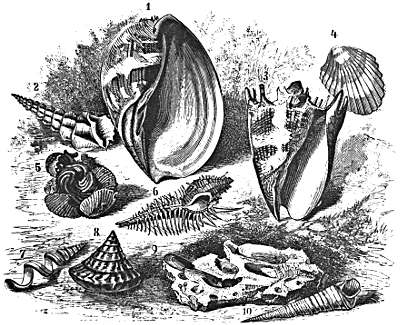
Fig. 94.—Group of shells: 1, Cymbium; 2, Cerithium; 3, Voluta; 4, Cardium; 5, Phorus; 6, Murex; 7, Vermetus; 8, Trochus; 9, Pholas; 10, Turritella.
The shells which have been noticed in the preceding
chapter belonged literally to the stay-at-homes of the
family. They rarely wander far, and many, as we have
seen, never leave the place which the young shell first
selected as its home. What are known as the univalves,
the mollusks with one shell, or perhaps no shell at all, are
the reverse of this, being in many instances travelers,
wandering here and there. This suggests that they have
more highly organized locomotive organs. Those shown
on the upper part of Figure 94 are univalves, and if we
make a section of a univalve
(Fig. 95), we see that the shell is
much more complicated than in
the previous forms. The univalve
has a shell-secreting mantle and
organs resembling those of the
bivalves, only differently placed.
This marvelous mantle performs
some singular feats, judging from
the spines found on many shells.
To make these, the mantle must
have been thrown outward and
upward, forming a tube in which
the spine was secreted.
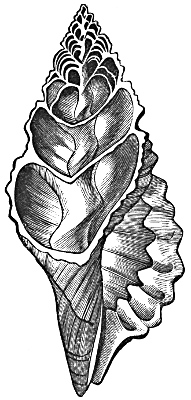
Fig. 95.—Section of a univalve.
In the univalves a distinct head
is seen (Fig. 98) with tentacles
and prominent eyes. The foot is
now elaborated into a huge sucking, clinging, disklike
organ. In the whelk it is as long as the shell, the latter
being perched high above it, presenting a remarkable
spectacle as it moves along the sandy floor of the ocean.
On the head are two tentacles, feelers or sense organs,
and sometimes the eyes are mounted on tall stalks, that
the shell may have a wide range of vision. A siphon,
such as we have seen in the clam, is present and extended
upward and forward. It protrudes from a canal formed
in the shell for the purpose, and is often very long. If
the whelk (Fig. 99) is disturbed, it suddenly withdraws
its body, including the enormous colored foot; and if the
shell is picked up, the entrance is found securely closed
by a horny door called the operculum, which is attached
to the foot (Fig. 99). This door takes many shapes. In
the beautiful conch it is saber-shaped, and is used to dig
into the sand, or, as a lever, to force the conch along by
a series of jerks. In other shells it is apparently made
of porcelain, hard and highly polished. It is well known
as the "eye stone"
of popular fancy.
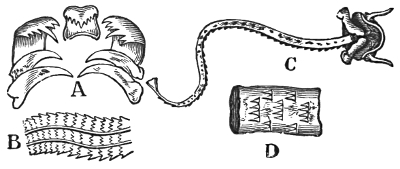
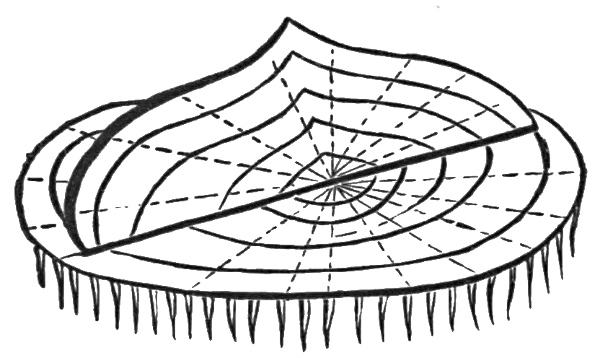
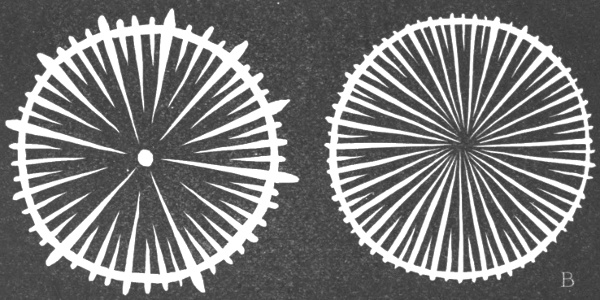
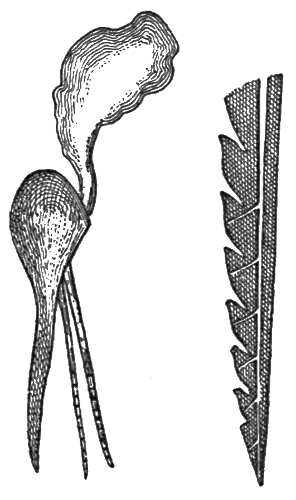
Fig. 96.—Tongue and teeth of a univalve: A, portion of tongue of Velutina; B, portion of tongue of whelk; C, head and tongue of limpet; D, portion of same enlarged.
Many of the univalves
are flesh
eaters, preying upon
others of their kind.
They have a remarkable
tongue (Fig. 96)
for the purpose, in
fact, the teeth are upon the tongue in sawlike rows. The
tongue, which is called the lingual ribbon, is ribbon shaped,
long and slender, and is really a soft, pliable saw with
which the animal bores into
the hardest shells of the helpless
clams. In strolling alongshore
a large majority of the
"dead" clam shells found
bleaching in the sun, where
they have been washed by the
sea, will be seen to contain a
circular hole of perfect symmetry
(Fig. 97). This has been made by the boring, sawlike
tongue of a univalve, which, after gaining an entrance
into the tightly locked shell, deliberately sucked it out.
It is interesting to note the location of this hole, which is
invariably over the softest and plumpest part of the victim,
near the lungs, showing that the cannibalistic univalve is
very clever in its mode of attack.
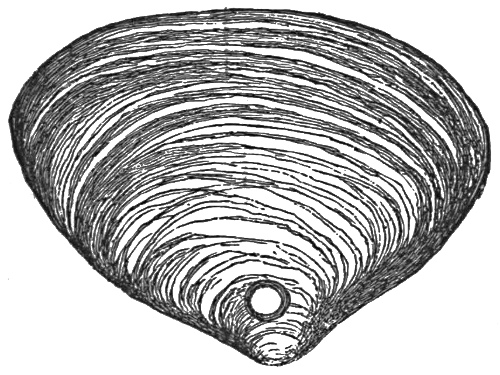
Fig. 97.—Clam shell bored by a univalve.
While the oyster deposits vast quantities of eggs, which
float out into the water to be destroyed by other animals,
many of the univalves protect their eggs in remarkable
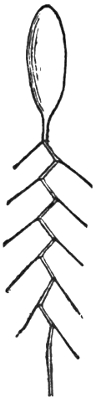
cases. I have often found on the Florida Reef strings
(Fig. 98) of singular objects which resembled sections of
a yellowish cylinder connected by a little cord. Each
section is an egg case, or capsule, and contains many
shells, the entire chain being two or three feet in length.
This becomes tangled in the coral or seaweed, and holds
the young shells, all of which escape through a little door
in each section.
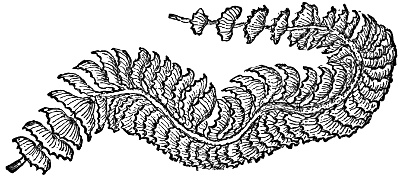
Fig. 98.—Egg case of a conch.
Other shells, as the whelk (Fig. 99), deposit their egg
cases in heaps or mounds. They are soft and spongelike,
and are often mistaken for sponges when divested of their
shells and cast ashore. Perhaps the best-known egg case
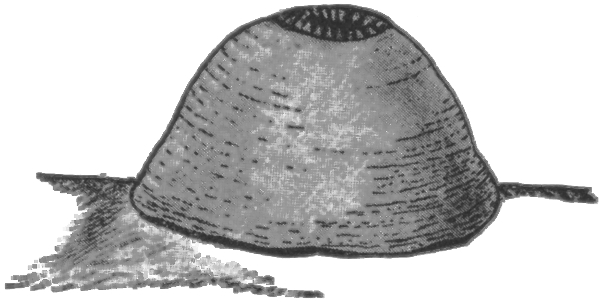
is that of the common Natica, which forms a singular
object called the "sand collar" (Fig. 100). The animal
molds this collar out of fine sand with its foot, and
deposits its eggs in the interior, all being cemented or
glued together in a solid mass. We shall find that certain
birds deposit their eggs in the nests of others, so saving
the wearying process of hatching.
A certain shell, called Nassa, has
a similar habit. At times it deposits
its eggs on the collar nest
of the Natica.
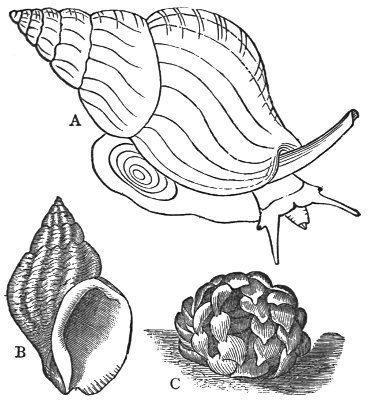
Fig. 99.—The whelk: A, living shell; B, empty shell; C, egg case.
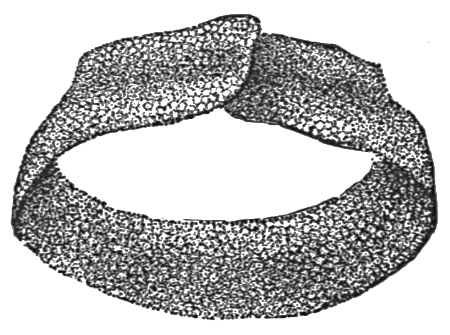
Fig. 100.—Egg case of the Natica.
Among the myriads of shells
which we may select to illustrate
the various interesting types,
shapes, and kinds, are the Chitons (Fig. 101). Their
shells are made up of many plates resembling the plates
of a hawkbill turtle. Many live in holes in the rocks,
and all have a very large, sucking, disklike foot which
clings to the rocks with great tenacity. Resembling them
somewhat are the limpets. These are
interesting and beautiful shells, especially
when polished, forming attractive domes
marvelously tinted and colored. Some
are called keyhole limpets (Fig. 102), from
the fact that they have a keyhole-like
opening in the top. They range in size from very minute
forms to giants a foot in length.
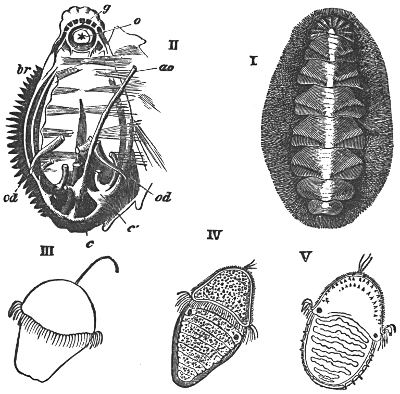
Fig. 101.—The Chiton and its free-swimming young. I. Adult, showing plates.
II. Chiton dissected: o, mouth; g, nervous ring; ao, great artery from the heart,
aorta; c, ventricle; c´, an auricle; br, left branchiæ; od, oviducts. III, IV, V.
Development of free-swimming young.
Among the most beautiful of all shells, and at the same
time the most common in tropic and semitropic seas, are
the abalones. They are also called ear shells. They
have an enormous foot that covers the entire lower surface,
being a remarkably powerful organ. Instances have
been known where Chinese abalone hunters have tried to
pry off the shell from a rock with their hands, and have
had their fingers caught and held as though by a vice.
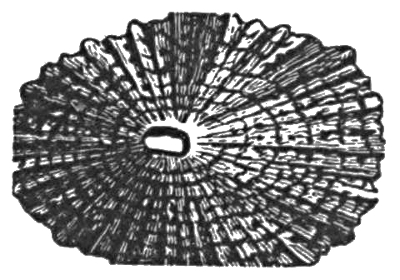
Fig. 102.—Keyhole limpet.
The Haliotis is very common on the shores of the
southern Californian islands. In some localities every
rock is covered with them, and in places where the black
abalone is common, I have found them piled one upon the
other. There are two hundred species living. Every tint,
color, or tone known in the scale of color, or its combinations,
is flashed from these marvelous shells, which, if rare,
would be counted among the most beautiful of all natural
productions. On the Californian coast they are collected
in large numbers, and when polished are converted into
buttons and a thousand and one other objects. The meat,
which is of excellent quality, is sold in large quantities to
the Chinese. Thousands of the shells are bought by
tourists, the outside being richly polished. From the
ancient graves or Indian mounds of the Californian islands
I have taken quantities, especially the large kind known as
the red abalone, showing that they were used by the
ancient inhabitants. In all of these islands heaps and
piles of abalones are found far from the water. By stopping
up the holes in the shell with asphaltum, which
drifts ashore here, the natives had an excellent dish, or
bailer. They cut the shell into earrings and ornaments
of many kinds, and most of their fishhooks were evolved
from this beautiful shell, which also supplied a large
proportion of their food.
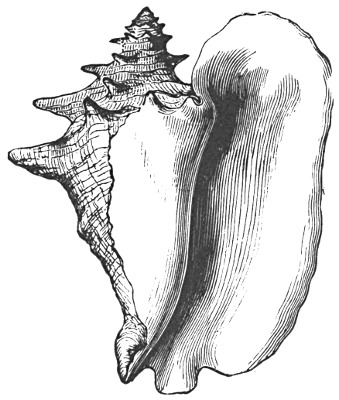
Fig. 103.—Great conch (Strombus).
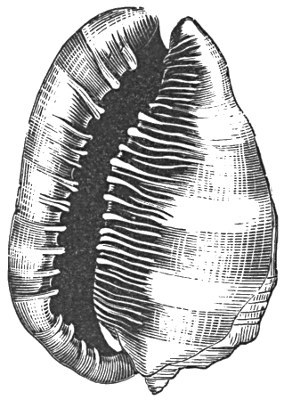
Fig. 104.—Queen conch (Cassis).
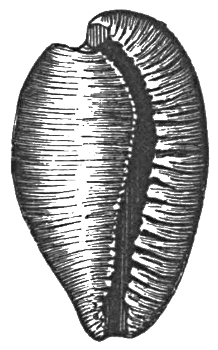
Fig. 105.—Cypræa.
On the Florida Reef the great conchs (Fig. 103) are
very common. They live on the sandy floor of the lagoons,
hitching themselves slowly along by their long-pointed,
saberlike operculums. This is the conch of commerce,
in which appears the most delicate of all pink colors, and
which is the source of the rare pink pearls. In the same
locality, but in deeper water, is found the Queen conch
(Fig. 104), which is cut into medallions and
cameos. The beautiful Cypræa (Fig. 105), of
which many varieties are known, are called
micramocks in Florida, and cowries elsewhere.
Their luster and natural polish often excite
wonder, for they commonly live concealed in
the rough portions of dead coral branches,
where they would easily become scratched.
The cowry, however, is protected by a remarkable mantle
which covers the entire shell, thus keeping its pianolike
surface as smooth as a mirror. Many cowries are beautifully
striped; some are spotted with dark spots on a
white background; some are yellow; others are red or
old gold, every tint and color seemingly being employed by
nature in painting these gems of the sea. Few other shells
have been so universally esteemed by all nations. Among
certain African tribes they are used as money, and not
many years ago collections of cowries were made with
all the ardor that actuated the tulip collectors, thousands
of dollars being paid for single shells, as the orange cowry.
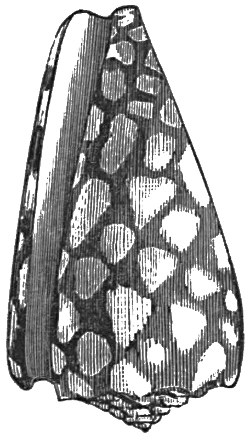
Fig. 106.—Cone shell (Conus).
The cone shells (Fig. 106) represent a beautiful
group, spotted like
leopards, striped like the
tiger, black, red, yellow.
Some shells are very pointed, like the augur shell (Fig.
107). Some have an extraordinarily long projection for
the siphon, as the spindle shell (Fig. 108). In some the
opening is very small, as the cone shells, while in others
it is immense, and protected by a large, doorlike operculum.
The Bulimas is a famous nest builder. Bulla is
interesting from the lightness and delicacy of the shell
and its rich neutral browns.
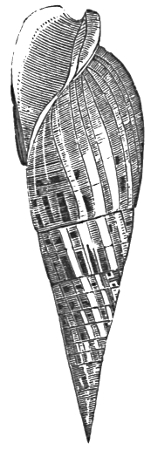
Fig. 107.—Augur shell (Terebra).
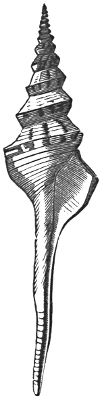
Fig. 108.—Spindle shell (Fusus).
Among the very familiar shells are the land snails
(Fig. 109), common in every garden and raised and sold in
France and Italy
as table delicacies.
Closely
allied to them
are the slugs,
which bear upon
their backs, beneath
the skin,
a delicate, scale-like
shell. On
the island of San Clemente, fifty miles off the coast of
California, I found an extensive sandy plain which was
so thickly strewn with the white, bleached snail shells
that I could hardly step without crushing several. The
verdure had died, and the snails were doubtless killed by
the direct rays of the sun.
These interesting animals are called pulmonates because
they breathe air directly.
The slugs (Fig. 110) have many peculiar characteristics.
If the long tentacles on the short eye stalk are destroyed,
the snail will reproduce them. In winter the snails descend
into the ground, or hide themselves away, literally sealing
themselves in their shells by closing the door firmly, and
there hibernate until spring, neither eating nor drinking,
and hardly breathing during this time; if placed in a cold
storage box, they will remain several years in this state.
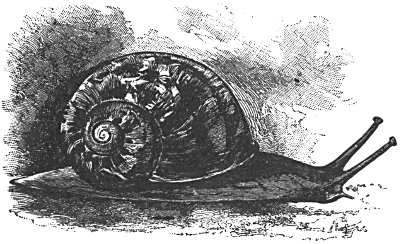
Fig. 109.—A snail crawling.
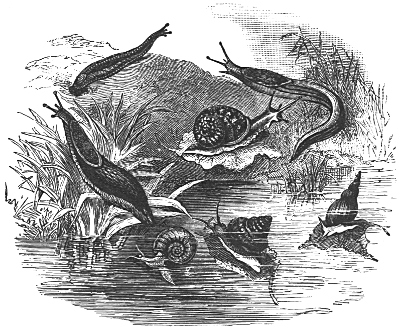
Fig. 110.—Slugs and snails.
Some of the snails of Africa are six inches across, and
the eggs are an inch in length. Semper found a little
snail in the Philippines, which when caught by the foot or
"tail" throws it off as a lizard jerks off its tail. This is
not a great hardship, as the tail is soon renewed. In a
collection of shells which came from France some years
ago I found several snails of different colors which were
joined one to the other. The collector had cut the top
from an empty brown snail and placed a living snail with
a yellow shell upon it, tying the two together. The snail,
supposing that its shell had been broken, immediately
began to repair the wound, and closed up the breach with
its shell-secreting mantle, so that the two shells became
one.
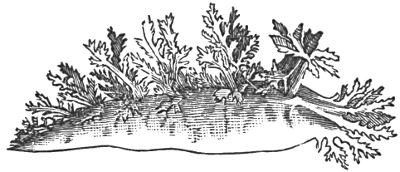
Fig. 111.—A sea slug (Dendronotus).
In floating on the borders of the Sargasso Sea, the
vast sea of weeds in the South Atlantic, I found numbers
of a beautiful sea slug (Fig. 111) which so resembled the
weeds in shape and color, a rich olive green, that it was
almost impossible to distinguish it, except when very close
to the surface. They
have attractive names,
as Doris, Tritonia, Æolis,
and Aplysia, and are
among the wonders of the
great belts of kelp which
surround the continent. I once found a slug at Santa
Catalina which was a vivid, almost iridescent purple;
another was yellow; but the most interesting was Aplysia,
a giant two feet long, which I kept in an aquarium.
It weighed nearly eight pounds, could lengthen itself
out to a distance of nearly three feet, or contract into a
dark, olive-hued ball, scarcely six inches across. It took
sea lettuce from my hand, eating with avidity, and when
disturbed emitted a purple ink which filled the water and
hid the monster "sea hare" from view. It laid its eggs
on the sides of the tank in long chains, but if not well
fed, exhibited a decided cannibalistic tendency, devouring
its own progeny. This animal had an enormous foot by
which it crept rapidly along, and it invariably protected
itself by imitating the color of the bottom upon which it
rested.
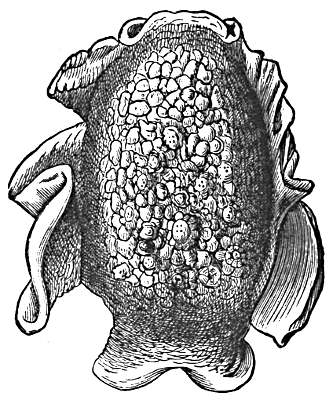
Fig. 112.—Onchidium, a sea slug with eyes on its back.
One of the most interesting slugs is the Onchidium
(Fig. 112). According to the naturalist Semper, it has
upon its back numerous eyes, which enable it to see
from above. It is a mud-loving form, common in our
new provinces, the Philippines,
where the heat is intense and
the water warm. One of the
land slugs, Limax noctiluca,
emits light; and the eggs of
another, Arion, have been
noticed to be luminous for
nearly two weeks after being
deposited.
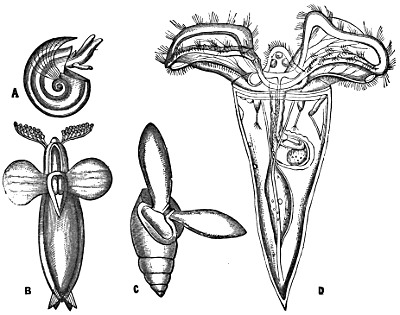
Fig. 113.—A, B, C, pteropods; D, young of Cleodora, all highly magnified.
Nearly all these shells are
slow-moving animals, but there
are others, the pteropods
(Fig. 113), which are swimmers.
The veritable fairy craft of the sea, they are
housed in shells of dainty structure and moving by singular
winglike fins, which give them the name of ocean
butterflies. They have the property of phosphorescence
to a remarkable degree. Cleodora (Fig. 113, D) emits a soft
light which gleams through the delicate shell like a light
in a lantern. In swimming it moves its fins up and down
very much like a butterfly, so that they touch at the top.
As delicate and dainty as this little creature is, it has a
marvelous arrangement for seizing prey, each tentacle
having about three thousand transparent cylinders, each
of which contains twenty stalked suckers. As there are
six tentacles on each sucker, Cleodora can grasp its prey with
three hundred thousand hands. Equally dainty in its way
is the sea snail, Ianthina, a violet shell of great delicacy,
whose foot develops a raft which resembles a mass of
soap bubbles, so the violet snail floats upon the surface
of tropical and semi-tropical
seas. I
have seen the shores
of the keys of the
Florida Reef lined
with an undulating
ribbon of these
shells after a storm.
When touched they
emit a rich violet ink
which lasts a long
time as a stain.
A small species of Ianthina is found in the winter on the
southern Californian shores, and beneath the attractive
float will be found the eggs.
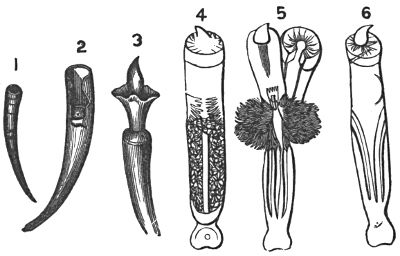
Fig. 114.—1, Dentalium entalis, natural size; 2,
shell magnified, and broken to show animal within; 3, animal projecting from the shell; 4, animal from below, magnified;
6, same from above; 5, same, showing internal structure.