CHAPTER II — CHAPTER III — CHAPTER IV — CHAPTER V — CHAPTER VI — CHAPTER VII — CHAPTER VIII — CHAPTER IX — CHAPTER X — CHAPTER XI — CHAPTER XII — CHAPTER XIII — CHAPTER XIV — MOLL CUTPURSE: THE "ROARING GIRL" — CAPTAIN PHILIP STAFFORD — CAPTAIN JAMES HIND, THE "PRINCE OF PRIGS" — JOHN CLAVEL, "GENTLEMAN" — WILLIAM DAVIS, THE GOLDEN FARMER — THOMAS SIMPSON: "OLD MOB" — CLAUDE DU VALL — FRANCIS JACKSON, AND HIS "RECANTATION" — CAPTAIN RICHARD DUDLEY — FOOTNOTES: — Transcriber's Note:
A Compleat
HISTORY
of the
LIVES AND ROBBERIES
of the most Notorious
Highway-Men, Foot-Pads, Shop-Lifts,
and Cheats of both Sexes, in and about
London and Westminster, and all Parts of
Great Britain, for above an Hundred Years
past, continu'd to the present Time.
Wherein their most Secret and Barbarous Murders,
Unparalell'd Robberies, Notorious Thefts,
and Unheard of Cheats, are set in a true Light,
and Expos'd to publick View, for the common
Benefit of Mankind.
To which is prefix'd,
The Thieves New Canting-Dictionary,
Explaining the most mysterious Words,
New Terms, Significant Phrases, and Proper
Idioms, used at this present Time by
our Modern Thieves.
By Capt. ALEX. SMITH.
The Fifth Edition (adorn'd with Cuts) with the Addition
of near Two Hundred Robberies lately committed.
In Two Volumes.
London. Printed for Sam. Briscoe, and sold by
A. Dodd at the Peacock without Temple-Bar, 1719.
Captain Alexander Smith took an immense
delight in his villains. You cannot fail to perceive,
if you read his book, that his only contempt
was for a bungler in the art. Royalist to the
heart's core of him, he expends his most loving
labours upon the freebooters who displayed his
own political bias, and there can be little doubt
that, while they did the robbing, it is the
eloquence of Smith himself that supplies the embittered
harangues, which the victims of Captain
Hind, of Stafford, and of many another in his
pages are supposed to endure. Nay, Smith enriches
the career of many a Royalist highwayman
with incidents those gallant fellows were entire
strangers to; and himself robs (in the mere
narration of pen, ink, and the printed page)
prominent Puritans, who in actual life were
assuredly never "held up" on the road.
The convention of disapproval of his heroes'
villainies sits very lightly upon Alexander Smith.
He pays that merest homage to virtue, but then
starts rollicking through the biographies of the
highwaymen with an unmistakable gusto. His
table of comparative sinfulness is an oddity in
itself. He says, ".... we have given them
Precedency according as they excelled one another
in Villainy. In their general Character
the Reader will find the most unaccountable
Relations of irregular Actions as ever were
heard; penn'd all from their own Mouths, not
borrow'd from the Account given of Malefactors
by any of the Ordinaries of Newgate...."
He then continues, not very convincingly: "If
we have here and there brought in some of
these wicked Offenders venting a prophane Oath
or curse, which is dash'd" (much is left to the
imagination in a ——) "it is to paint them in
their proper Colours; whose Words are always
so odious, detestable, and foul, that some (as
little acquainted with a God as they) would be
apt to conclude that Nature spoil'd them in
the Making, by setting their Mouths at the
wrong end of their Bodies."
Sir John Falstaff strangely comes first in this
Valhalla. Who ever, loving the Shakespearian
Falstaff, would have expected him to be exalted
on this particularly bad eminence, over the heads
of the several atrocious murderers Smith does
not scruple to include in his pages?
Johnson, Smith's copyist of twenty years later,
like his precursor, boggles at no marvellous tale.
They knew the temper of their times and worked
in accord with it. Why be a critic in an uncritical
age?
There were poets before Homer, but by all
accounts they were a sorry lot; and there were
biographers of highwaymen before Alexander
Smith, but for the most part their works are
deadly dull. They had excellent materials, but
did not know how to handle them. Shakespeare
alone, in the scenes on Gad's Hill with Falstaff
and Prince Hal and the men in buckram, knew
the way, and all London laughed with him at
those merry adventures; but such tiresome productions
as the Life and Death of Gamaliel
Ratsey, published in 1605, continued to appear.
That little work is typical. Gamaliel Ratsey—whether
a real or imaginary person I dare not
say—appears by this publication to have been
"a famous thiefe in England, executed at Bedford
the 26 of March last past, 1605." Probably there
was a Gamaliel Ratsey, highwayman, hanged
then and there; but the adventures related of him
are almost certainly inventions: well invented,
but told without the slightest scintilla of literary
merit. Yet this ragbag stuff has figured in
reprints of "old English literature." So much
the worse, then, for Old English literature, if
this be representative; or, more likely so much
the worse for the critical ability of those who
considered it worth disinterring on those grounds.
It is not "literature," and not representative of
what old England could then produce in literature;
but it is valuable as one of the origins of
the highwaymen legends.
Gamaliel Ratsey, according to this publication,
was born at Market Deeping, in Lincolnshire, the
son of a respected local gentleman, one Richard
Ratsey, who held a position in the service of
a greater gentleman: an esquire, probably, in
the train of a nobleman. His only son, Gamaliel,
received a good education, but was of a roving
disposition and went over to Ireland and joined
the army of occupation there, under the Earl of
Essex. He so distinguished himself, early in
those operations, that he was made sergeant.
Soon after the death of Queen Elizabeth, he
returned to England with the Earl of Devonshire,
and went home to Market Deeping. At the not
far distant town of Spalding he began his filching
career, by making use of the good terms he
enjoyed with the landlady of an inn to steal
a bag containing £40 in gold, which had been
entrusted to her keeping by a farmer attending
the market. To convince Ratsey how trusted
a person she was, she foolishly showed where she
had placed the bag; and as soon as her back was
turned he had taken it from the cupboard where
it lay, and made off.
When the farmer returned and wanted his
money, there was the very deuce to pay. He and
the landlady went off to the nearest justice and
swore an information against Gamaliel, who was
arrested and thrown into prison, but not before he
had found time to return home and bury the bag
in the garden. In confidence he told his mother
where it was hid, his mother told his sister, his
sister told her husband, her husband told his
friends, and so at last the confession reached the
ears of the justices. Gamaliel would undoubtedly
have been hanged on that occasion, only he broke
prison and escaped, clad only in his shirt.
His further adventures with Snell and
Shorthose, two companions of like inclination,
are in themselves amusing when reduced to less
stilted language than that of the Life. Curiously
enough, one of these incidents is concerned with
the robbing of an actor, whom Ratsey bids deliver
his money first, and a scene from Hamlet afterwards.
So it was not from any want of acquaintance
with the best models that the unnamed
author of Ratsey's life failed to put life into
his narrative. The incident is treated in as dead
and wooden a manner as the rest.
A Cambridge scholar, robbed in similar manner,
was bidden deliver a learned thesis. We find
almost exactly parallel stories in Smith and
Johnson. In those pages it is Sir Josselin
(? Joscelin) Denville and his numerous band of
robbers, who, meeting a Benedictine monk in a
wood, make him preach a sermon in praise of
thieving. Captain Dudley, a hundred years or so
later, is represented demanding a sermon from a
clergyman.
More shadowy even than Robin Hood, is
"Thomas Dun." We may be in some reasonable
doubt as to the validity of many incidents and
biographies in the pages of Smith and Johnson,
but there is no possible doubt whatever that the
"Life of Thomas Dun" is what one of our own
eighteenth-century highwaymen and cutpurses
would have called a "flam." There was never
a Thomas Dun, highwayman, bandit, and murderer,
as depicted in those classic pages; but the fact
that he was a myth does not prevent those
painstaking authors from presenting us with a
very exact narrative of his deeds.
The curious "moral reflection" prefaced to
Thomas Dun's entirely apocryphal adventures
is itself worth reproducing. It says: "A man
who is not forced from necessity or a desire
of pleasure to become dishonest, but follows his
natural dispositions in robbing and maltreating
others, will generally be found to be destitute
of every humane and generous principle. So will
it be found with this character—a person of
mean extraction—who was born in Bedfordshire,
and who, even in childhood, was noted for his
pilfering propensity and the cruelty of his disposition."
He lived, it seems, in the time of Henry the
First, "and so many were his atrocities," writes
Johnson, "that we can only find limits for the
recital of a few." The limits were perhaps more
accurately determined by Johnson's own powers
of invention.
Johnson did not, of course, invent Thomas
Dun. He is the child of the ages. Equally with
Robin Hood, every generation, until the decay
of folklore, added some new touch to him, and
Johnson did but reduce him to print, add a little
more, and shape him out of the somewhat formless
but threatening figure he presented.
There is this much basis for him: that, on
the site of the town of Dunstable, and for some
distance along the Holyhead Road in that direction,
there extended, from Saxon times until the
reign of Henry the First, a dense thicket of scrub
woods, overgrowing the ancient ruins of the Roman
station of Durocobrivæ. From the time of the
Norman conquest the neighbourhood had been
infested with robbers, and it was to drive them
out and establish some sort of order that the king
had clearings made in the woods that afforded
such safe harbourage for outlaws. Under Royal
encouragement a new town was founded, and in
1131 given, with the rights of market, to a priory
that had been founded in the meanwhile. The
King himself had a residence at "Dunstaplia,"
as the town was named, i.e. the "hill-staple"
or market, and his successors were often there.
The wool market was the most important at
Dunstable; the monks long maintaining great
flocks of sheep on the adjacent downs.
The robbers became only a memory, but a
memory that never faded. It merely took on
another form, and in the course of time the name
of the town itself was twisted into an allusion
to them and to their leader. It needed the collusion
of gross ignorance and wild legend to effect
so much, but the thing was done; and for centuries
Dunstable was, and perhaps even now is,
locally said to owe its name to "Dun's Stable,"
a hollow in the chalk downs, pointed out as having
been the place where "Dun," the entirely imaginary
leader of the outlaws, stabled his horse.
If you doubt this there is the town seal to convince
the sceptical, showing as it does what is
said to be a horseshoe (a shoe of Dun's horse!),
but is really intended for a staple or hasp.
The legendary Dun was a kind of bogey to
the children of the neighbourhood, and in Johnson's
pages is a most blood-thirsty creature.
There we read that his first exploit was on the
highway to Bedford, where he met a waggon full
of corn, going to market, drawn by a fine team
of horses. He accosted the waggoner, and in the
midst of conversation stabbed him to the heart
with a dagger. He buried the body, and drove the
waggon off to the town, where he sold the corn
and the waggon as well, and then disappeared!
Dun had a great animosity to lawyers (or,
rather, the authors of the legends worked into
them their own dislike of the legal profession,
and it is curious to note how this runs, like a
thread, throughout all the fabric of highwaymen
stories), and, hearing that some were to dine at
a certain inn at Bedford, went hurriedly into the
house about an hour before the appointed time,
and desired the landlord to hasten with the dinner,
and to provide for ten or twelve. The company
soon arrived, and while the lawyers thought Dun
a servant of the inn, the innkeeper thought him
an attendant of the lawyers. He bustled about,
and on the bill being called for, collected the
amount, and walked off with it. The company,
tired of waiting for him to return with their
change, rang the bell for it, and then discovered
him to be an impostor. And the hats and cloaks
and the silver spoons had gone too.
Dun became such a terror, that the sheriff of
Bedford assembled a considerable force to attack
him and his band. But Dun, finding his own
men to equal, if not actually to outnumber, those
sent against him, assumed the offensive, and,
furiously attacking the sheriff's expedition, routed
it and took eleven prisoners, whom he hanged
upon trees in the woods, by way of a hint how
rash a thing it was to interfere with him. Removing
the prisoners' clothing, they dressed
themselves in it, and forming a plan to rob the
castle of a neighbouring nobleman, appeared
before it in the uniform of the sheriff's men and
demanded admission, "to search for Dun." Failing
to find him, they requested all the keys of the
place, to make a narrower search, and so looted
many costly articles. Upon a complaint being
lodged with the sheriff, the ruse was belatedly
discovered.
It would be wearisome to follow all the fables
that tell of Dun's twenty years' bloodstained
progress to the scaffold. There is this much to
be said in commendation of the popular legends
of bandits: that when they are shown to be really
bad, without redeeming traits, the legends duly
see to it that justice is satisfied. And so with
Dun, who is made to end disastrously at Bedford,
even without the advantage of a formal trial.
"When two executioners approached him he
warned them of their danger if they should lay
hands on him," and when they insisted upon
doing so he struggled with them so successfully
that he flung them nine times upon the scaffold,
before his strength gave way. The crowds who
gloated horribly over executions at Tyburn and
elsewhere never had so great a treat as pictured
in this fictitious scene: but this was merely the
appetiser, the anchovies, so to speak, before the
more solid course. Better was to follow.
The original executioners having been put out
of action by Dun's violence, reinforcements were
brought to bear, and did their business very
effectually. "His hands were first chopped off
at the wrist; then his arms at the elbows; next,
about an inch from the shoulders; his feet below
the ankles; his legs at the knees; and his thighs
about five inches from the trunk. The horrible
scene was then concluded by severing his head
from the body, and consuming it to ashes. The
other portions were set up in the principal places
of Bedfordshire."
This by no means pretty ending, when told
to children, terrified them more than all the
terrific deeds attributed to Dun himself, and
often woke them at night, screaming.
ROBIN HOOD AND HIS MERRY MEN
Bold Robin Hood
Was a forester good
As ever stepped in
The merry greenwood.
The mythical Thomas Dun's redeeming qualities,
supposing him, indeed, to have possessed any, are
not set forth in those legends of him. He is a
blackguard shape; while the equally legendary
Robin Hood is one of the brightest figures of
romance.
Robin Hood is a poor man's hero, and has
been, for over seven centuries, to the peasantry of
England something of what King Arthur was
to the nobles and the aristocracy. While
Arthur was, and is some day again to be, the
national hero in the larger issues of war and
conquest, Robin remains the lion-hearted outlaw;
warring from his boskage in the greenwood of
Sherwood Forest, or Barnsdale, against the rich
oppressors of the people, whether they be the
nobles or the fat ecclesiastics of mediæval satire.
Many industrious writers have sought to
reduce the Robin Hood myths to a connected
whole, and to trace their origin, but the task has
proved hopeless. He is as pervasive as the winds,
and came whence no one knows, but may be traced
back to the reign of Edward the Second, when he
was already fully established as a ballad hero.
Ritson, who collected and edited the ancient
literature referring to him, is of opinion that he
was a real person, Robert Fitzooth, and was born
at Locksley, in Nottinghamshire, in 1160. But
no evidence settles that point, and it is abundantly
possible that he was really evolved from dim
memories of Hereward the Wake, the Saxon hero,
who long withstood William the Norman in the
fens of Ely. In course of time his championship
of a conquered nation was lost sight of, and
merged into the endearing character of an English
yeoman, outlawed for debt, taking refuge with
others of his kin in the forest, whence they levied
toll upon the oppressor, and, as they themselves
were outlawed, respected no law, save that of the
greenwood, where the best man was he who could
draw the stoutest bow and shoot the straightest;
who could make the best play with that truly
English weapon, the quarter-staff, or deal the
mightiest blow with the fist.
The whole cycle of Robin Hood legend is
delightfully and most characteristically English,
instinct with the purest and most passionate love
of the countryside, and nerved with the championship
of manhood's rights and with the fiercest
hatred of the law and of the ruling classes in days
when laws were the repressive measures instituted
by the wealthy for the purpose of denying simple
justice to the poor. The hatred of authority and
the armed resistance to it, that are the leading
features of Robin Hood legend, are no mere
criminal traits, but violent protests (the only kind
of protest then possible) against the bloody forest
laws of the Norman and Plantagenet times, and
the system by which the peasantry were serfs,
with no more social rights than the negroes
enjoyed before their emancipation in 1833.
Robin Hood legend was for centuries the
expression of what might now be styled Liberal,
or even Radical, or Socialist opinion, but it has an
innate poetry and chivalry which those modern
schools of thought conspicuously lack; and indeed,
as personal liberty broadened, so did the legends
of this splendid figure of romance become blunted
and vulgarised in the countryside, until he is made
interchangeable with the highwaymen who had
only their own pockets to fill and no cause to
represent.
How popular and how astonishingly widespread
was the story of Robin Hood, we may readily
guess from the many places or natural objects
named after him. "Robin Hood's Butts" on the
racecourse near Onibury, a mile and a half from
Ludlow, are still pointed out. They are in the
nature of sepulchral barrows. From there, says
legend, Robin Hood shot an arrow that sped the
mile and a half to Ludlow church, and fixed itself
on the apex of the gable of the north transept!
An arrow is certainly there, but Robin never shot
it. It is, in fact, an iron likeness of an arrow,
and is the sign of the guild of Fletchers, or arrow-makers,
who built the transept.
There are other "Robin Hood's Butts" in the
country: his "Cairns" on the Blackdown Hills
in Somerset; "Robin Hood's Bay," on the Yorkshire
Coast; his "Barrows," near Whitby;
"Robin Hood's Tor," near Matlock; boundary-stones
in Lincolnshire, known as "Robin Hood's
Crosses"; a large logan-stone in Yorkshire, styled
his "Penny Stone"; a fountain near Nottingham
that figures as his; "Robin Hood's Well," between
Doncaster and Wetherby; "Robin Hood's Stable,"
a cave in Nottinghamshire; a natural rock in
Hopedale, Derbyshire, known as his "Chair";
his "Leap," a chasm at Chatsworth. A number
of ancient oaks are "Robin Hood's," and legends
of his exploits still cling to Skelbrooke Park,
Plumpton Park, Cumberland, Feckenham Forest,
Worcestershire, and the forests of Sherwood,
Barnsdale, Needwood, and Inglewood.
The forest of Inglewood, in Cumberland, is
indeed associated with other outlaws as legendary
as Robin himself or as that Irish figure of wild
romance, "Rory o' the Hills." Andrew Bel,
William of Cloudisdale, and Clym o' th' Clough
are the great woodland triumvirate of the north.
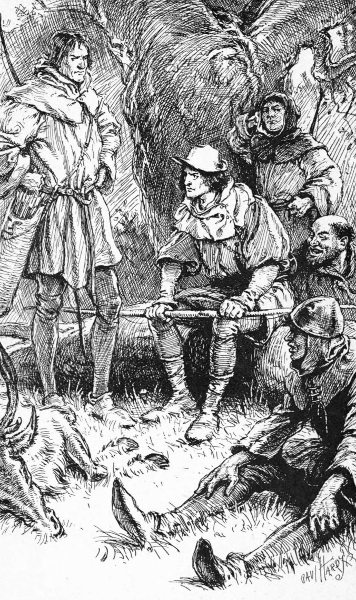
ROBIN HOOD, UNDER THE GREENWOOD TREE.
It would be a thankless office to dwell greatly
upon the probability that Robin Hood, as an
individual person, never existed, and that he was
perhaps not even typical of the woodland outlaws
of old, whose ideas and practices doubtless fell
far short of the ballad Robin's ideals. It is much
more pleasant to consider the romantic spirit that
evolved him and gave him his exquisite setting
of mossy glades and giant oaks, where the sun
comes in golden-green shafts through the embowering
foliage, and you hear the winding of
the hunters' horns in chase of the deer. There
is a springtime gladness in the old verses, of
which this is typical:
Whan shaws bene sheene and shroddes full fayre,
And leaves both large and longe,
Itt's merry walking in the fayre forrist
To hear the small birdes songe.
To se the dere draw to the dale,
And leve the hillës hee,
And shadow hem in the levës grene,
Under the grene-wode tre.
It is the springtime of the year and of the
English nation that you glimpse in these lines;
a picture of that larger rural England of possible
adventure, and uncontaminated skies that is now
a thing of the past.
Nature is portrayed in these ballads with a
vividness and certainty that more ambitious poets
cannot match:
The woodweele sang and wold not cease,
Sitting upon the spraye,
Soe lowde, he wakened Robin Hood,
In the greenwood where he lay.
It is versification of the simplest and the most
sincere kind.
Robin Hood, real or imaginary character, has
himself no criminal taint, but he is one of the
original founts whence the stream of highwayman
legend is fed. It does not, or should not, sully
his fame, that the stream becomes polluted with
much vileness as it flows down the channel of
time. A gradual vulgarising of the beautiful old
story of the manly outlaws in Lincoln green,
who went on foot and chased and shot the deer,
and redressed wrongs in the leafy coverts, is sadly
to be noted; and by the middle of the eighteenth
century it became so obscured that it was possible
for one of the booksellers of the time to foist upon
an undiscriminating public an absurd production, in
which Robin and the seventeenth-century Captain
Hind figure as contemporaries. The poor threadbare
rags of chivalry are thrown over the recreant
shoulders of the highwaymen, but they suit them
ill; and the fine clothes the highwaymen sometimes
wore and the excellent horses they rode,
do not hide from us their essential coarseness.
When Langland's Vision of Piers Plowman was
written, about 1362, Robin Hood long had been a
popular figure; and in that wonderful descriptive
poem we find, among those lifelike figures, Sloth,
the priest, who confesses himself ignorant of
hymns of the Saviour and the Virgin, and unable
even to repeat his paternoster; "but," he says,
"I can ryme of Robin Hode."
That confession would scarce have pleased the
real Robin, who was an exceedingly religious
man. In the oldest ballad surviving of him, he
is found lamenting that he has not been to mass
for a fortnight, and he thereupon, at great risk,
goes to Nottingham town, to repair the omission.
He especially venerated the Virgin, and is in
one ballad found to be so extremely devoted to
his religious duties as to have three masses daily,
before dinner.
At the same time, although he is found declaring
to his band that no damage is to be
done to any husbandman "that tylleth with his
plough," nor to any good yeoman, nor to any
knight or squire "that wolde be a good felowe,"
he delights in persecuting ecclesiastical dignitaries.
A fat abbot, or a steward of a monastery, unlucky
enough to fall in with him, has a weary time of
it. The higher these personages, the worse the
treatment meted out to them. "Ye shall then
beat and bind," we find Robin directing his merry
men; and as these ballads were but the essence
of the public feeling of the age, it is quite
evident that when at last Henry the Eighth made
away with the monasteries, he must have had a
very considerable and long-established force of
popular sentiment entirely in accord with him.
One of the chief exploits of Robin with the
dignified clergy was the traditional meeting with
the Bishop of Hereford, in Skelbrooke Park,
where he was said to have made the Bishop
dance round an oak, and then, after plundering
him, to have left him bound securely to the
tree. Variations of the story are met with in
plenty in legends of other outlaws and highwaymen.
That the Robin Hood legends impelled other
romantic souls to take to the woodlands and be
also Robin Hoods, in admiring imitation, seems
sufficiently evident from old records, of which
the Derbyshire petition to Parliament in 1439
is typical. The petitioners solicited help to procure
the arrest of a certain Piers Venables and
others who, it is stated, "wente into the wodes
like as it hadde be Robyn-hode and his meyne."
Nottingham was ever a town inimical to our
Robin; probably because it was nearest to his
haunts in Sherwood Forest. In the earliest ballad
extant of his exploits, we learn how, going piously
into the town for the feast of Pentecost, he met
an old monk whom he had once robbed of £100.
The monk "betrays" him, and to prevent his
escape the town gates are closed. Robin, seeking
to leave, is captured, after a desperate resistance,
and thrown into prison; and the false-hearted
monk sets out for London, to convey the welcome
news to the King, who will be delighted to learn
that the bold outlaw is at last laid by the heels.
But Little John and Much waylay the monk,
and kill him and his little page, and themselves,
with the despatches, seek audience of the King,
who sends a command by them to the Sheriff of
Nottingham, ordering him to bring Robin Hood
before him.
Arriving at Nottingham, these bearers of the
King's commands are received with due honours
and elaborately entertained. Finally, after much
feasting and drinking, and when the sheriff and
his men are sunk in a drunken sleep, Little John
and Much steal their keys, kill the gaoler, and
release Robin Hood. Then they return happily
to the forest. The ballad ends by the pardon of
Little John, in consideration of his fidelity to his
chief.
Another ballad tells of the adventure of Robin
and the potter. Meeting an itinerant seller of
earthenware pots, Robin challenges him to the
usual test of who is best man, a fight with
quarter-staff. On this occasion he meets his match
and is badly beaten. But there was never such a
hungry man for a fight as our hero, and he then
suggested a combat with swords, in which he
was also vanquished. Then he changes clothes
with the man of pots, buys his stock, and goes
to Nottingham, where he sells them at less than
cost price and so makes a speedy clearance of
all but five. These he gives to the sheriff's wife,
who then invites him to dinner. At the dinner-table
he hears of a trial of skill at archery to be
decided that afternoon, and attends and surpasses
all competitors. The sheriff asks him of whom
he learned such marvellous archery. "Of Robin
Hood," he answered; and then the sheriff
expresses a wish to see the outlaw. The pretended
potter then conducts him into the depths
of the forest and there blows a single blast upon
his horn.
Immediately they are surrounded by Robin's
own merry men, who compel the sheriff to leave
his horse and other gear; glad enough to get
away on any terms. Robin, however, courteously
sends the sheriff's wife a white palfrey that
"ambles like the wind."
Indeed, Robin was very much of a lady's
man, and no outlaw worthy the name of forester
was ever else. They were all squires of dames,
and in this at least were equal, in theory at
any rate, to the best "perfit gentil knight" that
ever wore a lady's kerchief.
Courtesy to beauty in distress was ever one of
the chiefest salves with which bandits salved their
self-respect. No sentence of outlawry could
make them rue, if to that principle they held
them true. Even an outlaw had his ideals: to
play special providence, to succour the distressed,
to punish the oppressor, and "never to lay hands
on a woman, save in the way of kindness." There
were, of course, many lapses from these altitudes
of conduct, but the ideal long remained, and only
seems to have greatly decayed in the eighteenth
century.
We have the historical instance of that
adventure of the fugitive Queen of Henry the
Sixth, lost in 1459 in the wilds of Staffordshire,
after the disastrous battle of Blore Heath. Plying
from that stricken field, on horseback, with her
son, the youthful Prince Edward and one only
retainer, the little party were surprised in the
mountainous district of Axe Edge by a band of
robbers, who seized their money, jewels, and every
article of value. These savage men knew nothing
of their rank, save that they were obviously
people of quality. Then the rogues fell to
quarrelling among themselves, as to the division
of the spoil. Menaces were growled out, and
swords drawn. Margaret of Anjou, the high-spirited
Queen, seeing the bandits so engaged
with each other, took her son by the arm and
hurried with him into an adjacent wood.
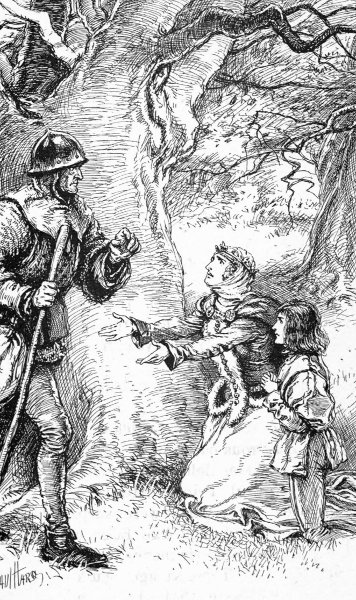
MARGARET OF ANJOU AND THE BANDIT.
We hear no more of the solitary retainer.
He seems to have left early.
The Queen and her son had not gone far when
they encountered another outlaw. With the
simple frankness of a great despair, she threw
herself and the young Prince upon his mercy.
"Friend," said she, "I entrust to your loyalty
the son of your King."
What a generous-hearted bandit could do, he
did. Taking them under his protection, he conducted
them by secret and intricate ways into the
comparative safety of the Lancastrian headquarters.
But to resume our Robin. The fate of Guy
of Gisborne shows how rash it was to attack our
friend in Lincoln green, who was by no means so
green as he looked. Guy had sworn to apprehend
the outlaw, and roamed the forest in search of
him, in a "capull hyde," which is said to mean a
horse's skin. Guy found him at last, with disastrous
results to himself, for Robin slew him and mangled
his body with what is particularly described
as an "Irish knife." He then clothed himself in
the "capull hyde" and took his deceased enemy's
horn, and went off to Barnsdale, where his men,
unknown to himself, had been in combat with the
sheriff's force, with the result that several were
killed and wounded on both sides. Robin's men
had, however, the worst of the fight, and Little
John had been taken prisoner and bound fast to
a tree.
Robin, drawing near his men's haunts, blew a
blast upon the horn he had taken, and the sheriff,
recognising the note, and thinking it was Guy of
Gisborne, come back victorious, went to meet him,
with the result that he and his force were taken,
and Robin's men released.
The many scattered ballads of Robin Hood
that had long passed from mouth to mouth were
collected, edited, and printed about 1500 by
Wynkyn de Worde, under the title of A Lytell
Geste of Robyn Hode and his meyne, and of the
proude Sheryfe of Notyngham.
According to this, the home of Robin Hood
was in Barnsdale, the woodland tract between
Doncaster and Pontefract. There Little John and
two companions waylay Sir Richard at the Lea,
a knight passing through the forest: a melancholy
man, as sad as he of the Rueful Countenance.
He is not afraid to accompany the rovers
to their master, for he has little to lose. But
Robin, far from ill-using, entertains him to a
sumptuous dinner, served (by what marvellous
means we are not told) in the merry greenwood.
Such mediæval delicacies as swans, with, of
course, pheasants, smoke at the outlaw's spread.
The feast being concluded, the knight prepares to
depart; but "Pay you, ere you wend!" says
Robin; "it was never the custom of a yeoman to
pay for a knight."
The knight, deeply humiliated, confessed he
had but ten shillings.
"Go search," commands Robin to Little John.
"If, sir, you have no more," he says to the
knight, "I will not have a penny."
The search confirmed the knight's words; and
it then appeared that this was a sorely stricken
knight indeed.
"For a hundred winters," he explains, his
ancestors had been knights, and until within the
last two or three years he had possessed an income
of four hundred pounds a year, as his neighbours
well knew.
But his son was unlucky enough to kill a
Lancashire knight, and a squire as well, in a
joust; and, to help pay the penalty of his son's
mishap, the father's goods had been "sette and
solde," and his lands pledged to the Abbot of St.
Mary's, for four hundred pounds. The day for
repayment of this loan was close at hand, and the
knight, unprovided with money, already foresees
his estate pass from him.
Robin Hood then asks him, who would be the
knight's surety, if he advanced the sum.
Alas! replies the knight, he is as badly in
want of friends as of money. He can offer no
surety, save Our Lady, who had never failed
him before.
In Robin Hood's way of thinking, no better
surety could be found, even if England were
sought through and through; and the knight is
immediately provided, not only with money, but
with clothes, a horse, and a trusty squire, in the
person of Little John. The whole band enter
deeply into their leader's feelings, and weep
salt tears over the knight's misfortunes, and
themselves contribute liberally to supply his
needs.
The second "fytte," or act, is placed at St.
Mary's Abbey, on the day of reckoning, and the
abbot is introduced, chuckling at the absence of
the knight, and the probability of his lands being
forfeited. The prior entreats his superior to show
a little pity, but his call for moderation is scornfully
rejected by the abbot, and by the cellarer, a
fatheaded monk of the type made familiar in
modern German paintings of tonsured voluptuaries
eyeing tables full of food and stroking their
paunches.
In midst of these proceedings, the knight
enters, and humbly begs for an extension of time;
but the abbot insists on his bond, and will have,
and at once, either the money or the land. Then
the high justice is introduced, as moderator:
"What will ye gyve more?" said the justice,
"And the knight shall make a release;
And elles dare I safly swere
Ye never hold your lande in pees."
"An hundred pounde" sayd the Abbot;
The justice said "Give him two."
"Nay, be God! sayd the knight,
"Ye gete ye it not soo:
"Though ye woulde gyve a thousande more,
Yet were ye never the nere;
Shall there never be myn eyre
Abbot, justyse, ne frere."
He sterte hym to a borde anone,
Tyll a table rounde,
And there he shoke out of a bagge,
Even four hundred pounde.
The debt thus paid, the knight takes leave of the
disappointed abbot, and "went hym forthe full
merye syngynge, as men have told the tale."
Living at home in retirement, he soon saves
sufficient to get together the sum that Robin had
advanced; and then equips himself with a splendid
present of bows and arrows for the outlaw, and
rides, with a merry song and a light heart, to
Barnsdale.
The third fytte tells the adventures of Little
John, who, straying into Nottingham, attracts the
attention of the sheriff by his skill in archery, and
enters into his service for one year, in the name of
Reynold Greenleaf. But in a little while, in the
sheriff's absence, Little John raises a quarrel in
the house and runs away with the cook. Together
they go off to the greenwood, with the family
plate, and ready money, "three hundred pounds
and three." Robin Hood receives them, but they
have not long returned when Little John plans to
capture the sheriff himself, on his way home.
The seizure is easily made, and the sheriff is taken
to the foresters' camp, where supper is served to
him on his own plate. He is then stripped to his
shirt and breeches, and released the next morning,
after being obliged to take an oath never to lie in
wait for Robin Hood, "by water, ne by londe,"
and if any of the band fall into his custody, to
help them to the best of his power.
The fourth fytte opens with the cellarer of
St. Mary's, travelling with a large sum of money.
He falls in with Robin and his men, but declares
he has only twenty marks. Little John, however,
on searching him, discovers eight hundred pounds;
whereupon Robin Hood exclaims that the money
must be sent by Our Lady, who, with her accustomed
goodness, had doubled the sum he lent the
knight.
The monk is then bidden go his way, after
refusing a parting glass; vowing, with much
truth, that he might have dined cheaper at Blyth
or Doncaster. The knight, at this moment, arrives
with the money to repay his loan. Robin accepts
his presents, but will not take the money, as Our
Lady has just now paid it back, together with
another four hundred pounds, which he begs the
knight to accept.
The fifth fytte opens with the Sheriff of
Nottingham proclaiming a shooting match. Robin
attends, and bears off the prize, but as he leaves
the town, the cry of "Robin Hood" is raised.
"Great horns 'gan they to blow"; the townsmen
assemble, and a fight begins, in which Little John
is wounded in the knee, so that he can neither
walk nor ride. In this desperate pass, he entreats
his captain to smite off his head with his sword,
so that he may not fall alive into the hands of the
enemy, but Robin indignantly refuses. Little
Much takes him on his back, and carries him off,
halting from time to time to speed arrows into
the ranks of the pursuing sheriff's men. They
then all escape to the castle of their knightly
friend, who, in the sixth fytte, is waylaid, and
carried off by the sheriff.
The knight's lady then appeals to Robin Hood,
who calls his men, and, proceeding to Nottingham,
slays the "proud Sheriff" and releases the knight.
In the seventh fytte we have the arrival of
"our comely King," Edward the Third, at
Nottingham, come to inquire into a complaint the
sheriff had made against the knight for harbouring
outlaws. The King, for a whole year, endeavours
to capture Robin or the knight, but has no sort of
success until a forester offers, if the King will
assume the costume of an abbot, to conduct him
to the outlaws' retreat, "a mile under the lynde";
i.e. in the midst of the lime-trees, or lindens.
This offer is accepted, and Robin receives the
pretended abbot with unusual courtesy, taking but
one-half of the forty pounds he offers for ransom
of himself. The "abbot" then produces a
summons under the Royal seal, inviting Robin
to Nottingham "both to meat and meal."
Robin goes down on bended knee before this
august message, and entertains the "abbot" in
the best style, with venison and
With good white bread and good red wine,
And therto fine ale brown.
After dinner he entertains his guest at a shooting-match;
the chief condition being that whoever
misses a rose-garland suspended between two
poles shall forfeit bow, arrows, and quiver, and
submit to receive a buffet on the head.
Robin misses by three fingers and more, and
the King is entitled to inflict the penalty. He
hesitates. "Smite boldly!" says Robin; "I give
thee large leave."
Thus encouraged, the king, with one blow
of his stalwart arm, makes the outlaw reel.
Such an exhibition of vigour was more convincing
than moral suasion, and Robin, perceiving that
this is no abbot, but the King himself, submits
at once, with his men. The sovereign graciously
pardons them and invites them to London.
The eighth fytte concludes the story. Robin
and his men follow the King to the Court; but
within a year the love of the free and unconventional
forest had lured away all but Robin and
two companions, and Robin himself was sick to
be gone. The finishing touch was the sight of
a gathering of young archers.
"Alas! and well-a-way
If I dwell longer with the King,
Sorowe wyll me slay,"
says the sometime outlaw, longing to be a forester
again.
So he forswears the Court, and retires again
to the forest.
And there, the legends say, he lived as of
old for twenty-two years; until falling sick, he
resorted to the priory of Kirklees, where a kinswoman
of his was prioress. After the medical
fashion of the time, the remedy was to be slightly
bled; but the treacherous prioress, and one Sir
Roger of Doncaster, opened a vein by which he
bled to death: dying "from the perfidy of a
woman," as had been prophesied.
From the chamber in the gatehouse of the
priory where he lay, he shot his final arrow, his
faithful Little John whom he had summoned by
three blasts of his horn, supporting him. The
spot where the arrow fell was to be his grave,
and there Little John was to lay him, with his
bow bent by his side, a turf under his head, and
another at his feet. The old ballad of his affecting
end piously concludes:
Crist have mercy on his sowle
That dyed on the rood,
For he was a good outlawe
And dyde pore men much good.
The railed-in spot where he, by tradition, lies
buried had once, we are told, a stone inscribed
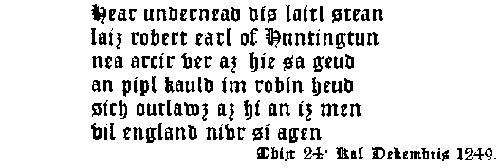
[Click
here
for transliteration.]
But this appears to have been the invention
of Martin Parker, author of the "True Tale"
of the hero, c. 1632. It still, however, imposes
upon the credulous and supports the somewhat
sweeping saying current in Camden's time: "Tales
of Robin Hood are good for fools."
Wykyn de Worde's collection of Robin Hood
romances is itself a proof of the wide popularity
the hero had always enjoyed, and did still enjoy;
but it does not stand alone as proof. In 1444 we
hear a grumbling voice speaking of Robin, Little
John, Friar Tuck, and the others of that immortal
band, "of whom the foolish vulgar, in comedies
and tragedies, make entertainments, and are
delighted to hear the jesters and minstrels sing
them, above all other ballads."
A century later, none other than Latimer,
Bishop of Worcester, preaching before Edward
the Sixth, bore unwilling testimony to Robin's
popularity with the masses: "I came once
myself," he said, "to a place, riding on a journey
homeward from London, and I sent word overnight
into the town that I would preach there
in the morning, because it was a holyday....
I thought I should have found a great company
in the church, but when I came there, the church
door was fast locked. I tarried there half an
hour and more, and at last the key was found;
and one of the parish comes to me, and says, 'Sir,
this is a busy day with us, we cannot hear you;
it is Robin Hood's Day. The parishes are gone
abroad to gather for Robin Hood.'
"I thought my rochet should have been
regarded, though I were not," added Latimer,
plaintively; "but it would not serve; it, too, was
fain to give place to Robin Hood's men."
Apparently at this point the congregation
laughed, for we find him, resuming, rather
heatedly: "It is no laughing matter, my friends,
but rather a weeping matter, a heavy matter,
under the pretence of gathering for Robin Hood, a
traitor, and a thief, to put out a preacher, to have
his office less esteemed, to prefer Robin Hood
before the preaching of God's Word."
In 1601, when England was living under a
recently reformed religion, it became again
necessary to reconstruct Robin Hood legend for
popular acceptance, and in a play, written by
Anthony Munday and Henry Chettle, he appears
as the outlawed Earl of Huntingdon; a figure for
which there is not the slightest historical warranty.
Thus the fabricated "epitaph" at Kirklees must
itself have been, as it were, a by-product of this
play. Maid Marian and several other characters
who appear in it originated only a century earlier,
and have no part in the earliest ballads. The play
then gradually merged into May Day festivities
and the once familiar "Jack-in-the-Green," extinct
only within the last forty years, but greatly
vulgarised towards the end, when chimney-sweeps
acted "Jacks-in-the-Green," and the Maids
Marian were too often fat and fiery-faced sluts.
The entertainment was found all too often outside
public-houses.
Robin Hood has, of course, equally with other
heroes, suffered greatly from being continually
edited and restated, from age to age. How
should he escape the fate that King Arthur
experienced, of being made into a distinctly
Victorian gentleman? Tennyson has redressed
old Robin, with new clothes and a new conscience,
in The Foresters; Robin Hood and Maid Marian,
and there you cannot but entertain the horrible
suspicion that he has become a typically respectable
mid-Victorian, and that if any one offered to
exchange his greenwood tree for a "parlour"
with perhaps a suite of walnut furniture upholstered
in green repp, and a marble clock with
a couple of glass lustres on the dining-room
mantel-piece, he would gladly accept, forswear
his woodland glades, and live cleanly thereafter.
But the two most striking evidences of the
old-time popularity of Robin Hood, not so long
dead, are found in the many inns named after
him, and in that great friendly society, the
"Ancient Order of Foresters," whose title is
directly inspired by the legendary story of Robin
and his fellow outlaws. No one who has ever
seen the Foresters in their regalia at their annual
day at the Crystal Palace can have any doubt of
that inspiration.
THE "HAND OF GLORY"—LIABILITY OF COUNTRY
DISTRICTS FOR ROBBERIES—EXEMPTION IN
RESPECT OF SUNDAY TRAVELLING
Those far-distant, unpleasant days when "highway
lawyers," and entirely unromantic bands of robbers,
murderers, and footpads swarmed over the country,
and robbed and slew with comparatively little
fear of the law, were also extremely superstitious
days. Good men and bad were alike steeped in a
degrading belief in white and black magic,
portents, and omens. Magical aids in the prosecution
of both innocent and guilty enterprises
were employed; and among them none more fearful
than the charm known generally as the
"Hand of Glory": the "open sesame" of thieves
and assassins, among whom, it is to be feared, we
must include not a few of our "romantic" highwaymen;
although probably the larger number of
them would actually have felt themselves insulted
at being styled thieves, and certainly only a
minority slew wilfully. Most desired nothing so
little as to shed blood, in spite of the terrible
alternative they threatened—"Your money, or
your life!"
But among the thieves and the murderous the
superstition of the "Hand of Glory" was widely
prevalent. It appears to have originally derived
from mediæval Germany, that storehouse of
terrible imaginings. What the "Hand of Glory"
was, and the effect it produced, may be seen better
by the following quotation from the Ingoldsby
Legends, which is one of the most genuinely
thrilling passages in literature. It is full of the
most dreadful description, but exquisitely done:
On the lone bleak moor, At the midnight hour,
Beneath the Gallows Tree,
Hand in hand The Murderers stand,
By one, by two, by three!
And the moon that night With a grey, cold light,
Each baleful object tips;
One half of her form Is seen through the storm,
The other half's hid in Eclipse!
And the cold wind howls, And the Thunder growls,
And the Lightning is broad and bright;
And altogether It's very bad weather,
And an unpleasant sort of a night!
"Now mount who list, And close by the wrist,
Sever me quickly the Dead Man's fist!
Now climb who dare Where he swings in air,
And pluck me five locks of the Dead Man's hair!"
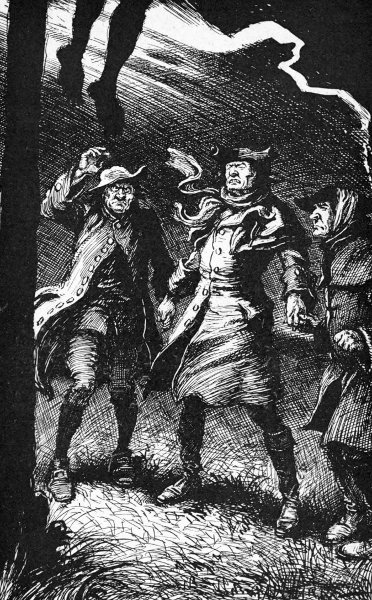
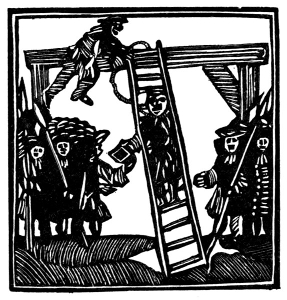
THE "HAND OF GLORY": BENEATH THE GALLOWS TREE.
The dried hand, thus obtained, was fitted with
wicks, one to each finger and the thumb, made
from the five locks of hair dipped in grease from
the murderer's own body and the fat of a black
tom cat, and generally consecrated with the saying
of the Lord's Prayer, backwards. When all these
wicks were lighted, and the blazing Hand of
Glory carried into a house, a spell was supposed
to be cast on place and inmates, in which the
malefactor could work his will:
"Now open lock To the Dead Man's knock!
Fly bolt, and bar, and band!
Nor move, nor swerve, Joint, muscle, or nerve,
At the spell of the Dead Man's hand!
Sleep, all who sleep!—Wake, all who wake!—
But be as the Dead, for the Dead Man's sake!"
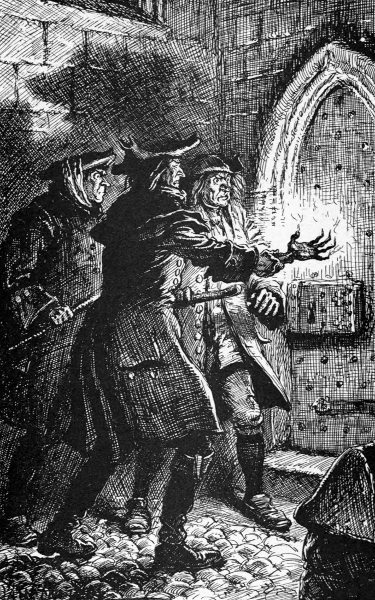
"OPEN LOCK, TO THE DEAD MAN'S KNOCK."
Traditions not so long since surviving in the
North Riding of Yorkshire tell a horrid story of
the use of an enchanted hand of this kind. One
wild and bitter night—the sort of night when
homeless wayfarers were more than usually to be
pitied—a man clad in ragged clothes knocked at
the door of a lone inn on a solitary moor, and
asked for a lodging. There was no accommodation
to spare, but as the night was so inclement and
the way was long to the next house, he was told
that if he liked, he might lie in the front of the
kitchen fire. He accepted this offer with every
appearance of thankfulness, and soon after, when
the family had gone to bed, he was left there.
But although the innkeeper and his family had
retired and left the stranger alone, the servant
was still engaged for a few minutes in another
room which chanced to command a view of the
kitchen. Happening to glance in that direction,
she was at first astonished, and then horrified, to
find that the stranger had risen up from the floor
and had seated himself at the table where she saw
him take a shrivelled, mummified hand from his
pocket, set it up, and then, one by one, light the
fingers. The girl rushed upstairs to warn her
master of these extraordinary doings, but she
found him and his family all already in a charmed
sleep. It was impossible to arouse them; and
here she found herself alone in the house with the
evil-intentioned stranger and his uncanny movements.
She quietly went downstairs again and
saw the beggarman exploring the house and
collecting articles that appeared to him worth
taking. Still on the kitchen table burnt the four
fingers of the Hand of Glory, in blue, sickly
flames; but the thumb was not burning. To
that fact was due the circumstance that one
person in the house remained unaffected by the
spell.
Stealing on noiseless feet into the kitchen, she
blew upon the Hand, but could not blow it out.
She poured beer over it, but the Hand only seemed
to burn better. She tried water, but that appeared
to have no effect, one way or the other. Then she
emptied the milk-jug over it. Immediately the
place was in darkness, except for the glow of
the kitchen-fire. The spell was instantly removed,
the sleepers awakened, and the robber
seized and afterwards tried and hanged.
Harrison Ainsworth, revelling as always in the
horrible, gives us his version of the Hand of Glory
in Rookwood. In this variant you recognise the
nastiness of it, rather than the horror:
From the corse that hangs on the roadside tree
(A murderer's corse it needs must be)
Sever the right hand carefully:—
Sever the hand that the deed hath done,
Ere the flesh that clings to the bones be gone;
In its dry veins must blood be none.
Those ghastly fingers, white and cold,
Within a winding-sheet enfold;
Count the mystic count of seven;
Name the Governors of Heaven,
Then in earthly vessel place them,
And with dragon-wort encase them;
Bleach them in the noon-day sun,
Till the marrow melt and run,
Till the flesh is pale and wan.
As a moon-ensilver'd cloud—
As an unpolluted shroud.
Next within their chill embrace
The dead man's awful candle place;
Of murderer's fat must that candle be,
(You may scoop it beneath the roadside tree)
Of wax and of Lapland sesame.
Its wick must be twisted of hair of the dead,
By the crow and her brood on the wild waste shed.
Wherever that terrible light shall burn,
Vainly the sleeper may toss and turn;
His leaden lids shall he ne'er unclose
So long as that magical taper glows.
Life and treasure shall he command,
Who knoweth the charm of the Glorious Hand!
But of black cat's gall let him aye have a care,
And of screech-owl's venomous blood beware.
The ancient condition of Merry England was
a despotic rule tempered by rebellion and highway
robbery, in which the Barons revolted from time
to time against kingly encroachments, and the
peasantry were generally at odds with both those
estates. The woodland tracts that then overspread
the greater part of the country were filled with
outlaws, of whom Robin Hood, as we have already
seen, was a sublimated idealisation, and in those
tangled thickets a man, or a body of men, might
lurk and exist for years, subsisting upon the deer
whom it was then, under the old forest laws,
mutilation and death to slay. But with the law
already arrayed against them, the outlaws who had
been deprived of the very few rights a man of the
peasant class might then own, cared little for the
fearful penalties that awaited those who took a fat
buck and converted it into venison, and valued not
at all the punishments that awaited the highway
robber. A man proscribed for some offence, who
had then taken to the woods of necessity, might
even, for sheer love of the life, elect to remain in
them for sport; for the sporting instinct has ever
been deeply implanted in the character of the
English race, without respect of class. It is largely
the sporting instinct, and not so much the actual
worth of the quarry, that makes the modern
poacher brave the keepers of the squire's preserves.
It was but a step from specialising in unlawful
chase of the deer to robbing travellers.
The deer-stealers were already Ishmaels, before
they had dared so greatly, and they were doubly
outlawed after so boldly usurping the hunting
prerogatives of kings and nobles. What mattered,
then, the taking of a purse; nay, even
of a life?
The Legislature early attempted to put pressure
upon local authorities, to secure the arrest of
robbers, and, as usual, the pressure was exercised
through that most vulnerable part, the pocket, the
"Achilles' heel" of civilisation. The country
(often in later years we find it "the county") was
supposed to be responsible for good governance,
and if the country was unfortunate enough to be
infested with robbers, it was expected to arrest
them; or failing that, to be financially answerable
for their robberies. We find this specifically
provided for by Act of Parliament in 1285, and
again in 1354.
But it was impossible in those times, in the
sparsely populated country, to suppress robbers,
and the rural districts suffered severely in pocket
as a result of bold pillaging in the day-time.
In 1509 Margaret Paston, writing from
Norfolk, is found nervous of sending gold to
London, and telling her husband, then staying in
town, that a sum of twenty marks had been paid for
a ward, but that the person who paid it "dare not
aventure her money to be brought up to London
for feere of robbyng; for it is seide heere that
there goothe many thefys be twyx this and
London." He was therefore to have the money at
his coming home.
The county division known as "the hundred"
was the area responsible and liable to reimburse
losses occasioned in this manner. Thus, inter alia,
we find the Hundred of Benhurst, in Berkshire,
continually assessed to make good the losses
sustained by travellers, along what is now the
Bath Road, through Maidenhead Thicket, a place
whose ill repute was second only to that of Hounslow
Heath. By an Act of Parliament of 1585
(27 Elizabeth c. 13, s. 2) the sum recoverable from
the hundreds was limited to half the travellers'
loss. The reasons given for this limitation were the
distress and impoverishment of the inhabitants by
reason of these frequent and severe levies upon
their purses. It is evidence of the extraordinary
increase of highway robbery at that period. Five
years after this enactment, the Hundred of Benhurst
paid £255 compensation for robberies committed
in the Thicket.
Even so, the liability of the country, the county,
or the hundred, had always been limited to
robberies committed in daylight. "Between sun
and sun," i.e. between the setting of the sun and
the next morning's sunrise, the highwaymen
might work double tides and plunder as they
would, and no action for damages would lie against
the inhabitants.
Nor could travellers who were robbed on
Sunday have any redress. It was particularly
enacted by the statute of 1676, known as the
Sunday Trading Act, that any one travelling on
the Lord's Day did so entirely at his own risk, and
was barred from bringing an action. "But nevertheless,"
the section continues, "the inhabitants
of the counties and hundreds (after notice of such
robbery to them, or some of them, given, or after
hue-and-cry for the same to be brought) shall make
or cause to be made fresh suit and pursuit after
the offenders, with horsemen and footmen, according
to the statute made in the twenty-seventh
year of Queen Elizabeth, upon pain of forfeiting
to the King's Majesty, his heirs and successors, as
much money as might have been recovered against
the hundred by the party robbed, if this had not
been made."
THE YOUNGER SONS—JUDGE POPHAM—SHAKESPEAREAN
HIGHWAYMEN—THE "CAVALIER" BRIGANDS—A SEVENTEENTH-CENTURY RELIGIOUS TRACT
No doubt many of the "highwaymen's" escapades
in the times of Henry the Eighth and Queen
Elizabeth were the coltish pranks of high-spirited
young men of family, or the freaks of university
students. To assume a disguise, to buckle on a
sword, and then take to the highway, singly or in
bands, would be just the kind of adventure to
tickle the fancy of such youths, and the danger
that lay behind it all was really rather an appetising
spice than a discouragement. The tradition of
Henry the Fifth, when yet Prince of Wales,
robbing on Gad's Hill for pastime, was still
current, and Shakespeare had just revived it, and
invested the doings of the Prince and Falstaff and
their merry men with the glamour of the stage,
which even then set the fashion.
Such a young man, according to Aubrey, was
John Popham, afterwards Sir John, and Chief
Justice of the King's Bench. "In his youthful
days," says Aubrey, "he was a stout and skilful
man at sword and buckler as any in that age, and
wild enough in his recreations, consorting with
profligate companions, and even at times wont to
take a purse with them."
This wild fellow became, as a member of Parliament
and a judge, an extremely severe personage
in dealing with the class of people with whom we
thus learn him to have associated. Partly his work
was the Act of 1589, which prescribed banishment
(or, as later times phrased it, "transportation")
"into such parts beyond the seas as shall be at
any time hereafter for that purpose assigned."
Shakespeare's highwaymen are, as a rule,
gentlemen. Such were the outlaws who in the
Two Gentlemen of Verona waylaid Valentine and
Speed in the forest. They had been banished from
Verona and Mantua merely for such trivial and
essentially gentlemanly peccadilloes as an attempt
to abduct an heiress, and stabbing another gentleman
to the heart. Too bad!
They found Valentine so presentable a young
man that, finding he had no property to lose, they
immediately proposed to make him their captain.
They were prepared to do him homage, and be
ruled by him. "But if thou scorn our courtesy,
thou diest."
Making the best of circumstances—being rather
prepared to captain a band of desperadoes than
lose his life, Valentine consented, with one proviso:
"I take your offer, and will live with you;
Provided that you do no outrages
On silly women, or poor passengers."
To which the outlaws indignantly reply that they
"detest such vile, base practices."
The doings of Falstaff and Prince Hal in their
highway robbery exploits on Gad's Hill are classic
farce, with elements of probability, although Sir
John Fastolf, the original Falstaff, was introduced
by Shakespeare without the slightest warranty:
the real Sir John having been no dissolute,
cowardly old man, but a brave and stern soldier,
who had warred nobly for King and country for
forty years.
The point of view from which the gentlemen
highwaymen regarded themselves is admirably set
forth in the play of Sir John Oldcastle, produced
in 1600. The stage is generally regarded as the
mirror of life, and thus, when "Sir John à
Wrotham" is made to introduce himself to the
audience, by frankly acknowledging he was, "in
plain terms, a thief; yet, let me tell you, too, an
honest thief," we doubtless have the real mental
attitude of the "collectors"—as they were pleased
to fancifully style themselves—set forth. He
goes on to declare himself, in the good old Robin
Hood vein, to be "one that will take it where it
may be spared, and spend it freely in good fellowship."
A modern company-promoter, of the
Whitaker Wright type, might say as much, but
even if true, it would not be held an excuse.
The same outlook upon life is observed in
The Cashiered Soldier, a tract published in
1643. It represents that warrior out of work
exclaiming:
"To beg is base, as base as pick a purse;
To cheat, more base of all theft—that is worse.
Nor beg nor cheat will I—I scorn the same;
But while I live, maintain a soldier's name.
I'll purse it, I,—the highway is my hope;
His heart's not great that fears a little rope."
Again, Bishop Earle, in his Microcosmography,
shows us how the highwaymen were recruited.
Speaking of the sorrows of younger sons, and
narrating the shifts to which they were often
reduced, he says: "Others take a more crooked
path, through the King's highway, where at
length the vizard is plucked off, and they strike
fair for Tyburne."
The biographies of highwaymen given later in
these pages, fully illustrate the position of affairs
in the succeeding age, and show that the country
swarmed with highway robbers after the conclusion
of the Civil War between King and
Parliament. Many of them were impoverished
cavaliers, but the most prominent were only
pretended gentlemen, who used any Royalist
sympathies they may have had in giving a specious
excuse for their misdeeds. Captain Hind is
typical of these plundering fellows in the era of
the Commonwealth. So many were they, and so
formidable, travelling, as they often did, in bands,
that it became the business of the troops, at the
conclusion of the war, to hunt out all such
associated brigands.
On September 17th, 1649, General Fairfax
issued a proclamation addressed to the commanders
of "every respective regiment of horse,"
urging them to activity in the apprehension of all
robbers, and promising high rewards for everyone
captured. To this a Royalist print, the Man in
the Moon, sarcastically rejoined that the "House
of Robbers"—by which the House of Commons
was meant—had voted for the next six months a
reward of £10 for the taking of every burglar or
highway-robber, "the State's officers exempted."
The proclamation, however, had its due effect,
for on December 24th, no fewer than twenty-eight
malefactors, principally of the classes specified,
were all gibbeted together at Tyburn. Among
them was "one Captain Reynolds, who was of the
King's party in Cornwall, at the disbanding of the
Lord Hopton's army at Truro.... His carriage
was very bold, and, as he was going to be turned
off, he cried: 'God bless King Charles: Vive le
Roi.'"
But they were generally defiant at the last,
whether Royalists or mere purse-takers; whether
of the seventeenth or eighteenth centuries. Conscience,
which makes cowards of all, did not
awake and begin to unnerve these candidates for
Jack Ketch until the very opening of the nineteenth
century.
Thus, in the olden times we find the condemned
highwaymen nearly always nursing the grievance
of their doom, and speaking of Justice and her
emissaries as their "enemies"; as witness Thomas
Hill, executed July 19th, 1694. Was he penitent
at Tyburn? Not at all. His last words were,
"God bless all my friends, and let all my enemies
be hanged as I am"; and, adds his biographer
"other reflecting and abusive Expressions."
Although it might well seem, after an extensive
course of reading in the thoughts and deeds
of those times, that the country was entirely
populated by two classes: the scoundrels who
were always trying to evade Justice, and the
officers of the law, continually occupied in tracing
them, an unobtrusive residuum of well-intentioned
and well-conducted people existed. We do not, it
is true, hear much of them, which is only to be
expected; but they existed, nevertheless, and
were often as anxious to save sinners as any
modern tract-distributor.
A curious seventeenth-century four-page leaflet
in the British Museum, styled A Terrible and
Seasonable Warning, shows something of the well-meaning
forces, as well as a good deal of the
superstition, of the time, in an account of how a
young man named Abraham Joiner, aged between
seventeen and eighteen, described as a ballast-man,
of Shakesby's Walk, near Shadwell church, was
saved at the last moment from becoming a footpad
or a highwayman. It is nothing more nor less
than a seventeenth-century ancestor—and a very
badly printed one—of the modern religious tracts
produced nowadays by the million, in a rather
hopeless endeavour to save hurrying sinners, often
too anxiously wondering how they are to live in
this world, without troubling about the next.
The young man began to keep bad company,
and in especial that of one Ann Turner, who said
she must have money, and he must by some means
get it for her. Abraham went home in a desperate
frame of mind. He thought of the several ways
(none of them honest ones) in which money in a
sufficiency might suddenly be obtained; and
frightened his mother by saying he must and
would get some, even though he asked the devil
to help him to it.
"In this Humour," we learn, "he went out
to the Cock and Lyon in King Street, where there
came into A Room to him a Person in a Dark-colour'd
Habit, and ask'd him what made him so
Melancholly? If he wanted Money, he cou'd help
him to it, and bid him meet him the next Night,
which he at first told him he wou'd do; but
afterwards suspecting it might be the Devil, he
told him he cou'd not meet him at the time, then
bid him meet him on Sunday, behind Stepney
church, which he consented to do, and, going
away, gave him a Pistole in gold (a coin, not a
firearm) after which the Young Man grew uneasy
in his Mind, and going home show'd his Brother,
who advis'd him to throw the Money away,
assuring him it could be none but the Devil,
which very much terrified the young man, so that
he threw the Money away, and was taken with a
sudden trembling, and falling on his knees, besought
God to forgive him.
"In this condition, Mr. Constable, the Minister
of the Parish, was sent for, and Mr. Symons, who
Pray'd by him till the time was over when he had
promis'd to meet the Person he had seen, and Mr.
Constable and the other Divines us'd many Prayers
and exhortations with him, and at length so
comforted him that 'tis hoped the Devil will have
no further Power over him, if he takes this timely
Warning of the Mercies of God."
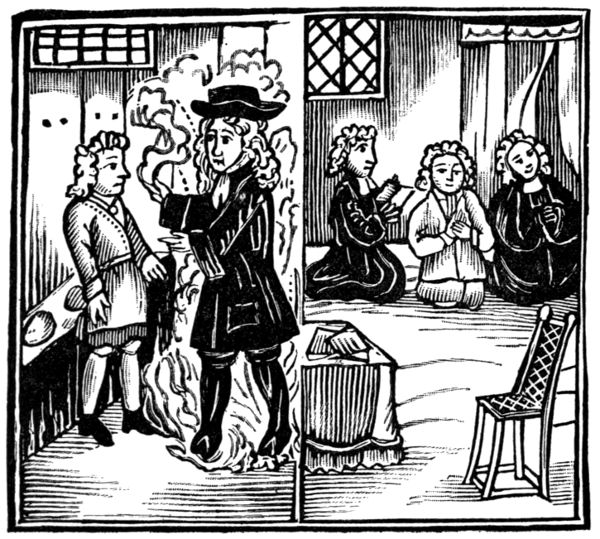
"A TERRIBLE AND SEASONABLE WARNING."
Then follow "Some of the Prayers." The first
page shows a very respectable-looking devil and a
very greatly terrified young man; also some
black-cassocked clergymen on their knees, very
earnestly praying.
A curious broadsheet tract of about a century
and a half later, entitled Wild Robert, may be
fitly noticed here. Like the earlier tract, it was a
purely religious publication; but the time had
gone by for supernatural terrors to be invoked.
Poetry, of sorts, is brought to bear, instead:
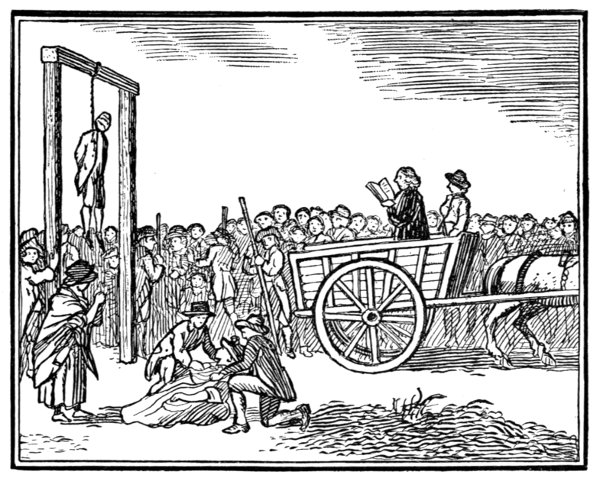
THE END OF WILD ROBERT.
THE EXECUTION OF WILD ROBERT.
Being a Warning to all Parents.
Wild Robert was a graceless Youth,
And bold in every sin
In early life with petty thefts,
His course he did begin.
But those who deal in lesser sins,
In great will soon offend;
And petty thefts, not check'd betimes,
In murder soon may end.
And now, like any beast of prey,
Wild Robert shrunk from view,
Save when at eve on Bagshot Heath
He met his harden'd crew.
With this fierce crew Wild Robert there
On plunder set his mind;
And watch'd and prowl'd the live-long night
To rob and slay mankind.
But God, whose vengeance never sleeps,
Tho' He delays the blow,
Can in a single moment lay
The prosperous villain low.
One night, a fatal night indeed!
Within a neigh'bring wood,
A harmless passenger he robb'd,
And dy'd his hands in blood.
The direful deed perform'd, he went
To shew his golden spoils,
When vengeful Justice, unawares,
Surpris'd him in her toils.
Wild Robert seiz'd, at once was known,
(No crape had hid his face)
Imprison'd, tried, condemn'd to die!
Soon run was Robert's race.
Since short the time the laws allow
To murderers doom'd to die,
How earnest shou'd the suppliant wretch
To Heaven for mercy cry!
But he, alas! no mercy sought,
Tho' summon'd to his fate;
The Cart drew near the Gallows Tree,
Where throng'd spectators wait.
Slow as he past no pious tongue
Pour'd forth a pitying pray'r;
Abhorrence all who saw him felt,
He, horror and despair.
And now the dismal death-bell toll'd,
The fatal cord was hung,
While sudden, deep and dreadful shrieks,
Burst forth amidst the throng.
Hark! 'tis his mother's voice he hears!
Deep horror shakes his frame;
'Tis rage and fury fill his breast,
Not pity, love, or shame.
"One moment hold!" the mother cries,
"His life one moment spare,
One kiss, my miserable child,
My Robert, once so dear!"
"Hence, cruel mother, hence," he said,
"Oh! deaf to nature's cry;
Your's is the fault I liv'd abhorr'd
And unlamented die.
"You gave me life, but with it gave
What made that life a curse;
My sins uncurb'd, my mind untaught,
Soon grew from bad to worse.
"I thought that if I 'scap'd the stroke
Of man's avenging rod,
All would be well, and I might mock
The vengeful pow'r of God.
"My hands no honest trade were taught,
My tongue no pious pray'r;
Uncheck'd I learnt to break the laws,
To pilfer, lie, and swear.
"The Sabbath bell that toll'd to church,
To me unheeded rung;
God's holy name and word I curs'd
With my blaspheming tongue.
"No mercy now, your ruin'd child
Of heav'n can dare implore,
I mocked at grace, and now I fear
My day of grace is o'er.
"Blame not the law which dooms your son,
Compar'd with you 'tis mild;
'Tis you have sentenc'd me to death,
To hell have doom'd your child."
He spoke, and fixing fast the cord,
Resigned his guilty breath;
Down at his feet his mother fell,
By conscience struck with death.
Ye parents, taught by this sad tale,
Avoid the path she trod;
And teach your sons in early years
The fear and love of God.
So shall their days, tho' doom'd to toil,
With peace and hope be blest;
And heav'n, when life's short task is o'er,
Receive their souls to rest.
The price of this improving publication was one
halfpenny, and no one, observing the dramatic
picture with which it begins, or reading the
verses, will be disposed to think value for money
was not given. Let us hope the parents of that
age duly profited by the advice given!
ENORMOUS CAPTURES MADE BY HIGHWAY GANGS—BRACY'S
GANG—ROBBERIES ON THE ROAD
TO NEWMARKET—ADVERTISEMENTS OF THE
PERIOD—AUGUSTIN KING—PLUNDER AND
BATTLE ON THE ST. ALBANS ROAD—SOLDIERS
AS HIGHWAYMEN
Much has already been said in these pages of the
imaginative character of a good deal to be found
in Captain Alexander Smith's Lives of the Highwaymen,
but at the same time it would not be
proper to regard that work as a work of fiction.
The amazing adventures of the highwaymen whose
careers are treated of there can be readily paralleled
in the actual trials of their kind, not only in the
periods with which he deals, but at a much later
time. The enormous booty they carry off in his
pages may seem incredible, but time and again
we find, in accounts that cannot be disputed, that
the highwaymen did, in fact, secure extremely
large sums. Instances might be multiplied indefinitely,
if it were necessary to prove the truth
of this statement. The trial at Derby in August
1679 of "Twelve Notorious Highway Men,
Murderers, and Clippers of Money" is merely
one case in point.
These were "Mr." Bracy, evidently superior
to most of the gang, Richard Piggen, Roger
Brookham, another superior person, one "Mr."
Gerrat, John Barker, William Loe, John Roobottom,
Thomas Ouldome, John Baker, Daniel
Buck, Thomas Gillat, and one Smedley.
Bracy was captain of the gang: the head
and brains of it. They broke one night into
the house of "Captain John Munday, Esquire,"
at Morton, near Derby, took away £1200 in
gold and silver, also plate, "binding the Esquire
and all his Family in their beds, and using great
insolences by threats, to make them confess their
Treasures."
Two months after this exploit the gang "met"
(not, we may suppose, casually) a waggon between
Lenton and Newark, in which were several small
barrels of money, and others of gold lace. Securing
the waggoner, they hauled out the barrels, and,
breaking open the barrel-heads with the hatchets
they had been careful to bring with them, they
secured a booty of eighteen hundred pounds,
"which," we are told, "they divided, and so
disperst."
Buck, together with a man named Ryley, was
shortly afterwards taken at Ockbrook, near Derby.
Both were hanged. The rest of the company continued
their former practices. Breaking open the
house of Lady Jane Scroop, at Everston, near
Nottingham, they took £600, "missing two or
three thousands by being one day too forward in
their Actions." They then must needs quarrel
over dividing the spoil. The affair is best told in
the words of the original account:
"Upon the discussing of this booty, one of the
company and Bracy falling at a difference, they
had a small Combate with their Swords, the other
cutting the Throate of a Mare that Bracy rode
upon, which for swiftness and goodness was hardly
to be compar'd in England."
The gang next proposed to raid the house of
one Squire Gilbert, at Locko, near Derby, and
that of Mr. Garland at Lenton; but in the meanwhile
most of them were arrested. Bracy, who
at that time had hurried off to his wife's death-bed,
at an inn she kept, twelve miles north of
Nottingham, was betrayed by one of the servants
of the inn, who informed the Justices that the
highwayman who was being sought was in the
house. The inn was presently surrounded, and
Bracy's son, looking out of a window, saw there was
little chance of his father escaping. What chance
there remained was tried. Taking a horse out of
the stable at the back, he bid his father mount,
leap the fence, and make a dash for it. It was
a poor chance, and was made worse by the horse
refusing the jump. A sheriff's man then shot the
horse dead, and with a second bullet wounded
Bracy himself. The highwayman, however, continued
the combat until he sank, mortally
wounded. He was then carried to a bed in the
inn, where he died.
The remnant of this numerous band were
indomitably active. Three of them beset two
gentlemen in Needwood Forest, bidding them
"Stand and deliver!" Refusing, one of them
was shot; but the other, with sword and pistol,
made a brisk resistance, until one of the thieves,
creeping up behind, ran him through the body.
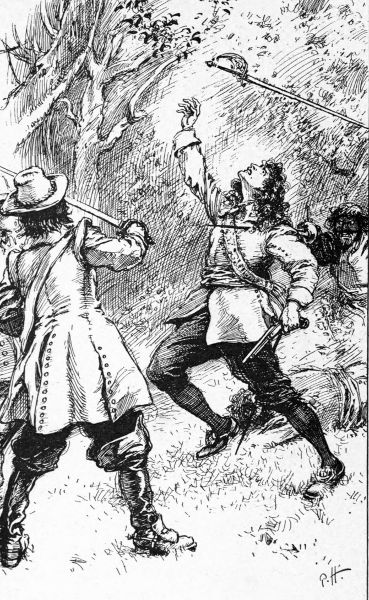
THE FIGHT IN NEEDWOOD FOREST.
These three were not long afterwards arrested
for clipping money. Tried and convicted of that
offence, itself involving capital punishment, they
had no hesitation in confessing their other crimes.
Among others at that time under arrest were
Piggen and Baker. Piggen turned King's evidence,
and was pardoned: Baker also being pardoned,
but why, we do not learn. Among the facts
deposed to by these convicted criminals was that
the gang were accustomed to meet at an inn called
the "Cock," near St. Michael's Church, Derby,
kept by a widow named Massey and John Baker,
her son-in-law. There they had clipped in one
night so much as £100. A boy of fifteen years of
age was employed in the house, and by some means
accidentally learnt too much of the gang's business.
They thought him too dangerous, and so murdered
him and buried his body in the cellar.
Where wealth gathered, there were the highwaymen
also. There was no road more frequented
by wealthy men in the reign of James the First
and that of Charles the Second than the road to
Newmarket. The Court was frequently there for
the race-meetings, and gamblers of all kinds were
naturally attracted. Many a gamester who had
lost his all on horses or by cards at Newmarket
took as a matter of course to robbing other sportsmen:
either those hasting down to try their luck,
or those fortunate ones who were returning home
with pockets bulging with their winnings. One
William Fennor, who in 1617 published a
pamphlet called the Competers' Common-Wealth,
has much that is interesting to disclose about these
reckless blades. A "competer" was, of course,
one of the gamesters aforesaid; and any of them
who had the misfortune to lose his money went
immediately, as he tells us, upon the Heath, to
replenish his pockets. They were by no means
proud, and did not disdain to rob rustics of
their pence. "Poor Countrie people," he says,
with bitter satire, "cannot passe quietly to the
Cottages, but some Gentlemen will borrow all the
money they have." Tyburn Tree and Wapping
Gibbets, he added, had "many hangers-on,"
gathered in from among these gentry.
Fennor's disclosures did not end these practices.
As the fame and vogue of Newmarket increased,
so also did the highway robberies on the Newmarket
Road. The culminating point of it all
appears to have been a pitched battle which,
according to the Domestic Intelligence of August
24th in that year, took place at the Devil's Ditch,
through which the highway runs on to Newmarket
Heath. Five highwaymen had here robbed a
coach and taken £59, and a very considerable
booty in the way of gold lace, silks, and linen.
Before they could make off with the plunder, the
exasperated countryfolk were roused, and were
stationed in a body in the opening of that tall and
steep bank, impracticable for horsemen, the only
way by which the Heath may be entered or left.
The highwaymen were thus completely shut in,
and could only escape by abandoning their horses:
an unthinkable alternative. Had they retreated,
they would have been captured in Newmarket
town. The only thing to be done was to make
a dash for liberty. "Knowing themselves Dead
Men by the Law, if they were taken," says that
early newspaper, "they charged through the
Countrymen, and by Firing upon them Wounded
four, one of which we understand is Dead of his
Wounds." Thus they got clear away: the whole
incident leaving upon the mind a very vivid
impression of a lawless and ill-policed country.
Not only were these men determined in resistance.
They were ready to revenge such of their
comrades as had been unfortunate enough to be captured;
as we see from the diary of Sir John Reresby,
who, writing in February 1677, says: "I went to
London (from York) well guarded, for fear of some
of my back friends and highwaymen, having caused
the chief of them to be taken not long before."
The newspapers of that time were full of
advertisements offering rewards for the recovery
of property, or the apprehension of thieves. Some
of them afford amusing reading. Thus, in the
London Gazette of December 1st, 1681, we find
the following:
"Robb'd the 10th of Nov. last, from Mr. Joseph
Bullock of Bristol, on the Road between Hungerford
and Newbury in Barkshire, one Silver Watch
and Case, there being on the backside of the Case
an Almanack, a Hanger with a Plate Hilt, a Buff
Belt, with Silver Buckles; by Three Men, the one
a middle-siz'd Man, full Fac'd, a short White Wigg
much Curl'd in an old Cloth-colour riding Coat, on
a Flea-bitten Horse, about 14 hands high, his
Brows Brown; the other a middle-sized Black
Favour'd, on a Grey Horse, above 14 hands high,
with Black Hair or Wigg, and thin Favour, the
other a full set Man, thin Favour'd with curled
dark Brown Hair. Whoever can discover the
Persons aforesaid to Mr. Bullock of Bristol or at
the Three Cups in Breadstreet, London; (the said
Robbers having killed one John Thomas, the said
Mr. Bullock's Servant,) shall have their Charges,
and ten pounds reward."
Here, in the matter-of-fact language of an
advertisement, we see one of those obscure
tragedies that were always occurring on the
roads: bloodshed that for the most part called
in vain for vengeance.
Again—this time in 1684—the London Gazette
is used as the medium, in an effort to obtain
justice, but it is not to be supposed that there
were any results. He must have been an extremely
sanguine advertiser to have offered so
speculative a reward for information so greatly
desired:
"On Whitsunday in the Evening was committed
a great Robbery by four Highwaymen within half
a mile of Watford Gap in the County of Northampton,
to the value of above Eight score
Pounds taken from some Passengers. They were
of indifferent stature, their Coats were all turned
up with Shag, one had a blew Shag, and wore a
Perriwig, the others wore their own Hair; They had
two Bay Naggs, a Bay Mare somewhat battered
before, and a Sprig Tail Sorrel Mare, which they
took away from one they robb'd, and a black Nag;
one of them had short Holsters to his Saddle without
breast-plate, another a pair of Pistols in his
Saddle Cover. Whoever gives notice of the said
Robbers to Joshuah Snowden, Confectioner at the
Belsavage Gate on Ludgate Hill, or to Henry
Keys at Watford Gap Inn, shall be well rewarded."
Even University graduates were at this period
known to occasionally present a pistol upon the
road. Such behaviour was by no means uncommon
among collegers in earlier centuries,
but we read with astonishment how Augustine
King, a graduate of King's College, Cambridge,
was publicly advertised in the London Gazette
of December 1st, 1687, among other highwaymen,
as follows:
"There is likewise abroad one Augustine King,
formerly convicted at Cambridge; a Notorious
Highway Robber, who made his Escape from the
Gatehouse. He is a lusty fat man, about 31 or 32
years of Age, fresh-coloured, full Ey'd, his own
Hair, lank, inclinable to black: he hath several
more in his Company, who, some, or most of them,
are well-known to some Inn-keepers not far
distant from London, who will do well to cause
them, especially King, to be taken before next
Sessions at the Old Bayly, for their own Indemnity."
King would seem to have actually been captured
as a result of this public announcement, for we
find that he was executed in the following year.
The road on to St. Albans witnessed astounding
doings. On November 9th, 1690, seven highwaymen
robbed the Manchester carrier of £15,000,
tax-money, which was being conveyed under what
is described as a "strong" escort, to London.
The robbery was coolly planned and with equal
coolness executed. At their leisure the highwaymen
arrived on the scene, fully advised of the approach
of the carrier, and proceeded to seize and rob all
wayfarers and then securely tie them to trees.
Having thus made sure of not being interrupted,
they were ready for the chief booty of the day.
Dashing among the strong escort, they overcame
them in a fight, whose details are not reported,
and after taking the money killed or hamstrung
eighteen horses, to render pursuit impossible.
It appears that this was looked upon as a
Jacobite and Roman Catholic plot, and that two
Roman Catholics were arrested on suspicion and
committed for trial; but the rest is obscure.
Some suspicious persons might even regard the
whole affair as a put-up job between the escort
who thus betrayed their trust and shared an
excellent haul.
Again, at London Colney, near by, on the
night of August 23rd, 1692, the highwaymen
performed a notable feat; robbing none other
than the great Duke of Marlborough, the foremost
military genius of the age, of five hundred
guineas.
Three months later a party of highwaymen—no
doubt the same dare-devil rogues—secured
between £1,500 and £2,000 out of a waggon "near
Barnet," and in November the Oxford coach was
pillaged in mid-day, after a bloody fight. About
the same time, we read in Narcissus Luttrell's
diary, fifteen butchers, going to Thame market
to buy cattle, were robbed by nine highwaymen,
who carried them over a hedge, made them drink
King James's health in a bottle of brandy, and
bid them sue the county: a remedy open to
travellers who were robbed on the roads in daylight
"between sunrise and sunset."
Military force was found necessary for the
suppression of these outrages. Detachments of
Dragoons were sent out all round London and
posted at a distance of about ten miles out, on
the great roads. The captures effected by these
patrols were numerous; but at some spot not
more clearly identified than as being "near
Barnet" they had an armed encounter with
the band led by "Captain" James Whitney,
December 6th, 1692. One Dragoon was killed,
but Whitney was captured and duly executed,
and the roads, in the north, at any rate, for awhile
had peace.
Not, however, for very long. Robberies may
not have been again committed on so astonishing
a scale; but highwaymen reappeared when the
Dragoons were withdrawn, and found their
occupation, not only lucrative, but pretty safe.
But as the years went on, things grew steadily
worse. Unemployment was the principal cause
of the enormous increase of highway robberies
in 1698. Highwaymen, as we have already seen,
were numerous before, but they now grew more
than ever daring. The Peace of Ryswick, which
had the year before ended an inglorious war, caused
great numbers of soldiers to be disbanded, and,
finding no livelihood to be obtained in honest work,
they naturally chose to plunder the travellers whom
they observed journeying to and from London,
often with well-filled purses, ready to become the
property of any bold fellow who could command
a good horse, a pistol or sword, and courage to
stop men on their lawful business. Near Waltham
Cross, bandits to the number of thirty built
themselves huts amid the leafy coverts of Epping
Forest, and, without waiting for the kindly
obscurity of night, came forth at all hours with
deadly weapons and held up the traffic along the
Cambridge and the Newmarket roads.
They did not hesitate to slay, and often the
bodies of slaughtered wayfarers affrighted the
next travellers, who, warned by such sights of
the futility of resistance, rendered unto these
highway Cæsars whatever they had about them:
satisfied to escape, with empty pockets indeed,
but with a whole skin. For a while this settlement
of reckless men was abolished by a raid,
under the direction of the Lord Chief Justice, but
the expedition, raiding in the interests of law
and order, had not long departed when the
outlaws again occupied the spot. They even had
the impudence to send a written and signed
defiance to Whitehall. There they went too far,
for that would have been no Government worthy of
the name which consented to receive such a
document and to idly pass it by. Another
Dragoon expedition, somewhat similar to that
of 1692, was equipped, and while some of the
soldiers patrolled the roads in that direction,
others encamped for a time in the Forest itself.
Thus it is probable that soldiers still in service
were employed against those others not so fortunate,
who had been disbanded and obliged to
seek these ways of existence.
This fraternity was certainly broken up, and
we do not hear again of such numerous, or
such highly organised, bands; but when the
Dragoons were again withdrawn, the roads once
more became extremely dangerous.
The Dragoons themselves were, individually,
not above suspicion. No doubt they learned some
useful things when engaged on this kind of duty;
and when such unskilled persons in the use of
arms as ruined gamesters took to the road to
replenish their pockets, it was perhaps not
remarkable that soldiers should seek to add to
their scanty pay by like means. The Guards
regiments numbered many experts in the
"Stand and deliver" way. Opportunity helped
them. They were already armed, and, as they
did not live in barracks until about 1790, and
were merely quartered on the inhabitants of
London and Westminster, they were free at all
hours of the night to "labour in the calling of
purse-taking."
Thus we read of a quite typical affair in
January 1704, on Hounslow Heath, in which
James Harris, a trooper in the Horse Guards, was
principally concerned. It seems that on the
26th of that month a certain George Smith,
Esquire, and a Major Wade, of Bristol, were
travelling westward in a postchaise. They halted
at the "Pack Horse" at Turnham Green, "for
refreshment," and appear to have refreshed so
well that by the time their equipage was crossing
Hounslow Heath they had fallen fast asleep.
From this slumber of repletion they were rudely
awakened by stern voices saying, "D—n you,
give me your money!" and "D—n you, give me
your watch!"
"Who's that a-calling?" asks the songster.
In this case it was James Harris and a companion,
who robbed them effectually after a rough-and-tumble
with the servant of Mr. Smith, who sprang
at Harris and pulled him off his horse. There
they struggled, and presently the highwayman's
mask was torn off, disclosing his scarred face.
Mr. Smith then declared he would give up all his
valuables if the highwayman would spare his
man's life, and the affair ended.
Mr. Smith afterwards, hearing that a man
answering to this description had been arrested on
suspicion of being concerned in other robberies,
came forward, entirely in the public interest, and
identified him at the military mews. "Sir, do
you know me?" Harris impudently asked,
advancing upon him with insolent braggadocio.
Mr. Smith did.
Harris was indicted at the Sessions on February
28th, and found guilty, but was afterwards reprieved.
Such lenient treatment was not calculated to
render the highways more safe, and so especially
dangerous became the road between Shoreditch and
Cheshunt that the turnpike men were in 1722
provided with speaking-trumpets, in a singular
effort to warn travellers and one another "in case
any Highwaymen or footpads are out." It does
not appear exactly how this idea was worked, or if
travellers were supposed to wait until such highwaymen
or footpads retired: but, according to
a newspaper report of that time, the scheme was
successful, for we read: "We don't find that any
robbery has been committed in that quarter since
they have been furnished with them, which has
been these two months."
Other roads and suburban districts to the east
and north-east of London continued to be extremely
dangerous. In the history of Hackney we read,
for example, of numerous highway robberies,
burglaries, and murders, in a long series of years.
The neighbourhood of the then almost trackless
Hackney Marshes no doubt was a predisposing
cause for this exceptional ill-repute. Here again,
we find that soldiers were often the criminals.
On November 23rd, 1728, the house of a Mr.
Wood, a farmer, near Hackney, was broken open
by half-a-dozen fellows, who seized and bound all
the family. The account then goes on to say that,
"They had the good conduct to take off their coats
that nobody might know what regiment they
belonged to, and robbed in their red waistcoats
only, but left a cockade behind them. It is
supposed they belonged to the Dragoons; but those
gentlemen (it is humbly presumed) ought not to
leave their cockades behind them when they go
upon such expeditions, such things being of no
use but upon reviews."
"WHO GOES HOME?" IN THE HOUSE OF COMMONS—FOOTMEN
TURN HIGHWAYMEN—SIR SIMON
CLARKE—A MERRY FREAK AND ITS TRAGICAL
CONSEQUENCES—AMAZING POLTROONERY OF
TRAVELLERS—ADVERTISEMENTS OF THE PERIOD—HIGHWAY
ROBBERY IN PICCADILLY
An old-world survival, heard every night in the
lobbies of the House of Commons during session, is
that of the cry, "Who goes Home?" When the
House rises, and the legislators, who have left
their brains outside and have voted "as their
leaders tell 'em to" are dispersing, the stentorian
shout of "Who goes Home?" passes from policeman
to policeman, along corridors and down
staircases, until at last it reaches the coachmen
and the cabmen waiting in Palace Yard. The cry
means nothing now, except that the sitting is
over, but it originated in the ill-guarded condition
of the streets and of the suburbs some hundreds of
years ago, when even members of Parliament were
not safe from highwaymen and footpads, and when
at that call they assembled in little bands, often
under the protection of the linkmen, to journey
together for mutual protection to their several
destinations.
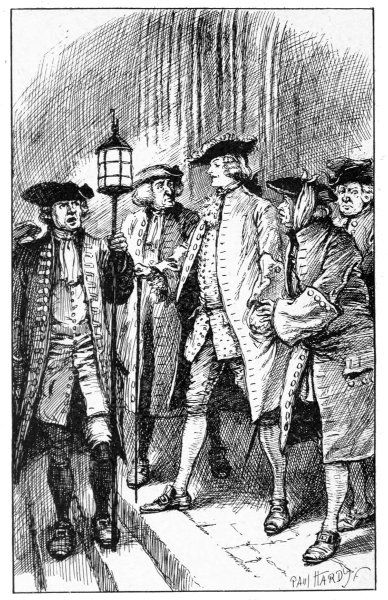
"WHO GOES HOME?"
Those were the times when Londoners, travelling
at night westward from Hyde Park Corner,
where the last outpost of civilisation, in the shape
of the ultimate watchman's box, was situated,
assembled there in parties, armed with bludgeons
and blunderbusses, and, so fortified, came thankfully
to their destinations in one or other of those
solitary country mansions, whose high-walled
gardens and heavy doors arouse the astonishment
of those modern observers who do not realise the
old necessity that existed for residences so situated
being planned very much after the style of block-houses
in a hostile country.
Nor was it only by night that the fringes of
London were made dangerous by highwaymen and
footpads. Hyde Park was a fashionable resort,
even under the Commonwealth, but even in the
early years of the succeeding century it was a
dangerous place, as we learn from the following
item in Narcissus Luttrell's diary, only one
among many such, under date of 1704:
1704. "A Gentleman going from St. James's
to Kensington was met and attacked in Hide Park
by two Foot Pads, who took from him his Sword,
Watch, Perriwig, and Rings, in all to the value of
£130, and left him in a deplorable condition."
The highwaymen who terrorised travellers from
about 1720 and onwards were still recruited from
the ranks of younger sons, from broken gamesters,
and from the army; but about this time they were
very largely reinforced by a class of men now
extinct. The noblemen and the wealthy of the
eighteenth century kept up establishments that
have long since become things of the past. The
"running footmen," for example, who were a
feature in every peer's household, trotting in
advance of my lord's carriage, are only to be
found in books on bygone usages. The Duke of
Queensberry, "Old Q," kept the last of them, and
he died in 1810. From the footmen, "running"
or other, the coachmen, and the other servants of
nobility in that age, the roads were very largely
peopled with highwaymen. These men had
learned in service to imitate all the vices and
none of the virtues (although they were few
enough) of their masters. Their imitation chiefly
led them into gambling, and when they lost their
places through their failure to do their duty, and
sometimes the robbery of plate and money, that
commonly resulted from their devotion to cards
and drink, there was nothing easier than to take
to the road. They had learned, in their association
with the great, something of deportment, they
could generally ride a horse, and a cast-off suit
of my lord's fully furnished them, in the bad
light of a winter's day, with the appearance of
gentlemen. Such at that period were many of the
"Knights of the Road"; and thus, in spite of
the glowing accounts commonly given of the mid-eighteenth
century highwaymen, it is not surprising
to find that they were, as a general rule,
merely sordid fellows, whose idea of repartee was
the cold muzzle of a pistol and a "Deliver
instantly": embellished with a volley of oaths.
But now and again we happen upon some
pleasing play of fancy; as, for instance, when
Harry Simms, a really dashing highwayman who
was well known as "Gentleman Harry," came
upon a gentleman in a postchaise. Harry rode
furiously always. "Don't ride your horse so
hard, sir," said the gentleman, "or you'll soon
ride away all your estate."
"Indeed I shall not," returned Gentleman
Harry, "for it lies in several counties."
He then bade the traveller deliver what he had
about him, which proved to be over a hundred
guineas, and having realised so much of his
widely distributed estate, he made off in search of
fresh adventure. He found plenty, before he was
finally captured at Dunstable and hanged in
June 1747.
"Gentleman Harry" was but a gentleman by
the popular recognition accorded his dashing
ways; but a real, officially recognised gentleman
was at the same time upon the road; no less a
personage than Sir Simon Clarke, Bart., who, in
company with a certain Lieutenant Arnott, scoured
the roads of Hampshire for a brief space. The
Baronet was brought to trial at Winchester and
convicted, but so impressed were the High Sheriff
and the grand jury by the threatened scandal of a
Baronet, even though merely a bad one, being
hanged, that they petitioned the King on the
subject, and Sir Simon Clarke was reprieved sine
die, "which," says the contemporary chronicler of
these things, "implies for ever."
There was, however, a certain blind fury about
the ways of Justice at that time, which in general
boded ill for evil-doers. The abstract theory of
Justice eliminates the idea of revenge, and capital
punishment for all manner of trivial offences was
inflicted, less from any real sense of the enormity
of the crimes, than with the object of protecting
Society. Society could not adequately be protected
in those days by the primitive forerunners
of our police, and so, when by chance any criminal
was captured—and the capturing of them generally
was a chance affair—Justice usually made
a terrible example of them, by way of warning.
It was only as times grew gradually more secure
that it was imagined justice could really afford to
dispense with these examples, which were fondly
thought to be deterrents. Capital punishment
was then the best conceivable warning to others
not to go and do likewise, and the subsequent
exhibition of the criminals' bodies dangling from
gibbets was the next best; but the very frequency
of these loathsome exhibits rendered men callous
and by familiarity blunted the edge of all these
practical warnings Society thought itself bound
to give, for its own protection.
Private influence and class interests might
now and then be powerful enough to procure the
reprieve of a highwayman in the mid-eighteenth
century, but a due sense of what was owing to the
middle classes generally forbade lenient treatment.
A pretty face, however, and persistent pleading
could produce wonderful results.
There was no sense of humour in justice at
that period, as may be clearly seen in the case
narrated by Silas Told, the earnest Wesleyan who
in 1744 began to thrust himself into the fearful
prison atmosphere of Newgate, and to wrestle there
with condemned prisoners for their souls, in surroundings
of the utmost brutal indifference.
It seems that during the riotous proceedings
accompanying the election of a member of Parliament
for Chelmsford, four young men of good
family had grown so merry with drink that they
went out upon the country road and played the
dangerous game of highwaymen. In the course
of this drunken freak they robbed a farmer, and
were recognised and arrested, being afterwards
sent to Newgate, tried, and capitally convicted.
Their names were Brett, Whalley, Dupree, and
Morgan. The last-named happened at the time to
be engaged to Lady Elizabeth Hamilton, daughter
of the Duke of Hamilton. The young lady was
stricken with grief, and frequently visited her
unlucky sweetheart in prison, and "Like the
importunate widow set forth in the Gospel," says
the good Told, "she went daily to His Majesty, as
also did others at her request, and pleaded with
His Majesty for the life of Mr. Morgan; but at
first, His Majesty, considering it a point of injustice
as well as partiality, would by no means
attend to her plaintive petitions. Another consideration
was that they were all persons of
dignity and fortune, and could not plead necessity
to palliate the enormity of the robbery, as many
unhappy sufferers could; therefore His Majesty
said his subjects were not to be put in bodily fear
and suffer the loss of their property merely through
a capricious, wanton whim. However, the morning
before the execution, Lady Betty Hamilton
appeared before His Majesty and fell upon her
knees (I suppose in tears too). 'My lady,' said
His Majesty, 'there is no end of your importunity;
I will spare his life, upon condition that he be not
acquainted therewith till he arrives at the place of
execution.'"
In the result, the unfortunate Brett, Whalley,
and Dupree, who had not high-born sweethearts
to plead for their lives with Royalty, were
hanged. Morgan followed in the cart, and the
sheriff did not produce the order for respite
until it was at the foot of the gallows.
Silas Told describes the actual scene. "'Tis
hard," he says, "to express the sudden alarm
this made among the multitude; and when I
turned round, and saw one of the prisoners out
of the cart, with his halter loose, falling to the
ground, he having fainted away at the sudden
news, I was instantly seized with a great terror,
as I thought it was a rescue, rather than a
reprieve; but when I beheld Mr. Morgan put
into a coach, and perceiving that Lady Betty
Hamilton was seated therein, in order to receive
him, my fear was at an end, and, truly, I was
very well pleased on the occasion."
But no one seems to have been very greatly
scandalised at the exceedingly hard measure
meted out to the others, who had no charming
sweethearts to plead for them, but who, nevertheless,
certainly ought to have been reprieved with
Morgan, who by no means deserved his good
fortune; for he entered upon a wild life, and
was observed, six months later, gambling with
a fraudulent bankrupt, who himself was presently
hanged.
Some thirty years earlier, in 1722, to be precise,
a man named John Hartley, who had been
convicted and condemned to death for robbing
upon the highway as a footpad, had his life
begged by an extraordinary deputation of six
young women, who went, dressed in white, to
plead with the King at St. James's Palace, for a
reprieve. Hartley's crime would in our own day
be considered severely punished with the award
of six months' hard-labour, for he had merely
felled a poor journeyman tailor, gone over his
pockets, and, in a furious rage, because he found
no greater sum than twopence, stripped him of
every stitch of his clothing, tied him to a tree, and
made off with this singular booty. It was, no
doubt, an assault, aggravated by exposing the
unfortunate tailor to the bitter blast; but that
a man should die for twopence, and a bundle of
not very desirable clothes, seems a punishment
altogether beyond the bounds of reason. Yet,
at a period when a man might be hanged for
merely stealing a handkerchief, without any
aggravated assault, this was not considered
unreasonable. "Society must be protected," in
effect, said the law; and if Society could not
police the streets and the roads with living police,
and so prevent crime, it took care that gallows
and gibbet should display unmistakable evidence
of its readiness to avenge it.
There must have been some extraordinary
attraction about John Hartley, in spite of his
mean and paltry occupation of a footpad, for the
young women who went in white to beg for a
reprieve were eager, if their prayer were granted,
to cast lots among themselves for the honour of
being his wife. But it was not to be. The
reprieve was refused by the King in person, who
told the hopeful young women that he thought
hanging would be better for him than marriage.
Their hazardous calling begat in the gentlemen
of the high-toby a ghastly kind of humour.
Thus, when that unholy trio, Christopher Dickson,
John Gibson, and Charles Weymouth, united
in the not very desperate job of robbing a poor
old man, who proved to have nothing on him but
the suit of clothes he stood up in, and a pair of
spectacles; and when Dickson would have taken
even these from him, Gibson intervened. "Give
the old fellow his spectacles back," he said;
"for, if we follow this trade, we may assure ourselves
we shall never reach his years, to make use
of them." True enough: they were hanged soon
afterwards, and never required any aids to
eyesight.
The impudence of the highwaymen is sometimes
so unconsciously extravagant, that it is
on that account alone extremely amusing. They
felt it an intolerable grievance when they
happened upon purses not particularly well
lined, and resented it hotly. An instance of
this may be found, not in any irresponsible
novel, or other work of imagination, but in the
sober pages of the Worcester Journal of September
29th, 1738, where we learn that in the early
morning of September 21st, between the hours
of four and five, the "Flying Bath Coach" was
stopped by two footpads, about a mile on the
London side of Newbury. There were five
passengers in the coach, all of whom these daring
adventurers robbed, without being resisted in the
least. While one of them held the horses' heads,
the other interviewed the passengers.
From a Sardinian gentleman he took a purse
of guineas and a rich scimetar that might have
been profitably employed by the Sardinian gentleman,
one would have thought, about the robber's
head and body; from Captain Willoughby of
Abchurch Lane, twenty-six shillings and—oh!
degrading—his coat and periwig; from Mr. Grubb,
a distiller, of Bishopsgate Street, twenty-five
shillings; from Mr. Rawlinson, High Constable
of Westminster, three half-crowns, together with
his periwig and silver stock-buckle; and from Mr.
Pratt, proprietor and coachman of the "Flying
Coach," four guineas, and his silver watch. He
threatened every minute to blow out their brains
with a horse-pistol he flourished, and although
he had succeeded, without any trouble, in securing
a not inconsiderable booty, cursed them violently,
saying, "gentlemen were not obliged to
be at the expense of powder and ball, and likewise
a long attendance on the road, to lose their time
for so slender a profit."
To frighten travellers by these outrageous
methods was a duly calculated part of the business.
We have, in the pages of Borrow's Romany Rye,
the theory of violent language and violent
behaviour on the part of the highwaymen duly
expounded by the ostler of the unnamed inn
mentioned in chapter xxiv. This ostler, a
Yorkshireman by birth, had seen a great deal of
life in the vicinity of London, to which he had
gone at a very early age. "Amongst other places
where he had served as ostler was a small inn at
Hounslow, much frequented by highwaymen,
whose exploits he was fond of narrating, especially
those of Jerry Abershaw, who, he said, was a
capital rider." Abershaw, he would frequently
add, however, was decidedly inferior to Galloping
Dick, who was a pal of Abershaw's. I learned
from him that both were capital customers at the
Hounslow inn, and that he had frequently drunk
with them in the corn-room. He said no man
could desire more jolly or entertaining companions
over a glass of "summat"; but that upon the
road it was anything but desirable to meet them:
there they were terrible, cursing and swearing,
and thrusting the muzzles of their pistols into
people's mouths; and at this part of his locution
the old man winked and said, in a somewhat lower
voice, that upon the whole they were right in
doing so, and that when a person had once made
up his mind to become a highwayman, his best
policy was to go the whole hog, fearing nothing,
but making everybody afraid of him; that people
never thought of resisting a savage-faced, foul-mouthed
highwayman, and if he were taken, they
were afraid to bear witness against him, lest he
should get off and then cut their throats some
time or other, upon the roads; whereas people
would resist being robbed by a sneaking, pale-visaged
rascal, and would swear boldly against
him on the first opportunity: adding, that
Ferguson and Abershaw, two most awful fellows,
had enjoyed a long career; whereas, two disbanded
officers of the army, who wished to rob a coach
like gentlemen, had begged the passengers' pardon,
and talked of hard necessity, had been set upon
by the passengers themselves, amongst whom
were three women, pulled from their horses,
conducted to Maidstone, and hanged with as little
pity as such contemptible fellows deserved. "There
is nothing like going the whole hog," he repeated,
"and if ever I had been a highwayman, I should
have thought myself all the more safe; and,
moreover, shouldn't have despised myself. To
curry favour with those you are robbing, sometimes
at the expense of your own comrades, as
I have known fellows do, why, it is the
greatest——"
"So it is," interposed the postilion.
The newspapers of those times afford deeply
interesting reading. Very few of them but contain
some startling item of highway robbery, or
news of the capture or trial of the highwaymen
who dared even to ply their trade within sight of
the streets. It seems so very long ago, and it all
has an extraordinary air of unreality. Even
although you turn over the small quarto and
foolscap pages of those daily and evening, or
weekly or bi-weekly sheets, these things seem the
stuff that dreams are made of; but if the items
of news give that effect, certainly when you turn
to the advertising columns, you feel once more that
you are in touch with actualities. The same
quacks, or rather their great-great-grandfathers,
are puffing the same kinds of goods, and even the
blackguard fellows who figure, with their own
"brainy" or impudent faces, in the advertising
pages of twentieth-century popular magazines, and
successfully gull hundreds of thousands of
simpletons, have their ancestors posturing in
these yellowing sheets. They are not so boldly
"displayed," for the mechanical possibilities of
the age did not permit of it, and they of necessity
appealed only to hundreds, instead of the hundred
thousand; but they are at one, in all essentials,
with the creatures who nowadays make "this
unparalleled offer to YOU," and rudely point
a finger at you out of the page. In the Grub
Street Journal for 1737 and succeeding years, and
in its numerous contemporaries are to be found
advertised the "greatest Restorative in the world,"
cures for consumption, marvellous literary works,
without which life would be a blank, and a certain
Dr. Newman's vile electuaries. Dr. Newman
advertised largely and long, and he generally
included a quaint little woodcut of himself, seated
at a table, and with a box of his beastly pills
(comparatively the size of a saucepan) on the table
beside him, with a bottle of his medicine,
apparently supplied in two-gallon carboys, keeping
it company. He is the ancestor, you perceive, as
you observe him staring out of the page, of all
those modern pushful persons,
who seem to think that by
picturing themselves in their
advertisements of how to add
to your stature, to add to your
purse, or turn your nose down,
your ears in, to grow stouter
or leaner, or what not, their
statements are by some mysterious
means fortified and endorsed.
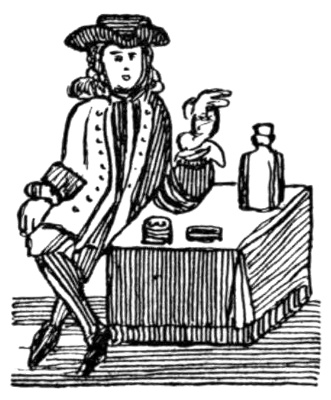
DR. NEWMAN AND HIS PILLS.
The quaintest things are advertised in these
old journals. A coachman in Long-Acre has
devised a bullet-proof postchaise, or chariot, in
which "any Gentleman may travel with Safety
and not less Expedition than heretofore." It is
claimed to be proof against any weapons carried
by highwaymen.
Mr. Lott, of Maidstone, who, in several of his
advertisements, "Begs leave to acquaint all
Gentlemen and others (others!) that he has taken
a large House in Beer-Cart Lane," advertises
sporting and other guns, and has a very choice
assortment of pistols "for Gentlemen travelling,"
perhaps also—who knows?—purchased by highwaymen
on the look-out for those travelling
gentlemen. His advertisement is embellished
most remarkably with a somebody, whether gentleman
or highwayman, it would be difficult to say—but
it looks not altogether unlike a conventional
representation of the devil. On due reconsideration,
however, it
would appear to
be a sportsman,
for he is accompanied
by what
may be taken for
a dog. What
kind of sport he
expects to get
with the gun he
holds in his left
hand, with the
remarkable kink
in the barrel, it would be impossible to say; but
the pistol he flourishes in his right looks lethal
enough to do the business of any highwayman
that ever patrolled the roads and spoke with
the coaches.
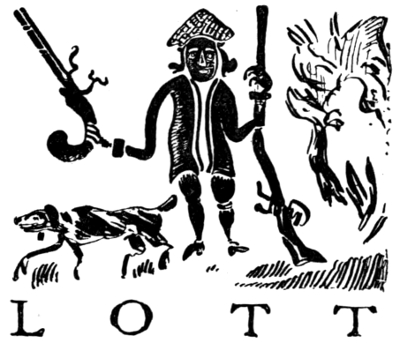
EIGHTEENTH-CENTURY ADVERTISEMENT.
Even in those times, there were people who
strove to abolish capital punishment; and the
advertisement columns of these old journals bear
witness to the fact, in the announcement of a
pamphlet, priced at only sixpence, displaying
arguments in favour of discontinuing the death-penalty.
On one occasion it is printed next to
a paragraph which records briefly how a highwayman,
disappointed at not getting sufficient plunder,
shot a poor traveller on the road near Staines.
"We hear," says the journal, "that the man has
since dy'd of his Wounds." This curious juxtaposition
looks uncommonly like a sly example of
editorial sarcasm at the expense of the excellent
advertiser: a hint after the style of the sardonic
French philosopher's comment upon the similar
proposal to remit the death penalty upon murderers:
"que messieurs les assassins commencent."
The newspapers and the magazines alike contain
the most startling commentaries upon life as lived
in London during the eighteenth century. Thus
we read, in an obscure paragraph, how the French
mail was robbed in Piccadilly, by the valise
containing the bags being cut off the postchaise.
The occasion was not so exceptional that it would
demand more than a few lines. But in those
days newspapers had not discovered the way of
exploiting news for all it was worth, and more,
by the twin arts of the artful headline and the
redundant adjective.
Again, it was late in September 1750, Horace
Walpole tells us, and he was sitting in his dining-room
in Arlington Street, close upon eleven
o'clock one Sunday night, when he heard a loud
cry of "Stop thief!" A highwayman had attacked
a postchaise in Piccadilly, at the corner of Arlington
Street, and, being pursued, rode over a
watchman and almost killed him. He escaped, of
course.
Across the way, on the west side of Berkeley
Street, the curious sunk thoroughfare, known as
Lansdowne Passage, (the name as painted up
is spelled wrongly, without the concluding "e")
dividing the gardens of Lansdowne House and
the Duke of Devonshire's mansion, is connected
with a highwayman story of some eighteen years
later. The entrance to this passage-way for
pedestrians is divided by an iron bar, which
renders it impossible for anything more bulky
than a man to squeeze through, and there are
even some particularly stout persons who might
find it difficult to pass. The passage conducts
to Curzon Street, and is at such a low level
that a flight of steps leads down to it, through
the narrow opening.
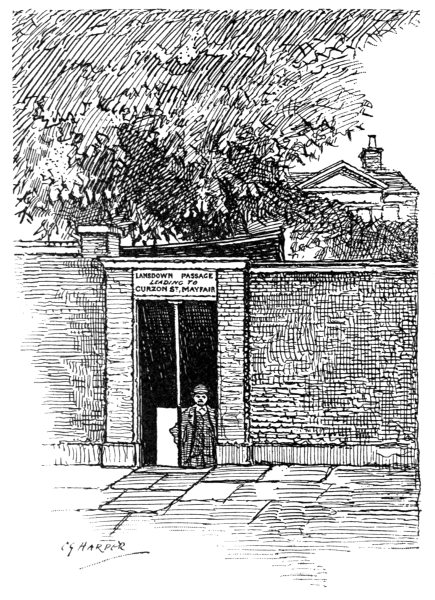
LANSDOWNE PASSAGE.
The iron bar dates from about 1768, and was
placed there immediately after the sensation
caused by a mounted highwayman, who, having
committed a robbery in Piccadilly, evaded his
pursuers by riding up Berkeley Street and down
the steps of Lansdowne Passage, and so through it
and into Bolton Street, at a gallop.
When such things as those just narrated were
possible, it is only a little more surprising to read
how Sir John Fielding, the Bow Street magistrate,
could raid a masquerade ball, on March 6th, 1753,
in search of highwaymen. He had received
information that some of the profession would be
present, and went with his men and entered the
gaming-room, and obliged all the company to
unmask and give an account of themselves. "It
is supposed," says the Gentleman's Magazine,
"those fellows had notice of his coming before he
could get upstairs, and so made off in the crowd,
for none of them were taken." There had been
deep gaming that night, and a plentiful circulation
of bad guineas.
It is amazing to modern readers who read of
the notoriety in which the highwaymen often lived,
that they should have been suffered to appear in
public so frequently, and yet their profession to be
so well known. At Ranelagh, at Vauxhall, at the
fashionable coffee-houses they were found, enjoying
the gaieties of the town, and reading, no doubt,
in the newspapers of the day, accounts of their
own enterprises of a day or two earlier. There was
a certain or an uncertain period of grace allowed
most of these fine fellows, whose careers, long or
short, were very largely lengthened or shortened
by the amount of the rewards that presently began
to be offered for their apprehension. The convenience
or safety of the long-suffering public was
never consulted. It never is. Then and now,
the public existed, and still exists, for the support
of officials and functionaries. That is what we of
the unofficial classes are here for. This system,
carried to its logical conclusion, may be best
studied in France and Germany, but we in England
are fast advancing on the same lines.
In the days of the highwaymen, the system
worked, in respect of them, in this way: they
were not worth catching until a reward was
offered, and it even then remained a nice point
whether it were not better to wait until a still
larger reward was advertised, before closing in
upon the fellows and haling them before the
magistrates. You had simply to watch the
"public form," so to speak, of your man, just as
people accustomed to bet upon horse-races watch
the performances of the animal they favour. If
your highwayman were a dashing and enterprising
fellow, likely to make much of a stir in his line,
it was obviously not worth the while to collar him
for the sake of a mere £40 reward offered for the
apprehension of a highwayman. You just waited
until he became a notorious person, with some
great deeds to his credit—a big haul of guineas or
jewellery, or perhaps even a murder. Then he
would be worth £100, or, in extreme cases, even
more; and then only would he be taken, unless,
indeed, some foolish competitive busybody
officiously intervened, and got him before he had
quite ripened.
THE HIGHWAYMEN OF WILTSHIRE AND SALISBURY
PLAIN—MR. JOSEPH READER'S ADVENTURE—THE
CHERHILL GANG—"CLIBBORN'S POST"—MURDER
OF MR. MELLISH—CLOSE OF THE
HIGHWAYMAN ERA
Many of the stories in these pages are concerned
with the doings of highwaymen in the districts
near London, but the neighbourhood of almost
every town was infested in degree, and there are
few local histories, and fewer of the older newspaper
files, that do not afford curious reading in
the highway robbery sort, intermingled with
advertisements offering rewards for the apprehension
of horse- and sheep-stealers and fugitive
husbands who have left their wives and families
chargeable upon the parish. The neighbourhoods
of Devizes and Salisbury seem to have been exceptionally
favoured with these miscellaneous
rascals, no doubt because those two places stood
at either extreme of what long remained the wild
and desolate region including Salisbury Plain,
where, although the great roads to Bath and
Exeter brought a considerable traffic, the houses
were few and far between. It was an ideal
district for evil-doers, and there are a very considerable
literature and a very startling series of
incidents in this sort, connected with it.
[1]
A curious incident is that told on an old
broadsheet printed in 1712, and sold at the usual
broadsheet price of one penny, of the hanging
of a highwayman by one of the travellers he
attacked. On Saturday, February 2nd, in that
year, a Mr. Nat. Seager, a maltster, took horse
from Shaftesbury for Blandford, to buy corn in
Blandford market. He had only gone two miles
and had descended into the plain from the
hill-top town, when "he was attack'd by a
Highway-Man and a pistol clap'd to his Breast,
with the Word of Command 'God D—n you, you
old Dog, alight and deliver.'"
Mr. Seager, very much terrified, dismounted,
or perhaps, rather, tumbled off his horse, and
threw the man £3 in silver; but the highwayman
was not content with this. "It was not all," he
said; and, rapping out another oath, he drew a
broadsword and gave Mr. Seager a cut on the
shoulder. Whereupon Mr. Seager produced twenty-four
guineas more, with which the highwayman
rode off contented, leaving the unfortunate
maltster bleeding on the ground.
In a little while there came along the road
another traveller, Mr. Joseph Reader, miller, of
Shaftesbury, whistling upon his way, according
to his habit.
"What is the matter?" he asked, surprised
to see his friend and neighbour lying there, all
gory.
Seager told him.
"Master," said Reader, "lend me your horse,
and I will endeavour to overtake the rogue, if you
will describe him to me."
"He has a great blue coat, and a sorrel horse,"
replied Seager: and with that, Reader mounted
and hastened the way he had gone.
It was not long before he overtook the highwayman,
who was waiting for more prey, and
thought he saw it in Reader. Twice he fired
pistols at him, and twice he missed; and then
Reader, who was by far the stronger of the two,
smote him with a cudgel he carried, and dragged
him from his horse. At this moment Seager
came up and found them struggling on the
ground, and Reader immediately despatched him
for aid.
But when he was gone, and our brave miller
had opportunity for reflection, it occurred to him
that his adversary might by some means get the
better of him, after all, before help arrived; and
so he stood the risk of losing the £40 reward
due to him for taking a highwayman. That was
a risk not to be entertained, and "therefore,"
said he, "I'll e'en hang him myself." And so
he did. Striking him insensible, he dragged the
unlucky man to a wayside tree, and hanged him
from it by his own belt.
The highwayman had not long given up the
ghost before Seager returned, at the head of the
Sheriff's posse; when the miller learned, much
to his dismay, that, by acting as hangman upon
one who had not been brought to trial, he had
put himself in very grave peril.
In fact, the law, resenting this interference
with its prerogative, had a good deal to say to
Mr. Joseph Reader, who was brought to trial
at Dorchester before Mr. Justice Coker, at the
next assizes, and charged with murder. Fortunately,
he was acquitted, and his resourcefulness
properly acknowledged by a subscription of over
£30, made up for him in Court.
Not only solitary highwaymen, but bands of
marauders, scoured the treeless and hedgeless
wastes of Salisbury Plain and its neighbourhood.
One of these was known as the "Cherhill Gang,"
and chiefly favoured the locality between Marlborough,
Calne, and Devizes. Individual members
of this brotherhood were taken from time to time,
hanged at Devizes, and afterwards gibbeted at a
spot high on the downs, between Beckhampton
and Cherhill. The remaining members of the
band and the friends and relations of the departed
of course bitterly resented this kind of post-mortem
publicity, and very often they would
either come by night and saw through the post
of the gibbet and so bring the whole thing to
the ground, or would climb up the post and
bring down the tattered relics of their friend,
swinging there in his chains or his iron cage,
and give it decent burial. There is much to be
said in favour of them. But after this had continued
for some time, the authorities hit upon a
plan of binding the lower portion of the gibbet
round with iron, of tarring it, and of driving
some hundreds of nails half-way into the post,
just by way of deterrents to climbers and others.
A very pretty story—pretty in its peculiar
way—is told of Serjeant Merewether successfully
defending one of the Cherhill Gang at the assizes,
and of his being robbed of his fee that night, by
his interesting client, when on his return home.
Another member of the same gang had the
peculiar fancy of stripping himself perfectly
naked, by night, and then springing out of a
wayside bush upon the startled traveller. The
unexpected spectacle, he said, was so alarming
that robbery became very easy. But this was
probably only a midsummer freak. Imagination
refuses to contemplate even the most desperate
highwaymen in midwinter, when snow-squalls
swept Marlborough Downs, emulating those
picturesque figures, the naked aborigines of the
poet's vision:
When, wild in woods, the noble savage ran.
I will quote here but one of the many old
newspaper reports of doings on this spot, but that
a picturesque one. The date is January 1743:
"A captain in the army, who was going to Bath
in a postchaise, was stopped near Sandy Lane by
two highwaymen, by one of whom he was told
that he wanted but a guinea, which he hoped to
be soon able to pay him again. The captain gave
him the guinea, and the fellow gave the driver a
shilling, and told the gentleman if he was stopped
by any one else, to say 'Virgin Mary,' that being
the watchword for the day. They had not gone
far before they were stopped by four persons; but
on being given the watchword, they raised their
hats, and rode off."
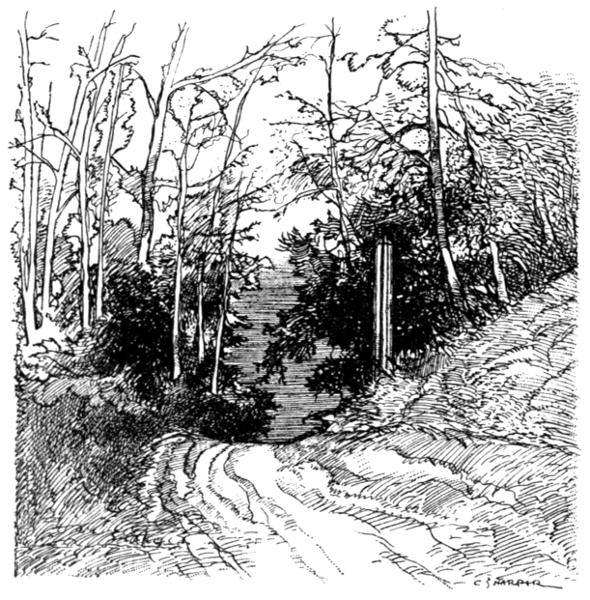
"CLIBBORN'S POST."
The visible relics of the highwaymen are few,
but among them that of "Clibborn's Post" is
peculiarly interesting. This relic is found in
Hertfordshire, in the neighbourhood of that fine
old Elizabethan manor-house, now a farm, but
famed in romance, Queen Hoo Hall. On the way
from Tewin and Queen Hoo Hall to Bramfield,
the wooded lane rises in a curve to the summit of
what is known locally as "Open Valley Hill."
Here, on the grassy bank, firmly planted in the
soil, stands a stout, oaken post, carefully bound
with strips of iron. This is "Clibborn's Post," the
modern successor of the original stake driven
through the body of a brutal highwayman of
that name, shot dead at this spot in the act of
attacking a farmer who was on his way home
from Hertford Market to Datchworth. This
occurrence happened on December 28th, 1782.
There had, about that time, been many highway
robberies committed on the country roads in this
neighbourhood; but no one had been able to
identify the desperado, who had plunged the
countryside, and especially the week-end market
folk, into such terror. On this particular night
this farmer was driving home in a cart, accompanied
by a servant named Shock. Just as they
reached this spot—then, as now, a lonely place
surrounded by tangled undergrowth and dense
plantations—a man rushed out from the thickets
and seized the horse's reins. The farmer jumped
down to struggle with him, but his assailant was
getting the upper hand, and was in the act of
unclasping a knife to cut his throat, when the
farmer called out to his servant, who carried a
blunderbuss: "Shoot, Shock, or I am a dead
man!" Shock had been afraid to fire, thinking
he might hit the wrong man, but, on this command,
he let fly, and shot the highwayman dead.
When they examined the body they found it to be
that of a pieman named Clibborn, a well-known
and ostensibly honest person who frequented the
Hertford inns on market day, selling pies to the
farmers and others. He had opportunities of
noting those who would be carrying large sums of
money home with them; and, leaving early, waylaid
them in some lonely spot such as this.
It was still, at the close of the eighteenth
century, abundantly possible for peaceful travellers
along the roads to be killed by highwaymen: Mr.
Mellish, a city merchant, returning from a day
with the King's hounds, in company with two
friends, named Bosanquet and Pole, having been
shot dead by a gang, who attacked and robbed the
carriage in which they were travelling, when near
Sipson Green, on the Bath Road. It was a
wanton act, too; the travellers having disbursed
their money on demand, and the carriage already
starting off again for Hounslow when one of the
gang fired a shot after it. Mr. Mellish, sitting with
his back to the horses, was struck in the forehead.
It is probable that the highwayman intended no
more than to warn the occupants of the carriage
that he and his fellows really were fully armed,
and that they had therefore better hasten away as
quickly as they could; but the intention is immaterial:
the unfortunate man was killed, and the
highwaymen were never captured.
The nineteenth century opened badly for the
highwaymen, for not only had the business of
banking and the payment of money by cheque
grown largely, but Pitt's Act for Restricting Cash
Payments, passed in 1797, had led to fewer large
amounts in coin being carried about their persons
by unprotected travellers. Nothing was more
remarkable than the great sums of money that
seem to have been carried by all classes in the
periods already discussed; and in those circumstances
lay the highwaymen's opportunity. But
now they had fewer and smaller takings in coin,
practically a choice only between watches and
jewellery and bank-notes: very dangerous classes
of property to handle unlawfully.
But if their takings were less, their numbers
were scarcely fewer; and the gibbets were still not
infrequently replenished. Thus, a highwayman
named Haines was, in May 1799, gibbeted on Hounslow
Heath, just where the Bath and the Exeter
roads part company, at the western extremity of
Hounslow town. A curious item in the Annual
Register for that year proves—if proof were
wanted—that the spectacle of his hanging had
been a popular sight; for there we read an
account of how a party of eight gentlemen, who
had been out for the day to witness the spectacle,
ferried over the Thames to the "Flower Pot" inn
at Sunbury that night, at ten o'clock, presumably
with the intention of "making a night of it." It
may not be uncharitable to suppose that they had
already taken more than sufficient, for in crossing
the river, the boat was upset and three of them
were drowned.
The stumps of the gibbets that formerly stood
at the fork of the Exeter and the Bath roads, at the
western end of Hounslow were discovered in 1899,
when the road was excavated for the electric
tramways that now pass the spot.
At the close of the eighteenth century, the
approaches to London again became so dangerous
that it was necessary to institute some kind of
protection. This was established in 1805, under
the name of the Bow Street Patrol, and was
organised, as its name implies, from the principal
London police-office. This was a forerunner of
the existing horse-patrols of the Metropolitan
Police, to be now and again encountered at night
on lonely suburban roads in these far more secure
times of ours. Even Hounslow Heath and
Finchley Common grew comparatively safe when
this armed and efficient force got to work. They
were probably not in full existence when the
poet Campbell and his wife, walking on Sydenham
Common in that year, were confronted by a
mounted highwayman who demanded their money,
with menaces. An alarm was promptly raised,
and he was pursued and captured; when he was
found to be a resident of the neighbourhood.
In the provinces the era of the highwaymen
was longer lived. The roads between Arundel
and Chichester were in 1807, for example, haunted
by one Allen, a highwayman who preyed chiefly
upon the farmers coming home with well-filled
purses from market. The militia were called out
to capture him, and thus, in these peculiarly
glorious circumstances of war, he was shot dead
near Midhurst, while endeavouring to escape arrest.
THE LITERATURE OF THE LATER HIGHWAYMEN
Since Smith and Johnson's days, the literature of
the highwaymen has declined in quality and
increased in output. The history of the highwaymen
has never been reconsidered or restated since
they flourished, and no one has ever attempted to
extend it from 1742. Not even Turpin appears
in Johnson's folio, published three years earlier
than that "hero's" execution at York: an omission
which seems amply to prove that Turpin's
contemporaries did not consider him a particularly
interesting or notable person.
Yet, although nothing has been done to tell
the story of the highwaymen who flourished
numerously long after Smith and Johnson had
completed their works, there is an abundance of
materials for the purpose. They are not nice
materials. Distinctly unappetising trials for the
most part, "last dying speeches and confessions,"
usually impudent fabrications, and, when not
entirely un-authentic, generally the utterly unreadable
productions of the Ordinaries of Newgate
and other prisons, who turned an honest, if somewhat
discreditable, penny in hearing the generally
boastful and lying accounts by prisoners of their
crimes and adventures; seldom writing them down
from dictation, and commonly but imperfectly
memorising them, and only setting down their
general sense. That is why the very numerous "authentic"
lives, last dying speeches, and confessions
of the highwaymen and others, written out by the
Ordinaries and usually attested at the end by the
criminals themselves, are so bald and unconvincing.
An outside rival production was, as a general rule,
a good deal more spicy, and although unauthorised,
not necessarily less truthful. The "official" productions,
as we may term them, were of a stereotyped
fashion, ballasted with an intolerable deal of
moral reflections, and written in a heavy-handed
way that by no means reflected the convict's own
generally keen relish of his own villainies. We
should not mind all this, if we knew the Ordinaries
to have been good and earnest men; but they were
nothing of the kind. By education gentlemen,
and by virtue of their holy orders bound to
maintain the law and the Gospel, they were nevertheless
a pack of intolerable scoundrels, drunken
and dissolute, and not infrequently as fitted for
the cells as the unhappy prisoners in the Stone
Jug, to whom on Sundays in the prison chapel
they preached Hell and Damnation, the Burning
Lake and Everlasting Torment. The publication
of the last dying speeches and confessions of their
interesting charges was the perquisite of these
unworthy men, and it was one of the most indefensible
of privileges in that age of perquisites.
Thus the pamphlets they issued and grew fat
upon soon pall upon us. There are, however,
other sources: the "Newgate Sessions Papers,"
the somewhat too famous "Newgate Calendar,"
which shared with the Bible the favour of George
Borrow; the "New Newgate Calendar"; the
"Malefactors' Bloody Register," and other atrocious
"literature"—to give it the conventional
title bestowed without discrimination upon all
printed matter.
I am sorry for myself, after having perused
those dreadful pages, and many other like authorities,
in search of the romantic highwayman as
seen in fiction. I have not found him, but I have
found plentiful evidence of the existence of innumerable
ineffable blackguards and irreclaimable
villains of the most sordid, unrelieved type:
bestially immoral, tigerishly cruel, and cringing
cowards until they were safely jugged, when
their cowardice was exchanged for a certain
callousness. There were exceptions, but the
general effect of reading these originals is an effect
of moral and material muddiness, of a personal
uncleanliness not a little distressing. It would
even have a lasting effect of depression, were it
not abundantly evident that these things are of
a day that is done. They are part of those "good
old times" that, happily, are not our times.
Fortunately, even among this extensive literature,
it is possible to find some human touches;
here and there to trace some humorous rogue and
find him entertaining.
Rather late in the day comes James Catnach,
with his penny chapbooks and broadsides. He is
not elevating, and is often vulgar. The more
vulgar his productions, the better they sold. I
don't think he quite realised that point, but some
modern popular publishing firms have, and profit
hugely by it, for vulgarity is popular and pays
enormously. If Jemmy Catnach, of Nos. 2 and 3,
Monmouth Court, Little Earl Street, hard by the
Seven Dials, had fully grasped this point,
he would have died worth very much more
than the £3,000, £5,000, or even £10,000 he was
represented to have left when he quitted this
life, about 1841.
James Catnach commenced business about
1813. His publications were all issued at the
popular price of one penny, and covered every
subject likely to attract the sympathies of the
lower classes. Not quite the lowest classes, for
they could not at that time read at all. We must
not suppose that he dealt only in the horrible.
Not by any means. You might buy of him for
the nimble penny the history of Goody Two Shoes,
the story of Jack the Giant Killer, the affecting
tale of Cock Robin, or the even more affecting
story of the Babes in the Wood. The "Soldier's
Farewell to Home and Parents," in which the
illustration is intrinsically so rough, and the paper
and print are so abominable, that it is difficult
to see which is the soldier and which are the
parents, showed that maudlin sentiment was very
profitable. He published also a large selection
of patriotic, amorous, and tearful ballads; but
it is sadly to be confessed that his penny murders
were by far the most popular. He had no penny
Sunday papers and no halfpenny evenings to
compete with him, and the daily and weekly
journals ranged from threepence to eightpence.
His only competitors were the garret, cellar, and
kitchen printers of his own kidney: Birt, of the
neighbouring Great St. Andrew Street, and others.
But he was the chief of them, the most industrious,
and the most successful. He and his
small staff in 1824 printed in eight days, off four
formes, no fewer than 500,000 copies of an
account of the murder of Mr. Weare by Thurtell,
and bagged £500 profit on the business. His
customers were a low and dirty mob of pedlars,
hawkers, and street-sellers, who paid chiefly in
coppers, and dirty ones at that. Those were the
days when pennies and halfpennies were really
coppers, and not, as now, bronze; and they were
large. A penny weighed one ounce, and was
an appreciable weight in the pocket: sixpence in
coppers was a burden. The coppers Catnach
received in the way of his business were a
nuisance to him, and he was afraid, from their
filthy condition, that they would also be infectious,
and so he generally boiled them in a solution of
potash and vinegar. In the almost vain endeavour
to dispose of them he was accustomed to pay the
wages of his boys and men in coppers, from ten
shillingsworth to forty shillingsworth, and even
then had to arduously load up vehicles with
the rest, for the bank. His back kitchen was
paved with bad pennies set in concrete.
The lives and adventures of the highwaymen
were always a safe sale. Like most of his rudely
illustrated productions, they were embellished
by his own ingenious hand. The backs of old
engraved plates of music served him instead of
wood-blocks, and these he engraved upon, apparently
with a chopper and a hammer, if we may
judge by the startling results. He could have
taught Thomas Bewick a thing or two in breadth
of treatment, and in his noble scorn of detail
(or in his inability to execute it, whichever it
was) he was undoubtedly the first of the Impressionists.
He was rather good at devils, and
supreme in picturing a ferocious villain; but
not successful in representing a village beauty.
He issued a very good edition of the Life and
Adventures of Dick Turpin at the usual price of
one penny: good beyond his common run, because
he seems to have employed some one to engrave
the pictorial cover for him, and you can really
distinguish quite easily between Black Bess and
the turnpike-gate, over which that gallant mare
is shown to be jumping. Dick Turpin, in this
production, affects a jockey-cap.
Birt, of Great St. Andrew Street, was another
of the many small printers, who issued popular
and ill-printed penny lives of Turpin in the days
before the boys' penny papers issued in frowsy
courts off Fleet Street, began to print long, long
romances of him and Tom King, always to be
"continued in our next." Birt shows us what
purports to be a portrait of Turpin, no doubt from
some strictly un-authentic source, and the short
narrative ends with the picture of an execution,
in which alone the purchaser had his money's
worth, for we see two criminals hanging: Turpin
and another, who would seem, so far as appearances
go, to be his twin brother. It is a new
light upon the life and death of the hero.
THE NEWGATE CHAPLAINS: SAMUEL SMITH, PAUL
LORRAIN, THOMAS PURENEY—THE PRISON LIFE
The Chaplains, or Ordinaries, of Newgate were
amply provided for. The presentation to the office
was in the gift of the Lord Mayor and aldermen,
and included a residence in Newgate street, in
addition to the salary, a legacy of £10 a year paid
by the Governors of St. Bartholomew's Hospital,
an annual £6 from Lady Barnardiston's legacy,
and what are described as "two freedoms yearly,"
which generally sold for £25 each. In addition to
these, the city usually presented the Ordinary with
one other, annually. By 1779 it appears that he
no longer enjoyed the freedoms, but his salary was
augmented to £180, and, in addition, he received
£3 12s. 0d. a year from the sheriffs.
Surely this was a stipend ample enough for the
class of men who held the office, especially as the
divines who generally obtained it did very well out
of the "authentic" lives of the criminals to whom
they extended ghostly counsel. The "Bishop of
Newgate" was the slang term for the Ordinary,
and so well—though not so admirably—did the
men, who, in a long succession, filled the office, fit
into the place, that we but rarely find one translated
to other fields of activity. They lived and
died Ordinaries of Newgate. Even a good man
might have become degraded by the place and its
fearful management, but the men appointed were
of the worst type, and a disgrace to the Church.
The Reverend Paul Lorrain and the Reverend
Thomas Pureney were typical Ordinaries, blusterous,
bloated, and snuffy; ready with a threadbare tag
from an easy classic; profaning the Scriptures with
vinous hiccoughs; more keen to nose a revelation
for their delectable broadsides and hypocritical
pamphlets than to lead a sinner to repentance, even
if they knew the way; and always with an alert
eye on the main chance.
Lorrain succeeded one Samuel Smith in 1698,
and held the post until his death, in 1719. He
was most diligent in the production of those
"official" accounts of the lives, confessions, and
last dying speeches of the criminals, which were
printed and sold largely, and thus formed a considerable
augmentation to the salary of himself
and his kind. A collection of forty-eight of these
curious pamphlets, written by him, is found in
the British Museum. We turn to them with
expectancy, but from them with disgust. With
every advantage at their command in this peculiar
form of authorship, the Reverend Paul Lorrain
and his successors failed to produce anything but
the most insufficient of lives, the most commonplace
confessions, and the most threadbare last
dying speeches, garnished with haphazard texts.
Generally published at eight in the morning of
the day after the respective executions, they had
their public; but the very cream of the sale was
skimmed off on the actual day of the execution by
unlicensed publications, and it was usually quite
easy for the doomed men going to Tyburn to purchase
a penny biography of themselves, and to
read what they had said at the last moment, before
the last moment itself was reached. In Hogarth's
print of the end of the Idle Apprentice at Tyburn,
the "Last Dying Speech and Confession of Thomas
Idle" is being bawled out at the moment of
his hearing the final ministrations in the cart.
Obviously, these productions could not be
"authentic," in so far, at least, as the concluding
scenes were concerned; but there is that
journalistic flair about many of those that have
survived the bad paper and the worse ink with
which they were produced, which shows a full
comprehension of what the public wanted. And
whatsoever the public wants, it is the journalist's
business to see it duly gets. There is more resource,
more touch with life, in these than in the works
of the Ordinaries.
A certain low and undistinguished feeling of
pedantry runs through all those clerical issues.
The Reverend Mr. Paul Lorrain, or the equally
Reverend Mr. Thomas Pureney, tells us of such
and such an one, that, "departing from the early
paths of Virtue and Integrity, where the Flowers
of Innocency may be pluckt," (much they knew
of such things, to be sure!) "he stray'd among
the Profligate and the Abandon'd, and became a
Highway Man."
Such stuff! All very well for copy-book
maxims or good books for well-behaved children;
but the streets wanted stronger meat than this; and
they got it. In the unauthorised lives of the various
malefactors, written for the appreciation of the
crowd, it may be read how such a youthful innocent
as the one described above in so sesquipedalian a
style, "was a practis'd prig at eleven years of age.
He stole his Father's Cash-Box, and, coming with
it to London, spent the Contents in the gayeties
of the Town." Precocious youth! But precocity
is not, as many suppose, a Twentieth-Century
portent.
"He soon became a Flash Cull and set up half
a dozen Doxies of his own, who empty'd his Pockets
as soon as he filled 'em." Nothing at all about
the early paths of Virtue and Integrity in this, it
will be observed.
"He then, observing that more was to be made
in one Night's good-fortune under the Stars than
in a week of snatching the Bung or cly-filing in
the streets, and with less danger, in it, became a
Collector of Tolls upon the High-Way."
That was your true penny style for the streets.
It was sympathetic and understood, which the
"Flowers of Innocency" business was not.
Paul Lorrain and his brethren never failed
with the moral lesson, however little they themselves
believed in it; and always, you will find,
who read their nauseating pages, that those who
had the misfortune to sit to them for their biographies
were "truly penitent," "moved to contrition,"
or "heartily renounced their Wicked and
profligate course of life," and the like.
And yet nothing is more certain than that the
larger number of them went to death impenitent
and hardened. The better sort were merely sulky;
the worse cursed and flung indecent quips to the
crowd, all the way to the gallows. Nor need
there be much wonder at it. To die for taking a
purse from a traveller must have seemed even to
an eighteenth-century highwayman, born into
this state of things and bound to suffer by it, an
extravagant penalty. Temperament, sanguine or
otherwise, did the rest, and conditioned his attitude
on the Tyburn journey.
The Reverend Thomas Pureney had a way of
his own with sinners. He could not make them
truly penitent, but he could, and did, frighten
them almost into convulsions by a way he had in
preaching. He was a nasty person, among a
succession of forbidding persons. He stumbled
as he walked: his nose and cheeks flamed with intemperance
in drink: he took the flavour of the
pot-house with him whithersoever he went. Nay,
he even, as a youth, before ever he was educated
for the Church, had thoughts of himself going
upon the highway, and indeed actually began the
business of taking things without leave of the
owners of them. His first and only essay in this
sort was the handling of a silver flagon and two
volumes of sermons, which he was conveying
from the rectory of his native place in Cambridgeshire,
when the excellent clergyman discovered
him with this singular booty and lectured him,
not unamiably. He would certainly end his days
in Newgate, prosed the good man, if he did not
instantly see the error of his youthful ways, and
reform. Why, that very reform, so far as it went,
served, strange to say, to land him, years later, at
Newgate; and there he ended, after all; but very
differently from the fashion the old clergyman
had foreseen.
His respectable parent soon after this youthful
escapade entered him at Corpus Christi College,
Cambridge, and there he assimilated as much
learning as sufficed to place him in holy orders.
But he had not been, in any sense of the word, a
moral man while at the University, and although
he found a curacy at Newmarket, it was with a
reputation which rather fitted him for the society
of the racecourse than for the pulpit that he went
there.
The eighteenth century demanded little of a
clergyman, but even that little our Pureney could
not render, and he was flung out with ignominy,
even from Newmarket. Drink and flagrant immorality
were the undoing of him there, and the
rumours of his evil ways long followed him about,
and prevented him securing another post, until at
last that of Ordinary at Newgate was tossed contemptuously
to him. The suggestion of that
office—insult though it would have been to a
decent man—found in him a ready and grateful
acceptance. No standard of conduct was required,
and, joy of joys! he became pastor among the very
kind of heroes who had fired the imagination of
his perusing youth.
He lorded it over those caged gaol-birds with
imperious ways for thirty years, and in that time
had the fortune to hob and nob with many a
famous rogue. Jack Sheppard and many a
lesser light sat under him in the prison chapel and
listened to his outrageous sermons, promising
damnation and everlasting torment; and he had
the singular fortune to call the infamous Jonathan
Wild a crony for some years, and in the end,
when that appalling scoundrel had been found out
and cast for the shameful death to which he had
brought so many others, to preach the worm that
dieth not to him also. It is true that, owing to
his intimate acquaintance with Pureney, Wild did
not greatly value his discourse, and sought and
obtained the counsel and guidance of an outsider,
the Reverend Mr. Nicholson, to wit, who, he says,
"very Christian-like gave me his assistance"; but
the Ordinary came into his own again on the
Sunday, when the condemned, Wild among them,
were herded into their gruesome pew in that most
awful of chapels, and had to listen to his ravings.
Pureney's account of the life, crimes, conviction
and confession of Jonathan Wild and of other
malefactors condemned at the same time is a folio
broadsheet, distinguished among a badly produced
class of literature as surely the very worst-printed,
on paper of the commonest. A rude woodcut at
the beginning discloses the Ordinary in a black
Geneva gown, preaching to his charges (an extraordinarily
large Ordinary, and remarkably small
convicts), with conventional representations of
Heaven and Hell, to left and right. A Hand,
bearing a celestial crown a good many sizes too
large for any of the convicts here pictured, is
seen amid clouds; the Ordinary, not at all
astonished by the phenomenon, pointing to it
and continuing his discourse.
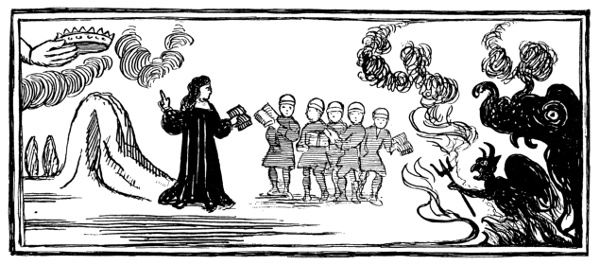
DECORATIVE HEADPIECE FROM PURENEY'S "LIFE AND CONFESSION OF
JONATHAN WILD AND FOUR OTHER MALEFACTORS."
Hell's mouth, smoking like the exhaust of an
over-lubricated motor-car, is occupied by a very
convincing Devil, armed with an undeniably
business-like trident, who has most certainly got
his eye rather upon the unsuspecting Ordinary
than on the weak-kneed group of five malefactors,
one of whom appears by his attitude to prefer
Hell to any more of the Ordinary's exhortation.
And, if all accounts of Pureney's life and death
be true, the Devil did get him, after all.
Such was the type of publication out of which
Pureney earned an addition to his income; but
the tale does not quite end here. The last page
is largely occupied with an advertisement of the
most flagrantly indecorous and reprehensible
character, of which even an eighteenth-century
clergyman of the Church of England might have
been ashamed. But the clergy fell generally far
short of the ideal ministers and vicars of God.
Whether in town or in the country, where "Parson
Trullibers" abounded, they were a disgrace to
their office; and even when they were earnest,
which was seldom, provoked criticism by their
extravagance.
In 1724, when Jack Sheppard, pickpocket
and housebreaker, was again lying in Newgate,
after being re-captured, his doings appealed
greatly to the imagination of all. He was
the most famous person of that year, and great
crowds thronged to see him. Sir James Thornhill,
the Royal Academician, painted his portrait; chapbooks
innumerable, badly written, and ill-printed,
on vile paper, were issued before his execution and
sold in thousands to eager purchasers; and clergymen
took his career for their texts. One ingenious
preacher, given to sensational discourse, outdid
all his brethren in thus improving the occasion:
"Now, my beloved, what a melancholy consideration
it is, that men should show so much
regard for the preservation of a poor, perishing
body, that can remain at most but a few years,
and can at the same time be so unaccountably
negligent of eternity. Oh! what care, what pains,
what diligence, and what contrivances are made
use of for, and laid out upon, these frail and
tottering tabernacles of clay, when, alas! the
nobler part of us is allowed so very small a share
of our concern that we will scarce give ourselves
the trouble of bestowing a thought upon it.
"We have, dear brethren, a remarkable instance
of this, in a notorious malefactor, well known by
name as Jack Sheppard. What amazing difficulties
has he overcome! What astonishing things has
he performed, for the sake of a stinking, miserable
carcase, hardly worth hanging! How dexterously
did he pick the padlock of his chain with a
crooked nail! How manfully burst his fetters
asunder, climb up the chimney, wrench out an
iron bar, break his way through a stone wall, and
make the strong door of a dark entry fly before
him, till he got upon the leads of the prison!
And then, fixing a blanket to the wall with a
spike, how intrepidly did he descend to the roof of
the turner's house, and how cautiously pass down
the stairs and make his escape at the street door!
"Oh! that ye were all like Jack Sheppard!
Mistake me not, my brothers, I mean not in a
carnal, but in a spiritual sense; for I purpose to
spiritualise these things. What a shame it would
be, if we did not think it worth our while to take
as much pains, and employ as many deep thoughts,
to save our souls, as he has done to preserve his
body! Let me exhort you, therefore, to open the
locks of your hearts with the nail of repentance;
burst asunder the fetters of your beloved
lusts; mount the chimney of hope, take from
thence the bar of good resolution, break through
the stone wall of despair, and all the strongholds
in the dark valley of the shadow of death. Raise
yourselves to the leads of divine meditation; fix
the blanket of faith with the spike of the
Church; let yourselves down to the turner's
house of resignation, and descend the stairs of
humility. So shall you come to the door of
deliverance from the prison of iniquity, and escape
the clutches of that old executioner, the devil,
who 'goeth about like a roaring lion, seeking
whom he may devour.'"
No doubt the preacher meant well, but his
figurative style was too pronounced.
It is easy and proper to be severe on the subject
of the Newgate chaplains, but perhaps some allowance
should be made for them, on the score of
the associations of prison life, always bad, but
incredibly degrading in that age. If we except
Pureney, who was himself an instinctive criminal,
the Ordinaries could not, all at once, have become
callous and depraved. They were not, of course,
men distinguished for learning or piety, for it was
the practice to give the chaplaincy to the dregs
of the profession; but were doubtless, at the time
of their appointment merely average men, eager
to obtain a livelihood. They ran very grave risks,
too, in those days when gaol-fever ravaged the
prison, and even infected the sessions-house. It
was highly dangerous to attend the prisoners, often
indiscriminate in their revengeful violence, both
in their cells and at the place of execution. A
peculiar incident recorded of an execution at
Hertford, on March 25th, 1723, shows that all
manner of indignities were possible. On that day,
when William Summers and another man named
Tipping were turned off, the hangman was so
intoxicated, that, supposing three had been ordered
for execution, he insisted on putting a rope round
the parson's neck as he stood in the cart, and
was with difficulty prevented from stringing him
up as well.
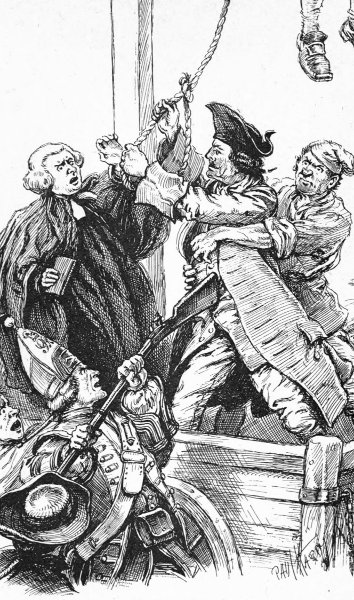
SCANDALOUS SCENE AT A HERTFORD EXECUTION.
It is only charitable to suppose that the
Ordinaries must needs have been shocked when
first introduced to their morally and physically
pestiferous charges, and gradually became used
to their surroundings. Let us take a prisoner
typical of those whom these divines attended:
Valentine Carrick is not so well-known a name
as Maclaine, but he also formed a popular sight
during the short interval between his conviction
and execution. "James" Carrick, as he is also
styled, was son of a retired jeweller, who was
wealthy enough to set up for a gentleman, and to
purchase his son an ensign's commission in the
army. Like hundreds of others of his class, the
young ensign gambled freely; like most, he lost,
and like a large proportion of broken gamesters,
he sought to replenish his pockets by emptying
those of travellers on the King's highway by
threats, and at the point of sword or muzzle of
pistol. He was one of the most reckless blades
that ever the Stone Jug had received. He applied
the saying of the heedless folk mentioned in the
Bible to his own situation: "Let us eat, drink, and
be merry; for to-morrow we die." Others might
laugh and tipple as they passed their few days in
the condemned hold; he did more, for he shouted
and sang, and was generally roaring drunk.
Hundreds came to see this edifying spectacle,
and the Newgate turnkeys reaped a rich harvest in
fees paid by eager sightseers. Such an extraordinary
rush impressed even the prisoner, who appears
to have thought it very stupid. "Good folks," he
exclaimed, "you pay for seeing me now, but if
you had suspended your curiosity till I went to
Tyburn, you might have seen me for nothing."
The company he kept—and was by the lax regulations
of the prison readily allowed to keep—in
gaol was of the most depraved type. At any
rate, these dissolute companions served to keep up
his spirits to the very last, and followed him to
Tyburn itself, where he ended in the same vein:
"When he came to the place of Execution, he
smiled upon, and made his Bows to all he knew.
Instead of praying with the rest of the Criminals,
he employ'd that time in Giggling, taking Snuff,
and making Apish Motions to divert himself and
the Mob. When Prayers were over, he told them
the Sheriffs had made an order that no Surgeons
should touch his Body. The Ordinary advised
him to consider whither he was going, to which
he answered that, being a Roman Catholic,
he had receiv'd no Sacrament, and prepar'd for
Death in his own Way; and then, giving himself
some pretty and genteel Airs (as he seem'd to
think 'em) in adjusting the Halter about his Neck,
the Cart was drawn away."
So far from contrition and repentance being
found in Newgate, the prison was generally, as we
have seen, the riotous finish of an ill-spent life.
The interest with which they were regarded
effectually prevented the prisoners from realising
themselves the miserable sinners they were
officially declared to be from the chapel pulpit
on Sundays. The times were practically pagan.
William Hawke, or Hawkes, one of several
men at different times styled the "Flying Highwayman,"
was greatly honoured. He had been
condemned in July 1774, on the paltry charge of
stealing a small quantity of linen: quite beneath
a person of his skill, and, like many another fine
fellow, received very distinguished company as he
lay in his dungeon cell. Rank and fashion, wit
and beauty, enlivened his days and made them
pass cheerfully enough. Among others who
called upon him was the eccentric Colonel George
Hanger, afterwards fourth Lord Coleraine, who
offered him a handsome price for his horse, to
which the high-minded Hawke warmly responded:
"Sir, I am as much obliged to you for your
proposal as for your visit. But," he added in a
low tone, and in a wary manner that implied his
increasing confidence, "the mare won't suit you,
perhaps, if you want her for the Road. It is not
every man that can get her up to a carriage."
Hanger was so exceedingly pleased with this
little trait of professional sympathy that he
advanced Hawke £50, to enable him to offer
bribes for his escape; but all efforts in that
direction failing, the highwayman later returned
the money, with his grateful thanks. He was
buried in Stepney churchyard, with the following
epitaph: "Farewell, vain world, I've had enough
of thee," over him, by his own desire; an ineffective
post-mortem repartee upon the world, which had
already so emphatically proved it had had enough
of him.
THE WATCHMAN, AND THE EXECUTION BELL OF
ST. SEPULCHRE
Robert Dowe, citizen of London and merchant
taylor, who died in 1612, bequeathed the annual
sum of twenty-six shillings and eightpence to the
vicar and churchwardens of St. Sepulchre, for the
time being, for the delivery of a solemn exhortation
to the condemned criminals in Newgate, on
the night before their execution. The parish
clerk, or other person that might be appointed for
the purpose, it was laid down by the terms of this
bequest, "should come in the night-time, and
likewise early in the morning, to the window
of the prison where they lie, and there ringing
certain tolls with a hand-bell appointed for
the purpose, should put them in mind of their
present condition and ensuing execution, desiring
them to be prepared therefor, as they ought to be.
When they are in the cart, and brought before
the wall of the church, at the beginning of their
journey to Tyburn, there he shall stand ready
with the same bell, and, after certain tolls, he
shall rehearse a certain prayer, desiring all the
people there present to pray for them."
"Admonition to the Prisoners in Newgate, on
the Night before Execution.
You prisoners that are within,
Who for wickedness and sin,
after many mercies shown, are now appointed to
die to-morrow in the forenoon: give ear, and
understand, that to-morrow morning the greatest
bell of St. Sepulchre shall toll for you, in form
and manner of a passing-bell, as used to be tolled
for those that are at the point of death: to the
end that all godly people, hearing that bell,
and knowing it is for your going to your deaths,
may be stirred up heartily to pray to God to
bestow His grace and mercy upon you, whilst
you live. I beseech you, for Jesus Christ's sake,
to keep this night in watching and prayer, to
the salvation of your own souls, while there is
yet time and place for mercy; as knowing to-morrow
you must appear before the judgment-seat
of your Creator, there to give an account of all
things done in this life, and to suffer eternal
torments for your sins committed against Him,
unless upon your hearty and unfeigned repentance,
you find mercy through the merits of the
death and passion of your only Mediator and
Advocate, Jesus Christ, who now sits at the
right hand of God, to make intercession for as
many of you as penitently return to Him."
Then followed the:
"Admonition to the Condemned Criminals as
they are passing by St. Sepulchre's Church-wall
to Execution.
"All good people, pray heartily unto God for
these poor sinners, who are now going to their
death, for whom this great bell doth toll.
"You that are condemned to die, repent with
lamentable tears; ask mercy of the Lord, for the
salvation of your own Souls, through the merits
of Jesus Christ.
Lord have mercy upon you.
Christ have mercy upon you."
To see that these injunctions were duly carried
out, the Beadle of Merchant Taylors' Hall was
given a "modest stipend," but whether any other
person drew a further sum for seeing to it that
the Beadle saw the parish clerk perform the duty
does not appear.
It would seem that, as time went on, the
watchman who patrolled the neighbourhood at
night took over the duty of performing the midnight
exhortation. By that time it had been
crystallised into poetic form, and was no doubt,
when delivered with due solemnity under the
frowning walls of Newgate at that midnight hour,
a very impressive thing. Twelve o'clock sounded
slowly from the belfry of St. Sepulchre, and then,
heard through barred windows in those massive
walls of rusticated masonry, came that deliberate
recitation:
All you that in the condemned hold do lie,
Prepare you, for to-morrow you shall die.
Watch all, and pray, the hour is drawing near,
When you before the Almighty must appear.
Examine well yourselves, in time repent,
That you may not to eternal flames be sent;
Forswear your sins, trust in Christ's merit,
That Heavenly grace you may inherit;
And when St. Sepulchre's bell to-morrow tolls,
The Lord have mercy on your souls!
Past twelve o'clock!
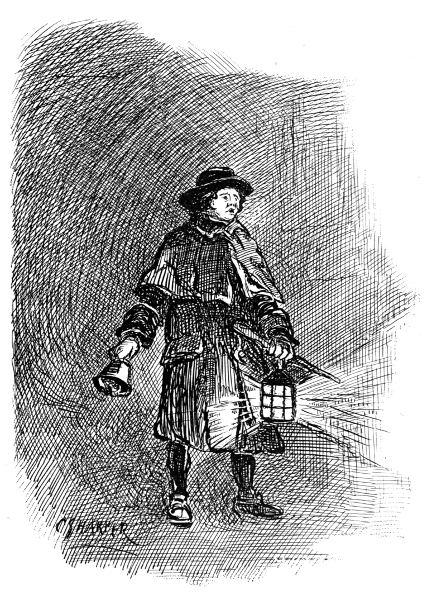
THE BELLMAN.
All you that in the condemned hold do lie,
Prepare you, for to-morrow you shall die.
We may imagine, if we pause a moment,
with the fearful story of that historic prison in
our minds, the condemned men, merrymaking
up to the last and receiving curious and dissolute
visitors in their imprisonment, having their reckless
carousing broken in upon by that awful
message, and halting a moment, with an icy terror
striking in upon their nerves, to realise that this,
then, was the last chapter in their lives. We
are not to suppose, however, that these solemn
words, ordained by the excellent Robert Dowe,
made a lasting impression on those for whom
they were intended. The passing citizen, or the
honest tradesman lying wakeful in his bed, probably
was more deeply impressed. The criminals
themselves, as the long story of them through
the dreadful centuries shows, were mostly callous.
They had, the larger number of them, long over-passed
the dread of death; and even with those
who were afraid, it was by tradition a point of
honour to take that last journey to Tyburn as
gaily as though they were the central figures in
some merrymaking, instead of going to their own
shameful extinction. Indeed, the populace expected
no less, and while they were ready to
applaud the highwayman, who made his exit in
gala costume, and with something that might
pass for wit on his lips, and were eager for the
honour of shaking him by the hand, they were
not backward with curses, stones, and mud when
some poor devil, unnerved, or perhaps even penitent,
broke down and was drawn, a miserable
object, to the gallows.
But there were those critics who did not
believe in the picturesque nocturnal method of
admonishing malefactors of their approaching end.
They did not consider it was possible they could
be oblivious of it, or "as if Men in their Condition
you'd have any stomach to Unseasonable Poetry";
as that "late famous, notorious robber," John
Hall, executed 1708, very pertinently remarks in
his "Memoirs."
Did those criminals who were sincerely penitent
properly value Mr. Dowe and his bequest?
It is to be feared they did not altogether relish
being woke up from the sleep (if they had any)
of their last night on earth. Of another sort than
the generality of them, however, was Sarah
Malcolm, who died in 1733 for the murder of her
mistress, Mrs. Duncombe. "D'ye hear, Mr.
Bellman," she shouted out from her window;
"call for a Pint of Wine, and I'll throw you
a Shilling to pay for it."
The great bell of St. Sepulchre continued to
toll on the morning of executions until 1890. It
was to have been sounded at the execution of Mrs.
Pearcey, but a guest at the Viaduct Hotel was
lying ill at the time, and a message being conveyed
to the vicar, asking that it might on this
occasion be dispensed with, the old custom was
then discontinued, and was not again renewed.
It had, in fact, been merely a
sentimental survival since 1888,
when the Charity Commissioners
had laid hands upon, and appropriated
the £50 left two
hundred and eighty-three years
before. The midnight bellman
had ceased his warning cry in
1783, when Tyburn executions
ended and Newgate's prisoners
began to be executed in the
Old Bailey, on the very threshold
of the prison.
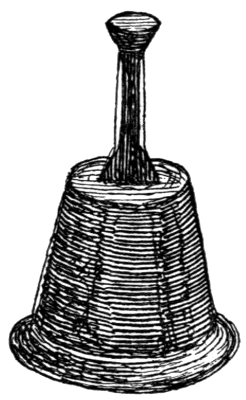
THE "EXECUTION
BELL," ST. SEPULCHRE.
The original hand-bell reposes in a glass case
on the north wall of the chancel of St. Sepulchre's
church, with a suitable inscription.
HANGMAN'S HIGHWAY: THE ROAD TO TYBURN
Tyburn:
That most celebrated
place,
Where angry justice shows her awful face;
Where little villains must submit to fate,
That great ones may enjoy the world in state.
Let us now see something of that road—that
Via Dolorosa, as we may in all fitness call it—along
which the condemned, highwaymen and
others, went to Tyburn Tree. I shall style it
"Hangman's Highway." It is not a pretty name,
and it was never its official designation; but it
is an apt one. Since 1783, when it lost that
unenviable notoriety, its social status has continually
risen, and there is now not a more
respectable three-miles stretch of thoroughfare in
London.
It had in remote ages been "Hangman's
Highway," for from the west gateway in the
wall of Roman Londinium, from the spot in
after-years known as "Newgate," the malefactors
of the Roman period were marched out
and done to death. But in mediæval times, the
citizens of London, not then so easily moved
at the sight of executions, were content to allow
criminals to be put to death in their midst, and
we read of executions on Cornhill. A little later,
and we find Smithfield chosen; a spot called
"The Elms," apparently situated opposite where
St. Bartholomew's Hospital stands, being the
place where, not only criminals of low degree,
but many of high rank suffered. Here the
Scottish patriot, Wallace, was hanged in 1305,
and here Mortimer was executed in 1330.
Holinshed, indeed, deriving his information
from Adam Murimuth, tells a different tale. He
says, of Mortimer: "He was at London drawne
and hanged at the commen place of execution
called in those daies The Elmes, and now Tiborne,
as in some bookes we find."
But there is some confusion of ideas here:
Tyburn did not become a place of execution until
long after, and St. Giles's was the next site of the
gallows.
It was a little less than a hundred years later,
that the newer choice was made, for about 1413
we read that the gallows was set up at the
northern boundary of the Leper Hospital of St.
Giles, half-way to Tyburn. It is referred to in
ancient documents as the "Novelles furches," i.e.
the "new forks": in allusion to the arms of the
gallows-tree. There, in 1417, Sir John Oldcastle
was hanged and his body afterwards burnt.
But Smithfield was still occasionally the
scene of executions, and there, also, the fires
that consumed the Protestant martyrs in the
Marian persecution were lighted. Even so late
as 1693, the celebrated highwayman, Captain
James Whitney, was executed at Smithfield, on
a spot known as "Porter's Block," near Cowcross
Street. The equally celebrated, or notorious,
John Cottington, called "Mulled Sack," was
hanged at "Smithfield Rounds," some years
earlier.
"The Elms" was also the name of the earlier
Tyburn, and much confusion has naturally arisen
over this duplicating of names. The original
Tyburn appears to have been established on the
banks of a stream, which long ago ran across
what is now Oxford Street, near Stratford Place.
Here, then, were those other elms, distinct from
the fatal elms of Smithfield.
[2] To this place the
executions were remitted, no doubt following
upon the remonstrance of some aggrieved person,
who found the gallows of St. Giles injuring his
property.
[3] The continued westward progression
of Tyburn Tree is, indeed, a sign of the growth
of London in that direction, and a proof of the
very natural objection entertained by residents
and owners of property to executions conducted
in front of their windows.
The Tye Bourne obtained its name from the
two branches, in which it flowed down from the
Hampstead heights towards the Thames. The
two streams were something over half a mile
apart: the easterly branch crossing Oxford Street
just below Stratford Place, and the westerly—the
"West Bourne," that has itself also disappeared,
but has given its name to Westbourne Grove and
Westbourne Terrace—flowing across the Bayswater
Road into Kensington Gardens. Its course
lay along what is now Kensington Gardens
Terrace, and does so still: underground, and
enclosed in a pipe.
A Roman road went due west out of the West
Gate of Londinium to join the Watling Street
(which ran from Stangate, Lambeth, across
the Thames at Westminster, in a north-westerly
direction to Edgware) at the present junction of
Oxford Street, Bayswater Road, and the Edgware
Road, occupying the line of the existing Oxford
Street. It crossed the eastward branch of the
Tye Bourne by a paved ford: the "strat-ford"
i.e. "street ford," that long, long ago suggested
a name for Stratford Place. Even the great
modern borough of St. Marylebone owes its name
to this bourne, and to the original church of
St. Mary, built not far from its bank. The
present Marylebone Lane owes its curious windings
to the fact that it was once a country lane that
followed the twists and turns of the little river.
St. Marylebone gets its name in a manner
worth describing. The original church of St.
John, Tyburn, that had stood from time immemorial
beside the banks of the Tye Bourne,
between the Oxford Street end of what are now
Marylebone Lane and Stratford Place, was situated
in a very lonely, yet exposed situation, on the great
road from the City of London to the west. The
village centred about where High Street, Marylebone,
is now to be found, and the church and the
village pound stood apart. So often was this
original place of worship broken into and
desecrated by thieves and vagabonds that it
became at last necessary to remove it altogether.
Accordingly, a licence was obtained in 1440 from
the Bishop of London, Robert Braybrooke, to
demolish the building and to erect a new church
in the village itself, to be dedicated to St. Mary.
Hence the disuse of "Tyburn" and the rise of
"St. Mary-le-bourne."
The old Court House and vestry offices of
Marylebone, in Marylebone Lane, built in 1829,
occupy the site of the ancient vestry and that
of the old pound for strayed cattle; and skeletons,
found there in plenty at the building of it, were
ascribed to the criminals anciently hanged and
gibbeted on the spot, rather than thought to be
the bones of the respectable inhabitants.
But, however dangerous the neighbourhood for
three hundred and sixty-four days of the year, it
was on one summer's day, annually, the scene of
a gay civic festival. Ever since 1239 there had
been conduits established here for the supply
of water to London—that one square mile of
London known as the City—and to this spot on
that annual occasion repaired my Lord Mayor
and aldermen, to feast in a building called the
"Banqueting House," that then stood in the
pleasant country meadows. It may be found,
distinctly marked, on old maps, on the site of
Stratford Place, which itself is of considerable age,
having been begun in 1744.
A record is still preserved of that civic
junketing in 1562, when, after lunch, the Lord
Mayor and the other guests hunted the hare through
the woods of St. Marylebone. Then they dined,
and, the huntsman having unearthed a fox, the
hunt tailed away to St. Giles-in-the-Fields, where
at last he was killed, "with great hollowing and
blowing of horns at his death."
There should never have been the slightest
doubt as to the real meaning of the word "Tyburn."
It clearly means "the two streams." Somewhat
similar derivations of place-names are found in
the numerous "Twyfords" throughout the country,
and in the name of Tiverton: the meanings being,
of course, respectively, "Two Fords," and "Two
Ford Town." But we find such derivations as
"t'Ay Bourne," and the quaint passage written
in 1617, "Teyborne, so-called of bornes and
springs and of tying men up there." Fuller, at
any rate, if not prepared to suggest an origin,
was not, on the other hand, content to accept the
popular view. He adopted a mildly critical
attitude when he wrote his Worthies, and said:
"Some will have it from Tie and Burne, because
the poor Lollards for whom this instrument (of
cruelty to them, though of justice to malefactors)
was first set up, had their necks tied to the beame,
and their lower parts burnt in the fire. Others
will have it that it is called from Twa and Burne;
that is, two rivulets, which it seems meet near to
the place."
But the earliest mention of the stream, or
streams, in A.D. 951, when it was called "Teoburne,"
seems to settle the point, beyond reasonable
doubt.
The valley of this vanished stream can still
most clearly be perceived, in the very marked dip
in the road at this point, and its course onward
towards the Thames may be traced by Brook
Street and Half Moon Street, to Piccadilly (where
a similar dip in the road will be found) and so
into the Green Park.
The westward march of London in course of
time moved on the Tyburn "Elms," to a site
midway between the two branches of the Tye
Burn, and fixed the scene of execution for some
two centuries at what was later known as "Tyburn
Gate," until at last "Tyburn," as a Golgotha,
ceased to be, in 1783.
There was probably an excellent reason for
this selection. The spot was certainly not near
either of the bournes, but it was, as already
pointed out, at a junction of roads, and it was
then a place where the greatest publicity could
be given to the ways of justice—or what passed
for such—with the breakers of laws. It was not,
according to ancient accounts, a nice place, even
before the gallows was erected there; being nothing
but a barren heath, standing rather high above the
surrounding country, and with no houses near.
The road to this last Golgotha of London, before
executions took place outside Newgate prison, is
known by many names to-day: Holborn, High
Holborn, New Oxford Street, and Oxford Street,
along whose course it would now be difficult to
point out many historical survivals. The church of
St. Sepulchre still stands, as of yore, immediately
without the site of the ancient City wall, and
seems to many well versed in the gloomy memories
of the spot, to bear an ominous name, until it is,
with a little thought, recognised to be really
dedicated in memory of the Holy Sepulchre at
Jerusalem. An ironic fate, indeed, it was that
for so many centuries associated its name with the
last moments of the capitally convicted.
Its tower is prominent even now, but it was
even more striking—though more closely hemmed
in with houses—before the Holborn Viaduct, in
1867, superseded the road that in the old days
plunged down into the deep valley of the Fleet
River, that Old Bourne, or Hole Bourne, so greatly
in dispute among antiquaries, and crossed here by
Holborn Bridge, until the improvements of the
viaduct-building age overbuilt the valley, and
swept away the bridge and the surrounding streets
into the limbo of forgotten things.
"All, all are gone, the old familiar faces,"
sighed the poet; and the thing remains just as
true and as sad when we substitute "places" to
suit our own present needs. Newgate prison is
gone and Skinner Street is abolished, that once
stood immediately adjoining St. Sepulchre church,
and the only vestige remaining of it is a very
plain tablet dated 1802, that may be found by the
diligent and the quick-sighted in the dungeon-like
crypt of the Guildhall Museum. The dirty
alleys are gone too, and that is no loss—and gone
also is what was known to Cockneys as "'Obun
'ill." Holborn Hill, which, it need perhaps hardly
be explained, was the true name of this eminence,
was not an Alp, nor even a Plinlimmon, but it
remained to the very last a terror to London
drivers, especially of heavy vehicles. It was a
great thing when Holborn Viaduct was built, to
have abolished those exceeding-steep gradients
which faced all eastward—and westward—going
traffic, and were terribly exacting to horses,
especially in damp, greasy weather.
"'It 'im on the raw, mister!" suggested a
countryman in the old days to the omnibus driver,
as the vehicle toiled up the steep, towards the
City.
Alas! poor horse.
"Not yet," returned the driver, who knew his
business; "we saves that for 'Obun 'ill!" That
was the supreme effort!
The descent of Holborn Hill was the first thing
that lay before those old-time melancholy processions
to the Elms in very ancient days, and to
Tyburn, about half a mile further westward, in later
ages; and something of what it was in the way
of a descent we may still judge by looking down
over the parapet of the Viaduct, on to Farringdon
Street, far below. Before the procession fairly
started on its way down this declivity, it halted
by the porch of St. Sepulchre, and the criminal, so
soon to die, received a large nosegay from the
clergyman, for all the world as though he were
a débutante upon the concert platform, instead
of his being about to make a painful and humiliating
entry into the next world. The nosegay
was generally tied in the best fashion, with white
silken ribbons; and indeed, the thing was done
in style by all present, not excepting the central
figure, the condemned man, who was almost
always, when he could afford it, dressed gaily and
fashionably, as though he were going to a
wedding. He went to his death like a gentleman,
no matter how he had lived his life. The
only derogatory circumstance about it was that,
while the sheriff rode in his carriage, the real hero
of the day was obliged to go the journey in a cart.
For the rest, if he were a good-plucked one, the
highwayman, forger, murderer, or pickpocket—whatever
was his crime—went his way in receipt
of a continual ovation. He held the centre of
the stage all the way. No one wanted to deprive
him of this pre-eminence; be sure of that.
Of these scenes Swift wrote in 1727:
As clever Tom Clinch, while the rabble was bawling,
Rode stately through Holborn to die at his calling,
He stopt at the "Bowl" for a bottle of sack,
And promised to pay for it when he came back.
His waistcoat and stockings and breeches were white,
His cap had a new cherry ribbon to tie't.
The maids to the doors and the balconies ran,
And said, "Lack-a-day, he's a proper young man!"
And as at the windows the ladies he spied,
Like a beau in a box, he bowed low on each side,
And when his last speech the loud hawkers did cry,
He swore from the cart, "It was all a damn'd lie!"
The hangman for pardon fell down on his knee:
Tom gave him a kick in the guts for his fee:
Then said, "I must speak to the people a little;
But I'll see you all damn'd before I will whittle!
My honest friend Wild (may he long hold his place),
He lengthen'd my life with a whole year of grace.
Take courage, dear comrades, and be not afraid,
Nor slip this occasion to follow your trade;
My conscience is clear, and my spirits are calm,
And thus I go off, without prayer-book or psalm;
Then follow the practice of clever Tom Clinch,
Who hung like a hero, and never would flinch."
The original of this savage satire was, no
doubt, Tom Cox, the younger son of a gentleman
of Blandford, who, resenting his meagre fortune
under that old fetish of the English landowner,
the law of primogeniture, came to London for the
purpose of adding to it in what was then the conventional
manner. His career was ended, too,
by the authorities with an equally slavish regard
to precedent, for when convicted at the Old
Bailey of highway robbery, he was sentenced to
be hanged; and if, as a matter of fact, his actual
ending at Tyburn on June 3rd, 1691, was marked
by an incident of striking originality, it was his
own pluck and resource that provided the piquant
sensation created, and nothing officially contributed.
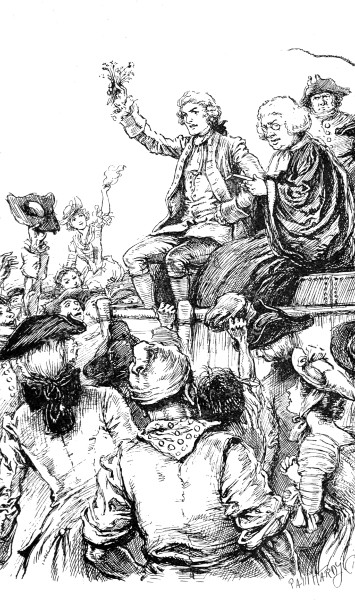
CLEVER TOM CLINCH GOING TO EXECUTION.
He had been heedless in the extreme while
in prison of the ministrations of the Ordinary,
and, being well provided with money, lived his
last days riotously. Even when beneath the
gallows at Tyburn he remained unmoved, and
when the Ordinary asked if he would not join
with his fellow-sufferers in prayer, he swore and
kicked both him and the hangman out of the
cart. He was but twenty-six years of age when
he died.
But good humour generally prevailed on the
way: "The heroes of the day were often on
excellent terms with the mob, and jokes were
exchanged between the men who were going
to be hanged, and the men who deserved to be."
Not only the "mob" enjoyed these occasions:
people who, by position and education ought to
have known better, made a point of either witnessing
the start, or, better still, of being present at
the actual execution. Those were not constituent
items of the "mob" who, for example, paid their
half-crowns for seats in the grand stand that was
a permanent structure at Tyburn, to witness the
final scene; but they had all the ferocity of mobs,
and showed it one day in 1758, when, having paid
their money to see Dr. Henesey hanged, he was
not hanged, but reprieved instead. Enraged at
this shameful breach of faith—and not at all glad
that one fellow-mortal had at the eleventh hour
escaped a shameful end—they wrecked the seats
and departed in a by no means appeased ill-humour.
Some enthusiastic sightseers walked all the
way: they could not have too much of a good
thing. Happy were those who could not only do
that, but could by favour secure a place next the
criminal himself! T. J. Smith, who wrote the
well-known volume called A Book for a Rainy
Day, tells how, as a little boy, he was nearly
given such a treat. He did, at any rate, witness
the start, under the care of Nollekens, and saw
the clergyman give the condemned malefactor the
nosegay: but the greater treat was, by a mere
accident, not to be his.
"Tom, my little man," whispered Nollekens,
"if my father-in-law, Mr. Justice Welch, had
been high constable, we could have walked beside
the cart all the way to Tyburn."
Where Holborn Viaduct ends westward in the
Circus, graced in these latter days of ours with
that polite equestrian statue of the Prince
Consort, lifting his cocked hat so high to omnibus
passengers, the Tyburn procession arrived at the
summit of Holborn Hill; passing to it beneath
the tall tower of St. Andrew's church. The
respectable inhabitants of Thavies' Inn—that
demure row of red-brick houses on the left hand,
built late in the seventeenth century, or early in
the eighteenth—were, we may be sure, as eager to
view the passing show as were the "lower orders."
The windows of the "Old Bell" inn, last but one
of the ancient galleried inns of London, demolished
so recently as 1897, were, no doubt, in great
demand; and indeed, at all the many hostelries
on the line of march the sightseers gathered, and
at one and the same time satisfied their curiosity
and quenched the thirst it provoked. But gone
are all the relics of the coaching days, and most
others. Holborn is not what it was. Nothing is.
The weirdest jokes were current of the doomed
criminals' behaviour on this melancholy way.
Thus Thomas Witherington, executed in 1635,
when going up Holborn Hill, requested that the
cart might be stopped, for he desired to speak to
the sheriff's deputy, who was conducting the
affair. "Sir," he is reported to have said, when
the deputy asked what it was he wanted, "I owe
a small matter at the 'Three Cups' inn, a little
further on, and I am afraid I shall be arrested for
debt as I go by the door. So I shall be much
obliged to you if you will be pleased to carry me
down Shoe Lane and bring me up Drury Lane
again, so that we don't pass it, and perhaps lose
my appointment at Tyburn."
The deputy, entering into the humour of it,
said he could not alter the route, but, if they were
stopped, he would certainly go bail for him; and
so Witherington, "not thinking he had such a
good Friend to stand by him in time of need, rid
very contentedly to Tyburn."
As these cavalcades progressed, they came
gradually into the country. They passed the
ultimate boundaries of the City at Holborn Bars,
where the ancient timbered and gabled buildings
of Staple Inn still look across the road to what is
now Gray's Inn Road, but was then merely a lane.
Near by is Furnival Street, formerly Castle Street,
as a tablet dated 1785 proclaims.
"Holborn Bars" is a name that but mildly
stimulates the curiosity of modern Londoners,
who, seeing no bars here, wonder idly about the
name, resolve to inquire about it, and then in the
busy life they lead, forget their passing interest.
There were toll-bars here in the highwaymen's
days, and those who care to seek for themselves
may still determine the exact boundary of the
City of London, for a granite obelisk on either side
of the road, bearing the City arms, still marks the
spot. London had reached thus far early in the
seventeenth century, but it went little further
westward for another hundred years.
The names of Great Turnstile, Little Turnstile,
and New Turnstile, now narrow side streets, giving
upon Lincoln's Inn Fields, are reminiscences of
the time when the land westward of Lincoln's
Inn really was meadow-land, instead of a London
square garden surrounded by houses. These
various "Turnstile" streets still keep the ancient
narrowness of the country
lanes they once
were, when the "kissing-gates,"
or turnstiles,
led into green fields
spangled with butter-cups
and daisies; but
such things are things
of long ago: the old
wall-tablet at the Holborn
end of New Turnstile,
dated 1688, showing
when the rustic pathways were first exchanged
for streets, and the wayside hedges for bricks
and mortar. Until quite recent years Tichborne
Court remained near by, with its fine tablet
bearing the Tichborne arms and the date 1685.
Kingsway, London's new street, immediately
westward, has been driven along the line of Little
Queen Street since 1903; its name in some fashion
intended to perpetuate the route taken by Charles
the Second between Whitehall and Newmarket.
When His Majesty shed the light of his countenance
upon the races,
or when he merely
wished to visit his
palace at Theobalds,
near Cheshunt, his
way would lie along
what is now Kingsway,
across Holborn,
along the now
vanished Kingsgate
Street (demolished in
1903, in the Holborn
to Strand street-improvements),
and
into the Theobald's
Road. Kingsgate Street derived the second
part of its name from it having been a private
road for the King's own use: barred and locked
against the passage of meaner folk, except in the
case of a privileged few, fortunate enough to
obtain passes. Less influential people, passing
on foot, on horseback, or by carriage towards
Cheshunt and Newmarket, in the wake of the
Court, had to struggle as best they might through
a network of peculiarly evil and muddy lanes,
infested with highwaymen, who, nothing daunted
by witnessing the dismal processions of their
brethren going westward, robbed with celerity
and an exquisite assurance those who, repairing
to the races, would in all likelihood have lost
their guineas on Newmarket Heath.
Thus we read in one of the "News Letters" of
Charles the Second's time, under date of 1666:
"Last Monday week in Holborn Fields, while
several gentlemen were travelling to Newmarkett,
to the Races there, a Highway Man very politely
begg'd their Purses, for he said he was advis'd that
he should win a great Sum if he adventur'd some
guineas with the Competers at New-Market on
a certain horse call'd 'Boopeepe,' which my Lord
Excetter was to run a match. He was so pressing
that they resign'd their Money to his keeping
(not without sight of his pistols); he telling them
that, if they would give him their names and the
names of the places where they might be found,
he would return to them that had Lent, at
usury. It is thought that his Venture was not
favourable, for the Gentlemen have not receiv'd
neither Principle nor Interest. It is thought
that it was Monsieur Claud Du Vall, or one of
his knot, that Ventur'd the Gentlemen's money
for them."
Not only have all those lanes disappeared in
the long ago, but even such comparatively late
landmarks as Kingsgate Street are no more:
Kingsgate Street, the home of Sairey—"which
her name is well beknownst is S. Gamp."
A little distance further westward, the Londoner
not deeply versed in the ancient lore of the
metropolis is greatly surprised at finding High
Holborn curving boldly to the left and departing
in the most marked manner from that straight
line to the west traced nowadays by New Oxford
Street. He does not know, or does not stop to
consider, that New Oxford Street really is new,
as newness in streets goes. It is, in fact, not
older than 1847. Before it was made, there was
no good through-route between the City and
Tyburn, and the line of road went by a circuitous
course, still easily traced—by High Holborn,
Broad Street, and High Street, Bloomsbury.
Passing under the very shadow of the Church of
St. Giles—anciently "St. Giles-in-the-Fields"—the
road again fell into the straight line opposite
Tottenham Court Road.
The reason for this curious departure from
the direct course is thought to have been the
existence in ancient times of a lake, or marsh—a
certain "Rugmere" mentioned in old records—covering
the site of what is now New Oxford
Street. However that may have been, this marsh
must in course of centuries have dried up, for the
site was built upon in later ages.
It was not an idyllic village that by degrees
came into existence here. It formed an annexe
to St. Giles's, a village itself associated from
remote times with undesirables. A leper hospital
was one of the early features of the place, and
poverty and crime in later years came to roost
by natural selection there; until, in fact, the
proverbial conjunction of St. James's and St.
Giles's, indicating the opposite extremes of aristocratic
elegance and unredeemed vulgar squalor,
was coined out of its flagrant raggedness and dirt.
The particular spot through which New Oxford
Street runs, was the deepest deep of that foul
slum. Drink and depravity met there and
flourished. It was generally known, this very
microcosm of criminal life, as "The Rookery,"
but satirists called it, in obvious contrast with its
real character, the "Holy Land." None dared
venture into that select purlieu, except under
police protection; and London breathed more
freely when, in 1844, it was at last decided to
remove this long-threatened plague-spot. Three
years later, the new thoroughfare was opened;
the improvement had cost no less a sum than
£290,227 4s. 10d., of which £113,963 went to the
Duke of Bedford, as compensation, although the
work had the effect of increasing the value of his
adjoining property. The transaction is an eloquent
instance of the marvellous and continued success
of the Russell family in feeding fat upon the
body politic, like lice upon the corporeal body.
It does not appear that, although His Grace was
advantaged thus enormously, both by betterment
and by compensation, the unfortunate owners and
occupiers of houses and business premises in those
highways suddenly converted into byways received
any of the much-needed compensation for
the "worsement" they suffered. For when New
Oxford Street was made, the fortunes of High
Street, Bloomsbury, of Broad Street, and of the
circuitous part of High Holborn were at once
shattered, and they at one stroke became the
byways they have ever since remained.
Swift, in his ballad of "Clever Tom Clinch,"
mentions the "Bowl" inn, at which the convict
called "for a bottle of sack." This was a house
that stood at the corner of what is now Endell
Street and Broad Street. For "sack," which
Swift probably used for the sake of the rhyme
with "come back," read ale, and the verse is true
to facts; for the processions halted at the "Bowl"
ale house, and the criminals were offered a drink
of ale; and it does not seem ever to be recorded of
them that they refused it. Perhaps they took
with them memories of the old saying, that "the
saddler of Bawtry was hanged for leaving his
ale": an unfortunate occurrence directly attributable
to his ill-humour. No one knows what
the saddler had done, but he was to die for it,
and being led out to York's execution place, on
Knavesmire, turned from the drink offered him on
the way. He had been effectually hanged only a
minute or two, when an unexpected reprieve
came by a hurried messenger; too late.
All the good-plucked ones on their way to
Tyburn, were not only expected to take their ale,
but to make that joke about "coming back" to
pay for it. It was as essential and as conventional
as the clown's, "Here we are again!"
Some surly ruffian might be moved, once in a way,
to drain the bowl, fling it empty at the landlord,
and bid him "wait for payment till he met him in
H—ll"; but that was ungentlemanly, and the
assignation not certain of fulfilment. Sometimes
it would happen that one of these travellers going
on to dance upon nothing at Tyburn would make
variations upon the old theme; but nothing seems
to have been quite so neat as the last remark of
an atrocious villain, Tom Austin, who, when he
stood with the rope round his neck, replied to the
Ordinary's query if he had anything to say before
he died: "Nothing: only there's a woman yonder
with some curds and whey, and I wish I could
have a pennyworth of them before I am hanged,
because I don't know when I shall see any again."
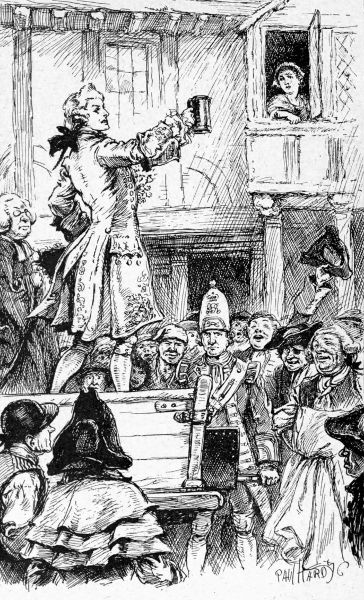
AT THE "BOWL."
Leaving the "Bowl" and threading the
narrow passage of High Street, Bloomsbury,
the processions, passing St. Giles's Pound, came
into the "Tyburn
Road," called
sometimes "the
Oxford Road," and
now, and since
about 1718, styled
Oxford Street.
Lysons, in his Environs
of London, says the row of the first few houses
on the north side of Tyburn Road westward of the
Tottenham Court Road, was completed in 1729,
and then it was first called Oxford Street; but
he is clearly in error, for until about 1888 there
remained built into the wall of No. 1, Oxford
Street, on the south side, at the first-floor level,
an oval tablet inscribed, "This is Oxford Streete,
1725." When the houses were rebuilt, this
simple relic disappeared. But a still earlier
tablet remains to disprove Lysons. This is one
built into the wall of a house at the corner of
Rathbone Place, which announces "Rathbones
Place in Oxford
Street 1718." The
omission of the possessive
case apostrophe
has a somewhat gruesome
effect, when we
consider the old story
of Oxford Street; but
the side street was
then the property of
a certain Captain
Rathbone. Oxford
Street then had a
very unenviable reputation.
Pennant's description of it in his own
youthful days forms interesting reading.
"I remember Oxford Street," he says, "a
deep hollow road, and full of sloughs; with here
and there a ragged house, the lurking-place of
cut-throats: insomuch that I was never taken
that way by night in my hackney-coach, to a
worthy uncle's, who gave me lodgings in his
house in George Street, but I went in dread the
whole way."
Rathbone Place did not long remain the most
westerly street. By 1725 a good deal of the
parish of St. George, Hanover Square, on the
opposite side of the road, was in existence, and
was at once fashionable; and Thomas Street, with
its tablet dated 1725, shows that, originally as
"Bird Street," it had carried the bricks and
mortar tide still further.
It can easily be understood
that the stigma of the Tyburn
route was at this period of
development beginning to be
resented by these new settlers,
who glanced with loathing at
the crowds who came to give
the condemned a good send-off.
It was said that 200,000 persons visited
Tyburn to witness the execution of Ferdinand,
Marquis Paleotti, in 1718, for the murder of his
servant, named, by a curious coincidence, Jack
Sheppard, and thus by no means to be confounded
with the famous Jack Sheppard, pickpocket and
burglar, who was executed here in 1724.
Henri Misson, one of the most entertaining
and instructive of foreign travellers in England,
who travelled among us in 1718, and wrote his
experiences and impressions, says: "Hanging
is the most common Punishment in England.
Usually this Execution is done in a great Road
about a quarter of a League from the Suburbs
of London. The Sessions for trying Criminals
being held but Eight Times a Year, there are
sometimes twenty Malefactors to be hang'd at
a time.
"They put five or six in a Cart (some gentlemen
obtain leave to perform this journey in a
coach) and carry them riding backwards, with
the Rope about their Necks, to the fatal Tree.
The Executioner stops the Cart under one of
the Cross Beams of the Gibbet, and fastens to
that ill-favoured Beam one End of the Rope,
while the other is round the Wretches Neck.
This done, he gives the Horse a Lash with his
Whip, away goes the Cart, and there swings my
Gentleman Kicking in the Air.
"The Hangman does not give himself the
Trouble to put them out of their Pain; but some
of their Friends or Relations do it for them. They
pull the dying Person by the Legs, and beat his
Breast, to dispatch him as soon as possible. The
English are People that laugh at the Delicacy of
other Nations, who make it such a mighty Matter
to be hanged. Their extraordinary Courage looks
upon it as a Trifle, and they also make a Jest of
the pretended Dishonour that, in the opinion
of others, fall upon their Kindred.
"He that is to be hanged, or otherwise
executed, first takes Care to get himself shaved
and handsomely dressed; either in Mourning, or
in the Dress of a Bridegroom. This done, he sets
his Friends at Work to get him Leave to be
buried, and to carry his Coffin with him, which
is easily obtained. When his Suit of Clothes,
his Night Gown, his Gloves, Hat, Periwig, Nosegay,
Coffin, Flannel Dress for his Corps, and all
those things are bought and prepared, the main
Point is taken Care of. His Mind is at Peace,
and then he thinks of his Conscience. Generally
he studies a Speech, which he pronounces under
the Gallows, and gives in Writing to the Sheriff
or the Minister that attends him in his last
Moments; desiring that it may be printed. Sometimes
the Girls dress in White, with great Silk
Scarves, and carry Baskets full of Flowers and
Oranges, scattering these Flowers all the Way
they go. But, to represent Things as they really
are, I must needs own that if a pretty many of
these People dress thus gaily, and go to it with
such an Air of Indifference, there are many others
that go slovenly enough, and with very dismal
Phizzes."
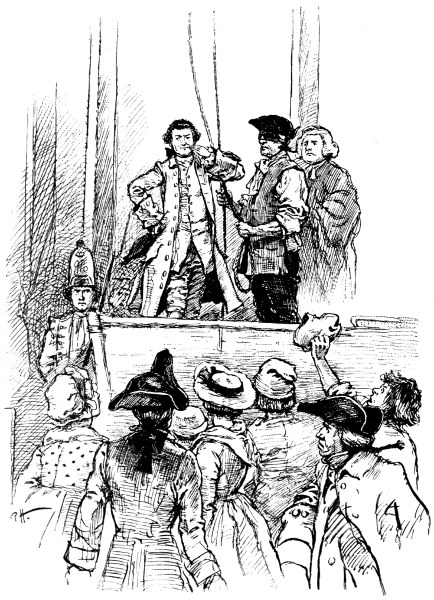
AN EXECUTION AT TYBURN.
Jonathan Wild, hanged May 24th, 1725, was
a whimsical fellow at the last of his career, for
he picked the pocket of the Ordinary on the way.
It is perhaps most exquisitely characteristic of
the race of Newgate Ordinaries that the article
stolen was a corkscrew. "Jonathan Wild the
Great," as Fielding calls him, "died with the
eloquent trophy in his hand."
Half a century later, those Newgate chaplains
enjoyed an equally bad—if, indeed, not a worse—reputation,
and a slighting remark is made in
Storer's letter to George Selwyn, in describing the
execution of Dr. Dodd for forgery, on June 27th,
1777. He rode to Tyburn in exceptional state, in
a carriage, and as a heavy rain-shower was falling
at the moment of his entering the cart, an umbrella
was held over him, so that he might not be wetted.
It was unfeelingly remarked at the time that the
precaution was entirely unnecessary, for he was
going to a place where he would soon be dried.
John Wesley, who also witnessed the execution,
was of a different, and a more charitable, opinion.
"I make no doubt," he said, "but at that moment
the angels were ready to carry him into Abraham's
bosom."
"He was a considerable time in praying," says
Storer, "which some people about seemed rather
tired with; they rather wished for a more interesting
part of the tragedy. There were two
clergymen attending upon him, one of whom
seemed very much affected. The other, I suppose,
was the Ordinary of Newgate, as he was perfectly
indifferent and unfeeling in every thing he said
and did."
In Hogarth's print of the final scene in the life
of the Idle Apprentice, arrived at Tyburn to be
hanged, we have a very painstaking representation
by that matter-of-fact artist of one of these fearfully
frequent executions. Hogarth was the most
uncompromising realist; he set down what he
saw, and extenuated nothing. Thus, in this view,
we may be quite sure we see a typical execution
in the middle of the eighteenth century; the
criminal seated in the cart, with his coffin
dolorously ready to receive his body, while with
one eye upon the prayer-book, and the other on
the ribald crowd, he strives to pay attention to
the last exhortations of the Ordinary, who is seen
with uplifted hand and finger pointing to the sky,
apparently comforting him with the assurance
that he shall find that mercy in the other world,
which man has denied him in this.
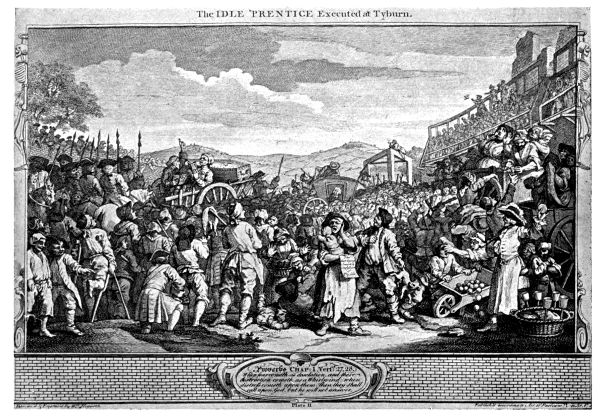
EXECUTION OF THE IDLE APPRENTICE AT TYBURN.
The sheriff's mounted guard, with their
halberds, look unconcernedly on, for this is an
almost everyday business with them. One is seen
joking with a comrade. Drunken women are
drinking gin, pickpockets are at work, and a
slatternly woman is crying the "Last Dying
Speech and Confession of Thomas Idle."
On the right hand is the permanent stand for
those spectators who were above mixing with the
mob, and were prepared to pay well for the
comfortable circumstances in which they could
witness a fellow-creature publicly put to a shameful
death. Close by, you perceive the "three-legged
mare" itself, at that time a fixed, and
a very roomy and most substantial structure,
designed to accommodate as many as a dozen or
so criminals at one time; so plentiful then were
the hangings. The hangman himself is seen to
be idly reclining on top, smoking a contemplative
pipe, until it shall please the clergyman to finish,
and hand over the doomed man to him. And
there is the Sheriff's carriage, and on the left
hand the brick wall, which then enclosed Hyde
Park. In the far distance are seen the pleasant
heights of Notting Hill, then in the open country,
and no doubt a spot where the innocent delights
of gathering hazel-nuts could still be enjoyed, as
in the times when it was first called the "nutting"
hill.
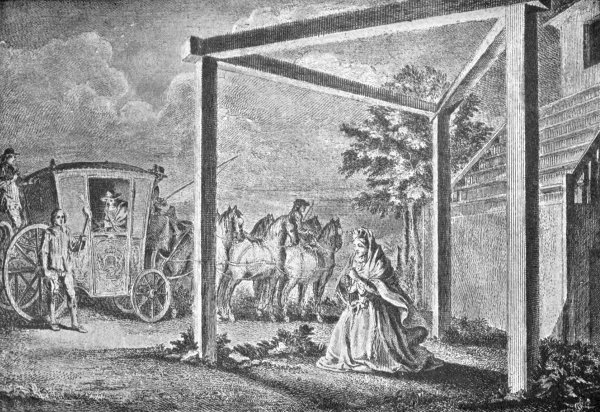
QUEEN HENRIETTA MARIA PRAYING AT TYBURN.
So changed are the modern circumstances of
the spot where Tyburn Gate in later times, and
Tyburn gallows in earlier years, stood, that vexed
controversies are continually arising as to the
exact spot on which the gallows was erected. It
is not, really, a difficult point to settle. The
structure shown in Hogarth's engraving, and
displayed in a still earlier German print, in which
Queen Henrietta Maria, the consort of Charles the
First, is seen to be making pilgrimage and praying
for the souls of her Roman Catholic servants
hanged here, was erected exactly in the middle
of the road, where, as you go westward, the
straight line of Oxford Street and the Bayswater
Road is met by the Edgware Road. Old maps
indisputably prove it, and the point is more
particularly settled by a large and very detailed
plan of the parish of St. George, Hanover Square,
made in 1725, and until recently in the vestry.
It is now in the Buckingham Palace Road branch
of the Westminster Public Libraries, where an
old engraving of it also hangs on the staircase.
This plan shows the parish boundary running up
Park Lane to Oxford Street, and there meeting
the boundaries of Marylebone and Paddington, at
the junction of Oxford Street, the Bayswater
Road, and the Edgware Road. The three
boundaries all meet in the middle of this confluence
of thoroughfares, and there the gallows
is shown, one of its three legs in each parish.
In its later years, Tyburn as a hanging place
became more varied, and the permanent gallows
gave way to a temporary one, erected at different
points somewhat further west. Two circumstances
suggested this: firstly, the building of houses
overlooking the scene, and the natural wish of
the tenants that such dreadful exhibitions should
not be displayed absolutely beneath their windows;
and secondly, the even more practical necessity
of ridding the public highway of the obstruction
caused by the permanent scaffold. The key to
this question of removal is found in the
Gazetteer, May 4th, 1771, which remarked that
the Dowager Lady Waldegrave was having a
"grand house built near Tyburn," and added
that, "Through the particular interest of her
ladyship, the place of execution will be removed
to another spot."
The highwaymen who suffered so largely here
had in their lives, been a danger and a hindrance
upon the highway, and they were now found,
oddly enough, in the circumstances of their taking
off, to be an equal nuisance. The road at this
point had begun to be enclosed on all sides, and
traffic, no longer able to avoid that ominous timber
framework, would have actually been blocked by it.
So, as with the passing of the years it had been
found that executions tended somewhat to decrease,
the permanent gallows was at last disestablished,
and a new and movable one was constructed. This
was used practically all over the area bounded by
Tyburn Gate, at the junction of roads already
described; by Bryanston Street, Seymour Street,
Connaught Square, Stanhope Place, and so round
by the Bayswater Road to Tyburn Gate again.
The site of No. 6, Connaught Place, has been
particularly mentioned, and, more particularly
still, that of No. 49, Connaught Square, which
the original lease from the freeholder, the Bishop
of London, declares to have been the place where
the gallows stood.
It was in 1783 that Dr. Johnson, that revered
philosopher, declaimed against the changes then
being witnessed. Perhaps the novelty that most
angered him was the proposed abolition of the
degrading processions of condemned malefactors
from Newgate to Tyburn. "The age is running
mad after innovation," he exclaimed to Sir
William Scott, "and all the business of the
world is to be done in a new way; men are to
be hanged in a new way; Tyburn itself is not
safe from the fury of innovation."
It was timorously remarked that this change
would, at any rate, be an improvement upon the
old order of things; but Johnson, like most elderly
men, thoroughly believed in what has been styled,
"the gospel of things as they are," and he
vehemently retorted, "No, sir, it is not an
improvement; they object that the old method
drew together a number of spectators. Sir,
executions are intended to draw spectators. If
they do not draw spectators, they don't answer
their purpose. The old method was most satisfactory
to all parties: the public was gratified
by a procession; the criminal was supported by
it. Why is all this to be swept away?"
But the age was more progressive than Dr.
Johnson, and 1783 did actually witness the last
execution at Tyburn. Unhappily, public executions
did not come to an end at the same time;
such dismal exhibitions continuing in London
to draw huge and riotous crowds at the Old
Bailey until they were finally abolished in 1868.
The old excuse for public executions—that they
were valuable as deterrents from crime—had long
been proved singularly ill-founded; and it was
notorious that these gruesome occasions, in some
morbid fashion, attracted not only a ruffianly and
callous assemblage, but brought all the graduates
in crime to the spot to witness a scene in which
themselves would, in all probability, some day
figure as chief actors. The last dying speeches
of the criminals were heard by few in the crowd,
and were aptly described as "exhortations to shun
a vicious life, addressed to thieves actually engaged
in picking pockets." The hardened wretches who
looked on at these last scenes, and who had, many
of them, already qualified for a place in the
cart, had a kind of perverted professional pride.
They applauded when a malefactor, with a curse
and a jest, "died game," and they howled disapproval
when some poor nervous creature broke
down pitifully on the verge of eternity.
We observe in the rough but effective old
woodcut which graces, or at any rate, occupies, if it
does not grace, the end of this chapter, a criminal,
not only dying game (in spite of the curious
black-faced, cheerful, parrot-like hangman above,
who seems to be thoroughly enjoying himself), but
apparently distributing handbills; very much to
the astonishment of the sheriff's bodyguard, whose
faces exhibit a singular variety of emotions. Perhaps
the criminal is so unconcerned because he
knows it impossible to hang him on so short a
gallows as that shown here. The illustration is
one of the curious seventeenth-century representations
of current events that formed the pictorial
news of the age.
The last person actually to be executed at
Tyburn was John Austin, hanged there November
7th, 1783.
THE WAYSIDE GIBBETS
The dead bodies of thy servants have they given to be meat unto
the fowls of the heaven, the flesh of thy saints unto the beasts of the
earth.—Psalm lxxix. 2.
The highwaymen were not specifically servants of
the Lord, and certainly never numbered a saint in
their ranks; but the point to be made here is that,
after all, they were human beings, who lived in a
supposedly civilised country, and were entitled to
be turned off in a gentlemanly way; and, their
crimes being thus expiated, to be buried decently
and allowed to rest. For a murderer, it may
readily be conceded, nothing could be too severe
in the way of punishment. Let the bodies of
those who profane God's temple be themselves
profaned with every offensive circumstance. But
for mere robbery upon the highway the methods
of the law were too drastic.
When it was considered more than usually
desirable to convey a warning to evil-doers in
general, and highwaymen in particular, that
Justice was still vigilant and ready to punish
crime, the bodies of executed malefactors were
occasionally set up along the roads on tall gallows
and hanged, or "gibbeted,"
there in chains
or in an especially
constructed iron
framework, so that
they might remain
for a length of time,
to preach an eloquent
sermon to some
classes of the passers-by,
and to disgust
others.
Among the features
of the country
to which the old map-makers
especially
devoted their attention,
the gibbets and
the beacons along the
roads are most prominent.
Ogilby, in
his Britannia of 1675,
shows a startlingly
large "gallows," like
a football goal, a mile
and a half on the
London side of Croydon,
and on the Tarporley-Chester
Road shows a "Gibbit,"
two miles and a half from Chester.
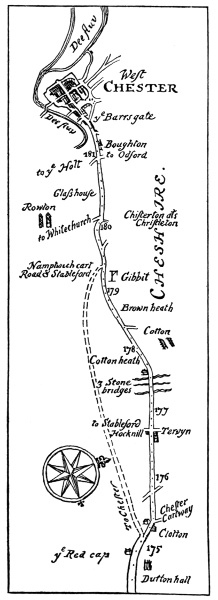
THE ROAD NEAR CHESTER, 1675.
There was never any lack of subjects for
gibbeting purposes, but it was generally desired
to preserve the criminal's body as long as possible,
to avoid the trouble and expense of replacing him
with a fresh subject; and to that end the practice
was either to place the body in a copperful of
boiling pitch, or to pour pitch over it. So treated,
it would last an almost incredibly long time:
always supposing the relatives of that public
exhibit did not come by stealth and make away
with it.
There are still a few gibbets to be found
in England: but rarely, or never, the original
posts. A sentiment which we are not quite
prepared to declare a perverted one, but which
is certainly a sufficiently gruesome manifestation
of antiquarian enthusiasm, has led to the
old gibbet-posts being renewed from time to
time in several places; and there they stand,
on hill-tops or by roadsides, reminders of those
fearful old times when such things as these
could be.
In these pages we are concerned only with
those that bear upon the subject of the highwaymen.
Among these Caxton Gibbet is prominent,
standing as it does on the North Road, between
Royston and Alconbury Hill. The particular spot
where the gibbet stands is an exceedingly lonely,
and, to some minds dismal, stretch of road that
winds in the flat, featureless lands, with never a
house in sight but the neighbouring wayside
alehouse, the "Gibbet" Inn. Only one mile
distant is the village of Caxton, but to all
appearances the spot might be many miles remote
from even a hamlet.
Caxton, according to Cobbett, resembles a Picardy
village; "certainly nothing English," he savagely
continued, "except some of the rascally rotten
boroughs in Cornwall and Devonshire, on which
a just Providence seems to have entailed its curse.
The land just about here does seem to be really
bad. The face of the country is naked. The
few scrubbed trees that now and then meet the
eye, and even the quick-sets, are covered with a
yellow moss. All is bleak and comfortless; and
just on the most dreary part of this most dreary
scene, stands almost opportunely, 'Caxton Gibbet,'
tendering its friendly one arm to the passers-by.
It has recently been fresh painted, and written
on in conspicuous characters."
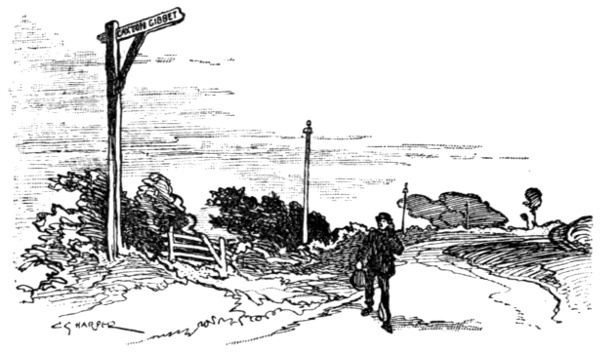
CAXTON GIBBET.
And so it remains to-day.
Among the criminals gibbeted on the original
Caxton Gibbet was George Atkins, who in 1671
had murdered Richard Foster and his wife and
child in the adjoining parish of Bourne. He
remained at large for seven years, and was then
captured and hanged; his body being afterwards
exhibited here. But the most pitiful story
connected with it is that of the younger of the
two sons of Mrs. Gatward, a widow, who for many
years kept the "Red Lion" Inn at Royston. She
was assisted by her two sons in the coaching and
posting business attached to the inn; but the
younger took a sudden fancy to become a highwayman;
probably from a mere love of excitement, or
dared to do it by companions of his own age. Whatever
the compelling cause, he went out and waylaid
the postboy carrying the mails between Royston
and Huntingdon, and robbed the bags. He was
arrested, condemned to death, and hanged, and
his body was gibbeted here.
The story of this amateur highwayman is to be
met with in the manuscript history of Cambridgeshire,
written by Cole, a diligent eighteenth-century
antiquary: "About 1753-54, the son
of Mrs. Gatward, who kept the 'Red Lion' at
Royston, being convicted of robbing the mail,
was hanged in chains on the Great Road. I saw
him hanging in a scarlet coat, and after he had
hung about two or three months it is supposed
that the screw was filed which supported him
and that he fell in the first high wind after.
Mr. Lord, of Trinity, passed by as he lay on
the ground, and, trying to open his breast to see
what state his body was in, not being offensive
but quite dry, a button of brass came off, which
he preserves to this day.... It was a great
grief to his mother, who bore a good character,
and kept the inn for many years after."
The story goes that the mother had the body
secretly conveyed to the inn, and gave it decent,
if unconsecrated, burial in the cellar.
It is easy to find the excuse that society had
to be protected at all costs, to condone the savagery
of those who permitted gibbeting for what we in
our own age would consider a minor crime; but if
we pause a moment, and strive to realise the
feelings of the surviving relatives by imagining
one of our own belongings so shamefully exposed
like carrion, for the ravens and the crows to feed
upon, we shall not so readily find excuse for that
fearful procedure.
The story of Mrs. Gatward's son very nearly
fits that which suggested to Tennyson his gloomy
and pitiful poem, "Rizpah"; but the original
motive for that poem is usually said to have been a
gibbet on the downs between Brighton and Worthing.
In that case also, the victim was a lad
who had robbed the mail for a mere freak. There
was no mercy for him.
They killed him, they
Kill'd him for robbing the mail,
They hanged him in chains for a show.
There was no consideration for amateurs in
that dreadful eighteenth century in which many
writers have found a specious glamour of romance,
because men and women wore powder and patches
and sported silken clothes of amazing colours and
styles. Who shall admire the embroidered waistcoat
if no feeling heart beats beneath it, and what
are manners or deportment if they but mask
the tiger.
Rizpah, whose name forms the title of Tennyson's
poem, was the concubine of King Saul
and mother of Armoni and Mephibosheth, who
were hanged and gibbeted, together with the five
sons of Michal, on the sacred hill of Gibeah.
There they remained from the early days of barley
harvest until October. "And Rizpah ... took
sackcloth and spread it upon the rock, from the
beginning of harvest until water dropped upon
them out of heaven, and suffered neither the birds
of the air to rest on them by day, nor the beasts
of the field by night."—2 Samuel xxii. 10.
The poor old woman of the poem is a sadder
figure than Rizpah, for she is nearer, in time and
place, to ourselves, and is represented as gathering
up the bones of her only son, as they drop from
the gibbet. Hers is a figure of terror and for pity:
Wailing, wailing, wailing, the wind over land and sea—
And Willy's voice in the wind, "O mother, come out to me."
Why should he call me to-night, when he knows that I cannot
go?
For the downs are as bright as day, and the full moon stares at
the snow.
We should be seen, my dear; they would spy us out of the town.
The loud black nights for us, and the storm rushing over the
down,
When I cannot see my own hand, but am led by the creak of
the chain,
And grovel and grope for my son, till I find myself drenched
with the rain.
Anything fallen again? Nay—what was there left to fall?
I have taken them home, I have number'd the bones, I have hidden
them all.
They would scratch him up—they would hang him again on the
cursed tree.
Sin? O yes—we are sinners, I know—let all that be,
And read me a Bible verse of the Lord's good-will towards men—
"Full of compassion and mercy, the Lord"—let me hear it again;
"Full of compassion and mercy—long-suffering." Yes, O yes!
For the lawyer is born but to murder—the Saviour lives but to
bless.
Robbers of His Majesty's mails had always
been hanged on conviction, but this severity had
proved no deterrent, and it was not until the Earl
of Leicester, Postmaster-General in 1753, prevailed
upon the Government to have their bodies afterwards
hung in chains, that any diminution of
mail-robberies took place. Highwaymen, it is
curious to reflect, did not so much mind being
hanged, but had the greatest horror of their bodies
being afterwards exposed. It is a weakness not
readily to be understood, this horror, not of death,
but of the desecration of the senseless body after
death; but it was a very useful feeling to play
upon, by way of deterrent.
That the highwaymen and the murderers were
not always dissuaded from their crimes by the
prospect of this post-mortem indignity is of
course to be readily supposed. There was always
the chance of their not being discovered. Thus,
although mail-robberies were probably much
fewer than they would have been, except for the
gibbeting order, they still were a feature of
the highwaymen's enterprises: and the midnight
roads continued to be awful with pendant bodies,
creaking in the wind in their rusted irons.
It is not difficult to mentally reconstruct those
times and those wayside incidents, and I can
imagine the solitary highwayman proceeding to
his shy business. There comes a horseman along
the road; he can be heard half a mile away, in
the hush of the night when, with the setting of
the sun, the cattle have ceased lowing and a
distant church clock alone helps to break the
stillness. He is in no hurry, this belated cavalier,
for the click-clock of his horse's hoofs is measured
and he is long in passing.
He is gone, pacing slowly up the hill to where
the great road goes by the end of the lane, and as
he goes we hear him, under his breath, cursing
the rising moon for a false jade. By favour of
her light we have seen him as he goes, with a
crape mask over his face and pistols in his
holsters; and recognise him as Hotposset Dick,
the highwayman, whose nickname comes from his
fondness for mulled port. They say he always
has a tankard for his mare as well as for himself
when starting out to speak with the mail at Five-ways
Cross.
Five-ways Cross is not a cheerful place for
Dick just now, and his mulled port is useful for
other purposes than keeping out the cold. It is a
spot which most people would find lonely, but
Dick has company up there; company of a silent
kind, which is apt rather to get on the nerves,
unless a man is well primed. It is a friend of
Dick's, who used to go shares with him in the
risks of robbing on the highway and in the profits
of their trade. He was caught ignominiously,
when carrying too much liquor; hanged, and
gibbeted at the Cross afterwards. There he swings
by the roadside in his cage, in a contemplative
attitude, as though pondering on the mysteries of
life and death. Six months' hanging there has
not improved either his manly beauty or his
clothes, and although the spot is generally shunned
by the villagers, some one, for purposes of evil
sorcery, has made away with one of the dead man's
hands and most of his hair, to make a Hand of
Glory.
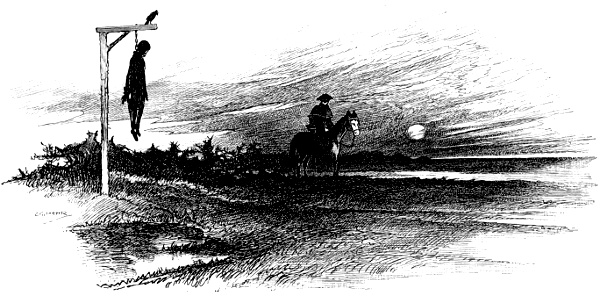
"THERE HE SWINGS BY THE ROADSIDE, IN HIS CAGE, IN A CONTEMPLATIVE
ATTITUDE, AS THOUGH PONDERING ON THE MYSTERIES OF LIFE AND DEATH."
A complete set of gibbet irons is nowadays a
somewhat rare and curious object. Their pattern
varied according to local taste and fancy. There
exists a set in the museum at Warrington,
Lancashire, which enclosed the body of Edward
Miles, who was executed in 1788 for robbing the
mail and for murdering the postboy. He was
gibbeted near the Twystes, on the road to Manchester,
and the iron frame in which he swung for
years was buried at the foot of the gibbet-post.
When it was found, in 1845, it had become an
antiquity bearing upon the obsolete customs of
our forefathers, and was carefully preserved.
The shape of it quite clearly indicates the outline
of a man's body, and there is even a kind of
ghastly smartness about the framework that
suggests a military bearing, which must have
made the awful object a terribly dramatic sight.
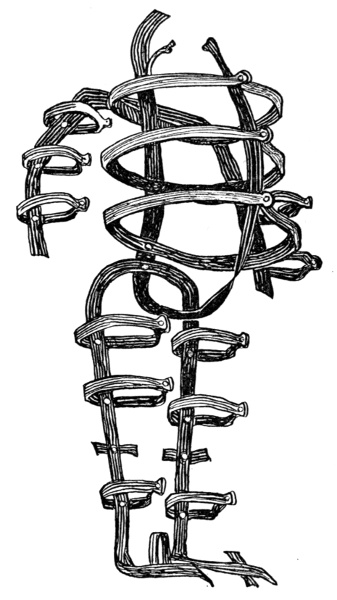
MILES'S IRONS.
In the same neighbourhood in 1796 James
Price and Thomas
Brown were gibbeted
together on
Trafford Green,
three miles from
Chester, for robbing
the postboy
of the mails; and
a pamphlet recounting
their
trial and execution
goes so far
as to include a
map of the road,
and a neat little
view of the
double gibbet,
with Messrs.
Price and Brown
dangling from it.
The execution
of the two
brothers, Robert
and William
Drewett, in 1799, for robbing the Portsmouth
mail near Midhurst, was a late example of Post-Office
ferocity, and is saddened by the tradition
that the younger prisoner was innocent, and that
he refused to clear himself because by so doing he
would incriminate his father. The bodies were
gibbeted on North Heath Common.
The last person to be gibbeted in England was
Cook, who had committed a peculiarly atrocious
murder at Leicester
[4] in 1832. Two years later,
the practice was abolished by statute.
THE ROADS OUT OF LONDON
I.—THE DOVER ROAD
It would be difficult, if not impossible, to say
which road out of London was the most infested
with highwaymen, in all these centuries. Where
all were extremely dangerous for honest men,
the bad eminence of any particular one is disputable.
All the great highways were bordered
by lonely wastes and commons until well on
into the nineteenth century, and it is not saying
too much to declare that the era of the highwaymen
did not really end until that of
railways had begun. Edmund Burke, who died
in 1797, might see fit to declare that the age
of the highwaymen was done, and that the age
of cheats had succeeded, but he was a little
too sanguine, or too despondent, whichever way
you feel inclined to look at it. To take Wiltshire
alone: one man was hanged at Fisherton
gaol, Salisbury, in 1806, for highway robbery,
one in 1816, two in 1817, and two in 1824;
while in 1839, when the law had become less
ferocious, three others were each sentenced to
fifteen years' transportation for a most determined
highway robbery at Gore Cross, on Salisbury
Plain, on the evening of October 21st, in that
year.
Gad's Hill, on the Dover Road, had from the
earliest times a peculiar prominence in these
matters, and even obtained its name from the
rogues who lurked there. But, indeed, it is not
going beyond the strictest bounds of truth to say
that all the hills on the Dover Road were of evil
repute. There were the cut-throats and footpads
who lurked in the wayside trees and rushed out
from the leafy coverts of Shooter's Hill, with
terrifying cries. They were not politeful, those
footpads, and the title of "gentlemen of the
road," which was accorded those exquisite thieves,
Claude Du Vall and Captain Hind, must
needs be withheld from them. We read in the
entertaining and instructive diary of Samuel
Pepys how on April 11th, 1661, with a lady,
he rode along the Dover Road, "under the man
that hangs upon Shooter's Hill, and a filthy
sight it is to see how his flesh is shrunk to his
bones."
Six men were hanged here, and their bodies
exposed on gibbets, in times not so very remote,
for robbery with murder upon the highway. The
remains of four of them decorated the summit
of the hill, while the other two swung gracefully
from tall posts beside the Eltham Road.
The Bull Inn, which stands on the crest of
Shooter's Hill, was in coaching times the first
post-house at which travellers stopped and
changed horses on their way from London to
Dover. The Bull has been rebuilt of recent
years, but tradition says (and tradition is not
always such a liar as some folk would have us
believe) that Dick Turpin frequented the road,
and that it was at the old Bull he held the
landlady over the fire, in order to make her
confess where she had hoarded her money. The
incident borrows a certain picturesqueness from
lapse of time, but, on the whole, it is not to be
regretted that the days of barbecued landladies
are past.
The usual stories of highway encounters give the
courage to the highwaymen and abject cowardice
to their victims, but the positions were reversed in
an affray that took place on this particularly bad
eminence in 1773. A Colonel Craige and his
servant were attacked about ten o'clock one
Sunday night by two well-mounted highwaymen,
who, on the Colonel declaring he would not be
robbed, immediately fired and shot the servant's
horse in the shoulder. On this the servant discharged
a pistol, and, as a contemporary account
has it, "The assailants rode off with great precipitation."
That they rode off with nothing else
shows how effectually the Colonel and his man,
by firmly grasping the nettle, danger, plucked the
flower, safety.
Don Juan was equally bold and successful.
He was stopped with "Damn your eyes! Your
money or your life!" by a party of footpads.
He did not comprehend the language: but the
meaning of their actions was plain enough:
Juan yet quickly understood their gesture;
And, being somewhat choleric and sudden,
Drew forth a pocket pistol from his vesture,
And fired it into one assailant's pudding—
Who fell, as rolls an ox o'er in his pasture,
And roar'd out, as he writhed his native mud in,
Unto his nearest follower or henchman,
"O Jack! I'm floor'd by that 'ere bloody Frenchman!"
On which Jack and his train set off at speed;
And Juan's suite, late scatter'd at a distance,
Came up, all marvelling at such a deed,
And offering, as usual, late assistance.
Juan, who saw the moon's late minion bleed
As if his veins would pour out his existence,
Stood, calling out for bandages and lint,
And wish'd he'd been less hasty with his flint.
"Perhaps," thought he, "it is the country's wont
To welcome foreigners in this way; now
I recollect some innkeepers who don't
Differ, except in robbing with a bow
In lieu of a bare blade and brazen front.
But what is to be done? I can't allow
The fellow to lie groaning on the road:
So take him up; I'll help you with the load."
But ere they could perform this pious duty,
The dying man cried, "Hold! I've got my gruel;
Oh, for a glass of max! We've miss'd our booty;
Let me die where I am!" And as the fuel
Of life shrunk in his heart, and thick and sooty
The drops fell from his death-wound, and he drew ill
His breath, he from his swelling throat untied
A kerchief, crying "Give Sal that!"—and died.
But not all travellers went armed, nor were
all robbers so timorous. Robberies on Shooter's
Hill continued without intermission, and at the
very close of 1797—the year in which Burke, the
statesman, died, who had some years earlier
declared the age of the highwaymen to be past—a
rather daring one was committed. It was on
the Sunday evening, December 30th, and may be
found reported in the Times of January 2nd, 1798.
It was about six o'clock when highwaymen stopped
a postchaise on Shooter's Hill, in which were two
lawyers, named Harrison and Lockhart, and a
midshipman of H.M.S. Venerable. They were
travelling to London from Sheerness. The highwaymen
took the lawyers' purses and watches.
"The man on Mr. Harrison's side treated him
with much personal violence, by forcing his pistol
into his mouth, on opening the chaise-door."
The men did not ask the midshipman for money,
but took his trunk, containing all his clothes.
No one for a moment thought of so foolish a thing
as resisting.
But Gad's Hill was the very worst spot on
the Dover Road, and had a very bad record for
robbery and murders. When Shakespeare made
Gad's Hill the scene of that famous highway
robbery, when Prince Hal, Falstaff, Poins, and all
the rest of them robbed the merchants, the
franklins, and the flea-bitten carriers who were
journeying from Rochester, he only made it so
because of the ill repute the locality already
possessed. The place is not romantic to-day, and
it is somewhat difficult to realise that here, where
Charles Dickens's hideous house of Gad's Hill Place
stands, the valorous Falstaff, brave amid so many
confederates, bade the travellers stand, and added
insult to injury by calling them "gorbellied
knaves" and "caterpillars."
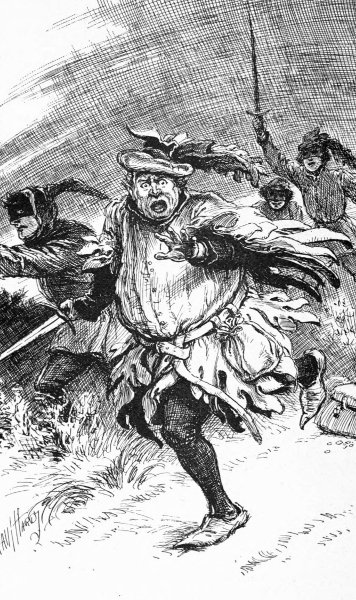
FALSTAFF ON GAD'S HILL.
How the rogue roared!"
There is, indeed, a beautiful view from the
southern slope of the hill, looking down upon
Strood and Rochester; but to see Gad's Hill as it
was of old, we should have to sweep away Gad's
Hill Place, and the rows of mean cottages that
now form quite a hamlet here. The hedges and
enclosures, too, did not exist until modern times,
but, instead of them, dense woods and dark
hiding-places came close up to, and overshadowed,
the highway, which was always full of ruts and
liquid mud. These facts will give some idea of
how terrible the hill could be of nights, when the
rogues who hid in the shadows sprang forth and
relieved travellers of their gold. The Danish
Ambassador was set upon and plundered here in
1656, and it is quite evident that the knights of
the road who despoiled him were no illiterate
rogues, because they sent him a very whimsical
letter of explanation, in which they said that:
"The same necessity that enforc't ye Tartars
to breake ye wall of China compelled them to
wait upon him at Gad's Hill." Once in a way,
however, travellers were more than equal for
these gentry, as we may well see in these extracts
from Gravesend registers: "1586, September
29th daye, was a thiefe yt. was slayen, buryed";
and again, "1590, Marche the 27th daie, was a
theefe yt. was at Gad's Hill wounded to deathe,
called Robert Writs, buried."
It would be an easy matter to write a long
chapter on Gad's Hill and its terrors. We will
conclude with a mention of the Duke of Würtemberg's
adventure. He and his suite were travelling
along the road, when a man with a drawn
sword ran after them. The Duke promptly told
the coachman to drive as fast as he could; not, as
he naïvely added, because he was afraid of one
man, but he didn't know how many others there
might be. The Prince evidently had that discretion
whose lack has been the death of many a
bold, but ill-advised, fellow.
Shakespeare's scenes in Henry the Fourth, in
which the travellers are robbed and Falstaff afterwards
fooled, were greatly appreciated in his own
day, because such happenings to wayfarers were
the merest ordinary incidents of travel, not only
in the time of Henry the Fourth, but in that of
Elizabeth. The play touched life in one of its
most familiar experiences.
II.—THE BATH ROAD
The Bath Road was not far inferior to the old
highway to Dover in records of highway robbery,
although they are chiefly of a later date than the
Gad's Hill encounters; but the records of St.
Mary Abbot's Church, Kensington, afford us
an interesting peep into a time when the boundary
of that now metropolitan borough, towards
Knightsbridge, was very dangerous to honest folk.
Thus we read, in the burial register, November
29th, 1687, of the interment of "Thomas Ridge,
of Portsmouth, who was killed by thieves, almost
at Knightsbridge."
This was no mere chance case. Some years
earlier, John Evelyn recorded in his diary the ill-repute
of the road at this point, and says robberies
took place even while the road was full of coaches
and travellers. The innkeepers of Knightsbridge
shared the disfavour in which these first reaches
of the Bath Road were held. When the Duke of
Buckingham and the Earl of Rochester quarrelled,
in the time of Charles the Second, and agreed to
fight a duel, the Duke and his second lay at an
inn at Knightsbridge, the night before the encounter,
in order to avoid any suspicion of their
intentions and any possible interruption. Much
to their surprise, they found themselves in some
danger of being arrested, not on any charge of
breaking the King's peace over the approaching
duel, but on the altogether unexpected suspicion
of being highwaymen, who purposed skulking at
an inn for the night, the better to waylay
travellers. "But this," remarks the Duke, in his
Memoirs, "I suppose, the people of the house
were used to, and so took no notice of us, but
liked us the better."
And so the neighbourhood remained, very little
changed for the better, until the nineteenth
century dawned.
It seems, looking upon the closeness of modern
Knightsbridge to the very centre of things, almost
the language of extravagance to say as much, but
the literature of the ensuing periods fully supports
the truth of it. Thus writes Lady Cowper, in her
diary, October 1715: "I was at Kensington,
where I intended to stay as long as the camp was
in Hyde Park, the roads being so secure by it,
that we might come from London at any time in
the night without danger, which I did very
often."
In 1736, Lord Hervey wrote from Kensington:
"The road between this place and London is
grown so infamously bad that we live here in the
same solitude as we should do if cast on a rock in
the middle of the ocean; and all the Londoners tell
us there is between them and us a great impassable
gulf of mud." Impassable roads—through which,
nevertheless, some wayfarers certainly did manage
to pass—and highwaymen may always be bracketed
together. Thus in April 1740, only four years
after Lord Hervey had written that doleful letter—and
we may be quite sure the roads had not
improved during the interval—the Gentleman's
Magazine recorded that, "The Bristol Mail from
London was robbed a little beyond Knightsbridge
by a man on foot, who took the Bath and Bristol
bags, and, mounting the postboy's horse, rode off
towards London."
On June 3rd, 1752, a professional thief-taker
named Norton was instructed to repair to Knightsbridge,
to see if he could apprehend a man who
had on two or three occasions stopped and robbed
the Devizes chaise. He proceeded in a chaise to a
lonely inn, known as the "Halfway House"—half-way
between Knightsbridge and Kensington—and
as the vehicle approached, a man stopped it
by threats from a pistol. Out jumped Norton and
seized the man, a certain William Belchier, who was
hanged, a little later.
On July 1st, 1774, William Hawke was
executed for a robbery here, and two others, for
a like offence, on November 30th following.
Three highwaymen were thus accounted for,
at short intervals, but others, equally daring,
were evidently left, for on the 27th of the next
month, a Mr. Jackson, of the Court of Requests at
Westminster, was attacked at Kensington Gore,
by four men on foot. He shot one, and the others
fled.
A Mr. Walker, a London police-magistrate,
writing in 1835, said: "At Kensington, within the
memory of man, on Sunday evenings a bell used to
be rung at intervals, to muster the people returning
to town. As soon as a band was assembled,
sufficiently numerous to ensure mutual protection,
it set off; and so on, till all had passed."
Such are the memories that belong to the very
beginning of this road; but they cluster most
thickly, of course, around Hounslow Heath, on
which Du Vall very largely practised, in the reign
of Charles the Second. Du Vall is important
enough to require a full biography elsewhere in
these pages, and we pass on to others, who
merely, so to say, stride across the stage, and so
disappear.
Hounslow Heath no longer exists as a heath.
Enclosure Acts and cultivation have, during the
last hundred years, wrought a remarkable change
upon the scene, and smiling market-gardens now
spread for miles where once existed nothing more
than a waste of furze-bushes, swampy gravel-pits,
in which tall grasses and bulrushes grew, and
grassy hillocks. This home of snipe and frogs,
and haunt of the peewit, was not without its highwaymen
by day, and at night it swarmed with
them.
There was excellent reason why it should be so
particularly favoured. Through its whole length
ran, not only the Bath Road, from Hounslow town
to Colnbrook and Slough, but the Exeter Road, on
to Staines. Both roads were largely travelled to
and from the West of England, and the Bath Road
was, in addition, the road to Windsor; and was
from that circumstance travelled by some of the
wealthiest and most important people, who sorely
tempted the daring spirits of the age. At a time
when it was possible for a band of conspirators to
assemble in Sutton Lane, near Gunnersbury, for
the purpose of waylaying and assassinating William
the Third, on his way from Richmond Park to
Kensington Palace (February 10th, 1696), it was
nothing out of the way for noblemen, returning
from a visit to the King at Windsor Castle, to be
stopped and robbed in their carriage when crossing
Hounslow Heath. Masked robbers made no
difficulty about endeavouring to halt Lord
Ossulston's carriage here, one day in 1698; and it
was merely by good fortune that he escaped with
the loss of two of his horses, shot dead. The Duke
of St. Albans was also attacked; but, with the aid
of the gentlemen with him, beat off his assailants.
The Duke of Northumberland, as Macaulay tells
us, was not so fortunate, and fell into the hands of
these audacious ruffians; with what result we do
not learn.
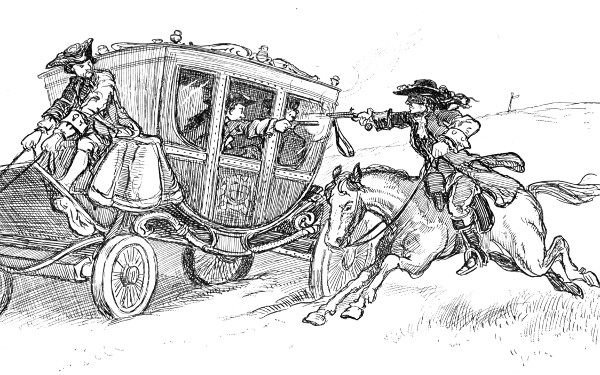
EXCHANGE OF COMPLIMENTS.
A silent reminder of those times still stands
beside the Bath Road at Gunnersbury, on the
right-hand side of the way as you go from London,
and between the modern church of St. James, and
Gunnersbury Lane. This is an isolated square
brick building, now covered with a tin roof,
and quite commonplace in appearance. It has
windows looking up and down the road, and large
doors facing it. Until a few years ago, it had
an old pantile roof, whose striking red colour was
the only remarkable feature the building ever
possessed. The neighbourhood has long been
largely built over, but it still stands in what
remains of the once wide-spreading Gunnersbury
orchards. Local traditions still survive which
tell us that this was a building erected in the
time of George the Second, or Third, for the
purpose of sheltering the horse-patrol that guarded
the road when the King passed this way,
travelling between London and Windsor.
Hounslow Heath would seem often to have
been the training-ground on which young and
inexperienced highwaymen first tried their luck.
Graduating here, they would with confidence
take the road in distant shires. For example,
we have the careers of Messrs. John and William
Hawkins, Wright, Sympson, and Wilson, whose
doings are set forth at great length by the last
of that brotherhood in crime, Ralph Wilson, who
turned King's evidence and so saved himself
from the gallows, and at the same time firmly
fixed the noose round the necks of his surviving
confederates. The story of the transactions of
this firm was told by Wilson in a pamphlet
published at the modest price of sixpence, in
1722, shortly after John Hawkins and George
Sympson had been turned off.
Hawkins was the son of a small farmer at
Staines. At fourteen years of age he went into
domestic service, then left it to become employed
in the tap at the "Red Lion," Hounslow. From
that situation he rose to be a butler to a knight;
one Sir Dennis "Dulry," according to the rough
and ill-spelled tract (perhaps really Daltry), but
was dismissed on what would seem to have been
the well-founded suspicion that he had taken a
hand in a robbery of his master's plate, shortly
after entering his service. 'Twas a way they had
in the eighteenth century, which nobody will
deny.
It may be shrewdly suspected that employment
in the tap of the "Red Lion" at Hounslow
had gone a good way towards inclining John
Hawkins toward the road; for, not only would
he be brought into contact with gamesters, but
talk of how the bold highwaymen on the neighbouring
heath netted handsome sums formed,
doubtless, the staple conversation of the place.
The only wonder is that John Hawkins first
went into service, and did not immediately go
padding on the road. He must have been a
singularly youthful butler, for even when he got
his congé, and turned his attention to stopping
the coaches, he was but twenty-four years of
age. His initial enterprise was carried through
single-handed, and his gains totalled the not
despicable sum of £11. But he returned to the
town only to gamble with his plunder, and in
that way soon managed to dissipate it. Finding
his solitary career on the heath a little hazardous,
in consequence of meeting a rare succession of
exceptionally brave travellers who did not
scruple to loose off their pistols at a single
adventurer, he sought the moral and physical
support of companions of his own vocation.
It became a syndicate of five; himself, Eyles,
Comerford, Reeves, and Lennard. For two years
they dared much in their speciality of robbing
stage-coaches and postboys carrying the mail-bags:
those being the days before mail-coaches,
when the bags (or often enough merely a small
wallet, the post being then a comparatively
small affair) were carried on horseback. In
proportion to their daring, their takings increased,
but they were always lost in the usual dissipations
that give such a monotony to all accounts of
highwaymen taking their ease after business
hours.
Lennard at last got into trouble and was
arrested, and when Hawkins and a recruit to
the gang named Woldridge attempted a rescue,
they too were seized. Three others were arrested,
and appear, with Lennard, to have been hanged.
Hawkins and Woldridge were discharged.
A new confederacy was then planned, but
soon broke up, upon a member named Pocock,
who had been flung into gaol, turning informer.
Another, who acted as treasurer, at the same time
absconding with their little earnings, the rest
were reduced to poverty and to cursing the appalling
lack of honesty in mankind.
Hawkins, desperately endeavouring to woo
capricious fortune at the gaming-tables by
staking his last coins, then met one Ralph
Wilson, at that time clerk to a barrister of the
Middle Temple. He, too, fell from respectability
through gambling, and agreed to turn highwayman
with the new association Hawkins contemplated
forming: "The New Highways Exploitation
Company," it might well have been named.
John Hawkins's brother William joined, and
George Sympson, and one Wright, among others.
The sphere of operations was widened, and
business was carried on with the greatest energy:
the Cirencester stage, and those for and from
Gloucester, Worcester, Oxford, and Bristol, being
all plundered one morning. The next day they
would be speaking to the Colchester and Ipswich
stages, and on the next would be again in some
totally different direction.
In midst of this busy time, Wilson succeeded
to some small property in Yorkshire, and left to
claim it, and shortly afterwards William Hawkins
and Wright were arrested in the exercise of their
adopted trade, and William Hawkins, to save himself,
impeached the others and earned his liberty
by that treachery. Wright might have done so;
but he was one of those rare chivalrous characters
who oftener live in the pages of novels than in
real life, and he held his peace, for the sake of the
traitor Hawkins's wife and children. He died in
his chivalry, too, for he was convicted and hanged;
while William Hawkins went free, and presently
crossed to Holland with his brother and the
brotherhood's money. They returned when this
had all gone; and met Ralph Wilson in London,
whither he had returned, after disposing of his
inheritance in Yorkshire for £350. He had
already lost all this in gambling when his old
friends found him. He, the Hawkins brothers,
and George Sympson then set about plans for
robbing the Harwich mail, in April, 1722; but as
that mail, they declared, was "as uncertain as the
wind," they decided they could not afford the time
to wait on the road for it; and agreed to turn their
attention to the Bristol postboys, or their mail,
instead.
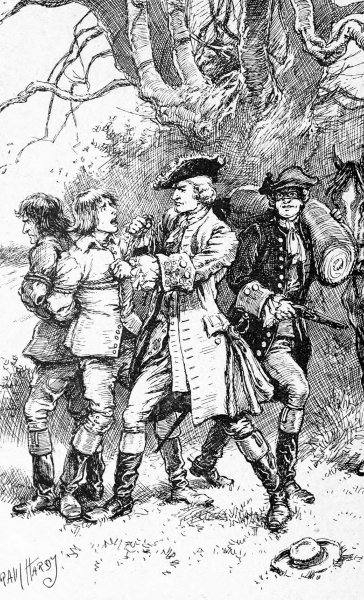
JOHN HAWKINS AND GEORGE SYMPSON ROBBING THE BRISTOL MAIL.
They fixed upon Hounslow Heath as the most
suitable spot for the job, April 16th and 18th.
"The meaning of taking the mail twice," explains
Wilson, in his "Full and Impartial
Account," "was to get the halves of some bank
bills, the first halves whereof we took out of the
mail on Monday morning." In the pages of
Captain Charles Johnson we see Sympson and
John Hawkins, represented in a large copper-plate
engraving, engaged in robbing two postboys and
binding them with rope. The great size of the
highwaymen and the diminutive character of the
postboys seemed to make it an easy task.
The Post Office was roused to fury by this
latest of many impudent mail-robberies; and
Wilson, while taking his ease at the Moorgate
Coffee House in the City, and listening to the
gossip, a week later, heard of a great hue-and-cry
undertaken. Seriously alarmed by this, he contemplated
taking a sea-passage to Newcastle, but
was traced by one of the stolen notes and arrested
before he could get aboard. The officers took him
at once to the Post Office, where no less a personage
than the Postmaster-General himself examined
him; but he disclaimed all knowledge of the
affair, and repeated his denials when he was re-examined
the following morning.
Meanwhile the Post Office had also secured
John Hawkins and Sympson, and had them
detained in the Gatehouse. The Post Office
officials then appear to have in the most Machiavellian
way played off one against the other.
They knew well enough that criminals were
usually too eager to save their own necks to care
about anything in the way of loyalty to their companions,
and that they were always ready to turn
evidence against them. In this case there seems
to have been keen competition to be first with the
confession; but Wilson's evidence was selected,
and it convicted John Hawkins and Sympson,
who were executed on May 21st, 1722, their
bodies being afterwards hanged in chains at the
end of Longford Lane, three miles on the London
side of Colnbrook.
There is a considerable literature, in the form
of old chapbooks, about these confederates:
notably an account by William Hawkins, the
surviving brother of John. Although himself at
an earlier period an informer, having purchased
his liberty at the price of his confederate, Wright's,
life, he is found vehemently attacking Wilson for
the same deed, in respect of his brother.
A mysterious affair, which has never been
properly cleared up, was the death of Twysden,
Bishop of Raphoe, in 1752. An Irish Bishop,
even although a Kentish man of ancient descent,
did not perhaps rank very high upon the Episcopal
bench, but he was sufficiently exalted to make
the innuendo that he had died from being shot
on the Heath while taking purses at the pistol-muzzle
a very startling one.
Grantley Berkeley says: "The Lord Bishop
Twysden, of Raphoe, a member of the old Kentish
family of that name, was found suspiciously out
at night on Hounslow Heath, and was most
unquestionably shot through the body. A correspondent
of the Gentleman's Magazine asked,
'Was this the bishop who was taken ill on
Hounslow Heath, and so carried back to his
friend's house (? Osterley Park), where he died
of an inflammation of the bowels?'"
Twysden was father of the then Lady Jersey,
and great-grandfather of the present Earl.
In the midst of this wild waste of Hounslow—according
to the Honble Grantley Berkeley,
"Houndslot"—Heath, the pretty village of Cranford
stood; and there, too, was, and still is,
Cranford Park, long a seat of the Fitzhardinge
Berkeleys. Cranford was a favourite with the
fifth Earl of Berkeley (died 1810), and he used
frequently to stay there from Saturdays to
Mondays, even although the journey between it
and London was not infrequently made hazardous
by the enterprising gentlemen who found the
Heath a veritable "Tom Tiddler's ground," where
they were always pretty sure to pick up gold
and silver. Twice my lord's carriage had been
stopped between Cranford and the village of
Hounslow, and robbed: on the second occasion
by a footpad dressed as a sailor, who with trembling
hand pointed a fully cocked pistol at him.
While the Earl was collecting his loose change,
the trigger was accidentally pulled by this nervous
footpad. Fortunately it missed fire, or else there
would have been another tragic episode to
chronicle. "I beg your pardon, my lord," exclaimed
the man, humbly deprecating his clumsiness;
and, re-cocking his pistol, went off with the
Earl's involuntary contribution.
There are several variants of Lord Berkeley's
adventures here. According to one, which rather
discredits his having been actually robbed here
as well as stopped, he is said to have declared
that, while it was no disgrace to be overpowered
by numbers, he at any rate would never consent
to be robbed by a single highwayman. The high-toby
gentry (this version continues) heard of his
boast, and one was deputed to try his mettle.
He stopped my lord's carriage and said, "You
are Lord Berkeley, I think?"
"Yes," replied his lordship.
"Then," rejoined the man, "I am a single
highwayman, and I demand your money or your
life!"
"You cowardly scoundrel!" exclaimed the
Earl, "d'ye think I can't see your confederate
standing behind you?"
Startled by this, and hurriedly glancing over
his shoulder, the highwayman's attention was for
the moment distracted, and Lord Berkeley shot
him dead.
In the story told by the Earl's son, the Honble
Grantley Berkeley, he says his father, after the
adventure with the sailor footpad, swore he would
never be robbed again; and thereafter always
travelled at night with a short carriage-gun and
a brace of pistols. It was a November night in
1774, and his carriage, or postchaise, was nearing
Hounslow, from Cranford, when a voice called
upon the postboy to halt, and a man rode up,
and, as Lord Berkeley let down the glass, thrust
in the muzzle of a pistol. With his left hand
Lord Berkeley seized it and turned it away, while
with the other he pushed the short, double-barrelled
carbine he had with him against the man's body
and fired once. The man was mortally wounded
and his clothes on fire, but he rode away some
fifty yards, and fell lifeless. Two accomplices who
were hovering about then fled, leaving the body
of their comrade. The Gentleman's Magazine of
that date has an account of the affair in which
it is said that the dead highwayman was traced
by means of the horse he rode, which he had
that morning hired in London. His lodgings
were in Mercer Street, Long Acre, and the Bow
Street officers had hardly entered them when a
youth, booted and spurred, called and asked for
"Cran Jones," which apparently was the name of
the deceased. The youth, who was an accomplice,
was seized, and impeached two others: one a clerk
to a laceman in Bury Street, St. James's, who was
traced along the Portsmouth Road, and to Farnham,
where, at three o'clock in the morning, he
was surprised in bed. He was then taken to
London. The other was also apprehended, and
all three were brought before Sir John Fielding.
Their names were Peter Houltum, John Richard
Lane, and William Sampson. The last-named
had £50 due to him for wages. An evening
newspaper later stated that there were in all
seven youths in custody over this affair. They
were from eighteen to twenty years of age, and
the parents of some of them were in easy, and
others in affluent, circumstances; all of them
overwhelmed with sorrow by the sins of their
unhappy sons."
Sir John Fielding, the Bow Street magistrate,
had in 1773 written to Garrick asking him to
suppress the Beggar's Opera, which he produced.
He said the exploits of Macheath, the highwayman
hero, and the glorification of the criminal life on
the stage, were calculated to reinforce the ranks
of the real highwaymen from the scatterbrain and
stage-struck apprentices of town; and it would
indeed appear from the foregoing account that he
was correct.
Hounslow Heath was the scene of many
tragedies. It was in November 1802 that a
Mr. Steele, proprietor of a lavender warehouse
in Catherine Street, Strand, was murdered on that
then lonely waste. He had gone on a Friday to
Bedfont, where he cultivated a large acreage of
lavender, and intended to return home the following
day. As he did not return at the appointed
time, his family concluded he had been unexpectedly
detained on business matters, but when
Monday came, and no news of him, they not
unnaturally grew alarmed, and sent a messenger
to Bedfont. He learned that Mr. Steele had only
set out on his return on the Saturday evening,
and, being unable to procure a conveyance, had
resolved to return at least a part of the way on
foot.
He was a bold man who, unarmed, should
attempt such a journey across Hounslow Heath in
those days; and the unfortunate lavender merchant
paid the penalty of his rashness with his life.
His brother-in-law and other relatives, on receiving
the news of his being missing, set out in search of
him, and at last found his mangled body secreted
beneath some clods and turf, under a furze-bush.
The first clue to a tragedy having been enacted
was discovered, after many hours' searching over
the heath, in the sight of a piece of blue cloth.
Pulling at this, they found it to be the skirt of his
greatcoat, buried in the sandy soil. At a little
distance away they saw a soldier's hat, lying near
a bush, and on the bush itself a great quantity of
congealed blood.
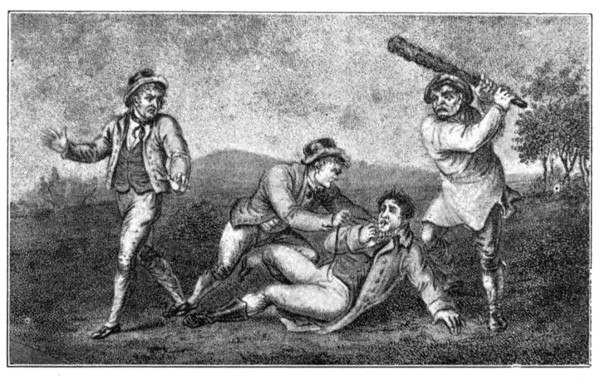
MURDER OF MR. STEELE ON HOUNSLOW HEATH.
Mr. Steele had received several wounds on the
back of the head, and a part of his forehead was
entirely cut away; but a piece of leathern belt
tightly drawn round his neck showed that he
had first been strangled. This crime was traced
to two men, Haggarty and Holloway, one of them
a soldier, who had planned it all beforehand, at
the "Turk's Head" Inn, Dyot Street, Holborn.
Evidence was adduced by which it appeared that
a coach passed at a little distance along the road
while they were robbing Mr. Steele, who cried out
for help. Holloway exclaimed, with an oath,
"I'll silence him," and beat in his head with two
blows of a bludgeon.
It is satisfactory to be able to say they were
hanged. Both loudly declared their innocence,
but no one believed them. The execution took
place at the Old Bailey, when no fewer than
twenty-eight persons among the immense crowds
who had come to see the sight were crushed to
death, and large numbers greatly injured.
The case attracted a great deal of attention at
the time, and copies are still occasionally found
of a terrific engraving representing the ferocious
pair polishing off the unhappy Mr. Steele, one of
them wielding an immense club, fit for a Goliath.
THE ROADS OUT OF LONDON (continued)
III.—THE GREAT NORTH ROAD
Could the gay highwaymen who, a hundred years
ago, were gathered to their fathers at the end of
a rope, down Tyburn way, revisit Finchley, the
poor fellows would sadly need a guide. Where,
alas! is Finchley Common, that wide-spreading
expanse of evil omen on which those jovial spirits
were so thoroughly at home? Finchley Common,
has long since been divided up between the
squatters who grabbed the public land when
Justice winked the other eye, as Justice had a
trick of doing years ago, when the process of
enclosing commons was in full swing. There still
exists a large oak-tree by the road at a place
called Brown's Wells, opposite the "Green Man,"
and in the trunk of this last survival of the "good
old times" there have been found, from time to
time, quite a number of pistol bullets; the said
bullets supposed to have been fired at the trunk
to frighten the highwaymen who might chance
to be hiding behind it, under cover of the night.
The tree itself has long borne the name of
"Turpin's Oak," no less celebrated a person than
the redoubtable Dick himself having once frequented
it. Turpin, of course, is the greatest of all
the rascals who made the name of the Great North
Road a name of dread. Before him, however,
Jack Sheppard figured here; but not, it is sad to
relate, in an heroic manner. In fact, that nimble-fingered
youth who was no highwayman—merely
a pickpocket and housebreaker—after escaping
from the "Stone Jug" (by which piece of classic
slang you are to understand Newgate is meant)
had the humiliation to be apprehended on Finchley
Common, disguised in drink and a butcher's blue
smock. That was the worst of those roystering
blades. The drink was the undoing of them all.
If only they had been Good Templars, or sported
the blue ribbon, it is quite certain that they
had not been cut off untimely; and might, with
reasonable luck, have even retired with a modest
competence in early years.
One of the most savagely dramatic encounters
on Finchley Common was that which was enacted
on July 11th, 1699, with "Captain" Edmund
Tooll, alias Tooley, prominent on one side, and an
unfortunate gentleman, Mr. Robert Leader, on the
other. Mr. Leader was travelling from London
across this waste, in company with his servant, when
he was set upon by Tooll and some companions
(one of whom afterwards turned King's evidence).
They stripped Mr. Leader and his man, and, knocking
the unlucky gentleman down, brutally stamped
on his face and stomach, until, fearing he was to be
killed, he begged pitifully for his life to be spared.
He then attempted to run away, and the blood-thirsty
Tooll shot him in the back, and wounded
him so seriously that he died on the following day.
When Tooll was at length arrested, at the "Blue
Ball," in Jermyn Street, he was wearing some of
the murdered man's clothes. He violently resisted,
fired upon the officers, and, shortening a sword he
held, attempted to stab one of them. He retained
this spirit even in the dock, for when his resistance
of arrest was mentioned, he said he was only sorry
he had not stabbed the officer to the heart. He was
executed, impenitent to the last, on February 2nd,
1700, and afterwards hanged in chains on Finchley
Common.
It was in 1724 that Jack Sheppard was
arrested by Bow Street runners on the Common,
and the fact somewhat staggers one's belief in
the wild lawlessness of that place. One might
just as soon expect to hear of the Chief Commissioner
of Police being kidnapped from Scotland
Yard. And yet it is quite certain Finchley was
no safe place for a good young man with five
pounds in his pocket and a mere walking-stick
in his hand, whether he proposed to cross it by
night or day. Even sixty-six years later this
evil reputation existed; for, in 1790, the Earl
of Minto, travelling to London, wrote to his wife
that, instead of pushing on to town at night, he
would defer his entry until morning, "for I
shall not trust my throat on Finchley Common in
the dark." Think of it! And Dick Turpin had
been duly executed fifty years before!
Between 1700 and 1800, in fact, this was a
parlous place, and not one of the better-known
highwaymen but had tried his hand at "touching
the mails" as they went across this waste; or
patrolled the darkest side of the road, ready to
spring upon the solitary traveller. Indeed, the
childlike simplicity of the lonely travellers of
those days is absolutely contemptible, considering
the well-known dangers of the roads. For
instance, on the night of August 28th, 1720,
a horseman might have been observed in the act
of crossing Finchley Common. He had fifteen
guineas in his pocket, and ambled along as
though he had been in Pall Mall, instead of on
perhaps the most dangerous road in England.
At a respectable distance behind him came his
servant, and, just in front of him, midway of
this howling wilderness, stood three figures.
"There is an eye that notes our coming," says the
poet, and three pairs of eyes had perceived this
wayfarer. They belonged to an enterprising
individual named Spiggott and to two other
ruffians whose names have not been handed down
to posterity. The weirdly named Spiggott was
apparently above disguising himself; his companions,
however, might have taken the parts
of stage brigands, for one of them had the cape
of his coat buttoned over his chin, and the other
wore a slouched hat over his eyes. In addition
to this, he kept the ends of his long wig in his
mouth—which seems rather a comic-opera touch
than serious business. It was, however, a
favourite and effectual way with highwaymen of
disguising themselves. It is to be hoped, rather
than expected, that the traveller with the guineas
saw the humour of it.
In the twinkling of an eye one brigand had
seized his horse and made him dismount, while
the others covered him with their pistols. The
servant also was secured, the guineas transferred
with the dexterity of a practised conjurer, the
horses turned loose, and then the three rode away,
leaving the traveller and his servant to get on as
best they could. Spiggott, in 1720, eventually
paid the penalty of his rashness in not disguising
himself in accordance with the canons of his high-toby
craft, as taught on the stage, and in novels
of the eighteenth century, in which crape-masks
are essential. When he was caught, with some
others, in an attempt on the Wendover waggon at
Tyburn, he was identified by the Finchley traveller.
The end of him was the end of all his kind, but
it was not accomplished without considerable
trouble. He, with another prisoner named Thomas
Phillips, was in due form, and on several counts,
indicted for highway robbery. Both refused to
plead, and stood silent in the dock. There was
in those times a fearful penalty for refusing to
plead to an indictment: the penalty known to
legal jurisprudence as peine forte et dure, which
was, rendered into ordinary English, "pressing
to death." The space at Newgate long known
as the Press Yard took its name from being the
place where this savage penalty was inflicted.
There was every inducement in those times for
a criminal to refuse to plead to his indictment.
If he pleaded, and was eventually found guilty,
his property was, under the law as it then stood,
forfeited to the Crown, and his relations, even his
wife and children, were deprived of their very
livelihood. A man might at one and the same
time be an unmitigated scoundrel, and yet have
the very tenderest feelings for his own, and many
such an one endured the fearful martyrdom of
pressing to death in order to preserve his belongings
to those who had been dependent on
him. For by enduring so much he could save
everything, and will it as he would.
The official sentence passed upon those who
thus "stood mute of malice," as the phrase ran,
was "That the prisoner shall be remanded to the
place from whence he came, and put in a low,
dark room, and there laid on his back, without
any manner of covering except a cloth round his
middle; and that as many weights shall be laid
upon him as he can bear, and more; and that he
shall have no more sustenance but of the worst
bread and water, and that he shall not eat on the
same day on which he drinks, nor drink on the
same day on which he eats; and he shall so
continue until he die." A refinement of this
torture, more worthy of a demon than a human
being, was to place a sharp stone under the
prisoner's body.
Spiggott and Phillips were both sentenced to
this ordeal, and Phillips was taken in hand first.
His courage, however, was not sufficient, and he
asked pitifully to be allowed to stand again in the
dock and plead. This was granted him, rather
by way of a favour than as a right, and he
pleaded not guilty, but was convicted and in course
of events hanged.
William Spiggott was made of somewhat
sterner stuff, and elected to be pressed rather than
plead. He was then, as the old picture shows,
stretched out upon the floor, his hands and feet
secured, a board placed upon his chest, and weights
up to 350 lbs. gradually added. He endured half
an hour of this, but on another 50-lb. weight being
added, gasped out that he would plead. Such
were the Chinese-like methods of dealing with
criminals in Merry England in the Good Old
Days. Exactly who those old days were good for,
except the privileged classes, we may long seek
to discover; not with any very great hope of
success.
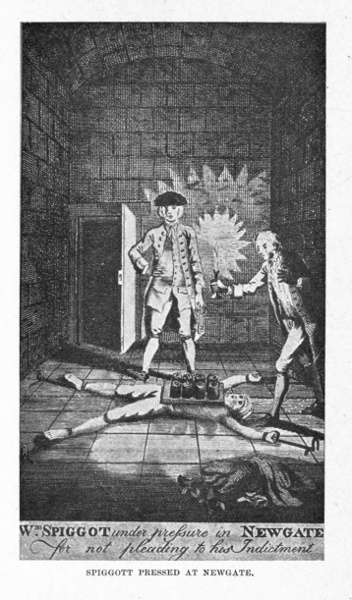
SPIGGOTT PRESSED AT NEWGATE.
Spiggott, being then graciously permitted to
plead, was in his turn tried, found guilty, and
hanged at Tyburn. He is notable as having been
the last criminal to suffer this penalty.
Nathaniel Hawes, who practised on Finchley
Common about the same time as Spiggott and his
friends, was taken in 1721 in an unsuccessful
attempt to rob a gentleman on that wild spot.
Not only was his attempt a failure, but he was
himself taken prisoner and handed over to justice
by his intended victim. He also refused to plead.
He would die, he declared, as he had lived, a
gentleman. The reason for his refusing to plead
was that the brave clothes in which he had been
seized were taken off his back. Like most of his
contemporaries, he had a mind, if he must make
the journey to Tyburn, to go there respectably,
and to cut a dash to the last. He would plead if
they were returned, but not unless. "No one
shall say I was hanged in a dirty shirt and a
ragged coat."
So they pressed this most particular fellow
up to 250 lbs. After a few minutes he declared
himself ready, nay anxious, to plead, and he was
accordingly put back, tried, and found guilty:
going those three miles to Tyburn after all, it is
melancholy to relate, in the grimy shirt and
tattered duds of his very proper aversion.
Of the other names in the long and distinguished
roll of road-agents who figure on Finchley
Common at some time or another in their meteoric
careers, it is not possible here to say much. There
were the resourceful and courageous Captain
Hind, the whimsically named "Old Mob," burly
Tom Cox, Neddy Wicks, and Claude Du Vall.
They have, most of them, their separate niches in
these pages.
Room, however, by your leave, for those
thoroughly business-like men, Messrs. Everett and
Williams, who entered into a duly drawn and
properly attested deed of partnership, by which it
was agreed that they should work together on
Finchley Common and elsewhere, and divide the
profits of their labours into equal shares. Their
industry prospered, and the common fund soon
reached the very respectable total of £2,000. But
when required to render accounts, and to pay over
half this amount, Mr. Williams, treasurer of this
precious firm, refused. The old proverb of
"Honour among thieves" was therefore proved a
fallacy. Everett thereupon brought an action at
law against his defaulting partner, and a verdict
for £20 was actually obtained, and appealed
against by the defendant. The court then very
properly found the whole matter scandalous, bad
in law, and contrary to public policy. Everett
was sentenced to pay costs, and the lawyers
engaged on either side were fined £50 each for
their part in this discreditable affair.
IV.—THE OXFORD ROAD
The way through Uxbridge and High Wycombe
to Oxford is largely illustrated elsewhere in these
pages, in the biographies of "Old Mob," and of
Withers, in which Uxbridge and the neighbourhood
of Hillingdon figure largely. Having once
passed Hillingdon, travellers were comparatively
unmolested until they came to Shotover Hill, near
Oxford.
Shotover Hill was the scene of the barber's
encounter with a knight of the road. The barber,
travelling afoot with a sum of money, had been
foolish enough to explain, in the parlour of an
inn, how he had cunningly hidden his store among
the implements of his trade he was carrying with
him. Arrived on the hill-top, he was accosted
by the figure of a road-agent who had, "from
information received," a very accurate knowledge
of how much money the barber was carrying, and
where he carried it.
"Wer—what do you wer—want?" asked
the trembling barber.
"Only a sher—shave," rejoined the knight of
the road, mocking the man's frightened speech;
"so out with your shaving-pot and razor, and fall
to't!" And he sat himself down on the grassy
bank.
With fumbling hands the barber undid his bag,
and brought forth the shaving tackle, whereupon
the highwayman, stretching his legs as though by
accident, managed to upset the pot. Over it
went, and smashed upon a stone, displaying that
store of golden guineas.
"Ho, ho, my friend!" said the highwayman.
"You're not so poor as you thought. 'Tis
treasure-trove, indeed, and of right belongs to the
King. God bless him! But since His Majesty
has small need of a matter of twenty guineas, and
I a very pressing one, I'll e'en pouch them
myself!" And, so doing, and vaulting into the
saddle, he was gone.
Along this same route, in the woodland road
between West Wycombe and Stokenchurch, Jack
Shrimpton, the highwayman, met a barrister who
greatly admired the horse Shrimpton was riding,
and offered him £30 for it. Needless to say, the
coin promptly changed hands, but the horse did not.
Shrimpton was a native of Buckinghamshire,
and was born at Penn, near Beaconsfield. He
had been in his youth apprenticed to the soap-making
trade, and was afterwards in the army.
One day he happened in a roadside inn upon a
traveller who chanced to be the common hangman.
He took a glass of wine with him, and, talking
over his profession, he asked the hangman, "What
is the reason, when you perform your office, that
you put the knot just under the ear? In my
opinion, if you were to fix it in the nape of the
neck, it would be easier for the sufferer."
The hangman said, "I have hanged a great
many in my time, sir; but, upon my word, I have
never yet had any complaint. However, if it
should be your good luck to make use of me, I
will, to oblige you, hang you after your own way."
"I want none of your favours," replied Shrimpton
heatedly, for the joke had struck nearer home
than the hangman could have imagined.
In yet another incident, Shrimpton does not
figure to advantage; and, one way and another,
we shall not perhaps be ungenerous if we think
him to have been something of an ass.
Meeting a miller who had failed in business,
and, losing his all, had taken to the high-toby
profession, he was summoned to "Stand!"
Shrimpton was mounted and armed; the miller
was on foot, and had only a cudgel, and when the
practised highwayman produced his pistol, abjectly
surrendered.
"Surely," said Shrimpton, disgusted with such
an amateurish method, "you are but a young highwayman,
or you would have knocked me down
first and bade me to stand afterwards."
He then confided to the miller that he had
recently robbed a neighbour of £150, and was now
waiting for a traveller who was coming with six-score
guineas. "Assist me," he said, "and you
shall have half the booty."
The miller agreed, but presently, taking
Shrimpton off his guard, knocked him down from
behind with his cudgel. As the unfortunate highwayman
lay in the road, slowly regaining consciousness,
he saw the treacherous and villainous miller
pouching his gold, and preparing to hastily depart
with his horse.
"Good-bye," said the miller, "and, harkye,
be off as soon as you can, or I'll have you hanged
for robbing your neighbour, by your own confession."
"Thus," says the old historian of these things,
"the Biter was bit, and Shrimpton swore he would
nevermore take upon himself to learn strangers
how to rob upon the highway." Excellent resolution!
But he had little time wherein to put it
into practice, for he was presently hanged, while
his career was yet young, on St. Michael's Hill,
Bristol, September 4th, 1713.
Of later travellers, by coach or by postchaise,
who, fully aware of the risks they ran on all
these great roads running out of London, hid
their valuables carefully in their boots and other
places of which they imagined the highwaymen
could have no suspicion, there is not much space
left here to tell. Let it, however, be said that
those highwaymen were as well-informed as are
modern Customs officers of likely places for
secreting property; and when the coaches and
chaises were stopped, and the travellers bidden
hand over their money and watches, it was no
use for them to declare that they had nothing.
At the pistol-muzzle they were bidden take off
their boots or other articles of dress. This was
humorously known among the highwaymen as
"shelling the peas."
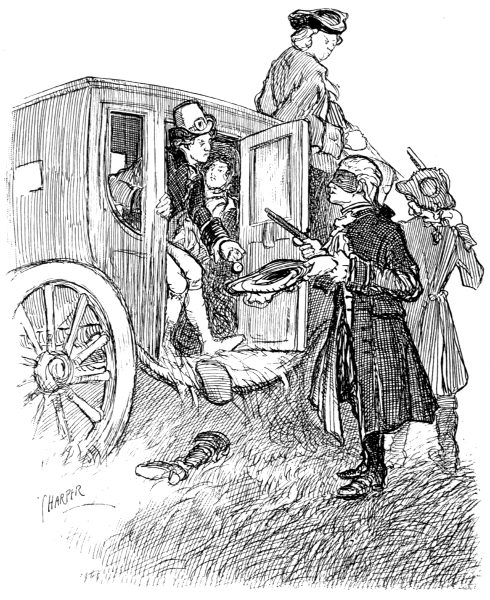
"SHELLING THE PEAS."
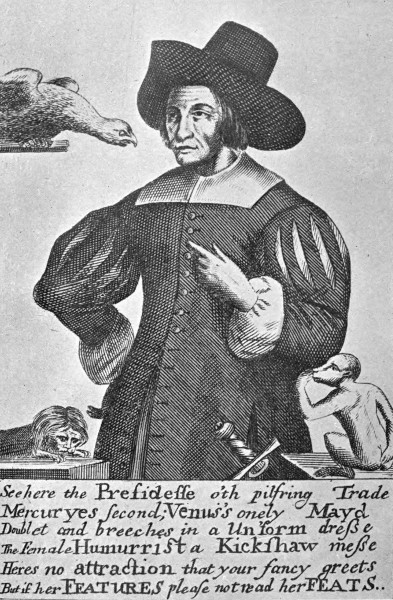
MOLL CUTPURSE.
Moll Cutpurse must needs have a place here, by
right of her intimate association with the highwaymen,
rather than her own exploits. She was
not, in fact, a highway robber at all; nor, of
course, was her name Cutpurse, but Mary Frith.
The daughter of a shoemaker, whose name, as a
reporter of the old school might say, does not
"transpire," she was born in Barbican, City of
London, in 1592. Tradition tells how she was
born with clenched fists: sure sign of a wild and
adventurous nature. Her muscles and her spirit
alike were mannish. As a girl, she was, in the
obsolete language of the seventeenth century, a
"tom-rig" and "rump-scuttle"; and a "quarter-staff"
was more agreeable to her than a distaff.
And not only more agreeable, but more natural,
and she worsted many a pretty fellow in fair fight
with that weapon, with which only the strong and
the active could prevail. Her father proposed to
apprentice her to a saddler, but she refused, and
she was put aboard a ship bound for Virginia, to
be sold into the plantations. It seems a drastic
way with a rebellious daughter; but it failed, for
Moll escaped before even the ship had left the
Port of London. Love never entered into the
career of Moll, and as she had the strength of a
man and a masculine voice that procured her the
name of the "Roaring Girl," she early concluded
to wear masculine attire. In Middleton's comedy,
written about her when she was still young, he
makes a character declare: "She has the spirit of
four great parishes, and a voice that will drown
all the city." It will thus be seen that she was at
an early age well known to those who lived their
life in London. And for excellent reasons. She
had not only become a member of a gang of
thieves and pickpockets, who frequented the Bear
Garden in Southwark and other popular resorts,
but had graduated with amazing ease and swiftness
in the art of slitting pockets and extracting
purses, and from that had by force of an organising
brain elevated herself into the position of a plotter
of robberies and high directress of clyfakers and
bung-snatchers. So well was the destination
known of most of the watches and trinkets that
were continually disappearing, that the owners of
them were often knocking at her door in Fleet
Street, ready to ransom their property for a well-recognised
percentage of its value, before the
thieves had returned with it; and they had to be
politely requested to call again. In those halcyon
days of the receivers of stolen property, before the
evil career of Jonathan Wild had caused an Act
of Parliament to be passed, dealing with them on
the same footing as the actual thieves, much was
done in this way of ransom and ready brokerage,
and, so long as it was done with discretion,
with advantage to all concerned. The owners got
their own again, with the expenditure of a comparatively
trifling sum, the gang carried on their
operations with a large degree of security, and the
wily Moll made an excellent income. She was
witty and original, and—such was the spirit of
the age—she became rather the fashion among the
riotous young blades of town, who were then
"seeing life." The highwaymen knew her well,
and resorted to her house when they had taken
watches and jewellery they could not themselves,
without the gravest risk, endeavour to sell. They
trusted her, and the public, coming to redeem the
articles, did the same; and indeed, as intermediary
between losers and finders, she was honesty itself:
absolutely beyond suspicion.
Thus wagged the merry days until the Civil
War altered the complexion of things. The times
had been growing, for some few years before,
curiously out of joint. The people, once taken
with the mad pranks and outrageous humours of
the society in which she moved, had grown more
serious-minded, and the gay gallants who still continued
to "see life" were no longer regarded with
indulgence. The ripple of Puritanism that had
arisen in the time of James the First and had then
been little more than a religious expression, had
increased in the time of his son to an overwhelming
wave of politico-religious fury. It swept on,
blotting out the theatres, frowning down all levity
and finally breaking into warfare between the
two different ideals cherished by Roundheads and
Royalists.
The gallants naturally became Cavaliers, and
went warring for their King over the country;
but in the City there was a strict, stern way of
regarding things that did Moll's business no good.
Like all her associates, she was a Royalist. The
alliance perhaps does that cause no service in the
pages of history; but we must take it as we find it,
and make the best or the worst of the fact, just
as our own partisanship dictates.
She detailed trusty members of her organisation
to persecute, in their own particular way, leading
members of the detested party that had acquired
political ascendency. On one occasion, while they
robbed Lady Fairfax on her way to church, the
"Roaring Girl" herself set out, according to
the legend, to rob the husband, Fairfax, the Parliamentary
general, with her own hands, on
Hounslow Heath. It seems beyond belief, but the
tale is at any rate a very old one, to be traced back
almost as far as her own day. The story tells how
she shot Fairfax in the arm, killed two horses
ridden by the servants attending him, and secured
all the money the general had with him. We
may go so far as to concede that this was what the
"Roaring Girl" would have rejoiced to do, had it
been possible; but imagination refuses to carry us
further.
Moll's fortune declined during the long years
of the Commonwealth, which fact is, at any rate,
something for Cromwellians to plume themselves
upon. That she should live to see the Restoration
and Charles the Second upon the throne, was one
of her most ardent desires. She never doubted
that he would be restored, and was careful to
leave a sum of twenty pounds, by will, to celebrate
the event, if it should happen to be deferred
beyond her time. She died of dropsy, just one
year before the Restoration took place.
I do not think, if the highwaymen were with us
again, that they would be treated by their victims
with the extraordinary lenience shown them in
those (in that respect) easy-going seventeenth and
eighteenth centuries. It was commonly sufficient
for a "knight of the road" who had been good
enough to refrain from abuse or personal violence
to say at parting, "God bless you," and then to
shake hands with his victim, for that victim to go
his way and never think of laying an information.
And that is one of the reasons why the high-toby
trade flourished so bravely in times when to be
convicted of highway robbery meant death. The
law, in fact, overreached itself, and the awful
extremity of the penalty, so far from discouraging
highwaymen, really encouraged their kind; for
those were, after all, not the heartless periods we
are taught to think them, and comparatively few
were prepared to swear away the life of a fellow-creature
in revenge for the loss of guineas or
jewellery. Had the penalty been less tragic there
would have been more informations.
But it was in the years following the Civil War,
ending with the execution of Charles the First, that
the roads in general, and Maidenhead Thicket
in particular, attained their greatest notoriety.
The whole country, indeed, swarmed with the
adventurers who had attached themselves to the
fortunes of the Cavalier party, and with gentlemen
ruined in the cause of the King; their
property sequestrated by Parliament and their
persons subject to arrest. When the fighting was
done, many of them became brigands and preyed
upon honest men. If their victims chanced to be
of the opposite faction, well and good; but it
really mattered little to them of whom they levied
unlawful tribute upon the road, and in short, the
broken Cavaliers turned highwaymen, of whom
we read in the classic pages of Smith and Johnson,
were no favourable advertisement of their defeated
party. Captain Alexander Smith, to whose diligence
we owe the accounts of these seventeenth-century
highwaymen, was himself of Royalist
sympathies: the fact peeps out from almost every
page of his work; but he had not the wit to see
that the careers of his sorry heroes, as told by
him, show them in general to be bullies, ready at
a moment's notice, with a gush of cant, to justify
their acts, fully as revolting as any of the cant
that ever proceeded from what we are taught to
believe was the canting party. They were a
scoundrelly crew, whose highway work was but
an incident, and that a comparatively venial one,
in lives compact of almost incredible viciousness.
A prominent figure was that of Philip Stafford,
a desperate fellow who, born about 1622, and
originally the son of a gentleman-farmer in the
neighbourhood of Newbury, had seen some fighting
for the King, and, like many another highwayman
of that period, was known as "captain."
Maidenhead Thicket was a favourite lurk of his.
Here it was he met a clergyman, shot his horse,
robbed him of forty guineas, and bound him to
a tree.
We read that Stafford soon grew successful in
his profession and amassed a considerable sum of
money; and then thought it well to retreat to a
village in the north of England, and live there in
a retired and frugal manner. It does not seem a
characteristic resolution for a highwayman to take.
The quiet life, it might be supposed, would not suit
such an one. But such is the story told of him.
The more to avoid suspicion, he assumed the
appearance of sanctity, and attended the village
church and the parish meetings, and soon acquired
great popularity as a speaker among the simple
country people. After he had continued there
about a year the minister died, and we are expected
to believe the fantastic story that Stafford
was elected in his stead, and that he "acquitted
himself to the entire satisfaction" of the people;
until, indeed, he went off with the plate.
He then, tired of the simple life, resumed his
evil courses. Near Reading he waylaid a farmer,
jogging home from market, and, worming himself
into the unsuspecting man's confidence, found
he had with him £33, the price of two loads
of wheat just sold. He relieved the unfortunate
man of that sum; but this was his last exploit.
According to Johnson, he had scarcely taken leave
of the farmer when two gentlemen, well mounted,
came up, and, being informed of what had
happened, rode after Stafford, and, in the space
of an hour, overtook and dismounted him, seized
the money, and carried him before a Justice of
the Peace, who committed him to prison. At the
ensuing Assizes he was tried and condemned.
During his imprisonment he lived in a sumptuous
manner, and, after the lax customs of the time,
was even visited by many of his own profession,
who formed a plan for his escape. But rumours
of this being noised about, the day of execution
was changed, and the scheme for his rescue was
foiled.
He made the customary brave show at that
last scene. Dressed in "a fine light suit of
clothes, with a nosegay in his breast," he at first
appeared perfectly unconcerned, and seems to
have been the first of a long line of bold fellows
who, given a last drink at a tavern on the way,
promised to pay for it when they returned: an
excellent jest. But, arriving at the place of
execution at Reading, looking wistfully around,
and seeking to prolong the preliminaries, in hope
of that promised rescue, he faltered and trembled
when the looked-for friends made no appearance.
Presenting the sheriff with a paper containing a
short account of his adventures, he was duly hanged.
"By his particular desire," the sheriff had him
buried under the tower of St. Mary's Church.
By a general consensus of the opinions current
in his age, Captain James Hind was incomparable
among his fellow-highwaymen for courage, for
resource, and for courtesy, and succeeding ages,
although prolific in highwaymen, failed to produce
the like of him.
James Hind was born in 1616 at Chipping
Norton, the son of a saddler, and began life as
apprentice to a butcher of that town. The lives
of celebrated men, as told in popular biographies,
afford many contradictions, and the career of
Hind, set forth in the innumerable chapbooks of
his own period, of the era of the Catnach press, and
in a robustious kind of juvenile gutter-literature,
that has survived even to our own day, is told in
a variety of ways. His course was sufficiently
adventurous, but his biographers have not condescended
to the critical attitude; and thus,
among the tales of wonder in which he moves,
there are doubtless many that have simply
accrued, just as the house-flies of summer are
attracted to fly-papers. Indeed, as the highwaymen
have ever been something (and generally a
good deal) of heroes, so legends inevitably have
gathered round them. If their exploits have not
found a Homer to do for them what the Greek
poet performed for the heroes of the Iliad, that
is merely their misfortune, and they have had
to be content with a Smith, a Johnson, and the
trivial production of scribblers fortunate in
anonymity.
Among the earliest of the chapbooks dealing
with the short life and merry of Captain Hind
is that scarce and curious print entitled No Jest
like a True Jest, which presents us with what
is quaintly styled "the true Protracture" of him,
reproduced here. Observe his gallant bearing,
the bravery of his dress, his winning smile, his
lady-like feet! He carries a formidable pistol,
it is true, but as you note him standing so
debonair beside his gallant charger, you perceive,
as it were, the courtesy and consideration that
unfailingly accompanied his actions, shining out
behind the rude methods of the old wood-engraver
who seems to have hewed the portrait out of the
wood with a billhook.
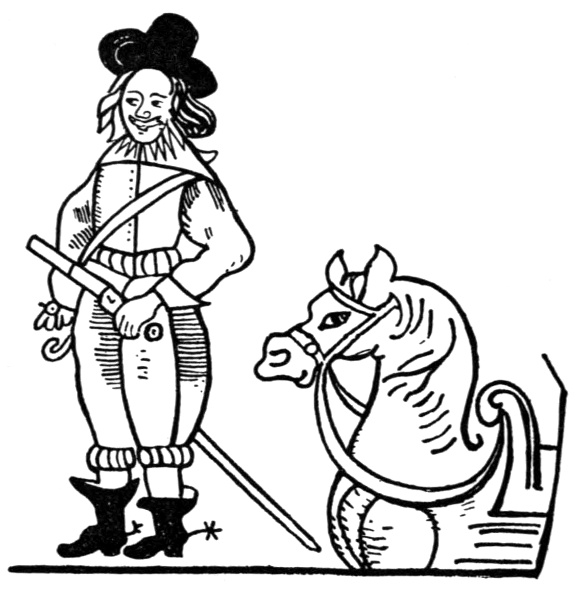
THE "TRUE PROTRACTURE" OF CAPTAIN HIND.
According to No Jest like a True Jest, which
is but indifferently truthful in many of its details,
and does not strike one as being a jest-book,
Hind's father, before apprenticing him to a
butcher, "put him to school, intending to make
him a Scholar, but he minded his wagish Pastimes
more than his Book," and so all ideas of a liberal
education were cut off. Nor was the apprenticeship
to the butchering more successful, for he,
"having a Running Pate, soon grew weary of that
also, and in conclusion ran away from his Master."
Excusing himself, by complaining of the rough
and quarrelsome character of the master, he
borrowed two pounds from his mother, and fled
to London. He was fifteen years of age at this
time, and, if we may believe the biographers—a
difficult enough exercise—"he soon contracted a
relish for the pleasures of the town. A bottle
and a female companion became his principal
delight, and occupied the greater part of his time.
So precocious were the 'prentice-boys of the
early seventeenth century, and so far did forty
shillings go!"
Ere long this youthful adventurer found his
way into the society of highwaymen. It was in
the Poultry Compter, whither he had been consigned
for his part in a drunken riot, that he first
made the acquaintance of Robert Allen, who was
expert in most thievish arts. Over a bottle they
struck up a friendship, and Allen presently introduced
him to the gang he himself captained. They
were mounted men, and the first test of the young
recruit was the choice of a horse. He chose, with
the unerring judgment in horseflesh that was one
of his distinguishing characteristics through life,
the best animal in the stable. Taken then to
Shooter's Hill, and set to bid the first traveller
"Stand and deliver!" he acquitted himself in so
finished a manner as to win the respect of his new
comrades, who, witnessing the exploit from the
leafy coverts beside the road, could not withhold
their admiration.
Here now thou seest me as a Butcher's Boy,
And sporting with a Dog in Merriment;
Hereafter, thou wilt read the Tricks I play,
Which may afford Thee pleasure and content.
For there's no Robb'ry yet I ere did doe,
But doth contain at least a jest or two.
The horseman whom he thus robbed instantly
handed over the ten guineas he was possessed of,
and was no doubt bitterly wondering how he was
to get home in a penniless state, when Hind
courteously returned him one guinea. "This,"
said he, "is for handsel sake." The watching
band of highwaymen marvelled greatly. Here
was an intrepid youngster, the coolest hand at
robbery, courteously giving back a percentage of
his honest earnings. They were witnessing the
foundation of a new school in an old art, a school
that, although its fit pupils were few and far
between, did at least establish a tradition that,
while it did not greatly advantage the travelling
world, did at least serve to win a long line of
highwaymen an amount of forbearance that seems
to us moderns almost incredible. The law visited
highway robbery with sentences of the utmost
ferocity, but individuals, as a general rule, took
their losses, not only with an astonishing philosophy,
but with a remarkable display of good-nature.
Insult a man, and he may brook it,
But keep your hands out of his breeches pocket,
says a well-known couplet; but here we have the
strange spectacle of courtesy disarming the resentment
caused by the turning out of those pockets!
Hind was not yet the holder of a commission, but
he was evidently already captain of himself.
Those were successful years, in which Hind
scoured the roads with Allen's band. They robbed
by wholesale, but never did the gentlemanly Hind
omit the courteous formula of raising his hat on
requesting a delivery. Your tax-gatherer and
rate-collector of modern times do not do so much,
in the presentation of their "Demand Notes."
Not only did Allen's gang pervade the country
upon horseback: they conducted operations in
lordly style, travelling often in carriages, or
setting forth, some equipped as noblemen and
others as their servants, all the better to conduct
their campaign of robbery. Allen, of course, like
most highwaymen of that time, was of Royalist
sympathies. He conceived the magnificent idea
of waylaying the travelling coach of no less a
personage than His Highness, the Lord Protector
of the Realm, Oliver Cromwell himself, on the
way from Huntingdon. Unfortunately, the coach
was guarded by seven servants, unusually full of
fight, and so the attack not merely failed, but
several of the highwaymen were captured, among
them their leader, Allen, who, a short time
later, suffered at Tyburn for his error of judgment.
Hind was fortunate enough to escape, by dint of
a good horse and excellent horsemanship.
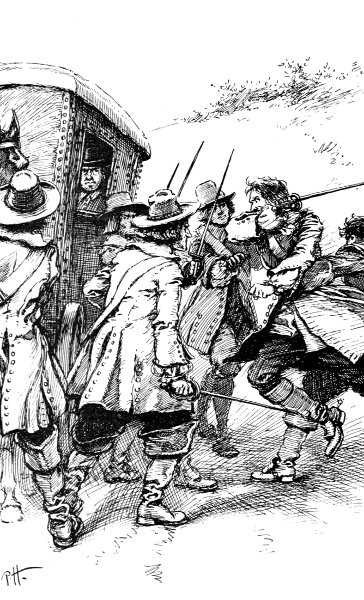
ALLEN AND HIND ATTACK OLIVER CROMWELL'S CARRIAGE.
We are told, however, that Hind's horse was
killed by the exhausting efforts of this escape.
Having no money to purchase another (how on
earth did the highwaymen manage to dissipate
all the money they stole?), he was under the
necessity of trying his fortune on foot until he
should find means to procure another. It was not
long before he espied a horse tied to a hedge, with
a saddle on, and a brace of pistols in the holsters.
"This is my horse," cried Hind to the owner,
whom he observed on the other side of the hedge,
and forthwith he vaulted into the saddle.
"The horse is mine, you rascal!" roared the
owner, making a dash for it.
"Sir," rejoined Hind, "you may consider
yourself well off, that I have left you with all
your money in your pocket to buy another, which
you had best lay out before I meet you again,
lest you should be worse used." So saying, he
rode off in search of new booty.
To rob the rich, to act as special providence
to the poor, to succour the distressed, and to plague
the existence of their political opponents seem to
have been as much the attributes of the seventeenth-century
highwaymen as they were of that
merry outlaw, Robin Hood. It is thus that, in
the vilely printed pamphlets written by illiterates,
composed of blunted type, struck off upon incredibly
bad paper by the aid of rickety hand-presses,
and sold at the old country fairs, the
highwaymen have always had a niche in the
affections of the rustics, who had no purse nor
gear to lose. Hind was of this type, whether
actually or as the creature of legend it is now no
use to inquire. We learn, for instance, how,
riding through the town of Warwick, and
hearing a commotion in a side street, he drew
rein to discover the cause. An innkeeper, he was
told, had been arrested at the suit of a rascally
old usurer, for a debt of twenty pounds. It was
the work of a few minutes for Hind to leap from
his horse, to pay the money, and thus to release
the innkeeper. "Generosity!" you will exclaim.
Well, no; or, at any rate, merely a generous
impulse that cost him nothing but a little physical
exertion, for what was easier to Hind than recovering
again those twenty sovereigns! He
followed the money-lender out of the town, and,
overtaking him in a lonely place, said, with his
forceful politeness, "My good friend, I lent you,
of late, a sum of twenty pounds. Repay at once,
or I take your miserable life!"
Twenty sovereigns were with fear and
trembling handed over, together with another
twenty, "for interest," and when this ill-used
man sought to recover his due from the innkeeper
under legal plea of "duress," or what not
technical terms, he was not only defeated on the
innkeeper producing his signed discharge, but
was soundly flogged into the bargain.
The fanciful book of Hind's exploits called
The English Gusman, published in 1652, contains
some marvellous stories, notably that in which a
witch gives him a talisman protecting him for
three years. He had been staying the night at
the "George" inn, Hatfield, and leaving early the
next morning, encountered an ill-favoured old
woman who begged alms of him.
"His horse presently staid, and would go no
further. 'Sir,' said the old woman, 'I have
something to say to you, and then you shall be
gone.'
"Hind, not liking her Countenance, puld out
five shillings and gave her, thinking she would
but like a Gipsee, tell his fortune, said, 'Good
woman, I am in haste.'
"'Sir,' said she, 'I have staid all this morning
to speak to you; and would you have me lose
my labour?'
"'Speak your mind,' said Hind.
"The old woman began thus: 'Captain Hind,
you ride and go in many dangers; wherefore, by
my poor skill, I have thought of a way to preserve
you for the space of three years; but, that time
being past, you are no more than an ordinary man,
and a mischance may fall on you, as well as
another; but if you be in England, come to me,
and I will renew the Verteu of this Charm again.'
CAPTAIN HIND, THE CAVALIER HERO.
"In saying these words, she puld out of her
bosom a little box, almost like a Sun-Dyal, and
gave it to Captain
Hind, and said to
him, 'When you
are in any distress,
open this,
and which way
you see the Star
turns, ride or go
that way, and
you shall escape
all dangers.'
"So she
switched him
with a white Rod
that was in her
hand, and strook
the horse on the
buttocks, and bid
him farewell. The horse presently leaped forward
with such courage that Hind could not turn to
give her thanks; but, guessing her will it should
be so, rode on his way."
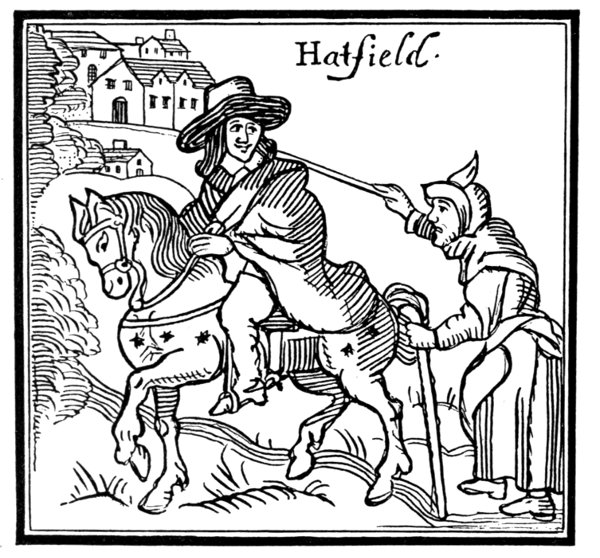
Next; here am I presented to thy view,
Mounted aloft upon a gallant Nagg:
And then behinde me doth appear to you,
How I'm enchanted by an ugly Hagg.
For Three years' space: A little time I wot;
Yet many Pranks I plai'd, and Purses got.
The talisman, according to the author of these
marvels, lasted him until the time when he was
present at the siege of Youghal, and its expiry
was marked by his being wounded there.
He was a wide traveller, our gallant
"Captain." We hear of him as a "true Royalist,"
receiving a commission from Sir William Compton,
and find him at the desperate two-months' siege of
Colchester, where the beleaguered Royalists made
a last stand for Charles the First. On the surrender
of that town, August 27th, 1648, to Fairfax,
he managed to escape in woman's, or, according to
another account, sailor's clothes.
The scene now shifts to Enfield, and we
perceive Hind and the regicide, Hugh Peters,
encountering in the green rides of the Chase.
Politely Hind requests his purse, yet discloses a
not altogether inopportune pistol. To this Peters
replies with a defensive volley of texts. "Thou
shalt not steal; let him that stole steal no more,"
and the like, together with a variety of paraphrases
of the eighth commandment.
Hind, anxious to answer Peters in his own vein,
finds himself a little floored at first, from want of
practice, but presently he begins, "Verily," says
he, imitating the sanctimonious tones of the
Puritan, "if thou hadst regarded the Divine
principles, as thou oughtest to have done, thou
wouldst not have wrested them to such an abominable
and wicked sense as thou didst the words
of the Prophet, when he said, 'Bind their Kings
with chains, and their nobles with fetters of iron.'
Didst thou not then, detestable hypocrite, endeavour
from these words to aggravate the misfortunes
of thy Royal master, whom thy cursed
republican party unjustly murdered before the
gate of his own palace?"
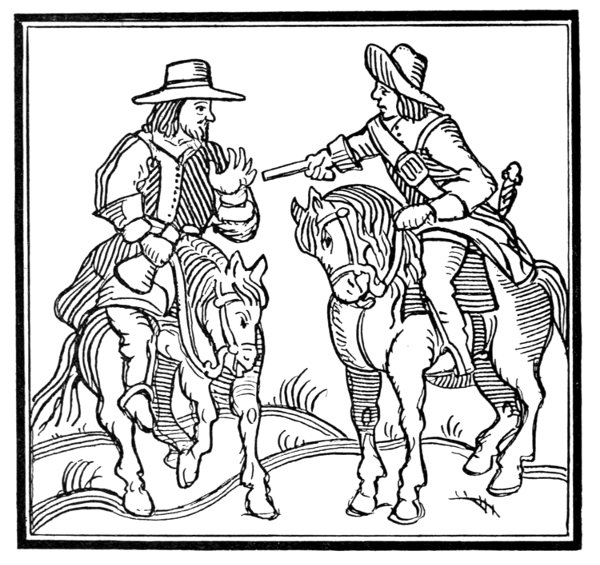
Stand and Deliver! Next in order comes;
Quickly your Money. Make no stay at all,
For my aim's high, and at those greater sums,
The lesser lead to Tyburn's funeral.
Here's all the difference, as 'tis manifest,
I got their money: they received a jest.
Here Peters began to extenuate the action of
the regicides, and to quote Scriptural authority;
with an excursus upon the sinfulness of robbery.
"Pray, sir," replies Hind, Doctor of Divinity,
pro tem., "make no reflection against men of my
profession, for Solomon plainly said, 'Do not
despise a thief.' But it is to little purpose for
us to dispute: the substance of what I have to
say is this: Deliver thy money presently, or else
I shall send thee out of the world to thy master,
the Devil, in an instant."
"These terrible words of the Captain," we are
told, "so terrified the old Presbyterian that he
gave him thirty broad pieces of gold, and then
departed."
But Hind must needs still further humiliate
the enemy. He accordingly rode after him at
full speed, and, overtaking him, addressed him
in this wise: "Sir, now I think of it, I am
convinced this misfortune has happened to you
because you did not obey the words of the Scripture,
which says, expressly, 'Provide neither gold, nor
silver, nor brass, in your purses for your journey,'
whereas it is evident that you had provided a
pretty decent quantity of gold. However, as it
is now in my power to make you fulfil another
commandment, I would by no means slip the
opportunity; therefore, pray, give me your cloak.
You know, sir, it is commanded that, if any man
take away thy cloak, thou must not refuse thy
coat also."
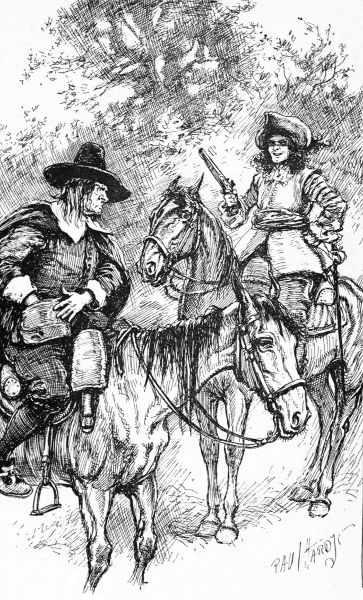
HIND ROBS DR. PETERS.
The old Puritan shrugged his shoulders uncomfortably
before he proceeded to uncloak them,
but on Hind assuring him he must needs be
obeyed, he surrendered the garment, and off went
the highwayman with it.
The next Sunday, ascending his pulpit, Peters
held forth, with a natural warmth of feeling,
upon the crime of highway robbery, taking as
his text, "I have put off my coat, how shall I put
it on?" when an honest plain man present, who
had heard of the incident, exclaimed, "Upon my
word, sir, I believe there is nobody here can tell
you, unless Captain Hind were here." The which
put the congregation into such an excessive fit
of laughter that the parson was made to blush,
and descended from his prattling-box without
further prosecuting the subject.
It was upon the road between Sherborne and
Shaftesbury that Hind fell in with Serjeant Bradshaw,
prominent among those who had sat in
judgment upon the King. Bradshaw was in his
travelling chariot, and, progressing with a considerable
degree of state, declined to be robbed;
mentioning his name.
"Pooh!" exclaimed Hind, "I fear neither
you nor any king-killing villain alive. I have
now as much power over you as you lately had
over the King, and I should do God and my
country good service if I made the same use of
it; but live, villain, to suffer the pangs of thine
own conscience, till Justice shall lay her iron hand
upon thee, and require an answer for thy crimes,
who are unworthy to die by any hands but those
of the common hangman, or at any other place
than Tyburn. Nevertheless, though I spare thy
life, deliver up thy money, or die for thine
obstinacy."
To save a miserable life, he put his trembling
hand into his pocket, and drew out about forty
shillings in silver, which he presented to the
Captain, who swore he would that minute shoot
him through the heart, unless he found him coin
of another species. The Serjeant was then compelled
to present Hind with a purse full of
Jacobuses.
What a devil of talk possessed Hind. To be
robbed and insulted, that was perhaps endurable;
but to be lectured—oh, horrible!
"This, sir," says he, receiving the purse, "is
the metal that wins my heart for ever! O
precious gold! I admire and adore thee, as much
as either Bradshaw, Prynne, or any other villain
of the same stamp. This is that incomparable
medicament which the republican physicians call
the wonder-working plaster. It is truly Catholic
in operation, and somewhat akin to the Jesuit's
powder, but more effectual. The virtues of it
are strange and various; it maketh justice deaf,
as well as blind; and takes out spots of the
deepest treasons, as easily as Castile soap does
common stains. It alters a man's constitution in
two or three days, more than the virtuoso's transfusion
of blood can do in seven years. 'Tis a great
alexiopharmick, and helps poisonous principles
of rebellion, and those that use them. It
miraculously exalts and purifies the eyesight,
and makes traitors behold nothing but innocence
in the blackest malefactors. It is a mighty
cordial for a declining cause: it stifles faction
and schism, as certainly as the itch is destroyed
by butter and brimstone. In a word, it makes
fools wise men, and wise men fools, and both of
them knaves. The very colour of this precious
balm is bright and dazzling. If it be properly
applied to the fist, that is, in a decent manner,
and in a competent dose, it infallibly performs
all the above-mentioned cures, and many others,
too numerous to be here mentioned."
With this, probably having quite exhausted
himself, he haughtily pistolled the six horses that
drew Bradshaw's carriage, and so left the unfortunate
regicide, stripped of his money, deprived
of all means of locomotion, and stunned by his
flow of verbiage.
This, like the most of Hind's exploits, was
robbing on the grand scale. To be sure, he rarely
stooped to little larcenies, for he was a practical
philosopher among the "skilful surveyors of highways
and hedges" that he and his kind were
pleased to style themselves. "Remember what
I tell you," he would say; "disgrace not yourselves
for small sums, but aim high, and for great ones;
the least will bring you to the gallows."
There spoke the "Prince of Prigs," who was
indeed so notable in his own lifetime that he had
the honour accorded him of a play written around
his exploits while yet he survived to add to them.
It is not a good play, but that is no fault of our
"gentleman" highwayman: the thing is that it
should have been written and printed at all.
Thus runs the title-page, that he himself may
have read:
An Excellent Comedy
called, The
PRINCE OF PRIGGS
Revels:
or
The Practises of that grand Thief Captain
JAMES HIND
Relating
Divers of his Pranks and Exploits, never
heretofore published by any.
Repleat with various Conceits, and Tarltonian Mirth,
suitable to the Subject
Written by J. S.
London, Printed for G. Horton, 1651.
Seventy pounds he took from Colonel Harrison,
another of the regicides, on the Bath Road, at
Maidenhead Thicket; and so at one and the same
time avenged his King and full-lined his pockets.
A hue-and-cry was raised immediately, and the
"Captain" was in danger long before he suspected
it. It was an innkeeper who warned him—for
the taverners and tapsters of that, of earlier, and
of succeeding ages were ower sib to the gentlemen
of the high-toby trade, and stood them in
good stead whenever possible.
In this situation, it seems, Hind experienced
an unwonted access of nervousness, and was
apprehensive of every person he met upon the
road. He had reached Knowl Hill, some four
miles only from the spot where he had held up
Harrison in his carriage, when a gentleman's
servant, George Symson by name, riding at full
speed after his master, came dashing by. With
his mind full of the hue-and-cry raised after him,
Hind, supposing this to be one of his pursuers,
turned about, and raising his pistol, shot the
unfortunate man dead: the only occasion of his
taking life.
In May 1649, he was at The Hague, in the
councils of Charles the Second. Thence, after a
three days' stay, he crossed to Ireland and was
made a corporal in the Duke of Ormonde's Life
Guards. Wounded in action with Cromwell's
troopers before Youghal, he escaped to Dungannon,
but plague raged there, and he sailed for Scilly,
which had a clean bill of health, and was, moreover,
the safest place in which a hunted Royalist,
highwayman or not, could at that time find
himself. For, when all else had failed, even in
the staunch and long-enduring West, the Scilly
Isles still held out for the cause. The King was
dead, but his son reigned in the hearts of the
Cavaliers, and a faithful band, captained by Sir
John Grenville, retired to that remote archipelago,
fortified the islands, and made them a privateering
base. It was not until June 1651, that Blake's
flotilla forced them to surrender.
Meanwhile, so famous had Hind become, that
rumour posted him everywhere where highway
robberies were reported. He was already in his
lifetime a kind of bogey, or will-o'-wisp sort of a
fellow, who could miraculously be in at least two
places at one and the same time. Thus, while he
was certainly in Scilly, The Perfect Weekly Account
of September 13th, 1649, reports from Bedford:
"Last night was brought into this gaol, two
prisoners taken up upon pursuit by the county,
for robbing some soldiers of about £300 upon the
way, in the day-time: there were five in the fact,
and are very handsome gentlemen: they will not
confess their names, and therefore are supposed
to be gentlemen of quality, and 'tis conceived they
are of the knot of Captain Hind, that grand thief
of England, that hath his associates upon all
roads. They strewed at least £100 upon the way,
to keep the pursuers doing, that they might not
follow them."
No doubt this would have been an enterprise
entirely after Hind's own heart; but he was
not there, nor were the highwaymen of his
company.
Again, September 20th: "Yesterday about 20
horse of Hind's party (the grand highway thief)
in the space of two hours robbed about 40 persons
between Barnet and Wellin. They let none pass,
to carry news while they staid about this work,
by which means they all escaped before the
county could be raised, but the Lord General's
horse are diligent in seeking after them."
Hind remained in the sanctuary afforded by
the Scilly Isles for eight months, and then
travelled to the Isle of Man, where he sojourned
thirteen weeks. There had been little scope for
his peculiar activities on Scilly, but he found
more opportunities on the Isle of Man, the kingdom
at that time of my lord the Earl of Derby, to
whom he obtained an introduction. He even
became what modern diplomats would describe as
a persona grata in that island Court. Robbery
had been unknown in this most fortunate of the
Fortunate Isles before ever Hind set foot there;
but with his advent a perfect epidemic of highway
robbery prevailed. The Manxmen would have
been of the densest had they not connected the
coming of Hind with these disasters, and they
laid their suspicions before the Governor, Sir
Philip Musgrave, who, with Hind by his side, in
good-fellowship thought the insinuation absurdly
ungenerous. Hind declared his innocence, but
protested his willingness to suffer the extremest
penalty of the island laws, if he were recognised
for the thief. This offer was not so impetuously
ingenuous as it looked, for, naturally, if
he were so recognised, he would perforce, in the
usual course of affairs, be made to suffer; and
secondly, he had already taken the precaution of
robbing in disguise. The Manxmen had come to
the Governor with tales of an aged, hairy man,
with long hair and beard; and confronted with
the youthful Cavalier-like Hind, protested with
apologies, that this was not the man. And then,
when they were gone, what must our tricksy
Captain do but produce, for the Governor's amusement,
the shameless wigs and costumes in which
he had masqueraded. There must have been a
deal of fellow-feeling in that Governor, and little
humour. Your true humorist could not possibly
have resisted the obvious conclusion to the
screaming farce, and would have had Hind fettered
and sent off at once to the deepest dungeon
available.
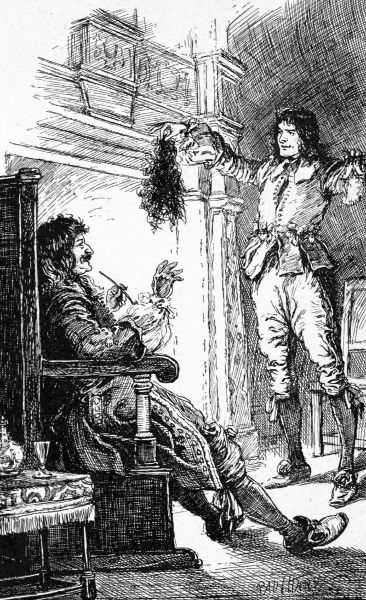
HIND SHOWS HIS DISGUISE.
Hind then went across the Border into
Scotland, where preparations were afoot for an
armed invasion of England on behalf of Charles
the Second. At Stirling he loyally kissed the
hand of His Majesty and offered his services, not
in taking purses on the road, but in fighting for
the cause. The King commended him to the Duke
of Buccleuch, and he came south and fought for
Charles (the "King of Scots," as the Republicans
were pleased to call him) at the disastrous Battle
of Worcester. Escaping in the headlong flight,
he hid himself in London. Near the close of that
year, 1651, lodging in the name of James Brown,
in the house of one Denzys, who exercised the
trade of a barber over against St. Dunstan's-in-the-West,
in Fleet Street, he was betrayed to the
Republican party and carried before the Speaker
of the House of Commons, who, after a lengthy
examination "in regard to his late engagement
with Charles Stewart, and whether he was the
man that accompanied the Scots king for the
furtherance of his escape," committed him in irons
to the Gatehouse. There was a choice before his
captors of the charge to be preferred. At first
he was removed to Newgate, and tried at the
sessions for highway robbery. A rude woodcut in
a biography shows him, visited by his wife and
father, at this stage of affairs, with a pitiful verse
beneath.
The charges not being sustained by sufficient
evidence, he was sent under a strong guard to
Reading, there to be tried, March 1st, 1652, for
the murder of George Symson at Knowl Hill.
Convicted of this, he would forthwith have been
hanged, had it not been for an Act of Oblivion
that had been passed, securing an indemnity for
"all past offences." This, apparently, did not include
the offence of high treason; and so reduced,
much against their will, to making a political
martyr of Hind, the high personages of the
Commonwealth, after endeavouring to dispose of
him on the ignoble charges of highway robbery
and murder, removed him by Order in Council
to Worcester gaol, where he was condemned for
high treason.
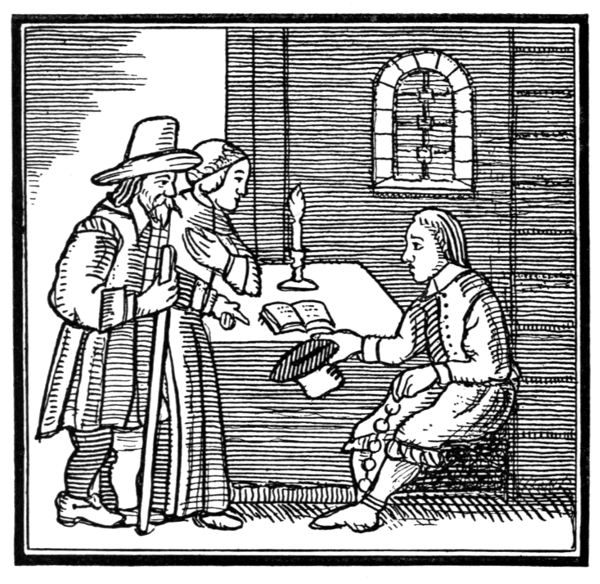
Behold! at last, the saddest sight of all;
Poor Hind! Now in the hole at Newgate lies,
His wife and father both lament his thrall
And are much troubled at his miseries.
His book and candle his companions be;
Though now in chains, he hopes for liberty.
The book published at this period, entitled The
English Gusman, one of those purporting to give
an authentic life of Hind, narrates a conversation
in his cell, here or at Newgate. Hind says: "I
had not been here now if there had not been a
Judas abroad, for indeed I was betrayed by one
who formerly served the King, but now he is for
you (pointing to a Captain who was present), but
God forgive him."
The keeper of the prison then called him from
the fireside to the window, to see if the iron
shackles upon his legs were in order.
"Well," said Hind, "all this I value not threepence.
I owe a debt to God, and a debt I must
pay. Blessed be His name, that He hath kept
me from shedding blood unjustly, which is now
a great comfort to me. Neither have I wronged
any poor man of the worth of a penny, but I
must confess that I have (when I have been
necessitated to) made bold with a rich bumpkin,
or a lying lawyer, whose full-fed fees from the
rich farmer doth too much impoverish the poor
cottage-keeper."
The many "witty jingles" he put forth
occasioned much laughter, but a gentleman standing
by said, "Captain, you are not brought hither
for robbing, but for treason."
"Treason," replied Hind; "I am not guilty in
the least."
"Yes, sir," replied the gentleman, "you are,
for complying with Charles Stuart, and engaging
against the Commonwealth of England."
"Alas! sir, it seems that is enough to hang
one."
"I am afraid you will find it so," answered
the gentleman.
"Well, God's will be done," replied Hind; "I
value it not threepence to lose my life in so good
a cause; and if it were to do again, I protest,"
said he, laying his hand on his breast, "I would
do the like."
"Come," said the keeper, "no more of this
discourse; clear the room."
Hind in due course suffered the hateful penalty
for high treason at Worcester. He maintained a
light and frolicsome demeanour to the last.
"These are filthy, jingling spurs," he remarked
with a laugh, pointing to the fetters that clanked
about his legs as he walked from the bar, "but I
hope to exchange them ere long."
He was drawn to the scene of execution, then
hanged, and afterwards quartered: his head being
placed midway on the Severn bridge, and the
other portions of him over the several gates of the
city, September 24th, 1652.
One of the really notable highwaymen of the early
years of the seventeenth century was John Clavel,
who came from an ancient, if perhaps not particularly
distinguished, family, tracing their descent
back to Walter de Clavile, in the reign of William
the Conqueror. For more than seven hundred years
the Clavel, or Clavell, family flourished in a
modest way upon their manor of Smedmore, on
the Dorset coast, in the neighbourhood of Kimmeridge,
and finally ended with the death, s.p.,
as genealogists would say, of George Clavel in
1774. The only Clavel who fully emerges from
the obscurity in which the family were content to
remain, from the days of the original Walter until
those of the ultimate George, is John Clavel,
whose vocation was robbery under arms upon the
highway. What laid this calling upon him, the
personal history of John Clavel does not inform
us; but probably, when we consider that he was
merely a nephew of Sir William Clavel, the head
of the family, we shall be correct in placing him
among those younger sons and expectant heirs
who, however great were their expectations in
some more or less remote future, were generally,
in the present tense, not only poor, but head over
ears in debt. As the history of the highwaymen
has already shown us, their ranks were very
largely recruited from those youthful members of
reputable families, whose family name was better
than their personal credit. Confound the law of
primogeniture, and pity the sorrows of a younger
son with an excellent ancestry and an empty
purse!
Our present hero, John Clavel, who was born
in 1603, was heir-presumptive to his uncle, the
Dorset squire. Whether that uncle kept him
shorter of money than an heir should be, or
whether he was a gamester who sought to repair
his losses at cards or dice by the hazard of the
road, who shall say? Not I. Perhaps he even
robbed on the highway for sheer joy of it: such
sportsmen were not unknown. But, by all
accounts and just inferences, he had been no mere
amateur, out for a solitary adventure, when he
was laid by the heels and cast into the King's
Bench Prison. He had made an occupation of
highway robbery.
Thus we read, in one of the News Letters
written by Joseph Mead, that purveyor of London
intelligence to country gentlemen in 1626: "February
11th, Mr. Clavell, a gentleman, a knight's
eldest son (?), a great highway robber, and of
posts, was, together with a soldier, his companion,
arraigned and condemned, on Monday last, at the
King's Bench bar. He pleaded for himself that
he had never struck or wounded any man, had
never taken anything from their bodies, as rings,
etc., never cut their girths or saddles, or done
them, when he robbed, any corporeal violence.
He was, with his companion, reprieved. He sent
the following verses to the King, for mercy:
I that have robb'd so oft, am now bid stand;
Death and the law assault me, and demand
My life and means. I never used men so;
But having ta'en their money, let them go.
Yet must I die! And is there no reliefe?
The King of Kings had mercy on a thiefe!
So may our gracious King too, if he please,
Without his council, grant me a release.
God is his precedent, and men shall see
His mercy goe beyond severity."
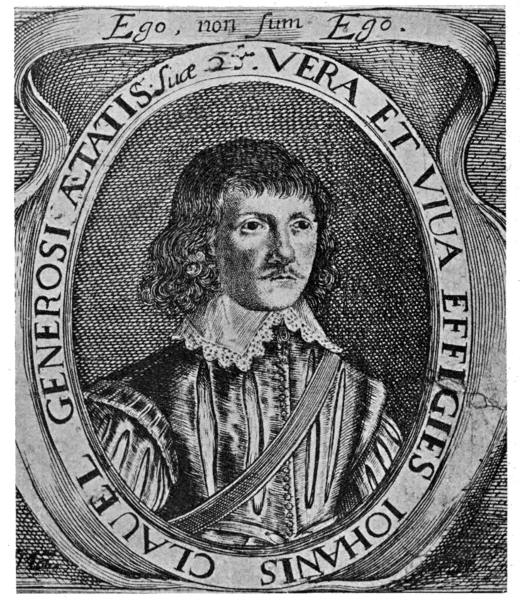
JOHN CLAVEL.
That I may neither brave another's blame
Through wronge suspicions, nor yet act ye same
At any time hereafter, but prove true:—
Loe! to be knowne, you have my face at viewe.
He was reprieved, as the newsmonger tells us,
but that was not sufficient. He must not merely
escape the death-sentence, but be set free. To
that end he wrote in October 1627, in prison, the
curious pamphlet, largely in verse, styled the
Recantation of an Ill-led Life, and published in
the following year. He does not forget to style
himself, on the title-page, "Gentleman," and has
even a Latin tag; perhaps, you know, as evidence
of his gentility. Yet he grovels through many
pages in so abject a style no man of spirit could
endure. Whether he was so thorough-paced a
highwayman as he tearfully declares himself to
have been is, of course, not to be resolved by us,
at this interval of time; but, according to his own
showing, he was not only an adept, but deep in
the counsels of the high-toby gloaks and a past-master
in all their devices. These, with the hope
of a pardon, he proceeds to betray, at much length,
in his "recantation," which he describes as "A
discouerie of the Highway Law. With Vehement
dissuasions to all (in that kind) offenders. As also
Many cautelous Admonitions and full Instructions,
how to know, shun, and apprehend a Theefe.
Most Necessarie for all honest Trauellers to
per'use, obserue, and Practise." This travellers'
handy handbook was "Approued by the King's
most Excellent Maiestie, and published by his
expresse Command," by one Robert Meighen.
The Recantation sets out with an extraordinary
number of rhymed dedications addressed to the
King, the Queen, the Ladies of the Court, "the
Right Honourable the Lords of His Maiestie's
most Honourable Priuie Counsaile and Counsail of
Warre," the Judges of the King's Bench, and
others; ending with an appeal to the "Right
Worshipful, his euer dear and well-approued good
Uncle, Sir William Clavell, Knight Banneret,"
whom he requests:
. . . . .
. . if againe
I euer take a course what shall be vaine,
Or if of any ill I faultie be,
O then for ever disinherit me.
But Sir William did even better than that.
To be on the safer side, he disinherited him at
once, without waiting for his nephew to prove the
sincerity of his professions, and bequeathed his
estates to a distant relative.
In the meanwhile, however, John Clavel did
at any rate manage to produce a popular book.
Three editions of it are known; but whether the
book was purchased as a curiosity, or as a practical
guide to safe travelling upon the highways, there
is nothing to show. The heads of his counsel are
interesting:
"Acknowledgement and Confession.
"Absolute Defiance of those that follow my
late course of life, living vpon the spoile.
"The highway law.
"How soon they spend what unlawfully they
get.
"Instruction for the honest traueller: What
he is to take heed vnto, before he take his
journey.
"How to carry himself in his inn.
"The danger of trauelling on the Sabbath
Day.
"How as he rides he shall know a thief from
an honest man.
"An instance how dangerous it is to grow
familiar with any stranger upon the way.
"When to ride.
"Where to ride.
"How to ride.
"What is best to be done if he is beset.
"If by chance he is surprised, how to behave
himself.
"Being robbed, how to follow, which way to
set forth the Hue and Cry, how to coast, and
where to find the thieves," etc., etc.
He appears to have largely favoured the Dover
Road, in his professional exploits:
. . . . .
Though I oft have seen Gad's Hill and those
Red tops of mountains, where good people lose
Their ill-kept purses, I did never climb
Parnassus Hill, or could adventure time
To tread the Muse's Mazes, or their floor,
Because I knew that they are lightly poor,
And Shooter's Hill was fitter far for me,
When pass'd releases for my own poverty.
He then proceeds to tell in verse how the inns
are often kept by landlords in league with highwaymen,
who not infrequently spend thrice as
much as honest travellers, or whose servants are
either placed there by the knights of the road, or
are bribed by them to investigate the contents of
travellers' saddle-bags and valises.
Having done this, the hints he next gives to
innkeepers, on how to distinguish between highwaymen
and decent travellers, seem rather superfluous.
As to the stigmata of the highwaymen
themselves, besides those
vizards, hoods, disguise,
Masks, muzzles, mufflers, patches on their eyes;
Those beards, those heads of hair, and that great wen,
Which is not natural.
there are the following simpler devices:
Next of a theefe, the vsuall markes be these,
(Which as you ride you may observe with ease)
They muffle with their cloakes, or else their coate
Hides all their clothes, that so you may not note
What sutes they haue, a handkercher they were
About their neckes, or Cipresse, which they reare
Ouer their mouthes, and noses, with their hand
Iust at the time when as they bid you stand;
Perhaps since here I haue discouered this,
They will now leaue them off, that you may misse
Your obseruation, be you therefore sure
As soone as they come riding somewhat neere,
To gaze full at their faces, you shall see
Them turn their heads away, as if so bee
They had spide something on the tother side,
Which if they doe, then keepe your distance wide.
Obviously, the better course for the highway
robber who loved his profession, and not only
meant to rob successfully, but to live long in the
enjoyment of his gains, was to carefully dress the
part. To muffle themselves up in cloaks, like
conspirators, would be to send even the least
prudent traveller off in hurried flight. Such
methods were mere danger-signals, and no security
against subsequent recognition. But with an
artificial nose, or a bushy beard, and little transforming
touches of that sort, a careful road-agent
might reckon on a long and lucrative practice;
always supposing he kept his own counsel and
held aloof from bad company. This, however,
judging from the careers of most of their kind,
seems to have been asking too much.
But to return to the strange fortunes of John
Clavel. His piteous appeal from prison (or perhaps
rather the family influence brought to bear)
at length procured him release. He promised in
his book, if set at liberty, to fight for his King:
. . . . .
. . I do intend
Whilst these your wars endure, even there to spend
My time in that brave service.
But there is nothing to show how he occupied
himself when once again he was restored to
society; there is, however, a curious little notice
added to the third edition of the Recantation,
by the publisher, by which it would seem gossip
had been doing an injustice to our sinner repentant.
Thus it reads:
"The late and general false report of his
relapse and untoward death, made me most
willing again to publish this work of his, to
let you know he not only lives, but hath also
made good all these his promises and strict
resolutions: insomuch that it has become very
disputable amongst wise men, whether they should
most admire his former ill-ways, or his now most
singular reformation, whereat no man outjoys his
friend and yours.—Richard Meighen."
This brand plucked from the burning appears
to have died in 1642.
There stands on the summit of the steep hill
as you go westward out of Bagshot, along the
Exeter Road, a commonplace inn at the fork of
the roads leading respectively to Camberley and
to Frimley. The "Jolly Farmer"—for that is
the name of the inn—looks squarely eastward,
down the hill, and seems no doubt, to most who
pass this way, not worth even a glance. Nor,
indeed, is it beautiful or interesting. Its former
sign, however,—the sign of the "Golden
Farmer"—enshrined an interesting story of the
road. The forerunner of the present house stood
on the right-hand side of the way, and was named
the "Golden Farmer," in allusion to a highwayman,
once only too well known in the neighbourhood.
William Davis flourished in the seventeenth
century. Born at Wrexham, he was early
taken to Sudbury, in Gloucestershire, where he
eventually married the daughter of a wealthy
innkeeper. He had eighteen children, and it
would almost seem, by the tone of his early
biographers, that this unfortunate fact went some
way towards excusing his career. He was, to
the day of his death, a farmer, and for a good
many years cultivated land in the neighbourhood
of Bagshot; a district remarkable in those times
rather for wild heaths than for agricultural value.
And long it remained of this character, and
infested with highwaymen, for we find the poet
Gay in 1715, in his fine narrative poem, A Journey
to Exeter, writing:
Prepared for war, now Bagshot heath we cross,
Where broken gamesters oft repair their loss.
Mr. William Davis was a man very greatly
respected for his singular habit of always paying
his debts in gold. Paper money—whether notes,
bills, or cheques—never passed from him to his
creditors. Good, honest guineas, of red, minted
gold—tender no man refused—were his only
medium. Those who did business with him
thought this an eccentricity, but an amiable one;
and as the years went on, he accumulated more
and more respect.
But in all those years he was in reality a busy
highwayman. Many stories are told of him, and
by them it appears that he did by no means
confine his activities to the neighbourhood of
Bagshot. Prudence now and again sent him
further afield, to till—to adopt a formula that
would have appealed to him as a farmer—comparatively
uncropped ground. Thus we find him
once ranging so far as Salisbury Plain, and there
bidding the coachman, who was driving the
Duchess of Albemarle, to rein in his horses, or—presenting
a pistol—take the consequences. He
had "a long engagement" with postilion, coachman,
and two footmen, and wounded them all.
He does not appear to have suffered; which does
not say much for the marksmanship, the courage,
or the resource of the Duchess's guard, whose
guardianship was thus proved so ineffectual. But
it is a hero-worshipping biographer of highwaymen,
who tells the story. The "Golden Farmer"
seems on this occasion to have departed from
his almost invariable custom, and to have torn
the Duchess's diamond rings from her fingers.
Probably he would have had her watch also, only
the appearance of some other travellers made him
prudently fly: followed by a torrent of bad
language from Her Grace, who could hold her
own with the best, or worst, in that line, having
been, before she married General Monk, none other
than Nan Clarges, washerwoman, and the daughter
of a blacksmith, and well versed in abuse.
Anon, we have the "Golden Farmer" on
Finchley Common. He had waited there one
day, riding back and forth between four and five
hours, hoping for some likely traveller, and none
had come. Imagine him, shivering in the bitter
blast, and angrily wondering what had become of
every one. At last a young gentleman came
riding along, unconscious of danger. Up rode
the highwayman to him, and gave him a flap
across his shoulders with the flat of his hanger.
"How slow you are!" he exclaimed. "A
plague on you, to make a man wait on you all
the morning! Come, deliver what you have,
and be curst, and then go to Hell for orders."
The traveller declared he had nothing about
him, but that, the highwayman remarked, was
nonsense.
Then, searching the unresisting young gentleman's
pockets and taking a gold watch and about
one hundred guineas, he gave him three parting
strokes on the back, and, telling him in future
"not to give his mind to telling lies when an
honest gentleman required a small boon of him,"
cantered away.
One day, having paid his landlord £80, he
carefully disguised himself, and in a solitary
situation met him with the command to "stand
and deliver!"
"Come, Mr. Gravity from Head to Foot, but
from neither Head nor Foot to the Heart," said
he, "deliver what you have, in a trice."
The "old, grave gentleman" heaved a deep
sigh, to the hazard of losing several buttons off
his waistcoat. "All I have is two shillings. You
would not take that from a poor man."
"Pooh!" rejoined the "Golden Farmer," "I
have not the faith to believe you, for you seem
by your manner and habit to be a man of better
circumstances than you pretend; therefore, open
your budget, or else I shall fall foul about your
house."
"Dear sir," wailed the old gentleman, "you
can't be so barbarous as to rob an old man.
What! have you no pity, religion, or compassion
in you? Have you no conscience? You can
have no respect for your own body and soul, which
must certainly be in a miserable case, if you follow
these unlawful courses."
"D——n you," rejoined Davis, "don't talk
of age or barbarity to me, for I show neither pity
nor compassion to any. What! talk of conscience
to me! I have no more of that dull commodity
than you have; nor do I allow my soul and body
to be governed by religion, but by interest; therefore,
deliver what you have, before this pistol
makes you repent your obstinacy."
There was no help for it, and the rent found its
way back from landlord to tenant.
Again the "Golden Farmer" is found in a new
setting; this time upon the Oxford Road. The
particularly evil character of this road was enlarged
upon in 1671 by Richard Brockenden,
writing to Sir Richard Paston, and describing
what he called "a new set of highwaymen," who
robbed every night, unlike the old hands, who
evidently rested frequently from their labours to
enjoy the fruits of their shy industry, and must
have resembled Sir W. S. Gilbert's lawless but
light-hearted gang, who sang:
We spend our nights on damp straw and squalid hay
When trade is not particularly brisk;
But now and then we take a little holiday,
And spend our honest earnings in a frisk.
The infamous "new set," who robbed every
night, cannot command our sympathy; they were
too pushful. William Davis, however, belonged
to no set. He was complete in himself; and
if he too robbed without ceasing, he had those
eighteen children of his to support. It was
near the London end of the Oxford Road that
the following adventure took place: at none
other than the village of Hillingdon, near Uxbridge.
It seems, then, that the "Golden Farmer,"
dressed in appropriately rustic style, overtook
near Gerrard's Cross a certain Squire Broughton, a
barrister of the Middle Temple, and entered into
conversation with him. When he learned the
profession of this chance acquaintance, he pretended
to be on his way to London to advise with
a solicitor, and, expressing himself as fortunate
in meeting one learned in the law, asked him
if he could recommend counsel. Broughton,
scenting business, bespoke for himself, and the
"Golden Farmer," spinning a cock-and-a-bull story
of some neighbour's cattle breaking into his fields
and doing a vast amount of mischief, sought his
opinion.
"It is very actionable," said the lawyer,
"being Damage Fesant."
"Damage Fesant?" asked the highwayman.
"What's that, pray, sir?"
The lawyer, with much show of learning, duly
expounded the matter; and so, as evening drew
in, they came to the "Red Lion," Hillingdon, discussing
the Law of Trespass, the extent to which
the farmer was probably damnified, and the pros
and cons of the whole bogus affair.
Passing a very pleasant night at the "Red
Lion," they set out together the next morning,
still talking law.
"If I may be so bold as to ask you, sir," said
the Golden Farmer, "what is that you call Trover
and Conversion?"
"Why," said the lawyer, "that is easily explained.
It is an action against one who has
found any property, and, refusing to deliver on
demand, converts it to his own use."
They were now on Hillingdon Heath, a lonely
place, not yet lined with mean houses and paltry
shops, and still to wait a matter of two hundred
years before Mr. Whiteley's factory and stable-yards
were built beside the road.
"Very well," said the Golden Farmer, "and
if I should find any money about you, and converted
it to my own use, that would be merely
actionable?"
"That would be highway robbery," rejoined
the man of law, "and would require no less
satisfaction than a man's life."
"A robbery!" exclaimed the highwayman.
"Why, then, I must e'en commit one for once;
therefore deliver your money, or this pistol shall
prevent you reading Coke upon Littleton any
more!"
"You must be joking!" exclaimed the lawyer,
edging away.
But the Golden Farmer, presenting the pistol
to his breast, advised him to "down with the
rhino, or he would get his mittimus by summary
process." The man of law still hesitated.
"Do you think," said he, "there is neither
heaven nor hell?"
"Why," rejoined the highwayman, "thy impudence
is surely very great to talk of heaven
or hell to me! D'ye think there's no other way
to heaven but through Westminster Hall? Come,
come, down with your rhino this minute, for I
have other customers to mind than to wait on you
all day!"
Thus adjured, the lawyer reluctantly handed
over "thirty guineas and eleven broad pieces of
gold," besides some silver and a gold watch.
The "Red Lion," Hillingdon, is standing to
this day, and the crowds who frequent it in these
times when the electric trams pass its door, may
feel a romantic thrill as they connect the house
with this story.
Hillingdon Heath figures also in the next
adventure.
"Well overtaken, brother tinker!" exclaimed
the "Golden Farmer," as one day he came up
with an itinerant mender of pots and kettles;
"methinks you seem very devout, for your life
is a continual pilgrimage, and in humility you go
about barefoot, thereby making necessity a virtue."
"Ay, master," replied the tinker, "needs must
when the Devil drives, and had you no more than
I, you, too, might go without boots and shoes."
"That might be," quoth the "Golden Farmer";
"but as for yourself; you, I suppose, march all
over England with your bag and baggage?"
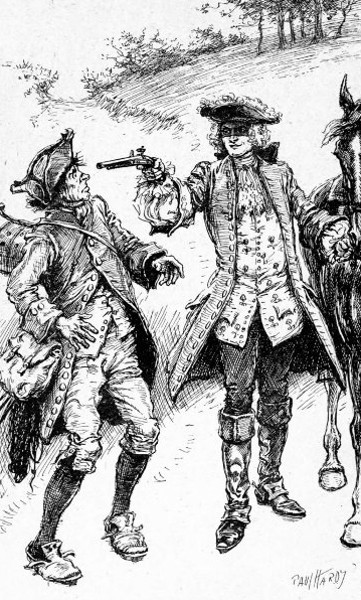
THE GOLDEN FARMER AND THE TINKER.
"Yes," said the tinker, "I go a great deal of
ground, but not so much as you horsemen, and
I take a great deal of pains for a livelihood."
"Yes," rejoined the highwayman, "I know
thou art such a strong enemy to idleness that,
mending one hole, you make three."
"That's as you say," retorted the tinker;
"however, sir, I wish you and I were farther
asunder, for i'faith I don't like your company,
and have a great suspicion of you."
"Have you so?" said the highwayman; "then
it shall not be without a cause: come, open your
wallet forthwith, and deliver that parcel of money
that's in it."
The unhappy tinker begged he would not rob
him. If he did, he said, he must needs be forced
to beg his way home, over a hundred miles.
But the "Golden Farmer" had no mercy.
"D——n you," said he, "I don't care if you
have to beg your way two hundred miles, for, if a
tinker escape Tyburn and Banbury, it is his fate
to die a beggar."
So saying he made off with the tinker's money
and wallet too.
At last the "Golden Farmer" met his long-deferred
doom, and in his own district. The
Exeter Road, in the neighbourhood of Bagshot,
had long been haunted by a highwayman, who
robbed impartially the early coaches of that age,
or the travelling chariots of the great. This
highwayman had his peculiarities. Others might
risk stealing notes and jewellery, but he refused all
trinkets, and took coin only. The strange thing
is that no one in Bagshot or round about seems to
have exercised the simple art of putting two and
two together and making a total sum of four;
or, in other and less metaphorical phrase, of
deducing the "Golden Farmer," who paid only
in gold from the unnamed, masked highwayman
who took only gold. The two were, of course,
one, and so much was discovered one night when,
the highwayman having as usual stopped and
plundered a coach, a traveller who had secreted a
pistol shot him in the back as he was making off.
Bound hand and foot, the wounded man was
taken to the "King's Arms," where, to the
astonishment of all, he was recognised as the
"Golden Farmer."
Fact and fiction are so intermingled in these
stories of the "Golden Farmer's" exploits, that it
would be almost as easy to unravel the real history
of Robin Hood himself, as to present a biography
of him that should have much pretence to truth
in detail. It seems we are not even on sure
ground when we set his name down as William
Davis, for in a collection of old printed trials
at the British Museum we find a William Davis,
identified with the "Golden Farmer," executed
in September, 1685, for being the principal figure
in a burglary and felony committed in company
with one John Holland and Agnes Wearing at the
house of a minister, one Lionel Gatford, in Lime
Street, City of London. Agnes Wearing suffered
with him, but Holland was reprieved.
Yet, although this Davis was turned off in 1685,
we find, by the London Gazette of September 9th,
1689, that there were then in custody at Newgate
two persons suspected of being housebreakers and
robbers, several instruments for breaking into
houses having been taken with them: "one calling
himself William Freeman, whose right name
is William Hill, commonly called the 'Golden
Farmer,' an indifferent, tall, black Man, well set,
with black hair, has a shaking in his Head, and is
between 50 and 60 years of age." This advertisement
proceeds to notify that "those robbed may
have a sight of them at Newgate."
[5]
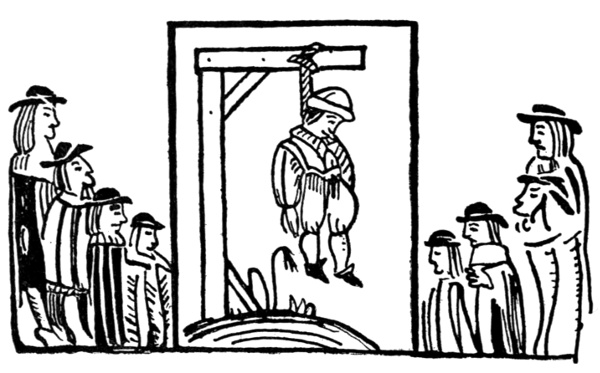
EXECUTION OF THE GOLDEN FARMER.
From a contemporary woodcut.
Another story tells how he was pursued in
Whitefriars, London, the old-time Alsatia of
rogues and vagabonds behind Fleet Street. He
shot dead a butcher who tried to stop him, but
was tripped up and secured, at the corner of
Salisbury Court and Fleet Street, where he was
afterwards hanged, December 20th, 1689, in his
sixty-fourth year: or, by another account,
December 20th, 1690. His body was afterwards
hanged in chains on the threshold of his own
house at Bagshot.
On a broadsheet ballad, published on the
occasion of his execution, entitled The Golden
Farmer's Last Farewell, a rude woodcut appears
at the head of the verses, in which you see a very
small figure hanging most comfortably from a
gallows-tree, with a thoroughly happy expression
upon his face, while a small crowd (assorted sizes)
contemplates his sad end with a variety of emotions,
ranging from amusement to contempt. The verses
are typical of the penny literature of the age, and
do not necessarily follow his career with any
slavish regard to truth:
Unto you all this day,
my faults I do declare,
Alas! I have not long to stay,
I must for Death prepare;
A most notorious Wretch,
I many years have been,
For which I now at length must stretch,
a just Reward for Sin:
No Tongue nor Pen can tell
what sorrows I conceive;
Your Golden Farmer's last Farewell,
unto the World I leave.
A Gang of Robbers then
my self did entertain;
Notorious hardy Highwaymen,
Who did like Ruffians reign:
We'd rob, we'd laugh, and joke,
and revel night and day;
But now the knot of us is broke,
'tis I that leads the way:
No Tongue nor Pen can tell, etc.
We houses did beset,
and robb'd them night and day,
Making all Fish that came to Net,
for still we clear'd the way;
Five Hundred Pounds and more,
in Money, Gold, and Plate,
From the right Owner we have bore,
but now my wretched State,
No Tongue nor Pen can tell, etc.
We always gagg'd and bound
most of the Family,
That we might search until we found
their hidden Treasury;
A sword-point at their throat,
a Pistol cock'd straightway,
Presented at their Breast, to make
them show us where it lay:
No Tongue nor Pen can tell, etc.
I having run my Race,
I now at last do see,
That in much shame and sad disgrace,
my Life will ended be:
I took delight to rob,
and rifle rich and poor,
But now at last, my Friend, Old Mob,
I ne'er shall see thee more:
No Tongue nor Pen can tell, etc,
The Blood which I have spilt
now on my Conscience lies,
The heavy, dreadfull thought of Guilt,
my Senses do's surprize;
The thoughts of Death I fear,
although a just Reward,
As knowing that I must appear,
before the living Lord.
No Tongue nor Pen can tell, etc.
I solemnly declare,
who am to Justice brought,
All kind of wicked Sins that are,
I eagerly have wrought;
No Villains are more rife
than those which I have bred,
And thus a most perfidious Life
I in this World have led:
No Tongue nor Pen can tell, etc.
Long have I liv'd, you see,
by this unlawful Trade,
And at the length am brought to be,
a just Example made;
Good God, my Sins forgive,
whose Laws I did offend,
For here I may no longer live,
my Life is at an end.
No Tongue nor Pen can tell, etc.
The name of Thomas Simpson arouses no emotions
of love or hate, of fear or of admiration. He is
just "Thomas Simpson," plebeian, undistinguished
amid the other hundreds of Thomas Simpsons who
have worn a commonplace name throughout a
commonplace career, and so ended; the world
appreciably no better for their existence, and
certainly not noticeably worse. There have been
perhaps thousands of Thomas Simpsons, but there
has been only one "Old Mob." The Thomas
Simpson, who rose to fame with that picturesque
nickname, was born at Romsey, in the New Forest,
in the first half of the seventeenth century. We
are told little of his early life, and merely learn
that he continued to live at Romsey as his only
home, "until he had five children and some
grandchildren." His education, we further learn,
without surprise—for it was the seventeenth
century, you know—"appears to have been greatly
neglected." It was impudence, however, more
than anything, more even than courage, that ever
made the successful highwayman: the 'ologies
were useless on the hard high road, under
stars, when a carriage worth robbing drew nigh;
nor even would the elementary three R's help a
man any the better to thrust a pistol through a
window and cry "Stand!"
Old Mob had little education and less manners.
Your Du Valls and Captain Hinds might bring the
manners of society and the refinements of the
ball-room into the keen air of the highway; for
him there was but the rasping tongue of command
and the contact of the cold muzzle of his pistol
with your nose. He ranged the south and west
of England very freely, and is found on one
occasion in the Eastern Counties.
Accounts of his career generally open with his
encountering a certain Sir Bartholomew Shower,
between Honiton and Exeter. The road in the
neighbourhood of Honiton Clyst is still little
frequented, and at that time must have been
singularly lonely. Old Mob called upon the
knight to "stand and deliver," and Sir Bartholomew
delivered accordingly, and with a pleasing
readiness because he had the merest trifle on him,
and thought to have thus escaped easily. But
Old Mob was disappointed, and proportionably
wroth: "My demands, sir, are very large and
pressing," he said, "and therefore you must
instantly draw a bill for one hundred and fifty
pounds and remain in the next field for security
till I have received the money."
The knight vainly protested that there was no
one in Exeter who had so large a sum by him, but
Old Mob would take no denial and led him a long
distance away from the road, tied him to a tree,
and compelled him to draw a bill for the amount
on a goldsmith in the city. Then he rode into
Exeter, duly cashed it and, returning, released his
prisoner. "Sir," his biographer reports him as
saying, "I am come with a habeas corpus to
remove you out of your present captivity"; which
he did, leaving him to walk home the distance of
three miles.
This last remark attributed to Old Mob, the
uneducated, is no doubt a biographical frill,
inserted to fitly round off the incident. What
should he know of habeas corpus? This was a
vice of which the biographer of the knights of
the road could by no means rid themselves.
It was upon the road between Newmarket and
London that Old Mob halted the carriage of no
less a personage than Louise de la Kérouaille, the
notorious Frenchwoman, favourite of Charles the
Second, whom that monarch had created Duchess
of Portsmouth.
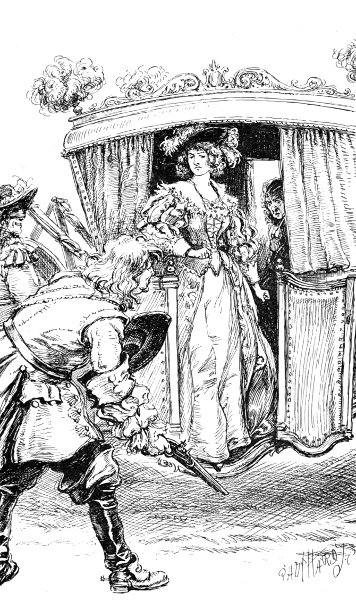
"OLD MOB" ROBS THE DUCHESS OF PORTSMOUTH.
"Do you know who I am, fellow?" demanded
that haughty lady, indignant at being stopped by
so mean-looking an object.
Now, for such as the Duchess of Portsmouth
and her kind to ask such a question of a highwayman
was singularly rash. Captain Alexander
Smith and "Captain" Charles Johnson, in their
folio volumes of the Lives of the Highwaymen,
published in 1719 and 1742, respectively, describe
Old Mob's reply, either in his own words, or
excogitated out of their own inner consciousness,
according to their own ideas of probability; but
these present pages are in octavo volumes and this
is the twentieth century, and for one of these
reasons, or both—as you please—it is really not
possible to reprint the vigorous reply of Old Mob
to the Duchess's request. He not only told her
who she was, but also, in the sheerest unornamental
language, what she was, as well. Among
other things: "You are maintained at the public
expense. I know that all the courtiers depend
upon your smiles, and that even the King is your
slave. But what of all that? A gentleman-collector
upon the road is a greater man, and more
absolute than His Majesty is at Court. You may
now say, madam, that a single highwayman has
exercised his authority where Charles the Second
of England has often begged a favour."
Her grace continued to gaze upon him with
a lofty air, and told him he was a very insolent
fellow: that she would give him nothing, and
that he should certainly suffer for his insolence.
"Touch me if you dare!" she exclaimed.
"Madame," rejoined the highwayman, "that
haughty French spirit will do you no good here.
I am an English freebooter, and I insist upon it,
as my native right, to seize all foreign commodities!
Your money is indeed English, but it is forfeited,
as being the fruit of English folly. All you
possess is confiscated, as being bestowed upon one
so worthless. I am King here, madame! I have
use for money, as well as he. The public pay for
his follies, and so they must for mine." And Old
Mob thereupon gathered in two hundred pounds
in gold, "a very rich necklace which her Royal
paramour had lately given her," a gold watch,
and two diamond rings.
You will observe an intolerable tendency in
Old Mob to moral reflections: as though he were
one who had missed his vocation, and would have
been more legitimately employed in improving
the occasion from the pulpit. And not only Old
Mob held forth in this manner. His contemporaries—if
we may believe Messrs. Smith and
Johnson—did the like: in very unclerical fashion,
it is true, for they sandwiched their preaching with
the most horrible oaths and blasphemies: all duly
printed at length by those authorities, without
the decent veil of the blushing "——," or the
discreet "*." It was a singularly mixed method;
but the preachments are all of so singular a likeness
that we may shrewdly suspect them to be the
inventions of their biographers. The cursings and
revilings we may take as being the highwayman's
very own. They were instinctively employed to
strike terror into the hearts of unfortunate wayfarers,
just as in olden Chinese warfare the pig-tailed
warriors came on with grimaces and with
shields pictured with hideous masks.
"Old Mob" then met "Old Gadbury, the Astrologer,"
and stopping him and demanding his
money, "the Starry Prophet began to plead
Poverty, but this did not move him at all to
Compassion."
"You lying Rogue," quoth he, "can you that
possess all the Seven Planets of Free-hold, and
let them out on Lease to the Stationers' Company,
plead Poverty to me. No, no, you must not sham
Poverty to me; come, come, your Money presently,
or this Pistol, shall be worse to you than the
raging Dog Star that threatens Death and Diseases
to a Country."
And "Old Gadbury" had thereupon to make
a speedy delivery.
The next most outstanding enterprise of Old
Mob was the halting of Judge Jeffreys in his
coach, some time later than that Judge's assize of
blood in the West. The highwayman, setting
suddenly upon the equipage, disabled the two
servants who accompanied it, and then demanded
his lordship's money.
"I am Sir George Jeffreys," quietly remarked
the judge, with a world of meaning, as he severely
eyed the pistol presented at him. That plain
statement was designed to send a pang of apprehension
through the aggressor; and, indeed,
the lowering presence of the judge had made
many a prisoner brought before him quail; but
Old Mob, by the best accounts, does not appear to
have been greatly impressed. He was ready as
ever with his moral remarks.
Jeffreys reminding him that a Providence
existed which governed the world, and that he
might therefore expect to be duly punished for
his iniquities, he held forth in his best pulpit
style: "When justice has overtaken us both,
I hope to stand as good a chance as your lordship,
you, who have written your name in indelible
characters of blood and deprived many thousands
of their lives, for no other reason than their
appearing in defence of their just rights and
liberties. It is enough for you to preach morality
upon the Bench, when no person can venture to
contradict you; but your words can have no effect
upon me. I know you too well not to perceive
that they are only lavished upon me to save your
ill-gotten wealth." Then, his eloquence in this
vein being exhausted, thundering forth a volley
of oaths, and presenting a pistol to his breast, he
threatened the judge with instant death, unless
he surrendered his money. Perceiving that his
authority was of no consequence to him upon the
road, Judge Jeffreys thereupon handed over the gold
he had about him, amounting to fifty-six guineas.
To recount the many improbable stories told
of Old Mob, singly, or in conjunction with his
sometime ally, the "Golden Farmer," would be
to tell many stupid tales, and to convict oneself of
credulity. He was caught at last, and, being
convicted on thirty-four out of thirty-six indictments,
was duly hanged, with nine others, September
12th, 1691. He declared, on the scaffold,
that "while he continued to Rob on the Highway,
he pray'd at the same Time that God would
forgive it, and that it eas'd his mind something."
It was added that "though he had wounded
several Persons, yet he affirm'd he never murder'd
any; which, to be sure, was very forbearing and
obliging of him."
Claude Du Vall ranks among his brother highwaymen
as high as Rembrandt or Raphael among
artists. He was, indeed, no less an artist in his
own profession than they. He might not, and
probably did not, acquire as much of other
people's property on the road as did Hind or
Whitney; but artists are not necessarily money-makers.
Such as were his takings, he took them
with a finished grace and a considerate courtesy,
that not even the Prince of Prigs, in his best
moment, ever quite attained. We do not learn,
for example, that Hind, the "Gentleman Thief,"
footed it on the heath in a graceful dance with
one of his victims, as did Du Vall; but Hind had
not the advantage of that foreign blood which
made Claude skip for gladness in the midst of
alarms.
In the Memoires of Monsieur Du Vall, published
in 1670, only a few days after the hero's
death from the effect of a hempen cravat, we
have the sole authority for the merry tales told of
him. It is a curious production. From it we
learn that:
"Claude Du Vall was born Anno 1643 at Domfront,
in Normandy, a place very famous for the
excellency and beautifulness of the air, and for
the production of mercurial wits. At the time
of his birth there was a conjunction of Venus
and Mercury, certain presages of very good
fortune, but of a very short continuance. His
father was Pierre Du Vall, a miller, his mother,
Marguerite De la Roche, a tailor's daughter."
The author of these remarkable memoirs then
proceeds to say, in surely a very cynical
manner: "They lived in as much reputation
and honesty as their conditions and occupations
would permit." This, of course, is a sly fling
at both the business of a miller and that of a
tailor; for honest millers have from the earliest
times been proverbially as scarce as honest
lawyers; while for tailors to "cabbage" the cloth
entrusted to them has always been expected.
Du Vall's biographer then ranges from
sarcasm to an indignant defence of his birth and
parentage.
"There are some," he says, "that confidently
aver he was born in Smock Alley, without
Bishopsgate, that his father was a cook, and sold
boiled beef and porridge; but their report is as
false as it is defamatory and malicious."
"It was easy," he continues, "to disprove this
in several ways, but the chief argument against it
was this: If he had been born in Smock Alley, he
would not have been a Frenchman, but if he had
not been a Frenchman, it was quite impossible he
should have been so much beloved in life and
lamented in death by the English ladies."
Early in life, a wandering priest who happened
upon his parents' humble dwelling, found a mark
upon his head as of two crowns: a sure sign, said
the priest, that he was to be a traveller. Then,
adopting something of the rôle of a fortune-teller,
he declared the boy would never be long without
money; and, wherever he went, "he would
always have the exceeding favour of women of
the highest condition."
The rustic miller and his wife looked upon the
priest as an oracle, but wondered how such fortune
would come to pass. Nothing visible on the
horizon of their lives warranted any such expectations.
They were miserably poor, and kept themselves
but little warmed by that comparative
honesty of which we have already read. So when
Claude grew to the age of thirteen or fourteen, he
was turned adrift from the old home, to fend
for himself. His parents did what they could,
but that did not amount to much. A little less
unexpected honesty on their part would have
enabled him, no doubt, to enter upon the world
under better circumstances: but as it was, the
best they could do was to buy him shoes and
stockings—things he had never before known—and
a second-hand suit of clothes. This outfit,
and twenty sous given him at parting, was all his
property. As he went they threw an old shoe
after him for luck, and bid him go seek his
fortune.
The boy made his way to Rouen in the first
instance. There he was promised a ride to Paris
on one of the post-horses he saw in the courtyard
of an inn, if he would earn that lift by helping
stable them for the night. He willingly agreed,
and was fortunate to meet at the same inn a
number of English youths, who, with their tutors,
were returning by way of Paris to England. In
return for such use as he could be to them in
practising their insufficient French, they employed
and fed him for the few days they remained in the
country.
In Paris, according to our admiring but discriminating
biographer, "he lived unblameably
during this time, unless you esteem it a fault to
be scabby, and a little given to filching; qualities
very frequent in persons of his nation and condition."
So, employed about stables and inn-yards
in Paris, he continued until the Restoration of the
monarchy in England in 1660 brought about the
return of many exiles. In the service of one of
the many "persons of Quality" who then crossed
the Channel, went Claude Du Vall, who by this
time was seventeen years of age.
The joy that expressed itself all over England
at the return of Charles the Second degenerated
into riotous excess. Dissipation and every species
of profligacy abounded among upper and middle
classes, and the servants of the wealthy were
apt pupils of their masters in these excesses.
Highwaymen, whose profession had languished
miserably under the Commonwealth's later rule,
reappeared on every road, and were drawn from all
classes. Footmen and lackeys found a singular
fascination in the occupation of the high-toby
crack, and early among them was Du Vall,
who in a short time became so dexterous in
his new employment, that he had the honour of
being the first named in a long list of highwaymen
proclaimed in the London Gazette.
It has already been acknowledged that violence
had no part in the methods of this artist, and
he would have scorned, you may be sure, the
ruffianly, and even murderous acts of a later
generation of the craft, who not only despoiled
travellers of their goods, but rendered the roads
dangerous to life and limb. His chief exploit,
upon Hampstead Heath, is classical, and is set
forth so eloquently, and with such an engaging
profusion of capital letters, in the Memoires that
one cannot do better than quote it. By this
account it would appear that he was the captain
of a gang:
"He, with his Squadron, overtakes a Coach,
which they had set over Night, having Intelligence
of a Booty of four hundred Pounds in it. In the
Coach was a Knight, his Lady, and only one
Serving-maid, who, perceiving five Horsemen
making up to them, presently imagined that they
were beset; and they were confirmed in this
Apprehension by seeing them whisper to one
another, and ride backwards and forwards. The
Lady, to shew that she was not afraid, takes a
Flageolet out of her pocket and plays. Du Vall
takes the Hint, plays also, and excellently well,
upon a Flageolet of his own, and in this Posture
he rides up to the Coachside. 'Sir,' says he to
the Person in the Coach, 'your Lady plays
excellently, and I doubt not but that she dances
as well. Will you please to walk out of the
Coach and let me have the Honour to dance one
Currant with her upon the Heath? 'Sir,' said
the Person in the Coach, 'I dare not deny anything
to one of your Quality and good Mind. You
seem a Gentleman, and your Request is very
reasonable.' Which said the Lacquey opens the
Boot, out comes the knight, Du Vall leaps lightly
off his horse and hands the Lady out of the Coach.
They danced, and here it was that Du Vall
performed Marvels; the best Masters in London,
except those that are French, not being able to
shew such footing as he did in his great French
Riding Boots. The Dancing being over (there
being no violins, Du Vall sung the Currant
himself) he waits on the Lady to her Coach. As
the knight was going in, says Du Vall to him,
'Sir, you have forgot to pay the Musick.' 'No, I
have not,' replied the knight, and, putting his
Hand under the Seat of the Coach, pulls out a
hundred Pounds in a Bag, and delivers it to him,
which Du Vall took with a very good grace, and
courteously answered, 'Sir, you are liberal, and
shall have no cause to repent your being so; this
Liberality of yours shall excuse you the other
Three Hundred Pounds,' and giving the Word,
that if he met with any more of the Crew, he
might pass undisturbed, he civilly takes his leave
of him. He manifested his agility of body by
lightly dismounting off his horse, and with Ease
and Freedom getting up again when he took his
Leave; his excellent Deportment by his incomparable
Dancing and his graceful manner of
taking the hundred pounds."
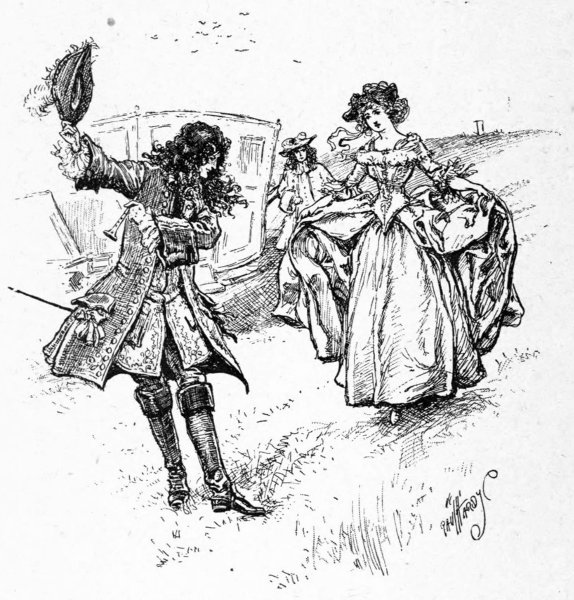
CLAUDE DU VALL DANCING THE CORANTO ON HOUNSLOW HEATH.
Our own times are more sordid, and it is to be
feared that not the extremest display of grace in
the robber would find any one ready to excuse
the loss of a hundred sovereigns.
As the old priest had foretold, years before,
Du Vall became the ladies' favourite. "Maids,
widows, and wives," we learn, "the rich, the poor,
the noble, the vulgar, all submitted to him," and
he led the gayest of lives in London.
He knew Blackheath as well as Hounslow,
and there, with his companions, met a coach full
of ladies and a child with a feeding-bottle.
Rudely, one of the gang rode up, violently robbed
the ladies of their watches and rings, and did not
scruple even to steal the child's silver bottle.
The air resounded with the shrieks of the cheated
infant and the cries of the ladies. Up rode
our gallant hero, with threats to instantly shoot
the man unless he returned the bottle. "Sirrah!"
he exclaimed, "cannot you behave like a gentleman
and raise a contribution without stripping
people. But perhaps you yourself have some
occasion for the sucking bottle, for by your
actions one would imagine you were hardly
weaned."
Soon after this Du Vall thought it politic to
retire for a while to France. A humorous story
was told of his fooling an eminent Jesuit confessor,
known less for his piety than for his political
meddling and his avariciousness. He was a very
wealthy man, and Du Vall, hearing of his hoards,
was anxious to have a share in them. He made
the confessor's acquaintance in the guise of a
scholar, and said he was one who had studied the
sciences and only wanted a patron as eminent as
himself, through whose introductions he desired
to serve his country by applying the knowledge
he had acquired.
"And of what special branch does your knowledge
consist?" asked the Jesuit. "If you can
and will communicate anything that may be
beneficial to France, I assure you no proper encouragement
shall be wanting on my side."
Du Vall, growing bolder, said: "Sir, I have
spent most of my time in the study of alchemy,
or the transmutation of base metals into gold,
and have profited so greatly at Rome and Venice,
from association with men learned in that science,
that I can change several metals into gold by the
help of a philosophical powder, which I can
prepare very speedily."
The prospect of immense riches that might
be his, if only he cultivated the acquaintance
of this man of science, dazzled the confessor.
"Friend," he said, "such a thing as this will
indeed be a service to the State, and particularly
grateful to His Majesty the King, who, as his
affairs stand at present, is in great need of such
a curious invention. But," he added, with some
remains of cunning criticism, "before I credit
what you say, so far as to communicate it to His
Majesty, I must see some proof of your skill."
Du Vall agreed; but said, as only a poor
student of these things, he had not the appliances
necessary. These the confessor agreed to provide,
and fitted up a laboratory for him in his own
house. Everything being complete, Du Vall gave
a demonstration of his alchemic science. He took
several metals of the baser sort, and put them
into a crucible, the confessor watching him the
while. Du Vall had prepared a hollow stick,
into which he had introduced several inlays of
real gold; and with this stick he stirred the
white-hot crucible, until the base metals were in
a flux, and the stick itself was almost entirely
consumed. On the crucible being cooled, and its
contents examined, it was duly found that a
considerable amount of gold was mixed with what
had been base metals.
The Jesuit was delighted with the success of
the experiment, and a series of equally satisfactory
tests was entered upon. Du Vall at last
fully acquired his confidence, and a complete
knowledge of where his treasure was deposited,
and, finding him one evening in a heavy sleep
(to which he had perhaps contributed by drugging
his wine), gently stole his reverence's keys,
earned off as much of his hoarded wealth as he
conveniently could, and hastened to England.
It was, for several reasons, high time he
returned to our shores. There was, his biographer
tells us, no room in France for a highwayman.
"In truth, the air of France is not
good for persons of his constitution, it being the
custom there to travel in great companies, well
armed, and with little money. The danger of
being resisted, and the danger of being taken,
are much greater there; and the quarry much
lesser than in England. And if, by chance, a
dapper fellow, with fine black eyes, and a white
peruke be taken there, and found guilty of
robbing, all the women in the town don't presently
take the alarm, and run to the King to
beg his life."
So we see that the narrator of Du Vall's life,
certainly did not approve of the hero-worship
accorded him.
But Du Vall's career was now fast drawing to
a close. His exploits as a highway chevalier had
grown too notorious for him to be allowed to
range any longer at will on the roads around
London. At times, perhaps fully informed of
his exceeding danger, he would employ himself
in another art, in which he was an expert—the
art of cheating at cards, in which an exceptional
sleight-of-hand served him in good stead. Apart
from these qualities, a handsome personal appearance,
and a skill in dancing and playing the
flageolet, he seems to have been as ignorant as
any other ex-stable-boy, or page-boy of his era;
for in a curious notice of him in the London
Gazette of January 1670, he is described as a
man "of singular parts and learning, though he
could neither read nor write." The different
clauses of this eulogy seem at first sight quite
irreconcileable; but the "learning," no doubt,
refers rather to social graces, than to ordinary
education.
He was captured when the worse for drink, at
a tavern called the "Hole in the Wall," in
Chandos Street, Covent Garden. He had three
pistols in his pocket at the time, one of them
"which would shoot twice," and had a sword at
his side. "If he'd been sober, it was impossible
he could have killed less than ten," says the
author of the Memoires; adding, "He would
have been cut as small as herbs for the pot,
before he would have yielded to the bailey of
Westminster," only the drink he had taken did
not permit him the use of his legs.
He was executed at Tyburn, on January 21st,
1670, in spite of the many efforts made to secure
a reprieve. After the hanging, he was given a
lying-in-state at the "Tangier" tavern, St. Giles's,
the room being draped in black, relieved with
escutcheons. Eight candles burnt around him,
and eight tall gentlemen in long cloaks kept
watch. Many ladies of fashion and beauty went,
masked, with tear-stained faces, to see him; a
thing which seems incredible to ourselves, and
was in fact considered extraordinary at the time.
The author of the Memoires himself realised this,
for we find him declaring the truth of it; although
he says he expected to be accounted by his readers
"A Notorious Lyer."
The Judge who had tried Du Vall regarded
the exhibition as scandalous, and caused the room
to be cleared; but the highwayman was given a
splendid funeral in St. Paul's church, Covent
Garden. He was but twenty-seven years of age
at his death. A handsome stone, decorated with
heraldic achievements (not his own, for he boasted
none), was placed over his grave, and on it this
epitaph:
Here lies Du Vall: Reader, if Male thou art,
Look to thy purse; if Female, to thy heart.
Much havoc has he made of both; for all
Men he made stand, and woman he made fall.
The second Conqueror of the Norman race,
Knights to his arms did yield, and Ladies to his face.
Old Tyburn's Glory; England's illustrious thief,
Du Vall, the Ladies' Joy; Du Vall, the Ladies' grief.
This was destroyed when the original church
was burnt in 1759.
We know little of this highwayman, however
notorious he may have been at the time of his
execution, April 14th, 1674. The exceedingly
rare tract entitled Jackson's Recantation, gives no
trace of his Christian name; nor does it, although
professing to be a "Life," tell us when or where
he was born, or the position his parents occupied.
The tract is by way of an autobiography, but it
is couched in such general terms that very few
facts are to be extracted from it. It is in this,
and in some other particulars, not unlike John
Clavel's "Recantation" of forty-seven years
earlier; only Jackson writes in ambiguous prose,
while the other exercises himself in verse.
The title-page of Jackson's repudiation of his
wicked ways may with advantage be given here,
as a specimen of the type of chapbook then in
vogue.
But although Jackson's own autobiography
affords no satisfaction to the enquirer, hungry for
facts, and although the Old Bailey Sessions Papers
of the period are not preserved, a clue is found to
Jackson's Recantation
OR, THE
LIFE & DEATH
OF THE
NOTORIOUS HIGHWAYMAN
NOW
HANGING in CHAINS
AT
HAMPSTEAD
DELIVERED
To a Friend, a little before Execution; Wherein
is truly discovered the whole Mystery of
that Wicked and Fatal Profession
Of PADDING on the ROAD
LONDON,
Printed for I. B. in the Year 1674
the last adventure of himself and his associates in
another tract entitled as under:
The
CONFESSION
Of the Four
HIGH-WAY-MEN
As it was Written by One of them, and
Allowed by the Rest the 14th of this
Instant April (being the Day before
their Appointed Execution).
Viz:—

John Williams, alias Tho Matchet
Francis Jackson, alias Dixie
John White, alias Fowler
Walter Parkhurst.
This being desired to be made Publick
by the Persons themselves, to prevent
false reports of them when they are
Dead.
With Allowance
London. Printed for D. M. 1674.
By this it appears that Jackson's Christian
name was Francis, and that the robbery, in which
he and his associates (so anxious that their
reputations should not be fouled by false reports)
were finally surprised and taken, was committed
on the Exeter Road, between Hounslow and
Staines, early in the morning of March 18th. The
gang had already, on March 16th, impudently
robbed the Windsor coach in broad daylight,
between Cranford and Hounslow, and actually in
sight of about a dozen gentlemen, well armed and
mounted, who pursued them for five or six miles
before they were lost sight of.
The country was thoroughly aroused, and the
hue-and-cry out for them; and it therefore argues
great rashness, or impudence, that they should,
two days later, and in the same neighbourhood,
rob other coaches.
The gang engaged that day comprised James
Slader, Walter Parkhurst, John Williams, John
White, and Francis Jackson. After robbing two
coaches in Bedfont Lane, supposing themselves
observed by a gentleman's servant out hunting in
a green livery, they struck off across country for
Acton; the liveried servant hurrying after them.
They then made in the direction of Harrow-on-the-Hill,
suspecting themselves pursued all the
way, but seeing no one until they reached that
little town, where they found forty or fifty men,
ready to receive them with guns, pitchforks, and
all sorts of weapons.
The inference at this point is that the gang
had made much slower progress across country
than the hue-and-cry had done.
Turning from this embattled front, they made
their way down the hill and at the bottom found
"a great number" of horse and foot ready to
receive them. Although these horse and foot
were so numerous, the highwaymen, in their
"Confession," claim to have compelled them to
fly into the houses for shelter; and so rode on to
Paddington, and thence to Kilburn and Hendon,
and from Hendon to Hampstead Heath, hotly
engaged all the way. It was between ten and
eleven o'clock in the morning when they had
reached Harrow, and six o'clock by the time they
were come upon Hampstead Heath, and the daylight
was then fading out of the March evening.
Their powder and shot had nearly all been
expended about two o'clock, and some of their
swords lost or broken, and most of them sorely
wounded or bruised. Prominent among the combatants
in this extraordinary running fight was a
Lifeguardsman, "who fought with a great deal of
courage most part of that day."
On Hampstead Heath there were two hundred
men arrayed against these five exhausted highwaymen,
who stood at bay in the grim hollow road at
North End as night fell, and fought the contest
out to the inevitable end. They fought an hour
there, some with swords, and others with pistols.
Slader, with a last shot, killed one Edward Kemp,
and was then himself mortally wounded; and
Jackson ran one Henry Miller through the left
side with his rapier, so that he died immediately.
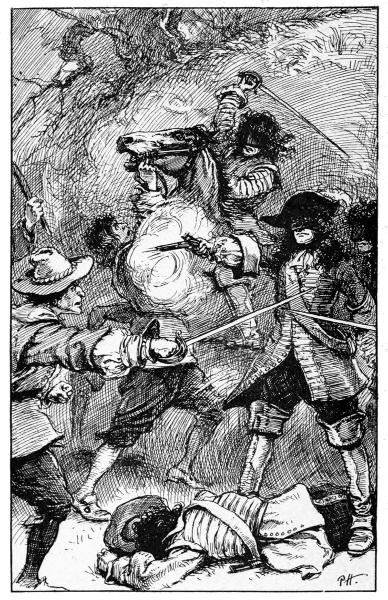
THE FIGHT IN THE HOLLOW ROAD.
At last, overpowered, four of the defeated
highwaymen were conveyed to Newgate. Slader
soon afterwards died of his many wounds, and the
others were found guilty on various counts at
their trial at the Old Bailey on April 10th and
11th, and hanged with remarkable despatch on the
15th; Jackson being gibbeted on the scene of that
last stand, opposite the spot now occupied by
the house called "Wildwoods."
His body long swung and gyrated in the wind,
suspended there from a beam stretched between
two elms: the "Gibbet Elms," as they were long
known. One was blown down in 1850, and the
other survived until so recently as March 1907,
when it, too, was uprooted in a storm. The trunk,
at this time of writing, still lies on the ground.
This, then, is the short story of Jackson's life.
Let us now see of what his "Recantation"
consists. It affords curious reading, but cannot be
more than paraphrased here. It is, however, in
spite of its breadth and freedom of language,
extremely moral in its teaching.
How vain, he moralises, are the thoughts of
those who, while they enjoy youth and strength,
never consider they are mere statues of dust,
kneaded with tears and moved by the hidden
engines of restless passions; clods of earth, which
the shortest fever can burn to ashes, or a complication
of miseries dissolve into nothingness!
He had once thought himself one of Heaven's
favourites, and had persuaded himself that the
machinations of his brain were able to unhinge
the poles. (Any reader conversant with twentieth-century
slang phrases will at this point consider
the youthful seventeenth-century Jackson himself
at that time "up the pole.")
But Heaven, continued Jackson, thought fit
to deliver him into the terrestrial hell of the
condemned cell at Newgate, where, in imagination
surrounded by the howls and hollow groans of
damned souls, conscience started out of her dead
sleep, and he was thrown into the greatest agony
imaginable. At this time a charitable physician
for his sin-sick soul came to visit him, and to that
pious man he laid open the whole course of his
life, much to his amazement and wonder. This
wonder was soon changed to pity and commiseration
that one so young should be thus weeded out
of the world just as he had entered into the
blooming springtime of his age. He then acquainted
him with the benefit of true repentance,
so that the obduracy of his heart was able to hold
out no longer, and, melting into tears, he was
willing to have its flintiness broken by the hammer
of sacred Scripture.
Then, to give the holy man some real testimony
of his unfeigned repentance, he produced an
abstract of his life, which, he tells us, he had
prepared before his apprehension, intending to
have published it and then to have abandoned his
evil courses. But a reformed highwayman was so
very rare a thing, if even not altogether so unheard-of
a curiosity, that we may take leave to doubt
that detail. He probably wrote his life in prison,
and there occasionally peep out such tell-tale
passages of real enjoyment in the telling of his
misdeeds, that the flowery moral passages wear a
strong suspicion of insincerity.
The "holy man" of the foregoing remarks
was apparently none other than the Ordinary of
Newgate, the Reverend Samuel Smith, for the
"Recantation" is followed by a postscript, signed
"S. S.," which says: "Reader, let me assure thee
this is no fiction, but a true relation of Mr.
Jackson's life and conversation. Penned by his
own hand, and delivered unto mine to be made
public for his countrymen's good, in compensation
of the many injuries he hath done them. The
introduction he made in Newgate, after sentence
of condemnation, and desired me to apologise for
it, fearing he had neither wrote large enough for
his true penitence, nor had laid down sufficient
exhortations from the commission of the like
offences; the disorder he was in, lying under the
horror of a speedy and more than common
execution, may plead his excuse: the plainness of
his style may admit of this plea, that he aimed at
(as he confessed to me) nothing but the good of
his countrymen, and that as he had picked their
pockets, he thought it needless to tickle their ears
with the gilded straws of rhetorical expressions.
God, I hope, hath forgiven him his sins, and may
we all amend by his errors, for which he now
hangs in chains at Hamstead, a sad and dreadful
spectacle to all beholders, and hoping you will
pass by the faults of his writing and the press, I
subscribe myself a well-willer to all."
"S. S."
Jackson's own method of telling his story is of
the parabolic moral kind, in which the facts lie
hidden amid a mass of verbiage. He said little of
his parents, except that they were too indulgent
to him, supplying his youthful extravagances with
so much money that he was often puzzled to find
ways to spend it. As a result, these prodigal
parents impoverished themselves, and then died,
and their hopeful son had already so distinguished
himself by his wild and extravagant courses, that
none of his relatives would help, and refused even
to see him. He at once sank from plenty into
poverty and rags, his backside hung in tatters,
and his coat had as many holes as a colander.
Although so miserable an object, no one would
help him. He thought himself unfit for one of
the plantations, and such a scarecrow that not
even a kidnapper would take any notice of him.
At last, walking the streets of London in this
miserable condition, he found a purse lying in the
street. Trembling with excitement at his good
fortune, he hastily slipped it into his pocket,
forgetting that all his pockets were so full of holes,
that they would contain nothing. It fell to the
ground again, but he snatched it up, and hurried
with beating heart into the fields, and there found
the purse contained ten pounds in silver, and fifty
guineas. He cautiously buried all this money but
fifty shillings in the hedgeside, and then went and
bought an ordinary ready-made suit of clothes,
being afraid to at once purchase better, in case
awkward questions might be asked, as to how so
shabby a wretch became possessed of such means.
Thus decently attired, he thought he might
venture to remove from the squalid lodging he
occupied, and, taking rooms at a cautious distance,
he gave out that he was the son of a country
gentleman, come to London on law business. For
a time he lived quietly, but growing discontented
with the dulness of his quiet life, went and
bespoke a fine suit of clothes and all necessary
appurtenances befitting a person of quality, such
as a silver-hilted sword, etc., saying he had received
a considerable sum of money on account
of the affairs that had brought him to town.
Being thus gallantly equipped, he soon made
acquaintances, who were intimately versed in the
ways of town, but more especially in cards and
dice, at which they laboured with greater pains
than a seven-years' student with the classics.
With one of these he established a close friendship;
and this new-found friend, undertaking to
be his tutor in gambling and sharping, he was
soon on the direct way to becoming a rogue,
fully equipped in all the arts and subterfuges of
those who live on their wits. At playhouses,
ordinaries, cockpits, and bowling-greens, he was
soon on the track of dupes whose pockets
were to be dipped into, and he tells us how his
tackling was so good and his hooks so well barbed
that, after he had struck a gudgeon, he was sure
to hold him, though he suffered him to play a
little in the stream.
When at any time they fell into the company
of any young country gentleman, sent up by his
father to learn something of the polished ways
of London, they fastened themselves upon him,
introduced him into the fast life of town, and in
the end plundered him and used his credit to
obtain goods from confiding tradespeople. These
two associates shared their fortunes in this manner
for a year, varying their evil practices by now
and then robbing a coach. They were unlucky
enough to be several times flung into gaol and
Jackson came near to losing his life for robbing
a coach near Barnet; but he was fortunate in
being able to get in touch with the person whom
he had robbed, and to appease him by restoring
the greater part of what he had taken, on condition
that he should bring no evidence against
him. He was accordingly acquitted. So easy
was it, he says, to buy acquittals that it had
become a proverbial saying that no man, unless
he had committed treason or murder, need be
hanged while he had five hundred pounds at
command.
Soon after he was so triumphantly enlarged
from prison his companion died, leaving behind
him little but his wench, whom he bequeathed,
enjoining him to have a special care of her whom
he had so highly prized. It was a pity, continues
Jackson, she was a whore, for he might impartially
declare her beauty to be scarcely
paralleled.
To supply her extravagances was a difficult
matter, and he grew so busy at rooking people
in the coffee-houses that his face became too well
known, and folk fought shy of him. He accordingly
bethought him of a way of noting those
who had won heavily, and then following them
in the dark and robbing them. Although this
was for some time a highly remunerative plan, it
also was worn threadbare, all too soon, and he
was now such a marked man that he was obliged,
like a bat, never to stir abroad until dusk; except
with the greatest caution imaginable. His woman,
seeing what straits he was put to, deserted him.
He then met with three or four old acquaintances,
knights of the road, with whom he adjourned
to a tavern. They asked him how he
had spent his time since his first gaol-delivery,
and when he told them, declared no bold, generous
soul would stoop to such petty pilfering. They
condemned him further, not for keeping his
woman, but for not keeping her more under.
"It is laudable," said one, "to have a Miss, even
though he had a very handsome wife of his
own, and it is agreeable to the custom and honour
of the times, and if we were to throw any
opprobrium upon it, it would reflect upon ourselves."
"Come," said another, "we trifle away time.
Let us fall to business. It is a good while since
we shared a booty: let us no longer lie idle, and
if our brother will accompany us, instead of
picking up here and there crowns and angels—a
thing beneath us—let us resolve to 'Have at
all.' A five hours' adventure may make us
possessors of five hundred pounds."
He told them he was not provided with a horse
and other things necessary, but they promised to
supply him, and soon did so, and he was then as
well-equipped as any.
Four of them then set out for Maidenhead,
reconnoitring for plunder. At Maidenhead they
dined, and then, in the summer afternoon, went on
towards Reading, halting an hour or so at Maidenhead
Thicket, expecting some prize; but to no
purpose. They then planned to distribute themselves
and to ride into Reading singly: two to
lie at one inn, and two at another.
Jackson's other two comrades lay at an inn
where they were well known, and their occupation
winked at by host and servants; who gave them
to understand that there was a gentleman in the
house, who, with his man, would next morning set
out for Marlborough. It was thought, they
added, by the weight of his small portmanteau,
that it must be filled with money.
Jackson and one other found an attorney at
the inn of their choice, who said he was on his
way to London, for the opening of term. He
asked the landlord if he could serve him in any
way in London.
"I am sorry I have not the happiness to have
your company to-morrow," said Jackson; "I
have to go a contrary way, to Bristol."
"You seem a civil gentleman," returned the
attorney, "and I am sorry too. Have a care as you
go by Marlborough Downs: a parcel of whipper-snappers
have been very busy there of late."
Jackson affected to be very much concerned
at this news, and the attorney, noticing his
apparent alarm, told him if he carried any considerable
sum he must conceal it, or he would
certainly lose all.
Jackson then pretended to thank him coldly,
as if suspecting him of being some subtle insinuating
spy; whereupon, the lawyer, to prove
his own good faith, put his hand in his pocket
and drew out a bag containing a hundred and fifty
guineas. "These," said he, "I will so conceal in
the saddle I ride upon that I will defy all the
damned highwaymen in England to find them
out. I have passed them several times in this
manner, with good sums about me, and, for your
further belief, I will show you in what way."
He then exhibited his hiding-place in the
saddle, for which Jackson thanked him more
genuinely than he suspected.
At that moment there came a note from his
confederates at the other inn, to meet them at
a certain place, and so, pretending he had business
in the town, he left, and, meeting them, arranged
that he and his fellow should change places with
the other couple: that he should go forward and
rob the traveller bound for Marlborough, while
the others should turn about and relieve the
attorney journeying to London.
The cunning scheme was neatly performed;
but Jackson and his associate did not come off
quite so well, the Marlborough traveller and his
man making a stout resistance. Jackson was
shot in the arm, and had the gentleman's horse
not then been shot dead, they had very likely
been taken prisoners. As it was, they captured a
hundred and twenty guineas.
The next adventure entailed a great deal of
work, and they were shamefully robbed of all
their spoils, at the end of it, to the tune of over
£180.
Hearing that a ship was to be paid off at
Chatham on such a day, and well aware that the
sailors would then be coming, post-haste, to
London, to spend their money, they went to
Shooter's Hill and hovered about there until
evening, with very poor results. Next day they
picked up a great many stragglers, and robbed
them of their all; but always avoiding groups of
travellers. A parson with very shabby clothes,
and riding a sorry horse, then came on the hill.
He looked so poor that they judged him to be
worth hardly an attorney's retaining-fee; but,
with time hanging heavy on their hands, they
thought to have some sport with him, and stopped
him and began to search his pockets for fun.
But when he roared out, like a town bull, that he
was undone, they suspected he carried more than
they had thought, and searched more thoroughly;
with the result that his pockets yielded fifteen
pounds.
They were good enough to return him twenty
shillings, on his swearing he would not set the
hue-and-cry upon them, or inform any person he
might meet upon the road, and then let him
proceed; but it so chanced that he fell in with
a sailor and advised him, if he had any money
about him, to turn back, for there was a parcel
of rogues up yonder on the hill who had but now
robbed him and would do the like to any one else.
The sailor, however, would not believe the
parson, or thought himself a match for any highwaymen
he was likely to meet, and so continued
on his way. Presently he was bidden "Stand!"
"What do you want?" he asked.
"What do we want?" we in imagination hear
those highwaymen repeating, in tones of contempt:
"what do you think we want, you——,
* * *, you: to ask after your health, or to know
the time o' day? No, we want your money."
"Alas! gentlemen," said the sailor, "it is
true I have some, which I received for my pay
in His Majesty's service. It is a pity to take that
from me which I am carrying home for the maintenance
of my wife and children."
But if he had engaged an angel to plead for
him it would have been useless, for they would
have had his money, anyway; and so, seeing there
was no remedy, he delivered all he had, which
was sixty-five pounds.
"Now, gentlemen," said he, "let me beg one
favour of you, and that is, as I dare not go home
to my wife with empty pockets, and at present
know not what course to steer, pray admit me
into your company. You see I am strong-limbed,
and I have courage enough to qualify me for your
occupation."
They asked if he were in earnest, and he swore
a hundred sailor oaths that he was, and ready to
be put to the proof that instant: declaring
himself to be greatly in love with a trade that
could in six minutes get as much money as he
could in three years.
Jackson was at that time treasurer, and was
given charge of the day's takings; and then,
finding they had done sufficient for the day, they
agreed to separate, and to meet at a given
rendezvous the next day. Jackson was also
detailed to take charge of the new recruit, who
was wretchedly mounted. As they rode along, he
bound the sailor, over and over again, by many
oaths, to stand to his new resolution. At length,
in a solitary lane, while Jackson was innocently
discoursing upon the new life that lay before him,
the sailor pulled his miserable horse suddenly
against the other, and, as suddenly drawing a
pistol and seizing his companion's bridle, clapped
the ugly brass-barrelled weapon against his breast,
and swore as bloodily as if he had been one of
the trade for more than twenty years that he
would send a bullet into his heart if he did not
instantly dismount.
Jackson saw by his companion's frightful
countenance that there was no dallying possible,
so he dismounted and was obliged to give up his
horse in exchange for the sorry nag that was
hardly able to carry him, and, in addition, to hand
over all the day's takings of the fraternity.
"Should I enumerate all the rogueries and
robberies I committed," continues our autobiographer,
"either singly, or with others, relating
in what manner they were done, I should waste
too much time, and miss that design which I
purposed to myself, which is the general good of
my countrymen; wherefore I shall pass them all
by, not so much as mentioning the last robbery I
was guilty of, near Colnbrook, when pursued by
the country, opposed and apprehended by them,
to the loss of our own, and the blood of some of
them, the manner whereof is too generally known
to be again repeated."
That is exceedingly disappointing: for what
was then "generally known" is now almost forgotten,
and only to be recovered with much
trouble.
He then, omitting all reference to the killing
for which he was hanged and gibbeted, proceeds
to enlarge upon the ways, manners, and customs
of the highwaymen, "those devouring caterpillars
of a corrupt and polluted nation," as he styles
them.
"I shall insist upon what is more profitable,"
he declares, "and discover, first, what a highwayman
is; how bound by oath; what order is
prescribed; in what manner they assault; and
how they behave themselves, in and after the
action. In the next place my best endeavour
shall be to dissuade these desperadoes to desist
robbing on the highway, by showing them the
certainty of their apprehension one time or other;
and though they may a long time prosper in that
vile course of life, spending high and faring
deliciously, yet every bit is attended with fear;
neither is their sleep less unquiet, starting ever
and anon by some horrid dream; so that I cannot
say when they go to bed they go to take their
rest, but only to slumber out the tedious minutes
of the gloomy night in horror and affrightment.
I shall insist on other dissuasions, by showing
them the misery of a prison; by putting them in
mind of their wretched and cursed ends, which
they vainly jest at, by presuming on some
examples of grace; and the reward of their
wickedness in the world to come. Lastly, instructions,
not only for the honest traveller that
he may pass in safety, but for the innkeeper to
distinguish highwaymen from guests that are
honest; all these I shall with sincerity run over
particularly."
"Highwaymen for the most part are such that
were never acquainted with an honest trade,
whom either want of money or employment
prompted them to undertake these dangerous
designs; and to make their persons appear more
formidable, and to gain respect, they dub one
another 'colonel,' 'major,' or at least a captain,
who never arrived to a greater height than a
trooper disbanded, or at the utmost a lifeguards-man
cashiered for misdemeanour.
"Having made up a party, ere they proceed to
act their villainies, they make a solemn vow to
each other, that, if by misfortune any one should
be apprehended, he shall not discover his complices:
and that if he be pressed hard to particularise
his companions, he must then devise
names for men that never were, describing their
persons, features, and discovering their habitations,
but so remote one from another, that the danger
of the trial may be over ere sufficient inquiry can
be made.
"And further, to procure mercy from the
bench, there must be a plausible account given,
how you fell into this course of life: fetching a
deep sigh, saying that you were well born, but by
reason of your family falling to decay you were
exposed to great want, and rather than shamefully
beg (for you knew not how to labour), you were
constrained to take this course as a subsistence;
that it is your first fault, which you are heartily
sorry for, and will never attempt the like again.
"Having taken a solemn oath to be true one to
another, their next business is to acquaint themselves,
by means of the tapsters, ostlers, chamberlains,
or others, what booties are stirring, how
contained, and whither bound. But before they
attempt the seizure, if there be any novices in the
company, then they are instructed by the more
experienced, as I was at first, after this manner.
"In the first place, you must have a variety of
periwigs in your lodgings, and the like you must
carry with you, if occasion require the necessity
of changing the colour of the hair: neither must
you be without your false beards of several colours.
For want of them, you may cross your locks
athwart your mouth, which is a good disguise:
patches also contribute much thereto. And lest
your voice should be known another time by him
that is robbed, put into your mouth a pebble, or
any suchlike thing, which will alter your tone
advantageously to your purpose.
"Being thus provided, a watchword must be
framed, wrapped up in some common question, as
'What's o'clock?' or 'Jack, what shall we have
for supper?' As soon as these words are used,
you must instantly fall to work, seizing with your
left hand the traveller's bridle, and with your
right presenting a pistol. This so terrifies that he
delivers instantly, for who will trust a pistol at
his breast loaded with a brace of bullets, and a
mouth discharging at the same time volleys of
oaths, that if he deliver not instantly he is a dead
man? But here you may please yourself whether
you believe him, for a highwayman will be very
cautious of murder, for fear of provoking the law
to an implacability, unless it be when he is beset,
when, rather than run the risk of being seized,
he will endeavour to escape by killing one or
more of his assailants.
"Having o'ermastered them you set upon, do
you carry them into some covert, where you search
so severely that nothing can be hidden from you.
If in this strict enquiry, gold be found privily
quilted in a doublet, or in the waistband of his
breeches, I can hardly forbear smiling when I
think in what manner the rogues will rate the
poor man with 'villain,' or 'cheating rascal,' for
endeavouring to preserve his own, whilst he has
nothing else to say but that he is 'undone,' which
they regard as little as the hangman will them at
the place of execution. Having then changed
your horse for theirs, if better than your own, the
next thing to do is to make them swear neither
to follow you, nor to raise the country with a
hue-and-cry upon you. Thus, leaving the poor
traveller forlorn, you ride to some strange place,
or else where you are known and winked at, and
there you share that which you unlawfully have
got, not without cheating one another.
"Now here, by the way, give me leave to
descant on their prodigality, after a successful
attempt. London, the more is the pity, is their
best sanctuary, and therefore, after any robbery,
they commonly repair thither; having as many
names as lodgings. Their next care is to buy a
variety of splendid apparel, and, having bought
their wenches new gowns, and furnished their
pockets with guineas, they then prosecute all
manner of debaucheries. Their hosts must also
participate in their gains, else all the fat's in the
fire; for the vintners, innkeepers, etc., knowing
very well what they are, and how easily they get
their money, will be sure to enlarge their reckoning
and make it swell prodigiously; neither must
this be complained of, lest they refuse to keep
their own counsel any longer.
"All the time they can spare from robbing
and undoing poor men is spent in wine and
women; so that the sunshine of their prosperity
lasts but a moment, not so long as to warm their
hands by the blazing fire of their prodigality,
before cold death comes and seizeth them. And
how can it be otherwise expected? the pitcher
goes not so often to the well but it comes broken
home at last.
"But before death takes them from this, to
carry them before a higher tribunal, there to
answer for all they have enacted here on earth,
there is a punishment preceding this: it is a prison
wherein are contained so many tortures, woes,
and pains that I do think were enough to punish,
without death, the greatest of offences.
"Having thus endeavoured to fright highwaymen,
by showing them the intolerable torments
of a prison, besides the certainty and shamefulness
of hanging, and hazard of eternal death hereafter,
I shall here take another course to scare them,
if possible, and therefore in the first place I shall
lay down directions how to know them as they
ride on the road, with rules how to shun them,
or, if robbed, how to pursue and apprehend them
when they think themselves most secure.
"In the first place, when at any time you
intend to travel, and cannot avoid carrying a
sum of money with you, let no person know what
charge you have, or when you will set forward.
It is the custom, I confess (but let me assure you,
it is dangerous), for men the day before they
begin their journey, to take leave of their relations
and friends, drinking healths round to the happy
return of the traveller, who suspects not the
least harm in all this; whereas, it hath been known
that a father hath this way been betrayed by his
own son; a brother by a brother; nay, one pretendedly
dear friend by another, by discovering
to highwaymen when and which way he rides;
and so for the plot he goes his share.
"Another way they have. The gang shall
ride in advance, out of sight, leaving one lusty
fellow of their company behind, who shall ride
very slowly, expecting some one or other will
overtake him. If overtaken by three or four, he
will single out the one he thinks hath most
money; and, pretending much friendliness, will
whisper, he likes not those other men, and ask
if he knows them. If not, he adviseth him to
slacken his pace, for certainly they are dangerous
fellows. The timorous and credulous traveller
will thank him for his advice; and not long
afterwards, by parting company with honest men,
he will be brought alone to the place where the
confederates lie in ambuscade. The decoy will
then draw his weapon, bidding the traveller do
the like, and now begins a dangerous fight, as
the traveller imagines. Fearing bloodshed, he
delivers his money, and persuades his champion
to do the like, who, with much ado, at length
condescends thereunto. The gang, having given
him a private indication of the way they intend
to ride, then set spurs to their horses, and are out
of sight in an instant.
"Hereupon, this pretender to honesty will
straight persuade you to assist him in making
a hue-and-cry, in the carrying on of which he
will seemingly be foremost, but to no other end
than to lead you quite another way, till his
brethren be out of all danger. I knew one
notorious rogue, who by his sly and crafty deportment
was looked upon to be a very honest
gentleman, who suffered himself to be robbed
with three more, by his own confederates. The
robbery being committed between sun and sun,
he, with those three honest men, sued the county,
and recovered the money they had lost.
"Whensoever the traveller designs a journey,
let him consider that the Sabbath day is a time
not only unlawful, but more dangerous for robbing
than any other. I need not expatiate on the
illegality of the act, since there is a special
command forbidding the breach of that holy
day of rest, the violation whereof hath been
frequently punished by being robbed; for, to
speak the truth, that day hath been, and still is,
chosen by highwaymen for the best and fittest
time to commit their robberies; first because they
are sensible that few travel then, except those
who ride on some important concern, and who
they suppose carry a considerable sum about
them.
"In the next place, on that day the roads are
most quiet, being undisturbed with great quantities
of people, and therefore they rob with more
ease and greater security. Lastly, they know
the county will not be so forward to pursue them
with a hue-and-cry, and are quite convinced that
a judge will hardly be induced to make the
county pay the reparation of a loss sustained by
him who ought to have stayed at home, to perform
those duties required from him, proper to the
day; and not wander abroad and leave his
Creator's business undone, that he may do his
own. If you must needs travel, you have days
enough in the week to follow your urgent and
important affairs, and with more security, the
roads being then full of good company, if you
will but make choice of a convenient time,
and be cautious whom you entertain into your
society.
"The first caution is this: be shy of those who
are ever prone of pressing into your company.
It is more safe to entertain such as are unwilling
to associate themselves with you. Now, that you
may distinguish an honest man from a thief, take
these informations and directions: first, if you
suspect your company, halt a little, and in your
halting observe whether they still hold on their
course, or slack their pace, or, it may be, alight
and walk with their horses in their hands. If
you observe any of these, you may conclude
them the justly suspected marks of a highwayman."
Travellers were also warned of men dressed
like countrymen, with hay-bands round their legs,
and rough, russet clothes, who might perhaps
even carry a goad instead of a whip, as they
rode on horseback. These were often merely
highwaymen in disguise, and although they might
affect a country brogue and ask silly questions,
they were to be suspected. In fact, it appears
that every one was to be eyed askance; and
it seems likely that, with this advice duly
digested, over-cautious or nervous travellers
occasionally turned upon quite innocent and inoffensive
people and shot them in mere squittering
terror.
"It is now high time," continues Jackson,
"to inform the innkeeper how he shall distinguish
highwaymen from honest travellers. In
the first place, observe their curiosity about their
horses, in dressing and feeding them: next you
will find them asking questions; such as, "Who
owns that horse?" and who the other; what
their masters are; whither travelling; and when
they will set out. These are infallible signs of
a highwayman. Nor must I omit this remark:
let the ostler lift their cloak-bags, and he will
find them empty; for they carry them only for
show, and not to burden their horses.
"Next, let the chamberlain take notice when
he shows them to a room, that they will soon
dismiss him, and after that, let him listen awhile
and he shall hear the jingling of money; and if
he can but get a peep-hole for his eyes, he shall
see them sharing their booty.
"It will be very requisite to enquire severally
each one's particular name, and let your servants
do the like. By this means you will find them
tripping, for they may easily forget a name they
borrowed that very day.
"At supper-time let some one knock furiously
and hastily at the gate; then mark them well,
and you shall see them start, their countenances
change, and nothing but fear and amazement
appearing on each face; by which you may
positively conclude them to be what you did
before but imagine and suspect.
"If in the day-time they come into your inn,
you may guess what they are by their trifling
away their time, and staying somewhat longer
than is necessary for baiting. You shall observe
them sometimes looking out of the window, sometimes
standing at the gate, for no other purpose
but to mark what passengers ride by. If they
see any person of quality ride that way, or the
costume hints at the likelihood of a booty, you
shall have them to horse and mount in all
haste, as if some dear friend or near relation
was just rid by, whom they must endeavour to
overtake.
"At night they will come dropping into an
inn severally, in divided companies, thereby to
falsify the number given in the hue-and-cry; and
will, when met, artfully take no notice of one
another; nay, they will even, to allay suspicion,
enquire of the host what 'country gentleman'
their own companions are; whether he knows
them or not, and if it be convenient to join in
company with them. They will, like strangers,
while they are under observation, compliment
one another; but withdraw, and watch them well,
and you shall find them fall into their usual
familiarity.
"Much more might be written on this subject,
but since it is impossible to discover the whole
art and mystery of the highway trade, let this
suffice; for, according to the proverb, new lords,
new laws; so all new gangs have new orders,
plots and designs, to rob and purloin from the
honest traveller."
Richard Dudley, born in 1635, was, says
Alexander Smith, "a gentleman of old descent
in Northamptonshire." His father, a man of
considerable estate in that shire of squires, spires,
pride, and poverty, was ruined in the war between
King and Parliament, and his son Robert was
glad to accept the help that Charles the Second
gave him, in presenting him with a commission
in a foot regiment that was presently ordered to
Tangier. It was a poor return for the loyalty
in which his father was brought so low.
Captain Dudley soon earned the reputation
of a martinet with his regiment; and perhaps
something over and above that, if the story of
his horrible treatment of a soldier on parade be
true. It seems that one of the men stood a little
in advance of his comrades as they were drawn
up on the parade-ground, and this annoyed our
Captain, who desired a sergeant to knock him
down. The sergeant was not so violent about it
as Dudley wished, and, in a fury he exclaimed,
"When I command you to knock a man down,
knock him down thus." Suiting the action to
the word, he snatched the sergeant's halberd, and,
striking the man on the head with it, cleft his
skull in two; "of which," adds Smith, rather
unnecessarily, "he immediately died."
We are not surprised, after this, to learn that
Dudley's military career was not successful, and
that it shortly came to an end. Returning to
England, his unbridled extravagance left him
no choice but to work or take to the road; and
what gentleman of the merry and inglorious reign
of Charles the Second would hesitate a moment
in such a pass, before choosing the road as the
better and more gentlemanly way? Work!
Perish the thought!

CAPTAIN DUDLEY ON HOUNSLOW HEATH.
So he resorted to Hounslow Heath, where he
robbed the Duke of Monmouth, and was captured
in so doing and was conveyed to the prison then
called the Poultry Compter, from which mansion
of sorrow and tribulation he broke out; and,
resuming the road, met the Earl of Rochester
coming from his seat at Woodstock, accompanied
by his chaplain, two footmen, and a groom. The
association of the riotous Earl of Rochester,
the wittiest and most dissolute nobleman of the
age, with a chaplain is a distinctly humorous
touch. Dudley robbed my lord of a hundred
guineas. What the footman and the groom—to
say nothing of the chaplain—were doing while
he committed the robbery, we do not learn. They
appear, for all we know to the contrary, to have
looked on. But the chaplain, at any rate, improved
the occasion by soundly rating him.
"I don't think I commit any sin in robbing a
person of quality," said Dudley, "because I keep
generally pretty close to the text, 'Feed the hungry,
and send the rich empty away.'" To which
Captain Alexander Smith, Dudley's biographer,
adds, "This was pretty true in the main, for whenever
he had got any considerable booty from great
people, he would very generously extend his
charity to such whom he really knew to be poor."
After this adventure, Dudley had the impudence
to rob Captain Richardson, the Governor
of Newgate prison, whom he met on the road to
Tonbridge. He had already been in the Governor's
clutches on three or four occasions, and so felt
a glow of satisfaction when he robbed him. But
he did not succeed in doing so without considerable
trouble, and the Governor told him pretty plainly
that he would fare ill if ever he came again
within the walls of Newgate, which would not
be long hence, he suspected.
Dudley had his ready answer. "I expect,"
he said, "no favour from the hands of a gaoler,
who comes of the race of those angels that fell
with Lucifer from Heaven, whither you'll never
return again. Of all your bunches of keys, not
one hath wards to open that door, for a gaoler's
soul stands not upon those two pillars that support
Heaven: Justice and Mercy. It rather sits upon
those two footstools of Hell, Wrong and Cruelty
So"—changing his didactic manner for a more
business-like attitude—"make no more words about
your purse, for have it I will, or else your life."
There was no help for it, and "Richardson was
obliged to grant his request, and between Dudley
and taking the waters at Tonbridge, went home as
well purged and cleansed as a man could desire."
Dudley often robbed, it appears, with Swiftnicks,
but their joint adventures are not recorded.
With some other companions, he on one occasion
robbed a clergyman travelling on the Exeter
Road, near Hartley Row, but his pocket was not
well-lined, and Dudley made him preach a sermon
in praise of thieving, swearing to shoot him if
he did not. This he performed with such humour
and eloquence that Dudley assured him Old Nick
would certainly soon make him Archbishop:
"Meanwhile," said he, "here is your money back,
and if you will take up a collection, my fine
fellows here shall contribute to it."
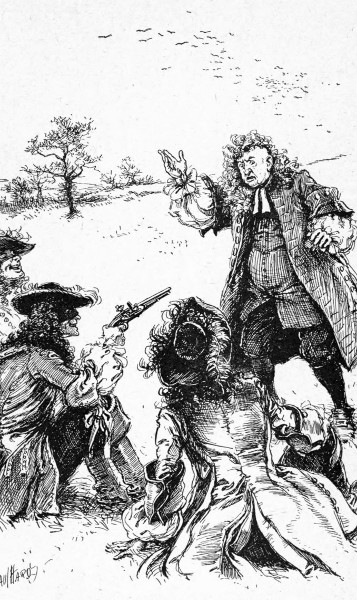
CAPTAIN DUDLEY AND THE CLERGYMAN.
It may, however, be suspected that the congregation
of "fine fellows" were not quite so satisfied
with the sermon as their Captain, or perhaps did
not appreciate their leader's humour; for the
collection when taken up did not amount to more
than four shillings. It was not a profitable day
for the band.
The accounts, given severally by Smith and
Johnson, of Dudley's adventures differ very widely.
According to Johnson, Dudley's earliest effort was
in a different line altogether, and was a burglary
committed at Blackheath, where he broke into
a house and carried off a large quantity of plate.
The story well illustrates the peculiar ideas of
honesty these seventeenth-century scoundrels
pretended to hold. It seems he had sold most of
the plate he had taken at Blackheath to a refiner,
but was shortly afterwards apprehended and
committed to Newgate. While there, he sent for
the refiner who had bought of him, and angrily
reproached him. "It is a hard thing," he said,
"to find an honest man or a fair dealer. You
cursed rogue, there was, among the plate you
bought of me, a cup with a cover. You told me
it was only silver-gilt, and bought it at the same
price with the rest; but it plainly appears, by the
advertisement in the Gazette, that it was a gold
cup and cover. I see you are a rogue, and that
there is no trusting anybody."
After robbing General Monk, under impudent
circumstances, Dudley found his native land dangerous,
and so crossed the Channel, and by easy
stages traversed France and arrived at Rome, where
he appeared in the garb of a pilgrim. He afterwards
travelled to Jerusalem and returned to Rome,
and endeavoured to obtain audience of the Pope.
But His Holiness would not receive him, said
the Cardinal he approached, unless he came with
a relic. Dudley then procured a very singular
one, cut from the dead body of a criminal who
had just been executed, and, returning to the
Vatican, pretended he had come with no less a
relic than the beard of St. Peter, which he said he
had purchased at a great price from the fathers at
the Holy Sepulchre. The Cardinal to whom he
first showed the "relic" admired it, said that, if
true, it was a jewel worth a kingdom, and admitted
Dudley to audience with the Pope, who, kissing
the object, said they had the skull of St. Peter
already, but he had no idea his beard was preserved.
What he could not understand, however,
was why there should be so much hair on one side,
and so little on the other.
"Oh," said our sham pilgrim, "your Holiness
well knows St. Peter was a Jew by birth, and
used to play much on the Jews' Harp, so that by
often rubbing and twanging it with his fingers, he
rubbed off the hair from the right side of his face."
This explanation being deemed satisfactory, the
"beard of St. Peter"—that priceless relic—was purchased
for one hundred ducats: a bargain, and if
the story be true, it is probably in the Vatican still.
Soon after his return, Dudley met a Justice of
the Peace on the road to Horsham, and requested
his purse. But the courageous magistrate made a
very stout resistance, and shot Dudley's horse
under him, being, in return, wounded in the arm.
Obliged at last to surrender, his pockets yielded
twenty-eight guineas, a gold watch, and a silver
tobacco-box. Dudley, then securing his horse,
said, "Since your Worship has grievously broken
the peace, in committing a most horrid and barbarous
murder on my prancer, which with my
assistance was able to get his living in any ground
in England, I must make bold to take your horse,
by way of reprisal. However, I'll not be so uncivil
as to let a man of your character go home on foot.
I'll make one Justice of the Peace carry another."
So, stepping into a field where an ass was grazing,
he brought the animal into the road, and seated
the Justice on his back, tying his legs under.
"I know I offend against the laws of heraldry,"
he said, "in putting metal upon metal, but as
there is no general rule without an exception, I
doubt not but all the heralds will excuse this
solecism committed in their art, which I look
upon to be as great a bite and cheat as astrology."
He then whipped up the animal, and it carried
the magistrate into the streets of Petworth, where
his worship attracted as much attention as though
he had been a royal procession.
At last, Dick Dudley, as he is familiarly styled
by Alexander Smith, attempting to rob the Duke
of Lauderdale, as he was riding over Hounslow
Heath, was captured instead, and committed to
Newgate. No fewer than eighty indictments
were preferred against him, and, being found
guilty on some of these, he was executed at
Tyburn, February 22nd, 1681, aged forty-six.
PRINTED AND BOUND BY
HAZELL, WATSON AND VINEY, LD.,
LONDON AND AYLESBURY.