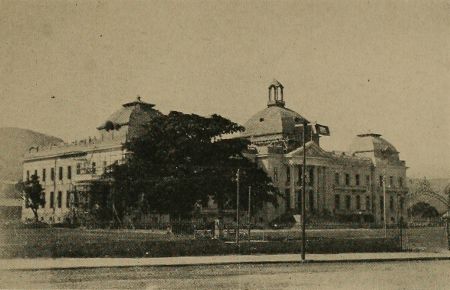
Although, in the days of the
French, Cap Haitien was the capital
of Haiti, to-day Port-au-Prince is the
capital as well as the most important town.
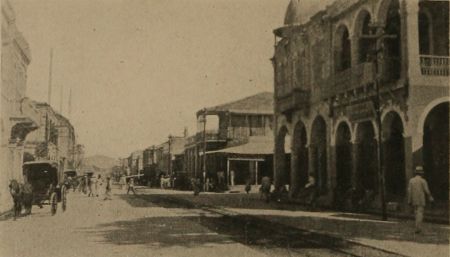
It is also the most modern town, being the
only one, for example, to have the paved
streets which I have referred to. In addition
it has a good telephone and electric lighting
system.
The first morning's tour of the shops in
Port-au-Prince made my former knowledge
of fair prices useless. Goods which it was
necessary to import from the United States,
such as silks and American-made cloths,
seemed exorbitant; perfumes and French
clothes, imported directly from Paris at a low
rate of duty sold at a considerably reduced
rate from the New York price; but naturally
the greatest difference in cost was those of
native goods. Mahogany grows plentifully
throughout the interior of Haiti and hence is
easily obtained. Its price is consequently low
and I purchased a solid mahogany small dinner
table for $6, which is the customary price.
But compare the price for such a piece in New
York! And then of course the native fruits
were either free along the roads or at a nominal
price in the markets. Alligator pears, bought
as a luxury in New York for 75 cents or a dollar
apiece, sell in Port-au-Prince for 5 pears
for 2 cents.
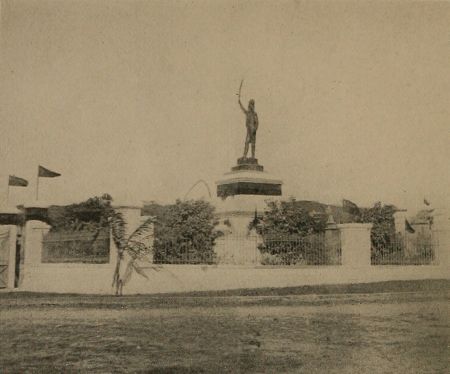
DESSALINES
In the Champs de Mars
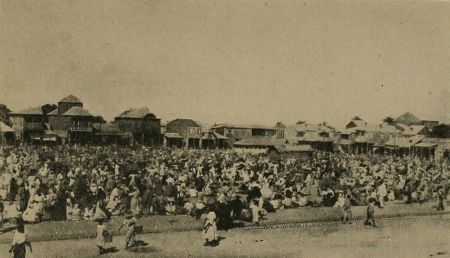
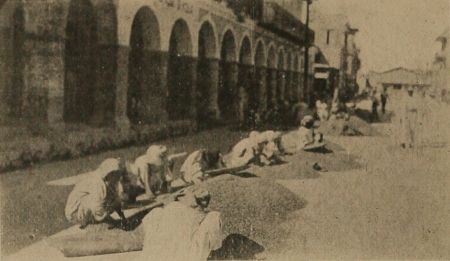
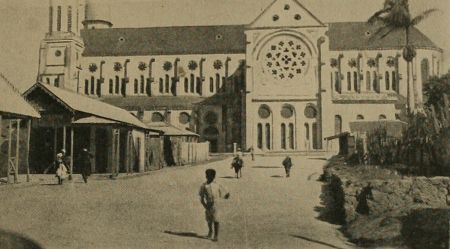
THE "OPEN" MARKET JUST BELOW THE CATHEDRAL
In Port-au-Prince there are two markets,
the "open" and the "closed," of which the
latter is a roofed and walled structure and the
former held without cover on an open plaza,
directly beneath the wall around the Cathedral.
Here, together with alligator pears, are
sold bananas, limes, grapefruit, fish, meats,
dry goods and odds and ends which are found
in a department store. Here also "rapadou"—a
native candy made from brown sugar and
cocoanut—is for sale. This candy is also
peddled along the streets and trays full of it
are carried by the natives on their heads, whilst
they continually call attention to their ware
by calling it out at frequent intervals. Whatever
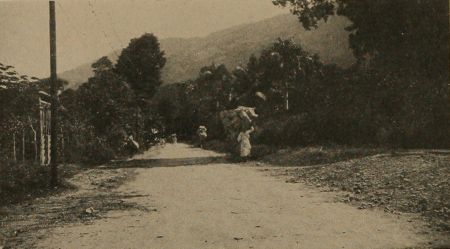
a Haitian has to carry, be it an armchair,
a piece of paper or a trayful of fine glassware,
he carries it upon his head. They have in this
way developed the ability to stand great weight
and certainly one beneficial result is the invariably
erect carriage of a Haitian caused
through the necessity of always maintaining
balance when he carries his goods.
Up to within a few weeks of our arrival the
native shops used to remain open in the evening.
When we arrived, however, they closed
each night at dark. This was because of a
scare which they had recently received when
a small band of revolutionary bandits, known
throughout Haiti as "cacos," attempted to
make a raid upon the town. In the old days
of unstable government the natives had become
accustomed to the existing government falling
every time the cacos arrived, and they were
not easily led to realize last September that it
is no longer possible now that the marines are
guarding the town. And hence for weeks
after the attack the shopkeepers regularly
shut themselves up in their houses at dark
each night.
For sometime after the Americans occupied
Haiti in 1915 there were no organized uprisings,
but within a year various causes have led
the wild tribes of the interior to join together
into various bands and attempt organized
raids.
The fighting of these cacos is extremely
difficult for three principal reasons; first, the
secret sympathy of some reputable and prominent
Haitians and the consequent impossibility
of obtaining any information from them;
second, the nature of the country which permits
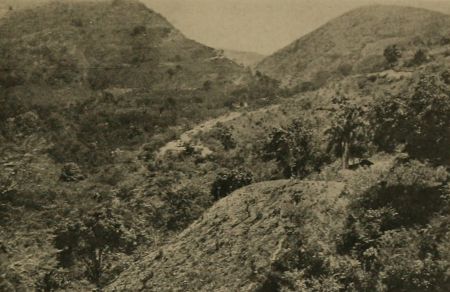
the cacos to retreat into the mountainous
regions which are wild and contain many caves
and trails unknown to the whites; and third,
the manner in which the bandits fight. Like
the Indians they conduct a warfare of night
raids and of sniping, so that only a sort of
guerrilla war can be conducted against them.
And then too, as the cacos are not in uniform,
it is impossible to know who is or who is not
a caco, except when they are actually banded
together or carrying their arms.
But results are being slowly accomplished.
The towns are protected and guarded so that
when an attack is made it can be repulsed and
patrols sent out to round up as many of the
invaders as possible. In the interior districts
where the bandits congregate and make their
rendezvous, expeditions are being continually
sent out and the country honeycombed between
the different hill posts. Near L'Archahai
there is a cave which, dating from the earliest
records of Haitian history, has been credited
as being a bandit retreat. Here the cacos
are still supposed to meet and go into hiding,
but as the cave is a huge opening on the side of
a mountain, and inaccessible unless a rope ladder
be let down from someone already there, it
is quite inaccessible and impossible to attack.
In Haiti there are two different armies, so
to speak. The gendarmerie or national army
of Haiti consists of the enlisted men who are
Haitians and of officers in charge of them who
are American marines loaned to the Haitian
Government, in accordance with the provisions
of the treaty, to organize and train the Haitian
army so as to make it an efficient fighting
police force which is able to support, and preserve
against attack, the existing government.
The gendarmerie have abundantly proven,
in many recent cases when they have been led
by American officers, that they are thoroughly
trustworthy and loyal fighters. Nor is there
any doubt of their courage, for they are as
brave as any body of troops in the world. The
gendarmerie are used for guarding a town
after it has been once freed from active cacoism,
and everywhere in Haiti one sees their
white and red stone headquarters. The gendarmerie
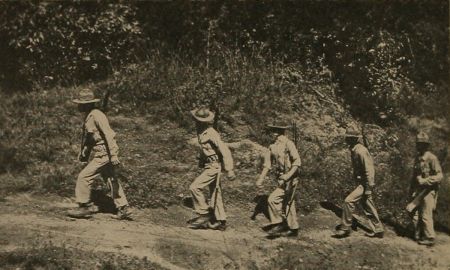
are also used, together with the
marines, to go out into the hills on patrols for
routing the cacos and clearing up the country.
The second army is the occupation force of
American marines stationed in Haiti since the
intervention of 1915 to preserve order and protect
the nationals and property of Americans
and other foreigners in the country. For
those marines who are in search of real adventure
and fighting, even those who were in the
world war might well look with envy upon
the men who are doing patrol duty among the
Haitian hills. Alone or in company with the
gendarmes, they have had encounters so filled
with adventure that I will tell of one which
occurred shortly before our arrival.
Charlemagne Massena Peralte, a man who
came from the Hinche district, and of natural
ability as a leader, was of anti-white sympathies
and early after the American occupation
associated himself with a family named Zamor
in the northeast country around Hinche.
One of the Zamor brothers, Oreste Zamor, was
formerly a president of the republic and another
was the great leader of the north and is
now in the Port-au-Prince prison as a conspirator.
Charlemagne rose in the caco ranks
to the position of chief and was so successful
in his first encounters and attempts as to make
the name of Charlemagne known everywhere
as the supreme caco. Charlemagne was the
clever and guiding hand of all the revolutionary
attacks which occurred about this time,
so it became of the greatest importance to
capture him. Many attempts to do this were
made by the marines and the gendarmes, but
on each occasion his preparation for scouts and
ways of escape made it possible for him to
evade them.
In October, the location of Charlemagne
having been reported, two marines, officers in
the gendarmerie, volunteered to capture Charlemagne.
They made very careful preparations
to set out with twenty gendares and disguised
themselves by blackened skin and native
clothes. Both of the officers spoke Creole well,
but naturally with some foreign accent and so
it was necessary for them to speak as little as
was possible. When near the place where
Charlemagne was reported to be spending the
day, they met the first caco outposts who
stopped and questioned them. Claiming they
had an important message to deliver to Charlemagne,
giving the password and claiming such
extreme fatigue for the two officers that these
officers could barely answer the questions put
to them, the party succeeded in being passed.
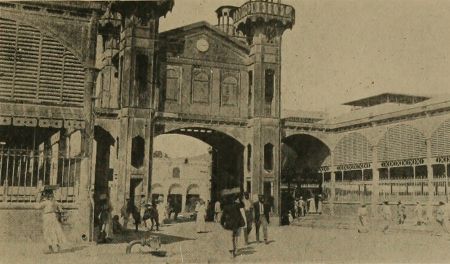
ENTRANCE TO THE "CLOSED" MARKET
A second and a third guard of Charlemagne's
were in the same way fooled and at
last the gendarmes came to a clearing. In
the center of the clearing were gathered together
a group of bandits around a fire, and
at the side of the fire sat a woman. Behind
her there was a sort of rude throne and here
sat the great Charlemagne. Scarcely had the
gendarmes seen the crowd collected here when
they were recognized and a signal given. The
woman lept to the fire and succeeded in brushing
and stamping it out. In the darkness
which followed, she and her followers escaped.
But hardly had the signal of detection been
given when Charlemagne was the aim for the
gendarme rifles, and when a new fire was
lighted he was found to be dead together with
a few of the crowd with him.
The belief in Haiti was a common one that
Charlemagne was a supernatural being who
was immune from rifle bullets or the weapons
of his adversaries. In fact, he himself boasted
that this was true. And so, upon his death,
pictures of him were taken and these the
marines spread broadcast throughout the republic
to prove to all Haitians that the invulnerable
Charlemagne was at last killed.
It is this kind of fighting which the marines
and gendarmes have to continually do in combatting
the caco trouble. After the death of
Charlemagne, Benôit Batraville, who was
formerly a sullen police chief in the mountain
town of Mirebalais, became the caco leader.
He had joined the caco ranks only shortly before
Charlemagne's death, and although not
nearly so clever a brigand as the supreme caco
was perhaps the most intelligent and the best
leader when Charlemagne died. Up to the time
of my departure in February, all attempts to
capture Benôit had failed but I have since
heard of his killing. It was during a skirmish
with the marines in which the latter penetrated
to the leader's rendezvous and although every
other person in the camp escaped, the officer
leading the marines had the good fortune to
kill Benôit.
And so another man of fair intelligence has
been eliminated from the bandit forces. This
has practically destroyed the caco power as
an offensive force, for it is the few men
whom the cacos have among them of brains
which make them at all a dangerous factor.
The bandits are with a few exceptions utterly
ignorant and unable to lead an attack unless
inspired and led by someone who has lived in
the towns and developed some intelligence.
To illustrate the almost unbelievable state of
mentality possessed by the cacos, I will tell
of the prisoners taken in one raid. After
the raid the prisoners were taken back to the
town to be temporarily held there awaiting
trial. When the men reached the house, they
were unable to walk up the stairs, as stairs
were new to them. They had never seen a
house of two stories before and did not know
what to make of the second floor.
I have mentioned a caco attempt to raid
Port-au-Prince just before our arrival, in
which some of the bandits reached town. By
January, over a month after we arrived, the
town had again assumed its normal state, and
fear of another attack was practically eliminated
from the minds of the natives. This was
the condition when, on the morning of January
15th, the telephone rang at 4 a.m. and we
heard that "3,000 cacos are marching into town
by the Hasco Road." The cacos, advancing
into town in column and with flags and conch-horns
blowing, divided, a quarter of a mile
from town, one column going along the water
front and reaching town by way of the slaughter
house, the other two columns turning farther
inland and advancing around Belleair
hill, by the radio station.
When the troops had nearly reached town
our marines opened fire with Brownings and
machine guns, but the natives broke ranks and
fired from around corners, and rushing into the
houses, fired upon the marines from the windows.
Gradually they were driven back, but
en route they had fired some of the native
"cailles," in the poor section of the town and
the light from this lit up the entire surrounding
country.
By daybreak many cacos were lying dead
along the entrance to the city, the attack had
been completely repulsed and the cacos driven
far from town. Over 150 were captured or
killed and but three of the marines wounded,
only one fatally. A large number of caco had
been pressed so hard on their flanks and front
that they were forced to retreat into a closed
valley back of Belleair and were there almost
completely wiped out by a volley of machine
guns.
All during the day patrols searched the
plains and outlying country. In this way they
captured singly or in groups many of the
brigands who were retreating to the hills.
One automobile full of townsmen, arriving
from Gonaïves, told of meeting the caco band,
or at least part of it and only escaping by a
miracle. The dents and holes made by the
bullets while the car ran the gauntlet between
the crowd, could be seen covering the body of
the car when it came into town.
In the afternoon a house-to-house search
was made in the district where the fighting
occurred and, asleep in his own house, the
police found and recognized Solomen Janvier.
Janvier is a man who formerly lived in Port-au-Prince
in the house where he was found.
But he had always been a revolutionist and for
many months previous to the raid had been
out in the hills with the cacos.
Janvier boasted, after he had been taken
to prison, that every attack which had been
made upon Port-Au-Prince during recent
years had been led by him; and that in the
present raid there had been three leaders leading
the different sections of the caco force, but
that the other two were cowards and had fled
before they reached town, he alone leading the
actual attack.
The number of cacos who reached the town
is uncertain. First reports gave the number
as 3,000, which was later reduced to 1,500, as
claimed by the men at Hasco, the sugar plant
of the American-Haitian Sugar Company, by
which the cacos passed on their way into town.
But, although there were many camp followers
who never entered and engaged in the fighting,
it is probable that the number of actual fighters
was about 300. On the morning after the
raid, our cook told me that she had heard in
the market places that morning that there were
2,000,000 cacos who had entered the town and
that 1,000,000 had been killed. This, I think,
was the wildest rumor I heard.
On the second day someone spread the
rumor that 2,000 more cacos were coming into
Port-au-Prince, and as it took some time to
prove the report false, there was great excitement
throughout the town. I went down
beyond the Champ de Mars, and, rushing in
every direction, were the natives, each returning
to his respective home. As soon as they
reached there, the windows and doors were
boarded and within a very short time every
house was closed and not a person was to be
seen upon the streets. And so another day
was lost to business, for all of the shops had
been closed since the raid because of the great
fear that the cacos were going to make a second
attack.
In October, when the raid was made before
our arrival, the cacos escaped with a loss of
only a few men, but in January so many of
their number were killed or captured in town
and out in the plains during their retreat that
it will certainly make them wary of again invading
the town for a long time to come.
Benôit, himself, was in part of the fighting
during the January raid, but unfortunately
was among the bandits who escaped and was
soon back with his followers in the Mirebalais
hills, where he was eventually captured as I
have related.