CHAPTER XVI
No attempt having been made in April, the best time was expected
to be between May 12th and May 19th, when the moon would be
more or less full; but Harry decided not to wait in the event
of conditions otherwise becoming suitable in the interim. The
general idea throughout the whole of the waiting period was to
make a start between 5 p.m. and 7 p.m. (Greenwich time). It
was expected that the ocean would be crossed about nineteen
hours later. If he was able to proceed to Brooklands according
to his intention, Harry hoped to land there about 7 p.m.
(Greenwich time), i.e., 8 p.m. summer time, on the day after
the start.
Grieve decided to take half-hourly sights during the passage,
and, if they arrived in time, smoke-bombs would be used for
ascertaining the drift over the ocean and to indicate to ships the
position of the aeroplane in case of emergency. The smoke-bombs
were not expected to arrive before May 8th In the
event of a mishap occurring at night a white parachute flare
was to be used, not unlike the flares used by the Zeppelins over
London, and visible for miles. The white flare was to be fired
at once if the engine failed or if a forced descent from any
other cause were necessary. But the white flare or a wireless
“S.O.S.” was only to be used in an emergency when the need for
help was very urgent. A red flare was to be used for opening
up communication with a ship.
In an article on “Temperament,” published in The Morning
Post on Friday, April 25th, 1919, Mr. H. Massac Buist wrote:
“Mechanical achievement has been pushed to such a pitch
that endurance on the part of pilot and crew is now demanded
in the highest possible degree, whereas many a brilliant
aerial performance that has attracted world-wide attention
in the past has made the maximum demands on nerve, but
practically none at all on sheer physical endurance, as instance
looping-the-loop and suchlike feats. Even in the war the average
flight did not try the physical endurance of the pilot in any
high degree, the strain being instead on the nerve. Of course,
the requirements of the Service occasionally called for prolonged
efforts, but if all the flights made from the start to the
finish of the campaign are considered it will be found that
the vast majority occupied less than four hours. In the Transatlantic
enterprise, however, we have no competitor whose
calculated speed would enable him to make the aerial journey
in less than 19½ hours under the most favourable conditions.
“The Best Preparation.
“Yet it is not a matter of mere endurance, because the
longest over-water flight so far projected will be attempted in
most cases with machines not designed to alight on the water.
In other words, on setting out, each pilot will know that his
life depends on nothing less than absolute success, and is
almost certainly forfeit if anything goes wrong. That realisation
represents the equivalent of the strain of flying in war
service, while the duration of the effort is the multiplication
of the strain. But the Transatlantic enterprise will differ from
war service in that the pilot himself will order himself to start,
whereas in war, no matter what betide, the individual has always
a realisation that a power outside himself has determined his
destiny and taken responsibility off him by giving him his
orders, therefore the issue is on the knees of the gods.
“Such qualifications afford the additional confidence that
comes of resource. One does not, of course, mean merely that
the pilot helps to rig the machine—all Service pilots are trained
to that extent—or that he touches ignition or throttle lever
while the engine is running through a bench test; instead,
one means that the pilot one would naturally look to
successfully to perform a feat of this sort, other things
being equal, is a man like Harry Hawker and Sidney
Pickles, who year after year before there was a war, through
the war, and after it, takes a hand in the building of the
experimental machines of the firm employing him and puts
them through all their tests, as well as the standard products
of the given firm—work which, regarded in all its phases,
represents taking as big risks per annum in peace time as are
taken by any soldier in war service, since in an experimental
stage none can really foretell what is going to happen when
the first of a new type aircraft is taken into the air.
“The Typical Australian Attitude.
“The most consistently successful types of men at this
work taken over a long spell of years are perhaps those represented
by a group of three young Australians, Hawker, Pickles,
and Busteed, who came over here determined to realise their
dreams of lives of adventure in the air on the distinct understanding
that there was plenty of money in the venture. As
one student of human nature remarked:
“They don’t want the Archbishop of Canterbury to hold a
special service for them before they get off the ground; they
are not going to die until they have done everything mortal
man can to prevent it; if they do die, they will take it to be
absolutely as natural a process as to be born; and, in the
meantime, instead of wasting their time collecting mascots
and inventing fancy names for the machines they fly they
prefer to do as much of the building of them as time and
opportunity allow, and they see to it that the financial side of
the business is so fixed up that they will not be leaving spots
of poverty behind them.
“Undoubtedly that touch of self-reliance which we associate
pre-eminently with the Australian temperament will go a long
way towards securing success in such efforts as the race across
the Atlantic.
“Among our home-bred pilots of the same class, too, we have
many men who have acquired this habit of clear-thinking in
essentials, of eliminating emotionalism from their temperament,
and of always taking off their shirts to get right down to their
job. Occasionally a man who is not of that temperament may
score a notable success; but if an eye be kept on the performance
of flying feats year after year, and the average of each man’s
achievement, it will be found that the man whose name for
consistent achievement year after year advances with the progress
of the science of flight is one with ‘no frills about him.’
“What Makes for Success.
“It is right that the thing should be so. These men follow
on the lines of those masters by whose enterprise flight is alone
possible. The late Wilbur Wright was a plain man, and his
brother Orville remains so to this hour. They found that
they had to know, and to do so much that there was no time
for social life as such, even if they had had the temperament for
it, which they had not.
“You do not find Hawker and Company lounging about in
clubs in the intervals between their big aviation undertakings,
for the sufficient reason that they give themselves no intervals
of leisure, because they are always busy working for money, which
they know how to look after when they get it. A result is
that they never get overawed at the prospect of any one of
their aerial feats. Each is to them merely part of the ordinary
day’s work, imposing no more strain than any other day’s
work. For instance, I recollect some years ago the effect
exercised on one of the best aero engine mechanics in the
country on first coming in contact with Hawker:
“‘I tell you ’ow it is with that there ’Arry ’Awker, sir;
he’s my fancy for anythink every time. It’s like this: we
were standin’ there down the Solent chattin’, and that there
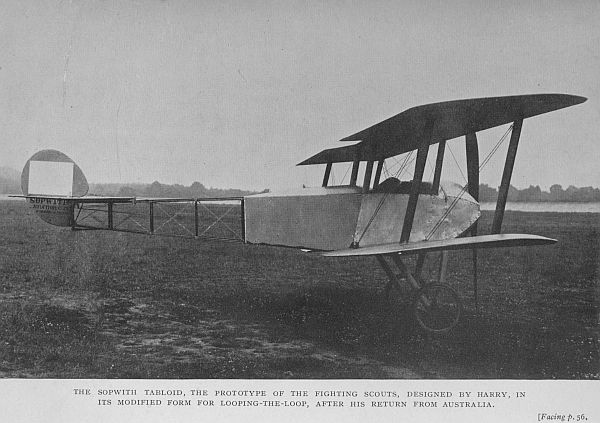
Tommy Sopwith was remarkin’ as nobody’ adn’t looped-the-loop
on a seaplane, and mentioned a matter of 40 quid for
the man as did it first on one of his machines. ’Awker, who was
standin’ by, got ’im to confirm it; then went across to his
machine and started up the engine. There wasn’t what you
might call more than a couple of ’andfuls of water where it was
moored; but he just bumped and splashed it into a flight,
and a couple of minutes after he looped over our ’eads twice.
That’s ’Arry ’Awker; no ‘alf measures, no stintin’; and it
was the first time a seaplane had looped-the-loop. Then he
brought ’er down and walked straight up to Tommy Sopwith,
’olding out ’is ’and for the boodle—that’s ’Arry ’Awker, too.
‘E’s there and the goods ’as to be there. I tell you, sir,‘e’s
my fancy every time.’”
The fact of no attempt having been possible in April probably
accounted for the comparative silence of the Press during the
first days of May. The public was beginning to doubt whether
the flight would be possible in the then immediate future. Nevertheless,
Harry was by no means idle. Among other things,
with Raynham, he was busy looking for a more suitable starting-ground,
but, as most of the country was under the plough, their
efforts met with no success. Meanwhile, the Americans were
rapidly completing arrangements to make their now famous
attempt to cross the ocean, via the Azores, in three flying-boats,
with the aid of several warships as guides and refuges in case
of emergency. These machines made their start at 10 p.m.
(Greenwich time) on May 16th, but Harry was still delayed by
weather on that day. The American route bore distinctly
southward, whereas the British route was slightly northward.
When Lieut.-Com. Read in one of the American seaplanes
had reached the Azores, and so accomplished two-thirds of his
journey across the ocean, Harry and Raynham felt keenly
that the blue riband of aerial navigation was slipping not only
from their hands but also from Great Britain. Nevertheless,
they were wise enough to know that to throw precaution to the
winds was to court disaster and so yield to the rival nation. The
last four days before Harry’s start were very trying for him under
such circumstances. He was continually in touch with the
weather office, only to hear of raging storms on his route and fair
weather on the Azores route. At one time he seriously contemplated
also flying to the Azores, but the difficulty of the petrol
supply ruled this out.
In spite of many preoccupations, Harry and Grieve passed
a few hours of the last few days of their sojourn at St. Johns by
indulging in motor-drives, while Raynham played golf and Morgan
kept watch on the weather bureau.
The Start
On the morning of the 18th there came a change. The
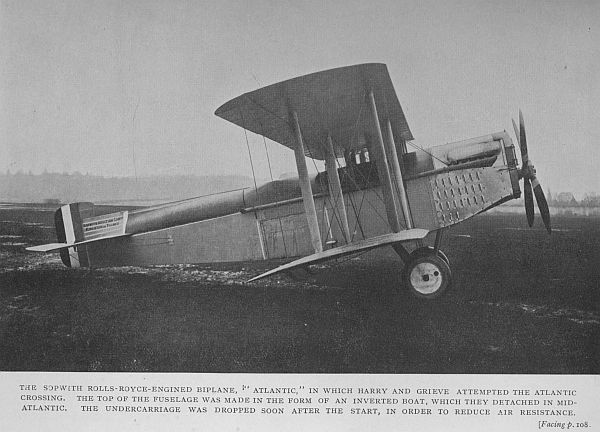
Atlantic was brought out of her hangar, the petrol tanks were
quickly and carefully filled, every drop being passed through a
perfectly clean strainer. Oil and water tanks were filled and the
machine thoroughly looked over and the engine tested. While
Harry busied himself with such operations Grieve was seeing
that all maps, charts, flares, smoke-bombs, and other impedimenta
were in order. The mail bag having been divided between
Harry and Raynham, the letter from the Governor of Newfoundland
to His Majesty, the one from the Prime Minister of Newfoundland
to the Rt. Hon. D. Lloyd George, and another from the
people of Newfoundland to the people of England, fell to Harry’s
lot to be carried. In addition to letters for Lord Northcliffe,
the Daily Mail, the Daily Express, and others, he also had a
letter from the French Consul to be delivered to the French Ambassador
in London. He was also entrusted with the medal of
the American Joan of Arc Statue Society, for delivery to the British
Museum. Some dates, chocolates, and a flask of brandy for use
in emergency were included in the commissariat sufficient for
three days.
Harry arrived at the final decision to start not only for the
reason that the weather was better, although not perfect, but
also because owing to the progress made by the American flying-boats
there was a likelihood of his missing a chance of getting a
British machine over first. The moon was well on the wane, and
any further delay would probably have meant another matter
of weeks. One American machine was already known to have
reached the Azores, and reports were current to the effect that
two others had as well. The night before starting Harry and
Raynham both agreed to set out if the weather looked at all
promising, and on the morrow they received fewer weather reports
than on any previous occasion.
At 3.5 p.m. Harry and Grieve were getting into their flying
clothes. Ten minutes later Harry waved his arm and the chocks
were pulled away. As he sped down the field he heard the rising
cheers of the spectators, which were soon drowned by the engine’s
roar.
Before leaving, Harry was feeling particularly confident. “I
have a perfect machine for the trip,” he said, “and the engine
is the best in the world. I am confident that we shall get across.
The great problem is to find Ireland, but I have every confidence
in Grieve.” Grieve’s parting message to friends assembled about
the machine was, “See you in London.”
Speaking of landing without the undercarriage, Harry said,
“I expect to make a perfectly good landing, and have no fear of
badly crashing the machine.”
It will be remembered that Harry had changed his propeller.
He believed that the four-bladed type put an undue strain on
the engine. Furthermore, without the landing chassis the
machine would land on running skids integral with the base of
the fuselage. Assuming he could land with the two blades horizontal
it was conceivable he could land and do no damage at all,
whereas with four blades the propeller would be bound to fracture
and possibly lead to other damage.
Harry considered the question of weight to be of the utmost
importance. Before starting he lifted Grieve’s bag and enquired
whether he could not dispense with his pyjamas, as he would
have a long sleep at the end of his journey.
Harry and Grieve boarded the machine without feeling in the
least bit “nervy.” After getting into his seat, Harry asked, “How
about old Tinsydes? Tell Raynham I’ll greet him at Brooklands.”
At 6.48 p.m. summertime (5.51 Greenwich or 3.15 St. Johns)
on Sunday, May 18th, 1919, Harry and Grieve set out to cross the
Atlantic from St. Johns to Ireland, and, if possible, to Brooklands,
in a single non-stop flight. The weather conditions
had been reported to be fairly good all the way across the ocean,
and the days had been lovely at St. Johns for over a week.
Visiting the Meteorological Office at noon, Harry remarked,
“Hang the weather! I go this afternoon, though it leads me to
the Pacific.” Three hours later they were completing the final
preparations, after having lunched at Glendinning’s Farm
with some local friends. At 3.15 p.m., having warmed up
the engine, Harry opened up and sped down the starting slope
at Mount Pearl for the last time. He covered almost the whole
length of the ground before rising, and only just cleared the
fence at the lower end. It was only by exercising more skill
than is usually required in starting that he was able to keep the
machine straight while going over the not too even ground. As
it was, he took off in a direct line.
Everything at the start went well, as Harry intended it should.
Getting off the ground was necessarily difficult, as owing to the
direction of the wind and the dimensions of the ground it was
essential to steer a diagonal course over the aerodrome.
During the run of 300 yards the machine lurched hazardously,
bumping over the field until it struck a hummock and lifted. The
wings took the air at a low swinging start, but did not swerve a
hair’s breadth from the chosen course.
Three minutes later Harry was soaring above the western
outskirts of St. Johns, climbing steadily the while. With the sun
shining on her wings, the aeroplane Atlantic was a glorious sight
for those who had the good fortune to see her from below. Steering
a steady course, ascending E.N.E., Harry passed over Pleasantville
Lake and Raynham’s aerodrome at Quidi Vidi at 2,000 feet,
six miles from the start. Looking down, he could see Raynham
and his machine surrounded by a big crowd of townsfolk.
Harry remarked, “Look at old Tinsydes with a crowd round
him!” To which Grieve, who was too preoccupied to look, replied,
“We’ve got the bulge on him.”
They continued on over Bolands Hill, a rocky promontory
600 feet high separating St. Johns from the open Atlantic, where
Harry could plainly discern a dozen white mountains—icebergs—having
no terrors for this ship of the air. At 1,500 feet above
Bolands Hill, having decided that all was well, he slipped the
undercarriage. So lessened in load by four hundredweight, and
with diminished air resistance, the Atlantic began to climb
with appreciably greater speed. Five minutes later she was
about 4,000 feet up, flying eastward, steady as a rock, and
just passing out of sight of those who were watching with powerful
glasses. As the undercarriage was being projected earthwards
by gravity, Harry thought of the stimulating effect it
would have on Raynham.
As the machine passed out of sight of land at 3.35 p.m., about
ten minutes from the start, the signalman at the marine lookout
on the hills above St. Johns reported that it was flying in a
north-easterly direction.
When the start was made at Mount Pearl the weather was
perfect, at any rate locally, although a fog-bank at sea was visible.
There was a light north-westerly wind and a cloudless sky locally.
The conditions were described by Harry as “not yet favourable,
but possible.”
The machine climbed very well, and after about ten minutes,
when it passed out of sight of land, Harry encountered the thick
fog of the Newfoundland Banks. Fortunately they had no
difficulty in climbing above this, although naturally they lost
sight of the sea, a circumstance which was, if anything, a little
disconcerting. Above them the sky was clear. Grieve just
managed to get one drift reading before they passed out of sight
of the breaking waves.
For the first four hours after leaving St. Johns the clouds
and fog above which they passed were level-topped like a sea and
gave a perfect horizon for the celestial observations on which
Grieve’s navigation depended.
The following account of the process of navigating the machine
was given to The Daily Mail before the start by Grieve:
“Navigation of aircraft across the Atlantic must necessarily
be of the rough and ready type, but as it is of vital necessity
to ensure success every means must be taken of finding one’s
position and making most use of the air currents met with.
“Of course the machine might get across by steering a
compass course, allowing for the various winds, supplied from
the limited knowledge of the meteorologists. But few reports
of the surface winds are available, leaving large spaces on the
chart of the weather in which conditions can only be guessed,
while the upper air currents are absolutely unknown.
“Should the navigator allow for a beam wind of 30 miles
an hour when the opposite exists he will be 60 miles out of his
reckoning at the end of one hour, and soon altogether out of
the weather system he is expecting on the direct route.
“The only method of checking positions and finding the
course and speed made good over the sea is by astronomical
observations and obtaining the positions by wireless from ships
en route. In the latter case the ships keep regular narrow lanes
and may not be met with, as it would be virtually impossible
to keep in their track, and unless one should pass over them
and be seen by them their positions would be valueless.
“My intention is to rely chiefly on astronomical positions
which I shall obtain by sextant and work out by a diagram
invented by my instructor, Commander Baker. The altitude
of the sun, taken about every hour, will give me a line of position
at the time of the observation. When the sun is on the prime
vertical the line of position will be the longitude; when on the
meridian the latitude. At other times two observations at a good
interval, with the run in that time, will give me a position. To
obtain this run the ‘drift’ must be known, and I hope to
get this by dropping smoke-bombs by day and light-bombs by
night and observing the true path of the machine past them
through the ‘drift’ indicator.
“For night work I have a diagram to facilitate working the
sights of six stars, each of which, in combination with the Pole
Star, or each with the other, in certain conditions, will give me
a good position. The chief difficulty in getting astronomical
positions will be to see the necessary horizon. Should it be
visible it will be necessary to know the dip of it, which is
approximately the square root of the height of the machine
obtained by the altimeter, an instrument in the cockpit
indicating the height in feet above the sea-level.
“If I am above the clouds I must judge the height above
them and use them for my horizon, which will give useful,
if only approximate, results. As a matter of fact, the whole
navigation must be considered as an approximation, but as
Ireland is large and there are no dangers in the air to keep clear
of, I do not anticipate any serious difficulty in making a landfall,
given good conditions.”
As regards the weather during the flight, it was not at all
as they expected. They anticipated a north-easterly wind for a
short way out, backing to the north-west, with a small depression,
on the south side of which they expected to pass and thereby
get into favourable winds, first westerly and then south-westerly,
as they approached Ireland. In actual fact they encountered
northerly winds.
At about 7 o’clock Greenwich time, about an hour after the
start, the sea was visible through a hole in the fog for just a few
seconds. They were then at 4,000 feet and climbing. Grieve,
by observing the breaking waves through the drift indicator, was
able to calculate the drift of the machine as 10 degrees to the
right of their course, precisely the same as when he made his previous
calculations just before they passed above the fog.
Until 10.15 p.m. Greenwich time they steered a true east course,
not magnetic east. Meanwhile Grieve took sights every half hour,
and at 10.15 he estimated that they were 400 miles from St.
Johns and had maintained an average speed of 91 miles per
hour. They reckoned to be then in the track of the steamships,
to keep to which the course was altered to North 73 East true.
The visibility became very bad. In front and to the right
and left, above and below, were heavy cloud-banks which formed
dark, ominous gorges, or chasms, through which they flew, feeling
very, very small and insignificant in comparison with such giants
of Nature. That the prospects were not bright was soon proved
when they drove into a heavy storm with rainsqualls. A strong
northerly gale drove them steadily out of their course and the
dense masses of cloud impeded accurate navigation.
It was a lucky stroke of fortune that the engine and all other
vital components of the machine survived this bad weather during
this early stage as they advanced into night skies.
After flying for five and a half hours, Harry noticed that the
temperature of the cooling water in the radiator began to rise.
The effect of this, while not appreciable at the moment, was likely
to be complex unless the cause, some defect in the circulation,
could be remedied. It was, of course, impossible for either Harry
or Grieve actually to inspect the likely source of the trouble, and
any effort to eliminate it had to be made, if at all possible, by
manœuvring the machine.
It was about 11 p.m. Greenwich time (i.e., midnight, summer
time) when the defect became apparent. Grieve was busy
taking sights while Harry was piloting and watching. The clouds
were now exceptionally thick, and Harry recalled that he had
only once seen the sea since he was ten minutes’ distant from
St. Johns. And he had now been flying for just on six hours.
The moon had not yet risen and it was well-nigh impossible
to discern anything. Flying at 10,000 feet, Harry could just make
out innumerable clouds, many of them terrible, ominous-looking
peaks extending upwards to about 15,000 feet. Having to go
round the clouds, it was difficult to steer a good course, and he
could not really afford to waste time and petrol in making any
deviations from a truly straight course. Furthermore, he and
Grieve, side-by-side, were feeling not too comfortable bodily.
The cane ring forming the neck of Harry’s suit, which kept his neck
free, was jumping about. Grieve frequently had to replace it,
and his fingers became frost-bitten, as it could not be done with
gloves on. Otherwise they did not suffer from cold, although it
was freezing hard. As they forged ahead the temperature of the
water in the radiator rose from 168 degrees F. to 176 degrees F.
in the space of a few minutes. At the latter temperature it
stayed practically constant for a couple of hours or more.
It was at 1.30 a.m. that they realised the great extent of their
drift owing to the strong north wind. Taking sights regularly
had become impossible owing to the clouds having broken up and
ceased to provide a level horizon. Grieve managed to get a Pole
Star down to a flat piece of cloud, and discovered with no little
surprise that they were about 150 miles south of their intended
course. Harry therefore turned more northward to counteract
this drift. Nevertheless, half an hour later they were still drifting
southward and not making their course, and so, realising that
the strength of the gale must be terrific, they had to force the
machine still more northward up to latitude 50 degrees and into
the track of the ships.
Harry was somewhat concerned when Grieve told him that
their drift was equivalent to a side wind of 20 miles per hour,
but this did not deter him from sticking to the job. The effect
of a strong side wind would of course mean having to travel
“crabwise” in order to keep to the course, a proceeding which
must lessen their forward speed.
Both pilot and navigator came to the decision that there must
be a cause for this abnormally high temperature in the radiator,
which persisted, and, if it continued, was likely to jeopardise their
chances of success, owing to all the water being ultimately boiled
away. Harry, having concluded that some obstruction had got
into the water-filter between the radiator and the water-pumps,
knew that the only possible means of removing it was by switching
off the engine and diving down steeply in the hope that this would
clear the refuse in the filter. This he actually did, and the result
was for the time being successful.
But after another hour, by which time they were about 800
miles out from St. Johns, the trouble recurred. The weather was
still no better and the clouds very high. Repeatedly Harry
switched off and dived, but the obstruction would not clear itself
now. Every such dive entailed losing several hundred feet in
height, and it is not surprising, therefore, that they gave up the
diving process. Each time, after climbing, the water began to boil;
and so after getting to 12,000 feet they agreed to maintain that
altitude for the latter half of the journey. These episodes of
the choking radiator had not yet given them to doubt their being
successful in making the crossing. They had got above most of
the clouds now, and, with the moon coming well up, they
could keep a good course. The fact that by closing the throttle
a little they were able to nurse the engine and keep the water
from boiling, although done at the expense of a little speed, ensured
for them every confidence that all would be well. Thus, with
the engine throttled, they cruised along at a constant height of
12,000 feet for about four hours more until they came up against
more of those very, very high black clouds significant of unknown,
unexplored wastes of the Atlantic vault. They had encountered
a depression which had travelled north from the Azores.
So thick were these new clouds that it was almost impossible
to get between them. They extended upwards to an altitude of
15,000 feet, 3,000 feet higher than the machine, and the only
thing to be done was to get above them.
Once, twice, thrice did Harry try to get above those clouds;
and as many times steam belched forth ominously from the radiator
and was turned to ice. The radiator trouble having thus prevented
a very necessary and desirable manœuvre that would otherwise
have been possible, Harry could only go down into the
abyss and find the bottom of the enveloping clouds. Incidentally,
the glide gave the water system an opportunity to cool
down.
Having glided down to about 6,000 feet, they entered an even
darker region than that from which they had just descended,
due, of course, to the presence of more clouds above them cutting
off the light.
Climbing being out of the question, down they went to 1,000
feet only above the water before they could see to fly. While they
dived through the clouds their engine was stopped, and when
Harry opened up the throttle it refused to restart. Only when
they were within a few feet of the water did it pick up by a lucky
chance after Harry had given up hope of its recovery. In fact
Harry had hit Grieve on the head to warn him to desist from
pumping-up, which might result in his suffering a broken arm
when they struck the water. At that moment the engine started.
It was a very narrow escape. There they were greeted by
those delightful signs of the sun just getting up, one of the real
joys of Nature which has delighted the eyes of most flying-men.
Again they set their course, but that water would not be kept from
boiling. It was then that they agreed to “play for safety,” as
Harry himself expressed it.
At 5 a.m. two stars enabled Grieve to determine their position
as being directly on their course and about 950 miles from St.
Johns, representing an average speed of about 85 miles per hour.
No more sights were possible, owing to the clouds and the approach
of daylight. When they came down low to look for ships about
6 a.m. their position was estimated by Grieve as 50 degrees north,
29 degrees 30 minutes west; and they pursued a more northerly
course to get well on to the steamship route.
The hour of dawn was the one hour in twenty-four in which
flying always seemed to hold the greatest charm for Harry, as
indeed I believe it always has done for most aviators; and on
this occasion, after having flown through a black night above one
desolate waste whose secrets may never be unfolded and ahead
into another which had never before been explored by man, as
one can well appreciate, Harry was overjoyed on beholding the
first signs of the dawn of May 19th, 1919. That he and Grieve
almost immediately began to have an eye for the refuge of a ship
only goes to prove the serious nature of the radiator trouble. But
for those high clouds which, coupled with the doubtful cooling
system, had forced them to yield most of their advantageous
height, they might have been able to continue on further than
they did at a moderate cruising speed with the engine throttled.
But although they covered almost two-thirds of the journey, the
chance of their being able to complete it under any circumstances
had become practically negligible owing to the loss of water due
to several hours of overheating.
Mentally both Harry and Grieve were comfortable, but an
attack of seasickness upset Harry a bit. While flying a couple
of miles above the dark ocean they did not attempt to probe in
their minds the secrets of regions four, five, perhaps six
miles below them. Even had they done so, such thoughts could
scarcely have had a demoralising effect on souls like theirs. The
fallibility of a machine, against which no man can have absolute
insurance, was all that robbed them of the joy of completing
their intention. Theirs was a successful failure, and beyond
perhaps additional monetary reward (which to Harry was never
an unimportant consideration), had they had the good fortune to
make the direct flight, I do not believe they would have commanded
one iota more respect than they did when they returned to the
world at large, as from the dead.
They decided to fly diagonally south-east and then south-west
across their course to see if they could find a ship, knowing that
they would be unable to go on indefinitely boiling away the water.
For two and a half hours they carried out these tactics, in sight
of the very rough ocean and with their machine pitched and rolled
about by a tempestuous north-east wind described by Harry as
“half a gale.” There were heavy rainsqualls, between which
were clear spaces in which Harry endeavoured to keep. But
these spaces became smaller and finally visibility had almost gone.
At last Harry’s eyes were gladdened by the sight of a ship close to
them on the left. Both the ship and the aeroplane were more or
less in the fog, with low clouds above, and Harry and Grieve were
almost over the ship before they saw her. At a height of 400 feet
they flew alongside, firing three Vérey lights as signals of distress.
While flying so low down between the rough sea and low clouds
the Atlantic was bumped about very badly. As Grieve
said, “It was like being in a small motor-boat in a heavy sea.”
It was at about 6 o’clock on the Monday morning that the
second mate and the helmsman of the Mary sighted the aeroplane.
The sea was rough and a stiff breeze was blowing, and the conditions
for launching a boat were getting worse instead of better.
So much so, in fact, that Captain Duhn did not think he could have
saved them an hour later.
Harry was very cheered when he first saw the Mary, for he had
been looking about for a ship for over two hours and had been
violently seasick the while. Grieve also was thankful and relieved
when he saw the ship.
The machine floated well. The engines held the air, as well
as the spaces in the petrol tanks and the wings.
They flew to and fro above the ship several times until they
saw men on deck, after which they went ahead about two miles
and made a very good “landing,” although a heavy sea was running,
with waves about 12 feet high which swept over the wings
intermittently. Apart from waves breaking over it, the machine
floated well on an even keel and was generally well out of the
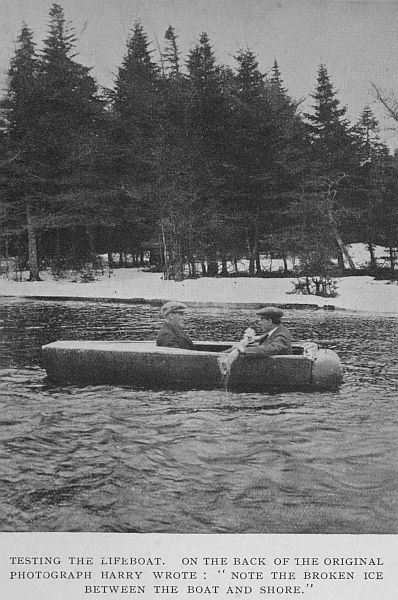
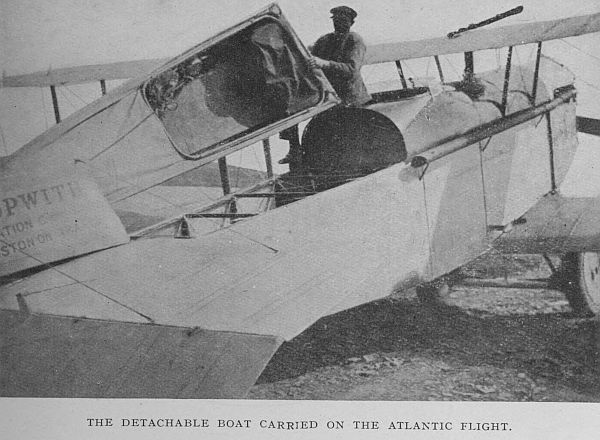
water. As they saw the steamer approaching they released their
lifeboat in case the aeroplane should break up and sink, as it
showed signs of doing. Their life-saving suits kept them more or
less dry while the crew of the Mary were putting out their boat,
which operation took fully an hour and a half. The vessel was
only about two hundred yards from the aeroplane.
After they touched the water, Harry and Grieve found themselves
standing in the cockpit, up to their knees in water.
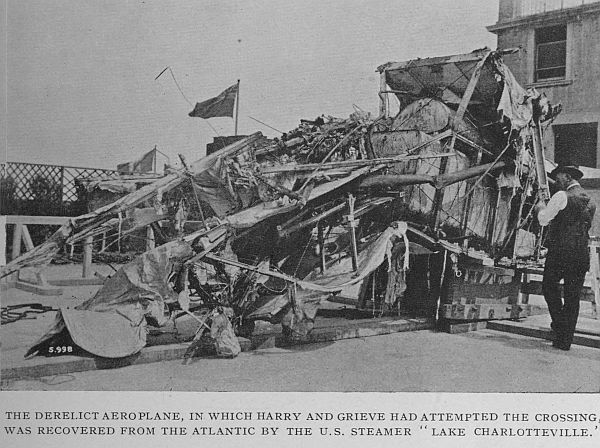
Waves were “sloshing” under the upper planes of the machine,
the nose of which was heading into the wind. Sometimes waves
dashed right over the top planes. Harry was indeed amused by
the sight of the first big wave striking the under-surface of the
top plane, which until then had been dry and shining. It lifted
them right out of the water, and the trailing edge of the top
plane broke away completely. The sun was hazy, and low driving
clouds were prevalent. Having launched their own little boat
in case they should need it in the event of the Atlantic going under,
they spent the interim until their rescue in discussing as to the
possibility of the Mary having appliances whereby they could salve
the aeroplane.
After much difficulty the boat succeeded in reaching them, and
they were taken aboard and the boat was drawn to the Mary by
a line. It was impossible for them to salve anything from the
aeroplane, and they arrived on board the Mary, which rolled
heavily, without boots or caps, and Grieve without a coat. They
were exceedingly sorry to have to leave valuable instruments and
mail on board the Atlantic.
As the ship’s boat came up to them it banged heavily into
the aeroplane and they hopped aboard at once. The Mary
slung out a rope with which they were hauled to her. Grieve,
being a naval man, was spokesman when they first got on board.
He went on the bridge and asked Captain Duhn if he could salve
the machine. Captain Duhn regretted he could not, and remarked
on their narrow escape. Grieve’s log was washed from his pocket
while they were in the water, with the exception of one page of
rough notes. The Mary was on a course from the Gulf of Mexico
to Pentland Firth, and was crossing the main steamship route,
which is only a few miles broad.
The total distance over which they had flown without a stop
was approximately 1,050 miles at an average speed of about 80
miles per hour, approximately the distance which Harry covered
in stages at a much lower speed in the Round-Britain Seaplane
Circuit in 1913.
Altogether, before being picked up, they had been 14½ hours
out from Newfoundland, it being 8.30 a.m. on Monday, Greenwich
time (9.30 summer time), when they boarded the Mary. There
they met Captain Duhn, whose English was good. He told
them he had feared they would sink before his boat could pick
them up. As they went on the bridge with him, he said, “Another
hour and you would have gone down.” He thought Harry and
Grieve were Americans, and seemed very nonchalant. As Harry
said, “We were struck by the casual manner in which he took the
whole business, as if it were an everyday affair to take airmen
out of the Atlantic.” Naturally the first enquiries, Harry and Grieve
made were as to their bearings and the likelihood of their meeting
a ship that day or the next and being in the main route of
shipping. The Mary carried no wireless and they were anxious
to let friends know of their safety. When they went on board,
Captain Duhn considered there were good prospects of seeing a
ship with wireless at any moment. But as the day wore on the
storm increased in violence and they had to heave to, only
making about a knot in a northerly direction. This course took
them away from the shipping route and lessened their chances
of being able to communicate.
Neither Harry nor Grieve were the slightest bit excited either
at the start or when rescued. As Harry put it: “When we
started we felt it was a ‘cert’—100 to 1 on.” And Grieve,
“We had been waiting so long, we felt callous about the whole
thing.” They were pretty well “done up” when they got on
board, and feeling seasick, in preference to taking food they had
a good sleep. Grieve woke up first and went on the bridge.
Grieve’s seat was not absolutely side-by-side with Harry’s,
but was just a little behind, Harry’s left shoulder being in front
of his navigator. Grieve was thereby able to move about to
the extent of kneeling down to look at the drift indicator, to
stand up to take observations, or to move forward a little for
working the wireless. This probably accounted to some extent
for Harry being in need of sleep, since he had not had such freedom
to move about.
Captain Duhn thought they were Americans—in fact Harry
jokingly remarked that he rather thought Captain Duhn was a
little disappointed that they were not. Harry told the Captain
he would like the opportunity of making another attempt, and he
pointed out the advantage the Americans had over him in the
shorter oversea distances and the assistance of the American
warships, although he personally would not have appreciated such
assistance, which detracted from the value of the performance.
When they had rested and made themselves “at home,” Harry
and Grieve passed away much of their time on board reading
English books which Captain Duhn had.
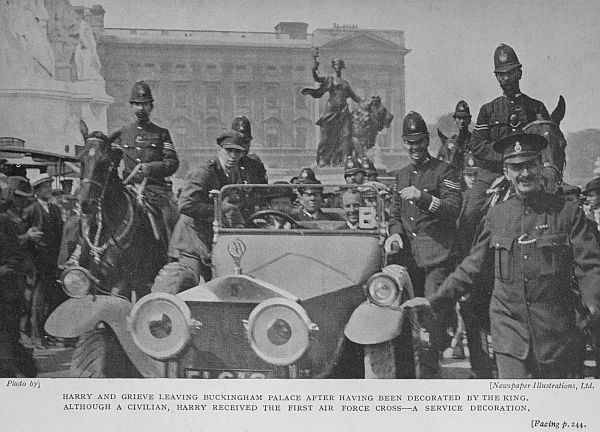
Photo by]
[Newspaper Illustrations, Ltd.
HARRY AND GRIEVE LEAVING BUCKINGHAM PALACE AFTER HAVING BEEN DECORATED BY THE KING.
ALTHOUGH A CIVILIAN, HARRY RECEIVED THE FIRST AIR FORCE CROSS—A SERVICE DECORATION.
[Facing p. 244.
On Sunday morning, May 25th, almost one week after starting,
they sighted St. Kilda and later on the Butt of Lewis, when communication
with the mainland became possible. It was a
beautiful morning, with the sea as smooth as ever off this exposed
coast. Shortly after 10 o’clock, heading for the Butt of Lewis,
Captain Duhn, after running up signal flags reading “Mary,” began
sounding the syren. With the weather so fine as it was, this
could not but attract the attention of the coastguards. As the
vessel drew nearer the shore, Captain Duhn, acting on Harry’s
instructions, ran up the signal, “Communicate by Wire,” which
had the desired effect of intimating to the coastguards, Chief
officer William Ingham and Leading Seaman George Harding,
that an important message would follow which they must transmit
to headquarters by telegraph. The next signal run up was the
international signal for “Saved Hands,” and this was then
replaced by the symbol indicating that the following signals
would be spelt. Up went the flags “S.O.P.,” followed by “A.E.R.”
and after another interval by “O.P.L.,” and finally “A.N.E.”
It was when they received the last syllable that the coast-guardsmen
were thrilled with the knowledge that they had good news
of men whom the world had given up as lost. Having delivered
this message, Captain Duhn put out to sea, again, and was just
going beyond signalling range when he saw on shore the flags
asking “Is it.” Returning towards the shore, he read,
“H-A-W-K-E-R.” Up went his reply, “Yes.” The form of
signal was made out by Grieve, who was conversant with the
code.
Off Loch Erribel the Mary was met by the British destroyer
Woolston, sent out from Scapa Flow by Admiral Fremantle to
take them aboard. Harry and Grieve therefore bade farewell to
Captain Duhn and thanked him for the great kindness they had
received at his hands. Captain Duhn described Harry and
Grieve as a couple of unusually amiable and pleasant fellows in
whose company it was a pleasure to be.
Harry and Grieve did not converse a great deal during the
flight, although the noise from the engine was comparatively
quiet, most of it being carried away behind them through a long
exhaust-pipe. Their conversation was mostly carried on by signs.
Grieve would hold up the vacuum flask when he wanted to know
if Harry required a drink. They had an inter-communicating
telephone, which they rarely used. As Grieve put it, they were
too busy to talk much.
Sometimes they communicated by writing. One of Grieve’s
messages read, “We didn’t have much to spare taking-off,”
referring, of course, to their only just clearing the boundary of
the starting-ground at Mount Pearl. He wrote all the compass
bearings during the flight and held them up for Harry to read.
Grieve used the clouds for his horizon simply because they saw
more clouds than sea. In fact, with one exception it was nothing
but clouds until they were forced down almost to the water during
the last two or three hours. But the weather did not hinder them,
and Harry was convinced that but for the radiator trouble he
would have won through.
Speaking after the flight of their means of communication
with ships, Grieve said that the first wireless fitted was tried
during their test flight at St. Johns, when the exciter of the
generator burnt out owing to the too great speed of the small
windmill or air-driven “propeller.” They therefore had to discard
this set, which they replaced at once by a small “Boy Scout”
plain aerial set, designed to give a radius of about 25 miles.
Their long wait at St. Johns gave them time to receive from
England a new set slightly different from the original one, and
more powerful than the “Boy Scout” set, for it had a range of
250 miles. They were unable to give this a preliminary test in
the air, however, because they preferred not to risk any more
test flights on such a small aerodrome as they had. When they
got in the air they found the spark to be very feeble, and only a
small ampèrage could be raised, owing to the windmill or “propeller”
in this case being too small. Nevertheless, they felt
they had enough power in their transmitter to communicate with
any ships within moderate range, and they tapped out messages
every half hour, with the object of letting the outside world
know that they were still in the air. But no acknowledgment
of these messages was ever received during or after the flight.
When the engine was throttled down, during the last few hours
to keep the temperature of the water as low as possible under
the adverse circumstances in which it was circulating, the speed
of the machine was not enough to drive the wireless windmill.
Nevertheless, the S.O.S. call was tapped out at intervals of
15 minutes in case the spark should happen to operate. Fortunately
Grieve never intended to rely on the wireless for navigating
purposes other than to check positions occasionally by communicating
with any ships which they might pass above. Previously
to the flight, ships were asked by wireless from St. Johns
to make known their position in the event of their seeing an aeroplane
by day or a red Vérey light at night. Harry and Grieve
saw no vessel other than the Mary, and therefore fired no lights
until then. Ships that reported having seen red lights in the sky
before then probably saw the red glow from the exhaust-pipe of
the machine as she passed in the night in and out between the
clouds.
Exactly half the petrol carried, 170 gallons, was used, an equal
amount remaining in the tanks when the machine took the water.
One of the conclusions arrived at by Grieve was that future
navigation in the air undoubtedly lies with directional wireless,
once that is perfected.
They spent Sunday night, a week after their romantic departure
from St. Johns, on Admiral Fremantle’s flagship, H.M.S.
Revenge, and on Monday morning, having received an Admiralty
pass to London, they transferred to the destroyer F.O.8, which
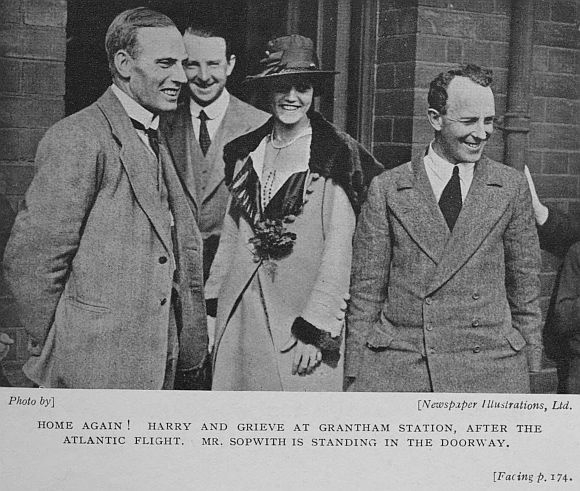
took them from Scapa Flow to Thurso in about 45 minutes.
It being low tide, it was impossible for the destroyer to go into
harbour, and so Harry and Grieve were rowed ashore by half-a-dozen
bluejackets, once again to set foot on home soil at Scrabster
Pier, whence the late Lord Kitchener had departed on his ill-fated
voyage in the Hampshire. The sun shone gloriously, and away in
the distance could be discerned the blue outline of the Orkneys.
As they reached the landing-stage cheer upon cheer rolled forth
from those who had assembled to meet them. Provost and Mrs.
MacKay, with members of the Thurso Town Council, several naval
officers and men, and townsfolk, had motored out to Scrabster,
where everybody and everything was en fête. Provost MacKay
was the first to greet Harry and Grieve. Addressing them, he
said:
“Mr. Hawker, in the name of the people of Thurso I offer
you and Commander Mackenzie-Grieve a welcome, not only to
Thurso, but to the shores of Britain. Throughout the length
and breadth of the land, and of every land, to-day the news of
your safe deliverance is ringing, and hearts everywhere are
rejoicing. It is true that you have not achieved what you so
gallantly set out for, but to-day you need not worry over that,
because you have indeed achieved great things. The names of
Hawker and Grieve will live for ever in the annals of Atlantic
flight. You have brought a new lustre to the daring, the
endurance, and the intrepid spirit of our race. Your countrymen
greet you warmly and proudly as heroic pioneers and
sportsmen. From the moment of your departure from St.
Johns the world has been on tension for news of you; expectation
gave way to anxiety, and then anxiety to gloom, but
happily all fears and forebodings are to-day dispelled. The
world-wide joy over your pluck and safety is so great because
the sense of relief is so great. It was at this landing-stage that
Lord Kitchener said farewell to the land he loved, and now we
shall also know it and mark it as the place of wonderful welcome
to two brave sons of Empire.”
Harry, on behalf of Grieve and himself, expressed his heartfelt
thanks for this warm greeting, with the modesty and brevity
which were so characteristic of him on such occasions. Provost
MacKay then introduced the members of the Town Council and
other Thursonians, after which Mrs. MacKay invited them to her
house for luncheon, an invitation which they were happy to accept.
In the Provost’s car they drove through the beflagged streets,
where many people, including parties of bluejackets, had foregathered.
At North Bank House they enjoyed a quiet luncheon
with Provost and Mrs. MacKay, Sir Archibald and Lady Sinclair,
of Ulbster, and the senior naval officer, Lieut. Weir, and his wife.
They were feeling very fit and their complexions were sunburnt.
Briefly Harry recounted their experiences, telling of the cloud-banks,
the clogged radiator pipe, the descent nearly to the water,
the rough seas and tempestuous winds, and the sighting of the
Mary and their gallant rescue.
Harry and Grieve were much amused by some of the newspapers
which Provost MacKay showed them, containing their
obituary notices. Grieve was particularly touched by a photograph
purporting to be that of his wife, for he was not married! Before
driving to the station Harry and Grieve spoke of the warmth of
the hospitality they had received, not only at Thurso, but also
at Scapa on the previous evening with the Grand Fleet.
During the luncheon, crowds assembled outside Provost MacKay’s
residence, and at the station Thurso had never before seen
such a throng. Cheers were ringing on all sides, handshakes,
cameras, and autograph books were the order of the day. Thurso
was en fête as never before.