Entered according to Act of Congress, in the year 1866, by
GRAVES & YOUNG,
in the Clerk’s Office for the District Court of Massachusetts
Copyright, 1894, by Elizabeth Stuart Phelps Ward.
PREFACE.
Having been asked to write a preface
to the new edition of the Gypsy books, I
am not a little perplexed. I was hardly
more than a girl myself, when I recorded
the history of this young person; and I
find it hard, at this distance, to photograph
her as she looks, or ought to look to-day.
She does not sit still long enough to be
“taken.” I see a lively girl in pretty short
dresses and very long stockings,—quite a
Tom-boy, if I remember rightly. She paddles
a raft, she climbs a tree, she skates
and tramps and coasts, she is usually very
muddy, and a little torn. There is apt to
be a pin in her gathers; but there is sure
to be a laugh in her eyes. Wherever there
is mischief, there is Gypsy. Yet, wherever
there is fun, and health, and hope, and happiness,—and
I think, wherever there is truthfulness
and generosity,—there is Gypsy, too.
And now, the publishers tell me that
Gypsy is thirty years old, and that girls
who were not so much as born when I
knew the little lady, are her readers and
her friends to-day.
Thirty years old? Indeed, it is more than
that! For is it not thirty years since the
publication of her memoirs? And was she,
at that time, possibly sixteen? Forty-six
years? Incredible! How in the world did
Gypsy “grow up?” For that was before toboggans
and telephones, before bicycles and
electric cars, before bangs and puffed
sleeves, before girls studied Greek, and golf-capes
came in. Did she go to college? For
the Annex, and Smith, and Wellesley were
not. Did she have a career? Or take a husband?
Did she edit a Quarterly Review, or
sing a baby to sleep? Did she write poetry,
or make pies? Did she practice medicine,
or matrimony? Who knows? Not even the
author of her being.
Only one thing I do know: Gypsy never
grew up to be “timid,” or silly, or mean,
or lazy; but a sensible woman, true and
strong; asking little help of other people,
but giving much; an honor to her brave
and loving sex, and a safe comrade to the
girls who kept step with her into middle
life; and I trust that I may bespeak from
their daughters and their scholars a kindly
welcome to an old story, told again.
“Gypsy Breynton. Hon. Gypsy Breynton, Esq., M. A., D. D.,
LL. D., &c., &c. Gypsy Breynton, R. R.”
Tom was very proud of his handwriting.
It was black and business-like,
round and rolling and readable, and drowned
in a deluge of hair-line flourishes, with little
black curves in the middle of them. It had
been acquired in the book-keeping class of
Yorkbury high school, and had taken a prize
at the end of the summer term. And therefore
did Tom lean back in his chair, and survey,
with intense satisfaction, the great sheet
of sermon-paper which was covered with his
scrawlings.
Tom was a handsome fellow, if he did look
very well pleased with himself at that particular
moment. His curly hair was black and bright,
and brushed off from a full forehead, and what
with that faint, dark line of moustache just visible
above his lips, and that irresistible twinkle
to his great merry eyes, it was no wonder
Gypsy was proud of him, as indeed she certainly
was, nor did she hesitate to tell him
so twenty times a day. This was a treatment
of which Tom decidedly approved. Exactly
how beneficial it was to the growth within him
of modesty, self-forgetfulness, and the passive
virtues generally, is another question.
The room in which Tom was sitting might
have been exhibited with profit by Mr. Barnum,
as a legitimate relic of that chaos and Old
Night, which the poets tell us was dispelled by
the light of this order-loving creation.
It had a bed in it, as well as several chairs
and a carpet, but it required considerable
search to discover them, for the billows of feminine
drapery that were piled upon them.
Three dresses,—Tom counted, to make sure,—one
on the bedpost, one rolled up in a heap on
the floor where it had fallen, and one spread
out on the counterpane, with benzine on it.
What with kerosene oil, candle drippings, and
mugs of milk, Gypsy managed to keep one
dress under the benzine treatment all the time;
it was an established institution, and had long
ago ceased to arouse remark, even from Tom.
There was also a cloak upon one chair, and a
crocheted cape tied by the tassels on another.
There was a white tippet hanging on the stovepipe.
There was a bandbox up in one corner
with a pretty hat lying on the outside, its long,
light feather catching the dust; it was three
days now since Sunday. There were also two
pairs of shoes, one pair of rubbers, and one
slipper under the bed; the other slipper lay
directly in the middle of the room. Then the
wardrobe door was wide open,—it was too full
to stay shut,—upon a sight which, I think, even
Gypsy would hardly want put into print.
White skirts and dressing-sacks; winter hoods
that ought to have been put up in camphor
long ago; aprons hung up by the trimming;
a calico dress that yawned mournfully out of
a twelve-inch tear in the skirt; a pile of stockings
that had waited long, and were likely to
wait longer, for darning; some rubber-boots
and a hatchet.
The bureau drawers, Tom observed, were
tightly shut,—probably for very good reasons.
The table, at which he sat, was a curiosity to
the speculative mind. The cloth was two-thirds
off, and slipping, by a very gradual
process, to the floor. On the remaining third
stood an inkstand and a bottle of mucilage, as
well as a huge pile of books, a glass tumbler, a
Parian vase, a jack-knife, a pair of scissors, a
thimble, two spools of thread, a small kite, and
a riding-whip. The rest of the table had been
left free to draw a map on, and was covered
with pencils and rubber, compasses, paper, and
torn geography leaves.
There were several pretty pictures on the
walls, but they were all hung crookedly; the
curtain at the window was unlooped, and you
could write your name anywhere in the dust
that covered mantel, stove, and furniture.
And this was Gypsy’s room.
Tom had spent a longer time in looking at it
than I have taken to tell about it, and when he
was through looking he did one of those things
that big brothers of sixteen long years’ experience
in this life, who are always teasing you
and making fun of you and “preaching” at
you, are afflicted with a chronic and incurable
tendency to do. It is very fortunate that
Gypsy deserved it, for it was really a horrible
thing, girls, and if I were you I wouldn’t let
my brothers read about it, as you value your
peace of mind, lace collars, clean clothes, good
tempers, and private property generally. I’d
put a pin through these leaves, or fasten them
together with sealing-wax, or cut them out,
before I’d run the risk.
And what did he do? Why, he put a chair
in the middle of the room, tied a broom to it
(he found it in the corner with a little heap
of dust behind it, as Gypsy had left it when
her mother sent her up to sweep the room
that morning), and dressed it up in the three
dresses, the cloaks and the cape, one above
another, the chair serving as crinoline. Upon
the top of the broom-handle he tied the torn
apron, stuffed out with the rubber-boots, and
pinned on slips of the geography leaves for
features; Massachusetts and Vermont giving
the graceful effect of one pink eye and one
yellow eye, Australia making a very blue
nose, and Japan a small green mouth. The
hatchet and the riding-whip served as arms,
and the whole figure was surmounted by the
Sunday hat that had the dust on its feather.
From under the hem of the lowest dress,
peeped the toes of all the pairs of shoes and
rubbers, and the entire contents of the sliding
table-cloth, down to every solitary pencil,
needle, and crumb of cake, were ranged in a
line on the carpet. To crown the whole, he
pinned upon the image that paper placard upon
which he had been scribbling.
When his laudable work was completed, this
ingenious and remorseless boy had to stand
and laugh at it for five minutes. If Gypsy
had only seen him then! And Gypsy was
nearer than he thought—in the front door, and
coming up the stairs with a great banging and
singing and laughing, as nobody but Gypsy
could come up stairs. Tom just put his hand
on the window-sill, and gave one leap out on
the kitchen roof, and Gypsy burst in, and
stopped short.
Tom crouched down against the side of the
house, and held his breath. For about half a
minute it was perfectly still. Then a soft,
merry laugh broke out all at once on the air,
something as a little brook would splash down
in a sudden cascade on the rocks.
“O—oh! Did you ever? I never saw anything
so funny! Oh, dear me!”
Then it was still again, and then the merry
laugh began to spell out the placard.
“Gypsy Breynton. Hon.—Hon. Gypsy
Breynton,—what? Oh, Esq., M. A., D. D.,
LL. D.—what a creature he is! Gypsy
Breynton, R. R. R. R.? I’m sure I don’t
know what that means—Tom! Thom—as!”
Just then she caught sight of him out on the
ridge-pole, whittling away as coolly as if he
had sat there all his life.
“Good afternoon,” said Gypsy, politely.
“Good afternoon,” said Tom.
“Been whittling out there ever since dinner,
I suppose?”
“Certainly.”
“I thought so. Come here a minute.”
“Come out here,” said Tom. Gypsy climbed
out of the window without the slightest
hesitation, and walked along the ridge-pole
with the ease and fearlessness of a boy. She
had on a pretty blue delaine dress, which was
wet and torn, and all stuck together with
burs; her boots were covered with mud to
the ankle; her white stockings spattered and
brown; her turban was hanging round her
neck by its elastic; her net had come off,
and the wind was blowing her hair all over
her eyes; she had her sack thrown over one
arm, and a basket filled to overflowing, with
flowers and green moss, upon the other.
“Well, you’re a pretty sight!” said Tom,
leisurely regarding her. Indeed, he was not
far from right. In spite of the mud and the
burs and the tears, and the general dropping-to-pieces
look about her, Gypsy managed,
somehow or other, to look as pretty as a picture,
with her cheeks as red as a coral, and
the soft brown hair that was tossing about her
eyes. Gypsy’s eyes were the best part of her.
They were very large and brown, and had that
same irresistible twinkle that was in Tom’s
eyes, only a great deal more of it; and then
it was always there. They twinkled when
she was happy and when she was cross; they
twinkled over her school-books; they twinkled,
in spite of themselves, at church and Sabbath
school; and, when she was at play, they shone
like a whole galaxy of stars. If ever Gypsy’s
eyes ceased twinkling, people knew she was
going to be sick. Her hair, I am sorry to say,
was not curly.
This was Gypsy’s one unalleviated affliction
in life. That a girl could possibly be pretty
with straight hair, had never once entered her
mind. All the little girls in story-books had
curls. Who ever heard of the straight-haired
maiden that made wreaths of the rosebuds, or
saw the fairies, or married the Prince? And
Gypsy’s hair was not only straight, it was absolutely
uncurlable. A week’s penance “done
up in paper” made no more impression than if
you were to pinch it.
However, that did not interfere with her
making a bit of a picture, perched up there on
the roof beside Tom, among her burs and her
flowers and her moss, her face all dimples from
forehead to chin.
“Where have you been?” said Tom, trying
to look severe, and making a most remarkable
failure.
“Oh, only over to the three-mile swamp
after white violets. Sarah Rowe, she got her
two hands full, and then she just fell splash
into the water, full length, and lost ’em—Oh,
dear me, how I laughed! She did look so
funny.”
“Your boots are all mud,” said Tom.
“Who cares?” said Gypsy, with a merry
laugh, tipping all the wet, earthy moss out
on her lap, as she spoke. “See! isn’t there
a quantity? I like moss ’cause it fills up.
Violets are pretty enough, only you do have to
pick ’em one at a time. Innocence comes up
by the handful,—only mine’s most all roots.”
“I don’t know what’s going to become of
you,” said Tom, drawing down the corner of
his mouth.
“Neither do I,” said Gypsy, demurely; “I
wish I did.”
“You won’t learn to apply yourself to anything,”
persisted Tom. “Work or play,
there’s no system to you. You’re like a——”
Tom paused for a simile—“Well, like a toad
that’s always on the jump.”
“Ow!” said Gypsy, with a little scream,
“there’s a horrid old snail crawled out my
moss!” and over went moss, flowers, basket,
and all, down the roof and upon the stone
steps below. “There! Good enough for
it!”
Tom coughed and whittled. Gypsy pulled
her net out of her basket, and put up her hair.
There was a little silence. Nothing had yet
been said about the image in Gypsy’s room,
and both were determined not to be the first
to speak of it. Gypsy could have patience
enough where a joke was in question, and
as is very apt to be the case, the boy found
himself outwitted. For not a word said Gypsy
of the matter, and half an hour passed and the
supper-bell rang.
“There!” said Gypsy, jumping up, “I do
declare if it isn’t supper, and I’ve got these
burs to get off and my dress to mend and
my shoes and stockings to change, and—Oh,
dear! I wish people didn’t ever have to do
things, anyway!”
With this very wise remark, she walked
back across the ridge-pole and climbed in the
window. There was nothing for Tom to do
but follow; which he did slowly and reluctantly.
Something would have to be said
now, at any rate. But not a syllable said
Gypsy. She went to the looking-glass, and
began to brush her hair as unconcernedly as
if everything were just as she left it and precisely
as she wanted it.
Tom passed through the room and out of
the door; then he stopped. Gypsy’s eyes
began to twinkle as if somebody had dropped
two little diamonds in them.
“I say,” said Tom.
“What do you say?” replied Gypsy.
“What do you suppose mother would have
to say to you about this looking room?”
“I don’t know what she’d say to you, I’m
sure,” said Gypsy, gravely.
“And you, a great girl, twelve years old!”
“I should like to know why I’m a railroad,
anyway,” said Gypsy.
“Who said you were a railroad?”
“Whoever wrote Gypsy Breynton, R. R.,
with my red ink.”
“That doesn’t stand for railroad.”
“Doesn’t? Well, what?”
“Regular Romp.”
“Oh!”
Chapter II — A SPASM OF ORDER
“I can’t help it,” said Gypsy, after
supper; “I can’t possibly help it,
and it’s no use for me to try.”
“If you cannot help it,” replied
Mrs. Breynton, quietly, “then it
is no fault of yours, but in every way a
suitable and praiseworthy condition of things
that you should keep your room looking as I
would be ashamed to have a servant’s room
look, in my house. People are never to blame
for what they can’t help.”
“Oh, there it is again!” said Gypsy, with
the least bit of a blush, “you always stop me
right off with that, on every subject, from
saying my prayers down to threading a
needle.”
“Your mother was trained in the new-school
theology, and she applies her principles
to things terrestrial as well as things
celestial,” observed her father, with an amused
smile.
“Yes, sir,” said Gypsy, without the least
idea what he was talking about.
“Besides,” added Mrs. Breynton, finishing,
as she spoke, the long darn in Gypsy’s dress,
“I think people who give right up at little difficulties,
on the theory that they can’t help it,
are——”
“Oh, I know that too!”
“What?”
“Cowards.”
“Exactly.”
“I hate cowards,” said Gypsy, in a little
flash, and then stood with her back half turned,
her eyes fixed on the carpet, as if she were puzzling
out a proposition in Euclid, somewhere
hidden in its brown oak-leaves.
“Take a chair, and sit by the window and
think of it,” remarked Tom, in his most aggravating
tone.
“That’s precisely what I intend to do,
sir,” said Gypsy; and was as good as
her word. She went up-stairs and shut her
door, and, what was remarkable, nobody saw
anything more of her. What was still more
remarkable, nobody heard anything of her.
For a little while it was perfectly still overhead.
“I hope she isn’t crying,” said Mr. Breynton,
who was always afraid Gypsy was doing
something she ought not to do, and who was in
about such a state of continual astonishment
over the little nut-brown romp that had been
making such commotion in his quiet home for
twelve years, as a respectable middle-aged and
kind-hearted oyster might be, if a lively young
toad were shut up in his shell.
“Catch her!” said the more appreciative
Tom; “I don’t believe she cries four times a
year. That’s the best part of Gyp.; with all her
faults, there’s none of your girl’s nonsense
about her.”
Another person in the room, who had listened
to the conversation, went off at this
period into a sudden fit of curiosity concerning
Gypsy, and started up-stairs to find her. This
was Master Winthrop Breynton, familiarly and
disrespectfully known as Winnie. A word
must be said as to this young person; for,
whatever he may be in the eyes of other people,
he was of considerable importance in his own.
He had several distinguishing characteristics, as
is apt to be the case with gentlemen of his age
and experience. One was that he was five
lengthy and important years of age; of which
impressive fact his friends, relatives, and
chance acquaintances, were informed at every
possible and impossible opportunity. Another
was, that there were always, at least, half a
dozen buttons off from his jacket, at all times
and places, though his long-suffering mother
lived in her work-basket. A third, lay in the
fact that he never walked. He trotted, he
cantered, he galloped; he progressed in jerks,
in jumps, in somersets; he crawled up-stairs like
a little Scotch plaid spider, on “all fours;” he
came down stairs on the banisters, the balance
of power lying between his steel buttons and
the smooth varnish of the mahogany. On several
memorable occasions, he has narrowly
escaped pitching head first into the hall lamp.
His favorite method of locomotion, however,
consisted in a series of thumps, beginning with
a gentle tread, and increasing in impetus by
mathematical progression till it ended in a
thunder-clap. A long hall to him was bliss
unalloyed; the bare garret floor a dream of delight,
and the plank walk in the woodshed an
ecstasy. Still a fourth peculiarity was a pleasing
habit when matters went contrary to his expressed
wishes, of throwing himself full length
upon the floor without any warning whatsoever,
squirming around in his clothes, and crying
at the top of his lungs. Added to this is
the fact that, for some unaccountable reason,
Winnie’s eyes were so blue, and Winnie’s laugh
so funny, and Winnie’s hands were so pink
and little, that somehow or other Winnie
didn’t get half the scoldings he deserved.
But who is there of us that does, for that
matter?
Well, Winnie it was who stamped across
the hall, and crawled up-stairs hand over
hand, and stamped across the upper entry,
and pounded on Gypsy’s door, and burst it
open, and slammed in with one of Winnie’s
inimitable shouts.
“Oh Winnie!”
“I say, father wants to know if——”
“Just see what you’ve done!”
Winnie stopped short, in considerable astonishment.
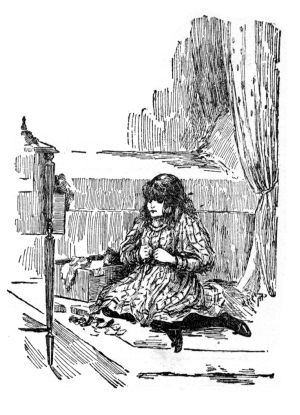
Gypsy was sitting on the
floor beside one of her bureau
drawers which she
had pulled out
of its place. That
drawer was a
sight well worth
seeing, by the
way; but of that
presently. Gypsy
had taken out of
it a little box
(without a cover,
like all Gypsy’s boxes) filled with beadwork,—collars,
cuffs, nets, and bracelets,
all tumbled in together, and as much as a
handful of loose beads of every size, color,
and description, thrown down on the bottom.
Gypsy was sorting these beads, and this was
what had kept her so still. Now Winnie, in
slamming into the room after his usual style,
had stepped directly into the box, crushed its
pasteboard flat, and scattered the unlucky
beads to all four points of the compass.
Gypsy sat for about half a minute watching
the stream of crimson and blue and black and
silver and gold, that was rolling away under
the bed and the chair and the table, her face
a perfect little thunder-cloud. Then she took
hold of Winnie’s shoulder, without any remarks,
and—shook him.
It was a little shake, and, if it had been
given in good temper, would not have struck
Winnie as anything but a pleasant joke. But
he knew, from Gypsy’s face, it was no joke;
and, feeling his dignity insulted, down he went
flat upon the floor with a scream and a jerk
that sent two fresh buttons flying off from
his jacket.
Mrs. Breynton ran up-stairs in a great
hurry.
“What’s the matter, Gypsy?”
“She sh—sh—shooked me—the old thing!”
sobbed Winnie.
“He broke my box and lost all my
beads, and I’ve got them all to pick up
just as I was trying to put my room in
order, and so I was mad,” said Gypsy,
frankly.
“Winnie, you may go down stairs,” said
Mrs. Breynton, “you must learn to be more
careful with Gypsy’s things.”
Winnie slid down on the banisters, and Mrs.
Breynton shut the door.
“What are you trying to do, Gypsy?”
“Pick up my room,” said Gypsy.
“But what had that to do with stringing
the beads?”
“Why, I—don’t know exactly. I took out
my drawer to fix it up, and my beads were
all in a muss, and so I thought I’d sort them,
and then I forgot.”
“I see several things in the room that want
putting in order before a little box of beads,”
said Mrs. Breynton, with a smile that was
half amused, half sorrowful. Gypsy cast a
deprecating glance around the room, and into
her mother’s face.
“Oh, I did mean to shut the wardrobe door,
and I thought I’d taken the broom down
stairs as much as could be, but that everlasting
Tom had to go and—— Oh dear! did you
ever see anything so funny in all your life?”
And Gypsy looked at the image, and broke
into one of her rippling laughs.
“It is really a serious matter, Gypsy,” said
Mrs. Breynton, looking somewhat troubled at
the laugh.
“I know it,” said Gypsy, sobering down,
“and I came up-stairs on purpose to put everything
to rights, and then I was going to live
like other people, and keep my stockings
darned, and—then I had to go head first into a
box of beads, and that was the end of me. It’s
always so.”
“You know, Gypsy, it is one of the signs of
a lady to keep one’s room in order; I’ve told
you so many times.”
“I know it,” said Gypsy, forlornly; “don’t
you remember when I was a little bit of a
thing, my telling you that I guessed God made
a mistake when he made me, and put in some
ginger-beer somehow, that was always going
off? It’s pretty much so; the cork’s always
coming out at the wrong time.”
“Well,” said Mrs. Breynton, with a smile,
“I’m glad you’re trying afresh to hammer it
in. Pick up the beads, and tear down the
image, and go to work with a little system.
You’ll be surprised to find how fast the room
will come to order.”
“I think,” she added, as she shut the door,
“that it was hardly worth while to——”
“To shake Winnie?” interrupted Gypsy, demurely.
“No, not at all; I ought to have
known better.”
Mrs. Breynton did not offer to help Gypsy in
the task which bade fair to be no easy one, of
putting her room in order; but, with a few encouraging
words, she went down stairs and left
her. It would have been far easier for her to
have gone to work and done the thing herself,
than to see Gypsy’s face so clouded and discouraged.
But she knew it would be the ruin
of Gypsy. Her only chance of overcoming her
natural thoughtlessness, and acquiring the habits
of a lady, lay in the persistent doing over
and over again, by her own unaided patience,
these very things that came so hard to her.
Gypsy understood this perfectly, and had the
good sense to think her mother was just right
about it. It was not want of training, that
gave Gypsy her careless fashion of looking
after things. Mrs. Breynton was a wise, as
well as a loving mother, and had done everything
in the way of punishment, reproof, warning,
persuasion, and argument, that mothers
can do for the faults of children. Nor was it
for want of a good example, Mrs. Breynton
was the very pink of neatness. It was a
natural kink in Gypsy, that was as hard to get
out as a knot in an apple-tree, and which depended
entirely on the child’s own will for its
eradication. This disorder in her room and
about her toilet was only one development of
it, and by no means a fixed or continued one.
Gypsy could be, and half the time she was, as
orderly and lady-like as anybody. She did
everything by fits and starts. As Tom said,
she was “always on the jump.” If her dress
didn’t happen to be torn and her room dusty,
why, she had a turn of forgetting everything.
If she didn’t forget, she was always getting
hurt. If it wasn’t that, she lost her temper
every five minutes. Or else she was making
terrible blunders, and hurting people’s feelings;
something was always the matter; and
some one was always on the qui vive, wondering
what Gypsy was going to do next.
Yet, in spite of it all, the person who did not
love Gypsy Breynton (provided he knew her)
was not to be found in Yorkbury. Whether
there was any reason for this, you can judge
for yourself as the story goes on.
After her mother had gone down, Gypsy
went to work in earnest. She picked up the
beads, and put them back into the drawer
which she left upon the floor. Then she
attacked Tom’s image. It took her fully fifteen
minutes merely to get the thing to
pieces, for the true boy-fashion in which it
was tied, pinned, sewed, and nailed together,
would have been a puzzle to any feminine
mind. She would have called Tom up to help
her, but she was just a little bit too proud.
The broom she put out in the entry the
first thing; then, remembering that that was
not systematic, she carried it down stairs and
hung it on its nail. The shoes and the dresses,
the cape and the cloak, the tippet and the hat,
she put in their places; the torn apron and
the unmended stockings she tumbled into her
basket, then went back and folded them up
neatly; she also made a journey into the woodshed
expressly to put the hatchet where it
belonged, on the chopping-block. By this
time it was quite dark, but she lighted a
lamp, and went at it afresh. Winnie came
up to the entry door, and, at a respectful distance,
told her they were “popping” corn
down stairs; but she shook her head, and
proceeded with her dusting like a hero. Tom
whistled for her up the chimney-flue; but she
only gave a little thump on the floor, and said
she was busy.
It was like walking into a labyrinth to dispose
of the contents of that table-cloth. How
to put away the pencils and the rubber, when
the drawing-box was lost; how to collect all
the cookey-crumbs and wandering needles,
that slipped out of your finger as fast as you
took hold of them; where on earth to put
those torn geography leaves, that wouldn’t
stay in the book, and couldn’t be thrown away;
where was the cork to the inkstand? and how
should she hang up the riding-whip, with the
string gone? These were questions that might
well puzzle a more systematic mind than Gypsy’s.
However, in due time, the room was
restored to an order that was delightful to
see,—for, if Gypsy made up her mind to a
thing, she could do it thoroughly and skilfully,—and
she returned to the bureau drawer.
This drawer was a fair specimen of the rest of
Gypsy’s drawers, shelves, and cupboards, and
their name was Legion. Moreover, it was an
“upper drawer,” and where is the girl that
does not know what a delicate science is involved
in the rearranging of these upper
drawers? So many laces, and half-worn
collars that don’t belong there, are always
getting in; loose coppers have such a way
of accumulating in the crevices; all your
wandering pins and hair-pins make it a rendezvous
by a species of free-masonry utterly
inexplicable; then your little boxes fit in so
tightly, and never have room to open,
and are always getting their covers caught
when you shut the drawer, and, when you try
to keep them down, you pinch your fingers so.
Please to imagine, O orderly readers! who
keep every pin in its proper place, the worst
looking upper drawer that your horrified eyes
ever beheld, and you will have some idea of
this drawer of Gypsy’s.
There were boxes large, and boxes small,
boxes round, square, and oblong; boxes with
covers (only two), and boxes without; handkerchiefs,
under-sleeves, collars,—both clean
and soiled,—laces and ribbons, and bows and
nets; purses and old gloves, a piece of soap,
a pile of letters, scratched and scattering
jewelry, a piece of dried cake, several
fans all covered with dust, and nobody
knew what not, in the lower strata, out of
sight.
Gypsy sat and looked at it for about two
minutes in utter despair. Then she just
turned the whole thing bottom upwards in a
great heap on the floor, and began to investigate
matters, with her cheeks very red.
Presently, the family down stairs heard a
little scream. Winnie stamped up to see what
was the matter.
“Why, I’ve found my grammar!” said
Gypsy. “It’s the one in marble covers I lost
ever—ever so long ago, and had to get a new
one. It was right down at the bottom of the
drawer!”
Pretty soon there was another little scream,
and Gypsy called down the chimney:
“Tom Breynton! What do you think? I’ve
found that dollar bill of yours you thought
I’d burnt up.”
After awhile there came still another
scream, a pretty loud one this time. Mrs.
Breynton came up to see what had happened.
“I’ve cut my hand,” said Gypsy, faintly;
“there was a great heap of broken glass in
my drawer!”
“Broken glass!”
“Yes, I’m sure I don’t know how it came
there; I guess I was going to frame a picture.”
Mrs. Breynton bound up her finger, and
went down again. She was no more than
fairly seated before there came from up-stairs,
not a scream, but one of the merriest
laughs that ever was heard.
“What is to pay, now?” called Tom, from
the entry.
“Oh, dear!” gasped Gypsy; “it’s too funny
for anything! If here isn’t the carving-knife
we scolded Patty for losing last winter, and—Oh,
Tom, just look here!—my stick of
peanut candy, that I thought I’d eaten up, all
stuck on to my lace under-sleeves!”
It was past Gypsy’s bed-time when the
upper drawer was fairly in order and put
back in its place. Three others remained to
go through the same process, as well as wardrobe
shelves innumerable. Gypsy, with her
characteristic impulsiveness, would have sat
up till twelve o’clock to complete the work,
but her mother said “No” very decidedly, and
so it must wait till to-morrow.
Tom came in just as everything was done,
and Gypsy had drawn a long breath and
stood up to look, with great satisfaction, all
around her pleasant, orderly room.
“Well done! I say, Gypsy, what a jewel
you are when you’re a mind to be.”
“Of course, I am. Have you just found it
out?”
“Well, you know you’re a diamond, decidedly
in the rough, as a general thing. You
need cutting down and polishing.”
“And you to polish me? Well, I like the
looks of this room, anyhow. It is nice to
have things somewhere where you won’t trip
over them when you walk across the room—only
if somebody else would pick ’em up for
me.”
“How long do you suppose it will last?”
asked Tom, with an air of great superiority.
“Tom,” said Gypsy, solemnly; “that’s a
serious question.”
“It might last forever if you have a mind
to have it,—come now, Gyp., why not?”
“That’s a long time,” said Gypsy, shaking
her head; “I wouldn’t trust myself two
inches. To-morrow I shall be in a hurry to
go to school; then I shall be in a hurry to
go to dinner; then I shall be in a terrible hurry
to get off with Sarah Rowe, and so it goes.
However, I’ll see. I feel, to-night, precisely
as if I should never want to take a single pin
out of those little black squares I’ve put them
into on the cushion.”
Gypsy found herself in a hurry the next
day and the next, and is likely to, to the end
of her life, I am afraid. But she seemed to
have taken a little gasp of order, and for a
long time no one had any complaint to make
of Gypsy’s room or Gypsy’s toilet.
Chapter III — MISS MELVILLE’S VISITOR
As will be readily supposed, Gypsy’s
name was not her original one;
though it might have been,
for there have been actual Billys and Sallys,
who began and ended Billys and Sallys only.
Gypsy’s real name was an uncouth one—Jemima.
It was partly for this reason, partly
for its singular appropriateness, that her
nickname had entirely transplanted the lawful
and ugly one.
This subject of nicknames is a curiosity.
All rules of euphony, fitness, and common
sense, that apply to other things, are utterly
at fault here. A baby who cannot talk
plainly, dubs himself “Tuty,” or “Dess,” or
“Pet,” or “Honey,” and forthwith becomes
Tuty, Dess, Pet, or Honey, the rest of his
mortal life. All the particularly cross and
disagreeable girls are Birdies and Sunbeams.
All the brunettes with loud voices and red
hands, who are growing up into the “strong-minded
women,” are Lilies and Effies and
Angelinas, and other etherial creatures; while
the little shallow, pink-and-white young ladies
who cry very often and “get nervous,” are
quite as likely to be royal Constance, or Elizabeth,
without any nickname at all.
But Gypsy’s name had undoubtedly been
foreordained, so perfectly was it suited to
Gypsy. For never a wild rover led a more
untamed and happy life. Summer and winter,
seed-time and harvest, found Gypsy out
in the open air, as many hours out of the
twenty-four as were not absolutely bolted and
barred down into the school-room and dreamland.
A fear of the weather never entered
into Gypsy’s creed; drenchings and freezings
were so many soap-bubbles,—great fun
while they lasted, and blown right away by
dry stockings and mother’s warm fire; so
where was the harm? A good brisk thunderstorm
out in the woods, with the lightning
quivering all about her and the thunder crashing
over her, was simple delight. A day of
snow and sleet, with drifts knee-deep, and
winds like so many little knives, was a festival.
If you don’t know the supreme bliss of a
two-mile walk on such a day, when you have
to shut your eyes, and wade your way, then
Gypsy would pity you. Not a patch of woods,
a pond, a brook, a river, a mountain, in the
region (and there, in Vermont, there were
plenty of them), but Gypsy knew it by heart.
There was not a trout-brook for miles where
she had not fished. There was hardly a tree
she had not climbed, or a fence or stone-wall—provided,
of course, that it was away from the
main road and people’s eyes—that she had not
walked. Gypsy could row and skate and
swim, and play ball and make kites, and coast
and race, and drive, and chop wood. Altogether
Gypsy seemed like a very pretty,
piquant mistake; as if a mischievous boy had
somehow stolen the plaid dresses, red cheeks,
quick wit, and little indescribable graces of a
girl, and was playing off a continual joke on
the world. Old Mrs. Surly, who lived opposite,
and wore green spectacles, used to roll up
her eyes, and say What would become of
that child? A whit cared Gypsy for Mrs.
Surly! As long as her mother thought the
sport and exercise in the open air a fine thing
for her, and did not complain of the torn
dresses oftener than twice a week, she would
roll her hoop and toss her ball under Mrs.
Surly’s very windows, and laugh merrily to
see the green glasses pushed up and taken off
in horror at what Mrs. Surly termed an “impropriety.”
Therefore it created no surprise in the family
one morning, when school-time came and
passed, and Gypsy did not make her
appearance, that she was reported to be
“making a raft” down in the orchard
swamp.
“Run and call her, Winnie,” said Mrs.
Breynton. “Tell her it is very late, and I
want her to come right up,—remember.”
“Yes mum,” said Winnie, with unusual
alacrity, and started off down the lane as fast
as his copper-toed feet could carry him. It
was quite a long lane, and a very pleasant one
in summer. There was a row of hazel-nut
bushes, always green and sweet, on one side,
and a stone-wall on the other, with the broad
leaves and tiny blossoms of a grape-vine trailing
over it. The lane opened into a wide field
which had an apple-orchard at one end of it,
and sloped down over quite a little hill into a
piece of marshy ground, where ferns and white
violets, anemones, and sweet-flag grew in
abundance. In the summer, the water was apt
to dry up. In the spring, it was sometimes
four feet deep. It was a pleasant spot, for the
mountains lay all around it, and shut it in with
their great forest-arms, and the sharp peaks
that were purple and crimson and gold, under
passing shadows and fading sunsets. And,
then, is there any better fun than to paddle in
the water?
Gypsy looked as if she thought not, when
Winnie suddenly turned the corner, and ran
down the slope.
She had finished her raft, and launched it
off from the root of an old oak-tree that grew
half in the water, and, with a long pole, had
pushed herself a third of the way across the
swamp. Her dress was tucked up over her
bright balmoral, and the ribbons of her hat
were streaming in the wind. She had no mittens
or gloves on her hands, which were very
pink and plump, and her feet were incased in
high rubber boots.
“Hullo!” said Winnie, walking out on the
root of the oak.
“Hilloa!” said Gypsy.
“I say—that’s a bully raft.”
“To be sure it is.”
“I haven’t had a ride on a raft since—why
since ’leven or six years ago when I was a little
boy. I shouldn’t wonder if it was twenty-three
years, either.”
“Oh, I can’t bear people that hint. Why
don’t you say right out, if you want a ride?”
“I want a ride,” said Winnie, without any
hesitation.
“Wait till I turn her round. I’ll bring her
up on the larboard side,” replied Gypsy, in
the tone of an old salt of fifty years’ experience.
So she paddled up to the oak-tree, and Winnie
jumped on board.
“I guess we’ll have time to row across and
back before school,” said Gypsy, pushing off.
Winnie maintained a discreet silence.
“I don’t suppose it’s very late,” said Gypsy.
“Oh, just look at that toad with a green
head, down in the water!” observed Winnie.
They paddled on a little ways in silence.
“What makes your cheeks so red?” asked
Gypsy.
“I guess it’s scarlet fever, or maybe it’s
appleplexy, you know.”
“Oh!”
Just then Winnie gave a little scream.
“Look here—Gyp.! The boat’s goin’clock down.
I don’t want to go very much. I saw another
toad down there.”
“I declare!” said Gypsy, “we’re going to
be swamped, as true as you live! It isn’t
strong enough to bear two,—sit still, Winnie.
Perhaps we’ll get ashore.”
But no sooner had she spoken the words
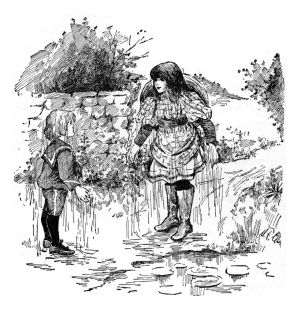
than the water washed up about her ankles,
and Winnie’s end of the raft went under. The
next she knew, they were both floundering in
the water.
It chanced to be about three feet and a half
deep, very cold, and somewhat slimy. Gypsy
had a strong impression that a frog jumped
into her neck when she plunged, head first,
into the deep mud at the bottom. After a
little splashing and gasping, she regained her
feet, and stood up to her elbows in the water.
But what she could do, Winnie could not. He
had sunk in the soft mud, and even if he had
had the courage to stand up straight, the water
would have been above his head. But it had
never occurred to him to do otherwise than
lie gasping and flat on the bottom, where
he was drowning as fast as he possibly
could.
Gypsy pulled him out and carried him
ashore. She wrung him out a little, and set
him down on the grass, and then, by way of
doing something, she took her dripping handkerchief
out of her dripping pocket and wiped
her hands on it.
“O—o—oh!” gasped Winnie; “I never did—you’d
ought to know—you’ve just gone’n
drownded me!”
“What a story!” said Gypsy; “you’re no
more drowned than I
am. To be sure you
are rather wet,” she added, with a disconsolate
attempt at a laugh.
“You oughtn’t to have tooken me out on
that old raft,” glared Winnie, through the
shower of water-drops that rained down from
his forehead, “you know you hadn’t! I’ll just
tell mother. I’ll get sick and be died after it,
you see if I don’t.”
“Very well,” said Gypsy, giving herself a
little shake, very much as a pretty brown
spaniel would do, who had been in swimming.
“You may do as you like. Who teased to
go on the raft, I’d like to know?”
“Besides,” resumed Winnie, with an impressive
cough; “you’re late to school, ’cause
mother, she said you was to come right up
when she sent me down, only I—well I guess,
I b’lieve I forgot to tell you,—I rather think I
did. Anyways, you’re late,—so!”
Gypsy looked at Winnie, and Winnie looked
at Gypsy. There was an awful silence.
“Winnie Breynton,” said Gypsy, solemnly,
“if you don’t get one whipping!”
“I don’t care to hear folks talk,” interrupted
Winnie, with dignity, “I am five years old.”
Gypsy’s reply is not recorded.
I have heard it said that when Tom espied
the two children coming up the lane, he went
to his mother with the information that the
fishman was somewhere around, only he had
sent his fishes on ahead of him. They appeared
to have been freshly caught, and
would, he thought, make several dinners;
but I cannot take the responsibility of the
statement.
It was very late, much nearer ten o’clock
than nine, when Gypsy was fairly metamorphosed
into a clean, dry, very penitent-looking
child.
She hurried off to school, leaving Winnie
and his mother in close conference. Exactly
what happened on the occasion of that interview,
has never been made known to an inquiring
public.
On the way to school Gypsy had as many
as six sober thoughts; a larger number than
she was usually capable of in forty-eight
hours. One was, that it was too bad she had
got so wet. Another was, that she really
supposed it was her business to know when
school-time came, no matter where she was
or what she was doing. Another, that she
had made her mother a great deal of trouble.
A fourth was, that she was sorry to be so
late at school—it always made Miss Melville
look so; and then a bad mark was not, on
the whole, a desirable thing. Still a fifth
was, that she would never do such a thing
again as long as she lived—never. The sixth
lay in a valiant determination to behave herself
the rest of this particular day. She would
study hard. She would get to the head of the
class. She wouldn’t put a single pin in the
girls’ chairs, nor tickle anybody, nor make up
funny faces, nor whisper, nor make one of the
girls laugh, not one, not even that silly Delia
Guest, who laughed at nothing,—why, you
couldn’t so much as make a doll out of your
handkerchief and gloves, and hang it on your
pen-handle, but what she had to go into a
spasm over it.
No, she wouldn’t do a single funny thing
all day. She would just sit still and look
sober and sorry, and not trouble Miss Melville
in the least. Her mind was quite made up.
Just as she had arrived at this conclusion
she came to the school-house door. Gypsy
and a number of other girls, both her own
age and younger, who either were not prepared
to enter the high school, or whose parents
preferred the select school system, composed
Miss Melville’s charge. They were most
of them pleasant girls, and Miss Melville was
an unusually successful teacher, and as dearly
loved as a judicious teacher can be. The
school-house was a bit of a brown building
tucked away under some apple-trees on a
quiet by-road. It had been built for a district
school, but had fallen into disuse years
ago, and Miss Melville had taken possession
of it.
Gypsy slackened her pace as she passed
under the apple-boughs, where the tiny, budding
leaves filled all the air with faint fragrance.
It was nearly recess time; she knew,
because she could hear, through the windows,
the third geography class reciting. It was
really too bad to be so late. She went up the
steps slowly, the corners of her mouth drawn
down as penitently as Gypsy’s mouth could
well be.
Just inside the door she stopped. A quick
color ran all over her face, her eyes began to
twinkle like sparks from a great fire of hickory,
and, in an instant, every one of those
six sober thoughts was gone away somewhere—nobody
could have told where; and the funniest
little laugh broke the silence of the entry.
The most interested observer could not have
told what Gypsy saw that was so very amusing.
The entry was quite deserted. Nothing was to
be seen but a long row of girls’ “things,”
hanging up on the nails—hats and bonnets,
tippets, sacks, rubbers, and baskets; apparently
as demure and respectable as hats, bonnets,
tippets, sacks, rubbers, and baskets could
be. Yet there Gypsy stood for as much as a
minute laughing away quietly to herself, as if
she had come across some remarkable joke.
About ten minutes after, some one knocked
at the school-room door. Miss Melville laid
down her geography.
“Cape Ann, Cape Hatteras, Cape—may I go
to the door?” piped little Cely Hunt, holding
up her hand. Miss Melville nodded and Cely
went. She opened the door—and jumped.
“What’s the matter, Cely?—Oh!” For
there stood the funniest old woman that Cely
or Miss Melville had ever seen. She had on a
black dress, very long and very scant, that
looked as if it were made out of an old waterproof
cloak. Over that, she wore a curious
drab-silk sack, somewhat faded and patched,
with all the edges of the seams outside. Over
that, was a plaid red-and-green shawl, tied
about her waist. There was a little black
shawl over that, and a green tippet wound
twice around her throat with the ends tucked
in under the shawl. She had a pair of black
mitts on her hands, and she carried a basket.
Her face no one could see, for it was covered
with a thick green veil, tied closely about her
bonnet.
Cely gave a little scream, and ran behind the
door. Miss Melville stepped down from the
platform, and went to meet the visitor.
“Good arternoon,” said the old woman, in a
very shrill voice.
“Good afternoon,” said Miss Melville, politely.
“I come to see the young uns,” piped the
old woman. “I ben deown teown fur some
eggs, an’clock I heerd the little creaturs a sayin’clock
of their lessons as I come by, an’clock thinks says
I to myself, says I, bless their dear hearts, I’ll
go in an’clock see ’em, says I, an’clock I’ll thank ye
kindly for a seat, for I’m pretty nigh beat out.”
The scholars all began to laugh. Miss Melville,
somewhat reluctantly, handed her visitor
a chair by the door, but did not ask her upon
the platform, as the visitor seemed to expect.
“There’s a drefful draught here on my
neck,” she muttered, discontentedly; “an’clock I’m
terribly afflicted with rheumatiz mostly. Can’t
see much of the young uns here, nuther.”
“I doubt if there is much here that will interest
you,” observed Miss Melville, looking at
her keenly. “You may rest yourself, and
then I think you had better go. Visitors
always disturb the children.”
“Bless their dear hearts!” cried the old
woman, shrilly. “They needn’t be afraid of
me—I wouldn’t hurt ’em. Had a little angel
boy once myself; he’s gone to Californy now,
an’clock I’m a lone, lorn widdy. I say—little gal!”
and the stranger pointed her finger (it trembled
a little) at Sarah Rowe, who had grown quite
red in the face with her polite efforts not to
laugh. “Little gal, whar’s yer manners?—laughin’clock
at a poor ole creetur like me! Come
out here, and le’s hear ye say that beautiful
psalm of Dr. Watts—now!”
“How doth the little busy bee!”
But just then something happened for which
the old woman and the scholars were equally
unprepared. Miss Melville looked through the
green veil straight into the old woman’s eyes,
and said just one word. She said it very quietly,
and she said it without a smile. It was
“Gypsy!”
There was a great hush. Sarah Rowe was
the first to break it.
“Why, that’s my sack turned wrong side out!”
“And those are my mitts!” said Agnes
Gaylord.
“If you please, Miss Melville, that’s my
black shawl,—I know it by the border,” piped
a very little girl in mourning.
“I do believe that’s my waterproof, and
Lucy’s plaid shawl,” giggled Delia Guest.
“Did you ever?”
“And my green veil,” put in somebody else,
faintly.
Miss Melville quietly removed the veil, and
Gypsy looked up with her mischief bright all
over her face. Her eyes fell, however, and
her cheeks flushed crimson, when she saw the
look about Miss Melville’s mouth.
“You may go and put away the things,
Gypsy,” said Miss Melville, still without a
smile. Gypsy obeyed in silence. The girls
stopped laughing, and began to whisper together
behind the desk-covers.
“The school will come to order,” said Miss
Melville. “Cely, what is the largest river in
New England?—Next.”
Gypsy hung up the things, and came slowly
back into the room. Miss Melville motioned
her to her seat, but took no further notice of
her. Gypsy, silent and ashamed, took out her
spelling-book, and began to study. The girls
looked at her out of the corners of their eyes,
and every now and then Delia Guest broke out
afresh into a smothered laugh, but no one
spoke to her, and she spoke to nobody.
The spelling-class was called out, but Miss
Melville signified, by a look, that Gypsy was
to keep her seat. Recess came, but Miss Melville
was busy writing at her desk, and took no
notice of her, further than to tell the group of
girls, who had instantly clustered buzzing and
laughing about her, that they were all to go
out doors and play. They went, and Gypsy
sat still with her head behind the desk-cover.
Something in Miss Melville’s manner said,
louder than words, that she was displeased.
It was a manner which made Gypsy feel, for
once in her life, that she had not one word to say.
She busied herself with her books, and tried
to look unconcerned when the scholars came
back. The arithmetic class recited, but her
teacher did not call for her; the history class,
but no one spoke to Gypsy. The disgrace of
this punishment was what Gypsy minded the
most, though it was no slight thing to see so
many “absent” marks going down on her report,
when she was right in the room and had
learned her lessons.
After what seemed to her an interminable
time, the morning passed and the school broke
up. The children, controlled by that something
in Miss Melville’s manner, and by Gypsy’s
averted head and burning cheeks, left the room
quickly, and Gypsy and her teacher were alone.
“Gypsy,” said Miss Melville.
There was no answer.
“Gypsy.”
There came a faint “Yes’m” from behind
the desk-cover. Miss Melville laid down her
pencil, closed her own desk, and came and sat
down on the bench beside Gypsy.
“I wonder if you are as sorry as I am,” she
said, simply.
Something very bright glittered on Gypsy’s
lashes, and two great drops stood on her hot
cheeks.
“I don’t see what possessed me!” she said,
vehemently. “Why don’t you turn me out of
school?”
“I did not think you could willingly try to
make me trouble,” continued Miss Melville,
without noticing the last remark.
The two great drops rolled slowly down
Gypsy’s cheeks, and into her mouth. She
swallowed them with a gulp, and brushed her
hand, angrily, across her eyes. Gypsy very
seldom cried, but I fancy she came pretty near
it on that occasion.
“Miss Melville,” she said, with an earnestness
that was comical, in spite of itself; “I
wish you’d please to scold me. I should feel a
great deal better.”
“Scoldings won’t do you much good,” said
Miss Melville, with a sad smile; “you must
cure your own faults, Gypsy. Nobody else
can do it for you.”
Gypsy turned around in a little passion of
despair.
“Miss Melville, I can’t! It isn’t in me—you
you don’t know! Here this very morning I
got late to school, tipping Winnie over in a
raft—drenched through both of us, and
mother, so patient and sweet with the dry
stockings she’d just mended, and wasn’t I
sorry? Didn’t I think about it all the way to
school—the whole way, Miss Melville? And
didn’t I make up my mind I’d be as good as
a kitten all day, and sit still like Agnes Gaylord,
and not tickle the girls, nor make you
any trouble, nor anything? Then what should
I do but come into the entry and see those
things, and it all came like a flash how funny
it would be’n I’d talk up high like Mrs. Surly ’n
you wouldn’t know me, and—that was the last
I thought, till you took off the veil, and I
wished I hadn’t done it. It’s just like me—I
never can help anything anyhow.”
“I think you can,” said her teacher, kindly.
“You certainly had the power, when you stood
out there in the entry, to stop and think before
you touched the things.”
“I don’t know,” said Gypsy, shaking her
head, thoughtfully; “I don’t believe I had.”
“But you wouldn’t do it again?”
“I guess I wouldn’t!” said Gypsy, with an
emphasis.
“What you can do one time, you can another,”
said Miss Melville.
Gypsy was silent.
“There’s one other thing about it,” continued
her teacher, “besides the impropriety of
playing such a trick in school hours—that is,
that it was very unkind to me.”
“Unkind!” exclaimed Gypsy.
“Yes,” said Miss Melville, quietly, “unkind.”
“Why, Miss Melville, I wouldn’t be unkind
to you for anything!—I love you dearly.”
“Nevertheless, Gypsy, it was very unkind
to deliberately set to work to annoy me and
make me trouble, by getting the school into a
frolic. Anything done to break the order of
study-hours, or to withstand any rule of the
school, is always an unkindness to a teacher.
There is scarcely a girl in school that might
help me more than you, Gypsy, if you chose.”
“I don’t see how,” said Gypsy, astonished.
“I do,” said Miss Melville, smiling, “and I
always think a little vote of thanks to you,
when you are quiet and well-behaved. An
orderly scholar has a great deal of influence.
The girls all love you, and are apt to do as
they see you do, Gypsy.”
There was a little silence, in which Gypsy’s
eyes were wandering away under the apple-boughs,
their twinkling dimmed and soft.
At last she turned quickly, and threw her
arms about her teacher’s neck.
“Miss Melville, if you’ll give me one kiss,
I’ll never be an old woman again, if I live as
long as Methuselah!”
Miss Melville kissed her, and whispered one
or two little loving words of encouragement,
such as nobody but Miss Melville knew how to
say. But Gypsy never told what they were.
“I believe there’s a bolt left out of me somewhere,”
she said, as they left the school-house
together; “what do you suppose it is?”
“It is the strong, iron bolt, ‘stop and think,’
Gypsy.”
“Um—yes—perhaps it is,” said Gypsy, and
walked slowly home.
Chapter IV — GYPSY HAS A DREAM
“Come, Tom—do.”
“Do what?”
“You know as well as I do.”
“What did you observe?”
“Tom Breynton!”
“That’s my name.”
“Will you, or will you not, come down to
the pond and have a row?”
“Let’s hear you tease a little.”
“Catch me! If you won’t come for a civil
request, I won’t tease for it.”
“Very good,” said Tom, laying aside his Euclid;
“I like your spunk. Rather think I’ll go.”
Tom tossed on his cap and was ready.
Gypsy hurried away to array herself in the
complication of garments necessary to the feminine
adventurer, if she so much as crosses the
yard; a continual mystery of Providence, was
this little necessity to Gypsy, and one against
which she lived in a state of incessant rebellion.
It was provoking enough to stand there in her
room, tugging and hurrying till she was red in
the face, over a pair of utterly heartless and
unimpressible rubbers, that absolutely refused
to slip over the heel of her boot, and to see
Tom through the window, with his hands in
his pocket, ready, waiting, and impatient,
alternately whistling and calling for her.
“I never did!” said Gypsy, in no very
gentle tone.
“Hur—ry up!” called Tom, coolly.
“These old rubbers!” said Gypsy.
“What’s the matter?” asked her mother,
stopping at the door.
“It’s enough to try the
patience of a saint!” said
Gypsy, emphatically,
holding out her foot.
“Perhaps I can help
you,” said Mrs. Breynton,
stooping down.
“Why, Gypsy! your
boots are wet through;
of course the rubbers
won’t go on.”
“I didn’t suppose that would
make any difference,” said Gypsy, looking
rather foolish. “I got them wet this morning,
down at the swamp. I thought they
were dry, though: I sat with my feet in the
oven until Patty drove me off. She said I
was in the bread.”
“You will have to put on your best boots,”
said her mother.
“Oh, Tom!” called Gypsy, in despair, as the
shrillest of all shrill whistles came up through
the window. “Everything’s in a jumble! I’ll
be there as soon as I can.”
She changed her boots, tossed on her turban,
whisked on her sack, and began to fasten it
with a jerk, when off came the button at the
throat, and rolled maliciously quite out of sight
under the bed.
“There!” said Gypsy.
“Can’t wait!” shouted Tom.
“I mended that sack,” said Gypsy, “only
yesterday afternoon. I call it too bad, when a
body’s trying to keep their things in order, and do
up all their mending, that things have to act so!”
“I think you have been trying to be orderly,”
said her mother, helping her to pin
the offending sack about the throat, for there
was no time now to restore the wandering
button. “I have noticed a great improvement
in you; but there’s one thing wanting
yet, that would have kept the button in its
place, and had the boots properly taken off and
dried at the right time.”
“What’s that?” asked Gypsy, in a great
hurry to go.
“A little more thoroughness, Gypsy.”
This bit of a lesson, like most of Mrs.
Breynton’s moral teachings, was enforced
with a little soft kiss on Gypsy’s forehead,
and a smile that was as unlike a sermon as
smile could be.
Gypsy gave two thoughts to it, while she
jumped down stairs three steps at a time;
then, it must be confessed, she forgot it entirely,
in the sight of Tom coolly walking off
down the lane without her. But words that
Mrs. Breynton said with a kiss did not slip
away from Gypsy’s memory “for good an
a’,” as easily as that. She had her own little
places and times of private meditation, when
such things came up to her like faithful angels,
that are always ready to speak, if you give
them the chance.
Tom was still in sight, among the hazel-nut
bushes and budding grape-vines of the lane,
and Gypsy ran swiftly after him. She was
fleet of foot as a young gazelle, and soon overtook
him. She had just stopped, panting, by
his side, and was proceeding to make some
remarks which she thought his conduct richly
deserved, when the sound of some little trotting
feet behind them attracted their attention.
“Why, Winnie Breynton!” said Gypsy.
“Where are you going?” asked Tom, turning
round.
“Oh, nowheres in particular,” said Winnie,
with an absent air.
“Well, you may just turn round and go
there, then,” said Tom. “We don’t want any
little boys with us this afternoon.”
“Little boys!” said Winnie, with a terrible
look; “I’m five years old, sir. I can button
my own jacket, and I’ve got a snowshovel!”
Tom walked rapidly on, and Gypsy with
him. A moment’s reflection seemed to convince
Winnie that his company was not
wanted, and he disappeared among the hazel
nut bushes.
Gypsy and Tom were fast walkers, and they
reached the pond in a marvellously short time.
This pond was about a half-mile from the
house, just at the foot of a hill which went by
the name of Kleiner Berg—a German word
meaning little mountain. There were many
of these elevations all along the valley in
which Yorkbury was situated. They seemed
to be a sort of stepping-stones to the great,
snow-crowned mountains, that towered sharply
beyond. The pond that nestled in among the
trees at the foot of the Kleiner Berg was
called the Kleiner Berg Basin. It was a
beautiful sheet of water, small and still and
sheltered, and a great resort of pleasure-seekers
because of the clouds of white and
golden lilies that floated over it in the hot
summer months. Mr. Breynton owned a boat
there, which was kept locked to a tiny wharf
under the trees, and was very often used by
the children, although Tom declared it was no
better to fish in than a wash-tub; as a Vermont
boy, used to the trout-brooks up among
the mountains, would be likely to think.
“What’s that?” asked Gypsy, as they neared
the wharf.
“Looks as much like a little green monkey
as anything,” said Tom, making a tube of his
hands to look through. “It’s in the boat,
whatever it is.”
“It’s a green-and-white gingham monkey,”
said Gypsy, suddenly, “with a belt, and brown
pants, and a cap on wrong side before.”
“The little——, he may just walk home
anyhow,” observed Tom, in his autocratic
style. “He ought to be taught better than to
come where older people are, especially if they
don’t want him.”
“I suppose he likes to have a boat-ride as
well as we do,” suggested Gypsy.
“Winthrop!” called Tom, severely.
Winnie’s chin was on his little fat hand, and
Winnie’s eyes were fixed upon the water, and
Winnie was altogether too deeply absorbed in
meditation to deign a reply.
“Winnie, where did you come from?”
“Oh!” said Winnie, looking up, carelessly;
“that you?”
“How did you get down here, I’d like to
know?” said Gypsy.
Winnie regarded her impressively, as if to
signify that his principles of action were his
own until they were made public, and when
they were made public she might have them.
“You may just get out of that boat,” said
Tom, rather crossly for him. Winnie hinted,
as if it were quite an accidental remark, that
he had no intention of doing so. He furthermore
observed that he would be happy to
take them to row. “Father said whoever took
the boat first was to have it.”
Tom replied by taking him up in one hand,
twisting him over his shoulder, and landing
him upon the grass. At this Winnie, as
characteristic in his wrath as in his dignity,
threw himself flat, and began to scream after
his usual musical fashion.
“It’s too bad!” said Gypsy. “Let him go,
Tom—do.”
“He should have stayed where he was told
to,” argued Tom, who, like most boys of his
age, had a sufficiently just estimate of the
importance of his own authority, and who
would sometimes do a very selfish thing under
the impression that it was his duty to family
and state, as an order-loving individual and
citizen.
“I know it isn’t so pleasant to have him,”
said Gypsy, “but it does make him so dreadfully
happy.”
That was the best of Gypsy;—she was as
generous a child as poor, fallen children of
Adam are apt to be; as quick to do right as
she was to do wrong, and much given to this
fancy of seeing people “dreadfully happy.”
I have said that people loved Gypsy. I am
inclined to think that herein lay the secret
of it.
Then Gypsy never “preached.” If she happened
to be right, and another person wrong,
she never put on superior airs, and tried to
patronize them into becoming as good as she
was. She made her suggestions in such a
straightforward, matter-of-fact way, as if of
course you thought so too, and she was only
agreeing with you; and was apt to make them
so merrily withal, that there was no resisting her.
Therefore Tom, while pretending to carry
his point, really yielded to the influence of
Gypsy’s kind feeling, in saying,—
“On the whole, Winnie, I’ve come to the
conclusion to take you, on condition that you
always do as I tell you in future. And if you
don’t stop crying this minute, you sha’n’t go.”
This rather ungracious consent was sufficient
to dry Winnie’s tears and silence Winnie’s
lungs, and the three seated themselves in the
little boat, and started off in high spirits. It
was a light, pretty boat, painted in bright
colors, and christened The Dipper, it being an
appropriate and respectful title for a boat on
the Kleiner Berg Basin. Moreover, the air
was as sweet as a May-flower, and as warm as
sunshine; there was a soft, blue sky with
clouds of silver like stately ships sailing over
it, and such a shimmering, bright photograph
of it in the water; then Tom was so pleasant,
and rowed so fast, and let Gypsy help, and she
could keep time with him, and the spray
dashed up like silver-dust about the oars, and
the bees were humming among the buds on the
trees, and the blue dragon-flies, that skipped
from ripple to ripple, seemed to be having
such a holiday. Altogether, Gypsy felt like
saying, with famous little Prudy,—
“Oh, I’m so glad there happened to be a
world, and God made me!”
After a while Tom laid down his oars, and
they floated idly back and forth among the
lily-stems and the soft, purple shadows of the
maple-boughs, from which the perfumed scarlet
blossoms dropped like coral into the water.
Tom took off his cap, and leaned lazily against
the side of the boat; Winnie, interested in
making a series of remarkable faces at himself
in the water, for a wonder sat still, and Gypsy
lay down across two seats, with her face turned
up watching the sky. It was very pleasant,
and no one seemed inclined to talk.
“I wish I were a cloud,” said Gypsy, suddenly,
after a long silence. “A little white
cloud, with a silver fringe, and not have anything
to do but float round all day in the sunshine,—no
lessons nor torn dresses nor hateful
old sewing to do.”
“S‘posin’ it thunder-stormed,” suggested
Winnie. “You might get striked.”
“That would be fun,” said Gypsy, laughing.
“I always wanted to see where the lightning
came from.”
“Supposing there came a wind, and blew
you away,” suggested Tom, sleepily.
“I never thought of that,” said Gypsy. “I
guess I’d rather do the sewing.”
Presently a little scarlet maple-blossom
floated out on the wind, and dropped right
into Gypsy’s mouth (which most unpoetically
happened to be open).
“Just think,” said Gypsy, whose thoughts
seemed to have taken a metaphysical turn, “of
being a little red flower, that dies and drops
into the water, and there’s never any fruit
nor anything,—I wonder what it was made
for.”
“Perhaps just to make you ask that question,”
answered Tom; and there was a great
deal more in the answer than Tom himself
supposed. This was every solitary word that
was said on that boat-ride. A little is so much
better than much, sometimes, and goes a great
deal further.
It seemed to Gypsy the pleasantest boat-ride
she had ever taken; but Tom became
tired of it before she did, and went up to the
house, carrying Winnie with him. Gypsy
stayed a little while to row by herself.
“Be sure you lock the boat when you come
up,” called Tom, in starting.
“Oh yes,” said Gypsy, “I always do.”
“Did you bring up the oars?” asked Tom,
at supper.
“Yes, they’re in the barn. I do sometimes
remember things, Mr. Tom.”
“Did you——,” began Tom, again.
But Winnie just then upset the entire contents
of his silver mug of milk exactly into
Tom’s lap, and as this was the fourth time
the young gentleman had done that very
thing, within three days, Tom’s sentence
was broken off for another of a more agitated
nature.
That night Tom had a dream.
He thought the house was a haunted castle—(he
had, I am sorry to say, been reading
novels in study hours), and that the ghost of
old Baron Somebody who had defrauded the
beautiful Lady Somebody-else, of Kleiner Berg
Basin and the Dipper, in which it was supposed
Mrs. Surly had secreted a blind kitten,
which it was somehow or other imperatively
necessary should be drowned, for the well-being
of the beautiful and unfortunate heiress,—that
the ghost of this atrocious Baron was
going down stairs, with white silk stockings on
his feet and a tin pan on his head.
At this crisis Tom awoke, with a jump, and
heard, or thought he heard, a slight creaking
noise in the entry. Winnie’s cat, of course;
or the wind rattling the blinds;—nevertheless,
Tom went to his door, and looked out. He
was exceedingly sleepy, and the entry was exceedingly
dark, and, though he had not a breath
of faith in ghosts, not he,—was there ever a
boy who had?—and though he considered such
persons, as had, as candidates for the State
Idiot Asylum, yet it must be confessed that
even Tom was possessed of an imagination,
and this imagination certainly, for an instant,
deluded him into the belief that a dim figure
was flitting down stairs.
“Who’s there?” said Tom, rather faintly.
There was no reply. A curious sound, like
the lifting of a distant latch by phantom fingers,
fell upon his ear,—then all was still.
“Stuff and nonsense!” said Tom. Nevertheless,
Tom went to the head of the stairs,
and looked down; went to the foot of the
stairs, and looked around. The doors were
all closed as they had been left for the night.
Nothing was to be seen; nothing was to be
heard.
“Curious mental delusions one will have
when one is sleepy,” said Tom, and went back
to bed, where, the reader is confidentially informed,
he lay for fifteen entire minutes with
his eyes wide open, speculating on the proportion
of authenticated ghost-stories;—to be sure,
there had been some; it was, perhaps, foolish
to deny as much as that.
After which, he slept the rest of the night as
soundly as young people of sixteen, who are
well and happy, are apt to sleep.
That night, also, Gypsy had a dream.
She dreamed that Miss Melville sailed in
through the window on an oar, which she
paddled through the air with a parasol, and
told her that her (Gypsy’s) father had been
hung upon a lamp-post by Senator Sumner,
for advocating the coercion of the seceded
States, and that Tom had set Winnie afloat
on the Kleiner Berg Basin, in a milk-pitcher.
Winnie had tipped over, and was in imminent
danger of drowning, if indeed he were
not past hope already, and Tom sat up in the
maple-tree, laughing at him.
Her mother appeared to have enlisted in
the Union army, and, her father being detained
in that characteristic manner by Mr.
Sumner, there was evidently nothing to be
done but for Gypsy to go to Winnie’s relief.
This she hastened to do with all possible
speed. She dressed herself under a remarkable
sense of not being able to find any buttons,
and of getting all her sleeves upon the
wrong arm. She put on her rubber-boots,
because it took so long to lace up her boots.
Her stockings she wore upon her arms. The
reason appeared to be, that she might not get
her hands wet in pulling Winnie out. She
stopped to put on her sack, her turban, and
her blue veil. She also spent considerable
time in commendable efforts to pin on a lace
collar which utterly refused to be pinned, and
to fasten at her throat a velvet bow that kept
turning into a little green snake, and twisting
round her fingers.
When at length she was fairly ready, she left
the house softly, under the impression that
Tom (who appeared to have the remarkable
capacity of being in the house and down in the
maple-trees at one and the same time) would
stop her if he heard her.
She ran down the lane and over the fields and
into the woods, where the Kleiner Berg rose
darkly in front of her; so, at last, to the Basin,
which rippled and washed on its shore, and
tossed up at her feet—an empty milk-pitcher!
A horrible fear seized her. She had come
too late. Winnie was drowned. It was all
owing to that lace collar.
She sprang into the boat; she floated away;
she peered down into the dark water. But
Tom laughed in the maple-tree; and there was
no sign nor sound of Winnie.
She cried out with a loud cry, and awoke.
She lifted up her head, and saw——
Chapter V — WHAT SHE SAW
A great, solemn stretch of sky, alive
with stars.
A sheet of silent water.
A long line of silent hills.
She had acted out her dream! When the
truth came to Gypsy, she sat for a moment like
one stunned. The terrible sense of awakening
in a desolate place, at midnight, and alone, instead
of in a safe and quiet bed, with bolted
doors, and friends within the slightest call,
might well alarm an older and stouter heart
than Gypsy’s. The consciousness of having
wandered she did not know whither, she did
not know how, in the helplessness of sleep, into
a place where her voice could reach no human
ear, was in itself enough to freeze her where
she sat, with hands locked, and wide, frightened
eyes, staring into the darkness.
After a few moments she stirred, shivered a
little, and looked about her.
It was the Basin, surely. There were the
maples, there was the Kleiner Berg rolling up,
soft and shadowy, among its pines. There
were the mountains, towering and sharp—terrible
shadows against the sky. Here, too, was
the Dipper beneath her, swaying idly back and
forth upon the water. She remembered, with
a little cry of joy, that the boat was always
locked; she could not have stirred from the
shore; it would be but the work of a moment to
jump upon the wharf, then back swiftly through
the fields to the house.
She looked back. The wharf was not in
sight. A dark distance lay between her and it.
The beds of lily-leaves, and the dropping
blossoms of the maples were about her on
every side. She had drifted half across the
pond.
She understood it all in a moment—she had
not locked the boat that afternoon.
What was to be done? The oars were half
a mile away, in the barn at home. There was
not so much as a branch floating within reach
on the water. She tried to pull up the board
seats of the boat, under the impression that
she could, by degrees, paddle herself ashore
with one of them. But they were nailed tightly
in their places, and she could not stir them.
Evidently, there was nothing to be done.
Perhaps the boat would drift ashore somewhere;
she could land anywhere; even on the
steep Kleiner Berg side she could easily have
found footing; she was well used to climbing
its narrow ledges, and knew every crack and
crevice and projection where a step could be
taken. But, no; the boat was not going to
drift ashore. It had stopped in a tangle of lily-leaves,
far out in the water, and there was not
a breath of wind to stir it. If the water had
not been deep she could have waded ashore;
but her practised ear told her, from the sound
of the little waves against her hand, that wading
was not to be thought of. To be sure,
Gypsy could swim; but a walk of half a mile in
drenched clothes was hardly preferable to sitting
still in a dry boat, to say nothing of the
inconvenience of swimming in crinoline, and
on a dark night.
No, there was nothing to be done but to sit
still till morning.
Having come to this conclusion, Gypsy gave
another little shiver, and slipped down into the
bottom of the boat, thinking she might lie with
her head under the stern-seat, and thus be
somewhat shielded from the chilly air. In
turning up her sack-collar, to protect her
throat, she touched something soft, which
proved to be the lace collar. This led her to
examine her dress. She now noticed for the
first time that one stocking was drawn up over
her hand,—the other she had probably lost on
the way,—and that she had put her bare feet
into rubber-boots. The lace collar was fastened
by a bit of green chenille she sometimes
wore at her throat, and which had doubtless
been the snake of her dream.
Lonely, frightened, and cold as she was,
Gypsy’s sense of the ludicrous overcame her at
that, and she broke into a little laugh. That
laugh seemed to drive away the mystery and
terror of her situation, in spite of the curious
sound it had in echoing over the lonely water;
and Gypsy set herself to work with her usual
good sense to see how matters stood.
“In the first place,” she reasoned, talking
half aloud for the sake of the company of her
own voice, “I’ve had a fit of what the dictionary
calls somnambulism, I suppose. I eat too
much pop-corn after supper, and that’s the
whole of it,—it always makes me dream,—only
I never was goose enough to get out of bed
before, and I rather think it’ll be some time before
I do again. I came down stairs softly,
and out of the back door. Nobody heard me,
and of course nobody will hear me till morning,
and I’m in a pretty fix. If I hadn’t forgotten
to lock the boat I should be back in bed by this
time. Oh dear! I wish I were. However,
I’m too large to tip myself over and get
drowned, and I couldn’t get hurt any other way;
and there’s nothing to be afraid of if I do have
to stay here till morning, except sore throat,
so there’s no great harm done. The worst of it
is, that old Tom! Won’t he laugh at me about
the boat! I never expect to hear the end of it.
Then when they go to my room and find me
gone, in the morning, they’ll be frightened.
I’m rather sorry for that. I wish I knew what
time it is.”
Just then the distant church-clock struck
two. Gypsy held her breath, and listened to
it. It had a singular, solemn sound. She
had never heard the clock strike two in the
morning but once before in her life. That
was once when she was very small, when her
father was dangerously sick, and the coming
of the doctor had wakened her. She had always
somehow associated the hour with mysterious
flickering lights, and anxious whispers
and softened steps, and a dread as terrible as
it was undefined. Now, out here in this desolate
place, where the birds were asleep in
their nests, and the winds quiet among the
mountain-tops, and the very frogs tired of
their chanting,—herself the only waking
thing,—these two far, deep-toned syllables
seemed like a human voice. Like the voice,
Gypsy fancied, of some one imprisoned for
years in the belfry, and crying to get out.
Two o’clock. Three—four—five—six. At
about six they would begin to miss her; her
mother always called her, then, to get up.
Four hours.
“Hum,—well,” said Gypsy, drawing her
sack-collar closer, “pretty long time to sit out
in a boat and shiver. It might be worse,
though.” Just then her foot struck something
soft under the seat. She pulled it out,
and found it to be an old coat of Tom’s, which
he sometimes used for boating. Fortunately
it was not wet, for the boat was new, and did
not leak. She wrapped it closely around her
shoulders, curled herself up snugly in the
stern, and presently pronounced herself “as
warm as toast, and as comfortable as an
oyster.”
Then she began to look about her. All
around and underneath her lay the black, still
water,—so black that the maple-branches cast
no shadow on it. About and above her rose
the mountains, grim and mute, and watching,
as they had watched for ages, and would
watch for ages still, all the long night through.
Overhead, the stars glittered and throbbed,
and shot in and out of ragged clouds. Far up
in the great forests, that climbed the mountain-sides,
the wind was muttering like an
angry voice.
Somehow it made Gypsy sit very still. She
thought, if she were a poet, she would write
some verses just then; indeed, if she had had
a pencil, I am not sure but she would have, as
it was.
Then some other thoughts came to Gypsy.
She wondered why, of all places, she chanced
to come to the Basin in her dream. She
might have gone to the saw-mill, and been
caught and whirred to death in the machinery.
She might have gone to the bridge over the
river, and thrown herself off, not knowing
what she did. Or, what if the pond had been
a river, and she were now floating away, helpless,
out of reach of any who came to save
her, to some far-off dam where the water
roared and splashed on cruel rocks. Or she
might, in her dream, have tipped over the boat
where the water was deep, and been unable to
swim, encumbered by her clothing. Then she
might have been such a girl as Sarah Rowe,
who would have suffered agonies of fright at
waking to find herself in such a place. But
she had been led to the quiet, familiar Basin,
and no harm had come to her, and she had
good strong nerves, and lost all her fear in five
minutes, so that the mischance would end only
in an exciting adventure, which would give
her something to talk about as long as she
lived.
Well; she was sure she was very thankful
to—whom? and Gypsy bowed her head a little
at the question, and she sat a moment very
still.
Then she had other thoughts. She looked
up at the shadowed mountains, and thought
how year after year, summer and winter, day
and night, those terrible masses of rock had
cleaved together, and stood still, and caught
the rains and the snows and vapors, the golden
crowns of sunsets and sunrisings, the cooling
winds and mellow moonlights, and done all
their work of beauty and of use, and done it
aright. “Not one faileth.” No avalanche had
thundered down their sides, destroying such
happy homes as hers. No volcanic fires had
torn them into seething lava. No beetling
precipice, of which she ever heard, had fallen
and crushed so much as the sheep feeding in
the valleys. To the power of the hills as to
the power of the seas, Someone had said, Thus
far shalt thou go, and no farther.
And the Hand that could uphold a mountain
in its place, was the Hand that had
guided her—one little foolish, helpless girl,
out of millions and millions of creatures for
whom He was caring—in the wanderings of an
uneasy sleep that night.
There was a great awe and a great joy in this
thought; but sharp upon it came another, as a
pleasure is followed by a sudden pain,—a
thought that came all unbidden, and talked with
Gypsy, and would not go away. It was, that
she had gone to bed that night without a prayer.
She was tired and sleepy, and the lamp went
out, and so,—and so,—well, she didn’t know
exactly how it came about.
Gypsy’s bowed head fell into her hands, and
there, crouched in the lonely boat, under the
lonely sky, she put this thought into a few
whispered words, and I know there was One
to hear it.
Other thoughts had Gypsy after this; but
they were those she could not have put into
words. For three of those solemn, human
syllables had sounded from the distant clock,
and far over the mountain-tops the sweet summer
dawn was coming. Gypsy had never seen
the sun rise. She had seen, to be sure, many
times, the late, winter painting of crimson and
gold in the East, which unfolded itself before
her window, and chased away her dreams. But
she had never watched that slow, mysterious
change from midnight to morning, which is
the only spectacle that can properly be called a
sunrise.
There was something in Gypsy that made her
sit like a statue there, wrapped in Tom’s old
coat, her face upturned, and her very breath
held in, as the heavy shadows softened and
melted, and the stars began to dim in a pale,
gray light, that fell and folded in the earth like
a mist; as the clouds, that floated faintly over
the mountains, blushed pink from the touch of
an unseen sun; as the pink deepened into crimson,
and the crimson burned to fire, and the
outlines of the mountains were cut in gold; as
the gold broadened and brightened, and stole
over the ragged peaks, and shot down among the
forests, and filtered through the maple-leaves,
and chased the purple shadows far down among
the valleys; as the birds twittered in unseen
nests, and the crickets chirped in the meadows,
and the dews fell and sparkled from nodding
grasses, and “all the world grew green again.”
Gypsy thought it was worth an ugly dream
and a little fright, to see such a sight. She
wondered if those old pictures of the great masters
far away over the sea, of which she had
heard so much, were anything like it. She also
had a faint, flitting notion that, in a world
where there were sunrises every day, it was
very strange people should ever be cross, and
tear their dresses, and forget to lock boats. It
seemed as if they ought to know better.
Just then Gypsy fell asleep, with her head on
the bottom of the boat; and the next she knew
it was broad day, and a dear, familiar voice,
from somewhere, was calling,—
“Gypsy!—Why, Gypsy!”
“How do you do?” said Gypsy, sleepily, sitting
up straight.
Tom was standing on the shore. He did not
say another word. He jumped into an old
mud-scull, that lay floating among the bushes,
and paddled up to her before she was wide
enough awake to speak.
“Why, Gypsy Breynton!”
“I’ve been walking in my sleep,” said
Gypsy, with a little laugh; “I came out here
to save Winnie from upsetting in a milk-pitcher,
and then I woke up, and I did forget
to lock the boat, and I couldn’t get ashore.”
“How long have you been here?” Tom was
very pale.
“Since a little before two. There was a
splendid sunrise, only it was rather cold, and I
didn’t know where I was at first, and I—well,
I’m glad you’re come.”
“Put on my coat over that. Lean up
against my arm—so. Don’t try to talk,” said
Tom, in a quick, business-like tone. But Tom
was curiously pale.
“Why, there’s no harm done, Tom, dear,”
said Gypsy, looking up into his face.
“I can’t talk about it, Gypsy—I can’t, I
thought, I——”
Tom looked the other way to see the view,
and did not finish his sentence.
“You don’t suppose she’s going to be a somnambulist?”
asked Mr. Breynton. This was
the first time he had remembered to be worried
over any of Gypsy’s peculiarities all day. He
had spent so much time in looking at her, and
kissing her, and wiping his spectacles.
“No, indeed,” said her mother; “it was
nothing in the world but popped-corn. The
child will never have another such turn, I’ll
venture.”
And she never did.
It is needless to say that nobody scolded
Gypsy for forgetting to lock the boat. She
was likely enough to remember the incident.
She had, perhaps, received a severe punishment
for so slight a negligence, but the reader
may rest assured that the boat was always
locked thereafter when Gypsy had anything to
do with it.
CHAPTER VI — UP IN THE APPLE TREE
“Gypsy! Gypsy!”
“What’s wanted?”
“Where are you?”
“Here.”
“I don’t know where ‘here’ is.”
“Well, you’ll find out after a while.”
Winnie trotted along down the garden-path,
and across the brook. “Here” proved to be
the great golden-russet tree. High up on a
gnarled old branch, there was a little flutter of
a crimson and white gingham dress, and a
merry face peeping down through the dainty
pink blossoms that blushed all over the tree.
It looked so pretty, framed in by the bright
color and glistening sunlight, and it seemed to
fit in so exactly with the fragrance and the
soft, dropping petals, and the chirping of the
blue-birds overhead, that I doubt if even Mrs.
Surly would have had the heart to say, as Mrs.
Surly was much in the habit of saying,—
“A young lady, twelve years old, climbing
an apple-tree! Laws a massy! I pity your ma—what
a sight of trainin’clock she must ha’ wasted
on you!”
“It looks nice up there,” said Winnie, admiringly,
looking up with his mouth open;
“I’m acomin’clock up.”
“Very well,” said Gypsy.
Winnie assailed a low-hanging bough, and
crawled half way up, where he stopped.
“Why don’t you come?” said Gypsy.
“Oh, I—well, I think I like it better down
here. You can see the grass, and things.
There’s a black grasshopper here, too.”
“What do you want, anyway?” asked
Gypsy, taking a few spasmodic stitches on a
long, white seam; “I’m busy. I can’t talk to
little boys when I’m sewing.”
“Oh, I guess I don’t want anythin’clock, very
much,” said Winnie, folding his arms composedly,
as if he had seated himself for the day;
“I’m five years old.”
Down went Gypsy’s work, and a whole handful
of pink and white blossoms came fluttering
into Winnie’s eyes.
“How am I going to sew?” said Gypsy,
despairingly; “you’re so exactly in the right
place to be hit. I don’t believe Mrs. Surly herself
could help snowballing you.”
“Mrs. Surly snowball! Why, I never saw
her. Wouldn’t it be just funny?”
“Winnie Breynton, will you please to go
away?”
“I say, Gypsy,—if you cut off a grasshopper’s
wings, and frow him in a milk-pan, what
would he do?” remarked Winnie, inclining to
metaphysics, as was Winnie’s custom when he
wasn’t wanted. Gypsy took several severe
stitches, and made no answer.
“Gypsy—if somebody builded a fire inside
of me and made steam, couldn’t I draw a train
of cars?”
“Look here—Gyp., when a cat eats up a
mouse——”
Winnie forgot what he was aiming at, just
there, coughed, and began again.
“Samson could have drawed a train of cars,
anyway.”
“Oh, Winnie Breynton!”
“Well, if he had a steam-leg, he’d be jest
as good as an engine—wouldn’t I like to seen
him!” Just then a branch struck Winnie’s
head with decidedly more emphasis than the
handful of blossoms, and Winnie slid to the
ground, and remarked, with dignity, that he
was sorry he couldn’t stay longer. He would
come again another day. About half way up the
walk, he stopped, and turned leisurely round.
“Oh—Gypsy! Mother want’s to know
where’s the key of the china-closet she let you
have. She’s in a great hurry. That’s what
I come down for; I s’posed there was something
or nuther.”
“Why, Winnie Breynton! and you’ve been
sitting there all this——”
“Where’s the key?” interrupted Winnie,
severely; “mother hadn’t ought to be kept
waitin’clock.”
“It’s up-stairs in—in, I guess in my slippers,”
said Gypsy, stopping to think.
“Slippers!”
“Yes. I was afraid I should forget to put
it up, so I put it in my slipper, because I
should feel it, and remember it. Then I took
off the slippers, and that was the last I thought
of it.”
“It was very careless,” said Winnie, with
a virtuous air. It was noticeable that he took
good care to be out of hearing of Gypsy’s
reply.
Gypsy returned to her seam, and the apple-blossoms,
and to her own little meditations
about the china-closet key; which, being of a
private and somewhat humiliating nature, are
not given to the public.
The apple-tree stood in one corner of a very
pleasant garden. Mr. Breynton had a great
fancy for working over his trees and flowers,
and, if he had not been a publisher and bookseller,
might have made a very successful landscape-gardener.
Poor health had driven him
out of the professions, and the tastes of a
scholar drove him away from out-door life; he
had compromised the matter by that book-store
down opposite the post-office. The literature
of a Vermont town is not of the most world-stirring
nature, and it did occur to him,
occasionally, that business was rather dull,
but his wife loved the old home, the children
were comfortable and happy, and he himself,
he thought, was getting rather old to start
out on any new venture elsewhere; so Yorkbury
seemed likely to be the family nest for
life.
It was the same methodical kind-heartedness
that made him at once so thoughtful and
tender a father, and yet so habitually worried
by the children’s little failings, that gave him
his taste for beautiful flowers and shrubbery,
and his skill in cultivating them. This garden
was his pet enterprise. It was gracefully laid
out with winding walks, evergreens, fruit-trees
and flower-beds; not in stiff patterns, but with a
delightful studied negligence, such as that with
which an artist would group the figures on a
landscape. Rocks and vines and wild flowers
were scattered over the garden very much as
they would be found in the fields; stately roses
and dahlias, delicate heliotrope and aristocratic
fuchsias, would grow, side by side, with daisies
and buttercups. But, best of all, Gypsy liked
the corner where the golden russet stood.
A bit of a brook ran across it, which had been
caught in a frolic one day, as it went singing
away to the meadows, and dammed up and
paved down into a tiny pond.
The short-tufted grass swept over its edge
like a fringe, and in their season slender hair-bells
bent over, casting little blue shadows
into the water; the apple-boughs, too, hung
over it, and flung down their showers of pearls
and rubies, when the wind was high. Moreover,
there was a statue. This statue was
Gypsy’s pride and delight. It was Aladdin’s
Palace, the Tuilleries, Versailles, and the
Alhambra, all in one. The only fault to be
found with it was that it was not marble. It
was a species of weather-proof composition,
but very finely carved, and much valued by
Mr. Breynton. It was a pretty thing—a water-nymph
rising from an unfolded lily, with both
hands parting her long hair from a wondering
face, that, pleased with its own beauty, was
bent to watch its reflection in the water.
Altogether, the spot was so bewitching, that
it is little wonder Gypsy’s work kept dropping
into her lap, and her eyes wandering away
somewhere into dreamland.
One of those endless seams on a white skirt
that you have torn from the placket to the
hem, is not a very attractive sight, if you have
it to mend, and don’t happen to like to sew any
better than Gypsy did.
She seemed fated to be interrupted in her
convulsive attempts at “run-and-back stitching.”
Winnie was hardly in the house, before
Sarah Rowe came out in the garden to hunt
her up.
“Oh, dear,” said Gypsy, as Sarah’s face
appeared under the apple-boughs; “I’m not a
bit glad to see you.”
“That’s polite,” said Sarah, reddening;
“I’ll go home again.”
“Look,” said Gypsy, laughing; “just see
what I’ve got to mend, and I came out here on
purpose to get it done, so I could come over to
your house. You see I oughtn’t to be glad to
see you at all, but I am exceedingly.”
Sarah climbed up, and sat down beside her
upon a long, swaying bough.
“Now don’t you speak a single word,” said
Gypsy, with an industrious air, “till I get this
done.”
“No, I won’t,” said Sarah. “What do you
have to sew for, Saturday afternoons?”
“Why, it’s my mending: mother wants me
to do it Saturday morning, and of course it’s a
great deal easier, because then you have all
the afternoon to yourself, only I never seem to
get time; I’m sure I don’t know why. This
morning I had my history topics to write.”
“Why, I wrote mine yesterday!”
“I meant to, but I forgot; Miss Melville
said I musn’t put it off another day. There!
I wasn’t going to talk.”
“Mother does my mending for me,” said
Sarah.
“She does! Well, I just wish my mother
would. She says it wouldn’t be good for
me.”
“How did you tear such a great place, I’d
like to know?”
“Put my foot right through it,” said Gypsy,
disconsolately. “It was hanging on a chair,
and I just stepped in it and started to run, and
down I went,—and here’s the skirt. I was
running after the cat. I’d put her under my
best hat, and she was spinning down stairs.
You never saw anything so funny! I’m always
doing such things,—I mean like the skirt. I
do declare! you mustn’t talk.”
“I’m not,” said Sarah, laughing; “it’s you
that are talking. You haven’t sewed a stitch
for five minutes, either.”
Gypsy sighed, and her needle began to fly
savagely. There was a little silence.
“You see,” said Gypsy, breaking it, “I’m
trying to reform.”
“Reform?” said Sarah, with some vague
ideas of Luther and Melancthon, and Gypsy’s
wearing a wig and spectacles, and reading
Cruden’s “Concordance.”
“Yes,” nodded Gypsy, “reform. I never
knew anybody need it as much as I. I never
do things anyway, and then I do them wrong,
and then I forget all about them. Mother
says I’m improving. She says my room used
to look like a perfect Babel, and now I keep
the wardrobe door shut, and dust it out—sometimes.
Then there’s my mending. I
came out here so’s to be quiet and keep at it.
The poor dear woman is so afraid I won’t
learn to do things in a lady-like way. It
would be dreadful not to grow up a lady,
wouldn’t it?”
“Dreadful!” said Sarah; “only I wish
you’d hurry and get through, so we can go
down to the swamp and sail. Couldn’t you
take a little bigger stitches?”
“No,” said Gypsy, resolutely; “I should
have to rip it all out. I’m going to do it
right, if it takes me all day.”
Gypsy began to sew with a will, and Sarah,
finding it was for her own interest in the
end, stopped talking; so the fearful seam was
soon neatly finished, the work folded up, and
the thimble and scissors put away carefully in
the little green reticule.
“I lose so many thimbles,—you don’t
know!” observed Gypsy, by way of comment.
“I’m going to see if I can’t keep this
one three months.”
“Now let’s go,” said Sarah.
“In a minute; I must carry my work up
first. I’m going to jump off—it’s real fun.
You see if I don’t go as far as that dandelion.”
So Gypsy sprang from the tree, carrying a
shower of blossoms with her.
“Oh, look out for the statue!” cried Sarah.
The warning came too late. Gypsy fell
short of her mark, hit the water-nymph
heavily, and it fell with a crash into the
water, where the paved bottom was hard as
rock.
“Just see what you’ve done!” said Sarah,
who had not a capacity for making comforting
remarks. “What do you suppose your
father will say?”
Gypsy stood aghast. The water gurgled
over the fallen statue, whose pretty, upraised
hands were snapped at the wrist, and the
wondering face crushed in. There was a
moment’s silence.
“Don’t you tell!” said Sarah at length;
“nobody saw it fall, and they’ll never think
you did it. You just seem surprised, and
keep still about it.”
Gypsy flushed to her forehead.
“Why, Sarah Rowe! how can you say such
a thing? I wouldn’t tell a lie for anything in
this world!”
“It wouldn’t be a lie!” said Sarah, looking
ashamed and provoked. “You needn’t say
you didn’t do it.”
“It would be a lie!” said Gypsy, decidedly.
“He’d ask if anybody knew,—I
wouldn’t be so mean, even if I knew he
couldn’t find out. I am going to tell him
this minute.”
Gypsy started off, with her cheeks still very
red, up the garden paths and down the road,
and Sarah followed slowly. Gypsy’s sense of
honor had received too great a shock for her
to take pleasure just then in Sarah’s company,
and Sarah had an uneasy sense of having
lowered herself in her friend’s eyes, so the two
girls separated for the afternoon.
It was about a mile to Mr. Breynton’s store.
The afternoon was warm for the season, and
the road dusty; but Gypsy ran nearly all the
way. She was too much troubled about the
accident to think of anything else, and in as
much haste to tell her father as some children
would have been to conceal it from him.
Old Mr. Simms, the clerk, looked up over
his spectacles in mild astonishment, as Gypsy
entered the store flushed, and panting, and
pretty. To Mr. Simms, who had no children
of his own, and only a deaf wife and a lame
dog at home for company, Gypsy was always
pretty, always “such a wonderful development
for a young person,” and always just
about right in whatever she did.
“Why, good afternoon, Miss Gypsy,” said
Mr. Simms; “I’m surprised to see you such a
warm day—very much surprised. But you
always were a remarkable young lady.”
“Yes,” panted Gypsy; “where’s father, Mr.
Simms?”
“He’s up in the printing-room just now,
talking with the foreman. Can I carry any
message for you, Miss Gypsy?”
“Oh, Mr. Simms,” said Gypsy, confidentially,
“I’ve done the most dreadful thing!”
“Dear me! I don’t see how that is possible,”
said Mr. Simms, taking his spectacles off
nervously, and putting them on again.
“I have,” said Gypsy; “I’ve broken the
water-nymph!”
“Is that all?” asked Mr. Simms, looking relieved;
“why, how did it happen?”
“I jumped on it.”
“Jumped on it!”
“Yes; I’m sure I don’t know what father’ll
say.”
“Well, I must say you are a wonderful
young person,” said Mr. Simms, proudly.
“I’m sure I’m glad that’s all. Don’t you
fret, my dear. Your father won’t care much
about water-nymphs, when he has such a
daughter.”
“But he will,” said Gypsy, who regarded
Mr. Simm’s compliments only as a tiresome interruption
to conversation, and by no means as
entitled to any attention; “he will be very
sorry, and I am going to tell him right off.
Please, Mr. Simms, will you speak to him?”
“Remarkable development of veracity!”
said Mr. Simms, as he bowed himself away in
his polite, old-fashioned way, and disappeared
up the stairway that led to the printing-rooms.
It seemed to Gypsy, waiting there so impatiently,
as if her father would never come
down. But come he did
at last, looking very
much surprised to see
her, and anxious to
know if the house were
on fire, or if Winnie
were drowned.
“No,” said Gypsy,
“nothing has happened,—I
mean nothing of that
sort. It’s only about me. I
have something to tell you.”
“I think I will walk home with you,” said
her father. “There isn’t much going on Saturday
afternoons. Simms, you can lock up when
you go home to supper. I hope you haven’t
been giving your mother any trouble, or
thrown your ball into Mrs. Surly’s windows
again,” he added, nervously, as they passed out
of the door and up the street together.
“No, sir,” said Gypsy, faintly; “it’s worse
than that.”
Mr. Breynton heaved a sigh, but said nothing.
“I know you think I’m always up to mischief,
and I don’t suppose I’ll ever learn to be
a lady and know how not to break things, and
I’m so sorry, but I didn’t suppose there was any
harm in jumping off an apple-tree, and the
water-nymph went over and perhaps if you
sent me to school or something I’d learn better
where they tie you down to a great board,” said
Gypsy, talking very fast, and quite forgetting
her punctuation.
“The water-nymph!” echoed Mr. Breynton.
“Yes,” said Gypsy, dolefully; “right over,
head-first—into the pond—broken to smash!”
“Oh, Gypsy! that is too bad.”
“I know it,” interrupted Gypsy; “I know it
was terribly careless—terribly. Did you ever
know anything so exactly like me? The worst
of it is, being sorry doesn’t help the matter. I
wish I could buy you another. Won’t you
please to take my five dollars, and I’ll earn
some more picking berries.”
“I don’t want your money, my child,”
said Mr. Breynton, looking troubled and
puzzled. “I’m sorry the nymph is gone; but
somehow you do seem to be different from
other girls. I didn’t know young ladies ever
jumped.”
Gypsy was silent. Her father and mother
seemed to think differently about these things.
To her view, and she felt sure, to her mother’s,
the fault lay in the carelessness of not finding
out whether the image was in her way. She
could not see that she was doing anything
wrong in going out alone into an apple-tree,
and springing from a low bough, upon the soft
grass. Very likely, when she was a grown-up
young lady, with long dresses and hair done up
behind, she shouldn’t care anything about
climbing trees. But that was another question.
However, she had too much respect for
her father to say this. So she hung her head,
feeling very humble and sorry, and wondering
if Mr. Simms couldn’t plaster the nymph together
somehow, he was always so ready to do
things for her.
“Well,” said her father, after a moment’s
thought, in which he had been struggling with
a sense of disappointment at the destruction of
his statue, that would have made a less kind-hearted
man scold.
“Well, it can’t be helped; and as to the
climbing trees, I suppose your mother knows
best. I am glad you came and told me, anyway—very
glad. You are a truthful child,
Gypsy, in spite of your faults.”
“I couldn’t bear to tell lies,” said Gypsy,
brightening a little.
It is possible this was another one of the
reasons why people had such a habit of loving
Gypsy. What do you think?
Chapter VII — JUST LIKE GYPSY
One afternoon Gypsy was coming home
from the post-office. It was a rare
June day. The great soft shadows fell and
faded on the mountains, and the air was
sweet with the breath of a hundred fields
where crimson clovers nodded in the sleepy
wind. It seemed to Gypsy that she had
never seen such mellow sunlight, or skies
so pure and blue; that no birds ever sung
such songs in the elm-trees, and never were
butterflies so golden and brown and beautiful
as those which fluttered drowsily over the tiny
roadside clovers. The thought came to her like
a little sudden heart-throb, that thrilled her
through and through, that this world was a very
great world, and very beautiful,—it seemed so
alive and happy, from the arch of the blazing
sky down to the blossoms of the purple weeds
that hid in the grass. She wondered that she
had never thought of it before. How many
millions of people were enjoying this wonderful
day! What a great thing it was to live in
such a world, where everything was so beautiful
and useful and happy! The very fact that
she was alive in it made her so glad. She
felt as if she would like to go off on the rocks
somewhere, and shout and jump and sing.
As she walked slowly along past the stores
and the crowded tenement-houses, swinging
her little letter-basket on her arm, and dreaming
away with her great brown eyes, as such
young eyes will always dream upon a summer’s
day, there suddenly struck upon that
happy thought of hers a mournful sound.
It was a human groan.
It grated on Gypsy’s musing, as a file grates
upon smooth marble; she started, and looked
up. The sound came from an open window
directly over her head. What could anybody
be groaning about such a day as this? Gypsy
felt a momentary impatience with the mournful
sound; then a sudden curiosity to know
what it meant. A door happened to be open
near her, and she walked right in, without a
second thought, as was the fashion in which
Gypsy usually did things. A pair of steep
stairs led up from the bit of an entry, and a
quantity of children, whose faces and hands
were decidedly the worse for wear, were playing
on them.
“How do you do?” said Gypsy. The children
stared.
“Who lives here?” asked Gypsy, again.
The children put their fingers in their mouths.
“Who is that groaning so?” persisted
Gypsy, repressing a strong desire to box their
ears. The children crawled a little further
up-stairs, and peered at her from between their
locks of shaggy hair, as if they considered her
a species of burglar. At this moment a side
door opened, and a red-faced woman, who was
wiping her hands on her apron, put her head
out into the entry, and asked, in rather a surly
tone, what was wanted.
“Who is that groaning?” repeated Gypsy.
“Oh, that’s nobody but Grandmother Littlejohn,”
said the woman, with a laugh, “she’s
always groanin’clock.”
“But what does she groan for?” insisted
Gypsy, her curiosity nowise diminished to see
a person who could be “always groanin’clock,”
through not only one, but many, of such
golden summer days.
“Oh, I s’pose she’s got reason enough, for
the matter of that,” said the woman, carelessly;
“she’s broke a bone,—though she do
make a terrible fuss over it, and very onobligin’clock
it is to the neighbors as has the lookin’clock after
of her.”
“Broken a bone! Poor thing, I’m going
right up to see her!” said Gypsy, whose compassion
was rising fast.
“Good luck to you!” said the woman, with a
laugh Gypsy did not like very much. It only
strengthened her resolution, however, and she
ran up the narrow stairs scattering the children
right and left.
Several other untidy-looking women opened
doors and peered out at her as she went by;
but no one else spoke to her. Guided by
the sound of the groans, which came at regular
intervals like long breaths, she went up a
second flight of stairs, more narrow and more
dark than the first, and turned into a little
low room, the door of which stood open.
“Who’s there!” called a fretful voice from
inside.
“I,” said Gypsy; “may I come in?”
“I don’t know who you be,” said the voice,
“but you may come ’long ef you want to.”
Gypsy accepted the somewhat dubious invitation.
The room was in sad disorder, and
very dusty. An old yellow cat sat blinking at
a sunbeam, and an old, yellow,
wizened woman
lay upon the
bed. Her forehead
was all drawn and knotted with pain,
and her mouth looked just like her voice—fretful
and sharp. She turned her head
slowly, as Gypsy entered, but otherwise she
did not alter her position; as if it were one
which she could not change without pain.
“Good afternoon,” said Gypsy, feeling a little
embarrassed, and not knowing exactly what
to say, now she was up there.
“Good arternoon,” said Grandmother Littlejohn,
with a groan.
“I heard you groan out in the street,” said
Gypsy, rushing to the point at once; “I came
up to see what was the matter.”
“Matter?” said the old woman sharply, “I
fell down stairs and broke my ankle, that’s the
matter, an’clock I wonder the whole town hain’t
heerd me holler,—I can’t sleep day nor night
with the pain, an’clock it’s matter enough, I think.”
“I’m real sorry,” said Gypsy.
Mrs. Littlejohn broke into a fresh spasm of
groaning at this, and seemed to be in such suffering,
that it made Gypsy turn pale to hear
her.
“Haven’t you had a doctor?” she asked,
compassionately.
“Laws yes,” said the old woman. “Had a
doctor! I guess I have, a young fellar who
said he was representative from somewhere
from Medical Profession, seems to me it war,
but I never heerd on’t, wharever it is, an’clock he
with his whiskers only half growed, an’clock puttin’clock
of my foot into a wooden box, an’clock murderin’clock
of me—I gave him a piece of my mind, and he
hain’t come nigh me since, and I won’t have
him agin noways.”
“But they always splinter broken limbs,”
said Gypsy.
“Splinters?” cried the old woman; “I tell
ye I fell down stairs! I didn’t get no splinters
in.”
Gypsy concluded to suppress her surgical information.
“Who takes care of you?” she asked, suddenly.
“Nobody! I don’t want nobody takin’clock care
of me when I ain’t shut up in a box on the bed,
an’clock now I am, the neighbors is shy enough of
troublin’clock themselves about me, an’clock talks of the
work-house. I’ll starve fust!”
“Who gives you your dinners and suppers?”
asked Gypsy, beginning to think Grandmother
Littlejohn was a very ill-treated
woman.
“It’s little enough I gets,” said the old
woman, groaning afresh; “they brings me up
a cup of cold tea when they feels like it, and
crusts of bread, and I with no teeth to eat ’em.
I hain’t had a mouthful of dinner this day, and
that’s the truth, now!”
“No dinner,” cried Gypsy. “Why, how
sorry I am for you! I’ll go right home and get
you some, and tell my mother. She’ll take
care of you—she always does take care of
everybody.”
“You’re a pretty little gal,” said Mrs. Littlejohn,
with a sigh; “an’clock I hope you’ll be rewarded
for botherin’clock yourself about a poor old
woman like me. Does your ma use white
sugar? I like white sugar in my tea.”
“Oh yes,” said Gypsy, rather pleased than
otherwise to be called a “pretty little gal.”
“Oh yes; we have a whole barrel full. You
can have some just as well as not; I’ll bring
you down a pound or so, and I have five dollars
at home that you might have. What would
you like to have me get for you?”
“Dear me!” said Mrs. Littlejohn; “what
a angel of mercy to the poor and afflicted you
be! I should like some fresh salmon and
green peas, now, if I could get ’em.”
“Very well,” said Gypsy; “I’ll hurry home
and see about it.”
Accordingly she left the old woman groaning
out her thanks, and went down the narrow
stairs, and into the street.
She ran all the way home, and rushed into
the parlor where her mother was sitting
quietly sewing. She looked up as the door
burst open, and Gypsy swept in like a little
hurricane, her turban hanging down her neck,
her hair loose and flying about an eager face
that was all on fire with its warm crimson
color and twinkling eyes.
“Why Gypsy!”
“Oh, mother, such an old woman—such a
poor old woman! groaning right out in the
street—I mean, I was out in the street, and
heard her groan up two flights of the crookedest
stairs, and she broke her ankle, and
the neighbors won’t give her anything to
eat, unless she goes to the poor-house and
starves, and she hasn’t had any dinner,
and——”
“Wait a minute, Gypsy; what does all this
mean?”
“Why, she fell down those horrid stairs and
broke her ankle, and wants some salmon and
green peas, and I’m going to give her my
five dollars, and——Oh, white sugar, some
white sugar for her tea. I never heard anybody
groan so, in all my life!”
Mrs. Breynton laid down her work, and
laughed.
“Why, mother!” said Gypsy, reddening,
“I don’t see what there is to laugh at!”
“My dear Gypsy, you would laugh if you
had heard your own story. The most I can
make out of it is, that a little girl who is so
excited she hardly knows what she is talking
about, has seen an old woman who has been
begging for fresh salmon.”
“And broken her ankle, and is starving,”
began Gypsy.
“Stop a minute,” interrupted Mrs. Breynton,
gently. “Sit down and take off your
things, and when you get rested tell me the
story quietly and slowly, and then we will see
what is to be done for your old woman.”
Gypsy, very reluctantly, obeyed. It seemed
to her incredible that any one could be so
quiet and composed as her mother was, when
there was an old woman in town who had had
no dinner. However, she sat still and fanned
herself, and when she was rested, she managed
to tell her story in as connected and rational
manner, and with as few comments and exclamations
of her own, as Gypsy was capable
of getting along with, in any narration.
“Very well,” said her mother, when it was
finished; “I begin to understand things better.
Let me see: in the first place, you felt so
sorry for the old woman, that you went alone
into a strange house, among a sort of people
you knew nothing about, and without stopping
to think whether I should be willing to have
you—wasn’t that so?”
“Yes’m,” said Gypsy, hanging her head a
little; “I didn’t think—she did groan so.”
“Then Mrs. Littlejohn seems to like to
complain, it strikes me.”
“Complain!” said Gypsy, indignantly.
“Yes, a little. However, she might have
worse faults. The most remarkable thing
about her seems to be her modest request for
salmon and white sugar. You propose giving
them to her?”
“Why, yes’m,” said Gypsy, promptly.
“She’s in such dreadful pain. When I sprained
my wrist, you gave me nice things to eat.”
“But it wouldn’t follow that I should give
Mrs. Littlejohn the same,” said Mrs. Breynton,
gently. “Salmon and white sugar are
expensive luxuries. I might be able to do
something to help Mrs. Littlejohn, but I
might not be able to afford to take her down
the two or three pounds of sugar you promised
her, nor to spend several dollars on fresh
salmon—a delicacy which we have had on our
own table but once this season. Besides,
there are thirty or forty sick people in town,
probably, who are as poor and as much in
need of assistance as this one old woman.
You see, don’t you, that I could not give
salmon and peas and white sugar to them
all, and it would be unwise in me to spend
all my money on one, when I might divide it,
and help several people.”
“But there’s my five dollars,” said Gypsy,
only half convinced.
“Very well, supposing I were to let you
give it all away to Mrs. Littlejohn, even if she
were the most worthy and needy person that
could be found in town, what then? It is all
gone. You have nothing more to give. The
next week a poor little girl who has no hat,
and can’t go to Sunday-school, excites your
sympathy, and you would be glad to give
something toward buying her a hat—you
have not a copper. You go to Monthly Concert,
and want to drop something into the
contribution box, but Mrs. Littlejohn has eaten
up what you might have given. You want to
do something for the poor freedmen, who are
coming into our armies; you cannot do it, for
you have nothing to give.”
“Well,” said Gypsy, with a ludicrous expression
of conviction and discomfiture, “I
suppose so; I didn’t think.”
“Didn’t think!—the old enemy, Gypsy.
And now that I have pointed out the little
mistakes you made this afternoon, I want to
tell you, Gypsy, how pleased I am that you
were so quick to feel sorry for the old woman,
and so ready to be generous with your own
money and help. I would rather have you fail
a dozen times on the unselfish side, than to
have you careless and heartless towards the
people God has made poor, and in suffering——there!
I have given you a long sermon.
Do you think mother is always scolding?”
Mrs. Breynton drew her into her arms, and
gave her one of those little soft kisses on the
forehead, that Gypsy liked so much. “I will
go down and see the old woman after supper,”
she said, then.
“Couldn’t you go before?” suggested
Gypsy. “She said she hadn’t had any
dinner.”
“We can’t do things in too much of a hurry;
not even our charities,” said Mrs. Breynton,
smiling. “I have some work which I cannot
leave now, and I have little doubt the woman
had some dinner. The poor are almost always
very kind neighbors to each other. I will be
there early enough to take her some supper.”
So Gypsy was comforted for Mrs. Littlejohn.
It was nearly dark when Mrs. Breynton
came up from the village, with her pleasant
smile, and her little basket that half Yorkbury
knew so well by sight, for the biscuit and the
jellies, the blanc-mange, and the dried beef
and the cookies, that it brought to so many
sick-beds. Gypsy had been watching for her
impatiently, and ran down to the gate to meet
her.
“Well, did you find her?”
“Oh, yes.”
“What do you think of her?” asked Gypsy,
a little puzzled by her mother’s expression.
“She is a good deal of a scold, and something
of a sufferer,” said Mrs. Breynton.
Gypsy’s face fell, and they walked up to the
house in silence.
“Then you’re not going to do anything for
her?” asked Gypsy, at length, in a disappointed
tone.
“Oh, yes. She needs help. She can’t be
moved to the poor-house now, and, besides, is
likely to get well before long, if she is properly
taken care of. I gave her her supper, and have
arranged with one or two of the ladies to send
her meals for a few days, till we see how she is,
and what had better be done. I take care of
her to-morrow, and Mrs. Rowe takes her the
next day.”
“Good!” said Gypsy, brightening; “and I
may take her down the things, mayn’t I,
mother?”
“If you want to.”
Gypsy went to bed as happy as a queen.
The next morning she rose early, to be sure
to be in time to take Mrs. Littlejohn’s breakfast;
and was disappointed enough, when her
mother thought it best she should wait till she
had eaten her own. However, on the strength
of the remembrance of her mother’s tried and
proved wisdom, on certain other little occasions,
she submitted with a good grace.
She carried Mrs. Littlejohn a very good
breakfast of griddle-cakes and fish-balls and
sweet white bread, and was somewhat taken
aback to find that the old woman received it
rather curtly, and asked after the salmon.
It was very warm at noon. When she carried
the dinner, the walk was long and wearisome,
and Mrs. Littlejohn neglected to call her
an angel of mercy, and it must be confessed
Gypsy’s enthusiasm diminished perceptibly.
That evening Mr. and Mrs. Breynton were
out to tea, and Tom was off fishing. Mrs.
Breynton left Mrs. Littlejohn’s supper in a
basket on the shelf, and told Gypsy where it
was. Gypsy had been having a great frolic in
the fresh hay with Sarah Rowe, and came in
late. No one but Winnie was there. She ate
her supper in a great hurry, and went out
again. Patty saw her from the window, and
concluded she had gone to Mrs. Littlejohn’s.
That night, about eleven o’clock, some one
knocked at Mrs. Breynton’s door, and woke
her up.
“Who is it?” she called.
“Oh, mother Breynton!” said a doleful
voice; “what do you suppose I’ve done now?”
“I’m sure I don’t know,” said Mrs. Breynton,
with a resigned sigh.
“I hope she hasn’t been walking in her sleep
again,” said Mr. Breynton, nervously.
“Forgotten Mrs. Littlejohn’s supper,” said
the doleful voice through the key-hole.
“Why, Gypsy!”
“I know it,” said Gypsy, humbly. “Couldn’t
I dress and run down?”
“Why, no indeed! it can’t be helped now.
Run back to bed.”
“Just like Gypsy, for all the world!” said
Tom, the next morning. “Always so quick
and generous, and sorry for people, and ready
to do, and you can depend on her just about
as much as you could on a brisk west wind!”
CHAPTER VIII — PEACE MAYTHORNE
“After you have seen Mrs. Littlejohn, and
explained why she went supperless last
night,” said Mrs. Breynton, “I want you to
do an errand for me.”
“What is it?” asked Gypsy, pleasantly. She
felt very humble, and much ashamed, this
morning, and anxious to make herself useful.
“I want you to find out where Peace Maythorne’s
room is,—it is in the same house,—and
carry her this, with my love.”
Mrs. Breynton took up a copy of “Harper’s
Magazine,” and handed it to Gypsy.
“Tell her I have turned the leaf down at
some articles I think will interest her, and ask
her if the powder I left her put her to sleep.”
“Who is Peace Maythorne?” asked Gypsy,
wondering. “Is she poor?”
“Yes.”
“How funny to send her a ‘Harper’s,’” said
Gypsy. “Why don’t you give her some
money, or something?”
“Some things are worth more than money
to some people,” said Mrs. Breynton, smiling.
“Why! then you had been into that house
before I found Mrs. Littlejohn?” said Gypsy,
as the thought first struck her.
“Oh, yes; many times.”
Gypsy started off, with the Magazine under
her arm, wondering if there were a house in
town, filled with these wretched poor, in which
her mother was not known as a friend.
Her heart sank a little as she climbed the
dark stairs to Mrs. Littlejohn’s room. She had
begged of her mother a tiny pailful of green
peas, with which she hoped to pacify the old
woman, but she was somewhat in dread of
hearing her talk, and ashamed to confess her
own neglect.
Mrs. Littlejohn was eating the very nice
breakfast which Mrs. Rowe had sent over,
and groaning dolefully over it, as Gypsy
entered.
“Good morning,” said Gypsy.
“Good morning,” said Mrs. Littlejohn,
severely.
“I went out to play in the hay with Sarah
Rowe, and forgot all about your supper last
night, and I’m just as sorry as I can be,” said
Gypsy, coming to the point frankly, and without
any attempt to excuse herself.
“Oh, of course!” said Mrs. Littlejohn, in the
tone of a martyr. “It’s all I expect. I’m a
poor lone widdy with a bone broke, and I’m
used to bein’clock forgot. Little gals that has
everything they want, and five dollars besides,
and promises me salmon and such, couldn’t be
expected to remember the sufferin’clock and
afflicted,—of course not.”
It was not an easy nor a pleasant thing to
apologize to a person to whom she had played
the charitable lady the day before; and Mrs.
Littlejohn’s manner of receiving the explanation
certainly made it no easier. But Gypsy,
as the saying goes, “swallowed her pride,” and
felt that she deserved it.
“I’ve brought you some peas,” she said,
meekly.
“Oh!” said the old woman, relenting a
little, “you have, have you? Well, I’m
obleeged to you, and you can set ’em in the
cupboard.”
Gypsy emptied her peas into a yellow bowl
which she found in the cupboard, and then
asked,—
“Can I do anything for you?”
“I’m terrible thirsty!” said Mrs. Littlejohn,
with a long groan. “There’s some water in
that air pail.”
Gypsy went into the corner where the pail
stood, and filled the mug with water; then, not
being able to think of anything more to say,
she concluded to go.
“Good mornin’clock,” said Mrs. Littlejohn, in a
forgiving tone; “I hope you’ll come agin.”
Gypsy secretly thought it was doubtful if she
ever did. Her charity, like that of most young
people of her age and experience, was not of
the sort calculated to survive under difficulties,
or to deal successfully with shrewish old
women.
After inquiring in vain of the group of staring
children where Peace Maythorne’s room
was, Gypsy resorted to her friend, the red-faced
woman, who directed her to a door upon the
second story.
It was closed, and Gypsy knocked.
“Come in,” said a quiet voice. Gypsy went
in, wondering why Peace Maythorne did not
get up and open the door, and if she did not
know it was more polite. She stopped short,
as she entered the room, and wondered no
longer.
It was a plain, bare room, but neat enough,
and not unpleasant nor unhomelike, because of
the great flood of morning sunlight that fell in
and touched everything to golden warmth. It
touched most brightly, and lingered longest, on
a low bed drawn up between the windows. A
girl lay there, with a pale face turned over on
the pillows, and weak, thin hands, folded on
the counterpane. She might, from her size,
have been about sixteen years of age; but her
face was like the face of a woman long grown
old. The clothing of the bed partially concealed
her shoulders, which were cruelly
rounded and bent.
So Peace Maythorne was a cripple.
Gypsy recovered from her astonishment with
a little start, and said, blushing, for fear she
had been rude,—
“Good morning. I’m Gypsy Breynton.
Mother sent me down with a magazine.”
“I am glad to see you,” said Peace Maythorne,
smiling. “Won’t you sit down?”
Gypsy took a chair by the bed, thinking how
pleasant the old, pale face, was, after all, and
how kindly and happy the smile.
“Your mother is very kind,” said Peace;
“she is always doing something for me. She
has given me a great deal to read.”
“Do you like to read?—I don’t,” said
Gypsy.
“Why, yes!” said Peace, opening her eyes
wide; “I thought everybody liked to read.
Besides I can’t do anything else, you know.”
“Nothing at all?” asked Gypsy.
“Only sometimes, when the pain isn’t very
bad, I try to help aunt about her sewing, I can’t
do much.”
“Oh, you live with your aunt?” said Gypsy.
“Yes. She takes in sewing. She’s out, just
now.”
“Does your back pain you a great deal?”
asked Gypsy.
“Oh, yes; all the time. But, then, I get
used to it, you know,” said Peace.
“All the time!—oh, I am so sorry!” said
Gypsy, drawing a long breath.
“Oh, it might be worse,” said Peace, smiling.
“I’ve only lain here three years. Some people
can’t move for forty. The doctor says I sha’n’t
live so long as that.”
Gypsy looked at the low bed, the narrow
room, the pallid face and shrunken body
cramped there, moveless, on the pillows.
Three years! Three years to lie through summer
suns and winter snows, while all the world
was out at play, and happy!
“Well,” said Gypsy, as the most appropriate
comment suggesting itself; “you are rather
different from Mrs. Littlejohn!”
Peace smiled. There was something rare
about Peace Maythorne’s smile.
“Poor Mrs. Littlejohn! You see, she isn’t
used to being sick, and I am; that makes the
difference.”
“Oh, I forgot!” said Gypsy, abruptly,
“mother said I was to ask if those powders she
left you put you to sleep.”
“Nicely. They’re better than anything the
doctor gave me; everything your mother does
seems to be the best sort, somehow. She can’t
touch your hand, or smooth your pillow, without
doing it differently from other people.”
“That’s so!” said Gypsy, emphatically. “There
isn’t anybody else like her. Do you lie awake
very often?”
Peace answered in the two quiet words that
were on her lips so often, in the quiet voice that
never complained,—
“Oh, yes.”
There was a little silence. Gypsy was watching
Peace. Peace had her eyes turned away
from her visitor, but she was conscious of every
quick, nervous breath Gypsy drew, and every
impatient little flutter of her hands.
The two girls were studying each other.
Gypsy’s investigations, whatever they were,
seemed to be very pleasant, for she started at
last with a bit of a sigh, and announced the result
of them in the characteristic words,—
“I like you!”
To her surprise, Peace just turned up her
eyes and turned them away, and the eyes were
full of tears. After a moment,—
“Thank you. I don’t see many people so
young—except the children. I tell them stories
sometimes.”
“But you won’t like me,” said Gypsy.
“I rather think I shall.”
“No you won’t,” said Gypsy, shaking her
head decidedly; “not a bit. I know you won’t.
I’m silly,—well, I’ll tell you what I am by-and-by.
First, I want to hear all about you,—everything,
I mean,” she added, with a quick
delicacy, of which, for “blundering Gypsy,” she
had a great deal,—“everything that you care
to tell me.”
“Why, I’ve nothing to tell,” said Peace,
smiling, “cooped up here all the time; it’s all
the same.”
“That’s just what I want to hear about.
About the being cooped up. I don’t see how
you bear it!” said Gypsy, impetuously.
Peace smiled again. Gypsy had a fancy that
the smile had stolen one of the sunbeams that
lay in such golden, flickering waves, upon the
bed.
Too much self-depreciation is often a sign of
the extremest vanity. Peace had nothing of
this. Seeing that Gypsy was in earnest in her
wish to hear her story, she quietly began it
without further parley. It was very simple,
and quickly told.
“We used to live on a farm on the mountains—father
and mother and I. There were
a great many cattle, and so much ground it
tired me to walk across it. I always went to
school, and father read to us in the evenings. I
suppose that’s the way I’ve learned to love to
read, and I’ve been so glad since. I was pretty
small when they died,—first father, then
mother. I remember it a little; at least I remember
about mother,—she kissed me so, and
cried. Then Aunt Jane came for me, and
brought me here. We lived in a pleasant house
up the street, at first. I used to work in the
mill, and earned enough to pay aunt what I
cost her. Then one day, when I was thirteen
years old, we were coming out at noon, all of
us girls, in a great hurry and frolic, and I felt
sick and dizzy watching the wheels go round,
and,—well, they didn’t mean to,—but they
pushed me, and I fell.”
“Down stairs?”
“All the way,—it was a long, crooked
flight. I struck my spine on every step.”
“Oh, Peace!” said Gypsy, half under her
breath.
“I was sick for a little while; then I got
better. I thought it was all over. Then one
day I found a little curve between my shoulders,
and so,—well, it came so slowly I
hardly knew it, till at last I was in bed with
the pain. We had come here because it was
hard times, and aunt had to support me,—and
then there were the doctor’s bills.”
“Doesn’t he say you can ever get well?
never sit up a little while?”
“Oh, no.”
Gypsy gasped a little, as if she were suffocating.
“And your aunt,—is she kind to you?”
“Oh, yes.”
A certain flitting expression, that the face
of Peace caught with the words, Gypsy could
not help seeing.
“But I mean, real kind. Does she love
you?”
The girl’s cheek flushed to a pale, quick
crimson, then faded slowly.
“She is very good to me. I am a great
trouble. You know I am not her own. It
is very hard for her that I can’t support
myself.”
Gypsy said something just then, in her
innermost thought of thoughts, about Aunt
Jane, that Aunt Jane would not have cared to
hear.
“If I could only earn something!” said
Peace, with a quick breath, that sounded like
a sigh. “That is hardest of all. But it’s all
right somehow.”
“Peace Maythorne!” said Gypsy, in a little
flash, “I don’t see! never to go out in the
wind and jump on the hay, and climb the
mountains, and run and row and snowball,—why,
it would kill me! And you lie here
so sweet and patient, and you haven’t said a
cross word all the while you’ve been telling
me about it. I don’t understand! How can
you, can you bear it?”
“I couldn’t, if I didn’t tell Him,” said
Peace, softly.
“Whom?”
“God.”
There was a long silence. Gypsy looked
out of the window, winking very hard, and
Peace lay quite still upon the bed.
“There!” said Gypsy, at last, with a jump.
“I shall be late to school.”
“Oh,” said Peace, “you haven’t told me
anything about yourself; you said you would.”
“Well,” said Gypsy, tying on her hat,
“that’s easy enough done. I’m silly and
cross, and forgetful and blundering.”
“I don’t believe it,” said Peace, laughing.
“I am,” said Gypsy, confidentially; “it’s
all true; and I’m always tearing my dresses,
and worrying father, and getting mad at
Winnie, and bothering Miss Melville, and
romping round, and breaking my neck! and
then, when things don’t go right, how I
scold!”
Peace smiled, and looked incredulous.
“It’s just so,” said Gypsy, giving a little
sharp nod to emphasize her words. “And
here you lie, and never think of being cross
and impatient, and love everybody and everybody
loves you, and—well, all I have to say
is, if I were you I should have scolded everybody
out of the house long before this!”
“You mustn’t talk so about me,” said
Peace, a faint shadow of pain crossing her
face. “You don’t know how wicked I am—nobody
knows; I am cross very often.
Sometimes when my back aches as if I
should scream, and aunt is talking, I hide
my face under the clothes, and don’t say a
word to her.”
“You call that being cross!” said Gypsy,
with her eyes very wide open. She buttoned
on her sack, and started to go, but stopped a
minute.
“I don’t suppose you’d want me to come
again—I’m so noisy, and all.”
“Oh, I should be so glad!” said Peace,
with one of those rare smiles: “I didn’t dare
to ask you.”
“Well; I’ll come. But I told you you
wouldn’t like me.”
“I do,” said Peace. “I like you very
much.”
“How funny!” said Gypsy. Then she
bade her good-by, and went to school.
“Mother,” she said, at night, “did you
have any particular reason in sending me to
Peace Maythorne?”
“Perhaps so,” said Mrs. Breynton, smiling.
“Why?”
“Nothing, only I thought so. You were a
very wise woman.”
A while after she spoke up, suddenly.
“Mother, don’t the Quakers say good
matches are made in heaven?”
“Who’s been putting sentimental ideas into
the child’s head?” said her father, in an undertone.
“Why, Gypsy Breynton!” said Winnie,
looking very much shocked; “you hadn’t
ought to say such things. Of course, the
brimstone falls down from hell, and they
pick it up and put it on the matches!”
“What made you ask the question?” said
Mrs. Breynton, when the laugh had subsided.
“Oh, I was only thinking, I guessed Peace
Maythorne’s name was made in heaven. It
so exactly suits her.”
After that, the cripple’s little quiet room
became one of the places Gypsy loved best in
Yorkbury.
Two or three weeks after that Mrs. Littlejohn,
who had been gaining rapidly in strength
and good temper under Mrs. Breynton’s wise
and kindly care, took it into her head one
morning, when she was alone, to walk across
the room, and look out of the window. The
weakened limb was not in a fit state to be used
at all, and the shock given to it was very great.
Inflammation set in, and fever, and the doctor
shook his head, and asked if the old woman
had any friends living anywhere; if so, they
had better be sent for. But the poor creature
seemed to be desolate enough; declared she
had no relatives, and was glad of it; she only
wanted to be let alone, and she should get well
fast enough.
She never said that when Mrs. Breynton
was in the room. Gypsy went down one
evening with her mother, to help her carry a
bundle of fresh bed-clothing, and she was
astonished at the gentleness which had crept
into the old withered face and peevish voice.
Mrs. Littlejohn called her up to the bed, just
as she started to go.
“I say, little gal, I told ye a fib the day ye
fust come. I did have a dinner, though it
war a terrible measly one—Mrs. Breynton,
marm!”
Mrs. Breynton stepped up to her.
“What was that ye read t’other day, ’bout
liars not goin’clock into the kingdom of heaven?—I
’most forgot.”
Gypsy crept out, softly. She was wondering
how her mother had managed her charity to
this fretful old woman so wisely, that her
words, unfitly spoken, were becoming a trouble
to herself, and her hours of increasing pain
turned into hours of late, faint repentance.
Perhaps the charm lay in a certain old book,
dog-eared and worn, and dusty from long disuse
on the cupboard shelf. This little book
Mrs. Breynton had found, and she had read in
it many times, until that painful groaning
ceased.
And so one night it chanced that the old
yellow cat sat blinking at the light, and the
yellow, furrowed face turned over on the pillow
and smiled, and lay still. The light
burned out, and the morning came; the cat
jumped purring upon the bed, and seeing what
was there, curled up by it, with a mournful
mewing cry.
“Peace Maythorne says,” said Gypsy, “that
if Mrs. Littlejohn went to heaven, she will be
so happy to find she doesn’t scold! Isn’t it
funny, in Peace, to think of such things?”
Chapter IX — CAMPING OUT
Do you remember Mr. Gough’s
famous story of the orator
who, with a great flourish
of rhetoric as prelude, announced
to his audience the startling fact
that there was a “gre—at difference in
people?” On the strength of this original
statement, it has been supposed that there
were a variety of tastes to be suited in
selecting for the readers of “Gypsy Breynton”
the most entertaining passages of this one
summer in her life. The last two chapters
were for the quiet young people. This one
is for the lively young people—the people
who like to live out of doors, and have adventures,
and get into difficulties, and get over
them. The quiet people aforesaid need not
read it, if they don’t want to.
Did you ever “camp out”?
If you ever did, or ever very much wanted
to, you will know how Gypsy felt one morning
after her summer vacation had begun, and she
was wondering what she should do with herself
all day, when Tom came into her room
and said,—
“Gypsy, don’t you wish you were a boy?
I’m going to spend a week at Ripton, with
Hallam.”
“Mr. Hallam!” exclaimed Gypsy. Mr.
Guy Hallam was a lawyer about thirty years
old; but Tom had the natural boy’s feeling
about “mistering” any one, that he had gone
on fishing excursions with, ever since he could
remember; while Gypsy was more respectful.
“Ripton!” said Gypsy, again; “Oh, dear
me!”
“And going to camp out and have a fire,
and cook our trout, and shoot our rabbits,”
said Tom, with an aggravating appearance of
indifference, as if these were only a specimen
of innumerable delights unmentioned.
“Oh, dear me!” said Gypsy, with a long
sigh.
“There are several disadvantages in being
a girl, my dear, as you will find out,
occasionally,” said Tom, with a lordly
air.
“Girls are just as good as boys!” answered
Gypsy, flashing up.
“Only they can’t camp out.”
“I’m not so sure of that, sir.”
“Indeed!”
“Girls do camp out; I’ve heard about it;
parties of ladies and gentlemen go out up on
the Adirondacks. You might take Sarah
Rowe and me.”
Tom smiled a very superior smile.
“Come, Tom, do—there’s a good fellow!”
“Take along a couple of girls that can’t fish,
and scream when you shoot a squirrel, and are
always having headaches, and spraining their
ankles, and afraid to be left alone? No, thank
you!”
“I can fish, and I’m no more afraid to be
left alone than you are!” said Gypsy, indignantly.
“I’ll go and ask mother.”
She ran down stairs, slamming all the doors,
and rushed noisily into the parlor.
“Oh, mother! Tom’s going to camp out
with Mr. Guy Hallam, and can’t Sarah and I
go, too?”
“Oh, what now?” said Mrs. Breynton, laughing,
and laying down her work.
“Only for a week, mother, up Ripton—just
think! With a tent and a fire, and Mr. Hallam
to take care of us.”
This last remark was a stroke of policy on
Gypsy’s part, for Tom had come in, and it
touched a bit of boy’s pride, of which Gypsy
was perfectly aware he had a good deal.
“As if I couldn’t take as good care of you
as Guy Hallam, or the next man!” he said,
in an insulted tone.
“Then Tom is willing you should go,” observed
Mrs. Breynton.
“Why—I don’t know,” said Tom, who had not
intended to commit himself; “I didn’t say so.”
“But you will say so—now, there’s a dear,
good Tom!” said Gypsy, giving him a soft
kiss on one cheek. Gypsy did not very often
kiss Tom unless he asked her, and it was the
best argument she could have used; for,
though Tom always pretended to be quite
above any interest in such tender proceedings,
yet this rogue of a sister looked so pink
and pretty and merry, with her arms about
his neck and her twinkling eyes looking into
his, that there was no resisting her. Gypsy
was quite conscious of this little despotism,
and was enough of a diplomatist to reserve it
for rare and important occasions.
“We—ell,” said Tom, slowly; “I don’t
know as I care, if Hallam doesn’t—just for
once, you understand; you’re not to ask me
again as long as you live.”
“There, there!” cried Gypsy, clapping her
hands, and jumping up and down. “Tom,
you are a cherub—a wingless cherub. Now,
mother!”
“But supposing it rains?” suggested Mrs.
Breynton.
“Oh, we’ll take our water-proofs.”
“The tent will be dry enough,” put in
Tom, bringing in his forces like a good soldier,
now he was fairly enlisted.
“But if you catch cold and get sick, my
dear; Tom won’t want to cut short his excursion
to bring you home.”
“There’s Mr. Fisher, right on top of the
mountain; he’d bring me in his wagon. Besides,
I wouldn’t be silly enough to get sick.”
“But Sarah might.”
“Sarah does as I tell her,” said Gypsy, significantly.
“I should take care of her.”
“But Mrs. Rowe may not be willing Sarah
should go, and Mr. Guy Hallam must be asked,
Gypsy.”
“Well, but——,” persisted Gypsy; “if Mrs.
Rowe and Mr. Hallam and everybody are willing,
may I go?”
“Well,” said Mrs. Breynton, after a few minutes’
thinking, “I guess so; if Tom will take
good care of you; and if you will promise to go
to Mr. Fisher’s the rainy nights—I mean if it
rains hard.”
“Oh, mother, mother Breynton! There
never was such a dear little woman in this
world!”
“Why, my dear!” said Mr. Breynton, when
he heard of it; “how can you let the child do
such a thing? She will fall off the precipice, or
walk right into a bear’s den, the first thing.”
“Oh, I’ll trust her,” answered her mother,
smiling; “and then, Mrs. Fisher will be so
near, and so ready to take care of her if it is
cold or wet; it isn’t as if she were going off
into a wild place; of course, then, I shouldn’t
let her go without some grown woman with
them.”
“Well, my dear, I suppose you know best.
I believe I agreed to let you do as you pleased
with your girl, seeing she’s the only one.”
Mrs. Rowe was willing if Mrs. Breynton
were willing; Mr. Guy Hallam had no objections.
Sarah was delighted, Gypsy radiant,
Tom patronizing, and Winnie envious, and
so, amid a pleasant little bustle, the preparations
began, and one sunny morning the party
stowed themselves and their baggage comfortably
away in Mr. Surly’s double-seated
wagon (much to the horror of his excellent
wife, who looked out of the window, and wondered
if Miss Rowe did expect that wild young
un of hers to come home alive), and trotted
briskly out of Yorkbury, along the steep, uneven
road that led to the mountain.
Ripton was a long ride from Yorkbury, and
the wagon was somewhat crowded, owing to
the presence of Mr. Surly, who was by no
means a thin man, and who acted as driver.
He was to return with his “team,” as the
Vermont farmers invariably call their vehicles,
and when the party were ready to come home
Mr. Fisher was to be hired to bring them
down. It would have been unsafe for any but
an experienced driver to hold the reins on
those mountain roads, as Gypsy was convinced,
afresh, before the ride was over.
For the first few miles the way led along the
beautiful valley of the Otter Creek, and then
grew suddenly steep as they began to ascend
the mountain. Such beautiful pictures unfolded
before them, as they wound slowly up,
that even Gypsy did not feel like talking, and
it was a very silent party.
They passed through pine forests, dense
and still, where the wind was hoarse, and
startled squirrels flew over the fallen trunks and
boughs of ruined trees. They rode close to the
edge of sheer precipices four hundred feet
down, with trout-brooks, like silver threads,
winding through the gorges. Great walls of
rock rose above and around them, and seemed to
shut them in with a frown. Sharp turns in the
road brought them suddenly to the edge of
abysses from which, in dark nights, they might
have easily ridden off. Gay flowers perfumed
the fresh, high winds, and rank mosses grew and
twined, and hung thickly upon old stones and
logs and roadside banks, where the mountain
sloped steeply. Far above were the tops of
those tall, sentinel trees, called, by Vermonters,
the Procession of Pines, the tower above
their lesser comrades two by two, regular,
solemn, and dark against the sky for miles of
forest-track. Between these were patches and
glimpses of a sky without a cloud. Gypsy had
seen it all many times before; but it was
always new and grand to her; it always made
the blood leap in her veins and the stars twinkle
in her eyes, and set her happy heart to dreaming
a world of pleasant dreams.
She was leaning back against the wagon-seat,
with her face upturned, to watch the leaves
flutter in the distant forest-top, when Mr.
Surly reined up suddenly, and the wagon
stopped with a jerk.
“I declare!” said Mr. Guy Hallam.
“Waal, this is sum’at of a fix neow,” said
Mr. Surly, climbing out over the wheel.
“What’s the matter?” asked Gypsy and
Sarah, in one breath, jumping up to see.
“Matter enough,” said Tom.
For, turning a sharp corner just ahead of
them, was a huge wood-cart, drawn by two
struggling horses. The road was just wide
enough for one vehicle; where their wagon
stood, it would have been simply impossible to
place two abreast. At their right, the wooded
slope rose like a wall. At their left, a gorge
two hundred feet deep yawned horribly, and
the trout-brook gurgled over its stones.
“You hold on there,” shouted the driver of
the wood-cart; “I’ll turn in here anigh the
mountain. You ken git by t’other side, can’t
you?”
“Reckon so,” said Mr. Surly, measuring the
distance with his eye. He climbed in again,
and took the reins, and the driver of the wood-cart
wheeled up into a semi-circular widening
of the road where a sand-heap had been dug
away. The space left was just wide enough
for a carriage to pass closely without grazing
the wheels of the wood-cart, or the low log
which formed the only fence on the edge of the
ravine.
“Oh, we shall certainly tip over and be
killed! Oh dear, let me get out!” cried Sarah,
as the wagon passed slowly forward.
“Hush up!” said Gypsy, quickly. “Tom
won’t let us go, if you act so. Don’t you suppose
four grown men know better than we do
whether it’s safe? I’m not afraid a bit.”
Nevertheless, Gypsy and Tom, and even Mr.
Hallam, looked narrowly at the old frail log,
and down into the gorge where the water was
gurgling. Once the wheels grazed the log, and
it tilted slightly. Sarah screamed aloud. Mr.
Surly knew what he was about, however, and
knew how to do it. He passed on safely into
the wider road, and the wood-cart rattled composedly
on.
“There a’r’d a ben a purty close shave in the
night,” he remarked, coolly, pointing with his
whip down the precipice. “There was a team
went down here five years ago,—jist off that
maple-tree there,—horse, wagin, and all, an’clock
two men, brothers they was, too; one man
hung onto a branch or suthin’clock, and was ketched
and saved; t’other one got crushed to jelly.
It was a terrible dark night.”
Even Gypsy gave a little shiver during this
entertaining conversation, and was glad they
had come up in the daytime.
Mr. Surly drove to a certain by-road in the
woods, where he left them, and returned home;
and the party proceeded on foot, with their
baggage, to the place Mr. Hallam had chosen
as a camp-ground.
It was a pleasant spot, far enough in the
woods to be still and wild, near enough to the
little settlement on top of the mountain to be
free from bears, as Sarah had required to be
informed ten separate times, on the way.
There was a little, natural clearing among the
trees, which Mr. Hallam and Tom made larger
by cutting down the shrubbery and saplings.
They had brought hatchets with them, as well
as guns, knives, and fish-hooks. It seemed
very warlike and real, Gypsy thought—quite as
if they intended to spend the rest of their lives
there. She almost wished a party of Indians
would come and attack them, or a bear or a
wolf.
Having selected a smooth, level spot for
the tents, Mr. Hallam thought they had better
put them up immediately. It chanced that he
and Tom each owned one, which was a much
better arrangement than the dividing of one
into two apartments. The two were placed
side by side, and the girls’ tent was distinguished
and honored by a bit of a flag on top,
and an extra fold of rubber-cloth in front, to
keep out the rain. There was also a ditch dug
around it, to drain off the water in case of a
severe storm.
“Besides, if it rains very hard, they can be
sent to Mr. Fisher’s,” said Tom.
“Catch me!” said Gypsy. “Why, it would
be all the fun to sleep out in the rain.”
While Mr. Hallam and Tom were setting up
the tents—and it took a long time—the two
girls busied themselves unpacking the baggage.
They were really astonished to find how
much they had brought, when it was all taken
out of the baskets and boxes and bags, and
each article provided with a place within or
without the tents. To begin with, the little
girls had each a bag of such things as were
likely to be necessary for their mountain toilet,
consisting principally of dry stockings; for, as
Gypsy said, they expected to wet their feet
three or four times a day, and she should enjoy
it for once. Then they had brought their long
waterproof cloaks, in which they considered
themselves safe from a deluge. There were
plenty of fish-lines, and tin pans and kettles,
and knives and steel forks, and matches, and
scissors and twine and needles, and the endless
variety of accoutrements necessary to a state of
highly-civilized camp-life. There were plates
and mugs and pewter teaspoons,—Mrs. Breynton
would not consent to letting her silver ones
go,—and Gypsy thought the others were
better, because it seemed more like “being
wild.” Indeed, she would have dispensed
with spoons altogether, but Sarah gave a little
scream at the idea, and thought she couldn’t
possibly eat a meal without. Then the provision
basket was full of bread and butter and
cake and pies, and summer apples and salt and
pepper, and Indian meal and coffee, and eggs
and raw meat, and fresh vegetables. They
expected, however, to live chiefly on the trout
which Mr. Hallam and Tom were to catch,
and Mrs. Fisher would supply them with fresh
milk from her dairy.
The girls made their toilet arrangements in
one corner of their tent. A rough box served
as a dressing-table, and Sarah had brought a
bit of a looking-glass, which she put on top of
it. They collected piles of sweet, dry leaves
for a bed, and a certain thoughtful mother had
tucked into their bags a pair of sheets and a
blanket; so they were nicely fitted out. Gypsy
had a secret apprehension that they were preparing
for a very luxurious sort of camp-life.
After a little consultation, they decided to
make two rooms out of their tent, as they
were sadly in need of a kitchen. Accordingly
they took their heavy blanket shawls, tied
them together by the fringe, and hung them
up as a curtain across the middle of the tent.
The front apartment served nicely as a
kitchen, and the provisions and crockery were
moved in there, in spite of Tom’s ungallant
remark that he and Mr. Hallam should never
see any of the pies he knew.
By way of recompense, he took the guns,
and all dangerous implements, under his own
care.
The afternoon was nearly spent, when their
preparations were at last completed, and they
were ready to begin house-keeping.
“Let’s have supper,” said Gypsy. Gypsy
was always ready to have supper, whenever
dinner-time was passed.
“We haven’t a single trout,” said Tom.
“It is rather late to fish,” said Mr. Hallam.
“The little girls are tired and hungry,—indeed
we all are, for that matter,—and I guess
we will have supper.”
Gypsy installed herself as housekeeper-in-general,
and she and Sarah lost no time in
unpacking the cake and bread and butter.
Tom collected some light, dry brushwood for
a fire, and he and Mr. Hallam made the coffee.
It seemed as if no supper had ever
tasted as that supper did. The free mountain
air was so fresh and strong, and the breath
of the pines so sweet. It was so pleasant to
sit on the moss around a fire, and eat with
your fingers if you chose, without shocking
anybody. Then the woods looked so wide
and lonely and still, and it was so strange to
watch the great red sunset dying like a fire
through the thick green net-work, where the
pine-boughs and the maple interlaced.
For about five minutes after supper was
cleared away, when the great shadows began
to darken among the trees, Sarah discoursed in
a vague, scientific way, about the habits of
bears, and Gypsy had a dim notion that she
shouldn’t so very much object to see her
mother come walking up the mountain, seized
with an uncontrollable desire to spend a night
in a tent. But Tom was so pleasant and merry,
and Mr. Hallam told such funny stories, that
they were laughing before they knew it, and
the evening passed happily away.
Gypsy could not sleep for some time that
night, for delight at spending a night out doors
in a real tent on a real mountain, that was
known to have an occasional real bear on it.
She did not feel afraid in the least, although
Sarah had a very uncomfortable way of asking
her, every ten minutes, if she were perfectly
sure it was safe.
“Oh, don’t!” said Gypsy, at last. “I am
having such a good time thinking that I’m
really here. You go to sleep.”
Sarah was so much accustomed to doing as
Gypsy told her, that she turned over and went
to sleep without another word. It was not a
good thing for Gypsy to be so much with just
such a girl as Sarah. She was physically the
weaker of the two, as well as the more timid,
and she had fallen into a habit of obeying, and
Gypsy of commanding, by a sort of mutual
tacit agreement. It was partly for this reason,
as was natural enough, that Gypsy chose her
so often for a companion, but principally because
Sarah never refused any romp or adventure;
other timid girls liked to have their own
way and choose their own quiet plays. Sarah’s
timidity yielded to Gypsy’s stronger will. If
Gypsy took a fancy to climb a ruined windmill,
Sarah would scream all the way, but follow. If
Gypsy wanted to run at full speed down a dangerous
steep hill, where there were walls to be
leaped, and loose, rolling stones to be dodged,
Sarah scolded a little, but went.
A girl more selfish than Gypsy would have
been ruined by this sort of companionship. Her
frank, impulsive generosity saved her from becoming
tyrannical or dictatorial. The worst of
it was, that she was forced to form such a habit
of always taking the lead.
She lay awake some time that night after
Sarah had fallen asleep, listening to the strange
whispers of the wind in the trees, and making
plans for to-morrow, until at last her happy
thoughts faded into happy dreams.
She did not know how long she had been
asleep, when something suddenly woke her.
She was a little startled at first by the unfamiliar
sight of the tent-roof, and narrow, walled
space which shut her in. The wind was sighing
drearily through the forest, the distant scream
of an owl had an ugly sound; and—why no—but
yes!—another sound, more ugly than the
cry of a night-bird, was distinct at the door of
the tent—the sound of a quick, panting breath!
Gypsy sat upright in bed, and listened.
It grew louder, and came nearer; quick, and
hoarse, and horrible—like the breathing of a
hungry animal.
Sarah slept like a baby; there was not a
movement from Tom and Mr. Hallam in the
other tent; everything was still but that terrible
sound. Gypsy had good nerves and was
not easily frightened, but it must be confessed
she thought of those traditionary bears which
had been seen at Ripton. She had but a moment
in which to decide what to do, for the
creature was now sniffing at the tent-door,
and once she was sure she saw a dark paw lift
the sail-cloth. She might wake Sarah, but
what was the use? She would only scream,
and that would do no good, and might do much
harm. If it were a bear, and they kept still, he
might go away and leave them. Yet, if it were
a bear, Tom must know it in some way.
All these thoughts passed through Gypsy’s
mind in that one instant, while she sat listening
to the panting of the brute without.
Then she rose quickly and went on tiptoe to
the tent-door. Her hand trembled a little as
she touched the canvas gently—so gently that
it scarcely stirred. She held her breath, she
put her eye to the partition, she looked out and
saw——
Mr. Fisher’s little black dog!
Tom was awakened by a long, merry laugh
that rang out like a bell on the still night air,
and echoed through the forest. He thought
Gypsy must be having another fit of somnambulism,
and Sarah jumped up, with a scream,
and asked if it wasn’t an Indian.
The night passed without further adventure,
and the morning sun woke the girls by peering
in at a hole in the tent-roof, and making a little
round golden fleck, that danced across their
eyelids until they opened.
They were scarcely dressed, when Tom’s
voice, with a spice of mischief in it, called
Gypsy from outside. The girls hurried out, and
there he sat with Mr. Hallam, before a crackling
fire over which some large fresh trout were
frying in Indian meal.
“Oh, why didn’t you let us go, too?” said
Gypsy.
“We took the time while you were asleep,
on purpose,” said Tom, in his provoking fashion.
“Nobody can do any fishing while girls
are round.”
“Tom doesn’t deserve any for that speech,”
said Mr. Hallam, smiling; “and I shall have
to tell of him. It happens that I caught the
fish while a certain young gentleman was
dreaming.”
“O—oh, Tom! Well; but, Mr. Hallam,
can’t we go fishing to-day?”
“To be sure, you can.”
“How long do you suppose you’ll stand it?—girls
always give out in half an hour.”
“I’ll stand it as long as you will, sir!”
Tom whistled.
The trout were done to that indescribable
luscious point of brown crispness, and the
breakfast was, if possible, better than the
supper.
After breakfast, they started on a fishing
excursion down the gorge. It was a perfect
day. It seemed to the girls that no winds
from the valley were ever so sweet and pure as
those winds, and no lowland sunshine so
golden. The brook foamed and bubbled down
its steep, rocky bed, splashed up jets of rainbow
spray into the air, and plunged in miniature
cascades over tiny gullies; the wet stones
flashed in the light upon the banks, and tall
daisies, peering over, painted shifting white
outlines of themselves in the swelling current
and the shallow pools; here and there, too,
where the water was deep, the fish darted to
the surface, and darted out of sight.
“Isn’t it beau—tiful!” cried Sarah.
“Pretty enough,” said Gypsy, affecting carelessness,
and trying to unwind her line in as
au fait and boyish a manner as possible.
“You girls keep this pool. Mr. Hallam and
I are going a little ways up stream,” said Tom.
“Now don’t speak a word, and be sure you
don’t scream if you catch a fish by any chance
between you, and frighten them all away.”
“As if I didn’t know that! Here, Sarah,
hold your rod lower,” said Gypsy, assuming a
professional air. Mr. Hallam and Tom walked
away, and the girls fished for just half an hour
in silence. That is to say, they sat on the
bank, and held a rod. Sarah had had one faint
nibble, but that was all that had happened, and
the sun began to be very warm.
“I’m going out on those stones,” said
Gypsy. “I believe I see a fish out there.”
So she stepped out carefully on the loose
stones, which tilted ominously under her
weight.
“Oh, you’ll fall!” said Sarah.
“Hush—sh! I see one.”
Up went the rod in the air with a jerk, over
went the stone, and down went Gypsy. She
disappeared from sight a moment in the shallow
water; then splashed up with a gasp, and
stood, dripping.
“Oh, dear me!” said Sarah.
Tom came up, undecided whether to laugh
or scold.
“Well, Gypsy Breynton, you’ve done it
now! Now I suppose you must go directly
home, and you’ll catch cold before you can get
there. This is a pretty fix!”
“N—no,” gasped Gypsy, rubbing the water
out of her eyes; “I have dry clothes up in the
tent. Mother said I should want them. I
guess I’ll go right up. I’m—rather—wet, I
believe.”
Tom looked at his watch, as Gypsy toiled
dripping up the bank. The temptation was
too great to be resisted, and he called out,—
“Precisely half an hour! Gypsy, my dear,
I’d stay all long, as the boys do, by all
means!” It was a very good thing about
Gypsy, that she was quite able to relish a joke
at her own expense. She laughed as merrily
as Tom did, and the morning’s adventure made
quite as much fun as they would have gained
from a string of perfectly respectable fishes,
properly and scientifically caught, with dry
feet and a warm seat on the bank under a glaring
sun. Mr. Hallam and Tom brought up
plenty for dinner; so no one went hungry.
That afternoon, it chanced that the girls
were left alone for about one hour. Mr. Hallam
had taken Tom some distance up the
stream for a comfortable little fish by themselves,
and left the girls to prepare supper,
with strict injunctions not to go out of sight of
the tents.
They were very well content with the arrangement
for a while, but at last Gypsy became
tired of having nothing but the trees to
look at, and suggested a visit to the brook.
She had seen some checker-berry leaves growing
in the gorge, and was seized with a fancy
to have them for supper. Sarah, as usual,
made no objections, and they went.
“It’s only just out of sight of the tent,”
said Gypsy, as they ran down over the
loose stones; “and we won’t be gone but a
minute.”
But they were gone many minutes. They
had little idea how long the time had been, and
were surprised to find it growing rapidly dark
in the forest when they came panting back to
the tent, out of breath with the haste they had
made.
“They must be back by this time,” said
Gypsy; “Tom!”
There was no answer.
“Tom! Thom-as! Mr. Hallam!”
A bird chirped in a maple-bough overhead,
and a spark cracked out of the smouldering
hickory fire; there was no other sound.
“I guess they’re busy in their tent,” said
Gypsy, going up to it. But the tent was
empty.
“They haven’t come!” exclaimed Sarah.
“It’s real mean in them to leave us here,”
said Gypsy, looking round among the trees.
“You know,” suggested Sarah, timidly,
“you know Mr. Hallam said we were to stay
at the tents. Perhaps they came while we
were gone, and couldn’t find us, and have
gone to hunt us up.”
“Oh!” said Gypsy, quickly, “I forgot.”
She turned away her face a moment, so that
Sarah could not see it; then she turned back,
and said, slowly,—
“Sarah, I’m very sorry I took you off. This
is rather a bad fix. We must make the best of
it now.”
“Let’s call again,” said Sarah, faintly.
They called again, and many times; but
there was no reply. Everything was still but
the bird, and the sparks that crackled now
and then from the fire. The heavy gray
shadows grew purple and grew black. The
little foot-paths in the woods were blotted
out of sight, and the far sky above the tree-tops
grew dusky and dim.
“We might go to Mr. Fisher’s,—do, Gypsy!
I can’t bear to stay here,” said Sarah, looking
around.
“No,” said Gypsy, decidedly. “We can’t
go to Mr. Fisher’s, because that would mislead
them all the more. We must stay here
now till they come.”
“I’m afraid!” said Sarah, clinging to her
arm; “it is so dark. Perhaps we’ll have to
stay here alone all night,—oh, Gypsy!”
“Nonsense!” said Gypsy, looking as bold as
possible; “it wouldn’t be so dreadful if we
did. Besides, of course, we sha’n’t; they’ll
be back here before long. You go in the
tent, if you feel any safer there, and I’ll make
up a bright fire. If they see it, they’ll know
we’ve come.”
Sarah went into the tent, and covered her
head up in the bed-clothes; but in about ten
minutes she came back, feeling a little
ashamed of her timidity, and sat down by
Gypsy before the fire. It was a strange picture—the
ghostly white tents and tangled
brushwood gilded with the light; the great
forest stretching away darkly beyond; the
fitful shadows and glares from the flickering
fire that chased each other in strange, uncouth
shapes, among the leaves, and the two
children sitting there alone with frightened,
watching eyes.
“I’m not a bit afraid,” said Gypsy, after a
silence, in a tone as if she were rather arguing
with herself than with Sarah. “I think it’s
rather nice. Tom left his gun all loaded, and
we can defend ourselves against anything.
I’m going to get it, and we’ll play we’re
Union refugees hiding in the South.”
So she went into Tom’s tent, and brought
out his gun.
“Look out!” said Sarah, shrinking, “it
may go off.”
“Go off? Of course it can’t, unless I pull
the trigger. I know how to manage a gun,—hark!
what’s that?”
“Oh dear, oh dear!” said Sarah, beginning
to cry. “I know it’s a bear.”
“Hush! Let’s listen.”
They listened. A curious, irregular tramping
round broke the stillness.
Gypsy stood up quickly, and put the gun
into position upon her shoulder.
“It isn’t Tom and Mr. Hallam,—then
there would be two. This is only one, and
it doesn’t sound like a man, I declare.”
“Oh, it’s a bear, it’s a bear! We shall be
eaten up alive,—oh, Gypsy, Gypsy!”
“Keep still! I can shoot him if it is; but I
know it isn’t; just wait and see.”
The curious sound came nearer; tramped
through the underbrush; crushed the dead
twigs. Gypsy’s finger was on the trigger;
her face a little pale. She thought the idea
of the bear all nonsense; she did not know
what she feared; the very mystery of the
thing had thoroughly frightened her.
“Keep still, Sarah; you hit me. I don’t
want to fire till I see.”
“Oh, it’s coming, it’s coming!” cried Sarah,
starting back with a scream. She clung, in
her terror, to Gypsy’s arm; jerked it; the
trigger snapped, and a loud explosion echoed
and re-echoed and reverberated among the
trees.
It was followed by a sound the most horrible
Gypsy had heard in all her life.
It was a human cry. It was Tom’s voice.
Chapter X — THE END OF THE WEEK
Gypsy threw down the gun, and
threw up her hands with
a curious quick motion, like
one in suffocation, who was
trying to find a voice; but she did not utter a
sound.
There was an instant’s awful stillness. In
that instant, it seemed to Gypsy as if she had
lived a great many years; in that instant, even
Sarah’s frightened cries were frozen.
Then the bushes parted, and some one
sprang through. Gypsy knew the face all
blackened and marred with powder—the face
dearer to her than any on earth but her
mother’s. So she had not killed him—thank
God, thank God!
“Gypsy, child!” called the dear, familiar
voice; “what ails you? You haven’t hurt me,
but why in the name of all danger on this
earth did you touch——”
But Tom stopped short; for Gypsy tottered up
to him with such a white, weak look on her face,
that he thought the rebound of the gun must
have injured her, and caught her in his arms.
“You’re not going to faint! Where are you
hurt?”
But Gypsy was not hurt, and Gypsy never
fainted. She just put her arms about his neck
and hid her face close upon his shoulder, and
cried as if her heart would break.
It was a long time before she spoke,—only
kissing him and clinging to him through her
sobs,—then, at last,—
“Oh, Tom, I thought I had killed you—I
thought—and I loved you so—oh, Tom!”
Tom choked a little, and sat down on the
ground, holding her in his lap.
“Why, my little Gypsy!”
Just then footsteps came crashing through
the underbrush, and Mr. Hallam ran hurriedly
up.
“Oh, you’ve found them! Where were
they? What has happened to Gypsy?”
“Let me go,” sobbed Gypsy; “I can’t talk
just now. I want to go away and cry.”
She broke away from Tom’s arms, and into
the tent, where she could be alone.
“What has happened?” repeated Mr. Hallam.
“We came home in less than an hour,
and couldn’t find you. We have been to
Mr. Fisher’s, and hunted everywhere. I was
calling for you in the gorge when Tom
found you.”
Sarah was left to tell their story; which she
did with remarkable justness, considering how
frightened she was. She shared with Gypsy
the blame of having left the tents, and insisted
that it was her fault that the gun went off. Before
the account was quite finished, Gypsy called
Tom from the tent-door, and he went to her.
She was quiet, and very pale,
“Oh, Tom, I am so sorry! I didn’t think I
should be gone so long.”
“It was very dangerous, Gypsy. You
might have been lost, or you might have had
to spend the night here alone, while we were
hunting for you.”
“I know it, I know it; and Sarah was so
frightened, and I was too, a little, and Sarah
thought you were a bear.”
“I have told you a great many times that it
is never safe for you to touch my gun,” said
Tom, gravely. He felt that Gypsy’s carelessness
might have brought about too terrible
consequences, both to herself and to him, to
be passed by lightly; and he had an idea that,
as long as her mother was not there to tell her
so, he must.
But Gypsy dropped her head, and looked so
humble and wretched, that he had not the
heart to say any more.
Gypsy was sure all the pleasure of her camping-out
was utterly spoiled; but there was a
bright sun the next morning, and Tom was so
kind and pleasant, and the birds were singing,
and the world didn’t look at all as if she had
nearly killed her brother twelve hours before,
so she found she was laughing in spite of herself,
and two very happy days passed after
that. Mr. Hallam made a rule that he or Tom
should keep the girls constantly in sight, and
that, during the time spent in excursions which
they could not join, they should remain in Mr.
Fisher’s house. He said it was too wild a
place for them to be alone in for any length of
time, and he was sorry he left them before.
Gypsy did not resent this strict tutelage.
She was very humble and obedient and careful
as long as they stayed upon the mountain.
Those few moments, when she clung sobbing
to Tom’s neck, were a lesson to her. She will
not forget them as long as she lives.
At the end of the fourth day, just at supper
time, a dark cloud sailed over the sky, and a
faint wind blew from the east.
“I wonder if it’s going to rain,” said Mr.
Hallam. They all looked up. Gypsy said
nothing; in her secret heart, she hoped it
would.
“What about sending the girls to Mrs.
Fisher’s?” asked Tom, when they were washing
the dishes.
“Oh, no, no, it won’t rain, I know—let us
stay, Mr. Hallam, please. Why, I should feel
like a deserter if I went off!” pleaded Gypsy.
The dark cloud seemed to have passed
away, and the wind was still. After thinking
a while, Mr. Hallam decided to let them stay.
In the middle of the night, Gypsy was
awakened by a great noise. The wind was
blowing a miniature hurricane through the
trees, and the rain was falling in torrents.
She could hear it spatter on the canvas roof,
and drop from the poles, and gurgle in a
stream through the ditch. She could hear,
too, the loud, angry murmur of the trout
brook and the splashing of hundreds of rivulets
that dashed down the slope and over the gorge
into it.
She gave Sarah a little pinch, and woke
her up.
“Oh, Sarah, it’s come! It’s raining like
everything, and here we are, and we can’t get
to Mr. Fisher’s—isn’t it splendid?”
“Ye-es,” said Sarah; “it’s very splendid,
only isn’t it a little—wet? It’s dropping right
on my cheek.”
“Oh, that’s nothing—why, here I can put
my hand right down into a puddle of water.
It’s just like being at sea.”
“I know it. Are people at sea always so—cold?”
“Why, I’m not cold. Only we might as
well wear our water-proofs. The leaves are
a little damp.”
So they put on their tweed cloaks, and
Gypsy listened to the wind, and thought it
was very poetic and romantic, and that she
was perfectly happy. And just as she had
lain down again there came a great gust of
rain, and one of the rivulets that were sweeping
down the mountain splashed in under the
canvas, and ran right through the middle of
the tent like a brook. Sarah jumped up with
energy.
“O—oh, it’s gone right over my feet!”
“My shoes are sailing away, as true as you
live!” cried Gypsy, and sprang just in time to
save them.
The dinner-basket and a tin pail were fast
following, when Tom appeared upon the scene,
and called through the wall of shawls,—
“Girls, you’ll have to go to Mrs. Fisher’s.
Be quick as you can!”
“I don’t want to a bit,” said Gypsy, who
was sitting in a pool of water.
“Well, I’m going,” announced Sarah, with
unheard-of decision. “Camping out is very
nice, but drowning is another thing.”
“Well—I—suppose it would be a—little—dryer,”
said Gypsy, slowly.
The girls were soon dressed, and Tom
lighted a lantern and went with them. A
few peals of thunder growled sullenly down
the valley, and one bright flash of lightning
glared far through the forest. Sarah was
afraid she should be struck. Gypsy was thinking
how grand it was, and wished she could
be out in a midnight storm every week.
It was after midnight, and every one at
Mr. Fisher’s was asleep; but Tom knocked
them up, and Mr. Fisher was very much
amused, and Mrs. Fisher was very kind and
hospitable, and built up a fire, and said they
should be perfectly dry and warm before they
went to bed.
So the girls bade Tom good-night, and he
went back to Mr. Hallam, and they, feeling very
cold and sleepy and drenched, were glad enough
to be taken care of, and put to bed like babies,
after Mrs. Fisher’s good, motherly fashion.
“Sarah,” said Gypsy, sleepily, just as Sarah
was beginning to dream. “A feather-bed,
and—and pillows! (with a little jump to keep
awake long enough to finish her sentence) are
a little better—on the whole—than a mud—pud——”
Just there she went to sleep. The next day
it poured from morning till night. That was
just what Mr. Hallam and Tom liked, so they
fished all day, and the girls amused themselves
as best they might in Mr. Fisher’s barn. The
day after it rained in snatches, and the sun
shone in little spasms between. A council of
exigencies met in Mr. Hallam’s tent, and it
was unanimously decided to go home. Even
Gypsy began to long for civilized life, though
she declared that she had never in all her
life had such a good time as she had had that
week.
So Mr. Fisher harnessed and drove them
briskly down the mountain, and “from afar
off” Gypsy saw her mother’s face, watching
for her at the door—a little anxious; very glad
to see her back.
Chapter XI — GYPSY’S OPINION OF BOSTON
Just at the end of the vacation, it
was suddenly announced that Miss
Melville was not going to teach
any more.
“How funny!” said Gypsy.
“Last term she expected to, just as much
as anything. I don’t see what’s the reason.
Now I shall have to go to the high school.”
It chanced that they were remodelling some
of the rooms at the high school, and the winter
term, which would otherwise have commenced
in September, was delayed till the
first of October.
Gypsy had jumped on all the hay-cocks,
and picked all the huckleberries, and eaten
all the early Davises, and gone on all the
picnics that she could, and was just ready to
settle down contentedly to school and study;
so the news from Miss Melville was not, on
the whole, very agreeable. What to do with
herself, for another long month of vacation,
was more than she knew.
She wandered about the house and sat out
among the clovers and swung on the gate,
in a vague, indefinite sort of way, for two
weeks; then one morning Mrs. Breynton read
her a letter which set her eyes on fire with
delight. It was an invitation from her aunt
to spend a fortnight in Boston. It so happened
that Gypsy had never been to Boston.
It was a long day’s journey from Yorkbury,
and Mr. Breynton was not much in favor of
expensive travelling for the children while
they were very young; arguing that the
enjoyment and usefulness would be doubled
to them when they were older. Besides,
Gypsy’s uncle, though he was her father’s
brother, had seldom visited Yorkbury. His
business kept him closely at home, and his
wife and daughter always went to the seaside
in summer; so the two families had seen very
little of each other for years.
Mrs. Breynton, however, thought it best
Gypsy should make this visit; and Gypsy,
who had lived twelve years in a State which
contained but one city, considered going to
Boston very much as she would have considered
going to Paradise.
It took a few days of delightful hurry and
bustle to get ready. There was much washing
and mending and altering, sewing on of
trimmings and letting down of tucks, to be
done for her; for Mrs. Breynton desired to
spare her the discomfort of feeling “countrified,”
and Yorkbury style was not distinctively
a la Paris. She told Gypsy, frankly,
that she must expect to find her cousin Joy
better dressed than herself; but that her
wardrobe should be neat and tasteful, and in
as much accordance with the prevailing mode
as was practicable; so she hoped she would
have too much self-respect to be troubled by
the difference.
“I hope I have,” said Gypsy, with an emphasis.
The days passed so quickly that it seemed
like a dream when she had at last bidden them
all good-by, kissed her mother just ten times,
and was fairly seated alone in the cars, holding
on very tightly to her ticket, and wondering if
the men put her trunk in. Although she was
so little used to travelling, having never been
farther than to Burlington or Vergennes in her
life, yet she was not in the least afraid to take
the journey alone. Her mother felt sure she
could take care of herself, and her father had
given her so many directions, and written such
careful memoranda for her, of changes of cars,
refreshment stations, what to do with her
check, and how to look after her baggage, that
she felt sure she could not make a mistake.
Being a bright, observing child, fearless as a
boy, and not in the least inclined to worry, she
had no trouble at all. The conductor was
very kind; an old gentleman, who was pleased
with her twinkling eyes and red cheeks, gave
her an orange, and helped look after her baggage;
two old ladies gave her fennel and peppermints;
and before she reached Boston she
was on terms of intimacy with six babies, a
lapdog, and a canary-bird. Altogether, it had
been a most charming journey, and she was
almost sorry when they reached the city,
and the train rolled slowly into the dark
depot.
The passengers were crowding rapidly out,
the lamps were lighted in the car, and she felt
a little lonely sitting still there, and waiting for
her uncle. She had not waited but a moment,
however, when a pleasant, whiskered face appeared
at the car-door, and one of those genial,
“off-hand” voices, that sound at once so kindly
and so careless, called out,—
“O—ho! So here’s the girl! Glad to see
you, child. This way; the hack’s all ready.”
She was hurried into a carriage, her trunk
was tossed on behind, and then the door was
shut, and they were driven rapidly away
through a maze of crooked streets, glare of
gaslights, and brilliant shop-windows, that bewildered
Gypsy. She had a notion that was
the way fairy-land must look. Her uncle
laughed, good-naturedly, at her wide-open eyes.
“Boston is a somewhat bigger village than
Yorkbury, I suppose! How’s your father?
Why didn’t he come with you? Is your
mother well? And that boy—Linnie—Silly—what
do call him?”
“Winnie, sir; and then there’s Tom.”
“Winnie—oh, yes! Tom well, too?”
Before the ride was over, Gypsy had come
to the conclusion that she liked her uncle very
much, only he had such a funny way of asking
questions, and then forgetting all about
them.
The driver reined up at a house on Beacon
Street, and Gypsy was led up a long flight of
steps through a bright hall, and into a room
that dazzled her. A bright coal-fire was
glowing in the grate, for it was a chilly evening,
and bright jets of gas were burning in
chandeliers. Bright carpets, and curtains,
furniture, pictures, and ornaments covered
the length of two parlors separated only by
folding-doors, and mirrors, that reached from
the floor to the ceiling, reflected her figure
full length, as she stood in the midst of the
magnificence, in her Yorkbury hat and homemade
casaque.
“Sit down, sit down,” said her uncle; “I’ll
call your aunt. I don’t see where they are;
I told them to be on hand,—Kate, where’s
Mrs. Breynton?”
“She’s up-stairs, sir, dressing,” said the
servant, who had opened the door.
“Tell her Miss Gypsy has come; sit down,
child, and make yourself at home.”
Gypsy sat down, and Mr. Breynton, not
satisfied with sending a message to his wife,
went to the foot of the stairs, and called,—
“Miranda!—Joy!”
A voice from somewhere above answered, a
little sharply, that she was coming as fast as
she could, and she told Joyce to go down long
ago, but she hadn’t stirred.
Gypsy heard every word, and she began
to wonder if her aunt were very glad to see
her, and what sort of a girl her cousin must
be, if she didn’t obey her mother unless she
chose to. Just then Joy came down stairs,
walking very slowly and properly, and came
into the parlor with the manners of a young
lady of eighteen. She might have been a
pretty child, if she had been dressed more
plainly and becomingly; but her face was
pale and thin, and there was a fretful look
about her mouth, that almost spoiled it.
Gypsy went up warmly, and kissed her.
Joy had extended the tips of her fingers to
shake hands, and she looked a little surprised,
but kissed her politely, and asked if she were
tired with the journey. Just then Mrs. Breynton
came in, with many apologies for her
delay, met Gypsy kindly enough, and sent her
up-stairs to take off her things.
“Who trimmed your hat?” asked Joy, suddenly.
“Miss Jones. She’s our milliner.”
“Oh,” said Joy, “mine is a pheasant. Nobody
thinks of wearing velvet now—most
everybody has a pheasant.”
“I shouldn’t like to wear just what everybody
else did,” Gypsy could not help saying.
She hung the turban up in the closet, with a
little uncomfortable feeling. It was a fine
drab straw, trimmed and bound with velvet
a shade darker. It was pretty, and she knew
it; it just matched her casaque, and her mother
had thought it all the more lady-like for its
simplicity. Nevertheless, it was not going to
be very pleasant to have her cousin Joy
ashamed of her.
“Oh, oh, how short they wear dresses in
Yorkbury!” remarked Joy, as Gypsy walked
across the room. “Mine are nearly to the
tops of my boots, now I’m thirteen years
old.”
“Are they?—where did I put my bag?”
said Gypsy, carelessly. Joy looked a little
piqued that she did not seem more impressed.
“There’s dinner,” she said, after a silence,
in which she had been secretly inspecting and
commenting upon every article of Gypsy’s
attire. “Come, let’s go down. Mother scolds
if we’re late.”
“Scolds!” said Gypsy. “How funny! my
mother never scolds.”
“Doesn’t she?” asked Joy, a little wonder in
her eyes.
“It seems so queer to have dinner at six
o’clock,” said Gypsy, confidentially, as they
went down stairs. “At home they are just sitting
down to supper.”
Joy laughed patronizingly.
“Oh, yes; I suppose you’re used to country
hours.”
For the second time, Gypsy felt uncomfortable.
She would very much have liked to ask
her cousin what there was to be ashamed of in
being used to country hours, when you lived in
the country. But they had reached the dining-room
door, and her aunt was calling out somewhat
fretfully to Joy to hurry, so she said
nothing.
After supper, her uncle said she looked very
much like her father, hoped she would make
herself at home, thought her a little taller than
Joyce, and then was lost to view, for the evening,
behind his newspaper. Her aunt inquired
if she could play on the piano, was surprised to
find she knew nothing more classical than
chants and Scotch airs; told Joy to let her hear
that last air of Von Weber’s; and then she
took up a novel which was lying partially
read upon the table. When Joy was through
playing, she proposed a game of solitaire.
Gypsy would much rather have examined the
beautiful and costly ornaments with which the
rooms were filled, but she was a little too
polite and a little too proud to do so, unasked.
“What do you play most?” she asked, as
they began to move the figures on the solitaire
board.
“Oh,” said Joy, “I practise three hours, and
that takes all the time when I’m in school. In
vacations, I don’t know,—I like to walk in Commonwealth
Avenue pretty well; then mother
has a good deal of company, and I always
come down.”
“Only go to walk, and sit still in the parlor!”
exclaimed Gypsy; “dear me!”
“Why, what do you do?”
“Me? Oh, I jump on the hay and run
down hills and poke about in the swamp.”
“What?”
“Push myself round on a raft in the orchard-swamp;
it’s real fun.”
“Why, I never heard of such a thing!”
said Joy, looking shocked.
“Well, it’s splendid; you ought to come up
to Yorkbury, and go out with me. Tom
would make you a raft.”
“What do the people say?” said Joy, looking
at her mother.
“Oh, there aren’t any people there to see.
If there were, they wouldn’t say anything.
I have just the nicest times. Winnie and I
tipped over last spring,—clear over, splash!”
“You will ruin your complexion,” remarked
her aunt, laying down her novel. “I suppose
you never wear a veil.”
“A veil? Dear me, no! I can’t bear the
feeling of a veil. I wore one in the cars
through, to keep the cinders off. Then, besides
that, I row and coast, and,—oh, I forgot,
walking on the fences; it’s real fun if you
don’t tumble off.”
“Walking on the fences!”
“Oh, yes. I always go in the fields where
there’s nobody round. Then I like to climb
the old walls, where you have to jump when
the stones roll off from under you.”
Mrs. Breynton elevated her eyebrows with
a peculiar expression, and returned to her novel.
Gypsy was one of those happy people who
are gifted with the faculty of always having
a pleasant time, and the solitaire game was
good enough, if it hadn’t been so quiet; but
when she went up to bed, she looked somewhat
sober. She bade Joy good-night, shut
herself into the handsomely-furnished room
which had been given her, sat down on the
floor, and winked hard several times. She
would not have objected at that moment to
seeing her mother, or Tom, or pulling her
father’s whiskers, or squeezing Winnie a
little, or looking into the dear, familiar sitting-room
where they were all gathered just
then to have prayers. She began to have a
vague idea that there was no place like home.
She also came to the conclusion, very faintly,
and feeling like a traitor all the time, that her
Aunt Miranda was very fashionable and very
fretful, and did not treat Joy at all as her
mother treated her; that Joy thought her
countrified, and had never walked on a fence
in all her life; that her uncle was very good,
but very busy, and that a fortnight was a
rather long time to stay there.
However, her uncle’s house was not the
whole of Boston. All the delights of the
great, wonderful city remained unexplored,
and who could tell what undreamed-of joys
to-morrow would bring forth?
So Gypsy’s smiles came back after their
usual punctual fashion, and she fell asleep as
soon as her head touched the pillow, to dream
that she was sitting in Tom’s lap, reading an
Arabic novel aloud to Winnie.
It might have been about half an hour
after, that she woke suddenly with a terrible
feeling in her lungs and throat, and sat up in
bed gasping, to see the door burst open, and
her aunt come rushing in.
“Is the house on fire?” asked Gypsy,
sleepily.
“House on fire! It might have been. It’s
a wonder you’re alive!”
“Alive,” repeated Gypsy, bewildered.
“Why, child, you blew out the gas!” said
her aunt, sharply, throwing open the windows.
“Didn’t you know any better than that?”
“I’m so used to blowing out our lamps,”
said Gypsy, feeling very much frightened and
ashamed.
“Country ways!” exclaimed her aunt.
“Well, thank fortune, there’s no harm done,—go
to sleep, like a good girl.”
Gypsy did not relish being told to go to
sleep like a good girl, when she had done
nothing wrong; nor did her aunt’s one chilly
kiss, at leaving her, serve to make her forget
those few sharp words.
The next morning, after breakfast, Joy
proposed to go out to walk, and Gypsy ran
up to put on her things in great glee. One
little circumstance dashed damply on it, like
water on glowing coals.
“How large your casaque is about the
neck,” said Joy, carelessly. “I like mine
small and high, with a binding.”
Gypsy remembered what her mother said:
and, because her casaque happened to be cut
after Miss Jones’s patterns instead of Madame
Demorest’s, she did not feel that her character
was seriously affected; but it was not
pleasant to have such things said. Her
cousin did not mean to be unkind. On the
contrary, she had taken rather a fancy to
Gypsy. She was simply a little thoughtless
and a little vain. Joy is not the only girl in
Boston, I am afraid, who has hurt the feelings
of her country visitors in that careless
way.
“You’ve never seen the Common, I suppose,
nor the Public Gardens?” said Joy, as
they started off. “We’ll walk across to Boylston
Street,—dear me! you haven’t any gloves
on!”
“Oh, must I put them on?” said Gypsy,
with a sigh; “I’m afraid I sha’n’t like Boston
if I have to wear gloves week-days. I can’t
bear the feeling of them.”
“I suppose that’s what makes your hands
so red and brown,” replied Joy, astonished,
casting a glance at her own sickly, white
fingers, which she was pinching into a pair of
very tight kid gloves.
“Here are the Gardens,” she said, proudly,
as they entered the inclosure. “Aren’t they
beautiful? I don’t suppose you have anything
like this in Yorkbury. We’ll go up to
the Common in a minute.”
Gypsy looked carelessly around, and did
not seem to be very much impressed or interested.
“I’d rather go over into that street where
the people and the carriages are,” she
said.
“Why!” exclaimed Joy; “don’t you like
it? See the fountains, and the deer and the
grass, and all.”
“I like the deer,” said Gypsy; “only I feel
so sorry for them.”
“Sorry for them!”
“Why, they look so as if they wanted to be
off in the woods with nobody round. I like
the rabbits better, jumping round at home
under the pine-trees. Then I think the trout-brook,
at Ripton, is a great deal prettier than
these fountains. But then I guess I should
like the stores,” she said, apologetically, a little
afraid she had hurt or provoked Joy.
“I never saw anybody like you,” said Joy,
looking puzzled. When they came to Tremont,
and then to Washington Street, Gypsy
was in an ecstasy. She kept calling to Joy
to see that poor little beggar girl, or that
funny old woman, or that negro boy who was
trying to stand on his head, or the handsome
feather on that lady’s bonnet, and stopped
every other minute to see some beautiful toy
or picture in a shop-window, till Joy lost all
patience.
“Gypsy Breynton! don’t keep staring in the
windows so; people will think we are a couple
of servant girls just from down East, who
never saw Washington Street before!”
“I never did,” said Gypsy, coolly.
But she looked a little sober. What was
the use of Boston, and all its beautiful sights
and busy sounds, if you must walk right along
as if you were going to church, and not seem
to see nor hear any of the wonders, for fear of
being called countrified? Gypsy began to
hate the word.
“You must take your cousin to the Aquarial
Gardens,” said Mr. Breynton to Joy, at
dinner.
“Oh, I’m tired to death of the Aquarial
Gardens,” answered Joy; “none of the girls
I go with ever go now, and I’ve seen it all so
many times.”
“But Gypsy hasn’t. Try the Museum,
then.”
“I can’t bear the Museum. The white
snakes in bottles make me so nervous,” said
Joy.
“A white snake in a bottle! Why, I never
saw one,” said Gypsy, with sparkling eyes.
“Well, I’ll go with you, child, if Joy hasn’t
the politeness to do it,” said her uncle, patting
her eager face.
“Mr. Breynton,” said his wife, petulantly,
“you are always blaming that child for something.”
Yet, in the very next breath, she scolded
Joy, for delaying her practising ten minutes,
more severely than her father would have done
if she had told a falsehood.
Mr. Breynton was very busy the next day,
and forgot all about Gypsy; but the day after
he left his store at an early hour, and took
her to the Museum, and out to Bunker Hill.
That was the happiest day Gypsy spent in
Boston.
The day after her aunt had a large dinner
company. No one would have imagined that
Gypsy dreaded it in the least; but, in her
secret heart, she did. Joy seemed to be perfectly
happy when she was dressed in her
brilliant Stuart plaid silk, with its long sash
and valenciennes lace ruffles, and spent a full
half hour exhibiting her jewelry-box to Gypsy’s
wondering eyes, and trying to decide
whether she would wear her coral brooch and
ear-rings, which matched the scarlet of the
plaid, or a handsome malachite set, which
were the newer.
Gypsy looked on admiringly, for she liked
pretty things as well as other girls; but dressed
herself in the simple blue-and-white checked
foulard, with blue ribbons around her net and
at her throat to match,—the best suit, over
which her mother had taken so much pains,
and which had seemed so grand in Yorkbury,—hoped
her aunt’s guests would not laugh at
her, and decided to think no more about the
matter.
The first half hour of dinner passed off
pleasantly enough. Gypsy was hungry; for
she had just come home from a long walk to
Williams & Everett’s picture gallery, and the
dinner was very nice; the only trouble with
it being that, there were so many courses,
she could not decide what to eat and what to
refuse. But after a while a deaf old gentleman,
who sat next her, felt conscientiously
impelled to ask her where she lived and how
old she was, and she had to scream so loud to
answer him, that it attracted the attention of
all the guests. Then the dessert came and
the wine, and an hour and a half had passed,
and still no one showed any signs of leaving
the table, and the old gentleman made spasmodic
attempts at conversation, at intervals
of ten minutes. The hour and a half became
two hours, and Gypsy was so thoroughly tired
out sitting still, it seemed as if she should
scream, or upset her finger-bowl, or knock
over her chair, or do some terrible thing.
“You said you were twelve years old, I believe?”
said the old gentleman, suddenly.
This was the fifth time he had asked that very
same question. Joy trod on Gypsy’s toes
under the table, and Gypsy laughed, coughed,
seized her goblet, and began to drink violently
to conceal her rudeness.
“Twelve years? and you live in Vermont?”
remarked the old gentleman placidly. This
was a drop too much. Gypsy swallowed her
water the wrong way, strangled and choked,
and ran out of the room with crimson face,
mortified and gasping.
She knew, by a little flash of her aunt’s eyes,
that she was ashamed of her, and much displeased.
She locked herself into her own room,
feeling very miserable, and would not have gone
down stairs again if she had not been sent for,
after the company had returned to the
parlors.
She did not dare to disobey, so she went, and
sat down in a corner by the piano, where she
hoped she should be out of sight.
A pleasant-faced lady, sitting near, turned,
and said,—
“Don’t you play, my dear?”
“A little,” said Gypsy, wishing she could
have truthfully said no.
“I wish you would play for me,” said the
lady.
“Oh, I shouldn’t like to,” said Gypsy,
shrinking; “I don’t know anything but Scotch
airs.”
“That is just what I like,” said the lady.
“Mrs. Breynton, can’t you persuade your
niece to play a little for me?”
“Certainly, Gypsy,” said her aunt, with a
look which plainly said, “Don’t think of it.”
Gypsy’s mother had taught her that it was
both disobliging and affected to refuse to play
when she was asked, no matter how simple her
music might be. So, not knowing how to refuse,
and wishing the floor would open and
swallow her up, she went to the piano, and
played two sweet Scotch airs. She played them
well for a girl of her age, and the lady thanked
her, and seemed to enjoy them. But that
night, just as she was going to bed, she accidentally
overheard her aunt saying to Joy,—
“It was very stupid and forward in her. I
tried to make her understand, but I couldn’t—those
little songs, too! Why, with all your
practice, and such teachers as you have had, I
wouldn’t think of letting you play before anybody
at your age.”
Gypsy cried herself to sleep that night.
Just a week from the day that she came to
Boston, Gypsy and Joy were out shopping in
Summer Street. They had just come out of
Hovey’s, when they met a ragged child, not
more than three years old, crying as if its
heart were broken.
“Oh, dear!” cried Gypsy; “see that poor
little girl! I’m going to see what’s the matter.”
“Don’t!” said Joy, horrified; “come along!
Nobody stops to speak to beggars in Boston;
what are you doing?”
For Gypsy had stopped and taken the child’s
two dirty little fists down from her eyes, and
looked down into the tear-stained and mud-stained
face to see what was the matter.
“I—I don’t know where nobody is,” sobbed
the child.
“Have you lost your way? Where do you
live?” asked Gypsy, with great, pitying eyes.
Gypsy could never bear to see anybody cry;
and then the little creature was so ragged and
thin.
“I live there,” said the child, pointing
vaguely down the street. “Mother’s to home
there somewhars.”
“I’ll go with you and find your mother,”
said Gypsy; and taking the child’s hand, she
started off in her usual impulsive fashion, without
a thought beyond her pity.
“Gypsy! Gypsy Breynton!” called Joy.
“The police will take her home—you mustn’t!”
But Gypsy did not hear, and Joy, shocked
and indignant, went home and left her.
In about an hour Gypsy came back, flushed
and panting with her haste. Joy, in speechless
amazement, had looked from the window
and seen her running across the Common.
Her aunt met her on the stairs with a face
like a thunder-cloud.
“Why, Gypsy Breynton, I am ashamed of
you! How could you do such a thing as to
go off with a beggar, and take hold of her
hand right there in Summer Street, and go
nobody knows where, alone, into those terrible
Irish streets! It was a dreadful thing to
do, and I should think you would have known
better, and I really think I must write to your
mother about it immediately!”
Gypsy stood for a moment, motionless with
astonishment. Then, without saying a word,
she passed her aunt quickly on the stairs, and
ran up to her room. Her face was very white.
If she had been at home she would have
broken forth in a torrent of angry words.
Kate, the house-maid, was sweeping the
entry.
“Did you know there was going to be
another great dinner to-day, miss?” she said,
as Gypsy passed her.
Gypsy went into her room, and locked her
door. Another of those terrible dinner-companies,
and her aunt so angry at her! It was
too much—she could not bear it! She looked
about the room twice, passed her hand over
her forehead, and her face flushed quickly.
One of Gypsy’s sudden and often perilous
resolutions was made.
Chapter XII — NO PLACE LIKE HOME — Transcriber’s Notes
No one came to the room. After a while
the front door opened and shut, and
she saw, from the window, that her aunt and
Joy were going out. She then remembered
that she had heard them say they had some
calls to make at that hour. Her uncle was
at the store, and no one was now in the house
besides herself, but the servants.
“All right,” she said, half aloud; “I couldn’t
have fixed it better.”
For half an hour she stayed in her room with
the door locked, and any one listening outside
could have heard her moving briskly about,
opening drawers and shutting closet doors.
Then she came down stairs and went out. She
was gone just about long enough to have been
to the nearest hack-stand and back again. A
few minutes after she returned, the door-bell
rang.
“I’ll go,” she called to Kate; “it’s a man I
sent here on an errand, and I shall have to see
him.”
“Very well, miss,” said Kate, and went singing
down the back-stairs with her broom.
“This way,” said Gypsy, opening the door.
She led the way to her room, and the man who
followed her shouldered her trunk with one
hand, and carried it out to a carriage which
stood at the door. Gypsy went into her aunt’s
room and left a little note on the table where
it would be easily seen, threw her veil over
her face, felt of her purse to be sure it was
safe in her pocket, and ran hastily down stairs
after him, and into the carriage. The man
strapped on her trunk, slammed the door upon
her, and, mounting his box, drove rapidly
away. Kate, who happened to be looking
out of one of the basement windows, saw the
carriage, but did not notice the trunk. She
supposed Gypsy was riding somewhere to
meet her aunt or uncle, and went on with
her dusting.
The carriage stopped at the Fitchburg depot,
and Gypsy paid her fare and went into
the ladies’ room. The coachman, who seemed
to be an accommodating man, though a little
curious, brought her a check, and hoped she’d
get along comfortable; it was a pretty long
journey for such a young creetur to take
alone.
Gypsy thanked him, and going up to the
ticket-master, asked him something in a low
tone.
“In just an hour!” said the ticket-master,
in a loud, business-like voice.
“An hour! So long as that?”
“Yes, ma‘am.”
Gypsy drew her veil very closely about her
face, and sat down in the darkest corner she
could find. She seemed to be very much
afraid of being recognized; for she shrank
from every new-comer, and started every time
the door opened.
“Train for Fitchburg, Rutland, Burlington!”
shouted a voice, at last, and the words
were drowned in the noise of hurrying feet.
Gypsy took a seat in the rear car, by the
door, which was open, so that she was partially
concealed from the view of the passengers.
Just before the train started, a tall,
whiskered gentleman walked slowly through
the car, scanning the faces on each side of
him.
“You haven’t seen a little girl here, dressed
in drab, with black eyes and red cheeks, have
you?” he asked, stopping just in front of
Gypsy.
Several of the passengers shook their heads,
and one old lady piped out on a very high
key,—
“No, sir, I hain’t!”
The gentleman passed out, and shut the
door. Gypsy held her breath. It was her
uncle.
He looked troubled and anxious. Gypsy’s
cheeks flushed,—a sudden impulse came over
her to call him back,—she started and threw
open the window, but the engine-bell rang, the
train puffed slowly off, and her uncle disappeared
in the crowd.
As she was whirled rapidly along through
wharves and shipping and lumber, away from
the roar of the city, and out where woods
and green fields lined the way, she began, for
the first time, to think what she was doing,
and to wonder if she were doing right. Her
anger at her aunt, and the utter disappointment
and homesickness of her Boston visit,
had swept away, for a few moments, all her
power of reasoning. To get home, to see
her mother,—to hide her head on her shoulder
and cry,—this was the one thought that
had turned itself over and over in her mind,
on that quick ride from Beacon Street, and
in that hour spent in the dark corner of the
depot. Here she was, running like a thief
from her uncle’s house, without a word of
good-by or thanks for his hospitality, with
no message to tell him where she had gone
but that note, hastily written in the first flush
of her hurt and angry feelings. And the
hurrying train was whirling her over hill and
valley faster and farther. To go back was
impossible, go on she must. What had she
done?
She began now, too, to wonder where she
should spend the night. The train went only
as far as Rutland, and it would be late and dark
when she reached the town—far too late for a
little girl to be travelling alone, and to spend a
night in a strange hotel, in a strange place.
What should she do?
As the afternoon passed, and the twilight
fell, and the lamps were lighted, and people
hurried out at way-stations to safe and waiting
homes, her loneliness and anxiety increased.
Just before entering Rutland, a young man,
dressed in a dandyish manner, and partially
intoxicated, entered the car, and took the
empty seat by Gypsy. She did not like his
looks, and moved away slightly, turning to look
out of the window.
“No offense, I hope?” said the man, with a
foolish smile; “the car was full.”
Gypsy made no reply.
“Travelling far?” he said, a moment after.
“To Rutland, sir,” said Gypsy, feeling very
uneasy, as she perceived the odor of rum, and
wishing he would not talk to her.
“Friends there?” said the man again.
“N—no, sir,” said Gypsy, reluctantly. “I
am going to the hotel.”
“Stranger in town? What hotel do you
go to?”
“I don’t know,” said Gypsy, hurriedly.
The car was just stopping, and she rose and
tried to pass him.
“I will show you the way,” he said, standing
up, and reeling slightly as he tried to
walk. Gypsy, in despair, looked for the conductor.
He was nowhere to be seen. The
crowd passed out, quite careless of the frightened
child, or regarding her only with a curious
stare.
“It’s only a little way,” said the man, with
an oath.
“Why, sakes a massy, if this ain’t Gypsy
Breynton!”
Gypsy turned, with a cry of joy, at hearing
her name, and fairly sprang into Mrs. Surly’s
arms.
“Why, where on airth did you come from,
Gypsy Breynton?”
“I came from Boston, and that man is
drunk, and,—oh, dear! I’m so glad to see
you, and I’ve got to go to a hotel, and I didn’t
know what mother would say, and where
did you come from?” said Gypsy, talking
very fast.
“I come from my sister Lucindy’s, down to
Bellows Falls, and I’m going to Cousin Mary
Ann Jacobs to spend the night.”
“Oh!” said Gypsy, wistfully.
“I don’t see how a little gal like you ever
come to be on a night train alone,” said
Mrs. Surly, with a keen, curious look at
Gypsy’s face; “but I know your ma’d never
let you go to a hotel this time o’ night, and
Mary Ann she’d be delighted to see you; so
you’d better come along.”
Gypsy was so happy and so thankful, she
could fairly have kissed her,—even her, Mrs.
Surly. Cousin Mary Ann received her hospitably,
and the evening and the night passed
quickly away. Mrs. Surly was very curious,
and somewhat suspicious on the subject of
Gypsy’s return to Yorkbury, under such
peculiar circumstances. Gypsy said that she
left Boston quite suddenly, that they were not
expecting her at home, and that she took so
late a train for several reasons, but had not
thought that it went no further than Rutland,
till she was fairly started; which was true.
More than this, Mrs. Surly could not cross-question
out of her, and she soon gave up
trying.
Cousin Mary Ann wanted Mrs. Surly’s company
another day; so Gypsy took an early train
for Yorkbury alone.
Gypsy never took any trouble very deeply to
heart, and the morning sunlight, and the sight
of the dear, familiar mountains, drove away,
to a great extent, the repentant and anxious
thoughts of the night.
As the train shrieked into Yorkbury, she
forgot everything but that she was at home,—miles
away from Boston, her mother near,
and Tom, and the dear old days of paddling
about on rafts, and having no dinner-parties to
disgrace herself at, and no aunt to be afraid
of.
It seemed as if every one she knew were at
the station. Mr. Surly was there, under
strict orders from his wife, to watch for her
every train till she came; and Mr. Fisher
was there, just down on an errand from the
mountains; and Mrs. Rowe and Sarah were
walking up the street; and Agnes Gaylord
was over at the grocer’s, nodding and smiling
as Gypsy stepped upon the platform; and
there, too, was Mr. Simms, who had been
somewhere in the cars, and who stepped into
the coach just after she did.
“Why, Miss Gypsy!—why, really! You
home again, my dear? Why, your father
didn’t expect you!”
“I know it,” said Gypsy. “Are they all
well?”
“Oh, yes, yes, all well,—but to give them
such a surprise! It is so exactly like you, my
dear.”
“I don’t like Boston,” said Gypsy, coloring.
“I had a horrid time, and I came home very
suddenly.”
“Don’t like Boston? Well, you are a
remarkable young lady!” exclaimed Mr.
Simms, and relapsed into silence, watching
Gypsy’s flushed and eager face, as people
watch a light coming back into a dark room.
“We have missed you up at the store, my
dear,” he said, after a while.
“Have you? I’m glad. Oh! who’s that
with Miss Melville out walking under the
elm-trees?”
“I guess it’s Mr. Hallam.”
“Oh, to be sure,” interrupted Gypsy, looking
very bright. “I see,—Mr. Guy Hallam.
Now I guess I know why she wouldn’t teach
school!”
“They are to be married in the spring,”
said Mr. Simms.
“Just think!” said Gypsy. “How funny!
Now she’ll have to stay at home and keep
house all day,—I think she’s real silly, don’t
you?”
Of all the many remarkable things that Miss
Gypsy had ever said, Mr. Simms thought this
capped the climax.
Now the coach had rattled up the hill, and
lumbered round the corner, and there was
the old house, looking quiet and pleasant and
dear, in the morning sunlight. Gypsy was
so excited that she could not sit still, and
kept Mr. Simms in a fever of anxiety, for fear
she would tumble out of the coach windows.
It seemed to her as if she had been gone a
year, instead of just one week.
She sprang down the carriage-steps at a
bound, and ran into the house. Her mother
was out in the kitchen helping Patty about
the dinner. She heard such a singing and
shouting as no one had made in the house
since Gypsy went away, and hurried out into
the front entry to see what had happened.
Tom ran in from the garden, and Winnie slid
down on the banisters, and Mr. Breynton
was just coming up the yard, and Patty put
her head in at the entry door, wiping her
hands on her apron, and everybody must be
kissed all round, and for a few minutes there
was such a bustle, that Gypsy could hardly
hear herself speak.
“What has brought you home so soon?”
asked her mother, then. “We didn’t look for
you for a week yet.”
“Oh, I hate Boston!” cried Gypsy, pulling
off her things. “I didn’t like anything but
the Museum and Bunker Hill; and Joy wore
silk dresses, and wouldn’t let me look in the
shop-windows, ’n I took a poor, little beggar-girl
home, and you can’t run round any, and
Aunt Miranda told me she’d tell you, and I
hate it, and she’s just as cross as a bear!”
“Your aunt cross!” said her mother, who
could make neither beginning nor end of Gypsy’s
excited story.
“I guess she is,” said Gypsy, with an emphasis.
“Oh, I am so glad to get home.
Where’s the kitty, and how’s Peace Maythorne
and everybody, and Winnie has a new jacket,
hasn’t he?”
Mr. and Mrs. Breynton exchanged glances.
They saw that something was wrong; but
wisely considered that that time was not the
one for making any inquiries into the matter.
Mrs. Breynton thought, also, that if Gypsy
had been guilty of ill-temper or rudeness, she
would confess it herself. She was right; for
as soon as dinner was over, Gypsy called her
away alone, and told her all the story. They
were shut up together a long time, and
when Gypsy came out her eyes were red with
crying.
All that Mrs. Breynton said does not matter
here; but Gypsy is not likely soon to forget it.
A few words spoken, just as the conversation
ended, became golden mottoes that helped her
over many rough places in her life.
“It is all the old trouble, Gypsy,—you
‘didn’t think.’ A little self-control, a moment’s
quiet thought, would have saved all
this.”
“Oh, I know it!” sobbed Gypsy. “That’s
what always ails me. I’m always doing
things, and always sorry for them. I mean to
do right, and I cannot remember. What shall
I do with myself, mother?”
“Gypsy,” said her mother, very soberly,
“this will never do. You can think. And
Gypsy, my child, in every one of these little
thoughtless words and acts God sees a sin.”
“A sin when you didn’t think?” exclaimed
Gypsy.
“You must learn to think, Gypsy; and He
will teach you.”
Her mother kissed her many times, and
Gypsy clung to her neck, and was very still.
Whatever thoughts she had just then, she
never told them to any one.
The afternoon passed away like a merry
dream. Gypsy was so happy that she had had
the talk with her mother; so glad to be kissed
and forgiven and loved and helped; to find
every one so pleased to see her back, and home
so dear, and the mountains so blue and beautiful,
and the sunlight so bright, that she
scarcely knew whether she were asleep or
awake. She must hunt up the kitten, and feed
the chickens, and take a peep at the cow, and
stroke old Billy in his stall; she must see how
many sweet peas were left on the vines, and
climb out on the shed-roof that had been
freshly shingled since she was gone, and run
down to the Kleiner Berg, and over to see
Sarah Rowe. She must know just what Tom
had been doing this interminable week, just
how many buttons Winnie had lost off from
his jacket, and what kind of pies Patty had
baked for dinner. She must kiss her mother
twenty times an hour, and pull her father’s
whiskers, and ride Winnie on her shoulder.
Best of all, perhaps, it was to run down to
Peace Maythorne’s, and find the sunlight golden
in the quiet room, and the pale face smiling
on the pillow; to hear the gentle voice, when
the door opened, say, “Oh, Gypsy!” in such
a way,—as no other voice ever said it; and
then to sit down and lay her head upon the
pillow by Peace, and tell her all that had
happened.
“Well,” said Peace, smiling, “I think you
have learned a good deal for one week, and I
guess you will never unlearn it.”
“I guess you’ll be very sorry you went to
Bosting,” remarked Winnie, in an oracular
manner, that night, when they were all together
in their old places in the sitting-room.
“The Meddlesome Quinine Club had a concert
here last Wednesday, and we had preserved
seats. What do you think of that?”
This is a copy of the letter that found its way
to Beacon Street a few days after:—
“My dear Uncle and Aunt Miranda:
“I am so sorry I don’t know what to do. I
was so tired sitting still, and going to dinner-parties,
and then auntie was displeased about
the beggar-girl (I took her home, and her
mother was just as glad as she could be, and
so poor!) and so I felt angry and homesick, and
I know I oughtn’t to have gone to such a place
without asking; but I didn’t think; and then I
came home in the afternoon train, but I didn’t
think when I did that either. Mother says that
was no excuse, and I know it was very wicked
in me to do such a thing. Mrs. Surly met me in
the cars at Rutland, and took me to spend the
night with her cousin, Mrs. Mary Ann Jacobs;
so I got along safely, and nothing happened to
me, but one drunken man that kept talking.
“Mother says I have done a very rude and
unkind thing, to leave you all so, when you
had invited me there, and been so good to me.
I know it. I had a real nice time when I went
to see Bunker Hill and the Museum with
uncle; and, of course, it was my own fault
that I didn’t like to wear gloves, and choked
so at dinner.
“Mother says you will never want to see
me there again; and I shouldn’t think you
would. Seems to me I never did such a thing
in all my life, and you haven’t any idea how
badly I feel about it. But I know that doesn’t
help it any.
“I’ve made up my mind never to do anything
again till I’ve thought it all over as
many as twelve times. Mother says two or
three would do, but I think twelve would be
safer.
“I wish you’d let Joy come up here. I’d
take her boating and riding, and up to Ripton,
and down to the swamp, and everything, and
try to make up.
“I don’t suppose you will ever care anything
more about me; but I wish you’d please
to excuse me and forgive me.
“Your affectionate niece,
”Gypsy.
“P. S.—Winnie’s cat has the cunningest
little set of kittens you ever saw. They’re
all blind, and they have such funny paws.”
1. Punctuation has been normalized to contemporary standards.
2. Frontispiece relocated to after title page.
3. Typographic errors corrected in original:
p. 48 an to on (“Winnie jumped on board”)
p. 58 mits to mitts (“pair of black mitts”)
p. 119 friend’ to friend’s (“in her friend’s eyes”)