Arcualia, from “arcus, a bow,” appears to have been
the original name, and included all sorts of “missiles,”
as well as the engines by which they were propelled.
The sling, still in common use by the Arabs on the
banks of the upper Euphrates, being most probably
the first kind of artillery, and the bow and arrow a
succeeding stage of improvement.
Artillery, now in the general acceptance of the
term, includes all and every description of gun, of
greater power and dimensions than muskets and other
shoulder guns.
Modern civilization, with its giant strides of improvement,
has rejected the cumbrous and unsightly
complication of springs, levers and wheels; and given
to us, in their stead, the light and handsome six-pounder
cannon; which is so easy of transit that it can
accomplish the most complex and difficult movements,
while the horses are at their fullest gallop. A single
minute now suffices to stop when at the greatest speed,
unlimber, load, fire a couple of rounds, and remount;
the gun is speedily at a distance—while the eye
can scarcely follow, or the mind imagine, the destruction
that must follow when the “deep-tongued gun”
is fired in attack.
I shall now proceed to notice the comparative effects
of guns of various calibre and power, and attempt to
convey to the reader a distinct idea of their respective
defects and advantages. The artillery of
England comprises an immense variety of weapons
of war, suited for various purposes and situations,
as experience has dictated, or necessity required.
The present state of our artillery requires an
advance to the front, to be in a line with the march
of science, as regards the knowledge of gunpowder
and projectiles; I may, therefore, be permitted to
animadvert on what appears to me to need improvement.
The profession may think it presumptuous in me
to offer a suggestion or give an opinion; for it too frequently
happens that individuals, who have employed
their whole time and study on one especial subject,
think they alone can understand it, and consider any
opposition to their opinions, or any doubt of the
soundness of their conclusions, little short of a positive
offence.
Having given considerable attention to the subject,
I would now beg to offer some remarks on the Government
arrangements of gunnery, which are not yet so
perfect as they might be.
The authorities of the Ordnance Department are,
I am sorry to state, too remiss in considering, and
too unwilling to avail themselves of valuable improvements
and discoveries; clinging too much to prejudice
in favour of whatever has been heretofore in use.
To such an extent is this habit carried, that many
improvements become familiar to half the kingdom,
aye, and are adopted by other countries, before
our guides take advantage of them: for truly talent
and ingenuity are but scantily patronized by them.
My wish is to aid in sweeping away the cobwebs
which still hang on the science of great gunnery; and
to push the spur of conviction deep, that instead of
Britain following, she may, in a time of peace, lead
the way in improvements; so that whenever war
returns, she may not be unprepared to wage it on
equal terms.
I have in this chapter endeavoured to divest the
subject of all extraneous matter, and impart as much
information as will enable the reader to form an
opinion for himself, and understand something of a
science hitherto considered abstract, and which is, no
doubt, abstruse. This I have sought to effect in
plain language, avoiding, wherever it was possible, all
technicalities.
The guns of the British nation may be divided into
four classes—Park, or Field artillery, Siege guns, or
battering train, garrison guns, and marine artillery.
The numbers of different descriptions of rates, or
weight of guns, vary in all the different classes of the
service. There are light, medium, and heavy six-pounders;
long and short twenty-four pounders; and
two or more weights in all the varieties, even up to
the ten-inch gun and thirteen-inch mortar. We have
iron ordnance and brass, for long and short ranges, for
small or great velocity. The rate, weight, length,
charges, point blank, extreme range, &c., of iron
guns, will be found in the annexed table, by which
will be seen, at a glance, the various matters referred
to.
Iron Ordnance.
Nature
of Gun. |
Weight. |
Length. |
Charge
of
Powder. |
Point
Blank
Range. |
Extreme
at 5 deg. |
Windage
decreased. |
Pound-
ers. |
cwts. |
ft. |
in. |
lbs. |
ozs. |
yards. |
yards. |
|
| 32 |
63 |
9 |
9 |
10 |
10 |
1⁄2 |
380 |
1950 |
— |
| 32 |
56 |
9 |
9 |
10 |
10 |
1⁄2 |
380 |
1950 |
— |
| 32 |
48 |
8 |
8 |
8 |
0 |
|
330 |
1740 |
— |
| 32 |
40 |
7 |
7 |
6 |
0 |
|
340 |
1700 |
·06 |
| 32 |
32 |
6 |
6 |
5 |
0 |
|
330 |
1640 |
·11 |
| 32 |
25 |
6 |
6 |
4 |
0 |
|
225 |
1500 |
·11 |
| 32 |
25 |
5 |
5 |
4 |
0 |
|
225 |
1500 |
·11 |
| 24 |
50 |
9 |
9 |
8 |
0 |
|
360 |
1850 |
— |
| 24 |
48 |
9 |
9 |
8 |
0 |
|
360 |
1850 |
— |
| 24 |
40 |
7 |
7 |
8 |
0 |
|
340 |
1800 |
— |
| 24 |
33 |
6 |
6 |
6 |
0 |
|
260 |
1560 |
— |
| 18 |
42 |
9 |
9 |
6 |
0 |
|
360 |
1780 |
— |
| 18 |
38 |
8 |
8 |
6 |
0 |
|
340 |
1730 |
— |
| 12 |
34 |
9 |
9 |
4 |
0 |
|
360 |
1700 |
— |
| 12 |
29 |
7 |
7 |
4 |
0 |
|
340 |
1650 |
— |
| 9 |
26 |
7 |
7 |
3 |
0 |
|
330 |
1600 |
— |
| 6 |
17 |
6 |
6 |
2 |
0 |
|
320 |
1520 |
— |
Car-
ron-
ades |
|
|
|
|
|
|
| 68 |
36 |
5 |
5 |
5 |
10 |
1⁄2 |
270 |
1420 |
— |
| 42 |
22 |
4 |
4 |
3 |
8 |
|
240 |
1350 |
— |
| 32 |
17 |
4 |
4 |
2 |
10 |
1⁄2 |
235 |
1260 |
— |
| 24 |
13 |
3 |
3 |
2 |
0 |
|
225 |
1150 |
— |
| 18 |
10 |
3 |
3 |
1 |
8 |
|
220 |
1100 |
— |
| 12 |
6 |
2 |
2 |
1 |
0 |
|
205 |
1000 |
— |
Brass guns are invariably lighter, and considered
less likely to burst. Gun metal, technically so called,
is a compound of copper and tin, in the proportion of
five, eight, and ten pounds of the latter to 100 pounds
of the former. The peculiar property of the tin is to
give hardness and solidity to the mass. The greater
proportions are used principally for mortars, as they
require a greater degree of hardness than other guns.
A peculiar property attaches to the using of brass
guns. If a considerable number of rounds be fired
in rapid succession, the bore of the gun becomes to
a certain extent elliptical. This peculiarity arises
entirely from the extreme windage allowed by the
present established rules of British gunnery; and is
produced by the tendency of the shot, when propelled
by the explosive force, to strike upwards from the
breech, and then rebound downwards, and so on till it
reaches the muzzle. Iron guns are not liable to this
(although the same cause exists) from the unductile
nature of the cast iron.
Brass guns are, after certain use, recast: this is done
solid, with the cascable of the gun downwards, to give
a greater density to the metal at the breech. The
boring and turning are performed simultaneously by a
very simple arrangement. At the siege of Badajos,
the firing continued for 104 hours, and the number of
rounds that each gun fired averaged 1,249; and at
the siege of Sebastian, the quantity fired by each gun
was about 350 rounds, in 151⁄2 hours. These guns
being of iron, none of them were rendered unserviceable;
though three times the number of brass guns
would not have been equal to such long and rapid
firing. All brass guns are bouched with a bolt of
copper at the vent, on the same principle as flint guns
for sporting were formerly with gold or platina;
copper withstanding the rapid escape of the flame
better than the gun-metal. The charges, ranges, &c.,
are as follows:—
Extreme and Point Blank Range of Brass Ordnance, Charge, &c.
| —— |
Charge. |
Point
Blank
Range. |
Ex-
treme
Range. |
Elevation. |
—— |
| |
lb. |
oz. |
yards. |
yards. |
deg. |
|
| Medium 12-pounder |
4 |
0 |
300 |
1,200 |
3 |
|
|
|
- |
With round solid Shot. |
| Light 12-pounder |
4 |
0 |
200 |
1,000 |
3 |
|
| 9-pounder |
3 |
0 |
300 |
1,200 |
3 |
|
| Long 6-pounder |
2 |
0 |
300 |
1,200 |
3 |
|
| Light 6-pounder |
2 |
0 |
200 |
1,000 |
3 |
|
| Heavy 3-pounder |
1 |
0 |
200 |
1,000 |
3 |
|
| |
|
|
|
|
|
| 24-pounder howitzer |
2 |
8 |
250 |
950 |
3 |
1⁄2 |
|
|
- |
With common Shells. When Shot is fired, they increase the elevation 1⁄2 a deg. |
| 12-pounder howitzer |
1 |
4 |
200 |
950 |
3 |
3⁄4 |
| Heavy 51⁄2-inch howitzer |
2 |
0 |
250 |
1,750 |
12 |
|
| Light 51⁄2-inch howitzer |
2 |
0 |
100 |
1,350 |
2 |
|
| |
|
|
|
|
|
The twelve, ten, and eight-inch guns, almost form
a class of themselves, known as the “Paixhan Gun.”
They are intended for throwing both hollow and solid
shot. The larger are the description of ordnance with
which we at present arm our steam frigates.
These are unquestionably part of the many doubtful
descriptions of artillery which have been adopted of
late years, with a view to fracture more than to secure
a range of projectile. They are enormous machines,
as will be seen on reference to their weights, as given
in the following table; and their splintering powers
are certainly very extensive indeed. But their range
is contemptibly small, if we take into consideration
their great weight. The effect of the explosion of the
charge of one of these guns must be sensibly felt even
by the strongest built steamer in the world. They
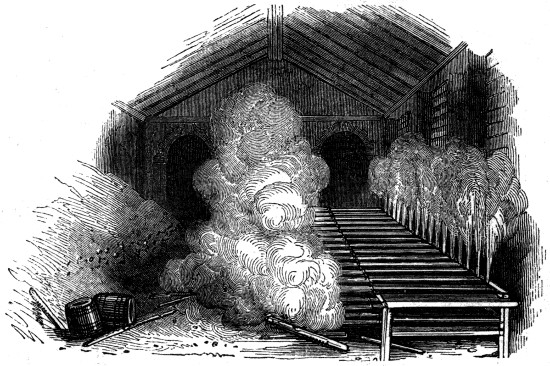
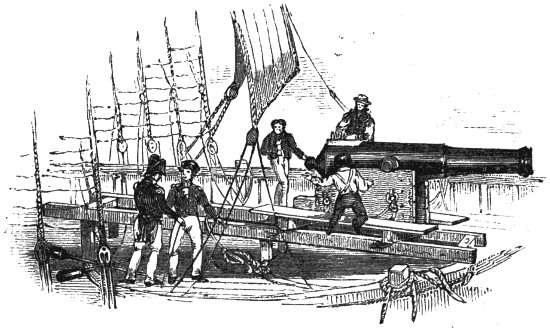
are used with traversing beds. The gun carriage,
when recoiling, in a backward direction, being driven
up an inclined railway, with from 3° to 4° of elevation,
from the cascable of the gun. This greatly tends
to lessen the distance which the gun would be driven
back, and facilitates the running out of the piece to
the point of discharge. The woodcut gives a representation
of the traversing beds; and the following
table displays the ranges, &c., of this class of heavy
artillery.
Range and Elevation, &c., of 12, 10, and 8-inch Guns, at Point
Blank and Extreme, and 10 and 8-inch Howitzers.
| Nature of Ordnance. |
Length. |
Weight. |
Charge
Powder. |
Point
Blank
Range. |
Extreme
Range. |
Eleva-
tion. |
| |
ft. |
in. |
cwt. |
qr. |
lbs. |
ozs. |
yards. |
yards. |
deg. |
| 12-inch gun, with hollow shot, weight 112 lbs. |
8 |
4 |
|
90 |
3 |
12 |
0 |
240 |
1,550 |
6 |
| 10-inch, with ditto, weight 86 lbs. |
7 |
6 |
|
57 |
3 |
7 |
0 |
210 |
1,500 |
6 |
| Ditto |
8 |
4 |
|
62 |
1 |
8 |
0 |
250 |
1,400 |
5 |
| Ditto |
9 |
4 |
|
84 |
0 |
12 |
0 |
325 |
1,700 |
5 |
| 8-inch gun, with hollow shot, 48 lbs. |
6 |
8 |
1⁄2 |
50 |
0 |
7 |
0 |
210 |
1,300 |
5 |
| 8-inch ditto, solid shot, 68 lbs. |
8 |
6 |
|
60 |
0 |
9 |
7 |
340 |
1,500 |
5 |
| Ditto |
9 |
0 |
|
65 |
0 |
10 |
0 |
300 |
3,250 |
15 |
| Ditto, hollow shot |
9 |
0 |
|
65 |
0 |
12 |
0 |
370 |
2,920 |
15 |
| 10-inch iron howitzers |
5 |
0 |
|
40 |
0 |
7 |
0 |
2 deg.
600 |
2,078 |
12 |
| 8-inch ditto |
4 |
0 |
|
21 |
0 |
4 |
0 |
3 deg.
730 |
1,725 |
12 |
Mortars are intended for three purposes; firstly,
to bombard a town, or injure the defenders’ artillery;
secondly, to fire or overthrow the works, and to spread
havoc and slaughter among the troops; thirdly, to
break through the vaulted roofs of barracks and
magazines which are not bomb-proof, or, in other
terms, are not strong enough to resist the fire.
They consist, as will be seen, of five descriptions,
but the 10-inch is considered, on the score of economy,
as equal to all useful purposes. The French have, at
various times, constructed mortars of enormously large
dimensions, but certainly with no useful result. The
monster mortar, used at the siege of Antwerp, fired
only ten or twelve shots, and with comparatively
little effect. It burst some time after, while under a
course of experiment, with a considerably less charge
than it had formerly withstood; thus affording one
very conclusive and illustrative fact in the theory of
vibrations in metals: for there can be no question but
that the shell, from the smallness of the charge, was
too long detained in the mortar; the waves of vibration
caused by the explosive force moving so rapidly
through the mass that the metal at last lost its cohesive
nature from their very rapid succession.
It will be perceived, on reference to the adjoining
tables, that ranges are obtained by the modifications
of charges.
English Mortar Practice.[3]
| 13-Inch Iron. |
10-Inch Iron. |
8-Inch Iron. |
51⁄2-Inch Brass. |
4 2-5th-Inch Brass. |
| Weight, 16 cwts. |
16 cwts. 2 qrs. |
8 cwts. 1 qr. |
1 cwt. 1 qr. 10 lbs. |
3 qrs. 19 lbs. |
| Shell filled, 200 lbs.[4] |
92 lbs. |
46 lbs. |
16 lbs.[5] |
8 lbs. |
| Bursting powder, 6 lbs. 2 ozs. |
2 lbs. 10 ozs. |
1 lb. 14 ozs. |
10 ozs. |
5 ozs. |
| Blowing powder, 2 ozs. |
11⁄2 ozs. |
1 oz. |
1⁄2 oz. |
1⁄2 oz. |
Ele-
va-
tion. |
Charge. |
Fuse. |
Range. |
Ele-
va-
tion. |
Charge. |
Fuse. |
Range. |
Ele-
va-
tion. |
Charge. |
Fuse. |
Range. |
Ele-
va-
tion. |
Charge. |
Fuse. |
Range. |
Ele-
va-
tion. |
Charge. |
Fuse. |
Range. |
| deg. |
lbs. |
ozs. |
inch. |
yards. |
deg. |
lbs. |
ozs. |
inch. |
yards. |
deg. |
lbs. |
ozs. |
inch. |
yards. |
deg. |
ozs. |
dr. |
inch. |
yards. |
deg. |
ozs. |
dr. |
inch. |
yards. |
| 45 |
2 |
1 |
1⁄2 |
1·90 |
450 |
45 |
1 |
0 |
1⁄2 |
1·90 |
450 |
15 |
0 |
14 |
|
0·80 |
500 |
15 |
6 |
0 |
|
0·73 |
350 |
15 |
4 |
8 |
|
0·80 |
450 |
| 2 |
3 |
|
2·00 |
500 |
1 |
2 |
|
2·00 |
500 |
1 |
0 |
|
1·00 |
550 |
7 |
0 |
|
0·75 |
400 |
4 |
12 |
|
0·85 |
500 |
| 2 |
4 |
3⁄4 |
2·10 |
550 |
1 |
3 |
1⁄4 |
2·10 |
550 |
1 |
2 |
|
1·10 |
600 |
7 |
8 |
|
0·80 |
450 |
25 |
4 |
0 |
|
1·10 |
540 |
| 2 |
6 |
|
2·20 |
600 |
1 |
4 |
3⁄4 |
2·20 |
600 |
45 |
0 |
9 |
1⁄2 |
1·90 |
450 |
8 |
0 |
|
0·85 |
500 |
45 |
2 |
6 |
|
1·65 |
300 |
| 2 |
7 |
3⁄4 |
2·30 |
650 |
1 |
6 |
|
2·30 |
650 |
0 |
10 |
3⁄4 |
2·00 |
500 |
25 |
5 |
8 |
|
1·10 |
480 |
2 |
9 |
|
1·70 |
350 |
| 2 |
9 |
1⁄2 |
2·40 |
700 |
1 |
7 |
1⁄2 |
2·40 |
700 |
0 |
12 |
1⁄2 |
2·10 |
550 |
45 |
4 |
8 |
|
|
300 |
3 |
0 |
|
1·80 |
450 |
| 2 |
11 |
3⁄4 |
2·45 |
750 |
1 |
9 |
|
2·45 |
750 |
0 |
13 |
3⁄4 |
2·20 |
600 |
4 |
12 |
|
|
350 |
2 |
12 |
|
1·75 |
400 |
| 2 |
14 |
|
2·50 |
800 |
1 |
10 |
|
2·50 |
800 |
0 |
14 |
1⁄2 |
2·30 |
650 |
5 |
0 |
|
1·75 |
400 |
3 |
4 |
|
1·85 |
500 |
| 3 |
0 |
1⁄2 |
2·55 |
850 |
1 |
11 |
|
2·55 |
850 |
0 |
15 |
1⁄2 |
2·40 |
700 |
5 |
4 |
|
1·80 |
450 |
3 |
8 |
|
1·90 |
550 |
| 3 |
3 |
|
2·60 |
900 |
1 |
12 |
|
2·60 |
900 |
1 |
0 |
|
2·45 |
750 |
5 |
8 |
|
1·85 |
500 |
3 |
12 |
|
1·95 |
600 |
| 3 |
5 |
1⁄2 |
2·65 |
950 |
1 |
13 |
|
2·65 |
950 |
1 |
0 |
1⁄2 |
2·50 |
800 |
5 |
12 |
|
1·90 |
550 |
|
|
|
| 3 |
8 |
|
2·70 |
1,000 |
1 |
14 |
|
2·70 |
1,000 |
1 |
1 |
1⁄4 |
2·55 |
850 |
6 |
0 |
|
1·95 |
600 |
|
|
|
| 3 |
10 |
|
2·75 |
1,050 |
1 |
15 |
1⁄4 |
2·75 |
1,050 |
1 |
2 |
|
2·60 |
900 |
|
|
|
|
|
|
| 3 |
12 |
|
2·80 |
1,100 |
2 |
0 |
1⁄2 |
2·80 |
1,100 |
1 |
2 |
3⁄4 |
2·65 |
950 |
|
|
|
|
|
|
| 3 |
14 |
|
2·85 |
1,150 |
2 |
1 |
3⁄4 |
2·85 |
1,150 |
1 |
3 |
1⁄2 |
2·70 |
1,000 |
|
|
|
|
|
|
| 4 |
0 |
|
2·90 |
1,200 |
2 |
3 |
|
2·90 |
1,200 |
1 |
4 |
|
2·75 |
1,050 |
|
|
|
|
|
|
| 1 |
4 |
3⁄4 |
2·80 |
1,100 |
|
|
|
|
|
|
|
|
|
|
|
|
| 1 |
5 |
1⁄4 |
2·85 |
1,150 |
|
|
|
|
|
|
|
|
|
|
|
|
| 1 |
6 |
|
2·90 |
1,200 |
|
|
|
|
|
|
|
|
|
|
|
|
| 13-Inch Iron. |
10-Inch Iron. |
8-Inch Iron. |
| Weight, 16 cwts. |
16 cwts. 2 qrs. |
8 cwts. 1 qr. |
| Shell filled, 200 lbs.[4] |
92 lbs. |
46 lbs. |
| Bursting powder, 6 lbs. 2 ozs. |
2 lbs. 10 ozs. |
1 lb. 14 ozs. |
| Blowing powder, 2 ozs. |
11⁄2 ozs. |
1 oz. |
Ele-
va-
tion. |
Charge. |
Fuse. |
Range. |
Ele-
va-
tion. |
Charge. |
Fuse. |
Range. |
Ele-
va-
tion. |
Charge. |
Fuse. |
Range. |
| deg. |
lbs. |
ozs. |
inch. |
yards. |
deg. |
lbs. |
ozs. |
inch. |
yards. |
deg. |
lbs. |
ozs. |
inch. |
yards. |
| 45 |
2 |
1 |
1⁄2 |
1·90 |
450 |
45 |
1 |
0 |
1⁄2 |
1·90 |
450 |
15 |
0 |
14 |
|
0·80 |
500 |
| 2 |
3 |
|
2·00 |
500 |
1 |
2 |
|
2·00 |
500 |
1 |
0 |
|
1·00 |
550 |
| 2 |
4 |
3⁄4 |
2·10 |
550 |
1 |
3 |
1⁄4 |
2·10 |
550 |
1 |
2 |
|
1·10 |
600 |
| 2 |
6 |
|
2·20 |
600 |
1 |
4 |
3⁄4 |
2·20 |
600 |
45 |
0 |
9 |
1⁄2 |
1·90 |
450 |
| 2 |
7 |
3⁄4 |
2·30 |
650 |
1 |
6 |
|
2·30 |
650 |
0 |
10 |
3⁄4 |
2·00 |
500 |
| 2 |
9 |
1⁄2 |
2·40 |
700 |
1 |
7 |
1⁄2 |
2·40 |
700 |
0 |
12 |
1⁄2 |
2·10 |
550 |
| 2 |
11 |
3⁄4 |
2·45 |
750 |
1 |
9 |
|
2·45 |
750 |
0 |
13 |
3⁄4 |
2·20 |
600 |
| 2 |
14 |
|
2·50 |
800 |
1 |
10 |
|
2·50 |
800 |
0 |
14 |
1⁄2 |
2·30 |
650 |
| 3 |
0 |
1⁄2 |
2·55 |
850 |
1 |
11 |
|
2·55 |
850 |
0 |
15 |
1⁄2 |
2·40 |
700 |
| 3 |
3 |
|
2·60 |
900 |
1 |
12 |
|
2·60 |
900 |
1 |
0 |
|
2·45 |
750 |
| 3 |
5 |
1⁄2 |
2·65 |
950 |
1 |
13 |
|
2·65 |
950 |
1 |
0 |
1⁄2 |
2·50 |
800 |
| 3 |
8 |
|
2·70 |
1,000 |
1 |
14 |
|
2·70 |
1,000 |
1 |
1 |
1⁄4 |
2·55 |
850 |
| 3 |
10 |
|
2·75 |
1,050 |
1 |
15 |
1⁄4 |
2·75 |
1,050 |
1 |
2 |
|
2·60 |
900 |
| 3 |
12 |
|
2·80 |
1,100 |
2 |
0 |
1⁄2 |
2·80 |
1,100 |
1 |
2 |
3⁄4 |
2·65 |
950 |
| 3 |
14 |
|
2·85 |
1,150 |
2 |
1 |
3⁄4 |
2·85 |
1,150 |
1 |
3 |
1⁄2 |
2·70 |
1,000 |
| 4 |
0 |
|
2·90 |
1,200 |
2 |
3 |
|
2·90 |
1,200 |
1 |
4 |
|
2·75 |
1,050 |
| 1 |
4 |
3⁄4 |
2·80 |
1,100 |
|
|
|
|
|
|
| 1 |
5 |
1⁄4 |
2·85 |
1,150 |
|
|
|
|
|
|
| 1 |
6 |
|
2·90 |
1,200 |
|
|
|
|
|
|
| 51⁄2-Inch Brass. |
4 2-5th-Inch Brass. |
| Weight, 1 cwt. 1 qr. 10 lbs. |
3 qrs. 19 lbs. |
| Shell filled, 16 lbs.[5] |
8 lbs. |
| Bursting powder, 10 ozs. |
5 ozs. |
| Blowing powder, 1⁄2 oz. |
1⁄2 oz. |
Ele-
va-
tion. |
Charge. |
Fuse. |
Range. |
Ele-
va-
tion. |
Charge. |
Fuse. |
Range. |
| deg. |
ozs. |
dr. |
inch. |
yards. |
deg. |
ozs. |
dr. |
inch. |
yards. |
| 15 |
6 |
0 |
|
0·73 |
350 |
15 |
4 |
8 |
|
0·80 |
450 |
| 7 |
0 |
|
0·75 |
400 |
4 |
12 |
|
0·85 |
500 |
| 7 |
8 |
|
0·80 |
450 |
25 |
4 |
0 |
|
1·10 |
540 |
| 8 |
0 |
|
0·85 |
500 |
45 |
2 |
6 |
|
1·65 |
300 |
| 25 |
5 |
8 |
|
1·10 |
480 |
2 |
9 |
|
1·70 |
350 |
| 45 |
4 |
8 |
|
|
300 |
3 |
0 |
|
1·80 |
450 |
| 4 |
12 |
|
|
350 |
2 |
12 |
|
1·75 |
400 |
| 5 |
0 |
|
1·75 |
400 |
3 |
4 |
|
1·85 |
500 |
| 5 |
4 |
|
1·80 |
450 |
3 |
8 |
|
1·90 |
550 |
| 5 |
8 |
|
1·85 |
500 |
3 |
12 |
|
1·95 |
600 |
| 5 |
12 |
|
1·90 |
550 |
|
|
|
| 6 |
0 |
|
1·95 |
600 |
|
|
|
| 13-Inch Land Service. |
10-Inch Ditto. |
8-Inch Ditto. |
| Greatest charge, 8 pounds powder. |
41⁄2 pounds. |
1 pound. |
| Greatest range, 2,706 yards. |
2,536 yards. |
1,720 yards. |
Weight of Land and Sea Service Mortar.
| Inches. |
cwts. |
qrs. |
lbs. |
Inches. |
| 13 |
|
Land service, |
|
Weight, |
36 |
2 |
0 |
Length, |
36·563 |
| 10 |
|
do. |
|
„ |
16 |
2 |
0 |
„ |
28·125 |
| 8 |
|
do. |
|
„ |
8 |
2 |
14 |
„ |
22·500 |
| 5 |
1⁄2 |
do. |
brass, |
„ |
1 |
1 |
15 |
„ |
15·104 |
| 4 |
2⁄3 |
do. |
do. |
„ |
0 |
3 |
20 |
„ |
12·713 |
| 13 |
|
Sea service, |
|
„ |
100 |
1 |
14 |
„ |
52·810 |
| 10 |
|
do. |
|
„ |
52 |
0 |
0 |
„ |
45·620 |
Carronades are a short description of ordnance
without trunnions, but fastened by a loop under the
reinforce. Their construction is materially different
from that of guns. They have a chamber like a
mortar, a part scooped out inside the muzzle, forming
a cup, and they have also a patch on the reinforce.
The name arises from the Carron Foundry in Scotland,
the first of them having been cast there in 1779.
The construction is considerably lighter than that of
guns of similar calibre. Their principal use is on
board ship; but they are sometimes used in casemates,
or retired flanks of fortresses.
The proportions of all guns to shot, will be found
below; and in looking at this table, it will scarce
be conceivable how such light guns can project such
heavy shot.
Comparative Weights of Guns and Shot.
| —— |
Weight
of
Guns. |
Com-
para-
tive
Weight. |
| |
cwts. |
|
| 12 |
-inch Gun |
90 |
|
1 |
to |
112 |
| 10 |
do. |
84 |
|
1 |
„ |
82 |
| 8 |
do. |
65 |
|
1 |
„ |
107 |
| 8 |
do. |
60 |
|
1 |
„ |
96 |
| 8 |
do. |
50 |
|
1 |
„ |
82 |
| 32 |
-pounder |
64 |
|
1 |
„ |
224 |
| |
Do. |
56 |
|
1 |
„ |
196 |
| |
Do. |
48 |
|
1 |
„ |
168 |
| |
Do. |
40 |
|
1 |
„ |
140 |
| |
Do. |
32 |
|
1 |
„ |
112 |
| |
Do. |
25 |
|
1 |
„ |
84 |
| 24 |
-pounder |
50 |
|
1 |
„ |
233 |
| |
Do. |
48 |
|
1 |
„ |
219 |
| |
Do. |
42 |
|
1 |
„ |
186 |
| 18 |
-pounder |
42 |
|
1 |
„ |
261 |
| |
Do. |
37 |
1⁄2 |
1 |
„ |
233 |
| 12 |
-pounder |
34 |
|
1 |
„ |
318 |
| |
Do. |
29 |
|
1 |
„ |
270 |
| |
Do. |
21 |
|
1 |
„ |
196 |
| 9 |
-pounder |
31 |
|
1 |
„ |
285 |
| |
Do. |
26 |
|
1 |
„ |
323 |
| |
Do. |
17 |
|
1 |
„ |
211 |
| 6 |
-pounder |
23 |
|
1 |
„ |
429 |
| |
Do. |
17 |
|
1 |
„ |
327 |
| 68 |
-pound Carronades |
30 |
|
1 |
„ |
59 |
| 42 |
do. |
22 |
1⁄4 |
1 |
„ |
58 |
| 32 |
do. |
17 |
|
1 |
„ |
62 |
| 32 |
do. |
25 |
|
1 |
„ |
96 |
| 24 |
do. |
13 |
|
1 |
„ |
55 |
| 18 |
do. |
10 |
|
1 |
„ |
56 |
| 12 |
do. |
6 |
|
1 |
„ |
56 |
The recoil, which in all the before-mentioned guns
is very great, arises from the blow communicated to
the iron in immediate contact with the explosive
fluid. The granulatory system of the metal transmits
to those grains, or crystals, immediately behind them,
the blow or concussion they are subjected to, and
these again to others, and so on, until the vibration
has passed through the metal, from the interior of the
breech to the exterior of the gun.
I am satisfied that in all small guns, from their
slight substance, recoil is communicated a great deal
quicker than in larger ones; hence arises the well-known
fact that in shooting you receive a knock
nearly simultaneous with the explosion. The greater
and heavier the gun (even carry it up to General
Miller’s gun of 84 cwt.) if the proportion which the
shot bears to it be not too great, the less will be the
velocity of recoil. But in carronades, as will be seen,
the proportions are as high as 1 to 55, while in long
guns, it is 1 to 429; a very considerable degree of
difference.
Our ancestors had but a limited knowledge of the
laws of projecting bodies by gunpowder. Their explosive
power was not good; for there is clear proof, even
since the time of Robins, that the purification of the
ingredients has nearly doubled the explosive force.
The mechanical construction and outer mould of
their guns, were calculated to resist and limit the
effects of recoil to a great extent.
Accumulation of metal in the rear of the breech-end
of a gun is true science, and of so easy an
attainment, that wonder arises in the mind why it has
not been effected. The extent to which this principle
is worked upon in our gunnery is very trifling;
though recoil can by this simple arrangement be
nearly destroyed, or so lessened as to add considerable
percentage of range to the projectile. Add
no considerable weight to the gun, but add it
judiciously, behind the end of the chamber and vent,
and immediately surrounding the breech. I have
tried this to a great extent, on a small scale, “with
fowling-piece barrels,” and find that the greatest
advantage arises from an additional inch of metal
to the extreme end of the barrel, as the recoil is
thereby lessened; while, on the contrary, by reducing
the exterior end of the breech, until it becomes
of less thickness than the sides of the barrel,
the recoil is doubled. Guns will some day be
constructed as mortars are, with the axles, or trunnions,
in rear of the tube and of the vent; for by
this arrangement recoil would act less on the mass
of metal forming the gun, and more on the base
from which it is fired. We are quite aware that an
arrangement of this nature could only be applied to
certain descriptions of ordnance, and in certain
situations; but on forts, or batteries commanding
rivers and bays, and even in the bows of steam vessels,
they may be placed with great advantage. But this objection
may be started: “You could not use guns fitted
in this manner horizontally, or nearly so.” Why not?
The muzzle could be as easily raised or depressed as
the breech, by mechanical means. I should much
like to see the principle tried, and I hope to do so.
The following results of experiments prove, that if
a true basis is not laid down, all the fabric raised
upon it is but one of sand, which will crumble
away from under us. Hutton says,—“Varying the
weight of the gun, produced no change in the velocity
of the ball. The guns were suspended in the same
manner as the pendulous blocks, and additional
weights were attached to the pieces, so as to restrain
the recoil; but although the arcs of the recoil were
thus shortened, yet the velocity of the ball was not
altered by it. The recoil was then entirely prevented,
but the initial velocity of the ball remained the
same.” No doubt this was the result of his experiments
by the pendulous suspension of the gun:
but here he erred; for had he suspended a thousand
tons to it, without incorporating it in the gun, the
result would still have been the same. All the
improvements effected, or yet to be accomplished, will
be obtained by a concentration of metal.
An excess of weight in the fore part of a gun is very
injurious, by inducing and lengthening the tremulous
vibration created by the explosion. The only necessity
for strength forward in a cannon, arises from the
necessity of resisting the lateral pressure from the
condensation of the column of air in the tube. The
pressure of the explosive gases is, by the velocity
obtained before reaching the fore part, of very little
amount, from the short period it is exerted on the
interior. Therefore weight, in the fore part of a gun,
be it ever so great, will not prevent recoil if there is
not a proportionate quantity behind. It will retard or
lessen the distance to which the recoil will drive the
gun and carriage, but the evil is then over.
If the slightest movement occurs in the gun, the shot
is projected from an unsound base or foundation. It is
precisely similar to a man who, in the act of throwing
a stone, slips his foot backwards: the effect is at
once apparent on the stone. If the trunnion of a gun
breaks in the discharge, or a quoin flies out, the shot is
materially affected; never ranging, under such circumstances,
the accustomed distance, nor with its usual
accuracy. Practice with mortars proves beyond dispute
the necessity of a firm base for the gun, for with a
much less charge they project a greater mass farther.
A mortar discharged on land, exceeds in range the
same description of gun on board of ship, or on the
best-constructed platform. In truth, this is but
another illustration of a law of nature: if you have
not a solid fulcrum, it matters little what the power
of your lever may be. Gunpowder is a powerful
lever if exploded on a solid base; if not, its effects
become limited in proportion. Unquestionably, much
may yet be gained by an economical arrangement of
our projectile force. Great and rapid as have been the
acquisitions of knowledge in everything relating to
gunnery in modern times, there still remains, I have
no doubt, an unexplored mine of valuable treasure to
be added to the science.
It would effect a great improvement in the mortars
used by the navy, destroying the tremendous vibration
and shake given to the ship, increasing their efficiency
and aiding the projecting power, to place them on beds
of the softest lead, not less than twelve inches in
thickness. Though this suggestion is only theoretical,
experience would soon determine the least degree of
substance available. Advantage would arise, in the
first place, from the non-conducting tendency of the
lead; in the second, from its density, and, of course,
incompressibility. The one protecting the ship, the
other being the most solid bed for the mortar that can
by possibility be obtained.
The weight of a hollow 13-inch shell is 190 lbs.;
the bursting powder 6 lbs. 8 oz.; the weight, if cast
solid, would be 290 lbs.: thus the action of so large
a body on the atmosphere must be immense of itself.
There seems to be much difficulty in projecting
masses of great diameter, from this cause; and this
should lead us to seek, as indeed it points to, another
material for fabricating projectiles. As weight is less
in substance, and, of course, less in space, much less
resistance, in proportion, will exist in a bore of six
inches than in one of twelve; and a greater projectile
force will be generated with fewer countervailing
disadvantages.
The first step in the vast improvements about
to be effected in gunnery, has been successfully
taken by Mr. Monk, of Woolwich arsenal, who has
induced the authorities to allow a gun to be made from
drawings and calculations of his own. The dimensions
of the gun are as follows: length from cascable to
muzzle, 11 feet; weight, 97 cwt. 3 qrs.; bore, 77⁄10 inches;
weight of solid shot, 55 lbs.; shell, 42 lbs.; windage,
0·175; charge, 16 lbs. of powder; giving a range, at
32° of elevation, of 5,327 yards. A compound shot,
(a shell filled with lead), was projected 5,720 yards, or
three miles and a quarter, at a velocity, during the
first second of time, of 2,400 feet per second, and
occupying during the whole flight only 291⁄2 seconds.
The comparative weight of gun and shot is 1 to 220.
A course of experiments, extending over seventeen
years, has firmly established this gun as the best ever
yet constructed. Many attempts have been made to
excel it, but all have failed. Guns have been made
on drawings varying not more than three-tenths
of an inch in their dimensions from those of his
gun, and, with extreme modesty, the individuals have
claimed a right to compete with Mr. Monk; and
have even obtained competing trials, without any
claim whatever to the discovery of the principle of
it; coming into competition by no just claim or
merit, but solely from the tendency to supersede any
improvement emanating from a civilian. Eighteen,
twenty-four, and thirty-two pounders are now, however,
constructed on this model;—indeed the
improvement is so great and so apparent, as to
overcome every obstacle as yet thrown in its way.
With no wish to detract from the merit of Mr.
Monk’s invention (upon which I congratulate him and
the country) but, in justice to myself, I may remind
some of my readers, that in “The Gun,” published
early in 1835, I clearly laid down the principle in
projectile force, on which this gun is constructed;
and as he has since so successfully accomplished this
great improvement, he must permit me to say, that
the principle is the same which I have striven for, for
many years.
Wilkinson says, “Guns cast on this principle,
although several hundredweight lighter altogether,
recoil less than those on the old plan, with equal
charges of powder and ball, in consequence of the
weight being properly distributed.” He adds, “One
remarkable fact attended these experiments, namely,
that by increasing the windage a little, the range was
increased also, contrary to the received opinion; but
this may be explained by the circumstance, that with
very great velocities, and long guns, the column of air
to be displaced before the ball quits the gun is considerable,
and is condensed so rapidly, that it offers
immense resistance to the passage of the bullet, if it
fit the bore closely; but, by reducing the size of the
ball, and thus increasing the windage, the air has
more space to rush round it, and the ball escapes with
greater facility.”
If the condensed air prevented the velocity being
greater, it argues most clearly, that there was an
insufficiency of explosive matter to keep up the
velocity until the ball of less windage left the muzzle;
and the result with the ball of greater windage establishes
this assumption. For if the condensed air
was allowed to pass the ball by the windage into the
tube, it proves beyond doubt that there was a deficiency
of matter there, or that the pressure without
was greater than that within. How otherwise could
such a result occur? It is a clearly established fact,
that with the generality of ordnance, a full waste of
one-fourth of explosive force, if not more, occurs by the
elastic fluid escaping past the ball by the windage, instead
of the reverse. Neither could the condensed air
rush into the gun by the windage if there are any permanent
gases generated; which Mr. Wilkinson himself
says there are, to the extent of “250 times the bulk of
the powder in grain.” These would offer a sufficient
resistance to prevent the condensed air rushing in.
I have found, by an experiment before described, that
a ball driven against a column of air which has no
escape, if the velocity be trifling, say 800 feet per
second, the air will escape by the windage; but double
this even, and it is so condensed as to form a cushion
for the ball to strike against. Then how much less
will the chance be of its escaping, if the velocity become
two thousand four hundred feet per second. No, the
cause is remote from that of Mr. Wilkinson’s supposition.
There is a want of force—an accelerative propellant
force—which should continue to the end of the
tube, be that length ever so great; and on this point, for
one, turns the whole future improvement of gunnery.
The result wished for can be obtained by a systematical
arrangement of the granulation of powder.
That a much greater velocity than is obtained in this
gun—at present the greatest in any piece of ordnance
in use, and possessing a longer range than has been
obtained by any power in Europe—may and will be
attained, I fearlessly assert. I have obtained a velocity
with an ounce ball nearly doubling this; and though,
as it will be argued, this may be too limited an experiment,
yet let us not forget that great results most
frequently spring from little causes. Large rivers owe
their origin to small springs, and if the same principle
by which we can penetrate a plate of iron half an inch
thick with an ounce of lead, be fearlessly and judiciously
carried through, we may (and no doubt we shall)
live to see projectiles thrown 51⁄4 miles. That this will
be difficult to accomplish I deny: no difficulty attends
it, provided the principles before explained are duly
carried out.
The great principle in a propellant force is so to
arrange it that you do not obtain too great a velocity
at the first move of the projectile; as no mass can be
forced from a state of rest to a rapid state of motion,
without communicating to the gun a corresponding
motion, which will create a recoil: and the greater the
motion, the greater the recoil. If the explosive matter
merely expands for a brief period, and is burnt out
before the shot has reached midway the length of the
gun, the velocity there acquired will be reduced, by
the condensed column of air in the other half of the
barrel, to the velocity it possessed when only one
fourth the length of the whole from the breech; consequently
it would be advantageous to cut the gun in
two at the middle, as a greater force would be then
generated advantageously, than by the whole. But
if you so arrange the granulation of your powder
that it shall proceed into motion more gradually, a
rapidly increasing force of elastic fluid will continue
to be generated, until it reaches its greatest maximum
of velocity (which it should do just as the ball leaves
the muzzle) then you obtain with your means the
greatest result possible.
We believe that the generality of gunpowder used
by our Government is vastly inferior in strength to
some made by private makers; yet it is not advisable
to jump from one extreme to another. What is
wanted is the proper blending of the qualities; an
addition of a quantity of Harvey’s quick powder to a
charge, when it has driven the ball up three-fourths
of the tube of a gun, and probably had acquired a
velocity of 2,000 feet per second, might so aid it, that
it would leave the muzzle with a velocity of 3,000.
You cannot put a locomotive train in motion at
once: if it were attempted, you would break all the
carriages; but if you gradually add your force, you
gain in time the greatest possible velocity. I have
drawn a parallel case: it is the same with gunpowder;
only the velocities are widely different. Therefore,
I may be pardoned, if I say gunnery is like steam,
but in its infancy. Let us but clearly see and
understand aright the principle—knowing that the
greater momentum the less the action of the atmosphere—and
if 31⁄4 miles can be obtained with a ball
60 lbs. weight, 51⁄4 may be easily accomplished by a
ball of 120 lbs. Powder is made, and can be had, that
will do this.
The use of compound-shot has of late years become
quite common in experiments: why lead, with its
alloys, has not been more extensively used as a projectile
for large guns, has always appeared to me
extraordinary. Its weight and density peculiarly fit it
for this purpose, and its non-conducting principle is its
greatest recommendation. How is it? In no instance,
except as compound-shot, do we find any record of the
use of leaden bullets on a large scale, save in Sir
Howard Douglas’s “Naval Gunnery,” where, in a note,
he says, “A very distinguished naval commander
mentioned to me, that he knew a person who had
served in an American privateer, which, being out of
shot, and unable to procure a supply of iron balls,
used leaden shot as substitutes. This person always
mentioned with great surprise the superior effect of
leaden balls.” Well he might; for the reader need
not be told that its greater specific gravity would add
to its momentum, and a longer medium velocity be
retained during its flight. But it possesses another
recommendation, superior to all these, in warfare:
that of communicating all its force, all its velocity, be
they ever so great, to the body struck. Iron does not
possess this quality; except to a certain extent, and that
at low velocities. Hence the cause of its being found
in naval warfare, that balls at low velocities damage
and destroy ships’ sides more than at higher velocities,
even when passing quite through. Lead, in the act of
striking hard substances, iron or stone for instance, is
partially flattened, until the flat surface is nearly equal
to the diameter of the sphere of the ball; thus parting
with all the force it struck the object with, and in
most instances falling motionless at the base of the
object struck; while in the stone, the surrounding
crystals or grains are, by their abrasion on each other,
pounded into dust, in proportion to the size and force
of the body of lead striking them: in many instances to
many times the shot’s bulk, and only flattening the lead,
less or more, in proportion to the capability of the stone
to resist. Iron striking stone retains its shape: the
grains are driven back upon each other, and each
offering its proportion of elasticity, the ball is enabled
to rebound back; which it does in many instances to a
considerable percentage of the whole distance it had
been projected. The greater the velocity with which
an iron ball is projected the greater the rebound back
from a hard substance such as stone. Reversely,
the greater the velocity of lead, the greater its
effect on the object struck. Walls or fortifications
struck by leaden balls at the same velocities (waiving
the advantage to lead by its greater specific gravity)
would be pounded into sand by less than two-thirds
the same number of lead as of iron shot. Any unprejudiced
person may soon satisfy himself of this, by
trying it with a musket or fowling piece. A leaden
ball will pound itself a hole many times its own bulk,
while an iron ball will not make a hole half its size.
I have tried many experiments to ascertain the
penetrating powers of iron and lead relatively, by
striking various objects, from a boiler plate of half an
inch thickness down to fir deals. The same size of
lead will, under certain circumstances, punch a perfect
hole in a plate of half-inch thickness, as I shall have
occasion to show; while, under precisely the same
arrangement, the iron ball would rebound back with
very little diminution of force; and if the plate of
iron be at a perfect right angle, the iron ball would
nearly return into the muzzle, of the gun. In truth, I
had a narrow escape seventeen years ago, from a bullet
actually cutting the rim of my hat: so that it will be
well, when experimenting in this way, to be sure that the
person is well esconced, for fear of unpleasant results.
Lead, therefore, for destroying ships, as well as stone
walls, is unquestionably highly advantageous; even if
projected with the same velocities as at present adopted
for iron. The additional weight would not decrease
the destructive effects; it would augment them. I
perfectly agree with the American privateer, that the
wonderfully destructive power of leaden cannon balls
will create surprise, whenever they shall come generally
into use. Imagine the effect from a gun of the
dimensions of a 10-inch bore. It is dreadful to contemplate.
The effect of lead will be easily understood when
explained in the following way. If a 36 lb. shot have
a velocity of 2,000 feet per second, the force is equal
to the velocity multiplied by the weight, or 72,000 lbs.
The whole of this force would strike a wall, and be
left there, if communicated by soft lead; if by iron,
at the same velocity, it would be minus the amount of
force required to make it rebound to the great distance
to which iron invariably returns. Though created by
the elasticity of the iron itself, this must be deducted
from the effect produced, and hence arises the great
advantage the lead possesses. We are aware that
iron driven with a slight velocity rebounds less; true,
and less is its real effect; for under the very same
circumstances would the great advantages of the lead
predominate. It may be objected, that lead is too
easily misshaped; “pure it is, but with alloys not
so.” At low velocities it might, but the greater
velocities diminish that chance, as it is a well known
fact that all dense incompressible bodies are least
affected by an extremely sharp motion. All our
arrangements in warlike preparations, at present,
involve great weight of projectile for fracturing, not
perforating. During the siege of Ciudad Rodrigo,
2,159 rounds, of twenty-four and eighteen pounders,
were requisite to form the small breach of thirty feet
wide, and 6,478 rounds for the larger of 100 feet.
At Badajos there was expended, to form three breaches
of 40, 90, and 150 feet respectively, the enormous
amount of 31,861 rounds of the same sized iron shot.
We may be pardoned if we presume to say, one-half
the number of lead shot would have done more, and
done it better.
If we bear in mind, that the whole round of experiments
from which Hutton drew his deductions, were
conducted with iron projectiles, the inconsistency of
taking his data as the standard will be apparent.
The dissimilitude of specific gravities being great,
namely, 7,425 and 11,327—or one-third difference—it
clearly shows, without any effort of the imagination,
that the range must be in the same proportion, with
the addition of greater momentum. For it will
scarcely be denied, that a ball of gold or platina, from
the same cause, will maintain a velocity longer, and
consequently range further, than even lead. Hutton’s
theory only establishes the principle, that the lighter
the body projected, the sooner it is acted upon by
atmospheric resistance, and a medium velocity induced.
We cannot attribute his preferring iron to arise from
an opinion of its penetrating to greater depths; for a
man of his extensive knowledge and research could
scarcely be guilty of such an error. But even in our
enlightened times we are told that elephants cannot
be killed with any projectile but steel: leaden balls
cannot do it. I should like to try, and receive the
tusks in return.
The shrapnell shell (invented by General Shrapnell),
or spherical case shot, introduced into the British
service of late years, is probably the most destructive
of any missile in use. It was intended to supersede—which
it has done—canister and grape shot; effecting
the same results at treble the range. The construction
and principle are very simple, being merely
a shell of an unusually light description; in fact,
little more than a light cast-iron hollow ball, with a
fuse hole. A certain quantity of leaden, or iron
bullets is put into it, and the interstices around the
ball shaken full of powder; a fuse of the length
required is inserted, and explodes the shell during its
flight: the peculiarity being, that the body of small
balls retain their medium velocity and travel on,
merely diverging, latterly, like an immense charge of
bird shot. They are usually fired from howitzers,
carronades, and other wide bored-guns, at or near
horizontal ranges. A considerable delay occurred
before they were successfully perfected. It was found
that when the small balls did not pack perfectly tight,
or were packed overtight, the case frequently exploded
in the gun: occasioned, no doubt, by the friction
creating a spark at the moment of the howitzer being
fired, and thus exploding the shell before its time;
but we believe such an occurrence rarely happens now,
from other improvements since adopted.
The preceding pages appeared in my last work
published in 1846. They are still so much in keeping
with the state of gunnery at the present day, and
so prophetic of what has, and is about to occur, that
they will be regarded, I trust, as bearing the stamp
of authority.
Progress, in its rapid advance, has made many
English guns objects for the furnace or the museum;
and many guns, which formerly ranked high as
useful and important weapons, have become things
of the past.
Monsters are now all the rage, with a range of
three miles, and artillerists contemplate extending the
range to double that distance; whilst the projectiles
used are not “pounders,” but approximating to tons.
So much for improvement. In political economy we
are told that improvement to be good must be
gradual; but only effect some slight improvement
in gunnery, make but one step in advance, and the
desire for further improvement then ranges at will,
and impossibilities are craved for and sought to be
attained.
Twelve years ago the success of Mr. Monck (certainly
the first modern improver of ordnance,) led
to the unlimited production of undigested plans for
changes in gunnery; but, unfortunately for the science,
no progress was made on the one great improvement
of Mr. Monck.
War found us ill prepared in the field, and out-weighted
“afloat,” so that almost as many men were
killed by the bursting of mortars, and other ill-constructed
guns, as by the fire of the enemy: so critical
was our situation, indeed, that but for the general
adoption in England’s army of my great invention,
the rifle on the expansive or “Greenerian” principle,
and its skilful use by our brave soldiers, the war
had gone against us. Our rifles were equal in range
to our artillery, and this saved us; whilst the enemy,
astonished at the effects produced by our bullets, and
conscious of their inferiority both in the construction
and use of small arms, abandoned the contest: but no
doubt with a firm determination to profit by their
dear-bought experience.
It is generally admitted that our artillery was
never so effective as that of the enemy, and that more
is due to the patient and enduring bravery of the
British soldier than to our field-pieces and heavy
ordnance. That England’s artillery was at this time
most disgracefully inefficient, it would be folly to deny.
The larger guns were destroyed in an inconceivably
short space of time. After five, ten, or fifteen rounds
were fired the guns burst, killing the gunners in great
numbers.
The readers of my works are already familiar with
my opinions on this subject, and their value will now
be enhanced by the fact that they have been proved
to be the opinions of a “practical man.” Success in
the improvement of small arms is a sure encouragement
to those anxious for the advancement of projectile
science, and it is a coat of mail in which to fight
against the prejudices and incompetency of official
management.
Who, on reading my work of 1841, believed the
prediction I therein made, that small arms would be
produced which would render field guns useless?
The fact is, however, firmly established, that the
best rifles on my principle will out-range by several
hundred yards the best “six-pounder” in her
Majesty’s service; and that, too, with a repetition
of fire wonderfully quick and effective: as the Russians
in the Crimea can testify, on more than one
occasion.
To endeavour to point out that an improvement
may be effected in artillery equal to that which has
been effected in small arms, is the object of the
following pages.
The author asks a dispassionate perusal and careful
study of his work, in justice to himself and to
the importance of the subject. Judging of future
probabilities by what has already been accomplished,
the reader will be prepared for what follows. That
great and important changes must take place in artillery
cannot be doubted, and should England refuse to
avail herself of the improvements to be effected, other
nations, and amongst them our late opponent, will be
the first to seize and adopt them. In former works
I have asked the indulgence of my military readers on
account of my scanty military knowledge; but professional
men appear to be equally in the dark with the
uninitiated: indeed, the lamentable shortcomings of
the English artillerists have placed them in the rank
of mere “waiters upon providence” for the next step
towards improvement. The present time is decidedly
propitious; let improvements now be made, and we
may surely hope that they will be appreciated by the
public, if not by the Government authorities.
What is the best metal for cannon? is a question
which has often been asked, and the answers have
been very conflicting. Some have advocated mixtures
of copper and tin; others have advocated cast iron,
and more recently wrought iron; still more recently
steel, and, lastly, cast steel, have had their advocates.
Arguments as plentiful as summer flowers
have been advanced in favour of each, and the argument
has been carried on with a vast amount of
prejudice and warmth, according to the degree of
acquaintance with or attachment to the favourite
metal of each individual. It is rare to meet with a
mind free from bias, equally well acquainted with the
merits of the several metals, and their application to
the purposes intended. Still more rare is it to meet
with a mind possessing all this metallurgic knowledge,
and combining with it an intimate acquaintance
with the principles of projectiles, as well as a scientific
knowledge of the construction of the engine (the
perfection of which consists in its having no points
which are weak or unnecessarily strong); and yet it
is by such a combination of knowledge and the application
of these principles that we must be guided, if
we would be successful in the accumulation of projectile
power. In the present age we are really alive
to the advantage of “playing at long bowls;” and the
question now to be determined is, what is the greatest
weight of shot and shell we can throw, and how
many miles can we project it. The Americans were
undoubtedly the first to discover the great advantage
of this question with their lesser frigates; the late war
has developed it still more; and it now remains to
be ascertained how much further can we go. For on
this important point the superior efficacy of artillery
depends.
At St. Sebastian, in 1813, cast-iron guns threw
tons of shot at a range of 1,500 yards; some particular
guns firing as many as 3,000 rounds, and yet it is
more than probable that had the same guns been used
in the Crimea, they would have burst with one-fourth
the number of rounds. Experience proves that it is
not the great number of rounds fired which strains
and destroys the gun, but the high elevation at which
these guns are placed, in order to get range; this it
is which shakes and disintegrates the crystalline
structure of the metal, and thus extreme range is
obtained at extreme cost. A gun which at 6° of
elevation could stand without a strain 200 rounds,
would be likely at an elevation of 30° to burst before
50 rounds were fired. The explanation of this is
sufficiently simple. A gun fired at 6° recoils as the
projectile is projected forward, in proportion to its
relative weight and friction; but when brought up to
an elevation above 30° the gun is entirely out of the
horizontal, and cannot recoil as it does at an elevation
of 6°: the force is now exerted downward, and the
gun impinges on its support—i. e., either upon its bed
on the deck of the ship, or on the solid earth of the
battery, which is comparatively immovable; thus the
force which displaced the gun in the first instance is
now exerted on the sides of the gun, and the projectile
receiving additional force is projected further.
But this increased range is obtained at the expense of
the gun, which is rapidly destroyed: 50 rounds being
sufficient to render it unfit for service. To obviate
this rapid destruction of cannon, the metal has been
changed from the molecular to the fibrous; that is
from cast iron to wrought iron. One object of this
chapter is to point out the difficulties which arise
in determining what the best metal for cannon really
is, and to show the advantages to be gained by
attending to the proper construction of projectile
engines, without attaching undue importance to the
material of which they are made.
Before rejecting cast iron as useless for the construction
of large guns, it would be well to assure
ourselves that no better quality of metal can be
produced than that which is at present manufactured.
We must also satisfy ourselves that we have clearly
understood the proper shape and form of cannon to
resist concussions. These concussions, be it remembered,
were more violent in the late than in any previous
war; and it is an undoubted fact that we had many
more fractures then than on any previous occasion:
first, on account of the strain produced by the great
elevation required to get increased range; and,
secondly, on account of the imperfect shape of the gun.
The average number of rounds fired from the 13-inch
mortars which burst at the bombardment of Sweaborg
was 120, and the fracture in all was peculiarly alike;
being at right angles to the supports. Now, that this
is due to the form of the gun cannot be doubted; and it
will be shown more fully in a subsequent page.
But there is another cause to which I wish now to
direct attention, viz., the jamming of the Lancaster
shell, which takes place in the increasing spiral of the
oval gun at the very point where the projectile acquires
a proportional increase of velocity. The effect of this
may be illustrated by running a locomotive at its
maximum of speed over an increasing curve in the
railroad, with the certainty of landing it in an adjoining
ditch. The principle which determines the result is
quite immutable: viz., that matter in rapid motion
cannot be materially affected by any force inferior
to the primary force: the tendency of the body being
to go straight forward; whereas a slow train goes
round a curve with the greatest ease. Two motions
can easily be given to matter in a lower velocity; but
not so easily when the velocity is much increased.
Hence I fear that the inventor of the Lancaster gun
must have had a misconception of the true laws of
motion; for by increasing the degree of spiral at the
muzzle, instead of at the breech of the gun, he has
rendered nearly useless what would otherwise have
proved a most formidable engine of war.
From these observations it may, I think, fairly be
doubted whether the bursting of cannon is owing
entirely to the inferior quality of the cast iron used
in their formation; though there can, I think, be no
doubt that English cast iron is not only much inferior
to what it formerly was, but that it is also inferior to
that which is now manufactured in Russia. Why it
is so will be subsequently explained.
These defects in cast iron have naturally led to many
attempts to substitute for it a more durable metal;
and in most cases the metal selected has been wrought
iron. Wrought iron has been used, not only in solid
cannon, but in the original “hoop and stave:” “staves
outside,” and “staves inside,” as in Mr. Mallet’s
monster mortar. Forms of gun as numerous as can
be conceived have been constructed, only to prove
themselves in every case most complete failures. Our
friends at the Mersey Works, Liverpool, will, no
doubt, demur to this assertion; as “all creations of
the mind appear most perfect to the father of the
thought.”
Great credit is, however, due to the enterprise
and energy displayed by the inventors, forgers, and
finishers of this great gun; which has been the
wonder of many minds in this age of wonders: and
it is a highly important invention, as showing what
we, as a people, are capable of producing by our
mechanical and engineering skill. But here, in my
estimation, the wonder ceases; for so sure as there
is any truth in the Scotch proverb, “A silk purse
cannot be made out of a sow’s lug,” so surely is it
true that no man, however great his genius and
working powers, can make a good cannon of wrought
iron. When the hardness and ductility of silver can be
imparted to and held by lead, then will it be possible
to make wrought iron accomplish all the purposes
required of a good cannon.
In vain may Mr. Horsfall urge that his gun has
never been burst. Why? Simply because it has
not yet been subjected to the same amount of pressure
on the square inch; neither has it been tested
at the same elevation as some other 10-inch guns,
which, in proportion to their size have stood a more
severe test. It is a fact, which may be clearly
demonstrated, that if a 10-inch gun of 95 cwt. be
fired at an elevation of 40° with 17 lbs. of gunpowder,
then a gun of more than six times that weight would
not be overloaded if its due proportion of powder
were about 100 lbs. Has this gun been fired with
one half of this? Until it has been satisfactorily
proved to this extent, we feel sure that the authorities
are justified in not considering Mr. Horsfall’s a
successful achievement.
Whatever may be Mr. Horsfall’s impression with
regard to the advantages of wrought iron for making
cannon, I am satisfied, after a long and careful study
of the results of all its varieties, from the most
ordinary to the most perfect combination that has
been manufactured—either for tenacity, tenuity, or
resistance of lateral pressures—that it cannot answer
in large guns.
This I think any one will admit, after considering
the two following facts; which apply equally to all
varieties and mixtures of wrought iron.
1. The strength of iron is at its maximum in the
smallest mechanical structures.
2. The quality of the metal is improved as it is
subjected to greater pressure and condensation.
The extent to which this improvement may be
carried has never yet been ascertained; every fresh
manipulation improves its quality. The tenacity of
wrought iron is best displayed in a wire, drawn out until
it is not thicker than a human hair. Large masses
of wrought iron are weak and spongy in geometrical
progression with the mass, and the crystalline or
molecular form increases with the mass. If large
forgings are carefully examined, crystals will be found
whose facets would produce inches of surface; as was
clearly demonstrated by the bursting of a 10-inch
gun at Woolwich: made, if we mistake not, by Mr.
Nasmyth.
Another very important cause which renders large
masses of wrought iron unsound (and which was
fatal in Mr. Nasmyth’s gun) is the impossibility of
condensing tons of wrought iron equally all through
the mass. No one has yet been able to overcome
this difficulty.
When the force of a blow, however great, is exerted
on the surface of a mass of metal, its effect is neutralized
within a few inches of the surface; condensation
takes place in inverse ratio from the point of
impact, and thus the effect is limited. The force
which produces this condensation tends also to
elongate the fibres of the metal. This elongation
is greatest in the immediate vicinity of the force;
the fibres in the interior of the mass are less
elongated therefore than on the exterior; and the
fibres in the interior of the mass being less ductile
(from the cause already explained) than those on the
exterior, the interior of the mass elongates, by disintegration
of its fibres or crystals, and a porous open
mass is thus produced, surrounded by a fibrous case.
Instances of this are to be seen in broken engine-shafts
and anchors; and, indeed, in all large masses of
wrought iron, whether fractured by design or accident.
Another cause of this defect in large masses of
wrought iron, is the long continued heat to which it
is necessary to expose such large forgings. The iron
expands as it is heated, but it does not expand
equally all through the mass; and the result of this
is that the interior becomes porous and spongy: an
appearance which must have been observed by every
one who has operated upon large masses.
The shaft of the Leviathan weighs 26 tons; but,
instead of resisting twenty-six times the pressure of
a shaft one ton in weight, it will, from the causes
already mentioned, be found unequal to half that
amount.
We have watched with much interest the forging
of these immense shafts; and the difficulties attending
the forging of this structure prove the accuracy
of our reasoning on the strength of large masses of
wrought iron. The weight of the shaft when finished
is 26 tons, and the waste during the process of
welding amounts to 74 or 75 tons.
The present shaft is the third which has been
manufactured; the two first having proved notorious
failures: thus 200 tons of iron have been wasted;
which we think is sufficient proof either of the
unfitness of the material, or of imperfection in the
method of construction. Moreover, I fear that when
the vessel encounters a rolling sea, the sudden check
and strain produced by the total immersion of one
paddle-wheel and the freedom of the other, will subject
the present shaft to a strain which will affect its
duration; and a vessel costing nearly a million of
money may thus be left to reach her port with crippled
powers of propulsion.
Where, it may be asked, is the skill in devising
engines more powerful than the ingenuity of man can
beneficially work out? This has indeed been done in
the case of the Leviathan; a monster vessel has been
built, but all the engineering skill expended upon it
has as yet been insufficient to bring it to perfection.
The skill hitherto displayed in welding large
forgings of wrought iron into shafts, or other large
masses, has been of a very low order; much more
may be done than has yet been accomplished, if men
will only set about it in a scientific manner. The
present mode of proceeding is to build a structure of
iron much as a builder would raise a structure of
bricks; large and small pieces being mixed together
until the requisite mass is obtained.
Now, a much simpler method, and one which we
have tried on several occasions, is first to construct
several segments of iron of the requisite length, and
of dimensions equivalent to the intended object; each
segment being fitted to fill its place amongst a given
number of other segments (whether twenty, forty, or
fifty segments be required,) so as to form a complete
cylinder; as the wood-cut will fully explain:—
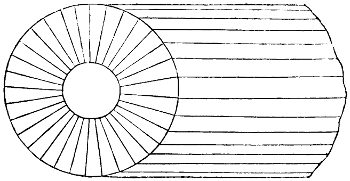
In welding this structure, the heat is equally
diffused all through the mass; and thus the great
evil of unequal expansion and contraction is avoided.
When the steam hammer is brought into play, its
face is a “swage” of circular form, calculated to clasp a
large portion of the upper part, whilst a corresponding
space is formed in the anvil; and by gradually turning
the shaft, the whole is forged into a perfect round.
The peculiar advantage gained by this mode of proceeding,
is not only the facility with which heat is diffused
through the mass, but that each segment is made
to act like a wedge on its neighbour; thus producing
the most solid forging that has yet been attained.
This is rendered still more perfect, both as regards
strength and durability, from the fact that a hollow
axle has been produced; the great advantages of
which it would be out of place to dilate upon in this
work.
We trust that these anticipated misfortunes may be
avoided by the construction of a more perfect shaft;
and that, not only for the sake of the shareholders,
but for the credit of the engineer who devised this
great vessel—deservedly one of the wonders of the
world. A spare shaft would be profitable ballast, if
of no more value to the Leviathan.
Rolled railway-carriage axles were constructed for
me with perfect success on this principle nearly twenty
years ago, at the Walker Iron Works, near Newcastle-on-Tyne.
The idea has, however, been in a
measure “shelved;” but necessity will bring it into
use again.
The only engineer who has, by practical experience,
satisfied himself that large masses of wrought iron
are totally useless for making heavy ordnance is Mr.
Nasmyth; whose monster cannon, which was to
astonish the whole world, proved, when heated, to
have so little cohesion that it would scarcely hold
together whilst being lifted from the furnace to the
anvil. And, to his credit be it said, Mr. Nasmyth,
seeing that wrought iron would not answer the
purpose, manfully gave up his hopeless task. Similar
experience would probably make some of our present
engineers wiser men.
My experience in manufacturing the largest
wrought iron guns which it is prudent to construct,
sufficiently proves the truth of these assertions.
Harpoon gun-barrels, one inch and a half in the
bore, having the metal at the breech end an inch
and a quarter thick, will stand a proof which
invariably bursts a thicker barrel; in fact, all experience
tends to show that light wrought iron or
steel barrels are stronger than unusually heavy ones.
As all depends on the principle of condensing the
fibres of the iron, ceteris paribus, the greater the
condensation the greater the strength, and the
less the condensation the greater the weakness.
That this argument applies principally to solid
forged guns I am ready to admit; and that guns
forged of hoops, rings, and bars, in smaller sections,
are free from this objection, I am also ready to
admit. These guns are, however, liable to objections
equally fatal, both as regards their enduring and
projective powers, as I shall presently show. Experience
proves that brass guns are inferior, both in
sharpness of shooting and in range, to cast-iron guns:
this is undoubtedly attributable to the greater softness
of brass than of cast iron; and for the same reason a
wrought-iron gun, though made as sound as one of
cast iron, would be inferior in these two important
points. But when a wrought-iron gun is composed
of many particles imperfectly secured (and no
mechanical force is sufficient to secure perfect
cohesion in large masses), the wrought becomes
doubly inferior to the cast gun: a shot projected
from such a gun starts from an unsound base; a
large portion of the explosive force is absorbed by the
variety of sections composing the gun, to the injury
both of the accuracy and length of range of the projectile.
The softer metals cannot be beneficially used
in the construction of large guns, because they destroy
the force of the expellant without making any equivalent
return; and the softer the metal and the greater
its substance, the more clearly is this important fact
demonstrated. Thus, in experiments made with large
cannon for increasing the weight of the gun beyond
a certain proportion to that of the projectile, a gun
of ten tons weight and ten inch bore would not
exceed in range a gun of five tons, if the charge of
powder were the same; on account of the indisputable
fact that much more force of the expellant is destroyed,
whilst more than double the force is absorbed for the
recoil of the ten ton than of the five ton gun; and
the loss from these two causes must materially affect
the flight of the projectile, though fired at exactly the
same elevation.
The great defect which experiment shows to exist
in the hoop-and-stave wrought iron gun, and which
renders the gun self-destroying, is separation at
points between the trunnions and cascable of the gun.
The force acting first upon the breech, it yields, and
the force is then brought to bear upon the longitudinal
portion of the gun behind the trunnions; the staves
have thus to bear the first strain, and, after a few
shots, become elongated. An opening of the hoops
at their junction with each other (most frequently
between the breech and trunnions) begins, after a
very few shots, to be distinctly visible, and increases
at every discharge, until further proceeding amounts
to madness, or recklessness of human life.
That enormous engine, Mallet’s monster mortar, of
which I give an engraving on page 100, clearly proves
this to be the case. It will be observed to be constructed
with a solid cast iron breech end, the dimensions of
which will be seen by referring to the engraving. Abutting
upon this are a succession of wrought iron hoops,
ingeniously inserted into each other, and more firmly
secured by six outside staves of great dimensions,
which, at the muzzle ring, pass through openings in
the muzzle ring, with heads like enormous rivets.
The binding power is given by “quoin-like” wedges,
driven through the opposite end of the stave, beneath
the projection of the cast breech, giving power to
tighten the longitudinal binders by a blow when
required.
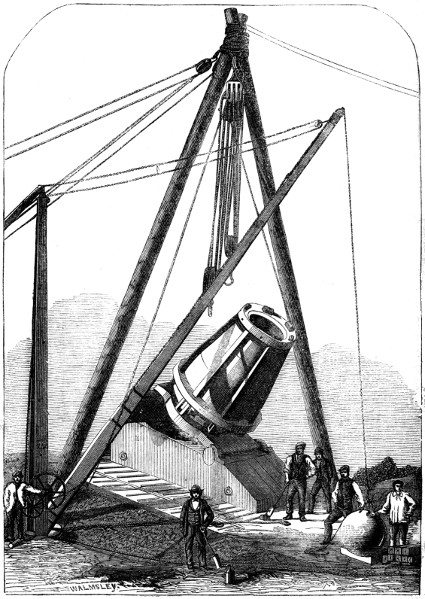
Mallet’s Mortar.
Dimensions.
| |
Tons. |
cwt. |
qrs. |
lbs. |
| Cast iron base with wrought iron breech shrunk into bore |
21 |
19 |
0 |
2 |
| Wood carriage complete, with wrought iron screw and spanner for elevating mortar |
8 |
8 |
0 |
14 |
| Bottom part of mortar to fit on top of the breech |
7 |
5 |
3 |
23 |
| Part of mortar (a ring) to fit on the top of the above |
5 |
8 |
3 |
23 |
| Do.t of mdo.tar (do. |
3 |
0 |
2 |
13 |
| Muzzle ring |
1 |
2 |
3 |
12 |
| Wood ring |
0 |
0 |
1 |
0 |
| Wrought iron ring |
0 |
4 |
3 |
4 |
| Wrought iron conical ring to fix on top of muzzle ring |
0 |
3 |
3 |
25 |
| T-headed bolts, with gibs and keys for fixing mortar to base: may be called outer staves |
1 |
16 |
2 |
0 |
| Wood-wedges, &c., for elevating |
0 |
13 |
3 |
22 |
| Outer pin, with cross for turning mortar round |
0 |
8 |
3 |
14 |
| Total weight |
50 |
13 |
2 |
21 |
| Weight of shell unfilled, 26 cwt. 2 qrs.; diameter, 36 inches. |
This is notorious as a monster failure, even with a
charge of powder amounting to only one half what the
projector fondly hoped would be perfectly harmless
in its effects. This Brobdignagian toy has proved to
be fearfully expensive, the cost having been estimated
at eight thousand pounds. It has, I believe, been
the largest and most expensive experiment indulged
in by the noble “projector,”[6] and I sincerely hope
it will be the last.
The preceding pages will have done much to remove
from an unbiassed mind any favourable impression of
the advantages expected to result from the use of
wrought-iron cannon. The knowledge of this subject,
even among talented and scientific men, appears to be
at a very low ebb, as is evinced by the multitude of
failures that have taken place; not one success of
any moment has as yet been attained, and not a
discovery has been made worthy of being chronicled.
Having enlarged thus much on the qualities of a
metal which it is certain can never supersede the use
of cast-iron, even though it be freed from the defects
found practically to exist in our present constructed
iron artillery; and having also alluded to the fact that
the form has much influence on the durability of
cast-iron guns, I now proceed to the more important
point of the qualities of cast-iron itself.
Little doubt exists that guns cast a hundred years
ago were more durable than those of more recent
formation; it is evident, therefore, that apart from
mere form, some material depreciation must have
taken place in the quality of the metal. The use
of hot blast-furnaces, better fluxes, and improved
chemical knowledge in the reduction of metallic
ores, though highly profitable in a commercial point
of view, doubling the products of our mines,
and enriching their proprietors, has, unfortunately
rendered English cast-iron perfectly unfit for the
formation of cannon, if increased range and greater
strain by high elevation are to be the order of the
day.
The durability of Russian cast-iron is unquestionably
greater than that manufactured in England.
Some cause must exist for this; and the question
arises, is the ore superior to ours, or does the
superiority of Russian iron depend on their method
of smelting? The latter is, we believe, the cause of
the superiority of Russian iron; for experiments show
that Russian ore, smelted in an English furnace,
yields the same kind of cast-iron as is produced from
the ore found in England. The inference, therefore,
is plain, that the difference in the process of
smelting makes all the difference in the quality of
the iron.
Two thousand years ago the Romans, or their
dependents, smelted iron in the county of Durham:
vast accumulations of slag exist there at the present
time; and thousands of tons have been beneficially
re-smelted by two adjoining iron-works, and a percentage
of iron obtained sufficient to prove that the
Romans were little indebted to fluxes or hot blasts
for the quality of iron they obtained. The Russians
cannot boast of these adjuncts any more than the
Romans: the old agents, wood and energy, are alone
employed in the smelting of their ores; and in the
absence of scientific aids, though they obtain a much
smaller aggregate quantity of metal, yet it is
undoubtedly of a much superior quality. With the
Romans, also, the yield was meagre, but the quality
was good; now, however, circumstances are reversed,
quantity, not quality, being the order of the day.
The use of coals instead of wood in the process of
smelting has introduced a mixture which is very
prejudicial. Most of the coal, even from our very
best mines, contains a large quantity of pyrites, or
bisulphuret of iron, which, combining with the cast-iron,
injures it to an incalculable extent.
These facts fully explain why our cast-iron guns
are not so good now as formerly. Select the most
suitable mine in the kingdom, erect a furnace on the
most improved principles, employ wood fuel only, avoid
fluxes and hot and cold blasts, and be content with
the small amount of metal produced, and beyond all
doubt the quality will be all that the most sanguine
founder or artillerist could wish.
Thus the inferiority of our cast-iron guns has been
accounted for, and a method suggested, which, if
efficiently carried out, would effect the desired
improvement.
We are indebted to Krupp for the first suggestion
of, as well as the first attempt to introduce, a cast
steel gun of greater durability and power than the
best cast-iron gun which has yet been manufactured.
Steel, possessing, as it does, hardness to any desired
extent, ductility in an equal degree, tenacity unrivalled,
and all the other requisites, is destined to
take the place of all other metals in the construction
of artillery. This metal waits only to be tested;
and the greater the extent to which the trial is
carried, the more confident we are that it will answer
every purpose.
Krupp, like many other men with valuable ideas,
has been peculiarly unfortunate in his attempts to
carry them out. With a vast amount of knowledge
of the science of metallurgy, he wants more knowledge
in the not inferior science of projectiles; the
most important point being to ascertain the form of
gun calculated to be suitable for new metal, of the
use of which, for cannon, the world possesses no antecedent
knowledge.
The only failures Mr. Krupp has made (if they
can, strictly speaking, be so called), have arisen from
mal-construction, imperfect form, and unscientific
combinations; defects which might be expected from
a mere novice, though not from experienced artillerists
or founders of artillery. The trial of the only steel
gun sent by Mr. Krupp to this country, was conducted
in the most absurd manner, and on wholly
unscientific principles. I will endeavour to convey
some idea of this most extraordinary of experiments.
Whether Mr. Krupp was unacquainted with the
durability of his metal, or was persuaded, against his
will, to conduct the experiment as he did, I know
not, but the following is what took place:—
In 1851 Mr. Krupp brought to Woolwich a
specimen steel gun of ten-inch bore, weighing about
four tons. He was induced (but why, I am at a loss
to conceive,) to construct a cast-iron jacket, or outer
gun, into which his steel gun was inserted up to the
trunnions. The steel gun was separated from its
cast-iron jacket by a space of half an inch in its
whole length, except at each end, where the jacket
was fitted to the gun with a moderate degree of
tightness; thus the gun and jacket consisted of two
tubes, one within the other, fastened only at their
extremities, and that by a very slight force. The
result, as might have been expected, was the bursting
both of the gun and its case; but that the steel gun
or its jacket would have stood the test, if subjected
to it singly, cannot be doubted. The difference of
expansion between the steel gun and its jacket would
be quite enough to account for its bursting. Had the
contact of the two been perfect throughout the whole
length, but allowing half an inch all around for the
expansion of the steel gun in that part which was
subjected to the greatest pressure, the very act of
restraining it in other parts so as to prevent equal expansion,
would be perfectly certain to produce a fracture.
Mr. Krupp’s friends have complained loudly of unfair
treatment, whether justly or not, no opinion need now
be given; but it is much to be regretted that his
experiment was not carried out on scientific principles.
The introduction of cast steel guns will be the most
essential improvement in artillery: and an extensive
series of experiments, extending over many years,
during which time I have manufactured gun-barrels
of steel alone, ought to give my opinion some weight
on this subject.
Laminated steel gun-barrels were well known in
1851; but the English bugbear, prejudice, raised a
clamour against them, which was echoed by interest
and ignorance, and thus their general adoption was
for a long time prevented. However, in the short
space of seven years, they have become universally
adopted, with the most beneficial results; better
shooting, less annoyance from recoil, less weight to
carry, and greater safety to the sportsman, being the
principal. And so it will be with steel cannon;
as a short time will suffice to enable scientific investigation
to remove all prejudices against them.
The external form of cannon is a question of
vital importance, but one which is little understood
by artillerists of the present day. Whilst it is a
demonstrable fact that all excessive bulk of cast-iron
causes weakness in proportion to the excess,
no effectual steps have as yet been taken by the
Government to ascertain what is the due proportion
of metal which ought to exist in different parts of
the gun. The American authority on naval gunnery,
Captain Dhalgren, has paid considerable attention
to this subject; and if the reports on the durability
of American heavy ordnance can be relied on (and
there is no reason why they should not) his investigations
have been attended with much success.
Captain Dhalgren has extended the principle acted
upon many years ago by Mr. Monck; his great
improvement consisting in lessening the weight of
iron in front of the trunnions, and adding to that
of the breech. In cannon, as in fowling-pieces,
weight in the fore part is useless; conducing neither
to the safety of the gun, nor to the smartness of
its shooting. For endurance, it is necessary that
the expansion should be equal in every part of the
gun; rigidity in one part increasing the strain on
the immediately adjacent parts, which, if much reduced,
are thus rendered liable to fracture. The
breech has to endure the lengthened explosion produced
by the burning of the gunpowder; and, as
this continues until it has overcome the inertia of
the projectile, it is necessary in all cases that the
maximum of strength should be in the breech of
the gun. When the projectile is once in motion
the strength of the tube may be rapidly decreased;
the only strain it has to bear is exerted whilst the
projectile is passing over it; and this strain, in
properly constructed guns, becomes of shorter and
shorter duration as the projectile attains its highest
velocity at the muzzle of the gun. The greatest strain
a gun has to bear near the muzzle is that produced
by the condensation of the column of air in front
of the charge; and in almost every form of English
ordnance the weight of metal here is greater than
is necessary.
The Russian guns which have been brought to
this country present the same superabundance of
metal at the muzzle, whilst at the breech there
appears to be a deficiency; and when we take into
consideration the extraordinary reports of their endurance,
we must ascribe it to some other cause
than the proper distribution of metal. Their endurance
is no doubt owing in part to the goodness
of the metal, in part also to the form of the breech,
to the uniformity of thickness in the sides of the arch,
and, lastly, to the absence of those protuberances
called “reinforce rings.” These rings might with
propriety be termed “rings of destruction;” for
wherever irregularities exist in the substance of the
metal, there the waves of vibration are interrupted,
and the weak point then becomes fractured. The
science of spring-making in all its varieties demonstrates
the truth of this statement. Leave on a
coach-spring an abutment of metal like a “reinforce
ring,” and a few motions will be sufficient to break
it, however well the spring may be constructed in
every other part. The rigidity of this protuberance,
by interrupting the waves of vibration, causes additional
vibration in the adjacent and more yielding
part, and thus produces fracture. The same thing
occurs in all ill-constructed artillery: where the
vibrations are checked, there is always a danger of
some weaker part giving way. But the laws which
regulate the distribution of vibrations in metal
substances are not yet understood by artillerists,
or cannon would be differently constructed. Those
unscientific protuberances called “trunnions,” which
are to be seen in almost every description of
gun, prove the accuracy of my assertions. These
protuberances, if scientifically considered, would soon
be discarded, since they tend not only to the rapid
destruction of the cannon, but also exert a most
injurious influence on the direction of the projectile.
The most wonderful shooting ever heard of (and
which has been before alluded to) is partly to be
attributed to the absence of trunnions. Trunnions
act as the fulcrum of a scale-beam; they allow
the breech and muzzle of the gun to oscillate, but
in an opposite direction to a scale beam. Rifled
cannon can never be correctly constructed whilst
any weight impinges on the gun in front of the
first starting point of the projectile; they must
have the fulcrum behind the point of discharge, and
the more nearly in a direct line the better.
Rifled cannon will in some few years be perfectly
constructed of cast steel; the projectile being made of
gun metal, i. e., ninety-five parts of copper to five
parts of tin, or of lead and its alloys, and at a
probable cost of ten times that of a cast-iron projectile
of equal weight.
Rifled cannon must be elevated by raising the
muzzle; no depression of the breech must occur as
by the usual elevating screw; and the recoil must be
received and borne by fastenings and axle in rear of
the breech only. Trunnions and all impinging influences
are incompatible with correctness of fire. The
muzzle must be raised in a similar manner to the raising
of a hand rifle, the recoil being thrown backwards, in
as direct a line as possible with that of the shot.
It is only on account of the difficulty of experimenting
with rifled cannon that they are at all behind
rifled muskets in point of perfection. The ardent
lover of science is appalled when an experiment costs
hundreds of pounds. We have not a General Jacob
everywhere who can afford to spend a thousand or
two in experiments; but, nevertheless, the lover of
science, could he experiment, might attain such
extraordinary accuracy of range, as to blow up a
smaller magazine than that of Kurrachee at four times
the distance; and that, too, with a more certain effect,
though with a projectile heavier than several of
Jacob’s rifles tied together. Correct direction is
certain in proportion to the increase of weight;
deflection being in the minimum with the heavier
weight, from the well known law of momentum.
That astute and energetic sovereign, the Emperor
Napoleon, is pursuing experiments with rifled cannon;
with what result there can be little doubt.
It must be by the use of rifled cannon that our
artillery will regain the place it has lost. A short
time will suffice to make the disparity between our
artillery and small arms as great as when we were
content with the six-pounder field gun and old “Brown
Bess.” Ranges will only be ruled by sight, and objects
will be hit eventually with as much ease at 5,000 yards
as they now are at 1,000. Steel, rifled cannon, and
projectiles of gun-metal will assuredly bring about as
complete a revolution in artillery as the Greenerian
rifle and bullet have effected in small arms.
The form of gun best suited for all purposes has yet
to be determined; and we have pointed out these defects
in our artillery with the hope that some of the great
practical philosophers of the present age may devote
themselves to the study of this question. It is nearly
allied to the science of bell-making, and a few more
fractures of Big Ben will extend our knowledge of
the subject, and produce a remedy which lies not very
deep below the surface. The laws which should
guide us in the construction of cast steel guns, so as
to insure their durability, are very analogous to those
which determine the durability of bells; for the laws
which regulate disintegration of crystalline structures
are very similar. Hitherto the rule of thumb has,
unfortunately, been the only rule observed in measuring
out the quantity of metal which shall surround
that portion of a cannon which has to sustain the most
violent concussion.
Professor Barlow many years ago proved, to the
satisfaction of the Institution of Civil Engineers, that
the metal in any cylinder decreases in utility in proportion
to the square of its distance from the centre:
that the outside of a gun of the form now used, in
fact, is only one-ninth as useful as the inside; being
three times as far from the centre. If we double the
thickness, the outside, being five times as far from the
centre as the inside, will be but one-twenty-fifth as
useful; or in plain English, nearly useless. The
reason of this is simple, and I will endeavour to
explain it.
“A bar of cast iron one inch thick each way and
40 inches long will stretch about one-twentieth of an
inch, if a weight of about four tons be suspended by it.
When the weight is removed, the cast iron nearly
recovers its previous form, and is uninjured; but if it
be stretched more, by a greater weight, it is permanently
injured.
“A bar of the same thickness, but three times as
long—120 inches—will stretch three times as much,
or three-twentieths of an inch, with the same weight;
or if only one-third the weight—one ton and a third—be
suspended, it will stretch one-twentieth of an
inch, the same as the shorter bar.
“If we suspend 16 tons by four bars, one inch
thick and 40 inches long, they will each stretch
one-twentieth of an inch only, and remain uninjured;
but if we attempt to do so with two bars 40 inches
long and two 120 inches long, then, when the whole
have lengthened one-twentieth of an inch, the short
ones are exerting a force of eight tons, but the long
ones that of only two and two-thirds tons. The weight,
therefore, will still further lengthen the bars, and permanently
injure the short ones; perhaps break them
first, and then the long ones.
“This is the way a gun is burst. The inside is a
series of bars of iron, say 40 inches long, in the form
of a ring; the outside a series of rings, representing
the bars three times as long.”
Warfare, since the first introduction of gunnery
into Europe, has been like one continued series of
experiments for testing the efficacy of our guns. No
description of gun we now possess can lay any claim
to existence fifty years ago: the great majority of our
guns now in use are of a much more recent date.
With one or two exceptions, no artillery has been
constructed on any scientific theory; some alteration
has been made, and if a gun of a certain form and
dimensions gave a certain result, then an extension or
emulation of that gun was tried; and if it succeeded
a loud cry of exultation was raised, and the discovery
was announced to the world as a great improvement.
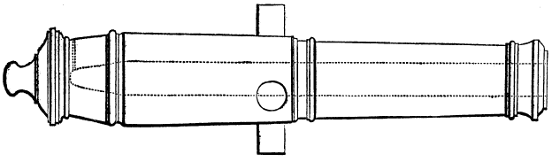
Russian 56-pounder gun.
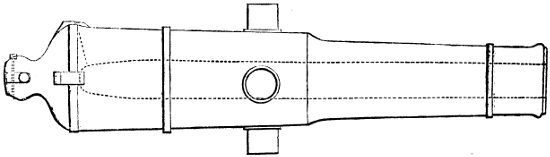
8-inch British gun.
Colonel Prejudice has invented a vastly improved
description of gun; another guess is made, and so
different forms of guns are multiplied. Can there
be a more striking illustration of this than the one
which took place during the late Crimean war? It
was boasted that the whole human race might be
exterminated by the new invention; but the “Lancaster
gun” turned out to be most unscientific in its construction,
and most eccentric in its action. Had such a
thing as scientific knowledge in gunnery existed among
the artillerists of the day, such a monstrosity would
have been buried soon after its birth; instead of being
allowed to squander large sums of money at every
discharge, and then at last to become a “Whistling
Jemmy” for our bluejackets to laugh at.
The form of cannon no doubt exercises a vital
influence over their durability; bad form and imperfection
of material combined, tended to produce
the rapid destruction of our guns during the late
important struggle.
The gun which has been experimented with to the
greatest extent, and which has withstood all trials successfully,
is a Russian fifty-six-pounder; taken, I believe,
at Bomarsund. In this gun there are two great peculiarities;
the shape, as will be seen in the diagram,
differs from all our own guns: it is a “chambered
gun,” and the metal is taken away from the outside
precisely as the contraction increases on the inside
thus giving an equal thickness of metal in every part,
of the arc (see page 114).
In contrast with this, we give a cut of our 8-inch
gun, which most nearly resembles it as a chambered
gun (see page 114).
The reader’s attention is especially directed to the
dissimilarity in the distribution of the metal in the
two guns. The want of uniform thickness of metal
in our 8-inch gun must be sufficient to convince any
one that, if the Russian gun be properly constructed,
the principle of ours must be radically wrong. That
such is the case, indeed, I cannot doubt, the Russian
gun having undergone such a test as would have
destroyed six of ours. The gun has since been made
two inches larger in the bore, and even oval-bored, for
firing shells, which should alone be enough to destroy
it; and yet with all this the gun remains perfect.
The gun which most nearly resembles this is our
English carronade; and that these guns have some
important principle in their shape is proved by their
great durability under all trials; and I believe that
the tests to which the carronade has been subjected
have been more severe than that of any other piece in
the British service.
There have been many shrewd conjectures as to
the cause of this durability; one of these was very
pungent, viz., “the invention was not by one of the
cloth.” An examination of the drawing of the 68-pounder
carronade will enable the reader to perceive
the great similarity between this and the Russian gun
before spoken of (see page 114).
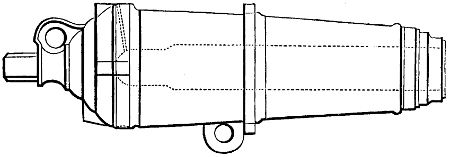
68-pound carronade.
The manufacture of these guns was originally in
the hands of the inventors, and it is quite evident
that they must have taken great pains with the form
of the gun, and also have taken special care that the
material of which it was constructed was of the very
best quality.
There is too much reason to doubt the proficiency
of military men in the science of metallurgy; and the
British system of depending solely on their knowledge
for the last half century, has no doubt proved an
obstacle to advancement in the science of gunnery.
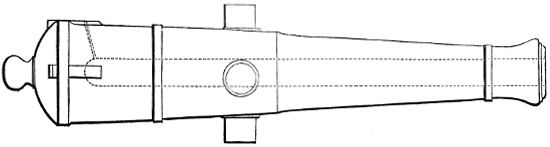
Monck’s 56-pounder gun.
The gun which ranks next is Monck’s 56-pounder.
Although not a chambered gun, it will be seen, from
the diagram (see p. 117), to be an attempt (if not a
perfectly successful one) to obtain uniformity of
thickness in every part of the arc. The durability of
these guns ranks as we have placed them.
The next in rotation is the 8-inch or 68-pounder
(see p. 114); which, although not the original sized
gun that was rifled for the Lancaster shell, yet it was
the one eventually used for that projectile up to the
end of its very brief career.
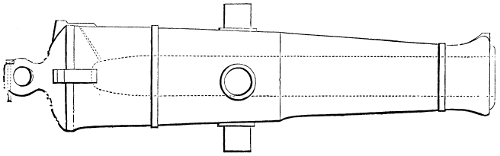
10-inch or 86-pounder gun.
The 10-inch gun of 95 cwt., delineated at page 117,
will be seen to be defective in its outlines when tested
by the principles before laid down, and the fact of more
10-inch guns bursting at Sebastopol than any others
(mortars only excepted), may be taken as exclusive
evidence of its imperfection.
The bursting of mortars is quite notorious, especially
the 13-inch mortars used for sea-service in the
attack on Sweaborg. A slight examination of the engraving
of one will be sufficient to convince any person
that, if what has already been advanced on the form of
guns can lay claim to being scientific, then this is
of all guns the most unscientific that was ever manufactured.
Its durability, too, like its shape, is of a
very low order.
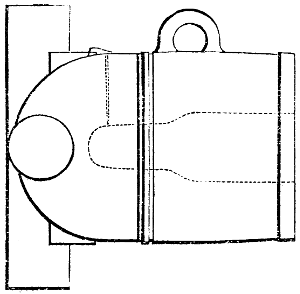
13-inch sea-service mortar.
The 13-inch land mortar depicted below is a much
more serviceable production, because it contains much
less metal.
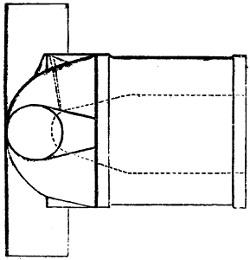
13-inch land-service mortar.
Mortars will retain their place in spite of all
improvements. Rifling is inapplicable to them.
Their principal utility consists in obtaining a vertical
fire; the shell being pitched to a great height, so as
to fall into places that cannot be assailed by a horizontal
fire.
The late Joseph Manton has the merit of being
the first modern inventor of rifled cannon. His idea
was, that if a motion on an axis parallel to the
horizon could be given to cannon balls, they would
range farther and with greater accuracy. As there
exists great difficulty in causing the rifling in a gun
to act upon an iron ball, he constructed a cup of
wood, into which the ball was fitted, projections being
made upon the wood to fit into the groves of the
rifle; the spinning motion thus being communicated
to the ball by its wooden adjunct. The result was
twofold; for the expansions of the wood during the
explosion, filled the tube of the gun tight, and
effectually destroyed the windage. The government
of the day did offer him a premium of one farthing
each; but “Joe” over-reached himself, asking the
sum of £30,000 down; this was refused, and the
patent was allowed to expire without the Government
taking any advantage of it, and experiments ceased
to be made in this direction.
Rifled cannon have now, however, become a
certainty. Mechanically speaking, they are as easily
to be produced as hand rifles. The general application
has, however, vast difficulties, which must be
overcome before their use can become general.
Small arm projectiles suitable for rifles must of
necessity be made of ductile metal, and all the
attempts previously made, whether with brass or
iron guns, are alike useless. The mass in motion,
even when of equal hardness with the gun (as in the
case of cast iron guns and cast iron shot), invariably
destroys that in a comparative state of rest; and the
rifling is obliterated after a very few discharges. In
a brass gun the destruction is certainly not so rapid,
on account of the different nature of the metal; yet
the destruction of the gun for all useful purposes is
equally effectual. It is evident, then, that success
cannot be obtained by using the present materials in
rifled cannon; and the question inevitably arises,
what better material can we use? Wrought iron
shells have already been thoroughly tried in the Lancaster
oval gun, with a well-known result.
Great hopes were at one time entertained, that
something suitable would result from Mr. Bessemer’s
discovery of the combustion of carbon, and that an
iron of sufficient ductility, yet without the usual
hardness, would be produced; but this, it appears, is
still a myth.
Extent of range and accuracy of fire in gunnery
will in future be of so much importance in war, that
it is not extravagant to assert, that in contests
between well-matched belligerents, the precious metals
(if they gave any advantage to the user) would be
unhesitatingly used in projectiles. But on the score
of economy, science need not be impeded. Gun-metal
projectiles and cast steel cannon would work
as effectually together as lead and iron in small arms.
Some other mixtures less expensive might be produced
(lead and copper in certain proportions are very
ductile), and at the same time sufficiently strong to
resist all tendency to squash; as the softer metals
would inevitably do. The more ductile metals are
limited in their utility, by the same law which limits
the use of pure lead: that is, to given weight, height
of column, or velocity. Great doubt exists whether a
bullet made of gun metal, and of the same proportionate
dimensions and form as an Enfield bullet,
but fitted for a ten-inch gun, would not, if fired with
the proportionate charge of powder (namely, seventeen
pounds), be as completely squashed, or driven in
upon itself, as the Enfield bullet if fired with the old
Brown Bess charge of four drachms and a half.
Considerable time and experience will be required
to ascertain the proportions of metallic mixture
necessary to meet all contingencies; this, however,
is a matter of detail, and must extend over so large
an area, that it can be handled only by the government
officials, with the necessary “sinews” of experiment.
Nevertheless it must be undertaken; and
the sooner it is done the better, for the prestige of
that nation which would lead the van of improvement
in gunnery, and increase its power of attack and
defence beyond those of its rivals.
Rifled cannon is a generic term of endless
application, presenting to the mind modifications
of projectiles in endless variety, ranging from the
“light firebrand” to the twice deadly rocket: not
rockets of that eccentric and erratic character by
which Congreve made an undying name; but real
bonâ fide rifle rockets, which shall hit the dead-lights
in the quarter-gallery of a frigate, carry away
the halyards of your enemies’ ensign (making him
drop his colours at the first shot) or dash the glass
from the hand of the pilot. All such imaginary
feats will yet be accomplished; though the reader
may smile at the idea. My experience with rockets
goes to justify me in asserting that rockets discharged
from a gun, under certain circumstances, can be as
effectually controlled, and kept to a direct course, as
a bullet fired from a rifle. The rocket, however,
may be fired a much greater distance than we have
ever been able to project a bullet; because, in
addition to the force which projects it from the gun,
its flight is maintained by the self sustaining agency
in the body of the rocket. Rockets require a much
smaller charge of powder to project them than that
which is used for a bullet; a rocket started by its
own force, expends, in acquiring even an approximation
to its highest velocity, at least one-third of
the force with which it is charged; but when
projected by a small charge of gunpowder this force
is saved, and the flight of the rocket is afterwards
sustained by the force with which it is charged.
Firing rockets from cannon can only be practised
under certain circumstances. The observations
already made on the granulation of gunpowder will
have prepared the reader for this announcement.
When fired from a cannon under the old régime, the
rocket was projected at high velocity, and the case
of the rocket was destroyed by the very force which
set it in motion. A rocket suitable for artillery
should be cast of gun metal, with a frame of considerable
strength. In form it should nearly
approximate to an expansive bullet; but, instead
of the limited length of one and three quarters
diameter; it should approach to four diameters;
two of which, at least, should be appropriated to
the cylinder behind the head.
The head is charged with composition more densely
driven than is customary in the ordinary rocket;
the tubes in the cylinder are also charged with a
composition equally dense. The outer frame of the
rocket is cast with suitable projections to fit the
grooves of the gun: the spiral of these grooves is
considerable, being one turn in every three feet, in
order to impart to the rocket an effectual spinning
motion when in a low state of velocity. The rocket
properly constructed is then placed in the rocket-gun,
and fired in the usual way; but it is essential
that the gunpowder used should be of a suitable
quality: its combustion must be as slow as possible,
a starting velocity of from 500 to 800 feet per second
being sufficient to ensure the flight of the self-sustaining
projectile to the end of its range. This principle
may be extended from a light firebrand, as already
stated, to that of a rocket charged in the head
with the most deadly and destructive fulminate.
It may appear absurd to speak of fulminates being
projected; since all experiments show that fulminates,
even when adulterated, will not stand the concussion
of a discharge, but invariably ignite in the gun,
however carefully placed or packed in the shell which
contains them: for this reason fulminates have
never been successfully used. But if the fulminate
is placed in the head of a rocket, this objection
may be obviated. The gradual manner in which
velocity is given to a rocket does not subject it
to violent displacement during its flight; neither
need the concussion in the gun be severe, owing
to the nature of the gunpowder used, which in its
gradual expansion is analogous to steam: thus the
field for the application of fulminates is opened to
an unlimited extent.
My own experience on this subject has been limited
to its application for the saving of life from shipwreck,
where the application of a line to the rocket
limits its range and velocity; but sufficient is left
in a rocket of an inch and a half diameter effectually
to carry out a line of a quarter of an inch diameter
to a distance of 600 or 800 yards: that is, more
than double the distance obtained by either Manby’s
apparatus or the rockets now in use; which, lamentable
to state, are quite inadequate to the purposes
for which they are intended.
Though the improvements in rifled cannon are at
present only in their infancy, they have nevertheless
attained to an extraordinary degree of perfection,
verifying all our predictions to the letter.
A writer in the Times makes the following
statements in favour of Mr. Whitworth’s improvements:—
“While some men of really inventive talent, and
a great many charlatans, have been permitted to
waste the public money in trying vainly to improve
our artillery, it seems passing strange that it should
not long ago have been discovered how impossible
it was to hope for successful results in the direction
in which they were working. It was clear that
while increased range and precision of firing were
wanted, it was nearly as important to bring the
charges of ammunition and the weight of metal
in guns into more manageable proportions to each
other, and to the facilities for transit on active
service. No sensible man can have witnessed the
frightful damage done to the efficiency of our army
in the Crimea by the exigencies of the siege-train
during the winter of 1854-5 without being impressed
with this conviction. The principle of the rifle
offered an obvious suggestion for the proper means
of working out the foregoing problem; but then for
artillery, rifling by grooves would not do without
the use of a pliant metal in the projectile, and
the cost of lead rendered its application to that
purpose impracticable. It was necessary, therefore,
to alter the existing mode of rifling, and to modify
the bore of the cannon, so that an iron projectile
could be discharged from it, rotating on its own
axis in the line of flight. This result once secured,
it is obvious that a field-piece or gun of position
would become a rifle on a large scale, and that the
same immense increase of range and of penetration
which had been realised by the smaller weapon as
compared with Brown Bess, would be placed at the
command of the artillery service. It is consolatory,
after a series of failures worthy even of Brunel in
launching the Leviathan, that the country has at
last the well-grounded hope of an improvement by
which our ordnance may be placed on a proper
footing. In pursuing those careful experiments
which he undertook for the Government, principally
to improve the rifle, Mr. Whitworth, the eminent
machinist, adopted a polygonal spiral bore of a
uniform pitch, but more rapid than could be attained
by grooves. This bore has enabled him to surpass
immensely the range and penetration of the Enfield
rifle; but even these advantages, important as they
are, scarcely surpass those which it places within
the reach of our artillery service. The strain of
the projectile being distributed evenly over every
side of the polygon, iron can be substituted for lead in
the projectile, and this simple but beautiful mechanical
appliance at once becomes available for cannon.”
The powerful aid of the Times is “almost
success;” though in this instance it has signally
failed, the boasted accuracy there spoken of not
having been yet obtained. This has no doubt arisen
in part from the fact that Mr. Whitworth’s great
mechanical knowledge would not suffice to make him
au fait at the compound science of gunnery. His
“polygonal spiral bore of uniform pitch, more rapid
than could be obtained by grooves,” is after all
only an experimental gun, not sufficiently developed
as yet for practical utility. Still, the writer already
alluded to has favoured us with the following remarks
in the Times:
“Moreover, Mr. Whitworth has discovered in the
course of his experiments, that according to the
quickness of the turn in the polygon is the length
of the projectile that may be fired; so that 24 lb.
and 48 lb. shot have been sent to extraordinary
ranges with half the usual charge of powder, from
an ordinary 12-pounder howitzer. Here, then, is
at once the solution of the whole question which
has troubled the brains of so many inventors, real
or pretended, for years. The artilleryman at one
stride resumes the relative position to the soldier of
the line which the Enfield rifle had so perilously
deprived him of, and this mechanical country, after
finding herself on the level of France, Russia, and
other European States, is once more, as during the
Peninsular campaigns, enabled to assert her natural
superiority in the manufacture of cannon. We trust
that no petty jealousies on the part of narrow-minded
officials will be allowed to interfere with the course
of Mr. Whitworth’s experiments, and that the encouragement
which he is now receiving from the
Minister at War and the Commander-in-Chief will
enable him, at no remote date, to realise for the
benefit of the army and the nation that revolution
in gunnery which the results already obtained by
him promise.”
Report says that 25,000l. is the amount of encouragement
Mr. Whitworth has received from the
Minister of War and the Commander-in-Chief; an
adequate sum with which to conduct such an experiment,
but not sufficient to insure success.
Of the success of Mr. Whitworth’s polygonal
projectile, on a large scale, none need speculate, for
the principle is self-destructive.
Lancaster’s oval shell, oscillated in its flight, took
a flight so extraordinary, on account of the resistance
of the atmosphere on the protuberances of the oval,
that the principle may be regarded as fully established
that enlarged projectiles must be smooth and free
from projections that “saw the air,” otherwise range
and accuracy of fire will be sacrificed. The principle
of Mr. Whitworth’s polygonal bore is fully discussed
in its proper place, and will here receive only a
passing notice.
To Mr. W. G. Armstrong, of Newcastle-upon-Tyne,
much more credit is due than can be claimed for
Mr. Whitworth. Long before the paid efforts of
Mr. Whitworth, Mr. Armstrong had made the
subject of rifled cannon a special study, and the
success of his investigations has been such as to
couple his name with those of the earliest inventors
of effectual rifled cannon. Mr. Armstrong may also
lay claim to being an originator of wrought steel
cannon; though here his name stands second as an
inventor, for to Mr. Krupp is due the honour of first
introducing cast steel cannon to the notice of our
Government.
Mr. Armstrong tells his own tale so well in the
columns of the Times that we cannot do better than
quote it:—
“In the latter part of 1854, I submitted to the
Duke of Newcastle, then Minister at War, a proposal
for a gun which I anticipated would possess great
superiority over the common forms of light artillery,
and I undertook, with his Grace’s authority, to
construct a field-piece in conformity with the plan I
had suggested. The gun was accordingly soon afterwards
made, and has since, during a period of nearly
two years, been the subject of numerous experiments,
partly upon the ordnance firing-ground at Shoeburyness;
but principally under my own direction in this
neighbourhood.
“I have hitherto avoided publicity in reference to
these experiments, but, as matured results of much
interest and importance have now been arrived at, and
as other names are already before the public in connection
with gun experiments made during the same
period, I feel that I may now, without impropriety,
give some information on the subject.
“With a view to strength and durability, the gun
is composed internally of steel and externally of
wrought iron, applied in a twisted or spiral form, as in
a musket or fowling-piece. The bore is nearly two
inches in diameter, and is rifled. The projectile is a
pointed cylinder 61⁄2 inches long, and its weight is 5 lb.
It is made of cast iron, coated with lead, and is fired
from the gun with a charge of 10 ounces of powder;
it contains a small cavity in the centre, and may be
used either as a shot or a shell. When applied as a
shell, the cavity is filled with powder, and a detonating
fuse is inserted in front, so as to fire the powder in
the centre on striking an object. When used as a
shot, the powder is omitted, and an iron point, which
favours penetration, is substituted for the fuse. The
gun is constructed to load at the breech, the object
being not only to obviate the disadvantages of sponging
and loading from the front, but also to allow the projectile
to be larger in diameter than would enter at
the muzzle, and thus to insure its taking the impress
of the grooves and completely filling the bore. The
piece weighs 5 cwt., and is mounted upon a carriage
which bears a general resemblance to that of an
ordinary 6-pounder field gun, but which embraces a
pivot frame and recoil slide. A screw is also applied,
not only for elevating and depressing the gun, but
also for moving it horizontally, by which means great
delicacy of aim is effected. The recoil slide has an
upward inclination, which enables the gun, after
running back, to recover its position by gravity; and
its use is to relieve the pivot-frame and adjusting
screws from injurious concussion.
“I shall now give some particulars of the experiments
recently made with this gun on the coast of
Northumberland, near the village of Whitley, under
the official inspection of Colonel Wilmot.
“Fourteen shots were in the first instance fired from
a distance of 1,500 yards at a timber butt, 5 ft. wide
71⁄2 ft. high. Six of these were expended in finding
the elevation proper for the distance, but after that
was determined every succeeding shot hit the object
without previous graze. The final elevation of the
gun was 4 deg. 26 min., and the mean lateral distance
of the shot-marks from a vertical line through the
centre of the butt was only 111⁄2 in.
“Persons who are conversant with artillery practice
will be able to appreciate the accuracy of this firing;
but, for the information of those who are unacquainted
with the subject, I may state that the ordinary
6-pounder field-piece, which in point of weight forms
the nearest approach to the present gun, is perfectly
useless at a distance of 1,500 yards, and is very
uncertain even at 1,000 yards. It is only, therefore,
with heavy artillery that a comparison can be drawn;
and it will be sufficient to state that in tabulating
the practice made with such ordnance the deflections
are invariably recorded in yards, whereas with this
rifled gun they can only be properly given in inches.
“With respect to penetration, the following particulars
will be regarded as equally remarkable, considering
the small weight of the shot and the length
of the range. The butt was 3 ft. thick, and was
composed of six layers of rock elm bolted together, so
as to form a solid block. One shot passed entirely
through; another struck near the edge and glanced;
and the remaining six penetrated within a few inches
of the opposite side.
“Shell firing was next tried at a distance of 1,500
yards; the gun being fired at the same elevation and with
the same charge as in the previous practice at the butt.
“In this case two targets were erected, one behind
the other, so as to appear as one object when viewed
from the gun, and a space of 30 feet was left between
them. The front target was intended to exhibit the
perforations of the shell before bursting, and the back
one to show the effect of the fragments resulting from
explosion.
“After some preliminary experiments twenty-two
shells were fired at the front target, and of these only
one missed the object of aim. The following are the
particulars:—Seventeen hit the first target direct,
and burst behind it, the fragments penetrating the
second one; three grazed and burst immediately in
front of the first target, and perforated both with the
pieces; one hit the bottom of the first target and
exploded in the ground, and the remaining one missed
entirely and burst on some rocks nearly on line
beyond. A strong side wind was blowing at the time,
and accounted for the deviation of this single shell.
“Four shells and three shots were then fired at an
elevation of 6 degrees, from a distance of 2,000, or,
more accurately, 1,964 yards. All these struck
within the breadth of the target; but the elevation
being scarcely sufficient, they all fell a little short,
except one shell, which, ranging somewhat further
than the others, hit the target and burst as usual.
“The results of this shell-firing were as follows:—The
front target contained 51 holes, and the back one
164, while the ground between and adjacent to the
targets exhibited about 70 perforations by fragments
of shells, the greater portion of which were afterwards
recovered by digging.
“With respect to ranges exceeding 2,000 yards,
I may state that on previous occasions the gun
had been tried up to 3,000 yards—a distance which
was reached with an elevation of 11 deg., and the
usual charge of 10 ounces of powder, or 1-8th the
weight of the projectile. By augmenting the charge
the range is increased, but the accuracy is impaired;
and I therefore adhere to the 10-ounce charge, which
gives ample penetration, as the experiments at the
butt will testify. I may also observe that the ranges
obtained with this charge bear a favourable comparison
with those of the heaviest round-shot guns fired with
a much larger proportion of powder.
“It is a curious fact, and one which greatly increases
the efficiency of the shells, that owing to the bursting
charge requiring a minute space of time to mature its
ignition after the firing of the fuse by impact, the shell
is enabled to travel four or five feet after striking an
object before disruption takes place. Hence, therefore,
it acts as a shot before it bursts as a shell.
When it perforates a target the explosion may be seen
to take place at a few feet beyond, and when it grazes
it has time to rise, and may be observed to burst after
clearing the ground. If, therefore, it were fired
against a ship, it would first penetrate the side in its
entirety, and then, bursting, traverse the deck in
fragments; or if directed against troops, it would
pierce the front line as a bullet, and operate like
grape-shot beyond. The shells explode with equal
certainty whether the first substance struck be hard
or soft; and, in fact, they even burst on the surface of
water, provided the elevation of the gun be not too
great. The bursting charge is very small, but it suffices
to break the shell into about 30 pieces, which pursue
their forward course without too much dispersion.
“It is impossible to contemplate the results obtained
with this gun without being impressed with the important
part it is calculated to perform in warfare.
Opposed to any ordinary field-piece, it would be like the
Greener rifle against the old musket; and no gun could
be worked at an embrasure if a fire of shells were
directed against it by one of these rifled pieces placed
within the distance of a mile. In naval operations,
also, guns of this description, but of larger size,
might apparently be applied with great effect—more
especially as a system of breech loading, combined
with a self-recovering recoil action, would be peculiarly
advantageous in firing from portholes. Even
light 5-pounders, sending their shells from great distances
through the sides of a ship and sweeping the
decks with fragments of lead and iron, would produce
very destructive effects; and a small swift steamer
carrying a few such guns might prove a very troublesome
opponent to a large ship of war. But if the
dimensions of the gun were increased so as to adapt it
for shells of 20 lb. or 30 lb., still more terrible injury
could be inflicted at greater distances; and the ponderous
artillery now used at sea would be of little
service when opposed to the accurate and long-range
firing of such rifled shell-guns.”
Since the publication of these remarks, rifled artillery
of Mr. Armstrong’s production has, we believe,
been extensively tried. The results of these trials have
been most extraordinary; and the principle is, we
believe, identical with the expansive principle bearing
my cognomen: an extension of the principle of the
Greener and Enfield rifle, hereafter to be described.
I have had the honour of being consulted both by
English and foreign authorities, and I have assisted in
constructing rifled artillery for several years; and the
experience thus obtained justifies me in making known
to the world some of my observations on this subject.
Rifled cannon with elongated projectiles, similar in
shape and principle to the Greenerian bullet, give,
with charges inferior to those of the old régime and
calibre, more than double the range, with ten times
greater accuracy.
Now, either of these points, if gained, would be
most important improvements, and when combined
would produce the most extraordinary results. But
this is not all: a great diminution in the weight of
the gun might also be effected; and these advantages
may be still further extended when we have had time
to increase our knowledge of the valuable materials
with which we are only just now becoming acquainted.
The following table will show the advantages to be
gained both in length and accuracy of range.
Before reverting to the table, it may be necessary to
remind the reader that the great reduction in the
weight of guns arises from the adoption of the elongated
projectile. For example: the diameter of the
elongated projectile for an “18-pounder” is much less
than the diameter of the gun for the spherical
18-pounder; thus allowing the thickness of metal to
be equal in both guns. The gun for the elongated
projectile may be greatly reduced in weight without
at all diminishing its strength, simply on account of
the great diminution in the diameter of the arc.
There is another important fact, which Mr. Whitworth,
with all his boasting, has carefully concealed:
viz., that a much greater pressure is exerted upon the
square inch in the lesser than in the larger diameter
of bore; and to conceal this fact, whilst claiming
merit for a bullet of 50-gauge exceeding in range one
of 25-gauge, the charge of gunpowder being alike in
both cases, appears very like deception. Any engineer
will tell us that the pressure in the lesser is twice
as great as in the larger bore; and this explains why
greater velocity is given to the projectile.
With these explanations the reader will be better
prepared to weigh carefully my observations. My
task would, doubtless, have been rendered more easy,
if a clear elucidation of the principles of the expansive
bullet could have been given thus early in the work;
but it is thought better to do this in its proper place.
I will only add here, that although two bullets, one
elongated, the other spherical, and of equal diameter,
meet with the same amount of atmospheric resistance,
yet the one containing twice as much matter as the
other retains its medium velocity nearly double the
distance. With these explanatory remarks I give the
following table:—
| —— |
Present
Range
of Guns. |
Present
Weight. |
Reduced
Weight
when
Rifled. |
Range
when
Rifled. |
| 6 |
-pndr. |
1,500 |
yds. |
17 |
12 |
cwts. |
3,000 |
yds. |
| 9 |
-pndr. |
1,600 |
„ |
26 |
18 |
„ |
4,000 |
„ |
| 12 |
-pndr. |
1,700 |
„ |
34 |
22 |
„ |
4,500 |
„ |
| 18 |
-pndr. |
1,780 |
„ |
42 |
29 |
„ |
5,000 |
„ |
| 24 |
-pndr. |
1,850 |
„ |
50 |
34 |
„ |
5,500 |
„ |
| 32 |
-pndr. |
2,000 |
„ |
63 |
42 |
„ |
6,000 |
„ |
| 48 |
-pndr. |
2,500 |
„ |
70 |
45 |
„ |
6,500 |
„ |
| 56 |
-pndr. |
5,000 |
„ |
85 |
60 |
„ |
8,000 |
„ |
| 68 |
-pndr. or 18-in. |
4,500 |
„ |
85 |
60 |
„ |
8,000 |
„ |
| 86 |
-pndr. or 10-in. |
4,700 |
„ |
95 |
65 |
„ |
9,000 |
„ |
The reader must understand that all the guns
given in this table were not rifled, and that they have
not all been subjected to trial. The 6, 12, 18, 24,
and 48-pounders have been tried, with the results
given above; but the heavier guns have not as yet
been tested: the ranges and weights given in the
table have, however, been derived from the results
yielded in the trial of the lesser guns, and may be
safely relied on as scientific data; being, in truth,
rather under than over the mark.
All experiments clearly establish one very important
principle, long known to those acquainted with the
science of projectiles, viz., “That the heavier the
projectile, the less the deflection.” Thus it is quite
possible that the longest ranges may ultimately be
obtained without any perceptible deflection. And when
we observe that the deflection of an ordinary 32-shot in
a range of 2,000 yards, is 50 feet, and in 2,500 yards,
80 feet, whilst the elongated shot, at a much greater
distance, is not deflected half as many inches, I think
we may fairly say that our knowledge of gunnery is yet
in its infancy. Fulminating powder may be used as
an auxiliary in shells for various important purposes;
such, for instance, as destroying an entire fleet; and
it is clearly within the range of possibility that by its
agency the largest ship may be destroyed by a single
shot. The accuracy of rifled cannon renders it an
easy task to strike a plank only one inch above the
water line, and the penetration of an elongated gun-metal
or lead-alloyed shell would enable us to reach
the innermost parts of the magazine: for it is scarcely
possible to produce even an iron casing which shall
resist the power of such projectiles. It is possible,
therefore, that we may see the noblest fleet destroyed
in a few minutes by the agency of such projectiles.
I will endeavour to give an outline of the method
by which this may be effected. A long rifled cannon,
constructed for an elongated gun-metal shell;
of from fifty-six to eighty-six pounds, and with an
extreme range of from 6,000 to 7,000 yards, may be
considered to be a suitable instrument. This shell
should be charged in the head with a given quantity
of the fulminate, such as would be most calculated to
prevent the tendency to explode from the concussion
produced by the discharge of the gun. It will be
necessary to place the fulminate in thin layers
between sheets of prepared caoutchouc, or some other
preparation of India-rubber; having thus arranged
the fulminate in the head of the shell and secured it
there, the usual method of filling the remainder is
resorted to, and the aperture is securely screwed up:
fuses not being necessary in this arrangement.
The difficulty in using this shell is to prevent its
explosion when the gun is discharged; and to obviate
this all our engineering skill is required. Time and
experience will show that, by a modification of the
propelling agent, the shell may be started from a
rifled cannon at a very low velocity; the velocity being
increased like that of the rocket. This is to be done
by modifying the arrangement of the gunpowder so
as to ensure the shell acquiring its greatest velocity
as it leaves the muzzle of the cannon. The result of
this has been already shown. On the shell striking
any object, such as the ship’s side, the metal of the
shell is driven in upon itself, and an explosion of
the fulminate follows as a natural consequence.
Experiment has proved that shells exploding as they
strike the ship’s sides, produce very little damage
beyond making a hole in the ship the size of the shell.
This, no doubt, arises from the short space of time
occupied by the shell in passing through the side of
the ship; all its force being exerted in the interior
instead of on the sides of the vessel. All shells of
the nature alluded to would, at certain distances, take
such a line of flight as to ensure them dipping
towards the centre of gravity, and thus exploding the
magazines, however deep below the water-line; and
when we consider the destructive effects of fulminates,
we think it quite within the range of probability
that they might produce all the effects we have
spoken of.
There are many agents equally powerful to be
introduced into destructive warfare; and with
the advantages to be derived from improvements
in rifled shells, which the ingenuity of the present
race will certainly effect, he would be a rash man
who would set any limits to the advancement of projectile
science. The great difficulty in the use of
fulminates will be surmounted if these suggestions
can be carried out; and experiment is all that will
then be necessary to establish the line of proceeding.
To effect this is the province of the Government of
the country; to wait for it to be perfected by individual
skill and enterprise would be unjust to science,
and injurious to the best interests of the nation. The
needful expenditure can only be borne by the nation,
and should be entered upon, in order to effect improvement
in projectiles, with the view of maintaining
our land and marine artillery at the highest point
of efficiency.
There is one question of great importance to
inventors, and to which I have paid much attention,
namely, the obtaining a spiral motion in a projectile
which has been fired from a smooth bored gun. All
we have witnessed goes far to prove that the attainment
of this is impossible, in consequence of a
principle not hitherto investigated by inventors. If
the course of a projectile is changed from the straight
to the spiral, it can only be done at the expense of
range; and that for the following reasons: first,
the force which is necessary to induce this spiral
movement must be exerted at the expense of the
force which propels it forward; secondly, when this
spiral movement is acquired, it is so much in excess
of the direct movement, that after advancing a
certain distance it falls to the ground. A very
simple experiment will prove this. Take an ordinary
tin tube, cut a bullet of an elongated form—cylindro-conical
if wished—having grooves from the point
backwards, with the degree of spiral necessary to
effect the object in view. Let the bullet be made of
cork or light wood, such as can be projected by a
blast from the mouth, and the result will be that the
projectile will go one-half the distance before the
friction of the atmosphere produces a motion on its
axis parallel to its line of flight; from this point it
gradually loses its velocity in a forward direction, it
spins until its force is expended, and then falls
vertically to the ground. To find the sequel, try
the same experiment without grooving, and the
range, with the same force, will be found to be
double. Some years ago I witnessed such a trial
with a 32-pounder; and, to the astonishment of all
present, the bullet rose above the horizontal line, and
then fell to the ground, like the cork bullet of which
we have already spoken.
The endeavour to produce breech-loading cannon
is an effort to obtain uncalled-for and superfluous
facility in gunnery; and if a perfect breech-loading
cannon could possibly be produced, what would it
avail? What superior property could it possess over
the solid gun? It could not be safety; for when we
consider the very limited number of explosions by
which the very best guns are destroyed, it can scarcely
be possible for a gun composed of many parts to
endure the intense vibrations to which large cannon
are subjected. The regular distribution of vibrations
in the metal of the gun is the great point to be
attended to in the construction of artillery; so that
vibrations may not be incorrectly induced by malformation,
or by an excess or deficiency of metal at any
particular point; for where the waves of vibration
are checked by an unequal distribution of metal, or
other causes, there the weak point in a gun is always
found, as all fractured guns clearly demonstrate. An
intimate acquaintance with the metallurgy of cannon,
enables me to give an almost unerring opinion
as to the causes leading to the fracture. Most
undoubtedly, vibration, if judiciously distributed, is
the soul of endurance; but if injudiciously distributed
is certain to result in the destruction of the cannon.
In structures composed necessarily of many joints,
obstruction to the waves of vibration must occur; the
different parts do not expand and vibrate equally; a
kind of revulsion is induced; part repels part, and
destruction ensues as a natural consequence. Under
no circumstances, therefore, can a breech-loader be as
safe as a solid gun.
The facility with which breech-loaders can be
charged is generally trumpeted forth to the world
as an advantage of vital importance; but let us carefully
examine this point and see if it has not been
exaggerated—whether, in fact, a solid gun cannot
be charged and discharged as rapidly as a breech-loader.
In the first place, all guns recoil; this necessitates
the relaying of the gun after every discharge,
in order to obtain accuracy of aim; and if facility of
loading is to be obtained at the expense of aim, it
can scarcely be called an advantage. Aim consumes
more time than loading. A six-pounder may be
loaded and fired six times in the first minute; but
it would be impossible to do this and re-lay the gun
after each shot. Where then is the advantage of firing
six shots per minute if you cannot hit six objects?
And if breech-loaders could be fired sixty times per
minute, what would they avail if aim was wanting?
The raising or depressing of the breech of a gun by
means of the elevating screw; slewing to the right
or left, spunging the gun, and ramming home the
powder and shot, all consume time; hence we think
that quickness of loading is worthless.
Breech-loading cannon cannot be constructed for
bullets of larger diameter than that of the rifle bore,
without a ductile bullet be used; for, as is usual in
breech-loading small-arms, the bullet rifles itself as it
is forced up the grooves. The projectiles for rifled
cannon have hitherto been cast with corresponding
grooves and lands to fit the internal form of the cannon.
A compound shot, composed of iron, and covered
externally with ductile metal, has been tried in a few
instances; but, unfortunately, the difficulty of combining
two metals so dissimilar as iron and lead has
been found so great as invariably to end in a failure;
therefore no prospect exists of bringing into play
this, the best point existing in breech-loading arms.
Lastly, the tendency of all guns to absorb the heat,
developed during explosion, puts a limit to all extreme
rapidity of fire; even if this was not already limited
by the more essential point of taking aim. At
Sweaborg it was found necessary to allow an interval
of five minutes between each discharge of a mortar,
and yet the whole of them burst after an average of
120 shots. Time and ingenuity spent in planning
and constructing breech-loading cannon will always
end in disappointment and failure. Many are the
plans extant, evincing great skill, perseverance, and
everything needful in point of mechanical experience,
but betraying a total ignorance of the metallurgic
science and of practical results from the use of the
engine. The study of these points will save money,
time, and what is of more value, brain-work, which
might be better employed. Striving to produce perfect
breech-loading cannon is like striving to square
the circle.