“We have two whole days before us,” said
Kittie the next morning, as she promenaded
up and down the deck with Fred, “and
the steamer is going right over the same path we
took in coming. Can’t we get up something new
so as to have some fun?”
“We might have charades, or tableaux,” suggested
Fred. “But we should have to stay below,
getting ready for them.”
“And we’ve had ’em all before,” interpolated
Tom, who was stretched out at his ease in a
steamer chair.
“It’s going to be pretty foggy, I’m afraid,”
said Randolph, joining the group. “They say
that will delay us, for we shall have to run half-speed,
or stop altogether. Do you see how thick
it begins to look ahead?”
They had left Sitka in the early morning, and
had only Juneau to touch at—probably in the
night—before reaching the coaling station of
Nanaimo, on Vancouver’s Island.
“Why don’t you get up a paper?” suggested
Mr. Percival. “That’s what Arctic explorers do,
I believe, when they are frozen in for the winter.”
“Good, good!” cried Pet. “And everybody
in our party must contribute—except me!”
There was a laugh at this, and Kittie, seizing
her friend around the waist, gave her a little impromptu
waltz which set her hair flying and eyes
dancing more merrily than ever.
“What shall we call it?” was the next question.
“‘The Alaskan Herald.’”
“‘The Northern Light.’”
“‘The Illustrated Totem Pole’”—this from
the wounded warrior in the chair.
All these names being rejected, they decided to
leave the choice of names to the editor, to which
position Mr. Selborne was unanimously chosen.
“All contributions,” he announced, “must be
in my hands at five o’clock this afternoon. The
paper will then be put to press, and will be read
aloud at precisely eight o’clock, on deck, in front
of Stateroom 2 (Mr. Percival’s), if the weather permits;
if not, in a corner of the lower cabin, after
the supper table has been cleared.”
All that day the literary circle thus suddenly
formed were hard at work at their manuscripts;
and many were the gales of laughter in which the
girls indulged, as they compared notes from time
to time. The editor, it should be said, had laid
down the rule that any contribution might be in
verse or prose, but if the latter, it should not contain
over twelve hundred words.
One by one in the course of the afternoon, the
manuscripts, signed by fictitious names, were
dropped into a box provided by the editor, who
was busy, meanwhile, not only with his own contribution,
but in arranging an artistic heading for
the sheet which was to form the first page of the
paper. He had also furnished all the aspiring authors
and authoresses with sermon paper of uniform
size, so that the whole collection might afterward be
bound together, if desired.
Evening came at last, and to the gratification of
all concerned, the fog lifted, so that there was a
bright sunset, which would render out-of-doors
reading easy until after ten o’clock. The party
accordingly met at the appointed spot on deck,
having kept their plan a profound secret among
themselves, so as not to have strangers present at
the reading.
Mrs. Percival sat just within the door of her
stateroom, while the rest grouped themselves outside
in various comfortable attitudes. The editor,
with a formidable-looking flat package in his hand,
took his position on the seat by the rail, where
the light was favorable for reading.
“I will first,” he said, “pass round the title
page of this unique periodical, merely premising
that its simple and musical title was suggested in
part by the name of the island, the wood-clad
shores of which we were passing when the idea of
the paper was first promulgated.”
The title sheet was accordingly inspected and
praised, with shouts of laughter, by the circle of
authors. Fortunately it has been preserved, and
can be given here in fac-simile, just as it came
from the hand of Rossiter and of his sister, who,
he admitted, had helped him by drawing the lifelike
designs with which it was embellished.
The title chosen, as you see, was the “Tri-Weekly
Chichagoff Decade.”
“Why ‘Tri-Weekly’?” asked Pet and Mr.
Percival together.
“Because,” replied Mr. Selborne, in his gravest
tones, “it has greatly interested your editor to
see you all try weakly to produce”—
The rest of the sentence was drowned in a
chorus of outcries and laughter.
“But,” persisted Mr. Percival, “do you expect
to sail these waters again, in just ten years from
now? Else, why is it the ‘Decade’?”
“Oh! that, sir, merely indicates that it is a
deck aid to cheerfulness.”
Here Tom collapsed and fell over upon Randolph,
murmuring that it was enough to give a
weakly-chick-a-cough to hear such puns. But such
ill-timed levity was promptly suppressed.
Mr. Selborne now squared his shoulders, and
opened the reading with a short editorial, which
he called his
It is seldom that an editor finds himself in the
position of one who greets his friends with one
hand and bids them farewell with the other; who
combines, as it were, his welcoming and his parting
bow; who enters the room and backs out of it
simultaneously; who, in short, is obliged to write
at one and the same moment, his Salutatory and
Valedictory.
Such is the novel and mildly exciting task of
the present incumbent of the editorial chair of the
“Decade.” We greet most heartily the host of
subscribers who are sure to flock to its standard;
and we beg to assure them of the integrity of its
aims, and the sound financial basis of this enterprise.
We pledge ourselves to endeavor, at any
cost, to maintain the high standard we have set
up, and so long as the “Decade” is published, to
suffer no unworthy line to disgrace its fair pages.
At the same time we feel obliged to give notice
that this is the last issue of the paper. Circumstances
over which we have no control compel the
proprietors to suspend its publication. The editor,
in resigning his position, wishes to express his
deep sense of the obligation under which his
readers have placed him, in the universal and
constant support they have given him and his
assistants, from the very inception of the enterprise,
and the kindly criticism with which he has
always been favored.
The editorial was received with a round of subdued
applause, which subsided the more quickly
that the little circle around the reader saw curious
eyes cast in their direction, and an evident inclination
on the part of other passengers to share in
the fun, which was, however, of too personal a
nature to admit a general public.
“The opening piece,” remarked Mr. Selborne,
“is contributed by a noted historian, who of late
seems to have given his most serious attention to
verse. I am glad to have the opportunity of
laying before you this exquisite production, which
gives an accurate review of our travels thus far,
and, as the dullest reader must admit” (“Don’t
look at me!” put in Tom), “blends instruction
with poetry with the most delightful result. The
poem is entitled—with no reference, I believe, to
the farming interests of the Territories—
WESTWARD, HO!
An Historico-Poetical Review.
BY HERODOTUS KEATS MACAULAY, A. E.
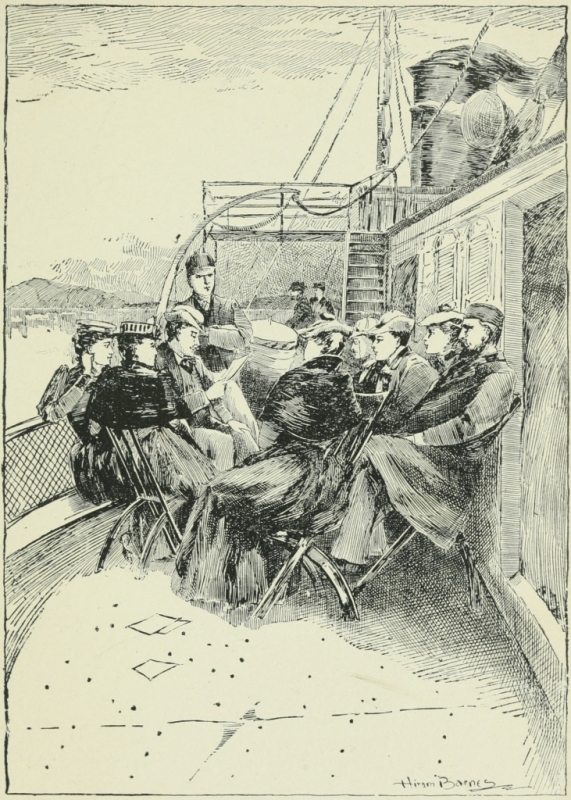
READING THE “CHICHAGOFF DECADE.”
“What does ‘A. E.’ stand for?” asked Mrs.
Percival.
“‘Animated Excursionist,’ I presume, ma’am.”
“Alaskan Editor,” “Expatriated Amateur,”
and various other suggestions were kindly offered
by the boys, but were frowned down by the older
members, who now called for the poem itself.
“One bright summer morning in early July
Our party assembled in Boston, to try
Of travels abroad an entirely new version
Afforded by Raymond & Whitcomb’s Excursion.”
“Hold on!” shouted Tom, who was privileged
by his lameness. “That’s an ad. Herodotus
Keats wants a free ticket next year. Who is he,
I wonder?”
“Thomas,” remarked Fred, eying him severely
through his glasses, “don’t display your ignorance
of the great authors, nor interrupt with ribald
comments. Go on, please, Mr. Selborne.”
“I know now, any way,” muttered the Irrepressible.
The editor paid no further attention to
him, but resumed the reading:
“The train was on hand in a place you all know well,
The Causeway Street depot marked “Boston & Lowell”;
It started, and cheers rose above lamentation
As, waving our hands, we rolled out of the station.
The daisies were white in the fields around Boston,
Like meadows in autumn with garments of frost on;
And fair were the skies over Merrimac’s stream,
As onward, still onward, with rattle and scream,
We flew o’er the rails ever faster and faster,
With never a thought of impending disaster.”
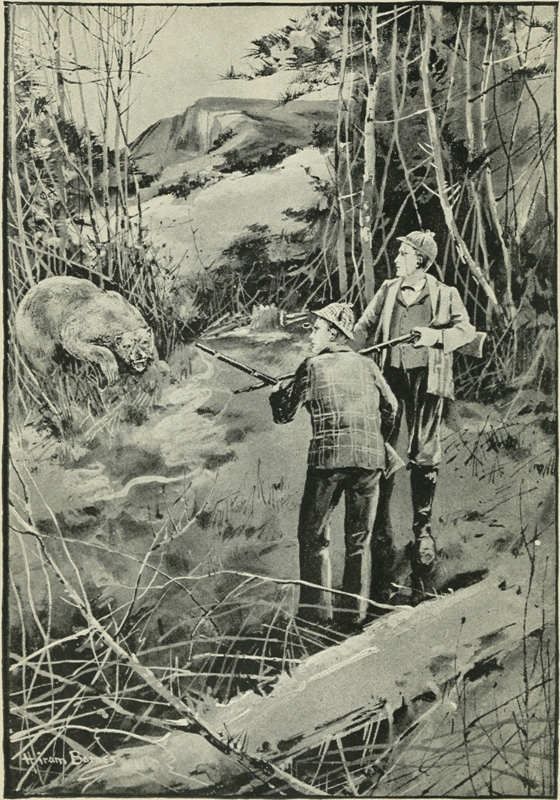
“But there wasn’t any disaster—unless the
historian foresaw, in his prophetic soul, a certain
bear”—
“Oh! let up, Ran. That’s poetical license.
Macaulay couldn’t find anything else to rhyme
with ‘faster.’”
“Arriving at Weirs, on Lake Winnepesaukee,
Our iron steed stopped, and became sort of balky,
Backed, snorted and started again with such speed
That some of us nearly ‘got left’ then, indeed!
At the Pemigewasset we halted to dine,
Then northward we sped to the Canada line,
Where Thomas was homesick until pretty soon he
Began to sing sadly of dear ‘Annie Rooney.’
In Montreal all the attractions were seen;
We dizzily whirled down the falls of Lachine
Till we hardly knew whether ’twas Memphremagog or
The turbulent rapids of far Caugnawauga.”
“Oh!” groaned Tom.
“And now came the splendid Canadian Pacific—
Through scenes now sublime, now tame, now terrific,
Past forests of fir, and along the wild shore
And storm-beaten crags of Lake Sup-e-ri-or.
There was such an outcry at this that the
captain, who was facing the bridge, looked back to
see what was the matter.
“All right, Captain,” sung out Randolph. “No
iceberg in sight—only a queer kind of ore.”
“I’m glad it isn’t mine,” remarked Tom.
“The Winnepeg grasshoppers followed Miss Bess
Entangling themselves in each silken tress,
Nor struggled for freedom, for when they were caught
They thought them but meshes the sunbeams had wrought.
“We halted at Banff, where the Bow and the Spray
Come leaping from cradles of snow far away;
And joining white hands, the bridegroom and bride
Glide silently down toward the sea side by side.
“Again we have entered our palace on wheels,
And cry out anew, ‘How homelike it feels!’
The ‘Nepigon’ broad and the stately ‘Toronto’
We can never forget, not e’en if we want to;
Nor ‘Calgary’ sturdy, and fair ‘Missanabie’;
But nearest our hearts, there can no better car be
Throughout the whole world, whatever befall,
Than faithful old ‘Kamloops,’ the dearest of all.
“At Glacier we saw the great river of ice,
And a bear almost ate up a boy in a trice;
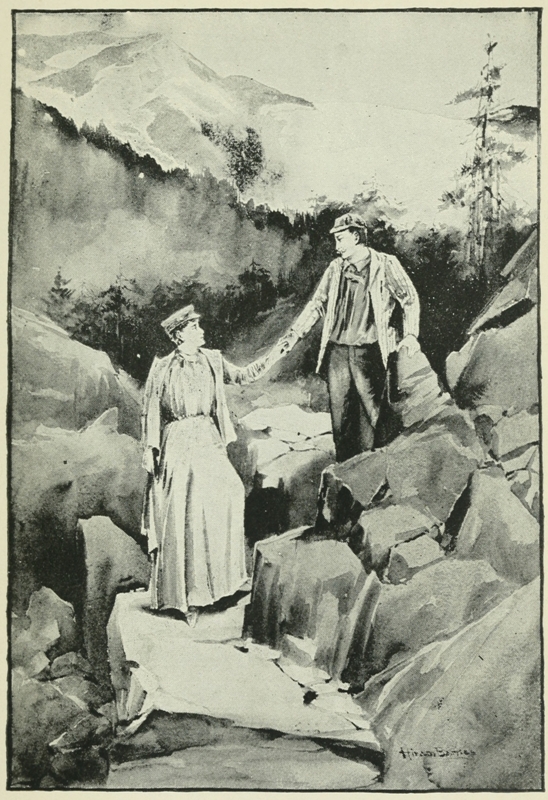
While one of the girls gave her poor little ankle
A twist and a wrench, whose twinges still rankle!
At last we arrive at our long journey’s end;
The continent crossed, at Vancouver we send
One glance of regret and a farewell combined
O’er the car we are leaving forever behind.
“At our next stopping place we had to try hard
To pronounce the name of our hotel ‘Dri-árd’;
Victoria’s awfully English, you know,
And nothing that’s ‘Yankee’ was found high or low,
Except our excursionists, everywhere seen
Until they embarked, northward bound, on the Queen.
We sailed and we sailed, through channels and reaches,
Past wild, rocky shores and verdure-clad beeches,
Until we emerged from the tortuous tangle
And moored at the dreary old wharf of Fort Wrangell,
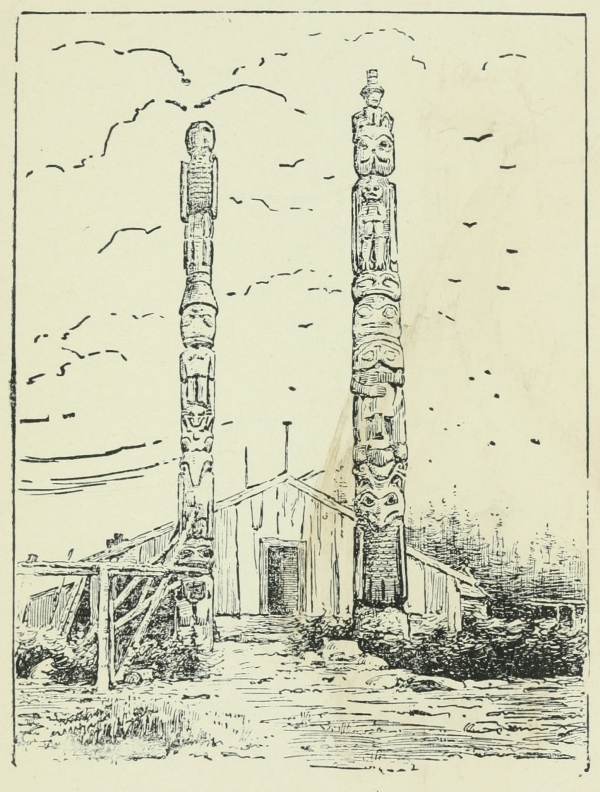
Where many a totem pole reared its proud head,
Once gorgeous in trappings of sable and red.
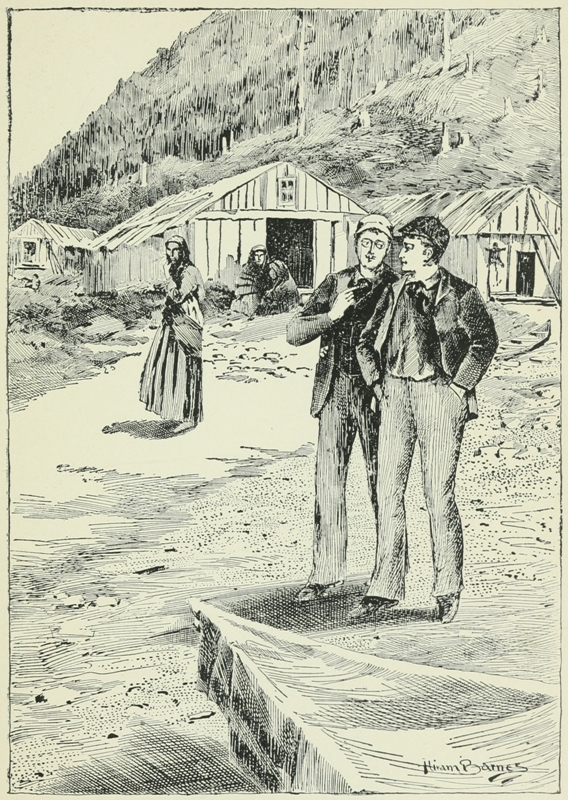
“At Juneau we halted—ah! how can I tell
Of all the adventures that shortly befell
Two hunters, who started out boldly to kill
Any sort of a beast that roamed on the hill.
Their perils and hardships, when distant from Juneau
And lost in the woods, I am sure that you do know
Enough that on meeting the enemy there,
Venerunt, viderunt, vicerunt—a bear!
“Since then our startling events have been fewer;
We’ve mounted the glacier that’s named after Muir,
And trembled to see its blue pinnacles fall
In fragments before us, like Jericho’s wall.
We saw all we could in the fair town of Sitka,
But could not go far for want of a fit car,
And now we’re sailing o’er Frederick’s Sound,
On board the good Queen safe and well,
Homeward bound!”
The applause which followed this effusion was
tremendous. It was suggested that the last half
of the journey had been rather slighted; but Mr.
Selborne explained that he had it direct from the
author that this disproportionate treatment was
caused by lack of time in which to fill out the
poem as originally sketched.
“The next piece,” he continued, “was in the
nature of an epic. It was certainly personal in
its bearings; but so was every epic, and too much
delicacy in an editor always results in an insipid
periodical.”
The curiosity of his auditors having been thus
aroused, he gravely read:
BY AN OLD SUBSCRIBER.
Tom, Tom, the valiant one,
Shot a bear and away he run;
The bear was fleet,
Poor Tom was beat,
And Bruin stepped upon his feet.
“Is that what Kittie manes by my ‘fate’?”
shouted Tom, laughing good-naturedly with the
rest. “Sure I knew something was brewin’ when
I saw her writing!”
“The contribution I have now to read,” said
the editor, as soon as silence was restored, “is
accompanied with an apology from the author,
stating that for lack of original material he has
drawn largely upon such printed sources as were
at his command, in giving you a brief account of
BY DARWIN FITZ-AGASSIZ THOMPSON.
The interior of Alaska is at present one of the
few remaining habitable spots on the surface of
the globe, which remain practically unexplored by
the white man.
A few years ago Central Africa held this distinction,
but Speke, Grant, Du Chaillu, Livingstone,
Stanley, and dozens of others have now penetrated
those somber jungles, the land of mystery, the
fabled abode of hideous monsters, giants and
dwarfs, and soon a transcontinental railroad will
connect Zanzibar with Stanley Pool and the mouth
of the Congo.
Within half a dozen years, Alaska has been
similarly assailed, and at this very moment there
are bands of intrepid men camping here and there
in that lonely interior, and calling upon the hitherto
impenetrable forests and desolate tundras to deliver
up the secrets they have held for untold ages.
Doubtless many wonderful discoveries await
these explorers and their successors. New plants
will be found, mountains of precious ore, a vast
wealth of timber and water-power, and, it may be,
strange creatures hitherto unknown to science.
It is believed by many that the mastodon, whose
skeleton rears itself high above the elephant’s, in
our museums, is not entirely extinct, but actually
roams the tangled thickets of inner Alaska. It is
stated that Professor John Muir himself lends
countenance to this belief, asserting that he has
seen the bones of these mighty animals, with the
fresh flesh adhering to them. Certain it is that
the great, curved tusks of the mammoth (as it is
sometimes called) are found all over the southwestern
slope of Africa, and that natives report
encounters with huge living animals with similar
tusks.
An animal which is unnamed, save by the coast
hunters hereabouts, is the “Mt. St. Elias bear,”
such as was shot by members of our party last
week.
The head is very broad, and the fur a silvery
gray. The skin is highly prized, not only for
its rarity, but for its beauty, and Indians have been
known to refuse a hundred dollars for one. They
sometimes hang up such a skin in front of the
“big house” of their village, as a talisman to aid
them in future hunting, such is its magic power.
Within a few years the American bison, once
so familiar in all stories of Western adventure,
has become almost wholly extinct. A few individuals
are said to lurk in the meadows and high
tablelands of Alaska; but soon they must rank
with the mastodon.
I have had time to but touch upon the mysteries
of our great Northwestern Territories. Little by
little its marvels, its wealth, its beauties will
unfold to modern research, and the schoolboy of a
generation hence will look back with incredulous
wonder upon the maps, the charts and the scientific
works upon Alaska that alone are available
to-day.
“I know who wrote that,” said Randolph, looking
meaningly at the editor.
The latter, however, took no notice of the
implication, and, turning over the next sheet in
the pile, read aloud the following poem, which
was unsigned:
Only a bird on a bough of fir—
Look, can you see his feathers stir,
And hear his wee notes, soft and low,
Echoes of songs of long ago?
I am not bearing my cross, you see,
For the cross itself is bearing me.
When birds are frightened, or suffer loss,
Alone in the darkness, they fly to a cross,
And never are heard to moan, “I must,”
But always twitter, “I trust! I trust!”
For not a fluttering sparrow can fall
But into His hand, who loveth all.
Lord, hear thy children while they pray,
Make us thy sparrows this Christmas Day.
“Bessie wrote that,” whispered Pet, glancing at
the little Captain, who did not deny the authorship,
but smiled a little as she nestled closer to
her father’s side.
“While I am reading verse,” remarked Mr.
Selborne, “I may as well read, though a little out
of course, another short poem about sparrows.
From the orchard, sweet with blossoms,
From the waving meadow-grasses,
From the heated, dusty pavement
Where a tired city passes,
Rise the happy sparrow-voices,
Chirps and trills, and songs of gladness—
Bits of sunshine, changed to music,
Brightening, scattering clouds of sadness.
At the first fair flush of dawning,
At the twilight’s last faint shining,
Sparrows sing, through storm and darkness,
Never doubting nor repining.
Fluttering to and fro, wherever
Faith is fainting, life is dreary,
Bear they each his little message
To the hopeless and the weary:
“Sparrows trust their Heavenly Father;
Centuries ago he told us
We should never fall unheeded;
In his love He would enfold us.
“So we cast our care upon Him,
Never fearing for to-morrow;
And we’re sent by Him to help you,
When your sky is dark with sorrow.”
“I think the assistant editor knows who wrote
that,” said Mr. Percival, glancing toward Adelaide
with a smile. “Mr. Selborne, it is getting rather
late. How many more articles have you in the——?”
“Three, sir; and one of them is very short,
being a four-line poem or quatrain. Shall I read
it now?”
“If you please.”
“This poem is printed so neatly that the writer
has evidently spent as much time upon it as the
producers of some of the longer pieces,” the
editor remarked, holding the sheet for all to see.
BY A. M. ATEUR.
’Tis said that in life the most exquisite rapture
Lies not in possession, but striving to capture.
Be sure that the proudest success is in vain
That helps not a loftier conquest to gain.
“Very well, Tom,” said Fred Seacomb approvingly.
“The sentiment does you credit, my son.
I recognize the authorship, however, by the style
of print rather than the high moral tone of the
poem.”
Tom laughed with the rest, and to cover his
retreat called for the next piece, which he knew
must be by Pet, as every one else but Mr. Percival
was accounted for; and his was pretty sure to be
a story.
Mr. Selborne’s voice became very gentle as he
read the story of
“O, dear! I wish I were a tall palm-tree on
the borders of a desert, where caravans and missionaries
and pilgrims would rest in my shade.
Then I should really be of some use in the world.”
That is what the Pine said.
“O, dear! I wish I lived away up on a mountain-top,
where the wind always blows cold and
clear, and the snows lie deep in winter. People
would come from far countries to visit the mountain,
and I would be a guide by the way. Then I
should really be of some use in the world.” That
is what the Palm said.
“O, dear! I wish I were a palm-tree down in
the valley, where birds might build their nests
in my boughs, and artists would make beautiful
pictures of me. Then I should really be of some
use in the world.” That is what the little stunted
Fir said, on the mountain-top.
Days and weeks came and went. The Pine
waited impatiently, and rustled all its branches in
the autumn winds, and let fall its brown needles,
until a thick carpet of them lay about its trunk on
the mossy ground. And out from the moss peeped
a few rough green leaves. The Pine noticed that
they were shivering in the November wind, and
pityingly dropped a few more needles around
them.
When the storms of winter came, it stretched
its broad, evergreen boughs above the leaves, and
sheltered them with its shaggy trunk.
The long, cold months passed at last, and it was
spring. Still the Pine grieved and sighed because
it could be of no use in the world.
To be sure it had protected the timid, furry
leaves so well that they had lived, and now bore
in their midst a cluster of small pink blossoms.
Just before sunset a man with coarse, roughened
features and a bad look in his face, came and
threw himself down on the ground beneath the
Pine. His fists were clenched, for he was very
angry about something, and, although the Pine
never knew it, he was being tempted to a terrible
crime.
As the man lay there thinking evil thoughts,
and almost making up his mind to the wicked
deed, he caught a breath of fragrance which made
him for a moment forget his anger.
It reminded him of home, of his boyhood, of a
wee sister with blue eyes and waving golden hair,
with whom he used to wander into the pine-woods
near the old farmhouse and gather flowers.
He looked about him, and his eye fell upon the
pink flowers.
“Mayflowers!” he murmured half-aloud. And
stretching out his hand he gathered them and held
their pure, sweet faces up to his own.
The fierce look left his eyes, and a strange
moisture came instead. His lips quivered. He
was thinking now of his mother. She had left
her children for a far country while they were still
tiny creatures. But he could remember her face
as she lay in the darkened room, resting so
peacefully.
And some one—was it the little blue-eyed
sister?—had placed a bunch of Mayflowers—
The man rose, and placing a small green spray
of pine with the blossoms, carried them away in
his big rough hand.
And the wicked deed was never done.
The Palm sheltered many weary travelers; but
the greatest good it did was after it died.
One day a stranger arrived and cut the tall tree
down. From its broad leaves a hundred fans were
made, and many were the fevered, throbbing brows
that were cooled by the Palm as its leaves, now
hundreds of leagues apart, waved to and fro above
the sufferers. So the Palm, although it never
knew it, was permitted to do the work of the
Master, refreshing and healing those who were
sick with all manner of diseases.
As to the Fir, it tried to keep a brave heart, but
it became more and more discouraged as not only
months but years rolled by, and it grew no bigger,
and could not see that it was of any use in the
world.
“So homely am I, too!” it whispered to itself,
glancing down at its little thick, gnarled trunk and
crooked boughs.
Its only comfort was in giving a shelter to such
small birds, and even insects, as were blown
about on these heights by the fierce mountain
tempests. Once it had a whole night of real joy,
when a white rabbit, caught by the storm miles
away from home, crouched under its boughs and
lay there snugly, a warm, sleepy ball of white fur,
till the sun called it home in the morning.
“O, Schwesterchen, seh ’auf! ’S ist ein Tannenbaum!”
Of course all firs understand German, and our
little friend knew the child said, “O, little sister,
look here! It’s a fir-tree!”
The next word it heard filled it with delight.
It was the girl who spoke this time, hardly above
her breath, “Weihnachtsbaum!” which was only
a queer way of saying, “Christmas-tree!”
They were, in fact, the children of a German
peasant, who lived in a small hut far down the
mountain-side.
The Fir did not know it, but in reality the
peasant had been unfortunate of late, and had
grown so cross and surly that he declared he would
have no Christmas in his house that year. And
Hans and Gretchen had wandered away mournfully
on the mountain-side to talk it over.
The Fir was so glad they talked German! If
it had been French, now, I don’t believe it could
have understood them at all.
“It is such a little one!” said Hans.
“And it has such lovely crosses at the end of
its boughs!” said Gretchen.
(The Fir never knew before that it had crosses.
But there they were, sure enough.)
“Let’s cut it down and try,” said both together.
So Hans swung his small ax sturdily, and down
came the tree. That is, it was too short to fall.
It just tipped over on its side a little.
Well, to make the story short, the Fir was
carried down and decked out in such simple ways
as they could provide without spending any money.
When the peasant saw it for the first time on
Christmas Eve—they had kept it for a surprise—he
clapped his hands with delight, in spite of all
his surliness. And that night, for the first time
for many weeks, he brought out the old leather-covered
Bible and read a chapter before bed-time.
And what chapter was it?
Why, the story of the first Christmas Eve, when
Christ was born in Bethlehem.
As there was now but one article left, all knew
that it must be Mr. Percival’s.
They therefore composed themselves to listen
with much interest to the story entitled
BY THE OLDEST INHABITANT.
“Let that girl alone!”
The speaker was a tall, slightly-built boy of
perhaps sixteen. His eyes flashed, and his fists
clenched nervously.
“Let that girl alone, I say, or”—
“Well, or what?” sneered a coarse-looking fellow,
some two or three years older than the first.
“You needn’t think you own this town, Winthrop
Ayre, if you did come from Boston!” And he
once more advanced toward a neatly-dressed girl,
who was timidly cowering in a corner by a stone
wall and a high fence, to avoid the touch of her
rough tormentor. The latter was supported by
two more of his kind, and all three were evidently
trying to frighten her by their fierce looks and
rude words.
“You ought to be ashamed of yourself, Mort
Lapham!” exclaimed Winthrop indignantly, placing
himself directly in front of the frightened girl.
“Deacon Lapham’s son might be in better business
than insulting girls in the street.”
“So you want to put your finger in the pie, do
you? Here, fellows, let’s give him a lesson!”
Winthrop noticed that the attention of all three
was now upon him alone, and motioned to the girl
to run. She moved slowly a few steps down the
street, and then stopped. Meanwhile the big
bully raised his hand and tried to slap the city
boy in the face. Winthrop warded off the blow
easily, and retreated into the corner where the girl
had been. “You’d better keep away, Mort,” he
said quietly, though his cheeks were hot; “and
you, too, Dick and Phil. I don’t want to fight,
and now you’ve let the girl go, there’s nothing to
fight about, that I know of.”
“Coward!” cried Mort, enraged at missing his
blow. “Don’t you wish you had your Sunday-school
teacher here to take care of you! She
wouldn’t let any one hurt you, would she, Sonny?”
The color in Winthrop’s face deepened, but he
said nothing. He was rapidly turning over the
question in his mind, whether Miss Kingsbury
would want him to turn his cheek if three boys
struck him at once.
A tingling blow on that exact spot put to flight
his meditations. His fist drew back impulsively,
but he would not strike yet. He was in splendid
training, this boy, and still stood entirely on the
defense, knowing that the true hero is not he who
fights for himself, like a brute creature, but for
somebody else.
“Coward!” hissed Mort Lapham once more,
cautiously keeping out of reach of the other’s arm.
“Hit him again, Phil!”
As the three closed about him, a determined look
in their ugly faces, the girl who had lingered irresolutely
at a few paces distance, gave a low cry
for help, and rushed up to the group as if to protect
her protector.
“Take that!” shouted Mort, throwing out his
hand and striking her, perhaps harder than he
really meant to, full in the face.
Before he had time to see the effect of his blow,
there was a crash between his eyes, and the earth
seemed suddenly flying up into the sky. As he
lay on the ground half-stunned, Winthrop, who
felt that it was at last time to act, turned fiercely
on his other opponents. Surprised by the suddenness
of his attack, they forgot the superiority of
their numbers, and started backwards. Another
nervous blow from the slender young athlete, and
Phil was on his back beside his leader, while Dick
Stanwood, tripping over a stone—purposely or
not the boys never knew—went down ingloriously
with the rest. Above them stood young Ayre,
like Saint Michael over his enemies, panting and
glowing.
“Oh! are you hurt?” asked the girl, hurrying
up to “Saint Michael,” and laying her hand on his
arm.
Winthrop laughed. “Well, I’m able to walk,”
he said reassuringly. Then: “Let’s leave these
rascals to come to their senses. May I see you
home?”
The girl flushed prettily in her eagerness.
“You are so kind,” she said. “I live just the
other side of that hill, and if you’ll come in a
few minutes and see grandpa, I’ll be very much
obliged.”
“But your forehead,” added Winthrop, as they
walked along the dusty road side by side, leaving
their three late assailants to sneak off in the opposite
direction; “I’m afraid that fellow hurt you,
though I don’t believe he meant to strike you so
hard.”
“Oh! it isn’t much. I haven’t told you who I
am,” she added shyly. “I know about you and
your sister Marie, over at the Elms. Your Uncle
Ayre and my grandfather are dear friends.”
“Then you must be ‘Puss’ Rowan!”
“Yes,” she laughed; “though it’s rather saucy
for you to say it. My real name is Cecilia.”
“Excuse me, Miss Cecilia.”
“O, dear me! Don’t call me that, or I shall
think you are speaking to somebody else. ‘Puss’
I’ve always been, and ‘Puss’ I must be, I suppose!”
And she gave a comical little sigh, ending
in another ripple of laughter, which was very
pleasant to hear.
“Yes,” she went on, more soberly, “I’ve heard
how your sister was ill, and you brought her here
for her health, to stay all summer. May I come and
see her? She’s just about my age, grandpa says.”
“Do! It will do her good, I’m sure,” replied
Winthrop warmly, glancing at his companion’s
pretty face and sunny curls.
Puss blushed a little, and suddenly became very
demure. “Here’s grandpa’s, where I live,” she
said, pausing before an old, gambrel-roofed house.
“Won’t you come in?”
All the houses in Taconic were pleasant inside
and out. This one looked particularly so.
“Thank you; just for a minute,” said Winthrop,
walking up with Puss between two rows of lilac
bushes. The girl led him into a cool, old-fashioned
parlor, which had shells on the mantel-piece, and
great, irregular beams in the ceiling.
Mr. Rowan, a silvery-haired gentleman, with
much stately dignity and kindly manner, soon entered,
and talked pleasantly with the boy, of his
uncle’s younger days and Winthrop’s own affairs.
Altogether a half-hour passed very quickly, and
Winthrop was sorry to feel obliged to take his
leave.
Puss went down to the gate with him.
“Be sure to tell your sister I am coming to-morrow,”
she said. “And you’ll call again here
yourself, won’t you? I shall not soon forget how
you took care of me!”
Winthrop drew himself up and lifted his hat in
elegant city fashion; which, however, only made
Puss laugh and shake her curls.
“It’s no use to be the least bit dignified with
me,” she said merrily, “for I don’t know what to
do back. We just shake hands, here in the country,
and say good-by.”
“Good-by,” said Winthrop, taking her little
brown hand with mock solemnity.
“Good-by,” laughed Puss, “that’s better. Don’t
forget your message!”
As Winthrop walked rapidly toward his uncle’s
house, he went over and over the exciting events
of the afternoon. He had only arrived about a
week before, but he had already come in contact
with the three boys who had been amusing themselves
by rudely teasing Miss Cecilia Rowan, the
gentlest and prettiest girl in the village. They
were notorious, he had soon found, for their ill-behavior
and rough manners, and had even been
suspected of certain petty thefts in the neighborhood.
Winthrop could not help feeling that he
should hear from them again.
The meeting between his sister and Puss Rowan
took place the very next day, and the two girls
were almost immediately warm friends. As Winthrop
had predicted, Puss’s bright face and winsome
ways won the heart of the pale city maiden
at once, and “did her good,” too.
One or two pleasant afternoons they passed together,
and several delightful trips were planned.
One of these was a small lunch party, to a favorite
spot for the village young folks, called “Willow
Brook.” It was about four miles from Taconic
Corner, and the road to it lay through deep woods,
adding an enjoyable drive to and fro, to the pleasures
of the day.
Willow Brook is a noisy little stream that comes
dancing down from a spur of the White Mountains,
finding its way through a heavy growth of
spruce and fir, over half a dozen granite ledges,
and so onward until it reaches the upper Taconic
meadows, where it suddenly becomes demure and
quiet; but, nevertheless, is all dimples when the
wind whispers to it through the sedges, or teases
for a romp under the shadow of the birch-trees
that line its bank here and there. At length
it reaches a small picturesque valley, where the
hills, though by no means lofty, perhaps remind it
of its mountain childhood; for there it pauses, and
holds in its bosom the pictures of the gently rising
uplands, with their peacefully browsing flocks
of lambs—and gathers white lilies, and so rests
a while from its journey. At times, it is true, a
dimple of the old-time fun, or an anxious shadow
as it hears the roar of machinery and busy life
beyond, hides the treasured secrets of its heart,
but as the ruffled brow smooths, you can see again
in those quiet depths, lambs, lilies, fleecy clouds,
alike snowy white and beautiful.
The mill had stood at the foot of “Lily Pond,”
where the road crossed the stream, nobody knows
how long. There was an old-fashioned dam, built
of a few logs and a good deal of earth and rock,
now overgrown with grass and bushes up to the
very sluiceway of the mill. The waste-board, over
which the water flowed in a thin, glistening sheet
in the early spring when the pond was high, was
scarcely more than ten feet long. About a hundred
feet further down the stream was a shady
grove of willows and other trees, growing down
close to the water’s edge. Toward this spot Winthrop
with his sister, Puss and her father rode
merrily enough that hot July day. Mr. Rowan
did not go down to the grove at once, but, having
let the young people jump out with their baskets
at the Lily Pond Bridge, drove on to a neighbor’s
to transact some business, promising to join the
party at lunch a half an hour later. Winthrop
assisted his sister carefully down over a steep embankment
to the willows, Puss springing ahead
and calling to her companions that she had found
“a lovely place right beside the water.”
Baskets and shawls were soon safely stowed
away, and Winthrop, with the help of the girls,
arranged a sort of shelter of boughs. When a
small fire had been kindled on a flat rock just in
front, Puss laughed with delight, and Marie’s delicate
face showed a glow of healthy pleasure, which
her brother noted with quiet satisfaction. Plainly
Taconic life was bringing the frail invalid back to
strength and health.
Leaving the girls to chatter over the beauties of
the place and their plans for the coming weeks,
Winthrop strayed down stream a few rods, following
a cat-bird, whose whimsical calls led him to
suspect a nest among the alders which lined the
river at that point.
The bird kept persistently out of sight, but repeated
its cry in a more and more distressed tone,
until Winthrop reached the very heart of a thicket.
“I’ve got you now!” he said aloud, as he
stooped and thrust aside a mass of foliage. Then
he started to his feet. He had very nearly laid
his hand on—not the pretty, rounded nest of the
gray-winged thrush, but the evil, grinning features
of Mort Lapham.
“I rayther guess we’ve got you this time, my
Boston daisy,” said Mort, rising in his turn. “Tie
him up, fellows!”
The ugly youth’s two boon comrades sprang forward
from the rear, and before Winthrop could
offer the slightest resistance, entangled as he was
in the tough, slender stems of the alders, he was
bound, hand and foot.
“What are you going to do with me, Phil
Bradford?” asked the prisoner quietly, though
his heart sank as the three cowardly assailants
hurried him roughly through the underbush.
“You’ll find out soon enough,” growled the
other, who had not forgotten the blow given in
defense of the girl by the roadside. They emerged
presently in a little opening that crowned a bluff,
some half a dozen feet or more above the surface
of the river, where it here made a sudden bend
toward the steep bank forming at its base a deep,
black pool, with here and there a few pine needles
turning slowly in its eddies.
In all this time Winthrop had not uttered a cry.
He would not alarm the girls unnecessarily, and
might include them in his own dangerous situation.
“Now,” said Mort, with a cruel leer, “we’ll
square up our accounts. The next time I’m having
a little fun on my own account, I reckon you’ll
mind your own business!”
With these words he proceeded to tie his victim
firmly to a stout young pine that grew close to the
edge of the bluff. They placed his face to the
trunk, and clasping his hands around it, lashed
them tightly together.
“I say,” interposed Dick, as he saw the cords
cut into the captive’s wrists, “you needn’t pull
’em so tight! Don’t you see—you’re
hurting him awfully!”
Winthrop set his lips together, and said nothing.
“Hurting him!” repeated Mort savagely. “I
guess he’ll wish he wa’n’t hurt any more’n that,
before I get through with him! Gimme that
whip!”
“Don’t whip him!” cried Dick again. “We’ve
scared him enough, now. You said you only
wanted to frighten him, Mort.”
“Git out o’ the way, will you? I’m running
this job, and this slim Sunday-school chap from
the city has got to have a little more scarin’ yet.”
“But”—
“If you don’t want a taste yourself, you’ll keep
quiet, Dick Stanwood. Phil an’ I’ll duck ye in
the river, ’f you say much more!”
“All right,” said Dick, who evidently regretted
his part in the matter. “If that’s all the thanks
I get, I’m off!” And turning suddenly on his
heel, he walked away through the woods.
“Hold on! Stop him, will you, Phil?” cried
Mort angrily. But Dick had hastened his steps
and was already out of sight.
Still Winthrop said never a word. His face was
white, and the two guards thought he was too
frightened to speak.
“Strip off his coat and vest,” commanded Mort,
brandishing the whip. Phil obeyed his leader like
a lamb, untying the captive’s hands cautiously,
and, with Mort’s aid, fastening them again more
securely than ever.
“Now, then, here’s one for interfering between
me and the girl!”
Down came the leather lash across the thinly
clad shoulders.
“One more for the lick you gave me between
the eyes!”
Again the stinging, burning blow. Still Winthrop
did not cry out.
“You want some more, do you?” cried Mort,
enraged at his victim’s silence.
The lash was raised again. As Mort raised and
swung it, to give the full force of the blow, he
stepped backward. The embankment, long ago
undermined by the river, crumbled under the
bully’s feet; with a shriek of terror he toppled
over, and disappeared beneath the black eddies of
the pool. Winthrop could not see what had happened,
for his back, now smarting as if living coals
were bound to it, was toward the bank. From the
sound of the falling earth, the cry of his tormentor,
and the loud splash that followed, he guessed what
had occurred.
“Untie me, quick!” he shouted to Phil, who
stood gazing stupidly at the whirling bubbles
where his leader had disappeared. “No, cut the
rope—take my knife out of my pocket!”
Phil, who was always ready to follow the party
in power, obeyed mechanically. In a few seconds
Winthrop was free.
“Can’t he swim?” he cried, kicking off the last
coils of the rope, as Mort rose, screaming and
splashing to the surface, and went under again.
“Not a stroke,” said Phil stoically. “Serves
him right, don’t it? Say, Win, I’m awful sorry”—
But he was apologizing only to the pine-tree
and the cut cords. Winthrop had sprung into the
pool, and even now had his late assailant by the
collar and was striking out for the shore lower
down, where the bank was not so high.
“Don’t drown me!” yelled Mort, rolling up his
eyes. “I didn’t mean”—
“Stop kicking—you’re all right!” gasped
Winthrop. “There—put your feet down—can’t
you touch bottom?”
“Winthrop, my lad! Here—give me your
hand!” cried a new voice; and Puss’s father leaned
perilously far over the bank to assist the boy. At
the same time Phil and Dick—the latter of whom
had brought Mr. Rowan to the scene—helped
the choking, crest-fallen, dripping Mort to his feet.
“What does this mean?” demanded the older
man sternly, surveying the cords and whip.
“O, Winthrop!—brother!” and the two girls
came hurrying down to the river’s edge. Winthrop
tried to toss on his coat, but did not succeed
before the stains on his poor, smarting back told
the story to his sister’s anxious eye.
Of course the picnic was ended for that day.
The whole party hurried to the wagon and drove
home. On the way, Winthrop begged Mr. Rowan
not to have either of his late captors prosecuted,
or punished in any way.
“I’m satisfied,” he said, “if they are.”
“Well, I’m not!” burst out Mort suddenly,
“and I sha’n’t be, till I get square with you
somehow!”
The girls turned and looked at him in new
amazement and terror. But Winthrop understood
him better.
“All right, old fellow,” he replied simply, holding
out his hand to the other.
Mort grasped it and said no more.
“Good story, father!” called out Tom, whose
voice, whether for approval or criticism, was never
wanting. “I’d like to know how Mort got square
with him, though.”
Mr. Percival laughed as he rose. “That is not
of so much consequence. In such a case, ‘the
readiness is all.’ Does that finish the paper, Mr.
Editor?”
“It does,” said Selborne gravely. “And the
publication of the ‘Tri-Weekly Chichagoff Decade’
is suspended until further notice.”