Author of MILDRED A. WIRT MYSTERY STORIES
TRAILER STORIES FOR GIRLS
Illustrated
CUPPLES AND LEON COMPANY
Publishers NEW YORK
PENNY PARKER MYSTERY STORIES
Large 12 mo. ClothIllustrated
TALE OF THE WITCH DOLL
THE VANISHING HOUSEBOAT
DANGER AT THE DRAWBRIDGE
BEHIND THE GREEN DOOR
CLUE OF THE SILKEN LADDER
THE SECRET PACT
THE CLOCK STRIKES THIRTEEN
THE WISHING WELL
SABOTEURS ON THE RIVER
GHOST BEYOND THE GATE
HOOFBEATS ON THE TURNPIKE
VOICE FROM THE CAVE
GUILT OF THE BRASS THIEVES
SIGNAL IN THE DARK
WHISPERING WALLS
SWAMP ISLAND
THE CRY AT MIDNIGHT
COPYRIGHT, 1945, BY CUPPLES AND LEON CO.
Guilt of the Brass Thieves
PRINTED IN U. S. A.
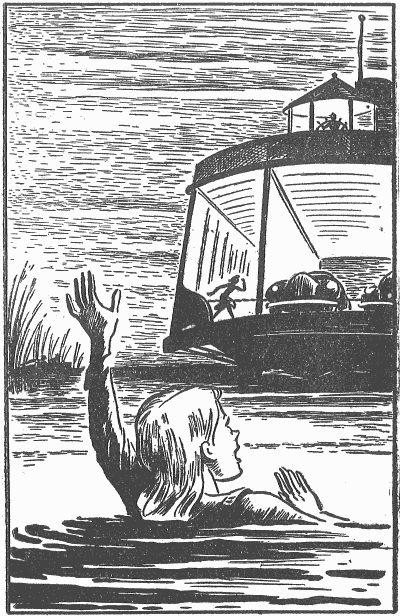
TREADING WATER, THE GIRL SHOUTED FOR HELP.
“Guilt of the Brass Thieves” (See Page 170)
“This is the limit! The very limit!” Giving his
leather suitcase an impatient kick, Anthony Parker
began to pace up and down the creaking old dock.
His daughter Penny, who stood in the shadow of
a shed out of the hot afternoon sun, grinned at him
with good humor and understanding.
“Oh, take it easy, Dad,” she advised. “After all,
this is a vacation and we have two weeks before us.
Isn’t the river beautiful?”
“What’s beautiful about it?” her father growled.
However, he turned to gaze at a zigzag group of
sailboats tacking gracefully along the far rippled
shore. Not a quarter of a mile away, a ferryboat
churned the blue water to whip cream foam as it
steamed upstream.
[2]
“Are you certain this is the dock where we were to
meet Mr. Gandiss?” Penny asked after a moment. “It
seems queer he would fail us, for it’s nearly five
o’clock now. We’ve waited almost an hour.”
Ceasing the restless pacing, Mr. Parker, publisher
of the Riverview Star, a daily newspaper, searched his
pockets and found a crumpled letter.
Reviewing it at a glance, he said: “Four o’clock
was the hour Mr. Gandiss promised to meet us at dock
fourteen.”
“This is number fourteen,” Penny confirmed,
pointing to the numbers plainly visible on the shed.
“Obviously something happened to Mr. Gandiss. Perhaps
he forgot.”
“A nice thing!” muttered the publisher. “Here he
invites us to spend two weeks at his island home and
then fails to meet us! Does he expect us to swim to
the island?”
Penny, a slim, blue-eyed girl with shoulder length
bob which the wind tossed about at will, wandered to
the edge of the dock.
“That must be Shadow Island over there,” she
observed, indicating a dot of green land which arched
from the water like the curving back of a turtle. “It
must be nearly a mile away.”
“The question is, how much longer are we to wait?”
Mr. Parker glanced again at his watch. “It’s starting
to cloud up, and may rain in another half hour. Why
not taxi into town? What’s the name of this one-horse
dump, anyhow?”
[3]
“Our tickets read ‘Tate’s Beach.’”
“Well, Tate’s Beach must do without us this summer,”
Mr. Parker snapped, picking up his suitcase.
“I’ve had my fill of this! We’ll spend the night in a
hotel, then start for Riverview on the early morning
train.”
“Do you know Mr. Gandiss well?” Penny inquired,
stalling for time.
“He advertises in the Star, and we played golf together
occasionally when he came to Riverview. I
must have been crazy to accept an invitation to come
here!”
“Oh, we’ll have a good time if only we can get to
the island, Dad.”
“I can’t figure out exactly why Gandiss invited us,”
Mr. Parker added thoughtfully. “He has something
in mind besides entertainment, but what it is, I haven’t
been able to guess.”
“How about hiring a boat?” Penny suggested.
Her father debated, then shook his head. “No, if
Gandiss doesn’t think enough of his guests to meet
them, then he can do without us. Come on, we’re
leaving!”
Never noted for an even temper or patience, the
publisher strode down the dock.
“Wait, Dad!” Penny called excitedly. “I think
someone may be coming for us now!”
[4]
A mahogany motorboat with glittering brasswork,
approached at high speed from the direction of
Shadow Island. As Penny and her father hopefully
watched, it swerved toward their dock, and the motor
was throttled.
“That’s not Mr. Gandiss,” the publisher said, observing
a sandy-haired, freckled youth at the steering
wheel.
Nevertheless, suitcase in hand, he waited for the
boat.
The craft came in smoothly, and the young man
at the wheel leaped out and made fast to a dock post.
“You’re Anthony Parker!” he exclaimed, greeting
Penny’s father, and bestowing an apologetic smile
upon them both. “I’m Jack—Jack Gandiss.”
“Harvey Gandiss’ son?” Mr. Parker inquired, his
annoyance melting.
“A chip off the old block,” the boy grinned.
“Hope I haven’t kept you waiting long.”
“Well, we had just about given up,” Mr. Parker
admitted truthfully.
“I’m sure sorry, sir. I promised my father I would
meet you sharp at four. Fact is, I was out on the
river with some friends, and didn’t realize how late it
was. We were practicing for the trophy sailboat
race.”
Penny’s blue eyes sparkled with interest. An excellent
swimmer, she too enjoyed sailing and all water
sports. However, she had never competed in a race.
[5]
“Suppose we get along to the island,” Mr. Parker
interposed, glancing at the sky. “I don’t like the look
of those clouds.”
“Oh, it won’t rain for hours,” Jack said carelessly.
“Those clouds are moving slowly and we’ll reach the
island within ten minutes.”
Helping Penny and Mr. Parker into the motorboat,
he stowed the luggage under the seat and then cast
off. In a sweeping circle, the craft sped past a canbuoy
which marked a shoal, and out into the swift
current.
Penny held tightly to her straw hat to keep it from
being blown downstream. A stiff breeze churned the
waves which spanked hard against the bow of the
boat.
“My father was sorry he couldn’t meet you himself!”
Jack hurled at them above the whistle of the
wind. “He was held up at the airplane factory—labor
trouble or something of the sort.”
Mr. Parker nodded, his good humor entirely restored.
Settling comfortably in the leather seat, he
focused his gaze on distant Shadow Island.
“Good fishing around here?” he inquired.
“The best ever. You’ll like it, sir.”
Jack was nearly seventeen, with light hair and steel
blue eyes. His white trousers were none too well
pressed and the sleeves of an old sweater bore smears
of grease. Steering the boat with finger-tip control,
he deliberately cut through the highest of the waves,
treating his passengers to a series of jolts.
[6]
Some distance away, a ferryboat, the River Queen,
glided smoothly along, its railings thronged with people.
In the pilot house, a girl who might have been
sixteen, stood at the wheel.
“Look, Dad!” Penny exclaimed. “A girl is handling
that big boat!”
“Sally Barker,” Jack informed disparagingly.
“She’s the daughter of Captain Barker who owns the
River Queen. A brat if ever there was one!”
“She certainly has that ferryboat eating out of her
hand,” Mr. Parker commented admiringly.
“Oh, she handles a boat well enough. Why
shouldn’t she? The captain started teaching her about
the river when she was only three years old. He
taught her all she knows about sailboat racing, too.”
Jack’s tone of voice left no doubt that he considered
Sally Barker completely beneath his notice. As the
two boats drew fairly close together, the girl in the
pilot house waved, but he pretended not to see.
“You said something about a sailboat race when we
were at the dock,” Penny reminded him eagerly. “Is
it an annual affair?”
Jack nodded, swerving to avoid a floating log.
“Sally won the trophy last year. Before that I held
it. This year I am planning on winning it back.”
“Oh, I see,” Penny commented dryly.
[7]
“That’s not why I dislike Sally,” Jack said to correct
any misapprehension she might have gained. “It’s
just—well, she’s so sure of herself—so blamed stubborn.
And it’s an insult to Tate’s Beach the way she
flaunts the trophy aboard that cheap old ferryboat!”
“How do you mean?” Mr. Parker inquired, his curiosity
aroused.
Jack did not reply, for just then the engine
coughed. The boat plowed on a few feet, and the
motor cut off again.
“Now what?” Jack exclaimed, alarmed.
Even as he spoke, the engine died completely.
“Sounds to me as if we’re out of gas,” observed Mr.
Parker. “How is your supply?”
A stricken look came upon Jack’s wind-tanned face.
“I forgot to fill the tank before I left the island,” he
confessed ruefully. “My father told me to be sure to
do it, but I started off in such a hurry.”
“Haven’t you an extra can of fuel aboard?” Mr.
Parker asked, trying to hide his annoyance.
Jack shook his head, gazing gloomily toward the
distant island. The current had caught the boat and
was carrying it downstream, away from the Gandiss
estate.
“Nothing to do then, but get out the oars. And it
will be a long, hard row.”
“Oars?” Jack echoed weakly. “We haven’t any
aboard and no anchor either.”
[8]
Mr. Parker was too disgusted to speak. A man
who demanded efficiency and responsibility in his own
newspaper plant, he had no patience with those negligent
of their duties. Because he and Penny were to
be guests of the Gandiss family, he made an effort not
to blame Jack for the mishap.
“I—I’m terribly sorry,” the boy stammered. “But
we shouldn’t be stranded here long. We’ll soon be
picked up.”
Hopefully, Jack gazed toward the nearest shore.
No small boats were visible. The ferry, plying her
regular passenger route, now was far upstream.
Although the sun still shone brightly, clouds frequently
blocked it from view. Waves slapped higher
against the drifting boat and the river took on a dark
cast.
Neither Penny nor her father spoke of the increasing
certainty of rain. However, they watched the
shifting clouds uneasily. Soon there was no more
sun, and the river waters became inky black.
Presently the wind died completely and a dead
calm held the boat. But not for many minutes. Soon
a ripple of breeze ruffled the water, and far upstream
a haze of rain blotted out the shoreline.
“Here it comes!” Mr. Parker said tersely, buttoning
up his coat.
[9]
The next instant, wind and rain struck the little
boat in full force. Penny’s hat was swept from her
head and went sailing gaily down river. Waves
which broke higher and higher, spanked the boat,
threatening to overturn it when they struck broadside.
“If we just had an anchor—” Jack murmured but
did not finish.
Above the fury of the storm could be heard the
faint clatter of a motorboat engine. Straining their
eyes, they pierced the wall of rain to see a small speedboat
fighting its way upstream.
“A boat!” Penny cried. “Now we’ll be picked up!”
Jack sprang to his feet, waving and shouting.
Closer and closer approached the boat, but there was
no answering shout from those aboard.
Mr. Parker, Penny and Jack yelled in unison. They
thought for a moment that the occupants must have
heard their cries and would come to the rescue. But
the craft did not change course.
Keeping steadily on, it passed the drifting motorboat
well to starboard, and disappeared into the curtain
of rain.
[10]
CHAPTER 2 THE BRASS LANTERN
The rain dashed into Penny’s face and ran in
rivulets down her neck. With a change in the wind
direction, the air had become suddenly cold. Shivering,
she huddled close to her father for warmth.
Veiled by rain, the shore no longer was visible. Far
to the right, the chug of a laboring motorboat was
heard for an instant, then died away. It was apparent
to Penny that they were drifting downstream quite
rapidly.
“Listen!” she cried a moment later.
From upriver had come three sharp blasts of a
whistle.
“That’s the River Queen,” muttered Jack, tossing
a lock of wet hair out of his eyes. “We must be right
in her path.”
“Then maybe we’ll be picked up!” Penny exclaimed
hopefully.
[11]
Jack gave a snort of disgust. “I’d rather drown than
accept help from Sally Barker! Wouldn’t she gloat!”
“Young man,” interposed Mr. Parker with emphasis,
“this is no time for false pride. We’re in a predicament
and will welcome help from any source.”
“Yes, sir, I guess you’re right,” murmured Jack,
completely squelched. “I sure am sorry about getting
you into this mess.”
Gazing through the curtain of driving rain, Penny
tried to glimpse the River Queen. Suddenly she distinguished
its high decks and was dismayed to see that
the ferry was bearing at full speed directly toward the
drifting motorboat.
Jack leaped to his feet, frantically waving his arms.
Realizing the danger of being run down, Mr. Parker
likewise sprang up, shouting.
Straight on came the River Queen, her pilot seemingly
unaware of the little boat low in the water and
directly in the path.
“They don’t see us!” Jack shouted hoarsely. “We’ll
be run down!”
The ferryboat now was very close. Its dark hull
loomed up. Expecting a splintering crash, Penny
struggled to her feet, preparing to jump overboard.
But instead, she heard a series of sharp whistle toots,
and the ferryboat swerved, missing them by a scant
three yards.
“Wow! Was that close!” Jack muttered, collapsing
weakly on the seat. Then he straightened up again
into alert attention, for the ferry had reduced speed.
[12]
“Maybe we’re going to be picked up!” he exclaimed.
The ferryboat indeed had maneuvered so that the
current would swing the drifting craft directly toward
it.
Five minutes later, wet and bedraggled, the three
stranded sailors scrambled up a lowered ladder onto
the River Queen’s slippery deck. A few curious passengers
who braved the rain, stared curiously at them
as they sought shelter.
“Well, if it isn’t Jack Gandiss, and in trouble again!”
boomed Captain Barker, owner of the ferry. He was
a short, stubby, red-faced man, with twinkling blue
eyes. “What happened this time? Engine conk
out?”
“We ran out of gas,” the boy admitted briefly.
“Thanks for picking us up.”
“Better thank Sally here,” replied the captain, giving
orders for the motorboat to be taken in tow. “It was
her sharp eyes that picked you up out o’ the storm.”
Penny turned to see a dark-haired girl of her own
age standing in the doorway of the pilot house. In
oilskin hat and coat, one easily might have mistaken
her for a boy. Impatiently she brushed aside a strand
of wet hair which straggled from beneath the ugly
headgear, and came out on the rain-swept deck.
[13]
“Well, well, if it isn’t Jack!” she chortled, enjoying
the boy’s discomfiture. “Imagine an old tar like you
running out of gas!”
“Never mind the cracks!” he retorted grimly. “Just
go back to your knitting!”
Turning her back upon Jack, Sally studied Penny
with curious interest.
“Do I know you?” she inquired.
“My father and I are to be guests at the Gandiss
home,” Penny explained, volunteering their names.
“We were on our way to Shadow Island when we ran
out of gas.”
“Let’s not go into all the gory details here,” Jack
broke in. “We’re getting wet.”
“You mean you are all wet,” corrected Sally, grinning.
“Sally, take our guests to the cabin,” Captain Barker
instructed with high good humor. “I’ll handle the
wheel. We’re late on our run now.”
“How about dropping us off at the island?” Jack
inquired. “If we had some gasoline—”
“We’ll take care of you on the return trip,” the captain
promised. “No time now. We have a hundred
passengers to unload at Osage.”
Penny followed Sally along the wet deck to a companionway
and down the stairs to the private quarters
of the captain and his daughter.
[14]
“Osage is a town across the river,” Sally explained
briefly. “Pop and I make the run every hour. This
is our last trip today, thank Jupiter!”
The cabin was warm and cozy, though cramped in
space. Sally gave Mr. Parker one of her father’s warm
sweaters to put on over his sodden garments, offered
Penny a complete change of outer clothing, and deliberately
ignored Jack’s needs.
“You may return the duds later,” she said, leading
Penny to an adjoining cabin where she could change
her clothes. “How long do you folks expect to stay
at Shadow Island?”
“Two weeks probably.” Penny wriggled out of
the limp dress.
“Then we’ll have time to get better acquainted.
You’ll be here for the trophy race too!” Sally’s dark
eyes danced and she added in a very loud voice:
“You’ll be around to see Jack get licked!”
“In a pig’s eye!” called Jack through the thin partition
of the cabin. “Why, that old sailboat of yours is
just a mess of wormwood!”
“It was fast enough to win the brass lantern trophy!”
Sally challenged, winking at Penny. In a whisper she
explained: “I always get a kick out of tormenting Jack!
He’s so cocky and sure of himself! It does him good
to be taken down a peg.”
“Tell me about the race,” urged Penny. “It sounds
interesting—especially your feud with Jack.”
[15]
“Later,” promised Sally carelessly. “Right now I
want to get you something warm to drink before we
dock at Osage. Here, give me those wet clothes. I’ll
dry them for you, and send them to Shadow Island
tomorrow.”
Rejoining Jack and Mr. Parker, the captain’s daughter
conducted the party to a food bar in the passenger
lounge.
“Hot Java,” she instructed the counter man. “And
what will you have to go with it? Hamburgers or
dogs? This is on the house.”
“Make mine a dog with plenty of mustard,” laughed
Penny, enjoying the girl’s breezy slang.
“Nothing for me except coffee,” said Jack stiffly.
“I’ll pay for it too.”
Mr. Parker decided upon a hamburger. Food, especially
the steaming hot coffee, revived the drooping
spirits of the trio. Even Jack thawed slightly in his
attitude toward Sally.
Sipping the brew from a thick China mug, Penny’s
gaze roved curiously about the lounge. The room
was poorly furnished, with an ancient red carpet and
wicker chairs. Passengers were absorbed with newspapers,
their fretful children, or the River Queen’s
supply of ancient magazines.
[16]
The lounge however, was scrupulously clean, and
every fixture had been polished until it shone like gold.
Sam Barker, whose father before him had sailed a river
boat, was an able, efficient captain, one of the best and
most respected on the waterfront.
Attached to an overhead beam near the food bar,
swung an ancient brass lantern. The body was hexagonal
in shape, its panes of glass protected by bars of
metal. A two-part ornamental turret was covered with
a hood from which was attached the suspending ring.
“That lantern came from an old whaling boat nearly
a century ago,” Sally explained. “For many years it
was kept in the Country Club as a curio. Then two
seasons ago, it was offered as a trophy in the annual
Hat Island sailboat race held here.”
“I won the lantern the first year,” Jack contributed.
He pointed to his name and the date engraved on the
trophy’s base.
“The second year, I upset the apple cart by winning,”
Sally added with a grin. “The race next week
will decide who keeps the lantern permanently.”
“Providing it isn’t stolen first!” Jack cut in pointedly.
“Sally, why must you be so stubborn about
hanging it here on the River Queen? Every Tom,
Dick, and Harry rides this old tub.”
“Don’t call the River Queen a tub,” drawled Sally,
her tone warning him he had gone far enough. “And
as for our passengers—”
[17]
“What I mean,” Jack corrected hastily, “is that you
can’t vouch for the honesty of every person who rides
this ferry.”
“I’m not in the least worried about the lantern being
stolen,” Sally retorted. “I won it fairly enough,
didn’t I?”
“Yes.”
“Then it’s mine to display as I choose. The racing
committee agreed to that. The lantern is chained to a
beam and is safe enough.”
“I hope so,” Jack said grimly. “I aim to win it back,
and I don’t want to see it do a disappearing act before
the day of the race.”
“You won’t,” Sally returned shortly. “I accept full
responsibility, so let me do the worrying.”
A signal bell tapped several times, a warning to the
passengers that the ferry was approaching shore. As
those aboard began to gather up their belongings, Sally
buttoned her oilskin coat tightly about her.
“Excuse me for a minute,” she said to Penny and Mr.
Parker. “I’ve got to help Pop. See you later.”
[18]
CHAPTER 3 A “PROBLEM” BOY
Penny, Jack and Mr. Parker reached the deck of
the River Queen in time to see Sally leap nimbly across
a wide space to the dock. There she looped a great
coil of rope expertly over the post and helped get the
gangplank down.
“Step lively!” she urged the passengers pleasantly,
but in a voice crisp with authority.
In a space of five minutes, she had helped an old man
on crutches, found a child who had become separated
from his mother, and refused passage to three young
men who sought to make a return trip on the ferry.
“Sorry, this is the end of the line,” she told them
firmly. “Our last trip today.”
“Then how about a date?” one of the men teased.
Sally paid not the slightest heed. Raising the gangplank,
she signalled for the ferry to pull away.
[19]
“Sally always likes to put on a show!” Jack muttered
disapprovingly. “To watch her perform, one
would think she were the captain!”
“Well, she impresses me as a most capable young
lady,” commented Mr. Parker. “After all, we owe
our rescue to her and Captain Barker.”
Taking the hint, Jack offered no further disparaging
remarks. Rain had ceased to fall, but deep shadows
blotted out the river shores. Watching from the railing,
Penny saw the island loom up, a dark, compact
mass of black.
“The ferry can’t land there?” she inquired in surprise.
Jack shook his head. “Shoals,” he explained briefly.
“In the spring during the flood season, the channel is
fairly safe. Now—”
He broke off, and turned to stare toward the pilot
house. The engines had been stilled and the ferry was
drifting in toward the island. Captain Barker stood
by his wheel, silent, watchful as a cat.
“By George!” Jack exclaimed admiringly. “The
old boy intends to take her in through the shoals. But
it’s a risky thing to do.”
“It is necessary?” asked Mr. Parker, deeply concerned.
“After all, we’ve already caused the Barkers
great inconvenience. Surely there is no need for them
to risk going aground just to put us off at the Island.”
[20]
“Captain Barker could give us a little gasoline, but
he gets a big kick out of doing it this way,” Jack muttered.
“He and Sally both like to show off. It
wouldn’t surprise me if the old boy oversteps himself
this time. We’re running into shoal water.”
Sally, evidently worried, stationed herself at the
bow of the River Queen, dropping a leadline over the
side.
“Eight and a half feet!” she called. “Seven and
three-quarters—”
“We’ll never make it,” Jack murmured. “We’re
going aground now!”
Even as he spoke, the ferryboat grated on the sandy
river bottom.
Captain Barker seemed not in the least disturbed.
“Let ’er have it!” he shouted through the speaking
tube. “Every ounce we’ve got!”
Rasping and groaning in its timbers, the stout little
ferryboat ground her way through the sand. For one
terrifying moment it seemed that she had wedged herself
fast. But she shuddered and went over the bar
into deeper water.
Sally drew a long sigh of relief, and grinned at Jack.
“I knew Pop could make it,” she chuckled, “but he
sure had me scared for a minute.”
“That was a remarkable demonstration of piloting,”
Mr. Parker declared. “Are we in safe waters now?”
“Yes, the channel is deep all the way to our dock,”
Jack replied. “I guess Captain Barker aims to dump
us off at our front door.”
[21]
Bells jingled again, the engines were cut, and the
ferry drifted up to Shadow Island wharf. While Mr.
Parker and Penny were thanking Captain Barker, Sally
helped Jack and one of the sailors set loose the towed
motorboat. Their loud, argumentative voices could
be heard from the stern.
“Those kids scrap like a dog and a cat when they’re
together,” chuckled Captain Barker. “But I calculate
they’ll outgrow it when they’re a little older. At
least, I hope so.”
Saying a reluctant goodbye, Mr. Parker and Penny
tramped ashore, and with Jack, watched until the River
Queen had safely passed the shoal and was well out in
the main channel again.
Before they could pick up the luggage, an elderly,
gray-haired man came hurriedly down a flagstone
walk from the brightly lighted house on the knoll.
“Mr. Gandiss!” exclaimed Anthony Parker, grasping
his outstretched hand. “This is my daughter,
Penelope. Or Penny, everyone calls her.”
The owner of Shadow Island greeted the girl with
more than casual interest. But as he spoke, his puzzled
gaze followed the River Queen whose lights now could
be seen far upstream.
“I may as well make a clean breast of it, Dad,” Jack
said before his father could request an explanation.
“We ran out of gas, and the Queen picked us up.”
[22]
“You ran out of gas? I distinctly recall warning
you this afternoon that the tank would need to be refilled.”
“I forgot,” Jack said, edging away. Before his
father could reprimand him further, he disappeared in
the direction of the boathouse.
Mr. Gandiss, a stout, pleasant man, was distressed by
his son’s behavior. As he led the way to the house, he
apologized so profusely that Penny and her father began
to feel uncomfortable.
“Oh, boys will be boys,” Mr. Parker declared, trying
to put an end to the discussion. “No harm was
done.”
“We enjoyed the adventure,” added Penny sincerely.
“It was a pleasure to meet Captain Barker and
his daughter.”
Mr. Gandiss refused to abandon the subject.
“Jack worries me,” he confessed ruefully. “He’s
sixteen now—almost seventeen, but in some respects
he has no responsibility. He’s an only child, and I am
afraid my wife and I have spoiled him.”
“Jack doesn’t seem to get along with Sally Barker
very well,” Penny remarked, smiling at the recollection.
“That’s another thing,” nodded the island owner.
“Sally is a fine girl and smart as a whip. Jack has the
idea that because she isn’t the product of a finishing
school, she is beneath notice. Sally likes to prick holes
in Jack’s inflated ego, and then the war is on!”
[23]
“You have a fine son,” Mr. Parker said warmly.
“He’ll outgrow all these ideas.”
“I hope so,” sighed Mr. Gandiss. “I certainly do.”
His expression conveyed the impression that he was
not too confident.
The Gandiss home, surrounded by shrubs, was large
and pretentious. At the front there was a long, narrow
terrace which caught the breeze and commanded
a view of the river for half a mile in either direction.
There were tennis courts at the rear, and a garden.
“I’m glad you folks will be here for the annual sailboat
race,” Mr. Gandiss remarked, pausing to indicate
the twinkling shore lights across the water. “If it
were daytime, you could see the entire course from
here. Jack is to race a new boat built especially for
him.”
“Sally Barker is his chief competitor?” inquired
Penny.
“Yes, in skill they are about equally matched, I
should say. They take their feud very seriously.”
In the open doorway stood Mrs. Gandiss, a silver-haired
woman not yet in her fifties. Cordially, she
bade the newcomers welcome.
“What a dreadful time you must have had out on
the river!” she said sympathetically. “The storm
came up so quickly. My husband would have met
you himself, but he was delayed at the factory.”
[24]
A servant was sent for the luggage, and Effie, a
maid, conducted Penny to her room. The chamber
was luxuriously furnished with a green tiled bath adjoining.
Pulling a silken cord to open the Venetian
blinds, Penny saw that the window overlooked the
river. She breathed deeply of the damp, rain-freshened
air.
“Where do the Barkers live?” she asked Effie who
was laying out embroidered towels.
“Wherever it suits their fancy to drop anchor, Miss.
Since I came here to work, the only home they ever
have had was aboard their ferryboat.”
The luggage soon was brought up, and Effie unpacked,
carefully hanging up each garment. Penny
inquired if she would have time for a hot bath.
“Oh, yes, Miss. The Gandiss’ never dine until
eight. I will draw your tub. Pine scent or violet?”
Penny swallowed hard and nearly lost her composure.
“Make it pine,” she managed, “and omit the
needles!”
Exposure to rain and cold had stiffened her muscles
and made her feel thoroughly miserable. However,
after fifteen minutes in a steaming bath, she felt as
fresh as ever. Her golden hair curled in ringlets tight
to her head, and when she came from the bathroom,
she found a blue dinner dress neatly pressed and laid
on the bed.
[25]
“Two weeks of this life and I won’t even be able
to brush my own teeth,” she thought. “No wonder
Jack is such a spoiled darling.”
Penny wondered what Mrs. Maud Weems would
say if she were there. The Parkers lived nearly a hundred
miles away in a city called Riverview, and Mrs.
Weems, the housekeeper, had looked after Penny
since the death of her mother many years before.
Mr. Parker, known throughout the state, published
a daily newspaper, the Star, and his daughter frequently
helped him by writing news or offering unrequested
advice.
In truth, neither she nor her father had been eager
to spend a vacation with members of the Gandiss
family, feeling that they were practically strangers.
Jack, Penny feared, might prove a particular trial.
In the living room, a cheerful fire had been started
in the grate. Mr. and Mrs. Gandiss were chatting with
Mr. Parker, trying their best to make him feel at home.
An awkward break in the conversation was covered
by announcement that dinner was served. Jack’s
chair at the end of the table remained conspicuously
empty.
“Where is the boy?” Mr. Gandiss asked his wife in
a disapproving tone.
“I’m sure I don’t know,” she sighed. “The last I
saw him, he was down at the dock.”
[26]
A servant was sent to find Jack. After a long absence,
he returned to say that the boy was nowhere on
the island, and that the motorboat was missing.
“He’s off somewhere again, and without permission,”
Mr. Gandiss said irritably. “Probably to the
Harpers’. You see what I mean, Mr. Parker? A
growing boy is a fearful problem.”
Penny and her father avoided a discussion of such
a personal subject. An excellent dinner of six courses
was served in perfect style, but while the food was
well cooked, no one really enjoyed the meal.
Coffee in tiny China cups was offered in Mr.
Gandiss’ study. His wife excused herself to go to
the kitchen for a moment and the two men were left
alone with Penny.
Unexpectedly, Mr. Gandiss said:
“Anthony, I suppose you wonder why I really invited
you here.”
“I am curious,” Mr. Parker admitted, lighting a
cigar. “Does your son Jack have anything to do
with it?”
“I need advice in dealing with the boy,” Mr. Gandiss
acknowledged. “It occurred to me that association
with a sensible girl like your daughter might help
to straighten him out.”
“I wouldn’t count on that,” Penny interposed hastily.
“As Dad can tell you, I have a lot of most unsensible
ideas of my own.”
[27]
“Jack is a problem,” Mr. Gandiss resumed, “but I
have even more serious ones. How are you two at
solving a mystery?”
Mr. Parker winked at his daughter and paid her
tribute. “Penny has built up quite a reputation for
herself as an amateur Sherlock Holmes. Running
down gangsters is her specialty.”
“Dad, you egg!” Penny said indignantly.
Both men laughed. But Mr. Gandiss immediately
became serious again.
“My problem is difficult,” he declared, “and I believe
you may be able to help me, because I’ve heard
a great deal about the manner in which you have solved
other mysteries.”
“Only in the interests of gaining good stories for
our newspaper, The Star,” Mr. Parker supplied.
“This probably would not net a story for your paper,”
the island owner said. “In fact, we are particularly
anxious to keep the facts from getting into print.
The truth is, strange things have occurred at my airplane
factory in Osage—”
Mr. Gandiss did not finish, for at that moment
someone rapped loudly on an outside screen door.
[28]
CHAPTER 4 THROUGH THE WINDOW
“Now who can that be?” Mr. Gandiss remarked,
startled by the knock on the door. “I heard no motorboat
approach the island.”
He waited, and a moment later a servant entered to
say that two detectives, Jason Fellows and Stanley
Williams, had arrived from the factory and wished to
report to him.
Penny and her father politely arose to withdraw,
but Mr. Gandiss waved them back into chairs.
“No, don’t go,” he said. “I want you to meet these
men.”
The two detectives, who had reached the island in a
rented motorboat, appeared in the doorway. Mr.
Gandiss introduced them to Penny and her father,
and then inquired what had brought them to the
house at so late an hour.
[29]
“It’s the same old story only more of it,” Detective
Williams said tersely. “Another large supply of brass
disappeared from the factory yesterday.”
“Any clues?”
“Not a one. Obviously the brass is being stolen by
employes, but so far the guilty persons have eluded
all our traps.”
“Have you calculated how much I am losing a
year?” Mr. Gandiss asked bitterly.
“At the present resale value of brass and copper,
not less than $60,000 a year,” Mr. Fellows reported.
“However, the thieves are becoming bolder day by
day, so your loss may run much higher.”
“See here,” Mr. Gandiss said, showing irritation.
“I’m paying you fellows a salary to catch those
thieves, and I expect action! You say you have no
clues?”
“Several employes are under suspicion,” Mr. Williams
disclosed. “But we haven’t enough evidence to
make any accusations or arrests.”
“Then get some evidence!” Mr. Gandiss snapped.
“This ring of petty thieves must be broken up! If
you can’t produce results, I’ll turn the case over to
another agency.”
After the two detectives had gone, the island owner
began to pace the floor nervously.
[30]
“Now you know why I wanted you to come here,
Mr. Parker,” he said, slumping down into a chair
again. “My plant, which is making war materials, is
being systematically looted of valuable copper and
brass. The pieces smuggled out are small in size, but
they count up to a staggering total.”
“Sabotage?” Mr. Parker inquired.
“I doubt it,” the island owner replied, frowning.
“While the thefts slow up our war work, the delay
is not serious. Materials disappear from the stock
rooms and from the floors where the girls work. I
hold a theory that the metal is being taken by employes
who resell it for personal gain.”
“It looks like a simple case of theft,” Mr. Parker
declared. “I should think your detectives would have
no trouble running down the guilty persons.”
“That’s what I thought at first,” Mr. Gandiss answered
grimly. “It appeared as easy as A B C. But
all ordinary methods of catching the thieves have
failed. Obviously, the thefts are well organized by
someone thoroughly familiar with the plant. It’s getting
on my nerves.”
“Have you called in the police?”
“No, and I don’t intend to. The matter must be
handled quietly. That’s why I need your advice.”
“But I’m no detective,” Mr. Parker protested.
“Why call on me?”
“Because you and your daughter have solved some
pretty tangled cases.”
“Only for the newspaper,” Mr. Parker replied.
“How many employes do you have at the plant?”
[31]
“About 5000. And not a scrap of real evidence
against any individual. There seems to be a perfect
system in accounting for all the stock, yet somehow
it gets away from the factory.”
“Have you had employes searched as they leave the
building?”
“No, we haven’t dared resort to that,” Mr. Gandiss
answered. “You can’t search such a large number of
workers. If we tried it, half the force would quit.”
“I’d be glad to help you, if I could,” Mr. Parker
offered. “Unfortunately, I don’t see how I can if
professional detectives have failed.”
“Let me be the judge of that,” said the island owner
quickly. “Will you and your daughter visit the factory
with me in the morning?”
“We’d welcome the opportunity.”
“Then we’ll go into the records and all the details
tomorrow,” Mr. Gandiss declared, well satisfied. “I
know you’ll be able to help me.”
Penny and her father were tired, and shortly after
ten o’clock went to their rooms. Mr. Gandiss’ problem
interested them, though they felt that he had
greatly overrated their ability in believing they could
contribute to a solution of the mystery.
“I’m not certain I care to become involved,” Mr.
Parker confessed to Penny, who in robe and slippers
had tiptoed into his room to say goodnight.
[32]
“But Dad, we can’t decently refuse,” Penny returned
eagerly. “I think it would be fun to try to
catch those thieves!”
“Well, we’ll see,” yawned Mr. Parker. “Skip back
to bed now.”
Penny read a magazine for an hour, and then
switched off the light on the night table. Snuggling
down under the silk coverlet, she slept soundly.
Sometime later, she found herself suddenly awake,
though what had aroused her she could not guess.
The room remained dark, but the first glimmer of
dawn slanted through the Venetian blinds.
Penny rolled over and settled down for another
snooze. Then she heard a disturbing sound. The
wooden blinds were rattling ever so slightly, yet
there was no breeze. Next her startled gaze focused
upon a hand which had been thrust through the window
to stealthily push the blinds aside.
A leg appeared over the sill, and a dark figure
stepped boldly into the bedroom.
Terrified, Penny sat up so quickly that the bed
springs creaked a loud protest. Instantly the intruder
turned his face toward her.
“Keep quiet!” he hissed.
With mingled relief and indignation, Penny recognized
Jack. He tiptoed to the bed.
“Now don’t let out a yip,” he cautioned. “I don’t
want Mom or my father to hear.”
[33]
“Well, of all the nerve!” Penny exclaimed indignantly.
“Is this my room or is it your private runway?”
“Don’t go off the deep end. All the doors are
locked and the servants have orders not to let me in
if I am late.”
“It’s nearly morning,” said Penny, hiding a yawn.
“Where in the world did you go?”
“Town,” Jack answered briefly.
Penny began to understand the cause of Mr. Gandiss’
worry about his son.
“Now don’t give me that ‘holier than Thou’ line,”
Jack said, anticipating a lecture. “I’m not going to
the dogs nearly as fast as the old man believes. He’s
an old fossil.”
“You shouldn’t speak of your father that way,”
Penny replied. “After all, hasn’t he given you everything?”
“He tries to keep me tied to his apron strings.” Jack
sat down on the bed, stretching luxuriously. “Mom
isn’t quite so unreasonable.”
“Both of your parents seem like wonderful people
to me.”
“Maybe I know ’em better than you do,” Jack
grinned. “Oh, they’re okay, in their way. Don’t get
me wrong. But my father always is trying to shove
me around. If it hadn’t been for your open window,
I’d have had to sleep out in the cold.”
[34]
“And it would have served you right too! You
went off without saying a word to your parents, and
worried them half to death. Now kindly remove
your carcass from this bed!”
“Oh, cut the lecture,” Jack pleaded, getting up and
yawning again. “Gosh, I’m hungry. Let’s find something
to eat in the kitchen.”
“Let’s not,” retorted Penny, giving him a shove.
“Clear out of here, or I’ll heave the lamp at you!”
“Oh, all right, kitten,” he said soothingly. “I’m
going. Remember your promise not to go wagging
your tongue about what time I got in.”
“I didn’t promise a thing!”
“But you will,” chuckled Jack confidently. “See
you in the morning.”
He tiptoed from the room, and Penny heard him
stirring about in the kitchen. The refrigerator door
opened and closed several times. Then at last all
became quiet again.
“The conceited egg!” she thought irritably. “Now
I’m so thoroughly awakened, I can’t possibly go back
to sleep.”
Tossing about for a few minutes, she finally arose
and dressed. Deciding to take an early morning walk
about the island, she moved noiselessly through the
house to the kitchen.
[35]
There she paused to note the wreckage Jack had
left in his wake. The refrigerator door was wide
open. As she closed it, she saw dishes of salad, chicken,
pickles and tomatoes in a depleted state. Jack had
topped off his feast with a quart of milk, and the bottle,
together with, a pile of chicken bones, cluttered
the sink.
A step was heard in the dining room. Startled,
Penny turned quickly around, but it was too late to
retreat.
The Gandiss’ cook stood in the kitchen doorway,
eyeing her with obvious disapproval.
[36]
CHAPTER 5 UNWANTED ADVICE
“Just having an early morning snack?” Mrs.
Bevens, the cook, inquired.
“Why, no,” stammered Penny. “That is—.” Confronted
with the empty milk bottle, a chicken skeleton,
and two empty food dishes, it seemed futile to
deny such incriminating evidence. Though tempted
to speak of Jack, she decided it would not be sporting
of her.
“Young people have such healthy appetites,” the
cook sighed. “I had counted on that chicken for
luncheon. But never mind. I can send to the mainland
for something else.”
Feeling like a criminal, Penny fled to her room.
“I could tar and feather Jack!” she thought furiously.
“If he ever gets up, I’ll make him explain to
the cook.”
[37]
The breakfast bell rang at eight o’clock. When
Penny joined the group downstairs, she was surprised
to see Jack in a fresh suit, looking little the worse
for having been out all night.
“What time did you get in, Jack?” his father inquired
pointedly.
“Well, now I just don’t remember,” the boy answered,
winking at Penny.
“How did you get in, might be a better question.
If I recollect correctly, all of the doors were locked
last night at midnight.”
Penny, decidedly uncomfortable, would have confessed
her part, had not Jack sent her a warning
glance. As everyone went in to breakfast, the matter
was allowed to rest.
Ravenously hungry, Penny ate two waffles and
several pieces of bacon. Observing the butler’s
amazed gaze upon her, she guessed that the cook had
told him of the chicken episode.
Breakfast over, she managed to get Jack into a
corner.
“Listen,” she said indignantly, “why don’t you tell
your parents exactly what happened. Mrs. Bevens
thinks I ate up all the chicken.”
“Does she?” Jack chuckled. “That’s rich! Don’t
you dare give me away!”
“You give me a pain!” Penny retorted, losing all
patience. “If I weren’t a guest in your house, I think
I might slug you!”
[38]
“Go ahead,” Jack invited, unruffled. “You’re a
little spitfire just like Sally! Oh, by the way, how
about a trial run in the Spindrift?”
“Not the new sailboat?”
Jack nodded, his face animated. “She was delivered
yesterday and is smooth as silk. The mast may need
to be stepped back a notch or so, but otherwise she’s
perfect for the race. Want to sail with me?”
“I’d love to,” Penny said, forgetting her resentment.
Hand in hand they ran down the path to the docks.
The Spindrift, built to Mr. Gandiss’ specifications, at
a cost of nearly two thousand dollars, was a magnificent
boat. Sixteen feet from bow to stern, its new
coat of white was satin smooth, and its metalwork
gleamed in the morning sun.
“She’s fast,” Jack declared proudly. “Sally Barker
hasn’t a chance to win that race!”
“Will she have a new boat?”
“No, the captain can’t afford it. She’ll have to sail
Cat’s Paw again.” In all honesty, Jack added: “It’s
a good boat though. Captain Barker built it himself.”
Together they put up the snowy white mainsail,
and Jack shoved off from the dock. Heading upstream,
the boy demonstrated how close to the wind
the Spindrift would sail.
“She’s good in a light breeze too,” he declared. “No
matter what sort of weather we get for the race, I
figure I’ll win.”
[39]
“There’s an old saying that pride goeth before a
fall,” Penny reminded him. “Also one about not
counting your chickens.”
“Poultry never interested me,” Jack grinned, his
eyes on the peak of the mainsail. “I’ll win that brass
lantern trophy from Sally if it’s the last act of my
life.”
Penny, who had sailed a boat for several seasons in
Riverview, hoped that Jack would offer her the tiller.
Oblivious to her hints, he kept the Spindrift heeling
along so fast that water fairly boiled behind the rudder.
Jack was a good sailor and knew it.
Observing the River Queen plying her usual course,
the boy deliberately steered to cross her path. As
Penny well knew, by rules of navigation the ferryboat
was compelled to watch out for the smaller boat.
With apparent unconcern, Jack forced the Queen to
change courses.
As the boats passed fairly close to each other, Sally
appeared at the railing. A bandana handkerchief
covered her hair and she wore slacks and a white
sweater. Watching the Spindrift with concentration,
she cupped her hands and shouted:
“If you sail near Hat Island, better be careful, Jack!
The river level is dropping fast this morning. There’s
a shoal—”
“When I need advice from you, I’ll ask for it!”
Jack replied furiously, turning his back to the
ferry.
[40]
Sally waved derisively and disappeared into the
pilot house.
“Why aren’t you two nicer to each other?” Penny
demanded suddenly. “It seems to me you deliberately
try to wave a red flag at her. For instance, sailing
across the River Queen’s bow—”
“Oh, I just intend to show Sally she can’t push me
around! Let’s go home.”
Suddenly tiring of the sport, Jack let out the mainsail,
and the boat glided swiftly before the wind. Approaching
a small island tangled with bushes and vines,
Penny noted that the water was growing shallow. She
called Jack’s attention to the muddy bottom beneath
them.
“Oh, it’s deep enough through here,” the boy responded
carelessly. “I make the passage every day.”
“What island are we passing?”
“Hat. The water always is shoal here. Just sit
tight and quit scowling at me.”
“I didn’t know I was,” Penny said, sinking back
into the cushions.
The Spindrift gently grazed bottom. Dismayed,
Penny straightened up, peering over the side. The
boat was running hard into a mud bank.
“About! Bring her about, Jack!” she cried before
she considered how he might take the uninvited advice.
[41]
“The water is deep enough here,” Jack answered
stubbornly. “It’s only a tiny shoal. We’ll sail through
it easily.”
Penny said nothing more, though her lips drew into
a tight line.
Jack held to his course. For a moment it appeared
that the boat would glide over the shoal into deeper
water. Then the next instant they were hard aground.
The sail began to flap.
“We’re stuck like a turtle in a puddle,” commented
Penny, not without satisfaction.
“We’ll get off!” Jack cried, seizing a paddle from
the bottom of the boat.
He tried to shove away from the shoal, but the
wind against the big sail resisted his strength.
“You’ll never get off that way,” Penny said calmly.
“Why not take down the sail? We’re hard aground
now.”
Jack glared, and looked as if he would like to heave
the paddle at her.
“Okay,” he growled.
Winds which came from the head of Hat Island
were tricky. Before Jack could lower the sail, the
breeze, shifting slightly, struck the expanse of canvas
from directly aft.
“Look out, Jack!” Penny screamed a warning.
“We’re going to jibe!”
[42]
Jack ducked but not quickly enough. With great
violence, the wind swung the sail over to the opposite
side of the boat, the boom striking him a stunning
blow on the back of the head.
Moaning with pain, he slumped into the bottom of
the Spindrift.
[43]
CHAPTER 6 SWEEPER JOE INFORMS
Alarmed for Jack, Penny scrambled over a seat
to his side. He had been struck a hard blow by the
swinging boom and there was a tiny jagged cut just
behind his ear. A glance satisfied the girl that he was
not seriously injured and that she could do nothing for
him at the moment.
Turning her attention to the sail which was showing
an inclination to slam over again, she quickly pulled
it in and lowered it to the deck.
By then Jack had opened his eyes. His bewildered
gaze rested upon her, and he rubbed his head.
“You—” he mumbled, raising on an elbow.
Penny firmly pushed him back. “Lie still!” she
commanded.
Seizing the paddle, she tried to shove the boat backwards
off the mud bank. Her best efforts would not
move it an inch.
[44]
Slowly Jack raised himself to a sitting position. He
rubbed his head. Bewilderment changed to a look
of comprehension.
“I’m okay now,” he said huskily. “We’re hard
aground, aren’t we?”
“Solid as a rock,” agreed Penny, wiping perspiration
from her forehead. “Any ideas?”
“I’ll get out and push.”
“You’re not strong enough. You took a nasty blow
on the head.”
Had not Jack looked so thoroughly miserable,
Penny might have been tempted to adopt an “I told
you so” attitude. There had been no excuse for running
aground. Sally Barker had warned them about
the shoal, and Jack deliberately had disregarded her
advice.
“I guess it was my fault,” Jack mumbled, the words
coming with difficulty. “The water was deep enough
here yesterday. I was so sure—”
His eyes, like those of an abused puppy, appealed
to her for sympathy. Suddenly, Penny’s resentment
vanished and she felt sorry for Jack.
“Never mind,” she said kindly. “We’ll get off
somehow. If necessary, I can swim to Shadow Island
for help.”
“It won’t be necessary.” Jack pulled off shoes and
socks, and rolled up his slacks above his knees. “I got
us into this, and I’ll get us out. Just sit tight.”
[45]
Despite Penny’s protests, he swung over the side,
into the shallow water. Applying his shoulder to the
Spindrift’s bow, he pushed with all his strength.
Penny dug into the mud with the paddle.
The boat groaned and clung fast to the shoal. Then
inch by inch it began to move backwards.
“We’re off!” Penny cried jubilantly.
Jack pushed until the Spindrift was safely away
from the shoal. Wet and plastered with mud, he
scrambled aboard.
“No use putting up the sail,” he said gloomily.
“The centerboard is damaged. When we went
aground I should have pulled it up, but things happened
so fast I didn’t think of it.”
“Can’t it be repaired?”
“Oh, sure, but it means hauling the boat out of
water for several days. And the race will be held
in a week. I’ll have no chance to practice.”
“It’s a bad break,” Penny said sympathetically.
“Perhaps the centerboard isn’t much damaged.”
They paddled to the Shadow Island dock. There
with the help of the Gandiss chauffeur, Jack tied
ropes under the bottom of the Spindrift and by means
of a hoist and crane, lifted the boat a few feet out of
water. A piece had been broken from the centerboard
and the bottom was so badly scratched that it
would have to be repainted before the race.
“I call this wretched luck!” Jack fumed. “It will
take days to repair and repaint the Spindrift.”
[46]
The accident had a subduing effect upon the boy,
and the remainder of the day he tried to make amends
to Penny. They swam together and played three sets
of tennis. In each contest Penny won with ease.
“You’re about the first girl who ever beat me at
anything,” Jack said ruefully. “Guess that rap on
the head did me no good.”
“How about the sailboat race?” Penny tripped him.
“Didn’t Sally win the lantern trophy?”
Grudgingly, Jack admitted that she had. “But the
race was a fluke,” he added. “The wind was tricky
and favored Sally’s old tub. It won’t happen twice.”
Annoyed by the youth’s alibis, Penny turned and
walked away.
At dinner that night, Mr. Gandiss suggested that
Mr. Parker and his daughter might like to visit his
steel plant and airplane factory on the mainland. Despite
vigorous protests, Jack was taken along.
The buildings owned by Mr. Gandiss were situated
across the river in the town of Osage. Occupying
many city blocks, the property included an airplane
testing ground, and was protected by a high guard
fence electrically charged.
“Every employee must pass inspection at the gate,”
Mr. Gandiss explained as the taxi cab approached the
entrance to the main factory. “We operate on a
twenty-four hour basis now, and even so can’t keep
abreast of orders.”
[47]
Lights blazed in the low rows of windows, and
from the chimneys of the steel plant, fire leaped high
into the dark sky.
“Will we be able to see steel poured from the furnaces?”
Penny asked eagerly. “I’ve always wanted
to watch it done.”
“You may tour every building if your feet hold
out,” Mr. Gandiss chuckled.
A squat, red-faced man with pouchy eyes, halted
the taxi cab at the gate.
“No visitors allowed here at night,” he began in a
surly voice, and then recognized the plant owner.
His manner changed instantly. “Oh, it’s you, Mr.
Gandiss! How are you this evening?”
“Very well, thank you, Clayton. I have some
friends with me who wish to see the plant.”
“Drive right in,” the gateman invited, swinging open
the barrier.
The taxi rolled through the gate, and drew up in
front of one of the buildings. Inside, fluorescent lights
gave the effect of daylight. Overhead carriers were
lifting newly blanked and formed airplane parts from
power presses, carrying them to sub-assembly lines.
“Raw materials, brought up-river by boats, enter
one end of the building,” Mr. Gandiss explained
proudly. “Miraculously they come out the other
end as finished airplanes ready for testing.”
[48]
The plant had four main assembly lines along which
the wings, fuselages, engines, tail surfaces, pilot and
bombardier floors were assembled, he explained. In
one room the party paused to watch row upon row of
fuselages being put together ready for transfer to the
main assembly line.
“You have a wonderful factory here, Mr. Gandiss,”
Penny’s father praised, much impressed. “It must be
a job to keep tab on the personnel.”
“Oh, everything has been reduced to a system. One
department meshes into another. But if production
falls down in any one department, results could be
serious.” Mr. Gandiss frowned and added: “Now
take those petty brass thefts. In a way it is a trivial
matter, but the practice is spreading.”
“The disappearance of parts hasn’t curtailed production
to any extent?”
“Not as yet, but it has caused our stockrooms serious
annoyance. Then the loss on a yearly basis will
become considerable. The guilty persons must be
caught, and the organizers broken up before it gets
more serious.”
Mr. Gandiss escorted the visitors into another large
room where hundreds of girls in slacks, their hair
bound by nets, worked over machines with concentrated
attention.
“Our beginners start here,” he explained.
“Strangely, we lose more brass and copper from this
shift than anywhere else in the plant.”
[49]
“How do you explain it?” Penny asked.
“The girls are new and we are convinced they are
being misled by someone. The entire situation has
us baffled.”
Few of the workers paid the visitors heed as they
wandered along the rows of machines. However, a
slovenly, sharp-eyed man with a push broom, watched
them with deep interest. Known as Joe the Sweeper,
though his real name was Joseph Jakaboloski, he once
had been a skilled mechanic. Two of his fingers were
missing, and he no longer did any useful work.
“See that man?” Mr. Gandiss said in an undertone.
“Shortly after he started working for us, two years
ago, he had an accident that was entirely his own fault.
We immediately put him in an easy job and still pay
him his former salary. But he doesn’t even sweep a
room properly.”
“Why not let him go?” Mr. Parker questioned.
Mr. Gandiss smiled and shook his head. “He was
injured while working for us, so we are responsible
for looking after him. We would like to pension him
off. You see, he constantly stirs up trouble among
the new employes.”
Joe the Sweeper had been watching Mr. Gandiss
with concentrated attention, though too far away to
hear what was said. With amusing haste, he swept
his way closer to the group. Finally he smirked and
sidled up to the factory owner.
[50]
“Can I see you alone fer a minute, Mr. Gandiss?”
he asked, his voice a whine.
“I am very busy,” the factory owner discouraged
him. “What is it you want?”
Joe edged even closer, dropping his voice so that
it was barely audible above the clatter of the machinery.
“You been losin’ copper and brass from your factory,
ain’t you?”
The direct approach startled Mr. Gandiss. He
gazed at Joe keenly, then nodded.
“Well, maybe I kin help you. What’s it worth?”
Mr. Gandiss was careful not to show his dislike
for the man. “If you are able to provide information
which will lead to the apprehension of the thieves,
I’ll see that you get a substantial salary increase.”
Joe blinked and grinned. “Last night I seen a girl
in this room stick a piece of brass into her shirt front.
She carried it off with her.”
“Who was the girl?”
“Dunno her name. A blond piece in blue slacks.”
“I’m afraid your information is of no value,” Mr.
Gandiss said impatiently. “Unless you know who she
is—”
“She’s a new gal that’s only been workin’ here a few
nights,” Joe supplied hastily. “You’ll give me that
salary raise if I turn her in?”
“If your information proves correct.”
[51]
Joe’s eyes brightened with a crafty light and he
jerked his head toward the left.
“You can’t see her from here,” he muttered, “but
you can get her name easy enough. She’s the gal that
operates machine No. 567.”
[52]
CHAPTER 7 NIGHT SHIFT WORKER
“I detest a stool pigeon,” said Mr. Gandiss after
Joe the Sweeper had slouched away. “However, his
information may be valuable. I can’t afford not to
investigate it.”
Not wishing to attract comment from the other employes,
the factory owner made no attempt to see the
girl under suspicion. Instead, he escorted the party
to his private office. Ringing a buzzer, he asked one
of the foremen to bring the operator of Machine 567
to him.
Presently she came in, a thin, wiry girl in ill-fitting
blue slacks and sweater. Her hair was bound beneath
a dark net and she wore goggles. As she faced Mr.
Gandiss, she removed the latter. Everyone stared.
For the girl was Sally Barker.
“You sent for me, Mr. Gandiss?” Subdued and
embarrassed, her eyes roved from one person to another.
[53]
“Why, Sally,” said the factory owner in astonishment.
“I had no idea you were working here on the
night shift. When were you employed?”
“A week ago.”
Perplexed, Mr. Gandiss stared at the girl’s factory
badge. There could be no mistake. Plainly it bore
the number 567.
“You like the work?” he asked after an awkward
silence.
“Not very well,” she confessed truthfully. “However,
I can use the pay I receive.”
“During the daytime I believe you help your father
aboard the River Queen,” Mr. Gandiss resumed, trying
to be friendly. “Rather a strenuous program.
When do you sleep?”
“Oh, I get enough rest.” Sally spoke indifferently,
though her eyes were red and she looked tired. “Pop
didn’t want me to take the job, but I have a special
use for the money.”
“Pretty clothes, I suppose—or perhaps a new sailboat?”
“A college education.”
Mr. Gandiss nodded approvingly, and then, recalling
the serious charge against the girl, became formal
again. “You wonder why I sent for you?”
“I know my work hasn’t been very good. I’ve
tried, but I keep ruining materials.”
[54]
This gave Mr. Gandiss the opening he sought.
“What do you do with the discarded pieces?” he
inquired.
“Why, I just throw them aside.” The question
plainly puzzled Sally.
“You may have heard that we are having a little
trouble here at the factory.”
“What sort of trouble, Mr. Gandiss?”
“Small but valuable pieces of copper and brass seem
to disappear with alarming regularity. Most of the
thefts have been attributed to workers on the night
shift.”
Sally’s blue eyes opened wide, but she returned Mr.
Gandiss’ steady gaze. Her chin raised. “I’ve heard
talk about it among the girls,” she replied briefly.
“That’s all I know.”
“You have no idea who may be taking the materials?”
“Not the slightest, sir.”
An awkward silence fell. Mr. Gandiss started to
speak again, then changed his mind.
“Was there anything else?” Sally asked stiffly.
“Nothing.”
“Then may I return to my work?”
“Why, yes.” It was Mr. Gandiss’ turn to appear
awkward and ill at ease. “We hope you will enjoy
your work here, Sally,” he said, feeling that a friendly
word was necessary to end the interview. “If you
should learn anything that will lead to the arrest of
the thieves, I hope you will give us the information.”
[55]
Sally inclined her head slightly in assent. With
dignity, she walked from the office.
No one spoke for several minutes after the girl had
gone. Then Mr. Gandiss drew a deep sigh.
“I had no idea Sally was working here,” he said,
frowning.
“Father, you shouldn’t have accused her of stealing!”
Jack burst out.
“My dear boy, I accused her of nothing.”
“Well, Sally is proud. She took it that way. You
don’t really believe she would stoop to such a thing?”
“I confess I don’t know what to think. Joe the
Sweeper may not be a reliable informer.”
“If he saw her hide brass in her clothing as he claims,
why didn’t he report her last night?” Jack demanded.
“Sally is no thief. I’ve known her since she was a kid.
I get mighty sore at her sometimes, she’s so cocky.
But she never did a dishonest act in her life.”
“I’m glad to hear you defend her, Jack,” Mr. Gandiss
said quietly. “Certainly no action will be taken
without far more conclusive evidence. Now suppose
you and Penny amuse yourselves for a few minutes.
Mr. Parker and I have a few business matters to discuss.”
Thus dismissed, Penny and Jack wandered outside.
“Want to see the steel plant?” Jack asked indifferently.
“They should be pouring about this time.”
[56]
At Penny’s eager assent, he led her to another building,
up a steep flight of iron stairs to an inner balcony
which overlooked the huge blast furnaces. In the
noisy, hot room, conversation was practically impossible.
Gazing below, Penny saw a crew of men in front
of one of the furnaces, cleaning the tapping hole with
a long rod.
In a moment a signal was given and the molten steel
was poured into a ladle capable of holding a hundred
and fifty tons. An overhead crane, operated by a
skilled worker, lifted the huge container to the pouring
platform.
Next the molten mass was turned into rectangular
ingots or molds.
“The steel will cool for about an hour before it is
ready to be taken from the mold,” Jack shouted in
Penny’s ear.
Moving on, they saw other ingots already cooled,
and in a stripping shed observed cranes with huge
tongs engage the lugs of the molds and lift them from
the ingots.
“Each one of those ingots weighs twenty thousand
pounds,” Jack said, surprising Penny with his knowledge.
“After stripping, they are placed in gas-heated
pit furnaces and brought to rolling temperature.”
[57]
To see fiery ribbons of steel rolled from cherry red
ingots was to Penny the most fascinating process of
all. She could have watched for hours, but Jack,
bored by the familiar sight, kept urging her on.
Leaving the steel plant, they returned to the main
factory buildings, and without thinking, sauntered
toward the room where Sally worked. A portable
lunch cart had just supplied hot soup and sandwiches
to the employes. Sally sat eating at her machine. Seeing
Jack, she quickly looked away.
“Now she’s really sore at me, and I can’t blame
her,” Jack commented. “Who is Joe the Sweeper
anyhow? Riff-raff, I’ll warrant.”
Though somewhat amused by the boy’s staunch
defense of Sally, Penny was inclined to agree in his
second observation. Although she knew nothing of
the man who had turned informer, she had not liked
the sly look of his face.
Before the pair could approach Sally, the brief
lunch period came to an end. A whistle blew, sending
the girls back to their machines.
“You’ll have to step on it,” a foreman told Sally.
“You’re behind in your quota.”
Her reply was inaudible, but as she adjusted her
machine and started it up, she began to work with
nervous haste.
“This is no place for Sally,” Jack said, obviously
bothered. “She never was cut out for factory work.
And that foreman, Rogers, who is over her! He’s a
regular slave driver!”
[58]
“I thought you didn’t like Sally,” Penny teased.
“I want to see her get a square deal, that’s all,” Jack
replied, his face flushing.
Joe the Sweeper sidled over to the couple. “What’s
the verdict?” he asked in a confidential tone.
Jack pretended not to understand.
“Is the gal going to get fired?”
“I’m sure I don’t know,” Jack answered coldly.
“Why does it mean so much to you?”
“Why, it don’t,” the sweeper muttered. “She ain’t
no skin off my elbow.”
Penny and Jack walked on through the workroom,
aware that many pairs of eyes followed them. Sally,
bending over a grinding machine, looked up self-consciously.
She was grinding pieces of metal, measuring
each with a micrometer. There was a streak of
grease across her cheek and she looked very tired.
Suddenly as Sally threw the wheel in, there was a
loud clattering noise. The foreman came running.
He threw the wheel back.
“What did I do?” Sally gasped, shaking from nervousness.
“You forgot to pull this lever.” The foreman said
curtly. “Ruined a piece of work too! Now try to
think what you’re doing and get down to business.”
[59]
Penny and Jack moved away, not wishing to add
to the girl’s embarrassment. But a few minutes later,
in leaving the workroom, they again passed close to
Sally’s machine. This time she did not see them until
they were almost beside her.
“How is it going, Sally?” Jack asked in a friendly
way.
Sally raised her eyes, and in so doing forgot her
work. As she automatically placed the metal in line
with the wheel, she held her fingers there without
thinking. Another instant and they would have been
mangled.
Horrified, Penny saw what was about to happen.
“Sally!” she cried. Acting instinctively, she reached
and jerked the girl’s hand away from the swift turning
machinery. The wheel had missed Sally’s fingers
by a mere fraction of an inch.
The foreman came running again, obviously annoyed.
Shutting off the machine, he demanded to
know what was wrong.
Sally leaned her head weakly on the table, trying
to regain composure. Her face was drained of color
and she trembled as from a chill. “Thanks,” she said
brokenly to Penny. “I—I don’t know what’s the matter
with me tonight. I’m not coordinated right.”
“Go take a walk,” the foreman advised, not unkindly.
“A nice long walk. Get a drink or something.
You’ll be okay.”
“I’ll never learn,” Sally said in a choked voice.
[60]
“Sure, you will. Everyone has to go through a
beginner’s stage. Get yourself a drink. Then you’ll
feel better.”
“Let me go with you,” Penny said, taking Sally by
the arm.
Without conversation, they made their way between
the long rows of machines to the locker room.
There Sally sank down on a bench, burying her face
in her hands.
“I’m nervous and upset tonight,” she excused herself.
“I can’t seem to get the hang of machine work.”
“Why not give it up? Do you really need the
money so badly?”
“No,” Sally admitted truthfully. “I’ve set my heart
on a college education, but Pop could raise the money
somehow. It’s just that he’s had financial troubles the
past year, and I wanted to help out.”
“Some persons aren’t cut out to be factory workers,”
Penny resumed. “Do you realize that you nearly
lost several of your fingers tonight?”
“Yes,” Sally agreed, her freckled face becoming
deadly sober. “I’ll always be grateful to you. What
Mr. Gandiss said in his office upset me. I wasn’t
thinking of my work.”
“I thought that might be it. Well, forget the entire
matter if you can.”
[61]
Sally nodded and getting up, drank at the fountain.
“I’ll have to go back to work now,” she said with an
effort. “First, I’ll get myself a clean hanky.”
With a key which she wore on a string about her
neck, the girl opened her locker. On the floor lay a
leather jacket that had fallen from its hook.
As Sally picked it up, a heavy object slipped from
one of the pockets, thudding against the tin of the
locker floor.
She stooped quickly to retrieve it, and then, embarrassed,
tried to shield the article from view. But she
could not hide it from Penny who stood directly behind.
The object that had fallen from the jacket was
a small coupling of brass!
[62]
CHAPTER 8 OVERHEARD IN THE GATEHOUSE
“Why, where did that come from?” Sally murmured
as she fingered the piece of metal. “I never
put it in my locker.”
Confused, she raised bewildered eyes to Penny.
Just then the locker room door opened and a forelady
came in. Miss Grimley’s keen gaze fastened upon the
brass coupling in Sally’s hand. Awkwardly, the girl
tried to hide it in a fold of her slacks.
“What do you have?” the forelady asked, moving
like a hawk toward the girls.
“Why, nothing,” Sally stammered.
“Isn’t that a piece of brass?” Miss Grimley demanded.
“Where did you get it?”
“I found it in my locker.”
“In your locker!”
“I don’t know how it got there,” Sally said quickly,
reading suspicion in the other’s face. “I’m sure I never
put it there.”
[63]
Miss Grimley took the brass from her, inspecting it
briefly.
“This looks very much like one of the parts that
has been disappearing from the stockroom,” she said,
her voice icy.
“But I’ve never been near the stockroom!” Sally
cried. “In the few days that I’ve been employed here,
I’ve barely left my machine.”
Penny tried to intercede in the girl’s behalf.
“I’m sure Sally knew nothing about the article being
in her locker,” she assured the forelady. “When she
opened it a moment ago and lifted her jacket, the
piece of brass fell from a pocket.”
“Someone must have put it there!” Sally added indignantly.
“I’m certain I never did.”
“Have you given your locker key to anyone?”
“No.”
“And have you always kept it locked?”
“Why, I think so.”
“I am sorry,” said Miss Grimley in a tone which implied
exactly the opposite, “but I will have to report
this. You understand my position.”
“Please—”
“I have no choice,” Miss Grimley cut her short.
“Come with me, please.”
Penny started to accompany Sally, but the forelady
by a gesture indicated that she was not to come. The
door closed behind them.
[64]
For ten minutes Penny waited, hoping that Sally
would return. Finally she wandered outside. Sally
was not on the floor and another girl had taken her
place at the machine.
Seeing Joe the Sweeper cleaning a corridor, Penny
asked him about Sally.
“No. 567?” the man inquired with a grin which
showed a gap between his front upper teeth. “You
won’t see her no more! She’s in the employment
office now, and they’re giving her the can!”
“You mean she’s being discharged?”
“Sure. We don’t want no thieves around here!”
“Sally Barker isn’t a thief,” Penny retorted loyally.
“By the way, how did you know why the girl was
taken to the office?”
The question momentarily confused Joe. But his
reply was glib enough.
“Oh, I have a way o’ knowin’ what goes on around
here,” he smirked. “I figured that gal was light-fingered
the day they hired her. It didn’t surprise me
none that they found the stuff in her locker.”
“And who told you that?” Penny pursued the
subject.
“Why, you said so yourself—”
“Oh, no I didn’t.”
“It was the forelady,” Joe corrected himself. “I
seen the brass in her hand when she came out of the
locker room with that gal.”
[65]
Disgusted, Penny turned her back and walked away
in search of Jack. It was none of her affair, she knew,
but it seemed to her that Joe the Sweeper had taken
more than ordinary interest in Sally’s downfall. His
statements, too, had been confused.
“I don’t trust that fellow,” she thought. “He’s sly
and mean.”
Penny could not find Jack, and when she returned
to Mr. Gandiss’ office, a secretary told her that the
factory owner and her father expected to meet her at
the main gate.
Hastening there, Penny saw no sign of them. Nor
was the gateman on duty. However, hearing low
voices inside the gatehouse, she stepped to the doorway.
No one was in view, but two men were talking
in the inner office.
“It worked slick as a whistle,” she heard one of them
say. “The girl was caught with the stuff on her, and
they fired her.”
“Who was she?”
“A new employee named Sally Barker.”
“Good enough, Joe. That ought to take the heat
off the others for awhile at least.”
The name startled Penny who instantly wondered
if one of the speakers might be Sweeper Joe. Confirming
her suspicion, the man came out of the inner
room a moment later. Seeing her, he stopped short
and his jaw dropped.
[66]
“What you doin’ here?” he demanded gruffly.
“Waiting for Mr. Gandiss,” Penny replied. “And
you?”
Joe did not answer. Mumbling something, he
pushed past her and went off toward the main factory
building.
“He’s certainly acting as if he deliberately planned
to get Sally into trouble,” she thought resentfully.
Clayton, the gateman, showed his face a moment
later, and he too acted self-conscious. As he checked
a car through into the factory grounds, he glanced
sideways at Penny, obviously uneasy as to how much
she might have overheard.
“Been here long?” he inquired carelessly.
“No, I just came,” Penny answered with pretended
unconcern. “I’m waiting for my father.”
The men did not come immediately. However, as
Penny loitered near the gatehouse, she saw Sally
Barker hurriedly leaving the factory building.
“Ain’t you off early tonight?” the gateman asked
as she approached.
“I’m off for good,” Sally answered shortly. Her
face was tear-stained and she did not try to hide the
fact that she had been crying.
“Fired?”
“That’s right,” Sally replied. “Unjustly too!”
[67]
“Shoo, you don’t say!” the gateman exclaimed,
sympathetically. “What did they give you the can
for?”
Sally, in no mood to provide details, went on without
answering. Penny ran to overtake her.
“I’ll walk with you to the boundaries of the
grounds,” she said quickly. “Tell me what happened.”
“Just what you would expect,” Sally shrugged.
“They asked me a lot of questions in the personnel
office. I told the truth—that I knew nothing about
that putrid piece of brass that turned up in my locker!
Then they gave me a nice little lecture, and said they
were sorry but my services no longer were required.
Branded as a thief!”
“Don’t take it so hard, Sally,” Penny said kindly.
“Someone probably planted the brass in your locker.”
“Of course! But I can’t prove it.”
“Why not appeal to Mr. Gandiss? He likes you
and—”
“No,” Sally said firmly, kicking at a piece of gravel
on the driveway, “I’ll ask no favors of Mr. Gandiss.
He would have me reinstated, no doubt, but it would
be too humiliating.”
“Do you know of anyone in the factory who dislikes
you?”
Sally shook her head. “That’s the funny part of
it. I’m not acquainted with anyone. I just started in.”
[68]
“How about Joe the Sweeper?”
“Oh, him!” Sally was scornful. “He caught me in
the hall the other day and tried to get fresh. I slapped
his face!”
“Then perhaps he was the one that got you into
trouble.”
“He’s too stupid,” Sally dismissed the subject.
“I’m not so sure of that,” returned Penny thoughtfully.
The girls had reached the street and Sally’s bus was
in sight.
“What will you do now?” Penny asked hurriedly.
“Get a job at another factory?”
“I doubt it,” Sally replied, fishing in her pocketbook
for a bus token. “I’ll help Pop on the River
Queen. If I do take another job it won’t be until
after the sailboat races.”
“I’d forgotten about that. When is the race?”
“The preliminary is in a few days—next Friday.
The finals are a week later.”
“I hope you win,” said Penny sincerely. “I’ll certainly
be on hand to watch.”
The bus pulled up at the curb. Swing-shift employes,
arriving at the factory for work, crowded past
the two girls. Impulsively Sally turned and squeezed
Penny’s hand.
[69]
“I like you,” she said with deep feeling. “You’ve
been kind. Will you come to see me sometime while
you’re here?”
“Of course! I’ve not brought back those clothes
I borrowed yet!”
“I’ll look for you,” Sally declared warmly. “I feel
that you’re a real friend.”
Squeezing Penny’s hand again, she sprang aboard
the bus and was lost in the throng of passengers.
[70]
CHAPTER 9 SALLY’S HELPER
Several days of inactivity followed for Penny
at Shadow Island. For the most part, Jack was
friendly and tried to provide entertainment. However,
he was away much of the time, supervising the
work of repairing and getting the Spindrift into condition
for the coming trophy race.
Sally Barker’s name seldom was mentioned in the
Gandiss household, though it was known that the girl
intended to enter the competition regardless of her
disgrace at the factory. Once Penny asked Jack
point-blank what he thought of the entire matter.
“Just what I always did,” he answered briefly.
“Sally never took anything from the factory. It
wouldn’t be in keeping with her character.”
“Then why isn’t she cleared?”
[71]
“Father did take the matter up with the personnel
department, but he doesn’t want to go over the manager’s
head. The brass was found in her locker and
quite a few employes learned about it.”
“The brass was planted!”
“Probably,” agreed Jack. “But it’s none of my
affair. Sally wasn’t a very good factory worker and
the personnel director thought he had to make an
example of someone—”
“So Sally became the goat! I call it unfair. Did
the thefts cease after she left?”
“They’re worse than ever.”
“Then obviously Sally had nothing to do with it!”
“Not just one person is involved. The brass is being
taken by an organized ring of employes.”
“I suppose it’s none of my affair, but in justice I
think Sally should be cleared. I don’t know the girl
well, but I like her.”
“You may as well hear the whole story,” Jack said
uncomfortably. “Father wrote her a letter, inviting
her to come in for an interview. She paid no attention.”
“Perhaps she didn’t get the letter.”
“She got it all right. I met her on the street yesterday,
and when I tried to talk to her, she threatened to
heave a can of varnish in my face! Furthermore, she
gave me to understand she intends to defeat me
soundly in the race tomorrow.”
“I’ll be there to watch,” grinned Penny. “The
contest should be interesting.”
[72]
While Jack was out on the river practicing for the
approaching competition, Penny accompanied her
father to the mainland to mail letters and make a few
purchases Mrs. Gandiss had requested. In returning
to the waterfront, they wandered down a street within
view of the Gandiss factory.
Penny’s attention was drawn to a man who came
out of an alley at the rear of the plant and stood
staring at a tiny junk shop which was situated directly
opposite the Gandiss factory.
“There’s Joe the Sweeper,” she observed aloud.
And then an instant later added: “That’s queer!”
“What is?” inquired her father.
“Why, that junk shop! I’ve been down this street
several times, but I never noticed it there before. I
would have sworn that the building was empty.”
Mr. Parker gave her a quick, amused look. “It was
until yesterday,” he informed.
“You seem to know all about it!” Penny suddenly
became suspicious. “What are you keeping
from me?”
Mr. Parker did not reply, for he was watching the
man who had emerged from the alley. Joe seemed
to debate for awhile, then crossed the street and entered
the junk shop.
“Good!” exclaimed Mr. Parker. “Our bait seems
to be working.”
[73]
“What are you talking about?” Penny demanded
in exasperation. “Will you kindly explain?”
“You recall Mr. Gandiss asked me to help him
solve the mystery of those brass thefts at the plant.”
“Why, yes, but I didn’t know you had begun to do
anything about it.”
“Our plan may not succeed. However, we’re trying
out a little idea of mine.”
“Does it have anything to do with that junk shop?”
“Yes, the place was opened yesterday by Heiney
Growski.”
Penny’s blue eyes opened wide for she knew the
man well. A prominent detective in Riverview, he
had won distinction by solving a number of difficult
cases.
“Heiney is an expert at make-up and impersonation,”
Mr. Parker added. “We brought him here and
installed him as the owner of the junk store across the
street. His instructions are to buy brass and copper
at above the prevailing market prices.”
“You expect employes who may be pilfering metals
to seek the highest price obtainable!”
“That’s our idea. It may not work.”
“It should,” Penny cried jubilantly. “Sweeper Joe
went in there not three minutes ago! I’ve suspected
him from the first!”
“Aren’t you jumping to pretty fast conclusions?”
[74]
“From what I heard him say to the gatekeeper Clayton,
I’m sure he’s mixed up in some underhanded
scheme.”
“You’re not certain of it, Penny. Joe has been
carefully investigated. He seems too stupid a fellow
to have engineered such a clever, organized method
of pilfering.”
“He never appeared stupid to me. Dad, let’s drift
over to the junk shop, and learn what is happening.”
“And give everything away? No, Heiney will report
if anything of consequence develops. In the
meantime, we must show no interest in the shop.”
To Penny’s disappointment, her father refused to
remain longer in the vicinity of the factory. Without
glancing toward the junk shop, they walked on to the
riverfront. The motorboat they had expected to meet
them had not yet arrived. While Mr. Parker purchased
a newspaper and sat down on the dock to read,
Penny sauntered along the shore.
A short distance away on a stretch of beach, a boat
had been overturned. Sally Barker, in blue overalls
rolled to the knees, was painting it with deft, sure
strokes. Penny walked over to watch the work.
Glancing up, Sally smiled, but did not speak. A
smudge of blue paint stained her cheek. She had
sanded the bottom of the Cat’s Paw, and now was slapping
on a final coat of paint.
[75]
“Will it dry in time for the race tomorrow?” Penny
inquired, making conversation.
“The finish won’t be hard, but that’s the way I want
it,” Sally said, dipping her brush. “It makes a faster
racing bottom.”
“Then you’re all ready for competition?”
“The boat is ready.” Sally hesitated, then added.
“But I may not enter the race after all.”
“Not enter? Why?”
Having finished painting, Sally carefully cleaned
her brush, and tightly closed the paint and varnish
cans. She wiped her hands on her faded overalls.
“The boy who was racing with me served notice
this morning that he had changed his mind. I haven’t
asked anyone else, because I didn’t want to be turned
down.”
“But I should think anyone who likes to sail would
be crazy for the chance—” Penny began. Then as
she met Sally’s gaze, her voice trailed off.
“You know what I mean,” said Sally quietly.
“Not the factory episode?”
“Yes, word traveled around.”
“Jack didn’t tell?”
“I don’t think so, but I don’t know,” Sally replied
honestly. “Anyway, everyone learned why I was
discharged. Pop is furious.”
“Your mother too, I suppose?”
[76]
“I have no mother. She died when I was ten. Since
then, Pop and I have lived aboard the Queen. Pop
always taught me to speak my mind, never to be
afraid, and above all to be honest. To be accused of
something one didn’t do and to be branded as a thief
is the limit!”
Penny nodded sympathetically. “About the race,”
she said, reverting to the previous subject, “you aren’t
really serious about not entering?”
“It means everything to me,” Sally admitted soberly.
“But I can’t race alone. The rules call for
two persons in each boat.”
“You need an expert sailor?”
“Not necessarily. Of course, the person would
have to know how to handle ropes and carry out
orders. Also, not lose his head in an emergency. To
balance the Cat’s Paw right I need someone about my
own weight.”
“It has to be a boy?”
“Mercy, no! I would prefer a girl if I knew whom
to ask.” Sally suddenly caught the drift of Penny’s
conversation, and a look of amazed delight came upon
her face. “Not you!” she exclaimed. “You don’t
mean you would be willing—”
“If you want or could use me. I’m a long way
from an expert, but I do know a little about sailboats.
We have one in Riverview. However, I never competed
in a race.”
[77]
“I’d be tickled pink to have you!”
“Then it’s settled.”
“But what about the Gandiss family? You are
their guest.”
“That part is a bit awkward,” Penny admitted.
“But they are all good sports. I’m sure no one will
hold it against me.”
“After I was discharged from the factory?”
“That really wasn’t Mr. Gandiss’ doing, Sally. The
plant is so large he scarcely knows what goes on in
some departments. You were discharged by the personnel
manager.”
“I realize that.”
“Didn’t Mr. Gandiss write you a letter asking you
to come in for a personal interview?”
“Yes, he did,” Sally acknowledged reluctantly. “I
was angry and I tore it up.”
“Then you shouldn’t blame Mr. Gandiss.”
“I’m not blaming him, Penny. I like Mr. Gandiss
very much. In fact, I like him so well I never could
bear to accept favors from him.”
“Not even to clear your name?”
Sally washed her hands at the river’s edge, and rolled
down the legs of her overalls. “The person who put
that brass in my locker hasn’t been caught?” she inquired
softly.
“Not to my knowledge.”
[78]
“Then all Mr. Gandiss could do would be to offer
me another chance,” Sally said bitterly. “I’ll never
work in the factory on that basis. If I am cleared
completely, then I am willing to go back.”
“Mr. Gandiss is trying to solve the mystery of those
thefts,” Penny declared. “I know that to be a fact.
Have you any idea who the guilty parties might be?”
Sally straightened up, digging at paint which had
lodged beneath her fingernails. She did not answer.
“You do have a clue!” Penny cried.
“Maybe.” Sally smiled mysteriously.
“Tell me what it is.”
“No, I intend to work by myself until I’m sure that
I’m on the right track. I’ve not even told Pop.”
“Does it have anything to do with Sweeper Joe?”
Sally’s expression became blank. “I don’t know
much about him,” she dismissed the subject. “My information
concerns a certain house upriver. But don’t
ask me to tell you more.”
Hastily she gathered up paint cans and brush, turning
to leave. “Are you really serious about racing
with me tomorrow?” she demanded.
“Of course!”
“Then you’re elected first mate of the Cat’s Paw!
Meet me at the yacht club dock at six in the morning
for a trial workout. The preliminary race is at two.”
“I’ll be there without fail.”
“And bring a little luck with you,” Sally added with
a grin. “We may need it to defeat the Spindrift.”
[79]
CHAPTER 10 OVERTURNED
When Penny reached the dock next morning
she found that Sally had preceded her by many hours.
The varnished wood of the Cat’s Paw shone in the
sunlight. Below the waterline, the boat was as smooth
and slippery as glass.
“Isn’t she beautiful?” Sally asked proudly, squeezing
water from a sponge she had been using. “The
rigging has been overhauled, and Pop came through
at the last minute with a new jib sail. Every rope has
been changed too.”
“It looks grand,” Penny praised. “You must have
worked like a galley slave getting everything ready
for the race.”
“I have, but I want to win. This race means everything
to me.”
“Are you sure you want me to sail with you?”
Penny asked dubiously. “After all, I am not an expert.
I might handicap you.”
[80]
“Nonsense! There’s no one I would rather have—that
is, if you still want to do it. Was Jack angry
when you told him?”
Penny confessed that she had not spoken to any of
the Gandiss family of her intention to take part in the
race. “But it will be all right,” she added. “Jack
really isn’t such a bad sport when you get to know
him. I only hope we win!”
“Oh, we’ll come in among the leading five—that’s
certain,” Sally said carelessly. “This is only a preliminary
race today. The five winning boats will compete
next week in the finals.”
“If you lose today must you give up the trophy?”
“Not until after the final race.” Sally laughed
goodnaturedly. “But don’t put such ideas in my head.
We can’t lose! I’m grimly determined that Jack
mustn’t beat me!”
“I do believe the race is a personal feud between you
two! Why does it mean so much to defeat him?”
Sally stepped nimbly aboard the scrubbed deck,
stowing away the sponge under one of the seats.
“Jack and I always have been rivals,” she admitted.
“We went to grade school together. He used to make
fun of me because I lived on a ferryboat.”
“Jack was only a kid then.”
“I know. But we always were in each other’s hair.
We competed in everything—debates, literary competitions,
sports. Jack usually defeated me too. In sailing,
due to Pop’s coaching, I may have a slight edge
over him.”
[81]
“Do you really dislike Jack?”
“Why, no.” Sally’s tone indicated she never had
given the matter previous thought. “If he weren’t
around to fight with, I suppose I’d miss him terribly.”
Penny sat down on the dock to lace up a pair of
soft-soled tennis shoes. By the time she had them on,
Sally was ready to shove off for the trial run.
“Suppose we take about an hour’s work-out, and
then rest until time for the race,” she suggested.
“You’ll quickly learn the tricks of this little boat.
She’s a sweet sailer.”
The Cat’s Paw had been tied to the dock with a stiff
wind blowing across it, and larger boats were berthed
on either side. To get away smoothly without endangering
the other craft would be no easy task. As
the girls ran up the mainsail, a few loiterers gathered
to watch the departure.
“All set, mate?” grinned Sally. “Let’s go.”
With a speed that amazed Penny, she trimmed the
main and jib sheets flat amidships, placing the tiller
a little to starboard.
“Haul up the centerboard!” she instructed.
Penny pulled up the board, feeling a trifle awkward
and inadept.
[82]
Sally leaped out onto the dock, and casting off, held
the boat’s head steady into the eye of the wind. With
a tremendous shove which delighted the spectators,
she sent the Cat’s Paw straight aft, and made a flying
leap aboard.
With sails flat amidships, the boat shot straight
backwards. As they started to clear the stern of the
boat that was to starboard, Sally let the tiller move
over to that side. The bow of the Cat’s Paw began
to swing to starboard.
Not until then, did Penny observe that the Spindrift
was tied up only a few boat-lengths away. Jack,
armed with several bottles of pop, came hurriedly
from the clubhouse. Noting Sally’s spectacular departure,
he joined the throng at the railing.
“We’ll give the crowd a real thrill,” Sally muttered,
keeping her voice low so that it would not carry over
the water. “If this trick works, it should be good.”
Even Penny was worried. The bow of the Cat’s
Paw had swung rapidly to starboard. But Sally,
calm and cool, still hung on to the sheets.
“Put your tiller the other way!” Jack shouted from
the dock. “Let your sheet run!”
Enjoying the boy’s excitement, Sally pretended to
be deaf. Wind had struck the sails, but the Cat’s Paw
continued to sail backwards. A crash seemed impossible
to avert. Then at the last instant, the bow swung
clear of the neighboring boats.
Grinning triumphantly, Sally put the tiller to port
and started the sheets. They sailed briskly away.
[83]
“Beautifully done!” praised Penny. “Not one
sailor in a hundred could pull that off. It took nerve!”
“Pop taught me that trick. It’s risky, of course. If
the sails should decide to take charge, or the tiller
should fail to go to starboard, one probably would
collide with the other boats.”
“You surprised Jack. He expected you to crash.”
“We’ll surprise him this afternoon too,” Sally declared
confidently, steering out into mid-stream. “If
this breeze holds, it’s just what the doctor ordered!”
For an hour the girls practiced maneuvers until
Penny was thoroughly adept at handling the ropes
and carrying out orders. Although the rules of the
race did not allow them to sail the actual course, Sally
pointed it out.
“We start near the clubhouse,” she explained.
“Then, taking a triangular route we sail past Hat
Island to the first marker. After rounding it, we keep
on to the marker near the eastern river shore, and sail
back to our starting point.”
Sally was in high spirits, for she declared that if the
breeze held, Cat’s Paw would perform at her best.
Though no one knew exactly what Jack’s new boat,
Spindrift could do, observation had convinced most
sailing enthusiasts that it would be favored in a light
breeze.
[84]
“I hope it blows a gale this afternoon!” Sally chuckled
as they moored at the dock. “Get some rest now,
Penny, and meet me at the clubhouse about one
o’clock. The race starts sharp at two.”
Penny did not see Jack when she returned to
Shadow Island, so had no chance to tell him of her
plan to sail with Sally in the competition. Her father,
whom she took into her confidence, was not entirely
in favor of the decision.
“We are guests of Mr. and Mrs. Gandiss,” he reproved
mildly. “To sail against Jack is a tactless
thing to do. Though actually you may do him a
favor, for you’ll likely be more of a handicap than a
help in the race.”
“That’s what I figured,” laughed Penny.
By chance, Mr. Gandiss overheard the conversation.
Entering the living room, he declared that Penny must
not hesitate to enter the competition.
“After all, the race is supposed to be for fun,” he
said emphatically. “Lately Jack and Sally have made
it into a feud. I really think it would do the boy good
to be defeated soundly.”
Long before the hour of the race, Penny was at
the yacht club docks, dressed in blue slacks, white
polo shirt, and an added jacket for protection from
wind and blistering sun rays.
Rowboats, canoes and small sailing craft plied lazily
up and down the river, while motor yachts with flags
flying, cruised past the clubhouse. Out in the main
channel where the race was to be held, the judges’ boat
had been anchored. The shores were thronged with
spectators, many of whom had enjoyed picnic lunches
on the grassy banks.
[85]
Penny walked along the dock searching for the
Cat’s Paw. She came first to the Spindrift which was
just preparing to get underway. Jack and a youth
Penny did not know, were busy coiling ropes.
“Hi, Penny!” Jack greeted her, glancing up from
his work. “You’re going to see a real race today!
Will I take Sally Barker for a breeze!”
Just at that moment, Sally herself appeared from
inside the clubhouse. Seeing Penny, she waved and
called: “Come on, mate, it’s time we shove off!”
Jack’s jaw dropped and he gazed at the two girls
accusingly.
“What is this?” he demanded. “Penny, you’re not
racing in Sally’s boat?”
“Yes, I am.”
“Well, if that isn’t something!” Jack said no more,
but his tone had made it clear he considered Penny
nothing short of a traitor.
The two boats presently sailed out from the protecting
shores to join the other fifteen-footers which
had entered the race. With the breeze blowing
strong, the contestants tacked rapidly back and forth,
jockeying for the best positions at the start of the
contest.
[86]
Tensely Sally glanced at her wristwatch. “Five
minutes until two,” she observed. “The gun will go
off any minute now.”
Nineteen boats comprised the racing fleet, but in
comparison to Jack and Sally, many of the youthful
captains were mere novices. Experts were divided
in opinion as to the winner, but nearly everyone
agreed it would be either Jack or Sally, with the odds
slightly in favor of the latter.
“There goes the signal!” cried Sally.
The boats made a bunched start with Cat’s Paw and
Spindrift in the best positions. In the sharp breeze,
one of the craft carried away a stay, and with a broken
mast, dropped out of the race. The others headed for
the first marker.
At first Sally and Jack raced almost bow to bow,
then gradually the Cat’s Paw forged steadily ahead.
Except for three or four boats, the others began to
fall farther and farther behind.
“We’ll win!” Penny cried jubilantly.
“It’s too soon to crow yet,” Sally warned. “While
it looks as if this breeze will hold for the entire race,
no one can tell. Anything might happen.”
Penny glanced back at Jack’s boat a good six to
eight lengths behind. The boy deliberately turned his
head, acting as if he did not see her.
[87]
The Cat’s Paw hugged the marker as it made the
turn at Hat Island. Rounding the body of land, the
girls were annoyed to see a canoe with three children
paddling directly across their course.
“Now how did they get out here?” Sally murmured
with a worried frown. “They should know better!”
At first the children did not seem to realize that
they were directly in the path of the racing boats.
But as they saw the fleet rounding Hat Island in the
wake of the Cat’s Paw and the Spindrift, they suddenly
became panic-stricken.
With frantic haste, they tried to get out of the way.
In her confusion, one of the girls dropped a paddle,
and as it floated away, she made a desperate lunge to
recover it. Another of the occupants, heavy-set and
awkward, leaned far over the same side in an attempt
to help her.
“They’ll upset if they aren’t careful!” Penny
groaned. “Yes, there they go!”
Even as she spoke, the canoe flipped over, tossing
the three girls into the water. Two of them grasped
the overturned craft and held on. The third, unable
to swim, was too far away to reach the extended hand
of her terrified companions.
Making inarticulate, strangled sounds in her throat,
she frantically thrashed the water, trying desperately
to save herself.
[88]
CHAPTER 11 A QUESTION OF RULES
“Quick!” Sally cried, remaining at the tiller of
the Cat’s Paw. “The life preserver!”
Finding one under the seat, Penny took careful aim
and hurled it in a high arc over the span of water.
The throw was nearly perfect and the life preserver
plopped heavily on the surface not two feet from the
struggling girl. But she was too panic-stricken to
reach out and grasp it.
The river current carried the preserver downstream.
Sally knew then that to save the girl she must turn
aside and abandon the race.
“Coming about!” she called sharply to warn Penny
of the swinging boom.
Already beyond the girl, whose struggles were becoming
weaker, they turned and sailed directly toward
her. Penny kicked off her shoes, and before
Sally could protest, dived over the gunwale.
[89]
A half dozen long strokes carried her directly behind
the struggling girl. Hooking a hand beneath her
chin, she pulled her into a firm, safe hold, then towed
her to the Cat’s Paw where Sally helped them both
aboard.
Throughout the rescue, the other two children had
clung to the overturned canoe. Sally saw that they
were in no danger, for a motorboat from shore was
plowing swiftly to the rescue. Standing by until the
two were taken safely aboard, she then glanced toward
the fleet of racing boats.
Nearly all of them had passed the Cat’s Paw and
were well on their way toward the second marker.
The Spindrift led the field.
“We’re out of the race,” she said dismally.
“No! Don’t give up!” Penny pleaded. “You still
may have a chance. This girl is all right. I’ll look
after her while you sail.”
Sally remained unconvinced. “We couldn’t possibly
overtake Jack now.”
“But we do have a chance to come in among the
five leaders! Then you would be able to race in the
finals. You wouldn’t lose the lantern trophy.”
Sparkle came into Sally’s eyes again. Her lips drew
into a tight, determined line.
“All right, we’ll keep on!” she decided. “But it will
be nip and tuck to win even fifth place. See what
you can do for our passenger.”
[90]
The girl who had been hauled aboard was not more
than thirteen years old. Although conscious, she had
swallowed considerable water and was dazed from the
experience. As she began to stir, Penny knelt beside
her.
“Lie still,” she said soothingly. “We’ll have you at
the dock soon.”
Stripping off her own jacket, Penny tucked it about
the shivering child.
“We’re balanced badly,” Sally commented, her eyes
on the line of boats far ahead, “and overloaded too.
It’s foolish to try—”
“No, it isn’t!” Penny said firmly. “We’re sailing
great guns, Sally! Look at the water boiling behind
our rudder.”
Almost as if it were driven by a motor, the Cat’s
Paw plowed through the waves, leaving a trail of foam
and bubbles in her wake. Despite the handicap of an
extra passenger, the boat was gaining on the contestants
ahead.
“If only the course were longer!” Sally murmured,
straining against the pull of the main sheet.
They rounded the second marker only a few feet
behind a group of bunched boats. One by one they
passed them until only seven remained ahead. But
with the finish line close by, they could not seem to
gain another inch.
[91]
“We can’t make it,” Sally said, turning to gaze at
the shore with its crowd of excited spectators.
“We’re bound to finish seventh or eighth, out of the
race.”
“We’re still footing faster than the other boats,”
Penny observed. “Don’t give up yet.”
A moment later, the crack of a revolver sounding
over the water, told the girls that the Spindrift had
crossed the finish line in first place.
To add to Sally’s difficulties, the rescued girl began
to stir and rock the boat. Each time she moved, the
Cat’s Paw lost pace. Though they passed the next
two boats, they could not gain to any extent on the
one which seemed destined to finish in fifth place.
Sally had been right, Penny realized. Barring a
miracle, the Cat’s Paw could not be among the winners.
Although they were slowly gaining, the finish
line was too close for them to overcome the lead of
the remaining boats.
And then the miracle occurred. The Elf, directly
ahead, seemed to falter and to turn slightly aside. The
Cat’s Paw seized the chance and forged even.
“Go to it, Sally!” her skipper, Tom Evans, a freckled
youth, called. “You belong in the finals!”
Then the girls understood and were grateful. Deliberately,
the boy had slowed his boat so that Sally
might be among the winners.
“It was a fine thing to do!” Sally whispered. “But
how I hate to win in such fashion!”
[92]
“Tom Evans knew he had no chance in the finals,”
Penny said. “As he said, you belong there for you are
one of the best sailors in the fleet.”
Sally crossed the finish line in fifth place, then sailed
on to the dock by the clubhouse. As Penny leaped
out to make the boat fast, willing hands assisted with
the bedraggled passenger. The child was taken to
the clubhouse for a change of clothes. Officials
gathered about Penny and Sally, congratulating them
upon the race.
“I didn’t really win,” the latter said, paying tribute
to Tom Evans. “The Elf deliberately turned aside
to give me a chance to pass.”
Nearby, Jack Gandiss who had won the race, stood
unnoticed. After awhile he walked over to the dock
where Sally and Penny were collecting their belongings.
“That was a nice rescue,” he said diffidently. “Of
course it cost you second place, which was a pity.”
Sally cocked an eyebrow. “Second place?” she repeated.
“Well, I like that!”
“You never could have defeated the Spindrift.”
“No? Well, if my memory serves me right, the
Cat’s Paw was leading when I had to turn aside. Not
that I wasn’t glad to do it.”
“You may have been ahead, but I was coming up
fast. I would have overtaken you at the second
marker or sooner.”
[93]
“Children! Children!” interposed Penny as she
neatly folded a sail and slipped it into a snowy white
cover. “Must you always claw at each other?”
“Why, we aren’t fighting,” Sally denied with a grin.
“Heck, no!” Jack agreed. He started away, then
turned and came back. “By the way, Sally. How
about the trophy?”
Sally did not understand what he meant.
“I won the race, so doesn’t the brass lantern belong
to me?” Jack pursued the subject.
“Well, it will if you win the final next week.”
“That’s in the bag.”
“Like fun it is!” Sally said indignantly. “Jack, I
hate to crush those delicate feelings of yours, but
you’re due for the worst defeat of your life!”
The argument might have started anew, but Jack
reverted to the matter of the lantern trophy.
“I’m the winner now, and it should be turned over
to me,” he insisted.
Sally became annoyed. “That’s not according to
the rules of the competition,” she returned. “The regulations
governing the race say that the final winner
is entitled to keep the trophy. I was last year’s winner.
The one this season hasn’t yet been determined.”
“It’s not safe to keep the lantern aboard the River
Queen.”
“Don’t be silly! There couldn’t be a safer place!
Pop and I chained the trophy to a beam. It can’t
be removed without cutting the chain.”
[94]
“Someone could take the trophy by unlocking the
padlock.”
“Oh, no, they couldn’t,” Sally grinned provokingly.
“You see, I’ve already lost the key. The only way
that lantern can be removed is by cutting the chain.”
Jack was enraged. “You’ve lost the key?” he demanded.
“If that isn’t the last straw!”
Hanson Brown, chairman of the racing committee,
chanced to be passing, and Jack impulsively hailed
him. To the chagrin of the girls, he asked for a ruling
on the matter of the trophy’s possession.
“Why, I don’t recall that such a question ever came
up before,” the official replied. “My judgment is that
Miss Barker has a right to retain the trophy until the
final race.”
“Ha!” chuckled Sally, enjoying Jack’s discomfiture.
“How do you like that?”
Jack turned to leave. But he could not refrain from
one parting shot. “All right,” he said, “you get to
keep the trophy, but mind—if anything should happen
to it—you alone will be responsible!”
[95]
CHAPTER 12 NIGHT PROWLER
When Penny, her father, and the Gandiss family
returned late that afternoon to Shadow Island, a
strange motorboat was tied up at the dock. On the
veranda a man sat waiting. Although his face appeared
familiar, Penny did not recognize him.
Her father, however, spoke his name instantly.
“Heiney Growski! Anything to report?”
Penny remembered then that he was the detective
who had been placed in charge of the junk shop near
the Gandiss factory.
The man arose, laying aside a newspaper he had
been reading to pass the time. “I’ve learned a little,”
he replied to Mr. Parker’s question. “Shall we talk
here?”
“Go ahead,” encouraged Mr. Gandiss carelessly.
“This is my son, Jack, and our guest, Penny Parker.
They know of the situation at the factory, and can
be trusted not to talk.”
[96]
Though seemingly reluctant to make a report in the
presence of the two youngsters, the detective nevertheless
obeyed instructions.
“Since opening up the shop, I’ve been approached
twice by a man from the factory,” he began.
“That sweeper, called Joe?” interposed Mr. Parker.
“Yes, the first time he merely came into the place,
looked around a bit, and finally asked me what I paid
for brass.”
“You didn’t appear too interested?” Mr. Parker inquired.
“No, I gave him a price just a little above the
market.”
“How did it strike him?”
“He didn’t have much to say, but I could tell he
was interested.”
“Did he offer you any brass?”
“No, he hinted he might be able to get me a considerable
quantity of it later on.”
“Feeling you out.”
“Yes, I figure he’ll be back. That’s why I came
here for instructions. If he shows up with the brass,
shall I have him arrested?”
Mr. Parker waited for the factory owner to answer
the question.
[97]
“Make a record of every transaction,” Mr. Gandiss
said. “Encourage the man to talk, and he may reveal
the names of others mixed up in the thefts. But make
no arrests until we have more information.”
“Very good, sir,” the detective returned. “Unless
the man is very crafty, I believe we may be able to
trap him within a few weeks.”
After Heiney had gone, Jack and Penny went down
to the dock together to retie the Spindrift. The wind
had shifted, and with the water level rising, the boat
was bumping against its mooring post.
“By the way, Jack,” said Penny as she unfastened
one of the ropes to make it shorter, “I forgot to congratulate
you upon winning the race this afternoon.”
“Skip it,” he replied grimly.
Penny glanced at him, wondering if her ears had
deceived her.
“Why, I thought you were crazy-wild to win,” she
commented.
“Not that way.” Jack kept his face averted as he
tied a neat clove hitch. “I guess I made myself look
like a heel, didn’t I?”
For the first time Penny really felt sorry for the
boy. Resisting a temptation to rub salt in his wounds,
she said kindly:
“Well, I suppose you felt justified in asking for the
trophy.”
“I wish I hadn’t done that, Penny. It’s just that
Sally gets me sometimes. She’s so blamed cocky!”
[98]
“And she feels the same way about you. On the
whole, though, I wonder if Sally has had a square
deal?”
Jack straightened, staring at the Spindrift which
tugged impatiently at her shortened ropes. Waves
were beginning to lap over the dock boards.
“You mean about the factory?” he asked in a subdued
voice.
Penny nodded.
“I never did think Sally was a thief,” Jack said
slowly. “Judging from Heiney Growski’s report,
someone may have planted the brass in her locker.
Probably that fellow Joe, the Sweeper.”
“Don’t you feel she should be cleared?”
“How can we do anything without proof? This
fellow Joe isn’t convicted yet. Besides, he’s only
one of a gang. Sally could be involved, though I
doubt it.”
“You’re not really convinced then?” Penny gazed
at him curiously.
“Yes, I am,” Jack answered after a slight hesitation.
“Sally’s innocent. I know that.”
“Then why don’t we do something about it?”
“What? My father has employed the best detectives
already.”
“At least you could tell Sally how you feel about it.”
[99]
Jack kicked at the dock post with the toe of his tennis
shoe. “And have her tear into me like a wild cat?”
he countered. “You don’t know Sally.”
“Are you so sure that you do?” Penny asked.
Turning she walked swiftly away.
Jack came padding up the gravel path after her.
“Wait!” he commanded, grasping her by the arm.
“So you think I’ve given Sally a raw deal?”
“I have no opinion in the matter,” Penny returned,
deliberately aloof.
“If I could do anything to prove Sally innocent you
know I’d jump at the chance,” Jack argued, trying to
regain Penny’s good graces.
“You really mean that?”
“Yes, I do.”
“Then why don’t you try to get a little evidence
against this man Joe, the Sweeper?” Penny proposed
eagerly. “You visit the factory nearly every day.
Keep your eyes and ears open and see what you can
learn.”
“Everyone knows who I am,” Jack argued. “There
wouldn’t be a chance—” Meeting Penny’s steady,
appraising gaze, he broke off and finished: “Oh, okay,
I’ll do what I can, but it’s useless.”
“Not if you have a plan.”
Jack stared at Penny with sudden suspicion. “Say,
what are you leading up to anyhow?” he demanded.
“Do you have one?”
[100]
“Not exactly. It just occurred to me that by
watching at the gate of the factory when the employes
leave, one might spot some of the men who are carrying
off brass in their clothing.”
Jack gave an amused snort. “Oh, that’s been done.
Company detectives made any number of checks.”
“That’s just the point,” Penny argued. “They were
factory employes, probably known to some of the
workers.”
“I’m even more widely recognized,” Jack said.
“Besides, Clayton, our gateman, has instructions to be
on the watch for anyone who might try to carry anything
away. He’s reported several persons. When
they were searched, nothing was found.”
“Your gateman is entirely trustworthy?”
“Why not? He’s an old employee.”
Penny said no more, though she was thinking of the
conversation overheard while at the factory gatehouse.
Even if Jack took no interest, she decided she
would try to do what she could herself. But there
really seemed no place to begin.
“If you get any good ideas, I’ll be glad to help,”
Jack said as if reading her thoughts. “Just to barge
ahead without any plan, doesn’t make sense to me.”
Penny knew that he was right. Much as she desired
to help clear Sally, she had no definite scheme in
mind.
[101]
As the pair turned to leave the docks, they heard a
shout from across the water. The Cat’s Paw, with
canvas spread wide, was sailing before the wind, directly
toward the island. Sally, at the tiller, signaled
that she wanted to talk to them.
The boat came in like a house afire, but though the
landing was fast, it was skillful. Sally looped a rope
around the dock post, but did not bother to tie up.
“Penny,” she said breathlessly. “I didn’t get half
a chance to thank you this afternoon for helping me
in the race.”
“I didn’t do anything,” Penny laughed. “I merely
went along for the ride.”
“That may be your story, but everyone who saw
the race knows better. What I really came here for is
to ask you to spend the night with me aboard the
River Queen. We’ll have a chance to get better acquainted.”
The invitation caught Penny by surprise. Sally
mistook her hesitation for reluctance.
“Probably you don’t feel you want to leave here,”
she said quickly. “It was just one of those sudden
ideas of mine.”
“I want to come,” Penny answered eagerly. “If
Mr. and Mrs. Gandiss wouldn’t mind. Wait and I’ll
ask.”
Darting to the house, she talked over the matter
with her father and then with her hostess. “By all
means go,” the latter urged. “I imagine you will enjoy
the experience. Jack can pick you up in the motorboat
in the morning.”
[102]
Packing her pajamas and a few toilet articles into a
tight roll, Penny ran back to the dock. Jack and Sally
were arguing about details of the afternoon race, but
they abandoned the battle as she hurried up.
“Jack, you’re to pick me up tomorrow morning,”
she advised him as she climbed aboard the Cat’s Paw,
“Don’t forget.”
The River Queen already had been anchored for
the night in a quiet cove half a mile down river. With
darkness approaching, lights were winking all along
the shore. Across the river, the Gandiss factory was
a blaze of white illumination. Farther downstream,
the colored lights of an amusement park with a high
roller coaster, cut a bright pattern in the sky.
Sally glanced for a moment toward the factory but
made no mention of her unpleasant experience there.
“Pop and I stay alone at night on the Queen,” she explained
as they approached the ferry. “Our crew is
made up of men who live in town, so usually they go
home after the six o’clock run.”
Skillfully bringing the Cat’s Paw alongside the anchored
Queen, she shouted for her father to help
Penny up the ladder. Making the smaller craft secure
for the night, she followed her to the deck.
“What’s cooking, Pop?” she asked, sniffing the air.
[103]
“Catfish,” the captain answered as he went aft.
“Better get to the galley and tend to it, or we may not
have any supper.”
The catfish, sizzling in butter, was on the verge of
scorching. Sally jerked the pan from the stove, and
then with Penny’s help, set a little built-in table which
swung down from the cabin wall, and prepared the
remainder of the meal.
Supper was not elaborate but Penny thought she
had never tasted better food. The catfish was crisp
and brown, and there were French fried potatoes and
a salad to go with it. For dessert, Captain Barker
brought a huge watermelon from the refrigerator, and
they split it three ways.
“It’s fun living on a ferryboat!” Penny declared enthusiastically
as she and Sally washed the dishes. “I
can’t see why you ever would want to work in a factory
when you can live such a carefree life here.”
The remark was carelessly made. Penny regretted
it instantly for she saw the smile leave Sally’s face.
“I worked at the factory because I wanted to help
make airplanes, and because Pop can’t afford to give
me much money,” she explained quietly. “It was all
a mistake. I realize that now.”
“I’m sorry,” Penny apologized, squeezing her hand.
“I didn’t mean to be so stupid. As far as your discharge
is concerned, you’ll be cleared.”
“How?”
“Mr. Gandiss has detectives working on the case.”
[104]
“Detectives!” Sally gave a snort of disgust. “Why,
everyone in the plant knows who they are!”
After dishes were done, the girls went on deck.
Protected from the night breezes by warm lap rugs,
they sat listening to the lallup of the waves against the
River Queen. Captain Barker’s pipe kept the mosquitoes
away and he talked reminiscently of his days
as a boy on the waterfront.
Presently, the blast of a motorboat engine cut the
stillness of the night. Sally, straightening in her chair,
listened intently.
“There goes Jack again!” she observed, glancing at
her father. “To the Harpers’, no doubt.”
The light of the boat became visible and Sally followed
it with her eyes as it slowly chugged upstream.
“I was right!” she exclaimed a moment later.
Penny’s curiosity was aroused, for she knew that
Jack absented himself from home nearly every night,
and that his actions were a cause of worry to his parents.
“Who are the Harpers?” she inquired.
“Oh! they live across the river where you see those
red and blue lights,” Sally said, pointing beyond the
railing. “The house stands on stilts over the water,
and is a meeting place for the scum of the city!”
“Sally!” her father reproved.
[105]
“Well, it’s the truth! Ma Harper and her no-account
husband, Claude, run an outdoor dance pavilion,
but their income is derived from other sources too.
Black market sales, for instance.”
“Sally, your tongue is rattling like a chain!”
“Pop, you know very well the Harpers are trash.”
“Nevertheless, don’t make statements you can’t
prove.”
Sally’s outspoken remarks worried Penny because
of their bearing upon Mr. Gandiss’ son. “You don’t
think Jack is mixed up with the Harpers in black market
dealings?” she asked.
“Oh, no!” Sally got up from the deck chair. “He
goes there to have a good time. And if you ask me,
Jack ought to stop being a playboy grasshopper!”
Captain Barker knocked ashes from his pipe and put
it deep in his jacket pocket. “The shoe pinches,” he
told Penny with a wink. “Sally never learned to
dance. I hear tell there’s a girl who goes to the Harper
shindigs that’s an expert at jitter-bugging!”
“That has nothing to do with me!” Sally said furiously.
“I’m going to bed!”
Captain Barker arose heavily from his chair. “How
about the day’s passenger receipts?” he asked.
“Locked in the cabin safe?”
“Yes, we took in more than two hundred dollars
today.”
[106]
“That makes over five hundred in the safe,” the
captain said, frowning. “You’ll have to take it to the
bank first thing in the morning, I don’t like to have
so much cash aboard.”
Going to the cabin they were to share, Sally and
Penny undressed and tumbled into the double-deck
beds. The gentle motion of the boat and the slap of
waves on the Queen’s hull quickly lulled them to
sleep.
How long Penny slumbered she did not know. But
toward morning she awoke in darkness to find Sally
shaking her arm.
“What is it?” Penny mumbled drowsily. “Time to
get up?”
“Sh!” Sally warned. “Don’t make a sound!”
Penny sat up in the bunk. Her friend, she saw, had
started to dress.
“I think someone is trying to get aboard!” Sally
whispered. “Listen!”
Penny could hear no unusual sound, only the wash
of the waves.
“I distinctly heard a boat grate against the Queen
only a moment ago,” Sally pulled on her slacks and
thrust her feet into soft-soled slippers which would
make no sound. “I’m going on deck to investigate!”
Penny was out of bed in a flash. “Wait!” she commanded.
“I’m going with you!”
[107]
Dressing with nervous haste, she tiptoed to the cabin
door with Sally. Stealing through the dark corridors
to the companionway, they could hear no unusual
sound. But midway up the steps, Sally’s keen ears
heard movement.
“Someone is in the lounge!” she whispered. “It
may be Pop but I don’t think so! Come on, and we’ll
see.”
[108]
CHAPTER 13 THE STOLEN TROPHY
Hand in hand the two girls tiptoed to the entranceway
of the lounge. Distinctly they could hear someone
moving about in the darkness, and the sound came
from the direction of a small cabin which the Barkers
used as an office room.
“Pop!” Sally called sharply. “Is that you?”
She was answered only by complete silence. Then
a plank creaked. The prowler was stealing stealthily
toward the girls!
“Pop!” shouted Sally at the top of her lungs, groping
to find a light switch.
Before she could illuminate the room, a man brushed
past the two girls. Penny seized him by the coat. A
sharp object pierced her finger. She was thrust back
against the wall so hard that it knocked the breath
from her. The man twisted, and jerking his coat free,
dashed up the stairs.
“Pop!” Sally called again.
[109]
Captain Barker, armed with revolver and flashlight,
came out of his cabin. By this time, Sally had found
and turned on the light switch.
“A prowler!” she cried. “He ran up on deck.”
“Stay below!” ordered the captain. “I’ll get him!”
Penny and Sally had no intention of missing any of
the excitement. Close at Captain Barker’s heels, they
darted up the companionway to the deck. To the
starboard, the trio heard a slight splash, then the sound
of steady dipping oars.
“Someone’s getting away in a rowboat!” Sally cried.
Captain Barker ran to the railing. “Halt!” he
shouted. “Halt or I’ll fire!”
The man, a mere shadow in the mist arising from
the river, rowed faster. Captain Barker fired two
shots, purposely high. The man ducked down into
the boat, and a moment later switched on an outboard
motor, which rapidly carried him beyond view.
“Did you see who the fellow was, Sally?” the captain
demanded wrathfully.
“No, it was too dark. Do you think he got away
with the money in the safe?”
Fearing the worst, the trio descended to an office
room adjoining the passenger lounge. A chair had
been overturned there, but the door of the safe remained
locked.
[110]
“You girls must have surprised him before he had
time to steal the money,” Captain Barker declared in
relief. “No harm done, but this is the first time in six
years that anyone tried to sneak aboard the Queen.
We’ll have to keep a better watch from now on.”
As the girls turned to leave the cabin, Sally saw that
Penny was looking at the third finger of her right
hand.
“Why, you’re hurt!” she cried.
Penny’s hand was smeared with blood which came
from a tiny pin-prick wound on the finger.
“It’s nothing,” she insisted.
Sally ran to a cabinet for gauze, iodine and cotton.
“How did it happen?” she asked.
“I tried to stop the prowler. As I grabbed his coat,
something stuck my finger. It must have been a pin.”
The wound was superficial and did not pain Penny.
Sally wrapped the finger for her, and then after Captain
Barker had said he would remain up for awhile,
they returned to bed.
Throughout the night there were no further disturbances.
At dawn the girls arose, feeling only a little
tired as the result of their night’s adventure. They
had time for a quick swim in the river before breakfast
and disgraced themselves by eating six pancakes each.
“The crew will be coming aboard soon,” Sally said,
glancing at her watch. “I usually sweep out the
lounge and straighten up a bit before we make our
first passenger run.”
[111]
Penny, who had nothing to do until Jack could
come to take her back to the island, eagerly offered to
help. Armed with brooms and dust rags, the girls
went below.
In the doorway, Penny paused, staring at the overhead
beam.
“Why, Sally,” she commented in astonishment.
“What did you do with the lantern trophy? Take it
down?”
“No, it’s still there.”
Alarmed by Penny’s question, Sally moved past her,
gazing at the beam. Where the brass lantern had
hung, there now was only a neatly severed chain.
“Why, it’s gone!” she exclaimed in disbelief.
“Wasn’t it here last night when we went to bed?”
“Of course.”
“Then it was stolen last night!”
Dropping broom and dustpan, Sally brought a chair
and inspected the chain. Obviously it had been cut
by sharp metal scissors.
“That prowler who came aboard last night must
have done it!” she exclaimed angrily. “Oh, what a
mean, low trick!”
As the full realization of what the loss would mean
came to her, Sally sank down on the chair, a picture of
dejection.
“I’m responsible for the trophy, Penny! I’ll be expected
to produce it before the final race. Oh, what
can we do?”
[112]
“Why do you suppose the thief took the lantern
and nothing else?”
“Someone may have done it for pure spite. But I’m
more inclined to think the person came aboard to steal
our money in the office safe. The lantern hung here
in a conspicuous place and he may have taken it on
impulse.”
Intending to notify Captain Barker of the loss, the
girls started up the companionway. Abruptly, Penny
paused, her attention drawn to an object lying on one
of the steps. It was a circular badge with a picture
and a number on it. No name. Such identifications,
she knew, were used by many industrial plants.
“Where did this come from?” she murmured, picking
it up.
The face on the badge was unfamiliar to her. The
man had dark, bushy hair, sunken eyes and prominent
cheekbones.
Sally turned to examine the identification pin.
“Why, this badge came from the Gandiss factory!”
she exclaimed, and studied the picture intently.
“Did you ever see the man before?”
“I can’t place him, Penny. Yet I know I have seen
him somewhere.”
“The man should be easy to trace from this picture
and number. When I caught hold of his clothing last
night, I must have pulled off the pin. That was how
my finger was pricked.”
[113]
As the girls examined the pin, they heard a commotion
on deck and the sound of voices. Before they
could go up the steps to investigate, Jack Gandiss came
clattering down to the lounge.
“I came to take you back to the island, Penny,” he
informed. “Ready?”
Then his gaze fastened upon the beam where the
brass lantern had hung.
“Say, what became of the trophy?” he demanded
sharply. “You decided to take it down after all?”
“It’s gone,” Sally said, misery in her voice. “Stolen!”
The two girls waited for the explosion, but
strangely, Jack said nothing for a moment.
“You warned me,” Sally hastened on. “Oh, it’s all
my fault. It was conceited and selfish of me to display
the trophy here. I deserve everything you’re going
to say.”
Still Jack remained mute, staring at the beam.
“Go on—tell me what you’re thinking,” Sally challenged
miserably.
“It’s a tough break,” Jack said without rancor.
“This will practically ruin the race,” Sally accused
herself. “I can’t replace the trophy for there’s no
other like it. An ordinary cup never would seem the
same.”
“That’s so,” Jack gloomily agreed. “Well, if it’s
gone, it’s gone, and there’s nothing more to be done.”
[114]
The boy’s calm acceptance of the calamity he had
predicted, astonished Penny and Sally. Was this the
Jack they knew? With a perfect opportunity to say,
“I told you so,” he had withheld blame.
Sally sank down on the lower step. “How will I
face the racing committee?” she murmured. “What
will the other contestants say? They’ll feel like running
me out of town.”
“Maybe it won’t be necessary to tell,” Jack said
slowly. “One of us is almost certain to win the race
next Friday.”
“Yes, that’s true, but—”
“If you win, the lantern would be yours for keeps.
Should I win, no one would need to know that you
hadn’t turned it over to me. You could make some
excuse at the time of the presentation.”
Sally gazed at Jack with a new light in her eyes.
“I’m truly sorry for all the hateful things I’ve said to
you in the past,” she declared earnestly. “You’re a
true blue friend.”
“Maybe I’m sorry about some of the cracks I made
too,” he grinned, extending his hand. “Shake?”
Sally sprang up and grasped the hand firmly, but
her eyes were misty. She hastened to correct any
wrong impression Jack might have gained.
“I’m glad you made the offer you did,” she said,
“but I never would dream of keeping the truth from
the committee. I’ll notify them today.”
[115]
“Why be in such a hurry?” Penny asked. “The
race is a week away. In that time we may be able to
find the trophy. After all, we have a good clue.”
“What clue?” asked Jack.
Penny showed him the pin. As he gazed at the picture
on the face of the badge, a strange expression
came into his eyes.
“You know the man?” Penny asked instantly.
“He works at our factory. But that’s not where
I’ve seen him.”
“At the Harpers?” Sally asked.
“Yes,” Jack admitted unwillingly. “I don’t know
his name, but he is a friend of Ma Harper and her husband.”
“And of that no-account Joe, the Sweeper?”
“I don’t know about that.” The questioning had
made Jack uncomfortable.
“The man should be arrested!”
“We have no proof, Sally,” Penny pointed out.
“While we’re satisfied in our own minds that the man
who took the lantern is the person who lost the badge,
we can’t be certain.”
“The badge may have been dropped by a passenger
yesterday,” Jack added. “Let me find out this fellow’s
name first, and a few facts about him.”
“I don’t believe your friends, the Harpers, will tell
you much,” Sally said stiffly. “They’re the scum of
the waterfront. How you can go there—”
[116]
Penny, who saw that another storm was brewing,
quickly intervened, saying it was time she and Jack
started for the island. Sally, taking the hint, allowed
the subject to drop.
But as she went on deck to see the pair off in Jack’s
motorboat, she whispered to Penny:
“See me this afternoon, if you can. I have an idea I
don’t want Jack to know about. If we work together,
we may be able to trace the trophy.”
[117]
CHAPTER 14 TRAPPED
Jack had little to say about the theft as he and
Penny returned to the Gandiss home. However, after
lunch he offered to go to his father’s factory to learn
the identity of the employee who had lost the badge
aboard the River Queen.
“Want to come along?” he invited.
Ordinarily, Penny would have welcomed the opportunity,
but remembering that Sally had wished to
see her, she regretfully turned down the invitation.
“I’ll ride across the river if you don’t mind,” she
said. “I have an errand in town.”
By this time Penny was familiar with the daily route
of the River Queen and knew where it would dock to
pick up and unload passengers. Sally, she felt certain,
would be aboard, expecting her.
They crossed the river in the motorboat, making an
appointment to meet again at four o’clock. After
Jack had gone, Penny set off for the River Queen’s
dock where a sizable group of passengers awaited the
ferry.
[118]
Soon the Queen steamed in, her bell signaling a
landing. Passengers crowded the railing, eager to be
the first off. A crewman stood at the wheel, and Sally
was nowhere to be seen.
As the boat brushed the dock, sailors leaped off to
make fast to the dock posts. Captain Barker, annoyed
because the passengers were pushing, bellowed impatient
orders to his men: “All right, start that gangplank
forward! Lively! Are you going to sleep over
it all day?”
Then, seeing Penny, he raised his hand in friendly
greeting.
“Is Sally aboard?” she called to him.
“No, she went up the shore a ways—didn’t say
where,” the captain replied, waving his hand upriver.
“Ought to be back here any minute.”
Sally, however, did not appear, and the Queen
pulled away without her. Penny loitered on the dock
for twenty minutes. The sun was hot and with nothing
to do, time lay heavy upon her. It lacked a half
hour before the River Queen would return, and fully
two hours before she was due to meet Jack. For lack
of occupation, she walked upriver along the docks.
[119]
Buildings were few and far between. There were
several fish houses, a boat rental place and the half-deserted
amusement park. The beach beyond made
easy walking, so Penny kept on. With quickening interest
she saw that she was approaching a two-story
building which appeared to stand on stilts over the
water. Close by was a large, smoothly cemented area
with overhead lights.
“That’s the Harper place!” Penny recognized it.
“With the dance area adjoining.”
She moved on along the beach. Drawing closer to
the building, she passed a clump of bushes fringing the
sand. The leaves stirred slightly though there was no
breeze. Penny failed to notice the movement.
But as she passed the bushes, a hand reached out and
grasped her ankle.
Startled, Penny uttered a nervous cry.
“Be quiet, you goon!” a familiar voice bade.
It was Sally Barker crouched amid the foliage.
Quickly she pulled Penny with her behind the bushes.
“Sally, what are you doing here?” Penny demanded.
“Watching that house. I saw you a long way down
the beach.”
“Anything doing?”
“A boat is coming in now. That’s why I didn’t
want you to be seen.”
A rowboat with an outboard, rapidly approached
the Harper pier. Already it was making a wide sweep
preparatory to a landing.
[120]
“Why, it’s that fellow, Joe the Sweeper!” Penny exclaimed,
peering out from the hiding place. “Who is
steering the boat?”
“That’s what I’d like to know myself,” Sally returned
grimly. “Joe isn’t as stupid as he’s given credit
for being. He’s crafty and mean, and being mixed up
with the Harpers is no recommendation.”
While the girls watched, the boat landed. The two
men tied up the craft, and removing a burlap sack
which apparently was filled with something heavy,
carried it into the two-story house.
“I wish we knew what they brought here,” Penny
said. “Why not try to find out?”
“How?”
“Couldn’t we sneak up to the house and peek in one
of the windows?”
“We might be caught.”
“True, but we’ll learn nothing more here.”
Debating a moment, the girls emerged from their
hiding place. To reach the house they were compelled
to cross an open stretch of beach. However, no
one was to be seen outside the dwelling and their arrival
appeared to attract no notice of anyone inside.
“How about that window at the east side?” Penny
suggested.
[121]
The one she pointed out was half screened by
bushes and at a level which would permit them to peer
inside.
“Okay,” agreed Sally, “but I’d hate to be caught at
this business. The Harpers hate me and they would
be mighty unpleasant if they came upon us snooping.”
“What a harsh word!” chuckled Penny. “All this
comes under the heading of investigation! The only
difference is that Mr. Gandiss’ detectives are paid and
we aren’t.”
“If I could get the brass lantern back that would be
pay enough for me,” Sally returned.
Creeping to the window, the girls cautiously peeped
into the house. The panes were so dirty it was hard to
see inside. But they were able to distinguish three
persons sitting at a living room table. Papers were
spread out before them, and they were adding figures.
There was no sign of the sack which had been carried
into the house.
“Who are they?” Penny asked her companion.
“Joe the Sweeper, Ma Harper and her husband.
Another woman is coming into the room now. But
she’s only a stupid houseworker Ma hires by the
week.”
Sally moved backwards, intending to give Penny
her place at the window. Inadvertently, she stepped
on a stick which broke in two with a snap. Though
the sound was not loud, it apparently was heard by
those inside the house.
[122]
For immediately Claude Harper shoved back his
chair and started toward the window.
“What was that?” the girls heard him mutter. “I
thought I heard someone outside.”
“Quick! Crouch down or he’ll see us!” Penny
warned, pulling Sally to the ground.
Claude Harper, a sallow-faced man in dirty leather
jacket, appeared at the window. To the alarm of the
girls, he thrust up the sash. In plain view, should he
peer down over the ledge, they held their breath.
The man, however, gazed toward the boat docks.
“I don’t see anyone,” he reported to his companions.
“I was sure I heard something—” he broke off, ending
sharply: “And I did too!”
“What is it, Claude?” his wife called.
“Anyone been here this afternoon?” he demanded.
“Nary a soul until you came.”
“Take a look at those shoetracks in the sand!”
Hearing the words, Penny and Sally gazed behind
them. From the bush on the beach to the wall where
they crouched, led a telltale trail.
“I’ll go outside and look around!” Harper said to
his wife. He slammed down the window.
“We’re sunk!” Sally moaned. “We can’t run across
the beach without being seen, and we’re certain to be
caught here.”
[123]
Keeping close to the wall, treading in firm earth
which left no visible shoemarks, the girls crept around
the building corner. The slamming of a door warned
them that Claude Harper already was on their trail.
“Someone’s been here by the window!” they heard
him shout.
Frantically, the girls looked about for a place to
hide. There was no shrubbery nearby, only the waterfront.
Penny’s desperate gaze fastened upon the
rowboat tied up at the pier nearby. In the bottom lay
an old canvas sail.
“Quick! The boat!” she whispered to Sally.
“We’ll be caught there sure!”
“It’s even more certain if we stay here. Come on,
it’s our only chance.”
Choosing the lesser of two evils, they tiptoed across
the pier. Though many of the boards were rotten and
loose, their shoes fortunately made no sound.
Scrambling down into the boat, the girls jerked the
canvas sail over them. Barely had they hidden themselves,
than their hearts sank, for they heard heavy
footsteps approaching on the pier.
[124]
CHAPTER 15 UNDER THE SAIL
That Claude Harper was searching for them,
the girls did not doubt. But though he knew someone
had been peering in the window, they were hopeful he
had not actually seen them. Huddling beneath the
sail in the bottom of the boat, they nervously waited.
The man came farther out on the pier, the boards
creaking beneath his weight. At any instant the girls
expected to have the sailcloth jerked from their heads.
However, Harper’s attention was diverted as Sweeper
Joe came out of the house.
“Find anyone?” the factory worker asked.
“No, but tracks lead to the window. Someone’s
been spying.”
“Kids probably.”
“I don’t know about that,” Claude Harper returned
gruffly. “I’d feel a lot safer if we didn’t have all that
stuff in the basement. What’s our chances of getting
rid of it tonight?”
[125]
“We can’t do it. Tomorrow or next night maybe.
Arrangements have got to be made, and if we try to
push things, we’ll end up in a jam.”
The voices faded away, though not entirely. Presently
daring to peep from beneath the canvas, Penny
saw that the two men had seated themselves on the
rear steps of the house at the edge of the river and
within plain view of the tied-up boat.
“We’re in a nice position now!” she whispered to
Sally. “Suppose they sit there until they decide to
leave in this boat?”
“We’ll be caught. We’re the same as trapped now
unless they go back into the house.”
The two men showed no inclination to leave. They
talked earnestly together, evidently making plans of
some sort. Though the girls tried hard to overhear,
they could catch only an occasional word. After
awhile, Ma Harper, a wiry, ugly woman with stringy
black hair, came outdoors to join the men on the
steps.
“It’s getting late,” she warned. “If you’re goin’ to
tend to that job today, you’ll have to be gettin’ across
the river. Ain’t you due to show up for work at four
o’clock, Joe?”
“That’s right,” the man yawned, getting up. “I’ll
be glad when I can chuck the whole business and live
without workin’.”
[126]
Though Penny and Sally did not hear much of the
conversation, it was evident to them that the men were
about ready to make use of the boat.
“We’re sunk,” Sally whispered fearfully. “Maybe
we ought to climb out of here and make a dash for it.”
Penny offered a better idea. “Why not untie the
rope, and let the boat drift off?” she proposed. “The
current is swift and should carry us downstream fairly
fast.”
“Any other boat around that they can use to follow
us in?”
“I don’t see any.” Penny raised the sail a little
higher as she gazed along the pier and nearby beach.
“All right, then do your stuff,” Sally urged.
While she held the sail slightly above Penny’s head
so that no movement would be discernible to those on
the house steps, the latter reached her hands from beneath
the cloth and swiftly untied the rope. The boat
began to drift away. Covered by the sail, the girls lay
motionless and flat on the craft’s bottom.
At first nothing happened. But as they began to
hope that the men would not notice the drifting boat,
they heard an explosive shout.
“Look!” Claude Harper exclaimed. “Our boat!”
“Jumpin’ fish hooks!” Sweeper Joe muttered.
“How did that happen? I tied ’er secure.”
“It looks like it,” the other retorted sarcastically.
“I can’t afford to lose that boat.”
[127]
The girls could hear running footsteps on the pier
and boardwalk near the dance pavilion. Sally dared
to peep from beneath the canvas again.
“They’re after a motorboat!” she reported tensely.
“Harper has one he keeps locked in a boathouse.”
“How close are we to the bend in the river?”
“About twenty yards.”
The swift current was doing its best for the girls,
swinging their boat toward the bend. Once beyond
it, they would be temporarily hidden from the pier.
But the current also was tending to carry them farther
and farther from shore.
“Do we dare row?” Penny asked nervously.
“Not yet. Harper is having trouble getting the engine
of his boat started,” Sally reported. “We’ll be
safe for a minute or two. We’re getting closer to the
bend.”
To the nervous girls, the boat scarcely seemed to
move. Then at last it passed the bend and they were
screened by willow trees and bushes.
“Now!” Sally signalled in a tense whisper.
Throwing off the sail, they seized oars and paddled
with all their strength.
“Quiet!” Sally warned as Penny’s oar made a splash.
“Sounds carry plainly over the water.”
[128]
The blast of a motorboat engine told them that
Harper and his companion had started in pursuit.
Only a minute or two would be required for them to
round the bend.
Throwing caution to the winds, Sally and Penny
dug in with their oars, shooting their craft toward
shore. The boat grated softly on the sand. Instantly,
the girls leaped out, splashing through ankle-deep
water.
As Sally was about to start across the beach, Penny
seized her hand.
“We mustn’t leave a trail of footprints this time!”
she warned.
Treading a log at the water’s edge, Penny walked
its length to firm ground which took no visible shoe
print. Sally followed her to a clump of bushes where
they crouched and waited.
Barely had they taken cover when the motorboat
came into view, heading for the little cove. There
Claude Harper recaptured the runaway rowboat, tying
it to the stern of the other craft.
Suddenly Penny was dismayed as she realized that
in their flight, a most important detail had been overlooked.
“The oars!” she whispered. “They’re wet!”
“Maybe the men won’t see,” Sally said hopefully.
“We left them half covered by the canvas.”
[129]
Intent only upon returning to the pier, Claude
Harper and his companion failed to notice anything
amiss. Apparently assuming the boat had been carelessly
tied and had drifted away under its own power,
they were not suspicious.
“That was a narrow squeak,” Penny sighed in relief
as the motorboat with the other craft in tow finally
disappeared around the bend. “The oars will quickly
dry in the sun, so I guess we’re safe.”
Now that they were well out of trouble, the adventure
seemed fun. Penny glanced at her wristwatch,
observing that it was past four o’clock.
“Jack will be waiting for me,” she said to Sally.
“I’ll have to hurry.”
“We’ll have plenty of time,” Sally returned carelessly.
“You usually can count on Jack being half an
hour late for appointments.”
Walking swiftly along the deserted shore, the girls
discussed what they had overheard at the Harpers.
“We stirred up a big fuss and didn’t learn too
much,” Penny said regretfully. “All the same, it looks
as if the Harpers and Sweeper Joe are mixed up in this
brass business together.”
“They spoke of having something stored in the
basement. That is what interests me. Oh, Penny, if
only we could go back there sometime when the
Harpers are gone and really investigate!”
“Maybe we can.”
[130]
Sally shook her head. “Ma Harper almost never
goes away from home. But sometimes she has streams
of visitors from Osage—mostly women. I’ve often
wondered why.”
“Factory girls?”
“No, they’re housewives and every type of person.
I think Mrs. Harper must be selling something to them,
but I never could figure it out.”
The River Queen was at the far side of the river, so
Sally, for lack of occupation, walked on with Penny
to the dock where she was to meet Jack. Greatly to
their surprise, he was there ahead of them, and evidently
had been waiting for some length of time.
Seeing the girls, he slowly arose to his feet.
“Well, Jack, what did you learn at the factory?”
Penny asked eagerly.
“Why, not much of anything.”
“You mean you weren’t able to find out the name
of the man who dropped his badge aboard the
Queen?” Penny asked incredulously.
“Of course you learned the name if you really
tried,” Sally added. “Every single badge used at your
factory would be recorded!”
Thus trapped, Jack said lamely: “Oh, I learned his
name all right. Take it easy, and I’ll tell you.”
[131]
CHAPTER 16 SILK STOCKINGS
Puzzled by Jack’s behavior and his evident reluctance
to reveal what he had learned, Penny and Sally
sat down beside him on the dock. At their urging he
said:
“Well, I traced the number through our employment
office. The badge was issued to a worker named
Adam Glowershick.”
Neither of the girls ever had heard of the name, but
Sally, upon studying the picture again, was sure she
recalled having seen him as a passenger aboard the
River Queen.
“He’s a punch press operator,” Jack added.
“And he’s the man you thought you knew?” Penny
asked curiously.
“Yes. As I told you, I’ve seen him at the Harpers.”
Jack acted ill at ease.
The girls exchanged a quick glance. But they did
not tell Jack of their recent adventure.
[132]
“Well, why don’t we have the fellow arrested?”
Sally demanded after a moment of silence. “I’m satisfied
he stole the brass lantern. He probably came
aboard for money, and unable to get into the safe, took
the trophy for meanness.”
“Or he may be mixed up with the gang of factory
brass thieves,” Penny supplied.
“You can’t prove a case against a man, because he
might have dropped the badge anytime he happened
to be a passenger aboard the ferry,” Jack said. “It
would do no good to have him booked on suspicion.”
“Is he a friend of yours?” Sally asked significantly.
“Of course not!”
“Jack is right about it,” Penny interposed hastily.
“We need more information before we ask police to
make an arrest. Any other news, Jack?”
“Nothing startling. But you know that detective
your father brought here from Riverview?”
“Heiney?”
“Yes, he reported today that Sweeper Joe contacted
him again, offering to sell a large quantity of brass.
An appointment has been made for the delivery Friday
night. If it proves to be stolen brass, then he’s
trapped himself.”
“Can they prove it’s the same brass?”
“Heiney numbers and records every piece he buys.
He should be able to establish a case.”
[133]
Knowing that her father had intended to keep the
junkman’s activities a secret, Penny was disturbed by
Jack’s talking in public. Evidently he had gleaned
this latest information from his father. She was even
more troubled by his attitude toward Adam Glowershick.
Presently saying goodbye to Sally, she and Jack returned
to Shadow Island. A strange boat was tied up
in the berth usually occupied by the Spindrift. Since
the sailboat was nowhere along the dock, it was evident
that Mr. Gandiss, his wife, and Mr. Parker had
gone for an outing on the river.
“We seem to have a visitor,” Penny remarked.
Jack said nothing, but intently studied the man who
slouched near the boathouse, hat pulled low to shade
his eyes from the sun glare.
“Why, isn’t that the same fellow whose picture was
on the factory badge!” Penny exclaimed. “Adam
Glowershick!”
“Careful or he’ll hear you,” Jack warned, scowling.
“I know this man. He’s here to see me.”
Penny gazed again at the stranger who had dark
bushy hair and prominent cheekbones. “If that isn’t
Glowershick, it’s his twin!” she thought, and asked
Jack if he had the factory badge with him.
“No, I haven’t,” he answered irritably. “Furthermore,
I wish you would cut out such wild speculation.
He’ll hear you.”
[134]
Jack brought the boat in. Leaping ashore, he asked
Penny to fasten the ropes. “I’ll be back in a minute,”
he flung at her as he strode off.
It took time to make the craft secure. When Penny
glanced up from her work, Jack and the stranger had
disappeared behind the boathouse.
“Queer how fast Jack ducked out of here,” she
thought.
More than a little annoyed by the boy’s behavior,
Penny started up the gravel path to the house. Midway
there she heard footsteps, and turning, saw Jack
hastening after her.
“Penny—” he began diffidently.
She waited for him to go on.
“I hate to ask this,” he said uncomfortably, “but
how are you fixed for money?”
“I have a little. Dad gave me a fairly large sum to
spend when we came here.”
“Could you let me have twenty dollars? It would
only be a loan for a few days. I—I wouldn’t ask it,
only I need it badly.”
“Dad only gave me twenty-five, Jack.”
“I’ll pay you back in just a few days, Penny. Honest
I will.”
“I’ll help you out of your jam,” Penny agreed unwillingly,
“but something tells me I shouldn’t do it.
Your parents—”
“Don’t say anything to them about it,” Jack
pleaded. “My father gives me a good allowance, and
if he knew I had spent all of it ahead, he’d have a fit.”
[135]
Penny went to her room for the money, returning
with four crisp five dollar bills. She had planned to
buy a new dress but now it must wait.
“Thanks,” Jack said gratefully, fairly snatching the
money from her hand. “Oh, yes, another favor—please
don’t mention to my folks that anyone was here
today.”
“Who is the man, Jack?”
“Oh, just a fellow I met.” The boy started moving
away. Penny, however, pursued him down the path.
“Not so fast, Jack. Since I have a financial interest
in your affairs now, it’s only fair that I ask a few questions.
Did you meet this man at the Harpers?”
“What if I did?”
“Now you’re in debt to him and he’s pressing you
for money. You don’t want your parents to know.”
“Something like that,” Jack muttered, avoiding her
steady gaze.
“I don’t like being a party to anything I fail to understand.
Jack, if you expect me to keep quiet about
this, you’ll have to make a promise.”
“What is it?”
“That you’ll not go to the Harpers’ again.”
“Okay, I’ll promise,” Jack agreed promptly. “The
truth is, I’ve had enough of the place. Now, is the
lecture concluded?”
“Quite finished,” Penny replied.
[136]
With troubled eyes she watched Jack return to the
boathouse and hand her money to the bushy-haired
stranger.
“Maybe that fellow isn’t Glowershick,” she
thought, “but he certainly looks like the picture. If
Jack should be mixed up with those brass thieves—”
Penny deliberately dismissed the idea from her
mind. A guest of the Gandiss’ family, she could not
permit herself to distrust Jack. He was inclined to be
wild, irresponsible and at times arrogant, yet she had
never questioned his basic character. Even though it
disturbed her to know that he had given money to the
stranger, she refused to believe that he was dishonest
or that he would betray his father’s trust.
If Penny hoped that Jack would offer a complete
explanation for his actions, she was disappointed. After
the stranger had gone, he deliberately avoided her.
And that night at dinner, he had very little to say.
When the meal was finished, Jack roved restlessly
about the house, not knowing what to do with himself.
“I hope you’re planning on staying home
tonight,” his mother commented. “Lately, you’ve
scarcely spent an evening here.”
“There’s nothing to do on an island,” Jack complained.
“I thought I might run in to town for an
hour or so.”
[137]
He met Penny’s gaze and amended hastily: “On
second thought, I guess I won’t. How about an exciting
game of chess?”
The evening was dull, heightened only by Mr.
Gandiss’ discussion of the latest difficulties at the factory.
Another large quantity of brass had disappeared,
he revealed to Mr. Parker.
“Perhaps our detectives will solve the mystery
eventually,” he declared, “but I’m beginning to lose
heart. The firm has lost $60,000 already, and the
thieves become bolder each day. At the start, only a
small ring operated. Now I am convinced at least ten
or fifteen employes may be in on the scheme to defraud
me.”
“The brass must be smuggled past the gateman,”
Mr. Parker commented thoughtfully.
“We have three of them,” Mr. Gandiss replied.
“Several persons have been turned in, but nothing ever
could be proved against any individual who was
searched.”
Deeply interested in her father’s remark, Penny
kept thinking about Clark Clayton, the night-shift
gateman, and his apparent friendship with Sweeper
Joe. Late the next afternoon when she knew he
would be on duty, she purposely arrived at the factory
just as a large group of employes was leaving.
[138]
Though at his usual post, Clark Clayton did not appear
especially alert. As employes filed past him, he
paid them no special heed. Several persons who carried
bulky packages were not even stopped for inspection.
“Why, a person could carry a ton of brass through
that gate and he wouldn’t know the difference!” she
thought.
Making no attempt to enter the grounds, Penny
watched for a while. Then she hailed a taxi cab, and
told the driver to take her to the river.
They were nearing the docks when the man, glancing
back over his shoulder, said carelessly: “How
would you like to buy some genuine silk stockings?”
“How would I like to stake out a claim to part of
the moon!” Penny countered, scarcely knowing how
to take the question.
“No, I’m serious,” the cab driver went on, slowing
the taxi to idling pace. “I know a woman along the
river who has a pretty fair stock of genuine silk stockings.
Beauties.”
“Black market?” Penny asked with disapproval.
“Well, no, I wouldn’t call it that,” the man argued.
“She had a supply of these stockings and wants to get
rid of them. Nothing wrong in that. Five dollars a
pair.”
“Five dollars a pair!” Penny echoed, barely keeping
her temper.
“If I took you there, she might let you have them
for a dollar less.”
[139]
Penny opened her lips to tell the black market “runner”
what she thought of a person who would engage
in such illegal business. Then she closed them again
and did a little quick thinking. After all, it might be
wise to learn where the place was and then report to
the police.
“Well, I don’t know,” she said, pretending to hesitate.
“I’d like to have a pair of silk stockings, but I
haven’t much money with me. Where is the place?”
“Not far from here along the river. I’ll drive you
there, and if you make a purchase, you needn’t pay me
any fare.”
As they rattled along the street, she carefully memorized
the cab’s number, and took mental notes on the
driver’s appearance, intending to report him to police.
No doubt he received a generous commission for
bringing customers to the establishment, she reasoned.
The cab had not gone far when it began to slacken
pace. Peering out, Penny was astonished to see that
they were stopping in front of the Harper house,
overlooking the river.
“Is this the place?” she gasped, as the driver swung
open the door. “I—I don’t believe I want to go in
after all. I thought you were taking me to a shop.”
[140]
“You can’t get silk stockings anywhere else in the
county,” the driver said. “Not like the kind Ma
Harper sells. Just go on in and tell her I brought you.
She’ll treat you right.”
Taking Penny by the elbow, he half pulled her from
the cab and started her toward the shabby, unpainted
dwelling.
[141]
CHAPTER 17 BASEMENT LOOT
While the cab driver waited, Penny crossed the
sagging porch and rapped on the door. Evidently the
taxi’s approach had been noted, for almost at once Ma
Harper appeared.
She was a tall, thin woman, sallow of face, and with
a hard glint to her eyes. Penny was not in the least
deceived by the smile that was bestowed upon her.
“Hello, deary,” the woman greeted her, stepping
aside for her to enter. “Did Ernst bring you to buy
something?”
“He spoke of silk stockings,” Penny returned cautiously.
“I’m not sure that I’ll care to purchase them.”
“Oh, you will when you see them, deary,” Ma
Harper declared in a chirpy tone. “Just come in and
I’ll show them to you.”
“Aren’t genuine silk stockings hard to get now?”
[142]
“I don’t know of any place they can be bought except
here. I was lucky to lay in a good supply before
the start of the war. Only one or two pairs are left
now, but I’ll let you have them, deary.”
“That’s very kind of you,” returned Penny with
dry humor.
“The stockings cost me plenty,” went on the
woman, motioning for the girl to seat herself on a
sagging davenport. “I’ll have to ask five dollars a
pair.”
She eyed Penny speculatively to note how the
figure struck her. Penny had no intention of making
a purchase at any price, but to keep the conversation
rolling, she pretended to be interested.
“Five dollars ain’t much when you consider you
can’t get stockings like these anywhere else,” the
woman added. “Just wait here, deary, and I’ll bring
’em out.” She went quickly from the room.
Left alone, Penny gazed with curiosity at the crude
furnishings. Curtains hung at the windows, but they
had not been washed in many months. The rug also
was soiled and threadbare. The main piece of furniture,
a table, stood in the center of the room.
Double doors opened out upon a balcony above the
river. Wandering outside, Penny could see the River
Queen plying its way far downstream. Closer by, a
small boat with an outboard approached.
Due to the glare of a late afternoon sun on the
water, she could not at first distinguish its two occupants.
The boat, however, looked familiar.
[143]
“That’s the same boat Sally and I escaped in yesterday!”
she thought. “And it’s coming here!”
Nearer and nearer the craft approached, until
Penny could see the men’s faces plainly. One was
Sweeper Joe and the other, Clark Clayton, gateman
at the Gandiss factory.
“If they see me here, they’re certain to be suspicious!”
Penny thought in panic. “They’ll remember
having seen me with Mr. Gandiss at the factory. I’ll
skip while the skipping is good!”
She turned to find Ma Harper standing in the doorway.
“Anything wrong, deary?” the woman asked
in a soft purr.
“Why, no,” Penny stammered. “I—I was just admiring
the river view.”
“You were lookin’ at that boat so funny-like I
thought maybe you knew the men. Sure there ain’t
nothing wrong?”
“Of course not!” Penny was growing decidedly
uncomfortable. She tried to slip through the doorway,
but Ma Harper did not move aside.
“It’s getting late,” Penny said, glancing at her wrist
watch. “Perhaps I should come some other time to
look at the stockings. Shall we say tomorrow?”
“I have the hosiery right here, deary. Beauties,
ain’t they?”
[144]
Ma Harper spread one of the filmy stockings over
her rough, callous hand. The silk was fine and beautiful,
unquestionably pre-war and of black market
origin.
“Yes, they are lovely,” Penny said nervously. “But
the truth is, I haven’t five dollars with me. I’ll have
to come back later.”
Ma Harper’s dark eyes snapped angrily.
“Then what you been takin’ my time for?” she
demanded. “Say—” she accused with sudden suspicion,
her gaze roving to the boat which now was close
to the pier, “—you seem in a mighty big hurry to
get away from here all at once!”
“Why, no, it’s just that the taxi man is waiting, and
it’s getting late.”
“What’s your name anyhow?”
“Penny Parker.”
“Where do you live?”
“I am a summer vacationist.”
The answers only partially satisfied Ma Harper.
Evidently she was afraid that Penny might be an investigator,
for she debated a moment. Then she said:
“You wait here until I talk to someone.”
“But I really must be leaving.”
“You wait here, I said!” Ma Harper snapped.
“Maybe you’re okay, but I ain’t takin’ no chances on
you getting me into trouble about these stockings.
Wait until I talk to Joe.”
[145]
Leaving Penny on the balcony, she went out by
way of the front living room door. After it had
closed, there was a sharp little click which made the
girl fear she had been locked in.
The truth was quickly ascertained. The door was
locked. For an instant, Penny was frightened, but
she told herself she was not really a prisoner. There
were windows she could unfasten, and another door
at the rear of the house.
Intending to test it, she went quickly through the
kitchen. Voices reached her ears. Evidently Ma
Harper and the two men were standing close to the
door, and although speaking in low tones she could
hear most of the conversation.
“The girl may be all right, but I think she was sent
here to spy!” Ma reported. “If we let her go, she may
bring the police down on us!”
“And if you try to hold her here, you’ll soon be in
trouble!” one of the men answered. Penny thought
the voice was that of Clark Clayton. “You and this
petty stocking business of yours! We warned you
to lay off it.”
“Sure, blame me!” Ma’s voice rose angrily. “The
truth is, you’re getting scared of your own racket.
I was sellin’ stockings and makin’ a good, safe income
until you come along and talked my husband into
lettin’ you store your loot in our basement. Well, I’ve
made up my mind! You’re gettin’ the stuff out of
here tonight, and you’re not bringing any more in!”
[146]
“Okay, okay,” growled Sweeper Joe. “Just take
it easy, and quit your yippin’. We’ll move the stuff
as soon as it gets dark. Fact is, we’ve made a deal with
a guy that runs a junk shop near the factory. He’s
offered us a good price. We had to play along slow
and easy to be sure he wasn’t tied up with the cops.”
“What about the girl?” Ma demanded. “If I let her
go, she’s apt to get me into hot water about those
stockings.”
“That’s your funeral,” Joe the Sweeper retorted.
“If you’d handled her right, she wouldn’t have become
suspicious.”
The discussion went on, in lower tones. Then
Penny heard Ma say:
“Okay, that’s the way we’ll do it. I’ll think up
some story to convince the girl. But that brass must
be out of here tonight! Another thing, you can’t sell
the lantern that simpleton, Adam Glowershick, stole
from the River Queen.”
“Why not?” Sweeper Joe demanded. “There’s
good brass in it.”
“You stupid lout!” Ma exclaimed, losing patience.
“That lantern is known to practically every person
along the waterfront. Let it show up in a pawnshop
or second hand store, and the police would trace it
straight to us. You’ll have to heave it into the river.”
“Okay, maybe you’re right,” the factory worker
admitted.
[147]
Penny had learned enough to feel certain that brass,
stolen piecemeal from the Gandiss factory, had been
stored in the Harper basement. Even more astonishing
was the information that the trophy taken from
the River Queen also was somewhere in the house.
“If the lantern is thrown into the river, no one ever
be able to recover it,” she thought. “If only I could
get it now and sneak away through a window!”
Penny’s pulse stepped up a pace, for she knew that
to venture into the basement was foolhardy. She listened
again at the door. Ma and the men still were
talking, but how long they would continue to do so,
she could not guess.
“I’ll risk it,” she decided.
The basement door opened from an inside wall of
the kitchen. Penny groped her way down the steep,
dark stairs but could find no light switch.
The cellar room was damp and dirty. As her eyes
became accustomed to the dim light which filtered in
through two small windows, she saw a furnace surrounded
by buckets of ashes and boxes of papers and
trash. A clothes line was hung with stockings and
silk underwear.
Penny poked into several of the boxes and barrels.
All were empty. Then her gaze focused upon another
door, which apparently led into a fruit or storage
room. It was padlocked.
[148]
“The brass is locked in there!” she thought, her
heart sinking. “The lantern too! How stupid of me
not to expect it.”
Without tools, Penny could not hope to break into
the locked room. There was only one thing to do.
She must get away from the house, and bring the
police!
Starting up the stairs, she stopped short. An outside
door had slammed. In the room above she heard
footsteps, but no voices.
Frightened, Penny remained motionless on the basement
stairs. She could hear Ma Harper tramping
about, evidently in search of her, for the woman muttered
angrily to herself.
“I don’t dare stay here,” the girl thought. “I’ll
have to make a dash for it.”
Penny reasoned that in reentering the house, Ma
Harper probably had left the front door unlocked.
What had become of the two men she did not know,
but she would have to take a chance on their whereabouts.
Noiselessly, she crept up the stairs to the kitchen
door, opening it a tiny crack. Though she could not
see Ma, footsteps told her that the woman had stepped
out onto the balcony overlooking the river.
“This will be as good a chance as I may get,” she
reasoned.
[149]
The door squeaked as she opened it wide enough
to slip through. Unnerved by the sound, Penny
moved swiftly across the kitchen to the living room.
“So there you are!” cried Ma Harper from the
balcony.
Penny threw caution to the winds. Darting across
the room, she jerked at the outside door. It opened,
but on the porch, facing her, stood Sweeper Joe and
Clark Clayton!
[150]
CHAPTER 18 OVER THE BALCONY
Panic-stricken, Penny’s first thought was to
try to dart past the men. But she realized that to do
so would be impossible. Warned by Ma Harper’s excited
cries, they had moved into position to completely
block her path.
“Stop that girl!” shouted Ma Harper, bearing down,
upon her from the direction of the river balcony.
“She’s from the police and sent here to get evidence!”
Whirling around, Penny ran back toward the
kitchen, with the woman in pursuit. She did not
waste time testing the rear door, for she already knew
it to be locked.
However, opening from the kitchen was another
closed door which appeared to give exit. With no
time to debate, Penny jerked it open and darted inside.
[151]
Instantly, she saw that she had made a serious mistake.
She had entered a small washroom and had
trapped herself. And Ma Harper was practically
upon her.
Penny did the only possible thing. She slammed the
door and turned the key in the lock. For a moment
at least, she was beyond reach.
“I’ve really trapped myself now!” she thought, recapturing
her breath. “What a mess! If I had used
my head this wouldn’t have happened.”
Penny sat down on the edge of the bathtub to think.
Already Ma Harper was pounding and thumping on
the flimsy wooden door panel. The door rattled on
its hinges.
“You open up or I’ll break down the door!” the
woman shouted furiously. “You hear me?”
Penny did not answer. There was no escape from
the washroom for it had no window. The tub upon
which she sat was ringed with dirt, evidently having
seen no use in many weeks. Above her head stretched
a short clothesline upon which hung a row of Ma
Harper’s stockings.
“You let me in!” Ma Harper shouted again. “If I
ever lay hands on you, you’ll pay for this!”
The threat left Penny entirely unmoved. She had
no intention of opening the door, no matter what the
woman might say or do.
Realizing that her tactics were gaining nothing, Ma
tried another approach.
[152]
“Please let me in,” she coaxed in a falsely sweet
voice. “We won’t hurt you. If you come out now,
we’ll let you go home just as you want to do.”
Penny was not to be so easily taken in. She remained
silent.
Ma Harper lost her temper completely then. She
kicked at the door and shouted for the two men.
“Joe! Clark! Come and help me get this brat out
of here!”
Penny, certain that her moments of freedom were
limited, heard the two men approach. A heavy body
heaved itself against the door, but still the lock held.
“I don’t want my door smashed,” she heard Ma
Harper whine. “Can’t you get a screwdriver and take
off the hinges? There ain’t no other key in the
house.”
The reply of the men was inaudible, but Penny
heard their retreating footsteps. The door knob kept
rattling, so she decided Ma Harper had been left there
to keep watch.
“This probably is my only chance to escape!”
Penny reasoned. “I might unlock the door and take a
chance on overpowering Ma Harper. But she’s a
strong woman!”
Her roving gaze fastened upon the line of drying
stockings, and suddenly she had an idea! Jerking one
of the stockings down, she seized a thick bar of soap
from the dish above the bathtub, and crammed it deep
into the toe of the stocking.
[153]
“This will make a superb weapon!” she thought
gleefully. “Almost as good as a blackjack!”
Taking a firm grip on the stocking, Penny swung
it several times to be certain of its possibilities. Then
she was ready.
Quickly she unlocked the door and stepped back.
For a moment nothing happened. Then Ma Harper
pushed it open, just as she had expected.
“Now I’ll get you!” she screamed, springing at
Penny.
Penny kept the stocking behind her back. “I hate
to do this,” she thought, “but she’s asking for it!”
As Ma reached out to seize her, she swung the stocking.
The encased cake of soap cut a neat arc through
the air and clipped the woman sharply on the head.
More startled than hurt, she stumbled backwards
and collapsed into the bathtub.
Pausing only long enough to see that Ma was not
really injured, Penny made a dash for safety. But her
escape was cut off.
Sweeper Joe and Clayton the gateman were just entering
the front door of the living room, armed with
tools to use in taking down the washroom door.
Seeing Penny, they again blocked the exit. Desperate,
she ran in the only possible direction—to the balcony
overlooking the river.
[154]
The docks were directly beneath the house, and
waves lapped the posts of the two-story porch. It was
at least a fifteen-foot drop and the water was shallow.
But Penny had no time to calculate the risk.
Leaping to the railing of the balcony, she poised
there an instant, staring down at the rocks plainly visible
in the still water.
Then, as Sweeper Joe reached out to grasp her by
the shoulder, she jumped.
She struck the water head foremost in a shallow dive
which wrenched her back but kept her from striking
the river bottom. Brushing wet hair from her eyes,
she began to stroke. Her shoes were heavy as lead and
impeded her.
The force of Penny’s dive had carried her many
feet from shore into deep water, and the river current
swept her farther away from the docks. Weighted
down by the shoes, she knew she did not have sufficient
strength to swim to shore with them on.
Burying her face in the water, she doubled up, and
groping down, untied them, one at a time.
“Those were good shoes,” she thought with regret
as she kicked them off and saw them settle into the
river.
Penny struck out with smooth crawl strokes for the
nearby pier. Her skirt kept wrapping itself about her
legs. Unwilling to discard it, she tucked it high about
her waist which made swimming much easier.
[155]
Reaching the pier, she was pulling herself out onto
it, when Ma Harper and the two men came running
out of the house to intercept her.
“Oh! Oh!” thought Penny. “It’s not going to be as
easy as I assumed.”
Joe ran out on the pier, while Ma and the other man
separated, one starting upstream and the other down.
No matter which way she turned, Penny saw that her
escape would be cut off.
The river was wide, the current swift. Although
an excellent swimmer, she had no desire to attempt
such a contest of endurance. But there seemed no
other way.
Deliberately pushing off from the pier, she swam
directly away from shore, After a dozen strokes she
rolled over on her back for a moment to see what was
happening. Ma Harper had shouted to Joe, and the
words carried plainly over the water.
“Take after her in the boat! We don’t dare let her
get away now! She knows too much!”
Penny had forgotten the motorboat tied up at the
pier. Now as she saw Joe and Clark Clayton run toward
it, her heart sank.
Though the race seemed hopeless, she flopped over
onto her face again, and swam with all her strength.
Going with the current, her feet churned the water
behind her.
[156]
Several times, the men tried without success to start
the motorboat engine. Penny grew hopeful. Then
she heard the blast as the motor caught, and knew that
in just a minute the men would overtake her.
Frantically, she glanced about for help. Already
late afternoon, there were no fishing boats on the river.
Save for Ma Harper, who stood ready to seize her
should she try to swim in to the beach, no other persons
were visible on either shore. The River Queen
apparently was at the far end of her run, hidden beyond
the bend.
A hundred yards away, in shallow water, lay a large
patch of tall river grass and cat-tails. Seeing it, Penny
took new hope. The area was large enough to offer
a temporary refuge if she could reach it! Not only
would the dense mat of high grass protect her from
view, but a boat would not be able to follow.
Starting to swim again, she put everything she had
into each stroke. It would be pinch and go to reach
the grass patch! Aware of her intention, Sweeper Joe
and Clark Clayton had changed course, hoping to intercept
her.
[157]
CHAPTER 19 FLIGHT
The high water grass loomed up and Penny’s feet
struck a muddy bottom. With the boat almost upon
her, she plunged into the morass. The water came to
armpit level. Pushing aside the thick stalks which
wrapped themselves about her arms and body, she
waded far into the patch before she paused.
Hidden by the dense growth, she could not at first
see the pursuing boat. She knew, however, that it had
halted at the edge of the patch, for the motor had been
cut off.
And after awhile she heard voices, low spoken, but
nevertheless clear, for the slightest sound carried over
water.
“She’s over there somewhere in the center of the
patch!” one of the men muttered. “I could tell where
she went by the way the grass moved. Shall we let
her go?”
[158]
“No, we got to get her or she’ll tell everything she
knows to old man Gandiss and the police!” the other
answered.
With the motor shut off, the two men then took out
paddles, and began to force the boat through the
jungle of grass. Observing that they were coming
straight toward her, Penny noiselessly waded on, taking
every precaution not to move the stalks unnecessarily.
Noting the direction of the wind, she went
with it, hoping that any movement of the grass would
appear to be caused by the stiff breeze.
But she hoped in vain. For suddenly Joe the
Sweeper shouted hoarsely:
“There she is! Over there!” He pointed with his
paddle blade.
The men pushed the boat on, smashing the grass
ahead of them. In despair, Penny saw that wherever
she went she was leaving a trail of trampled, broken
grass behind her.
No longer trying to prevent splashes, she waded in
a wide half-circle. Then quickly she back-tracked,
this time making not a sound. Slipping into the dense
growth just beside the trail she had made, she breathlessly
waited.
The boat came into view. Taking a deep breath,
Penny ducked under water. Opening her eyes, she
could see the blurred, dark bottom of the craft moving
slowly toward her, so close she could have reached
out and touched it.
[159]
Her breath began to grow short. The boat barely
seemed to move. Penny’s lungs felt as if they were
ready to burst, but still she remained under water.
Then the men had passed, and she dared raise her
head for an instant to gulp in air. The boat reached
the end of the trail through the grass that Penny herself
had made. There it halted, as Sweeper Joe and
his companion, realizing they had lost their quarry, debated
their next move.
“She was here a minute ago!” Sweeper Joe growled.
“I caught a glimpse of her clothes, and saw the grass
move. Where did she go?”
“She must have doubled back.”
With difficulty the men turned the boat around and
rowed toward Penny again. When she dared wait no
longer, she submerged again.
They passed her and she came up for air. A water
snake slithered through the grass, almost touching her
hand.
Startled, Penny leaped backwards, making an ugly,
loud splash in the water. Slight as was the sound, it
told the men where she hid. Turning in the boat, they
saw her through the grass, and bore toward her again.
By this time, Penny actually enjoyed the desperate
game of hide and seek, for so far, the advantage had
been hers. She stood watching the boat until it came
very close.
[160]
Then she dived, coming up directly underneath the
craft. Getting her shoulder squarely under one side,
she raised up, and with an ease that surprised her, upset
the boat.
The two men went sprawling into the water. Unable
to swim, they made animal noises and clutched
desperately at the grass for support. But as their feet
found solid footing, they started furiously toward
Penny. Taking her time, and deliberately seeking
deeper water, she waded away.
“That will hold them for a few minutes,” she
thought gleefully. “I’ll get out of this jungle now,
and swim ashore.”
One more the girl’s hopes were rudely dashed. As
she reached the edge of the grass area, she was disconcerted
to see another rowboat approaching from the
direction of the Harper place. With shadows deepening
on the water, she could not at first distinguish
the man. Then she recognized Claude Harper.
“He must have come home, and Ma sent him here
to help capture me!” she thought. “If I swim out
now, I’ll certainly be caught.”
Crouching down so that her nose was just above the
water, she waited. Claude Harper rowed on, resting
upon his oars when perhaps ten yards away.
“Joe!” he called.
There was an answering shout from the center of
the grass patch.
[161]
“That gal’s somewhere close by!” Sweeper Joe
shouted in warning. “She upset our boat. Stay where
you are, and see that she doesn’t slip past you!”
Thus warned, Claude Harper began to survey the
grass patch intently. He looked hard at the place
where Penny stood. She was certain he had seen her,
but after a moment, he turned slightly, and his eyes
roved on.
As she hesitated, not knowing what to do, Sweeper
Joe and Clark Clayton, who had bailed out their boat,
came paddling out to meet Harper. Wet and plastered
with mud, they had lost one of the paddles.
“If you ain’t sights!” Harper cackled upon seeing
them. He slapped his thigh in glee. “You look like a
couple o’ stupid mud turtles!”
“Fool!” rasped Sweeper Joe. “Don’t you have
sense enough to figure what will happen if that girl
gets away from us?”
“You ain’t goin’ back to no job at the Gandiss factory.
Nor Clayton neither!”
“It’s a lot more serious than that!” Joe snapped. He
guided the boat alongside Harper’s craft. “Why do
you think I took that job in the first place, and spent
better than two years studyin’ the Gandiss factory
layout? I lined up the employes we could get to go
along with us, got everything organized—and now
this gal has to bust up the show just as the profits begin
to roll in!”
[162]
“Better pipe down,” Harper warned curtly. “She
can hear you, and so can everyone else on the river.”
“What’s the difference?” Joe argued in disgust.
“We’re through. I’m gettin’ out of this town tonight!”
“Me with you,” added Clark Clayton. “Ever since
Gandiss put detectives on the job, I figured the game
was gettin’ too dangerous.”
Now it was Claude Harper who lost his temper.
“Hold on,” he said warningly. “It’s all right for you
guys to blow town, but what about me and the wife?”
“You can do what you please,” Joe retorted.
“We got your brass cached in our basement. If the
cops should find it there, we’d take the rap.”
“Get rid of it.”
“That’s a lot easier said than done. Besides, that
brass is worth a tidy sum o’ money.”
“Then why not sell it tonight?” Joe proposed suddenly.
“If we can get it to the junkman who has a
place across from the factory, he’ll pay us a good
price. We can complete the deal, and still get out of
town before midnight.”
“That’s okay for you,” Harper argued, “but Ma and
I own property here, and we got a good business.”
“It was your stupid wife’s stocking business that got
us into this jam!” Clark Clayton snarled.
“I ain’t talkin’ about that. I mean our dance hall.
We clean up about a hundred bucks every Saturday
night.”
[163]
“You should have thought about that before you
went in with us,” Joe retorted. “You knew the risks
you were taking. Anyway, this mess was your wife’s
making.”
A silence fell, and then Clark Clayton said: “We
ain’t gettin’ nowhere. We got to decide what we’re
goin’ to do, and we got to make sure that gal don’t get
out o’ this weed patch until we’ve arranged our escape.”
In whispers, the men conferred. Though Penny
strained her ears, she could not catch a single word.
However, a plan satisfactory to the three seemed to
have been formulated, for presently, the two boats
separated.
Sweeper Joe and Clark Clayton paddled off, heading
for the pier at the Harpers’. The other man remained
in his rowboat, unquestionably detailed to
keep watch of the grass patch and prevent the girl’s
escape.
To amuse himself, he began to call out to her,
though he could not see her or know where she was.
“You think you’re a clever one!” he taunted. “But
you jest wait! We’ll get you out o’ there, and when
we do, you ain’t goin’ to like it!”
[164]
Lest a movement of the grass or a splash betray her,
Penny remained perfectly still. Shadows deepened on
the river for night was fast coming on. Her muscles
became stiff and cramped. The wind chilled her to
the very bone, and the water which at first had not
seemed unbearably cold, made her teeth chatter and
dance. Each minute became an hour as the torture
increased.
“I’ll have to do something,” she thought desperately.
“I can’t endure this much longer.”
[165]
CHAPTER 20 A DESPERATE PLIGHT
In the rowboat, Claude Harper slowly patrolled
the area, keeping an alert watch for the slightest movement
amid the grass. Once as a crane arose from the
dense growth into the darkening sky, he focused a
flashlight beam on the spot.
“He’s prepared to stay here half the night if necessary,”
Penny thought, shivering.
She could think of no means of escape. When it
became completely dark, she might be able to swim
away without being detected. But long exposure in
cold water had weakened her, and she was none too
certain of her ability to reach shore.
Her absence at the island surely must have been noticed
by this time, she reasoned. Why was not a boat
sent in search of her?
“I hope they don’t assume I am staying with Sally
for the night,” she worried.
[166]
Penny’s thoughts were momentarily distracted as
she heard indistinct voices from the direction of the
Harper dock. Lights had been turned on in the house
and basement.
“Those men are getting rid of the stolen brass,” she
reasoned. “If they try to sell it to Heiney, they still
may be caught.”
Presently the motorboat moved away from the
Harper dock, its engine laboring. The craft was sunk
low in the water as if from a heavy load.
The boat did not turn down stream as Penny expected.
Instead, it crossed the river at right angles,
stopping in mid-stream at the deepest part of the channel.
There the engine was cut off.
“Now what?” thought Penny.
Claude Harper likewise seemed puzzled by the action,
for he turned to stare, muttering to himself.
Though Penny could not see what the men were
doing aboard the boat, she heard a loud splash as something
heavy was dropped overboard.
“The fools!” Claude Harper exclaimed. “The
fools!”
Another splash and still another followed. Then
the boat turned and came toward the grass patch.
Claude Harper hailed the men with an angry exclamation.
“You idiots! After all the risk we’ve taken, you
dump our profits in the river!”
[167]
“Keep your shirt on!” Sweeper Joe retorted. “It
was the only thing to do. Glowershick just phoned
from town.”
“What’d he have to report?”
“Nothing good. You know that junk shop where
we arranged to sell our stuff? Where the owner
offered us a higher price than any other place in
town?”
“Well?”
“He was a dick, planted there by old man Gandiss
himself. They’ve already got wind of who’s in on the
deal.”
“Then if we try to sell the brass anywhere else,
we’ll be pinched.”
“You’re catching on, Harper.”
“Have you dumped all the stuff in the river?”
“It will take two more trips at least. And there’s
the brass lantern to get rid of,” Joe added. “As soon
as the job is done, Clark and me are gettin’ out of the
city.”
“What are Ma and me gonna do?” Harper whined.
“We’ve got property here.”
“That’s up to you,” Joe snapped. “If it wasn’t for
the gal you’d be safe enough. Seen anything of her?”
“Nary a sign.”
“She may have slipped away under water. The gal
swims like an eel.”
[168]
“I don’t think she got away. I been watchin’ like a
hawk.”
“She’s sure to spill everything, and she’s seen
plenty,” Joe muttered. “Even though the cops don’t
find any evidence, they could make it plenty tough
for you and the missus.”
“We got to leave town,” Harper admitted. “After
takin’ all this risk and bein’ all set to cash in big, it’s
a dirty break. It ain’t fair.”
“Squawkin’ won’t do no good,” Joe said shortly.
“The question is, what are we goin’ to do about the
gal?”
“We got to make sure she won’t carry no tales until
we’re safely out of town.”
“Then we’ll have to flush her out of this bird nest,”
Joe decided. “There’s a way we can do it.”
The manner in which she was to be caught, soon became
apparent to Penny. Systematically, the men
began to flatten all of the grass with their paddles and
oars. Foot by foot, she retreated. Their strategy was
discouragingly clear. The flattened grass no longer
offered protection. Soon it all would be level with
the water, and she would have no screen.
So cold that her limbs were nearly paralyzed, Penny
considered giving herself up. In any case, the outcome
would be the same. The only other recourse
was to scream for help, and hope that someone along
the shore would hear her and investigate.
[169]
With only the Harper house close by, the prospect
that anyone would come to her aid was practically nil.
Angered at not finding the girl, Harper and his companions
swung their paddles viciously. Penny retreated
further, still reluctant to abandon freedom.
Then far downstream, she saw the River Queen,
recognizing it by the pattern its lights made above the
water. The ferry had finished its passenger run, and
now apparently was coming upstream to anchor for
the night.
As Penny watched the boat, she took new hope. If
only she could signal Captain Barker or Sally! Unless
the ferry changed course, it was almost certain to pass
the grass patch. However, with the water shallow
there, it would give the area a wide berth.
“Even if I shouted for help, no one aboard would
hear me,” she reasoned. “But I’ll have to try something!
I’m finished if I stay here.”
Straight up the river came the Queen. Penny could
see a man in the lighted pilot house, but no one was
visible on the decks. The ferry was traveling at a
rapid speed.
Penny decided to wait no longer. Creeping to the
very edge of the grass, she ducked under water, and
started to swim. Her strength had gone even more
than she realized. Arms and legs were so stiff they
barely could press against the water as she stroked.
A few feet and she was forced to come to the surface.
[170]
“There she is!” shouted Sweeper Joe. Bringing the
boat around, he started directly for her.
Penny swam with all the power at her command,
stroking deep and fast. Not daring to look back, she
could hear the dip of Sweeper Joe’s oars.
Straight toward the deepest part of the channel,
she propelled herself. Her crawl strokes were jerky,
but they carried her along. And she had calculated
well. Aided by the current, she would intercept the
path of the oncoming River Queen.
From the water, the ferryboat looked like an immense
monster as it steamed majestically up the river.
Not wishing to attract attention to himself or his
companions, Joe shipped his oars and temporarily gave
up the chase. But he remained close by, watching
alertly. Should the ferryboat fail to see or pick up
Penny, he would be after her upon the instant.
Treading water, the girl shouted for help
and waved an arm. Her voice was weak even to her own ears,
and could not possibly carry to the pilot house of the
Queen. Would her frantic signals be seen? The
night was dark, and she was not yet in the arc of the
vessel’s lights.
Penny swam a few more strokes, then treaded water
again, and signaled frantically. The River Queen
did not slacken speed.
“They haven’t seen me!” she thought desperately.
“It’s useless.”
[171]
Now a new danger presented itself. The Queen
had swerved slightly so that Penny was directly in
its path. Still she had not been seen. Looming up in
gigantic proportions above her, the ferry threatened
to run her down.
[172]
CHAPTER 21 RESCUE
Fearful that she would be killed, Penny
screamed and waved. Straight on steamed the River
Queen, so close now that she could see Sally Barker
on the starboard deck. But the girl was gazing away
from her, toward Sweeper Joe and the other drifting
boat.
“Help! Help!” screamed Penny in one last desperate
attempt to save herself.
Her cry carried, for she saw Sally whirl around and
stare intently at the dark water ahead. Then she
shouted an order to her father. There came a clanging
of bells, and the Queen swerved to port, missing
Penny by a scant ten feet.
Great waves engulfed her, and she fought to keep
above the surface. Her strength was practically gone.
She rolled over on her back, gasping for breath.
[173]
Then she saw that the Queen had greatly reduced
speed and was turning back on her course. A lifeboat
also was being lowered.
“They’re going to pick me up!” Penny thought,
nearly overcome by relief.
The next minute Sally and a sailor were pulling her
into the boat.
“Why, it’s Penny! And she’s half drowned!” she
heard her friend exclaim.
Then she knew no more.
When she opened her eyes, Penny found herself in
a warm, comfortable bed. Sally stood beside her with
a cup of steaming hot soup.
“You’re coming around fine,” she praised. “Drink
this! Then you’ll feel better.”
Penny pulled herself up on an elbow and took a
swallow of the soup. It was good and warmed her
chilled body. She gulped the cupful down.
“Sally—”
“Better not try to talk too much now,” Sally advised
kindly. “How did you get into the water?”
The question aroused Penny, bringing back a flood
of memories. She suddenly realized that she was in
Sally’s cabin on the River Queen and the ferry was
moving.
“Where are we?” she asked.
“You’re safe,” Sally said soothingly. “You were
swimming in the river. We nearly ran you down.
Lucky I saw you just in time and we picked you up.”
[174]
“Yes, I know,” Penny agreed. “But where are we?
Near the Harpers?”
“Oh, no, we passed their place long ago. We’re far
upriver.”
Penny struggled up, swinging her feet out of the
bunk. She saw then that she was wearing a pair of
Sally’s pajamas, and that her own wet garments hung
over a chair.
“We must turn back!” she cried. “Tell Captain
Barker, please! Oh, it’s vitally important, Sally!”
Sally was maddeningly deliberate.
“Now don’t get excited, Penny,” she advised.
“Everything will be all right.”
Penny resisted as Sally tried to push her back into
bed. “You don’t understand!” she protested.
“Sweeper Joe, Claude Harper, and Clark Clayton are
expecting to make their get-away tonight. They’re
the ones who have been stealing brass from the
Gandiss factory. It’s all cached in the basement of the
Harper house—or was unless they’ve dumped it.”
“Penny, are you straight in your head? You know
what you’re saying?”
“I certainly do! I went there this afternoon. When
I learned too much, they tried to hold me prisoner.
I escaped by the river—hid in the grass patch. But
they followed me there, and were about to get me,
when the River Queen steamed by.”
[175]
“I did see two small boats there. Just before you
shouted I wondered what they would be doing at
this time of night.”
“Sweeper Joe and Clark Clayton have been dumping
the stolen brass! Unless police stop them before
they dispose of it all, not a scrap of evidence will be
left! All those men expect to leave town tonight!”
“Thank heavens, we have a ship-to-shore radio telephone!”
Sally cried, thoroughly aroused. “I’ll have
Pop call the police right away!”
She bolted out the cabin door.
Every muscle and joint in Penny’s body ached, but
there was no time to think of her misery. Her own
clothes could not be put on. Searching in Sally’s
wardrobe, she found a sweater and a skirt, and undergarments
she needed. By the time her friend returned,
she was dressed.
“Penny, you shouldn’t have gotten up!” Sally protested
quickly.
“I can’t afford to miss the excitement,” Penny
grinned. “Hope you don’t mind lending me some
of your clothes.”
“Of course not, and if you must stay up, you’ll need
a pair of shoes.” Sally found a pair of sandals, which
although too large, would serve. After Penny had
put them on, she said: “Let’s go to the pilot house,
because I want you to tell Pop exactly what happened.”
“Did you notify police?”
[176]
“Pop sent the message. It may take a little while,
but police should be at the Harpers’ almost anytime
now.”
“Those men saw me taken aboard this boat,” Penny
worried. “I’m afraid they’ll get away before the
police arrive.”
The girls climbed to the pilot house where Captain
Barker had just turned the wheel over to a helmsman.
All members of the crew remained aboard, for with
the Queen late on her run, there had been no opportunity
as yet to put the men ashore.
“We may need all our hands tonight,” Captain Barker
predicted. “No telling what may develop. I have
one of those feelings.”
“Now Pop!” reproved Sally. “The last time you
made a remark like that, we smashed a rudder. Remember?”
“Aye, I remember all too well,” he rejoined grimly.
Urged by Sally, Penny related everything that had
happened at the Harpers’, and told of her endurance
contest in the grass patch.
“We’ll head back that direction and see what’s doing,”
Captain Barker offered to satisfy her. “Maybe
we’ll catch sight of those rascals in their boats.”
Although the Queen cruised slowly near the shoal
area where Penny had encountered adventure, there
was no sign of any small boat. The ferry crept dangerously
close to the grass patch.
[177]
“Watch ’er like a cat!” Captain Barker warned the
helmsman. “Cramp her! Cramp her!”
When the man did not react speedily enough, he
seized the wheel and helped spin it hard down. The
Queen responded readily, moving into deeper waters.
Satisfied that there were no small boats in the vicinity,
Captain Barker, headed upstream toward the
Harpers’. Across the water, lights were to be seen
on both floors of the two-story river house, but so
far as could be discerned, no boats were tied up at
the pier or docks.
“The place isn’t deserted, that’s certain,” Penny declared,
peering into the wall of darkness. “How long
should it take the police to get there?”
“If the radio message we sent was properly transmitted,
they should be on their way now,” the captain
replied.
Sally, impatient for action, was all for taking a crew
and descending upon the house and its occupants.
Puffing thoughtfully at his pipe, her father considered
the proposal, but shook his head.
“We have no authority to make a search,” he
pointed out. “Any such action would make us liable
for court action. Just be patient and you’ll see fireworks.”
Knowing that to stand by near the Harpers’ pier
would warn the house occupants they were being
watched, Captain Barker ordered the Queen to turn
downriver toward the main freight and passenger
docks.
[178]
An excursion boat, the Florence, passed them, her
railings lined with women and children who had enjoyed
an all-day outing and were returning home.
The steamer tied up at the Ninth Street dock and began
to disgorge passengers.
Then it happened. Penny saw a sudden flash of
flame which seemed to come from the hold of the excursion
ship. The next instant fire shot from the
portholes and began to spread.
Captain Barker gave a hoarse shout which sent a
chill down her spine.
“The Florence!” he exclaimed huskily. “Her oil
tanks must have exploded! She’ll go up like matchwood,
and with all those women and children aboard!”
[179]
CHAPTER 22 CAPTAIN BARKER’S COURAGE
Never did a fire seem to spread so rapidly. In
less than three minutes, as those aboard the River
Queen watched in helpless horror, the Florence became
a mass of flames from stem to stern. Terrified
passengers jammed the gangplank as they tried to
crowd ashore. Some of them leaped from the excursion
boat’s high railings to the dock below.
“Her mooring lines are ablaze!” Captain Barker
shouted a moment later.
“And the freight sheds are catching afire,” Penny
added, observing a telltale line of flame starting from
the flimsy wooden buildings along the wharf, directly
back of the dock where the Florence had moored.
The blazing sheds worried Captain Barker far less
than the fact that the mooring lines had caught fire.
If the Florence should be cut loose from the dock,
helpless women and children would be carried out
onto the river in a flaming inferno.
[180]
“Why don’t the fire boats get here!” Sally murmured
nervously. “Oh, this is going to be a dreadful
disaster if something isn’t done to save those helpless
people!”
At the bridge leading to the pilot house, Captain
Barker stood tensely watching, his hand on the signal
ropes.
“There go the mooring lines!” he shouted. “The
current should bring her this way!”
As the Florence slowly drifted away from the blazing
wharf, men and women began to leap over the
railings into the dark waters.
“Man the lifeboats!” Captain Barker ordered his
crew tersely. “I’m going to try to get a tow line on
’er!” He signaled the engine room, and the River
Queen began to back rapidly toward the flaming excursion
boat.
Penny and Sally ran to help launch the lifeboats.
With the River Queen desperately short handed, they
would be needed to handle oars. A fireman, an engineer,
Captain Barker and a helmsman must remain at
their posts, which left only three sailors to pick up
passengers.
Leaping into the first boat launched, the girls rowed
into the path of the blazing vessel. In its bright glow
against the sky, they could see panic-stricken passengers
running about the decks. An increasing number
were leaping into the water, and many could not
swim.
[181]
Ignoring the cries of those who had life belts or
were swimming strongly, they rapidly picked up survivors.
To pull children aboard was a comparatively
easy task. But many of the women were heavy, and
the combined strength of the girls barely was sufficient
to get them into the boat without upsetting.
Finally the lifeboat was filled beyond capacity, and
they turned to land their cargo aboard the Queen.
Only then did they see what Captain Barker intended
to do.
His men had succeeded in making a line fast to the
Florence’s stern. By this time the excursion boat was
a flaming inferno, with only a few passengers, the
captain, and crew remaining aboard.
“Pop’s going to tow the Florence downstream away
from the freight sheds!” Sally cried. “Some of those
buildings are filled with war materials awaiting shipment—coal,
oil and I don’t know what all! If a fire
once gets going there, nothing will stop it!”
Working feverishly, the girls unloaded their passengers
and went back for more. Motorboats had set
out from shore, and they too aided in the rescue work.
Some of the survivors were taken to land, and others
were put aboard the Queen.
[182]
Aided by a sailor they had picked up, the girls
worked until they no longer could see bobbing heads
in the swirling waters.
“We’ve done all we can,” Sally gasped, as they
helped the last of the passengers aboard the Queen.
“The captain and most of his men will stay on the
Florence as long as they are able.”
Though exhausted by their work, the girls did what
they could for those aboard. Sally distributed all the
blankets she could find, and Penny helped a sailor
revive two women who were unconscious from having
swallowed too much water.
Suddenly there came a loud report like the crack
of a pistol.
The tow line to the Florence had parted! Once
more the excursion boat, now a roaring furnace, was
adrift in mid-stream.
In an instant it was apparent to Penny what would
happen. The cross-current was strong, and in a
minute or two would carry the burning vessel into
the wharves and sheds. When the boat struck, flying
sparks would ignite the dry wood for a considerable
distance, and soon the entire waterfront would be
ablaze.
Though outwardly calm, Captain Barker was beset
as he appraised the situation. It would not be possible
to get another tow line onto the Florence for already
her decks had become untenable for the crew. The
blazing vessel was drifting rapidly.
[183]
“We could ram her,” he muttered. “She might be
nosed out into the channel again, and headed away
from the freight docks.”
“Wouldn’t that be dangerous?” Sally asked anxiously.
“We have at least fifty passengers aboard. In
this high wind, the Queen would be almost certain to
catch fire.”
“There’s nothing else to do,” Captain Barker decided
grimly, signaling the engine room. “The Florence
is drifting fast, and before the fire boats can get
here, half the waterfront will be ablaze. Have the
passengers wet down the decks and stand by with
buckets!”
Penny and Sally worked feverishly carrying out
orders. The deck hose was attached, and buckets
were brought from below and filled with water. All
survivors who were able to help, cooperated to the
fullest extent, helping wet down the decks and assisting
women and children to the stern of the ferryboat.
Captain Barker had given an order for the Queen
to move full speed ahead.
In a moment the two boats made jarring contact.
Penny was thrown from her feet. Scrambling up, she
saw that blazing timbers from the Florence had
crashed directly onto the River Queen’s deck. Sparks
were falling everywhere. The ferryboat had caught
fire in a dozen places.
[184]
Seizing a bucket of water, she doused out the flames
nearest her. Heat from the Florence was intense, and
many of the men who had volunteered to help, began
to retreat.
Penny and Sally stuck at their post, knowing that
the lives of all depended upon extinguishing the flames
quickly. Crew members of the Florence worked beside
them with quiet, determined efficiency.
In the midst of the excitement, the final boatload
of picked-up survivors had to be taken aboard. Captain
Jamison, one of the last to leave the Florence,
collapsed as he reached the deck. Severely burned,
he was carried below to receive first-aid treatment.
Undaunted, Captain Barker shouted terse orders,
goading the men to greater activity when the flames
showed signs of getting beyond control. After the
first contact with the Florence, only occasional sparks
ignited the Queen’s decks, but the heat was terrific.
Women and children became hysterical, fearful that
the ferryboat would become a flaming torch.
“The worst is over now,” Sally sighed as she and
Penny refilled water buckets. “Pop knows what he’s
doing. He’s saved the waterfront.”
“But this ferryboat?”
“It still may go up in smoke, but I don’t think so,”
Sally replied calmly. “Pop is heading so that the
wind will carry the flames away from us. He’ll beach
the Florence on Horseshoe Shoal and let the wreck
burn to the water’s edge.”
[185]
For the next fifteen minutes, there was no lessening
of worry aboard the River Queen. The ferryboat
clung grimly to the blazing excursion boat, losing contact
at times, then picking her up again, and pushing
on toward the shoal.
Fire fighting activities aboard the ferryboat became
better organized; the passengers, observing that Captain
Barker knew what he was about, became calm
and easily managed. By the time fire boats arrived to
spray the Florence with streams of pressured water,
the situation was well in hand.
Collapsing on the deck from sheer exhaustion,
Penny and Sally gazed toward the warehouses and
docks on the opposite shore. Only one fire of any
size was visible there.
“The fire boats will quickly put it out,” Sally said
confidently. “But I hate to think what would have
happened if the wind and current had driven the
Florence along those wharves.”
Penny wiped her cheek and saw that her hand was
covered with black soot. Sally too was a sight. She
had ripped the hem from her skirt, her hair was an
untidy mess, everything about her was pungent with
smoke.
“Where were we when all this excitement started?”
Penny asked presently. “If my memory serves me
correctly, we had sent out a police call for Claude
Harper and his pals to be arrested. It all seems vague
in my mind, as if it occurred a million years ago.”
[186]
“Why, I had forgotten too!” Sally gasped. “I hope
the police went there and caught those men before
they made a get-away.”
Scrambling to their feet, the girls moved to the starboard
side of the Queen, which permitted a view of
the Harper house far upriver. They were startled and
dismayed to see tongues of flame shooting from a
window.
“That place has caught on fire too!” Sally exclaimed,
then corrected herself. “But sparks from the
Florence never could have been carried so far!”
“The house has been set afire on purpose!” Penny
cried. “Oh, Sally, don’t you see? It’s a trick to
destroy all the evidence hidden there! The Harpers
intend to skip town tonight, and they’re taking advantage
of this fire to make it appear that destruction
of the house is accidental!”
[187]
CHAPTER 23 FIRE!
Sick at heart, the two girls realized with the Harper
house aflame, their last chance of proving the guilt
of the brass thieves might be gone. As they stood at
the railing of the Queen, gloomily watching the
spreading, creeping line of fire, a motorboat chugged
up.
“Ahoy!” shouted a familiar voice. “Can you take
aboard three more survivors? They’re the very last
we can find on the river.”
“It’s Jack!” Penny cried, recognizing his voice
though unable to see his face in the dark. “After we
get the passengers aboard, perhaps he’ll take us upriver
to the Harpers!”
The girls ran to help with the new arrivals, but
sailors already had lifted them from the boat and
carried them aboard the Queen.
[188]
“This is my last load,” Jack called out. “Nearly
everyone was saved. Coast Guard boats are patrolling now,
and if there are other survivors, they’ll be
taken ashore.”
“Jack!” Penny called down to him.
“That you, Penny?” he demanded in astonishment.
“Why didn’t you come back to Shadow Island this
afternoon? We’ve all been worried about you!”
“It’s a long story, and there’s no time to tell it now!
Jack, will you take us to the Harpers’ in your motorboat?”
“Now?”
“Yes, the house is on fire.”
Helping the girls into the boat, Jack turned to gaze
upstream. “That’s strange!” he exclaimed. “How
could sparks from the Florence have carried so far?”
“The answer is, they didn’t,” Penny said grimly.
“The house was set afire on purpose. Just get us to
the pier as quickly as you can.”
Somewhere along the shore a big city clock struck
the hour of midnight. The young people did not
notice. As the boat raced over the water, bouncing
as it struck each high wave, they discussed what had
happened just prior to the outbreak of fire aboard the
Florence.
“I know part of the stolen brass was dumped into
the river by Sweeper Joe,” Penny revealed excitedly.
“The remainder was locked in the basement of the
Harper house the last I knew. And I’m satisfied the
brass lantern taken from the Queen by Adam Glowershick
is among the loot. All the thieves expect to skip
town tonight. Probably they’re gone by this time.”
[189]
Beaching the boat some distance from the burning
house, the three young people ran up the slope. Firemen
had not yet reached the scene, and the few persons
who had gathered, were watching the flames but
making no effort to battle them.
“It’s a hopeless proposition,” Jack commented.
“This far from the city, there’s no water pressure.
The house will burn to the ground.”
“And all the evidence with it,” Penny added gloomily.
“What miserable luck!”
No boats were tied up at the dock, nor was there
any sign of the Harpers or their friends in the crowd.
Obviously, the entire party had fled.
“Isn’t there some place where we can telephone the
police?” Penny suggested impatiently. “If they act
quickly, these men still may be caught. They can’t
be very far away.”
“The nearest house is up the beach about an eighth
of a mile,” Jack informed. “Maybe we can telephone
from there.”
“You two go,” Sally said casually. “I want to stay
here.”
At the moment, Jack and Penny, intent only upon
their mission, thought nothing about the remark. Following
the paved road which made walking easy, they
hastened as fast as they could.
[190]
“Jack,” Penny said, puffing to keep pace with him.
“There’s something I want to ask you.”
“Shoot!”
“Why have you felt so friendly toward that crook,
Glowershick?”
Jack’s eyebrows jerked upward and he gave a snort
of disgust. “Whatever gave you that crazy idea?”
“Well, he came to the island, and you borrowed
money from me to give him—”
“So you recognized him that day?”
“Yes,” Penny answered quietly. “You tried to hide
his identity, so I said nothing more. I kept thinking
you would explain.”
“I’m prepared to pay you what I owe, Penny.”
“Oh, Jack, it’s not the money. Don’t you understand—”
“You think I’ve had a finger in lifting the brass
lantern from the Queen,” Jack said stiffly.
“Gracious, no! But shouldn’t you explain?”
Jack was silent for a moment. Then he said,
“Thanks, Penny, for having a little faith in me. I
know I’ve been an awful sap.”
“Suppose you tell me all about it.”
“There’s nothing to tell. I went to the Harpers a
number of times—attended their dances, and spent a
lot of money. I got into debt to that fellow Glowershick
and he pressed me for it.”
“There was nothing more to it?”
[191]
“Not a thing, except that I didn’t want my folks
to hear about it. That’s why I pretended I didn’t
know Glowershick. I was afraid you would tell them.
Don’t you believe me?”
“Oh, I do, Jack. I’m so relieved. And the jitterbug
girl at Harpers’—”
“Oh, her!” Jack said scornfully. “She was a stupid
thing, and I don’t see how I stood her silly chatter.
Most of the money I borrowed from Glowershick was
spent on her. As I’ve said, I was a complete chump.”
Reaching a house some distance back from the river,
they found the owner at home, and were given permission
to telephone the police. Jack was promised
by an inspector that all police cruisers would be
ordered to watch for the escaped brass thieves. Railroad
terminals, bus depots and all roads leading from
the city would be guarded.
“Watch the riverfront too,” Jack urged. “The
men may have gone by boat to Tate’s Beach, intending
to catch a train from there.”
Satisfied they had done everything possible, Penny
and Jack hastened back to the Harpers’. The sky
was tinted pink and flames now shot from the roof of
the house. A large crowd had gathered, and there was
excited talk and gesturing.
“Something’s wrong!” Penny observed anxiously.
Pushing through the crowd, they sought vainly to
find Sally.
[192]
A woman was talking excitedly, pointed toward
the flaming building.
“I tell you, I saw a girl run in there only a few
minutes ago!” she insisted. “And she didn’t come
out! She must be in there now!”
The words shocked Penny and Jack as the same
thought came to them. Could it be that reckless Sally
had ventured into the basement of the house, hoping
to recover the brass lantern or other evidence which
would incriminate the thieves?
“She acted funny when we left her here,” Penny
whispered in horror. “Oh, Jack! If she’s inside the
building—”
Pushing through the crowd, she grasped the arm of
the woman who was talking. “Who was the girl?
What was she wearing?” she demanded tensely.
“A blue sweater,” the woman recalled. “Her hair
was flying wild and her face was streaked with dirt as
if she’d already been in the fire. I thought maybe
she lived here.”
“It was Sally,” Penny murmured, her heart sinking
to her shoe tops. “Why hasn’t someone brought her
out?”
“No human being could get into that house now,”
declared a man who stood close by. “The firemen
aren’t here yet. Anyway, we ain’t sure there’s anyone
inside.”
[193]
“I saw the girl run in, I tell you!” the woman insisted.
To debate over such a vital matter infuriated Penny
and Jack. Sally was nowhere in the crowd and they
were convinced she had entered the blazing building.
Flames were blowing from some of the lower windows
and smoke was dense. It was obvious that no
man present was willing to risk his life to ascertain if
the girl were inside.
“She must have tried to reach the basement!” Penny
cried. “Oh, Jack, we’ve got to bring her out!”
Nodding grimly, Jack stripped off his coat. Throwing
it over his head as a shield, he darted into the
burning building. Penny, close at his heels, had no
protection.
Inside the house, smoke was so black they could not
see three feet ahead. Choking, gasping for breath,
they groped their way through the living room to the
kitchen. Penny jerked open the door leading into
the cellar.
Flames roared into her face. The entire basement
was an inferno of heat. No human being could descend
the stairs and return. If Sally were below, she
was beyond help.
Closing the door, Penny staggered backwards. Her
head was spinning and she could not get her breath.
[194]
“It’s no use!” Jack shouted in her ear. “We’ve got
to get out of here! The walls or floor may collapse.”
Clutching Penny’s arm, he pulled her along. In the
black smoke swirling about them, they missed the
kitchen door.
Frantically, they crept along a scorching hot wall,
seeking to find an exit.
Then Penny stumbled over an object on the floor
and fell. As she tried to get up, her hand touched
something soft and yielding. A body lay sprawled
in a heap beside her on the floor.
“It’s Sally!” she cried. “Oh, Jack, help me get her
up!”
[195]
CHAPTER 24 DREDGING THE RIVER
Sally moaned softly but did not stir as Penny
tried to pull her to a sitting position. The heat now
was almost unbearably intense, with flying brands
dropping everywhere. But near the floor, the air was
better, and Penny drew it in by deep gulps.
Jack’s groping hand encountered the sink. Soaking
his coat with water from one of the taps, he gave
it to Penny to protect her head and shoulders.
“Help me get Sally onto my back in a Fireman’s
carry,” he gasped. “We can make it.”
The confidence in Jack’s voice gave Penny new
courage and strength. As he knelt down on the floor,
she dragged Sally onto his back. Holding the inert
body high on his shoulders, he staggered across the
kitchen.
Penny guided him to the door. Flames had eaten
into the living room, and a small portion of the floor
had fallen through. To reach the exit was impossible.
[196]
“A window!” Jack directed.
Penny could see none, so dense was the smoke, but
she remembered how the room had been laid out, and
pulled Jack to an outer wall. Her exploring hand
encountered a window sill, but she could not get the
sash up.
In desperation, she kicked out the glass. A rush
of cool, sweet air struck her face. Filling her lungs,
she turned to help Jack with his burden. Before she
could grasp him, he sagged slowly to the floor.
Thrusting her head through the broken window,
Penny shouted for help.
Willing hands lifted her to safety, and two men
climbed through the window to bring out Jack and
Sally. Both were carried some distance from the
blazing building to an automobile where they were
revived.
However, Sally was in need of medical attention.
Hair and eyebrows had been singed half away, and
more serious, her hands and arms were severely
burned. Jack and Penny rode with her to the hospital
when the ambulance finally came.
Not until hours later, after Captain Barker had been
summoned, did Sally know anyone. Heavily bandaged,
with her father, Jack, and Penny at her bedside,
she opened her eyes and gave them a half-hearted grin.
“The Florence?” she whispered.
[197]
“Safely beached on a shoal,” Captain Barker assured
her tenderly. “There’s nothing to worry about. All
the passengers have been taken to hospitals or to their
homes. A preliminary check has shown only one
man lost, an engineer who was trapped at his post
when the explosion occurred aboard the Florence.”
“Pop, you were marvelous,” Sally whispered. “You
saved the waterfront.”
“And nearly lost a daughter. Sally, why did you
try to get into that burning building?”
Sally drew a deep, tired sigh.
“Never mind,” said Penny kindly. “We know
why you went in—it was to find the brass lantern.”
Sally nodded. “When I got to the basement, flames
were shooting up everywhere,” she recalled with a
shudder. “I realized then that I couldn’t possibly find
the lantern or anything else. I tried to get back, but
smoke was everywhere. That was the last I remembered.”
“It was Jack who saved you,” Penny said, but he
cut in to insist that the credit belonged to her rather
than to him.
In the midst of a good-natured argument over the
subject, a nurse came to say that Penny and Jack
both were wanted on the telephone.
“The police department calling,” she explained.
[198]
They were down the hall in a flash to take the call.
Captain Brown of the city police force informed them
they were wanted immediately at police headquarters
to identify Sweeper Joe, the Harpers, and Clark Clayton
who had been arrested at the railroad station.
Adam Glowershick also had been taken into custody.
At headquarters fifteen minutes later, the young
people found Mr. Gandiss, Penny’s father, and Heiney
Growski already there. Questioned by police, the
young people revealed everything they knew about
the case.
“We can hold these men for a while,” Chief Bailey
promised Mr. Gandiss, “but to make charges stick,
we’ll have to have more evidence.”
Penny had told of the cache of brass in the Harper
basement, and also of seeing Sweeper Joe and Clark
Clayton dump much of the loot in the river. She was
assured that the ruins of the house would be searched
in the morning and that a dredge would be assigned to
try to locate the brass which had been thrown overboard
into the deepest part of the channel.
Heiney Growski produced records he had kept,
showing a list of Gandiss factory employes known to
be implicated in the plot.
“Most of the persons involved are new employes
who smuggled small pieces of brass out of the factory
and turned them over to Sweeper Joe for pin money,”
he revealed. “The leaders are Joe, Clayton, and Glowershick.
With them behind bars, the ring will dissolve.”
[199]
“There’s one thing I want to know,” Penny declared
feelingly. “Who planted the brass in Sally’s
locker while she was working at the factory?”
No one could answer the question at the moment,
but the following day, after police had repeatedly
questioned the prisoners, the entire story became
known. Sweeper Joe, the real instigator of the plot,
had slipped into the locker room himself, and had
placed the incriminating piece of evidence in Sally’s
locker, using a master key. He had disliked her because
several times she had resented his attempts to
become friendly.
Although police had obtained signed confessions,
tangible evidence also was needed, for as Chief Bailey
pointed out to Mr. Gandiss, the men might repudiate
their statements when they appeared in court. Accordingly,
police squads were sent to the Harpers’ to
search the ashes for evidence, and also to the river to
supervise dredging operations.
Throughout the day, between trips to the hospital
to see Sally, Jack and Penny watched the dredge boat
make its trips back and forth over the area where the
loot had been dropped.
“I hope I wasn’t mistaken in the location,” Penny
remarked anxiously as the vessel made repeated excursions
without success. “After all, the night was dark,
and I had no way of taking accurate bearings.”
[200]
Across the river and barely visible, the blackened,
smoking skeleton of the Florence lay stranded on a
sandbar. Throughout the night, a fireboat had steadily
pumped water into the burning vessel, but even so,
fires had not been entirely extinguished.
Morning papers had carried the encouraging information
that there was only one known casualty as
a result of the disaster. That many lives had not been
lost was credited entirely to the courageous action of
Captain Barker.
Becoming weary of watching the monotonous
dredging operations, Jack and Penny joined a throng
of curious bystanders at the Harper property. Police
had taken complete charge and were raking the smoldering
ruins.
“Find anything?” Jack asked a policeman he knew.
The man pointed to a small heap of charred metal
which had been taken from the basement. There
were many pieces of brass, but the missing lantern was
not to be found in the pile.
However, from a member of the arson squad, they
learned that enough evidence had been found to prove
conclusively that the fire had been started with gasoline.
[201]
“Ma Harper spilled the whole story,” one of the
policemen related. “She and her husband were fairly
straight until they became mixed up with Sweeper
Joe, who has a police record of long standing. Ma
had a black market business in silk stockings that
didn’t amount to much. So far as we’ve been able to
learn, she and a taxi driver whom we’ve caught, were
the only ones involved. Her husband and the other
men considered the stocking racket small potatoes for
them.”
After talking with the policemen for awhile, the
young people wandered down to the river’s edge to
see how dredging operations progressed.
“They’re hauling something out of the water now!”
Jack exclaimed. “By George! It looks like brass
to me!”
Finding a boat tied up at the dock, they borrowed
it and rowed rapidly out to the dredge. There they
saw that some of the metal which Sweeper Joe had
dumped, had indeed been recovered.
Prodding in the muddy pile in the bottom of the
dredge net, Penny uttered a little scream of joy. “The
brass lantern is here, Jack! What wonderful luck!”
Seizing the slime-covered object, she washed it in
the river. “Let’s take it straight to Sally at the hospital!”
she urged.
Because the lantern would be important evidence
in the case against Glowershick, police aboard the
dredge were unwilling for it to be removed. However,
the young people carried the news to Sally.
“Oh, I’m so glad the lantern has been recovered!”
she cried happily. “Jack, you’ll win it in the race
Friday.”
[202]
Jack and Penny exchanged a quick, stricken glance.
Temporarily, they had forgotten the race and all it
meant to Sally. With her hands bandaged from painful
burns, she never would be able to compete.
“We’ll postpone the race,” Jack said gruffly. “It
would be no competition if we held it without you.”
“Nonsense,” replied Sally. “It will be weeks before
I can use my hands well, so it would be stupid to
postpone the race that long. Fortunately, the doctor
says I may leave the hospital tomorrow, and I’ll not
be scarred.”
“If you can’t race, I won’t either,” declared Jack
stubbornly.
“Jack, you must!” Agitated, Sally raised herself
on an elbow. “I’d feel dreadful if you didn’t compete.
The race has meant everything to you.”
“Not any more. Winning doesn’t seem important
now. I’ll not sail in the race unless the Cat’s Paw is
entered, and that’s final!”
“Oh, Jack, you’re such an old mule!” Sally tossed
her head impatiently on the pillow. Then she grinned.
“If my Cat is in the race, you’ll sail?”
“Sure,” he agreed, suspecting no trick.
Sally laughed gleefully. “Then it’s settled! Penny
will represent me in the race!”
“I’ll do what?” demanded Penny.
“You’ll skipper the boat in my stead!”
“But I lack experience.”
[203]
“You’ll win the trophy easily,” chuckled Sally.
“Why, the Cat’s Paw is by far the fastest boat on the
river.”
“Says who?” demanded Jack, but without his old
fire.
“But I couldn’t race alone,” said Penny, decidedly
worried. “Sally, would you be able to ride along as
adviser and captain bold?”
“I certainly would jump at the chance if the doctor
would give permission. Oh, Penny, if only he
would!”
“The race isn’t until Friday,” Jack said encouragingly.
“You can make it, Sally.”
The girl pulled herself to a sitting posture, staring
at her bandaged hands.
“Yes, I can,” she agreed with quiet finality. “Why,
I feel better already. Even if I have to be carried to
the dock in a wheel chair, I’ll be in that race!”
[204]
CHAPTER 25 THE RACE
A mid-afternoon sun beat down upon the
wharves as a group of sailboats tacked slowly toward
the starting line for the annual Hat Island trophy
race. The shores were lined with spectators, and
from the clubhouse where a band played, music carried
over the water.
At the tiller of the Cat’s Paw, Penny, in white blouse
and slacks, hair bound tightly to keep it from blowing,
sat nervous and tense. Sally, lounging on a cushion
in the bow, seemed thoroughly relaxed. Though
her arms remained in bandages, otherwise she had
completely recovered from her unpleasant experience.
“Isn’t the wind dying?” Penny asked anxiously.
“Oh, Sally, I was hoping we’d have a good stiff breeze
for the race! Handicapped as we are—”
[205]
“We’re not handicapped,” Sally corrected. “Of
course, I can’t handle the ropes or do much to help,
but we have a wonderful boat that will prove more
than a match for Jack’s Spindrift.”
“You’re only saying that to give me confidence.”
“No, I’m not,” Sally denied, turning to study the
group of racing boats. “We’ll win the trophy! Just
wait and see.”
“If we do, it will be because of your brain and my
brawn,” Penny chuckled. “I’ll admit I’m scared silly.
I never was in an important race before.”
Conversation ceased, for the boats now were bunching
close to the starting line, maneuvering for position.
Jack drifted by in the Spindrift, raising his hand in
friendly greeting. As he passed, he actually glanced
anxiously toward Sally, as if worried lest the girl overtax
herself.
“I hope he doesn’t try to throw the race just to be
gallant,” Penny thought. “But I don’t believe he will,
for then the victory would be a hollow one.”
The change apparent in Jack so amazed Penny that
she had to pinch herself to realize it was true. Since
the night of the fire, he had visited Sally every day.
In a brief span of hours, he had grown from a selfish,
arrogant youth into a steady, dependable man. And
it now was evident to everyone that he liked Sally in
more than a friendly way.
“Better come about now, Penny,” Sally broke in
upon her thoughts. “Head for the starting line. The
signal should be given any minute now.”
[206]
The boats started in a close, tight group. Jack was
over the line first, but with Cat’s Paw directly behind.
In the first leg of the race, the two boats kept fairly
even, with the others lagging. As the initial marker
was rounded, there was a noticeable fall-off in the
wind.
“It’s going to be a drifting race,” Sally confirmed,
raising troubled eyes to the wrinkled sail. “We’re
barely drawing now and Jack’s boat has the edge in a
calm.”
The Spindrift skimmed merrily along, now in the
lead by many yards. Though Penny held the tiller
delicately, taking advantage of every breath of wind,
the distance between the two boats rapidly increased.
“We’re out of it,” she sighed. “We can’t hope to
overtake Jack now.”
Sally nodded gloomily. Shading her eyes against
the glare of the sun, she gazed across the river, studying
the triangular course. Far off-shore, well beyond
the line the Spindrift and their own boat was taking,
the surface of the water appeared rippled. Ahead of
them there was only a smooth surface.
“Penny,” she said quietly. “I believe there’s more
breeze out there.”
Penny nodded and headed the Cat’s Paw on the
longer course out into the river. To many spectators
ashore it appeared that the girls deliberately had abandoned
the race, but aboard the River Queen, Captain
Barker grinned proudly at his guests, Mr. Parker, and
Mr. and Mrs. Gandiss.
[207]
“Those gals are using their heads!” he praised.
“Well, Mr. Gandiss, it looks as if the Barkers will keep
the trophy another year!”
“The race isn’t over yet,” Mr. Gandiss rumbled
goodnaturedly.
Aboard the Cat’s Paw, Penny and Sally were none
too jubilant. Although sails curved with wind and
they were footing much faster than the other boats,
the course they had chosen would force them to sail
a much longer distance. Could they cross the finish
line ahead of the Spindrift?
“Shouldn’t we turn now?” Penny asked impatiently.
“Jack’s so much closer than we.”
“Not yet,” Sally said calmly. “We must make it
in one long tack. He will be forced to make several.
That’s our only chance. If we misjudge the distance,
we’re sunk.”
Tensely, they watched the moving line of boats
close along shore. The Spindrift seemed almost at the
finish line, though her sails barely were drawing and
she moved through the water at a snail’s pace.
Again Penny glanced anxiously at her companion.
“Now!” Sally gave the signal.
Instantly Penny swung the Cat’s Paw onto the
homeward tack. Every inch of her sails drawing, she
swept toward the finish line.
[208]
“We’re so much farther away than the Spindrift,”
Penny groaned, crouching low so that her body would
not deflect the wind. “Oh, Sally, will we make it?”
“Can’t tell yet. It will be nip and tuck. But if we
can keep this breeze—”
The wind held, and the Cat’s Paw, sailing to windward
of the finish line, moved along faster and faster.
On the other hand, the Spindrift was forced to make
several short tacks, losing distance each time. The
boats drew even.
Suddenly Sally relaxed, and slumped down on the
cushions.
“Just hold the old girl steady on her course,” she
grinned. “That brass lantern is the same as ours!”
“Then we’ll win?”
“We can’t lose now unless some disaster should
overtake us.”
Even as Sally spoke, boat whistles began to toot.
Sailing experts nodded their heads in a pleased way,
for it was a race to their liking.
A minute later, sweeping in like a house afire, the
Cat’s Paw crossed the finish line well in advance of the
Spindrift. Jack’s boat placed second with other craft
far behind.
Friendly hands assisted the girls ashore where they
were spirited away to the clubhouse for rest and refreshments.
As everyone crowded about to congratulate
them upon victory, Jack joined the throng.
[209]
“It was a dandy race,” he said with sincerity. “I
tried hard to win, but you outsmarted me.”
“Why, Jack!” teased Sally. “Imagine admitting a
thing like that!”
“Now don’t try to rub it in,” he pleaded. “I know
I’ve been an awful heel. You probably won’t believe
me, but I’m sorry about the way I acted—”
“For goodness sakes, don’t apologize,” Sally cut him
short. “I enjoyed every one of those squabbles we
had. I hope we have a lot more of them.”
“We probably will,” Jack warned, “because I expect
to be underfoot quite a bit of the time.”
Later in the afternoon, the brass lantern which had
been turned over to the club by the police, was formally
presented to Sally. She was warned however,
that the trophy would have to be returned later for
use in court as evidence against Adam Glowershick.
The nicest surprise of all was yet to come. Captain
Barker was requested by a committee chairman to
kindly step forward into full view of the spectators.
“Now what’s this?” he rumbled, edging away.
But he could not escape. Speaking into a loudspeaker,
the committee chairman informed the captain
and delighted spectators, that in appreciation of what
he had done to save the waterfront, a thousand dollar
purse had been raised. Mr. Gandiss, whose factory
certainly would have faced destruction had wharves
caught fire, had contributed half the sum himself.
[210]
“Why, beaching the Florence was nothing,” the
captain protested, deeply embarrassed. “I can repair
the damage done to the Queen with less than a hundred
dollars.”
“The money is yours, and you must keep it,” he
was told. “You must have a use for it.”
“I have that,” Captain Barker admitted, winking at
his daughter. “There’s a certain young lady of my
acquaintance who has been hankerin’ to go away to
college.”
“Oh, Pop.” Sally’s eyes danced. “How wonderful!
I know where I want to go too!”
“So you’ve been studying the school catalogues?”
her father teased.
Sally shook her head. Reaching for Penny’s hand,
she drew her close.
“I don’t need a catalogue,” she laughed. “I only
know I’m scheduled for the same place Penny selects!
She’s been my good luck star, and I’ll set my future
course by her!”
Transcriber’s Notes
Replaced the list of books in the series by the complete list,
as in the final book, “The Cry at Midnight”.