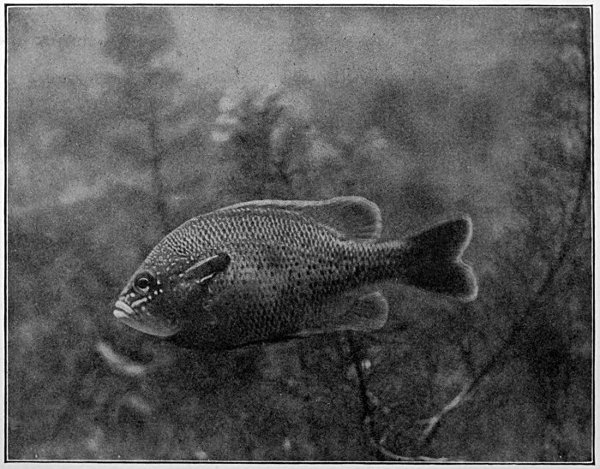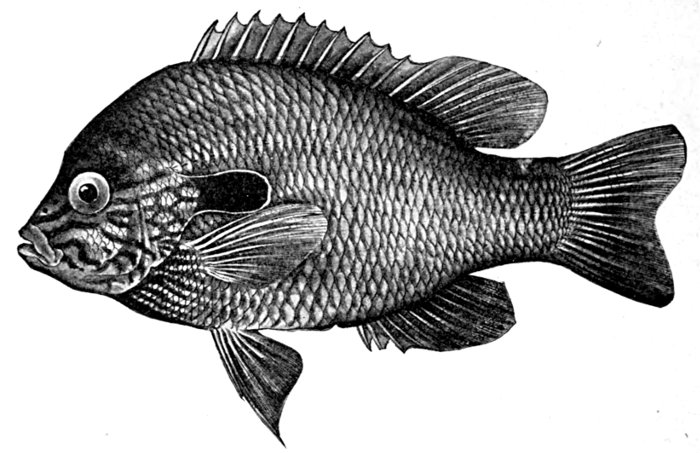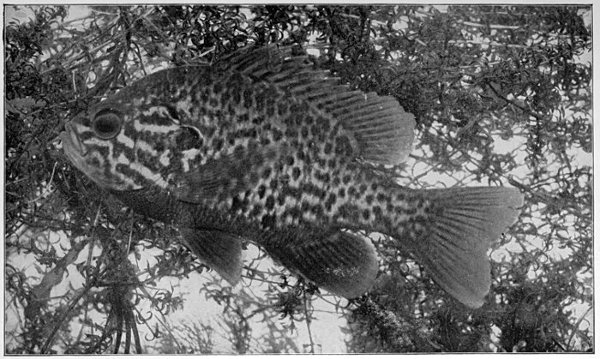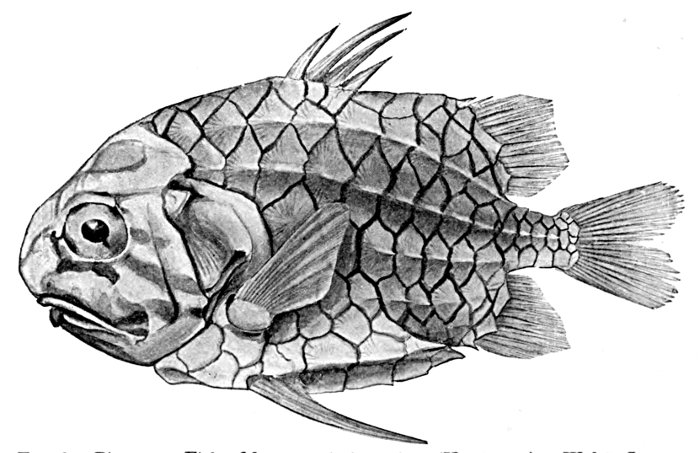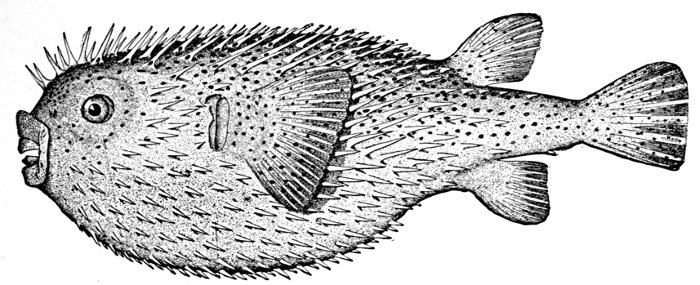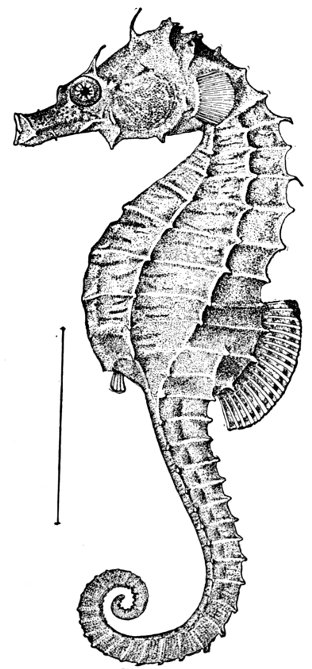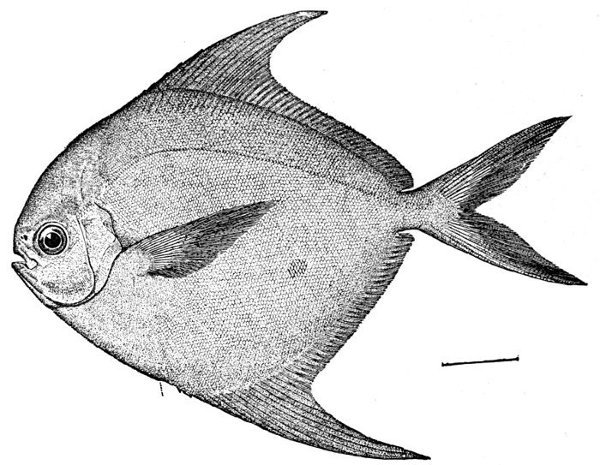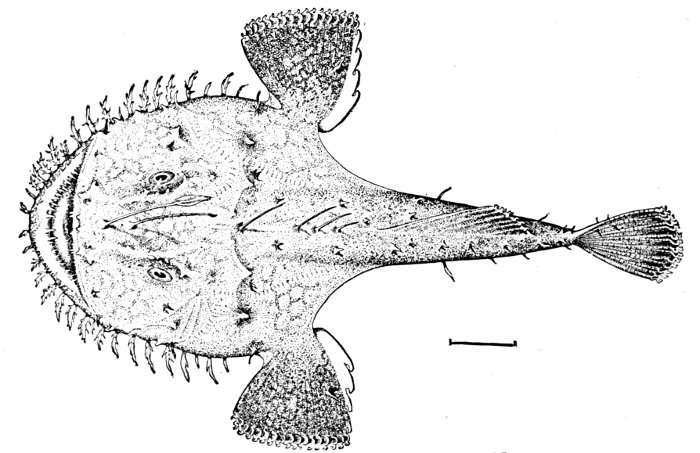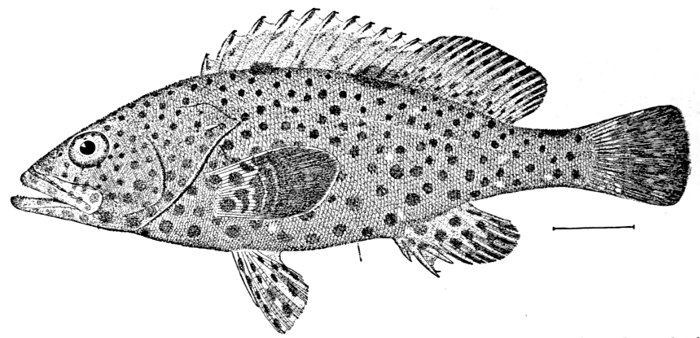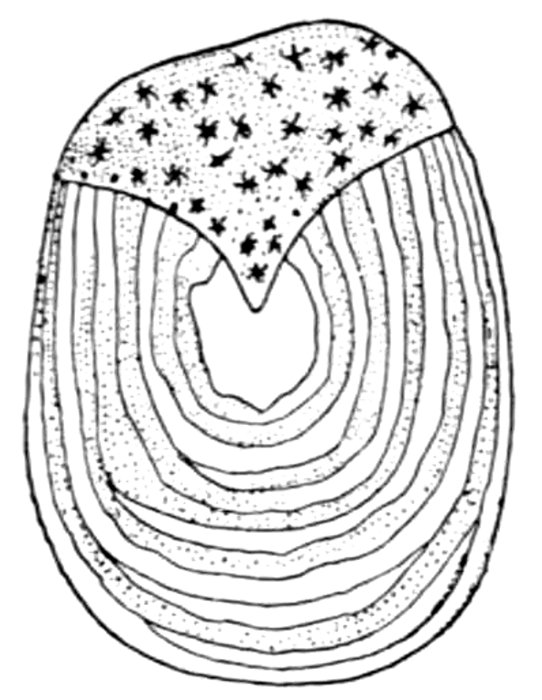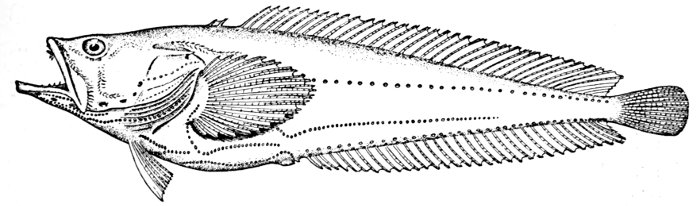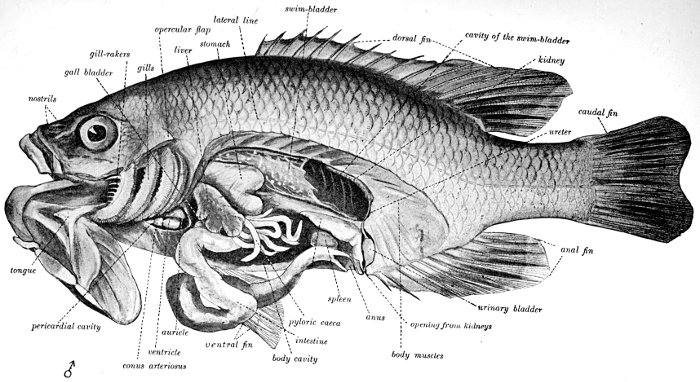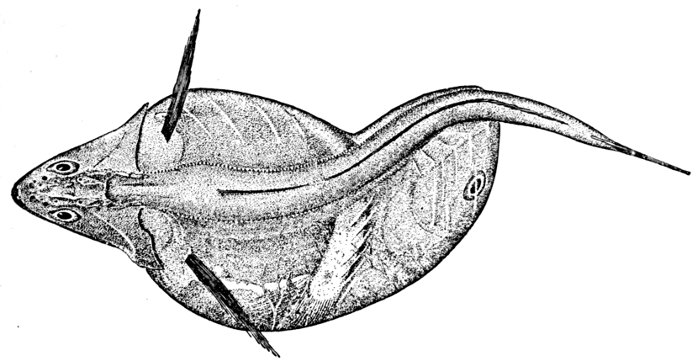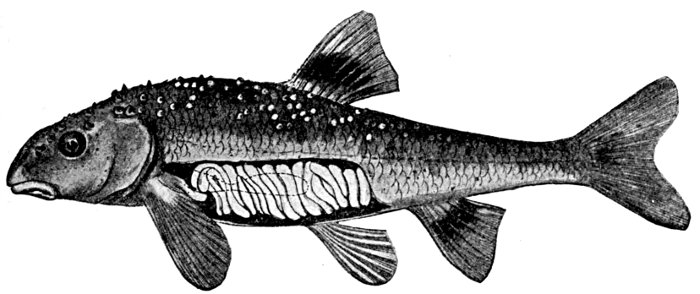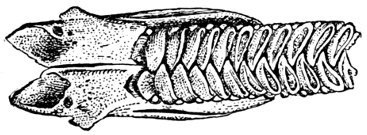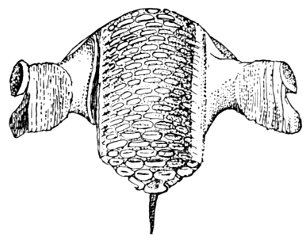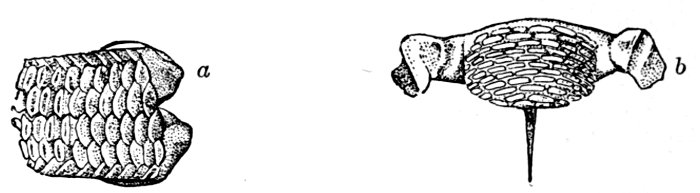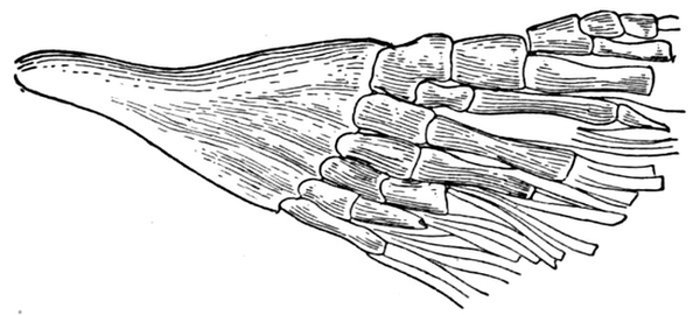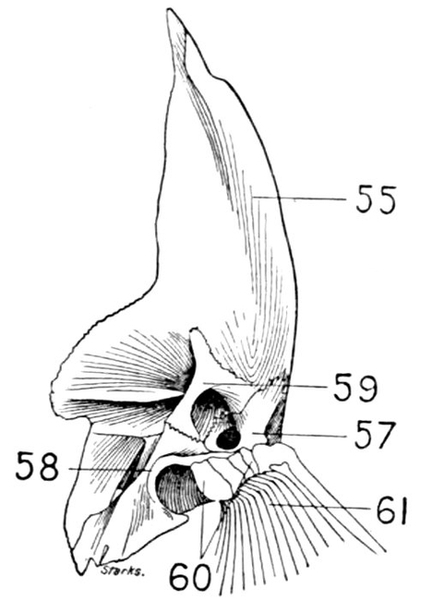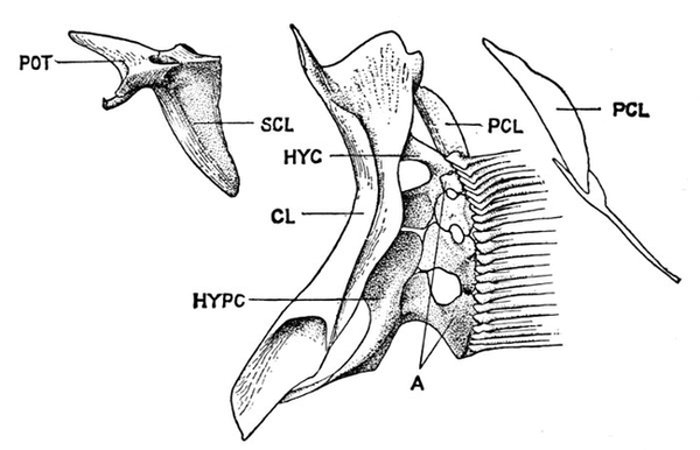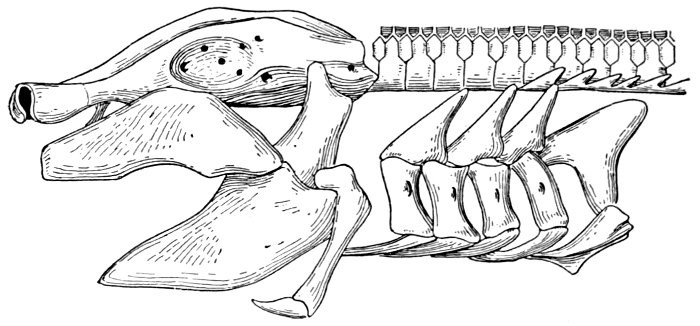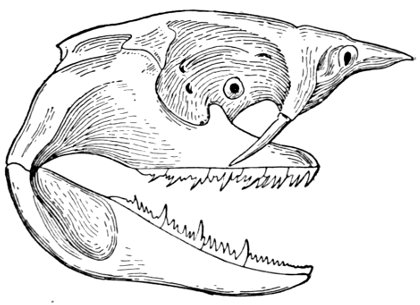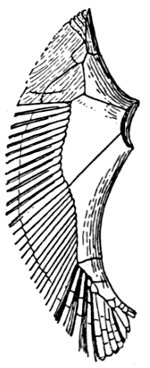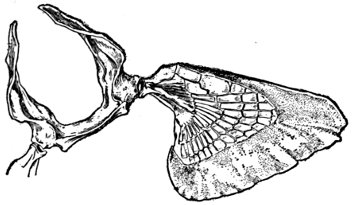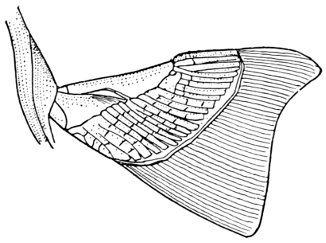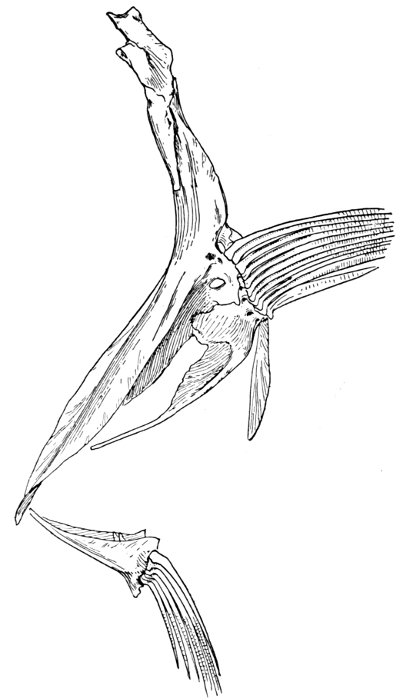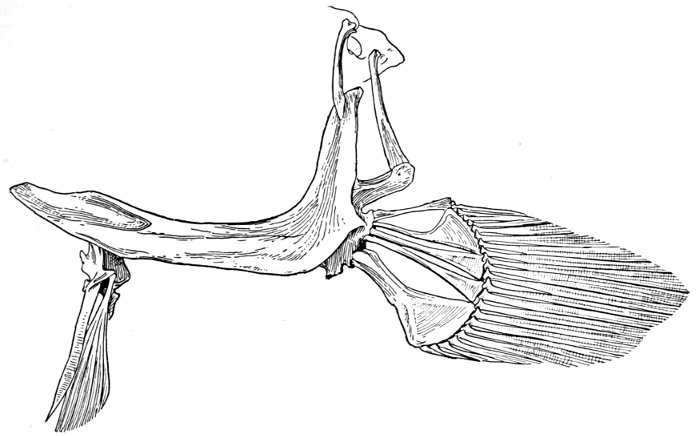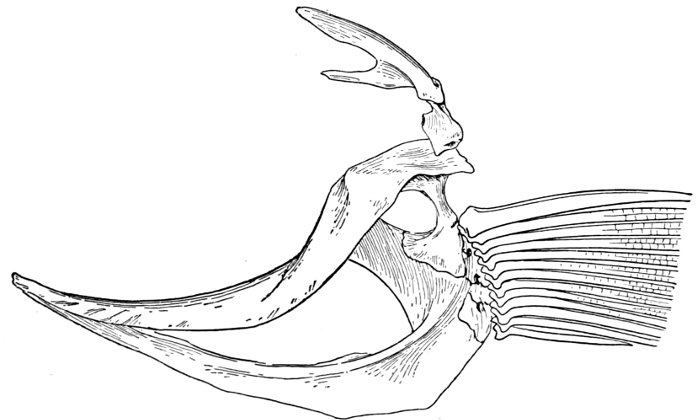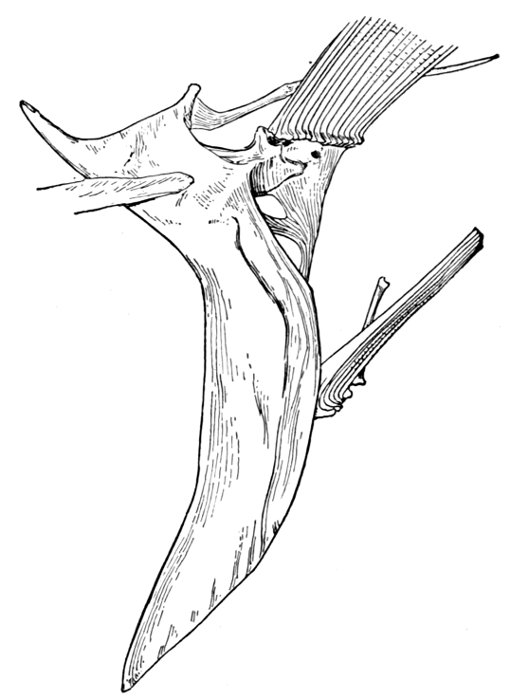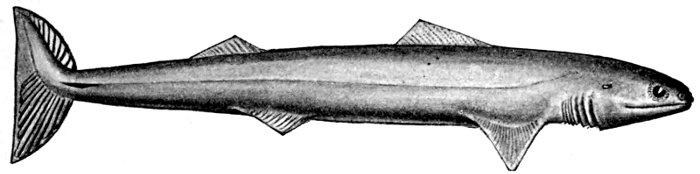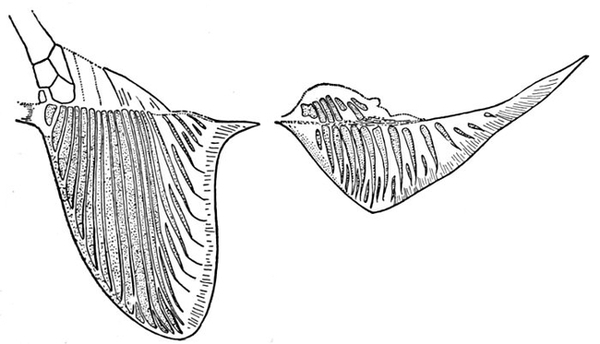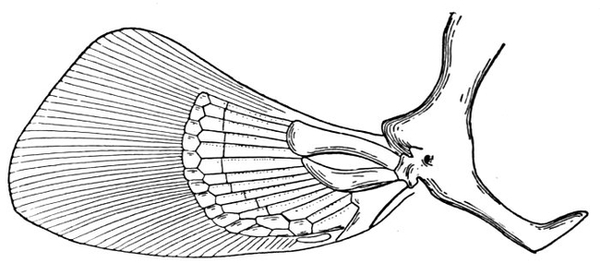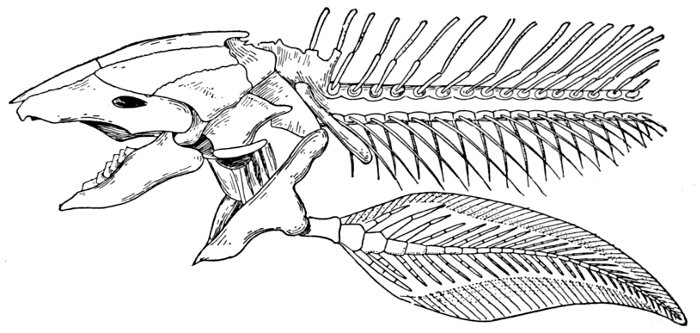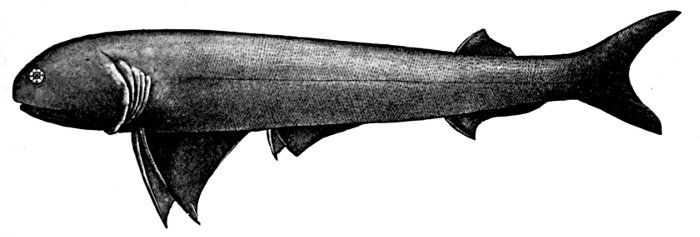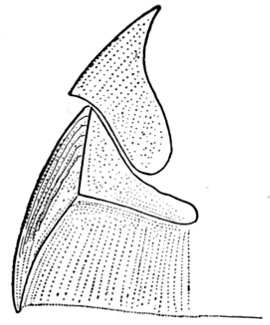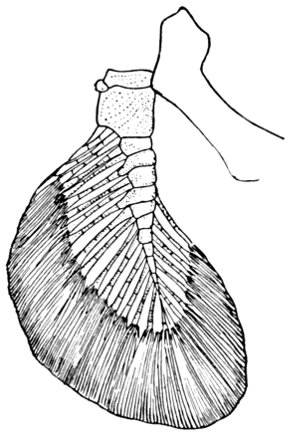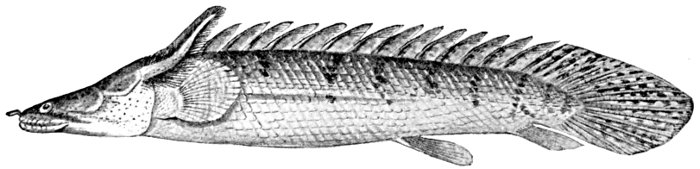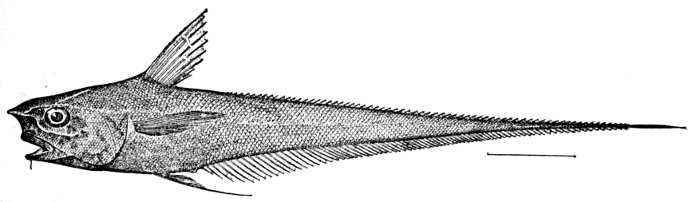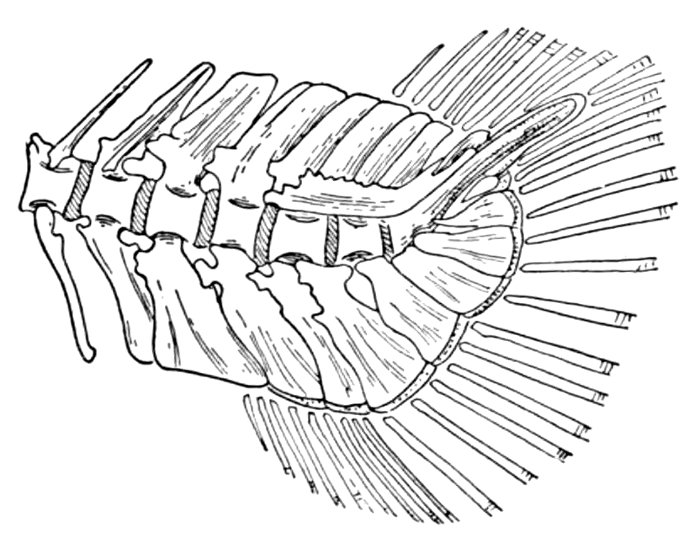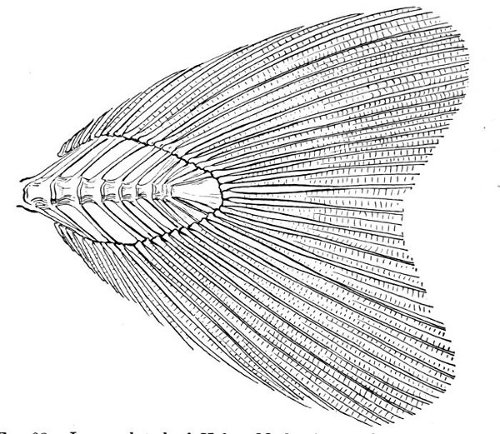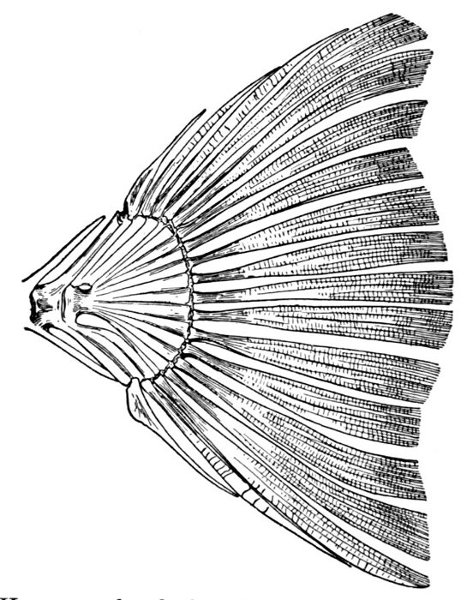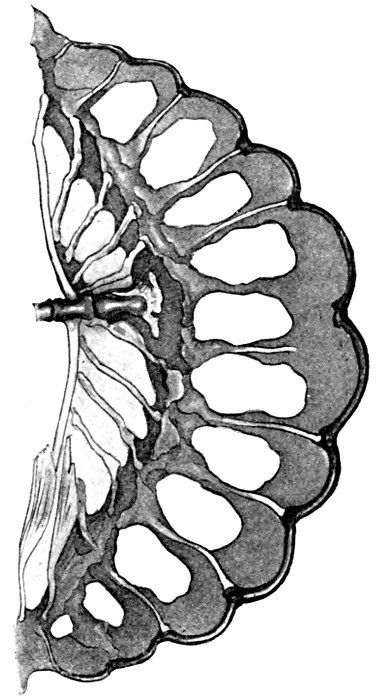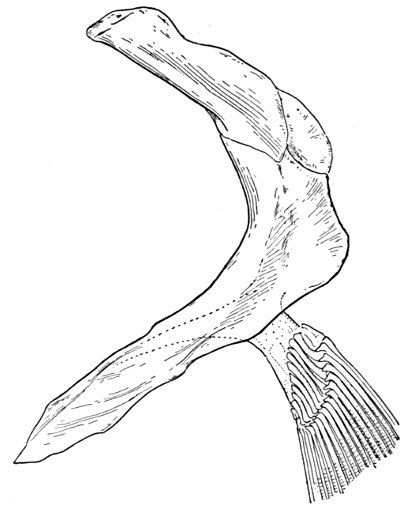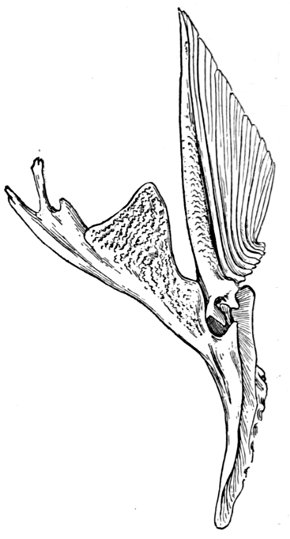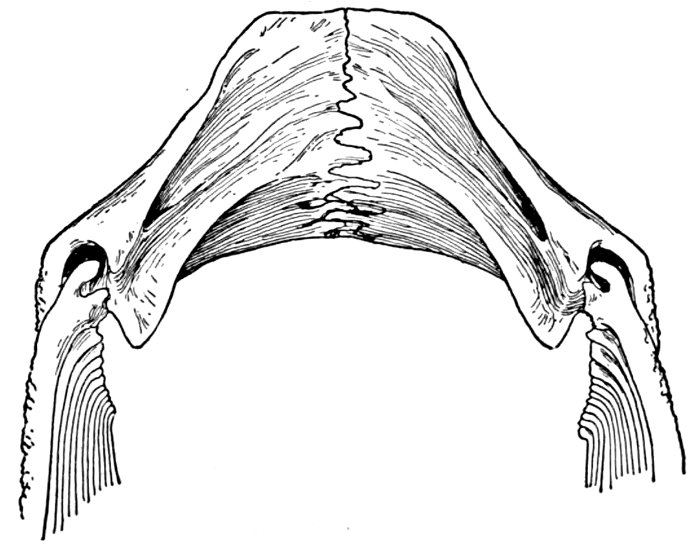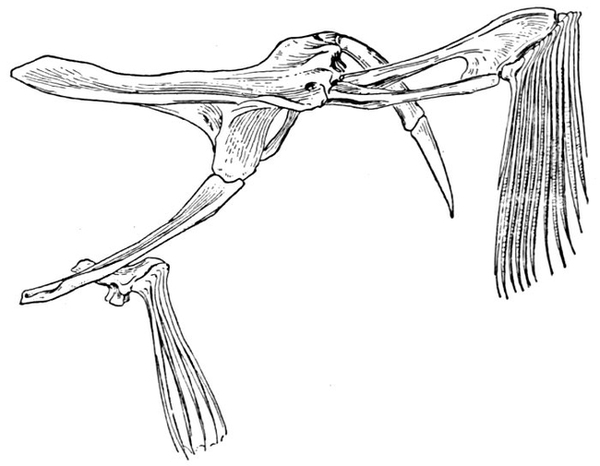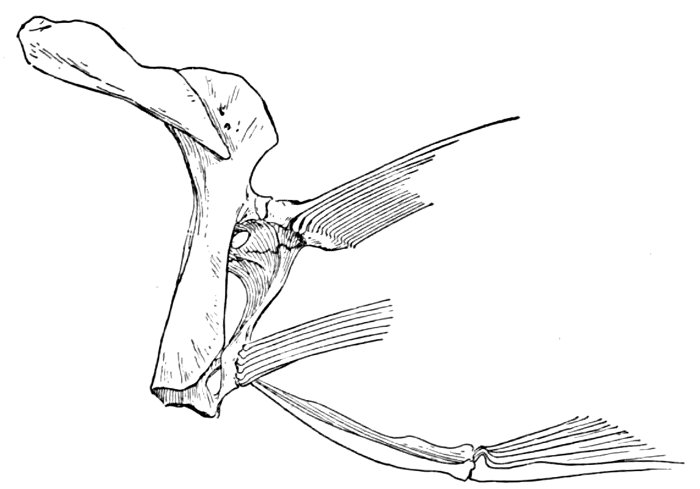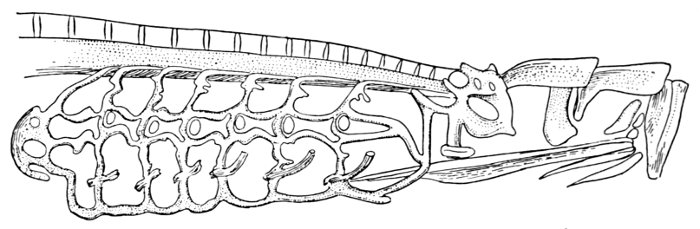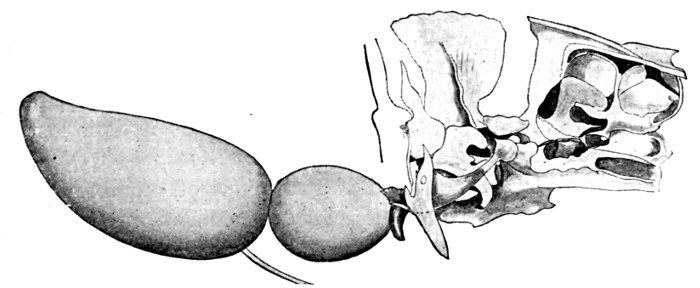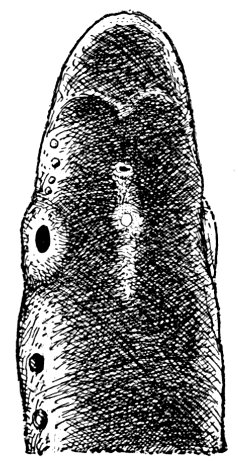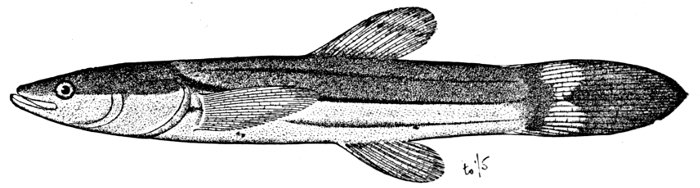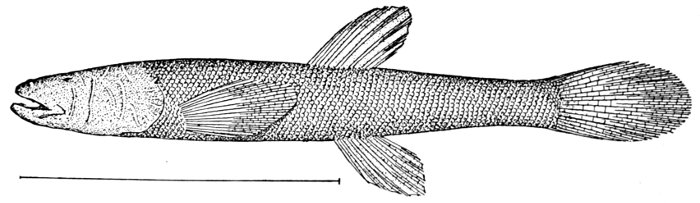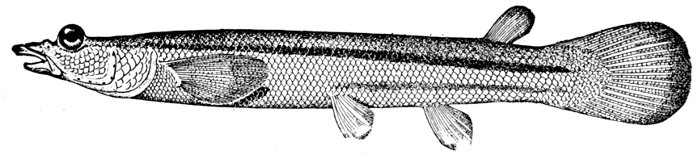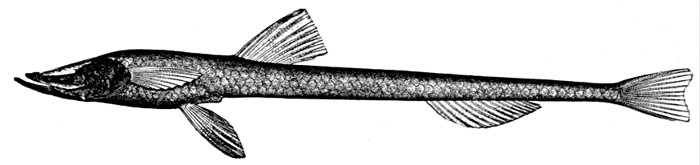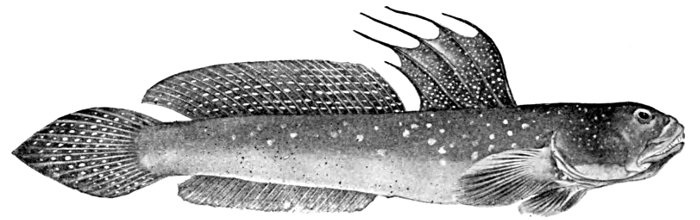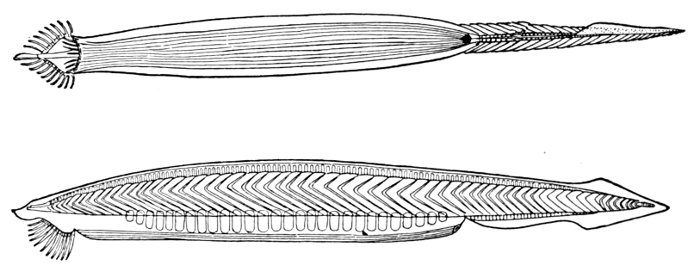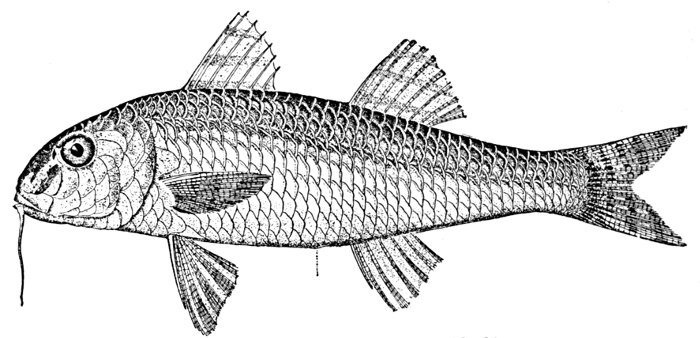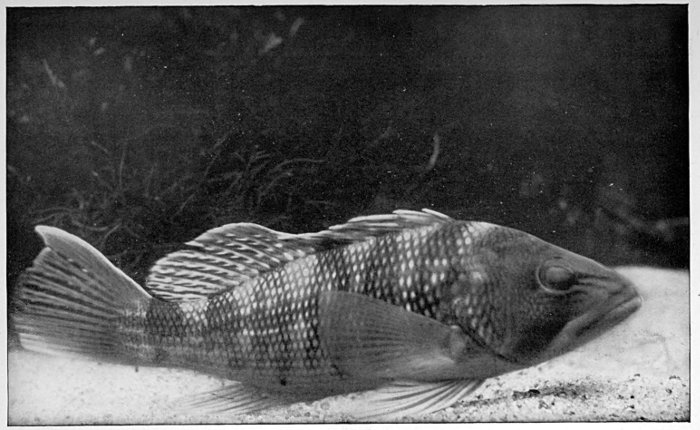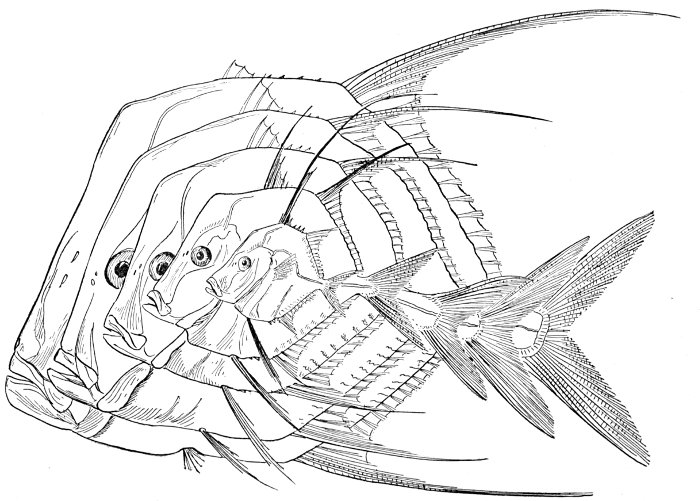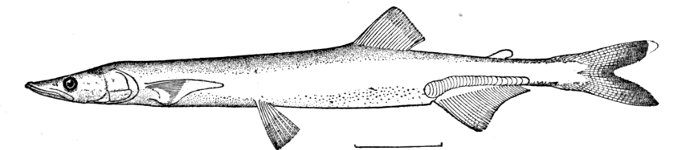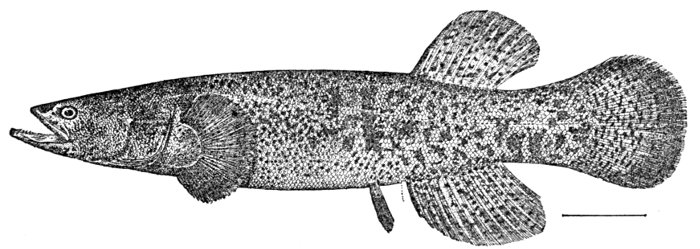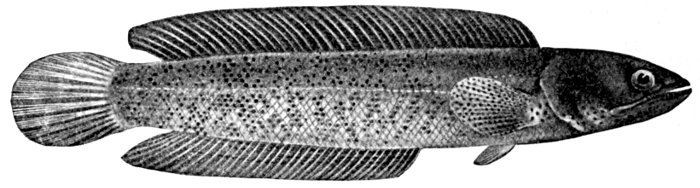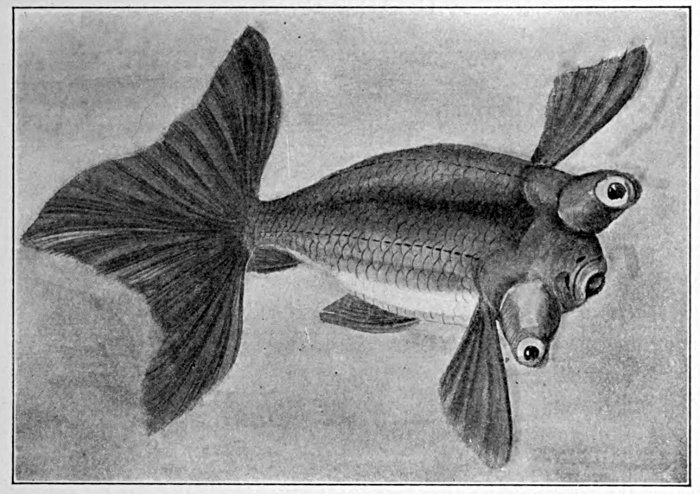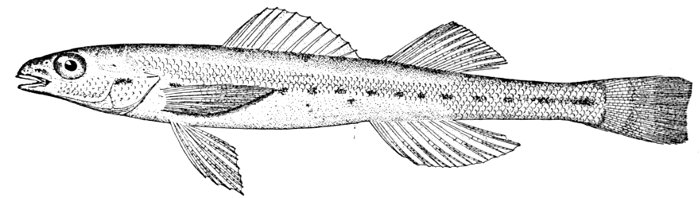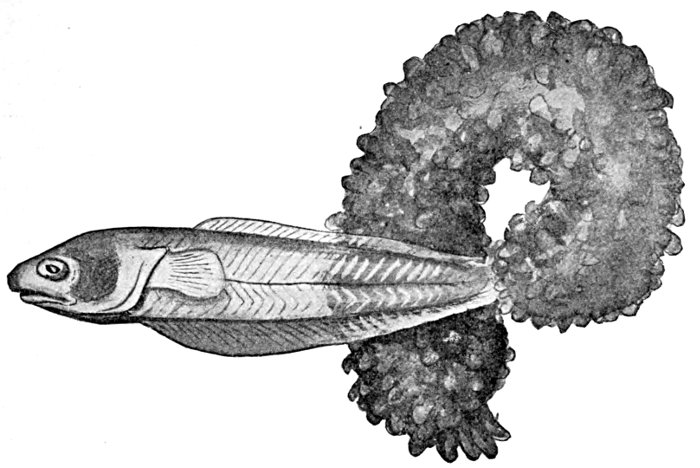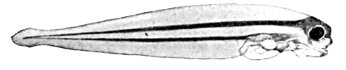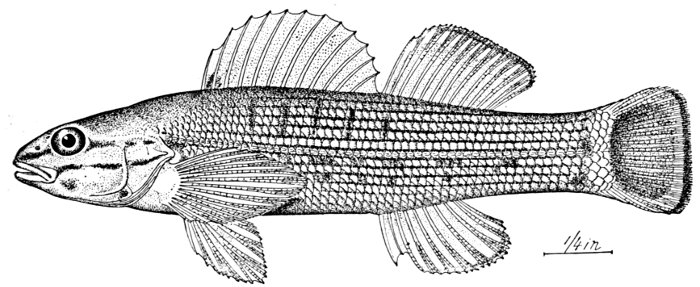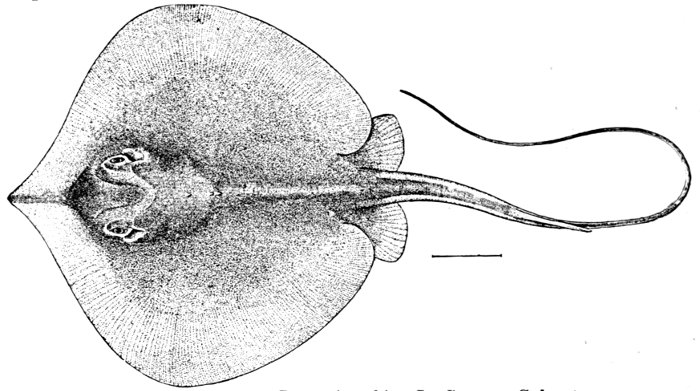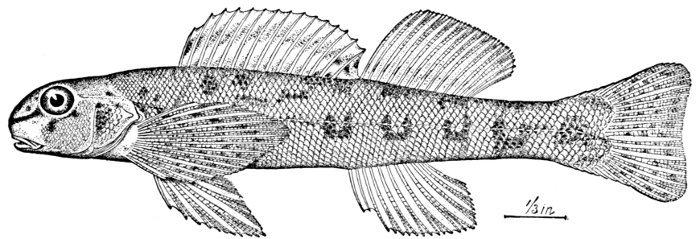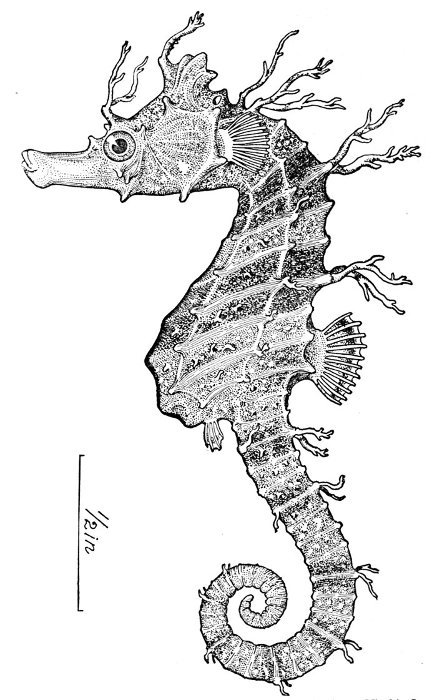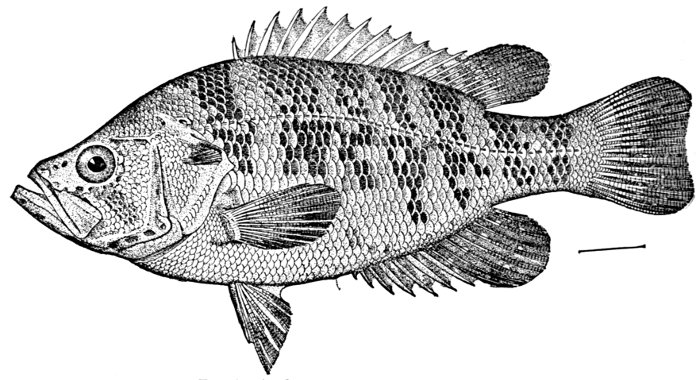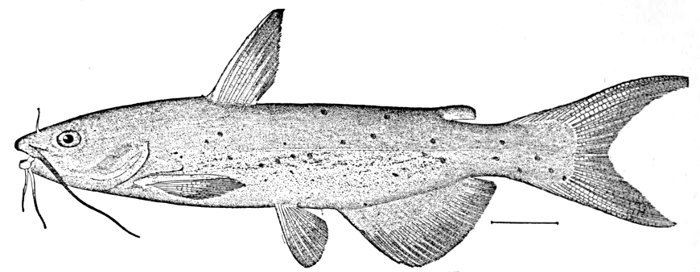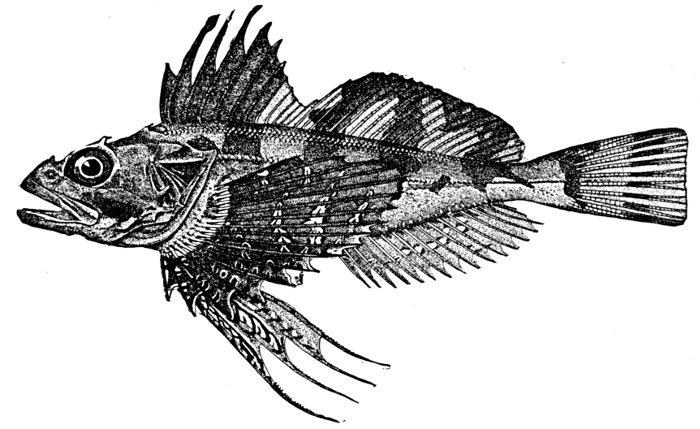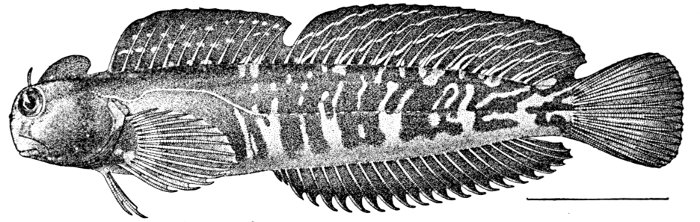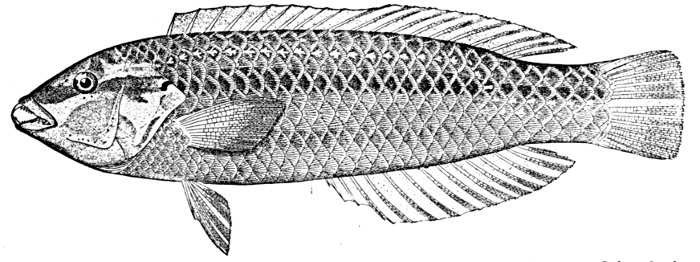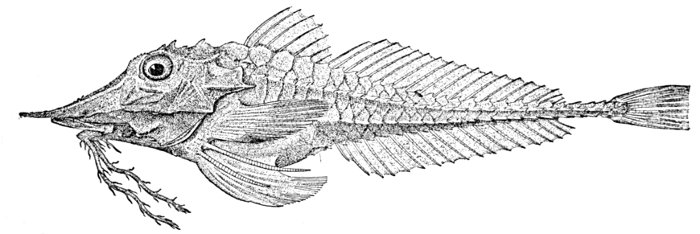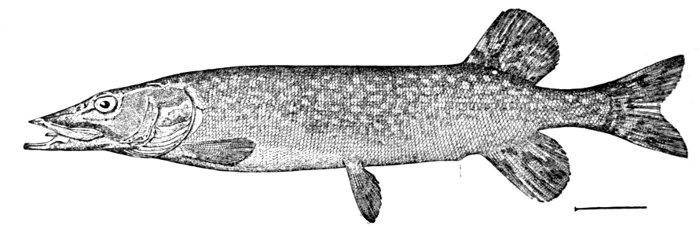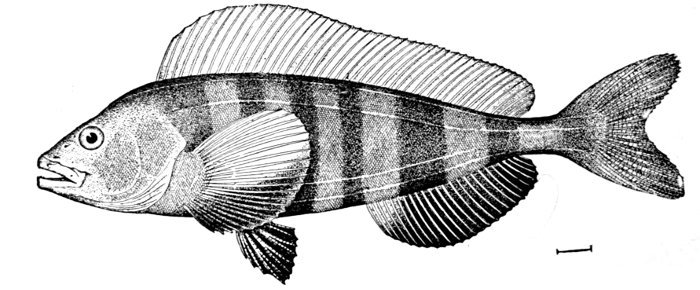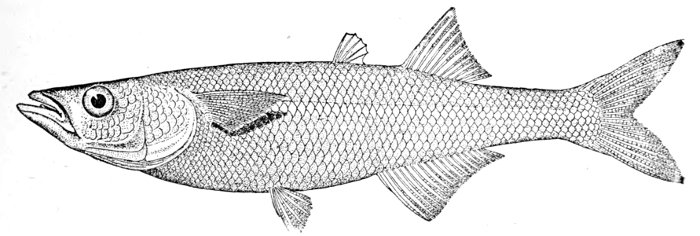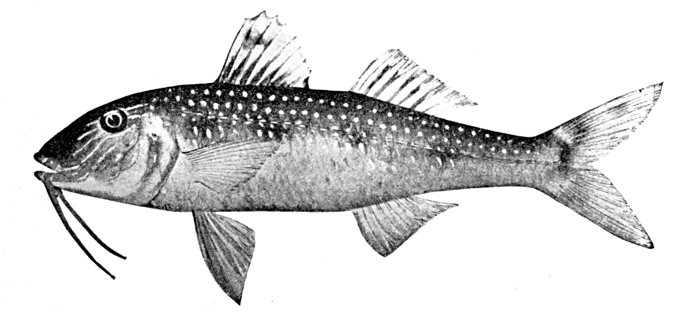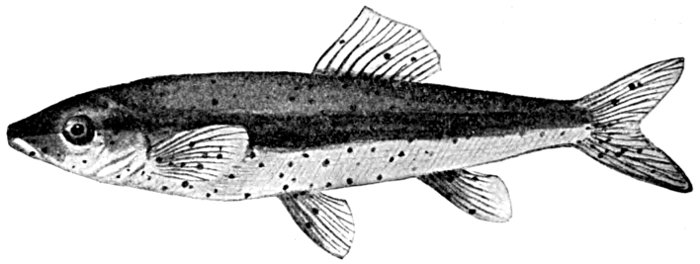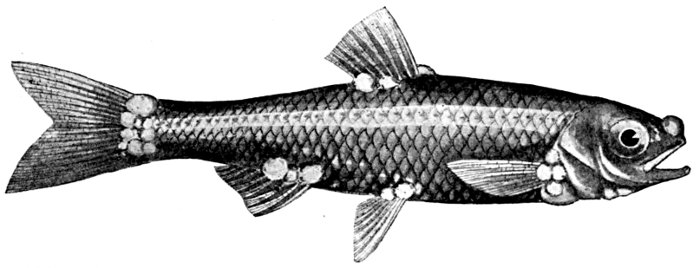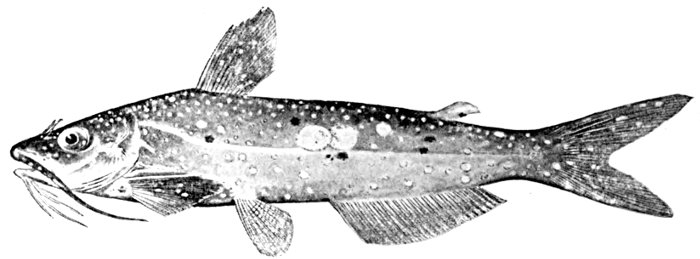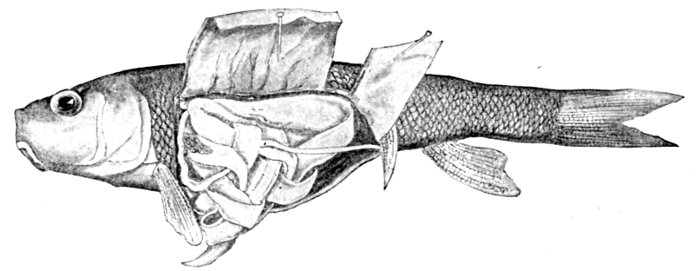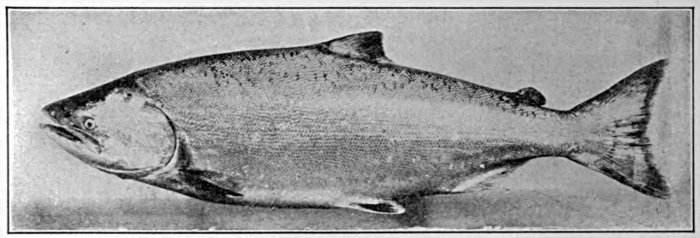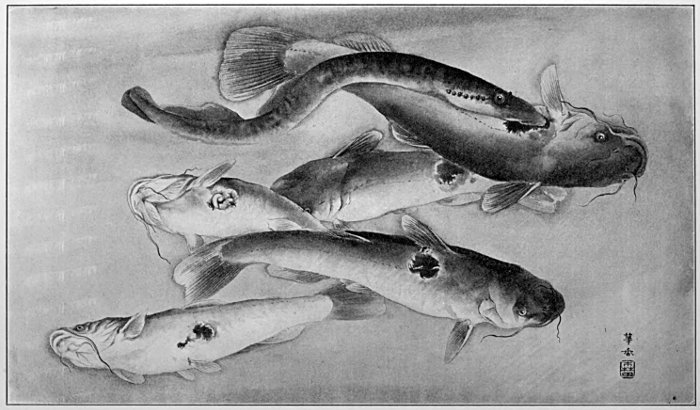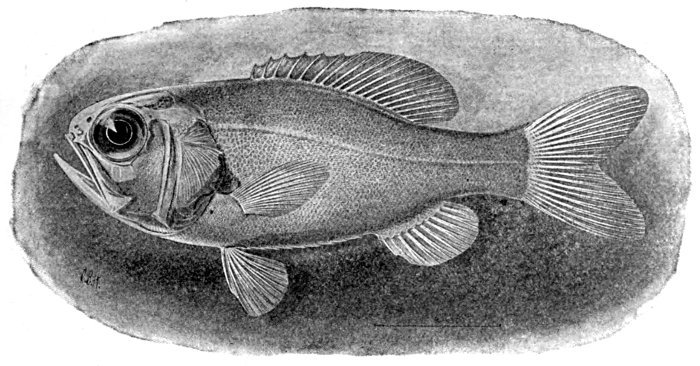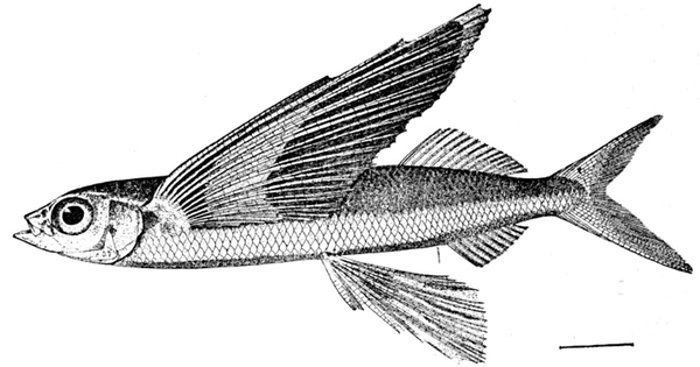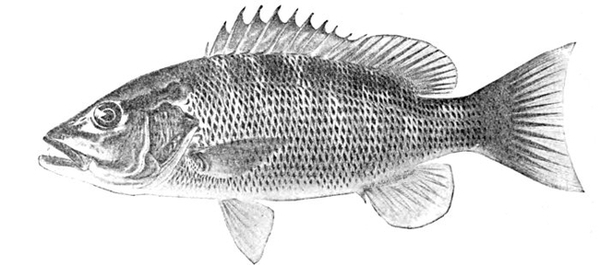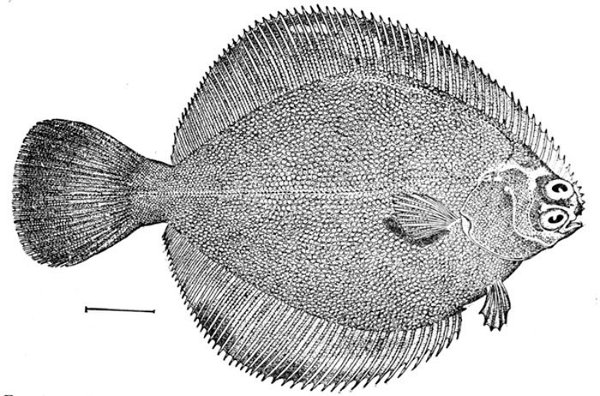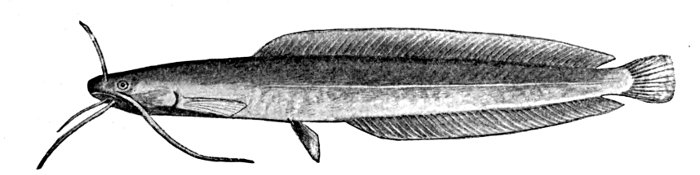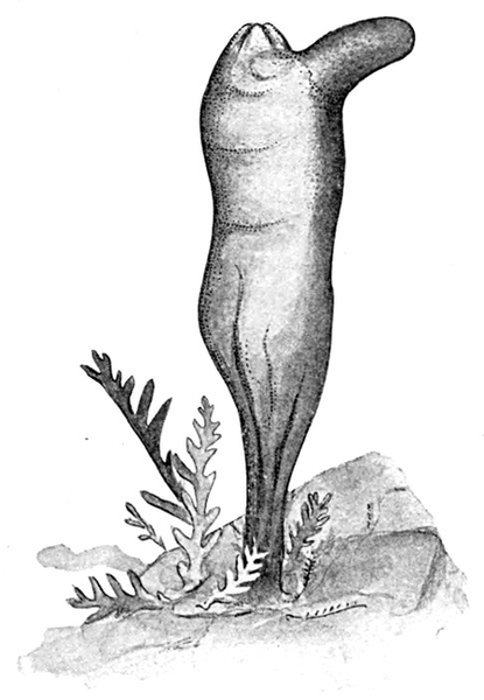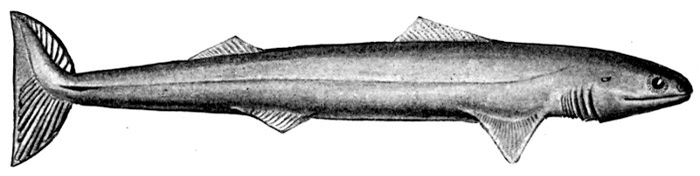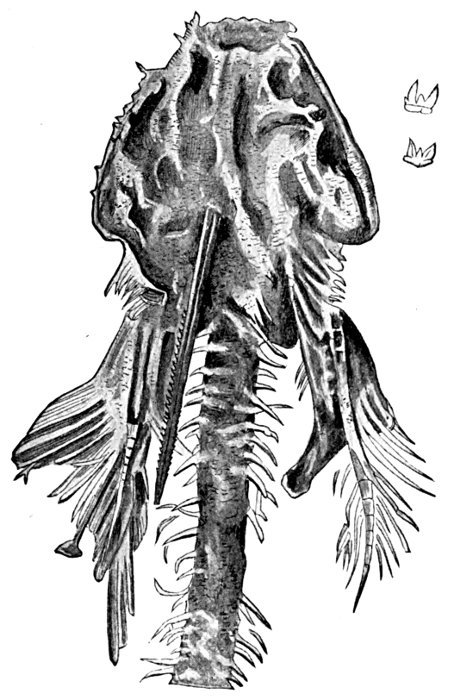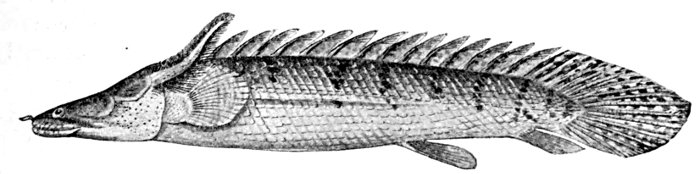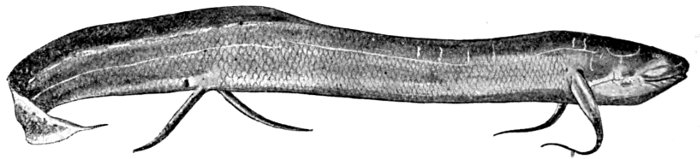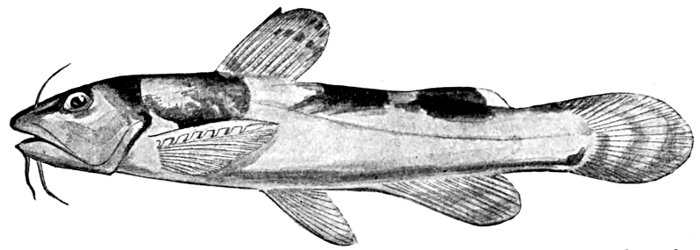
Fig. 133.—Mad-tom, Schilbeodes furiosus Jordan and Meek. Showing the poisoned
pectoral spine. Family Siluridæ. Neuse River.

Spines of the Catfishes.—The catfishes or horned pouts
(Siluridæ) have a strong spine in the pectoral fin, one
or both edges of this being jagged or serrated. This
spine fits into a peculiar joint and by means of a slight downward
or forward twist can be set immovably. It can then be broken
more easily than it can be depressed. A slight turn in the opposite
direction releases the joint, a fact known to the fish and readily
learned by the boy. The sharp spine inflicts a jagged wound.
Pelicans which have swallowed the catfish have been known to
die of the wounds inflicted by the fish's spine. When the catfish
was first introduced into the Sacramento, according to Mr. Will
S. Green, it caused the death of many of the native "Sacramento
perch" (Archoplites interruptus). This perch (or rather
bass) fed on the young catfish, and the latter erecting their
pectoral spines in turn caused the death of the perch by tearing
the walls of its stomach. In like manner the sharp dorsal
and ventral spines of the sticklebacks have been known to cause
the death of fishes who swallow them, and even of ducks. In
Puget Sound the stickleback is often known as salmon-killer.
Certain small catfishes known as stone-cats and mad-toms
(Noturus, Schilbeodes), found in the rivers of the Southern and
Middle Western States, are provided with special organs of
offense. At the base of the pectoral spine, which is sometimes
very jagged, is a structure supposed by Professor Cope to be a
poison gland the nature of which has not yet been fully ascertained.
The wounds made by these spines are exceedingly
painful like those made by the sting of a wasp. They are,
however, apparently not dangerous.
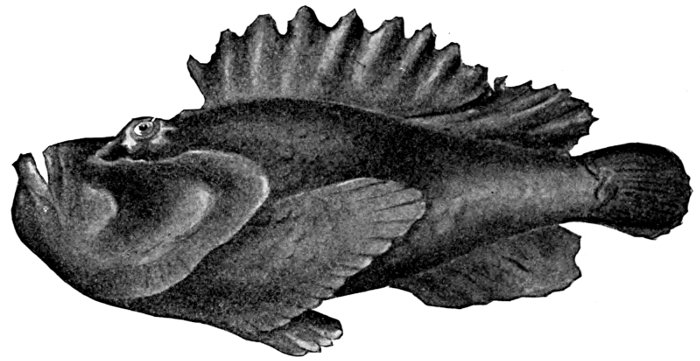
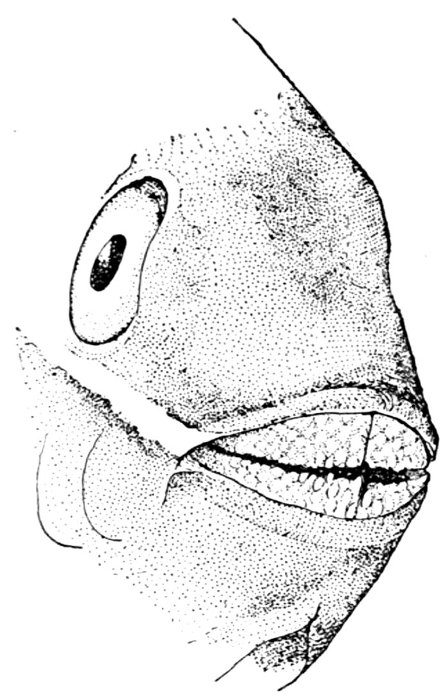
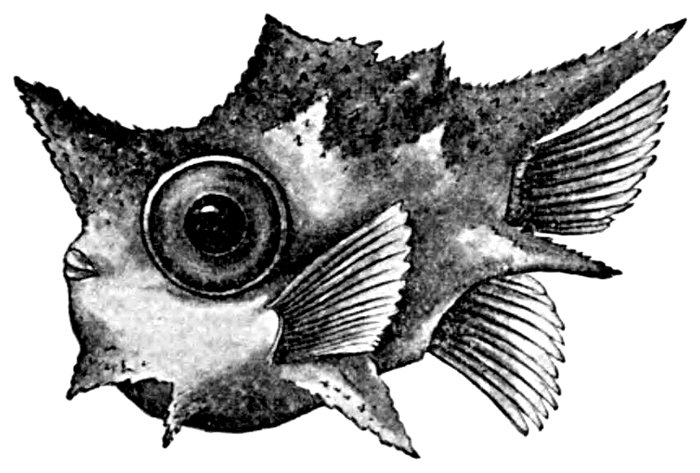
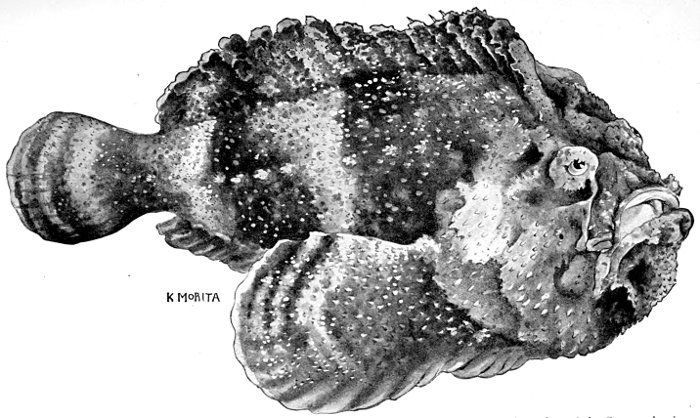
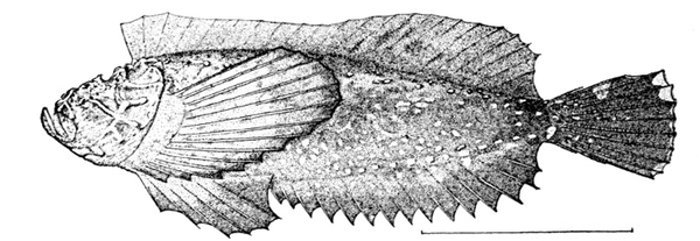
Fig. 134.—Black Nohu, or Poison-fish, Emmydrichthys vulcanus Jordan. A species
with stinging spines, showing resemblance to lumps of lava among which it
lives. Family Scorpænidæ. From Tahiti.
Venomous Spines.—Many species of scorpion-fishes (Scorpæna,
Synanceia, Pelor, Pterois, etc.), found in warm seas,
as well as the European weavers (Trachinus), secrete poison
from under the skin of each dorsal spine. The wounds made
by these spines are very exasperating, but are not often dangerous.
In some cases the glands producing these poisons form an
oblong bag excreting a milky juice, and placed on the base of
the spine.
In Thalassophryne, a genus of toad-fishes of tropical America,
is found the most perfect system of poison organs known among
fishes. The spinous armature of the opercle and the two spines
of the first dorsal fin constitute the weapons. The details are
known from the dissections of Dr. Günther. According to his[19]
observations, the opercle in Thalassophryne "is very narrow,
vertically styliform and very mobile. It is armed behind with
a spine eight lines long and of the same form as the hollow
venom-fang of a snake, being perforated at its base and at its
extremity. A sac covering the base of the spine discharges its
contents through the apertures and the canal in the interior of
the spine. The structure of the dorsal spines is similar. There
are no secretory glands imbedded in the membranes of the sacs
and the fluid must be secreted by their mucous membrane. The
sacs are without an external muscular layer and situated immediately
below the thick, loose skin which envelops the spines
at their extremity. The ejection of the poison into a living
animal, therefore, can only be effected as in Synanceia, by the
pressure to which the sac is subjected the moment the spine
enters another body."
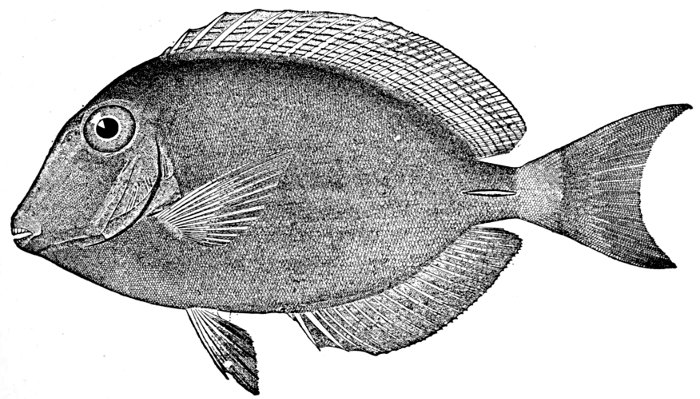
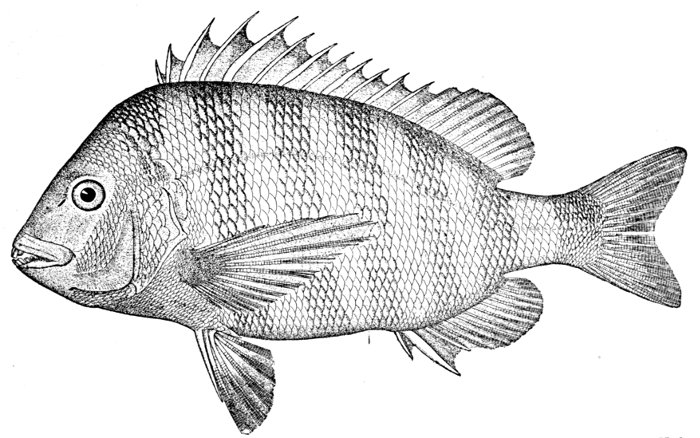
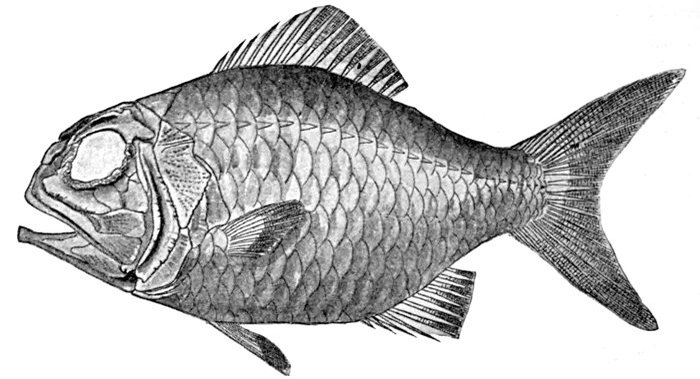
Fig. 135.—Brown Tang, Teuthis bahianus (Ranzani). Tortugas, Florida.
The Lancet of the Surgeon-fish.—Some fishes defend themselves
by lashing their enemies with their tails. In the tangs, or surgeon-fishes
(Teuthis), the tail is provided with a formidable weapon,
a knife-like spine, with the sharp edge directed forward. This
spine when not in use slips forward into a sheath. The fish,
when alive, cannot be handled without danger of a severe cut.
In the related genera, this lancet is very much more blunt
and immovable, degenerating at last into the rough spines of
Balistapus or the hair-like prickles of Monacanthus.
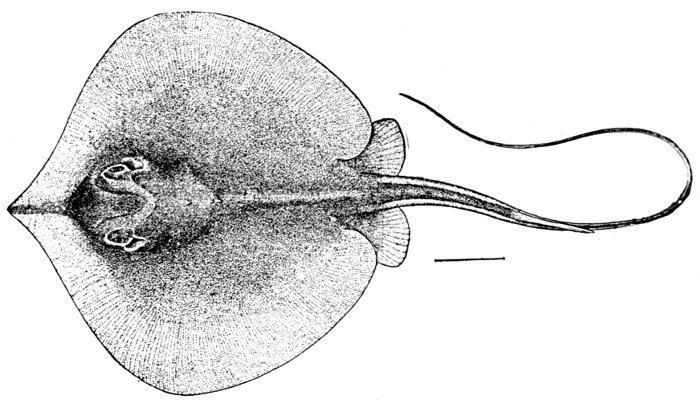
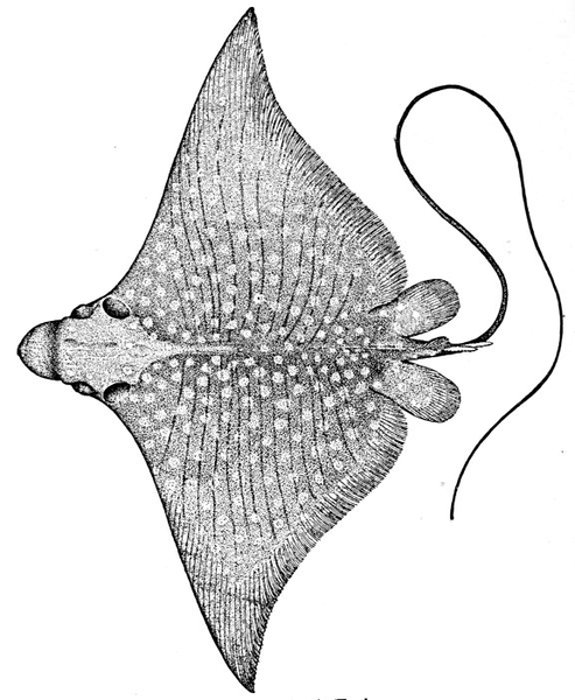
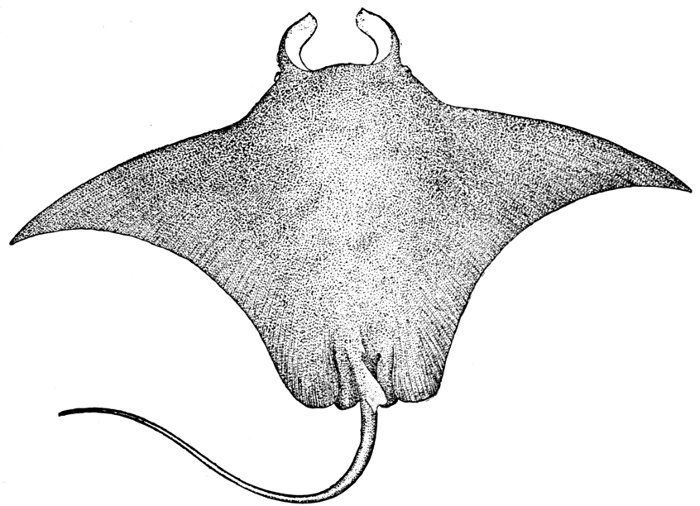
Spines of the Sting-ray.—In all the large group of sting-rays
the tail is provided with one or more large, stiff, barbed
spines, which are used with great force by the animal, and are
capable of piercing the leathery skin of the sting-ray itself.
There is no evidence that these spines bear any specific poison,
but the ragged wounds they make are always dangerous and
often end in gangrene. It is possible that the mucus on the
surface of the spine acts as a poison on the lacerated tissues,
rendering the wound something very different from a simple cut.
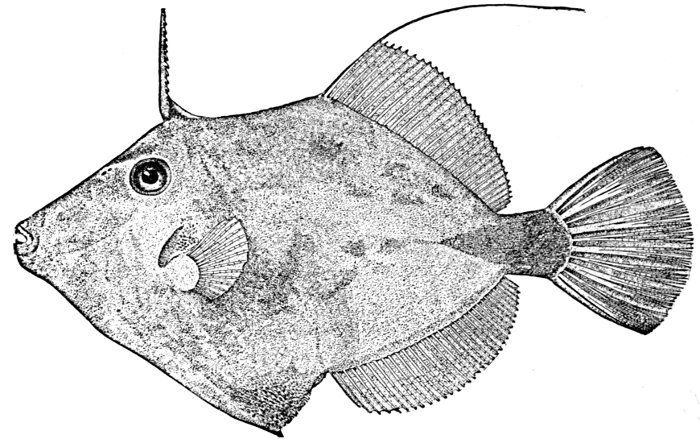
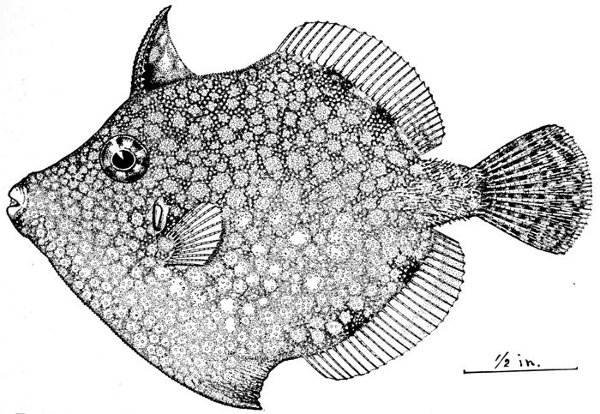
Fig. 136.—Common Filefish, Stephanolepis hispidus (Linnæus). Virginia.
Protection Through Poisonous Flesh of Fishes.—In certain
groups of fishes a strange form of self-protection is acquired by
the presence in the body of poisonous alkaloids, by means of
which the enemies of the species are destroyed in the death
of the individual devoured.
Such alkaloids are present in the globefishes (Tetraodontidæ),
the filefishes (Monacanthus), and in some related forms, while
members of other groups (Batrachoididæ) are under suspicion in
this regard. The alkaloids produce a disease known as ciguatera,
characterized by paralysis and gastric derangements.
Severe cases of ciguatera with men, as well as with lower
animals, may end fatally in a short time.
The flesh of the filefishes (Stephanolepis tomentosus), which
the writer has tested, is very meager and bitter, having a decidedly
offensive taste. It is suspected, probably justly, of being
poisonous. In the globefishes the flesh is always more or
less poisonous, that of Tetraodon hispidus, called muki-muki,
or death-fish, in Hawaii, is reputed as excessively so. The poisonous
fishes have been lately studied in detail by Dr. Jacques
Pellegrin, of the Museum d'Histoire Naturelle at Paris. He
shows that any species of fish may be poisonous under certain
circumstances, that under certain conditions certain species are
poisonous, and that certain kinds are poisonous more or less at
all times. The following account is condensed from Dr. Pellegrin's
observations.
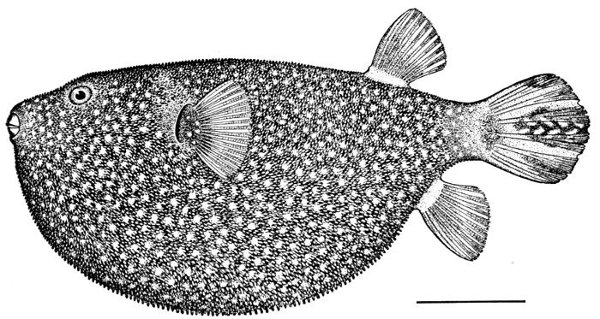
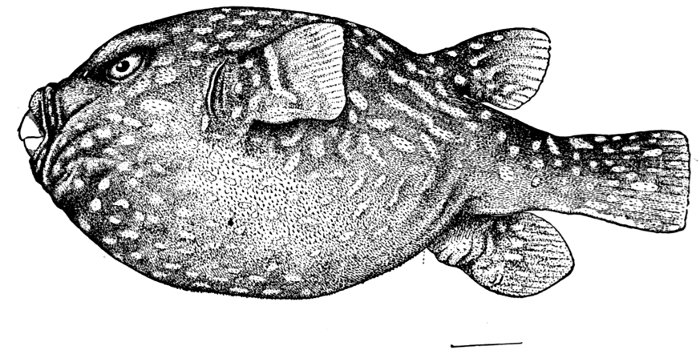
Fig. 137.—Tetraodon meleagris (Lacépède). Riu Kiu Islands.
The flesh of fishes soon undergoes decomposition in hot
climates. The consumption of decayed fish may produce
serious disorders, usually with symptoms of diarrhœa or eruption
of the skin. There is in this case no specific poison, but
the formation of leucomaines through the influence of bacteria.
This may take place with other kinds of flesh, and is known as
botulism, or allantiasis. For this disease, as produced by the
flesh of fishes, Dr. Pellegrin suggests the name of ichthyosism
It is especially severe in certain very oily fishes, as the tunny,
the anchovy, or the salmon. The flesh of these and other fishes
occasionally produces similar disorders through mere indigestion.
In this case the flesh undergoes decay in the stomach.
In certain groups (wrasse-fishes, parrot-fishes, etc.) in the
tropics, individual fishes are sometimes rendered poisonous by
feeding on poisonous mussels, holothurians, or possibly polyps,
species which at certain times, and especially in their spawning
season, develops alkaloids which themselves may cause ciguatera.
In this case it is usually the very old or large fishes which
are liable to be infected. In some markets numerous species
are excluded as suspicious for this reason. Such a list is in
use in the fish-market of Havana, where the sale of certain
species, elsewhere healthful, or at the most suspected, was rigidly
prohibited under the Spanish régime. A list of these suspicious
fishes has been given by Prof. Poey.
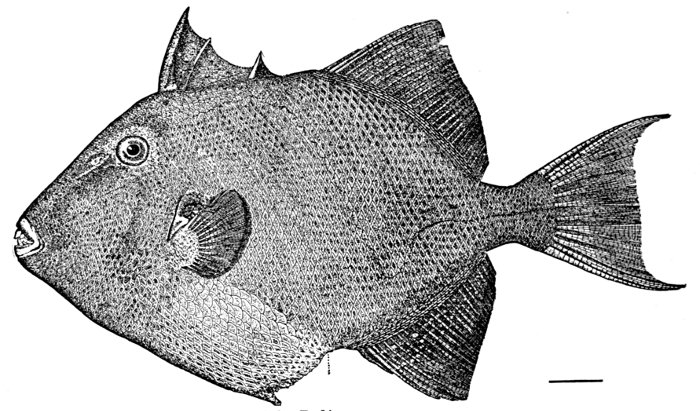
Fig. 138.—The Trigger-fish, Balistes carolinensis Gmelin. New York.
In many of the eels the serum of the blood is poisonous, but
its venom is destroyed by the gastric juice, so that the flesh
may be eaten with impunity, unless decay has set in. To eat
too much of the tropical morays is to invite gastric troubles,
but no true ciguatera. The true ciguatera is produced by a
specific poisonous alkaloid. This is most developed in the
globefishes or puffers (Tetraodon, Spheroides, Tropidichthys, etc.).
It is present in the filefishes (Monacanthus, Alutera, etc.), probably
in some toad-fishes (Batrachoides, etc.), and similar compounds
are found in the flesh of sharks and especially in sharks'
livers.
These alkaloids are most developed in the ovaries and testes,
and in the spawning season. They are also found in the liver
and sometimes elsewhere in the body. In many species otherwise
innocuous, purgative alkaloids are developed in or about
the eggs. Serious illness has been caused by eating the roe of
the pike and the barbel. The poison is less virulent in the
species which ascend the rivers. It is also much less developed
in cooler waters. For this reason ciguatera is almost confined
to the tropics. In Havana, Manila, and other tropical ports it
is of frequent occurrence, while northward it is practically unknown
as a disease requiring a special name or treatment. On
the coast of Alaska, about Prince William Sound and Cook Inlet,
a fatal disease resembling ciguatera has been occasionally produced
by the eating of clams.
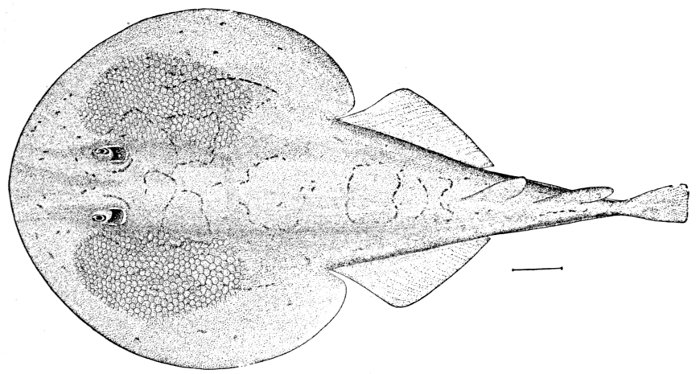
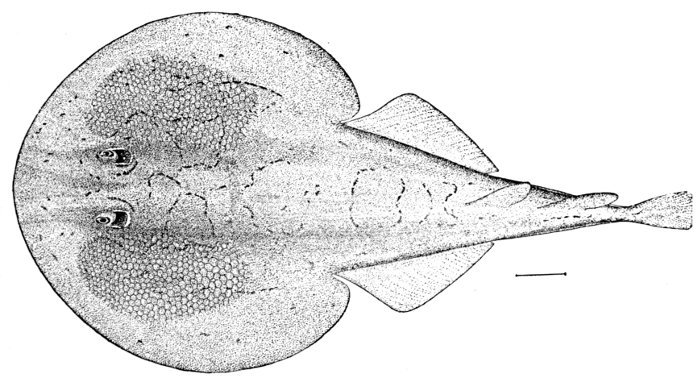
Fig. 139.—Numbfish, Narcine brasiliensis Henle, showing electric cells.
Pensacola, Florida.
The purpose of the alkaloids producing ciguatera is considered
by Dr. Pellegrin as protective, saving the species by the
poisoning of its enemies. The sickness caused by the specific
poison must be separated from that produced by ptomaines and
leucomaines in decaying flesh or in the oil diffused through it.
Poisonous bacteria may be destroyed by cooking, but the alkaloids
which cause ciguatera are unaltered by heat.
It is claimed in tropical regions that the germs of the bubonic
plague may be carried through the mediation of fishes
which feed on sewage. It is suggested by Dr. Charles B. Ashmead
that leprosy may be so carried. It is further suggested
that the custom of eating the flesh of fishes raw almost universal
in Japan, Hawaii, and other regions may be responsible
for the spread of certain contagious diseases, in which the fish
acts as an intermediate host, much as certain mosquitoes spread
the germ of malaria and yellow fever.
Electric Fishes.—Several species of fishes possess the power
to inflict electric shocks not unlike those of the Leyden jar.
This is useful in stunning their prey and especially in confounding
their enemies. In most cases these electric organs are
evidently developed from muscular substance. Their action,
which is largely voluntary, is in its nature like muscular action.
The power is soon exhausted and must be restored by rest and
food. The effects of artificial stimulation and of poisons are
parallel with the effect of similar agents on muscles.
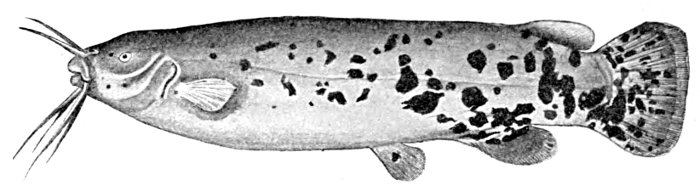
Fig. 140.—Electric Catfish, Torpedo electricus (Gmelin). Congo River.
(Alter Boulenger.)
In the electric rays or torpedos (Narcobatidæ) the electric
organs are large honeycomb-like structures, "vertical hexagonal
prisms," upwards of 400 of them, at the base of the pectoral
fins. Each prism is filled "with a clear trembling jelly-like
substance." These fishes give a shock which is communicable
through a metallic conductor, as an iron spear or the handle of
a knife. It produces a peculiar and disagreeable sensation not
at all dangerous. It is said that this living battery shows all
the known qualities of magnetism, rendering the needle magnetic,
decomposing chemical compounds, etc. In the Nile is
an electric catfish (Torpedo electricus) having similar powers.
Its electric organ extends over the whole body, being thickest
below. It consists of rhomboidal cells of a firm gelatinous
substance.
The electric eel (Electrophorus electricus), the most powerful
of electric fishes, is not an eel, but allied rather to the sucker or
carp. It is, however, eel-like in form and lives in rivers of Brazil
and Guiana. The electric organs are in two pairs, one on the back
of the tail, the other on the
anal fin. These are made up
of an enormous number of
minute cells. In the electric
eel, as in the other electric
fishes, the nerves supplying
these organs are much larger
than those passing from the
spinal cord for any other purpose.
In all these cases
closely related species show a
no trace of the electric powers.
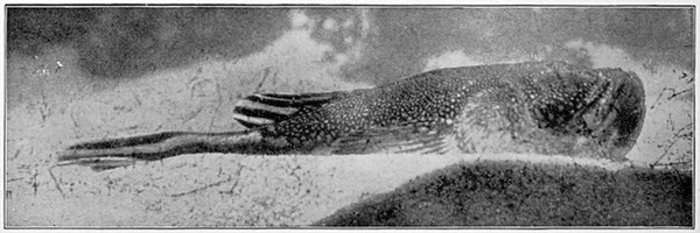
Fig. 141.—Star-gazer (Astroscopus guttatus) settling in the sand. (From life by R. W. Shufeldt.)
Dr. Gilbert has described
the electric powers of species
of star-gazer (Astroscopus
y-græcum and A. zephyreus),
the electric cells lying under
the naked skin of the top of
the head. Electric power is
ascribed to a species of cusk
(Urophycis regius), but this
perhaps needs verification.
Photophores or Luminous
Organs.—Many fishes, chiefly
of the deep seas, develop
organs for producing light.
These are known as luminous
organs, phosphorescent organs,
or photophores. These
are independently developed
in four entirely unrelated
groups of fishes. This difference
in origin is accompanied
by corresponding difference in structure. The best-known
type is found in the Iniomi, including the lantern-fishes and
their many relatives. These may have luminous spots, differentiated
areas round or oblong which shine star-like in the
dark. These are usually symmetrically placed on the sides of
the body. They may have also luminous glands or diffuse areas
which are luminous, but which do not show the specialized
structure of the phosphorescent spots. These glands of similar
nature to the spots are mostly on the head or tail. In one
genus, Æthoprora, the luminous snout is compared to the headlight
of an engine.
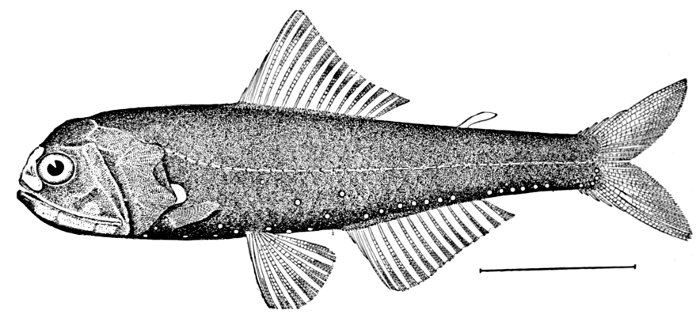
Fig. 142.—Headlight Fish, Æthoprora lucida Goode and Bean. Gulf Stream.
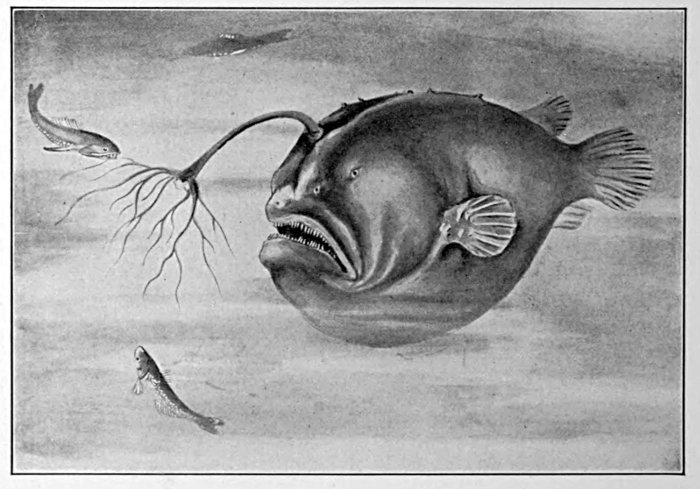
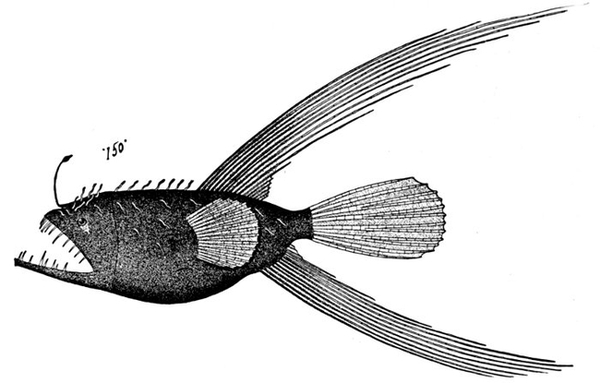
Fig. 143.—Corynolophus reinhardti (Lütken), showing luminous bulb (modified
after Lütken). Family Ceratiidæ. Deep sea off Greenland.
Entirely different are the photophores in the midshipman
or singing-fish (Porichthys), a genus of toad-fishes or Batrachoididæ.
This species lives near the shore and the luminous
spots are outgrowths from pores of the lateral line.
In one of the anglers (Corynolophus reinhardti) the complex
bait is said to be luminous, and luminous areas are said to
occur on the belly of a very small shark of the deep seas of
Japan (Etmopterus lucifer). This phenomenon is now the subject
of study by one of the numerous pupils of Dr. Mitsukuri.
The structures in Corynolophus are practically unknown.
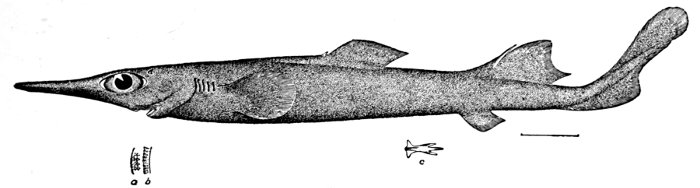
Fig. 144.—Etmopterus lucifer Jordan and Snyder. Misaki, Japan.
Photophores in Iniomous Fishes.—In the Iniomi the luminous
organs have been the subject of an elaborate paper by Dr.
R. von Lendenfeld (Deep-sea Fishes of the Challenger. Appendix
B). These he divides into ocellar organs of regular
form or luminous spots, and irregular glandular organs or
luminous areas. The ocellar spots may be on the scales
of the lateral line or on other definite areas. They may be
raised above the surface or sunk below it. They may be simple,
with or without black pigment, or they may have within them
a reflecting surface. They are best shown in the Myctophidæ
and Stomiatidæ, but are found in numerous other families in
nearly all soft-rayed fishes of the deep sea.
The glandular areas may be placed on the lower jaw, on the
barbels, under the gill cover, on the suborbital or preorbital,
on the tail, or they may be irregularly scattered. Those about
the eye have usually the reflecting membrane.
In all these structures, according to Dr. von Lendenfeld, the
whole or part of the organ is glandular. The glandular part
is at the base and the other structures are added distally. The
primitive organ was a gland which produced luminous slime.
To this in the process of specialization greater complexity has
been added.
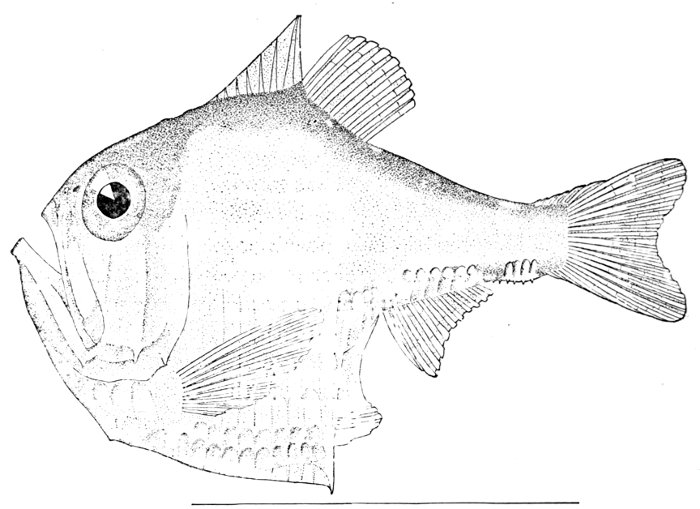
Fig. 145.—Argyropelecus olfersi Cuvier. Gulf Stream.
The luminous organs of some fishes resemble the supposed
original structure of the primitive photophore, though of
course these cannot actually represent it. The simplest type
of photophore now found is in Astronesthes, in the form of
irregular glandular luminous patches on the surface of the skin.
There is no homology between the luminous organs of any insect
and those of any fish.
Photophores of Porichthys.—Entirely distinct in their origin
are the luminous spots in the midshipman (Porichthys notatus),
a shore fish of California. These have been described in detail
by Dr. Charles Wilson Greene (late of Stanford University, now
of the University of Missouri) in the Journal of Morphology,
xv., p. 667. These are found on various parts of the body in
connection with the mucous pores of the lateral lines and about
the mucous pores of the head. The skin in Porichthys is naked,
and the photophores arise from a modification of its epidermis.
Each is spherical, shining white, and consists of four parts—the
lens, the gland, the reflector, and the pigment. As to its function
Prof. Greene observes:
"I have kept specimens of Porichthys in aquaria at the Hopkins
Seaside Laboratory, and have made numerous observations
on them with an effort to secure ocular proof of the phosphorescence
of the living active fish. The fish was observed in
the dark when quiet and when violently excited, but, with a
single exception, only negative results were obtained. Once
a phosphorescent glow of scarcely perceptible intensity was
observed when the fish was pressed against the side of the
aquarium. Then, this is a shore fish and quite common, and
one might suppose that so striking a phenomenon as it would
present if these organs were phosphorescent in a small degree
would be observed by ichthyologists in the field, or by fishermen,
but diligent inquiry reveals no such evidence.
"Notwithstanding the fact that Porichthys has been observed
to voluntarily exhibit only the trace of phosphorescence mentioned
above, still the organs which it possesses in such numbers
are beyond doubt true phosphorescent organs, as the following
observations will demonstrate. A live fish put into an
aquarium of sea-water made alkaline with ammonia water exhibited
a most brilliant glow along the location of the well-developed
organs. Not only did the lines of organs shine
forth, but the individual organs themselves were distinguishable.
The glow appeared after about five minutes, remained
prominent for a few minutes, and then for twenty minutes
gradually became weaker until it was scarcely perceptible.
Rubbing the hand over the organs was followed always by a
distinct increase in the phosphorescence. Pieces of the fish
containing the organs taken five and six hours after the death
of the animal became luminous upon treatment with ammonia
water.
"Electrical stimulation of the live fish was also tried with
good success. The interrupted current from an induction coil
was used, one electrode being fixed on the head over the brain
or on the exposed spinal cord near the brain, and the other
moved around on different parts of the body. No results followed
relatively weak stimulation of the fish, although such
currents produced violent contractions of the muscular system
of the body. But when a current strong enough to be quite
painful to the hands while handling the electrodes was used
then stimulation of the fish called forth a brilliant glow of light
apparently from every well-developed photophore. All the
lines on the ventral and lateral surfaces of the body glowed
with a beautiful light, and continued to do so while the stimulation
lasted. The single well-developed organ just back of
and below the eye was especially prominent. No luminosity
was observed in the region of the dorsal organs previously described
as rudimentary in structure. I was also able to produce
the same effect by galvanic stimulation, rapidly making and
breaking the current by hand.
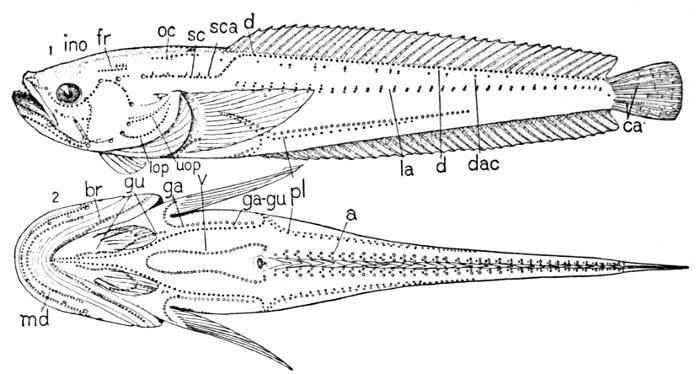
Fig. 146.—Luminous organs and lateral line of Midshipman, Porichthys notatus
Girard. Family Batrachoididæ. Monterey, California. (After Greene.)
"The light produced in Porichthys was, as near as could be
determined by direct observation, a white light. When produced
by electric stimulation it did not suddenly reach its
maximal intensity, but came in quite gradually and disappeared
in the same way when the stimulation ceased. The light was
not a strong one, only strong enough to enable one to quite
easily distinguish the apparatus used in the experiment.
"An important fact brought out by the above experiment is
that an electrical stimulation strong enough to most violently
stimulate the nervous system, as shown by the violent contractions
of the muscular system, may still be too weak to
produce phosphorescence. This fact gives a physiological confirmation
of the morphological result stated above that no
specific nerves are distributed to the phosphorescent organs.
"I can explain the action of the electrical current in these
experiments only on the supposition that it produces its effect
by direct action on the gland.
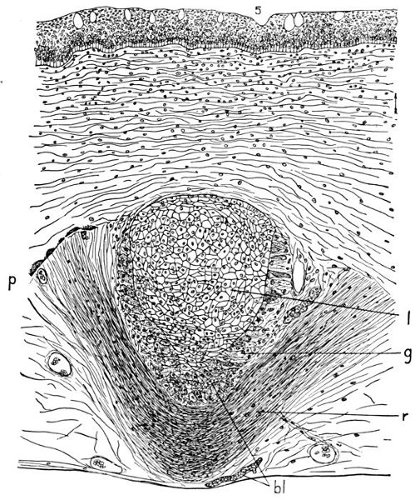
Fig. 147.—Cross-section of a ventral phosphorescent organ of the Midshipman,
Porichthys notatus Girard. l, lens; gl, gland; r, reflector; bl, blood; p, pigment.
(After Greene.)
"The experiments just related were all tried on specimens of
the fish taken from under the rocks where they were guarding
the young brood. Two specimens, however, taken by hooks
from the deeper water of Monterey Bay, could not be made to
show phosphorescence either by electrical stimulation or by
treatment with ammonia. These specimens did net have the
high development of the system of mucous cells of the skin
exhibited by the nesting fish. My observations were, however,
not numerous enough to more than suggest the possibility
of a seasonal high development of the phosphorescent organs.
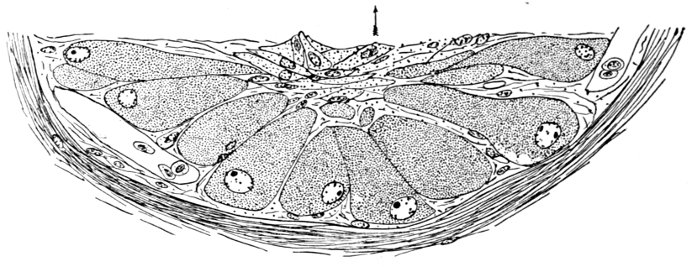
Fig. 148.—Section of the deeper portion of phosphorescent organ of Porichthys
notatus, highly magnified. (After Greene.)
"Two of the most important parts of the organ have to do
with the physical manipulation of light—the reflector and the
lens, respectively. The property of the reflector needs no discussion
other than to call attention to its enormous development.
The lens cells are composed of a highly refractive substance,
and the part as a whole gives every evidence of light
refraction and condensation. The form of the lens gives a
theoretical condensation of light at a very short focus. That
such is in reality the case, I have proved conclusively by examination
of fresh material. If the fresh fish be exposed to direct
sunlight, there is a reflected spot of intense light from each
phosphorescent organ. This spot is constant in position with
reference to the sun in whatever position the fish be turned
and is lost if the lens be dissected away and only the reflector
left. With needles and a simple microscope it is comparatively
easy to free the lens from the surrounding tissue and to examine
it directly. When thus freed and examined in normal saline, I
have found by rough estimates that it condenses sunlight to a
bright point a distance back of the lens of from one-fourth to
one-half its diameter. I regret that I have been unable to make
precise physical developments.
"The literature on the histological structure of known phosphorescent
organs of fishes is rather meager and unsatisfactory.
Von Lendenfeld describes twelve classes of phosphorescent
organs from deep-sea fishes collected by the Challenger expedition.
All of these, however, are greater or less modifications
of one type. This type includes, according to von Lendenfeld's
views, three essential parts, i.e., a gland, phosphorescent cells,
and a local ganglion. These parts may have added a reflector,
a pigment layer, or both; and all these may be simple or compounded
in various ways, giving rise to the twelve classes.
Blood-vessels and nerves are distributed to the glandular portion.
Of the twelve classes direct ocular proof is given for
one, i.e., ocellar organs of Myctophum which were observed by
Willemoes-Suhm at night to shine 'like a star in the net.' Von
Lendenfeld says that the gland produces a secretion, and he
supposes the light or phosphorescence to be produced either
by the 'burning or consuming' of this secretion by the phosphorescent
cells, or else by some substance produced by the
phosphorescent cells. Furthermore, he says that the phosphorescent
cells act at the 'will of the fish' and are excited
to action by the local ganglion.
"Some of these statements and conclusions seem insufficiently
grounded, as, for example, the supposed action of the phosphorescent
cells, and especially the control of the ganglion
over them. In the first place, the relation between the ganglion
and the central nervous system in the forms described by von
Lendenfeld is very obscure, and the structure described as a
ganglion, to judge from the figures and the text descriptions,
may be wrongly identified. At least it is scarcely safe to
ascribe ganglionic function to a group of adult cells so poorly
preserved that only nuclei are to be distinguished. In the
second place, no structural character is shown to belong to the
'phosphorescent cells' by which they may take part in the
process ascribed to them.[20]
"The action of the organs described by him may be explained
on other grounds, and entirely independent of the so-called
'ganglion cells' and of the 'phosphorescent cells.'
"Phosphorescence as applied to the production of light by a
living animal is, according to our present ideas, a chemical action,
an oxidation process. The necessary conditions for producing it
are two—an oxidizable substance that is luminous on oxidation,
i.e., a photogenic substance on the one hand, and the presence
of free oxygen on the other. Every phosphorescent organ
must have a mechanism for producing these two conditions;
all other factors are only secondary and accessory. If the
gland of a firefly can produce a substance that is oxidizable
and luminous on oxidation, as shown as far back as 1828 by
Faraday and confirmed and extended recently by Watasé, it is
conceivable, indeed probable, that phosphorescence in Myctophum
and other deep-sea forms is produced in the same direct way,
that is, by direct oxidation of the secretion of the gland found
in each of at least ten of the twelve groups of organs described
by von Lendenfeld. Free oxygen may be supplied directly
from the blood in the capillaries distributed to the gland
which he describes. The possibility of the regulation of the
supply of blood carrying oxygen is analogous to what takes
place in the firefly and is wholly adequate to account for any
'flashes of light' 'at the will of the fish.'
"In the phosphorescent organs of Porichthys the only part
the function of which cannot be explained on physical grounds
is the group of cells called the gland. If the large granular
cells of this portion of the structure produce a secretion, as seems
probable from the character of the cells and their behavior
toward reagents, and this substance be oxidizable and luminous
in the presence of free oxygen, i.e., photogenic, then we have
the conditions necessary for a light-producing organ. The
numerous capillaries distributed to the gland will supply free
oxygen sufficient to meet the needs of the case. Light produced
in the gland is ultimately all projected to the exterior,
either directly from the luminous points in the gland or reflected
outward by the reflector, the lens condensing all the rays into
a definite pencil or slightly diverging cone. This explanation
of the light-producing process rests on the assumption of a
secretion product with certain specific characters. But comparing
the organ with structures known to produce such a substance,
i.e., the glands of the firefly or the photospheres of Euphausia,
it seems to me the assumption is not less certain than
the assumption that twelve structures resembling each other in
certain particulars have a common function to that proved for
one only of the twelve.
"I am inclined to the belief that whatever regulation of the
action of the phosphorescent organ occurs is controlled by the
regulation of the supply of free oxygen by the blood-stream
flowing through the organ; but, however this may be, the essential
fact remains that the organs in Porichthys are true phosphorescent
organs." (Greene.)
Other species of Porichthys with similar photophores occur
in Texas, Guiana, Panama, and Chile. The name midshipman
alludes to these shining spots, compared to buttons.

Fig. 149.—Sucking-fish, or Pegador, Leptecheneis naucrates (Linnæus). Virginia.
Globefishes.—The globefishes (Tetraodon, etc.) and the porcupine-fishes
have the surface defended by spines. These fishes
have an additional safeguard through the instinct to swallow
air. When one of these fishes is seriously disturbed it rises to
the surface, gulps air into a capacious sac, and then floats belly
upward on the surface. It is thus protected from other fishes,
although easily taken by man. The same habit appears in some
of the frog-fishes (Antennarius) and in the Swell sharks (Cephaloscyllium).
The writer once hauled out a netful of globefishes (Tetraodon
hispidus) from a Hawaiian lagoon. As they lay on the bank
a dog came up and sniffed at them. As his nose touched them
they swelled themselves up with air, becoming visibly two or
three times as large as before. It is not often that the lower
animals show surprise at natural phenomena, but the attitude
of the dog left no question as to his feeling.
Remoras.—The different species of Remora, or shark-suckers,
fasten themselves to the surface of sharks or other fishes and
are carried about by them often to great distances. These
fishes attach themselves by a large sucking-disk on the top of
the head, which is a modified spinous dorsal fin. They do not
harm the shark, except possibly to retard its motion. If the
shark is caught and drawn out of the water, these fishes often
instantly let go and plunge into the sea, swimming away with
great celerity.
Sucking-disks of Clingfishes.—Other fishes have sucking-disks
differently made, by which they cling to rocks. In the
gobies the united ventrals have some adhesive power. The
blind goby (Typhlogobius californiensis) is said to adhere to rocks
in dark holes by the ventral fins. In most gobies the adhesive
power is slight. In the sea-snails (Liparididæ) and lumpfishes
(Cyclopteridæ) the united ventral fins are modified into an
elaborate circular sucking-disk. In the clingfishes (Gobiesocidæ)
the sucking-disk lies between the ventral fins and is made in
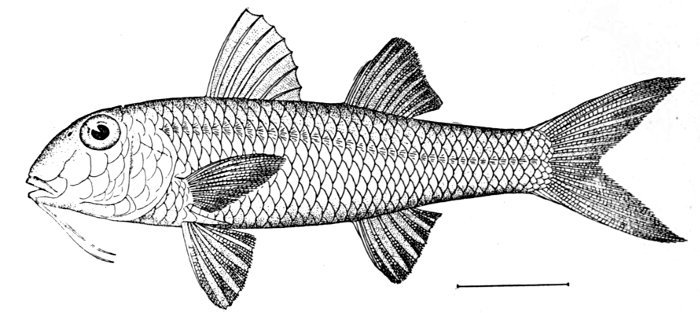
part of modified folds of the naked skin. Some fishes creep
over the bottom, exploring it with their sensitive barbels, as
the gurnard, surmullet, and goatfish. The suckers (Catostomus)
test the bottom with their thick, sensitive lips, either puckered
or papillose, feeding by suction.
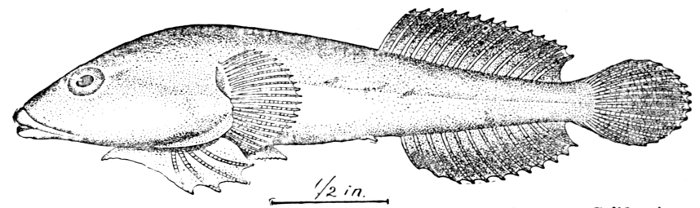
Fig. 150.—Clingfish, Caularchus mæandricus (Girard). Monterey, California.
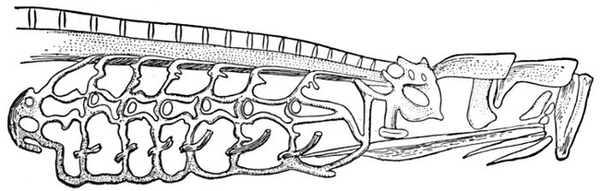
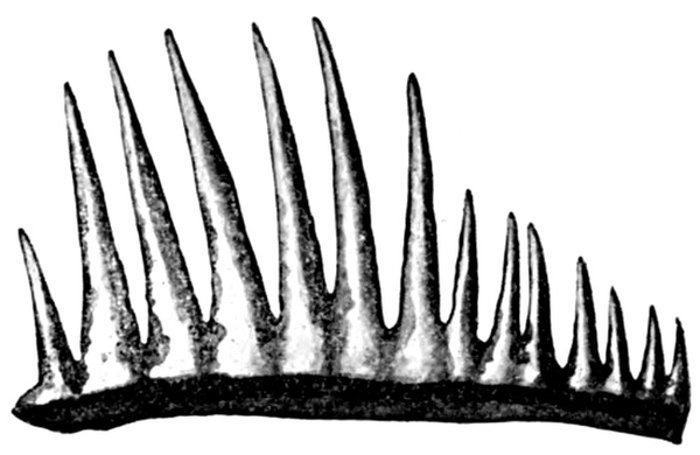
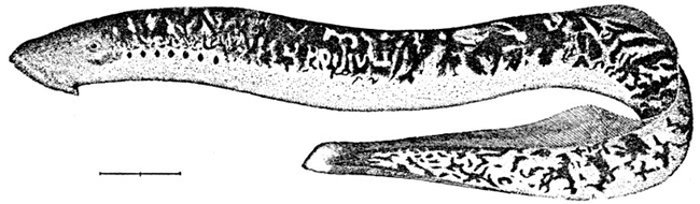
Lampreys and Hagfishes.—The lampreys suck the blood of
other fishes to which they fasten themselves by their disk-like
mouth armed with rasping teeth.
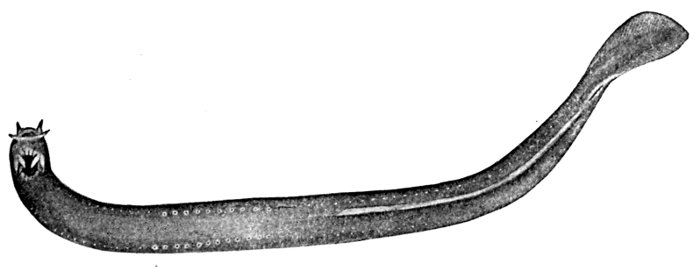
The hagfishes (Myxine, Eptatretus) alone among fishes are
truly parasitic. These fishes, worm-like in form, have round
mouths, armed with strong hooked teeth. They fasten themselves
at the throats of large fishes, work their way into the
muscle without tearing the skin, and finally once inside devour
all the muscles of the fish, leaving the skin unbroken and the
viscera undisturbed. These fishes become living hulks before
they die. If lifted out of the water, the slimy hagfish at once
slips out and swims quickly away. In gill-nets in Monterey
Bay great mischief is done by hagfish (Polistotrema stouti). It
is a curious fact that large numbers of hagfish eggs are taken
from the stomachs of the male hagfish, which seems to be
almost the only enemy of his own species, keeping the numbers
in check.
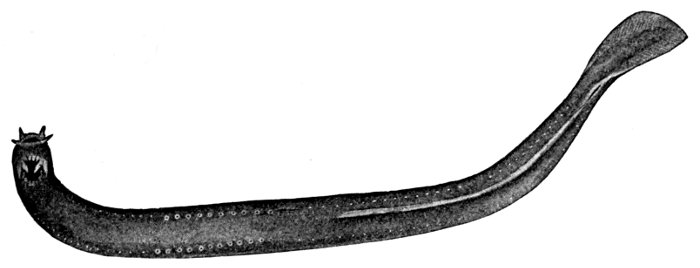
Fig. 151.—Hagfish, Polistotrema stouti (Lockington).
The Swordfishes.—In the swordfish and its relatives, the sailfish
and the spearfish, the bones of the anterior part of the
head are grown together, making an efficient organ of attack.
The sword of the swordfish, the most powerful of these fishes,
has been known to pierce the long planks of boats, and it is
supposed that the animal sometimes attacks the whale. But
stories of this sort lack verification.
The Paddle-fishes.—In the paddle-fishes (Polyodon spatula and
Psephurus gladius) the snout is spread out forming a broad
paddle or spatula. This the animal uses to stir up the mud
on the bottoms of rivers, the small organisms contained in
mud constituting food. Similar paddle-like projections are
developed in certain deep-water Chimæras (Harriottia, Rhinochimæra),
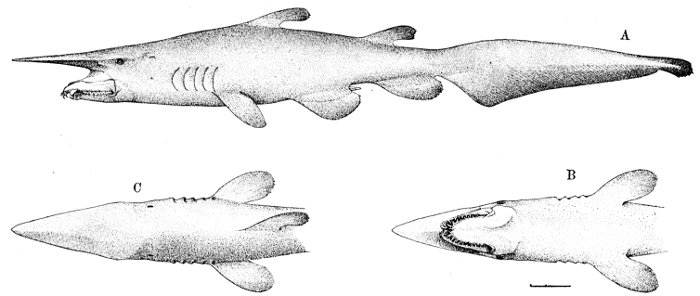
and in the deep-sea shark, Mitsukurina.
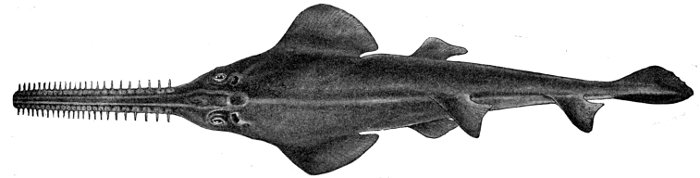
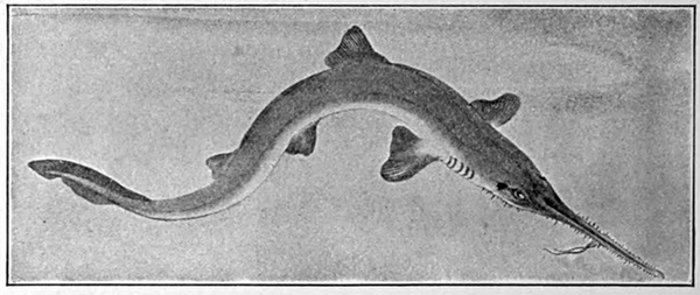
Fig. 152.—Indian Sawfish, Pristis zysron Latham. River mouths of Hindustan. (After Day.)
The Sawfishes.—A certain genus of rays (Pristis, the sawfish)
and a genus of sharks (Pristiophorus, the saw-shark), possess
a similar spatula-shaped snout. But in these fishes the
snout is provided on either side with enamelled teeth set in
sockets and standing at right angles with the snout. The
animal swims through schools of sardines and anchovies, strikes
right and left with this saw, destroying the small fishes, who
thus become an easy prey. These fishes live in estuaries and
river mouths, Pristis in tropical America and Guinea, Pristiophorus
in Japan and Australia. In the mythology of science, the
sawfish attacks the whale, but in fact the two animals never
come within miles of each other, and the sawfish is an object of
danger only to the tender fishes, the small fry of the sea.
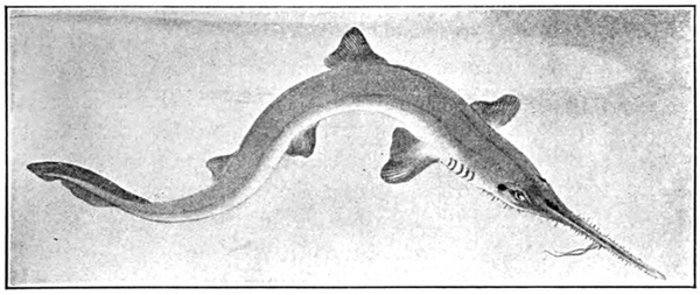
Fig. 153.—Saw-shark, Pristiophorus japonicus Günther. Specimen from
Nagasaki.
Peculiarities of Jaws and Teeth.—The jaws of fishes are subject
to a great variety of modifications. In some the bones are
joined by distensible ligaments and the fish can swallow other
fishes larger than itself. In other cases the jaws are excessively
small and toothless, at the end of a long tube, so ineffective in
appearance that it is a marvel that the fish can swallow anything
at all.
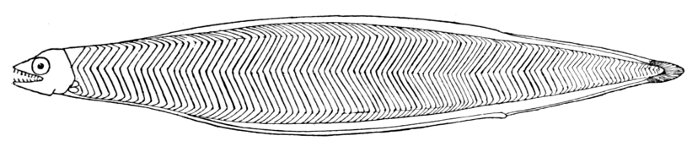
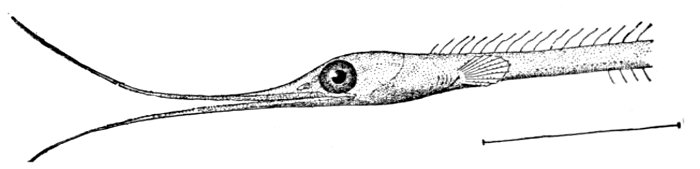
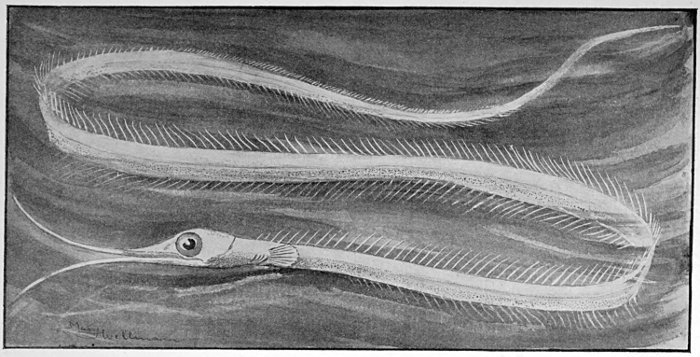
In the thread-eels (Nemichthys) the jaws are so recurved
that they cannot possibly meet, and in their great length seem
worse than useless.
In some species the knife-like canines of the lower jaw pierce
through the substance of the upper.
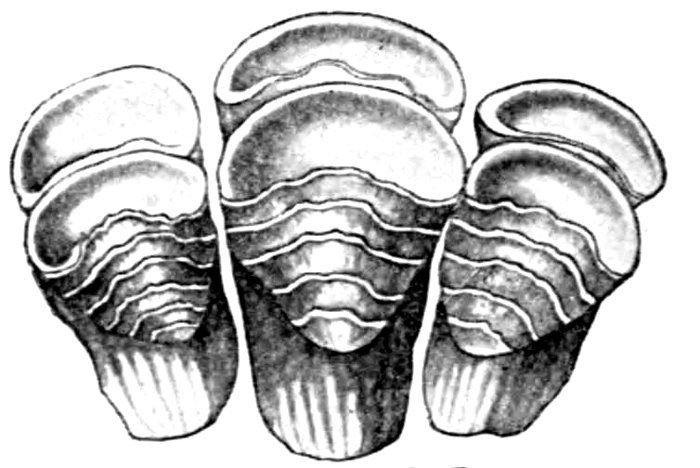
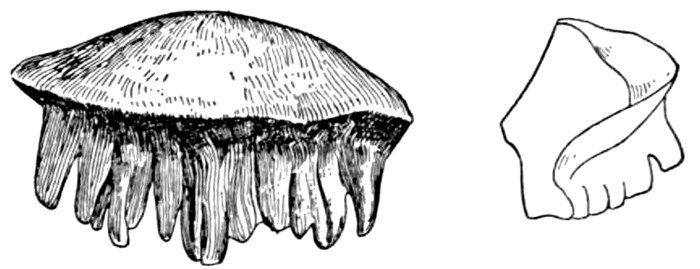
In four different and wholly unrelated groups of fishes the
teeth are grown fast together, forming a horny beak like that of
the parrot. These are the Chimæras, the globefishes (Tetraodon),
and their relatives, the parrot-fishes (Scarus, etc.), and the
stone-wall perch (Oplegnathus). The structure of the beak
varies considerably in these four cases, in accord with the difference
in the origin of its structures. In the globefishes the
jaw-bones are fused together, and in the Chimæras they are
solidly joined to the cranium itself.
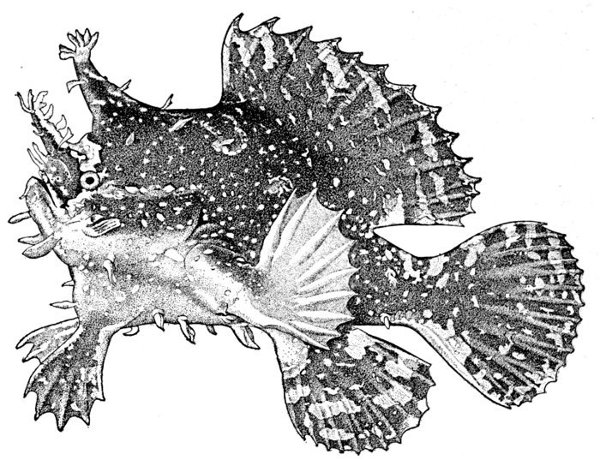
The Angler-fishes.—In the large group of angler-fishes the first
spine of the dorsal fin is modified into a sort of bait to attract
smaller fishes into the capacious mouth below. This structure
is typical in the fishing-frog (Lophius), where the fleshy tip of
this spine hangs over the great mouth, the huge fish lying on
the bottom apparently inanimate as a stone. In other related
fishes this spine has different forms, being often reduced to a
vestige, of little value as a lure, but retained in accordance
with the law of heredity. In a deep-sea angler the bait is
enlarged, provided with fleshy streamers and a luminous body
which serves to attract small fishes in the depths.
The forms and uses of this spine in this group constitute a
very suggestive chapter in the study of specialization and ultimate
degradation, when the special function is not needed or
becomes ineffective.
Similar phases of excessive development and final degradation
may be found in almost every group in which abnormal
stress has been laid on a particular organ. Thus the ventral
fins, made into a large sucking-disk in Liparis, are lost altogether
in Paraliparis. The very large poisoned spines of Pterois
become very short in Aploactis, the high dorsal spines of Citula
are lost in Alectis, and sometimes a very large organ dwindles
to a very small one within the limits of the same genus. An
example of this is seen in the poisoned pectoral spines of
Schilbeodes.
Relation of Number of Vertebræ to Temperature and the Struggle
for Existence.—One of the most remarkable modifications
of the skeleton of fishes is the progressive increase of the
number of vertebræ as the forms become less specialized, and
that this particular form of specialization is greatest at the
equator.[21]
It has been known for some years that in several groups of
fishes (wrasse-fishes, flounders, and "rock-cod," for example)
those species which inhabit northern waters have more vertebræ
than those living in the tropics. Certain arctic flounders, for
example, have sixty vertebræ; tropical flounders have, on the
average, thirty. The significance of this fact is the problem at
issue. In science it is assumed that all facts have significance,
else they would not exist. It becomes necessary, then, to find
out first just what the facts are in this regard.
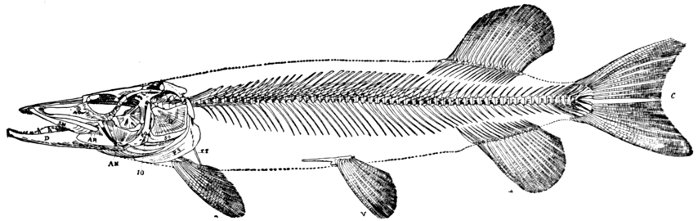
Fig. 154.—Skeleton of Pike, Esox lucius Linnæus, a river fish with many vertebræ.
Going through the various groups of non-migratory marine
fishes we find that such relations are common. In almost every
group the number of vertebræ grows smaller as we approach the
equator, and grows larger again as we pass into southern latitudes.
Taking an average netful of fishes of different kinds
at different places along the coast, the variation would be evident.
At Point Barrow or Cape Farewell or North Cape a
seineful of fishes would perhaps average eighty vertebræ each,
the body lengthened to make room for them; at Sitka or St.
Johns or Bergen, perhaps sixty vertebræ; at San Francisco or
New York or St. Malo, thirty-five; at Mazatlan or Pensacola or
Naples, twenty-eight; and at Panama or Havana or Sierra
Leone, twenty-five. Under the equator the usual number of
vertebræ in shore fishes is twenty-four. Outside tropical and
semi-tropical waters this number is the exception. North of
Cape Cod it is virtually unknown.
Number of Vertebræ.—The numbers of vertebræ in different
groups may be summarized as follows:
Lancelets.—Among the lancelets the numbers of segments
range from 50 to 80, there being no vertebræ.
Lampreys.—In this group the number of segments ranges
from 100 to 150.
Elasmobranchs.—Among sharks and skates the usual number
of segments is from 100 to 150 and upwards. In the extinct
species as far as known the numbers are not materially different.
The Carboniferous genus, Pleuracanthus, has about 115 vertebræ.
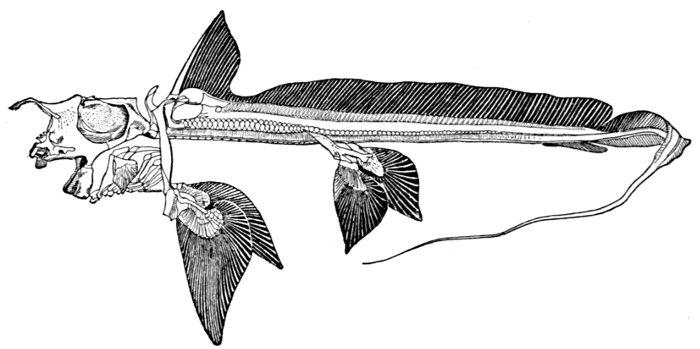
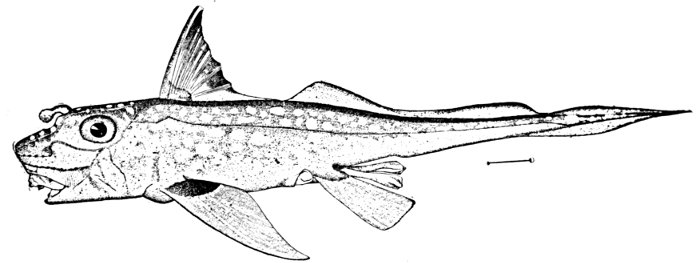
The Chimæras have similar numbers; Chimæra monstrosa has
about 100 in the body and more than as many more in the filamentous
tail.
Cycliæ.—Palæospondylus has about 85 vertebræ.
Arthrodires.—There are about 100 vertebræ in Coccosteus.
Dipnoans.—In Protopterus there are upwards of 100 vertebræ,
the last much reduced in size. Figures of Neoceratodus show
about 80.
Crossopterygians.—Polypterus has 67 vertebræ; Erpetichthys,
110; Undina, about 85.
Ganoids.—In this group the numbers are also large—95 in
Amia, about 55 in the short-bodied Microdon. The Sturgeons
all have more than 100 vertebræ.
Soft-rayed Fishes.—Among the Teleostei, or bony fishes,
those which first appear in geological history are the Isospondyli,
the allies of the salmon and herring. These have all numerous
vertebræ, small in size, and none of them in any notable degree
modified or specialized. They abound in the depths of the
ocean, but there are comparatively few of them in the tropics.
The Salmonidæ which inhabit the rivers and lakes of the northern
zones have from 60 to 65 vertebræ. The Myctophidæ,
Stomiatidæ, and other deep-sea forms have from 40 upwards
in the few species in which the number has been counted.
The group of Clupeidæ is nearer the primitive stock of
Isospondyli than the salmon are. This group is essentially
northern in its distribution, but a considerable number of its
members are found within the tropics. The common herring
(Clupea harangus) ranges farther into the arctic regions than
any other. Its vertebræ are 56 in number. In the shad (Alosa
sapidissima), a northern species which ascends the rivers, the
same number is recorded. The sprat (Clupea sprattus) and
sardine (Sardinia pilchardus), ranging farther south, have from
48 to 50, while in certain small herrings (Sardinella) which are
strictly confined to tropical shores the number is but 40. Allied
to the herring are the anchovies, mostly tropical. The northernmost
species, the common anchovy of Europe (Engraulis enchrasicolus),
has 46 vertebræ. A tropical species (Anchovia browni)
has 41.
There are, however, a few soft-rayed fishes confined to the
tropical seas in which the numbers of vertebræ are still large,
an exception to the general rule. Among these are Albula vulpes,
the bonefish, with 70 vertebræ, Elops saurus, the ten-pounder,
with 72, the tarpon (Tarpon atlanticus), with about 50, and the
milkfish, Chanos chanos, with 72.
In a fossil Eocene herring from the Green River shales (Diplomystus)
I count 40 vertebræ; in a bass-like fish (Mioplosus)
from the same locality 24—these being the usual numbers in
the present tropical members of these groups.
The great family of Siluridæ, or catfishes, is represented in all
the fresh waters of temperate and tropical America, as well as in
the warmer parts of the Old World. One division of the family,
containing numerous species, abounds on the sandy shores of
the tropical seas. The others are all fresh-water fishes. So
far as the vertebræ in the Siluridæ have been examined, no
conclusions can be drawn. The vertebræ in the marine species
range from 35 to 50; in the North American forms, from 37 to 45;
and in the South American fresh-water species, where there is
almost every imaginable variation in form and structure, the
numbers range from 28 to 50 or more. The Cyprinidæ (carp
and minnows), confined to the fresh waters of the northern hemisphere,
and their analogues, the Characinidæ of the rivers of
South America and Africa, have also numerous vertebræ, 36 to
50 in most cases.
In general we may say of the soft-rayed fishes that very
few of them are inhabitants of tropical shores. Of these few,
some which are closely related to northern forms have fewer
vertebræ than their cold-water analogues. In the northern
species, the fresh-water species, and the species found in the deep
sea the number of vertebræ is always large, but the same is
true of some of the tropical species also.
The Flounders.—In the flounders, the halibut and its relatives,
arctic genera (Hippoglossus and Atheresthes), have from
49 to 50 vertebræ. The northern genera (Hippoglossoides,
Lyopsetta, and Eopsetta) have from 43 to 45; the members of
a large semi-tropical genus (Paralichthys) of wide range have
from 35 to 41; while the tropical forms have from 35 to 37.
In the group of turbots and whiffs none of the species really
belong to the northern fauna, and the range in numbers is from
35 to 43. The highest number, 43, is found in a deep-water
species (Monolene), and the next, 40, in species (Lepidorhombus,
Orthopsetta) which extend their range well toward the north.
Among the plaices, which are all northern, the numbers range
from 35 to 65, the higher numbers, 52, 58, 65, being found in
species (Glyptocephalus) which inhabit considerable depths in
the arctic seas. The lowest numbers (35) belong to shore
species (Pleuronichthys) which range well toward the south.
Spiny-rayed Fishes.—Among the spiny-rayed fishes the facts
are more striking. Of these, numerous families are chiefly or
wholly confined to the tropics, and in the great majority of
all the species the number of vertebræ is constantly 24,—10 in
the body and 14 in the tail (10+14). This is true of all or
nearly all the Berycidæ, Serranidæ, Sparidæ, Sciænidæ, Chætodontidæ,
Hæmulidæ, Gerridæ, Gobiidæ, Acanthuridæ, Mugilidæ,
Sphyrænidæ, Mullidæ, Pomacentridæ, etc.
In some families in which the process of reduction has gone
on to an extreme degree, as in certain Plectognath fishes, there
has been a still further reduction, the lowest number, 14, existing
in the short inflexible body of the trunkfish (Ostracion), in
which the vertebral joints are movable only in the base of the
tail. In all these forms the process of reduction of vertebræ
has been accompanied by specialization in other respects. The
range of distribution of these fishes is chiefly though not quite
wholly confined to the tropics.
Thus Balistes, the trigger-fish, has 17 vertebræ; Monacanthus
and Alutera, foolfishes, about 20; the trunkfish, Ostracion, 14;
the puffers, Tetraodon and Spheroides, 18; Canthigaster, 17;
and the headfish, Mola, 17. Among the Pediculates, Malthe
and Antennarius have 17 to 19 vertebræ, while in their near
relatives, the anglers, Lophiidæ, the number varies with the
latitude. Thus, in the northern angler, Lophius piscatorius,
which is never found south of Cape Hatteras, there are 30 vertebræ.
In a similar species, inhabiting the north of Japan (Lophius
litulon), there are 27. In another Japanese species, ranging
farther south, Lophiomus setigerus, the vertebræ are but 19.
Yet in external appearance these two fishes are almost identical.
It is, however, a notable fact that some of the deep-water
Pediculates, or angling fishes, have the body very short and the
number of vertebræ correspondingly reduced. Dibranchus atlanticus,
from a depth of 3600 fathoms, or more than 4 miles, has
but 18 vertebræ, and others of its relatives in deep waters show
also small numbers. These soft-bodied fishes are simply animated
mouths, with a feeble osseous structure, and they are
perhaps recent offshoots from some stock which has extended
its range from muddy bottom or from floating seaweed to the
depths of the sea.
A very few spiny-rayed families are wholly confined to the
northern seas. One of the most notable of these is the family
of viviparous surf-fishes (Embiotocidæ), of which numerous species
abound on the coasts of California and Japan, but which enter
neither the waters of the frigid nor of the torrid zone. The surf-fishes
have from 32 to 42 vertebræ, numbers which are never
found among tropical fishes of similar appearance or relationship.
The facts of variation with latitude were first noticed among
the Labridæ. In the northern genera (Labrus, Tautoga, etc.)
there are 38 to 41 vertebræ; in the semi-tropical genera (Crenilabrus,
Bodianus, etc.), 30 to 33; in the tropical genera (Halichœres,
Xyrichthys, Thalassoma, etc.), usually 24.
Equally striking are the facts in the great group of Pareioplitæ,
or mailed-cheek fishes, composed of numerous families,
diverging from each other in various respects, but agreeing in
certain peculiarities of the skeleton.
Among these fishes the family most nearly related to ordinary
fishes is that of the Scorpænidæ (scorpion-fishes, etc.).
This is a large family containing many species, fishes of local
habits, swarming about the rocks at moderate depths in all
zones. The species of the tropical genera have all 24 vertebræ.
Those genera chiefly found in cooler waters, as in California,
Japan, Chile, and the Cape of Good Hope, have in all their species
27 vertebræ, while in the arctic genera there are 31.
Allied to the Scorpænidæ, but confined to the tropical or
semi-tropical seas, are the Platycephalidæ, with 27 vertebræ, and
the Cephalacanthidæ (flying gurnards), with but 22. In the
deeper waters of the tropics are the Peristediidæ, with 33 vertebræ,
and extending farther north, belonging as much to the temperate
as to the torrid zone, is the large family of the Triglidæ (gurnards)
in which the vertebræ range from 25 to 38.
The family of Agonidæ (sea-poachers), with 36 to 40 vertebræ,
is still more decidedly northern in its distribution. Wholly confined
to northern waters is the great family of the Cottidæ (sculpins),
in which the vertebræ ascend from 30 to 50. Entirely
polar and often in deep waters are the Liparididæ (sea-snails),
an offshoot from the Cottidæ, with soft, limp bodies, and the
vertebræ 35 to 65. In these northern forms there are no scales,
the spines in the fins have practically disappeared, and only
the anatomy shows that they belong to the group of spiny-rayed
fishes. In the Cyclopteridæ (lumpfishes), likewise largely arctic,
the body becomes short and thick, the back-bone inflexible,
and the vertebræ are again reduced to 28. In most cases, as
the number of vertebræ increases, the body becomes proportionally
elongate. As a result of this, the fishes of arctic waters
are, for the most part, long and slender, and not a few of them
approach the form of eels. In the tropics, however, while
elongate fishes are common enough, most of them (always excepting
the eels) have the normal number of vertebræ, the greater
length being due to the elongation of their individual vertebræ
and not to their increase in number. Thus the very slender goby,
Gobionellus oceanicus, has the same number (25) of vertebræ as its
thick-set relative Gobius soporator or the chubby Lophogobius
cyprinoides. In the great group of blenny-like fishes the facts
are equally striking. The arctic species are very slender in form
as compared with the tropical blennies, and this fact, caused by
a great increase in the number of their vertebræ, has led to the
separation of the group into several families. The tropical forms
composing the family of Blenniidæ have from 28 to 49 vertebræ,
while in the arctic genera the numbers range from 75 to 100.
Of the true Blennidæ, which are all tropical or semi-tropical,
Blennius has 28 to 35 vertebræ; Salarias, 35 to 38; Lepisoma,
34; Clinus, 49; Cristiceps, 40. A fresh-water species of Cristiceps
found in Australia has 46. Blennioid fishes in the arctic
seas are Anarrhichas, with 76 vertebræ; Anarrhichthys, with
100 or more; Lumpenus, 79; Pholis, 85; Lycodes, 112; Gymnelis,
93. Lycodes and Gymnelis have lost all the dorsal spines.
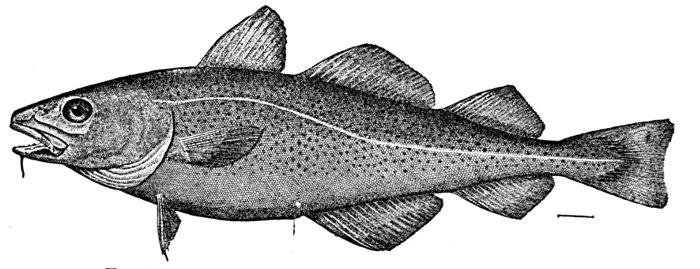
In the cod family (Gadidæ) the number of vertebræ is usually
about 50. The number is 51 in the codfish (Gadus callarias),
58 in the Siberian cod (Eleginus navaga), 54 in the haddock
(Melanogrammus æglifinus), 54 in the whiting (Merlangus merlangus),
54 in the coalfish (Pollachius virens), 52 in the Alaskan
coalfish (Theragra chalcogramma), 51 in the hake (Merluccius
merluccius). In the burbot (Lota lota), the only fresh-water
codfish, 59; in the deep-water ling (Molva molva), 64; in the
rocklings (Gaidropsarus), 47 to 49. Those few species found
in the Mediterranean and the Gulf of Mexico have fewer fin-rays
and probably fewer vertebræ than the others, but none of the
family enter warm water, the southern species living at greater
depths.
In the deep-sea allies of the codfishes, the grenadiers or
rat-tails (Macrouridæ), the numbers range from 65 to 80.
Fresh-water Fishes.—Of the families confined strictly to
the fresh waters the great majority are among the soft-rayed or
physostomous fishes, the allies of the salmon, pike, carp, and
catfish. In all of these the vertebræ are numerous. A few
fresh-water families have their affinities entirely with the more
specialized forms of the tropical seas. Of these the Centrarchidæ
(comprising the American fresh-water sunfish and black bass)
have on the average about 30 vertebræ, the pirate perch 29,
and the Percidæ, perch and darters, etc., 35 to 45, while the
Serranidæ or sea-bass, the nearest marine relatives of all these,
have constantly 24. The marine family of damsel-fishes (Pomacentridæ)
have 26 vertebræ, while 30 to 40 vertebræ usually
exist in their fresh-water analogues (or possibly descendants),
the Cichlidæ, of the rivers of South America and Africa. The
sticklebacks (Gasterosteidæ), a family of spiny fishes, confined
to the rivers and seas of the north, have from 31 to 41 vertebræ.
Pelagic Fishes.—Among the free-swimming or migratory
pelagic fishes, the number of vertebræ is usually greater than
among their relatives of local habits. This fact is most evident
among the scombriform fishes, the allies of the mackerel and
tunny. All of these belong properly to the warm seas, and the
reduction of the vertebræ in certain forms has no evident relation
to the temperature, though it seems to be related in some
degree to the habits of the species. Perhaps the retention of
many segments is connected with that strength and swiftness
in the water for which the mackerels are preeminent.
The variations in the number of vertebræ in this group led
Dr. Günther to divide it into two families, the Carangidæ and
Scombridæ.
The Carangidæ or Pampanos are tropical shore fishes, local
or migratory to a slight degree. All these have from 24 to
26 vertebræ. In their pelagic relatives, the dolphins (Coryphæna),
there are from 30 to 33; in the opah (Lampris), 45; in
Brama, 42; while the great mackerel family (Scombridæ), all
of whose members are more or less pelagic, have from 31 to 50.
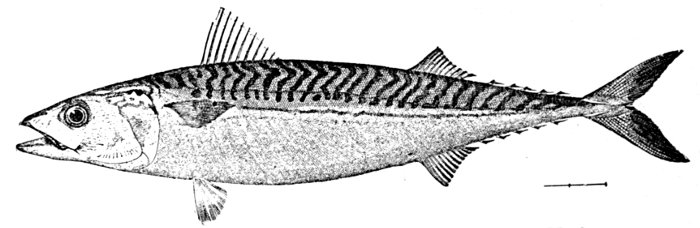
The mackerel (Scomber scombrus) has 31 vertebræ; the chub
mackerel (Scomber japonicus), 31; the tunny (Thunnus thynnus),
39; the long-finned albacore (Germo alalonga), 40; the bonito
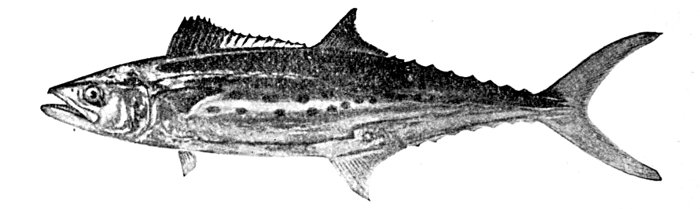
(Sarda sarda), 50; the Spanish mackerel (Scomberomorus maculatus),
45.
Other mackerel-like fishes are the cutlass-fishes (Trichiuridæ),
which approach the eels in form and in the reduction of the fins.
In these the vertebræ are correspondingly numerous, the numbers
ranging from 100 to 160. Aphanopus has 101 vertebræ;
Lepidopus, 112; Trichurus, 159.
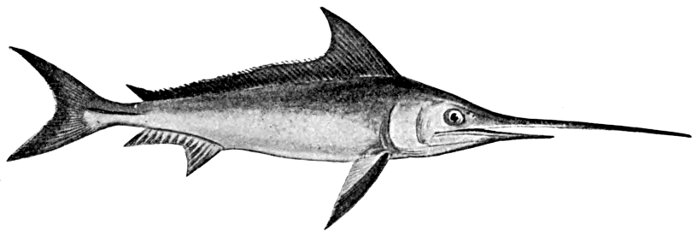
In apparent contradiction to this rule, however, the pelagic
family of swordfishes (Xiphias), remotely allied to the mackerels,
and with even greater powers of swimming, has the vertebræ
in normal number, the common swordfish having but 24.
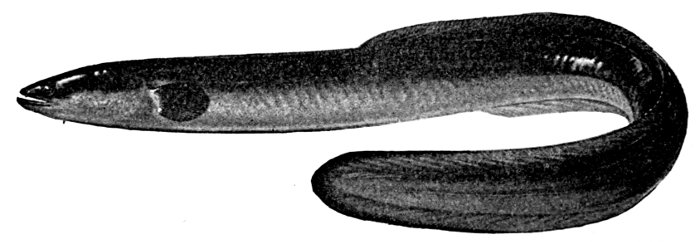
The Eels.—The eels constitute a peculiar group of soft-rayed
ancestry, in which everything else has been subordinated to
muscularity and flexibility of body. The fins, girdles, gill-arches,
scales, and membrane bones are all imperfectly developed
or wanting. The eel is perhaps as far from the primitive stock
as the most highly "ichthyized" fishes, but its progress has
been of another character. The eel would be regarded in the
ordinary sense as a degenerate type, for its bony structure is
greatly simplified as compared with its ancestral forms, but in
its eel-like qualities it is, however, greatly specialized. All
the eels have vertebræ in great numbers. As the great majority
of the species are tropical, and as the vertebræ in very few of
the deep-sea forms have been counted, no conclusions can
be drawn as to the relation of their vertebræ to the temperature.
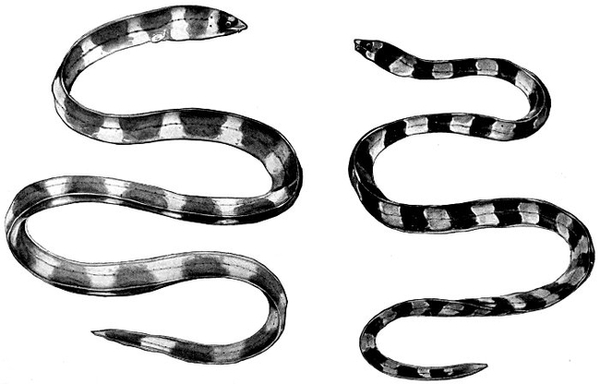
It is evident that the two families most decidedly tropical
in their distribution, the morays (Murænidæ) and the snake-eels
(Ophichthyidæ), have diverged farthest from the primitive stock.
They are most "degenerate," as shown by the reduction of their
skeleton. At the same time they are also most decidedly "eel-like,"
and in some respects, as in coloration, dentition, muscular
development, most highly specialized. It is evident that the
presence of numerous vertebral joints is essential to the suppleness
of body which is the eel's chief source of power.
So far as known the numbers of vertebræ in eels range from
115 to 160, some of the deep-sea eels (Nemichthys, Nettastoma,
Gordiichthys) having much higher numbers, in accord with
their slender or whip-like forms.
Among the morays, Muræna helena has 140; Gymnothorax
meleagris, 120; G. undulatus, 130; G. moringa, 145; G. concolor,
136; Echidna catenata, 116; E. nebulosa, 142; E. zebra, 135.
In other families the true eel, Anguilla anguilla, has 115; the
conger-eel, Leptocephalus conger, 156; and Murænesox cinereus,
154.
Variations in Fin-rays.—In some families the number of
rays in the dorsal and anal fins is dependent on the number of
vertebræ. It is therefore subject to the same fluctuations.
This relation is not strictly proportionate, for often a variable
number of rays with their interspinal processes will be interposed
between a pair of vertebræ. The myotomes or muscular
bands on the sides are usually coincident with the number of
vertebræ. As, however, these and other characters are dependent
on differences in vertebral segmentation, they bear
the same relations to temperature or latitude that the vertebræ
themselves sustain.
Thus in the Scorpænidæ, Sebastes, and Sebastolobus arctic
genera have the dorsal rays xv, 13, the vertebræ 12+19. The
tropical genus Scorpæna has the dorsal rays xii, 10, the vertebræ
10+14, while the genus Sebastodes of temperate waters
has the intermediate numbers of dorsal rays xii, 12, and vertebræ
12+15.
Relation of Numbers to Conditions of Life.—Fresh-water fishes
have in general more vertebræ than marine fishes of shallow
waters. Pelagic fishes and deep-sea fishes have more than
those which live along the shores, and more than localized or
non-migratory forms. To each of these generalizations there
are occasional partial exceptions, but not such as to invalidate
the rule.
The presence of large numbers of vertebræ is noteworthy
among those fishes which swim for long distances, as, for example,
many of the mackerel family. Among such there is often found
a high grade of muscular power, or even of activity, associated
with a large number of vertebræ, these vertebræ being individually
small and little differentiated. For long-continued muscular
action of a uniform kind there would be perhaps an advantage
in the low development of the vertebral column. For
muscular alertness, moving short distances with great speed,
the action of a fish constantly on its guard against enemies or
watching for its prey, the advantage would be on the side of a
few vertebræ. There is often a correlation between the free-swimming
habit and slenderness and suppleness of the body,
which again is often dependent on an increase in numbers of
the vertebral segments. These correlations appear as a disturbing
element in the problem rather than as furnishing a
clew to its solution. In some groups of fresh-water fishes there
is a reduction in number of vertebræ, not associated with any
degree of specialization of the individual bone, but correlated
with simple reduction in size of body. This is apparently a
phenomenon of degeneration, a survival of dwarfs, where conditions
are unfavorable in full growth.
All these effects should be referable to the same group of
causes. They may, in fact, be combined in one statement. All
other fishes now extant, as well as all fishes existing prior to
Cretaceous times, have a larger number of vertebræ than the
marine shore fishes of the tropics of the present period. There
is good reason to believe that in most groups of spiny-rayed
fishes, those with the smaller number of segments are at once
the most highly organized and the most primitive. This is true
among the blennies, the sculpins, the flounders, the perches, and
probably the labroid fishes as well. The present writer once
held the contrary view, that the forms with the higher numbers
were primitive, but the evidence both from comparative anatomy
and from palæontology seems to indicate that among spiny-rayed
fishes the forms most ancient, most generalized, and most
synthetic are those with about 24 vertebræ. The soft-rayed
fishes without exception show larger numbers, and these are
still more primitive. This apparent contradiction is perhaps
explained by Dr. Boulenger's suggestion that the prevalence of
the same number, 24, in the vertebræ of various families of spiny-rayed
fishes is due to common descent, probably from Cretaceous
berycoids having this number. In this theory, perches, sparoids,
carangoids, chætodonts, labroids, parrot-fishes, gobies,
flounders, and sculpins must be regarded as having a common
origin from which all have diverged since Jurassic times.
This view is not at all unlikely and is not inconsistent with the
facts of palæontology. If this be the case, the members of these
and related families which have larger numbers of vertebræ
must have diverged from the primitive stock. The change has
been one of degeneration, the individual vertebræ being reduced
in size and complexity, with a vegetative increase in their number.
At the same time, the body having the greater number of
segments is the more flexible though the segments themselves
are less specialized.
The primitive forms live chiefly along tropical shores, while
forms with increased numbers of vertebræ are found in all other
localities. This fact must be considered in any hypothesis as
to the causes producing such changes. If the development of
large numbers be a phase of degeneration the causes of such
degeneration must be sought in the colder seas, in the rivers, and
in the oceanic abysses. What have these waters in common
that the coral reefs, the lava crags, and tide-pools of the tropics
have not?
It is certain that the possession of fewer vertebræ indicates
the higher rank, the greater specialization of parts, even though
the many vertebræ be a feature less primitive. The evolution
of fishes is rarely a movement of progress toward complexity.
The time movement in some groups is accompanied by degradation
and loss of parts, by vegetative repetition of structures,
and often by a movement from the fish-form toward the eel-form.
Water life is less exacting than land life, having less variation
of conditions. It is, therefore, less effective in pushing
forward the differentiation of parts. When vertebræ are few
in number each one is relatively larger, its structure is more
complicated, its appendages larger and more useful, and the fins
with which it is connected are better developed. In other words,
the tropical fish is more intensely and compactly a fish, with a
better fish equipment, and in all ways better fitted for the business
of a fish, especially for that of a fish that stays at home.
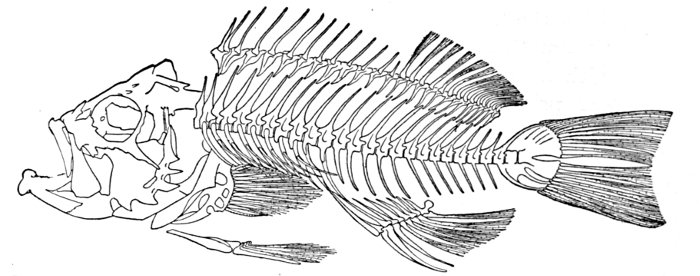
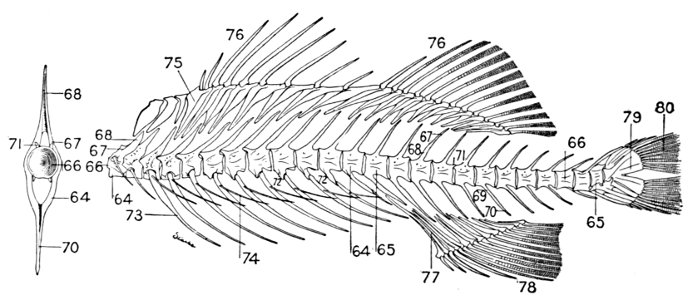
Fig. 155.—Skeleton of Red Rockfish, Sebastodes miniatus Jordan and Gilbert.
California.
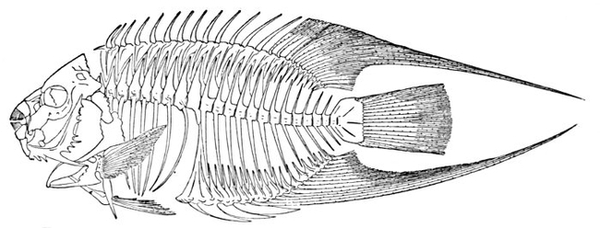
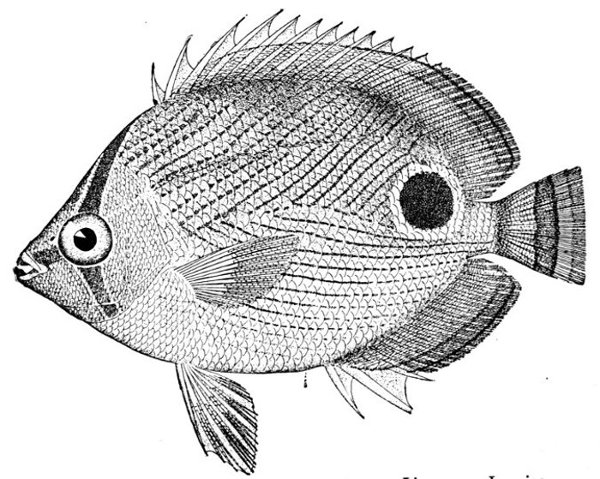
Fig. 156.—Skeleton of a spiny-rayed fish of the tropics, Holacanthus ciliaris
(Linnæus).
In the center of competition no species can afford to be
handicapped by a weak back-bone and redundant vertebræ.
Those who are thus weighted cannot hold their own. They
must change or perish.
The conditions most favorable to fish life are among the rocks
and reefs of the tropical seas. About the coral reefs is the center
of fish competition. A coral archipelago is the Paris of fishes.
In such regions is found the greatest variety of surroundings,
and therefore the greatest number of possible adjustments.
The struggle is between fish and fish, not between fishes and
hard conditions of life. No form is excluded from the competition.
Cold, darkness, and foul water do not shut out competitors,
nor does any evil influence sap the strength. The
heat of the tropics does not make the sea-water hot. It is
never sultry or laden with malaria.
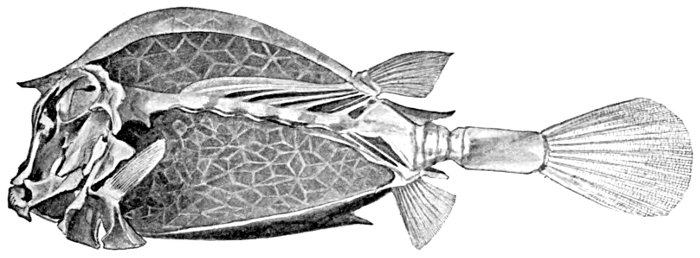
Fig. 157.—Skeleton of the Cowfish, Lactophrys tricornis (Linnæus).
From conditions otherwise favorable in arctic regions the
majority of competitors are excluded by their inability to bear
the cold. River life is life in isolation. To aquatic animals
river life has the same limitations that island life has to the
animals of the land. The oceanic islands are far behind the
continents in the process of evolution in so far as evolution implies
specialization of parts. In a like manner the rivers are
ages behind the seas, so far as progress is concerned, though
through lack of competition the animals in isolation may be
farthest from the original stock.
Therefore the influences which serve as a whole to intensify
fish life, to keep it up to its highest effectiveness, and which
tend to rid the fish of every character or structure it cannot
"use in its business," are most effective along the shores of the
tropics. One phase of this is the retention of low numbers of
vertebræ, or, more accurately, the increase of stress on each
individual bone.
Conversely, as the causes of these changes are still in operation,
we should find that in cold waters, deep waters, dark
waters, fresh waters, and inclosed waters the strain would be
less, the relapses to less complex organization more frequent,
the numbers of vertebræ would be larger, while the individual
vertebræ would become smaller, less complete, and less perfectly
ossified.
This in a general way is precisely what we do find in examining
the skeletons of a large variety of fishes.
The cause of the increased numbers of vertebræ in cold waters
or extratropical waters is as yet unknown. Several guesses have
been made, but these can scarcely rise to the level of theories.
To ascribe it to natural selection, as the present writer has done,
is to do little more than to restate the problem.
As a possible tentative hypothesis we may say that the
retention of the higher primitive traits in the tropics is due to
continuous selection, the testing of individuals by the greater
variety of external conditions. The degeneration of extratropical
fishes may be due to isolation and cessation or reversal
of selection. Thus fresh waters, the arctic waters, the oceanic
abysses are the "back woods" of fish life, localities favorable
to the retention of primitive simplicity, equally favorable
to subsequent degeneration. Practically all deep-sea fishes are
degenerate descendants of shore fishes of various groups. Monotony
and isolation permit or encourage degeneration of type.
Where the struggle for existence is most intense the higher structures
will be retained or developed. Among such facts as these
derived from natural selection the cause of the relation of temperature
to number of vertebræ must be sought. How the
Cretaceous berycoids first acquired their few vertebræ and the
high degree of individual specialization of these structures we
may not know. The character came with the thoracic ventrals
with reduced number of rays, the ctenoid scales, the toothless
maxillary, and other characters which have long persisted in
their subsequent descendants.
An exception to the general rule in regard to the number of
vertebræ is found in the case of the eel. Eels inhabit nearly all
seas, and everywhere they have many vertebræ. The eels of
the tropics are at once more specialized and more degraded.
They are better eels than those of northern regions, but, as the
eel is a degraded type, they have gone farther in the loss of
structures in which this degradation consists.
It is not well to push this analogy too far, but perhaps we
can find in the comparison of the tropics and the cities some
suggestion as to the development of the eel.
In the city there is always a class which follows in no degree
the general line of development. Its members are specialized
in a wholly different way. By this means they take to themselves
a field which others have neglected, making up in low
cunning what they lack in humanity or intelligence.
Thus, among fishes, we have in the regions of closest competition
this degenerate and non-fish-like type, lurking in holes
among the rocks, or creeping in the sand; thieves and scavengers
among fishes. The eels thus fill a place otherwise left unfilled.
In their way they are perfectly adapted to the lives
they lead. A multiplicity of vertebral joints is useless to the
tropical fish, but to the eel strength and suppleness are everything.
No armature of fin or scale or bone is so desirable as
its power of escaping through the smallest opening. With the
elongation of the body and its increase in flexibility there is a
tendency toward the loss of the paired fins, the ventrals going
first, and afterwards the pectorals. This tendency may be seen
in many groups. Among recent fishes, the blennies, the eel-pouts,
and the sea-snails furnish illustrative examples.
Degeneration of Structures.—In the lancelet, which is a
primitively simple organism, the various structures of the body
are formed of simple tissues and in a very simple fashion. It is
probable from the structure of each of these that it has never
been very much more complex. As the individual develops in the
process of growth each organ goes as it were straight to its final
form and structure without metamorphosis or especial alterations
by the way. When this type of development occurs, the organism
belongs to a type which is primitively simple. But there are
other forms which in their adult state appear feeble or simple, in
which are found elements of organs of high complexity. Thus
in the sea-snail (Liparis), small, weak, with feeble fins and flabby
skin, we find the essential anatomy of the sculpin or the rosefish.
The organs of the latter are there, but each one is reduced
or degenerate, the bones as soft as membranes, the spines
obsolete or buried in the skin. Such a type is said to be degenerate.
It is very different from one primitively simple, and
it is likely in its earlier stages of development to be more complex
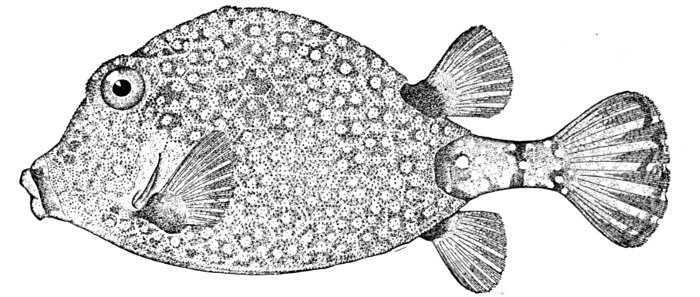
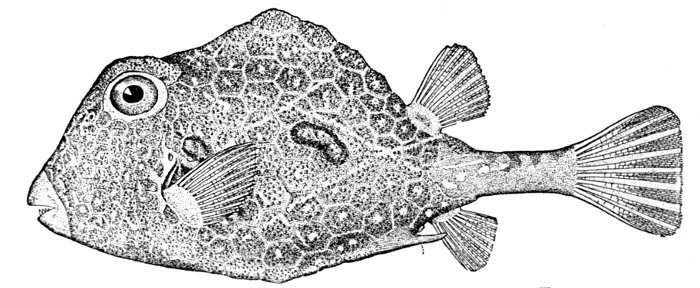
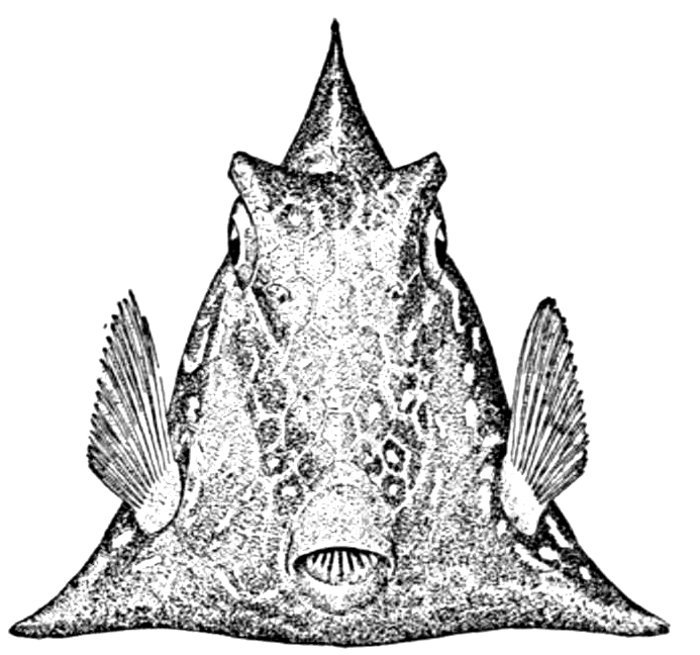
than when it is fully grown.
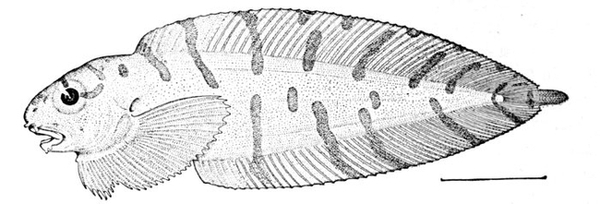
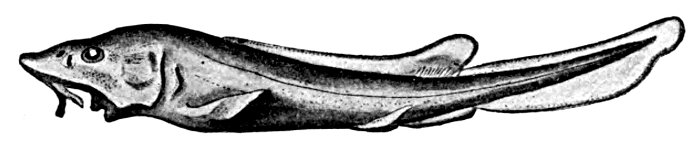
Fig. 158.—Liparid, Crystallias matsushimæ (Jordan and Snyder). Family Liparididæ.
Matsushima Bay, Japan.
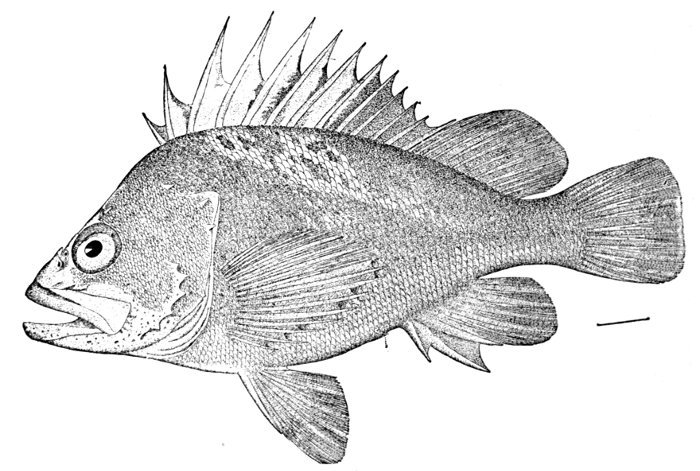
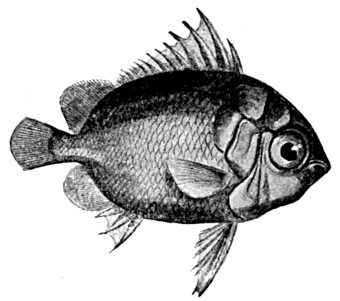
Fig. 159.—Yellow-backed Rockfish, Sebastichthys maliger Jordan and Gilbert.
Sitka, Alaska.
In the evolution of groups of fishes it is a common feature
that some one organ will be the center of a special stress, in
view of some temporary importance of its function. By the
process of natural selection it will become highly developed and
highly specialized. Some later changes in conditions will render
this specialization useless or even harmful for at least a part
of the species possessing it. The structure then undergoes degeneration,
and in many cases it is brought to a lower estate than
before the original changes. An example of this may be taken
from the loricate or mailed-cheek fishes. One of the primitive
members of this group is the rockfish known as priestfish (Sebastodes
mystinus). In this fish the head is weakly armed, covered
with ordinary scales. A slight suggestion of cranial ridges
and a slight prolongation of the third suborbital constitute the
chief suggestions of its close affinity with the mailed-cheek
fishes. In other rockfishes the cranial ridges grow higher and
sharper. The third suborbital extends itself farther and wider.
It becomes itself spinous in still others. Finally it covers the
whole cheek in a coat of mail. The head above becomes rough
and horny and at last the whole body also is enclosed in a bony
box. But while this specialization reaches an extraordinary
degree in forms like Agonus and Peristedion, it begins to abate
with Cottus, and thence through Cottunculus, Psychrolutes, Liparis,
and the like, and the mailed cheek finds its final degradation
in Parliparis. In this type no spines are present anywhere,
no hard bone, no trace of scales, of first dorsal, or of
ventral fins, and in the soft, limp structure covered with a
fragile, scarf-like skin we find little suggestion of affinity
with the strong rockfish or the rough-mailed Agonus. Yet
a study of the skeleton shows that all these loricate forms
constitute a continuous divergent series. The forms figured constitute
only a few of the stages of specialization and degradation
which the members of this group represent.
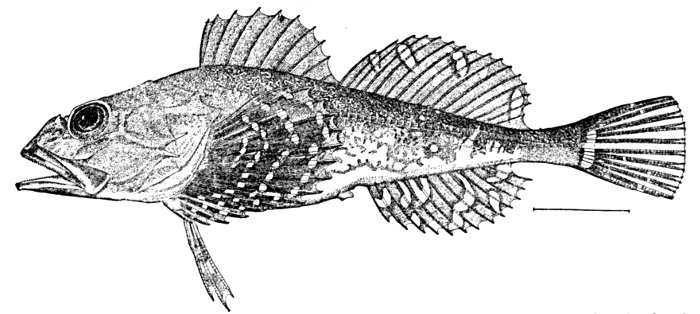
Fig. 160.—European Sculpin, Myoxocephalus scorpius (Linnæus). Cumberland
Gulf, Arctic America
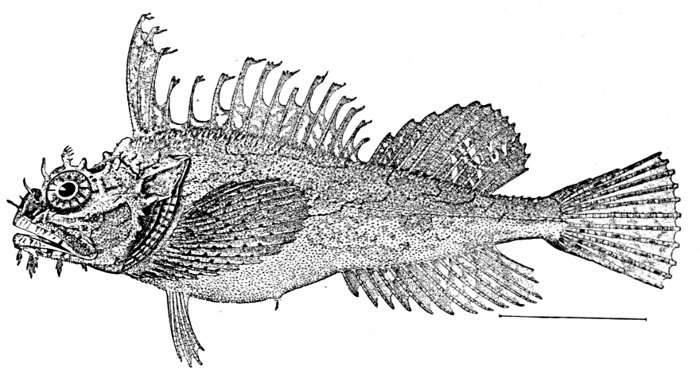
Fig. 161.—Sea-raven, Hemitripterus americanus (Gmelin). Halifax, Nova Scotia.
Some of the features of the habits and development of certain
fresh-water fishes are mentioned in the following chapter.
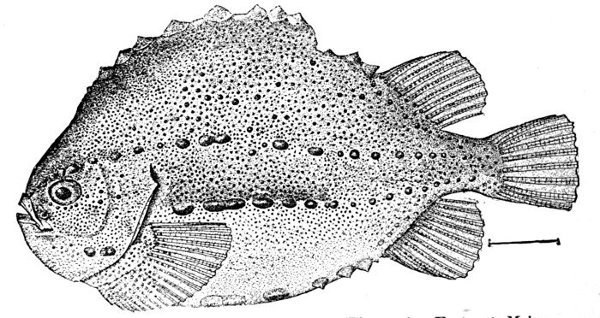
Fig. 162.—Lumpfish, Cyclopterus lumpus (Linnæus). Eastport, Maine.
The degeneration of the eye of the blind fishes of the caves
of the Mississippi Valley, Amblyopsis, Typhlichthys, and Troglichthys,
have been very fully studied by Dr. Carl H. Eigenmann.
According to his observations
"The history of the eye of Amblyopsis spelæus may be divided
into four periods:
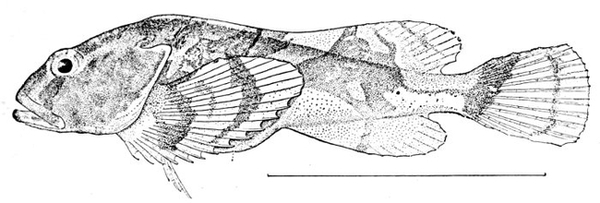
Fig. 163.—Sleek Sculpin, Psychrolutes paradoxus (Günther). Puget Sound.
"(a) The first extends from the appearance of the eye till
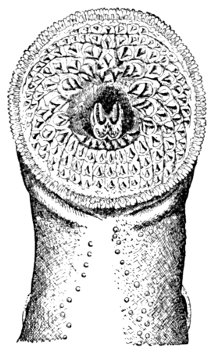
the embryo is 4-5 mm. long. This period is characterized by
a normal palingenic development, except that the cell division
is retarded and there is very little growth.

Fig. 164.—Agonoid-fish, Pallasina barbata (Steindachner). Port Mulgrave, Alaska.
"(b) The second period extends till the fish is 10 mm. long.
It is characterized by the direct development of the eye from
the normal embryonic stage reached in the first period to the
highest stage reached by the Amblyopsis eye.
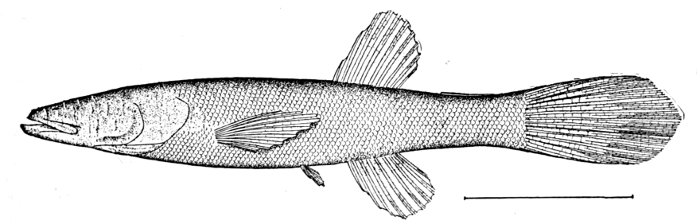
Fig. 165.—Blindfish of the Mammoth Cave, Amblyopsis spelæus (De Kay).
Mammoth Cave, Kentucky.
"(c) The third, from 10 mm. to about 80 or 100 mm. It is
characterized by a number of changes which are positive as contrasted
with degenerative. There are also distinct degenerative
processes taking place during this period.
"(d) The fourth, 80-100 mm. to death. It is characterized
by degenerative processes only.
"The eye of Amblyopsis appears at the same stage of growth
as in normal fishes developing normal eyes. The eye grows but
little after its appearance.
"All the developmental processes are retarded and some of
them give out prematurely. The most important, if the last, is
the cell division and the accompanying growth that provide
material for the eye.
"The lens appears at the normal time and in the normal way,
but its cells never divide and never lose their embryonic character.
"The lens is first to show degenerative steps and disappears
entirely before the fish is 10 mm. long.
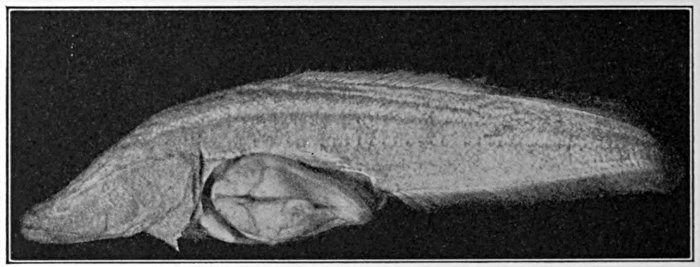
Fig. 166.—Blind Brotula, Lucifuga subterranea (Poey), showing viviparous habit.
Joignan Cave, Pinar del Rio, Cuba. Photographed by Dr. Eigenmann.
"The optic nerve appears shortly before the fish reaches 5
mm. It does not increase in size with the growth of the fish
and disappears in old age.
"The scleral cartilages appear when the fish is 10 mm. long;
they grow very slowly, possibly till old age.
"There is no constant ratio between the extent and degree
of ontogenic and phylogenic degeneration.
"The eye is approaching the vanishing point through the
route indicated by the eye of Troglichthys rosæ.
"There being no causes operative or inhibitive, either within
the fish or in the environment, that are not also operative or
inhibitive in Chologaster agassizii, which lives in caves and
develops well-formed eyes, it is evident that the causes controlling
the development are hereditarily established in the egg
by an accumulation of such degenerative changes as are still
notable in the later history of the eye of the adult.
"The foundations of the eye are normally laid, but the
superstructure, instead of continuing the plan with additional
material, completes it out of the material provided for the
foundations. The development of the foundation of the eye is
phylogenic; the stages beyond the foundations are direct."
Conditions of Evolution among Fishes.—Dr. Bashford Dean
("Fishes, Living and Fossil") has the following observations on
the processes of adaptation among fishes:
"The evolution of groups of fishes must accordingly have
taken place during only the longest periods of time. Their
aquatic life has evidently been unfavorable to deep-seated
structural changes, or at least has not permitted these to be
perpetuated. Recent fishes have diverged in but minor regards
from their ancestors of the Coal Measures. Within the same
duration of time, on the other hand, terrestrial vertebrates have
not only arisen, but have been widely differentiated. Among
land-living forms the amphibians, reptiles, birds, and mammals
have been evolved, and have given rise to more than sixty
orders.
"The evolution of fishes has been confined to a noteworthy
degree within rigid and unshifting bounds; their living medium,
with its mechanical effects upon fish-like forms and structures,
has for ages been almost constant in its conditions; its changes
of temperature and density and currents have rarely been more
than of local importance, and have influenced but little the
survival of genera and species widely distributed; its changes,
moreover, in the normal supply of food organisms cannot be
looked upon as noteworthy. Aquatic life has built few of
the direct barriers to survival, within which the terrestrial
forms appear to have been evolved by the keenest competition.
"It is not, accordingly, remarkable that in their descent
fishes are known to have retained their tribal features, and to
have varied from each other only in details of structure. Their
evolution is to be traced in diverging characters that prove rarely
more than of family value; one form, as an example, may have
become adapted for an active and predatory life, evolving
stronger organs of progression, stouter armoring, and more
trenchant teeth; another, closely akin in general structures,
may have acquired more sluggish habits, largely or greatly diminished
size, and degenerate characters in its dermal investiture,
teeth and organs of sense or progression. The flowering
out of a series of fish families seems to have characterized every
geological age, leaving its clearest imprint on the forms which
were then most abundant. The variety that to-day maintains
among the families of bony fishes is thus known to be paralleled
among the carboniferous sharks, the Mesozoic Chimæroids, and
the Palæozoic lung-fishes and Teleostomes. Their environment
has retained their general characters, while modelling them
anew into forms armored or scaleless, predatory or defenseless,
great, small, heavy, stout, sluggish, light, slender, blunt, tapering,
depressed.
"When members of any group of fishes became extinct, those
appear to have been the first to perish which were the possessors
of the greatest number of widely modified or specialized
structures. Those, for example, whose teeth were adapted for
a particular kind of food, or whose motions were hampered by
ponderous size or weighty armoring, were the first to perish
in the struggle for existence; on the other hand, the forms
that most nearly retained the ancestral or tribal characters—that
is, those whose structures were in every way least extreme—were
naturally the best fitted to survive. Thus generalized fishes
should be considered those of medium size, medium defenses,
medium powers of progression, omnivorous feeding habits, and
wide distribution, and these might be regarded as having provided
the staples of survival in every branch of descent.
"Aquatic living has not demanded wide divergence from the
ancestral stem, and the divergent forms which may culminate
in a profusion of families, genera, and species do not appear to
be again productive of more generalized groups. In all lines of
descent specialized forms do not appear to regain by regression
or degeneration the potential characters of their ancestral condition.
A generalized form is like potter's clay, plastic in the
hands of nature, readily to be converted into a needed kind of
cup or vase; but when thus specialized may never resume unaltered
its ancestral condition: the clay survives; the cup perishes."
(Dean.)