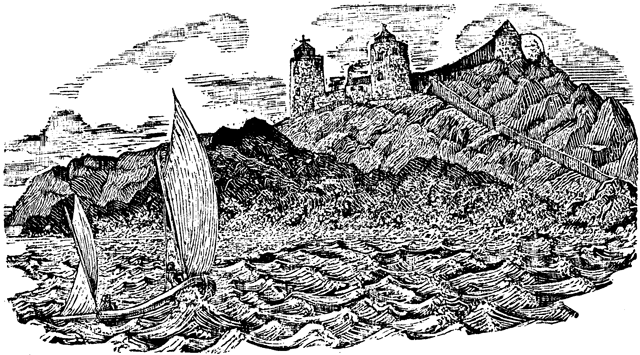
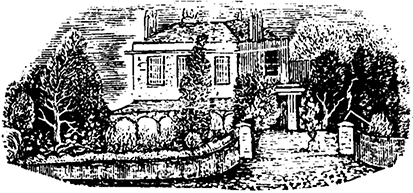
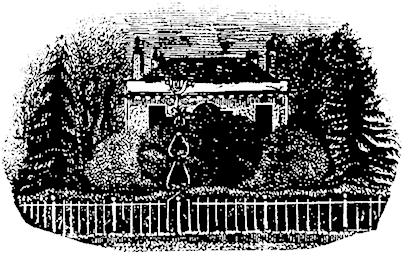
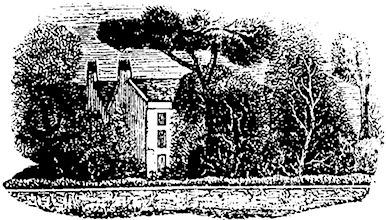
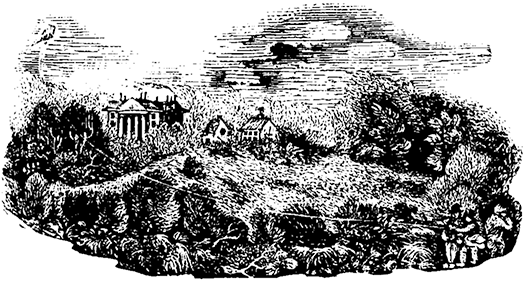
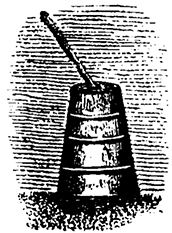
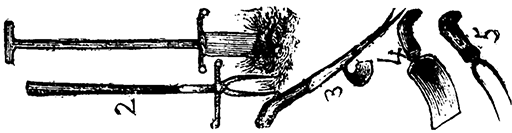
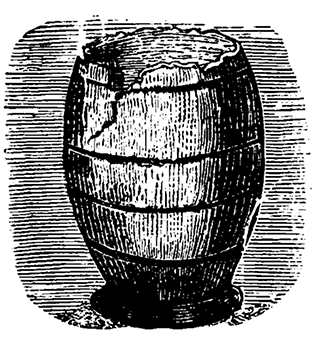
Notwithstanding there is a spacious
College which embraces all the useful branches of a
classical and commercial education, there are a
variety of schools and seminaries, which for the most
part are conveniently situated. They are moderate in
their terms, and are chiefly on the day-boarding
system. The principal are Messrs Hayes and
Piercy, &c., and for Ladies, Misses Walsh, Mills,
and Cross. Besides these, there are Sunday
Schools and others, such as the Church of England,
two; Wesleyan, two; Independent, two; New Connection,
two; Bryanites, Primitive Methodists, Baptist,
and National Infant Schools, whose united
scholars amount to 2,270.
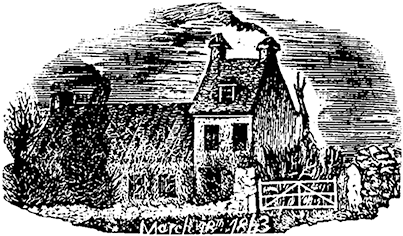
On renting a house a
simple agreement signed by the two parties is sufficient,
and if any misunderstanding should hereafter
occur, the Court always take into consideration the
position of the stranger, and adjust it in a lenient and
amicable way. An indenture or agreement drawn by
a professional man, is far less expensive than in
England; but there is hardly any occasion for either.
In these affairs no stamps or any other kind of taxed
papers are used. Respectable and convenient town
houses let from £20 to £40 per annum, and in the
country, with the advantage of a large garden or
orchard, from £10 to £20 per annum.
Has a low embattled
tower, and a short square spire at the end of the nave,
with a South aisle and chancel. Most of the
windows are modernized, and two of them were
evidently square-headed with trefoils rudely sculptured
out of the granite, much after the style of the
Forest Church. As the windows are small, perhaps
to introduce more light the mullions have been
removed. The walls are supported by heavy buttresses,
and the whole Church is vaulted. At the
back of the pulpit seat is a panel which represents
St George and the dragon, which in all probability
is Guernsey manufacture, and identities the
perfection to which sculpture had attained in days of
yore. Unfortunately the pulpit is painted mahogany
colour, which does away with the carving of the
original oak that ought to be regarded with veneration,
as it is the only remaining pulpit of antiquity in
the Island.
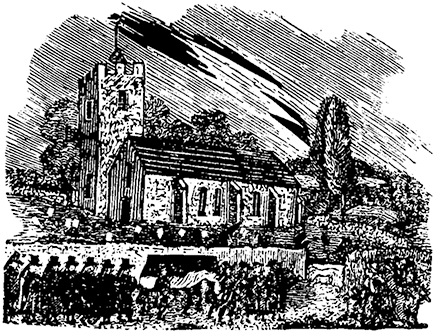
St Andrew's Church.
Vide "The Stranger's Guide."
There are three Banks; the
States' Bank, the Guernsey Banking Company, 29,
High-street, and the Guernsey Commercial Banking
Company, 22, High-street. The chief business of
these companies is to draw and cash bills on London
and Paris, to discount local promissory notes, and to
advance money. Their hours of business are from
ten o'clock in the morning until three in the afternoon.
Taking into consideration the smallness of the
Island, these Banks pretty well inundate the public
with paper, nevertheless their security perhaps, is
rendered greater than any thing of the kind in England,
and may be deemed one of the causes of our
prosperity. The paper money issued by the States
of the Island is something after the following manner:
if the roads for instance are out of repair, or
that it is absolutely necessary to build a new pier,
then immediately the States, after a close conference,
issue on their security, one pound notes, which as
the work proceeds are sent out. On the public
work yielding an income after its completion, the
notes are gradually brought in again, and new
undertakings commenced if necessary. By means
of this "truly healthy" currency, undertakings of
considerable magnitude are occasionally executed.
Moreover, the purposes for which the notes are
issued are of advantage to every man in the Island;
so that every one looks upon them as coming from
the Bank to which he is a partner. Formerly the
notes were not payable on demand; and the States
had not so much as an office for their presentation:
nevertheless the notes were never refused, as the
people found by experience that their representatives,
the States, did not issue the notes in greater
abundance than the demand for them justified.
The Savings Bank is under the direction of a
committee of the principal people of the Island, most
of them members of the States, and is on a safe
foundation, the whole capital being vested in the
public funds. When the name and occupation of a
depositor is entered, he receives 3 per cent for his
money.
Vacant Barracks capable of admitting
upwards of 5,000 troops, are erected in various parts
of the Island. Their repairs are kept up by occasional
grants from the Home Government, and a
proper officer is appointed for their annual over-hauling.
Are by no means numerous, or of such
size, colour and quantity as those of Jersey. They
inhabit the vale districts rather than the upland
ones.
Are not known here, and should there
be an importation, the Constables take it upon themselves
to manage their departure by encumbering the
Captain who brought them with the expense of their
return. An affair of this kind cost our late venerable
Baillif much trouble in rebutting versus the
corporation of Southampton, who at several times
either sent or permitted their landing.
That are constantly with us are: the red
legged crow, the common crow, sparrow,[A] tit-mouse,
long tailed do., common wren, golden crested do.,
lark, sky do., magpie, sparrow-hawk, blackbird, and
thrush. Those which occasionally visit us or remain
only throughout the winter season are: the ring
dotterel, skitty, quail,[B] plover, starling, red-wing,
fieldfare, curlew, tern, snipe, woodcock,[C] &c. The
swallow and swift generally leaves us about the
middle of October and return in the spring. Perhaps
no place of equal extent can boast of having such a
variety of birds, for besides the above we have the
occasional visit of the hoopoe, ring-ouzel, mountain-finch,
hooded crow, golden oriole, sanderling,
godwit, lapwing, grey plover, Northern diver, wild
goose, brent do., wild duck, together with a few
others of the hawk tribe. The heron may be said
to be rather peculiar to the small adjacent Island of
Herm; and those beautiful birds, the bittern and
egret, were both shot by a person in the fens,
technically called by sportsmen the "Pontine
Marshes."
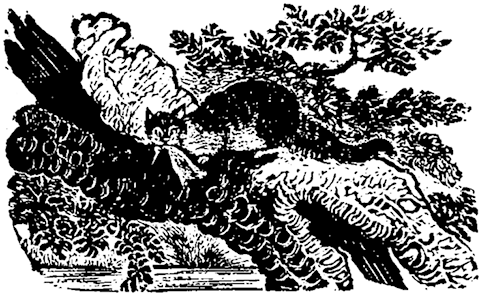
Lodgings may
be obtained in various parts of the town from 8s. to
15s. per week, and in the most enviable situations
they hardly ever exceed 1l. Country lodgings adequate
to the former may be obtained at about 8s.
to 12s. per week, in which there is the excellent
advantage of being able to obtain fresh cream
and butter. Lewis's Boarding House, Glatney,
and Shore's Commercial one, High-street, with
one or two others, are the principal. Terms from
15s. to 2l. per week, which of course will be comprehended
according to the style of accommodation,
as the cheapest spot in the world may be abused by
an unnecessary suit of apartments and superfluous
living.
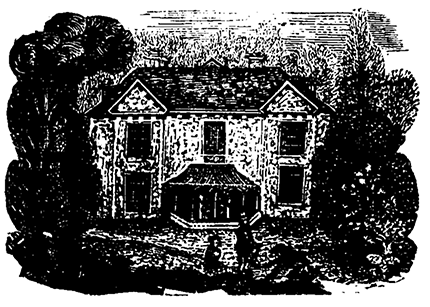
Lewis's Boarding House is pleasantly situated,
fronting the sea, and commands an extensive prospect
of the adjacent Isles and France, as also all
vessels in and out of the harbour. It is a commodious
building, having a numerous suit of rooms, which
are airy and spacious, and might accommodate some
fifteen or twenty families with ease and comfort. On
the top is a kind of rotunda, which is a cool retreat in
the heat of summer, as there is always a breeze from
the channel; here the visitor, with a telescope, if the
weather is clear, can plainly distinguish the houses
of France and Jersey. At the back of the house
are excellent gardens abounding with fruit and
flowers.
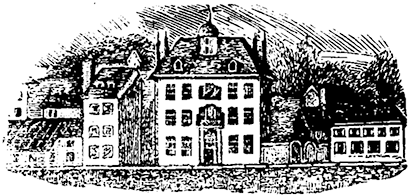
Lewis's Boarding House.
By late regulations respecting these,
every boatman is bound to have the number of his
boat painted outside on each bow, and inside on the
stern; he is also bound to give the Harbour-Master
a correct list of his boat's crew, under a penalty of
14 livres tournois. Passengers are limited to
| 6 | for a Boat from 14 to 18 feet long. |
| 8 | for a Boat from 18 to 22 feet long. |
| 10 | for a Boat from 22 to 26 feet long. |
| 12 | for a Boat from 26 feet and upwards. |
No boat under fourteen feet in length is allowed to
take passengers from the pier to the roads, or from
the roads to the pier; under a penalty of 14 livres
tournois for each passenger.
Each division is to perform the duty turn by turn
weekly; and none but the boats of the division on
duty are authorized to land passengers from the
steamers, under a penalty of 3 livres tournois.
The boatmen are bound to put on shore, in a
place of safety, the luggage and effects of the passengers
they land, that their owners, or porters
whom they have engaged, may take them away,
under a penalty of 10 livres tournois.
During the landing of passengers and their effects,
porters or any one else, are forbidden to place themselves
at the top of the steps where the said landing
takes place, or to go down the same, until the passengers
with their effects have left them; under a
penalty of 10 livres tournois.
Boats belonging to the division not on duty, may
take passengers from the pier, or elsewhere, to put
them on ship board; but they are not in any way to
incommode the landing of those passengers arriving,
who are to have the preference either of descending
from the vessel into the boats, or of being taken
ashore. Boatmen, porters, and all others, are bound
to make room for those who land, under a penalty of
14 livres tournois.
Fares:—Conveyance of passengers from the pier
or from the rocks, St Julien, to the roads, or from
the roads to the said pier or rocks, tenpence each
passenger, ordinary luggage included. Conveyance
within the pier or at the pier heads, or from the
vessel ashore, five pence each passenger; the whole
under a penalty of 14 livres tournois.
Is nearly the same price as in England,
and by some is considered of a better quality.
Together with meat are the only dear
articles of consumption in the Island, yet when we
take into consideration, the Guernsey lb. being 2 oz.
more than that of England, the difference is not so
great. Butter throughout the summer is usually 1s.
to 1s. 1d. per lb., in winter 1s. 6d. to 2s.
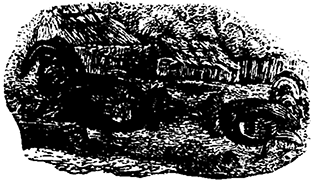
Apparently are extremely awkward and
inconvenient, nevertheless from their structure are
well calculated for their intended purposes, which is
for hay, vraic and other such like litter. Waggons
are never used by the farmers, and but very seldom
by the town's people.
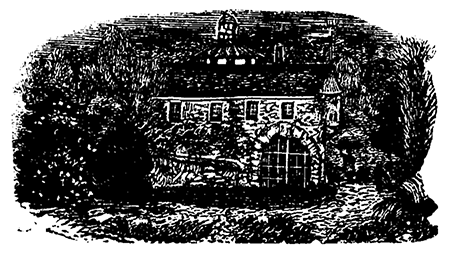
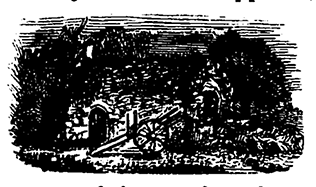
At present there are the Valle, Castle
Cornet, and Ivy Castle in the marshes, which latter
appears to have been a Norman structure, and is
now laid out into a kind of garden belonging to the
Governor, which is densely surrounded with trees.
The Valle Castle or St Sampson's, is situated on a
craggy eminence overlooking the sea. It has
still its ramparts mounted with cannon, and has
capacious barracks for troops, which are in a tolerable
state of repair. The Castle du Grand Geoffrey
stood in the parish of St Mary de Castro, but there
are no remains of it now existing.
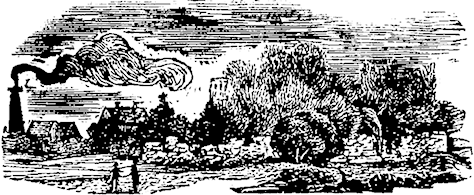
Ivy Castle.
Consists of a chancel, nave, South
aisle and North transept, is dedicated to Notre Dame
de la Delivrance, and was consecrated in the year
1203. It has a square tower pinnacled at each
angle, surmounted by a fine octagonal spire, which
together with the whole building has undergone
many alterations during the last century. On one of
the chancel walls antique specimens of fresco paintings
may be seen, and in a window of the North
transept, tracery coarsely wrought out of the stone
forming the lintel. The North wall of the chancel
and transept of this Church, are supposed to be the
remaining portions of old walls, that formed a fort
called "Castel du Grand Sarazin," whence it is
believed the Church took its name. The place where
the Castle standard was stuck is still to be seen, being
a projecting hollow stone about the middle of the
chancel and transept, where also other evidences
may be traced. In the Church-yard is interred the
late Right Honourable Lord De Saumarez.
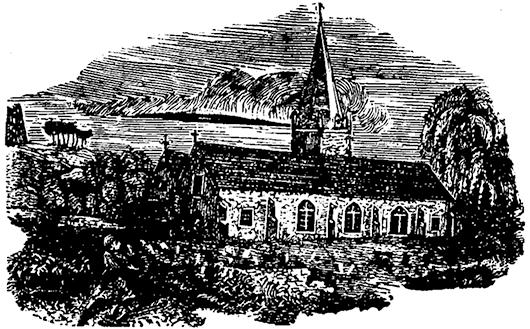
Câtel Church.
The public burial ground is laid out
with much good taste and judgement, and was purchased
by the parish some few years since. The
whole is enclosed by a solid handsome wall of blue
granite, adorned with drooping shrubs. Some of
the tombs are highly finished, and the mausoleum of
Isaac Carey, Esquire, of Hauteville, constructed
by his late heirs, is a splendid piece of work, and is
carried to a considerable depth. To the left, or
between this and the College, is the "Stranger's
Burial Ground," through which runs a new road
walled on either side. At the other end of the town
and in a solitary place is a small walled enclosure or
burial ground, belonging to the Society of the
Foxonian Quakers.
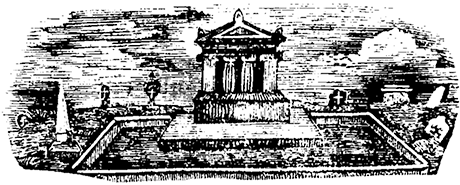
Carey's Mausoleum.
May be said to be numerous both in
town and country, and almost every religion may be
accommodated. In the country the chief Dissenting
chapels are: the Calvinists, Baptists, Methodists and
New Connexion.—Vide Religions.
English cheese is not over abundant, as
the expences in obtaining it are too great to satisfy
that character of economy which the English
residents display; consequently cheese, such as
Cheddar, Bridgewater, and the like, fetch from 1s.
3d. to 1s. 6d. per lb. The Dutch ball are the
ones commonly in demand, and being of a variety
of qualities meet with a ready sale at from 4d. to
8d. per lb., which latter price will ensure those of
the best quality.
Is considered by Doctor Hoskins,
who is a native surgeon of considerable experience,
to be a close representation of the West of England
or the Isle of Wight, but entirely exempt from the
"auguish disposition" of Hastings. The thermometer
seldom rises above 80 degrees of Fahrenheit,
rarely as low as 37 deg. and never remains long
stationary at the freezing point.
All cloth coming from England, and
there being no draw back, the taylor's bill may
be considered somewhat a shade higher. In mending
and repairing, taylor's work is done at a much
more reasonable price than in England. Articles
of French manufacture can be obtained at their
usual moderate prices, &c.
Are obtained at twenty-one shillings per
ton, but the usual way of purchasing them is by the
quarter, which is a much less quantity, thereby
rendering it more convenient for families removing.
By the quarter they are 7s. 6d. in the winter, but
less in the summer, as the freight is not so expensive.
A quarter is ten English bushels.
In its internal structure is well adapted
for scholastic duty and exercise, but the space
much more ample than the present insular education
can warrant. Its architecture, though mixed
is regular, and were it not for an air of lightness
in the material, would carry with it the beauty of
a monastic finish—a finish so truly regarded by
all genuine taste. Perhaps with equal fallacy a few
minor points of the exterior may be decided on
in the same way; however the observer will discern
for himself.
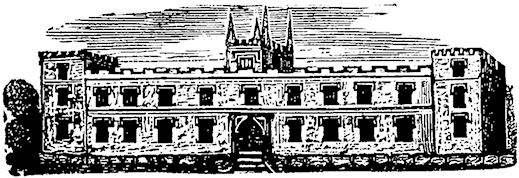
The College.
The education of the establishment includes
Hebrew, Greek, Latin, Divinity, History, Geography,
French and English Literature, Mathematics and
Arithmetic. Instruction in these branches of education
is secured by the College fee of 12l. per
annum. Should any other studies be needed
there are extra masters without and within the
College that superintend the following acquirements:—Drawing,
Surveying, the Spanish, Italian
and German languages, Music, Fencing and
Drilling. There are two public examinations at
Midsummer, conducted by two Masters of Arts of
the University of Oxford, selected for that purpose
by the heads of Exeter, Jesus, and Pembroke
Colleges.
Board and tuition with the Principal of the
College is 60l. per annum, including the 12l. of
College dues; with the Vice-Principal 50l.; and
with the mathematical master 60l.
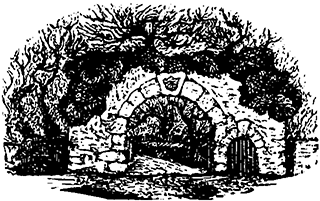
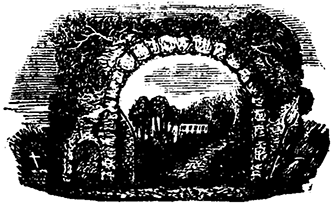
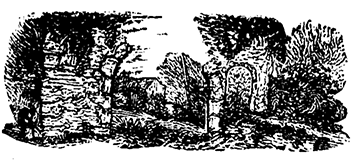
A drawing of the ancient gate-way is still preserved,
of which a view is here engraved.
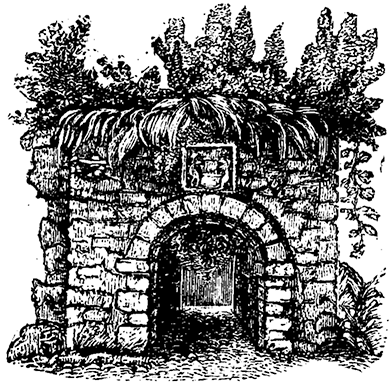
Ancient College Gate-way.
For the protection of trade, these
have been established by the following powers:
France, Spain, Portugal, Naples, Sicily, Belgium,
Holland, Prussia, Russia, Denmark and Sweden.
The present building where the
Royal Court holds its sittings was erected in the year
1799, on an elevated spot at the upper end of Smith-street,
at a cost of about 7000l. The Greffe
Office is to the right, in which are kept all registries
both of public and private ordinances and private
agreements. On the left is the common Court,
where justice business is transacted; behind this
is the room for the advocates, the witnesses and
officers of the Court. Above stairs is the Grand
Hall for the meetings of the States, and where
law and criminal causes, not decided upon in the
Court below, are heard and determined. Here
are the full-length portraits of our late Governor,
Sir John Doyle, Daniel De Lisle Brock, Esq., Baillif,
Lord Seaton, a former Governor of the island, and
the late Lord De Saumarez.
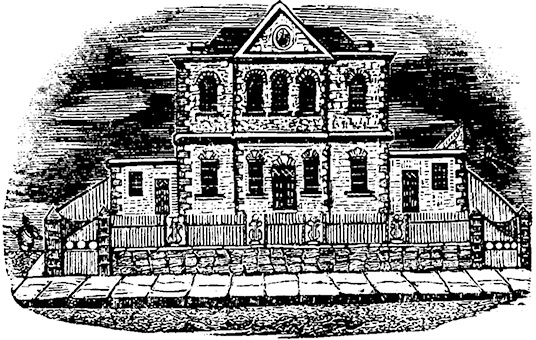
The Royal Court House.
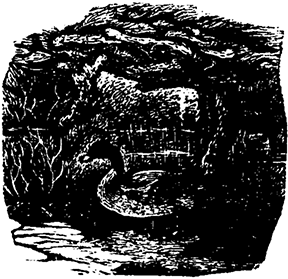
Those commonly known by the name
of "Alderney Cows" in England need but little
description, save that the Channel Isles being their
natural soil, they thrive well and produce almost
double the quantity of butter to what they do in
England[A], France, or elsewhere. Hence it often
comes within the range of an observer to witness upwards
of fifteen pounds of butter from a cow per
week throughout the summer. Foreign cows, according
to law, are not permitted in the Island, and
even a farmer would not allow a Jersey one to be
seen on his land. Cheese is not made in the Island,
though it is said the Duke of Bedford tried the
experiment by sending dairymen, who reported the
milk was too rich. By the tethering system no grass
is wasted, for the cow is only allowed range of from
twelve to fifteen feet, and is shifted three or four
times per diem.
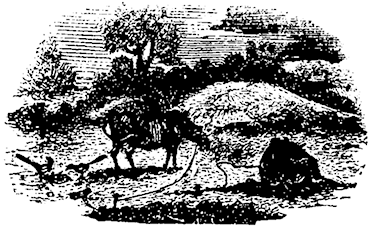
Tethered Cows.
Is plentiful and in most cases particularly
good, though an evil report gives it out as water
dashed. The price varies according to the season;
at times being as low as 14s. whilst at others 30s.
per hodgs. Several hundred hogsheads are annually
shipped for England.
From the climate being open and
healthy are few, and chiefly consist of rheumatic
complaints. Should the reader be over critical on
this head, he had better consult the "History of
Guernsey," by Jonathan Duncan.—Vide Climate.
Considering the healthiness
of the clime we are somewhat overstocked,
there being no less than twenty-four practising the
profession. There is no regular physician in the
Island.
Are few, as they are merely employed
in carrying corn to the country wind-mills, or with
families rusticating in the country. A number may
be generally seen browsing on Lancresse Common.
They may be hired at 2s. or 2s. 6d. per day; if by
the hour, 3d. is the general charge.
Are the current copper coin of the
Island, eight of which form an eight double piece,
which represent an English penny.
Native eggs in summer are 6d. to 8d. per
dozen, and during the winter from 1s. to 1s. 6d.
French ones being imported in large quantities are
from 5d. to 6d. per dozen.
Groceries being exempt
from all kind of duty and imposition are a luxury as
well as novelty to those just arrived from a heavily
taxed country; thus it is very common to hear recent
visitors walking home under a burden of
untaxed articles, exclaiming: "Well! we can't do
this in England;—we can't get 3 lbs. of sugar for
10d.!" Tobacco is 1s. per lb., snuff 1s. to 2s. per
lb. Sugars 3d. to 5d. per lb. Teas 2s. to 5s. per
lb. Coffee (raw) 4d. per lb. Fried 8d. per lb.
Ground do. 1s. Soap 4d. per lb. Candles (dips)
6½ d. per lb. Moulds 7d. per lb. Cocoa 1s. per lb.
Best Chocolate 13d. per lb.
N.B. There being no duty on mahogany, deal, or
any other kind of wood, furniture is much cheaper
than in England.
Abundant, and considered by strangers
remarkably cheap. That generally seen in the
market in the greatest abundance are: turbot, brill,
whiff, megrim, sole, lemonsole, plaice, dab, marysole,
dorey, mullet, surmulet, mackerel, red gurnard,
basse, wrasse, bream, gilt-head, herring, pilchard,
horse-mackerel, gar-fish, common cod, pollock,
ling, atherine, conger, ray, sand-eel, with numerous
others. Lobsters, crabs, shrimps and cray-fish are
equally abundant, and may be obtained at the following
reasonable prices: Lobsters[A] 9d. crabs,
(exceedingly large) 2d. to 8d., shrimps 3d. per pint,
turbot 6d. per lb., soles 1s. per pair, dorey 1s. bream
2d., whiting (exceedingly large) 6d. The ormer,
a very delicate fish, scarcely known in England, represents
a veal cutlet, and is rather common with us.
Is a beautiful structure and has
been erected of late years. The interior is light
and airy, and the slabs, which are handsomely
cut and groved are of black and variegated marble,
being well supplied with abundance of fresh water
from pipes, which by means of cocks is brought over
the slabs at a moment's notice, thereby washing them
immediately. The Arcade is a spacious area, upwards
of a hundred and ninety feet in length, and
proportionably broad, having two lines of sittings
extending the length of the building. The exterior
towards the vegetable market, or facing the Assembly
Rooms, is handsomely occupied in shops, the
Mechanics' Library, and other offices. By an ordinance
of the Royal Court every person selling fish
is obliged to do it in this arcade, for the use of which
they pay one penny a day. The whole arrangements,
as well as variety, abundance, and excellency
of fish, at once impress the stranger with high notions
of the public spiritedness of the people, who have
taken so much pains to provide a fit receptacle for
one single article of human sustenance.
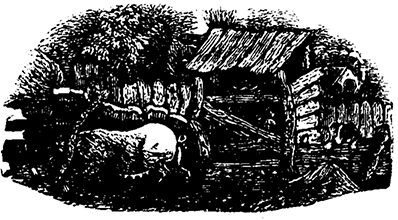
Are hardly ever beyond fifty or sixty
vergées, and in their arrangements are contrary to
every thing English. The yard is simply a few out-houses,
consisting of a stable, hay-loft, cart-house,
and cyder-factory, which latter apparatus is a set of
large groved stones set in a circle, around which
passes a stone wheel guided by a wooden machine,
and drawn by a horse or ox. The apples being thus
mashed in the trough or grove are turned out, pressed,
and racked off secundum artem. The corn is
thrashed in an out-house on the ground floor, and
afterwards winnowed in the air with a sheet and
sieve.

Farm.
In entomology little can be said, unless by
the most acute observer. As far as annoyance is
produced, perhaps England or France would exceed
us; for, in no single instance, can be traced a multitude
of insects that work mischief either to cattle,
trees, or any thing else, unless it is the scarcely perceptible
nuisance wrought by a species of the
millipedes,[A]
which abound in dry lands, and occasionally
disfigure the healthy appearance of potatoes, if not
timely destroyed.

Floriculture has long been a favourite
pursuit among the inhabitants, which no doubt has
been the chief cause of rendering this department of
gardening so famous. Although the best gardens
are of no great extent, yet they often contain beautiful,
rare, and valuable plants; and there are few
cottages which have not a considerable space dedicated
to flowers. The mildness of the climate is
such, that a variety of tender plants are grown in the
open air, which would hardly endure the same exposition
in the warmest spots of Devonshire or Cornwall.
When the temperature falls to 6 degrees
below freezing point, the season is considered unusually
severe; consequently, many of the Cape
heaths and hardier geraniums, together with a number
of Australian shrubs and plants, and even those
from central America endure our ordinary winters in
screened situations without the least injury whatever.
Thus, the eobœa scandens, maurandia barclayana,
and other creepers of a similar nature are found to
spring up naturally from seed under the walls where
they are planted; and even the Bath scarlet geranium
has for several years been an ornament to cottage
walls, to the height of ten or eleven feet.
Fuchsias make such rapid progress that they finally
become shrubs, when from their encumberance they
are trained to poles like standard roses. Bulbs are
cultivated with considerable advantage, as the frost
is of such short duration, that it rarely ever freezes
more than an inch or two in depth, and should a
slight fall of snow happen it is their complete protection.
From a garden review, given by the late
Horticultural Chronicle, it appears there were
orange trees laden with fruit in every respectable
garden; and in that of the dowager Lady De
Saumarez there was one remarkably curious, from
its rind being grown out into a kind of spar. In these
gardens, and also in those of Sir Thomas Saumarez
and Mr Brock, of Belmont, were montanariums,
sanguisorb, large tree myrtles, creeping serius
(eight yards long), mimosa (tree), paradoxia, candula,
clematis azuria grandiflora; and in the green-house
of Mr Brock were no less than from twelve to
fifteen hundred calceolaria, together with innumerable
others, all teeming with health and vigour.
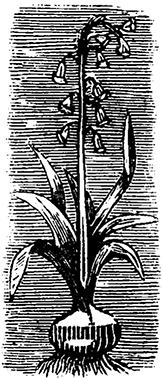
At times rise up from the
Channel, and consequently pass over the island,
not unfrequently involving, throughout November,
the Northern or lowland parishes in mist.
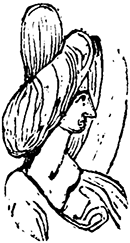
As the island is almost wholly
supplied with provisions from France, these women
may be seen located in the market in considerable
numbers; and the English stranger at first sight
wonders who and what they are. Sometimes they
perambulate the country with baskets containing eggs,
poultry, nuts, &c., and in this way things are often
procured at the door exceedingly moderate. Their
dress is peculiar to the provinces of France from
whence they come, and as they never wear bonnets,
the head-dress is most fantastically arranged. The
annexed engraving represents one of their caps.
Are few, and only seen in marshy wet
ground. There are no toads in the island, neither
will they exist here, for the experiment has been
tried from Jersey, where they abound in myriads,
especially in umbrageous lanes. From a memorandum
dated July 4, 1834, while living in Jersey, I
find they creep from their lurking holes in the banks
or hedges, throughout the summer evenings, in
numbers almost incredible, especially in St Martin's
parish, at times oft approaching in size nearly the
Surinam toad.
Neither are severe, and the
latter seldom remains on the ground beyond three
days. One may be here two or three winters without
witnessing both together, and not unfrequently
without the least appearance of either. Like other
maritime situations, the cold seems to be mitigated
by caloric imparted to the atmosphere from the
surrounding ocean; and the exuberance of the various
exotics which flourish unguarded at all seasons in
the open air, puts forth sufficient evidence of the
mildness of the climate. The double camelias bloom
abundantly in November, and orange-trees endure
the winter with only a slight occasional covering of
matting. A correspondent of the Horticultural
Chronicle observes that on riding towards St Saviour's
he was much pleased to see two magnificent
orange-trees hid in boxes as a shelter from the side
winds, at the house of a Mr Hartley, and which then
looked exceedingly handsome, as they were ornamented
with some two or three dozen of fine ripe
fruit.[A]
Of all kinds may be obtained on
reasonable terms, as it has of late been contrived by
some speculative people to enter on a business of
this kind. Families, ere they determine on taking
up their abode here, would do well in being accommodated
with a loan of furniture. On the contrary,
should they purchase new, with a view to sell it
hereafter, they will have just cause to repent, as it
will not realize one quarter of its original value.
Are considered, by eminent horticulturists,
not only numerous, but beyond every thing
exuberant and flourishing. Some few years ago,
gardening was considered but an indifferent occupation;
but as things take a change for the best,
Guernsey was one of the foremost to bring this
elegant amusement to its proper bearing. Aided
and abetted by the natural good qualities of soil and
climate, horticulture made rapid strides, and soon
out-stripped some of the vaunted paradises of Europe,
and the fruits, flowers, and vegetables that the
Channel Isles' markets continually teem with, sufficiently
testify the same. Among the list that may be
seen continually pouring into our market, in their
various seasons, may be enumerated the following:
peaches, apricots, figs, strawberries, melons (rather
inferior), walnuts, chesnuts, raspberries, mulberries,
medlars, cucumbers, varieties of grapes, (in-door
and out,) and abundance of apples and pears; the
latter are exported to England in considerable
quantities, together with grapes, figs, and melons;
the last mentioned are imported from Lower Normandy
and Britany, and are of a delicious flavour.
Large chaumontel pears, being generally destined for
presents in England, fetch a good price, and at times
3l. to 5l. per hundred is readily obtained for them,
and even more, if they weigh from twelve to eighteen
ounces. The small ones, which are generally the
largest crop, may be obtained exceedingly reasonable
by the bushel. The Guernsey fig being also much
esteemed, large quantities are brought into the market,
where they only fetch from 3d. to 4d. per dozen.
Whole vergées of strawberries may be seen in the
country for the same purpose, and yield 1½d. per lb.
Grapes (out-door) are from 2d. to 3d. do., Spanish
muscatel 6d. do. Melons are from 6d. to 1s. The
principal nurseries are Nant's, Luff's, and Lumby's.
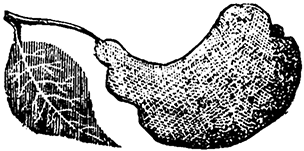
Is supplied to houses in town and the suburbs,
from two spacious gas-holders sufficiently
large to supply three times the present consumption.
The town is but partially lit with gas; the old oil-lamp
being still in general use. The proprietor of
the works is Mr Thomas Edge, of Westminster, who
erected them in 1830.
Is the principal fortification of
the island, and is constructed on the improved
form of a square, having four bastions connected by
curtains, with a ravelin to the South, and a counter-scarp
to the South-West. It will admit about three
thousand men, and has thirty-four pieces of cannon,
four mortars, and a caronade. Most of the batteries
are erected in a form for repelling the enemy at sea,
and some of them are very formidable. From the ramparts
or parade ground there is one of the most extensive
and diversified prospects in the island; and
underneath the former are spacious casemates, which
in case of a siege can be converted into barracks. It
was completed in the year 1812, at a national cost of
200,000l., but was commenced immediately after
the breaking out of the American war, in 1782.
The public goal was erected in 1811, and
cost the island 11,000l. It is a solid structure,
built entirely with blue granite, and has a neat front
elevation, in which are two galleries; the lower one
for debtors, the upper one for criminals. The debtors
have five cells, in all of which are fire-places, and
the creditors by whom they are incarcerated are
obliged to find them in blankets, a bedstead and
straw palliasses; but must supply themselves with
bed, bedding, and other furniture at their own
expence. They are unlocked throughout winter and
summer at eight o'clock in the morning, and are
locked up at sun-set every evening. They have a
large court yard to walk in. The cells are provided
with bell-pulls, communicating with the bed-room
of the Governor, in case of sickness.
The felons' cells are ten in number, eight for the
men, and two for the women; but it has been
observed by the benevolent Mrs Fry, that the cells
for the latter are not sufficiently apart from those of
the men, insomuch that when locked up they can
converse with each other, especially when taking
air, being only separated by a partition of sheet iron
and bars. Felons and criminals are allowed exercise
on the gallery in front of their cells, and according
to the prison regulations are to be unlocked from
ten in the forenoon till two in the afternoon; though,
in point of fact, this space of time is generally extended
by the Governor, particularly in the summer
season. In four of the cells are fire-places, and
prisoners are allowed straw palliasses, three blankets
and a rug; firing they must provide at their own
expence. On a prisoner becoming refractory he
may be deprived of his liberty, and by a report of
the case to the Baillif within twenty-four hours, may
be confined to the black-hole. Irons are not used
on felons about to undergo the last penalty of the
law, and prisoners under solitary confinement perform
no work. There is no sick ward nor chapel,
neither is there a chaplain appointed to visit the
prisoners, but bibles and religious tracts are provided
for their use.
The Governor has a house within the prison walls
in which debtors may be accommodated, provided
they pay an additional sum of 1s. 9d. per week.
Debtors not having the wherewithal to maintain
themselves, are allowed 9d. per day, which the
creditor at whose suit they are imprisoned is bound
to pay them, otherwise they are set at liberty.
Criminals are provided for out of the revenue belonging
to the Crown. Strangers are permitted to visit
debtors from nine in the morning until four in the
afternoon, from the 1st of October to the 1st of April,
and from nine in the morning until seven in the
afternoon from the 1st of April to the 1st of October.
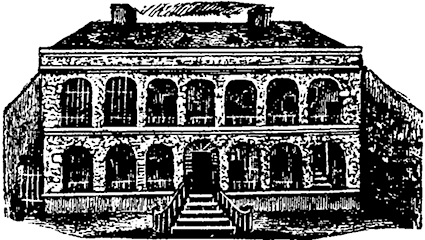
The Goal.
Are in great abundance
in every part of the island, but as a list of them
would be out of place in a work of this kind, it only
remains for me to mention those which are in the
greatest profusion under foot, and which, from close
observation I have found to be most useful in medicine,
cookery, and other purposes. They are:—wood-sage,
camomile, samphire, lords and ladies, fools-stones,
blue-bells, pennyworth,[A] ladies' smock,
hagnebuts, eryngo,[B] fox-glove, night-shade, high-taper,
mugwort, robin-run-in-the-hedge and mouse-ear,
with numerous others.
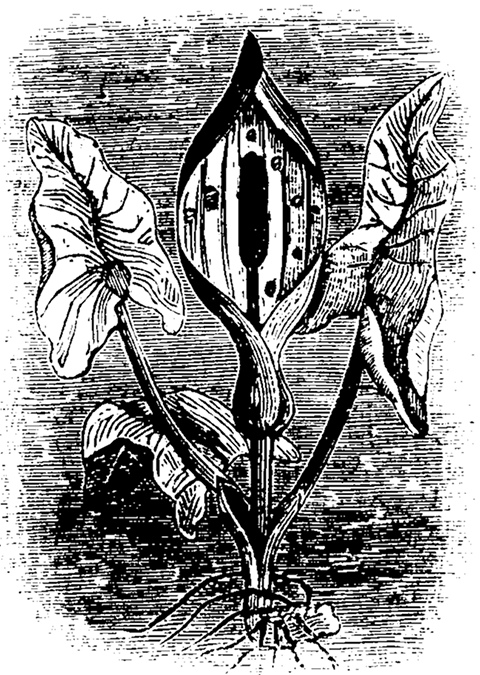
Lords and Ladies.
Varies in price, but is hardly ever beyond
6l. per ton, if so, the season must be unusually bad.
The upland hay is generally esteemed the best.
Are small, cross grained, and given to
biting; but are lusty and hard workers. They are
cheaper than in England, and a hack may be kept
in the best order for about 20l. per annum. Horses
at the livery stables may be hired at from 4s. to 7s.
per day. There are no taxes on horses, carriages or
livery servants.

This excellent institution, the admiration
of every stranger, is under the direction of a
Treasurer, Vice-Treasurer, six Directors, and six
Collectors, elected by the rate-payers: and although
called an hospital, partakes of the properties of a
poor-house, a refuge for the destitute, a work-house,
a penitentiary, and for the destitute youth of both
sexes a seminary of instruction; and, but for the
receptacle for lunatics, its interior economy reflects
the greatest credit on the island. There is a chaplain
whose salary is 30l. per annum, and the medical department
is under the most liberal regulations. The
boys and girls have schools, in which they are educated
in all things useful for their future occupations
through life. Indeed, the system pursued is in accordance
with the most approved methods of modern
times, for the expences are partly defrayed by the
labour of the inmates, together with a strict performance
of all the other in-door work, which is
effected with the utmost regularity, order and cleanliness
imaginable. So much is the general system
admired, that it is spoken of in exceeding high
terms by Quail and several other writers and travellers.
A late visitor says:—"On entering the
hospital, the scene was an active one, insomuch that
almost all the men were occupied, some in weaving
cloth, some as tailors, others as shoe-makers, &c.,
whilst the women were engaged in washing.[A] On
the whole, whether we regard this hospital as an
asylum from misery, or as a school of morality, I
must say that I have never yet seen any institution
in the kingdom that would stand in competition with
it."
The Country Hospital is nearly on the same principle,
and is situated in a secluded kind of valley, in
the Câtel parish.
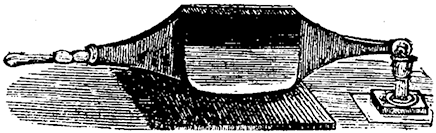
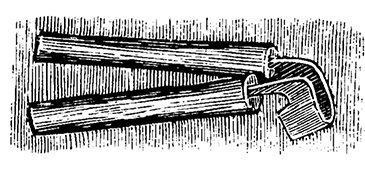
Hospital Bread Knife.
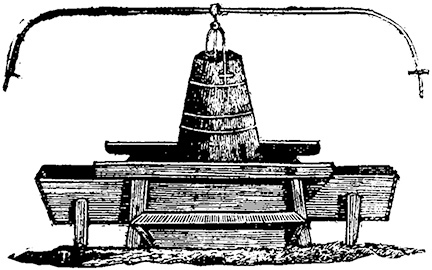
Hospital Bread Machine.
In town, these are replete with
every accommodation and comfort. The principal
are Marshall's and Gardner's, and from both being
situated in High-street, a very little distance
from the pier, the porters are enabled without delay
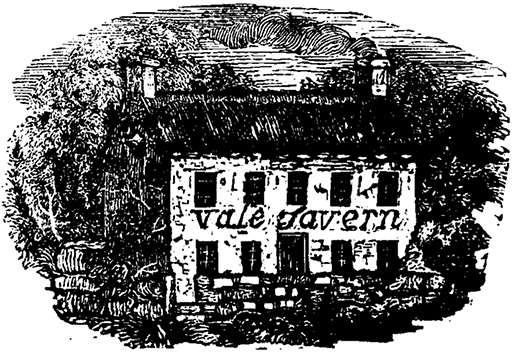
to set the visitor at ease. At the country inns
may be obtained good plain fare, such as bread,
butter, eggs, bacon, milk, cream, fish, cider, beer,
spirits and wine, which latter article is not always
to be had, and if so, is sometimes of an indifferent
quality. Besides inns, there are other houses
in the country that entertain pic-nic parties throughout
the summer, some of which are very superior
in their accommodations, and exceedingly moderate
in their charges. They may be easily discovered
as the drivers of the coaches and omnibuses which
run round the island, either know or put up at
them.
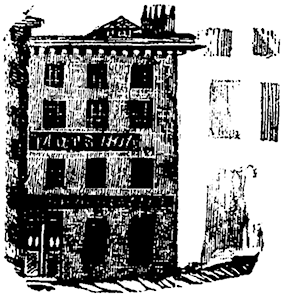
Marshall's Hotel.
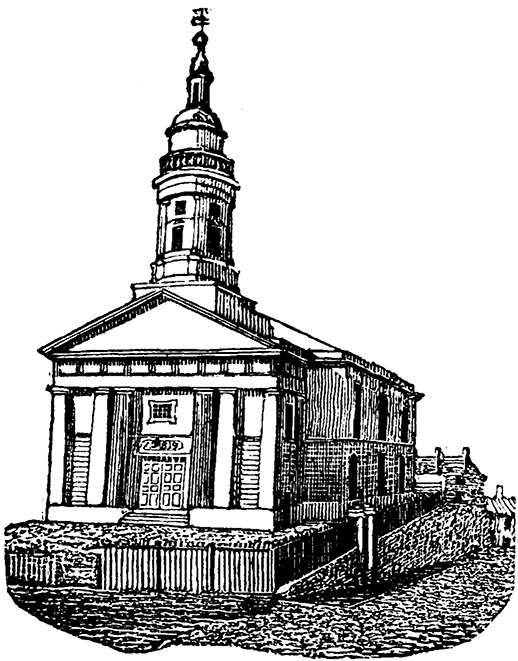
St James's Church.
Was erected in 1818, and
was consecrated on the 6th of August in the same
year. It is situated opposite the side of the new Prison
and near the College play ground, and is generally
allowed to be a handsome specimen of Grecian
architecture, the tower, portico and dome being
considered the chief features. The funds for erecting it
were raised in part from the sale of the pews, and
from liberal donations granted by the late Lord De
Saumarez, of which 400l. went in purchase of four
hundred free sittings for the poor and the children of
the national schools; 120l. for the dome and tower,
and latterly a donation of 400l., together with many
other contributions and assistance, amounting in the
whole to upwards of 1000l. The rest was raised by
public subscription.
The church contains 1300 sittings, amongst which
are four for the use of the minister, and twelve for
casual strangers. The service, on Sundays is at
half past ten in the morning, and in the evening at
half past six. Prayers are also read on Wednesdays
and Fridays at noon, and also on festivals. The sacrament
of the Lord's supper is twice in the quarter.
The bell of this church cost 100l. and the organ 500l.
Was erected in the year
1836, and in its style emulates the early English,
though many of those genuine features are lost
sight of. Contrary to every other church, the
tower is at the East and the altar at the West end.
It is built of well-wrought blue granite, and from
being situated in the centre of a woody district,
forms a considerable addition to the landscape.
The foundation stone was laid by the late Lord
De Saumarez, and it contains 600 sittings, 200 of
which are free for the poor. The services are in
English; two full services on Sundays, and weekly
evening lecture. The endowment consists of a parsonage-house,
adjoining the church, and 13l. per
annum secured on rents; together with the surplus
of the pews, which after payment of the current
expences of the church, may amount to about 90l.
per annum, provided the pews are all let.
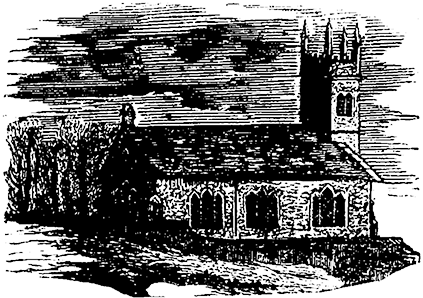
St John's Church.
The price at which it is rented will scarcely
be credited by strangers, as it must be exceedingly
inferior, if it does not fetch 3l. per vergée, which is
at the rate of 7l. 10s. per statute acre. The Couture,
which is the best sample, may be valued at 5l. per
vergée per annum. Land for building, in the vicinity
of the town, is so enormously high, that at times
it has fetched one thousand pounds per English acre.
Are delivered in the town and suburbs,
almost immediately after the arrival of the packet.
In the country it is not so, for it sometimes happens
that the packet is signaled as early as eight o'clock,
whereas the letters have not been delivered until four
o'clock in the evening.[A] The Post-Office Packets
come in regularly twice a week, Sundays and Thursdays, unless
prevented by exceedingly severe weather.
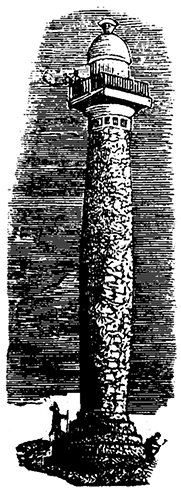
Also called the Round-house, is
situated at the head of the South pier, and was
erected for the convenience of mariners approaching
the road-stead and harbour in the night. It
is a large lantern, in which several gas-burners are
introduced, and the light may be seen coming
through the Small Russel from the Northward, the
Great Russel from the Eastward, and from the Southward
when rounding St Martin's Point.

Light-House.
There are two: one belonging to the
Mechanics' Institution, and Redstone's circulating
library, in both of which are reading rooms. In the
former lectures are delivered throughout the winter.
Are few, the principal being
those for potatoe spirit, vinegar, Roman cement,
bricks, soap and candles, paper and cordage. The
main portion of the spirit, vinegar, cement and
bricks is for exportation; whilst the soap, candles,
and cordage are for local consumption. The largest
distillery is at the Bouet, near Ivy Castle, belonging to
Messrs Valpy and Lainé. It has a steam-engine, and
every necessary apparatus for distilling spirit from
native potatoes, when it is exported for the London
market, where it is rectified. Three years' export
of this article is as follows: 1834, 8,468 gallons;
1835, 52,639 gallons; 1836, 17,644 gallons.
The parish church of the
Forest was consecrated on the 3d September, 1163.
It has a nave, North aisles and chancel; and has a
low tower and octagonal spire at the junction of the
chancel and nave. The North aisle is of modern
structure, with plain granite lintels, and a square-headed
piscina in the East wall. One of the South
windows appears to have been divided into two
lights, with an orbit between, and the rude ornamented
heads cut out of blocks of granite. Like
every thing else, this window has submitted to the
chisel of modern art, wherefore the ornamental portions
have been worked off in order to form a segmental
head. The inside wall of the chancel is
splayed, and the East window semi-circular and
cinque-foil. The East and West sides of the tower
are longer than the others, consequently impart to
the spire an ugly and deformed appearance.
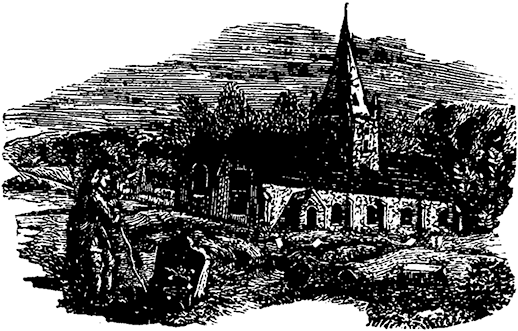
The Forest Church.
Are round towers situated on the
coast in different parts of the island, at stated distances,
particularly on the Northern or vale side, and
are garrisoned with soldiers in time of war.
Consists of a nave, chancel
and aisle. The two former, with the tower, which
is at the junction of the two, are of the early English
style, and the latter with the windows of the building
of modern formation. There was once a slab
that contained a brass plate representing a lay-man
or merchant with his lady. The stone is still there,
but much defaced, and probably in a few years will
entirely disappear. The porch, facing the South,
which is of the decorative style, is the most elegant
in the island. The corner buttresses are terminated
with ornamental pinnacles of crochets and finials,
and are set diagonally at one stage. According to
the "Dédicace des Eglises," this church was consecrated
on the 4th of February, 1199, in the tenth year
of the reign of Henry II, king of England.
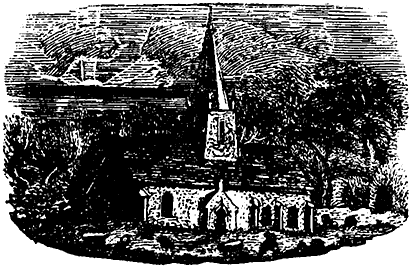
St Martin's Church.
Is very good, and surpasses that of Jersey,
but is dearer than in England, though to an English
resident, if he draws his income from England, it
will not appear so, considering there are 18 ounces
to the pound, and that he gets from 5 to 6 per cent
premium for his money. Beef sells at 5d. to 8d. per
lb.; mutton, 6d. to 8d.; veal 5d. to 7d.; pork 4d.
to 6d.; bacon, 6d., 9d. and 11d.
Is commodious, clean and airy,
and is perhaps one of the most convenient, both
for buyer and seller that can be found in any part of
the world, and is as well furnished with meat as any
market in England.
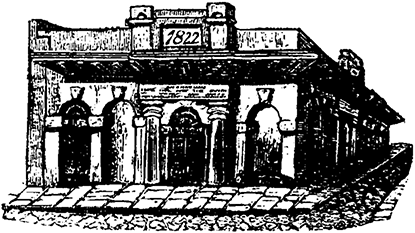
The Meat Market.
Are regulated according to
occupation and ability. Journeymen smiths and
ironmongers earn from 12s. to 24s., carpenters average
about 18s., masons and plasterers 15s., tailors
(in the busy season) 20s., printers 10s. to 18s.,
shoe-makers 10s. to 15s., shopmen 15s. per week.
In time of peace, all subjects of her
Majesty, not being natives of the island, and who do
not possess real property therein, are exempt from
the said service; but otherwise, after a residence of
a year and a day, are as liable to be called on as the
natives themselves. Also every subject exercising
for his profit any trade, business, calling, or profession
whatever, shall, after a year and a day, be
subject to the laws, ordinances, and regulations thereof.
In the country wind-mills are common,
as they may be seen in almost every parish, where
from their being situated on eminences, occasionally
beautify the landscape. They are not exactly after
the English fashion, as they have a vertical top that
shifts with the wind. There are also both in town
and country water-mills driven by small rivulets, and
steam-mills, but of the latter there is only one in the
country, in the parish of St Martin. Of late years a
new method or mill for grinding apples has been
adopted. It consists of two cylinders furnished
with knives crossing each other as they revolve; by
which simple but improved process the apples are
cut, bruised and prepared for the press cheese at the
same time.
Are, the Guernsey Mutual
Insurance Society for Shipping[A], Provident
Society, Society for promoting Christianity among
the Jews, Church Pastoral Society, Church of
England Society, Irish Society, Société Evangelique,
Irish Scripture Readers Society, Society for the
Promotion of Christian Knowledge, Bethel Union,
Amie des Pauvres, Humane Society, Benevolent or
Stranger's Friend Society, Charitable Association,
all of which have been instituted since 1811.
Are, the Church Missionary
Society, Society for the Promotion of the Gospel in
foreign parts, Wesleyan Missionary Society, London
Society (Independents), Methodist, New Connexion
Society, Moravian Society, Primitive Methodists Society,
Bible Christian Society, Baptists Society, &c.,
all of which have been established from 1817 to
1840, and whose united contributions amount to 1,333l.
French frank pieces form the current
silver coin of the island, twenty-four of which are
the legal tender for the Guernsey pound currency.
The frank is ten pence English, and is divided
into single, double and five frank pieces. Notwithstanding
the above is the active and lawful specie
of the island, all things are bought and sold by
the shilling English. Of late years the Government
were about to introduce the English currency,
but for great interests best known to the island,
it was vigorously resisted. On an English shilling
there is a premium of one half-penny, but on the
sovereign fourteen pence.
Is a fine piece of table land, purchased
by the inhabitants of the town, in 1782, h
for the purpose of forming a promenade, and
which now from the luxurious growth of the trees,
and other ornamental displays, vies with any thing
of the kind on the Continent. The lower part
figures as a grove, through which is a spacious
gravel walk, canopied in summer with dense foliage.
The smaller walks are only partially shaded,
but have seats and resting places tastefully arranged.
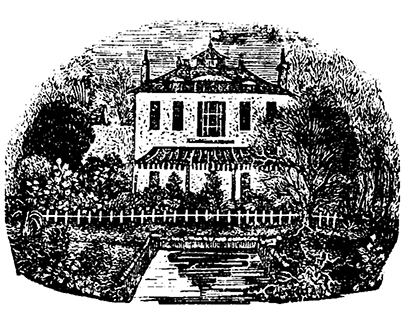
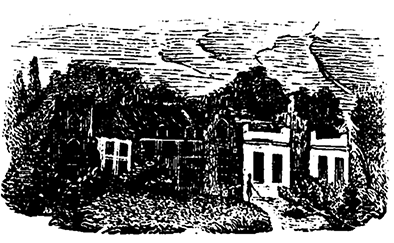
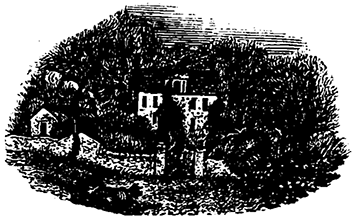
On the North side is Beau Séjour, the residence
of Mr Harry Dobrée, which has all the character
of an English villa, and may strikingly remind
one of those in the New Forest.

Beau Séjour.
Are, two in English and one in
French. The English are the Star and Comet,
published on Mondays and Thursdays. The French,
the Gazette de Guernesey, published every Saturday.
The former are 2d. each, the latter 1½d.
Are four: the Defiance, Favourite,
Victoria, and Nelson. One starts from the Town
Church for St Sampson's every morning at 8, 9, and
12 o'clock, and in summer to St Saviour's and different
part of the island every Saturday afternoon.
Pic-nic parties are taken to any part of the island.
Arrive to considerable size, and in the
country are employed at the plough and in drawing
carts. After a certain servitude, or when they are
seven or eight years old, they are fattened and sold
to the butcher. Their size and weight are of such
importance as to have attracted the notice of Quail;
for in his report he says: "Those of 1200 lbs. or
60 score, appear not unfrequently, and from the
evidence of the clerk of the market, there was one
which attained the weight of 1500 lbs."
Are the best farming crop in the
island, and are cultivated to some extent. They are
chiefly used for fattening cattle and hogs, from which
the pork and ox beef derive a superior flavour. They
are also given in small quantities to milch cows
during the winter, thereby imparting to the milk and
butter a richness which would not be obtained were
the animal fed entirely upon dry fodder.
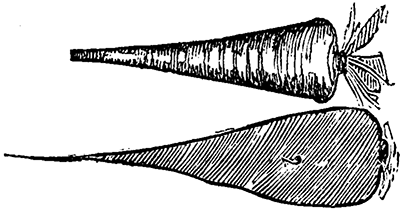
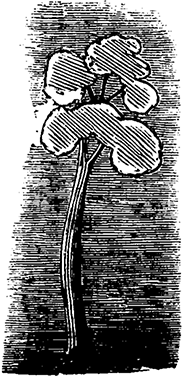
No. 1, is the original Guernsey Parsnip, No. 2, the Jersey Parsnip.
Persons about to take their departure
for France must provide themselves with passports,
which are obtained gratis at the Secretary's Office,
Government-House, between the hours of ten and
twelve o'clock.
In the Northern parts of the island is found
in great abundance, and a load, which will go much
further than a ton of coals, is sold at about 1l.[A] It
is dug up on the sea shore and the adjacent marshes
in the neighbourhood of Grande Roque, and is used
by the English in that part of the island, the natives
preferring vraic on account of the superior ashes
which it yields. It is not so good as the Welsh peat;
and is called in the vernacular tongue of the island
gorban, or a god-send, a name given it by one of the
ancestors of the present Baillif, who first discovered
it as being a valuable article of fuel. At the Amballes,
a place near town, and situated considerably
above the level of the sea, peat was found when digging
for the foundation of the gas-works, June 12,
1830, at about forty-five feet from the surface, under
a block of granite.
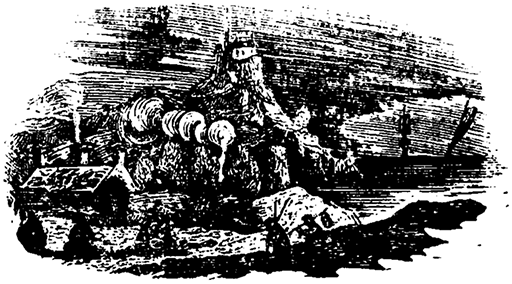
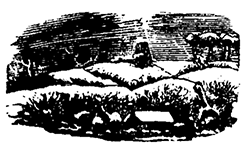
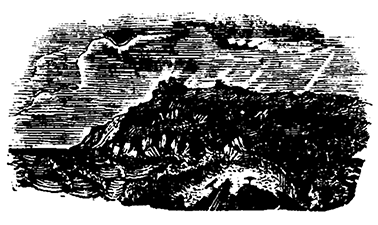
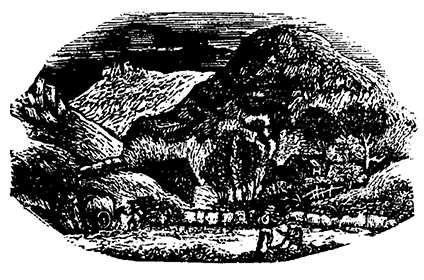
Peat-heaps, with a View of Roc-du-Guet, or Watch Rock.
Or, the Town Church,
consists of a chancel, nave, North and South aisles,
and North and South transepts, with a square tower at
their intersection. It is of the later gothic style of
France, termed the Flamboyant, and many of its
portions are richly decorated within and without.
An old stone pulpit, which was removed from its
extremely mutilated state, was once one of the
antique ornaments of the South pier of the chancel;
and in the East end of the North aisle is a slab on
which are three figures, the right and left being
apparently ecclesiastics; but as the stone is so much
worn by the attrition of time, it is difficult to decipher.
In the East walls of the North and South
ailes are most elegant piscing, the canopies of which
are crocketed, finialed, and pinnacled, and the interior
moulding of the arch and sides formed of
crumpled leaves and creeping animals. The shelves
consist of brackets of leaves, above which are two
niches, square-headed and trefoiled. The mouldings
and canopies of the North porch and West door are
crocketed, finialed and pinnacled, and are deserving
of considerable notice. In the South transept are
octagonal pillars without capitals, so that the mouldings
of the archivolt run into them, and in the East
wall is a piscina cut in granite, ogee-headed and
trefoiled with a shelf across it. The tower, which has
a window in each side, is square and embattled, and
is surmounted by a short octagonal spire, that was
erected in the year 1721. At the angles of the tower
and elsewhere, are line-course gurgoyles representing
human figures, scutcheons and lions' heads and shoulders.
This church was consecrated on the 1st of August,
1312; and was the last of the ancient churches consecrated
by a Roman Catholic Bishop in the island.
It has a very handsome pulpit and reading-desk, and
of late years the whole building has been renovated.
It also contains a fine deep-toned organ, which
originally cost between seven and eight hundred
pounds, and which has since been removed to the
North aisle, where it appears to considerable advantage.
The tower has a clock, and a merry peal of
eight bells, and its height from the vane to the
ground is 132 feet, being the highest in the island.
There are two French services and one in English
every Sunday, and there are sittings for 1400 persons.
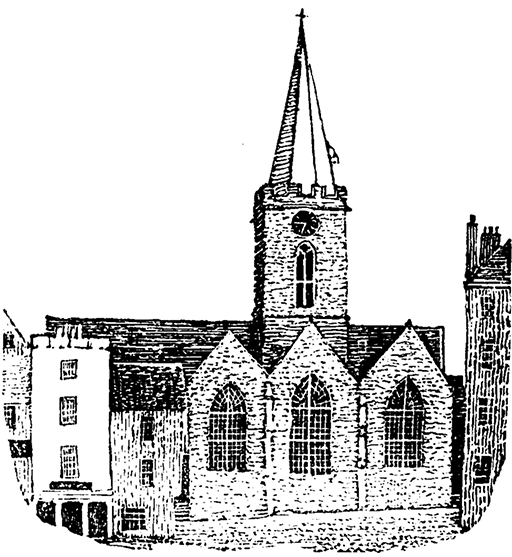
East View of the Town Church.
Has undergone
less change than any other in the island, as the tracery
of the windows still remain untouched, and the
ornamental parts almost perfect. It has many Norman
portions, and the windows in the North and
South walls of the chancel are in that style, the inside
walls being splayed and quite plain. It is
built on the West side of a hill, which causes the
chancel to rise several feet higher than the West end
of the nave, insomuch that walking from the tower
to the chancel is not unlike going up hill. The nave
once contained a monumental brass plate representing
a respectable personage or merchant, which from
the cut of the stone appears to be about the year 1560.
The consecration of this church took place in the
year 1167.
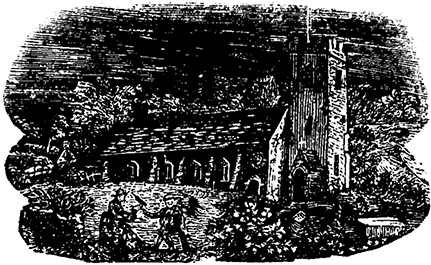
St Peter-in-the-Wood's Church.
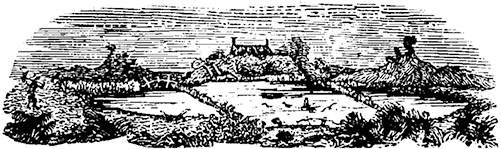
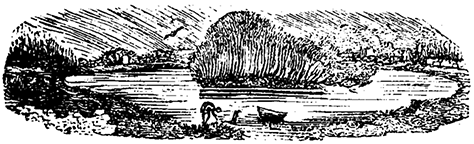
At present, are few, and are chiefly in the
marshy districts of the vale, and on Lancresse common;
but as they are formed or rather considerably
enlarged by the winter rains, are consequently void
of fish. Heylin, chaplain to the Earl of Danby, says,
in 1629: "Is a lake on the North-West part of the
island, near unto the sea, of about a mile or more in
compasse, exceedingly well stored with carpes, the
best that ever mortal eye beheld, for taste and bignesse."
This lake still assumes something of its
original form throughout November, in spite of the
innumerable and expensive efforts to drain it off. In
summer it is dried up, but during the height of the
inland water, it is still a great attraction for a variety
of sea-fowl.[A]

Mare de Carteret.
By an act of the Royal Court, for the
better regulations of boatmen and porters, each passenger's
effects are to be carried to the hotels and
lodging houses in the lower town for six pence; any
other imposition is fined by a penalty of 10 livres
tournois. Every porter is to wear a brass badge on
his left arm, and he is forbidden to touch the passengers'
luggage or effects without their leave. He is to
stand behind or along the walls of the pier until
called for; under the penalty of suspension of his
badge. No porter is to carry a second load of
luggage until all the others present at the landing
have each carried one in their turn, under a penalty
of 10 livres tournois.
Is almost wholly French, very little of
native produce being brought to market. Turkeys
sell from 3s. to 5s. each, fowls 2s. 6d. to 3s. per
couple, geese 2s. to 2s. 6d. each, ducks nearly the
same as fowls.
The Church of England is predominant;
there being upwards of six places of worship
in town, besides the country churches. The next
are the Wesleyan Methodists, who have upwards of
1827 sittings. Ebenezer chapel, Saumarez-street,
in English, is open on Sundays at half-past ten in
the morning, and six in the evening; on Wednesdays
and Fridays at seven in the evening. Le Marchant-street
chapel in French, on Sundays at nine
in the morning, and six in the evening; on Tuesdays
and Thursdays at seven in the evening. Wesley
chapel, Bouet, in French on Sundays at nine in the
morning and six in the evening; on Tuesdays and
Thursdays at seven in the evening. In English on
Sundays at half-past two in the afternoon, and on
Mondays at seven in the evening.
The Independents have three chapels, Eldad,
Union-street; one in New-street, and another called
Clifton Chapel; the whole of which contain sittings
for about 1726 people. The service of the
New-street chapel is in French, and on Sundays
begins at half-past ten in the morning, and six in
the evening; also on Wednesdays at seven in the
evening. The service of Clifton Chapel is in
English, and commences at half-past ten in the
morning and at six in the evening on Sundays; on
Tuesdays at seven in the evening. The Eldad
Chapel, Union-street, is in English, and on Sundays
commences at half-past ten in the morning,
and half-past six in the evening; on Thursdays at
seven in the evening.
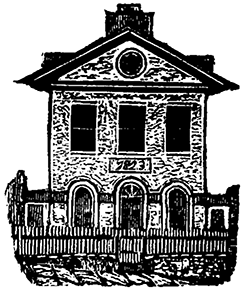
Clifton Chapel.
The New Connexion have two chapels, Zion,
in Clifton, and Hospital-lane preaching room.
The service at Zion is in English, at half-past ten in
the morning and six in the evening on Sundays; on
Wednesdays and Fridays at seven in the evening.
Preaching room in French on Sundays at ten in the
morning and six in the evening, and on Thursdays
at seven in the evening. These chapels contain sittings
for about 748 people.
The Bryanites have a chapel called Salem, in
Vauvert-road, which contains upwards of 380 sittings.
The service is in English at half-past ten in
the morning and six in the evening on Sundays. On
Tuesdays and Thursdays at seven in the evening.
The Society of the original Foxonian Quakers
have a meeting-house at Clifton. Friends meet on
seventh days at ten in the morning and three in the
afternoon throughout the winter, and at six in the
summer. On fourth days at ten in the morning.
There are about 120 sittings; but Friends are few,
there being only about thirty members.
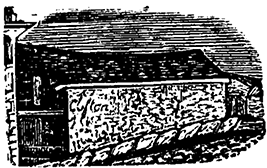
Friends' Meeting-house.
The Primitive Methodists, Catholics, Baptists and
Unitarians have one each, and unitedly contain 930
sittings.
At the Roman Catholic chapel, Burnt-lane, high
mass at half-past ten in the morning on Sundays;—preaching
in English. Vespers, six in the evening.
Primitive Methodists. In Pollet-street in English
on Sundays at half-past ten in the morning and six
in the evening. On Tuesdays and Thursdays at
seven in the evening.
Unitarians. Allez-street, New-Town, on Sundays
at ten in the morning and six in the evening, in
English.
Bethel Union. At the preaching room on the
Quay, near the North Pier, at half-past ten in the
morning, half-past two in the afternoon, and half-past
six in the evening, in English;—on Thursdays
at seven in the evening.
Are not known in the
island, neither will they exist on being introduced.
Heylin, of old, speaking of Guernsey, says:—"The
aire hereof is very healthfull, as may be well seen in
the long lives both of men and women; and the
earth said to be of the same nature with Crete
and Ireland, not apt to foster any venomous creature
in it." The only reptile of the snake genus is the
slow-worm, and even that exceedingly rare.
Being confined to small
streams, the student of good old Isaac Walton is denied
the pleasure of fly-fishing. Night-lining in the
pools and deep holes for eels is very frequent.
Are reckoned equal to any on the Continent,
and are entirely exempt from turnpike tolls.
It is only within the last half century good roads
have been established, for which the public are
indebted to the exertions and ingenuity of the late
Sir John Doyle, while Governor of the island, notwithstanding
he met with the most ignorant opposition
from the country people or farmers, whose real
interest it chiefly served; and which they now acknowledge
to be the veins of the island, whereby
they circulate the wealth and produce of their soil.
In this excellent undertaking, which was the era of
civilization in Guernsey, Government lent a hand, by
allowing the money derived from the sale of the
Braye du Valle to be applied for the same. At
present, the roads are kept in repair by a rate on
land proprietors bordering the main roads, and by
grants of money from the States. The lanes that
here and there intersect the island, may be said
to be the old roads, and furnish the green-lane
botanist with delightful, cooling, and shady walks
throughout the heat of summer.
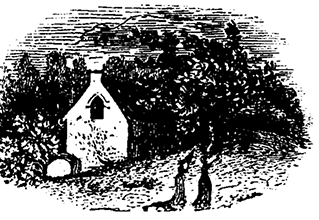
Are not numerous, the chief being the
old chapel of St Apoline, and the priory in the
island of Lihou. The former is in the parish of St
Saviour, amid a solitary and woody district, which
has all the appearance of monastic seclusion. It is
about seven and twenty feet long, by thirteen across,
having a narrow square headed opening at the East
end, and a rude segmental doorway, and a narrow
window divided into two parts on the South side.
The whole is covered with a ponderous vaulted roof
of stones, and is the most ancient ruin in the island,
being supposed to be built about the year 900. The
sides of the walls and roof appear to have been once
adorned with fresco paintings, as several figures of
saints and the Virgin Mary are still discernible on
the South ceiling. The silver-gilt chalice, belonging
to this chapel, is one of the few relics of Romish
times which the island possesses, and it is now in
the custody of the present Baillif, John Guille, Esq.,
of St George. Round the bowl are the words
"Sancte Paule ora pro nobis." From this it is
supposed the chapel was originally called St Paul's,
which by the attrition of time has worn itself into
Apoline.
The priory on the little isle of Lihou, belonging to
Mr James Priaulx, consists of little more than a few
broken walls. Sufficient however remains to enable
one to determine its different compartments, of
which the chapel forms the principal portion.[A]
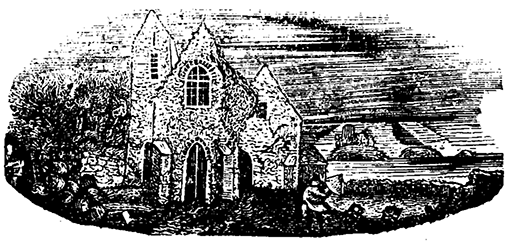
St Sampson's Church.
Is evidently the most
ancient structure in the island, being consecrated in
the year 1111. It has been so affected by modern
innovation and addition, that its original character
is scarcely identified. The interior is plain and
massive, and not a single ornamental moulding can
be discovered. For some unknown purpose a
squinch has been thrown over the North-East angle,
of an arched arcade in the North wall of the North
aisle. The tower is of the early English style, plain,
roofed with stone, and situated over the North side
of the nave, which appears to be an additional
structure.
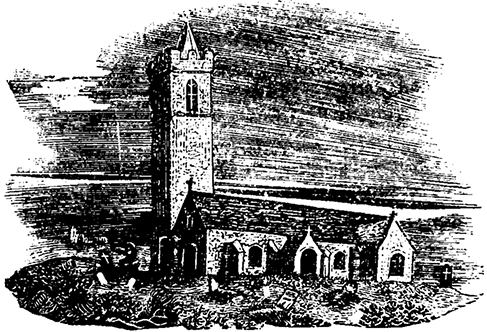
St Saviour's Church.
Consists of a nave, chancel,
South aisle, and transept, and a lofty square
tower, which rises at the West end of the nave. The
East window of the South aisle is large and pointed,
without mouldings, whilst those on the South side
are small and segmental. The aisle has a buttress
supporting one of its walls, which being united with
that of the chancel, gives it the appearance of being
built prior to it. The South transept is small, and
the window considerably modernized. The piers
of the nave are without capitals, some round and
others octagonal. The tower is embattled, having
pointed and square headed windows, and is surmounted
by a short octagonal spire. The corner
buttresses have flowers on their tops, and are two
stages high. Besides this church, there is in St
Saviour's parish two Methodists chapels built in 1820,
an Independent one, opened in 1817, and one for
Baptists.
Servants.—As several shops keep a register of
these, their characters and wages are easily obtained.
Good maid servants get 9l. per annum; others from
5l. to 6l. do. Butlers, coachmen, &c., vary according
to situation and character.
The conchologist has an ample field before
him, and the little isle of Herm is so replete
with them, as to be considered the first spot in the
kingdom both as regards beauty and quantity.
Notwithstanding leather is entirely exempt
from duty, shoes cannot be said to be cheap,
as they are from 8s. 6d. to 9s. per pair. At the
shoe marts some of an inferior quality may be had
from 3s. to 6s. Boots are in proportion.
One in High-street
is exceedingly gaudy, being replete with the
best fancy articles of Paris, and rich with specimens
from "l'Industrie Nationale," &c. Many useful
things can be procured there remarkably cheap,
especially paper, perfumes, and ornaments.
Heretofore, every person was allowed
to carry a gun, and no protection granted for game;
but now the Royal Court have enacted certain restrictions
respecting guns, dogs and ferrets; but as
they are exceedingly mild, it will not be amiss
to mention there is excellent sport in snipe,[A] woodcock,
plover,[B] fieldfare, and blackbird shooting; as
during the winter months there is a great influx of
these birds. So lenient indeed are the laws respecting
shooting, that an informer cannot gratify any
malicious view, unless he resign all damages
awarded by the Court towards some charitable institution
or purpose; moreover, it is believed shooting
is encouraged for the purpose of initiating youth
for the service of the rising militia. Shooting in an
orchard is under a penalty of 20l., as it destroys the bud.
The British and Foreign Bible
Society, established 1812—contributions 420l.
Guernsey Auxiliary to the Trinitarian Bible Society,
established 1836—contributions 48l. Ladies' Association
to ditto, established 1831—contributions
85l.
The best Cognac
brandy is always imported from France, and is never
less than 6s. or more than 7s. per gallon. Inferior
brandies distilled from beet-root, potatoes, or apples,
may be obtained from 2s. 6d. to 4s. per gallon, and
rises in quality according to price. The best hollands
is 3s. 4d. and the best Jamaica rum 4s. 4d. per
gallon. Liqueurs and cordials are equally moderate;
crême de noyau, noyau rouge, crême de fine orange,
ditto de citron, ditto de framboise, ditto des Barbades,
ditto de canelle, &c., are all 3s. per bottle,
and we may add as somewhat less, parfait amour,
Jamaica shrub, ratafia de cinq fruits, and curaçoa
double, which latter article may be had for 1s. 8d.
The prices of wines are as follow: best port, 25s.
per dozen; best sherry, 22s. ditto; fine malmsey,
28s.; ampurdam, 8s.; benicarlo, 8s.; hock, 15s.
to 38s.; mountain, 8s. 6d. to 12s.; Teneriffe, 11s.;
Syracuse, 24s.; Constantia (pints), 12s.; Calcavala,
12s.; Bucellas, 10s.; Vidonia, 18s.; Grenache,
8s. 6d.
French red wines (clarets)—Château Margaux
(pints), 18s.; La Fitte, 36s.; Léoville, 28s.; La
Tour de Carnet, 24s.; St Julien, 18s.; St Emilion,
15s.; Medoc, 12s. French white wines—Champaign
(white and pink), 50s.; in pints, 26s.; burgundy
(sparkling), 24s.; hermitage, 36s.; château
grillé, 18s.; haut sauterne, 24s.; Barsac, 24s.;
grave, 10s. to 15s.; roussillon sec, 8s. 6d.; rancio,
12s.; picardan (sec), 18s.; cornas, 15s.; crosse,
18s.; tavel, 10s., together with numerous others.
There is 1s. 6d. per dozen allowed on the above
when the bottles are returned, as they have been
included.
Are of two kinds, the administrative and
elective. The administrative States are composed of
the Baillif and twelve Jurats, eight Rectors from the
parishes, the Attorney-General, six deputies from the
town parish, and nine from the rural parishes, in all
thirty-seven members. The States of election are composed
as above, with the addition of the Constables and
Douzeniers of each parish. The town parish alone
sends forty-eight members; formerly it only returned
twenty-four. This body corporate is the little parliament
of the island, and every inhabitant is supposed
to be represented therein. They are convened by
a printed notice, called a Billet d'Etat, issued by the
Baillif, and communicated to every and each of the
members at least a week before the time of meeting.
Are not levied on strangers, unless they
become proprietors of land or enter into some business.
The tax or rate on the native is about one-ninth
that of England; for a more curious detail of
which, the reader is referred to the History of Guernsey,
by Jonathan Duncan.
Until of late years were totally unknown
here, and but for the continued vigilance of
the present constabulary force would be considerably
on the increase. Strange to relate, hardly ever
a native is caught committing the slightest depredation
on his neighbours; convicted rogues and
thieves being, for the most part, from Somerset
and Dorset,[A] especially the latter. Formerly, from
the leniency of the law, they were merely banished
to the place from whence they came; but now,
from a better understanding of the rights of society,
they are sent to the hulks of their own country,
waiting a further removal to Van Dieman's Land.
Yield but a slender income to the Clergy,
in consequence of the great breadth of potatoes
under cultivation, on which the farmer is
exempt; but the rectors have had, of late years, an
increase of income taken from the revenues belonging
to the Crown in this island, so that all the
livings of the country parishes are not less than 101l.
nor more than 166l. per annum. St Peter-Port, on
account of its casualities, yields 480l. per annum.
Tithes are fixed on the twelfth and ninth portion of
corn and apples.
English vessels not registered in
Guernsey, pay 6d. per ton on all goods landed and
loaded; but when from a French port 6d. per ton
on the tonnage of the vessel. Foreign vessels pay
the same, measured as British tonnage. Fishing
vessels and yachts are exempt, but pay the pass on
leaving the harbour. Vessels exporting coals are
exempt; but those landing wines, whether for the
inhabitants or on strangers' account, pay a duty of
fifteen sous per ton.
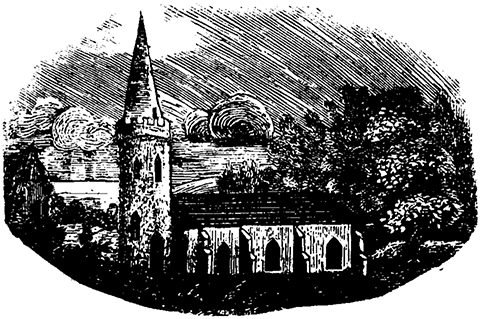
New Torteval Church.
Is comparatively new, the old
one having been pulled down in the year 1815. The
tower and spire of this church are round, like a
sugar-loaf, and of considerable height; and the
ascent to the top by a kind of cork-screw flight of
steps. The interior affords room for a much larger
congregation than the parish now produces. The
pulpit is erected under a dome or arch in the centre
of the chancel, immediately opposite the communion
table, and is said to impart a strange tone to the
clergyman's voice.
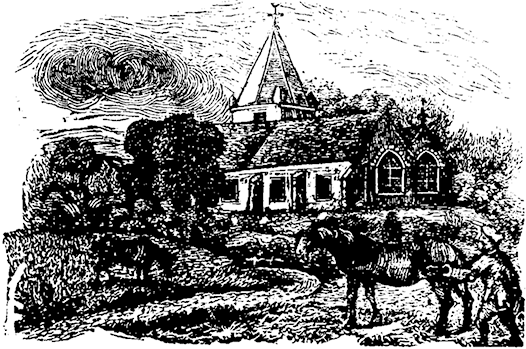
The old church of which the engraving at page 85,
represents, had a nave, chancel, South aisle, porch,
and low, square tower, pinnacled and surmounted
by an octagonal spire at the West end of the nave.
It was built by Sir Phillip De Carteret, in the year
1140, in consequence of a vow made at sea. Sir
Phillip was the son of Sir William De Carteret, co-Lord
with the King of France of the barony of Carteret
in Normandy.

Most commonly met with
are, the Guernsey elm, oak, ash, and
poplar, with a sprinkling here and there
of Turkey oak. The Guernsey elm,
which is a tall, poplar-like tree, is peculiar
to the soil, and may be seen
beautifying almost every sylvan district.
The New Ground or parade,
is almost wholly circumgirt with this
fine forest tree, which, in connexion
with Carey Castle, is an object of
much attraction when seen from the
roads; insomuch that the latter has
the appearance of a noble mansion
in the midst of a large and thickly
wooded park. Contrary to England and most other
countries, the trees in various districts are stunted
down to pollard fashion, of which the annexed engraving
is a faithful representation, after the first year.
Old Torteval Church.
For antiquity, is the second
church in the island, and is dedicated to St Michael
the Archangel. It has undergone a complete
modernization, and a new roof has just now been put
up. A monumental brass was once inlaid in a stone
situate in the East end of the North aisle, which was
supposed to represent the Abbot of St Michael. The
chancel which forms the original church, is said to
be of a later Norman style than that of St Sampson's,
and there is still preserved its consecration, which
happened in the year 1117. The pillars are round,
and the supporters of the fabricated roof are wrought
with a kind of zig-zag moulding. The East window
of the North aisle, if examined narrowly, exhibits a
kind of fret-work, and is divided into three lights.
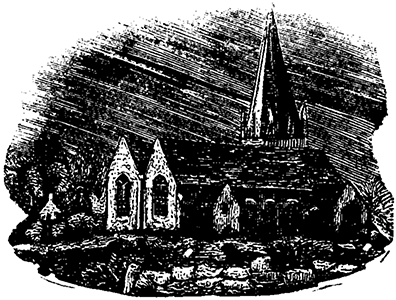
The Valle Church.
A measure of ground, two and a half of
which complete an English acre. A vergée lets from
1l. to 6l. per annum, and may be purchased from
20l. to 100l.; but the purchaser may either pay the
whole or in part, when the remainder stands over as
mortgage, which is divided into quarters and called "rents."
Is sea-weed, and is eagerly sought after by
the farmers, both as fuel and manure for their
grounds, than which, they uphold nothing can be
better. The ashes, as a manure, are certainly unrivalled,
and so appreciated are their value, that
"no sea-weed, no corn," has passed into a proverb.
They are sold at about 1s. 6d. the Guernsey bushel.
The pound is two ounces
more than the English; thus, twenty-eight ounces
Guernsey, are thirty and a half avoirdupois. The
weights at the meat-market are under the direction
of the States. They are of solid brass, beautifully
bright, with their numbers engraved on them, and
are locked up every night by the clerk of the market.
Defalcations of weight in meat, butter, or bread, is
punished with a heavy penalty, and if among the
butter women, the whole of their stock is seized by
the constable whose duty it is to investigate the matter,
and confiscate it for the benefit of the town hospital.
The red wheat is preferred
on account of its producing heavier crops, and
being less subject to the ravages of small birds,
which are very numerous here, especially sparrows.
Wheat, during the last twenty years, has been about
two-thirds of the price at which it has been sold in
England. In the summer of 1830, wheat was twenty
shillings per quarter, Guernsey measure; whilst the
price in England at the same time was sixty or
seventy shillings per quarter. At one time, the
rigorous corn-law was about to be extended here;
but the inhabitants bestired themselves, and succeeded
in warding off the terrible blow, for which they
were greatly indebted to the exertions of the late
venerable Baillif.
Barley generally follows wheat, and is considered
by agriculturists of an excellent quality, so much so,
that when Quail wrote, one would have thought that
it was chiefly used for bread. It is sold to the brewers
for malting, at 3s. the Guernsey bushel, (56 lbs.
English.)
Oats and rye are not much grown, as they are
obtained on the Continent much cheaper than they
can be raised, and in respect to the keeping of a
horse are much more reasonable than in England.
In the country, may be obtained
at the following prices: liberal sized faggots,
consisting of ash, elm, or apple tree, fetch from 18s.
to 1l. per hundred. Should a still greater moderation
of price be regarded, old ship planks in the
neighbourhood of the pier may be had. Norwegian
and Swedish deals, twelve feet long, nine inches
broad, and three inches thick, are sold for 2s. and
2s. 6d. each, or 15l. per 120, as there is no duty on
them, or any other kind of timber.