“Of brownyis and of bogillus full is this buke.”
—Gawin Douglas.
“D’un passé sans mémoire, incertaines reliques
Mystères d’un vieux monde en mystères écrits.”
—Lamartine.
“Among those rocks and stones, methinks I see
More than the heedless impress that belongs
To lonely Nature’s casual work! They bear
A semblance strange of Power intelligent,
And of design not wholly worn away.”
—Wordsworth, The Excursion.
The island of Guernsey still contains many of
those rude and ponderous erections commonly
known by the name of Cromlechs, or Druids
altars. The upright pillar of stone or rude obelisk,
known to antiquaries by the Celtic name of Menhir also
exists among us. Many of these ancient monuments
have no doubt disappeared with the clearing of the
land and the enormous amount of quarrying, and many
have doubtless been broken up into building materials,
or converted into fences and gateposts. But the
names of estates and fields still point out where they
once existed. Thus we find more than one spot with
the appelation of “Pouquelaye.”[50] “Longue Rocque,”
or “Longue Pierre,” and the names of “Les Camps
Dolents,” “Les Rocquettes,” and “Les Tuzés”
indicate the sites of monuments which have long since
disappeared.
The researches carried on with so much care and
intelligence by Mr. Lukis have clearly proved that the
Cromlechs were sepulchral; perhaps the burial places
of whole tribes, or at least of the families of the
chieftains. This does not preclude the popular notion
of their having been altars, for it is well known that
many pagan nations were in the habit of offering
sacrifices on the tombs of their dead.
The following is a list of the principal Druidical
structures, etc., which we can identify, with an account
of the traditional beliefs attached to them of their
origin, etc.:—
The large Cromlech at L’Ancresse called “L’Autel
des Vardes.”
The smaller Cromlech in the centre of L’Ancresse,
with a portion of another similar structure to the
east of it.
A small portion of a Cromlech at La Mare ès
Mauves, on the eastern base of the Vardes, almost
in front of the target belonging to the Royal Guernsey
Militia.
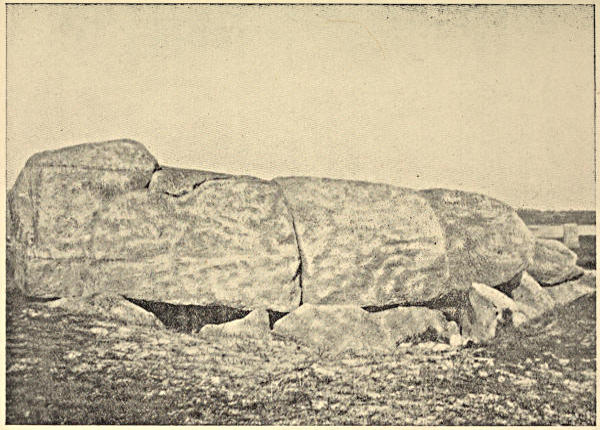
“L’Autel des Vardes” at L’Ancresse.
“La Roque Balan.”
“La Roque qui Sonne” (destroyed).
“Le Tombeau du Grand Sarrazin,” in the district
called Fortcàmp (destroyed).
“L’Autel de Déhus,” near above.
Small Cromlech at “La Vieille Hougue” (destroyed).
“Le Trépied” or the “Catioroc.”
“Menhir” or “Longue Pierre” at Richmond.
“Creux ès Fées”[51] in the parish of St. Pierre-du-Bois.
“La Longue Roque” or “Palette ès Fées” at
the Paysans.
“La Roque des Fées” (destroyed).
“Le Gibet des Fées” (destroyed).
“La Chaire de St. Bonit” (destroyed).
In the Island of Herm there are six or eight
mutilated remains of Cromlechs. In Lihou, none are
left. In Sark, none are left.
It will be seen that the druidical stones are believed
to be the favourite haunt of the fairy folk, who live
in the ant hills which are frequently to be found in
their vicinity, and who would not fail to punish the
audacious mortal who might venture to remove them.
This consists of five enormous blocks of granite,
laid horizontally on perpendicular piles, as large as
their enormous covering. Around it, the remains of
a circle of stones, of which the radius is thirty-three
feet, and the centre of which coincides with the
tomb. Mr. Métivier says in his “Souvenirs
Historiques de Guernesey” that this “Cercle de la
Plaine,” in Norse Land Kretz, on this exposed elevation,
could not fail to attract the attention of the Franks,
Saxons, and Normans, and thus gave its name to
the surrounding district.
In it were found bones, stone hatchets, hammers,
skulls, limpet shells, etc., etc.
It is perhaps to this latter fact that we must
attribute the idea which is entertained by the
peasantry that hidden treasures, when discovered by
a mortal, are transformed in appearance by the demon
who guards them into worthless shells.
“La Roque Balan” was situated at the Mielles, in
the Vale parish. It is supposed by some to have taken
its name from Baal, Belenus, (the Sun God), the Apollo
of the Gauls, whom the Thuriens, a Grecian colony,
called Ballen, “Lord and King,” and to whom they
dedicated a temple at Baïeux. The custom of lighting
fires in honour of Bel or Baal continued in Scotland
and Ireland almost to the beginning of this century.
In Guernsey, at Midsummer, on the Eve of St. John’s
Day, June 24th, the people used to go to this rock
and there dance on its summit, which Mr. Métivier
describes in 1825 as being quite flat. The refrain of
an old ballad proved this:
“J’iron tous à la St. Jean
Dansaïr à la Roque Balan.”
Some people conjecture this rock to be the base
of a balancing, or Logan stone, and others again that
it was the site where Dom Mathurin, Prior of St.
Michel, weighed in the balances the commodities of
his tenants. But the most probable supposition is
that it was named after the Ballen family, former
residents of this neighbourhood.
Near this rock stood
This was the name given by the peasantry to a large
stone which formerly stood on the borders of L’Ancresse,
in the Vale parish. There is no doubt that it formed
part of a Cromlech, and it is said that when struck it
emitted a clear ringing sound. It was looked upon
in the neighbourhood as something supernatural, and
great was the astonishment and consternation of the
good people of the Clos du Valle, when Mr. Hocart,
of Belval, the proprietor of the field in which it stood,
announced his intention of breaking it up in order to
make doorposts and lintels for the new house he was
on the point of building. In vain did the neighbours
represent that stone was not scarce in the Vale, and
that there was no necessity for destroying an object
of so much curiosity. No arguments could prevail
with him, not even the predictions of certain grey-headed
men, the oracles of the parish, who assured him
that misfortune was sure to follow his sacrilegious act.
He was one of those obstinate men, who, the more they
are spoken to, the less will they listen to reason, and
finally the stone-cutters were set to work on the stone.
But now a circumstance occurred which would have
moved any man less determined than Hocart from his
purpose. Every stroke of the hammer on the stone
was heard as distinctly at the Church of St. Michel
du Valle, distant nearly a mile, as if the quarrymen
were at work in the very churchyard itself![52] Orders
were nevertheless given to the men to continue their
work. The stone was cut into building materials, and
the new house was rapidly approaching completion
without accident or stoppage. Hocart laughed at the
predictions of the old men, who had foretold all sorts
of disasters.
At last the day arrived when the carpenters were
to quit the house. Two servant maids,—or, as others
have it, a servant man and a maid,—were sent at an
early hour to assist in cleaning and putting things to
rights for the reception of the family, but at eight
o’clock in the morning a fire broke out in the house,
and its progress was so rapid that the poor servants
had not time to save themselves, but perished in the
flames. Before noon the house was one heap of
smoking ruins, but it could never be discovered how
the fire had originated.
Hocart’s misfortunes, however, were not at an
end. Some part of the rock had been cut into
paving stones for the English market, and the refuse
broken up into small fragments for making and
repairing roads. In the course of the year the one and
the other were embarked for England on board of two
vessels in which Hocart had an interest as shareholder,
but, strange to say, both vessels perished at sea.
Hocart himself went to reside in Alderney, but was
scarcely settled there when a fire broke out and
destroyed his new dwelling.
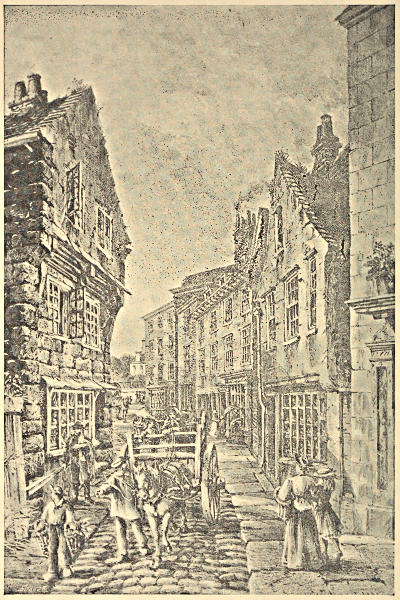
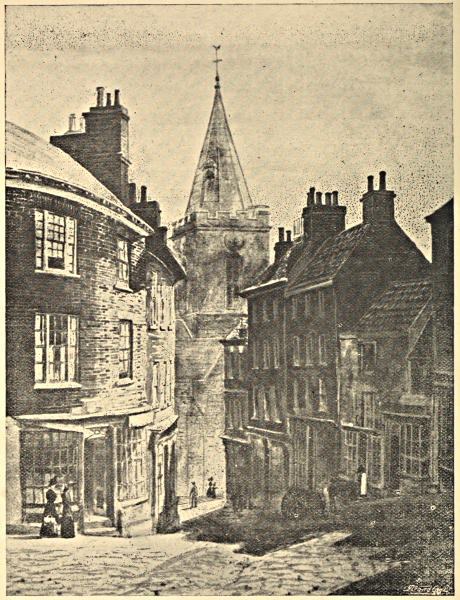
Smith Street, A.D. 1870.
He then determined on returning to Guernsey, but
when close to land a portion of the rigging of the
vessel on board which he sailed, fell on his head,
fractured his skull, and he died immediately.[53]
There is another instance given of the ill luck which
waits on those who interfere with the Cromlech and
disturb the repose of the mighty dead[54] in the “Legend
of La Haye du Puits,” which is drawn from an ancient
chronicle and published in versified form by “M. A. C.,”
with extracts from Mrs. White’s notes. The legend
runs thus:—
In the reign of Henry II. of England Geoffrey of
Anjou raised a rebellion against him in Normandy. Not
wishing to be a rebel, Sir Richard of La Haye du Puits,
a noble Norman knight, fled from thence to Guernsey,
and landed in Saints’ Bay. He settled in Guernsey
and proceeded to build himself a house, which he
named after his Norman mansion “La Haye du Puits.”
Unfortunately for himself, in so doing he destroyed an
old Cromlech. All the inhabitants told him that he
would in consequence become cursed, and a settled
gloom descended upon him. Nothing could cheer him;
he felt he was a doomed man. At last he thought
that perhaps by resigning the house and dedicating it
to God he might avert his fate. So he gave it to
the Church, and turned it into a nunnery, making it
a condition that the abbess and nuns should daily
pray that the curse might be removed from him.
He then set sail from Rocquaine Bay, for France,
the rebellion being over, and his wife, Matilda,
awaiting him in their old home. But on his way
his ship was captured by Moorish pirates, and he was
taken as prisoner to Barbary. When there, his handsome
presence made so much impression on the governor’s
wife that she entreated he might be allowed to guard
the tower where she resided with her maidens.
What was his astonishment when one of them
looked out, and, recognising a fellow countryman,
called out and told him that she was Adèle,
daughter of his old friend and neighbour, Ranulph.
She also had been taken prisoner by these pirates,
by whom her father had been killed; she implored
him to effect her escape. She handed him her jewels,
and with these he bribed their jailers, and he, she,
and her nurse Alice, all managed to escape to
France. He took her to the Norman “Haye du
Puits,” and there, according to the old chronicle, he
found his wife, Matilda, and all “in a right prosperous
and flourishing condition.” From there Adèle married
a Hugh d’Estaile, a young Norman knight, high in
the favour of King Henry.
But the spirits of the Cromlech were not yet
appeased. Sir Richard could not shake off the
brooding care and haunting night-mares which always
oppressed him, though he tried to propitiate heaven
by building two churches in Normandy, “St. Marie
du Parc,” and “St. Michel du Bosq,” “for the
deliverance of his soul,” but it was of no avail, and
he died, a wretched and broken-down man. Even the
nuns in the Convent of the Haye du Puits were so
harassed and distressed, that finally they decided to
leave it; it is said that one unquiet nun haunts the
house to this day. Since then it has passed through
many hands, but tradition says that for many years it
never brought good fortune to its possessors.
In the district called Le Tort Càmp, near Paradis,
was one of the principal Cromlechs at the Vale, now
quarried away, called “L’Autel,” or “Le Tombeau
du Grand Sarrazin.” Who “Le Grand Sarrazin”
was, it is now impossible to say. He is also called
Le Grand Geffroi, and his castle—from whence the
name “Le Castel”—stood where the Church of Ste.
Marie-du-Castel now stands. He must have been one
of those piratical sea kings, who, under the various
appellations of Angles, Saxons, Danes, and Northmen
or Normans, issued from the countries bordering on
the North Sea and the Baltic, and invaded the more
favoured regions of Britain and Gaul. The name
“Geffroy,” (Gudfrid, or “la paix de Dieu”) seems
to confirm this tradition. As to the term “Sarrazin”—Saracen,
although originally given to the Mahometans
who invaded the southern countries of Europe, it came
to be applied indifferently to all marauding bands;
and Wace, the poet and historian, a native of Jersey,
who lived and wrote in the reign of Henry II., in
speaking of the descent of the Northmen on these
islands, calls them expressly “La Gent Sarrazine.”
Among the many Geoffreys of the North whom history
celebrates, there is one, a son of King Regnar, who
may be the one celebrated in our local traditions.
Charles the Bald yielded to him “a county on the
Sequanic shore.”
At that time the coast of Gaul was divided into three
sea-borders, namely, the Flemish, the Aquitanian, and
the Sequanic, called “Sequanicum littus” by Paul
Warnefrid, who places one of these islands near it.
That his castle stood at one time on the site of
the present church, is confirmed by the discoveries
which have frequently been made in digging graves,
of considerable masses of solid masonry, which appear
to be the foundations of former outworks of the
fortress. It is even possible that some portions of
the walls of the church may be the remains of the
earlier building. There are also in the neighbourhood
“Le Fief Geffroi” and “Le Camp Geffroi.”[55]
Quite close to where “Le Tombeau du Grand
Sarrazin” was situated, close to the Pointe au Norman,
in the environs of Paradis,[56] in the Vale parish, and
bordering on the Hougues d’Enfer, is the Pouquelêh
de Déhus. This spot, as well as some fields in the
Castel parish called “Les Déhusets” or “Les Tuzets,”
are supposed to be favourite resorts of the fairies.
M. de Villemarque, in his Barzas-Breiz, the work
so well known to folk-lorists, tells us that the Bretons
gave the imps or goblins, whom they call pigmies,
amongst others the name of “Duz,” diminutive
“Duzik,” a name they bore in the time of St.
Augustine; and he also says that they, like fairies,
inhabit Dolmens. Mr. Métivier explains the name
“Déhus” or “Dhuss” as the “God of the Dead,
and of Riches,” the Dis of the Gauls in the time of
Cæsar, Théos in Greek, Deus in Latin—le Dus, or le
Duc. He says “Our Dehussets are nothing but Dhus i
gou, spirits of the dead and goblins of the deep.”
The exterior circle measures sixty feet in diameter,
by forty in length, and the direction is from east to
west. The enormous block of granite which serves as
a roof to the western chamber is the most striking
part of it. At the extremity of this chamber is a cell,
the outer compartment eleven feet in length by nine
in width. The adjoining one is of the same length.
On the northern side a singular appendix in the form
of a side chamber joins the two smaller rooms just
described. There has also been discovered a fifth cell,
the roof of which was formed of granite resting on
three or four pillars, at the corner of the northern
chamber. But the most interesting discovery of all
was that of two kneeling skeletons, side by side, but
placed in opposite positions, that is to say, one
looking towards the north, the other towards the
south. Besides these, bones of persons of both sexes
and all ages, a stone hatchet, some pottery and limpet
shells, were also found inside this place of sepulchre.
It was long supposed to be haunted by fairies, imps,
and ghosts, perhaps the same spirits who, in the
haunted field of “Les Tuzés,” are reported to have
removed the foundations of the intended Parish Church
of the Castel to its present site. There is also a “Le
Déhuzel” in the neighbourhood of the Celtic remains
near L’Erée.
This Cromlech is on a rocky promontory, south-west
of Perelle Bay, in the beautiful parish of St.
Saviour’s. The derivation of its name, “Castiau-Roc”—as
it is properly—is from the “Castelh Carreg”
“Castle Rock” of the Gauls. As one approaches
it one is struck by the vestiges of Cromlechs with
their circles, and bits of “Longues Roques.” In olden
days, before so much of the surroundings were
quarried away, this must have been only one among
many other conspicuous objects down there. The names
“La Roque Fendue,” “La Roque au Tonnerre,”
“Plateau ès Roques,” “La Pièche des Grandes
Roques du Castiau-Roc,” which are mentioned in
various “Livres de Perquages,” are all that remain
of these ancient remains. Much to be regretted is
the disappearance of the “Portes du Castiau-Roc,”
which might perhaps have helped us to define with
some exactitude where this problematic castle once
stood, and perhaps identify it with the fortified mounts
of the Celts and Irish. It is noted in our island
annals for being the midnight haunt of our witches
and wizards. In the trials for witchcraft held under
Amias de Carteret in the beginning of the seventeenth
century, it was there that his trembling victims
confessed to having come and danced on Friday nights,
in honour of the gigantic cat or goat with black
fur, called “Baal-Bérith” or “Barberi,” nowadays
“Lucifer.” Near this rock was the “Chapel of the
Holy Virgin” on Lihou Island, now in ruins, and it
is said that the witches even defied the influence of
“the Star of the Sea,” shouting in chorus while they
danced,
“Qué, hou, hou,
Marie Lihou.”
This monument is like the “Tables en Trépied,”
and analogous to the “Lhêch y Drybedh” of the
county of Pembroke, in Wales. There were altars in
this form and of this description in almost every
canton of the island. One, near the Chapel of St.
George, is quite destroyed, and there are now no
traces left of another between the Haye-du-Puits, and
the Villocq. In the environs of the Castiau-Roc
bones and arms have been found.[57]
This Cromlech is situated on the Houmet Nicolle
at the point of L’Erée, (so called from the branch
of the sea, Eiré, which separates it from the islet of
Notre Dame de Lihou). This island, which once had
upon it a chapel and a priory dedicated to “Notre
Dame de la Roche,” was always considered so sacred
a spot that even to-day the fishermen salute it in
passing.
This Creux is a Dolmen of the nature of those
which are called in France “allées couvertes,”
perfectly well preserved, and partly covered with earth.
The researches which have been made in these
ancient monuments of antiquity prove them to have been
places of sepulchre. This one consists of a chamber
seven feet high, and covered with a roof of two blocks
of granite, each fifteen feet long and ten broad. The
entrance faces east, and is only two feet eight inches
wide, but soon enlarges, and the interior is almost
uniformly eleven feet wide.
This is, as its name would lead one to suppose, a
favourite haunt of the fairies, or perhaps, to speak
more correctly, their usual dwelling place.
It is related that a man who happened to be lying
on the grass near it, heard a voice within calling
out: “La païlle, la païlle, le fouar est caûd.” (The
shovel,[58] the oven is hot). To which the answer
was immediately returned: “Bon! J’airon de la
gâche bientôt.” (Good! We shall have some cake
presently.)
Another version from Mrs. Savidan is that some
men were ploughing in a field belonging to Mr. Le
Cheminant, just below the Cromlech, when the voice
was heard saying “La paille,” etc. One of them
answered, “Bon! J’airon de la gâche,” and almost
immediately afterwards a cake, quite hot, fell into
one of the furrows. One of the men immediately ran
forward and seized it, exclaiming that he would have
a piece to take home to his wife, but on stooping to
take it up he received such a buffet on the head as
stretched him at full length on the ground. It is
from here that the fairies issue on the night of the
full moon to dance on Mont Saint till daybreak.[59]
In a field in the parish of St. Pierre-du-Bois, on
the way to L’Erée and in the neighbourhood of the
secluded valley of St. Brioc and the woody nook in
which the ancient chapel dedicated to that Saint once
stood, stands one of those Celtic monuments, many of
which are still to be seen in Brittany and Cornwall,
and which are known in those countries by the name
of “Menhir.” This word in the Breton tongue, and
in its cognate dialect the ancient language of
Cornwall, signifies “long stone.” The name which
similar monuments bear in Normandy and Brittany
in this island is “longue pierre” or “longue roque,”
a literal translation of the Celtic name. There must
have been at one time many “longues roques” in
Guernsey. Another still stands in a field near the
road at Richmond. There was in 1581 “la pièche
de la longue pierre, la pierre séante dedans,”—a part
of the Fief ès Cherfs, at the Castel. There was also
“la Roque Séante dans le courtil de la Hougue au
Comte,” and the “Roque-à-Bœuf dans le Courtil
au Sucq du chemin de l’église,” near St. George, but
these latter have long since disappeared, though a
house near the field still bears the name.
Antiquaries are very much divided in opinion as to
the original destination of these singular masses of
rock; it is not wonderful that they should prove a
puzzle and a source of wonder to the unlettered
peasantry. How were such immense blocks placed
upright, and for what purpose? The agency of
supernatural beings is an easy answer to the question,
and some such cause is usually assigned for their
origin by the tradition of the country. Sometimes
they are the work of fairies, sometimes of giants
and magicians, and sometimes they are said to be
mortals changed into stone by an offended deity for
some sacrilegious act, or heroes petrified as a lasting
testimony of their exploits.
The Menhir at St. Peter’s-in-the-Wood stands in a
field at Les Paysans, so called from the name of the
extinct family who once possessed it. It is over ten
feet in height, and about three feet wide, and the
people’s name for it, “Palette ès faïes”—the fairies’
battledore,—describes it exactly. Tradition says that
in former days a man who was returning homewards
at a very late hour of the night, or who had risen
before the lark to visit his nets in Rocquaine Bay,
was astonished at meeting a woman of very diminutive
stature coming up the hill from the sea-shore.
She was knitting, while carrying in her apron
something with as much care and tenderness as if it
had been a clutch of eggs, or a newly-born babe.
The man’s curiosity was excited, and he determined
to watch the little woman. He therefore concealed
himself behind a hedge and followed her movements.
At last the woman stopped, and great was the
astonishment of the countryman when he saw her
produce a mass of stone of at least fifteen feet in
length, and stick it upright in the midst of the field,
with as much ease as if she were merely sticking a
pin into a pincushion. He then comprehended that
the unknown female could be no other than a denizen
of fairy-land, but what could be her object in erecting
such a monument? The people are at a loss in
finding an answer to this question. Some say the
stone was placed there by the fairies to serve them
as a mark when they played at ball.[60]
There is another story told to account for “La
Palette ès Faïes.” It is well known that Rocquaine
and its environs was the abode par excellence of the
fairy folk, and in the valley of St. Brioc two of these
fairies once lived. Whether they were father and son,
or what other relationship existed between them, is not
known, but among the human inhabitants of the valley
they went by the names of Le Grand Colin and Le
Petit Colin. They were fond of sports, and occasionally
amused themselves with a game of ball on the open
and tolerably level fields of Les Paysans. On one
occasion they had placed their boundary marks, and
had played some rounds, when Le Grand Colin struck
the ball with such force that it bounded off quite
out of sight. Le Petit Colin, whose turn it was
to play, called out to his companion, with some degree
of ill-humour, that the ball had disappeared beyond
the bounds, on which Le Grand Colin struck his bat
with force into the ground, and said he would play
no more. The bat still remains in the centre of the
field, and the ball—an enormous spherical boulder—is
pointed out on the sea-shore near Les Pezeries, fully
a mile and a half off.[61]
A little beyond the village called “Le Bourg de la
Forêt” there stood formerly an upright stone, which
was known by the name of “La Roque des Faïes,”—the
fairies’ stone. It was unfortunately destroyed when
the road was improved. The people in the neighbourhood
were rather shy of passing it at night, as it
was believed that the place was haunted, and that
fairies held their nightly revels there. Like other
stones of a similar nature it was said to have been
placed there by the elves to serve as a goal or mark
in their games of ball or bowls; and, according to
some accounts, the “Longue Roque” at “Les
Paysans” in the adjoining parish of St. Pierre-du-Bois
was the other boundary. It is not at all
unlikely that these stones may really have served for
such a purpose in days of yore, if not for the fairy-folk,
at least for mortals. What is more probable
than that the peasantry of the islands should have
had the same games as existed until lately in
Cornwall under the name of “hurling,” and in
Brittany under the name of “La Soule,” as well as
elsewhere, in which the young men of the neighbouring
districts met at certain seasons on the confines of
their respective parishes, and contended which should
first bear a ball to a spot previously fixed on as the
goal in each?
It is said that the spot where the stone in
question stood was originally fixed on as the site of
the Parish Church of the Forest; but that, after
all the materials had been got together for the
purpose of laying the foundations of the sacred edifice
they were removed in the short space of one night by
the fairies to the place where the church now stands,
the little people thus resenting the intrusion on their
domain.[62]
A Celtic monument of the kind commonly known to
antiquaries by the name of “trilethon” is said to
have existed formerly on the Common at L’Ancresse,
near La Hougue Patris. It is described by old people
who remember to have seen it in their youth as
consisting of three upright stones or props, supporting
a fourth, overhanging the others. It was known by
the name of “Le Gibet des Fâïes.” Near it was a
fountain called “La Fontaine des Fâïes,” the water
of which, although not plentiful, was never known
to fail entirely, even in the very driest seasons; it
is said to have been below the surface in a kind of
artificial cave formed by huge blocks of stone, and
entered by two openings on different sides. The
proprietor of the land many years ago broke up the
stones for building purposes and converted the fountain
into a well.[63]
In the course of some works recently (1878) undertaken
for reseating the Parish Church of Ste. Marie-du-Castel,
two discoveries were made, which are of
great interest. One is a sort of oven or furnace,
which was found below the surface of the floor of
the church, and immediately under the apex of the
westernmost arch, between the nave and the south
aisle. It lies north and south, extending into the
nave; but what appears to have been the mouth
does not reach southward beyond the arch, no part
of it being in the south aisle. If this aisle is really
a more recent addition to the original building, the
mouth of the furnace may have been at one time
in an outer wall. The whole length is eight feet, the
width two feet three inches, and the depth three feet
six inches. The sides are roughly masoned and the
northern end slightly rounded. A length of about
three feet at the south end is arched over with stones,
which have evidently been subjected to great heat.
This part is immediately under the arch between the
nave and the south aisle. The remaining five feet of
the excavation retain no traces whatever of an arch,
and are situated entirely in the nave. The floor of
the excavation is of hard compact gravel, covered with
ashes, among which were several pieces of charcoal
and a few small fragments of brass, perhaps bell-metal.
The northern end seems to have been used
as a sort of ossuary, into which the bones dug up
in making fresh interments in the church were thrown
pell-mell, the remains of no less than nine skulls,
mingled with other osseous remains, having been found
here. These bore no marks of fire, from which we
may conclude that the place had ceased to be used
as an oven or furnace when they were deposited
there. I had forgotten to mention that at the south
end of the excavation was found a tile of about one
and a-half inches in thickness, twelve inches in length,
and nine inches in width, with a notch in it for the
fingers, such as we see in the sliding lid of a box.
A few fragments of moulded tiles were found mingled
with the earth, which the architect believed to be
Roman. With the exception of a few coins, no other
Roman remains have ever been found in Guernsey.
The nave of the church and the westernmost bay of
the aisle had, in olden days, been walled off from the
rest of the building, and served as a sort of vestibule
and place where the cannons and other military stores
belonging to the Militia or trained bands of the parish
were kept. Perhaps the furnace may have been used
for casting balls, of which one at least has been
found in the building. Some think it may have been
used for the casting of a bell, but the bells at present
in the tower throw no light on the subject, having
been re-cast in England about the beginning of the
nineteenth century. There is no appearance of any
chimney or flue leading from the furnace ever having
existed, and the reason of its position within the
church, and the use to which it was put, must, we
fear, ever remain an enigma.
After this long digression we will go on to the
other discovery made at the same time; which
presents another puzzle equally unsolved.
Just within the chancel, at about an equal distance
from the north and south walls, about a foot below
the surface, was found a mass of granite, lying east
and west, and turned over on its left side. It has
all the appearance of a natural boulder somewhat
fashioned by art, and cannot be described better than
by saying that it is in shape like a mummy case,
the back being rounded and slightly curved and the
front nearly flat, with the exception of the upper
portion of the figure, which indicates that it was
intended to represent a female. The total length is
six feet six inches, the width across the shoulders
two feet three inches, and the portion corresponding
with the head one foot three inches from the top of
the forehead to the shoulders. It tapers slightly
towards the foot. On each side of the head, extending
from the forehead to the breast, are two ridges raised
above the surface of the stone, which may have been
intended to represent either a veil or tresses of hair.
There are no traces of any features remaining, but
what should be the face bears evident marks of
having been subjected to the action of a hammer or
chisel, as also does the right breast.
The stone is altogether too rude and mis-shapen to
warrant the supposition that it can have been
intended to cover a grave, although its place in the
chancel, and its lying with its head to the west, may
appear to favour this idea; but what renders the
discovery of this stone more interesting and gives
rise to conjecture, is the fact that in the churchyard
of St. Martin-de-la-Beilleuse another stone of about
the same size, precisely similar in outline, but in a
far better state of preservation, exists in the form of
a gatepost. In this last the features, very coarsely
sculptured, and only slightly raised on a flat surface,
are distinctly visible; a row of small knobs, intended
either for curls or a chaplet encircles the forehead,
and a sort of drapery in regular folds radiates from
the chin to the shoulders and breasts, which are
uncovered, leaving no doubt that in this case, as in
the stone found in the Church of Ste. Marie-du-Castel,
a female figure was intended to be represented.
A confused idea exists among the parishioners of St.
Martin’s that the stone in their churchyard was once
an idol; and it is not many years ago that a
puritanical churchwarden was with difficulty dissuaded
from having it broken up, lest it should once more
become an object of adoration. In fact the stone was
broken in half by his orders, and had to be cemented
together again.
The Church of St. Martin’s is called St. Martin-de-la-Bellouse
or Beilleuse, a name which an adjoining
property bears to this day. The meaning of this word
“Bellouse” or “Beilleuse” is unknown; but if, as
some have asserted, the early inhabitants of the
British Isles worshipped a deity of the name of Bel,
it is not impossible that there may have been some
female divinity, with a name derived from the same
source.
It is certainly somewhat remarkable that two stones,
so very similar in character, should exist in connection
with two churches in the same island, and that one
of them should have been found in so singular a
position. One is tempted to believe that both churches
may have been built on spots which had previously
been set apart as places of heathen worship, and that
in the case of Ste. Marie-du-Castel the idol had been
defaced and buried in the earth to put a stop to the
adoration paid to it.
It is well known that up to the end of the
seventeenth century the inhabitants of a district in
the Department du Morbihan, in Brittany, adored
with superstitious and obscene rites a rude stone
image commonly known as “La Vénus de Quinipilly,”
and which was certainly not a Christian image. May
not the stones here described have served also as
objects of worship? The substitution of the Blessed
Virgin for a female divinity is what one may
reasonably suppose to have taken place, and the
continuance of superstitious practices in connection
with the idol may have led to its defacement and
concealment below the floor of the sacred edifice.[64]
Editor’s Notes.
This old figure is still regarded with peculiar affection by the people of St. Martin’s.
“La Gran’mère du Chimquière,”—“the Grandmother of the Churchyard,”—they call it,
though I have heard one or two very old people call it “St. Martin,” evidently regardless
of sex, regarding it as the patron saint of the parish.
Undoubtedly superstitious reverence used to be paid to it to within comparatively recent times,
which probably accounts for the churchwarden wishing to have it removed. An old Miss
Fallaize, aged eighty, told me that when she was a child the “old people” had told her that it
was “lucky” to place a little offering of fruit, flowers, or even to spill a little drop of spirits
in front of it, for it was holy—“c’était une pierre sainte” as she expressed it; and an old
man named Tourtel, well over eighty, said that when he was a boy it was feared—“on la
craignait” much more than they do now.
There is a stone face, very much the same type as that of this figure, over the door of a
house at the Villette. It is a house in the district called “La Marette,” and belongs to
some old Miss Olliviers. They can offer no explanation to account for its presence, but said
that the house was covered with creepers, and it was only when some myrtle which covered
it was blown down in a gale that it was discovered by their father to be there. Of course
it may have belonged to some other old idol which was broken up, and afterwards used for
building purposes, but no tradition lingers to account for it in any way.
The earliest account of the Guernsey Cromlechs was contributed to Archæologia, Vol.
XVIII, p. 254, by Joshua Gosselin, Esq., as follows:—
“An Account of some Druidical Remains in the Island of Guernsey, by Joshua
Gosselin, Esq., in a Letter addressed to the Right Hon. Sir Joseph Banks, Bart.,
K.B., P.R.S., F.S.A.
“Guernsey, November 9th, 1811.
“My Dear Sir,—A small temporary redoubt was constructed some few years back, on a
height near the shore, on the left of L’Ancresse Bay, three miles from the town in this
island. The ground on which this redoubt stood, being composed of a sandy turf, was by
degrees levelled by the wind, and the edges of some stones were thereby discovered, which,
upon inspection, I immediately knew to belong to a Cromlech or Druidical Temple. I send
you a drawing of this Temple (plate 18) as it appeared after the sand, which had covered it
to the depth of three or four feet, was removed.… The largest of the stones weighs about
twenty tons. They are supported by stones of the same kind, the highest being about six and
a-half feet above the ground. The temple slopes from west to east; the length of it is thirty-two
feet, and the greatest width between the supporting stones is twelve feet. The soldiers,
who were employed in clearing away the sand, have assured me that there was a stone which
closed the entrance into the temple, that some steps led down into it, and that there was a
pavement of small pebbles, but I cannot vouch for the truth of these particulars. When I
saw the Cromlech there was certainly no vestige of any steps or pavement. There was,
however, a quantity of human and different animal bones found in it, likewise some broken
pieces of coarse earthen vessels, together with some limpets, such as are on the rocks in the
bay, a few cockle shells and land snails. These last might have been blown into it by the
wind, when it filled with sand, as there are plenty of them on the adjoining common. Some
of the fragments of vessels seem to have been blackened with fire, and bear the appearance
of antiquity; a vessel of reddish clay was found whole, which held somewhat more than a
quart, and was of the shape of a common tea cup. A flat circular bone of some fish, of the
shape of a disk, and about nine inches in diameter, was discovered, together with an old
fishhook, the former of which was given by the soldiers to Sir John Doyle. I was only able
to procure for myself some of the fragments of broken ware. About eighteen feet distance
from the foot of the temple there are remains of a circle of stones which probably surrounded
it; they are placed about a foot above the ground, and in general about two feet distant
from each other. At about forty-two feet from the temple there appears to have been
another circle of stones of a larger size than those of the inner circle, but there are very
few of them remaining. As this temple stands upon the top of a hill, it is the intention of
some gentlemen in the island to have so much of the sand on each side of it removed, as
may render it visible to all the surrounding country.
“We have three more such temples in this island, but not so complete, nor so large, as
the one I have just described. One of these is situated near Paradis, at the Clos of the
Vale, and is called ‘La Pierre du Déhus.’ It stands on a rising ground, and slopes towards
the east-north-east. The stones are of a grey granite. The supporting, or upright stones,
are two and a-half feet above the ground in the inside, and could not be more, as the bottom
is rocky; they form a parallelogram in the inside of twelve feet broad.
“Another of these temples is seen at the Catioroc, at St. Saviour’s, and the third is
situated between L’Ancresse Bay and the Valle Church, and is partly concealed by furze.
“Some years ago I discovered a very large Logan or rocking stone, or a rock at the
opposite side of L’Ancresse Bay, which could easily be rocked by a child; but within these
three years it has been entirely destroyed, and no vestige of it now remains. An ancient
manuscript says that this island was originally inhabited by fishermen, who were Pagans, and
used to place large stones one upon another, near the sea shore, on which they performed their
sacrifices. The stones of this kind, which are now extant, are certainly all situated near the
sea shore, and this circumstance so far corroborates the information given in the manuscript.
“I have the honour to be, Dear Sir,
“Your obliged and very humble servant,
“Joshua Gosselin.”
This article is illustrated by plates drawn by the author, viz., “Temple of L’Ancresse in the
Valle Parish, Guernsey,” “Plan of the surface of the Temple at L’Ancresse,” “Views of the
Temple” called “La Pierre du Déhus,” from the W.S.W. and the E.N.E. “Plan of the surface
of Déhus,” North and South Views of the “Temple at the Catioroc,” and “The Temple among
the Furze between L’Ancresse Bay and the Valle Church.”

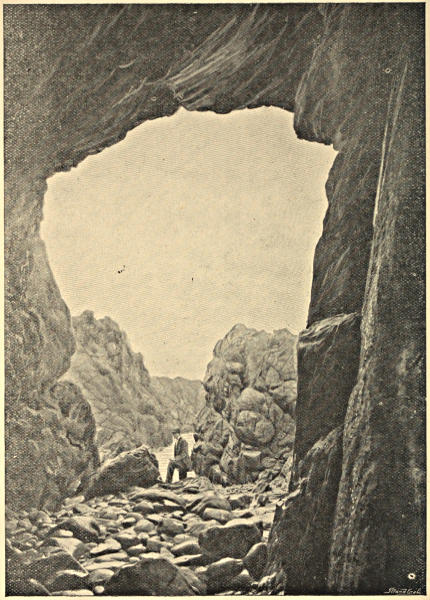
Creux des Fâïes.
“Yon old grey stone, protected from the ray
Of noontide suns.…
And thou, grey stone, the pensive likeness keep
Of a dark chamber where the mighty sleep:
Far more than fancy to the influence bends
When solitary nature condescends
To mimic time’s forlorn humanities.”
—Wordsworth.
“This is the fairy land: oh spight of spights
We talk with goblins, owls, and elvish sprites.”
—Shakespeare.
There are many spots in Guernsey connected
with stories and legends besides the Druidical
remains. The caverns of the Creux des
Fées and Creux Mahié; the various curiously shaped
rocks, formed by the hand of Nature, or by the
wearing action of the waves; the marks of footprints,
whether human or diabolical, on various stones; and
above all the sacred fountains, which are still regarded
as medicinal, have given rise to many a tradition,
which, though they lose much of their charm from
being translated from the quaint Guernsey French
in which they are originally related, we will here
endeavour to render.
Between the bays of Vazon and Cobo is found the
peninsula of Houmet, and here is situated the “Creux
des Fées.” It is a small cavern, worn away by the
action of the sea. The granite surrounding its mouth
abounds in particles of mica, which glitter in the sun
like streaks of gold. It can only be approached at
low tide, and necessitates much scrambling over the
rocks which are heaped round the mouth of the
grotto. It is said that by a hole not larger than
the mouth of an oven, you gain access to a spacious
hall, hollowed out of the rock, that in the middle of
this hall is a stone table on which are dishes, plates,
drinking cups, and everything necessary for a large
feast, all in stone, and all used by the fairies, but
no one has had the courage to penetrate inside and
test the truth of this assertion. It is also believed
that beyond it there is a subterranean passage which
leads to the bottom of St. Saviour’s Church, which
is distant more than two miles. This tradition of a
subterranean passage leading to a church at a considerable
distance is told of other caverns in Guernsey.
Of the Creux Mahié, where there is also said to be
a passage leading to St. Saviour’s Church, of a large
cave in Moulin Huet Bay, which is supposed to lead
to a passage going straight to St. Martin’s Church,
and one at Saints’ Bay, also supposed to lead to St.
Saviour’s Church.
Editor’s Note.—“Le groupe le plus important de demeures de fées que j’aie rencontré est
celui des Houles (l’anglais hole, caverne, grotte).” … “Elles se prolongent sous terre si
loin, que personne, dit-on, n’est allé jusqu’au fond … parfois on les appelle Chambres
des fées. Il y en a où l’on voit, dit-on, des tables de pierre sur lesquelles elles mangeaient,
leurs sièges, et les berceaux en pierre de leurs enfants.”—Traditions et Superstitions de la
Haute Bretagne, p. 84.
The whole of the southern coast of Guernsey,
from Jerbourg, or St. Martin’s Point, to Pleinmont
in the parish of Torteval, is extremely precipitous,
but abounding in picturesque beauties of no common
character. Bold headlands, with outlying granite rocks
rising like pyramids and obelisks from the clear blue
sea, alternating with caves and bays to which access
is gained through deep glens and ravines, some richly
wooded, some hemmed in on both sides by rugged
hills, but through all of which a tiny rill of the
purest water trickles, keeping up a perpetual verdure—slopes
covered in early spring with the golden
blossoms of the gorse, in summer with the purple
bells of the heather, and in autumn with the rich
brown fronds of the withering bracken—cliffs mantled
in parts with luxuriant ivy, in other with many
coloured lichens, and out of every crevice of which
the thrift, the campion, and other flowers that delight
in the vicinity of the sea, burst in wild profusion—all
combine to form pictures which the artist and
the lover of nature are never tired of studying.
The constant action of the waves for unnumbered
centuries has worn out many caverns in these cliffs,
the most considerable of which is that known by
the name of “Le Creux Mahié,” or as some old
writers wrote it “Mahio,” and it undoubtedly took
its name, so says Mr. Métivier, from its ancient
proprietor, the king of the infernal regions.
“The Prince of darkness is a gentleman;
Modo he’s called and Mahu.”
—King Lear. Act 3, Sc. 4.
The Hindoos have the same name in their Maha-Dêva,
a giant of the family of the dives or demons.[65]
In the province of Mayo, there is a Sorcerer or
Druid, the Priest of Mayo, who lives in a cavern,
and is called “the King of the Waters.”
It is also sometimes called “Le Creux Robilliard,”
from a family of that name on whose property it
was situated. It lies in the parish of Torteval, and
is reached by a narrow pathway, winding down the
almost precipitous side of a steep cliff, into a small
creek worn out by the sea between the headlands.
The cave itself, there can be no doubt, must have
been formed by the waves wearing away gradually a
vein of decomposed rock, softer than that which
forms the sides and roof. At some remote period a
large portion of the rock which forms the roof of the
cavern has given way, and has partially blocked up
the entrance, leaving only a long low fissure through
which access can be had to the interior, and forming
a sort of platform of solid stone, which effectually
cuts off any further encroachment on the part of the
sea. A steep descent over broken fragments of rock
leads down to the floor of the cave, which appears
to be nearly on a level with the beach at the foot
of the platform. A glimmering light from the
entrance enables one to see that the rock arches
overhead in a sort of dome, and a bundle of dry
furze or other brushwood, set on fire, lights it up
sufficiently to bring out all the details. It is a weird
sight; as the flickering flames illumine one by one
the various masses of rock that are piled up to the
roof at the extremity of the cavern, and disclose the
entrances to two or three smaller caves. These are,
in reality, of no great depth, but they are sufficiently
mysterious to have given rise to more than one report
concerning them, and there are but few of the peasantry
who would be bold enough to attempt to
explore their recesses. It is firmly believed by them
that there is a passage extending all the way under
ground as far as the Church of St. Saviour’s, about
a mile distant as the crow flies; and it is also
affirmed that there is an entrance through a small
hole to an extensive apartment, in the midst of
which stands a stone table, on which are set out
dishes, plates, drinking vessels, and other requisites for
a well-served feast, all of the same solid material.[66]
There are obscure traditions of the cavern having
been at some early period the resort of men who
lived by stealing their neighbours’ sheep, and plundering
their hen-roosts, but these traditions cannot be traced
to anything more definite than what is commonly
alleged of all such places, neither are the tales told
of its having been the resort of smugglers more to
be relied on. The difficulty of access to it, either by
sea or land, makes it very improbable that it should
have been used for this purpose; besides, in former
days, Guernsey was a perfectly free port, nothing that
entered was subject to any duty that it would have
been profitable to evade, and before the establishment
of a branch of the English Custom House, all exports
could be made without the troublesome formalities of
clearance and declaration now required. Of late years
the smuggling of spirits into the island in order to
avoid payment of the local dues in aid of the public
revenue, has been carried on to rather a large extent;
but this has taken place on more accessible parts of
the coast. Possibly, however, tobacco made up in
illegal packages, which would subject it to seizure if
found waterborne, may occasionally have been deposited
here for a time, until it could be carried off
secretly to the French vessels passing the island in
their coasting voyages between Normandy and Brittany.
In a letter dated May, 1665, to one of his friends
in Guernsey, from the Rev. John de Sausmarez,
who, on the restoration of Charles II., was appointed
Dean of the Island, and subsequently Canon of
Windsor, he alludes to “Le prophète du Creux
Robilliard.” Who this prophet was does not appear,
but there is every reason to believe that the allusion
is to the Rev. Thomas Picot, Minister of the then
united parishes of the Forest and Torteval, in the
latter of which the Creux Mahié—alias Robilliard, is
situated; for in the Assembly of Divines held at
Westminster in 1644, articles were exhibited against
this clergyman for troubling the Church discipline
established in the island, preaching Anabaptist doctrines,
and prophesying that in 1655 there should be
a perfect reformation, men should do miracles, etc.
This conjecture receives some slight confirmation from
the fact that it is still remembered in the Forest
parish that a Minister of the name of Picot was fond
of retiring to caves on the sea-shore for meditation,
and one of these caves in particular, that well known
one in Petit Bot bay with a double entrance, is still
known by the name of “Le Parloir de Monsieur
Picot.”

“Le Petit Bonhomme Andrelot, ou Andriou.”
“Screams round the Arch-druid’s brow the seamew—white
As Menai’s foam.”
—Wordsworth.
One of the earliest forms of idolatry is undoubtedly
that which was paid to rude stone pillars. These,
whether erected for the purpose of marking the last
resting place of some renowned patriarch or warrior, or
set up with the design of indicating a spot specially
appropriated to religious rites, or perhaps, simply as
a boundary or landmark, came to be regarded, at first,
as sacred, and in process of time, as a symbol of
the Deity himself. Gradually any elevated rock,
and especially if it presented a striking and unusual
appearance, was looked upon with veneration. We
find that this was particularly the case in the north
of Europe, and that the hardy mariners who navigate
the tempestuous seas of Scandinavia, are, even now,
in the habit of paying a sort of superstitious respect
to the lofty “stacks,” as the isolated masses of rock
are called, which form the extremity of many of the
headlands, and that, in passing, they salute them,
and throw old clothes, or a little food, or a drop
of spirits, into the sea, as a sort of propitiatory
offering. It is strange to find that the same custom
still exists in Guernsey, notwithstanding that a
thousand years or more have elapsed since the
Northmen first invaded these shores.
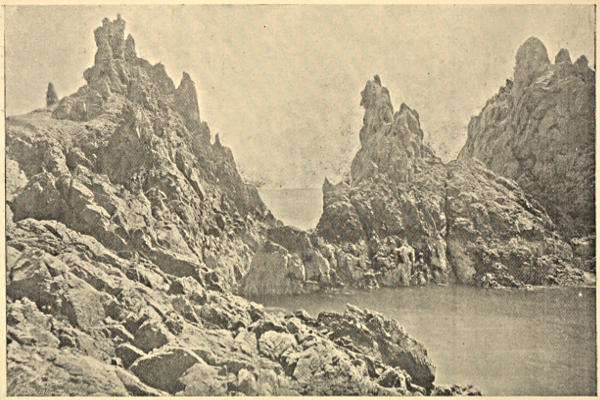
“Le Petit Bonhomme Andrelot, ou Andriou.”
Everyone who has visited Guernsey must know the
lovely bay of Moulin Huet,[67] and the remarkable
group of rocks, which stretches out into the sea at
its eastern extremity beyond the point of Jerbourg.
These rocks are called “Les Tas de Pois d’Amont,”
or “The Pea-Stacks of the East.” There being a
chain of rocks off Pleinmont which are called the
“Tas de Pois d’Aval”—the westerly Pea-Stacks—“Amont”
(meaning “en haut”) is the Guernsey word
for east, aval meaning “en bas,” their word for west.[68]
Each rock composing the Tas de Pois d’Amont has
its own special name. They are “Le Petit Aiguillon,”
“Le Gros Aiguillon,” “L’Aiguillon d’Andrelot,” ou
“du Petit Bon-Homme.”
The united and increasing action of the winds and
waves has worn the hard granite rock into the most
fantastic forms, and from certain points of view it
is not difficult to invest some of these masses of
stone with a fancied resemblance to the human form.
One of them in particular, when seen at a certain
distance, has all the appearance of an aged man
enveloped in the gown and cowl of a monk.
So singular a freak of nature has not escaped the
attention of the peasantry, and the rock in question
is pointed out by the name of “Le Petit Bon-Homme
Andriou.” The children in the neighbourhood have a
rhymed saying:
which may be translated
“Andriou, watch all,” or “over all,”
and the fishermen and pilots who frequent these parts
of the coast show their respect by taking off their
hats when passing the point, and are careful to insist
on the observance being complied with by any stranger
who may chance to be in their company. Formerly
it was not unusual with them, before setting sail, to
offer a biscuit or a libation of wine or cider to “Le
Bon Homme,” and, if an old garment past use chanced
to be in the boat, this was also cast into the sea.[69]
There are other rocks on the coast which the
fishermen are in the habit of saluting without being
able to give any reason why they do so; and it is
not impossible that the honour paid to the little
island of Lihou,[70] on the western coast of Guernsey,
by the small craft, in lowering their topmasts while
passing, may have originated in the same superstition,
although it is generally supposed that they do it out
of reverence to the Blessed Virgin, the ruins of
whose Chapel and Priory are still to be seen on the
isle. The circumnavigation of a certain rock by the
fishermen of the parish of St. John, in Jersey, on
Midsummer Day, may, perhaps, be traceable to the
same source.
“La Roque Mangi.”
La Roque Màngi was a natural granite formation
having a very artificial aspect. It stood on one of
those sandy downs which extend along the north-west
coast between “Le Grand Havre” and “Les
Grand’ Rocques,” and consisted of a slender upright
mass of rock of from eight to ten feet in height,
surmounted by a large stone, projecting about half a
foot on every side, resting on the narrowest part of
the supporting stone, and looking at a little distance
like a petrified giant. It was destroyed by the
proprietor of the land about the middle of the
present century in the hopes of finding below it a
profitable quarry of granite, in which, however, he was
disappointed.
Of this rock a curious legend was related by the
neighbouring peasants. It was said that the Devil,
having quarrelled one day with his wife, tied her by
the hair of her head to the upright stone, and that,
in her frantic efforts to disengage herself by running
round and round, she wore away the solid granite to
the narrow neck which supported the superincumbent
head.[71]
The origin of the name seems doubtful, some
tracing it to a family of the name of Maingy, who
possessed land in the parish in which the rock was
situated. Others, with more probability, attributing it
to the “eaten”—“mangé”—(in the local dialect
“màngi”) appearance of the stones, where the upper
one or head joined the supporting upright.
“La Chaire de St. Bonit.”
This was also called “La Chaire au Prêtre,” and
was situated in the district of the Hamelins, a little
to the north of the property known as St. Clair. It
was a very regularly formed natural obelisk of about
eight to ten feet in height, rising from the summit
of one of those hillocks, or “hougues” as they are
locally called, which, before the great granite industry
took its rise, abounded in St. Sampson’s and the
Vale parishes, and along the whole western coast. At
the foot of the upright rock was a large flat stone,
giving the whole mass the appearance of a gigantic
chair or pulpit. Seven stone hatchets have been
unearthed in its vicinity. It was evidently used by
the Druids as one of their sacred chairs, in which
their Pontiffs sat to instruct the people. It is probable
that towards the end of the seventh century, St.
Bonit, Bishop of Auvergne, who was known to have
been a great traveller, visited the land previously
converted by St. Samson, St. Magloire, St. Paterne,
and St. Marcouf, and sat and preached to the people
in this erst-while Druid’s throne, which henceforth
bore his name.
“La Rocque ou Le Coq Chante.”
This very singular name is given to a picturesque
mass of rock which forms the termination of a hill
in the parish of Ste. Marie du Castel, and abuts on
the road leading from the village of Les Grands
Moulins—better known as The King’s Mills—to Le
Mont Saint. Mr. Métivier gives as his explanation
of this name that all this region—from the Mont-au-Nouvel
(now called Delancey Hill) to the Castiau
Roc—was the centre of the Druids and their observances.
“The Eagle,” “The Cock,” “The Partridge,”
“The Curlew,” were the names of various degrees in
Theology[72] among the Druids and among the western
sun worshippers. This “Coq” was the Prophet, the
“Magician,” of the Canton. The Arch-Magician of
the King of Babylon was Nergal or “Le Coq.” It
is said to be a very favourite haunt of the fairies
and witches, and it is commonly reported that an
immense treasure lies concealed within it. In olden
days it was the fashion to walk round it, stamping at
the same time, the soil resounded under their feet,
they heard, or thought they heard, the monotonous
sound of a bell, tolling a far-away knell, and hence
the belief of a subterranean fairy cavern and hoards
of concealed treasure.[73]
Inscribed Stone.
Old people say that there was formerly a very large
stone in St. Andrew’s parish on which was engraven
an inscription in ancient characters. Some men who
passed it every day in going to their work at last
succeeded in deciphering it, and read as follows:—
“Celui qui me tournera
Son temps point ne perdra.”
(To him who turns me up, I say,
His labour won’t be thrown away).
This inscription roused their curiosity, and they
determined on making a strong effort to raise the
stone, fully persuaded that it concealed an enormous
treasure. They procured crowbars and levers, and, at
last, with much labour and great loss of time,
succeeded in lifting it, but who can describe their
disappointment when they found nought but the
following words, legibly engraved on the other side:—
“Tourner je voulais
Car lassée j’étais.”
(Tired of lying on one side
To get turned over long I’ve tried).
[74]
Footprints on Stone.
A little inland, about halfway between the points of
land which are the northern and southern extremities
of the picturesque bay of Rocquaine, there is a rocky
hillock known generally by the name of “Le Câtillon,”
probably from some small castle or fortification which
may have existed there in former days. Old people
say that the true name of the hill is “La Hougue
ès Brinches,” from the broom which once grew there
in large quantities. At the foot of this hillock, on the
northern side, there is a flat stone imbedded in the
earth, and on it are the marks of two feet, pointing
in opposite directions, as if two persons coming, one
from the north, and the other from the south, had
met on this spot and left the impress of their footprints
on the stone. Of course a story is not wanting to
account for these marks. It is said that the Lady of
Lihou and the Lady of St. Brioc (or some say the
Abbess of La Haye du Puits) had a dispute as to the
limits of their territorial possessions, and that, in order
to settle the question, they agreed to leave their
respective abodes at a certain hour before breakfast,
and walk straight forward until they met. The spot
where the meeting took place was to be henceforth
considered as the boundary, and to avoid any further
disputes a lasting memorial was to be placed on the
spot.
If the country people are asked who these “Ladies”
were, they can give no further information about them,
but they evidently consider them to have belonged to
the fairy-folk, who have left behind them so many
traces of their former occupation of the island.
Antiquaries are disposed to look upon the stone as
having been placed there to mark the boundary line
between the Priories of Notre Dame de Lihou and St.
Brioc.
Another story of this rock is that at Pleinmont lived
a hermit who was much respected by all the island,
and many people came to visit him in his cell, which
he never left, except to administer the Holy Sacrament
to the dying. He used to be seen kneeling for hours
at the foot of a cross upon the cliff; but one night a
fisherman, anchored in Rocquaine Bay, saw by the
moon’s light this hermit cross the sands and meet a
tiny shrouded figure which came from the direction of
Lihou. They met on this rock, and stood talking there
for some time, and then each returned the way he
came, and in the morning, when the fisherman came
to examine the place, he found the print of two feet.
He could not make himself believed when he told
the story, until it was discovered that the hermit
had disappeared, never to be seen again.[75]
In the year 1829 a large quantity of coins,
amounting, it is said, to nearly seven hundred in
number, were dug up at no very great distance from
this stone. The greater part were silver pennies, but
there were a few copper pieces among them; they were
of the reigns of Edward II. of England, and Philip
IV. of France. The discovery of this treasure induced
some men who lived in the neighbourhood to seek for
more, and, under the firm persuasion that the most
likely spot to find it was under the stone itself,
they resolved on braving the danger which is supposed
to be incurred by removing stones which have been
placed by the fairies, and devoted a whole morning to
clearing away the ground around it with a view to
lifting it. They had, with great labour, succeeded in
loosening the stone just as the sun in its zenith
marked the hour of noon, an hour when all good
workmen cease from their toil to eat their frugal
mid-day repast, and to enjoy their siesta under the
shelter of a hedge. They felt sure of success, and
probably dreamt of the uses to which they would put
their treasure, but, alas, for their hopes. When they
returned to their work at one o’clock, they found
the stone as firmly fixed as ever, and resisting
their utmost efforts to remove it. They were more
convinced than ever that immense riches lie buried
in this spot, but that it is useless to seek for them,
and none since that time have been bold enough to
renew the attempt.[76]
In the Vale parish there is a large tract of
uncultivated land commonly known by the name of
L’Ancresse Common. It is said to owe its name of
L’Ancresse—the anchoring place—to the circumstance
of the neighbouring bay having afforded a refuge to
Robert the First, Duke of Normandy, and his fleet,
when in danger of perishing in a violent tempest.
Our learned antiquary, Mr. George Métivier, is rather
disposed to derive the name from the Celtic “Lancreis,”
“the place of the circle,” so many Druidical
remains being still to be found on the common as to
render it highly probable that one of those circular
enclosures, formed of upright stones, in which the
Druids are supposed to have held their sacred
assemblies, formerly existed here. Along the sea-coast
are many eminences, known locally by the name
of “hougues.” Their height is not great, but they
form picturesque objects in the landscape. Here and
there large masses of grey granite covered with lichens
rise in irregular forms above the green sward, gay in
spring with the bright flowers of the furze and bluebell,
and redolent with the sweet perfume of the wild
thyme and chamomile. In some of these rocks may
be traced those curious excavations known by the name
of rock basins, which antiquaries have considered as
artificial, but which geologists are ready to prove to
be the work of nature.
Of late years many of these hougues have been
quarried for the sake of the stone, which is preferred
in London to all others for paving purposes, and if
the demand should continue many of these hills will
be entirely levelled, and with them will disappear some
of the most characteristic features in the scenery of that
part of the island. While writing (1853), La Hougue
Patris is advertised for sale, and stress is laid in the
advertisement on the excellent quality of the stone
which it contains. This hougue is situated on the
north eastern extremity of L’Ancresse Bay, and is
remarkable from the circumstance that a portion of
the rock, where it appears above ground, bears marks
precisely similar to those which would be left by the
hoof of an ox on wet clay. So remarkable an
appearance has of course attracted the attention of
the neighbouring peasants, who call the rock which
bears the impression “Le Pied du Bœuf.” Some old
people relate that the Devil, after having been driven
from the other parts of the island by a Saint whose
name is now forgotten, made a last stand on this
spot, but that, after a long and desperate conflict, his
Satanic Majesty was at last constrained to take flight.
In leaping, he left the marks of his hoofs imprinted
on the stone. He directed his flight towards Alderney,
but on his way thither alighted on the Brayes rocks,
where, it is said, similar marks of cloven feet are
to be seen. Whether he got beyond Alderney, or
settled down quietly in that island, is a point on
which the narrators of the tradition are by no means
agreed.
Did we not know that a family of the name of
Patris was formerly numerous in the Vale parish,[77] and
that there is every probability that the Hougue derived
its name from some member of that family, to whom,
in ancient days, it may have belonged; we might be
tempted to suppose that the valiant Saint who forced
the demon to fly was no other than the renowned St.
Patrick himself, especially as, according to some
accounts, the Saint was a native of a village in the
neighbourhood of the town of St Maloes, within eight
or ten hours of this island.
It is true that, with all the self-conceit of the
nineteenth century, we are apt to suppose that before
the establishment of packets and steamers, communication
between the opposite coasts of the Channel was
difficult and infrequent, but we have only to open the
lives of the British and Irish Saints to see with what
ease and rapidity these holy men effected the voyage,
with no other conveyance than a stone trough, a
bundle of sea-weed, or perchance a cloak spread out
on the boisterous waves.
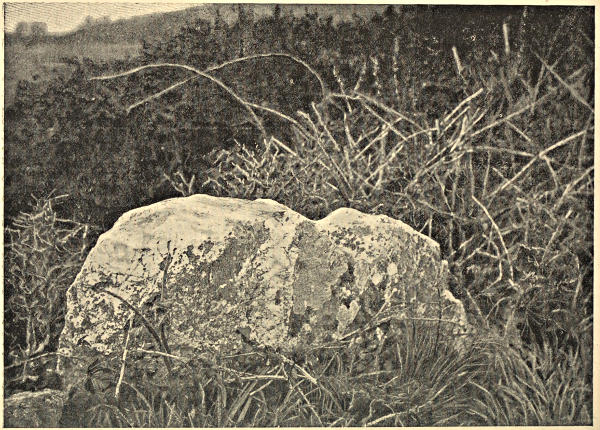
“The Devil’s Claw” at Jerbourg.
As the inhabitants of Guernsey may be presumed to
be acquainted with the Chronicles of their own Duchy
of Normandy, it is not improbable that the following
legendary tale, related of Duke Richard, surnamed
Sans-Peur, may be known to some of them.
The Chronique de Normandie, printed at Rouen in
1576, gives it in words of which the following is a
close translation. (Fol. 4. Sur l’an 797). “Once upon
a time, as Duke Richard was riding from one of his
Castles to a Manor, where a very beautiful lady was
residing, the Devil attacked him, and Richard fought
with and vanquished him. After this adventure the
Devil disguised himself as a beautiful maiden, richly
adorned,[78] and appeared to him in a boat at Granville,
where Richard then was. Richard entered into the
boat to converse with and contemplate the beauty of
this lady, and the Devil carried away the said Duke
Richard to a rock in the sea in the island of
Guernsey, where he was found.”
He is supposed to have anchored at La Petite
Porte and leapt up the cliff and landed on the
stone near Doyle’s Column at Jerbourg, where the
print of his claw is still to be seen. As you go
along the road from the town to Doyle’s Column you
see a large white piece of quartz with a deep black
splash right across it. It is on the right hand side
of the road, just as it begins to rise towards Doyle’s
Column, at the head of the second vallum, or dyke,
going down towards La Petite Porte. This stone was
also the termination of the bounds at Jerbourg beaten
by the Chevauchée de St. Michel.
In former days that tract of land lying between
St. Sampson’s Harbour and the Vale Church, and
known by the name of “Le Braye du Valle,” was
an arm of the sea, which at high water separated
that part of the Vale parish called “Le Clos du
Valle” from the rest of the island. At the beginning
of the present century, Sir John Doyle, then Lieut.-Governor
of the island, seeing the inconvenience that
might arise from the want of a ready communication
with the mainland, in the event of an invading enemy
effecting or attempting a landing in L’Ancresse Bay,
caused the dyke near the Vale Church to be built.
The land recovered from the sea became of course the
property of the Crown, and was subsequently sold to
private individuals, the purchase money being given up
by Government to be employed towards defraying the
expenses of constructing new roads throughout the island.
Where fishes once swam, and where the husbandman
once gathered sea-weed for the manuring of his land,
droves of cattle now graze, and fields of corn wave.[79]
From the very earliest times, the want of an easy
communication between the neighbouring parishes
must have been felt, and attempts had been made
to remedy the inconvenience by the erection of rude
bridges. It would be strange, if the Devil, whose
skill in the construction of bridges in every part of
Europe has certainly entitled him to the honourable
appellation of Pontifex Maximus, had not had a hand
in building one of the three principal passages across
the Braye du Valle. Accordingly we find that the
dyke at St. Sampson’s Harbour, known by the name
of “Le Grand Pont,” is also called “Le Pont du
Diable,” and old people affirm that it has been handed
down as a tradition from their forefathers, that shortly
after the building of the Vale Castle, the Devil threw
up this embankment, in order to enable him to cross
over to that fortress with ease and safety.
Perhaps the bridge may have been built by order
of Robert the First, Duke of Normandy, father of
William the Conqueror, sometimes called “Robert le
Magnifique,” but quite as well known by the less
honourable cognomen of “Robert le Diable,” and, if
in the absence of documentary evidence, any reliance
is to be placed in the tradition hitherto generally
received that the Vale Castle, if not originally built,
was at least considerably improved and strengthened
by this Prince, it is certainly not going too far to
suppose that the bridge may owe its name to him,
and not to his Satanic Majesty.
One observance connected with this bridge is worth
mentioning. From time immemorial persons from all
parts of the island have been in the habit of
assembling here on the afternoons of the Sundays in
the month of August. No reason is assigned for this
custom, but as Saint Sampson is looked upon as the
first Apostle of Christianity in this island, and as the
church which bears his name is said to have been
the first Christian temple erected in the island, and
is, in consequence, considered in some respects as
the mother church, may not this assembly be the
remains of a church-wake, observed in ancient times
on the Sunday following the feast of St. Sampson,
that is to say, the 28th of July.
Similar meetings are common in Normandy and
Brittany, where they are called “assemblies” and
“pardons.”
The two other principal passages across the Braye
du Valle were the bridges called “Le Pont Colliche”
and “Le Pont St. Michel.” They consisted of rude
slabs of stone resting on huge blocks of rock, and
were dangerous, both from the sea-weed which attached
itself to them, and rendered them exceedingly slippery,
and also from the rapidity with which the tide, when
rising, flowed in, for both of them were covered at
high water. Many and sad were the accidents which
had happened to incautious and belated passengers,
and it is not wonderful that superstition believed
these spots to be haunted by the ghosts of those
who had perished in attempting the crossing. The
“Pont St. Michel,” situated near the Vale Church,
where the embankment now is, was held in especial
dread. At night the “feu bellenger” or will-o’-the-wisp,
was to be seen dancing on the sands, and
gliding under the bridge, and even at mid-day, when
the sun was shining brightly, unearthly cries of distress
would be occasionally heard proceeding from that
direction, though no living being could be discovered,
by whom they could possibly be uttered.
An old woman, still alive, whose youth was spent
in that neighbourhood, has assured me that she has
repeatedly heard the cries.
“Le Pont Colliche” was situated about midway
between the two others, a little to the eastward of the
road which now traverses the Braye. According to
tradition, there was once a time when the opening at
the “Bougue du Valle”—the channel between the
Grand Havre and the Braye—was so small that a
faggot, weighted with stone, would have sufficed to
stop it.
At that time the passage between the islands of
Herm and Guernsey was so narrow that a plank laid
down at low water enabled the Rector of St. Sampson’s
to cross over when his duty called him to perform
divine service in the Chapel of St. Tugual. Great
quantities of the common cockle (cardium edule),
locally known by the name of “cocques du Braye,”
used to be gathered on the sands at low water. It
is said, however, that even before the enclosure of
the Braye they had begun to disappear, and their
increasing scarcity was attributed to the impiety of an
old woman, who, unmindful of the sacred duty of
keeping the sabbath holy, was in the habit of
searching for these cockles on that day. A similar
story is told to account for the rarity of a particular
kind of periwinkle (trochus crassus) known here by
the name of “Cocquelin Brehaut.”
A stone, which has evidently served as the socket
or base of a cross, and which is said to have come
from the Pont Colliche, is still preserved at Les
Grandes Capelles.
“Ah me! for aught that ever I could read,
Could ever hear by tale, or history,
The course of true love never did run smooth.”
The promontory of Pleinmont forms the south-western
extremity of the island of Guernsey, and, to
the admirer of the wild and rugged beauties of cliff
and rock scenery, affords an ever-varying treat. Lofty
precipices, in which the sea-birds and hawks nestle—huge
masses of granite piled into fantastic forms—covered
with grey and orange-coloured lichens, and
gay with the flowers of the thrift and other sea-side
plants, large rocks detached from the main-land and
tenanted by long rows of the sun-loving cormorant,
the ever-restless ocean, now smiling and rippling
under a summer sky, now lashed into fury by the
wintry blast, all combine to add to the charms of
this district.
Many accordingly are the parties which frequent
this spot during the summer, and it is probable that
some of those who have visited this place may
remember a small promontory almost detached from
the mainland, and forming the westernmost point of
the island. To the southward of this promontory
there is a sort of ravine, extending from the table-land
of Pleinmont to the edge of the cliff, where a
small breastwork of earth and stones has been erected.
The reason why this spot, which is by no means the
most dangerous along the coast, has been thus
protected, is not very apparent. The existence of a
small spring of water in the ravine, which keeps up
a constant verdure and tempts the cattle turned out
to pick up a scanty living on the common to the
place, suggests a probable solution of the question;
but the tradition of the peasantry assigns a far more
romantic reason for the erection of the parapet than
the mere safety of a few stray heifers.
They say that in days long past, the son of a
farmer in the neighbourhood formed an attachment
for the daughter of a family with whom his own
was at variance. His affection was returned by the
maiden, and the wishes of the lovers might, in the
end, have triumphed over the opposition of the
parents, had not the hand of the girl been promised
by her friends to one of the richest men in the
parish. In vain did the unhappy maiden urge the
cruelty of forcing her into a marriage which her heart
abhorred. In vain did her lover employ every means
in his power to break off the hated contract. Their
prayers and representations were treated with scorn,
and the preparations for the marriage were proceeded
with. The eve of the day appointed for the solemn
espousal—a ceremony which in ancient times preceded
and was distinct from that of marriage—had arrived.
The lovers met by stealth on the cliffs at Pleinmont,
and, driven to despair, mounted together on a horse,
which they urged into a gallop, and, directing him
down the ravine, they fell over the precipice and
perished in the waves below. To commemorate the
event, and to prevent the recurrence of a similar
catastrophe, the barrier was erected.[80]
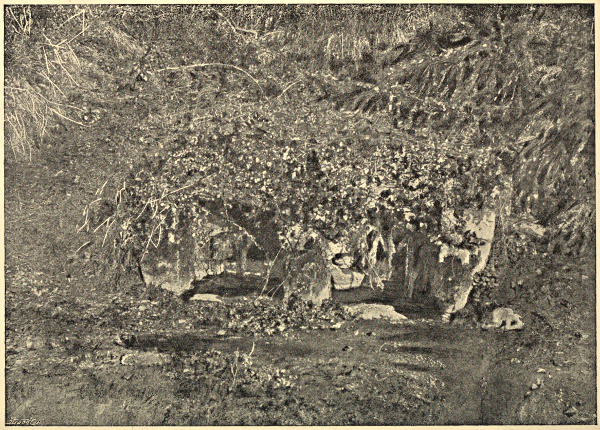
“Les Fontaines de Mont Blicq, Forest.”
“Thereby a crystal stream did gently play,
Which from a sacred fount welled forth alway.”
—Spenser.
“For to that holy wood is consecrate,
A virtuous well about whose flowery banks
The nimble-footed fairies dance their rounds
By the pale moonshine, dipping often times
Their stolen children, so to make them free
From dying flesh and dull mortality.”
—Fletcher’s “Faithful Shepherdess.”
Though not strictly speaking “Folk-Lore,”
the ancient priories and chapels of Guernsey
are so closely connected with the holy
wells that it may be as well here to give some
details concerning them. It appears that these
chapels must have been of more than one kind.
Some were endowed, and had a priest permanently
attached to them with probably a certain cure of
souls. Others were most likely wayside oratories,
where divine service was only performed occasionally
by the rector of the parish, or someone acting under
him, on certain anniversaries. Some may have been
connected with religious guilds or fraternities.
To begin with those churches and chapels known to
have been endowed, and which were probably—at least
after the suppression of alien priories—under the
patronage of the Crown.
A Commission was appointed in the reign of Henry
VIII. for the purpose of ascertaining the value of all
livings within the kingdom, with a view to the duty
called first-fruits, owing on the appointment of every
ecclesiastic to a benefice, being henceforth paid to the
Crown. From this document we learn that besides
the ten parochial churches there were four other
benefices—the vicarage of Lihou worth five pounds
sterling, that of St. Brioc worth twelve shillings, the
chaplaincy of St. George worth sixty shillings, and
that of “Our Lady Mares,” no doubt Notre Dame
des Marais, worth three pounds.
The first of these four, Lihou, was originally a priory
dependent on the Priory of St. Michel-du-Valle, which
was of itself a dependency of the great Abbey of Mont
St. Michel in Normandy. The Prior of Lihou had
probably pastoral care of the district comprised in the
Fief Lihou, extending along the coast called Perelle,[81]
from L’Erée to Rocquaine Castle, where the district of
St. Brioc begins. It also comprised certain possessions
in the Castel parish and elsewhere, and its feudal court
was held near the western porch of the Castel Church,
a little northward of the path leading to it, where are
still to be seen three flat stones, which mark the spot.
St. Brioc was situated in the valley leading from
Torteval Church to Rocquaine. There is reason to
suppose that it had a certain district allotted to it,
but its limits are not now known.
St. George was only a chaplaincy, intimately connected
with the Fief Le Comte, the court of which
formerly assembled in the chapel, and still meets in
its immediate vicinity. The earliest notice we have
of this chapel is contained in the Bull of Pope
Adrian IV., dated 1155. In the year following Dom
Robert de Thorigny—or, as he is sometimes called,
“Du Mont”—abbot of the famous monastery of
Mont St. Michel, visited this island, and found one
Guillaume Gavin established at St. George as chaplain:
he was anxious to retire from the world, and, at his
request, the abbot admitted him into his community
as a monk, and appointed Godefroy Vivier to succeed
him as chaplain at St. George. After some time
Vivier followed the example of his predecessor,
and took the frock at Mont Saint Michel, having
previously made over certain lands which he possessed
in the neighbourhood of St. George to the abbey
which afforded him shelter.
In 1408 the chaplain was Dom Toulley, who
obtained an order from the Royal Court prohibiting
any one from trespassing on the road leading to the
chapel, it being reserved exclusively for persons
attending divine service, or sick people visiting the
fountain, the small coin left as an offering at the well
being doubtless a perquisite belonging to the chaplain.
This chapel was originally endowed with some lands
or rents, probably with the territory still known as
Le Fief de la Chapelle, which is one of the many
dependencies of the Fief Le Comte.
After the Reformation St. George became in some
way the property of the de Jersey family,[82] and by
the marriage of Marie de Jersey, an heiress, to
Jacques Guille, which took place about the middle of
the seventeenth century, it passed into the possession
of the latter family, by whom it is still held. This
Marie de Jersey made a gift of the chapel to the
inhabitants of the Castel in about 1675 to serve
as a school house. A more convenient building
was erected in 1736 on the site of an old mill, and
endowed with nine quarters of wheat rente by Marie
de Sausmarez, widow of Mr. William Le Marchant,
and the chapel ceased to be used as a school house.
Bickerings as to rights of way across the estate, under
the pretence that there was a thoroughfare leading
to a public building, ensued, even after the removal
of the school; so finally Mr. Guille ordered the
chapel to be demolished, and only a few ruins are
now left.
The Chapel of “Our Lady Mares”—Notre Dame
des Marais—is thus mentioned in the Extente of
Edward III., “Nostre Sire le Roy n’a rien des
vacations des eglises et chapelles, fors la Chapelle de
Nostre Dame des Maresqs qui vaut XXX lbts en
laquelle iceluy Roy doit présenter en tems de la
vacation, et l’Evesque de Coutance en a l’institution.”
The chaplain then in possession, 1331, was Robert
de Hadis.[83]
The other churches and chapels were not at this
time in the gift of the Crown, but belonged to alien
monasteries, Marmoutiers, Mont St. Michel, and
Blanchelande. The chapel itself was, there is very
little doubt, situated within the precincts of Le
Château des Marais, now better known as Ivy Castle,
and the Livres de Perchage of the Town parish of
the time of Elizabeth and James I. mention certain
fields in the vicinity as belonging to it.
The Hospice and Chapel of St. Julien was situated
at the bottom of the Truchot, in the district called
Le Bosq, close to the sea-shore. There are many
“St. Julians” in the calendar, one of them being
considered the special patron of travellers. In the
title of his Legende MS. Bodleian, 1596, fol. 4, he
is called “St. Julian the Gode herberjoue.” It ends
thus:—
“Therefore, yet to this day, thei that over lond wende
Thei biddeth Saint Julian anon that gode herborw he hem sende.”
Chaucer had the familiar attribute of St. Julian
before him when he described his “Francklyn” or
country gentleman:—
“An householder, and that a grete, was he:
Saint Julian he was in his own contré.”
The rock on which travellers to the island used to
land, now the foundation of the harbour, was “La
Roche St. Julien,” and probably the hospital, being
situated near a landing place, was intended as a refuge
for travellers, and therefore dedicated to him. This
chapel was founded in the year 1361, the thirty-fifth
of the reign of Edward III., at the time when Sir
John Maltravers was Governor of the islands. The
founder was a certain Petrus de St. Petro, or Pierre
de St. Peye, as we find it written in French. Permission
was granted him by the Crown to found the
said hospital or alms house for a master, brethren
and sisters, in a certain spot near Bowes (Le Bosq,—this
word was evidently Boués, Bois, a wood, with
which the word Bouët is also identical), in the parish
of St. Peter Port, and to endow it with twenty
vergées of land and eighty quarters of wheat rent,
out of which certain dues were to be paid to the
King. “La Petite École,” or parish school, which
has from time immemorial been situated in this
vicinity, was originally connected with St. Julian. It
is generally believed that the school was founded in
1513 by Thomas Le Marchant and Jannette Thelry,
his wife.
At the Reformation the chapel and hospital were
suppressed, and its revenues and possessions seized
by the Crown. The parishioners of St. Peter Port
complained to the Royal Commissioners of 1607 of
the alienation of this property, which they looked upon
as belonging to the parish, but their complaint was
not attended to. In the early part of the century
there were the remains of an old house, in a late
debased Gothic style of the fifteenth century, standing
at the bottom of Bosq Lane, which used to be looked
upon as the remains of a conventual building. The
house in question was a residence of a branch of the
de Beauvoir family, whose arms were carved in stone
over the principal entrance. The stones forming this
entrance were preserved, and are now in the ruins of
the Chapel of St. George.
With the exception of the Franciscan Friary, there
is no proof of any conventual establishments in the
island, though tradition points to La Haye-du-Puits
as being the site of an old convent. Doubtless in
early times, and before the English had lost Normandy,
the great monasteries which held lands in Guernsey
may have had priories here. Mont St. Michel we
know had the Priory of St. Michel du Valle, and
there is some reason to believe that Blanchelande also
had some establishment of the kind in the island.
How the Abbeys of Marmoutier, La Rue Frairie,
Croix St. Lenfroy and Caen, all of which had possessions
in the island, managed them, we have no means
of knowing, though it was most likely by the machinery
of a feudal court.
We will now speak of the Priories of St. Michel du
Valle and Notre Dame de Lihou.
A tradition, which may be traced up to the time of
Edward II., says that certain monks, driven from Mont
St. Michel for their dissolute lives, settled in the Vale
parish and founded an abbey about the year 968 A.D.
The same authority informs us that they reformed
their lives and became famous for their sanctity, and
that when Robert, Duke of Normandy, visited the
island in the year 1032, having been driven here by
stress of weather while on his way to England with a
fleet to the help of his nephew, Edward the Confessor,
he confirmed them in the possession of the lands they
had acquired. The same tradition also says that in
the year 1061 certain pirates attacked and pillaged
the island, and that their leader “Le Grand Geoffroy,”
or “Le Grand Sarasin,” had his stronghold on the site
of what is now the Castel Church. Complaint having
been made to Duke William, he sent over Samson
d’Anneville, who succeeded, with the aid of the monks,
in driving them out. For this service they were
rewarded by the Duke with a grant of one half of the
island, comprising, besides the Vale, what are now the
parishes of the Castel, St. Saviour’s, and St. Peter’s-in-the-Wood.
This grant they divided between them,
and the monks, in right of their priory, held that
portion of the lands which is still known as Le Fief
St. Michel. The rest is now comprised for the most
part in the Fiefs Le Comte and Anneville and their
dependencies. To the south-east of the Vale Church
is an old farm house which still bears the name of
L’Abbaye, and which, without doubt, occupies the site of
the original priory. Even at the present day, it is easy
to trace part of the walls of the earlier edifice, which,
however, was in a ruinous state as early as the reign
of Henry IV., for we find Sir John de Lisle, Governor
of Guernsey, writing to the Privy Council about the
year 1406 for permission to use the timber of the
building for the repairs of Castle Cornet, and alleging
in his letter that the priory had fallen into decay, and
giving as a reason for his request that in consequence
of the war it was impossible to procure timber either
from Normandy or Brittany.
The names of a few priors have survived. It is not
quite clear whether a certain Robert, whose name
appears as witness to the deed by which Robert,
Abbot of Mont St. Michel, during a visit which he
made to the island in 1156, appointed Guillaume
Gavin, monk, to the chaplaincy of St. George, was
Prior of the Vale or not. He is styled in the deed
Priest and Dean of the Vale (de Walo). In 1249
Henry, Canon of Blanchelande, was collated to the
Vale Church by special dispensation. About 1307
Johannes de Porta was prior (probably a Du Port, a
family of considerable antiquity in the island, and of
good standing). In 1312 Guillaume Le Feivre filled
the office. In 1323 Renauld Pastey was Prior of the
Vale, and had a lawsuit with the inhabitants of
that and other parishes concerning tithes. In 1331
there was another dispute concerning tithes, which was
referred to the arbitration of two monks, Guillaume
Le Feivre and Jourdain Poingdestre, who had both
formerly been priors. In the year 1335 Andreas de
Porta, 1364-68, Geoffrey de Carteret, and in 1365
Denis Le Marchant, clerk, was appointed seneschal of
the Court of St. Michel.
According to the ballad known as “La Descente
des Arragousais,” “Brégard”[84] was the monk in
charge of the priory in 1372, and by his intrigues
the Vale Castle fell into the hands of the enemy,
which was evidently a legend current at the time.
Guillaume Paul, alias Règne, in 1478, is the last prior
of whom we have found mention.
The Priory of Lihou, as has been already said, was a
dependency of St. Michel-du-Valle. The ruins of the
church and other buildings are still to be seen. The
former was entire at a time long subsequent to the
Reformation, and is said to have been destroyed at
the command of one of our Governors to prevent the
possibility of its serving as an entrenchment in case of
an enemy landing on the islet. It appears to have
replaced a still more ancient building, as many pieces
of Caen stone, with well-executed Norman mouldings,
are built into the walls. Probably the first building
had been destroyed in some of the many inroads to
which the island was subjected during the reign of
Edward III.
An incumbent of Lihou, with the title of prior,
existed until the time of the Reformation.
Now to come to the remaining chapels. The
Extente of Edward III. speaks of the King’s Chaplain,
John de Caretier, who received a salary out of the
revenues of the island, and was bound to say mass
daily for the King, and for the souls of his ancestors
either in the chapel of Castle Cornet or in the chapel
of His Majesty’s manor of La Grange. It is not
exactly known where this manor was situated, but as
the estate of the late John Carey, Esq., has always
borne this name—the Grange—it is reasonable to
suppose that it was thereabouts. The more so, as
Richard II. founded the Convent of Cordeliers or
Francisian friars on the ground now belonging to
Elizabeth College, probably then comprised in the
Grange estate. It must be said, however, that there
are also reasons for supposing that the King’s Grange
may have been situated elsewhere, probably in the
vicinity of the Tour Gand, a fortress which defended
the approaches of the town from the north, and this
opinion derives some support from the fact that the
Plaiderie, or Court House, is known to have existed
in ancient times in this locality, and that in the
middle ages a chapel was considered an almost
essential adjunct to a Court of Justice.
To return to the Convent of the Cordeliers, it is
known that the site of their church, called in Acts of
Court “La Chapelle des Frères,” is said to have stood
opposite to the entrance of Le Cimetière des Frères,
which was the burial ground belonging to this church,
and, together with the site of the church, a considerable
portion of land appears to have been alienated from
the college, probably by the arbitrary act of some
Governor of the island. The church consisted of a
chancel and nave, the latter, on the building being
given for the use of the college, serving as a school-room,
and the former being occupied by the master.
After its alienation the burial ground fell into the
hands of an individual of the name of Blanche, who
turned it into an orchard, but, a plague having broken
out in 1629, the Court made an order that all who
died of that disorder should be buried there, since
which time it has served for a cemetery for the Town
parish. How the burial ground attached to the Town
Church came to acquire the name of “Cimetière des
Sœurs” cannot now be known, as there can be no
doubt that from time immemorial it was no other
than the parochial cemetery. There is no document
known to exist which points to any conventual
establishment for females in the island, though there
are traditions to that effect. There was, however,
among many other fraternities, a “confrèrie de frères
et sœurs” connected in some measure with this
cemetery, and which may have given it the name.
At the Reformation the land and rents due to this
fraternity were seized by the Crown, and the list of
them is still preserved among the records at the
Greffe, with the following heading—“Confessions de
rentes dues aux frères et sœurs de la confrerye et
fraternité de la charité, fondeye pour la dilyvrance
des ames de purgatoyre, par les dis frayres et sœurs,
constytuée, establye et ordonnée, en la Chapelle de
Sepulcre estante dedans le cymetyere de St. Pierre
Port,” &c., &c.
This proves the existence of a chapel in the
churchyard, but whether it was the building known
by the name of “Le Belfroi,” and which was
demolished in 1787, cannot now be ascertained.
“Belfroi” is the name given in the mediæval ages
to a Town Hall. The edifice known by that name
in St. Peter Port belonged to the Town, and was
used latterly as a store-house for militia requisites.
It is described as having been built of stone, vaulted,
and divided into two apartments, an upper and a
lower, the latterly partly underground. Probably the
lower part of the building was used as a charnel
house, in which the bones of the dead, after they
had lain long enough in the ground to become quite
dry, were piled up; for, among the duties to be
performed by the officiating priest, we find that they
were required to chant a “recorderis” over the bones
of the dead. Such charnel houses are still very
common in Brittany, and many country places
throughout the continent.
Of the other chapels which existed in the Town
parish the memory even has perished. The estate
known as Ste. Catherine may possibly have derived
its name from a chapel dedicated to that virgin
martyr, but all that is known is that there was a
fraternity or religious association under the patronage
of this saint, which was endowed with wheat rents.
Some of the rents seized by the Crown, and afterwards
made over to Elizabeth College, were due to the
“Frerie de Ste. Catherine,” and possibly this body
possessed its own chapel. The site of the Chapel of
St. Jacques is well known, and traces of the foundations
were still to be seen till comparatively lately. It was
situated in a field on the Mon Plaisir estate, on the
right hand side of the lane which leads from the Rue
Rozel to the back of the Rocquettes, at the head of
a little valley, just where the roadway is at the lowest.
The orchard to the east of this spot, on the opposite
side of the lane, is still known by the name of Le
Cimetière, and human bones are still occasionally met
with in digging. It had some land attached to it by
way of endowment, which was sold by the Royal Commissioners
in the reign of Queen Elizabeth, as we learn
from the Livre de Perchage, temp. Elizabeth, in which
it is called “La Chapelle de l’ydolle, St. Jacques,”
and that Thomas Effard was in possession of land that
had belonged to it. From the same document we
learn that there was also a chapel called “La Chapelle
de Lorette,” which, there is reason to suppose, may
have been in the vicinity of Candie.
There was also a private chapel, of which we
should have known absolutely nothing but for an
old contract, still extant, of the early date of 1383,
by which Perrot and Jannequin Le Marchant[85] sell
a piece of ground for building purposes to Renolvet
Denys. One of the conditions attached to the sale is
that no edifice shall be erected on the land thus sold,
which can in any manner take away from the view,
or deprive the chapel of the manor and hall of the
vendors, of light. The property in question was,
without doubt, that to the south of the arch, leading
to Manor Le Marchant and Lefebvre Street, and it is
curious that the contract mentions the existence of a
vaulted gateway leading to the manor, at that early
period permission being given to the purchaser of this
ground to build over this arch. An archway still
exists in the locality, and continues to bear the name
of “La Porte,” as it did nearly five hundred years
ago.
Now, to come to the only chapel that still exists—Ste.
Apolline. There is no reason for supposing it to
be of such great antiquity as is generally believed. The
vault is pointed, and it is well known that the pointed
arch did not make its appearance in architecture until
the latter part of the twelfth century—say about 1160—whereas
all our parishes are named in documents
anterior to 1066. From the Cartulary of Mont Saint
Michel we learn that in the year 1054 William
Pichenoht, moved by compunction for the many and
great sins he had committed, and desirous of turning
monk, gave, with the consent of Duke William of
Normandy, his lands of La Perrelle with all their
appurtenances to the abbey. These lands were, no
doubt, leased out afterwards by the monks to various
individuals, the abbey retaining the “Seigneurie”
over the whole.
In October, 1392, a certain Nicholas Henry, of La
Perrelle, obtained the consent of the Abbot and monks
of Mont St. Michel, as Lords of the Manor, to the
endowment of a chapel which he had lately erected
on his estate, subject, however to the sanction of the
Sovereign as lord paramount. This permission was
granted by Richard II. in July, 1394. The charter
which is preserved among the island records at
the Greffe authorises Nicholas Henry to endow
the Chapel of Sainte Marie de la Perrelle for the
purpose of maintaining a chaplain who was to celebrate
a daily mass for ever, for the safety of the said
Nicholas Henry[86] and his wife Philippa, for their souls
after they should have departed this life, and for the
souls of all their ancestors, benefactors, and Christian
people generally. Beside the three vergées of land,
which are described as being bounded on the west by
the property of Guillaume Blondel, and on the east by
that of Thomas Dumaresq, both of which families are
still landowners in the district, Nicholas Henry also gave
to the chapel an annual wheat rent of four quarters
due on a piece of ground adjoining. The chapel once
established, other gifts were made from time to time
by pious individuals who took part in the daily service.
In 1485, Johan de Lisle, son of Colas, and Nicholas
de Lisle, son of Pierre, acknowledged in the presence
of the Bailiff and Jurats that they owed jointly the
yearly rent of a hen to the Chaplain of Notre Dame
de la Perrelle; and the latter acknowledged, moreover,
to the annual payment of one bushel of wheat. On
March 2nd, 1492, Henry Le Tellier, of St. Saviour’s,
also acknowledged that he owed two bushels of wheat
rent to Sire Thomas Henry, who is also mentioned
as Chaplain of St. Brioc, in 1477, and as Rector of
the Castel, in 1478. He was also styled in an
earlier deed, “Dom” Thomas, so was probably
also a Benedictine monk, and it is not unlikely
that he was grandson of the original founder of
this chapel. Its identity with the building still
existing is proved by an Act of the Royal Court
“en Plaids d’Héritage” of June 6th, 1452, in which
the chapel is spoken of as “La Chapelle de Notre
Dame de la Perrelle, appelleye la Chapelle Sainte
Appolyne.” It was then in the possession of Colin
Henry, son of Jacques, and grandson of Nicholas, who
is described as the founder of the chapel. Forty
years later it changed hands, and was in the possession
of the Guille family, perhaps by inheritance, for in
April, 1496, Nicholas Guille, son of Nicholas, of St.
Peter Port, sold the advowson of the chaplaincy to
Edmond de Chesney, Seigneur of Anneville, in whose
family it probably remained until they[87] sold their
possessions to the Fouaschin family, from whom they
came by inheritance into the family of Andros.[88]
We do not know how the name of Ste. Apolline
came to be associated first with that of the Blessed
Virgin, and then to have superseded it altogether.
Possibly because there were already no less than five
places of worship in the island under the invocation
of Our Lady—the Churches of the Castel, Torteval,[89]
and Lihou, and the Chapels of Pulias and Le
Château des Marais, commonly known as Ivy Castle.
Saint Apollonia, or in French, Ste. Apolline, is said
to have been a virgin of Alexandria, who was burned
as a Christian martyr in the year 249.
The chapel is twenty-seven feet long by thirteen
feet nine inches wide, and is built of rough unhewn
stone, except the heads of the doorways, the jambs
of the windows, and the corner stones of the edifice,
which appear to have been coarsely wrought. The
vault is in solid masonry of small stones cemented
with a strong mortar, and if it was ever slated or
tiled all traces of the covering have long since
disappeared. The interior is stuccoed, and was
originally adorned with mural paintings, of which
some slight traces are yet to be seen. Figures of
angels, and part of a group which seem to have been
intended to represent the nativity of our Saviour, are
still to be made out. There are three small narrow
square headed windows, which may or may not once
have been glazed—one in the east gable immediately
above where the altar must have stood, and the other
two in the north and south walls, near the east end
of the building. There is no opening whatever in the
western gable, which was surmounted originally by a
bell-cote, of which the base only now remains. The
hole through which the bell rope passed is still to
be seen in the interior. To the south of the chapel
is a very ancient and substantially built farm-house,
which is traditionally said to have been the residence
of the officiating priest. It is quite as probable that
it was the manor house of the founder, Nicholas
Henry. In it were preserved the iron clapper of a
bell, which is said to have belonged to the chapel,
and some wrought stones, which probably formed the
supports of the altar slab. A small silver burette,
one of a pair, such as are used in the Roman
Catholic Church to contain the wine and the water
employed in the celebration of the mass, by tradition
came originally from this chapel, it bearing the
inscription “Sancte Paule ora pro nobis,” and on the
lid is the letter A, denoting that it was the vessel
intended to contain the water. It was in the possession
of the ancient family of Guille, whose representative
gave it to the Parish Church of St. Peter Port in
memory of his father.
In the neighbourhood of Perrelle Bay there is a
rock, standing at some little distance from the shore,
never covered by the tide, and approachable when the
tide is out, called “La Chapelle Dom Hue.” The
appearance of the natural causeway, or, as it is
locally termed “col” or “pont,” which leads to it,
would induce one to believe that at some remote
period it must have been a narrow neck of low land
stretching out into the sea, which divided the bays
of L’Erée and La Perrelle, and which has been
gradually carried away by the constant action of the
waves, leaving only the little hillock we now see.
Probably, in ancient times, a small oratory, perhaps a
hermitage, had been erected on this spot by a pious
founder, “Dom” Hue, who, from his title, must have
been a Benedictine monk, and, in all likelihood, a
member of the Abbey of Mont Saint Michel, which
was in possession of lands in this neighbourhood.
There is still a small manor in the parish of St.
Saviour’s which bears the name of “Les Domaines
Dom Hue,” and which we may reasonably suppose
belonged originally to the same person, and possibly
formed the endowment of the chapel.
The next chapel of which anything definite is
known is “Notre Dame de Pulias,” otherwise “La
Chapelle de l’Epine.” The ground on which it stood
lies on the sea-shore, to the northward of the
promontory of Noirmont, and, though separated from
the rest of the parish by an intervening strip of
land belonging to the Vale, forms in reality part of
St. Sampson’s. The Vale parish consists of two
distinct portions, the larger of which, called “Le
Clos,” was, until the beginning of the present century,
entirely divided from the rest of the island by an
arm of the sea, which extended from St. Sampson’s
Harbour to the Grand Havre near the Vale Church,
and which was only passable at low water. The
inhabitants of that part of the parish attached to the
mainland of Guernsey, and which is called “La
Vingtaine de l’Epine,” were thus cut off at times
from all access to their parish church, and appear
to have made use of this building, as a chapel of
ease. It stood close to “La Mare de Pulias,” and
in this neighbourhood a bit of wall is still shown,
which is said to have formed part of the chapel. It
is probable that it was under the patronage of the
Seigneurs of Anneville, for the earliest notice found
of this chapel is in an “extente” of this fief, dated
1405, in which it is stated that the common lands,
extending along the shore between “La Chapelle de
Notre Dame de Pulayes” and the rivulet of St.
Brioc at Rocquaine, belong in moieties to the Abbot
of St. Michel and the Lord of Anneville. This chapel
had an endowment, for we find by the report of the
Royal Commissioners of 1607 that the parishioners of
the Vale and St. Sampson’s petitioned that it might
be restored to them, complaining—
“That whereas their predecessors, the inhabitants
of the Vingtaine of the Epine, had in former times
built a chapel, with a churchyard, for divine service,
by reason of the sea, which doth oftentimes hinder
them from going to their parish church of the Valle;
and that since that time His Majesty’s Commissioners
having considered how necessary that chapel was for
them, it hath pleased the late Queen Elizabeth to
grant unto them yearly ten or twelve quarters of
wheat, for the maintenance both of the said chapel,
and also of a schoolmaster to instruct their children;
notwithstanding all which the said chapel, together
with the churchyard, hath been utterly ruinated and
the trees beaten down, and the grounds and rents
belonging thereunto taken away, to the great grief
and prejudice of the said parishioners, and therefore
they humbly desire that the said chapel be built
again by them that have thus ruinated it, and the
rents belonging thereunto, for so necessary a use, be
restored unto them again, with the tithes and rights
concerning it.”
The answer and decision of the Commissioners was
not satisfactory. They owned there was probably a
chapel of ease on that spot, and they go on to
state that, having examined some aged people who
dwelt near the place, as well as the Lieutenant-Governor
and other officers, they find that ten or
twelve quarters of wheat had been given either
towards the maintenance of the chapel or of a
schoolmaster, and that some had heard divine service
said there about the beginning of the reign of
Elizabeth and long before, but they can find no
evidence to prove that it was founded or built for a
chapel of ease, the complainants accounting for the
absence of documentary evidence in support of their
claim by alleging that the Governor had taken it away
with him. The Commissioners go on to say that on
further examinations they have had there was a certain
Popish superstitious service used therein, and that
wheat rents had been given by certain inhabitants for
the saying of a morrow mass upon Sundays, and for
such like superstitious uses, and that about forty years
previously, the chapel, with all appertaining to it, had
been seized for the use of the Queen. The conclusion
they arrived at was that the seizure was legal, and
should be maintained.
At the north-east extremity of the Clos-du-Valle,
near the estate called Paradis, and a little way
beyond the cromlech called Déhus or Thus, stood
La Chapelle de Saint Malière or Magloire, an early
apostle of the island.
All traces of this chapel have long since disappeared,
but its site is still pointed out as being that of a
little thatch-covered cottage on the side of the hill.[90]
The old farmhouse close by, called “St. Magloire,”
is said to have been the residence of the priest
attached to its service.
It is mentioned as early as the year 1155 in a
Bull of Pope Adrian IV. (Breakspear), together with
other churches and chapels in Guernsey, as being
the property and in the patronage of Mont Saint
Michel. The only other notice we have of this
chapel is the tradition recorded by some of our
historians that, at the time of the Reformation, the
plate, ornaments, vestments, and records, belonging to
the churches in this island, were secretly buried here
by the Roman Catholic clergy, with a view to their
removal to Normandy when a fitting opportunity should
offer, but that one John Le Pelley, a schoolmaster,
having by some means got information of the circumstances,
dug them up some few years later, and sold
them to some Normans of Coutances, who conveyed
them away.
Saint Magloire was the nephew and pupil of Saint
Samson, and was born in the middle of the sixth
century. He succeeded his uncle, Samson, as Bishop
of Dol, but after a few years resigned his charge
and retreated to Sark, where he founded a sort of
monastery or missionary college, and where he died.
His remains were translated in the ninth century to
Léhon, near Dinan, and afterwards to Paris, where
they were deposited in the church which still bears
the name of the saint.
Two localities in the immediate neighbourhood of St.
Malière bear the singular names of “Paradis” and
“Enfer.” Tradition is entirely silent as to the origin
of these names, but it is possible that they may have
been in some way connected with the chapel, and
with some of the superstitious usages so common
among the nations of Celtic origin.
The Chapel of St. Clair was named after the first
Bishop of Nantes, who lived in the third century.
This chapel stood on the hill a little to the eastward
of the farmhouse in Saint Sampson’s parish which still
bears the name. In clearing the ground for quarries
of late years many human bones and a few gravestones
have been discovered there.
It was situated on the “Franc-Fief Gallicien,” the
tenants of which enjoy to this day an exemption from
certain feudal duties, which is said to have been
granted to their forefathers by King Edward IV. in
acknowledgment of the services rendered by them as
mariners in bringing him to this island from Exmouth,
when, as Earl of March, he escaped with the famous
Earl of Warwick, and their followers from England,
after a victory gained by Henry VII. over the Yorkist
party in October, 1459.
The Chapel of St. Germain was in the Castel parish,
and its holy well, which is still regarded by some as
no less efficacious than the fountain of St. George, was
situated to the northward of that chapel. All traces
of the building have long since disappeared, and all
that we know of it is that in the Extents of Queen
Elizabeth and James I. a rent payable to the Crown is
described as “due on a piece of ground situated near
the Chapel of St. Germain.”
There is also said to have been a Chapel of Ste.
Anne, near the King’s Mills, more correctly designated
as Les Grands Moulins. St. Anne also had her sacred
fountain. The names of “Ste. Hélène,” at St. Andrew’s,
and La Madeleine, St. Pierre-du-Bois, may also have
been derived from religious buildings, but of these
nothing but the names now remain.
In St. Martin’s parish there was a chapel attached
to the Priory of Blanchelande, and another, Saint Jean
de la Houguette, which very probably was erected on
the site now occupied by the parish school.[91]
In the Extente of the Fief Anneville it is said that
the lord has his “Chapelles.” It is probable that all
the feudal lords who held the lands direct from the
Crown had the same right of chapel. Such at least
seems to have been the case in Jersey, where some
still exist, and in the Clos-du-Valle, situated in the
Vale parish, is a field called “La Chapelle du Sud,”
west of a field called “Le Galle,” on the Crown
lands. Here was probably the site of a now forgotten
chapel.
Closely connected with the chapels and churches
are the holy wells. Even in pagan times, before
the introduction of Christianity, it is well known
that a sort of worship was paid to the nymphs or
deities who were supposed to haunt these fountains,
and to whose interference were attributed the cures
effected by the use of these waters. When a purer
faith was preached, and it was found impossible
to wean the minds of the people entirely away
from a belief in the supernatural qualities of these
springs, the early missionaries—whether wisely or
not it is difficult to say—sought to direct the
attention of their converts into a new channel, and
bestowed the name of some saint on these hallowed
spots, who thenceforth was supposed to stand in the
place of the ancient local deity or genius of the well.
Holy wells still exist in many parts of the island,
and are resorted to for various purposes, but principally
for the cure of erysipelas, rheumatism and
glandular swellings, and inflammation or weakness of
the eyes. These maladies are all called by the
country people “Mal de la Fontaine.”
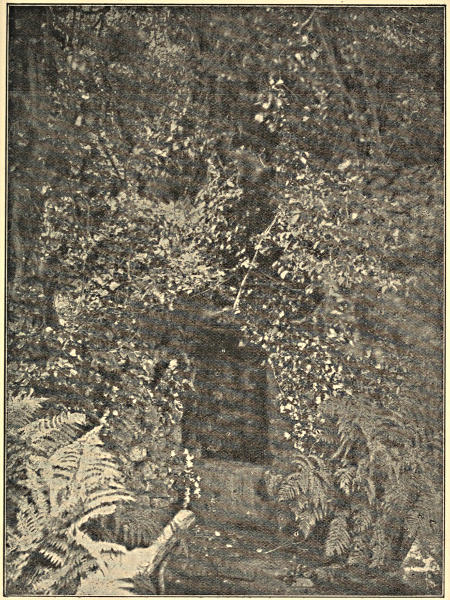
“Wishing Well, Les Fontaines, Castel.”
Whether the water will prove efficacious as a remedy
is ascertained by noticing the effect produced on
applying it. If it evaporates rapidly, passing off in
steam, or runs off the swelling like little drops of
quicksilver, it is of the right sort, and the sufferer
may hope for a speedy cure. Still, there are certain
ceremonies to be observed, without which it is useless
to make the attempt.
It must be applied before the patient has broken
his fast for nine consecutive mornings, and must be
dropped on to the affected place with the fingers,
and not put on with a sponge or rag. It must be
taken fresh from the well every day at daybreak. The
person who draws it must on no account speak to
anyone either on his way to, or from the fountain,
and must be particularly careful not to spill a single
drop from the pitcher. It is customary to leave a
small coin on the edge of the well, which was
doubtless intended originally as an offering to the
saint who was supposed to have the spring under his
especial protection, and whose name it bore. These
wells are said also to be used for purposes of divination.
The maiden who is desirous of knowing who
her future husband is to be, must visit the fountain
for nine consecutive mornings fasting and in silence.
On the last day when she looks into the clear basin
of the well, she will see the face of him she is fated
to wed reflected in the water. Should her destiny
be to die unmarried, it is believed that a grinning
skull will appear instead of the wished-for face.
The well most in repute is that of St. George, in
the parish of Ste. Marie du Castel, but St. Germain
and Ste. Anne, at no great distance, have their votaries,
and there are also the “Fontaine de St. Clair,” near
St. Andrew’s Church, the fountain of Gounebec in the
valley of that name near the Moulin de Haut, two
in the parish of the Forest,—that known by the name
of “La Fontaine St. Martin,” which rises on the cliffs
to the westward of the point of La Corbière, and the
other at a point between Le Gron and La Planque,
where the three parishes of the Forest, St. Saviour’s,
and St. Andrew’s meet. The “Fontaine de Lesset,”
at St. Saviour’s, is also renowned. In the parish of
St. Peter Port the fountain of Le Vau Laurent was
famous for the cure of sore eyes, and the water of
another on the side of the hill below Les Côtils, known
formerly as “La Fontaine des Corbins,” was supposed
to be efficacious in cases of consumption if taken
inwardly. “La Fontaine Fleurie,” near Havelet, and
another in the marshes near the ruined stronghold of
“Le Château des Marais,” commonly known as the
Ivy Castle, are also resorted to. The fountains of
St. Pierre and Notre Dame are mentioned in early
ordinances of the Royal Court. The former is known
to have been situated near the Town Church, at a
spot called Le Pont Orchon, in the street which still
bears the name of “La Rue de la Fontaine.” The
latter was apparently at the foot of the Mont Gibet,
at the upper end of what is now the Market Place.
The erection of pumps over most of these springs
has deprived them of their ancient prestige, and has
effectually removed any curative properties which they
may formerly have possessed. Although every spring
was not efficacious in all cases, to insure a cure it
was necessary to use the water of a particular well,
and, in order to choose it to consult certain persons
who are knowing in these matters, and who, by an
inspection of the part affected are able to tell what
particular spring should be resorted to.[92]
We have already mentioned the well of St. George
as being supreme in its sanctity; indeed we may
almost say that its reputation is such that it throws
all others into the shade. It stands near the ruined
chapel of the same name.
A place of such antiquity and reputed sanctity
might naturally be expected to have its legends,
though many doubtless have disappeared, but a firm
faith still exists in the miraculous properties of the
water of the well, and the old people still say that
on tempestuous nights, especially during thunder and
lightning, the form of a horse, darting flames of fire
from its eyes and nostrils, may be seen galloping
thrice, and thrice only, round the ruined precincts of
the chapel.
Some accounts of the spectral appearance speak
only of a horse’s head enveloped in flames, without
the accompaniment of a body.[93]
The territory of St. George was also formerly known
by the name of “St. Grégoire,” and, though Nicholas
Breakspear, Pope Adrian IV., numbers “La Chapelle
de St. George” among the possessions of St. Michel
in his Bull of 1155, Robert de Thorigni calls it
“St. Grégoire” in 1156, but in many places the St.
George of the legends seems to have been confused
with the “Egrégoires,” the watcher, “l’ange qui
veille,” of the old world. It is, according to mythology,
“l’Egrégoire” who mounts the white horse that
leads to victory, which apparition, in the moment of
danger, has roused so many Catholic armies from
despair.
The fountain was so much resorted to for divers
superstitions formerly, that in 1408 an Act was passed
by the Royal Court, at the request of Dom Toulley,
Prêtre de St. George, under the Bailiff Gervais de
Clermont, that the pathway to the fountain was only
open to the faithful on their way to divine service, or
to the sick who came to be healed.
We may add that an adjoining field bears the
name of “Le Trépied,” a name which is to be found
in other localities in the island, and which indicates
that a primæval stone monument, of the nature of
those commonly called Druid’s altars, may have at
one time stood there. These, as has already been
shown, have always had the reputation of being the
haunt of fairies, and sometimes of spirits of a less
innocent nature.
St. Patrick and St. George, in the days when there
were “saints errant” as well as “knights errant,”
both happened to come to Guernsey, and met on this
spot. St. Patrick had just arrived from Jersey, where
the inhabitants had pelted him with stones and treated
him with such systematic rudeness that the saint,
furious, came on to Guernsey, and there he was welcomed
with effusion. Meeting St. George, they began to
quarrel as to whom the island should in future belong.
However, being saints, they decided that it would be
more consistent with their profession each to give
some special boon to the island, and then go their
ways. So St. Patrick filled his wallet with all the
noxious things to be found,—toads, snakes, etc.,—and
went back to Jersey and there emptied it, freeing
Guernsey for ever from all things poisonous, while giving
to Jersey a double share. St. George smote the tiny
stream at his feet, “the waters to be for the healing
of diseases, and a blessing to whoever shall own this
spot. He shall never lack for bread, nor shall he ever
be childless whilst this well be preserved untainted.”
Now, many, many years ago, the Guilles, who still
own St. George, inherited it from the De Jerseys, and
it so happened that the lord of the estate had an only
son who was naturally very dear to him. An old
friend of the family brought him a canary bird as a
pet, and, as one had never before been seen in
Guernsey, it was very precious. One day it flew
away from its cage, the door being accidentally left
open, and was pursued hotly by the child. It made for
the well, and apparently flew in, for the child was
bending forward, an act which would inevitably have
caused him to fall in, when he was arrested by the
neighing of a horse behind him. He looked round
and saw the fiery head of St. George’s charger
disappearing among the trees. That look saved him,
and the bird was seen perched on the cross above
the well, singing loudly. Presently it flew back to its
little master, who had been saved by St. George from
a watery grave, and a picture of the boy with his
canary bird is still to be seen among the Guille
family portraits.[94]
There is a curious property attached to this well,
that is that if a maiden visits it, fasting and in
silence, on nine successive mornings, carefully depositing
a piece of silver in the niche as an offering to the
saint, she is assured of matrimony within nine times
nine weeks, and, by looking into the well with an
earnest desire to behold the image of the intended
husband, his face will appear mirrored in the water.
And, in former times, when the man was identified,
the girl gave his name to the priest, who then
summoned him before St. George, and, as destined
for each other by Heaven, they were solemnly united.
There is still a tradition extant of one of the neighbouring
girls of the parish, being forbidden by her
father to marry the man on whom her heart was set,
on the ground of his poverty, declaring that, having
seen his face in the well, he was evidently destined
for her by Heaven, and that she would claim him as
her fate before the priest. On this her father, fearing
the exposure and public censure, gave his consent to
the marriage.[95]
There is also a legend told by Mr. Métivier of a
country girl stealing out one summer night in the year
1798, to meet her lover near the well, flying home
terrified, having seen a troop of bare skeletons grouped
round the well, and gazing into the troubled waters.
Connected with the Chapel of St. George was a
cemetery, which boasted of many relics, famous for
their miracles.
At one time this cemetery was said to be haunted
by a beautiful young girl. Every night wailing and
crying was heard, and a figure was seen, much
mangled, walking about. The cries were supposed to
proceed from the tomb of a girl who had disappeared
from her home one night in a most mysterious
manner, and whose mangled corpse was picked up a
few days later near the Hanois rocks, so battered
and bruised that it was evidently not a case of
suicide. However, in course of time, a grave being
opened near hers, some bones were thrown up, and,
being handled by an old man who in days gone by
had been the murdered girl’s lover, a stream of
blood oozed out of the dry bone! and with awful
shrieks he owned to having been her murderer, and
was executed soon afterwards at the “Champ du
Gibet” at St. Andrew’s.
Editor’s Notes.
With reference to the statement on page 181 that Torteval Church is under the invocation
of Our Lady. In “A Survey of the Estate of Guernzey and Jarzey by Peter Heylyn,—1656,”
p. 320, he says:—“that (church) which is here called Tortevall (is dedicated) as some suppose
unto St. Philip, others will have it to St. Martha.”
On page 187 it is said that a chapel probably existed on the site of St. Martin’s Parish
School. In Elie Brevint’s MSS. written in the early part of the 17th Century he says:—“Les
Havillands de St. Martin ont donné la chappelle pour servir d’eschole, et de la terre auprès
deux fois autant que la verd de Serk, comme dit Thomas Robert.”
“Come, frolick youth, and follow me
My frantique boy, and I’ll show thee
The country of the Fayries.”
—Drayton’s “Muses Elizium, 1630.”
“O l’heureux temps que celui de ces fables,
Des bon démons, des esprits familiers,
Des forfadets, aux mortels secourables!
On écoutait tous ces faits admirables
Dans son château, près d’un large foyer:
Le père et l’oncle, et la mère et la fille,
Et les voisins, et toute la famille,
Ouvraient l’oreille à Monsieur l’aumonier,
Qui leur ferait des contes de sorcier.
On a banni les démons et les fées;
Sous la raison les grâces étouffées,
Livrent nos cœurs à l’insipidité;
Le raisonner tristement s’accrédite;
On court hélas! après la vérité,
Ah! croyez-moi, l’erreur a son mérite.”
—Voltaire.
“Fairy elves
Whose midnight frolics by a forest side
Or fountain, some belated peasant sees.”
—Milton.
It is not very easy to ascertain precisely
what the popular idea of a fairy is. The
belief in them seems to have died out, or,
perhaps, to speak more correctly, they are no longer
looked upon as beings that have any existence in
the present day. That such a race did once exist,
that they possessed supernatural powers, that they
sometimes entered into communication with mankind,
is still believed, but all that is related of them is
told as events that happened long before the memory
of man, and it is curious to see how a known
historical fact—the invasion of the island by Yvon
de Galles in the fourteenth century,—has, in the
lapse of ages, assumed the form of a myth, and
how his Spanish troops have been converted into
denizens of fairyland. Perhaps, as has been suggested
by some writers who have made popular antiquities
their peculiar study, all fairy mythology may be
referred to a confused tradition of a primæval race
of men, who were gradually driven out by the
encroachments of more advanced civilization. According
to this theory the inferior race retired before their
conquerors into the most remote parts of the woods
and hills, where they constructed for themselves rude
dwellings, partly underground and covered with turf,
such as may still be found in Lapland and Finland,
or made use of the natural fissures in the rocks
for their habitations, thus giving rise to the idea
that fairies and dwarfs inhabit hills and the innermost
recesses of the mountains. In the superior cunning
which an oppressed race frequently possesses may
have originated the opinion generally entertained of
the great intelligence of the fairy people—and, as it
is not to be supposed that a constant warfare was
going on between the races, it is far from improbable
that some of the stories which turn on the kindly
intercourse of fairies with mortals, may have arisen
in the recollection of neighbourly acts. The popular
belief that flint arrow-heads are their work—the names
given in these islands—“rouets des faïkiaux,” or
fairies’ spindles, to a sort of small perforated disc
or flattened bead of stone which is occasionally dug
up, and “pipes des faïkiaux” to the tiny pipes which
date from the first introduction of tobacco,—their
connection in the minds of the peasantry with the
remains commonly called druidical, and, indeed, with
any antiquity for which they cannot readily account,
are all more or less confirmatory of the theory above
alluded to. Some years ago a grave, walled up on
the inside with stones, and containing a skeleton and
the remains of some arms, was discovered on a
hillside near L’Erée. The country people without
hesitation pronounced it to be “Le Tombé du
Rouai des Fâïes.”
One well-preserved cromlech in the same neighbourhood
is called “Le Creux des Fâïes” and the
local name of cromlechs, in general “pouquelâie,”
may have some reference to that famous fairy Puck,
or Robin Goodfellow, the west country Pixie, or
Pisky, and the mischievous Irish goblin Phooka.
According to the best accounts the fairies are a
very small people, and always extremely well dressed.
The inhabitants of Sark attribute to them the
peculiarity of carrying their heads under their arms.
They are fond of sporting among the green branches
of the trees, and on the borders of running streams.
They are supposed to live underground in ant hills,
and to have a particular affection for upright stones,
around which they assemble, or which they use as
marks in some of their games, and the removal of
which they are apt to resent by causing injury to
the persons or property of those who are bold enough
to brave their displeasure in this respect. Some are
domestic, living invisibly about the hearth-stone or
oven, but willing to make themselves useful by
finishing the work which the housewife had not been
able to complete during the day. They expected,
however, as a reward for their kind offices that a
bowl of milk porridge should be set on the floor for
them when the family retired to rest. On one
occasion a fairy was heard complaining that the
porridge was too hot and scalded her. The sensible
advice was given—to wait until it cooled.
The few stories about fairies that I have been able
to collect are given in these pages, and are very
much the same as those related in other countries.
Of the more elaborate fairy tale—that which recounts
the adventures of a life-time, and in which a
supernatural being—commonly called a fairy, but
who has little or nothing in common with the fays
who dance on the green sward by the light of the
moon—is the directing influence either for good or
bad,—I have been able to discover only the very
slightest trace.
That such tales did once exist, and that they
were related by nurses to amuse their young charges,
is, I think, sufficiently proved by allusions sometimes
made to Chendrouine, as our old acquaintance
Cendrillon or Cinderella is called, and by the fact
that a friend of mine remembers an old servant
telling him the story of “Pel de Cat,” evidently the
same as the English story of “Cat-skin,” which
however appears in the French collections of fairy
tales by the name of “Peau d’Ane.” All that
my friend could recall to mind were the words in
which the heroine of the tale is welcomed into a
house where she seeks for shelter, and which
have a rhythmical cadence that smacks strongly of
antiquity:—
“Entre, paure Pel-de-Cat, mànge, et bés, et séque té.”
(Enter, poor Cat-skin, eat, drink, and dry yourself).
[96]
But the best informed among the peasantry do
not hesitate in expressing their belief that the fairies
were a race who lived long before the ancestors of
the present occupants of the land had effected a
settlement in the island; that the cromlechs were
erected by them for dwelling places, and that the
remains of pottery which have been from time to
time discovered in these primæval structures plainly
prove their derivation.
That the fairy race possessed supernatural strength
and knowledge there can be no doubt, or how could
they have moved such enormous blocks of stone?
Whether their strength and extraordinary science was
a gift from Heaven, or whether they acquired these
endowments by having entered into a league with
the powers of darkness, is a very doubtful and
disputed question. Some say they were a highly
religious people, and that they possessed the gift of
working miracles. Others shake their heads and say
that their knowledge, though perhaps greater, was of
the same nature as that possessed in later times by
wizards and witches, who, as everybody knows, derive
their power from the wicked one.[97]
Some fifty or sixty years since, it was still firmly
believed in the country that the fairies assisted the
industrious, and that, if a stocking or other piece of
knitting was placed at night on the hearth or at the
mouth of the oven with a bowl of pap, in the
morning the work would be found completed and the
pap eaten. Should idleness, however, have prompted
the knitter to seek the assistance of the invisible
people, not only did the work remain undone and
the pap uneaten, but the insult put upon them was
severely revenged by blows inflicted on the offending
parties during their sleep.[98]
It is asserted by some old people in the neighbourhood
of L’Erée that, in days gone by, if a bowl of
milk porridge was taken in the evening to the “Creux
des Fâïes,” and left there with a piece of knitting
that it was desired to have speedily finished, and a
fitting supply of worsted and knitting needles, the
bowl would be found next morning emptied of its
contents, and the work completed in a superior
manner.[99]
“Welcome lady! to the cell,
Where the blameless Pixies dwell,
But thou sweet nymph! proclaimed our faery queen
With what obeisance meet
Thy presence shall we greet.”
—Coleridge.
“In olde dayes of the King Artour
Of which that Bretons speken gret honour,
All was this lond fulfilled of faerie;
The Elf-quene, with hire joly compagnie,
Danced ful oft in many a grene mede,
This was the old opinion as I rede;
I speke of many hundred yeres ago;
But now can no man see non elves mo.”
—Chaucer’s “Canterbury Tales.”
At a very remote period there lived in the
neighbourhood of Vazon a girl of extraordinary
beauty. One morning, as was her usual custom, she
left her cottage at an early hour to attend to her cows,
when, on entering the meadow, she was astonished
to find asleep on the grass, under the shelter of a
hedge, a young man of very small stature, but finely
proportioned, and remarkably handsome. He was
habited in a rich suit of grass-green, and by his side
lay his bow and arrows. Wondering who the stranger
could be, and fascinated by his beauty and splendid
appearance, the maiden stood in silent admiration,
until he awoke and addressed her. Her person and
manners seem to have had as much influence on the
youth as his appearance had produced on the damsel.
He informed her that he was a fairy from England,
and made her an offer of his hand. She immediately
consented to unite her destiny with his, and followed
him to the sea-shore, where a barque was waiting,
which conveyed the happy pair to fairyland.
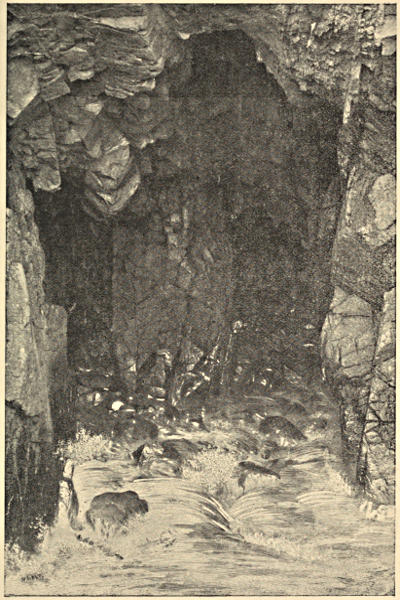
“Creux des Fâïes.”
Time passed on, and the disappearance of the
maiden was almost forgotten, when, one morning, a
man who was going down to Vazon Bay at day-break
was surprised to see a numerous host of diminutive
men issuing, like a flock of bees, from the Creux des
Fâïes, and lurking among the reeds and rushes of
Le Grand Marais. He inquired who they were, and
what had induced them to visit the Holy Isle. One,
who appeared their leader, answered for all, and told
the affrighted man, that, charmed with the beauty
and grace of the damsel that one of their companions
had brought from the island, they were determined
also to possess wives from the same country. They
then deputed him to be the bearer of a message to
the men of Guernsey, summoning them to give up
their wives and daughters, and threatening them with
their heaviest displeasure in case of a refusal. Such
an exorbitant demand was, of course, with one accord
refused, and the Guernseymen prepared to defend
their families and drive the bold invaders from their
shores. But, alas! what can poor mortals avail
against supernatural beings! The fairies drove them
eastward with great carnage. The last stand was
made near Le Mont Arrivel, but, wearied and
dispirited, they fell an easy prey to their merciless
enemies, who put every soul to the sword. Their
blood flowed down to the shore, and tinged the sea
to a considerable distance, and the road where this
massacre took place still retains the memory of the
deed, and is known to this day by the name of La
Rouge Rue. Two men only of St. Andrew’s parish
are reported to have escaped by hiding in an oven.
The fairies then entered into quiet possession of the
families and domains of the slain; the widows began
to be reconciled to their new masters, the maidens
were pleased with their fairy lovers, and the island
once more grew prosperous. But this happy state of
things could not last for ever. The immutable laws
of fairyland will not allow their subjects to sojourn
among mortals more than a certain number of years,
and at last the dwellers in Sarnia were obliged to
bid adieu to the shady valleys, the sunny hills, and
flowery plains, which they had delighted to rove
amongst and which their skill and industry had
materially improved. With heavy hearts they bade
adieu to the scene of their fondest recollections, and
re-imbarked. But, since then, no Guernsey witch has
ever needed a broomstick for her nocturnal journeys,
having inherited wings from her fairy ancestors, and
the old people endeavour to account for the small
stature of many families by relating how the fairies
once mingled their race with that of mortals.[100]
The fairies sometimes avail themselves of the
services of mankind, and in return are willing to
assist and reward them as far as lies in their power,
but woe to the unhappy mortal who chances to
offend them!—for they are as pitiless as they are
powerful.
It is said that one night a woman, who lived in
the neighbourhood of Houmet and who gained her
livelihood by nursing and attending on the sick,
heard herself called from without. She immediately
arose, and, looking out, saw a man who was totally
unknown to her standing at the door. He accosted
her, and, telling her that he required her services for
a sick child, bade her follow him. She obeyed, and
he led the way to the mouth of the little cavern at
Houmet, called Le Creux des Fées. She felt alarmed,
but, having proceeded too far to retreat, resolved to
put a bold front on the matter, and followed her
mysterious guide. As they advanced, she was
astonished to find that the cave put on a totally
different appearance—the damp rugged walls became
smooth, and a bright light disclosed the entrance of
a magnificent dwelling.
The poor woman soon comprehended that she had
penetrated into fairyland, but, relying on the good
intentions of her conductor, she followed him into an
apartment where a child was lying ill in a cradle,
whom she was desired to attend to and nurse. She
entered on her new duties with alacrity, and was
plentifully supplied by the fairies with every necessary
and even luxury. One day, however, as she was
fondling the infant, some of its spittle chanced to
touch her eyes. Immediately everything around her
put on a different aspect—the brilliant apartment
once more became a dismal cavern, and squalor and
misery replaced the semblance of riches and
abundance. She was too prudent, however, to impart
to any of the fairy people the discovery she had
made, and, the health of the child being quite
restored, solicited her dismissal, which was granted
her with many thanks, and a handsome compensation
for her trouble.
The Saturday following her return to the light of
day, she went into town to make her weekly
purchases of provisions and other necessaries, and,
stepping into a shop in the Haut Pavé, was astonished
to see one of her acquaintances of the Creux des
Fâïes busily employed in filling a basket with the
various commodities exposed for sale, but evidently
unseen by all in the shop but herself. No longer at
a loss to know whence the abundance in the fairies’
cavern proceeded, and, indignant at the roguery
practised on the unsuspecting shopkeeper, she addressed
the pilferer and said “Ah, wicked one! I see thee!”
“You see me—do you?” answered the fairy. “And
how—pray?”
“With my eyes to be sure,” replied the woman,
off her guard.
“Well then,” replied he, “I will easily put a stop
to any future prying into our affairs on your part.”
And, saying this, he spat in her eyes, and she
instantly became stone blind![101]
There is another version of the preceding, called
Late one night an old woman was called up by a
man with whom she was unacquainted, and requested
to follow as quickly as possible, as his wife was in
labour and required her immediate assistance. She
obeyed, and was led by her guide into a miserable
hovel, where everything appeared wretched, the few
articles of furniture falling to pieces, and the household
vessels of the coarsest ware, and scarcely one whole.
Shortly after her arrival, her patient was safely
delivered of a child. When she was about to make
use of some water which stood in a pail, to wash
the child with, and had already dipped her hand into
it, she was earnestly requested not to meddle with
that water, but to use some which stood in a jug
close by. She chanced, however, to lift her hand,
still wet, to her face, and a drop of the water got
into one of her eyes. Immediately she saw everything
under a different aspect; the house appeared rich and
magnificently furnished, and the broken earthenware
turned into vessels of gold and silver.
She was, however, too prudent to express her
surprise, and, when her services were no longer
required, left the place.
Some time afterwards she met the man in town
and accosted him. “What,” said he, “You see me!
How is this?” Taken unawares, she mentioned what
she had done in the cottage, and which of her eyes
was endowed with the faculty of beholding him: he
immediately spat in it, and destroyed her sight for
ever.[102]
Two men were at work in a field near L’Erée,
when suddenly their plough stopped, nor would their
united strength, joined to that of the oxen, succeed
in moving it. As they looked about them, wondering
what could be the reason of this stoppage, they
observed in one of the neighbouring furrows an iron
kettle, such as was formerly used for baking bread
and cake on the hearth. On approaching it they
noticed that it contained a bit which had been
broken out of the side, and a couple of nails. On
stooping to lift it, they heard a voice desiring them
to get it mended, and when done to replace it on
the same spot where they had found it. They
complied with the request, went to the nearest smith,
and on their return to the field with the kettle,
which they replaced as directed, continued their work,
the plough moving as readily as before. They had
completed several furrows when a second time the
plough remained stationary. On this occasion they
observed a bundle neatly tied up lying near them,
and, on opening it, found it to contain a newly-baked
cake, quite warm, and a bottle of cider. At the same
time they were again addressed by their invisible
friend, who bade them eat and drink without fear,
thanked them for the readiness with which they had
attended to his wishes, and assured them that a kind
action never goes without its reward.[103]
The fairies are reported to have regarded some
households with particular favour, and to have lived
on very neighbourly terms with them, borrowing or
lending as occasion might require.
The families of De Garis and Dumont are among
those who are said to have been in their good graces,
and it was to a De Garis the following incident
happened.
To the south of the Church of St. Pierre du Bois
there lies a little dell, through which runs a small
stream of water known by the singular name of
“Le Douït d’Israël.” This valley is said to have been
in former days a favourite resort of the fairy folk,
and tradition affirms that a very kindly feeling existed
between them and the mortal inhabitants of the land.
A cottage is still pointed out, not far from the estate
called “Le Colombier,” which is said to have been
the abode of a countryman and his wife with whom
the fairies were in constant communication.
Frequently, at night, the elves would come and
request the loan of a cart until the morning, and
their request was always complied with willingly, for
it was always accompanied with the following
promise:—
“Garis, Garis,
Prête mé ten quériot,
Pour que j’allons à St. Malo,
Queurre des roques et des galots,
Rindelles, roulettes, ou roulons,
S’il en mànque j’en mettrons.”
(“Garis, Garis,
Lend your cart now, I pray,
To go to Saint Malo,
To fetch stones away.
Should tires for the wheels
Or any thing lack,
We’ll make it all right
Before we come back.”)
Permission to take the cart was never refused, for
it was always returned in perfect order, and, if any
injury was done to the metal-work during the
nocturnal journey, it was found the next day carefully
repaired with pure silver. But what use was made
of it is unknown. Some pretend that a sound of
wheels was sometimes heard in the dead of night
rolling over the cliffs at Pleinmont, where no horse
could have found a footing.[104]
Fairies have sometimes been known to enter into
the service of mankind, but by what motives they
were actuated in so doing is not clear. A certain
“Mess”[105] Dumaresq, of “Les Grands Moulins,” once
engaged as a farm servant a boy who offered himself.
No one knew whence he came, nor did he appear
to have any relations. He was extremely lively,
active, and attentive to his duties, but so small that
he acquired and was known by no other name than
that of “P’tit Colin.” One morning as Dumaresq
was returning from St. Saviour’s, he was astonished,
on passing the haunted hill known as “La Roque
où le Coq Chante,” to hear himself called by name.
He stopped his horse and looked round, but could
see no one. Thinking that his imagination must have
deceived him, he began to move on, but was again
arrested by the voice. A second time he stopped and
looked round, but with no more success than the first.
Beginning to feel alarmed, he pushed his horse
forward, but was a third time stopped by the voice.
He now summoned up all his courage and asked
who it was that called, and what was required of
him. The voice immediately answered,—
“Go home directly and tell P’tit Colin that Grand
Colin is dead.”
Wondering what could be the meaning of this, he
made the best of his way home, and, on his arrival,
sent for Le Petit Colin, to whom he communicated
what had befallen him. The boy replied,
“What! Is Le Grand Colin dead? Then I must
leave you,” and immediately turned round to depart.
“Stop,” said Mess Dumaresq, “I must pay you
your wages.”
“Wages!” said Colin, with a laugh, “I am far
richer now than you. Goodbye.”
Saying this he left the room and was never afterwards
seen or heard of.
This story is still related by Dumaresq’s descendants.[106]
Le Grand Colin and Le Petit Colin, whose names
have already been mentioned in connection with La
Longue Roque and La Roque où le Coq Chante,
appear to have belonged to that race of household
spirits who used to take up their abode on or near
the hearth, and who, although rarely making themselves
visible to the human inhabitants of the house, were
willing, so long as no attempt was made to pry into
their secrets, to render occasional acts of kindness to
those under whose roof they dwelt, especially if they
were honest and industrious.
A man and his wife occupied a small cottage at
St. Brioc. The man gained his living as many along
the western coasts of the island do. When the
weather was favourable he went out fishing. After
gales of wind he was up with the first dawn of
day to secure his share of the sea-weed which the
waves had cast up on the shore, or perchance a spar
or cordage detached from some unfortunate ship that
had gone down in the storm. At other times he
cultivated his own small plot of ground, or hired
himself out as a day labourer to some of the
neighbouring farmers who were in want of assistance.
In short he was never idle.
They lived in a typical old Guernsey country farm-house,
with old walls of grey granite, a thatched
roof, small diamond-paned windows, and arched
doorways, with its half-door or “hecq.” Inside they
are all built much on the same pattern. The front
door opens into an entrance hall, on one side of which
is the “living” room of the house,—parlour and kitchen
in one,—with a huge chimney, sometimes adorned with
quaint old carvings, as at “Les Fontaines,” in the
Castel parish, a low hearth stone, a smouldering vraic
fire, and “trepied.” Still inside its enclosure are stone
seats, a large bread oven built in the thickness of the
wall, and a hook whereon to hang the “crâset” lamp.
A rack hangs from the low oak ceiling, diversified
by its huge centre beam or “poûtre.” On this is kept
the bacon, and the grease for the “soupe à la
graisse,” or “de cabôche.” A “jonquière,” which is
an oblong wooden frame about three feet from the
ground, is placed in a corner near the fire and if
possible near a window, and is used as a sofa by
the family. Formerly it was stuffed with rushes,
whence its name. Peastraw or dried fern, covered with
green baize, now take their place, and it is frequently
called the “green bed.” A long table and forms, with
an eight-day clock by Naftel, Lenfestey, or Blondel,
and an old carved chest, which contained the bride’s
dower of linen in bygone times, is the ordinary
furniture of the rooms, whose principal ornament
consists of some of the beautiful china brought by
sailor sons from the far East or Holland. The floors
boast for carpet nothing but earth covered with clean
sand, daily renewed.
On the other side of the passage is the best
bedroom, with its four poster, and some still have on
their mantel-pieces the old tinder boxes, with their
flint and steel, and separate compartments for the
burnt rag or tinder. Beyond are the winding stone
steps, built in a curve beyond the straight wall of
the house, and above are more bedrooms, or, in
smaller houses, simply a “ch’nas” or loft.
His wife also was never idle. She was one of the
shrewd, industrious, and frugal race, who were content
with a diet of bacon and cabbage, barley-bread and
cider, and who are, alas, disappearing fast. Night
after night, when her husband had returned home,
and, tired out with the fatigues of the day, had gone
to rest and was sound asleep, she would sit up till
a late hour on the “jonquière” and ply her spinning
wheel by the dim light of the “crâset.”
While thus occupied, she, one night, heard a knock
at the door, and a voice enquiring whether the oven
was hot, and whether a batch of dough might be baked
in it. A voice from within then enquired who it was
that stood without, and, on the answer being given
that it was Le Petit Colin, permission was immediately
granted, and the door opened to admit him. She
then heard the noise of the dough being placed in the
oven, and a conversation between the two, by which she
learned that the inmate of the house was called Le
Grand Colin. After the usual time the bread was
drawn, and the mysterious visitor departed, leaving
behind him, on the table, a nicely baked cake, with an
intimation that it was in return for the use of the oven.
This was repeated frequently and at regular intervals,
and the woman at last mentioned the circumstance to
her husband. The fairer sex is frequently accused of
an inclination to pry into secrets and taunted with
the evils which too often result from inordinate
curiosity, but in this instance it was the husband who
was to blame. He was seized with a violent desire
to penetrate the mystery, notwithstanding the earnest
entreaties of his wife—who had a shrewd suspicion of
the real state of the case—that he should leave well
alone. His will prevailed, and it was settled that on
the night when the invisible baker was expected,
the husband should take his wife’s place on the
“jonquière,” disguised in her clothes, and that she
should go to bed. Knowing that her husband could
not spin, the careful housewife thought it prudent
not to put the usual supply of flax or wool on the
distaff, lest the good man, in turning the wheel,
should spoil it. He had not been long at his post
and pretending to spin, when the expected visitor
came. He could see nothing, but he heard one of
the two say to the other:—
“File, filiocque,
Rien en brocque,
Barbe à cé ser
Pas l’autre ser.”
(“There’s flax on the distaff,
But nothing is spun;
To night there’s a beard,
T’other night there was none.”)
Upon which both were heard to quit the house as
if in anger, and were never again known to revisit it.[107]
In times long past a young couple occupied a
cottage in the neighbourhood of L’Erée. They were
in the second year of their marriage, and little more
than a fortnight had elapsed since the wife had
presented her husband with his first-born son. The
happy father, who, like most of the inhabitants of
the coast, filled up the time in which he was not
otherwise occupied, in collecting sea-weed or fishing,
returned one morning from the beach with a basketful
of limpets. There are various ways of cooking this
shell-fish, which, from the earliest times, appears to
have formed a considerable article of food among the
poorer inhabitants of the sea-shore, and one of the
ways of dressing them is by placing them on the
hot embers, where they are soon baked or fried in
their own cup-shaped shells. Cooked in this manner
they form an appetizing relish to the “dorâïe,” or
slice of bread-and-butter, which forms the ordinary
mid-day meal of the labouring man.
A good fire of furze and sea-weed was flaming on
the hearth when the man entered his cottage, and,
having raked the hot embers together, he proceeded
to arrange the limpets on the ashes, and then left
them to cook while he went out to finish digging
a piece of ground. The wife in the meanwhile was
occupied in some domestic work, but casting a look
from time to time on her new-born babe, which was
sleeping quietly in its cradle. Suddenly she was
startled by hearing an unknown voice, which seemed
to proceed from the child. She turned quickly round,
and was much surprised to see the infant sitting up,
and looking with the greatest interest at the fire-place,
and to hear it exclaim in tones of astonishment:—
“Je n’sis de chut an, ni d’antan,
Ni du temps du Rouey Jehan,
Mais de tous mes jours, et de tous mes ans,
Je n’ai vu autant de pots bouaillants.”
(“I’m not of this year, nor the year before,
Nor yet of the time of King John of yore,
But in all my days and years, I ween,
So many pots boiling I never have seen.”)
She had heard old wives tell how the fairies
sometimes took advantage of the absence of the
mother or nurse, to steal away a sleeping child,
and to substitute one of their own bantlings in its
place, and how the only way to cause them to
make restitution was to throw the changeling on the
hearth, when the fairy mother, unable to withstand
the piteous cries of her offspring, was sure to appear,
and bring back the stolen infant with her.
She lost no time therefore in catching up the fairy
imp, who, knowing the fate that awaited him, set up
a fearful yell. Immediately, the fairy mother, without
stopping to lift the latch, leaped over the “hecq”
or half-door, and, restoring to the trembling housewife
her babe uninjured, snatched up her own squalling
brat, and departed by the same way she had come.[108]
The parish of Notre Dame du Castel, or, as it is
now the fashion to call it, St. Mary de Castro, is
the largest in the island, but the church is situated
at one extremity of the parish, close on the bounds
of St. Andrew’s, to the great inconvenience of many
of the parishioners. It is true that in former days
they had some relief in the Chapels of Ste. Anne,
St. George, and St. Germain, but chapels are not
parish churches, and many, while trudging through
the miry roads in winter, or toiling up the dusty
hill in summer, when some of the great festivals
required them to present themselves at the mother
church, have inquired how it came to pass that so
inconvenient a site had been chosen. The old people,
depositaries of the ancient traditions of the place, will
answer that originally the foundations were laid in
a field called “Les Tuzés,” but this was haunted
ground, and a favourite resort of the fairies, and
that, these little ladies, unwilling to yield up their
rights without a struggle, in the course of a single
night transported all the tools, stones, etc., in their
cambric aprons, to the spot where the Church of
St. Mary now stands. Thrice did this happen before
the builders gave up their intention of erecting the
sacred edifice on the site first chosen.[109]
There is another story told of the fairy man who
first came to Guernsey and carried away the beautiful
Michelle de Garis[110] to be his wife. Though, vanquished
by his courtliness and grace, she was persuaded to fly
with him back to fairy land, she could not quite forget
the father, mother, and brothers, whom she had left
behind her in their cottage down by Vazon Bay. So
she begged him to let her leave them some slight
token by which to remember her. He thought for a
few moments, and then gave her a bulb, which he
told her to plant in the sand above the bay. He
then whispered to the mother where to go to find a
souvenir of her missing daughter, and, when she went,
weeping, to the search, she found this bulb, burst into
flower, a strange odourless beautiful blossom, decked
with fairy gold, and without a soul—for what is the
scent but the soul of a flower—a fit emblem of a
denizen of fairyland. From that time the flower
has been carefully cultivated in this island, the
“Amaryllis Sarniensis,” as it is called, nor will it
flourish, however great the care, in any of the other
islands; it pines and degenerates when removed from
the soil where it was first planted by the elfin
lover.[111]
“I’ll drown more sailors than the mermaid shall.”
—Shakespeare.
“Thou rememb’rest
Since once I sat upon a promontory,
And heard a mermaid on a dolphin’s back,
Uttering such dulcet and harmonious breath,
That the rude sea grew civil at her song.”
—Shakespeare.
A belief in the existence of mermaids is not quite
extinct, although no tales relating to them appear
to have been preserved among the people. An old
man, living in the parish of the Forest, of the name
of Matthieu Tostevin, whose word might be implicitly
relied on, affirmed to Mr. Denys Corbet, the master
of the parochial school, that on one occasion, being
on the cliffs over-looking Petit-Bôt Bay, he saw a
company of six mermaids, or, as he termed them
“seirênes,” disporting themselves on the sands below.
He described them as usually depicted, half woman,
half fish. He hastened down to the beach as fast as
he could, to get a nearer sight of them, but, on his
approaching them, they took to the sea, and were
immediately out of sight.
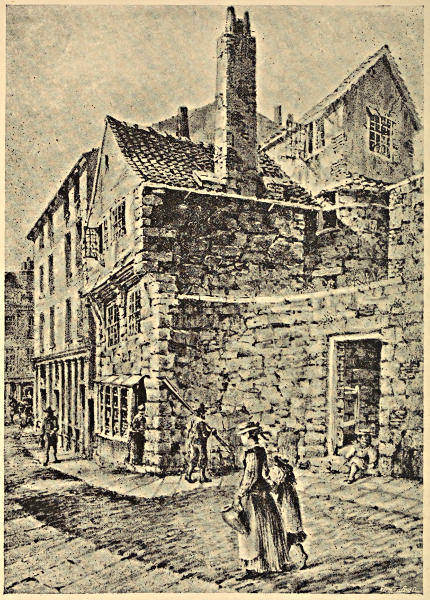
“Looking down Smith Street, 1870.”
It was doubtless a flock of seals which he saw,
for, although these animals are no longer found in
numbers on our coasts, a stray one is occasionally,
though very rarely, to be seen. They are known to
exist on the opposite shores of Brittany and
Normandy, and the few specimens that have been
taken in our seas are of the same variety as those
found on the French coast. It is not improbable that
they may have been more common in former days;
and it is possible that “Le Creux du Chien,” a
large cavern at the foot of the cliffs to the eastward
of Petit-Bôt Bay, may have been so named from
being the resort of one of these amphibians.[112]
“Now I remember those old woman’s words
Who in my youth would tell me winter’s tales,
And speak of sprites and ghosts that glide by night
About the place where treasure hath been hid.”
Marlow’s “Jew of Venice.”
“Will-a-wisp misleads night-faring clowns,
O’er hills and sinking bogs.”
“Let night-dogs tear me,
And goblins ride me in my sleep to jelly,
Ere I forsake my sphere.”
—Thierry and Theodoret. Act 1. Sc. 1.
That singular meteor, known by the English
as Jack o’Lantern or “Will o’ the Wisp,”
by the French as “Feu Follet,” and by the
Bretons as “Jan gant y tan” (John with the fingers
or gloves of fire), bears in Guernsey the appellation
of Le Faeu Bélengier—the fire of Bélenger. According
to Mr. Métivier “Bélenger” is merely a slight
variation of the name “Volunde” or “Velint”—Wayland,
or Weyland Smith, the blacksmith of the
Scandinavian gods. Bélenger was married to a
Valkyrie, daughter of the Fates, so runs the old
Norse legend. He was, for the sake of some treasures
belonging to him, or under his guardianship, carried
away by a certain king as prisoner to an island,
where the tyrant cut the sinews of his feet so as
to prevent his running away, and then set him to
work. Too clever, however, not to be able to compass
his revenge, Bélenger managed to kill the two sons
of the despot, and fashioned their bones into vessels
for the royal table. And then, having maltreated the
princess, daughter of his quondam master, he flew
away through the air, and the name Bélenger has
become identified in popular mythology with any
especially clever worker in metals. In English popular
tradition the name of Bélenger becomes contracted
into Velint, or Wayland Smith, and, according to
Sir Walter Scott, “this Wayland was condemned to
wander, night after night, from cromlech to cromlech,
and belated travellers imagined that they then beheld
the fire from his forge issuing from marshes and
heaths.” The natives of Iceland, descended from our
own paternal ancestors of the tenth century, say still
of a clever craftsman that he is a “Bélengier” in
iron.
In Guernsey they say it is a spirit in pain,
condemned to wander, and which seeks to deliver
itself from torment by suicide.[113] Its presence is also
supposed to indicate in very many cases the existence
of hidden treasures, and many a countryman is known
to have made a fruitless journey over bog and morass
in the hope of locating the flickering flame. It is
also firmly believed by all the country people that
if a knife is fixed by the handle to a tree, or stuck
in the earth with the point upwards, the spirit or
demon that guides the flame will attack and fight
with it, and that proofs of the encounter will be
found next morning in the drops of blood found on
the blade.[114]
As we have already stated “Le Faeu Bélengier”
is supposed to indicate the existence of hidden
treasure, and it is well known that when treasures
have been hidden for any considerable time the evil
spirit acquires a property in them, and does all in
his power to prevent their falling into the possession
of mortals. Nevertheless the meteor-like form which
the Bélengier assumes, frequently betrays their place
of concealment as it plays about the spot, and if a
person have sufficient courage and perseverance he
may become the possessor. The wiles, however, of
the demon, and his efforts to retain his own,
frequently prove successful, as the following narratives
will testify. It appears, however, that the guardian
spirit has no power to remove the treasure, unless
the adventure have first been attempted by a mortal.
A country-woman had often observed flames of fire
issuing from and hovering round the earth within
the threshold of her house, and, knowing well what
they indicated, one day, when all the other inmates
of the dwelling were in the fields busied in getting
in the harvest, she determined on searching for the
treasure. She procured a pick-axe, closed and barred
all the doors to secure herself against interruptions,
and proceeded to work. She had not dug long,
before a violent thunderstorm arose. Though alarmed,
she continued her task, but the rain, which now
began to fall in torrents, drove the field labourers
to seek shelter in the house. By this time the
woman had struck on a brazen pan, which, she had
no doubt, covered the treasure, and was in no hurry
to open to the men who were clamouring at the
door for admission. She was at last obliged to yield
to their entreaties, and, turning her back on the hole
she had dug, unbarred the door. Her dismay was
great, when, on looking back on her work, she saw
the pan turned up, and the whole treasure abstracted.
The demon had seized this opportunity to take
possession of his own.
A man had reason to believe, from the flames
which he had seen hovering about a certain spot,
that a treasure was hidden there. Accordingly, one
night, he took his spade and lantern and dug till
he came to a large jar, which contained what
appeared to him to be shells.[115] Suspecting that this
might be a stratagem of the evil spirit to deter him
from obtaining possession of the treasure, he carefully
gathered up the whole, and took it home with him.
On examining the parcel the next morning, he found
he had judged rightly, for the apparent shells of the
preceding night had now resumed their original form
of gold and silver coin.
Another man was less fortunate, for, finding nothing
but what he conceived to be shells, he hesitated
about removing them, and was effectually deterred by
the appearance of an immense animal, resembling a
black conger-eel with fiery eyes, coiled up in the
hole which he had dug.[116]
The “Varou,” now almost entirely forgotten, seems
to have belonged to the family of nocturnal goblins.
He is allied to the “Loup-Garou” of the French,
and the “Were-Wolf” of the English, if, indeed, he
is not absolutely identical with them. He is believed
to be endowed with a marvellous appetite, and it is
still proverbially said of a great eater “Il mange
comme un varou.”[117]
“Aller en varouverie” was an expression used in
former times in speaking of those persons who met
together in unfrequented places for the purposes of
debauchery or other illicit practices. Among the
Acts of the Consistory of the parish of St. Martin’s,
in the time when the island was still under the
Presbyterian discipline, is to be found a censure on
certain individuals who had been heard to say one
night that the time was propitious “pour aller en
varouverie sous l’épine.”
Varou was originally from the Breton Varw—“the
dead”—and was identified with the “Heroes” or
beatified warriors, who were, by Homer and Hesiod,
supposed to be in attendance on Saturn. Guernsey,
in the days of Demetrius, was known by the name
of the Isle of Heroes, or of Demons, and Saturn
was said to be confined there in a “golden rock,”
bound by “golden chains.”
There is the “Creux des Varous,” which extends,
according to tradition, from Houmet to L’Erée, and
is a subterranean cavern formed of rock sprinkled
with an abundance of yellow mica, which sparkles
like gold; a plot of ground near the cromlech at
L’Erée, known as “Le Creux des Fées,” still bears
the name of “Le Camp du Varou;” and an estate
in the parish of St. Saviour’s is called “Le Mont-Varou.”
Old people remember that it used to be
said in their youth that “Le Char des Varous”
was to be heard rolling over the cliffs and rocks on
silver-tyred wheels, between Houmet and the Castle
of Albecq, before the death of any of the great ones
of the earth; and how this supernatural warning was
sure to be followed almost immediately by violent
storms and tempests.[118]
The 10th of January, in Roman days, was
dedicated to the Fera Dea, or cruel goddess, of
which Hero Dias is a literal Celtic interpretation
here. She is the queen of the witches, and
although Satan himself is the commander-in-chief of
the witches, he has a mate who participates in his
authority, and leads the dance when his votaries
meet to celebrate their midnight orgies at Catioroc
or Rocquaine. This is no less a personage than the
dissolute and revengeful woman by whose evil
counsel the holy precursor of our Saviour was put
to death by Herod. To her, more particularly, is
attributed the rising of sudden storms, and especially
of those which take the form of a whirlwind. It
sometimes happens that during the warm and sultry
days of harvest a gust of wind will suddenly arise,
and, whirling round the field, catch up and disperse
the ears of corn which the reaper has laid in due
order for the binder of the sheaves. The countryman
doubts not but that this is caused by Herodias
shaking her petticoats in dancing—“Ch’est la fille
d’Hérode qui châque ses côtillons,”—and he loses no
time in hurling his reaping hook in the direction she
appears to be moving. It is said that this has
generally the effect of stopping the progress of the
whirlwind.
These sudden gusts are locally known by the name
of “héroguiâzes,” and, although there is so easy a
means of dispersing them as that indicated above,
the man who would venture to throw his sickle or
knife at them must be endowed with no small
degree of courage.[119]
This was a demon used by old Guernsey nurses
to frighten their infant charges. “Le Barboue
t’attrappera” was quite threat enough to make the
naughtiest child repent of his misdeeds. According
to Mr. Métivier (See Dictionary, p. 51. Barboue), this
name “Barboue” is a corruption of bared meleu,
the spectre which personifies the plague among the
Cymri. According to the legends, “Barbaou Hervé”
was the wolf who accompanied St. Hervé, a sainted
hermit of the country of Léon, 560. He was
evidently related to the French “Loup-Garou.”
Many places have the reputation of being haunted
by phantoms which make their appearance at the
dead of night, not always in a human form, as the
spirits of the departed are wont to do when they
revisit “the glimpses of the moon,” but in the more
fearful shapes of beasts and nondescript monsters.
“La Bête de la Tour,” “Le Cheval de St. George,”
which has already been spoken of in connection with
the well, and “Le Chien Bôdu,” are among these.
The “devises,” or boundary stones, which served
in olden times to mark the limits of some of the
principal “fiefs” or manors, but which have now
disappeared, leaving only a name to the locality,
appear to have been the particular resort of these
spectres; and it is not improbable that the superstition
may have arisen from the custom, of which traces
are to be found in many nations, of sacrificing a
victim and burying it where the stone of demarcation
was to be set up. It was not, however, these places
only which became the haunt of spectres; other
spots came in also for their share of these nocturnal
and frightful visitors. A lonely dwelling, especially if
uninhabited, a dark lane far from any friendly cottage,
cromlechs, or spots where these mysterious erections
once stood—all these either had, or were likely to
acquire, an evil reputation in this respect, and more
especially if tradition pointed to any deed of horror,
such as murder or suicide, connected with the place
or its neighbourhood.
The headless dog which haunts the Ville-au-Roi,
and which will be spoken of in the legend attached
to that ancient domain, is an instance of these
spectres. The best known of them is “Tchi-cô,” or
the “Bête de la Tour,”—but there are also “La Bête
de la Devise de Sausmarez à Saint Martin,” which
is a black dog supposed to haunt the avenue by
Sausmarez Manor.[121]
There is no doubt that in early times the town
of St. Peter Port was encircled by walls, and
fortified—indeed there is an order of Edward III. in
1350, authorising the levy of a duty on merchandise
for this purpose. Certain spots, called “les barrières,”
mark where the gates were situated, and, although all
remains of the walls have long since disappeared, it
is not difficult to trace the course they must have
taken. At the northern extremity of the original
town, the name of “La Tour Gand” indicates a
fortress of some sort. The southern extremity was
protected by a work called “La Tour Beauregard,”
of sufficient importance to be named, together with
Castle Cornet, in the warrants or commissions issued
by the monarch to those who were intrusted with
the defence of the island.
This fortress stood near the top of Cornet Street,
on the brow of the hill which overlooks the Bordage
and Fountain Street, where now stands St. Barnabas’
Church. Tradition points to a spot at the foot of
the hill, as the place where the execution of heretics
and witches, by burning, used to take place, and
connects with these sad events a spectral appearance
which, even within the present century, was believed
to haunt the purlieus of the old tower.
During the long nights of winter, and especially
about Christmastide, the inhabitants of Tower-hill, the
Bordage, Fountain Street, and Cornet Street used to
be roused from their midnight slumbers by hearing
unearthly howlings and the clanking of heavy chains,
dragged over the rough pavement.
Those who could summon up courage enough to
rise from their beds and peep out of window, declared
that they saw the form of a huge uncouth animal
with large flaming saucer eyes, and somewhat like a
bear, or huge calf. This spectre was known as
“Tchî-co, La Bête de la Tour.”
Editor’s Notes.
See Pluquet in Contes Populaires de Bayeux, p. 16, for an account of a phantom in the
shape of a great dog that wanders about the streets of Bayeux in the winter nights gnawing
bones and dragging chains, called “Le Rongeur d’Os.”
See also Sir Walter Scott’s note in Peveril of the Peak, Vol. II., Chap. I., on the spectral
hound or “Mauthe Doog”—a large black spaniel, which used to haunt Peel Castle in the
Isle of Man.
There is also in Laisnel de la Salle’s book Croyances et Légendes du Centre de la France,
Tome I. p. 181, a long story of “Le Loup Bron,” which in many respects resembles that
of our “Bête de la Tour.”
In Sark “they have another superstitious belief, that of the Tchico, or old dog, the dog of
the dead, the black or white beast. Several affirm having seen it, and met it walking about
the roads. This dog affects certain localities, and makes its regular rounds, but often it is
invisible.” From Descriptive Sketch of the Island of Sark, by the Rev. J. L. V. Cachemaille,
published in Clarke’s Guernsey Magazine, Vol. III., October. 1875.
In Brand’s Antiquities, Vol. III., p. 330, he identifies the English “Barguest,” or “Great
Dog Fiend,” with the Norman “Rongeur d’Os,” and the “Boggart” of Lancashire, great
dog-spirits, which prowl about in the night-time, dragging heavy chains behind them.
This black dog was said to infest the Clos du
Valle, and was probably a resident of the Ville Bôdu,
which was at one time the slaughter-house of the
Benedictine monks of St. Michel du Valle. To see
him was taken as a sure sign of approaching death.
According to Mr. Métivier, he derived his name from
“the German Bohdu, and Gaulish Bodu, which mean
the Abyss, and the mythological dog of Hades is our
‘Chien Bôdu.’”
Editor’s Note.—In Croyances et Légendes du Centre de la France Laisnel de la Salle
has a chapter (Tome I. pp. 168-175), on “La Chasse a Bôdet,” which he describes as “une
chasse nocturne qui traverse les airs avec des hurlements, des mieulements et des abois
epouvantables, auxquels se mêlent des cris de menace et des accents d’angoisse,” and he
identifies (p. 172), “Bôdet” with the German Woden, who is the same as the Scandinavian
Odin, Gwyon of the Gauls, the Egyptian Thot, Hermes of the Greeks, and Mercury of the
Latins, who filled, in the Teutonic Mythology, the rôle of “Conductor of Souls.”
Although this story is known to everyone, and is to
be found in all the local histories and guide books, no
collection of Guernsey folk-lore can be considered
perfect without it. It is just one of those stories that
are calculated to make a profound impression on the
popular mind, as showing the special interposition of
Providence in preserving a poor and innocent man from
the effects of a false accusation, and in causing the
nefarious designs of a rich and unprincipled oppressor
to fall back with just retribution on his own head.
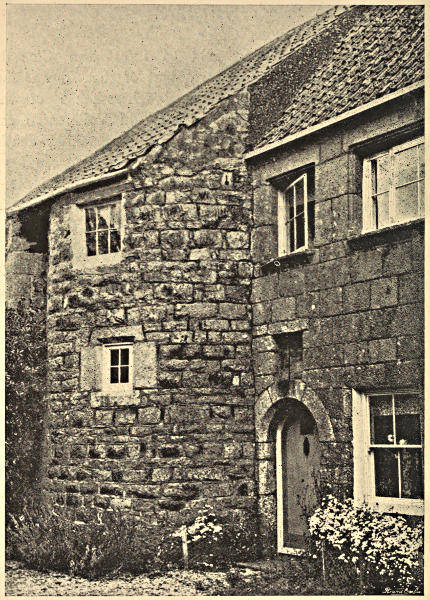
“Old Manor, Ville au Roi.”
Whether the story be founded on an occurrence
which did actually take place in this island, whether
it originated elsewhere, or whether it be a pure
invention, it is now impossible to determine.[122] The
name of the principal personage in the tale—Gaultier
de la Salle—is to be found at the head of the lists
of Bailiffs of Guernsey, with the date 1284, but no
written evidence has yet been adduced to prove that
anyone of the name ever held that office. There is,
however, proof of a certain kind that a person bearing
this name did exist at some period of the fourteenth
century, for, in a manuscript list of Bailiffs, which
appears to have been compiled about the year 1650,
the writer, who seems careful not to place any on
record for whom he cannot produce documentary
evidence, appends this note to the name of John Le
Marchant, Bailiff from 1359 to 1383:—“J’en ay lettre
de 1370 concernant la veuve Gaultier de la Salle.”
That no document is known to exist in which this
name appears is no proof that Gaultier de la Salle
did not hold the office. Previously to the reign of
Edward I. it appears to have been the custom for
the Warder or Governor of the island to appoint an
officer with the title of Bailiff, who combined the
functions of Lieutenant-Governor, chief magistrate, and
Receiver of the Crown Revenues, and who was
generally changed annually. The names of many of
these dignitaries have been preserved, but there are
still several blanks to be filled up, and it is not
impossible that the name of Gaultier de la Salle
may some day or other be found as holding this
important charge, although probably at a later date
than that usually assigned to him—1284.
The estate of the Ville-au-Roi is said to have
borne originally the name of “La Petite Ville.”[123] It
has now dwindled down to a few fields, but was
doubtless at one period of far greater extent and
importance than at the present time. The house, which
may probably be assigned to the fifteenth century,
is now much diminished in size from what it was,
even a few years since, but it still presents an
interesting specimen of the architecture of former
days. It consisted, when perfect, of a building,
forming two sides of a square, with a tower in the
angle, where may yet be seen the holes for arrows.
It contained a well-wrought newel staircase in stone,
leading to a large room, which appears to have been
the principal apartment in the house, if we may
judge from the careful workmanship bestowed on the
handsomely carved granite chimney piece, the traces
of stone mullions in the windows, and the ornamental
open timber roof, now hidden by a low ceiling. A
wall of unusual thickness divides this portion of the
building into two parts; and a few steps from the
head of the staircase of which we have spoken, lead
to the remains of another newel resting on this wall,
which evidently formed part of a turret rising above
the ridge of the roof, and which could have served
no purpose but that of ornament, or perhaps a
lookout over the neighbouring country. There are
some detached farm buildings, and traces of a wall
surrounding the homestead, intended probably to form
an inclosure into which the cattle might be driven
at night. The remains of an arched gateway at
the end of the avenue, leading from the main road,
and connecting the western gable of the dwelling house
with an out-building, are still to be discerned. This
was exactly opposite the principal door of the mansion,
which is of good proportions, with a well-executed
circular headway in granite, over which is a square
recess in the masonry which doubtless once contained
the armorial device of the original proprietor. There
is reason to believe this was a member of the De
Beauvoir family, once very numerous and influential
in the island but now extinct, for it was well known
that the family was formerly in possession of this
estate, and the existence of their arms—a chevron
between three cinq-foils—carved in granite on the
mantelpiece of the principal room, is almost sufficient
proof of one of the name having been the original
builder of the house.[124] The estate afterwards passed
into the possession of the De la Marche family—also
extinct. From them it descended to a family of the
name of Le Poidevin. These last falling into pecuniary
difficulties, the property by the legal process called
“saisie” came into the hands of the present (1859)
proprietor, Thomas Le Retilley, Esq., Jurat of the
Royal Court.
Whilst the recently-abolished manorial Court of
the Priory of St. Michel du Valle still existed, there
was a curious servitude attached to this estate.
When this Court made its periodical procession
through the island to inspect the King’s highway
and see that it was kept in due repair, the proprietor
of the Ville-au-Roi was expected to furnish a cup of
milk to everyone legally entitled to a place in the
cortège, and the procession made a halt at the gate
to demand the accustomed refreshment, which was
willingly afforded, although immemorial usage alone
could be pleaded for the exaction.
It is now time to come to the legend itself. In
the earliest records which the human race possesses—the
Holy Scriptures—we read that disputes arose
about wells and the right of drawing water from
them. Where water is scarce, as it is in some parts
of the East, this can readily be understood, but why
should any disagreement occur in places where
this indispensable element abounds? The answer is
simply this. The well is for the most part the
property of one person, and situated on his ground,
and those who claim a right to the use of it, must
necessarily pass over their neighbour’s land to get at
it. It is clear that this right may be exercised in
such a manner as to become vexatious and troublesome.
Gaultier de la Salle had a poor neighbour of the
name of Massy, who was the proprietor of a small
field containing little more than a vergée of land
at the back of the Bailiff’s house, but with this
land he possessed also the right,—no doubt by virtue
of some ancient and binding contract—of drawing
water from a well on De la Salle’s property. Often
had the Bailiff offered to buy off this right,—to give
a fair and even liberal price for the piece of ground
to which the privilege was attached. Massy was
obstinate. His answer to every offer was that of
Naboth to Ahab—“The Lord forbid it me that I
should give the inheritance of my fathers to thee.”
Annoyed at Massy’s pertinacious refusal to accede
to his wishes, Gaultier de la Salle formed the horrible
design of taking away his life, but how was this to
be done without causing suspicion? Open violence,
even in those days, was not to be thought of. Secret
assassination might be discovered. At last the acute
mind of the unworthy Bailiff hit on an expedient
which appeared to him perfectly safe. It was to
make the forms of the law subservient to his wicked
designs, and, under the guise of a judicial proceeding,
to cause the ruin and death of the unfortunate
Massy. Theft was then, and for too many centuries
after, punished with death. If he could succeed in
fixing an accusation of this kind on the innocent
Massy, he flattered himself that there would be no
difficulty in obtaining a conviction, and then would
follow the utmost penalty of the law, and the
consequent forfeiture of the felon’s lands and goods
to the King, from whom he hoped to get a grant
or sale of the field. To carry out his nefarious
intention, he hid two of his own silver cups in a
cornstack, and adroitly contrived to cause a suspicion
of having stolen them to rest on his too-obstinate
neighbour. Circumstantial evidence, skilfully combined,
was not wanting on the day of trial, and, notwithstanding
his vehement protestations of innocence, poor
Massy was found guilty and condemned to death.
The day fixed for the execution arrived, and the
Bailiff proceeded to the Court House with the
intention of witnessing the death of the unfortunate
victim of his own false accusation. But “the wicked
man diggeth a pit and falleth into the midst of it
himself.” Before leaving home, he gave orders to
some of his workmen to take down a certain stack
of corn, and house it in the barn. He had barely
taken his seat in Court, where the magistrates had
assembled for the purpose, as was then the custom,
of attending the culprit to the place of execution,
and seeing their sentence duly carried out, when
a messenger, almost breathless, rushed in and
exclaimed—
“The cups are found.”
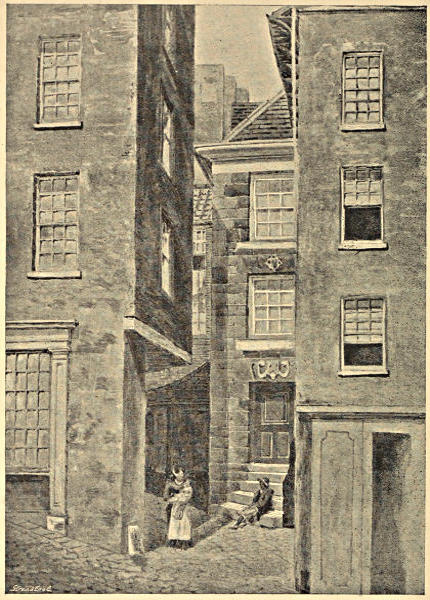
“Houses in Church Square, 1825.”
“Fool!” cried the Bailiff. “Did I not tell thee
not to touch that rick. I knew——.” Here he
stopped short in confusion, perceiving that he had
already said enough to raise the suspicions of those
who had heard him.
The Jurats immediately gave orders to stay the
execution. The matter was submitted to a searching
investigation, and resulted in a full exposure of the
Bailiff’s nefarious plot. Thereupon Gaultier de la Salle
was sentenced to suffer the same punishment that he
had intended for the innocent Massy, and his estate
was declared to be confiscated to the King, since
which time it has borne the appellation of “La
Ville-au-Roi.” It is said that he was hanged at a
spot in the parish of St. Andrew’s, where, until the
last century, executions[125] usually took place, and that,
on his way to the gibbet, he stopped and received
the Holy Sacrament at the foot of a cross, which,
though long destroyed, has given its name to the
locality “La Croix au Baillif.” An old lane bounding
the land of the Ville-au-Roi on the north, and which
was closed in the early part of last century, when
the present high road was cut, bore the singular
name of “La Rue de l’Ombre de la Mort.” It had
naturally an evil reputation as the resort of
phantoms and hobgoblins, and even in the present
day it is with fear and trembling that the belated
peasant in returning from town passes the avenue
of aged elms that leads up to the ruined mansion of
the iniquitous judge.
Many will tell you how, at the witching hour of
night, they have seen a huge, headless black dog
rush out and brush past them, and how those who
have been bold enough to strike at the phantom
might as well have beaten the air, for their cudgel
met with no resistance from anything corporeal.
No one doubts that it is the unquiet spirit of Gaultier
de la Salle, doomed to wander till the great day of
judgment around the field for the sake of which
he was led into such deadly sin, happy even if so
dreadful a penance could expiate his guilt.
Editor’s Note.
In the Record Office exists (Assize Roll No. 1165, 17 Edward II., 1323), a petition of
“Cecilia, who was wife of Walter de la Sale,” for restitution of lands and rentes bought in
their name and in that of their children, in the parishes of St. Peter Port and St. Andrew’s;
“and that these tenements,—on account of the death of the said Walter, who was judicially
executed last criminal assizes, now three years past, before Peter Le Marchant, then Bailiff
of the Island,—had been seized by the King.… Upon the inquisition of 12 men of the parish
of St. Peter Port, and 12 men of the parish of St. Andrew’s, who depose upon their oath,
that the aforesaid Walter was condemned before Peter Le Marchant, Bailiff of the aforesaid
Island, for the murder of Ranulph Vautier[126], three years ago. An inquisition was made, and on
account of the said murder, the said lands were seized into the King’s hands, and for this cause,
and no other, are still detained.… A day given to the said Cecilia for the hearing of her
case at Jersey, on which day the aforesaid Cecilia came, and it is determined that the King
removes his hand (i.e., restores the land), and that from henceforth she has possession.”
The British Museum contains a document, (Add: Ch: 19809) which gives further particulars
of “la peticion Cecile qui fut fame Gaultier de la Salle,” she claiming the lands, etc.,
as having been bought with her money “et disante que l’avant dit son mari vint en
lylle desus dicte sans nul bien fors son corps.” From this document it appears that Cecilia
and her husband built the house, presumably that now known as “La Ville-au-Roi,” for she
claims “une meson séante en la ville de Saint Pierre Port, de laquelle la place fut fiefeye
de Jourdan et de Johan des Maons … et que du mariage de la dicte Cecile ovecques autres
biens pourchaciez par yceluy mariage, fistent la dicte meson.” … Signed at St. Peter Port,
10th of October, 1323, before Geoffrey de la [Hou]gue Guillaume Karupel, Richart Toullay,
Guion Nicolle, Renouf de Vic, Henri de la [Mule][127], Guillaume le Genne, Johan Fale, Ranulph
leMoigne, de Saint Pierre Port, and Radulph de Beaucamp, Jurats of the King’s Court.
The Assize Roll of 32 Edward I (1304), mentions the murder of Brother John del Espin, of
the Priory of Lyhou, by Ranulph Vautier and Guillaume Lenginour, who, after having taken
refuge in the Church of St. Sampson, and abjured the Islands, were pardoned by the King.
Guillaume L’Enginour seems to have been subsequently Gaultier de la Salle’s accomplice in
the murder of Ranulph Gautier, for the “Lettres Closes” of 1321, mention the restoration of
lands to “Guillaume L’Enginour demeurant accusé de la mort de Ranulphe Gautier, tué dit
on criminellement, et du vol d’un anneau d’argent au même Ranulphe, et d’un florin d’or à
John de Souslemont, Chapelain”; he being willing to stand his trial when called upon.
Among the “Ancient Petitions” No. 4345 contains a request from John du Vivier, Thomas
d’Estefeld, and Philip de Vincheles of Guernsey and Jersey, “for protection from the friends
of Gaultier de la Salle, his wife, his son, and his relations, who threaten them because he
was hanged for the murder of Renouf Gautier, murdered in the Castle of Guernsey, by his
acquaintances and others who abjured (the Islands), for this deed, such as Master William le
Enginour, John Justice, and Christian Hert”.…
The Calendars of Patent Rolls for the years 1313-14, contain mentions of “Protections”
for “Walter de la Salle, clerk” to “the islands of Gerneseye and Jereseye,” and in the
Assize Roll of 1319, he is described as “Minister” of Otho de Grandison, then Governor
of the Islands.
A Ranulph Gautier was one time bailiff to Otho de Grandison, so the feud between the two
may have been of long standing. Gaultier de la Salle was probably a member of one of the
many Anglo-Norman families then connected with the Channel Islands. His wife Cecilia was
evidently a Guernseywoman, and part of their land in St. Andrew’s parish was inherited from
Havise, his wife’s mother. There is reason to believe that he was the son of a Robert de la
Salle, and Agnes his wife, who were landowners in England in the early part of the 14th
Century; his son, Nicholas, was King’s Receiver to Edward III., in 1372-3.
It is not possible to absolutely locate the lands held by Gaultier de la Salle, but in a
British Museum MS. (Clarence Hopper) is quoted a document, then in the Chapter House,
Westminster, shewing that part of the “Eschaet” of “Galter de Sale” was the “Clos au
Botiller,” which particular “Clos” has been identified as part of the territory now known as
Le Vauquiédor, and in the petition of Cecilia, widow of Gaultier, she mentions lands bought
from “Guillaume et Richard le Hubie.” Both the Hubits Lanes and the Vauquiédor estate
adjoin that of the Ville-au-Roi, the traditionary seat of Gaultier de la Salle.
From documents kindly lent me by Lord de Saumarez, Colonel J. H. C. Carey and
Colonel de Guérin.
At no great distance from the thriving village of
St. Sampson’s, which, thanks to its commodious
harbour, the neighbouring granite quarries, and an
extensive trade in stone carried on there, bids fair
to become a town, stands what was formerly the
mansion of a considerable branch of the Le Marchant
family,[128] one of the most ancient and influential in
the Channel Archipelago. It is known as “Les
Grentmaisons,” the name of a family that has been
extinct for some centuries, but which possessed lands
in this part of the island. The house is situated on
the high road leading from St. Sampson’s to the
town of St. Peter Port, and, although surrounded at
the present time on all sides, was, at the beginning
of the present century, far removed from any dwelling—none
indeed being then in sight but those of the
town, distant at least two miles.
At that time the proprietor, who possessed a very
handsome dwelling in St. Peter Port, only inhabited
the house of the Grentmaisons during the summer
months; and in the winter it was closed and left
under the care of a servant, who lived in one of the
dependencies. How it had come to acquire the evil
reputation of being haunted, or how long it was
supposed to have been so, no one could tell, but that
it was the resort of troubled spirits no one could
doubt. Fearful noises were heard, and lights that
could not be accounted for were seen in its deserted
rooms during the long winter nights; and belated
wayfarers were affrighted by the apparition of a
horrible beast, with large glaring eyes, and long
shaggy hair trailing down to the ground, which took
its nightly rambles round the ancient walls, and
seemed to guard the house from intrusion.[129]
The western coast of Guernsey, abounding in sunken
reefs stretching far out to sea, and exposed to the
full force of the Atlantic waves, was, before the
establishment of a lighthouse on the Hanois rocks,
most dangerous to shipping coming up Channel, and
many a gallant vessel, with all its crew, has struck
on some hidden danger and gone down in deep water,
leaving no traces but what the waves might throw
up some days afterwards on the shore, in the form
of detached portions of the wreck and cargo, or the
dead bodies of the hapless mariners.
The inhabitants of this inhospitable coast are a
rugged race of hardy fishermen, for the most part
experienced pilots, who know every rock for miles
round, not one of which is without its distinguishing
name. As might be expected, they are close observers
of the weather, and of every sign that may indicate
a coming storm. Those in the neighbourhood of
L’Érée and Rocquaine declare that they are warned
of an approaching tempest by a peculiar bright light
which appears some time before in the south-west,
and also by a loud roaring, like that of a large
animal in great pain, which appears to proceed from
a rock known by the name of “La Pendue.” They
do not attempt to account for this noise, but speak
of it as “La Bête de la Pendue.”[130]
In the parish of St. Pierre-du-Bois, there is a
house and estate known by the name of Le Laurier,
where loaves are distributed to the poor on Christmas
Eve and on Good Friday. Nothing certain is known
of the origin of this dole, the title-deeds of the
property merely containing the following item in the
enumeration of the ground-rents due on it:—“Aux
Pauvres de la ditte Paroisse de Saint Pierre-du-Bois,
un quartier de froment de rente, à être distribué en
pain aux dits pauvres, à deux diverses fois; savoir,
deux boisseaux, partie du dit quartier à Noel, et les
deux autres boisseaux à Pâques, comme d’ancienneté.”
Tradition assigns two very different reasons for the
institution of this charity, one of which is highly
probable. It is that, at some remote period of which
all memory is now lost, the house took fire, and the
proprietor made a vow that if the fire could be
extinguished he would charge his estate with an annual
rent, to be given to the poor in bread. His prayer was
answered, the fire yielding to the efforts of those who
were attempting to put it out, as if by miracle, and
the dole was instituted in conformity with the vow.
The other tradition, which, as it falls into the
domain of the supernatural is, of course, a greater
favourite with the people, is to the following effect.
In times past, long before the memory of the oldest
inhabitants of the parish, the house, for some
undefined reason, but connected, it is surmised, with
some unknown crime of a former proprietor, was
haunted from Christmas Eve to Easter by a hideous
spectre in the form of a black beast like a calf, but
as large as an ox. On Christmas Eve the inmates
of the house were in the habit of leaving the front
and back doors open, and at midnight precisely the
spectre would pass through.
At last, however, the proprietor of the estate
bethought himself of calling in the aid of the clergy,
in hopes that by their powerful help the visits of
this unwelcome guest might be put an end to. Their
prayers and exorcisms soon prevailed in quieting the
phantom, and, by their advice, the annual distribution
of the loaves to the poor was instituted.
It is related, however, that on one occasion
the owner of the house, instigated by his wife, an
avaricious, grasping creature, who would sooner have
seen all the poor in the parish die of hunger than
bestow a crust on them, withheld the accustomed
dole. He paid dear for it, for the house was once
more visited by the spectre, which this time made
its appearance in the form of a gigantic black sow,
accompanied by a numerous litter of pigs, all grunting
and clamouring for food, as if they had not eaten for
a week. The master of the house was fain to
purchase peace by restoring to the poor their rights,
but it is said that to her dying day his wife never
recovered from the impression this supernatural visit
made upon her.
There is a tradition also that at one time a report
having been spread abroad that the accustomed alms
would no longer be distributed, the poor, who were
in the habit of receiving it, assembled at night before
the house, formed themselves into a procession, and
marched through, entering by the front door, and
passing out at the back. The mistress of the house
was watching their proceedings from behind the door,
and was seen by one of the poor women, who
addressed her companion, walking by her side, in
these words:—
“Et chette-chin, est-alle des nôtes?”
(And that woman there, is she one of us?)
To which the following answer was returned:—
“Oh! Nennin! quer sa liette nous l’y ôte.”
(Oh! No! for her snood proves it.)
The “liette” was the riband or snood with which,
in days gone by, the cap was fastened on the head,
and was apparently a bit of finery quite beyond the
reach of the poor who had assembled on this occasion,
and only likely to be seen on the head-gear of a
person in tolerably easy circumstances.[131]
A number of young men had met together one
evening in search of amusement. One of the party
proposed going to a place at some distance, where
they were likely to fall in with others as fond
of fun as themselves, but, not choosing to fatigue
themselves with walking, they determined on using
some of their neighbours’ horses. A good-looking
white horse was grazing hard by in a meadow. One
of the party approached, caught, and mounted him.
Another got up behind, but still there seemed room
for a third: at last, to shorten the story, the whole
party, in number above a dozen, found accommodation
on the horse’s back, but, no sooner were they all well
seated, than he set off at full gallop, and, after
carrying them through brambles and briers, over
hedges and ditches, to a considerable distance,
deposited them all in the most muddy marsh he
could find, and disappeared, leaving them to find
their way home at midnight, in the best way they
could.[132]
One of the most interesting old mansions in
Guernsey is that of La Haye du Puits, in the parish
of Le Castel, with its tower rising above the roof, its
handsome “porte cochère” and its pepper box turrets.
It has the appearance of having been built early in
the sixteenth century, and it is known to have been,
in the reign of Henry VIII., the residence of a family
of considerable local antiquity and importance, of the
name of Henry, who had also property in Salisbury,
where they were known by the anglicised form of
their patronymic, Harris. It passed from their possession
into that of the Le Marchant family, to one
of whom it still belongs, in the reign of James II.[133]
It is just one of those sort of places that one might
expect to find some legendary tale or old superstition
attached to; but we are not aware that either La
Haye du Puits, or the neighbouring estate of St.
George, claims any special property in the spectral
appearance, which, from time to time, is seen at Le
Mont au Deval—a steep ascent over which the high
road between the two properties passes. Persons
travelling at night along this road, which in some
parts is thickly overshadowed with trees, have
occasionally met with a funeral procession, preceded,
as is customary in Guernsey, by a clergyman and his
attendant clerk, and composed of the usual carriers,
pall bearers, mourners, and attendant friends. The
cortège takes its mournful way in perfect silence—and
well it may—for, of the many persons who compose
it, not one is the bearer of a head!
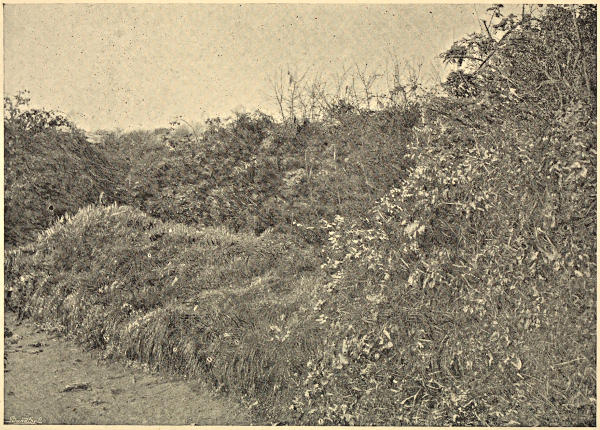
“Le Coin de la Biche,” St. Martin’s.
There are those, it is said, who affirm to having
met it, but it is looked upon as of evil augury.
The death of some one in the neighbourhood, or of
some member of the family of the person who has
the misfortune to fall in with it, is believed to
follow close upon the appearance of the headless
company.[134]
Editor’s Notes.
“Le Coin de La Biche.”
There is a lane leading from the post-box at the “Carrefour David,” on the Saints’ Bay
Road to “La Marette,” at the Villette, which was formerly supposed to be haunted by a
spectre in the form of an enormous nanny-goat.
As you go along the lane to the Villette, you will see on your right hand side a triangular
corner overgrown with weeds and brambles, and, although between two fields, not included in
either. This corner is known as “Le Coin de la Biche”—the Corner of the Nanny Goat.
Tradition marks it as one of the proposed sites for St. Martin’s Church, but, they say,
when the building was commenced, materials, tools, etc., were moved by unknown hands, in
the course of the night, to La Beilleuse, its present site, and all attempts to build it there
had to be abandoned. Ever since then this corner has borne a bad reputation, and none of
the neighbouring proprietors will include it in their fields for fear of ill-luck.
One evening, towards the close of the last century, Mr. Mauger, of the Villette, and some
other men, were returning home from vraiking at Saints’ Bay. In those days, the road leading
to the bay was a water-lane with a very narrow footway and a deep rocky channel, down
which the water rushed to the sea. High hedges were on either side, bordered with trees, so
that it was a laborious journey for carts to go up and down. When the present road was
made, the trees were cut down, and the earth from the hedges used to fill up the waterway.
Accordingly, this cart had harnessed to it three oxen and two horses, but even then
progress was slow, and it was getting late as they turned into the lane. As they did so, one
man said to the other:—
“Creyous que nous verrons la biche?”
(“Do you think we shall see the goat?”)
“Si nous la veyons alle nous f’ra pàs d’mà.”
(“If we see her, she can do us no harm!”)
was the reply. Almost as he spoke out came a great hairy grey nanny-goat from her corner,
and rested her forelegs against the back of the cart. The oxen tugged, the horses pulled,
lashed on by the terrified men, who were longing to get out of the lane. But nothing could
move the cart while the great beast stood there with her paws on the cart and looked at
them. So they finally had to unharness the cattle, and lead them on to the Villette, and
leave the cart with all the vraic in it in the lane.
Next morning they brought one ox and one horse, who, “La Biche” being gone, easily
pulled the cart home, this part of the country being on level ground.
Another night, Mr. Mauger, of Saints’, wanting to go and see his brother at the Villette,
took the short cut, which is a tiny lane next to a little shop at the top of the Icart-road,
and which comes out nearly opposite “Le Coin de la Biche.” He was carrying a torch of
“gllic” (glui[135]—thick straw and resin), and felt that, thus armed, nothing could attack him.
As he turned into the lane, he heard the clank of a chain, and, looking down, he saw a
large brown beast about the size of a small calf, with enormous red eyes, which it kept fixed
on him, walking by his side. He hurried on, and tried by walking in the middle of the lane
not to give it room to pass (the lane is barely three feet wide), but it was always there, on
the footpath, keeping step with him. When he turned into the broader lane, where its own
special “corner” is, it turned away, and he hurried on to the Villette. Determined not to
give in to his cowardice, he came home the same way, and there where it had left him was
the beast waiting for him. It walked with him, on his other hand this time, still keeping to
the footpath, till he got into the Icart-road, where it disappeared.
These stories were told me in 1896 by Mrs. Le Patourel, of St. Martin’s, who was a Miss
Mauger, of Saints’, and she was told them by a relative of hers who was a daughter of the
Mr. Mauger to whom these incidents happened. She declared that they were absolutely true.
Our coachman, whose father lived in the neighbourhood at “Les Pages,” just above Petit
Bôt, told me that his father would never let him go along that lane after dark, and would
never go himself, for fear of “La Biche,” and many other inhabitants of St. Martin’s tell the
same story.
Another old man, belonging to one of the most respectable families in the parish, and who
had himself been churchwarden for eleven years, told me that in his youth he lived in the
neighbourhood of the Villette, and one evening his sister, then a strong young girl of sixteen,
rushed in saying she had seen “La Biche.” The shock was so great that she took to her
bed and died shortly afterwards.
“The Prince of Darkness is a gentleman.”
—Shakespeare.
“Tis a history
Handed from ages down; a nurse’s tale,
Which children open-eyed and mouth’d devour,
And thus, as garrulous ignorance relates,
We learn it, and believe.”
Various allusions to his Satanic Majesty
have already appeared in these pages. He
has left his footprints on various rocks; he
carried away bodily Jean Vivian, Vavasseur de St.
Michel; he fought with St. Patrick at the Hougue
Patris; and he enticed Duke Richard in the form of
a beautiful woman. He is of course head of the
fraternity of wizards and witches, and many references
to him occur in all the legends dealing with
witchcraft, but there are a few stories dealing with
him “in propriâ personâ,” and these are collected in
the following chapter.
It may be as well to state that his usual
manifestation is believed to be in the form of a huge
black cat. He takes this shape apparently when he
wishes to pass incognito. Black cats in general are
looked upon with a suspicious eye, but if seen in the
house of anyone supposed to be addicted to magical
arts, there is no doubt of their being imps of Satan.
It was Midsummer Day, the sun was shining
brightly, and the country people were hastening in
their holiday apparel to the spot where the militia
were ordered to muster for a review, when an
unfortunate country girl was ordered by her master
to weed a large field of parsnips. He promised her
that when her task was accomplished she should be
allowed the rest of the day to amuse herself; but she
soon discovered that this promise meant nothing, for
that her utmost exertions would not suffice to finish
the allotted work before the evening should close in.
She commenced her task with a heavy heart, and
often lifted her head as she heard the joyous laugh
of the groups of lads and lasses as they passed along
the high road on their way to the place of
rendezvous. One party followed another, and as they
became less frequent, the poor girl lost patience. Her
hopes of taking any share in the amusements of the
day were nearly at an end. At last she gave
utterance to her thoughts, and wished aloud for
assistance, were it even from the Devil himself.
Scarcely had she expressed this unhallowed wish,
when she thought she heard a slight noise behind
her, and, on looking round, saw a gentleman dressed
entirely in black, who in the kindest manner immediately
addressed her and enquired why she looked
so sad, and how it was she was not merry-making
with her companions.
“Alas!” she answered, “I must weed the whole
of this field before I am released.”
“Oh,” said he, “is that all? Only promise me the
first knot you tie to-morrow morning and I will get
your task performed.”
The girl easily agreed to these terms, and the
gentleman departed.
She resumed her work, but was astonished to
perceive that invisible hands were employed in every
part of the field, tearing up the weeds and gathering
them in bundles. In a very short time the ground
was clear, and she went to announce it to her master,
who, astonished at the rapidity with which she had
executed his orders, gave her permission to spend the
rest of the day in amusement.
She went accordingly to the review, and from
thence to the “Son,”[136] where she danced the greater
part of the evening. As night came on, however, she
began to reflect on the adventures of the morning,
and to consider that the assistance which she had
accepted was most probably not of a very holy nature,
and that something more might be meant by the
promise which she had made than the mere words
implied. She returned home and retired to her bed,
but was unable to compose herself to sleep. The
more she thought of what she had done the more
uneasy did she feel.
At last, in her perplexity, she resolved to rise
immediately and seek advice from the Rector of the
parish. The worthy clergyman was much alarmed at
this open attack made by Satan on one of his flock,
but bade her fear nothing, but put her trust in
Heaven, go home, and spend the remainder of the
night in prayer and repentance, and as soon as
morning dawned, before she fastened a single knot,
to go to the barn, taking her Bible with her, and,
praying without ceasing, there bind up a sheaf of
barley straw.
The girl did as she was advised, and scarcely had
she knotted the wisp of straw, when the gentleman
in black stood at her side. His looks and voice were
no longer so mild and prepossessing as they had been
the day before, and the poor maiden, no longer
doubting as to the infernal character of the stranger,
was near fainting from fright. She was soon
reassured, however, when she saw the good minister
enter the barn, who, in God’s name, bade Satan
avaunt. The Devil was not proof against this solemn
adjuration, but disappeared with a loud noise, and
the poor girl, full of gratitude for her miraculous
escape, made a solemn vow to avoid for the future
all those places of resort and merry-makings, by
which Satan endeavours to tempt the unwary into
sin, and to live contentedly thenceforward in that
station of life which Providence had allotted to her.[137]
It is good to possess knowledge, but, like all other
possessions, the benefit to be derived from it depends
on the uses to which it is applied, and there is no
doubt that it exposes the possessor to temptations
which the more ignorant and simple-minded escape—to
say nothing of the envy and calumny which often
follow the man who by his superior acquirements,
rises above the vulgar herd.
In the past century, the parish of St. Michel du
Valle was fortunate in having secured the services of
a man of more than ordinary attainments as its
schoolmaster. Pallot was no common character, and
his studious and retiring habits were but little
appreciated by the surrounding farmers. They
wondered at his superior knowledge, but could not
understand his shutting himself up in his schoolroom
after the labours of the day were over. In their
opinion it would have been far more wise and
natural for him to follow the example of his scholars,
and throw aside his books until the next day. It
was known that his studies were often prolonged far
into the night, and, little by little, it came to be
whispered about that these studies were of a nature
that could not bear the light of day, and, in short,
that the schoolmaster was in league with the powers
of darkness. Pallot felt hurt at the imputation, but
at the same time somewhat flattered at the deference
paid him by his ignorant neighbours.
“Knowledge puffeth up,” and of all pride the
pride of intellect is the most dangerous, and exposes
the man who gives way to it to the greatest
temptation. Satan knows well how to make use of
the opportunities which are afforded him to extend
his empire and work the ruin of souls. The
schoolmaster—one whose influence over the youth of
the parish was so great—was a prize worth securing,
and the great enemy of mankind laid siege to him
in due form. His approaches were made with skill,
but with little or no success. At last he determined
on a desperate expedient—that of a personal interview.
The conference lasted for some hours, the most
tempting offers were made, but Pallot, now thoroughly
on his guard, was firm, and had grace to resist.
He had too much regard for his soul to yield in
anything to the enemy, and Satan, out of patience,
rushed out of the schoolroom, carrying off with him
the gate of the inclosure, which was found next
morning on a large hawthorn bush on the summit
of the Hougue Juas.
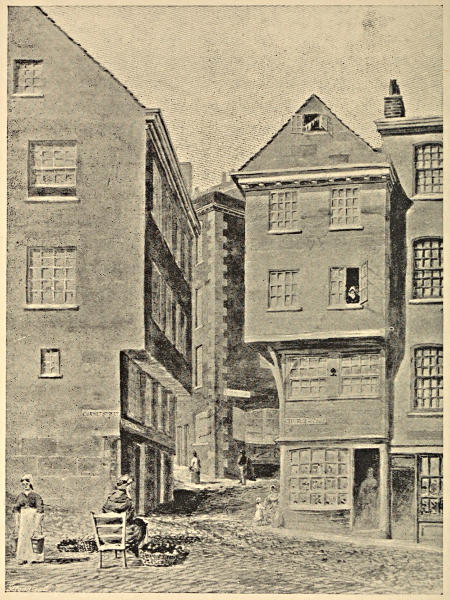
“Looking up Fountain Street, 1825.”
The thorn, which was previously green and
flourishing, was blasted as if struck by lightning, and,
although not killed, never recovered its former beauty,
but retained for ever afterwards the same scathed
and withered look.[138]
It is related that in days long past there lived in
the vicinity of the Roque Balan, at L’Ancresse, a
man of very superior acquirements. It is true that
he was commonly suspected of knowing more than
was altogether lawful, but as he ostensibly gained his
living by instructing the youth of the parish, and as
there was no doubt that his scholars profited by his
teaching, the neighbouring farmers made no hesitation
in sending their sons to him. Among his pupils was
one lad of whom he was justly proud, for a prying
curiosity and love of acquiring knowledge, joined to
a retentive memory and a sharp intellect, had made
the boy, in the opinion of many, almost a match for
his master. Curiosity and a love of acquiring
knowledge may be good in themselves, but they can
be carried too far, and this proved to be the case
with the young scholar.
He had noticed some old-looking tomes which his
preceptor kept always carefully locked up in an old
carved oak chest, and had long felt most anxious to
pry into their contents. The clearest hints he could
give, and even the openly-expressed wish to be
allowed to peruse the hidden volumes, met with no
response on the part of his teacher. He determined
to watch his opportunity, and to get a sight, by hook
or by crook, of the contents of the mysterious books,
and one day, when the master had been called away
suddenly to make the will of a dying man, and had
inadvertently left his keys behind him, the youth
seized on them, and, as soon as his back was turned,
proceeded to examine the contents of the chest. He
lifted one of the ponderous tomes, opened it at
hazard, and commenced to read out aloud the first
passage which met his eye. Unfortunately this
proved to be the spell by which the Prince of
Darkness can be summoned to this upper world to
do the bidding of his votaries. Great was the terror
of the indiscreet youngster when a sudden violent
storm arose, which went on increasing in intensity,
and Satan in person appeared before him and
demanded what he wanted of him. The unfortunate
boy knew not what answer to make, nor what task
to impose on the demon to get rid of him at least
for a time, until the return of the master. Pallot,
who was already at some distance from home,
hastened back, and entered the house just at the
moment when Satan, tired of waiting and enraged
at having been unnecessarily called up, had seized on
the inquisitive scholar and was on the point of
flying off with him. The master, at a glance,
perceived how matters stood, and, uttering a hasty
spell, arrested the demon in his course. He then
proceeded to set him a task, promising him that if
he succeeded in accomplishing it before sunset he
should be at liberty to carry off his prey.
The Devil made some difficulty in acceding to these
terms, but the schoolmaster, determined, if possible,
to save his unfortunate pupil, was firm, and not to
be influenced either by the threats or cajoleries of
the arch-fiend. He caught up a peck-measure
containing peas, and scattered them on the floor,
handing at the same time a three-pronged pitch-fork
to the Devil, and ordering him with that instrument
to throw the peas over the door-hatch into the
court-yard.
Satan took the fork and set to work with right
good will, but soon found that it was labour in
vain. Not one pea could he raise from the floor.
The sun was fast sinking below the horizon. As
the last portion of its orb disappeared beneath the
western wave, the enraged and disappointed demon
wrenched the door-hatch off its hinges and cast it
far away in the direction of Les Landes. There it
was found the next morning on a thorn-bush,
which had been green and flourishing the day before,
but which, since that time, is blasted and flattened
almost to the level of the ground, though it still
lives and is pointed out as a proof of the truth of
this history.[139]
The race of journeymen tailors and shoemakers,
hired by the day to make up, at the houses of their
employers, the materials that have been provided
beforehand, or to patch and mend the clothes and
shoes requiring repairs, is not yet quite extinct in
the rural districts of Guernsey; although the facility
of access to the town of St. Peter Port, afforded by
the excellent roads which intersect the island in all
directions, and the superior make and fashion of the
articles supplied by the tradesmen in town,—to say
nothing of the ready-made clothing so generally used
in the present day—have had the effect of considerably
diminishing the number of men who gain
their living in this way. Although we have no
knowledge that the journeyman tailor was ever the
important character here that he is in Brittany and
even in Normandy, where he is sometimes employed
in the delicate office of negotiating marriages between
the families of distant hamlets, and where he is
often the sole means of circulating the news of the
outer world, or carrying the gossiping tales of one
village to another, yet even here his presence for
a day or two in a house is looked forward to with
pleasure as a break in the monotony of the daily
family routine; and if he should chance to be what
the French call “un farceur,” or teller of good
stories, he is doubly welcome.
It must be acknowledged that, as a rule, this class
of men are not supposed to be very particular as to
the exact truth of the stories they put in circulation,
and that some of them would be better members of
society, if, on quitting their work, they were to go
straight home, without thinking it a part of their
duty to turn into every house where drink is sold,
that they may chance to fall in with on their way.
The hero of the following adventure, if fame does
not belie him, is one of this sort, and, although he
affirms the truth of the story, there is no corroborative
evidence that it is anything more than the dream of
a drunken man.
It appeared in a letter from a correspondent to
the Gazette de Guernesey of the 22nd December,
1873, and is translated literally, omitting only the
writer’s sensible remarks on the folly and simplicity
of those who could give credence to such an
invention, and on the superstition which, in spite of
education, is still so prevalent among the lower
orders. There is no doubt that the story was widely
spread and believed in the country, and that the
tailor, when questioned about it, asserts it to be true.
He is an inhabitant of the parish of Torteval, and
a Guernseyman born and bred, although bearing a
name which shews that his family came originally
from another country. One evening, as he was
returning from his work, a certain tailor, who shall
be nameless, and who bears but an indifferent
character, met with an adventure which was far
from being agreeable. A man, dressed entirely in
black, of a sinister aspect, and mounted on a black
horse, met him on his way. This strange looking
individual stopped the tailor, and the following
conversation took place:
“Hallo, you’re a tailor, aren’t you?”
“Yes, sir, at your service,” answered the tailor,
somewhat alarmed.
“Then I wish you to make me a pair of
trousers, which I will come and fetch at your house
to-morrow at noon.” And, so saying, the stranger
went on his way.
“But, sir,” cried the tailor, running after him,
“You’ve forgotten to let me take your measure.”
“Bah! what does that matter?”
“But, sir, I shall never be able to fit you if
I’ve not got your measure.”
“Well then, take it,” said the gentleman in black,
dismounting from his horse. “There!”
But imagine the poor tailor’s dismay! There were
no legs to be seen. Do what he would, it was
impossible to take a proper measure for trousers
under such circumstances. A horrible suspicion
flashed through his mind.
“It must be the Devil,” thought he to himself.
“How shall I get rid of him?”
Alarmed, horrified, trembling in all his limbs,
feeling his legs giving way under him, our poor
tailor only got out of the scrape by stammering out
these few words—
“Well, sir, your trousers shall be ready to-morrow
at noon.”
“Look to yourself if they are not ready. I shall
come and fetch them at your house,” answered the
dark-visaged and black-coated individual, leaping on
his horse and going on his way.
Seized with uncontrollable fear, it is said that the
tailor went straight to the Rector of his parish, and
told him the whole of his adventure. The good
parson advised him to make the trousers, and
promised him that he would not fail to be with
him the next day to be witness to the delivery of
them. Accordingly, the next day, at the hour
appointed, and, but a few minutes after the arrival
of the clergyman, who was beforehand with him,
the Devil knocked at the tailor’s door to claim the
trousers; and the hero of our tale, in delivering
them, heard his Satanic Majesty utter these words—
“If a man of God had not been present in this
house, I would have carried you off also.”
Whatever may be the spread of rationalism in
other places, a belief in the personality of Satan
still holds its ground firmly in the minds of our
peasantry. How can it be otherwise when there are
those who, within the last two or three years, have
had the rare chance of seeing him “in propriâ
personâ;” and this in a locality which, one might
suppose, would be about the very last that he would
be inclined to honour with his presence? The neighbourhood
of L’Erée, it is true, has never borne a
very high character. Everyone knows that from time
immemorial the hill of Catiauroc and the beach of
Rocquaine have been the favourite resort of witches
and warlocks, and that their infernal master holds
his court there every Friday night, and, seated in
state on the cromlech which is called “Le Trépied,”
receives the homage of his deluded votaries. But
who could suppose that he would leave this time-honoured
haunt to become the inmate of a Methodist
Chapel? Such, however, if we can attach any credit
to the statements of the fishermen and others who
inhabit this coast, is undoubtedly the case.

“Looking down Berthelot Street, 1880.”
Within the last few years the Wesleyans have
erected several small chapels in various parts of the
island, and, among others, one near a place called
“Les Adams.” Shortly after the chapel was finished
it began to be whispered about that lights were seen
in it at hours of the night when it was well known
that no one was likely to be there. The light is
described by some who had seen it from a distance
as if illuminating the whole of the interior, but some
fishermen who were bold enough to draw near and
look in at the windows could see nothing but a
small subdued flame in one corner, which seemed to
sink downwards into the earth. A gentleman of strict
veracity, formerly residing about a mile from the
spot, declared that he had frequently seen the
mysterious light. He described it as being of a pale
blue colour, and was convinced that it did not
proceed from either candle or lamp. He had seen it
from various points, from the rising ground inland,
to the east of the chapel, and from the low lands
lying along the sea-shore to the west. It seemed to
occupy a particular spot in the building, for the
light appeared brightest through one of the windows,
and fainter through all the others. He had observed
it on many occasions immediately after dusk, and at
hours when it was most unlikely that any person
would be in the chapel for any improper purpose. On
drawing near, the light always disappeared. The
state of the weather or of the moon seemed to
make no difference in it. Curiosity, thus excited, had
to be appeased, and, at last, some of the fishermen
ventured to approach the chapel and peep in at the
windows. What they saw they described as “Le
Dain,” the name by which his Satanic Majesty is
designated when it is thought proper to avoid the
more offensive appellation of “Le Guyablle.” Sparks
of fire issued from his mouth and nostrils, the
traditional horns and tail seem to have been
discerned, but the cloven feet were hidden by long
boots covering the knees, and which, according to
some accounts, were red.
His occupation was as difficult to be accounted for
as his presence in so unusual a place. It was that
of dancing and leaping with all his might and main!
Whether the fishermen really saw anything which
their fears magnified into a vision of the wicked
one, or whether, for reasons of their own, they
wished to impose upon the credulity of their
neighbours, it is impossible to say. One thing is
certain, and that is that persons of the highest
respectability, living in that part of the country,
vouch for the fact of the lights having frequently
been seen in the chapel at hours of the night
when it ought not to have been occupied. It does
not seem to have occurred to them that many of
the mariners on this part of the coast are employed
at times in carrying off packages of tobacco to the
English and French boats engaged in smuggling, and
that, as a temporary depôt may be sometimes required
for these goods, the chapel may have been selected
for the purpose, in preference to a dwelling house
or other private property, the owner of which, in
case of detection, might be subjected to much
inconvenience. But the neighbouring peasants have
their own method of explaining these supernatural
appearances.
Some say that they are a judgment on the original
founders of the chapel, who, as it is believed and
reported, after having collected ample subscriptions
towards the building, pretended that the funds were
insufficient, and defrauded the workmen whom they
had employed of their just dues. Others say that
the original proprietor of the land on which the
chapel is built, was importuned by his wife to make
a free gift of the site, but, being strongly averse to
dissent in all forms, could never be brought by her
to consent to the alienation; but that immediately
on the death of the old man, the widow, who, after
a youth spent in frivolity and pleasure, had turned
wonderfully pious in her declining years, took measures
to make over the ground to the dissenters, and, not
content with this, squandered on them large sums of
money which ought rightly to have been reserved
for her late husband’s children by a former marriage.
The spirit of the departed could not brook such
disregard of his wishes, and such disrespect for his
memory, and manifests his displeasure by haunting
the spot of which his children ought never to have
been deprived.
Editor’s Note.—When in Sark in 1896 I was told by one of the old Sark men, how a
Sark fisherman defeated the Devil. This fisherman was supposed to be given to witchcraft,
and one day he succeeded in raising the Devil, when Satan appeared and asked him what
commands he had for him. The fisherman had nothing to say. Finally he said, “You must
carry me where I tell you.” They were then on the far end of Little Sark. So the Devil
consented, but on the understanding that when they reached their destination, the man, in
his turn, should do what Satan commanded. So the man mounted on Satan’s back, and first
was carried across the Coupée. “Allez plus loin,” (Go farther) said the man. Then they went
on to the Carrefour, near where the Bel Air Hotel now is. “Allez plus loin,” said the man
when Satan stopped for a rest. Then they reached the Port du Moulin, where the fisherman’s
cottage stood. “Au nom du Grand Dieu—Arrêtez!” (In God’s name—Stop!) At that the
Devil had to put him down and fly away shrieking, “for,” as the old man concluded his
story, “he is powerless when God’s name is said.”
“Now there spreaden a rumour that everich night
The rooms ihaunted been by many a Sprite,
The Miller avoucheth, and all thereabout
That they full oft hearen the Hellish Rout,
Some faine they hear the gingling of Chains,
And some hath heard the Psautries straines,
At midnight some the headless Horse i meet,
And some espien a Corse in a white Sheet;
And other things, Faye, Elfin and Elfe,
And shapes that Fear createn to itself.”
—Gay.
“Et chacun croit fort aisément ce qu’il craint.”
—La Fontaine.
“Now I remember those old women’s words
Who in my youth would tell me winter’s tales
And speak of sprites and ghosts that glide by night
About the place where treasure hath been hid.”
—Marlowe’s “Jew of Venice.”
“These true shadows.…
Forerunning thus their bodies, may approve
That all things to be done, as here we live,
Are done before all times in th’other life.”
—Chapman.
It is a very common belief that events,
particularly those of a melancholy nature,
are foreshadowed. Unusual noises in or
about a house, such as cannot easily be accounted
for, the howling of a dog, the crowing of cocks at
unaccustomed hours, the hooting of owls, and many
other things are looked upon as warnings of evil to
come, or, as they are locally termed, “avertissements.”
This term is also applied to a sort of second-sight,
in which a person fancies he sees an image of
himself, or, to make use of a Scotch word, his own
“wraith.” This illusion, arising no doubt from a
derangement of the optic nerve consequent on the
weakness produced by ill-health, is considered a sure
forerunner of death. Two instances of this, both
occurring towards the end of the last century, have
come to my knowledge. In the one case, a young
gentleman, slowly dying of decline, was seated near
a window, which commanded a view of the avenue
leading to the country house in which he resided.
Suddenly he saw a figure, which he recognised as his
own, standing at the corner of a pathway which led
into a cherry-orchard, a favourite resort of his when
in health. His sister was every moment expected to
return home from a ride, and, fearing that her horse
might take fright at the apparition, he immediately
dispatched a servant to meet her, and cause her to
return to the house by another way. He died not
many hours afterwards.
In the other instance, a young lady, who was
known to be very fragile and delicate, was spending
the day at her brother’s country-house. It was
summer, and the room in which she was seated
with the other members of the family looked out on
a parterre gay with flowers. Suddenly she interrupted
the conversation which was going on, by exclaiming:—
“How singular! I see myself yonder in the garden
gathering flowers.”
Her friends tried to laugh her out of her fancy,
but neither ridicule nor reason prevailed. She persisted
in saying that she had seen her own likeness in the
garden. She grew rapidly worse, and before the
autumn was over she passed away.
It occasionally happens that both fruit and blossoms
are to be seen at the same time on apple and pear
trees. When this occurs it is believed to be a sure
presage that a death will follow in the family of the
proprietor of the tree within the year.[140]
Great faith is also put in dreams by our country
people, as the following stories will show. They make
use of many charms and spells to invoke certain
dreams, and those will be told in a future chapter,
but the following show the belief that exists in the
truth of dreams.
During the late war with France many privateers
were fitted out. A man dreamt that if a vessel were
sent out to a certain latitude and longitude, that on
a certain day it would meet with a rich prize and
take it. He realised all his property, bought a ship,
equipped and manned it, and sent it out to cruise, in
full faith that his dream would come to pass. Time
rolled on, and the ship did not appear. The man’s
friends and neighbours began to jeer at him, but he
still felt confident that all would turn out as he had
dreamt. His faith was at last rewarded, for one day,
when all but he had given up any hope of seeing
the vessel again, two vessels were seen in the offing.
As they drew near one was recognised as the
missing ship, and the other was soon made out, by
its rig, to be a foreigner. They came safely into St.
Peter Port, and it was then found that the latter
was a Spaniard, with a very rich cargo. It turned
out that the capture had been made in the very
place and at the very time that had been dreamt of.
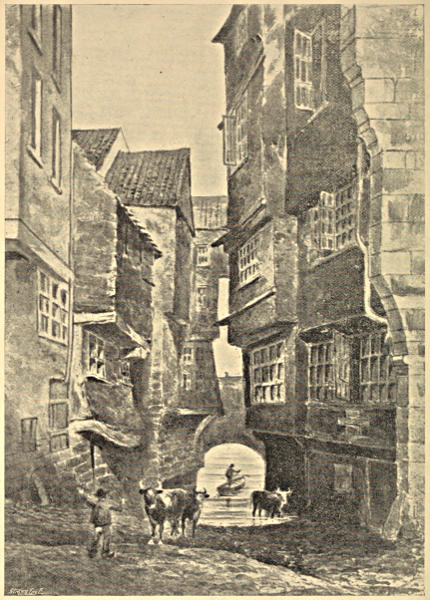
“Cow Lane.”
A country gentleman had occasion to make some
alterations in the level of a road in the neighbourhood
of his house. He employed two men in the work, a
father and son. The materials for the work were
to be taken from a gravel pit on the estate, and the
work was progressing favourably, when, one morning,
the gentleman, on coming down to breakfast, said to
his wife that he had had an unpleasant dream, and
feared that some accident would happen to the
workmen before the day was out. He went out
shortly afterwards and cautioned the men, as he had
done previously, to be very careful in digging out the
materials they were in want of from the overhanging
banks of the gravel pit. They made light of his
admonition, and he left them. Towards noon the
elder of the two workmen left the place to go home
to dinner, leaving his son behind. On his return,
about an hour later, he found that the bank had
given way and buried his son in the rubbish. When,
after a considerable time, he was dug out, he was
found to be quite dead.
“That the dead are seen no more, I will not undertake to maintain against the concurrent and
unvaried testimony of all ages and of all nations. There is no people, rude or unlearned, among
whom apparitions of the dead are not related and believed. This opinion, which prevails as far
as human nature is diffused, could become universal only by its truth. Those who never heard
of another, would not have agreed in a tale which nothing but experience can make credible.
That it is doubted by single cavillers can very little weaken the general evidence, and some who
deny it with their tongues confess it with their fears.”—Dr. Samuel Johnson.
The belief that the spirits of the dead are, under
certain circumstances, permitted to revisit the places
which they were in the habit of frequenting, and the
persons with whom they were acquainted while in
the body, has too strong a hold on the human mind
not to be still an article of popular faith in this
island; but the doings of these disembodied spirits do
not differ sensibly from what is attributed to them
in other European countries.
The ghost of the murdered man still haunts the
spot where he was foully deprived of life, crying for
vengeance on his assassin. The murderer’s form is
seen at the foot of the gibbet where he expiated his
crime. The shade of the suicide lingers about the
spot where he committed his rash act. The spirit of
the tender mother is seen bending over the cradles of
her darling children, smoothing their tangled locks,
washing their begrimed faces, and lamenting over the
neglected state in which they are allowed to remain
by a careless or unkind step-dame. The acquirer of
ill-gotten wealth wanders about, vainly endeavouring to
make restitution. And the ghosts of the shipwrecked
mariners who have perished in the waves, roam along
the fatal shore, and, with loud wailings, claim a
resting place for their remains in their mother-earth.
Some also say that the departing spirit occasionally
takes the form of a bird, and, from a story told us,
it would seem that it also sometimes puts on the
form of a mouse.
An elderly woman who lived alone in a house in
the neighbourhood of Ste. Hélène was found one
morning dead at the bottom of a flight of stairs.
From the evidence at the inquest it appeared that
she had entrusted the latch key of the front door
to a workman, who was to come early to the house
next morning to do some small job in the way of
plastering. It was supposed that before retiring to
rest, at her usual hour between nine and ten, she
had intended to go to the door to see whether the
door was properly latched, and that, in descending
the stairs, she had slipped, and, falling forward, had
broken her neck.
She had a first cousin, within a week or two of
the same age as herself, with whom she had been
brought up, and between whom and herself great
affection had always existed. About the time that
the accident must have happened, this cousin was
sitting with his wife, by whom the story was related
to me, warming themselves before the fire, previously
to getting into bed. They were speaking of the old
woman, and the husband remarked that he had not
seen her for some days, and hoped she was well,
and then immediately made the remark that he had
seen a mouse run across the room, coming from the
door towards them. His eyesight was very defective,
and his wife endeavoured to persuade him that it
was impossible that he could have seen anything of
the kind, and that, moreover, she had never seen a
mouse in that room.
They went to bed and nothing more was thought
about it until the next morning, when the wife, passing
the house where the old woman lived, saw a crowd of
neighbours assembled round the door, and found that
the dead body of her husband’s cousin had just been
discovered lying at the foot of the stairs.
The accident in all probability had occurred at the
very time she and her husband were speaking of the
deceased, and when the old man declared he saw the
mouse. She was fully convinced that the spirit of
the old woman had come in that shape to take a
last look and farewell of her kinsman.[141]
It is not many years since, that in making some
alterations in the parsonage of St. Michel du Valle,
the workmen found under the flooring of one of the
rooms a few small coins. They remembered that in
the last century, a French priest, who had renounced
his own religion, had been appointed curate of the
parish by a non-resident Rector after having been
duly licensed by the Bishop of Winchester; that, after
leading a most irregular life to the great scandal of
the parishioners, he had one day disappeared suddenly,
and that after his departure the poor box in the
church was found to have been broken open and
robbed of its contents. It was not long before it was
rumoured abroad that mysterious noises were heard
in the dead of the night in the parsonage, as of
someone walking through the rooms and dropping
money as he went. No one doubted that the
sacrilegious robber had left this mortal life, and that
his ghost was doomed to revisit the scene of his
iniquity, vainly endeavouring to make restitution to
the widows and orphans, and to the aged and infirm
pensioners of the church, of the money of which he
had so unfeelingly deprived them.
The workmen were fully convinced that the coins
which they had found were part of those which had
been so sacrilegiously abstracted. They dared not
retain them for their own use, but brought them to
the Rector with a request that they might be given
to the poor.[142]
In all ages and among all nations the burial of
the dead has been looked upon as a sacred duty;
and the belief is not yet extinct that until the body
is consigned to the earth the spirit is doomed to
wander about, seeking rest and finding none.
Great therefore is the guilt of him who, having
found a corpse, neglects to provide for its sepulture.
“Les morts recllament la terre, et ch’est leû derouait.”
(The dead claim the earth, and it is their right).
A man who had gone down at low water to visit
his nets, found a dead body stretched out on the
sands. It was not that of any of his neighbours.
A violent storm had raged a day or two previously,
and there could be no doubt that some unfortunate
vessel had gone down in the gale, and that the body
before him was that of one of the crew. It was
handsomely dressed, the clothes being of velvet, richly
laced with gold. The avarice of the fisherman was
excited, and his first thought was to search the
pockets. A purse, containing what to a poor man
was a considerable sum, was found, and, content with
his morning’s work, the man hastened home, leaving
the body to be carried away by the next tide. Great
was his astonishment and affright, on entering his
cottage, to see the dead man seated by the fireside,
and looking sternly and reproachfully at him. His
wife, to whom the phantom was not visible,
perceived his trouble, and, pressed by her, he confessed
what he had done. She upbraided him with his
inhuman conduct, and, kneeling down with him,
prayed the Almighty to forgive him his sin. They
then hastened down to the beach, drew the corpse
to shore, and buried it in a neighbouring field. On
their return home the ghost of the drowned man
had disappeared and was never more seen.[143]
“Qu’est qu’tu ’as? Non dirait qu’tu ’as veu la
grand’ garce.” (“What is the matter with you?
One would suppose you had seen the great girl.”)
Such were the words with which a gentleman
(Mr. Peter Le Pelley, Seigneur of Sark), in the last
century greeted his sister-in-law, (Miss Frances
Carey, daughter of Mr. John Carey), who had come to
spend a few days with him at his manorial residence
in Sark, on her appearance at the breakfast table the
morning after her arrival. He meant to banter her on
her anxious and haggard look, which she attributed
to a restless night and headache, occasioned in all
probability by crossing the water on the previous day.
In reality, although she did not like to acknowledge
it at the time, her rest had been disturbed. Having
previously locked her door, as was her habit, she had
fallen asleep almost as soon as she laid her head
on the pillow, but was awakened suddenly,—about
midnight, as far as she could judge,—by someone
drawing aside the curtains at the foot of her bed. She
started up, and saw plainly an elderly lady standing
there. She fell back fainting, and when she recovered
her senses the figure had disappeared.
It was probably nothing more than a very vivid
nightmare, and was followed by no results beyond
the effects of the fright which a few days sufficed
to remove, but she never again revisited Sark. The
question, however, is one which is not unfrequently
addressed to a person who has an anxious or startled
look, and refers to the apparition of a tall maiden,
which is supposed to presage the death of the person
who sees it, or that of some near connection.[144]
There is an English saying that “when the gorse
is out of bloom, kissing is out of fashion.” This is
expanded in Guernsey into the following tales.
A man, who had been long suffering from a
lingering illness, was at last lying on his death-bed.
His wife was unremitting in her attentions, and
profuse in her expressions of sorrow at the thoughts
of losing him. He did not doubt her affection for
him, but ventured to hint at the probability of her
looking out for a second husband before the first
year of her widowhood should be expired. She
warmly repudiated the bare possibility of such a
thought entering her mind, and was ready to make
a vow that she would never again enter into the
married state.
“Well,” said the man mildly, “I ask no more
than that you should promise me not to wed again
while any blossom can be found on the furze.”
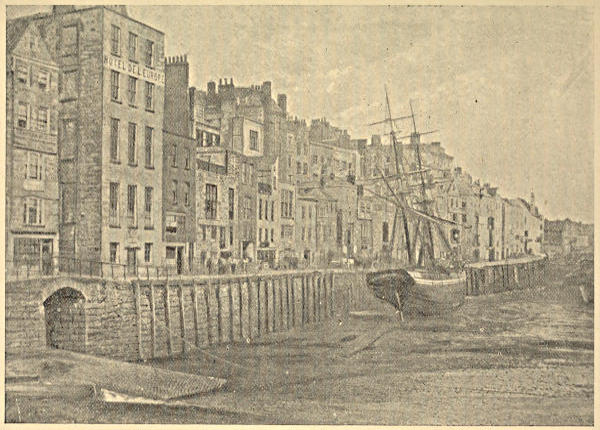
“Harbour, showing entrance to Cow Lane.”
She gladly made promise. The man died, but it
is affirmed that the disconsolate widow, at the end
of twelve months, had discovered by close observation,
and to her great disappointment, that she had made
a rash promise, and that there was not a day in the
whole year when flowers might not be found on the
prickly gorse.
Editor’s Note.
Other Editor’s notes on this subject will be found in Appendix A.
In the Castel parish they tell another story based on the same proverb. Here is a house called
Les Mourains, in that parish, belonging to the Ozannes. In the middle of the last century,
a Mr. Ozanne married a young wife, who died after having given birth to two sons. On her
death-bed she made her husband promise that he would never marry, “lorsqu’il y avait des
fllieurs sur l’ jan.” He promised, but after her death he married again.
But the poor spirit had not found rest. The nurse, while she dressed and undressed the
children, frequently saw her late mistress watching her. The other servants, when in the
evenings they stood at the back door talking to their friends and acquaintances, heard the
rustling of her silk dress along the passages.
And she so habitually haunted the drawing room that for years it had to be kept locked
up, and finally the Rector of the parish had to be sent for, to lay the ghost, which he did,
and it was boarded up in a cupboard. The place may be conjectured, for in the drawing
room there is still a part boarded up, and at times strange noises are heard, as of a spirit
ill at rest.[145]
“Had learned the art that none may name
In Padua far beyond the sea.”
“Tam saw an unco sight!
Warlocks and witches in a dance;
Nae cotillon brent new frae France,
But horn pipes, gigs, strathspeys, and reels,
Put life and mettle in their heels:
… There sat auld Nick, in shape o’ beast;
A towzie tyke, black, grim, and large,
To gie them music was his charge.”
—Tam O’Shanter, Burns.
“Wise judges have prescribed that men may not rashly believe the confessions of witches,
nor the evidence against them. For the witches themselves are imaginative, and people are
credulous, and ready to impute accidents to witchcraft.”—Bacon.
The belief in witchcraft dates from so very
remote a period, it is so universally spread
throughout all the various races that
compose the human family, that it is not to be
wondered at if it still retains its hold among the
ignorant and semi-educated, especially when we find,
even in the present day, that persons, who ought by
their superior instruction, and by the position they
hold in society, to be above such superstitions, are
nevertheless, firm believers in judicial astrology,
fortune telling, spiritualism, and other similar delusions.
Although it is now but very seldom that public
rumour goes so far as to point out any particular
individual as a proficient in this forbidden art, the
persuasion that sorcery does still exist, is by no
means extinct. A sudden and unusual malady, either
in man or beast, a strange and unlooked-for accident,
the failure of crops from blight or insects,—all these,
and many more evils, are attributed by the ignorant
to supernatural causes; and, it is probable, will
continue to be so as long as there are those who
find it their interest to encourage this superstitious
belief. For there are individuals, commonly called
“désorceleurs” or “white-witches,” who pretend to be
able to declare whether a person is bewitched or
not, and to have it in their power, by charms and
incantations, to counteract the evil influence. Of
course this is not to be done for nothing; and cases
of this kind, where large sums of money have been
extorted from ignorant dupes, have, even of late years,
formed the subject of judicial investigation. It is
useless to attempt to reason with the lower orders
on this subject. They have an answer ready which,
in their minds at least, is a conclusive reply to all
doubts that may be suggested:—
“Witches and witchcraft are frequently spoken of
in the Holy Scriptures; who, then, but an unbeliever,
can doubt that such things are?”
Guernsey did not escape the epidemic delusion
which spread over the whole of Europe in the
sixteenth and seventeenth centuries. Here, as elsewhere,
a terror seized upon the people, and no man
thought himself secure from the machinations of the
agents of Satan. The records of the Royal Court of
the island contain far too many condemnations of
unfortunate men and women to the stake for sorcery;
and the evidence on which the sentences against
them were based, as well as their own confessions,
extorted under the infliction of torture, and taken
down in writing at the time, are still extant. The
unhappy individuals were of various ages and
conditions, but, judging from the statements of their
accusers, and the evidence brought against them,
they appear to have been in most, if not all cases,
persons of irregular life, subsisting by begging and
pilfering, vindictive towards those who offended them,
and clever in taking advantage of, and working on,
the fears and preconceived notions of their dupes.
They were accused of causing storms to arise, in
which the unfortunate fisherman who had refused
them a share of his catch, either lost his boat, his
gear, or his life; or was so tempest-tossed as to be
in danger of losing his wits. Women and children
were, by their infernal influence, afflicted with sudden
and strange maladies. Oxen, horses, calves, sheep,
and swine died unexpectedly, the cows calved prematurely,
and either gave no milk, or else blood in
lieu of it. Butter would not come, or became rancid
even while it was being made, and curds dissolved
and turned to whey.
Maggots of unusual appearance, black at both
extremities, appeared in prodigious quantities in the
beds, and even under the women’s caps, and lice were
in such numbers that they could be swept away
with a broom.
The water in the fountains—usually so bright and
limpid—became turbid and unfit for use, and full of
tadpoles and disgusting insects. Frogs and black
beasts (“des bêtes noires”), whatever they may have
been, sat by the bedside of those who were under a
spell; but all these evils disappear as suddenly as
they have come, either on the sufferer weakly yielding
to the demands of the supposed sorcerer, or having
courage enough to threaten to denounce him to the
judicial authorities.
It is not to be wondered at that the pretended
wizards and witches should have shrunk from a
judicial investigation at a time when all believed
firmly in their supernatural powers, and when the
examination into the alleged facts was carried on in
a manner so different from the procedure of the
present day, hearsay evidence of the vaguest
description being admitted as proof, and when that
failed, torture being resorted to in order to extort a
confession.
From the evidence given, and the confessions of
the sorcerers themselves, it appears that the means
employed by them to effect their nefarious designs
were various; but two in particular are mentioned.
A peculiar black powder, furnished them by their
master, the Devil, which, being cast on man or beast,
was the cause of serious and unusual maladies; and
certain enchanted articles, introduced furtively into
the beds or pillows of those on whom they wished to
practise their evil arts.
These charms are variously described by the
witnesses as consisting of seeds of different kinds, of
which mildewed or blighted beans seem to have
been the most common, and of feathers, knotted
together with ends of thread or silk twist, and
sometimes made into the shape of a small image.
When the beds or pillows were opened to search
for these articles, it sometimes happened that an
animal was seen to leave the bed, which, after
taking various forms, as that of a black cat, a cock,
a rat, a mouse, or a stoat, succeeded in evading all
attempts to catch it, and escaped in a mysterious
manner.
Isabell Le Moigne, one of the witches, declared
in her confession that this was none other than
Satan himself. If these charms were thrown into
the fire, they produced a most noisome smell,
but, in some instances, the immediate cure of the
sufferer was the result. If the person under the
influence of witchcraft was uncertain on whom he
ought to fix the guilt of bewitching him, there was
an infallible method for discovering the culprit.
The house-key was to be placed on the hearth-stone,
and the fire heaped around it. As it became
hot, the wizard or witch, apparently suffering great
agony, would come to the door, and endeavour to
force an entrance into the house, offering at the
same time to put an end to the spell under which
the inmates were bound.
Another means of finding out the guilty party was
to roast the heart of some animal—some said that
of a black sheep was the most efficacious—with certain
prescribed rites and incantations, or to boil it with
certain herbs known to the white witch or “désorceleur,”
who, of course, could not be expected to give
his valuable advice and services for nothing.
According to the confessions of the unfortunate
victims of the superstition and credulity of their
times, to which allusion has been made above, the
doings of Satan with them were just such as we
read of in the accounts of prosecutions for witchcraft
in other countries. A desire to be revenged on some
persons who had given them offence seems to have
been the first motive.
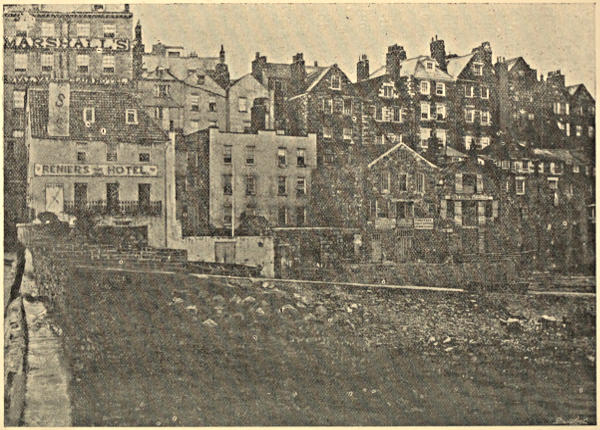
“North Arm, Old Harbour, showing back of Pollet.”
The Devil then appeared to them in the shape of
a black dog, cat, or other animal, sometimes under
one likeness, sometimes under another; offered his
services, invited them to attend the “Sabbath,” which
was generally held in some weird, out-of-the-way
locality; furnished them with a certain ointment,
which was to be rubbed on the back and stomach;
after doing which, they found themselves carried
through the air, with extraordinary velocity, to the
appointed place of meeting, where they found other
wizards and witches, and a number of imps in the
shape of dogs, cats, and hares. They were unable to
recognise the other sorcerers on account of their all
appearing blackened and disfigured, but they knew
who they were by their answering to their names
when the roll was called over by Satan before entering
on the business of the night.
They commenced by adoring their infernal master
in a manner which it is not necessary to describe
minutely. They then danced back to back, after which
they were regaled with bread and wine, which Satan
poured out of silver or pewter flagons into goblets of
the same metals. They all agreed in describing the
wine as being inferior to that usually drunk; and
they asserted that salt was never seen at these feasts.
The Devil, before dismissing the assembly, gave them
a certain black powder, of which we have spoken
before.
The favourite form assumed by Satan on these
occasions seems to have been that of a large black dog,
standing upright on his hind legs, but he sometimes
appeared in the shape of a he-goat.
Isabell Le Moigne described him as a black dog of
large size, with long erect horns, and hands like those
of a man. Deeds were done at the Sabbath which
will not bear being spoken of; but there are circumstances
which lead one to suppose that the poor
deluded wretches of women may, in some cases, have
been deceived by designing men, who enticed them
from their houses at night, and, under assumed
disguises, abused their credulity.
All sorcerers were marked by Satan in some part
or other of the body, and the mark thus made was
insensible to pain, and bloodless.
One of the witches asserted that the Devil, before
her enlistment into his service, required of her the
gift of some living animal, and that she presented
him with a young fowl. The next night at the
Sabbath, whither she was conveyed through the air
after having duly anointed her body with the ointment
given her by the Devil, she was made to renounce the
Holy Trinity, and to promise obedience to her infernal
master. It appeared also from the confessions that if
the servants of Satan refused to do his behests, they
are beaten and otherwise maltreated by him.
It is clear from the evidence given in many of the
trials for witchcraft that the accused, in a majority
of cases, were persons who trafficked on the ignorance
and credulity of the people, and who encouraged
the idea of their being possessed of supernatural
powers so long as they found it profitable to do so.
Even in the present day there are people who are
afraid to refuse to give alms to a beggar, lest an
evil eye should be cast upon them; and who can
say how many deaths of cattle and pigs, attributed
to witchcraft, may not have been caused by poison
adroitly administered out of revenge for a supposed
injury?
In their nocturnal flights through the air to their
appointed place of meeting with the Demon, witches
were said to utter loud cries; and persons may,
perhaps, still be found ready to affirm that in
tempestuous nights, when the wind was howling
round their dwellings, they have been able
to distinguish above all the tumult of the elements,
the unearthly cry of “Har-hèri[146]! qué-hou-hou!
Sabbat! Sabbat.” This cry is attributed to the
“gens du hocq” or “gens du Vendredi,” as they are
called by those whose prudence deters them from
speaking of “sorciers” and “sorcières,” lest the use
of such offensive epithets should give umbrage. It
is believed, too, that in their assemblies on Friday
nights on the hill of Catiôroc, around the cromlech
called “Le Trepied,” or on the sands of Rocquaine
Bay, they dance to a roundelay, the burden of which
is “Qué-hou-hou! Marie Lihou!” Some suppose that
these words are uttered in defiance of the Blessed
Virgin Mary, in whose honour the church and priory
were erected and dedicated by the name of Notre
Dame, Ste. Marie de Lihou. They are now a heap
of shapeless ruins, but the place must have been
looked upon as one of peculiar sanctity, for even down
to the present day French coasting vessels passing
by salute it by lowering their topmast. It is not
then to be wondered at if the infernal sisterhood—one
of whose chief amusements, as is well known, is
the raising of storms in which many a proud vessel
goes down—should take a particular delight in insulting
the “Star of the Sea,” the kind and ever-watchful
guardian of the poor mariner.
Wizards and witches are supposed to have the power
of navigating on the sea in egg-shells, and on the
blade-bones of animals. It is to prevent this improper
use of them that the spoon is always thrust through
the egg-shell after eating its contents, and that a hole
is made through the blade-bone before throwing it
away.
It is believed that witches have the power of
assuming the shape of various animals, and many
stories turn on the exercise of this supposed faculty.
The favourite forms with them appear to be those
of cats, hares, and “cahouettes”[147] or red-legged
choughs. It is not easy to conjecture how this
beautiful and harmless bird got into such bad
company; perhaps its predilection for the wild and
unfrequented cliffs and headlands, where the witches
are supposed to hold their unholy meetings, may
have gained it the reputation of being in alliance
with them.
In Guernsey, as elsewhere, a horseshoe, nailed on
the lintel, door, or threshold, or on the mast or any
other part of a ship or boat, is supposed to be a
sure preservative against witchcraft, and, although a
black cat is one of the most frequent disguises
assumed by Satan’s imps and servants, the household
in which a cat without a single white hair is
domesticated, is thought to be highly favoured, as
none of the infernal gang will venture to molest it.
As some persons are fully persuaded that every black
cat, however tame and well-behaved it may appear
to be, is in reality in league with the Prince of
Darkness, it may be that any interference on the
part of others of the fraternity is contrary to the
rules established among them, and resented accordingly,
the old saying that “two of a trade cannot agree,”
holding good in this case.
Allusion has been made to those who have an
interest in encouraging a belief in witchcraft, and there
is no doubt that persons who, for some reason or
other, enjoy the unenviable reputation of dabbling in
this forbidden art, now that they have no longer the
fear of the stake and faggot before their eyes, and
have only the minor terrors of a Police Court to
dread, are not altogether unwilling to brave the
latter danger if, by working on the credulity of the
ignorant and superstitious, they can extort money, or
even command a certain amount of consideration as
the possessors of supernatural powers.
Few would venture in the present day to
acknowledge openly that they could injure their
neighbours by the exercise of unholy arts; but many
may be found who pretend to a secret knowledge
which may be used for beneficent purposes.
The difference, however, between a true witch—the
servant of Satan—and what is commonly called “a
white witch,” has never been clearly defined. The
latter is known in Guernsey by the name of
“désorceleresse” or “désorceleur,” for the art is
quite as frequently, if not more frequently, exercised
by men than by women. The persons who practise
it pretend to be able to declare whether man or
beast is suffering from the effects of witchcraft, to
discover who it is that has cast the spell, and, by
means of spells and incantations, to counteract the
evil influence. It is clear, however, that one who is
in possession of such powers must himself have a
very intimate and profound knowledge of the arts he
is fighting against, and that, if offended, he may
perhaps be tempted to practise them. The
“désorceleur” thus is as much feared as trusted,
and as, of course, he cannot be expected to give his
valuable services for nothing, the profession is often
found to be very remunerative, large sums of money,
besides presents in kind, being sometimes extorted
from the superstition and fears of the credulous
dupes.
There is no doubt, however, that some of these
pretenders have some skill in the cure of the diseases
to which cattle are liable, and even that some of
the minor ailments to which the human race are
subject, are occasionally relieved by them, especially
those—and among ignorant, uneducated people they
are not few—which arise out of a disordered
imagination. The habits of close observation which
those of his profession acquire must needs give the
“désorceleur” a great insight into character; his
cunning will soon teach him how to work on the
fears and credulity of those who come to consult
him, and his experience will guide him into the best
way of exercising his knowledge.
How far the so-called white-witches are believers in
their own supernatural powers is an open question.
It may be that, in making use of certain forms or
practices which they have learned from others, they
may be fully persuaded in their own minds of their
efficacy, it may be that in some cases they are
labouring under a sort of hallucination.
A noted bone-setter, who, it is said, was occasionally
resorted to when man or beast was supposed to be
under evil influence, or when it was sought to
discover the perpetration of a theft, used to account
for his pretended knowledge of the anatomy of the
human body by asserting solemnly that this knowledge
had been revealed to him in a vision from
Heaven, and he had repeated this story so often
that it was evident to his hearers that he had come
at last to believe fully in the truth of what he said.
The rustic bone-setter is not necessarily a
“désorceleur,” although, as in the instance just
noticed, the two professions may be combined; but
he is skilled in the cure of those somewhat
mysterious ailments known as “une veine trésaillie,”
which seems to be a sprain or strain, and “les
côtaïs bas,” which may be defined as that sort of
dyspeptic affection which the lower orders call a
“sinking of the stomach” or “all-overness.” This
ailment is supposed popularly to be caused by the
ribs slipping out of their place, and is cured by
manipulation and pushing them gradually back into
their proper position. The efficacy of friction properly
applied in reducing a sprain is well known, and
accounts for the frequent success of the bone-setter
in the treatment of “veines trésaillies.”
Some of these practitioners—old women as well as
men—pretend to have the gift of causing warts to
disappear by counting them, and asking certain
questions of the persons applying to them for relief.
The principal information they seem to wish to arrive
at is the age of the person; and this known, they
predict that the warts are likely to disappear within
a certain time. As these unsightly excrescences affect
more particularly young persons, and as it is known
that they frequently disappear naturally at that age
when youth is passing into manhood, it is not
unlikely that this fact may have been observed, and
the knowledge of it turned to account. It is believed
that those who possess the secret may impart it to
one, and to one only; but they must receive neither
fee nor reward for so doing; for if they do, or if
they tell it to more than one, they lose their power
of curing. They must not receive money for their
services, but if a cure is effected they are at liberty
to take a present.
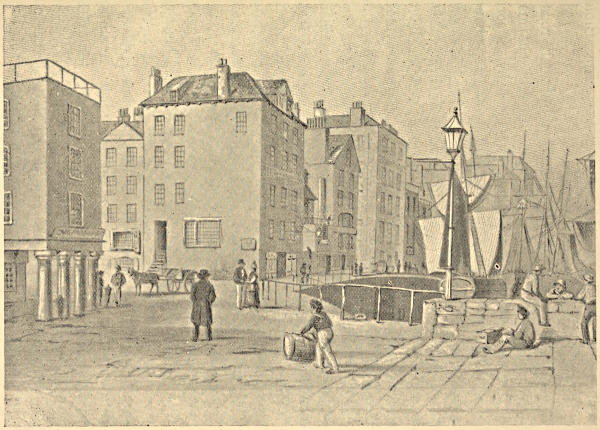
“Town Harbour, from an old picture.”
As might be expected, fortune-telling forms no
small part of the white-witch’s profession, although
all do not practise it, and some confine themselves
to this particular branch alone. Cards seem to be
now the principal means used for prying into the
secrets of futurity, but other appliances have been
used, and may, perhaps, still be used by some, such
as the detection of a thief by means of a Bible
and key.
A sort of rhabdomancy, or divination by small rods,
shuffled together with certain ceremonies and charms,
and then thrown on the ground, was used by a sort
of half-demented creature called Collas Roussé, about
the end of the last century.
He is said to have had a good deal of shrewdness,
to have been very quick at repartee, and to have
had great facility in expressing himself in rhymed
sentences. He appears to have believed that he was
really in possession of supernatural knowledge, and
as his assumption of extraordinary powers gained
credence with the vulgar, he found it an easy task
to make a profit of their credulity. It is reported
of him that when brought to justice for some gross
act of imposition, he had the audacity to threaten
his judges with the effects of his vengeance. His
threats, however, did not deter the magistrates from
sentencing him to exposure in the cage on a market
day, with his divining apparatus by his side. He
bore his punishment bravely, and entertained the
multitude who crowded to see him with rhyming
remarks. Another species of rhabdomancy is the
use of the divining rod, the efficacy of which is
fully believed in, not only for the discovery of
springs of water, but also for the revealing of the
spot where treasure has been concealed; and, if the
stories that are told are all to be depended upon,
there is evidence sufficient to stagger the sturdiest
unbeliever.
A country gentleman, now dead, whom nobody
who knew him took for a conjurer, was particularly
renowned for his skill in this art. Not only could
he tell by means of the rod where a spring of water
was to be found, and to what depth it would be
necessary to dig before coming to it, but he could
also discover in what part of a field or house money
or plate had been hidden. In order, however, to
perform this last feat, it is necessary that the rod
should be previously touched with metal of the same
kind as that to be sought for. It is only in the
hands of some few favoured individuals that the rod
works, and even then it does so in various degrees;
with some, being violently agitated, with others, moving
slowly, and sometimes imperceptibly. The art of
holding the forked stick may be taught to anyone,
but unless a natural aptitude exists, the rod remains
inert in the grasp of the holder.
A portion of the confessions of some of the
unfortunate victims who suffered at the stake in
1617, translated from the records preserved in the
Register Office of the Royal Court of Guernsey, will
be given as a specimen of the absurdities to which
credence could be given in a superstitious age.[148]
It must not, however, be forgotten that the island
did not stand alone in this belief. No part of
Europe seems to have escaped the absurd dread of
witchcraft, which, like a pestilence, spread from one
nation to another, and from which even the most
learned of the age, men of profound thought, did
not escape. One curious fact may be noticed; the
practices imputed to the accused, who were for the
most part of the lowest and most ignorant classes of
society, and to which in numberless instances they
confessed, appear to have been nearly identical in all
countries. The inference is that they must have been
handed down from a very remote period, and that
they were in use among the pretenders to magical
arts and supernatural powers among our pagan
ancestors; just as in the present day we find similar
ideas and practices existing among savage tribes,
and in semi-civilised countries where the light of
Christianity has not yet penetrated. It is well known
how difficult it is to wean a people from their primitive
belief, and how prone they are to cling to it in secret.
Is it not possible that some secret society may have
existed for ages after the spread of the Gospel in
which heathen practices may have been perpetuated?
Editor’s Note.—The documents which follow are translated from the Records of the Royal
Court preserved at the Greffe. Sir Edgar MacCulloch had copied out the depositions of the
witnesses on loose sheets of paper, evidently meaning to incorporate them into his book.
The “Confession of the Witches” in his MS. follows his essay on Witchcraft.
15th May, 1581.
Katherine Eustace and her daughter were accused
by common consent of practising the art of witchcraft
in the island.
The wife of Collas Cousin deposed that having
refused to give milk to the accused, saying that
there were poorer people to whom she would rather
give, her cow then gave blood instead of milk.
Johan Le Roux deposed that having been seized
with great pains in his knee, he believed himself to
be bewitched by Katherine Eustace, so his wife went
to the latter and threatened to denounce her to the
Royal Court; after that he got better.
28th October, 1581.
Robert Asheley, found dead in the garden behind St.
Peter Port parsonage, suspected of having committed
suicide by shooting himself with an arquebus. This
having been proved according to the law, the Court, after
hearing the speech made by Her Majesty’s Procureur,
found that the said Robert Asheley shall be carried to
some unfrequented spot and there buried, a heap of
stones being placed on his body,[149] and thus he shall
be deprived of burial in the spot where Christian
remains are placed; and that all his goods shall be
confiscate to Her Majesty the Queen.
25th February, 1583.
Collas de la Rue is accused of using the arts of
witchcraft, and of grievously vexing and tormenting
divers subjects of Her Majesty.
Matthieu Cauchez deposed that his wife being in
a pining languorous condition, having heard that
Collas de la Rue was a wizard, and knowing that
he frequently visited his house, he asked him if he
could help his wife. Collas replied:—
“As to her she is an ‘in pace’ (sic), she will not
live much longer.”
De la Rue came to the place where his wife lay ill,
and caused the bed to be reversed, putting the bolster
at the foot; she died three hours afterwards.
James Blanche affirmed that having failed in a
promise he had made to De la Rue, the latter swore
he should repent. His wife soon afterwards became
swollen all over, in which state she remained for
some considerable time. He finally went to De la Rue,
and consulted him as to how to cure his wife, and
he gave him a decoction of herbs to be used as a
drink, by which his wife was cured.
Thomas Behot deposed that on returning from
fishing, he refused to give some fish to the son of
Collas De la Rue. The son said he was a “false
villain,” and complained to his father, who on that
said, “Tais-toy, il n’en peschera plus guères.” (“Be
quiet, he will not catch many more.”) That same day
he was taken ill, and became so swollen that he could
not rest between his sheets—(en ses draps). After
having been ill for a long time, his wife unsewed
his mattress and found therein several sorts of
grains, such as broom, “alisandre” “nocillons” or
“nerillons de fèves,” (black beans?), the treadles of
sheep, pieces of laurel, rags with feathers stuck into
them,[150] and several other things. His wife threw it
all into the fire, and such an awful smell arose from
the flames that they were obliged to leave the room,
and immediately his swelling disappeared. The same
day he was taken with such violent pains that he
thought his last hour was come. Whereupon his wife
put the key of their front door in the fire, and, as
soon as it began to get red hot, Collas de la Rue,
who had not been invited, and who had not put foot
inside their house for six years, arrived there before
sunrise, and said that he would undertake to cure
him, but that it would be a lengthy operation, that
he would have to refer to a book that he had at
home, by which he had cured several people, Matthieu
Cauchez among others, and that also he (the witness)
would be cured. So Collas made him some poultices
of herbs, but they did not cure him. With great
difficulty he dragged himself to St. Martin’s Church
(au temple de St. Martin), where De la Rue said to
him:—
“I am glad to see you here, and yet not entirely
glad, for you are not yet cured.”
When the deponent replied that he soon hoped to
be on the sea again, De la Rue replied:
“Do not go, for you will not return without great
danger.” (“N’y vas pas, car à grand’ peine en
reviendras tu.”)
However, he persisted in going, and encountered
such bad weather that he and all the crew were
nearly drowned. And returning very ill, and his
malady continuing, his wife again unsewed his mattress
and there found an image made of a bone-like
substance and apparently all gnawed, (d’une manière
d’os tout rongé) which he took to the magistrates,
and afterwards got better.
Collas De la Rue also told him that Collas
Rouget had gone to Normandy to seek a cure. Had
he only consulted him first, he need not have gone
so far to be cured. In conclusion he said that on
his conscience he believed and affirmed the said De
la Rue to be a wizard.
Richard de Vauriouf deposed that having had
several differences with Collas De la Rue on the
subject of his cattle, which had caused him
annoyance, De la Rue said to him:
“You are very strong and active, but before long
you will not be thus, and you will be humbled after
another manner.” (“Tu es bien robuste et fort,
mais avant qu’il soit guères ce ne sera pas ainsy,
et tu seras autrement abaissé.”)
Very soon afterwards the said Vauriouf was taken ill,
and so was one of his daughters, and he was weak
and languishing for more than a month.
Pierre Tardif, who had had some law-suits with
Collas De la Rue, deposed that thereupon his
daughter was taken ill, and her mattress being
searched they found several … (here and in
various places the record is torn) … of several
kinds, and being … made principally of a coloured
silken thread and of … of broom, of beans cut
up, two of them being black … a pin stuck in
a piece of rag and … After having taken advice
he (Tardif) had thrashed De la Rue … after having
given him two knock-down blows, his daughter was
all right again. After which she was again taken ill,
so he searched for De la Rue, and, having found
him, he again thrashed him, this time drawing blood,
and shortly after that his daughter was cured. In
conclusion he also deposed upon oath his belief that
De la Rue was a wizard.
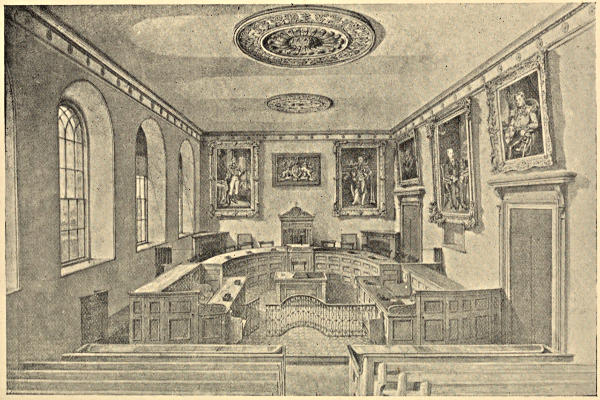
“Royal Court House in 1880.”
… deposed as to having heard Collas De la Rue
say that he had means to silence those who spoke
ill of him (“qu’il avait des moyens de faire taire
ceux qui parloient mal de luy.”)
(The record is here again torn, and the trial apparently
did not conclude, but in 1585 the proceedings
against Collas De la Rue were recommenced and many
of the same witnesses appeared).
The Trial of Collas de la Rue resumed.
17th December, 1585.
Collas Hugues appeared in person and showed his
child to us in the Court. This said child cannot talk
except at random and with an impediment in its
speech that none can cure; and he declares his
conviction that his said child is “detained” (detenu)
by some wizard, and he will take his oath that it is
Collas De la Rue who “detains” him, inasmuch
that the latter threatened him that he would afflict
him through his most precious treasure (du plus
cher joyau qu’il peut avoir). On this declaration,
Her Majesty’s Procureur testified to us that the said
De la Rue had formerly been imprisoned for sorcery,
and now, that though he had not always been
proved guilty, yet that to all outward appearance he
had practised the art of witchcraft, and so much so,
that new complaints being made against him, he had
demanded the arrest and the confiscation of the goods
of the said De la Rue, which was granted.
On the 25th of December an investigation was
ordered.
December, 1585.
James Blanche affirms that on a certain day, having
promised to go for a day’s work to the aforesaid De
la Rue, and not having done so, that he was heard
to say to one of his people, that he, Blanche, should
repent, and that soon afterwards his wife was seized
with an illness which lasted for nearly a year. So that,
finding the said De la Rue near “La Croix Guerin,”[151]
he asked him if he could give him something to
cure his wife. Then the said De la Rue took an
apple, which he broke into six parts, of which he
retained one, and gave the remaining five pieces to
the said Blanche to carry back to his wife, forbidding
him at the same time to eat a mouthful. Notwithstanding,
when he quitted De la Rue, he ate the said
apple, and at that moment the said De la Rue
appeared before him, he having not yet reached his
own house, and taxed him with having eaten the
forbidden apple, and the same day his wife was
cured. He, Blanche, says that this is a man given
to threats, and is much suspected and generally
denounced as being a wizard, and he has even heard
that people have called him “sorcier” to his face
and he has not resented it.
December, 1585.
Jehennet des Perques deposed that at divers times
the said Collas De la Rue went to the fishermen and
foretold to them when they should have fine weather
and when they should have storms.… He was
commonly reported to be a wizard. He also deposed
that on a certain day, he being at the house of Collas
Henry, where the said De la Rue had quarrelled with
the wife of Collas de Bertran, who had called him
“sorcier” (wizard), he threatened her that she
should repent, and that the said Mrs. de Bertran fell
in descending the stairs (cheut aval les degrez)
and bruised herself from head to foot.
Several witnesses depose that Collas De la Rue is
a man much given to threats, that various persons
have fallen ill after having been threatened by him,
and that he cured them at his will.
He was sent back to prison.
It appears that Collas De la Rue was executed,
for, in a lawsuit against Denis de Garis for concealing
a treasure that he had found in his house, it is said
that the aforesaid treasure was found on the day of
Collas De la Rue’s execution, that is to say the
25th of March, 1585-6.
24th November, 1602.
Marie Roland is accused of sorcery.
John Sohier witnesses that the aforesaid Marie,
having been with him one day at the house of the
Henry’s, together with Joan Henry, whose child lay
ill, she confessed to having bewitched the child, and
on being asked in what manner, said that she had
put its clothes one night by the stream (auprès du
douit) and that she and her master the Devil then
entered into the house of the said Henry by the
chimney, and found the said child by the hearth,
and with a splinter she pricked the child, and it
was bewitched for three months.
10th April, 1613.
An inquest on the suspicions of witchcraft against
Olivier Omont, Cecile Vaultier, his wife, and
Guillemine Omont, their daughter.
Jacques Bailleul deposed that having refused alms
to Olivier Omont his son was taken with a pain in
his ear which lasted twenty-four hours, that the doctor
said that he could not understand it (qu’il n’y connaissait
rien), that he believes that Olivier is a wizard.
Guillemine Le Pastourell affirms that Omont came
begging from her, and she said that he was stronger
than her and that he could gain his bread if necessary
without begging, that the next day she was taken
ill, that she remained ill for three weeks, that Omont,
having come again, gave her some bread, and after
that she recovered. During her illness all her cattle
died. She believed it was from some spell cast by
the said Omont.
Marie Sohier witnesses that the day after the death
of her husband Olivier Omont came to her house
demanding bread. She replied that having numerous
children to feed she could not spare him any, that
he went away grumbling. At that very moment her
daughter Marguerite, aged six years, was taken ill,
and when they gave her some bread she threw it away
and ate cinders by the handful. That her daughter
Marie, one year old, was taken ill one hour after the
departure of Omont, and she had remained ill for two
years. That having met Omont at the Mont Durand
she threatened to throw a stone at him, and called
him “sorcier,” that on returning home she gave a
lump of white bread to her child, who ate it all, and
since then is quite well. She believes that the said
Omont was the cause of the sickness of her children.
Philippin Le Goubey witnesses that Olivier Omont
having begged for cider from his wife, she refused
him, and was instantly afflicted with grievous pains;
that he entreated the said Omont several times
to come into his house to see his wife, but that he
always refused; that one day he forced him to enter,
and he put one foot in the house and the other
out, and then he fled; that rushing after him he
threatened to denounce him to justice if he would
not cure his wife; that then he said that she would
be well again in a fortnight, but that he could not
cure her at that moment; that he forced him to
return to the house, and that, when there, he
threatened to keep him there until he was delivered
up to justice; that at that very moment his wife was
cured of the worst of her pains; that having shortly
afterwards come into the town to make a notification
of these things, he found that the said Omont had
already taken a boat and fled from the country.
Pierre Simon, of Torteval, being at the Hougue
Antan,[152] met Olivier Omont lying with his face against
the ground. He tried to awake him, shook him, and
heard a buzzing (un bourdonnement) but saw
nothing. Feeling rather frightened he left him and
went on towards the Buttes[153] of Torteval, and then
came back to the place where he had left him.
Omont suddenly awoke, having his mouth full of mud,
and his face all disfigured (défiguré). Omont having
been questioned replied that he had fallen from the
cliff, and that Pierre Nant had seen him fall.
Several people witnessed that having refused alms
to Omont and to his wife, their cattle fell ill and
died, their cows gave blood instead of milk, or gave
nothing at all, their sows and their cows miscarried,
and misfortunes happened to their wives.
29th June, 1613.
Thomas Mancell witnessed that his wife having
refused alms to Omont, their cow fell ill, and they
were obliged to kill it. Jean Hamon, who flayed the
cow, cut it at the shoulder, and “there issued a
black beast as large as a little ‘cabot’ (a small
fish). Its throat was such that one could easily
insert the tip of one’s little finger, and it had
two little wings” (“en sortit une beste noire,
grosse comme un petit cabot, dans la gueule duquell
on aurait bien mis le bout du petit doigt et avait
deulx petites ailes.”)
Jean Le Feyvre, of the Mielles,[154] witnesseth that
one morning he found Cécile, wife of Omont, near
the Chapelle de l’Epine, where she was searching, he
could not tell for what, and where she remained for
a long while without his being able to perceive that
she found anything, and she did not perceive that
he was watching her; and he having asked her
shortly afterwards whether it was she that he had
observed at such an hour near the chapel, she denied
it, and that afterwards he asked her again whether
it was she who was in that neighbourhood, and she
replied in the affirmative, and then he started fine
rumours, (ung beau bruit) saying that she was dancing
on the thorn which grows in the aforesaid neighbourhood.
29th May, 1613.
Thomasse, wife of Collas Troussey, deposes that
one night, her husband being on guard at the Castle,
she was awakened by a frightful noise, like cats
squalling, and she dared not cry out on account of
Olivier Omont, who was sleeping in the same corridor
as herself, though the miauling of the cats still
continued. When her husband was returned from
his patrol, she dared ask Omont if he had not
heard the cats, to which he replied Yes, but there
was nothing for her to be afraid of, that they would
do her no harm. That another night, her husband
being also there, she had heard Omont call “Cats!
cats!” and on asking him if he had cats in his
wallet (en son bisac,) he replied “No,” and that
the noise seemed beneath where she lay, but that
he was afraid that they would eat the fish that was
on the table.
Olivier Omont, his wife and daughter, were all
banished from the island.
30th June, 1613.
An enquiry was held on Laurence L’Eustace, wife
of Thomas Le Comte, suspected of being a witch.
Jean Hallouvris witnesses that for four years he
has driven his cart. As the wheels passed close to
Laurence she dropped several strings and twists of
rushes (quelques colliers et nattes de pavie)[155] that
she was carrying, at which she was very angry.
Two days afterwards, one of his bullocks set off
running as if it were mad, and then fell down stone
dead, and the other bullock died the next day.
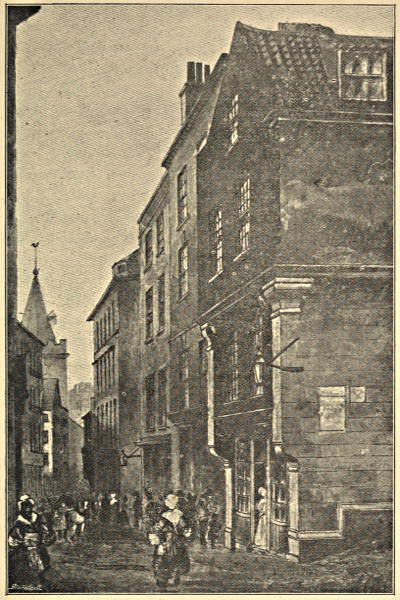
“High Street, 1850.”
Sketched from an Old Picture by the late Mr. A. C. Andros.
Pierre Machon deposes that he has heard Laurence
swear “By God’s ten fingers” (“Par les dix doigts
de Dieu”), and with oaths and blasphemies call devils
to her assistance.
Christine, wife of Pierre Jehan, says that her first
husband, Collas Henry, having had a quarrel with
Laurence Le Comte, one of their children, aged two
years, was taken with an illness which lasted for
twelve months. When the attack first came on, he
jumped high into the air, that, before being taken
ill he walked very well, but that afterwards, all that
year he crawled on his hands and knees. That,
having had a quarrel with the said Laurence, and
having put some curds to cool, (des caillebottes à
refroidir), she found them the next day just like bits
of rag (que de la mêque), and that on the following
Monday the child was seized with terror, and
cried out that someone was pulling his nose. That,
as soon as she went to Laurence’s house, the child
got better, but, on her return, fell ill again, and
finally died.
Laurence L’Eustache, wife of Thomas Le Comte,
was also banished from the island.
On the 17th of May, 1617, began the trial of
Collette du Mont, widow of Jean Becquet, Marie,
her daughter, wife of Pierre Massy, and Isebel
Becquet, wife of Jean Le Moygne.
James Gallienne witnesses that one day, having
quarrelled with Jean Le Moigne, husband of the
aforesaid Isebell, the said Le Moigne said to him:—
“You are always seeking to pick quarrels with
me, and you say that my wife is a witch, but
before six months are over you will be very glad
to come and implore me to help you;” that
immediately his wife fell into a lingering illness,
and, doubting not but that it was the effect of
a spell, opened all the mattresses and found all
kinds of filth and bits of feather, which he has
showed to several people; and in some quite new
pillows which he had at home he found a large
quantity of worms. He says that about six years
ago, one of his children being ill, he was putting a
pillow under his head, found it hard, and, on
unripping it, found it full of dirt. While they unsewed
it they heard a flapping noise as of the wings of
a cock, and the said child declared that he saw this
cock; that, having shut all the doors, they tried to
find what it really was, and that, having hunted and
ransacked the house, they saw first a rat, then a
weasel, which slipped through the holes of the
pavement (sortit par les pertius de la dalle). And at
the end of two or three days he was asked why
he had beaten the said Isebell Becquet. He replied
that he had not touched her, and soon after that
he was advised to try whether she was a witch, by
putting the key of his front door (de son grand huis)
in the fire, which he did. When the said key
had been nearly two days in the fire the said woman
arrived at his house, without asking whether he
were at home, and begged of him seven to nine
(sept à neuf) things which he refused her, she
wishing at all hazards to come in further (entrer
plus outre) to see the sick child, which he would
not allow.
Item. Deposeth that his wife having rebuked the
said Isebell because her children annoyed those of the
said Gallienne, she went away very vexed, and the
next day one of his oxen broke its neck, his mare
miscarried, and his wife was taken ill.
Item; that the children of the said Isebell said one
day to the children of the said Gallienne, that if
their mother was ill it was because she had spoken
rudely; that some time afterwards, Mrs. Gallienne
being in bed in her room, the door being shut and
simply a sky-light (une luquerne sic, lucarne) open, she
felt something like a cat, which, little by little, crept
on her chest as she lay on her bed. Having shaken
it to the ground, she heard one or two growls, on
which, astonished, she began to threaten it that if it
was a wizard or a witch she would cut it to pieces
(que le couperoit en pièces), it returned by the said
sky-light.
Thomas Sohier said that Jean Jehan having
summoned him to come and make his will, he
complained that the said Isebell was killing him
for having refused to make a jacket for her son.
That some little time afterwards James Gallienne,
having a sick daughter, caused her bed to be
unripped, out of which came a sort of animal like
a rat (une manière de bête comme un rat), which
hid itself in some wood and was hunted for
throughout the house; that on the following day,
having met the said Isebell, he noticed her face all
torn (déchiré sic). On asking her the cause she said
it was from “du mal d’Espagne,” (cantharides, the
Spanish fly used for making blisters); that on that
he asked James Gallienne if he had not beaten her,
who replied in the negative; that, being the other
day at the house of the said Gallienne, giving
evidence to this, his wife fell down as if dead, and on
returning to consciousness, said that she was bewitched.
Item. Testifies that in the bed of the aforesaid
daughter (of Gallienne), were found twenty-one or
twenty-two spells (sorcerons).[156]
Many other depositions told the same story. Oxen
and calves died, cows and mares miscarried, sheep fell
dead, children and women were taken ill, no cream
was found on the milk, curds would not “make,”
cows dried up, or only gave blood. Worms were
bred in the beds, or even under the women’s caps.
They were black at both ends, or sometimes had two
heads. Frogs and black beasts (des bêtes noires)
haunted the paths of the bewitched persons. Fountains
were full of insects, black pimples appeared all over
the bodies of the afflicted persons, and lice, in such
abundance that they had to use a broom to sweep
them away. On the witch being threatened the sick
person recovered.
The trial was resumed on the 6th June, 1617.
Marie, wife of James Gallienne …
deposed … Item; that for nearly ten years her eldest
daughter Rachel had been bewitched; that, having
unsewed her mattress, by which was some straw,[157]
something was seen lurking in the said straw, and Jean
Le Gallez, being present, said that it looked to him
like a black cat, and sometimes like a cock, and then
like a mouse, and then like a rat, that it—whatever
it was—hid in some wood which was in the house,
which was immediately rummaged and moved, but no
one knew how to capture it (ne sçurent tant faire
que de le prendre). That her husband saw it like a
cock, and her daughter like a mouse; that on opening
the mattress they found within it many spells (force
sorcerons) and also beans with which were mingled
black grains as if mildewed,[158] which beans or grains
having been put in a porringer (une écuelle) in
the presence of various women who were there, it
dissolved in their presence, and they did not know
what became of it (cela fondit en leur presence
et ne sçurent que devint.) That the said Isabell,
having come to the house at the end of two or
three days, and asking for seven or nine sorts of
things, and trying to force an entrance into the place
where the child was lying ill, all which things were
refused her by her husband, so she then went away,
and her face was all cut; and went to her
husband and said that she would not stay while
Isebell Becquet was there, and she believes that she
is a witch.
On the 4th of July, 1617, these three women,
Collette Dumont, widow of Jean Becquet, Marie,
her daughter, wife of Pierre Massy, and Isebell
Becquet, wife of Jean le Moigne, were convicted by
the Royal Court of Guernsey of having practised
the damnable art of sorcery, and of having thereby
caused the death of many persons, destroyed and
injured much cattle, and done many other evil deeds.
They were condemned to be tied to a stake,
strangled, and burnt until their bodies were totally
consumed; and their ashes to be scattered abroad.
The sentence added that, previous to execution, they
were to be put to the torture[159] in order to force
them to declare the names of their accomplices.
First, the said Collette, immediately after the said
sentence had been rendered, and before leaving the
Court, freely acknowledged that she was a witch,
but would not particularise the crimes which she had
committed; whereupon she was conducted with the
others to the torture-house, and, being put to the
question, confessed that the Devil, when she was still
young, appeared to her in the form of a cat,[160] in
the parish of Torteval, it being yet day, as she was
returning from tending her cattle; that he prevailed
upon her by inviting her to revenge herself on one
of her neighbours with whom she was on bad terms
in consequence of some injury done to her by his
cattle; that on subsequent occasions, when she had
quarrelled with anyone, he again appeared to her in
the same form, and sometimes in that of a dog,
inducing her to revenge herself against those with
whom she was displeased, and persuading her to
cause the death of men and beasts; that the Devil
having come to invite her to the Sabbath, called her,
without its being perceived by others, and gave her
a certain black ointment,[161] with which, having stripped,
she rubbed her body nearly all over, and, having
dressed herself again and gone out of doors, she was
immediately carried through the air with great velocity
to the place where the Sabbath was held, which
was sometimes near the Torteval parish churchyard,
and sometimes on the sea-shore near Rocquaine
Castle; that, being arrived there, she met frequently
as many as fifteen or sixteen wizards and witches,
with devils, who were there in the form of dogs,
cats, and hares; that she could not recognise the
wizards and witches, because they were all blackened
and disfigured, although she heard the Devil evoke
them by name, and remembers among others, the
wives Calais and Hardy. She confesses also that at
the opening of the Sabbath, the Devil, in making
the evocation, began sometimes by her name; that
her daughter Marie, wife of Massy, at present under
condemnation for the same crime, is a witch, and
that she has taken her twice to the Sabbath with
her. She does not know where the Devil has
marked her. She says that at the Sabbath they
adored the Devil, who stood upon his hind legs …
in the form of a dog, that afterwards they danced
back to back, and after having danced they drank
wine, but of what colour she does not know, which
the Devil poured out of a flagon into a silver or
pewter goblet; but that the wine did not seem so
good as that which is usually drunk, that they
also ate white bread, which the Devil presented to
them, but that she has never seen any salt[162] at the
Sabbath.
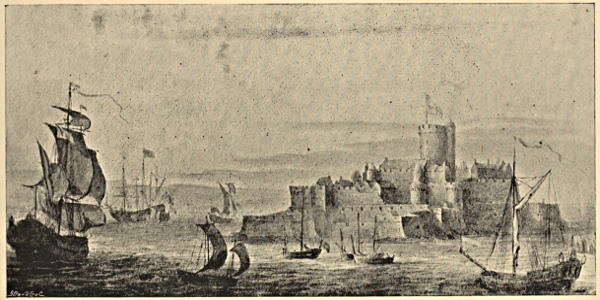
“Castle Cornet, 1660.”
She confesses that the Devil had charged her to
call in on her way for Isebell Le Moigne, when she
went to the Sabbath, and that she has done so
several times; that on leaving the Sabbath the Devil
invited her to perpetrate many evils, and that, for
this purpose he gave her certain black powders, which
he ordered her to throw on such persons and beasts
as she pleased; and that with this powder she did
much evil, which she cannot now call to mind, but
she remembers that she threw some over Mr. Dolbel,
the minister of the parish, and by this means was the
cause of his death. With the same powder she
bewitched the wife of Jean Manguès, but denies that
her death was caused by it. She says that she
touched the side, and threw some of this powder on
the wife,[163] since deceased, of Mr. Perchard, who
succeeded Mr. Dolbel as minister of the parish,
thereby causing her death and that of her unborn
babe. She cannot say what offence the deceased had
given her. She says that on the refusal of Collas
Tostevin’s wife to give her some milk, she caused
her cow to run dry by throwing some of the powder
over it, but that she cured the cow afterwards by
giving it bran mixed with grass, which the Devil
had given her, to eat.
The confession of her daughter Marie, wife of
Pierre Massy, is much to the same effect, with
this exception, that she seems to have been in the
habit of meeting the Devil in the form of a dog,
and that he changed her into an animal of the same
species at the time of their interviews.
The third of these unfortunate wretches, Isebell,
wife of Jean Le Moigne, enters, in her confession,
into some additional details.
It was in the semblance of a hare, and in broad
daylight, that the Devil appeared to her for the first
time, and incited her to avenge herself on her sister-in-law,
La Girarde, with whom she had quarrelled.
At first she resisted the tempter, but he appeared to
her a second time, again in the road next her house,
and on this occasion left with her a packet of black
powder, which she kept. A third time the demon
appeared, in the same form, urging her, if she would
not give herself to him, to make him a present of
some living animal, whereupon she gave him a chicken,
and he appointed her to meet him the next day
before sunrise at the Sabbath, promising to send
someone to guide her there. Accordingly old Collette
Dumont came that night to her house, and gave her
some black ointment, with which she rubbed herself.
She was then carried over hedges and ditches to the
place of meeting near Rocquaine Castle. She was
received and welcomed by the Devil in the form
of a dog, with long erect horns (avec de grandes
cornes dressées en hautt), and hands like those of a
man. He caused her to go down on her knees and
renounce the Almighty in these words: “I deny God
the Father, God the Son, and God the Holy
Ghost.” (“Je renie Dieu le Père, Dieu le Fils, et
Dieu le Saint Esprit”). After this, she was made to
adore the Devil and invoke him in these terms:
“Our great Master, help us!” (“Nostre grand
Maistre, aide nous!”) and also to enter into an
express covenant to adhere to his service. At the
conclusion of this ceremony, the same acts of license,
dancing and drinking (again bread and wine in
mockery of the Holy Sacrament), took place as are
described by Collette Dumont, widow Becquet, in
her confession. On this occasion Isebell Le Moigne
entered into a pact with Satan for one month only;
but subsequently the agreement was extended to
three years. She stated that Satan treated Collette
Dumont with marked respect, always evoking her
name first, styling her “Madame, la vieille Becquette,”
and giving her a place by his side. She also said that
one night, when she was at the Sabbath, the Devil
marked her on the thigh. The mark thus made having
been examined by women appointed for that purpose,
they certified that they had thrust pins deep into it,
and that Isebell felt no pain therefrom, nor did any
blood follow when the pins were withdrawn.
According to her account, the Devil appeared
occasionally in the form of a he-goat, and when
they took leave of him, they all had to kiss him,
that he inquired of them when they would return,
and exhorted them to adhere to him and do all the
evil in their power. He then took them all by the
hand and they departed in different directions. She
asserted also that it was the Devil who had been
seen in the forms of a rat and a stoat in the
house of James Gallienne, whose child she had
bewitched; that she was in the neighbourhood of the
house at the time; and that the Devil, having
resumed the form of a man, came to her and beat
her severely about the head and face, which ill-treatment
she attributed to her having refused to go
with him to Gallienne’s house. She said that she
never went to the Sabbath except when her husband
was gone out to sea for the night, fishing.
The depositions of the witnesses, taken down very
minutely in the three cases above cited and in many
others of a similar nature, have been preserved, and
throw a good deal of light on the popular ideas of
the day in respect to sorcerers and their doings.
There are some families in Guernsey whose members
have the reputation of being sorcerers from their birth.
These individuals require no initiation into the diabolic
mysteries of the “Sabbat,” Satan claiming them as
his own from the very cradle. They are, however,
furnished by him with a familiar, generally in the
shape of a fly, so that the phrase “avoir une mouque”
is well understood as meaning that the person of
whom it is said is one of the infernal fraternity.
Indeed, in talking of persons who are addicted to
magical arts, it is reckoned highly imprudent to
speak of them as “sorciers” or “sorcières,” or to
call them by the now almost-forgotten name of
“Quéraud.”[164] By so doing you give offence, and,
what is of still more consequence, you put it in their
power to injure you. It is, however, quite safe to
speak of them as “gens du Vendredi,”[165] or “gens
du hoc.”[166]
Satan does not always wait for their death to claim
their souls as his own, but sometimes carries them
off bodily; and a former schoolmaster of the Vale,
who, from his eccentricities, had acquired the reputation
of being a wizard, having disappeared mysteriously,
and having never been seen again, is commonly
believed, to this day, to have been spirited away.
Those who are born sorcerers have the faculty of
transporting themselves at will wherever they please,
but those who seek admission into the fraternity, and
are initiated into the diabolical rites, are furnished by
their infernal master with a certain ointment with
which they anoint every part of their bodies before
undertaking their aerial journeys. They are also
supposed to be able to introduce themselves at
night through the chinks and crevices of the
buildings into the sheds in which the cattle
are housed, for the purpose of milking the cows,
not only thus depriving the owner of his property,
but also worrying and alarming the poor animals,
whose altered looks in the morning shew the ill-treatment
to which they have been subjected. An
old horse-shoe nailed on the door or lintel, or a
naturally pierced flintstone pebble attached to the
key of the stable door, are both considered efficacious
in warding off these attacks—but an infallible method
of driving off the witches is to suspend wreaths of
the bramble from the rafters. Witches and wizards
travelling, not on land, but through the air, finding
these unexpected obstacles in their way, get scratched.[167]
After having rubbed themselves over with this
ointment they are then instructed to pronounce
without intermission the words “Roule, roule, par
dessus ronces et buissons.” (“Roll, roll, above brambles
and brakes”).
This was discovered in the following manner:—A
prying valet, who lived in the service of a gentleman
who was a wizard, of which fact he was nevertheless
ignorant, was one day amusing himself by peeping
through the key-hole of his master’s bed chamber.
He observed his master make use of the ointment,
and heard distinctly the words which he pronounced,
immediately after which he became invisible. Wishing
to try the effect of the unguent on his own person,
he entered the room, and went through the process
of anointment, but when he came to pronounce the
magic formula, he made use of the word “dessous”
instead of “dessus” (“under” instead of “over.”)
Perhaps he was an Englishman, to whom the
French “u” was an insurmountable difficulty.
Be this as it may, he had reason to repent
bitterly of his indiscreet curiosity, for, no sooner
were the words out of his mouth, than he felt
himself lifted up, and carried at a fearful rate through
furze brakes and bramble hedges, while at the same
time he had the mortification to see his master
gliding along through the air, several feet above the
bushes, and laughing heartily at his misfortunes. At
last, dreadfully scratched and torn, and more dead
than alive, he arrived at the spot where the infernal
troops had their rendezvous, but was too much
frightened to notice what took place there, only too
happy to escape without being forced, against his will,
to enrol himself among them. His curiosity, however,
was effectually cured, and he vowed nevermore to
pry into his master’s secrets.[168]
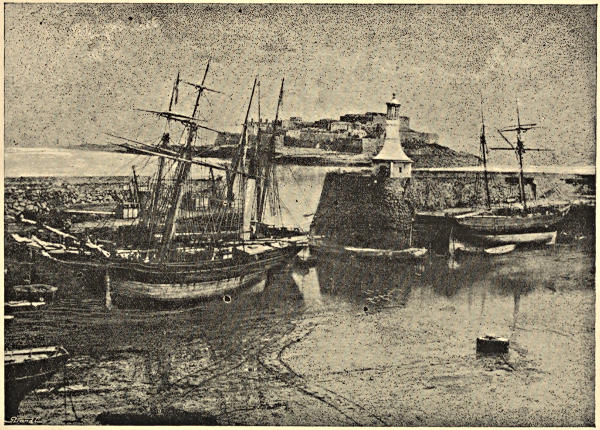
“Old Harbour.”
The following is another instance of the use of
this infernal ointment. It is related that a lady of
St. Pierre-du-Bois was astonished at the long time
her husband remained in his private apartment, and
her curiosity at last induced her to watch him.
Accordingly she one day concealed herself in the
room. Her husband came in shortly afterwards, and,
after stripping off all his clothes, proceeded to anoint
himself from head to foot with a certain ointment,
after which he repeated the words “va et vient” (“go
and come”), and immediately disappeared. Anxious
to know whither he was gone, she went through the
same ceremony, and no sooner had she repeated the
mysterious words than she found herself on the
summit of Pleinmont, in the midst of a large
concourse of people. A table was set out, covered
with a variety of viands of which some present
invited her courteously to partake. Previously,
however, to touching anything, she, like a good
Christian, repeated aloud the words “Au nom de
Dieu soit, Amen,” (“In the name of God, Amen”). No
sooner had the sacred name passed her lips than she
found herself alone. All had disappeared, and the
only signs which remained of any living beings having
been on the spot besides herself were recent marks of
cloven feet indented on the sward in every direction.
There is a story told of two men who were
neighbours and inhabitants of the parish of St.
Saviour’s, that their occupation—that of quarrymen—took
them frequently to the Vale parish, where the
finest qualities of granite are to be procured. The
distance they had to traverse before arriving at their
destination was considerable, and the road in some
places, rather lonely.
Leonard Sarre, who was of a companionable nature,
thought that the tediousness of the way would be
considerably lessened by having someone to talk to,
even if it were only his fellow workman, Matthew
Tostevin, whose taciturnity and reserve were proverbial.
Often, when setting off in the early morning to go to
his work, he would, as he passed Tostevin’s door,
look in and offer his company. The answer was
invariably the same:—
“Go on, I shall be there as soon as you, though
I shall not leave home for an hour to come.”
When Sarre arrived at the quarry where they
worked he was frequently astounded at finding
Tostevin already there. The way which Sarre took
was the very shortest and most direct. He was
confident that Tostevin could not pass without his
perceiving him, and any other road would entail at
least half-an-hour’s extra walking to accomplish.
There was evidently a mystery, and Leonard was
resolved to fathom it.
At last, in answer to his repeated enquiries, Matthew
told him that he was willing to let him into the
secret. He bade him place his foot on one of his,
clasp him tightly round the waist, shut his eyes
closely, and, above all, on no account whatever, to
utter a word.
Leonard Sarre did as he was directed, and
immediately felt himself lifted into the air and carried
along at a fearful rate. In his fright he forgot the
injunctions that had been given him, opened his eyes,
and, finding himself far above the earth, cried out in
terror “O, mon Dieu!” The holy name dissolved
the unhallowed spell, at least so far as poor Leonard
was concerned. He fell; fortunately it was into one
of the most boggy spots of La Grand’ Mare, so he
escaped with a few scratches and bruises, a thorough
ducking, and a tremendous fright. What became of
Matthew Tostevin is not known.
It was not until many years had rolled over his
head that Leonard Sarre ventured to relate his
perilous adventure, and then Tostevin had long been
dead.[169]
The barren and rugged hill of Catiauroc, situated
near the sea-shore in the parish of St. Saviour’s, is
the noted and favourite haunt of wizards and witches.
Once every week on the Friday night they resort
thither, and grand assemblies, at which their infernal
master presides in person, are held at other seasons,
particularly on St. Thomas’, or the longest night, and
on the eve of Christmas.
Though the power of sorcerers in doing harm is
very great, yet they themselves are subject to all
the accidents and infirmities of life, nor can their
supernatural skill extricate them from any difficulty
they may chance to get into.
A countrywoman left her cottage one morning at
daybreak to look after her cows. In passing through
a furze brake that led to the meadow she thought
she perceived, by the yet imperfect light, what
appeared to her a bundle of clothes thrown on the
top of a hedge. On approaching nearer she was
astonished to recognise a lady from the town, whose
dress was so entangled in the brambles that it was
impossible for her to extricate herself, or to descend
from her elevated situation, and who was so exhausted
that she had scarcely sufficient strength left to beg for
assistance. It immediately occurred to her, that the
lady in her aërial journey to the Catiauroc that night
had kept too close to the earth, and thus had been
caught by the bushes, but, remembering that there
are some persons with whom it is better to be
friends than enemies, she immediately drew near and
assisted the lady to descend, at the same time
expressing her surprise at seeing her in such a
singular position, and begging her to walk into her
cottage and rest herself.
“No,” said the lady, thanking her, “I must now
make the best of my way home. Mention to no
living creature what you have seen this day, and all
will go well with you, but bitterly will you repent
your folly if you disobey this injunction.”
She then left the countrywoman. It is not easy
for a man to keep a secret from his wife, but it is
almost impossible for a woman to conceal anything
from her husband.
The secret weighed on the poor woman’s heart and
rendered her miserable, till at last she flattered herself
she had discovered an expedient by which she might
ease her mind without disobeying the commands put
upon her. She therefore one morning desired her
husband to follow her into the garden and stand at
some little distance from her. She then addressed
herself to a tree, and related to this inanimate object
what she had seen, but the secret of course reached,
as was intended, the ears of her husband. The
subterfuge availed her nothing; before the close of
day she was struck with deafness, and never, to her
dying day, did she recover her hearing.
The old woman of the Castel, who related this
story to Miss Lane, said that the woman was her
great-aunt, and remembered having seen her when
very young.
Stories very similar in their general features to the
preceding are far from uncommon in the country, and
in all the sorceress is represented as a lady of rank.
A countryman met a lady entangled in the brambles
on the top of a hedge. He disengaged her, and was
promised that as long as he kept the secret he
should find every morning, under a stone which she
pointed out to him, a piece of money.[170]
“O Faustus, lay that damnèd book aside
And gaze not on it, lest it tempt thy soul,
And heap God’s heavy wrath upon thy head!
Read, read the Scriptures:—that is blasphemy.”
—Tragical History of Doctor Faustus, by Christopher Marlowe.
Many persons, although not absolutely considered as
wizards, are looked upon with no favourable eye from
their supposed possession of books relating to the
black art, by the study of which they are thought to
be able to control the elements, to produce strange
effects either for good or bad on the bodies of man
and beast, to discover hidden secrets, treasure, etc.
These books are generally known by the name of
Albins, probably derived from that famous professor
of magic, Albertus Magnus, many of whose formulas
for raising the Devil, etc., they are said to contain.
They are also called “Le Grammaille” or “Grand-Mêle,”[171]
and a distinction is made between the
Grand-Mêle and the Petit-Mêle.
Among the effects which the possessors of these
books are said to be able to produce is that of
causing persons to walk in their sleep, and to direct
their steps towards any point to which the dabbler
in magic may wish them to go, but in order to
accomplish this, it is necessary that he should have
previously drawn blood from the person on whom he
intends to practise his unlawful art. So small a
quantity however as that produced by the scratch of
a pin is amply sufficient for the purpose.
These books are said to be indestructible. If thrown
on the fire they remain unconsumed, if sunk in the sea,
or buried in the earth, they will be found again the
next day in the cupboard or chest from whence they
were taken.[172]
The small islet of Lihou lies on the western coast
of Guernsey, from which it is separated by an arm of
the sea. An ancient causeway, which is uncovered at
half-tide, affords an easy access to the main-land, but
it is dangerous to attempt the passage when the tide
is flowing, for the coast is so flat that the water
rises with great rapidity, and many accidents have
occurred. A church, the ruins of which are still to
be seen, existed here until the Reformation. It was
dedicated to Notre Dame de la Roche, and was
served by a prior, who was appointed by the Prior
of St. Michel du Valle, a dependency of the great
Abbey of Mont St. Michel-au-peril-de-la-Mer, in the
Bay of Avranches. The isle is to this day looked
upon with such veneration by the Norman and
Breton sailors employed in the coasting trade, that
they never pass it without saluting, by lowering
their topmasts, and there is reason to believe that it
was a favourite resort of pilgrims. A house belonging
to a family of the name of Lenfestey, and situated
at Les Adams, is said to have been, in former days,
the residence of the priest who officiated at Lihou.
A free-stone let into one of the exterior walls has a
rough delineation of a church incised on it, which is
said to represent the Priory Church of Lihou as it
formerly existed.[173]
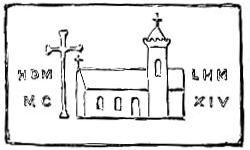
Stone supposed to represent the ancient Priory at Lihou.
A few years ago the remains of a skeleton were
discovered in sinking a well on the property, to
which a certain number of houses in the neighbourhood
have a right of resorting for water. Many persons
who have gone to draw water at night have heard
groans, thrice repeated, as if from a person expiring,
and these have generally been followed by the death
of some near relation of the hearer. Three days
after Mrs. Savidan heard the groans, a boat, in
which were two of her relations named Le Cras, was
capsized in a storm and both perished.[174]
Notwithstanding the sanctity of the place, however,
the old proverb of “The nearer the church, the
farther from God,” might at one time have been applied
to it, for it is related of one of the priors that he
was addicted to the black art. Neither the fear of
God, nor the censures of the church, could wean
him from the fascinating study of magic, and the
Grand-Mêle was far oftener in his hands than the
Bible or breviary. But wizards, it is well known,
have often been the victims of their own art, and
so it chanced with the profane Prior of Lihou.
One morning, taking advantage of the receding tide,
he crossed over to Guernsey to seek an interview with
another adept in necromancy, the priest of the neighbouring
Chapel of Ste. Apolline. He was accompanied
by his servant, to whom he had entrusted a ponderous
tome, containing the formulas by which he performed
his incantations, and to whom he had given strict
orders on no account to open the volume or read a
word which it contained.
The visit over, the prior prepared to return to his
convent, and walked along leisurely, knowing as it was
then spring tide that two or three hours must elapse
before the returning waves could bar the passage to
the islet. The servant lingered behind, and when he
arrived on the beach found his master already half
way over. His curiosity had been vividly excited by
the repeated injunctions of his master that he should
abstain carefully from opening the book. He began
to think that it must contain something very wonderful,
and that, as but few minutes must elapse
before their arrival at the convent, when the
mysterious volume would, without doubt, be instantly
demanded by the prior, if he did not seize this
opportunity of acquainting himself with its contents,
no other occasion might ever present itself. He
yielded to the temptation, opened the book, and began
to read. The prior by this time had arrived at
about the middle of the causeway, and was astonished
to find the tide rising rapidly and threatening to cut
off his further progress, either backwards or forwards.
He felt that some unnatural agency was at work, and,
guessing how matters stood, looked back to the shore
which he had just left, and saw his faithless servant
comfortably seated on a heap of dried sea-weed, with
the fatal volume spread open on his knees. He was
reading aloud, and the prior caught enough of the
words to know that his attendant had hit upon the
spell which causes the tides to rise out of their usual
course, and, moreover, that he was reading most
leisurely.
In great fright he called out to the man to read
on quickly to the end, as he knew that then the
waves would stop and return to their proper limits.
The servant was too much absorbed in his reading
to pay any attention to the directions given him,
and the waves had by this time reached above the
prior’s waist. In mortal agony he called out for the
second time:—
“If thou canst not read forwards, read backwards!”
The roaring waves this time effectually drowned
his voice. The servant read on, but long before he
had arrived at the end of the incantation, the sea
had covered the profane priest, and the demon whom
the magic lines had evoked carried off his prey.[175]
We all know how dangerous it is to possess books
which treat of the arts of magic and sorcery, or to
tamper in any way with these forbidden practices.
It came to the ears of a former rector of St. Pierre-du-Bois
or Torteval, that one of his parishioners, of
the name of Sarre, not only owned such books, but
was in the habit of reading and studying them.
Indeed, if there was any truth in public rumour,
many of Sarre’s neighbours had been sufferers from the
improper use he made of the knowledge thus unlawfully
acquired. The good rector thought it his duty to
remonstrate with his parishioner, and to point out to
him the sinfulness of his conduct, and the danger he
was incurring of forfeiting both body and soul to the
Prince of Darkness; but all his good advice was, for
a long time, treated with contempt. At last, what
the rector’s charitable remonstrances had been unable
to effect was brought about by Sarre’s own fears.
The presence of a large black cat, which followed
him wherever he went, and was with him night and
day, began to alarm him. It was useless to attempt
to drive the beast away; it cared neither for threats
nor blows. In short Sarre began to be seriously
alarmed lest his assiduous study of the forbidden
volumes should, at last, have brought, if not Satan,
at least one of his familiars, to dog his steps
continually, and to watch an opportunity of seizing
on his prey.
Under these circumstances he thought it most
prudent to get rid of the books, and, with this
intent, went one night to the extreme verge of low-water
mark at spring-tides, dug a hole in the sand,
and buried the accursed volumes. The rising tide
soon covered the spot, and Sarre returned home with
his mind at ease. His feeling of security was not
destined to be of long duration, for, on entering his
door, he was met by the black cat, who, erecting
his tail, and rubbing himself against his master’s legs,
manifested his joy at seeing him again. The next
object that his eyes rested on were the books he
had just buried, carefully placed on their accustomed
shelf, and as dry as if they had never left it. A
profound melancholy seized him; he ceased to occupy
himself in his usual avocations, and wandered about
the cliffs and sea-shore in a disconsolate state, till,
at last, he disappeared. Those who were charitably
disposed, surmised that, in his despair, he had thrown
himself over one of the lofty precipices of Pleinmont
into the sea, but there were not wanting others
who suggested that the master, into whose service
he had entered, had at last claimed his own, and
carried him off bodily.[176]
A certain man of the name of Robin, who lived
near Les Capelles, in the parish of St. Sampson’s, had
risen from being a day labourer to be the possessor
of what, in Guernsey, passes for a considerable landed
estate. Riches are sure to create envy, and more
particularly is this the case when a man has been
prosperous in the world and has arrived at a rank
and station to which he was not born. The poor
hate him because he has acquired a title to consideration,
which his origin, as humble as their own, can
never confer. The rich pretend to despise him because
he is wanting in the accidental circumstance of birth.
All concur in attributing his success in life to luck,
to want of honesty, to anything but intelligence,
industry, and good conduct. It will not, therefore, be
thought surprising if calumny was busy at work to
blacken the character of one, who, like Robin, had
been so fortunate in his undertakings. He was openly
spoken of by his neighbours as being addicted to
sorcery.
It was well known that he possessed the art of taming
the most refractory bulls, and it therefore followed as
a matter of course that he had also the power of
bewitching other cattle. Sometimes, when a cow
was sick, and all the usual nostrums of the village
farrier had failed in effecting a cure, recourse was
had, as a last resort, to Robin, who was generally
successful. What conclusion was more natural, than
that he, who could so easily remove a malady, had
also the power of inflicting it? Besides, it was
whispered about by some of those who contrive to
be well informed of all that passes, even in the
most secret recesses of their neighbours’ houses, that
Robin would sit for hours together, shut up in his
private room, with a pack of cards before him, with
which he appeared to be playing some game.
No adversary was seen, but what game can be played
by one man alone? It was clear to the most obtuse
that another was present, although invisible to mortal
eye, and who could this be but the great enemy of
human souls?
At last old age came on; Robin became more and
more infirm, and was at last confined to his bed.
During his illness his attendants were much annoyed
by the continual creaking and cracking of an ancient
oaken press, which stood in the corner of the room,
and which he would not allow them on any account
to open or meddle with. Of course they all thought
that this chest contained untold gold, for he was
known to be extremely avaricious—in fact he was
one of those “who would cut a double[177] in two” as
the saying is. He was frightfully hard on all his
workmen, exacting every moment of their time. So far
did he carry this, that it is said he only allowed them
five minutes to take their noon-day meal, which, according
to the universal custom at that time, was furnished
by the employer, and eaten at his table. It was
commonly believed that one source of his wealth was
the discovery of a buried treasure in one of his
fields. There was a well on his property which was
intermittent, at times overflowing, and at others not
having above an inch or so of water in it. It was
supposed to conceal a treasure, and a man was sent
down to examine it, but no sooner had he begun to
bale out the water than it returned with such
violence that he was obliged to be drawn up to avoid
drowning. When Robin was dying, his son urged
him to give something to the poor, but his constant
answer was:—
“Je n’en counis pouïnt.” (“I do not know any.”)
His last hour was, however, rapidly approaching,
and he desired the press to be opened, and certain
books which it contained to be thrown on the hearth
where a large fire was blazing. His orders were
obeyed, but, to the great astonishment of the servants
and attendants, instead of being consumed in the
flames, the books extinguished the fire![178] Fresh faggots
were, by the orders of the dying man, heaped on
the hearth, and kindled, and, at last, the mysterious
books, if not consumed, at least disappeared. The
press had ceased to creak from the moment the
books were taken out of it, and shortly afterwards
Robin breathed his last.
A storm of unusual violence was raging at the
time, but the most singular circumstance remains yet
to be told. A crow of unusual size was seen to
hover over the house, and finally alighted on the
roof, and, it is said, that on the day of the funeral,
as the corpse was leaving the house, it flew down
and perched on the coffin. In vain did the bearers
endeavour to drive it off; it held its ground, and
even when the body was lowered into the grave it
would not quit the station which it had chosen, but
suffered itself to be covered with the mould by the
sexton.[179]
Among the many bays with which the sea-coast of
Guernsey is indented, few have a wilder aspect than
that of Caûbo; not that it is surrounded with bold
cliffs and precipices, like those of the southern coast,
for, on the contrary, the sea is only prevented from
inundating the neighbouring land by the banks of
sand and shingle which the ever-restless waves have
thrown up, or by the sea walls which the industry
of man has raised to form a barrier against them.
Its charm consists in the wildness of its scenery[181]—the
rugged promontory of “La Roque du Guet,”
surmounted by an old watch-house and battery to
the south; the point of land known as “Les
Grandes Roques,” with its outlying reefs, the scene
of many a wreck, to the north; the chain of rocks
stretching right across the bay to the westward, and
seeming to bar all access to the land. All this,
whether seen when, with a westerly wind, the heavy
waves are sweeping in with resistless force from the
broad Atlantic, or when, on a calm summer’s day,
the sun’s rays “like light dissolved in star-showers”
pour down on the brilliantly blue water, from which
the innumerable jagged peaks arise, from any of
which one might expect to “have sight of Proteus
rising from the sea, or hear old Triton blow his
wreathèd horn.” The shores are alternately picturesque
and rugged, or else smiling valleys of green
fields overhung with trees, and with a few old
thatched houses in the background, and, until lately,
were inhabited almost exclusively by a race of poor
hardy fishermen, to whom every passage through the
intricate and rugged rocks of the bay are well known,
but who are by no means exempt from the
superstitions that seem to attach particularly to a
sea-faring life.
Of late some extensive quarries have been opened
in the hills that lie eastward of the bay, from one of
which the dark granite steps leading to the western
entrance of St. Paul’s Cathedral were hewn. The
quarries have brought other labourers to reside in the
neighbourhood, and it is from a brother of one of
these—a Cornishman—that the following particulars
have been obtained.
The quarryman now in question, when he first
determined on seeking work at Caûbo, had much
difficulty in finding a cottage to suit him; but, at
last, tempted by the low rent asked for one, which
had remained untenanted for a long time, he made
up his mind to take it. Other labourers had lived
formerly in the house, but generally, after a short
residence, they had left it as soon as they could find
a decent excuse, without assigning any definite reason.
The quarryman had not been long settled in his new
habitation when he and his family began to be
alarmed by strange and unaccountable noises, particularly
at night. He spoke to some of the neighbours
on the subject, and, at last, with some difficulty—for
it was evident that there was a great unwillingness
to speak on the subject,—he ascertained that
the house had the reputation of being bewitched,
and that an old woman living in the immediate
vicinity was commonly reported to be the cause of
the nightly disturbances. Some of the previous tenants
went so far as to say that on stormy nights, when
the wind was blowing a full gale from the south-west,
and all were gathered round the hearth, lamenting
the sad condition of the poor mariners and fishermen
out at sea, and praying for the safety of the shipping
exposed to the pitiless blast, they had seen the old
sorceress come down the chimney in a cloud of
smoke and soot, pass through their midst, and
vanish through the key-hole, causing all the doors
in the cottage to slam, and leaving a villainous smell
behind her. Other tales, no less veracious, are told
of her.
A woman, scrupulously clean in her person and
attire, against whom the witch had a previous grudge,
chanced to make use of some not very complimentary
expressions in speaking of her, and instantaneously
her clothes were covered with vermin of the most
loathsome description. A neighbour, who had offended
her, was never able, either by fair means or foul,
to get his cattle past the witch’s dwelling, but was
obliged to take another and much longer way in
leading them to and from their pasturage, to the
grievous loss of his time and temper.
Two strong horses, harnessed to the empty cart of
another man with whom the sorceress had lately
had a quarrel, though urged by word and whip,
were unable to move it an inch forward. It was well
known to all that it was by means of books of magic
that she was enabled to perform these and still
greater marvels; and her brothers, good respectable
men, who were aware of her evil deeds and ashamed
of the disgrace her conduct brought on the family,
finding that all their remonstrances were in vain,
and that they could not persuade her to abandon
her evil courses, had attempted to destroy the books,
and so deprive her, in some degree, of her power of
doing mischief.
On one occasion, during her absence from home,
they got possession of the unhallowed volumes, and,
lighting a large fire on the hearth, placed them in
the midst of the flames, and heaped up fuel around
them, until, to all appearance, they were reduced to
a heap of ashes.
They were rejoicing in the success of their
undertaking, but, alas, their joy was of short
duration. They soon found that all their labour
had been in vain, and that they had consumed
their fuel to no purpose; for, chancing to cast their
eyes on the top of an old chest of drawers which
stood in one corner of the room, where the books,
when not actually in use, were always to be found,
what was their dismay to see them lying there
uninjured and looking as if they had never been
touched. Fire, it was clear, had no power over
them. So they determined to try what effect the
other elements, earth and water, might have. It
chanced to be one of the lowest spring-tides in the
year, so they carried the books down to dead low-water
mark, dug a deep hole in the sand, placed
the books in it, and watched until the flowing tide
had covered the spot with three or four feet of
water.
They then returned home, and on entering the
cottage naturally turned their eyes towards the usual
resting-place of the books. There they were, without
a vestige of sand on them, and as dry as bones.
After these two attempts they gave up all hopes of
ever getting rid of the unholy tomes; indeed it is
well known that there is but one method of destroying
such books; it is by burying them with their owner
when death shall have delivered the world from his
or her presence.
It is fortunate that there are men and women who
have the gift of counteracting the spells of wizards
and witches; and it so chances that not many doors
from the house where the witch of Caûbo dwelt
there resided an old man whose knowledge enabled
him to frustrate her evil designs, and whose services
were readily given to those who may require them.
These things are said to have happened as lately as
the year 1874, and are a proof that, in some quarters
at least, and notwithstanding the boasted enlightenment
of the nineteenth century, faith in witchcraft
is as rife as ever. Can it, however, be wondered at,
if ignorant peasants should believe in what they
think they have Scriptural warrant for considering an
article of faith, when learned men and educated
women are found ready to give in to all the delusions
of spiritualism.
There lived in the last century at La Ville-ès-Pies,
in that part of the parish of St. Michel-du-Valle
known as “Le Clos,” an old lady, whose maiden
name it is not necessary to recall any more than
that of the really worthy man who had the misfortune
to be joined with her in the bonds of wedlock.
Suffice it to say that both belonged to respectable
families. It was notorious, however, to all the
neighbourhood that she was addicted to the execrable
practice of witchcraft; indeed she made no mystery
of it, for she was proud of the fear she inspired,
and clever enough to turn it to her own advantage;
knowing well that the time was past when the
suspicion alone of being an adept in the black art
was sufficient to condemn a person to the stake.
The place whither she was said to be in the
habit of resorting to meet her infernal master, and
to dance and revel at night with others, who, like
herself, had entered into a league with the Prince
of Darkness, was that group of rocks and islets near
Herm, known by the name of “Les Houmets
d’Amont.”[183]
On these occasions she was in the habit of
attiring herself in her very best array, and a pair of
silver slippers formed a principal part of her
adornment. How she came, in her nocturnal flight,
to drop one of them, is not known, but it was
picked up on one of these rocks by a fisherman,
recognised as her property, and honestly returned to
her. Perhaps the finder did not like to run the
risk of appropriating the precious metal to his own
use.
It is said that, not content with serving Satan
herself, she laid a spell on her children as soon as
they were presented to her after their birth, and so
consecrated them for ever to the service of her infernal
master.
The husband, a good pious man, by some means
discovered this, and, when his wife was on the point
of being delivered of her last child, a son, he begged
the midwife in attendance to be careful, as soon
as the child made its appearance, and before the
unnatural mother could set eyes on it, to sign it
with the holy sign of the cross. This precaution
saved the infant. The unholy mother’s spell had no
power over him, and, as he grew up, he was enabled,
by God’s grace, and by the pious teaching of his
father, to withstand all the temptations which were
laid in his way by his brothers and sisters, who
depicted to him in glowing terms the amusements
they indulged in, when, in the form of hares, they
frolicked on moonlight nights around the mill which
stands on the hill around the Ville-ès-Pies.[184]
In ancient days, (in what reign is not mentioned),
when the island was as yet but thinly peopled,
and considerable tracts of country were destitute of
habitations, a peasant and his wife, who had been
passing the day in town, were overtaken on their
way home by a violent storm of wind, rain, and
thunder. They pressed forward, hoping to reach their
cottage before night should set in, but, the storm
increasing, they were fain to seek shelter in an old
ruin that stood by the roadside.
Scarcely had they entered, before they heard on
all sides of the building the cries of “Ké-hou-hou,”
which are uttered by the sorcerers when on their
nocturnal flights. They then remembered that it
was Friday, the day on which the powers
of darkness have the most power, and that
all the wizards and witches of the island were
reported to hold their weekly meetings in that
place. It was too late to think of retreating, but
they were not yet discovered, and there were still
hopes of their escaping detection. Fear quickened
their invention. Looking round they saw an oven,
into which they both crept, and the woman, by
spreading her black petticoat over the entrance,
effectually concealed them. They had scarcely time
to do this, before a tumultuous crowd of wizards
entered the building. They conversed with great
delight on all the mischief they had caused, and
appeared to derive much pleasure from the misfortunes
which afflicted mankind.
One of them mentioned the illness of the King of
England’s only daughter, which the most eminent of
physicians of the realm had been unable to cure, or
even to discover the cause of. “Neither will they,”
said one, who appeared to be the chief, with an
infernal laugh, “for I alone know the cause and the
remedy.”
They pressed him to tell, but for a long time he
refused. At last, wearied out by their entreaties, he
said—“A hair, which this Princess has accidentally
swallowed, has twined itself round her heart, and,
unless speedily removed, must cause her death. There
is but one means of cure—a piece of skin of pork
with some of the bristles attached to it, must be
well secured by a string. Let the Princess swallow
this, and the hair will become entangled in the
bristles, and may thus be drawn up.”
Shortly afterwards the meeting broke up, without a
suspicion that their conversation had been overheard,
and as soon as the day dawned, the countryman
and his wife returned to town and made known their
adventure to the authorities. A boat immediately
set sail for England, with a messenger bound for
the King, and the advice of the wizard being
followed, the Princess was soon restored to health.
A considerable sum of money was sent over as a
present to the man and woman by whose means the
discovery had been made, with which they were
enabled to buy a farm and stock it.
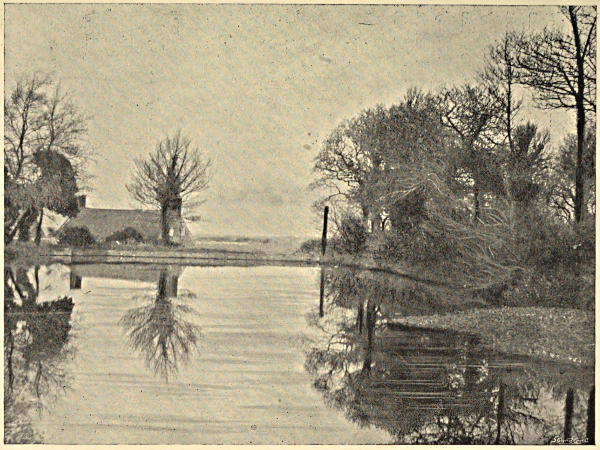
“Mill Pond at the Vrangue.”
The manner in which they had acquired their
riches soon became known, and, tempted by the
hopes of gain, a man concealed himself in the oven
of the ruined house near the Catioroc one Friday
night. He had not long lain there before the
wizards entered, but before a word was uttered they
made a strict search through the house, and soon
discovered the trembling man, whom they obliged to
take the oaths of allegiance to their infernal master,
to the eternal ruin both of his soul and body.[185]
Sorcerers have the power of taking the forms of
different animals, but when thus disguised cannot be
wounded but by silver.
A Mr. Le Marchant, “des grent mesons,” had
often fired at a white rabbit which frequented his
warren, but without success. One day, however,
beginning to suspect how the case really stood, he
detached his silver sleeve button from his wrist-band,
loaded his gun with it, took a steady aim, and fired.
The rabbit immediately disappeared behind the
hedge. He ran up, and, hearing some person
groaning as if in great pain on the other side,
looked over and recognised a neighbour of his, a
lady of the Vale, who was lying with her leg
broken and bleeding profusely from a fresh wound.
Une histouaire du bouan vier temps.
Un bouan houme et sa femme avaient autefais une p’tite ferme ès
environs du Vazon; Collas Roussé et sa femme, Nency Guille, étaient des
gens tranquilles, qui faisaient d’ leux mûx pour elvaïr leu famille,
mais i’ l’taient r’ nomaï pour changier leux forme à volontaï.
Une belle séraïe d’étaï nou vit un biau lièvre dans l’ gardin du
Probytère qui dansait autouar d’une vaque qu’ était la fiquie.
La vaque se mins a r’ gardaïr le lièvre qui toute suite se bûti su ses
dœux pattes de derriere faisant des pernagues coum si voulait invitaïr
la vaque à dansaïr d’auve li. Les gens n’ savaient pas qui en craire ou
qu’est que vela qui voulait dire. Ls’ uns disaient que ch’était Collas
Roussé ou sa femme, d’autres pensaient q’nou f’rait mûx de l’ tiraï,
d’autres enfin disaient que l’lait d’là vaque s’rait gataï et q’la
vaque jamais n’vaudrait sa tuache.
Le lecteur, Pierre Simon, qui s’trouvait la par écanche, s’en fut tout
doucement pres du lièvre, l’attrapi et s’mis à l’frottaï à r’brousse
pel, les uns li criaient d’li teurtre le cô, l’ s’autres d’li rompre
les gambes, “et pis nou verrait bien vite si chen ’tait pouint Collas
Roussé ou sa femme.” L’s ’uns disaient qu’ils avaient vœu le lièvre
v’nir dret du Vazon, mais qu’il avait ieux la malice, de prendre un
ch’min detournaï, d’autres vaisins étaient d’avis de prendre le prumier
lait d’la vaque et de l’ mettre à bouidre su une bouane fouaie d’vrec
et q’nou verrait bientot Collas Roussé et sa vieille v’nir d’mandaï
une goutte de lait bouailli; c’h’tait là la vraie manière d’les
decouvrir. Pierre Simon fut bien bllamaï de toute la contraie pour
avé laissi la bête écappaï, mais i disait pour raison qu’les lièvres
étaient sujets à des maux d’ têtes coum d’autres personnes et que
ch’tait pour chunna qu’il l’avait frottaï. Il aïmait la soupe de lièvre
coum d’autres, mais que ch’nérait pas étaï bien d’sa part de prendre
avantage d’la paure bête.
Le bouan vier Mêssier en pâlant d’ l’affaire disait: “Je n’ voudrais
pas dire du mà’ d’ personne, seit keriature ou cheva’, mais j’ai mes
pensaïes au sujet de Collas Roussé et sa femme, l’annaie passaie coum
j’allais r’muaïr nos bêtes de bouan matin qu’est que j’vis sinon daeux
biaux lièvres a rôguer ma raie-grasse. J’fis du bruit, et i s’en furent
couarant d’vier le Vazon, et un matin j’mécryi “Tu devrais en aver
honte Collas.”
Eh bien, chu jour là is’en furent derriere le prinseux, trav’sirent le
belle, et, j’n’ments pouint, j’ cré qui passirent par d’sous l’us. Mais
terjous, que j’aie tort ou raison, ni Collas ni sa femme n’out peux me
r’gardaïr en fache d’pis chu jour-là.
Jamais n’ou ne me fra craire que g’nia point bien de qué que nous
n’serait expliquer. J’en ai ouï d’bien des sortes d’pis m’en jâne
temps. Jai souvent ouï la raeue du prinseux tournaï a mignet que
g’niavait fils d’âme par dehors; j’ai vaeux not’ cat aquand i’ ventait
gros assis l’ dos tournaï au faeu, guettant l’us et la f’nêtre coum si
s’attendait à véer quiq’un entraïr, et parfais i poussait de drôles
de cris, j’vous en reponds, et not t’chen s’mauchaï derriere ma caire
quand j’disais mes perières, parfais i’ braq’tait dans s’en dormir
coum s’il’ tait a s’battre d’auve d’autres t’chens; o’ch’est m’n avis
que des câts et des t’chens vés l’s affaires d’une autre manière que
nous, et j’cré que ch’est grand piti que tous cheux qui s’dementent de
changier de forme n’aient affaire à yeux.”
Un Luron.
A story of the good old times.
An honest man and his wife had formerly a little farm in the
neighbourhood of Vazon; Collas Roussel and his wife, Nancy Guille, were
quiet people, who did their best to bring up their family properly, but
they were noted for being able to change their forms at will.
One fine summer’s evening people saw a fine hare in the rectory garden,
which was dancing round a cow which was tethered there.
The cow began to look at the hare, who at once rose up on his hind
legs, gambolling as if he wished to invite the cow to dance with him.
The people did not know what to think or what it could all mean. Some
said that it was either Collas Roussel or his wife, others thought
it would be better to fire at it, and the others finally said that
the cow’s milk would be spoilt and that she would never be worth
slaughtering.
The clerk, Pierre Simon, who was there by chance, crept quietly near
the hare, caught it, and began to rub up its fur the wrong way. Some
cried out to him to wring its neck, others to break its legs, “and then
we will see very quickly whether it is Collas Roussel or his wife or
no.” Some said that they had seen the hare come straight from Vazon,
but that it had had the artfulness to take a circuitous route. Other
neighbours advised that the first milk the cow should give after this
should be taken, and put to boil on a good vraic fire, and that one
would soon see Collas Roussel and his old woman come and ask for a
cup of boiled milk. That was the best way of finding them out. Pierre
Simon was much blamed by all the country side for having allowed the
beast to escape, but he said, as an excuse, that hares were subject
to headaches as much as other people and it was for that that he had
rubbed it. He liked hare soup as well as anyone, but that it would not
have been right of him to take advantage of the poor beast.
The good old herdsman in talking over the affair said: “I would not
speak ill of anyone, be it creature, man, or horse, but I have my own
ideas on the subject of Collas Roussel and his wife. Last year as I was
moving our cattle early in the morning, what should I see but two fine
hares nibbling my rye grass. I made a noise, and they ran off towards
Vazon, and one morning I cried out “You should be ashamed of yourself,
Collas.”
Well, on that day they went behind the cider press, crossed the
court-yard, and, I am not lying, I believe that they passed under the
door. But ever since, whether I am wrong or right, neither Collas or
his wife, have been able to look me in the face.
Never will you make me believe that there are not many things that are
not explained to us. I have heard of all sorts since my young days.
I have often heard the wheel of the cider press turn at midnight,
when there was not a soul about. I have seen our cat when it blew
hard, sitting with his back turned to the fire, watching the door and
the window as if it expected to see some one enter, and sometimes it
uttered curious cries, I assure you, and our dog would hide himself
behind my chair when I said my prayers. Sometimes he barked in his
sleep, as if he were fighting with other dogs. Oh, it is my opinion
that cats and dogs see things in a different way to what we do, and I
think it is a great pity that all those who deny that people can change
their forms, cannot refer to them.”
A Trifler.
A miller, one day passing by his mill-pond at the
Vrangue, was attracted by the noise and struggles of
a very beautiful duck. He soon perceived that
something was wrong, and that, unless the bird was
speedily relieved, it must perish. He accordingly,
with some difficulty, succeeded in extricating the
duck from the water, and took it into the mill,
where, after wiping it dry, and endeavouring to
arrange its ruffled feathers, he deposited it in a
place of safety and left it. Returning shortly
afterwards, he was astonished to find its place
supplied by a very beautiful and richly-dressed lady,
who thanked him for his humanity, and assured him,
but for his assistance, she must inevitably have
been drowned, promising him at the same time, that
as long as he kept the adventure secret, he should,
whenever he was in want, find a sum of money
deposited on his mill stone.[187]
An old sea captain, of the name of Mahy, who
for many years had navigated a cutter between
Guernsey and England, had, at last, by industry
and perseverance, amassed a sufficient competency to
enable him to give up his arduous and dangerous
profession, and pass the remainder of his days in
peace on shore. At least, so he hoped, but, alas!
the expectation of happiness, which poor mortals
indulge in, is often doomed to be disappointed, and
often by apparently trivial causes. Who could have
guessed that a cat would have embittered the
remaining days of the old sailor? Yet so it was.
The mischievous tricks of this imp of Satan rendered
his life almost unbearable; not a moment’s rest could
he enjoy in his own house. In vain did he attempt
to drive the troublesome brute away. If ejected by
the door, she returned immediately by the window,
or down the chimney. It was useless to attempt to
catch her; she never slept, and her activity was so
great that she escaped every blow aimed at her.
One day, as he was sitting by his fireside, the tricks
of the cat became unsupportable; if he dozed off for
a moment, his wig was twitched off his head; if
he laid down his pipe, puss was watching her
opportunity to give a sly pat and knock it off the
table; the moment his glass of grog left his hand,
it was sure to be upset. At last his patience being
quite exhausted, he seized the poker and gave chase,
but with as little effect as ever. Puss contrived to
elude him, and managed so well that blows, aimed
at her, fell on the furniture and crockery. After
leading him several times round the room, she
escaped into the passage, and seated herself on the
“hecq” or half door, which was formerly to be
found in almost every house. Mahy seized a gun
that was lying on the bacon-rack, and aimed at the
cat, exclaiming at the same time, “Now I have
you!” The cat paused, turned round, and, in a
voice which domestic jars and curtain lectures made
by far too familiar to him, said, very quietly and
distinctly, “Pas acouâre.” (“Not yet.”)
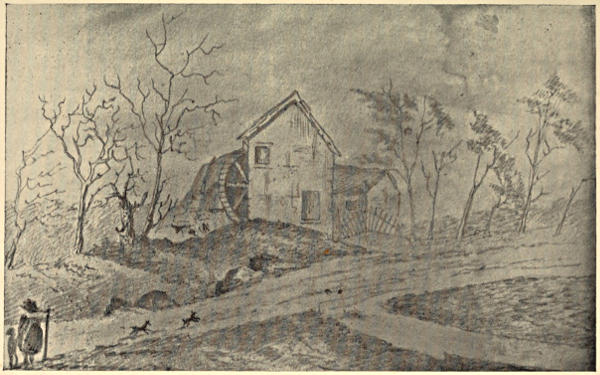
“Old Mill House at La Vrangue, at the beginning of the Nineteenth Century.”
He then, for the first time, remembered that he
had never seen puss and his wife at one and the
same moment, and the unpleasant truth flashed
across his mind that his good woman was one of
those who frequent the weekly entertainments given
by his Satanic Majesty on Friday nights at Catioroc,
Pleinmont, le Cimetière de Torteval, and elsewhere.
Soon afterwards, Mrs. Mahy’s identity was revealed
in another manner. It is well known to housekeepers
who retain the good old custom of having their linen
washed and ironed at home, that an amount of
gossip, scarcely to be credited, goes on on these
occasions. The women employed, moving as they do
from house to house, pick up all the news that has
arisen during the week, and, meeting every day with
fresh companions, retail what they have heard, and
gather new information in return, from every direction.
Of course the characters of the neighbours, and even
of their employers, are not spared, and for this latter
reason, perhaps, it is that a certain degree of mystery
frequently pervades these conversations, and that
listeners and eavesdroppers are discouraged. A sort of
freemasonry prevails, and it is only by a rare
accident that the scandal and gossip retailed at the
washing tub or ironing board find their way to the
parlour. Great, therefore, was the astonishment of
the discreet and prudent workwomen, whose avocations
took them to the houses in the neighbourhood of
Madame Mahy’s dwelling, to find that their most
confidential communications were repeated, and could
in most cases be traced to that good lady. They
had never detected her listening; they felt convinced
that none among them could be so treacherous as
to betray their secrets. They determined to keep a
sharp look-out, and at last the mystery was solved.
A young ironer, of more keen observation than her
companions, had remarked that, in whatever house
they worked, the same old tabby cat was to be seen
seated before the fire, and apparently dreaming away
her existence. Her suspicions were aroused. She
watched puss closely, and was convinced at last that,
even when apparently dozing, pussy was listening
attentively to what was going on. She was not long
in forming a plan to prove whether her conjectures
were correct. She took up a flat iron from the
hearth, and, under the pretence of cleaning and
cooling it on the mat, approached the unsuspecting
cat and suddenly applied it to her nose. Puss jumped
up and suddenly disappeared with a yell, which, as
the conclave of gossips declared, resembled far more
the cry of a woman in pain than the miauling
of a cat. Next day it was rumoured abroad that
poor Madame Mahy, while sitting before her fire, had
been overtaken with sleep, and falling forward had
burnt her face severely on the bars of the grate!
“You know,” said the old woman who related the
story, “that Capt. Mahy never passed for a conjuror.
He ought however to have had more wit than to
tell these stories to his friends over a glass of grog,
for, although he did not say that he had recognised
his wife’s voice, or that he did not believe that she
had dozed over the fire, they had already made the
remark that Mrs. Mahy and the cat had never been
seen together, and were not long in drawing their
conclusions and publishing them to the world. The
story soon found its way to those hot-beds of gossip,
the public bake-houses, and from thence over all
the town.”[188]
Editor’s Note.
In the Vale parish, very many years ago, lived a father and daughter, Nico and Denise
Roberts. Denise was an extremely pretty girl, and Pierre Henry, the richest man in the
parish, wanted to marry her. There were two old maiden ladies who were neighbours of the
Roberts’, and were excessively jealous of all the attention and admiration Denise received.
They both considered that they were still young and fascinating, and one was considered to
have designs on old Roberts, and the other on Pierre Henry himself.
They both had the reputation of being witches by all the neighbours, principally because
they were never seen without two black cats, and they even used to go so far as to take
these two cats with them, when, in the evenings, as was their frequent custom, they would
take their knitting and go and sit for hours in the Roberts’ kitchen. Denise used to implore
her father not to encourage “ces daeux vieilles sorilles,”[189] knowing well that they were
trying to poison his mind against Pierre Henry, but he paid no attention to his daughter, as
they amused him by telling him all the gossip and scandal of the place, and he used to sit
and let them whisper to him on one side of the hearth, while Pierre and Denise sat on the
other; but all the time the two latter were talking, they were annoyed by the cats brought
in by old Margot and Olympe Le Moine, and this went on evening after evening. If Pierre
tried to move his chair nearer to hers, one of the cats would climb up and manage to thrust
its claws in his leg. If he bent forward to whisper to her, the other cat would jump on her
shoulder, and prevent Denise from attending to what he was saying. After some time he
grew convinced that all this could not be accidental, so, one evening, just as the largest of
the two cats had perched itself on Denise’s shoulder at the most inopportune moment, he
whispered in its ear “Margot, tu quérrâs” (“Margot, you will tumble down.”) At that
moment, Margot Le Moine, who was sitting at the other end of the room, fell off her chair
in a dead faint, and the cat gave a yell and darted up the chimney. This finally convinced
old Roberts as to the true character of his friends, and he swore that never again should
these two “quéraudes” darken his doors, and, soon after, Denise Roberts and Pierre Henry
were married.[190]
It is one of the greatest characteristics of wizards
and witches that they have the power of assuming
any form they please.
A man, who kept a large number of cows, observed
that they were gradually pining away, that they failed
to give the usual quantity of milk, and that no care
that he could bestow on them availed aught in
improving their condition. One or two of them had
already died, and he feared that all the others would
soon follow their example. The summer had set in,
and at that season the cows are left out all night
in the field, but when in the early morning the
farmer went to look after them, he generally found
them thoroughly exhausted, and looking as if they
had been hard driven all night.
At last he began to suspect that the poor animals
were under the influence of some spell, and he
determined to watch, in order to discover, if possible,
what means were used to bring the cows into the
condition in which he found them. It seems rather
a singular circumstance that wizards and witches,
with all their cleverness, do not appear to be able
at times to see things which are passing under their
very eyes. Perhaps their eagerness to do mischief
blinds them to the danger of discovery. At all events,
the farmer, who had concealed himself, as soon as the
daylight had well departed, in a cattle shed that
stood in one corner of the field, remained undisturbed,
with his eyes intently fixed on the cows, who were
lying down, quietly chewing the cud.
About midnight his attention was attracted by a
large black dog, which jumped over the hedge separating
his field from that of a neighbour with whom he
had lately had a quarrel. The dog approached the
cows, stood up on his hind legs, and began to dance
before them, cutting such capers and somersaults as
the farmer had never seen before. No sooner had
the cows seen the dog than they also stood upright,
and imitated all his movements. The farmer crept
stealthily out of the field, went home, loaded his gun
with a silver coin, which he cut into slugs,—for it
is a well known fact that no baser metal than silver
will wound a sorcerer,—returned to the field, where he
found the dance still going on as fast and furious
as ever, and fired at the dog, which ran off howling,
and limping on three legs.
The next day his neighbour was seen with his arm
in a sling, and it was given out that, in returning
from the town the previous evening, he had fallen
accidentally over a heap of stones, and so broken it.
The farmer had his own ideas, but wisely kept them
to himself. His neighbour had had a lesson; he
found that he had to deal with a resolute man; the
cows were allowed to remain unmolested, and soon
recovered their pristine health and strength. This is
said to have occurred in Jersey.[191]
Some years have now elapsed since a family had
reason to suppose that recourse had been had to
magic arts in order to injure them. Their health
declined, their cattle fell sick and died, their crops
failed, and everything went wrong with them. It was
but too plain that they were bewitched, and no
chance remained of any amelioration of their condition
unless they could discover the author of their
misfortunes. They therefore determined, by the advice
of a friend skilled in white witchcraft, to perform
a charm for the purpose of obliging the wizard or
witch to show himself. This charm is popularly
called “Une bouïture” or “boiling,” and consists in
setting certain ingredients to seethe in a large
cauldron. The pot, duly filled, was accordingly
placed on the hearth with all the prescribed
ceremonial.
No sooner did it begin to simmer than six mice
entered the room, walking in procession, two and
two, and all deeply veiled. As soon, however, as the
pot boiled, the mice disappeared, and in their place
stood a lady whom they all knew full well.
Her name we have not been able to discover, our
informant being evidently unwilling to compromise
herself by mentioning it, but she was well known
to the market women by the name of “La Dame
au Voile,” and bold would have been the farmer’s
wife who would have refused to let her have her
wares at her own price.
Another version of the story says that the mice
were caught and carried to the office of “Le Procureur
du Roi,” and that in the presence of this legal
personage they resumed their own shapes, and
appeared as three ladies and three women of the
lower orders.[192]
A man of the name of Collenette, living in the
Castel parish, had sold a lot of furze to another
countryman, who was one of the drummers of the
North Regiment of Militia, but did not receive
payment for it at the time of striking the bargain.
Some days afterwards, Collenette, on his way to his
work, was met by a neighbour to whom he owed a
small sum of money, who put him in mind of his
debt. He excused himself for the time, promising to
pay as soon as ever he should receive his money
for the furze he had sold. He then proceeded to his
work, which was that of a quarryman, but the very
first blow he struck the stone caused him to start
back in affright, for he distinctly heard a voice
proceeding from the rock, which said to him:—
“Thou hast told such an one that I did not pay
thee for the furze. Thou shalt suffer for this to the
last day of thy life, but that day is still distant.”
He looked about to see if any one was concealed
near, from whom the voice could proceed, but saw
no one. He then returned to his work, but every
minute the same words rang in his ears. At noon
he ate his meal, which he had brought to the field
with him, and then, as labourers do, lay down on
the grass to sleep. No sooner had he closed his
eyes than he was roused by the beating of a great
drum close to his ears. He started up, but could
see nothing, and whenever he lay down the drumming
re-commenced.
This state of things continued, and the poor man,
worn out by fatigue and fright, fell into a lingering
illness.
If by chance he fell asleep, he was soon awakened
by a sensation which he described as being as though
a calf passed over his body, immediately after which
he seemed to be violently lifted from his bed and
thrown on the floor. It is even asserted that articles
of furniture, which were in the same room with him,
were thrown about without any visible agency.
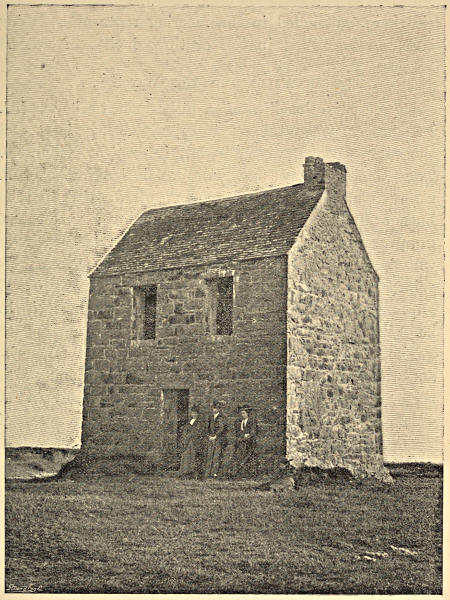
Victor Hugo’s “Haunted House” at Pleinmont.
His friends and neighbours kindly visited him, and
endeavoured to divert his mind from dwelling on
his misfortunes, but all to no avail. Whether in
company or alone, he was equally tormented. At
last, one night, he escaped the vigilance of his
friends, and the next morning was found on the
sea-shore, entangled in the mooring ropes of a fishing
boat, and drowned in two or three inches of water.[193]
Nowhere is the life of a fisherman to be envied.
In summer, when the sea is calm, the days long, and
the nights comparatively warm, it may be endurable.
The amateur may find pleasure in sailing over a
sunny sea, and the excitement of drawing in the
lines or nets laden with fish may prove a sufficient
compensation for many minor hardships; but the man
whose means of subsistence depend on his precarious
gains, who must brave the perils of the waves at
all seasons, at all hours, and in all weathers, is to
be pitied.
The coasts of Guernsey abound in fish of all sorts,
and the earliest authentic records of the island prove
that for many centuries the fisheries have been of
great importance, and one of the main sources of
wealth to the inhabitants.
Considering the great number of boats kept, the
dangerous nature of the coast, the numerous rocks,
the intricate currents and strong tides, it is wonderful
that so few accidents occur. The fishermen are
skilful navigators, and have full confidence in themselves;
they fear not the usual dangers of a sailor’s
life, but they dread the supernatural influences that
may be brought to bear against them.
They—or even some member of their family—may
have, perhaps quite unconsciously, offended some old
crone who has it in her power to injure them in
various ways. By her evil arts she may cause their
lines to become inextricably entangled in the sea-weed,
or to come up laden with dog-fish, blue sharks, and
such-like worthless fish. Happy indeed may the poor
fisherman consider himself if the old woman’s spite
confines itself to such trifling annoyances, for has
she not also the power to raise storms? Is it not
on record how Collette Salmon, wife of Collas
Du Port, caused the loss of a boat and the death
of the whole crew, merely because one of them asked
her more than she thought was right for three
miserable dog-fish? Is it not well known how, when
that noted witch, Marie Mouton, was banished from
the island for her evil doings, the cutter that landed
her at Southampton encountered a most terrific gale
on its return? And how the captain and crew were
ready to depose upon oath that during the height of
the storm they had seen Marie, sometimes perched
on the top of the mast, and at other times astride
on the jib-boom, tearing the sails to shreds and
tatters? Who could be incredulous enough to resist
such testimony as this? Certainly not Jean Falla.
He was a bold fisherman. Every rock and shallow
from the Hanois to the Amfroques were thoroughly
well known to him. By night or day could he steer
his way through their most intricate passes. He was
not aware of having any enemy, but witches are
easily provoked to anger, and unwittingly he may
have offended one of the sisterhood. If he had done
so, he had cause to repent his involuntary fault, and
to his dying day he never forgot the fright he had
to undergo in consequence.
He had left his moorings in the Bay of Les
Péqueries early in the morning. A more beautiful
day had never risen on Guernsey. The sun shone,
a light breeze just ruffled the surface of the sea, the
tide served, fish were plentiful on the coast, and
everything promised an abundant catch. He sailed
out alone, reached the fishing ground, took his marks
carefully, cast out his lines, and then anchored to
await the turn of the tide when the fish begin to
bite. It was not long before the gentle rocking of
the boat and the warmth of the atmosphere began
to make him feel drowsy, and, knowing that an hour
or two must still elapse before he was likely to
catch anything, he yielded to the influence, and was
soon sound asleep.
How long his sleep lasted he was never able to
say, but the impression on his mind was that scarce
a quarter of an hour had elapsed before he was
awakened by one of the most terrific storms that he
had ever experienced. The boat was rolling fearfully,
and rapidly filling with water. To hoist a sail, to
slip the cable, and to turn the boat’s head in the
direction of the land was his next endeavour, but at
this critical moment his courage almost failed him.
In the howlings of the storm he heard a peal of
unearthly laughter above his head, and, looking up,
was horrorstruck at discerning, in the fast flying scud,
the form of an old woman perfectly well known to
him, who appeared quite at home in her elevated
situation. She was accompanied by many others who
were strangers to him, but she was the leader of
the party, and it was evident that his fright and
embarrassment were the cause of their uproarious
merriment. Who she was, he could never be prevailed
upon to say, and, no doubt, in this he acted
wisely.
The wind fortunately favoured him. He made for
the land, reached his moorings in safety, ran his boat
up high and dry on the beach, and leaped ashore.
A fresh peal of laughter from his aërial tormentors
spurred him on.
His house was at no great distance from the shore,
but the way to it by the road was circuitous. He
took, therefore, a short cut across the fields, passed
over one or two hedges without accident, jumped
over another and alighted astride on the back of
a cow that was quietly chewing the cud on the other
side, regardless of the turmoil of the elements. The
poor beast, roused so suddenly from her repose, started
up and rushed madly across the field, carrying her
terrified load with her. The middle of the field was
crossed by one of those deep cuttings which are made
for draining the marshy lands of that district, and
the cow, brought suddenly to a stand, precipitated
the unfortunate Jean Falla head over heels into the
muddy ditch.
Again the unearthly laughter resounded. A less
resolute man than Jean would have lost all presence
of mind, but he remembered that he was within a
few perches of his own house. He scrambled out as
well as he could, reached his cottage door, which
was fortunately open, entered, closed the door behind
him, and fell exhausted on the floor. Another
prolonged peal of laughter dying away in the distance
was heard outside, but Jean, once under his own
roof, felt himself safe.
It was some time, however, before he recovered
from his fright, and, whatever his real feelings towards
them may have been, he was observed from that
time forward to treat all old women with marked
deference and respect.[194]
Every careful and prudent person, before throwing
away either the bladebone of an animal, or an empty
egg-shell, makes a hole in it, and the reason assigned
for this practice is to prevent an improper use being
made of either by witches; for it is firmly believed
that they have the power of employing both the one
and the other as vessels to convey them across the
seas. No matter how tempestuous the weather may
be, how high the billows may be rolling, the magic
bark makes its way against wind and tide, with
more speed and greater certainty than the best
appointed steamer that was ever launched. Those
who avail themselves of these means of conveyance
seem to possess the power of making their vessel
assume the appearance of a handsome well-rigged
ship. It is related that in days long past, a
respectable inhabitant of the neighbourhood of La
Perelle Bay, went out with the early dawn, after a
stormy night, to collect the sea-weed which the
waves might have cast on the shore, or to pick up
perchance, some fragments of wreckage, which are
not unfrequently stranded on that dangerous coast
after a heavy gale from the westward.
He was surprised to see, in the yet uncertain
light of the morning, a large ship in the offing
bearing down upon the land. He watched it attentively,
expecting every moment to see it strike on
one of the many sunken rocks that render the
navigation of our seas so difficult and perilous. To
his astonishment the ship, as it neared the shore,
appeared to diminish rapidly in size. He was
alarmed, but curiosity got the better of fright, and
he stood his ground manfully. The vessel at last
stranded close to the spot where he was standing,
and, by this time, it was reduced to the dimensions
of one of those toy boats, with which the children
amuse themselves in the pools left on the beach by
the receding tide.
A man of dwarfish stature stepped on shore, and
the countryman then perceived that the mysterious
vessel had assumed the form of the bladebone of a
sheep, enveloped in a mass of tangled sea-weed.
Nothing daunted, he addressed the mysterious
stranger, and asked him whence he came? What
was his name? Whither was he going? The stranger
either was, or pretended to be, ignorant of the
language in which he was addressed, but to the last
question answered: “Je vais cheminant”—(“I am
going travelling”).
He is said, however, to have remained in the
island, to have built himself a house on a spot
called “Casquet,”[195] in the neighbourhood of the
place where he landed, and to have become the
progenitor of a family which bears the name of
“Le Cheminant,” and of which many of the members
were famous for their skill as smiths.
It is not unlikely that in this tale we have the
remains—strangely altered by passing through the
mouths of many successive generations—of some one
of the numerous legendary stories of the early
British saints, who, according to some of the
hagiographers, were in the habit of navigating from
Brittany to Cornwall, and from Wales to Ireland,
on their mantles, in stone troughs, or on bundles of
sea-weed.[196]
It is generally believed that those who practise
unlawful acts, however clever they may be, are
generally quite unable to foresee what is likely to
happen to themselves. That this is not invariably
the case the following story will show.
A woman, who had the reputation of being a
sorceress, contrived to live in comparative ease and
comfort by begging from door to door, few venturing
to send her away without an alms for fear of
incurring her displeasure, and bringing down some
misfortune on themselves or their households. She
presented herself one morning at the house of a
farmer in easy circumstances, whose wife was one
not likely to be imposed upon, and not by any
means remarkable for liberality towards the poor.
The witch’s well-contrived tale of distress failed to
make an impression on the hard heart of the
farmer’s wife, and the beggar was dismissed without
even a kind word: indeed, it is even said that
the odious epithet “Caïmande”[197] was applied to
her. On turning her back on the inhospitable door,
she was heard to mutter between her teeth, “You
shall repent of this.”
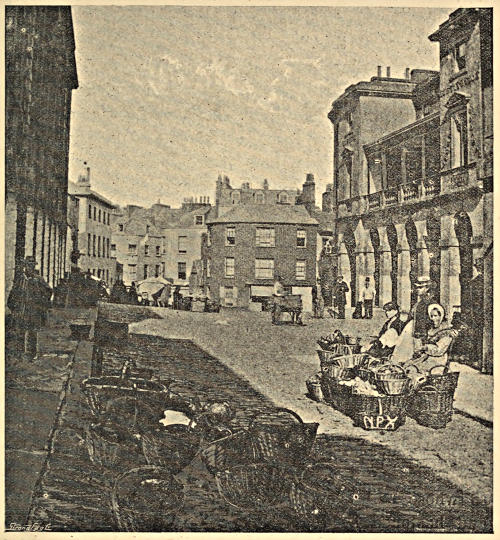
Old Market Place and States Arcade.
It was a fine morning in spring, and a hen
that had hatched an early brood of chickens, had
brought them out into the sun, and was clucking
over her callow brood, and scratching the earth
in search of seeds and insects for them. The
farmer’s wife was looking on with complacency, and
already calculating in her mind what the brood
was likely to fetch in the market. The proverb tells
us that we must not reckon our chickens before
they are hatched. It seems that it is not wise to
reckon on them even after they are hatched. And
this the farmer’s wife found to her cost; for,
scarcely was the witch out of the farm-yard,
before one of the chickens fell on its side,
gave a kick or two, and died. Its example
was soon followed by all its brothers and
sisters, and, last of all, the bereaved mother also
departed this life. The farmer’s wife was at no loss
to whose evil agency to impute this untoward event,
and hastened at once to consult an old neighbour, a
wise woman, who had the reputation of knowing how
these unholy spells were to be counteracted, and what
means were to be adopted to prevent the sorceress
from doing any further mischief. She was advised to
lose no time in returning home; to extract carefully
the hearts of all the chickens, as well as that of
the hen; to stick new pins or nails into them, and to
roast or fry them over a brisk fire, when, she was
assured, that not only would the witch be made to
suffer unheard of agonies, but that all power would
be taken from her to do any further mischief.
The farmer’s wife hastened home to follow the
instructions given her by the wise woman, but found,
to her dismay, that the sorceress had profited by
her short absence from home to re-visit the farmyard
and that she had carefully removed every heart from
the carcases.[198]
Persons who have the temerity to wish to pry
into the secrets of futurity are frequently punished
for their curiosity by the exact fulfilment of the
prediction, although it may appear to be such as
could by no possibility come to pass. The following
story may be taken as an instance.
A young man applied to a woman, who pretended
to be able to foresee events, to tell him what was
likely to happen to him hereafter. She foretold that
he had not long to live, but that he should be
hanged, drowned, and burnt. Not knowing how it
was possible that all these evils should come upon
him, he made light of the prophecy, but the event
proved the truth of the soothsayer’s prediction. One
night, having allowed his fire to go out, and having
no means at hand to rekindle it, he ran across the
fields to the nearest habitation to beg a light. On
his return, in jumping over a ditch, his foot caught
in some brambles, and he fell head foremost into
the water, his legs at the same time became so
entangled in the bushes that he remained suspended,
and the torch which he held in his hand setting
fire to his clothes, he perished, as the fortune-teller
had predicted, by hanging, drowning, and burning.[199]
Editor’s Note.
Other Editor’s Notes on this subject will be found in Appendix B.
Compare “Damasc, Seigneur d’Asnières, excommunié par Hugues de Saint-Calais, Evêque
de Mans (A.D. 1136-1144). Damasc, averti qu’il périrait par le feu et par l’eau, ne fit qu’en
rire; mais un jour, traversant en bateau la Sarthe pendant un orage, il fut foudroyé et
noyé.”—La Suze.—Magazin Pittoresque, 34me année, p. 312.
“This, gathered in the planetary hour,
With noxious weeds, and spell’d with words of power,
Dire stepdames in the magic bowl infuse.”
—Dryden.
“Begin, begin; the mystic spell prepare.”
—Milton.
As long as the popular belief in witchcraft
exists—and with all the boasted light and
civilisation of the nineteenth century it
still holds its ground—there will be found those who
imagine that the evil influence of the sorcerer may
be averted by a counteracting spell, or by certain
practices, such as carrying an amulet about one’s
person, nailing a horse-shoe to the door of a house
or the mast of a ship, etc.
With the ignorant and unlearned it is often useless
to reason: they cannot understand nice distinctions,
and if their faith be shaken or destroyed on one
point, who can tell where the current of unbelief
will stop? That there are persons who, by their
illicit arts, can cause sickness to man or beast is
firmly credited, but as there is no evil without a
remedy, it is equally an article of popular belief that
there are also those who are in possession of the
necessary knowledge and power to counteract the
evil designs and practices of the sorcerer.
As may readily be supposed these last are cunning
and unprincipled wretches, who trade on the folly
and superstition of their ignorant neighbours, and
who, doubtless, are often the cause of the malady of
the unfortunate cow or pig, which they are afterwards
called in to advise about. Various charms and
ceremonies are resorted to on these occasions, whereof
the most potent appears to be that known as “la
bouïture,” which consists in setting a number of
ingredients to seethe together in a cauldron, of which
the principal is the heart of some animal stuck full
of pins. It is not easy to arrive at a correct
knowledge of what is done, for great secrecy is
generally observed, and the actors in these superstitious
follies are afraid to divulge what takes place.
The object of the charm seems to be either to avert
the evil, or to discover the author of it. In the
latter case, it often leads to serious misunderstandings
between neighbours. There are, however, certain
charms of a more innocent character, which can be
resorted to without the intervention of a cunning man.
Shortly after the Rev. Thomas Brock took possession
of the Rectory of St. Pierre-du-Bois, about
the beginning of the nineteenth century, he was returning
home one night from town, where he had been
detained until a late hour. It was midnight when
he reached the parsonage, and in the imperfect light
he thought that he saw a number of persons
assembled near the church porch. Astonished at so
unusual a sight, and wondering what could possibly
be the cause of such an assembly at that hour, he
tied up his horse to the gate, and stepped over the
stile into the churchyard. On drawing near he was
witness to an extraordinary ceremony. Several of his
parishioners, among whom he recognised many of the
better sort, were walking in orderly procession round
the church, and touching every angle as they passed.
He addressed them and inquired what they were
doing, but not a single word could he get in answer
to his questions. Perfect silence was preserved until
they came to the church-porch, where they all knelt
down and recited the Lord’s Prayer. This was
repeated more than once, and at last they left the
place without satisfying the legitimate curiosity of
their pastor. Determined to fathom the mystery, he
called the next day on some of the principal actors
in the ceremony, and then learnt, not without some
difficulty, that it was intended to remove a spell that
was supposed to be hanging over the son or daughter
of one of the parties, and that a single word spoken
by any of the persons engaged in the solemn rite,
would have effectually broken the charm.
In reference to this charm it may here be mentioned
that an old servant of the Rev. W. Chepmell,
Rector of St. Sampson’s and the Vale, was suffering
from an ulcer in the leg. To cure it she went round
the church, stopping at each of the angles, and
repeating a certain prayer. The Rev. H. Le M.
Chepmell, D.D., who was a child at the time, remembers
the circumstance, but does not know what the prayer
was that was used on the occasion.
The forms which follow, and which, for the benefit
of those who are unacquainted with French, have
been translated as closely as possible, were found in
a book of memoranda, household and farming accounts,
recipes for medicines, etc., which once belonged to
Sieur Jean Lenfestey, des Adams, in the parish of
St. Pierre-du-Bois. It was written about the end of
the last, and beginning of the present, century. The
mystical words used in some of the spells have been
given just as they were found in the manuscript.
They appear to be a curious jumble of Hebrew,
Greek, and Latin, very much disfigured by having
passed through the hands of ignorant, unlettered
transcribers, or, perhaps, by having been transmitted
orally from one to another, and, at last, taken down
from dictation. It is quite impossible to say how
long these spells and charms have been in use
among the peasantry, whether they have been handed
down by tradition from times before the Reformation,
or whether—which is far more probable—they have
been introduced in comparatively recent times by
some of the farm-labourers, who, in times of peace,
come to the island from the neighbouring coasts of
Normandy and Brittany in search of work. It is
only on the latter supposition that the invocation of
St. Blaize and St. Nicodemus, the saying of a Mass,
and the reciting of Paters and Ave-Marias can be
accounted for, the indigenous population having been
so thoroughly reformed as to have lost all recollection
of these matters.
Choose one of the animals whose death has been
caused, taking care that there is no sign of life
remaining in it: take out its heart, and place it in
a clean plate: then take nine thorns of “noble
épine”[200] and proceed as follows:—
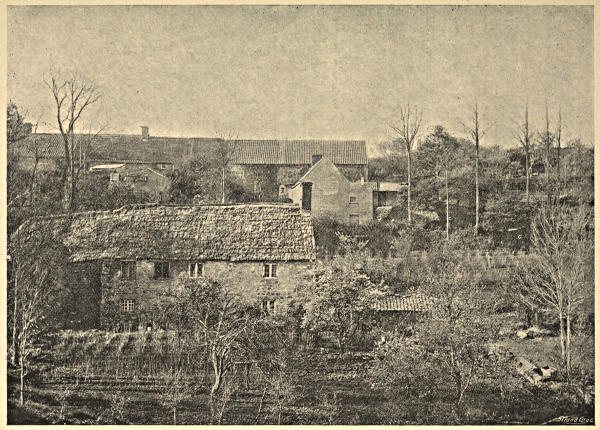
The “Groignet.”
Pierce one of the thorns into the heart, saying:—
Adibaga, Sabaoth, Adonay, contra, ratout prisons
preront fini unixio paracle gasum.
Take two thorns and pierce them in, saying:—Qui
susum mediotos agres gravoil valax.
Take two more, and in placing them say:—Laula
zazai valoi sator saluxu paracle gassum.
Take two more, and say in placing them:—Mortuis
cum fice suni et per flagelationem domini nostri Jesu
Christi.
Then place the last two thorns with these words:—Avir
sunt devant nous paracle tui strator verbonum
ossisum fidando.
Then continue saying:—“I call on him or her
who has caused the Missal Abel to be fabricated:
cease from thine evil deed; come, nevertheless, by
sea or by land, wherever thou art; show thyself to
us without delay and without fail.”
(Note: that if thorns of the “noble épine” are
not to be procured, one may have recourse to new
nails).
The heart, being pierced with thorns, as directed,
must be put into a small bag and hung in the
chimney. The next day it must be taken out of
the bag and put upon a plate; then pull out the
first thorn, and place it in another part of the heart,
pronouncing the same words as were said at first;
then take out the two next thorns with the fitting
words, and so on with the others in due order,
replacing them as we have directed, and being
careful never to stick a thorn again into the same
hole. This is to be done on nine consecutive days;
nevertheless, if you wish not to give any respite to
the malefactor, you may compress the nine days
into one, observing the order above prescribed. At
the last operation, after having pierced in the thorns
or nails with the fitting words, you must make a
large fire, place the heart on a gridiron, and put it
to roast on the live embers. The malefactor will be
obliged to appear and to beg for mercy; and if it
be out of his power to appear within the time you
appoint, his death will ensue.
Kill a pigeon; open it and pluck out its heart.
Stick new pins all round the heart. Put water to
boil in a small pot, and when it is boiling throw
the heart in it. You must have ready a green turf
to serve as a cover to the pot, and must put it on
with the earth downwards.
The pot must boil for an hour. Be careful to
keep up a good fire of wood or charcoal, and at the
end of the hour throw the heart into the burning
embers. See that all the doors, windows, and other
openings of the house are closed. The sorcerer will
come and call and knock at the door, demanding to
speak with you; but you must not open to him
until you have made him promise to do what you
wish.
Take the tails of two fresh-water eels, with the
inner bark of an ash tree, that which is next the
wood. Buy twenty-six new needles, and put all to
burn together with flower of sulphur.
If you wish to see the sorcerer by daylight you
must take the roots of small and large sage, with
the pith of the elder and daffodil bulbs. Put the
whole to boil together in vinegar, and make your
arrangements so that it shall boil a quarter of an
hour before noon. As soon as the first bubbles begin
to rise the sorcerer will make his appearance. In
this experiment you must leave the door open. It
is done simply with the view of knowing the
malefactor.
Take a sheep’s heart, pierce nails into it, and
hang it in the chimney, saying:—Rostin, Clasta
Auvara, Chasta, Custodia, Duranee. These words
must be said over the heart every day, and eight
days will not have elapsed before the sorcerer who
has cast the spell will come and beg you to remove
the heart, complaining that he feels great pain
internally. You can then ask him to remove the
spell, and he will request you to give him some
animal to which he may transfer it. You may grant
what he asks, otherwise he will burst asunder.
Take nine bits of green broom, and two sprigs of
the same, which you must tie together in the form
of a cross (×); nine morsels of elder, nine leaves of
betony, nine of agrimony, a little bay salt, sal-ammoniac,
new wax, barley, leaven, camphor and
quick-silver. The quick-silver must be inclosed in
cobbler’s wax. Put the whole into a new linen cloth
which has never been used, and sew it well up so
that nothing may fall out. Hang this round your
neck. It is a sure preservative against the power of
witches.
On St. John’s Eve gather fern before noon. Make
a bracelet of it in the form of these letters—H U T Y.
Write on the circumference of an apple the letters
H A O N and throw it into the midst of the combatants.
Touching the part affected, say:—Place + + +
Consummatum + + + Resurrexit.
Repeat these words thrice over the burn, breathing
thereon each time:—
“Feu de Dieu, perds ta chaleur,
Comme Judas perdit sa couleur,
Quand il trahit notre Seigneur,
Au jardin des oliviers.”[201]
Make three crosses on the mantel-piece with a live
coal, and say:—“In te Domine speravi, non confundar
in æternum.”
Take four-leaved clover and place it on a
consecrated stone; then say a Mass over it, put it
into a nosegay, and make the person smell it, saying
at the same time “Gabriel illa sunt.”
On St. John’s Eve gather clecampane (alliène de
campana), dry it in an oven, reduce it to powder
with ambergris, and wear it next your heart for
nine days. Then endeavour to get the person whose
love you wish to obtain, to swallow a portion of it,
and the effect is sure to follow.
Say:—“Si ergo me quæritis, sinite hos abire.”
Say:—“Our help is in the name of the Lord,
who made the Heavens and the Earth. In the name
of God, Amen! St. Nicodemus, who tookest down
our Lord Jesus Christ from the cross, deign by the
permission of God to cure this horse (name the
colour), belonging to (name the owner), of the vives
or gripes (as the case may be).”
Then let all who are present say the Lord’s Prayer
nine times.
“Horse (name the colour), belonging to (name the
owner), if thou hast the vives, or the red gripes,
or any other of thirty-six maladies, in case thou be
suffering from them: May God cure thee and the
blessed Saint Eloy! In the name of the Father,
and of the Son, and of the Holy Ghost, Amen!”
Then say five “Paters” and five “Aves” on
your knees.
Say:—“Blaise, martyr for Jesus Christ, command
thee to come up or go down.”
Say three times, while looking at the dog:—“Bare—Barbare!
May thy tail hang down! May
St. Peter’s key close thy jaws until to-morrow!”[203]
A belief in the efficacy of quick-silver in counteracting
the evil eye, and averting the injurious effects
of spells, is very universal among the lower orders;
and there are many persons who will never venture
beyond their threshold without having in their
pocket, or hung round their neck, a small portion
of this metal.
A fisherman, who for some time had been unsuccessful
in his fishing, imagined that a spell had been
cast upon him. No man was better acquainted with
the marks by which the fishermen recognise the
spots where the finny tribe are to be found in most
abundance. None was better acquainted with the
intricate tides and currents which render the rocky
coasts of the island such a puzzle to navigators, or
knew better when to take advantage of them to
secure a plentiful catch of fish. His tackle was
good, he used the best and most tempting bait, and
yet, under the most propitious circumstances, with
the most favourable conditions of tide, wind, and
weather, day after day passed and he took next to
nothing. Winter was coming on, and a longer
continuance of bad weather than is usual at that
season, combined with the worthless quality of the
fish caught when he did venture out between the
gales,—in short, a continued run of ill-luck,—confirmed
him in the idea that he was bewitched.
He confided his fears to an old man of his own
profession, who had the reputation of knowing more
than his neighbours, and particularly of being able to
give advice in such cases as this, where there was
reason to suppose that some unlawful influence was
at work.
The old man listened to his tale, confirmed him
in the idea that some evil-disposed person, in
league with Satan, had cast an evil eye on him, and
ended by counselling him always to carry quick-silver
about with him. With this precaution he told him
that he might defy the spells of all the wizards and
witches that ever met on a Friday night at Catiôroc
to pay their homage to Old Nick.
The fisherman took the old man’s advice, and
procured a small vial containing mercury, which he
placed carefully in the purse in which he carried his
money, when he was fortunate enough to have any.
Strange to say, from that moment his luck turned,
and, a succession of good hauls rewarding his industry,
the fisherman soon found himself in possession of
what, to him, was a goodly sum of money, and in
which not a few gold pieces were included. These
were, of course, carefully deposited in the purse
containing the precious amulet, to which he attributed
his good luck and his deliverance from the spell,
which, he no longer doubted, had been cast upon
him.
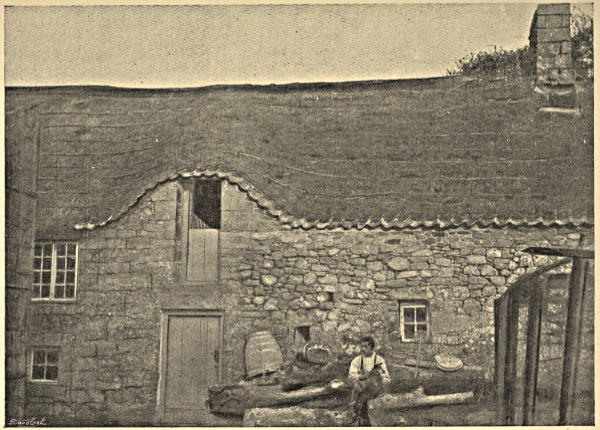
Old House at Cobo.
Alas! his confidence in the charm was destined
to be, for a time, rudely broken. One night, in
manœuvring his boat, an accidental blow from
some of the gear shattered the bottle containing
the quick-silver. What was his dismay the
next morning, on opening his purse, to perceive that
all his gold was turned into silver, and that the
silver coins bore the appearance of vile lead! He
was in despair, concluding very naturally that he had
fallen into the power of some prince of magicians,
and that henceforth he was a ruined man. He again
consulted his old friend, whose experience this time
proved of more practical use than his former advice.
The wise man soon saw what had caused the
apparent change in the coin, and recommended him
to go without delay to a silversmith, who soon
removed the quick-silver with which the precious
pieces were coated, and restored them to their pristine
brightness.[204]
There are certain old men and women who, without
pretending to any supernatural knowledge, are nevertheless
supposed to possess the power of causing
those unsightly excrescences (warts) to disappear,
merely by looking at, and counting, them. Some
mystery, however, is attached to the operation. They
may not impart their secret, neither may they receive
money for their services, although there is no reason
why they should refuse any other present that may
be offered. There is no doubt that the hands of
growing boys and girls are more often disfigured by
these excrescences than those of adults, and that,
at a certain age, they are apt to disappear almost
suddenly. Perhaps this has been noticed by the
persons who pretend to the art of removing warts,
and that they do not undertake the cure unless they
perceive certain indications of their being likely to
disappear before long by the mere agency of natural
causes. Nevertheless, the cases in which a cure has
been effected after all the usual surgical remedies
have been resorted to in vain, are quite sufficiently
numerous to justify a belief in the minds of the
vulgar of a possession of this extraordinary gift.
The operation, whatever it may be, is designated
by the word “décompter,” which may be translated
“to uncount,” or “to count backwards.”
The process by which a wen, or glandular swelling,
known in our local dialect as “un veuble,” is to be
removed, is expressed by the same term, but in this
there is no mystery which requires concealment. The
charm is well known, and may be used by anyone.
It is as follows. The person who undertakes the
cure must begin by making the sign of the cross on
the part affected, and must then repeat the following
formula:—“Pour décompter un veuble.”[205] “Saint
Jean avait un veuble qui coulait à neuf pertins. De
neuf ils vinrent à huit; de huit ils vinrent à sept;
de sept ils vinrent à six; de six ils vinrent à cinq;
de cinq ils vinrent à quatre; de quatre ils vinrent à
trois; de trois ils vinrent à deux; de deux ils
vinrent à un; d’un il vint à rien, et ainsi Saint
Jean perdit son veuble.”
The second day the operator must begin at
“eight,” the day after at “seven,” and so on until
the whole nine are counted off, when, if a cure is
not effected, it must be set down to some neglect
or want of faith in one or the other of the parties
concerned, for no one can venture to doubt the
efficacy of the spell.
It will, doubtless, have struck the reader that in
this, as well as in other charms, the number nine
plays a conspicuous part. This may possibly be
connected in some way with the practice of the
Church of Rome, which, on certain special occasions,
orders solemn prayers and ceremonies for nine
consecutive days.
In most farm-houses there were formerly to be found
one or more old oak-chests, sometimes very richly
and quaintly carved. In some places where they
had been taken care of, they were in excellent
preservation, but, in the majority of cases, they had
given way to those more modern articles of furniture—chests
of drawers and wardrobes—less elegant, perhaps,
but more fashionable, and decidedly more convenient.
Now there are few or none to be met with, the
revival of the taste for rich and elaborate carving
having led to a demand for these ancient specimens
of the skill of our forefathers to be remodelled into
sideboards, cabinets, and other similar articles of
furniture. When these old coffers had ceased to be
thought worthy of a place in the bettermost rooms
of the house, they were frequently to be found in
the stables or outhouses, serving as cornbins, or
receptacles for all sorts of rubbish. Still they were
sometimes remembered, for old people would tell of
their efficacy in curing erysipelas, or, as it is locally
termed, “le faeu sauvage.” The chests chosen for
this purpose were those ornamented with Scriptural
subjects or figures of Apostles and Saints, and the
cure was supposed to be effected by opening and
shutting the lid of the coffer nine times, so as to
fan the face of the patient.
One of the many mysterious ills to which poor
human nature is subject, is known as “la maladie
de la nère poule.” This is to be removed by
procuring a perfectly black hen, and swinging her
round the head of the sufferer three times.
To cure an equally undefined affection known as
“le mal volant” the patient must also take a black
hen, and, holding her in both hands, must rub that
part of the body in which the pain is felt. The
hen used in this incantation must be bought; if a
gift, the charm would fail of its effect. After having
been used it must not be kept or put to death, but
given away. The classical reader will not require to
be reminded that cocks were sacrificed to Æsculapius.
These interesting relics of the aboriginal inhabitants
of the island are called by the country people
“fouïdres,” i.e. thunderbolts. It is firmly believed
that the house which has the happiness to possess
one of them will neither be struck by lightning nor
consumed by fire.
It is believed that animals that are sick can be
cured by giving them water to drink in which a
celt has been dipped.
When a person has reason to believe that either
himself or any of his belongings is under the
influence of a spell, he should procure the heart of
an animal—that of a black sheep is supposed to be
the most efficacious,—and, having stuck it over thickly
in every part with new pins or nails, put it down
to roast before a strong fire. Care must, however,
have been taken previously to close up all means of
entry into the house, even to stuffing up the key-hole.
The heart no sooner begins to feel the influence of
the fire than doleful cries are heard from without,
which increase more and more as the roasting goes
on. Loud knocks are next heard at the door, and
urgent appeals for admission are made, so urgent
that few have the heart to withstand them. No
sooner, however, is the door opened than all the
clamour ceases. No one is seen outside, and, on
looking at the heart, it is found to be burnt to a
cinder. The charm has failed, and those who tried
it remain as much under the influence of the sorcerer
as ever, with the additional certainty of having
offended their enemy without a chance of pardon or
pity on his part, nay, they know that they have
only exposed themselves to greater persecution in
revenge for the pain they have made him suffer; for
it is universally believed that the wizards or witches
are irresistibly attracted to the place where this
counter-spell is being performed; and that, while it
lasts, the tortures of the damned are suffered by
them. What would occur if the spell were persevered
in and the door kept closed is not generally known,
but it is thought that as the heart dried up
before the flames, the sorcerer would wither away,
and that, with the last drop of moisture, his
wicked soul would depart to the place of everlasting
torment.[206]
It is related that towards the end of the eighteenth
century a number of country people were assembled
in a farm-house in the parish of Ste. Marie-du-Castel,
for the purpose of putting into practice the counter-spell
described in the preceding paragraph, or one of a
similar nature; for it is believed that the same end
may be attained by setting a cauldron on the hearth,
and boiling the heart with certain herbs, gathered
with some peculiar precautions, and known only to
the “désorcelleurs,” as the white-witches who generally
conduct these ceremonies are called in the local
dialect. The doors of the house, as is required in
these cases, had been carefully closed and fastened,
and the charm was, to all appearance, progressing
favourably, when a knock was heard at the door.
No one answered, for fear of breaking the spell,
but all remained in breathless and awe-stricken silence,
believing firmly that their incantation was working
favourably and in accordance with their wishes. The
visitor on the outside, who could plainly see that
the house was not untenanted, grew impatient at not
being admitted, and called out with a loud and
authoritative voice, to know why an entrance was
refused him. The voice was that of a gentleman
residing in the neighbourhood, the Seigneur de St.
George, a magistrate universally respected for his
integrity, and beloved for his benevolence. The
inmates of the dwelling durst no longer keep him
out; the door was at last unbolted, but, as the
common belief is that the first person who applies
for admission after the spell has begun is the sorcerer,
the assembled peasants were at their wits’ end to
account for his presence.
The gentleman was not long in perceiving how
matters stood. He lectured the assembly soundly on
their folly and superstition, and, recognising among
them the “désorcelleur,” whom he well knew to be
a designing knave, making his profit out of the
credulity of his neighbours, he drove him out of the
house with some well-applied stripes from a dog-whip
he chanced to have in his hand.
It is not known whether the Seigneur de St.
George succeeded in convincing any of his neighbours
of the folly of believing in witchcraft; it is rather
thought, on the contrary, that from that day forward
they considered him wiser than need be![207]
“A love-potion works more by the strength of charm than nature.”—Collier, On Popularity.
Under the head of Holy Wells mention has already
been made of a means resorted to by maidens to
ascertain who their future husbands are to be, but
this is not the only manner by which this most
interesting information is to be obtained.
St. Thomas’ Night, La Longue Veille, Christmas
Eve, and the last night of the year, are all seasons
in which it is supposed that the powers of the air,
devils, witches, fairies, and goblins, are abroad and
active, and accordingly, these days, like Hallowe’en in
Scotland, are chosen for the performance of spells
by which some of the secrets of futurity may be
discovered.
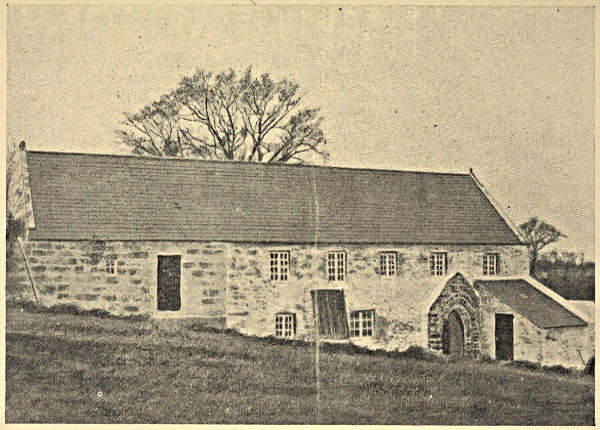
Old Manor House, Anneville.
Some of these charms must be performed alone—others
are social, but all require strict silence. As
to the social spells, it is easy to conceive that when a
number of girls are met together to try their fortunes,
the charm is frequently broken, either by the fears of
the superstitious, or the laughter of the incredulous.
We will begin with the solitary spells. On St.
Thomas’ Night the girl who is desirous of knowing
whom she is to marry, must take a golden pippin,
and, when about retiring to rest, must pass two pins
crossways through it, and lay it under her pillow.
Some say that the pippin should be wrapped up in
the stocking taken from the left leg—others that this
stocking should be taken off last and thrown over
the left shoulder. Which is right, we have no means
of ascertaining, but doubtless the efficacy of the spell
depends on following the correct formula. It is then
necessary to get into bed backwards, and repeat the
following incantation thrice:—
“Saint Thomas, Saint Thomas,
Le plus court, le plus bas,
Fais moi voir en m’endormant
Celui qui sera mon amant,
Et le pays, et la contrée.
Où il fait sa demeurée,
Et le métier qu’il sait faire
Devant moi qu’il vienne faire.
Qu’il soit beau ou qu’il soit laid
Tel qu’il sera je l’aimerai.
Saint Thomas, fait moi la grâce
Que je le voie, que je l’embrasse.”
“Ainsi soit il.”
Not another word must be spoken, and, if the rite
has been duly performed, the desired knowledge will
be communicated in a dream. There are different
versions of the words to be repeated. One of them
avoids a direct invocation of the Saint, and begins
thus:—
“Le jour Saint Thomas,
Le plus court, le plus bas,
Je prie Dieu incessamment
De me faire voir en dormant
Celui qui doit être mon amant, etc.”[208]
Another charm consists in placing two fronds of
agrimony, each bearing nine leaflets, crosswise under
the pillow, and securing them by means of two new
pins, also crossed. The future husband is sure to
appear in a dream.[209]
The name of the future husband may be discovered
by writing the letters of the alphabet on a piece of
paper, cutting them apart, and, when getting into
bed, just after extinguishing the light, throwing them
into a basin or bucket of water. Next morning the
bits of paper which float with the written side
uppermost indicate the name. This charm is efficacious
on Midsummer Eve.[210]
The trade of the husband that is to be may be
guessed at by throwing the white of a raw egg into
a glass of water, and exposing it to the rays of the
noonday sun at Christmas or Midsummer. The egg
in coagulating assumes curious and fantastic forms,
and these are interpreted to denote the trade or
profession of him whom the girl who tries the charm
is destined to marry. A sort of divination to the
same effect is also practised by pouring molten lead
into water.
A spell which requires to be performed in society
is as follows. On any of the solemn nights about
Christmastide, when spells are supposed to be efficaciously
used, a number of girls meet together and
make a chaplet in perfect silence, by stringing
grains of allspice and berries of holly alternately,
placing, at intervals of twelve, an acorn, of which
there must be as many as there are persons in the
company.
This chaplet is twined round a log of wood, which
is then placed on the blazing hearth, and, as the
last acorn is being consumed, each of the young
women sees the form of her future husband pass
between her and the fire.[211]
Another social spell consists in making a cake, to
which each person in the company contributes a
portion of flour, salt, and water, together with a hair
from her own head, or parings from the nails. When
the cake is kneaded—an operation in which all must
take a part—it is placed on the hearth to bake. A
table is then set out in the middle of the room, and
covered with a clean cloth. As many plates are laid
out as there are persons present, and as many seats
placed round the table, each girl designating her
own. The cake, when thoroughly baked, is placed on
the board, and the girls watch in solemn silence until
the hour of midnight, when, exactly as the clock
strikes twelve, the appearances of the future husbands
are seen to enter, and seat themselves in the chairs
prepared for them; each girl, however, seeing only her
own husband that is to be, those of her companions
remaining invisible to her. Should anyone of the
party be destined to die unmarried, instead of the
appearance of a man, she sees a coffin. The spell
is broken, should a single word be uttered from
the moment when the ingredients for the cake are
first produced, until the whole of the ceremony is
completed.[212]
The charmed cake may also be used by a person
alone, in which case the manner of proceeding is as
follows. The cake, which should be composed of
equal quantities of flour, salt, and soot, must be made
and baked in secret and in silence. On retiring to
rest it must be divided into two equal portions, one
of which must be eaten by the person who tries the
charm, but no water or other liquid is to be drunk
with it. The other half is to be wrapped up in the
garter taken from the left leg, and placed under the
pillow. At midnight the form of the future husband
will stand at the bedside and be seen by his intended
bride.[213]
It must not be supposed that these love charms can
always be tried with impunity. Like all other forms of
divination they are sinful, and instances are on record
in which punishment has followed the unhallowed
attempt to pry into the secrets of futurity so wisely
hidden from our mortal ken. It would seem that
not merely the wraith or similitude of the destined
husband can be made to show itself, but that, by
some unexplained and mysterious agency, the actual
presence in the body can be completed, at whatever
distance the man may at that moment be. To the
unfortunate individual who is made the victim of
these practices the whole appears the effect of a
frightful dream, attended with much suffering. It is
related that an officer, thus forced to show himself,
left behind him a sword, which was found by the
young woman after his departure, and carefully hidden
away. In process of time he came to the island,
saw the girl, fell in love with her, and was married.
For many years they lived happily together, until,
one day, in turning out the contents of an old
coffer, he found at the bottom of it the identical
sword which had disappeared from his possession in
so unaccountable and mysterious a manner. The
memory of the frightful dream in which he had
endured so much flashed across his mind. In a
frenzy of passion he sought his wife, and, upbraiding
her with having been to him the cause of dreadful
suffering, and of having put him in peril of his life by
her magical practices, plunged the sword into her breast.[214]
There appear to be some superstitious notions with
regard to the connection of witchcraft with the white-thorn.
Witches are suspected of meeting at night
under its shade. An old man of very eccentric
habits not many years since still inhabited the
ruined manor house of Anneville, once the residence
of the ancient family of de Chesney, sold in 1509
to Nicholas Fashin, and subsequently passing by
inheritance into the Andros family, in whose possession
it still remains.
He passed with his neighbours for a wizard,
although he only professed to be a “désorcelleur”
or white-witch, and was said to have been in the
habit of taking those who applied to him to be
unbewitched to a very old thorn-bush, which had
grown up within the walls of an ancient square
tower adjoining the house, and there, before sunrise,
making them go through certain evolutions which were
supposed to counteract the spells which had been
cast upon them.[215]
The hawthorn, or at least such specimens of the
tree as are remarkable for their age, their size, or
their gnarled branches, seems to be associated in the
minds of our peasantry with magic and magical
practices. The wizards and witches, when, in their
nocturnal excursions they take the form of hares,
rabbits, cats, or other animals, assemble under the
shadow, or in the vicinity of some ancient thorn,
and amuse themselves with skipping round it in the
moonlight. The “désorcelleur” who pretends to the
power of counteracting the spells of witches, and
freeing the unfortunate victims of their art from
their evil influence, resorts with the sufferer to some
noted thorn-bush, and there goes through the ceremonies
and incantations which are to free the
sufferer. A large and very old tree, on the estate
of a gentleman in the parish of St. Saviour’s, was,
in days gone by, constantly resorted to at night for
the purpose of cutting from it small portions of the
wood to be carried about the person as a safeguard
against witchcraft. It is essential to the efficacy of
this charm that the part of the branch cut off
should be that from which three spurs issue.[216]
William Le Poidevin was told by his grandmother
that the “blanche-épine” is “le roi des bois;” the
wood must not be employed for common uses. A
boat or ship, into the construction of which it
entered, would infallibly be lost or come to grief.[217]
The following extract from a work published in
London in 1815, but which is now very rarely to be
met with, gives so good an account of the manner in
which springs of water are believed in these islands to
be discovered by means of the divining rod, that we
have no hesitation in copying it at length.
The work bears the following title: “General View
of the Agriculture and Present State of the Islands of
Normandy subject to the Crown of Great Britain,
drawn up for the consideration of the Board of
Agriculture and Internal Improvement,” by Thomas
Quayle, Esq.
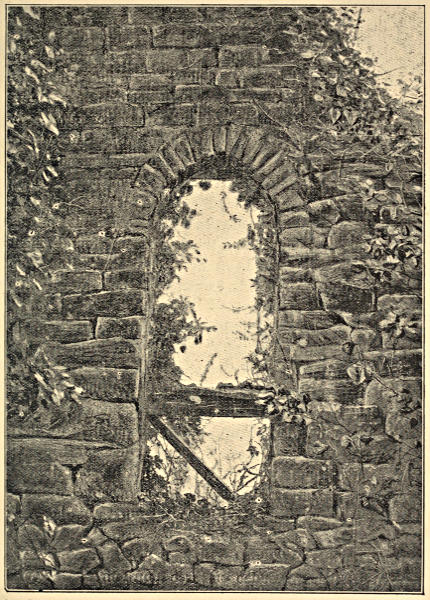
Oratory Window, Anneville.
The passage in question will be found at p. 31.
Baguette Divinatoire.—“The opinion still prevails in
Jersey, of a power, possessed by certain individuals, of
discovering by means of a rod of hazel or of some few
trees, in what spot springs of water may be found. A
respectable farmer in the parish of St. Sauveur is
persuaded that he is endowed with this faculty, of
which he says he discovered himself to be possessed in
consequence of observing and imitating the ceremonies
employed for a similar purpose by an emigrant priest.
The farmer, on repeating these himself, found them
equally efficacious, and afterwards received from the
priest instructions for his exercise of the water-finding
art.
“He first removes from his person every particle of
metal. A slender rod of hazel, terminating in two
twigs, the whole about ten inches in length, is taken
into both hands, one holding each twig. The forked
point of the rod, and palms of the hands, as closed,
are turned upwards. The operator then walks forward,
with his eye directed on the forked end of the rod.
When he approaches a spot where a spring is
concealed, the elevated point of the rod begins to wave
and bend downwards; at the spot itself it becomes
inverted.
“On the 28th of August, 1812, these ceremonies were
practised in the presence of three gentlemen, then and
still unconvinced of the existence of any such power.
The farmer had, at their request, civilly left his
harvest, and repeated his practice for their satisfaction.
He first held the rod over his own well, where it did
not bend, in consequence, as he asserted, of the spring
not being perennial. He then slowly walked forward
with the rod of hazel held in his hands; at a
particular spot, near his own dwelling, the forked end
of the rod began to be agitated and droop downward;
at length, as he proceeded, it became nearly or quite
inverted. He then marked the spot, walked away,
and, setting off in another direction, returned toward
the same spot. When he arrived near it, the end of
the rod again began to droop, and, at the spot,
was, as before, inverted. When he was proceeding,
the persons present carefully watched his hands, but
could not discern any motion in either, or any other
visible means by which the rod could be affected.
One of them took the rod into his own hands, and,
repeating the same practice over the same ground,
the rod did not bend.
“Whether under the designated spot a spring exists
or not was not examined; probably there may, quite
apart from any virtue in the Baguette divinatoire.
“On several occasions the farmer has been requested
to seek for water, and it has not only been found,
but nearly at the depth which he indicated. He is
a man of good character, of simple manners, obliging
and communicative. Being in easy circumstances, he
exercises his art without reward. The priest had
communicated some rules, to enable him to judge of
the exact distance of the water from the surface.
These, he observes, proved fallacious, and the only
guide he has for judging of the depth of the water,
is his observation of the distance between the spot
at which the forked end of the rod begins to be
agitated, and that at which, when he arrives, the
rod becomes wholly inverted.”
It will be observed that Quayle does not assert
that he himself saw the farmer practise his art, but
merely that it had been witnessed by three gentlemen
in 1812. The copy of Quayle’s work, however, from
which the extract was made, contains a very
interesting marginal note in pencil, in the handwriting
of a former owner of the book, Peter Le Pelley, Esq.,
Seigneur of Sark, who was, unfortunately, drowned
by the capsizing of a boat in which he was crossing
from that island to Guernsey in March, 1839. He
says:—
“I have seen it practised by Mr. Moullin, of Le
Ponchez, at Sark and Brechou; and at Brechou the
forked stick became so inverted that it split at the
fork. He did it in my presence on gold, silver, and
water, and the rod inverted over them. He first
rubbed his hands with the substance to be sought
for, and, if water, dipped his hands in it, and held
his two thumbs on the extremity of the forks. That
there is a virtue in the using of the Baguette
divinatoire is incontestable, the reason I deem unknown.
May not electricity or magnetism be
concerned in it? It turned in the hands of some
Sarkmen who previously were ignorant of possessing
that power. Ergo it is independent of the will.
“On Mr. Moullin’s indication, who told me I should
find water at twenty to twenty-two feet at Brechou,
I had a well dug. The men blasted all the way
through the solid rock without finding any water,
and at nineteen to twenty feet, on making a hole
with a jumper, the water sprang up and filled the
well. Mr. Moullin found a ring that had been lost
by means of the Baguette divinatoire.”
Brechou, mentioned in this note, is a small islet
or dependency of Sark, more generally known by the
name of l’Ile des Marchants, a name it derived
from some former proprietors, members of the ancient
Guernsey family of Le Marchant; and for those
who are unacquainted with the art of quarrying, it
may not be amiss to explain that a “jumper” is
an iron tool with which holes are bored in the rock
for the purpose of blasting it with gunpowder, and
so facilitating its removal piecemeal.
The writer of the present compilation had an
opportunity of witnessing experiments with the
divining rod, when attending, in September, 1875, at
Guingamp, in Brittany, a meeting of the “Association
Bretonne,” a combination of the Agricultural and
Archæological Societies of that Province. The place
where the experiments were made was a piece of
grass-land at the head of a small valley, and the
course of an underground stream seemed to be traced
by the deflections of the rod, until it pointed almost
perpendicularly downwards over a certain spot in the
garden of a neighbouring château, where, we were
told, there was no doubt a strong spring would be
found at no great distance from the surface, which,
taking into consideration the nature of the locality,
seemed highly probable. It is certain that in the
hands of some who had never seen the experiment
performed before, and who at first professed incredulity,
the rod appeared ready to twist itself out of their
grasp as soon as they drew near to the place where
water was supposed to be, while with others, who
were disposed to believe only the evidence of what
they witnessed with their own eyes, the mysterious
twig remained perfectly still. No attempt at deceit
could be detected. The persons who made the
experiment were gentlemen, and men of education,
although, as Bretons, not perhaps quite free from
that tinge of superstitious feeling which is so characteristic
of all Celtic nations. The writer is bound to
add that, neither in his own hands, nor in those of
his companion and fellow countryman, was the
slightest effect produced, although they were carefully
instructed how to hold the rod, and they went over
the very same ground where, in the hands of others,
the rod had been visibly affected.
It is not irrelevant to add that in Cornwall, and
other mining countries, the divining rod is said to
be used for the purpose of discovering and tracing
veins of metalliferous ore.
Few insects besides the bee and the silk-worm
have been pressed into the service of man—at least
in such a manner as to be looked upon as
domesticated—and of these the bee, from its superior
intelligence, and the striking fact of its living in
community, with the semblance of a well-organised
government, has, from the earliest times, attracted
the attention and excited the interest of mankind.
It is asserted by those who keep these useful insects,
as well as by naturalists who have made them their
especial study, that they recognise their masters and
the members of their families, and that these may
approach them with impunity when a stranger would
run great risk of being stung. If this is really the
case, it is not difficult to conceive how, among a
people rude and ignorant, and yet observant of the
phenomena of nature, the bee should come to be
regarded with particular respect. It is probably from
a feeling of this kind that the custom arose of
informing the bees when a death occurs in a family.
The correct way of performing the ceremony is this.
One of the household must take the door-key, and,
proceeding to the hives, knock with it, and give
notice to the bees in a whisper of the sad event
which has just taken place, affixing, at the same
time, a small shred of black crape or other stuff to
each of the hives. If this formality is omitted, it is
believed that the bees will die, or forsake the place.
The same custom exists in other countries, but in
Guernsey it is also thought proper to give them
notice of weddings, and to deck the hives with white
streamers.
A swarm of bees ought not to be sold for money,
if you wish it to prosper. It should be given or
exchanged for something of equal value. A money
price is, however, sometimes agreed for, but in
this case the sum must not be paid in any baser
metal than gold. In following a swarm of bees,
besides beating on pots and pans to make them
settle, it is customary to call out to them “Align’ous,
mes p’tits, align’ous.”[218]
Editor’s Note.
Various Editor’s Notes on the subject of Charms and Spells will be found in
Appendix C.
“A certain shepherd lad,
Of small regard to see to, yet well skill’d
In every virtuous plant and healing herb,
That spreads her verdant leaf to th’ morning ray.”
—Comus.
In days gone by, before the invention of
Morrison’s pills, Holloway’s ointment, and
other infallible remedies, no farm was without
its plot of medicinal herbs, skilful combinations
of which—secrets handed down from one old wife or
village doctor to another—were supposed to be capable
of curing all the ills to which poor suffering humanity
is heir, to say nothing of the various diseases
affecting horses, oxen, swine, and other domestic
animals.
Nine varieties of herbs was the number usually
cultivated, a number which, like three and seven, is
generally supposed to have some occult and mystic
virtues. As to the herbs themselves it is not easy
at the present day, when old traditions are rapidly
passing away, to obtain a correct list of them, but
the following is as correct as we can make it.
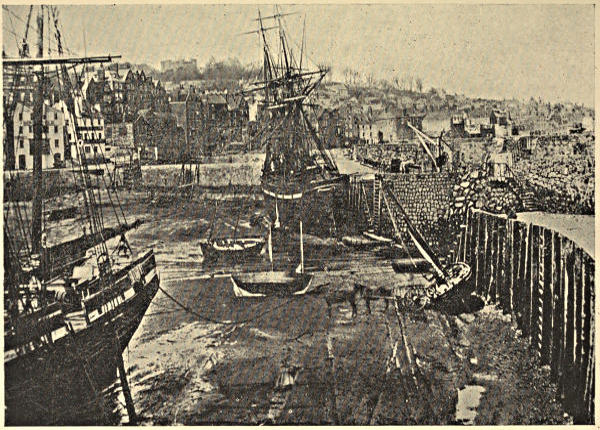
St. Peter Port Harbour, 1852, showing the Old North Pier.
La Poumillière, or Helleborus viridis. Métivier, in
his Dictionary, page 401, says of this plant that it
was originally held in great veneration by the Greeks
and Romans. He also says that it was used in cases
of consumption in cattle by our local veterinary
doctors. They pierced the dewlap or the ear of the
affected animal, and inserted in the hole one of the
small roots of this plant. This induced an abundant
suppuration, which sometimes proved beneficial.
La Cassidone, or French lavender. Boiste, in his
dictionary, says that its flowers and leaves promote
salivation. There is a proverb to the effect that:
“L’hyssope tout ma’ développe
La cassidoune tout ma’ détrone.”
Le Rosmarin, or rosemary. It is considered
unlucky not to have a plant of rosemary in one’s
garden, but it is a plant that should never be bought,
but grown for you, and presented by a friend and
well-wisher.
La Petite Sauche, or small-leaved sage.
Le Grànd Consoul, or comfrey. Of this the root
is the part used.
La Rue. Rue, which was supposed to have a
potent effect on the eyes, and bestow second sight.
L’Alliène, or wormwood.
La Marjolaine, or marjoram, and
La Campana, or vervain, the “holy herb” of the
Druids.
This list by no means exhausts the plants possessed
of healing powers.
George Métivier, in his Souvenirs Historiques,
chapter IV. and II., speaks of a sacred briar, called
“pied-de-chat,” worn as a waist-belt as an infallible
talisman against witchcraft. When a man was
afflicted with boils, he had to pass, fasting and in
silence, for nine consecutive mornings, under an arch
of this same briar. The green sprigs of broom,
however, are believed to be equally efficacious in
averting the evil influence of spells.
In planting a bed of the smaller herbs, to render
them thoroughly efficacious they should be planted
under a volley of minor oaths, such as “goderabetin”
or “godzamin.” It is not expedient that the oaths
should be too blood curdling.
George Métivier alludes to this, and says he
himself knew old gardeners who made a constant
practice of this prehistoric method, and quotes
Pliny, Vol. X., p. 77: “He was enjoined to sow
(basil) with curses and oaths, and then, so that it
should succeed, to beat the ground.”
Editor’s Note.—“Mal de Poule.”—In St. Martin’s parish lived an old woman who had
an infallible cure for sick headaches. The patient was put to bed, and a live chicken,
with its beak stuffed with parsley, enveloped in a cloth, was tied on his head. She then
muttered a prayer over it, and tied it again, still more firmly, round the patient’s forehead.
As the chicken died the headache ceased.—From Miss Thoume.
That the belief in touching for King’s Evil
prevailed in the island is evident from the following
extracts.
“Extraits des Comptes des Diacres de l’Eglise de
la Ville, contenus dans un Livre en la possession du
Procureur des Pauvres de cette paroisse, endossé ‘Aux
Pauvres de la Ville.’”
“Le Vendredy, 24 Aout, 1677, l’on a trouvé dans
le tronq la somme de deux cents vingt livres tournois
en or, argent, sols marquez, et doubles. Item, vingt
et quatre livres tournois, qui ont été données à la
veuve de Nicolas Corbel pour son enfant, qui est
incomodé des ecrouëlles, et qui s’en va à Londres
pour estre touché de sa Maté.”
“Le 26 Aout, 1678, a été tiré hors du tronq la
so͠e de trente livres tournois, qui ont été delivrés à
Caterine de Garis, fem͠e de Jean Hairon, pour aller
en Angleterre y faire toucher par Sa Majesté une
fillette qui est affligée des ecrouëlles. La dte so͠e
luy ayant été alloüée par consentement des officiers
de l’Eglise.”
“Le 26me de Mars, 1688, par ordre de Messrs. les
Collecteurs des Pauvres de la Ville, j’ay balay a
Anne, fem͠e de Pierre De Lahee, 12 livres tournois
pour luy aider à aller faire toucher son enfant du
Mal du Roy, et est des deniers des Pauvres.”
“In winter tedious nights sit by the fire,
With good old folks, and let them tell thee tales.”
—King Richard II.
When, in former days, neighbours were in the
habit of meeting together on such occasions
as “la grande querrue,” “la longue veille,”
or the more ordinary “veillées,”—at which the women
of the neighbourhood, young and old, used to assemble
in turn at each other’s houses, and ply their knitting
needles by the light of a single lamp and the
warmth of a single hearth, thereby economising oil
and fuel,—it was customary to break the monotony
of the conversation by calling on each of the company
in turn to relate some tale or anecdote. Most of
these are simple enough, but in the mouth of a
skillful story-teller are still capable of exciting a
laugh among the unsophisticated audiences to whom
they are addressed.
A favourite class of stories were those in which
the inhabitants of the sister islands of Jersey,
Alderney, and Sark, were held up to ridicule, and the
following tales, trifling and absurd as they are, may
suffice to give some idea of this sort of narrative.
Once upon a time, before the lighthouse on the
dangerous reef of the Casquet rocks was erected, a
vessel was wrecked on Alderney. Such occurrences
in those days were not uncommon, but so cut off
from intercourse with the rest of the world were
the inhabitants of the island, that they were, for the
most part, totally ignorant of the nature and value
of the goods which the waves so frequently cast up
on their inhospitable shores, and it is related that
when a Dutch East Indiaman, laden with cinnamon,
was wrecked on the coast, the people rejoiced in the
seasonable supply of fuel that was afforded them,
and employed the precious bundles of aromatic bark
in heating their ovens.
On the occasion, however, to which our present
story refers, among the articles saved from the
wreck there was a barrel, which, on being opened,
was found to contain a number of small packages
carefully done up in paper. Some of these were
opened and proved to be needles of various sizes,
but the oldest inhabitant had never seen anything
of the sort, and many were the speculations as to
what they could possibly be. A general meeting of
the islanders was called to deliberate, and many
conjectures were hazarded. At last the opinion of
an old grey-headed man prevailed. He expressed it
to be his firm conviction that the strange commodity
could be nothing else but the seed of some new
kind of herb or useful root, and that the best thing
to be done was to make choice of one of the most
fertile spots on the Blaies, and to proceed forthwith
to plough and sow.
His advice was received with acclamation, and
immediately acted upon, but alas for their hopes!
Spring came, and nothing but an unusually fine crop
of weeds—always too common—appeared on the
carefully-tilled land.[219]
It is not easy to understand why it should be so,
but it is nevertheless a fact that the inhabitants of
Jersey, although conceiving themselves a far superior
race, have always looked with eyes of envy and
jealousy on the smaller and less pretentious island of
Guernsey. Perhaps the greater commercial prosperity
which the possession of a good roadstead and port
conferred on the latter at a time when Jersey could
boast of neither, and the advantages arising in
consequence from a freer intercourse with strangers,
in days when these islands were almost cut off from
the rest of the world, may have contributed to
produce and keep alive these feelings. Certain it is
that the Jerseymen have at all times had the
reputation of being always ready, when an opportunity
presented itself, to play a bad turn to their neighbours
of Guernsey.
It is said that three audacious mariners, who had
come over from the larger island with a cargo of
agricultural produce, after disposing of their wares to
good advantage, and having indulged perhaps a little
too freely in the excellent cider of the place, conceived
the bold design of carrying away the island
with them and joining it on to Jersey! Could they
succeed in effecting the annexation, what credit
would they not gain for themselves! What advantages
would not accrue to their native isle!
Their hated rivals—for so, as true Jerseymen, they
looked on the quiet industrious inhabitants of
Guernsey—would be obliged to acknowledge their
superiority, and submit quietly to the supremacy of
the larger isle.
They were not long in putting their project into
execution. Maître Ph’lip, the captain of the boat,
gave directions to his cousin Pierre to make fast a
hawser to one of the needle-like rocks that stand
out so boldly from the extremity of St. Martin’s
Point. The order was obeyed, the wind was fair, all
sails were hoisted and they steered towards Jersey,
singing out in full chorus:—
“Hale, Pierre! Hale, Jean!
Guernsi s’en vient!”
They made sure that Guernsey could not resist
the tug, and that the morning light would find it
stranded in St. Ouen’s Bay. But they had miscalculated
the strength of the hawser. It snapped short, and the
sudden jerk sent them all sprawling to the bottom of
the boat, too much bruised and discomfited to think
of renewing their bold attempt.[220]
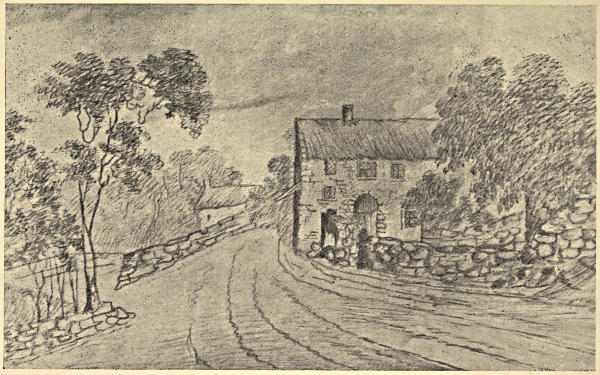
Old Farm House at St. Saviour’s.
From a Pencil Drawing, early in the Nineteenth Century.
In Guernsey it is told as a joke against their
neighbours the Jerseymen, that when there was a
question of rebuilding the gallows, hitherto a wooden
structure, but falling to pieces from rottenness, the
Procureur de la Reine recommended that the uprights
should be of stone, as more desirable, and strengthened
his argument by saying, “It will last for ever, and
serve for us and for our children.”
The terse form of an aphorism is not only one in
which the proverbial philosophy of a people may be
expressed. The idea is frequently expanded into a
short tale or fable, and in this shape is often alluded
to and understood, although perhaps the story or
anecdote is unknown or forgotten.
To give an example. The meaning of the words
“A Cat’s Paw” is perfectly comprehended by many,
who possibly have never heard or read of the fable
of “The Cat, the Monkey, and the Chestnuts.”
A few of these stories, as they are related in
Guernsey, are given below.
La Délaissance.
Although scarcely a year passes without some fact
coming to light which shows the folly and imprudence
of the proceedings, it is by no means uncommon
for old people to make over by a legal instrument,
called “Contrat de Délaissance,” the whole of their
property to a child or other relative, on condition of
being maintained for the rest of their days in a
manner befitting their station in life. They have
generally cause to repent the deed, for, even if
kindly treated, there is a feeling of dependence, and
a want of liberty of action, which cannot fail to be
irksome to one who has hitherto been his own
master, and free to act in any way he pleased.
It is related that a man who had given over his
estate, and all that he possessed, to an only son,
ordered, after a time, a strong coffer, with a secure
lock, to be made. The son indulged him in the
fancy, wondering what he could want the box for,
but hoping perhaps that he might have kept back
some hoard of money or other valuables he wished
to secure. The old man kept his own secret. Not
a soul but himself knew what the box contained.
At last he died. The son hastened to open the
coffer, hoping to find a treasure. What was his
astonishment and disappointment at finding only a
large mallet, such as is used for driving in the
stakes to which the cattle are tethered. A writing
attached to it explained the old man’s meaning. The
person who related the story had forgotten the exact
words, but it was a rude rhyme, beginning thus:—
“Ce maillot—ou un plus gros s’il le faut.”[221]
The substance of the whole was that the mallet
would be advantageously employed in knocking out
the brains of the man who was fool enough to
dispossess himself, during his lifetime, of the control
of his own property.[222]
The following legend, from the supplement to the
Illustrated News, February 7th, 1874, seems to have
a common origin with the preceding.
Jehan Connaxa was one of the merchant princes
of Antwerp, who is supposed to have lived in the
fifteenth century. His only children were two
daughters, whom he had married to young noblemen.
Not content with the handsome dowries he had given
them on their marriage, and too impatient to wait
for the time when all his vast wealth would become
theirs by inheritance, they persuaded him to make
it over to them during his life-time. For a short
period he was treated with due consideration, but it
was not long before he began to find that his
presence in the houses of his sons-in-law was irksome
to them and their wives; and at last he was plainly
told that he must not expect any longer to find a
home with them. Under these circumstances he hired
a small residence, and turned over in his mind how
he could manage so as to recover the position in
his daughters’ houses which he had formerly occupied.
At last he hit on this expedient. He invited his
sons-in-law and their wives to dine with him on a
certain day, and, when he was quite sure they would
come, he went to an old friend, a rich merchant,
and borrowed from him the sum of one thousand
crowns for twenty-four hours, telling him to keep
the transaction a profound secret, but to send a
servant to his house the next day at a certain hour
to fetch it back. Accordingly, the next day, when his
daughters and their husbands were seated at his
table, a message came that his friend had sent for
the sum of money he had promised. He pretended
to be displeased at being interrupted in the midst
of his meal, but left the table, went into an adjoining
apartment, and returned with a sack of money, from
which he counted out the full sum of a thousand
crowns, and delivered it to the messenger. The
astonishment of his guests, who were not aware of
how the money had come into his possession, was
extreme, and, believing him to be still the owner of
unbounded wealth, his sons-in-law insisted on his
taking up his abode with them alternately for the
rest of his days. Each vied with the other in
showing him every attention, hoping thus to secure
the greater share of the inheritance. He always
brought with him a heavy strong box with three
locks, which was supposed to contain untold wealth.
At last, the time when he was to quit this world
arrived, and on his death-bed he sent for his two
sons-in-law and the Prior of a neighbouring Convent
of Jacobins, and delivered to them the three keys of
the box, which, he said, contained his will, but with
strict injunctions that it was not to be opened till
forty days after his funeral had elapsed. Wishing,
however, as he said, to do good while he was yet
alive, he begged his sons-in-law to advance a large
sum for immediate distribution among the poor, and
also to pay another large sum to the Prior to
secure the prayers of the Church for his soul.
This was done willingly, in anticipation of the
expected rich inheritance, and the old man was
sumptuously buried. At the expiration of the forty
days the box was opened with due formality, and
was found to contain a heap of old iron, lead, and
stones, on the top of which was a large cudgel, with
a parchment rolled round it, on which was written
the will in these terms:—“Ego Johannes Connaxa
tale condo testamentum, at qui sui curâ relictâ,
alterius curam susceperit, mactetur hâc clavâ.”
When the means of education were not so good
or so plentiful in Guernsey as they are in the present
day, it was customary, with the better class of
farmers, to send their sons to school in England for
a year or two, in order that they might acquire,
together with a more correct knowledge of the
English tongue, such acquaintance with the ways of
the world as might fit them to enter upon the active
duties of life on their return home. This object, we
may suppose, was to a certain extent gained, but,
like the monkey who had seen the world, many of
these youths returned to their native isle with an
inflated idea of their own consequence, and affecting
to despise and ignore all that had been familiar to
them from their earliest childhood.
It is said of one of these young men, that, after
a residence of no long duration in England, he
pretended, on his return, to have completely forgotten
the names of some of the most common farming
implements, and, indeed, to have almost lost the use
of his mother tongue. His father was in despair,
for it was evident that if the boy could not converse
with the labourers, he would be of little or no
assistance in directing the farming operations. A
lucky accident set the father’s mind at rest on this
score. His son, in passing through the farmyard,
put his foot on a rake that was lying on the ground,
partly hidden by some straw. The handle flew up
and hit him a smart blow on the forehead, upon
which, forgetting his pretended ignorance, he exclaimed,
in good Guernsey-French, “Au Guyablle
seit le râté,” (“Devil take the rake.”) His father,
who was standing by, congratulated him on the
miraculous recovery of his memory, and begged him
henceforth not to forget “sen râté.” The proverbial
saying “Il n’a pas roublliaï sen râté,” (“He has not
forgotten his rake,”) is still applied to a person who
remembers what he learned in his youth.[223]
The evils that may result from being over particular,
and the wisdom of letting well alone, are exemplified
by the story of Rachel Câtel and her petticoat. This
respectable matron or spinster—for tradition gives us
no clue to her state in life—was engaged in
fashioning a petticoat. She cut it out, and found it
somewhat too long. She cut again, and now it was
too short. When, therefore, a thing has been spoilt
by too much care or meddling, old people will shake
their heads and say:—“Ch’est coum le cotillon de
Râché Câtel. A’ le copit et il était trop long. A’
le copit derechef, et il était trop court.”
One day a cat and a fox were travelling together
and chatting of one thing and another as they jogged
on their way.
At last says the cat to the fox:
“You are always talking of your cleverness. How
many cunning devices have you to escape from your
numerous enemies?”
“Oh!” answered the fox, “j’en ai une pouquie, (I
carry a whole sack full,) but you, Mistress Puss, pray
tell me, how many have you?”
“Alas,” replied the cat, “I can boast but of one.”
Shortly after this conversation they saw a large
fierce-looking dog advancing towards them. It was
but the affair of a minute for puss to climb into
the nearest tree and hide herself among the branches,
while Reynard took refuge in the entrance of a drain
that was close at hand.
Unluckily the drain narrowed so suddenly that his
body only was concealed, and his long bushy tail
was left exposed. The dog seized on this, and caused
poor Reynard to cry out pitifully for help. Puss, from
her safe retreat among the branches, looked down,
and called out to her unfortunate companion:
“Now’s the time to make use of your many
devices, délie donc ta pouque!” (“Why don’t you
untie your sack?”)[224]
The Guernsey workman is industrious and thrifty,
working hard when it is on his own account, but
apt to be slow and disinclined to do more work
than what is absolutely necessary to save his credit,
when employed by others. There is a certain amount
of calculation in this. Idleness or laziness are not
the only motives. He knows that so long as the
job in hand lasts, he will be paid his day’s wages,
and therefore he is not in a hurry to get it finished.
His calculations go even a little beyond this; for a
master workman to whom an indifferent person made
the remark that the work he was executing was not
of a quality to last many years, made the ingenuous
reply, “Do you suppose I would willingly take the
bread out of my children’s mouths?” implying that
if the work were done in too substantial or durable
a manner, there would be nothing left for those who
were to come after him to gain their living by.
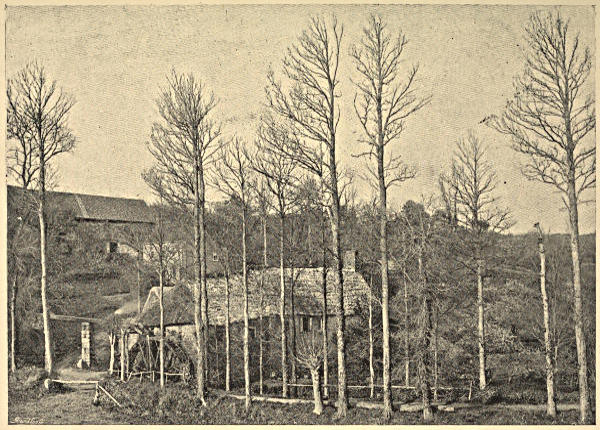
Old Mill, Talbots.
A good story is told among the country people, of
a farm labourer, who, when put to clear out the
weeds from a field, was observed always to leave
some of the most thriving standing. One day his
master remonstrated with him, and got for answer,
“Weeds are bread.” No reply was made at the
moment, but when meal-time came, and the soup
was served out, a bowl full of weeds was handed to
the workman with the remark:—“Since weeds are
bread, eat that, for you get no more to-day.” It is
said that the lesson was understood, and that for
the future the farm servant performed his allotted
task in a more conscientious way.[225]
“Antiquities, or remnants of history, are, as was said, tanquam tabula naufragii, when
industrious persons, by an exact and scrupulous diligence and observation, out of monuments,
names, words, proverbs, traditions, private records and evidences, fragments of stories, passages
of books that concern not story, and the like, do save and recover somewhat from the deluge
of time.”—Bacon’s Advancement of Learning.
Although the following story is entirely
forgotten in Guernsey, and indeed may
possibly never have been popularly known
in the island, it is entitled, from its legendary and
romantic character, to a place in this collection. It
is related by Geoffrey of Monmouth in his British
History, Book XII. Ch. 4.
It is necessary to premise that Edwin, the first of
the Anglo-Saxon Kings who embraced Christianity,
having quarrelled with Cadwalla, Sovereign of North
Wales, attacked and defeated him at Widdington, near
Morpeth. Edwin pursued Cadwalla into Wales, and
chased him into Ireland. These events happened about
the year 630 A.D. The story itself shall be told in
the words employed by Geoffrey in his account of
Cadwalla’s exile, as we find them translated in Bohn’s
“Antiquarian Library.”
“Cadwalla, not knowing what course to take, was
almost in despair of ever returning. At last it came
into his head to go to Salomon, King of the
Armorican Britons, and desire his assistance and
advice, to enable him to return to his kingdom.
And so, as he was steering towards Armorica, a
strong tempest rose on a sudden, which dispersed
the ships of his companions, and in a short time
left no two of them together. The pilot of the King’s
ship was seized immediately with so great a fear,
that, quitting the stern, he left the vessel to the
disposal of fortune, so that all night it was tossed
up and down in great danger by the raging waves.
The next morning they arrived at a certain island
called Garnareia,[226] where, with great difficulty, they
got ashore. Cadwalla was forthwith seized with such
grief for the loss of his companions, that, for three
days and nights together, he refused to eat, but lay
sick upon his bed. The fourth day he was taken
with a very great longing for some venison, and,
causing Brian (his nephew) to be called, made him
acquainted with it. Whereupon Brian took his bow
and quiver, and went through the island, that if he
could light on any wild beast, he might make booty
of it. And when he had walked over the whole
island without finding what he was in quest of, he
was extremely concerned that he could not gratify
his master’s desire, and was afraid his sickness
would prove mortal if his longing were not satisfied.
He, therefore, fell upon a new device, and cut a
piece of flesh out of his own thigh, which he roasted
upon a spit, and carried to the King for venison.
The King, thinking it to be real venison, began to
eat of it to his great refreshment, admiring the
sweetness of it, which he fancied exceeded any flesh
he had ever tasted before. At last, when he had
fully satisfied his appetite, he became more cheerful,
and in three days was perfectly well again. Then, the
wind standing fair, he got ready his ship, and, hoisting
sails, they pursued their voyage and arrived at the city
Kidaleta (St. Malo). From thence they went to King
Salomon, by whom they were received kindly and
with all suitable respect; and, as soon as he had
learned the occasion of their coming, he made them
a promise of assistance.”
The chronicler subsequently relates how Brian killed
the second-sighted magician of Edwin. Cadwalla
returned to Britain, and, with the aid of the Saxon
Penda, King of Mercia, conquered and killed Edwin.
He was afterwards triumphant in fourteen great battles
and sixty skirmishes with the Angles, but finally
perished, with the flower of his army, in battle with
Oswald, ruler of the Saxon kingdom of Bernicia.
As the inhabitants of Guernsey may be presumed
to be better acquainted with the chronicles of their
own Duchy of Normandy than with those of the
ancient Britons, it is not improbable that the following
legendary tale, related of Duke Richard, surnamed
“Sans Peur,” may be known to some of them. The
Chronique de Normandie, printed at Rouen in 1576,
gives it in words of which the following is a close
translation:—
“Once upon a time, as Duke Richard was riding
from one of his castles to a manor, where a very
beautiful lady was residing, the Devil attacked him,
and Richard fought with, and vanquished him. After
this adventure, the Devil disguised himself as a
beautiful maiden richly adorned, and appeared to him
in a boat at Granville, where Richard then was.
Richard entered into the boat to converse with, and
contemplate the beauty of, this lady, and the Devil
carried away the said Duke Richard to a rock in the
sea in the island of Guernsey, where he was found.”
Perhaps the marks of cloven feet, which have been
found deeply imprinted in the granite[227] in more than
one spot in the island, may be attributed to this visit.
If the two legendary tales, which we have just
related, are unknown to the present generation, it is
not so with the well-authenticated fact of the temporary
residence in Guernsey of that turbulent ecclesiastic,
Mauger, Archbishop of Rouen, uncle of William the
Conqueror.
All the Norman chroniclers agree in telling us
that, although the Pope had granted a dispensation,
this audacious prelate ventured to excommunicate his
Sovereign for having contracted a marriage with
Matilda, daughter of the Count of Flanders, an
alliance within the degrees of affinity prohibited by
the Church. Mauger’s insolence did not remain
unpunished. The Pope sent a Legate to Normandy,
the bishops of the province were assembled, and his
treason to his Sovereign, and contempt of the Papal
authority, were punished by his deposition from his
archiepiscopal throne, and banishment to the island
of Guernsey. Some historians assign, as a further
reason for his disgrace, the immorality of his life,
and his prodigal expenditure, which led him, not only
to waste the revenues of the Church, but even to
sell the consecrated vessels, and the ornaments of
the sanctuary.
Tradition points out the spot in the neighbourhood
of that romantic little creek, known by the anglicised
name of Saints’ Bay, but which, in ancient documents,
is called “La Contrée de Seing,” where the deposed
prelate lived during his enforced sojourn in Guernsey.
Here, it is said, he became acquainted with a noble
damsel named Gille, by whom he had several
children, one of whom, Michael de Bayeux, accompanied
Bohemond of Austria to Palestine, and distinguished
himself greatly.
Common report accused Mauger of being addicted
to magical arts, and of having intercourse with a
familiar spirit called “Thoret,” a name which brings
to mind the thunderer Thor, one of the principal
deities of his Scandinavian ancestors. By means of
this imp, it was believed, he had the faculty of
predicting future events.
Having embarked one day, with the design of
reaching the coast of Normandy, and having arrived
at St. Vaast, he addressed the master of the ship
in these words:—“I know for certain that one of
us two will this day be drowned; let us land.” The
master paid no attention to what was said, but
continued his course. It was summer, the weather
was extremely hot, and the Archbishop was attired
in very loose raiment. The vessel struck, Mauger
endeavoured to leave the ship, but, becoming entangled
in his garments, fell into the sea, and was drowned
before any assistance could be given. When the tide
retired, search was made for the body, and it was
found wedged in between two rocks, in an upright
position. The sailors carried it to Cherbourg, where
it was buried.
It is possible that the prelate might have been
entirely forgotten in the place of his exile, had it
not been that a very numerous family, bearing his
name, still exists in the island, and claims to be
descended from him. No name indeed is more
common in the parish of St. Martin de la Belleuse,
and especially in the neighbourhood of Saint, than
that of Mauger. An authentic document, the
“Extent” of Edward III., proves that a family of
this name held land in this parish in 1331.[228] All
who bear the name, even in the humblest ranks of
society, have heard of the Archbishop, and pride
themselves in their supposed descent from him. Nor
is this belief confined to Guernsey, for in Jersey
also, where a branch of the family has long existed,
the same idea prevails.
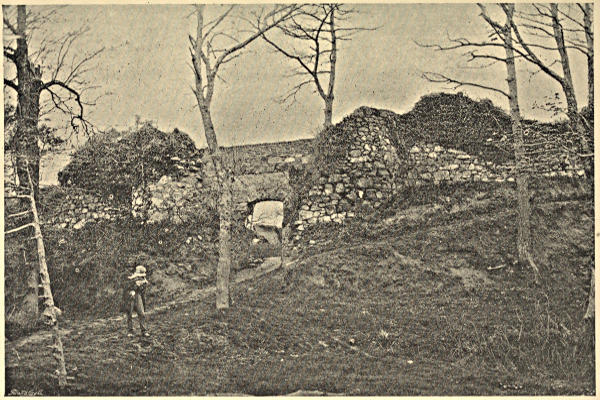
Ivy Castle.
There is also extant an imperfect pedigree of the
house of Mauger, of Jobourg, near Cape La Hague,
in Normandy, which connects them with the insular
family, but endeavours to get rid of the stigma of
illegitimacy, which would attach to the progeny of
an ecclesiastic, by the invention of an imaginary
brother, who accompanied Mauger in his banishment,
and from whom, and not from the Archbishop, they
pretend to deduce their descent. The family of
Guille, long established in the island of Guernsey,
and in the parish of St. Martin’s, claims the questionable
honour of having produced the fair Gille, whose
charms captivated the unscrupulous prelate.
There is one fact, however, of which the family
of Mauger, of Guernsey, has just cause to be proud,
and that is the daring and successful exploit of one
of them in the service of the descendant of their
ancient Dukes. An extract from a manuscript register
of the Cathedral of Coutances, said to be preserved
in the British Museum, tells us how, on Midsummer
Night, in the year of grace 1419, Jacques Mauger
arrived from Guernsey with his men, at the port of
Agon, at the entrance of the river, and took by
escalade the fortress of Mont Martin, near Coutances,
and how Henry V., King of England, then in possession
of the greater part of Normandy, rewarded the
gallant act by a gift of the Seigneurie of Bosques,
and the permission to bear henceforth on his shield
the cross of the blessed knight of St. George, in a
field argent, with his own paternal arms, two
chevrons sable, in the first and fourth quarters, and,
in the second and third the arms of Bosques, a lion
rampant, also sable.
It may not be uninteresting to some to know that
the Hampshire and Isle of Wight family of Major
were originally Maugers from one of the Channel
Islands, and that Richard Cromwell, son of the
Protector, married one of them.
It may be as well to give here a copy of the
pedigree of Mauger, of Jobourg, in Normandy.
“Extrait de la Généalogie de la Famille du Mauger
à Jobourg en Normandie au Cap La Hague.
“Le Duc de Normandie, nommé Guillaume le
Conquérant, éleva son cousin d’Evreux, nommé
Mauger, à l’Archevêché de Rouen en la troisième
année de son règne en Normandie. Le Seigneur
Archevêque, menant une vie non conforme à sa
dignité, attira sur lui la haine du Duc, son bienfaiteur,
qui le fit reléguer a l’île de Greneseye; il prit
terre en ce lieu avec son frère Gautier Mauger, sur
la côte et paroisse de St. Martin, et après avoir
passé quelques années en ce lieu il péri au ras de
Bartleur, après avoir prédit sa mort. Son frère
Gautier eut plusieurs fils naturels, dont deux nommés
Léopold et Théodore: Léopold épousa Pauline de
Carteret, fille et seule héritière de Samuel de Carteret,
Ecuyer, Seigneur du Castel, et Théodore ne maria
point, et laissa deux fils et une fille naturels, l’un
nommé Paul, l’autre nommé Rodolphe, et la fille
nommée Cléotilde. Les deux fils furent mariés; l’un
épousa Sandirez Lampeirier ou Lampereur de Jersey,
et Rodolphe épousa Marie Careye de Greneseye. Paul
eut plusieurs fils, dont deux nommé Alexandre et
Gautier, comme son premier père, lequel fut chassé
de l’île de Jersey, avec deux des fils de Rodolphe
qu’il avait eus de Marie Careye; les autres enfans
sortis de Rodolphe furent à Greneseye, demeurant
sur l’héritage de leur mère en l’année 1399. Gautier
fit plusieurs acquêts à Jobourg à la Hague, où il
établit sa demeure, après avoir quitté Jersey, et fut
marié à une des filles de Pierre de Mary, Seigneur
de Jobourg, en l’année 1418. Gautier engendra
Toussaint et Jacques, le dernier repassa à Greneseye
pour prendre possession d’un héritage par succession,
et Toussaint resta à Jobourg; de Toussaint naquit
Fabien; de Fabien naquit Chaille; et Chaille engendra
Pierre; de Pierre Chaille, qui vivoit encore en 1570;
à l’egard de Léopold, qui avait epousé Pauline
de Carteret, nous n’avons point, pour le present, de
connaissance de sa généalogie.
“Les Armoiries des Mauger (descendant de
Guillaume le Conquérant, Duc de Normandie) sont
une ancre et des roses au dessus du dit ancre. Tiré
de la Heraudrie, et approuvé du dit Duc.”[229]
Before the invention of printing, oral tradition was
almost the only way in which the people—generally
ignorant of writing or reading—could transmit the
recollection of facts and circumstances which they
deemed worthy of being remembered; and it was
soon discovered that versification afforded a very
strong aid to memory. Hence arose that species of
metrical tale which we call a ballad. These ballads,
passing from mouth to mouth, soon became corrupted.
Whole verses were sometimes omitted, by which the
thread of the story was lost or rendered obscure,
and others were supplied by borrowing from the work
of another bard, or by the invention of the reciter.
Nevertheless, in the historical ballads, facts and details
were often preserved which had escaped the notice
of the more regular chroniclers.
Whether, in former days, Guernsey could boast of
any number of these metrical histories, it is now
impossible to say. Unless we include in this category,
a sort of “complainte,” written in 1552 by the Roman
Catholic priests, whom the progress of the doctrines
of the Reformation had driven out of their cures, the
ballad of “Ivon de Galles, ou la descente des Aragousais,”
is the only one which has come down to us.[230] Many
copies of it have been preserved, differing but slightly
from each other in the main, although there are one
or two verbal differences of some importance. Most
of the copies conclude with the twentieth verse, but
some have a second part, consisting of six stanzas,
and purporting to give an account of Ivon’s adventures
after he left Guernsey, and the subsequent melancholy
fate of himself and his fleet. As this account is
quite different from what has come down to us in
history, it is probably the work of some later bard,
who wished to make the story more complete than
he found it, and by a sort of poetical justice to
punish Ivon and his followers for the evil they had
inflicted on the island.
The ballad agrees in the main with the account of
the invasion as given by Froissart and Holinshed. The
adventures in the second part probably relate to some
other of the numerous descents on the island during
the reign of Edward III., perhaps to that by Bahuchet,
a French naval commander, about the year 1338. This
Bahuchet landed in England, and committed great
atrocities at Portsmouth and Southampton, for which,
when he was taken prisoner in the great engagement
off Sluys, in 1340, Edward ordered him to be hanged
at the main-yard.
From Froissart’s Chronicles we learn that Ivon, or as
he calls him, Yvain de Galles, was the son of a Prince
of Wales whom Edward III. had put to death, and
whose possessions he had seized upon. Ivon, thus disinherited,
took refuge in France, where he entered into
the service of the King, Charles V., and was by him
entrusted with the command of ships and three thousand
men. It appears from another part of the Chronicle,
that Henry of Trastamara, King of Castille and Aragon,
had supplied his ally, Charles, with a large fleet,
well armed and manned, and it is probable that the
galleys which Ivon commanded formed part of this
fleet. If so, the name of “Aragousais,” or men of
Aragon, given in the ballad to the invading force,
is accounted for. With these troops he sailed from
Harfleur and reached Guernsey.
Aymon, or Edmund, Rose, esquire of honour to the
King of England, and Governor of the island, advanced
to meet him with all the force he could muster,—about
eight hundred men. The battle was long and
hotly contested, but ended in the discomfiture of the
insular force, with the loss of four hundred of their
men, and in the retreat of Aymon Rose into Castle
Cornet, to which Ivon laid siege. Several assaults
were made on the Castle, but, as it was strongly
fortified and well provisioned, they were not attended
with success. How long the siege lasted we are not
informed, but the French King, requiring the services
of Ivon elsewhere, and believing Castle Cornet to be
impregnable, sent orders for the siege to be raised.
A few years afterwards, Ivon lost his life by the
dagger of an assassin of his own nation, a Welshman
of the name of Lambe, apparently at the instigation
of Richard II.
According to the ballad, Ivon landed his troops
early on a Tuesday morning in Vazon Bay. A
countryman, who had risen early to look after his
sheep, perceived the invaders and gave the alarm,
upon which all the inhabitants assembled and endeavoured
to repel them, but without success. A stand
was at last made on the hill above the town of
St. Peter Port, and a sanguinary engagement took
place, in which five hundred and one of both sides
were killed.
Tradition points to a spot near Elizabeth College
as the scene of this encounter, and the locality to
this day bears the name of “La Bataille.”
A deep lane, which formerly passed to the eastward
of the strangers’ burial ground, but which has been
long filled up and enclosed within the walls of the
cemetery, was said to owe its name of “La Ruette
Meurtrière” to the same event.
Towards the evening, eighty English merchants,—probably
the crews of some trading vessels—arrived,
and lent their assistance to the islanders. By means
of this reinforcement the enemy was prevented from
penetrating into the town, but they reached the
shore, and, the tide being low, crossed over to
Castle Cornet, and attacked it.
Most of the copies of the ballad say that they
took the Castle, “par force prindrent le Chasteau,”
but one, which has been preserved in the registers
of the parish of St. Saviour, where it is inserted
about the year 1638, has these words—“Il vouloient
prendre le Chasteau,”—which seem to agree better
with the other statements in the ballad that Ivon’s
ships came round the island by the southward, that
they received some damage from the peasantry at
La Corbière, and that they re-embarked their troops
at Bec de la Chèvre, now known by the name of
the Terres point, after which Ivon ordered them to
make sail for St. Sampson’s Harbour.
Here they landed. Negotiations were entered on
with Brégart, the Prior or Commissary of St. Michel
du Valle, a dependency of the famous Abbey of
Mont St. Michel in Normandy, and Ivon laid siege
to the Vale Castle, whither Aymon Rose, the
Governor of the island, whom we hear of for the
first time, had retreated and entrenched himself.
Summoned by Ivon to surrender, he refused, but
agreed to sanction an arrangement which Brégart had
made with the people, and which seems to have had
for object to buy off the invaders by payment of a
sum of money.
The ballad assigns this as the origin of the charge
on land called “champart,” but it is certain that this
species of tithe existed long before this time.
Most of the copies end here, but some have a
second part, of which we have already spoken, and
which was probably written at a later period.
It is difficult to account for the discrepancy between
the local account and that of Froissart and others as
to the name of the Castle into which the Governor,
Aymon Rose, retired, unless by the supposition that
the historians knew Castle Cornet by name as a
fortress deemed impregnable, and assumed, without
further inquiry, that it must be the one in which
the Governor entrenched himself.
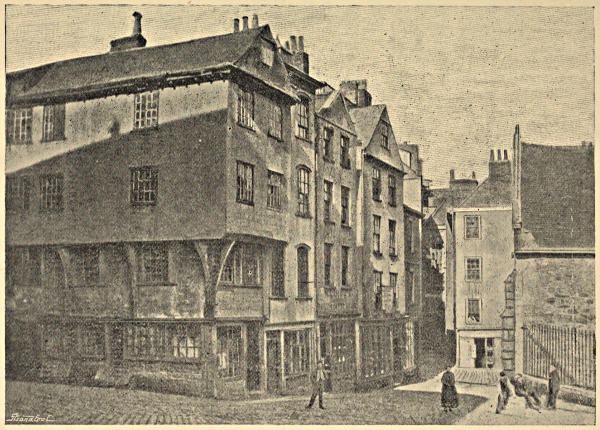
Houses formerly facing West Door of Town Church.
An event of so much importance was well calculated
to make a lasting impression on the people. And to
this day “Les Aragousais” are spoken of, and various
traditions relating to them are repeated. It is singular,
however, to find that with the lapse of time they
have come to be looked upon as a supernatural race—in
fact, to be confounded with the fairies. The form
which this traditional remembrance of them has taken
will be found on page 204, and tends in some degree
to confirm the idea entertained by some writers on fairy
mythology that many of the tales related of those
fantastic beings may be accounted for by the theory
that they refer to an earlier race of men, gradually
driven out by tribes more advanced in civilisation.
The places called “La Bataille[231]” and “La Ruette
Meurtrière” have already been mentioned as the spots
where the great battle took place. The “Rouge Rue,”
leading down the hill to the westward of St. John’s
Church, is said to derive its name from the blood
spilt on this occasion. If this really be the origin
of the name, we may suppose that the islanders,
retreating towards the Vale Castle, or perhaps the
Château des Marais, were overtaken there, and that
a second engagement took place. But there is reason
to believe that the tradition relates to another locality
in quite a different direction, which in times gone
by bore also the name of “La Rouge Rue,” but
which has long ceased to be so called. We speak
of the upper part of Hauteville, sloping southwards
towards the valley of Havelet. According to the late
Miss Lauga, who died at the advanced age of eighty-five,
her mother, who had inherited from her ancestors
property in this neighbourhood, always spoke of it as
“La Rouge Rue,” and said that a sanguinary battle
had been fought in ancient days on this spot. And,
indeed, this name appears in the old contracts and
title-deeds, by which property in the neighbourhood is
held. The consequence of its having ceased to be
known popularly by its ancient appellation would
naturally be that the traditionary tale of the
name being derived from the blood spilt there would
be transferred to another and better known locality,
which chanced—perhaps simply from the colour of
the soil—to bear the same name.
Firearms were of such recent invention that it is
scarcely to be supposed that any had as yet found
their way to Guernsey. If, however, any faith can
be placed in tradition, their use and construction
were not totally unknown in the island, for it is
said that the trunk of a tree was hollowed out and
bound round with iron hoops, but that when this
deadly weapon was loaded, no one could be found
bold enough to fire it, until a child, ignorant of the
risk he was incurring, was induced, by the promise
of a cake, to perform the dangerous feat.
It is also said that the women of the island
contributed all their ear-rings and other jewels to buy
off the invaders; and it was very generally believed
that a peculiar breed of small but strong and spirited
horses—now unfortunately extinct—was derived from
those that had escaped during the battle, and so had
remained in the island after the Spaniards left.
The tradition, which confounds Ivon’s forces with
the fairies, relates how all the islanders were killed,
except a man and a boy of St. Andrew’s parish,
who concealed themselves in an oven, over the mouth
of which a woman spread her black petticoat, and so
escaped; and how the conquerors, who are described
as a very diminutive race, married the widows and
maidens, and so re-peopled the island. The small
stature and dark complexion of some families are
occasionally appealed to as proofs of this origin.
Perhaps this tradition may be an indistinct
recollection of a far earlier invasion and possession
of the island by some of the piratical hordes from
the North, that began to infest the coasts of the
Channel as early as the beginning of the fifth
century. These were not unlikely to have subjugated
the men of the island, and to have taken forcible
possession of their wives, and any tradition of the
event might very naturally be transferred from one
invasion to another, and come finally to be fixed on
the last and best known.
The ballad, of which an English translation is
attempted, has evidently suffered much from the
defective memory of reciters, and the carelessness of
transcribers, so that some of the stanzas appear to
be almost hopelessly corrupt. The main incidents of
the story are, however, tolerably well defined. It
seems to have been composed originally in French,
and not in the Norman dialect used in the island.
The stanzas consist of the unusual number of seven
lines, of which the first and third rhyme together,
and the second, fourth, fifth and sixth—the seventh
rhyming occasionally with the first and third, but
more frequently standing alone. In some verses
assonances take the place of more perfect rhymes,
which may be adduced as a proof of the antiquity
of the ballad. Perhaps it would not be impossible,
by comparing the various copies, choosing the readings
which appear least corrupt, altering here and there
the position of a line in the stanza, or the arrangement
of the words that compose it, or even sometimes
changing a word where the exigencies of the rhyme
seem to require it, to produce a copy that would
offend less against the rules of prosody; but this is
a process which would require great care, and which
respect for antiquity forbids us to attempt.
We must take the ballad, with all its faults and
imperfections, as we find it.
Evan of Wales, or the Invasion of Guernsey in 1372.
Part the First.
I.
Draw near and listen, great and small,
Of high and low degree,
And hear what chance did once befall
This island fair and free
From warlike men, a chosen band,
Who roamed about from land to land,
Ploughing the briny sea.
II.
Evan of Wales, a valiant knight,
Who served the King of France,
In Saragossa’s city bright
Hired many a stalwart lance:
One Tuesday morn at break of day,
To land these troops in Vazon Bay,
He bade his ships advance.
III.
At early dawn from quiet sleep
John Letoc rose that day,
To tend his little flock of sheep
He took his lonely way,
When lo! upon the Vazon sands
He saw, drawn up in warlike bands
The foe in fierce array.
IV.
A horse he met upon his way
Trotting along the road,
Strayed from the camp—without delay
The charger he bestrode,
And soon from house to house the alarm
He gave, crying out “to arms, quick, arm!”
Through all the isle he rode.
V.
“To arms, to arms, my merry men all,
To arms, for we must fight,
Hazard your lives, both great and small,
And put the foe to flight;
Hasten towards the Vazon Bay
Hasten our cruel foes to slay,
Or we shall die this night.”
VI.
Evan of Wales, that vent’rous knight,
Led the foe through the land,
But pressing forward in the fight,
Upon a foreign strand,
He won a garter gay, I ween,
’Twas neither silk nor velvet sheen,
Though crimson was the band.
VII.
For near the mill at La Carrière,
With halbert keen and bright,
Young Richard Simon, void of fear,
Attacked the stranger knight.
And gashed full sore his brawny thigh,
Then smote his right hand lifted high,
To check the daring wight.
VIII.
Above Saint Peter Port ’tis said,
The conflict they renewed,
Of friends and foes five hundred dead
The grassy plain bestrewed:
Our ladies wept most bitterly,
Oh! ’twas a dismal sight to see
Their cheeks with tears bestrewed.
IX.
Thoumin le Lorreur was in truth
Our leader in the fray,
But brave Ralph Holland, noble youth,
He bore the palm away;
Yet was he doomed his death to meet,
The cruel foes smit off his feet,
He died that dismal day.
X.
Hard blows are dealt on every side,
The blood bedews the plain,
The footmen leap, the horsemen ride,
O’er mountains of the slain.
A deadly weapon, strongly bent,
Against the foes its missiles sent,
And wrought them death and pain.
XI.
But eighty English merchants brave,
Arrived at Vesper-tide,
They rushed on shore the isle to save,
And fought on our side:
Our foes fatigued, began to yield,
And leaving soon the well-fought field,
To Heaven for mercy cried.
XII.
To’ards Galrion they bend their course,
And range along the bay,
In hopes to make by fraud or force
Into the town their way,
But now the gallant Englishmen
Return, and on our foes again
Their prowess they display.
XIII.
But rallying soon, th’adventurous band
Cornet’s strong towers attack,
With ebbing tides, across the sand,
They find an easy track,
The beach is strewed with heaps of dead,
The briny sea with blood is red,
Again they are driven back.
XIV.
Many are killed, and wounded sore;
Meanwhile the hostile fleet,
Coasting along the southern shore
A warm reception meet
From peasants bold at La Corbière;
At Bec d’la Chèvre the land they near,
And aid their friends’ retreat.
XV.
But Evan’s troops were mad with rage,
Like lions balked of food,
Swear that their wrath they will assuage
In floods of English blood;
Then suddenly their course they steer
Towards Saint Sampson’s port, and there
They land in angry mood.
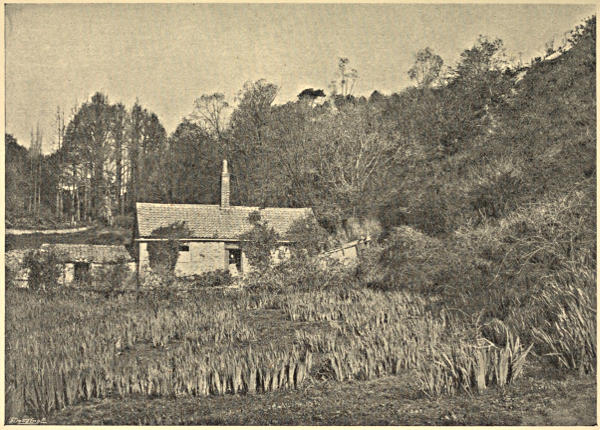
Old Cottage, Fermain.
XVI.
Saint Michael’s Abbey soon they seek,
Friar Brégard there had sway,
Who, full of fear, with prayers meek
Meets them upon their way;
With presents rich and ample store
Of gold, and promises of more
Their fury to allay.
XVII.
To Eleanor, that lady fair,
Sir Evan’s beauteous bride,
The crafty monk gave jewels rare
To win her to his side.
At Granville, in the pleasant land
Of France, Sir Evan sought her hand,
Nor was his suit denied.
XVIII.
Near the Archangel’s Castle then,
Upon a rising ground,
Sir Evan camped—our countrymen
Sure refuge there had found.
Brégard, in hopes to increase his store,
Advances to the Castle door
And bade a parley sound.
XIX.
He counselled them to yield forthwith,
But brave Sir Edmund Rose
Declared he’d sooner meet his death
Than bend to foreign foes,
But to the Abbot should they yield
A double tithe on every field,
He would it not oppose.
XX.
The Abbot to Sir Evan went,
And soon a bargain closed;
The simple peasants gave assent
To all the monk proposed,
And bound their lands a sheaf to pay,
Beyond the tithes, and thus, they say,
The Champart was imposed.
Part the Second.
I.
With spoils and presents not a few
Sir Evan sailed once more
Tow’rds le Conquet, his ships with new
Supplies of food to store;
Before Belleisle (so goes the tale)
They burnt a fleet of thirty sail,
The crews being gone on shore.
II.
The south wind rose, and on the coasts
Of Brittany they passed,
An English fleet to stop their boasts
Appeared in sight at last:
Full sixty men a footing found
On board Sir Evan’s bark, and bound
His crew in fetters fast.
III.
Sir Evan to the mast they tied,
And then before his face
Insult his young and beauteous bride
And load her with disgrace;
They take him to Southampton town
And on his head, in guise of crown,
A red-hot morion place.
IV.
They dragged his men out one by one,
And hung them up in chains,
And now not one of all the crew
Save Eleanor remains.
A beggar’s scrip her only store,
She roams about from door to door,
And scarce a living gains.
V.
How fared the rest of Evan’s fleet?
Methinks I hear you say,
When raging winds for ever beat
The strongest towers decay;
To bend these ships before the breeze,
And sinking ’neath the briny seas,
In vain for mercy pray.
VI.
Our holy island’s shores at last,
One Tuesday morn they reach;
But on the Hanois rocks are cast,
And soon on Rocquaine’s beach
The waves their lifeless corpses threw,
That vengeance still will guilt pursue,
Their dismal fate may teach.
At the beginning of the present century, when little
more was known of the Norman Islands than their
names, it might have been necessary, in speaking of
Sark, to describe where it is situated. Guernsey,
Jersey, Alderney, Sark, and Man, were always
associated together in Acts of Parliament and in
school books for teaching children geography; and
while there were many who believed the five to form
but one group, there were many others who would
have been very much puzzled to point out on the
map the precise situation of any one of them. Now,
thanks to the incessant intercourse with England by
means of steam, and the attractions the islands
present as resorts for tourists and excursionists, they
are as well known as most watering places on the
English coast.
Sark, though the smallest of the group, is by
many considered the most beautiful of the Channel
Islands, and, certainly in point of rock and cliff
scenery, combined with the ever-varying effects of
sea and sky, there are few lines of coast, of the
same extent, that can compare with it. So precipitous
are the shores on all sides, that there are very few
spots where a landing can be effected, and in former
days it would not have been difficult to repel an
invader, merely by rolling down stones from the
heights.
Of the history of Sark but little is known. St.
Maglorius, a Briton from South Wales, who succeeded
his kinsman, St. Samson, Bishop of Dol, about
the year 565, in that see, gave up a few years
afterwards his pastoral charge to his successor, St.
Budoc, and retired to end his days in meditation
and prayer in Sark, where he established a convent
and college for training young men as missionaries
to the neighbouring nations. As a priory, dependent
probably on some one or other of the large monasteries
in Normandy, this convent was still in existence
in the reign of Edward III., but the wars between
this monarch and the French king, seem to have
been the cause of the monks withdrawing themselves
entirely from the island about the year 1349. After the
departure of the monks, Sark appears to have become
the resort of pirates, who did so much injury to the
trade of the Channel, that, in 1356, a vessel belonging
to the port of Rye was fitted out by the merchants of
that town and of Winchelsea to endeavour to expel
this band of marauders. This they succeeded in doing,
and are said to have effected an entry into the island
by means of a stratagem, which Sir Walter Raleigh,
sometime Governor of Jersey, where he may be
supposed to have gained his information, relates as
having occurred in the reign of Queen Mary, and
attributes to the crew of a Flemish ship.
We copy Sir Walter Raleigh’s account of the
re-taking of Sark, from his History of the World,
Part I., Book IV., chapter XI., p. 18, but must
premise by saying that he is incorrect in stating that
Sark had been surprised by the French in the reign
of Queen Mary. It was in the year 1549, during
the reign of her brother Edward VI., that the
French, being at war with England, and finding the
island uninhabited, landed four hundred men and took
possession of it. The anonymous author of Les
Chroniques de Jersey, written apparently in the reign
of Queen Elizabeth, in noticing the recapture of
Sark by Flemings, says nothing of the stratagem,
but simply that, guided by some Guernseymen, they
landed at night and overpowered the French garrison,
which, at that time, was very much reduced in
numbers.
“The Island of Sark, joining to Guernzey, and of
that Government, was in Queen Mary’s time surprized
by the French, and could never have been recovered
again by strong hand, having Cattle and Corn enough
upon the Place to feed so many Men as will serve
to defend it, and being every way so inaccessible
that it might be held against the Great Turk. Yet
by the industry of a Gentleman of the Netherlands,
it was in this Sort regained. He anchored in the
Road with one Ship, and, pretending the Death of his
Merchant, besought the French that they might bury
their Merchant in hallowed Ground, and in the
Chapel of that Isle; offering a Present to the French
of such Commodities as they had aboard. Whereto
(with Condition that they should not come ashore
with any Weapon, not so much as with a Knife),
the French yielded. Then did the Flemings put a
Coffin into their Boat, not filled with a Dead Carcass,
but with Swords, Targets and Harquebuzes. The
French received them at their Landing, and, searching
every one of them so narrowly as they could not
hide a Penknife, gave them leave to draw their
Coffin up the Rocks with great difficulty. Some part
of the French took the Flemish Boat, and rowed
aboard their Ship to fetch the Commodities promised,
and what else they pleased, but, being entered, they
were taken and bound. The Flemings on the Land,
when they had carried their Coffin into the Chapel, shut
the Door to them, and, taking their Weapons out of the
Coffin, set upon the French. They run to the Cliff,
and cry to their Companions aboard the Fleming to
come to their Succour. But, finding the Boat charged
with Flemings, yielded themselves and the Place.”
Falle, the historian of Jersey, in citing this
anecdote says:—“I have seen Memoirs which confirm
the taking of this Island by such a Stratagem; but
the other Circumstances of Time and Persons do not
agree with the foregoing Story.”
He then quotes, in a footnote, a passage from a
MS. chronicle in Latin, which appears to have
been in the possession of the de Carteret family,
Seigneurs of St. Ouen, in Jersey, giving an account
of the recapture of Sark by a vessel from Rye, by
means of the stratagem related above, but he does
not assign any date to the transaction.
It would be rash to assert that no such event
ever occurred in the history of Sark, but it is curious
to note that similar stories are told of Harold
Hardráda, a Scandinavian adventurer who was in the
service of the Byzantine Emperors, and of the famous
sea-king, Hastings. The former fell dangerously ill
while besieging a town in Sicily. His men requested
permission to bury him with due solemnity, and, on
bringing the coffin to the gates of the town, were
received by the clergy. No sooner, however, were
they within the gates than they set down the coffin
across the entrance, drew their swords, made themselves
masters of the place, and massacred all the
male inhabitants.
Hastings, about the year 857, entered the Mediterranean
with a large fleet, appeared before the ancient
Etruscan city of Luna, professed to be desirous of
becoming a Christian, and was baptised by the Bishop.
After a time he pretended to be dangerously ill,
and gave out that he would leave the rich booty he
had amassed to the Church, if, in the event of his
death, the Bishop would allow him to be interred
in one of the churches of the city. This was
conceded, and, shortly afterwards, his followers
appeared, bearing a coffin, which they pretended
contained his dead body. No sooner had they entered
the church and set it down, than Hastings started
up, sword in hand, and slew the Bishop. His
followers drew their swords, and, in the confusion,
soon made themselves masters of the city.
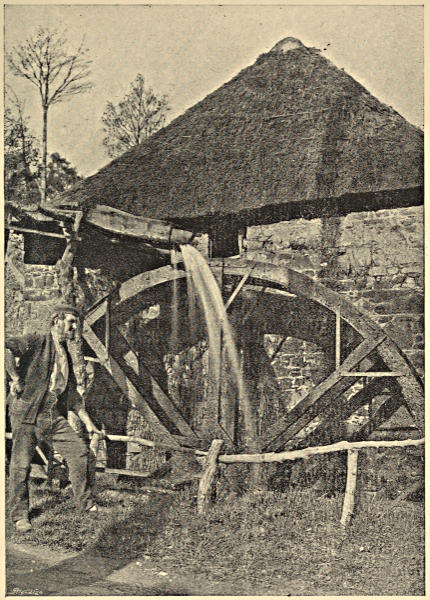
Old Mill, Talbot.
These particulars are taken from Bohn’s editions
of Mallet’s Northern Antiquities, pages 169 and 170.
Perhaps the earliest known germ of this story is to
be found in the famous Trojan horse; but it is
curious to note that a tale, similar in all its
incidents to that related of Sark, is told as having
happened in the reign of William and Mary at
Lundy, a small isle in the Bristol Channel. It will
be found in Murray’s Handbook for Travellers in
Devon and Cornwall; and as the date assigned to
it is long subsequent to the publication of Sir Walter
Raleigh’s History, the natural conclusion is that the
incidents in the alleged taking of Lundy, have been
borrowed from those of the recapture of Sark, as
narrated by Sir Walter. In confirmation of this view
of the case we would draw attention to the circumstance
that the “Gentleman of the Netherlands,”
with his crew of Flemings, of the earlier narrative,
becomes in the later edition of this story “A ship
of war under Dutch colours.”
With these preliminary remarks, we proceed to copy
the account of the surprise of Lundy:—
“The principal event in the history of Lundy is
its capture by a party of Frenchmen, in the reign
of William and Mary. A ship of war, under Dutch
colours, brought up in the roadstead, and sent ashore
for some milk, pretending that the captain was sick.
The islanders supplied the milk for several days,
when at length the crew informed them that their
captain was dead, and asked permission to bury him
in consecrated ground. This was immediately granted,
and the inhabitants assisted in carrying the coffin to
the grave. It appeared to them rather heavy, but
they never for a moment suspected the nature of its
contents. The Frenchmen then requested the islanders
to leave the church, as it was the custom of their
country that foreigners should absent themselves
during a part of the ceremony, but informed them
that they should be admitted to see the body interred.
They were not, however, detained long in suspense;
the doors were suddenly flung open, and the Frenchmen,
armed from the pretended receptacle of the
dead, rushed, with triumphant shouts, upon the
astonished inhabitants, and made them prisoners.
They then quietly proceeded to desolate the island.
They hamstrung the horses and bullocks, threw the
sheep and goats over the cliffs, and stripped the
inhabitants even of their clothes. When satisfied
with plunder and mischief, they left the poor islanders
in a condition most truly disconsolate.”
No reference to any authority for the story is
given, and it is difficult to conceive that such an
unprovoked and barbarous outrage, leading to no
useful end—for Lundy could be of little or no use to
either in time of war—could have been perpetrated
so lately as the reign of William III.; but in the
case of Lundy, as well as in that of Sark, the date
assigned to the event is extremely vague, some
asserting that it happened in the time of the great
rebellion, others that it is to be found related by
one of the old chroniclers who wrote the history of
that long period of civil strife known as the Wars of
the Roses.
A time of war between England and France would
naturally cause great anxiety and excitement in all
the Channel Islands. Situated as they are, so near
to the French coast that buildings of any size may
be discerned in clear weather by the naked eye,
and coveted by that nation ever since the time when
King John, having lost Normandy, the islands, firm
in their allegiance to the Duke, followed the fortunes
of England, they were peculiarly exposed to a hostile
attack.
England, fully aware of the importance of these
islands, and knowing well what a command of the
Channel the possession of them gives, has always
been careful to have them well fortified and garrisoned
in time of war, and to keep a fleet cruising in their
waters. The local militia—a body of men which may
be more correctly termed trained bands, for, by the
ancient constitution of the islands, every male capable
of bearing arms must be trained to the use of them,
and is required to serve his country from the age
sixteen to sixty—forms a subsidiary force, frequently
and carefully drilled. In times when danger was to
be apprehended, watch houses were erected on all
the hills and promontories round the coast, where a
vigilant lookout was kept up night and day; and
near each of these was placed a large stack of dried
furze, which might be set on fire at a moment’s
warning, and which would convey the intelligence of
approaching danger to all parts of the island. The
keeping of these guards was confided to the militia,
or, to speak more precisely, to householders, who
were told off by the constables of their respective
parishes for this duty. Every house, in its turn,
had to furnish a man, and even females living alone
were not exempt, but were expected to find a
substitute. These substitutes, being well paid for
their trouble, were, of course, not difficult to be met
with; but as they were for the most part idle
fellows, and as they were enrolled under their
employers’ names, these last sometimes found themselves
in an awkward predicament. It is said that
two maiden ladies, householders, of most unblemished
reputation, and belonging to two of the most
aristocratic families in Guernsey, were reported one
morning as having been drunk and disorderly on
guard the previous night!
During the last wars between England and France
there does not appear to have been, except on one
occasion, any very serious alarm in Guernsey; but
every now and then the sight of ships of war off
Cape La Hague, in the neighbourhood of Cherbourg,
gave rise to some uneasiness, and put the island on
the alert. It is no wonder if some amount of fear
was felt by the inhabitants on these occasions, when
we remember the panic that Bonaparte’s threatened
invasion in flat-bottomed boats from Boulogne, occasioned
in England.
It was during the American war, in the early part
of the year 1781, shortly after the attempt made on
Jersey by the French adventurer, de Rullecour, so
gallantly repelled by a small body of the regular
forces and the militia of that island, under the
command of Major Pierson, who was killed fighting
bravely at the head of his troops, that a drunken
frolic of three thoughtless youths threw the whole
island of Guernsey into a state of consternation, and
was the unfortunate cause of the death of several
sick persons.
On the night of Sunday, the 4th of March, these
men, officers in one of the militia regiments, after
attending a muster of the force, which, in those
days, generally took place on the Sunday, had
finished the day by dining together, and were
returning from the Castel parish to their homes in
the Vale and St. Sampson’s. Their way was along
the sea-coast, at that time not nearly so thickly
inhabited as at present, and, on arriving at an almost
solitary house, situated near the marsh of Pulias,
just at the foot of the hill of Noirmont, on which
a watch and a beacon, ready to be fired, were always
in readiness, the fancy took them to knock at the
door of the cottage, and to represent themselves as
part of a French force, consisting of over ten
thousand men, who had just effected a landing. They
demanded that a guide should be furnished them
forthwith to shew them the most direct road to the
town, and to the residence of the Governor, promising
that he should be amply rewarded for his trouble.
It so chanced that the only inmates of the house
were an old man and his wife. With admirable
presence of mind, the man replied that it was out
of his power to serve them as guide, as he had the
misfortune to be stone blind, but that if they went
a few hundred yards further in a direction which
he pointed out to them, they would find another
habitation, where, no doubt, the guide they were in
search of would be forthcoming. They took their
departure, going in the direction indicated to them,
and, no sooner were their backs turned, than the
old woman opened a window in the rear of the
house, and made her way across the fields, over
hedges and ditches, and through the thick furze that
covers the hill, to the signal station on the summit
of Noirmont. She told her story to the men on
watch, and it was not many minutes before the
beacon was in flames, and the signal taken up by
all the others round the coast. A swift messenger
was sent into town with the unwelcome news.
Before long, the alarm had spread into every part
of the island. The troops in garrison were soon under
arms, the militia regiments mustered at their respective
places of meeting, and scouts were sent out to
search for the enemy, and to find out where they
had taken up their position. With the return of
daylight, the reconnoitring parties came back to
headquarters, bringing the reassuring intelligence that
not a sign of an enemy was to be seen on any part
of the coast. It was then evident that the whole
community had been made the victim of a heartless
hoax. A strict enquiry was set on foot to discover
the authors of it, but, though suspicion pointed
strongly in the direction of the real culprits, nothing
definite could be brought home to any one in
particular; but the surmise was converted into
certainty by the sudden departure from the island
of the suspected parties, who did not venture to
return to their homes till many years afterwards,
when the affair was well-nigh forgotten, and when
there was no longer any danger of their being called
to account for their mad freak. A bitter feeling was,
however, engendered in the minds of the people,
which found vent in satirical songs, some verses of
which are still remembered.
From the earliest times of which we have any
authentic record, the people of Guernsey appear to
have been a seafaring race. Perhaps they inherit
their disposition for maritime pursuits from their
remote ancestors, those hardy Scandinavian adventurers,
who, there can be no doubt, found these
islands a very convenient resort in their early piratical
incursions, and probably had settled in them long
before they took possession of that fertile province of
France, now known as Normandy, the land of the
Northmen. But, however this may be, the inhabitants
of these islands could scarcely be other than mariners,
surrounded as they are by a sea abounding in an
endless variety of fish, and especially when we take
into consideration the small extent of land in them
available for agricultural purposes compared with the
teeming population which,—exclusive of that of the
town, which has increased considerably since the beginning
of the nineteenth century—appears from authentic
documents to have been quite as dense in the rural
districts in the early part of the fourteenth century
as it is in the present day.[232]
Their situation gave the islands importance in a
strategical point of view, and was favourable also to the
development of commerce, possessing moreover, as they
did, the extraordinary privilege of neutrality in times
of war between England and France.
Water Lane, Couture.
After the forfeiture of Normandy by King John,
it was long before the inhabitants of that Province
acquiesced cordially in their change of masters; and
the district known as Le Cotentin, to which the islands
naturally appertained, was last to give up their allegiance
to their ancient Dukes. Indeed, it can scarcely
be said to have been lost entirely to England, until the
final expulsion of our kings from all their continental
possessions in the reign of Henry VI. During the long
wars between the two nations, the possession of these
islands was of the utmost importance to England,
commanding as they did so long a line of the French
coast. Guernsey alone at that time possessed a tolerably
secure haven, the early existence of which is proved by
a charter of William the Conqueror, dated prior to his
invasion of England, in which St. Peter Port is
mentioned. Edward I. allowed of certain dues on
merchandise being levied for the improvement of this
harbour, and that an active trade was carried on
between Guernsey and the English possessions in
Acquitaine is undoubted. No wonder then that we find
the names of Guernsey ships in the lists of those
chartered for the conveyance of troops to France in
time of war. But what, perhaps, more than anything
else contributed to form a race of hardy and courageous
seamen were the important fisheries, which, before the
discovery of America and the banks of Newfoundland,
gave employment to an immense amount of men,
in catching, salting, and drying for exportation, the
fish which abound in the neighbourhood of the
islands. The dangerous nature of the coast, and
the surrounding seas, is owing to sunken rocks,
strong currents and tides, which vary from day to
day. It requires a life-long apprenticeship to become
well acquainted with all the hidden and open perils
which threaten a seaman’s life. No wonder then if
some of our fishermen, brought up to the sea from
their earliest youth, become experienced and fearless
pilots, knowing every reef, every set of the tide,
and able to reckon to a nicety, how long the current
will run in one direction, and when it may be
expected to take a different course. In making their
calculations they are very much guided by the
bearings of certain marks on land, such as churches,
windmills, or other conspicuous buildings, and the
following anecdote, related of one of our pilots, Jean
Breton, is well worthy of being remembered, not
more for the skill he displayed under very trying
circumstances, than for the significant and touching
answer he gave when questioned whether he was sure
of his marks.
In the year 1794, Captain Sir James Saumarez
was at Plymouth, in command of H.M.S. Crescent
and a squadron consisting of two other frigates, the
Druid and the Eurydice, and two or three armed
luggers and cutters. He received orders to sail for
Guernsey and Jersey, to ascertain, if possible, the
enemy’s force in Cancale Bay and St. Malo. On
the 7th of June he left Plymouth, having, a day
or two before, accidentally met Jean Breton, whom
he knew. He asked him what he was doing there.
“I am waiting, Sir, for a passage to Guernsey,”
was the reply. Sir James, whose active benevolence
always prompted him to do a kind action when it
was in his power, offered to take him across, and
his kindness to his poor fellow-countryman was
amply repaid in the sequel. The day after their
departure from Plymouth, when about twelve leagues
to the N.N.W. of Guernsey, and with a fresh N.E.
breeze, the English ships fell in at dawn with a
French squadron of considerably greater force. The
superiority of the enemy being much too great to
be opposed with any chance of success, it became
the imperative duty of the English commander to
effect, if possible, the escape of his ships. Observing
that his own ships, the Crescent and the Druid, had
the advantage in sailing, and fearing that the
Eurydice, which was a bad sailer, would fall into
the enemy’s hands, he shortened sail, and, having
ordered the Eurydice, by signal, to push for Guernsey,
he continued, by occasionally showing a disposition
to engage, to amuse the enemy and lead him off
until the Eurydice was safe. He now tacked, and,
in order to save the Druid, closed with the enemy,
passing along their line. The capture of the Crescent
now seemed inevitable, but the Druid and the
Eurydice escaped in the meanwhile, and arrived safely
in Guernsey Roads, the smaller craft returning to
Plymouth.
But Sir James had, for his own preservation, a
scheme, to effect which required great courage, consummate
skill in the management of his ship, and
an intimate knowledge of the intricate passages
through the reefs which render navigation, on that
part of the coast in particular, so very dangerous.
The providential presence of Jean Breton on board
enabled him to put this scheme into execution with
an almost certainty of success. Sir James knew
that if there was a man in Guernsey thoroughly
acquainted with every danger that besets that iron-bound
shore, Jean Breton was that man; and, making
a feint to run his ship on the rocks to avoid being
captured by the enemy, but trusting implicitly in
his pilot’s skill, he ordered him to steer through a
narrow channel, a feat which had never before been
attempted by a vessel of that size. The result of
this manœuvre was watched with the utmost anxiety
from the shore, and remarks were made by the
lookers-on that Jean Breton alone, of all the pilots
in Guernsey, would venture on such a perilous feat,
little suspecting that it was indeed he, to whom,
under God, was to be attributed the safety of the
ship and her gallant crew. The frigate was soon
brought to in a secure anchorage under shelter of
the fire of the batteries on shore, and the French,
mortified at being baulked of a prize of which they
had made quite sure, had to retire from the contest.
The scene of this daring adventure was to the
westward of the island, off the bays known as Le
Vazon and Caûbo, on the shore of the former of
which Jean Breton’s cottage was situated, and full
in view of Sir James Saumarez’s own manorial
residence, a position truly remarkable, for on one
side was a prospect of death or a French prison,
on the other side home with all its joys! When in
the most perilous part of the Channel, Sir James
asked the pilot whether he was sure of his marks?
“Quite sure,” was Jean Breton’s reply, “for there
is your house and yonder is my own!”
“Gather up all the traditions, and even the nursery songs; no one can tell of what value they
may prove to an antiquary.”—Southey, in a letter to Mrs. Bray, quoted in her Borders of the Tamar and the Tavy.
[Some of these I have found lying loose among Sir Edgar MacCulloch’s MSS. I have
put them together, and added to them a few I have collected among the old country
people.—Ed.]
A number of children seat themselves in a
circle on the ground, as near to each
other as possible, and one of the party is
chosen to stand in the centre of the ring. Those
who are seated keep their hands in their laps with
their fists closed, and endeavour to pass a pebble or
other small object from one to the other, without
its being perceived by the child who is in the middle.
While the game is going on they recite the following
rhyme:—
“Mon toussebelet va demandant,
Ma fausse vieille va quérant,
Sur lequel prends tu, bon enfant?”
[233]
The child in the centre of the circle is in the
meantime on the look out to discover into whose
hands the pebble is passing, and, if he can succeed
in arresting it in the possession of any one of the
players, he takes his place in the ring, and the one
in whose hands the pebble was caught, replaces him
in the centre.
From Rachel du Port.
A child stands in the middle and says:
“J’ai tant d’énfants à marier.”
Chorus from children standing round:
The child again says:
“Ah! je ne sais qu’en faire.”
One of the children then says:
“Maman, maman, que voulez vous?”
The first child replies:
“Entrez dans la danse, faites la révérence,
Chantez, dansez, et embrassez celui que vous aimerez.”
This is repeated till all the children are brought inside the circle, then the “mother” says.
“Tous mes enfants sont mariés,
Je n’en ai plus un seul resté.”
Then the first child says to the “mother”:
“Entrez dans la danse, faites la révérence,
Chantez, dansez, et embrassez celui que vous aimerez.”
From Mrs. Jehan.
The child in the centre says the first couplet and
then “counts out”:
“Un loup passant par le désert,
La queue levée, le bec en l’air,
Un, deux, trois,
Vers le bois,
Quatre, cinq, six,
Vers le buis,
Sept, huit, neuf,
Vers le bœuf,
Dix, onze, douze,
Dans la bouze.”
“Un “i” un “l,” ma tante Michelle,
Des roques, des choux, des figues nouvelles,
Ne passez pas par mon jardin,
Ne cueillez pas mon rosmarin,
Crim! Cram! Crue,! Elysée,! Henri! Va ’t’en!”
Sometimes the last three ejaculations are omitted.—From
Mrs. W. P. Collings.
“A la grand’ rue
Les étoiles y sont suspendues;
Du vin blanc, et du vin noir,
On le met à baptizer,
Sur le dos de la cuiller.
La cuiller se passe,
L’enfant trépasse,
Ainsi, par ci
Mon cœur me dit
Ceci, celà,
Hors d’ici
Hors de là!”
—From Miss Harriet de Sausmarez, aged ninety.
Used by children in her youth.
“L’un de la lune
Deaux, des ch’vaux
Très des peis,
Quâtre d’la grappe
Chinq, des chelins,
Six du riz.
Sept du lait,
Huit, de la gâche cuite,
Neuf, du bœuf,
Dix, pain bis,
Onze de la congre,
Douze de la bouze.”
—From Mrs. W. Ozanne.
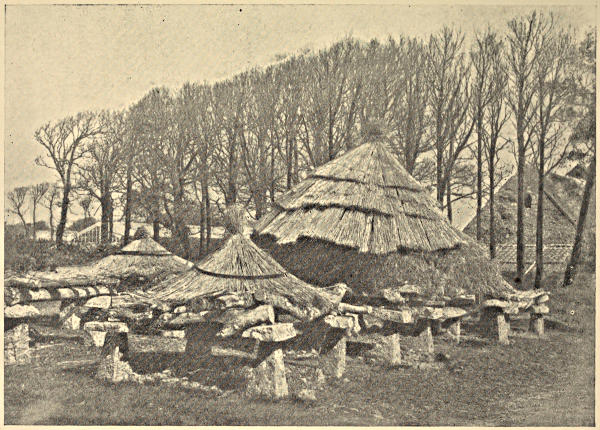
Hautgard, St. Peter’s, showing Pilotins.
“Hickory, Airy, Ory, Anne,
Biddy, boddy, over San,
Père, Père, Vierge et Mère,
[234]Pit, Pout, out, one!”
—From Miss Annie Chepmell.
“Eckary, airy, ory Anne,
I believe in ury San,
Père, père, what’s your mère,
Pit, pout, out, one!”
—From Mrs. Mollet, La Villette.
“Onery, Twoery, Dickery, Davy,
Arabo, Crackery, Jennery, Lavy,
Wishcome, Dandy, Merrycome, Time,
Humberry, Bumberry, Twenty-nine.”
—From Mrs. Durand, sen.
Names of the Fingers.
The nurse takes the child’s hand, and beginning
with the thumb says: “Gros det,” “Arridet,” (for
the index finger.)
[Métivier, in his Dictionnaire Franco-Normand, says
it comes from an obsolete word, “arrer” or “arrher,”
meaning to promise, to ratify, to buy; and quotes
the “Speculum Saxonum II., 15, I.” “Celui qui
commence une cause devant le juge pour laquelle il est
tenu de donner caution … du doigt.”]
“Longuedon,” or “mousqueton,” the middle finger,
“Jean des Scéas,” the ring finger, or the finger which
wears the signet. Métivier (page 443 of Dictionnaire
Franco-Normand) gives as evidence of the signet being
worn on this finger, Macrobius VII., 13, p. 722. Edit.
de Lyon, 1560. “Dis-moi pourquoi on s’est déterminé,
par un assentiment universel, à porter l’anneau au doigt
qui avoisine le petit, qu’on a nommé aussi le doigt
médical: et cela presque toujours à celui de la main
gauche? Voici la réponse de Disarius. ‘Ayant
consulté les livres des anatomistes, j’en ai découvert
la vraie cause. Ils m’ont appris qu’un nerf passe du
cœur au doigt de la main gauche, qui avoisine le petit,
et que c’est là, enveloppé par les autres nerfs de ce
doigt, qu’il termine sa course. Voilà pourquoi les
anciens se sont avisés de ceindre ce doigt d’un
anneau, et, si j’ose m’exprimer ainsi, d’une couronne.’”
“P’tit Coutelàs,” the little finger.
The nurse puts the child on her knee and sings:—
Et sur le petit chevalot
Qui va—le pas, le pas, le pas,
Le trot, le trot, le trot,
Le galop! le galop! le galop!”
The nurse pretends to shoe the baby’s feet and
sings:—
“Ferre, ferre la pouliche,
Pour allaïr vée ma nourriche,
Ferre, ferre le poulaïn,
Pour allaïr vée mon parrain;
Ferre, ferre le cheval,
Pour allaïr à Torteval.”
Another version of this rhyme is given in Métivier’s Dictionary. Vide Pouliche, namely:—
“Ferre, ferre men poulaïn
Pour allaïr à Saïnt-Germaïn!
[237]Ferre, ferre ma pouliche
Pour allaïr cîs ma nourriche.”
Nurses’ Rhymes.
The nurse tickles the baby’s hands, and says:—
“L’alouette, l’alouette a fait son nid
Dans la main de mon petit,
Et a passaï par ichin.” (Here she tickles the baby’s palm).
Then beginning with the thumb, she says:—
“Ch’tinchin l’a tuaïe,
Ch’tinchin l’a plumaïe,
Ch’tinchin l’a rôtie,
Ch’tinchin l’a mangie,
Et le poure p’tit querouin,
Qui a étai au fouar et au moulin,
N’en a pas ieü un poure p’tit brin.”
(There are several slightly different versions of this rhyme.)
Nurses, while playing with a child’s face, say:—
“Menton fourchi” (pinch the chin).
“Bouche d’Argent” (touch the lips).
“Nez de Cancan” (touch the nose).
“Joue rotie, joue fricassée” (touch the cheeks).
“P’tit œillot, gros œillot” (touch the eyes).
“Craque Martel” (tap the forehead).
—From Mrs. Kinnersly.
“En r’venant de St. Martin
J’ rencontri men p’tit lapin,
Il sautit dans ma grand’ chambre
Et mangit toutes mes almandes;
Il sautit dans ma p’tite chambre
Et mangit toutes mes noix;
Il sautit dans men chillier
Et mangit toutes mes cuillers;
Il sautit dans men gardin
Et mangit men rosmarin;
Il sautit dans mon galetâs
Et mangit tous mes râts;
Il sautit sur ma maison
Et mangit mon p’tit garçon.”
—From Mrs. David, the old nurse in the service of Mr. Gosselin, at Springfield.
“L’alouette, l’alouette, qui vole en haut,
Prie Gyu pour qu’il faiche caud,
Pour ses poures p’tits aloutiaux,
Qui n’ont ni manches ni mantiaux
Ni alumettes ni coutiaux
Pour copaïr les gros morciaux.”
“Tire-lire-li, ma cauche étrille,
Tire-lire-li, ramendaïs la,
Tire-lire-li, j’ n’ai pas d’aiguille,
Tire-lire-li, acataïs n’en,
Tire-lire-li, j’ n’ai point d’argent,
Tire-lire-li, empruntaïs n’en
Tire-lire-li, j’ n’ai point d’ crédit,
Tire-lire-li, allou’s-en.”
“Corbìn, Corbìn, ta maison brule,
Va-t-en cueure ton pain et ton burre,
J’ai la cllai dans ma paoute,
Jamais tu n’ la verras d’autre.”
—From Louise Martel, of the Vale.
“Colin, Colimachon, montre mè tes cônes,
Ou je te tuerai!”
—From Louise Martel.
Métivier in his Dictionnaire gives this version:—
“Limaçon, bône-bône
Montre-moi tes cônes!”
“Coli, Colimachon, mourte mè tes cônes,
Et je te dirai où est ton père et ta mère.
Ils sont là bas, en haut du pré,
A mangier d’la gâche cuite et bère du lait!”
—From Mrs. Mollet.
“Rouge bounet, veur-tu du lait?
Nennin, ma mère, il est trop fred,
Rouge bounet, veur-tu d’la craïme?
Oui, ma mère, caer je l’aïme.”
—From Mrs. Mollet.
“Coquedicot, j’ai mal au det,
Coquedicot, qu’est qui-t-la-fait?
Coquedicot, ch’tait men valet,
Coquedicot, où est qu’il est,
Coquedicot, il est à traire,
Coquedicot, dans qu’est qu’il trait?
Coquedicot, dans son bounet,
Coquedicot, dans qu’est qu’il coule?
Coquedicot, dans sa grand goule,
Coquedicot, dans qu’est qu’il ribotte?
Coquedicot, dans sa grand botte?
[238]Coquedicot, dans qu’est qu’il fait le burre?
Coquedicot, dans son grand verre!”
In summer a species of small black beetle, known
by the local name of “pan-pan,” is found very
commonly in the hedges. Children are in the habit
of laying these beetles on their backs, in the palms
of their hands, spitting upon them, and then repeating
the following words:—
“Pan-Pan,
Mourte mé ten sang,
Et je te dounerai du vin bllanc.”
The insect thus tortured emits a drop or two of a
blood-red secretion, which is, of course, what the child
is looking for.
Compare “Les feux de la St. Jean en Berry,” in
Revue des Traditions Populaires, Vol. I., p. 171. “Il
existe une petite scarabée d’un noir bleu qu’on nomme
‘petite bête St. Jean.’ Quand on le prend, il rend
par les mandibules (la bouche) un liquide rougeâtre;
les enfants excitent cette sécretion en mettant de la
salive sur l’insecte, et en disant:—
‘Petite bête Saint-Jean,
Donne-moi du vin rouge,
Et je te donnerai du vin blanc.’”
“Les Français qui plument leurs ouaies
Craquent leux puches et les font quée.”
—See Chambers’ Popular Rhymes of Scotland.
“The men o’ the East
Are pyking their geese
And sending their feathers here away, here away!”
“Margoton, mon amie,} bis.
Margoton, mon cœur,}
Il te faudra du rôti,
Pour et pour, et pour et pour,
Pour te mettre en appetit.”
“Patty Patoche, vendit la caboche
Dans le marchi, pour des sous merquis.”
Je fus par les càmps
Ma roulette roulànt.
J’ rencontris Tchisette
Qui m’ print ma roulette.
J’ li dis “Tchisette,
Rends-mé ma roulette.”
A’ me répounit
“Je ne t’la rendrai poiut
Si tu n’me doune une croûte de lait.”
Je fus à ma mère
J’ li dis “Ma mère,
Doune mé une croûte de lait.”
A’ me répounit
“Je ne t’la dounerai poiut
Si tu n’ me doune une cllavette.”
Je fus à mon père
J’ li dis, “Mon père,
Doune mé une cllavette.”
I’ me répounit
“Je ne t’ le dounerai poiut
Si tu n’me doune un’ tchesse de viau.”
Je fus au viau
J’ li dit “Viau,
Doune me un’ tchesse.”
I’ me répounit
“Je ne t’ le dounerai poiut
Si tu ne me doune du lait de la vâque.”
Je fus à la vâque
J’ li dit “Vâque,
Doune mé du lait.”
A’ me répounit
“Je ne t’en dounerai poiut
Si tu ne me doune de l’herbe de pré.”
Je m’en fus au pré
J’ li dis “Pré,
Doune mé de l’herbe.”
I’ me répounit
“Je ne t’ la dounerai poiut
Si tu ne me doune une tranche de faux.”
Je fus au faux
J’ li dis “Faux,
Doune mé de la tranche.”
I’ me répounit
“Je ne t’ la dounerai poiut
Si tu ne me doune de la graisse de porc.”
Je fus au porc
J’ li dis “Porc,
Doune mé de la graisse.”
I’ me répounit
“Je ne t’ la dounerai poiut
Si tu ne me doune un glliand de quêne.”
Je m’en fus au quêne
J’ li dis “Quêne,
Doune mé un glliand.”
I’ me répounit
“Je ne t’ le dounerai poiut
Si tu ne me doune du vent de maïr.”
Je fus à la maïr
J’ li dis “Maïr,
Doune mé du vent.”
La maïr ventait—J’éventi men quêne
Men quêne glliandait—Je glliandi men porc
Men porc graissait—Je graissi men faux
Men faux tranchait—Je tranchi men pré
Men pré herbait—Je herbi ma vâque
Ma vâque laitait—J’allaiti mon viau
Men viau tchessait—Je tchessi men père
Men païre cllavettait—Je cllavetti ma mère
Ma maïre crôtait—Je crôti Tchisette
Par chunna j’eus ma roulette.
This, the local version of “The House that Jack Built,” is widely known. Slightly different
versions exist in the different parishes, but the above is as complete as I can make it.—From
Mrs. Mollet, Mrs. C. Marquand, Mrs. Le Patourel, and from a version collected in St. Peter-in-the-Wood,
by Miss Le Pelley.
“Haptalon
[239] de la Vieille Nanon
Qui ribotait son cotillon.”
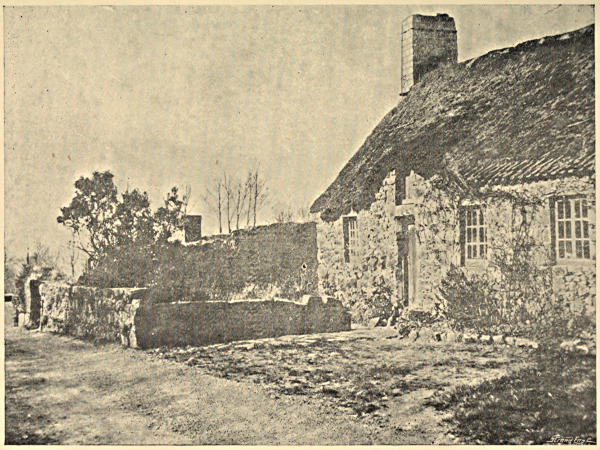
Old Guernsey Farm House.
“Dindon, Bolilin,
Quatre éfants dans le bain de Madame.
Le petit, qui cri le bouille,
Dindon, bolilin!”
“Chausseaton, berçeaton,
Ma grand’mère est au païsson,
Si al’en prend j’en aïron
Tout sera plein à la maison!
Si non, j’ nous en passerons!”
“Ton père
[240] a dit qui fallait dormir (bis).
Lo, lo, lo, le petit
Puisque ton père a dit.” (bis).
“Makieu
Dors tu?
Nennin, ma mère, quer je prie Gyu,
Quaille prière dis-tu?
“Not’ Père” et “Je cré en Gyu.””
“Trop paresseuse, pourquoi te revaïr?
Reveillez-vous joyeuse, et venez dansaïr.”
“Crolloton, berchotton,
Ma grand’-mère est au païsson
S’ al’en a j’en airon
S’ a n’en a poiut, j’ nous en passerons.”
—From John de Garis, Esq., of the Rouvets.
Mon Beau Laurier.
It was formerly customary on holidays for the
youth of both sexes to assemble in some tavern or
private house to amuse themselves with dancing to
the enlivening strains of the fiddle or rote, called in
the local dialect the “chifournie.” These assemblies
were termed “sons,” and were generally attended
also by some of the older portions of the community,
whose presence was a guarantee for the orderly
conduct of the meeting. Things are now much
changed. The presence of a large garrison during
the wars that arose out of the first French
Revolution, and the influx of a mixed population
since the peace, altered the character of these
assemblies in town. They came to be regarded with
disfavour; parents discouraged their children from
attending them; the prejudice against them extended
to the country parishes, and the puritanical feeling
that grew up with the rapid spread of dissent
among the labouring classes was entirely opposed
to any species of amusement. Whether the cause
of morality has gained much by this over strictness
is questionable.
The dances at these meetings were of a very
primitive character, consisting almost entirely of a
species of jig, by two performers, or in joining
hands and moving round at a quick pace in a circle.
When a musician was not to be procured, recourse
was had to the united voices of the dancers, and an
ancient roundelay or “ronde,” no doubt originally
imported from France, where such dances are still
common among the peasantry, helped to carry on the
amusement of the evening. It is still danced
occasionally by young people and children, and, as
the sole remaining specimen of this kind of diversion,
deserves to be recorded.
The performers, who must consist of an equal
number of either sex placed alternately, join hands
in a circle. They then dance round, singing in
chorus:—
“Saluez, Messieurs et Dames,
Ah! mon beau lau-ri-er!” (bis)
One of the girls is then selected and placed in
the middle of the circle, and the rest of the party
continue to dance round her singing:—
“Ah! la belle, entrez en danse!
Ah! mon beau lau-ri-er!” (bis)
The next verse is:—
“Faites nous la révérence,
Ah! mon beau lau-ri-er!” (bis)
On this the damsel curtseys round to the company,
who go on singing:—
“Faites le pot à deux anses,
Ah! mon beau lau-ri-er!” (bis)
The dancer must now set her arms a-kimbo, and
so figure away in the centre of the ring until the
strain changes to:—
“Jambe, enjambe en ma présence,
Ah! mon beau lau-ri-er!” (bis)
This figure generally causes much merriment, for
the performer is expected to clasp both arms round
one uplifted knee, and hop about on the other foot,
the result of which is not unfrequently a fall. Then
follows:—
“Prenez cil qui vous ressemble,
Ah! mon beau lau-ri-er!” (bis)
The maiden now makes selection of a partner
among the youths, and both join hands in the
middle of the circle, while the following words are
sung to a different tune and measure:—
“Entr’embrassez-vous par le jeu d’amourette,
Entr’embrassez-vous par le jeu d’amour.”
A tender embrace follows, and then the assistants
sing:—
“Entr’embrassez-vous par le jeu d’amourette,
Entr’embrassez-vous par le jeu d’amour.”
A kiss is now claimed from the compliant damsel,
after which is sung:—
“Entrequittez-vous par le jeu d’amourette,
Entrequittez-vous par le jeu d’amour.”
The girl now leaves the young man in the midst
of the circle and returns to her original place, when
the dance recommences with such verbal alterations as
the change of the principal performers renders necessary.
The old-fashioned cushion dance, which delighted the
romps of the Court of the merry-monarch, Charles II.,
is not altogether forgotten on these occasions.
There are several other dancing rhymes and
snatches of dancing times in existence—such as the
one quoted by Métivier in his Dictionnaire, page 148:—
“Ma coummère, aquànd je danse, men cotillon fait-i bien?
Ah! vraiment oui, ma coummère, i va bien mûx que le mien.
I va de ci, i va de là;
I va fort bien, ma coummère,
I va fort bien coumme i va.”
Another version is:—
“Ma coummère, aquànd je danse, men cotillon fait-i bien?
Ah! vraiment oui, ma coummère, i va bien mûx que le mien.
I va d’ici, I va de là, men cotillon,
Vole, vole, vole, men cotillon vol’ra.”
One dance consisted of a sort of see-saw in
different corners of the room, the couple repeating:—
“Dansez donc, ou ne dansez pas,
Faites le donc, ou ne le faites pas,
La-la-la.” (bis).
Dance and repeat!
Editor’s Note.—In a Descriptive Account of the Island of Sark, published in Clarke’s
Guernsey Magazine for September and October, 1875, the Rev. J. L. V. Cachemaille wrote:—“The
public games and amusements of the Sarkese are few, and of a simple kind; and
it is only children or young people who take part in them now-a-days. Formerly they used
to have a favourite amusement, consisting of six or eight men, or big boys, who placed
themselves in a line, one behind the other, and held each other firmly round the waist, while two
outsiders made every effort to pull them apart one after another, till one only remained.
This game they called ‘Uprooting the Gorse,’ and the last man represented the largest or
principal root. Children still keep up this game, but not very universally, nor is it often played.
It was one of the chief amusements of the ‘Veilles.’” Mr. Cachemaille also wrote:—“A person,
either young or old, disguised himself in a manner to frighten people. At the end of a stick
he carried the head of a horse or donkey, and this he placed on his own head, having first
enveloped himself in a sheet. By means of cords, he made the jaws of this head to open
and shut with a noise, then he ran after one or the other, endeavouring to bite them with
the teeth of those horrible jaws; whereupon everybody ran away as fast as they could, and
there was a general turmoil, the people either screaming with fright, or else laughing at the
joke. This head made the round of all the “Veilles,” followed by a crowd of people, and,
until quite latterly, one of these heads was still to be seen in one of the principal farm
houses.”
“Even a single hair casts a shadow.”
—Lord Verulam.
Editor’s Note.—In this chapter are collected all the loose and unclassified bits of
Folk-Lore scattered among Sir Edgar MacCulloch’s manuscripts.
The widely-diffused idea that the spirits of
the dead sometimes return in the form of
birds, is not altogether obsolete in these
islands.
A widow, whose husband had been drowned at
sea, asked the Seigneur of Sark whether a robin
that was constantly flying round her cottage and
alighting on her window-sill, might not possibly be
the soul of the departed.[241]
The robin is a bird specially reverenced in
Guernsey, as the widely-accepted belief is that it
was the robin who first brought fire to the island.
In bringing it across the water he burned his breast,
and this is the reason why, to this day, the breast
of the robin is tinged with red. “My mother,” said
the old woman who told me this, “had a great
veneration for this little bird, which had been so
great a benefactor to those who came before us, for
who can live without fire.”[242]
Soucique. This is the name given in Guernsey
to the marigold, and also to the fire-crested or
golden-crested wren, the word being derived from
the Latin “solsequium.” It is probably the same as
the “heliotropium.” The shape and colour of the
flower, resembling the disc of the sun surrounded
with rays, and the fact of the flower opening at
sunrise and closing at sunset, would naturally cause
it to be associated with that luminary, and considered
sacred to Apollo. It is not quite so easy to account
for the same name being given to the fire-crested
and golden-crested wren, but we know that the wren
plays a considerable part in the mythology of the
Aryan nations, and is one of those birds which is
believed to have brought fire from heaven for the
use of man.[243] The story of its outwitting the eagle,
in the contest for the sovereignty among birds, and
getting nearer the sun by perching on its back, may
have gained for it a name, which, as we have seen,
signifies “a follower of the sun.”
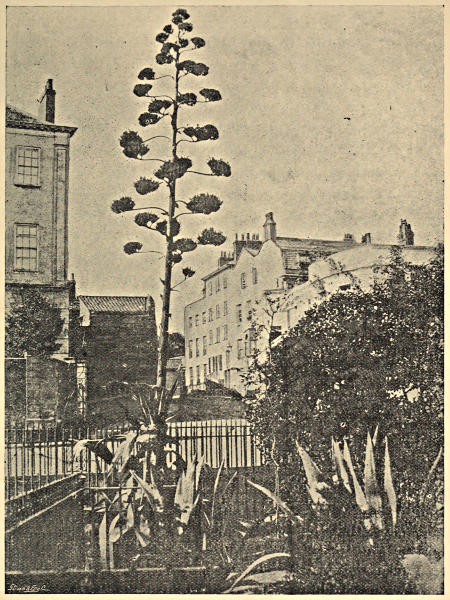
Portion of the Old Town House (on the left) of the de Sausmarez Family,
situated where St. Paul’s Chapel now stands.
The willow-wren is known among us as “Le
Ribet,” from Ri (roi), and “bet,” the form known in
the province of Bearn of “bel.” Vallancey says:—“The
Druids represented this as the king of birds,
hence the name of this bird in all the European
languages. Latin, Regulus; French, Roitelet; Welsh,
Bren (or “king”); Teutonic, Konig Vogel; Dutch,
Konije, etc.”
A magpie crossing one’s way is of evil augury,
portending vexation, or trouble of some kind. Crows
cawing much in the neighbourhood of a house is
also a sign of impending trouble.[244]
When the cuckoo is heard for the first time in the
year one ought to run a few steps forward in order
to ensure being light for the rest of the year. If
you have money in your pocket, and turn it, or shake
it, it will ensure good luck, and you will not want
money throughout the rest of the year.[245]
“Money should be turned in the pocket when the
cuckoo is heard for the first time.”
An old woman, living at the Vale used to say:—“En
Guernesi nous a coutume de dire en oyant le
coucou pour la première fais:—‘Si tu ne cuers pas
tu seras lourd toute l’annâie.’ Nous remue étout
l’argent qu’nous peut aver dans les paoutes, en les
secouant—et il y a des gens qui se mettent à
genouaïx. La première fais que nous-ôt le coucou il
faut mettre une grosse roque sus sa tête, arroütaïr à
courre, et nou sera légier toute l’annâie.”
“En Avril
Le coucou crie
S’il est vif.”
“Le coucou
S’en va en Août
La barbe d’orge
Li pique la gorge.”
(See Notes and Queries, 4th Series, Vol. III., 1869.)
It is thought lucky to shake one’s pockets and
run a few steps, the first time one hears the cuckoo
sing. The following lines are also repeated by some,
and the number of times the cuckoo utters his note
is taken as an answer to the question.
“Coucou, cou-cou, dis mé
Combien d’ans je vivrai.”[247]
I remember when I was a child, my aunt, Miss
de Sausmarez, making me remark how chickens,
when they drink, lift up their heads at every sip,
and telling me that they did so to thank God.[248]
The bone of the cuttle fish, which is found at
times thrown up on the beach, is called in Guernsey
“Pépie.” It is supposed to possess the quality of
healing the “pip” in chickens, also known as “la
pépie.”
A stye in the eye is called in Guernsey “un
laurier,” and is to be cured by bathing the eye with
an infusion of laurel leaves or “lauriers.”
If a fisherman, on setting out, sees a humble
bee flying in the same direction as he is going, he
considers it a good omen, and that he is sure of a
plentiful catch. If, however, the insect meets him,
it is quite the reverse. The ill-luck, however, may
be averted by spitting thrice over the left shoulder.
Omens of good or bad luck are also derived from
sea-birds. All depends on whether a gull or a
cormorant is seen first, as, if a cormorant, no fish
is to be expected that day. All fishermen also know
how unlucky it is to count one’s fish until the catch
has been landed, as, however freely they may be
biting, counting them would inevitably stop all sport
for the day.[249]
If a pair of bellows is put on a table, some great
misfortune is sure to happen in the household.[250]
Richard Ferguson, fisherman, of the Salerie, tells
me that there is a great objection against taking
currant cake with them when they go a-fishing, it
is sure to bring bad luck.
Editor’s Note.
The following scraps of Folk-Lore I have gathered from old people in St. Martin’s parish,
in the years 1897-99.
The Man in the Moon.
“J’ai ouï dire à ma gran’mère i’y a be’tôt chinquante ans qu’l’bouan homme que nou veit
dans la lune enlevit un fagot de bouais le Dimanche, et pour chut fait le Bon Gyu le
condamnit à s’en allair dans la lune jusqu’au Jour du Jugement. V’la l’histouaire de
chut poure Mâbet que non vait si souvent perqui là-haut.”—From Mrs. Le Patourel.
A robin flying to the window or in the house is a sign of death. Crows flocking together
and cawing over the house are most unlucky. To go out and meet three crows or three
magpies means good luck, all other numbers mean misfortune.
None should ever cut their finger nails on either a Sunday or a Friday if they wish to
prosper. A baby’s first nails should never be cut, but bitten.
On being given a present of scissors or a knife, a double[251] should always be given in
exchange. Parsley should never be taken as a gift, but it is very lucky to steal some (!).
No berried plants such as ivy, etc., should be brought into the house before Christmas,
and it is especially unlucky if, when they are brought in, they are allowed to touch the
mantel shelf. May should never be brought into a house, and many people, especially in
Alderney, consider that to bring in furze or gorse means to introduce sorrow.
Should an unmarried woman go in and out of a house through a window which is not
destined as a means of entrance or exit, she will never marry.
An umbrella should never be opened in a house, or placed upon a table, quarrelling and
strife are sure to follow.
It is supposed to be very unlucky when going out of the house, if the first person you
meet is a woman. Never pass her if you can avoid it, but stand still and let her pass you.
To keep witches from entering a stable and molesting the cattle a piece of naturally
pierced flint-stone should be tied to the key of the stable door. On going down to a beach
it is considered lucky to pick up a small stone and bring it away with you. Never give
away money with a hole in it.
If you think you are bewitched or that any one has a spite against you, throw a lump of
salt on the fire, and as it burns blue the spite will evaporate.
Fanny Ingrouille, of the Forest parish, from whom the foregoing was obtained, also repeated
the following formula, which apparently was a programme for the week of a Guernsey
country girl.
“Au matin—Pierre Martin
Lundi, Mardi—Fêtes
Mercredi—Mà à ta tête
Jeudi, Vendredi—Fort travâs
Samedi—A la ville
Dimanche—Vée les filles.”
Alderney = Vâques (Cows).
Sark = Corbins (Crows).
Jersey = Crapauds (Toads).
Guernsey = Anes (Donkeys).
St. Pierre Port = Les Cllichards (See Métivier’s
Dictionnaire, p. 134.)
St. Samson = Raïnes (Frogs.)
Le Valle = Ann’tons (Cockchafers.)
Le Catel = Le Câtelain est un âne-pur-sang.
St. Sauveur = Fouarmillons (Ant lions.)
St. Pierre-du-Bois = Equerbots (Beetles).
Torteval = Anes à pid de ch’vâ (Asses with
horses’ feet.)
La Forêt = Bourdons (Drones.)
St. Martin = Dravants (Large Ray-fish.)
St. André = Craïnchons (siftings) “Ce qui reste
dans le crible.”[253]
Editor’s Note.
The following is a rhyme describing the girls of each parish, given me by the late Mr.
Isaac Le Patourel, of St. Martin’s.
Les Filles des Dix Paroisses.
“Ce sont les filles de la Ville
Elles sont des jolies Belles!
Ce sont les filles de Saint Samson
Elles sont bonnes pour le lanchon![254]
Ce sont les filles du Valle
Elles sont prêtes pour faire du mal!
Ce sont les filles du Câté
Elles sont prêtes pour la gaieté!
Ce sont les filles de Saint Sauveur,
Elles sont toutes de bouane humeur!
Ce sont les filles de Saint Pierre
Ah! qu’elles sont terjours à braire![255]
Ce sont les filles de Tortevâ
Elles ont vraiment les pids de ch’vâ!
Ce sont les filles de la Forêt
Dame! ch’est qu’elles sont bien laides!
Ce sont les filles de St. Martin
Elles sont niais comme des lapins!
Ce sont les filles de Saint André
Elles seront toutes des delaissées!”
“They serve to be interlaced in continued speech. They serve to be recited upon occasion
of themselves. They serve, if you take out the kernel of them, and make them your own.”—Lord Verulam.

No nation is without its proverbs; but while
in many cases these pithy sayings are the
same in all languages, and merely literal
translations from one dialect to another, in other
instances the idea only is present, and the words in
which the proverb is expressed have little or nothing
in common, as, for example, the English saying:—“A bird
in the hand is worth two in the bush,”
appears in French in the far less picturesque form
of “un ‘tiens’ vaut mieut que deux ‘tu
l’auras’.” Sometimes, from the peculiar circumstances
of the people using it, a proverb takes a local tinge,
and, in so doing, may change considerably from its
original wording, while continuing at the same time
to convey a similar lesson. Thus the pastoral
saying:—“To lose one’s sheep for a penn’orth of tar,”
becomes, very naturally, among a nautical population,
“to lose one’s ship, etc.”
Some few proverbs are so thoroughly local as to
appear to have originated in the place where they
are used.
Guernsey is not rich in proverbs properly so called;
but, as might be expected among an agricultural and
maritime people, weather-sayings are not uncommon.
Many of these could no doubt be traced to the
mother-country, Normandy, but some few may be
indigenous, and the result of local observation.
We will give specimens of each class of these
proverbial expressions, with such remarks as may be
necessary to explain them as far as they can be
explained; and, although many of them might be
put into modern French, we have preferred retaining
the old Norman dialect still preserved as the
language of all the rural parts of the island.
Nou (on) ne va pas au jàn (àjonc) sans ses gànts.—No
one goes to cut furze without gloves. If you
would undertake an arduous matter, be well
prepared for it.
Ch’est la coue (queue) qui est la pière (pire) à
écorchier (écorcher).—It is the tail that is the
hardest to flay. It is often more difficult to bring
an affair to a successful end than to begin it.
Qui sent mànjue (démangeaison) se gratte.—He who
itches scratches himself. Nearly equivalent to the
English saying, “The cap fits.”
Quand le bouissé (boisseau) est pllein, i’ jette.—When
the bushel-measure is full it runs over. The last
straw breaks the camel’s back.
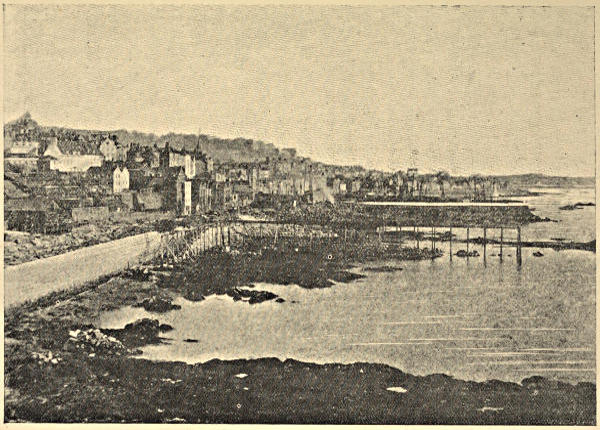
Building the south arm of the Town Harbour, connecting Castle Cornet with the Island.
Nécessitaï fait la vieille trottaïr.—Need will make an
old woman trot.
Au broue (brouille, embarras) est le gan (gain, profit).—No
exact equivalent is to be found for this
proverb, but it means that profit, in some way
or other, may be made where there is much
doing. The English saying “No pains, no gains,”
comes near it.
Pûs (plus) de broue que de travâs (travail).—More
bustle than work. Much cry and little wool.
Mettre daeux guerbes (deux gerbes) en un llian (lien).—To
bind up two sheaves with one wisp. To
kill two birds with one stone.
Biautaï (beauté) sans bountaï (bonté), ne vaut pas
vin évantaï.—Beauty, without goodness, is not
worth stale wine.
L’amour hâle (tire) pûs (plus) que chent (cent) bœufs.—Love
draws more than a hundred oxen.
A p’tit pourche (pourceau) grosse pânais.—The little
pig gets the big parsnip. The youngest child is
the most petted.
Qui paie s’acquitte; qui s’acquitte s’enrichit.—He
who pays his way keeps out of debt; he who
keeps out of debt gets rich. No comment is
needed on this thoroughly practical proverb.
Si nou (on) lli dounne ùn peis (pois) i’ prend une
faïve.—If you give him a pea, he’ll take a bean.
Give him an inch, he’ll take an ell.
Ch’n’est pas ôve (avec) du vinaigre que nous (on)
attrâpe des mouques (mouches).—Flies are not caught
with vinegar. Nothing is to be gained by roughness.
Qui peut volaïr (voler) ùn œuf, peut volaïr ùn bœuf.—He
who would steal an egg would steal an
ox. Be honest in the smallest matters.
F’rine du guiablle (diable) s’en va en bran (son).—The
devil’s flour turns to bran. Ill-gotten wealth
never prospers.
Chàngement d’herbage est bouan (bon) pour les jânes
viaux (jeunes veaux).—Change of pasture is good
for young calves. Variety is necessary for the
young. “Home-keeping youth have ever homely
wits.”
I’ ne faut pas faire le cottìn (cabane, crêche) d’vànt
que le viau seit naï. (Avant que le veau ne soit
né).—One must not make the crib before the calf
is born. Do not count your chickens before they
are hatched.
S’il ne l’a en breuf, il l’aira (l’aura) en soupe.—If
he does not get it in broth, he’ll get it in soup.
If he cannot obtain his end by one means, he
will by another.
Apprins au ber (berceau), dure jusqu’au ver.—What
is learnt in the cradle goes with one to the
grave—literally “to the worm.”
La bête d’un poure (pauvre) houme (homme) mourrait
pûs-à-caoup (plus tôt) que li (lui).—He would die
more opportunely than a poor man’s beast, is said
of a person whose death would not leave much
cause for regret.
Les p’tits tchiens (chiens) out de longues coues
(queux).—Is the equivalent of the French proverb,
“dans les petites boîtes les bons onguents;”
precious ointments are in small boxes.
Ch’est une querrue à tchiens (charrue à chiens).—It
is a plough drawn by dogs, is said of any affair
which is badly conducted—where those who ought
to work in concert are pulling different ways,
like two dogs on a leash.
Un mouisson (oiseau) à la main vaut mûx que daeux
qui volent.—A bird in the hand is worth two on
the wing.
Il n’y a fagot qui n’trouve sen lliàn (lien).—There
is no faggot but what at last finds a band. Every
Jack has his Jill; every dog has his day.
I’ n’y a fagot qui n’vaut sa lliache (liasse).—There
is no faggot so bad as not to be worth a band.
Qui mange la craïme ne rend pas du burre (beurre).—He
who eats his cream makes no butter. You
cannot eat your cake and have it.
I’ ne vaut pas grànd burre (beurre).—He or it is not
worth much butter; meaning, such an one is not
worth much, the matter is not worth going to
any expense about; an allusion to a worthless
fish on which the butter used in cooking it is so
much thrown away.
Ecoute-paret (paroi) jamais n’ot dret (n’ouit droit).—An
eavesdropper never hears good.
I’ n’y a rien itaï (tel) que sé (soi) sa qu’minse
(chemise) lavaïr (laver).—There is nothing like
washing your own shirt. If you wish a thing
well done, do it yourself. It is also used in the
sense of “Wash your dirty linen at home.”
Nou (on) ne trâche (cherche) pas de la graïsse dans
le nic (nid) d’ùn tchien (chien).—No one thinks
of looking for fat in a dog’s kennel. Look not
for qualities where they are not likely to be
found, as generosity in a miser, or honesty in a
thief.
Si ùn cat (chat) s’amord (s’adonne) au lard, nou ne
sairait (saurait) l’en d’s’amordre.—If a cat takes
a liking for bacon you can’t break her of it. It
is difficult to get rid of bad habits.
P’tit à p’tit l’ouaisé (oiseau) fait sen nic (nid).—Little
by little the bird builds her nest. Rome was not
built in a day.
Tout neû g’nêt (neuf balai) néquie (nettoie) net.—A
new broom sweeps clean.
I’ n’y a itaïls (tels) que les féniêns (fainéants) quand
i’ s’y mettent.—There are none like idlers when
they once set to work.
Ch’est cauches (bas, chausses) grises, et grises cauches.—This
is the equivalent of the French proverb
“C’est bonnet blanc, et blanc bonnet,” and the
English, “Six of one, and half-a-dozen of the
other.”
Ch’n’est pas les ciens (ceux) qui labourent le pûs près du
fossaï (de la haie) qui sont les pûs riches.—It is not
they who plough nearest the hedge who are the
richest. Economy may be carried too far.
I’ s’y entend coume à ramaïr (ramer) des chaoux
(choux).—He understands as much about it as about
putting pea-sticks to cabbages. The meaning
conveyed being: he knows nothing at all about it.
Tout chu (ce) qui vient de flot se retournera d’èbe.—All
that comes with the flood will return with
the ebb. Riches too rapidly acquired, or ill-gotten,
will disappear as quickly as they came—nearly
equivalent to the French proverb “Ce qui vient
de la flûte s’en va par le tambour.”
Si l’houme aïme autre mûx que sé (mieux que soi)
au moulìn i’ mourra de set (soif).—If a man
loves others more than himself, he will die of
thirst even were he in a mill. The mill spoken
of in this selfish proverb, which is equivalent to
“Look after number one,” is, of course, a water-mill.
Biauture (beau-temps, beauté) d’hiver; santaï
(santé) de vieil homme; parole de gentilhomme;
ne t’y fie, homme!—A fine day in winter,
the health of an old man, the word of a
nobleman; trust to none of these, O man! The
marked distinction of “noble” and “rôturier,”
if such ever existed in Guernsey, died out many
centuries ago; and this proverb has all the
appearance of an importation from Normandy, or
some other part of France, where the peasantry
were oppressed by the feudal system. The word
“biauture” does not belong to the Guernsey
dialect, and when the saying is quoted in the
present, it is generally with reference to the two
first clauses.
Un tchien (chien) vaut bien p’tit qui ne vaut pas ùn
caoup de sufflet (coup de sifflet).—A dog that
is not worth whistling for is not worth much.
Les grands diseurs sont de p’tits faiseurs.—Great
talkers are little doers.
Où ’est qu’il y a du crottin, il y a du lapìn.—Where
you see their droppings, you may expect
to find rabbits. Used both literally and metaphorically.
There is no smoke without fire.
Il y a terjoûs (toujours) un épi qui mànque à la
guerbe (gerbe).—There is always a spike of corn
lacking in the sheaf. Nothing is ever perfect.
I’ n’y a bouais (bois) dont non (on) n’fait buche.—There
is no wood but what will serve for firing,
meaning that everything can be put to some use
or other; but the latter half of the proverb is
sometimes varied to “dont i’ n’ fait buche,” and
it is then equivalent to the English saying “All
is fish that comes to his net.”
Va où tu peux, meurs où tu deis (dois).—Go where
you can, die where you must. Dispose of your
life as you please, death is inevitable.
Il est niais coume Dadais qui se couachait (couchait)
dans l’iaue (eau) d’paeur (peur) d’être mouailli
(mouillé).—He is as foolish as Dadais who
lay down in the water to avoid getting wet in a
shower.
Il est niais coume Dadais qui tâte l’iaue pour vée
(voir) s’a bouit (bout).—He is as stupid as Dadais
who puts his hand into the water to feel if it is
boiling.
Il est pûs (plus) niais que Dadais qui se fouittait
de crêpes.[256]—He is more simple than Dadais who
flogged himself with pancakes. The word “Dadais”
is used in the sense of simpleton. In the three
sayings that we have just quoted “Dadais” bears
a strong family resemblance to the “Simple
Simons” and “Silly Billies” of English nursery
tales.
Ch’tait du temps du Rouai (Roi) Jehan. Ch’était
du temps des Scots.—Are used in speaking of events
which took place beyond the memory of man. It
is easy to understand how the reign of King
John came to form an epoch in the history of
Guernsey; for it was then that the connexion
with the mother-country, Normandy, was severed,
and the islands, until then part and parcel of
that Duchy, became attached to the Crown of
England, and have so continued ever since. But
it is not so easy to say when or how the latter
saying originated. It may refer to an invasion
of the island by David Bruce, about the tenth
year of Edward III., (A.D. 1336); when great
atrocities appear to have been committed on the
inhabitants; but some old people seem to think—and
probably with reason—that the “Scots” were
a Scotch regiment sent here in the early part of
last century on a fear of hostilities breaking out
between England and France. It is right, however,
to notice that in the Guernsey dialect “Ecossais”
and not “Scots” is used to designate Scotchmen.
I’ mànge coum’ un varou.—He eats like an ogre,
is the exact English equivalent of this saying;
but there are few who use the saying who could
say what is meant by “un varou.” It is, undoubtedly,
the same as the French “loup-garou”
in English—a were-wolf; and may have reference
to the old superstition of men and women being
turned into wolves.
I’ s’en est allaï (allé) les pids (pieds) d’vànt.—He
has gone feet foremost. He has been carried
to his grave.
Il a étaï enterraï la tête ès tchiens (aux chiens)
dehors.—Is used in the same sense as “being
buried like a dog.”
Il a tête et bounet (bonnet).—He has a head, yea,
and a cap, is said of an opinionated man.
I’ n’en reste ni tchiesse (cuisse) ni aïle.—There
neither remains leg nor wing. All is lost, nothing
remains.
I’ quient (tient) d’la chouque (souche).—He’s a
chip of the old block.
I’ fait rille (raie) de gras.—He is making a streak
of fat, is said of a man who is prospering in his
affairs, in allusion to a pig that is being fattened.
I’ peut mànger sa gâche (galette) dorâïe (beurrée)
des daeux bords (des deux côtés).—He can eat
his cake buttered on both sides. He is rich
enough not to be obliged to spare himself any
indulgence.
I’ mànge sa dorâie (tranche de pain beurré) grajie
(grattée).—He spares the butter on his bread,
either from poverty or from avarice. It is “bread
and scrape.”
I’ prend les cauches (chausses, bas,) pour les sôlers
(souliers).—He mistakes the stockings for the
shoes. He is a blunderer who does not know
one thing from another.
Il a paeux (peur) des p’tits sôlers (souliers).—He
is afraid of the little shoes, is said of a man
who is unwilling to enter into the estate of
matrimony for fear of the additional expenses that
it will entail—shoes for the children being a
considerable item in the disbursements of a poor
family.
I’ n’en prend ni compte ni taille.—He takes no
account nor tally. He lets matters take their
course.
V’là une fière perruque à débouquèr (démêler).—There’s
a fine wig to comb out! Is said of an affair
which is almost hopelessly involved.
Il a fait pertus (pertuis, trou) sous l’iaue (eau).—He
has made a hole in the water. He has
disappeared furtively. Compare with the French
saying “Il a fait un trou à la lune.”
I’ vêt (voit) sept lieues dans la brune.—He sees
seven leagues through the fog, is said derisively
of a man who boasts of being more clearsighted
than his neighbours.
Il est montaï (monté) sur ses pontificaux.—He is
in his pontificals, is equivalent to the English
saying “He is riding the high horse,”—asserting
his dignity when there is no need to do so.
Ch’est le bouâine (borgne) qui mène l’aveuglle.—The
one-eyed man is leading the blind man.
Nou (on) ne saït pouit (point) où il puche (puise).—One
knows not what well he draws from, is said
of a man who manages to get on without any
very visible means of existence.
Trop de cuisiniers gâtent la soupe.—Too many
cooks spoil the broth.
I’ n’y a pas de rue sàns but.—There is no road
but has an ending. Equivalent to “It is a long
lane that has no turning.”
S’il y avait un démarieur, il airait (aurait) pûs
(plus) à faire que tous les marieurs.—If there
were an “un-marryer” he would have more work
to do than all the “marryers.”
Ce n’est pas tout que les chaous, faut de la graîsse
à les cuire.—Cabbages alone are not sufficient,
one must have grease to cook them with. Generally
applied to “parvenus,” who have money
but no manners.
Nou’ n’engraisse pouit les p’tits cochons d’iau fine.—Little
pigs are not fattened by pure water.
Vieille pie a plus d’un pertus à son nic (nid).—An
old magpie has more than one hole in her nest.
Said of a man who is skilful at evasion.
T’as acouare les jaunes talons.—You have still got
yellow heels, is said to youngsters who are too
presuming in giving their opinion in the presence
of their elders. Compare the French “blanc-bec”
and “béjaune.”
Ch’est la vermeïne (vermine) qui mànge (mange)
l’tâs (le tas).—It is the vermin that eats up
the stack. Said of a father who has a large
family of children drawing upon him and eating
up all his savings.
There are certain popular sayings which contain a
comparison, and which, although in a strict sense
they cannot be called proverbs, may yet be classed
with them. Some of these contain words which have
become obsolete, or, at least, antiquated. “Vier
(vieux) comme suée” equivalent to “As old as the
hills,” may be quoted as an example, for not only
is the word “suée” obsolete, but its very meaning
is forgotten and unknown. Mr. George Métivier, a
learned philologist, author of the Dictionnaire Franco-Normand,
ou Recueil des Mots particuliers au Dialecte
de Guernesey, is inclined to refer it to the old French
suée signifying sueur, sweat, used in the sense of
labour. The conjecture is ingenious, but not quite
satisfactory.
I’ s’est maniaï (manié) coume un albroche.—He
has conducted himself like a boor. Roquefort
in his “Glossaire de la Langue Romane”
explains the word Allobroge as “un homme
grossier, un rustre, etc.,” and gives Adlobrius,
Allobrox, as the Latin forms. According to
Ducange, these words signify a citizen or native
of Gaul. The Allobroges, however, in the time
of the Roman Empire, were the tribes inhabiting
Savoy and Piedmont.
I’ bét (boit) coume ùn alputre.—Is used in the sense of
“He drinks like a fish,” but why the alputre,—rockling,
or sea-loach,—should be singled out among
fishes for bibulous propensities, it is impossible to guess.
I’ plleut coume cis (chez) Pierre de Garis.—Is used
in the sense of “raining cats and dogs.” A
certain Pierre de Garis, a merchant of Bayonne,
in the time when Aquitaine was governed by
English Princes, was appointed to the responsible
office of Bailiff of Guernsey, about the year 1325.[257]
In all probability he derived his name from a
small town called Garis, about half-way between
Bayonne and St. Jean-de-Luz. He became the
founder of a family of importance, not only in
Guernsey, but also in the neighbouring island
of Jersey, and of which there are still numerous
descendants. It is not very likely that the saying
dates so far back as the fourteenth century,
although it has no doubt a very respectable
antiquity. We can only conjecture that it must
have derived its origin from some well-known
Pierre de Garis of indolent or miserly habits, who
allowed the roof of his dwelling to fall into decay
and let in the rain, and so became a by-word
with his neighbours.
Ill’ y en a assaï (assez) pour tous les Tostevins.—There
is enough for all the Tostevins—is said
when there is an abundance of anything—enough
and to spare. The name is extremely common
in the western parishes of Guernsey, especially
in St. Pierre-du-Bois and Torteval, where many
of those who bear it are stone-masons who walk
every day into town—a distance of five or six
miles—to their work. Perhaps the good appetite
they acquire in so long a walk may have had
something to do in originating the saying.
Jaune coume q’zette.—As yellow as a daffodil, is
equivalent to the English saying “As yellow
as crow’s foot.” It is sometimes varied to
“jaune coume du murlu,” this last word being
the local name of the corn-marigold and the ox-eye
daisy.
Vert coume ache.—As green as smallage—a herb
closely allied to celery and parsley, and, like
them, intensely green—is used where we should
say in English “As green as grass.”
Chièr (cher) coume paivre (poivre).—As dear as
pepper, is a comparison which must have originated
when this useful condiment, now within the reach
of the poorest, was a luxury brought from far
and obtainable only by the rich. Quit-rents
payable in pepper were not unknown in the
middle-ages; and in the Extente, or account of the
revenues and obligations of the Crown in Guernsey,
drawn up in the fifth year of the reign of King
Edward III., A.D. 1331, there is an item of a
quarter of a pound of pepper to be paid annually
at Michaelmas, by a tenant of lands situated in
the parish of St. Martin’s. The money payment
for which this rent was commuted at that time
was twelve deniers tournois, which would make
the value of a pound four sols tournois, no
inconsiderable sum in those days.
I’ chànte coume ùn orateur.—He sings like an
orator. A loud voice is certainly desirable in one
who attempts to speak in public. Our countrymen
seem to consider it equally necessary and admirable
in a singer.
Orguillaeux (orgueilleux) coume ùn pouâis (pou) sûs
v’louss (velours).—As proud as that insect which
Shakespeare calls “a familiar beast to man”
may be supposed to feel when it finds itself
on velvet.
Caûd (chaud) coume braïze.—As hot as embers,
needs no explanation.
Ch’est coume un bourdon dans une canne.—It is like
a humble bee in a can—is said of a droning
monotonous style of preaching or speaking.
Ch’est coume les prières de Jacques Ozanne qui
n’ont pas de fin.—It is like James Ozanne’s
prayers which never come to an end. This is
said of any matter which is prolonged to an
unreasonable extent; but nothing seems now to
be known of the individual whose lengthy supplications
gave rise to the saying.
T’es coume Jean Le Tocq.—You are like Jean Le Tocq.
This is addressed to a man who is seen abroad
at an earlier hour than usual, and contains an
allusion to two lines in the old Guernsey ballad
of the invasion of the island by Evan of Wales
in 1373, where it is said:—
“Jean Le Tocq sy se leva
Plus matin qu’a l’accoutumée.”
Indeed this last line is generally added.
Il a la conscience de la jument Rabey qui mangit
s’en poulâin.—He has the conscience of Rabey’s
mare, who ate her foal. Said of an utterly hard-hearted
and unscrupulous man. The Rabeys are a
well-known country family, and it is possible that
this proverb refers to some domestic tragedy, the
details of which have long been forgotten.
Avoir le corset de Maître George.—To wear the
corset of Maître George. An allusion is here
meant to a certain George Fénien. The Féniens
were a family who owned property in Fountain
Street, and seem to have become extinct towards
the middle of the eighteenth century. This
expression is applied to an indolent man, so that
the “Maître George Fénien”[258] here alluded to
must have lived up to his name, Fénien—Fainéant—a
sluggard. We have seen in some of
the preceding proverbs and sayings, allusions to
individuals and families. Here are two or three
more of the same kind:—
I’ fait de sen Quéripel.—Is untranslatable literally,
but may be rendered “he acts like a Quéripel.”
and is said of a man whose vanity leads him to
give himself airs, and take too much upon
himself. The name existed in Guernsey as early
as the fourteenth century, at which time it was
written Carupel, but there is not the slightest
clue when or how the saying originated. It may
possibly be a corruption of some proverbial expression
current in Normandy.
Il est dans les Arabies de Mons. Roland.—“He
has got into Mr. Roland’s Arabias,” is a remark
made when a preacher, a public speaker, or any
one who sets up for a talker, has got beyond his
depth, and is discoursing on a subject which he
does not understand. The Rolands, now extinct,
are believed to have been a Huguenot family
that took refuge in Guernsey in the sixteenth
century.[259] The Monsr. Roland who figures in the
saying is supposed to have been a schoolmaster.[260]
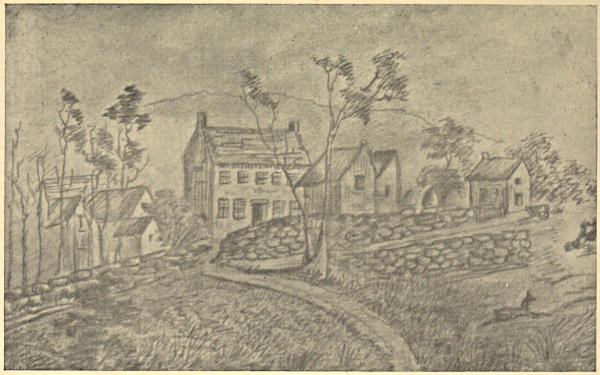
Old Guernsey House.
Ch’est prendre de Pierre Chyvret pour dounaïr à
Monsieur Careye.—“It is taking from Pierre
Chyvret to give to Mr. Carey,” is used in the
sense of “sending coals to Newcastle,” or “taking
from the poor to give to the rich;” but who the
particular individuals were whose names figure in
this saying it is impossible to say. In the reign
of Queen Elizabeth a Mr. Nicholas Careye was
farmer of most, if not all, the mills in Guernsey
situated on the Crown domain, he being then
Her Majesty’s Receiver. At a time when all
persons residing on a manor were obliged to bring
their corn to be ground at their Lord’s mill,
under severe penalties, such a monopoly in the
mills as Mr. Carey possessed, must have tended
to make him a very wealthy man.[261] It is not
unlikely that he, or one of his immediate descendants,
who enjoyed the same privilege, may have
been the person whose name became proverbial
for riches. The name of Peter Chyvret occurs in
another saying too coarse to be quoted, but which
suggests the idea that he may have been an
idiot, and, if so, probably living on charity. It
is, however, worth noting that a certain Peter
Chyvret was, about the beginning of the present
century, in possession of property situated in the
neighbourhood of one of the mills of which we
have spoken. He is reported to have been one
of those eccentric characters of whom it is difficult
to say whether they have all their mental
faculties—a mixture, in fact, of shrewdness and
simplicity. As he was by no means in indigent
circumstances it is scarcely probable that he can
be the same man alluded to in this saying.
Tenir à pìnche-beleïne.—Means to hold lightly,
without a firm grasp. It is used in the following
proverbial saying:—
“A pìnche-beleïne—sû la haute épeine,
Si je m’déroque—je n’en dirai mot.”
—Which may be freely translated:—“Holding on
too lightly, if I fall from the tree I shall say
nothing about it.” If I suffer from my own
negligence I must not complain.
We now come to a class of proverbial sayings
which might almost claim an exclusive right to the
title of “Folk-Lore,”—those relating to the weather
and other natural phenomena; and which, being the
result of long experience on the part of the people,
are religiously believed in by them. Many of these
sayings are common, in spirit if not in form, to the
greater part of Europe; some of them are confined
to certain districts; and, although a few may have
a superstitious aspect, such as those which profess
to predict what events will happen in the course of
the year from an observation of the weather on a
particular holy day, yet some of them may be worthy
the notice of meteorologists, who have discovered
that, in many cases, the probable character of the
weather in a particular month may be guessed at
by that which prevailed at an earlier season.
Janvier a daeux bouniaux (deux bonnets), Février en
a treis (trois).—January wears two caps, February
wears three. As a rule February is the coldest
month in the year. In a curious old MS. of
the sixteenth century, containing memoranda of
household accounts, copies of wills, and various
entries of more or less interest, written between
the years 1505 and 1569 by various members of a
family of the name of Girard, landed proprietors
in the parish of Ste. Marie-du-Castel in Guernsey,
we find the following weather prognostications for
St. Vincent’s Day (January 22nd), and the Feast
of the Conversion of St. Paul, (January 25th).
“Prens garde au jour St. Vincent
Car sy se jour tu vois et sent
Que le soleil soiet cler et biau
Nous érons du vin plus que d’eau.”
“Sy le jour St. Paul le convers
Se trouve byaucob descouvert,
L’on aura pour celle sayson
Du bled et du foyn à foyson;
Et sy se jour fait vant sur terre;
Ce nous synyfye guerre;
S’yl pleut ou nège, sans fallir,
Le chier tans nous doet asalir;
Sy de nyelle faict, brumes ou brouillars,
Selon le dyt de nos vyellars,
Mortalitey nous est ouverte.”
Similar sayings are to be found in Latin, English,
German, Italian, and other languages.
February, as every one knows, is the shortest month
in the year; but few know why. This is how it
is accounted for by old people in Guernsey:—“Février
dit à Janvier:—‘Si j’étais à votre pièche (place) je
f’rais gelaïr (geler) les pots sus le faeu (feu) et les
p’tits éfàns (enfants) aux seins de leurs mères’—et
pour son ìmpudence i’ fut raccourchi (raccourci) de
daeux jours, et Janvier fut aloigni (alongé).‘”
February said to January:—If I were in your place
I would cause the pots to freeze on the fire, and
babes at their mothers’ breasts, and for his insolence
he was shortened of two days, and January was
lengthened.
The most intense cold in the year generally sets
in with February; and this saying reminds me of what
is told in Scotland, and in many parts of the north of
England, of the borrowing days, the three last days of
March (See Brand’s Popular Antiquities, Bohn’s edition,
Vol. II., p. 41-44). It appears, however, according to
this authority, that in the Highlands of Scotland the
borrowing days are the three first days of February,
reckoned according to the old style, that is, the days
between the eleventh and the fifteenth.
February 2nd, Candlemas Day. Fine weather on
this day is supposed to prognosticate a return of
cold. The following lines were communicated by a
country gentleman, but they have not quite the
same antique ring as those relating to St. Paul’s
and St. Vincent’s Days, and may, possibly, be a more
recent importation from France.
“Selon les anciens se dit:
Si le soleil clairement luit
A’ la Chandeleur vous verrez
Qu’ encore un hiver vous aurez.”
Quànd Mars durerait chent àns l’hiver durerait
autànt.—If March were to last for a hundred
years, winter would last as long.
Mars qui entre coume ùn agné (agneau) sortira coume
ùn touaré (taureau).—The Guernsey form of this
saying substitutes a bull in the place of a lion.
Mars a enviaï (envoyé) sa vieille trachier (chercher)
des bûquettes (buchettes).—When, after a spell of
comparatively mild weather, March comes with
blustering winds, breaking off the small dry
branches from the trees, the country people say
that he has sent out his old wife to look for
sticks; and predict that, as he is laying in a
store of fuel, the cold is likely to last.
Pâques Martine—guerre, peste, ou famine.—Easter happening
in March, forebodes war, pestilence, or famine.
A Noué à ses perrons, à Pâques à ses tisons.—If at
Christmas you can sit at your doorstep, at Easter
you will be glad to sit by your fire.
Avril le doux—quànd il s’y met le pière de tous.—Or,
as the Norman antiquary, Pluquet, gives it:—“Quand
il se fâche, le pire de tous.”—When the
weather is bad in April, it is the worst of all
the months.
En Avril, ne quitte pas ùn fil.—In April leave not
off a stitch of clothing—a piece of advice which
is well warranted by the sudden and extreme
changes in the temperature in this month. On
the other side, this advice holds good a month
later—“Till May be out cast not a clout.”
Caud (chaud) Mai, gras chimequière (cimetière), fred
(froid) Mai, granges pllaïnes (pleines).—A warm
May, a fat churchyard, a cold May, fat granaries.
A’ la mié Août, l’hiver noue.—About mid-August
there is usually a marked change in the weather,
gales of wind and heavy rain generally occurring
at this season, and any long continuance of settled
fine weather, is scarcely to be hoped for. This
has led to the remark that winter “sets” at
this time; as the blossoms in Spring set for
fruit.
A’ la mi-S’tembre, les jours et les nits s’entre ressemblent.—In
the middle of September, days and
nights are alike.
Six s’maïnes avant Noué, et six s’maïnes après, les
nits sont les pûs longues, et les jours les pûs
freds.—Six weeks before Christmas and six weeks
after, the nights are the longest and the days
the coldest. This saying is scarcely correct in
Guernsey, as very cold weather about the end or
the beginning of the year is rather the exception
than the rule in this climate.
Si le soleil liet à méjeur, le jour de Noué, il y aura
bien des faeux l’annaïe ensuivant.—If the sun shines
at noon on Christmas Day, there will be many
fires lighted in the ensuing year.
Aube gelaïe est biétôt lavaïe.—Hoar-frost is soon
washed away, or, as another weather proverb
says:—“Après treis aubes gelaïes vient la pllie.”—After
three hoar-frosts comes rain, a saying which
experience amply bears out.
Vent d’amont qui veur duraïr, au sér va se reposaïr.—An
east wind that intends to last, goes to rest
in the evening.
Vent d’amont ôve (avec) pllie, ne vaut pas un fllie
(patelle).—An east wind with rain is not worth
a limpet.
Quand i’ plleut ôve vent d’amont, ch’est merveille si
tout ne fond.—Rain from the east is rare; but
when it does occur it is so heavy and continuous
as to give rise to the saying that it is a wonder
that everything does not melt.
Cherne (cerne) à la lune, le vent, la pllie, ou la
brune.—When there’s a circle round the moon,
wind, rain, or fog, will follow soon.
Cherne de llien (loin), tourmente de près; cherne de
près, tourmente de llien.—If the halo round the
moon is large and at a distance, it denotes that a
storm is at hand, if, on the contrary, it is small
and near the moon, the storm will not arrive for
some time.
Cherne à la lune, jamais n’a fait amenaïr mât d’hune.—A
circle round the moon has never caused top-mast
to be struck. It is difficult to reconcile this
saying with the preceding, unless by supposing that
sailors are so convinced that a circle round the
moon portends bad weather that they are careful
to shorten sail before the gale comes on.
Cherne au soleil i’ ne fera pas demain bel.—A solar
halo means bad weather to-morrow.
Si le soleil est rouage (rouge) au sèr (soir),
Ch’est pour biau temps aver (avoir),
S’il est rouage au matin,
Ch’est la mare au chemin.
If the sun sets red, it is a sign of fine weather,
but when he rises red, you may expect to see
pools of water on the road.
Rouage ser, gris matin, ch’est la jouaie (joie) du
pélerin.—A red evening and a grey morning are
the pilgrim’s joy, but this saying is sometimes
varied to:—
Rouage sèr, bllanc matin, ch’est la journaïe du pélerin.—A
red evening and a white morning is the day
for the pilgrim.
En Avril, le coucou crie, s’il est en vie.—In April,
the cuckoo sings, if he is alive. The cuckoo
generally arrives in Guernsey about the 15th of
April.
Le cou-cou s’en va en Août,
L’épi d’orge li pique la gorge.
The cuckoo departs in August,
The barley-spike pricks his throat.
It is not easy to draw a clear line between those
sayings which have reference to the weather, and those
which relate to agricultural pursuits and experience;
but the following appear to fall more naturally under
the latter head:—
Quànd i’ plleut ôve vent d’aval,
Nourrit l’houme et sen cheval;
Quànd i’ plleut ôve vent d’amont,
Ch’est merveille si tout ne fond.
When it rains with a westerly wind it feeds man and
beast; but when it rains with an east wind, it is
a marvel if everything does not melt.
L’arc d’alliance du soir, bel à voir,
L’arc d’alliance du matin, fait la mare à chemin.
Rainbow in the evening, fair to see; rainbow in the morning, there will be pools on the roads.
Si tu vois le soleil le jour de la Chandeleur, sauve le
foin, car tu en auras besoin.—If you see the sun on
Candlemas Day, save your hay for you will want it.
A’ la Paintecoûte, les grouaïsiaux se goûtent.—Green
gooseberries are in perfection at Whitsuntide.
De la St. Michel à Noué (Noel) une pllante ne sait pas
chu (ce) que nou (on) li fait.—From Michaelmas
to Christmas a plant does not know what you do
to it.
De la Toussaint à Noué un arbre ne sait pas chu
que non li fait.—From All Saints’ Day to
Christmas a tree knows not what is done to it.
The autumnal quarter is supposed to be the best
for transplanting trees or shrubs, as at that time
the vigorous growth that had been going on in
spring and summer has ceased, and there is less
danger of their suffering from the change.
Noué n’est pas Noué sàns pâcrolle (paquerette primevère).—Christmas
is not Christmas unless there be
primroses.
Noué est pûtôt Noué, sans pâcrolle, que sans agné
(agneau).—A Christmas without primroses is more
rare than a Christmas without lambs. Another
version is:—
Nou ne vit jamais Noué, sans pâcrolle ou p’tit
agné.—This saying, as well as the preceding,
seems to refer particularly to the occurrence of
that harbinger of spring, the primrose, at this
season. With the exception occasionally of a few
very cold days about the beginning of November,
the weather in Guernsey up to Christmas, and
frequently far into January, is remarkably mild;
vegetation is scarcely checked, and many summer
flowers continue to bloom freely up to this time.
It is a well-known fact that the primrose, like
many other plants and most bulbs, has its period
of repose during the hot and dry weather of
summer, the flowering ceasing about the end of
May, and the leaves withering away. In the
autumn there is a fresh growth of leaves, and
the flower buds, which had been already formed
towards the end of spring, but had been prevented
by the drought from expanding, are ready to
burst into bloom with the mild days that generally
usher in Christmas, the earliest blossoms being
invariably found on the north sides of the hedges,
where the latest flowers of the preceding summer
lingered, the plants with a south aspect having
exhausted their bloom in the hot weather.
A flleur de Mars—ni pouque (poche) ni sac;
A flleur d’Avril—pouque et baril;
A flleur de Mai—barrique et touné (tonneau).
Blossom in March requires neither bag nor sack;
Blossom in April fills bag and barrel;
Blossom in May fills hogshead and tun.
This saying refers to the apple crop, and the quantity
of cider that may be expected, judging from the
month in which the trees come into bloom.
Sème tes concombres en Mars,
Tu n’ airas qu’ faire de pouque ni de sac;
Sème-les en Avril, tu en airas ùn petit;
Mé, j’ les semerai en Mai;
Et j’en airai pûs que té (toi).
Sow your cucumbers in March, you will want neither
bag nor sack; sow them in April, you will have a
few; I will sow mine in May, and I shall have
more than you.
Pouit (point) de vraic, pouit de haugard.—No seaweed,
no corn ricks. The sea-weed, vraic or
varech, which grows in such abundance on all the
rocks round the islands, is of the utmost importance
to the farmer. It is almost the only
dressing used for the land, stable manure being
scarce and expensive. Hence the saying quoted
above; for without sufficient manure the crops are
sure to fall short. The haugard, or, more
correctly, haut gard, (high yard) is the enclosure
near a homestead on which the ricks are erected.
Débet (dégel) de pllie, ne vaut pas une fllie (patille);
débet de sec, vaut demi-fumaeure (fumier).—A thaw
with rain is not worth a limpet; a thaw with
dry weather is worth half a load of manure.
Un essaim en Mai—vaut une vaque (vache) à lait.—A
swarm of bees in May is worth a milch cow.
Où est qu’ll y a un cardon (chardon) ch’est du pain;
où est qu’ill y a du laitron, ch’est la faim.—Where
thistles grow there will be bread, where
the sow-thistle grows it is famine. The latter is
mostly found in very poor land.
Il vaut mûx pour ùn houme d’aver un percheux
(paresseux) dans son ménage qu’un frêne sur s’n
hêritage.—It is better for a man to have a lazy
fellow in his service than an ash-tree on his estate.
The shade of the ash is believed to be destructive
of all vegetation over which it extends; and it is
this belief that has in all probability given rise
to this saying. This proverb sometimes takes the
following form:—
Bâtard dans sen lignage
Vaut mûx qu’un frène sur s’n héritage.
The following sayings may be termed piscatory and
maritime.
A quànd le bœuf est las, le bar est gras.—When the
ox is weary, that is, when ploughing has come
to an end for the season, the bass is in good
condition. This fish is decidedly best in summer.
A quànd l’orge épicotte, le vrac est bouan sous la
roque.—When the barley comes into ear, the
wrasse or rock-fish, is at its best.
L’âne de Balaam a pâlaï (parlé) j’airon du macré
(maquereau).—Balaam’s ass has spoken, we shall
soon have mackerel. The mackerel, it is almost
needless to say, is a migratory fish, arriving on
our coasts in the spring, and remaining with us
till late in the summer. Formerly the reading of
the First Lesson at Evensong on the first Sunday
after Easter, in which the story of Balaam and his
ass is told, was considered a sure indication that the
welcome shoals would soon make their appearance.
The Cornish fishermen have the same saying.
Old fishermen pay great attention to the direction of
the wind at sunset on old Michaelmas Day (10th
October), for they firmly believe that from whatever
point it blows at that time, the prevailing winds
for two-thirds of the ensuing twelve months will
be from that quarter.
Grànd maïr (mer) ou morte iaue (eau),
La lune au sud, il est basse iaue.
Whether it be spring tides or neap tides, when the
moon is due south it will be low water.
Editor’s Note.—Another version: “Vive iaue ou morte iaue, La lune au sud, il
est basse iaue.”—From John de Garis, Esq.
A few sayings omitted may find a place here:—
Alle ira sû le coquet de l’Eglise ramendaïr (racommoder)
les braies (culottes) des viers garçons.—She
will get a seat on the weather-cock of the church
and mend old bachelor’s breeches, is said of old
maids, and is equivalent to the English saying,
“She will lead apes in hell.”
Ch’est une autre pâre (paire) de cauches (bas,
chausses).—That’s another pair of stockings, is
used in the sense of “That’s quite another affair.”
A quànd les filles suffllent (sifflent) le guiablle (diable)
s’éhuque.—When girls whistle the devil laughs
outright. Whistling is not generally reckoned among
feminine accomplishments, and by many would certainly
be considered as a symptom of what, in the
present day, is termed “fastness” in the fair sex.
According to the Northamptonshire proverb:—
“A whistling woman and crowing hen,
Are neither fit for God nor men.”
In Normandy they say:—“Une poule qui chante
le coquet, et une fille qui siffle, portent malheur
dans la maison.”[262]
And in Cornwall:—“A whistling woman and a crowing
hen, are the two unluckiest things under the sun.”
Trachier (chercher) la Ville par Torteval.—To seek for
the Town by way of Torteval, is said of one who
goes a round-about way to work. The rural
parish of Torteval, situated at the south-west
corner of Guernsey, is, of all the parishes in the
island, the one furthest removed from the town
of St. Peter Port. Compare the French “Chercher
midi à quatorze heures.”
Il ôt (ouit, entend) fin coume une iragne (araignée).—His
sense of hearing is as quick as that of a
spider. Whether the abrupt retreat of the common
wall-spider into the inner recesses of its web, at
the approach of anything that alarms it, is to be
attributed to the sense of hearing, sight, or feeling,
would be difficult to determine. The fact, however,
has been noticed, and has given rise to
this saying.
Entre le bec et le morcé,
Ill y a souvent du destorbier.
T’wixt cup and lip—there’s many a slip.
Qui épouse Jerriais ou Jerriaise,
Jamais ne vivra à s’n aise.
In all countries and in all ages jealousies and dislikes
have existed between neighbouring communities.
The inhabitants in Guernsey and Jersey are not
exempt from these feelings, which find vent in
malicious tales told of each other. The saying
quoted above is common in Guernsey; probably its
counterpart exists in Jersey, substituting “Guernesiais”
for “Jerriais.” It by no means follows,
however, that the want of comfort in these mixed
marriages may not be quite as attributable to the
one side as the other.
Il y a terjoûs quiqu’ùn qui a sa qu’minse à sequier.—There
is always some one wanting to dry his
shirt. The weather never suits everybody’s wants.
I’ n’a que vie d’alàngouraï (languissant).—Equal to
the English saying “A creaking door hangs
longest.”
Si un houme n’a pas le sens de pâlaïr (parler)
il est bien sâge s’il a le sens de se taire.—A
man who has not the sense to speak is still
a wise man if he has the sense to hold his
tongue.
I’ faut savèr ouïr, véer, et se taire.—One should
know how to hear, see, and be silent.
La s’maïne qui vient.—is the equivalent of the English
“To-morrow come-never.”
Chu qu’ nou n’a jamais veu, et jamais ne verra,
Ch’est le nic d’une souaris dans l’oreille d’un cat.—In
the Folk-Lore Record, Vol. III., Part I., p. 76,
we find the Breton equivalent of this saying:—“One
thing you have never seen, a mouse’s nest
in a cat’s ear.” We are not told, however, whether
the proverb is found in the French patois of
Upper Brittany, or in the Celtic dialect still spoken
in Lower Brittany—la Bretagne bretonnante.
I’ va d’vànt ses bêtes, or I’s’met d’vànt ses bêtes.—He
is going before his team, is said of a prodigal,
one who is out-running his income.
Ch’est une pouquie (pochée) de puches (puces) or de souaris.—Is
a sackful of fleas, or of mice, is said of a
person who is very lively and always on the move.
Il n’est si bouane (bonne) bête qui n’ait quiqu’ (quelque)
ohi.—There is no beast so good but that it has
some fault or vice. It is worthy of notice that
the word “ohi” is gone entirely out of use except
in this proverb.
I’ vit d’amour et de belles chansons—coum’ les alouettes de
roques (pierres, cailloux).—The first part of this saying—He
lives on love and fine songs—is frequently
used alone, but it is often capped by the concluding
words, “As larks do on stones,” meaning that
something more nourishing is needed to keep body
and soul together.
“Un mouisson (oisseau) dans la main vaut mûx que daeux
qui volent.” “Un mouisson à la main en vaut daeux
sur la branque (branche.)” “Un pourché (pourceau)
dans sen parc en vaut daeux d’ par les rues.” All these
are equivalent to the English proverb: “A bird
in the hand is worth two in the bush,” but the
last must have originated in days long gone by,
when swine were allowed to roam at their will
about the streets.
I’ n’ y a pas de cousins à Terre-Neuve.—There are no
cousins at Newfoundland. This somewhat selfish
proverb, indicating that where one’s own interest
is at stake the ties of consanguinity go for little,
although occasionally heard in Guernsey, originated
most probably either in Jersey or St. Malo, both
which ports are largely engaged in the cod fisheries
on the banks of Newfoundland. Jersey, indeed,
owes her commercial prosperity almost entirely to
this branch of industry, to which, it is said, the
attention of the inhabitants was directed by Sir
Walter Raleigh during the time that he held the
office of Governor of the island. During the
Middle Ages the fisheries in the Channel Islands
were very productive, and a source of considerable
revenue to the Crown, but the discovery of
Newfoundland, and the superior quality of the
codfish caught on its shores, drove the salted conger
and mackerel of the island out of the market.
Le cul d’un sac et la langue d’une femme gagnent terjoûs.—In
former days, when horses were more employed
in carrying loads than they are at the present
time when carts are in universal use, it was
observed that a sack thrown across the back of
a horse had a tendency to slip down gradually
in the direction opposite to its mouth. This
explains the first part of the proverb; the second
part is equivalent to the saying that a woman will
always have the last word and gain her end at last.
Nou veit bien pûs de meïnes de gâche crue que de biaux
musiaux.—One sees many more pasty, doughy looking
faces than pretty ones. Said in very cold weather.
Ch’n’est que faeu et fllâmme.—It is nothing but fire and
flame, said of a boaster, and also of a passionate
man, whose temper quickly rises, and as quickly
dies down.
Pêle-mêle gabouaré.—Pell-mell, as merry-makers tumble
out of a village inn. This word “gabouaré,” derived
from the Bas Breton “gaborel,” is only found in
this phrase.
Il est coume le pourché du negre, petit et vier.—He is
small and old, like the negro’s pig.
Cope le cô, i.e., “coupe le cou,” is a common asseveration
among children. They pronounce the
words, drawing their right hand at the same time
towards their throat, as if cutting it, and the
action is meant to imply that they wish their
throats may be cut if they do not tell the truth,
or perform what they have promised.
Vaque (vache) d’un bouan égrùn (croissance).—A cow that
does credit to her food, and that feeds close.
Etre d’un bouan égrùn—is also said of children who
look fat and healthy.
In conclusion, we will give a story which is often
told in the country, as a warning to those who are
apt to laugh at fools. A half-witted fellow, who
had gone to the mill with his corn, was asked
by the miller, who wanted to laugh at him:—“John,
people say that you are a fool and know
nothing. Now, tell me what you know and what
you don’t know?” “Well!” answered John, “I
know this, that millers have fine horses.” “That’s
what you know,” said the miller. “Now tell me
what you don’t know.” “I don’t know on whose
corn they are fattened,” said John.
—From Denys Corbet.
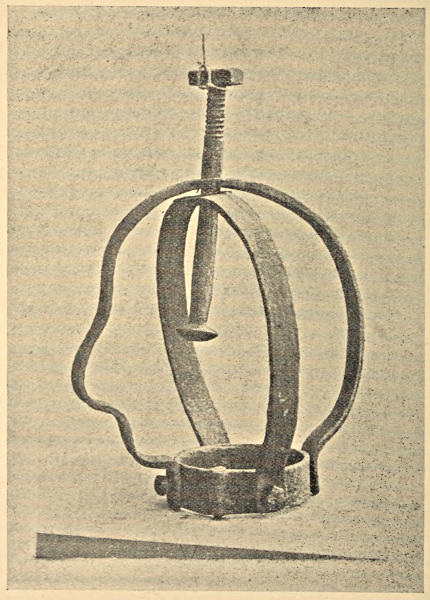
Gibbet from which pirates were suspended in the Island of Herm, now in
possession of H.S.H. Prince Blücher von Wahlstatt, who kindly allowed
it to be photographed for reproduction in this book.
Editor’s Notes.
The following are a few local proverbs and sayings which I have met with at different
times, and which I do not find included in Sir Edgar MacCulloch’s collection.
Il est si avare, il ne dounera pouit daeux p’tits œufs pour un gros.—He is such a miser
that he would not give two little eggs for one big one.
Coume St. Paterne, tu feras pâlir le Diable.—Like St. Paterne, you would turn the Devil
pale, said of a man whom nothing will daunt. St. Paterne was one of our local saints,
who was specially noted for the conversion of the inhabitants of the Forest of Scissy—the
submerged forest which lies off our western coasts. He was induced to do so by a
pious Seigneur of the Forest, and began his work there by going into a cavern where
the idolaters were celebrating a great feast presided over by the Devil himself. Armed
only with his pilgrim’s staff he routed them all, Satan included. He was specially
beloved by birds, who followed him wherever he went. He was made Bishop of
Avranches, and died in the year A.D. 495.
La s’maïne de treis (trois) Jeudis ou il n’ y a pas de Vendredi.—The week of three
Thursdays and no Friday. This is used when talking of an event which will never
come off. Then they say “Ca, se fera, etc.”
Haut coumme un béguin.—As high as a beacon. The Guernsey “béguins” were tall stacks
of furze placed on prominent points so that they could be lit in case of an alarm.
Ecoute-paret (paroi) jamais n’ot dret.—He who listens through partitions never hears correctly.
Faire pertus (trou) sous l’iaue.—To make a hole in the water, said of a man who is ruining
himself.
I’ vaut mûx pillaïr (plier) qu’ rompre.—It is better to bend than break.
Il ne faut pas queruaïr trop près des fossaïs.—One should not plough too close to the hedges.
Said of people who have no tact and say the wrong things at the wrong times—“Dancing
on the edge of precipices.”
Maujeu au naïx, signe d’être guervaï, ou baîsi d’un fou.—Tickling in the nose shows that you
will either be worried or kissed by a fool!
Daeux petites paûretaïs en font une grande.—Two small paupers make one big one; said
when two impecunious people marry each other.
Quànd tu veis la fieille (feuille) à l’orme
Prends ta pouque et sème ton orge.
When you see the leaf on the elm
Take thy bag and sow thy barley.
Quand il fait biau, prend ton manteau,
Quand il pleut fais coume tu veus.
When it is fine take your cloak,
When it rains do as you like.
Vent perdu, se trouve au sud.
A lost wind is found in the south.
(This is a Sark proverb, and was found by the Rev. G. E. Lee in the Rev. Elie Brevint’s MSS).
Hardi des hâgues sus l’s épines
D’un rude hiver ch’est le signe.
Many hips and haws on the trees,
Is the sign of a severe winter.
Le dix de Mai des sardes au Gaufricher.
On the 10th of May, sardans (a kind of fish) are to be found at Le Gaufricher—a rock north
of Fermain.
La maïr qui roule au Tas de Peis
Ch’est coumme nous verrait de l’iaue quée.
The sea that rolls at the Tas de Pois (the rocks at the end of St. Martin’s Point) look to the
beholder like falling rain.
“La lune levante
La maïr battante.”
At moon rise
It is high tide.
“Fin nord et epais sud
Ne s’entrefont jamais d’abus
Fin sud et epais nord,
Ne sont jamais d’accord.”
A fine north and a lowering south, have no occasion to quarrel, but a fine south and lowering
north, will never agree.—The two last “dictons” are from John de Garis, Esq.
Part III. Editor’s Appendix. — CHAPTER XVIII. Guernsey Songs and Ballads. — Yvon de Galles. — L’Armée d’Espagne, Defaitte en L’an 1588. — Secular Poems. — The Clameur de Haro. — APPENDIX A. Ghosts. — The Ghost of Mr. Blondel. — The Old House at St. George. — The Ghosts of La Petite Porte. — Le Seigneur de Damèque. — Les Câches. — APPENDIX B. Witchcraft. — Marie Pipet. — The Wizard of Sark. — The Witch of Alderney. — The Witch and the Raven. — APPENDIX C. Charms and Spells. — St. Thomas’ Day. — Midsummer Eve. — L’Ettre Miraculeuse.
“Dear Countrymen, whate’er is left to us
Of ancient heritage—
Of manners, speech, of humours, polity,
The limited horizon of our stage—
Of love, hope, fear,
All this I fain would fix upon the page:
That so the coming age,
Lost in the Empire’s mass,
Yet haply longing for their fathers, here
May see, as in a glass,
What they held dear—
May say, “’Twas thus and thus
They lived;” and as the time-flood onward rolls,
Secure an anchor for their Celtic souls.”
(Preface to The Doctor and other Poems, by the Rev. T. E. Brown).
“Will no one tell me what she sings?
Perhaps the plaintive numbers flow
For old, unhappy, far-off things,
And battles long ago.”
—Wordsworth.
“Fère les lais, por remembrance.”
—Marie of France.
I have added this chapter to Sir Edgar MacCulloch’s
book, as I thought it a good opportunity of preserving
a few of the old ballads and songs which, for
generations, amused and interested our forefathers,
and which now, alas, are all too surely going or gone from
among us,—swept away by the irrepressible tide of vulgarity and
so-called “Progress,” by which everything of ours that was
beautiful, picturesque, or individual, has been destroyed. As
descendants of the Celtic trouvères, menestriers, and jongleurs, as
well as of the Norse Skalds, the bards from whose early songs
and chants, the literature of Europe has sprung, we, Normans,
should specially treasure the old poems which have been handed
down for so many successive generations, and which, in the rapid
extinction of the old language in which Wace, Taillefer, Walter
Map, and Chrestien de Troyes sang, are doomed to oblivion.
In most places the old ballads can be divided into two classes—the
Religious and the Secular. The first of these classes, except
in the form of the metrical version of the Psalms by Ronsard,
does not seem to have existed over here. I can find no trace
of any Noëls, or of any Easter songs. The Secular songs may
be divided into the Historical and the Social.
The Historical deserve precedence. The Ballade des Aragousais
of which a translation has already been given, and of which I
append the original, is by far the oldest and most interesting.
Then comes a ballad descriptive of the Destruction of the Spanish
Armada in 1588, which I found in a manuscript book compiled
by a Job Mauger in 1722. In it he has copied the Dedicace des
Eglises, and such poems which apparently were current in his
day, and which he deemed worthy of preservation. Of his collection
this is the most distinctive, and I have included it in this
chapter, although it is evidently defective in parts, as these old
ballads, handed down orally from generation to generation, are so
apt to be. The Complaint of the dispossessed Roman Catholic
Clergy, written in March, 1552, and copied into the Registers of
St. Saviour’s parish in 1696 by Henry Blondel, is already in
print, being included in Gustave Dupont’s Histoire du Cotentin et
de ses Iles, Tome III., p. 311-313.
Job Mauger’s MSS. also comprise a long and monotonous ballad
of twenty verses describing the destruction by lightning of the
Tower of Castle Cornet in 1688, and various poems, conspicuous
more by the loyalty of their sentiments than by the merits of
their versification, on contemporary events in England, such as—“La
mort du Roy Guillaume III.,” written in 1702;
“Cantique Spirituel à la mémoire de la Royne Marie IIme., et
sur l’oiseau qu’on voit sur son Mausolée;” “Sur la mort de son
Altesse Royale Guillaume, Duc de Glocestre, decedé au Château
de Windsor le 30me Juillet, 1700;” and “Vive le Roy George,”
written in 1721. He also copies a “Chanson Nouvelle de
l’Esclavage de Barbarie,” doggerel verses “composée par dix
pauvres hommes, esclaves en Barbarie, où ils sont,” viz.: “Edouard
Falla, Edouard Mauger, Phelipe le Marquand, Richard Viel, et ses
camarades, Pierre le Gros et Jean Aspuine,” written in the reign
of William III.
In the year 1736 the bells of the church of S. Peter Port,
being no longer fit for service, were taken down for the purpose
of being melted and re-cast. This circumstance gave rise to a
piece of poetry composed by the Rev. Elie Dufresne, Rector of
the Town parish, of which many manuscript copies are in
existence.
But by far the most popular and widely known of all our local
ballads is “Les vers de Catherine Deslandes,” by an unknown
author, descriptive of the trial and execution for infanticide, of an
unhappy woman called Catherine Deslandes in 1748. These verses
have been repeatedly copied and printed, and are to be found in
almost every old farm-house.
The Secular ballads were undoubtedly all, or nearly all, importations
from the mainland. Of these I have made a selection, and
have striven to record those which do not appear to have been
already printed, or which, like “La Claire Fontaine,” vary
considerably from the continental models. Thus “Malbrouck,”
which is one of the most widely known of all our old ballads,
appears in every French “Recueil de Chansons,” and the verses
of “Le Juif Errant” and “Geneviève de Brabant” of which
copies are also found in all our old farm houses, have also been
repeatedly printed on the Continent, so are not included here.
“Surprise de l’Ile de Guernesey l’an 1370, sous le Règne
d’Edouard III., Roy d’Angleterre, et de Charles V., Roy de
France.”
Note.
This poem is copied from a version compiled by Mr. Métivier, and said by him to be the
revised text of seven mutilated manuscript copies. I have also included most of his notes.
“Or, grands et petits entendez
Sur nombre de gent ramassée,
Qui va sillant
[266] la mer salée,
Du Roy de France la mesgnée,
[267]Par Yvon de Galles guidée,
Si mauvaisement mis à mort.
[268]
Par un Mardy s’est comparée
La gendarmerie et l’armée,
Faite de grands Aragousais
[269]Gens enragés à l’abordée.
Dans le Vazon fut addressée
Cette pilleuse
[270] marinée
Pensant nous mettre tous à mort.
Un Jean L’Estocq si se leva,
Plus matin qu’à l’accoûtumée;
Et à sa bergerie alla,
Sur l’ajournant
[271] à la brunée.
Telle compagnie a trouvée
Sur le grand Marais arrêtée,
Ce qui grandement l’étonna.
Vit un cheval sur son chemin,
Faisant marche de haquenée,
[272]Qui, pour vray, étoit un guildin,
[273]Qui lors échappoit de l’armée.
Toute l’isle en a chevauchée,
Criant à la désespérée,
Sus! aux armes, en un moment!”
“Et vous trouvez sur les Vazons!
[274]L’armée est dessus arrêtée;
Diligentez-vous, bons garçons,
Ou toute la terre est gâtée!
Mettez tout au fil de l’épée,
Hasardez-vous, à bonne heurée,
Ou vous mourrez griève mort!”
Yvon de Galles, vrai guerrier,
Était conducteur de la guerre,
Homme grand’ment adventurier,
Dessus une terre étrangière,
Ne se donnant garde en arrière,
Il reçut la rouge jarr’tière
Qui n’étoit ni soye, ni velours.
C’est qu’il fut frappé d’un garçon
D’une alebarde
[275] meurtrière,
Il se nommoit Richard Simon
Sur le moulin, en la Carrière,
Tant qu’il eut la cuisse hachée
Aussi la main dextre tranchée
Par ce glorieux compagnon.
Sur le mont de St. Pierre Port
Fut la dure guerre livrée;
Cinq cents et un fur’ mis à mort,
C’étoit pitié, cette journée
D’ouïr les pleurs de l’assemblée
Des dames de St. Pierre Port.
Thoumin le Lorreur,
[278] tout le jor
Fut, de vrai, notre capitaine;
Rouf Hollande
[279] fut le plus fort,
Il eut l’honneur de la quintaine,
[280]Sa vie, hélas! fut hasardée,
Car, sa jambe étant fracassée,
Force lui fut de souffrir mort.
Frappant à travers et à tors,
Le sang courait dans les vallées,
On marchait dessus les corps morts
Qui chéaient
[281] au fil des épées.
Une meurtrière
[282] fut lancée,
Qui, à grand’ force débandée,
Aux Aragousais fit grand tort.
Quatre-vingt bons marchands anglais
Arrivèrent sur l’avesprée;
[283]A notre secours accouraient,
Mais l’armée étant fort lassée,
Leva le siège, tout de voir,
[284]Ne sachant quel remède avoir,
Sinon crier à Dieu mercy.
Furent contraints de s’enfuir
Prenant leur chemin gaburon,
[285]Par les Bordages sont allés,
Pour passer dedans ils se rue’;
Mais les Anglais sans retenue,
Remplissent de corps morts la rue,
Sur cette troupe de bedots.
[286]
Par force espreindrent les châtiaus,
[287]La mer étant fort retirée,
On les tuait à grands monceaux,
Taillant tout au fil de l’épée;
La mer étoit ensanglantée
De cette troupe ainsi navrée,
De lez la chair et les corps morts.
Ces navires et ces bateaux
Ceignirent l’isle par derrière;
Bons paysans leur firent grands tosts,
[288]Vers le château de la Corbière,
[289]Vindrent par le Bec-à-la-Chièvre,
[290]Pour à l’armée faire estère,
[291]Avec le reste des lourdauds.
Rembarquèrent leurs matelots,
[292]Puis soudain mirent à la vèle,
Tous marris comme lionceaux
D’avoir perdu telle bredelle.
[293]Commandant de remettre à terre
Dans le havre de St. Samson.
À l’Abbé St. Michel s’en vont,
Dont Brecard étoit commissaire;
Il les reçut, à grand cœur-jouaie
Donnant présents et fort grand chère
Donnant or à la gente amée,
[296]Qui était dame dans l’armée
Nommée Princesse Alinor.
Car Yvon l’avoit épousée
En France au pays de Gravelle,
Dont il fut riche à grands monceis
[297]Des biens de la grand’ mariée.
L’abbé fit grand joie à l’armée
D’or et d’argent et de monnoye
Qu’il leur donna bien largement.
Yvon, l’ennemy, s’en alla
Sur une montagne voisine
Du pauvre Château St. Michel,
Là où Yvon faisait ses mines.
[298]Frère Brecart,
[299] par courtoisie
S’adresse au château par envie
De faire crôitre ses trésors.
Mais Aymon
[300] Rose, retranché
Au puissant Chasteau de l’Archange
Dit qu’il serait avant tranché.
Que de se rendre à gent estrange;
Mais si ses gens se veulent rendre
A Brecart, pour leur terre vendre,
Par compos,
[301] il estoit d’accord.
Le pauvre peuple se rendit
A cet Abbé pour leur grand perte
Qu’il avoit pour eux accordé
Aux ennemis par ses finesses
Dont assoujettirent leurs terres
La plupart à payer deux gerbes
Nommez aujourd’hui les champarts.
[302]
Quand Yvon fut bien soudoyé
S’est rembarqué dans ses navires
Dans le Coquet s’en est allé
Se refournir de nouveaux vivres,
En passant par devant Belle Isle
Mit le feu dans trente navires
N’ayant que les garçons à bord.
Le vent du sud étant venu
Sillant la côte de Bretagne
Un navire Anglois est venu
Dont ils eurrent bien de la hoigne
[303]Saillit soixante hommes ensemble
À bord Yvon, sans plus attendre
Qui les lièrent tous à bord.
Puis violèrent Alinor,
En la présence de son homme
Lui étant lié au grand mât
Les amenèrent à Hantonne
[304]Yvon étant un mauvais homme
Eut sur sa tête une couronne
Savoir ung mourion tout chaud.
Puis pendirent toutes ces gens
Portez à chartez
[305] couple à couple
Et Alinor eut un présent
Pour gueuser une belle poche
Et avec peines et travaux
Cherchant son pain de porte en porte
Après plaisir eurent grands maux.
Les dix-neuf autres vaisseaux
Voulez-vous ouïyr leur destinée
Ils se dissout de grands châteaux
De tourments bien agittée
Or voilà donc leur destinée
C’est qu’ils burent la mer salée
Brisant dessus les Hanouets.
Au matin coume des porceaux
Estoient au plein cette journée
Où ils avaient fait leurs grands maux
En Guernesey la bienheureuse
Ils estoient là en grands monceaux
Dessus les sablons de Rocquaine
Après plaisir eurent grands maux.
Fin.
Puissant Roy d’Espagne,
Combien riche tu es
Pour l’entreprise vaine
Que tu fis sur les Anglois,
Ton entreprise vaine,
Fut bientôt rebroussée.
[306]
Vindrent sur l’Angleterre,
Au beau mois de Juillet,
Pour voir la bienheureuse
Ma Dame Elizabeth,
Mais ce fut à leur honte
Que sentir grand reveil.
La grande Armée Angloise
Commence a s’apprêter,
Tous leurs soldats embarqués
La poudre et les bullets,
C’est pour joüer au quille
[307]Avec les Portuguées.
Qui eust vue l’armée,
D’Elizabeth s’en va
De voir les grands bigots
[308]Et flâquées
[309] sur leurs mâts
Des tambours et trompettes
Apprêtés au combat.
La puissante avans garde
A l’ancre n’étoit pas
Comme fut “La Revanche”
Qui sortoit de Plymouth,
Sillant sur sa plumas.
[311]
Tous les plus grands navires
Qui furent haut et bas
De toute l’Angleterre
Vindrent vers l’Amiral
Luy supplier la grâce
D’aller sur les guayhards (sic).
L’Amiral d’Angleterre
[312]Leur répond d’un voix quas
[313]Enfans, donnez vous garde
Ne vous hasardez pas,
Car l’armée est puissante
Et nos vaisseaux sont trop ras.
[314]
Ces gens de grand courage,
Disoient à l’Amiral
Seigneur, gardez la terre,
Nous allons avec Dras
[315]Nous aurons la vengeance
De l’armée des Pillards.
La “Revanche” d’Angleterre
Sous ses voiles s’en va,
Chargeans ses coulverines
Et tirans ses coutelas,
Au grand tyran s’entraîne
Et luy couppa ses mats.
Quand le Duc de Mydine,
Sit ses grands arbres bas,
Dit à sa compagnie
Enfans—ne tirez pas,
Mais rondez les navires,
Ou vous mourrez tous plats.
[316]
Sept navires de guerre,
Lièrent au grand “Arc”
Abordent cette vermine
Sur le “Satanas”
Pour porter pillage
Avec le Seigneur Dras.
Un noble gentil homme
Grand Seigneur des Estats
S’en va rompant les coffres
Et bahuts
[317] hauts et bas,
Où il trouva des lettres
D’un fort merveilleux cas.
[318]
Le grand Dauphin de Naples
[319]De ça ne ryoit pas,
Le Flamen se presente
Sur un de ses boulevards
De cette nef horrible,
[320]Du grand “St. Matthias.”
S’informe par enquête
Des gens d’armes en bas
Touchant une lettre
Quy portoit de grand mal
En contre l’Angleterre
Et tout le sang Royal.
Le peuple luy déclaroit
Seigneur ne fâchez pas
Que l’adresse de ça
C’est au Prince Farnése
[321]De par le Roy d’Espagne
Qui de ça chargera.
Demande au grand de Naples
Ce qu’il disoit de cela
Encontre sa maîtresse
Quoi penser en tel cas.
En disant deux ou trois paroles,
Le grand Prince le tua.
Puis luy fendit le ventre,
Jusqu’à l’estomac,
Son pauvre cœur luy tira
Qui soudain luy trancha
Devant la compagnie
Qui beaucoup soupira.
Lors l’Amiral d’Espagne
Soudain apparreilla
Avec sa compagnie
A vau la mer s’en va
Mettant basse enseigne
Par grand deuil s’en va.
Sortant vers Irlande
Sous tout leur appareil
Le vent leur prend su-est
Qui les mis sur la terre
D’Irlande et y reste.
Les prudens Irlandois
A leurs secours venoient
En plaignant leurs misères
Aux maisons les portaient
Faisant au grands d’Espagne
Plus qu’ils ne méritoient.
Le général d’Espagne
Ses mourtres fits dresser,
Appeller ses gens d’armes
Et tous ses centeniers,
Fit en grand’ diligence
Sa grande troupe marcher.
Au peuple d’Irlande,
Rendit tous ses bienfaits,
Mit par toute la terre
Gens d’armes en harnois,
[323]Tuant homme et femme
Sans merci ni délai.
Tous les Irlandois s’adressoient
Au Comte de Tyrone
Qui tenoit pour la Reine
Contre la nation,
Luy priant donner aide
Contre les Castillons.
Le Comte met en ordre
Ses princes et barons,
Tous au fil de l’épée
[324]Leur ordonner la fronde,
[325]La douleur redoublée
Qui les déconfit tous.
Lors voilà la ruine
Des meurtriers Espagnols
Qui faisoient tant de mines
Dans de bien grands flibots,
[326]Pensant prendre Angleterre
Comme de fols idiots.
À Dieu soit la louange
Qui de son bras tout fort,
De tous leurs grands vaisseaux
De nous pris la revanche
Nous pensant détruire
Et démembrer nos corps.
Les braves gens d’Espagne
Partant de leurs maisons
Pensant en Angleterre
Sarcler
[327] tous les chardons,
Mais leurs gens et leurs moufles
[328]N’étoient pas assez bons.
Quand on va par les villes
Pour vendre les moutons,
Chacun se donne à croire
Que les viandes vaudront
Mais c’est bien le contraire
La plupart en donneront.
[329]
Fin.
Belle Rose au Rosier Blanc.
J’ai cueilli la belle rose
Qui pendait au rosier blanc,
Belle Rose
Belle Rose au rosier blanc!
Je la cueillis feuille à feuille
Et la mis dans mon tablier blanc
Belle Rose
Belle Rose au rosier blanc.
Je l’ai portée chez mon père
Entre Paris et Rouen
Belle Rose
Belle Rose au rosier blanc.
Las!—je n’ai trouvé personne
Que le rossignol chantant
Belle Rose
Belle Rose au rosier blanc.
Qui me dit dans son langage
Mariez vous à quinze ans
Belle Rose
Belle Rose au rosier blanc!
Hélas comment me marîrai-je?
Moi qui suis baisse
[330] pour un an,
Belle Rose,
Belle Rose au rosier blanc!
Combien gagnez vous, la belle?
Combien gagnez vous par an?
Belle Rose
Belle Rose au rosier blanc!
Je gagne bien cent pistoles
Cent pistoles en argent blanc
Belle Rose
Belle Rose au rosier blanc.
Venez avec moi, ma belle,
Vous en aurez bien autant
Belle Rose
Belle Rose au rosier blanc.
Je ne vais avec personne
Si l’on ne m’épouse avant
Belle Rose
Belle Rose au rosier blanc.
Si l’on ne me mène à l’église
Par devant tous mes parents
Belle Rose
Belle Rose au rosier blanc!
[331]
À la Claire Fontaine.
À la claire fontaine
Dondaine, ma dondaine
Les mains me suis lavé
Dondaine ma lou-lou-la
Les mains me suis lavé,
Dondaine m’a dondé.
A la feuille d’un chêne
Dondaine, ma dondaine
Je les ai essuyées
Dondaine ma lou-lou-la
Je les ai essuyées
Dondaine m’a dondé.
À la plus haute branche
Dondaine, ma dondaine
Un rossignol chantait
Dondaine ma lou-lou-la
Un rossignol chantait
Dondaine m’a dondé.
Chante, rossignol, chante
Dondaine, ma dondaine,
Toi qui as le cœur gai
Dondaine ma lou-lou-la
Toi qui as le cœur gai
Dondaine m’a dondé.
Le mien n’est pas de mème
Dondaine, ma dondaine,
Il est bien affligé
Dondaine ma lou-lou-la
Il est bien affligé
Dondaine m’a dondé.
Pierre, mon ami Pierre,
Dondaine, ma dondaine,
À la guerre est allé
Dondaine ma lou-lou-la
A la guerre est allé
Dondaine m’a dondé.
Pour un bouton de rose
Dondaine, ma dondaine
Que je lui refusai
Dondaine ma lou-lou-la
Que je lui refusai
Dondaine m’a dondé.
Je voudrais que la rose
Dondaine, ma dondaine
Fut encore au rosier
Dondaine ma lou-lou-la
Fut encore au rosier
Dondaine m’a dondé.
Et que mon ami Pierre
Dondaine, ma dondaine
Fut ici à m’aimer
Dondaine ma lou-lou-la
Fut ici à m’aimer
Dondaine m’a, dondé.
Qui Veut Ouïr.
Qui veut ouïr, qui veut savoir} bis.
Comment les maris aiment?}
Ils aiment si brutalement
Ils sont de si brutales gens,
Qu’on les entend toujours disant
(Parlé) “Ah Madame allez gardez
Le ménage et les enfants!”
Fal-la-la.
Qui veut ouïr, qui veut savoir} bis.
Comment les filles aiment?}
Elles aiment si discrètement
Elles sont de si discrètes gens,
Qu’on les entend toujours disant
(Parlé) “Ah Monsieur ne parlez pas si haut
Car Maman nous entendra.”
Fal-la-la.
Qui veut ouïr, qui veut savoir} bis.
Comment les veuves aiment?}
Elles aiment si sensiblement
Elles sont de si sensibles gens,
Qu’on les entend toujours disant
(Parlé) “Ah! le beau jeune homme!
Comme il ressemble à feu mon mari.”
Fal-la-la.
Qui veut ouïr, qui veut savoir} bis.
Comment les soldats aiment?}
Ils aiment si cavalièrement
Ils sont de si cavaliers gens
Qu’on les entend toujours disant
(Parlé) “Ah! Madame m’aimez vous?
Ne m’aimez vous pas? dictes moi,
Car il me faut rejoindre mon régiment.”
Fal-la-la.
Qui veut ouïr, qui veut savoir} bis.
Comment les Français aiment?}
Ils aiment si frivolement
Ils sont de si frivoles gens,
Qu’on les entend toujours disant
(Parlé) “Ah! Madame depuis que je vous ai vue
Je ne songe qu’a vous!”
Fal-la-la.
Qui veut ouïr, qui veut savoir} bis.
Comment les Anglais aiment?}
Ils aiment si stupidement
Ils sont si stupides gens
Qu’on les entend toujours disant
(Parlé) “Tantôt la chasse, tantôt la
Gazette, tantôt l’amour!”
Fal-la-la.
Qui veut ouïr, qui veut savoir} bis.
Comment les Guernesiais aiment?}
Ils aiment si prudemment,
Ils sont de si prudents gens
Qu’on les entends toujours disant
(Parlé) “Mademoiselle a-t’elle de l’argent!”
Fal-la-la.
I have to thank Mr. J. T. R. de Havilland, of Havilland Hall, for kindly supplying me with
a copy of this song.
Marguerite s’est Assise.
Marguerite s’est assise—Tra-la-la.
À l’ombre d’un rocher
À son plaisir écoute—Tra-la-la
Les mariniers chanter,
Tra-la-la. Tra-la-la.
Elle fit un’ rencontre—Tra-la-la
De trente matelots
Le plus jeune des trente—Tra-la-la.
Il se mit à chanter.
Tra-la-la. Tra-la-la.
Qu’avez vous la belle—Tra-la-la.
Qu’avez vous a pleurer?
Je pleure mon anneau d’or—Tra-la-la.
Qui dans la mer est tombé
Tra-la-la. Tra-la-la.
Que donnerez-vous la belle—Tra-la-la
À qui le pêcherait?
Un baiser sur la bouche—Tra-la-la.
Ou deux s’il fallait
Tra-la-la. Tra-la-la.
Le galant se dépouille—Tra-la-la.
Dans la mer a plongé
La première fois qu’il plonge—Tra-la-la
Il n’en a rien apporté
Tra-la-la. Tra-la-la.
La seconde fois qu’il plonge—Tra-la-la
Les cloches vont ric-tin-té
La troisième fois qu’il plonge—Tra-la-la.
Le galant s’est noyé!
Tra-la-la. Tra-la-la.
Nous l’ferons enterrer—Tra-la-la
Et puis dessus sa tombe
Un rosmarin planter—Tra-la-la.
Sur ce pauvre jeune homme!
Tra-la-la. Tra-la-la.
Nous dirons à sa mère—Tra-la-la
Qu’il s’est embarqué
Sur un vaisseau de guerre—Tra-la-la.
Qui de loin est allé!
Tra-la-la. Tra-la-la.
La Meunière.
Je vais épouser la Meunière
Dont on voit le moulin là bas
Mais j’aime une pauvre bergère
Comprenez-vous mon embarras,
Ma Fanchette est si jolie
Mais la Meunière a du bien
S’il faut faire une folie
Que cela ne soit pas pour rien.
Bah! j’épouserai la Meunière
Qui me fait toujours les yeux doux
En me disant “Beau petit Pierre
Mais quand donc nous marierons nous?”
Un instant—n’allons pas si vite,
Suis je bien certain d’être heureux
Avec la femme du moulin
Dont je ne suis pas amoureux?
Il s’agit de mariage
C’est hélas! pour plus d’un jour,
Oui! mais pour vivre en ménage
C’est bien maigre de l’amour!
Bah! j’épouserai la Meunière
Qui me fait toujours les yeux doux
En me disant “Beau petit Pierre
Mais quand donc nous marierons nous?”
Cependant mon cœur s’inquiète
Et me dit que c’est mal à moi
De trahir la pauvre Fanchette
À qui j’avais donné ma foi
Elle est si tendre et si bonne
Comme son cœur va souffrir.
Hélas! si je l’abandonne
Elle est capable d’en mourir
Ma foi! tant pis pour la Meunière,
Je ne serai pas son époux
Qu’elle dise “Beau petit Pierre!
Petit Pierre n’est pas pour vous?”
Le Glaneur.
Sur nos grands blès déjà le soleil brille
Quels lourds épis—en fût il de pareils!
Va! travaillons, vite, en main la faucille
Mais suivrez vous, suivrez vous mes conseils.
Enfant, de chaque gerbe
Que mûrit le Seigneur
Laissez tomber dans l’herbe
Quelques épis pour le glâneur
Pensez au pauvre glâneur} bis
Faites le bien—vous porterez bonheur.}
Notre ministre dit que le bien qu’on donne
Est le meilleur qu’on pense récolter
Il dépose lorsqu’il disait aux hommes.
Donner aux pauvres, à Dieu n’est que prêter.
Chorus.—Enfant, etc.
Aux pauvres içi le peu qu’on abandonne
Dieu pour beaucoup ailleurs le comptera
Des grains donnés, la moisson sera bonne
Pour nous au Ciel, Dieu les centuplera.
Chorus.—Enfant, etc.
Les Trois Tambours.
Trois jeunes tambours, revenant de la guerre,
Le plus jeune des trois avait un bouquet de roses
Au ron-ron-ron-te-tan-plan.
La fille du roi étant par sa fenêtre
“Ah! jeune tambour, veux tu me donner tes roses?”
Au ron-ron-ron-te-tan-plan.
“Mes roses sont pour mon mariage
La fille du roi, veux tu être ma femme?”
Au ron-ron-ron-te-tan-plan.
“Và jeune tambour, demander à mon père”
“Sire le Roi, veux tu me donner ta fille?”
Au ron-ron-ron-te-tan-plan.
“Ah! jeune tambour dis moi qu’est tes richesses?”
“Mes richesses sont mes caisses
[332] et mes balletes,
[333]”
Au ron-ron-ron-te-tan-plan.
“Và! jeune tambour, demain je te ferai pendre”
“Six cent mille canons dans ce cas vont me défendre”
Au ron-ron-ron-te-tan plan.
“Ah! jeune tambour, dis moi qui est ton père?”
“Mon père il est le roi—le roi d’Angleterre!”
Au ron-ron-ron-te-tan-plan.
“Ah! jeune tambour, voudrais tu bien ma fille?”
“Ah! je m’en moque de vous et de votre fille,
Dans mon pays y’ en a de bien plus gentilles.”
Au ron-ron-ron-te-tan-plan.
Si j’avais le Chapeau.
Si j’avais le chapeau
Que ma mie m’avait donné
Mon chapeau est bel et beau
Chorus:
Adieu ma mignonne
Adieu donc mes amours
Si j’avais la casaque
[334]Que ma mie m’avait donné
Ma casaque est zic et zac
Mon chapeau est bel et beau.
Chorus.—Adieu, etc.
Si j’avais le corselet
Que ma mie m’avait donné
Mon corselet est fort bien fait
Ma casaque est zic et zac,
Mon chapeau est bel et beau
Chorus.—Adieu, etc.
Si j’avais la cravate
Que ma mie m’avait donnée
Ma cravate est ric et rac
Mon corselet est fort bien fait
Ma casaque est zic et zac
Mon chapeau est bel et beau.
Chorus.—Adieu, etc.
Si j’avais la culotte
Que ma mie m’avait donnée
Mes culottes débotes
[335] et botes,
Ma cravate est ric et rac,
Mon corselet est fort bien fait
Ma casaque est zic et zac,
Mon chapeau est bel et beau.
Chorus.—Adieu, etc.
Si j’avais les blancs bas
Que ma mie m’avait donnés
Mes blancs bas sont de damas,
Mes culottes débotes et botes,
Ma cravate est ric et rac
Mon corselet est fort bien fait,
Ma casaque est zic et zac,
Mon chapeau est bel est beau.
Chorus.—Adieu, etc.
Si j’avais les souliers
Que ma mie m’avait donnés
Mes souliers sont de cuir doux,
Mes blancs bas sont de damas,
Mes culottes débotes et botes,
Ma cravate est ric et rac,
Mon corselet est fort bien fait,
Ma casaque est zic et zac,
Et mon chapeau est bel et beau.
Chorus.—Adieu, etc.
Venez Peuples Fidèles.
Venez peuple fidèle pour entendre chanter
Un jeune militaire qui revient de la guerre,
Qui revient de la guerre, muni de son congé
En entrant dans son isle sa sœur l’a rencontré.
La sœur avec tendresse, de la joie qu’elle avait
Vint embrasser son frère, et lui donner des baisers
Le frère avec tendresse dit à sa chère sœur
Ne m’y fais pas connaître, garde cela dans ton cœur.
Et le jeun’ militaire tout de suite est allé.
Chercher son père et mère, en gardant son secret,
Bonjour Monsieur et Dame aurez vous chambre à louer
A un jeune militaire de la guerre retourné.
Ah oui! notre bon jeune homme, nous avons logement,
Sur le lit de notre fils, nous te ferons coucher
Les affaires de la guerre, tu nous raconteras
Le soir à la table, après avoir soupé.
Il donne à la dame son argent à garder,
Tenez ma très-chère dame, gardez moi cet argent,
C’est pour soulager les peines de mes parents,
Et la méchante femme de là s’en est allée.
Trouver son mari, lui dire, “C’est une fortune
Faut le tuer de suite, nous aurons son argent.”
Les deux méchants armés des gros couteaux
Ont trainé dans la cave son corps tout sanglant.
Le lendemain matin la pauvre fille arrive,
Ah! bon jour père et mère, je voudrais bien parler
A ce beau jeune militaire,
Que je vous ai amené.
La méchante mère, lui répond hardiment,
Mais que dis tu ma fille? Est ce de nos parents?
Ah! oui, ma très chère mère, c’est mon frère arrivé,
Il revint de la guerre, mon cœur en est content.
La cruelle mère, si tôt elle écria
J’ai égorgé ton frère, hélas! n’en parle pas.
Mais la fille tout de suite les fît être emmenés
Devant les justiciers, hélas! pour être jugés.
Les justiciers s’empressent de juger le procès
Et les condamnent, tous les deux d’être brulés
Oh vous pères et mères oyez ces malheurs
Que les biens de ce monde ne vous tiennent point au cœurs.
Par la barbarie et l’ambition d’argent,
Ces deux dans les flammes passent leurs derniers moments.
[336]
Jean, Gros Jean.
Jean, gros Jean, marie sa fille,
Grosse et grasse et bien habile,
A un marchand de sabots,
Radinguette et radingot
Chorus:
A un marchand de sabots
Radinguette et radingot.
Pour dîner ils eurent des peis
Entre quatre ils n’eurent que treis
Ah! dévinez si c’est trop
Radinguette et radingot.
Chorus.—A un, etc.
Pour souper ils eurent des prunes
Entre quatre ils n’en eurent qu’une
Et la quervaie d’un escargot
Radinguette et radingot.
Chorus.—A un, etc.
Ils firent faire une couachette
De deux secs buts de bûchette
Et l’oreiller d’un fagot
Radinguette et radingot
Chorus.—A un, etc.
Ils firent faire des courtines
Creyant que c’était mousseline
Mais c’était Calaminco
Radinguette et radingot.
I have concluded this chapter of Guernsey songs with this one,
though it is of an entirely different style and class to any of the
others, but the tune to which it is set, is said to be the national
air of Guernsey.
When the Duke of Gloucester landed here on the 18th of
September, 1817, this song, as the Guernsey National Air was
struck up by the band which came to meet him; the militiamen,
knowing the song, all burst out laughing, much to the
astonishment of the Duke and his suite!
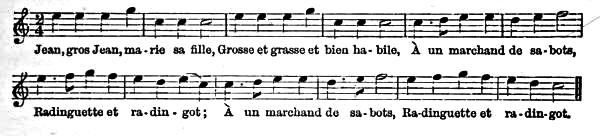
Jean, gros Jean, ma-rie sa fille, Grosse et grasse et bien ha-bile, À un marchand de sa-bots,
Radinguette et ra-din-got; À un marchand de sa-bots, Ra-dinguette et ra-din-got.
It has been suggested that the Clameur de Haro should be included among the civic
customs peculiar to the Channel Islands. (See p.p. 59-77), so, as Sir Edgar MacCulloch had not
mentioned it in his MSS. I have ventured to include a short description of it in the Appendix.
The “Clameur de Haro,” abolished in Normandy,
A.D., 1583, is, perhaps, the most ancient and curious
legal survival in the Channel Islands.
Should a Channel Islander consider his estate to be
injured, or his rights to be infringed, by the action of another,
in the presence of two witnesses he kneels on the ground and
says:—
“Haro! Haro! Haro! à l’aide mon Prince! on me fait tort!”
and he then repeats the Lord’s Prayer in French.
This formula, which is tantamount to an injunction to stay
proceedings, causes all obnoxious practices to be suspended until
the case has been tried in Court, when the party who is
found to be in the wrong is condemned to a fine and a
“Regard de Château,” which, in former times, meant a night’s
imprisonment. All “Clameurs,” according to an ordonnance of
October 1st, 1599, have to be registered at the Greffe within
twenty-four hours, on penalty of being “convict en sa clameur,”
and, should no proceedings be taken within a year of the clameur,
it is considered to have lapsed.
An order of Queen Elizabeth relative to Guernsey, given at
Richmond, October 9th, 1580, decides that “yt shall not be lawfull
to appeale in anie cause criminell, or of correction, nor from the
execution of anie order taken in their Courte of Chief Pleas, nor
in cries of Haro.”[338]
One of the most important occasions on which this prerogative
was used happened in the year 1850, when it was in contemplation
to demolish the ancient fortifications of Castle Cornet, but
the late Mr. Martin F. Tupper, who was then on a visit to
Guernsey, had recourse to this form of appeal, and saved the
oldest parts of the fortress from demolition. An extraordinary
instance of a “Clameur” took place in the Church of Sark on
the 14th of December, 1755. A great dispute had arisen between
Dame Elizabeth Etienne, widow of Mr. Daniel Le Pelley, Seigneur
of Sark, and the ecclesiastical authorities of Guernsey, as to in
whose gift was the living of the Church of Sark. She appointed
a Mr. Jean Févot to the Church, and when Mr. Pierre Levrier,
who had been appointed by the Dean of Guernsey to this post,
arrived in Sark to perform the service, he found Mr. Févot in
the pulpit. He then and there, in the words of various scandalized
eye-witnesses, “interjetta une Clameur de Haro, environ les deux
heures d’après-midi, dans le tems qu’il avoit commencé à lire le
service Divin.”[339] This of course led to many disputes, and for
over a year Dame Le Pelley locked up the Church of Sark, and
allowed no one to enter it. Finally, after much litigation, and
threats of major excommunication from the Guernsey Ecclesiastical
Court, the Bishop of Winchester intervened, Pierre Levrier was
forcibly ejected from the island, and, in 1757, Mr. Cayeux
Deschamps was given the living.
Four cases of “Clameurs” were registered between the years
1880-90, and an instance occurred as recently as 1902.
There has been much controversy as to the origin of the word
“Haro.” Terrien, (Coutûme de Normandie, Edition 1684, p. 104),
ascribes it to Rollo, Duke of Normandy, Ha-Ro, and says “La seule
prononciation de son nom, même après tant de siècles a cette
vertu, qu’elle engage ceux contre lesquels on s’en sert à cesser
leurs entreprises et atenter rien au-de-là.” Laurence Carey, in
his essay on the Laws and Customs of the Island, and all the
other old writers say likewise, but modern philologists, such as
Le Héricher and George Métivier have disputed this theory, and
have resolved the word “Haro” into a “cri de charge,” which
has survived as such in the English “Hurrah.” Froissart employs
it frequently as the sound of combat: “Le Haro commença à
monter,” and, in the description of the battle of Bouvines, won
from the Germans and English in 1214, by Guillaume Guiart,
who died in 1306 we find:—
“La vois de nuls n’i est oïe
Fors des heraux qui harou crient,
Et par le champ se crucefient
Harou, dient-ils, quel mortaille!
Quelle occision! quelle bataille!”
[340]
Referred to on page 288.
At “Les Mourains” we have seen that the ghost was
“laid” by the means of the clergy of the parish, (see
page 288) and it is evident by the following stories
that the laying of spirits frequently formed part of
the duties of the clergy in Guernsey in the last century.
The house Colonel Le Pelley now inhabits at St. Peter-in-the-Wood,
was formerly owned by an old Mr. Blondel, who, on his
death bed, gave instructions to Mr. Thomas Brock (then Rector of the
parish and grandfather of the present Rector, Mr. H. Walter Brock),
to toll the big bell to announce his decease.
This was not done, but Mr. Blondel’s spirit determined to show
that promises to the dying were not to be trifled with! All the
parish of St. Pierre-du-Bois were ready to affirm that the ghost
was to be seen climbing up the Church tower; and in the Rectory
kitchen the china on the dresser would make a clattering noise
and finally be swept by the unseen hands on to the floor.
Life at the Rectory became so unendurable under these circumstances
that Mr. Brock finally decided to “lay” the ghost, and
confine it to its own house. So he went to “Prospect Place,” as
the house is now called, with twelve others of the local clergy.
They shut every door and window, and blocked up every crevice,
key-hole, etc., through which the spirit might pass. They then
prayed in every room, after which having driven the spirit out of
each room in succession, they locked it up in a cupboard, with
either the key of the Church door or a specially-made silver key
(Miss Le Pelley could not find out which, some say one, and some
another), but the ghost has not troubled the Brock family since.
The old servants now living in the house firmly believe that the
ghost still inhabits the cupboard, and affirm that its groans can
still be heard.[341]
Judith Ozanne, an old woman, who is servant at the Le Pelleys’,
tells the following story.
Her uncle, an old Mr. Ozanne, remembered the last Mr. Guille
who inhabited the original “St. George,” the old house which has
been replaced by the modern building which is now known as
“St. George.”
This Mr. Guille left instructions that the old house was never
to be pulled down, as a spirit had been shut up in one of the
cupboards; but his son found the old house quite unsuitable for
his bride to live in, so he pulled it down, and built the present
house, and the consequence was that the poor homeless spirit
was forced to wander about the garden. Judith’s uncle saw him
often on moonlight nights, wandering among the trees around the
pond.
All the family saw him too, and decided that something had
to be done. So they had a “conjuration” as they call a laying
of the spirit, and tried to induce it to enter an underground
cellar, and shut it down by means of a trap door.
But Mr. Ozanne would never say whether or no they were
successful. Judith Ozanne finishes the story by saying, “And I
should like to know what would happen to Mr. Blondel’s spirit if
this house were burnt down?”[342]
Many of the old Guernsey “haunted houses” had their ghosts
locked up in cupboards. Mrs. Le Poidevin, who in her youth
had been an “ironer,” and had gone round from house to house
ironing after the weekly washing at home had taken place, related
that the famous haunted house at the Tour Beauregard was
also in possession of a ghost locked up in a cupboard, a cupboard
whose doors, in spite of many efforts, would not open, and from
which the most fearful groans and dismal wailings were heard to
arise. Mrs. Le Poidevin also used to go as ironer to the old
house at the top of Smith Street, now pulled down, belonging,
to the de Jersey family. In this house also was a ghost locked
up in a cupboard, and Mrs. de Jersey, a very strong minded
old lady,—in defiance of superstition—insisted on having this
cupboard door forced open, and the ghost escaped! After that
the house was rendered almost uninhabitable by the frightful
noises that were heard all over it. No one could get any sleep,
and not a servant could be found to stay in the house. So
finally Mrs. de Jersey decided to have the clergy called in, and
one of the maids described to Mrs. Le Poidevin the ceremonies
that ensued.
She said that every outer door was locked, all the crevices
between the window sashes were wedged up, and every keyhole
was plugged up. Then the minister of St. James’ and some of
the other clergy prayed in every room, and she thought they
read something about “casting out devils.” Finally the ghost was
locked up with the key of the Church door.[343]
La Petite Porte is the sandy bay immediately underneath
Jerbourg. Tradition derives its name “the little door” from
an incident which is said to have occurred in 1338. In those
days the French had made one of their periodical inroads on the
island, and were in possession of its principal fortresses. Eighty-seven
men of St. Martin’s parish, headed by l’honorable “Capitaine
Jean de la Marche,”[344] attempted to dislodge them, but were defeated
at Mare-Madoc, in the Hubits, and fled down to La Petite Porte,
where they embarked for Jersey, and founded a colony at St.
Ouen’s. An old Jersey manuscript goes on to say that Charles II.,
during his sojourn in Jersey, was so touched by the recital of
the bravery and fidelity of these men, that he granted to the
“South” Regiment of Militia, the old “Regiment Bleu,” a
special “aiguillette d’argent.” Later authorities disprove this, on
the grounds that there were not, at this epoch, either regiments
or uniforms, and that the “royal blue facings and silver lace”
quoted as “being borne at present by the South Regiment of
Militia” did not exist two centuries ago!
But among the old country people, to the present day, the
bay known as “Moulin Huet” is invariably called “Vier Port”
(old harbour), and if one mentions “Moulin Huet Bay” they
will tell you that the name “Moulin Huet” only applies to the
old mill, (now destroyed, and the site turned into a picnic house),
and that it was “Les Anglais” who transferred the name of
the mill to the bay just below, so that “La Petite Porte,” being
just the other side of the bay, might easily have been originally
“Petit Port”—(Little Harbour.)
Bounded by the “Tas de Pois,” the most magnificent rocks in
the Channel Islands, it is noted for its beauty, and, from its long
expanse of sand, is the best place for sand-eeling. But about
the beginning of last century no sand-eelers dared approach this
spot by night. Screams, shrieks, and groans were heard there, night
after night, and finally it was shunned after dark by the whole
island. There was no difficulty in the people’s minds in accounting
for these sounds. Two such awful tragedies were connected with
this bay and its environs that it was an “embarras de richesse”
to decide which of the ghosts of the two men who had been
murdered in this vicinity it could be!
The first of these stories has already been published in a little
book, now out of print, called Anglo-Norman Legends or Tales of
the Channel Islands, N.D., under the title of “John Andrew
Gordier,” and has also been taken as the foundation of “Rachel
Mauger, a Guernsey Tragedy,” published some years ago in Clarke’s
Guernsey Magazine, where also, in the number for May, 1883,
the same story is given in a condensed form, as taken from a
newspaper cutting, and is preceded by the following note, signed
“J. Y.
“The following striking narrative, relating to the origin of a
drama celebrated in its day (the tragedy of “Julia”), became
known to the writer through an old newspaper cutting preserved
in a family scrap book. The newspaper of which we speak must
be at least fifty years old (in 1883), and it related events which
were then long past.”
A book called The Locket, by Mrs. Alfred Marks is based on
the same tradition.
Though these events must have happened nearly two hundred
years ago, there are still some recollections of them lingering in
the minds of the very old people, who preface them by saying
“J’ai ouï dire à ma gran’mère!”
The story runs thus:—About the end of the seventeenth
century there was an extremely beautiful girl, living at the Varclin,
in St. Martin’s parish, called Rachel Mauger. The Maugers were
of a good old Guernsey family, and were, in those days, extremely
well-to-do. She was engaged to John Andrew Gordier, a native
of Jersey, though of French extraction. One day he sent her
word that he was going to sail over from Jersey to see her, and
intended landing at La Petite Porte, which was the nearest place
to her house. She started to go to meet him. But he never
appeared, and she had to return home, fearing that some accident
had happened to him. What really had happened was this:
There was a wealthy merchant, in St. Peter Port, named Gaillard,
who had long wished to marry Rachel; he had formerly been her
father’s clerk, so they had been much thrown together, but she
did not reciprocate his affection.
The day Mr. Gordier sailed over to Guernsey, Gaillard was
down in the bay of La Petite Porte, having previously been
refused admission to the Mauger’s house, on the ground that Mr.
Gordier was expected, and they were all busy preparing for his
reception. Brooding over his wrongs, he looked up, and saw his
rival just on the point of landing. Mad with jealousy he waited
behind the rocks till he saw him preparing to ascend the winding
path which leads to the top of the cliff, then he rushed out, and
stabbed him twice in the back with the knife he always carried,
and, doubling him up, thrust the body into a cave close by with
a particularly small entrance. The cave is still pointed out, and
is on the western side of the bay, just below the path, leading
from La Petite Porte to Moulin Huet. Before leaving the body,
Gaillard searched it, and abstracted a peculiarly-shaped locket from
one of the pockets, which Gordier was bringing as a present to
his fiancée.
Of course the disappearance of Gordier led to a search, and
his body being finally discovered in this cave by some boys, his
murder was made manifest. His mother finally resolved to come
over and visit her intended daughter-in-law, whom she found in a
most depressed and excitable condition, and evidently dying of a
broken heart. United to the shock of her lover’s death, she had
been exposed to the incessant persecution of her relations, who
were determined that she should marry Gaillard, and had insisted
that she should accept the locket that he had stolen from Gordier’s
corpse, and, with a refinement of malice, had pressed on her. So
unstrung was the unfortunate Rachel that she did nothing but
sink into one fainting fit after another on seeing Mrs. Gordier,
and when the latter, struck with horror on seeing this jewel on
her watch-chain, asked her how she had come into possession of
a locket which had, she knew, been made specially for her in
Jersey by her son’s orders, the unhappy girl turned deadly pale,
and, murmuring the word “clerc,” fell in a dead faint to the
ground. The final shock, and sudden conviction that they had
been harbouring her lover’s murderer, being too much for her in
her enfeebled condition, she died in a few moments.
Mrs. Gordier misinterpreted the poor girl’s grief, and, thinking
it proceeded from a guilty conscience, intimated that it evidently
shewed that Rachel was an accomplice in the murder. Naturally
the Maugers were most indignant at such an unworthy aspersion
on their daughter, and, after a violent scene, asked her to prove
her statements. She replied that the jewel their daughter was
then wearing was one which was purchased by her son before
leaving Jersey, and she proved the fact by touching a secret
spring and shewing his portrait concealed in the locket. The
Maugers, knowing that Gaillard had been the donor of this jewel,
and connecting “clerc,” the last word Rachel’s lips had uttered,
with him, as being her father’s clerk, immediately sent for him.
On being confronted with the jewel, and asked to explain how it
came into his possession, he replied that he had purchased it
from a Jew, named Levi, who had for years paid periodical visits
to the island as a pedlar. So Levi was then considered to be
undoubtedly guilty, and was taken into custody, but then,
remorse, the fear of public shame, and also the conviction that,
Rachel being dead nothing made life worth living, so wrought
on the miserable Gaillard, that the morning of the day on which
Levi was to be brought before the Royal Court, he was found
dead, stabbed by his own hand.
A letter was found on the table in his room confessing his
guilt and reading thus: “None but those who have experienced
the furious impulse of ungovernable love will pardon the crime
which I have committed, in order to obtain the incomparable
object by whom my passions were inflamed. But, Thou, O
Father of Mercies! who implanted in my soul these strong desires,
wilt forgive one rash attempt to accomplish my determined
purpose, in opposition, as it should seem, to thy Almighty
Providence.”[345]
This second story is not at all well known, except among some
of the very old people at St. Martin’s. I will not mention the
names of the murderers, as descendants of the family still survive,
and are among the most respected of the country people.
At the end of the eighteenth century many French noblemen fled
over here, to escape the terrors of the French revolution. Among
them was a Seigneur de Damèque. (I have no idea whether or
not whether this is the correct spelling of his name, but it represents
the pronunciation of the people). He came out to St. Martin’s
parish, and took a house at Le Hurel, just above Le Vallon. He
was very proud and reserved, made no friends, and was always
seen going for long solitary walks, or pacing down “Les
Olivettes,” (the old name for what is now known as “the water
lane”) or underneath “Les Rochers,” the cliffs on which the
Manor House of Blanchelande now stands, and resting by the
“douït” where the pond at Le Vallon now is, but which, in
those days, was public property.
He was always very richly dressed, and was supposed to have
hidden hoards of wealth, as well as to carry large sums of
money on his person. There were two or three brothers who
lived together in a house near Le Varclin, who, tempted by his
supposed riches, and thinking that his isolation would prevent his
disappearance being noticed or enquiries being made, decided on
following him on one of his solitary rambles and on murdering
him. These brothers had always borne a bad reputation; they
gambled and drank, and were the “vauriens” of an otherwise
respectable family.
So, one evening, they followed him, as, passing above La Petite
Porte, he entered into the narrow lane, overgrown with trees and
thorn bushes, which leads to Jerbourg Point. There they closed
upon him, and, being two or three to one, murdered him, and,
after having robbed the body of his watch, rings, etc., buried the
corpse under some of the heaps of stones which lie on the
waste lands at the top of the cliff.
Some wonder was caused at Le Hurel when he failed to
appear, but the rumour was started that he had been seen sailing
away in a little fishing boat he used to hire for the season,
from Bec du Nez, and which the murderers had had the
forethought to scuttle and sink. The country people thought he
had returned to his native land, and all interest in the matter
dropped.

Haunted Lane near Jerbourg.
But there was one man to whom M. de Damèque’s disappearance
meant much. In Paris he had left a dear friend, a
Dr. Le Harrier. These two men wrote to each other regularly,
and when M. de Damèque’s letters suddenly ceased, letters came
to Le Hurel from this doctor, asking for explanations—letters
which were never answered. Among M. de Damèque’s jewellery
was a beautiful and most uncommon watch, with either his coronet
and monogram or his coronet and arms displayed on the case.
One day, some years after his disappearance, Dr. Le Harrier,
walking through the streets of Paris, saw this unmistakable
watch hanging in a jeweller’s shop. He went in and asked the
man how it had got into his possession, and the man told him
it had been brought by some men from Guernsey, who had been
trying to sell it in England, Holland, and Belgium, and finally
had left it with him to dispose of. Dr. Le Harrier bought the
watch, and, taking the men’s address, started at once for Guernsey.
When he arrived he made enquiries, and, finding that these men
bore a bad reputation, took some constables with him and went
to the house. There they found them sodden with drink, and,
haunted by fear and remorse when they saw the watch, they
sank down on their knees and confessed everything, and were led
off then and there to prison.
The next thing to be done was to disinter the bones of the
murdered man and give them Christian burial. Heavily handcuffed
the brothers were taken to the spot, accompanied by various
members of the clergy, a doctor, who had to certify that every
bone was there, (this is a point much dwelt upon by every teller
of the story), Dr. Le Harrier, and all the people of St. Martin’s.
Then the bones, being found, were placed in a coffin, and reverently
buried in St. Martin’s churchyard.
After the last spadeful of earth had been put in the grave, and
while handcuffed prisoners and all the bystanders were still present,
an old St. Martin’s man, named Pierre Jehan, got up and made
the following speech, which I have written down word for word as
the people still tell it.
“Autrefois quand on enterrait des dépouilles mortelles on y envoyait
des rameaux et des bouquets de fleurs. Aujourd’hui on ne voit rien
de tout ça.”
“Autrefois on aurait donné un quartier de froment en fonds
d’héritage pour porter le nom de ——. Aujourd’hui on en donnera
quatre pour ne le pas porter.”
(“Formerly when burying a corpse one sent branches of trees
and bouquets of flowers. To-day there is nothing of that.”
“Formerly one would have given a quarter of wheat rent to bear
the name of ——. To-day one would give four not to bear it.”)
The shock and the shame were such that the brothers were
seized by what the people call “a stroke,” and to the relief of
their relations died in prison before being brought for trial.
That the ghosts of these two murdered men should revisit the
scenes of the crime was only to be expected, but finally, when La
Petite Porte was shut to sand-eelers by reason of “ces cris
terribles,” some of the neighbours and fishermen began to wonder
whether nothing could be done to lay these unquiet spirits and free
the bay from its supernatural visitants.
There was a man called Pierre Thoume, who lived at Les
Blanches, most popular in the parish, being ready to go everywhere
and join in everything, though he was emphatically a “bon
Chrétien.” He was a distant relative of the murderers of M. de
Damèque, and, having heard these noises at various times, it was
borne in upon him that perhaps if he could find out what the ghost
wanted, he could fulfil its wishes, and so let it rest in peace. He
even prayed for guidance, and more and more he felt it to be his
duty to go and meet the ghost face to face. At first some other
men said they would join him, but when the appointed night came
their spirits failed them, and no one arrived at the rendezvous.
Undaunted, and armed only with his Bible, Mr. Thoume sallied
forth alone at midnight. I think it is difficult to realise what moral
and physical courage it must have involved to go forth alone to
encounter the supernatural, fully persuaded of its unearthly
character.
Early in the morning he returned to his home, looking very
white, and with a curiously set expression on his face. His wife
and daughters, who had waited up for him, rushed at him to know
what had happened, but he said, “You must never ask me what
has happened, what I have seen, what I have done. I have sworn
to keep it a secret, and as a secret it will die with me, but this
I can tell you, you may go to La Petite Porte at any hour of the
day or night, and never again shall any ghost haunt it, or noise
or scream be heard.” And to this day the noises have utterly
ceased.
Pierre Thoume kept his vow, though his family, friends, and
neighbours, implored him time after time, even on his death bed, to
tell them what he had seen. His invariable reply was, “I have
given my word, and I will not break it.”[346]
There are two houses called Les Câches in St. Martin’s parish,
situated one behind the other in the district so called, between
the blacksmith’s forge at St. Martin’s and the Forest Road.
Tradition says that they all formed part of one property, which
extended as far as St. Martin’s Church, and was a nunnery, the
nuns having a private lane of their own by which they could go
to the church without the fear of meeting any men en route.
There is a pond situated to the left of a long avenue which now
leads to the front door of one of the houses, and for years it was
believed that on a certain night of the year, a woman’s figure, dressed
in grey, is seen walking up and down the avenue, weeping and
wringing her hands, and then rushing to the pond. The story
the people tell to account for this appearance is, that one of the
nuns was discovered at the dead of night trying to drown her
child and herself in the pond. They were rescued, but only for
a worse fate, for the unfortunate woman and child were bricked
up in a cupboard which is now situated in one of the outhouses,
but is supposed to have been the old refectory. The people also
tell in confirmation of this story that the night the ghost is seen
this cupboard door flies open of itself though it is quite impossible
to force it open at any other time.
It is possible that if this was an ecclesiastical establishment, it
was one of those alien priories of which Sir Edgar MacCulloch
says:—
“After the loss of Normandy the inconvenience of having so
many valuable possessions in the hands of the enemy, led to the
suppression of these priories, and in these islands, whenever there
was war between England and France, alien ecclesiastics were
compelled to leave.”
So probably the old conventual buildings, if there were any,
were allowed to fall into ruins, and the land passed into the hands
of the Patrys, and thence, through the marriage of Marguerite
Patrys and Pierre Bonamy, into the possession of the Bonamys,
who owned it for many centuries. There is an old document which
tells the story of how the Bonamys first came to Guernsey.
“On their return from the Holy Land, whither they
had accompanied the King of France, two brothers were
driven by a violent storm, and thrown into a little bay, where
their bark went to pieces. In gratitude for their preservation they
made a vow to remain where Providence had placed them. One, a
priest, founded a church, and the other married and founded the
Bonamy family.” In 1495, John Bonamy, son of Pierre and
Marguerite Patrys, was “Procureur du Roi” in Guernsey, and his
old MS. memorandum book still survives, in which he describes
a pilgrimage to Rome he made in 1504, through France and Italy.
The following extracts relative to building Les Câches have been
deciphered from the old crabbed manuscript by Colonel J. H.
Carteret Carey:—
1468.—Mo des gans quy mont aydy a caryer la pere … et des
grant roquez … de le Cluse Luet—premez Gylome robert j jor &c.
1498.—Mo que je marchande de Colas Fyquet por ma meson, le but
deverz le nort … par la some de viij escus.… Il comencest le
xviijeme jor du moys de Maye—le Mardyt.
1504.—Mo que Gylome le Corvar et Colin Savage comancer acovyr
ma grange landeman du jor Saint Appolyne. Acevest le jor Saint Aubin
lan vc quatre, which may be translated:—
(1468.—Memo of the people who helped me to quarry the stone …
and the big rocks … of “l’Ecluse Luet” [the Ecluse was the mill-dam
in connection with the old watermill which gave its name to
Moulin Huet Bay. It was situated in the hollow at the bottom of
the water-lane of “Les Olivettes,” just above the old Mill House]
first William Robert, one day, &c.)
(1498.—Memo. That I bargain with Colas Fyquet about my house,
the end (to be) towards the north … for the sum of eight escus.
They began the 18th of May—on Tuesday.)
(1504.—Memo. That William Le Corvar (&) Colin Savage, began
to cover my barn the day following the day of Saint Appolyne
[Feb. 9,] finished the day of St. Aubin [March 1,] 1504.)
In the parish of St. Martin’s they still tell a story of the old
days when the Bonamys yet occupied Les Câches.
Years and years ago, there was an old Helier Bonamy,[347] who
lived at the Câches. He was one of the richest men in Guernsey,
and kept, as well as cows and horses, a large flock of sheep, there
being much demand for wool in those days on account of the
quantity of jerseys, stockings, &c., knitted over here. One night he
and his daughter went to a ball in the town. Tradition even goes
so far as to say that Miss Bonamy was dressed in white brocade.
Before starting, Helier Bonamy summoned his herdsmen, and told
them to keep a sharp look out after his sheep, for that there were
many lawless men about. Helier and his daughter[348] walked home
that night earlier than was expected.
As they turned into the avenue, between high hedges and forest
trees, they heard the bleatings of sheep in pain. “Écoute donc, ce
sont mes berbis” (Listen, those are my sheep), said Helier, and
drew his daughter under the hedge to listen. Peeping through the
bushes they saw his herdsman and farm labourers calling each
other by name, drinking, talking and laughing, and, while cutting
the throats of the defenceless sheep, chanting in chorus:—
“Rasons! rasons! les berbis
Du grand Bonamy,
S’il était ichin d’vànt,
Nou l’i en feraït autant!”
(Shear! shear! the sheep,
Of the great Bonamy,
Were he here before us,
We would do as much to him).
They crept up the avenue unobserved to the house, for Helier
was afraid to confront all these men who had evidently been
drinking heavily, alone and unarmed. The next day his herdsman
came to him with a long face, and said that robbers had broken
into the sheepfold in the night and killed all the sheep, and
brought up the other men as witnesses. Mr. Bonamy said nothing,
except that he would like all these men to accompany him down
to the Court to there testify to the robbery. This they did, and
when they got there and told their story, Mr. Bonamy and his
daughter then turned round and denounced them. They were
taken into custody, and hanged shortly afterwards at St. Andrew’s.[349]
There are several stories illustrating the re-appearance of people
whose dying wishes had been disregarded by their survivors, and
also of people wishing to tell their heirs where their treasure had
been hid.
At the King’s Mills, a Mrs. Marquand died, and left instructions
with her husband that her clothes were to be given to her sister
Judith. After her death the widower did not do it, so every night
her ghost came and knocked at her husband’s door. One night
she rapped so loudly that all the neighbours opened their windows,
and heard her say:—
“Jean, combien de temps que tu me feras donc souffrir, donne
donc mes hardes à ma sœur Judi.”
(John, how much longer wilt thou make me suffer, give then
my clothes to my sister Judy).
He gave the clothes the next day, and the spirit returned no
more.[350]
Almost the same story is told of a Mrs. Guille, who gave
orders that after her death a certain amount of clothes were to
be bought and yearly distributed amongst the poor. This her
husband neglected to comply with, so Mrs. Guille visited him
one night, and told him that she would do so every night until the
clothes were given. Mr. Guille hurriedly bought and distributed the
clothes, and continued to do so yearly until he died.[351]
Miss Le Pelley also contributes the following ghost stories which
are told at St. Pierre-du-Bois:—
“About the beginning of the century a man went to Gaspé
(which the narrator said was Newfoundland, but is really on the
mainland). While there, his father died suddenly, and the son
came back to Guernsey to work the farm. One night his father
appeared to him and told him that he would find “une petite
houlette” (a little mug) on the barn wall, with something of
value in it. Next morning the son went to look, and found a
mug full of five franc pieces.”
“A widow in Little Sark had sold her sheep advantageously and
hidden the money in the “poûtre” (the large central rafter which
runs along the ceiling of the kitchen). Quite suddenly she died.
Whenever her son walked about in Little Sark he met his mother,
which made him feel very frightened, so one day he made his
brother come with him, and together they met her, and plucked
up courage enough to say:—‘In the name of the Great God
what ails you,’ so then, having been spoken to first, she could
tell them where her hoard of treasure was, and then disappeared,
and was never seen again.”
The whole country-side is full of shreds of ghost stories and
beliefs; many of these were probably due to, and encouraged by,
the smugglers of olden days.
For instance a funeral procession was supposed to issue from an
old lane south of Le Hurel—now blocked up—and no St. Martin’s
man or woman would dare pass the place at night. But smugglers,
creeping along between the overhanging hedges, with kegs and
bundles on their shoulders, would have had just the same effect,
especially to people who would have been far too frightened at an
unexpected nocturnal appearance to stop and investigate the matter.
At the corner between Les Maindonneaux and the Hermitage,
a tall figure was said to appear, and hover round the spot. When
the road was widened and the wall round the Hermitage was
built, a stone coffin was found full of very large bones. These
bones were taken to the churchyard, and the burial service read
over them, and since then no ghost has been seen.
Then, a little further on, around the pond of Sausmarez Manor,
was seen an old man, dressed in a long grey coat, and a grey felt
plumed hat. This is supposed by the people to be old Mr. Matthew
de Sausmarez—“Le Grand Matthieu” as he is called,—but why he
is supposed to return is unknown.
Even now-a-days, in quite modern most unghostly-looking
houses, you hear tales of little old women, former inhabitants,
being seen. In another house, where a suicide is known to have
occurred, soft finger knocks are heard against the walls of one
of the rooms, as of some one shut up in the room and seeking
release; the door is opened, and nothing is to be seen. And in
St. Martin’s the ghost of a woman, who only died a few years
ago, is said to haunt the garden of the house in which she
lived. Her daughter saw the appearance and was picked up in a
dead faint from fright, but then the woman was supposed by all
the neighbours to have been a witch, and, of course, as they
say, the spirit of “une sorcière” could not rest quiet in consecrated
ground.
I will close this chapter on ghosts with a story which is firmly
believed and told by many of the country people. For obvious
reasons I suppress all names.
At the beginning of the nineteenth century, a very rich widower
had a house in Smith Street. His first wife had left many small
children, to whom in her lifetime she had been devoted, and spent
many hours of her day in the nursery. The widower, after a short
interval, married again, a young, pretty, and frivolous girl, who
utterly neglected her step-children. Then the spirit of his first
wife came back for a short time every morning, and washed and
dressed them, the curtains of their beds were found pushed back
in the mornings, and her silk dress was heard rustling up the
stairs, and the children used to say “Mamma dressed us.”[352]
A man residing on the north-west coast had a brother who
was drowned whilst out fishing. This man, wishing to do his
best for his brother’s family, was sore perplexed some years
afterwards, as the family ran great risk of losing their property,
owing to the absence of a title deed which he knew to have
existed, but which unfortunately had not been registered.
One day, when out fishing, he was greatly surprised to see his
brother’s boat coming full sail close to him and just rounding to,
with his brother at the tiller, and exclaimed:—“La! te v’lo et ta
femme qu’est r’mariaïe!” (Lo! there you are and your wife married
again!) The answer he received was:—“Le papier que tu trache
est dans un taï endret sus la poutre,” (the paper you are looking
for is in such a room, on the beam). Immediately everything
disappeared.
Arrived ashore, he searched in the place indicated and found
the missing document.[353]
Referred to on page 386.
There are many stories still told and firmly believed
by the country people, of Marie Pipet, who was a
noted “sorcière“ of the early part of the nineteenth
century. She came of a race of witches and wizards,
thus described in Redstone’s Guernsey and Jersey Guide, by
Louisa Lane Clarke, (Second Edition, 1844), p. 86.
“On the road past St. Andrew’s Church, one of the lanes to
the right leads to the village called “Le Hurel,”[354] a collection of
mere huts; rude, dirty looking cottages, but remarkable from the
people who tenant it. They are a kind of half gipsy, half beggar
race, bearing the name of Pipet; and kept totally distinct from
every other family, because no person would intermarry with them
upon any consideration. Their appearance and features are quite
unlike the rest of the Guernsey peasantry, who are extremely
good-looking, clean, and active; whereas those Pipets may be
found basking in the sun, with anything but a prepossessing
exterior. The country people consider them as wizards and
witches, and, at certain times of the year, about Christmas, when
they are privileged to go round and beg for their Noël, or
“irvières” (New Year’s gifts), no one likes to send them away
empty handed for fear of the consequences to themselves, their
cattle, or their children.” Even to this day the country people
have a great dread of “Les Pipiaux.”[355]
My father’s old nurse, Margaret Mauger, told me that the cook at
old Mr. Fred Mansell’s, of the Vauxbelets, (about the year 1850),
was a great friend of hers, and told her that one day Marie
Pipet came into the Vauxbelets kitchen, and demanded some
favour which was refused. “Tu t’en repentiras,” she said, and
went out of the door and sat on the adjoining hedge to await
developments. Meanwhile the sirloin which was being cooked for
Mr. Mansell’s dinner refused to be cooked! For hours she turned
it round and round on the jack in front of the fire. The heat
had apparently no effect on it, and it was as raw as when she
first put it there. Finally, in despair, the cook went to her
master, and told him what had happened. So he sent for Marie
Pipet, and told her if she did not disenchant his dinner she
would spend the night in gaol, (he was a Jurat of the Royal
Court). With a curtsey she replied that if he would go into his
kitchen he would find his sirloin ready for eating, and, at that
moment, the cook declared, it suddenly turned brown!
There are many stories told of Marie Pipet in St. Pierre-du-Bois.
One old woman, Judith Ozanne, told Miss Le Pelley that
Marie Pipet, “la sorcière,” once asked her grandmother, old Mrs.
Ozanne, for some milk. This was refused her, so she prevented
the cows from eating, and they were all pining away. So then
her grandfather took his pitchfork, and, going straight to the
witch, compelled her, under the fear of corporal punishment, to
undo the spell.
Judith Ozanne also tells the following story of Marie Pipet,
which she affirms is true. One day Marie took her corn to the
Grands Moulins (the King’s Mills) to be ground. The two young
men who were in charge of the mill said “Oh dear no, they
were not going to grind her corn,” and so she returned home,
but the mill-stones turned round and round and round so quickly
that no corn would grind, and nothing would stop them, so they
had to call back Marie Pipet and promise to grind her corn for her,
and, as soon as her corn was put in, the millstones worked as usual.
Mr. Métivier gives a story of Marie Pipet which was current in
his day, in his Souvenirs Historiques de Guernesey.
“The incomparable Marie, so dreaded by the millers of the King’s
Mills, because she often amused herself by unhinging our mills, rests
in peace on the good side (au bon côté) of the Castel churchyard.[356]
It is firmly believed, and frequently told, how she, and other members
of her family, could metamorphose themselves as “cahouettes”—red-legged
choughs. One day, in the form of one of these birds, she
was discovered in a cow stable, and run through the thigh by the
proprietor of the stable, with his pitchfork. The bird managed to
escape, but the woman Marie Pipet was obliged to keep her bed
for six months with a terrible and mysterious wound in her leg,
by which of course the metamorphosis was proved.”[357]
Possibly a bird of such evil omen, having red legs, accounts
for the fact that to this day our country people tell you that all
witches who go to dance at the Catioroc wear red stockings.[358]
All witches are supposed to be endowed with the faculty of
keeping the person they have bewitched walking—walking, for
hours perhaps, in a circle, to which they cannot find a clue.
Marie Pipet, one day being offended with a man, made him walk
backwards and forwards one whole night between the Vauxbelets
and St. Andrew’s Church.[359]
About the end of the eighteenth century there lived in Sark a very
notorious wizard called Pierre de Carteret. An old Sark woman
called Betsy Hamon, now Mrs. de Garis, has given Miss Le
Pelley, whose servant she is, the following particulars concerning
him:—
Pierre de Carteret, called “le vieux diable,” lived in Sark. He
always worked at night, and when the fishermen passed by his
house at night they heard him talking to the little devils who
worked for him. They could not understand, for it was the devil’s
language they talked. He built a boat in a barn in one morning,
and the Sark people were amazed to see it launched in the Creux
harbour. This was Black Art, for the boat was too large to
go out of the door, and also his house was not quite close to
the sea.
He was very rich, partly owing to his having no expenses, as
he had no workmen to pay, everything being done for him by these
little devils, and partly from his first wife, whom he courted in
France. Pierre went over to France alone, in a small open boat.
The girl he married, who was herself a lady, thought he was of
gentle blood. After he married her he was most cruel, and spoilt
all her furniture. For instance, her parlour was mirrored from ceiling
to floor, and he brought her horses up into the room, and the
poor things became excited when they saw other horses, and kicked
the looking-glasses and broke all the other furniture. This wife died
of a broken heart, and for his second wife Pierre married a Sark
girl, little more than a child.
If Pierre wanted his hedges repaired he simply gave the order
to his little helpers, and the next morning they were done.
Pierre’s daughter—“la petite Betsy”—used to feed the cow at
night in the churchyard, and she was seen returning home at
daybreak with the cow, looking thoroughly well fed. Consequently
nobody would buy butter or milk from him.
When Pierre had nothing else to give his workers to do they
used to forge money, and their hammers could be heard by the
passers by.[360]
Old Mrs. Le Messurier, in Sark, also confirmed a great many
of these details in 1896. She said he, Pierre de Carteret, was
well known to be a famous sorcerer. He had pictures of the
Devil on his walls, and little images of Satan were found in his
house after his death, and promptly burnt by the incomers. He
could build a boat, alter a loft, or build a wall in a single
night, because he had “des esprits malins” to help him. He
was an excessively bad man and used to smuggle ball and
ammunition to France, to help the French against the English in
the war. The English found him out and came over with bayonets
to take him, but he hid down his well, and could not be found.
Out at St. Pierre-du-Bois they still tell the tale of a Frenchman,
who was a “sorcier,” and in league with the Devil.
One day he entered a farm kitchen, where he found all the
young people playing a game, in which they used a number of
doubles, placed in a jam pot, for counters.
He said “I can turn all those doubles into mice.”
They did not believe him, so he took the pot, shook it, and
turned it upside down on the table. Then he turned to one of
the girls standing by and said “Now, take up that pot.” She
did so, and numbers of mice ran out of it, all over the table,
with their tails cocked up!
Of the same man another story is told. One morning he
wanted some of his neighbours to play cards with him, but they
said they could not spare the time, for they must weed their
parsnips.
He replied—“If you will come, your parsnips shall be weeded
by dinner time.”
So they played, but one man looked up, and saw through the
window numbers and numbers of little demons weeding very
quickly, and by mid-day the work was done.[361]
Mr. J. Linwood Pitts has also collected two stories bearing on
the subject of the transformation of witches, both of which were
related to him in perfect good faith by reliable witnesses.
Many years ago a Guernsey gentleman went over to Sark.
While sitting on the cliffs above the Havre Gosselin he noticed a
flock of birds, principally wild duck, circling round and round. He
fired off his musket, but did not succeed in hitting any of them,
or even, much to his astonishment, in frightening them away.
He thought there must be something mysterious about them, as
wild duck are generally such shy birds, so he consulted a noted
wizard, who told him that if he loaded his musket with a piece
of silver having a cross on it it would take effect on any
transformed witch. So he went over to Sark again with this
silver bullet, and on returning to the Havre Gosselin again saw
the birds. He picked out one, which seemed the finest of the
flock, and apparently their leader. On firing at it he succeeded
in winging it, though it disappeared, and he thought it had
escaped.
That evening, on the return boat to Guernsey, a girl on board,
who used to pay almost daily visits to Sark, and about whom
there were many mysterious reports, appeared with a bad wound
in her hand, about which she would vouchsafe no explanation, but
looking very white and frightened. The man identified her in his
own mind as the mysterious bird, but did not speak about the
affair till long after.
A very respectable Alderney man used to tell old Mr. Barbenson,
Wesleyan minister, about a noted Alderney witch.
He declared that one night, passing by her cottage, he looked
in, and saw a blue flame blazing up, and the witch dancing in
the middle of it, surrounded by little devils, also dancing.
“But how do you know that they were devils?” Mr. Barbenson
asked:—“Because they were just like the pictures of Apollyon in
my old Pilgrim’s Progress” was the reply. Another day, he said
that, coming home from milking, he saw two large black birds
revolving over his head. They both sank, almost at his feet,
behind a small furze bush. Suddenly this woman rose up from
behind the same bush, and ran away. He said the bush was
made too small to hide the woman, and that it was quite
impossible that she could have been concealed there. The man
vouched for the truth of these stories.
Mr. Pitts has also kindly allowed me to include the following
extract from an old MS. which was communicated to him by
Mr. E. P. Le Feuvre, a gentleman of Jersey extraction, residing
in London, and connected with some of our Guernsey families.
He also gave me the details of a remarkable local witch story,
which he had found in a curious old MS. in the library of
Dr. Witham, of Gordon Square, London. This MS., which is in
two volumes folio, is entitled ‘Icones Sacræ Gallicanæ et Anglicanæ,’
and contains seventy biographies of ministers and clergymen.
Among them is a sketch of the life of the Rev. Daniel
Fautrat, of Guernsey, who was minister of the Câtel parish; then
of Torteval; and who afterwards, in 1633 (in the reign of
Charles I.), succeeded Mr. de la Marche, at St. Peter-Port. This
MS. is by a John Quick (born 1636—died 1706). There were
two Fautrats, Helier and Daniel, father and son, and the biographer
somewhat confuses them.[362] This story of the witch—who
was burnt alive in the Bordage during Daniel Fautrat’s ministry
at the Town Church—is a very curious one, and is a decided
acquisition to the witch-lore of the island. It is as follows:—
“After Monsieur [Daniel] Ffautrat had spent some years at
Torteval and St. Andrew’s [Guernsey] he was, upon the death
of Monsr. de la Marche, called to succeed him in ye Pastorall
charge of St. Peters Port, [in 1634, in the reign of Charles I.]
which is ye Towne of this Island, a fair Markett Towne and
priviledged with ye Sessions of ye whole Island, where all caisses
Civill and Criminall are finally tryed and determined in ye
Playderoye,[363] by ye Bayliffe and Jurates.
“During his ministry in this Towne, and about ye year 1640
[Charles I.] there happened a most remarkable event. Divines do
say that it is a very rare thing for witches under Gospell Light
to repent; and some have given this reason of their assertion—because
they have committed that unpardonable sin against ye
Holy Ghost. I cannot tell, but that this following story seems to
confirm it.
“There was a certain woman of this Island, above four-score
years of age, who had been imprisoned, indicted and found guilty
upon full evidence, of that abominable sin of witchcraft, and for it
was condemned to death. She gave out confidently that she should
not dye. However, she is carried from prison to ye appointed place
of Execution to be burnt alive.
“All the way, as she was going thither, a great Black Raven
was seen hovering, and heard croaking after a dolefull manner over
her head, till she came to ye stake. And now, while they be
fastening ye chain, she begs of one of the Bystanders to give her
a clew of thread, which having received, she fastens one end of
it to her girdle, and taking ye other end, she flings it with her
hand up into ye aire. The Raven, stooping down, catcheth at it
with his Beak, and, mounting, carrys with him ye old witch from
ye bottom of ye vale up into ye air. A young man of that
Island, seeing her flying, being on ye top of ye hill, flings his
Halbard so exactly betwixt her and ye raven, that it cuts ye
thread asunder, and ye old witch is taken by him, but with
many fearfull imprecations upon him, she vomityng out whole
cartloads of curses against him.
“However, she is once again carryed down to ye stake, and
there accordingly executed, being burnt to ashes. But this poor
officious wardour, whose name was Gosslin—ye holy wise providence
of God so permitting it—felt a short time after, ye bitter
consequences of her rage and dying curses; for he grew sick of
an incurable disease, lying under most exquisite torments, of
which he could never be relieved by any means or medicines, till
having languished some years he was at last released from his
sufferings by death.”
“A girl was very ill, and the doctor did not know what was
the matter with her, and, though he tried many remedies, none
succeeded. One day a friend from the Vale, their native parish,
called, and told the girl’s mother privately that the girl was
bewitched, and that it was Mrs. —— who had done it, but
that he could, with certain herbs, boiled in a particular manner,
cause the witch to die, and then the girl would be well. The
herbs were boiled, and a few days afterwards the witch died.
During the funeral the girl jumped joyfully out of bed, quite well.
This occurred within the last twenty years.”
“One day, two boys, well on in their teens were chaffing an
old witch, when suddenly she got very angry, threw dust in the
air, and gabbled some words very quickly. The boys went home
and found they were covered with vermin. They were near neighbours.
One of the boys was so angry that he took his gun and
went to the old witch and said, “Now, take away the vermin,
or I shoot you,” and he levelled his gun at her. They parleyed
a little, but the boy was so determined that the witch suddenly
took fright, threw dust in the air, repeated some words, and the
vermin disappeared. The other boy was covered for three days.”[364]
The following story illustrating the widespread belief in these
special powers of witches and wizards was told me by Mrs. Le
Patourel, of St. Martin’s, who was told the story by the heroine,
and who vouched for its authenticity.
Mrs. Le Patourel’s mother-in-law was a Miss Mauger, of Saints,
very handsome and very well-to-do. In fact, she and her sister
went to school in England, which was considered very grand in
those days. On her return from school she, her sister, and a
friend, all went together to one of the country dances then frequently
held in the various parishes. They all “held their heads
very high,” dressed very well, and would only dance with those
whom they considered the “best” partners. They were dressed
on this occasion in silk dresses with large white lace collars and
ruffles. At the beginning of the dance, as they were all sitting in
a row together, some man came up and asked each of them in
turn to dance, but they all considered him unworthy of the
honour, and each refused to dance with him. As the last refused
he turned on his heel muttering that they would repent their
rudeness. A minute or two later one of the girls leaned forward
and cried to her sister, “Oh, Marie, what have you got there?”
and pointed to an insect crawling on her lace. Covered with
confusion the girl killed it, only to see swarms more crawling
after it. The other two girls then discovered to their horror that
they were likewise covered with swarms of vermin, and covered
with shame and confusion they all had hurriedly to leave the
dance. For three days they all remained in this condition, and
then the vermin disappeared as suddenly as they came.
“The shame of it I can never forget,” Mrs. Le Patourel says
was the way her informant always ended the story. “But,” said
Mrs. Le Patourel, “that is nothing to what people can do who
use the bad books.”[365]
She thinks it is the French people who have brought these evil
arts to Guernsey, and in proof of her theory told me this story
which happened to one of her own friends, “who has told it to
me many a time.”
A Guernsey farmer living in St. Saviour’s parish had a French
manservant, who slept on the premises. Suspicion being aroused
by his haggard looks he was watched, and seen to leave the
house every night and not come back till the morning. When
asked where he had been and what he had been doing he
returned evasive answers. So one night his master determined
to follow him. He tracked him across some fields till he
reached the Catioroc, and there he saw him lie down in the
middle of a field, and then, in a few moments, a clear, bluish
flame, like the flame of a candle, was seen issuing out of
his mouth, and wandering off like a will-o’-the-wisp across the
fields. When the astonished farmer went up to the body he found
it lying rigid and lifeless, and no amount of shaking or calling
could make any impression on it. After some time the flame was
seen returning, and settled on the man’s mouth, and there
disappeared, and shortly after the man sat up, looking dazed and
tired, and absolutely declined to answer any of the questions with
which his master greeted him.
On pp. 305 to 351 (ante) are given various trials for witchcraft,
which took place in Guernsey during the sixteenth and
seventeenth centuries, but Sir Edgar MacCulloch has not included
the following, which I have found cited in an old MS. book
compiled by Eleazar Le Marchant and Pierre Careye between the
years 1728 and 1743.
“Le 26me Juillet 1594, pardevant Louis de Vick, baillif, et
Messrs. Nicholas Martin, sen., Guillaume de Beauvoir, André
Henry, Jean Andros, Jean de Sausmarez, Pierre de Beauvoir,
Pierre Careye, William le Marchant, Nicholas Martin, jun., and
François Allez, jurez.
“Marie Martin, alias Salmon, fille Osmond, deubment atteinte et
convaincue d’avoir usé d’Art de Sorcelerie, dont elle a empoisonné,
tourmenté et fait mourir jouxte sa propre et volontaire confession,
Anne Careye[366], fem͠e de John de Vick, la fem͠e de Pierre Vodin,
l’enfant de son oncle, Thomas Breton, l’enfant de John Briart, et
deux enfants à Collas Nouell, et plusieurs bestes et autres maux,
par elle commis par le dit art de Sorcelerie, comme apparoist
par les procédures et enquestes sur ce passées. Est ajugée d’être
aujourd’huy brulée tant que son corps soit reduit en cendres, et ses
biens, meubles, et héritages confisquées à la Majesté de la Royne, et
est com͠andé aux officiers de sa Majesté de voir la ditte execution
être faitte, ainsi qu’ils en voudront répondre: et est après
avoir en sur ceu l’advis et opinion de Henri de Beauvoir et
John Effart, jurez.”
There are many other instances, which, did space permit, I could
mention, of belief in witches and wizards, extending even down
to the present day. Animals dying from no visible cause, bread
turned sour and uneatable, wounds mysteriously inflicted and
incurable by physicians, but at once healed by crossing running
water, a woman sent mad by smelling a harmless-looking bouquet
of flowers, and so on. Many involving the names of persons still
living. For underneath the veneer of civilisation and education
found in the island are the same old beliefs and superstitions, as
deeply cherished and ingrained as they were in the days of
Queen Elizabeth—“Plus ça change, plus c’est la même chose.”
In conclusion, I will give a few extracts respecting witchcraft
from Elie Brevint’s note book. Elie Brevint was born in 1586,
became minister of Sark in 1612, and died in 1674.
“Quelques uns tesmoignent avoir veu une nuée se lever d’Erm,
et de là s’en aller sur le dongeon du Chasteau Cornet, où un
certain Maugier depuis bruslé pour sortiléges estoit lors prisonnier,
et ladite nuée s’estre dissipée et esvanouie sur le dit Chasteau,
et que les bateaux pescheurs sur lesquels elle avoit passé avoyent
cuide renversés.…”
“Histoire d’un juge, qui ne croyoit point qu’il y eust de
sorciers; il advint qu’il luy mourut soudain plusieurs vaches et
brebis. Pourtant depuis cette perte, laquelle il imputoit à belles
personnes, il fist rigoureuse justice de sorciers.…”
“On dit que quelqu’un va à la graine de Feugère[367] quand par
un livre de magie, ou par quelque autre voye il a communication
avec le Diable, qui luy baille des poudres pour attenter et
commettre diverses meschancetés, comme ouvrir serrures, violer
femme et fille, &c., et faut bailler à ce m͠re pour ces drogues une
beste vive, comme chien ou chat, autrement il poursuit N. pour
le faire mourir.”
Referred to on page 421.
A very old lady remembers, when a child, seeing some
small bits of stick, shaped like slate-pencils, which
old women wore sewn up in their stays as charms
against witchcraft, on the homœopathic principle, for
they called them “Des Bouais de Helier Mouton,” Helier Mouton
being himself a noted sorcerer.
When I mentioned this to Sir Edgar he told me that a
hundred years ago a man named Colin Haussin was put in the
stocks for witchcraft and using “des petits bouais.”
The following charms, etc., were collected for me in 1896-7, as
still current in the parish of St. Pierre-du-Bois, by Miss E. Le
Pelley.
If a girl wishes to know whom she will marry, on the eve of
St. Thomas’ Day she puts her shoes in the form of a T under her
bed, and says, in getting in:—
“Saint Thomas, Saint Thomas,
Le plus court, le plus bas,
Fais moi voir en m’endormant
Celui qui sera mon amant,
Et le pays, et la contrée.
Où il fait sa demeurée,
Et le métier qu’il sait faire.
Devant moi qu’il vienne faire.
Qu’il soit beau ou qu’il soit laid
Tel qu’il sera je l’aimerai.
Saint Thomas, fait moi la grâce
Que je le voie, que je l’embrasse.”
“Ainsi soit il.”
A girl makes a dumb cake and puts it on a gridiron over the
fire, and watches it in silence between twelve and one o’clock at
night, during which time the girl’s future husband arrives and turns
the cake. The narrator tried this, and when the cake was cooked
on one side she heard someone walking clumsily upstairs. She
was so frightened that she threw the cake away and got into her
mother’s bed and held tight on to her! Years afterwards she
married and often recognised her husband’s step as the one she
heard that Midsummer Eve. She very much repented having done
it, for she said it gives the poor man so much suffering being
under the charm.
Another charm for Midsummer Eve is this:—If a girl wishes to
know the profession of her future husband she must melt some
lead in an iron spoon between twelve and one o’clock at night,
and pour it in a tumbler of cold water, and then watch the shapes
it takes, such as a sword would denote that he would be a soldier,
an anchor a sailor, etc., etc. Should she wish to know whether
she is to be married or not, she must kill two pigeons, take out
their hearts and roast them on skewers, also between twelve and
one o’clock. If she is to be married she will see her intended, if
she is not to be, some men will bring in a coffin. There must be
perfect silence the whole time. It once happened that, as a girl
was doing it, a coffin appeared. She screamed aloud, and the
men came up to her and began to put her in the coffin. But
fortunately for her she fainted, and was quiet, and the men with
the coffin could go away as they came.
Another charm against witchcraft is “vif argent” or quicksilver,
but camphor, white salt, or heather, are all good. The
charm must be put in a small cotton or linen bag, two inches
long by one and a half inch wide, and attached by a ribbon
round the neck, so that the charm rests above the heart. Red
salt is used by witches in their incantations.
The following written charm was lent me to copy by Mr. Guille,
one of the founders of the Guille-Allès Library. It is in the form
of a letter, and he told me, when he was a boy, a copy existed
in almost all the old Guernsey farm houses.[368] I have transcribed it
verbatim, with all its faults of spelling, punctuation, etc.
“Trouvé depuis peut par un Etudians au pied d’un Crusifix
Miraculeux de la Ville d’Arrase Ecritte en Lettres d’Or de la
propre main de notre Sauveur et Redempteur Jesus Christ.
Jesus—Marie.
Les Dimanches vous ne ferez aucune œuvre n’y travail sur
peine d’être maudits de Moy. Vous yrez à l’Eglise et priez Dieu
qu’il vous fasse Misericorde et qu’il vous pardonne vos pêchés.
Je vous ai donné six jours de la semaine pour travaille, et au
septième me servir et vous Reposer ayant entendu le Service
divin. Vous ferez la charité et vous donnerez de vos biens aux
pauvres et vos champs seront fertille et vous serez remplis de
Benediction. Au contraire si vous ne croyez à la presente l’Ettre
Malediction viendra sur vous et sur vos Enfants, et vos Bestiaux
seront maudits, je vous envoierez Guerre, Peste, et Famine et
Douleur, et l’Angoisse de Cœur, et pour Marque de ma juste
colère et dure Vengeance vous voirez signes prodigieux dans les
Astres et Elements avec grands tremblements de Terre. Vous
jeunerez cinq Vendredis en l’honneur des Cinq Plaies qui iai
souffert pour vous sauver sur l’Arbre de la Croix. Vous donnerez
cette l’Ettre sans aucun interêt que celuy de ma Gloire. Ceux
qui murmuront sur cette L’Ettre seront aussy maudits et confis;
qui la tiendra dans la maison sans la publier sera aussy maudits
au Jour Terrible Epouvantable du Jugement. Mais s’y vous gardez
mes comandements et pareillement ceux de ma Sainte Eglise
faisant une veritable penitence vous aurez la Vie Eternelle. Celuy
qui la lira ou publiera ycelle est écrite de Ma Sacré Main et
dictes de Ma Sacrée Bouche. S’il a com͠is autant de
Pêchés qu’il y a de Jours en l’an ils luy seront Pardonnés
étant veritablement constrit, se confaisant, et satisfaisant au
prochain. Sy on luy a fait tort. Sy vous ne croyez Pieusement
en Ycelle Lettre je vous envoirez des Bestes Monstreuses qui
dèvoreront vous et votres Enfants. Bienheureux sera celuy qui
prendra une copie de cette L’Ettre, qui la portera sur Soi, qui la
lira, ou fera lire ou la gardera en sa Maison. Jamais aucun Feu
Malin, on autre feu ni foudre ne la touchera. Et toutes Feme
enceinte qui sur Elle qui la lira ou fera lire en Bonne intention
etant en Travail d’Enfans sera incontinent heureusement délivré.
Gardez mes comandements et ceux de Ma Sainte Église Catolique,
et vous serez bien heureux.
Avec Aprobation et Permission de Superieur de la Ville d’Arrase.
Nous Vicaire Generale certifions avoir lut la presente Copie et
nous n’avons rien vus qu’il ne soit Utile et Capable de faire réussir
le Pêcheur dans la Voie du Salut.”
“À Nicholas Guille.”
I will conclude by giving an instance of “Folk Medicine”
which was sent me the other day by one of the most prominent of
our local physicians.
“As you are interested in Guernsey Folk-Lore I send you the
following:—
A patient of mine at St. Pierre-du-Bois suffered from an affection
of the brain which has led to total loss of sight. It was supposed
by the wise people around her that she was suffering from “Mal
Volant,” so a black fowl was waved three times round her head
on three successive days, to the accompaniment of a prayer
(? incantation). On the ninth day the fowl ought to have died and
the woman recovered.—As this did not happen they concluded that
their diagnosis was wrong!
E. Laurie Robinson
Melrose, Guernsey, December 11th, 1902.”