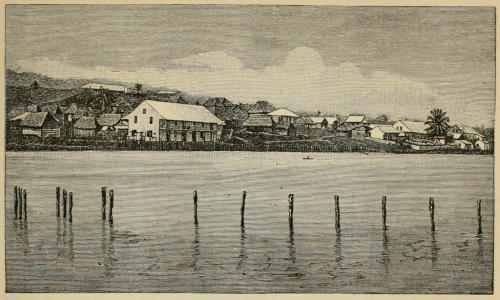
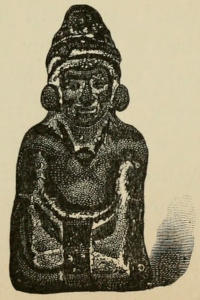
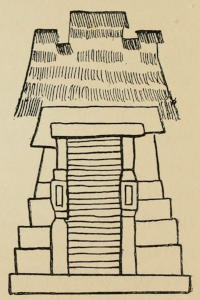
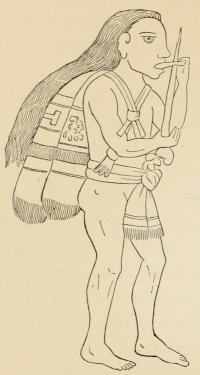
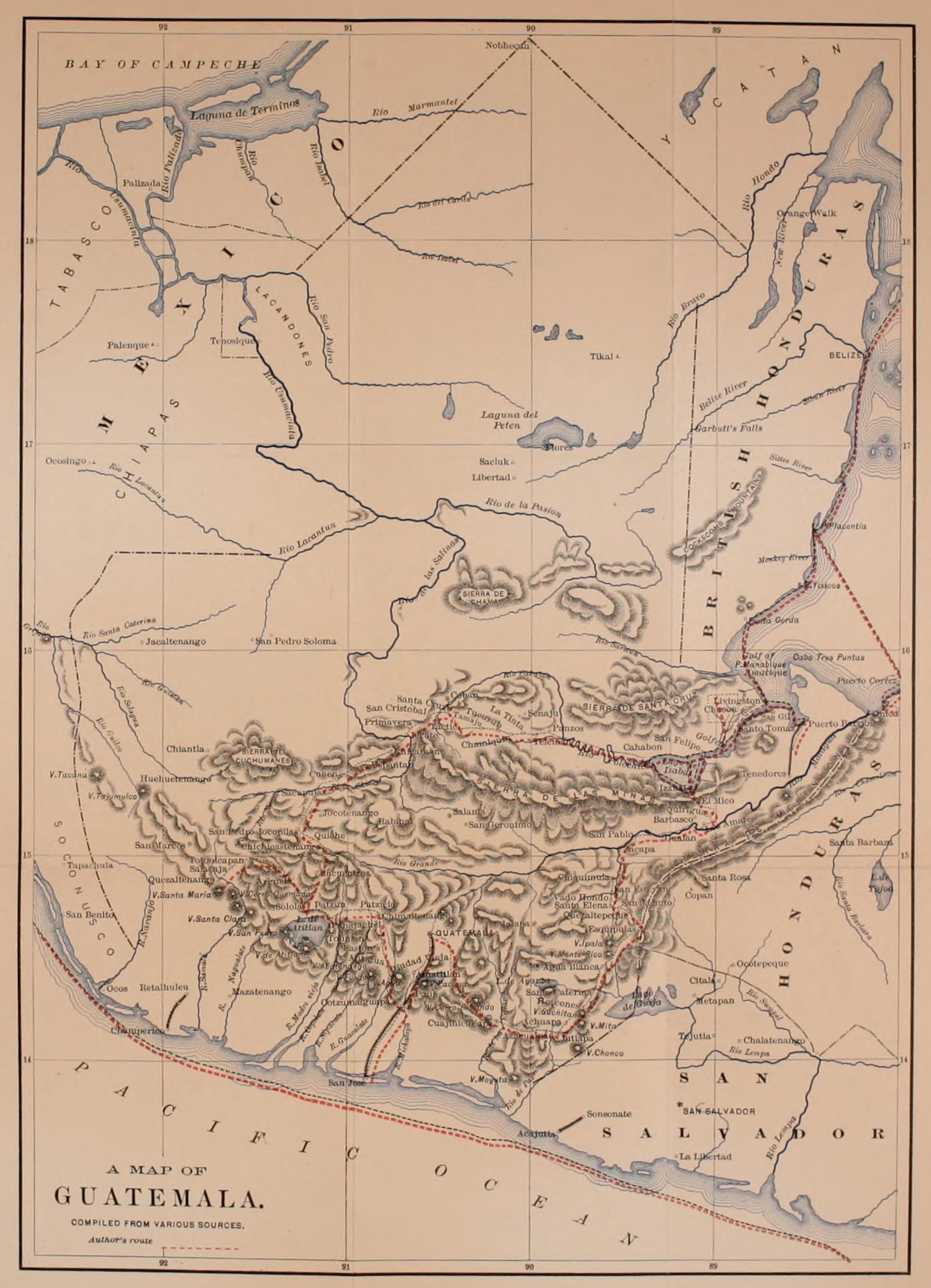
A belief in the increasing importance of Central
America, both geographically and politically, has
led the writer of the following pages to collect for his
own use and print for the use of others, notes made
during three journeys in Guatemala and Honduras. He
does not pretend to offer a monograph on Guatemala, nor
to add to the general knowledge of Central America; but
remembering the lack of guidance from which he suffered
in travelling through the country, would in some measure
save others from the same inconvenience. He seeks also,
with perhaps more ambition, to awaken among Americans
greater interest in the much-neglected regions between
the Republic of Mexico and the Isthmus of Darien.
A land which was the cradle of civilization on this
continent, and whose recently explored monuments are
most justly claiming the study and admiration of archæologists
in Europe as well as in America, has been
strangely neglected by the American traveller as well as
by the American merchant. Since the Travels of Stephens
fascinated the public nearly half a century ago, the people
of the United States have paid very little attention to
Guatemala or its commerce. Even now there are thousands
of square miles of wholly unexplored territory
between the low Isthmus of Tehuantepec and the Lake of
Nicaragua.
No country on the northern half of the American
continent has a finer climate or more beautiful and varied
scenery, or is a more attractive field for the genuine
traveller. Valleys rivalling the paradises of the islands
of the Pacific; uplands not unlike the plateau of the
Indian Neilgherries; forests as dense and luxuriant as
those of Brazil; lakes as picturesque as those of Switzerland;
green slopes that might have been taken from the
Emerald Isle; glens like the Trossachs; desert wastes
that recall the Sahara; volcanoes like Ætna; and a
population as various as in that land whence comes the
Indian name,—all these features make but the incomplete
outline of the Guatemaltecan picture. Then there
is that charming freedom from conventionality which
permits a costume for comfort rather than for fashion,
accoutrements for convenience rather than for show. No
dangerous beast or savage man attempts the traveller’s
life, no lurking danger or insidious pestilence is in his
path. The hair-breadth escapes, more interesting to the
reader than pleasant to the explorer, are rare here, and
the rough places and the irritations from which no land
on earth is wholly free, seem softened and vanishing to
the retrospective eye.
Old travellers know how soon the individuality of a
country is lost when once the tide of foreign travel is
turned through its towns or its by-ways; and when the
ship-railway of Eads crosses the Isthmus of Tehuantepec,
when the Northern Railroad extends through Guatemala,
when the Transcontinental Railway traverses the plains
of Honduras, and the Nicaraguan Canal unites the Atlantic
and the Pacific, the charm will be broken, the mule-path
and the mozo de cargo will be supplanted, and a
journey across Central America become almost as dull as
a journey from Chicago to Cheyenne.
In the sober work to which this Preface introduces the
reader, first impressions have been confirmed or corrected
by subsequent experience, and flights of the imagination
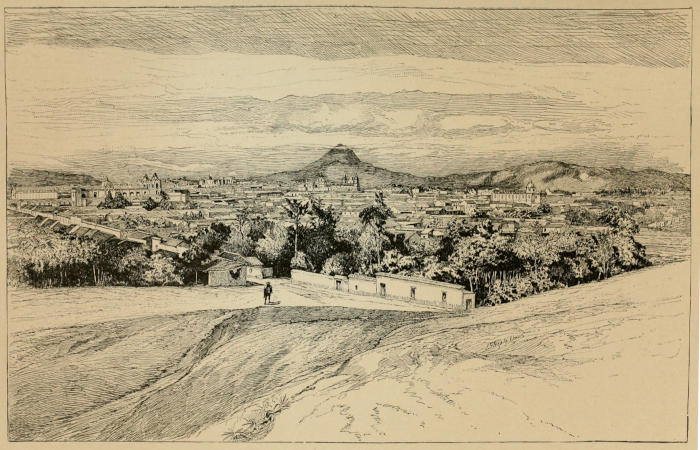
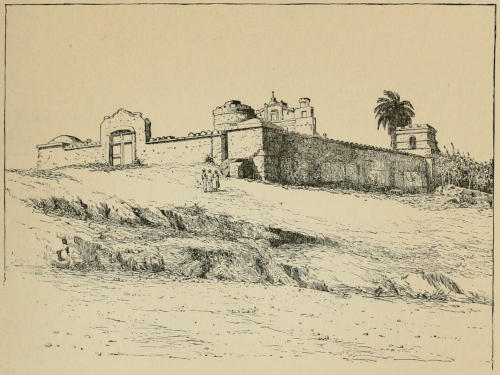
curbed by the truth-telling camera; from the published
maps the most correct portion has been selected, and the
statistics are from the Government reports. Many hundred
photographic plates made by the writer during a
period of three years have contributed to the illustrations
of this book, so that accuracy has been secured. Where
the plates are not direct reproductions from the negatives,
the ink drawings have been made from photographic
prints with care. There are no fancy sketches.
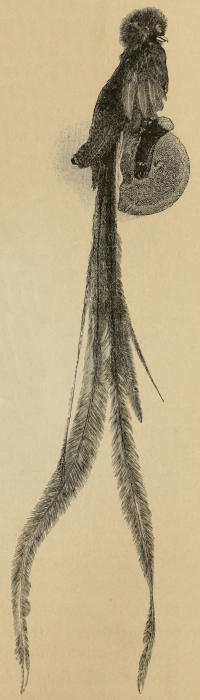
GUATEMALA: THE LAND OF THE QUETZAL. — CHAPTER I. THE KINGDOM OF GUATEMALA.
That part of the North American continent usually
known as Central America was included by the
Spanish conquerors in the kingdom of Guatemala; and
while my purpose is to describe the republic of Guatemala,—a
portion only of the ancient kingdom,—I may
be pardoned if I call the attention of my readers briefly
to the geography and history of all that country which
once bore the name and is still closely allied with the
interests of Guatemala.
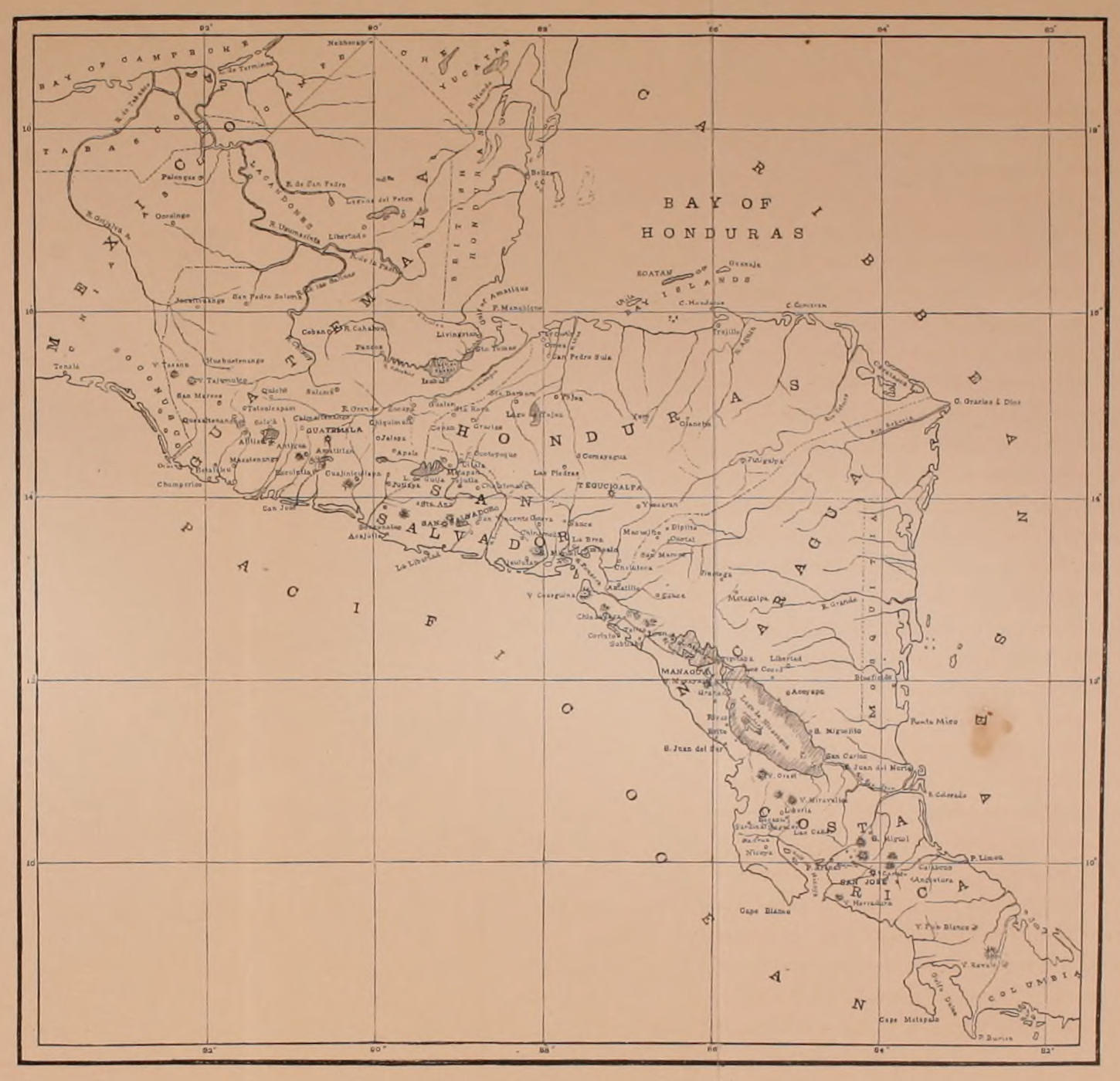
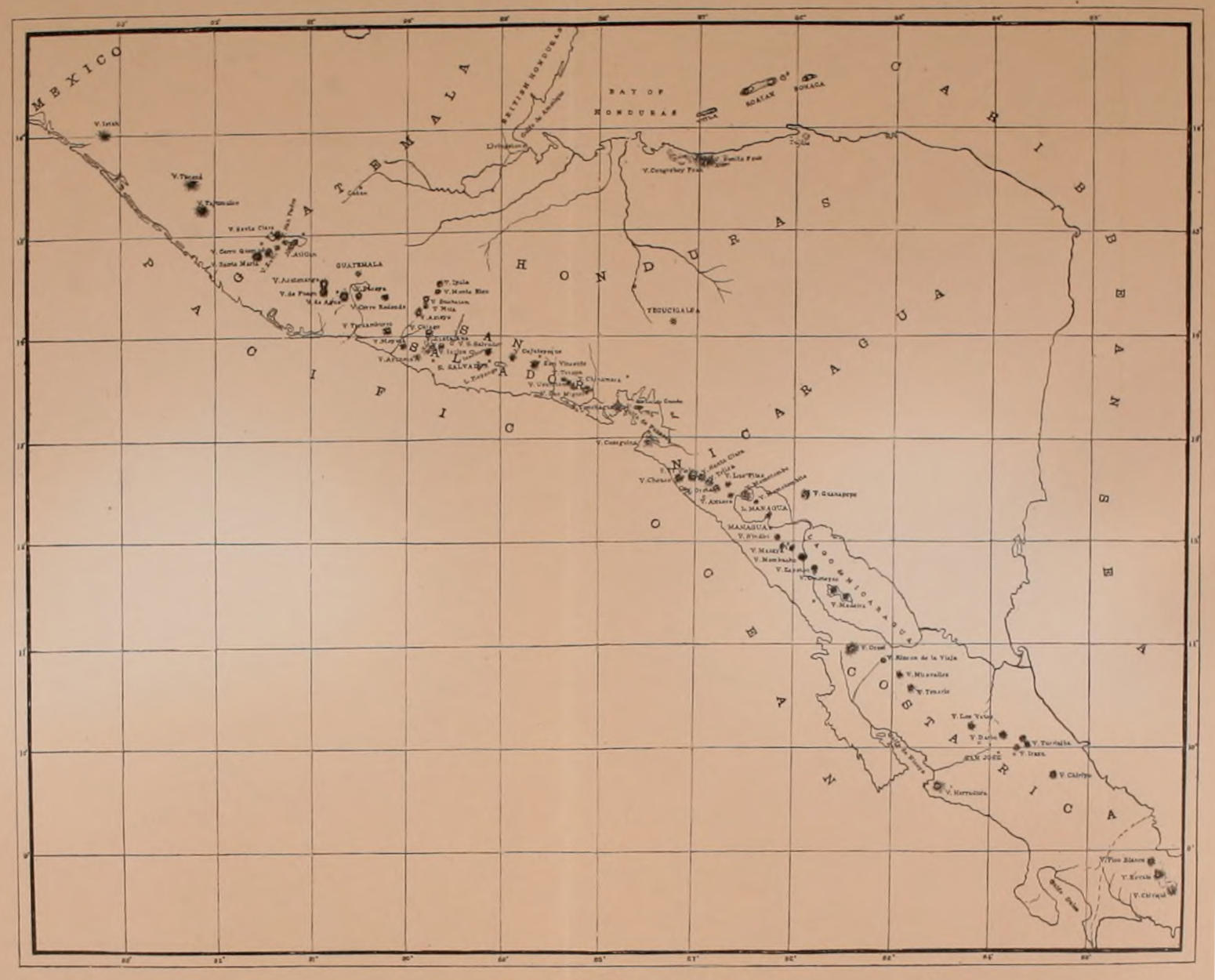
Central America should extend from the Isthmus of
Tehuantepec to that of Darien; from the Caribbean Sea
on the northeast, to the Pacific Ocean on the southwest.
Mexico, however, has taken Chiapas and Yucatan, on
the west and north, Great Britain has seized the east
coast of Guatemala (British Honduras), and the Isthmus
of Panama is included in the territory of South America.
The present independent republics of Guatemala, San
Salvador, Honduras, Nicaragua, and Costa Rica, constitute
what is known as Central America,—a territory
extending between 8° 10′ and 19° 20′ north latitude, and
between 82° 25′ and 92° 30′ west longitude. In length
it measures between eight and nine hundred miles, while
its breadth varies from thirty to three hundred miles.
No competent survey has ever been made of this country,
and even the coast-line is not always correctly
laid down on the best charts. Maps have been made
at haphazard in most cases, and very few positions
have been scientifically determined. Government surveys
along the lines of proposed canals or railways
have not extended beyond a narrow line, usually in
low regions remote from important centres. Dr. Frantzius[1]
has published a very excellent map of Costa Rica;
but most of the so-called maps published by or under
the authority of individual republics are of no scientific
value, the course of the principal rivers and the
direction of the main mountain-chains being unknown.
To illustrate the uncertain geography of Central America,
let me give the extent and population as published
by three authorities,—(I.) Lippincott’s Gazetteer,
(II.) Whittaker’s Almanac, and (III.) the “Geografía
de Centro-América” of Dr. González.
Square Miles.
Population.
I.
Guatemala
40,777
1,190,754
Salvador
7,335
434,520
Honduras
47,090
351,700
Nicaragua
58,000
236,000
Costa Rica
21,495
180,000
174,697
2,392,974
II.
Guatemala
40,776
1,500,000
Salvador
7,335
554,000
Honduras
39,600
300,000
Nicaragua
58,170
300,000
Costa Rica
26,040
200,000
171,921
2,854,000
III.
Guatemala
50,600
1,200,000
Salvador
9,600
600,000
Honduras
40,000
400,000
Nicaragua
40,000
(1882)
275,816
Costa Rica
21,000
200,000
161,200
2,675,816
Without surveys and without a proper census of the
Indian tribes no scientific description of the country can
be given. Humboldt’s theory of an Andean cordillera
has been disputed, and his mountain-chain has proved
to be a confusing (but not confused) series of mountain-ridges.
Yet it well may prove that the great naturalist
was right; and so far as we now know from maps and
personal observation, the vast earth-wrinkle which extends
along the western border of our continent is a
mountain-range of definite direction (about E. 20° S. to
W. 20° N.) in Central America, and there occupying
nearly the whole width of the continent. If we can
picture to ourselves the formation in those remote ages,
that it is the geologist’s task to rehabilitate in thought,
of a vast ridge, not sharp like the typical mountain
range, but of broad dimensions like the swell of some
vast ocean, we shall have the material then forming
the earth’s crust bent upwards, and in unelastic places
broken, and this partly or entirely beneath the ocean.
The rising land as the ages passed would be acted upon
not only by the ocean waves and currents, but by the
torrential rains, which were of a force and frequency
that even our water-spouts of the present age cannot
equal. Cracks were widened, gorges were formed; and
as the earth approached the present geological age, the
gentler rains only supplied the rivers and lakes which
now occupied the furrows ploughed deeply by primeval
torrents. The rough work was done, the statue blocked
out; and henceforth meteoric influences were merely to
finish, add expression and polish to the work.
A traveller crossing this territory from ocean to ocean
would sometimes follow the river valleys, then climb
ridges, again traverse a plain, cross a valley, ride along
another mountain-ridge, compassing a volcano, and finally
descend abruptly to the Pacific. His direction had not
changed, but the nature of his path had been wonderfully
transformed.
Geologists know well that on one of these lines of
disturbance, such as has been described, molten and disintegrated
material is apt to come to the surface as lava
and ashes; they expect also to find metallic veins, especially
of the precious metals, and hot springs with various
minerals in solution, and they infer earthquakes.
All these phenomena are present in Central America in
full force. Immense cones have arisen along the Pacific
slope since the general features of the land were made,
and not only have spread vast deposits around their
base, but have blocked up valleys, forming lakes as
Atitlan, built promontories as Coseguina, islands as
Ometepec in the Lake of Nicaragua, and have turned
rivers, changed prevailing winds, and otherwise altered
the physical conditions of the country.
Gold sands from the disintegrated veins sparkle in
every mountain-brook, and the deposits of silver are
no doubt as rich as those of Mexico, Nevada, and Potosi.
Aguas calientes, or hot springs, are found all over the
country, and earthquakes, often severe, are common on
the Pacific slopes.
All along the Atlantic side the rock material is limestone
or dolomite, while as one goes westward he meets
andesyte and other forms of trachytic lava, such as
pumice and obsidian. Even among the limestone mountains
of the northeast are occasional volcanic deposits,
exactly as might be expected when so extensive an
upheaval has taken place.
Whatever has been the exact process by which this
essentially mountainous country has been formed, we
have at present at its northern boundary the high plain
of Anahuac, extending from Mexico (where it is interrupted
by the Isthmus of Tehuantepec) through Guatemala;
of somewhat lower level in Honduras and Salvador;
sinking to almost sea-level in Nicaragua (154
feet); and rising again in the Altos of Veragua to about
3,250 feet. This main range has its axis much nearer
the Pacific shore and almost parallel to it, being in San
Salvador distant seventy-five miles, and in Guatemala
(Totonicapan) only fifty. Towards the Pacific the slope
is steep, interrupted by many volcanoes; while on the
Atlantic side the gently terraced incline is broken into
subsidiary ridges extending to the very shores. In the
oceanic valleys and along the coast are the only lowlands
of Central America; and these contain the wash
of volcanoes, limestone mountains, and ages of vegetable
growth and decay, forming the richest of soils for agricultural
purposes.
In Guatemala the mean height of the cordillera is
about seven thousand, and probably the mean height of
this republic is not less than five thousand, feet. The
Sierra Madre, or Cuchumatanes, in the Department of
Huehuetenango, is the highest land (always excepting
the volcanoes, which will be described later); and of the
less important ridges are the Sierra de Chamá (of limestone,
and full of caverns), which extends towards the
northeast and ends in the Cockscomb Range of British
Honduras; Sierra de Santa Cruz, also of limestone, extends
nearly eastward, north of the Lago de Izabal and
the Rio Polochic, and south of the Rio Sarstun; Sierra
de las Minas, nearly parallel to the last, and separating
the valley of the Rio Motagua from that of the Polochic.
Of this range is the Montaña del Mico and the peak of
San Gil, near Livingston: the material is no longer limestone,
but metamorphic rock, containing mines of some
importance. Last we have the Sierra del Merendon,
which forms the boundary between Guatemala and Spanish
Honduras; and with various names it finally ends in
the Montaña de Omoa on the coast,—an important landmark
several thousand feet high.
The mountains of Salvador are all volcanic and shoreward
of the main chain; but in Honduras the lines again
repeat the general arrangement of Guatemala, while the
names are many, indicating a more broken system. Between
the ranges are broad and fertile valleys, the Llano
de Comayagua being forty miles in length, with a breadth
of from five to fifteen miles. In Nicaragua the ridges
slope towards the southwest, breaking abruptly to the
Mosquito coast, and an important part of its territory is
occupied by the lakes of Managua and Nicaragua. From
the broad valley the land again rises towards Costa Rica,
where it attains the height of forty-three hundred feet,
and, owing to the narrowness of the continent, the lateral
branches are insignificant. From the table-land of
Veragua the cordillera dwindles to the basaltic ridge of
Panama.
Transcriber’s Note: image is clickable for larger version
CENTRAL AMERICA.
Rivers are, next to mountains, the most important
factors in the physical aspect of the land; and in
Central America they are abundant, though, from the
broken nature of the country, not of great size. From
the position of the backbone of the land, most of the
watershed is towards the Gulf of Mexico and the Caribbean
Sea; even the great lakes of Nicaragua, which are
really on the Pacific side, empty through the Rio San
Juan into the Atlantic, the river taking advantage of a
break in the cordillera. The lower or navigable portion
of the Central American rivers is the only part known;
the sources of even the largest streams are still unexplored.
So tortuous are the courses that names are
multiplied, and rivers that flow from inhabited valleys
through wild forests again appear in the lowlands as
unknown strangers; and the river that one traveller
describes as important and navigable, because he sees
it in the season of rain, the next visitor may cross knee-deep,
and know only as a brook.
On the Pacific side may be mentioned the Rio Lempa,
which rises near Esquipulas, receives the waters of the
considerable Lago de Guija (on the boundary of Guatemala
and Salvador), and even after the dry season is of
large volume, thirty miles from its mouth attaining a
breadth of more than six hundred feet and a depth of
ten feet, which is nearly twenty-seven when the floods
of the rainy season occur. If it were not for the bar,
which has hardly a fathom of water, the navigation
would develop rich lands on either bank. The Rio Paz,
the Rio de los Esclavos, and the Rio Michatoya are not
navigable, although formerly the latter stream at its
mouth (Istapa) was large enough within the bar to admit
the construction of vessels of moderate size; it was here
that the Spaniards fitted out several fleets.
Far different are some of the rivers that find their way
into the Atlantic. Chief among them all is the noble
Usumacinta, which flows into the Gulf of Mexico through
the Lago de Terminos, and is navigable many miles
through a singularly fertile and interesting country, as
beautiful as fancy pictures the cradle of the human race,—a
land seldom visited by white men, and the home of
the unconquered and unbaptized (La Candones) Indios.
The swift Chixoy, the Rio de la Pasion, and the almost
unknown San Pedro unite to form this “Child of many
Waters.”
The Belize River, rising in the Montaña de Dolores near
Peten and crossing the British colony, is the principal
highway for the commerce of Peten, the pitpans bringing
down huge mahogany bowls, paddles, baskets, and other
Indian goods. The Sarstun forms the southern boundary
of the British possessions, and is navigable for
small canoes as far as the rapids of Gracias á Dios.
None but timber-cutters disturb its solitudes. The Polochic
is at present the most useful river of Guatemala. It
rises near Tactic, and is a foaming torrent for much of
its course in Alta Verapaz. At Pansos the waters are
navigable for light-draft steamers, except in very dry
seasons; and not far below, its volume is materially
increased by the Cahabon. It flows through the Lake of
Izabal, and, as the Rio Dulce, empties into the Gulf of
Amatique over a bar of sand. The Motagua is nearly
parallel to the Polochic, and rises near Santa Cruz del
Quiché. From Gualan it is navigable in canoes. Smaller
streams are the Ulúa, Aguan, and Segovia in Spanish
Honduras, which are navigable for pitpans. Finally we
have the San Juan, known as one of the elements of the
“Nicaragua Canal” route, but not at present navigable
for boats of any size.
All the rivers of Central America that can be used for
commerce require a special river service; for wherever
the depth of water is sufficient, the always-present bar
cuts off access to vessels drawing more than six feet.
Should the development of the country warrant it, the
bar of the Rio Dulce could be deepened sufficiently to
admit vessels drawing ten or fifteen feet.
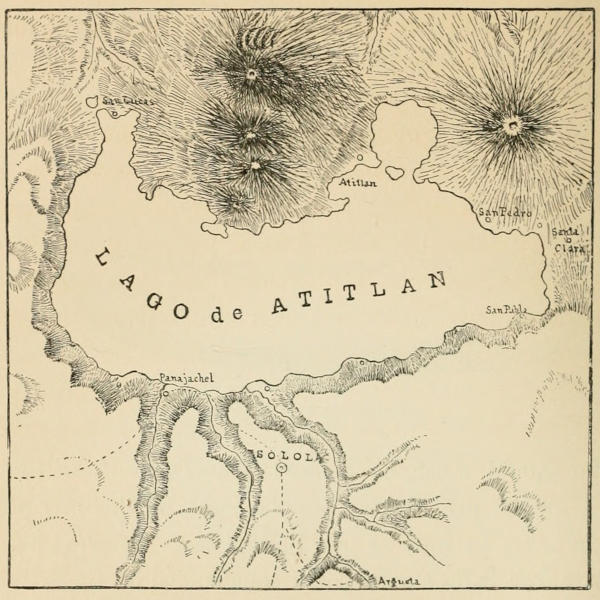
Small lakes are common enough in the northern part
of Central America. The Laguna del Peten is about five
hundred feet above the sea, nine leagues long and five
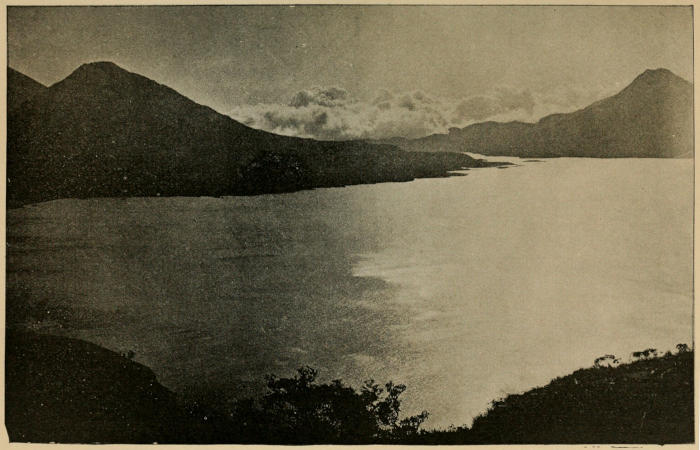
broad. The Lago de Atitlan, in the Department of
Sololà, is sixteen and a half miles long from San Lucas
Toliman to San Juan, and eight miles wide from San
Buenaventura to Canajpú, and soundings show a depth
of a thousand feet. With the Laguna de Amatitlan, this
will be described in the Itinerary. Of Honduras, the
chief lakes are the Laguna de Caratasca, or Cartago,
close on the Atlantic coast, thirty-six miles long by
twelve wide; the Lago de Yojoa, between the Departments
of Comayagua and Santa Bárbara, twenty-five
miles long and from five to eight wide; the Lago de
Cartina, eighteen miles by eight, and the Laguna de la
Criba, fifteen by seven miles. Of all the lakes of Central
America, none is so interesting commercially as the Lake
of Nicaragua. It is large (ninety miles by forty), and the
largest south of Lake Michigan. Of a depth sufficient
for all vessels (forty-five fathoms in places), and connected
with the Atlantic by the Rio San Juan, with the
Lago de Managua (thirty-five miles by sixteen), by the
Tipitapa, it has the serious disadvantage of being a volcanic
basin, whose bottom may at any time be elevated
above the surface,—as in the case of the volcano of
Ometepec. Whether the channel between these two lakes
is permanent, is a matter of some doubt, as travellers
have lately found no water flowing from Managua. The
Lago de Guija, between Guatemala and Salvador, is
seventeen miles long from east to west, and its mean
width is six. Fishes and alligators abound, and its waters—which
are not of the best quality—discharge through
the Lempa to the Pacific. Another lake in Salvador has
attracted attention in late years by a curious volcanic
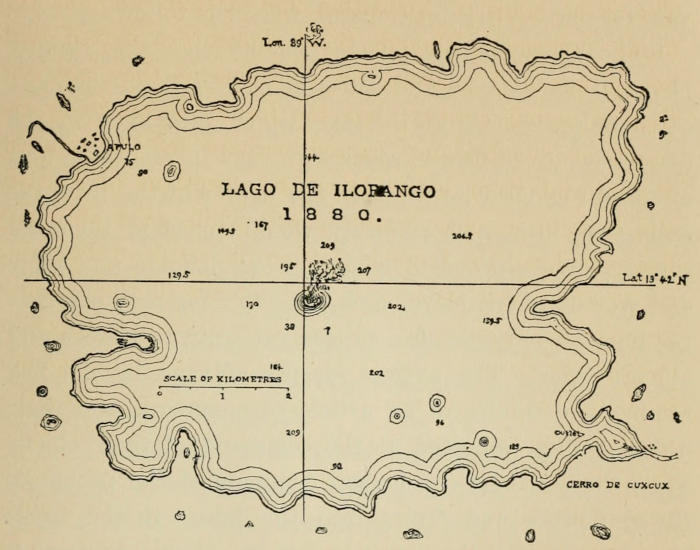
disturbance in its midst; Ilopango will be described with
the volcanoes.
With this bare list of some of the prominent features
of the country, we may join a brief account of those
other natural and political characteristics of what was
once Spain’s stronghold on this continent that have most
immediate relation to the present inhabitants. Leaving
Guatemala for a separate chapter, the other four republics
may be described as follows:—
Salvador.—The smallest in extent, but by far the
most populous, having no less than sixty-three inhabitants
to the square mile. The central part is an upland of a
mean elevation of two thousand feet above the sea, bounded
on the Pacific side by a chain of volcanic peaks; beyond
these a strip of lowland from ten to twenty miles wide.
Eastward and westward are two great depressions, San
Miguel and Sonsonate, “the place of a hundred springs”
(centsonatl). The Gulf of Fonseca, fifty miles long and
nearly thirty wide, is said to be the most beautiful harbor
on the Pacific coast. On the southwest side is the principal
port of La Union, a town of little more than two
thousand inhabitants, and unhealthful, as are all the Pacific
ports. The mean temperature is 80° Fahr.; and were it
not for the capital commercial facilities of the town, its inhabitants
would be few. Libertad has an open roadstead,
and a population only half that of La Union. Acajutla
lies between the headlands of Remedios and Santiago, and
has but five hundred inhabitants; as the port of Sonsonate
(distant five leagues), however, it is much frequented, and
is provided with an iron pier, as is Libertad. In 1882 the
first railway in the republic was opened, from Acajutla to
Sonsonate, a distance of fifteen miles; and work has since
been slowly progressing in the direction of Santa Ana.
Mines of gold, silver, copper, lead, iron, and anthracite
coal are found within the borders of Salvador, the principal
being those of Loma-Larga, Corozal, Devisadero,
Encuentros, and Tabanco.
The capital was founded April 1, 1528, by Jorge de
Alvarado, brother of the conqueror of Guatemala; but
ten or twelve years afterwards it was removed to its
present site in the valley De los Hamacas, where it has
been many times ruined by the terrible earthquakes to
which this region is especially subject.
The republic is divided into fourteen departments,
twenty-nine districts, and two hundred and twenty-eight
towns.
Departments.
Principal Cities.
Santa Ana.
Santa Ana (25,000).
Ahuachapan.
Ahuachapan.
Sonsonate.
Sonsonate (8,000).
La Libertad.
Nueva San Salvador (Santa Tecla).
San Salvador.
San Salvador (30,000).
Chalatenango.
Chalatenango.
Cuscatlan.
Cojutepeque.
La Paz.
Santa Lucia (Zacatecoluca).
San Vincente.
San Vincente (10,000).
Cabañas.
Sensuntepeque.
Usulutan.
Usulutan.
San Miguel.
San Miguel.
Gotera.
Gotera.
La Union.
San Carlos (La Union).
The legislative power is exercised by two chambers,—one
of Deputies, the other of Senators; each Department
elects a senator and a substitute, each District a representative
and his substitute. The executive power is in
the hands of a citizen elected as President by the people
directly; should there be no election by an absolute
majority of votes, the General Assembly elects from the
three citizens who have obtained the greatest number of
votes. Three senators are designated as heirs-apparent.
The term of office is four years, without immediate
re-election. The judiciary is similar in order and functions
in all these republics, and will be described as in
Guatemala. The organized militia numbers about thirteen
thousand men; and in case of invasion, war lawfully
declared, and internal rebellion, all Salvadoreños between
the ages of eighteen and fifty are liable to military
duty.
In 1879 the number of primary schools was 624 (465
boys’, and the rest girls’); and these were attended
by 20,400 boys and 4,038 girls, at a probable cost of
$150,000. There is a central university, with faculties
of Law, Medicine, Theology, and Civil Engineering, and
it has branches at Santa Ana and San Miguel.
There are six hundred and ninety-three miles of telegraph,
with forty offices; and the service is reasonably
well performed by the Government officials. A railroad
between Santa Tecla and the capital, and five hundred
and nine leagues of cart-roads, afford communication;
and there are lines of stages subsidized by the
Government.
In 1879 the imports were $2,549,160.19, and the
exports $4,122,888.05; the income $2,914,236.29, and
the expenditures $2,785,068. The funded debt was
$1,945,201, the floating debt $392,777.11, and there
is no foreign debt.
Salvador is essentially an agricultural state, and coffee,
indigo, balsam, tobacco, rice, cacao, sugar, rubber, and
other less important products are produced abundantly
from her fertile fields.
Honduras.—The third republic of Central America
covers an area of about forty thousand square miles.
Its boundaries are seen on the map, and its surface is
diversified with high mountain-ranges, broad and fertile
valleys, vast forests, and plentiful streams. Its climate
is extremely hot on the coast; but in the mountain
region, as at Intibucá, the temperature is low. Never
so hot as a summer in New England cities, and not so
cold as to check a most luxuriant vegetable growth, the
traveller has an alternation of spring and summer as he
changes his level, irrespective of the astronomical year.
Four hundred miles of Atlantic coast-line, dotted with
river-mouths, bays, and ports; sixty miles on the Pacific
side, in the secure Gulf of Fonseca,—seem to provide
ample commercial advantages; and to make these of use
are the following resources: vast plains in Comayagua
and Olancho, covered with excellent grass, pasture large
herds of cattle, thousands of which are shipped each
year to Cuba.[2] The forests, which occupy much of the
Atlantic coast-region and the lower mountain-slopes
abound in mahogany, rosewood, cedar (Bursera), logwood
(Hæmatoxylon campecheanum) brazil-wood (Cæsalpinia
Braziliensis), sarsaparilla (Smilax), and other marketable
products; the principal timber regions being on the rivers
Ulúa, Aguan, Negro, and Patuca,—all on the Atlantic
side. In mineral wealth Honduras easily outranks all her
sister republics. Silver ores are exceedingly abundant,
chiefly on the Pacific slopes; and among them are chlorides
of remarkable richness. Gold washings occur in Olancho,
and are now worked by several foreign companies. Copper
deposits are often mingled with silver; iron exists as
magnetite,—sometimes so pure that it may be worked
without smelting; antimony, tin, and zinc also have been
reported. Beds of lignite are found in the Department of
Gracias; and here too are the Hondureñan opals. Fruits
of many kinds are now grown in the neighborhood of
Puerto Cortez, such as bananas, plantains, coconuts,
pines, for which there is a constant demand from the
steamers which come here from New Orleans. Of indigo
little is now exported; but the production of tobacco is
increasing. Especially fine is the leaf grown near Copan,
rivalling, when properly cured, the best product of the
Cuban valleys; but the common cigars, which are sold for
eight dollars per thousand, are dear even at that price. In
1879 the importations were valued at about one million
dollars, and the exports twice that amount. In later
years these exports have largely increased. A railroad
of narrow gauge extends from Puerto Cortez to San
Pedro,—thirty-seven miles; and while the republic is
sadly deficient in cart-roads, it is only fair to say that the
authorities are doing something to improve these very
necessary means, in the expectation that the country is
to develop as it deserves.
The government is very like that of Salvador, and
the administrative departments are:—
Departments.
Chief Cities.
Islas de la Bahía.
Coxen Hole (Roatan).
Yoro.
Yoro.
Olancho.
Juticalpa.
Paraíso.
Yuscaran.
Tegucigalpa.
Tegucigalpa (12,000).
Choluteca.
Choluteca.
La Paz.
La Paz.
Comayagua.
Comayagua (10,000).
Santa Bárbara.
Santa Bárbara.
Gracias.
Gracias.
Copan.
Santa Rosa.
Colon.
Trujillo.
Public lands are abundant, and are granted to actual
settlers of any nationality at low rates, provided they
will cultivate them. The towns are all small, although
some of them were flourishing sixty years before the
settlement of Jamestown in Virginia. Of the more important
are Tegucigalpa, the capital, in the midst of a
plain some three thousand feet above the sea, and surrounded
by a mining region. It possesses a Universidad
Central, founded in 1849 by Don Juan Lindo, then President.
Comayagua was founded in 1540 by Alonzo de
Cáceres, also in the midst of a plain, where still are
visible the monuments of antiquity,—the less perishable
works of a people more energetic than their successors;
for with the exception of some few churches, little of
the work of the present inhabitants would survive three
centuries of occupation by a foreign invader. Amapala,
on the Island of Tigre, in the Gulf of Fonseca, was formerly
a favorite rendezvous of the buccaneers, Drake
making it his base of operations in the South Sea. Now
it is no less desirable as a port, having deep water close
to shore. Puerto Cortez, or Puerto Caballos,—as Cortez
called it, from the death of some of his horses here,—on
the north coast, in latitude 15° 49′ N., and longitude
87° 57′ W., was selected by Cortez as the entrepôt of
New Spain, under the name of Navedad. For more
than two hundred years it was the principal port on the
coast; but dread of the buccaneers caused the removal to
Omoa. The bay is nine miles in circumference, with a
depth of from four to twelve fathoms over its principal
area; and on the northern side, where the water is
deepest, large ocean steamers may come to the wharves.
Omoa, in latitude 15° 47′ N. and longitude 88° 5′ W.,
has a smaller harbor, defended by the Castillo de San
Fernando. Trujillo, an ancient port on the western shore
of a noble bay, is now growing in importance with the
development of Olancho, of which it is the natural seaport;
but it has no wharf or any sufficient landing-place
for merchandise.
The Bay Islands are small, but of considerable importance.
Roatan, the largest, is about thirty miles long
by nine broad, and in its highest part nearly a thousand
feet above the sea. Guanaja, or Bonaca, the first land
of Central America discovered by Columbus on his fourth
voyage, is fifteen miles from Roatan, and of an extent of
five by nine miles. This group is fertile, and with a fine
climate should prove very attractive to settlers from the
North who appreciate the waste of life in an arctic climate
of eight months each year, when all vegetation
ceases to grow, and man himself can be kept alive only
by artificial heat, where the farmer must toil wearily four
months for the poor produce that is to sustain him all
the “famine months,” and the laborer live poorly all the
twelvemonth, whatever be his work.
The history of Honduras has not been a happy one,
even since its revolt from the Spanish yoke in 1821, and
revolutions have been the rule; but in 1865 a new Constitution
was adopted, with some prospect of internal
quiet. The four hundred thousand inhabitants include
perhaps seven thousand whites, the Spanish population
being mainly on the Pacific side, Caribs along the Atlantic
coast, and several thousand of the mixed races, the great
majority being Indios, known as Xicaques and Poyas.
Perhaps the most adverse influence to the progress of this
naturally rich republic, next to the revolutions, was the
scandalous loan for building the “Honduras Inter-oceanic
Railway” from Puerto Cortez to the Gulf of Fonseca, a
hundred and forty-eight miles. This loan, amounting in
1876 to $27,000,000, was as complete a swindle as has
ever disgraced American finances; but the people of Honduras,
although responsible for the debt, had little to do
with its origin, and cannot rightly be blamed for not paying
interest on what they never had any advantage from.
The internal debt is about $2,000,000.
Nicaragua.—Of nearly the same area as Honduras,
Nicaragua is chiefly distinguished by its lower level and
the great lake which offers so inviting a route for an
inter-oceanic canal. The same fertility and genial climate
extend from the Hondureñan uplands into Chontales and
Segovia, where Northerners can enjoy life; but it is hot
and unwholesome near the sea, especially throughout the
Mosquito Reservation, where the frequent river-floods
and the miasmatic marshes breed an endemic fever very
fatal to Europeans. The mean annual temperature (excepting
the highlands) is about 80° F., falling to 70° at
night, and rising to 90° in the hottest weather. The
seasons, as elsewhere in Central America, are two,—the
wet from May to November, the dry including the winter
months. At Rivas, on the isthmus between the Lago de
Nicaragua and the Pacific, the annual rainfall is about
a hundred and two inches; elsewhere the summer rainfall
is about ninety, and the winter less than ten.
Geologically, Nicaragua is no less rich than Honduras
in variety of structure and mineral possibilities. The
volcanic formations on the extreme West are rich in
pumice and sulphur, while across the lake are andesyte,
trachyte, greenstone, and metalliferous porphyries, succeeded
by crystallized schists, dolerites, and metamorphic
beds, extending, so far as is known, beneath the alluvial
deposits of the coast-region. The Chontales gold mines
have been worked for some time near Libertad, and so
have the silver mines of Matagalpa and Dipilto; but the
total annual yield of precious metals seldom exceeds
$200,000.
The chief articles of export are cacao, hides, coffee,
and gums, as well as gold and silver bullion; and in
1880 the exports amounted to $2,057,500, and the imports
to $1,475,000. The revenue for this year was
$2,435,000, while the expenditures slightly exceeded it.
All Nicaraguans between the age of eighteen and thirty-five
are in the army.
For more than half a century Nicaragua has been
darkly distinguished above all other countries of the
world by war and bloodshed. Military pronunciamientos,
civil war, and popular revolts have so exhausted all
the resources of this rich country that it is quiet at last
from utter exhaustion. Could these fermenting republics
be induced to give up their absurd and expensive
military establishments, and expend the money, now
worse than wasted, in opening roads and teaching the
people something besides military drill, the prosperity
of this wonderfully fertile and agreeable region would
be assured. Only their revolutionary habits now stand
in the way of the introduction of foreign capital; and
are not these habits fostered by the constant military
display which guards the President and judges alike? It
is certainly foreign to all Northern ideas to have a court
of justice guarded by military sentinels. Would that this
Eden might be reclaimed, the swords beaten into ploughshares,
and the generals and other officers turn their
wasted energies to agriculture and commerce!
Nicaragua is divided into the following departments,
according to the census of 1882:—
Departments.
Chief Cities.
Managua
12,000
Managua
7,800
Granada
51,056
Granada
16,000
Leon
26,389
Leon
25,000
Rivas
16,875
Rivas
10,000
Chinandega
17,578
Chinandega
11,000
Chontales
27,738
Libertad
5,000
Matagalpa
51,699
Matagalpa
9,000
Nueva Segovia
36,902
Ocotal
3,000
San Juan del Norte
2,000
Greytown
1,512
Mosquitia
36,000
Blewfields
1,000
These figures cannot, however, be relied upon for the
population. With a coast-line of two hundred and eighty
miles on the Caribbean Sea, the only port is San Juan del
Norte (Greytown), formed by the northern branch of the
delta of the San Juan; and this is now nearly choked
with sand. The Pacific coast is bold and rocky, extending
nearly two hundred miles from Coseguina Point to Salinas
Bay, and has several convenient harbors, as San Juan
del Sur, Brito, and, best of all, Realejo. Among the
chief cities is Leon, founded by Francisco Fernandez de
Córdoba in 1523 in Imbita, near the northwest shore
of Lago de Managua, whence it was moved in 1610 to
the present site at the Indian town of Subtiaba. Managua,
the capital of the republic, was nearly destroyed in
1876 by a land-slide, but is now rebuilt. Granada is the
collegiate town of the republic, and is on the shores of
the great lake. A railway has long been in process of
construction to connect the capital with the ocean. In
1882 the telegraphic system of eight hundred miles was
completed, and eighty-one thousand despatches were forwarded
the preceding year through twenty-six offices.
In 1882 the total attendance at the national schools was
only five thousand, or less than eight per cent of the
whole population. The annual grant for the purposes of
education was $50,000.
The Mosquito coast cuts from Nicaragua a large portion
of her shore-line, precisely as British Honduras robs
Guatemala of hers; and this has been a cause of serious
trouble. This territory, which is about forty miles wide,
had been under the protection of Great Britain from 1655
to 1850, when that very un-American document the Clayton-Bulwer
treaty gave England certain rights in her colony
of Belize in exchange for such claims as she had to
this coast, and by the treaty of Managua, in 1860, she
formally ceded her protectorate to Nicaragua; but there
are still several disputed points.
Costa Rica.—The fifth and most southern republic of
Central America has an area of only twenty-one thousand
square miles. The Atlantic coast is low, and the country
is covered with a dense forest, while the Pacific slope is
characterized by wide savannas, or llanuras. Between
these borders are high volcanoes and an elevated table-land
three to four thousand feet above the sea,—the
latter almost the only cultivated land in the State. The
forests are largely composed of very valuable trees,—mahogany,
ebony, brazil-wood, and oak; and the usual
tropical fruits grow well. Coffee, however, is the staple
export, being grown extensively in the neighborhood of
San José and Cartago; the soil most favorable being dark
volcanic ash, from three to eighteen feet deep. The
amount exported in 1874 was valued at $4,464,000; in
1885 the amount is placed at $4,219,617.
On the Atlantic side Puerto Limon is the chief commercial
town, and on the Pacific, Punta Arenas. In
1871 the Government negotiated a loan in London of
$5,000,000, and the next year another of $12,000,000,—but
from both of them never received more than
$5,058,059.60,—with the avowed intention of building
an inter-oceanic railway between the two principal ports;
but only detached portions have been built,—twenty-four
miles from Alajuela to Cartago, sixty from Limon to Carrillo,
and six from Punta Arenas to Esparta. The country
is bankrupt, and makes no attempt to pay any part of its
liabilities; indeed, its revenues, derived from intolerable
duties (even on the export of coffee), monopolies of spirits
and tobacco, national bank, sales of land, and internal
taxes, do not balance the expenditures.
The legislature is composed of a Congress of Deputies,—one
for each electoral district,—holding office six
years, half being renewed every three years. The members
of the Corte de Justicia are elected by Congress.
The present constitution (from 1871) is the seventh that
has been in force. The departments are,—
Departments.
Chief Cities.
San José
45,000
San José
15,000
Cartago
36,000
Cartago
10,000
Heredia
30,000
Heredia
9,000
Alajuela
29,000
Alajuela
6,000
Guanacaste
8,000
Liberia
2,000
Punta Arenas
6,000
Punta Arenas
1,800
The population is estimated by M. Belly.
Both the northern boundary on Nicaragua, and the
southern one on Columbia, are in dispute.[3]
I have endeavored to give most briefly the chief matters
of importance relating to the four republics that, with
Guatemala, constitute Central America. I am well aware
that I have turned, that I can turn but little light on
the darkness; too little is known of the country, beyond
its trade and political relations to the rest of the world.
Volcanoes, earthquakes, and revolutions have popularly
been associated with the whole region, and public taste
has been turned away from such unpleasant outbreaks of
subterranean fires or human passions. The time will
come when these regions, far more fertile and accessible
than those African wilds that for a score of years have
interested, strangely enough, both explorer and capitalist,
will claim the attention due their natural merits; and
the fertile plains will be the garden and orchard of the
United States,—not necessarily by political annexation,
but by commercial intercourse. All our sugar, all our
coffee, all our rice, all our chocolate, all our india-rubber
ought to come from Central America, where these products
can be raised better and cheaper than in any other
country; and next to these staples, the subsidiary fruits,
as oranges, plantains, bananas, pines, limes, granadillas,
aguacates, and dozens of others now unknown to commerce,
ought to come to us from Limon, Puerto Cortez,
and Livingston. These are to be obtained in Guatemala
of better quality and in better order than in the West
Indies. Louisiana would then perhaps give up the unnatural
cultivation of sugar, and Florida cease her useless
striving to raise really good oranges, and both States
turn to the products they are better fitted for raising.
I will ask you to go with me through the republic
of Guatemala, and to see it, so far as you can, with my
eyes; and until that journey is ended, we will leave the
story of the old times, the present system of government,
the ethnology, the volcanoes, the flora and fauna, to
chapters by themselves, even if the unsystematic arrangement
should savor strongly of the irregularity of the
land we journey through.
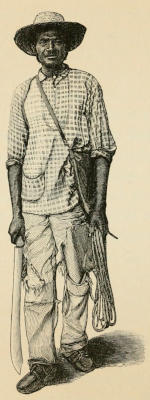
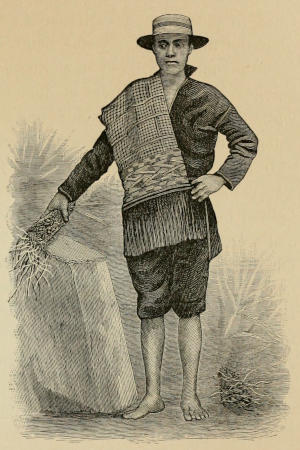
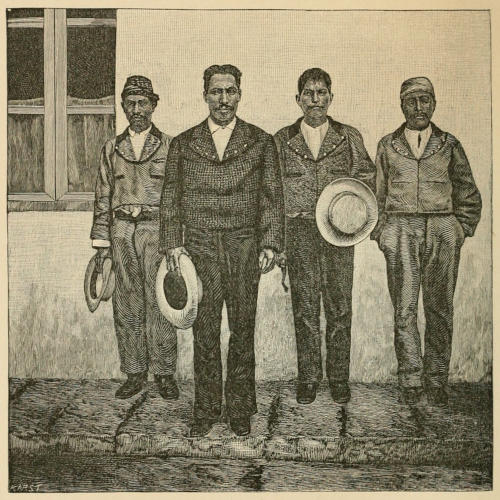
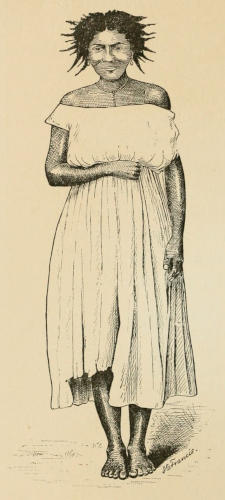
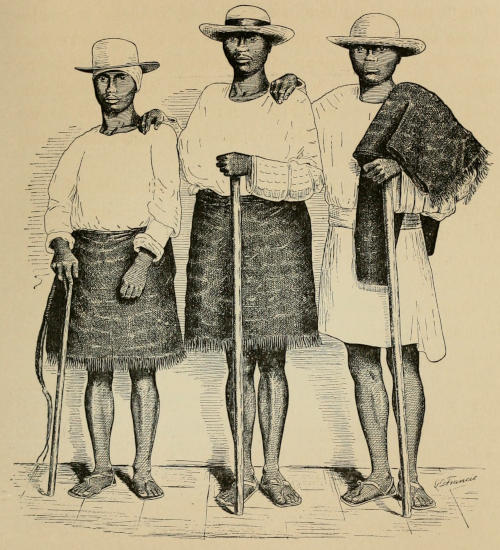
Luciano Calletano (Captain at Chocon).
CHAPTER II. THE ATLANTIC COAST AND ITS CONNECTIONS.
As the steamer anchors far from the shore at the
port of Livingston, the traveller sees almost exactly
what the Spaniards saw,—earth, sky, and sea, so
little change have four centuries wrought on the outer
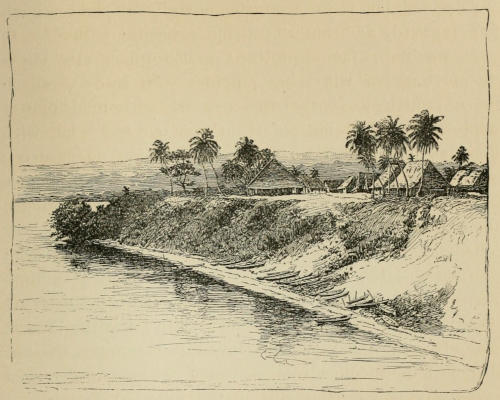
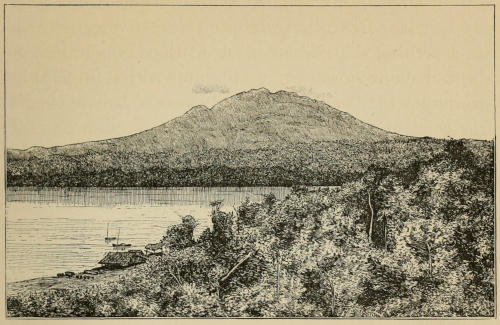
shores of Guatemala. Northward are the picturesque
hills of British Honduras, backed by the blue summits
of the Cockscomb range; southward the majestic San
Gil, bearing like another Atlas the clouds on his broad
shoulders; eastward the low Cays, covered with the
feathery coconuts; before him the shore, here marked
by a long limestone cliff crowned by the palm-sheltered
houses of the Caribs, while farther to the westward
rise the Santa Cruz mountains. The yellow waters of
some great river lave the vessel’s sides; but no break
is visible in the landward horizon.
For a while all is as it was when Hernan Cortez, in
the year 1525, came to this shore after his terrible
march from Mexico. There was even then a little village
on the high bluff; and he found two of his countrymen
gathering sapotes (Lucuma mammosa) to save the
little colony of Spaniards, a few leagues farther south,
from starving. Waiting in the early dawn for the landing-boats,
I cannot but recall the ancient times; imagination
sinks the great steamer into the little caravel, and
the feelings of the conquistadores are mine for the time.
Soon the white sails drop out from the foliage, the canoes
are seen rapidly approaching, and the chatter of Caribs,
both men and women, banishes all daydreams.
The “Progreso,” once a Buzzard Bay racer, sails rapidly
out and takes on board her cargo,—my friend, his mother,
and myself, and traps of no light weight. Her bows
are soon turned landward, and as she glides along, all
the features of the shore unfold,—the coco-palms of
marked luxuriance, the thatched houses with shining
white walls, the limestone cliff almost covered with convolvulus
and other foliage, the narrow beach, the canoes
of various size and shape. We turn a point, and the town
of Livingston is before us, and we are in the mouth of
the Rio Dulce.
On the shore the only prominent building is the custom-house,
built before Livingston was declared a free
port; and in front of this is a low, dilapidated wharf, at
which our tender landed us, the water being not more
than fifteen inches deep. The tides here are less than a
foot, so that shoal-water keeps boats of any size at a distance,
making landing difficult. It was comforting to
know that a charter for a wharf had been obtained, and
that our successors may land with greater ease.
We did not find the heat greater than on the steamer
in the offing, and even the necessary bustle and trouble
in getting luggage transferred to the backs of men did
not cause discomfort. The custom-house and a few
offices occupy the front of an amphitheatre with very
steep sides, above which is the town. Springs burst
from the gravel and furnish pools for the washerwomen,
whose sturdy, yet graceful forms, barely concealed by
their scanty garb, are very attractive. Some stood in
the clear pools, others bent over the washing-stones,
some played with their children in the water, while
others climbed the steep path to the town, carrying a
head-burden of great weight.
Barrack Point, Livingston.
Our abode was on the Campo Santo Viejo, the burial-hill
of former days, and right across our path lay the
empty tomb of a son of Carrera, the former President of
Guatemala; as we passed this we noted the admirable
mortar with which its bricks were laid,—so strong that
no brick can be cut out whole. On this resting-place
of perished Caribs the foreign inhabitants of Livingston
dwell. It is the west end of the town, and overlooks
both the river and the native town, where are also the
stores and the hotels.
All descriptions of a growing town must be unsatisfactory,
so rapidly does the population and topography
change; and a few words may convey all the geographical
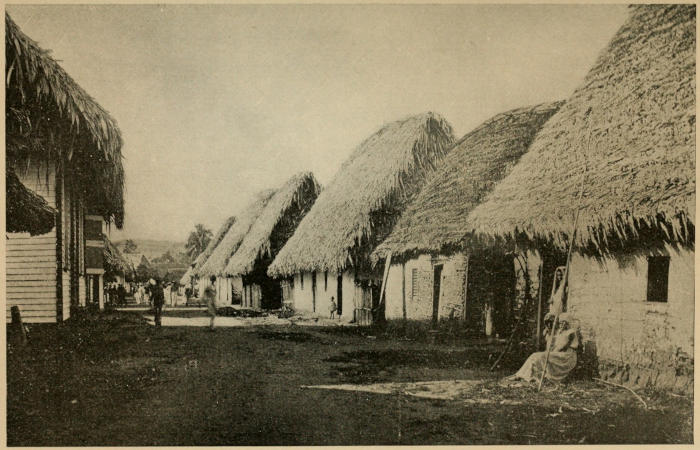
knowledge needed. Rolling ground, which might easily
be drained, but is not; streets generally at right angles,
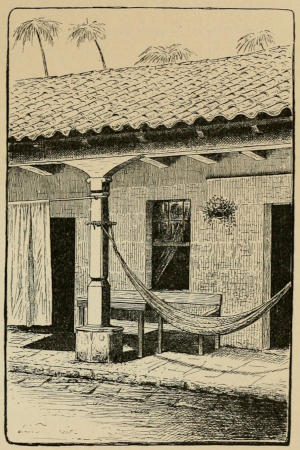
none paved, and most of them exceedingly muddy in
wet weather; fences of the rudest form, mostly sticks
bound together with vines; houses with walls of adobe
or of wattle, in both cases covered with mud plaster
and whitewashed, none of them over one story, but with
high roofs thatched with palm; yards, but no gardens;
stores here and there built of boards from New Orleans,
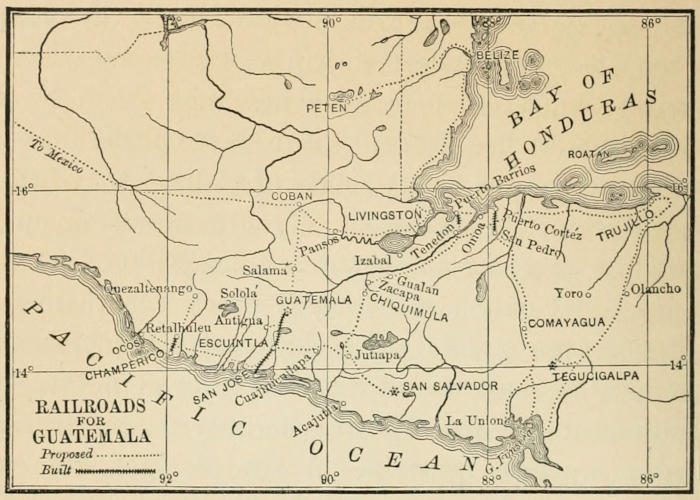
and occupied by foreigners,—French, Germans, Italians,
Americans (del Norte); a dilapidated chapel on or
among the neglected foundations of an intended church;
beyond this the barracks on a beautiful point; children
of all ages playing in the dirt and merrily greeting
the passer-by with their black, shiny, healthy faces;
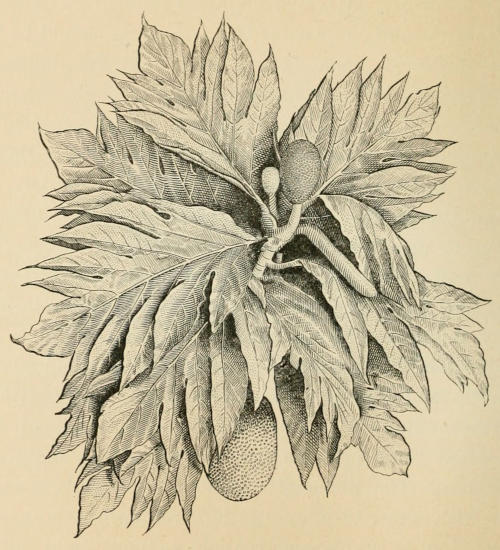
palm-trees, mangoes, sapotes, bread-fruit, oranges, anonas,
bananas, and coffee-trees scattered without order, and
wholly uncultivated,—make the external features of
this place. No vehicles are in the streets, though a
few horses roam untethered through the town. Every
burden is carried on the heads of men or women. The
house-doors are all open; but the interior is generally
too dark to disclose much of the inner mysteries to the
stranger. Westward from the town lies the new Campo
Santo, and beyond this the almost impenetrable forest.
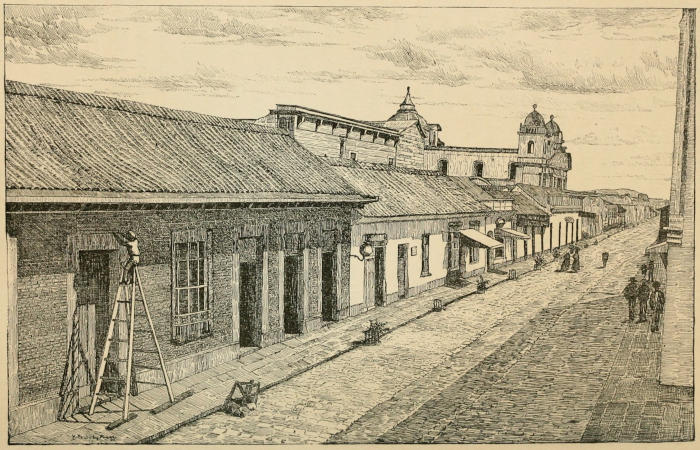
A STREET IN LIVINGSTON.
The situation of Livingston is good,—at the mouth of
one of the finest rivers of the Atlantic coast of Central
America. The climate is very healthful and agreeable,
and the frequent communication by two lines of steamers
with New Orleans, one line with New York, and another
with Liverpool, make it an important business-centre.
All the fine coffee from Alta Verapaz and the fruit from
the plantations on the Chocon and Polochic is shipped
here; and the product might be indefinitely increased.
The drawbacks are a bar with only a fathom of water
at the mouth of a river navigable otherwise for many
miles by the largest steamers, no wharves, little enterprise
on the part of the native inhabitants, and a frequent sea-breeze
in the afternoon, which sometimes makes landing
through the rough water on the bar unpleasant. The
population is about two thousand, chiefly Caribs; and
long inaction and complete lack of enterprise have produced
a people poor and careless of riches if obtained at
the price of labor. As in all similar places, there is no
lack of adventurers of the lowest character.
All this matter is not, however, learned at once, and
observation must be depended on rather than report; for
the merchants of Livingston see the prospects of their
town in very different lights when talking with a mere
visitor or with a possible rival in the small but very
profitable business. As a stranger, I was told that the
place was an el dorado; that limitless crops grew without
urging from a soil of unequalled richness; that the
climate was salubrious, and eternal summer reigned; that
business was brisk, and constantly increasing under wise
laws and a favoring government. As a settler, the song
was sung to me in a minor key: labor was not to be had;
no good lands could be obtained; the steamers were the
tyrants of the place, and all earnings were eaten up by
freights. Then there were the warning cries of those
unfortunate men who wanted to make money in a newly
opened country, but had not the necessary courage and
endurance for a pioneer. They had not met success, and
they had not grit enough to seek it. Micawbers far from
home, they waited for something to turn up.
The process of finding out about the place was not an
unpleasant one; it was what we had come for, and we
began it the first day at breakfast. While we lodged in
our house on the hill, we took our meals—with the exception
of early coffee and rolls—in the town at the house
of Señor Castellan; and they were in genuine Hispano-American
style. Eleven o’clock is the hour for almuerzo,
or breakfast, and thus the time for ceasing work and
taking the needed midday rest. Late in the afternoon
came the comida, or dinner,—differing from breakfast only
in the occasional provision of dulces, or sweetmeats. The
menu was constant; an oily soup, beans black or white,
beef or chicken stew with chillis, fish, bread, and coffee,
formed the almost unvarying round. Our waiters were
two little boys,—one the son of our host, the other his
ward. With our coffee we generally had fresh milk; but
when the supply of this failed, a can of condensed milk
took its place. Not infrequently the sugar also failed;
and then one of the boys ran to the nearest store and
bought half a pound of a coarse brown kind, and replenished
the saucer that did duty as sugar-bowl. No supply
of anything was ever kept in the house.
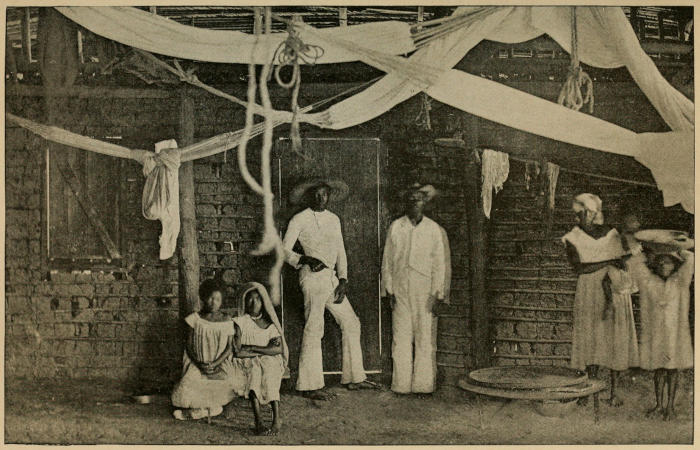
INTERIOR OF A CARIB HOUSE.
Our dining-room was dark,—the only light coming
from the open doors at either end. There was but the
earth, hard trodden, for the floor, and the furnishing was
simple enough,—a rough table and half a dozen rickety
chairs. A tablecloth served also for napkins, and the
dishes were of many patterns, colors, and degrees of
dirtiness. It seemed absurd to call for a clean plate; but
we did so, to see what would happen. Besides our
own party of four, we had a padre and an Italian as
fellow-boarders; and a little observation of the habits
of these polite friends helped us much in our new
circumstances.
A large tame duck used to waddle under my chair,
and at last would take bits of tortilla from my hand.
Several mangy dogs and cats had to be driven out whenever
we sat down to eat; but the hens were not disturbed,
for they contributed so much to our larder that they
were privileged, and one nested in an old felt hat on a
corner shelf, while another came cackling out of one of
the dark bedrooms that opened on either side. In spite
of all these drawbacks, we liked the cookery, and did
ample justice to it.
As the ancient Romans in their luxury had entertainment
for the eye as they reclined at meat, we in our
simplicity had a constantly moving panorama at our
street door. Stout Carib women, straight as one could
wish, walked by, with every burden, however insignificant,
balanced on the head. Half a pound of sugar or a
dose of salts would be placed above the turban as surely
as would a heavy jar of water or a house-timber. Some
fine forms, both of men and women, made part of this
procession; and the latter wore garments short at either
end, fastened over one shoulder only, and displaying the
bust perfectly. A soldier came along once in a while,
but only his cap and musket told his class. Boys wrestling
but seldom fighting, dogs fighting for a bone,—all
helped us to prolong our meal. It was difficult to make
the boys understand that they must not spit on the floor
as they handed us the dishes. A large brick oven in the
courtyard furnished bread for a number of families, and
good bread.
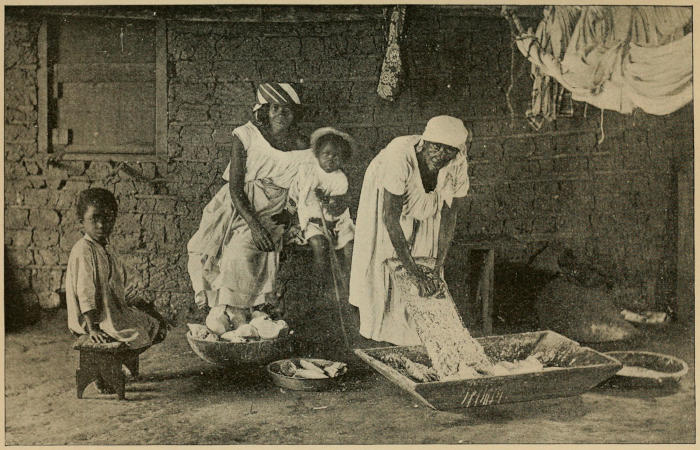
In our walks about the town we were often politely
invited into the houses, and so had a chance to see the
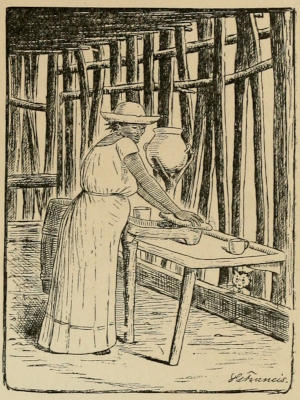
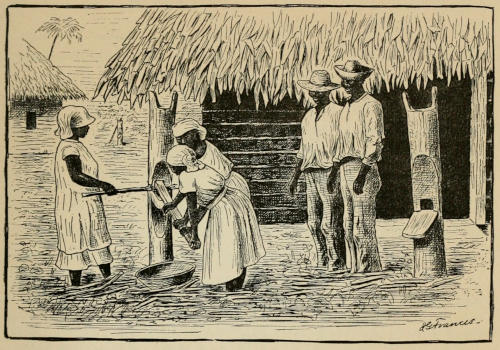
cassava bread making. The tuberous roots of the manioc
(Manihot utilissima) often attain a weight of twenty or
thirty pounds, and are full of a poisonous juice, deadly when
swallowed. A mahogany board is provided, into which
broken crystals of quartz are inserted, and this serves to
grate the root into a coarse meal, which is washed carefully
(the starch is partly removed, and settles in the
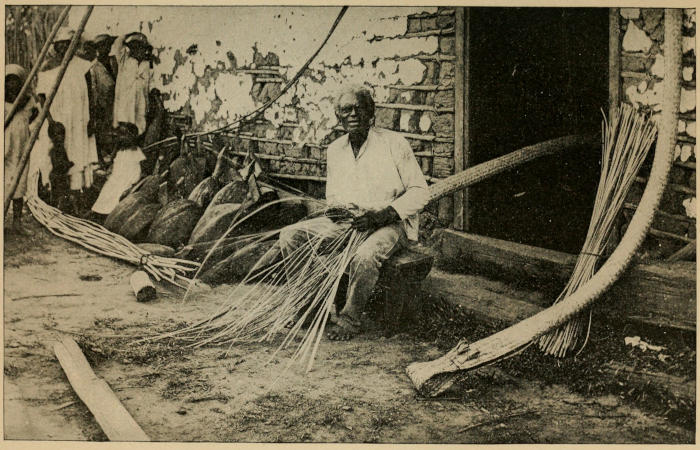
water as tapioca), and is then placed in a long sack of
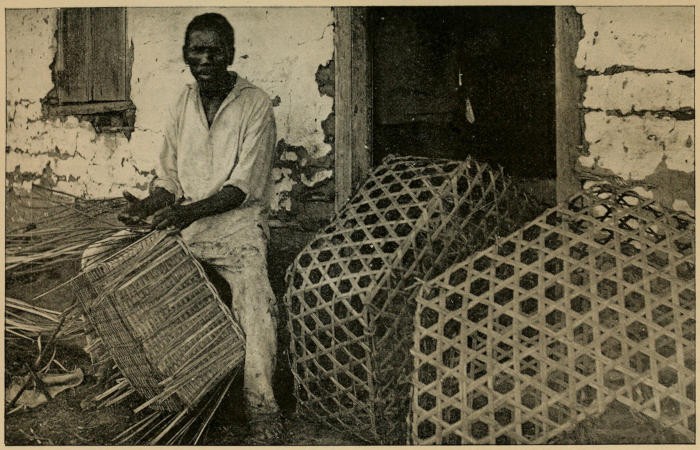
basket-work, called very appropriately serpiente. This
ingenious press is fastened at one end to a house-beam,
while on a lever placed through the loop at the other end
all the children of the family sit in turn, or together if
they are small; and the squeezed mass is dexterously
made afterwards into flat loaves about three feet in diameter,
and not more than a quarter of an inch thick, dried,
and then baked. The result is a wholesome and very
nutritious bread, which keeps a long time and is capital
on an excursion. Later on, when our own housekeeping
was in order, we found it made excellent puddings, and
was better than crackers in soup; while in the woods
it was indispensable. It is also a capital diet in dyspepsia,
can be eaten in sea-sickness when all other food
is rejected, and serves to fill out the bony outlines of an
emaciated human frame better than anything else. The
clean white loaves can be easily exported, and are very
attractive. Fine oranges we bought from a tree in the
yard of our cassava-maker at ten for a medio (five
cents).
GRATING CASSAVA.
The fine view from the fort can be seen in the illustration;
but as Frank and I stepped over the low wall
and set up the camera to photograph it, we attracted the
attention of the officer in charge, who at once ordered us
to come to him. A convenient temporary ignorance of
Spanish delayed us until the view was secured and a
squad of soldiers sent to arrest us, when the officer
wanted to know what we were “telegraphing in the fort
for.” With a very few words I exposed his ignorance to
his soldiers, who laughed as heartily at him as if they
had not been quite as stupid as he; and he begged us to
leave at once. Of this same garrison it is related that
some years ago a French corvette anchored off the point
and fired a salute. The first gun was all right; but the
second astonished the valiant soldiers, and at the third
they all threw down their guns and fled to the bush, fully
convinced that an attack on the village was intended.
After a while boys were sent out into the woods to tell
these warriors that it was safe to come home. The lighthouse
here, which all incoming vessels are taxed to maintain,
consists of a stout pole; but the lantern has been
broken, and not replaced.
Below this military post is the usual landing-place for
canoas. These are nearly all dug out of single mahogany
or cedar logs, and are not only well made, but of good
form. Some are forty feet long and six feet wide. The
paddles were of mahogany, and the women paddled as
well and powerfully as the men; both, indeed, seemed
to be quite at home on the water.
Some of the incoming canoes were laden with coconuts,
others with bananas and plantains from the little
fincas along the coast, and yet others with fish. The
last we noted more carefully, as there is no fish-market
in Livingston, and the fish are always interesting to a
stranger; for odd and various as may be the fruits of a
new clime, the produce of the sea generally surpasses
that of the land in curious forms. There were some of
the oddest of the Central American waters; and the man
who first ate them must have been very brave or very
hungry. One of them had flesh resembling beef in color,
and good and substantial when cooked.
Paths about the town are narrow and grass-grown, and
the hooked seeds of a Desmodium cling to the clothes,
and the thorns of the sensitive-plant (Mimosa pudicans)
scratch the bare feet of the passer; but worse than all
these, in the grass are tiny insects called coloradía,
which bite the ankles and other exposed parts, causing
red spots and an intolerable itching,—easily allayed,
however, by salt-water or bay-rum applications. Mosquitoes
were not troublesome, and we used no nettings;
nor did we see any house-flies.
A bath in the Rio Dulce was tempered by the dread of
sharks; and refreshing as the sweet water was, there
was a self-congratulatory feeling on getting safely back
to the huge square-hewn mahogany logs that served for
dressing-room.
To the outward world Livingston is principally interesting
as the free port of Guatemala,—the outlet of the
coffee of Alta Verapaz and the fruits of the Atlantic
coast-region. In its early history it was a settlement of
Caribs,—those splendid negroes who were driven from
the islands of the sea, which still bear their name, when
the Spaniards enslaved or destroyed their fellow-owners of
the land. Its situation at the entrance of the chief waterway
to the interior and the capital soon marked it for a
Spanish post; but the buccaneers were too powerful, and
before their advance the port of entry was moved far up
the Rio Dulce to Izabal, on the lake of that name,—the
fort of San Felipe blocking the way to these lawless enemies.
Not only pirates, but the Home Government hastened
the decay and disuse of this port, and the banks of the
Rio Dulce were of little importance, except to the mahogany-cutters
and sarsaparilla-gatherers, for two centuries.
An enlightened Government, in fostering the immense
agricultural wealth of Guatemala, turned the attention of
foreign capital, first to the rich coffee-lands in the neighborhood
of Coban, and later to the even richer fruit-lands
of the valleys east of the high table-lands of the interior.
The outlet for all the produce was by the Polochic, and
the shipping-port was Livingston; so the little village
built by the exiled Caribals (cannibals) has been gradually
occupied by business men of various nations, until now
the population may be nearly two thousand. The shores
are high and healthful, and the anchorage within the
river is secure. Dredging would easily open a channel,
and jetties like those placed in the Mississippi by Captain
Eads would doubtless keep the way open; for the current
is frequently very strong, but now wastes its strength
over a mile of shoal-water. At present all the ocean
steamers lie at anchor outside; and consequently the
lighterage is an important business.
In the immediate neighborhood of this port, and accessible
by water, are lands pre-eminently adapted for sugar
or cotton cultivation; although now, owing to the smaller
capital required, and speedier returns, bananas and plantains
are the chief products. The Government determined
to develop these lands,—which have hitherto
been left to the solitude of their dense forests and the
occasional intrusion of the mahogany-cutter,—and in
1882 declared Livingston a free port, including in its
territory a large triangular part of the eastern coast.
The public lands were then offered for sale at reasonable
rates; and in consequence, several capitalists from the
United States have purchased large tracts, and are cultivating
soil perhaps the most fertile on the continent.
Climatic changes are insensible here, and it may truly
be said that the one season is summer. Never has yellow
fever or other dangerous zymotic disease visited
Livingston, and the death-rate is about one quarter that
of Boston. The rapid increase of its population and
commercial importance will make imperative the demand
for improved harbor and wharf facilities.
Ten miles to the south of Livingston is the fine harbor
of Santo Tomas, where in 1843 a Belgian colony was established;
and as this unfortunate attempt has given an
ill reputation to all Central America, it is well to state
that failure was by no means due to the insalubrity of
the climate, but to the want of foresight of the projectors
and the abject ignorance of tropical trials on the part of
the immigrants. Landed in an unaccustomed climate, in
the wet season, without shelter, and inadequately provisioned,
they lost heart, health, or life itself.
WEAVING A SERPIENTE.
Pioneers and frontiersmen should not be recruited
from shops and counters. The pluck and caution needed
for a struggle with untried conditions, the determination
to be content with slim comforts and undaunted in the
face of every discouragement, looking always to the final
result, experience shows cannot be found in this class.
They do well enough as eleventh-hour assistants, when
the strong men have felled the forest and broken the
ground and built houses and shops for these weaker but
still useful brothers; but the first colonists must be of
sterner stuff. Probably, had shelter and good food been
provided for those inexperienced Belgians, there would
have been at Santo Tomas something more to-day than
the memory of their visit.
In 1881 the little town contained but one hundred and
twenty-nine inhabitants, mostly fishermen; but the construction
of the Ferro-carril del Norte, to connect the
capital with the Atlantic, changed for a time the sleepy
hamlet into the busy haunt of contractors and laborers.
The exigencies of the railroad calling for the deepest
water, however, the new town of Port Barrios has been
founded, some three miles to the eastward of the ancient
village. Curiously enough, the Bay of Santo Tomas has
no river; but it lies between the Rio Dulce and the
Motagua.
From Livingston to New Orleans the distance is 900
miles; to Belize, 125; to Kingston, Jamaica, 800; to
Puerto Cortez (Caballos), 55; to Izabal, 45; to Pansos,
90; and to Guatemala City (water to Izabal, and mule-path
thence), 120. The usual steamer time from New
Orleans is six days, including a stop of two days at
Belize; from New York, ten days, including stops at
Kingston and Belize; and three days should be ample to
New Orleans, seven to New York, and eight to Boston.
A glance at a map will show that the course as well as
the distance between Livingston and New York is much
in favor of that route over the better-known one from
Aspinwall to the metropolis; and when to this saving
of time and avoidance of the dangers of navigation is
added the greater facilities for raising and shipping fruit
which Livingston is now developing, there is great probability
that New Orleans will not long be allowed to absorb
all the bananas, plantains, and pines, or England all the
coffee and mahogany, shipped at Livingston.
The natural advantages of a port and the conveniences
of trade between that and other countries are of small
moment if there is nothing beyond the port; and one must
look well into the interior of the country to see its poverty
or richness. Before crossing the republic, the fruit-lands
of Livingston are worthy of exploration. The little
plantations at Cocali, on the coast northward, and those
along the banks of the Rio Dulce, are easily seen, and in
their present condition offer nothing new or especially
interesting. Bananas and plantains are almost the only
product of commercial importance; for the pines grow
wild, cassava, bread-fruit, mangoes, and sapotes are not
exported, and the coconut is native on the shores.
No systematic cultivation is known in this region, and
the crops grow very much as they did in the Garden of
Eden. Plantation-work consists of clearing the land of
forest (which is done in January and February), allowing
the felled trees to dry, burning in May, and planting in
June. No plough ever furrows the rich ground, and the
hoe is sufficient for the planter’s needs, while most handy
for the laborers. As may be supposed, the labor of keeping
the crops clear of weeds is considerable, but not so
great as on our Northern farms; for although the vegetable
growth is very rapid, the country is as yet free from
foreign weeds. With us the most rapidly growing and
pernicious weeds have all been imported; and on the
Hawaiian Islands the vegetable growths that have laid
waste thousands of acres of the best pasturage are the
lantana, verbena, and indigo, not one of them indigenous.
In the course of years cultivation may bring these agricultural
curses; but at present the Guatemalan planter in
Livingston has only palms, canes, ferns, ginger, and other
easily eradicated plants to contend with.
Indian corn (maiz) is planted in slight holes made with
a stick and covered with the foot, and seed planted on
Thursday has been found four inches high on the following
Monday. The stalks are sometimes seventeen feet
high, and average three ears each; only ninety days are
required to mature the crop, which is gathered three times
each year. Upland rice is scattered broadcast on the soil,
and the straw grows six feet high, with generous heads,
yielding the finest rice known; two crops can be raised
each year. Sugar-cane has been found to yield three tons
of sugar per acre for twenty years without replanting,—a
result unknown in any other sugar-country. At present
there are no mills in eastern Guatemala, and only enough
cane is planted to supply the demand for eating, or rather
chewing.
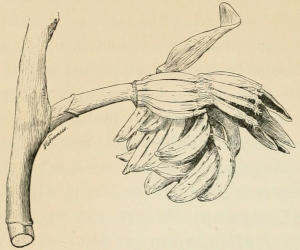
Bananas have within the last ten years become very
common all over the United States, and every one is familiar
with the imported varieties; but few are aware that
the varieties grown in the tropics exceed two hundred,
many of them too delicate to bear transportation, and as
far superior to the common sorts as a choice table-apple
surpasses the cider-apple of our New England pastures.
The kinds of banana most raised near Livingston are the
same as those of Aspinwall; but the quality is superior.
Plantains are grown even more commonly than bananas,
and the domestic consumption is much greater. Among
Northern fruit-dealers the banana and plantain are frequently
confounded; but they are as different as pears
and apples. To grow either, simply requires planting of
suckers, which in nine months should bear a bunch of
fruit. The stem is now cut down, and from its base
sprout several suckers, all over three being removed for
planting elsewhere. It is only necessary to remove the
finished stem and extra suckers to insure crops for a
long series of years. No attempt has been made to use
the valuable fibre, of which there is an average of three
pounds to a stalk.
When we turn from what is done here to the consideration
of what may be, the interest vastly increases; and
to this end let the reader join us in an exploration of one
of the rivers flowing from a valley of great extent and
unrivalled fertility, but covered with forest, and unknown
save to the mahogany-cutters and an occasional huntsman.
The Rio Chocon is almost unnoticed on the maps,
and its source unknown; but it probably rises in the
Santa Cruz mountains.
In the middle of October, 1883, the “Progreso” was
manned and provisioned, and in the early afternoon we
were on board waiting for the sea-breeze to help us up the
river. The light wind served to carry us across the Rio
Dulce, but no more; and anchoring, we sent three men
ashore to lay in a supply of plantains, bananas, coconuts,
and sugar-cane. Travelling in the tropics is usually far
from luxurious; and our present outfit was no exception
to the rule. Our captain had provided a Jamaica negro
for cook, Santiago, a half-breed, for montero, or guide in
the forest, and our crew consisted of Guillermo, an attractive
looking but bad boy, who was always singing about
his corazon (heart), Francisco, and two other men, whose
exact ethnological classification was a puzzle. Our cook,
his oil-stove and canned provisions filled the little cabin;
but the cock-pit was large, and Frank shared with me
one side, while the captain occupied the other, and at
night we had a canvas awning over the whole. Folding-chairs
served for beds as well, and our traps were put into
the capital water-proof baskets called petácas.
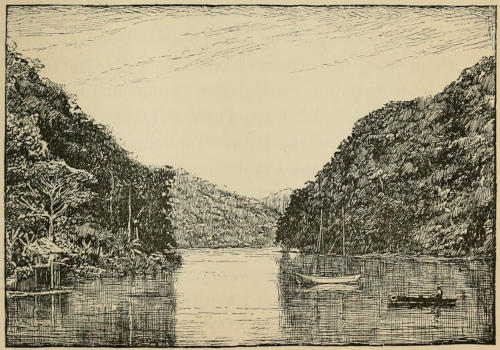
Entrance to the Rio Dulce.
Later than usual the breeze freshened, and we were
sailing apparently for the spur of San Gil, which stretches
northward right across the river. As we advanced, the
walls opened, and we entered a gorge far finer than that
of the Saguenay; for the savage cliffs of the wild Canadian
stream are here replaced by white limestone precipices
jealously covered with palms and vines, until only
here and there could the rock be seen under or through
its richly colored mantle. The river is deep, in places
eighteen fathoms, and, except in the overhanging trees,
there was no place to land on either side for some
distance.
Frank shot at a fine pelican, but only broke a wing;
and although he pursued the wounded bird rapidly in a
little cayuco that we had in tow, he did not gain on the
powerful swimmer until a shot from the “Progreso”
killed the fugitive, whose remains measured seven feet
across the wings. Other birds tempted us, but the fast-waning
daylight warned us against delay; and as darkness
fell upon us with tropical rapidity, we came to the
lake-like Golfete, nine miles from Livingston, and anchored
for the night off Cayo Paloma (Dove Island), the
only inhabited spot on the river. Our crew went ashore
for shelter, and we retired under our substantial awning,
which protected us from the rain which fell in torrents
during the night. We had found no mosquitoes at Livingston,
and there were none here; so our sleep was not
broken until our boys came on board before daybreak.
Where we had entered this beautiful lake we strangers
did not know; and even when the direction was ascertained,
the opening of the river was invisible. Coconut-palms
and bananas will give a charm to any landscape;
yet the little Cayo Paloma hardly needed them, so
beautiful was it in itself.
Grand San Gil brushed the clouds from his forehead
and looked down smilingly upon us in promise of a
fair day as we sailed up the Golfete. A short league
brought us to a curious limestone rock on the northern
shore,—a regular cube, rising from deep water, and
capped with a pyramid of foliage. So unusual a formation
could hardly have failed to attract the aboriginal
mind; and there may be on the summit some remains,—a
sacrificial altar, or stele. We did not go near enough
to see any way of access; but the branches seem to hang
low enough on one side to promise an entrance to an
active climber, and we determined to try it some other
day when we had more time.[4]
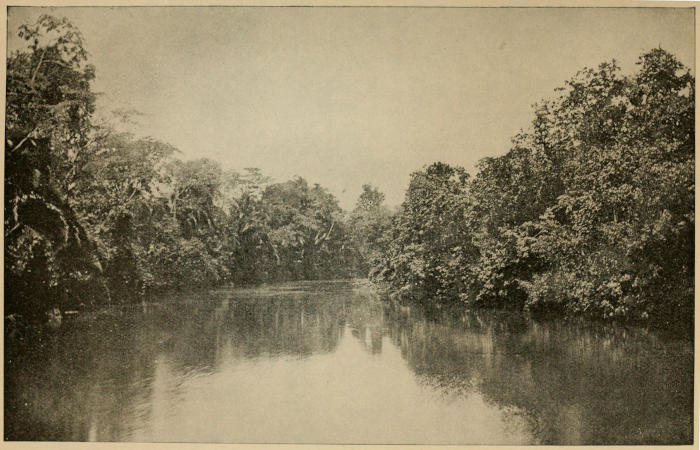
If the entrance to the Rio Dulce was well concealed,
that to the Rio Chocon was still harder to find; and but
for the rock island, one might try several apparent openings
in the hedge-like border of the stream before entering
the canal that sweeps in a semicircle into the actual
river. Two alligators sat, like the porters at an Egyptian
palace, opposite each other at the entrance, but
dropped incontinently into the stream before our rifles
were ready,—giving us an unpleasant reminder of what
we might expect should we take a bath in the cool river.
From animal to vegetable was but a glance; and the
musky odor of the reptiles faded into the fragrance of
a large purple passion-flower, which hung so low that
we slipped into the cayuco, Frank and I, and paddled
from bank to bank in the little mahogany dug-out, pulling
down branches and vines, shaking out lizards and
beetles, while humming-birds of almost every bright
color, and butterflies of hues seldom seen in cooler climates,
would hardly leave the fragrant flowers we gathered.
Nothing could be seen beyond the river, for we
were in a green lane bordered by all the tropics can
produce of vegetable life; and as the day wore on we
felt the weariness of seeing. A little white passion-flower
(P. Brighami), with curiously clipped leaves, three
kinds of morning-glory, a crimson abutilon, and a host
of plants whose family alone was known to us, had been
consigned to the plant-press. At first there were no
palms; but as we ascended the stream, which was in
flood, the banks at last appeared, growing gradually
higher, and only on solid ground could the palms find
foothold. The cohune (Attalea cohune), with its long
clusters of hard oily nuts, came first; then a small pinnate-leaved,
graceful, but unknown species; then an
astrocarya, with dreadful spines and hard but edible
nuts; and finally, on the rocky banks, slender, long-stemmed
species, and a climbing palm that, like the rattan,
attained a length of several hundred feet. Our first
glimpse of the family in full force was at the junction of
the two mouths of the Chocon. Here there is an enlargement
of the river into a lagoon, and the eastern
branch looks as large and easily navigable as that we had
entered. At another time we found this was the case.
Bambus bent their graceful stems in clusters over the
water, and here and there tall reeds in blossom waved
their light plumes against the dark-green trees behind
them.
With the drift floating down stream we noticed queer
green things which were evidently vegetable; but what
else? At last we came to some sapoton-trees (Pachira);
and it was their fruit, now ripening,—like in size and
appearance to a husked coconut,—that furnished our
puzzle. The fruits split while on the tree, and drop the
nuts, which are about as large as a hen’s egg, into the
water, where they soon germinate, and float about with
expanded cotyledons until caught on some shoal, or at
the bank, where they take root.
EL RIO CHOCON.
Not once all day did we see a place to land; indeed,
until we had ascended the river several miles there was
no land, so high was the flood. Dense foliage, suitably
defended with spines of palm and the no less unpleasant
thorns of the guilandina and sarsaparilla, hid what might
be disagreeable of animal life along shore; and as we
could not land, neither could we plunge into the cool
river,—that was already engaged by the alligators.
As the sun dropped behind the trees we made fast to
a large post in midstream, starting a whole family of
little leaf-nosed bats out of a woodpecker’s hole in this
dead tree; and as our comida was being laid, I explored
more carefully this curious mooring. Water-logged and
stranded on the bottom, some twenty feet below us, it
was a perfect image of life in death; for every part
above the water was covered with a luxuriant growth
not its own, and yet perfectly in place. On one side
clung three different orchids in seed, a cluster of peperomias
in blossom, and a fine cereus, while mosses and
ferns quite covered the interstices. We did not at that
time know the naughty habits of the bright little bats,[5]
or we should not have slept so quietly; as it was, the
mosquitoes were very thick, and only our veils protected
us.
It was a strange bed-chamber. The river, black beneath
and around us, was silent enough; for the current
hardly rippled against our boat, no wind moved the
leaves, and only our own voices broke the stillness while
we waited for sleep. Suddenly a sound between a shriek
and a roar burst almost over our heads. “Tigre,” muttered
Frank as he felt for his rifle. It was only a lion-bird;
but its terrible cry was repeated until it seemed to
awake all the nocturnal noises of the forests that stretched
for fifty miles around us. Howling monkeys (Mycetes
ursinus), a shrill water-bird, hooting owls, were all easily
distinguished by our montero; and we slept more tranquilly
after his explanation, even though we thought we
felt the rough back of an alligator scrape the bottom
of our boat. I have heard the real tiger’s howl in the
Sumatran jungle; but it was not so terrible as this
wretched bird, nor are the tropical nocturnal noises so
loud and various in any other place where I have been.
So far the country through which we passed was worthless
for agricultural purposes; but early the next morning
we came to an elevated limestone ridge, and beyond this
outwork the banks grew sensibly higher, until they were
some twelve feet above the present high water. With
the higher banks appeared the iguanas; and I made my
first shot,—a large female,— which was picked up, while
three others fell into the water and sank before we could
reach them. It was some time before I learned to distinguish
these reptiles; for they are nearly of the color of
the branches on which they bask, and until they move,
are to the unpractised eye only a part of the bewildering
foliage. I did not like to be told where to look, so before
the day was half gone I could see an iguana as soon
as a native.
Female Iguanas.
A mouth like a toad’s, green, glittering eyes, a large
pendulous dewlap, a row of lancet-shaped spines down
the back, slender claws, and a long, pointed tail, certainly
are not features to make the iguana an attractive pet;
and yet it is gentle, easily tamed, and there are people
who enjoy its company. Let not the Northern ladies
shudder as they look on this picture; for do they not
know, are there not among their number those who
fondle and kiss(!) even the deformed pugs and lap-dogs?
Unlike the worthless curs, the iguana is a most excellent
food-animal; its delicate white meat is not unlike
chicken, and the eggs—of which the female lays five or
six dozen—are all yolk, and very delicious.[6] Being good
swimmers, they drop from their perches over the river
when alarmed, and after a fall sometimes of sixty to
eighty feet the splash is suggestive of broken ribs, or at
least a total loss of wind; but they scramble nimbly up
the banks under the overhanging shrubs, and are lost in
the forest. Like the chameleon, they change color, and
from green of various hues become greenish gray when
taken from the trees. We had much less difficulty than
Columbus and his companions experienced in adding these
“serpentes” to our cosmopolitan bill of fare.
In the afternoon a boom across the river showed the
neighborhood of mahogany-cutters, and a short row
above this brought us to the head of navigation for our
large boat, and we made fast to a tree on the right bank,
where there was no clearing nor any easy way to land,
although we could see that the banks were some ten feet
above the water, and steep. Leaving the “Progreso” in
the cook’s charge, we continued up stream in the little
cayuco until we broke a paddle and had to return,—not,
however, until we had made two landings.
Once up the steep and slippery bank, we found the
land level, and in the dense forest there was no undergrowth.
It always seems odd to a stranger in the
tropics,—this entire absence of sod; but so dense is the
upper foliage that there is no chance for small plants
below, except such as can, like the sarsaparilla, climb
up into the light above, or orchids, like the vanilla,
which cling to, if they do not draw a part of their sustenance
from, the tree-stems. The cohune palm (Attalea
cohune, Martius.) was abundant, and by its presence confirmed
the testimony of the dark chocolate soil to the
exceeding fertility of the land. This palm seems to have
three names applied to as many stages of growth. When
young and stemless, it is manàca; in middle age, when
the bases of the old leaves still cling to the trunk, it is
cohune; and when age removes these scales, the smooth
stem is corozo. I have never seen the manàca in flower or
fruit, but I believe the three are but one species. Other
palms were intermingled with these,—some in blossom,
some in fruit,—but none so common nor so large, both
in stem and leaf. Later on we shall see a picture of the
cohune and its very valuable fruit.
In one place along the bank I measured fourteen feet of
soil of the best quality; nor was this surprising, since the
valley through which the Rio Chocon flows is a catch-basin
for the detritus of the limestone ranges of the Sarstun and
Santa Cruz mountains, and its form guards against torrential
floods which might wash away the rich deposit.
When the summer rains flood the banks, as we found
later, the water subsides in a few hours, owing to the
wide-open lower course of the river.
Barbecue at Benito.
A gigantic ceiba-tree (Eriodendron) stood not far from
the river, and two of its great buttresses enclosed a semicircle
thirty feet in diameter, while the projections themselves
were not half a foot thick. Trees of very various
kinds throw out these supports. I have even seen a
goyava (Psidium), which usually has a rather slender
trunk, expand most astonishingly into these buttresses
when growing in a rich loose soil. It will, not unnaturally,
occur to the reader that this must greatly increase
the difficulty of felling such trees in clearing land.
The difficulty is met by the woodmen in this way. A platform—called,
strangely enough, a “barbecue”—is built
of slim poles, often to a height of fifteen feet; and balanced
on these frail supports, the cutter swings his long-handled
axe. Of course he leaves a stump as high as his barbecue;
but the ants (comajen) soon reduce this to dust. I have
since then watched the cutters, and have wondered how
they so speedily fell (they call it “fall”) a hard-wood tree,
with no better vantage than two poles for their bare feet
to cling to.
All through the forest there was a close, damp feeling,
and in some places there was little light. We saw sarsaparilla,
india-rubber, vanilla, and cacao growing wild, and
every step brought some new thing to view; but it was
less oppressive on the river, where there was sky above us
of the true blue,—so much better to our tastes than the
green canopy that met our eyes as we looked up on land.
While on the river, we saw some curious long-legged
spiders, seemingly plastered against the white limestone;
and they were very unwilling to move their legs, which
were two inches long. The vejucos from the over-hanging
branches were very interesting, as these long, slender
rootlets, if rootlets they be, hung sometimes a hundred
feet, ending close to the water, but not touching it except
in flood-time, nor do they, like subterranean roots, have
branches or fibrous ends, although sometimes they seem
to be unravelled into separate strands, like a cord whose
form they imitate and whose use they usurp. We often
pulled them and shook the branches from which they
spring, without detaching them. The water was now
clear and cool, and everything was enticing us to loiter;
but the day was closing, and comida awaiting us on the
“Progreso.”
The moon that night was full; and with no mosquitoes
in the air, we hardly cared to creep under our toldo. The
light filtered through the palm-leaves and sparkled on the
black river as it glided around the bend. We could see
but a few rods either up or down stream, and we almost
wondered how we came there, and should we ever get
away. Far in the distance the howls of the monkeys and
the cries of the night-birds broke the stillness around us;
but we slept unconscious of the shower that poured on our
toldo before morning.
A very bright, warm morning in the middle of October
is not unpleasant in the temperate zone; but here it seemed
almost too warm to be seasonable, although the thermometer
persisted in indicating 83°. Five of us were in our
little cayuco at early dawn on our way down stream.
The cayuco was not especially crank, but it was loaded to
the water’s edge with five solid men; and as my hands
grasped the gunwales, my fingers dipped in water on both
sides. It was impossible for me to restrain the attempt
to balance, which of course kept the cayuco in a constant
quiver, alike unpleasant to myself and my companions.
Add to this the consciousness that alligators were ready
for us if we did upset, and it will be supposed that the
voyage was not altogether agreeable.
We landed at last, and had a hard scramble up the steep,
muddy bank, as many of the palms were armed with spines
like needles (Acrocomia sp.), and there was little else to
catch by. I was on the watch for snakes, and had my machete
in my hand; but the first living denizen of the forest
that met me was a fine blue butterfly (Morpho), nearly eight
inches across. I could not, and Guillermo would not, catch
it, because he said it was mala por los ojos (bad for the
eyes). It was a “sight for sair e’en.” I found this curious
superstition about butterflies common all through the country,
and I confess that following their brilliantly colored
wings in their rapid flight, under a blazing sun, does give
one’s eyes a very tired feeling that may explain the origin
of the popular belief. I will not compel any one to follow
me through the forest, nor up the steep limestone ridges
where the corroded rock was worn into fantastic forms
and partly covered with begonias, lycopodiums, and other
plants. We found several circular valleys among those
ridges drained by sink-holes, and often I heard water running
beneath my feet. In some places were little wells,
like the cenotes of Yucatan, containing fish, which pass
from one to another by underground aqueducts. Again
and again I mistook for serpents the huge, green, scaly
creepers that flattened themselves against the trees or
swung from the branches. Sluggish and insignificant
centipedes were not uncommon on the trees; but nothing
except tracks of wild hogs, peccaries, jaguars, and
tapirs indicated that the forest was the resort of troublesome
animals. The entire absence of any fallen or decaying
trees or dead branches was a marked feature of
this forest. The insects had eaten all this unpleasant
matter; and in one place we saw a cavity as large as a
barrel, where the ants had eaten a palm-stump, leaving
only the fibrous roots to keep the earth in place about
the large hole.
Towards noon the air, loaded with moisture and unmoved
by any wind in the forest, became almost unbearable,
and we were parched with thirst. Santiago came to
our aid; and selecting a rough-looking vine, of which we
could not see the leaves, cut from it a length of some three
feet, and from this trickled a tumblerful of clear, cool,
tasteless water. This vejuco de agua was as large as
a man’s wrist, of tender substance and very porous. The
mozos declared that if the vejuco was
cut only once, the juice would all run
up from the pendent end; so it was
necessary to cut at once above, and
block its retreat. On the palm-trees
were often found clusters of nuts of
various sizes, some with such hard
shells that even the parrots must have been baffled. We
cracked several kinds, and found them more woody and
less oily than the coconut. Several mahogany-trees came
in our way, and they impressed me more than the sequoias
of California or the banians and baobabs of India. Rising
with a straight and uniform stem far above the surrounding
trees, they then spread their dense foliage like a
massive oak above the tree-top plane. Rosewood, palo de
mulatto, sapodilla, ironwood, and many other kinds were
recognized, and our exploration ended for the day with a
bath on board the boat, in which we dashed the cool river
water over each other. The air was 86°, while the water
was 78°. Our men who had been sent up stream to build
a champa, or native house, returned to us at sundown in
true monkey style, swinging down on to the boat from the
branches of the tree overhanging the “Progreso.” The absence
of mosquitoes puzzled us, as it had the night before.
Section of Vejuco de Agua.
Dragon Rock, Chocon.
After the rain ceased, the next morning about seven,
we paddled up stream in the cayuco. I have never seen
rocks so curiously corroded; in some places they were like
fossil bones of mammoth size, then like battered capitals
and fluted columns, always of rather smooth surface,
sometimes quite perforated. In the hollows were ferns,
selaginellas, and sometimes curious spiders; one rock
was just like some monster crawling into the river. On
the right bank several small springs trickled in, and on the
other side a swift-flowing creek added materially to the
volume of the river. Still we were getting into shallower
water, and after passing in one way and another fifteen
rapids or corrientes, we came to a huge tree that completely
blocked our way. With a satisfied feeling, we declined
to drag our heavy cayuco over, but beached her on
a sand-spit, and waited for the return through the forest
of part of our men whom we had sent to explore inland.
Wild figs of good size came tumbling into the stream from
the trees above; but they were not to our taste, although
Guillermo said they were eaten when ripe. While we
waited, a large canoe came down from the mahogany region
miles above, and the three Caribs in it dragged it over
the log with great labor. Besides their petácas, they had
mahogany mortars for rice-hulling, and mahogany platters.
In the forest their work is task-work, and they often
have half the day to themselves; in this leisure time they
carve the rejected butts into various useful articles, which
they sell at the Boca, or mouth of the river. As we returned,
we saw another use to which the ever-present
machete is put; it is in turn knife, axe, adze, hammer,
spoon, back-scratcher, shovel, pump-handle, door-bolt,
blind-fastener,—and now a fishing-rod! Guillermo actually
split the head of a large fish that was in the shadow
of a rock,—a fish weighing some five pounds!
In the afternoon we inspected the champa our men had
been building. The building process was certainly a novel
one. On receiving our orders, the Caribs held a brief consultation,
chattering in their very unattractive language;
while we knew no more of their talk than we knew of
the intelligent ants, who are equally black, and hold their
consultations unbeknown to us. The result was, however,
that they separated and disappeared in the forest. Soon
we heard the blows of the machetes; and then they came
straggling back, two with the aucones or main posts of
the house, others with side-posts, rafters, coils of vejucos,
and bundles of manàca-leaves. In an incredibly short
time the frame was tied together. The thatching with the
palm-leaves took longer, as it was necessary to split each
of the immense leaves, which were quite thirty feet long.
These were tied on to the rafters closely, like clapboards,
and formed an excellent roof, only surpassed by that made
of another palm, called confra, found nearer the sea,
which is so durable as to last eight or ten years. Butts
of the manàca formed the sides of the champa; and then
we had a house large enough for twenty men, with the
labor of five men a day and a half, at a cost of $3.75.
For our purpose it was better than the Palace of the
Cæsars.
One morning I explored the tree to which we were
moored. A fine balloon-vine (Cardiospermum) hung in
festoons of fragrant flowers from the branches; among
them was a humming-bird’s nest fashioned as daintily as
usual of the golden down of tree-ferns, and shingled with
bits of lichens. It was not the season for eggs; but I have
at other times found many nests, with never more than
two white eggs of the size of a small bean. The young
birds, I may add, are, when first hatched, most amusing
little things, all heads and eyes, and without the long
bill of maturer days. I found also a green grasshopper
(Tropideres), five inches long, and very handsome of his
kind. I wondered if he ate sugar-cane, and other things
one might want to grow if living in the champa.
One day, going ashore to cut some sticks for an
awning on the canoa, I hacked with my machete at a
tall, slim tree very common along the banks, and which
had often bothered me by its curled, dried leaves, clinging
to the tree and looking very much like the doves
(qualm) which were so often on the tree that it is named
for them. This tree, which is botanically known as a
cecropia, one of the nettle family, had a hollow trunk
divided transversely by thin partitions, and from this
cavity came a swarm of ants. I had here a chance to
verify the interesting description given by Mr. Belt[7] of
the habits of these remarkable creatures. As he says,
they get into the tree by boring a small hole, and then
eat their way through the many floors of this vegetable
tower; they do not, however, eat the tree directly for
sustenance, but import with great care numbers of coccidæ,
or scale-insects, to feed on the tree-juices and elaborate
a honey-like matter, which the ants eagerly suck
from a pore on the back of these little cows. I tried in
vain to find the queen ant; but while every cecropia that
I touched was tenanted by ants, never a single female
came to light. There are several small outer doors, for
the disturbed stem is dotted with the pugnacious little
ants in a very short time. What first taught the ants to
farm these dull, inert coccidæ? Other vegetables are ant-inhabited,
but none that I know of afford such spacious
accommodations.
Pleasant as this life on the river and in the forest
was, the time came when we must return; and it was
startling how many things we saw on our way down which
we had passed unnoticed coming up,—tall reeds with
feathery blossoms more graceful than the pampas-grass;
palms with bluish green foliage; flowers of the arum
family more beautiful than a calla; blue herons; butterflies
of the most attractive colors; fish like glass, that
is as transparent, and about a foot long. Frank shot a
beautiful grossbeak with scarlet breast and metallic green
back, and brought me a fine purple passion-flower; another
of the party shot an alligator, who turned over,
exposing his yellow belly as he died. Altogether, the
voyage down was more agreeable than the hard run up.
Trees that were bare a few days before were now covered
with white feathery flowers, and others presented masses
of greenish flowers on their flat tops. We sailed and
floated down the Rio Dulce by moonlight, and at early
dawn anchored at Livingston.
San Gil, from Author’s House in Livingston.
Opposite the town are lands fertile and capable of producing
fine crops to an enterprising owner. Frank and
I rowed over several times, once exploring a neglected
finca, where cane, sapotes, cassava, bananas, plantains,
rose-apples, and coconuts were all jumbled together;
at another time visiting a cacao-plantation farther up
the stream. There is certainly room for a wise investment
of capital on these lands on the eastern slope
of San Gil as far as Santo Tomas. And here let me
write of this port, Puerto Barrios, and the Northern
Railroad, although I did not visit them until the spring
of 1885.
Santo Tomas is beautifully situated; but since the sad
failure of the Belgian colony established there by a
legislative decree of April, 1843, it has borne a bad
reputation, and its inhabitants diminished to the insignificant
number of a hundred and twenty-nine by the last
census. Its harbor, into which no large river empties, is
an exceedingly good one, and a wharf might be constructed
on deep water; but the authorities, in selecting
a terminus for the projected railway which is to connect
Guatemala City with the Atlantic coast, and so unite
the Atlantic and Pacific oceans, chose a place some three
miles eastward from Santo Tomas, where they must construct
a wharf some three hundred feet in length to
reach twenty feet of water, and where often ships cannot
lie, but must run for Santo Tomas in bad weather.
Add to this that the site of the fine city of Puerto
Barrios is a swamp at present uninhabitable, although
laid out (on paper) in a very attractive way, with
castle, theatre, hippodrome, and all the elements of a
Centro-American city of the first rank. The splendid
mango-trees, with their dark, dense foliage, are abundant
in the old village, while here even the palms are
dwarfed.
Puerto Barrios.
Arriving at Puerto Barrios late in the afternoon, we
were kindly received by the contractors, and after an
exceedingly good supper allotted comfortable beds in the
large storehouse. We had heard of the cruelty practised
towards the workmen on the railroad, and wished to
know the truth. I of course understood the circumstances
under which men were induced to go there
to work, and knew that agents in New Orleans and
elsewhere might and did make unauthorized promises
to the shiftless adventurers who sought to better their
fortunes in a new land. Men from the North cannot
do hard manual work in this climate unless they are
very careful in regard to diet, clothing, and general sanitary
conditions. If they get wet, and sleep in their wet
clothes, they will have a malarial fever in a newly cleared
country. If they eat improper food, or proper food at
improper times, their bowels will certainly protest. Now,
I was convinced that the contractors did not take these
precautions with their men, that in consequence of this
negligence a large amount of sickness resulted, and that
complaints printed in the newspapers of the United
States from the sick men were justified. I have seen the
men who left the railroad and took service on plantations,
and have talked with them, although I have never mentioned
the subject to the several contractors and overseers
I met; my opinion is therefore formed from what these
unfortunate men told me.
In the morning we were provided with the only hand-car
the road owns, and began our explorations. I will
not mention the builders of that car, for it was a worthless
article, and had it belonged to me I should have run
it off the track and down a steep place into the sea. The
road, of thirty-six inch gauge, was graded (in March, 1885)
some six miles, and rails were laid four miles; but the
thirty-ton locomotive, which had to do the work one of
half the size could do, could run only over three miles, the
track was so uneven. Men were cutting sleepers in the
adjoining forest, and we saw many of mahogany. The
grade is also being pushed from Tenedores, on the Motagua
River, to meet this end. No great engineering is
here visible, and the main difficulty seems to have been
in getting suitable foundations for the bridges over the
numerous small creeks. Along the track we saw two
large snakes of the boa family which had been killed by
the workmen. Some five miles from Puerto Barrios we
came to the hot sulphur-spring. It is a pool, fifteen feet
in diameter, close by the track, and pours out a considerable
volume of clear, hot water, pleasant to drink when
cooled, but while in the pool too hot to put one’s finger
in. Bubbles, probably of hydrosulphuric acid, escaped
freely; but vegetation extended to the very borders of the
pool, and all around the forest was dense. A cool brook
ran near at hand and gave a fine bathing-place as the hot
water mingled with it. We were assured that the men
who drank the sulphurous hot water never had fever.
Sulphur Spring.
From Tenedores the surveyed line of railroad extends
up the valley of the Motagua to Gualan, thence up the
ascent to the high plateau on which stands Chiquimula,
and thence to Guatemala City, where it will connect with
the road now in operation from that city to San José, on
the Pacific, five thousand feet below.
Before leaving the Atlantic coast we must again mention
the numerous steamship lines from Livingston to
New Orleans, New York, Belize, Puerto Cortez, Jamaica,
and England. Communication may thus be had with
the best markets for all tropical products. The lowlands
are amply able to supply New Orleans, New York, and
Boston with bananas, plantains, pine-apples, and coconuts,
the latter growing most abundantly at Cabo de
Tres Puntas on Manabique. The climate is healthful
and not too hot, averaging for the year about 80°; and
as there is no marked change of season, a perpetual June
seems to exist. Capital alone is wanted to develop this
Atlantic coast into the great fruit-producing orchard of
the United States. Sugar-cane grows rapidly; and so
strong is the soil that rattoon crops have been cut for
twenty years without replanting, and no diminution of
the saccharine yield has been noticed. Sugar can certainly
be raised much cheaper here than in Cuba or in
the Hawaiian Islands.[8] One day carries the crop to Belize,
four days to New Orleans, and eight to Boston or New
York. Yet, notwithstanding all these advantages, the Northern
farmer wears out his life in the consumptive fields of
New England, where his crops grow only four months of
the year, instead of settling here, where he can plant any
day of the year (except saints’ days, unless he employ coolies),
and reap a rich harvest in due season. He sometimes
goes to Florida, which is neither tropical nor temperate,
which is nothing but a raised coral reef with a veneering
of soil, and where frosts cut off his crops every few years.
We often hear of the extreme unhealthfulness of the tropics;
but is it generally known that more persons die of
consumption in Massachusetts than of the most dreaded
tropical diseases in Central America? The last time an
official census was taken, Livingston had a population of
a thousand, in round numbers, and the deaths of the
year numbered seven,—one a centenarian, and two
youths who fell from coconut-trees and broke their
necks; while in Boston the rate for July, 1885, was
28.1 per thousand.
The objection to being among a strange people and
under a foreign government and strange laws may best
be met by following me through the country, where my
object was to answer these very objections for myself;
and if my readers will patiently follow me, I will tell
what I saw, and they may form their own opinions.
Paddle and Machete.
CHAPTER III. ACROSS THE CONTINENT, WESTWARD TO COBAN.
The last days of October, 1883, promised good weather
for the hill-country, and Frank and I again left
Livingston in the only way one can leave it,—by water.
Our route was as before,—up the Rio Dulce; but this time
we had no comfortable but heavy “Progreso.” We had,
however, a better craft for our voyage,—a fine native
canoa, cut from a single log of a wood they called cedar
(which it is not); its length was thirty feet, and its beam
five and a half. With two masts and triangular sails,
this canoa could show good speed with a fair wind; but
we cared little for her sailing qualities on the present
voyage. As there were no ribs, and the thwarts were
easily removed, we made the after part, which was
floored, quite comfortable with a temporary roof, or
toldo; our luggage was stowed amidships, while our
captain and two men had their quarters forward when
not rowing or paddling. We had our coffee-pot (as necessary
a travelling companion in Central America as an
umbrella in England) and a supply of food for a week;
although we hoped our voyage might last less than five
days.
The cliffs on the Rio Dulce were as beautiful as ever.
Theirs is a beauty which never fades with the fading
year; and yet the changes are very marked. I never
saw such a river,—a very Proteus, it presented a new
form every time I saw it; and Frank, who is far more
familiar with its face, tells me I have never seen it in its
glory, which comes in July, when the brilliant orchids
are all aglow. Now a cereus with crimson blossoms
was prominent; so were the bromeliads, parasites on
almost every tree. But among roses I saw the thorn.
Our Caribs discovered a huge serpent asleep on a white
cliff far above us. Frank, with a laudable blindness to
all that was not pleasant, could see nothing but a fallen
tree. I saw only a few feet of the head end, which had
a diameter of about six inches; and I obstinately refused
to fire at the reptile, since he was quite as near as it was
desirable to have him, and should my bullet wound but
not kill him, it was quite possible that he might wriggle
down into the river below. Porpoises were common far
up into the Golfete, where they were pursuing the abundant
freshwater fish. A light sea-breeze helping us, we
anchored for the night far above Cayo Paloma. Our
mozo, Santiago, slept on one of the thwarts, which he
exactly fitted, being slightly less in stature than the
average New Englander.
Our anchor was up betimes; and before six o’clock in
the morning we came to San Felipe,—a place we both
had great curiosity to see; for in the absence of any
definite account of the old Spanish fort, we allowed our
imagination to build a very imposing, picturesque, and,
withal, strong castle.
We found that Spanish castles in Guatemala were
almost as unsubstantial as châteaux en Espagne; and it
was some time before we distinguished the Castillo de
San Felipe through the morning mist. At the outlet of
the Lago de Izabal the shores approach each other closely,—indeed,
the channel is hardly a stone’s cast broad; and
on the northern point stands the fort built in 1655 to
protect the then important commerce of Izabal from the
buccaneers.[9] It is well built of round (uncut) stone,
and the waves of the lago dash against the walls, which
are gradually yielding to the insinuating roots of many
plants,—even a delicate blue commelyna joining in the
attack that the seventeenth-century pirates began in vain.
The van of this vegetable scaling-party was led by a fine
papaya (Carica papaya), which now towered far above the
walls with its head of ornamental leaves, but which perished
soon after; and we saw only the bare stem on our
return, three months later.
Passing this mediæval ruin, we came to a slight wharf
of stakes, where we had to undergo a rigid inspection by
the guarda, who insisted on opening our trunks, in spite
of a slight shower that was wetting us. But we submitted
with better grace on reflecting how little amusement of
any sort the custom-house men could have in this sleepy
looking place; and when the nonsense was over we sent
Santiago with the coffee-pot, which he was told to have
boiled over somebody’s fire. He was also told to get all
the food he could find; and this useless wretch brought
back, as the total result of his foraging, three eggs!
Coconut-trees and goyavas were abundant, but no fruit
could be found. After this very frugal breakfast,—in
which we did not ask Santiago to join,—we walked to
the little Comandancia; but the officials were not visible,
and we entered the old fort, as the only other sight in
the dirty little town.
Castillo de San Felipe.
The plan is rather peculiar, but doubtless well suited
to the defensive warfare of those days. The doorless
entrance-ports invited us to enter, and we found a courtyard
of paved and level surface occupying almost the
entire area. At the outer end, commanding the channel,
the bastion was higher than the main portion, approached
by narrow and winding steps, easily defended; and here
was the most curious part of the whole edifice,—the
gun-deck. There is a law in the Guatemaltecan code
forbidding photographing in military works; but I have
since wished that I had broken that law then and there,
so that my readers might see for
themselves the clumsy guns, the
carriages with wooden wheels,
the magazine roofed, indeed,
but doorless,—the whole business
as dangerous to the gunners
as to any enemy outside.
Some fine orange-trees were
growing up through the pavement,
and their hard green fruit
would be suitable ammunition
for the ancient guns.
There was nothing whatever
to attract the most curious traveller
in San Felipe, and we sailed
and paddled on with frequent
calms and showers. We were completely in the hands
of our boatmen, whose knowledge of the lago proved
to be very limited; but as ours was even less, we suffered
them to coast the northern shore, when, as we afterwards
learned, the law directed our course southward to
Izabal, the port of entry, where we should have obtained
a permit to proceed on our voyage inland. Our map indicated
the course we selected as the shorter to the mouth
of the Rio Polochic; but the map was, as usual, wrong.
There was not much to see, as the mist and rain hid
the mountains and hung low on the shores, driving us
frequently under our rubber roof. Whenever the mist
lifted we caught glimpses of the far southern shore, with
the grand wall of the Sierra de las Minas catching the
fleecy clouds on every black pinnacle; and the clearing
sky attracted us still closer to the northern shore, where
we could see a low wooded country backed by a high
range of mountains, with here and there an opening
through which some stream reached the lake. At two
o’clock we landed at Sauce, on a beach of black sand,
evidently volcanic, scattered with fragments of chalcedony
and agatized wood,—a formation which puzzled me exceedingly,
as all this region is supposed to be non-volcanic.
We had no time to follow the beach to ascertain the extent
of black sand, but it reached far beyond the few comfortable
huts on the shore,—as far, indeed, as we could
go into the jungle inland. In it grew luxuriantly limes,
bananas, mangoes, and other cultivated plants not recognized.
Goyavas grew to a large size, but all the fruit was
ruined by worms.
Making Tortillas.
Here first we saw the whole process of tortilla-making.
The maiz was hulled in lime-water, washed in the lake,
and ground laboriously on a stone metatle into a consistent
paste, which is then skilfully patted into cakes from four
to six inches in diameter, round and thick as an ordinary
griddle-cake. These are then baked on an iron plate
or comal, but not browned, and should be eaten hot, and
then the tortilla tastes
like parched corn. The
metatles in Guatemala
were all of very simple
pattern and unornamented,
not so well wrought
as those in Mexico and
farther southward, but
serving their purpose
equally well. A woman
who cannot make good
tortillas is in Guatemala
not deemed fit to assume
the duties of housekeeping;
and yet there are few
articles of food requiring
more labor in preparation than this unleavened bread.
Except the Hawaiian poi (paste of the Colocasium esculentum
or Kalo), I can recall no article of diet that demands
more physical labor. The inhabitants of the tropics
in both these cases lay aside their proverbial indolence and
earn their bread by the sweat of their brows. For our men
we procured meat in long strips put on skewers and
crisped over the fire, while for ourselves we bought
bananas, limes, and tortillas. After this we continued
our voyage until dark, when we anchored near shore
and enjoyed a very quiet night. At early dawn we
were again under way. The showers continued, and far
away on the Santa Cruz range the rains were heavy,
boding ill for our ascent of the river. The lake water,
usually quite potable, was now full of a small green alga,
and the cast skins of ephemera were so thick on the
surface that for miles we could with difficulty get a dipper
of clear water.
Twice our Caribs thought they had found the mouth of
the Polochic; and at last, at high noon, we discovered it,
where we least expected, on a marshy promontory or delta.
Masses of coarse floating grass were attached to the banks
on each side, almost blocking the way; and the rapid current,
which we estimated at five miles an hour, made these
grass plots wave as if the breezes were playing over their
tops. Pelicans were abundant and tame; so were the
iguanas. The air was still, and the thermometer marked
eighty-five degrees, while the water was much cooler,—nine
degrees. All the creeks in the lowland flowed from
the river, so high was the flood, and we found no comfortable
landing-place.
At night we anchored in the stream, and the mosquitoes
were very troublesome; unlike those on the Chocon, these
were black, and had very long and sharp lancets. At
three in the morning we could bear them no longer;
Orion was in the zenith, and we struck our toldo, the
men slowly rowing on until six, when we anchored for
coffee. As we were eating, a cayuco, covered with a neat
awning of leaves, came rapidly by us on the way down;
its occupants assured us that there were many vueltas
(bends) and a great current (mucho corriente) before we
should be able to reach Pansos.
Ten miles a day was the utmost limit of our propelling
power, and in crossing the bends to escape the current we
hardly held our own, so strong were the flood-waters. Our
creeping pace gave us ample time to see, but no time to
stop for, the many curious things on either bank. Close
on the shore were red abutilons, and over them crept
the long-tubed white convolvulus (Ipomœa bona-nox) and
the brilliant yellow allamanda; high up on the wild fig-trees
were black, long-tailed monkeys, common and tame,
their wonderfully human faces peering down at the intruders,
the mothers clasping their hairy little babies to
their breasts with one arm, and with the other scratching
their heads in a puzzled manner. One of our Caribs shot
a little fellow before I could prevent him, and the creature
clung, even in death, by his tail. As I had shot an iguana
through the head with my revolver in the morning, I was
called upon to cut with my bullet the provoking tail, that
the Caribs might have a caribal feast. Regard for my
reputation as a marksman, and the memory of a taste of
roast monkey in India, forbade the attempt, and the poor
monkey, like the Tyburn thief, “is hanging there still.”
There was foam on the water, but we heard no water-fall,—and
indeed the flat nature of the country made falls,
cascades, or even rapids, impossible.
We passed another night when the torrents of rain had
no effect on the myriads of mosquitoes and black-flies.
Still all the brooks ran inland, although, as we afterwards
learned, in the dry season these banks are so high above
the water that they are hard to climb. All day long we
saw monkeys along the banks, though high above us, and
the following night we heard the howlers; but in compensation
for that evil had no mosquitoes. By Saturday
(Nov. 3, 1883) we hoped to be well on our road from
Pansos to Coban, but, except the cayuco, we saw no signs
of men or the work of men’s hands; on that morning,
however, we came to a little finca on the river bank, where
a good sized stream from the river flowed into the yard
and through the house. The poultry had taken refuge on
the roof, and the Indian proprietors waded through the
flood. Luckily the oven, or fire-place, was raised on sticks
several feet above the water, so that the señora could make
us some tortillas,—eight for a real. Eggs were the same
price. Slight as the forage was, it was very acceptable,
as our food was nearly gone, and we were already dependent
on the Caribs for their cassava-bread. The river,
these persons said, was falling, so we pushed on with new
courage.
A fine spider-lily (Crinum) grew on the bank where
we moored our canoa. We noticed that whenever we
made fast to the cane-brake, the black-flies bothered us
far more than when we had trees overhead; was it not
because the cane did not afford roosts or concealment for
the fly-catching birds and reptiles? The blossoms of the
cane were very beautiful, indeed as attractive as those we
had noticed on the Chocon. Mahogany-trees were seen
here and there, and we were told that there was much of
this fine wood on the Rio Zarco, just at hand. I also saw
a goyava-tree, some eighteen inches in diameter and eighty
feet high. In the afternoon we passed willows (Sauce),
and about five o’clock were startled by an unusual noise
behind us, when a huge three-storied structure came sweeping
up the stream, as if in pursuit; it was the steamer
“City of Belize,” a flat-bottomed stern-wheeler. As the
current was very strong and the channel narrow, we hastened
to make fast to a large fig-tree overhanging the
stream. Before, however, our arrangements were made, the
steamer was upon us, and her surge, added to the current,
tore us from our mooring and swept us under the tree.
Our masts caught in a branch, and we were turned on
our beam-ends. For an instant our situation was critical.
Our weather-rail was six inches under water, and we
were clinging to the other side as the water came pouring
in; then the mainmast slipped, and we righted, all
hands bailing out eagerly, while Frank held by some
branches and prevented a repetition of the disaster. If
the canoa had upset, our journey would probably have
ended there, as our photographic supplies would have
been ruined, and there would have been little chance for
us in that deep, rapid river, with no banks, and no trees
that offered food, even if they gave us shelter from the
alligators; and these too would have shown themselves
as soon as the disturbance caused by the steamer had
abated. Our Carib captain was as frightened as we were,
and with the little English he knew, exclaimed as we
anchored for the night: “D—d good boat; wouldn’t sell
her for h—ll!” The persons on the “City of Belize”
must have seen us filling, but they did not stop to see if
we drowned.
All night we had mosquitoes, but no rain; and to our
wakeful excitement was added the horrible noises of
tigres, wild hogs, monkeys, alligators, and other animals.
We were getting tired of the river, and our voyage
seemed interminable. Early in the morning we passed
the mouth of the Rio Cahabon, where the steamer had
anchored the night before, and soon after I shot my first
alligator. He was a large one, and my ball struck him
just behind the foreleg. He jumped clear of the water,
turned over, and fell back, tingeing the river with blood.
We thought we had counted twice the seventy-two
vueltas in the fifty miles between the mouth of the river
and Pansos; but this port still fled before us, and it was
nearly dark before I smelt human habitations. Not
one of our company had ever been there before; but the
Caribs were greatly amused at my assertion, and I think
Frank smiled in his sleeve at my scent. But I certainly
smelt them, and kept the men rowing, and blew the
conch-shell, as the law requires on approaching a port;
and at last, long after dark, the lights of the steamer fast
at the wharf appeared, and we were soon alongside.
We had been a week in our canoa, and five days
without landing; but our troubles were not yet ended.
The stupid soldiers flatly refused to allow us to land
our traps without a permit from the comandante, and
insisted that we should go with them to the Comandancia,
nearly a quarter of a mile away. I started with Santiago,
over a road worked into pasty mud by the ox-carts from
Coban. It was raining and very dark, and the almost
naked soldiers tried to light the way with splinters of fat-pine,
called here ocote. At last the road ended in a black
pool, into which the barelegged soldiers waded. But I
declined to go farther unless they carried me; and it
almost made the night bright to see the look these apologies
for men gave each other and the stranger who
weighed twenty pounds more than their united weights.
It ended as it should have begun; and Santiago went
on with one guard to explain matters, while with the
other I returned to the steamer. The officers of the
steamer had kindly invited us to sleep on board; but
the soldier on guard refused to let us pass the plank,
so I pitched him into the river,—the proper place for
all such stupid military men,—and went on board unopposed.
Soon word came that we might sleep where
we pleased. Mosquitoes were as bad here as anywhere
on the Polochic; and while Frank slept on the dining-table
without a net, I had a very dirty bed and a net
full of mosquitoes and other things; so in the morning
we could not decide which had had the least comfort.
With light usually comes a more cheerful feeling; and
a good breakfast, to which the officers of the steamer invited
us, made us feel at peace with all men, and I even
took the trouble to ask if the soldier I had pitched into
the river was drowned. The rain having ceased, we
started for the town, ferrying ourselves over the creek in
an old canoa half full of water.
As the comandante had not recovered from his overnight
debauch, we went about the little village to do
some necessary shopping and arrange for our journey
to Coban. The town was small, but neat and attractive.
A clear brook ran over a limestone bed, and in one place
it fell over a ledge into a pool where washing is done
both of persons and garments. An old Spaniard was
bathing here, and, although half a dozen women were
washing clothes or soaking maiz in the same limited
bath-tub, he invited us to join him. Near by, a man was
dressing an oxhide by pegging it to the ground and then
salting the inside.
At the Comandancia we found, not the chief, who was
still too drunk, but two very polite officials, with whom
I had a pleasant chat; I then wrote my name, residence,
and all the titles I could ever lay claim to, as well
as those of Señor Don Francisco, my “Secretario.” The
impression was so marked that our lawless neglect of
Izabal was overlooked, and we were given a full permit to
land our luggage. Once more we returned to the river, in
order to dismiss our Carib boatmen, and on the way we met
an intelligent ladino who spoke English (indeed he had
been to London); and he, acting as our interpreter, greatly
assisted us in shopping and in our preparations for the
long journey before us. In his garden were some goyava-trees
(Psidium); but the fruit was unripe, and we found
that our new friends eat the goyava as the Chinese eat
pears and other fruits,—quite hard; salting it, however.
Santiago found horses for Frank and myself, and at the
Comandancia we procured Indian mozos to carry our
luggage. This was our first experience of a system that
we found very convenient throughout the country. By an
order from the Comandancia, Indios are obliged to carry
burdens, as in the present case, precisely as their Northern
brothers have to serve on a jury, and do it for three
reals (37½ cents) a day,—quite equal here to the fee the
law allows an intelligent juryman in the North. They
cannot be sent beyond their district, nor made to carry
more than four arrobas (100 lbs.). In many cases they
carry six arrobas without complaint, supporting their
burden by a raw-hide strap (called mecapal) over the
forehead. The person hiring pays to the authorities, with
whom the men are registered, a real a head. I provided
four of these men to carry our luggage to La Tinta; but
Santiago cut down the number by half at the end of the
first stage. Our experience with these mozos de cargo
was pleasant, as they usually kept up with our horses
on the mountain-roads, and took good care of the parcels
intrusted to them. Each one carries a palm-leaf
umbrella (suyacal), which also serves for bed at night.
I have employed dozens of these bearers, and found only
one of whom I could complain; and he was not with me
on the road, but sent with our mozo Santiago,—which
might be an excuse for him.
There is no posada in Pansos; and after getting our
breakfast at noon in a little shop which was papered with
pictures from “Harper’s Weekly” and “Puck,” we decided
to spend the night at Teleman. After some difficulty in
getting permission for our guide to leave town,—the
comandante being still drunk,[10]—at two o’clock, mounted
tolerably, Frank and I, with our boy Roberto, left Pansos.
The pleasure of being again on horseback after the dull
inaction of our canoa voyage was so great that I was
willing to overlook any deficiencies in my mount. As
Roberto stopped a short distance from the town to make
a slight addition to his wardrobe, we went on alone for
a while; the road could hardly be missed, it is so worn
by the bullock-carts used to bring coffee from the
plantations of Alta Verapaz. The beautiful vegetation,
healthy and luxuriant, drew our attention from the
muddy road, which became worse as we got farther into
the forest. Many fine clear brooks crossed our path,
and as we came out of the woods the valley of the Boca-nueva
lay before us. Two piers of masonry stand on
opposite banks of this river; but the iron bridge lies on
the shore at Livingston, and there seems to be no very
strong attraction between the iron and the masonry.
The absence of a bridge was no great hardship, for not
only was the river shallow and easily fordable, but there
was a most curious vine-bridge, built of vejucos, perhaps
a hundred and fifty feet long, hung from two convenient
trees and approached by ladders. It was old, and one
side was broken down; so it required care and courage
to cross it. It was very similar in construction to modern
wire suspension-bridges, but wholly vegetable, there
being not a particle of metal about it.
A few miles farther brought us out of the wooded to
the cleared land, where is the hamlet of Teleman, famed
for its delicious oranges. Although nearly sundown, and
cloudy, the thermometer stood at seventy-eight degrees.
We found lodging at the house of Don Pablo, a fine-looking
old man with a heavy gray beard. His little home was in
the midst of orange and coffee trees close on the road, and
only a light rail kept the too familiar cattle out of the
house. We had no long time to look around before dark;
but our comida was good, and the coffee grown there was
very fine. The hospitable Don Pablo pointed to a pile of
oranges on the floor and told us to help ourselves, which
we did freely. Another Spaniard came in soon after we
were settled, and I had the best chance I had ever had to
exercise my “book Spanish.” I surprised Frank, and
myself as well, obtaining from these two agreeable men a
great deal of information about our road and the country
generally. The room was certainly as strange a one
as I had ever slept in,—a table in one corner, with a
mahogany bench fifteen inches wide before it (on this
bench a small child slept all night, without pillow or
covering); two hammocks; a bedstead with mosquito-netting;
piles of coffee, oranges, and other small matters;
a shrine of tinsel containing two images, before whose
dingy holiness a sardine-box lamp burned luridly; meat
in strips hung from the roof. The chickens had all gone
under the bed for the night; and when it was time for
the featherless bipeds to roost also, our host and his women
retired into the dark inner room, after assigning me the
bed and Frank one of the hammocks, while the stranger
took the other and soon settled himself comfortably.
The bed certainly was not luxurious, and the pillow had
seen better days; but I rigged up a cleaner head-rest with
a towel, and was comfortable enough. Not so Frank, who
was unused to hammocks; and before I was quite asleep
I heard his whisper, asking if there was room to take
him in; and as the bed was large, his hammock was
deserted.
We were up at four; and as it was still quite dark, the
sardine-box lamp was again lighted, and we drank the
delicious coffee grown in Don Pablo’s garden, while a
little muchacha drove out her chickens from under the
bed. The clouds promised rain; but we had none
all day, in spite of the predictions of both host and
guide.
We crossed two aguas calientes. One of them was steaming
in the cool morning air; but their temperature was
very little above that of the atmosphere at midday. Cacao-trees
were very common, though we saw none cultivated.
Here we first saw in abundance some of the convolvulus
blossoms for which the country is noted. One was of a
pale rose, another a deep blue, with hispid calyx and a
corolla five inches across, while a third was of flesh-color
and satiny texture, covering the trees near La Tinta.
We arrived in that village about noon, and after some
delay found a house where they would cook us an
almuerzo. Our menu comprised good white rolls, broiled
meat, fried plantains, frijoles, fried eggs, and good coffee,—all
which we relished exceedingly; and we were not
less satisfied with the price,—two reals each. The house
contained only one room, a stone cooking-bench[11] at one
end, and a row of box-like beds along one side. Under
these several hens were sitting, and two or three dogs
tried hard to get into a bed, while a colt kept putting
his head into a window, and finally upset the corn-box.
There was not much to the town, certainly. The school
had thirteen pupils,—some bright enough; but the
church was an insignificant shed. Pasturage was good,
and we noticed a very large proportion of bulls by the
roadside; these were quite as gentle as the cows.
In the afternoon we crossed, on an iron truss-bridge
covered with a thatched roof, the Polochic, now a shallow
but still wide stream. I wished for my camera here,—as
I had several times since I left Pansos; but we
were effectually parted until our mozos should overtake
us at Coban. We had been assured by the blind ladinos
that there was no interesting scenery on the road. We
were now constantly ascending, and we passed many
Indios of the Poconchi tribe,—clean, good-looking, and
dressed in white, with fanciful designs of darker colors
sewed on.
We arrived at Chamiquin early in the afternoon, and
found the hamlet consisted, as far as we could see, of
two very inferior houses and as many sheds. A fine
grove of mango-trees, but no fruit; a hen-house built in
the second story only, and accessible by ladder; palms,
with the withered leaves still clinging to the stem
(cultivated for the nuts, but dreary looking); limestone
cropping out on the neighboring hills,—comprised the
distinctive features of the place. Our room was new and
clean, lined with banana-leaves, and the hard earth floor
was of course uncarpeted. The furniture was simply a
table and a bench; but frugal as the furnishing was, our
dinner surpassed it,—a few tortillas, four eggs, and some
nasty coffee for two hungry men! We had our own
candles, or we might not have seen how little it was.
Perhaps our hostess did as well as she could, for the
twenty-five dogs that besieged our room while we ate
were evidently half starved.
All through the country the dogs are very ill conditioned,
and I several times remonstrated with their
owners for what seemed to me cruel treatment; for
although I detest this unclean brute, I do not like to
see him suffer. But I was always assured that the
dogs were underfed, not on account of cruelty, but to
make them good hunters and scavengers. It certainly
made them useless for the only purpose besides hunting
that dogs seem to have been created for,—human
food. Guatemala canines are certainly a contrast to
the juicy little poi dogs of the Hawaiians (which
are fed only on poi, sweet potato, and milk), or the
excellent dogs always hanging in the butcher-shops in
China.
Here let me speak of the atrocious coffee that we
found in this place and elsewhere as we went on. The
berry, which is of fine quality, is burned, not roasted,
and when pulverized, boiled for hours, and then bottled.
This nasty mess they call esencia de café, and mix it
with boiling water at the table. It was generally served
to us in patent-medicine bottles, with a corn-cob or a roll
of paper for a stopper. It had not the slightest taste of
coffee, but reminded one of the smell of a newly-printed
newspaper.
We were on our way next morning at half-past five,
and found the road much washed by the severe rains of
the night before. On our right, across the valley, was
a fine cascade spattering over the limestone rocks, and
now we came for the first time to home-like pine-trees.
Begonias of two species grew in the clefts of the roadside
rocks, and in a house-yard was a fine Euphorbia
Poinsettii. As my horse had hurt his foot at Teleman,
I walked much of the way, so our progress up the hills
was not very rapid; and we were by no means expecting
it when a turn in the road between two hills brought us
abruptly into San Miguel Tucurú.
This interesting town, of some three hundred inhabitants,
had no posada; but we found a capital casa de
hospedaje, kept by a señora of African descent married
to an invisible ladino. The house was of fair size, built
of adobe, and well plastered. A black Saint Benedict hung
in effigy on the wall,—the forerunner of a host of black
saints and holy people whom we saw both in sculpture
and painting as we advanced through this ancient domain
of the Spanish missionaries. Our señora had a
calentura,—the national excuse for not doing anything
or going anywhere; but for all that she got us a good
breakfast. Our horses were used up, and our boy could
get no others. An appeal to the alcalde brought one
poor horse; but all our further efforts were answered by
mañana (to-morrow),—that word so hateful to an active
man, but universal here. As we had a very comfortable
house to pass the night in, we made ourselves easy, and
started to explore the town. On our way in I had seen
an attractive spring a short distance from the road, and
I went alone to explore it, taking a calabash I had just
purchased for a drinking-vessel. A well-worn path led
across a meadow, and a sudden turn brought me upon a
party of women in exceedingly slight apparel, bathing
and washing in a little pool into which the spring emptied
through a spout. These naiads were most of them
young; but one old woman, a foul-visaged hag, scowled
savagely upon me, while the others giggled as I quietly
handed my calabash to the prettiest, and asked her to
give me a drink of water, which she caught from the
high spout with skill and without hesitation, although
the action exhibited her form in all its beauty. How I
wanted my camera!
Stuck in the muddy road was a train of ox-carts, and
the oxen from seven or eight were yoked to the head
cart; and when that was dragged out of the slough to
a camping-place, the next and all the rest were treated
the same way. We wandered about town between the
showers, saw lime-kilns, a lead-mine, and several potteries,
and at last came to the church,—a more considerable
building than we had yet seen in Central America.
The door was tied with a leather shoestring, and there
was no resident priest. The images seemed, to our
unaccustomed eyes, most horrible; but they must have
appeared in holier form to the poor worshippers, for
marigolds and amaranths were strewed before them, and
votive candles burned on the floor. The ancient name
of this town was Tucurúb (meaning “town of owls”);
but the Spaniards re-christened it by one of the saints
called Michael,—which I do not know, but apparently
not that one whose churches in western Europe are usually
perched on some almost inaccessible pinnacle, as at
Le Puy in France, St. Michael’s Mount in Cornwall,
etc. Only one man in the town could speak English,
and he could give us very little information about our
road. Indeed, all the way we were in that delightful
condition of travelling without knowing exactly what is
coming, and constantly meeting the unexpected. The
rain at last came down in earnest, and drove us within
doors. A Boston boy who has a fine coffee estate in
the neighborhood came in as we were at dinner and
initiated us into the mystery of tortillas tostadas. Certainly
by toasting, the tough, clammy, cold tortilla is
made even better than new.
At four in the morning our boy Roberto lighted the
candle and waked us up. We had settled our score the
night before, and so did not disturb the family, but completed
our toilet on the doorstep, as we saw to the saddling
of our horses, by the light of the solitary candle.
It was so dark as we rode away that we could not see
the road, and blindly followed our guide’s white horse.
A gate across the road gave us some trouble, as we could
only feel it. By daylight the scenery must be fine; but
as the noise of rushing waters, and a blacker streak by
the road-side, alone indicated the torrents and barrancas
at hand, we were troubled rather than pleased by these
picturesque properties. We came to an ox-train camped
in the middle of the road; and but for the glowing embers
of their camp-fires we should have had great difficulty
in passing.
As the gray dawn brightened over the mountains, the
numerous white cascades attracted enough attention to
keep us from the drowsiness we were both falling into
from the darkness, cold, and dampness, and the slow gait
of our horses. Fire-flies were still sparkling when it was
light enough to see the road.
It was quite early when we came to Tamahù; and as we
entered the little town (1,517 inhabitants), which is twelve
leagues from Coban, we saw a shrine with images as horrible
as any of the idols of the ancient Polynesians. Most
of the houses had tiled roofs, and looked neat and comfortable.
At one of the best we stopped for coffee; and while
the preparations for our meal were going on, Frank and I
went up to the church hard by. The door was tied with a
rope, and we found little of interest within, except images
closely resembling East Indian idols, and around all a
flavor of mild decay. Our hostess—for always it was
the señora who managed the hospitalities and took the
pay therefor—gave us rolls and fried plantains with our
good coffee, and the table and bench were of some choice
wood, darker and harder than mahogany. Fine roses
blossomed in the yard (it was November), and cotton-dyeing
and weaving, the principal industries of the town,
were carried on in nearly every house. Lime-burning and
tile-making also employ a goodly number of the people.
As we rode into the country, we passed many clumps
of a fine arborescent composite some twenty feet high,—one
of the giants of this great and widely spread family.
Crimson lobelias (like cardinal-flowers) with red stems,
crenulate leaves, and a very unpleasant odor, were common.
The road was badly gullied, and the nightly rains
had made the Polochic, which still kept at our side, an
angry looking torrent quite unfordable. The grades of
the road were good, and showed engineering skill and
constant care; but for all this my horse broke down
before noon, as I had expected, and our boy, after some
consultation with the drivers of a mule-train we passed,
captured a stray mule for me and turned the horse
loose. All the horses here seem so feeble, and many
of the mules so sore, that I seriously thought of capturing
one of the powerful bulls feeding peaceably by
the path, and riding him in true African style; but
Frank earnestly dissuaded me, so we had to walk half
the time to save our wretched hacks.
Through the mud we rode into Tactic, four leagues
farther on, at half-past one o’clock. The barometer
recorded 4,650 feet; but this was not high enough to
insure dry roads at this season. The town, of some
thirteen hundred inhabitants, seemed prosperous; the
houses were of a better class than any we had yet seen,
and the gardens were full of fruit-trees and vegetables.
Tree-abutilons, both pink and crimson, were covered with
blossoms, and peach-trees bore both blossoms and unripe
fruit. The roads were quite too muddy for foot-travel,
except in native undress. The corridors of the houses
generally had carved posts and lintels, and the central
tile of the ridge was usually fashioned into a cross, with
two lambs or doves as supporters. The casa municipal
was a noteworthy building. In gardens we saw fine
coffee-trees, and were told that here there are three
blossomings in May, and as many harvestings in December;
the first and third
are small, while the second
is large. Roses were
even finer than at Tamahù;
and a little girl
gave me a bunch of a
kind much like the old-fashioned
cabbage-rose. Most of the inhabitants are
Indios of the Poconchi tribe.
Roof Tile.
The façade of the church is ornamented with dumpy
statues of saints, and the main altar is elaborately carved.
We noticed a picture of three men in the flames of Sheol,—whether
Hell or Purgatory we could not tell; one wore
a tiara, another a mitre, while the third had on a plain
four-cornered canonical cap. In front of the church we
bought twenty jocotes (Spondias sp.) for a medio. There
are several varieties of this plum-like fruit, and the red
is larger and better than the yellow. When quite ripe,
the rather tender skin contains a juicy yellow pulp
around a rough stone. From the fermented juice chicha
is made,—much used as a mild intoxicant, not unlike
thin cider.
As we rode out of town we saw that the suburban gardens
were much overrun by squash and bean vines.
Maiz stood fifteen feet high; far up on the hills we saw
cornfields (milpas), having in their midst dwelling-houses
almost in the clouds, and seemingly built like swallows’
nests against the steep hillside. The campo santo, or
cemetery, was surrounded by adobe walls, and seemed
utterly neglected. We had seen in the church, and now
found by the roadside, a fine red and yellow orchid, and
another pure white one, as well as the cardinal-flower.
All day there had been showers; and when we arrived at
Santa Cruz, long after dark, we were wet, in spite of our
ponchos and the water would run into our boots.
There was no posada, so our boy declared, and we had
to try the cabildo for the first time. The Escuela por
Niños, or “school for ninnies,” as Frank persisted in
calling it, was placed at our disposal; but the floor was
bare, hard concrete, and we had no mats, while there was
no chance to hang our hammocks. It was not inviting;
but one of the attendants kindly brought two mahogany
settees from the court-room, and this was so hard a couch
that one might be pardoned for going to bed with boots
on,—and mine were so wet that I feared I should not get
them on in the morning if they once came off. We
needed food quite as much as a bed, and at last found
rolls and coffee at a little shop near at hand. At four
o’clock in the morning there was an earthquake, which
did not wake Frank, though it jarred my bed as though
some one had run against it in the dark. This shock
was felt, as we afterwards found, at Coban, San Cristobal,
and for miles around. Slight earthquakes are said to be
common enough here, but we saw no evidence of severe
ones.
In the morning at half-past five, while Roberto was
saddling the horses, we visited the church and found many
curiously carved and gilded altar-pieces. After performing
our ablutions in a puddle in the road, left by the last
night’s rain, we got our coffee and hastened on our way,
as it was Friday, and we still had twelve miles to ride to
Coban.
This city, although at an elevation of 4,500 feet, is
surrounded by much higher hills; and from the pass
over which the road winds, the view of the surrounding
coffee-region is very fine. The streams were in flood,
and some of the lower plantations were under water.
Near the town we
saw the method of
raising coffee-plants
under frames covered
with dried
ferns. Crossing a
good bridge, we
came up a paved
street, and soon
after ten o’clock
rode into the Hotel
Aleman, where we
had a very comfortable
room and two
beds with sheets
and pillow-cases,—the
first we had
seen since we left
Livingston; and we
were not now compelled
to sleep in our clothes. Our breakfast was the
best we had found since we had been in the country,
and consisted of soup, sausages, frijoles negras, wheaten
rolls, fried plantains, tortillas tostadas, tomato salad, fried
potatoes, and good coffee. The potatoes here are native,
seldom larger than an English walnut, and very mealy.
In the patio of the hotel bloomed roses and violets.
In Hotel Aleman.
Plan of the Hotel Aleman.
As this Hotel Aleman was the first house of solid
masonry we had entered since our arrival in Guatemala,
we examined it with some curiosity. Externally it was
very plain,—white with stucco, of one story, and roofed
with red tile. Windows were few, and the large door of
two valves was generally closed in a rather inhospitable
manner to an outsider. Once within the portal, however,
the scene changed wonderfully. Before us was a courtyard
(patio), into which the house opened. Directly in
front was a plain building, used as kitchen (cocina) and
stable; on the left was the garden (huerto); on the
right, the corridor, on which opened the sala, or parlor,
an apartment or two, and the dining-room (comedor). In
the corner was a large concrete tank to catch rain-water.
Our own apartment was at the left of the entrance, and
was quite large, with tiled floor and separate corridor.
A curtain was suspended between two of the pillars to
shade the dining-room, and hammocks could be swung in
every direction when needed. Birds hung in cages, and
flowers in baskets; and the négligé air of everything, except
the neat little Indian women who did the household
work, added to the comfortable feeling the place inspired.
The Cabildo of Coban.
We walked up a paved street an eighth of a mile to
the casa municipal, and, passing an arched gateway in the
clock-tower, entered a spacious plaza, with the cabildo on
our left and the foundations of the new palace on the
brow of the hill opposite. Directly before us was the
church and connected buildings,—once a college of priests,
since confiscated by the Government, and now used as
a music-school, blacksmith’s shop, and for other purposes.
The main part of the Plaza was paved; and here were
congregated several hundred Indios, mostly of the Quekchi
tribe, buying, selling, and bartering. We bought twenty-five
fine granadillas (fruit of the passion-flower) for a
medio, and as many jocotes for the same price. Delicate
straw hats, woven in two colors, were three reals
and a medio; cotton napkins (servilletas) of native
weaving, two reals; palm-leaf umbrellas (suyacales), such
as every mozo de cargo carries, one real. There was a
fair supply of raw cotton, cacao, brown sugar, tallow,
soap, and blankets.
Interior of the Church at Coban.
COBAN CHURCH AND PLAZA.
The church was very large and interesting; but the
front was disfigured by two distinct main entrances, and
the bell-tower was too low for the church. Within,
there was the simplest architecture imaginable,—plain
timber posts, square, with a slight chamfer, with pillow-block
capitals and stucco bases; an uneven tiled floor;
and side altars of poor design, sometimes painted to
imitate marble. On one of these altars a famished cur
was eating candle-ends; on another were the three crucifixes
of Calvary,—the repentant thief being a young
man of personable form and features, while the other
was a bald-headed, bearded villain; a very impressive
object-lesson we afterwards saw in many churches. A
fair St. Sebastian was the only picture of tolerable
merit.
Pattern of Cloth.
We called on the excellent Jefe politico, Don Luis
Molina, who received us very politely, although our call
must have been a great
bore to him, as he spoke
no English, and my
Spanish was very lame.
The Indian women in
the streets all dress alike,—in
a skirt of indigo-blue
cotton, generally
figured in the loom; and
their long and abundant
black hair is carefully
bound in red bandages
(listones) reaching nearly
to the ground. Their
stature is below medium; they seem modest and good-natured.
The blue cloth is woven in rude looms, several
of which we inspected, and the thread is dyed
in vats of masonry in the house-yard. The threads
are dressed in the loom and dried by a few coals in a
potsherd placed beneath the warp. A border is woven
at each edge, and also in the woof, at intervals, to mark
the length of a dress-pattern. A common design is
given on the previous page,—the lines being light blue
on dark. The lines of light filling are carried outside the
selvage, and of course are easily broken; otherwise the
cloth is coarse and strong, in widths of a vara, or thirty-three
inches. The weavers were very obliging, and
pleased to have us inspect their work.
The soil here is a rich red loam, and coffee grows better
than elsewhere in the country. Coffee-trees, well-trimmed
and loaded with crimson berries, were in every
garden, and violets and strawberries were in blossom.
The domestic architecture was certainly not imposing,
but it was substantial, and perfectly suited to the climate.
Houses were generally but one story in height, built of
masonry and covered with stucco, around a patio towards
which the tiled roof inclined, covering a wide
veranda as well as the house. The windows on the
street projected slightly, and were protected by strong
iron grills. Many of the streets were paved, and drains
and culverts provided to remove the rain-water. As
there is no aqueduct, water is brought from springs or
caught from the roofs during the frequent rains. We
were told it had rained incessantly for the last ten days,
and the wet clouds still rested on the surrounding hills,
giving a slightly gloomy aspect to the otherwise fine
views in all directions. The meat-market was outside
the Plaza, and a single glance was enough; but the general
market was so attractive that, after a quiet night’s
rest (we were of course far more wearied by sight-seeing
than by any day’s travel), we turned our steps thither in
the early morning. In our search for mules we came to
the blacksmith in the cloisters. He was an American
(del Norte); and it was said that when he
was drunk he could shoe a mule better than
others could in their soberest moments. He
had been drinking when we found him;
but he gave us some information,
took us to his den hard by, where
his family consisted of a native wife
and a black monkey, and gave
Frank the skin of a quetzal (Pharomacrus
mocino). This skin was
so beautiful that it put us on the search,
and we found a señora who had a moderately
large collection of these and other
bird-skins, which are brought in by the
Indios from the mountains of Alta
Verapaz.
Quetzal.
The quetzal (pronounced kezàl) is
the national emblem, and is decidedly
a bird of freedom, as it never survives
captivity, even when taken in earliest
life. In ancient days none but the
royal family could wear the beautiful
plumes. At present the Indios
bring the skins from the
mountains in considerable numbers,
their value depending on
the length of the tail-plumes,
which sometimes exceeds three
feet. As the female is very
plain, without the beautiful tail
of the male, she escapes the
hunters, and consequently preserves
the species. The wing-coverts and tail-feathers of
the male are of a superb peacock-green, changing to indigo,
the inner breast scarlet, and the wings very dark.
We went to the campo santo, on a hill westward of
the town, which is reached by a flight of a hundred and
sixty concrete steps; the whole was built at the cost of
one pious man. Several shrines on the way up made
convenient resting-places for those who used those steps,—like
the Golden Stairs at Rome for knee-worship and
penance. In one of these shrines was a lamp of native
make, in form of a bird with many necks. The chapel
on the top was small, and the doorway so low that
I struck my head violently in coming from the dark
interior.
Except the noble pine-trees on the top, there was
nothing attractive in this last resting-place. Some grave-diggers
were making merry over a small and shallow
grave they had just finished, and we gladly turned from
the calvario to the fine views townward. At night the
regimental band gave us some agreeable music (perhaps
national airs, certainly unfamiliar tunes); and as the
music died away in the distant streets we fell asleep, to
be awakened at day-break by the drums and fifes calling
the men of military age to the regular Sunday inspection.
We were present at the roll-call in the Plaza; and of
all absurd military sights, this was the chief! Soldiers
in every costume and of all sizes stood in line, much as
they arrived at the rendezvous, and solemnly answered
to their names. Would that I could present a photograph
of this “Falstaff’s Regiment” to my readers!
After coffee Frank and I went to church. The Indian
women were all kneeling on the tiled floor, and formed
the bulk of the worshippers. A few men stood or knelt,
with striped blankets thrown gracefully over their shoulders.
Mahogany benches between the side altars gave
us an opportunity to sit comfortably and study the interesting
scene
before us while
we listened to
the very fine orchestra
(consisting
mostly of
Germans), which
occupied benches
in the midst of
the nave. Far
away in the loft,
over the door, a
bass drum and
fife, and still farther
out of doors
rockets and explosions,
accompanied
or emphasized
the music.
The sacrament
of the communion
was being administered to worshippers,—apparently
in both kinds; the wine in a sort of sop, while the wafer
was carried by an attendant. All through the long
service the women remained devoutly kneeling on the
tiled floor.
Indio of Coban.
After church the market was more active than usual,
and we spent the time before almuerzo in lounging
through it. In the afternoon we were made happy by
the arrival of Santiago and our mozos, with our luggage
in perfect order; and not long after the Jefe Don Luis
called, and assured us that we should have all the mozos
we needed to carry our luggage onward. We had decided
to take the unusual road to Quiché, about which
even the Jefe could give us little information, and we
found no one else who knew more; so we decided to send
our heavier luggage direct by Salamà to Guatemala City,
while we took with us only one mozo to carry those
things we needed by the way.
In the evening we turned again to the church to hear
the vesper service. The spacious edifice was dimly
lighted by the candles on the altars and pillars, and men
and women knelt all over the rough floor. A choir of
female voices was singing as we entered, and soon the
officiating priest was conducted by candle-bearing acolytes
to the altar. The responses by the choir and orchestra
(organ, violin, flute, and violoncello) were very impressive,
the musicians often joining their voices to the music
of their instruments. The Indian drum, made of hides
rudely stretched over the hollow trunk of a tree, boomed
from the remote part of the church, and bombs and
rockets exploded outside in a most effective manner. A
black-robed young priest entered a confessional near where
I was sitting, and a veiled female at once knelt at the
side, while others in the immediate neighborhood moved
quietly out of earshot. The whole service was very solemn;
and the clouds of incense from the swinging censers
of the Indian boys partly concealed the tinsel and
tarnished gilding of the uncouth altar, and even cast a
glamour over the huge doll, which, most gaudily dressed,
represented the Queen of Heaven. The decaying church,
so painfully out of repair by daylight, was covered with
respectability, even with sanctity, by the shadows of
night. One cannot but feel with sadness that the offices
of a religion held so sacred here in centuries gone by
should be so lightly regarded, and that the church buildings
reared by so much labor and often unselfish devotion
should now be cared so little for, even in this State of
Verapaz, where the Church gained an ascendency over
the Indios which the iron-clad and iron-hearted Conquistadores
had never done.
Monday was spent in photographing views in the neighborhood
and hunting for mules. Of these we agreed to
take three for our use all through the country at a charge
of $150; but when we unsaddled them at our hotel we
found they all had sore backs, and accordingly sent them
home. In the evening I went with the postmaster (a
Kentuckian) to an examination at the Colegio de Libertad.
Three ladino lads did most of the reciting in
arithmetic, botany, zoology, and history; and a certain
doctor took the rôle of chief examiner,—evidently quite
as much bent on displaying his own knowledge as that
of his pupils. I had to ask a few questions, which were
understood and promptly answered.
In the morning we visited the Government storehouse
for aguardiente. The inspector wanted us to taste the
fire-water, which was so strong that it seemed to blister
the tongue. The sale of this liquor is a Government
monopoly, yielding a very considerable revenue.[12] A
distiller at this place has a license, for which he pays
four hundred dollars per month; and he must furnish a
minimum of sixty-five bottles per diem, paying twenty-five
cents a bottle for all over this amount. All the product
is brought to the public store, where it is tested at 50°;
and the retailers send in their written orders for the
number of bottles they require. The estancas (or drink-shops)
pay forty dollars per month. The unfortunates
who drink take a small tumblerful at a time.
I bought a mare—yegua colorada—for sixty dollars;
and as all bills of sale and receipts must be in Spanish,
we, with the help of the postmaster, composed the following
simple affair on stamped paper:—
Coban, 13 de Novr. de 1883.
Saben:
Que yo Miguel Reyes vicino de Coban, Alta Verapaz, he
vendido y vendo a Don Guillermo T. Brigham una yegua
colorada con el hierro del margen en la suma de sesenta
pesas en efectivo. En constancia firmo yo el vendidor.
The paper is not only stamped, but also water-marked,
and is for sale at the principal shops. As the stamps are
changed every two years, the Government has to redeem
all stamped paper on hand at the end of each biennial
period.
Cuartillo of Guatemala (enlarged three times).
CHAPTER IV. FROM COBAN TO QUEZALTENANGO.
By Wednesday we had captured two mules; and
these, in addition to our mare,—all being well
shod,—enabled us to leave Coban accompanied by a
capital mozo de cargo, who carried my photographic outfit.
Santiago rode one mule, I the other; and Frank had the
mare, who was a little wild at first, but soon became
very tame and attached to us by kind treatment. After
trying to get away for three days, we started early in
the morning, and nearly forgot to look at the barometer,
which was my constant companion; but after we were
in the saddle the little dial was consulted, and the needle
indicated an elevation of forty-four hundred feet. No
barometer was needed to mark the elevation of our spirits
on getting on the road again. As far as Santa Cruz
we retraced our steps. Our mozo kept up with us, carrying
our photographic and cooking utensils easily. And
now this little town, in the early morning, was far more
attractive than when, wet and hungry, we came to it before.
On this visit there was more to eat, and from a
tree by the wayside we bought twenty-five oranges for
three cents, and also some good bananas. Our breakfast
was very satisfactory, although eaten in a dirty house full
of filthy children. At two we started on a good road
for San Cristobal, where we arrived in an hour and a
half. This little town, of some four thousand inhabitants,
is surrounded by hills of great beauty; but the
Laguna is an insignificant body of water. As there is
no posada, we rode into the Plaza, and had a capital
room assigned us in what was once a monastery,—now
confiscated to public uses. Our comida was obtained at
the house of an aged señora to whom the polite comandante
conducted us. We found that Thursday and
Sunday were the principal market-days, that the town-clock
chimed the quarters, that there were unworked
mines of silver and lead close at hand, and that the
maguey grew abundantly there. We also watched the
process by which the rotted leaves are macerated and
washed in the brook which flows through the town, and
we saw the resulting pita spun into
cords for hammock-weaving.
The priests’ kitchen was roofless;
but the great cooking-range was intact,
being built of brick, with perhaps
a dozen pot-holes of graduated
sizes,—the largest being cut from
the corners of four tiles, the smaller
ones from the edges of two. Besides
this range, which occupied the middle
of the kitchen, there were two large cooking-benches.
The road to our next stopping-place was remarkably
good, and the scenery very fine,—the road winding
along the side of a mountain and overlooking deep valleys
in which the night-clouds still lingered. By the
wayside we saw a cascade of calcareous water, which
petrified twigs and leaves in its reach. By eleven o’clock
we rode into a sugar-plantation belonging to President
Barrios, now in the charge of an old schoolmate of his,
Juan Prado. There both sugar and coffee were cultivated,
and much fine imported stock kept. It was but
one of the many fincas belonging to the President, where
he has endeavored to improve the agricultural standard
of his country and the native stock as well. The
cane was of the ribbon variety, and of fair quality; but
the mill was simply a vertical twenty-inch iron roll-mill
turned by four oxen. There was but one open
kettle, with no clarifier; and the inspissated syrup was
run into wooden moulds and cooled into very dark hemispherical
blocks (panela),—a form of sugar much in
demand among the Indios.
Señor Prado received us most hospitably, and set before
us bananas, anonas, and limas, or sweet lemons;
then brought us large glasses of a warm liquid made
from rice and sugar,—not at all to our taste, although
a favorite drink of the mozos. The buildings at the
President’s finca were neither pleasant nor convenient;
but a large roof, substantially framed, was being walled
in with hewn pine-planks three inches thick, each plank
representing an entire tree. In this building men were
grating off the juicy pulp of the coffee-berry in rude
machines; after this pulping the berries are washed,
and spread in the sun to dry.
We here learned that we could not cross the Chixoy
(pronounced chisoy) River that afternoon, as the wire
suspension-bridge had been swept away the last year, and
the man whose duty it was to haul travellers across on
ropes would not be there so late in the day; we were consequently
obliged to yield to the importunities of our host
and stay over night at Primavera. To entertain us, in
the afternoon Señor Prado took us to a mound which the
new roadway had just grazed; and together we dug out
fragments of fine pottery and bits of human bones much
decayed,—the lower third of a left femur and a fragment
of a pelvis being the most distinctly human. Some
earthen vessels had been found here and sent to the
Museo Nacional in Guatemala City. The bones were
mingled with charcoal and ochre, and often cemented
together like lime concretions or fulgurites.
We each had a tumbler of warm milk as a “stirrup-cup”
when we said our adios to our kind host in the morning,
and soon after six we were on the road again. Here,
as so often again in the republic, we found that the road-bed
was undergoing active repair. The primitive method
of removing large rocks and ledges greatly interested us.
Fires are kept up on and around these obstructions;
when thoroughly heated, these are left to cool, or the
cooling is hastened by water. In either case the hammerers
have easy work.
Rope Bridge over the Chixoy.
The narrower road led among pine-forests, where
many of the trees had been girdled and were slowly
decaying,—the comajen being unknown at this elevation.
Men were cutting timber for the President’s house and
for a new bridge. A mortise is cut in the end of each
log, to which the drag-ropes are fastened. We passed a
pleasant village in the valley below us on our left, and after
about nine miles of poor road we came to a rapid descent
of twenty-two hundred feet, so steep that we were obliged
to lead our mules almost to the bank of the Chixoy,
where the pier on the side nearest us had been undermined
in the last flood. The path ended on a narrow
rock shelf, where was fastened a rude timber frame, from
which two small and well-worn ropes stretched nearly
two hundred feet to the remaining pier on the farther
bank. A hundred feet below was the Chixoy, foaming
over its rocky bed. This we might see to the best
advantage; for one by one we sat in a sling hung from
a rickety traveller, and, launching from the cliff, slid
rapidly down the slack ropes, and after sliding back at
the middle, were hauled up on to the remaining pier.
From this structure we descended a rough ladder to the
shore, which was sandy and strewed with bowlders and
other remains of the action of higher waters. Dizzy as
our own passage was, it was safe enough compared to
the crossing of our animals. By the help of Indios, we
stretched a rope across, and finally swam all our mules
safely. Santiago and the bridge-keeper swam splendidly
in the rapid current, and the latter was a fine muscular,
lean specimen of manhood. Frank and I swam in
as far as we dared, and landed the soaked and frightened
animals. The bath was cool, and for the first time we
had no thought of alligators. While I photographed the
bridge, Frank went to the hamlet of Jocote to get eggs
and tortillas, and Santiago boiled our coffee. Beautiful
butterflies were hovering over the rounded pumice-stones
strewed along the banks; and on a rock were fine
Achimenes, the Dorstenia (which resembles botanically
a fig turned inside out), and a wild Martynia.
FRANK AND HIS MARE MABEL.
Starting again in the early afternoon, we found the
way led up and down through the valley, until we were
seven hundred feet above the river, which in one place
quite disappeared beneath the limestone ledges, to reappear
some distance beyond. On either side the steep slopes
were covered with coarse grass; and there were many
small, compact aloes, with broad leaves and dried flower-stems
here and there. Among the rocks were maguey-plants
and a few palms,—these last seemed quite out of
place in this high, dry country. Under the pine-trees
the sod was green, and in the small lateral valleys clear
brooks improved the pasturage; and here at the head of
each larger gulch we found the deserted camps of the
mozos de cargo.
TWO VIEWS AT CHICAMAN.
After many turns we came at six o’clock to the village
of Chicaman, just as the rain began to fall. This hamlet
is on the north side of broken hills, and overlooks the
Chixoy valley,—here of great depth, but narrow and
winding. We found a picturesque little house, where we
slung our hammocks in the best room, eating our huevos
and tortillas on a shrine sacred to the black “Lord of
Esquipulas.” This shrine is usual in houses far from
any church; and here it was embowered in leaves, flowers,
and fruit,—among the latter citrons of a large size
and the showy yellow fruit of a solanum. We were
nearly four thousand feet above the sea, and the night
was cool,—a comfortable ending to a day altogether too
short to hold properly all the fine weather, beautiful and
changing scenery, and delightful journeying crowded into
its twelve bright hours.
Before the sun had melted the clouds in the valley
below us, we were on our horses and slowly climbing a
steep ascent of eight hundred feet. I had photographed
the house, and, turning the camera on its pivot, obtained
a view of the cloudy valley below: these views are before
the reader now. A league brought us to another
Santa Cruz,—a village pleasantly situated, and about
the size of Chicaman, consisting of perhaps ten houses.
There we saw by the roadside some fine oranges; but
when Frank rode up to the house with his “¡Buenos
dias, señora! ¿Tiene usted naranjas?” he was met by
“No háy” (there are none). That phrase we heard
altogether too frequently on our journey. In this case it
simply meant that the señora had no oranges in the house;
but she added that we might for a medio pick as many as
we wanted! We tried the several trees, and filled a pillow-case
with the fine fruit,—half a bushel for five cents!
We had little need of guides, for the camino real had
few branches between towns; but soon after leaving Santa
Cruz we found a branch on our left which puzzled us a little,
as our map gave no indication of its existence. But
we kept on almost a league, riding through a pine-forest
on a nearly level road,—which proved to be the right
one, although the choice was guess-work. Grass grew beneath
these noble trees, and herds pastured in this park-like
region. It was most interesting to see the acorns inserted
by the birds in the pine-bark, precisely as I had often seen
them in the forests of Nevada and California; but with all
my watching I could not catch the birds at work. The
acorns that I dug out, although frequently dry and apparently
abandoned, were free from worms. The common
species of pine (Pinus macrophylla) had “needles” fifteen
and a half inches long; and the Indios were gathering
them to strew the floors of the churches,—a more fragrant
carpet than the rushes of our ancestors. We frequently
came across artificial mounds, which, according to
Santiago, “were where houses had been.” At ten o’clock
we halted at a little village which we were told was Uspantán
(our wretched mozo Santiago, who pretended to be
guide, but knew no more than we about the road, led
us into this mistake); so we unsaddled and waited for
almuerzo, with little to amuse us except two turkey-cocks,
one white, the other dark, inseparable companions,
who followed us wherever we went, and at last were
driven nearly wild by their attempts to converse with us.
Not until two o’clock did we arrive at the true Uspantán,
and then very unexpectedly; for seeing some women at
a spring washing, in a wild place where no houses were
visible, we turned a low ridge, and found ourselves in
the midst of a considerable Indian town. The church,
which we did not enter, had huge buttresses at the apse,—doubtless
a precaution against earthquakes. We saw
a great deal of pottery, and anona-trees were on all sides;
but the full-grown fruit was not ripe. We felt so provoked
at our waste of time at the first village (whose true name
we never learned) that we did not care to stop here, but
rode out of the town through a deep artificial ravine.
San Miguel Uspantán has some nine hundred inhabitants,
who weave cotton from the lowlands and wool from their
numerous flocks; and it is from the mines near by that
all the silver was obtained for the vessels of the church,—so
says tradition. Ruined walls and broken aqueducts
attest the former importance of the place under the
Quiché rule.
The road became a mere trail until we came to Pericon,—a
village of two hundred inhabitants, whose only industry
is wool-dyeing; and from this we climbed the pine-clad
hills to a height of over seven thousand feet, where we
came suddenly upon a fine view of Cunen, directly west,
but several leagues away, across a valley twelve hundred
feet deep. I wanted a photograph; but the sun was in
our faces, we could not spare the time, the day was almost
done, and we had a difficult descent before us. Although
we did not delay, it was long after dark when we rode
into Cunen and found the Plaza, where we were assigned
a good room in a confiscated monastery or church building.
We had a mahogany bench fifteen feet long and
sixteen inches wide for our bed, and a good table and
several chairs abundantly furnished our apartment. We
had our own candles and coffee; but no other food was
to be had except some ears of green corn which we had
picked by the way for our animals, but which we were
fain to eat ourselves when Santiago had scorched them by
the embers of the mozos’ fires in the Plaza. Although the
corridor was full of mozos who were to pass the night
here, there was no noise whatever. We closed our door
at six; and as soon as our notes were made, fell asleep.
The poor Indios had no politics to quarrel over, and we
had the satisfaction of a day well spent; so there was
peace and harmony beneath our roof of tiles.
Every day the vegetation changed, and we might have
constructed an itinerary of floral landmarks; to-day it
was a fine pink dahlia far surpassing in vigor of growth
and blossom any of the cultivated varieties. In such a
climate, however, this plant did not provide for hibernation
in its tuberous roots, of which it had none. Acres
of fragrant Stevia perfumed the air, while Bouvardias
and bright Compositæ brushed against us on either side
of the narrow pathway.
Twelve hours of solid rest were not too much; and
while in the early dawn our bestias were being saddled,
I strolled into the church, which is much smaller than
its ruined predecessor at its side. In Central America
the roofless walls of ancient churches usually, if not
always, enclose a campo santo, and here the early Cunenans
slept their last sleep among the crumbling relics of
their work. In the modern church were two large mermaids
of the genuine Japanese type, carved as supporters
to the altar.
In the cold, misty morning we started without coffee,
and at once began to climb a long ascent; for
Cunen seems to be built on a platform on the mountain
side. On our left was the finest waterfall we had yet
seen, and on the banks were red violets. The summit
of this pass was nearly seven thousand feet, and
a sudden turn on a sharp ridge brought us to another
region and a different climate. The transition was
astonishing, for only a few rods behind we had left the
rainy season. Before us was a vast valley bounded by
forest-clad mountains and grassy buttresses; but near and
far no sign of human habitation. The path we were on
was the only token of man’s presence, and that looked
more like the dry bed of a mountain torrent than a
public road. Broad-leaved agaves were very common,
some crowned with golden blossoms on immense stems,
some dead after flowering, still others wantonly hacked
by the passer-by,—so we thought, in our ignorance, until
the too-frequent mutilation of the tough stems showed
a labor that could not be purposeless; and then we
remembered that these “century plants” flower but
once, after years of growth exhausting their entire substance
in that supreme effort, and leaving a withered
stem and shrivelled leaves, to be swept down the hillside
by the next storm. Foiled in its attempt to flower by
the decapitating machete of the mozo, the plant lives on
for a longer period, furnishing fibre and drink from its
leaves. Anona-trees grew at the very summit of the
pass, although we were assured that frosts sometimes
occurred. Oaks of two species were abundant, and
laurels were in blossom. A rancho built by the roadside,
a sad travesty of the Dâk Bungalows of India,
gave us at least a chance to boil our coffee.
A long and rough descent brought us to a pine-forest,
whence at an elevation of six thousand feet we again
looked down upon the valley of the Chixoy. Among the
pines and oaks I photographed the view. The little
white-housed town of Sacapulas on the hillside above the
right bank of the light-green river which did not half fill
its bed; the cultivated fields around; far in the distance
the volcanic cone of Tajumulco,—the first we had seen,
a token that we had left the limestone mountains of
the Atlantic, and were looking on the fire-fountains of
the Pacific coast,—all these and so much more in this
grand view before us. We hardly noted the contour, the
lines, the masses,—all that we could trust to the ivory
plate that should carry it away; but the vivid colors in
that clear atmosphere, the marvellous tints of forest, sky,
and river, no photographic art could carry away, and we
must enjoy it now by ourselves. The town was five
miles away, and three thousand feet below us; and the
descent was very difficult, owing to the sharp bits of
quartz in the path. In the valley we came upon the
huge cylindrical cacti (Cereus) used in fencing. Jocote-trees
were abundant, but the small yellow fruit decidedly
inferior. Sugar-cane grew to some extent in gardens,
but fruits and vegetables were scarce. On the trees and
fences hung a light-blue convolvulus,—the most attractive
color I ever saw; and this with a smaller white one
brought the number of the “morning-glories” we had
found so far to ten species.
Women were bathing in a spring near the road; the
men seem never to bathe in public. Over the river was
a bridge of six piers with simple hewn logs laid between
them, no plank or rail of any kind, although
the bridge was high and the current, even in ordinary
stages of the water, very strong. As our bestias did
not hesitate, we of course crossed with them. A short
distance up stream were two brick and stone arches of
a more ancient bridge extending from the town side.
Several piers of the bridge we were crossing had fallen;
but the masonry was good, and they generally held
well together, forming bowlder-like masses, on which new
piers had been built: in one case this process had been
repeated. No doubt the bridge will soon break down
again; and two wire cables are stretched from cliff to
cliff to provide transit in case of accident. We went up
a steep paved street to the Plaza, where Señor Placido
Estada, the comandante, assigned us quarters in the
cabildo, and exerted himself to find us a boarding-place.
Whether the climate was favorable, I know not; but we
were always very hungry when we were where food could
be got: where it was wanting we did not care for it.
Here we did full justice to the señora’s cinnamon-flavored
chocolate whipped to a froth.
SACAPULAS AND THE CHIXOY VALLEY.
The church was small, and, like that of Cunen, built at
the right of an older and much more extensive edifice
now shattered by earthquakes and used only as a burial-place.
We climbed the bell-tower and found one bell
with the date 1683, another with that of 1773; all
were bound to the supporting crossbeams by raw-hide
thongs. The chief ornament of the Plaza was an ancient
Ceiba-tree (Eriodendron) of immense size and traditionary
antiquity. Below the terrace of the Plaza was
a court, in which a fountain of odd design furnished
water for the town. Animals were fed here over the
gravestones that paved the court, and Frank remarked
that in an earthquake country people chose stable ground
for their graves. Our photographing attracted such
a crowd that we walked away to the ruined bridge.
Originally this was nine feet wide and about two hundred
and fifty feet long. Its age we could not learn; but
a large sand-box tree (Hura crepitans) seven and a half
feet in circumference had grown up in the very midst of
the paved approach, tearing up the stone floor with its
slow, irresistible power, and another large tree of the
fig family was persistently fingering the cracks in the
ancient wall. The tiles used in the arches were thin like
those in old Roman structures, and the mortar was generally
harder than the terra-cotta. Frank sketched the
bridge, and we followed in thought the river until it
became the Rio de la Pasion, then as the Usumacinta
(the ancient Rio de los Lacandones) flowing through the
richest land and most genial climate, by the ruins of the
ancient cities of the earliest men, and among the villages
of the unconquered tribes to the shores of that
Bay of Campeachy where Votan gave his laws to the
children of the forest.
Even in this retired spot we became an attraction to
the unemployed on this Sunday afternoon; and we slowly
sauntered back to the cabildo, measuring on our way the
trunk of a dead ceiba-tree forty feet in circumference
above the buttresses. A game of ball was going on under
the tree in the Plaza. Wooden balls five inches in diameter,
not very round, were shoved about with paddles.
In the evening two young men, at the request of the comandante,
played on the flute and guitar for us a number
of Spanish airs.
In all these towns the carcél, or prison, is simply a room
in the cabildo with grated windows and door, and separate
rooms are often, but not always, provided for women. We
saw but few occupants in the prisons of the towns we
passed through.
We made exceedingly comfortable beds of the public
documents in the register’s office, and I must confess
to reading one of these marriage-records, which, as
usual, was entered with great particularity, filling a folio
page. Comfortable as this “marriage bed” was, we
were in the saddle the next morning at five o’clock;
and leaving our adios for the kind comandante, followed
the river bank for some distance in the mist. Not half a
league from the town we came to a ruined church of considerable
size, evidently shattered by earthquakes. Our
path led directly through a campo santo, and even over
the graves, which were usually covered with tiles crossed
and edged with white paint.
We crossed the dry bed of a river,—certainly at some
seasons difficult to ford,—and came upon a good level
path extending along the river side for a mile; and then
by a sudden turn we climbed out of the valley up a steep
hill of decomposing rock, coming to a grassy plain on the
top. There we met Indios loaded with pottery,—some
with huge cántaras of red clay so large that two made a
load; others with twelve fifteen-inch spherical pots, all of
good workmanship.[13] The water by the roadside was all
whitish, and not inviting. The highest part of the pass was
6,250 feet; only a few hundred feet below it we found a
beautiful liliaceous plant, and some of the mozos we passed
carried superb clusters of a purple orchid which we afterwards
found parasitic on trees. Another valley and another
steep gravelly slope to nearly eight thousand feet,
and then we had a view over a vast extent of mountainous
country. No lake or river relieved the thirsty landscape,
though rain-clouds hung on the horizon and dropped their
showers in the far west. Corn was in tassel; and where
we rested at noon on a high plateau, 7,825 feet, we found
it in milk. There we saw the maguey used as a hedge-plant,—and
a very impervious fence it made. From this
high land there was a gradual descent towards the south.
Far away to the left we saw the church of San Pedro, surrounded
by its little adobe village, and soon we caught a
glimpse of the still-distant Santa Cruz del Quiché, high
enough, but seemingly in a valley, for mountains like the
hills about Jerusalem guarded it on every side. The
soil near the road was very thin, and covered what
seemed to be indurated tufa. Deep pools of water were
formed in this hard substance.
As we came at last, after a hard day’s ride, into the uninteresting
town, we found the streets all carefully named,
as Avenida de Barrios, salida por Mejico (Barrios Street,
the way to Mexico),—which was as useful as it would
be to put a sign on the corner of Broadway, “Cortland
Street, the way to Philadelphia.” All the inhabitants
seemed to be in the Plaza, listening to a band and watching
some fair acrobats who tumbled on mats and swung
on a horizontal bar. After waiting some time before the
locked doors of the Hotel del Centro, the proprietor came
home and let us in. Tough meat, frijoles, bread, and tolerable
chocolate were all we could get; and the vile dogs
were even more troublesome than usual. Our beds were
made up in the dining-room, and we had pillows and
sheets again,—the only good things this posada afforded.
THE PLAZA OF SACAPULAS.
The morning was overcast; but Frank and I walked to
the campo santo, nearly a mile from town. High walls
of adobe surrounded it, and a locked gate kept us out; but
we peered in over the heaps of white lilies (Lilium candidum)
and marigolds offered at the entrance, and saw
masonry tombs of very bizarre forms, some painted white,
others red and blue, or blue and white, in checks. The
meadows all around were intersected by wide ditches
which we had no little trouble in crossing, the bare legs
of the natives rendering bridges quite unnecessary. When
one was beyond our jump we threw in the washing-stones
on the bank until we had enough for stepping-stones.
Returning to town, we paid our respects to the Jefe politico,
Don Antonio Rivera, who is a young man exceedingly
polite and obliging, and we found practice made it much
easier to converse than when we met the Governor of Coban.
Don Antonio showed us fine specimens of the woods
of his neighborhood which had been prepared for an exhibition
in Guatemala City; but he could not tell us the
names, and sent for an old Indio who was better informed.
This Indio also served to show us what the Jefe evidently
considered a very amusing garment,—his trousers,
which were in the usual black woollen jerga, cut up in
front as high as mid thigh, so that they can be rolled up
behind when the wearer girds up his loins to work.
Cloths of various kinds were brought in for our inspection,
and the prices given. These seemed high, for the material
is only a vara (thirty-three inches) wide, and is sold in vara
lengths. Not satisfied with showing us all that the market
afforded, the kind Jefe furnished us with a guide to the
ancient city of Utatlan, or Gumarcaah, and a mozo to
carry my photographic kit.
A walk of three long miles westward brought us to a
great disappointment. It is human to like what one has
not got; Americans have an extreme respect for ruins, and
we were no exception to the mass of our countrymen.
Stephens has described the remains of this powerful city
of the Quiché kings, and has figured the very sacrificial
altar of Tohil down whose steep sides were hurled the
quivering bodies of the human victims. Three centuries
and a half is a long period for people of a new country to
look back over; but that time has passed since the Conquistadores
destroyed the citadel and moved the inhabitants
to the site of the present Santa Cruz del Quiché.
Forty years ago the towers, faced with cut stone, the altar,
some houses, and even the outer walls, were in good preservation;
but all these have since been torn down, and
the neatly cut stone removed to repair a miserable mud
church in the town. These blocks of travertine were
generally of uniform size, 18 × 12 × 4 inches; and mingled
with them were blocks of pumice cut to one third of this
size. The Plaza was still paved with a smooth layer of
cement exactly an inch thick, not unlike the chunam of the
East Indies, and entire, except where the modern vandals
had cut through it in search of foundation-stones which
they are too stupid to cut from the quarries much nearer
the town. Five towers are plainly visible still, though
now but insecure piles of rubbish, the casing having disappeared.
In several there are small cavities not large
enough for rooms, but sufficient to serve as ladder wells,
and under one our guide assured us was the entrance to a
long tunnel extending to the distant hills; but when we
insisted upon his pointing out the place, he utterly failed.
Not an arrow-head could we find, although plain pottery
in fragments was abundant.
The whole fortress was built on a promontory surrounded,
except at one narrow neck, by steep barrancas
several hundred feet deep; and to the rivers at the bottom
there were probably tunnels from the summit, as the
ancient Indios were very expert in underground work. It
is from these tunnels, most likely, that much of the pumice-stone
was obtained. Across the barranca towards the
town are the remains of three fine watch-towers, from
which a good view of the entire fortress, as well as of the
surrounding country, may be obtained. Remains of other
similar towers were seen far up the mountain slopes on
either side, and from these the warders signalled with fire
or smoke the approach of hostile visitors.
At the beginning of the present century the palace of
the Quiché kings was in such a state of preservation that
its plan could be easily traced, even to the garden. But
unfortunately a small gold image was discovered in the
ruins; and this determined the Government to search
for treasure, which tradition has always located in the
ruins of Utatlan. In this search the palace was utterly
destroyed; and hardly a wall would have been left standing
had not the Indios, indignant at the wanton destruction
of their once famous capital, become so turbulent
that explorations were no longer safe. In 1834 a commission
from the capital made a full and careful report on
the condition of the ruins, and on this report Stephens
largely rests in his interesting account of Quiché. Even
in 1840, at the time of his visit, he found many traces
which are now gone, especially the Sacrificatorio, which
was a quadrilateral pyramid, with a base of sixty-six
feet on the side, and a height, in that ruined condition, of
thirty-three feet. One side of this awful relic of human
misery was plain, though bearing traces of painted figures
of animals; but the other three sides were supplied with
steps in the middle, as may be seen in the illustration,
taken from Catherwood’s sketch. These steps were only
eight inches wide on the tread, while the risers were
seventeen inches,—a proportion that must have made
the descent very awkward for the priests if they were
as corpulent as the more modern monks.
Quiché Altar of Tohil (Sacrificatorio).
We met on our return a marimba, carried by two men,
while the three players followed, beating out clear and
agreeable notes. A frame between seven and eight feet
long and twenty-nine inches high, supports on cords
thirty strips of hard wood, beneath each of which is
a wooden resonator duly proportioned for tones. The
music was always attractive, and just now it drew a long
procession in honor of the gymnasts of the day before,
who followed the marimba on horseback.
Marimba.
In the Plaza we bought jicaras, or calabash[14]
chocolate-cups,—three for a medio. Other interesting things for
sale were small crabs dried on spits, dried shrimps of
large size, raw cotton white and brown, floss silk, cloths
both cotton and woollen, fresh
and preserved squash, bread,
sugar-candy, and eau sucré
colored pink, tin-ware, pottery,
ropes and bags of pita,
leather sandals, sugar-cane,
coconuts, baskets, and cheap
foreign wares. In this town
of six thousand inhabitants
there are very few manufactures.
We saw a woman
boldly eating the game she
caught in a little girl’s hair.
I had before seen aged Hawaiian
women engaged in this fascinating pursuit; but
they always seemed ashamed to be seen by strangers.
Not so the Quiché woman; the wretch even held her
hand out for us!
Jicara.
To the fountain in the midst of the Plaza men and
women came for water. The latter all carried their water-jars
on their heads, while the men always slung them on
their backs. Convicts were at work on the streets, or
carrying stone for the church. They were chained in
pairs, having shackles about the waist and ankles. The
cabildo was the most important building in the town, as
the parish church had so decayed that the walls of the
entire nave had had to be removed. The new construction
of adobe, with trimmings of stone taken from the ruins,
will not last many years. The whole town looks dingy,
and even dirty, owing to the universal use of adobe. The
roof-tiles are not so well made, nor so carefully kept in place,
as in some of the smaller towns; but, on the other hand,
some of the streets are paved, there are some side-walks,
subterranean street-drains, and street-lamps or candles.
The Quiché Indios of the present day are not so good-looking
as the Mayas. The women are badly dressed,
and not neat; the men wear slashed trousers, loose
jackets, closed in front and put on like a shirt, and
in cold weather a narrow blanket, or poncho, with fringed
ends. Some of these ponchos are figured, and most
of them have a border, more or less elaborate, woven
at each end. These Indios are small of stature and light
limbed, with scanty but common beards, round faces, and
small hands and feet; they are by no means as modest as
those of Alta Verapaz, and evidently unused to seeing
strange white men. Women carry their babies on the
back while washing clothes at the fountains or by the
streams. At home hammocks serve well for cradles.
Vegetation is not free from pests here, for we saw
black warts on the oaks, and smut (Ustilago serjetum) on
the corn. The corn-stalks are of the size and appearance
of our field-corn; but the juice is much sweeter, and
Frank considered it quite as good as that of the withered
sugar-cane brought up here from the coast. Everywhere
marigolds (calendula) scent the air, and bunches of them
are wilting at every altar in every church.
The fiesta is in commemoration of the Conquest,—so
we were told; and it was rather curious to see the degenerate
Indios decorating their houses and holding high
holiday far from the memory of the horrible tortures
inflicted on their ancestors in this same conquest. Red
flags hung from every door and window,—fit emblems of
the bloody event!
The excellent mozo Ramón Ghisli, who had come with
us from Coban, was now ready to return. We would
gladly have engaged this capital fellow to go with us
all the way, but it was impossible; so I gave him extra
pay, and with his carcaste[15] full of onions he started back
on his long journey. Our mules were not very good, so
we decided to send them back and get others here.
Ramón had kept well up with the animals, had helped
bravely in crossing the Chixoy, and had yielded implicit
obedience to Santiago, who persisted in ordering about a
man worth three of himself. Ramón got safely home,
and delivered the mules all right.
A little alcalde in green spectacles exerted himself to
find animals for us, as we were anxious to get away,
since the hotel was full of dirty children and even dirtier
dogs, and the food far worse than anything we had
hitherto found. We had rain that night and the next
day; but our new horses were brought in fair season.
When we came to settle the bill we found the wretched
landlord had charged seven dollars, given the bill to his
wife, and hidden himself. Finding expostulation with the
señora of no effect, I despatched Frank to lay the case
before the Jefe, while I tried abuse; this had the desired
effect of bringing the landlord from his hiding-place. I
called him a ladron (robber), and, to the intense amusement
of the many bystanders, described the meat he had
set before us as mula solamente (nothing but mule). The
boys caught the phrase, and we heard it shouted at
the poor man until we departed. The Jefe sent the
comandante and two soldiers to bring the “robber” to
reason, and mine host thereupon told us to pay what we
pleased. The comandante suggested three dollars as the
proper price; but we gave him four, and soon after nine
o’clock we scraped the mud of this town from our feet.
The road led down immense barrancas, where we saw
deposits of pumice some eight hundred feet thick. Mingled
with this layer were large blocks of lava, seemingly
ejected from some crater eruption; but where was the
crater? We passed a little hamlet marked San Sebastian
de Lemoa on the map; but all the people had gone a
fishing on a lake near by, whose borders were swarming
with ducks. Four leagues from Quiché we came to Santo
Tomas Chichicastenango. This is a neat, attractive little
village, hardly as large as its name is long, with clean
streets, a fountain and eucalyptus-trees in the Plaza, and
an ancient church. Close at hand are the ruins of an
older town, which we, to our regret, had no time to visit.
At the cabildo we were politely received, and our beasts
of burden, both biped and quadruped, unloaded. The
Jefe had telegraphed to Santo Tomas for horses and a
mozo, and we were assured that after almuerzo these
would be ready. In this faith we strolled about the
town. The church, as usual, attracted our attention; and
here for the first time we saw the Indios burning incense,
which seemed to be gum copal, or precisely the
same material their ancestors used in idol worship. Marigolds
were strewed all over the floor, and the odor was
oppressive, even without the incense and innumerable
candles. The altar was covered with plates of beaten
silver of no very good workmanship. An image of a
man on horseback, with a beggar by his side, excited our
curiosity, which was not destined to be satisfied, although
our mozo declared it was Santiago (Saint James). We
pushed our explorations outside the church, and climbed
by an external staircase to the organ-loft, which was
floored with hewn boards not otherwise smoothed. An
ancient organ, hardly larger than an ordinary davenport,
stood in the midst, wholly apart from the bellows, which
were worked by a suspended lever much as an ordinary
forge-bellows. The keys were deeply worn by long use,
horny fingers, or both, and they covered two octaves and
a half; the stops were simply strips of hard wood projecting
from the side of the case, and beyond the reach
of the organist.[16] The locks on all the doors were of
wood, and most primitive in design. All the worshipping
Indios seemed very devout, chanting their prayers
in their native tongue to the bare wall or a door-post,
and they paid no attention to us as we passed them,
although outside they generally bowed respectfully.
In a little shop at a street corner we found our
almuerzo (there is no posada); and a very good one it
was. Our hostess was a very respectable woman, whose
house was well furnished (sewing-machine and rocking-chairs
among other comforts), being quite a different person
from the one who in our own country would occupy
her position,—a rumseller. While we were waiting, two
half-tipsy Indios came in, drank a small tumbler of aguardiente,
and soon settled themselves quietly on the sidewalk
for a drunken sleep, undisturbed by the passer-by.
Our way from Chichicastenango[17] led out over a narrow
ridge or series of ridges, with deep barrancas on either
side. The road was good, and hedged part of the way;
but our animals were of the poorest kind. My little
horse went slowly, and at last his legs seemed to collapse,
and he came to the ground, leaving me standing over
him. He was not worn out, he was a “trick horse.”
For miles Frank and I walked on, leading our bestias.
It grew very dark and misty; lightning flashed in the
distance, and the trees were dripping with dew. With
every desire to get on to Sololà, we agreed that in
the darkness it was unwise to travel, and we looked
anxiously for a camping-place, although the muddy
ground, dripping bushes, and threatening sky gave no
hope of a comfortable night. Twice we were misled by
the gleam of fireflies, whose glow is so steady that we
mistook it for light in a distant house. As we could find
no safe place for a camp, a high bank on one side and a
seemingly deep ravine on the other bordering the narrow
cart-road, we walked on in the utter darkness until we
almost ran into two ox-carts with a squad of white-coated
soldiers, who told us we had lost our path in the
dark, and were on the road to Totonicapan, and a long
league beyond Encuentros. We returned with them to
the latter place, where we found comfortable lodgings in
the house prepared for the expected visit of the President.
We occupied his room, which was temporarily furnished
with plenty of Vienna bent-wood furniture, and decorated
with a full-length, life-size painting of President Barrios
and a small portrait of his wife. Two bedsteads of the
box variety were quite bare, as His Excellency always
carries his bedding, and we did not. After some excellent
chocolate, but no other food, we spread our blankets
and slept.
How cold that Thursday morning was when we started
at daybreak! The thermometer marked 46° at half-past
six o’clock, and we were at an elevation of eight thousand
feet. We had a fine carriage-road for our travel to-day,
on which I used Frank’s mare, while he tried his luck
with my “trick horse.” For a while all went well, and
Frank made the little beast go ahead, while I stopped to
pick up some lava fragments in one of the cuttings; and
so when Frank’s turn came I could see perfectly how
odd it looked to have a horse collapse under his rider.
Along the road were elder-trees (Sambucus) pollarded like
our willows; as, however, they were not shady, but in
the way of fine views, we voted them a nuisance. It was
down hill all the way, and as we approached Sololà the
view of the Lago de Atitlan and the volcano was disappointing.
We had surfeited, perhaps, on the glories of
landscape, and had expected something finer, with an immense
lake, several volcanoes of more than average size,
and a town whose white houses and red-tiled roofs were
almost concealed in trees and flowers. However critical
we might be, we were glad enough to see the town, and
not less to find a posada, where we had a room to serve
as store-room and bedchamber. We at once sent back our
miserable horses; and after reporting to the comandante,
as in duty bound,[18] we strolled through the Plaza, sending
Santiago in search of bestias for our next stage.
Here we first found the ripe fruit of the sapote (Lucuma
mammosa), and did not like it. The outside was brown,
rough, and leathery; the meat reddish, surrounding a
smooth nut, and the whole flavored with cinnamon. Some
sapotes were as large as a coconut, but generally they
were not half that size.[19] The Plaza was full of people
buying and selling. Mule-trains came in and went out,
and it seems that this is the great wheat-market. This
grain (trigo) is small and round, and the Government officials
weighed each bag, which should contain six arrobas,
or one hundred and fifty pounds. Fat-pine (ocote) is
also an important article of commerce here, as it is the
principal source of candle-light among the Indios.
Sololà and Atitlan.
The church is large, but of no architectural pretensions;
and among its contents we noticed several strange
things. A figure of Christ, with glass eyes and long
human hair, wore a crown cocked over his left eye like
a drunken man. On the wall of the nave was a water-color
drawing passably done, representing a young man
falling headlong over a precipice, while through a sort of
Lutheran window, or peep-hole, in the sky a rather young
female is trying to catch him with a long vine. The
legend states at length that the youth, in passing along
the edge of the terrible precipice above the Lago one dark
night (when he had been to his club), mistook the gleam
of the water for the path, and forced his horse over. As
he fell, he breathed a prayer to the “Mother of God,” and
she opened her window and jerked him up again with a
grape-vine. In testimony whereof he offers this tablet,
etc. Near the main entrance was a large altar-piece,
with a deeply sunken cruciform panel containing a very
realistic crucifix,—glass eyes, sweat, long hair, and blood-drops,
indeed, everything that could make it disgusting
to a civilized being; while from the five wounds proceeded
skeins of crimson thread,—that from the side
being much thicker,—and all these knotted together in
a mass, black with the kisses of the worshippers of the
blood of Christ. On one side of this panel were painted,
life-size, Roman soldiers mocking the suffering Saviour;
while on the other was a Guatemaltecan general, in full
uniform, weeping at the sad sight, and using such an
embroidered handkerchief as the nuns make at the present
day. Just behind him was an attendant who had
caught off his wig on the point of his lance. This last
feature Frank interprets differently, and thinks the bald
head is a shining casque, while what I call a wig is a
flowing plume. With all due deference to his younger
and brighter eyes, I submit that such a helmet was never
a part of the Guatemaltecan uniform; and even if made
of such close-fitting shape, would not have been painted
flesh-color. Unluckily I did not take a photograph, to
settle, if possible, this important dispute.
Frank was busily asking every one he met about
mules; and we had not found any when, late in the
afternoon, he met a gentleman walking alone in the
public garden near the Plaza. He asked the oft-repeated
question in Spanish, when, to his surprise, the person
asked him if he spoke English. This proved to be the
Jefe, Don J. M. Galero; and when told who we were
and what we wanted, asked us to come to the Jefaturia
in the evening. As Señor Galero was high in favor with
the Government and beloved by his people, our very
agreeable visit was interrupted by a serenade to his Excellency;
and after he had promised to send us his own
mules that very night for our journey to Totonicapan,
we took our leave.
The public garden especially interested me, since all
the flowers (except an orange-tree) were such as I might
find at home;[20] but times and seasons were sadly mixed.
Pinks and gladioli, sunflower and white lily, all blossomed
together. The fountain was painted blue and
white,—the national colors,—and sadly disfigured the
garden, which otherwise was not laid out with any
taste.
Our apartment in this only hotel in Sololà was completely
fire-proof; walls, roof, and floor were brick or tile,
and several of the floor-tiles were deeply impressed with
dog-tracks (made, of course, before the kiln),—much resembling
the fossil footprints in the red sandstone of the
Connecticut valley. A low table, one chair, a hardwood
table called a bedstead, furnished this room; and there
was one door and a single window,—the latter, with its
iron grating, suggesting a prison-cell. It was clean and
quiet, and good enough. It does not require long travel
in the tropics to teach one that the less unnecessary furniture
in a house, the fewer lurking-places for cockroaches,
centipedes, scorpions, snakes, and other disagreeable tenants;
and comparative emptiness decidedly reduces the
temperature of a room. During the night my hammock
broke down; and the sympathy Frank expressed as he
was half-awakened by the noise, would have been very
soothing had he not fallen asleep again in the midst of
it, leaving me sitting on the floor. He continued his
sympathy in the morning, when the dreadful jar was
almost forgotten.
Early next morning we were on our way, mounted better
than we had been; for we left Frank’s mare with
Santiago to rest for a week, and with the Jefe’s mules
we rode briskly on to Argueta,—a small hamlet with a
deserted convent or monastery, in front of which flowed
a clear cool brook, and near by was an ingenio moved by
water-power. We got our almuerzo here, early as it
was, for we were warned that we should find nothing to
eat until night. From Argueta the road was very hilly,
and we climbed until my barometer said 10,450 feet.
Wheat abounded everywhere, and there were fenced
threshing-floors of beaten earth. The mozos we met carried
packs of woollen blankets and redes (nets) of pottery;
several had pine-boards hewn smooth, three feet wide by
eight long. In the trees were flocks of bright-green parrots.
So many little streams had to be crossed that we
often wondered if they were not, many of them, parts of
one rivulet winding in devious way among the foothills.
Except in the ravines, where we had to zigzag down and
up while the toiling mozos patiently climbed the banks
too steep for horses, the road was generally over a good
country for road-building. In one place, however, we
had to climb a stairway paved with stone set on edge
and walled with masonry. In places earthen pots were
built into the walls to collect water for the wayfarer,
and tiles were used to cap the masonry. This extended
more than a mile, and took us up just a thousand feet
by the barometer. We could not learn its age nor the
builders; but it is old, and some of the mozos attributed
it to the Jesuit Fathers. It is much out of repair, and I
fancy that most of the travel over it is on foot. The views
were fine all the way; but we knew our journey was
long, and the daylight all too short to permit us to wait
for our mozos to come up with the camera. Indeed, I
hardly cared to reduce to black and white the glorious
colors the light was painting on every side. The greens
of the forest faded into the blues of the sky as in the
turquoise, gold and silver glittered from the streams,
and the very gray of the rocks seemed to be richer and
more varied than usual.
On the hill-sides were ancient potato-fields only cultivated
by digging the tubers; and this process has gone
on for years,—the Indios digging at the bottom of the
slope as potatoes are wanted, leaving enough for seed,
and arriving at the top by the time the rains begin. As
the small stems were quite dead and dried up, we could
not ascertain the species of this aboriginal potato; but
it was certainly not the common potato of cultivation
(Solanum tuberosum). The Indios declared the potatoes
had never been planted, but their ancestors had dug them
from the remotest time,—en todo tiempo, señor.
Around us on the mountain-top were spruce-trees of immense
size, four feet in diameter, and pines two feet larger;
and beneath these giants of the forest flocks of black
sheep were feeding, watched by shepherdesses not many
shades lighter. As black cloth is much worn by the Indios,
they cultivate the black sheep rather than pay the dyer.
Cactus on pine-trees, crimson sage, and a minute violet
not an inch high, were novelties by the roadside. Not a
few of the pine-trees had been hacked with machetes until
a considerable niche was formed in the stem; and the pitch
dripping into this receptacle was then fired to light a camp.
We found no villages on this road, but we were seldom
out of sight of some herdsman’s hovel. Late in the afternoon
we came to the brow of the cliff that bounds the immense
valley of Totonicapan on the east. The sun was
low on the horizon before us, but I was absorbed in the
beauty of this grand view. On our left a waterfall dashed
over the rocks; below us were the white walls of the Indian
City we had so greatly wished to see; roads and
streams traversed the valley; and the whole surface, as
well as the slopes far up the hills, was cut into numerous
fields of wheat and maiz of many shades of green and
brown. Far in the distance smoke rose over Quezaltenango,
and the broad highway between was plainly visible
for many miles. My mozo was close at hand, and in ten
minutes I had two photographs caught in my box; after
which we began the very steep descent.
We found lodging at the Hotel de la Concordia. Our
little room contained three board bedsteads and one wash-stand.
Usually we had no wash-stand, but either performed
our ablutions at the courtyard fountain, or else
had our valet Santiago pour water over us from a
calabash.
As we had a letter to the Jefe, David Carney, I went
at once to present it, in order to get our animals for the
next stage as soon as possible. We found his house,—a
fine one, the best in the town, with beautiful roses in the
neat courtyard; but the Jefe himself was a dumpy little
Indio, stupid and fat, who could say little else than “Si,
Señor.” After some delay he promised us two mules
in the morning. In his parlor I noticed a fine piano,
evidently in use; and there was a decided air of comfort
about the house,—probably due to the lady rather than
the lord.
That night was very cold, and in the morning at seven
o’clock the thermometer told forty-five degrees, and the barometer
stood at 8,860 feet. As usual, we went to church;
this was the largest and cleanest we had yet seen, but
the images, including an Indio-colored Christ, were perhaps
more hideous than ever. The church has now the old
Plaza (north of the new one) all to itself, and in addition
a very large paved courtyard, with square chapels in the
outer corners. In this courtyard we found a troop of Indian
women conducting some mummery which required
veils and candles, both of great size. Some of the poor
women were so tipsy that they could hardly care for their
candles, which were perilously near to setting their neighbors’
clothes on fire. After various marches and counter-marches,
songs and responses, the performance ended in
a loud explosion. Of all the Indian towns, Totonicapan
is supposed to be the most Indian, and the people are
thorough idolaters still, with hardly the dimmest idea of
the Christian religion. They moreover dislike foreigners,
as we found to our cost. The fountain and sun-dial in
the old Plaza were both much out of repair, and in the
Plaza Nueva the fountain supported a traditional Indian
fresh from the shield of Massachusetts. Made originally,
as other men are, without clothes, he had been girt with
stucco,—doubtless because of the cool weather and his
damp station.
THE VALLEY OF TOTONICAPAN.
Generally the streets were paved, and drained in the middle.
They intersected at right angles; and as the houses
had few outside windows and the courtyard gates were
almost always closed, the town had a very dull, deserted
look. We did peep into some doors and windows, in a
way I should hardly tolerate in any other barbarian; and
by one of these window-peeps we discovered a weaver
at work, who invited us to enter. The loom had two
harnesses worked by the foot of the weaver, and twelve
more pulled by a boy at the side; the bobbins were wound
on bits of small bambu. It was a long way back in the
series of the evolution of a modern carpet-loom, and yet it
did its work exceedingly well, if slowly. This art of weaving
has been practised in this city from most ancient
times, and the Indios declare that the same utensils have
been used, without essential modification. All the looms
we saw were on one pattern, and they could hardly have
been simpler. I bought for four dollars a large woollen
bed-cover woven in elaborate design, which kept us warm
while we were in these highlands.
We called on the Jefe again as he was marrying several
couples, and he repeated his promise to procure mules for
us before one o’clock; so we left him for a while and
strolled about town and found a potter at work. He
used both white and dark clay, and his wheel and kiln
were similar to those in use with us. At two the mules
had not arrived, and we declared the Jefe a liar. Frank
must have called on him twenty times, besides the visits
of ceremony we made together three times a day. After
a while two alcaldes came to our room and begged us to
go to the cabildo and inspect the mules they had captured
for us. Another failure; for there was not one fit to
carry our burden. Then they brought two to the hotel,—one
a pack-mule that refused to be saddled; then a
mozo came quite drunk, and wanted a dollar to carry our
baggage to Quezaltenango. We told him to go to the
diablo, and he went; and so the day wore away.
On Sunday morning we went to the Plaza, captured a
mozo without the intervention of the authorities, and
started on foot for Quezaltenango. The weather was
clear and cool, like a fine October day in New England;
and there was white frost on the lowlands. At first we
dropped rapidly down, and then came to a fine carriage-road,
in some places a hundred feet wide. Except the
steep descent at the city limits, and an equally steep
ascent about half a league beyond, the road was level,
and bordered with agaves, some now in bud.
Just before we came to Salcaja we had a fine view of
the plain where Alvarado fought so desperately, was
wounded, and finally conquered the brave mountaineers.
Though conquered then, they certainly need another
Alvarado now. A pale mist covered the distant city,
but above it towered the volcano Santa Maria,—a cone
as regular as those of Sololà. Northward we saw San
Cristobal and San Francisco,—two pleasantly situated
towns. We crossed a river which flows into the Pacific
at San Luis; so the backbone of the continent was passed,
and we were on the slopes of the setting sun. We ordered
our almuerzo in a little shop, and as we waited
for it we watched the customers,—among them mozos,
mostly for aguardiente, women for eggs, spices, chillis,
and cord. Beggars came also, and among them an idiot
girl (the only one of this class we had seen in the republic);
one received a drink, another a handful of red peppers,
and others food.
Before one o’clock we were in Quezaltenango, having
walked six leagues in four hours and a half, excluding
stops. The Hotel de Europe proved very comfortable,
and the table was good. The Cerro Quemado (Burned
Mountain), just overhanging the city, was a more attractive
volcano than the loftier Santa Maria; and I longed
for time to climb to the broken crater from whose blackened
sides the huge lava-stream had descended towards
the city (the ancient Exancul), turned suddenly when
almost upon the outer walls, and then stopped forever.
The market-place was very attractive; for besides the
bustle of the builders, who were piling up the cut and
sculptured stone of the most imposing public edifice I
have seen in Guatemala, the many cloth-merchants exhibited
their brilliantly colored merchandise to great advantage.
This is the centre of the trade in native cloths;
and many beautiful and durable fabrics are woven here
and in the neighborhood from cotton and wool. The
stone generally used in building comes from the volcanoes
back of the town, and is a light-brown lava. The
Plaza is double,—one half bounded by the church of San
Juan de Dios, the stone penitentiary, and shops; and its
space is occupied by a garden surrounded by a wall of
carved stone and provided with stone seats. A pond in
the midst has a pavilion, or band-stand, on an island.
The other half of the Plaza is paved, and used as a
market-place; here are the new buildings for the
Government.
Near by the hotel I saw a sign, of which I made a
note, thinking to profit thereby; but Frank saw it more
clearly than I did, and knocked all the romance out of it.
To my first glance it read, “Collection of Young Ladies,”
COLEGIO NAL. DE SEÑORITAS
but to the critical eye of my fidus Achates it was simply
a National Seminary of Young Ladies; so we did not
venture to explore it.
The church of San Juan de Dios was large, and the
façade ornate,—worthy the principal church in a city of
twenty-five thousand inhabitants. The old organ, of four
octaves, had been recently painted; and in the two towers
hung seven bells,—three bound to the beams with rawhide,
as usual, the others on yokes. The cloisters adjoining
this church[21] were interesting, from the multitude of
curious paintings they contained, mostly of Scriptural
histories; and in them Christ was always represented as
a shaven monk, with the girdle of the Cordeliers. In the
old lumber-room of the church were the remains of an
ancient organ, and heads, bodies, and arms of saints,—not
relics, but the membra disjecta of the dolls that are
put together and dressed up on holy-days. We had often
seen similar places, which Frank called “property-rooms;”
in one we found boxes of wigs and beards, and in another
a figure of Christ with permanently bent legs, and staples
in his ankles to strap him on to the mule on Palm
Sunday! It was both amusing and pitiful to see the
trash used for religious purposes.
Church at Quezaltenango.
We went to the National Institute and saw very good
dormitories for the young men who study here. In
preparation for an expected visit of the President,
lanterns were hung along the colonnades, and blue and
white (the national colors) met the eye on every side.
There was something homelike in the narrow, crooked
streets,—so different from the tasteless rectangles of
most other Guatemaltecan cities. Then, too, they were
clean, well paved, and provided with sidewalks,—in
some places, where they were very steep, with bridges
over the gutters, which in rainy weather must be torrents.
Street-lamps and letter-boxes, plenty of fountains
(and the water is cold and excellent), gave an air
of civilized comfort very agreeable to us. The houses
were well built, and usually had the window and door-jambs
of sculptured stone. There were plenty of windows,
and the gates were often ajar, revealing flowers
and fountains in many courtyards. Peach-trees were
in blossom, and also bore half-ripe fruit. In the suburb
Cienega is a picturesque washing-place, or lavadero,
where an artist has many a chance for sketching the
Indias.
We saw more tokens of Sunday observance than we had
yet seen in Guatemala. Towards sunset the military band,
of twenty-five instruments, played for some time in the
garden; but it was more amusing to me to see the people
with their obsolete European costumes and Sunday manners
than to listen to the music, which Frank said was
good. Especially effeminate boys wore very high heels,
to give them a standing in society they could never attain
otherwise. The garden was not so good as that at Sololà,
but contained, in addition to the list of that place, oleander,
daisy, wall-flower, pink-catchfly, bachelor’s-buttons,
flax, and Canterbury-bells.
Manuel Lisandro Barillas.
A city of nearly twenty-five thousand inhabitants—the
majority Indios—has grown up gradually on the ruins
of the ancient Xelahu, until it is only second in importance
to Guatemala City. Its port is Champerico, from
which a railroad extends some distance into the interior
(to Retalhuleu, 1884), and will one day enter the city.
Abundant water-supply, schools of various grades,—including
a night-school for artisans,—a good hospital,
female orphan asylum, convenient public buildings and
a suitable penitentiary, a bank, public lavatories, and
the hot springs of Almolonga, are but some of the
attractions of what was once the capital of the province
of Los Altos.
We had letters to the Jefe politico General Manuel
Lisandro Barillas; but he was so occupied in preparation
for the visit of the President that we thought it best not
to add to his occupations by calling on him. On the
death of President Barrios, General Barillas succeeded to
the Presidency; and so satisfactory was his administration
that at the next election he became President by
popular vote.
Four Alcaldes of Quezaltenango.
Monday morning was quite cold and misty; but we photographed
the church, with the kind co-operation of the
resident curate, Padre Felipe Sora, who lowered curtains,
opened doors, and did all he could to help us. When we
took the exterior we attracted a great deal of attention;
and fortunately the chief alcalde, who had assured us
that we could get no mozos that day, as it was a fiesta,
in honor of the President, noticed our performances, and,
being a personable man, was seized with a strong desire
to have his ritrato. He offered to get us our mozo if I
would only photograph him; so I bade him to the hotel,
explaining to him that the portraits could not be seen
until I returned to the North, and that I should charge
him a dollar for each picture. Honest soul! he agreed to
all this; and on his way he joined to himself three of his
colleagues. I sent them the result months after, and in
due time the silver dollars were scrupulously returned. In
the mean time our alcalde Florencio Cortez provided our
mozo, and we started to walk back soon after two o’clock.
We both hoped to see this pleasant city again.
Cuatro Reales of Honduras.
CHAPTER V. FROM QUEZALTENANGO TO THE PACIFIC.
Our little mozo was only fifteen years old, and his
load was so heavy that we had to wait for him
at every turn in the road; until, after helping the poor
little fellow for miles, Frank took the load himself.
As we reached the high ridge where there is the last
view of Quezaltenango, we noticed that all the mozos—of
whom there were many on the road—looked back
at the city and removed their hats, as if in salutation.
We did not reach the hotel at Totonicapan until nearly
eight o’clock; but we had no trouble in the clear night,—except
in trying to get a drink at a way-side fountain,
into which we nearly tumbled headlong.
J. Rufino Barrios.
The President arrived in the morning with a cavalcade
of thirty riders and several large mule-wagons. The
Plaza was deserted, and the streets almost empty. All
the Indios kept within doors, and evidently were not anxious
to honor the chief magistrate. The usual nuisance
of soldiers, however, was there; and it was very amusing
to watch them fire the guns in the Plaza for a salute.
To obtain animals was our first desire, and we telegraphed
to the Jefe of Sololà, who had promised to send
his mules; but he answered us that he could not, as he was
called away, with all his attendants. So we seemed to be
imprisoned in this Indian city, and I resolved to apply at
headquarters. Not expecting to meet the President out of
Guatemala City, I had no letters with me, nor even any
suitable attire for a visit of ceremony; but there was no
alternative, and through one of his attendants I obtained
an appointment for the evening. In the mean time we
wandered impatiently about the town. In the church, over
the main altar, we saw, what had before escaped notice,
three life-sized figures representing God and Christ kneeling
to and crowning the Virgin Mary, over whose head a
dove hovered. God had a white beard and bald head,
while Christ’s hair was black. Neither this Quaternity,
nor anything else we noticed in the service of religion
here, surprised me; though the shudder of disgust was
stronger than when I stood on the threshold of the
sanctuary of Kali, near Calcutta, and saw the hideous
idol with its gory lips and necklace of bleeding human
heads.
In the evening the President received me very politely
in the sala where we had called on the Jefe. I stated
my case, while Frank looked in at the window. Señor
Barrios was much better looking than he appears in his
portraits; he was not a large man, but muscular, and
with a very determined and intelligent face. His little
daughter, who had been educated in New York, acted
as his interpreter; and never, among the scores of interpreters
I have had in many countries, have I found
so capital a one. Once only my Spanish failed me;
and instantly the little girl repeated in idiomatic, concise
English, her father’s question. I told him I had
more important business with him at the capital, but
that at present I wished only the privilege of hiring or
purchasing bestias for our journey to Sololà. He at once
summoned the stupid little Jefe and asked him why he
had not furnished us as we requested. “No háy” (there
are none), replied the Indio. “Then make some before
to-morrow, or you shall suffer for it!” said President
Barrios; and told me to let him know if they were not
furnished us in the morning. Next day the Jefe offered
us his own mule; but his wife, a perfect shrew, declared
it should not leave town. If I had liked that Jefe better,
I would have wished that the mule might run away
with his wife and break her neck. At last he got us
two good horses, for which he would take no pay, as we
were amigos del Presidente. A mozo was included in this
arrangement, and we started him at noon, we following
soon after two. We shook off the dust from our feet,
and were glad enough to leave Totonicapan, where we
had found the Indios so impudent and disobliging that
at one time I feared I should have to shoot some of them
with my revolver in driving them from my door.
After the first steep ascent of twelve hundred feet, we
rode rapidly over the level plateau; but with all our
haste we could not get to those steep and difficult stairs
before dark. Luckily we overtook two ladinos, who rode
with us; and we consequently were saved by their guidance
the discomfort of a camp in the cold night. At
Argueta we were put into a large room in the deserted
monastery, where we had some excellent coffee. In the
middle of the room we made a fire of the fat-pine that
we had gathered in the mountain in preparation for camping
out, thus taking off the chill which is very decided in
these high altitudes; and the clear burning chips of ocote
did not smoke us out.
We were up at five next morning (muy temprano);
and although it was still dark, got our coffee and started
for Sololà. In the corridor of the monastery was a large
pile of an odd-looking corn, the kernels shaped like rice-corn,
but yellow, and much larger. Six grains, which I
brought home, were planted in Worcester County, Massachusetts,
and they all grew,—some to a height of seventeen
feet, with a diameter near the ground of three
inches. The season, however, was not long enough for
them to ripen.
In the pale dawn we saw the distant volcano of Fuego
smoking. We rode on briskly in the cool morning, getting
to our hotel at eight. Certainly this was the best
and fastest ride we had in Guatemala. We took no time
to rest, but at once proceeded to photograph the town.
After almuerzo we climbed down to the Lago de Atitlan
by a path about twelve hundred feet in perpendicular
descent. It was a league and a half from town to shore.
We were in another climate. Oranges, sugar-cane, avocados,
limes, jocotes, and other fruits that cannot bear the
cold of the town above us, flourished here. Walled on
every side by vast cliffs, and overshadowed by high volcanoes,
there were yet fertile valleys opening on the Lago here
and there. Streams of considerable volume pour into it
over rocky beds, or dash foaming down the high cliffs.
Ten miles across was the ancient town of Atitlan, famed
in legend and history. We stood in one of those mysterious
places seemingly below the rest of the world, for we
could see the water fall into this valley; but no human
eye sees the outlet, nor are the waters, as in the valley of
the Dead Sea, chiefly evaporated. The surface is evidently
of nearly the same level at all seasons. In the
opinion of some observers it is not improbable that this
valley was an ancient crater, in the midst of which the
volcano of Atitlan has risen,—much as Vesuvius has
sprung from the ancient Somma; but the more probable
origin of the lake is that the rising volcanoes dammed
up a valley. In the lava are many cavities, and possibly
through these the surplus waters flow, to reappear in the
many copious springs of the southern shore. We were
minded to try the truth of that strange assertion of Juarros
that the waters are so cold that all who venture in
have their limbs frost-bitten and swollen. The water was
clear and sweet, and we waded out some distance before
there was depth enough to swim. From the sandy bottom
rose abundant bubbles,—probably of carbonic acid, as
they had no smell. It was a most refreshing bath,—cool,
but not so cold as the old historian reported. A new experience,
as we stood drying on the shore, was a shave
with pumice-stones, which abound here. A little care is
needed to avoid taking the cuticle away with the hair;
but these stone razors are admirable substitutes for Sheffield
steel, and are always sharp. Water-fowl were
abundant, and very tame. A good survey of this lake
would be of great geological and antiquarian interest;
and we will speak of its depth and formation in a later
chapter.
Boat on the Lago de Atitlan.
We should much have liked to cross the lake to the
ruins on the other side; but the sight of the only boats
on the lake, as well as our limited time, deterred us. I
have never before seen boats constructed on these lines;
the handles on the stern seeming necessary to lift the
large, clumsy craft out of the water.
Oh, the hot climb up that hill to Sololà! We started
at half-past one, and did not get back until six; and were
then so tired that, soon after comida, we fell asleep, in
spite of the music and rockets within a few rods of our
bedroom. The decencies of life are much neglected here,
as elsewhere in Guatemala, and our only washing-place
was the veranda-rail, over which we leaned while Santiago
poured a calabash of water over us. Those who have
travelled in Central France will have some idea of the
privies of Central America, where they exist in any form,—indeed,
if it were not for the hungry dogs, who act
as scavengers, the streets would be in a most disgusting
condition.
Sketch Map of the Lago de Atitlan.
All this day the mountains were clear; but on the morrow
the clouds came down again. We called on the Jefe
to say our adios, and found that neither he nor his secretary
could tell us the names of the immense volcanoes
before his very eyes every time he went out of his house-door.
However, he called in an old Indio, who pointed
out the distant Fuego, Agua, and Pacaya, and the nearer
Atitlan, San Pedro, and Santa Clara. All these volcanoes
have been duly baptized into the Church, to induce them
to act as good citizens and christianos.
The Jefe had promised me his mule, and Frank was to
have the horse of the alcalde, as his mare, Mabel, had a
sore back from the breaking of the tenedora, or crupper,
on the journey to Sololà. We secured for a dollar and
twenty-five cents two mozos to take our luggage—much
increased in weight by the cloths we had purchased in
Quezaltenango—as far as Antigua, and at noon we
started. Frank’s little mare was a character. She took
the saddle all right; but when he tried to bridle her, she
rose on her hind-legs and proposed a boxing-match.
Frank very naturally declined, as he had no fists to match
hers; and as Santiago and the mozos had been sent ahead,
we hardly knew what to do, until an old Spaniard kindly
came to our aid and taught us a trick. He tied some
rope around the creature’s left ear,—a proceeding to
which she made not the slightest objection,—and inserting
a stout stick and twisting the rope so as to have a
firm hold of the ear, I was able to keep her down while
Frank put on the bridle. She was perfectly still as long
as her ear was in limbo, and did not seem to suffer; but
it was useless to try to hold her by mane force or by
the nostrils. Every time she was bridled we had to go
through the same process.
We first rode down a very steep grade, sixteen hundred
feet, to Panajachel,—a pleasing village a league and a
half from Sololà. Here are cultivated fields on the
borders of the lake far surpassing anything of the kind I
saw elsewhere in the republic. They are completely irrigated
by the water of many brooks, some of which make
cascades by the wayside. Panajachel is the garden of
Sololà; with about twelve hundred inhabitants, it has,
besides its agricultural advantages, various minerals and
especially fine clays. Hot-springs come to the surface on
the lake shore. The road was being repaired, and we
had to travel slowly,—glad, however, of the excuse for
loitering, as the views of the lake and valley were not to
be lightly passed by and forgotten. Then came a long,
slow climb of fourteen hundred feet to San Andres
Semetabaj,—a town of seventeen hundred inhabitants,
which showed us as its only attraction a ruined church
with a remarkably fine dome; even Sir Christopher Wren
never designed a finer. On this long climb we lingered
to photograph the last view of the Lago de Atitlan and its
volcanoes. The sun was in our faces, and shone over the
silvery waters with the effect of moonlight. The three
black giants—once so terrible, now so solemnly grand—kept
back the surging sea of cloud from the Pacific
that seemed struggling to climb their sides and reach the
lake. Not a boat, not a human being, was visible as we
looked our last on the beautiful lago and turned to a road
quite unlike any we had travelled before.
LAGO DE ATITLAN.
And now every day brought a quite new experience,
as not merely the flowers and vegetation, but the very
physical aspect of the country changed; and, strangely
enough, the night was the entr’acte. To-day we were
crossing the immense wrinkles of the earth, while from
Chichicastenango to Sololà we had travelled with them.
As we went up and down, the light faded; and we still
had three “wide rivers to cross,” as well as many leagues
to ride. As we passed the camps of the mozos de cargo
the bright light of their fires dazzled us and made the
road some way beyond seem much darker. We came at
last to a plain. Here the good resolves never to travel
in this country after dark, made when we lost the road
at Encuentros, were renewed and strengthened; for every
now and then we saw in the dim gray path what looked
like ink-puddles, but, to our horror, as we were about to
ride through one, we found it to be the head of an immense
barranca which was gradually
eating its way into the plain over
which the road extended. The walls
of this barranca were perpendicular,
and apparently thirty yards deep; and
it was only one of a dozen intersecting
our path. I have never since then
passed a dark spot in the road at night
without thinking of those awful abysses
lying in wait to entrap the unwary
traveller. Evidently few here travel after dark. In
places were hedges of agave, and we saw here and there
a house; while the barking of dogs became more frequent,
and we at last, about half-past nine, rode into Patzùn.
We had no little difficulty in finding where the posada
was; for Santiago, who led Mabel, did not like to leave
the road, and the burden, as usual, fell on Frank,—who,
fortunately, was well able to bear it. The inhabitants
were all in bed; but he at last aroused a man to direct us,
and we found a good posada, with a comfortable room,
clean beds, and hot chocolate.
Washout in the Road.
We slept long, and did not get our early meal until
eight. Santiago added to his disrepute by failing to find
any sacate (green fodder) for the animals, while Frank
found a supply at once. We always had to buy or pay
separately for our sacate and corn; seldom was either to
be found in a posada. While our bestias were feeding we
went to the church, which had a curious campanile decorated
(?) with sculptured angels at the angles. Inside,
there was a wedding,—the couple kneeling within the
chancel-rail under one red shawl. The officiating priest
seemed to be an Irishman. As we rode out of town we
passed a public fountain, to which excellent water is
brought from a distance of several miles by a very
ancient aqueduct. The fountain was of the usual form,—a
column more or less ornamented rising in the midst
of a circular or polygonal basin, which catches the water
falling from one or more spouts near the top of the
column. From this common basin horses drink and
women dip water, the spouts being quite out of reach.
The Indios place their water-jars on the edge of the large
basin and conduct the water by a bambu pole just long
enough to reach from the spout to the jar.
At eleven o’clock we reached Patzicia, but did not stop
even to examine the ruined church. The evening before
we had noticed a long cliff some ten feet high,—evidently
caused by a comparatively recent subsidence; and here
we saw other evidences of earthquakes in remote ages
before the present town was built. On the trees by the
road was a beautiful yellow bignonia, and in the yards we
saw fine double pink and white dahlias growing as trees,—fifteen
feet high, and with stems eight inches in diameter.
Chimaltenango, the head of this Department, did not
interest us, and we did not linger.
The road was level, but winding and dusty. We were
approaching the volcanoes Agua and Fuego, which kept
changing their relative position in a very puzzling manner.
Several small hamlets—San Lorenzo, San Luis, Pastores,
and Jocotenango—served as milestones on our way.
Near the last place we discovered a man on fire in the
road; and it was no easy matter to extinguish the conflagration.
Tobacco did the mischief, and aguardiente prevented
the senses of the poor Indio from working fast
enough to save much of his clothing; and as we rode
away we saw his companions stripping the smoking rags
from his singed body. About dusk we came to the Hotel
del Commercio in Antigua, the capital of the Department
of Sacatepequez.
Antigua and the Volcan de Agua.
Early Sunday morning we went to the Plaza, and from
the second story of the cabildo photographed both the
great volcanoes Agua and Fuego. Directly before us
were the ruins of the palace of the Viceroy, the arms
of Spain carved in the stone, which still stands firmly, a
century after the terrible earthquake which shattered the
rest of the building and ruined the whole city. On the
left stood the roofless cathedral, and dotted thickly over
the plain were other ruined churches,—eighty, it is said,—which
looked as if recently demolished. We had our
bestias saddled, and rode over to Ciudad Vieja, distant
about a league. This was the second city founded by
Alvarado (Tecpan Quatemalan being the first), and destroyed,
together with the widow of the Conquistador, in
1541, by the earthquake and torrent of water from the
ancient crater of Agua. The town is small enough now.
After watching a man make roquetas (rockets),[22] we
rode to the Baños de Medina, which we had some difficulty
in finding; we took, however, at last a short cut
through a coffee plantation where the berries were large
and ripening. The baths are in a small house of several
rooms. The one Frank and I occupied had a large tank,
deep enough for a swim; the water was slightly sulphurous,
and but a few degrees warmer than the atmosphere.
It was well worth the real it cost us.
In the afternoon we strolled among the ruins of Antigua,
which are very fascinating. All the churches were
of solid masonry, with vaulted roofs,—some still entire,
and supporting a mass of vegetation, among which the
Phytolacca was common. The outlay of money in building
all these elaborate churches must have been enormous
for material and transportation (many of the tiles
being Spanish), although the actual labor was by unpaid
slaves. We were told strange stories of the skeletons of
mother and child found walled in a church; tunnels
connecting the churches and nunneries just outside the
city; infant skeletons in a vault of one of the nunneries,
etc. With these romantic associations in mind, we poked
hither and thither among the mighty ruins; but we
found only the curiosities of architecture (of these there
were enough to occupy me many days) and the traces
the treasure-hunters had left in the walls. Frank found
in one of the vaults a well-drawn fresco covered with a
thick coat of whitewash, and we tried to pry off a portion;
but could not succeed without too much damaging
it. Horses were pasturing on the grass-grown roof of a
part of one of the churches, and a few had portions still
in use as places of worship, while another was occupied by
a blacksmith. In one of these we saw some finely carved
wooden panels. All about the city eucalyptus-trees had
been planted. The roads are very good, and the alameda,
or public promenade, is attractive. The corner houses
often had most comfortable projecting windows, so placed
that one could see in both streets at once.
Ruined Church in Antigua.
There are two industries in Antigua of considerable
interest to the visitor,—the carving of cane-heads, which
is done in a most artistic manner, equalling, perhaps,
the famous ivory carvings of Dieppe, in Normandy; and
the manufacture of dolls, or effigies, mostly of cloth,
representing every costume and occupation of the Indios.
These little figures—seldom more than five inches high—have
often an expression that would not be thought
possible, considering the material of their fabric. Sololà
is another place where these dolls, or muñecos, are made,—a
single family, I believe, having the monopoly; but
in Antigua we found a much greater variety. Especially
good are their figures to represent the Nativity of Christ;
for it is customary in many of the towns to keep open
house at Christmas-tide, and each household tries to provide
a Bethlehem,—much as in Germany a Christmas-tree
is arranged; but the groups of Shepherds, the Wise
Men from the East, as well as the Holy Family, are often
made in the most careful and artistic way, all from bits
of cloth.
Here I bought my first mule, paying for her eighty
dollars in Guatemaltecan money (silver of the value of
the buzzard dollar of the United States), the purchaser
giving United States gold at twenty per cent premium;
consequently the mule cost really sixty-six dollars and
sixty-seven cents. After riding her two months I sold her
for a hundred dollars. We engaged two mozos de cargo,
and then felt at leisure to look more about the city. Near
the hotel was a chichería, or place where chicha is sold.
This drink is here made from jocotes, and the cider-like
beverage is drunk from pint bowls or calabashes. Intoxication
follows; and we frequently heard women shrieking
in the arms of men, while unearthly yells and laughter
greeted the outcries. Owing to indulgence in this
dissipation, our mozos could not walk in the morning,
and we spent some hours in searching for others. The
best we could do was to get one for six reals to take our
carcaste to Ciudad Vieja, the Jefe at Antigua giving me a
requisition on the comandante there for another. We
sent Santiago with a drunken mozo direct to Guatemala
City; and we afterwards found that the wretched mozo,
when well out of the city, dropped his burden and ran
away, compelling Santiago to get a substitute, with whom
he arrived safely.
For ourselves, we retraced the road of yesterday to
Ciudad Vieja, and found the cabildo, where the soldiers
captured the necessary mozo,—literally at the point of
the bayonet; but he was a capital fellow, in spite of his
forced service. While the hunt was in progress, we
looked about the town; but there was not much to see,
except the elaborately wrought doors of the church.
There were few indications of the awful ruin the flood
from Agua had brought upon the town in 1541; but
some of the buildings seemed to be partly resting on substructures
of older date. Some of the slaves in uniform
called soldiers told us we could not go into the presence
of the comandante without taking off our spurs; so I
haughtily declined to go in, or even dismount, and ordered
him to come out and receive the Jefe’s letter. He
meekly obeyed, seeming to be a very decent fellow.
Clouds covered both volcanoes, and our road led southward
between them. We had a good enough road, down
hill constantly, and winding into the valleys on the side
of Fuego,—often crossing fine streams of clear cold
water. The crater of the volcano was still smoking,—as
it has been since 1880, when there was a slight eruption.
We could see that the crater-wall was broken down to
give issue to what looked more like scoriæ than lava.
Gases have acted extensively on the whole summit,
which displays many colors, from the decomposition of
the lavas.
As the day closed, the road became bad and full of
small stones. The foothills were capped with irregular
masses of lava, which in the sunset looked not unlike the
ruined castles on the Rhine. We were in the region of
canefields, and we often caught a glimpse of the Pacific
Ocean. At seven we rode into Escuintla and found the
hotel comfortable enough; but all night there was a
horrid noise,—drums, rockets, bombs, and shouts, and
we dreamed that the town was being captured by
storm.
We had entered the region of railroads again; and
our train started next morning at half-past six for San
José, on the Pacific. The fare for the round trip was
three dollars. We had a second-class carriage, as the
only first-class carriage is reserved for the President.
At the station, in the lowest part of the town, the height
above sea-level is eleven hundred feet; and for the first
three miles out the grade is rather steep. The remaining
twenty-five miles offered no difficulties in road-building;
but the culverts and bridges are fast decaying, and as
they are not promptly repaired, the road is not safe.
The run was made in two hours,—certainly not a high
rate of speed. There were fine views of the volcanoes,
and some interesting scenes at the stations. As we
approached the coast the line crossed several shallow
lagoons, and the country looked low and uninviting.
I did not, however, see evidence of much ill-health
among the natives, although the manners and customs
were loose enough. The railroad (ferro-carril) ended in
a respectable station in San José, at the head of a
fine iron pier extending some six hundred feet into the
sea,—beyond the surf, but not where vessels can come
alongside.
We had seen the Pacific the day before as we rode from
Antigua, and it was, as always, a welcome sight to me,
for some of the pleasantest years of my life have been
passed on its shores or on its islands. To-day its waves
rolled up on the sand in so inviting a way that as soon
as we had found the hotel on the beach and ordered
almuerzo, we returned to the pier, and, under its shelter,
stripped and waded in. The rollers took us off our feet;
and as large sharks were snuffing about just outside the
iron piles of the pier, within a few yards of us, we had a
sufficiently exciting bath. I have never seen such large
sharks before, even in the shark-haunted shores of the
Antilles or the Hawaiian Islands; but it is claimed that
they dare not venture between the piles. The young
sharks however have no such scruples; and we kicked
several of the little fellows out of our way. The ironwork
was thickly covered with barnacles and other crustaceans,
and it took considerable skill to avoid being
dashed against this.
On the pier-head there was a cool sea-breeze, and we
spent much of our time there while waiting for the return
train. A pier was built here in 1868; but a storm of unusual
severity soon after destroyed it, and the present
structure was built in a more substantial manner. The
piles are of cast iron and hollow, fitted with auger-points,
by which they are screwed down into the sand.
The end of the wharf is covered by a shed, where are
provided three steam hoisting-engines. As San José
is, like most of the ports on the Pacific coast, merely
an open roadstead, vessels do not care to wait long
there, and stout lighters are provided to bring cargo
between ship and pier. Even with lighters of some
twenty-five tons, the task is not always easy, and
many a passenger gets a wetting in jumping from the
small boat to the iron cage used in rough weather
to hoist the human freight to the pier-top. Since the
completion of the railroad, in 1880, the tracks have
been laid along the pier,—thus facilitating the handling
of freight, much of which is lumber coming from
the Oregon coast, and sugar, coffee, and hides going
to San Francisco. To-day two ships were at anchor,
and a steamer was expected.
As we sat in the cool shade on the end of the pier,
looking dreamily over the Pacific, I felt that the journey
across the continent, as we had made it, was far pleasanter
than when, in 1869, I had used the railroad,—then
but a week old. We decided unanimously that the
difference between the two oceans was not a matter of
fancy merely. I had seen the middle Atlantic smooth
as a mill-pond, and had been miserably seasick on the
raging Pacific; so without going deeper into this question,
our thoughts wandered from one thing to another,
mine going back to the days when Istapa, the old port
at our left hand, was more than a swamp, and when the
Spanish shipyards there were humming with the busy
workmen who had learned their craft on the Rio Tinto
at Palos or on the sandy shores of Cadiz. Why had the
place become so changed? My eye wandered up and
down the coast for an answer to a suggestion that came
to me. But only a rather steep beach was there,—no
cliff, not even a detached rock, to solve the problem of
whether the coast was at the same level as in the seventeenth
century; for this was the way I was trying to
answer my own question. A rise of eight feet would
explain everything about that deserted harbor; but there
was nothing except the steep slope of the beach to indicate
any change of level. Had I been able to see any
rocks within the limit of two miles, I should have left the
cool pier and trudged through the hot black sand to ask
them. Frank’s more practical mind was working in
another direction; and he took up the conversation with
a question whether a railroad to the Atlantic would
change this port as well as the rest of the republic.
Then we discussed the several schemes proposed for infusing
a commercial spirit into this charmingly uncommercial
country; and although we had not yet seen the
route selected for the Northern Railroad, we had been
over the track of several of the other paper railroads,
and on our map—that inseparable companion—we
sketched the roads. Here is the map we made, with
several additions of a later date,—a map which shows
fairly enough what can, and in time probably will, be
done to open the country. First we discussed a road
from Livingston to Coban, to open the coffee region;
and as we were fresh from the very route, we tackled
the problem unhesitatingly. The road, we decided,
should run up the coast towards Cocali, turn through the
forest six miles to Chocon, crossing the Chocon River on
a single span, then over the smaller Rio Cienega and along
the north shore of the Lago de Izabal, then a little to the
northward of the Rio Polochic, bridging the Cahabon
near the limestone ledges east of Pansos, thence through
Teleman, and by nearly the cart-road route to Coban. Perhaps
a hundred and twenty-five or thirty miles, in all, of
single track, would result in quadrupling the coffee export
of Guatemala. It would then be profitable to raise more
of the delicious oranges of Teleman,—oranges such as
Florida can never raise; the mahogany of the Cienega
and Chocon could be marketed; and all Alta Verapaz be
a plantation of coffee and fruits. More than this, the road
would pay from the first through train. Before us on the
west coast was the sugar and cacao region,—that land
that produces the royal chocolate which outside barbarians
never get, but which might be raised very extensively
from Soconusco eastward if a railroad should be built
over the level lands from Escuintla to Retalhuleu and
Ocós. A road from Guatemala City through Salamà to
Coban would not only open the rich sugar estate of San
Geronimo, but connect the capital with the Mexican
system, which will probably go to Coban eventually. At
Belize the English are trying to build a road inland to
Peten to open the logwood and mahogany forests; and
they need a road along the coast to open the settlements
that now have no outlet save by water. A hundred and
forty miles, at the outside, would connect Belize with
Livingston. The roads in Honduras will extend between
Trujillo and Puerto Barrios, there connecting with the
Northern Railroad of Guatemala. Not one of these
projected lines presents any very difficult engineering
problems. The financial question is the only obstacle;
and with the exception of the first two,—both coast
roads, and of simple construction,—they would not pay
for a few years; that is, until the plantations that would
spring up along their way came into bearing,—that,
however, in this climate, would not be long, even for
india-rubber.
We had not finished our discussion of the railways
when it was time for almuerzo; and we went to the
hotel, where, besides a good meal and the largest plantains
(thirteen inches long) I ever saw, there were a number
of captive animals,—the most attractive being a
bright little monkey who was very eager to open my
watch.
Bread-fruit (Artocarpus incisa).
CHAPTER VI. GUATEMALA CITY.
The run back to Escuintla took two hours and a half,
and our comida was welcome at five o’clock. In
the evening we strolled to the church,—an ancient
building,—and found all the inside in confusion; the
altar was hidden from profane eyes by a cotton curtain,
while preparations were being made for the fiesta of
December 8,—the Immaculate Conception. One of the
attendants showed us with great pride a huge doll, representing
the Virgin Mary, standing on a blue globe studded
with silver stars. Beneath her feet was a culebra grande;
and on twisting his tail the serpent’s tongue was thrust
out,—to the intense delight of the Indian devotees.
The priest—if such were his dignity—wished us to
examine the lace robes of the “Queen of Heaven,” and
to note particularly the decorations. As we returned to
the hotel we heard a marimba, and soon met a religious
procession, consisting mostly of women. In a small plaza
we saw, covering a figure of the Virgin, a booth decorated
with flowers and fruits,—especially long strings of
manzanillas.[23] Before this image men and women (of respectable
rank, we were assured) were dancing, disguised
in horrible masks representing devils and animals.
Escuintla is the favorite watering-place of the capital,
and its baths are certainly attractive,—especially to the
Guatemalans, whose city is supplied with miserable water.
The citizens, some five thousand in number, are occupied
in commerce and agriculture. In the near future Escuintla
seems destined to become the railroad centre of
the republic, as the lines from Puerto Barrios and from
Ocós will meet there.
Early in the morning of the third day of our stay at
this place we started out for one of the best bathing-places,
on the way taking several photographs. At a
bath-house we passed, the men bathing in the tank came
out frequently through the wide-open door to talk with
the women who were washing clothes in the brook outside.
As these men were wholly naked, I wished to photograph
this “custom” of the country; but when they
saw the camera they modestly retired within and shut
the door.
Our own bath, an open pool some fifty by a hundred
feet, was of a depth increasing from three to eight
feet. A high brick wall bounded one side, and we were
told that beyond this was a bath for women. A shed in
which to undress, and a tile platform on which to dry
one’s self, was all the apparatus; but the water was cool
and of a wonderful clearness, and we prolonged our
swim. The fee was only a medio (five cents). In the
season, which extends from December to March, doubtless
the crowd is disagreeable; but we had the pool
entirely to ourselves.
After almuerzo we started for Amatitlan; and a weary,
dusty road it was, although the main road to the capital
from the port. Frank’s mare seemed as though sunstruck,
and sank down powerless by the road. Fortunately we
were near a brook. We poured cool water on her head,
and she soon recovered. We met great herds of cattle
on their way from the dry uplands to the juicy pastures
of the lowlands, and also stages full of miserable people,
shaken and dusty, and with the look one might fancy
a soul in purgatory would assume,—always supposing
it had a face.
The Falls of the Michatoya by the roadside relieved the
monotony of the way, but were not so beautiful as I had
expected from Stephens’s account. We found the rails of
the ferro-carril laid as far as Palin;[24] and it was graded
beyond Amatitlan, on its way to Guatemala City, which
it has since (1886) reached. Basaltic rock was abundant
along the road, and so were beehives,—generally made
from a hollow log and hung horizontally under the eaves
of the houses. Honey, costing us a medio a quart, was
very good; wax, however, is a more valuable product, as
it plays a very important part in the service of religion,
masses costing so many pounds of wax candles. The bees
seem to be quite inoffensive, and the hives often hung
close to the house-doors. Sugar estates were common in
this district, the water-power being generally furnished
by the Michatoya river. The chimneys of the ingenios
did not indicate severe or frequent earthquakes here.
Oranges, not of the finest quality, sold at three cents a
dozen. Late in the afternoon we passed some cochineal
plantations in a rather neglected state, and soon after
entered Amatitlan, where we found a pretty little posada.
Our mozos, who were fine fellows, were not far behind us.
The barometer told us that we were 3,650 feet above San
José.
Section of Boat at Amatitlan.
In the morning, finding sacate very dear, we made
up our bestias’ breakfast with maiz, and started betimes.
We rode to the Lago de Amatitlan, which is very shallow,
but clear near the shore. In the depths of this lake
were thrown, according to tradition, immense treasures;
and every now and then some ancient idol or bit of pottery
is dragged up. On the banks were willows of considerable
size; altogether, the whole scene was very
different from anything
we had found
in the republic.
The fishermen’s
boats were of a peculiar
shape,—projecting
below
the water-line, so
that a cross-section
amidships would be like the diagram. In trying a short
cut back to the main road, we were lost in a cafétal, and
had to ask the people in charge to open a locked gate
and let us out upon our road. We ascended seven hundred
feet and found a good path. In various places there
were deposits of fine pumice, much of which had been
excavated, leaving caverns large enough to shelter many
people from the weather. We entered the capital about
noon, meeting Santiago on the outskirts, who conducted
us to the Hotel del Globo. At this hotel, which was kept
by a wretched German, we found our mozos, and the
luggage we had sent from Coban and Antigua, in perfect
order.
We were now in the principal city of Central America,—a
city well worthy of study; but not at all a representative
one, for all that. After the earthquake of Santa
Marta, in 1773, had ruined the beautiful city of Antigua
Guatemala, the inhabitants sought a more stable site,
farther from the slopes of the great volcanoes; and the
valley of the Hermitage was selected, towards the north.
Here was the half church, half fortress, that still interests
the visitor; but all around was a sterile plain, and
its elevation and distance from any port seemed most
unfavorable to the growth of a large city. Eighty-four
miles separate Guatemala City from its port of San José;
while the Atlantic ports are more than a hundred leagues
away, with no carriage-road between. In spite of these
and other disadvantages, the city of Saint James has grown
to be the largest and most important of Central America.
It numbers among its churches some of the finest in
the country; and its other public buildings are of imposing
size, if devoid of any architectural merit. Almost
all the houses are of one story; and the paved streets,
laid out at right angles, and of nearly uniform width, do
not attract the stranger as he rides over the exceedingly
rough pavement. Indeed, our first impressions were
very unfavorable; for had we not seen Coban, Quezaltenango,
Sololà, and Antigua,—all of them much more
beautiful than any part of Guatemala City? It was not
until we were well out of the city that we were pleased
with it,—not until it became a confused mass of white
walls almost hidden in foliage, with the church-towers
rising above, and in the distance those two noble volcanoes
higher still, their heads well in the clouds. A city
of sixty thousand inhabitants, with its houses extending
six miles north and south, with a population of many
nations and tribes,—mingling the sixteenth with the
nineteenth century in many customs and business ways,—was
not to be seen at a glance, was not to be understood
even after a sojourn of a few days. We envied
the faculty of our English cousins who can come to
America, spend a few weeks,—even days,—and then
go home and write with more knowledge of the places
they have just glanced at than the inhabitants ever
possessed.
STREET IN GUATEMALA CITY.
As we entered the city we passed at some distance the
fort of San José; and it was significant that the guns
all pointed towards the city it was supposed to protect.
Taking no interest in military matters, which I am constrained
to believe are undesirable if not unnecessary
relics of a barbarous age, I did not go any nearer to see
whether, as in the case of San Felipe, the guns were
more deadly to those within than those outside the fort;
but the walls looked queer, and we were assured that
they were of adobe, painted to imitate stone blocks,—a
kind of Quaker wall.
GUATEMALA CITY FROM CARMEN.
Although the Plaza is always the principal focus of a
Spanish town, no street ever leads directly to it, all lead
by it, as if accidentally; and so we found ourselves in the
public square of Guatemala before we had been an hour
in the city. It was simply a square taken from the tiresome
rectangles of the city; and only on one side had it
any sufficiently imposing boundaries. The Government
had suppressed the priestly power; but its monument
still towered above the very insignificant buildings used
as Government offices. This metropolitan cathedral is
about two hundred and seventy-five feet long, with some
architectural pretensions, but belittled by its front towers,
which were added a few years ago. The colossal
statues of the four Evangelists which guard the platform
in front detract from the effect of a good façade. The
interior is plain. In a vault beneath the church repose
the remains of Rafael Carrera, the former President of
the republic. On the evening of the seventh of December
the whole front was illuminated with small lamps in
honor of the Immaculate Conception. Within was a large
doll dressed to represent the Virgin Mary, “sanctissima,
purissima, caramba!—carissima,” as we heard a young
heathen exclaim. She stood on a blue ball spangled
with stars, and trod the culebra grande as at Escuintla.
All the choir-boys wore scarlet robes. It seemed as
though the attendants rather hustled the gauze angels,
which trod on snakes in imitation of Madonna. The
other churches were numerous, and the more imposing
date from the days of the Spanish domination, when all
good things, including plenty of money, were in priestly
hands. Perhaps the most curious of all the churches is
that one on the Cerro del Carmen which antedates the
city. Santiago carried my camera out to the distant hill,
from which I not only brought away a picture of the
church, but also chose that position for a view of the
city, after patiently waiting for the clouds to roll away
from the volcanoes of Fuego and Agua. The church itself
seems more a fortress than a temple of the Prince of
Peace. The heavy gates stood ajar, and we entered the
courtyard of two centuries agone. In the midst stood a
round tower, seemingly solid, and decorated by a fillet
carved with cherubim in low relief. Within the dark
church all was still and deserted; only the graves beneath
the pavement of tombstones were tenanted. A
curtain hung before the image at the altar, and a carefully
written notice requested the visitor not to uncover
the Virgin without permission of the sacristan. In the
bell-tower hung a bell with the date 1748,—twenty-eight
years before the city was built within its sound, when the
heavy, awkward burden must have been brought with so
much difficulty into this lonely valley. Two others, with
the painfully modern date of 1872, hung by its side.
Church of the Carmen.
We wasted the whole morning in a futile attempt to
call on the President. His house was a large one-story
building at the corner of the Plaza, not distinguishable
from its surroundings except by the guard of soldiers at
the gateway to its interior courtyard. The corporal in
charge refused to take my card in, telling several falsehoods
as to the whereabouts of the President his master;
but at last a superior officer arrived, who at once ordered
the fellow to take the card, and we were soon ushered,
without further ceremony, into the bedroom of the Chief
of the State. It is the custom in this
country to arrange the chairs in a reception-room
on either side of a sofa
and at right angles to it; and the host
is expected to sit on the sofa and entertain
his guests on either hand. President Barrios occupied
this place of honor when I entered; but as we
conversed he moved about until we sat side by side.
He had not forgotten our interview at Totonicapan,
and was affable, seeming to understand our wishes perfectly.
He said we should have all we asked for, and
called an officer to conduct us to the Department of the
Interior, where Señor Lainfiesta, the Secretario de Estado
en el Despacho de Fomento, also promised to expedite our
business. Some days later, while discussing the resources
of Guatemala with the Minister of Foreign Relations, I
spoke incidentally of the bad arrangement of the Guatemalan
exhibit at Boston in the International Exhibition
of 1883; whereupon the minister asked me to accompany
him to the President and acquaint him with the matter.
We went at once,—simply across the street; and it
was gratifying to see the stupid soldiers and the insolent
corporal jump up and salute the cabinet officer as
we passed in unannounced. The President’s room was
full of disorder,—articles of daily use, with books, guitars,
newspapers, all mixed together. In the courtyard was a
fine bull and several sheep, just imported. I felt that
Señor Barrios greatly improved on acquaintance, and his
bright, quick eye was decidedly intelligent. He was not
tall, but stout, with an air of military stiffness which
wore off slowly. In our conversation I asked him to
refer me to any printed accounts of his personal history;
but he smiled and said, “That, señor, has never been
written.” Alas for the progress of the country! that
life was soon to end by violence, in an attempt to restore
the confederation of the republics,—a scheme very dear
to this energetic man, who in ten years did more for the
internal prosperity of his own republic than has been
effected by all the governments of Central America in
fifty years!
There is in Guatemala but one theatre, and to that
we went on a Saturday night. The building, a general
imitation of the Église de la Madeleine in Paris,
stands in the centre of a plaza of considerable size laid
out as a public garden.[25] The Government subsidy of
$25,000 to $40,000 permits the employment of good
artists for five or six months in the year; and we saw a
company fresh from Madrid play “La Mujer del Vengador.”
The ballet was tolerable,—the males far surpassing
the females in skill and agility. The tickets are
kept by the visitor, the coupon being taken at the entrance.
The auditorium was lighted by gasoline sufficiently,
but the decoration was plain, and not attractive.
The parquette was occupied almost exclusively by gentlemen,
who gazed serenely at the ladies in the boxes
which surround this, and were gazed upon in turn in a
way that would scandalize even a Boston audience. The
wife of the President, a lady of great personal beauty,
was pointed out to us; and we were assured that it was
not improper to stare at her, even with glasses. In all
such places the audience always claims quite as much of
my attention as the stage; and among the boxes I
noticed an elderly lady of decidedly American appearance,
and I fancied she might be the distinguished Madame
Susannah Peñol, to whom I had letters. A few days
later, as I was ushered into her reception-room, I saw at
once that I was not mistaken; for on the wall was a
capital portrait of the lady I had seen.
Spanish Stirrup.
Our hotel proved a most wretched one; the comida
was poor in quality and insufficient in quantity. A
ballet-dancer and her pet dog took most of the best bits
as the various dishes were passed among the company.
Our host proved much the same sort as we had met at
Quiché; and we were compelled to move to the Gran
Hotel, which we found very comfortable.
Terra-cotta Figurines.
On Sunday the correct course is to see a cock-fight in
the forenoon, a bull-fight in the afternoon, and to go to
church and wash up in the evening. We varied the programme,
and in the morning visited the Chief of Police,
Colonel Pratt (formerly of New York), from whom we
learned many points of interest in the municipal regulation
of this city. The Cemeterio, or Campo Santo, next
claimed our attention, where we found catacombs partly
underground and lighted by a clerestory. Several very
showy monuments have been erected since the prohibition
of burial within the churches, though but few of them are
in good taste. A far pleasanter visit was to the “Bola de
Oro” baths, near the Teatro Nacional, where we had two
good bath-rooms, with douche and plunge, all for four
reals. The water in the city is not good, and in the
baths its turbid character was disagreeable. The pressure
on the mains is regulated by water-towers, usually
built into the house; and not being sufficient to supply
a douche, the water for this purpose has to be pumped
into an elevated cistern. From the bath we went to an
exhibition of native products and industries in the building
of the Instituto Nacional. The exhibition was a
good one, and some of the products—as chocolate, rice,
sugar, and wax—were of exceedingly high quality.
More interesting to me was the Instituto itself. Originally
a monastery, the Government confiscated it when
the religious orders were suppressed, and President Barrios
established in the vacant halls a college which would be
creditable to any country. We went through the recitation-rooms,
the physical laboratory, the dormitories,—where
the iron bedsteads looked neat and comfortable,—into
the printing-room; thence through the garden to the
menagerie, where were many good specimens of native
beasts and birds. We next visited the meteorological observatory,
the faculty room, where hung a dismal painting
of some poor Indios being torn to pieces by dogs at
the command of the Conquistadores, and finally the museum,
where, together with stuffed animals and birds, a
series of specimens of native woods (labelled only with
native names), minerals, ores, and the rest, we found a
choice collection of antiquities. Here on the walls were
the dress-swords of Alvarado and Cortez, and strange
stirrups, of wrought iron of great size and weight, that
the Conquistadores had brought
from Spain.[26] In the cases were
grotesque incense-burners that my
friend E. Rockstroh had brought
from the country of the Lacandones;
idols from various places,
a lava mask from Copan (figured
on page 200), figurines in terra-cotta
with tails and tigre-heads,
stone figures with turbans,—all
on a subsequent morning made
their impression on my plates. But an incense-burner of
red clay found in
the Lago de Amatitlan
failed to excite
the delicate
film, so dark was
the room and so refractory
the color;
the form was most
complicated, quite
rivalling in this respect
those ancient
Japanese bronzes
used for the same
purpose. In the library are many valuable manuscripts,
mostly unpublished, but of interest to the historian and
antiquarian.
Almost worn out with sight-seeing, we stopped at a
restaurant near by, and with our lunch had some native
cerveza negra,—an unpleasant beer brewed from molasses.
We had lost the cock-fight; but there was to be
a bull-fight in the afternoon, to which we were strangely
attracted, and we purchased seats under the roof at
three reals, walking over to the Plaza de Toros at four
o’clock. There was a fair audience—perhaps six or
seven thousand—in the immense circular building or
enclosure. As an overture we had an exhibition-drill.
The soldiers wore red jackets, blue trousers, and white
caps and cross-belts. The evolutions were well done to
the bugle-notes, and the whole performance was to me
much like a ballet,—simply a complicated series of preconcerted
movements of the human body.
A horseman clad in black, mounted on a superb white
horse, then rode across the ring and formally asked leave of
the Chief of the Corrida to open the games. The Chief
tossed him a roll of colored paper, which he carried to
the Amador del Toro and then backed gracefully out of
the enclosure. Then came the Espada, Manuel Aguilar of
Seville, with three Banderilleros and as many Picadores,
followed by horses, mules, and mozos. There were only
five “bulls,” of which three were oxen,—and they
might all have been, for any fight they showed. The
Picadores did their work, and the Primero Espada did
some excellent dodging; but this did not satisfy us, so
bloodthirsty had we become. At first we wanted to have
a horse killed, and at last nothing short of the death of
a man would satisfy us. But we were not to see anything
of the kind; and after the bulls had trotted about
the Plaza until half-past five, the show was over, and the
unsatisfied audience dispersed. What would a Roman
audience have done in the Flavian amphitheatre, had
their wild-beast propensities been thus excited and disappointed?
So far as the City of Guatemala is concerned,
the bull-fight is growing unfashionable, and even with the
populace such uninteresting shows cannot long attract.
The Guatemaltecans should import some of the fashionable
“Cribb Clubs” of our Northern cities, if they still
wish to see human blood flow. At present there is more
brutality in the sparring exhibitions of Boston than in
the bull-fights of the Central American city.
Our day was not yet ended; and as we crossed the Plaza
in the evening, on returning from a call on a friend, we
found the pavement crowded with people and dotted with
little fires, over which various Indios were cooking doughnuts,
fritters, and chocolate. The fritters were eaten
with plenty of honey, and were very palatable.
Another night we had an opportunity to see one of the
religious processions so common in former days,—afterwards
prohibited by law, but now occasionally allowed, as
there is little danger of a renewal of the priestly power, and
these spectacles please the priests, women, and children.
This particular one, which we attended in part, was in
honor of “Nuestra Señora de Guadeloupe.” A huge doll,
all lace and tinsel, was carried through the streets with
music, flowers, and fireworks. It was a miracle that the
image was not set on fire,—especially when the “toro,”
all blazing with squibs and Roman candles, ran through
the crowd; but no accident befell, so far as I knew. I
am somewhat confused as to the person the image represented,
but was told that she was visiting the holy lady
(santissima señora) who lived in the church to which the
procession marched. On arriving at the door the visitor
was obliged to tip over and go in head first in a horizontal
position. It was no doubt all right, but it seemed so
utterly undignified that we did not care to go into the
church and see how she got up again.
At the hippodrome in the plain of Yocotenango, to
which the horse-cars run from the grand Plaza, horse-races
are held in May, August, and November, at which times
prizes are offered by the Government and the Sociedad
Zoótecnica.
It was interesting to see how the State had occupied
the buildings of the banished or suppressed communities.
In the Franciscan convent was the Revenue and Customs
Bureau; the Post-Office occupied the church and
convent of the Third Order (of St. Francis); the Treasury
and Telegraphs divide the fine house formerly the home
of the suppressed Sociedad Económica; and the Bureau of
Liquors and Tobacco holds the splendid building of the
Dominican friars. Other of the confiscated edifices are
used as schools, and are most admirably suited to the purpose.
There are eight elementary schools for boys, and ten
for girls; two finishing schools or academies for each sex;
six night-schools for artisans and others; and two asylums,
which collect in the morning the young children of poor
parents, instruct and feed them, and return them at night
to their homes. There are two establishments for secondary
instruction, one for each sex, directed by foreign professors
and well installed; one is the Instituto Nacional,
already mentioned. All these institutions are supported
by the Government, much of the system being due to the
enlightened policy of General Barrios. Provided for special
instruction, and also supported in the same way,
are the Technical School (Escuela de Artes y Oficios), well
provided with laboratories and steam-power; the Agricultural
College, with fields near the city for practical work;
a Business School, with night sessions for clerks; a Law
School, Medical School (Medicina y Farmacia), Normal
School, Polytechnic Institute, and School of Design;
besides many schools supported by private means.
Benevolent institutions, too, are not wanting,—among
them the Asylum for Orphans and Invalids; the Central
Hospital, where four hundred patients are cared for daily;
and the Military Hospital in the suburbs. The Penitentiary
seems to be well conducted, and the House of Correction
has extensive workshops, in which good work is
done. No less than twenty public fountains and washing-places
adorn and keep the city clean.
All business is not conducted in the shops, which are
small, and seldom make much display; but there are two
markets, one of which, the Nacional, is very extensive,
and seems to contain within its bounds merchandise of
every sort,—in one place pottery, in another fruit;
saddlery and cloths, confectionery and hardware, bread
and guns, are close at hand. The prices are high, even
of the necessaries of life; and the cheapest things were
pottery and nets, both of Indian manufacture. It was
not a little amusing to remember that the great retail
stores of Boston were imitating the variety-shops of this
uncommercial city, and collecting within their walls all
kinds of goods,—from shoes to hats, from dinner-sets
to carpets, from stoves to books. The country variety-stores
of New England are outdone in both cases. As
almost everywhere else, it is expected that the purchaser
will try to beat down the price. Among the curiosities
of the market we found native jackets (guepiles) made in
the simplest manner, but embroidered with the greatest
labor and most barbaric fancy of color and form. These
the women take great pride in; and the showy garments
cloak many deficiencies in the rest of the wardrobe.
Indian Pottery.
CHAPTER VII. GUATEMALA TO ESQUIPULAS.
Pacaya, Fuego, Agua.
Early one morning Frank and I rode out of the city
and up hill to an elevation of twelve hundred
feet, passing the aqueduct and getting several fine views
of the capital,—better in some respects than the view from
the Cerro del Carmen; for now the two volcanoes were
clear. As the road was excellent, and our animals were
in thorough trim, we both got more enjoyment in the
saddle than from almost any other mode of sight-seeing.
We were leaving the volcanoes of Antigua; but Pacaya
was before us, and we had entered a distinctly volcanic
region. We passed
several small villages,
in one of which
we breakfasted on
honey and tortillas.
Cerro Redondo is a
small hamlet of perhaps a thousand inhabitants, whose
chief occupation is coffee-culture. The “round hill” which
gives the name is a small, very regular volcanic cone,—one
of a number less regular extending towards the Pacific
coast. Here in the road-cut were black volcanic sands
and plenty of vesicular lava. As the daylight waned, we
met men, women, and children coming from their day’s
work in the cafétal, and a contented, happy company they
were. We did not arrive at the chief town of the Department
of Santa Rosa, Cuajinicuilapa,—or Cuilapa, as it is
often abbreviated,—until nine o’clock. Here we found a
wretched posada, where we shared our room with an enormous
cockroach an inch wide and two and three quarter
inches long. Although we had a letter to the Jefe from
the Department of State, we did not care to wait in the
morning for him to get up; so after climbing into the
church-tower and over the roof, we rode on to the fine
old bridge over the Rio de los Esclavos. This, consisting
of ten masonry arches spanning a rocky ravine, bears the
dates 1592-1852. Our path followed the valley for some
time, and at a convenient place we had a bath in the
rapid river, whose waters were agreeably cool. As we
left the river our path led up a very steep ascent
nearly eighteen hundred feet. On the way we had several
fine views of the “Hunapu” volcanoes,—Pacaya,
Fuego, Agua, and Acatenango,—clustered together, and in
the clear atmosphere
seeming to be close at
hand. Pacaya seemed
to have the largest
crater, while Agua
had none visible from this side. On the top of this “ladder”
we rested our animals on a grassy plain where they
could pasture. We had noticed cotton-trees (Bombax) on
the way up, and we found some wild pines that the men
repairing the road had left, and we tracked the fruit,
which is pleasantly acid, to the pines used here for
hedging (Bromelia Pinguin). The curious umbrella-ants
(Œcodoma) were common on the path, each carrying its
bit of leaf wherewith to stock the formicarium. A puff
of the breath would overset these heavy sail-bearers, which
go in Indian file. We had no time to follow them home
on this occasion;[27] for when we came to Azacualpa, still
some eight leagues from Jutiapa, we found this large village
(twelve hundred inhabitants) had no posada. Indeed, it
had nothing but corn and beans, and even water was
scarce; so we pushed on into the night through an unknown
country. After dark we could buy no maiz for our
bestias, though a señora sold us a bottle of excellent honey.
We had seen from the hill above, in the fading light, a
magnificent valley of great extent, broken by ridges and
ravines, and we had hoped to find some decent shelter.
But when the moon rose over a volcano, we decided to
camp; and picketing our steeds on a fine pasture, we
slept on our blankets, undisturbed except by the wind,
which was strong at times. Our barometer told us we
were 3,152 feet above the sea. I noticed that in the
highlands it was apt to be windy at night.
Hunapu from the East.
In the morning our honey, a little bread, and some
unripe oranges gave us a very unsubstantial meal; nevertheless
at daybreak we saddled and rode on. We saw
many pigeons, little gray quails that ran along the path,
and crows. At La Paz we found a very neat house,
where we stopped for almuerzo; but alas for external
signs! my bowl of black-bean soup contained a patriarchal
cockroach. It was pleasant to see through the open door
our animals eating a good breakfast of sacaton. A little
farther on was a clear stream; but most of the way was
over a dusty plain among espina blancas[28] (Acacia) and
calabash-trees, lava streams and blocks. The surface of
the ground was cracking open with dry shrinkage, and
there was little to interest us. Our Yankee nature asserted
itself, and we whittled at some of the little purple-spotted
calabashes as we rode along. The rind is very hard, even
in young fruit; and the inside is solid and consistent as
an unripe squash. The odd-looking, speckled blossoms
spring from the trunk of the crabbed-looking tree (Crescentia
cujete).
About noon we came to Jutiapa, situated on a plain
through which the Rio Salado has cut a deep valley.
We entered by a gateway and found the Plaza. This
was paved, and in the midst a dribbling fountain indicated
a very insufficient water-supply for the town. Before us
was the church, behind us the Casa Nacional, and the
other sides were occupied by stores and the house of the
Jefe. Our anxious inquiries for a posada were met with
the too frequent answer that there was no such thing
here in this town of some twelve hundred inhabitants.
Good fortune directed us to inquire of a person in a shop
at a corner just beyond the church; and this resulted in
a most hospitable invitation to the house of Señor Alonzo
Rozales, a Spanish gentleman whose name will be always
a charm to conjure by. He gave us a large room opening
to the street as well as into the patio, and we at once felt
at home. We had walked many miles, I leading, Frank
driving, the poor tired animals. It was fifteen leagues
from Cuilapa to Jutiapa, and the road was very hard and
maiz very scarce. We were obliged to wait here for our
mozos, whom we had sent from Guatemala but had not
overtaken on the road; and we were happy enough that
the necessary delay came in so comfortable a place. Our
host brought us new mats for our bedsteads, and pillows
trimmed with lace in Spanish style; then, after killing a
very large and crusty scorpion which had established himself
over the door, presented us with a bottle of Val de
Peña,—a fine red wine from Spain,—and left us to our
rest.
Sunday morning came, but no signs of our mozos. The
church was closed, as there was no resident padre; we got
in, however, while an attendant opened it to do some work
on the bells. The roof was apparently arranged for a
fortification. Within we saw the skull of an Indio (?)
built into the stucco over the agua bendita, and a painting
representing a padre offering the consecrated wafer to a
kneeling ass,—apparently in the office of the communion,
as the padre holds the chalice in his other hand. A
figure in the background—perhaps the owner of the ass—has
long mustachios, wears a turban, and holds up his
hands in astonishment. No explanation of this curious
subject could be obtained there; and after rejecting Balaam
and his ass, we concluded that this was the ass on which
Christ rode to Jerusalem. As volcanoes are baptized
into the Church, why not asses?
There was a worn-out, poverty-stricken appearance to
the town; not a cultivated plant to be seen, as all the
vegetables and fruits are grown at some distance, in the
more fertile mountain valleys. Some of the larger
houses, indeed, have a few flowers in their patio; but
these are quite invisible from the street. No fruit was
in the shops or for sale in the streets, and our animals
were fed on squashes. Perhaps at the annual fair
(November 15) this ancient town, which under the
name of Xutiapan existed long before the Conquest, may
assume a livelier appearance. Still anxious about our
mozos, we walked back several miles on our road, though
the high wind made travelling very disagreeable. At last,
in the afternoon, Santiago arrived with the mozo we had
hired in Guatemala; and to our astonishment the latter
brought with him his wife and little daughter. This was
more of a caravan than we had bargained for, and I was
puzzled; but the woman seemed quiet and inoffensive,
and the child, who could hardly walk, and was carried
always on her mother’s back, was a good little thing, indeed,
the most reasonable child I ever saw. I acquiesced
in the arrangement the more readily because I saw
that the woman was unwilling to have her husband go
away so far from home that he might not return to her.
He was a handsome, strong fellow, and proved well
worth all the woman’s care.
On Monday we started our mozos and luggage at six in
the morning, and left our kind host before seven. We
were almost surrounded by small volcanic cones, but
Suchitan was the only one we identified. This gave
little signs of its fiery origin to unpractised eyes, for
the lower slopes were covered with shrubs, and here
and there a little house peeped out among the trees,
while fields extended to the cloudy summit. So severe
was the wind on the plain at the base of this volcano
that our animals several times turned from the path to
seek shelter. Three leagues out we passed Achuapa, and
five leagues farther Horcones,—both small villages.
Clematis grew over the bushes and softened the rough
appearance of the calabash-trees and espina blancas,—almost
the only vegetation on this dry and unpromising
upland. We had frequently seen the ocean from our
highway during the past few days, and now we saw the
volcanoes of Salvador, one of which was smoking, which I
supposed to be Izalco. Blocks of lava were scattered all
over the plain, as if some bed of lava had been broken up
and brought down in fragments by an avalanche. The
stone was well suited for the manufacture of metatles, or
tortilla-stones, and fragments were scattered all about, as
well as several half-finished metatles, spoiled by an unlucky
blow. We could not find any one at work, and
did not learn with what tools this rather difficult stone-cutting
is accomplished. The honey of Suchitan is very
good, perhaps made partly from acacia-flowers; its flavor
being not unlike that of the famous honey of Auvergne
in France,—also, a region of extinct volcanoes.
We arrived at Santa Catarina about three in the afternoon;
there, while our animals rested and fed in front of
the cabildo, we bespoke a comida at a little cook-shop in
the Plaza, and then explored the poor little church, which
was dark, windowless, and wholly bespattered with bat-filth,—pictures,
crucifix and all. We beat a hasty
retreat from this unseemly sanctuary; and after a wash
in the public fountain, returned to the cocina, where we
were served with tortillas, fried eggs, plantains, frijoles,
and coffee,—for which we paid three reals, or thirty-seven
and a half cents. As we left the town we passed a noisy
trapiche, or sugar-mill, consisting of three vertical wooden
rollers turned by four oxen. It sounded very like one of
the ancient cider-mills in New England. A good mill
could make a fair percentage of sugar out of the crushed
cane passing through these rollers.
From the town we found a rather steep descent, and at
the bottom a large river to ford, whose bed was full of
loose rocks,—making the passage very difficult. We
had not gone two leagues from Santa Catarina before
darkness came on, and we camped by the roadside. A
cheery fire and our blankets made the camp very comfortable,
and the little child was quiet all night,—not
civilized enough, Frank declared, to cry instead of sleep.
The dew-fall was very heavy; it is probably always
so at this dry season.
We were up at light, and sent the men to find water
while we got the fire burning and made coffee. With
honey and wheaten rolls we breakfasted well,—indeed,
our out-door life in this good climate made us feel at
peace with all men, and satisfied—nay, pleased—with
everything that befell us. The morning was cloudy; but
we knew the clouds did not mean rain at this season, and
we were in the saddle before the dew was quite dried from
our blankets. As we went along we several times passed
black obsidian chips, some recent, but most of them quite
old,—evidently the refuse of the knife-makers, whose
work in ancient times was much in demand; the long,
slim blades used in circumcision were never used but
once, then consecrated in the temples or broken; and
those knives used for other purposes were of course brittle,
and soon destroyed.
Mozo on the Road.
We arrived at Agua Blanca about eight o’clock, and
stopped to feed our bestias on cornstalks and squashes.
The former were kept high up in the trees, which neither
cows nor pigs could climb, while the squashes in endless
variety nearly filled a small house, through whose bambu
walls the wandering hogs could smell the coveted food.
The town is appropriately named “White Water,” for
the only supply was very milky in appearance and very
clayey in taste. Almost directly over the town, the volcano
of Monte Rico, long extinct, is the most striking feature in
the landscape. Cultivated to the very edge of the crater,
which is said to contain a large lake, the fertility of the
fields was greatest at the
top,—due, no doubt, to
the waters of the crater;
while the lower slopes are
comparatively dry and barren.
Around the base are
many smaller cones, which
remind one of those which
dot the slopes of Ætna and
give the Sicilian volcano
the name “Mother of
Mountains.” Not a league
beyond we crossed the only
clear stream we saw all
day; but even this water
was not very pleasing to
the taste. Bars across the
road made us fear we had
missed the path and were
no longer in the “camino
real;” we were, nevertheless.
At Piedras Gordas,
in the afternoon, we stopped for food, in hopes of hearing
tidings of our guide and mozos, who had started before us.
Our frugal meal of plantains, tortillas, and red bananas
was constantly interrupted by the pigs who were stealing
the sacaton from our hungry animals. For miles there
were booths and stone fireplaces marking the camps of the
pilgrims who journey to the sacred Sanctuario de Esquipulas.
At six o’clock we camped in a fine pine-forest
high up in the mountains. No human habitation was
near, but a few cattle were seen here and there. The pasturage
was good between the scattered trees of this grand
park. We built a roaring fire, which cast curious shadows
from the trees, pegged our bestias securely, enjoyed
a good lomilomi, or Hawaiian massage, and both fell
asleep. Suddenly I awoke with the strong impression
that something was wrong. There was no noise, not
even the cry of a night-bird; only the soft sough of the
night-breezes in the pine-tops. Frank was breathing
quietly at my side, the fire was out, and the night was
cold outside the blankets. As I sat up to look about, a
dark object caught my eye in the dim distance, and
without much thought or reason I went towards it,
simply because I felt impelled to do so. There was no
consideration of personal danger, but an overpowering
feeling that all was not as it should be. The first
thought as I got near the black object, which seemed to
move towards me, was amusing,—it looked like the
devil; there were the short, straight horns, the hoofs,
and I saw the switch of a tail. It was very like a
dream. I had seen the “father of lies” in many a
human form, but never so undisguised; and I was filled
with curiosity. The next moment a joyful hinny discovered
our mare Mabel, who recognized me before I
could plainly see her. Putting my arm around her
neck, I found the remnant of the horse-hair lariat with
which Frank had fastened her. I tried to return to
camp, more than an eighth of a mile away, but could
not orient myself in the dark, and had to call to Frank.
Guided by his answer, I retraced my steps, stumbling
into a brook I had unconsciously crossed in going out;
and we found the peg and again secured Mabel. In this
curious way we were saved a long hunt for the next
day.
At daylight we were on a very good road, and soon
after eight we stopped at a sugar-plantation for some
coffee and frijoles negras. Here was a fine stream, together
with vats formerly used for indigo-making, now
useless. Hill rose above hill, and Esquipulas seemed as
far away as ever. By the roadside were the pilgrim fireplaces,
frequent and extensive, and we noticed a large
deposit of a pink-colored rock, which I supposed might
contain manganese (Rhodonite). The specimens I brought
away, I regret to say, were afterwards left at one of our
camps. The last hill at length climbed, before us lay an
extensive valley reaching to the distant mountains of
Merendon, the boundary of Spanish Honduras.
Lava Mask in the Museo Nacional.
CHAPTER VIII. ESQUIPULAS AND QUIRIGUA.
I have grouped in this chapter two most interesting
monuments of the past,—a Christian temple whose
mission seems to have been fulfilled, and a pagan graveyard
where stand the monuments of unknown kings or
heroes. They are not inaptly joined; for in this busy,
matter-of-fact, commercial age, it is well that the less perishable
records of our brothers who have preceded us in
the unending march of life upon this globe should detain
us, if but for a moment, with the lessons they may teach
to thoughtful minds,—the temple raised lay pious labor to
signify that there is more than the present to live for,
the monuments of the dead to carry on the personalities
so soon lost in earthly life.
We gazed from the precipice at the white building,
large even on so vast a plain, and began the steep descent.
The little village was almost dead in appearance.
There were many houses and rooms to let, but no
posada; and as our mozos had not arrived, we rode
to the Santuario down the single street of the town. It
was wide, paved with cobbles, and bordered on either side
by the booths and lodging-sheds for the merchants and
devotees who still crowd the town at the festival season.
Two streams, one the headwaters of the Rio Lempa,
flowed across the road beneath solid masonry bridges.
Into two of the posts of one of these were inserted two
ancient sculptures, said to have been brought from Peten,
but more probably from the neighboring ruins of Copan,
just beyond the mountains. One was the grotesque head
of a griffin, the other a small human figure with a preposterous
head-dress. The Santuario is an imposing
structure, massive rather than elegant, and dazzling in its
whiteness. Towers rise at the four corners, divided into
four stages, of which the lower one is broken only by a
small oval window on the side; the second is pierced by
an arched window and decorated with pilasters; the
third, still square, rises above the general roof with two
windows on each side; the fourth, octagonal in shape,
has a single window on the alternate sides. A large
dome rises in the midst, figures of saints and a clock
mark the façade, and the whole structure rises from an
extensive platform surrounded by an iron fence with
masonry posts, and approached by a broad and easy flight
of steps.
SANTUARIO AT ESQUIPULAS.
On entering, the first thing noticed was the immense
thickness of the walls, ten or twelve feet at least,—a
reminder that this is an earthquake country. The floor
was paved with large red tiles, needing repairs in
places. Among the pictures was one of the Last Supper,
and near it a decidedly local one of people lassoing
Christ. We had hardly glanced about, when a curious
figure presented himself, speaking tolerable English very
rapidly, and, after the usual interchange of compliments,
introduced himself as Dr. José Fabregos y Pares, a traveller;
and then presented his companion, the handsome
young cura, Padre Gabriel Dávila, who welcomed us to
his church and showed us the curiosities of the place.
First, of course, we wanted to see the famous black
Christ, “Our Lord of Esquipulas.” This miraculous image,
to whose shrine devout pilgrims have gathered even
from distant Mexico and Panama,—pilgrims numbered
in former years as many as fifty thousand at a single festival,—was
made in Guatemala City in 1594 by Quirio
Cataño, a Portuguese, at the order of Bishop Cristobal de
Morales, on the petition of the pueblo of Esquipulas.
The sculptor was paid “cien tostones,”—a testoon being
of the value of four reals, or half a dollar; and to meet
this expense the Indios planted cotton on the very land
where the sanctuary now stands. For more than a century
and a half the image stood in the village church,
where the miracles wrought spread its fame very far.
The first archbishop of Guatemala, Pedro Pardo de
Figueroa, laid the foundation of the present temple,
which he did not live to finish, but died Feb. 2, 1751,
praying with his last breath that his bones might rest
at the feet of this image of his Lord. In 1759 Señor D.
Alonso de Arcos y Moreno, President of the Real Audiencia
of Guatemala, completed the great work, at a cost, it is said,
of three million dollars; and on January 6 of that year the
image was translated with all the pomp of the Romish
Church. Twelve days later, the remains of the pious archbishop
followed. The founder established a brotherhood
of worthy people who should take upon themselves the
material support of the edifice; but Padre Miguel Muñoz,
writing in 1827, says that this laudable custom had died
out among the whites, only the Indios holding to the compact.
Those of Totonicapan furnish a certain amount of
wax and provide for some offices of the Church; those
of Mexico visit the shrine in Holy Week with offerings
of wax; while from Salvador are brought wax, incense,
balsam, oil, and brooms.
Now, with all this we expected to see something remarkable,
but saw only an ordinary altar-piece, with plain
curtains before the miraculous image. It was not a holy-service
time, consequently the curtains could not be raised;
the padre, however, after sending Frank’s revolver out
of the holy place, took us behind the altar and admitted us
to a small glass room where the black image stands. It
was much less than life size, very black,—painted, however,
only by time,—inferior in conception and execution,
and wearing long female hair. Ex-voto pictures and gold
and silver images and tokens hung upon and around this
figure, and in the same chamber were figures of Joseph
and Mary, together with angels with cotton-wool wings.
It was impossible for me to feel any of the awe with which
past generations of Indios have regarded this black Christ.
My imagination is not wholly dulled, and I have felt
curious sensations before the horrible idols of the Pacific
islanders, before the placid features of a gigantic Buddha,
in the Hall of Gods at Canton, and before the Jove of
the Vatican. I have been in the holy places of many
nations, and have felt a sympathy with the worshippers;
even the black cliffs of the supposed Sinai have led
my thoughts captive. But here in Esquipulas there was
nothing but the husk,—nothing solemn, nothing holy;
the portrait of Figueroa was the most respectable thing
in the church. It was, moreover, no strange thing to pass
into the vestry and overhaul the boxes of gold and silver
ex-votos; these we could purchase at so much an ounce.
They were indeed, as our new friend Dr. José declared,
“very curibus.” All parts of the human body, healthy
or diseased, many animals, and other objects of human
desire or solicitude, were to be found here. To our matter-of-fact
Northerners it may be necessary to explain the
theory and object of these works of native platerías.
Medical men and surgeons are almost unknown in the
remote regions of Central America, and a sick or injured
man, while applying all known remedies, sends also to
the nearest platero, or silversmith (common enough
among the aborigines), and has a model of the affected
part made; this token some friend, if the patient be unable
to make the journey himself, carries to the mysterious
image, whose power to heal he devoutly believes in. It
is a faith, rather than a mind, cure. The barren woman
in the northern climes, instead of being bowed down with
her sad lot, obtains an easy consolation in a pug or lap-dog;
but her Indian sister takes a truer view of the purpose
of her life, and in her prayerful longing devotes in
effigy the coveted offspring,—much as Hannah, the wife
of Elkanah, devoted the unbegotten Samuel to the Lord.
Like the Hebrew barren wife, the Indian goes up on a
pilgrimage to the most sacred shrine, makes her offering,
and breathes her prayer. The Eli of the Sanctuary bids
her “go in peace.”
The accumulated offerings of gold and silver images
are sold to pay the charges of the Templo,—not always,
however; for report has it that the Government some
years ago seized fifty thousand dollars’ worth of this
treasure and appropriated it to its own use.
Dr. José invited us to share his room, which we gladly
did. He had just returned from Honduras, and was on
his way to an Indian city in Guatemala where was buried,
to his certain information, an immense treasure of the
ancient kings. I will not tell my readers the exact
locality, though I fear Don José will find no treasures
greater than the beautiful opals he brought from beyond
the Merendon Mountains. As we left the Templo I
bought oranges of a little girl, giving her the price she
asked,—ten for a cuartillo (three cents); and I almost
believed in the miracle-working image when the girl
brought me three more oranges! I ought to have insisted
on having twenty for a cuartillo. Very late in
the afternoon the mozos arrived, having been lost in the
Cerros, where we strangers had found a plain path without
guides. There was not enough daylight left to give
us a photograph of the image, but we got the white
Santuario. Even at the present day the annual festival,
extending from the sixth to the ninth of January, brings
together many people,—but perhaps quite as much for
trade as for worship.
As we rode out of the town in the morning we passed
men repairing the aqueduct,—which reminds me that
the water in Esquipulas is very bad. We climbed an
unbroken hill eighteen hundred feet to an altitude of
forty-six hundred, glancing back for a last look at the
great white temple, monarch of the plain. As we crossed
the divide, we had a fine view of Quezaltepeque, with
Monte Rico and Suchitan looking in the distance much
more volcanic than when we passed them on the road.
Hard as the ascent was, the descent was even worse;
twenty-one hundred feet of exceedingly bad road delayed
us greatly, and it was long after noon when we arrived at
Quezaltepeque. There was not much to see here. In
the dirty church I noticed a picture of the “Virgen
de Lourdes,” and a contribution-box for offerings to that
modern shrine; and Frank found a very curious incense-burner,
which certainly did not give evidence that the
second commandment
had been
broken. As we
stayed only an
hour for our almuerzo
and comida
combined, we did
not see much besides
the Plaza and
the main street;
we followed the
latter out of the
town, fording a stream of some size, with gravelly bed
and bordered with fruit-trees.
Incense-burner.
We were now in the picturesque valley of the Hondo,—a
winding, clear, and generally rapid stream; our path
sometimes crossed it, and again was high above it on the
cliffs. We passed through San Jacinto about dusk and
camped a few miles beyond, having to go a long way
after dark, as both sides of the road were fenced, a
most unusual thing. We at last stopped at a very
unsuitable place, kindled a fire which guided Santiago
to our camp, and then decided to have our mozo and
his family with us for an early start in the morning.
Frank took his revolver and went back nearly two miles,
where he found the Indio sound asleep in a house. Father,
mother, and child were quickly routed out, and when
they came up we comforted them with some hot coffee.
Towards morning it rained, but not through our blankets;
and before the morning mist had risen quite above the
hills around us, I had my camera at work. The daylight
showed what a queer bedchamber we had chosen. Acacia-brambles
were thick enough, and there was no level
ground; while behind us was a high limestone cliff closely
resembling a columnar basaltic formation, and just across
the road a precipitous descent to the river. We sent the
mozos on at six o’clock, and followed soon after. At
Santa Elena we saw many fan-palms, cultivated as material
for hats. At Vado Hondo we could resist the tempting
river no longer, but had a delightful swim in the
clear, cool water. All the valley was beautiful, and generally
cultivated,—here with sugar, there with corn,
and we saw several small sugar-mills.
As we approached the lower valley the sun broke
through the clouds and was very hot; but when we came
to the wide gravel bed of the sometimes broad river above
which Chiquimula stands, the heat was most unbearable.
On a plateau to the right stood the ruins of an immense
church, while far away to the left stretched a fertile
valley. We rode up hill into the town at eleven o’clock,
and, as usual, found no posada. We did, however, find
good food and a very comfortable room at the large mercantile
house of Señora Anacleta Nufio de Monasterio (this
was the mark on her china). The house was large, and
in the patio were orange-trees and a fountain of good
water. The important matter of lodgings settled, we
went to church, finding it out of repair and dingy. To
put ourselves in thorough moral order, I decided to offer
here at this ecclesiastical centre two tallow candles,—a
penance we wished to perform at Quezaltepeque, but
could find no candles for sale near at hand. I placed
the candles, lighted, in silver candlesticks, which were
empty on the grand altar, and sat down on the doorstep
to see what would happen. Soon an attendant came and
asked if I had offered the candles; and on being assured
that I had, exclaimed “Buen!” in a very satisfied tone;
nevertheless he took the poor candles from their place of
honor and put them before an empty saint-case. Well,
the saints above were perhaps as well satisfied; but
Frank here below was rather indignant, and declared he
would never offer a candle again. But what else could
we expect for making light of the candles?
We called on the Jefe, Don Ezequel Palma, a military
man past middle age, who was very polite and who sent
his private secretary, Dr. Domingo Estrada, to show us the
lions of Chiquimula. We rode first to the ruins of the
ancient town where we had seen the remains of the church
in the morning. The same earthquake that in 1773
destroyed Antigua shattered this town and caused the
removal of the inhabitants some distance to the westward.
The old site was a better one; but the people
moved away to save the trouble of clearing up the ruins.
The church was two hundred and fifty feet long, and
seventy-five wide. The immense walls, ten feet thick,
were still standing; but the vaulted roof blocked the interior
with its fragments. The ruins of this once holy
place were now used as a cemetery, the rank in this
world of the occupier determining the distance of each
grave from the altar-end; while outside were the neglected
ashes of the commoners. The brambles and thorny
plants made the locality unpleasant for living beings, and
we got our horses away as soon as possible.
We passed the new hospital, which Dr. Estrada showed
us with pride; it will be, if ever completed, the best
in Guatemala. A visit to a sugar-estate in the valley
showed us fields of red cane, small, but very sweet.
There were two small mills, both made in Buffalo, N. Y.,—one
turned by wind, the other by oxen; and the
product is about nine hundred pounds of brown sugar
a day.
At five the next morning we were serenaded by the
military band of the town,—an honor we had received
several times before; and the music was very good.
We left the ancient town of Chiquimula at eight o’clock,
although our hostess, Señora Anacleta, wished us to stay
and join an expedition of her friends to Copan to examine
“las ruinas,”—an excursion we longed to make, but
could not then.
The road to Zacapa was good, and we saw many
gigantic cylindrical cacti. These curious trees looked
pulpy and fragile; but Frank tried a branch with
his raw-hide lasso, and the horse could not pull it
off! We shall never again lasso a prickly cactus. On
trees by the road (chiefly euphorbiaceous trees) were
large nests, eighteen to twenty inches long, of some
mud-wasp. As we approached Zacapa we crossed the
Hondo by a ford where the water was not two feet
deep; but the path was very long and winding, and the
current rapid. As usual, there was no posada; but a call
on the Jefe, Don Brígido Castañeda, resulted in a page
being sent to conduct us to the decent house of a widow,
where we found lodging and comida. Our first search
was for a blacksmith, our animals needing re-shoeing.
There were three herreras in the town; but one was sick,
another had no charcoal, while the third had no nails,—and
there was no lending among these sons of Thor. So
Frank had to do the work himself with hammer and axe;
and his general handiness again stood us in stead. There
was little enough to attract us in this town, and early
the next morning (Sunday) we sent the mozos ahead and
followed before the weekly drill of the militia was finished.
In Zacapa the Government has a large tobacco-factory;
and the “Zacapa puros” are much liked by
smokers.
All the way out of town the fields were dry, although
we passed several small streams, and beyond San Pablo a
grove of fan-palms watered by a fine brook. No fruit
was anywhere to be seen, not even on the great cacti.
The Motagua River we had looked for at every turn, and
at last we came upon a stream so rapid that it does not
even water its dry banks. A swim was out of the question,
but our bath was very refreshing.
At Zacapa we left the volcanic region; and afterwards
we saw no more lava or tufa, but a formation resembling
old red sandstone, mica schist, slates, milk-quartz, and
some serpentine. We were then in the metamorphic
mountain-belt. The shapes of the hills of course changed
with their geological nature, and we missed the beautiful
cones that had formed a characteristic of our daily landscape
since we had our first glimpse of Tajumulco from
the Chixoy valley many weeks before.
On this road we saw the Palo Cortez,—one of the
most splendid flowering-trees I ever saw. It was large,
leafless, and covered with dark-pink flowers. Never in
large numbers, it brightened the dark forests with its
mass of rich color, and as many as five or six would be
in sight at once. Surely we could have made a calendar
marked by some remarkable plant each day; and
this Sunday was a red-letter day, marked by this tree
named in honor of the great Conquistador. A fine arborescent
composite, with dark-orange blossoms of the size
and shape of thistles, closely recalled the Hesperomannia
that my dear friend Horace Mann (the younger) discovered
during our explorations in the Hawaiian Islands,
twenty years before.
In the afternoon we passed the rancho of Don Cayetano,
where we saw good cattle, but did not stop until
some distance beyond, when we boiled our coffee by the
roadside and I photographed our travelling arrangements.
Although we arrived at Gualan at half-past five, we had
more than the usual trouble in finding a lodging; but at
last a deaf old man, who was also burdened with a large
goitre, took us into his comfortable house of two rooms,
while Santiago, who professed to be familiar with the
place, took our animals in charge. The town was insignificant
and decayed, although on the main road from
Guatemala City to the coast. After a supper of the
toughest meat we had found in this republic, our host
gave us his daughter’s room; and while Frank attempted
to make the little bed comfortable, I slung my hammock
from the dusty rafters. The daughter, about sixteen, was
rather pretty, and we were sorry to incommode her; but
she turned in with the old man, and we could hear that
they were both asleep long before we got used to the
squeaking noise of a lizard in the thatch and to the
showers of dust every motion of my hammock shook
down from above.
We were at the head of navigation on the Motagua,
and decided to send our mozos on to Los Amates by land,
while we took a canoa. Santiago had promised us one in
the morning, but could not find it; whereupon Frank
found a boatman, and reduced his price from $4.00 to
$2.50. Just as we were returning to the house to get our
luggage, we met our useless Santiago with a man who
had kindly consented, as an especial favor to him, to
take us for $6.00. In going to the river we passed the
Calvario, which was elaborately walled; but the roots of
many shrubs were prying the masonry open. A descent
of about two hundred feet brought us to the river bank,
and we found the water cool and good.
Our canoa was a good “dugout,” with a mat of split
bambu for our seat, and our boatman managed it very
skilfully, avoiding the frequent shoals and taking full
advantage of the current. Bathers and washerwomen
were common along the banks,—the latter with precious
little clothing, but usually working under a palm-leaf
shelter. Often they did not hear the paddle, so noisy
were their tongues, until we were close upon them; and
they generally ducked when they saw us. White herons,
alligators, and iguanas were common enough, and we
saw two very round turtles about a foot in diameter.
Twice we touched bottom in the rapids; but the skill of
the paddler kept us bows on and saved us a wetting.
At Barbasco the river was wide, and we saw three
mules crossing, as our bestias would have to do later in the
day. They waded two thirds of the distance and swam
the rest, one being carried by the current into the bushes
down stream.[29] The exhilarating motion was in marked
contrast to our struggle up the Rio Polochic; but there
was no such interest in the valley of the Rio Motagua
as in that of the Polochic, and not until we approached
Los Amates did we come to the forest. In many places
banana or plantain suckers had got entangled in the
bushes overhanging the banks or on shoals, and were
rooting and growing. The river is about a hundred
yards wide at Los Amates, where we landed after a canoa
voyage of five hours and a half. The steep bank was
muddy, and the whole town likewise, as far as we could
see. Four open-walled reed huts shelter all the inhabitants,
both man and beast. The view riverwards was
attractive, as the river seemed the only way out of this
forest-environed spot. We walked into the woods on the
trail northward to El Mico, about three quarters of a
league; here the ground was utterly water-soaked, and
we saw nothing interesting except two humming-birds
having a bitter duel. They were so absorbed in their
deadly hatred that we stood some minutes within arm’s
length without interrupting them. Near the houses the
manàca-palms overspread the path in most perfect Gothic
arches, forming groined vaults of living green. Our
comida was tolerable; but flies and mosquitoes were
abundant, so were dogs and pigs, and there were
many chickens with their wings turned inside out and
their feathers put on the wrong way. We could throw
stones at the dogs without attracting notice; but I
found the people evidently did not like to have the
pigs insulted.
Our señora was a curious specimen, all skin and bones,
clad in a scant dress, a large straw hat, and apparently
nothing else, and smoking an ever-burning cigar. At
night she put us on a shelf of slim bambus that would
not bear our weight standing, though they made a fairly
comfortable bed. We shared this loft with corn and
poultry; and looking down into the common room beneath
us, we saw by the light of a bowl of oil strange
domestic scenes. Women were swinging in hammocks
and smoking cigars, and children lying naked on the bare
earth floor; and it was pleasant to see such at-one-ness
and the utter absence of anything like bashfulness.
Our calendar alone informed us that the next day was
Christmas, and we spent it in waiting for our mozos and
bestias, who arrived about three o’clock. We sat on the
sheet-iron pipes, fifteen inches in diameter, which were
resting here on their way to the Friedmann mines, farther
south. They kept us out of the mud, and were the only
comfortable seats in the town. On the mango and orange
trees we found a pretty little yellow orchid (Oncidium?).
In the houses we saw tanning done, without a vat, by
making a bag of the hide and filling it with the bark
decoction, which slowly percolated through and was replaced.
The remains of an English steam-launch were
scattered about, sheets of copper from her bottom serving
as clapboards to part of the house where we lodged.
At night the men of the place were all drunk and very
noisy. The fires were kept burning late, and cast weird
gleams through the open slat walls into the darkness.
Having engaged a guide for the so-called Ruinas at
Quirigua, at eight o’clock the next morning we said our
adios (after paying our hostess nineteen reals for ourselves
and mozos) and started down the river bank.
Across the river were the largest bambus we had seen in
the country, some joints at least six inches in diameter.
Our path led through a canebrake, and often so close on
the loose banks of the Motagua that I feared we should
drop in. For two hours we went on in this way, stopping
only to rifle a turtle’s nest of fourteen small eggs (less in
size than a pullet’s). We then turned to the left and
came to the Quirigua river,—which more resembled a
creek; and here my heart sank, for I have a great dread
of black waters and muddy bottoms. Santiago waded in
first, and I followed close on the little mule; and we all
crossed safely, our mozo leading his wife by the hand
with great care. Once in the thick forest, our guide did
his best to empty a generous bottle of aguardiente he
had brought with him; so that within an hour he knew
very little about the road, or anything else useful. Cohune
and similar palms were on all sides, and we first saw
here the pacaya (Euterpe edulis?),—a slender palm with
edible pods or buds. Enormous trees with buttresses even
the goyava took this form here—were prominent
among the lower palms, and ginger and wild bananas
bordered the rather indefinite path, which we had constantly
to clear of vejucos and fallen palm-leaves. Many
round holes, as large as a flour-barrel, showed where
palm-stumps had been eaten out by insects.
Remains at Quirigua.
A little brook with chalybeate waters cost us both a
wetting; for Frank’s mare stuck in a mud-hole, and my
mule slid down a steep bank backwards into the water,
soaking my saddlebags. After travelling three hours on
this muddy road, we came to a clearing, where were two
large champas fast going to ruin. Mr. A. P. Maudslay,
an Englishman who has spent much labor and money in
exploring Guatemaltecan antiquities, had been here twice,
and not only cleared a considerable space around the
principal monuments, but had cleaned the stones, and
even made moulds in plaster of some of them; he had
also built the champas that sheltered us. We spread
our wet things over a fire, and went to the first monument
(A on the plan), which was close at hand. Mr.
Catherwood’s sketches, published in Stephens’s most interesting
Travels, led us
to expect rough menhirs
quite analogous to the
Standing Stones of Stennis,
or those better
known of Stonehenge.
Here, rising from a pool
of water collected in the
excavation Mr. Maudslay
had made to examine
the foundation, was
a monolith of light-colored,
coarse-grained
sandstone, well carved
over its entire surface
except top and bottom.
On the front and back
were full-length human
figures, not deities, but
attempted likenesses,
joined with the tigre’s
head to indicate chieftainship,
and a skull to represent death. Both sides
were covered with hieroglyphic inscriptions quite distinct,
but not intelligible to any living being. (See
Frontispiece.) What would I have given to be permitted
to read the stone-cut story! No locked chamber
ever inspired half the curiosity. When was this stone
set up, by whom, and to what purpose? Whose are the
portraits, when did these persons live, and what did they
do for their fellows. The mocking answer to all these
questions is cut in the stone before us. The native name
of idolos is an idle one, unless used in the Greek sense;
for these are no gods, but memorials of the dead as
distinctly as the tombstones in our modern graveyards.
While the hieroglyphs are similar to those at Copan
and Palenque, they are not, I think, identical, and I fancy
they are of the nature of the denominative cartouches
of the Egyptian obelisks. I copy Mr. Maudslay’s plan
of this group of monuments, from which it will at once
be seen that their relative position to the other remains
is puzzling in the extreme. We left our imaginings
for the time, and proceeded to the practical work of
photography. This was no light task; for the sun was
behind trees which cast shadows on the monuments,
while the shady side was almost invisible in the camera.
Insects swarmed in front of the lens, and the heat was
almost insupportable under the rubber focusing-cloth.
However, I succeeded fairly in carrying away a dozen pictures.
Whether I can with no greater difficulty explain to
my readers what this cemetery looked like, even with the
aid of Mr. Maudslay’s rough plan, is more questionable.
We entered a clearing, some four hundred feet square,
made only the year before, but already covered with
undergrowth, so that our men had to use their machetes
freely to expose the stones. The level was low and the
soil full of water, which stood in pools here and there.
On our left was a mound, more than two hundred feet
long, which we did not inspect, and in front of this were
placed three monoliths. The first (A) was the smallest;
the second (B) was four feet wide, three feet deep, and
perhaps sixteen feet high; the third (C) was four feet
nine inches wide, two feet nine inches deep, and eighteen
feet high. Both B and C stood on irregular ends, and the
tops of all were left much as they came from the quarry.
Two taller ones stood on the opposite side of the clearing.
One (F) was inclined (as it was to a much less extent
when Mr. Catherwood made his drawing, forty years ago),
and the under side has been protected from the weather,
so that the face is well preserved, the large nose being
intact. This face, unlike the one on the opposite side, is
below the general level of the sculptures, suggesting a
substitution of the present portrait for the original one.
The inclination is about thirty-six degrees from the vertical;
and as the stone is about twenty-five feet above
ground, it must be wedged with large foundation-stones,
or be buried deep in the soft earth.
MONOLITH AT QUIRIGUA, E.
Monolith at Quirigua, F.
Of all the portraits cut upon these stones, this leaning
monolith has the most remarkable. The hands and feet
are represented in the same conventional manner as on
the stone marked E; but the immense size of the nose, as
well as of the ears, distinguishes it from all others. The
cast of countenance is very Egyptian. On many of these
sculptures are seen indications of the worship of the cross
(as in the figure on the reverse of E), although this symbol
is usually of complicated form, as on the celebrated
tablet at Palenque. The monolith B has on the breast, in
place of the cross, the double triangle, sometimes called
Solomon’s Seal, and, like the cross, a well-known symbol
of primitive worship. The nose of the figure on what is
now the upper side of F, is broken, but was of large size
originally.
There were several curious features in the decorative
or symbolic work on the monument marked E on the
plan. The plumes above the head are very extensive,
and there are two distinct heads of the tigre, superimposed
with two well-modelled hands extending from the
union. The face is much injured. The ears are enormous,
and beneath the chin is a projection reminding one
of the “beard-case” of the ancient Egyptians. One arm,
with ruffled sleeve, holds an instrument much like a
“jumping-jack,” or else a human body impaled, while the
other is concealed beneath a richly ornamented target.
The feet are turned out, and on them rest what closely
resemble felt hats with plumes, while the pedestal (part
of the one stone) on which the figure stands, bears the
death’s-head surmounted by a small head with the remarkable
ears of the chief figure. On the reverse the
features of the figure are
better preserved. A diadem
is distinct under a
large and very realistic
jaguar-head, the ears are
covered by strap-like ornaments,
the sandals
elaborately wrought, and
the hat-like ornaments
much more distinct than
on the other side. The
costume is more elaborate,
although not cut
in so high relief.
Monolith. E (back).
Two large bowlder-like
masses (D and G)
of the same stone are
placed unsymmetrically
in relation to the other
monoliths, and rest on separate cross-stones. They are
carved all over with figures and inscriptions, G being
fashioned at one end into the head and claws of some monster.
A decidedly Aryan head, with mustache and flowing
beard, is carved in high relief on the other.[30] If these
were altars, they must have been very inconvenient ones,
as they are about five feet high, and very little of the
upper surface is level. We did not visit the other portions
of the cemetery as shown on the plan, because we
did not at the time know of their existence, our guide
being still under the malign influence of the bottle.
We boiled our turtle’s eggs (these, by the way, no boiling
ever hardens), drank coffee and limonade, and ate
sardines among these Maya relics, and then departed,
after an interesting visit of only three hours. The heat
and the swarms of insects by day gave us no encouragement
to pass the night there, though we could not leave
without a hope that we might return, and perhaps dig
about the stones. Although visitors do not often get to
these monuments, some have left the proofs of their low
sense of propriety in inscriptions scratched on the stone.
Truly the Indios who wander through this cemetery
and call the figures idolos are more civilized than those
fellows who have desecrated the stones by their otherwise
unimportant names.
Our way out was a return for two miles, and then
branched into another path, where the marks of the
railway surveyors were plainly visible, and it seems that
the Ferro-carril del Norte will come close to the Ruinas
of Quirigua. As we left the lowlands we came upon
ledges of sandstone perhaps a mile from the Ruinas, of
the same kind used for the monoliths; but we could not
find, perhaps owing to the dense vegetation, any signs of
quarry work. In the path we saw fragments of pottery
apparently ancient; and there are no modern habitations
near at hand. As the path wound up the hill we crossed
a sandstone ridge and had fine views over the valley of
the Motagua. It was pleasant to get among the pines
again, and on solid dry ground: I think I dread mud
more than any other impediment in the road. When we
struck the “camino real” late in the afternoon, Santiago
went to the little village of Quirigua to get the traps he
had left there, while Frank and I went on to the hacienda
of Señor Rascon, late Jefe of Izabal, whom we had met in
the office of Secretario Sanchez in the City of Guatemala.
This hacienda was a mud-house with poor accommodations
and little food; but as it cost us only two reals, we
had no reason to grumble. The old señora in charge had
only one egg; but overcome by Frank’s plaintive appeal,
she scrambled under the bed where the hens were roosting,
and managed to coax another from one of them.
We were here entertained by the process of branding
cattle,—not an attractive exhibition of brute force and
brute suffering.
STONES AT QUIRIGUA.
We were in the saddle at seven, expecting a hard
day’s journey. The road was bad enough, muddy even
when steep. In places it was paved; but this was worse
still. The flowers were interesting, and the splendid
butterflies were flitting all the way. A fine passion-flower
which Frank gathered for me, and a cypress-vine
(Ipomœa), were among the old friends in a new place.
Several trains of pack-mules on their way to Guatemala
City passed us, and we had to use care to avoid being
bruised by their loads, which they did not hesitate to
push into us if not driven aside. As Mabel had cast a
shoe, Frank walked almost all the way, using the mare
occasionally as a bridge when the stream to be forded was
wide. As we came out on the northern slope of El Mico
we had an attractive view of the Lago de Izabal, and later
of the town itself, where we arrived early in the afternoon,
finding quarters in the posada of Señora Juana, an ancient
mulattress. Her house, at the extreme east end of the
town, was large and ruinous; but we had a comfortable
and cool room and a very decent comida. In the garden
the señora had roses, gardenias, caladiums, hibiscus, and
the Mexican vine (Antigonon leptopus). The town, with
its white houses, low level, and ditched streets, reminded
us of Belize; but while the capital of British Honduras is
alive, Izabal is dead. On the hill westward was a fort,
with lighthouse and town-bell. At 5 and 6 A.M., and
at 6, 8, and 9 P.M., the fort made a noise. The wharf
at the custom-house was long, but had only two feet
of water, so shallow is the lake at this side. The shore
was sandy, and the water clear. The principal streets
are lighted by gaz (kerosene); and as the ditches on
either side are worse than the gutters in New Orleans,
this is a necessary precaution.
In the photograph of Izabal, taken from the end of the
dilapidated wharf, the fort is seen on the hill above the
large warehouse; at the right is the cluster of buildings
belonging to Mr. Potts,—a gentleman who has a fine
collection of native orchids in his garden, the only one
in all the republic who seemed to take much interest
in horticulture. The church is just behind this dwelling,
and on the hill at the extreme right of the view is the
Campo Santo. In the foreground the corroded piles
show well the action of wood-destroying animals in the
tropical fresh waters.
Izabal.
We saw also in Izabal a very interesting collection of
antiquities from the mines of Las Quebradas, on the
Motagua. There were clay heads of curious workmanship,
obsidian and flint knives, arrow and spear heads;
but what attracted me most were three small whistles of
terra-cotta. They represented human figures in a squatting
position, all with maxtlis, or waist-cloths, about the
loins, and a coif, or turban, on the heads. One little fat
fellow reminded me of the Chinese roly-poly mandarins,
and was of light-colored clay. Another, who also had a
paunch of generous proportions, presented the profile of
an Egyptian sphinx. But the third, which was four and
a quarter inches high and of a dark bronze color, bore
a close resemblance to a North American Indian. The
figure had earrings precisely like those copper ones that
Professor Putnam discovered in the Ohio mounds. This
whistle could be made to sound three notes, the mouthpiece
being at the posterior base. I tried to buy these
interesting relics, which were found buried at a considerable
depth, but the owner would not part with them;
and as the whole collection is kept in a basket and often
handled, I suppose the photographs I took will soon be
all that is left of them. Clay whistles modelled in
grotesque form, which also sound three notes, may be
found to-day in the plazas for sale; but the material and
workmanship of these ancient terra-cottas surpasses any
of the work of modern Indios.
During the night we were awakened by the noise of
the surf on the beach; but when I went out on the
piazza there was no wind. Before morning the “City of
Belize”—the very steamer that had nearly finished our
journey in the Rio Polochic—arrived from Pansos. At
daybreak I found that the bats had ruined my raw-hide
lasso, the reins of my bridle, and had eaten the seeds of
some toranjas, or shaddocks, which we had carefully
saved for planting. We hung all these articles from the
ceiling to avoid rats or cockroaches.
Frank and Santiago had no end of difficulty in getting
our animals on board the steamer; but it was done at
last, as everything else that Frank attempted, and just
before noon we started, after an excellent breakfast on
board, in which Señor Gomez, the newly appointed Jefe
politico, joined us. We were now back to the land of
rains; and as we steamed across the lake to Santa Cruz
we had a tropical downpour. As the steamer was out of
fuel, we coasted the lake to a place about a league above
Castillo de San Felipe, where, after getting some three
cords of wood on board, we tied to the trees for the
night. At daybreak we took on more wood, and then
went on to the old fort, where the comandante had some
wood to sell, and used his authority to press the soldiers
and bystanders to load it. As it was Sunday there were
plenty of loafers around; but one dandy who had on a
clean shirt would not work, and another fellow had a
stomach-ache and could not; but the military authority
was respected, and the wood soon loaded. The pilot-house
was a fine, roomy place on the upper deck, and our
comfort was in marked contrast to the experience of the
canoa-voyage up, some months before. Islands and lagoons
succeeded each other rapidly, and we soon crossed
the Golfete and were in the beautiful Rio Dulce. At
three in the afternoon we arrived at the wharf in Livingston,
and our pleasant journey was at an end.
Whistle from Las Quebradas.
CHAPTER IX. IN THE OLDEN TIME. — COMPARISON OF CERTAIN WORDS IN THE MAYA DIALECTS.
The physical features of Central America are rich and
varied; but the story of the races which have peopled
it is tinged with a romance and clouded with a
mystery which accord intimately with the cloud-capped
summits, the impenetrable forests, and the earth-fires.
Stories written in stone, whose authors no man knows,
whose meaning none can read, carry us back beyond history
and beyond legend; and until patient study unravels
the enigma, as it must in time, our vision of the aborigines
is illumined only by those legends which beautify
and corrupt all history. We may treat all legendary lore
as mythic if we are willing to forget that a myth is the
creation of an advanced thought and civilization which
we do not usually concede to the long-perished races who
have preceded us; or we may simply accept what has
been preserved for us, smile at its simplicity, wonder at
its beauty, or puzzle our brains to connect and classify it
with similar matter from other sources and of other
times. In an uncontroversial spirit I would accept the
slight glimpses of early human races which have lived
upon this continent, and leave to others the task, agreeable
to their tastes, of weighing, measuring, and analyzing
these stories of a simple people who can no longer
speak for themselves.
In most ancient times Votan[31] came to the coast now
known as Tabasco, found savages inhabiting the country,
whom by patient labor he civilized, thus founding the Empire
of Xibalbay[32] and the dynasty of the Votanides. He
or his immediate descendants built Nachan or Culhuacan,
whose ruins at Palenque in Yucatan have astonished all
travellers and students since their discovery.[33] Similar
ruins, inscribed with the same hieroglyphic characters, are
found at Copan in Honduras, Quirigua, Tikal, and other
places; and the arts of architecture and sculpture show in
these remains a development not attained by any succeeding
inhabitants of this continent until the present century.
While Xibalbay was still extending its empire over portions
of Mexico and Central America, another leader
brought with him from the North a people called Nahoas,
who founded a city not far from Palenque, towards the
southwest, naming it Tula (whence this people are often
called Tultecas). The chief bore a symbolic name, as is
even now usual with the Indian tribes of North America,
and Quetzalcoatl (serpent with the plumes of the quetzal),
or Gucumatz,—as he is known in the Guatemaltecan
legends,—by his superior ability (called magic by the
people), brought his power to such a height as wholly
to overshadow the flourishing Xibalbay, whose conquered
inhabitants were scattered in various directions. Some
went northward to Mexico and founded a monarchy
(according to Clavigero, in the seventh century of our
era), which after four hundred years of prosperity was
destroyed by famine; and the survivors, led by their
king, Topiltzin Acxitl, returned to the fruitful lands of
Central America, and in Honduras founded the kingdom
of Hueytlat, with the principal city of Copantl, now
known by the wonderful ruins of Copan.
Other immigrations are mentioned by tradition, but no
definite account of their origin is given. It seems probable,
however, that certain tribes, called Mam[34] or Mem,
came from the North and destroyed both Tula and Nachan.
Another inroad, led by the four chiefs Balam
Agab, Balam Quitze, Mahucutah, and Iq Balam, advanced
as far as Mount Hacavitz in Verapaz, north of
Rabinal; and here these chiefs remained as freebooters
and founded that tribe known as the Quichés. They
constantly attacked their neighbors, and offered the captives
taken in these encounters to their god Tohil, who,
with Avilitz and Hacavitz, formed the trinity in the
Quiché cult. Force and stratagem proving of no avail
against them, the surrounding tribes gradually submitted;
and when peace was established, the four captains conveniently
disappeared, leaving the government in the
hands of three sons, Iq Balam having no offspring. And
now we have the curious account given by the unknown
author of the “Popul Vuh,” or sacred book of the
Quichés, of which two translations exist, one in Spanish
by Ximenes, the other in French by the Abbé Brasseur
de Bourbourg. The annalist tells us that before the
departure of the four chiefs they charged their sons to
undertake a journey to the East; and the new rulers, in
obedience to this command, passed the sea easily (Lago
de Izabal?) and came to the city of a great lord called
Nacxit,[35] who instructed them in the art of government
and invested them with the feather umbrellas,[36] throne,
and other symbols whose Indian names both translators
fail to interpret.
On their return all their subjects received them with
joy; but so numerous had the people become that Mount
Hacavitz could no longer contain them, and now began
the dispersion of the tribes.
One branch went westward and founded Izmachi, a
city some distance westward of Santa Cruz del Quiché.
No rude Indios these who built Izmachi of stone and
mortar.
From this centre grew the Quiché power, until it
reached from the borders of Mexico to the Pacific Ocean,
and eastward to the Lago de Izabal. Several tribes or
feudatory monarchies owed allegiance to the ruler of Izmachi;
and if we may believe the “Popul Vuh,” we must
recognize a feudal system quite as elaborate as that of
Europe in the Middle Ages. A line of monarchs, extending
to fourteen, or even twenty-four, exercised authority; but
so obscure are the accounts that the line cannot at present
be followed. Only this seems clear, that there were but
three great families of the Quichés, and these lived in peace
for a time in their new lands, perhaps during the fifth and
sixth centuries of our era. At last the jealousy of the
tribe of Ilocab, or the ambitious designs of the kings
Cotuha and Iztayul, kindled the first of a long series of
wars that in local importance rivalled those between
Rome and Carthage. In the security of a long peace the
guards of Cotuha were surprised by well-armed visitors
from Ilocab; but so complete was the military system of
the Quichés that immediately the hosts were collected,
battled with the rebels, and after utterly routing them,
reduced some to slavery, and sacrificed others on the
bloody altar of Tohil.
The successors of Cotuha and Iztayul were Gucumatz
and Cotuha II., during whose reigns the capital was removed
to the site called Utatlan or Gumarcah. On this
platform, so admirably adapted for fortification, palaces
and altars, as well as fortifications, were built of cut
stone. Watch-towers rose high in air, and answered to
those in the surrounding mountain regions. The Plaza
was paved with a smooth white cement superior to the
stucco of Pompeii, and the ruins so distinct forty years
ago tell a plain story of an advanced civilization. It may
be of interest to read what this most remarkable people
say of themselves, that we may more clearly see them
before us. Their greatness passed away, as did all the
learning, art, and refinement of Athens and Rome, to be
succeeded by ignorance, slavery, and degradation; and
alas! this nation of the New World has left but few
monuments to tell the story of what it once was.
So slight are the glimpses we have of that past, that
the picture must be a shadowy outline at best; but it is
worth while to trace even the outline, for the portrait
will apply to the other inhabitants of Guatemala as well
as to the Quichés. The wisdom of the kings was magic
even to the Spanish annalists, and these tell of the “Rey
portentoso” Gucumatz that, like the prophet Mohammed,
he ascended into heaven, where he abode seven days;
and that he descended into hell, where he tarried other
seven days. He transformed himself into a serpent, a
tigre, an eagle, and a mass of clotted blood, each change
lasting seven days,—that mystic number of the Cabala
and of European black art. “And surely,” says the
Spaniard, “great was the respect he gained by these miracles
before all the lords and all those of his kingdom.”
Nothing puzzles the student more than the duplication
and interchange of names; but let it be remembered that
the Quiché names that have come to us are rather titles, and
this is especially the case with Gucumatz, a word
equivalent to the Aztec Quetzalcoatl, which is applied to
any distinguished reformer or leader of his people. Cadmus
and George Washington might both claim the title.
I will translate from the “Popul Vuh,” using generally
the Spanish version of Ximenes, as less influenced by the
theories of the translator than the later one of Brasseur
de Bourbourg. I begin with the creation of the world
and of man.
“Then the word came to Tepeu Gucumatz[37] in the
shades of night; it spoke to Gucumatz and said to him:
It is time to consult, to consider, to meet and hold counsel
together, to join speech and wisdom to light the way
and for mutual guidance. And the name of this is
Huracan, the Voice which sounds: the Voice of Thunder is
the first; the second is the Flash of Light; the Lightning
is the third. These three are the Heart of Heaven, and
they descended to Gucumatz at the moment when he was
considering the work of creation. Know that this water
will retire and give place to land, which shall appear
everywhere; there shall be light in the heaven and on
earth: but we have yet made no being who shall respect
and honor us. They spoke, and the land appeared
because of them.”
After the mountains and plains and rivers and all
animals of the forest had been created, the gods proceeded
to form man. First they made him of mud; but the rains
descended and beat upon that being, and he dissolved.
Not being able to make man according to their desires,
they called to their aid the mysterious powers of Xpiyacoc
and Xmucane, magic adepts, and by incantation
learned that man should be made of wood, and woman of
the pith of bulrush. This second edition of the human
species was little better than the first, although more durable.
The stiff, wooden images had neither fat nor blood;
they could speak and beget children, but lacked intelligence.
Their eyes were never turned to heaven, and their
tongues never glorified Huracan. Then there fell from
heaven a torrent of bitumen and pitch on these ungrateful
children, a bird named Xecotcovuch tore out their
eyes, another, named Camulotz, cut their heads, while an
animal called Cotzbalam ate their flesh, and the Tucumbalam
crushed their bones. The poor wretches climbed
their roofs to escape the flood; but the walls crumbled
beneath them, and the trees fled from them, and when
they sought refuge in the caves of the mountains, the
stone doors shut in their faces. Of all the numerous
progeny of this wooden couple, only a few were preserved,
and from them have descended the apes of the
present day.
A third attempt was more successful, as maiz was used
to form blood and flesh and fat. Xmucane ground the
corn and cunningly concocted nine beverages, which were
changed into the various humors of the body. This first
successful creation was fourfold, and the names of the
quartette were identical with those of the four chiefs who
conducted the Quichés to Mount Hacavitz. While these
primitive men slept, their wives were built,—not, however,
by robbing the men, but of the remaining portion of the
same meal.
The celestial powers did not, however, have everything
as they wished. The man was tolerable, but by no means
perfect, for his teeth were defective; and he was built too
much like the apes to carry himself erect with perfect
safety, hence he became ruptured. But there was no
time to try again, for they had already a rival in the
person of Vucub-caquix,—a sort of Lucifer who imagined
himself to be the sun, moon, and all the stars. How he
was punished, the “Popul Vuh” tells at length; and I am
tempted to translate literally, using the text of Ximenes,
that my readers may judge both of the style of this sacred
book, and also of the mode of thought and the belief
among the Quichés at the time when Utatlan was in all
its glory.
“This is, or was, the cause of the destruction of Vucub-caquix
by the two young men. Hunahpu, so was called
the one, and the other was called Xbalanque: these moreover
were gods, and therefore that arrogance seemed evil
to them, in that it claimed superiority to the Heart of
Heaven; and they said, the two young men: ‘It will not
be right to let this go on, for men will not live here on
earth; and so we will try to shoot him with the blow-gun
(cerbatana) when he is eating: we will shoot him and disable
him; and then will be dispersed his riches, his precious
stones, and his emeralds, which are the foundation of his
greatness;’ and so said the youths, each one with his blow-gun
on his shoulder. Now, that Vucub-caquix had two
sons: the elder was called Sipacua, and the second was
called Cabracan, and their mother was named Chimalmat.
She was the wife of Vucub-caquix. And that son of his,
Sipacua, whose pasture-ground was great mountains, that
one moreover in one night before dawn made the mountain
called Hunahpupecul, Yaxcanulmucamob, Hulisnab,
because in a night Sipacua made a mountain; and his
brother Cabracan (this is, of two feet) used to move and
shake the mountains both great and small. And so moreover
these two sons of Vucub-caquix became proud; and
thus said Vucub-caquix: ‘Know ye that I am the sun.’
‘And I am the maker of the earth,’ said Sipacua; ‘and
I,’ said Cabracan, ‘am he who moves the earth, I will demolish
all the world.’ And thus the sons of Vucub-caquix
became arrogant even as their father was arrogant; and
this seemed evil in the sight of the two youths, Hunahpu
and Xbalanque. Nevertheless our first fathers and
mothers were not yet created, and thus the two youths
plotted the death of Vucub-caquix, of Sipacua, and of
Cabracan.
“And here follows the telling of the blow the two
youths gave to Vucub-caquix, and how each one was destroyed
by his arrogance.
“This Vucub-caquix had a tree of nances, because that
was his only food; and every day he climbed the tree to
eat the fruit. This Hunahpu and Xbalanque had observed
that it was his food; and they lay in ambush, the two
youths, under the tree hidden among the leaves of the
grass. And then came Vucub-caquix; and while he was yet
climbing the tree, Hunahpu fired a shot which was well
aimed, and hit him in the jaw; then, groaning, he fell to
the ground. And as soon as Hunahpu saw Vucub-caquix
fall, he sprang with the greatest promptitude to catch
him. Then Vucub-caquix seized Hunahpu’s arm and tore
it off at the shoulder; and then Hunahpu let Vucub-caquix
go; and so the youths had the best of it, for they were not
beaten by Vucub-caquix, who ran home carrying Hunahpu’s
arm, but holding his broken jaws.
“‘What has happened to you?’ said Chimalmat to her
husband Vucub-caquix.
“‘What has happened? But two devils shot me with
a blow-gun and unhinged my jaw; they knocked out all
my teeth,—and how they ache! But I have here the
arm of one of them. Put it in the smoke over the fire
against they come for it, the two devils!’ said Vucub-caquix.
And then she hung up the arm of Hunahpu.
“But in the mean while Hunahpu and Xbalanque were
consulting as to what was to be done; and having
taken counsel, they went to speak to an ancient man
whose hair was white, and an old woman who in truth
was very old; and so great was the age of the couple that
they walked bent double. The old man was called Saquinimac,
and the old woman was called Saquinimatzitz.
And the two youths said to the old man and the old
woman,—
“‘Come with us to get our arm at the house of Vucub-caquix.
We will go behind you, as if we were your
grandchildren whose father and mother were dead; and
if they question you, say that we are in your company,
and that you are travelling about extracting the maggot
that eats the grinders and other teeth; and so Vucub-caquix
will look upon us as mere lads, and we will
advise you what to do further.’ Thus spoke the two
youths.
“‘It is well,’ said the elders; and then they came to
the corner of Vucub-caquix’s house, where he was reclining
on his throne. And then they went on, the two
elders, and the two boys playing behind them, and they
went under the house of Vucub-caquix, who was groaning
with the pain of his teeth. When he saw them, the
elders and the boys, he asked,—
“‘Whence come you, grandparents?’
“‘We, lord, are going to seek our remedy.’
“‘How are you seeking your remedy? Are these your
sons who are with you?’
“‘No, lord, they are our grandchildren; but we have
had compassion on them so far as to give them a bit of
tortilla,’ the elders replied.
“Just then the lord had a very sharp twinge of toothache,
so that he could hardly speak; and he begged them
to have pity on him.
“‘What is it that you do; what do you cure?’ said the
lord.
“‘Sir, our cure,’ said the elders, ‘is to extract the
maggot from the teeth; and we cure eye-troubles, and
likewise broken bones.’
“‘Well, if this is true, cure my toothache; for I am
without rest, and cannot sleep, and my eyes trouble me also,
since the two devils shot me, and so I cannot eat. Now
have compassion on me, for all my teeth are rattling
about!’
“‘Surely, sir, it is a maggot which injures you; we will
pull out your teeth and put others in their place.’
“‘Oh! perhaps that won’t succeed; but I can’t eat
without my teeth and eyes.’
“And they replied,—
“‘We will put others in their place; we will put in
ground bone.’
“But this ground bone was only white corn.
“‘It is well,’ said the lord; ‘pull them out and put
them in order.’
“And then they took out the teeth of Vucub-caquix; and
it was only white corn that they put in the place of teeth,
and the kernels of corn shone in his mouth. And his countenance
fell, and he never more appeared a lord; but they
took out all his teeth, and left his mouth smarting. And
when they cured the eyes of Vucub-caquix, they tore
out the pupils. Then they took away all his money, and
he did not know it; for he was no longer great nor
arrogant. And this was done by the counsel of Hunahpu
and Xbalanque.
“And Vucub-caquix died, and then Hunahpu took his
arm; and also Chimalmat died, the wife of Vucub-caquix;
and so was lost all the treasure of Vucub-caquix.
Then the doctor took all the precious stones which had
puffed him up with pride here on earth. The old man
and old woman who did these things were divine; and
when they took his arm, they put it in its place, and
it reunited and was well. And they did these things
only to cause the death of Vucub-caquix because his
pride seemed an evil thing to them. So did the two
youths, and it was thus done by the command of the
Heart of Heaven.”
Then follows an account of the pride and evil-doing of
Sipacua, and how he destroyed the “cuatrocientos muchachos”
(four hundred young men); and the Chronicle
continues:—
“Then follows how Sipacua was conquered and killed;
how another time he was overcome by the youths Hunahpu
and Xbalanque: to them he appeared contemptible
because he had killed the four hundred youths. And Sipacua
was alone fishing and hunting crabs on the river
banks; this was his every-day diet. Days he spent seeking
his food, while at night he moved mountains. Then
Hunahpu and Xbalanque made an image of a crab. They
made the large claws of the crab of a leaf which grows
on the trees and is called ec, and the little ones of other
smaller leaves called pahac; and the shell and claws
they made of flat stones. And they made it and placed it
in a cave under a hill called Meaban, where he was conquered.
Then they went along and met Sipacua by the
rivulet, and asked him where he was going. And Sipacua
replied,—
“‘I am not going anywhere; I am only looking for
something to eat.’
“And they asked him, ‘What is your food?’
“‘Only fishes and crabs, and I have found none; and
since the day before yesterday I have not eaten, and now
I cannot bear my hunger.’
“Then said they: ‘There is a crab below in the gulch;
in truth it is very large: would you might eat that! We
wanted to catch it, but it bit us, and we were in terror of
it, or else we would have caught it.’
“‘Have pity on me and take me where it is,’ said
Sipacua.
“‘We do not wish to,’ said they; ‘but go, you cannot
lose your way. Go up stream, turn to the right, and you
will be in front of it under a great hill; it is making a
noise and making hovol: you will go straight to it,’ said
Hunahpu and Xbalanque.
“‘O miserable me! if perchance you had not found it,’
said Sipacua. ‘I will go and show you where there are
plenty of birds; you will shoot them with the blow-gun.
I alone know where they are, and in return for them I
will go under the rock.’
“‘And shall you truly be able to catch it? Do not make
us return for no purpose; because we tried to catch it, and
could not, because we crawled in on our bellies and it bit
us; and so by a trifle we could not catch it. So it will be
well for you to go in pursuit tail-end first.’
“‘It is well,’ said Sipacua.
“And then they went with him to the gulch, and the
crab was lying on his side, and his shell was very bright-colored;
and here under the valley was the secret of the
youths. ‘Hurrah!’ said Sipacua, joyfully; and he wished
to eat it, for he was dying with hunger. And he tried to
enter lying down; but the crab rose up, and he at once
retreated. And the youths said to him,—
“‘Didn’t you catch it?’
“‘I didn’t catch it, I just missed it; but as it has gone
up high, it will be well for me to enter head first.’
“And immediately he crawled in head first; and when
he had got in all but his knees, the mountain toppled down
and fell quietly down upon his breast, and he returned no
more. And Sipacua became stone. And thus was Sipacua
conquered by the youths Hunahpu and Xbalanque;
and they tell that in ancient times it was he who made
the mountains, this elder son of Vucub-caquix. Under
the mountain which is called Meaban he was overcome,
and only by a miracle was he conquered; and now will
we tell of the other who was puffed up with pride.
“The third fellow who was arrogant, the second son
of Vucub-caquix, who was called Cabracan, used to say,
‘I am the one who destroys mountains.’
“And so it came to pass that Hunahpu and Xbalanque
declared that they would put an end to Cabracan. Then
Huracan, Chipa-caculha, and Raxa-caculha spoke unto
Hunahpu and Xbalanque, saying that the second son of
Vucub-caquix must be destroyed also.
“‘This have I commanded, because he does evil upon
the earth; because he makes himself very great; and this
ought not so to be. Arise now, and seek him towards
the sunrise.’ So spoke Huracan to the two youths.
“‘It is well,’ they replied, ‘and it seems good to us
to risk. There is no danger. Is not your greatness, O
Heart of Heaven, above all?’ Thus spoke the two
youths in reply to Huracan, and at the very time Cabracan
was shaking the mountains. Hardly had he shaken
them a little, kicking with his feet on the ground (then
he was breaking the mountains great and small), when
the two youths met him and asked,—
“‘Where are you going, boy?’
“‘I am not going anywhere,’ he replied; ‘I am only
here shaking the mountains, and I shall always be shaking
them.’
“Then said Cabracan to Hunahpu and Xbalanque,
‘What do you come here for? I don’t recognize you,
nor do I know what you are here for. What are your
names?’
“‘We have no name,’ replied they; ‘we are only
hunters with the blow-gun, and we catch birds with
bird-lime. We are poor and have nothing, and we are
tramping over the mountains great and small. Here in
the East we see a great mountain, and its sweet odor is
very pleasant. And it is so lofty that it overtops all the
other mountains. So we have not been able, it is so
high, to catch a single bird. So if it be true that you
overturn mountains,’ said Hunahpu and Xbalanque,
‘then you will aid us.’
“‘It certainly is true,’ said Cabracan. ‘Have you seen
this mountain of which you speak? Where is it? I
will look at it, and I will topple it down. Where did
you see it?’
“‘There,’ said they, ‘it is, where the sun rises.’
“‘Very well,’ said Cabracan, ‘let us go; and it will
be strange if we don’t get some birds between us. One
will go on the right hand, the other on the left. We
will take our blow-guns, and if there is a bird we’ll shoot
him.’
“So they went on happily, shooting birds (and it should
be said that when they shot, it was not with balls of clay,
but only with a puff of breath did they knock down
the birds), and Cabracan went on astonished. Then the
youths made a fire and set about cooking the birds in the
fire; and one bird they anointed with tizate, white earth
they put on it. ‘This we will give him,’ said they, ‘when
desire is strong upon him, smelling its savor. This our
bird shall conquer him, for in conquering him he must
fall to the ground; and in the ground must he be buried
(wise is the Creator!) before human beings are brought
to light.’ So spoke the two youths, and to themselves
they said it. Great desire had Cabracan in his heart to
eat of it. Then they turned the bird on the fire and
seasoned it. Now it was brown, and the fat of the
birds ran out, and the savor was delectable; so Cabracan
was most eager to eat them, and his mouth watered, and
the saliva dropped from it, because of the delicious smell
the birds gave out. And then he asked them,—
“‘What is this your food? Truly it is an appetizing
odor I smell; give me a bit.’
“He spoke, and then was given a bird to Cabracan
for his destruction; and he quickly finished the bird.
And then they went on, and came to the birthplace
of the sun, where was that great mountain. But Cabracan
was now sickened, and he had no strength in his
hands and feet, because of that earth which they had
put on the bird he ate; and now he could no longer
do anything to the mountains, nor could he overturn
them. So the youths tied his hands behind him, and
likewise tied his feet together, and threw him on the
ground and buried him. So was Cabracan conquered
by Hunahpu and Xbalanque alone. It is not possible
to tell the feats these youths did here on earth.”
The author of the “Popul Vuh,” however, goes on to
tell of some of the wonders they did in Xibalbay,—which
Ximenes considers hell,—and my readers would
find the story very amusing; but I have translated perhaps
enough to show the ideas of the Quichés ten centuries
ago.
The Quiché kings had removed their capital from
Izmachi to Gumarcah,—afterwards called Utatlan,—not
far from the modern Spanish town of Santa Cruz
del Quiché; and it was the poor remains of this city,
destroyed three centuries and a half ago, that I visited in
journeying through Guatemala. The situation was a fine
one, well suited for the metropolis of an extensive kingdom;
for while roads and mountain-passes gave access
in all directions, the very mountains formed a wall easily
guarded, and watch-towers to discover approaching danger.
It was situated not unlike Granada on the Vega
in the Sierras of Andalusia; and like that noble capital
of the Moorish kingdom, it was well fortified, and embellished
with all the knowledge and taste of the time.
Ancient Temple. (From an old Manuscript.)
On the platform where Frank and I had stumbled over
the confused piles of rubbish and tried in vain to trace
the buildings, so distinct only forty years before, the
mighty Gucumatz had built high
the altar of the bloodthirsty Tohil,—a
steep pyramid in the centre of
the rebuilt Gumarcah, now called
Utatlan. Our knowledge of the
ceremonial of that Quiché worship
is but slight; but enough is known
to give an air of reality to the pile
of rubbish that alone marks the
site of the holy place of this ancient
kingdom. I sat near the
base of the altar, and the city
walls arose about me; the ruin of
three centuries departed, and again all was new and full
of busy life. Around me, but at a suitable distance from
the altar-temple, were the palaces of the princes, built of
cut stone and covered with the most brilliant white
stucco. From the flat roofs of these massive dwellings
floated banners of many colors and strange devices;
arches of evergreens and flowers spanned every entrance
to this Plaza, whose floor was of the smoothest, whitest
stucco, and heaps of fragrant flowers were piled at the
palace-doorways and about the great altar that towered
like a mountain of light in the midst. All around me
were the phantom forms of the Indios, clad in garments
of rich colors, but silent and expectant; I seemed to
know them all and understand
their tongue. It was the most
sacred festival of the year; the
rains had ceased, and the summer
was beginning,—and a
summer at Utatlan was a delight
unequalled in the outer
world.
Indio Sacrificing.
For many months the high
priest and king had hidden
himself from the sight of man,
high in the mountains that overlook
the Quiché plain. In his
casa verde he was engaged in
prayer and meditation, while
his only food was fruit and uncooked
maiz. His body was
unclothed, but stained with dismal dyes; and twice every
day, as the sun rose and set, he cut himself with an
obsidian knife on his arms, legs, tongue, and genitals,
that he might offer his choicest blood to the divinity he
worshipped. Once only in his life must he do this; and
scattered in the remote mountain-hermitages were many
nobles keeping him company in the spirit. These were
the fathers of the young men who had not yet offered
their blood, and had been selected to be the god-children
of their king and priest. In these lonely retreats the
fathers taught their sons manly duties, and drew their
blood from the five wounds.[38]
The votaries had gathered from their various cells at
the sound of the drum, which was beaten only on most
solemn occasions, and were marching in procession to the
Plaza. I could see them as they filed on to the narrow
causeway that led into the town, and then they were lost
to sight as they climbed the steep ascent. In profound
silence these men and youths, naked as they were born,
entered the enclosure and seated themselves at the foot
of the altar-steps. The solemn silence was now suddenly
broken by a crash of trumpets and drums, while a procession
of a different kind took up its march to the temple.
Bright colors and the gleam of gold and precious
stones, the clang of barbaric music and the sound of holy
songs, reached the eye and ear as the idols, which had
been carefully concealed since the last fiesta, were now
brought to the place of sacrifice. Strange things these
were,—not of “heaven above, nor the earth beneath,
nor of the waters which are under the earth,” but carved
from wood and stone and decked with beaten gold, hung
with jewels, and borne triumphantly on the shoulders of
the noblest citizens. Then all was joy and bustle in the
Plaza. The hermits were clothed with new robes and
welcomed back with honor, the high priest put on his
robes and mitre, and for a while the people gave themselves
up to music and dancing and ball-playing; it
seemed as if life had no other end. But a terrible solemnity
was to come. Even among the dancers I saw men
clothed in a peculiar but rich garb,—generally of another
people, but not always foreign; and I knew that
these men had for days before the festival gone freely
through the town, entered any house, even the royal
palace, where the food they sought was freely given
them, and they were treated with marked respect. Outside
the city-walls were some of them, with collars about
their necks, attended by four officers of the king’s guard.
Food, drink, and even the women were free to these
honored men; but they were captives taken in war, or
perhaps men who were obnoxious to the king, and were
to be sacrificed to Tohil. A terrible death awaited them;
but they regarded their fate as a matter they could not
help, and with Indian stolidity enjoyed the frolics of the
people and smiled at care. It was strange to see how
little any one seemed to be affected by the certainly approaching
death of their fellows. Every one knew what
was coming; but no dread anticipation marred the festive
scene.
The music ceased in the Plaza, the chief idol was
placed on the altar-top, and the priests and nobles
seized the victims by the hair and passed them, struggling,
one by one up the steep steps of the altar to the
chief priest, who stood high on the sacrificatorio in the
sight of all the people. There was no murmur, not even
a shudder, among the multitude, only the involuntary
shrieks of the sacrifice as the priest cut into his breast
with the stone knife and tore out his quivering heart.
Holding this in the golden spoon of the temple, he
placed it reverently in the mouth of the idol, loudly
chanting this prayer: “Lord, hear us, for we are thine!
Give us health, give us children and prosperity, that
thy people may increase! Give us water and the rains,
that we may be nourished and live! Hear our supplications,
receive our prayers, assist us against our enemies,
and grant us peace and quiet!” And the people
cried, “So be it, O Lord!”
The body had been extended on a rounded sacrificial
stone and the neck held securely by the yoke; but now
it was hurled down the side of the pyramid where there
were no steps, and those appointed carried the remains
to the caldron whither those who had the right came
for the cooked meat, the hands and feet being reserved
for the officiating priest.[39] One by one the victims were
offered to the idol, while the pyramid was no longer
white, but crimson; and their death-shrieks were ringing
in my ear, when Frank laid his hand on my shoulder
and asked if I was asleep. Called back to deserted ruins
and the humdrum present, I could not entirely shake
off the impression of the past. On that little mound
where we were sitting so peacefully, hundreds, yes,
thousands, of our fellow-men had writhed in agony to
satisfy the enmity of their fellows or to be an acceptable
offering to the gods who were supposed to
be their creators.[40] Truly there are few nations whose
religious history is pleasant reading; let us turn to other
matters.
The more artificial civilization becomes, the weaker
is the desire for offspring; and we must relegate the
Quichés, by this rule, to a very primitive state, for the
burden of their prayers was “Give unto us children,”
and their faith was incarnate in works. They believed,
with the psalmist, that “children are an heritage of the
Lord; happy is the man that hath his quiver full of
them.” Hence the birth of a child was a most auspicious
event, to be celebrated with feasts and rejoicings,
and each returning birthday was duly remembered.
With the truest mercy, they put an end to all children
born deformed or defective in mind or body; hence
deformed or idiotic persons are exceedingly rare among
their descendants.
Ideographs.
Ancient Incense-burner.
The Quichés possessed the art of writing, though in
logographs or ideographs, and they were skilled in the
use of colors.[41] I present some of the more common
forms, traced from the copies in Kingsborough’s “Antiquities.”
The first, two interlocked elbows, signifies the
fourth day of the month; one of the elbows was colored
red in the manuscript, while the other was green, both
having an inner border of yellow. The simple hinge
was of blue and red, with a yellow articulation; the
hinge enclosing a dagger was yellow and green with
red inner borders, and the dagger was red, yellow, and
blue. The character denoting or representing a temple
is readily recognized, and its usual colors are red and
yellow; but it must not be supposed that these colors
were always the same, they evidently depended on the
taste of the scribe. A
rude figure of a censer
with a long handle
through which the priest
could blow upon the burning
gum copal used as
incense, always denoted
a sacrifice. This art of
pictorial representation could not strictly be called writing,
but was a very useful substitute for it, and it was
continued long after the Conquest. I have thought, after
looking at some of the caricatures of the priests of the
new worship which was forced upon these Indios, of the
rite of baptism, and of the sacrifice of the Mass, that perhaps
these unfortunate subjects had as much influence in
the wanton destruction of aboriginal literature as had the
alleged doctrine of devilish things with which the books
were said to be imbued. The old Spanish priests ought
to have felt little fear of a creature they knew so well as
they knew Satan. The shaven crowns of the padres
were easily represented even by less skilled draughtsmen
than the Quichés, and the new doctrines gave the
irreverent splendid chances for effective caricatures.
In textile work they were advanced, obtaining results
with their rude hand-looms that even to-day would hold
their own against the machine-made fabrics of the present
day for durability and aptness of design, even as
the barbaric cashmere shawl cannot be equalled by the
skilled artisans of France. To-day the weavers of this
region produce cloths of very attractive design and
made of honest material, while their shawls or blankets
are often works of art. I once watched an Indian woman
weaving a girdle on a narrow loom not more than six
inches wide; and without pattern before her she traced
figures resembling those in the old manuscripts, though
mingled with very modern-looking pictures. The country
abounds in dye-stuffs, so it is not surprising that
their color-sense has been well developed by use. For
fibres they were limited to cotton and wool in the looms,
reserving the pita and other coarser fibres for hammocks
and redes.
Pottery of good shape and well baked is found among
the ruins of Utatlan, and Stephens saw a figure of terra-cotta
that must have required no little skill to model
and bake. All the potsherds a diligent though not
extended search gave us were of dark red color, hard
baked, and evidently portions of spherical vessels. Not a
sign of roof-tiles was seen, nor any painted fragments,
although figured work was common enough.
The Quiché rivers abounded in fish, and the forests and
mountains in game, while the fields produced abundant
crops with little labor. No wonder the Spanish conquerors
found a civilization that astonished them, a
wealth which roused all their terrible cupidity, but a
resistance more determined and bloody than they had
found in Mexico.
It may not interest my readers to go deeply into the
forms of government in those ancient times, but it may
be said that it was an aristocratic monarchy hereditary
in this peculiar way. When the principal king (Ahau-Ahpop)
of the dual reign (there were always two kings
at a time) died, the crown he had worn passed to his
oldest brother, who performed the functions of Ahpop-Camhá,
and as second king had share in the government.
The oldest son of the Ahau-Ahpop, who during the life
of his father had been Nim-Chocoh-Cawek, became Ahpop-Camhá,
and his cousin (son of the king’s brother),
who had been Ahau-Ah-Tohil or high priest of this god,
Nim-Chocoh-Cawek, the elder son of the new sovereign
taking the vacant post.
In this wise method of civil service regencies were
never needed, and each king had fitted himself, by exercise
of subordinate but important offices, for the supreme rule.
If any one of these dignitaries proved his unfitness for
advancement, he was passed over, and the next in rank
chosen; and thus through a long series of offices. The
corrupting influences of so-called popular elections, which
are usually manipulated by a few conscienceless politicians
who use the “dear people” simply as cat’s-paws, are certainly
avoided; but was it not possible to hasten the succession,
or to have a sort of “commission of lunacy”
condemn an unpopular candidate, and so advance another
unrighteously? The insignia of the four chief dignitaries
were feather canopies, of which the king had four, and the
others in descending series. A council of the chief families
advised the monarch in his government.
The judges, who were also tax-gatherers, were appointed
from the noble families, and held office during
good behavior; death was the penalty for impeding these
magistrates in their office. Capital punishment was rendered
more bitter by the confiscation of the victim’s possessions
and the enslavement of his immediate relatives.
Breaches of trust ranked first among crimes, and homicide,
adultery, confirmed robbery, larceny of sacred things,
witchcraft, rape, were all capital crimes; and the strangers
who hunted or fished in the forests or rivers of the country,
as well as the slaves who ran away the second time, were
punished with death.
There were laws against polygamy, and only the first
wife was legitimate; but, as among the most civilized nations
of modern times, there were many concubines. In
Guatemala perhaps this practice was more open and
honest than in modern states and times. Only the children
of the lawful wife could inherit, and the man who
died without lawful issue was buried with his wealth,
consisting generally of cotton cloths, ornaments, feathers,
and cacao, which served as money. The laws of all the
Central American tribes were severe, and differed somewhat
from those of the Quichés. But it has not seemed desirable
to discuss these here; we will rather consider some
of the customs common to most of the inhabitants of
the kingdom of Guatemala, and so pass beyond the
walls of Utatlan, to which, however, we shall presently
return.
Agriculture among the Central American nations was
mostly confined to the planting of maiz and beans (frijoles),
which were staple products and served as a currency in
gross, while cacao, which was said to have been first
planted by Hunahpu, eighth king of Quiché, served for
small change. They cultivated cotton, which furnished
their clothing, and tobacco, which they smoked with
moderation. Chocolate was not a common drink, but
reserved for the nobles and soldiers who had distinguished
themselves in battle. The cacao was planted with
great ceremony. Seeds of the largest pods were selected
and carefully fumigated with copal and other gums; and
these seeds were then left in the open air four nights
during the time of the full moon, and meanwhile the
planters attended assiduously to their marital duties.
Onions, plantains, potatoes, yams, chickpease, squashes
of various kinds, supplied their table, and many native
fruits added to their comfort. The Indios then, as now,
were very fond of flowers; but whether they generally cultivated
them, or found enough growing spontaneously,
we do not know. Certainly there were royal gardens at
Utatlan.
In manufactures, weaving was of first importance, and
the threads were dyed with indigo, cochineal, or purple.
Embroidery was also much used. Then from fibrous
plants they plaited hammocks and nets, from reeds (junco)
they wove hats of great durability, and from withes,
baskets and sacks. The potter’s work was also of great
importance, and the vases, bowls, and jars, often of great
size, were colored with certain waters and mineral deposits.
I do not know that they had any glaze, other
than perhaps salt.
They had no iron, but they made tools from an alloy
of copper and tin to which they gave an extraordinary
hardness, and they also used obsidian for knives and
cutting instruments generally. Remains of knife-factories
are common enough through the country, and often,
too where the raw material is not in situ. Gold was
found in the streams, and the goldsmiths attained no little
skill in making ornaments, which were often enriched
with precious stones, especially opals from Honduras.
Curious feather work was brought from Tesulutan in
Verapaz.
They made paper from a bark called amatl, and also
used parchment. Maps were plotted, and the scribes had
books in which were entered all the divisions of the land;
and to these, as to a registry of deeds, were referred all
disputes about real estate. Chroniclers there were who
compiled great books, many of which Las Casas saw; and
these, he tells us, were burned by the early missionaries,
who have thus earned the curses of succeeding generations.
Superhuman must have been their good deeds to
counterbalance this destruction!
The Quichés, Cakchiquels, and nearly all the other
tribes divided the year into eighteen months of twenty
days, adding five days (consecrated to Votan) to complete
the cycle, and every fourth year still another day. There
were twenty day-names, of which we have three slightly
differing lists; but the month was not subdivided into
weeks.
Stone Ring for Ball Game.
We know but little of the games and amusements of
the Indios in ancient times; but Torquemada has described[42]
for us one national game, which seems to have required
more skill and agility than the game of court-tennis (I
do not speak of the effeminate lawn-tennis). The court
consisted of two parallel walls very thick, and about one
hundred feet apart. These walls were thirty feet high,
and in each, at a height of from twenty to twenty-four
feet, was a stone ring usually sculptured in some careful
manner. At the
open ends of the
court were two little
temples. A ball of
rubber, large and
very hard, was used
by the players, who
received the coming
ball, not on a bat or
racket, but on the
padded buttock,
from which the player
endeavored to
throw it through the
ring, but without touching it with his hands. As the
hole was only about eighteen inches in diameter, this
was a most difficult feat, requiring great flexibility of
the pelvic and thigh muscles. The victor was allowed
to take the clothes of any of the spectators; so it may
be supposed these went to the game in scant garb.
Remains of these ball-grounds are found in many cities,
and the stone ring of the illustration is at Chichen Itza;
it is four feet in diameter, and decorated with the
symbols of Quetzalcoatl.
A nation of warriors, it would be supposed their arts
would provide arms both offensive and defensive; but
there seems to have been nothing of peculiar originality.
Arrows and darts, often poisoned, hatchets and wooden
swords, in which were inserted obsidian teeth, were their
weapons of offence, and those of defence were coats of
quilted cotton, which the Spaniards were not slow to
adopt, and shields of skins lined with cotton. While the
generals and other officers were clothed in skins of pumas,
jaguars, eagles, and other animals, it does not appear that
the rank and file had any especial uniform.[43] All joined
battle with yells and the lugubrious blasts of the tun or
teponaztles,—a sort of trumpet sounding even worse than
an Alpine lure.
Let us return to Utatlan, and follow for a while the
fortunes of the Quichés. Under brave kings their bounds
had extended, and towns, tribes, and nations were compelled
to acknowledge the kings of Utatlan as their
lieges. In all this external prosperity, internal dissensions
arose; and the plebs, incited by demagogues, demanded
privileges which the king, Quicab, was compelled
to grant after the palaces of the nobles had been sacked
by the mob. Another more serious trouble arose from
this mob-rule. It was the custom for the rulers of the
conquered tribes to reside at court at least a part of the
year; and the two kings of the Cakchiquels, Huntoh and
Vucubatz, were visiting Quicab, when a street-riot, of
no importance in itself, turned the mob against the
Cakchiquels, and they loudly called upon Quicab to
surrender the Cakchiquel kings to their fury. The
wise old king warned these of their danger, and advised
them to retire to Iximché, or Tecpan Quauhtemalan.
They did so, and this city became their capital.
Now the fortunes of the Cakchiquels wax, while those
of the Quichés wane. The new capital is fortified,
and its inhabitants prepare for the strife evidently
impending.
The first attack is made by the Quichés, who are
beaten, and for a few years remain quiet. Their king
Quicab dies, and Tepepul II., the ninth king, reigns with
Iztayul III. The kings of the Cakchiquels were now
Oxlahuhtzi and Cablahu-Tihax, under whose reign a famine,
caused by unusual cold, troubles the capital. The
Quichés saw a chance again to subdue their rebellious
vassals, and an army was gathered, which with great
pomp set out from Utatlan, carrying the god Tohil
with it. A deserter from the Quiché army warned the
kings of Iximché of their peril, and they bravely prepared
for the contest. In the Cakchiquel Chronicle
we have this description of the battle:—
“As soon as the dawn began to brighten the mountain-tops
the war-cries were heard, standards were unfurled,
drums and conchs resounded, and in the midst of this
clamor the rapidly moving files of the Quichés were seen
descending the mountains in every direction.
“Arrived at the banks of the stream that runs by the
suburbs of the city, they occupied some houses and formed
in battle under the command of the kings Tepepul and
Iztayul.
“The encounter was awful and fear-inspiring. The
war-cries and the clangor of the martial instruments stupefied
the combatants, and the heroes of both armies made
use of all their enchantments. Notwithstanding, after a
little the Quichés were broken, and confusion entered
their ranks. The most of their army fled without fighting,
and the losses were so great that they could not be
calculated. Among the captives were the kings Tepepul
and Iztayul, who surrendered, together with their god
Tohil, the Galel-achi and the Ahpop-achi, grandfather and
son of the keeper of the royal jewels, the die-cutter, the
treasurer, the secretary, and plebeians without number;
and all were put to the sword. Our old men tell us, my
children, that it was impossible to count the Quichés who
perished that day at the hands of the Cakchiquels. Such
were the heroic deeds with which the kings Oxlahuhtzi
and Cablahu-Tihax, also Roimox and Rokelbatzin, made
the mountain of Iximché forever famous.”
After this defeat the Quiché kings appear in history
only as names,—of which seven, including two appointed
by the Conquistadores, complete the list. Dull as was
their decline, their ending was brilliant; and none of the
people of Central America made such a brave struggle
for independence as this grand old tribe.
Other nations occupied portions of Guatemala; and
before we follow the course of the Cakchiquels we may
consider some of these. In Soconusco were several bands
of Tultecs who had left the Aztec plateau, and in course
of time were attacked by Olmecs and reduced to the most
abject slavery. At last this became unbearable, and by
the advice of their priests they decided to emigrate; and
under sacerdotal guidance they journeyed twenty days
along the Pacific coast, until they came to the Rio Michatoya,
where the priest who had led them sickened and
died. The delay and uncertainty this event caused resulted
in the foundation of Itzcuintlan (Escuintla) by
some who were weary of the journey. The greater part
went on twenty leagues farther; and here came another
halt, half remaining there at Cuscatlan (San Salvador)
and Xilopanco (Ilopango), while the others went on to
the Gulf of Conchagua, on the bounds of Honduras and
Nicaragua. These people were called Cholutecas, or
Exiles, and their descendants Pipiles.
The Cakchiquels soon got into trouble with a branch
of their own people,—the Akahales, who occupied the
country between the Volcan de Pacaya and the Lago de
Izabal. The king of the Akahales was Ychal-amoyac,—a
brave and wealthy man, whose capital, Holum, rivalled
Tecpan Quauhtemalan. His wealth was coveted by the
victorious Cakchiquels, and he was summoned to their
court. Warned of the impending fate, he obeyed the
summons, accompanied only by five of his friends. As
they entered the audience chamber, in the very presence
of the two kings the unfortunate Akahales were assassinated.
Their riches were seized, and their towns quietly
incorporated into the Cakchiquel kingdom.
Although the Akahales seem to have submitted without
fighting, some of the neighboring tribes saw with
concern this lawless act of the powerful kings of Tecpan,
and felt that their turn might come next. Wookaok,
king of the Atziquinihayi, whose country bordered on the
Lago de Atitlan, and Belehe-Gih, a mountain cacique on
the borders of Quiché, became leaders; and the former
intrenched himself in a strong fortress which the Cakchiquels
besieged for fifteen days, and on its fall they put
to the sword the entire garrison.
Now the Cakchiquels were by far the most important
of the ruling tribes of Central America, and it was near
the close of the fifteenth century. The white men had
already landed on the coast of America, and the history
of the tribes was hastening to a close. Insurrections
here, treasons and plots there, make the substance of
what there is to tell. The attempt of Cay-Hunahpù to
incite rebellion shook the kingdom, but failed in the end.
Revolutions gradually loosed the feudal chains that bound
the subject tribes, and several of them proclaimed their
independence. Chief among these were the Sacatepequez,
who chose a king from their own tribe with the title
Achi-Calel, and the capital of their kingdom was Yampuk;
only three kings reigned, until the Conquest. The Pokomans
from Cuscatlan came to Sacatepequez seeking
land, and they were well provided with lands and settlements
by the Sacatepequez, that they might not ally
themselves with the hated Cakchiquels.
In 1510 the king of the Cakchiquels, Oxlahuhtzi, died,
and the next year his colleague, Cablahu-Tihax, died
also; and Hunig and Lahuh Noh succeeded their fathers.
Their reign was remarkable for an embassy sent by
Montezuma to the kings of Central America. What the
object of the Mexicans may have been, the Chronicles do
not explain. Fuentes supposes that not Montezuma, but
the eighth Mexican king Ahuitzotl was the one who tried
to communicate with his southern neighbors. Certainly
this king carried his arms as far as Nicaragua along the
shores of the Pacific Ocean; but there is no proof that he
ever penetrated the interior of Guatemala. Whatever
the ambassadors wanted, whether conquest or an alliance
against the coming invaders, they met with poor
success. At Utatlan the Quiché king refused to listen
to them, on the excuse that he could not understand
what they said. They went thence to Tecpan, where
they found a better reception; but we do not hear that
they made any treaty. When they came to the chiefs of
Atitlan they were driven away by arrow-shots; and they
retreated to Utatlan, when the king warned them to
leave his capital that very day, and the country within
twenty suns. This is the only record we have of any
communication between Mexico and Guatemala before
the famous march of Cortez.
In Utatlan Vahxaki-Caam and Quicab were kings when
a Cakchiquel wizard, who some say was the king’s son,
came by night to the palaces of Utatlan and yelled and
shouted so that the poor kings could not sleep; and as
bootjacks were not yet invented, they had to listen to
this ancient tomcat, who, when they put their heads out
of the window, called them mama-caixon and other dreadfully
opprobrious epithets. Next day the king called
together all his wizards and offered large rewards for the
capture of the nocturnal enemy. A Quiché wizard undertook
the task, and chased the foreigner a long time, both
jumping from mountain to mountain. At last he captured
the Cakchiquel and brought him before the royalty
he had insulted. When asked if he had made the horrid
noises at night, he replied that he had. “Then,” said the
king, “you shall see what a festival we will make with
you.” Then the nobles began a war-dance to celebrate
the capture of that wizard, and transforming themselves
into eagles, lions, and tigers, they danced around and
clawed the poor Indio. All things being ready for his
execution, he turned to the king and all the others,
crying, “Wait a bit, until you hear what I wish to say
to you. Know that the time is at hand when you will
despair at the calamities which are to come upon you,
and that mama-caixon must die; and know that some
men clothed—not naked like you—from head to foot,
and armed, men terrible and cruel, sons of Teja, will
come, perhaps to-morrow, perhaps the next day, and will
destroy all these palaces, and will make them dwellings
for the owls and wildcats, and all the grandeur of this
court shall pass away.” When he had spoken they sacrificed
him, and paid little attention to his prophecy.
Warring here and there, suffering defeat seldom, but
troubled with diseases and epidemics, a plague came at
last which nearly depopulated the city of Tecpan, and
was especially fatal among the nobility, both kings
dying. So great was the mortality that there was not
time to bury the dead, and they were often left to
the vultures.
When this scourge had passed, Achi-Balam and Belehé-Qat
were called to the throne, and during their reign came
the news of the terrible work of the Spaniards in Mexico.
These young kings decided to send an embassy to the
mighty chief of the invaders, begging his protection and
aid against their enemies. We have to-day the letter of
Cortez to Charles V., dated in Mexico, Oct. 15, 1524, describing
this embassy of Guatemalans to surrender their
country and countrymen to the foreign devils who had
destroyed their neighbors beyond the forests of the
North. One almost feels that these wretched Cakchiquels
deserved the miseries they brought upon themselves.
Whether by any combination the tribes of
Central America could have resisted the invaders, as
did the Lacandones, no man can say. Probably their
time had come, and no human or divine influence could
change the event; but it is sad to see these many tribes,
while the storm was gathering over their devoted heads,
fighting among themselves in the most headstrong way:
and so they fought until the coming of Pedro Alvarado.
Guatemala held three hostile camps,—the Quichés at
Utatlan; the Cakchiquels at Iximché or Tecpan Quauhtemalan;
and the Tzutohiles at Atitlan.
December 6, 1523, the greatest general and most trusted
friend of Cortez, Pedro de Alvarado, departed from the
City of Mexico at the head of three hundred infantry (of
whom one hundred and thirty were archers and gunners),
and one hundred and twenty cavalry. He took four small
cannon, in which were used stone balls, forty reserve
horses, and his native allies were two hundred Tlaxcaltecas
and one hundred Mexicans, besides a large number
of tlamenes to carry the baggage. With this warlike array
went two ministers of the Prince of Peace, Juan Godinez
and Juan Diaz. The conquest of Guatemala was the end
to be attained.
Alvarado marched south to Soconusco, and here met his
first opponents. Unlike the contemptible Cakchiquels,
the brave Quichés would make no terms with the invaders
of their country, and as the Spaniards approached they
hastened to join the men of Soconusco, and near Tonalá
fought their first battle with the white men. The Indios
were utterly routed; but they fell back and made preparations
for a greater struggle. Oxib-Queh was then Ahau-Ahpop
of the Quichés, and his fellow-king or Ahpop-Camhá
was Beleheb-Tzi; Tecum-Umam and Tepepul were the
other principal chiefs. Tecum, as commander-in-chief of
the army, designated Chuvi-Megena (Totonicapan) as the
rendezvous of the Quiché forces. His army was immense
(the annalists make it equal to the enrolled army of Germany!);
but no one knows the exact number of naked
soldiers he brought together.
After the victory at Tonalá, Alvarado marched inland
towards Zapotitlan, the capital of Suchitepequez; and as
he approached the city, sent some spies he had captured
in the mountains with friendly messages to their chiefs.
No answer, either good or bad, was returned, but a battle
was fought on the Rio Tilapa, and again the Spaniards
were victorious. Some of the inhabitants of Zapotitlan
called from a distance to the invaders and invited them to
come into the city; but Alvarado preferred to choose his
own time, and the Indios again attacked him. Desperately
fighting, they were constantly driven back, and the invaders
trampled over their bodies even through the streets
of the city and for half a league beyond, where the battle
ended; and Alvarado returned to the city and camped in
the market-place. More like hungry locusts than human
beings, these land-pirates went on destroying army after
army in a way that is painful to read about. On the
plains of the River Olintepec so great was the slaughter
of the Indios that the stream was colored for days with
their blood. The loss of the Spaniards was only a few
men and horses wounded.
Tzakahá was occupied without resistance, and the Mexican
allies changed the name to Quezaltenango. Under
a canopy of branches the ambassadors of the Prince of
Peace offered sacrifice to the god of battles. Here at the
first mass celebrated in Guatemala these blood-stained
murderers knelt. No wonder that the priests have in their
turn been driven from the country!
Xelahuh was found deserted, and here Alvarado rested
three days to remove the rusting blood from his arms.
Then came the news that another Quiché army (Alvarado
writes to Cortez that it was composed of twelve thousand
men from Utatlan and countless numbers from the neighboring
towns) was approaching; and the Spaniards
marched out to meet them on the magnificent plain between
Quezaltenango and Totonicapan. This was the
decisive battle, and marvellous are the Indian legends
gathering around it. Over the head of Tecum, the Quiché
commander, hovered a gigantic quetzal (the nagual of the
chief), who savagely attacked the Spanish general. At
last the Spanish lance killed the bird, and at the same
moment the unfortunate Tecum fell lifeless at the feet of
the Conquistador.
In his report to Cortez, Alvarado writes: “That day I
killed and captured many people, many of them captains
and persons of rank.”
All the prisoners taken in this war (both men and
women) were branded on the cheek and thigh and sold
as slaves at public auction, a fifth of their price belonging
to the King of Spain.
The last army of the noble Quichés being destroyed, and
their utmost efforts being unavailing to turn aside the destroyers
of their country, it is not difficult to imagine the
terror in Utatlan or the hurried counsels of the two kings.
In desperation they decided to sacrifice their city, if they
might destroy at the same time these invincible Spaniards.
The enemy was to be lured within the walls, and the only
two means of entrance closed, and then the thatched and
wooden roofs were to be fired, and so the imprisoned
enemy destroyed. It was an effective plan, and might
have been successful with a less wary general than Alvarado.
He discovered the plot after he had entered Utatlan;
but feigning friendship, he managed to get out of the city
on the plea that his horses could not bear the paved
streets, and the next morning begged the honor of a visit
from the two kings. Oxib-Queh and Beleheb-Tzi came
with a considerable retinue of nobles, and Alvarado received
them with pretended friendship. When all the
preparations were made, a party of soldiers loaded the
guests with chains, and then their host bitterly reproached
them (the poor heathen) for their plot. By a court-martial
they were condemned to be burned alive. This horrible
sentence was carried out, and during Holy Week,
April, 1524, the last legitimate sovereigns of the most
powerful nation in Central America perished in the flames.
Bishop Marroquin named the city that succeeded Utatlan,
Santa Cruz (holy cross), because the Indian capital was
captured on Good Friday!
Alvarado wrote to Cortez: “That I might bring them
to the service of His Majesty, I determined to burn
the lords; ... and for the well-being and peace of this
land I burned them (yo los quemé), and commanded
their city to be burned and razed to its foundations.”
The scattered Quichés, driven to fury by the awful
death of their beloved monarchs, fought to the death;
and Alvarado was obliged to despatch messengers to
Iximché to demand aid from his Cakchiquel allies, who
hastened to send four thousand warriors to crush the
bleeding remains of their ancient rivals.
The reception of the Spaniards at Iximché, the fights
with the Tzutohiles, and the destruction of Atitlan,
seem tame enough after the martyrdom of the Quichés,
the sole defenders of their country. Henceforth the
rebellions and battles are only outbursts against individual
oppression. Many tribes followed the Cakchiquel
example, and submitted without a struggle. Itzcuintlan
(Escuintla) refused; but the Spaniards entered the city
on a stormy night and murdered most of the inhabitants.
Alvarado marched to San Salvador in spite of
considerable unorganized opposition, and returned to
Iximché, where he founded on the 25th of July the
capital of the kingdom of Guatemala, claiming as
patron Santiago (Saint James) of Spain. This was
afterwards removed to Almolonga (Ciudad Vieja).
While in Iximché, Alvarado showed his foolish Indian
allies what his true character was. One of the chiefs
of the Cakchiquels had just espoused the beautiful princess
Xuchil; but the lustful eye of the Conquistador
had fallen on her, and he sent for her on the pretext
that he wished to consult her about the people to the
southward whom he intended to subdue. The husband
in well-grounded alarm begged the general, with tears
in his eyes, to return his beloved wife, offering with his
petition a rich present of gold and ornaments. “But
the proud and hard-hearted Spanish knight, who thought
he did honor by his passion for the bride of a Cakchiquel
prince, as he had done in Mexico with the
daughter of one of the lords of Tlaxcala, accepted the
present, but refused with disdain the prince’s petition.”
Again Alvarado called upon the kings of Iximché, Belehé-Qat
and Cahí-Ymox, to bring him all the gold and
silver they possessed, even to the royal insignia; and to
emphasize his demand he snatched from the wretched
kings their earrings, so that they shed tears at the
physical pain. “If within five days all your gold is
not here, woe be unto you! I know well my heart!”
The kings, advised by a native priest, decided to leave
the city with their wives and children, and they resolutely
refused to return when Alvarado sent friendly
messages and promises to them. Then the Spaniards
began a war of extermination and slavery against
the Cakchiquels, and the Quichés and Tzutohiles now
took the side of the invaders against their hereditary
enemies. All this destruction and misery had come
upon Guatemala in one year, 1524. When the tribes
were conquered, one by one, their sufferings only commenced;
for so terrible was the slavery to which the
Indian population of Guatemala was reduced that death
was welcomed by the sufferers, and the Quiché nobles
refused to rear children to serve their conquerors.
Transcriber’s Note: image is clickable for larger version
ETHNOGRAPHIC CHART OF GUATEMALA, AFTER OTTO STOLL.
I do not care to follow the history of Guatemala
under Spanish rule; it would be no pleasure excursion
through the sloughs of deceit and over mountains of
tyranny. Priests and soldiers vied with each other in
iniquity; and the Indios, then as now, seem to have
been the most moral part of the population.
In closing this long chapter on the early people of
the kingdom, I would call the attention of my readers
to the present Indians of Guatemala and their relationship,
according to Dr. Otto Stoll. This learned
ethnologist classifies the Indios mainly by language
rather than by physical data, and I am myself sceptical
of the value of linguistic distinctions. I know
Bengalis who speak English most perfectly, and I can
well imagine their losing their mother-tongue from
disuse or disassociation with their brethren; but the
Bengali does not thus become an Anglo-Saxon. I believe
very little stress should be put on lingual relationships;
and also do I protest against any system of
classification founded on the cranium alone: the whole
body, outer integuments as well as osseous frame, must
be called in witness; and one day perhaps the study of
human proportions and physical peculiarities will result
in a classification in which language plays no part, or
at least a very subsidiary one. In the mean time let
us take the chart of the Swiss professor as the best
thing we have at present. The nineteen tribes or families
Dr. Stoll names as follows, and their location
is indicated by the numbers on the chart:—
1. Mam.
2. Ixil.
3. Aguacateca.
4. Uspanteca.
5. Poconchi.
6. Quekchi.
7. Chol.
8. Mopan.
9. Quiché.
10. Tzutohil.
11. Cakchiquel.
12. Pipil.
13. Sinca.
14. Pupuluca.
15. Pokomam.
16. Chorti.
17. Alaguilac.
18. Maya.
19. Carib.
Of the Aztec stem, only the Pipiles (12) are found in
Guatemala. They are probably the descendants of the
Tultecs, who were subdued by the Olmecs. Of the Mije
stem are the small tribe of Pupulucas (14). The Caribbean
stem is represented on the coast by the Caribs (19);
and of these so many differing accounts have been given
that I am tempted to give a fuller description.
Carib Woman.
When the West Indies were discovered, they were peopled
by several races; but among them none were so formidable
as the inhabitants of the southern islands of that
sea, now called, from their supposed name, Caribbean. The
Caribs dwelt also in the valley of the Orinoco; but seldom
chose their home far from the sea. They were understood
to have the habit of eating their fellow-men; and it is from
a corruption of Caribal
that we have the opprobrious
term “cannibal.”
Whether they did limit
their diet to the orthodox
fare or not, is by no means
clear; for the Spanish conquerors
did not scruple to
indict, condemn, and put
to death the innocent natives
who opposed them,—and
no stouter opponents
than the Caribs did
they find. Two distinct
tribes are generally included
under the name,—the
black Caribs, and the
yellow: the latter with
straight black hair; but
the former are no doubt
the mixed breed of the true
Carib (who was generally
at war with the European
intruder) and the African slaves who escaped to the protection
of the aborigines from their tyrannical masters.
In 1796 England removed these troublesome people from
St. Vincent to Roatan,—one of the Bay Islands off the
coast of Honduras, whence they gradually emigrated to
the mainland; and now their villages are found from
Belize to Cape Gracios á Dios.
A GROUP OF CARIB CHILDREN.
All along this coast they are of distinct and uniform
character, to the casual observer differing little from the
negro type; of good stature, firm, muscular build, and
powerful limbs,—women as well as men. To one who
is used to study the physical character of men, the outward
resemblance to the negro is less marked. The hair
is woolly; but the nose is less flattened, the mouth not so
wide, nor are the lips so thick. The shoulders are broad,
but so are the hips; and the narrow pelvis of the African
is generally wanting. The fingers have large joints, and
from the last all the fingers, but especially the thumb,
taper sharply to the end. The heel is not so projecting,
and the feet are very broad. Other differences are of
interest to the student of the human form rather than to
the public.
Almost all speak some English,—seldom using the
baby-talk of the negro, but not always conforming to the
correct idiom; more familiar still with Spanish, they
always use their own language in conversation with each
other. Several grammars and vocabularies of the dialects
spoken by these islanders and by their namesakes in
South America have been published (as may be seen in
the list of books given in the Appendix), but I have not
studied this language enough to learn the difference, if
any, between the speech of the yellow and the black tribes.
The Caribbee has a disagreeable sound,—perhaps by contrast
to the Spanish; but the syllables ber and bub are
frequent, and the enunciation is exceedingly rapid, making
it very difficult for an alien to catch the words. Add
to this the curious fact that the men and women speak
a distinct language, and the obstacles a learner meets are
important. To illustrate, here are a few of the man
and woman words:—
Man.
Woman.
Father
yumaan
nucuxili
Mother
ixanum
nucuxum
Son
macu, imulu
nirajö
Daughter
niananti
nirajö
House
tubana
tujonoco
Earth
nonum
cati
Brother
ibuguia
(?)
The traveller becomes familiar with such expressions as
Igarybai, “let it alone;” Buraba duna nu, “bring me
water;” Kimoi, “let us go;” Fagai, “paddle;” Mawèr,
“O Lord!” Ih hj, “I don’t know,”—pronounced with a
contemptuous nasal twang that would outdo the veriest
Yankee.
TWO CARIB BOYS.
Talkative beyond measure, it is difficult to quiet
them in camp at night, unless they have had a hard
day’s work. Good-natured when well treated, they
have a very good opinion of themselves, and their self-love
is easily disturbed. Superstitious to an extreme,
they are not in public very religious; but there are
strange stories told of human sacrifices in which a child
was the victim. I have noticed that they put a rude
cross on the window and door openings of an unfinished
house to keep out the devils. When becalmed in a dory
with Caribs, I have often heard the prayer:—
“Sopla, San Antonio, barba de oro cachimba de plata!
Blow, Saint Antony, with golden beard and silver pipe!”
And if the saint did not blow when asked repeatedly,
the next proceeding was to make a cross of
sticks and tow it astern; this last performance, like
reading the Lord’s Prayer backwards, usually raised
a breeze. The worship of Mafìa (the devil) I believe
is general; but they do not like to talk about it. Caribs
are less musical than any of the black races I have
met; but they are fond of noisy drums, and will dance
until utterly exhausted. Some of their dances last two
days.
Indian Women, Pocomam Tribe.
Of all the languages of Central America, no one has
been more studied than the Maya. It is the language of
Yucatan, and there many foreigners both speak and read
it. In Guatemala it is the parent tongue of the great
majority of the tribes, including the Quichés, Cakchiquels,
and Tzutohiles,—those long-time enemies. The reader
may see by the table of words I borrow from Dr. Berendt
the similarity of certain common words in sixteen of
these dialects.
Man.
Woman.
Father.
Mother.
Water.
Blood.
Day.
Night.
Good.
Bad.
Huasteca
iník
uxúm
pailóm pap
mim
ja
xljtz
kl, aquichá
akál
alvuá
atáx
Maya
xib, xiblál
ch’uplál
yum
na
jaá
qu’i’c
k’in
ak’áb
utz
kas, loób
Chontal
vuiník
ixík
pap
naá
jaá
ch’i’ch
k’in
ak’ób
utz’án
?
Tzental
vuiník
antz
tat
nan
jaá
ch’ii’ch
k’in
ajk’abál
lek
ma lek uc
Tzotzil
vuiník
antz
tot
me
joó
ch’i’ch
k’ak’ál
ak’ubál
lek
ma lek uc
Chañabal
vuiník
ixúk
tat
nan
ja
chic
k’agú
ak’uál
lek
mi lek
Chol
vuiník
ixík
tiát
niá
jaá
ch’i’ch
k’in
ak’ualél
utz’át
bibí
Quekchi
vuínk
ixk
yuvuá
na
ja
qu’iqu’él
cután
k’ojyí
us
ma us
Pokomchi
vinák
ixók
ajáu
tut
jotíc, jab
qu’iqu’él
k’ij
chak’áb
atób
ma atób tá
Pokomam
vinák
ixk’ón
tat
nan, tut
ja
qu’i’c
k’ij
chak’ám
quiró
ixc’á
Cakchiquel
achí, vinák
ixók
tatá
té, nan
ya
qu’iqu’él
k’ij
ak’á
utz
itzél
Quiché
vinák
ixók
tat
nan, chuch
ja, jorón
qu’i’c
k’ij
ak’áb
utz
itzél
Uspanteca
vinák
ixók
aj
xchuch
ja
qu’i’c
k’ij
ak’áb
tzi
étzel
Ixil
ná
ixó
bal
chuch
a
cajál
k’ij
a’kbál
ban
ycbanáx
Aguacateca
yáje, yaátz
xnan
ta
chu
a
chich
k’e
a’kbál
ban
yab
Mam
ca, íchang
ching, xuj
mán
chúy
a
chi’c
?
?
ban
?
The Lacandones, those unconquered Indios of the Usumacinta,
speak a dialect cognate with that spoken in
Yucatan, Campeche, and the sacred island Cozumel; and
what gives additional interest to the Maya language is the
fact that all the inscribed monuments of Tikal, Copan,
Quirigua, and Usumacinta belong to this race, and if
interpreted, this is probably the key.
The Quekchi language (6) is spoken by the Indios of
Coban Cahabon, Senajú, and adjoining parts of Alta
Verapaz, while close at hand (San Cristobal, Tactic, Tucurú,
La Tinta, and Teleman) we have the Poconchi form.
Externally both tribes are alike, although the Quekchis
perhaps dress rather better.
CARIB PLAITING A PETACA.
The extant literature of the Quichés has been freely
consulted in the preparation of this chapter. Would my
readers like to see what the original language of the
“Popul Vuh” is like?
Are u xe oher tzih varal Quichbe u bi.
This is the beginning of the story of those who were formerly
in the land that is called Quiché.
Varal xchekatzibah, xchikatiqiba vi oher tzih, u
tiqaribal, u xenabal puch ronohel xban pa ’tinamit Quiche, r’amag
Quiche vinak.
There begins and commences the knowledge of the earlier time,
the origin and beginning of all done in the Quiché state in the
home of Quiché men.
Uspantán has a little dialect all to itself (4). Of
the Cakchiquel language we have a most interesting
remnant in the “Cakchiquel Manuscript,” next in
importance to the “Popul Vuh.” In it the account
of the creation is copied, as was natural, from the
Quiché narrative; but the main portion of the work is
a history of the revolution which led to the departure
from Utatlan and the occupation of Iximché, and also
of the advent of the Spaniards and the subsequent events
until the establishment of Christianity as the State religion.
The author was the grandson of the king who
died of the pest in 1519; and his story goes to the
year 1582, when another member of the same family
continues it to 1597.
The Tzutohiles (10), who, it will be remembered, were
a fighting tribe on the shores of the Lago de Atitlan,
are still of the same spirit; and when Mr. Maudslay
attempted to photograph them, the women shook their
fists in his face. The unwillingness to be photographed
I also found among the Quiché women (old ones) of
Sacapulas; but a word from the comandante subdued
their opposition.
The Ixils (1) dwell in the Sierras west of Coban,
and the Mames (2) are found at San Marcos, Chiantla,
and Huehuetenango, all westward to Soconusco
and south to Ocós. The Aguacateca (3) occupies a small
space north of Utatlan, and the vocabulary given by
Stoll differs entirely from that of Dr. Berendt’s already
quoted. Chorti (16) is spoken at Chiquimula and Zacapa,
and in the opinion of some is the language of
the sculptors of the glyphs at Copan. Sinca (13) and
Alaguilac (17) are almost unknown, and Stoll cannot
classify them.
Mozos de Cargo, Quichó.
The personality of these tribes is wholly absent from
Dr. Stoll’s learned treatise; and my own knowledge
of their appearance and way of thought is too limited
to lead me to venture to fill the void. I have
noticed what every one else speaks of,—the sober
bearing of the Guatemaltecan Indios; but I have often
seen the face of my mozo de cargo brighten as
I greeted him, and I have been even led to think that
his mourning expression is worn much as civilized ladies
wear their black,—to save themselves trouble. It is
laid aside in the family, or with a friend they can trust.
Many of the men are well formed, although small, and
their faces are often very attractive. I believe them to
be neater in their persons and garb than the ladino
population.
Carved stone Seat (Museo Nacional).
CHAPTER X. THE REPUBLIC OF GUATEMALA. — CLASSIFICATION OF IMPORTS BY SEA IN 1884. — IMPORTED IN 1884 FROM — TABLE OF EXPORTS.
Arms of Guatemala.
For almost three centuries Spain governed Central
America (1524-1821) by the Audiencia Real. Every
act of oppression that could be exercised upon the Indios
was invented by the foreign rulers, and the native population
was greatly reduced by this mismanagement; but
such a course always reacts
most terribly upon
the perpetrators. The
thirst for wealth that
brought the foreigners
to these shores pursued
them still, and the brave
resistance to wrongs unlimited,
that the Spaniards
themselves chronicle,
does not seem to
have awakened that respect
in the bosoms of the Conquistadores that it now
rouses in the heart of every generous student of the past.
The Indios were lawful prey, it was “spoiling the Egyptians;”
and although Las Casas and some of the missionaries
tried faithfully to protect their flock, and although
the King of Spain made decrees, the powers of evil
seemed to have their own way in this distant colony.
We cannot but admire the undoubted courage and indifference
to personal hardship exhibited by the Conquistadores;
but that must not blind us to the fact that they
were little better than freebooters in their treatment of
the American nations they subdued, and that their policy,
so far as they had any, was of the most selfish and narrow
kind. Jealousy of other nations, especially of England,
who was now beginning to try her hand in ruling the sea,
although in a rather irregular way, led to the establishment
of all the important cities in the mountain region
of the interior, where they might well escape the notice
of other nations. The natural walls that Nature had
provided were made very useful to their utmost extent;
the ports were but conveniences to help the invaders to
supplies from the mother-country and afford a necessary
means for the exportation of their ill-gotten gains, and
general commerce was discouraged in every way. The
buccaneers helped to discourage the growth of ports, but
the Home Government did quite as much in this direction.
The atrocious system of encomiendas, by which the native
population was reduced to an almost hopeless slavery, was
permitted, if not encouraged, by the Church, and no attempt
was ever made to develop the country on a basis of improvement
in the Indian population; and the animal,
vegetable, and mineral wealth of Guatemala were treated
much in the same way,—a prey for the present robber.
The Indios were all subdued, except the Lacandones far
on the northern frontier, who were too poor to pay for subjugation;
and the iniquitous policy of selfishness began to
bear fruit. Unlimited power and immunity in the hands
of the clergy begot intolerance. The shepherds became
the wolves, and not only devoured their own flocks, but
the entire country as well. Monopolies, corruption, oppression
grew like true tropical vegetation, until the air
became too close for healthful life; and then came the fermentation.
Uprisings of the Indios had occurred before the
death of Alvarado (1541),—for example, the brave attempt
of the Cacique Lempira in Honduras; but these rebellions
were all crushed by the iron hand of the Adelantado and
by his generals. Now came the low murmur of a rising
tempest over the land, and the winds were blowing from
a different quarter of the heavens. Now the ruling caste
was uneasy, and it was about to reap the inevitable harvest
of the wind it had sowed.
Not in the province of Guatemala, not at the seat of
the Audiencia Real, but on that disturbed strip of land
along the Pacific coast of Nicaragua and San Salvador,
where earthquakes are on the most terrific scale, and
volcanic vents bristle threateningly, appeared the first
forcible remonstrances against this aged and encrusted
tyranny. In 1811 there were risings, little pronunciamentos;
but there was no combination to insure success.
The false system of government taught a distrust of
others; selfishness permeated individual character as well
as the nation at large; and no man could put confidence
in his neighbor. No leader appeared to unite the discordant
elements, the evolution of a free state was very
slow, and at last was as much owing to the supineness
of Spain as to any forceful act on the part of the
provinces. We have here no war of freedom, no Washington,
no Bolivar. Sporadic murmurs were heard now
and again; they came to the ears of the people and set a
few men to thinking; the number of these thinkers grew,
until in 1821 the then representative of Spain, Gavino
Gainza, joined the rebels,—much as a disappointed politician
of the present day leaves his party for the camp of its
opponents,—and independence was solemnly proclaimed,
September 15, in Guatemala. Spain seems to have
acquiesced in an act which deprived her of her fair
American colonies; but it may be supposed that her
mismanagement had left little value in the possession.
Three centuries of abasement had been a most inopportune
school for the freedom of a republic, and one cannot
be surprised that the change was no easy one, or that the
results have not, even after two generations, been all that
the patriots among these first rebels may have wished.
Subjectively, “Be thou fed” is very easy; but objectively
the result seldom meets the command. Slavery was abolished
forty years before the great Republic of the North
dared to do that right; but this eminently proper step
was very embarrassing, for not only were there no means
left for the forced repair of roads, bridges, and other
means of intercourse, that in a tropical country need
constant vigilance, but the commerce between town and
town fell off, and the little traffic that had led a struggling
existence for some years with Spain and other European
countries now died out entirely, and the revenues of the
State were affected with an atrophy that crippled every
attempt of the Government to improve the internal communications
of the country. The clergy, who had perhaps
made the freest use of forced labor, in covering the land
with elaborate churches and convents that all the revenues
of the Government of the present day could hardly keep
in repair, felt aggrieved and uneasy. All was in transition,
and there were few wise men to guide the counsels.
The stream was turbulent, and not easily kept within its
proper channel. Is it wonderful that round blocks should
be found in square holes under such circumstances; or
that the political equilibrium, all unstable, should turn to
this signal disturbance or that, without much reason?
There were two parties, around which rallied opposing
elements,—the Conservative, Central, or Servile, as
it was variously called, and the Federal, Liberal, or
Democratic. To the former belonged the leading families,
who possessed certain monopolies and feared to lose
them; the clergy, who with these few families held
themselves for an aristocracy; and a few of the lower
classes, who from personal or religious feelings were
satisfied with the existing order of things: and all these
bitterly resisted any innovation, especially any attack
upon the privileges of the Church. To the Liberals
flocked all those who did not enjoy monopolies, and who
could not be worse off under any change; but there
came to this standard also men of intellect, who saw
the dangers which threatened their country, and who
rejected the superstition into which the local Church had
fallen, but who in their eagerness to hold up the example
of the United States of the North to their newly
emancipated countrymen, forgot the radical difference
between the Anglo-Saxon and Spanish stock and training.
Then came in the feeling of race-prejudice; and
when one remembers that three quarters of the population
was Indian, and that of the other quarter was
composed the entire ruling class, it will perhaps be a
matter of surprise that more evil did not come from
this threatening condition of affairs. If the Indios of
Guatemala had not been the most peaceable and law-abiding
of their kind known to history, they might have
improved the opportunity to repay all the miseries inflicted
upon their ancestors. As it happened, they could
at least be conscious of their power.
With no fixed policy, the ancient States of the kingdom
of Guatemala cut adrift from Spain. At one time
all, except San Salvador, entertained the idea of union
with the new Empire of Mexico under Iturbide, but they
escaped that complication by the early collapse of the
Mexican throne; and at last, on the 1st of April, 1823,
representatives of the States met in the City of Guatemala,
and the Asamblea Nacional Constituyente, after
long debates and many propositions, in which, as might
be supposed, the Church party had no unimportant
influence, a Federal Constitution was proclaimed on
Nov. 24, 1824.
Three years later the Vice-President, Flores, was murdered
in Quezaltenango by a mob of female furies instigated,
it is claimed, by the Church party, and his body
was stripped and mutilated by the fiend-like women.
This was done in the church as the wretched man clung
to the altar, and it was done in the name of religion.
The consequence immediately following was an absolute
reign of religious fanaticism. San Salvador, however,
sent an army to restore order, and on March 16,
1827, attacked the capital; but these troops of the Liberal
party were driven back, and for two years a barren
warfare was kept up. In 1829 General Francisco
Morazan led the Salvadoreñan army to Guatemala; and
now success attended the Liberals. After a battle lasting
three days they entered Guatemala City in triumph,
banished the leaders of the Central party, and suppressed
the convents. In 1831 Morazan was elected President
of the Republic or Confederacy, and for ten years
his party held the government. It is not easy for a
foreigner to get trustworthy information of the true
value of Morazan’s administration; but while the man
seems to have been patriotic and of excellent private
character, he was not strong enough to control the
warring elements around him. The Church was his
bitter enemy; and while it long endured the low estate
to which the party in power had reduced it, there was
no lack of grumbling, nor of even more active endeavors
to find a champion.
In the mean time an Indio of low birth[44] and wholly
uneducated, but of great courage, had come into prominence
as a leader of bands of marauding Indios. Rafael
Carrera, young as he was, saw his advantage in the
disturbed condition of his country, and after various
defeats at the hands of the President, at last drove
Morazan from Guatemala, and the Confederation came
to an end (1839).
Carrera favored the Church party, but had not the
slightest intention of letting the Church rule him. He
knew how to use it, and the clergy generally submitted
gracefully. In all previous revolutions the defeated party
had been banished, and so the State was kept unanimous—a
condition that could not obtain now, because neither
party had much real power left after the constant struggles
of the past few years. It was while our countryman
John L. Stephens, whose fascinating account of his travels
will always be a classic, was on a diplomatic mission to
Central America that young Carrera was gathering his
power, and it is to this distinguished traveller that
most of the information about Carrera is due. Carrera,
Fundador de la República de Guatemala (Founder of
the Republic), is the title he claimed on the coinage of
Guatemala during his administration; and after a long
reign—the word is used intentionally—he was able to
designate his successor and die in his bed, while his chief
antagonist, Morazan, after a most persevering struggle
for the union of Central America, was shot by his ungrateful
countrymen. The tomb of Carrera is in the
metropolitan church in Guatemala City.
Rafael Carrera.
On the death of Carrera, in 1865, Don Vincente Cerna
succeeded to the Presidency; but he did not possess the
power over the Indios that Carrera held, and before his
term of office had half passed, disturbances broke out on
the northern frontier, where a man named Barrios had
collected a gang of outlaws. This insurrection was suppressed,
and Barrios executed; he however left a successor
in the person of Serapio Cruz, a very corpulent man, but
for all that a typical brigand, who for some time waged
a guerilla war from his mountain retreats, capturing the
distilleries of aguardiente (then a Government monopoly),
and destroying what he could not carry away. Joined
to this enemy on the outskirts of the republic was a no-less
disturbing element in the legislature in the person of
Don Miguel Garcia Granados, who was most active in
attacking the Government. As the Presidential term of
Cerna ended, a rival in the political field, General Victor
Zavala, seemed likely to be elected; but by a close vote
Cerna was re-elected. In 1869 a loan was negotiated
in London which enabled the Government to pay its most
pressing debts, and quiet was apparently secured. All
this time, however, the insurgent Cruz was strengthening
his band in the mountains, where he was joined by a man
destined to hold the chief place in Guatemala, General J.
Rufino Barrios; and in December, 1869, the rebel army
approached the capital. The city was in a most excited
state, expecting pillage if not destruction, when the
unexpected news came that the head of Cruz would
soon be in the city. It was true; a party of Indios had
attacked and defeated the chief, and now brought his
bleeding head to the President. This disagreeable trophy
was photographed, and prints were sold in the shops for
fifty cents. The rebellion was over for the time, and
Barrios fled to Mexico. President Cerna was very lenient
to his enemies, and Granados was merely banished, and
put under ten thousand dollars’ bond not to return to
Guatemala.
Banished men are always dangerous, and Granados
was no exception. Seeing his opportunity in some dissatisfaction
with the governmental policy, he invaded
Guatemala, and was at once joined by General Barrios.
The march from Mexican territory was almost a triumphal
procession, and on the plain between Quezaltenango
and Totonicapan (the Esdraelon of Guatemala) the decisive
battle was fought. Cerna could not trust his generals,
and so took the field in person. For a time the
battle was with him; but Barrios brought up his troops
in good time, and the national army had to give way.
President Cerna rallied his forces at Chimaltenango, only
to be again defeated; and after making a final stand at
San Lucas, a small village between Antigua and Mixco,
fled to Chiquimula, where he advised his followers to
submit to the conquerors, while he went over into
Honduras.
On the 30th of June the “Army of Liberators” entered
the capital, and Granados was proclaimed President
pro tempore. The new President found an empty treasury,
and called upon the merchants for a loan. The
authorities were very careful to say that this was not a
forced loan; but the method was very much of that character,
for a list was made out of all the merchants in
the city, and the proportion each one was thought capable
of paying set against his name. The “subscription
paper” was then sent around, and few dared to refuse.
No wonder that Central Americans do not wish to be
thought rich or prosperous! Granados was nominally
President; but no one doubted that the man soon to become
his successor was in reality acting in that capacity even
then, although it was convenient for him to have Granados
arrange the finances as well as the disturbed politics.
Several reforms were proclaimed, as freedom of the
press, and the abolition of the monopoly of distilling
aguardiente. Before three months had passed, the clergy
began to make trouble, and in September, 1872, the
Archbishop and the entire Order of Jesuits were banished
the republic for inciting insurrection at Santa Rosa.
The San Franciscans, Capucins, and Dominicans were
expelled the following year. This was briefly the story
of the beginning of the reign of Barrios.
On June 30, 1871, General J. Rufino Barrios was
elected President of the independent republic that Carrera
claimed to have founded; and from that date Guatemala
began to make real progress. His iron will determined
that Guatemala should indeed be chief of all the Central
American States, so that when the time came to renew
the union of all the States,—a cherished scheme of
Barrios,—there could be no question of her leadership.
He so far succeeded that his country has undoubtedly
made more material progress in the ten years of his
administration than the other Central American Republics
have made in half a century.
Without going into even a brief history of the politics
of the republic under Barrios, certain important acts
must be mentioned, such as the adoption of a Constitution,
Dec. 9, 1879, the expulsion of the Jesuits, the
confiscation of much Church property and its appropriation
to the uses of public education, as well as for
hotels and government offices,—acts which have greatly
advanced this once priest-ridden country. I would not
have it thought that in speaking of the sequestration of
the churches and monasteries I undervalue the offices
of religion, or am at variance with the particular branch
of the Church whose property was so treated. Guatemala
needs more religion, not less; and could some of those
pure and devoted priests of the Church of Rome whom
I have rejoiced to meet in many a remote region, turn
their energies to Central America, it would be well.
It cannot, however, be too clearly stated that what was
called the Church in these lands was a church for any
other purpose than those truly religious men could approve.
The evidences of corruption are too clear to
admit a doubt that the clergy had ceased to do the
people any good: they failed to do their duty, in their
eager struggle for temporal power; and to-day the splendid
churches they built are in ruins, or left to the ministrations
of some itinerant priest. There are in Guatemala
church edifices enough to contain the entire population,
not a tenth part of which ever enters for worship, since
the majority has been repelled rather than attracted by
the unfaithful padres.
The legislative power is in the Asamblea Nacional of
Guatemala, which convenes on the 1st of March annually;
and its ordinary sessions last only two months,
although it may continue in session another month if
necessary. Owing to the adoption of a code, the republic
is generally saved the “hayseed” law of the Northern
legislatures and the “judge-made” law of the courts;
and the work of the Asamblea is greatly lightened. The
deputies who compose the Asamblea are elected on the
basis of one for every twenty thousand inhabitants, or
for a fraction exceeding one half of that number. Each
is elected for a term of four years; but the terms are so
arranged that one half of the deputies is changed every
two years. To these deputies the various Secretaries of
State make formal reports regarding the matters usually
contained in the President’s Message to the Congress of
the United States.
The President of Guatemala is elected by direct popular
vote for the term of six years; and the Asamblea elects
two persons to succeed him in turn, should he die or
cease to act during the term for which he was elected.
Profiting by the example of the older republic, Guatemala
has rejected the farcical election still used in the North,
where the people are supposed to elect electors to elect
a President. The President appoints the following
Secretaries of State:—
Relaciones Exteriores
Foreign Affairs.
Gobernacion i Justicia
Government and Justice.
Hacienda y Credito Publico
Treasury.
Guerra
War.
Fomento
Interior.
Instruccion Publica
Public Instruction.
These officials, with nine Counsellors, form the Council
of State. For the purposes of government the republic
is divided into twenty-three Departments, which are subdivided
into sixty-one Districts. In these Districts are
eleven cities (ciudades), thirty-two towns (villas), two
hundred and ninety-nine villages (pueblos), fourteen hundred
and six settlements (aldeas), fifty-nine shore hamlets
(caserios litorales), and three thousand seven
hundred and forty-two interior hamlets (caserios rurales).
The Departments, with their chief towns, are as follows:
Departments.
Chief Towns.
Guatemala
Guatemala
(ciudad)
Amatitlan
Amatitlan
”
Escuintla
Escuintla
”
Sacatepequez
Antigua
”
Chimaltenango
Chimaltenango
(villa)
Sololà
Sololà
”
Totonicapan
Totonicapan
(ciudad)
Suchitepequez
Mazatenango
(villa)
Retalhuleu
Retalhuleu
”
Quezaltenango
Quezaltenango
(ciudad)
San Marcos
San Marcos
”
Huehuetenango
Huehuetenango
”
Quiché
Santa Cruz del Quiché
(villa)
Santa Rosa
Cuajinicuilapa
”
Jutiapa
Jutiapa
”
Jalapa
Jalapa
”
Chiquimula
Chiquimula
(ciudad)
Zacapa
Zacapa
(villa)
Izabal
Izabal
(puerto)
Livingston
Livingston
”
Baja Verapaz
Salamà
(ciudad)
Alta Verapaz
Coban
”
Peten
Sacluk
(pueblo)
The Executive appoints over each of these Departments
a Jefe politico, or civil governor; and, like the
Secretaries of State, they must be men in whom he has
implicit confidence. I may add that I met fifteen of
these Jefes in the course of my journey, and found them,
with two exceptions, men of character and intelligence,
who would compare favorably with the governors of
any of the Northern States; nor is this surprising, since
they are appointed for their fitness, and not elected, as
the United States governors often are, by a handful of
irresponsible politicians who use popular votes simply to
forward their private ends.
The organic law of Guatemala is the Civil, or Roman.
The code is the result of careful study and adaptation to
the needs of the country, and not the result of the tinkering
of village Solons and the decisions of wiseacre
judges, as is that heterogeneous mass, amorphous and
illogical, the common law. Wherever especial needs
have arisen, the code has been supplemented by decretos
conforming to the system. The judiciary is appointed,
and the members hold office for four years. It cannot be
denied that some of the lower judges are not always men
of considerable legal attainments; but it will be remembered
that they do not usurp the legislative function, as
is too often the case with judges under the common
law.
Although the country is of the Roman Catholic form
of religion, the Constitution allows full liberty of worship
to other sects, within their respective churches, but forbids
acts subversive of public order, or which might
invalidate any civil or political obligations.[45] Notwithstanding
this liberty, there is, I believe, but one Protestant
congregation worshipping in the republic. It seems
that the offices of religion are used most by women and
by the dying. Guatemala certainly cannot be called a
religious community. The ruined churches, crumbling to
dust and serving only as cemeteries of the dead, are
monuments of a departed worship. Perhaps some day a
purer religion may rebuild these fair temples and call
within their walls all the Guatemaltecan children of
the Great Father, to be refreshed with new life and
courage.
In sad contrast with the religious life of Guatemala is
the military vigor. It is difficult to obtain the exact
statistics of the army, even in a time of peace; but it is
said that the standing army numbers twenty-five hundred
rank and file, with eighty jefes and two hundred
and fifty-three other officers, while the militia, including
all males not physically exempt, between the ages of
eighteen and fifty, amounted in 1883 to 49,835 men.
Under control of the War Department are the police,
street-lighting, and the Polytechnic School. While it is
possible that the army does not cost so much in proportion
to the population as in some of the other Central
American republics, it is nevertheless a terrible drain
upon the resources of the people, apart from the bad
moral effect of a military life, as seen in all history.
May the time soon come when this beautiful republic
shall throw off the incubus and devote all her energies to
the development of her vast resources!
I pass to a more agreeable theme, the foundation-stone
of a republic,—public instruction. On Dec. 13,
1879, President Barrios by decree established the present
excellent system of compulsory and gratuitous elementary
education. Under this in the primary schools are
taught reading, Spanish, knowledge of objects, writing
and linear drawing, geography, history, morals, and politeness.[46]
For those who wish to go beyond these elements,
equally gratuitous facilities are afforded for learning Spanish
grammar, book-keeping, elementary natural history,
geography, and history of Central America, and some other
branches (complementary).
In 1883 there were in Guatemala eight hundred and
fifty primary schools, divided thus,—for boys, five hundred
and forty; for girls, two hundred and thirty-six; mixed,
sixteen; artisans’ evening-schools, forty-seven; a Sunday-school
for workmen, one also for women, and nine complementary
schools. The attendance at these schools
was 39,642 pupils, 27,974 males and 11,668 females;
there were 735 male teachers, and 302 female teachers,
while the cost was $241,499.14, or $6.09 each pupil.
These schools, scattered all over the republic, meeting
sometimes in old convents or other confiscated church
buildings, sometimes in the cabildo or in buildings especially
provided, are visited and inspected frequently by
suitable persons appointed by Government, who do the
duty laid upon them far more intelligently than most of
the New England school-committee men,—I have had
experience of both.
Teachers’ institutes are held in three places each year
in November, and the teachers are expected to attend and
gather what new matter or interest may be provided for
them. As the Government appoints the teachers, it is
responsible; and I believe there is a general care among
these teachers to keep well up to the requirements.
Wisely, the schools are not overloaded, as are those in
many Northern cities, with every conceivable subject; but
the aim is to give every child the beginning of an elementary
education, which he can, if circumstances permit,
greatly expand.
There are also fifty-five private schools, with 1,870
pupils costing $84,154, of which the Government pays
$4,944.
The secondary instruction is given in several high
schools or academies, of which the most important is the
Instituto Nacional, Central de Hombres, in the City of
Guatemala. The spacious buildings, formerly church
property, well accommodate the physical and chemical
laboratories, the meteorological observatory (the most
complete in Central America), the zoölogical museum,
mineral cabinet, and lecture-rooms, while within the
courts is a good zoölogical garden. Besides the numerous
class-rooms and offices are commodious dormitories provided
with iron bedsteads and kept in very neat order.
The corps of instruction consists of a director and twenty-seven
professors, and in 1883 there were two hundred
and fifty-three boarders, and one hundred and thirty day
pupils, with twenty-three pupils in the normal department,
and eleven free pupils. The day-pupils pay a
matriculation fee of $10 annually, and $3 for an examination
in each course. The institute costs $19,839.00,
or $180.75 for each boarder, and $105.30 for each day-pupil.
I have examined the work of the pupils, and
found it very creditable, quite equal in many respects
to that of the boys in the Latin and high schools of
Boston. The girls are not neglected, although their
instruction does not proceed to the extravagant lengths
common in the eastern United States and in England,
where the endeavor is made to train the female intellect
to the standard of the male, and so wholly unfit
for the privileges of matrimony and maternity the unfortunate
girls who are subjected to such training. The
Instituto de Belen, Central de Señoritas, has a faculty of
one preceptress and ten female teachers in charge of one
hundred and twelve pupils, costing the nation $78,000.
This school occupies an extensive building, with suitable
cabinets and a gymnasium. A kindergarten is attached
to this school.
In Chiquimula is the Instituto de Oriente, with one
director, six professors, and thirty-three boys, nine boarders,
and fourteen day-pupils. More important than this
is the Instituto de Occidente, in Quezaltenango, with a
director, twenty-two professors, and two hundred and
twenty-one pupils. Cabinets of minerals and other natural
objects, a chemical laboratory and a meteorological
observatory, help in the instruction. In the same city is
a similar school for girls, with a preceptress (directora),
eleven professoras, and eighty-two pupils.
Professional instruction, which in the United States of
the North is not deemed a part of the system of free public
education, is here undertaken by the Government; and
four faculties are established to teach law (derecho y notariado),
medicine and pharmacy, engineering, and philosophy
and literature. Each of these faculties elects a
dean, secretary, and four vocales who have charge of the
courses of study and other matters peculiar to their
branch, while the four directories (juntas directivas)
form a council charged with the sole administration
of the professional schools. Forty professors teach one
hundred and thirty-three pupils at a cost of $24,903.96
to the nation. The law claims forty-two pupils; medicine,
seventy; engineering, eleven; and literature, ten.
Special instruction does not stop here, for there are
also in the capital seven schools, costing $21,762.24,
and teaching two hundred and forty-two pupils in the
following branches:—
Music and Oratory
66
pupils.
Commerce
50
”
Design
62
”
Arts and Occupations
55
”
A school for deaf-mutes has nine pupils. The Polytechnic
School is under the direction of the Minister of
War, and has eighty pupils. It is interesting to note that
the system of marks in use in this institution has recently
been adopted in Harvard University.
While I am aware that a mere table of numbers, a census
of pupils and teachers, even if illustrated with the
courses pursued and the instruments for instruction, cannot
convey to my readers a fair understanding of the results
accomplished by the system of public education in
Guatemala, I may be permitted to say that I have for six
years performed with attention my duties on the school-board
of one of the largest cities in the North, and my
interest in the subject of education led me to examine the
schools of this Southern city, with constant comparisons
with the type most familiar to me; and the conclusion to
which I arrived was that the system in Guatemala was
excellently suited to the country and people, that the
Government had done better than my own Government in
the North, and if the results were not in every case all
that could be desired, it was not the fault of schools or
teachers. I have examined both public and private
schools, containing both ladino and Indian children, and
have found many well-instructed boys and girls, but never
the execrable system of cramming so much in vogue at
the North. I did not see the sallow, pimply, stooping,
weak-eyed boys that form so large a minority of the public-school
children at home. I am sure that if fewer
“branches” are taught here, less ill-health results; and I
am quite ready to honor good health before mere book-learning.
With some hesitation, I add to the means of education
the modern newspaper. Before the election of Barrios
there were but two official publications of this class,—“La
Gaceta” and “La Semana,” both proceeding from one pen,
and the journal of the Sociedad Económica. Now there
are in the capital four printing establishments, and the
list of publications is a very respectable one. The official
“El Guatemalteco” presents four times a week all official
announcements, including the text of all public grants or
contracts,—a plan which must place a check on extravagance
or improper favoritism. “La Estrella de Guatemala,”
an independent daily; “Diario de Centro-América,” “La
Gaceta de los Tribunales,” twice a month; “La Gaceta de
los Hospitales,” monthly; “El Horizonte” and “El Ensayo,”
weekly, are published in the capital. In Quezaltenango
“El Bien Publico” is a well-written twice-a-week
publication. In Mazatenango “El Eco de los Altos,”
twice a month; in Antigua “El Eco del Valle,” daily; in
Chiquimula “El Oriental,” weekly; in Salamà “La Voz
del Norte,” in Coban “El Quetzal,” both weekly, have a
considerable local circulation; and during the session of
the Asamblea full stenographic reports of the proceedings
are published in the “Diario de las Sesiones.”
I cannot say much about the Guatemaltecan libraries,
although not for the reason that made the chapter “On
Serpents” in the History of Norway so famous. The
national library is very small, and the treasures of manuscript
which survived the ungentle hands of the early
rulers have been so carelessly guarded that the choicest
are now in foreign hands (French and German); and the
printed volumes relating to the history of Central America,
or the publications of the native Press, are difficult to
find. There are no important bookstores in Guatemala,
and I had the greatest difficulty in obtaining a sight of
Fuentes and Juarros, both of which I found only in
private libraries. In an old curiosity shop a copy of
Villagutierre Soto Mayor’s “Historia de la Conquista de
la Provincia de el Itza” was held at $50, or twice the
price the old folio fetches in London.
With no Coast or Interior Survey (except the temporary
work of the Commission on the Northern Boundary), there
are few scientific or historical publications issued by the
Government.
The debt of Guatemala is reported at a total (1885) of
$5,817,947.19, drawing interest at six per cent. It is
made up of the following items:—
An English loan for which Guatemala became responsible
in the days of the Confederation
$554,268.83
An English loan of 1869 (by President Cerna)
3,599,771.75
Government bonds in circulation (Interior debt)
1,663,906.61
$5,817,947.19
For the payment of the bonds of the Interior, a sinking-fund
is provided, consisting of fifteen per cent of the
duties on imports, the sums received for exemption from
military service, etc. The average duties on imports are
between fifty-five and sixty per cent ad valorem.
The income of the republic during the year 1882 was:
Direct Taxes.
3% on real estate
$103,886.05
Road tax
34,830.85
Military tax
13,925.17
Abated taxes
4,132.56
$156,224.63
Indirect Taxes.
Duties on imports
$1,698,469.93
Duties on exports
66,685.36
Harbor dues
3,960.22
Stamped paper and stamps
114,221.57
Impost on native flour
47,198.19
Impost on salt
27.454.58
Impost on legacies
11,514.06
Beneficio de Reses
99,964.59
5% on transfers of real estate
53,530.42
2,122,998.92
Tax for higher education
$10,127.87
Tax for municipios
10,678.62
Tax for police in the capital
113,296.13
Tax for hospitals
119,507.26
Telegraphs
55,575.96
Mails
25,687.95
Mint
19,518.51
Fondos judiciales
6,513.19
360,905.49
Excise on liquors
$1,266,042.43
Excise on tobacco
346,263.15
Excise on gunpowder and saltpetre
23,994.31
1,636,299.89
Various income
135,457.44
Contracts, etc. (anticipation of taxes)
2,030,033.01
$6,441,919.38
Of the expenses of the Government for the same fiscal
period, it will be seen from the following abstract that
the army expenses form more than a sixth of the entire
sum, even in a time of peace.
Expenses of Administration.
Department of the Interior
$167,349.25
” Treasury
208,872.45
” War
1,164,521.37
” Justice
723,746.93
” Public Instruction
252,891.62
” Foreign Affairs
80,850.11
$2,598,231.73
General Expenses.
Collecting direct taxes
$6,962.01
” indirect taxes
32,410.52
Excise on liquors
126,031.04
” tobacco
96,289.65
Higher instruction
25,418.55
Municipios
15,704.77
Pawnshops and pensions
45,053.54
Mails
42,725.16
Telegraphs
101,288.61
Mint
20,539.59
Mobiliario
2,986.76
Hospitals
136,794.20
Police
148,128.12
Confiscations
581.52
Judiciary
6,033.37
Extraordinary
6,606.92
Gunpowder and saltpetre
2,960.64
816,514.97
Interest
$200,325.81
Purchase of tobacco
99,342.05
” gunpowder and saltpetre
5,795.70
Repayments (Devolutiones)
14,373.07
Public property
6,197.09
Accounts
2,010.24
328,043.96
Funding bonds and obligations
2,554,076.94
Subsidy to street-railroad
833.33
Various payments
205,721.45
$6,503,422.38
However dry long columns of figures may be, they tell
the story in the shortest way, and will give to those interested
in the work of a Government some insight into its
methods. Like many other Governments, that of Guatemala
anticipates taxes, borrows, and issues paper obligations.
Its chief income is from the sale of liquor and
from import duties. I have in another place described
the method of taxing the sale of liquors, and I may say
here that the tax seems to be collected with fairness; but
the heavy import duties offer a premium on smuggling,
and I was told some very ingenious and amusing methods
that had been used to evade the customs. If the ports
of Guatemala were not just what they are, it would be a
very difficult matter to collect the revenue from imports.
The currency of Guatemala is silver, with the exception
of about $50,000 of Government paper, and, like the silver
currency of the United States, is worth only about seventy
per cent of its face in gold; but, unlike the Northern Republic,
Guatemala has not the power to float her debased
coin, and the standard is therefore American gold. To
meet its needs the Government sometimes mortgages to
money-lenders its revenues in part, or even puts a custom-house
in pawn; and cases have occurred where its subsidies
have been suspended by arbitrary decree for a year,
or even longer. Hence the unwillingness to embark in
any enterprise that is largely dependent on Government
aid. Even the mail-subsidies when paid are paid with
orders on the customs. This, together with the very
heavy import duties, certainly checks the investment of
foreign capital; though to those within the country, and
informed as to methods, the duties are much lightened by
purchasing Government bonds at fifty per cent and paying
them for duties at par. By this and similar practices,
which I do not think it best to describe, large mercantile
establishments derive great profit at the expense of the
revenues.
To meet the needs of commerce there are but three
banks; two, “El Banco Internacional” and “El Banco
Columbiano,” are in the City of Guatemala, while the
third is in Quezaltenango. These have between them a
capital of perhaps $5,000,000, and they do the business of
banks of circulation, deposit, and exchange. The usual
rate on deposits subject to sight drafts is three per cent
per annum, and on current accounts and discounts twelve
per cent; while they pay their stockholders from twelve
per cent to twenty per cent in dividends. The Banco Internacional
has called in but seventy per cent of its capital
stock. These banks date only from 1875, and their notes
are hardly current outside the larger cities. Many of the
principal mercantile houses do a larger banking business,
and hold extensive private deposits.
Of large corporations Guatemala has but few. That
of the Piers (Compañia de los Muelles de San José y
Champerico) has a capital of $250,000; its profits are
said to be immense, as it holds the monopoly of all the
landing facilities on the Pacific coast. The railroads
between Guatemala and San José, and between Champerico
and Retalhuleu, are capitalized at about $5,000,000.
The proposed railroad from Puerto Barrios (Santo Tomas)
to the capital, at present mostly owned by natives, will,
it is supposed, cost from twelve to fifteen millions. The
street railway in Guatemala has a capital of $200,000.
The Government owns the entire telegraphic system of
the republic, and all the towns of any importance are connected
by more than three thousand miles of wire, with
seventy offices. The expenditures of this bureau seem to
be nearly twice the amount of the receipts, and from the
nature of the country the cost of maintenance must be very
great, owing to the rapid growth of tropical vegetation and
the destruction wrought by insects, especially the comajen;
yet the tariff is reasonable, and one can, while paying for
a message, pay also for the answer (contestacion pagado).
Both the designs on the telegraph blanks and the paper
used are much better than the companies in the United
States supply to their customers. By cable Guatemala
has communication with South America, Mexico, the
United States, and Europe.
The mail service is excellent between the principal
towns and foreign ports; but owing to the nature of the
country the time consumed over the less-frequented roads
is very great. As a fair indication of the development of
the country since 1871 under the administration of President
Barrios, the great increase in the amount of matter
sent through the mails may be cited; for in that year the
total number of letters, papers, and circulars did not
reach fifty thousand, while in 1884 it exceeded three
millions. Guatemala has joined the Postal Union, but
demands ten cents per rate on letters leaving her ports.
While so many of the great nations put upon their postage-stamps
the portraits of their rulers or most distinguished
men to be spit upon and defaced, this republic, with
better taste, submits only the national bird (quetzal) to
this rough treatment.[47]
What a people imports is always a matter of no slight
moment in studying their social condition; and on examining
the classified list which I have taken from the
official publications, one will see several very curious facts.
First a large amount of cinnamon is imported, chiefly to
flavor chocolate, when it might readily be raised at home,—indicating
that the enormous duty of one hundred per
cent does not prevent importation or stimulate home production.
The same may be predicated of white wax,
wheat, and flour, for bees flourish in the uplands, and the
wheat is of the best quality; but mills are scarce, and private
enterprise is wanting. Few printed books are imported;
and as the domestic publications are unimportant,
we must infer that the Guatemaltecans are not a reading
people. The table also gives an idea of the duties levied,
and is worthy of attention. That the reader may see how
little the commerce of the United States brings to Guatemala,
I have given a table of imports by countries. Nearer
than England or France, it is still cheaper to pass her by
and go to the distant markets.
Values.
Duties.
Oils (vegetable)
$14,839.45
$14,128.30
Aguardiente
35,124.70
43,694.75
Cotton thread and cloth
1,607,362.34
1,594,756.48
Firearms
1,758.00
2,435.00
Shoes
3,697.42
3,926.28
Cinnamon
20,845.00
20,194.45
Carriages
2,600.00
1,575.00
Barley
4,386.20
438.62
White wax
3,122.50
2,982.20
Beer
29,856.20
30,267.96
Preserves
47,539.87
41,851.68
Glass
10,725.63
8,397.56
Money
82,932.00
free
Sundry articles
11,375.40
11,594.34
Drugs
21,462.94
22,794.77
Stearine, crude, and candles
14,798.15
11,563.22
Matches
7,235.76
7,359.43
Flour
118,490.00
139,082.10
Iron in bars, etc.
85,852.25
99,637.37
Instruments,—agriculture, arts, and sciences
2,728.80
272.88
Wool, thread, and cloth
146,294.34
159,381.69
Printed books
12,627.50
1,252.75
Sweet liquors
5,386.65
5,893.49
Linen cloth
11,743.17
11,236.54
Earthenware
15,490.86
14,129.36
Timber for building
35,594.00
free
Machinery
48,475.70
4,847.57
Medicines
52,952.85
54,326.68
Hardware
23,738.46
21,954.95
Wooden furniture
1,143.50
1,865.46
Articles for institutions of charity or public education
10,837.94
free
Paper
41,694.37
29,358.39
Perfumery
5,873.65
6,034.26
Petroleum and naphtha
14,764.00
8,439.30
Pianos
10,950.00
6,470.00
Tanned leather
56,863.84
31,263.10
Prenderia fina
19,145.00
1,914.50
Utensils of tin, iron, etc.
24,678.26
21,245.84
Clocks
3,956.00
786.55
Empty bags
25,384.83
free
Salt
4,122.30
12,778.56
Silk thread and cloth
102,835.72
116,936.29
Saddles
946.25
1,082.00
Hats of all kinds
23,751.68
24,369.35
Corrugated iron, barbed wire, carts, pumps
18,462.70
1,536.91
Wheat
60,128.51
28,362.68
Railroad supplies
328,426.37
free
Wine
48,697.40
52,165.24
$3,281,698.46
$2,674,583.85
England
$1,735,954.87
France
450,365.75
CALIFORNIA
391,782.50
Germany
170,824.35
NEW ORLEANS
103,548.24
NEW YORK
98,296.18
Switzerland
75,173.61
Spain
69,387.49
Italy
51,632.60
China
48,594.32
Belgium
29,781.25
Belize (British Honduras)
28,937.48
Central America
14,569.77
United Slates of Columbia
10,314.05
Chile
2,536.00
$3,281,698.46
California furnishes most of the flour and wheat, but
New Orleans most of the timber for building, while New
York contributes printed books, canned goods, clocks, firearms,
and patent medicines. From the three ports of the
United States which are in direct steam communication
with the ports of Guatemala goods valued at $593,626.92
were imported,—less than came from France and Germany,
and not a third part of what England sends. Yankee
traders are certainly left entirely behind in Guatemaltecan
commerce. Without going deeply into the causes which
drive the United States from a natural market, I will
state several facts which an intelligent reader may interpret
for himself.
The largest mercantile houses in Guatemala are German;
Americans of the North are absent. When it was
suggested to the agent of one of the largest cotton-mills
in New England that the cases in which its cloths were
usually packed for market could not be handled in a country
provided only with mule transportation, the Yankee
agent thought it not worth the trouble to pack in smaller
bales, as did the English and French manufacturers.
Ready-made clothes are cheaper in France, and shoes in
Germany and France. If I want barbed wire for my
fences, corrugated iron for my warehouses, or rails for my
tramways, my English correspondent can deliver all these
to me on my wharf at Livingston much cheaper than I can
buy any of these manufactures of iron in protected New
York. England, from her experience in her tropical colonies,
knows how to prepare merchandise, and what sorts are
needed for the trade with tropical America; she buys the
crop of mahogany, logwood, and coffee, and saves exchange
by selling her own products, and at the same time supports
her own vessels in the carrying trade. If it were not
for the fresh fruit which the United States needs, there
would probably not be a single line of steamers between
these countries; for on the Pacific side Guatemala is merely
a way-station. Finally, the sarsaparilla goes to England,
and is there manufactured into extract or syrup for the
use of the immense establishments of patent medicines
in the United States.
Now let us see what Guatemala contributes to the
needs of foreign nations; and I give a table of exports
for two years, that the changes may be noted. Of the
former staples, such as indigo and cochineal, the amount
now exported is insignificant; the exportation of coffee fell
off, owing to a short crop; sugar was influenced by the
low prices ruling in foreign markets.
1883.
1884.
Cwt.
Price
Value
Cwt.
Price
Value
Indigo
135.02
$1.25
$16.881.25
62.67
$1.25
$7,833.75
Sugar and muscovado
44,927.27
.05
223,136.35
37,956.95
.04
151,827.80
Bananas (bunches)
29,699.00
.40
11,876.60
54,633.00
.55
30,048.15
Ores
160.80
.20
3,216.00
26.60
.20
532.00
Cacao
97.66
.40
3.905.40
14.92
.40
596.80
Coffee
404,069.39
.12
4,848,832.68
371,306.44
.12
4,455,677.28
Cochineal
184.01
.50
9,200.50
8.12
.50
406.00
Ox-hides
7,577.41
.20
151,548.20
7,888.79
.20
157,775.80
Deer-skins
230.83
.40
9,233.20
248.12
.40
9,924.80
White wax
22.34
.50
1,117.00
India-rubber
3,454.14
.65
224.519.10
1,485.80
.35
52,003.00
Timber (feet)
253,504.00
.04
10,140.16
352,006.00
.04
14,082.64
Heifers
230.00
25.00
5,750.00
Cows
89.00
15.00
1,355.00
Woollen cloth
211.54
1.50
31,731.00
61.69
1.50
9,253.60
Sarsaparilla
332.12
.10
3,321.20
632.30
.10
6,323.00
Suelos
96.06
.40
3,682.40
63.31
.40
2,532.40
Various articles
13,375.43
6,272.21
Current money
145,515.60
32,852.00
Totals
744,720.59
$5,718,341.07
826,666.26
$4,937,941.13
The business is divided between the three principal
ports in the following proportion:—
San José.
Champerico.
Livingston.
cwt.
cwt.
cwt.
Imports
308,596.27
62,789.62
51,698.59
Exports
170,615.90
224,739.49
31,134.12
I have elsewhere written of the products that Guatemala
might export, and I willingly turn from the commercial
features of the country to those that affect the comfort
and happiness of the inhabitants. A sufficient government
is the first necessity. To sustain this the people
must be educated; and to develop it the country must possess
natural riches and the opportunity of marketing them.
But all these elements work, not in a line, but in a circle,
as it were. Without revenue, government cannot provide
for free education; without education, a people will not
establish a wise form of government; without a wise
government, the resources of the country cannot be developed
to yield a proper income. All these things are
interdependent. The government must foster education
and protect property; it must encourage those occupations
which increase the material wealth of the people. Increased
wealth means larger revenue, and permits greater
expenditures for public works; so government and people
grow together.
Possessed of a remarkably fine climate, a favorable
geographical situation, and great variety in its fertile soil,
Guatemala has a population poor and unable to undertake
important works which require capital. Money must therefore
be sought abroad to develop the riches of the land,
which are in agricultural products rather than in mines;
and the Government offers to any industrious, respectable
colonists suitable tracts of public land (terrenos baldíos),
together with exemption from duties and taxes for ten
years. That this offer may not seem too attractive, it must
be added that the best public lands remaining undisposed
of are remote from ports, with no adequate means of
communication. They are also covered for the most
part with dense forests, to be cleared away only at
great expense. Besides, it is well known that whenever
virgin soil is broken up, mysterious fevers and malarial
emanations are liberated from the soil; and although
these are not dangerous to men of good constitution,
they certainly are not pleasant. Not only enterprise and
perseverance are needful for the planter, but a respectable
capital as well; for the colonist has to build his own
houses, wharves, and bridges, make his own roads, and
own his tools, animals, boats, and carts.
Labor is both by the day and by the task, and wages
are very low. A day’s labor—from six o’clock in the
morning to six at night, with an hour from ten o’clock to
eleven for breakfast (almuerzo), and another from one
o’clock to two for rest—is paid from twenty-five to fifty
cents. Laborers are also hired by the month, with allowance
for rations. On the Atlantic coast the Carib is a
good, strong workman when properly managed, while
in the interior the Indios and ladinos supply fully the
present demand.
Articles of food are cheap, and some of the prices, as
given by the Minister of the Interior, are as follows:
beef, pork, and mutton, eight cents per pound; fowls of
good size, thirty-seven and a half to sixty-two cents;
rice, a dollar and a half to two dollars per arroba (twenty-five
pounds); flour, eight to nine dollars per quintal (one
hundred pounds); maiz, a dollar and a half to three
dollars a fanega (four hundred ears); beans, white,
black, or red, four to six dollars a quintal; eggs, a
dollar and a half a hundred; milk, six cents a bottle;
cheese, twelve to twenty-five cents a pound; butter,
sixty-two cents per pound. Guatemaltecan cookery, although
simplicity itself in its instalment, is excellent
and wholesome,—none of the vile saleratus-bread, tough
doughnuts, and clammy pies (I have great respect for
a good tart) which are the curse of the country cooking
of New England. But let the comida consist of
only tortillas, frijoles, and huevos; these staples are
always well cooked.
Of the industrial and mechanical arts Guatemala has
very little to show, apart from the woven fabrics and pottery
already alluded to. Tailors and shoemakers abound,—and
this in a climate where the former might almost
be dispensed with, and where the latter work for not a
moiety of the population. On the other hand, there are
few cabinet-makers, although the native woods offer the
choicest material for the skilled workman. There are no
foundries or forges worthy the name, and all machinery is
imported, and repairs must be made in San Francisco or
New Orleans. Glass, porcelain, and stoneware is all imported,
although the materials, of the best quality, are
found here in abundance. Fibre-plants and rags are plentiful,
and the consumption of paper is large; but every
sheet is imported,—that used for stamps being made in
France. While coconuts, sesame, cohune, castor-bean,
and croton grow abundantly, there is no commercial
manufacture of the vegetable oils; and we have seen
that more than fourteen thousand dollars’ worth were
imported in 1884.
While the general climate of Guatemala is remarkably
healthy, the people are exceedingly careless of all sanitary
precautions, especially in the matter of drainage and
the waste products of the human body, trusting to the
intervention of vultures and dogs to remove health-endangering
filth. Yellow fever was common through
the hot lowlands of the Pacific coast in 1883, and
whooping-cough, measles, and small-pox prevailed in
many parts of the country. The consumption of patent
medicines and empirical preparations, obtained from the
apothecary rather than the physician, is enormous in
proportion to the population. Vital statistics are not
obtained with the greatest accuracy, and only the constant
care of the superior officer enables any result worthy
of attention to be obtained. The following table is tolerably
accurate. The population is, as estimated on December
31:—
Year.
Population.
Births.
Deaths.
Increase.
Marriages.
Males.
Females.
Total.
Males.
Females.
Total.
1881
1,252,497
28,146
25,708
53,854
14,019
11,940
25,959
27,895
4,611
1882
1,276,961
29,362
26,697
56,059
16,728
14,867
31,595
24,464
4,864
1883
1,278,311
28,488
25,934
54,422
28,431
24,641
53,072
1,350
4,287
1884
1885
Of the children born in 1883, 41,260 were legitimate,
and 13,162 natural; 16,991 were ladinos, and 37,431
Indios. The legitimate children were in the proportion
of one to every one hundred and twenty-eight of the
ladino population, and one to every forty-one of the
Indios. The natural births stand one to each one hundred
and eighty-three ladinos, and one to each two
hundred and seven Indios,—proportions which speak
volumes for the superior morality of the indigenous
population.
No less than nine hospitals were supported by the
Government in 1883,—one each in Antigua, Amatitlan,
Escuintla, Quezaltenango, Retalhuleu, and Chiquimula,
and three in Guatemala City. In these 11,998 patients
were treated during the year, with the result of one death
to every thirteen treated. Of the diseases from which
patients died, the following is a list of all numbering over
ten victims:—
Consumption
75
Fever (perniciosa)
74
Dysentery
68
Entero-colitis
63
Yellow fever
52
Enteritis
42
Pneumonia
33
Alcoholism
24
Small-pox
18
Cachexia paludica
18
Typhoid fever
11
Of the consumptive patients, probably the majority
were foreigners seeking safety in the mild climate of
Guatemala; and in the others the disease was not of
throat origin, but sprang from that unclean state that
wise physicians are beginning to recognize as phthisical in
its tendency.
I wish I could say more of the remedies of the Indios.
In a land abounding in healing plants, it would be supposed
that the inhabitants would be expert in their qualities;
and so the Indios are, if report may be trusted (they
are said to cure even hernia, by applying astringent herbs
to the tumor). But they are shy, and unwilling to
display their knowledge before strangers; and my stay
among them was too short to invite their confidence.
The Caribs do not seem to possess much knowledge of
the healing art.
From the bodily ills of a people one turns naturally to
the moral diseases; and it is interesting to note what are
the crimes and misdemeanors to which punishments are
most frequently allotted. Of 9,303 persons tried during
the course of 1883, 6,125 were accused of misdemeanors
(faltas), and 3,178 of crimes (delitos). Of the former
class 764 were acquitted, while of those tried for crimes
1,515 were judged not guilty,—leaving only 1,663 criminals
out of a population of a million and a quarter.
The carefully prepared tables published each year by the
Government show that there is hardly one delinquent for
each thousand inhabitants; that notwithstanding the
greatly inferior numbers of the ladinos, this class claims
many more convicts; and that eighty per cent of the
criminals have no education.
Crimes or Delitos.
Males.
Females.
Ladinos.
Indios.
Read.
Write.
Uneducated.
Single.
Married.
Total.
Against authority
133
6
111
28
8
48
83
56
83
139
Assaults
56
5
51
10
6
18
37
37
24
61
Wounding
396
21
298
119
19
82
315
215
201
417
Homicide
188
15
117
86
4
46
153
107
96
203
Bodily injuries
312
35
202
145
12
40
295
174
173
347
Adultery
55
55
69
41
7
24
79
25
85
110
Seduction
38
24
14
1
9
28
31
7
38
Rape
42
41
1
4
20
18
33
9
42
Lewdness
68
50
18
7
18
43
49
19
68
Injurias
80
50
106
24
14
29
87
62
68
130
Cattle-stealing
74
40
34
14
60
26
48
74
Tricks
39
10
44
5
4
22
23
34
15
49
Robbery
32
5
33
4
2
12
23
31
6
37
Larceny
303
49
264
88
13
80
259
208
144
352
Against liquor laws
276
316
313
279
23
60
509
175
417
592
Smuggling tobacco
25
12
25
12
1
8
28
11
26
37
Defrauding
95
75
71
99
4
16
150
61
109
170
Desertion
49
48
1
1
7
41
28
21
49
All other delitos
227
36
188
75
18
84
161
126
137
236
Totals
2488
690
2095
1083
148
639
2392
1489
1688
3178
A COURT SCENE AT LIVINGSTON.
Included in the “other delitos” are several crimes
much more common in New England and elsewhere,—perjury,
nine; libel, fifteen; arson, thirteen; poisoning,
three; infanticide, four; bribery, two; abandonment of
infants, four. In Livingston the “Court” kindly consented
to sit for its portrait; and although this abode of
the blind goddess was very dark, I got a satisfactory
picture. I also photographed a man sitting in the stocks
and undergoing a whipping; but this the principal citizens
prayed me to suppress.
Misdemeanors or faltas.
Males.
Females.
Ladinos.
Indios.
Read.
Write.
Uneducated.
Single.
Married.
Against public order
3,680
740
1,679
2,520
170
496
3,466
1,861
2,276
” municipal law
146
13
111
38
8
29
87
69
55
” persons
933
393
832
387
34
157
879
620
453
” property
152
31
141
42
3
20
144
107
41
” military discipline
37
21
16
5
5
27
13
24
4,948
1,177
2,784
3,003
220
707
4,603
2,674
2,849
A notable fact in regard to punishments in Guatemala
is their publicity. In New England every effort is made
to conceal criminals from public gaze; the punishment
which is intended to deter others from a similar act is,
foolishly enough, merely a matter of hearsay to the bulk
of the population. A silly sentimentality hides the convicts
in prisons better and more commodious than the
homes of a majority of the people, feeds them with sufficient
and wholesome food, and in general wastes more
pity on them than it vouchsafes to the honest poor,—and
all this at the expense of innocent citizens! In
Guatemala I examined many prisons, finding them all
open to inspection. The passer-by can see through the
grated door of the carcél all the prisoners within.
When finally sentenced, the criminals are put upon the
public roads and set to work under guard and chained, so
that every one may be reminded that the “way of transgressors
is hard.” In the prisons they sleep on mats, and
receive from the Government a real (twelve and a half
cents) a day, with which to buy food. In the new prisons
all the modern improvements are introduced, and
hard labor is provided in great variety. I believe also
that as large a proportion of crimes is detected and
punished as in any other country. I have been enabled
to follow several cases through the courts, and found the
decisions in strict accordance with the law, both in criminal
and civil actions.
It would be unfair to pass in complete silence the darker
scenes in the life of the Guatemaltecan republic; but I
confess to an ignorance as to the exact truth of the stories
that have been whispered about,—whispers indeed that
I heard myself while in the City of Guatemala. Distinguished
members of the old conservative party assured
me that they lived in daily dread of the Government.
Spies and informers were ready at all times to entrap
them if in an unguarded moment they should utter their
opinion of the political situation, or condemn official corruption.
Trial by court-martial—that most odious form
of injustice—might result in their banishment or death;
and I was told that the laws, however generally wise,
really depended on the caprice of the President, who
could suspend or annul them whenever he saw occasion.
I am sure that these persons believed what they told me
with bated breath; but I also know to what extreme
opinions political dislikes will lead in these Southern
republics. On the death of Barrios and the accession of
Barillas, it is said that eight hundred political prisoners
were released from the prisons where they had been immured
by the late President, often without even the form
of a trial. The universal rule of favoritism is too evident
to be concealed, and the amigo del Presidente has
certainly undue power. To our Northern haste the tedious
delay of all official work is a marked contrast, for the
officials have not the skill, wisdom, or cunning of the members
of our Northern legislatures, who remain in session an
unconscionable time, apparently overwhelmed with work,
although when they at last adjourn, the records show scant
results. The Government of Guatemala is republican in
name only, the President having actually as much irresponsible
power as the Czar; but so far as actually proved,
this power is used with moderation, and is perhaps a political
necessity of the country and race, however repugnant
to Anglo-Saxon ideas. As in all small governments,
there is much form and red-tape, and the individual or
company who has business with the authorities must have
an accredited agent at the seat of Government to present
petitions, press suit, or patiently await the result; no
person at a distance has any prospect of prompt attention.
With the exception of some of the higher officials, there
are but few Guatemaltecans who really welcome foreigners,
and among the Indios there is little attempt to conceal
the feelings of jealousy or distrust with which
outsiders are regarded. While the future growth of the
country depends on the introduction of foreign capital,
there are not many, now that Barrios is no more, who
will dare to offend popular prejudices by openly taking
the part of foreigners who either have invested capital
here, or intend to do so. The popular idea of the day is
a renewed confederation of the five republics, with Guatemala
at the head; this means no extension of foreign
relations, but the impotent self-sufficiency that has
always distinguished Central America and retarded her
advance.
Many indications point to an attempt in the near future
to renew the confederation of the five republics, and it is
not improbable that Mexico may be included in the Central
American Estados Unidos. It was the ambition of
General Barrios to become emperor or president (the name
matters little) of all Central America; and he lost his life
in the attempt. His death will not deter the politicians
of the several States from attempting a revolution which
may aggrandize their private fortunes in the general disturbance.
If Mexico—a very inferior nation both in the
character of her population and in natural resources—could
be left out, it would seem very possible to unite
again the fortunes of Guatemala, Honduras, San Salvador,
Nicaragua, and Costa Rica; but such a confederacy
would not attract foreign capital as readily as a treaty
alliance between quite independent republics, owing to a
widespread distrust of the permanency of any confederacy.
If the laws of the United States stretched to
the Isthmus of Darien, doubtless capital would eagerly
enter this rich field; but at present it is as safe under
the laws of Guatemala as under those of any Central
American country.
As England and Germany always protect the interests
of their subjects wherever invested, and as the United
States Government has neither the will nor the power to
guard the interests of her people in foreign lands, it is
not strange that Englishmen and Germans embark in
profitable enterprises in the Central-American Republics
while Americans hesitate. At present we have to trust
for our commercial rights to the general laws of nations
and the favorable inclinations of the existing
Government.
CHAPTER XI. VEGETABLE AND ANIMAL PRODUCTIONS.
Tropical vegetation cannot well be described; but
the fact that even when seen it is hard to understand,
need not prevent an attempt to sketch the
general features. The real trouble that meets the
novice on the threshold of the tropics is the utter
inadequacy of the English language to express the
variety and luxuriance he sees in the vegetable world.
Even in color his vocabulary fails him, and he must
include in the name “green” so many distinct tints
that at last he relinquishes the difficult task and falls
back upon the commonplace epithets, or leaves his tale
untold. In the abundance, in the confusion, of plant-life
the observer sees that as he goes from shore to mountain
the trees and plants are not the same, and he will
readily divide the vegetation into four tolerably distinct
regions; these are the Shore, the River-bottoms,
the Upland, and the Arid plain.
On all the low Cayos that are almost awash with
every wave, and on the low margin of the mainland,
extending up the wide rivers for miles, are the mangroves
(Rhizophora mangle), giving the landscape a
dull look not at all attractive. They make indeed a
hedge of interlaced branches and tangled roots inhospitably
forbidding landing on the shores. In their
branches are orchids, bromeliads, and other showy
plants, while above all this comparatively low bush rises
the graceful coco or the confra (Manicaria Plukenetii).
The presence of mangroves is usually considered an
indication of the haunt of malaria, but on insufficient
grounds; for when these trees are cleared away, the
shore is admirably suited for coconuts, which with
equal unreason are popularly regarded as token of a
salubrious climate.
IN THE CHOCON FOREST.
As we follow up the rivers from the shore, we see
the mangroves breaking their dense wall, while reeds
and bambus fill the gaps; until at last mangroves have
disappeared, as the rich valleys are reached. And now
no one, or two, or six species can claim supremacy.
Two trees are, however, prominent, where man has not
interfered,—the cohune and the mahogany; both trees
of attractive form and size, and both by their presence
indicating the richest soil. The unspoiled forest of the
river region presents a wonderful variety above the
ground; but among its roots the exceptionally rich soil
is almost bare, dwarf palms, wild bananas, gingers, and
ferns scantily covering its surface. From the trees hang
long vines (vejucos), some of them of value for cordage,
others, as the paullinia (P. sorbilis) and zarza (Smilax
sp.), possessed of medicinal properties, while others
are full of grateful sap. Endless variety reigns, and on
every side the puzzled observer sees different trees.
Often the stems are so covered with orchids, aroids, and
other parasitic and climbing plants that they can hardly
be recognized, and their leaves and flowers are but a
part of the fresh canopy some sixty feet or more above
the ground. From a mountain ridge this forest looks
like a level plain, even as the top of a well-trimmed
hedge; its surface is here and there broken by the
giant mahogany, or seamed by the river and its affluents.
Rosewood, cedar, palo de mulatto, cacao, figs,[48]
are all here, and the palms, from the noble cohune to
the insignificant chamaedoras, are plentifully scattered
among the other trees. During the season of flowers the
brilliant yellow of the wild tamarind (Schizolobium),
the equally bright magenta of the Palo de Cortez, and
the white of the plumosa, appear to the observer from
above like a rich mosaic, while all this color is invisible
to one who is beneath these trees. All vegetation
here is not merely luxuriant, it is composite. There
are no solitary trees, no hermits, in the vegetable world.
Every trunk is but a trellis for vines, some of them,
like the matapalo, strangling the fostering tree, or a
nest for plants that do not seem able to get up in the
forest on their own stems. If I find a branch in
blossom, I must make sure that it is of the tree itself,
and not part of some mistletoe-like hanger-on.
I have seen single trees bearing on their trunk and
branches enough orchids and other choice plants to
stock a hothouse. The matapalo deserves more than
a passing word, for it is the type of a numerous group
of plants in the tropics. This vine may start from
the ground, but quite as often it germinates in the
hollow of a branch, or among the other parasites of
the higher branches; in either case it is at first a
slender, innocent-looking vine, clinging timidly to the
tree for support and protection. Soon the vine grows
until its proportions resemble those of a huge serpent,
and it has reached the topmost branches and mingled
its own foliage and flowers with those of its trellis.
The standard tree is from that moment doomed, and
wastes away in the murderous grasp of the vegetable
anaconda. The matapalo may fall in the ruin of its
decaying foster-parent, but not infrequently it has prepared
for the emergency by sending out many a guy
and splitting the main stem into numerous buttresses,
so that it can stand alone—a very remarkable tree, and
one often used as a boundary-mark.
Matapalo Tree.
In this region of the river-bottoms we could linger
long; but it must be left, for a scientific description of
its treasures would fill many volumes of the size of
this, and the explorer has not yet collected[49] the material
needed. Any botanist who would devote three
months to the thorough exploration of the valley forests
of Guatemala ought to add not less than a hundred
new species to the flora of the region, and also
determine the species of most of the beautiful cabinet
woods now known only by their native names.[50]
Climbing the hills brings one to a very distinct vegetation,
and here in the uplands are trees in masses; that is,
there are whole forests of one or two species, and the
representatives of the kinds most common in the cooler
regions are found here. There are pine-trees as much as
eight feet in diameter, and spruces of little less size. Oaks
also of several species are abundant; but the palm family
almost disappears in the dryer soil, only the cabbage-palm
climbing out of the rich lowlands,—and that is not
abundant enough to give character to the vegetation.
While in the lowlands the ground is devoid of sod, here
the grass carpets the soil, extending to the very tree-trunks,
and is kept in fine order by the numerous sheep. Agaves
are found on the hillsides, creepers like the clematis take
the place of the vejucos, and stevias, bouvardias, and
dahlias that of gingers and marantas.
The fourth region is quite as distinct as either of the
others. It comprises the dry lava plains where the
changes of diurnal temperature are considerable, and
where the soil, though rich, is scant and insufficiently
watered. Here are found the calabash-tree (Crescentia
cujete), espina blanca, or gum arabic, and the cockspur
(Acacia spadicifera); while a coarse grass covers the
ground between the lava blocks.
In Guatemala there are two families of plants,—Palm
and Orchid,—presenting numerous species and of attractive
and beautiful appearance, at the same time by no
means devoid of commercial importance.
Attalea Cohune.
A Staminate blossoms.
B Stem of same.
C Cluster of unripe nuts.
D Transverse section of nut.
E Longitudinal section of nut.
Chief among palms stands the cohune (Attalea cohune),
known also as manàca and corozo. When young, the
palm has no stem, its enormous leaves rising from the
ground more than thirty feet. The rhachis, or midrib, of
the pinnate fronds is of a rich red color, and larger round
than a man’s wrist, the distinct, conduplicate divisions
being long and broad. Mr. Morris estimates a leaf he
saw in British Honduras at sixty feet in length and eight
feet in breadth. I have never seen one more than forty
feet long and five wide; but this is not an uncommon size
of the manàca as it is cut for thatching, one leaf extending
across the roof. After remaining some years in the
manàca state, the stem begins to elongate, and as it
rises, the leaves become smaller, as is the case with the
coconut and other palms so far as known. The leaf-stems
are persistent, giving the tree a rough, untidy look, but
doubtless having a purpose to fulfil in the economy of
Nature. This palm is now known as corozo, and begins
to fruit. The male inflorescence is an immense mass of
more than thirty thousand staminate flowers in a compound
raceme between four and five feet long; these have
a heavy, not disagreeable odor, and attract a great many
bees and wasps, so that on one occasion the mozo who
climbed the stem and cut for me a fine specimen was
badly stung. These insects were so persistent after a
great deal of shaking that the camera was used as
quickly as possible, specimens were saved, and the spadix
was, with the too-attractive flowers, thrown into the
river. The pollen, which under the microscope shows
a form exactly like a baker’s roll, is in such abundance
from the four hundred and fifty thousand stamens that
it would fill a pint measure. The spathe, or cover of
the inflorescence, looks like leather, is deeply furrowed
on the outside, and would make a commodious bath-tub
for a child. The fertile spadix has shorter branches,
with the rather large flowers succeeded by from five to ten
nuts, the whole bunch, which is about five feet long and
weighs more than a hundred pounds, bearing from eight
hundred to a thousand nuts. These nuts are two and a
half inches long, and covered with a fibrous husk and so
thick a shell that the valuable kernel cannot be extracted
in quantity without powerful and expensive machinery.
Like the coconut, the fruit is normally three-celled. But
as in that palm two of the cells give up the struggle for
existence in early life, so in the cohune; and I have never,
in the scores of nuts opened, found more than one cell.
Professor Watson has noticed two cells in several specimens,
but never three. In the illustration of this palm
the bunch of nearly ripe nuts is clearly shown, and in the
diagram of flowers and fruit the fibrous husks and the
abortive cells may be seen. The natives crush the ripe
nuts between stones, and after pounding the rather small
kernel in a mahogany mortar, boil the resulting cake
until the oil floats; this is skimmed off and boiled again,
to drive out the water. The average yield is a quart of
oil from a hundred nuts. The oil is said to be superior
to coconut-oil, a pint of it giving as much light, or rather
burning as long, as a quart of the latter.[51] It is not
probable that the manufacture will pay in the presence
of the more tractable coconut. As the cohune grows
older, the hitherto persistent leaf-stems drop, the scars
disappear, and the smooth stem rises thirty to fifty feet
clear to the crown of leaves at the summit.
CHOCUN PALMS.
The pimento-palm has a small cinnamon-colored stem
much used for house building, as is also the poknoboy
(Bactris balanoidea). The warree cohune (Bactris cohune),
armed with spines, bears an edible nut much easier
to crack than the larger fruit of the attalea. The cabbage-palm
(Oreodoxa oleracea) is common in the upper
valleys, and the base of the leaf is a very poor cabbage,
nor is it eaten to any extent. In the forests the pacaya
(Euterpe edulis) is a slender tree, the unexpanded flower-buds
being the edible part; and these are on sale in the
market-places tied in neat and attractive bundles. In
taste it is rather insipid. On the ridges the Acrocomia
sclerocarpa flourishes; its stem is, like the
warree cohune, armed with formidable spines,
which serve as pins, needles, and awls. The
Acrocomia vinifera also is common in the
valley of the Motagua. Along the river-banks
the Desmoncus, a climbing palm, is
very common and very troublesome to the
explorer; but it shows such a curious adaptation
of parts to special ends that its bad
qualities may be overlooked by the naturalist.
It is generally understood that in the
foliage of palms the palmate form is the
earlier, and that the growth or development
of the midrib results in a pinnate or feather
form. This is seen to be the case in the
coco-palm, where the first leaves are palmate
or fan-shaped; but when the palm is a few
months old it puts off these childish garments
and dons the toga virilis in the pinnate
form. In the desmoncus the development
does not stop with the mere lengthening
of the midrib, but transforms the leaflets
at the end into claws to aid the limp
stem to climb into sunlight. Here is a leaf-tip
to show how this is done; the ribs of
the leaflets, instead of expanding into thin
blades, have thickened and bent backward to
serve as the barbs of an arrow and allow motion
in one direction only. The leaf can push
the stiffly bent fingers through the thick foliage, where
they stick fast and hold up the stem. The rattan-palm
(Calamus rotang) of the East Indies climbs over the trees
in a similar way. The Guatemalan climber bears a small
cluster of spiny but edible nuts. The graceful little
Chamaedoreas may be found in flower or fruit at almost
any season of the year, and their slender stems make good
walking-sticks. The confra (Manicaria Plukenetii), so
useful for thatching, grows only near the sea, usually
in clumps of five or more. The nut is globular when one-celled,
and about two inches in diameter. The coco
(Cocos nucifera) is too well known to need description,
though we shall consider the commercial importance of
the nuts presently. Of the other fifty or more species of
palms few have been identified, and their local names
have no meaning for us.
Leaf-tip of Climbing Palm.
To the family of orchids the collector is sure to turn
with eagerness; but I must confess that the brilliant colors
and bizarre forms of these flowers are not attractive to
me. They are parasites; and although possessing a commercial
value far above many more beautiful and honest
flowers, only the vanilla has any useful qualities, so far
as known. The vanilla moreover is an article of luxury,
not necessity; for doubtless the chemist will discover,
if he has not already done so, a substitute in some of
the thousand and one products of the decomposition of
coal-tar.
All along the coast the Epidendrum bicornutum and
the Schomburgkia tibicina are very common, affecting
mangroves especially. On orange-trees in the Motagua
valley grows a bright little yellow Oncidium, the flower
being the largest part of the plant. In the mountains is
an orchid which bears several long spikes of rich purple
flowers, which with the pure white clusters of a ground
orchid care much used in church decoration. So little is
popularly known of the vanilla (V. planifolia) that I may
be pardoned for quoting from Mr. Morris the directions
lately issued from his Botanical Department of Jamaica,
which are entirely applicable to the plant in Guatemala.
In the Chocon forests it grows abundantly and fruits
naturally, the insect needed to fertilize the flowers being
present; and the pods are of excellent quality.
Vanilla.—“This is a vigorous, soft-stemmed vine, the
cured fruits of which are the valuable vanilla-beans of
commerce. If cuttings are taken, their upper ends, or
portion to appear above ground, may readily be determined
by examination of the base of the attached leaf,
in the axil or upper face of which is a small growth-bud.
Cut the stem with say three or four joints at one fourth
of an inch below the basal node or joint, then place the
base of each cutting shallowly in prepared soil against
the bole or trunk of a rough-barked, low-branching tree,
as, for instance, calabash, or on a low-trellised frame
three or four feet high, the supports of which should
be unbarked logwood, yoke, or calabash.
“If the insect which fertilizes the flowers of this
orchid in its natural habitat is not present, in order
to secure a crop of fruit it is necessary that the flowers
should be artificially fertilized. This may be easily
accomplished as follows. In the flower is a central
white column, at the summit of which is a detachable
cap or anther, which if touched on the lower front edge
with a sharpened pencil or knife-blade will adhere to the
implement. The pollen masses contained in the anther
must then be made lightly to touch the sticky disk situated
on the front of the column. Each flower must be
so treated at or about noon of the day on which it
opens.
“To cure vanilla-beans, gather when full, steep for
about two minutes in boiling water, and place in flannel
to dry in the sun. When perfectly dry, place them the
next day on plates of iron or tin, anointing once or twice
with sweet oil, to keep them soft and plump. Complete
the curing process by exposing them carefully in the sun
for several days [weeks]. When quite cured they should
have a uniformly rich brown color, and the full fragrance
of this valuable product.”
In my own experience I have found it very difficult
properly to dry the pods in the damp atmosphere
of the rainy season on the coast, and prefer to use
the hot-air dryers now generally used for tea, coffee,
cacao, etc.
Of the family of ferns little need be said. The
gold-fern (Gymnogramma aurea) is a common weed at
Livingston, and adiantums, lygodiums, and selaginellas
are found everywhere in the forests. While the small
ferns are abundant, tree-ferns are very scarce, only one
specimen being seen (in the forests of El Mico), and that
not a fine one.
Mahogany.—From the small extent of coast-line possessed
by Guatemala, her mahogany exports are perhaps
not so extensive as those of the two Hondurases on either
side of her. In 1884 there was exported of all woods
(mahogany being the chief) from the port of Izabal (Livingston)
a measurement of 352,066 feet, valued at four
cents a foot, or $14,082.64; while the shipments from
Belize for the same time were about 3,000,000 feet, worth
$150,000. This is not because the Guatemalan forests
yield less of this valuable wood; on the contrary, mahogany-trees
are very abundant in the Chocon forests, on
the smaller tributaries of the Polochic, and in the Motagua
valley. I have myself seen hundreds of immense
trees deep in the forests, while along the larger watercourses
the trees have generally been cut. In British
Honduras the origin and existence of the colony is due
to mahogany-cutting. The mahogany-lands are in the
hands of a few proprietors who will not sell nor allow
settlers, since the young trees grow rapidly; and it is said
that in thirty years from a clearing, logs of large size
may be cut from the shoots which spring from the
stumps. The business of mahogany-cutting is thoroughly
organized and made the most of. In the neighboring
republic, much of the mahogany-land belongs to the
Government, which allows any one to cut the timber on
pretended payment of five dollars stumpage. A few
private individuals cut here and there and in a desultory
way. The work at a mahogany bank is generally done
by Caribs, who are skilful woodmen. The hunter or
montero strikes alone into the forest and searches for
trees. If he finds enough of a suitable size (squaring
not less than eighteen inches) within reasonable distance
from the “bank,” a road is opened from the tree to the
river. Often the buttresses are immense, and the platform,
or “barbecue,” is raised a dozen feet from the
ground. The log is roughly squared, hauled to the river,
usually by night, by the light of pine-torches, and only
when floated to port is it trimmed into its final shape for
the market. The best mahogany comes from limestone
regions.
With the mahogany is usually found the cedar (Cedrela
odorata), from which cigar-boxes are made, and which is
also used (as is mahogany) for single-log canoas, dories,
and cayucos.
As an article of export, logwood ranks next to mahogany,
of which the best is found in the region of the
Usumacinta. It is not a large tree, fifteen to twenty
feet high, and much easier to handle than the mahogany.
The dark heartwood alone is used.
The Santa Maria (Calophyllum calaba) is much used in
house-building. Rosewood (Dalbergia) grows to a large
size and is most beautifully veined, as is also the exquisite
Palo de mulatto (Spondias lutea); but both sink in water,
and are difficult to transport. I have used rosewood logs
twenty inches thick to support a cistern, as they are
almost imperishable, and not attacked by insects. Sapodilla
(Achras sapota) is nearly as heavy. When freshly
hewn, its color is curiously red, beefy in tone; but it soon
loses this on exposure, and shrinks considerably. It splits
easily, but is so tough that splinters are used as nails in
soft woods. Salmwood (Jacaranda, sp.) is light colored,
and much used for door and window frames. Ziricote
is beautifully veined.
Two species of pine are common, the Pinus cubensis,
or ocote, whence is obtained the fat-pine which serves
as candle for a great majority of the people of Central
America, and the long-leaved pine (P. macrophylla) of
the mountains. I have placed in the Appendix a list of
other woods valuable in many ways, but never exported,
and known only by their local names.
The two products that in former years ranked high
among the Guatemalan exports, indigo and cochineal,
have now been so completely superseded by other dyes,
the product of the laboratory, that they no longer need
be considered of importance, although enough indigo is
still made to supply native dyers, the Indios especially
prizing the true indigo blue. Both dye-stuffs were chiefly
cultivated on the Pacific slopes, and I have seen half-neglected
nopaleras in the vicinity of Antigua and Amatitlan,
the nopal or opuntia generally yielding place to
sugar-cane and retiring to the roadside and neglected
corners, while the cochineal insect, unfed and uncared-for,
is gradually disappearing. In 1883 there were exported
135.02 cwt. of indigo, valued at $16,881.25; while
in 1884 only 62.67 cwt., of a value of $7,833.75. A
more decided decrease is seen in the exportation of cochineal
in those years, the amounts being 184.01 cwt., of a
value of $9,200.50, in 1883, against 8.12 cwt., valued at
$406, in 1884.
It has been my fortune to visit many of the tropical
regions of the world, and I have visited them not from
idle curiosity, but with a genuine interest in their inhabitants
and productions. I have looked upon the human,
animal, and vegetable population of these places as closely
as my limited knowledge and the time allowed me would
permit. It is an agreeable study to place the physical
capabilities of a region, the richness of the soil, the
climatic influences, the geographical and commercial
situation, side by side with the people, their industry,
strength, and intelligence, and from these premises draw
the conclusion of the might-be.
Once in travelling alone on horseback over the desert
lands which lie between the mountains of the Island of
Maui, of the Hawaiian group, I was impressed with the
desolate, arid land of that great plain. Stunted indigo,
verbena, and malvaceous weeds thinly covered the
parched soil, which was cracked in every direction.
Ten thousand feet above me rose the vast dome of
Haleakala, bare on this landward side, but which had
sent down for centuries volcanic ash to make this plain,
and which now was covering these earlier deposits with
the decomposition of its rich lavas. I examined this soil
and found it full of the elements best suited for the growth
of cane. As is the case with many of our own Western
plains comprised in what was known as the Great
American Desert, which have often impressed me as the
most inhospitable land, not even excepting the Sahara, I
have ever seen, this Hawaiian plain needed only water to
turn the desert into a fertile field. I laid before the then
Government of Hawaii my plan for reclaiming this land,
which in great part belonged to the School Fund. The
Minister of Foreign Relations, the Hon. Robert C. Wyllie,
a most remarkable man, saw the physical possibilities, but
also the financial impossibilities, so far as the Government
was concerned. Years went by, when on a second visit
to Maui I had the pleasure of seeing that my plan had
in part been carried out by private parties, and prospering
sugar plantations, valued at many millions, occupied
the once waste land.
In travelling through Guatemala I was convinced of
the physical advantages the country possessed, though
I was not blind to the indisputable fact that of all
countries I have seen, Guatemala, in common with the
other States of Central America, makes least use of
her natural advantages, and does least to overcome those
obstacles Nature has thrown in her way. My readers
will pardon me, I trust, if, in briefly discussing the
present outcome of the soil, I let my imagination,
trained and curbed by an extended experience, suggest
at the same time what the wonderfully fertile
lands of Guatemala might yield, properly cultivated.
While I will endeavor to guard myself from all exaggeration,
I cannot conceal from myself the fact that
those not familiar with tropical luxuriance of growth
and fruitfulness will not fully acquit me of this fault
so generally charged to travellers.
Indian Plough; a Type of Guatemaltecan Agriculture.
Sugar-cane.—Arranging the products to be described,
not in a scientific order, but in that sequence which their
commercial importance seems to suit, sugar-cane easily
leads; and this in spite of the difficulties of the labor
supply, which I deem of more importance than the
artificial competition of the very inferior sugar-beet.
It is a bold assertion that no country or climate is
better suited to the culture of sugar-cane. I have
watched the growth of four of the choicest varieties[52]
of cane side by side with that usually cultivated on
the Atlantic coast (Bourbon), compared this with the
growth of cane in Louisiana, the West Indies, Guiana,
the Hawaiian Islands, India, the East Indies, Egypt, and
the Mauritius, and I have ascertained the cost of cultivation,
expense of living, yield and freight of product
to market, in all these various centres of sugar-production,
in a much more elaborate way than would be in
place to record in this book.
A Primitive Sugar-mill.
At present the sugar-plantations of any importance
are on the Pacific side of Guatemala, although some, as
that of San Geronimo, near Salamà, are in the high
interior. The valley of the Michatoya is full of small
plantations, or ingenios. From the Pacific ports was
exported in 1883, 44,927.27 cwt. of sugar, valued at
$223,136.35; in 1884. about 7,000 cwt. less. The home
consumption of sugar is very great, and most of that
raised in the Department of Chiquimula is not exported.
Much of the manufacture is by the rudest wooden mills,
and the sugar resembles the poorest quality of maple-sugar;
it is cooled in wooden blocks in hemispherical
form, and comes to market wrapped in corn husks, when
it is called panela.
That the sugar production may be better understood,
I give the statistics for 1883, as published by
the Government. A finca is a plantation; a manzana
equals an acre and three quarters, more or less; an
arroba weighs twenty-five pounds, and a quintal one
hundred pounds.
Departments.
Number of fincas.
Manzanas planted.
Arrobas of sugar.
Loads of panela, 64 parcels each.
Arrobas of molasses.
Quintals of moscovado.
Guatemala
68
203
3,259
1,571
5,162
1,472
Escuintla
55
1,851
40,507
7,315
66,441
15,168
Sacatepequez
2
163
13,494
413
35,765
45,796
Chimaltenango
265
216
2,168
2,128
13
Sololà
16
214
132
1,067
150
Suchitepequez
20
312
7,999
4,149
9,560
Retalhuleu
31
305
4,200
3,191
9,825
8
Quezaltenango
23
249
1,641
6,661
San Marcos
66
252
6,996
4,918
Huehuetenango
513
112
311
4,043
122
Quiché
57
43
1,256
Baja Verapaz
77
384
2,201
3,889
3,401
2,003
Alta Verapaz
61
157
411
867
632
Peten
71
127
499
Zacapa
106
213
4,696
1,549
2,125
8
Chiquimula
505
605
56,254
17,201
7,558
42
Jalapa
135
1,800
1,052
741
269
Jutiapa
144
380
15,136
2,202
6,461
Santa Rosa
32
174
2,719
6,465
121
Totals
2,247
7,810
154,599
67,183
159,184
64,497
@ $1.75
@ $8.00
@ 25 cts.
@ $2.00
Value
$270,548.25
$537,464
$39,896
$128,994
While this table is by no means exact, it shows
fairly the amount of saccharine products and their distribution.
It is curious to note how many very small
plantations are reported from the Department of Huehuetenango
yielding almost exclusively the coarse panela.
In Chiquimula the large proportion of sugar is due to
foreign enterprise. There the cane-fields are capable of
irrigation from the Hondo or other streams, and the cane
is chiefly a small red variety. Escuintla and Jalapa have
nearly the same area of cane planted, but the former, by
superior machinery, produces forty times the amount of
sugar, and ten times as much panela. The cultivation
at present is almost confined to burying the seed-cane and
trashing, that is, stripping the lower leaves twice in a
season. In the rich valleys of the Atlantic, cane will grow
nine feet in as many months, will yield four tons of sugar
to the acre, will rattoon freely for twenty years without
replanting, and may be ground during nine months of the
year. Much of the product of the cane is in Guatemala
converted into aguardiente, or rum. With the exception
of the experimental plantation to which I have referred, I
know of no sugar fincas in northern Guatemala, although
there are several in similar situations in British Honduras.
It is a well-known saying in this part of the world
that “Wherever mahogany will grow, there every tropical
product will flourish; and wherever logwood grows,
there you can produce the finest rice.” Cane certainly
is no exception to this rule.
Coffee.—Second on the list may be placed coffee,
both from the importance of the present product, and
from its very excellent quality. On the coast the Liberian
coffee flourishes, and as the berries do not drop
as soon as ripe, the trouble of harvesting is much lessened.
Most of the crop exported from Livingston
goes to England, and it has up to the present time been
difficult to obtain the best quality, except through England.
In 1883, 404,069.39 cwt. of a value (at twelve
cents) of $4,848,832.68 were exported. On this the
Government levies a tax, varying year by year, proportioned
to the harvest.
The present importance of the coffee interest is shown
by the following table of the coffee crop, commencing
October, 1883, and ending June, 1884:—
Departments.
Fincas.
Trees.
Crop.
Value.
Pounds per tree.
Guatemala
213
756,484
11,340.26
$113,402.60
1.50
Amatitlan
507
5,152,900
45,288.76
452,887.60
Escuintla
104
5,914,850
38,560.00
385,600.00
0.65
Sacatepequez
626
2,805,400
18,286.18
182,860.80
Chimaltenango
47
3,511,839
27,573.26
275,732.60
Sololà
82
2,287,525
27,993.52
279,935.20
Suchitepequez
253
3,511,839
52,860.32
528,603.20
1.50
Retalhuleu
598
5,129,857
33,250.15
332,501.50
Quezaltenango
409
8,903,552
124,779.70
1,247,797.00
1.50
San Marcos
177
1,595,488
45,115.68
451,156.80
0.40
Huehuetenango
248
627,276
7,354.94
73,549.40
Alta Verapaz
265
3,835,084
2,883.25
288,732.50
0.75
Baja Verapaz
54
900,856
813.54
8,135.40
Peten
101
18,545
278.36
2,783.60
1.50
Zucapa
91
56,410
182.36
1,823.60
Chiquimula
1,000
908,670
6,595.52
65,955.20
Jalapa
96
30,210
206.86
2,068.60
Santa Rosa
560
4,354,428
26,032.45
260,324.50
0.60
Totals
5,431
60,301,213
495,385.11
$4,953,850.11
0.82
If the figures of this table are correct, the average yield
throughout the republic is 0.82 lb. per tree; in Escuintla
.65 lb.; in Santa Rosa .60; in Guatemala 1.5; in Quezaltenango
and Peten the same; in Alta Verapaz .75; and
in San Marcos .40,—figures which show a very large
number of non-bearing trees.
Coffee is planted in the shade, and the young plants
require the protection of banana or other trees until well
established. Plants are set ten feet apart each way, and
topped when about six feet high. The Liberian variety
is large beaned, and although of a lower price than the
best Arabian, is more prolific, and in the lower lands, where
the latter does not do well, is certainly more profitable.[53]
It begins to bear the third year, produces three to four
hundred pounds per acre in the fifth year, attains its
maximum in the tenth, and is old in the thirtieth.
Coffee exhausts the soil more than any crop except
tobacco.
Cacao.—All through the forests of the Atlantic coast
cacao grows wild, and even in this condition generally of
choice quality. On the Pacific coast are the chief plantations,
although the amount exported is insignificant (1,492
lbs. in 1884). Just over the Mexican boundary, in the
province of Soconusco, grows the most celebrated cacao
known; and probably careful selection of seed and cultivation
would produce the same results in Guatemalan territory.
Throughout the republic there is probably less cacao
raised than before the Conquest, when the nib was current
as money, and chocolate a royal drink. Like the coffee-tree,
cacao requires protection,[54] which must be continuous, for
the cacao never outgrows it; but a thin shade such as the
India-rubber affords will answer very well, and in this case
the madre cacao is profitable. A cacao-plantation should
be in full bearing about the seventh year; and while the
curing of the pods requires much care and experience, the
cultivation of the trees is very simple. The many varieties
and the interesting process by which the bean is prepared
for market are well described in the pamphlet to
which reference has been made. Plantations in the
valleys of the Polochic, Chocon, and Motagua would
yield a rich return. In Guatemala are several factories
for preparing chocolate from the bean, and I have seen
samples of very high quality. It is generally, if not
always, flavored with cinnamon, and when used as a
beverage is churned or beaten into froth.
Theobroma Cacao (Chocolate Tree).
A Enlarged flower.
B Stamens and pistil.
C Andrœcium.
D Petal.
E Ovary, vertical.
F Ovary, transverse.
G Pod section.
H Ripe pod.
India-rubber.—Like the cacao, the Castilloa elastica
grows wild in all the coast valleys; but although the Government
has placed a bounty on plantations of this very
desirable tree, few have been formed. Now, as formerly,
the Indios collect the gum in a very wasteful way, and soon
the supply will be greatly lessened. I am tempted to
quote from Juarros[55] what I believe is the earliest notice
of the use of India-rubber for waterproof garments. “On
pricking the trunk of this tree [ule] an abundant juice
issues, which serves, as Fuentes assures us, to coat a boot,
with which one can pass a stream or a swamp dryshod.”
Castilloa elastica (India-rubber Tree).
The castilloa grows to a height of about forty to fifty
feet, and its clean, smooth stem may be two feet in diameter
at the base. The leaves are large, oblong in shape, and
rather hairy. The foliage is light green in color, and not
very dense. The small greenish flowers appear in February
and March, and the seed ripens three months later.
Mr. Morris[56] gives the following account of the rubber
gathering:—
“The castilloa rubber-tree is fit to be tapped for caoutchoue,
or the gummy substance produced by its milk,
when about seven to ten years old. The milk is obtained
at present, from trees growing wild, by men called rubber-gatherers,
who are well acquainted with all the localities
inhabited by the Toonu [ule]. The proper season for
tapping the trees is after the autumn rains, which occur
some months after the trees have ripened their fruit, and
before they put forth buds for the next season. The flow
of milk is most copious during the months of October,
November, December, and January. The rubber-gatherers
commence operations on an untapped tree by reaching
with a ladder, or by means of lianes, the upper portions
of its trunk, and scoring the bark the whole length with
deep cuts, which extend all round. The cuts are sometimes
made so as to form a series of spirals all round the
tree; at other times they are shaped simply like the letter
V, with a small piece of hoop-iron, the blade of a cutlass,
or the leaf of a palm placed at the lower angle to form a
spout to lead the milk into a receptacle below. A number
of trees are treated in this manner, and left to bleed for
several hours. At the close of the day the rubber-gatherer
collects all the milk, washes it by means of water,
and leaves it standing till the next morning. He now procures
a quantity of the stem of the moon-plant (Calonyction
speciosum), pounds it into a mass, and throws it into
a bucket of water. After this decoction has been strained,
it is added to the rubber milk in the proportion of one
pint to a gallon, or until, after brisk stirring, the whole
of the milk is coagulated. The masses of rubber floating
on the surface are now strained from the liquid, kneaded
into cakes, and placed under heavy weights to get rid of
all watery particles.” It is true that either very heavy
weights are not handy, or the honest Indian wishes to
sell water at the price of rubber; for the masses, as I have
examined them freshly brought in for sale, contain a large
quantity of water held mechanically in the interstices.
Alum is sometimes used to coagulate the milk, but is
thought to render the gum hard and less elastic. A full-grown
tree should yield about eight gallons of milk when
first tapped,—which is equivalent to sixteen pounds of
rubber, worth from ten to twelve dollars. Although the
law of Guatemala forbids the tapping of young trees, and
tries to regulate the frequency of the attack, it is ineffectual
to prevent the gradual destruction of the wild trees
through improvident bleeding, and only the establishment
of private plantations will prevent the final extinction of
this most valuable source of rubber. The Para rubber
(Hevea brasiliensis) grows only in swamps unfit for cultivation;
the true rubber (Ficus elastica), so popular a house-plant,
does not seem to thrive and yield a supply of rubber
away from its native East Indies; and the Ceara rubber
of South America (Manihot Glaziovi) is not of easy cultivation,
so that the Castilloa certainly promises to be the
tree, of the many known to produce rubber, most likely
to supply in cultivation that useful gum civilized nations
cannot now do without, although the science of adulteration
has progressed so far that an ordinary pair of
so-called rubber boots contain hardly a spoonful of the
pure gum, the rest being sulphur, coal-tar, and other
matters.
The trees should be planted forty feet apart; and as the
seed is very perishable, it should be planted, or at least
packed in earth, as soon as gathered.
Sarsaparilla.—One of the most troublesome vejucos,
or vines, common all through the forests of the Atlantic
seaboard is the zarza, or sarsaparilla. Probably the
American public is familiar with the popular remedies
compounded in part with this valuable medicinal plant,
which, belonging to the Smilax family, affects damp,
warm forests, climbing to great heights over the trees.
The portion used is the long, tough root; this the zarza-gatherer
digs and pulls from the loose soil, replanting
the stem, which in due time replaces its stolen roots,
to be again robbed. The roots are washed, loosely bundled,
and sold to the dealers, who have the fibres made
up into tight rolls, a few hundred of which are then
pressed together and sewed up in the thickest hide that
can be found; for the “custom of trade” includes the
wrapper in the tare of the more costly drug. Most of the
sarsaparilla exported from Belize comes from Guatemala
and Honduras; but from Livingston more than 60,000
pounds were exported in 1884, of an appraised value of
ten cents per pound. The plant is easily propagated by
cuttings or seeds, and of course needs no cultivation or
clearing; the yield will average twenty pounds of dried
root from each plant.
Bananas and Plantains.—No export from Guatemala
has increased more rapidly in value than have the products
under this head. The permanent establishment of
lines of steamers between New Orleans and Livingston,
and the bounty offered by the Government, stimulated the
planting of many small fincas along the shores and on
the river-banks. Under contract with the steamship companies,
the producer sells his bananas at 50 cents a
bunch (of not less than eight hands) during five months
of the year, and for 37½ cents the rest of the year. The
cost of production may be placed at 12½ cents per bunch.
All these prices are in silver currency of the value of the
sham dollar of the United States. Plantains are sold at
25 cents a bunch of twenty-five, sometimes commanding
$1.25 per hundred. The profits of this business go, as
usual, not to the producer, but to the middle-man or the
steamer-companies. For example, a man raises a hundred
bunches of good fruit; the cost to him is $12.50
delivered on board the steamer. He is paid in the best
season $50 in silver, for which he can get $40 in American
gold. The steamer people, after a voyage of four
days, during which all their expenses are paid by the
passenger-list and the Government mail-subsidies, sell the
bananas on the wharf in New Orleans for $125 in gold,
or its equivalent,—clearing $85; while the planter, for
a year’s labor put into the bananas, gets $30. I have
put the price paid the planter at the highest, and the
sales in New Orleans at the lowest. The loss is insignificant
at these figures, and it is not uncommon for the
profits of a single round trip of two weeks to exceed
$40,000. Half this shared with the planter would make
him rich.
If the planting of bananas is to profit the grower, he
must raise enough—say twenty thousand bunches a
month—to freight his own steamer, and be independent
of the present monopolies of the Italian fruiterers. The
extent of this business is seen in the fact that from Livingston
in 1883 were exported 29,699 bunches, and in
1884, 54,633, or nearly double the amount.
Bunch of Plantains (young).
This is not the proper place to enter into a detailed
history of the banana, its culture and its varieties; but
there is much uncertainty
in the
Northern markets
as to the distinction
between
bananas and plantains,
which it
may be well to remove.
At present
plantains are
not brought to the
Boston or New
York markets. Botanically, it is difficult to distinguish
between these two fruits, as connecting varieties run
imperceptibly into the two extremes; no one, however,
would ever mistake a typical plantain for a banana,
either single or in bunch. Of all the varieties of the
banana (and I have myself seen at least two hundred,
including the seeding-banana of Chittagong), only two
or three are raised for exportation in Guatemala, and
these are by no means the best; but as the steamer
people will give no more for a choice variety, there
is no inducement to improve the stock. Both yellow
and red varieties are grown, and the former sometimes
have two hundred and fifty bananas on a bunch,
weighing, unripe, ninety pounds. The plantain is yellow
when ripe (I have never seen a red variety), and is much
larger and more curved than a banana, while the bunches
are looser and much smaller, seldom numbering more
than thirty-five fruits. Some plantains attain a length
of fifteen inches, and some are quite palatable uncooked;
but the usual way to eat them is either baked or fried.
Few of our Northerners appreciate the wonderful nutritive
qualities of the plantain, which in this respect
surpasses the banana; and it may be authoritatively
stated that sixteen hundred and seven square feet of
rich land will produce four thousand pounds of nutritive
substance from plantains, which will support fifty persons,
while the same land planted with wheat will support
but two. When the plantain is dried, it will keep from
twenty to thirty years; and if dried before ripening, an
admirable meal (better than arrowroot) can be made
from the ground white fruits, while the ripe fruit forms a
conserve not unlike a fig in flavor, and of course free
from the seeds so troublesome in that fruit. One hundred
parts of the fresh fruit contain twenty-seven parts
of nutritive matter, easily digested and superior to pure
starch. The comparative cost and profit of the two fruits
may be thus stated:—
Banana.
Plantain.
Cost of one acre of land
$1.00
300 bunches at .50 less cost
15,000 fruits at $1.25 per hundred
Clearing and planting
20.00
430 stools
2.50
Care to first crop
10.00
Shipping
10.00
$43.50
$106.50
$144.00
The second year the increase would be in favor of the
plantain, and the product has reached more than thirty-five
thousand per acre. Of the fibre no account has
been taken, although this bids fair to become an important
by-product. The plantain contains more fibre than
the banana,—the inner portion in both stems being
much finer. At present the possible four pounds of fibre
in each stem is wasted; and as the stems should be cut to
the ground after the fruit is gathered, these large fibrous
trunks are much in the way of cultivation. It will be
remembered that the Manilla hemp is the product of a
species of banana (Musa textilis).
Usually bananas or plantains are planted in a cafétal
or in a cacao or orange orchard, to shade the young
plants, and after three or four years are removed as the
more permanent trees attain their growth. All the fruit
exported must be cut and shipped while quite green and
not fully grown; and this, conjoined to the tar and bilge
smell of the steamers, certainly gives the fruit a flavor it
does not have in its native land when allowed to attain
its full growth and then slowly ripened under shelter
from the sun. Bananas, like some pears, should not be
allowed to ripen on the trees.
There are two articles of food and commerce which
should certainly attract the attention of merchants, and
so of the public, in our Northern States,—fresh plantains,
as a most nutritious and delicious vegetable, more
costly than the banana, though of easier transport; and
the dried plantain, for which there is already an increasing
market on the Pacific coast.
Pita and Sisal Hemp.—The mention of the plantain-fibre
calls to mind two very valuable fibrous plants
at present little cultivated in Guatemala, except for
home consumption. The pita, or silk-grass (Bromelia
pita) belongs to the pineapple family, and is very commonly
used for hedges in the interior of the country.
The long sharp leaves are rotted, and the fibre extracted
by the rudest means, usually by pounding on
stones in a running stream; but the product makes
most durable and desirable hammocks and bags and
cords. The other plant is most cultivated in Yucatan,
whence the name Sisal hemp, from the shipping port.
It is also called henequen (Agave ixtli), and much resembles
the century-plant. Common over the mountain-ranges,
certainly to a height of eight thousand feet, it
is little used, except for hedges. From Yucatan it is
exported to the annual value of $500,000. The ixtli
grows in poor dry soil and is easily propagated by
cuttings. An American machine removes the pulp and
cleans the fibre at the rate of a leaf a minute, and the
product is then baled and shipped without further trouble.
The fibre, according to the “Textile Record,” costs the
planter two thirds of a cent per pound, the freight to
New York is three quarters of a cent, and with commissions
and incidental expenses, the total charge per
pound is a cent and a half, and it sells for from five
to seven cents per pound. In the English market Sisal
hemp is quoted at £30 per ton.
The species and varieties of the agaves or henequen
and pulque plants are not clearly distinguished; but two
types are tolerably distinct. Agave Americana, or maguey,
is cultivated in Mexico for the juice which when fermented
is called pulque. The plant after some years of
growth in a stemless condition throws up a stem very
rapidly to a height of forty feet, or even more. The
Mexican cultivator, however, nips this stem before it has
attained two feet; and
scooping a large hollow
in the cut stump,
waits for the sap to
collect. The yield from
a vigorous plant—and
the sap continues to
run for three months—is
from two to three
hundred gallons! The
agave, it must be remembered,
grows in the
driest soil. The fibre
of the leaf is very
strong, and is used to
make paper of the
toughest and most durable
kind.
Pounding Rice.
The Agave ixtli, or
henequen, is larger than
the last species. When
the plants are three
years old the leaves
may be cut, and a good
plant should yield from
fifty to a hundred
leaves annually, the
cutting being repeated every four months. The continuous
fibres in a leaf are sometimes five and a half feet
long, and are used by the natives without spinning.
The life of the ixtli subjected to this pruning and not
allowed to flower, may extend to ten years, but usually
is several years less.
Bromelia pita produces a much finer and stronger fibre,
but is not so easy to handle. As these fibres come to
market they are often confounded, even by the Indios,
and the term “pita” is not infrequently applied to the
product of agaves, and even of plantains.
The genus Fourcroya, closely allied to agave, also yields
valuable fibres.
Rice.—The upland variety grows remarkably well
in the bottom-lands of the Chocon River, producing
two crops a year of very heavy rice. All through
the logwood country it might profitably be cultivated;
but up to the present time not enough has been raised
fairly to determine how much the yield per acre may
be. There are no suitable rice-mills, and the grain is
hulled by the rude and wasteful method of pounding
in mortars.
Oranges.—The delusion which has led so many to
plant orange-trees on the frost-visited sand-banks of
Florida has at least turned the attention of Americans
to the desirability of orange-walks not too remote from
our principal fruit-markets. The Florida oranges, while
sweet and juicy, are wanting in flavor, especially the
mandarin variety, which is far inferior to the fruit
of that variety raised in China. Even the Louisiana
oranges, which are generally superior to those from
Florida, are not first-rate, and in both States I have
seen the foliage utterly destroyed by frost,—an accident
which must seriously interfere with the succeeding
crop. As a substitute for these unsuitable regions,
Guatemala offers great advantages. At Teleman, on
the Polochic, the quality of the uncultivated fruit is
nearly equal to the Syrian oranges; that is, finer than
any I have seen in Jamaica or the West Indies generally,—and
the same fruit can be raised on all the bottom-lands
of the Atlantic coast. Lemons do not do so
well, as this fruit requires a cooler climate and must
be relegated to the higher interior valleys; but limes
grow wild in remarkable perfection, being often used
as hedge-plants. Raised from seed, the plants at three
years are six feet high, and in five are bearing. On
the western side limas, or sweet lemons, citrons, and
toranjas, or shaddocks, grow very well. Oranges of
many varieties can be grown in the greatest perfection
in the rich valleys; and yet it is difficult to obtain
oranges enough for home consumption even where
the alcaldes are not so stupid as one reported during
the cholera scare in 1884, who ordered all the orange-trees
in his village to be cut down, as their fruit was
sure to cause cholera! Along the coast of Honduras,
near Trujillo, I have bought for one dollar a barrel the
finest limes I ever saw.
Coconuts.—On the sandy shores, where no other fruit
will grow, the coconut flourishes. As a rule the nuts
are not so large as those of the Pacific Islands; but I
have seen some of good size on the north shore of the
Island of Roatan. The low, sandy cayos and the
equally low shores of Manabique are admirably suited
for coconut-walks. In one place on the Hondureñan
coast a large factory was established at great cost, but
for some reason not known to the writer it has been
abandoned; and now, nowhere on the northern coast of
Guatemala is any organized attempt to prepare either
the oil or fibre (coir or cobre), and the nuts are shipped
to the United States or to England. Prolific bearers,
these palms require no care after they come into bearing
in the fourth year; and as they bear heavily by
the seventh year, a young walk soon becomes a source
of profit. Usually a tree produces a flower-spathe every
month; so there are generally on a tree nuts in all
stages. On a single spadix I have counted five thousand
nine hundred and fifty staminate or male blossoms,
and fifty-two pistillate or female. Of the latter
not more than thirty, and usually only twenty, develop
into nuts; but a young tree in a good soil will probably
bear three hundred and sixty nuts per annum,
worth $9. In a walk, however, it is a good tree
that is worth $3 per annum.
The trade in green nuts is of course limited; but they
usually sell at the rate of two cents apiece. No more
delicious drink is found in the tropical fruits than the
rich milk of the nut when so green that the shell is easily
cut with a knife. When fully ripe, the nuts may be
piled in a damp place and left to germinate. The milk
disappears, and its place is occupied by a porous mass
completely filling the cavity and of the consistency of
sponge-cake, quite edible withal. As the shoot pushes
through the eye and breaks through the thick husk, the
innocent-looking sponge seems to absorb the meat of
the coconut; when this is finished, the plant has, as it
were, hatched itself from the old shell, and is ready to
continue life on its own basis. The coconut presents a
good illustration of the development of pinnate or feather
leaves from palmate (or leaves shaped like a fan),—all
the early leaves of this palm being of the latter class,
while the noble leaves of the mature palm are long
pinnate.
Growth of a Young Coconut.
If the trees are planted about sixty to the acre in
ordinary situations, such a plantation should not cost,
including the land, more than forty dollars until the trees
bear; and in eight years the planter may expect a crop
of at least eight thousand nuts annually,—which should
net him about two hundred dollars. It is a great mistake
to plant the nut on the surface of the ground, as it
is liable to be overturned by the winds, or too thick, as
it then grows tall and spindly, and bears poorly.
The exports of coconuts from Belize during six years
previous to 1882, as given by Mr. Morris,[57] are shown
thus:—
1876
381,000
1877
604,000
1878
698,000
1879
919,000
1880
1,623,000
1881
6,047,160
A remarkable increase, that shows that the profits induce
more extensive planting. As to the duration of a fruitful
coconut, I have not sufficient data. I have seen old trees
on Utila that had been growing less than twenty-five
years, and I have seen trees still bearing on the shores of
Hawaii which are distinctly marked with the cannon-balls
Captain Cook’s ships fired at the village of Kaawaloa
after the great navigator’s tragic death, more than a century
ago; and these trees must have been well grown
at that remote day. I may add that on the Hawaiian
Group few coconuts bear before they are seven years old,—some
not until they are fourteen.
Pineapples.—No systematic cultivation of this most
delicious fruit has been undertaken in Guatemala, although
the wild pines are of good quality. The piña
de azucar, or sugar-pine, is large (over six pounds), and
very tender and juicy; but the horse-pine has more
flavor. On the Chocon plantation the pine-fields planted
in the lighter soil do very well, but require cleaning
five times each year. The sprouts from the base of
the fruit are planted, and after two years the stock has
spread so as to produce several pines annually. Three
thousand plants to the acre should yield, at six cents
per pine, a hundred and twenty dollars the first crop,
and a hundred and eighty dollars afterwards. Whether
these fine fruits can profitably drive the inferior pineapples
of the West Indies from our markets, is yet doubtful.
A wild pine, in which the fruit is not crowded into a
compact head, but is more acid and of less flavor, is
common in the mountains; but I have never seen this
species offered for sale.
Nutmegs.—While I do not know of a dozen trees of
the nutmeg, outside of the Chocon plantation, the soil and
climate are admirably suited to this tree. The nutmeg
requires at least eighty inches of rainfall per annum,
begins to bear when eight or ten years old, and improves
for a century. The first few years the yield is from one
to five thousand nuts, of from sixty-eight to one hundred
and twenty to the pound. In the Botanic Gardens, Trinidad,
the net yield per tree has been more than twenty
pounds (say eighteen hundred nuts), with an average
price of fifty-four cents per pound. This would amount
to three hundred and fifty dollars per acre. The value of
the mace is additional. In the Chocon region the trees
have not yet matured; but there seems no doubt that the
conditions of growth and fruitfulness are better than on
the Island of Trinidad, and with these trees planted
thirty feet apart, or forty-five to an acre, allowing one
third to be male or barren trees, we should have at least
1,600 × 30 = 48,000 nutmegs to the acre. Averaging the
nuts at ninety to the pound, the crop would weigh five
hundred and thirty-three pounds, and at fifty cents per
pound would amount to two hundred and sixty-six dollars.
Considering the less expense for care this permanent
crop would require, the profit would be sufficient
even at forty cents per pound. The red, fresh mace does
not bring so high a price as when old and golden-colored.
Maiz.—Indian corn (Zea mays) grows well all over
the republic, and forms the most important food of the
Indian tribes. Yet the kinds cultivated are not of fine
quality, although growing freely. The stalks are often
a dozen feet high, and three ears are not uncommon.
Three crops can be raised annually. The corn is always
stored and transported in the husk. When the Spaniards
first came among the Central Americans, they found the
milpas of maiz carefully cultivated; and as to-day the
little cornfields are found all over the country cultivated
precisely as the ancients were doing centuries ago, so the
product is to-day prepared and eaten in the same old-time
manner. Mr. Belt,[58] in his work on Nicaragua,—unfortunately
too little known,—describes the preparation of
maiz better than I have seen done elsewhere. He says:
“In Central America the bread made from the maiz is
prepared at the present day exactly as it was in ancient
Mexico. The grain is first of all boiled, along with
wood-ashes or a little lime. The alkali loosens the outer
skin of the grain, and this is rubbed off with the hands in
running water; a little of it at a time is placed upon a
slightly concave stone,—called a metatle, from the Aztec
metatl,—on which it is rubbed with another stone,
shaped like a rolling-pin. A little water is thrown on it
as it is bruised, and it is thus formed into paste. A ball
of the paste is taken and flattened out between the hands
into a cake about ten inches diameter and three sixteenths
inch thick, which is baked on a slightly concave
earthenware [or iron] pan. The cakes so made are
called tortillas, and are very nutritious. When travelling,
I preferred them myself to bread made from
wheaten flour. When well made and eaten warm, they
are very palatable.”
Besides the importance of this grain for human food,
it is necessary for the horses, who could not well endure
the hard steep roads on sacate alone. Much might be
exported to the neighboring republics.
Wheat.—Throughout the uplands much wheat is grown.
The straw is generally small, but the grain heavy and
good. In the grain centres, such as Sololà, the wheat
is inspected and weighed by Government officials. The
seed is sown in drills rather than broadcast. I found the
bread made from this home wheat of a uniformly good
quality, though sometimes dark colored,—indeed it is
superior to the bread found in the country throughout
the United States.
Potatoes, and other Food-Plants.—However the philosopher
may try to confine his attention to those products
of a country which may have a commercial value, be he
cynic or epicurean he will be interested in those fruits
and vegetables not necessary to the support of life, but
none the less very important factors in human comfort.
I have briefly noticed the principal fruits that may be
exported from Guatemala, and have passed unnoticed
the scores of valuable woods, because I can add nothing
to the general knowledge of these. For the same reason
I have omitted the hundred and one drugs or medicinal
plants; but I should fail in my duty to this pleasant
country if I did not tell of some of those fruits and
vegetables that add to the pleasure of life.
The common potato I have already mentioned in a
former chapter (p. 136). The sweet potato (Batatas
edulis) will grow in all its varieties, from the huge purple-fleshed
tuber to the delicate little yellow form; but it is
very little cultivated. The yam (Dioscorea) is much
more common, but dry and tasteless. The cocos or kalo
(Colocasium esculentum) grows well in the wetter lands,
but is more common in Belize than in Guatemala, and
in neither place attains the prominence as a vegetable
that it enjoys in the Pacific Islands or in China and the
East Indies. The cassava (Manihot utilissima), so important
a food in South America, is here mostly confined to
Carib use, and I have never seen it inland or on the south
coast; as a dietary its importance merits attention, and
it should be exported. In a dry climate it keeps well,
and I have specimens four years old still perfectly good.
Frijoles, or beans, black, white, and red, are very abundant
and good. The Mexicans are the greatest consumers
of beans in the world, and their neighbors southward
probably rank next.
The breadfruit (Artocarpus incisa) grows remarkably
well in Livingston and Belize, although I think the fruit is
smaller than in the Pacific islands. Carefully baked when
full grown, but not ripe, it is a fine vegetable, and the
baked fruit sliced and fried is a delicacy. The odor of
the uncooked fruit is very unpleasant. Squashes, cucumbers
(including a small spiny wild one which is very
good), melons, grow well, and pumpkins are planted
among the corn, as in New England. Indeed, the variety
of squashes is very great, and one may see a dozen or
fifteen kinds in a single heap. They are fed to cattle as
pumpkins are with us. Some are so hard that they keep
a long time. The chiote (Sechium edule) is a rapid growing
runner, often covering the houses, and bearing a fruit
about the shape of a pear and three inches thick, covered
with soft prickles. This was abundant all through the
villages, and in the plazas it was sold parboiled, fried,
or preserved in sugar. It tastes much like a vegetable
marrow.
Tomatoes grow everywhere, and are of great importance
in the kitchen, next to the universal chile (Capsicum
annuum). Peppers of other kinds are used,
especially a large green one which is stuffed with minced
meat coated with egg and crumbs and served as Chile
relleno. Pawpaws (Carica papaya) are common (a small
wild species is abundant on the Pacific coast); and the
fruit, as large as a cantaloupe, and filled with pungent
seeds like those of the tropæolum, is eaten raw, or cooked
in tarts. Its juice is of the greatest use in making tough
meat tender. The akee (Blighia sapida) is much like a
custard when cooked.
The avocado (Persea gratissima) is one of the fruits
that have many names. In Peru it is called palta, and
the Mexican ahuacatl was twisted by the Spaniards into
aguacate and avocado, and the English corrupted this last
into alligator-pear. Intermediate, like the carica, between
vegetable and fruit, few strangers like the aguacate
at first. There are many varieties; but the best is pear-shaped,
weighing about a pound, with a shiny purple,
leathery skin. Between the skin and the rather large
kernel is a greenish pulp nearly an inch thick, which is
the edible part of this delicious fruit. It is of a buttery
consistency, and may serve as substitute for butter, and
be eaten alone, or with salt and pepper. The sapote
(Lucuma mammosa) somewhat resembles the aguacate in
the size and position of the edible pulp; but the outside
is rough and brown, and the salmon-colored interior is
insipid and inferior.
Among the first rank of fruits may be placed the
mango (Mangifera indica), although the West Indian is
far inferior to the East Indian representative. As a mere
shade-tree the mango is beautiful; but the rich juicy,
golden-meated fruit, slightly tinged with a flavor of
turpentine in the poorer sorts, is a never-to-be-forgotten
delight. The unripe fruit is good baked or made into a
sauce, when it much resembles apples in taste. The slippery,
juicy meat, and the strong fibres which attach this
to the large flat stone, make it anything but an easy task
for the novice to eat this fruit; he should have plenty of
water and napkins within reach. When the tree does
not bear well, root-pruning may be resorted to, although
the natives usually hack the stem. I have planted seeds
of the sour mango sent from Hawaii, and they have
grown rapidly and promise well. The mango may be
grafted as easily, it is said, as the cherry or apple.
The icaco (Chrysobalanus icaco), or coco-plum, grows
near the shore, and makes an excellent preserve; so
does the manzanilla, a small crab-apple.
In the interior, a tree very commonly used for fences is
the jocote (Spondias purpurea?). This bears a plum-like
fruit all over the smaller branches, which is either yellow
or red when ripe, and very juicy. The stone closely
resembles a medium-sized peanut. The juice when fermented
makes a very popular drink (Chicha). To propagate
the tree it is only necessary to plant a branch or
cutting, which may be several inches in diameter, and it
takes root and bears the next season. I am not sure of
the species of spondias, but it is much smaller than the
S. dulcis of the Pacific Islands, and more like the hog-plum
of Jamaica. Peaches grow in the highlands, but
of the poorest quality, and the trees are in blossom and
fruit at the same time. Figs grow very well; yet the
Guatemaltecans import canned figs from New Orleans.
The star-apple (Chrysophyllum cainito), so popular in the
West Indies, the mangosteen (Garcinia mangostana), the
most delicious fruit of the East Indies, the loquat (Eriobotrya
japonica), the durian (Durio zibethinus), that foul-smelling
but pleasant-tasting fruit, the bhêl (Ægle
marmelos), the Marquesan plum (Spondias dulcis), and a
host of others might grow here, but do not.
Guavas or goyavas grow wild, but are of very poor
quality; I have not found the very fine strawberry guavas,
but have planted seeds of the black guava, the best
of its kind. Cherimoyers (Anona cherimolia) are very
common in the uplands, extending even into the region
of occasional frosts. A red-pulped variety is much prized.
The sour-sop (Anona muricata) is cultivated all along the
coast, and is seldom absent from a Carib village. Grapes
grow finely on the Pacific slope, and would probably do
equally well on the north. That most pleasing fruit of
the passion-flower (Passiflora sp.), the granadilla, or water-lemon,
may be found, in the season, for sale in every plaza
in the highlands. The more common kind is of the size
of a large hen’s egg, and the tough shell contains an aromatic
jelly of which one can eat almost without limit;
this fruit is sold at ten for a cuartil (3 cents). The larger
species has a fine purple blossom as large as a saucer,
while the fruit is more than a foot long. These vines
are easily propagated by cuttings. The tamarind (Tamarindus
officinalis) is found all over the country, and its
pulpy pods make a wholesome and cooling drink. There
are many other fruits which I have not tasted and cannot
describe; but they are generally those that a stranger
does not especially like, nor are they abundant. While
our common garden vegetables can be easily raised, if
kept from ants, especially from the ravages of the zompopos,
there are few gardens that contain any of them.
With food for man, it is important to provide well for
his faithful servants, horses, mules, and cattle. On the
uplands the pasturage is good, and the sheep and neat
cattle thrive. On the lowlands and in the river valleys
grass must be planted, and the Guinea grass (Panicum
jumentorum) and Bahama grass (Cynodon dactylon) are
usually chosen. On the ridges Paspalum distichum grows
naturally, and in the interior the grass is the same, I am
told, as that of the famous plains of Yoro, Olancho, and
Comayagua in Honduras, where one acre will pasture two
animals, while in Texas four acres will barely feed one.
The fauna of Guatemala has been almost as much neglected
as the flora; but although insect-life seems abundant,
and many of the rivers swarm with fish, I believe
that animal life is comparatively scarce. Game certainly
is, red-deer, peccaries, javias, turkeys, and pigeons being
almost the whole bag. Among the mammals the monkeys
are here fairly represented, the little white-faced (Cebus
albifrons) being the most attractive. This monkey has a
face nearly devoid of hair, and as white as a European.
The hands and feet are very well formed, the nails especially
so, and the tail is quite long. It seems less difficult
for him to stand erect than for most monkeys, and when
domesticated (an easy process) he is an affectionate pet.
The howling-monkeys (Mycetes stentor) will be remembered
by every traveller as the noisiest of the nocturnal
animals. Several other small monos are common
in the forests (Simia apella, S. fatuellus, and S. capucina),
where they feed on wild-figs and other fruits. The pezote
(Nassua solitaria) is found in the forests of the eastern
mountain-ranges.
The manatee, or lamantin (Manatus Americanus), once
found in the Golfo Dulce, is now seldom, if ever, seen on
the coast of Guatemala, although still found in British
Honduras, where the hide is used for whips, canes, etc.
I have seen the tracks of the danta (Tapirus Americanus)
in the Chocon forests, but never the animal, as its habits
are more nocturnal than mine. Conies (Lepus Douglassi),
taltusas (Geomys heterodus), mapachines (Procyon cancrivorus),
and armadillos (Dasypus sp.) are common articles
of food among the Indios. Red-deer (Cervus dama) are
found in the interior. Peccaries (Jabali, Dicotyles tajaçu)
feed in droves in the bottom-lands, and are perhaps the
most dangerous of the wild animals of Guatemala; their
sharp tusks will cut terribly, and the little beast is too
stupid to be frightened away when thoroughly angered.
It is said that even the jaguar fears to attack a drove, but
skulks behind, hoping to pick up a straggler. They can,
however, be tamed, and I have seen them with domestic
pigs about the streets of San Felipe, Pansos, and other
places. The white-lipped peccary, jaguilla, or warree
(Dicotyles torquatus), makes its presence known at a considerable
distance by the peculiar odor emitted from a
small pouch on its back. The hunter, when killing, takes
care to cut this sack out at once, or it would quickly taint
the entire body of this otherwise good pork. In the open
forests I have often found peccary tracks, but never unaccompanied
by the full, round print of the jaguar. When
pursued, the peccary takes readily to the water, and swims
rivers. The jaguar, or tigre, as he is always called in
Central America, is not a very dangerous animal, as he
fears man much more than man fears him. The tigre is
especially fond of dogs, and will enter a house at night to
carry off the prized morsel; sometimes when hungry he
will persistently resist all efforts to drive him away from
a house-yard, and one of my monteros was attacked by one
when sleeping in the forest. In this case the tigre was in
complete darkness, and was badly gashed by the man’s
machete; but so far from being frightened, he actually pursued
the montero more than a mile to the nearest house,
where a gun was obtained and the wounded animal shot.
I have seen skins between five and six feet long, exclusive
of head and tail. The puma (Felis concolor) is more common
in the mountain regions, and the “lion” that descended
from the Volcan de Agua and ravaged the country
about the young City of Guatemala (antigua) was of this
species. The ocelot (Leopardus pardalis) and coyote (Canis
ochropus) are also found in the interior.
Of creeping things the warm regions of the earth
are supposed to be prolific. I had been told of the terrible
serpents,—the boas that hung from the trees and
whipped up deer, the deadly tomagoff, and others, until
I was ready to see their folds around every tree, or their
coils under every bush. I was to be deprived of a swim
in the rivers and lakes because of the alligators, and I
must beware of scorpions and centipedes. Now, in fact,
the alligators are few in number, small in size, and very
deficient in courage. There are a hundred in Florida to
every one in Guatemala, and I seldom got a shot at any;
I was able to kill only one, and he was not over seven
feet in length. A much larger one came ashore to lay
her eggs near a house on the Chocon plantation, and was
killed. The musky odor of the alligator is very strong
during the breeding season, and the eggs (which are
eaten by the Caribs) have a very strong flavor. They
are small,—less than three inches long,—alike at each
end, and rough; when dry, the shells contract, and finally
split in spiral strips. Young alligators, not more than a
foot long, are eaten, it is said, by the Indios.
The iguana I have already described. So abundant are
these delicious reptiles that they are sometimes brought
to Belize by the dory-load; and one may see several hundred
Caribs each carrying home one or two iguanas, still
alive, but with toes tied together, over the back. Of
other lizards there are many kinds, from the harmless
little fellows which make a squeaking in the thatch at
night, to the long-tailed, crested lizards which rob the
hens’ nests and even make way with the small chickens.
Fresh-water turtles are abundant, and one, the hikatee,
is excellent eating; so are its eggs, of the size of a pullet’s,
of which some two or three dozen are found in a
nest six or eight inches below the surface of the sand.
The sexes are easily distinguished by the shape of the tail,
the female having a shorter and thicker one. The sea-turtle
(including the hawksbill, so valuable for the tortoise-shell)
are very abundant, and are caught in seines by the
use of floating decoys. Some of these turtle weigh one
hundred and fifty pounds, and their steaks are white and
tender as the best veal. I have never been on the shore
at the egg-season, and so can say nothing of the taste;
but I am told they are much inferior to the eggs of the
iguana. It is a common thing to capture sea-turtles which
have had a flapper bitten off by sharks, and usually the
wound has healed well, the soft scales covering the stump
completely.
Of the frogs, the most troublesome are those which get
into the cisterns or behind the water-jars, and make a
very loud and disagreeable noise.
On the Atlantic coast snakes are much less common
than on the Pacific. Two long, slender snakes, quite
harmless,—one green, the other reddish-brown,—are
seen once in a while; but although the natives believe
that all snakes are poisonous, only the tomagoff,—a
short, thick snake of dark color,—the rattlesnake, and
the coral snake are really venomous, and these are rarely
seen. Stories are told of boas seen lying across a road
with head and tail concealed in the trees on either side;
but they lack confirmation, and perhaps may be classed
with the absurd snake story told by Juarros.[59]
The supply of fish is good. The saw-fish grows to a
great size, and its teeth are very long and sharp. The
jew-fish is large, weighing several hundred pounds, and is
good food. Snappers, mullet, bone-fish, king-fish, and a
score of others of which we know only the local names,
including one with solid red meat, are found in the rivers
and bays. Of crustaceans, the crayfish takes the place of
the lobster, and a small crab is common among the mangroves
and in swampy forests; larger crabs come to the
shores in breeding-time, but not in such numbers as at
Belize.
Scorpions are large and dreaded; but their sting is not
more painful than that of a hornet, and they are sluggish,
and not abundant even in their chosen haunts. Centipedes
are seen on the tree-stems, and many are drowned
during the rains. This articulate is by no means quick
in its motions, and falls a prey to the agile cockroach.
Spiders are abundant, both in species and individuals;
and Mr. Frederick Sarg, of Guatemala, has drawn most
beautifully, and carefully described, many new species.
The hairy tarantula is the most dreaded; but others found
on the rocks by the river-sides are perhaps larger.
The birds of Guatemala are of great beauty; and the
quetzal (Macropharus mocino), the pavo (Meleagris ocellata),
and the curassow, are perhaps unsurpassed in splendor
of plumage. The wild turkey was supposed to be
peculiar to Honduras, but has been found in Verapaz.
Toucans with enormous bills and brilliant colors, parrots
even more brightly colored, especially the guacamayo
(Psittacus macao), and many species of humming-birds,
frequent the river-banks; the palomas, or doves, and the
social and noisy yellow-tails are on the trees, especially
the qualm (Cecropia sp.); the white cranes and the great
pelicans frequent the shoals; the johncrows (Cathartes
aurea) congregate on the trees about the towns and serve
as scavengers; and owls, hawks, and eagles are distinct
elements of the Guatemaltecan avifauna.
Not less brilliant than the birds are the lepidoptera.
The superb blue butterfly (Morpho sp.) flits among the
trees with its wings spreading nine inches; with this are
smaller relatives,—black, blue, carmine, and yellow; some
with swallow-tails (Papilionidæ), others short and broad.
Among the beetles are two of immense size,—the Hercules
beetle (Dynastes Herculis) and the harlequin (Acrocinus
longimanus); the former attains a size of five inches
in length, and the latter infests the rubber-trees. Another
beetle—one of the Elateridæ (Pyrophorus nyctophorus)—gives
a most brilliant and constant light, quite as
bright as the cacuyo of the West Indies. All through
the highlands wasp-nests of large size and curious form
are seen in the trees; ants also build mud-nests in the
trees and on posts. Many chapters might be written of
the habits of the Central American ants, which are perhaps
the most abundant of indigenous insects,—the little
“crazy ant,” which runs rapidly in all directions, seemingly
without any object; the zompopos, or leaf-cutters
(Œcodoma), whose trains are seen all through the forests,
bearing above them the great sail-like fragments of
leaf they have cut to stock their homes; the comajen
(white ant), which destroys dead-wood and is intolerant of
light; the fire-ant; and many others. The zompopos are
very destructive in the vegetable garden, and indeed
would quickly destroy a cacao, orange, or coffee plantation
if allowed to establish their immense burrow in the
midst. Some of the burrows are thirty feet in diameter,
and can only be destroyed by persistent efforts,—fire,
coal-tar, and carbolic acid being the best agents of destruction.[60]
The sandflies are almost unendurable along
the coast at certain seasons, and so are the mosquitoes
(the genuine Culex mosquito, with striped body and black
lancet) on the rivers. House-flies are not seen at Livingston;
but all through the country the “botlass” is a pest.
A bite by this fly leaves a persistent black spot, surrounded
by an inflamed circle. Jiggers, beef-worms, and
coloradias are troublesome about the towns and where
there is uncleanness. The garrapatos (Ixodes bovis) are
often found on horses and other animals, and when full
are as large as a coffee-bean. Man does not escape this
pest; but they are so large that they are easily picked
off, especially if one has a monkey.
Among the mollusks the conch holds an important place
both as an article of food and as an instrument of noise.
Three kinds are distinguished,—the queen, king, and
horse; the two last being the best for eating, while the
first is much sought for cameo-cutting. A fine pink pearl
is found in some of the shells. I consider a conch-soup
quite equal to oyster-soup; but it is said (with some reason)
to be a strong aphrodisiac. Madrepores, corals, sea-fans,
and the varied inhabitants of reefs, are found in
considerable variety, and are now the subject of collection
and study by at least two competent observers. Jellyfish
(Medusæ), Portuguese men-of-war (Physalia), and
star-fish (Asterias) are abundant, and a naturalist would
have a good harvest on the cayos and reefs of the Bay of
Honduras.
Passiflora Brighami, Watson.
Transcriber’s Note: image is clickable for larger version
CENTRAL AMERICAN VOLCANOES.
CHAPTER XII. EARTHQUAKES AND VOLCANOES. — VOLCANOES. — LIST OF THE RECORDED ERUPTIONS IN CENTRAL AMERICA. — EARTHQUAKES.
Much has been written of the effect upon the character
and feelings of a people caused by constant
dwelling among the more marked phenomena of Nature.
It is a mistake to suppose that the eye sees all that is impressed
on the retina, that the ear catches more than an
insignificant share of the innumerable sounds falling ceaselessly
on the tympanum, or that the mind interprets many
of the marvels that each instant presents to it. Only the
educated eye, the practised ear, the cultivated mind, can
appreciate what the Creator has placed before it in this
beautiful world whose wonders no human understanding,
however taught, is capable of wholly comprehending.
The worldly wisdom of the saying that “familiarity
breeds contempt” is applicable to the greater portion of
humanity; and dwellers among the Alps cease to see, if
indeed they ever saw, what strikes the dweller on the
plain with awe as he gazes for the first time at the
Jungfrau. To a thinking, studying man, familiarity is
the mother of awe.
In a region where the molecular forces, those mighty
slaves of a Divine Will, are working out of doors, so to
speak; where from the summit of a volcanic peak one
can count scores of others ranged on his right hand and
on his left; where he can see, if he has opened the
door for such vision, the cooling globe wrinkling with
age, the force of contraction liquefying in fervent heat
the solid materials of the earth’s crust and pouring out
into daylight the molten rock, or puffing out the dust of
stones ground to powder in the gigantic mill,—his
heart, his brain, his very being, will be enlarged by the
reflections that come to him in such moments. Not so
the Indio who lazily cultivates his milpa on the lower
slopes of this same volcano. His feet never seek the
summit, where no maiz can grow. He knows that the
ground is very fertile where his hut is placed; he has
nothing that an earthquake can destroy, and the showers
of ashes, while injuring his present crop, are a pledge of
increased fertility in the future; then from the streams
of lava he can run, should they come in his way. When
a more terrible outbreak of the great mass above him
disturbs his stolidity, he attributes it to some supernatural
agency, and calls upon his especial saints for
the protection due their votary. Have not the Central
Americans baptized their volcanoes, and have not these
huge Christians since that rite been quiescent and proper
members of the Church?
The people who live in the midst of this region of
volcanic disturbances have not been elevated by communion
with this manifestation of the agencies of Nature.
Their religion is not autochthonic; their choicest traditions
come from the non-volcanic lands to the eastward,
and are not tinged with the lurid glow of the earth-fires.
Even their hell is no fiery furnace, and the apostles of
an Eastern religion introduced to their imagination
that supposed element of future punishment. Where a
suggestion of fire-worship appears, it is always called
forth by the sun,—that source of life and warmth and
growth.
And yet, here is a country where volcanoes cluster,—their
number reaching several hundred,—where hot-springs
are more common than the cold-springs in most
countries, and where earthquakes are very frequent and
destructive. The volcanoes of the Hawaiian Archipelago
are larger, those of Java more destructive, and the equatorial
group of South America is loftier; but here between
Popocatepetl and Istaccuahuatl, the giants of the
plain of Anahuac, and the Costa Rican Turrialba extends
an unbroken line of mighty cones and gaping craters.
Somewhere on that line, smoke is ever rising; and at
night the mariner along the Pacific coast sees the beacon-fires
lighted by no mortal hand.
We must not expect to find in native records any
careful account, or even notice, of eruptions or earthquakes;
if referred to at all, it will be much as in the
quotation I have already given from the “Popul Vuh,”
where Cabracan is said to be in the habit of shaking
the mountains. In the three centuries and a half since
Spain sent her educated sons to this land, with the
exception of some three hundred earthquakes and half a
hundred eruptions, we have no better record. While it is
true that geology has existed as a science only within
the present century, yet one would suppose that a catastrophe
causing the death of hundreds of people and the
destruction of much property would be entered with some
minuteness in the annals of the time; but were it not for
the masses and church processions to calm the trembling
earth or appease the angry mountains, the worthy padres
would perhaps have failed to notice these disturbances of
Nature in their parochial records. Even the stories
we have of the early experiences of the Spaniards
in matters of vulcanology are so mingled with devils
and unholy work that they are nearly incredible; and
the stone volumes lying about the mountains, written
by the hand of Nature, rather than the human
chronicles, must be our guide.
Stephens has described some of the Central American
volcanoes from personal visits, but not with the pen
of a geologist, and in the last years of the French
Empire able geologists[61] redescribed some of the same
peaks; but there are still more than a score of lofty
cones that no geologist has ever ascended, and there are
many rising from an almost unbroken forest, whose volcanic
nature has not yet been fully determined. Even
in the present age of physical research Central America
has been sadly neglected; and we may express a hope
that some young man is even now training his thews and
sinews, and hardening his constitution by virtuous abstinence
and careful exercise, as well as training his mind
to interpret and his eye to see the rich harvest that here
awaits the proper explorer. No feeble student need attempt
the task. Death surely waits for him in the
jungle, on the precipices, in the treacherous craters, even
in the posada to which he brings his exhausted frame,
should he be so foolhardy as to ascend a volcano in this
tropical climate.
This is not the place to enter into a scientific description
of even the little that is known of the volcanic
phenomena of Central America; but perhaps my readers
will pardon me if I make some few quotations from what
Mr. Darwin once wrote me he considered the poetry of
geology. I may at the same time show faintly what a
tempting field there is for the truly scientific explorer.[62]
What I have said already will be my excuse for inaccuracies,
and I can only claim to have consulted the best
authorities when my personal observation fails, and they
must bear the blame of any misstatements. I give first
a list of the principal volcanoes, then of their best-known
eruptions, and finally an enumeration of the earthquakes.
Hot and mineral springs are very frequent all over the
country; but as their chemical constituents and medicinal
properties have not been determined, and their
physical peculiarities are not noteworthy, we may pass
them by in this brief survey with the remark that the
Indios do not seem to have made much use of their medicinal
virtues, and turn at once to a catalogue of the volcanoes.
From what I have myself seen of the extinct
craters in the republic of Guatemala, I am convinced that
I have collected in this list barely a tithe of the distinct
volcanic vents. The Soconuscan volcano Istak has never
been described, and some have doubted its existence;
of the others whose names are in the list very few
have been examined by geologists. Beginning at the
extreme northwestern end of the chain in Central
America, we find it extends south fifty-five degrees
east; and while the volcanoes are generally in line,
there are several subsidiary lines at right angles to the
general trend.
Besides the volcanoes contained in the preceding list
there are in Columbia three volcanic peaks:—
Name.
Present State.
Height.
Pico Blanco
Extinct
11,740
Rovalo
(?)
7,021
Chiriqui
(?)
11,265
The volcanoes on the Atlantic coast have been little
noticed. Congrehoy Peak has the sharpest cone I have
ever seen, almost equalling
the impossible cones
in Humboldt’s drawings
of the Cordilleras; and
I regret that the only
photograph I was able to make of the mountain-top
rising above the low-lying clouds was defective. Trusting
too securely to my camera, I did not measure the
angle, although the sketch I made just before is quite
as the mountain looks. The sharpness is perhaps the
result of an eruption said to have taken place a few years
ago, when the crater fell in and ashes were carried as
far as Belize,—a hundred and fifty miles. Belonging
to the same system as Congrehoy and Bonito are the
Bay Islands. Of these, Utila shows streams of vesicular
basaltic lava, and fragments of a more compact,
older basalt; but I have found neither on this island
nor on Roatan any signs of a crater. The formation
is, however, distinctly volcanic, and apparently of a
period anterior to the eruptions which built the Island
of Oahu in the Hawaiian Group,—I judge by the
amount of decomposition and degradation, the lavas
in both cases being similar in composition and physical
character.
Congrehoy Peak.
I have mentioned the deposits of volcanic sand found
on the north shore of the Lago de Izabal, in a region
surrounded by what are thought to be calcareous mountains;
and I may add that several peaks in the Cockscomb
Range of British Honduras appear from a distance
of perhaps forty miles to be volcanic cones.
Passing over the traditional outbreaks of the Central
American volcanoes before the Conquest, the earliest
recorded eruption was that of Masaya in 1522; and the
Spanish chroniclers tell a very amusing story of the attempt
of the Dominican friar Blase and his companions
to draw up the molten gold (lava) in an iron bucket from
El Infierno de Masaya, or Hell of Masaya. The bucket,
as well as the chain which held it, melted on approaching
the lava; and the pious Churchmen, instead of being enriched
by the precious metal, were poorer by the cost of
the expedition. According to the same authority, the
Indios at certain seasons cast living maids into the crater
to appease the fire, that it might not break forth and
injure their crops. This would indicate a continued state
of activity, without an outbreak from the crater, much as
in the Halemaumau of the volcano Kilauea. It is curious
that in Yucatan the Mayas sacrificed maidens to
water by casting them into the sacred well or Cenote of
Chichen Itza;[65] and a similar sacrifice has been made at
Ilopango in modern times. In 1772 the next real eruption
took place, and in 1858 another slight one. The
cone is directly over the Lake of Masaya,—the only
source of water in that dry land; and its ejections are
encroaching upon the area of the lake. But I will put
the eruptions in a tabular form for convenience:—
Year.
Volcano.
1522
Masaya
1526
Fuego
1565
Pacaya
1581
Fuego
1582
”
1585 and 1586
”
1614
”
1623
”
1643
San Vincente
1651
Pacaya
1664
”
1668
”
1670
(?) in Nicaragua
1671
Pacaya
1677
”
1686
Fuego
1699
”
1705
”
1706
”
1707
”
1710
” two eruptions
1717
”
1723
Irazu
1726
”
1732
Fuego
1737
”
1764
Momotombo
1770
Izalco (formation of)
1772
Masaya
1775
(?) in Nicaragua
1775
Pacaya
1785
Cerro Quemado
1798
Izalco
1799
Fuego
1803
Izalco
1821
(?) in Nicaragua
1829
Fuego
1835
Coseguina
1844
San Miguel
1847
(?) in Nicaragua
1850
Telica
1852
Momotombo
1855
Tacanà
1855
Fuego
1856
”
1857
”
1858
Masaya
1869
Izalco
1870
”
1880
Ilopango (Lago de)
1880
Fuego
1883
Omotepec
I do not propose to weary my readers with a list of
the three hundred earthquakes that have been thought
severe enough to be recorded; but a picture of Central
America would be unrecognizable without some color of
the natural disturbances that are inseparably connected
in the popular mind with this part of the continent.
In 1541 the capital of the kingdom of Guatemala, now
Ciudad Vieja, was a young and flourishing city. Founded
in July, 1524, between the mountains Agua and Fuego,
in the place called Almolonga (“water-fountain”), with
the proud title of “City of Saint James of the Knights of
Guatemala,” it had grown to a respectable size, in spite of
numerous misfortunes, to which Juarros devotes an entire
chapter of his “Compendio.” An earthquake in 1526, so
severe, says Bernal Diaz del Castillo, that men could not
stand, seems to have frightened the population less than
did an enormous lion (puma?) which descended the forest-clad
slopes of Agua in 1532 and made great havoc, until a
reward of twenty-five gold dollars and a hundred fanegas
of wheat induced a peasant to kill the monster. Politics
had, as is usually the case, made more disturbance than
the forces of Nature. The Conquistador Alvarado was
recently dead, his widow, Doña Beatriz de la Cueva, had
claimed the government, and the obsequies of the dead
and the ceremonials of the new ruler were agitating the
city when the sudden and terrible destruction of both
ruler and her capital came. Accounts of the catastrophe
vary, as is usual with all history,—which some one has
wisely called “probabilities and possibilities extracted
from lies;” but from nine extant descriptions and an
examination of the physical marks which three centuries
have not wholly effaced, I believe the following to be a
fair story of the event:—
September is always a rainy month in Guatemala, and
on Thursday, the 8th, a storm began which was violent
even for that place and season. Rain fell in torrents,
and continued to fall all that day and Friday and Saturday.
Two hours after dark on the last day a severe
earthquake shock was felt, and from Hunapu, since
called the Volcan de Agua, came an avalanche of water,
carrying with it immense rocks and entire forests. The terror
of the earthquake and the roar of the unseen torrent
wrought the excitement of the inhabitants to the utmost.
Soon the deluge reached the city; the streets were filled to
overflowing, and the houses were beaten by the waves
and battered by the great trees brought by the torrent.
Among the houses most exposed was that of Doña Beatriz,
the widow of the Adelantado. She was preparing for
bed; but startled by the earthquake and the terrible noise,
endeavored to obtain safety in a small chapel near by,
and while clinging to the crucifix was killed by the fall
of the chapel wall. Her house was uninjured. All
through the city the loss of life was very great; six hundred
Spaniards perished, and the loss of Indios and Negroes
was far greater. In the morning the remains of the city
hardly appeared above the trees, rocks, and mud of the
avalanche. It was then that the disheartened survivors
decided to remove a league eastward, to the present
Antigua.
The earthquake did not destroy the city, still less
was there an eruption of water from the volcano; but
the crater of the long-extinct cone had been filled with
the rains, and the tremor shattered the loose dam of the
crater-lip and let the great body of water down the steep
side of the mountain. There was water in the crater
long before, and the crater to-day shows marks of the
broken wall and emptied lake. The destruction of the
city was considered a judgment of Heaven upon Doña
Beatriz for certain impious remarks made in her bereavement,
and it was with difficulty that her family were
able to bury her remains in consecrated ground.
On May 23, 1575, San Salvador (Cuscatlan) was destroyed
by an earthquake which also greatly damaged
Antigua. Afterwards the latter city had an experience
that would have discouraged the people of any Northern
town, for in 1576 and 1577 it was badly shaken, and on
Dec. 23, 1586, destroyed. Then it was rebuilt enough to
be again shattered on Feb. 18, 1651, and again on Feb. 12,
1689, and Sept. 29, 1717. The day after this last shock
Antigua was destroyed completely; but for all that, on
March 4, 1751, the chronicler writes “many ruins,” and
then the centre of disturbance goes southward for a
while. In April, 1765, several towns were destroyed in
San Salvador, and the next month many in the Department
of Chiquimula in Guatemala; while during the following
October the “earthquake of San Rafael” shook
many Guatemaltecan towns to pieces.
On July 29, 1773, Antigua was again destroyed,—if
such a thing was possible; and although her inhabitants
yielded to the momentary discouragement and permitted
the Government to be removed to the Valley of the Hermitage,
they have never allowed the ruins to become desolate,
and to-day the traveller gazes in astonishment at the
shattered walls of nearly eighty churches still the ornament
of the town. The Antigua that once sheltered
eighty thousand inhabitants, beautiful in its situation and
distinguished by its architectural display, is still attractive
in its ruins; its forty thousand inhabitants go in and
out under the shadow of the volcano and await the next
destruction, which may come to-morrow or years hence:
the lesson that is past is all forgotten. I confess myself
that the ruined churches, so fresh after the sun and
rains of a century have penetrated their shattered walls,
inspired no apprehension of danger; they were objects of
great interest rather than warning; and it was no strange
thing that those born in that charming place should cling
to it still.
In 1774 nearly all the towns on the Balsam Coast of
San Salvador were ruined. I hope my readers understand
the delicate gradation in the terms used in speaking of
the misfortunes of earthquake countries. A place is
“shaken,” then “shattered,” then “ruined,” and finally
“destroyed” by the visit of a temblor; and it is a very
nice matter to decide exactly where one term is appropriate
and another not.
In February, 1798, San Salvador was badly shaken
and after a rather long rest, broken by “no great shakes,”
two very destructive earthquakes were felt in March and
October, 1839. On Sept. 2, 1841, Cartago, in Costa Rica,
was destroyed; in June, 1847, the Balsam Coast was
greatly ruined; on May 16, 1852, the disturbances occurred
northward, in the vicinity of Quezaltenango; on April 16,
1854, San Salvador was destroyed,—not, however, for
the last time. On Nov. 6, 1857, Cojutepeque was badly
shaken, and the same misfortune came upon La Union
Aug. 25, 1859. The following December houses were
shattered in Escuintla and Amatitlan; Dec. 19, 1862,
Antigua, Amatitlan, Escuintla, Tecpan Guatemala, and
the neighboring towns were severely shaken; June 12,
1870, Chiquimulilla was destroyed, and much damage
done in Cuajinicuilapa; a month later a severe earthquake
was felt in the Departments of Santa Rosa and Jutiapa;
March 4, 1873, San Salvador and the neighboring towns
were destroyed,—a process they must have become quite
accustomed to by this time,—and eighteen months later
it was the turn of Patzicia to be destroyed, while Chimaltenango,
Antigua and the vicinity were only ruined. The
year 1878 was marked by the destruction of several towns
in Usulutan, San Salvador, and on Dec. 27 and 30, 1879,
most of the small towns in the neighborhood of the Lago
de Ilopango were overturned.
Hardly a month passes without some slight tremor in
western Guatemala. In recent years so much more
attention has been paid to seismology, or the observation
and record of the time, duration, and direction of earthquake
shocks, that the longer lists seem to indicate the
increase of slight tremors; but this is not probable, and
certainly the volcanic eruptions have diminished in force
and frequency. Fuego, the most important, lays claim to
twenty-one of the fifty recorded eruptions of the Central
American volcanoes; but during the present century it
has cast out merely sand, and no lava streams.
VOLCAN DE FUEGO.
I have never had the experience of a very severe earthquake,
although I have had the pictures swing on the
walls and the plastering crack and fall; therefore I must
borrow the description of an earthquake, that the list just
given may seem more real. The following account is
considered very truthful:—
“The night of the 16th of April, 1854, will ever be
one of sad and bitter memory for the people of Salvador.
On that unfortunate night our happy and beautiful capital
was made a heap of ruins. Movements of the earth were
felt on Holy Thursday, preceded by sounds like the rolling
of heavy artillery over pavements and like distant thunder.
The people were a little alarmed in consequence of this
phenomenon, but it did not prevent them from meeting
in the churches to celebrate the solemnities of the day.
On Saturday all was quiet, and confidence was restored.
The people of the neighborhood assembled as usual to
celebrate the Passover. The night of Saturday was
tranquil, as was also the whole of Sunday. The heat,
it is true, was considerable, but the atmosphere was calm
and serene. For the first three hours of the evening
nothing unusual occurred; but at half-past nine a severe
shock of an earthquake, occurring without the preliminary
noises, alarmed the whole city. Many families left their
houses and made encampments in the public squares,
while others prepared to pass the night in their respective
courtyards.
“Finally, at ten minutes to eleven, without premonition
of any kind, the earth began to heave and tremble with
such fearful force that in ten seconds the entire city was
prostrated. The crashing of houses and churches stunned
the ears of the terrified inhabitants, while a cloud of dust
from the falling ruins enveloped them in a pall of impenetrable
darkness. Not a drop of water could be got
to relieve the half-choking and suffocating, for the wells
and fountains were filled up or made dry. The clock-tower
of the cathedral carried a great part of that edifice
with it in its fall. The towers of the church of San
Francisco crushed the episcopal oratory and part of the
palace. The church of Santo Domingo was buried beneath
its towers, and the college of the Assumption was
entirely ruined. The new and beautiful edifice of the
university was demolished, the church of the Merced
separated in the centre, and its walls fell outward to the
ground. Of the private houses a few were left standing,
but all were rendered uninhabitable. It is worthy of
remark that the walls left standing are old ones; all
those of modern construction have fallen. The public
edifices of the Government and city shared the common
destruction.
“The devastation was effected, as we have said, in the
first ten seconds; for although the succeeding shocks
were tremendous, and accompanied by fearful rumblings
beneath our feet, they had comparatively trifling results
for the reason that the first had left but little for their
ravages. Solemn and terrible was the picture presented
on the dark funereal night of a whole people clustering
in the plazas and on their knees crying with loud voices
to Heaven for mercy, or in agonizing accents calling for
their children and friends whom they believed to be
buried beneath the ruins. A heaven opaque and ominous;
a movement of the earth rapid and unequal, causing a
terror indescribable; an intense sulphurous odor filling
the atmosphere, and indicating an approaching eruption
of the volcano; streets filled with ruins, or overhung by
threatening walls; a suffocating cloud of dust almost
rendering respiration impossible,—such was the spectacle
presented by the unhappy city on that memorable and
awful night.
“A hundred boys were shut up in the college, many invalids
crowded the hospitals, and the barracks were full
of soldiers. The sense of the catastrophe which must have
befallen them gave poignancy to the first moment of reflection
after the earthquake was over. It was believed that
at least a fourth part of the inhabitants had been buried
beneath the ruins. The members of the Government,
however, hastened to ascertain, so far as practicable, the
extent of the catastrophe, and to quiet the public mind.
It was found that the loss of life was much less than was
supposed; and it now appears probable that the number
of killed will not exceed one hundred, and of wounded,
fifty. Fortunately the earthquake has not been followed
by rains, which gives an opportunity to disinter the public
archives, as also many of the valuables contained in the
dwellings of the citizens. The movements of the earth
still continue, with strong shocks; and the people, fearing
a general swallowing up of the site of the city, or that it
may be buried under some sudden eruption of the volcano,
are hastening away.” In 1859 the city was again in order,
as the seat of government, after an ineffectual attempt to
remove it to the plain of Santa Tecla, ten miles distant.
The birth of the volcano of Izalco occurred in 1770. It
is, indeed, only a lateral opening of the volcano of Santa
Ana, which, like Ætna, is a mother of mountains. San
Marcellino, Naranjo, Tamasique, Aguila, San Juan, Launita,
and Apaneca all seem to be her offspring. Near the base
of the main volcano was, previous to 1770, a large cattle
rancho. At the close of 1769 the people on this estate
were alarmed by subterranean noises and earthquake
shocks, which continued to increase in loudness and
severity until February 23, when the earth opened
about half a mile from the houses on the hacienda,
emitting fire, smoke, and lava. The house-people fled
from so terrible a neighbor; but the vaqueros, or cowboys,
who came daily to see the new monster, declared
it grew worse and worse, throwing out more smoke and
flame daily, and that while the flow of lava sometimes
stopped for a while, vast quantities of sand and stones were
thrown out instead. For more than a century this action
has gone on, and the ejecta have formed a cone more than
six thousand feet high, or higher than Vesuvius. At intervals
of from ten to twenty minutes, loud explosions occur,
with dense smoke and a puff of cinders and stones.
By night the view from Sonsonate is very attractive, as the
cloud of smoke is illuminated by the molten mass within,
and the red-hot stones shoot through this darker mass and
seem to ignite vapors, which flash like lightning. As these
stones roll down the steep sides of the cone, they leave a
faint track some distance (optical, probably), and sometimes
the caldron boils over, sending rills of molten lava down
the cone. Well may the sailors call this “El faro de
Salvador,”—the lighthouse of Salvador. Like Stromboli,
it is always active; and while most volcanoes are noted for
the irregularity of their eruptions, Izalco is exceedingly
regular, though sometimes acting with unusual violence
(1798, 1869, 1870). The volcano of Tanna, in the western
Pacific, exhibits this same pulsating character.
San Miguel is the largest active volcano in San Salvador,
rising from the plain to a height of perhaps sixty-five hundred
feet. Like most of the Central American volcanoes,
its mass is a very regular cone, and its form, size, and
beautiful colors render it one of the grandest objects of its
class. From the deep green of the forest which surrounds
its base, the color fades to the light green of the upland
grass, then to the deep red of the scoriæ, and the top is
grayish-white. Above all, the ever-changing cloud of
smoke floats lazily away. Of all the accounts of ascents
of Central American volcanoes, I have selected the account
published many years ago by Don Carlos Gutierrez of his
ascent of San Miguel, because it seems to convey a fair
idea of the simplest form of mountain-climbing and of the
appearance of an active cone. He says:—
“We started from the city of San Miguel on the afternoon
of the 7th of December, 1848, directing our course
towards the western border of the plain where rises the
dark bulk of the volcano. At eleven o’clock at night we
reached the foot of the mountain, distant four leagues from
the town. Although the moon shone with extraordinary
brilliancy and the night was one of serenest beauty, yet
we considered it safer to take shelter in an Indian hut for
the remainder of the night than trust ourselves among the
fissures of the mountain in the treacherous moonlight.
At four in the morning, with the earliest dawn of day, we
commenced our ascent on horseback. We however soon
found our course so much impeded by masses of lava, over
which it was difficult to force the animals, that we were
compelled to dismount and pursue our journey on foot.
About half way up the mountain the dikes of lava became
less frequent, and the ground more firm and open, and,
although quite precipitous, yet not difficult of ascent.
This open belt, however, does not extend to the summit,
and long before we reached it we were again driven upon
the beds of sharp, rough, and unsteady lava.
“Our course now lay through a deep channel formed
between two vast currents of lava, composed of enormous
crags, which in 1844 had flowed out from fissures in the
side of the volcano. We had not proceeded far between
these walls of rock when we found the scoriæ beneath
our feet so yielding and unsteady that we could scarcely
retain our foothold. Frequently we slid back three or four
yards, thus losing in a moment the advance which it had
cost us great labor to accomplish. Nevertheless, after many
efforts and through much exertion, and after having suffered
several severe falls, we succeeded in reaching the
throat of the mountain. Here the lava was solid and the
scoriæ firm; and though the slope was very steep and dangerous,
yet we found it easier to proceed here than over
the soft and yielding ashes below.
“About mid-day we reached the summit proper of the
mountain and stood on the edge of the great crater,
which is surrounded by a wall of immense rocks, irregular
in height, and having a circuit of a mile and a half.
The area within these strange bulwarks is level; but on
descending, we found with alarm that it was traversed
in every direction by profound fissures, varying from one
foot to five yards in width, from which escaped dense
clouds of sulphurous smoke. About in the centre of this
area was the yawning, active crater, or mouth of the
crater, or mouth of the volcano. Our guide peremptorily
refused to advance farther, insisting that we were liable
at any moment to sink into some one of the numerous
fissures which yawned beneath the superficial crust. He
added further that in the neighborhood of the crater the
gases were so pungent and the sulphurous odor so overwhelming
that we could not escape suffocation.
“The alarm with which our guide endeavored to inspire
us did not, however, get the better of our curiosity, and
we determined to reach the crater. Providing ourselves
with long staves with which to test the nature of the
ground, we advanced carefully and slowly. At every step
the clouds of smoke became more dense, and the odor of
the gases escaping from the multitudinous fissures more
overpowering. Our efforts, however, were amply repaid
by the sight which met our eyes when we finally reached
the brink of the crater. Nothing could be grander or
more magnificent.
“A few months before, I had seen the volcano of Izalco,
with its crown of living fire and its flashing tongues
of flame, throwing out floods of incandescent lava;
but sublime as was the spectacle, it paled and grew
tame in comparison with that before us. The crater, as
before observed, is in the centre of the level area which I
have described. It is of irregular width, in some places
only ten or twelve yards broad; in others, fifty or sixty,
dividing the greater crater from side to side. The depth
of this orifice, or cleft, is so great that the eye cannot
fathom it. One sees only a vast gulf of molten lava,
over which plays a pale and sulphurous flame, reflected
again and again from burned and blistered rocks, fantastic
in shape and capricious in position, which form the
walls of the orifice. Thick whorls of smoke drifted up
from all sides, so that at times I was unable to distinguish
my companion, distant only a few yards. An indescribable
magnetic influence or fascination seemed to
rivet our eyes on the molten floods surging below us, and
which, from their roar and vibrations, seemed to threaten
momentarily to rise and overwhelm us, as if the volcano
were on the verge of eruption.
“Our contemplations of this fearful orifice were therefore
brief, the smoke and odor overpowered us; and
in a few moments we were forced to abandon our positions
and seek a breath of pure air at a distance. We
returned rapidly to the place where we had left our guide;
and casting a farewell glance over the strange area before
us, commenced our descent, reaching San Miguel at six
o’clock in the evening, weary and exhausted.”
Volcan de Coseguina, from the Sea.
Of the eruptions of the Central American volcanoes
none in the historical period have surpassed that of Coseguina
in 1835. This mountain forms the eastern gate-ward
of the Gulf of Fonseca, Conchagua rising on the
other side of the rather narrow entrance. Not remarkably
high (3,600 feet), it rises directly from the sea, and
by its irregular outline, scarred slopes, and desolate
appearance conveys the impression of a greater than its
real mass. On the 20th of January, 1835, the disturbance
began with very loud explosions, heard for a hundred
leagues. Above the mountain rose an inky cloud which
spread outwards precisely as Pliny describes the terrible
cloud that rose above Vesuvius in 79, spreading like an
Italian pine. From this column of heated vapor and
sand darted lightning-flashes, produced either by the
friction of the immense quantity of rough mineral particles,
or by the sudden projection of hot gases and
minerals into the much cooler atmosphere. As the cloud
spread, the light of the sun was obscured, everything
looked sickly in the yellow light, and the falling sand
irritated both eyes and lungs. For two days the explosions
grew more frequent and louder, while the eruption
of sand increased; and on the third day the terrible noises
were loudest in an almost absolute darkness. The rain of
sand continued until a deposit of several feet had formed
for many leagues around the crater. At Leon, in Nicaragua,
more than a hundred miles away, the sand was
several inches deep, and it fell in Vera Cruz, Jamaica,
Santa Fé de Bogota, and over an area nearly two thousand
miles in diameter. At Belize the noise of the explosions
was so loud that the commandant mustered his
troops and manned the forts, thinking there was a naval
action off the anchorage. For eight hundred miles these
noises were heard, and the vibrations near the volcano
must have been indeed terrible. We can credit the accounts
of the terror of the wild things of Nature as well
as of human beings. For thirty leagues around, the astounded
people believed that the Last Judgment had
come, and in the darkness, thick with the falling ashes,
groped hither and thither, bearing crosses and uttering
prayers inaudible to themselves in the crash of elements.
At the end of forty-three hours the earthquakes and explosions
ceased, and with a strong wind the ashes were
gradually blown away from the atmosphere. The returning
light of day showed a gloomy outlook. Ashes covered
the country on every side. On Coseguina a crater
had opened a mile in diameter, and vast streams of lava
had flowed into the gulf on one side, and into the ocean
on the other. While the verdure was gone from the land,
pumice covered the sea for a hundred and fifty miles.
Terrible as was this outbreak, the explosive violence
was not so great as of the eruption from some unknown
vent whose deposits are about Quiché in Guatemala, in
the valley of the Chixoy, and elsewhere; and Pacaya has
in some prehistoric time thrown out sand and pumice in
greater quantity than did Coseguina, as we see by the
deposits about the Lago de Amatitlan.
Lago de Ilopango, 1880.
With the mention of the Lago de Amatitlan it occurs
to me that the so-called volcanic lakes of Central America
deserve a short notice. I would not claim that there are
not here genuine pit-craters filled with water and called
lagos or lagunas. On the summit of many of the extinct
volcanoes are craters filled with water, as Ipala and
others, and as Agua was before the destruction of the
crater-lip in 1541; while in San Salvador and Nicaragua
are many lakes, usually of small extent, but sometimes
so large as to mislead the casual observer as to their origin,
though of undoubtedly volcanic nature. Of this last
class is the Lago de Masaya, from whose deep pool the
people of the neighboring village obtain all their water.
Coatepeque is another volcanic lake, whose walls are so
steep that they can be descended only at certain points by
means of ladders and steps cut in the lava rock. Finally
there are many pits, sometimes no more than a hundred
feet in diameter, but of very great depth, and filled sometimes
with fresh water, but more commonly with saline
waters so strongly impregnated as to be undrinkable.
The great lakes of Amatitlan and Atitlan are not certainly
volcanic, although their shores are dotted with
hot-springs and guarded by volcanoes,—they are not,
that is, actual craters; but the former seems to be the
result of a subsidence caused perhaps by the removal
of material from lower layers by eruptions of Pacaya,
and it is of no considerable depth, while good authority
has considered the Lago de Atitlan the result of damming
up a valley and streams by the masses of the volcanic
group of the same name. A glance at the map of this lake
(p. 154) as given by the French geologists whose opinion
is quoted, will show that the volcanoes occupy a position
not far from the geometrical centre of the Lago, or where
they should be if the lake was an ancient crater. Compare
with this, if you will, the plan of an undoubted
volcanic lake, that of Ilopango in San Salvador. This
body of water is not only the seat of volcanic eruptions,
as is also the Great Lake of Nicaragua, but probably fills
a depression that has been the result of the coalescence
of several points of eruption. I have before me the
interesting report to the Guatemaltecan Government by
my friend Edwin Rockstroh of his observations made on
the eruption of one of these craters in 1880. The lake is
9,200 metres wide from east to west, and 7,300 metres
from north to south, with an area of 54.3 kilometres.
Completely surrounded by precipitous mountains, interrupted
only on the southeast by the narrow gorge
through which the waters of the lake are discharged,
it receives no important affluents from the surface; and
as its emissary is of much greater volume at all seasons
than these insignificant brooks, it is probably fed by subterranean
springs,—indeed one of these, near the south
shore, enters with such force as to cause a ripple on the
surface of the lake. Soundings indicate a cup-like bottom
with an extreme depth of less than seven hundred feet
(209.26 metres). The level of the lake has often changed,
and in 1880 the surface-level fell more than thirty-four
feet, leaving exposed stumps of trees encrusted with calcareous
deposits. It was before the last eruption well
stocked with fish of the varieties called by the people
who lived near by mojarra, burrito (both species of the
genus Heros), pepesca, and chimbolo. At times an eruption
of sulphurous gases partly asphyxiated the fish,
driving them to the shores, where they fell a prey to
the fishermen. What the fishermen did on occasion of
greater disturbances is told in the following extract from
a Guatemaltecan journal;[66] the author, Don Camillo Galvan,
formerly Visitador-General, writes as follows:—
“The people of the pueblos around the lake, Cojutepeque,
Texacuangos, and Tepezontes, say that when the
earthquakes came from the lake, which they knew by the
disappearance of fish, it was a sign that the monster lord
of those regions who dwelt in the depths of the lake was
eating the fish, and probably would consume them all
shortly, unless provided with a more delicate and juicy
diet worthy of his power and voracity; for they say that
the monster only eats fish as men eat fruit, to refresh and
allay hunger. The natives, deeply afflicted by the fish
famine, the failure of an article of commerce and their
ordinary diet, collected at the command of their chiefs.
Then the sorcerers (los brujos) commanded the people to
throw flowers and fruits into the lake: if the tremblings
continued, they were to cast in animals, preferring
conies (Lepus Douglassii), taltusas (Geomys heterodus),
then armadillos (Dasypus), and mapachines (Procyon
cancrivorus). These animals must be caught alive and
cast living into the water, under penalty of no less than
hanging with the vine zinak. If some days passed, and
the tremors continued, and the fish did not come out of
their caves, they (the brujos) took a girl of from six to
nine years old, decked her with flowers, and at midnight
the wizards took her to the middle of the lake and cast
her in, bound hand and foot and with a stone fast to her
neck. The next day, if the child appeared upon the surface
and the tremors continued, another victim was cast
into the lake with the same ceremonies.
“Even in the years 1861 and 1862, when I visited
these towns, they told me, though with much reserve,
that the people of Cojutepeque and Chinameca kept this
barbarous custom to prevent the failure of the fish.”
Near the end of November, 1879, a series of earthquakes
shook the lake (more than six hundred were
counted), and on Jan. 11, 1880, the waters had risen
about four feet. On the next day, between half-past
four and half-past seven in the afternoon, 13,790,000
cubic metres of water escaped from the outlet of the lake,
making a stream of greater volume than the Seine at
Paris or the Rhine at Basle. The little river Jiboa,
which received this torrent, did great damage to the
plantations on its banks.
As is usual, the earthquakes were accompanied by the
discharge of sulphuretted hydrogen, now in such quantities
as to be very unpleasant at the city of San Salvador.
On the 9th of January there appeared floating on the surface
numerous flakes of a black foam composed of ferric
sulphide, which in contact with flame burned with a
slight explosion. On the 20th, at eleven o’clock in the
evening, a great disturbance was noticed in the midst of
the lake, and the next morning a pile of rocks was seen,
from whose midst arose a column of vapor. For more
than a month this vapor column was visible, and the
pile of rocks near the centre of the lake increased, while
the water was heated and the sulphurous vapors extended
over all the neighborhood. Beyond this no permanent
volcano was formed above the level of the lake (1,600
feet above the sea).
It is dangerous to form conclusions as to the general
course of volcanic action anywhere, for science is very
much in the dark as to the causes of eruptions and earthquakes,
as to the condition of the interior of our globe,
whether fluid or solid, and also as to whether the lavas
poured out during an eruption have been fluid since the
earth was formed, or have been suddenly melted either as
cause or effect of what we call an eruption. In the Central
American volcanic region, as was stated at the beginning
of this chapter, little has been done in the way of scientific
exploration, and the facts recorded, beyond popular
accounts of some especial disturbance, are so meagre that
no large space would be required to present them to the
reader. This is not, however, the place to enter into a
scientific discussion, and I must content myself with a few
bare statements.
In the first place, the volcanoes of the country discharge
both ashes and lava, the latter being most frequently trachytic.
Basaltic lavas occur, though less frequently than
in Mexico and farther northward; and the columnar structure
seen so well at Regla in Mexico is very rare in Guatemala.
On the other hand, pumice and obsidian, which are
classed with the acid or trachytic lavas, are abundant, the
latter furnishing material for knives, while the former
has many applications in the arts of the present day. I
have seen both basalt and basaltic rapilli in eastern Guatemala
near the boundary of San Salvador, and basaltic
sand is common on the southern coast.
Another feature of the Central American volcanoes is
their remarkable regularity of form. This is due to the
fact that the emissions consist of ash and lava of slight
fluidity. In the Hawaiian Islands, where the basaltic lava
is more fluid than in any other volcanic region, the lava-streams
often flow for months, and extend fifty or sixty
miles from the crater, building by successive eruptions a
cone of great diameter in proportion to their height;
Mauna Loa having a diameter of ninety miles at the sea-level,
with a height of less than fourteen thousand feet
and a slope of about seven degrees. The eruptions of the
American volcanoes are mainly of masses of rock which
are piled regularly about the base, in this way increasing
the height, and great quantities of sand which fills the interstices,
and finally of lava in a thick, viscid state which
clings to the slopes of the growing cone and cements together
the sand and larger fragments. No lava-stream, at
least of modern times, has been found at any considerable
distance from its source.
From the specimens I collected in some of the ravines
which traverse the older deposits, I saw that in former
ages the outflow was not only different from that of
modern times, but of great variety of form in contemporaneous
streams, although the chemical composition did
not vary essentially.
Earthquakes are mainly due to the injection of intensely
heated lava into strata of cold rock in the process of forming
dikes. When a volcano pours its lava out of its summit-crater,
the eruption may be wholly free from earth
tremors, as is often the case on the Hawaiian Islands;
and this gives rise to the popular belief that active volcanoes
are in some way a safety-valve for the subterranean
forces. When, however, the shrinkage of the earth’s crust
or the explosive force of pent-up vapors cracks the solid
rock, thus giving passage to the molten mass which must
be supposed to underlie this volcanic region, the sudden
contact of two bodies of very different temperatures (perhaps
two thousand degrees) must cause vibrations entirely
sufficient to account for the worst earthquake recorded.
That the supply of molten rock is ample beneath the crust
of this region, we have proof in the constant activity of
Izalco, which for more than a century has poured out lava
with the other ejections.
This theory of earthquake action is so simple that it
must commend itself to any one who has observed the
powerful vibrations excited by placing a cold kettle upon
a hot stove, or by admitting with force a stream of hot
water into a bath-tub partly filled with cold water. It
may be stated also that lava is a remarkably poor conductor
of heat (I have been able to walk over a crust that
bent beneath my weight, and again where I left footprints
in the half-hardened lava), and solid lava might retain
a temperature of less than two hundred within a few
feet of a molten mass ranging among the thousands of
degrees. The secular refrigeration of the subterranean
molten masses due to the slight conductivity of solid lava
is well illustrated in the temperature of hot-springs, that
remains unchanged for centuries.
Eruptions are usually of an explosive nature in the
Central American region (as described in the outbreak of
Coseguina), and the ejected ash is scattered often to a
great distance to form by its decomposition layers of soil
especially fitted for the cultivation of coffee, sugar, and the
vine. Sulphur is not so abundantly deposited as at Ætna,
Hekla, or even the Mexican volcanoes.
APPENDIX. — A LIST OF COMMON CABINET WOODS, DYE-WOODS, AND TIMBER. — LEAF-CUTTING ANTS. — QUICHÉ PRAYER. — THE NAMES OF GUATEMALTECAN TOWNS. — NO RUINS OF DWELLINGS. — MIXTURE OF RACES IN CENTRAL AMERICA. — GUATEMALTECAN COOKERY. — PHOTOGRAPHS USED IN ILLUSTRATION. — MONEY IN GUATEMALA. — CERTAIN HEIGHTS DETERMINED BY THE FRENCH EXPEDITION. — WEIGHTS AND MEASURES. — A LIST OF PLANTS OBSERVED IN GUATEMALA. — A LIST OF WORKS RELATING TO CENTRAL AMERICA.
What an attic-room is to the thrifty housewife, an appendix
is to the maker of a book. Some things that do
not seem to be in place in the parlor or chamber are yet
useful, and altogether too good to be thrown away, so they
are put into the garret to await the expected use. In a book
there are matters that the writer thinks ought to interest
some reader, things that will be missed if they are not under
the same roof,—I mean between the covers of the volume in
hand,—and yet the skill is wanting to incorporate these odd
pieces (of furniture, if you wish) in the orderly chapters of the
book. And so I give you here several long notes and some
longer lists.
Almond (Amygdalus communis).
Fustic (Maclura tinctoria).
Funera.
Mahogany (Swietenia mahogani),—of various kinds, as red, circular, buttress.
Mangrove (Rhizophora Mangle); the wood is dark red, and very durable.
Mangrove (R. Candel); the wood is very heavy and takes a fine polish.
Granadillo,—a very solid dark-red wood, much used for tables.
Ronron.
Guachapeli,—a dark, very hard and strong wood, used in boat-building.
Madre cacao (Erythrina),—soft.
Alligator wood (Guarea Swartzii).
Trompillo.
Tepemís,—yellow.
Uña de gato (Pithecolobium unguis-cati).
Blood-wood (Laplacea hæmatoxylon).
Palo de Cortez.
Palo de mulatto (Spondias lutea),—a most beautiful and durable wood, very heavy.
Cola de pava.
Sangre de perro.
Cedar (Cedrela odorata).
Coco-wood (Inga vera).
Tatascame.
Saradillo.
Chaquiro.
Sechillo.
Sare.
Volador.
Brasiletto (Cæsalpinia crista).
Tatamite.
Goyava (Psidium); wood hard and compact, though not of great size.
Arnotto (Bixa orellana) variety, with white wood.
Zorra.
Marillo.
Medlar.
Bambu (Bambusa).
Huiliguiste,—light-colored wood.
Conacaste.
Balsam-tree (Clusia rosea).
Calabash-tree, Guaje (Crescentia cujete).
Tempisque.
Pié de paloma.
Nance,—dye-wood.
Orange (Citrus),—white and close grained.
Chichipate.
Cuaquiniquil.
Varillo.
Sunzapote.
Copinol.
Sicamite.
Chaperno.
Cedar (Bursera).
Tamiagua.
Locust, Anime (Hymenæa courbaril); from this tree gum-copal is obtained.
Locust (Byrsonima cinerea).
Cambron.
Gum-thorn (Acacia Arabica).
Irayol,—yellow and ochre-colored.
Cotorron.
Quiebra-hacha (Sloanea Jamaicensis),—black wood.
Copalchi,—quinine-tree; the bark is used, and the wood is also in demand.
Mammee (Lucuma mammosa); the wood is very hard and heavy, but splits easily.
Chipilte.
Meloncillo,—dark.
Quita calzon.
Palo grande.
Pigeon-wood (Coccoloba diversifolia).
Rose-apple (Jambosa vulgaris).
Sebesten (Cordia sebestena).
Gorrion.
Canelillo.
Chicate.
Rosewood (Dalbergia).
Guilsinse.
Guaquilite.
Sandbox-tree (Hura crepitans).
Screw-pine (Pandanus); the heart-wood is very hard and ornamental.
Salm (Jacaranda); light-colored, much used for door-frames.
Ironwood (Laplacea hæmatoxylon).
Pine, ocote (Pinus cubensis).
Pine, long-leaved (P. macrophyllum).
Poknoboy (Bactris balanoidea).
Sandpaper-tree (Curatella Americana),—the rough leaves used for sandpaper.
Hog-gum (Symphonia globulifera).
Walnut (Picrodendron juglans).
Tamarind (Tamarindus Indica).
Melon.
Espina blanca (Acacia Arabica).
Copal (Hedwigia balsamifera).
Copalche, small (Strychnos pseudoquina).
Pimiento (Pimenta vulgaris).
Zebra-wood (Eugenia fragrans).
Mignonette-tree (Lawsonia inermis).
Totascamite,—yellow.
Guazuma (G. tomentosa).
Pepeto.
Dulcete.
Oak (Ilex sideroxyloides).
Tamacillo.
Zapotillo.
Caumillo.
Spanish plum (Spondias purpurea).
Santa Maria (Calophyllum calaba).
Filo.
Macaligua.
Loro.
Madrefera.
Sincho.
Pomegranate (Punica granatum).
Sapodilla (Achras sapota).
Ziricote,—beautifully marked; heavy.
Pine, mountain (P. Ayacahuite).
Pine (P. filifolia).
Maho (Spondias?).
Sapoton (Pachira macrocarpa).
Tamarind, wild (Pithecolobium filicifolium).
White-wood (Oreodaphne leucoxylon).
Willow, yellow (Salix).
Ebony, mosaic (Brya ebenus).
Balsam (Myrospermum salvatoriensis).
Pimientillo.
Qualm (Cecropia peltata).
The Œcodoma, Zompopos, or leaf-cutting ants, are such a pest
to the fruit-growers of Central America that I have quoted from
Mr. Belt the most satisfactory account of their habits that has
ever been published. He says:—
“The first acquaintance a stranger generally makes with them is
on encountering their paths on the outskirts of the forest crowded
with the ants,—one lot carrying off the pieces of leaves, each piece
about the size of a sixpence and held up vertically between the jaws
of the ant, another lot hurrying along in an opposite direction empty
handed, but eager to get loaded with their leafy burdens. If he follows
this last division, it will lead him to some young trees or shrubs,
up which the ants mount, and where each one, stationing itself on the
edge of a leaf, commences to make a circular cut with its scissor-like
jaws from the edge, its hinder feet being the centre on which it turns.
When the piece is nearly cut off, it is still stationed upon it, and it
looks as though it would fall to the ground with it; but on being
finally detached, the ant is generally found to have hold of the leaf
with one foot, and soon righting itself, and arranging its burden to
its satisfaction, it sets off at once on its return. Following it again,
it is seen to join a throng of others, each laden like itself, and without
a moment’s delay it hurries along the well-worn path. As it proceeds,
other paths, each thronged with busy workers, come in from the sides,
until the main road often gets to be seven or eight inches broad, and
more thronged than the streets of the city of London.
“After travelling for some hundreds of yards, often for more than
half a mile, the formicarium is reached. It consists of low wide
mounds of brown clayey-looking earth, above and immediately around
which the bushes have been killed by their buds and leaves having
been persistently bitten off as they attempted to grow after their first
defoliation. Under high trees in the thick forest the ants do not make
their nests, because, I believe, the ventilation of their underground
galleries, about which they are very particular, would be interfered
with, and perhaps to avoid the drip from the trees. It is on the outskirts
of the forest, or around clearings or near wide roads that let in
the sun, that these formicariums are generally found. Numerous round
tunnels, varying from half an inch to seven or eight inches in diameter,
lead down through the mounds of earth; and many more from
some distance around also lead underneath them. At some of the
holes on the mounds ants will be seen busily at work bringing up
little pellets of earth from below and casting them down on the
ever-increasing mounds, so that its surface is nearly fresh and new-looking....
“The ceaseless toiling hosts impress one with their power, and one
asks, What forests can stand before such invaders? How is it that
vegetation is not eaten off the face of the earth? Surely nowhere but
in the tropics, where the recuperative powers of Nature are immense
and ever active, could such devastation be withstood.... None
of the indigenous trees appear so suitable for them as the introduced
ones....
“In June, 1859, very soon after the formation of my garden, the
leaf-cutting ants came down upon it, and at once commenced denuding
the young bananas, orange, and mango trees of their leaves. I
followed up the paths of the invading hosts to their nest, which was
about one hundred yards distant, close to the edge of the forest.
The nest was not a very large one, the low mound of earth covering
it being about four yards in diameter. At first I tried to stop the
holes up; but fresh ones were immediately opened out. I then dug
down below the mound and laid bare the chambers beneath, filled
with ant-food and young ants in every stage of growth. But I soon
found that the underground ramifications extended so far and to so
great a depth, whilst the ants were continually at work making fresh
excavations, that it would be an immense task to eradicate them by
such means; and notwithstanding all the digging I had done the first
day, I found them as busily at work as ever at my garden, which they
were rapidly defoliating. At this stage our medical officer, Dr. J. H.
Simpson, came to my assistance, and suggested the pouring carbolic
acid, mixed with water, down their burrows. The suggestion
proved a most valuable one. We had a quantity of common brown
carbolic acid, about a pint of which I mixed with four buckets of
water, and, after stirring it well about, poured it down their burrows.
I could hear it rumbling down to the lowest depths of the formicarium,
four or five feet from the surface. The effect was all that I could
have wished; the marauding parties were at once drawn off from my
garden to meet the new danger at home. The whole formicarium was
disorganized. Big fellows came stalking up from the cavernous regions
below, only to descend again in the utmost perplexity.
“Next day I found them busily employed bringing up the ant-food
from the old burrows and carrying it to a new one a few yards distant;
and here I first noticed a wonderful instance of their reasoning
powers. Between the old burrows and the new one was a steep slope.
Instead of descending this with their burdens, they cast them down
on the top of the slope, whence they rolled down to the bottom, where
another relay of laborers picked them up and carried them to the new
burrow. It was amusing to watch the ants hurrying out with bundles
of food, dropping them over the slope and rushing back immediately
for more. They also brought out great numbers of dead ants that the
fumes of the carbolic acid had killed. A few days afterwards, when
I visited the locality again, I found both the old burrows and the new
one entirely deserted, and I thought they had died off; but subsequent
events convinced me that the survivors had only moved away to a
greater distance. It was fully twelve months before my garden was
again invaded. I had then a number of rose-trees, and also cabbages
growing, which the ants seemed to prefer to everything else. The
rose-trees were soon defoliated, and great havoc was made amongst
the cabbages. I followed them to their nest, and found it about two
hundred yards from the one of the year before. I poured down the
burrows, as before, several buckets of water with carbolic acid. The
water is required to carry the acid down to the lowest chambers.
The ants, as before, were at once withdrawn from my garden; and
two days afterwards, on visiting the place, I found all the survivors
at work on one track that led directly to the old nest of the year before,
where they were busily employed making fresh excavations.
Many were bringing along pieces of the ant-food from the old to the
new nests; others carried the undeveloped white pupæ and larvæ.
It was a wholesale and entire migration; and the next day the formicarium
down which I had last poured the carbolic acid was entirely
deserted.
“Don Francisco Velasquez informed me in 1870 that he had a
powder which made the ants mad, so that they bit and destroyed each
other. He gave me a little of it, and it proved to be corrosive sublimate.
I made several trials of it, and found it most efficacious in
turning a large column of the ants. A little of it sprinkled across
one of their paths in dry weather has a most surprising effect. As
soon as one of the ants touches the white powder it commences to
run about wildly, and to attack any other ant it comes across. In a
couple of hours round balls of the ants will be found all biting each
other; and numerous individuals will be seen bitten completely in
two, whilst others have lost some of their legs or antennæ. News of
the commotion is carried to the formicarium, and huge fellows, measuring
three quarters of an inch in length, that only come out of the
nest during a migration or an attack on the nest or one of the working
columns, are seen stalking down with a determined air, as if they
would soon right matters. As soon, however, as they have touched
the sublimate, all their stateliness leaves them; they rush about, their
legs are seized hold of by some of the smaller ants already affected
by the poison, and they themselves begin to bite, and in a short time
become the centre of fresh balls of rabid ants.”[67]
I wish I could quote all Mr. Belt’s interesting article; for
his conclusion as to the use the ants make of the bits of leaf
they are so incessantly collecting, is an ingenious one, and probably
true. It is certain that the little fellows are never seen
taking a nibble of their burdens, which would probably be the
case if this material was intended for food; and Mr. Belt thinks
that the smaller ants, who seldom leave the nest and never carry
leaves, have the task of cutting the leaves up into very small
bits, which serve as manure for a minute fungus, which is the
real ant-food. It seems that “some of the ants make mistakes,
and carry in unsuitable leaves; thus grass is always rejected by
them. But I have seen some ants, perhaps young ones, carrying
leaves of grass; but after a while these pieces are always brought
out again and thrown away. I can imagine a young ant getting
a severe ear-wigging from one of the major-domos for its
stupidity.”
Here is a translation I have made from the Spanish version
given by Milla of a Quiché prayer; and as the petitioner is a
supposed Christian, it will serve to illustrate the theological status
of the Indio converts, and no less of their descendants of the
present day. Compare it with the heathen prayer (p. 249):—
“O Jesus Christ my God, thou God the Son with the Father and
the Holy Spirit art but one God! To-day on this day, at this hour,
on this day of Tijax, I invoke the holy spirits who attend the dawn
and the last glimmerings of day! With the holy spirits I pray to
thee, O chief of the Genii who dwell in this mountain of Sija-Raxquin!
Come, blessed spirits of Juan Vachiac, of D. Domingo Vachiac, of
Juan Ixquiaptop; blessed spirits of Francisco Ecoquij, of Diego Soom,
of Juan Tay, of Alonso Tzep; holy spirits, I repeat, of Diego Tziquin
and Don Pedro Noj; you, O priests, to whom all things are
open, and thou Chief of the Genii; ye Gods of the mountain, Gods of
the plain, Don Puruperto Martin,—come, accept this incense, accept
now this candle! Come also mother mine, holy Mary, and thou my
Lord of Esquipulas, the Lord of Capetagua, ... Captain Santiago,
Saint Christopher, ... thou Lord and King Pascual, be present here!
And thou frost, thou God of the plain, thou God Quiacbasulup, thou
Lord of Retal-euleu [here follows a long list of names of towns and
mountains]! I make myself compadre and comadre, I who pray; I
am the witness and the brother of this man who makes himself your
son, of this man who prays. O blessed spirits, suffer no evil to
come to him, nor let him be in any way unhappy! I the one who
speak, I the priest, I who burn this incense, I who pray for him, I
who take him under my protection, I beseech you that he may easily
find his food. Do thou then, God, send him his money; do not
allow him to get sick with fever, let him not become paralytic, let
him not be choked with a cough, let him not be bitten by a serpent,
let him not be swollen with wind nor asthmatic, let him not become
mad nor be bitten by a dog, let him not perish by a thunderbolt,
suffer him not to perish by rum, nor die by sword or stave, neither
let an eagle snatch him away; assist him, O clouds! assist him, O
lightnings! assist him, O thunderclap! Aid him, Saint Peter, aid him,
Saint Paul, aid him, thou Eternal Father! I then who have spoken
for him thus far, I pray that sickness may come upon his opponents;
grant that when his enemy goes forth from his house he may encounter
sickness; grant likewise that wherever he may please to go, there
he may meet with difficulties. Do your duty against enemies wherever
they may be; do it as I pray you, blessed spirits! God be with you!
God the Father, God the Son, God the Holy Ghost! So be it!
Amen, Jesus!”
It is uncertain whether at the present day any of the aboriginal
names of places survive, for the successive invaders from
the North or from beyond the seas, if they did not utterly destroy
towns, imposed new names on the conquered places. We
speak of the ruins of Palenque or of Quirigua, but we do not
know the former names of these places, and call them, for convenience,
by the name of the nearest modern village. Much
ingenuity has been expended in the derivation of Indian names
still extant, even the name of the republic itself being one of
the undetermined ones; for while Guatemala is undoubtedly
taken from the name of the Cakchiquel capital, Tecpan Quahtemalan,
it is not known whether this was named for Prince
Jieutemal, or indeed whether the prince of that name ever existed.
Quiché is derived from qui, “many,” and che, “trees;”
or from queche, quechelau, meaning “a forest,”—an inappropriate
name now. No less questionable are the derivations of
Tucurúb, “town of owls;” Es(Itz)cuintla(n), “land of dogs;”
Izmachi, “black hair;” and many others.
The termination pan means a “standard” or “chief place;”
hence, Mayapan of the Mayas, and Totonicapan of the Totonaques.
Tepec is a “mountain,” or “high place;” hence, Alotepeque,
Coatepeque, Olintepeque, Jilotepeque, and Quezaltepeque,—all
of them in mountainous regions, the second being a volcano
of considerable height. Tlan means a “city” or “home;”
hence, Atitlan, “the home of the old woman (Atit),” Zapotitlan,
etc. The most common termination is tenango, a Mexican word
with much the same meaning as tlan,—Huehuetenango being
equivalent to “the ancient abode;” Chimaltenango to “the
House of the Shield.”
A troublesome matter is the varying and uncertain orthography
of most of the names now in use. Goattemala, Gautemala,
Guatimala, are all used by writers. The termination pan
is often in official publications spelled pam. Quezaltenango is
properly, though seldom, written Quetzaltenango; and Cumarcah
or Gumarcah, Izabal or Yzabal, Jutiapa or Xutiapa, are common
variations. The omission of the letter n in such words as Montezuma
and Montagua, and at the end of Escuintlan, is the rule
in Guatemala; but foreign writers do not always regard it. The
interchange of b and v is common,—as bejuco or vejuco; benta
or venta. So far as sound goes, the name of the large macaw
may be Juacamalla or Guacamaya. Tzololà was one form of
Sololà; Taltic, of Tactic; and Mictlan, of Mita.
It is quite possible that Soconusco is derived from xoconochtli,
a word meaning “wild figs,” and Honduras from fonduras,
meaning “depths,” although the application may not be clear
at the present day. More satisfactory are Michatoyatl, “a river
abounding in fish;” Paxa, “water which separates,”—the Rio
Pax, or Paz, having always been the boundary between Guatemala
and San Salvador. Tonalá, the “City of the Sun,”
and Gumarca(a)h, “ruined houses,” are generally admitted to
be correct derivations.
The Spanish invaders exhibited slight inventive powers, and
some half a dozen saints were made godfathers and godmothers
to all the Indian towns that were important enough to be rechristened;
and Santos Juan, José, Tomas, and Marcos, and
Santas Maria, Lucia, Ana, and Catarina are the favorites, although
Pedro, Esteban, Jago, Miguel, Antonio, Cristoval, Pablo,
Izabal, and Clara are by no means neglected. The proper
name of the capital city of Guatemala is Santiago (St. James);
and if the ambitious projects dear to the late President Barrios
should be accomplished, as seems not improbable, England will
have to be satisfied with St. George, and leave “The Court of
St. James” to the Central American kingdom.
To the Anglo-Saxon such names as True Cross, Holy Cross,
Thanks to God, City of Angels, Nativity, and Holy Saviour seem
wholly inappropriate as names of places; but to the devout
Spaniard they were evidently favorite appellations. Nor are
they very different from Praise-God Barebones, Faith, Prudence,
and the like, which we know were not uncommon appellatives
among the Puritans.
In all the remains of ancient cities or holy places hitherto
discovered in Central America, there are temples or oratories,
and so-called palaces, but not a sign of human habitations; even
the palaces are apparently too small for comfortable habitation,
and the temples would not admit more than four or five persons
at the same time. Herrera says there “were so many and such
stately Stone Buildings that it was amazing; and the greatest
Wonder is, that, having no Use of any Metal, they were able to
raise such Structures, which seem to have been Temples, for
their Houses were always of Timber and thatched.” Always of
less durable material than stone, the houses have disappeared,
and we must not infer that there were no dwellers about the
places where we find to-day only monuments of the dead or religious
edifices. At the present time there is many a village in
Guatemala where the church is the only building of masonry,
all the houses being of the most perishable materials, as palm
stems and leaves, bark and mud. If the town of Livingston were
destroyed to-day and not rebuilt, there would be nothing on the
site after two years to show that men had ever lived there.
It would certainly be interesting to learn why many of the
temples have doors, passages, and even rooms that a man of
average stature cannot stand erect in.
To show how difficult the study of race peculiarities must be
in a country where there is so much amalgamation, I give a list
of the names of some of the crosses:—
Crosses.
Male.
Female.
Mestizo (Ladino)
Spaniard.
Indian woman.
Castiso
Spaniard.
Mestiza.
Españolo
Castiso.
Spanish woman.
Mulato
Negro.
Spanish woman.
Morisco
Spaniard.
Mulata.
Albino
Morisco.
Spanish woman.
Tornatras
Albino.
Spanish woman.
Tente en el aire
Tornatras.
Spanish woman.
Lobo (wolf)
Negro.
Indian woman.
Caribujo
Lobo.
Indian woman.
Barsino
Coyote (Indigene).
Mulata.
Grifo
Lobo.
Negress.
Albarazado
Coyote.
Indian woman.
Chaniso
Indio.
Mestiza.
Mechino
Coyote.
Loba.
I do not speak of the tables of the upper classes, where variety
is found in Guatemala as well as elsewhere; but of the common
cookery that a stranger finds in travelling, it may truly be said
that it has not a national character, nor does justice to the
abundant material at hand. What there is of it is, however,
good; a fresh tortilla is better than the cakes of the Northern
backwoods, and the wheaten bread made by the panadero of the
village is exceedingly palatable. Frijoles, or beans, the most
popular general dish, are always stewed over an open fire, and
are much better than the baked beans of New England. Eggs
are always present, either fried, poached, or baked in the shell
(huevos tibios); when fried, always seasoned with tomato,
chillis, and vinegar. Salchichas, or sausages, fried in lard,
with plenty of garlic; gigote, or hashed meat; higate, a potage
made of figs, pork, fowl, sugar, ginger, cinnamon and allspice,
bread, soup, and innumerable ollas,—are present as solid dishes,
the meats generally being of poor quality. Besides the vegetables
of Northern gardens, there are chiotes, palm-cabbage,
and, best of all, plantain. For verduras, or greens, there are
many plants,—none, however, better than spinach or dandelions;
and the ensaladas are not remarkable. In the shore
region one can have most delicious turtle-steak, white and tender
as veal, iguanas fricasseed,—perhaps the best native dish,—javia-steaks,
armadillo (which I am sorry to say I have not
eaten), and fish of many kinds and flavors.
I have spoken of the bad coffees served as “esencia,” but
have not said enough about the chocolate, which I never found
carelessly prepared. Perhaps the best is prepared entirely at
home; that is, the beans of cacao are carefully roasted, as coffee
might be, and the shells removed by rubbing in the hands. The
metatle then serves to crush the oily mass, as corn is prepared
in tortilla-making; sugar is added, and enough cinnamon or
vanilla to flavor the crushed cacao, which becomes pasty by
grinding, and may be run into moulds, or simply dropped on
some cool surface to harden. These chocolate-drops are dissolved
in boiling milk as wanted, and the whole churned to a
froth. Prepared in this way, chocolate is much better than the
cake chocolate of the manufacturers. An ancient recipe was
much more complicated than this, and although I have never tried
it myself, I venture to give it to my readers. It is this: “One
hundred cacaos,—treating them as has been described,—two
pods of chilli, a handful of anis and orjevala, two of mesachasil
or vanilla (this may be replaced by six roses of Alexandria, powdered),
two drams of cinnamon, a dozen each of almonds and
filberts, half a pound of white sugar, and arnotto to color it.”
This mixture must of course be whipped to a froth.
Perhaps the people of Guatemala are as cleanly as others; but
according to our observation the common practice was to allow
the dogs to lick the dishes, which received no additional washing.
It was the custom also at the table d’hôte in the hotels to finish
a meal by filling the mouth with water and spurting it on the
tiled floor. Once, when we stopped at a way-side house to get
some coffee, the señora made a little fire out of doors, put the
coffee in a very black pot to boil, and, after fanning the reluctant
fire with her straw hat, threw herself on the ground near by to
rest and smoke her puro. When the pot was near to boiling, she
reached out her bare leg and tested the temperature of the contents
with her toe, as a Northern cook might have used his finger. Frank
was scandalized; but, after all, it was merely a matter of taste.
In stating that the scenes illustrated in this book are all from
photographs, it may be added that the clearness of the atmosphere
enables a distant view to be taken with great distinctness
(unfortunately lost in the mechanical reproductions) even in
minute details. The lens used for views not requiring extreme
rapidity was the Dallmeyer single landscape,—a lens unsurpassed
for its purpose; while for architectural subjects, or those
in motion, a Ross rapid rectilinear was generally used. The
plates were those prepared by Allen & Rowell, of Boston,—as
usual, of the finest quality. For apparatus, the camera
was a 5 × 8 size of the American Optical Company’s make,
fitted with a changing box containing eighteen plates, and also
with an attachment, arranged by the author, for making two or
three smaller pictures on the 5 × 8 plate. I carried no tent,
but changed my plates at night under a blanket, depending on
touch rather than sight. For the stereoscopic pictures, I used
a pair of Euryscope No. 0 lenses. The plates were developed
months afterwards, with a very small percentage of failures. In
later journeys in Guatemala I have used plates of the 8 × 10
size; but for all purposes of illustration the 4 × 5 size is to be
preferred. For packing the plates I have used a strong barrel
and cork-dust with complete success. It is a matter of deep
regret that the method of mechanical reproduction utterly destroys
all the beauty of the original photographs. In cases
where phototypes are presented from ink-drawings, these have
generally been drawn directly from a transparency which I have
made from the original negative and projected in the lantern.
The drawings are of large size, and reduced to one quarter, or
even less, in the phototype. This method insures at least
accuracy of outline.
Persons interested in silver coinage might have a good field
for collection here; and one of the Government collectors, who
had a fancy for numismatics, showed me a curious lot he had
received in payment of taxes. Maximilian coins from Mexico
were the rarest; but every country of Central and South America
was well represented. Among current coins the dollar of
Peru and Chili (sols) are most common; and the smaller change
is mainly in Guatemalan and Hondureñan currency. The dollar
(peso, piece of eight) contains eight reals, and the real two
medios, or four cuartillos. This last is the smallest coin used,
although the cent (centavo) has been coined. A real is twelve
and a half cents, a medio six and a quarter, and a cuartillo
three and an eighth; but in the text I have spoken of these coins
as valued in gold, or, approximately, ten, five, and three cents.
Tactic
4,725
Coban
4,356
San Cristobal
4,643
San Miguel Uspantán
6,040
Cunen
5,942
Sacapulas
3,826
Santa Cruz del Quiché
6,621
Quezaltenango
7,697
Totonicapan
8,150
Sololà
7,041
Guatemala City
5,013
Antigua
5,072
Ciudad Vieja
5,151
Escuintla
1,450
Amatitlan
3,901
Palin
3,753
Cuajinicuilapa
2,848
Cerro Redondo
3,542
Los Esclavos
2,394
Agua Blanca
2,658
Suchitan
4,108
Santa Catarina (Rio)
2,251
Santa Catarina (Pueblo)
2,324
Esquipulas
2,986
Paso del Rodeo
2,744
Los Horcones
3,637
Piedra de Amolar
2,340
Copan
1,830
Vado Hondo
1,237
Chiquimula
1,244
Zacapa
449
Pacaya
8,366
Volcan de Agua (summit)
12,313
”” (S. Maria)
6,828
”” (crater bot.)
12,087
Volcan de Fuego
13,127
”” (La Meseta)
12,001
Acatenango
13,616
Volcan de Atitlan
11,723
Cerro Quemado
10,201
Santa Maria
11,483
Lago de Atitlan
5,112
Lago de Amatitlan
3,895
Lago de San Cristobal
4,643
I find it impossible to reconcile some of these measurements
of the French Expedition with my own or those of other observers;
but usually the difference is not greater than might be
expected from observations with the aneroid barometer.
Land is usually bought and sold by caballerias (33.33 acres),
hectareas (2.47 acres), manzanas (a square of one hundred
yards), or varas (2.78 feet). The most common weights are
the quintal (a hundredweight) and the arroba (25 pounds of
16 ounces each). Among the Indios other weights and measures
are used, but I could find no trustworthy information about
them. They also retain the old cacao currency to some extent,
and I have been offered cacao-beans for small change, as the
cuartillo is not common away from the large cities.
400
cacao beans
=
contle.
8,000
” ”
=
jiquipil
=
20
contles.
24,000
” ”
=
carga
=
3
jiquipiles.
I am indebted to my friend Professor Sereno Watson, of
Harvard, for the identification of species, which to the number of
sixty he has already determined from some five hundred that he
collected in the Departments of Livingston and Izabal. I did
not myself make any collection, but noted the genera that were
familiar to me as I travelled through the country. So little has
been published about the Guatemaltecan Flora that I have ventured
to add these notes to Professor Watson’s list.
Clematis americana, Will. Near Izabal.
dioica, L. Panajachel.
caripensis, HBK. Sacapulas, Jutiapa.
polycephala, Bert. V. de Agua.
sericea, HBK. San José.
Davilla rugosa, Poir. Banks of Rio Dulce, Rio Chocon.
lucida, Presl? Chocon.
Doliocarpus pubens, Mart. Livingston.
Curatella americana, L. Dry hills near Quirigua.
Tetracera n. sp. Rio Chocon.
Guatteria Jurgensenii, Hemsl. Shores of Lago de Izabal, Chocon.
n. sp.
Anona squamosa, L. Livingston, muricata, L. Cunen, Uspantán.
Anona Cherimolia, Mill. Common.
palustris, L. Sea-shore near Livingston.
Xylopia frutescens, Aubl., var. glabra. Shores of Lago de Izabal.
Cissampelus Pareira, L. Izabal, Rio Dulce.
tropæolifolia, DC.? Izabal.
Nymphaea ampla, DC. Rio Polochic, mouth of Rio Chocon.
Twenty-five sp. palms were collected at Chocon, but have not been determined yet.
Commelyna cayennensis, Rich. San Felipe, 2 sp. Cunen.
Pontederia sp. pink flowers. Livingston.
Bambusa (2 sp.). Motagua, Chocon.
Zea Mays, L.
Agave americana, L.
ixtli, Karw.
Fourcroya gigantea, Vent.
Pancratium caribæum, L. (?) Cayo Grande, Rio Polochic.
Crinum sp. Rio Dulce.
Smilax officinalis. Chocon.
Ananassa sativa, Lindl. Izabal, Chixoy Valley.
Bromelia Pinguin, L. Jutiapa.
Karatas, Lemair. Jutiapa.
Pita.
Tillandsia (2 sp.).
Bromeliaceæ (several sp.). Rio Dulce.
Heliconia Bihai, L. Pansos, Quirigua.
sp. Quirigua, Rio Dulce.
Renealmia sp.
Zinziber sp.
Maranta (2 sp.).
Vanilla planifolia, Andr. Chocon.
Epidendrum bicornutum, Hook.
Schomburgkia tubicina, Lindl.
Oncidium citrinum, Lindl. Los Amates.
iridifolium. HBK.
Notylia guatemalensis, Watson.
Ornithocephalus Pottsiæ, Watson.
Bletia Pottsii, Watson.
Salvinia auriculata, Aubl.
The number of Orchidaceæ in Guatemala is very large.
A full bibliography of works that contain information about
the region through which we have been travelling together would
fill a volume much larger than the present; but the following
brief list of some of the more important titles may aid those who
are interested in the past history or the future prospects of the
tropical part of this continent. I have not thought it worth
while to mention those unprinted works not at present accessible
to the public, nor the ephemeral publications of simple
tourists:—
Acosta, Fr. José de. Historia natural y moral de las Indias. Sevilla,
1590.
Adam, Lucien. Études sur six Langues Américaines, Paris, 1878.
⸺ Du parler des Hommes et du parler des Femmes. Paris, 1879.
Alcedo, Antonio de. Diccionario geografico-histórico de las Indias
occidentales ó América; es á saber; de los reynos del Peru, Nueva
España, Tierra Firme, Chile y Nuevo Reyno de Granada. Madrid,
1786-89. 5 vols. An English Translation, with Additions, by
G. A. Thompson, was published in London, 1812-15. 5 vols.
Ancona, Eligio. Historia de Yucatan. Merida, 1878.
Andagoya, Pascual de, Narrative of. Translated by C. R. Markham.
Hakluyt Soc. London, 1865.
Astaburuaga, Francisco S. Repúblicas de Centre-América o Idea
de su Historia i de su Estado actual. Santiago, Chili, 1837.
Baily, John. Central America; describing each of the States of
Guatemala, Honduras, Salvador, Nicaragua, and Costa Rica. London,
1850.
Baldwin, John D. Ancient America, in notes on American Archæology.
New York, 1872.
Bancroft, Hubert H. Native Races of the Pacific States of North
America. San Francisco, 1875 et seq.
Barcia, Andres Gonzales. Historiadores primitivos de las Indias
occidentales, que juntó, traduxo en parte y sacó á luz, ilustrados
con eruditas notas y copiosos índices el Señor Don Andres Gonzales
Barcia, del Consejo y Camera de Su Majestad. Madrid, año
1749.
Bard, S. A. Waikna: Adventures on the Mosquito Shore. London,
1855. 12mo.
Bastian, A. Die Culturlander des Alten Amerika. Berlin, 1878.
2 vols.
⸺ Steinsculpturen aus Guatemala. Berlin, 1882.
Bateman, James. Orchidaceæ of Mexico and Guatemala. London,
1843. fol.
Bates, H. W. Central and South America. London, 1878.
Belaez, Garcia. Memorias para la historia del antiguo reino de
Guatemala. Guatemala, 1851. 2 vols.
Belly, Felix. À travers l’Amérique Centrale; le Nicaragua et le
Canal Interocéanique. Paris, 1867.
Belt, Thomas. The Naturalist in Nicaragua: a Narrative of a residence
at the Gold Mines of Chontales; Journeys in the Savannahs
and Forests. London, 1874.
Beltran de Santa Rosa, Fr. Pedro. Arte del Idioma Maya reducido
a succintas reglas, y semilexicon Yucateco. Mexico, 1746;
also Merida, 1859.
Benzoni, Girolamo. History of the new World. Travels 1541-1556.
Venice, 1572. (First ed. 1565.) English Translation,
Hakluyt Society, London, 1857.
Berendt, Dr. C. H. Analytical Alphabet for the Mexican and Central
American Languages. New York, 1869. American Ethnological
Society.
⸺ Remarks on the Centres of Ancient Civilization in Central
America, and their Geographical Distribution. New York, 1876.
Bulletin of the American Geographical Society.
Biologia-Centrali-Americana; or, Contributions to the Knowledge
of the Fauna and Flora of Mexico and Central America.
London, 1879.
Bodham-Wetham, J. W. Across Central America. London, 1877.
Bonnycastle, R. H. Spanish America; or, a Descriptive, Historical,
and Geographical Account of the Dominions of Spain in the
Western Hemisphere, Continental and Insular. London, 1818.
2 vols.
Boturini, Benaducci. Idea de una Nueva Historia General de la
América Septentrional. Madrid, 1746.
Boyle, Frederick. Wanderings in Nicaragua and Costa Rica.
London, 1868.
Bradford, Alexander W. American Antiquities and the Red Race.
New York, 1841.
Brasseur de Bourbourg. Histoire des Nations civilisées du Mexique
et de l’Amérique Centrale durant les siècles antérieurs a Christophe
Colomb, écrite sur les documents originaux et entièrement inédits,
puisés aux anciennes archives des Indigènes. Paris, 1859. 4 vols.
⸺ Popul Vuh. Le Livre sacré et les Mythes de l’Antiquité Américaine,
avec les Livres héroïques et historiques des Quichés. Ouvrage
original des Indigènes de Guatemala, texte Quiché et traduction
française en regard. Paris, 1861.
⸺ Bibliotheque Mexico-Guatemalienne, précédé d’un coup d’œil sur
les études Américaines. Paris, 1871.
⸺ Grammaire de la langue Quichée; espagnole-française mise en
parallel avec ses deux dialectes Cachiquel et Tzutuhil, etc. Paris,
1862.
⸺ Recherches sur les ruines de Palenque et sur les origines de la
civilisation du Mexique. Paris, 1866.
⸺ Voyage sur l’Isthme de Tehuantepec dans l’état de Chiapas et
la république de Guatemala (1859-1860). Paris, 1861.
⸺ The Names of the Gods in the Kiche Myths of Central America.
Philadelphia, 1881. Proceedings of the American Philosophical
Society, vol. xix.
⸺ The Maya Chronicles. Philadelphia, 1882.
Bülow, A. von. Dcr Freistaat Nicaragua in Mittel-Amerika, und
seine Wichtigkeit für den Welthandel, etc. Berlin, 1849.
⸺ Der Freistaat Costa Rica in Mittel-Amerika, etc. Berlin, 1850.
Byam, George. Wild Life in the Interior of Central America. London,
1849.
Cabrera, P. F. Description of an Ancient City discovered near
Palenque in Guatemala. Translated from the Report of Antonio
del Rio. Followed by a History of the Americans. 1822.
Carillo, Canon Crescentio. Manual de Historia y Geografía de la
Peninsula de Yucatan. Merida.
Casas, Bartolomeo de las. Narratio regionum indicarum per Hispanos
quosdam devastatarum. Francofort, 1598. De Bry.
⸺ An | Account | Of the First | Voyages and discoveries | Made
by the Spaniards in America | Containing | The most Exact Relation
hitherto pub | lished of their unparallel’d Cruelties | on the
Indians, in the destruction of a | bove Forty Millions of People. |
With the Propositions offer’d to the King of Spain, | to prevent the
further Ruin of the West Indies. | By Don Bartholomew de las
Casas, Bishop of Chiapa, | who was an Eye | -witness of their Cruelties.
London, 1699.
Casas, Bartolomeo de las. Historia apologetica de las Indias
5 vols. folio in manuscript, at Madrid. (A copy is in the Force.
Library at Washington.)
⸺ Historia de las Indias, ahora por primera vez dada á luz por el
Marqués de la Fuensanta del Valle y D. J. S. Rayon. Madrid,
1875-76. 5 vols.
Catherwood, Frederick. Views of Ancient Monuments in Central
America, Chiapas, and Yucatan. London, 1844. Folio. See also
Stephens.
Charency, Henri de. Le Mithe de Votan. Paris, 1871.
Charnay, Désiré. Cités et Ruines Américaines, Mitla, Palenqué,
Izamal, Chichen-Itza, Uxmal, recueillies et photographiées. Texte
par Viollet le Due. Paris, 1863. 49 folio plates.
⸺ Les Anciennes Villes du Nouveau Monde. Voyages d’Explorations
au Mexique et dans l’Amérique centrale, 1857-1882. Paris,
1885.
Clavigero, Francisco Yavier. Storia antica del Messico, Cesena,
1780. 4 vols.
⸺ History of Mexico from Spanish and Mexican Historians, MSS.,
Paintings, etc. Translated, with Dissertations, by Cullen. London,
1807. 2 vols.
⸺ Historia Antigua de Megico traducida por Don J. G. Mara.
London, 1826. 2 vols. Maps and curious plates.
Cockburn, John. A Journey over Land from the Gulf of Honduras to
the Great South Sea. Performed by J. C. and Five Other Englishmen.
London, 1735.
Cogolludo, Diego Lopez. Los tres Siglos de la dominacion Española
en Yucatan, ó sea Historia de esta provincia desde la conquista
hasta la independencia. 2 vols. 8vo. hf. bd. Campeche, 1842;
Merida, 1845.
Cortez, Hernan, Cartas y relaciones de, al Emperador Carlos V. Colegidas
é ilustradas por Don Pascual de Gayangos. Paris, 1866.
Davis, W. W. H. The Spanish Conquest of New Mexico. Doyleston,
Pa., 1869.
De la Borde. Relation de l’origine des Caraibes. Paris, 1674.
Diaz del Castillo, Bernal. Historia Verdadera de la Conquista
de la Nueva España. Madrid, 1632. Another edition, 1795-6,
Madrid, in 4 vols. English editions: True History of the Conquest
of Mexico. Translated by Keatinge. London, 1800. Memoirs containing
an account of the Conquest of Mexico. Translated by
J. G. Lockhart. London, 1844. 2 vols.
Donde, Juan, y Joaquin. Apuntes sobre las plantas de Yucatan.
Merida, 1874.
Dunlop, R. G. Travels in Central America. London, 1847.
Dunn, Henry. Guatimala, or the Republic of Central America in
1827-8; being Sketches and Memorandums made during a Twelve-month’s
Residence. London, 1829. 8vo. pp. 328.
Dupaix, Capt. Antiquités Mexicaines; contenant les diverses expéditions
du capitaine Dupaix entreprises au Mexique, aux ruines de
Palenque. Paris, 1834. See Kingsborough.
Duran, Fr. Diego. Historia de las Indias de la Nueva España y
Islas de Tierra Firme. Mexico, 1867.
Fabregat. Esposizione del Codice Borgia.
Fancourt, C. St. J. History of Yucatan to the close of the Seventeenth
Century. London, 1854.
Fernandez, Manuel. Bosquejo Físico, Político é Histórico de la
República del Salvador. San Salvador, 1869. pp. 166.
Flores, Fr. Ildefonso José. Arte de la Lengua Metropolitana del
Regno Cakchiquel ó Guatemalteco. Guatemala, 1753.
Foledo. Geografía de Centro-América. Guatemala, 1874.
Frantzius, Dr. A. von. Die Costa Rica Eisenbahn. In “Das Ausland,”
1868, No. 6.
⸺ Der südöstliche Theil der Republik Costa Rica. 1869. In
“Petermann’s Mittheilungen.”
⸺ Klimatischen Verhältnisse Central Americas. Berlin, 1869. In
“Zeitschrift der Gesellschaft für Erdkunde.”
Dr. Frantzius has also translated from Palacio the “San Salvador and
Honduras in 1576” (1873).
Fuentes y Guzman. Historia de Guatemala ó recopilacion florida.
1609. New edition. Madrid, 1882.
Gabb, William M. Notes on the Geology of Costa Rica. In American
Journal of Science and Art, November, 1874, and March, 1875.
Gage, Fr. Thomas. New Survey of the West Indies. 2d edit. London,
1655, folio; 3d edit. 1677, 12mo; 4th edit. 1699, 8vo.
Gallatin, Albert. Notes on the Semi-Civilized Nations of Mexico.
Trans. of the Amer. Ethnological Soc., vol. i. New York.
Garcia, Gregorio. Origen de los Indios del nuevo mundo. Valencia,
1607; also Madrid. 1729.
Garcia y Garcia, Apolinar. Historia de la Guerra de Castas en
Yucatan. Merida, 1865. Not completed.
Gomara, Francisco Lopez de. Historia general de las Indias.
Anvers, 1554.
⸺ Pleasant Historie of the Conquest of the West Indies, now called
New Spayne, atcheived by the worthy Prince Hernando Cortez,
Marquis of the Valley of Huaxacac, most delectable to read. Translated
by T. Nicholas anno 1578. Black letter.
Gonzales, Darío. Compendio de Geografía de Centro-América.
Guatemala, 1881.
Granados y Galvez, José Joaquin. Tardes Americanos. Mexico,
1778.
Grimm, W. Die Staaten Central-Americas. Berlin, 1871.
Grisebach, A. H. R. Flora of the British West Indian Islands.
London, 1864.
Guzman. Apuntamientos sobre la geografía física de la república del
Salvador. 1883.
Habel, Dr. The Sculptures of Santa Lucia Cozumalhuapa. Washington,
1879. Smithsonian Contributions to Knowledge.
Haefken, I. Reize naar Guatemala. Gravenhage, 1828.
Hakluyt Society’s Publications. Discovery of America; Cortez’s
Expedition to Honduras, etc. London, 1868.
Hassaurek, F. Four Years among Spanish-Americans. London,
1868.
Helps, Arthur. The Spanish Conquest in America, and its relation
to the History of Slavery and to the Government of the Colonies.
London, 1855-1861. 4 vols.
Henderson, G. An Account of the British Settlement of Honduras.
Being a Brief View of its Commercial and Agricultural Resources,
Soil, Climate, Natural History, etc. To which are added Sketches
of the Manners and Customs of the Mosquito Indians. London,
1809. Second edition, 1811.
Herran, V. Notice sur les Cinque États du Centre-Amérique. Bordeaux,
1853.
Herrera, Antonio de. Historia general de los hechos de los Castellanos
en las islas y tierra firme de el mar oceano, 1492-1531. Madrid,
1615. General History of the continent and islands of America
called the West Indies. Translated by J. Stevens. London, 1740.
6 vols. (Only decades 1-3.)
Humboldt, Alexander von. Vues des Cordilleres, et Monumens
des Peuples Indigènes de l’Amérique. Paris, 1810. 69 Pl. fol.
⸺ Essai politique sur le Royaume de la Nouvelle Espagne. Paris,
1611. 2 vols. 4to, Atlas folio. Another edition, 5 vols. 8 vo.
Humboldt, Alexander Von. Kleinere Schriften. Umrisse von Vulkanen
aus den Cordilleran von Quito und Mexico. Stuttgart,
1853. 8 vols. 4to. Atlas.
Ixtlilxochtl. Histoire des Chichimeques ou des anciens rois de
Tezcuco, par Fernando d’Alva Ixtlilxochtl. Traduit par H. Ternaux-Compans.
Paris, 1840.
Juarros, Domingo. Compendio de la Historia de la Ciudad de Guatemala.
Guatemala, 1808. 2 vols. English translation by Bailly.
London, 1823.
Kingsborough’s Antiquities of Mexico. 9 vols. folio. London, 1830-1848.
Laferrière. De Paris à Guatemala. Paris, 1867.
Landa, Diego de. Relacion de las Cosas de Yucatan. Edited by
Brasseur de Bourbourg. Paris, 1864.
Larenaudière. Mexique et Guatemala. (L’Univers.) Paris, 1843.
Larrazabal. Apuntamientos sobre la Agricultura y Commercio del
Reyno de Guatemala. Republished by the Sociedad Económica.
Guatemala, 1860.
Leclerc, Charles. Grammaire caraibe, suivie du catéchisme caraibe.
Paris, 1877.
⸺ Bibliotheca Americana; Histoire, Géographie, Voyages, Archéologie
et Linguistique des deux Amériques et des îles Philippines.
Paris, 1878.
Leclercq. Dictionnaire Caraibe-français. See Breton-Raymond.
Rennes, 1665.
Lemale, Carlos. Guia geográfica descriptiva de los Centros de
Poblacion de la República de Guatemala. Guatemala, 1881.
Levy, S. Notas geograficas y económicas sobre la República de
Nicaragua. Paris, 1873.
Lizana. Historia de Nuestra Señora de Izamal.
Long, R. C. The Ancient Architecture of America. New York, 1849.
Lorenzano, Francisco Antonio. Historia de Nueva-España escrita
por su esclarecido conquistador, Hernan Cortez, aumentada con
otros documientos y notas. Mexico, 1770.
Mahogany-Tree: Its Botanical Qualities, and how to select and cut
in the Regions of its Growth. 1850.
Margil. El Perigrino Septentrional Atlante; delineado en la Vida
del P. F. Antonio Margil, escribela Is. F. de Espinoza. Mexico,
1737.
Martyr, Petrus. Petri Martyris ab Anghiera de rebus Oceanicis, et
de orbe novo decades III. Basileae, 1533.
Marure, A. Apuntamientos para la historia de la revolucion
de Centro América, publicados en San Cristoval de Chiapa,
1829.
Maudslay, A. P. Explorations in Guatemala, and the Examination
of the Newly-Discovered Indian Ruins of Quirigua, Tikal, and the
Usumacinta. London, 1883. Proceedings of the Royal Geographical
Society.
Mechlin and Warren. Report of a Journey from Belize to the city
of Guatemala. Belize, 1872.
Mendieta, Geronimo de. Historia Ecclesiastica Indiana. Publicado
por Joaquin G. Icazbalceta. Mexico, 1870.
Meye, Heinrich, und Schmidt, Julius. Die Steinbildwerke von
Copan und Quirigua. Berlin, 1883. Folio. The Stone Sculptures
of Copan and Quirigua. New York, 1883. (Very incorrect; drawings
poor.)
Milla y Vidaurre, José. Historia de la América Central desde el
descubrimiento del pais por los Españoles (1502) hasta su independencia
de la España (1821), precidida de una “Noticia Histórica”
relativa á las naciones que habitaban la América Central á
la llegada de los Españoles. Guatemala, 1879. 2 vols. (A very
valuable work, extending only to the year 1686, owing to the death
of the author.)
Mission Scientifique au Mexique et dans l’Amérique Centrale. (Incomplete.)
v. d.
Moke. Histoire des Peuples Américains. (Cited by Brasseur de
Bourbourg.)
Molina, Alonso de. Vocabulario en lengua Castellana y Mexicana.
Mexico, 1571. Folio.
Molina, Felipe. Bosquejo de la República de Costa Rica. Madrid,
1850.
Montgomery, G. W. Narrative of a Journey to Guatemala, etc., in
1838. New York, 1839.
Morelet, Arthur de. Voyage dans l’Amérique Centrale, l’Île de
Cuba et le Yucatan. Paris, 1870.
⸺ Travels in Central America, including Accounts of some Regions
unexplored since the Conquest. From the French, by Mrs. M. F.
Squier. London, 1871.
Morris, D. The Colony of British Honduras, its Resources and
Prospects; with Particular Reference to its Indigenous Plants and
Economic Productions. London, 1883.
⸺ Cacao; How to Grow, and how to Cure it. London, n. d.
Morris, D. Liberian Coffee; its History and Cultivation. Kingston,
Jamaica, n. d.
Mortillet, G. de. Le Signe de la Croix avant le Christianisme.
Paris, 1866.
Motolinia, Fr. Toribio de Benavento. Historia de los Indios de
Nueva España. Coll. Ed. J. C. Icazbalceta. Mexico, 1858.
⸺ Ritos antiguos y sacrificios. (Kingsborough. IX. Supp.) 1830-48.
Norman, B. M. Rambles in Yucatan; including a Visit to the Remarkable
Ruins of Chi-Chen, Kabah, Zayi, and Uxmal. New York,
1843. (Contains a Maya Vocabulary and Grammar.)
Nuñez de la Vega. Constituciones diocesanas del Obispado de
Chiapas, etc. Guatemala, 1701.
Ordoñez, Ramón de. Historia del cielo y de la tierra, etc. MS. in
the Museo Nacional de Mexico.
Orozco y Berra. Geografía de las lenguas y Carta ethnográfica de
Mexico. Mexico, 1866.
Ovieda y Valdez, Gonzalo Hernandez de. Historia general y
natural de las Indias Islas y Tierra Firme del Mar Oceano. Sevilla,
1535. Another edition, by Amador de los Rios. Madrid, 1855.
4 vols. folio.
Palacio, Dr. Diego Garcia de. (Oydor de la Real Audiencia de
Guatemala.) Carta dirigida al Rey de España, Año de 1576.
E. G. Squier. New York, 1860.
Paterson, William. Central America. From a MS. in the British
Museum, 1701. Edited by S. Bannister, London, 1857.
Pelaez. Memorias para la historia del antiguo reino de Guatemala,
redactados por el Ilmo. Señor Dr. Francisco de Paula Garcia
Pelaez, arzobispo de esta santa Iglesia metropolitana. Guatemala,
1851. 3 vols. 8vo.
Peralta, Manuel M. de. Costa Rica, Nicaragua y Panama en el
siglo XVI (1552-1610), su historia y sus limites. Madrid, 1883.
Perez, Pio. Diccionario Maya.
Perrey, Alexis. Documents sur les Tremblements de terre en Mexique
et l’Amérique centrale. (Annales de la Société d’émulation des
Vosges, t. 6, 1847.)
Pim, Bedford, and Seemann, Bertold. Dottings on the Roadside in
Panama, Nicaragua and Mosquito. London, 1869.
Pimentel, Francisco. Cuadro descriptivo y comparativo de las lenguas
indigenas de Mexico. Mexico, 1862. Second edition, 1875.
3 vols.
Polakawsky, Dr. H. Central America. In “Das Ausland,” Nov. 1876.
Rau, Charles. The Palenque Tablet in the United States National
Museum at Washington. (Smithsonian Contributions to Knowledge,
1879, p. 331.)
Rayon, D. Ignacio. Proceso de Pedro de Alvarado y Nuño de Guzman,
con notas del Licenciado D. J. Fernando Ramirez. Mexico,
1847.
Reichardt, C. F. Centro-Amerika. Nach den gegenwärtigen Zuständen
des Landes und Volkes, in Beziehung der beiden Oceane und
im Interesse der deutschen Auswanderung, bearbeitet von C. F. R.
Braunschweig, 1851.
⸺ Nicaragua, nach eigener Anschauung im Jahre 1852. Braunschweig,
1854.
Remesal, Fr. Antonio. Historia general de las Indias Occidentales,
y particular de la governacion de Chiapa y Guatemala. Madrid,
1620.
Reynoso, Fr. Diego de. Arte y Vocabulario de la lengua Mame o
Zaklohpakap. Mexico, 1644.
Rio, Antonio del. Description of the Ruins of an Ancient City
(Palenque). London, 1822. 4to. (See Cabrera.)
Ritter, Carl. Ueber neue Entdeckungen und Beobachtungen in
Guatemala und Yucatan. Berlin. (“Zeitschrift für allgemeine Erdkunde.”
Bd. I.)
Rivero. Atlas Guatemalteco en ocho cartas. 1832.
Roberts, Orlando W. Narrative of Voyages and Excursions on the
East Coast and in the Interior of Central America, describing a
Journey up the River San Juan, and Passage across the Lake of
Nicaragua to the City of Leon; pointing out the Advantages of a
Direct Commercial Intercourse with the Natives. Edinburgh, 1827.
Rockstroh, Edwin. Informe de la comision científica del Instituto
Nacional de Guatemala, para el estudio de los fenómenos volcanicos
en el Lago de Ilopango, de la República del Salvador. Guatemala,
1880.
Roman, Hieronimo. Repúblicas del Mundo; Tercera Parte, De la
República de las Indias Occidentales. Salamanca, 1595.
Rosny, Leon de. Ensayo sobro la interpretacion de la Escritura
Hierática de la América Central. (Traslado) Madrid, 1881. Folio.
200 copies. The original Essai sur le Déchiffrement de l’Écriture
Hiératique de l’Amérique centrale, Paris, 1876, was also limited to
two hundred copies.
⸺ Codex Cortesianus. Paris, 1883. MS. hiératique des anciens
Indiens de l’Amérique centrale, conservé au Musée archéologique
de Madrid. Avec introduction et un vocabulaire de l’écriture hiératique
yucatéque.
Sahagun, Bernardino de. Historia de la Conquista de Mexico.
Mexico, 1829.
⸺ Historia de Nueva España. Mexico, 1829-30. 3 vols. 8vo.
⸺ Historia universal de las cosas de Nueva España. 1830-48.
(See Kingsborough.)
Saint-Priest et Baradère. Antiquités Mexicaines. Paris, 1804.
2 vols. Folio.
Salisbury, Stephen. The Mayas. Worcester, Mass., 1877.
San Buenaventura, Fr. Gabriel de. Arte de la Lengua Maya.
Mexico, 1684. Reprinted in Mission Scientifique au Mexique et à
l’Amérique Centrale. 1870.
Sanchez de Aguilar, Dr. Pedro. Informe contra Idolum Cultores
del Obispado de Yucatan. Madrid, 1639.
Scherzer, Dr. Karl. Sprachen der Indianer Central-amerikas.
Wien, 1855. (In Sitzeber. der kais. Acad. der Wiss. phil. hist.
Klasse. Bd. XV, Heft 1.)
⸺ Die Indianer von Santa Catalina Istlavacan; ein Beitrag zur
Culturgeschichte der Urbewohner Central Amerikas. Wien, 1856.
⸺ Travels in Central America, Nicaragua, Honduras, and San Salvador.
1857. 2 vols. 8vo.
Schultz, Rev. Theodore. The Arawack Language of Guiana in its
Linguistic and Ethnological Relations. Philadelphia, 1871. (Trans.
Amer. Philos. Soc.)
Solis, Antonio de. Historia de la Conquista de Mejico,—“Conquest
of Mexico by the Spaniards.” Translated by T. Townsend.
London, 1753. 2 vols. 8vo.
Solórzano y Pereyra, Juan de. Politica Indiana sacada en Lengua
Castellan adelos dos tomos del derecho i govierno municipal de las
Indias Occidentales, dividida en seis libros, en los quales se trata
todo lo tocante al Descubrimiento, Descripcion, Adquisicion i Retencion
de las mesmas Indias. Madrid, 1648. A translation of “Disquisitiones
de Indiarum Jure” (1629-39). Another edition in
folio, 2 vols. 1776.
Sonnenstern. Descripcion del estado del Salvador. New York, 1859.
Squier, E. G. The Volcanoes of Central America, and the Geographical
and Topographical Features of Nicaragua as connected with the
proposed Interoceanic Canal. New York, 1850.
⸺ Nicaragua; its People, Scenery, Monuments, and the proposed
Interoceanic Canal. New York, 1852. 2 vols. 8vo.
Squier, E. G. Notes on Central America, particularly the States of
Honduras and Salvador. New York, 1855.
Stephens, John Lloyd. Incidents of Travel in Central America,
Chiapas, and Yucatan. New York, 1841. Revised by F. Catherwood,
London, 1854.
⸺ Incidents of Travel in Yucatan. London, 1843. 2 vols.
Stoll, Dr. Otto. Zur Ethnographie der Republik Guatemala. Zurich,
1884.
Stout, Peter F. Nicaragua, Past, Present, and Future; a Description
of its Habitants, Customs, etc. Philadelphia, 1859.
Strangeways, Thomas. Sketch of the Mosquito Shore. Edinburgh,
1822.
Suckau, Henri de. Une Voie Nouvelle à travers l’Amérique Centrale.
Étude Géographique, Ethnographique et Statistique sur le
Honduras. Paris, 1866.
Ternaux-Compans, H. Voyages, relations et mémoires originaux
pour servir à l’histoire de la découverte de l’Amérique. Paris, 1840.
22 vols. 8vo.
Thompson, George Alexander. Narrative of an Official Visit to
Guatemala from Mexico. London, 1829.
Torquemada, J. de. Monarquia Indiana, con el origen y guerras de
los indios occidentales, de sus poblaciones, descubrimiento, conquista,
conversion, y otras cosas maravillosas de misma tierra.
Madrid, 1723. 3 vols. folio. The second edition (1614) is one of
the best.
Torrente, M. Historia de la Revolucion Hispano-Americana (1809-29).
Madrid, 1829-30.
Tylor, Edward B. Anahuac; or, Mexico and the Mexicans, Ancient
and Modern. New York, 1861.
Valentini, Philip J. J. The Katunes of Maya History. A Chapter
in the early Chronology of Central America, with special reference
to the Pio-Perez Manuscripts. Worcester, Mass., 1879. (Proc.
Amer. Antiq. Soc.)
⸺ The Landa Alphabet; a Spanish Fabrication. Worcester, Mass.,
1880. (Proc. Amer. Antiq. Soc., April 28.)
Valois, Alfred de. Mexique, Havana et Guatemala. Paris, 1862.
Vandegehuchte. Observations astronomiques et topographiques sur
la république de Guatemala. Nouvelles Annales des Voyages.
Avril, 1860. Paris.
Verea. Calepino. (Vocabulary.)
Veytia. Historia antigua de Mexico.
Villagutierre Soto Mayor, Juan de. Historia de la Conquista de
la Provincia de el Itza, reduccion y progresos de la de el Lacandon,
y otras naciones de Indios Barbaros, de la mediacion de el Reyno
de Guatemala, á las Provincias de Yucatan, en el América Septentrional.
Madrid, 1701.
Wagner, M., und Scherzer, Karl. Die Republik Costa Rica. Leipzic,
1857.
Wagner, M. Naturwissenschaftlichen Reisen im tropischen Amerika,
Stuttgart, 1870.
Waldeck, Fred. de. Voyage pittoresque et archéologique dans la
Province d’Yucatan. Paris, 1838. Folio.
⸺ Recherches sur les ruines de Palenque. Paris, 1866. Folio.
Walker, William. The War in Nicaragua. Mobile, 1860. (This
was the filibuster who was shot at Trujillo.)
Wappäus, Dr. J. E. Mittel- und Sud-Amerika. Leipzic, 1870.
Wells, William V. Explorations and Adventures in Honduras;
comprising sketches of travel in the Gold Regions of Olancho, and
a Review of the History and Resources of Central America. New
York, 1857.
⸺ Walker’s Expedition to Nicaragua: a History of the Central
American War and the Sonora and Kinney Expeditions, including
all the recent Diplomatic Correspondence; together with a new and
accurate Map of Central America, and a Memoir and Portrait of
General William Walker. New York, 1856.
Ximenes, Fr. Francisco. Las Historias del origen de los indios de esta
provincia de Guatemala, traducidas de la lengua Quiché al Castellano
para mas comodidad de los ministros del sagrado evangelio.
Viena, 1857. Ed. por Karl Scherzer.
[2] This business is declining, owing to the inferior cattle produced in
Florida and shipped at a cheaper rate.
[3] Guatemala has been accepted (1886) by both Nicaragua and Costa Rica
as referee in the boundary dispute.
[4] Another year we climbed the rock and found several interesting plants,
but no human remains.
[5] These were vampire bats (Phyllostoma sp.); and several times afterwards
we saw cattle that had been so severely bitten that the blood was still dripping
from their shoulders the next morning. These little fellows are about the
size of an English sparrow; and yet they do as much harm as their much larger
relatives of South America. They have ventured into our sleeping-room at
Livingston; but would generally awaken us by brushing our faces with their
wings,—perhaps because our feet (the part they usually attack) were covered.
[6] “These serpentes are lyke unto crocodiles, saving in bigness; they call
them guanas. Unto that day none of owre men durste aduenture to taste of
them, by reason of theyre horrible deformitie and lothsomnes. Yet the Adelantado
being entysed by the pleasantnes of the king’s sister, Anacaona, determined
to taste the serpentes. But when he felte the flesh thereof to be so
delycate to his tongue, he fel to amayne without al feare. The which thyng
his companions perceiuing, were not behynde hym in greedyness; insomuch
that they had now none other talke than of the sweetnesse of these serpentes,
which they affirm to be of more pleasant taste than eyther our phesantes or
partriches.”—Peter Martyr, decad. i. book v. (Eden’s English translation).
[7] The Naturalist in Nicaragua, by Thomas Belt, p. 222.
[8] Should the new product, saccharine, meet with favor, the planting of cane
will follow the fate of indigo; and coal-tar will supply the sweet things of
life as well as the flavors and colors. Coal is “sweetness and light”!
[9] Its armament was approved by the Royal Seal, Nov. 7, 1658, and an
order of Feb. 26, 1687, provided for its complete repair. The plan is from a
sketch by F. E. Blaisdell.
[10] I may add that soon after our arrival in Coban the Jefe politico deposed
this unworthy comandante, punishing him with various indignities.
[11] Owing to the heavy duty, iron stoves are seldom seen in Guatemala;
but a structure of stone, where that material is at hand, elsewhere of sticks
covered with clay, is reared to the height of about two feet. Its size depends,
of course, on the wants of the household; but large or small, the form is
always the same. Three suitable stones, forming what would correspond to a
pot-hole in an ordinary stove, are embedded in the clay-top of this house-altar,
and the long slim sticks that furnish fuel serve also as poker, shovel, and
tongs. There is no chimney, but the smoke and steam escape by the many
cracks in the walls or by the windows. On one stone tripod a comal for tortillas,
on another an earthen pitcher of coffee, and on another a stew-pan
(cazuela) of frijoles, is the usual kitchen arrangement. Answering its purpose
as well as a costly stove, it may be built for a few reals; and if an oven is
needed for bread, a stone and earthen dome built over such a table-like hearth
makes a capital one, not unlike those so common among the Canadians and in
other half-civilized countries.
[12] In 1882, $1,266,042.43, or about one fifth of the total revenue.
[13] The uses of pottery in Central America are almost universal; it supplies
not only water-cisterns, flour-barrels, ovens, stoves, wash-tubs, baths, coffee-pots,
stew-pans, but dishes, lamps, floors, roofs, and aqueducts. Some made
of white clay is exceedingly light, and the patterns are often very tasteful.
The tinajas (water-jars) and cántaras are also light, but very strong, while the
cazuelas, or flat pans, and the coffee-pots are quite fire proof. I have seen a house-wall
built of pots not unlike a Yankee bean-pot in shape, the mouths opening
into the house being “pigeon-holes” for the human inhabitants; while those
opening out of doors were the nesting-places of pigeons and hens. The roof-tiles
are not in great variety, usually semicylindrical or conical, and seldom ornamented;
floor-tiles are large, square, and not very thick. The porous water-jars
suspended in a current of air keep their contents refreshingly cool.
[14] Calabashes are of great importance and of universal use as household
utensils. Some varieties are long and slim, and these, split lengthwise, make
ladles; the very spherical ones make boxes, flat ones form bowls and platters,
while those of the shape illustrated become chocolate-cups. The black color
is permanent, although scarcely penetrating the hard surface; it is made by a
bean that I have not been able to identify. Calabash-cups, although very
light, are strong and durable. I have one, given me by Don Ramón Viada of
Trujillo, which is as delicate as porcelain.
[15] It is well to explain that the framework used for carrying small articles
on the back is called kataure by the Caribs, and carcaste by the Indios of the
interior. Ramón carried in his not only all my photographic apparatus,—the
camera and box of plates being carefully wrapped in water-proof material,—but
also our cooking utensils and his own luggage. After he left us we
found so much trouble in hiring suitable carcastes that we purchased one for
a few reals and fitted it up with pita cords, which served our purpose very conveniently.
When a desirable view presented, a whistle brought the mozo to our
side, and from ten to fifteen minutes only were required to unpack, set up,
expose one or two plates, repack, and remount our animals. It may be interesting
to state that in all this long journey, where plates were carried in this way,
not one was broken, nor was a piece of the apparatus damaged.
[16] There were many similar organs in the old churches,—some, indeed, removed
to the lumber-rooms; but they were so securely fastened together that
I could not get at the internal mechanism without too much disturbance, and
I concluded that the instruments were imported entire. No modern organs of
any size were seen outside of the metropolitan cathedrals; and yet even a large
organ is very easy to transport. One little instrument that I tried was not in
tune, but the pipe-tones were good. In the old church at Trujillo Frank
found a modern French cabinet-organ of remarkably sweet tones.
[17] In stumbling over this crooked name, it occurs to me that it would be fair
to my readers, who are perhaps less familiar with Indian names, to state
briefly how they are pronounced. G is always guttural; ch is like tche; h is
strongly aspirate; j is pronounced like h; x is sh; u is the French ou; v is
equivalent to w; and the vowels have the Italian values. Of the Indian
names the signification is not always known, but there are certain terminations
common enough and well understood; as tepec, a mountain or high thing, in
Alotepec, Quezaltepec, Coatepeque, Olintepeque, Jilotepeque. Those who are
curious in these matters will find another note in the Appendix.
[18] It is the duty of every person to whose house strangers come to pass the
night to report to headquarters the name, where from and whither bound, so
that we could be tracked all over the republic from the central telegraph office
in Guatemala City,—often very useful.
[19] There is no little confusion in the nomenclature of the sapotes, or sapodillas.
What is usually called sapote in Guatemala does not belong to the genus Sapota,
but to an allied genus Lucuma, and is known in the West Indies as the mammee-apple.
The true sapote has several seeds; the mammee only one. An allied
genus contains the star-apple (Chrysophyllum cainito). The sapoton, or big
sapote, does not even belong to the Sapota family, but is a Pachira.
[21] It was here that the Vice-President, Flores, was torn to pieces by women
in the last days of the Confederacy, when the Church was in power.
[22] The cases of these rockets were of bambu, and usually three were
attached to one stick. As they were fired in daylight, and valued for their
effect upon the ear rather than the eye, the proportion of explosive powder
was increased,—each discharge giving three sharp cracks.
[23] These little apples—about the size of crab-apples—are tasteless uncooked,
but make an excellent dulce; the señoras know how to use them for
a sweet pickle.
[24] Palin is the market-garden and orchard of the metropolis, and the fruit
is good, but not cultivated with any care; nor is there here or elsewhere in
Guatemala any attempt to procure new and choice varieties of either fruits or
vegetables.
[25] It was in this garden that the attempt was made to kill President Barrios,
on the evening of Sunday, April 13, 1884. He was walking with General
Barrundia, the Minister of War, when a bomb exploded, severely wounding
both; but to allay public excitement the President bravely walked twice
around the garden, and then home. The would-be assassin was captured, and
proved to be a former conspirator whom Barrios had generously pardoned.
The bomb was loaded with poisoned bullets.
[26] One of these stirrups
(seen in the figure), given
to me by Don Enrique
Toriello, then Jefe at Livingston,
now Chargé d’Affaires
and Consul-General of Guatemala at New York, weighs five and a half
pounds, and is seventeen inches long.
[28] These acacias not only yield gum-arabic, but the pods contain so much
tannin that they are used to make ink.
[29] Another time when Frank was crossing he had to swim for his life, and
nearly lost his animals.
[30] Although on the stone, and in the photograph as well, this head has the
appearance noted in the text, a more careful examination of the photographic
image magnified shows that the upper portion of the seemingly human face is
in truth that of a tigre, while the flowing beard is the remaining part of a
mutilated human face.
[31] Le mithe de Votan. H. de Charencey, Alençon, 1871.
[33] Discovered by Spaniards in 1750, but no illustrations were published
until 1834.
[34] Meaning dumb, because they could not pronounce certain letters of the
Cakchiquel alphabet.
[35] Topiltzin Acxitl, the Tultec king of Copantl.
[36] This recalls the Kahili, or feather standard, the symbol of authority in the
Hawaiian Islands.
[37] The signification of these names, as given by a distinguished scholar, is as
follows: Hunahpu, the one master of supernatural power; Vuch, opossum;
Gucumatz, decorated with feathers; Xmucane, female vigor; Xpiyacoc, membrum
virile (xiphil, and ococ, to enter); Huracan, one very great (hun, one,
and racan, great); Cabracan, second great one; Chirakan, ostium vaginæ;
Tepeu, high.
[38] It is probable that at this time they circumcised their sons, although we
have no direct statement to that effect. The Mayas practised this sanatory
measure, which seems to have had no religious significance. Stone knives
were used, and only once.
[39] I have often had the pleasure of conversing with cannibals, and they
always assured me that the hands were the choicest morsel. It will be noted
that, the Central American Indios always boiled their cannibal food, while
the Pacific Islanders as generally roasted it. In one of the manuscripts preserved
in the Vatican Library is a clear picture of this process, and the kettle
seems large enough to receive the body whole.
[40] It is the way of Christian communities to speak with holy horror of the
human sacrifices these heathen were accustomed to offer at each new year to
their gods; the bloodthirsty Christian Spaniards spoke much in the same way
of these sacrifices three centuries ago. While the Indios did what they honestly
believed was right, and did it in a most merciful manner, without torture,
the cruel invaders, in the name of the gentle Jesus of Nazareth and of
the Mother of God, burned these poor Indios alive by hundreds (Las Casas
says by thousands), or gave them to be torn in pieces by the dogs. Let the
Christian nations hold their peace over the human sacrifices of Central America,
when they remember the Holy Inquisition, St. Bartholomew, and the
tortures of Jews, Turks, witches, Quakers, and other heretics, sanctioned by
the Christian Church,—murders so cruel, so unprovoked, that they make the
sacrifices of the Indios seem no worse than justifiable homicide. Were the
sacrifices to Tohil so much more sinful than the sacrifices so common in this
enlightened nation of children born, or unborn, to the Molochs of Comfort or
Reputation?
[41] The Spaniards found, according to Herrera (Decade III. lib. iv.), paintings
done at Utatlan eight hundred years before the Conquest, in which were
represented the three kinds of royal insignia,—indicating an antiquity greater
than that of the Aztecs.
[43] Among the curious illustrations in the Kingsborough Collection are coats
of armor belonging to the nobles, consisting of a shirt of simple body-form,
embroidered or painted with various devices. With these are helmets, sometimes
of conical shape, but frequently in form of animal heads.
[44] Carrera was a servant in the family of the Marquis de Aycinena; afterwards
a drummer-boy in the regiment under his master’s command. A pamphlet
was published to prove that this young half-breed was a natural son of Aycinena.
From the countenance as represented on the coins there is indication of
Negro and Indian, rather than Spanish, blood in his parentage.
[45] “Art. 24. El ejercicio de todas las religiones, sin preeminencia alguna,
queda garantizado en el interior de los templos; pero ese libre ejercicio no
podrá extenderse hasta ejecutar actos subversivos ó practicas incompatibles con
la paz y el órden público, ni da derecho para oponerse al cumplimiento de las
obligaciones civiles y políticas.”
[46] “Lectura, nociones practicas de la lengua patria, conocimientos de objectos,
escritura y dibujo lineal, geografía e historia, moral y urbanidad.”
[47] A new series of stamps was issued in 1886; and it is reported that they
were furnished to the Government free of cost by a private individual, who
asked as his only compensation the entire lot of stamps of the old issue then
on hand. Evidently the rage for old postage-stamps has a money basis, and
this contractor expects to get a corner on old Guatemaltecan stamps; and no
doubt he will make profit on his venture.
[48] These are not the edible figs, but many varieties of the fig family that
form an important food for monkeys and birds. In the latter part of this
book I have given a list of the more important trees of this forest region.
[49] Professor Sereno Watson, of the Harvard College Herbarium, collected,
during two winter months in the Department of Izabal, five hundred species
of plants, many of them new to science (Proceedings of the American
Academy of Arts and Sciences, vol. xxi. pp. 456 et seq.). Notes of some
of these will be found in the Appendix. He collected no less than twenty-five
species of palms.
[50] In the Appendix will be found a list of the woods under their local
names; but as these vary in the different provinces, it will be of little
use in determining the trees from which they are obtained. Rosewood is
said to be furnished by at least three trees not connected botanically, and
the application of the name “cedar” is as puzzling.
[51] Mr. Coffin, the hospitable magistrate at Punta Gorda, gave me some of the
best oil; and in the limited experiments I have tried with it, its properties much
resemble those of coconut-oil.
AN ACCOUNT OF THE LADY FRANKLIN BAY EXPEDITION OF 1881-84,
AND THE ATTAINMENT OF THE FARTHEST NORTH.
The first full and authorized account of the most important and
successful Arctic Exploration ever made.
MAGNIFICENTLY ILLUSTRATED WITH
OVER 150 ENGRAVINGS, MAPS, AND CHARTS.
By Lieutenant A. W. GREELY, U.S.A.,
Commanding the Expedition.
This book contains Lieutenant Greely’s story of an expedition which
reached the most northerly point ever attained; and of an experience that
stands alone in Arctic annals. Apart from the narrative of extraordinary
suffering and final rescue which appears here, the fact that no one else
ever passed the same length of time so far within the Arctic circle gives
to the account the value and interest of observations absolutely new.
Lieutenant Greely’s training, attainments, and above all the long study
of Arctic matters and the Polar question which first led him to seek this
service, all qualified him to make and to record these observations, and
his book will be found to give his experience with a simple directness
that makes the story the more absorbing, and with no detention of the
reader over useless comment.
“The most remarkable book ever produced upon the subject of Arctic
explorations.”—JOURNAL OF COMMERCE.
TERMS OF SUBSCRIPTION.
TWO VOLUMES. LARGE QUARTO.
PRICES AND STYLES OF BINDING.
Extra Cloth, per volume,
$5 00
Sheep, Marbled Edges, per volume,
6 00
Half Morocco, Gilt, per volume,
8 00
Full Morocco, Gilt, per volume,
10 00
SOLD ONLY BY SUBSCRIPTION THROUGH AUTHORIZED AGENTS.
Delivered to any part of the United States free of charge.
THE RESCUE OF GREELY.
BY
Commander W. S. SCHLEY, U. S. N., and Prof. J. RUSSELL SOLEY, U. S.
N.
WITH MAPS AND NUMEROUS ILLUSTRATIONS.
1 Vol., 8vo, New Edition, $2.00.
Now that the story of the relief of Greely and his party is fully told,
it turns out to be one of the most stirring and absorbing chapters in
Arctic annals. The two disastrous attempts made in previous years, to the
disappointment of the whole people, were enough to show that the rescue
was not a matter of simply sailing up to Cape Sabine and back; there was
some reason besides “luck” why two expeditions ended in disaster, and why
the Navy finally accomplished what had been twice tried by others.
The simplicity and modesty of Captain Schley’s and Mr. Soley’s narrative
do not hide from any reader what this reason really was.
Dr. FIELD’S TRAVELS.
By Rev. HENRY M. FIELD, D.D.
From the Lakes of Killarney to the Golden Horn,
$2.00
From Egypt to Japan,
2.00
On the Desert,
2.00
Among the Holy Hills. With a map,
1.50
The Greek Islands, and Turkey after the War. With illustrations and maps,
1.50
The Set, Five Volumes, Crown 8vo, in a Box, $9.00.
I.—FROM THE LAKES OF KILLARNEY TO THE GOLDEN HORN.
From THE LONDON TIMES.
“As we all know, it is not necessary for a man to discover a new country
in order to write an interesting book of travel. He may traverse the most
beaten track in Europe, and yet if he can describe what he has seen with
freshness and originality, he will succeed in engaging our attention. We
do not go far with Dr. Field before finding out that he is a traveller of
this sort.”
II.—FROM EGYPT TO JAPAN.
From Prof. ROSWELL D. HITCHCOCK, D.D., LL.D.
“In this second volume, Dr. Field, I think, has surpassed himself
in the first, and this is saying a good deal. In both volumes the
editorial instinct and habit are conspicuous. Dr. Prime has said that
an editor should have six senses, the sixth being, a “sense of the
interesting.” Dr. Field has this to perfection....”
III.—ON THE DESERT.
WITH A BRIEF REVIEW OF RECENT EVENTS IN EGYPT.
An account of a journey in the track of the Israelites along the Red Sea,
among the peaks of Sinai, through the Desert of the Wandering, and up to
the Promised Land.
From the NEW YORK HERALD.
“There is not an uninteresting chapter in the book. It is entertaining
throughout. It depicts men and countries in a picturesque and thoughtful
manner, and is likely to meet with as much favor as the author’s former
capital books of travel.”
IV.—AMONG THE HOLY HILLS.
A description of the sacred localities of Palestine by a veteran
traveller. The interest of the Holy Land above all others, is that here
was spent the most wonderful life that ever was lived on the earth; and
the purpose of the journey, to which this book is indebted, is to trace
that life from its beginning among its native hills and to follow closely
in the footsteps of our Lord, not merely in the streets of Jerusalem, but
through Samaria and Galilee, along the lake shore and on the mountain
side.
V.—THE GREEK ISLANDS AND TURKEY AFTER THE WAR.
From a Letter from Dr. HOWARD CROSBY.
“It fully sustains the high reputation which the author has won from his
preceding books of travel. I believe that the verdict of posterity will
put Dr. Field’s name first in the list of American travel writers. His
graceful style, his thorough mastery of language, his graphic picturing,
his historical and political references to his sound conclusions, make
most fascinating and instructive reading.”
“It is the best of all works on the Island of Greece, and on Turkey and
Asia Minor.”—Springfield Republican.
“If there were any best among Dr. Field’s works of travel, we should aver
that it was this.”—The Critic.
SCRIBNER’S GUIDE-BOOKS.
The Index Guide TO TRAVEL AND ART-STUDY IN EUROPE.
New Edition. 1887. Leather Binding.
By LAFAYETTE C. LOOMIS, A.M.
With Plans and Catalogues of the Chief Art Galleries, Maps,
Tables of Routes, and 160 Illustrations.
One Volume, 16mo, 600 Pages, $3.50.
In condensing into one volume what Baedeker could hardly comprise in nine, and
Murray in fifteen, Professor Loomis has accomplished a herculean labor, which his
countrymen should not be slow to recognize. With characteristic good sense, he has
given only brief reference to routes, hotels, and cost, devoting his space to history,
mythology, and art. He has met the work with a discrimination and intelligence
which can hardly be too highly praised.
“Only words of praise can be spoken of this work.”
“The best and completest.”
“By all odds the best Guide I have ever seen.”
“And something better than a guide-book.”
“Almost a triumph of genius in bookmaking.”
Part I.—Scenery, Art, History, Legends, and Myths, including descriptions of places,
buildings, monuments, works of art, and the historical facts, legends, and
myths connected with these.
Part II.—Plans and Catalogues of the Art Galleries of Europe.
Part III.—Maps, Tables, and Directions for all leading Routes of Travel.
THE MEXICAN GUIDE.
NEW EDITION FOR 1887.
By THOMAS A. JANVIER.
One Volume, 16mo. With large folded maps. Leather, net, $2.50.
The Mexican Guide has received the official endorsement of the
Mexican Government (see extract from the Diario Oficial below),
the warm commendation of the newspaper press of Mexico and the United
States, the substantial approval of the travelling public. It is the only
practical, accurate guide-book to Mexico.
“The Mexican Guide, written in English and destined for the use of
travellers who visit Mexico, is a book that merits especial commendation
because of the fullness and exactness of the facts which it presents, and
the judgment and care shown in its preparation. The book is accompanied
by a map of the City of Mexico, and one of its environs, both exact and
useful. We recommend the purchase of this guide.”
AN IDYL OF THE SUMMER ISLANDS.
BERMUDA.
By JULIA C. R. DORR.
With Map. One Volume, 12mo, $1.25.
“A delicious book in its bright descriptions of a sunny land, where
winter snow and frost are never known. There is very little of hard, dry
description in the volume, but there is much of accurate information
deftly conveyed in a bright, off-hand manner, and the whole work is so
permeated by a sympathetic feeling and comprehension for that which is
most fascinating in Bermudian life, that we get a vivid impression of
naturalness from the reading of its pages.”—Boston Saturday Evening
Gazette.
A NOTEWORTHY BOOK.
Our Arctic Province.
ALASKA AND THE SEAL ISLANDS.
By HENRY W. ELLIOTT.
Illustrated by Drawings from Nature, by the Author, and Maps.
One Volume, 8vo, $4.50.
Mr. Elliott has for many years been connected with the Smithsonian
Institution at Washington. A scientist and a naturalist, his book on
Alaska, besides being of the utmost interest to the general reader, is of
great value and importance as a contribution to scientific research. The
author has spent six or seven years in studying Alaska and its people,
travelling from the most southerly point of the province to the most
northerly, along the coast, and among the islands extending 300 miles to
the west. His treatment of the seal interests is particularly full, and of
especial moment in view of the fact that the contract between the United
States and the Alaska Seal Company, which supplies the world with sealskins,
will soon lapse, and the subject is certain to come up prominently in
Government affairs. The natives and the Alaskan life Mr. Elliott writes
of as one who knows his subject intimately. The illustrations, of which
there are about a hundred, are engraved from the author’s original drawings
and water-color paintings.
Philadelphia Record. There has scarcely been a book published
on Arctic travel so vivid and picturesque in treatment, and so clear
and definite in the information which it furnishes, as this work by Mr.
Elliott.... It is an effective and really wonderful record of travel and
exploration.
N. Y. Journal of Commerce. Other books may still be written about
Alaska, but it is not easy to understand how any of them can exceed this
one in interest, or in any way shake its authority as an accurate guide
to “Our Arctic Province.”
Boston Literary World. A book that is a work; not a sportsman’s
pastime, but a scientist’s treatise; not a history, not a mere
description, not a narrative of adventure; but a carefully studied,
thoroughly assimilated, intelligently written, attractively illustrated
exposition of Alaska.
Chicago Herald. Nothing so complete and satisfactory has ever
before appeared in print in this country as this absorbingly interesting
and minutely accurate account of the great Alaskan Seal Islands, and
the book must now be regarded as the standard authority on “Our Arctic
Province.”
New York Times. Few books on Alaska contain so much that has real
value and positive interest as this. It is an accumulation of very vital
facts about that country set forth in an exact and yet attractive manner.
Boston Traveller. A standard, comprehensive work, whose scientific
accuracy is beyond question, and whose graphic descriptions and vital
interpretations of the resources of Alaska hold the reader with something
of the charm of a romance.... The book is certainly one of the most
valuable contributions to contemporary literature.
“THE ONE BOOK ON CHINA.”
THE MIDDLE KINGDOM.
A Survey of the Geography, Government, Literature, Social Life, Arts and
History of the Chinese Empire and its Inhabitants.
WITH ILLUSTRATIONS AND A NEW MAP OF THE EMPIRE.
By S. WELLS WILLIAMS, LL.D.,
Professor of the Chinese Language and Literature at Yale College;
Author of Tonic and Syllabic Dictionaries of the Chinese Language.
Two Volumes, 8vo. Price, $9.00.
The wonderful advance in the arts of civilization and intellectual
development made by China during the thirty-five years since this book
was first written, and especially the new basis upon which its foreign
relations have been established and the events that are even now
occurring in this connection, render the publication of this revised
edition unusually important.
“All this vast mass of new and trustworthy information concerning the
‘Middle Kingdom,’ Dr. Williams has gathered together and condensed with
praiseworthy diligence and ability, and the result is an encyclopædia
of China the value of which cannot be overestimated.... An exceedingly
complete and accurate account of the most interesting country in the
world.”—London Saturday Review.
“The revised edition of the ‘Middle Kingdom’ is the most ambitious and
the best executed work, typographically speaking, that has issued for
a long time from American presses. From a literary standpoint it must
be regarded as the best general work on China extant, and therefore as
indispensable to the reader who wishes to obtain a comprehensive view of
the wonderful country and people it treats of.”—N. Y. Tribune.
COREA: THE HERMIT NATION.
By WILLIAM ELLIOT GRIFFIS,
AUTHOR OF “THE MIKADO’S EMPIRE,” AND LATE OF THE IMPERIAL UNIVERSITY,
TOKIO, JAPAN.
1 Vol., 8vo, with numerous maps and illustrations, new edition,
$2.50.
“The work bears witness to a vast amount of well-directed labor; and
while it is clothed with a rare charm for the general reader, whose
curiosity regarding a long-isolated nation will for the first time
be satisfied, it is also sure of a respectful and grateful reception
from the student of history, ethnology, and philology. The discussion,
indeed, of the Corean language in an appendix is the first essay on
the subject which has seemed to us at once explicit, intelligible, and
trustworthy.”—New York Sun.
EAST OF THE JORDAN.
A Record of Travel and Observation in the Countries of Moab, Gilead, and
Bashan, during the years 1875-1877.
By SELAH MERRILL, Archæologist of the American Palestine Exploration
Society.
With illustrations and a map. 1 Vol., 8vo, new edition, $3.00.
No other American is so much at home in the East Jordan country as Mr.
Merrill, and there does not exist in any other language so much fresh and
valuable information respecting it. The illustrations which embellish the
book are fresh and original, and the style of the narrative is graphic
and entertaining. The work is exceedingly interesting as an account of
exploration in this field, rich in historic associations.
BRAZIL: THE AMAZONS AND THE COAST.
By HERBERT H. SMITH.
Illustrated from sketches by J. Wells Champney and others. 1 Vol.,
8vo., extra cloth, $5.00.
“In this book Mr. Smith, an American, who has lived and travelled for the
greater part of eight years in Brazil, gives so excellent an account of
that country that we cannot regret this addition to the already extensive
literature of the subject. The book is a very successful attempt to
present a comprehensive picture, drawn both from the experience of the
author and from that of previous Brazilian and foreign writers, of the
present state of Brazil.”—London Academy.
TURKISTAN.
Notes of a Journey, in 1873, in the Russian Province of Turkistan, the
Khanates of Khokan and Bokhara, and Provinces of Kuldaja.
With a Chapter showing Russian Progress in Central Asia during the last
ten years.
By EUGENE SCHUYLER.
New Edition. With many illustrations. 2 Vols., 8vo, $5.00.
THE IVORY KING.
A POPULAR HISTORY OF THE ELEPHANT AND ITS ALLIES.
By CHARLES F. HOLDER.
Square 8vo, with twenty-four full-page Illustrations, $2.00.
The wonderfully interesting array of facts which Mr. Holder brought
together in his Marvels of Animal Life, was the fruit very largely
of his personal observations. It forms one of the most stimulating and
delightful contributions to the class of Natural History books for the
young that has ever been made, and was a fitting forerunner to The
Ivory King, which is devoted entirely to the Elephant, and has even
a more vivid fascination than the first named volume. The summary of its
contents includes the Natural History of the Elephant, its habits and
ways and its intelligence, the Mammoth Three and Four Tusked Elephants,
Hunting and Capturing Wild Elephants, the Elephant in Captivity, Rogue
Elephants, the White Elephant, Trained Elephants, Show Elephants, Ivory,
War Elephants, etc., etc. The numerous illustrations are especially
excellent, being drawn from a great variety of sources.
It would be hard to name a book which would be a more welcome and valued
addition to the library of the average boy or girl just beginning to
cultivate a love of reading and an interest in the world around them.
MARVELS OF ANIMAL LIFE.
By CHARLES F. HOLDER.
Square 8vo, with thirty-two full-page Illustrations, $2.00.
“One of the most remarkable of recent publications.... The kind of
book that ought to find its place in libraries for boys and girls
of a thoughtful and inquiring turn of mind. It not only satisfies
a healthful curiosity but it furnishes a world of substantial
information.”—Christian Union.
AMONG THE LAW-MAKERS.
By EDMUND ALTON.
With many Illustrations of the Government Buildings, Halls of
Congress, Etc., Etc.
One volume, square 8vo, $2.50.
The author of this book was for four years connected with the legislative
branch of our Government, in the capacity of a Senatorial page. Although
the book is addressed to the younger generation, there are not a few of
their elders who will find much information in it that they may be glad
to gain, and both young and old cannot but be delighted with Mr. Alton’s
reminiscences of one of the most exciting periods of our history, that
immediately following the civil war.
THE MAKING OF NEW ENGLAND.
1580-1643.
By SAMUEL ADAMS DRAKE.
With 241 Illustrations and Maps. One Volume, 12mo. Price, $1.50.
FROM THE PREFACE.
This little book is intended to meet, so far as it may, the want of
brief, compact, and handy manuals of the beginnings of our country.
It aims to occupy a place between the larger and the lesser
histories.—to condense or eliminate from the exhaustive narrative as
to give it greater vitality, or so extend and elucidate what the school
history too often leaves obscure for want of space as to supply the
deficiency. So, when teachers have a particular topic before them it is
intended that a chapter on the same subject be read, to fill out the bare
outlines of the common school text-book.
AN AMERICAN FOUR-IN-HAND IN BRITAIN.
By ANDREW CARNEGIE.
1 Vol., small quarto, $2.00. Cheap Edition, yellow paper cover, 25
cents.
The book gives a lively account of the author’s famous drive with a
party of friends on a coach through England and Scotland. The trip was
originally suggested by Mr. Black’s novel, “The Strange Adventures of a
Phaeton,” and extended from Brighton to Inverness, a distance of more
than eight hundred miles, which was accomplished in about seven weeks.
Mr. Carnegie is an entertaining and agreeable writer, and this record of
his novel journey makes a delightful and readable book.
Uniform with the small quarto edition of AN AMERICAN FOUR-IN-HAND IN
BRITAIN.
ROUND THE WORLD.
By ANDREW CARNEGIE.
1 Vol., small quarto, $2.50.
Mr. Carnegie’s Four-in-Hand in Britain was one of the brightest
and most popular books of the season. His new volume, as it has a wider
scope, has also a more comprehensive interest and value. Buoyant,
keen, joyous, and practical, the author sets down without reserve or
affectation, just the impressions that made themselves most vividly felt
at the moment, and the rapid flow of the narrative fairly enchains the
reader’s attention.
Sailing from San Francisco to Japan on his course round the world, the
larger part of Mr. Carnegie’s book is taken up with the description of
Eastern lands, and it forms a real addition to the literature of travel.
TRIUMPHANT DEMOCRACY; OR, FIFTY YEARS’ MARCH OF THE REPUBLIC.
By ANDREW CARNEGIE.
1 Vol., 8vo. Price, $2.00.
This work will open the eyes of the masses to the wonderful
advancement—physical, moral, political, and intellectual—of the United
States during the last half century, an advancement either little
understood or willfully misrepresented in Europe. Though various causes
have contributed to this unexampled rate of progress, the principal one,
in Mr. Carnegie’s opinion, is the fundamental fact of the equality of the
citizen in the Republic.
CHRONICLE OF THE COACH.
CHARING CROSS TO ILFRACOMBE.
By JOHN DENISON CHAMPLIN, Jr.
Illustrated by Edward L. Chichester. 1 vol., 12mo. New Edition,
$1.25.
“The book takes us into the old and out-of-the-way places of which we
have heard less, and in which we are more interested because of their
old-time and eventful histories, their quaint buildings, customs, and
people, their charming scenery and their poetic legends. The company
is merry, wise, and observant; harmless and witty jest and repartee
abound, and all these find in Mr. Champlin a lively and intelligent
chronicler.”—Chicago Interior.
JOHN BULL AND HIS ISLAND.
One Volume, 12mo, paper, 50 cents; cloth, $1.00.
This witty and incisive book on England, by an anonymous French
author, is the sensation of the moment in Paris, London, and America. The
British press and public have been compelled to laugh over the admirable
cleverness of the study, even while they protested; and the fairer
critics have recognized the striking truth and merit of the more serious
criticism which forms no insignificant part of it.
THE RUSSIANS AT THE GATES OF HERAT.
By CHARLES MARVIN,
Principal authority of the English press on the Central Asia Dispute.
Illustrated with portraits and maps. Paper, 50 cts.; cloth,
$1.00.
Army Life in Russia.
By F. V. GREENE,
Lieutenant of Engineers, United States Army.
Late Military Attaché to the U. S. Legation in St. Petersburg, and
author of “The Russian Army and its Campaigns in Turkey in 1877-78.”
One Volume, 12mo. New Edition, $1.25.
“The sketches are excellently well done, graphic, evidently
not exaggerated, and very readable. It is a book that will
be read with pleasure, and one that contains a great deal of
information.”—Hartford Courant.
“This volume is in every way an admirable picture of army life in Russia.
It is clear, concise, discriminating, and often very picturesque. The
author, besides possessing an excellent style, is extremely modest, and
there are very few books of travel in which the first person is kept so
absolutely in the background.”—International Review.
THE SNAKE DANCE OF THE
MOQUIS OF ARIZONA.
Being a Narrative of a Journey from Santa Fé, New Mexico, to the villages
of the Moqui Indians of Arizona, with a Description of the Manners and
Customs of this Peculiar People. By John G. Bourke, Captain
Third U. S. Cavalry. One volume, crown 8vo, with more than thirty plates,
many of them beautifully colored. $5.00.
While Captain Bourke’s narrative presents an extraordinarily interesting
narration of adventure, its importance should be emphasized as an
original contribution to the literature bearing upon the manners,
customs, and religions of a peculiar and historic people, who have lived
in Mexico and Arizona since the Spaniards first entered this portion
of the country, in the middle of the sixteenth century. Captain Bourke
was the first white man to witness many of the curious and picturesque
customs of the Moqui Indians, particularly the famous Snake Dance.
“The work forms a valuable contribution to the study of native American
ethnology, while its vivid descriptions of weird scenes, stirring
incidents of travel, and characteristic anecdotes, culminating with
the accounts of the tablet and snake dances, generally written in a
plain unaffected style, make it very agreeable reading.”—The London
Academy.
BY THE SAME AUTHOR.
AN APACHE CAMPAIGN IN THE SIERRA MADRE.
One Volume, 12mo, paper, 50 cents; cloth, $1.00.
HISTORY OF THE SECOND ARMY CORPS IN THE ARMY OF THE POTOMAC.
By FRANCIS A. WALKER,
Brevet Brig.-Gen. U. S. Vols.; Asst. Adj.-Gen. of the Corps, Oct. 9,
1862-Jan. 12, 1865.
WITH THIRTY-ONE PORTRAITS AND THIRTY MAPS.
1 Vol., 8vo, 750 pages, $4.00.
General Walker served through the war with the famous Second Army
Corps, and writes, therefore, from personal knowledge; but, aside from
this qualification, he is to an unusual degree fitted for the task of
preparing this historical and personal account of the Corps by his gift
for vivid and powerful writing.
The Second Army Corps was one of the five original corps organized
by President Lincoln. It remained in service during the entire war,
captured forty-four Confederate flags before it had lost a color of its
own; numbered among its commanders, Sumner, Couch, Warren, Hancock, and
Humphries, and among its Generals of Division, Sedgwick, Howard, Miles,
Webb, Gibbon, French, Barlow, and Birney; made the greatest assault at
Marye’s Heights; bore the brunt of Longstreet’s charge at Gettysburg;
made a noble record at Spottsylvania; fought the last infantry battle of
the war against the Army of Northern Virginia, and left nearly 40,000 men
on the various fields of Virginia, Maryland, and Pennsylvania.
The history of the Second Army Corps, by virtue of its extraordinary
activity and achievements, is really the history of the war in the East,
and the exceptional value of General Walker’s work is self-evident.
FIFTY YEARS’ OBSERVATION OF MEN AND EVENTS,
CIVIL AND MILITARY.
By E. D. KEYES,
Brevet Brig.-Gen. U. S. A., and Late Major-Gen. U. S. V.
One Volume, 12mo, $1.50.
“There is something fascinating in the atmosphere of a book like
this, containing the informal talk of an old General, whose heart is
light, whose manner is hearty and who lives and revels in the old
war times. Such a book draws many a reader, and touches the heart of
soldiers who fought among the battles and are familiar with the scenes
described.”—Brooklyn Union.
INSTRUCTIONS IN
RIFLE AND CARBINE FIRING FOR THE UNITED STATES ARMY.
By CAPT. STANHOPE E. BLUNT, Of the Ordnance Dep’t, U. S. A.
Prepared by command of Brigadier-General S. V. Benét, Chief of Ordnance,
U. S. Army, and published by authority.
With many illustrations. Leather, with clasp, net, $2.00.
THE SAILOR’S HANDY BOOK AND
YACHTSMAN’S MANUAL.
By E. F. QUALTROUGH, Master U. S. Navy.
With Colored Plates, and many Illustrations. 1 vol., square 16mo, 620
pages. Blue roan, red edges.PRICE, $3.50.
“I think Mr. Qualtrough’s Book very valuable to every young officer,
to yachtsmen, and to all who follow the sea. The material is carefully
prepared, well arranged, and very useful to all interested in maritime
matters.”—C. R. P. Rodgers, Rear-Admiral.
The American naval service and merchant marine, and that very large
class of Americans who are interested in yachting or in some form of
seamanship, have hitherto lacked one convenience—almost a necessity,
indeed. There has been no one book which, not aiming to replace abstruse
scientific and theoretical treatises on seamanship, should bring together
in a convenient form the really practical knowledge necessary for a
sailor; which should give him, immediately at hand, a compendium of those
thousand details prompt and thorough acquaintance with which makes the
difference between the good and the incompetent seaman.
This want Lieutenant Qualtrough, of the United States Navy, has now
filled by a book which is the most exhaustive and practical that could be
planned.
BY THE SAME AUTHOR.
THE BOAT SAILER’S MANUAL.
A complete treatise on the management of sailing boats of all kinds, and
under all conditions of weather, containing also concise descriptions
of the various rigs in general use, at home and abroad, directions for
handling, sailing canoes, and “The Rudiments of Cutter and Sloop Sailing.”
1 vol., square 16mo. Blue roan, orange edges. With numerous plates
and illustrations. Price, $2.00, net.
THE AMERICA’S CUP.
HOW IT WAS WON BY THE YACHT AMERICA IN 1851, AND HOW IT HAS BEEN SINCE
DEFENDED.
By Capt. ROLAND F. COFFIN,
Author of “Sailors’ Yarns,” “Archibald the Cat,” “How Old Wiggins Wore
Ship,” Etc., Etc.
1 vol., 12mo. With Illustrations. Paper, 50c. Cloth, $1.00.
A history of all the races since 1851 for the possession of the trophy,
the emblem of the yachting supremacy of the world—commonly called the
Queen’s Cup—with an account of the English yachts Genesta and Galatea,
entered for the races to be sailed in September, 1885, for the possession
of this most coveted prize. Also descriptions of the yachts Priscilla
and Puritan. There are twelve full-page illustrations from drawings by
Frederick S. Cozzens, an engraving of the cup, and a reproduction of John
Leech’s cartoon published in London Punch after the remarkable
victory of the America in 1851.
THE MOST ATTRACTIVE WORK ON YACHTING EVER ISSUED.
AMERICAN YACHTS.
Plates by FREDERICK S. COZZENS. Text by J. D. J. KELLEY, Lieut. U. S. N.
LIST OF SUBJECTS:
I.
The Early Racers.
II.
Sandy Hook to the Needles—1866.
III.
An Old Rendezvous—New London.
IV.
Off Brenton’s Reef.
V.
Rounding the Light Ship.
VI.
The Finish off Staten Island—1870.
VII.
In the Narrows—A Black Squall.
VIII.
Running Out—New Bedford.
IX.
Off Soundings—A Smoky Sou’wester.
X.
Robbins Reef—Sunset.
XI.
Around the Cape—Marblehead.
XII.
Over the Cape May Course—1873.
XIII.
By Sou’west Spit.
XIV.
Moonlight on Nantucket Shoals.
XV.
Lying-To off George’s Banks.
XVI.
A Stern Chase and a Long One—1876.
XVII.
A Breezy Day Outside.
XVIII.
Crossing the Line—New York Bay.
XIX.
Minot’s Ledge Light.
XX.
For the America’s Cup—1881—The Start.
XXI.
A Misty Morning—Drifting.
XXII.
In Down East Waters—Boston Bay.
XXIII.
Before the Wind—Newport, 1883.
XXIV.
Under the Palisades.
XXV.
Ice Boating on the Hudson.
XXVI.
Signal Chart.
⁂ Sold exclusively by subscription. Edition limited. No order taken
except for the complete work.
THE FIRST REALLY PRACTICAL BOY’S BOOK.
THE AMERICAN BOY’S HANDY BOOK; OR, WHAT TO DO AND HOW TO DO IT.
By DANIEL C. BEARD.
Fully illustrated by the author. One volume, 8vo. New Edition, $2.00
The popular Boy’s Own Book of a generation ago is now, for Americans at
least, completely obsolete. The imitations and elaborations of it have
all the complicated and unpractical features of the original, without its
merits. Most of them treat the reader either as a child or as a person
with all manner of mechanical and scientific resources always at hand to
help him. Mr. Beard’s book is the first to tell the active, inventive,
and practical American boy the things he really wants to know; the
thousand things he wants to do, and the ten thousand ways in which he can
do them, with the helps and ingenious contrivances which every boy can
either procure or make. The author divides the book among the sports
of the four seasons; and he has made an almost exhaustive collection of
the cleverest modern devices—besides himself inventing an immense number
of capital and practical ideas—in
SPRING.
{
Kite-Making,
Trapping,
}
AUTUMN.
{
Fishing,
Taxidermy,
}
{
Aquarium-Making, Etc.
Home-Made Hunting Apparatus, Etc.
}
SUMMER.
{
Boat-Building,
Ice-Boating,
}
WINTER.
{
Boat-Rigging,
Snow-Ball Warfare,
}
{
Boat-Sailing,
Winter Fishing,
}
{
Camping-Out,
Sled-Building,
}
{
Balloons, Etc.
Puppet-Shows, Etc.
}
THE BOY’S
LIBRARY OF PLUCK AND ACTION.
Four volumes, 12mo, in a box, illustrated,
$5.00
Sold separately, per volume,
1.50
A JOLLY FELLOWSHIP.
BY FRANK R. STOCKTON.
HANS BRINKER; Or, THE SILVER SKATES. A STORY OF LIFE IN HOLLAND.
BY MRS. MARY MAPES DODGE.
THE BOY EMIGRANTS.
BY NOAH BROOKS.
PHAETON ROGERS.
BY ROSSITER JOHNSON.
In the “Boy’s Library of Pluck and Action,”
the design was to bring together the
representative and most popular books of four
of the best known writers for young people.
The volumes are beautifully illustrated and
uniformly bound in a most attractive form.
THE BOY’S
Library of Legend and Chivalry.
Edited by SIDNEY LANIER.
Richly Illustrated by Fredericks, Bensell, and Kappes
Four vols., cloth, uniform binding, per set,
$7.00
Sold separately, per volume,
2.00
THE BOY’S KING ARTHUR.
Being Sir Thomas Mallory’s History of King
Arthur and his Knights of the Round Table.
THE BOY’S FROISSART.
Being Sir John Froissart’s Chronicles of Adventure,
Battle, and Custom in England,
France, Spain, Etc.
THE BOY’S PERCY.
THE KNIGHTLY LEGENDS OF WALES; OR, THE BOY’S MABINOGION.
“Amid all the strange and fanciful scenery of these stories, character
and the ideals of character remain at the simplest and purest. The
romantic history transpires in the healthy atmosphere of the open air on
the green earth beneath the open sky.... The figures of Right, Truth,
Justice, Honor, Purity, Courage, Reverence for Law, are always in the
background; and the grand passion inspired by the book is for strength to
do well and nobly in the world.”—The Independent.
THE MERRY ADVENTURES OF ROBIN HOOD,
OF GREAT RENOWN IN NOTTINGHAMSHIRE. WRITTEN AND ILLUSTRATED BY HOWARD
PYLE. 1 vol., 4to. $3.00.
This superb book is unquestionably the most original and elaborate ever
produced by any American artist. Mr. Pyle has told with pencil and pen
the complete and consecutive story of Robin Hood and his merry men in
their haunts in Sherwood Forest, gathered from the old ballads and
legends.
A NEW EDITION OF THE WONDER LIBRARY.
THE ILLUSTRATED Library of Wonders.
THE WONDERS OF MAN AND NATURE, IN EIGHT VOLUMES.
THE WONDERS OF SCIENCE, IN EIGHT VOLUMES.
THE WONDERS OF ART AND ARCHÆOLOGY, IN EIGHT VOLUMES.
Sold Separately at $1 per Volume. Each Set, 8 Volumes in a Box, $8.
Twenty-four volumes, containing over a Thousand Illustrations.
Each volume, 12mo, Complete in Itself.
Messrs. Charles Scribner’s Sons take pleasure in announcing that they have
now completed the new edition of The Wonder Library, the success of
which has been most extraordinary and lasting. The books in this attractive
new form will be found more valuable than ever.
The series is designed to bring within popular comprehension the various operations
and procedures in Science and the Arts, the phenomena and laws of nature,
curious and striking facts in natural history, remarkable exploits, archæological
discoveries, and a historical account of the progress of the fine arts. The subjects
treated are of universal interest, and they are discussed in a popular and
interesting manner.
The illustrations are very numerous, and leave nothing to be desired on the score
of completeness; they add materially to the attractiveness and value of the
series, which is by far the most thorough, interesting, and valuable of the kind
ever produced.
THE WONDERS OF MAN
AND NATURE.
Intelligence of Animals.
Mountain Adventures.
Bodily Strength and Skill.
Wonderful Escapes.
Thunder and Lightning.
Adventures on the Great Hunting Grounds of the World.
Wonders of the Human Body.
The Sublime in Nature.
The set, 8 vols. in a box, $8.00.
THE WONDERS OF ART AND
ARCHÆOLOGY.
Egypt 3,300 Years Ago.
The Wonders of Sculpture.
Wonders of Glass-Making.
Wonders of European Art.
Pompeii and the Pompeians.
Wonders of Architecture.
The Wonders of Italian Art.
The Wonders of Engraving.
The set, 8 vols. in a box, $8.00.
THE WONDERS OF SCIENCE.
Wonders of Heat.
Wonders of the Heavens.
Wonders of Optics.
The Sun.
Wonders of Acoustics.
Wonders of Water.
Wonders of the Moon.
Meteors, Aerolites, Etc.
The set, 8 vols. in a box, $8.00.
Volumes not included in New
Edition.
Wonderful Balloon Ascents,
$1.25
The Bottom of the Sea,
1.25
Wonders of Electricity,
1.50
Arms and Armour,
1.50
Wonders of Vegetation,
1.50
Diamonds and Precious Stones,
1.50
The Campaigns of the Civil War.
13 VOLUMES, CLOTH. WITH MAPS AND PLANS.
Price, per volume, $1.00; per Set, $12.50.
A series of volumes, contributed by a number of leading actors in
and students of the great conflict of 1861-’65, with a view to bringing
together, for the first time, a full and authoritative military history
of the suppression of the Rebellion.
The volumes are duodecimos of about 250 pages each, illustrated by
maps and plans prepared under the direction of the authors.
I.—The Outbreak of Rebellion. By John G. Nicolay.
A preliminary volume, describing the opening of the war, and covering the
period from the election of Lincoln to the end of the first battle of
Bull Run.
II.—From Fort Henry to Corinth. By the Hon. M. F. Force.
The narrative of events in the West from the Summer of 1861 to May, 1862;
covering the capture of Forts Henry and Donelson, the Battle of Shiloh,
etc., etc.
III.—The Peninsula. By Alexander S. Webb, LL.D.
The history of McClellan’s Peninsula Campaign, from his appointment to
the end of the Seven Days’ Fight.
IV.—The Army under Pope. By John C. Ropes.
From the appointment of Pope to command the Army of Virginia, to the
appointment of McClellan to the general command in September, 1862.
V.—The Antietam and Fredericksburg. By Gen. Francis Winthrop
Palfrey.
From the appointment of McClellan to the general command, September,
1862, to the end of the battle of Fredericksburg.
VI.—Chancellorsville and Gettysburg. By Gen. Abner
Doubleday.
From the appointment of Hooker, through the campaigns of Chancellorsville
and Gettysburg, to the retreat of Lee after the latter battle.
VII.—The Army of the Cumberland. By Gen. Henry M. Cist.
From the formation of the Army of the Cumberland to the end of the
battles at Chattanooga, November, 1863.
VIII.—The Mississippi. By Lieut. Francis Vinton Greene.
An account of the operations—especially at Vicksburg and Port Hudson—by
which the Mississippi River and its shores were restored to the control
of the Union.
IX.—Atlanta. By the Hon. Jacob D. Cox.
From Sherman’s first advance into Georgia in May, 1864, to the beginning
of the March to the Sea.
X.—The March to the Sea—Franklin and Nashville. By the Hon.
Jacob D. Cox.
From the beginning of the March to the Sea to the surrender of
Johnston—including also the operations of Thomas in Tennessee.
XI.—The Shenandoah Valley in 1864. The Campaign of Sheridan. By
George E. Pond.
XII.—The Virginia Campaign of ’64 and ’65. The Army of the Potomac
and the Army of the James. By Andrew A. Humphreys.
XIII.—Statistical Record of the Armies of the United States. By
Frederick Phisterer.
This Record includes the figures of the quotas and men actually furnished
by all States; a list of all organizations mustered into the U. S.
service; the strength of the army at various periods; its organization in
armies, corps, etc.; the divisions of the country into departments, etc.;
chronological list of all engagements, with the losses in each; tabulated
statements of all losses in the war, with the causes of death, etc.; full
lists of all general officers, and an immense amount of other valuable
statistical matter relating to the War.
[From the CINCINNATI COMMERCIAL.]
“Scribner’s ‘Campaigns of the Civil War’ are probably the ablest and
most striking account of the late war that has yet been written. Choosing
the flower of military authors, the publishers have assigned to each the
task of writing the history of the events he knew most about. Thus, both
accuracy and a life-like freshness have been secured.”
THE NAVY IN THE CIVIL WAR.
In three volumes, 12mo, uniform with “The Campaigns of the Civil War.”
With Maps and Plans.
Price, per volume, $1.00.
I.—The Blockade and the Cruisers. By Professor J. Russell Soley, U. S. Navy.
II.—The Atlantic Coast.—By Rear-Admiral Daniel Ammen, U. S. Navy.
III.—The Gulf and Inland Waters. By Commander A. T. Mahan, U. S. Navy.
Two Years in the Jungle.
The Experiences of a Hunter and Naturalist in India,
Ceylon, the Malay Peninsula, and Borneo.
By WILLIAM T. HORNADAY,
Chief Taxidermist U. S. National Museum.
One vol., 8vo, pp. xxii. 512, two folding maps and 51 illustrations. Price, $3.00.
THE EXPEDITION AND ITS OBJECT.
The author relates the experiences of a hunter and naturalist in India,
Ceylon, the Malay Peninsula, and Borneo; and certainly no richer
hunting-ground could be found anywhere else in the world. Mr.
Hornaday is chief taxidermist in the United States National Museum.
He was formerly connected with Professor Ward’s Natural Science
Museum of Rochester, N. Y., and his expedition to the East was in the
interests of that establishment. While his book is in some respects like
such works as those which Du Chaillu and Sir Samuel W. Baker have
written to delight and interest a multitude of readers, he has imparted a
vast amount of information, a large part of which is new and of the greatest
moment to the naturalist.
Mr. Hornaday started from New York in 1876. From England he
went finally south to India, arriving at Bombay; he went across country
to Benares; from here he made an expedition to the north to Cawnpore
and Agra. From Benares he worked his way to Calcutta, journeyed down
the Bay of Bengal to Madras; southward again, he made a complete circuit
of Ceylon, then to the Malay Peninsula, and finally to Borneo, where
his adventures with the orangutan were met, ending his two years of fruitful
and entirely successful search. The illustrations are many, and most
of them are taken from Mr. Hornaday’s own sketches. Though it may
seem to be stating much, it certainly may be truly said that a more interesting
book of travel and adventures was never published.
“Decidedly the most interesting and instructive book of travel and adventure in
the East Indies it has ever been our good fortune to read.”—Baltimore News.
“An entertaining volume.... The author has proved his ability to write a
good book of travel.”—Morning Post (London).
“To the naturalist, Mr. Hornaday’s book cannot but be as deeply interesting as
to the sportsman and traveller.... It deserved to be distinguished from among
the mass of books of sporting adventure.”—Melbourne Argus.
“One of the most entertaining and instructive books of its kind that has been
published.”—San Francisco Post.
A CHARMING BOOK FOR WHEELMEN.
A CANTERBURY PILGRIMAGE.
Ridden, Written, and Illustrated by Joseph and Elizabeth
Robins Pennell.
One volume, square 8vo. Paper, 50 cents.
Mr. and Mrs. Pennell’s enthusiasm for the wheel led
them to undertake this journey on a tricycle through the smooth, hard
roads of old England, and to follow the path trod so many years by
the Canterbury pilgrims. It is an exceedingly graceful and spirited
narrative, and puts a feeling of breeziness in the air of these hot
months. Everything prospered the tourists, and three more enjoyable
days than those consumed in the ride from London to Canterbury
Cathedral cannot easily be conceived. The illustrations with which the
artist-authors covered their pages are surpassingly good. Mr. and Mrs.
Pennell’s little book will, of course, particularly interest those who
may be devoted to the “machine.”
LAWN TENNIS AS A GAME OF SKILL.
With the Latest Revised Rules, as played by the best Clubs.
By Lieut. S. C. F. Peile, B. S. C. Edited by Richard D. Sears. One volume,
12mo, flexible cloth. 75 cents.
CONTENTS.
Preface by the American Editor.
Hints to Beginners.
Common Faults.
Courts, Nets and Appurtenances.
General Principles and Club Rules.
The Single Game.
The Double Game.
Rules That are Often Disregarded.
When to take a Bisque.
A Chapter for Ladies.
Laws of Lawn Tennis.
Table Showing Method of Calculating Differential Odds.
There has hitherto been no book treating lawn tennis as a game of
skill, showing its possibilities and giving practical advice for the
cultivation of scientific play. This Mr. Peile has done, and his little
volume appeals directly to that large class of tennis players who are
anxious to become proficient in the sport. Mr. R. D. Sears, who holds
the championship of America, has added much that will interest American
readers; his notes are always practical, and cannot fail to be of service
even to experts in the game.
The London Saturday Review, in a long review of the book, says:
“Mr. Peile has more than usual insight into the game of lawn tennis, and
has some valuable teachings to bestow. His little book tells players what
they ought to do and what they ought not to do.... The book is, in fact,
a compendium of the game of lawn tennis, and should be in every player’s
hands.”
The book has had a great run in England, and in this American edition,
with notes by Mr. Sears, it ought to become equally popular.
For sale by all booksellers, or sent, post-paid, by the publishers,
CHARLES SCRIBNER’S SONS, 743 & 745 Broadway, New York.
[Published May 18, 1887, after four years’ elaboration.]
TEN THOUSAND MILES ON A BICYCLE.
By Karl Kron, author of “Four Years at Yale, by a Graduate of
’69.” Cloth bound, gilt top, heliotype frontispiece, 41 chapters, 880
pages, 657,000 words, elaborate indexes, no advertisements.
This is a guide-book of American roads, and its “index of places” gives
8,418 references to 3,482 towns. Its list of 3,300 advance subscribers
(arranged both alphabetically and geographically, and representing every
State in the Union) forms a unique directory of American wheelmen.
Mailed on receipt of money-order for two dollars by the publisher,
Karl Kron, at the University Building, Washington Square, New
York City, D. Analytical contents-table, descriptive circulars, and
specimen pages sent free.
“The Prince of Story-Tellers.”—London Times.
THE WORKS OF JULES VERNE.
THE COMPLETE AND AUTHORIZED EDITIONS.
The following works of M. JULES VERNE are published by Messrs. Charles
Scribner’s Sons, by arrangement with Messrs. Sampson Low & Co., of
London, in accordance with the right ceded to them by MM. Hetzel & Co.,
the publishers of M. Verne’s works in the original French edition. These
volumes contain all the illustrations of the French edition, and are the
only complete and authorized books of M. Jules Verne published in this
country.
In a new and Uniform Edition. 9 vols., 8vo. With over 750 full-page
Illustrations. Price, per set in a box, $17.50.
Michael Strogoff; or, the Courier of the Czar.
$2.00
A Floating City and the Blockade Runners.
2.00
Hector Servadac.
2.00
Dick Sands.
2.00
A Journey to the Center of the Earth.
2.00
From the Earth to the Moon.
2.00
The Steam House. 2 vols. in one.
2.00
The Giant Raft. 2 vols. in one.
2.00
The Mysterious Island. 3 vols. in one.
2.50
JULES VERNE’S GREATEST WORK.
THE EXPLORATION OF THE WORLD.
Three volumes, 8vo, extra cloth, with 100 full-page engravings
in each. Price, per volume,
$2.50
The work includes three divisions, each in one volume complete in itself.
I. Famous Travels and Travellers.
II. The Great Navigators.
III. The Explorers of the Nineteenth Century.
Each volume in the series is very fully illustrated with full-page engravings by
French artists of note; and the volume of “FAMOUS TRAVELS” is made still more
interesting by many fac-similes from the original prints in old voyages, atlases, etc.
“Even if truth were not stranger than fiction, to the healthful mind it ought be far more
fascinating. Such works as this are not only entertaining and informing, but their whole atmosphere
is bracing. They are as much better than sentimental heart histories or imaginary personal
experiences as a day in the open air is better than a day in a close and crowded apartment.”—N.
Y. Observer.
BAYARD TAYLOR’S LIBRARY OF TRAVEL.
Six Volumes, 12mo. Each with many Illustrations.
SOLD SEPARATELY. PER VOLUME, $1.25.
A NEW EDITION, IN ATTRACTIVE BINDING, OF THIS ENTERTAINING SERIES IS
NOW ISSUED.
Each volume is complete in itself, and contains, first, a brief
preliminary sketch of the country to which it is devoted; next, such an
outline of previous explorations as may be necessary to explain what
has been achieved by later ones; and finally, a condensation of one or
more of the most important narratives of recent travel, accompanied with
illustrations of the scenery, architecture, and life of the races, drawn
only from the most authentic sources.