Such was the legend, neatly inscribed on a
small white card, that met the gaze of the
visitor to Number 22 Whitson. As Number
22 was the last room on the corridor, and as
the single light was at the head of the stairway,
the legend was none too legible after nightfall,
and the boy who had paused in front of it to regain
his breath after a hurried ascent of the two
steep flights had difficulty in reading it. When
he had deciphered it and glanced at the little cardboard
box below, in which reposed a tiny scratch-pad
and a stubby pencil, he smiled amusedly ere
he raised his hand and rapped on the portal.
“Come in!” called a voice from beyond the
door, and the visitor turned the knob and entered.
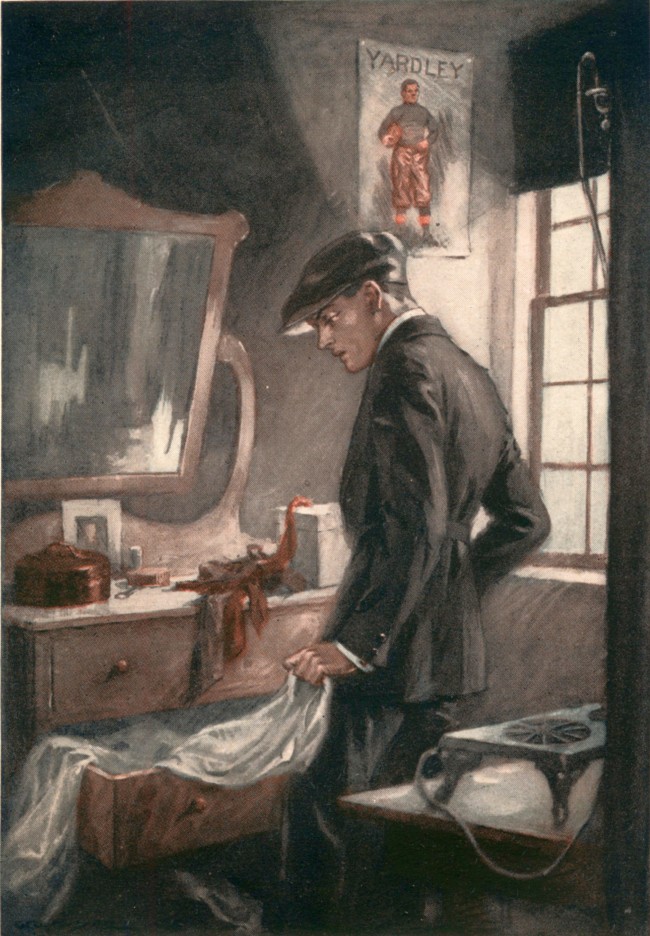
The room was small, with a ceiling that sloped
with the roof, and rather shabby. There was an
iron cot at one side, and a small steamer trunk
peeped out from beneath it. A bureau, grained
in imitation of yellow oak, was across the room
and bore a few photographs in addition to such
purely useful articles as brushes and a comb and
a little china box holding studs and sleeve-links.
The room contained two chairs, although at first
glance one seemed quite sufficient for the available
space: an armchair boasting the remains of
an upholstered seat and a straight-backed affair
whose uncompromising lines were at the moment
partly hidden by a suit of blue serge. The one
remaining article of furniture was a deal table
such as one finds in kitchens. It was a good-sized
table and it stood against the wall at the
right of the window embrasure and under the gas
bracket. From the bracket extended a pipe terminating
at a one-burner gas stove which, on a
square of zinc, adorned one end of the table.
On the stove was a smoothing iron of the sort
known to tailors as a goose. A second such implement
was being pushed back and forth over an
expanse of damp cloth in a little cloud of steam,
hissing, but less alarmingly than the other sort of
goose, and filling the room with a not unpleasant
odor. The iron didn’t stop in its travels to and
fro, but its manipulator, a well-set-up boy of fifteen
with very blue eyes and red-brown hair,
looked around as the visitor entered.
“Hello,” he said. “Sit down, please, and I’ll
be through this in a shake.”
“No hurry.” The visitor seated himself gingerly
in the dilapidated armchair and draped a
pair of gray trousers across his knees. While
the boy at the table deftly lifted the dampened
cloth and laid it over another part of the coat he
was pressing and again pushed the hot iron back
and forth, the visitor’s gaze traveled about the
little room in mild surprise. There were no pictures
on the white walls, nothing in the shape of
decoration beyond three gaudily colored posters.
Two of them depicted heroic figures in football
togs surmounting the word “Yardley” in big
blue letters, and the third was an advertisement
for an automobile, showing a car of gigantic size,
inhabited by a half-dozen lilliputian men and
women, perched precariously on the edge of a
precipice. The boy holding the gray trousers
hoped that the man at the wheel, who seemed to
be admiring the view with no thought of danger,
had his brakes well set! He hadn’t known that
anywhere in Yardley Hall School was there a
room so absolutely unattractive and mean as Number
22. To be sure, Whitson was the oldest of
all the dormitories and so one naturally wouldn’t
look for the modern conveniences found in Merle
or Clarke or Dudley, but he had never suspected
that Poverty Row, as the top floor of Whitson was
factitiously called, held anything so abjectly hideous
as the apartment of T. Tucker. Further reflections
were cut short by his host, who, returning
the iron to the stove and whisking the cloth aside,
picked up the coat he had pressed, folded it knowingly
and laid it on the foot of the bed. After
which, plunging his hands into his trousers pockets,
he faced the visitor inquiringly.
“Something you want done?” he asked briskly.
“Yes, if you can do it this evening,” was the
reply. “But you look pretty busy. It’s just
this pair of trousers, Tucker. I want to wear
them away in the morning.”
“All right, I’ll do ’em. Cleaned or just
pressed?” Toby Tucker took the garment and
examined it with professional interest.
“Oh, just pressed. I don’t think they’re spotted.
Are you sure you want to do them? You
look sort of busy already.” His glance went to
the half-dozen coats and waistcoats and trousers
lying about.
“I am,” replied Toby cheerfully, “but I’ll have
these ready for you in the morning. Seven early
enough?”
“Oh, yes, there’s no chapel to-morrow, you
know. If I’m not up just toss them in the room
somewhere.”
“All right. You’re in Dudley, aren’t you?”
“Yes, four. Crowell’s the name.”
“I know. You’re hockey captain. I suppose
it’s hard to learn that game, isn’t it?” Toby
turned the light out under the burner and seated
himself on the edge of the bed.
“Hockey?” asked Orson Crowell. “N-no,
I don’t think so. Of course a fellow’s got to
know how to skate a bit, and not mind being
roughed, you know. The rest comes with practice.
Thinking of trying it, Tucker?”
“Me? No, I wouldn’t have time. I just
wondered. Arnold Deering’s on the team, and
he’s talked a good deal about it.”
“Oh, you know Arn?”
Toby nodded, hugging his knees up to his chin.
“It was Arnold who got me to come here to
school. His folks have a summer place over on
Long Island where I live. Greenhaven. Ever
been there?”
Crowell shook his head.
“Nice place,” continued Toby thoughtfully.
“Arnold and I got acquainted and he talked so
much about this school that I just made up my
mind I’d come here. So I did.”
“Like it now you’re here?” asked the other
boy, smiling.
“Oh, yes! Yes, I’m glad I came, all right.
Of course—” Toby glanced about the room—“I’m
not what you’d call luxuriously fixed up
here, but I’ve got the room to myself, and that’s
good, because if I had a room-mate he might object
to my staying up all hours pressing clothes.
Besides, it was just about the only room I could
afford.”
“Yes, I suppose it’s just about all right for
you,” agreed the other dubiously. “Do you—do
you do pretty well?”
“Fair. It gets me enough to keep going on.
I don’t charge much, you see, and it’s easier for
fellows to bring their things to me than to take
them to the village or over to Greenburg. It
was sort of hard getting started. Fellows
thought at first I couldn’t do it, I guess. But
now they keep me pretty busy. To-day’s been a
whopper. Every one wants his things pressed to
go home in. I’m almost done, though. Only
got three more suits—and these trousers of
yours. Those won’t take me long. I’ll be
through in a couple of hours.”
“I shouldn’t think you’d have time to do anything
else,” commented Crowell. “When do you
get outdoors? And how about studying?”
“Oh, I have plenty of time. I get up at six,
and that gives me a good hour before chapel.
And then I have another hour at eleven, and,
since football’s been over, an hour or so in the
afternoon.”
“Did you go out for football?”
“Yes, I had a try at it. I was on the second
about three weeks and then they dropped me and
I played on my class team. It was lots of fun,
but it took too much time.”
“Yes, it does take time,” granted Crowell.
“When I started in in my second year I was in
trouble with the office all the time.”
“I’d certainly like to be able to play it the way
you do,” said Toby admiringly. “I guess it
takes a lot of practice, though.”
“Oh, I’m not much good at it,” responded Crowell,
modestly. “Did you see the Broadwood
game?”
“No, I didn’t have time. And it cost too
much. I wanted to, though. I’ll see it next year,
when they play here.”
Crowell had been studying the younger boy interestedly
while they talked and liked what he
saw. There was something very competent in
the youngster’s looks, and the blue eyes expressed
a fearlessness that, taken in conjunction with the
determination shown by the square chin, argued
results. He had a round, somewhat tanned face,
a short nose and hair that, as before hinted, only
just escaped being red instead of brown. (It
didn’t do to more than hint regarding the color of
Toby Tucker’s hair, for Toby was touchy on the
subject and had fought more than one battle to
emphasize the fact that it was distinctly brown
and could not by any stretch of imagination be
termed red!) For the rest, Toby was well built,
healthy and strong, and rather larger than most
boys of his age.
“Look here,” said Crowell suddenly. “How
are you at skating, Tucker?”
“Oh, I can skate.”
“Done much of it?”
“Yes, I skate a lot, but I don’t know much
fancy business.”
“Why don’t you try hockey then? You’d
like it awfully. It’s a ripping sport.”
“I’d be afraid I’d fall over one of those sticks
you push around,” laughed Toby.
“Maybe you would at first,” said Crowell,
smiling, “but you’d soon get the hang of it.
You look to me like a fellow who’d be clever about
learning a thing. How old are you, any how?
Sixteen, I suppose.”
“Not yet. Fifteen.”
“Fourth Class, then?” Toby nodded and
Crowell frowned. “Well, that wouldn’t matter.
Young Sterling played on the second last
year when he was in the fourth. Now, look
here—”
“All right,” said Toby, jumping up, “but
while we’re talking I might be pressing those
pants of yours. If you’ll stick around about ten
minutes I’ll have them for you. Would you mind
waiting that long?”
“Not a bit. Go ahead. What I was going to
say was, why don’t you come out for practice after
vacation, Tucker? Of course, I can’t promise
you a place on the second, but if you can skate
fairly well and will learn to use a stick, I don’t see
why you mightn’t make it.”
Toby spread the trousers on the board and
picked up the cloth. “Why, I guess I’d love to
play,” he responded doubtfully, “but I don’t know
if I’d have time. I dare say you have to practice
a good deal every day, don’t you?”
“About an hour and a half, usually. Think it
over. Candidates have been working in the gym
for a fortnight now, but you wouldn’t have missed
much. You’d meet up with a lot of fine chaps,
too, Tucker. And, if you want to think of it that
way, you might drum up more trade!” Crowell
concluded with a chuckle, and Toby smiled answeringly
as he began to press the hot iron along
the cloth.
“I’ll think it over, thanks,” he said after a moment.
“Of course, a fellow has to do something
in winter to get him out, anyway, and maybe hockey’s
more fun than just skating, eh? I guess I
wouldn’t be good enough for your second team,
but I sort of think I’d like to try. Maybe another
year I’d be better at it.”
“If you missed the second you might make a
class team. They have some good games and a
heap of fun. You tell Arn Deering what I say.
Tell him I said he was to bring you out after you
get back.”
“All right, I’ll tell him,” agreed Toby.
“He’s been after me, anyway. To try hockey,
I mean. Does it cost much?”
“No. You’ve got skates, I suppose? Well,
all you need is something to wear. The club supplies
sticks. Three or four dollars will do it.
Do you know, Tucker, I fancy you might make a
pretty good goal?”
“Goal?” repeated Toby in alarm. “To
shoot the puck at?”
“I mean goal-tend,” laughed Crowell. “But
it amounts to much the same. You get shot at all
right!”
“But you don’t do much skating if you mind
goal, do you?” objected Toby.
“Not a great deal, but it’s a hard position to
play well, son. Good goal-tenders are scarcer
than hens’ teeth!”
“I wouldn’t mind trying it,” said the other.
“Where do you play, Crowell?”
“We have a couple of rinks down by the river,
beyond the tennis courts. Sometimes the class
teams play on the river, but you can’t always be
certain of your ice there. We’re going to have a
hard time beating Broadwood this year, for
they’ve got two peachy players. Either one is
better than any chap we have. Hello, all done?”
“Yes. They aren’t very dry yet, so you’d
better spread them out when you get them home so
they won’t wrinkle.”
“Thanks. How much?”
“Fifteen cents, please.”
“That’s not much. Got a dime handy?”
Toby made the change and Orson Crowell, draping
his trousers over his arm, turned to the door.
“You make up your mind to try hockey, Tucker,”
he advised again from the portal. “I’ll look for
you after vacation. Don’t forget!”
“I won’t, thanks. I’ll see what Deering says.
If he really thinks I’d have any chance I’ll have
a go at it. Good-night.”
“Good-night. Hope you get your work done
in time to get some sleep, Tucker. You look a
bit fagged.”
“I guess I am,” muttered Toby as the door
closed behind the hockey captain, “but I wouldn’t
have thought of it if he hadn’t mentioned it.
Well, it’s only a quarter past eight and there’s not
much left. Now then, you pesky blue serge, let’s
see what your trouble is!”
CHAPTER II OFF FOR HOME
Yardley Hall School ended its Fall
Term that year on the twenty-first of
December, after breakfast, and by nine
o’clock the hill was deserted and the little station
at Wissining presented a crowded and busy appearance
as at least three-quarters of the school’s
three hundred and odd students strove to purchase
tickets, to check baggage and to obtain a vantage
point near the edge of the platform from which to
pile breathlessly into the express and so make certain
of a seat for the ensuing two-hour journey to
New York. A few of the fellows, who were to
travel in the other direction, were absent, for the
east-bound train left nearly an hour later, but they
weren’t missed from that seething, noisy crowd.
Of course much the same thing happened three
times each year, but you wouldn’t have guessed
it from the hopeless, helpless manner in which the
station officials strove to meet the requirements of
the situation. Long after the express, making a
special stop at Wissining, whistled warningly down
the track, boys were still clamoring at the ticket
window and clutching at the frantic baggage master.
How every one got onto the train, and how
all the luggage, piled on four big trucks, was tossed
into the baggage car in something under eighty seconds
was a marvel. From the windows of the
parlor cars and day coaches wondering countenances
peered out at the unusual scene, and as the
first inrush of boys invaded the good car Hyacinth
a nervous old lady seized her reticule and sat on
it, closed her eyes, folded her hands and awaited
the worst!
Toby Tucker, a rather more presentable citizen
than the one who had received Orson Crowell in
Number 22 Whitson last evening, was one of the
first to claim sanctuary in the Hyacinth. This
was not due to his own enterprise so much as to
the fact that a slightly bigger youth had taken
him by the shoulders and, using him as a battering-ram,
had cleaved a path from platform to vestibule.
Toby did not ordinarily travel in parlor
cars, but this morning his objections had been
overruled, and presently he found himself, somewhat
dishevelled and out of breath, seated in a
revolving chair upholstered in uncomfortably
scratchy velvet with an ancient yellow valise on
his knees.
“Put that thing down,” laughed the occupant of
the next chair, pushing his own more modern suit-case
out of the aisle. “Gee, that was a riot,
wasn’t it? Here we go!” The train started
and Toby, not a little excited, saw the station move
past the broad window, caught a final fleeting
glimpse of the village and then found the river beneath
them. A minute later the express roared
disdainfully through Greenburg and set off in earnest
for New Haven and New York. “Two
whole weeks of freedom!” exulted his companion.
“No more Latin, no more math, no more
English comp—”
“And no more French!” added Toby feelingly.
“And no more clothes to clean, either. I guess
it will take me more than a week to get rid of the
smell of benzine. I stayed up until after ten last
night, Arnold. I wanted to press my own things,
but I was too tired. Does this suit look very
bad?”
“Bad? No, it looks corking,” replied Arnold
Deering. “It gets me how you can buy a suit of
clothes for about fifteen dollars and have it look
bully, when I have to pay twenty-five and then look
like the dickens. Look at these togs, will you?
You’d think I’d had them two or three years!”
“When a fellow hangs his clothes on the floor
the way you do,” laughed Toby, “he shouldn’t
expect them to look very nice. Why didn’t you
bring that up yesterday and let me go over it?”
“Because I knew you had more than you could
do, T. Tucker. Besides, you never let me pay
you, you chump.”
“Well, if you’re going to wear your things all
mussed up you can pay me all you want to. Say,
how much does this cost?”
“What?”
“Why, this parlor car business?”
“Oh, about a half. It’s my treat, like I’ve told
you once.”
“Oh, no—” began Toby. But Arnold
drowned out his protest.
“Listen, Toby: you’re coming back to New
York the day after Christmas, aren’t you?”
“No, that’s Sunday; I’ll come Monday.”
“But, hang it, that’s too late! There are piles
of things we’ve got to do. Why, that only gives
us a week!”
“I know, but I’ve got to be at home some of
the time, Arn. I thought I’d come up and stay
with you from Monday to Saturday and then go
back to Greenhaven until Tuesday.”
“Oh, feathers! Well, all right, but if you’re
going to do that you’ve got to stay with me until
day after to-morrow.”
Toby smiled and shook his head. “I can’t,
Arn, honestly. I wrote mother I’d be back to-morrow
afternoon. Besides, I haven’t anything
to wear except what I’ve got on. Everything else
is in my trunk.”
“You don’t need anything else. If you did I
could lend it to you. Have a heart, Toby.
Why, I haven’t seen you for more than a minute
at a time for a whole week!”
“That wasn’t my fault, Arn. You knew
where to find me.”
“Of course, but it’s no fun sitting up in your
attic and watching you press trousers or mess
around with smelly stuff on the roof. Say, I
wrote dad to get some tickets to the theater for
to-night. Wonder what he will get them for.
I’m going to buy a paper and see what the shows
are.”
When Arnold had disappeared down the aisle
Toby produced a pocket-book and gravely and a
trifle anxiously examined the contents. To-morrow
he meant to go shopping for presents for the
folks in Greenhaven, and the subject of funds was
an important one. The pocket-book held four
folded bills and quite a pile of silver and small
coins, but when Toby had carefully counted it all
up the result was not reassuring. He had his
fare to Greenhaven to pay to-morrow, his fare to
New York on Monday, his fare back to Greenhaven
the last of the week, and, finally, his fare all
the way to Wissining the following Tuesday. He
would not, he thought grimly, be riding in a parlor
car on that return trip! The funds in hand
consisted of exactly twelve dollars and forty-eight
cents. Toby replaced the pocket-book, drew
out a little black memorandum and a pencil and
proceeded to figure. He frowned frequently during
the procedure, and once he sighed disappointedly.
After traveling expenses had been allowed
for only seven dollars and a half remained, and
seven dollars and a half wasn’t nearly as much as
he had hoped to be able to expend for Christmas
presents. Why, the shaving set he had meant to
give his father would cost all of five dollars, and
that would leave but two dollars and a half with
which to purchase presents for his mother and
his sister Phebe and Long Tim and Shorty Joe and—Oh
dear, he had quite forgotten Arnold!
He turned some pages in the memorandum book
and read thoughtfully down the list of items
there. “Beech, .85; Framer, .30; Williams, .45;
Hove, .15; Lamson, 1.05; Hurd, .45.” He
stopped, although there were more entries, and
went back to that Lamson item. Frank was on
the train somewhere and perhaps he might be persuaded
to pay up. He had owed most of that
dollar-five since October and ought to be willing to
settle. If he had that it would help considerably.
And perhaps he could find Beech too. He considered
a minute and then left his seat and surveyed
the car. There was quite a sprinkling of
fellows he knew by sight or well enough to speak
to there, but Frank Lamson was not of them.
He started off toward the rear of the train.
Near the door he spoke to a boy in a shiny derby
and a wonderful brown overcoat.
“Hello, Tucker! What say? Frank Lamson?
Yes, I saw him on the platform. He’s
here somewhere, I guess. Unless he got left!”
Jim Rose chuckled. “But I don’t suppose he did.
I never knew him to!”
Toby passed on to the next car and wormed his
way between boys and bags, nodding occasionally,
speaking once or twice, but without success until he
sighted a tall, thin youth of eighteen who sat with
his long legs almost doubled to his chin, reading
a paper. Toby leaned over the back of his chair.
“I say, Beech, would it be convenient for you to
let me have that eighty-five cents? I’m sort of
short just now, or I wouldn’t ask you for it.”
Grover Beech looked up a bit startledly from
the morning paper. “Eh? Oh, that you,
Tucker? Eighty-five cents?” Beech’s countenance
grew troubled. “I’m awfully afraid I
can’t, old man. I’m just about stone broke.
Tell you what, though; I’ll send it to you to-morrow.”
Perhaps the expression of disappointment
on Toby’s face touched him then, for he hesitated,
thrust a hand into his pocket and brought it out
filled with change. “Never mind,” he said.
“I’ve got it here, I guess. If I run short I’ll
make a touch somewhere. Here you are. Fifty,
sixty, seventy—mind some coppers?—eighty—and
five is eighty-five. That right?”
“Yes, thanks. I wouldn’t have asked for it,
only—”
“That’s all right, old man.” Beech waved a
slim hand. “Glad to pay when I can. When
I get back I’ll start another bill! Merry Christmas,
Tucker. Say, where do you live, eh?”
“Greenhaven, Long Island,” replied Toby,
carefully scoring out the item of indebtedness in
his little book and then as carefully dropping the
coins into his purse.
“That’s near by, eh? Lucky guy! I’ve got
to go all the way to Baltimore. Beastly trip.
Be good, Tucker. So long!”
Encouraged, Toby continued his explorations.
Half-way along the next car he discovered his
quarry. Frank Lamson, a big-framed youth of
sixteen, with very black hair and dark eyes in a
good-looking if somewhat saturnine face, was
seated on the arm of a chair, one of a group of
four or five who were laughing and chatting together.
Toby hesitated about broaching the subject
of his errand under the circumstances, but
Frank happened to look up at the moment and
greeted him.
“Hello, Toby,” he called in his usual patronizing
and slightly ironical way. “How’s business?
Pressing?”
The joke won laughter from the others of the
group, one boy, seated on an upturned suit-case,
almost losing his balance. Toby smiled. The
joke was an old one and he had become used to
smiling at it.
“No,” he replied, “business isn’t pressing,
Frank, but bills are. I wish you’d let me have a
dollar and five cents, will you? I need some
money pretty badly.”
Frank Lamson frowned and then laughed.
“So do I, Toby, old scout. Need it like anything.
Bet you a dollar I need it more than you
do.”
“I don’t believe you do,” answered Toby soberly.
“I wouldn’t ask you for it, Frank, but I’m
pretty short—”
“You’ll grow, Tucker,” said the boy on the
suit-case, with a giggle.
“Toby,” said Frank blandly, “I’d pay you in a
minute if I had the money. But I’ve only just got
enough to get home on. As it is, I’ll probably
have to borrow from the butler to pay the taxi
man! I’ll settle up right after vacation, though,
honest Injun. How’ll that do?”
“I’d rather have it now,” replied Toby, “or
some of it. Suppose you pay fifty cents on account?”
“Fifty cents! My word, the fellow talks like
a millionaire! Say, Toby, if you’re short go and
borrow some from Arnold. He’s simply rolling
in wealth. He always is. And, say, if he comes
across, touch him for a couple of dollars for me,
will you?”
“Me, too,” laughed another boy.
“I wish you would, Frank,” said Toby earnestly.
“Honest, I do need the money. And—and
you’ve been owing it for some time now, you
know.”
“Oh, cut it, Tucker!” exclaimed Frank crossly.
“This is no time to dun a chap for a few pennies.
Why didn’t you come around last week if you
needed it so much? Besides, that last job of
cleaning you did was beastly. Every spot came
right back again. I’ll leave it to Watkins. You
saw the suit, didn’t you, Chet?”
Watkins, a stout youth who wore a pair of rubber-rimmed
spectacles and looked like a rather
stupid owl, nodded obediently. “Rotten job, I’d
call it,” he murmured.
Toby flushed. “I’m sorry,” he answered
stiffly. “If you’d brought the things back
again—”
“I had to wear them. But you oughtn’t to
charge me fifty cents for a bum job like that.
Still, I’ll pay—later. Cut along now, old scout.
Don’t obtrude vulgar money matters on such a
gladsome occasion, what?”
Toby hesitated. Then: “All right, Frank,”
he said quietly. “Sorry I troubled you. Hope
you have a Merry Christmas.”
“Same to you, Toby! Just remind me of that
little matter when we get back, will you?” He
winked at the audience and elicited grins. “I
mean well, but I’m awfully forgetful. Bye, bye,
honey!”
When Toby got back to his seat he found Arnold
very busy with his New York paper, and for
the next ten minutes they discussed theaters.
Toby, however, was thinking more of the financial
problem that confronted him than of the evening’s
amusement, and Arnold found him disappointingly
unresponsive when he dwelt on the possibility
of seeing this play or that. In the end he
tossed the paper aside and acknowledged the truth
of Toby’s remark to the effect that it didn’t do any
good deciding what play he wanted to see most if
his father had already purchased the tickets.
For his part, Toby added, he would enjoy anything,
for he had never been to a real theater but
twice in his life. That afforded Arnold an opportunity
to reminisce, which he did for a good ten
minutes while Toby pretended to listen but was in
reality wondering how to make eight dollars and
thirty-five cents do the work of fifteen!
Arnold Deering was sixteen years old, Toby’s
senior by one year. He was a good-looking chap,
with the good looks produced by regularly formed
features such as a straight nose, a rounded chin,
brown eyes well apart and a high forehead made
seemingly higher by brushing the dark brown hair
straight back from it. Arnold’s hair always
looked as if he had arisen from a barber’s chair
the moment before. Some of the summer’s tan
still remained, and altogether Arnold looked
healthy, normal and likable. He was fairly tall
and rather slender, but there was well developed
muscle under the smooth skin and his slimness was
that of the athlete in training.
Later, by which time the train was running
smoothly through the winter fields and woods of
Larchmont and Pelham, Toby told of Orson Crowell’s
visit and their talk, and Arnold’s eyes
opened very wide. “Why, that’s bully!” he exclaimed.
“If Orson talked that way, Toby, he
means to help you. I wouldn’t be surprised if he
took you on the scrub team if you showed any sort
of playing. He doesn’t often go out of his way
to be nice to fellows. I call that lucky! Of
course you’ll have a try, after what he told you!”
“I’d like to, but it would take a lot of time,
Arn. You know I didn’t go to Yardley just to
play hockey and things. I—I’ve got to make
enough money to come back next year.”
“Oh, piffle, Toby! What does an hour’s practice
in the afternoon amount to? Besides, you
played football, and that took more time than
hockey. Don’t be an idiot. Why, say, I’ll bet
you anything you like that you’ll find yourself on
the scrub before the season’s over. And that
would be doing mighty well for a fourth class fellow!
You’d be almost sure of making the school
team next year, Toby!”
“But how do I know I could play hockey? I
can skate pretty well; just ordinary skating, you
know, without any frills—”
“You don’t need the frills in hockey. What
you need is to be able to stay on your feet and
skate hard and—and be a bit tricky.”
“Tricky?”
“Yes, I mean able to dodge and make a fellow
think you’re going to do one thing and then do
another. But staying on your feet is the main
thing.”
“And the hardest, I guess. Crowell seemed
to think I could play goal, as he called it.”
“We-ell, maybe,” responded Arnold cautiously.
“Goal, to my mind, is the toughest position
on the team. You wouldn’t have to skate so
much, but you’d have to be mighty quick on your
feet. And mighty cool, too. But I guess you’d
be cool, all right. I never saw you really excited
yet!”
“How about the time we went after the thieves
that stole the Trainors’ launch that time and they
tried to pot us from the beach?” laughed Toby.
“Huh! You weren’t excited even then! And
I guess a fellow that can stay cool when the bullets
are knocking chips off the boat can keep his head
even when nine or ten wild Indians are banging
into the net and slashing his feet with their sticks!
Blessed if I don’t believe Orson Crowell’s right,
Toby! I guess you’re a born goal-tend!”
“You and Crowell are sort of jumping at conclusions,
I guess,” replied Toby. “I’m not even
certain I could stop a puck if it came at me.”
“Sure you could. It isn’t hard.”
“You just said it was!”
“Well, I mean it isn’t hard when you know
how. Anyway, you’re going to report for hockey
the day we get back if I have to lug you all the
way to the rink!”
“Think there’ll be ice by that time?” asked
Toby.
“I don’t know. It doesn’t look like it now.
It’s been an awfully mild sort of winter so far. I
wish it would snow for Christmas, don’t you?
Christmas doesn’t seem like Christmas without
snow. I’ll bet it’s dandy around your place in
winter, eh?”
“There’s plenty of winter,” laughed Toby.
“It gets frightfully cold over there sometimes.
Arn, if your father will let you you’ll come over
for a few days, won’t you?”
“Surest thing you know,” replied the other
promptly. “I’ve promised six or eight times,
haven’t I? But he won’t, I guess. You see,
since mother died, dad likes to have me around at
Christmas and times like that. Still, he might.
We’ll ask him to-night, eh?”
“All right. Isn’t this the tunnel? We’d better
get our coats on, hadn’t we? Don’t you let
me get lost when we get in there!”
CHAPTER III THE MAN IN THE BROWN OVERCOAT
Arnold’s house was only a five-minute
ride from the station, and Toby, to
whom the city was unfamiliar and vastly
entertaining, wished it had been farther. His enjoyment
of the sights, however, was somewhat
dampened by the seeming recklessness of the taxi-cab
driver, and more than once he started to his
feet to be ready to meet death standing. It kept
Arnold quite busy pulling him back to the seat.
Arnold’s Aunt Alice, who, since his mother’s
death, had kept house for Mr. Deering, was the
only one to welcome them, aside from the servants,
for Arnold’s father did not return from his
down town office until the middle of the afternoon.
Toby was conducted by Arnold and a man-servant
with a striped waistcoat and a maid-servant with
apron and cap and Aunt Alice’s spaniel, San Toy,
into an elevator, past two floors, along a hall and
at last into a great wonderful room that quite took
his breath away. It was all very exciting and confusing
and jolly, and San Toy, entering into the
spirit of the occasion, barked so hard that he
lifted his front paws from the floor! And after
the servants had deposited the bags and coats
and gone away, Arnold pulled Toby through a
door into his own room adjoining and they looked
from the windows over a vast expanse of trees and
lawn and winding paths and shimmering lakes
which Arnold said was Central Park and which
Toby accepted as such and vowed that he could
never tire of looking at it. After luncheon they
went for a walk there, but soon hurried back to
the house to meet Mr. Deering who had telephoned
that he would be home an hour earlier
than usual.
Arnold’s father was so nice to Toby and
seemed so glad to have him there that Toby forgot
much of the embarrassment that had affected him
on his arrival and actually found himself sitting
down in a big velvet-cushioned chair without, for
once, wondering whether he would damage it!
Mr. Deering was rather stout, with grizzled hair
and a most carefully trimmed mustache. Toby
fancied that he could be very crisp and even stern
in his office, but at home he was jovial and kindly
and one might easily have concluded that for the
time at least he had nothing in the world to do but
invent and provide amusement for the two eager-eyed
boys just out of school. The big limousine
car was summoned, and every one, including Aunt
Alice and San Toy, piled into it, and were
whisked away northward over smooth pavements,
along a blue-gray river, over a great bridge and
into the country. Long before they turned back
the sun had gone down behind sullen clouds and
when they reached the town again the lights were
twinkling down the long streets. And then, to
Arnold’s loudly expressed delight, when they got
out of the car at the house little flecks of snow
were falling and the evening had grown quite
cold. From that time until dinner was ready Arnold
made frequent trips to the windows and always
returned with the cheering news that “it was
still at it.”
A wonderful dinner that! Toby, viewing so
many forks and knives and spoons and plates with
dire misgiving, felt extremely uneasy for the first
few minutes for fear he might use the wrong utensil.
But Aunt Alice came to his rescue. “It
doesn’t matter, Toby,” she said, “which fork or
spoon you use. I don’t think Arnold ever gets
them just right himself.” And Mr. Deering
laughingly suggested that Toby might follow the
example of the man who, finding himself left with
two unused spoons, saved the situation by dropping
them in his pocket! After dinner the car
rolled up again and they went off to the theater.
To Arnold’s joy the play was the one he had decided
he wanted most to see, and Mr. Deering
gravely explained the coincidence by mental telepathy
and got Toby very interested and astonished
before the latter discovered that it was just
a joke. But perhaps Toby didn’t enjoy that play!
It was absolutely beautiful and astounding and
thrilling from the rise of the first curtain to the lamentable
fall of the last, and, although to prolong
the gayety they stopped at a gorgeous restaurant
and ate things, Toby couldn’t remember afterwards
what he had had, or much of anything except
the play. He would have stayed awake half
the rest of the night—it was already well past
midnight when they reached home again—talking
it over with Arnold if that unfeeling brute
hadn’t fallen to sleep almost immediately.
They awoke in the morning, frightfully and deliciously
late, to find the world carpeted with a
good inch of snow. From the windows of Arnold’s
room on the front of the house the scene was
like fairyland. Or so, at least, Toby declared.
Every branch of every tree and shrub in the Park
was frosted with snow and what had been grass
yesterday was this morning an unsullied expanse
of white. But to Arnold’s disgust the sun was
out, shining brilliantly if frostily, and already the
streets were almost bare. Toby, though, declined
to be down-hearted, reminding his chum that it
would probably snow again to-morrow, and Arnold,
on that understanding, concluded that life
still held a faint promise of happiness and decided
to get dressed and have some breakfast.
But they didn’t spend much time at the table.
One isn’t extremely hungry at nine if one has
supped at midnight, and, besides, both boys were
eager to get out of doors. To Toby this forenoon
was an important occasion, for he was to do
his Christmas shopping, and when a chap has all
of eight dollars to spend just as he sees fit he
doesn’t care to waste much time on such every-day
things as breakfasts!
They traveled downtown on the top of a bus,
missing very little of the brilliant pageant set before
them. The holiday spirit was in the air and
the very city itself seemed sensible of the season’s
significance. The sunlight shone dazzlingly on
patches of wet pavement, above the roofs clouds
of white steam billowed up against a blue sky and
everywhere was color and life. The windows of
the shops were gorgeous with holiday displays
and on all sides the scarlet of holly berries and the
green of fir and pine met the eager eyes of the
boys. The street was a solid stream of moving
vehicles, dashing motor cars, lumbering busses, sedate
carriages, rattling delivery wagons. Nickel
and brass and shining varnish caught the sunlight.
It was three days to Christmas, but one might
have thought from the hurry and bustle of the
busy shoppers that that important occasion was
due no later than to-morrow. Toby was very
thrilled and very excited by the time they disembarked,
seemingly at the risk of their lives, at
Thirty-fourth Street, and Arnold, although far
more accustomed to the inspiring scene, found
himself in a truly holiday mood.
Arnold was postponing his own shopping until
the next day in order that Toby, who was to continue
on to Greenhaven in the afternoon, might
have the services of his advice and assistance.
Toby had ruefully confided to his chum that his
capital was small and Arnold had decided that
Fifth Avenue was not the place for purchasing.
So, when they had gained the sidewalk in safety
by what appeared to Toby nothing short of a miracle,
they started away along the cross streets.
They didn’t make very rapid progress, though,
for Toby found something fascinating in nearly
every window, and more than once Arnold discovered
himself alone and had to retrace his steps
and drag the other away from rapt contemplation
of a marvelous display. Toby’s unbounded admiration
and wonder pleased Arnold, and the latter
thoroughly enjoyed exhibiting the marvels of
his city to his friend. They were about midway
of the block when Arnold missed Toby for perhaps
the sixth time. He turned back, but none of
the near-by windows reflected the countenance of
T. Tucker. Arnold was about reaching the conclusion
that Toby was lost when he suddenly
caught a glimpse of that youth standing by the
curbing. Arnold fought his way back to him.
Toby was talking to a seedy looking man whose
unshaven face and watery, shifty eyes inspired
Arnold with anything but confidence. But he
reached the scene too late, for Toby was already
returning his purse to his pocket when Arnold
seized his arm.
“Don’t be a chump, Toby,” he said impatiently.
“That fellow’s got more money right
now than you have. How much did you give
him?”
“Only a quarter,” replied Toby gravely.
“He hasn’t had anything to eat for two days, and
his wife’s sick and—”
“I know! His grandmother’s broken a leg
and all his children have scarlet fever! Gee, you
oughtn’t to be trusted around this burg with any
money in your pocket. The man’s a professional
beggar, you idiot!”
Toby looked both shocked and incredulous.
“I don’t think so, Arn,” he protested. “If you’d
heard him—”
“I’ve heard lots of them,” returned the other
impatiently. “You stay with me after this and
keep your hand out of your pocket. If you’re
going to give money to all the beggars that ask
for it, you won’t have a cent when you get into a
store!”
“I just couldn’t help giving him a little,” said
Toby. “Did you notice that he didn’t have any
overcoat? Why, his hands were blue with the
cold, Arn!”
“Yes, and his nose was red with it—or something
else. Toby, you’re an awful green little
yap, that’s what you are!”
“What’s a yap?” asked Toby untroubledly.
“It’s what you are,” laughed Arnold.
“Come on in here and see what we can do. This
is as reasonable as any place, I guess.”
They pushed through a revolving door and
found themselves in a big department store that
was just about twice as crowded as the sidewalk
had been. Arnold found a magnificent gentleman
in a long black frock coat and asked his way to the
cutlery department. While they were receiving
directions some one tugged at Toby’s coat, or
seemed to, and he looked around. A man with a
stubbly red mustache muttered an apology and
pushed past, and Toby smiled forgivingly and followed
Arnold through the throng. He had decided
a week ago to pay as much as five dollars for
a shaving set for his father, but that was before
his discovery that just before Christmas was a bad
time for collections! Now his limit was three
dollars and he doubted that that amount would
buy anything nice enough. But when the salesman
began to place the goods before them on the
counter Toby took heart. It was simply wonderful
what you could get for a dollar and ninety-eight
cents in this place! In the end he decided on a
set costing two dollars and seventy-five cents—there
was none for exactly three dollars—and
put his hand into an overcoat pocket to get his
purse out. The hand returned empty. The
other hand went into the other pocket and fared
no better and a look of surprise bordering on
alarm overspread the boy’s countenance.
“What’s the matter?” asked Arnold.
“I can’t find—my purse,” gasped Toby, both
hands probing diligently.
“You wouldn’t have it there, would you?”
asked Arnold anxiously. “Try your trousers,
why don’t you?”
“I—I’m pretty sure I dropped it into my
overcoat pocket after I gave that man the quarter.”
Toby searched his other pockets, however,
to make certain, but without success. “It’s
gone!” he announced in utter dismay, staring
blankly at his friend.
“Some one pinched it,” said Arnold, with conviction.
“What the dickens did you ever put it
in an outside pocket for? Didn’t you know that
there were pickpockets in the world?”
“I—I guess I didn’t think,” murmured Toby
disconsolately, still dipping unavailingly into various
parts of his clothing. “It—it’s clean
gone, anyway. Here’s where I put it.”
“That was a swell place,” said Arnold scathingly.
“Here, I’ll pay for this and you can pay
me back some time.”
The salesman, sympathetic but a trifle impatient,
started to accept Arnold’s money, but Toby
interfered. “No, please, Arn! I’d rather not,
thanks. I’ve lost my money and it’s my own
fault and—”
“But you’ve got to buy your presents! We’ll
go down to the office and get some more
from dad. I’ve only got about three and a
half.”
“I’d rather not. I couldn’t pay it back for a
long while. I’ll just have to tell the folks what
happened, Arn. They won’t mind—much—when
they understand.”
“But why not let me loan you enough for the
razor set, anyway? You don’t need to pay me
back for a year, you silly chump!”
But Toby was obdurate. “I—maybe I’ll
come back for that later,” he told the salesman
apologetically. “Thanks for your trouble.”
“That’s all right,” returned the man heartily.
“It’s too bad you lost it. You didn’t feel anything,
did you? I mean you wouldn’t know where
it happened?”
Toby’s eyes narrowed and he stared for a moment
straight ahead. Then, before Arnold could
stop him, he had turned and was plunging determinedly
through the crowd. Arnold hurried after
him, sighting him now and then and finally
reaching him near the entrance.
“Where are you going?” panted Arnold, seizing
the other by the arm.
“I don’t know,” answered Toby thoughtfully.
“Listen, Arn. While you were asking that man
where the razors were I felt something tug at my
coat and I looked around and there was a man
pushing by me. He said he was sorry or something
and—and beat it. I’ll bet you anything
he did it!”
“Of course he did! But what of it? You
don’t expect to find him waiting for you to come
back, do you?”
Toby shook his head doubtfully. “No, I guess
not. Only I thought he might be still around
here. I’d know him in a minute if I saw him.
Don’t you think that maybe if we sort of walked
around and kept our eyes open we might find
him?”
“No, I certainly don’t,” said Arnold decidedly.
“As soon as he got that purse of yours he hiked
out for some other place, naturally.”
“Oh!” murmured Toby disappointedly.
“Where do you think he went?”
“Great Scott! How do I know? He might
be just around the corner or he may be a mile
away by this time. You might just as well make
up your mind to doing without that money, Toby.
I’m awfully sorry, old man. And I do wish you’d
let me lend you some. It’s perfectly silly not to.
If it was I who had lost my purse I’d take a loan
from you in a minute.”
Toby smiled wanly at the idea of lending money
to Arnold. Then the smile faded and he said:
“Gee, I needed that eight dollars, Arn. It—it’s
tough, isn’t it?”
“It certainly is, Toby. I’m as sorry as anything.
Hang it, if you hadn’t been crazy enough
to hand out money to a beggar it wouldn’t have
happened. After this—”
“I know, but there won’t be any after this.
Look here, Arn, I wish you’d let me have a dime
and then run along home. I want to look around
a bit and there’s no use dragging you around too.
Will you?”
“Look around? You mean you want to look
for the chap who swiped your purse? That’s
crazy, Toby, honestly. You haven’t got one
chance in a hundred, one chance in ten thousand,
of ever seeing him again.”
“Maybe not, but—but I’d sort of like to try,
Arn. You slip me a dime and—”
“Slip you nothing! If you must make a silly
ass of yourself I’ll stick around with you. Where
do you want to go first?”
“Where’s the nearest big store like this?”
“I don’t know, but we can go and look for it.
Do you think he’ll be there?”
“He might be. You see, if he did so well here
he might think he ought to stick to department
stores, and he’d probably take the next one.
Wouldn’t you argue about like that, Arn?”
“Maybe I would, if I were a pickpocket,”
chuckled Arnold. “All right, old man. Come
on. Only I warn you right now that you’re only
starting on a wild goose chase, so don’t be disappointed,
Toby.”
“I shan’t be,” answered Toby soberly. On
the sidewalk he left Arnold and addressed the carriage-man
on the curb. “He says,” he announced
when he rejoined his chum, “that there’s
another big store just a little way along here.
It’s the nearest, so I guess we’d better go there
first.”
“First? You don’t mean that you intend to
make the round of all the department stores, do
you?”
“I guess there wouldn’t be time for that,” answered
Toby, shaking his head. “You see, my
train leaves at three-forty. Besides, I guess that
fellow with the red mustache would get tired, or
maybe he’d make so much money by dinner time
he’d just naturally quit. If he got eight dollars
from every one he tackled he’d be mighty well off
by noon, wouldn’t he?”
“Toby, you’re an awful idiot,” laughed Arnold
affectionately as he took him by the arm and
steered him along the street. “I’ll let you play
detective till a quarter to one. Then you’ve got
to give up and come home to luncheon.”
“All right. I dare say we can do half a dozen
stores by that time. Listen, Arn, I’ll tell you
what the man looked like so you can be on the
watch too, eh? He was short and sort of slim,
and he wore a brown overcoat with a velvet collar,
and he had a reddish mustache cut close and sort
of bristly, and he wore a slouch hat.”
“A what?”
“A slouch hat; a soft one, you know; felt. It
was dark; I think either black or dark gray.”
“Well, that’s a pretty good description considering
you only saw him for a second,” applauded
Arnold as they entered the store. “We’d better
keep out of sight as much as we can, because if he
spotted us first he’d suspect something and run.
Let’s go around here and work back and then
come down the next aisle, and so on. Shall we?”
“I—I don’t know about that,” responded the
other. “Seems to me he’d be likely to stay
around where the crowd was thickest, and perhaps
he’d try to keep near a door in case he had
to—to leave hurriedly.”
“That’s so, Toby. You’re a regular Sherlock
Holmes! All right. The crowd’s about as thick
right here as it is anywhere. Have a look. Do
you see him?” Arnold was beginning to enjoy
the task now and tried to look as much like his
conception of a sleuth as he could. Toby, backed
against a counter at one side of the big entrance
peered and craned for several minutes, but finally
announced that he didn’t see the quarry. So they
began a pilgrimage of the lower floor, pausing
wherever the crowd was densest. Near the elevators
they found a point of vantage and spent quite
ten minutes but without result other than being
pushed and elbowed and trod on. From there
they went on to the foot of a central stairway and
again took up their watch. But no red-mustached,
brown-overcoated individual rewarded
their sight, although they both more than once
thrilled with the prospect of success at sight of a
brown garment in the throng. They spent more
than half an hour in that store, and Arnold’s enthusiasm
was waning fast by the time Toby acknowledged
defeat and led the way toward the big
doorway.
“I guess it’s no use,” sighed Toby. “He’s a
goner. And so’s my money.”
“Well, I told you that in the first place,” said
Arnold, just a trifle peevishly by reason of having
been shoved around and bumped into until he felt,
as he told himself, like a wreck. “Want to try
any other place? It’s nearly twelve and—”
He stopped suddenly, for Toby’s hand was
gripping his arm painfully. “There he is!”
whispered Toby. “Look! Over by the umbrellas!”
CHAPTER IV THE CAPTURE
Arnold’s gaze sped in the direction indicated,
but for an instant the crowd interfered.
“Are you sure?” he asked incredulously.
“Yes,” whispered Toby. “I saw him! Now
look, Arn!”
Well, whether he was the man who had taken
Toby’s purse or not, at least he tallied surprisingly
with Toby’s description. He was standing with
his back to the counter in front of a fan-shaped
display of ladies’ umbrellas, looking impatiently
and frowningly about him for all the world like a
man kept waiting at an appointment. So well did
he look the part, in fact, that Arnold was quite
certain that Toby must be wrong. But a closer
examination of the man convinced him that he was
only acting, for the eyes under the pulled-down
brim of a black felt hat darted swiftly hither and
thither, reminding Arnold too much of a hawk.
Some twenty feet of aisle space, crowded with
shoppers, separated the boys from the man in the
brown overcoat, and it was only by raising himself
on his tiptoes that Arnold could catch brief
glimpses of the latter.
“What are you going to do?” Arnold whispered
excitedly.
Toby deliberated. Then he shook his head.
“I don’t know. If there was a policeman
here—”
“They have detectives in these stores, I think,”
said the other. “Only I don’t know how a fellow
would know one if he saw him.”
“I might keep an eye on him while you found a
policeman,” suggested Toby, doubtfully.
“Suppose he went off before I got the officer,
though?”
“That’s the trouble. We might ask a clerk to
send for one, or—or find the proprietor—”
But the man in the brown overcoat settled the
matter then and there by leaving his place at the
counter and mingling with the outgoing throng.
More by luck than anything else, Arnold saw and
tugged Toby’s coat sleeve. “Come on!” he said
quickly. “He’s going!”
The boys hurried toward the door, or tried to
hurry, but their quarry was lost to sight for a moment
and when they reached the sidewalk nothing
was to be seen of him.
“Which way?” demanded Arnold.
Toby, craning his head, dodging about, pushed
and scowled at, was at a loss, and the adventure
would have ended there and then had not Arnold’s
gaze caught a brief flash of light brown between
the jostling throng. “I think I see him,” he
cried. “Come on, Toby!” He pushed his way
to the edge of the broad sidewalk, Toby following
at his heels, just in time to see the man disappear
behind a car at the far side of the street.
Without pause they dashed after. That they escaped
injury in the seething traffic was only by the
veriest good fortune. An automobile almost ran
them down half-way across, a trolley car ground
its brakes in seeming chagrin as they leaped out
of its path, and, after that, they were forced to remain
marooned between track and curbing for
many moments before a tiny break in the line of
vehicles allowed them to squeeze through.
As might have been expected, by the time they
found themselves on the sidewalk, very much out
of breath, the brown overcoat was once more gone
from view, and although they gazed up and down
the street no glimpse of it rewarded them.
Toby’s countenance took on an expression of despair
that was almost ludicrous and Arnold fretted
and fumed.
“If we hadn’t been held up out there we’d have
caught him,” he declared as they stood undecidedly
on the edge of the sidewalk. “Now he’s
gone for good, I guess.”
Toby nodded dolorous assent. “I wish I’d
just gone up and grabbed hold of him when I had
the chance,” he said. “Which way was he going,
do you think?”
“He wasn’t going any way. He was headed
straight across the street.”
“Why, then—” Toby stopped and ran his
gaze over the fronts of the buildings. Almost opposite
where they stood was the entrance of a
small, third-rate hotel. “I’ll bet he went in
there,” said Toby with conviction. “Maybe he
lives there.”
Arnold viewed the hostelry and shook his head.
“I wouldn’t be surprised if that is just where he
went, but I don’t believe he lives there. Perhaps
if we wait awhile he will come out again.
What do you think?”
“I guess it’s all we can do,” replied Toby.
“But we had better get out of sight a little more,
for if he came out and saw us he might recognize
me and run.”
The suggestion was a good one since this side
of the thoroughfare was far less crowded and
their present position was in fair view of the entrance.
So they retired to a near-by doorway
from which, by peering around the corner of a
plate-glass window, they could watch the hotel entrance.
It promised to be tiresome work and
there were all sorts of things happening every
minute to distract their gaze. But Fortune favored
them again and very shortly, for they had
been there less than five minutes when Toby uttered
a warning hiss and Arnold, whose gaze had
wandered for an instant, looked around in time to
see the man in the brown overcoat emerge from
the hotel. He paused for a moment outside the
doorway and speculatively looked up and down the
street. Finally he turned eastward and strolled
unhurriedly toward them. The boys withdrew
further into their doorway, turning their backs
and becoming on the instant extremely interested
in the window display. But the man didn’t even
glance in their direction and as soon as he had
passed the boys slipped out from concealment and
followed.
During the next seven or eight minutes, which
time the man consumed in reaching the corner,
there were many pauses. Their quarry paused
frequently to look into windows or survey the passers.
Once he stopped and backed up against a
building while his gaze speculatively followed two
richly-dressed women. But apparently he decided
that the women presented small chance for
the display of his talents, for he went on again.
All the time the boys looked anxiously for a policeman,
but a policeman when wanted is an extremely
rare thing, and not one appeared in sight
all the way along the block. At the corner the
traffic signal was set at “Stop” and the man in the
brown overcoat paused just back of the curb, one
of an impatient throng of a dozen or so persons.
Toby and Arnold stopped at a discreet distance.
In the center of the intersecting thoroughfares, in
command of the traffic signal, was a very tall and
very efficient-looking policeman. The boys consulted
hurriedly. Then they advanced toward the
man in the brown overcoat. The northward and
southward streams of hurrying vehicles continued.
Toby drew up at the man’s right and Arnold on his
other side. It was Toby who opened negotiations.
“We were going to point you out to the policeman,”
he said softly, trying to keep his voice
steady, “but we decided to give you a chance
first.”
The man turned and scowled down with shifty
eyes.
“What do you want?” he demanded threateningly.
“My purse and eight dollars and fifty cents,”
said Toby. “If you try to get away we’ll grab
you and yell. Keep close, Arn!”
The pickpocket glanced swiftly around at Arnold
who was pressing closely against his left
shoulder. Then his eyes darted up and down the
avenue. At that moment the crossing officer’s
whistle sounded shrilly and the signal turned.
The little throng by the curb surged forward and
with a sudden dart the man followed. But Toby
had seized one arm and Arnold the other, and not
fifty feet away was the policeman. The man in
the brown overcoat tried, with a snarl, to throw
off his captors, but they clung like leeches, and
fearing to attract embarrassing attention the man
slowed down to a hurried walk. Three abreast,
the boys clinging affectionately to him, they
crossed the street. Once across the pickpocket
stopped of his own choice.
“What is this?” he asked indignantly. “A
hold-up?”
“If you want to call it that,” answered Toby
steadily. “All I want is the purse you stole from
my pocket in Eastman’s. You hand it over and
we’ll let you go.”
“Aw, I never saw you before,” snarled the man.
“Get out of here before I hand you something,
kids. It won’t be no purse, neither!” He
tugged in an effort to free himself from their
grasps, but they held on hard.
“Want us to shout?” asked Arnold significantly.
The man’s belligerent gaze wavered.
He cast a swift and dubious look toward the officer.
“Well, what is it you want?” he muttered.
“You know,” said Toby. “A small yellow
coin-purse with eight dollars in it. Come on, now.
You’d better be sensible.”
“I ain’t got any purse, honest. You can search
me, boys!”
“Then you threw it away,” responded Toby.
“It cost me seventy-five cents, but it was sort of
ripping on the seams, so we’ll call it fifty. Eight-fifty
is what I want from you then.”
“Well, I’ll be blowed!” said the man with a
trace of unwilling admiration. Then he actually
chuckled. “Say, kid, you’ve got your nerve, all
right, ain’t you? Say, I kinder think maybe you
ought to have it. You was decent not to squeal
to the cop. All right, kid, you win! But you got
to let go my arms if you want me to dig for it.”
Toby questioned Arnold with a glance. “Give
him his right arm, Toby,” said Arnold. “If he
starts to go, grab him again. I’ve got him here.”
“Aw, say, can’t you believe a feller?” asked
the man aggrievedly. “I said I’d loosen up an’
I’ll do it. Gee, you rich guys is the limit!
What’s eight dollars to fellers like you, anyway?
Why don’t you give the rest of us a chance to
live?”
He thrust the hand Toby had released between
the buttons of his overcoat and fumbled an instant,
while Toby watched narrowly and Arnold clung
like grim death to the other arm.
“Why don’t you pick out an honest way to
live?” asked Toby.
The man shrugged his shoulders. “Guess I
wasn’t brung up right,” he answered, with a grin.
“It ain’t so easy to walk the straight an’ narrer
when you get started all wrong, kid. Here’s your
money. I threw the purse away. It ain’t safe
to keep purses around you. Let me have that
other hand so’s I can count it off, can’t you?”
He had brought out a roll of bills quite two
inches thick. Toby hesitated, dubious. “Promise
not to run?” he asked finally.
“Word of honor, kid!”
“Let him go, Arn.”
“Thank you, gentlemen,” said the man in the
brown overcoat ironically. “Now then, got fifty
cents? Here’s your nine dollars.” He peeled
off a five and four ones and Arnold produced a
fifty cent piece and the exchange was made. As
Toby slipped the recovered wealth into an inner
pocket the man said: “That’s right, kid. Let
me tell you something. Don’t never carry money
in an outside pocket. Leastways, not in this
town! ’Tain’t safe. An’ it’s an awful temptation
to fellers like me. So long, cullies. Good
luck!”
“Good-by,” said Toby.
The man in the brown overcoat smiled, winked,
pulled his hat to a new angle and sauntered off and
was soon lost to sight in the throng. Toby drew
a deep sigh of relief and satisfaction.
“Jiminy, Arn, I never thought I’d get that
back, did you?”
“I never did, Toby. You certainly were lucky.
He wasn’t such a bad sort after all, was he?”
“N—no.” Toby gazed thoughtfully at the
busy scene before them. “I dare say there’s a
lot in what he said, Arn. About getting started
right, I mean. I guess lots of folks wouldn’t be
dishonest if they’d had the right sort of—of
bringing up, eh?”
“I guess so. Look here, it’s nearly one
o’clock! What’ll you do about buying your
presents?”
“I guess it’s too late now.” Toby’s face fell.
“I tell you what we’ll do. We’ll find a telephone
and send word we won’t be home for luncheon,
eh? We’ll get a bite to eat somewhere and
then you can shop until nearly three. You can
do a lot in two hours. What do you say?”
“Would you mind? I’d like awfully to do
that.”
“Not a bit. It’ll be fun. I know a place near
here where we can get fine eats. Come on!”
But, although Toby came on, when Arnold
turned to speak to him a minute later he wasn’t
there. Impatiently Arnold turned back. Toby
had paused a few yards in the rear.
“For the love of mud, Toby, get a move on,
can’t you?” exclaimed Arnold. “What’s wrong
now?”
“Nothing,” was the satisfied response. “I
only just stopped to see if my money was still
there. I won’t feel really safe until I’ve spent it, I
guess!”
CHAPTER V CHRISTMAS DAYS
Arnold had his wish that Christmas, for
when Toby awoke on the morning of the
twenty-fifth in his little room under the
eaves he found that a miracle had occurred while
he slept. In fact the miracle was still occurring!
Greenhaven was smothered in snow, and big, lazy
flakes were still falling from a leaden, misty void.
Harbor Street, as it wound northward, showed a
single line of footprints, and those were fast being
obliterated. The boat yard, across the road, was
covered with a white mantle. Beyond, the Cove
was dimly discernible, gray-green. The stern of
a coal-scow peered through the white mist from
the end of Rollinson’s Wharf and a little black
fishing boat swung at moorings near by. It was a
white, silent and, to Toby, very wonderful world
that met the sight that Christmas morning. But
Toby didn’t linger long at his window, for the
room was cold. Instead, wondering whether Arnold
had discovered the snow yet, and deciding,
with a chuckle, that he hadn’t, since it was only
seven and Arnold was not a very early riser when
at home, he hurried into his clothes and was presently
on his way down the creaky staircase.
Appetizing odors came from the kitchen, but
the dining-room was deserted save for Mr. Murphy.
Mr. Murphy’s greeting was a strident
“Hello, dearie! Won’t you come in and take off
your bonnet?” After which he sidled lumbersomely
along his perch, put his head coyly on one
side and chuckled.
“Hello, you old scoundrel,” said Toby.
“Merry Christmas to you.” He rubbed the parrot’s
head with a finger and Mr. Murphy closed
his beady eyes and enjoyed it. Toby was glad
there was no one there, for it gave him an opportunity
to place the packages he had brought
around the table. Others, he saw, had been ahead
of him, for already each plate held its quota of
mysterious parcels tied with red ribbon. Then
Phebe came in from the kitchen and Mr. Tucker
stamped in from outdoors and Christmas greetings
mingled, while Mr. Murphy, who loved excitement,
bobbed about on his perch and cried “All
hands stand by!” and “Come to breakfast!
Come to breakfast! Come to breakfast!”
And in the middle of the hubbub appeared Toby’s
mother bearing a big platter, and a minute later
they were all seated at the table.
That was a very merry meal. One after another
the packages were undone and the contents
exclaimed upon and passed from hand to hand to
be admired and every one quite forgot to eat anything
until all the presents had been opened. Mr.
Tucker was very much pleased with his shaving
set, and Phebe, who was thirteen and fast becoming
a very pretty young lady, wound the blue-and-white
silk scarf Toby had given her round her
throat and refused to be parted from it. Toby’s
gift to his mother was a pair of gloves which Mrs.
Tucker declared very much too fine for her.
The fact that they were a full size too small was
not divulged. Toby’s own presents were simple
and practical; a dressing-gown and handkerchiefs
from his mother and sister, a five-dollar gold piece
from his father, a pair of woolen mittens from
Long Tim and a watch-fob of braided leather
from Shorty Joe. Tim and Joe worked in Mr.
Tucker’s boat yard. When, later in the day,
Billy Plank, the postman, plowed up to the door,
there was another gift for Toby. Of course he
guessed right away who it was from, and his guess
proved right. There was a card on top of the little
blue box which read: “Merry Christmas to
Toby from Arnold.” When the layer of cotton
had been removed, as well as much white tissue
paper, the gift resolved itself into a pair of gold
cuff-links with the letters T. T. intertwined on
them. Of course, as Toby said, they were much
too expensive for his use, but they pleased him immensely
and he carried them around in his pocket
all day and viewed them proudly at intervals.
By comparison, his gift to Arnold, an inexpensive
little leather case for pins and studs, looked rather
mean, but he was much too sensible to be worried
over it.
After breakfast he set out to visit Long Tim
and Shorty Joe and deliver the presents he had
brought them, two ties of most remarkable hues
which, judged solely as color effects, had been stupendously
cheap at thirty-seven cents apiece!
Fortunately, as Toby well knew, both Joe and
Tim were fond of bright colors, and his gifts were
received with open-eyed admiration. It was almost
noon when he at last got away from Shorty
Joe, who had much to tell him of happenings during
his three months’ absence from Greenhaven.
They weren’t very important happenings, but they
were of interest to Toby. Dinner was at two
o’clock, and Toby’s Uncle Benedict and Aunt
Sarah, from Good Ground, arrived a few minutes
before, Aunt Sarah bringing him a pair of worsted
gloves which she had knitted. Toby was sorry
that he had neglected to provide a gift for her, but
Aunt Sarah didn’t appear to notice the omission.
Dinner was a very jolly and very hearty affair, and
after it was over, Toby, resisting a desire to go to
sleep, persuaded Phebe to don her new muffler and
go for a walk with him. It was getting well along
toward dusk by that time and the snow, which
had fallen steadily since before midnight, had almost
stopped. They took the road through the
town and then turned up the hill behind the little
village from which a wonderful view of Spanish
Harbor and the bay lay before them. They had
lots to talk about and Phebe was full of questions
regarding Toby’s school adventures. On the way
back they met two of Toby’s friends, Billy Conners
and Gus Whalen, and the quartette went on
to the little white cottage around the end of the
Cove and satisfied surprisingly vigorous hungers
with slices of cold turkey and cranberry tarts.
Toby returned to New York Monday afternoon
and spent a glorious four days with Arnold.
They went twice to theaters, had several sleigh
rides far out into the country, patronized the
“movies” two afternoons, explored the Park,
lunched one day with Arnold’s father at a sumptuous
club and, in short, were busy every moment
and went to bed each night so tired that they fell
asleep the instant their heads touched the pillows.
On Friday Arnold went back to Greenhaven
with Toby and shared the latter’s none too generous
bed, since a guest chamber was something the
little house didn’t boast, until Sunday. A sharp
breeze Friday night provided fair skating on the
marsh and it was on Saturday that Toby received
his first instruction in the duties of a hockey
player. They had no hockey sticks and so they
used two lengths of wood that Long Tim cut for
them in the boat shed and a block of mahogany.
Toby found that while he could out-skate his chum
in a straight-away race, the latter could out-maneuver
him with ease. Arnold could stop and
turn and dodge with the quickness of a cat!
Toby’s efforts to emulate him resulted in many
laughable and sometimes jarring upsets. Perhaps
that lesson didn’t increase his knowledge beyond
showing him what a lot he had to learn, but
it provided a heap of fun. Sunday morning they
tramped over to the Head, through a biting easterly
gale, and Arnold, who had provided himself
with the key of his father’s summer house there,
rummaged through the dark rooms for an elusive
baseman’s glove. Eventually it came to light, but
not before the two boys were pretty well chilled
through. They tried to light a fire in the kitchen
range to warm themselves by before setting out on
the return journey, but the range absolutely refused
to draw and they had finally to flee, choking
and coughing from the smoke that billowed
through the cracks. Half-way back Arnold suddenly
began to laugh and in answer to Toby’s concerned
inquiries explained that the reason the stove
hadn’t drawn was because the chimney-tops were
carefully covered, a fact which he had forgotten
until the moment!
Arnold went home in the afternoon, Toby
and Phebe accompanying him as far as the station
at Riverport. After that the remainder of the
Christmas vacation simply melted away, much as
the snow did on Monday when the easterly gale
swept around to the south and a radiant sun
smiled down on the dripping world. It didn’t
seem to Toby that he had been away from Yardley
Hall more than a half-dozen days, but here it
was Tuesday and he was on his way back again!
But going back wasn’t unpleasant. On the contrary,
if anything had happened to prevent his going
back he would have been a most unhappy
youth. There was lots to look forward to,
hockey, amongst other things, for Toby had by
now decided that it was his bounden duty to go to
the aid of the School in its commendable endeavor
to turn out a winning seven. As there was a
whole hour and a quarter to spend before he was
to meet Arnold at the station, he set out, not without
trepidation, to purchase one of those invaluable
little blue-covered books which tell you how to
perform every sort of athletic stunt from swinging
Indian clubs to throwing a fifty-six-pound weight.
Of course Toby wasn’t interested in clubs or
weights just now. What he was after was a handbook
on hockey, and after some searching up and
down and across the town, with one eye on the
clock, so to speak, he found it. You may be sure
that Toby’s scant funds lay at the bottom of his
most inaccessible pocket. Had he so much as
sighted a brown overcoat he would have run!
When Arnold found him he was sitting in a seat
in the waiting-room, his feet on his old yellow valise
and his eyes glued to page 19 of “How to
Play Hockey.”
They boarded the ten-forty train and were soon
gliding through the long tunnel on their way back
to school and duties. But they didn’t sit in a
parlor car this time. Toby would have none of
such luxury, and rather than be parted from him
Arnold shared his seat in a day coach. There
were some twenty or thirty other Yardley fellows
on board and the time went swiftly, and almost
before they knew it they were crossing the little
bridge and the school buildings were smiling down
welcomingly from the hill and the trainman was
calling “Wissining! Wissining!” at the top of
his voice.
Well, it was good to be back again, Toby
thought as, spurning carriages and valiantly lugging
their bags, they set off along the road to
school. Oxford Hall, imposing and a bit grim
by reason of its gray granite walls, met their sight
first as they left the tiny village and started up the
hill. At the top of the tall pole in front the
flag was snapping in the brisk breeze. Merle
Hall, the home of the Preparatory Class boys,
peered around the corner of Oxford, almost frivolous
by comparison with its red brick and limestone
trimming. A moment later, following the
road to the right at the beginning of its wide
swing around the base of the Prospect, as the plateau
was called, other buildings came into sight:
Whitson, like Oxford, of granite; Clarke, a replica
of Merle; and, just showing between the
other buildings, Dudley Hall, the exclusive residence
of the graduating class. The buildings at
Yardley follow the curve of the Prospect, forming
a somewhat stunted letter J, with the Kingdon
Gymnasium, out of sight from the road, doing
duty as the tip of the curve and Dudley set in back
like a misplaced dot. From the gymnasium the
ground slopes gently back to the river, and there is
the playing field and the boat house and landing
and, further beyond, a fair nine-hole golf course.
Across the river from the field lies a wide expanse
of salt meadow known as Meeker’s Marsh. A
little way upstream is Flat Island and a little further
downstream is Loon Island. And not far
from Loon Island is the footbridge that connects
Wissining with Greenburg and the railway bridge
across which trains dash or trundle at almost every
hour of the day or night. From the bridges
the little river runs fairly straight to the Sound,
a mile or so away.
But we have got far from the two boys who,
bags swinging—and beginning to feel extremely
heavy by now—are breasting the last slope of the
well-kept roadway. The old gray granite front
of Whitson greets them and Arnold, followed by
Toby, seeks the portal and climbs the worn stairs
to the second floor. There, while Arnold unpacks
his bag, Toby lodges himself on the window-seat
and, hugging his knees, talks and gazes off over
the tops of the trees to the sparkling waters of the
Sound and feels for the moment very glad to be
back there and very determined to study hard all
through this new term. And presently Homer
Wilkins bangs the door open and comes in dragging
a big kit-bag and conversation becomes ejaculatory
and somewhat noisy, and questions and answers
tumble over each other. Wilkins, who
shares Number 12 with Arnold, is a big, jolly
looking chap of seventeen, a third class boy who
should be in the second but who never has time
enough to do the necessary amount of studying.
Another train reaches the station and another influx
of returning students comes up the hill, and
Arnold and Toby and Homer squeeze their bodies
half out the window and hail them. And
soon after Toby takes up his bag again and climbs
the last flight and finds himself once more in his
little room under the slates, with the frayed armchair
and the wardrobe whose doors won’t stay
shut unless wedged and the old worn-out rug and—yes,
a distinct odor of benzine!
CHAPTER VI FRIENDS FALL OUT
That afternoon at three o’clock Toby accompanied
Arnold to the gymnasium
where the hockey candidates were assembled
in the baseball cage. The arrival of cold
weather had added to the enthusiasm and many
new recruits were on hand. Arnold haled Toby
to Captain Crowell, saluted gravely and announced:
“Sir, I have the honor to announce
that in pursuance of your orders I have taken into
custody and hereby deliver to you the body of one
T. Tucker. Please sign the receipt!”
“Hello, Arn, you crazy chump,” responded
Crowell. “Much obliged, just the same. Glad
to have seen you, Tucker. Hope you’ll like us and
our merry pastime. Just wait around a few
minutes and we’ll get things started. Say, Arn,
you’re getting a good many fellows out, it seems.
There’s Jim Rose. I want to see him a minute.”
Crowell hurried away and Toby gazed about
him. Many of those present he knew by sight,
but only a very few were speaking acquaintances.
Among the latter were Grover Beech, Frank Lamson,
Jim Rose and Ted Halliday. There were
others who had sought Toby’s services in the matter
of pressing their clothes but who never seemed
to recall him when they met in public. Arnold
had wandered away to speak to Frank Lamson
and Toby found himself embarrassingly alone until
a somewhat stout youth with a pink-and-white
countenance ranged alongside and remarked:
“Quite a mob, isn’t it? Must be fifty, I guess.
So many criminal looking countenances, too!
Your name’s Tucker, isn’t it?”
Toby acknowledged it and the pink-faced youth
went on cheerfully: “I suppose you’re out for
the second. So’m I. Trying for goal. What’s
your line?”
“Line? Oh, goal, too, I think. Crowell
seemed to think I’d better try that.”
“Hah! Me hated rival!” exclaimed the
other beamingly. “‘Tucker versus Creel, or
The Struggle for Goal!’ Sounds exciting, doesn’t
it? Know what Crowell’s going to spring on us
in a minute?”
Toby shook his head, smiling. He found
Creel amusing.
“Well, he’s going to inform us that to-morrow
afternoon we’re expected to go down and build
the rink. Last winter I was horribly ill that
day.” Sid Creel winked knowingly. “Had a
beastly cold. If I was you I’d sneeze a few times
and blow my nose. That gives you a chance of
coming down with grippe before to-morrow.”
“Oh, I guess I shan’t mind helping,” laughed
Toby. “How do we do it?”
“You lug a lot of planks from under the grand-stand
and nail ’em together and drive posts into
the ground, which is always frozen solid, and then
you shovel dirt up outside the planks. It’s all
right if you’re strong and healthy, but to one of
my weak constitution it’s fierce. After you get
the dirt shoveled up—Did you ever shovel
frozen dirt? No? Well, it’s no fun. Last
year they had to pick it first. You’d think they’d
make the rink before it gets cold, wouldn’t you?”
“Why, yes, I should,” agreed Toby. “Why
don’t they?”
Creel shook his head sadly. “No one knows.
It’s a sort of—sort of impenetrable mystery. I
guess it just isn’t done. Anyway, after you get the
dirt piled up outside the planks you hitch a hose
to the hydrant and turn the water on and wait for
it to freeze.”
“Well, that part sounds easy,” said Toby.
“It may sound easy, but it isn’t,” responded
the other boy lugubriously. “Because you have
to stand around and watch the bank you’ve made.
You see, the dirt’s mostly in chunks and of course
the water oozes out under the bottom of the
planks and you have to yell for help and shovel
more dirt on and puddle it down with your feet.
And while you’re choking up one leak about thirty-eleven
others start. Oh, it’s a picnic—not!”
“But look here,” objected Toby, puzzled.
“If you were sick last time how do you know so
much about it?”
Creel gazed sadly across the cage and made no
answer for a moment. Then he sighed deeply,
and: “They came up to the room and pulled me
out,” he answered sadly. “Unfeeling brutes!”
Toby’s laughter was interrupted by Captain
Crowell, who called for attention. “There won’t
be any practice this afternoon, fellows,” announced
Crowell. “And I don’t believe there
will be any more until we get the rink ready.
We’re going to do that to-morrow afternoon.
Every one be on hand as near three as possible
so we can get the work done before dark. It
doesn’t take long if we all show up. If any
of you fellows develop colds between now and
then you needn’t report again. We don’t want
fellows on the teams who are as delicate as that.”
Toby thought Crowell’s gaze dwelt a moment on
Sid Creel’s innocent countenance. “A lot of you
are new to the game and I want to tell you right
now, so there won’t be any kick coming later, that
if you put your names down for hockey you’ll have
to show up regularly or you’ll be dropped. We
mean to turn out the best seven this year that has
ever played for Yardley, and if we are to do that
you’ll simply have to make up your minds to come
out regularly for practice and work as hard as you
know how. That means the second team candidates
as well as the first. As soon as we get ice
the class teams will be made up, and any fellow
that shows good hockey with his class team will
have a chance to show what he can do on the
school squad. You fellows who haven’t put your
names down will please do it before you leave.
Halliday is manager and he will take them. I
guess that’s about all, fellows. Only if you really
want to make the teams, show it by doing your
best. Listen to what is told you and do your best
right from the start. We play our first outside
game in a little more than a week, so, you see,
there isn’t much time to get together. I hope
you’ll all pull hard for a victory over Broadwood
this year. We owe her two lickings and we
might as well start out this winter and give her
the first one. Don’t forget to-morrow afternoon
at three sharp, fellows.”
Toby gave his name to Ted Halliday and found
Arnold waiting for him at the door of the cage
in conversation with Frank Lamson. Frank
hailed Toby jovially. “Going to be a hockey
star, Toby?” he asked. “Well, we need a few
earnest youths like you. Have a good time on
your vacation? You and Arn must have been
mighty busy, I guess. I called up twice on the
’phone and each time they told me that you were
out doing the town. How’s Greenhaven? Say,
that must be a dreary hole in winter, isn’t it? Is
your sister well?”
“Fine, thanks. Going back, Arn?”
“N—no, I guess I’ll loaf around here awhile.
See you at supper, Toby.”
Arnold and Frank parted from him on the steps
and Toby made his way across the yard, past the
sun-dial at the meeting of the paths in front of
Dudley and, finally, through the colonnade that
joined Oxford and Whitson and so around to the
entrance of his dormitory. As he went he puzzled
again over the friendship that existed between
Arnold and Frank. Personally, he
thought Frank Lamson the most unlikeable fellow
he had ever met. Perhaps, though, he reflected,
Frank possessed some qualities apparent to Arnold
and not to him. The two had been friends,
though never exactly chums, for several years,
while Toby and Arnold had known each other
only since the preceding June. Probably when
you had known a fellow three or four years you
got to like him in spite of his—his faults. Toby
almost said “meannesses,” but charitably substituted
the other word. Of course, there was no
reason why Arn shouldn’t go with Frank if he
wished to, only—well, for a fortnight or so preceding
Christmas recess Arn had spent a good
deal more time with Frank than he had with
Toby, and the latter wondered, as he climbed the
twilight stairways to his room, whether Arn was
beginning to get tired of him. He was very fond
of Arnold and the contingency made him feel rather
sad and lonely.
He shed his sweater and cap and seated himself
at the deal table, which just now was a study desk
and not an ironing-board, and drew a book
toward him. But his thoughts refused to interest
themselves in Cæsar and he was soon staring
out the window and drumming a slow tattoo on
his teeth with the rubber tip of his pencil. Perhaps
it was only imagination, but, looking back on
the last two weeks of vacation, it seemed to him
now that Arnold had been less chummy, that something
of the wonderful friendship of the summer
had been lacking. Of course, Arnold had been
perfectly splendid to him, had given him an awfully
good time in New York and had probably
given up other good times in order to spend that
week-end with him at Greenhaven. And there
were the gold cuff-links, too. Toby arose and got
them from a hidden corner of the top drawer in
the bureau and took them back to the window and
looked at them admiringly and even curiously, as
though striving to draw reassurance from them.
In the end he laid them on the table and sank back
into his chair. They were handsome and costly,
but they meant little, after all. Arnold had heaps
of money to spend; as much, perhaps, as any fellow
in school. Doubtless he would have given
him something equally as fine had their friendship
been far less close. Why, for all he knew, Arn
might have given just such a Christmas present to
Frank Lamson! A wave of something very much
like jealousy went over him and he scowled at the
cuff-links quite ferociously and pushed them distastefully
aside. Just that afternoon he had noticed
a new pin in Frank’s tie, a moonstone, he
thought it was, held in a gold claw. It was just
the sort of a thing that Arnold would select. In
fact, now that he thought of it, Arnold had a pin
very much like it! There was no doubt in the
world that that moonstone scarf-pin had been Arnold’s
Christmas present to Frank, and Toby suddenly
felt very, very miserable.
The daylight faded and the words on the pages
of the open book were no longer legible, although
that was a matter of indifference to Toby since he
wasn’t looking at them. What Toby was doing
was something far less commendable and useful
than studying his Latin. He was imagining all
sorts of uncharitable things about Arnold and trying
to recall all the faults that Frank Lamson had
ever exhibited and making himself extremely miserable.
And finally he arose with a shrug of his
broad shoulders and lighted the gas and pulled
down the shade. After that he scooped the cuff-links
up contemptuously and tossed them back into
the bureau drawer.
“Let him,” he muttered. “Who cares, anyway?
He’s not the only fellow in school! I
guess I can find some one else to chum with if I
make up my mind to do it.” He closed the bureau
drawer with a bang. “He won’t ever see me
wearing those things. Maybe he bought them for
Frank and Frank didn’t like them, or something!
He can have ’em if he wants ’em. I’m sure I
don’t!”
After that, since there were no clothes to be
cleaned or pressed this afternoon, he resolutely
tried to study, and really did manage to imbibe a
certain amount of knowledge by the time the supper
hour came. He and Arnold had managed to
secure seats at the same table in commons (Yardley
Hall, founded by an English schoolmaster, still
retained a few English terms); but they had not
been able to get seats together, and save on infrequent
occasions when some boy’s absence made a
rearrangement possible they were divided by the
width of the table. Supper was usually a jolly
and enjoyable meal for Toby, as it was for most
others, but to-night he was plainly out of sorts,
and when Arnold came in a trifle late and sank into
his chair looking flushed and happy, he became
more morose than ever. Arnold’s greeting was
answered coldly, but Arnold failed to notice the
fact and went to work with a good will on the cold
meat and baked potatoes which formed the principal
course. There was a good deal of talk and
laughter that evening amongst the ten occupants
of Table 14, and consequently Toby’s silence and
gloom went unnoted by any one until supper was
almost over. Then Arnold, appealing to Toby
for confirmation of a story he had been narrating,
was met with such a chilling response that he
paused open-mouthed and stared across at his
friend.
“Well, what’s wrong with you, T. Tucker?”
he asked wonderingly.
“Nothing,” replied Toby, very haughtily.
Several other fellows turned to observe him and
the younger of the two Curran brothers laughed
and said: “Oh, Tucker’s peeved because trade’s
fallen off. Every fellow had his trousers pressed
at home, I guess.”
Jack Curran frowned at his brother. “Cut
that out, Will,” he growled. “Try to act like a
gentleman even if it hurts you. I say, Glad, I
found that book I told you about. If you want it,
come around, will you?”
Gladwin replied and conversation became general
again. But now and then Arnold cast a puzzled
glance across at Toby’s lowered head and
wondered what had happened to the usually even-tempered
chum. By that time Toby was angry
with himself for having shown his feelings. He
wouldn’t have had the other fellows at the table
guess the reason for his glumness for anything in
the world. Nor did he want Arnold to guess it.
He had meant to treat the latter with chill indifference;
he hadn’t intended to act like a sulky kid.
When he left the table Arnold followed him to
join him on the way out as was usual, but to-night
Toby skirted another table, reached the corridor
in advance of Arnold and, without a glance,
pushed through the swinging door to the stairway
and mounted swiftly to his room. Once there he
paused on the threshold and listened. If he had
thought to hear Arnold’s footsteps in pursuit he
was mistaken, for Arnold, viewing his friend’s
singular behavior, had merely shrugged his shoulders
a bit irritably and let him go.
In his room again, Toby turned up the light,
which had been reduced to a mere pin-point of
flame, dragged the chair to the table again and,
settling his head in his hands, determinedly attacked
his Latin. But for a long while, although
he kept his eyes on the page, his ears were strained
for the sound of Arnold’s footsteps. Other footsteps
echoed down the corridor and several doors
opened and shut. Roy Stillwell, across the corridor,
was singing a football song, keeping time
with his heels on the floor:
“Old Yardley can’t be beat, my boy,
She’s bound to win the game!
So give a cheer for Yardley, and
Hats off to Yardley’s fame!”
Toby, listening whether he wanted to or not,
wished Stillwell would be quiet. How could a
fellow study with such an uproar going on?
Presently Stillwell was quiet, and then Toby sort
of wished he would sing again. The silence was
horribly lonesome. He raised his eyes from
the book at last and viewed disconsolately the
shabby little room. He wished himself back at
home and, for the time at least, honestly regretted
ever having come to Yardley. It had been, he
assured himself, a silly thing to do. Most of the
fellows weren’t his sort. Nearly all that he knew—and
he knew few enough—were boys with
well-to-do parents, boys who had about everything
they wanted, who lived in comfortable rooms
with pictures on the walls and rugs on the floors
and easy-chairs to loll in and all sorts of nice
things. Secretly, of course, if not openly—and
he had to acknowledge grudgingly that they didn’t
do it openly—they looked down on him for being
poor and ill-dressed and having to press clothes
to make enough money to assure his return another
year. They weren’t his kind at all. It
would have been far better had he kept on at the
high school in Johnstown, as he would have done
if Arnold hadn’t beguiled him with glowing accounts
of Yardley. And there was the matter of
the scholarship, too. Toby had rather hoped to
secure one of the six Fourth Year scholarships, if
not a Ripley, which credited one with sixty dollars
against the tuition fee, then a Haynes, which carried
fifty dollars with it. Arnold had been quite
sure that Toby could do it and Toby had thought
so himself just at first, but there had been trouble
with mathematics in October and during the time
that he had striven to make good as a football
player he had slumped a little in Latin as well.
The announcement would be made the last of the
week, but Toby no longer dared hope to hear
his name coupled with one of the prizes.
Suddenly he turned his gaze toward the door
and listened intently. Footsteps on the stairs!
They sounded like Arnold’s! Then they came
along the corridor, nearer and nearer. Were they
Arnold’s? One instant Toby thought they were
and the next doubted it. They weren’t quite like,
but if they stopped at his door—
They did stop! And a knock sounded! Toby
held his breath. He wanted to run across the
room and throw the door open, but something
held him motionless. Another knock, louder this
time, and then the door-knob was tried.
“Let him knock,” said Toby to himself stubbornly.
But he didn’t really mean it. If Arnold
called, he decided, he would let him in. He
waited tensely. There was a moment’s silence
outside. Arnold must know that he was in, Toby
assured himself, for he could see the light through
the transom and if he really cared about seeing
him he would try again. If he didn’t—
“Tucker!” called a voice from beyond the
locked door. “Tucker, are you in there?”
Toby’s heart sank. It wasn’t Arnold after all!
Outside the door stood a small and apologetic preparatory
class youth with a suit draped across one
arm. “S-sorry to disturb you, Tucker,” he
stammered, “but I wanted to know if you thought
you c-could do anything with these. Th-they’re
in an awful mess. I b-brushed up
against some paint in the village to-day.”
“I’ll fix them,” answered Toby listlessly.
“What’s the name? Lingard? All right. I’ll
have them for you to-morrow evening.”
“Thanks,” exclaimed the youngster gratefully.
“I—I hope you won’t find them too—too m-messy.”
“I guess not. Good-night.”
Toby closed the door again, tossed the clothes
over the back of the dilapidated arm-chair and returned
gloomily to his lessons. He was a fool,
he muttered, to think Arn cared enough to seek
him out. Not that it mattered, however. Not
a bit! Arn could plaguey well suit himself. He
didn’t care!
CHAPTER VII FIRST PRACTICE
It’s remarkable how different things look in
the morning! A chap may go to bed the
night before in the seventh subway of despair
and wake up in the morning feeling quite cheerful
and contented. And this is especially true if the
sun happens to be shining and a little frosty, nippy
breeze is blowing in at the window and the faint
odor of coffee and other delectable things floats
in with the breeze. As Toby’s room was over
the kitchen, which occupied the basement of Whitson,
he was quite frequently treated to a presentment
of what was to happen in commons. This
morning, sitting on the edge of his bed, and shivering
a little as the playful zephyrs caressed his
legs, he sniffed knowingly and decided that there
was an unmistakably choppy bouquet to the fragrance
arising from the kitchen windows. And he
was pleased, because he was especially fond of
lamb chops. Also, he was particularly hungry to-day,
having eaten scantily of supper because—
That because brought back to memory his overnight’s
grievance. But this morning it seemed
absurdly trifling. He had, he decided, made a
silly ass of himself, and he wondered what on
earth had got into him! He would find Arnold
the very first thing and show him that he was
sorry. Of course Arnold liked Frank Lamson.
Why shouldn’t he, since they had known each
other several years? Besides, Frank, after all,
wasn’t such a bad chap probably—if you knew
him well! Meanwhile there was a bath to be
taken, and one had to do a lot of hustling to get
a bath in before breakfast for the reason that the
bathing facilities in Whitson were archaic and
there were some twelve boys for each tub. This
knowledge spurred Toby to action and he jumped
up and closed the window with a bang, seized
the gorgeous new crimson dressing-gown that his
mother had given him for Christmas and, struggling
hurriedly into it, dashed down the hall. For
once promptness earned its reward. Only Stillwell
and Framer were ahead of him and Toby
was back in his room in five minutes, glowing and
happy and hungry.
When, on his way downstairs, he knocked at the
door of Number 12 and was invited to enter, he
found only Homer Wilkins within. Homer was
still very incompletely attired and very sleepy
looking, and he informed Toby with a prodigious
yawn, that Arn had gone on down. “He’s a regular
Little Brighteyes,” he complained. “No
worm would have half a chance with Arn.
What’s the weather like, Toby?”
“Great! You’d better hustle if you want any
breakfast.”
“I don’t expect any,” replied Homer sadly.
“I haven’t had a square meal in the morning since
I’ve been here. Everything’s sold out when I get
down. They ought to have a lunch-wagon for
fellows—”
But Toby didn’t hear the rest. Arnold was
busily adorning his plate of oatmeal with much
cream and sugar when Toby reached the table.
Only four others were on hand so far.
“Morning,” greeted Toby as he sat down and
pulled his napkin out of its numbered ring.
“Hello, Tucker!” “Morning, Toby!”
“Greetings!” “Shove that sugar-bowl along
this way, will you?”
Arnold, however, only looked up briefly and
nodded. Toby’s face fell. When one is ready to
apologize and make up it is most disheartening to
find that the other party isn’t ready! Evidently
Arnold was nursing resentment, and Toby knew
that as a nurse for that sort of thing Arn was hard
to beat. But he pretended that he observed nothing
different in his friend’s attitude and was quite
chatty—for Toby. Will Curran, who had been
severely lectured by his older brother for snobbishness,
showed a desire to make amends and was
unusually attentive to Toby. By the time the
table had filled up, which was only when the leisurely
Homer Wilkins had fallen wearily into the
chair at Arnold’s left, Arnold had forgotten to
look hurt and proud and was holding an animated
discussion with Gladwin on the subject of hockey
skates. Glad, as he was generally called, was
firm for the half-hockey style and Arnold pinned
his faith on the full.
“A straight blade is all right for racing,” declared
Gladwin, “but it’s too slow for hockey.”
“Too slow!” exclaimed Arnold. “How do
you mean, too slow? You get more surface to
the ice and—”
“That’s all right when you’re skating, but when
you want to turn quickly—”
“Oh, shucks! Look here, Glad, you take a
skate that’s got a round toe and how are you going
to start quickly? You can’t dig your toes in,
can you?”
“No, but you don’t have to. A fellow can
start just as quick on the edge. A long, flat blade
is—”
“Oh, poppycock! You never saw a racer start
on the edge, I’ll bet! Look at the Canadians.
You don’t deny that they know more hockey than
we do, do you?”
“They did,” responded Glad cautiously, “but
we’re catching up with ’em nowadays. Anyway—”
“Well, they know hockey, son, and they use a
full-hockey skate every time! If that doesn’t
prove it—”
“I don’t think the Canadians play any better
game than we do these days,” interrupted Glad.
“And that doesn’t prove anything, anyway. Canadians
are more or less English, and you know
mighty well that an Englishman uses the same
skate to-day that his great-grandfather used, and
couldn’t be made to change. It—it’s all a matter
of custom with them!”
“Don’t be a silly ass, please,” begged Arnold.
“Any fellow who has seen a Canadian hockey
team knows that they use a full-hockey skate, and
a full-hockey skate wasn’t made until a few years
ago, and so their grandfathers couldn’t have used
them! Why, you might just as well say that the
best hockey skate is an old-fashioned ‘rocker’!”
“There’s a lot of difference,” began Gladwin,
but the audience told him to shut up and eat his
breakfast, and Arnold was restored to his normal
equanimity by the knowledge that he had won the
debate. Consequently, when, a few minutes later,
Toby met him in the corridor, Arnold had quite
forgotten his grievance.
“Did you hear that line of piffle Glad pulled?”
he demanded. “I’d like to see him make his
quick starts on a pair of half-hockeys! I’ll bet I
could beat him every time!”
“Of course you could,” agreed Toby. “Say,
Arn, I—I’m sorry I was such a beast last night,
you know.”
“What? Oh! Say, what was the matter with
you, you silly chump, anyway?”
“Nothing, really. I was sort of—sort of
cranky, I guess.”
“Must have been,” agreed Arnold cheerfully.
“Had the hump, I suppose. How is it by you to-day?”
“Oh, I’m feeling great to-day. Let’s get out
and tramp a little before first hour. Shall we?”
“All right. Wait till I get a cap. Guess
we’ll need sweaters, too.”
“I’ll have to run up and get mine and I’ll fetch
yours on the way down.” Toby paused with the
door half open. “Say, Arn, it’s—it’s all right,
isn’t it? About last night, I mean.”
“Of course it is, you chump! Get a move on.
We’ve only got about twenty minutes.”
At three o’clock in the afternoon of that fifth
day of January the stretch of low ground near the
river and south of the running track became the
scene of remarkable activity. Fully half the
school turned out, although not all, I regret to say,
with the intention of being helpful. Perhaps fifty
per cent. of the gathering was there to watch the
other fifty per cent. work and to get as much
amusement as possible out of the spectacle. Mr.
Bendix, the Physical Director, better known as
“Muscles,” was in charge of proceedings, assisted
by Andy Ryan, the trainer. Corner pegs had already
been set when the boys arrived and the task
of digging holes for the uprights to hold the
boards in place was under way. Captain Crowell,
acting as lieutenant, doled out shovels and picks
and soon the necessary excavations were completed.
Fortunately, only the crust of the earth
was frozen and once under that digging was easy.
The joists were next lugged from their place of
storage under the grand-stand and dropped into
the holes and with one boy holding and two or
three others shoveling, and Andy Ryan running
around with a carpenter’s level to see that the
joists were set straight, that part of the work went
swiftly and would have gone more swiftly if the
onlookers, being in a particularly happy frame of
mind, had not stood around and cheered every
move enthusiastically.
Then a stream of fellows made for the back of
the grand-stand again and returned bearing the
planks, which, being in sections ready to attach to
the uprights, required less labor than the pessimistic
Creel had led Toby to anticipate. Each
section was numbered and fell readily into place,
after which a few long spikes completed the operation.
Toby, armed with a hammer and a bag of
spikes, was one of the carpenters. Every time he
missed the head of the spike a shout of derision
arose from the attentive audience, and, in consequence,
Toby was very likely to promptly miss
again! But there were plenty of others to aid
and before long the three-foot-high barrier was in
place, enclosing a parallelogram of faded and
trampled turf one hundred and thirty-two feet
long by sixty feet wide. Before the last spike had
been driven home the boys were busy with picks
and shovels and a foot-high bank of earth was
being thrown up against the bottom of boards on
the outside. By the time the last shovelful had
been tossed in place twilight was on them and
the spectators had departed. The thermometer
showed the mercury at twenty-eight degrees, but
falling, and it was decided to put in enough water
to only saturate the ground. Two lines of hose
were coupled to the nearer hydrants and the enclosure
was thoroughly wet down. That ended
the labor for the time and some forty-odd boys,
abandoning shovels and picks, viewed the result
of their labor with proud satisfaction and tramped
somewhat wearily back to the dormitories. To
Toby, at least, who had worked hard and unceasingly
from first to last, the lighted windows up the
hill looked very good.
The thermometer was down to twenty in the
morning and again the water was turned into the
hydrants, the hose coupled and the frozen ground
sprayed. This operation was repeated twice
more during the day and when, in the late afternoon,
Toby and Arnold walked down to the rink
they found an inch of ice already formed. But
it was not until the following afternoon that the
rink was ready for use. The mercury was down
to fourteen above zero at three o’clock and the
final spraying at noon had supplied a surface as
smooth and hard as glass. By a quarter past
three four squads were at work, rushing and passing
and, it must be acknowledged, sprawling over
the ice. Later two teams were picked by Captain
Crowell and the other fellows pulled their
sweaters on again and lined the barrier and looked
on. Most of the school was on hand, as well, and
although there was no line-up that afternoon, they
found plenty to divert them.
Toby, of course, spent most of the practice time
outside the barrier, but he profited not a little by
watching the more fortunate fellows. Going
back, he confided to Arnold that he was sure he
would never be able to get around on skates the
way those chaps did. Arnold, whose right to a
place on the first team was generally recognized,
had been hard at it and was feeling very perked
up and cheerful and derided Toby’s doubts.
“You wait till you’ve had a few days of it,” he
said. “You’ll get the hang of it all right.
There’s only one secret, Toby, and that is skate
low. It helps you to keep your balance and makes
it harder for the other fellow to body-check you.
If you’re standing straight on your skates the least
shove will throw you over, but if you’re skating
low you can take a good hard check and keep your
feet on the ice.”
“I see that,” said Toby. “But you fellows
dodge and jump around and turn so quickly!
Why, I’d break my silly neck if I tried it!”
“You’ll learn. Anyway, if you go in for goal,
you won’t need to know so much about skating.”
“How much does a pair of skates like yours
cost?” asked Toby after a moment’s silence.
“I paid five, but you can get a good pair for
three and a half. Don’t buy any till you find out
whether you’re going to play goal or not, though.
If you play goal you’ll be better off with a pair of
heavy skates with short blades. You can move a
heap quicker in them.”
“And how much would they be?”
“Oh, three and a half, I guess. What’s the
matter with wearing the ones you have?”
“Could I? They’re sort of old-fashioned. I
only paid a dollar and a half for them, and I’ve
had them about three years.”
“Let’s see them,” said Arnold. They paused
in the light from a lower window in Merle and
Arnold looked them over. Finally he grunted
and passed them back. “I guess they wouldn’t
do, Toby. They’d break in two if some one gave
them a good swipe with a stick or skated into them.
What you want to do is to get a pair of skating
shoes and screw your skates right onto them.
Those full clamp skates are always tearing your
heel off.”
“How much would shoes cost?” asked Toby.
“Five dollars. More if you want to pay it.
But they’ll stand by you for two or three years.”
“Yes, but Crowell said we’d all have to have
hockey gloves, and they’re frightfully expensive.
And I might have to buy a pair of pads if I got
to playing goal. I guess hockey’s a pretty expensive
game, Arn.”
“Pshaw, pads don’t cost much; only about four
dollars, I think. Fifteen dollars will buy everything
you’ll need.”
“Gee, that’s cheap, isn’t it?” muttered Toby
disconsolately. “I guess I’ll wait and see if
there’s any show of making a team before I buy
much.”
Arnold laughed as they crossed the colonnade
and turned toward the entrance to Whitson.
“You were always a cautious chap, Toby!”
“I have to be,” replied the other simply.
“I suppose you do. Look here!” Arnold
stopped in the act of pushing open the door.
“I’ve got a pretty good pair of skates upstairs.
They’ve got button heels, but I guess they’d be all
right for you. If you want them you’re welcome.
Come on up and I’ll dig them out.”
They proved all right as to size, but, unfortunately,
the heel-plates had been lost. Homer Wilkins,
who came in while they were bewailing this
fact, suggested that they could get new plates by
sending to the maker, and they cheered up again.
Toby bore the skates away with him to his room
and, arrived there, studied that note-book again.
Quite a few fellows had paid their accounts by
now and so many of the entries had been scored
out, but there was still nearly six dollars owing
him. Most of the accounts were small, ranging
from fifteen cents to thirty, but a few were larger
and Frank Lamson’s was the biggest. Frank had
promised to pay after vacation, but he hadn’t and
Toby considered the advisability of reminding
him of his promise. But Toby decided finally
that he would rather lose the money than dun
Frank for it any more. What he would do,
though, was to spend an hour after supper trying
to collect some of the other amounts due him.
Having reached that decision, he started his gas
stove, heated his iron and pressed two pairs of
trousers and a coat and waistcoat before supper.
Afterwards, he made the rounds of the dormitories
before study hour and returned richer by
two dollars and eighty cents. That amount, together
with four dollars and twenty-two cents
which he had by him, he deposited in a little cardboard
box and hid under an extra pair of pajamas
in a bureau drawer, after printing on the lid in
ink: “Hockey Fund.”
Seven dollars would, he believed, buy a pair of
pads and a pair of gloves, and now that Arnold
had donated a perfectly corking pair of skates, he
wouldn’t have to purchase shoes. He could put
the heel-plates, when he got them, on the shoes he
was wearing and use them for all purposes. He
had a feeling that in expending seven dollars for
hockey paraphernalia he was being downright extravagant,
but he had earned the money and, he
told himself defiantly, he had a right to be reckless
with it for once. He didn’t entirely silence an accusing
conscience, but he reduced it to whispers!
Toby had already become an enthusiastic
hockey fan without as yet having taken part in a
game! His efforts to make good as a football
player had not been very successful, and he made
up his mind that this time he would conquer. He
had an ecstatic vision of one Toby Tucker, a blue-and-white
stockinette cap on his head, wearing a
white sweater with the crossed hockey sticks and
the mystic letters Y. H. T. on it, his legs encased
in white leather pads such as Henry, the first team
goal-tend, had worn that afternoon, armed with
a wide-bladed stick, crouching in front of the net
while the cheers of Yardley and Broadwood thundered
across the rink. The vision stopped there
because, for the life of him, he couldn’t imagine
what the heroic Toby Tucker would do if some
brutal member of the enemy team tried to put the
puck past him! But it was a fine and heart-warming
picture, and Toby wanted terribly to see
it realized, and it didn’t seem to him at such moments
that it would be right to let a small matter
of seven dollars interfere with that realization.
Besides, there was still the barest, tiniest chance
of that scholarship! When Toby was feeling
cheerful he recognized that chance. At other
times he told himself that it didn’t exist. To-night,
being optimistic, he allowed that perhaps,
after all, he might win one of the smaller ones.
If he did he would never regret the sinful waste of
that seven dollars. Fifty dollars would make a
lot of difference in his financial condition. However,
he would not, he reflected, get his hopes too
high. It was much better not to expect anything.
Then if he did win a Haynes Scholarship—
Gee, he was getting all excited about it! That
wouldn’t do, because it was very, very likely that
he wouldn’t succeed. He pulled his books to him
and settled himself, with a sigh, for an hour of
study. Anyway, he thought, as he opened his algebra,
he would know to-morrow, for to-morrow
was the eighth and it was on the eighth, according
to the school catalogue, that the awards were announced.
Of course, since there were only six
scholarships for the fourth class and about one
hundred students—Toby sighed again, shook
his head and plunged into algebra.
CHAPTER VIII THE SCHOLARSHIP AWARDS
At Yardley you were supposed to get up at
seven. Breakfast was at seven-thirty.
You were allowed, however, a half-hour’s
leeway. That is, you could gain admittance
to commons as late as one minute to eight,
but whether you found anything left to eat was
quite another question. At half-past eight came
chapel, and while you might with impunity miss
breakfast occasionally, being absent from chapel
constituted a dereliction resulting in a visit to the
Office. Chapel was held in the assembly hall on
the third floor of Oxford. There had been a
time, when the founder and first Principal, Doctor
Hewitt, had been alive, when chapel had occurred
at half-past seven, but nowadays one fortified oneself
with food before the morning services.
On this Saturday morning Toby, who was so
accustomed to early rising that it was a veritable
hardship to lie in bed after seven, finished breakfast
before eight and was out of the hall before
Arnold appeared. Usually he waited for the latter
and they crossed to Oxford together; and
sometimes Homer Wilkins, by Herculean effort,
managed to go along. But this morning Arnold
had not returned to his room when Toby clattered
downstairs again. Nor was he anywhere in sight.
So Toby set out for chapel alone. Probably Arnold
would be waiting for him in the corridor in
Oxford. It wasn’t a morning when one would
linger around out of doors, for the mercury was
hovering about zero and an icy wind was blowing
across the Prospect, cracking the flag and bending
the top of the tall mast. Toby dug his hands into
his pockets and scurried. The bell began to ring
as he reached the steps. Inside, a crowd of boys
who had lingered till the last moment, surged
toward the stairs, and Toby was caught up and
borne along. As a consequence, he did not find
Arnold, and when he was seated on one of the old
knife-scarred benches he was hedged in between
two fellows whom he only knew by sight. Doctor
Collins, the Principal, stepped to the rostrum,
silence descended over the room and the Doctor’s
pleasant voice began the reading.
“‘Hearken to me, ye that follow after righteousness,
ye that seek the Lord: look unto the
rock whence ye are hewn, and to the hole of the
pit whence ye are digged.’”
Toby, as he listened, glanced furtively around
for sight of Arnold. He had wanted particularly
to see him this morning and ask him when and
where the scholarship announcements would be
made. Toby presumed that a list would be posted
on the notice board downstairs, but a hurried examination
of the board as he had been swept past
had revealed nothing that looked as portentous.
Probably the list would be posted later. Toby
wondered if he would have the courage to read
it! Meanwhile there was no sign of Arnold and
Toby concluded that he had arrived late and
slipped into a seat near the door.
“‘But I will put it into the hand of them that
afflict thee; which have said to thy soul, Bow
down, that we may go over: and thou hast laid
thy body as the ground, and as the street, to them
that went over.’”
Dr. Collins ceased and closed the Bible.
There was a moment’s pause and the subdued
shuffling of feet and moving of bodies. Then
came silence again and the invocation and, at the
last, the Lord’s Prayer, the boys reciting together.
Toby always liked to hear that. It sounded to
him like the boom of the sea back home, and
thrilled him. When heads were lifted once more,
he became conscious of an undercurrent of excitement,
of suspense. The hall was unusually
still. The boy on his right, a thin, earnest-looking
youth with a pair of eye-glasses set on the
ridge of a long nose, sat up straighter and more
tensely, and Toby thought he breathed faster than
was natural. Toby didn’t recall the fellow’s
name, but they had several recitations in common.
In front of him two boys were whispering together,
but so softly that he could hear no sound.
On the platform Doctor Collins was turning the
papers in his hands, and, presently, having sorted
them to his liking, he began the announcements.
Three students were summoned to the Office; notice
was given of a lecture on Stevenson next Tuesday
evening at eight; a course in Bible History
open to First and Second Class students would begin
Monday; those desiring to join would give
their names to Mr. Thurman; until further notice,
the library would be kept open until ten o’clock at
night, in response to a number of requests. Doctor
Collins laid these notices on the desk, cleared
his throat and began again. Toby heard the boy
on his right take a long breath.
“In assigning scholarships,” began Dr. Collins,
“the Faculty judges the merits of the applicants,
as you doubtless know, on three grounds:
scholarship, character and pecuniary need. At
present the School has at its disposal twenty-six
endowed scholarships, and for the current year
they have been assigned as follows.”
Toby’s heart was doing queer things between his
stomach and his throat. He wondered if the others
were as surprised as he. Then he realized
that every one else had known the announcements
would be made here and now; that the under-current
of excitement of which he had been dimly
aware had been due to that knowledge. He
plunged his hands into his pockets and doubled his
fists tightly. He, too, was breathing hard and
fast now. His thoughts were horribly jumbled,
and he wondered where Arnold was, wished he
was here, was glad he wasn’t, told himself he had
absolutely no chance for a scholarship, hoped frantically
that he had, and all in the small fraction of
time that lapsed while Doctor Collins settled his
glasses more firmly.
“As your names are mentioned, you will kindly
stand,” continued the Principal. “To members
of the First Class: Barton Scholarships of one
hundred and twenty-five dollars to William
George Phinney, Clark’s Mills, Rhode Island;
David Fearson Caldwell, New York City; Jasper
Haynes, Plainfield, New Jersey; Patrick Dennis
Conlon, Bridgeport, Connecticut. Sinclair Scholarships
of one hundred dollars to Phillip Studley
Meyer, Belfast, Maine; William Patterson Byron,
Newark, New Jersey. Elliot Percival Dwight
Scholarships of eighty dollars to Howard Dana
Jones, Englewood, Illinois; Horace Newcomb,
Greenburg, Connecticut. The Yardley Hall
Scholarship of sixty dollars to Newton Scott McDonough,
Wilmington, Delaware.”
As each name was announced, somewhere in the
hall an embarrassed youth arose and a salvo of
clapping greeted him. Toby clapped as hard as
any. It sort of took his mind off the question that
was jumping around in his brain. The nine
youths remained standing until the applause, long
continued and hearty, died down. Then:
“You may be seated,” said the Doctor. “To
members of the Second Class—” Toby listened,
but only half heard. When a boy stood up he
clapped hard. When a laugh started and rippled
around the hall, he laughed too, a trifle hysterically,
but didn’t know what at. The Second Class
recipients sat down and the Doctor began on the
Third Class awards. There were but six of these.
Toby only knew one of the fortunate fellows,
Mark Flagg, who played point with the first
hockey squad. The clapping went on and on.
Toby wished one instant that it would cease and
the next that it would continue. Then it died
away, Doctor Collins nodded and the boys sank
back gladly out of sight. Toby clenched his
hands again, set his countenance in a vacuous stare
and held his breath.
“To members of the Fourth Class:” began
the fateful voice. “Ripley Scholarships of sixty
dollars to Gordon Pitman Wells, Cincinnati,
Ohio—”
At the far side of the assembly hall there was a
scraping of feet. The clapping broke forth
afresh. Toby didn’t join this time, nor did he
look around. He was too busy keeping his eyes
on the back of the head of the boy in front of him,
and, besides, it is doubtful if he could have unclenched
his hands just then.
“—John Booth Garman, Fitchburg, Massachusetts—”
The boy at Toby’s right got slowly to his feet.
Toby stole a look at his face. He was rather red
and very embarrassed and there was a little
crooked smile twisting one side of his mouth.
Toby’s gaze fell to Garman’s hand which hung by
his side. The long fingers were doubling back
and forth nervously. Toby felt for Garman,
wanted to tell him he was glad. Then, the applause
lessening, he strained his ears again. Not
that the crucial moment was yet, for he had no
hopes of a Ripley now, nor much hope of anything.
He wished it was all over! Doctor Collins
seized the moment’s calm:
“Tobias Tucker, Greenhaven, New York!”
Something inside of Toby turned a complete
somersault. Perhaps it was his heart, but it
didn’t feel like it. His gaze went startledly, incredulously
from the exact middle of the head in
front of him to Doctor Collins’ face. Some one
was shoving him from behind and a voice hissed
over his shoulder: “Stand up, you chump!”
Toby climbed dazedly to his feet. If it was a
mistake, he told himself hollowly, he would feel
like an awful fool! But there didn’t seem to be
any mistake. Every one was clapping enthusiastically
and he saw, or seemed to see, about a million
faces smiling at him. His thoughts, as he
held onto the back of the bench in front, were
horribly confused while the applause lasted. After
that, when the Doctor announced the recipients
of the three Haynes Scholarships, and the
school’s attention was shifted from him, he found
himself mentally deducting sixty from one hundred
and twenty-five and arriving at the joyful if
slightly erroneous result of sixty. Why, his tuition
bill for the rest of the year would be only ten
dollars! (Afterwards he found that it would be fifteen,
but he managed to survive the shock!) So
busy was he dwelling on the beatitude of this
thought that he didn’t see Doctor Collins nod nor
observe the fact that the other five fellows had
seated themselves again, and only became alive to
his hideous conspicuousness when Garman tugged
at his coat. He sank back onto the bench blushing,
but still happy.
After that there was a short congratulatory address
by the Principal and then they all stood up
again and sang a hymn. Or, at least, most of
them sang. Toby didn’t. But then his heart
was singing, and maybe that was enough. When
the final note had died away Doctor Collins gave
the word of dismissal and a quiet and orderly exodus
began which turned, outside the doors, into a
stampede. Toby, however, went slowly, the better
to enjoy his pleasant thoughts, until some one
linked an arm in his and dragged him helter-skelter
down the remaining flight.
“Hurray, T. Tucker! Didn’t I tell you you’d
do it? It’s great, and I’m tickled to death,
Toby!”
Of course it was Arnold, Arnold laughing
and eager to show his delight by risking his neck
in a final mad plunge down the crowded staircase.
Toby brought up at the bottom breathless and
shaken and leaned against the wall. “Wh-where
were you?” he gasped. “I looked all
around for you.”
“I waited for Homer and we were late and just
got in by the skin of our teeth. Didn’t you see
me waving to you when you stood up? Gee, but
I’m glad you got a Ripley, Toby. I was afraid
it might be only a Haynes.”
“I was afraid it might be only nothing,”
laughed Toby. “I was so surprised when Doc
said my name that I guess I’d be sitting there yet
if some fellow hadn’t shoved me and told me to
stand up! I don’t see now how I happened to do
it. I made an awful mess of math for a while,
and then in November I had trouble with Coby
about Latin. I don’t see—”
“Oh, never mind what you don’t see,” interrupted
Arnold gayly. “You got it. That’s
enough, isn’t it? Come on over and chin
awhile.”
“What time is it? I can’t. I’ve got English
at nine. But, gee, I won’t know a thing, I
guess!”
“All right, then, I’ll see you at eleven. I’m awfully
glad, Toby. You deserved it, too. Every
one says that. Lots of fellows were as pleased
as anything when Doc announced your name. I
guess you got as much clapping as any of them!”
“Did I?” asked Toby in surprise. “Why, I
didn’t suppose many fellows knew anything about
me! I guess—I guess you’re just jollying!”
“Honest, I’m not! Lots of fellows around
where I was sitting nearly clapped their old hands
off for you, and four or five said afterwards that
they were mighty glad you’d copped it. So long!
Come up to the room at eleven, eh?”
Toby nodded and turned back toward the entrance
to Oxford. It seemed strange, even incredible,
that any one should have cared whether
he won that scholarship. But it was mighty nice.
It made things even better. He hadn’t supposed
that he had any friends in school beside Arnold
and, perhaps, a couple of chaps in his own class
who had been more or less chummy at times.
Well, he would just have to show them and Doctor
Collins and—and every one that he really deserved
it. He would study as hard as anything
and maybe—well, it was only a chance, but
maybe, he’d finish in June an Honor Man! Rather
a stupendous dream, that, but Toby was feeling
stupendous this morning!
CHAPTER IX T. TUCKER PLAYS GOAL
Toby set himself earnestly to learn hockey.
I’m not going to tell you that after a week
of sliding and whanging around with the
third or fourth squad he displayed such a marvelous
ability that Yardley Hall was amazed and delighted
at the advent of a new star, or that Orson
Crowell, bowing his head in surrender, offered him
the captaincy. Such a thing may happen sometimes,
although it is usually in stories, but it didn’t
happen in Toby’s case. No, sir, not by a lot!
Toby began by being just about as awkward and
useless as any one could be. For the first day or
two he evidently believed that a hockey stick was
meant to trip over, and when he did use it for
other purposes, he wielded it like a baseball bat.
However, after he had cut Fanning’s forehead
open with one of his wild swings, and been sternly
reminded for the tenth time that the rules forbade
lifting the stick above the shoulder, he handled it
more discreetly. Loring Casement, who was
slated for the second team captaincy, had charge
of the third and fourth squads, and Loring made
the mistake of sizing up Toby as a possible forward,
and for the better part of a week, in fact
until the Monday following the game with St.
John’s School, he was allowed to dash wildly and
more or less confusedly about the ice to his own
vast enjoyment and the entertainment of the spectators.
Toby’s method of advancing the puck
was to get a good start, stumble over his stick,
slide a few yards, scramble to his feet again and
hurl himself on the nearest adversary, whether
said adversary happened to have possession of the
puck at the moment or not. We are told that a
rhinoceros, being wounded, will charge at the first
object he sees, whether it is a man or a tree or an
ant-hill. These were Toby’s tactics. The first
person who met his eyes was his prey. It took
Toby several experiences to connect his thunderbolt
charges with the blowing of the referee’s
whistle and the cessation of play. But eventually,
after Casement had almost tearfully reiterated
that the rules prohibited the checking of a player
not in possession of the puck, Toby saw his error.
Possibly he would have developed after awhile
into a fair sort of center or wing, although all indications
were against that supposition, but he
wasn’t given the chance. On that Monday before
mentioned Captain Crowell advised Casement to
try Toby at defense, and so Toby suddenly found
himself at point.
Playing point is vastly different from scurrying
up and down as a forward, as Toby discovered.
When you played point you did a lot of waiting
and watching, and when you did have anything to
do you had a whole lot! It was rather a breathless
moment for him when, for the first time, he
set himself in the path of the invaders. It almost
made him dizzy trying to keep his eyes on the puck,
which was slipping from one onrushing forward to
another, and when he did check he got the wrong
man and the puck was in the net by the time he
had scrambled to his feet again. The goal-tend
viewed Toby disgustedly and muttered uncomplimentary
things. But Toby showed up better on
defense than attack, soon got a glimmering of
what was expected of him and, whatever his faults
may have been, never exhibited any lack of enthusiasm.
The heel-plates had so far failed to arrive—they
did come eventually, but not yet—and
so Toby had to wear his old skates. They
were forever coming loose and causing him trouble
and delaying the game. His team-mates
begged him to “scrap ’em, Tucker, and buy some
skates.”
Toby discovered very early in his experience
that hockey required mental as well as physical
abilities. Quick thinking and cool thinking were,
he decided, prime requisites. Watching Orson
Crowell or Arnold or Jim Rose, all seasoned players,
zig-zag in and out between eager opponents,
feinting, dodging, but keeping the puck all the
while, was quite a wonderful sight. He had
thought so before he had tried it himself. After
he had tried it he was just about ten times as sure
of it. Where Toby made his error at first was in
mistaking calculating science for headlong recklessness.
When Crowell, as an example, skated
into a mêlée and brought the puck out, Crowell
knew beforehand what he was going to do and
how he was going to do it. When Toby tried it
he merely flung himself into the maelstrom without
having any distinct idea of what was going to
happen; except, of course, that he knew he was going
to get his shins cracked or dent the ice with
some prominent angle of his anatomy. After
awhile Toby decided that there was a difference
between daring and mere recklessness, and he concluded
that he would skate more with his head
and less with his feet!
Several things came hard to him. For a long
time he could not learn to use both hands on his
stick, and the exhortation from Casement:
“Both hands, Tucker, both hands!” followed him
everywhere. When he did get the hang of it,
though, he found that he was far better off, if only
for the reason that the stick was always in front of
him and never getting mixed up with his skates.
But besides that he discovered that it aided him a
lot in keeping his balance and when dodging.
And it was always ready for use, something that
couldn’t be said for a trailing stick. Another
thing that was difficult for him to master was dribbling
instead of hitting the puck. Toby’s ball
playing had left him with a natural inclination to
use anything in the nature of a stick or club with
a swing, and merely pushing the little hard-rubber
disk along the ice seemed too slow. But after
he had lost the puck innumerable times by striking
it he understood the philosophy of dribbling. If
Toby was slow to learn, at least, having learned,
he remembered.
The ambition to own his own stick took possession
of him before long, and one afternoon he and
Arnold and Homer Wilkins walked over to Greenburg
and had a regular splurge of spending. To
be sure, it was Arnold and Homer who left the
most money behind, but Toby spent a whole half-dollar
for the best hockey stick he could find and
fifteen cents more for hot sodas. Selecting that
stick was a long and serious matter. Toby left it
largely to Arnold, and Arnold, sensible of the
honor done him, was not to be hurried.
“You want a Canadian rock elm stick,” he declared
gravely. “Rock elm won’t fray on the
edge the way other sticks will. Take rough ice
and your stick will have whiskers all along the bottom
of the blade if it isn’t made of the right stuff.
And you want to choose one that’s got a close,
straight grain, too. The grain ought to run perfectly
straight with the haft and turn with the
blade. Here’s one—No, it’s got a knot in it.
See it? A good whack with another stick would
break that there as sure as shooting.”
“How’s this one?” asked Toby.
“Too heavy, son. It isn’t seasoned, I guess.
If you get one that isn’t dried and seasoned perfectly
it’ll warp on you, and—”
“I’d hate to have a hockey stick warp on me,”
murmured Homer distastefully. “Still, I suppose
I could take it off, eh?”
“I guess this is the best of the lot,” continued
Arnold, too much absorbed to heed levity. “It’s
got a medium wide blade, with a knife edge; not
too sharp, though, either. How do you like it?
Feel good?”
Toby hefted it doubtfully. “I think so.
Only I thought maybe I’d rather have one with
a narrower thingamabob.”
“Narrower blade? But that’s a forward stick,
T. Tucker. You want a stick for defense, don’t
you? You can use this one at point or goal,
either one. Those narrow blades won’t stop a
puck the way the wide ones will. And it’s light,
too, and has a peachy grain. I’ve got some tape
you can have, so you needn’t buy any.”
So the matter was eventually settled, and the
salesman, who had long since wearied of standing
by, returned and accepted Toby’s fifty-cent piece
and offered to wrap the stick up. But Toby preferred
to carry it unwrapped so that he could examine
the grain and swing it speculatively and admire
it to his heart’s content. After that Arnold
bought a bottle of glue, half a dozen pencils, a
pair of garters and three bananas, and Homer
purchased a red-and-green necktie which attracted
his attention away across the street and a book
with a splashy cover entitled “Dick Dareall in
the Frozen Seas.”
“That doesn’t sound like sense,” objected Arnold
when they were outside again. “If he was
in the frozen seas he’d be stuck tight, wouldn’t
he?”
“Maybe he was,” said Homer. “Or maybe
I’m the one who’s stuck.”
“That sounds fair,” agreed Arnold. “Say,
he must have had a fine time playing hockey, eh?
I guess those frozen seas would make a dandy
rink?”
They induced Homer to unwrap his necktie for
their re-examination, and Arnold pretended to be
frightened and dashed wildly into the street and
was almost run over by an express truck. Toby
secretly admired that vivid tie very much and
wanted one just like it, but it was more fun pretending
that it made him feel squirmy and faint.
Homer wasn’t in the least disturbed by their criticisms,
however.
“It’s just envy,” he said tranquilly. “You’d
both mighty well like to have it. Besides, it has
the green of old Broadwood, and you know how I
love the dear old school.”
As usual, they found a sprinkling of Broadwood
boys in the drug store when Toby stood his modest
treat. They were really quite nice looking
chaps, but Homer insisted that they showed every
indication of degeneracy. “Observe the sloping
foreheads,” he whispered, “and the weak chins.
Also the vacant expression of the eyes. Still,
these aren’t so bad, really. They only let the best
looking ones out.”
“I know,” replied Arnold gravely. “They
tell me,” he went on, raising his voice, “that
they’re starting post-graduate courses at Broadwood.”
“That so?” inquired Homer, in the encouraging
tone of an interlocutor in a minstrel show.
“Yes,” drawled Arnold. “They’re going to
teach reading and writing to the advanced students,
I understand. And I believe there is even
some talk of a course in elementary arithmetic,
but that may be an exaggeration.”
“My word! Well, Broadwood’s an awful up-and-coming
place! I have heard that they were
going to introduce football—”
“Aw, cut it!” interrupted a disgusted voice
from behind Toby. “That’s old stuff!”
“Is it?” asked Arnold, innocently regarding
the scowling countenance showing around Toby’s
shoulder. “We just heard of it. Much
obliged.”
“Fresh snips,” growled another Broadwood
youth. “I didn’t know they let their juniors
come to town.”
“What’s yours, gentlemen?” inquired the attendant
behind the counter.
“Three hot sodas, please,” began Toby. But
Homer interrupted, with a wink.
“We’ll take three Broadwood punches,
please.”
“I don’t know those,” said the clerk, smiling
doubtfully. “Spring it.”
“There ain’t no such thing,” answered Homer.
“Give him the regular Yardley drink,” advised
a hostile voice from further along the counter.
“Just fill a glass with hot air.”
Toby was beginning to wonder when the trouble
would start, but at the sound of the last voice
Arnold leaned forward with a grin and, “Hello,
Tony!” he called. “How’s the boy?”
“Hello, Arn! That you shooting your silly
mouth off? Come down here and have something.”
“Can’t, thanks. How’s everything back in the
hills?” But Tony was making his way to them
and an instant later Toby and Homer were being
introduced to “Mr. Spaulding, the world-famous
athlete.” Tony Spaulding proved to be a fine-looking
fellow of seventeen or eighteen with a remarkable
breadth of shoulders and a pair of snapping
black eyes. Four other Broadwood boys
were haled forward and introduced, and presently,
armed with glasses, they crowded around a diminutive
table in the rear of the store and hobnobbed
very socially. Toby gathered during the course
of the ensuing conversation that Tony Spaulding
was the identical left tackle who had caused so
much trouble to Yardley last November, although
Toby would never have recognized him in his present
apparel. It also appeared that Mr. Spaulding
was a prominent member of the Broadwood
hockey squad and that he was looking forward
with much glee to meeting Arnold on the ice a
month or so later. Another member of the
Broadwood contingent was dragged into the limelight
with the remark: “Towle, here, is going
to play goal for us this year, Arn. Johnny, you
want to watch out for this shark, Deering, when
we play ’em. If you see him coming, spread yourself,
boy, spread yourself! And maybe you’d better
yell for help, too!”
It was almost dark when they tore themselves
away from their friends, the enemy, and set out
for home, and quite dark by the time they climbed
the hill and reached the radiance of the lighted
windows, Toby bearing his new hockey stick with
tender solicitude lest its immaculate surface be
scratched and Homer regretting the fact that he
had intended buying some peanut taffy and had
forgotten it.
That was the afternoon preceding the game
with St. John’s, and it wasn’t until the next morning
that it became certain that the game could be
played. But a sharp fall in temperature during
the early hours set the ice again and by three
o’clock it was in fairly good shape. That game
wasn’t very exciting, for St. John’s showed a woeful
lack of practice and Yardley ran away with
the event in the first half and only supplied a spice
of interest in the last period by throwing an entire
team of substitutes in. Toby, with many a better
player, watched the contest from the bench outside
the barrier, sweatered and coated against the
cold of the afternoon but ready at any moment to
throw wraps aside and leap, like Mr. Homer’s
Achilles, full-panoplied into the fray. Still Toby
didn’t really expect to be called on to save the day,
and he wasn’t. Flagg and Framer played point
and played it quite well enough. Frank Lamson
took Henry’s place at goal in the second period
and it was against Frank that St. John’s was able
to make its only two tallies. The first team forwards,
Crowell, Crumbie, Rose and Deering,
showed some fine team work that afternoon and
won frequent applause, but, as Sid Creel said to
Toby, most any one could have got past those St.
John’s fellows. Halliday showed himself a really
remarkable cover point, and he and Flagg worked
together like two cog-wheels. The final score was
12 to 2, and it was very generally agreed that Captain
Crowell had material for a fine team and
that Yardley had made a good start on her way to
the championship.
After the contest was over, willing hands swept
the ice surface and the third and fourth squads
staged a battle which, if not quite so skillful, had
it all over the big show for excitement and suspense.
As Sim Warren, who had been playing
goal for the fourth squad, was not on hand, Stillwell,
presiding in the absence of Loring Casement,
looked about for some one to take his place.
Stillwell had little data to work on and so solved
the problem by moving the cover point to point
and the point back to the net, and filling the vacant
defense position with a substitute forward.
Toby’s emotion at finding himself in charge of the
fourth squad’s goal was principally that of alarm.
Ever since Crowell’s remark to the effect that in
his estimation Toby might make a good goal-tend,
Toby had secretly longed to play that position, but
this was so—well, so sort of sudden! He had
watched Henry preside at the net time and time
again, watched admiringly and enviously, and theoretically
at least knew the duties of the office, but
he was possessed by grave doubts of his ability to
profit by his observations. However, he had no
choice in the matter. Some one helped him strap
on a pair of pads, some one else thrust a wide-bladed
goal-tender’s stick into his hands and thirteen
youths awaited his pleasure with ill-concealed
impatience. Then Stillwell blew his whistle,
dropped the puck and skated aside, and the battle
was on.
There was nothing especially momentous about
that half-hour’s practice of the scrubs. They hustled
around and banged away and got very excited
and were off-side every two minutes. And now
and then they managed to give a fair imitation of
team-work. Stillwell, who would have much preferred
being up in the gymnasium talking over the
afternoon’s game, went through with his task conscientiously
enough, but he was chary with the
whistle and many a foul went unpenalized. Of
course, Toby let several shots get past him, especially
in the first fifteen-minute half, when he was
decidedly nervous every time the play approached
his end of the rink. Later, he settled down and
made one or two clever stops, one with his wrist.
The latter was unintentional and deprived him of
the use of that member for several minutes. But
his team-mates applauded and so Toby didn’t
mind. And after awhile the wrist stopped hurting
some. On the whole, Toby put up a pretty
fair game at goal that afternoon, doing better
than the opposing goal-keeper by four tallies, a
fact which Stillwell noted and later mentioned casually
to Crowell.
“Young Tucker played goal down there this afternoon,”
he remarked. “Warren was off and I
didn’t know who else to put in. He wasn’t half
bad, Orson.”
“Tucker? Oh, is that so? That reminds me
that I meant to have Loring try him out at that
very position. Glad you mentioned it. I’ll have
a look at him. Lamson let two mighty easy ones
get by to-day, and we could use another goal-tend
if we had him.”
Which conversation would have been remarkably
cheering to Toby could he have overheard it
at the moment. But he didn’t. What he did
hear just then was Arnold telling him to “Hold
still, you chump! I know it hurts, but this is good
for it.” Whereupon Arnold rubbed the injured
wrist harder and Toby grinned stoically.
CHAPTER X WITH THE FIRST TEAM
The second team was made up the following
Thursday with Grover Beech in
charge as captain. Toby and Warren
were retained as goal-tends and ten other youths,
among them Sid Creel, made up the squad. The
first team squad was cut that same day to fifteen,
and about a dozen unsuccessful aspirants departed
to private life, or, in some cases, to seek glory on
their class teams. Toby was delighted with his
good fortune and turned all his thought and endeavors
to the task of making himself first-choice
for the position. To that end, he read every
scrap of information he could find on the subject
of a goal-tend’s duties, ransacking the school library
and borrowing wherever he heard of a book
that promised information. But it was surprising
what a lot of perfectly good authors had failed to
deal with this absorbing subject. Why, you could
drag your finger over card after card in the library
index without finding a thing worth reading!
Scott, Thackeray, Lytton, Dickens, Boswell, Stevenson—not
a work of advice as to how to play
goal on a hockey team! Still, Toby did manage
to discover a fair amount of hockey literature, and
he read it all avidly and, could the position of first
team goal-tend have been awarded by a competitive
examination, either oral or written, Toby
would have won hands-down! When he had assimilated
all the information he had read he took
a blue-book and wrote down what was practically
a summary of it. That was Toby’s scheme for
registering indelibly on his brain anything that he
wanted particularly to remember. And it was a
very excellent scheme, too. Perhaps Toby’s summary
may be of interest to you. It will if you
play hockey or expect to play it, and especially if
your ambition looks toward the position of goal-tend.
Anyway, here it is, just as he wrote it.
“The goal-tend’s position is probably the most
responsible of all. If he fails the opponents
score, but if another of his team fails the opponent
only wins an advantage which may not result
in a score. A goal-tender should be cool-headed,
plucky and very quick. Quickness is very important.
He should be quick to see a shot coming, to
judge where it is coming and to put himself into
position to stop it. A goal-tender need not be
much of a skater or stick-handler, if he has those
other qualifications.
“The goal-tend must guard a space six feet
long by four feet high and so it will not do for
him to stay in one position all the time. If the
play is in front of the net he should stand in the
middle of the net, but if the play is at one side
he should stand at that side of the net and steady
his knee against the goal-post. The rules forbid
kneeling or lying on the ice and so if the puck is
near the goal he should assume a crouching posture,
thus bringing as much of himself as possible
near the ice. The larger a goal-tend is the less
space he has to look after, because a shot is more
likely to hit a fat fellow than a skinny one. He
should wear leg-guards that come well above the
knees and the bigger they are the better it is, because
by bringing his legs together he can then
present a considerable surface in case of a low
shot. He should also have his shoulders, thighs
and elbows padded, both to protect him from injury
and to increase his size.
“He ought not to use his stick to stop a shot
with, unless the puck is coming to him on the ice
and slowly. He should try to put his body in
front of the puck or catch it with his hand. The
hardest shot to stop is one which is about knee-high.
The goal-tend should watch the puck every
minute. He must never leave his goal unless he
is sure that he can reach the puck before any player
of the opposing team can reach it and there is no
player on his own side to do it. When he has
stopped the puck he should sweep it aside and behind
his goal if possible, but never shoot it ahead
of him because a player of the other team might
get it and shoot it before he was in position to
stop it. When the puck is behind the goal he
should never take his eyes off of it and when it approaches
one side of the goal he should stand at
that side and be ready in case a player tries to
hook it in. If there is a scrimmage in front of
the goal he should turn his skates out wide and
keep his stick on the ice also. In that way he can
cover about twenty-four inches of the goal. But
if the puck comes toward him at either side he
must be ready to stop it with a skate or his stick.
“Goal-tend should be warmly dressed because
he does not get so much exercise as the other players.
Moleskin trousers are better than khaki or
cotton because warmer. He should wear a light
sweater and have well-padded gloves. A goal-tend’s
stick should be short with a broad blade.
Some players prefer a built-up stick, but it must
not be more than three inches wide at any place.”
But memorizing all this didn’t make Toby a
wonderful goal-tend. It doubtless helped him,
but it is one thing to know what to do and quite
another thing to do it. Probably a week of practice
was worth fully as much as all his reading.
On the other hand, it is possible that his reading
made it easier for him to understand what was
wanted of him and to profit by criticism. Grover
Beech, the second team captain, was not a very
good instructor. He played a good game himself
at cover point and knew how the other positions
should be played, but he lacked the ability to impart
information. Rather impatient and short-tempered,
he was far more likely to send a player
who had performed poorly off the ice and summon
a substitute than attempt to show the offender how
to do better. In consequence, Toby, to a great
extent, was thrown on his own resources when it
came to learning the science of the goal-tend’s position.
But he watched the first team goals and
tried to fashion his play on theirs, seldom offended
twice in the same way and, when he had
been two weeks a member of the second squad,
had defeated Warren in the struggle for supremacy.
So far he had not dug into his hockey fund except
to the extent of the price of his new stick.
He wore an old pair of running trunks loaned by
Homer Wilkins, a sweater of his own, a pair of
ordinary thick gloves of buckskin, and, for want of
a toque such as the others wore, went bare-headed.
Arnold’s second-best skates performed all he
asked of them and an ancient pair of leg-guards,
inherited by the Hockey Club from some former
player, answered their purpose fairly well. He
meant, however, to have his own guards and a
good pair of gloves, and, now that it seemed certain
that he had won the right to play the goal position
on the second for the balance of the season,
he only awaited an opportunity to journey to
Greenburg to purchase them. But on most mornings
recitations kept him busy and every afternoon
was occupied with practice, and so it was the
Thursday of Yardley’s third contest that the opportunity
at last occurred. But before that other
events of interest had happened.
There was, for example, the hockey game with
Carrel’s School, the second contest on the Yardley
schedule. Carrel’s presented a strong and experienced
seven, of which two members were past-masters
in the gentle art of shooting goals from
all sorts of impossible angles. Dave Henry, the
Blue’s goal-tend, was considered rather a competent
youth, but that Saturday afternoon he had his
hands full, so full, in fact, that he couldn’t begin to
hold all that came to them, with the result that
Carrel’s School led six goals to one at the end of
the first twenty-minute period and in the last half,
in spite of Yardley’s frantic, determined endeavors
to hold her at bay and score a few tallies herself,
quite swept the Blue’s defense off its feet and
scored pretty much as she wanted to. It was a
rattling good game, in spite of its one-sidedness
and the audience which lined the barrier, stamping
its feet and blowing on its numbed fingers, yelled
itself quite hoarse before the referee’s whistle blew
for the last time. Seventeen to four was the score
then, and although the Yardley players gathered
together and waved their sticks and cheered tiredly
for their rivals, there was a noticeable lack of enthusiasm
in that cheer. The wiseacres had to go
back three years before they could find another
such overwhelming defeat. Captain Crowell
took the beating somewhat to heart, and even Arnold,
who was not easily cast-down, moped all the
evening and refused to be comforted by Homer
or Toby or any one else.
On the following Monday Framer took Flagg’s
place at point and Rose gave way to Fanning at
left wing. Also Crowell experimented with the
four-man defense style of play, which, while not
so good for scoring, at least is theoretically a fine
style to keep your goal inviolate. Crumbie was
played back with Halliday on defense, leaving
only three men to meet the opposing attack until
it was well down toward the goal. The second
team was summoned onto the ice “to be the
goat,” as Sid Creel phrased it, and there was a
very pretty struggle. The second swept through
that four-man defense for three goals in each period,
causing Captain Crowell grave doubts as to
the value of it. But the first won, for neither
Warren, who played through the first period, or
Toby, who officiated in the second, could stop more
than half the shots of the first team forwards.
Sid Creel, slow-moving and apparently sleepy,
was a tower of strength at point that afternoon,
and Beech was as clever as usual at cover, but
Crowell and Arnold Deering were slippery skaters
and accurate shots, and the illusive puck went
into the second’s net nine times in all.
The next day the four-man back idea worked
better, Crumbie having by then a better knowledge
of his duties on defense and refusing to be drawn
out of position. Beech sought to meet the first
team’s new tactics by adapting the Canadian
scheme of playing three forwards abreast and the
fourth behind. Beech selected the part of rover,
but it can’t be said that he made a shining success
of it. In any event, the first regained its old superiority
over the scrub seven and won easily.
And, with a few exceptions, every following day
witnessed a similar result until, near the middle
of the season, one Toby Tucker willed otherwise.
Greenburg High School followed Carrel’s and
met overwhelming defeat at the hands of the Blue.
But Greenburg was inexperienced and her players
were poor skaters and the result had been expected.
The only incident meriting mention was
a fine goal by Arnold Deering in the second period.
Arnold had stolen the puck from a Greenburg
player in front of his own goal, had evaded the
forwards, passed to Crowell near the middle of
the ice and had then received the puck back again
when the Greenburg cover point had challenged.
The pass, however, had gone behind him and he
had had to turn and take it as it caromed off the
boards. He was not then in position to shoot and
so, after breaking past a member of the enemy
team, he skated in, seeking a chance to pass back
to Crowell. Crowell shouted and Arnold slid the
puck along the ice, but at that moment a Greenburg
youth charged into Crowell and the puck
dribbled by. Fanning should have rescued it, but
Fanning was far over at the other side and skating
hard, and the Greenburg cover point was the lucky
one. But the cover point hesitated just an instant
too long and Arnold, doubling back, swept past
him, stole the disc from under his nose, dodged
two opponents and bore down on the Greenburg
point. Crowell, who had sprawled on the ice,
tried to get into position for the pass, but was too
late, and Arnold, sensing it, dodged the point,
keeping the puck away from the latter’s swinging
stick by a veritable miracle, circled the net at the
rear and then, as he headed back close to the goal,
slipped the puck deftly between the post and the
goal-tend’s skate. As he did so two of the enemy
crashed into him, the net careened, the goal-tend
sat down on the ice and in an instant the air
was full of kicking legs and thrashing sticks. But
the puck had gone in before the upset and the goal
umpire’s hand had already been raised when he
was forced to flee from the careening net.
Greenburg protested somewhat perfunctorily
and the audience cheered. And Arnold was
hauled out of the melee with a two-inch gash
over his left eye that put him out of the contest
and gave him a desperate, piratical look for
several days.
Of course, viewed from the standpoint of perfect
hockey, Arnold’s exploit was nothing to
cheer for. When a wing player has to skate all
over the shop and finally hook the puck in from
back of goal he naturally suggests to the unbiased
mind that there was a lamentable absence of team-play;
which there was. Captain Crowell knew
better than to praise that performance. Instead,
he told Arnold that it was good skating, blamed
himself for letting the cover point upset him and
waded into Fanning for being out of position.
But the audience liked it immensely and for some
days Arnold’s exploit was the subject of enthusiastic
praise.
I forgot to say that the score of the Yardley-Greenburg
High game was 16 to 3. Not that it
matters greatly, however.
You are not to suppose that Toby spent all his
time and thought on the enticing game of hockey.
On the contrary, Toby was putting in some good
licks at studying about this time. For one thing,
he felt in honor bound to vindicate the faculty’s
selection of T. Tucker as a recipient of a Ripley
Scholarship, and for another thing mid-year examinations
were on. “Mid-years” are serious
things, and it behooves a chap to buckle down and
get himself up on his studies, and especially those
studies which, all during the Fall Term, he has sort
of squeezed through on. So Toby worked hard
and burned much midnight oil—only it happened
to be gas—and did excellently well in everything
save Latin and not so very badly in that. Poor
Homer Wilkins came several croppers and for a
time anticipated severing his connection with the
school. But he managed by dint of many solemn
promises and extraordinary application to weather
the storm. Arnold, too, had his troubles, but
they were not serious. Only two members of the
first hockey team found themselves in hot water,
Henry and Dunphy, and these were barred from
playing until they had removed their conditions.
There was said to be some doubt about Dunphy’s
return to the team that season, but Henry’s absence
from the ice was believed to be a matter of
only a fortnight. Orson Crowell accepted the
matter philosophically. After all, things might
have been worse. He recalled one occasion, in
his third class year, when exactly six of a hockey
squad of fifteen had been put on probation after
mid-years. Remembering that, he concluded that
the temporary loss of Henry and the possibly final
loss of Dunphy were not worth worrying about.
Frank Lamson took Henry’s place at the net and
tried very hard to fill Henry’s shoes. He never
succeeded, however, even though, the week after
the Greenburg game, an old-boy and former
hockey captain named Loring, patriotically responded
to the call for aid and put in five days of
coaching, paying a great deal of attention to the
goal-tend. But even Alfred Loring could not
make a perfect net-man of Frank Lamson, although
Frank did improve quite perceptibly, and
it was thought advisable to draw on the second
team for a substitute pending Henry’s release
from probation, and the choice fell naturally on
Toby, who, by that time had plainly shown his superiority
to Warren.
And so, one cold and bleak Thursday afternoon,
Toby found himself practicing with the
first, sliding from one side to the other of the
south goal while Stillwell and Gladwin and
Casement and Rose rushed down upon him, passing
the puck from stick to stick, and finally
whanged the disk at him. He didn’t make a very
brilliant showing that afternoon, although he tried
harder than he had ever tried, for the first team
substitutes had unusual luck in lifting the puck and
time after time it sped past him, knee-high, to nestle
in the folds of the net.
But his lack of success didn’t make him
downcast, for he had formed a wonderful resolution.
It was to play goal better than Frank,
so that they would have to keep him on the
first. I am afraid that the vision of Frank
Lamson being relegated to the scrubs had something
to do with Toby’s cheerfulness. But then,
Toby didn’t pretend to be fond of Frank, and he
was quite human.
CHAPTER XI TRADE FALLS OFF
The class hockey teams were hard at it by
now, for the weather had settled down to
a fine imitation of an old-fashioned winter.
The baseball candidates and the track and
field fellows were, perhaps, not over-enthusiastic
about it, and those who played golf made derogatory
remarks anent it, but some seventy boys who
swung hockey sticks each afternoon asked nothing
better. The river was frozen five inches deep
and provided even better ice than the first team
had on shore. Two rinks were established opposite
the boat house and on those the four class
teams skated and slashed and shouted every afternoon
in preparation for the three or four games
which would later decide the school championship.
So far snow had been scarce, but what had fallen
still lay, crusted and glittering. Indoors the track
athletes were awaking from their hibernation and
beginning the early drudgery that was to prepare
them for outdoor work. Even baseball was
talked, although indoor practice for that did not
begin for another three weeks. January and February,
for those who find no outdoor interests, are
dull months at school, and Toby was very thankful
that he had gone in for hockey.
Business was none too good just now. It is
hard to get one’s clothes soiled when snow covers
the world or when one doesn’t get out of doors
often. Of course one would suppose that weather
or time of year would have no effect on the business
of pressing trousers and coats, but it seemed
to, and Toby’s trade was almost at a stand-still
toward the beginning of February. When Temple
came around to solicit a reinsertion of Toby’s
modest advertisement in The Scholiast, the school
monthly, Toby was of two minds, whether to withdraw
his card or make it larger. In the end he
decided to offer special prices for February, and
Billy Temple, sitting on the edge of the bed, wrote
out the advertisement.
CLOTHES CLEANED AND PRESSED
Special Reductions for February
Trousers Cleaned
25 Cents
Trousers Pressed
10 Cents
Coats Cleaned
35 Cents
Coats Pressed
20 Cents
Suits, including Waistcoats, Cleaned
60 Cents
Suits Pressed
35 Cents
Overcoats in Proportion
My Work Is Equal to the Best
Give Me a Trial Get Your Wardrobe in Order Now for Spring
T. TUCKER, 22 WHITSON HALL
Lack of trade didn’t worry Toby as much as it
would have had he not won that scholarship,
but he was glad when, that same evening, young
Lingard knocked apologetically and presented
himself and four articles of apparel to be cleaned
and pressed. There was the same suit that Toby
had toilsomely freed from its adornment of green
paint, and an extra pair of trousers. This time
the suit was spattered with some red-brown stuff,
the nature of which Tommy Lingard was at a loss,
or pretended to be at a loss, to explain. Toby
frowned over it and finally said it looked like iron
rust, but Lingard expressed doubts.
“Well, I dare say it will come out,” said Toby.
“Most everything does except acid. Fellows
ruin their things at chemistry and then wonder why
I don’t get the spots out of them. I’ll have these
ready to-morrow evening. By the way, Lingard,
you never paid me for the last job, you know.”
“Didn’t I really?” The boy’s voice expressed
the greatest surprise, but Toby wasn’t
fooled. “H-how much was it?”
“Seventy-five,” answered Toby, referring to
his memorandum book.
“I’m sorry, really.” Lingard searched his
pockets and finally produced a crumpled dollar bill
from some recess, and Toby tried to dig up a
quarter in change. But sixteen cents was the best
he could do, and he was on the point of suggesting
that the quarter be applied on the new account
when he remembered the hockey fund. He
crossed to the bureau and pulled the little box
from its concealment and abstracted two dimes
and a nickel. Lingard was deeply interested in
the gas-stove when Toby came back—Toby had
just finished pressing a pair of his own trousers—and
didn’t turn around until Toby spoke.
“Here you are, Lingard. Twenty-five cents.
Much obliged. Will you come for these or shall
I leave them in your room?”
“I’ll come and get them, thanks, Tucker.
To-morrow evening, you said?”
“Yes, any time after nine. Good-night.”
Lingard went off and Toby, after draping the
garments on a hanger, turned out his light and
padded downstairs to see Arnold. It was against
the rules to use any cleansing fluid in the buildings
after dark and so Toby’s cleansing operations had
to be done in the daytime. He found Arnold and
Homer playing host to Fanning and Halliday.
There was a box of biscuits open on the window-seat
and Homer had fashioned a pitcherful of orange-colored
liquid which the fellows were drinking
from glasses and tooth-mugs. Homer kept
an assortment of bottled fruit-juices and could be
relied on to produce a sweet and sickening beverage
at a moment’s notice. Toby declined the
mugful of “Wilkins’ Orange Nectar” offered
him, but helped himself to the biscuits and made
himself as comfortable as he could on Arnold’s
bed.
“Don’t get the crumbs in there, for the love of
lemons,” warned Arnold. “I never could sleep
comfortably on cracker crumbs.”
Homer chuckled. “Say, Arn, remember the
time we filled Garfield’s bed with crackers? Gee,
that was a riot!”
“What was it?” prompted Ted Halliday, holding
out his glass for more “nectar.”
“Why, Garfield got fresh one time,” recounted
Arnold, “and came in here when we were out and
pied the room. It was an awful mess when I
got back. He had turned all the pictures around,
and stuffed a suit of Homer’s clothes with pillows
and put it in my bed, and—oh, just raised Cain
generally. He thought he was awfully funny, I
guess. You remember him, Fan?”
Fanning nodded, but Halliday looked blank.
“A big, round-faced fellow,” reminded Homer.
“Roomed in 14 last year, with Dickerman.
Played guard on the second for awhile.”
“Oh, yes, I remember. Say, what became of
him, anyway? He isn’t here this year, is he?”
“No, he didn’t come back. Went to Andover
or somewhere up that way,” answered Arnold.
“Well, anyway, Homer and I decided we’d get
even with him. Homer’s folks had just sent a
box and there was about a half a dozen boxes of
soda crackers in it. So we emptied the lot in Garfield’s
bed. Sort of spread them around neatly
and then tidied everything up again so you wouldn’t
ever think it had been touched. But afterwards
we thought that maybe he would just pick the
crackers out and eat them. So we went over and
visited him that evening about nine and sat on his
bed. The way—”
“I thought every time we moved he’d hear the
silly things go crunch!” laughed Homer. “But
he didn’t. We made an awful lot of noise—”
“He wanted us to sit in chairs,” chuckled Arnold,
“but we told him we preferred the bed.
Said we were dead tired and wanted to lean back.
After a bit we got to rough-housing, just to finish
the job nicely, and we had it all over the bed, the
crackers crunching finely. We had to shout and
howl so he wouldn’t hear them. He said we were
a couple of silly idiots and if we didn’t cut it out
‘Muscles’ would hear the row and be up. So we
let up after we’d rolled all over the bed and said
good-night to him and hoped he’d have a nice,
restful sleep, and went home.”
“Did he?” laughed Fanning.
“Like anything! After his light went out Homer
and I opened the door and listened. We
didn’t have to listen long, though. We heard him
mutter something and then there was a roar
and he landed out in the middle of the room, I
guess. We saw the light go on again and—well,
we thought we’d better go to bed about then.
Which we did, locking the door very, very carefully
first. He almost broke it in before Mr.
Bendix came bounding upstairs to see what the
trouble was!”
“Yes,” added Homer, “and the low-life told
‘Muscles’ about it and showed him the bed!
Garfield was one of those chaps who just love a
joke—as long as it isn’t on him!”
“What did ‘Muscles’ do?” asked Halliday
delightedly.
“Not a thing. Told Garfield to shake his
sheets out and go to bed. But he wouldn’t speak
to either of us for days and days; Garfield, I mean.
Seemed real peeved at us!”
“I’ll bet worse things than that have happened
to him at Andover, or wherever he is,”
chuckled Fanning. “It doesn’t take long to find
out a fellow who can’t stand a joke, and then
every one has a whack at him. Garfield was a pill,
anyway. I played left half that year on the scrub,
and Garfield was always funking. Just let some
one kick him in the shins and he was ready to quit.
Talking about shins, fellows, I wish you’d see the
peach that I’m wearing just now. Every time any
fellow swings his stick it gets my left shin. I’ve
got a regular map on it, with every state a different
color. I’m thinking of getting a pair of leg-guards
like Tucker wears. Those shin pads they
give us aren’t any good. Casement doesn’t even
know they’re there when he gets to slashing. I
never saw a chap who could bang around with his
stick the way he can, and get away with it. Some
day though, he will make me lose my temper, and
when he does he’s going to get something to remember.”
“Tut, tut,” said Halliday, soothingly.
“What’s a crack on the shin between friends?
Save your revenge, Fan, and work it off on Broadwood.”
“Yes, you’ll have Tony Spaulding to fight
then,” said Arnold.
“Is he such a wonder?” asked Fanning.
“You saw him last year, didn’t you?”
“Yes, but I didn’t think he was anything remarkable.
He—”
“He scored six of their ten goals,” said
Arnold. “That’s doing fairly well, isn’t it?”
“Yes, I dare say, but Henry let a lot of shots
get by him that never ought to have been caged.
Say, when’s Hen coming back? Lamson’s an awful
frost as a goal-tend.”
“About two weeks from now, he thinks,” replied
Halliday. “He flunked in German and got
about a dozen conditions in other things.”
“Only a dozen?” asked Homer. “Well, if it
takes him as long to make up as it’s going to take
me he will be back about June.”
“I wish he was back now,” said Fanning,
gloomily. “Warren Hall won’t do a thing to us
to-morrow. Those chaps were born with hockey
sticks in their mouths, I guess.”
“Frank hasn’t made a bad showing,” said Arnold.
“I don’t say he’s as good as Henry, but I
think he’s a pretty fair goal-tend.”
“Lamson couldn’t stop a medicine-ball if you
rolled it at him,” jeered Fanning. “Maybe he
might if he’d stick around the net, but he thinks
he has to skate out and play point most of the
time. Loring told him yesterday that if he didn’t
stay where he could touch the net all the time he’d
have him tied to it.”
“You’re prejudiced, I guess,” said Arnold
warmly. “Other fellows think Frank’s doing
mighty well. I’ve heard lots of them say so, too.
He hasn’t had the experience that Henry’s had,
of course, but he certainly made some nice stops
to-day.”
“All right, I don’t know anything about it,”
agreed Fanning. “But I do know that Warren
Hall will shoot him so full of holes to-morrow that
he will look like a blooming sieve. Why, hang
it, Arn, Toby Tucker here can play goal better
than Lamson right now! And Tucker never
played hockey until this winter!”
“Neither did Frank—much,” defended Arnold.
“He played about a month on the second
last year—”
“He may get the hang of it,” interposed Ted
Halliday, entering the discussion, “but I think
you’re dead wrong, Arn, when you say he can play
goal. To my mind he was never meant for a
goal-tend. He’d make a much better cover point,
because he’s a good stick-handler and skates well
and is heavy enough to keep his feet when he’s
checked. But he’s dead slow at the net. If
Henry doesn’t get back I’ll wager you anything
you like that Tucker plays goal against Broadwood.”
“Right!” agreed Fanning. Arnold shrugged
his shoulders. Toby sat up suddenly and almost
choked on the cracker he was eating.
“Me!” he ejaculated.
“Surest thing you know,” asserted Fanning.
“If Henry doesn’t work off his conditions—”
“There’s only you and Lamson,” interrupted
Halliday. “Unless they swipe some fellow from
the second, and I don’t know who he’d be.
You’re a heap better than Warren, aren’t you?”
“I—I suppose I’m a little better,” allowed
Toby.
“Yes, and Warren’s a lot better than that new
fellow, Guild. All you’ll have to do is to beat out
Lamson, and if you can’t do that I hope you
choke.” This was from Fanning. Arnold
laughed.
“I’d be glad to see Toby get it,” he said, “but
I don’t believe Lamson is as bad as you fellows
think he is. Anyway, Crowell is satisfied with
him.”
“Crowell doesn’t let you know whether he’s
satisfied or dissatisfied,” said Halliday. “Still,
I don’t care who plays goal for us as long as he
stops Broadwood from scoring. That’s the main
thing, I guess. I’ve got to trot. Coming along,
Fan? No more juice of the sun-kissed orange,
thanks, Homer. I’m full of it now. I’ll bet I’ve
got enough different kinds of chemicals inside me
to stock a laboratory!”
“You have not!” denied Homer indignantly.
“That’s pure fruit-juice untouched by the human
hand and passed by the board of censors.”
Halliday and Fanning took their departure,
laughing, and Toby, so far a very silent member
of the party, broached the object of his visit.
“I wish you’d go over to Greenburg with me in
the morning, Arn, and help me buy some leg-guards
and a pair of gloves. Will you?”
“Of course, if I can. What time?”
“Eleven? You don’t have anything then, do
you?”
“Not on Saturday. All right. We won’t
take Homer, though. He indulges in too much
levity on such solemn occasions.”
“Thanks, but Homer wouldn’t go if he was
asked. Homer has given his promise to expunge
three conditions between now and the fifteenth day
of February, and what Homer promises, that he
performs.” His expression of implacable virtue
was, however, somewhat marred by a cavernous
yawn. “Still, if you really need my advice,
Toby—”
“No, thanks, I’m not buying neckties to-morrow.”
With which bon-mot Toby closed the door behind
him before Homer could think of a suitable
rejoinder.
CHAPTER XII THE MARKED COIN
Frank Lamson was coming along the
corridor as Toby reached the top of the
last flight. The fact that Stillwell’s door
was open indicated that Frank had been paying a
visit to the substitute cover point. Toby was for
passing with a nod and a word, but Frank, who
seemed to be in unusually good humor, stopped.
“Hello, Sober Sides,” he greeted. “What’s
the good word?”
“Hello, Frank,” answered Toby without much
enthusiasm. “How are you?”
“Oh, fine! How do you like playing on a real
team, Toby?”
“Pretty well. I’ll probably like it better when
I get more—more used to it. I dare say you
found it hard at first, didn’t you?”
“Rather! You wait till you have Crowell and
Arn and those chaps shooting at you. Then
you’ll know what playing goal really is. Say, I
heard that Dave Henry isn’t coming back. Know
anything about it?”
Toby shook his head. “No. They were talking
about it to-night in Arn’s room, but I got the
idea that he expected to get off probation in two or
three weeks.”
“Two or three weeks?” Frank repeated calculatingly.
“That would make it just before the
Broadwood game. Well, I don’t wish him any
bad luck, but I’d like it just as well if he didn’t.”
Frank grinned and winked expressively. “I’d
sort of like to play goal myself against Broadwood,
you see.”
“You think that if Henry didn’t get back you’d
play?” asked Toby innocently.
“Sure thing! Why not? Who else is
there?” asked Frank in surprise. “Unless you
think you’re going to do it.” Frank was plainly
amused.
“Well, if anything happened to you,” said Toby
gravely, “I might have a chance.”
“Nothing’s going to happen to me, Tobias.
So don’t set your hope on that,” chuckled Frank.
“What could happen, eh?”
“Well, you might fall downstairs and break
something, or you might have measles or scarlet
fever—”
“Don’t be an idiot,” growled the other. “I
dare say you’d like something to happen, though.
I guess it wouldn’t do you much good, however.
You’re too green yet, son.”
“I suppose so,” agreed Toby reluctantly. “I
dare say it will take me a long time to learn to
play goal the way you do, Frank.”
Frank nodded, placated and cheerful again.
“Oh, I’m not such a much,” he replied. “I can’t
play the game Henry can yet, but I haven’t had
the practice he’s had. But if he stays out another
two weeks or so it might just happen that we
wouldn’t want him so much. That chap Loring’s
a great coach. He’s showing me a lot of things.
I’ll bet you that in another week they won’t be getting
’em by me so’s you’ll notice it, Toby.”
“Yes, a lot can happen in a week.” Toby
agreed thoughtfully.
“Right-o! Well, good-night. How’s business?
Still pressing? Oh, by the way, old scout,
I still owe you a small bit, don’t I?”
“One dollar, five,” answered Toby promptly.
“All right. I’ll pay that to-morrow, Toby. I
really meant to settle it long ago, but you know
how it is. I blew in so much money at Christmas
that I came back stoney-broke. There’s a chap
owes me a couple of dollars, and I’ll collect it to-morrow
and pay you, Toby. Good-night.”
Frank went off, whistling cheerfully, and Toby
entered his room and spread his books out. “I
wish he would pay me,” he muttered. “But I
don’t suppose he will. And I wish—I wish I
knew where he got that scarf-pin!”
Toby hurried out of Mr. Gladdis’s English class
the next forenoon at a minute after eleven and
scurried across to Whitson and up two flights of
stairs. In his room he dumped his books on the
table, slipped on a sweater under his jacket, put
on his cap and then paused before the door and
thoughtfully patted his pockets. Wasn’t there
something else? Of course! He must take
some money with him! So he went to the bureau
and, pulling open the second drawer, rummaged
around for the little pasteboard box that
held his Hockey Fund.
“That’s funny,” he murmured, turning over
the scanty contents of the drawer. Finally he
pulled everything out. The little box was certainly
not there! He shook each garment and
put it back hurriedly and agitatedly, and still no
box came to light. He looked searchingly about
the room, on the table, on the bureau, even on the
floor. Then he went through the other drawers,
tossing their contents about anxiously. Finally,
at a loss, he stopped and, plunging his hands into
his pockets, frowned at the floor.
“I had it out last night,” he recalled. “I
made change for Tommy Lingard. But I didn’t
take it away from the bureau and I remember putting
it right back again. At least, I’m almost
sure. I suppose I might have dropped it in my
pocket. But I had these clothes on—” He ransacked
his pockets, but without success. Then:
“It must be here,” he muttered, and once more he
searched the second drawer in the bureau, again
taking everything out and shaking it thoroughly.
But there was no box and no six dollars and a
quarter! It was certainly puzzling! To make
certain that he had not put the contents of the box
in his pocket, he turned his pockets inside-out.
Sixteen cents, mostly in coppers, that crumpled
dollar bill that Lingard had given him, a knife, a
bone button that belonged on his overcoat and a
skate key emerged from his trousers. His waistcoat
yielded his memorandum-book and a leather
case containing a fountain pen and two pencils.
From his coat he extracted a handkerchief, a small
roll of lead wire, the inch-long remains of a third
pencil, a letter from his mother which had reached
him that morning and the end of a roll of adhesive
tape. That was all. He restored the articles to
his pockets, all save the letter and the button, and
sank dejectedly into the dilapidated arm-chair.
At that moment footsteps came along the hall
and Arnold called: “Are you there, Toby?”
“Yes,” was the dismal response. “Come on
in.”
“It’s nearly twenty minutes past eleven—” began
Arn, appearing in the doorway. Then he
caught sight of Toby’s dejected countenance and
stopped. “Hello, what’s the matter, Toby?”
“I can’t find my money.”
“Can’t find it? Where was it?”
“In the bureau drawer. It was in a little box
and I hid it under some things there. And now
it’s gone!”
“Oh, feathers! Look again. How much was
it?”
“I have looked again. There was six dollars
and a quarter in it.”
Arn whistled expressively and viewed the still
open drawer. “Let me have a look,” he said.
But he was no more successful than Toby had
been. “You probably put it somewhere else,”
he suggested brightly. “Have you looked in the
other drawers?”
“I’ve looked everywhere,” answered Toby
sadly. “It—it just isn’t anywhere!”
“You don’t suppose—you don’t suppose any
one’s taken it, do you?” asked Arnold, frowning.
“No one knew it was there. Besides, no one
ever comes in here except Nellie.”
“Well, Nellie wouldn’t take it. She’s been
goody here for years. So, if no one took it, it
must be around somewhere. Come on and let’s
make a thorough search, Toby.”
Ten minutes later they acknowledged defeat.
“I’m awfully sorry, Toby,” said Arnold.
“But maybe it will turn up yet. Things do, you
know, when you’re not looking for them. I guess,
anyway, it’s too late to go to Greenburg now, for I
promised Frank I’d play pool with him in the club
at twelve. I’d lend you the money, but I’m just
about broke. I say, though, they’ll charge stuff to
you, Toby. They aren’t supposed to, but they do
it right along. Lots of fellows have accounts in
Greenburg. If faculty doesn’t get on to it you’re
all right—as long as you don’t let things run too
long. Maybe we can get over Monday after dinner.”
“What’s the good of having them charged if I
can’t pay for them?” asked Toby morosely.
“Anyway, I wouldn’t dare to. When you win a
scholarship you have to be mighty careful, don’t
you?”
“I don’t know,” laughed Arnold. “I never
won one yet. Well, cheer up, old man. You’ll
run across that money when you aren’t expecting
to. Come along up to Cambridge and play pool.”
“I don’t know how, thanks. You go ahead.”
“Well, come and watch me beat Frank then.”
But Toby refused and presently Arnold hurried
away to keep his appointment, leaving Toby staring
disappointedly after him. “He’d rather play
pool with Frank than help me find my money,” he
told himself. Considering that Arnold had put
in a good ten minutes of searching, that was rather
unjust, but Toby was in no mood to judge persons
or things fairly just now. “If it had been he who
lost it,” Toby muttered resentfully, “I’d have
stayed around and helped him find it. I wish I’d
asked him to tell Frank to bring around that dollar
and five cents!”
Presently he set to work restoring the room to
its wonted tidiness, always hoping that the Hockey
Fund would turn up. But it didn’t, and when
things were once more in place he banged the door
behind him and went downstairs and loafed disconsolately
around the Prospect until dinner time.
It was much too cold for comfort, but Toby found
satisfaction in being miserable and cold.
He didn’t see Arnold at dinner, for he went into
commons early, and Arnold, staying late at the
pool table in the Cambridge Club—one of the
two rival social and debating clubs of which the
other was known as Oxford—didn’t arrive until
he had gone out. Toby cleaned young Lingard’s
clothes after dinner, filling Number 22 with the
odor of benzine, and then hung the garments on
their hangers by an open window. By that time
it was nearly three and Toby went over to the gymnasium
and joining the throng in the locker-room,
changed into hockey togs. When he reached the
rink Warren Hall was already hard at work, a
dozen sturdy-looking youths with black-and-yellow
stockings, sweaters and toques. Warren yielded
the ice to Yardley, Toby and Frank skated to the
goals and ten minutes of practice followed. To-day
Toby’s heart was not in his work and about
every other shot went past him into the cage. It
seemed to him that he spent most of his time hooking
the puck out with the blade of his stick. But
he didn’t care. What Frank had said last night
was probably quite true, anyway. No matter
how hard he tried they’d never let him be more
than a substitute this year. Even if Frank failed
to make good Crowell would probably take Warren
from the second to fill his place. The world
was very unjust, and—
“Wake up, Tucker! Get onto your job!”
cried Flagg at this point in his reflections. “I
can’t play point and goal too, you know!”
So Toby tapped his stick on the ice, crouched
and gave a very good imitation of a goal-tend with
his mind on the game. The machinations of the
forwards were foiled, Toby stopping the waist-high
shot with his body and whisking the puck out
of the way before Gladwin could reach it. But
the next charge was more successful, although the
shot was an easy one, and possibly it was well for
Toby’s reputation as a coming goal-tend that the
referee, a Greenburg High School teacher, blew
his whistle about that time. Toby and the other
substitutes skated to the boards, climbed over,
donned their coats and ranged themselves on the
benches. The two teams assembled about the
referee and listened to his warnings and the rival
captains watched the fall of the coin. Warren
Hall, winning the toss, took the south goal. The
players skated to position. For Yardley, Frank
Lamson was at goal, Framer at point, Halliday
at cover point, Crumbie at right center, Captain
Crowell at left center, Arnold Deering at right end
and Rose at left end. Jim Rose’s return to the
first line-up was accepted on the bench as evidence
that he had proved his right to hold the position
for the rest of the season. Crowell and a tall
black-and-yellow stockinged youth faced off, the
whistles blew and the game began.
Warren Hall started a march toward the Yardley
goal at the outset, but the right center was so
slow on his skates that the rest of the forward line
were all offside before the middle of the rink was
reached. The puck was stopped, but Warren
again secured it and her big cover point once more
started down the center toward the opponent’s
cage. Captain Crowell intercepted him, however,
and took the puck away, and then, keeping a
straight course with his team-mates abreast, he
skated down to the black-and-yellow goal and shot
through the outer defense for the first tally.
Crowell had made no attempt to fool the defenders
and his success was due to the fact that the
Warren Hall goal-tend had the puck hidden from
him by his skates. Some three minutes later
Yardley caged the disk again after a very pretty
exhibition of team work by Captain Crowell and
Jim Rose. Crowell carried the puck down the
ice and passed it to Rose near the Warren Hall
goal. Rose slid it back to Crowell and the latter
snapped it in. Yardley’s cheers, however, were
quickly stilled, for a forward pass had been detected
and the tally was not allowed.
Subsequent to this disappointment Yardley tried
hard to score, but were unable to do so because of
the stubborn defense of the black-and-yellow goal-tend,
who during the ensuing ten minutes made
some really remarkable stops. On one occasion
Arnold Deering broke through and had nothing
between him and the net but the goal-tend. The
latter came out and made a neat stop, the puck
bounding away from his leg-guard. Had there
been another Yardley player on hand to take a
shot at that moment the home team would have
had another goal to her credit. The Warren
cover point started another of his bull-dog rushes,
and, after spilling Ted Halliday head-over-heels,
himself came to grief when he bumped Framer
and went sprawling along the ice to bring up with
a crash against the boards. The game slowed up
after that and the referee had to warn both teams
against loafing. The first period ended with the
score 1 to 0 in Yardley’s favor. Thus far the
Blue had shown far better offensive and defensive
playing, save, perhaps, in the matter of goal-tend.
Frank Lamson had had but six chances and none
of them had been difficult, thanks to Halliday and
Framer. Yardley had lost several opportunities
to score by slowing up near goal. Crumbie and
Rose both showed a tendency to hesitate when a
quick shot would have scored, and all save Captain
Crowell showed the need of practice in shooting.
When the second period began Warren again
scored the puck at the face-off and took the offensive.
She at once invaded Yardley territory, but
the man with the puck was “knifed” by Halliday
and Framer. The puck went up and down the
rink, with neither team showing much in the way
of team-play. A scrimmage in front of the Warren
Hall cage gave Arnold his chance to shoot
the disk past the goal-tend, but again a forward
pass was called and again Yardley had to swallow
her disappointment. Shortly after that Crumbie
was sent off for one minute for loafing, and Warren
Hall tried desperately to penetrate the Yardley
outer guard, but lost the puck after every rush.
Crumbie came back with instructions from Coach
Loring to keep the puck away from the Yardley
goal. With five minutes of the final period left,
the play became fast and furious, Yardley confining
herself to the defensive. A black-and-yellow
forward was sent off for tripping. Halliday
stopped a long shot in front of his position and
evaded the Warren Hall players to the net. But
his shot went three feet wide. Warren got together
with the return of the penalized player and
showed a brief flash of team-work, taking the puck
down to her opponent’s goal and finally slamming
a shot at Lamson. Frank caught the puck with
his hand, dropped it and flicked it aside. It
bounded off a skate and the Warren right center
was on it like a flash. A quick lift and the puck
shot into the cage, passing between Frank Lamson’s
body and the side of the net. Had Frank
shifted himself four inches he would have made
the stop, but it all happened so suddenly that he
was caught unawares. The period ended with
the score tied.
After a five-minute rest the teams went back to
it again for a “sudden death” period, the first
team scoring to win. Gladwin went in for Crumbie
and Casement for Deering, and Warren Hall
tried a new cover point. All kinds of chances
were taken by both sevens, but to no avail. Crowell
had two opportunities to bring the game to an
end, but he failed to produce a tally. Once he
reached the net unchecked but lost his balance and
was unable to shoot. A second time his try was
neatly stopped by the goal-tend. Had he followed
his shot then he might still have secured a
tally, but he swung to the right and the rebounding
puck was slashed aside by the point. Darkness
made it almost impossible to see the puck now, and
when, at the end of nine minutes, a flurry of snow
began to fall the referee blew his whistle and
brought the game to a disappointing and indecisive
end.
Toby took his way back to the gymnasium
through the snowy twilight with the rest. Personally
he was less concerned with the disappointing
outcome of the game than with the loss of his
money. Of course he had wanted Yardley to
win, but there are more important things in life
than a hockey victory, and one of them is losing
six dollars and twenty-five cents when that amount
has been earned by hard labor and represents
something very much like a small fortune. Every
one else was talking at the top of his voice in
the locker room and proving, at least to his own
satisfaction, that, in spite of the final scores, the
contest rightfully belonged to Yardley.
“I wish Ted Halliday would fix up a return
game with them,” said Framer earnestly.
“That’s what I wish.”
“That referee chap was crazy in the head like
an onion,” proclaimed Simpson, who had been detached
from the second team to take Dunphy’s
place. “Every time we shot a goal he called offside
on us.”
“Oh, I guess he was all right,” said Jim Rose.
“I know for a fact that Cap was offside that first
time when I passed to him. There’s no use growling
at the referee, Simp.”
Toby waited around a few minutes for Arnold,
but when he discovered him talking with Frank
Lamson, still only partly dressed, he made his way
out and walked over to Whitson alone. Back in
Number 22, he searched for the missing box for
the fifth or sixth time. A half-hearted attempt to
polish up his morrow’s algebra was interrupted
by the six o’clock bell and he went down to commons.
The occupants of Table 14 had recovered their
spirits, if they had lost them, and were very merry
that evening. Or most of them were. Toby was
not. Toby satisfied a healthy hunger in almost
uninterrupted silence and viewed life gloomily.
Supper was half over when Arnold came in.
Gladwin at once started a discussion of the game
and he and Arnold, who seldom agreed on any
subject under the sun, were soon at it across the
board. Gladwin was a bit cocky by reason of having
been sent in in the overtime period and was
more than ever inclined to think his own opinions
about right.
“We had the game sewed up until Lamson
made that rotten fluke,” he declared. “Gee, a
child could have stopped that shot! The puck
wasn’t even going fast!”
“I don’t believe any fellow would have stopped
it,” answered Arnold stoutly. “I was right there
and I saw it. Frank whisked it to the right and it
hit off some one’s skate and a Warren chap had a
clean path to the net. It was all done in a second
and Frank didn’t have time to get into position
again.”
“Piffle! He was standing right by the left
post when the shot was made,” returned Gladwin.
“If he had kept his eye on the puck he’d have seen
it and stopped it with his body. The trouble was
he lost sight of it. I tell you, if you’re going to
play goal—”
“Oh, you make me tired,” said Arnold shortly.
“If a goal-tend could stop every shot no one
would ever win a game!”
“I don’t expect him to stop every shot, but
when it comes to an easy one like that—”
“It wasn’t an easy one, I tell you. It may have
looked easy to you sitting on the bench—”
“It sure did! And it looked easy to every one
else except you and Lamson, I guess. You saw it,
Tucker. Did it look to you to be a hard shot to
stop?”
Toby hesitated an instant. As a matter of
fact, he considered Frank Lamson’s failure to
make the stop quite excusable, but he wasn’t feeling
very kindly toward Frank, nor toward Arnold
either. “It looked pretty soft to me,” he answered.
“Sure!” said Gladwin, triumphantly.
“That’s just what it was, soft!”
“Maybe you’ll have a chance to stop some of
those ‘soft’ ones,” said Arnold crossly to Toby.
“Then we’ll see how well you can do it.”
“I’ll bet he’d have stopped that one,” said
Gladwin. “What do you say, Warren?”
The second team goal shrugged. “I wasn’t in
position to see the shot,” he said. “But I know
it’s a mighty easy thing to criticize a goal-tend,
Glad. Some of you fellows who think it’s so easy
had better get out there sometime and try a few!”
“That’s right,” agreed Arnold. “You have
a go at it sometime, Glad. I’ll bet you wouldn’t
be so critical of others then.”
“That’s no argument. I’m not a goal. Lamson
is, or pretends to be, and—”
“Chuck it, Glad,” advised Jack Curran.
“Lamson did the best he could, I guess. What’s
the good of throwing the harpoon into him?
You wouldn’t like it yourself, would you?”
“Oh, well, what does Arn want to pretend that
Lamson’s the finest goal-tend in the world for?”
grumbled Gladwin. “I haven’t got anything
against Lamson, only—”
“Well, quit knocking him then,” retorted Arnold.
“I don’t say he’s a wonder. I say he’s
doing the best he knows how, and when a fellow
does that—”
“Angels can’t do more,” said Homer Wilkins,
soothingly. “Let’s talk about something else for
a minute. I’m a bit fed up on Lamson.”
Toby pushed back his chair and Arnold looked
up. “Wait for me, Toby, will you?” he asked.
“I’ve got some work to do,” answered Toby
stiffly.
Arnold shrugged. “Oh, all right. I just
wanted to give you this. Catch!” A crumpled
envelope fell to the table with a tinkle in front
of Will Curran, and the latter passed it on to
Toby.
“What is it?” asked Toby.
“Money or something. Frank asked me to
give it to you this noon and I forgot all about
it.”
“Oh! Thanks.” Toby dropped the envelope
in his pocket and turned away. Homer Wilkins
smiled at his plate and Kendall and young
Curran exchanged winks. Toby’s jealousy of
Frank Lamson was no longer a secret. Arnold
caught the wink, flushed, scowled and blamed Toby
for the moment’s embarrassment he felt. On the
way upstairs Toby regretted, just as he usually did,
his churlishness, and hoped that Arnold would
overlook it and come up to Number 22 later. He
wished that he hadn’t taken sides with Gladwin,
too. As little as he liked Frank Lamson, he
thought that Frank had played a very good,
steady game that afternoon and deserved credit.
He felt that he owed Frank an apology, which did
not tend to make him any more satisfied with himself.
Up in his room, he pulled the envelope from
his pocket and emptied the contents into his palm.
A half, two quarters and a five-cent piece lay there.
Frank had paid in full, and Toby started to find
his memorandum book and scratch off the debt.
But his hand paused on its way to his vest pocket
and he stepped swiftly to the light and peered curiously
at the coins in his palm. An expression
of amazement came to his face. Dropping all
but one twenty-five cent piece on the table,
he took that between his fingers and examined
it, for an instant incredulously, finally with satisfaction.
The only apparent point of difference between
that quarter and the other one was that just over
the date the letters “E. D.” had been punched into
the silver. The D was indistinct, but the first letter
had cut deep into the coin, as though some one
had struck the cutting die an uneven blow. The
letters were about half again as large as the numerals
in the date, large enough to attract the attention
of any one glancing at that side of the coin.
There was nothing startling in the presence of the
initials. Toby had frequently been possessed of
coins having letters stamped or scratched on them.
Nor was he at all concerned as to the identity of
“E. D.” What accounted for his interest was
the fact that over a month before, in New York
City, he had received that identical quarter in
change at a dry goods store and that as late as
twenty-four hours since it had reposed in a little
paste-board box in his second bureau drawer.
CHAPTER XIII TOMMY LINGARD EXPLAINS
Toby seated himself at the table, rested his
chin in his hands and, with the twenty-five
cent piece before him, tried to think what
it all meant. The quarter had been in the box,
the box had mysteriously disappeared and now the
quarter had turned up again. Logic told him that
the person who had sent him the quarter had taken
the box, but that, of course, meant theft, and, for
all his dislike of Frank Lamson, he couldn’t believe
him a thief. Frank might be overbearing
and self-important and something of a snob, and
possess numerous other faults that Toby couldn’t
think of just at the moment, but dishonesty was
another matter. Besides, Frank’s folks were
well-to-do, if not actually wealthy, and Frank had
plenty of spending money—even if he didn’t pay
all his bills promptly.
Another circumstance against the logical theory
was that Frank hadn’t known of the existence of
that six dollars and a quarter, much less, where it
was kept. But, for that matter, neither had any
one else known of it, and yet beyond the shadow
of a doubt some one had taken it. Hold on,
though! Perhaps some one had known of it!
He had gone to the bureau when Tommy Lingard
was in the room, and, although he hadn’t taken
the box from the drawer, Tommy might easily
have guessed the existence of it. That put a new
phase on the matter, and Toby frowned harder
than ever. Granting that Tommy had known of
the money being there, it would have been an easy
thing for him to have taken it. No fellow ever
locked his door at Yardley, whether he was in or
out, and young Lingard might have walked into
Number 22 at any time during Toby’s absence.
So might any one else. Frank Lamson, for instance.
Somehow it seemed quite as impossible
to connect Tommy Lingard with the theft of the
money as it was to suspect Frank of it, though not
for the same reason. Toby believed that Frank
was honest. He didn’t have the same conviction
regarding Tommy Lingard, but Tommy was such
a shy, ingenuous youngster that one couldn’t imagine
him having the courage to either plan a burglary
or, having planned it, carry it out. Suspecting
Tommy of robbery was like suspecting a canary
of murder! Still—
Toby sat back suddenly and thrust his hands
into his pockets, staring at a crack in the plaster
with half-closed eyes. Last night he had found
Frank coming along the corridor. Because Stillwell’s
door had been ajar Toby had presumed
that Frank had come from that room. But he
might just as well have come from 22! And
Frank had himself recalled the debt and offered
to pay it on the morrow, just as though—as
though he had suddenly come into funds! Toby
wished that he knew whether Frank had really
been to see Stillwell. If he hadn’t—
After a moment he arose resolutely and crossed
the corridor to Number 23. Stillwell was at
home, and, although he had his books spread before
him on the table, he was concerned with a
quite different task than studying. He had three
hockey sticks across his knees and was binding
electric tape around the blade of one of them.
He looked mildly surprised at Toby’s entrance,
but was cordial enough.
“I’m patching up some old sticks,” he explained.
“They do well enough for practice.
Sit down, Tucker. What’s on your mind?”
“I can’t stay, thanks,” answered the visitor.
“I want to ask you a question, Stillwell. You
may think it’s funny, and you needn’t answer it if
you don’t want to. Anyway, I’d rather you didn’t
tell any one I’d asked it.”
“Hello! What’s the mystery? Fire away,
Tucker. I’ll be as silent as the grave. Only, if
it’s anything incriminating—”
“Did Frank Lamson visit you last night?”
“Huh? Frank Lamson?” Stillwell looked
at Toby in a puzzled way and shook his head
slowly. “Not last night, Tucker. Lamson
hasn’t been here this term as far as I know. Unless,
of course, he came when I was out. But he
couldn’t have done that last night because I was
here all the evening.”
“You’re—you’re sure?”
“Don’t be an idiot, Tucker! Of course I’m
sure. What’s the row, anyway?”
“It’s nothing of any importance,” said Toby.
“Much obliged.”
“You’re welcome,” laughed the other, “but I’ll
be lying awake half the night trying to solve the
mystery. You really oughtn’t to spring anything
like that, Tucker, unless you can come across with
the answer!”
“I’m sorry,” replied Toby apologetically.
“I’d explain it if I could, but I really can’t, Stillwell.”
“All right, my boy. Don’t let it bother you.
If Lamson committed the foul deed, I hope the
hounds of Justice get him.”
“W-what foul deed?” stammered Toby in
surprise.
Stillwell laughed again. “Don’t ask me! I’m
only guessing.”
“Oh!” Toby’s ejaculation expressed relief.
He smiled. “You’ve been reading dime novels,
I guess. Good-night, and thanks.”
Outside the door the smile vanished. Of
course, this new evidence was only circumstantial,
but it certainly supported the original theory.
What puzzled Toby chiefly, though, was why
Frank should steal—that is, take the money. If
Frank needed money he could probably get it any
time by writing home for it. There was, Toby
decided as he closed his door behind him, just one
explanation, which was that Frank had done it out
of pure meanness! But that wasn’t a very satisfactory
explanation, after all. Further reflection
was interrupted by Tommy Lingard, who came
for his clothes. While Toby was taking them
from the hangers he studied the younger boy intently.
Tommy Lingard was thirteen, a pink-and-white
youngster with light brown hair and a
pair of big dark blue eyes. He was a handsome
youth, in spite of a very turned-up nose, and had a
rather engaging way of coloring shyly when
spoken to. No, thought Toby, this picture of innocence
could never have stolen the money.
Nevertheless Toby remarked carelessly as he
folded the clothes on the end of the table:
“Sorry I was out when you came before, Lingard.”
The other boy reddened, but his eyes only grew
rounder in surprise. “I—I didn’t come before,
Tucker,” he said. “I thought they wouldn’t be
ready until to-night.”
“Oh, I sort of thought you did,” replied Toby.
“Here you are, then.”
“Th-thanks. How m-much is it, please?”
stammered Lingard.
“A dollar and twenty. I won’t charge for
pressing the extra trousers, Lingard. They
didn’t need much.”
Tommy Lingard fished in his trousers pocket
and drew out two folded bills and some change.
One of the bills was of two-dollar denomination
and the other of one. Lingard handed the latter
to Toby and selected two dimes from amongst the
coins. “That’s right, isn’t it?” he asked.
“Y-yes,” replied Toby. He was looking
curiously at the dollar bill and apparently didn’t
see the change that Lingard was holding out to
him. “Yes, that’s right,” he went on. “Much
obliged.”
“Here’s the twenty cents,” said the other.
“Oh, yes, thanks.” Toby accepted it. Then
his gaze went back to the bill. Lingard walked
toward the door.
“G-good-night,” he said.
“Good-night, Lingard.” Then, as the door
was shutting behind the youngster, Toby called.
“I say, Lingard, just a moment, please!”
“Yes?” Lingard’s voice sounded faint.
“Er—you don’t happen to know where you
got this, do you?” asked Toby, holding the bill
out. Lingard retraced his steps slowly and
looked at it. There was a full moment of silence.
Then:
“N-no, I don’t,” Lingard said slowly.
“You see, I—” He stopped. “Why, of course
I do!” he exclaimed triumphantly then. “I’d
forgotten. Frank Lamson gave it to me this
morning. I owed him a dollar and he asked
me for it and I gave him a two-dollar bill. Is—isn’t
it all right?”
“Oh, yes, I—I just wondered. It’s been torn,
you see, and mended with a strip of court-plaster.
It struck me that the court-plaster was a—a
funny thing to patch a bill with. Maybe Frank
did it, eh?”
“He might have. I—I guess it’s just as
good, isn’t it?”
“Oh, certainly. You’re sure he gave it to you,
eh?”
“Yes, I remember quite well now,” replied Lingard
promptly. “I borrowed a dollar of him
last term to pay for having my trunk mended,
and I forgot all about it until this morning—”
“You and Frank are friends, then?”
“Oh, yes. We live in the same street in New
York, you know. Sometimes he borrows from
me—when I have it.” Lingard paused.
Then: “If you don’t mind, Tucker, I’d rather
you didn’t mention it to any one. I guess he
wouldn’t want it known.”
“Why not?”
“Why—why, you see, other fellows might
want to borrow from him. I—I’d rather you
didn’t, please.”
“All right, Lingard. Good-night.”
When the visitor’s footsteps had died away on
the stairs Toby sat himself down at the table
again, spread the dollar bill before him and then
from the table drawer produced a little case containing
three sheets of court-plaster. One was
pink, one white and one black. The pink was
whole, the black had been reduced to about half
its original size and the white had had a strip
about a quarter of an inch wide cut from its lower
edge. Toby looked intently from that oblong of
white sticking-plaster to the bill. Then he tore
a piece of paper from a scratch-pad and found a
pencil. Untying the little knot of silk that held
the court-plaster book together, he extracted the
pink sheet and laid it on the piece of paper and
with the pencil carefully traced the outline of it.
When that was done he laid the sheet of white
plaster in place of the pink, and fitting it to the top
and sides of the outline, passed his pencil across
the bottom edge. After that he took his scissors
and painstakingly cut out the quarter-inch strip remaining
between the two bottom marks. As he
had expected, the little piece of paper exactly fitted
the strip of white court-plaster pasted over the
edges of the tear in the dollar bill. There was no
possibility of doubt. The two tallied to the hundredth
part of an inch.
Toby tied up the court-plaster book again and
restored it, with the scissors, to the table drawer.
Then, actuated by what motive he scarcely knew,
he slipped the bill and the telltale strip of yellow
paper into an envelope and placed that in the
drawer too. And after that he laced his fingers
together behind his head and leaned back and
frowned intently at the flickering gas-jet. That
dollar bill had come into his possession just after
his return from vacation. Who had paid it to
him he couldn’t recall now. But he remembered
perfectly discovering the tear in it and how, fearing
it might increase if not mended, he had hit on
the, to him, clever idea of patching it with a strip
of court-plaster. It was, he reflected, rather odd
that the only two pieces of money in the little box
which he could have identified should both have
come back to him! He no longer doubted that
Frank Lamson had taken the little box and its contents
from his bureau drawer, although he could
not for the life of him find a satisfactory motive
for the theft. Unless, and after all that was the
most plausible theory, Frank had been pressed for
money and Arnold had mentioned to him that
Toby had a fund stowed away to buy hockey
things. Wanting a better explanation, that must
do, Toby told himself.
The next question was what was to be done
about it. Toby’s proof, while positive to him,
might not seem so to others. If he accused Frank
and demanded the restitution of the stolen money
Frank would, probably, deny emphatically and indignantly.
It would be his word against Frank’s,
and Frank was fairly well-liked and popular.
But then he wouldn’t make it public, in any case,
and a popular verdict had nothing to do with the
affair. What he wanted was only the restoration
of his six dollars and a quarter and if Frank refused
to give it back to him the matter would have
to rest right there. Toby had no notion of making
the affair known. But, he thought vindictively,
whether Frank was willing to restore the
money to him or wasn’t, he would have the satisfaction
of telling Frank what he thought of him!
To be able to tell Frank Lamson to his face that
he was a thief was almost worth the loss of the
money! He planned and replanned what he
would say. Even if he didn’t intend to make the
matter public there’d be no harm in threatening
Frank with it. He could scare him, at least.
Frank, of course, would bluster and try to laugh
at him, but for once that sort of thing wouldn’t
work. Toby had the upper hand.
There was no studying done in Number 22
Whitson that evening. Nor was Toby disturbed
again by visitors. He quite forgot his wish that
Arnold would look him up. He forgot Arnold
too. His mind was very busy planning how to
wreak vengeance on Frank Lamson. He had not
realized before to-night how thoroughly he hated
that youth!
CHAPTER XIV A QUESTION OF COLOR
I have already remarked that things look
very different in the morning from what they
do at night. Toby rolled out of bed some
eight hours later with his mind made up to say nothing
about the theft to any one, not even to Frank
Lamson! Just when this resolve had come to him
and by what process of reasoning he didn’t know,
for he had certainly gone to sleep almost fidgety
with the desire for morning and the opportunity to
confront Frank with the charge of theft. There is
a saying that the night brings counsel. It would
be nearer the facts to say that sleep clears the
brain. Violent emotions such as anger generate
a poison, the scientists tell us, and sleep is one of
the antidotes. Toby went to bed with a good
deal of poison in his system and woke up quite
free from it. He was just a little bit surprised
at his change of heart, but he was more glad than
surprised. After all, nothing was to be gained by
making trouble for Frank. Evil-doers suffer
eventually, anyway, and there was no reason why
Toby should assume the rôle of Retribution. Besides,
and I think this had a good deal of weight
with him, Arnold liked Frank and believed in him,
and Toby, now that he was no longer peeved with
Arnold, didn’t want to cause him any pain. Six
dollars and a quarter was still six dollars and a
quarter, just as it had been last night, but it wasn’t
worth acting the cad for! Business was looking
up again, thanks, possibly, to the cut-rates advertised
in The Scholiast, and it wouldn’t be more
than a week or so before he would have another
six dollars. Meanwhile the purchase of hockey
gloves and leg-guards could wait. Oddly enough,
he found that his sentiment toward Frank Lamson
this morning was far more charitable than it had
been a week ago. Dislike was tinctured with
pity. As a rival, either in hockey or in the affections
of Arnold, Frank seemed much less formidable.
So far as he was concerned, Toby decided
as he shuffled down the corridor to the bath, the
incident was closed.
At breakfast Arnold’s manner showed that he
had forgotten Toby’s aloofness of the evening before
and when the meal was over they went up to
Number 12 and talked until it was time to go to
chapel. Of course Arnold wanted to know if
Toby had found his money, and was surprised
when told that he hadn’t. He was so genuinely
sorry that Toby secretly called himself a beast for
ever doubting Arnold’s affection.
“Tell you what I’ll do, Toby,” said Arnold finally.
“I’ll strike for an extra ten dollars and
loan you six or seven, or whatever you want. I
haven’t asked for any extra funds for months and
months; anyway, not since November. Dad’s
pretty firm about keeping inside my allowance, but
I have a hunch he likes to slip me a little extra now
and then if I can give him a decent excuse. Let’s
see, now, what’ll I tell him?”
“Tell him you need a hair-cut,” suggested
Homer, who had come up a minute before.
“That’s what I always say.”
“Ten dollars for a hair-cut,” mused Arnold,
“sounds a bit thick, doesn’t it? Guess I’ll just
say that I want to make a loan to a chap. That’s
a new one and dad may fall for it.”
“Thanks, Arn,” said Toby, finally defeating
the temptation to accept the loan, “but I’d rather
you didn’t. I’ll make that money up in a week or
so and never know I lost it. The trouble about
borrowing,” he added wisely, “is that you have
to pay up.”
“There wouldn’t be any hurry about it. You
could pay a dollar now and then, whenever you
happened to have it. Better let me do it, Toby.”
But Toby was firm and Arnold finally gave up
the scheme. “Too bad, too,” he mourned, “because
that was a brand-new and original touch, and
I’d like to have seen whether it would work!”
Hockey practice the next afternoon was more
than ordinarily strenuous. Mr. Loring, the volunteer
coach, was back again after an absence of
a few days, and made things hum. A new combination
of forwards was tried out against the
second, Crowell going from left center to left wing
and Jim Rose taking the captain’s place. But, although
that change lasted until Wednesday, it produced
no great improvement, and on Wednesday
Crowell and Rose returned to their former positions.
Toby had his first real dose of goal-tending
that Monday afternoon, taking Frank Lamson’s
place in the second period. To say that he
did better than Frank would be an exaggeration,
but it’s fair to say that he did as well, and, since
Frank had made several good stops that afternoon
and held the second team to two tallies, saying that
speaks well for Toby’s progress as a goal-tend.
In the last half the second put the puck into the
net three times. Simpson, Casement and Fanning
had been sent in and the second team found them
easier to contend with than the first-choice forwards.
During the last five minutes of play Stillwell
took Halliday’s place at cover point, and it
was during Stillwell’s incumbency that the second
scored that third goal. Stillwell took the wrong
man, and Fraser, at point, allowed himself to be
drawn too far out. A quick and clever pass in
front of goal gave a second team forward a pretty
chance for a score and, although Toby partly
stopped the lifted puck with his hand, it dropped to
the ice just inside the cage. Toby felt badly about
that tally, but no one else seemed to. The first
had a four point lead and another tally for the
opponent mattered little. But after practice was
over Coach Loring stopped Toby at the bench as
he was pulling his coat on.
“Let me see those gloves you’re wearing,
Tucker,” said Mr. Loring.
Toby exhibited them and the coach sniffed his
contempt. “No wonder that shot got by you,”
he said. “Doesn’t it hurt to stop the puck with
those things?”
“Er—yes, sir, sometimes it does.”
“So I’d think. Why, those aren’t padded at
all, Tucker! Where’d you get them? Haven’t
you any others?”
“No, sir, I haven’t any others. These are
some I had. I—I’ve been thinking of getting
some heavier ones—”
“You’d better do it, my boy. Get a good pair
of goal-tender’s gloves and throw those away.
Those aren’t thick enough to keep your hands
warm, and you might very easily get a shot that
would break a bone. Can you buy gloves in
Greenburg now? You couldn’t when I was
here.”
“Yes, sir, they have them at Fessenden’s.”
“Better attend to getting them before you play
again. If you’d had a heavy pair on to-day you
could have stopped that last shot and saved your
team a goal, couldn’t you?”
“I think so. It—it was pretty hard.”
Toby had donned his coat and they were following
in the wake of the others up the board-walk
to the gymnasium. Toby didn’t know
whether to try to fall behind or hurry ahead. It
was scarcely conceivable that the coach wanted his
company all the way up the hill! But Mr. Loring
settled the matter himself just then.
“How long have you been playing goal,
Tucker?” he asked.
“About three weeks, sir.”
“Where’d you play before that? Point, I
suppose.”
“Yes, sir, a few days.”
“Were you with the second last year? I don’t
seem to remember you.”
“No, sir, I wasn’t here last year.”
“Oh, that’s it? But you played somewhere
else, I suppose.”
“No, I never played until last month, Mr. Loring.”
The coach looked surprised. “Never played
hockey at all? Well, but—you don’t want me
to believe that you’ve learned all you know about
playing goal in a month, Tucker?”
“Yes, sir, but I’m afraid I don’t know very
much,” responded Toby apologetically.
“Hm, I don’t know. I’ve seen worse playing.
When you learn to move a little bit quicker you
ought to do pretty well.” The coach turned and
surveyed Toby speculatively. “Pull that cap off
a minute.”
Toby obeyed, wonderingly.
“Thought so! It’s red, isn’t it?”
Toby flushed and swallowed hard. Then:
“Brown, sir,” he answered firmly. The coach
laughed.
“Brown, is it? All right, Tucker, my mistake.
I’m sorry.”
“It’s all right,” murmured Toby, forgivingly.
“Oh, I wasn’t apologizing,” retorted the
coach, dryly. “I meant that I was sorry it wasn’t
red. You see, Tucker, I have a theory that a
goal-tend ought to have red hair.”
Toby looked his surprise. “Why, sir?” he
asked.
“Because, Tucker, it has been my experience
that fellows with red hair are fighters. When I
played football I always looked the other team
over for red-heads and if I saw one I kept close
tabs on him. I don’t think I ever saw one yet that
didn’t bear a lot of watching. Now you know
why I’m a little disappointed in your case. Just at
first, when you took your cap off, I thought there
was a reddish tinge to your hair. Probably it was
due to the sunset or the reflection from the snow
or something.”
There wasn’t any sunset, or, if there was, it
wasn’t visible, and it was so nearly twilight that to
talk of reflection from the snow was nonsense.
Toby glanced at the coach suspiciously, but Mr.
Loring’s face looked quite guileless.
“It’s always been a sorrow in my young life,”
went on the coach meaningly, “that I didn’t have
red hair. I’d have done a heap better at everything,
I guess.”
“Fooling? Nary a fool, Tucker. Red hair is
the hall mark of getthereness, Tucker. It means
pep and fight and determination, red hair does.
Sometimes it means temper, too, but temper is all
right if you learn to control it. And sometimes—”
he paused a moment—“sometimes it means
stubbornness. But stubbornness is all right, too,
if exercised in a good cause. Of course, when a
fellow says that black is white, when he knows it
isn’t, and sticks to it, or insists that red is—ah—brown—”
Toby burst out laughing and Mr. Loring turned
and regarded him smilingly, his thoughtful solemnity
gone.
“It—it’s a little red, sir,” gasped Toby.
“I thought it couldn’t be all due to the sunset,”
responded the coach with a chuckle. “Well,
here we are.” They stopped at the gymnasium
steps. “Where do you room, Tucker?”
“In Whitson, sir. Number 22.”
“That’s on the third floor, isn’t it? Mind if
I look in on you some time? I haven’t really finished
my little lecture on red hair.”
“No, sir, only—”
“Only what? You mean you’re busy and
have no time for callers?”
“No, sir,” floundered Toby. “I mean—I
was afraid—you see, my room isn’t very—very
comfortable—”
“Oh, that’s it? Well, you’ve got a chair, I
dare say.”
“Two of them,” answered Toby.
“Fine! Going to be in this evening?”
“Yes, sir.”
“I’ll be up for a few minutes, then, between
nine and ten. Better get inside quickly, Tucker,
or you’ll get stiff.”
Toby hurried up the steps and through the door,
excited and elated. Maybe, he was thinking,
Coach Loring would tell him how to better his
goal work. Toby had heard that Mr. Loring had
been a fine hockey player in his day and had captained
his team here at Yardley. He wondered
if, by any chance, he had played goal. He would
ask some one. But in the locker room the idea
was put out of his head for the time, for just inside
the swinging doors he almost collided with
Frank Lamson. It was the first time they had
been near enough to exchange words since the
night they had met in the upper corridor of Whitson.
If Toby expected to detect signs of guilt in
Frank’s countenance he was doomed to disappointment.
Frank only smiled in his careless, somewhat
patronizing manner and asked:
“Did you get that money from Arn, Tucker?
Sorry to be slow about it.” He didn’t sound very
sorry, or look especially penitent, and a few days
ago Toby would have resented the fact. To-day,
for some reason, he didn’t, however. Frank
seemed much less important than before, much
less capable of irritating the other. Toby nodded.
“Yes, thanks,” he said.
“All right. Well, you and I seem to be rivals,
old scout, eh?”
“How is that?” asked Toby, although he
knew what Frank meant.
“Why, for goal, you know. I’ll have to keep
an eye on you, Toby. You didn’t do so rottenly
to-day, what? Speed it up a bit, my boy, and
you’ll get there yet. Heard anything more about
Henry’s coming back?”
“No, I haven’t,” answered Toby carelessly.
“You don’t seem to care, either. Well, it
mightn’t make much difference to you. By the
way, are those cut-rate prices still on? I’ve got
a suit that wouldn’t be any worse for cleaning.
I’ll fetch it up some day soon.”
Toby was glad when Frank let him go, for the
temptation to hold out his hand and say “I’d like
my six dollars and a quarter, please!” was strong.
And, besides, Toby felt oddly uncomfortable in
Frank’s society, knowing what he did. Afterwards
it occurred to him that Frank had seemed
absolutely at ease, and that puzzled him. “Of
course, he doesn’t suspect that I know,” argued
Toby, “but, still, you’d think he’d be a bit
ashamed of himself and want to keep out of my
way. Why, he’s more—more friendly since he
stole my money than he was before!”
CHAPTER XV TOBY ENTERTAINS
Toby had the little room under the roof of
Whitson well tidied up by eight o’clock.
It still looked far from luxurious, but at
least it was clean. There was a faint odor of benzine
to be detected, but there was always that, and
no amount of airing seemed to entirely banish it.
Toby sat down to study at a little after eight, but
for the first half-hour he was continually peering
around in dubious appraisal of his efforts or pushing
back his chair and arising to turn the arm-chair
a little more to the left, at which angle its dilapidated
seat was more in shadow, or wedge the sagging
door of the wardrobe more firmly shut or
work some similar improvement. After he finally
did become absorbed in study it seemed only a
few minutes before nine o’clock struck.
Mr. Loring was very prompt, for Toby had
only time to rearrange the few articles on the top
of the bureau for the fifth or sixth time when his
knock came at the door. Alfred Loring was
twenty-five or -six years of age and of medium
height. His brown eyes had a disconcerting fashion
of twinkling merrily even when the other features
of a good-looking face proclaimed gravity,
as though life was much more of a joke than he
wanted you to know. When Toby had somewhat
embarrassedly conducted him to the seat of
honor and subsided into the straight chair by the
table, the visitor opened the conversation in a
most unexpected way.
“This where you do your tailoring, Tucker?”
he asked.
“Y-yes, sir,” Toby stammered. He had
tried so hard to hide every trace of that occupation,
too! The gas-stove, its six feet of tubing
wound around it, reposed under the bed and the
irons and other things were in the bottom of the
wardrobe. He wondered how Mr. Loring knew
about it, not surmising that the coach had naturally
enough sought to learn all he could of Toby
before his visit. “I don’t do any tailoring,” corrected
Toby. “I just clean clothes and press
them.”
“Get much to do?”
“Lots sometimes, sir. In winter I don’t get
so much. Fellows don’t seem to mess their
things up in winter. They wear sweaters and old
trousers a good deal.”
“So you try to liven trade by offering special inducements?
I see. Well, that shows you have
a business head, Tucker.”
Evidently Mr. Loring had seen The Scholiast.
Toby hadn’t thought of that likelihood. Of
course, he wasn’t ashamed of cleaning clothes, but
Mr. Loring was such a correct, immaculately-attired
gentleman—what Toby a year ago would
have called a “dude”—that he might lose interest
in a fellow who had to perform such labor to
eke out his expenses. Toby viewed Mr. Loring
doubtfully and was silent.
“When I was here there was a fellow named
Middlebury who used to make rather a good
thing of darning socks. He was a wonder at it.
I’ve never seen a woman do it better, by Jove!
Charged two cents a pair, I think it was, and was
as busy as a hen. Nice chap, Middlebury was.
Honor Man two years and rowed on the crew.
There isn’t much a fellow can do here, though, to
earn money, and you were clever to think of the
cleaning and pressing business. At college it’s rather
different. All sorts of things there for a
chap; waiting on table, looking after furnaces and
shoveling snow and cutting grass, taking subscriptions,
selling things—no end to them.” Coach
Loring looked around the little room, but not at
all critically. “I don’t believe I was ever in this
room, all the time I was at school here.”
“Where did you room, sir?” asked Toby.
“Clarke first, and then Dudley. I remember
young Thompson roomed on the floor below.
Number 20, I think it was. I wonder what became
of Arthur. Funny how you lose track of
fellows after you get away. They don’t provide
you with many luxuries up here, Tucker.”
“No, sir, but the rent isn’t very much, you see.”
“This is your first year, you said, didn’t you?
Second class?”
“Third, sir. Maybe I ought to be in the second.
I’m nearly sixteen—”
“You look fully that. I wouldn’t worry. I
didn’t get out of here until I was eighteen, and
I’ve never regretted it. What do you do besides
hockey, Tucker? Go in for football any?”
“I tried for the second last Fall, but I didn’t
make it. They said I was too light, but I guess it
was because I didn’t play well enough.”
Mr. Loring laughed. “You seem honest with
yourself, my boy! Now, about hockey. Like it,
do you?”
“Very much, sir.”
“Did you want to play goal or did some one
just put you there?”
“I was put,” answered Toby, smiling. “I
didn’t know much about it when I started to play.
I tried being a forward, but I couldn’t seem to get
the hang of it. I don’t—don’t skate very
fancy.”
“Well, I don’t remember that I did,” was the
reply. “But I managed to get around pretty
well and they made me captain finally. So that
needn’t bother you, Tucker.”
“Did you play goal, sir?”
“Point. Vinton was goal then. And—let
me see—Felder was cover point. And then
there was Roeder and Durfee and Pennimore—It
was Gerald Pennimore who gave the cup we
play Broadwood for every year. Or, rather, it
was Gerald’s father.”
“The Pennimore Cup? I’ve seen some of
them in the Trophy Room in the gym. Did you
beat Broadwood when you were captain, Mr. Loring?”
“I think so. By Jove, I don’t remember now!
Hold on, though! Yes, we did win. It was Gerald’s
shot in the last minute or so that gave us the
game. We lost the year before that, though, I
believe.” He shook his head, smiling whimsically.
“It used to be all terribly important then,
Tucker, but it doesn’t seem now to have mattered
much who won! Only three years ago I wanted
to drown myself because the football team I captained
was beaten in its big game. I don’t believe
any fellow was ever much more unhappy. I
thought the world had dropped into space or the
sky fallen in or something. It’s a wonderful thing
to be young, Tucker, and have enthusiasm. Take
my advice, my boy, and get all the honest fun out
of life you can. First thing you know you’re
twenty-five years old and you’ve reached that awful
stage when you’d rather sit in front of a fire
than put on spikes and run three miles through a
snow-storm for the honor of Yardley! Well, this
isn’t hockey, is it? Do you care enough about the
game, Tucker, to take a lot of trouble and work
hard and be a real, genuine, rattling good goal-keeper?”
“Yes, sir,” answered Toby earnestly and eagerly.
“Well, I think you could be if you tried real
hard. I like your style. You remind me of old
Dan Vinton. He used to stand up there in the same
cool, quiet way. Looked as if nothing mattered
a bit to him, but I’ve seen him stop two pucks at
the same time in practice. Coolness is what
counts, Tucker, that and keeping your two eyes
glued right to the puck every moment.”
“Yes, sir, and after that?”
“Nothing after that but just practice. Get in
front of your net and let some one hammer away at
you, some one who can serve them all styles, high,
low and every other way, and see how many you
can stop. Take a half an hour of that every day,
Tucker. Have you a spare hour in the morning?”
“Yes, sir,” replied Toby dubiously, “but I’m
afraid I don’t know any one who’d be willing to
do that.”
“I’ll find you some one, then. A half-hour of
shooting wouldn’t do any one of those forwards
a bit of harm,” added Coach Loring dryly. “Another
thing is this, Tucker. Study the man who’s
making the shot. See how he’s going to do it.
Watch his stick. See whether he’s going to scoop
the puck at you or lift it. Learn to guess beforehand
where the puck is coming and how it’s coming.
And don’t depend on your hands to stop it.
Sometimes a hand’s all right, but your body’s the
surest thing. Learn to be quick in getting from
one side of the cage to the other. Don’t have
your skates too sharp, because you want to use
them quickly. You ought to follow that puck every
second, even if it’s down at the other goal.
Get in the habit of watching it. And never rely
on some one else to make the stop. You may
think that your cover point or your point is going
to do it, but don’t take it for granted. Always be
ready in case he fails. If the opponent with the
puck gets by your outer defense don’t get rattled.
Just remember and tell yourself that the opponent
is every bit as anxious as you are. If you’re nervous,
he’s more so. Keep steady, get ready and
watch! Half the time he will shoot badly just because
so much depends on his shooting well. It
seems in hockey that the better your chance the
poorer your shot. Don’t let any one draw you out
from goal, Tucker, ever. It’s a good plan to go
out once in a blue moon, maybe, but do it when the
other fellow isn’t expecting you to. Don’t let him
plan it. If the man with the puck is past your
point and there’s no one near to engage him, it’s
sometimes a mighty good play to rush out on him.
But do it before he can get the puck away and
keep your body between the puck and the net.
Vinton had a way of sliding out sort of crouched
down and with his arms out. He looked like an
angry hen, but he used to spoil many a shot that
way. There, that’s all I know about playing goal,
Tucker, and maybe some of it isn’t right!” Mr.
Loring ended with a laugh.
“I’m awfully much obliged to you,” said Toby
earnestly. “And I’d like mighty well to have
some one shoot for me every day, sir. Only I
don’t know many fellows very well. Deering has
a recitation when I’m free and so he couldn’t do it,
you see.”
“I’ll find some one. What time in the morning
could you be at the rink?”
“Between eleven and twelve, sir.”
“All right. You be ready for the day after to-morrow,”
was the reply. “If I can’t find any one
else I’ll have a go at it myself. Good-night,
Tucker.” Mr. Loring held out his hand. “I
hope I haven’t bored you with my chatter.”
“Oh, no, sir! Why, I—I’ve had a—a fine
time, sir!”
“Have you? Good stuff! Now don’t forget
my boy, that you’re to work hard. I’m going to
help you. We all will. I want to see you in
front of that net three weeks from next Saturday.”
“That—that’s the Broadwood game, sir, isn’t
it?”
“Yes. Does that scare you?”
“No, sir, it doesn’t scare me, but I’m afraid I
won’t be good enough.”
“In three weeks, my boy, if you buckle down
to it you’ll be quite good enough. At least, you’ll
be as good or better than any other goal that’s in
sight now. If Henry comes back in time—”
“Yes, sir, I know,” murmured Toby.
“Know what?”
“That he will play goal if he gets off probation.”
“Hm; well, if he does it will be your fault,
Tucker.”
“My fault, sir? You mean that—that—”
“I mean that if you get along the way I expect
you to it won’t matter a mite to us whether Henry
gets back or not! You tell yourself every day,
Tucker, that you are going to make a better goal-tend
than Henry or Lamson. Then prove you’re
right. Good-night!”
After the door had closed behind his visitor
Toby did a most undignified thing. He took a run
across the worn old carpet and plunged headfirst
onto the bed. It was certainly taking chances, but
the bed, although it rattled and groaned and
creaked in all its joints, withstood the assault.
After that Toby wriggled his feet to the floor, sat
up on the side of the cot and, with hands plunged
deep into his pockets and gaze fixed on the opposite
wall, muttered “Gee!” ecstatically. And after
a moment he said it again: “Gee!” Just
like that.
CHAPTER XVI ABSENT FROM CHAPEL
There was no opportunity to tell Arnold
of the wonderful news until the next
morning after breakfast. Then he
pulled his chum upstairs to Number 12 and recounted
the whole stupendous happening to him.
Arnold was delighted, but not as delighted as
Toby thought he should have been. And the reason
appeared a minute later when Arnold said
doubtfully:
“I think myself you’ve got the making of a
mighty good goal, T. Tucker, only it seems to
me you’ll need a good deal more practice than
you can get this year. I wouldn’t be too set up
over what Loring says. Of course he was right
about your being a good one and all that, but
Loring is sort of—of visionary, I guess. I
mean—”
“I don’t think he’s visionary at all,” replied
Toby indignantly. “He talks mighty practical
horse-sense, Arn. How do you mean, visionary?”
“Well, he’s great for what he calls ‘tactical
playing’: believes in planning everything out beforehand
and all that. Any one knows that you
can’t plan a hockey game, because you can’t tell
beforehand what’s going to develop. Frank says,
too, that Loring wasn’t much of a player when he
was in college. He never made the varsity seven,
anyway. He was just substitute one year, or
maybe two.”
“He was football captain, though,” defended
Toby.
“I know that, but being football captain doesn’t
make you a good hockey coach, does it?”
“Maybe he was too busy to make the hockey
team. If a fellow is captain of the football team
he wouldn’t have much time for other things, it
seems to me. And he was captain of his hockey
team here at Yardley, because he told me so.”
“Oh, well, they didn’t play hockey then as they
do now. The game’s just about twice as far advanced
as it was then. I guess that’s the trouble
with Loring. He’s still trying to teach the old-style
game. Frank says—”
“What the dickens does Frank know about
it?” asked Toby, a trifle impatiently.
“Well, he knows more about it than you do,
doesn’t he? Anyway, all I’m trying to tell you is
that Loring may have promised more than—than
he can deliver. When he tells you that by
practicing hard and all that you can make yourself
a better goal-tend than Henry he’s stretching
things a bit. He wanted to say something nice, I
guess. Or maybe he wanted to make you work
harder. Frank says Loring wasn’t asked up here
to coach the seven this year. He just came. He
coached last year and we got licked to a frazzle.
Crowell wanted some one else, but there didn’t
seem to be any one, and Loring offered to
come—”
“I think he’s a mighty good coach,” said Toby
warmly, “no matter what Frank Lamson or any
other fellow says. And I don’t see that Frank is
in position to know more about it than I am, for
that matter, Arn.”
“You won’t deny that he’s had more hockey
experience, I suppose?”
“No, but—” Toby stopped. He had almost
said that Frank’s experiences hadn’t done
him an awful lot of good. Instead; “But I
don’t think that having played last year makes a—a
critic of him. Maybe it wasn’t Mr. Loring’s
fault that we lost to Broadwood last year. A
coach can’t turn out a winning team unless he has
the material.”
“Our material was all right. It was just as
good as this year’s, every bit. Loring’s a back-number,
that’s all. Frank was saying the other
day that if Crowell had got hold—”
“Oh, bother what Frank says!” interrupted
Toby, peevishly. “You make me tired, always
quoting Frank Lamson, Arn. You’d think he
was the only fellow in school! He isn’t any better
judge of Mr. Loring’s coaching than you or
me.”
Arnold flushed. “How long,” he asked,
“since you sat yourself up as a hockey authority?”
“I don’t. But I know as much hockey as
Frank Lamson does right this minute, even if he
has played the game longer.”
“Yes, you do! You’re getting a swelled head,
Toby, that’s the matter with you. You think that
just because Loring patted you on the head and
told you you were a great little goal-tend that you
know it all. When fellows who have played the
game for years say that Loring’s no good as a
coach—”
“No one does say so but Lamson! And what
he says is piffle. And you can tell him I said so,
if you like!”
“It wouldn’t bother him a bit,” answered Arnold
angrily. “But if you can’t speak decently of
folks you’d better keep your mouth shut, Toby.
Frank’s a friend of mine, and a friend of yours,
too, and—”
Toby laughed loudly. “A friend of mine, is
he? That’s a good one!”
“He certainly is! Has he ever done anything
that wasn’t friendly?”
“Has he ever done anything that was?”
“Lots!”
“Piffle!”
“Oh, all right. Have it your way, Mr. Smart
Aleck! Frank—”
“You ask Frank Lamson if he was a friend of
mine last Friday night,” challenged Toby hotly.
“If I had half a dozen friends like him I’d be—be
in the poor house!”
“What do you mean by that? What did
Frank do? Go on and tell me now! You’ve
hinted. Out with it.”
But Toby, suddenly sobered, shook his head.
“Never mind,” he muttered. “Ask him if you
want to know. I guess he wouldn’t tell, though.”
He laughed mirthlessly.
“That’s a cowardly trick,” said Arnold in disgust.
“You make an accusation against a fellow
and then refuse to follow it up. Whether Frank
is a friend of yours or not, you certainly aren’t a
friend to him. And you aren’t a friend to me,
either, when you talk like that. If you weren’t
a cad you’d come out and say what you mean.”
“Ask him,” said Toby doggedly.
“I will ask him!” blazed Arnold. “And if
I was Frank I’d—I’d—”
“What?” demanded Toby. “Come back
and steal my clothes this time, I suppose! You
tell him I’m putting my money in the bank now
where he can’t get it!”
“What! Look here, Toby Tucker, do you
mean to tell me that you’re accusing Frank of
stealing that money of yours? Are you plumb
crazy?”
“No, it’s you who are crazy! You think so
much of Frank that you believe anything he tells
you. He couldn’t do anything wrong, according
to your idea. Well, ask him where he got the
quarter with the initials cut in it! And ask him
where he got the dollar bill with the court-plaster
on it! He thinks, because I haven’t said anything,
that I don’t know. Well, I do know. I’ve
got all the proof I need, and if I told fellows what
I know—”
“Look here, Toby!” cried Arnold sternly.
“Cut that out!”
“Oh, of course! Anything that Lamson
does—”
“Leave Frank alone! Look after your own—your
own conduct! Accusing a fellow like
Frank of stealing! I never heard anything so
rotten! Or so silly, either! Cut it out, I tell
you!”
“Sure! Maybe you’d like me to send him a
pocket-book to keep it in? He swiped my money
and I’m not to speak of it for fear I might hurt
his feelings!” Toby laughed shrilly. “That’s
a good one!”
Arnold strode to the door, with blazing eyes,
and threw it wide open. “Get out of here,
Toby,” he demanded, “and stay out until you can
talk decently of my friends. You needn’t come
back until you apologize. I mean it!”
Toby’s heart sank for an instant, but a smarting
sense of injury forced a laugh and a sneer to his
lips. “One excuse is as good as another to get
rid of me, Arn. I’ve known all along that you
were—were tired of me. Frank Lamson—”
“Let Frank alone! I’ve told you once! Get
out or I’ll put you out!”
“Try it!” dared Toby. “I wish you would!”
Then, as Arnold only stood motionless with his
hand on the door-knob, Toby shrugged his shoulders
and walked past him. On the threshold he
paused for a final fling. “I’m glad to go,” he
said hotly. “I don’t care to stay where I’m not
wanted. But if you wait for me to apologize
you’ll wait until your hair’s gray, Arnold Deering.
And, considering the way you love him and stand
up for him, I think the least Lamson can do is to
divvy up with you on that money he stole. Or
perhaps he has already?”
The door, with Arnold’s weight against it,
thrust Toby into the corridor and closed with a
crash. Toby laughed ironically and, his head
high and a disk of red in each cheek, climbed the
stairs to the hall above. In his room, he moved
about for several minutes, picking things up and
laying them down again quite unconsciously. He
whistled a gay little tune until he suddenly found
himself seated in a chair with his hands in his
trousers pockets, his legs sprawled out before him
and a horrible sinking feeling inside him. The
whistle had stopped and he was staring miserably
at the tops of the bare trees outside the window.
He was sorry.
Being sorry is a most absorbing occupation. A
fellow can spend heaps of time being sorry and
never realize it. And that’s just what Toby did.
How long he sat there, sprawled disconsolately in
the chair, alternately blaming himself for what
had happened and then Arnold, hating Frank with
a new and perfectly soul-filling hatred, I don’t
know. But I do know that when a sense of the
passage of time edged in past the varied and warring
emotions and he looked at the tin clock on the
bureau it was exactly eight minutes to nine and he
had missed chapel!
To miss chapel without a good and sufficient excuse
was a bad piece of business for a scholarship
student, and the fact drove all thought of Frank
and Arnold and the quarrel from his mind.
There was a bare chance, one chance in ten, perhaps,
that his absence wouldn’t be discovered, but
dare he risk it? At Yardley you were put on
your honor as regarded attendance at chapel.
Should you stay away you were expected to report
the fact to the office and tender an explanation.
But, thought Toby, what explanation could he
offer? Doctor Collins would scarcely accept the
true one as sufficient, and, if it came to concocting
a lie, why he might just as well say nothing and
trust to luck. Failure to report his absence would
be no more dishonorable than lying about!
Toby studied the quandary troubledly for a good
ten minutes. Then he pulled his cap on, thrust
his hands determinedly into his pockets and made
straight for the Office.
Chapel was over by the time he entered Oxford
and the fellows were streaming down the stairs.
Toby turned to the right and strode valiantly
along the corridor and opened the door with the
ground-glass panel and the inscription in formidable
black lettering: “Office of the Principal.”
The outer office was a big, strongly-lighted room
with its walls hidden by shelves and filing cabinets.
A heavy carpet covered the floor and at each end
of the room a big broad-topped desk stood. One
of these was presided over by the school secretary.
He glanced up perfunctorily as Toby closed the
door behind him and nodded to a chair. Toby
sat down and waited. From a further room
marked “Private” came the sound of low voices.
The secretary’s pen scratched on and on in the
silence. The outer door opened again and a small
boy with a scared countenance entered, was challenged
by the secretary’s glance and settled down
into the chair next to Toby, trying his best to
assume an appearance of nonchalance. Toby
wondered if he too had cut chapel. Presently the
secretary plunged his pen into a bowl of shot and
looked toward Toby.
“Well, sir?”
“I want to see Doctor Collins, please.”
“Summons?”
“Sir?”
“Are you summoned?”
“No, sir, not yet. I mean—” Toby floundered.
The ghost of a smile crossed the secretary’s
face.
“What do you wish to see him about, please?”
“I missed chapel this morning, sir, and—”
“Oh! What’s the name?”
“Tucker, Third Class.”
“Excuse?” The secretary had drawn a slip
of paper to him and recovered his pen.
“I—I forgot, sir,” answered Toby, lamely.
The secretary’s eye-brows arched. “That’s a
novel excuse, Tucker,” he said dryly. He pulled
out a drawer at his right, ran his fingers over the
card index there and finally paused. “Tobias
Tucker?”
“Yes, sir.”
“You hold a Ripley Scholarship, I believe?”
“Yes, sir.”
The secretary’s pen moved leisurely across the
slip of paper.
“That’s the best excuse you can offer, is it?”
he asked, without looking up.
“I was—was upset by something,” answered
Toby, struggling to make a good case for himself
of very poor material. “I didn’t know it was
so late, sir. When I found out what time it was
it was eight minutes to nine. I’m sorry.”
“Hm, being sorry is of so very little use,
Tucker. Ever think of that? After this, I’d advise
you to do your being sorry beforehand. It
saves a lot of trouble sometimes. That’s all.
You’ll hear from the Office in due time.”
“I couldn’t see Doctor Collins, sir?” asked
Toby wistfully.
“The Principal does not see students without
appointments until after two o’clock, Tucker.
You can see him then if you like, but frankly I
don’t think it would do you any good. If he
wants to see you he will let you know.”
“Yes, sir.” Toby went out. After all, he
told himself outside, scowling challengingly at one
of the plaster statues that loomed ghost-like along
the corridor, he had done what was honorable.
He found a trifle of consolation in that. Whatever
was to be, was to be, and there was nothing
more he could do in the matter. His record until
to-day had been good and he didn’t believe that
faculty would deprive him of that scholarship for
just missing one chapel. He was fairly cheerful
by the time he entered Whitson again and if luck
hadn’t ordained that he should almost collide with
Arnold at the top of the first flight he might have
kept right on feeling cheerful for awhile longer.
But sight of Arnold brought back recollection of
that other trouble. Arnold drew aside, in stony
silence, and Toby, after one startled glance,
stepped aside and passed. Homer Wilkins, behind
Arnold, said: “Hello, Toby! What’s the
rush?” But Toby made no answer and went on
up the next flight, oppressed by a queer, empty
sort of feeling. There was nothing to do until
nine-thirty, unless he chose to rub up his algebra
a little or press the trousers that Will Curran had
left during his absence. Toby didn’t feel like
studying, though, and, after reading the note that
Curran had pinned to the garment, he only crumpled
it up and tossed it in the waste basket and
laid the trousers down again. At another time
Curran’s facetious communication would have won
a smile, but to-day it seemed sadly dreary.
Curran had written:
“Tucker’s Cleansing and Pressing Parlors,
Dear Sir:
Please heat your little iron
And press these trousers nice.
I’ll call for them this evening
And bring the stated price.
Don’t crease them much above the knees,
For that’s against the style,
But press the cuffs down very flat,
So they will stay awhile.
William Shakespeare Curran.”
Awful rot, Toby thought.
CHAPTER XVII THE GRAY CARD
There was no summons from the Office
that day, and Toby began to take hope.
By evening he was in quite an equable
state of mind, thanks, perhaps, to an hour and a
half of hard work on the rink. There’s nothing
much better than outdoor exercise to restore a
fellow’s mind to a normal condition. And for
one twenty-minute period Toby had played goal
against the second seven and for an hour before
that had taken part in a hard, brisk practice, his
visit to the bench having been of a scant ten-minute
duration. Animated by the desperate resolve
to wreak vengeance on Frank Lamson by beating
him out for the position of first choice goal, Toby
had worked harder than he ever had before, with
the result that his playing had been almost of the
spectacular kind during the time he had guarded
the first team’s goal. Henry, who had been at the
rink looking on a bit disconsolately, had told him
afterwards, enthusiasm struggling against depression,
that he had “knocked them down in great
shape, Tucker, my lad, and no bally mistake about
it!” And Toby had gone back to the gymnasium
feeling a bit proud of himself and hugging the
thought that revenge against Frank Lamson was
certain and overwhelming. And then, in the upper
hall, he had run plumb against Frank!
That Arnold had said nothing to Frank of
Toby’s accusation was at once evident, for Frank
hailed the younger boy almost cordially. “Great
stuff, Toby!” he said. “You and I are going to
have a real race, eh? By ginger, old scout, I
didn’t know you had it in you!” The accompanying
laugh suggested, however, that he was not seriously
disturbed. Toby colored, momentarily
embarrassed. The last thing he wanted from
Frank was congratulation!
“Thanks,” he said stiffly. “Glad you like it.”
“Well, don’t get grouchy about it!” exclaimed
Frank. “Any one would think I’d insulted you.
Go to the dickens, will you?”
Toby passed him without response, trying hard
to look haughty and dignified. That he wasn’t
particularly successful in his effort was suggested
by Frank’s amused laugh behind him. Later, on
his way to the showers, Toby encountered Arnold.
It seemed, he thought as he pulled the curtain
across and turned the cold water on with more
than usual disregard of results, that he was always
running into Arn! After he had recovered from
the first breath-taking shock of the shower he
grumbled: “And he looks like he thought I was
a worm, too, confound him! Any one would suppose
that it was my fault! I had a perfect right
to tell the truth about Frank. He did steal that
money from me, and Arn’s saying he didn’t doesn’t
alter the fact a bit. Maybe when he finds that
Frank isn’t the fine hero he thinks he is he’ll come
off his high horse. But he needn’t think I’m going
to crawl, for I’m not. If he waits for me to
apologize he will wait a mighty long while!”
Coach Loring came to him while he was dressing.
“Beech is going to practice with you in the
morning, Tucker,” he said. “At eleven. He
will tell you what days he’s free. Let me know
when he can’t be there and I’ll arrange with some
one else—or do it myself. I noticed you used
your body more to-day in stopping shots. It’s the
best plan. Keep it up, Tucker.”
But in spite of all this encouragement Toby
wasn’t really happy that evening. Supper had
been a trying affair. Of course neither he nor
Arnold had even so much as glanced at each other,
much less spoken, and he was conscious all during
the meal of the amused or inquiring glances
of the other occupants of Table 14. He wondered
whether he could get himself moved to another
table, but abandoned the idea the next moment.
He had done nothing and wasn’t going to
run away as though he had. If Arnold didn’t
like eating with him, why, let Arnold move. He
put in an hour of study and then pressed Will Curran’s
trousers, and a suit belonging to another boy,
and tried very hard to concoct a rhymed reply to
Curran’s missive. But rhyming was not Toby’s
forte and he gave it up finally and climbed into
bed to lie awake a long while in the darkness,
thinking rather unhappy thoughts about life.
Grover Beech was awaiting him at the rink the
next morning at a few minutes past eleven and,
after they had shooed a half-dozen preparatory
class boys from the ice, they set to work. Toby
liked the long and lank second team captain and
his respect for the latter’s skating and shooting
prowess increased remarkably during that fifty
minutes of work.
“I don’t know just what the silly idea is,” Beech
remarked as he dropped the puck and circled back
toward the middle of the rink with it, “but here
goes, Tucker!” Beech tore down toward goal,
zig-zagging, playing the puck first on one side and
then on the other, dug his skates when a few yards
away, swept past and, at the last moment, flicked
the disk cunningly past Toby’s skates. Toby
fished it out of the net ruefully, and Beech laughed.
“Keep your eyes open, Tucker!” he called,
skating backward and dragging the puck in the
crook of his blade. “Loring says he wants you
to have practice, son, and I mean to give it to you.
So watch your eye, boy!”
And come she did, a long shot that skimmed
through the air a foot above the ice and made
straight for the center of the net. Toby silently
applauded that shot even as he bent and brought
his leg-guards together. There was a thud and
the disk bounded yards away. Beech, who had
followed it up, tried to snap it in, but he was skating
too fast and the puck struck the side post.
“Good stop,” he applauded. “Thought I had
you then.”
“It was a peach of a shot,” called Toby.
“Give me some more like that, will you? Those
are the sort I want to learn to stop.”
Beech obliged, but lift shots weren’t successful
for him, and presently he went back to his first
style, that of skating in close to goal and snapping
the puck so quickly to one side or the other that it
was difficult for Toby to move fast enough to
block it. Once, being caught too far to one side of
the cage, he tried to stop the puck with his stick
blade and learned a lesson. For the puck jumped
over the blade and rolled to the back of the net.
Three times out of a dozen or so shots, Beech tallied
in that fashion. Then Toby worked out the
solution. The next time, when Beech came swinging
up—he could shoot almost as well left-handed
as right—Toby dashed out to meet him,
a proceeding so unexpected to Beech that he almost
forgot to shoot. When he did the puck
bounded off Toby’s knee and skimmed off to the
side of the rink.
“Huh!” grunted Beech. “I wondered how
long you’d let me do that. Just the same, you
don’t want to try that trick very often, Tucker, or
you’ll come to grief. If there’d been some one
with me I’d simply have passed, you see.”
They stopped a minute and talked that over.
Beech seemed to have a good deal of hockey sense,
Toby thought, and the older boy decided that
young Tucker was a pretty brainy lad. Toward
the last of the practice Mr. Loring appeared and
watched interestedly.
“Beech,” he said finally, “take some shots from
about five yards away, please. You don’t need to
skate. Work right around in a half-circle shooting
from the different angles. Let’s see what
Tucker’s weakest point is.”
It developed that Toby’s principal weakness
was in meeting shots made from that arc of the
circle lying to his left. In other words, as Mr.
Loring pointed out, an opposing right wing would
stand a better chance of scoring through Toby
than a left wing would. “You’re right-handed,
Tucker,” he said. “You can’t afford to be.
Learn to use your left hand and the left side generally
as easily and quickly as your right. Try it
again, Beech.” And then, after Toby had
stopped the puck none too cleverly, he followed
with: “See what I mean, Tucker? When the
puck comes at you from your right or from the
center you meet it nicely, but when it comes to you
from where Beech is shooting you have trouble.
You don’t cross as naturally from right to left as
you do vice versa and you don’t handle your body
as well. To-morrow you’d better pay a good deal
of attention to shots from that side. Practice
swinging across from the right post to the left. If
you keep your knee against the post and push out
with it when you want to cross you’ll get a quicker
start. Try it now. That’s pretty good. But
you favor your right too much. A good goal-tend
mustn’t know one side from the other. It
wouldn’t take long for an enemy to discover your
weakness, Tucker, and they’d pound you from the
right—that is, your left—till the cows come
home. Look here, what about those gloves?
Didn’t you say you were going to get some decent
ones?”
“Yes, sir, but I—I haven’t had time yet.”
“Well, get at it, man! Those things aren’t fit
to wear. Your fingers would freeze numb on a
cold day. Better attend to it to-day if you can.
It’s five minutes to twelve, fellows. You’d better
stop now. Can you come again to-morrow,
Beech?”
“Yes, sir, to-morrow and Thursday, but not
Friday; nor Saturday either.”
“Never mind about Saturday. We’ll leave
Saturday out. I’ll take your place Friday, unless
I have to run back to New York that day. What
I want to do, Beech, is to make a real corking goal
out of Tucker. He’s got a sort of natural style
of playing it that looks good to me. Notice it?”
“I don’t know, Mr. Loring,” responded Beech
doubtfully. “But I know that Tucker can certainly
stop them in good style. He’s had me skating
my head off, sir, before you came.”
“Stopping them when there’s only one man
against you isn’t so hard,” said Toby, tugging at
the straps of his leg-guards. “It’s when three or
four are skating down on you that the trouble begins!”
“Only one of the four can shoot, Tucker.
Remember that. Keep your eye glued to the
puck, my boy, and it won’t make much difference
if there are twenty at you. It’s the last man who
counts.”
They walked back to the gymnasium together
and there Mr. Loring left them. As Toby and
Beech hurried into their street clothes Beech said:
“Some of the fellows think Loring doesn’t know
his business, but I don’t see what their kick is. I
guess he knows as much hockey as he needs. I
like him, don’t you?”
“Awfully,” agreed Toby emphatically.
“They say that he was responsible for losing the
Broadwood game last year. Did you play
then?”
“Not on the first, no. But there’s no sense in
blaming Loring for the loss of that game. He
did the best he could, I guess. The trouble was
that Broadwood had a team that played all around
us. They skated better and shot better and
checked harder. They played like a team and we
played like seven individuals. We didn’t do so
badly the first half, but after that Broadwood got
a goal on a fluke—Henry kicked the puck into
his own goal—and that gave them a lead of two,
and we went up in the air and played shinney all
the rest of the game. At that they only licked
us seven to three; or maybe it was eight to four;
something like that. I hope to goodness we sock
it to ’em good and hard this time, though. He
evidently expects you to play goal in that game,
Tucker.”
“I hope I’ll be good enough to,” replied Toby.
“I—I’d like it awfully.”
“Of course you would,” laughed the other.
“I’d like it myself. I’ve been playing two years
already—three, counting this—and I’ve never
got nearer the first team than I am now.”
“I don’t see why,” said Toby. “You shoot
wonderfully, I think.”
“Oh, I don’t know.” Beech shrugged. “I
play pretty fair sometimes and then the next day
I don’t. I have pretty good fun with the second,
though, and it’s something to be captain of that.
I’ve no kick coming. We’d better beat it,
Tucker. There goes twelve o’clock!”
They dashed upstairs and out the door, Toby
with one shoe-lace flapping in the breeze, and
sprinted across to Oxford, Beech winning the race
with six yards to spare.
The morning practice was continued the next
day and the next, and Toby profited far more
than he had dared hope to. In the afternoons he
had varying fortune, one day spending most of
the playing time on the bench and once going
in for the second period against the second. It
was always Beech that Toby feared the most now,
for the rivalry developed in the morning practice
moved both to extra exertions, and, while Toby
knew Beech’s attack pretty well, it was equally true
that Beech knew Toby’s weaknesses. As far as
Toby could see, Crowell still favored Frank Lamson
for the position. In fact, Toby was fairly
sure that if Coach Loring hadn’t been there Crowell
would have left him on the bench most days.
Frank’s playing grew neither better nor worse.
He was brilliant at times, but never what could be
called steady, and he had a bad habit of losing his
temper after a tally had been scored on him and
playing in an indifferent, swashbuckling sort of
fashion for minutes afterwards. Henry was still
absent from work and rumor now had it that he
had virtually given up hope of reinstatement in
time for further playing this season. Toby was
sorry for him, but he wouldn’t have been human
had he mourned over-much. With Henry out of
it, and only Frank Lamson to contend with, Toby’s
chance of making the coveted position in time
for the Broadwood game brightened each day.
There was no morning practice on Friday, for,
although Toby went to the rink dressed for play,
Mr. Loring failed to show up. Toby took part in
a weird contest with eight preparatory class fellows
and had a good time, but he regretted wasting
that hour. Later, in the afternoon, it appeared
that Mr. Loring had had to go home and
would not be able to get back until the first of the
next week. Toby was sorry to hear that, for he
had secretly hoped that the coach would let him
get in for a part of the Nordham game the next
afternoon, perhaps for a full period. With Mr.
Loring absent, however, Toby felt pretty certain
that he would view that contest from the bench.
Later, returning to his room at dusk, he found
something that made him wonder whether he
would even sit on the bench to-morrow!
The something was a gray card, one of the
printed forms used by the Office on which only the
name, day and hour were written in.
“The Principal desires to see Tobias Tucker in the
School Office Saturday at 9 A. M.
Respectfully,
J. T. Thompson, Secretary.”
That is what the card said.
Toby said: “Gee!”
CHAPTER XVIII IN THE OFFICE
“Ah, Tucker,” greeted Doctor Collins the
next morning. “Sit down, please.”
Toby lowered himself carefully to the
edge of a leather-seated chair at the end of the
big flat-topped desk and clutched his cap desperately.
The Principal laid aside the letter he had
been reading and swung around in his chair until
he faced the visitor. “How are you getting on,
my boy?” he asked, gravely pleasant.
Toby took courage. Perhaps things weren’t
going to be as bad as he had feared. “All right,
sir, thanks,” he answered.
“Having no trouble with your studies?”
“No, sir, not much.”
“Any at all?”
“Why, I don’t get on so well with Latin,” said
Toby hesitantly. “But everything else is all
right, I think.”
Doctor Collins picked up a card at his elbow
and looked it over. “Your report for last month
is very fair, Tucker,” he said. “There’s nothing
here to indicate any difficulty with Latin.” He
looked inquiringly over the top of the card.
“I—I only meant that sometimes it was very
hard to get, sir,” replied the boy, “but I generally
get it.”
“Oh, I see!” The Doctor smiled. “That’s
another story. I’m glad you are getting along as
well as you are, Tucker,” he continued more soberly.
“You see, when we award a scholarship
to a student we look to him to prove our judgment
correct. We expect him to maintain an excellent
class standing and be very particular as to deportment
and always obedient to the school regulations.
We try to have as few regulations as possible,
but of necessity there are some. In short,
Tucker, we expect a scholarship student to set an
example to others, an example of studiousness,
earnestness and good behavior. You understand?”
“Yes, sir,” murmured Toby.
“Do you go in for athletics any, Tucker?”
“Hockey, sir.”
“Does that take much of your time? More,
I mean, than the two hours which the school expects
you to devote to outdoor exercise?”
“N-no, sir, I guess not. Yes, sir, it does, too,
because since last Tuesday I’ve been practicing
with Grover Beech for an hour in the morning.”
“At what time?”
“From eleven to twelve, sir. We neither of
us have a recitation then.”
“What time do you get up usually, Tucker?”
“About seven, sir. Sometimes before.”
“And breakfast at about half-past seven?”
“Yes, sir, usually. Sometimes it’s a quarter to
eight, if I wait for—for Deering.”
“Then you’re through by eight-thirty generally?
In plenty of time for chapel?”
“Yes, sir, always.”
“Now tell me what the trouble was on Monday.
You missed chapel that morning, I believe?”
“Yes, sir,” Toby hesitated. “I didn’t know
how late—” He paused again and then added
desperately: “I forgot about it, sir.”
“That’s what this report says, Tucker, but I
can’t quite understand how you could forget a
thing that happens every morning, as regularly
as breakfast. I see that you missed chapel only
once before, early in October, on which occasion
you were excused from attendance. That is
right?”
“Yes, sir, the doctor excused me. I had a sore
throat.”
“But nothing of the sort Monday last? It was
just forgetfulness, Tucker?”
“Yes, sir,” muttered Toby.
“I wish you had a better excuse,” said the Doctor,
after a moment, tapping the card against a
thumb-nail and studying Toby frowningly.
“Your record is so clean otherwise—” He
broke off and tossed the card on the desk. “Are
you forgetful by nature, my boy?”
“No, sir, I—I have a pretty good memory, I
guess.”
“Then how do you account for your mental
lapse in this case?”
Toby studied his hands for an instant in silence.
Then he glanced up and saw something in the
Principal’s face that prompted him to attempt
an explanation. “I guess I’d better try to explain,
sir,” he said, smiling appealingly. The
Doctor nodded.
“I think so, too, Tucker. Take your time.
What happened, just?”
“After breakfast, sir, I went up to Arnold
Deering’s room with him to tell him something.
It was something that had happened to me that
was—pretty nice, and I thought Arn—Deering
would be pleased about it.”
“Wasn’t he?” prompted the Doctor when
Toby paused.
“Not so much as I thought he would be. You
see, sir, we’re—we’re chums.” The Doctor
nodded sympathetically. “Then he said he
guessed I was wrong about—about what I’d told
him, and then—then we quarreled!”
“I see. Was that your fault, Tucker?”
“No, sir.”
“Quite sure?”
Toby thought. “Well, I guess it was partly
my fault, sir, but he was awfully unreasonable!”
The Doctor smiled broadly. “And you
weren’t, eh?” he inquired.
“Maybe I was, too,” granted Toby, reflecting
the smile dimly.
“Well, you quarreled. Then what happened?
Did you make up?”
“No, sir, he said I was to go out and not come
back until I had apologized. And so I did. And
then I went upstairs to my room and—and—”
Toby faltered.
“Kicked the furniture around?”
“No, sir.” Toby shook his head. “I just—just
sat down, I guess, and then, after awhile, I
looked at the clock and it was nearly nine. And
so I came over here and asked to see you and Mr.
Thompson said I couldn’t and I told him. I—I’m
very sorry, sir.”
“I see, Tucker.” The Doctor swung away
around in his swivel chair and faced one of the
broad windows. When he spoke next his face
was away from Toby and the boy had to listen
hard to hear what he said. “I wonder what your
idea of friendship is, my boy. You tell me that
you and this other boy were chums. That means
that you were fond of each other, would make almost
any sacrifice for each other. I know something
about friendships between boys. I’ve seen
so many of them, Tucker, and some very beautiful
ones. And the beautiful ones have always, I
think, been based on unselfishness. In fact, I
doubt if a true friendship can exist without the
constant sacrifice of self. I wish you’d think that
over, Tucker.” The Doctor paused and then
swung slowly around again in his chair. “The
momentary satisfaction that one gets from yielding
to one’s temper, Tucker, doesn’t begin to
make up for the consequences. See what has happened
in your own case. You have made yourself
unhappy and this other boy, too. Your self-respect
has suffered. Later you will take up your
friendship, I hope, and go on with it, but you can’t
take it up just as you left it off, Tucker. There
will always be a mended place in it, my boy, and
you know that a mended place is always weak. A
friendship is too fine a thing to take any chances
with. One ought to be as careful with a friendship
as one would be with a beautiful piece of delicate
glass.”
The Doctor picked up the card again, looked
at it a moment and once more laid it aside. Then,
in more matter-of-fact tones, he went on: “I’m
glad you explained to me, Tucker, for it puts a
different interpretation on your ‘forgetfulness.’
It wasn’t forgetfulness that caused you to miss
chapel, but anger. In so far as I am able to judge,
Tucker, it is that temper of yours that will cause
you the most trouble in life. If I were you I
would start out now to learn to control it, and I
wouldn’t stop until I had succeeded. A man without
the capacity for becoming angry is not much
use in the world, but a man who is unable to control
his anger is not only useless but positively dangerous,
to himself and the community. Anger
controlled is a powerful weapon in the grasp of
a strong man, Tucker, but anger uncontrolled is
like a child’s sword whittled from a lathe and
breaks in our hands, and often wounds us in the
breaking. Now I’m going to make a bargain
with you, my boy, subject to your agreement. I’ll
write the word ‘excused’ on this card if you will
give me your promise to go out from here and sit
down somewhere quite by yourself and think over
very carefully what I have been saying. Will you
do that?”
“Yes, sir,” answered Toby subduedly.
“That’s all then, Tucker. I’m not going to
make any suggestions as to the healing of the
breach with your chum. Those things have to
work themselves out in their own way. Only remember,
my boy, that friendship and selfishness
never mix. Good-morning, Tucker.”
Toby went back to his room and closed the door
behind him and kept his agreement to the letter.
That is, he recalled very carefully all that Doctor
Collins had told him and weighed it. And agreed
with it, too. As to that temper of his, thought
Toby, the Doctor was absolutely right. It did
need controlling. Normally good tempered,
when he did let go he let go altogether. He could
almost count on the fingers of his two hands the
times when he had been thoroughly angry, but
each time, as he recalled, the result had been disastrous.
Always he had made himself unhappy and
usually some one else. And always he had been
horribly sorry afterwards, when it was too late.
He wondered how one went about learning to control
one’s temper. The Doctor hadn’t told him
that. Well, he would find a way. The Doctor had
said he could do it, and so he would. The Doctor
had been mighty nice to him, too; not at all the
stern and severe person that Toby had thought
him. He was glad he had made a clean confession
of the whole silly business. For it was silly,
frightfully silly. The idea of quarreling with
Arn like that! Why, he would do just about anything
for Arn! And Arn—well, maybe Arn
didn’t care as much as he did, but that had nothing
to do with it, because the Doctor had said that
friendship must be unselfish, and demanding a return
for what you gave, even of affection, was selfish!
And the Doctor was right, too, as right as
anything! If you—cared for some one you just
naturally wanted to do things for him, and you
didn’t stop to think what you were getting in return.
No, sir, you didn’t care!
Toby aroused from his communing and looked
startledly at the clock. But it was all right. He
still had fourteen minutes before his English recitation.
And fourteen minutes was more than
enough to do what he wanted to do in. He
jumped up and found a sheet of paper and an envelope
and wrote hurriedly:
“Dear Arn:
“I’m awfully sorry I was such a rotter. I wish you
would forgive me and forget all about it if you can. If
you want me to apologize to F. L. I will. Maybe he
didn’t do it, anyway. I guess he didn’t. Anyhow, I
never meant to say anything about it only I got angry and
did say it, for which I am very sorry and hope you will
forgive me.
“Your friend,
“Toby.”
Toby didn’t knock on Arnold’s door, for he
wasn’t sure whether Arnold was out, and, while
he had the courage to write the note, to hand it to
him would be a different matter. So he slipped it
under the door and hurried across to Oxford, feeling
much happier than he had felt for several
days.
He caught only a brief glimpse of Arnold that
forenoon and when dinner time came he awaited
his chum’s arrival anxiously. He knew Arnold
too well to expect him to fall on his neck, so to
speak, but it wouldn’t be hard to discover whether
he was willing to make up. Arnold would probably
say “Hello, T. Tucker,” and grin a little,
and that’s all there’d be to it, and Toby would
know that it was all right! But it didn’t happen
that way at all. Arnold came in late, seated himself
without so much as a glance across the table
at Toby and entered into conversation with Kendall.
Toby’s heart fell. Arn wasn’t going to
forgive him! Then the comforting thought came
to him that perhaps Arnold hadn’t been to his
room yet and so hadn’t read the note. That was
undoubtedly the explanation, and Toby recovered
his spirits and ate a very satisfactory dinner. It
was almost as though they were friends again, for,
although Arnold didn’t know it, there was that
note awaiting him upstairs, and when he had read
it everything would be fine once more! So Toby
got up from the table quite contentedly and rattled
up two flights of stairs to his room in order to put
in a quarter of an hour at history before a two
o’clock recitation. And he whistled merrily until
he threw the door open and saw a square blue-gray
envelope lying there. It was one of Arnold’s
envelopes. He had written instead of—of—Toby
picked up the note sadly and went to
the window with it.
“Just being sorry (he read) doesn’t make up for what
you said. You made accusations that you knew were
false. When you acknowledge that they are false I will
accept an appology and not before.
“Respectfully,
“Arnold Deering.”
Toby sighed.
“And he spelled ‘apology’ with two P’s,” he
muttered, as though that was the last straw.
“And he’s still angry. Gee, I can’t go and tell
him that I know Frank didn’t swipe that money,
because I know he did. I suppose I might tell a
lie about it, though. I wish—I wish Frank
would choke!” He slipped the note back into
the envelope, thrust it impatiently into the drawer
and closed the drawer with a vindictive bang.
“All right, then, he can stay mad. I’m not going
to say what isn’t so for him or any one else. ‘Just
being sorry doesn’t make up for it!’ I’d like to
know what else you can be but sorry. If he
thinks it’s so easy to—to be sorry—I mean say
you’re sorry and apologize, then why doesn’t he
do a little of it? He makes me tired! I don’t
care a fig whether—”
Toby paused right there in his muttering, swallowed
hard and looked sheepish.
“Gee,” he thought, “I nearly did it again!
I’m glad Doctor Collins didn’t hear me! I guess
the hard thing about controlling your temper is
to know when you’re not!” With which cryptic
reflection Toby made his way sadly downstairs
just as the two o’clock bell began to ring.
CHAPTER XIX A PAIR OF GLOVES
The hockey game with Nordham that Saturday
afternoon left a good deal to be
desired in science and interest. In the
first place, and I mention it as a mitigating circumstance,
two days of mild weather had left the
ice in very poor condition and good skating was
out of the question. A half-inch of water lay
over the surface and against the boards on the
sunny side of the rink the ice was fairly rotten.
Nordham presented a hard-working aggregation
of talent, a team of lithe, well-trained youths who
looked not only in the pink of condition but able
for speed and skill as well. Toby viewed that contest
from the bench, for, lacking Coach Loring’s
prompting, Captain Crowell failed to so much as
cock an eye at the substitute goal-tend. However,
there was no necessity at any stage of the
game for a relief for Frank Lamson. Frank had
so little to do that he was palpably bored, since
as poorly as Yardley played that day Nordham
somehow managed to play far worse. Her forwards
performed fairly well, considering an entire
absence of team-play, but her defense was
pitifully weak and Yardley, once past the center
of the rink, had only to keep on her feet in order
to score. Twelve tallies in the first period
against two for Nordham, and seven more in the
last to the visitor’s three was the outcome of the
contest. The spectators hung over the barrier
listlessly and almost went to sleep until, toward
the end, when Crowell put in three substitute forwards
and a substitute cover point, the contest became
so much like a parody on hockey that they
found amusement in making fun of the players.
If any particular member of either squad stood
out prominently it was Arnold, for Arnold had a
particularly good day and scored eight of the
nineteen goals. Soft ice seemed to make less difference
with his skating than with that of his fellow
players, for he dashed up and down and in
and out in a particularly startling manner. Nor
did he lose the puck as the rest did. Even along
the boards on the soft side of the rink he had perfect
control over it. Toby, watching, was very
proud of Arnold and almost forgot about controlling
the temper when Simpson, beside him, remarked
to his neighbor beyond that “Deering
was making a fine play to the gallery!”
As an example of scientific hockey that game
was a dismal failure, and as an afternoon’s amusement
it was no more successful from the viewpoint
of the audience. The latter turned away when
the final whistle blew looking very much as
though it thought it had wasted the better part of
an hour and a half. Captain Crowell was a bit
peevish afterwards, in the locker-room at the gymnasium,
and was heard to speculate pessimistically
on what was to happen three weeks later, finally
observing that he guessed the only thing that
would save Yardley from getting the hide licked
off her was a thaw!
Somehow, Toby, wriggling out of his togs—which
he might just as well have kept out of
that day—couldn’t help thinking that if Mr.
Loring had been on hand that afternoon that game
would have been a heap more like hockey and less
like a Donnybrook Fair. And also, he reflected,
if Mr. Loring had been there one Tobias Tucker
might have been allowed to take some slight part
in the proceedings. With only three more games
left on the schedule Toby’s chance of covering
himself with glory and gaining the proud privilege
of wearing the crossed hockey sticks on his
sweater looked very slim. This thought, added
to the load of gloom he was already carrying, was
almost too much for him. He was rather miserable
that evening.
Mr. Loring returned to Yardley on Tuesday
morning, a fact made known to Toby when
he appeared at the rink while Toby and Grover
Beech were earnestly striving to get the better of
each other. He looked on for a minute or two
and then, after Beech had sprawled into the net
and he and Toby were pulling it back into position,
he climbed over the barrier and joined them.
“Try these on, Tucker,” he said, holding out
a pair of goal-tender’s gloves of white buckskin.
Toby, wondering, dropped his stick to the ice and
tugged off the old woolen-lined glove from his
right hand. “They may be too large for you,”
continued Mr. Loring, “but I can have them
changed. How do they seem?”
“Fine,” answered Toby, awedly, working his
fingers luxuriously back and forth and feeling the
soft, smooth leather give pliably to every motion.
Beech, taking the other glove from Toby, admired
it warmly.
“Gee, Mr. Loring, but those are dandy!”
he said. “I’ll bet those cost something! See
the open palm, Toby, and the peachy long cuffs
on them. Are you going to wear them, sir?”
“Me? No, I got them for Tucker,” replied
the coach. “Do they seem all right, Tucker?”
“Y-yes, sir, they—they’re wonderful, but I—I
don’t think—” Toby was plainly embarrassed.
“What I mean is,” he struggled on,
“that they’re much too good, sir. You see, I
can’t spend much on gloves.”
“They’re supposed to be a present,” replied
Mr. Loring. “If you’re too haughty to accept
a present—”
“Oh! No, sir, I’m not, but—but they’re a
lot more expensive I guess, than they need be.”
“It doesn’t pay to buy cheap leather, my boy.
Put on the other one and get used to them.”
“Yes, sir,” murmured Toby, flustered, trying
to pick up his stick, accept the other glove from
Beech and find words of thanks at the same moment,
with the result that he fumbled stick, glove
and speech! Beech chuckled, Mr. Loring smiled
and Toby colored. “I—I’m most awfully
much obliged,” the latter managed to enunciate
at last. “I don’t know how to—to thank you,
sir, and—”
“Never mind,” laughed the coach. “Actions
speak louder than words, Tucker, and I should
say that gratitude had simply overwhelmed you!”
Toby laughed too then and struggled into the
second glove and smote them together and viewed
them proudly, and Mr. Loring and Beech smiled
understandingly at each other. After that, although
Toby thought that he had utterly failed to
meet the situation, the interrupted practice went
on. To the amusement of the others, those new
gloves quite upset Toby’s game and for a few
minutes Beech scored goals almost as he liked.
But that didn’t last and very soon the old struggle
for mastery was on again in earnest and Mr. Loring,
who had an engagement in the village at
twelve and should have been on his way even then,
enjoyed the contest so much that he stayed until
Beech called a halt. Then he hurried off by the
river path with the tails of his fur coat flapping ludicrously
in the wind. Toby and Beech, treading
the squeaky board-walk that led up the slope to the
gymnasium, watched and chuckled. At least,
Beech chuckled. Toby didn’t because nothing
that Alfred Loring could do after that morning
could ever seem ludicrous to him. He wondered
if the coach had guessed that the reason he had
no better gloves was because he hadn’t the money
to buy them with, and concluded he had—and decided
that he didn’t care. Mr. Loring was much
too fine a gentleman to look down on a chap because
he happened to be poor. Those gloves were
not left in his locker in the gymnasium that day,
but accompanied him into class room and commons,
to be secretly felt of at intervals.
By that time Toby’s exchequer was slightly replenished
and he decided that those gloves demanded
a pair of leg-guards to go with them.
He could buy the leg-guards if he used all his
money except a few pennies and he determined to
be reckless and get them. Not having Arnold to
call on for advice and counsel, he sacrificed most
of his dinner the next day, and hurried off to the
village alone. As it turned out, Arnold’s advice
wouldn’t have helped him a great deal, for there
were but two styles of leg-guards to choose
from at Fessenden’s, one cheap and unworthy
the honor of being associated with those new
gloves and the other expensive and wonderful.
Toby unhesitatingly purchased a pair of the
latter sort and counted out his money with a fine
feeling of affluence. The only fly in his ointment
was that he couldn’t put them on then and there
and wear them home. Of course he could have
done so, too, but he had a suspicion that the residents
of Greenburg would stare. But he wore
them that afternoon and gloried in the immaculate
beauty of the white leather and felt uncomfortably
conspicuous until he got interested in
stopping the shots at goal and forgot them.
They came up well above his knee and down over
his ankle-bones, and there were no pesky leather
straps punched with holes which were never in the
right places. Instead, they were held in place by
canvas strips which, once slipped through the
clasps, stayed there immovably as long as you
wanted them to and undid very easily. In those
new white gloves and new white leg-guards Toby
looked very fine that afternoon and managed to
convey the impression that he was a real, sure-enough
goal-tend! Perhaps Crowell was impressed,
for he displayed more interest in Toby
than he had since that first talk before Christmas
recess. As usual, Toby played at the net in the
second period of the practice game with the second,
and, perhaps because he was trying to live
up to his new togs, got away with a clean score,
for not once did the second get the puck into the
net. Mr. Loring smiled his satisfaction when
Toby passed him on his way off the ice and said:
“Good work, Tucker. Keep it up.”
Toby went back to an hour’s study before supper
feeling rather well pleased with himself, and
had it not been for the falling-out with Arnold
would have been a very happy youth that evening.
As it was, however, even success on the rink
couldn’t make him altogether content. He
missed Arnold’s companionship horribly. What
was the use of making a success of hockey if there
was no one to talk it over with? He tried to
think of some chap who could take Arnold’s place,
but there didn’t seem to be any. He was friendly
with quite a number of fellows now, but none of
them were intimates. Grover Beech would talk
hockey with him by the hour, but his interest paled
the moment another subject was introduced. No,
Toby could think of no one who would care to listen
to his confidences. He got pretty lonely at
times about now.
When he and Arnold met, Toby’s rather wistful
glances went unseen or, being seen, met no response.
Arnold always looked over him or past
him, coldly and unforgivingly. There were
times when Toby was tempted to humble himself,
to offer any sort of apology or atonement in return
for a re-establishment of their old friendship,
but always at the last moment pride or embarrassment
intervened. Subsequent to such periods
of weakness Toby went to the opposite extreme
and sullenly vowed that he would never have anything
more to do with Arnold; no, sir, not even if
Arnold begged him on his knees!
Arnold appeared strangely morose and crabbed
those days. At table he was short-tempered and
often uncivil. He and Gladwin almost came to
blows one evening over a discussion of some perfectly
trivial subject, and it finally got so that the
others carefully left him alone. All, that is to
say, except Homer Wilkins. Arnold’s perversities
had no effect on Homer. If Arnold was
cross, Homer merely assured him earnestly and
good-temperedly that he hoped he would choke.
Oddly enough, Frank Lamson began to develop
a sort of friendship for Toby. He seldom
met him without stopping and talking. The conversation
was never very important or very confidential,
but Frank seemed to derive satisfaction
from it. At first Toby was embarrassed, but after
awhile he found himself quite ready to stop
and chat. For one thing, Frank was near to Arnold
and Toby could speak of the latter to him.
One day—Frank had found Toby idly reading
the notices on the bulletin board in the corridor
of Oxford while awaiting a recitation—Frank
observed:
“Say, Toby, what’s up between you and Arn?
He seems to have a peach of a grouch about something,
and I notice you don’t go around much together
any more. What’s wrong, eh?”
“Oh, nothing,” answered Toby evasively.
“What—what does Arn say?”
Frank shrugged. “Nothing. Just scowls. I
thought you two were regular what-do-you-call-’ems—Damon
and—what was the other chap’s
name?”
“Pythias?”
“I guess so. What have you quarreled
about?”
But Toby was silent, and Frank, amusing himself
by running the end of a pencil across the radiator
pipes, evoking a discordant result that appeared
to give him much pleasure, went on:
“Gee, you and he were so inseparable at Christmas
time that I never saw Arn but once all during
vacation, and that was Christmas morning when I
went down to his room to leave a present.”
“That was an awfully pretty pin he gave you,”
remarked Toby carelessly.
“What pin?” asked Frank in puzzled tones.
“The one I saw you wearing several times. It
was a moonstone, wasn’t it?”
“That? Arn didn’t give me that. My
mother did. Arn gave me a book. Forget the
name of it now. It was pretty punk. I hate
folks to give me books for Christmas, don’t
you?”
“No, I like them,” replied Toby. There was,
he thought, no reason why he should be so delighted
at discovering that Arnold had not given
Frank that scarf-pin, but delighted he was nevertheless,
and his pleasure made him quite cordial
and friendly toward Frank. “That was a dandy
pin, and I was sure Arn had given it to you.”
“Well, he didn’t,” returned the other indifferently.
“He gave me a silly book.” He chuckled.
“He didn’t get anything on me, though, at
that, for I gave him a half-dozen handkerchiefs!
I’d rather get a book than handkerchiefs, eh?”
“A good deal rather!” laughed Toby. “Useful
things like handkerchiefs and stockings and
gloves are mighty nice to have, but you always
feel as though folks ought to give you things that
aren’t useful at Christmas, don’t you?”
“Absolutely! What did Arn give you,
Toby?”
“A pair of gold cuff-links.”
“Fine!” Frank glanced down at Toby’s
wrists. “Got ’em on?”
“No, I—they’re too dressy to wear every
day.”
Frank grinned. “So peeved you won’t even
wear his present, eh? Sic him, Prince! I dare
say whatever the row is, it’s Arn’s fault. He’s
a stubborn brute. I’ve known him for five or six
years, I guess, and I know his tricks. Arn isn’t
a bad sort, of course, but he’s mighty cranky sometimes.
Well, he will get over it, Toby. Let him
alone, eh?”
Toby made no response. He was wondering
what Frank would say if he was told that he was
the reason of the quarrel. Frank varied his performance
on the radiator by tapping the coils and
looked hurt when they all developed about the
same notes.
“You know Tommy Lingard, don’t you?”
asked Toby suddenly.
Frank nodded without looking up, continuing
his hopeless search for music. “Yes, I know
Tommy after a fashion. What about him?”
“Nothing. He said one time that he knew
you pretty well.”
“He will say anything, the little rotter,” replied
Frank cheerfully. “Tommy’s one of the
finest little impromptu, catch-as-catch-can liars in
school. Still, he managed to tell the truth for
once. My folks know his folks at home. They
live on the same street with us. His old man’s a
nice old sort. Has a heap of money. Made it
easy, too.”
“Did he?” asked Toby. “How?”
“Just by cutting-up.”
“Cutting-up? How do you mean?”
“He was a butcher,” laughed Frank. “I
spring that one on Tommy when he gets too
fresh. He’s a beast of a nuisance, that kid. Always
wanting to borrow money from me. He
has plenty of his own, but he spends it on candy
and truck like that and is always broke. Well,
here we go! What do you have this hour?”
“Math,” answered Toby. “Mr. McIntyre.”
“‘Kilts,’ eh? He’s a good old sort, ‘Kilts’
is. Well, so long. See you at practice.”
Frank nodded, still a trifle condescendingly, and
strolled off after one final hopeless tap on a steam
coil, leaving Toby to gather his books and make
his way down the corridor in the other direction.
If, he pondered, young Lingard was really the liar
that Frank dubbed him perhaps his story about
getting that patched dollar from Frank was untruthful.
On the other hand, though, Frank had
said that Lingard was always trying to borrow
money. And if that was so, why, what more
probable than that Frank had loaned him some,
as Lingard had stated? Well, he would probably
never know the real truth of it. And, besides,
he had agreed with himself to forget it.
So there was no use speculating about it. But,
just the same, he wished he knew! Somehow it
wasn’t so easy to-day to believe in Frank’s guilt.
And somehow revenging himself on Frank by
beating him out for the position of goal-tend
didn’t appeal to him nearly so much as it had a
few days before. Of course the mere fact that
Arnold hadn’t given Frank that scarf-pin proved
nothing, but Toby got a lot of satisfaction from
it!
CHAPTER XX CAPTAIN AND COACH
There’s a saying to the effect that
“clothes make the man.” It isn’t true,
as you and I both know very well. And
it is probably equally untrue that togs make the
hockey player. And yet—well, those new leg-guards
and those new gloves certainly had an effect
on Toby. Or something did. On Thursday
before the Rock Hill College game, which was,
with the exception of the final contest with Broadwood,
considered the most important event on the
hockey schedule, Toby performed so creditably
that Captain Crowell sought Coach Loring afterwards
for counsel.
“That kid Tucker’s playing pretty nearly as
well as Lamson, sir, don’t you think?” he asked.
They were walking up to the gymnasium behind
the others and Mr. Loring was making the boards
creak as he stamped his feet to warm them.
“The way he played to-day was corking, I
thought.” Crowell’s admiration sounded grudging
and the coach glanced at him speculatingly before
he spoke.
“What have you got against Tucker, Crowell?”
he asked.
“Not a thing,” answered Crowell in surprise.
“What made you think I had, sir?”
“Well, for a week and more Tucker has
played a bit better than Lamson and you haven’t so
much as mentioned it—or him. I began to
think that possibly you had some personal—er—dislike,
Crowell.”
“If I had,” answered the captain a trifle stiffly,
“I wouldn’t let it influence me, sir.”
“Glad to hear it,” was the untroubled response.
“If you want my opinion, Tucker’s a
better goal than Lamson right now and he will
get better every day.”
Crowell was silent for a minute. Then:
“You think we’d better use him Saturday, sir?”
he asked.
“By all means. He needs the experience,
Crowell. If he doesn’t fill the bill, put in Lamson,
but by all means give Tucker a chance to get
some work against an outside team. You never
can tell what any player is good for until he’s run
up against some one beside his own crowd.”
“It sounds as though you’d already picked him
for the Broadwood game,” said Crowell doubtfully.
Mr. Loring smiled. “I had, but you needn’t
unless you want to. I’m not interfering with your
choice of players, Crowell. I told you I didn’t intend
to when I started in. It would be a lot easier
for me if I did do that. A coach who hasn’t absolute
control always works at a disadvantage.
But I realized that you didn’t particularly want
me here this year and that it wouldn’t do to antagonize
you.”
Crowell colored. “I don’t think you have any
reason to say that, Mr. Loring,” he stammered.
“I’ve been very glad to have you.”
“Rather than no one, yes,” replied Mr. Loring
dryly. “Possibly you have wondered why
I ‘butted in’ this winter. I’ll tell you. A number
of us Old Boys got to talking things over one
afternoon in the club in New York and the question
of a hockey coach came up. I was asked if I
was going to help again this year and said that I
had had no request; that since we had lost to
Broadwood last year I thought that probably the
sentiment here was in favor of a change. We all
felt that things ought to be pulled together and we
got in touch with Mr. Bendix by telephone. He
told us that you were looking for a coach but
hadn’t found any one. Nothing more was done
then. That was in December. I think about the
tenth. During vacation Mr. Bendix happened
into the club one day and the subject of hockey
came up again. He said that they were still without
a coach and that he thought it would be well
for some of us to take the matter up and send some
one down there. Two or three old players were
approached, but none of them could give the time.
For that matter, I didn’t feel that I could spare
the time myself, but there seemed to be no one
else and the others insisted and so I came. I
might have taken everything right out of your
hands, Crowell, and put myself in full command,
as I was last season. Faculty advised me to, but
I knew you well enough to realize that the only
way we could turn out any sort of a team was for
you and I to pull together, my boy. You didn’t
want me and you wouldn’t have had me if you
could have found some one else. I didn’t much
care whether you wanted me or not, however.
We grads want good teams here and we want the
old school to win her games. My interest begins
and ends there. So far you and I have got along
very well, but it’s been mainly because I’ve taken
pains not to interfere a bit more than has been absolutely
necessary. Now we’ve come to a situation
that demands a sort of a show-down, I guess.
Suppose you tell me frankly why you dislike the
idea of having Tucker play goal instead of Lamson.”
“I haven’t a thing against Tucker, sir,” replied
Crowell slowly, evidently choosing his words with
care, “unless it’s his age. He’s pretty young to
be a first team goal-tend, isn’t he?”
“Yes, but if he can play the position it doesn’t
seem to me that his age has much to do with it.
What’s the rest of it?”
“That’s all, Mr. Loring, really,” insisted Crowell.
“I guess that the fact of the matter is that
I—I just got used to the idea of a certain fellow
playing a position and hate to think of changing.”
“That’s a bad idea, Crowell. Every team is
likely to have some dead-wood in it that needs
cutting out. You want the seven best players in
there that you can find, irrespective of age or social
affiliations or anything else. Isn’t that so?”
“Yes, sir, it is. Is there any other dead-wood?
Have you any other fellows in mind?”
“No, I think not. I’d like to see Casement
get a good, thorough trial at right wing, for Deering’s
been playing pretty erratically of late, but
I’m not prepared to say that Casement is a better
man. As to Tucker, I’d advise using him harder,
giving him a fairer show, Crowell. If he is really
better than Lamson let’s find it out. We want
the best man at goal on Saturday and two weeks
from Saturday that we can discover. Personally
I believe Tucker’s the man, but I may be wrong.
Is Lamson a particular friend of yours?”
Crowell frowned. “No, he’s not,” he answered
shortly.
“Oh, I didn’t mean it that way,” said the coach
soothingly. “I only wondered if you were hesitating
about hurting his feelings. If you are, you
might let me attend to the matter. When it
comes to building a team they all look alike to
me.”
Crowell made no answer for a minute. They
had reached the gymnasium and had paused in the
upstairs hall. Finally the captain looked up
frankly, if a trifle embarrassedly, at the coach.
“I guess, sir,” he said, “you don’t want to turn
out a winning team any more than I do. And I
think it will be best if you just—just take charge
of everything after this. I suppose I’m sort of
dunder-headed about some things. If I choose
a fellow for a position I’m likely to let him stay
there rather than acknowledge that I’m wrong
even to myself, and that’s mighty poor management.
I’m sorry if I’ve acted like an idiot all
the season, sir—”
“You haven’t, Crowell. I didn’t mean to convey
the impression that I was dissatisfied. Everything
has gone along quite smoothly, my boy. If
there have been mistakes we’ve shared them.
But I’m not going to pretend that I’m not mighty
glad to take full charge, because, quite frankly,
I think you’ll play your position a lot better if you
don’t have too many—er—too many cares of
state on your mind! Suppose that after this we
get in the way of meeting after practice, say in
your room, or in mine if you don’t mind walking
down to the village, and going over things together.
That seem feasible to you?”
“Yes, sir, I think it would be a mighty good
plan,” answered Captain Crowell. “I guess it
would have been better for the team if we’d done
that long ago, Mr. Loring.”
“Possibly. But we won’t worry ourselves
with regrets. We’ll look forward, Crowell, and
see if we can’t pull that team together so that it
will everlastingly wallop Broadwood two weeks
from next Saturday! I dare say that what I
should have done is had this talk with you a month
ago. But never mind that now. I’ll drop
around to-morrow evening—I guess we’ve said
all that’s to be said for the present—and we’ll
plan things for Saturday. Good-night, Crowell.”
Mr. Loring held out his hand and Crowell
grasped it tightly.
“Good-night, sir,” he said, “and thanks. I’m
not nearly so afraid of the Broadwood game as I
was! You do think we can win it, don’t you,
sir?”
“Hands down, Cap!” answered the coach.
“You wait and see what we can accomplish in two
weeks of pulling together!”
And so it came about that when the referee
skated to the center of the rink armed with puck
and whistle two afternoons later it was Toby
Tucker who stood guard at the south goal, Toby
very sturdy-looking and straight in toque and
sweater and padded khaki pants and magnificent
white leg-guards, his white-gloved hands holding
his stick across his body, his blue eyes very bright
and alert and his mouth set firmly and straight.
Toby made a dazzling figure there in the cold sunlight
of a boisterous winter day and, in his costume
of dark-blue and white, against the yellow
boards of the barrier and the wind-swept sky
above, might almost have stepped from a poster.
In front of him Hal Framer leaned on his stick,
and beyond stood Ted Halliday, and then Crumbie,
and, finally, facing the Rock Hill left wing,
Orson Crowell. To the right was Arnold Deering
and to the left Jim Rose. At the other end of
the rink, poised on impatient skates, was the Rock
Hill College team, colorful in gray and crimson.
A hard, north-westerly gale blew across the ice,
stinging faces and numbing fingers and, at times,
whirling little clouds of powdery snow in air. A
steady thump-thump sounded as the spectators
crowded close to the barrier kicked their shoes
against the boards to warm fast-chilling feet.
Behind the nets, ulstered, hands plunged deep
into warm pockets, the goal umpires stood and
shivered. Then the referee poised the puck with
one hand above the waiting sticks and raised the
whistle to his lips. The tattoo against the boards
died away. A shrill blast sounded, the gray disk
of rubber dropped to the ice, sticks clashed, skate-blades
bit and the game began.
On the bench, one of a half-dozen other coated
and blanketed figures, sat Frank Lamson. Frank
was still struggling with the surprise that had
overwhelmed him three minutes before when
Coach Loring, calling the line-up, had announced
the name of Tucker instead of Lamson. Frank
was still not quite sure the coach had not made a
mistake! Only, if he had, why didn’t he discover
it? And what was Orson Crowell thinking of
that he hadn’t entered a protest against such absurdity?
Frank stole a wondering glance along
the length of the bench to where Coach Loring sat.
The coach was looking intently at the game and
evidently saw nothing wrong. Slowly, as the figures
dashed up and down and in and out and the
ring of steel and the clash of sticks and the cries of
the players filled the air, it was borne to Frank
that Toby had superseded him, that Coach Loring
had done what he had done intentionally, that
Crowell had connived at it, that, in short, he,
Frank Lamson, was only a second-string man!
Surprise grew to incredulity and incredulity to dismay.
He wondered what the fellows on the
bench with him thought of it, and turned to see.
But they were all following the flying puck absorbedly,
evidently with no thought for the stupendous
wrong that had been committed! Indignation
surged over him. Anger filled his soul. So
they thought they could treat him that way and get
away with it, did they? They thought they could
oust him without a word of explanation and put
a mere fifteen-year-old, inexperienced kid in his
place? Well, they’d find out their mistake! No
one could treat him like a yellow pup, by jingo!
He’d show them so, too! Superbly he arose from
the bench, dropped his blanket with a gesture of
magnificent disdain and turned his back on the
scene. Unfortunately, however, not a soul saw
him, for at that moment Rock Hill had the puck
in front of the Yardley goal and six pushing, slashing
players were fighting desperately there. And
no one saw him make his way off up the slope,
bracing himself against the gale, for just then the
referee’s whistle sounded and Rock Hill was brandishing
sticks in triumph and skating, with perhaps
a mere suggestion of swagger, back to her own territory.
So Frank’s dramatic defiance was lost
and neither Coach Loring nor Captain Crowell
nor any of Frank’s companions knew that he had
withdrawn in outraged dignity and left them to
their fate.
The game went on again. Toby, a little pale,
crouched and watched. He was hating himself
for letting the puck get by a minute ago. It had
been almost impossible to follow it. Sticks, feet,
bodies had mingled confusedly before him. He
had repelled one attempt after another with skates
and stick, the goal had tilted under the surge of
the struggling players, blades had whacked
against his leg-guards, the world had been a
maelstrom of blue legs and crimson—and then
the whistle had blown and, behold, there was the
puck a fair six inches past the opening! How it
had got by him he never knew, but there it was,
and the goal umpire had waved his hand and the
tragic blast of the whistle had sounded! And
Toby’s heart was filled with woe!
But there wasn’t much time to spend in regrets,
for once more the Rock Hill forwards, strung out
across the ice four-abreast, were bearing down
on him. The puck slithered away across to the
left and Arnold charged at his opponent. But a
carom against the boards fooled him and the red-legged
enemy secured the disk again and slid it
back. Halliday missed it by an inch and he and
the left center went down in a kicking heap.
There was only Framer now, and the puck was
but twenty feet away. Toby slid to the left,
crouched, his heart beating hard.
Framer tried to intercept the pass to the right
wing but only succeeded in diverting the puck
to the right center. Crowell, dashing in like a
whirlwind, lifted the opponent’s stick, slashed
at the puck, missed it and went past. Framer
was on it—had it—was off down the ice, almost
free! Followed a wild scramble then.
The Rock Hill cover point fell slowly back to
position. Crowell fell in behind Framer and
Arnold tried hard to get into place for a pass.
Then the cover point dashed forward, Framer
slipped the puck to the right and dodged to the
left, skates grated harshly, Arnold swerved in,
reached, found the disk with his stick, circled
back, passed across to Crumbie—
“Shoot!” yelled Crowell.
“Shoot!” implored the spectators.
But the Rock Hill point was rushing desperately
at Crumbie, his stick slashing the ice, and
it was Jim Rose, coming in from the rear, who
hooked the puck away just in time and, miraculously
dodging the defenders in front of the cage,
banged it home for Yardley’s first score.
Pæans of delight arose from around the barrier
and the blue blades of the Yardley sticks waved
in air. The Rock Hill goal was telling the point
just how it had happened and finding comfort in
explaining. Then they were off again, Rose having
the puck along the boards. A pass to the center
of the ice went wrong and it was the Rock Hill
cover point who became the man of the moment.
But his reign was brief and ended when Rose sent
him sprawling into the barrier. A Rock Hill forward
stole the disk and skated desperately, but
there was no one to take the pass and ten yards in
front of the Blue’s goal Halliday got it away and
fed it down the ice. And so it went for the rest
of that first period, with no more scores for either
side. Twice Rock Hill threatened dangerously
and eight times she shot, but only three attempts
reached Toby and those were stopped without difficulty.
For her part, Yardley only once came
near to scoring and then the puck struck an upright
and bounded away and Crowell’s attempt to
cage it only sent it over the barrier into the snow.
On the whole, Toby had a fairly easy time of
it during that half of the contest. It was in the
second period that he found his work cut out for
him, for, after the rest, Rock Hill showed that
she could play hockey. Halliday was hurt in the
first minute of play and Stillwell took his place.
Five minutes after that Crumbie was sent off for
tripping, and it was then that Rock Hill almost
snatched a victory. That she didn’t was only due
to the fact that Toby, looking ridiculously small
but making up for his lack of bulk by his quickness,
played his position like a veteran. Stillwell
was not Halliday’s equal on defense, and,
with Crumbie off, Rock Hill kept the puck around
the Blue’s goal for what seemed hours to the goal-tend.
Shot after shot was made, knocked down
and brushed aside. The applause from the audience
was almost continual and the shouting of
the contenders made a babel through which Toby,
inwardly in a wild ferment of excitement but outwardly
as cool as the ice he stood on, slid from
one side of the cage to the other, crouched,
straightened, kicked with his skates, thrust with
his stick and watched all the time with his blue
eyes, never losing sight of the puck. Time and
again, having shot, Rock Hill secured the disk the
instant Toby thrust it aside. Yardley, minus one
player, slashed and sprawled and shouted helplessly,
with Crowell commanding them to “Get it
out of there!” That was a wild and strenuous
two minutes for Toby, but he came through with a
clean slate. The scorer credited him with seven
stops in that busy space of time, but Toby is still
of the opinion that the scorer missed some thirty-five
or forty! And then, finally, just as Crumbie
tumbled over the barrier again and rushed to the
rescue, Arnold pulled the puck from a Rock Hill
forward and got free with it.
But there was no getting past the opponent’s
outer defense now. Cover point and point had
learned their lesson in the first period and, with a
center playing back on defense, Yardley’s rushes
never took her past the outer trenches. Toward
the end of the period both teams were trying long
shots and failing miserably. Casement took Arnold’s
place when the latter bruised his knee against
the barrier, and, just before the whistle, Flagg
displaced Framer. But the period ended without
another tally, the score still one to one.
Five minutes of rest, then, and back to the battle
once more for two five-minute periods. Then
it was that Coach Loring, deciding to relieve a
very tired Toby, called for Lamson and discovered
him missing. Messengers were dispatched
to the gymnasium but returned to report that
Frank was not to be found. Coach Loring
scowled, shrugged and viewed Toby doubtfully.
Then he conferred with Captain Crowell and the
two put the matter up to Toby himself.
“I’ll be all right in a minute or two,” panted
the boy cheerfully. “Tired? No, sir, I don’t
feel tired a bit!”
Coach Loring smiled. “All right, then, you’d
better try the next period anyway. If Lamson
turns up we’ll let you off. Do the best you can,
Tucker. We’ve fought them off so far and it
would certainly be too bad to lose the game now,
wouldn’t it?”
“Yes, sir! I’ll stop them if it can be done,
Mr. Loring.”
And then, presently, they were at it again, with
the twilight fast creeping down over the scene and
the half-frozen spectators once more forgetting
their misery in the excitement and suspense of
those two final periods. Science went to the discard
now, however, and it was every man for himself.
Both teams tried desperately to score by
hook or by crook. Penalties came fast and furious,
and at one time each team was reduced to
five players! The whistle shrilled constantly for
off-side plays. The puck was swept up the rink
and back again. Shots from the very middle of
the ice were frequently attempted and seldom
rolled past the points. The players became so
weary that they could scarcely keep their feet under
them. Substitutes dropped over the boards
and first-string players wobbled off with hanging
heads and trailing sticks. And all the time Yardley
at the barriers cheered and shouted and implored
a victory. But it was not to be. One period
ended, the teams changed their goals and the
next began. Toby, finding it hard now to see the
puck at any distance, screwed his eyes up and
peered anxiously every minute. But only three
times in the last ten minutes was his skill called
into play and none of the shots which thumped
against his pads was difficult to stop. At the
other end of the rink, the opposing goal-tend had
an even easier time, for Yardley was seldom
threatening. And then, suddenly, the whistle
shrilled for the last time and the game was over.
And Yardley and Rock Hill gathered in two little
groups in the fast-gathering darkness and limply
and weakly cheered for each other. And although
the Blue hadn’t won, and although she pretended
to be downcast over the result, she was nevertheless
secretly very well satisfied with the inconclusive
contest, because, just between you and me,
Rock Hill had outplayed her in every position
save one. And that one position was goal.
CHAPTER XXI THE RESCUE
Toby rather dreaded meeting Frank Lamson
after that game. Now that he had
conquered, and something told him that,
barring accidents, he was certain of the goal position
for the rest of the season, the victory
seemed much less glorious. In spite of himself,
for he tried to be stern and judicial, he was sorry
for Frank. Of course Frank didn’t deserve any
sympathy; no fellow did who was guilty of what
Frank was guilty of; but, just the same, the sympathy
was there and Toby had to sort of put his
heel on it every now and then to keep it from
rising up and making him uncomfortable. If
only Frank hadn’t been so—so sort of decent of
late, it would have been easier! But when a fellow
seeks you out and shows plainly that he likes
to talk to you, why, it’s hard not to entertain a
sneaking liking for him! And, besides that,
Frank was Arnold’s friend, and in spite of the
fact that everything was quite all over between
Toby and Arnold and they were never, never going
to speak to each other again, Toby still had a
weak dislike of doing anything to hurt Arnold’s
feelings. Of course it was silly and all that, but
there it was! On the whole, Toby wasn’t nearly
as happy that Saturday evening as he should have
been, considering the fact that the whole school
was talking about him playing and giving him
every bit of credit that was to be given for staving
off a defeat at the hands of Rock Hill.
The meeting which he dreaded didn’t take place
until the next day. It was rumored that evening
that Frank Lamson had been taken sick and had
had to leave the rink, which accounted for the fact
that he hadn’t been available when wanted to substitute
Toby. As no one guessed the emotions of
anger and outrage which had prompted Frank’s
retirement, the explanation was accepted at face
value. It is possible that Frank, having recovered
his temper, made that explanation to Mr.
Loring. I don’t know as to that. But I do
know that Frank was back at practice on Monday
very much as though nothing had happened.
It was Monday noon when Toby, taking a
short-cut from the village, encountered Frank and
Arnold on the foot-path that leads up the Prospect.
He didn’t see them until he was nearly on
them and it was then too late to turn back or
avoid them. Toby, conscious of the blood flowing
to his cheeks, would have nodded and muttered
a greeting and gone on, but Frank was of another
mind. Frank didn’t look particularly amiable,
possibly because he had been in the midst of
an indignant tirade against Coach Loring, and
Toby wanted very, very much to keep right on.
He couldn’t, though, because Frank deliberately
barred his path.
“Hello, Toby,” he said growlingly. “I suppose
you’re feeling pretty big to-day, eh? A regular
hero and all that, what?”
“No, I’m not feeling big at all,” he answered.
Arnold had drawn back a step or two and was
looking down the hill. “I heard you were sick
yesterday, Frank. I hope you’re all right to-day.”
“I was sick of the way I was treated,” answered
the other sharply. “I haven’t got anything
against you, Toby. It wasn’t your fault, I
guess. You tried to get it away from me, and you
had a right to. That’s nothing. But that fool
Loring didn’t have any right to yank me out of
there without saying anything, did he? I guess
I’d been playing pretty good hockey, hadn’t I?
How would you have felt about it if they’d treated
you like that?”
“I—I suppose I shouldn’t have liked it,”
murmured Toby uncomfortably, embarrassedly
conscious of Arnold’s presence.
“I’ll bet you wouldn’t! That’s no way to
treat fellows. I’ve done good work all winter
for them, played the best I knew how, and that’s
what I get for it! They just drop me without a
word! Crowell says that Loring’s the whole
push now and that he didn’t have anything to do
with it. He’s afraid I’ll make trouble for him,
I guess. And maybe I will, too.”
“I dare say he will put you back again to-morrow,”
ventured Toby not very truthfully.
“Yes, he will—not! I wouldn’t go back!
I’m through! Arn’s been talking about duty to
the school and all that rot. I’ll bet he wouldn’t
think so much about that if they’d dropped him
like a hot potato!”
Toby tried to edge past. “I’m sorry, Frank,”
he murmured. “Of course, I wanted the place
and tried for it, but—”
Arnold sniffed and spoke for the first time.
“Don’t be a hypocrite,” he sneered. “You’re
just awfully sorry, aren’t you? All cut up about
it, I guess!”
“I am sorry,” declared Toby stoutly. “It
isn’t my fault if Mr. Loring—”
“That’s a coward’s trick, to hide behind some
one else,” broke in Arnold.
“Meaning that I’m a coward?” demanded
Toby, hotly.
“You may make it mean what you like!”
“Oh, come now, Arn,” Frank put in soothingly,
“Toby’s all right. I’m not saying anything,
am I?”
“That’s twice you’ve called me a coward,” said
Toby, his blue eyes flashing. “You’ll take it
back, Arnold, before I ever speak to you again!”
He brushed past Frank and went on hurriedly up
the path, deaf to the latter’s appeal to “wait a
minute!”
It was all through with and finished now, he
reflected miserably. He had stood from Arnold
just all any fellow could stand! A coward, was
he? Well, he would show them! He didn’t
know just how he was to show them, but that
would come later. Until Arnold begged his pardon
he would never speak to him or have a thing
to do with him! It wasn’t until he was safe behind
the closed door of Number 22, with his eyes
a little bit wet for some reason, that he recalled
Doctor Collins’ advice. Then he told himself
ruefully: “It’s just like I said. The trouble
with controlling your temper is that you don’t remember
about it until it’s too late!”
March approached with a week of severely
cold weather during which the river froze nearly
eight inches thick and at night cracked like the
report of a pistol. No more snow came and the
shrill north-west winds howling against Toby’s
windows forced him to wrap his legs in his overcoat
when he sat down to study. Hockey went
on unremittingly, but there were some days when
it was cruelly cold on the rink and playing goal
was none too pleasant. Toby was thankful for
those warm gloves then. The school hockey
championship was decided on the river, the Second
Class Team winning the final contest handily
from the First. Toby retained his place as first-choice
goal-tend and Frank Lamson made a fine
pretense of indifference and treated Toby as good-naturedly
as ever. But it wasn’t difficult to see
that Frank still had hopes of winning his position
back, for he played hard and earnestly. The
morning practice with Grover Beech came to an
end two days before the Greenburg High School
game on the advice of Coach Loring.
“You’re getting enough work in the afternoons
now, Tucker,” he said, “and there’s such a thing
as overdoing it.”
Toby wasn’t very sorry, for the contests of skill
between him and Beech had become one-sided,
since Toby learned more every day and Beech
seemed incapable of further progress in the gentle
art of shooting goals. With the yielding of full
authority to Mr. Loring by Captain Crowell
things soon began to look brighter on the rink.
The fellows, bothered not a little before by having
two masters, settled down to following the
coach’s directions with far more enthusiasm.
There were no other changes made in the line-up,
for Casement had failed to show any better work
than Arnold Deering at right wing. Dan Henry
had long since given up hope of returning to the
game that winter and was helping coach the second
team goal-tends and occasionally refereed the
practice games. Toby threw himself heart and
soul into learning and retaining his captured position.
It was well for him that he had something
so absorbing, for he was not very happy
just now, and hockey and lessons—for whatever
happened he had to maintain a good class standing—kept
his thoughts off his quarrel with Arnold.
The Greenburg High School game was played
in Greenburg and the return match was an easy
matter for Yardley. Toby played most of the
game, and then gave way to Frank Lamson.
Coach Loring began to put in his substitutes early
in the second period and when the contest ended,
with the score 11 to 3 in Yardley’s favor, not a
first-string man was on the ice. All things considered,
the substitutes did very well, scoring four
goals against Greenburg’s really excellent defense.
That contest was the last before the final game
with Broadwood and only four work-outs remained.
The reports from the rival school
proved pretty conclusively that Broadwood had
one of the best sevens in the history of the dual
league, and it was thoroughly realized at Yardley
that if the Pennimore Cup was to return to the
trophy room there, the Blue would have to put
up a better game than she had done so far all
season, but Captain Crowell was hopeful and
Coach Loring fairly radiated optimism, and the
players took their cue from their leaders. A
month before no one would have seriously predicted
a Yardley victory, but now the tendency
was rather toward over-confidence. And over-confidence,
as we know, is a dangerous thing.
Toby managed to contract a slight cold the Saturday
of the Greenburg game, probably because
he had too little to do to allow of his keeping
warm, and it got worse on Sunday night and kept
him out of practice Monday. Nor was it very
much better the next day, although he reported for
work and played through the first period and about
ten minutes of the second. The following morning
he felt, to use his own expression, just like a
stuffed owl, and he had to drag himself to recitations
and between them sat wrapped in sweater
and coat in his room and tried to see how many
of his small store of handkerchiefs he could use
up! After dinner, a tasteless meal to Toby, he
sought the school doctor and was appropriately
dosed and instructed to keep away from the rink
that afternoon. “Wrap yourself up warmly,”
said the doctor, “and stay out of doors, but don’t
get overheated. Fresh air is the best cure for a
cold, my boy.”
So Toby got himself excused from practice and,
after his last recitation, donned his sweater and
tied a muffler around his throat and went out for a
walk. It wasn’t a very invigorating sort of day,
for on Sunday the weather had changed and for
two days a mild south-westerly breeze had been
blowing in from the Sound, causing dire apprehension
on the part of the hockey men. Already the
river below Loon Island showed stretches of open
water and ice-cakes were floating down past the
bridges and into the unfrozen Sound. It was a
moist, cloudy afternoon and Toby’s feet lagged
as he struck down-hill toward the little village.
Wissining had one store, a general emporium that
sold everything a fellow didn’t want and nothing
he did. Still, one could buy pencils there, and
Toby needed one, and it didn’t make much difference
in which direction he walked. After the
purchase he went on along the road that parallels
the track and eventually leads to the footbridge to
Greenburg. When he got in sight of the river
he was surprised to see to what extent the ice had
broken up since yesterday, or even since morning.
Unless the weather grew cold again within the
next two days that Broadwood game would never
be played next Saturday.
Toby stood on the bridge a few moments watching
the ice-cakes swirl under, turning and dipping,
or pile up against the piers, and then, mindful of
the doctor’s instruction, he took the road along
the river and wandered down toward the Point.
The river widens as it nears the Sound, and to-day,
with the tide running out hard and strong and
the ice-cakes moving seaward it was worth watching.
He had the road pretty much to himself,
for Wissining is not a populous village and the day
was not such as to attract many folks out of doors,
and he plodded on through melting snow and rotting
ice and plain brown mud until the big
wrought-iron gates of the Pennimore estate
blocked his further progress. From that point
he could look westward along the Sound for several
miles, and he paused a minute and watched
a schooner dipping her way along under the brisk
wind, and a coal steamer churning slowly eastward.
Then he turned back and retraced his steps, since
there was no alternate road, and had reached a
point near the little ferry house, long since abandoned
to time and weather, when a faint cry fell
on his ears.
Toby looked about him and saw no one save a
man driving a wagon across the bridge nearly a
quarter of a mile upstream. Across the river
were a few shanties and although there was no one
in sight it was probable that the shout had come
from there. Toby went on his way, not quite satisfied,
however, for the cry, as faint as it had been,
had sounded like an appeal for help. And then,
before he had taken a dozen steps, it came again,
louder this time and seemingly closer at hand.
Toby’s gaze swept the opposite shore, traveled
up the river—
What was that between him and the bridge?
A boat? No, it didn’t look like a boat. It was a
darkish spot apparently in the water, but surely
no one would be silly enough to attempt to swim
there! And then he realized. In the middle of
the river, turning and dipping, floated an ice-cake
and on it, stretched face-downward, was the form
of a boy! Hardly crediting his sight, Toby stood
and stared. But there was no deception. The
ice-cake and its imperiled burden was floating
nearer and nearer and the cries, shrill and terror-stricken,
came plainly now across the water.
Now and then the frail expanse of ice tipped dangerously
and Toby could see the boy strive frantically
to adjust his body to the slant, to keep the
ice-cake from turning over. One hand clutched
desperately at an edge and the other was stretched
on the slippery surface. Straight for the open
water of the Sound it floated, and, as Toby well
knew, the boy could never stay on it a moment
after it reached the rough water. Toby’s first act
was entirely involuntary. He rushed to the edge
of the embankment, slipping and tripping on the
ice, put his hands to his mouth and sent his voice
across the space.
“All right!” he shouted. “Hold on! I’m
coming!”
But that was easier promised than performed,
as he realized the next moment with a sinking
heart. At least sixty yards would separate him
from the ice-cake when it floated opposite. If
he risked it and succeeded, he might crawl out on
the stationary ice along the shore and cut that
distance down by half, but even then he would
be no better off. He had no rope to throw and
could not have thrown it so far in any event. To
swim would be foolhardy, for even if he managed
to make his way through the loose ice as far as
the boy he would never be able to bring him
ashore. A boat, then, was the only hope, and not
a boat was in sight on his side of the river.
Nearer and nearer came the ice-cake with its living
cargo, colliding with other cakes, swaying and
twisting and dipping, every moment threatening to
upheave one side or another and drop its burden
into the icy waters. Toby thought desperately,
looked helplessly about him. And then his gaze
fell on the little dismantled ferry house and he
raced down the bank toward it, hoping against
hope.
The door on the water side was half off, sprawling
on its rusted hinges, and at first glance the dim
interior seemed empty. But at first glance only,
for, as Toby’s eyes became accustomed to the
gloom, they descried a boat, tilted on its side,
and what looked like the handle of an oar protruding
over the edge. How he pulled that skiff
from the old ferry house to the landing and then
over yards of creaking, swaying ice he never knew.
But somehow he did it, and somehow, just as he
and the boat sank through yielding ice, he managed
to scramble into it, to seize one of the oars
and push off. Rowing was out of the question as
yet, for his strength was spent and the ice, bobbing
about in huge fragments, prevented his dipping
the blades in water. But, sobbing for very
weariness, he knelt and pushed, prodding at an
edge or a crevice, and so at last made his way into
clearer water and then looked anxiously upstream.
For an instant his heart sank leadenly, for the
boy was nowhere in sight. He was too late!
But the next moment he saw him, already abreast
and moving fast toward the mouth of the river.
Toby, with a gasp of relief, fitted the oars to the
ancient thole-pins and rowed his hardest.
He was a good hand in a boat, was Toby, otherwise
he would never have won that race through
the ice-floes. The boat leaked like a sieve and he
wondered long before he reached his goal whether
it would keep afloat long enough to reach shore
again. Ice-cakes swept down against the skiff
and fairly staggered it. When he saw them in
time Toby tried to fend them off with an oar, but
rowing was the main necessity, for the boy on the
ice-cake was going fast, and he must take his
chances with the floes. For many minutes or so
it seemed to Toby, the skiff failed to gain, but at
last it caught the current in the middle of the
stream and then, with Toby pulling as he had
never pulled before, it began to gain. The water
was already getting rougher and every moment
the boy’s predicament became more perilous.
Only once did Toby waste precious breath on encouragement.
Then he shouted over his shoulder:
Followed some desperate minutes and then
victory! Toby avoided a floe many yards in diameter,
letting it pass while he fended the skiff
away from it, and then dug the blades of his oars.
An instant later the side of the skiff grated against
the ice-cake and Toby pushed an oar across its surface.
“Catch hold,” he panted, “and pull yourself
toward me!”
The boy obeyed, but Toby realized the courage
required to release the hold of those half-frozen
fingers on the cake of ice. The boy grasped
the oar and, still face-downwards, moved cautiously,
fearfully toward the skiff. As his weight
moved toward the edge, the ice-cake, scarcely
three yards across at the widest place, began to
dip.
“Faster!” cried Toby. “Grab the side of
the boat!”
Over turned the ice-cake and the boy’s body
settled with it into the water, but one straining
hand was on the gunwale and Toby had secured
a tight hold on his jacket. The skiff careened as
the ice-cake slowly righted again, Toby pulled
with every ounce of strength remaining in his
body and, somehow, the boy came sprawling, inch
by inch, into the boat to lie finally face-up in six
inches of water on the bottom while Toby,
scarcely knowing what he did, fixed his oars again
and pulled mechanically for the shore. And as
he labored with lungs bursting, muscles aching and
eyes half-closed the perfectly absurd thought came
to him that Tommy Lingard’s clothes would certainly
need pressing to-morrow!
CHAPTER XXII THINGS COME OUT ALL RIGHT
It was Saturday afternoon. Toby lay in bed
in Number 22, very glad to be home again
after two days of the unfamiliar and monotonous
white walls of the infirmary. They had
brought him home—for the little, poorly furnished
room was home, after all—that forenoon,
and he had partaken of a perfectly sumptuous dinner,
the first in several days, and had gone peacefully
to sleep after it. But he was wide awake
now and feeling very comfortable and contented
and beautifully rested. He had been, they had
told him, a pretty sick boy for a day or so after
Mr. Pennimore’s gardener and another man had
rescued him and Tommy Lingard from a sinking
boat at the mouth of the river. (For it seemed,
although Toby didn’t pretend to understand it,
that he had lost all sense of direction and had
rowed toward the Sound. Either that or his tired
arms had not been able to prevail over the current.)
But he was quite all right now. Of
course, his head hurt a bit and his cold wasn’t quite
all gone, and he was still a little stiff in places, but
aside from those failings he felt fine!
The window was open a trifle and through it
came sounds that brought a puzzled frown to
Toby’s forehead. They seemed to suggest something
not so pleasant as being at home again in his
own bed. Then he remembered and the frown
disappeared. They were playing Broadwood
down there on the rink and if all this had not happened
he would have been there too, guarding his
goal in the big game of the year. But, somehow,
he didn’t care so awfully much. Frank would
play in his place, and Frank deserved it. He
owed Frank at least that much reparation for the
unjust suspicions he had of him. On the whole,
he was glad that Frank had got the position back
again, and he only hoped that he would play
such a dandy game there that the hated Broadwood
would go home scoreless!
Thinking of Frank sent his thoughts back to the
afternoon before when a very pale and timid
Tommy Lingard had been shown in to him in the
infirmary and had haltingly muttered thanks for
his rescue and then, after much hesitation and
many false starts, had cleared up the mystery of
the stolen Hockey Fund. He had owed Frank
Lamson some money and Frank had asked him
for it that very night he had left his clothes to be
cleaned, threatening all sorts of awful punishments
if he didn’t pay it up on the morrow. And
he had seen Toby go to the drawer of his bureau
to make change that night and so knew of the
money kept there. The next morning he had
gone to Number 22 when he knew that Toby
would be in a class-room and taken box and contents
and so paid his debt to Frank Lamson. He
hadn’t looked carefully at the money and had
failed to notice the marked quarter or the patched
dollar bill, and when Toby had asked about the
latter he had told the first lie occurring to him.
And he was awfully sorry about it and would pay
it all back, every cent, and he only wished he
could do it that minute because when a fellow
saves your life, like Toby had saved his—
The sound of triumphant cheering came up
from the distant rink, borne on the nipping little
westerly breeze. Toby thrilled and wondered
how the game was going. He would like to have
played, after all! But he owed that much to
Frank, and so it had all happened for the best.
And by now—long before this, probably—Frank
had got the note he had written that morning
and dispatched by the goody, in which he had
told of his suspicions and of the evidence leading
to them and had humbly asked Frank’s pardon.
And after awhile, perhaps, Frank would come up
to see him and tell him it was all right, and—and
maybe he would tell Arnold and Arnold
would come, too. Toby had wanted very much to
write Arnold as well; he tried several times; but
he wasn’t very much of a letter-writer yet and the
things he wanted to say had got all mixed up and
confused and he had had to give it up. But Arnold
would come sooner or later. He was sure of
that, for Arnold knew now that he wasn’t a coward
and Frank would tell him that he had written
and apologized—
Another wild pæan of joy from the rink interrupted
his thoughts. He glanced at the clock on
the bureau and to his surprise found that it was
nearly four! Why, then, the game must soon
be over! If only Yardley might win it he
wouldn’t care at all that he hadn’t been able to
play. Or, at least, not much. He had rather
wanted to get his letters and the crossed hockey
sticks between, but there was another year coming,
and so that, too, was quite all right.
Why, the cheering was getting nearer! The
game must be over then! And—and Yardley
surely had won, else why should they cheer so?
The fellows were marching back from the rink.
He could hear quite plainly now, catch each word
of the old familiar cheer: “Rah, rah, rah!
Rah, rah, rah! Rah, rah, rah! Yardley!
Yardley! Yardley!” They were at the gymnasium
probably. Yes, they were cheering the
players! He heard the long-drawn “Crumbie-e-e!”
“We must have won!” he cried, sitting up suddenly
in bed. “We must have!”
Footsteps pounded the stairs and hurried along
the corridor and Toby’s heart raced. Eager
voices sounded in the corridor, came nearer!
There was a knock on the door and Toby, trying
to say “Come in!” couldn’t. But it didn’t matter
for the door swung open at once and in came
Arnold and Frank, still in hockey togs, red-cheeked,
bright-eyed, bringing a breath of the
frosty outdoors with them. It was Arnold who
spoke first, Arnold falling to his knees beside the
bed and throwing one arm across Toby’s body.
“We won, chum!” he cried. “Four to two!
It was great! And old Frank played a wonderful
game—”
“Not as good as Toby would have,” interpolated
Frank with conviction from the foot of the
bed.
“And Loring told me to tell you,” continued
Arnold breathlessly, unheeding of interruption,
“that you’re to get your hockey letters, T.
Tucker!” Arnold paused then and his face sobered.
Finally, in lower tones he said:
“Frank’s told me, Toby, and I don’t blame you
for thinking what you did. He doesn’t either.
And I’m sorry, awfully sorry, that I—I acted the
way I did, and called you—what I did. You
believe me, don’t you?”
Toby only nodded. He wanted to speak but—well,
a nod was easier! Arnold’s hand found
his on the coverlid and grasped it tightly.
“I wanted to make up long ago, Toby,” he
whispered, “but—but I was just a plain, rotten
brute.”
Toby shook his head vehemently, but Arnold
wouldn’t have it.
“Yes, I was, chum! A regular brute. Frank
told me so a dozen times. But—but it’s all
right now, isn’t it?”
“Yes,” answered Toby happily. “It’s all
right!”
From the direction of the gymnasium came another
long cheer: “Rah, rah, rah! Rah, rah,
rah! Rah, rah, rah! Tucker!”
Toby, hearing, smiled contentedly. “I guess,”
he murmured, “most everything comes out all
right if you’ll just let it!”
THE END
BY RALPH HENRY BARBOUR
Hilton Series
The Half Back
The young hero of this story is carried through preparatory
school and the freshman year at Harvard. The
story closes with an account of a Yale-Harvard game.
For the Honor of the School
The excitement of a cross country run, training for
track athletics, with a glimpse of football are all to be
found in this school story. The hero is both an athlete
and a scholar.
Captain of the Crew
“Captain of the Crew” follows “For the Honor of
the School” but is in every sense a complete story. The
author is concerned both with school athletics and with
the influences that build character.
Erskine Series
Behind the Line
A story of life at a preparatory school with the chief
interest centering around football. The author gives an
intimate view of the preparation and training necessary
for a big game.
Weatherby’s Inning
A story of a young man’s struggle against untoward
circumstances in a small New England college. Baseball
furnishes the chief athletic interest.
On Your Mark
Track work furnishes the athletic interest in this
story of school life.
The Grafton Series
These are stories of life at Grafton School. They are full of sport and games, and
will interest any boy who likes the rivalry of contests.
Rivals for the Team
Hugh Ordway comes to America from England. His room-mate,
star half-back of the team, gets him started in football, and on the
eve of the great contest they find themselves rivals for the same
position.
Winning His Game
The day of the game between Grafton and Mount Morris arrives
and Bud Baker and Jimmy Logan, two important players, are missing.
A search reveals that they have missed the train. And then—well,
read the story.
Hitting the Line
Monty Grail comes East from Wyoming to enter Mount Morris
School. At the Grand Central Terminal he meets two prominent
students of Grafton who induce him to enter their school instead.
In the end he is not sorry he changed his mind.
The Purple Pennant Series
In these books Mr. Barbour tells of life in the average high school. Each book is a thriller.
The Lucky Seventh
Gordon Merrick, with Dick Lovering, forms a ball team of the
remnants of the High School nine and challenges the boys of the
summer colony.
The Secret Play
Clearfield High School loses her football coach, and against much
criticism, Dick Lovering, a cripple, coaches the team. When the day
of the big match comes, some unexpected things happen.
The Purple Pennant
An athletic meet in which the boys have running races, hurdling,
pole-vaulting and hammer throwing, is the climax of this story.
The book tells the story of the purple pennant and how it came into
being.
Each, illustrated, $1.50 net
These Are Appleton Books
D. APPLETON AND COMPANY, New York
Transcriber’s Notes:
Except for the frontispiece, illustrations have been moved to
follow the text that they illustrate, so the page number of the
illustration may not match the page number in the List of
Illustrations.
Printer’s, punctuation and spelling inaccuracies were silently
corrected.
Archaic and variable spelling has been preserved.
Variations in hyphenation and compound words have been preserved.