“What time I am afraid, I will
Trust in Thee.”
Aunt Rody had a way of bringing her work and sitting somewhere near
when Marion came; the girl’s vivacity, and gossip of village folks,
gossip in its heavenliest sense, attracted the hard-visaged,
hard-handed, sharp-tongued old woman.
An afternoon with Marion Kenney was to the old woman, who never read
stories, what a volume of short stories is to other people; stories,
humorous, pathetic, and always with a touch of the best in life. And,
somehow, the best found an answering chord in something in Aunt Rody.
But for that something nobody could have lived in the house with Aunt
Rody.
The door across the hall was open; all was quiet within the small
bedroom.
For the world Aunt Rody would not acknowledge any weakness by
bringing her chair into Affy’s room, or even into the entry. She was
not fond of company; and all Bensalem knew it. Cephas asked her years
ago if she wanted to be buried in a corner of the graveyard all by
herself and the brambles.
“Heaven is a sociable place, Rody, and you might as well get used to
it.”
Aunt Affy’s story was done, there was no sound in the other bedroom;
Judith picked among her colored strips.
“I had a letter from my cousin Don last night, Miss Marion,” said
Judith, “and he said he was glad I loved the parsonage.”
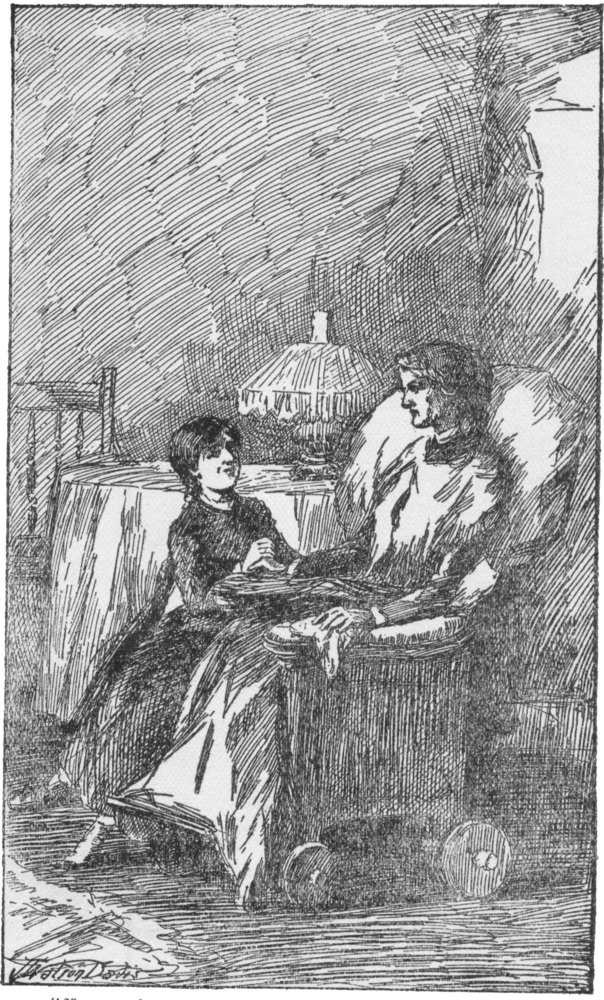
“Did he?” asked Marion, twisting one of Judith’s curls about her
finger.
“O, Judith, I know you want me to tell you a story,” she said
hastily, as Aunt Affy slipped on her glasses again and took the coat
sleeve into her hand. To Marion that coat sleeve was a part of Aunt
Affy’s “new Bible.”
“Oh, yes,” replied Judith, with pure delight.
“Judith would have enjoyed the age of tradition,” said Aunt Affy;
“just think,” in her voice of young enthusiasm, “instead of reading
it, what it would be to hear from Andrew’s own lips the story of that
day.”
“We are living there now,” said Marion; “I am. The title of my life
just now is ‘The Parsonage story of Village Life.’ But the story I
want to tell Judith to-day is an episode in my own life. Seven years
ago. I haven’t even told Roger yet, and I tell him everything. I
think I never told any one before. I used to be at the head of things
in those days; father was often away, and the children were all
younger, except Roger, and mother wasn’t strong. We lived in an old
house in a broad city street, away back, with a box-bordered yard in
front, and lilacs, and old-fashioned things behind; we were all born
there, even Roger, the eldest, and our only moving times was in the
spring and fall cleaning. Once a friend of mine moved, and I was
enough in the moving times to be there at an impromptu dinner; we
stood around a pine table in the kitchen, or sat on anything we could
find, a firkin, or peach basket turned upside down, and they let me
eat a piece of pie in my fingers. All I wanted was to do something
just like it myself. And when mother said I might stay all my
birthday week and help Aunt Bessie move, I thought my ship had come
in, laden with moving times.
“Aunt Bessie lived in the city in a beautiful home, but something had
happened that summer; Uncle Frank was in Europe and could not come
home, and Aunt Bessie and the children had to go into the country for
a year.
“The ‘country’ was only seven miles away; first the train, then the
horse cars, and, then, a two-mile drive.
“The wagons from the country came for the things Monday morning;
there were two big loads (everything else had been sold), and in the
country home we expected to find new and plain furniture that had
already been sent from the stores.
“Monday the children and I had a hilarious time at dinner; moving
times had begun, and I did eat a piece of pie in my fingers. I was
too full of the fun of things to notice that Aunt Bessie ate no
dinner, and Elsie and I were teasing Rob in noisy play after dinner,
and did not see that she was very white and scarcely spoke at all.
“‘Marion,’ she said at last, ‘I cannot conquer it; I’ve tried for
half the day and all night; I cannot hold up my head another minute;
one of my terrible headaches has come upon me. Jane will have to stay
here with me and baby and Rob—do you think you could—but no, you
couldn’t—it’s too lonely for you—and I may not get there to-night.’
“‘Go to Sunny Plains alone—and have an adventure! Oh, Aunt Bessie!
It’s too good to be true.’
“Unmindful of her headache I clapped my hands, and danced Rob up and
down. It was all my own moving time.
“‘But, Marion, what would your mother think?’ she protested, weakly;
‘of course there are near neighbors—and you might take something to
eat—and, if I do not get there, you must go across the way and stay
all night. The old man who had the two white horses—you remember him,
said he was our nearest neighbor, and he hoped we would be
neighborly. He said he had a daughter about your age—you might ask
her—if I do let you go—to stay with you all night.’
“‘But, after all,’ looking at our trim, colored maid of all work,
‘perhaps Jane may better go and you stay with me. And—’
“‘Oh, no, ma’am, oh, no, indeed, ma’am,’ tremulously interrupted Jane
(she was only two years older than I). ‘I couldn’t think of it; I
should die of fright. I never lived in a wilderness, and I expect to
give warning the first week, for I never can bear the country.’
“‘Now, Aunt Bessie, you see I have to go,’ I persuaded. ‘Jane can’t
help being afraid—and I didn’t know how to be afraid—really, I don’t
know what to be afraid of. Let Elsie go with me, and we’ll do
everything ourselves—have the house all in order for you to-morrow
morning, and have the most glorious time we ever had in our lives. My
Cousin Jennie isn’t fifteen, and she stayed a week over alone in the
country while Uncle and Auntie were away. Oh, do let us go, Aunt
Bessie.’
“‘Somebody must, I suppose,’ half consented Aunt Bessie, who was
growing whiter every moment; ‘Elsie, are you brave enough to go with
Marion?’
“‘Yes, mamma,’ said nine-year-old Elsie, in her grave little way,
‘but I don’t know what the brave is for.’
“‘I’m glad you don’t,’ smiled her mother. ‘Well, Jane—I hope I am not
doing wrong—fix two boxes of lunch—and, you know you take the train
to Paterson and then the horse-cars to Hanover—I will give you five
dollars, Marion, you will have to take a carriage at Hanover—but you
know all about it—you went with me to look at the house—and you know
where to have the furniture put as I told you that day—and you can
get things at the store—half a mile off—Jane, you will have to keep
Rob and baby—Marion, I don’t know what your mother will say—it’s
well there was a load of things left so that I may have a bed
to-night—’
“During this prologue my feet were dancing, and my fingers rubbing
each other impatiently, I was so afraid she would end with a
sufficient reason for not allowing us to go. I could not believe that
we were really off until we sat in the train, each with a huge,
stuffed lunch-box, and I with five dollars in my pocketbook and my
head confused with ten thousand parting directions, among which was,
many times repeated: ‘Be sure to ask that girl to stay all night
with you.’
“At the terminus at Hanover we got out and stood and looked around.
Elsie was a little thing, but she was wise, and I liked to ask her
advice.
“‘Aunt Bessie found a horse and a carriage at the blacksmith’s shop
that day, didn’t she?’
“This was hardly asking advice, but Elsie brightened, and answered
deliberately: ‘We walked on a canal-boat, then, to the other side,
for the bridge was being built.’
“‘Then we are in the right place, for there’s the new bridge,’ I
exclaimed, relieved, for I missed the canal boat we had that day made
a bridge of.
“‘And we went down that way to the blacksmith’s shop,’ she said
pointing in a familiar direction. Yes, I remembered that. The
immensity of my undertaking was beginning to press upon me; I was
glad I had brought Elsie.
“With a business-like air we crossed the bridge, and walked along a
grass-bordered path to the blacksmith’s shop; there seemed to be two
shops in the long building; before one open door a horse was being
shod, before the other a group of men stood with hands in their
pockets watching a fire that had died down into a red-hot circle—the
circle looked like red-hot iron. As we waited for the horse to be
harnessed and brought, Elsie and I stood across the street watching
the red-hot iron ring—as large as a wagon wheel.
“Elsie looked as though she were forgetting everything in that red
wonder, and I began to feel a trifle strange and lonely, for my
little cousin was so self-absorbed that she was not much company.
“‘Hallo, there!’ called the blacksmith as a boy drove a two-seated
wagon out from behind somewhere.
“With my best business air I asked the price before we stepped up
into the wagon and replied, ‘Very well,’ to his modest one dollar.
“The drive was beautiful; Elsie looked and looked but scarcely spoke.
But she did exclaim when we crossed the railroad, at the tiniest
railroad station, we, or anybody else, ever saw.
“It was a brown shed, without a window even—the door stood wide open,
there was no one within, no stove, no seats, no ticket office.
“‘Well, we are in the wilderness,’ I said aloud.
“And then, the ‘store.’ I wish I could tell you about that store. It
was about as large as—a hen-coop, everything, everything in it. I got
out and went in, for Aunt Bessie had asked me to inquire for letters
which she had directed to be sent to Sunny Plains. The post-office
was a rude desk and a few cubby-holes up on the wall above it; I saw
a letter laid on a meal sack—this place behind the store seemed to be
both post-office and granary.
“‘I’ll be down by and by—you are the new people, I suppose; I saw
your things go by,’ remarked a pleasant young man behind the counter;
‘I’ll come for orders. I hope you will trade with us.’
“‘Thank you, I suppose so. And I wish you would bring some kerosene,’
I said, remembering that I must burn a lamp all night.
“Along the half mile on the way to the new house were scattered
several farmhouses, then came the church, and churchyard, and, on a
rise beyond the churchyard, a pretty house.
“‘That’s it,’ Elsie said, ‘I know the house.’
“The key was in the possession of the white-haired old man with the
two horses, and his house was opposite the church.
“Elsie was too shy to go to the door and knock and ask for Mrs.
Pettingill’s key, but I was very glad to go; I began to feel that I
would like to see the girl who would stay all night with us. She
answered my knock, a tall girl, with an encouraging face. She brought
the key, saying the wagons were all unloaded; two had come Saturday
with things; her father had said my mother and all the family were
coming before night.
“‘Aunt Bessie was too ill,’ I replied, glad to have the neighborly
subject opened so easily, ‘and she said I might ask you to come over
and stay all night with Elsie and me.’
“‘Oh, I couldn’t,’ she answered, hastily; ‘I’m going away—I’m all
dressed now. I’m sorry, too,’ she added, sympathetically, at
something in my face, ‘but I can’t disappoint my grandmother; she
sent for me because she is sick.’
‘Then, of course, you will have to go. (Then I began to know what
‘brave’ meant.) Thank you for the key.’
“Up the steep, weed-tangled drive we went to the side door; the
boy-driver unlocked the door for us, giving a view of the moving
times within. I paid him his dollar, and he drove away, leaving us in
the wilderness.
“Elsie stood and looked around as usual.
“It was a wilderness, a wilderness everywhere; the two-story house,
painted brown, with red trimmings, was set in the middle of a large
field; it had been untenanted for two years; the hedgerows had grown
luxuriant, the grass was knee-deep; the house faced the west (the
driver told me that), and the west this August afternoon was an
immense field of cabbages bordered by tall trees; above it was the
sky, beyond that might be anything, or everything; at the east
stretched a mown field, dotted with trees, an apple-tree that looked
a hundred years old near the fence, then a thick woods, over the top
of which ran a line of green, low hills; among the greenness a red
slanting roof was visible; at the south stretched other fields, among
the trees a white house, with outhouses, a well-sweep; at the north,
beyond two fields, in which cows were pasturing, in a grove, a thick,
green grove, was the churchyard, with rows and rows of white stones,
now and then a white or a granite monument; the brown church-tower
arose above the tree-tops. And this was my wilderness for a night,
with the sky, the protecting, loving sky over all, and bending down
to enfold us all into its sunshine.
“‘It’s pretty,’ said Elsie.
“‘Yes, it is pretty. Now we must go in and go to work.’
“The opened door led into the small dining-room; small and so
crowded; as my big brother said, there was a place for everything,
and everything was in it.
“The front parlor, back parlor, hall, all crowded; up stairs there
was nothing but emptiness and roominess.
“The kitchen, such a pretty kitchen, was crowded with everything,
too—and a pine table, a firkin, and an up-turned, or down-turned
peach basket.
“I was in a whirl, an ecstasy, an enthusiasm; but as somebody
remarks, nothing is done without enthusiasm; now what should I do
with mine, that, and nothing else?
“Suddenly, to Elsie’s great perplexity, I gave a shout and rushed out
the dining-room door, and down through the tangles into the road.
“I had espied two men, working men, in shirt sleeves, with coats
thrown over their arms. Farmers, or farmer’s sons, probably, great,
true-hearted sons of the soil, knightly fellows who were ready to—
“‘Are you—do you know anybody—’ I began, breathless, and with flying
hair.
“They stopped and gazed at me.
“‘We have just moved in. I would like things moved, and bedsteads put
up, and boxes opened.’
“‘We can do it,’ said one promptly.
“He had lost one eye; the other eye looked honest.
“‘Yes, we’re out of the work,’ said his companion.
“He had a stiff neck; he did not look quite so honest.
“‘Can you come now?’ I faltered.
“‘Yes, right off. Come, Jim,’ was the cheerful response. ‘All we want
is to be told what to do.’ I could always tell people what to do; at
home I was called the ‘manager.’
“For two hours I kept those men busy; Elsie, with grave eyes and
sealed lips, followed us about. I tried to forget the stiff neck, and
the eye that did not look honest, and had forgotten both, when there
was a heavy rap on the open dining-room door.
“There stood the young man from the store.
“I had forgotten that I did not like those two busy men, who never
spoke unless spoken to, still I was glad enough to cry when I saw
this familiar and friendly face.
“I had known him so long ago I could tell him anything.
“‘H’m. Somebody to help you,’ he said, stepping in, pad and pencil in
hand, for an order.
“The men were in the back parlor; one was unpacking a box of books,
the other was sweeping.
“Yes,” I replied confidently, “I needed help and I called them in. I
don’t believe—” my voice sinking to a whisper, “that they are tramps,
do you?”
“Oh, no. They are hatters. They have been about here two or three
years; the factory is closed. The worst thing about them is drink.
They will drink up all you give them. Still, it was hardly a right
thing for you to do.”
“Elsie’s arm was linked in mine, her big eyes fixed on the young
man’s face.
“‘A thing is always right—after it is done,’ I said desperately.
“‘Whew! you are a wise one,’ he said quizzically. ‘I’ve brought
kerosene—have you lamps for to-night? Oh, yes, I see you have. Sugar,
bread coffee, tea, what will you have?’
“I gave the order; he wrote it, then lingered.
“‘They are about done for to-night, I suppose.’
“‘Yes, I shall send them away.’
“He drove away, and I was left with my hatters.
“‘You have worked two hours,’ I said; ‘what do I owe you?’
“The man with one eye looked at the man with a stiff neck.
“‘Fifty cents, eh, Jim?’
“‘That’s about it,’ said Jim.
“I did not bring my pocket-book down stairs, there were two bills in
it; I handed each a twenty-five-cent piece with the most reassuring
and disarming air (one air was for myself, the other for them), and
thanked them, hoping they would soon have work at their trade.
“They said ‘thank you’ and ‘good-night,’ and Elsie and I were left
alone.
“‘Aren’t you hungry?’ asked Elsie, ‘It is late and dark.’
“‘So it is: we will have supper in the kitchen—and I will fill a lamp
to burn all night.’
“That supper was not quite as much fun as I thought it would be;
Elsie munched a sandwich and wished she were home; out the window the
fire-flies were glistening in the tall grass; the gravestones loomed
up very white and tall and stiff.
“‘We’ll go to bed early,’ I said cheerily, ‘and be up early in the
morning to put everything in order. Aunt Bessie will be sure to be
here early.’
“Elsie followed me up stairs still munching a sandwich. She, too, had
learned what it was to be ‘brave.’
“The hatters had put up a bedstead and laid a mattress on it; the bed
clothing lay in a pile on the bare floor.
“I made the bed while Elsie finished her sandwich.
“‘May I brush out your hair and braid it?’ asked Elsie.
“‘Yes, in a minute. Let’s go down stairs and look at all the doors
and windows again.’
“The fastening on every door and window was tried anew. We were
locked in. The world was locked out. I did not look out again at the
fire-flies.
“I sat down before the bureau while Elsie stood behind me and brushed
and braided my long hair; doing my hair would comfort her if anything
could.
“But what would comfort me?
“My Daily Light I had put in my satchel; I liked to have it open on
my bureau; it was bound in soft leather, two volumes in one: I found
the date, August XV., in the Evening Hour.
“‘Read aloud,’ said Elsie.
“My glance caught the large type at the head of the page. My heart
beat fast, the tears started, but I cleared my throat and read
unconcernedly: ‘I will allure her, and bring her into the wilderness,
and speak comfortably unto her.’
“‘Read it again,’ said Elsie, brushing softly. I read it again. Elsie
undressed and crept into bed.
“‘You didn’t say your prayers,’ I remonstrated.
“‘I like to say them in bed,’ she replied.
“So did I that night.
“I placed the lamp, burning brightly, on the floor in the hall
opposite my door, leaving the door wide open, then I lay down, and
said my prayers in bed.
“Elsie was soon asleep; my prayer ended with the earnest petition,
several times repeated: ‘Please let me go to sleep quick and stay
asleep all night.’
“Then I watched the light, and thought about home, and fell asleep.
“A voice awakened me: Elsie was sitting up in bed:—
“‘I’ll do your hair, Marion,’ she said thickly, talking in her sleep.
“I pressed her down, and covered her; she did not waken. But I was
awake, wide awake, alone in a great wilderness. There was no sound,
no sound anywhere, but a stillness like the stillness of death.
“Then sh—sh—sh—a hush, a soft pressing against something—a padded
shoulder against a door, a soft fist at a window; then the stillness
like the stillness of death. I was awake; I did not sleep.
“The soft, soft sound came again and again; the softest sound I had
ever heard, and then the stillest silence.
“Should I get up, bring the lamp in, and lock the door?
“But suppose there were no key in the door—it was swung back, I could
not see the inside key-hole; if I should get up and find no key, and
could not lock the door, I should confess to myself that I was
afraid—how could I lie there, with the door shut and not locked, and
be afraid? I was afraid to be afraid. I would rather lie there, and
look with staring eyes at the lamp and the wide stairs, and listen,
and listen, with my very breath, and know that I was not afraid.”
“Oh, dear!” cried Judith, with a choking in her throat.
“Morning came. Oh, that blessed streak of dawn. I arose and slowly
pushed the door so that I could see the lock.
“There was no key.”
“Oh!” cried Judith, with a sudden, sharp breath, cold to her very
finger-tips.
“That day was the happiest day of my life. I never knew before how
happy I could be. I had learned that I could be kept from being
too afraid.”
“Only just afraid enough,” laughed Judith, glad that the laugh was
not frozen in her throat.
“How I scampered around that day and helped, and scampered around and
didn’t help. That was years ago, and I haven’t told the story yet.
That no key was one of my turning-points.”
“I wish I might have a turning-point,” said Judith, “only I never
could bear to be afraid.”
“Being afraid doesn’t hurt,” consoled Aunt Affy; “you are glad you
were afraid after you get out of the wilderness.”
“What did your point turn you around to?” questioned Judith, who
had learned from her mother that something always happened next.
“To knowing I would always be safe,” said Marion, “no matter how deep
I get into the tangles in my wilderness.”
“Yes,” responded Aunt Affy, “we only think we are hurt.”
“Was it all wilderness?” asked Judith.
“It appeared so to me. We took a drive one day into another
wilderness—Meadow Centre; that was almost more a wilderness.”
“I know Meadow Centre,” said Aunt Affy; “Cephas has a cousin there, a
kind of cousin by courtesy, and he is always promising that he will
take me over there. His name is Richard King; he has just come to
take charge of the church. Cephas says he is a splendid worker, as
big as a giant and as simple-hearted as a child.”
“Is he old like Uncle Cephas?” Judith inquired.
“No, child, he’s young like our minister. He preached here before
your brother had the call, Miss Marion; Cephas wanted him, but he
wouldn’t leave that going-to-pieces church and congregation over
there. Cephas told him he was staying by the ship to see it go to
pieces, and he said he wanted to see it go to pieces, then.”
“Meadow Centre is a part of my wilderness; I would like to see the
place again. I have a very warm feeling for my wilderness.”
“And now you are in the Promised Land,” said Judith; “do people have
to go through the Wilderness first?”
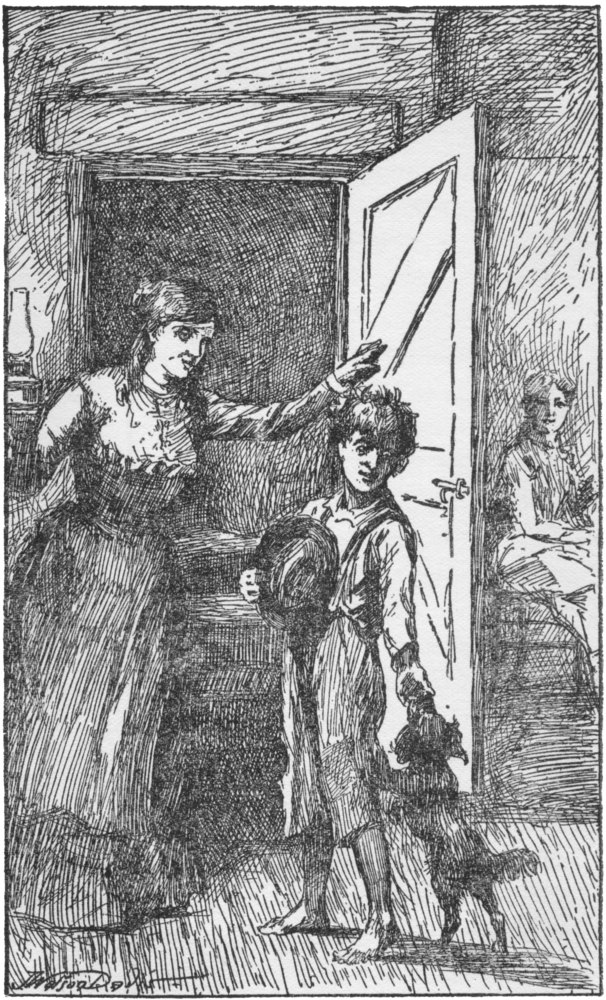
A warning voice came from across the hall: “I’d like to know if your
ball is getting bigger, Judith.”
Judith’s guilty fingers snatched her needle, and she began stitching
a black strip to a brown strip as Aunt Rody had expressly forbidden
her to do.
“They don’t have to stay in the Wilderness,” replied Aunt Affy,
“their own naughtiness kept them there.”
“H’m,” sniffed the voice across the hall. “I think some people who
behave pretty well are kept in the Wilderness.”
“I like wild places,” said Judith, forgetting her ball again.
“And naughtiness, too,” snapped Aunt Rody.
“Oh, we all like that,” laughed Marion; “Aunt Rody, I am coming in
there to tell you a story.”
“Don’t want you,” grumbled Aunt Rody, in a relenting voice.
But Marion went.
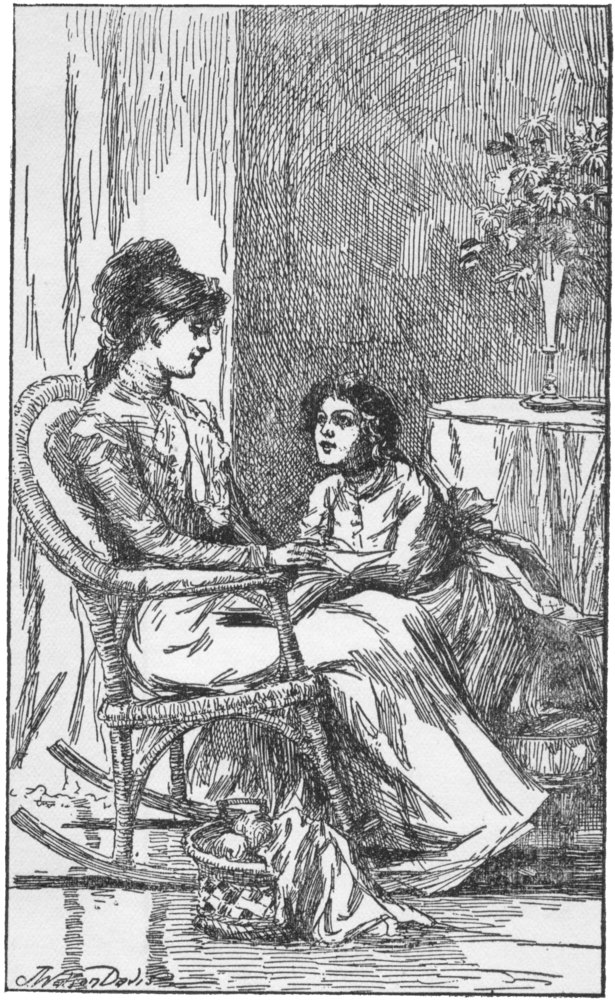
“I’m sure you have a story to tell me,” Judith heard Marion say, in
the tone Roger Kenney called “wheedling.”
“My story is all hard work, privation, and ingratitude,” was the
ready response.
As Aunt Affy sewed a tear fell on her coarse work, which Judith tried
not to see.
Judith sewed diligently, wondering the while how she could make a
turning-point for herself.
“Yes,” groaned the voice across the hall, “my past is not pleasant to
dwell on, the present is full of contradictions and being opposed,
and the future—well, I hope I am a Christian.”
“I don’t believe you are,” whispered Judith softly over her rags.
A heavy step on the sod under the bedroom window brought sudden color
to Aunt Affy’s old cheeks; with her sister’s groanings in her ears
she was meditating if it were her duty to ask Cephas to go away
again. Was the Lord asking her to choose between the two?
Pushing back his straw hat and leaning his shirt-sleeved arms on the
window-sill, the old man stood, with his lover’s eyes on the
delicate, sweet face of the woman he had loved thirty years.
“Well, Affy, how’s things?” he asked, joyously.
“Just as usual,” she half sighed.
“No worse, then?”
“Not a bit,” she answered, smiling.
“Then I’ll get a bite and go back to work again. It does me good to
come and have a look at you and know you are here.”
“Oh, I shall always be here.”
“And so shall I,” he answered, confidently.
After that, how could Aunt Affy but decide once again, and for ever,
that he should always be here.