Crimson clover is usually sown between August 15 and October 1,
the general rule being to plant about 60 days before the first killing
frost is expected. South of Virginia crimson clover can be seeded as
late as November 1, although if planted late more seed should be
used and a light dressing of nitrate of soda applied, in order to
stimulate the young plants. Seeding earlier than August 1 is seldom
advisable unless the crop is sown with some other crop the shade of
which will hold it back.
The exact date of planting depends almost entirely upon the moisture
content of the soil. The principal condition to avoid is planting
when the soil contains just enough moisture to germinate the seeds,
but not enough to keep the plants growing. Usually it is better to
plant when the soil is quite dry than when it is slightly moist, for in
dry soil the seeds, if properly buried, lie without germinating and
are ready to grow vigorously at the first rainfall. The most favorable
time for seeding is just before or just after a good rain, when the
soil is moist enough to form a ball in the hand.
The ordinary rate of seeding crimson clover is 15 pounds per acre,
although the rate varies according to conditions. From 12 to 15
pounds per acre are usually sufficient when growing the crop for seed
or when the soil is unusually rich. On poor soil, dry soil, or on soil
which has not previously produced crimson clover 18 to 22 pounds
of seed give better assurance of a stand. Heavy seeding is also desirable
when planting late in the season or when a heavy crop is
wanted for green manure early in the spring.
Theoretically, 2 pounds of seed per acre would provide six plants
for every square foot, which is a satisfactory stand. Under ordinary
circumstances, however, it is necessary to allow for some of the seed
being too deep, or too shallow, or failing to germinate, and for a
certain percentage of winterkilling. It is also well to have a fairly
thick stand of the young plants, so that the ground may be well
covered during the early fall and thus prevent soil washing and the
growth of winter weeds.
The most common method of seeding crimson clover in intertilled
crops is to scatter the seed broadcast with a rotary seeder or by hand.
(Fig. 6.) In order to place the seed on a fresh, moist seed bed it is
commonly broadcasted immediately behind the cultivator at the last
cultivation and is covered 'at once by a second cultivator. In tall
corn the seed may be sown from horseback, the ears of the horse being
covered with small bags to prevent the entrance of the flying seed.
Slightly more seed is required when seeding in tall corn, as some seed
catches in the corn plants. When seeding in cotton care must be taken
to avoid injury to the opening bolls, which are easily knocked off or
torn. This is best done by seeding by hand, covering the seed with a
piece of brush dragged down the rows.
In low-growing truck crops and on fallow ground crimson clover
can be seeded with a wheelbarrow seeder. This implement distributes
the seed more evenly than can be done by hand or with the rotary
seeder, especially when planting a mixture of crops. The wheelbarrow
seeder being somewhat awkward to handle is better adapted
to smooth, level fields than to hillsides.
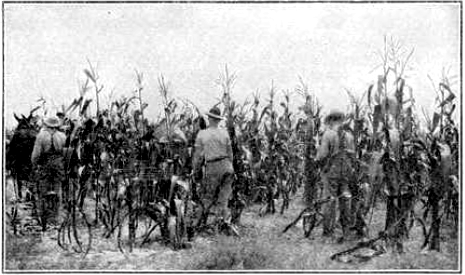
Fig. 6.—Seeding crimson clover in corn at the last cultivation.
Probably the very best method of seeding crimson clover is with
the special clover or alfalfa drill. Where enough clover is grown
to warrant its use this implement is to be highly recommended. The
seed is sown in 4-inch rows at just the proper depth and with the
right pressure, and the fertilizer is placed exactly under each row,
where it will be immediately available to the seedlings. Drilled
clover requires less seed than broadcasted clover and produces a more
even and certain stand.
In place of the special clover drill an ordinary grain drill equipped
with a clover-seed attachment can be used with good results. Special
spouts should be arranged to lead from the clover-seed box back of
the shoes or disks, in order to deposit the seed directly in the furrow.
Chain furrow closers are best for covering the seed, as they leave
the furrows broad and flat instead of V shaped and lessen the danger
of the seedlings being covered with soil during a hard rain.
For use in intertilled crops there are several types of 1-row drills,
the best for this purpose being the 5-hoe drill equipped with press
wheels.
Crimson-clover seed must be covered, but not too deeply. In most
soils it is not enough to depend on rain to effect a covering. An inch
in sandy soils and half an inch in clay soils appear to be about the
right depth. Shallow planting gives the best results in wet seasons
and deep planting in time of drought. Broadcasted seed should be
covered with a spike-tooth harrow or a weeder rather than a heavy
harrow or a shovel cultivator. A harrow made of fairly stiff brush
is often useful in loose soil.
As a rule, fresh crimson-clover seed is of good viability, and failure
to secure a stand is not often caused by failure of the seed to
grow. Unlike most clovers, crimson-clover seed absorbs water readily
and sprouts quickly. There are practically none of the hard
seeds which are so frequent in red clover and sweet clover, and a
germination of 90 per cent in 48 hour's is not uncommon. The seed
deteriorates rapidly, however, and when more than 2 years old rarely
shows a germination in excess of 50 per cent. Sometimes, when
stocks of commercial seed are low, old seed finds its way to the market,
and this, when planted, gives poor results. Old seed can usually be
detected by the dull-brown appearance of the seed coat as contrasted
with the bright, shiny, pinkish or greenish yellow color of fresh seed.
Brown seed, however, is sometimes caused by weathering during harvest,
and such seed is not objectionable unless the weathering has
been excessive.
A common impurity in crimson-clover seed is green, shrunken, and
immature seed, caused by harvesting the crop before it is ripe. Crimson-clover
seed does not germinate readily until it takes on a yellowish
tinge; therefore, green seed should be rejected.
Crimson-clover seed is larger and plumper than red-clover seed
and if properly cleaned should not contain seeds of dodder or the
smaller seeded weeds. Frequently, however, it does contain the seeds
of field peppergrass, yellow trefoil, evening primrose, sheep sorrel,
wild geranium, buttercups, mustards, and other weeds which blossom
in early summer.
There is a growing belief among farmers that they are less likely
to lose a stand of crimson clover through drought if they sow the seed
in the hull rather than use the hulled seed as it ordinarily appears on
the market. It is claimed that the hulls hold the moisture to some
extent and carry the seedlings over the critical day or two following
germination, while some farmers assert that the unhulled seeds require
more moisture for germination, and the seeds therefore do not sprout
until there is enough moisture in the soil to keep the plants growing.
Unhulled seed is bulky and is not often handled by commercial seedsmen,
although one large grower sells the unhulled seed in compressed,
bales similar to small cotton bales. It usually can be secured from
neighboring farmers, however, or is easily saved at home. The seed
can be harvested with a stripper from the standing crop in the field
or the mature crop can be cut and thrashed like an ordinary grain
crop. For local planting on a small scale unhulled seed is the
cheapest and most accessible form of crimson-clover seed.
Unhulled seed is somewhat difficult to sow, because the hairy hulls
stick together in masses and can not be scattered uniformly. To
avoid this trouble the seed may be mixed with moistened earth or
with lime, or may be sown with a blower similar to those used on
small forges. A better plan is to sow on a windy day, throwing the
seed vertically into the air and allowing the wind to scatter it.
Of unhulled seed of the best quality, 100 pounds contains about 1
bushel (60 pounds) of clean seed. The common grades, however, are
usually more chaffy and require 120 to 180 pounds to make a bushel.
From 2 to 3 pounds of unhulled seed are therefore regarded as equivalent
to 1 pound of hulled seed. A bushel of unhulled seed, even when
well packed down, weighs only 6 to 10 pounds and contains about 4
pounds of seed. The appearance of both hulled and unhulled crimson-clover
seed is shown in figure 7.
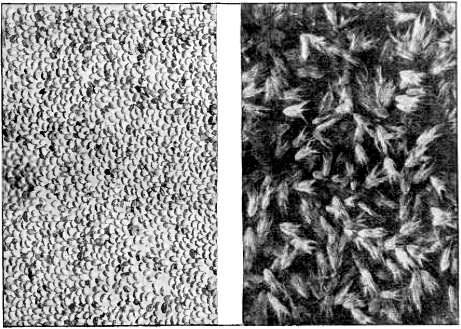
Fig. 7.—Hulled seed of crimson clover of a common commercial grade and unhulled
seed gathered with a homemade stripper. (Natural size.)
In order to protect the crimson-clover seedlings from the hot sun
of late August it is a common practice in some sections to plant with
the clover a small quantity of some quick-growing crop like buckwheat,
cowpeas, rape, or turnips. A thin stand of these heavier
leaved plants furnishes an ideal shade for the young clover, and on
soils which are inclined to bake it prevents the formation of a crust.
The nurse crop must be seeded lightly, usually not more than half
the regular rate, as the ordinary stand shades the ground so
completely as to destroy the crimson clover. On hot clay soil in the Piedmont
region the chances of obtaining a stand of clover are about
twice as good with a nurse crop as without one.
Buckwheat is the principal nurse crop northward from Washington,
D. C. A common rate of seeding is 2 to 3 pecks of buckwheat in
15 pounds of crimson clover. If the planting can be made in July
the buckwheat usually has time to ripen before frost and thus pay
the cost of starting both stands.
In the cotton belt cowpeas have been used successfully, especially
when seeding on fallow ground. They are seeded broadcast at the
rate of one-half bushel per acre. There is ordinarily not enough time
for the cowpeas to mature, but they add to the value of the stand for
fall pasturage and protect the clover from severe weather in the winter.
Both cowpeas and buckwheat have the merit of being able to
grow on poor soil.
Dwarf Essex rape has been used as a nurse crop in a few cases
where the clover was to be pastured by hogs or sheep in the fall.
From 2 to 3 pounds of rape, sown in August, furnishes sufficient
cover for a nurse crop. Cowhorn turnips, winter kale, and mustard
are also satisfactory nurse crops if planted at a rate not exceeding
1 pound of seed per acre. If the clover is to be saved for seed these
latter crops are objectionable, as a few plants will live over winter
and ripen at the same time as the clover.
Where a nurse crop can not be grown conveniently, the crimson-clover
seedlings can be protected from the sun by a light top-dressing
of straw, spread just after the seed is sown.
Crimson clover is frequently grown in combination with winter
grain, hairy vetch, or other forage crops having a similar period of
growth. The mixed crop is less liable to lodge than the single crop,
cures more readily in damp weather, and usually furnishes a heavier
yield. Another advantage of the mixed crop is that if either should
fail the other will serve as a cover crop during the winter and bring
some return the following spring. Mixed crops are not desirable
if the clover is to be saved for seed.
South of central Virginia crimson clover is usually grown in combination
with winter oats. An early variety of oats, such as the
Fulghum, or a late variety of clover, such as the white blooming, is
usually the best, as the oat crop matures somewhat later than the ordinary
crimson clover. The customary rate of seeding is 15 pounds
of the clover and 2½ bushels of oats per acre. In Delaware and
eastern Maryland the most popular companion crop for crimson
clover is winter wheat, although barley makes a desirable hay crop
and is sometimes used. Eye is not desirable for hay, but it is
probably the best of the grains for green manure, as it is hardy, vigorous,
and starts growth early in the spring. Rye and wheat are seeded at
the rate of 1 bushel per acre with the customary quantity of crimson
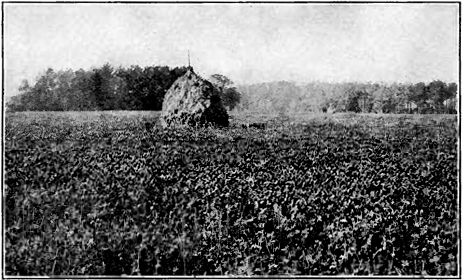
clover. The accompanying illustration (fig. 8) shows a field seeded
to a mixture of crimson clover and wheat. Usually the grain is
well headed, but in the milk or soft-dough stage, when the clover is
ready to cut, the yield of the mixed crimson clover and grain
is often 25 to 50 per
cent greater than
that of the clover
alone.
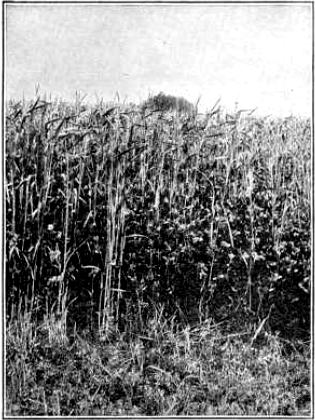
Fig. 8.—Crimson clover and wheat in mixture. In the
foreground the crop has been cut and fed green to stock.
The remainder was cut the next day for hay. The grain
prevents the crimson clover from lodging.
Hairy vetch and
crimson clover are
sometimes grown together,
seeding at the
rate of 20 pounds
and 10 pounds per
acre, respectively.
As both these plants
are likely to lodge in
good soil, however,
one of the grains is
usually included, a
common seeding
mixture being oats 2
bushels, hairy vetch
12 to 15 pounds, and
crimson clover 5
pounds. Bur clover,
black medic, and
other winter-growing
legumes are
sometimes found in
mixtures with crimson
clover, although such mixtures generally occur by accident rather
than intent. Black medic and crimson clover make' a particularly
good combination on rich soil.
In most of the crimson-clover area the cultivated grasses, such as
timothy, redtop, and orchard grass, are not commonly grown. However,
where these grasses flourish they may well be seeded at the
same time as the crimson clover, provided the latter is planted not
earlier than September 15. In some sections Johnson grass and
Bermuda grass make useful combinations with crimson clover, the
grasses making most of their growth in the summer and the clover
in the fall and spring.