David and Andy were made as comfortable as ever they could be in a
wigwam. Sa-peesh and his family, but particularly A-mish-ku and
Ni-pit-se, were well pleased to have them there. They had seen none
save the members of their own family since the previous autumn, and
A-mish-ku, after the manner of boys the world over, craved the
companionship of other boys, and he and Ni-pit-se were glad to see new
faces and hear new voices.
Ni-pit-se was shy at first, but her timidity passed away quickly
enough. And she took it upon herself to minister to David’s and Andy’s
needs, and she found a vast deal of pleasure in nursing them. Their
coming, and these new duties, made a welcome break in the monotony of
the days, for even an Indian maiden wearies sometimes of the
changeless solitary routine of her wilderness life.
And so, despite the pain and discomfort of their temporary affliction,
David and Andy were well content, and recovered so rapidly from their
attack of snowblindness that they might have returned to their trail
at the end of a week but for the fact that Andy’s feet were
frostbitten, and still too sore to walk so far. And so, of necessity,
they tarried another week in the wigwam of Sa-peesh, much to the
satisfaction of the A-mish-ku and Ni-pit-se.
During this fortnight the days were rapidly lengthening and the sun
was growing stronger, though as yet there was no softening of the snow
even at midday and the nights and mornings were crisp and frosty
enough. With every day, as the sun grew brighter, the glare on the
snow increased until the world was a dazzling expanse of
scintillating, blinding light. No longer was it safe to go abroad,
even for an hour, with naked eyes, save in dull and cloudy weather.
David and Andy had learned their lesson. They had no intention of
becoming snowblind again if it could be avoided. And so, while they
waited for Andy’s feet to heal, they fashioned, each for himself, a
pair of goggles, after the manner of those worn by Sa-peesh and his
family.
These goggles were made from round pieces of wood, hollowed out like
shells and large enough to cover the eyes comfortably, with the
hollows whittled deep enough to permit the eyelids to open and close
within them. Two of these were fastened together the proper distance
apart to fit the eyes, with a piece of buckskin. In the bottom of each
hollow a narrow slit was cut lengthwise of the goggle. Through this
slit the wearer was to look. The interior of the hollow was blacked
with charcoal from the fire. A buckskin thong fastened to the outer
edge of each of the goggles, and tied behind the head, kept them in
place.
At length Andy declared that his feet were well enough healed to
permit him to return to the trails. Both he and David were anxious to
resume their work, for the trapping season was nearing its close. They
wished, also, to satisfy Indian Jake’s anxiety as to their safety, for
they had no doubt he was anxious, and possibly much troubled and
mystified at their long absence.
There was much regret in the wigwam of Sa-peesh, and loudly did
Sa-peesh and Mrs. Sa-peesh, and especially A-mish-ku and Ni-pit-se
lament that the visit should have been so short. It is the custom of
Indian women to bestow gifts upon friends setting out upon a journey.
This is a pleasant and profitable custom for the friends, and the
women believe that the spirits will bless the giver with much good
fortune, and thus they are themselves amply recompensed.
Accordingly, when David and Andy made ready for departure on a bright
April morning, Mrs. Sa-peesh presented each with a bladder filled with
marrow fat, and a quantity of jerked venison, while each received from
Ni-pit-se a beautiful pair of bead-embroidered moccasins which she had
made with her own hands.
And when they thanked Sa-peesh and everybody for all the kindness that
had been shown them, and said farewell, the whole family came out
before the wigwam to shout good wishes after them and to wave their
hands to them, until the boys were quite out of their sight.
“We’ll soon be findin’ out, now, what Indian Jake thought when we
didn’t get t’ th’ Narrows, and ’twill be three weeks when we gets
there Saturday,” remarked David.
“I wonders, now, what he thinks about un!” suggested Andy.
“He thinks we perished,” said David, “and he’s likely been up t’
Namaycush lookin’ for us. ’Twill be a fine surprise to he when he
comes back Saturday.”
“’Tis fine t’ be alive!” exclaimed Andy, breathing the good pure air.
“’Tis that!” said David, “and t’ have such a fine hunt t’ take home.
Pop’ll be wonderful pleased!”
“Won’t he now!” Andy agreed. “It won’t be much over a month, whatever,
will it, Davy, before th’ break up, and we can start for home?”
“No, th’ last of May, whatever,” said David, “and won’t it be fine,
Andy, t’ go home with all th’ furs? They’s plenty, I knows, now, t’
pay for Jamie goin’ t’ have th’ great doctor cure his eyes. Indian
Jake said so, and he’s a wonderful good judge. There’s our share of
his fur, too. And won’t it be fine t’ have Jamie see again as well as
ever he did!”
“Won’t it, now!” exclaimed Andy. “’Tis hard t’ wait till th’ time
comes t’ go!”
They were a long distance from the tilt. Walking as fast as ever they
could, favoring Andy’s sore feet, and with a stop only to boil the
kettle at noon, it was near sundown when they saw the little log
building scarcely visible above the drifts.
“There’s no tracks about,” said Andy, as they approached the door.
“If Indian Jake came up ’twas a week ago, whatever,” suggested David.
“Th’ snow since then covered his tracks. He was sure t’ be lookin’ for
us when we didn’t go t’ th’ Narrows.”
This surmise was confirmed upon entering the tilt. The frying pan used
by Indian Jake in cooking his dinner sat unwashed upon the stove, and
there were other evidences of his visit. And the boys immediately
missed the two marten skins which they had left there, and which the
half-breed had taken.
“He were thinkin’, now, we had perished, and so he took th’ fur,”
David explained. “He were thinkin’ t’ take all our fur home t’ Pop
when he takes his, and he’s feelin’ dreadful bad about our bein’
dead.”
“And won’t he be glad when we gets t’ th’ Narrows!” exclaimed Andy.
“That he will!” said David. “’Twill be a fine surprise for he!”
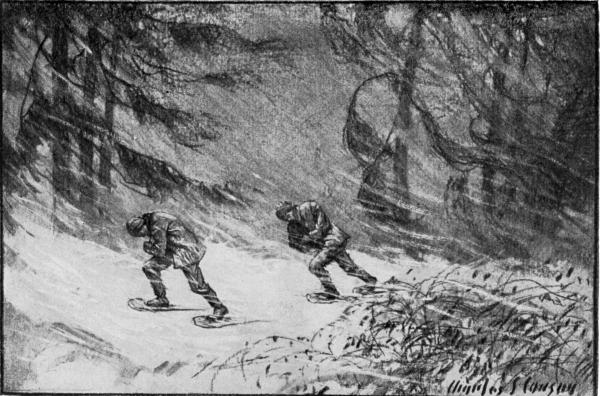
The following morning, with light, expectant hearts, they set out for
the Narrows, attending to their snow-clogged traps in the usual
manner, and on Friday evening, highly excited at the expected surprise
and pleasure of Indian Jake when they appeared, crossed the river ice
opposite the tilt.
“He hasn’t come yet,” said David as they neared the tilt. “Th’ snow
fell since he left Monday, and there’s no tracks where he’s come
back.”
“We’ll have a fire, and supper cookin’ when he comes, an’ won’t he be
surprised and glad t’ see us!” exclaimed Andy.
And so, their hearts filled with the pleasure they anticipated giving
Indian Jake, they pushed open the door and entered the tilt. Then they
stood aghast, and almost terror stricken.
The place gave unmistakable evidence of having been looted and
abandoned. The furs were gone. The tent was not there, nor was the
extra tent stove.
“He’s gone!” exclaimed Andy, presently, a frightened look on his face.
“Gone!” echoed David. “And he’s took all our furs!”
“What—will—Jamie do now?” and Andy was making a manly effort to
restrain the tears.
“He’ll go—blind!” and David, too, was on the point of tears.
“And—we—worked so hard t’—get th’ furs t’—save his eyes!”
Neither of them felt like eating, but, by force of habit they lighted
a fire in the stove, filled the kettle from the water hole at the
lake, and prepared to cook their supper.
“They’s no tea! And no flour! And no pork!” announced David after a
search. “Indian Jake took all th’ grub!”
“Took all th’ grub!” exclaimed Andy.
“Aye, all th’ grub!” David repeated.
“Whatever will we do now?” asked Andy in consternation.
“They’s a bit of tea in our pack on th’ toboggan. Unlash un and bring
th’ things right in, Andy,” said David. “We have th’ bladders of fat,
and most of th’ dried deer’s meat th’ Injuns gave us, and some hard
bread left in th’ bag too. We’ll make out.”
There were also three ptarmigans that Andy had shot during the day,
and a rabbit they had taken from one of the traps. An inventory
assured him that, so far as provisions were concerned, they would do
very well indeed for the present.
“Indian Jake didn’t take any grub out o’ th’ Halfway tilt or th’
Namaycush Lake tilt, either,” said David, as the two stood
contemplating their small stock of provisions. “What we has in th’
other tilts ain’t much, but ’twill have t’ do us till th’ break up.”
“’Twon’t last till then!” objected Andy. “And even if it does we won’t
have any grub left t’ eat on th’ way home after th’ break up.”
“We’ll have t’ make out somehow,” insisted David. “We’ll fix un this
way, Andy. Whilst I tends th’ traps you’ll hunt for pa’tridges and
snare rabbits. With what you kills we’ll make out, and save what’s in
th’ tilts t’ use goin’ home.”
“Th’ huntin’s about over, why can’t we strike up and go now?” asked
Andy.
“We can’t do that,” David objected. “We has t’ wait for th’ break up
t’ take th’ boat out. We can’t take un out till th’ lake and th’ river
gets free of ice. We’ll have t’ take un, whatever, because Pop’ll
need un t’ bring in his outfit when he comes back in th’ fall t’
hunt.”
“We’ll have t’ take th’ tilt stove, too, to use in th’ tent goin’
out,” suggested Andy. “Indian Jake took th’ tent stove.”
“We won’t need un,” said David. “We won’t have any tent. Indian Jake
took un. We’ll make out though. ’Twill be warm enough then, but ’tis a
rainy time of year, and we’ll have t’ sleep wet of nights, without a
tent or stove.”
Supper of boiled ptarmigan, hardtack, marrow fat for butter, and tea
was as good a meal as any could wish, and quite as good as any to
which David and Andy were accustomed on the trail. But there was the
future to be provided for.
“’Tis good Indian Jake didn’t take th’ grub from th’ other tilts,”
Andy observed, as they made the tilt tidy, for Indian Jake had left it
in a state of confusion.
“He took ’most everything else except th’ tilts,” said David a little
bitterly. “With havin’ t’ keep most of th’ flour and pork that’s in
th’ other tilts to use goin’ home, it’ll take all our spare time
huntin’ a livin’, and we’ll have t’ make out that way till we goes.”
“We might catch some whitefish and namaycush,” suggested Andy. “We
caught a rare fine lot when we went fishin’ with Indian Jake.”
“We can now!” agreed David enthusiastically. “Oh, we’ll make out fine
with th’ birds and rabbits we gets, if we can get whitefish and
namaycush too. We won’t have bread, but th’ Injuns mostly does without
bread. They make out with what they get huntin’ and fishin’.”
“We’ll try for th’ fish tomorrow whatever!” said Andy.
“Th’ first thing in th’ mornin’,” seconded David.
A search, however, for Indian Jake’s fishing tackle disclosed the fact
that he had taken it with him, as he had taken nearly everything else
of value. No cod line and not a fish hook could be found, though every
nook and cranny of the tilt was inspected.
“We’ll have t’ give fishin’ up,” said David, when they had satisfied
themselves that no tackle was to be found. “We can’t fish without
hooks and line.”
“No,” admitted Andy dejectedly, “we can’t fish.”
“But we’ll make out, whatever,” said David confidently. “We’ll get
birds and rabbits enough, though they’re wonderful tiresome eatin’,
without bread or pork. And goin’ out we’ll be like t’ kill a porcupine
or two.”
“We’ll make out,” agreed Andy.
“It’s—it’s th’ fur makes me feel bad,” said David after a moment’s
silence.
“Aye; th’ fur,” repeated Andy.
“And Jamie,” added David, sadly. “I can’t get he off my mind. I’d
rather be dead myself than have he go blind. ’Tis bein’ dead t’ go
blind, but worse. ’Tisn’t natural t’ be blind, and folks has t’ die
some time.”
“Th’ thought of un makes me feel almost—sick,” said Andy.
They fell silent, and for nearly half an hour neither spoke. Then
David remarked, a more cheerful note in his voice:
“I been thinkin’, now, that we may be misjudgin’ Indian Jake. I been
thinkin’ that maybe when Indian Jake makes up his mind we perished, he
has no heart t’ keep on trappin’ here alone, and he takes th’ furs and
starts right out with un t’ give un t’ Pop, and t’ tell Pop what he
thinks happened to us.”
“Do you think that, now?” asked Andy hopefully.
“That’s what I thinks,” said David, reluctant to abandon faith in
Indian Jake even now.
“’Twill be—a terrible worry for Pop—and all of un,” suggested Andy.
“Aye,” agreed David, “but think how glad they’ll be when we comes home
safe; and it won’t be long, now. Week after next we’ll strike up, and
th’ break-up’ll come by th’ last of May, whatever, and we’ll start
for home.”
“Suppose, now—suppose Indian Jake does as Uncle Ben said he would,”
Andy suggested apprehensively. “Suppose he don’t take th’ furs t’ Pop,
but goes off with un, th’ way he did before?”
“I’m—I’m thinkin’ he won’t do that,” solaced David, though his
voice was not as convincing as Andy would have wished.
“Maybe—there’s nothin’ t’ worry over,” agreed Andy.
“That makes me think o’ Doctor Joe’s song,” said David. “Let’s sing
un, Andy. She’s a wonderful cheerin’ song.”
“Let’s do,” said Andy, and together they sang, loud and lustily:
“Old Worry’s my foe, and he always brings woe,
And he follows about wherever I go.
He’s always on hand, and he makes the world blue,
And all about troubles that never come true.”
After all, what do any of us gain from worry, though all of us have
reason enough for it sometimes. David and Andy resolved to believe
that Indian Jake had really gone to The Jug. They were the better and
more efficient for believing it. And they resolved to smile and be
cheerful, too, and not fret and worry and stew about troubles that
might not be troubles at all. But it required grit a-plenty, for
often enough a suspicion of Indian Jake forced itself upon them.
On Saturday morning the boys devoted themselves to setting snares for
rabbits. A dozen short pieces of stout twine found about the cabin
were utilized for this purpose.
Building a snare is a simple process. A sapling is cut and laid across
a rabbit run, and about a foot above it. One end of a piece of twine
is tied to the sapling directly over the run, while the other end is
formed into a noose, and with the bottom of the noose resting on the
run, the top reaching to the sapling, it is held in position by
upright sticks on each side. Brush is piled so high upon the sapling
as to discourage passing rabbits from jumping over. Other brush filled
in around both sides of the runway, prevents its going around, and it
is thus forced to make a wide detour, which rabbits are not likely to
do, or to pass through the noose. In the latter case it can scarcely
escape being caught and choked by the noose.
It was interesting work for the boys. It occupied their attention and
kept their thoughts free from surmises as to Indian Jake.
“They’ll get us some grub, whatever,” remarked David when the last
snare was set. “I wish we could have fished, though. ’Twould have been
surer, and rabbits gets t’ be such tiresome eatin’.”
“But they’re better than no eatin’,” Andy sagely observed.
“If we gets rabbits enough I’ll not be complainin’,” said David.
On Sunday morning two rabbits were found in the snares, and one more
on Monday morning before the boys set out upon their journey to Lake
Namaycush. David attended to the traps, while Andy devoted his
attention to hunting, and on Tuesday evening when they reached the
Lake Namaycush tilt he had added five spruce partridges, two
ptarmigans and a porcupine to their store of provisions in excess of
their daily requirements.
“You’re doin’ wonderful well, Andy,” David complimented, as he
prepared supper. “You’re knockin’ over more birds than we can eat.”
“I’m thinkin’ we are, now,” agreed Andy with some pride. “We’ll not be
goin’ hungry, whatever.”
“I got one marten to-day,” continued David. “He’s a poor one. Th’ fur
is all like t’ be poor now, I’m thinkin’, so we may as well strike up.
’Tis a pity t’ kill th’ fur when it’s too poor t’ sell. If we leaves
un now we’ll get un next year when they’re prime. What we gets now
won’t help out any for Jamie, either.”
“Will we strike up before we goes back?” asked Andy.
“We’ll have t’ come in next week, whatever,” David explained. “We
didn’t strike up on th’ way in. I’ll strike up on th’ big mesh
tomorrow, and we’ll take everything down t’ th’ Narrows tilt that
we’ll want t’ take down from here and th’ Halfway tilt. Next week
finish strikin’ up, and take care o’ th’ traps, and our flat sled’ll
be heavy enough.”
Accordingly the following day David struck up, and cached in
convenient places the traps on the big marsh trail, and on the return
to the Narrows the small remaining stock of flour and pork and tea was
taken from the other two tilts to the Narrows tilt, to await the day
of their departure for The Jug, and to be kept as a reserve in case of
need.
Andy’s gun and the snares continued to keep them well supplied so far
as their immediate needs were concerned, though they sorely missed the
bread and pork to which they were accustomed, and which even in this
brief time they learned to look upon as luxuries. However, adhering to
their resolution to deny themselves, they set out upon their final
journey to Lake Namaycush with no other provisions than rabbits and
partridges, and a small amount of tea.
“I’m glad t’ be gettin’ ready t’ go home,” remarked Andy as they sat
at supper on the evening they reached the Namaycush Lake tilt. “But it
gives me a wonderful sorry feelin’ that th’ trappin’ is all over, and
when we leaves here tomorrow we won’t come back again t’ Namaycush
Lake this year.”
“That’s th’ way I feels, too,” admitted David. “I’ve been feelin’ that
way all th’ time I’ve been strikin’ up. I’ve been thinkin’ how much we
were expectin’ from th’ traps when we comes in th’ fall, and how we
worked for a good hunt; and how—it’s all over with now.”
“And—not knowin’ for sure what Indian Jake does with th’ fur,”
suggested Andy.
“If we only could be sure he took un t’ Pop,” said David, “and Jamie
could go t’ th’ great doctor t’ have his eyes cured—then I’d feel
wonderful happy.”
“He must have gone t’ Th’ Jug,” Andy said hopefully. “’Tis hard t’
think he didn’t. And, Davy, we said we’d just keep thinkin’ he did.”
“Aye, we’ll just keep thinkin’ he did, and we won’t trouble about un,”
asserted David. “And we’ll pray th’ Lard ’tis th’ way we hopes.”
Their thoughts were full of the hopes and aspirations of the first
evening when they came to the Namaycush Lake tilt. How dear to us are
old aspirations and old hopes, dead, perhaps, with the dead weeks or
years that have gone, but still living in our memory like the features
of departed friends. Our aspirations may never be attained, our
fondest hopes never be fulfilled, but once they encouraged and buoyed
us, and made life appear a glorious field of attainment, as indeed it
is. If life were never flavored by day dreams, how dull and dreary it
would sometimes be.
Great deeds are born in imagination. Imagination prompts us to
attainment. It lifts us to higher levels. In the proportion in which
we possess it, imagination urges us to apply our ambitions and our
efforts to gain the things we dream of. Because of it we climb higher
and travel farther, and become so much bigger and nobler men than ever
we could have been had we never dreamed.
But, O, the bitter disappointment of shattered hopes! ’Tis a brave man
that rises above failure, and tries again. This is the test of a man’s
mettle. This is God’s way, I sometimes think, of sifting the grain
from the chaff. The men who are worth while never give up. They stick
and stick, and try again and again, until they win out in the end. The
others surrender hope at the first reverse, and like chaff are blown
away by the wind of oblivion.
David and Andy were silent for a long while. They were living over
those early days of the winter when they came upon the trail dreaming
of success and determined to attain it. Now the winter was past and
the hunting was at an end. Was all their effort lost? Was Jamie, after
all, to go blind because one day they neglected the simple precaution
of wearing their snow glasses?
“We were expectin’ to do so much when we came in th’ fall,” remarked
Andy, sorrowfully, when they had finally filled the stove with wood,
and settled in their sleeping bags. “We made a grand hunt, even if
Indian Jake stole th’ fur. But if he stole un ’twon’t do Jamie any
good and it’s too late now t’ catch any more.”
“I were thinkin’, Andy,” said David, clinging to a forlorn hope, “that
maybe Doctor Joe were makin’
a mistake about Jamie’s eyes. Maybe
Jamie won’t go blind so soon, and next year’ll be in time for he t’ go
t’ th’ great doctor—if Indian Jake stole th’ fur.”
“Do you think so, now, Davy?” Andy asked expectantly.
“I’m just sayin’ maybe,” said David, cautiously. “If ’tis so, when
Pop’ll come next year t’ hunt th’ Seal Lake trail maybe he’ll let me
hunt this trail, and we’ll be sure then t’ get fur enough t’ pay for
th’ cure.”
“I’d have t’ stay home with Margaret, and I’d like t’ be here and help
hunt th’ trail—and—get th’ fur t’ cure Jamie,” said Andy
regretfully.
“You’ll be helpin’, Andy, by stayin’ home th’ way Pop had t’ do this
year,” comforted David.
And so, in the face of supposed defeat, they planned for the future,
and, planning, fell asleep.
It was an hour later when David awoke half suffocated with smoke. His
ears at the same time caught the crackling of burning wood. He sprang
from his bed, and seizing Andy, shouted:
“Andy! The tilt’s afire! Andy, get up!”
In an instant Andy, too, was out of bed.
“Grab your clothes and sleepin’ bag,” cried David excitedly.
“I’m chokin’!” coughed Andy.
“Hurry!” shouted David. “Hurry, or we’ll be caught here!”
There was scarce a moment to spare. The tilt had taken fire from the
overheated stove, and one side was already in flames. Fortunately the
doorway was clear, and the lads, gaining it, had barely time to pitch
their clothing and sleeping bags out into the snow, and themselves
escape into the cold night.