Even during these brilliant days, when
Greuze was considered the most fortunate
of mortals, there lurked beneath the
glittering surface of his life a grim reality
which made happiness impossible, the misery
of a private life dominated by as bad a wife
as ever cursed a man’s existence.
She was a Mademoiselle Babuty, daughter
of a bookseller on the Quai des Augustins,
and entering the little shop to buy some
books, Greuze became infatuated with her
beauty. “White and slender as a lily, red
as a rose,” is how Diderot describes her, and
though she was past thirty when Greuze
made her acquaintance, she must have been
a remarkably pretty woman, with a round,
smooth forehead, eyes full of naïveté beneath
long shadowing lashes, small nose, moist
lips, delicate complexion. A sentimental,
coquettish air redeemed what would otherwise
have been an inane expression. In the
portraits under her own name, and several
pictures for which she posed, such as “La
Mère Bien-aimée” and “La Philosophie endormie,”
you see that if she was not the
actual model, she was certainly the ideal
that inspired most of Greuze’s best work.
At first he had no intention of marrying
her, and they had known each other two or
three years before she practically compelled
him to do so by threatening to kill herself
if he did not make her his wife. It was a
disastrous marriage. Lazy, greedy, extravagant,
devoid of all moral sense, she soon got
over the satisfaction the position of her husband
gave her, and began to regard his
work merely as a means to supply her
caprices. When she had been married a few
years she sent her two little girls away to
school, and going from bad to worse, ended
by filling the house with vulgar men, who
made Greuze ridiculous. Her business training
fitted her to keep the monetary accounts
of the family, and when at length her husband
was obliged to look into them to try to account
for the disappearance of vast sums of money,
he found she had been squandering them
on her dissolute friends. The extent of her
audacity can be judged by her accounting for
the disappearance of 100,000 livres by saying
she had invested it in a ship which had
gone down at sea, and she refused to give
the name of the vessel or captain.
Of all that freedom of mind and internal
peace so important to all successful work,
but supremely so to the artist whose creations
are to be strong, Greuze knew nothing.
Petty discussions, foolish quarrels,
then grievous wrongs and personal violences,
made up the background of his life, and it is
astonishing that the trials of man and husband
did not sap the strength of the artist.
You would wonder why he supported it all so
long did you not know that the artistic temperament
finds the most important part of
its life in its work, and falls an easy prey to
imposition in most things outside it. Besides,
at first he loved her very sincerely, and she
was the mother of his two daughters. At
length, when cartoons were printed ridiculing
her lightness, and her husband for supporting
it, and her behaviour was instrumental in his
having to resign his logement in the Louvre,
even Greuze’s patience gave way, and in
1785 a deed of separation enabled him to
get rid of her.
Considering the large sums commanded
by his pictures—and it was said he painted
one a day—and the vast sale of the engravings,
it is unlikely, even with a vicious
wife’s extravagance, Greuze could ever have
known want in the ordinary course of events.
But the terrible days of the Revolution were
at hand. Bank after bank failed, and slowly
but surely all his savings had vanished.
With the fall of the monarchy, the annual
pension of 1500 livres granted by the King
for thirty-seven years of work in “an art he
had exercised with success” went, and finally
he was reduced to what he was producing as
a means of living. But, alas, when from chaos
anything like order arose, and Greuze, now
grown old, sent to the Salon of the year VIII.
seventeen works of the kind that had earned
for him so much glory in the past, the new
order of things knew him not. The risen
David was the god of the moment, and at
each new picture of his a little more scorn
fell on those who had preceded him.
It was in vain that he wrote to the papers,
calling attention, as of old, to the moral
meaning of his work; in vain that he tried
to fall in with new ideas and paint classical
scenes like his “Ariadne at Naxos.” Any
notice he received was worse than none,
and two years before he died he was cruelly
summed up by a critic who wrote: “Greuze
is an old man inspired by Boucher, whom he
followed. His colour is not true, his drawing
poor.” We hear of his receiving 175 francs for
a picture that would formerly have brought
him thousands of livres; we hear of his wearing
shabby frayed clothes he could not afford
to replace. Finally, there are pitiful letters,
one asking for an advance on a picture
ordered out of charity, another saying, “I am
seventy-five years old, and have not a single
order for a picture. I have nothing left but
my talent and my courage.”
In these days of bitter neglect and dire
poverty Greuze’s pride stood him in good
stead. He seems to have worried more at
the prospect of leaving his daughters unprovided
for than because of his own privations,
and till the last he kept the indomitable
spirit that characterised him. “Who is king
to-day?” he would ask sarcastically, as he
lay in bed waiting for the end.
“I am ready for the journey,” he said
to his friend Barthélemy, just before he
died. “Good-bye. I shall expect you at
my funeral. You will be all alone there,
like the poor man’s dog.”
Worn out as much by the heavy weight
of a dead reputation as by the years his
robust country constitution enabled him to
carry so lightly, he died on March 21, 1805.
The humble funeral, followed by two persons,
would have been tragic in its friendlessness
but for the message of hope written on a
wreath of Immortelles placed on his coffin
by a weeping woman closely veiled in black.
“These flowers, offered by the most
grateful of his pupils, are the emblem of
his glory.”
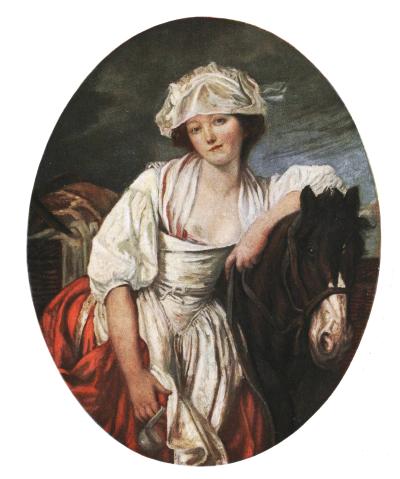
PLATE VIII.—LA LAITIÈRE
“La Laitière,” or “The Milkmaid,” may perhaps be given as
quite the most representative of Greuze’s works. The affected
pose and simpering smile, the unsuitability and over-arrangement
of the dress, are as characteristic of the painter as the perfect grace
of the ensemble, the delicious coquetry of the attitude, the dimpled
roundness of the form, and, above all, the sparkle in the clear
eyes and the exquisite bloom of the flesh. The picture is in the
Louvre.