ARCHAIC art, the wonderful offspring of the contact of Greek
civilization with the East, exercises its charm to-day more than ever.
We have ceased to ascribe a unique saving grace to the classic period,
the period of full bloom, and to allow no independent value to the
preceding century except as an inevitable transitional phase. We love
these archaic works of sculpture and painting for their own sake, not in
spite of their crudities but just because of their unpolished hidden
vigour, because of the precious combination of their essential features.
The fetters of space, and the strong tradition of an ornamental early
period give them a monumental effect, which has nothing of mummified
stiffness but is kept ever fresh and youthful by an eminently
progressive spirit and an energetic endeavour to attain freedom. The
archaic style ‘with fresh boldness goes beyond its Oriental patterns, is
ever making fresh experiments, and thus exhibits constant change and
progress. It is always full of serious painstaking zeal, it is always
careful, takes honest trouble, is exactly methodical: the language which
it speaks always tells of inward cheerfulness and joy at the result of
effort, the effect produced by independent exertion. There is something
touching in the sight of archaic art with its child-like freshness, its
painstaking zeal, its reverence for tradition, and yet its bold
progressiveness. What a contrast to Oriental and Egyptian art, which are
fast bound in tradition: in the one the sweltering air of dull
coercion, in the other the fresh atmosphere of freedom’ (Furtwängler).
The history leading up to the origin of this style has become clear to
us by quarrying in different localities. We saw the vases lose their
peculiarly carpet-like appearance, the filling motives disappear, the
bands of animals and ornaments forfeit their independence and become a
subordinate member in the tectonic construction, we saw the world of
figures win its way out of ornamental compulsion to greater freedom and
extend over the vase. The 6th century, to the beginnings of which we
pursued the history of vases, knows only occasionally inserted rosettes,
or a lonely bud projecting into the field. Plant ornamentation becomes
true Greek ornament, abstract, tectonic, and when occasion demands, full
of life with its swing. Animal friezes retire to the foot or the
shoulder, are often incidentally treated as mere decorative accessories
or seized by quite unheraldic liveliness. The principal interest is
devoted to depicting man, his doings and goings on. The vase painter is
now more anxious than ever to narrate and depict; he finds ever less
satisfaction in ornamental composition. He is never tired of describing
hunting and warfare, wrestling and chariot-racing, the festal dance and
procession, but with greatest preference, remembering the purpose of his
vases, drinking and wild dancing. But also the heroes of past ages,
their bold exploits and strange adventures, are his constant theme. The
Homeric Epic, the tales of Herakles the mighty, the bold Perseus and
Bellerophon, had evoked pictorial representations even in the 7th
century; but now the full stream of the legendary treasury pours into
painting and gives an infinitely rich material to the joy of narration.
What the vase-painter makes of this material is never conceived in the
historical or archæological spirit, but breathes entirely the air of
his own time; often only the added names (which according to the new
feeling for space assume smaller dimensions) raise a genre scene into
one from myth. Moreover the Saga is only seldom re-shaped by inventive
brains. Types once invented pass on, go from workshop to workshop, from
one district to another, are abbreviated (p. 49), expanded,
conventionally repeated or filled with new life. Types may also cross;
there arise purely through art, contaminations of legend, which are
foreign to poetry. When a Corinthian painter unites the Embassy to
Achilles (Iliad IX) with the visit of Thetis, this has as little to do
with poetry, as when on Attic vases the birth of Athena is coupled with
the apotheosis of Herakles, or the slaying of Troilos is transferred to
Astyanax, or the entombment of the dead Sarpedon to Memnon. But
everything strange need not be misunderstanding on the artist’s part.
The vases supply us with a multitude of legendary motives and
variations, which we cannot find in literature, and are the faithful
reflex of the fluidity of Greek mythology, which, devoid of canon and
dogmatism, was in constant flux.
Olympos too, is subject to these vicissitudes. Its gods live a human
life among men, the only difference being that some representative
scenes give them a stiffer and more elaborate appearance than that of
ordinary mortals. In early times the divinity is chiefly betokened by
inscriptions and attributes. On the painting of the Corinthian Kleanthes
stood Poseidon with a fish in his hand beside Zeus in labour. Late
observers of this picture failed to understand this external
characterization of the sea-god, and saw an act of brotherly sympathy
with the god’s pains in this holding up of the tunny; and thus a great
deal beside must have appeared strange to them, e.g. Apollo with the
great lyre still bearded in the 7th century (Fig. 52), Herakles without
lion-skin (Fig. 64), the unarmed Athena, who only at the beginning of
the 6th century, in contrast with the Chigi vase (Fig. 37), the Aegina
bowl and the Gorgon lebes (p. 49), begins to express her bellicose
nature by attributes, and much besides.
The favourite god of the drinking vessels is the wine-god with cup and
vine. He makes Hephaistos drunk and leads him back to Olympos to
liberate Hera from the magic chair. The big-bellied dancers and purely
human creatures, who form his escort on Corinthian vases, in the first
third of the century are superseded by the Ionic horse-men, the Satyrs,
who become ever more closely associated with Dionysos, celebrate feasts
with the Maenads, never despise the gifts of their master, and make fair
nymphs pay for it. The half-bestial creature in whom ancient Greek fancy
vigorously incorporates man’s pleasure in wine and women with all its
comic effects, is quite the patron of archaic vase-painting.
That all these representations were developed by vase-painting alone is
more than improbable. That the Bacchic scenes of toping and dancing were
created on the actual vase, is most likely; but one is often enough
compelled to assume other sources. The fight of Herakles with the lion,
for instance, in its oldest form is the borrowing of an Oriental type,
which is composed for a tall rectangle, and is expanded by the
vase-painters for their purposes by filling figures, ‘spectators.’ The
gifted artist, who gave this heraldic type the more natural impress
which was regular in the older black-figured style, was perhaps a
vase-painter; the creator of the later black-figured type was certainly
not, for his horizontal group is certainly a fine invention but always
has to be adapted artificially to the vase surface. As with the
wrestling of Herakles, so it is with Theseus’ struggle with the
Minotaur. The same sort of extension occurs on a favourite subject of
older black-figured style, the quadriga in front view, whose horses
heraldically turn their heads sideways, whose helmeted warrior is in
front view while the unhelmeted driver is in profile. This type,
certainly invented for a square, is also known in bronze and stone
relief, and the question, in what technique it first appeared, will
scarcely be answered in favour of vase-painting. For a square, too, the
finely compact group of Herakles wrestling with Triton was first
composed, a theme common on Attic vases from the hydria of Timagoras
onwards; the older wrestling scheme, superseded by this type, in its
Herakles spread out before the eyes of the observer and kneeling as he
wrestles, still shows strong affinity with the Orientalizing frieze
compositions (p. 46), and is for vase decoration much more typical than
the later invention, which on vases always has a ‘borrowed’ effect. The
dependence of vase-painting on other techniques is finally evidenced by
the so-called ‘couplings’: the best-known instance is the combination of
the departure of Amphiaraos with the Funeral-games of Pelias on a
Corinthian (Fig. 66), an Attic and an Ionic vase, a combination which is
borrowed from an inlaid wooden chest of Corinthian workmanship at
Olympia (‘the chest of Kypselos’) or a prototype from which both were
derived.
After all this one will not hesitate to look for a strong reflex of the
great art of painting on the vases, alongside of the special property of
the vase-painter and typical ornamental figures equally common to all
art, or to picture to oneself wall-paintings or easel pictures, like the
birth of Athena by Kleanthes, after the fashion of the best
vase-paintings, which are least constrained by ornamental
considerations, or to reconstruct from the copies of vase-painters
compositions like the Destruction of Troy (Iliupersis), the Return of
Hephaistos, the Reception of Herakles into Olympos. One is particularly
impelled this way, when the vases give now shorter, now longer,
extracts from the same large composition; thus we have a reflection on
some dozen vases of Exekias and his successors of the fine
representation of the heroes Aias and Achilles surprised by the Trojans
while deeply absorbed in a game of draughts, and warned by Athena just
in time (Fig. 96). One cannot conceive of any difference of principle in
perspective, in the rendering of the body and the drapery, in the
spiritual content, between vase-painting and free painting; they both
are children of one time. Nor did the vase-painter feel any necessity to
alter the composition of his patterns. Only as he had to decorate framed
bands, the law of isocephalism was more binding for him than for the
great art. Hence his strong disinclination for “landscape,” which we
often meet with in Corinthian and Ionian pinakes and wall-painting, but
on the vases never, or only in palpable caricature; the painter who on a
hydria from Caere copied a seascape with the Rape of Europa, was obliged
to place beside the figure what looks like a mole-hill but is intended
for a mountain.
This limitation of the possibilities of composition by decorative
considerations was of hardly any importance. The wide gulf between free
painting and vase picture was conditioned in the first instance by
technique. It was that which gave its special effect to the
black-figured style and set its stamp upon it. We saw previously that
vase-painting, when it took over the silhouette style from the
decorative animal frieze, increased its distance from free painting,
under whose spell it had been for a good part of the 7th century, that
with the incised technique it took over, e.g. the circular drawing of
the eye, and with the new colouring entered decorative paths (pp. 38,
44, 49). Free painting drew with the brush on light ground, used black
and white very sparingly, more frequently red, blue, green, yellow and
brown; placed these colours side by side in simple harmonies, with very
little gradation and shading, but also sometimes, e.g. to represent
fire, used the smooth brush; rendered the men in reddish brown, women,
children, animals and objects in light colouring. With this
free-coloured effect the black-figured style was neither able nor
anxious to compete. Just like the Geometric, it is in its own fashion
again an ornamental style, which does not disown its predominantly
decorative character. The figure silhouettes serve it as ornaments to
fill a given space, which are in a certain equipoise of colour in
relation to the rest of the decoration and the black painted parts of
the vase; the incision stipulates a sharp delineation of types, the
imposed colour gives a parti-coloured effect. The coloured effect of the
vases is essentially defined by the clay, which now, in the developed
black-figured style, takes on a brilliant warm red upper surface, and by
the black glaze, which assumes a metallic lustre. The darker colouring
of the clay deprives the lighter parts of their effects by contrast, and
compels the painters to replace the contour-drawing of women, linen
garments, etc., gradually by laying on white colour, with which at first
the contour is simply filled; but afterwards more commonly black
underpainting is overlaid. With the transition to white, clear
silhouettes are also obtained, which set off against the background more
effectively than the old contour figures.
The advance in the preparation of the clay and glaze colour came about
on the Greek mainland. Tradition makes the Sicyonian Butades invent the
red colouring of the clay at Corinth, and thus gives the correct
indication. The Chalcidian and Attic workshops helped the new technique
to prevail; in the East it gradually gets the upper hand and forces the
Ionian manufactories to give up their favourite white ground and adapt
their technical freedom to the growing strictness of the western
system. Attica, which in the 6th century opens a dangerous rivalry in
Eastern and Western markets and finally wins the day, brings the process
to perfection. With the refinement of incised technique it puts an end
to the parti-coloured method still much affected by Corinthians and
Chalkidians, it clears away the big surfaces coloured red and white and
all colour in ornament and animal frieze, and helps the harmony of clay
and black to its purest and fullest effect.
With the disappearance of the old parti-coloured system the vases are
completely removed from the effect of free painting. For that we may be
grateful to fortune. For this refinement of the black-figured style
permitted the sensitive feeling of Greek artists for decoration to
satisfy the delight of narrating and describing along with the
ornamental traditions of the old style. They had no need, as had the old
Minoan vase-painters (p. 10), to shrink from borrowing figured scenes.
The recasting of types into the decorative silhouette style made it
possible for them to conjure on to the vases whatever touched their
hearts and delighted their eyes, and thus to transmit to us an infinite
variety of scenes, without which our knowledge of Greek legend, Greek
life and Greek art would have remained terribly scanty.
Corinth must lead off the history of this new style. The chief centre of
commerce and industry in the Peloponnese, the celebrated seat of a
flourishing ceramic industry and of an important school of painting, it
not only took the decisive step to the new technique, but even in its
red-clay phase had helped the designs to drive out animal decoration,
and composed, or at least introduced into vase-painting, numerous types,
which supply material to other workshops for a long time. The quadriga
in front view, which Chalcidian and Attic painters repeated so often and
which kept
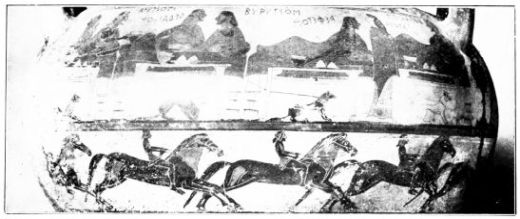
PLATE XXXII.
Fig. 64. HERAKLES AND EURYTIOS; HORSEMEN: FROM A CORINTHIAN KRATER.
its decorative effect for almost a century, appears here for the first
time; the triangular scheme of two wrestlers seizing each other by the
arms and pressing head against head, which survived to the time of
Nikosthenes, was taken by the Amphiaraos krater (Fig. 66) from the
above-mentioned chest of Kypselos (p. 67); the nuptial procession of
Peleus and Thetis which we shall meet on the lebes of Sophilos and the
François-vase is prepared for in Corinthian vase-painting; and the
battle-scenes, rider-friezes and chariot-races, of which there was a
beginning in the Protocorinthian style, were most richly developed by
the Corinthians, and adopted by Chalkis and Athens often without any
essential improvement. Thus one may be sure, that a number of other
types, which are not represented in the selection that accident has
given us, started their victorious career from Corinth, and that the
lost great art of Corinth, the bronze industry of which we have
specimens and the richly-adorned chest of Kypselos described by
Pausanias supplied to the vase-painters a number of mythological
compositions, which influenced other manufactories. Unfortunately the
greater part of this rich treasure is lost to us. The loss is the more
to be lamented, as what we have shows us a fine inventive talent on the
part of the Corinthian artists and a magnificently free and easy
conception of life and legend. The Homeric poetry and the Epic inspired
by it, the lays of Peleus and Herakles, the ballad poetry now becoming
very fashionable, from which come e.g. the birth of Athena and
probably also the Return of Hephaistos to Olympos, are reflected on
these Corinthian vases in inimitably vivid and drastic fashion; and the
vase-painter also gives scenes from daily life, carouses, drunken men
who dance wildly with naked women, kitchen and winepress, riding and
driving, marching out to battle, and the wild mellay itself. It is
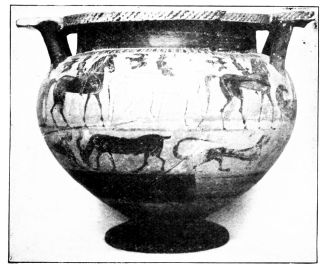
particularly on the kraters (Figs. 64-66) that we can trace how the
accumulating material gets space on the vases; animal decoration, in
which heraldic cocks are very popular, retires ever more to the reverse,
under the handles, into the base stripe, and also by preference is
replaced by lines of galloping riders, who form a lively decorative foil
to the mythological principal picture (Fig. 64). Meanwhile filling
ornament disappears. The flying bird over the rider (Fig. 65) renders
the same service as the rosette, nay a better; it transplants the scene
out of a decorative space into an actual one, the open country; and the
space-filling animals of the Amphiaraos vase, which are traditional (p.
40), are not intended merely any longer to enliven the vase surface but
the wall of the house, the floor and the air. Thus the liberation of the
field, for which Timonidas and his fellows paved the way, is attained.
With this goes hand in hand the liberation of figure-drawing from
ornamental constraint. The outspreading of the figure in the surface,
which is still strong in the 7th century, is toned down or ingeniously
given a motive, as with the kneeling warrior who fights backwards, and
does not disguise his connection with the old runner with bent knee. The
individualizing of men and animals carried forward by Timonidas now once
more makes big advances in human figures, horses and dogs.
We will select two of the kraters to give us an idea of the development
of the style. One, a Paris vase (Fig. 64), gives a special application
to a fine banqueting scene, by added names and the insertion of Iole, as
the visit paid by Herakles to Eurytios, king of Oichalia. The fair
daughter of the house stands with some indifference between the guest
and her brother; it is supposed to represent a legend, but is really
little more than a genre scene, as which it is hard to beat. The lively
conversation of the guests, the dogs tied to the sofa-legs waiting and
speculating on the chance of
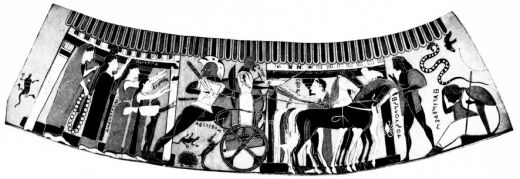
PLATE XXXIII.
Fig. 66. DEPARTURE OF AMPHIARAOS: FROM A CORINTHIAN KRATER.
bits falling from the table are masterly, and even the horses in the
supporting frieze, if out of proportion and inelegant, are the more
characteristic and living. The technique follows old tradition; the
flesh of Iole, tables and sofas, one dog, shields on the reverse, appear
in outline drawing. Such contours, also found sometimes where men’s
bodies left white set off those painted dark, unite to some extent, as
does the red colouring of the male countenance, the vase in its effect
with the great art.
On the other hand the Amphiaraos krater (Fig. 66), which gives up red
for male faces, and makes a point of covering the outline figures with a
layer of white, has become more decorative and black-figured. Its
pictures are not equal in execution to the invention, but come from
excellent models (p. 67). Between the colonnade and façade of the house,
which are in line like the tables in the Eurytios vase, the hero,
because of his oath, mounts his chariot to go with open eyes to the
death he forebodes; his angry look is directed to Eriphyle and the fatal
necklace in her hand. With raised hands the family takes leave, a
maid-servant gives the stirrup-cup to the charioteer. Foreboding evil,
the faithful Halimedes sits on the ground: his heart has evidently
bidden him to train up the boy Alkmaion to take vengeance on his mother.
The whole delight in narration, which in the exaggerated rendering of
the necklace strongly emphasizes the previous history, is as genuinely
archaic, as the mythological individualizing of an old type ‘The
warrior’s departure.’
The Amphiaraos krater is more developed than the Eurytios vase, not
merely in technique. The painter of the later vase, though not so gifted
as his colleague, draws more cleverly, and works with a set of types
before him, as the frieze of riders shows. The advance becomes plain in
the shape of the vase. The Eurytios krater encloses an almost uniformly
swelling cauldron between a lip ring which is very low and a foot which
spreads out in ample dimensions. From this round-bellied archaic shape
we pass to a later more defined and elegant one in the Amphiaraos
krater, which has a higher neck, a steeper and much less swelling body,
with its lower part running to a point, till finally the outline almost
resembles an inverted triangle and from the handles a rectangular or
curved bridge has to be built leading to the high rim (krater à
colonnette). The tendency to development, which we can read out of the
vase shapes, may be taken as a symbol of the history of style. For a
Greek vase was always something organic, as much so as a tree or animal.
Unfortunately, besides the large kraters with their numerous figures,
which were favourite articles of export, few vases are preserved. In the
scene on the Eurytios krater we get the lebes with stand, also the jug
and drinking cup (kylix), which exist in various extant specimens. The
kylix has an offset lip (as in Fig. 24), and often knobs on the handles,
the interior picture is framed by tongue pattern. Beside the necked
amphorae, which like the kraters seldom have any other ornament than
rays, shoulder tongues and neck rosettes, the similarly decorated
big-bellied amphorae continue, which like their Attic parallels (p. 51)
put human busts or animal representations of old and new style into the
figure panel. The three-handled water pitcher (hydria) has the type with
vaulted shoulder common in the older black-figured style, and adorns it
with spirals and maeanders. All these ornaments, to which may be added
the double lotus and palmette of the Eurytios krater and occasional net
and step patterns, partake of the solidity and variety of the style.
Strangely enough, the phase of the Corinthian style here described is
for us the end of the fabric; not one of these
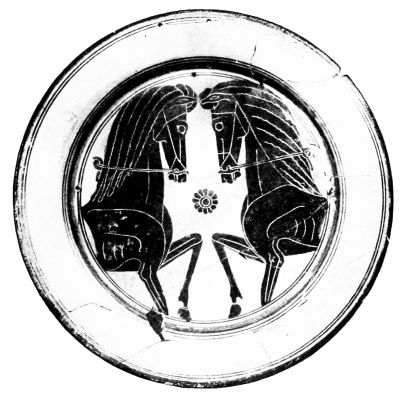
PLATE XXXIV.
Fig. 67. CORINTHIAN PLATE.
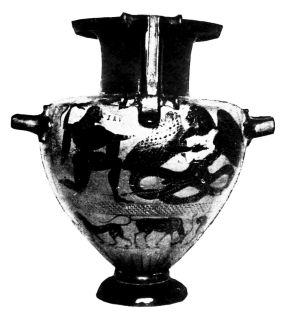
Fig. 68. THE SLAYING OF TYPHON BY ZEUS: CHALKIDIAN HYDRIA.
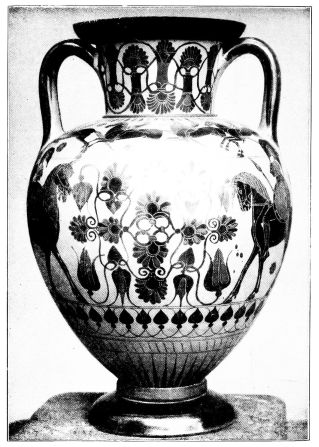
PLATE XXXV.
Fig. 69. CHALKIDIAN AMPHORA.
vases can be dated below the first third of the 6th century. Corinthian
pottery has no share in the Eastern Herakles with the lion-skin, the
Amazons as Scythian women, the entry of the Satyrs, the rendering of
folds, the painted ground for white additions. One asks whether this
brilliant development could break off so abruptly, or if it is only
accident which has concealed from us its continuation. Both are
improbable. It looks rather as if, just as the Protocorinthian
manufactory had its continuation in the Corinthian, so the Corinthian
was carried on by the Chalkidian. For the vases denoted by their
inscriptions as Chalkidian form, at all events according to the present
state of our knowledge, a group covering a few decades, which is in
succession of time to the later Corinthian vases, and is most closely
connected with them by a series of detailed agreements. Not only do the
vase shapes consistently carry on Corinthian tendencies, but details of
decoration like the white neck rosettes filled with red, and the step
pattern (Figs. 68 and 69) continue; the Corinthian animal friezes with
rosettes, the heraldic cocks, with the serpents, the winged demon, the
riders with the space-filling birds (Fig. 69), the wrestlers scheme, the
grotesque dancers, the quadriga in front view are taken over; nay,
details of drawing, like the warrior’s head in front view, the round
outline of the edge of the short small chiton (Figs. 70 and 71), the red
spots on black clothes (Fig. 70), the sword sheath with the St. Andrew
crosses (Fig. 71), the devices on the shields are not conceivable
without their Corinthian predecessors; even the names of Corinthian
grotesque dancers pass over to the Chalkidian Satyrs.
Not a single Chalkidian vase has been found in Chalkis itself, nor even
in any part of the mother-country: all specimens preserved come from the
West. One might therefore assume that the fabric had its seat, not in
Chalkis itself, but in one of its colonies, and thus the powerful
Corinthian traditions in this pottery would be easily explained. The
West was dominated, as we saw, throughout the 7th century by Corinthian
exportation; and the colonies of Chalkis had always been provided by
friendly Corinth with clay vases. But the strong influence of the
Chalkidian manufactory on the Attic is in favour of Chalkis itself
having put an end to Corinthian production, or at any rate to Corinthian
exportation. Why and how, cannot be stated: perhaps the publication of
the many unpublished specimens will solve the riddle and clear up the
close relation of the Chalkidian ware to the group of the Phineus kylix
(Fig. 74).
From every point of view the Chalkidian vases give us a heightening of
the Corinthian, a great advance in the direction of a later period. Clay
and black now attain their highest perfection, the distribution of
colour is most delicately calculated; no longer is there so much use
made of white surfaces (under which there is regularly a wash of black);
especially we see no more of the arbitrary colour-contrast which did not
shrink from white colouring of the male. If the Corinthian style had
already aimed at metallic effect in the angular formation of the handles
and the curving of the handle-bridges of the krater, the Chalkidian
heightens these tendencies almost to faithful copying of metal vases,
and consistently develops the vase shapes to the highest, almost
over-refined elegance; the narrowing of the lower part of the body leads
to the insertion of a roll, which the painter picks out in red from the
black foot. Thus arise novel vase-shapes; the necked amphora (Fig. 69)
is elongated, its shoulder flattened, so that the body almost assumes
the shape of an egg; the krater gets steep sides, high neck, and
outward-bent handle bridges; out of the older hydria with arched
shoulder comes a later shape, which, in a specimen at Munich (Fig. 68)
exactly copies the addition of cast handles to a metal body; and
similarly the other shapes develop, the kylix with knobs on the handles,
the two-handled cup, the jug.
The same endeavour after elasticity and elegance prevails in the
distribution of the ornament over the vase, which was managed in a more
masterly way at Chalkis than elsewhere. Certainly the ornamentation is
based almost entirely on Corinthian foundations. The white dot-rosettes
filled with red on the black neck, the lotus and palmette on the ground
of the clay, tongues on the shoulder, and rays at the foot, the step
pattern under the chief frieze are of old tradition but pass through a
growing elaboration. As a new motive of decoration comes in the chain of
buds, which we know from the East: as a rule it occurs beneath the chief
band (Fig. 69), or hangs over the figure-field in place of the lotus and
palmette. The Ionic pattern is not exactly imitated in the process; the
swellings under the Chalkidian buds suggest roses rather than lotus. Out
of these buds, palmettes, and the tendrils uniting them, is formed the
fixed ornament, which generally serves as central motive to heraldic
animals and often develops into a wonderfully rich complex of lively
lines (Fig. 69). The proper place for this ornament is the centre of the
upper band, which recovers its importance, now that the shoulder is set
off more sharply in hydriae and necked amphorae, and as secondary field
for decoration is, like the reverse of vases, usually decorated in the
first instance with animals. On the shoulder-stripe the riders with the
space-filling birds tend to drive out the archaic scheme of decoration;
they flank the lotus and palmette cross and in later specimens, where
the horizontal shoulder is no longer dominant in the general view, they
pass from heraldic constraint to parade order, and are also occasionally
replaced by cleverly disposed dancers. The reverse of the vase also more
and more shakes off animal decoration and replaces it by ornamental
compositions, as by the heraldic quadriga or the heraldic riders.
Friezes of animals beneath the main scene (Fig. 68) become very rare.
However markedly the decoration of the vase departs from the old style,
yet in spite of that there is in contrast with the Corinthian style a
marked decorative invasion to be traced. The vases that have nothing but
animal decoration are numerous, and the rosette often asserts itself
again.
This decorative invasion, which is connected with the perfection of
technique and marked talent of the Chalkidian artizan, does not detract
in any way from the figure scenes. The latter preserve their old vigour
and power of observation, some masters even raise it to a most intense
elasticity, and breathe into the old types a new and vivid life, which
in union with the line technique and arrangement in space makes these
vases superior to most of the other black-figured pottery. How Herakles
on the London amphora (Fig. 70) unmercifully deals the death-blow to the
three-bodied Geryon, or on the similar Munich vase (Fig. 71) to Kyknos,
is brought before our eyes with unambiguous matter-of-fact and verve.
The chest of Kypselos had already thus represented Herakles’ fight with
Geryon, and the Chalkidian painter rests here, as often and especially
in his battle scenes, on Corinthian types. But his rendering is anything
but a borrowing, and bears witness to fresh and vigorous conception. The
‘Herakles and Kyknos’ is based on the old fighting scheme, which
represents a warrior with raised right arm assailing an opponent who
almost kneeling moves to the right but looks round; and so in effect
only combines the ‘duellist’ (p. 39) and the runner with bent knee. On
the Chalkidian picture the old ‘exigency of space’ type is hardly any
longer to be traced; everything has become
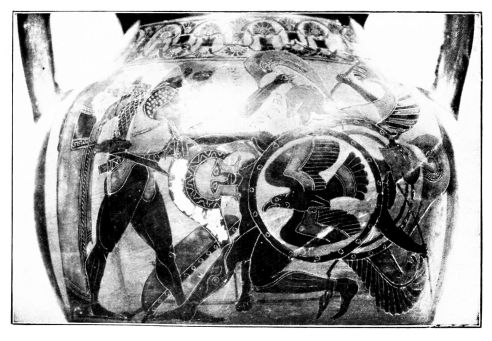
PLATE XXXVI.
Fig. 70.
HERAKLES AND GERYONEUS: FROM A CHALKIDIAN AMPHORA.
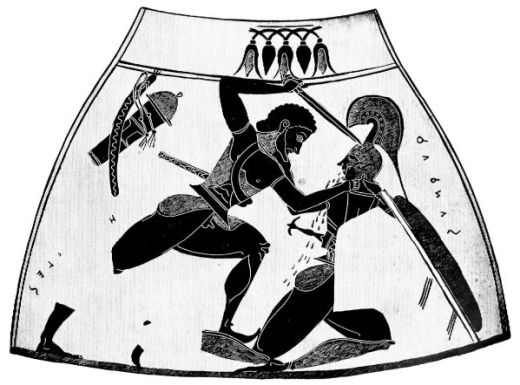
Fig. 71. THE SLAYING OF KYKNOS BY HERAKLES: FROM A
CHALKIDIAN AMPHORA.
expressive and characteristic. To be sure the contrast between the body
in front view and the legs in profile and the spreading over the surface
are still hardly toned down, but the thrust dealt with the right arm,
the clutch of the left, the foot pressed against the back of the
opponent’s knee are full of vigour, and the collapse of the bleeding son
of Ares, his prayer for mercy while he plucks the victor’s beard, the
dimmed eye with its pathos, the composition and the filling of the space
are very artistic.
This heightening of characteristic touches does not merely appear in
battle scenes, but also the intimate touches in many Corinthian subjects
are carried on. Even the Eurytios krater had succeeded in expressing the
horror which seizes Odysseus and Diomede at the sight of the suicide of
Aias. The feeling in this group is perhaps surpassed by an episode in a
Chalkidian battle-scene; where the intent care, with which Sthenelos
binds up the finger of the wounded Diomede, reminds one of the later
kylix of Sosias (Fig. 114); and when a Paris amphora enlarges the march
out to battle by a domestic scene of arming, early red-figured painting
is again anticipated.
The combination of this fresh and direct observation of nature with a
marked decorative talent unites Chalkidian with the Ionic art of the
islands. On Chalkidian soil, where a language with a strong Ionic
element was spoken, a close contact with eastern neighbours must be
assumed. It is not only the chain of buds on the vases that witnesses to
this contact. The Satyr, a hairy fat fellow, with marked horse-ears and
horse-tail, often with horse-hoofs, enters from the East in a form,
which meets us on the Phineus vase (Fig. 74). And when the Chalkidian
painter occasionally indicates the outline of the female back, where
previously the drapery falling straight down entirely concealed it, when
he furnishes his Geryon with wings and often equips Herakles with the
lion’s skin, in this, as in much besides, one cannot fail to see Eastern
influence. Whether the rendering of folds, the beginnings of which
appear on Chalkidian vases as elsewhere, has the same origin, is
doubtful.
The fabric in the Ionic islands which was in close reciprocal relation
with the Chalkidian, may be called the ‘Phineus’ fabric after its chief
product, till accident betrays to us its home. From the remains of
lettering on the Phineus kylix, it can only be said, that it was
produced in a place where Ionic was spoken, which cannot have been near
to Asia Minor. The style, more Eastern than Chalkidian, but different
from East Ionic in much, e.g. the circular drawing of the male eye,
and closely akin to Chalkidian, is probably of Cycladic origin. But a
connection of this pottery with one of the old Cycladic manufactories
(p. 52) is impossible. As little as the Chalkidian has it any previous
history; the few amphorae and kylikes that remain belong exactly to the
same short period of time, in which the Chalkidian vases were produced.
The amphorae are rather earlier than the Phineus vase, and often very
like the decorative earlier Chalkidian specimens. Chalkis seems to have
supplied to them the western technique, the vase-shape, the foot-ring,
and also to have supplied the patterns in many specimens for animal and
rider decoration. But the less severe construction of the vases, the
irregular division of the fields for figures, the preference for a dark
covering of the ground above the rays, the liberties in decoration, lead
us to more Eastern soil. The very chain of buds, luxuriant and hardly
stylized, which often covers the neck, shows the unpedantic and concrete
Ionic style, and the same playful carelessness appears, when the painter
is lavish with filling rosettes and buds, when he inserts into a
heraldic frieze of animals a complex of creatures furiously biting each
other, or puts
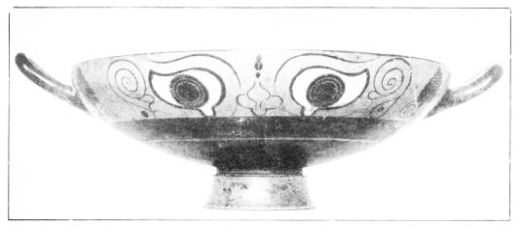
PLATE XXXVII.
Fig. 72. IONIC EYE KYLIX.
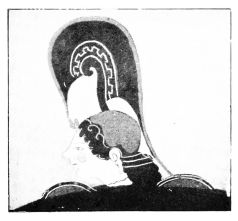
Fig. 73.
HEAD OF ATHENA, BETWEEN THE EYES OF AN IONIC KYLIX.
between his favourite squatting sphinxes a fighting warrior, a couple of
dancers, or two running girls, when he composes heraldically the heads
of two processions of riders, and makes a combatant the central motive
of heraldic riders, when he invents animal combinations with a common
head. So it is no wonder if he makes into an effective motive of
decoration the apotropaic eyes popular in this phase of art, which we
know from Delian, Melian, and Rhodian vases of the 7th century (Fig.
57), if he often adds ears and nose, and fills the centre with an
arbitrarily chosen motive, a leaf or a human figure. The eyes are found
on the necks of amphorae, but very often as outside decoration of the
kylix, which in perfected specimens shows alike the height and the end
of this manufacture.
The wonderfully living and swelling outline of these delicate kylikes
(Fig. 72) may be taken as a symbol of the style of the figures, which is
absolutely remote from abstract dryness. It often enough adopts
Corinthian-Chalkidian types as models. The ‘Phineus’ painter did not
invent of himself the warrior with head in front view; the slaying of
Troilos goes back to an old Corinthian type; the pursuit of the mounted
Penthesileia introduces, it is true, a new Eastern Amazon type in place
of the old one (which is also used in this group), but is based on the
composition of a Corinthian battle picture. What the ‘Phineus’ painter
does with his models is always distinguished by individual and genuinely
Ionic life. On the group of amphorae a fine vigorous figure style
prevails, which on the kylikes has a finer and at the same time more
delicate development. The charming Athena (Fig. 73), who now appears in
armour, and whose shield-edge the painter for decorative reasons has
doubled, the Scythian who like the mounted Amazon is at home in East
Greece, the skipping Silenus, the dog in front view would not tell us
much of this kylix-style. But fortunately the painter of the Phineus
kylix surrounded the fine Silenus mask in the interior with a continuous
frieze, the lack of which a hundred contemporary vases could not
outweigh. The wall with the vine and the lion’s head plainly divides the
frieze into two scenes: evidently a magic well, which pours wine into
the cup of the delighted Satyr. A lion, a panther and two stags draw the
chariot of the Wine-god and his consort. On the legendary team a Satyr
is making mischief; two of his colleagues are quite diverted from their
duty by the sight of three nymphs, who are bathing at a spring in a
wood. A lion’s head as spout pours into a basin the water with which
they are laving themselves; their clothes they have already hung up. The
other picture shows the blind king Phineus, from whom the Harpies have
taken the food off the table, for which he is vainly feeling; the
valiant sons of Boreas pursue the impudent thieves through the air over
the sea.
All is living, original and drastic in its conception, as perhaps was
only possible for an Ionian. The movements of the Satyrs and the nude
maidens, the animals and plant-life are caught from nature, and this
study betrays itself in various details. The face of Phineus, still
painted red like that of the Satyrs, is drawn in front view, which we
have hitherto only found in the helmeted warrior’s head, the collar-bone
and chest muscles are rendered, the eyes of the Boreads are already much
reduced in scale. Especially important is the treatment of the drapery,
not to mention the linen chiton of Dionysos with its parallel lines
indicating the material, or the long red chitons of the women and the
curved outline of the shirts of the Boreads, or the garments of the
Harpies adorned with Ionic crosses and borders; important innovations
appear in the himatia, that of Phineus is divided into
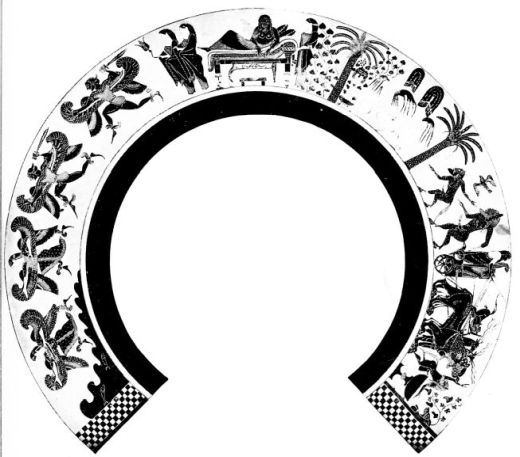
PLATE XXXVIII.
Fig. 74.
PHINEUS; DIONYSOS: FRIEZE ROUND THE INTERIOR OF AN IONIC EYE KYLIX.
From Furtwängler-Reichhold, Griechische Vasenmalerei.
red and black stripes, those of Dionysos and the women show rendering of
folds. That the himation rather emphasizes than conceals the outline of
the back, is a true Ionic feature.
Beyond this stage, the ‘Phineus’ fabric cannot be traced. Generally the
Cycladic pottery of this period is hard to get hold of. We do not know
whether there were more factories on the islands, and some isolated but
allied specimens with more fully Ionic alphabet cannot yet be localized.
On the other hand, the ceramic history of the Greek East offers at least
some fixed points, though the transition from the old style has not yet
been cleared up. We were able to accompany the Rhodian-Naukratite and
the ‘Fikellura’ styles to the very threshold of the black-figured, but
here the thread seems to snap. Shallow bowls found in Egypt and South
Russia with bud decoration and black-figured interior designs, which
were imitated by the Attic Vurvá style, and amphorae with remains of the
old ornamentation and big isolated animal-silhouettes in the field,
perhaps represent the latest products of the Rhodian style. The
‘Fikellura’ style finds its continuation in a ware, which was certainly
produced in Klazomenai, perhaps also in several places at the same time,
and has come to light not only in the Ionian region and the colonies in
Egypt and the Black Sea, but also in Italy. The Klazomenian style has in
common with its predecessor not only a series of ornaments (tongues,
rays, late Rhodian garlands, continuous tendrils, rows of crescents,
friezes of leaves, ‘metope’ maeanders, buds in the field, scales over a
surface), but continues the old shape of amphora and has the same
preference for loose decoration: beside the vases adorned in bands, on
which the animal friezes are driven out of the chief band, it is very
fond of a field consisting of a reserved panel or running all round, and
of the decoration of the neck by means of an ornament, an animal head
or a human head. In the field it likes to put instead of the heraldic
pair a single animal, a sphinx before a standing man or upright branch,
an isolated palmette and lotus cross, which are in a measure constituent
parts of heraldic compositions, and shows the same freedom, going even
beyond that of the Phineus painter, when it makes isolated figures,
dancers, running girls, or men wearing mantles, the central motive of
its heraldic sphinxes or cocks, and when it puts a runner with bent knee
between two lions that turn away from him (Fig. 75). The palmette and
lotus-cross and the animal types differ from Western types; the
selection, too, is characteristic of the East. There is a special
preference for the Siren: this bird-woman is used surprisingly often
heraldically, and in rows to make a frieze. The female panther occurs as
well as the male; the grazing deer is a Rhodian legacy. The ostriches
show knowledge of Africa, the winged horses and boars connection with
Asiatic art. The Klazomenian style is particularly strong in the new
formation of fantastic beings, to which the near neighbourhood of the
East gave the impulse. The seahorse and the Triton were invented
somewhere in this area: to the ‘Fikellura’ man with the head of a hare
Klazomenai adds a being with a tail and a lion’s head among human
revellers, among dancing men and women appears suddenly the bearded
monster with the horse’s tail, the Satyr (Fig. 75).
The stock of types varies considerably from that of the West; this is
particularly clear in the scenes with human figures. Beside the pictures
of riders and battles, beside the few preserved legendary scenes, among
which the most important are the battles of Amazons, who here in the
East have become mounted Scythian women, the prominent place is taken by
scenes of drinking and dancing in the
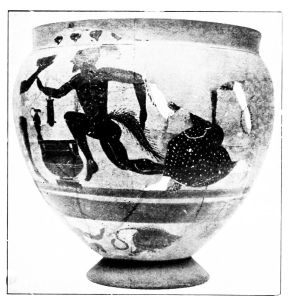
PLATE XXXIX.
Fig. 75. SATYR AND MAENAD: KLAZOMENIAN VASE FROM KYME.
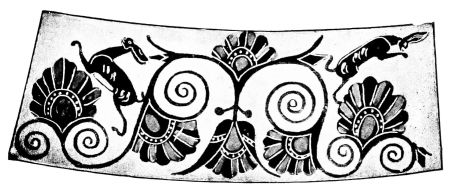
Fig. 76. NECK-DESIGN OF AN IONIC AMPHORA.
manner of the Altenburg amphora (Fig. 63). The file principle, so potent
in the East Ionic animal frieze, strongly asserts itself in the dancing
maidens and the abandoned revellers: the oblique inclination forward,
which the Klazomenian painter often gives the intoxicated, and which is
very successfully preserved on an early Milesian relief in London,
emphasizes at the same time the decorative arrangement, and increases
the expressiveness, just as the eccentric movements of the dancers
equally well fill the space and mark the tone. For life, sensual and
everyday though often grotesque and brutal, is what these Ionian masters
give, even if they are only decorative artists or artizans, whatever it
may cost. So they succeed in nothing so well as women, satyrs and
animals. The maidens with their receding foreheads, almond-shaped and
often obliquely set eyes, and the little mouth somewhat drawn in below,
and the well-marked back contour, have an attractiveness even on the
most careless representations; the shaggy satyrs betray their equine
nature not merely in ear, tail and hoof; the robust strong-maned horses,
the female panthers with swelling breasts, the fighting cocks forgetting
their heraldic duties, all show nature very close at hand.
The history of this style, which must approximately extend over the
first half of the 6th century, can be to some extent followed. In the
beginning comes the conflict of the old Ionic and Western techniques,
the transition from the light slip to the reddish-yellow surface, and
the tendencies in ornamentation which still strongly remind one of
‘Fikellura.’ The silhouette style makes liberal use of white. Not only
with inherited aversion does it often replace incision by delicate lines
of paint, provide garments with white crosses, animals with white spots
and white belly-stripe, and ornaments with white details: in its earlier
period it also extends the white surfaces, which it still places on the
ground of the clay at times, from women and linen chitons to men, horses
and dogs, and becomes as parallel to the Corinthian style with this
contrast of colouring as with its wide-necked broad-bellied form of
amphora.
The latest wares of the colony of Daphne (abandoned in 560 B.C.) show
the transition to the rendering of folds of drapery, which takes the
place of the old parti-coloured surfaces in the group of vases which
took its rise about the middle of the century. In this later group, to
which a series of ‘lebetes’ with topers, satyrs, centaurs, and battle
scenes is an obvious introductory link, and which culminates in two
amphorae at Munich (Figs. 76 and 78) and one in Castle Ashby, there
enters into the old style varied, free and easy, broadly even laxly
rendered, a peculiar severity and discipline. The three chief specimens,
necked amphorae with the continuous scene preferred by the East, are
more defined and elastic in shape, more finished in shape and colour,
more ornamental and elaborate in the rendering of the figures, than was
the case with the earlier style. The conclusion which naturally suggests
itself, that this new spirit came from the West and the Chalkidian-Attic
region, is confirmed by the ornaments. Beside the Ionic looped and
plaited bands, leaf and bud friezes, and the continuous tendrils (Fig.
76), come the double rays, the Western palmette and lotus system; and
when the painter scatters animals among the ornaments (Fig. 76), he
follows old Ionic tradition, but the hare and the hedgehog with the
ostrich riders of the Castle Ashby amphora are of Corinthian origin
(Fig. 66). In the treatment of the figure, the meeting of Eastern vigour
and Western severity makes as charming an effect as the genuinely Ionic
and very decorative composition; the scene of a Munich amphora arranged
round a centre (Fig. 77) with the cunning Hermes, who creeping up on
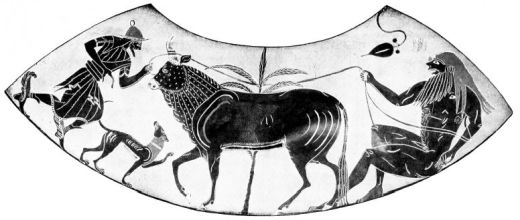
PLATE XL.
Fig. 77. HERMES STEALS THE COW IO FROM THE GIANT ARGOS. FROM AN IONIC
AMPHORA.
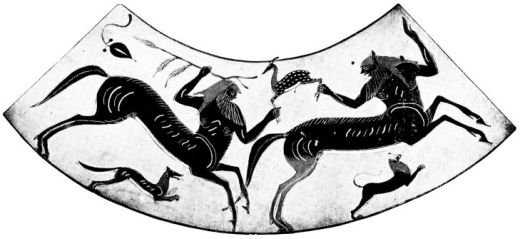
PLATE XLI.
Fig. 78. CENTAURS HUNTING: FROM THE SAME AMPHORA AS FIG. 77.
tip-toe steals away the fair cow Io from the sleeping giant Argos, and
the picture of the Centaurs hunting on the reverse (Fig. 78) are full of
ornamental vigour and at the same time full of fresh observation. The
left hand of the giant shows a new study of nature compared with the
old-fashioned right of Hermes and left of the front Centaur; in the
giant the artist is struggling to represent the anatomy, and the mantle
of Hermes plainly falls in layers, in contrast with the absence of folds
in the chiton.
The new impetus, which even expressed itself in exportation to Italy,
could not save the Klazomenian manufactory from the preponderance of its
Attic rival; it is at the same time its end. Not that the East Ionic
decorative tendencies formed a blind alley; the combination with western
technique ensured its continued life. But Asia Minor, which at this time
fell into the hands of the Persians, was not a suitable soil for
continued production. Athens seized not only the exportation but the
entire production. The arrival at Athens of East Ionic artists is
reflected not merely in the names of the vase-painters. When on the jug
of Kolchos and the Attic vases, typical Eastern principles of
composition crop up, when Nikosthenes introduces an East Ionic shape of
amphora (Fig. 104), when the red-figured technique coming into existence
on Klazomenian sarcophagi conquers the Attic workshops, when on early
red-figure kylikes the same decorative tendencies which prevailed in the
East assert themselves, there can be no question of an extinction of
East Ionic art, but only of a re-birth in Athens, and a baptism with
Attic spirit.
About on a level with the Castle Ashby group is another East Ionic
class, also only known through export to Italy, the ‘Caeretan hydriae,’
so-called from the place where they were mostly found (amphorae and
kraters being also represented), which are usually attributed to South
East Ionia. The developed vase-shapes, the completed black figure
technique, which has a wash under the white and uses incision freely
even for outlines, and the decoration, which has got beyond the animal
style, make their late origin certain, and the agreement with Ephesian
sculpture of about 550 B.C., expressed in treatment of hair, converging
mantle folds and the graded edges of the drapery, clinches the matter.
When in spite of that these vases stick fast to the system of contrast
in colour, that agrees with an expressed preference for gay decoration
such as from the days of the Naukratis vases South East Ionia loved. The
‘Caeretan’ painter actually enhances this colour preference, in that he
varies the colour of the male body from black to dark red, bright yellow
and white and similarly alternates the colour of hair and clothes. He
gives the same motley effect to the ornamentation, which shows plainly
its descent from the old Rhodian in its broad lotus and palmette system,
its rosettes, hook-crosses, and spiral-crosses ornamenting the neck, and
also reveals East Ionic freedom in natural myrtle branches and
ivy-tendrils, in bucrania with festoons and in interspersed animals. The
animal world too, with its fallow deer, lions, griffins, winged horses,
and winged bulls, is characteristic of the East and the neighbourhood of
Asia. These animals have long ceased to play their heraldic part, though
on the reverse of the vase two may face each other in symmetrical
correspondence; they are rather by choice included in hunting scenes.
The traditional tendency finds a refuge, if anywhere, in the figure
scenes. In heraldic scenes of battle, in the horse-taming ‘runner with
bent knee,’ in Satyr and Nymph running to meet each other, it asserts
itself: but the living interest makes one forget the ornamental scheme.
Lively drastic description is the strong point of the ‘Caeretan’
painter. His broadly treated scenes of hunting, fighting, and wrestling,
the fine delineations
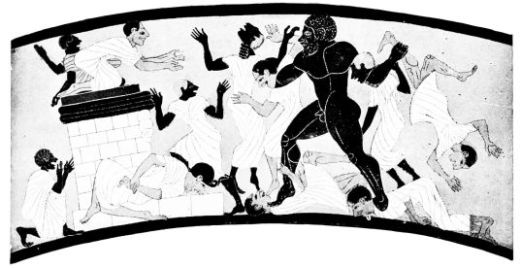
PLATE XLII.
Fig. 79. HERAKLES SLAYS BUSIRIS AND HIS FOLLOWERS: FROM A CÆRETAN
HYDRIA.
From Furtwängler-Reichhold, Griechische Vasenmalerei.
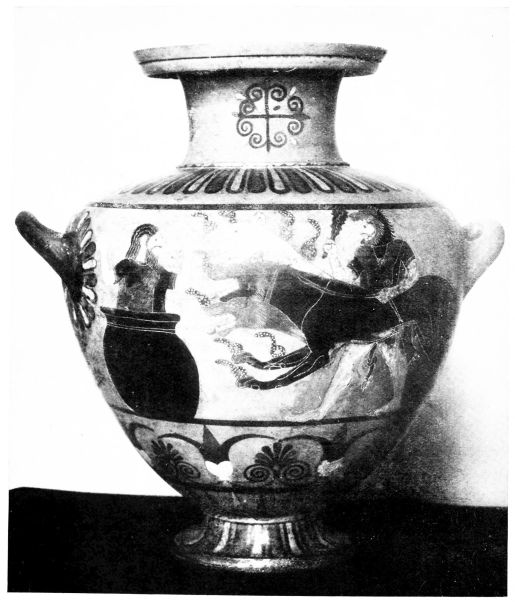
PLATE XLIII.
Fig. 81. HERAKLES BRINGS CERBERUS TO EURYSTHEUS: CÆRETAN HYDRIA.
of Satyr life, of the Heraklean legend, of Hermes and his theft of the
kine, of the drunk and lame Hephaistos, of Europa carried by the bull
over the sea, leave nothing to be desired in the way of original
invention, healthy vigour, and naive vividness, and in their aversion to
the typical and abstract they are diametrically opposed to Attic
painting. The stocky, strong man Herakles with the curly hair who
dispatches the inhospitable Pharaoh, Busiris, and his cowardly throng
(Fig. 79), or who with the hound of hell frightens the Argive king into
a wine jar (Fig. 81), are cabinet pictures of vigorous humour. The local
colouring is also unmistakeable. The altar with volute profiles is an
East Ionic architectural shape, the knowledge of the Egyptian and black
races, of Egyptian priestly dress, of monkeys, can only have been
obtained in Africa; the origin of the Busiris legend is only conceivable
in the neighbourhood of the kingdom of the Pharaohs. Thus though the
Caeretan vases found a local continuation in Etruria, because of this
local colouring one cannot imagine them made by Ionian colonists in
Caere.
On the other hand one may assume origin on Etruscan soil for another
class of East Ionic style, only known from Etruria, called ‘Pontic,’ as
having been wrongly localized on the Black Sea. The Asiatic-Ionian
origin of the style is based on the vase shapes as on the choice,
technique, types and application of the ornamental and animal
decoration; and also the figures, the lines of Tritons and Nereids,
riders and Scythians, heralds and Centaurs, and the legendary scenes,
which are often under ornamental influence (Figs. 82 and 83) in
execution and application, point to the same source. The ‘Pontic’
painters actually enrich our knowledge of East Ionic decorative motives
by a series of combined lotus, palmettes, volutes, maeanders, by net
patterns, leaf-friezes, etc., by a plentiful selection of animals,
which includes the marine Centaur, with the Asiatic man-bull, and is
fond of lines of guinea-fowls. But on the whole the class is very
provincial and cannot be regarded as a clear source of evidence. It is
questionable, whether obstinate persistence in stripe decoration, only
reluctantly giving way to the picture field, would have been possible in
the mother-country well on in the 6th century. The style is visibly
departing further from its Greek starting point. Vases which represent
Lanuvian Juno (B.M. Cat. II. p. 66) or Etruscan winged demons, show in
subject what the style of itself betrays.
Two classes with scanty decoration, fixed as East Greek by many finds,
can only be named for completeness sake; one, the ‘Bucchero’ ware long
known in Etruria, which perhaps originated in Aeolis and which owes its
black lustre not to glaze colour but to impregnation with charcoal and
to polishing; the other, the ware with a great extension in South Asia
Minor and Italy, either unadorned, or only decorated with stripes, which
give important conclusions as to the development of vase-shapes.
The East Greek manner took the place of the Corinthian in Italy at the
beginning of the 7th century. This revolution is less connected with
importation than with the immigration of Ionic artists. But even the new
current is more and more open to the influence of the ever-spreading
Attic importation, which in the East and West not merely captures the
market but also forces production under its spell.
Before we pass to this victorious fabric, we must once more return to
Peloponnesus, to a fabric standing in isolation and of marked
peculiarity, the Spartan. Excavations at Sparta show the transition to
the black-figured style, such as took place elsewhere about the end of
the 7th century. Corinth seems to have set the example for this
transition;
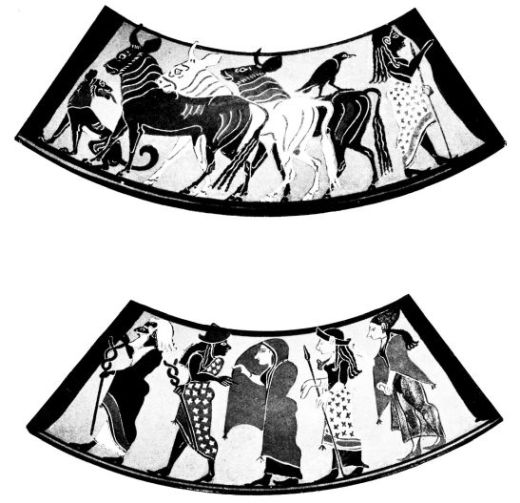
PLATE XLIV.
Figs. 82 & 83. PARIS AND HIS HERD; PRIAM AND HERMES LEAD HERA, ATHENA
AND APHRODITE BEFORE PARIS: FROM A PONTIC AMPHORA.
From Furtwängler-Reichhold, Griechische Vasenmalerei.
at all events Corinthian elements, e.g. riders with birds for
space-filling in the black-figured style give this indication, though
the conservative retention of the white slip and the inconsistent
rendering of the male eye clearly distinguish it from Corinthian. It
becomes really tangible to us at the period, when exportation properly
begins, at a time which already puts a black wash under imposed white
and with the shapes takes us further along into the 6th century. The
ware for exportation, which spread far over the mainland to Naukratis
and Samos as well as to Etruria, has given us only a few big vases,
finely decorative works, which are very conservative in their adornment.
The earliest of them is a Paris ‘lebes’ with heraldically arranged
animal-frieze and a frieze of figures above it, in which pot-bellied
topers are placed between the Troilos story and a Centaur battle; two
volute kraters and two hydriae, by their shapes, cannot be much later.
Broad tongues adorn shoulder and foot, the rays are doubled, to
Geometric zig-zag and hooked bands are added upright arched friezes of
lotus and pomegranate, continuous branches, and the lotus and palmette
pattern; the animal friezes have types of their own and do not avoid the
processional order not ordinarily favoured in the West. Even the larger
vases found in actual Spartan sanctuaries are almost entirely decorative
and show little of the figure painting coming in so vigorously in other
manufactories.
A compensation for this is offered by the number of kylikes preserved,
which in the 6th century, as in East Ionia, Corinth and Athens, so also
in Sparta, gradually pass into the high-stemmed shape with offset rim
(Fig. 80). The outsides of these kylikes are adorned only in a few
earlier specimens with antithetic or processional animal friezes,
otherwise only with the simple or net-like pomegranate pattern, with
lotus leaves and rays; from the handles proceed palmettes on their
sides. The figures are entirely confined to the interior, which much
more commonly than in other manufactories, rises out of pure
ornamentation or animal decoration to free scenic representations. To be
sure this is often at the expense of the decorative effect. Most scenes
are anything but composed with a view to a round space, and the segments
under the line which marks the level of the ground, often very clumsily
filled with plant and animal ornamentation, the rosettes, filling
flowers, and birds dispersed without meaning about the scene, are always
clumsy old-fashioned compromises between representation and
space-filling. The stock of figures, with which the painter decorates
his interiors, usually more or less at random, is even in its rendering
helpless and antiquated; to make up it preserves its independence and
ease, its primitive solidity; the strong warriors, riders and hunters,
the men carousing with women, the musicians and drinkers, the girls
bathing in the river, are in subject and execution truly Spartan. Beside
the pictures from daily life comes mythology with pot-bellied dancers,
who have not yet, so far as we know, been superseded by Ionic Satyrs,
with Erotes crowning riders and drinkers, and various legendary scenes.
None of these kylix-pictures breathes the Spartan spirit, the spirit of
the lyric poetry of Sparta, so well as the Berlin vase with the carrying
home of fallen warriors, which is perhaps taken over from a continuous
frieze without any attempt to fit it into the circular field; but even
in this shape has the effect upon us of a funeral march of Kallinos or
Tyrtaios (Fig. 84). But in humorous descriptiveness the Arkesilas vase
(Fig. 85) takes the palm. It is a genre scene, but not this time from
the life of a Spartan citizen, but a travel reminiscence of a painter,
who once in African Cyrene looked on, while the silphion was weighed
under
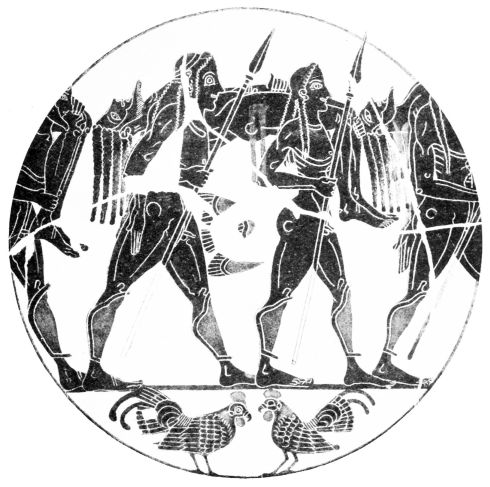
PLATE XLV.
Fig. 84. RETURNING FROM BATTLE: FROM A SPARTAN KYLIX.
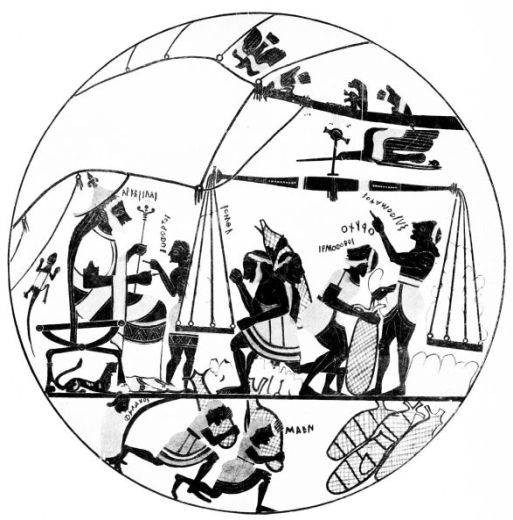
PLATE XLVI.
Fig. 85. ARKESILAS OF CYRENE WATCHING THE LADING OF SILPHION: FROM A
SPARTAN KYLIX.
the stern eye of Arkesilas, and stowed in the hold of a sailing ship to
be exported. The monkey too, which the painter puts on the yard, he
became acquainted with in Africa; the birds are not meaningless but fly
round the ship; only the lizard is an external addition, and we already
know it to be Corinthian. The life-like picture, which before the
decisive excavations in Sparta was regarded as chief proof of Cyrenaic
origin for this pottery, confirms the result of digging in the shape of
the chair legs, which agree with Spartan reliefs, and in the
inscription, only possible in Sparta. There is an approximate date given
too; for the king, whose portrait we have, reigned about the middle of
the 6th century. With this it agrees that his mantle is divided into
black and red stripes, which, as we saw in the Phineus kylix, comes
before the rendering of folds.
This conservative style does not show the same keenness as its
contemporaries in rendering folds and developing the knowledge of
anatomy; nor is the need felt for a long time of freeing the field from
filling ornaments or the base segment from animal decoration. The group
of vases which belongs to the second half of the century is especially
marked by the return of the white slip and of polychromy in the
ornamentation. It is only late that the Spartan painters turn to the
rendering of folds and richer body details, really only in a time of
decadence, which diminishes the foot, no longer colours the ornament,
and often avoids the base-segment. The occasional use of pale red
figures painted on a black ground with incised details can only be
explained as a provincial imitation of Attic red-figured technique, with
the superiority of which Sparta cannot even remotely compete. Similar
vases without any figures show the last output of the fabric.
The only fabric in which the black-figured style completed its life and
exhausted its possibilities, the only one which shows its living force
through the archaic and classic periods, is the Attic. Even at the end
of the 7th century it begins to vie with others. We already saw that
Vurvá vases were exported to East Ionia; the Gorgon lebes of the Louvre
comes from Italy. Etruria now becomes the chief place where Attic and
indeed all black-figured vases are found. The fact that ware made to be
exported to Etruria first gave us the knowledge of Greek vase-painting,
led enquiries on false tracks for a long time in localizing the fabrics,
and even to-day the word ‘vases’ reminds us of the decisive finds on
Italian soil.
The Attic manufactory is, as we saw, proved not only by the alphabet of
their inscriptions but also by continuous finds in Attica itself. To be
sure, the inequality of production in technique and style obtrudes
itself on us here more than elsewhere, and makes us take fabric in a
wider sense, as a complex of workshops, which turn out at the same time
good and rubbishy ware, traditional and progressive painting, vases with
light or dark-red clay. The Boeotian workshops, without doing them
injustice, we may class with Attic workshops of the second class; in the
6th century, in so far as they do not go on turning out their old bird
kylikes (p. 52), they are only provincial offshoots of Attic industrial
art. The same is the case with Eretria.
The inequality of Attic ware has yet other reasons. More than other
fabrics the Attic adopted foreign influences. Athens’ central position
between Corinth, Chalkis and the Cyclades, its relations to East Ionia,
led to a penetration of old Attic art traditions with other elements and
to the formation of a new style: the rise of trade and industry enticed
alien painters to settle at Athens, since foreign fabrics had more and
more to give in to Athenian superiority. Thus it is that Corinthian,
Chalkidian, ‘Phineus,’ East Ionic, occasionally even Spartan fabrics
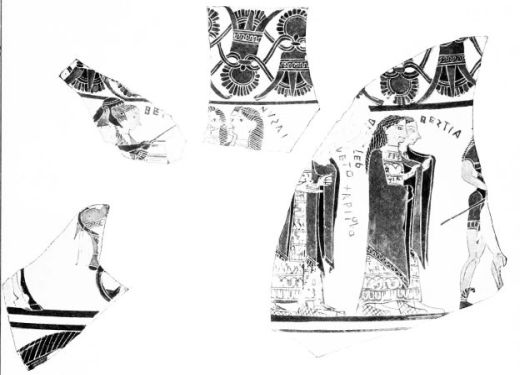
PLATE XLVII.
Fig. 86. WEDDING OF PELEUS: FRAGMENTS OF A CAULDRON BY SOPHILOS.
are reflected in the Attic pottery. These reflections give a very varied
air to Attic pottery, but on the other hand help to a dating of its
separate phases. After a period of Corinthian influence follows one with
a strong Chalkidian element, in the eye-kylikes the pattern of ‘Phineus’
ware is at work, while relations to East Ionic art run along side by
side.
The group, which one is inclined to make parallel with the red-clay
Corinthian, may be named the ‘Sophilos’ group from the fragments of a
‘lebes’ found on the Acropolis (Fig. 86). In contrast with its immediate
predecessor the Sophilos vase vies in motley effect with Corinthian
ware. Ornament is richly painted; himatia and borders are picked out in
colour, women and linen chitons have a white filling; in the red of the
male face and the varied colouring of the horses the system of
contrasted colours is as plainly exhibited as in the red colouring of
the male breast or of the whole male body on other contemporary vases.
The marriage of Peleus and Thetis is the subject, in a type repeated on
the François vase (Fig. 90), which we see developed on Corinthian
kraters, probably under the influence of the chest of Kypselos. Who
introduced into the scene the Muse in front view playing on the syrinx,
cannot be stated; the lower part of the body in profile is in marked
contrast with this bold front view; that it is of ornamental origin,
perhaps from a double Siren, might be suggested without its being too
venturesome.
The frieze is framed between a broad lotus and palmette pattern and a
stripe with large animals. Whether the filling ornament has been omitted
from the animal as well as from the figured frieze, in which nothing but
the big lettering reminds us of the old requirement of filling the
space, cannot be ascertained from this specimen; a second vase of the
same painter shows between the animals, which still suggest the Vurvá
style, isolated large rosettes, and other vases of this group make a
palmette flower or bud with stalk project into the field. These isolated
echoes of the old filling ornamentation, influenced by the East like the
gradually appearing friezes of buds and leaves (p. 83) disappear about
the middle of the century; but the animal friezes themselves live on
longer.
This survival of old decorative tendencies in a new shape appears still
more plainly in other vases of the “Sophilos” period. The amphorae,
which leave a “metope” unpainted to carry their figures or make the
figure field continuous, when they do not cover the whole body with
stripes, have like the Klazomenian on the neck a head, a lotus and
palmette cross, or a circle between zig-zags (the amphora which Dionysos
is dragging on the François vase is of this type), and prefer still to
decorate their stripes and fields with heraldically arranged animals.
The Ionic liberties too, the meaningless compositions, are not
infrequent, just as beside many Corinthian echoes in the friezes of
animals and riders, Ionic patterns often assert themselves in the
drawing and colouring of the animals, and in the shape and decoration of
the vases. The kraters and hydriae which are parallel with the
Corinthian, give the same impression. Of the smaller vases we may select
two hasty compositions, which cannot compare with the fine work of
Sophilos, but in their way help to enlarge our idea of the period. The
Munich tripod-vase (Fig. 87) in the stripe on the rim shows alongside of
the old animal composition two wrestlers of the Corinthian scheme and a
horse race from the same source, the succession of which is interrupted
by a fallen horse just as the animal friezes of contemporary vases
contain fighting animal groups; and a kantharos of Boeotian manufacture
and shape (Fig. 88) over the animal frieze introduces the wild dancers,
who as at Corinth, Chalkis and in East Ionia prepare the way for the
Satyrs.
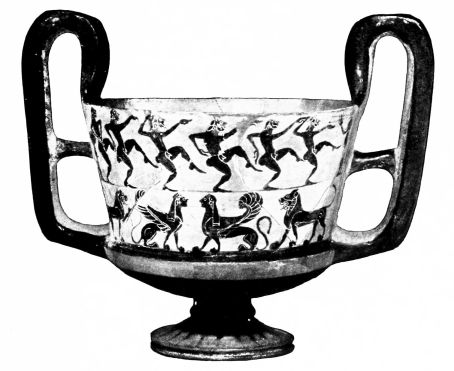
PLATE XLVIII.
Fig. 88. BŒOTIAN KANTHAROS.
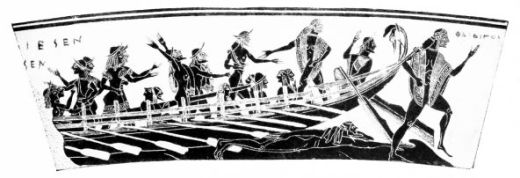
Fig. 89. ARRIVAL OF THESEUS’ SHIP AT DELOS: DETAIL OF THE FRANÇOIS VASE,
FIG. 90.
From Furtwängler-Reichhold, Griechische Vasenmalerei.
Just as we followed the process in late Corinthian and Chalkidian
workmanship, so in Athens the broad, massive archaic black-figured style
in the shape of the vase and the rendering of the figures passes into
more and more elegant compression and precision; Sophilos is followed by
Klitias. The Florence vase ‘made’ by the potter Ergotimos, ‘painted’ by
Klitias and named after its finder François (Figs. 89 and 90), even in
the boldly rising outline of the body shows the spirit of a new age, and
goes beyond the round-bellied shape of the Gorgon ‘lebes’ as much as the
late Corinthian kraters surpass the Eurytios vase (Fig. 64). Ergotimos
holds the mean between the old round-bellied vase shapes and the more
elegant ones of the Chalkidian best period (p. 77), just as Klitias does
between the figured style of Sophilos and that of Amasis (p. 105); and
as Ergotimos does his best in delicately moulding the shape and gives
the vase a showy appearance with his elongated handle volutes, so in the
figured decoration covering the whole surface and in the incredibly
delicate execution of all details Klitias presents a refinement of the
black-figured style which in its way cannot be surpassed. Potter and
painter here take a step, which secures for Attic pottery the paramount
position for all time.
The treatment of the procession of the Olympians in honour of the
newly-wedded sea-goddess on the principal frieze is particularly rich.
We have seen that Klitias here utilized an old type. The representative
solemnity required by the subject gives an archaic stamp to this frieze;
in particular the richly adorned festal clothes with patterns that it
almost requires a microscope to see, which bear witness to uncanny
patience and accuracy on the part of the painter, heighten the stiffly
venerable impression. But when compared with Sophilos, Klitias shows a
considerable advance in the rendering of nature.
For that we must not lay stress on the head of Dionysos in front view,
for the god’s mask-like appearance passed from cult into vase-painting;
but we may point to the diminished heaviness of the figures, the smaller
size of the eye, the division of the himatia into stripes, which here
and there converge like folds, and the reduction in size of the
inscriptions. The other friezes exhibit Klitias as a master of the
delineation of life and movement: the arrival of the ship of Theseus at
Delos (Fig. 89), the hunt of Meleager, the battle with the Centaurs, the
chariot-race, the return of Hephaistos, the adventure of Troilos, and
the delightful frieze on the foot with the battle of dwarfs and cranes;
even the heraldic animal frieze is seized by the same liveliness, for
between the heraldic sphinxes and griffins the animals, now treated in
quite an elegant and concise way, are attacking each other. How much of
these scenes is due to the inventiveness of Klitias and his direct
observation of nature cannot be made out. He has not got the rough
freshness and naturalism of the Ionic painters, but instead a marked
feeling for clear and speaking types; and generally speaking, discipline
and the gift of abstraction seem to have been more characteristic of the
Athenians than of the Ionians, who set more carelessly to work. Perhaps
Klitias got from eastern masters the interruption of the heraldry in the
animal frieze by fighting groups; and at any rate the Satyrs who
accompany the drunken Hephaistos come from the East into Attic pottery.
In the technique of the figures, the old style is worthily putting forth
its last efforts; the white is still put direct on the clay, the man’s
face is coloured red, black horse alternates with white. But with the
perfection of the clay and the black used in painting, and the minute
detail of incised lines, a new feeling for colour is brought in, which
leads away from the old motley effect; the masters of the
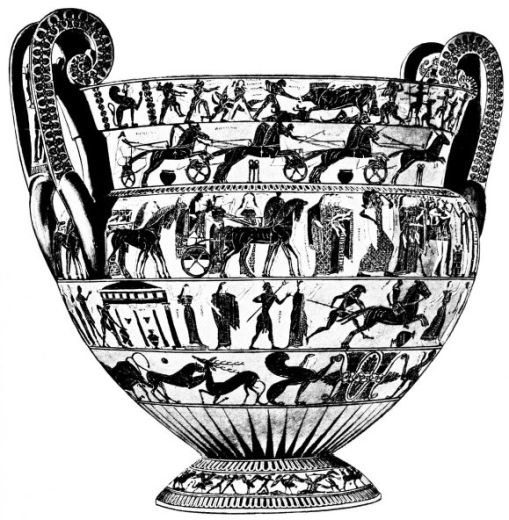
PLATE XLIX.
Fig. 90.
KRATER BY KLITIAS AND ERGOTIMOS: “THE FRANÇOIS VASE.”
From Furtwängler-Reichhold, Griechische Vasenmalerei.
François vase themselves in their later works go over to the new system,
which paints a ground for the white and gives up red in the male body, a
system which, perhaps, other less thorough artists had already set
going.
The chariot-race for a prize on the neck of the François vase introduces
us to an old and popular contest, which according to tradition
Pisistratus replaced by other games, when in 566 B.C. he reformed the
Panathenaea. At the same time he must have erected a new image of Athena
on the Acropolis, which, in opposition to the old conception, (p. 66)
still followed by the François vase, represented the goddess in full
armour. For on the prize vases, which were given to the victors full of
precious oil and labelled ‘one of the prizes from the city of Athens’
(τῶν Άθήνηθεν ἄθλων), Athena always appears as a fighting warrior, just
as the poet Stesichoros and paintings of the time of Sophilos had made
her leap from the head of Zeus. The oldest of these Panathenaic amphorae
(an idea of their shape is given by Fig. 101, a later specimen of about
520 B.C.) shows on the obverse the new type of Athena in the making, and
on the reverse the chariot-race which was now becoming infrequent. Since
this vase adheres closely to the Sophilos group in style and especially
in the animal decoration of the neck, but on the other hand already has
a painted ground for white, it will not be possible to move the François
vase and the transition to the later technique away from the sixties of
the 6th century.
The group of kraters, lebetes, hydriae, amphorae and other vases, which
immediately adheres to the François vase, usually, in so far as it is
not interrupted by marked individualities, is described by the
antiquated name ‘Tyrrhenian,’ derived from the finds in Etruria. The
conservative and often mechanical character of these vases does not
conceal the progressive elements. The vases assume the more slender
egg-shaped form known to us from Chalkis, the old neck ornament of the
amphorae (p. 96) is replaced by lotus and palmette. White colour is
regularly placed on black ground; Herakles is often equipped with the
lion’s skin; Athena with at any rate helmet and spear; in place of the
old-fashioned burlesque dancers and naked women come Satyrs and Maenads.
But of improvements in observation of nature this second-class group has
hardly any to show. It lives on the achievements of great masters, on
Corinthian traditions, and eastern influences. The frieze amphorae,
which continue alongside of the amphorae with picture field, vie with
the François vase in the accumulation of figured friezes; only in the
lower stripe they economize in figure scenes by using lines of lotus and
palmettes and animals. Thus their general appearance is still very like
the Vurvá vases, the Gorgon lebes and many vases of the Sophilos period.
The traditions of the 7th century end in this mechanical group; the
great masters of the second third of the century bring, perhaps from
Chalkis, new vase types and new kinds of decoration.
The transition may first be followed in the Kylix, which happily can be
traced in its development by many signed specimens. The firm of
Ergotimos produces a cup with knobbed handles and no set-off for the
rim, the interior picture of which is framed by tongue pattern, thus a
kylix of the type known to us from Corinth and Chalkis; on the outside
the Satyr is still loosely connected with drinkers of the old type, and
has thus not yet been associated with Dionysos and the Maenads. This
type of kylix shews marked Chalkidian influence, especially in later
specimens like that of Boston (Fig. 92), on which Circe (painted white
over black) hands to the companions of Odysseus the fatal potion and so
brings about her own abrupt end. Series of branches and buds, probably
also the dog in front view (p. 81)
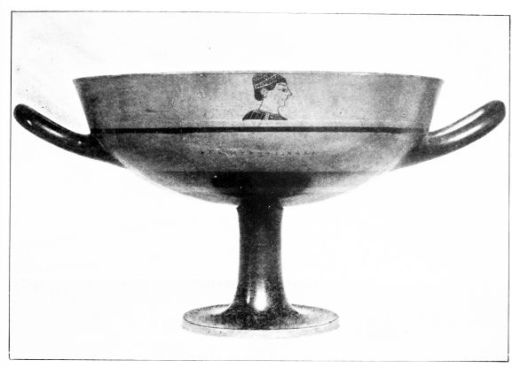
PLATE L.
Fig. 91. ‘LITTLE MASTER’ KYLIX.
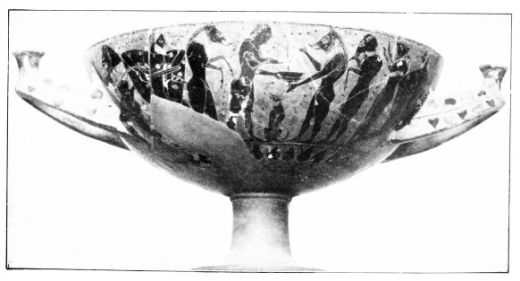
Fig. 92. ATTIC KYLIX WITH KNOB-HANDLES.
and much in the style of the figures come from the neighbouring fabric.
This Chalkidian influence is to be traced on a second type of kylix
belonging to this period, that with off-set rim, (not the one in Circe’s
hand), which for a time carelessly draws its figures over the junction,
but finally makes a clean cut between handle frieze and rim ornament:
the rim is e.g. decorated with a branch or painted black, the handle
frieze bears figures or the artist’s signature in neat letters between
the palmettes proceeding from the handles. The masters of the François
vase themselves took this step forward; in Naukratis and the interior of
Asia Minor signed specimens have been found, speaking documents of the
popularity of the fine Attic ware in the East, which help to explain the
alteration of the Ionic style (p. 86).
The workshop of Ergotimos passed to his son Eucheiros (B.M. Cat. ii., p.
221), who, like the sons of Nearchos, Ergoteles and Tleson (B.M. Cat.
ii., p. 222) is found among the so-called ‘little masters,’ the makers
of dedicated high-stemmed cups, who, with special pride, and probably
also for decorative reasons, put their names on their products. More
than twenty makers’ names, among them those of Exekias, Pamphaios,
Charitaios, Hischylos, and Nikosthenes, have been handed down to us on
these vases, an important piece of evidence for the vigour of Attic
production in the generation after Klitias and Ergotimos. These masters
preserve the division between handle and rim stripes, even when the rim
is not marked off from the body. As with Klitias, the handle stripe
bears the master’s inscription or a drinking motto; in this case the
representation, consisting of neat miniature figures or a female head
drawn in fine outline, moves into the upper stripe (Fig. 91). Side by
side with that, the painting of the rim black and decoration of the
handle stripe with figures are very common. In the figures decorative
tendencies, betokening intention rather than convention, assert
themselves. The interior picture often consists of the Gorgon’s mask, or
a figure to fill the space to fit the circle; the outside often bears
meaningless compositions (heraldic animals, winged creatures, runners,
riders, men wrapped in cloaks), out of which develop scenes of hunting
and pursuit, chariot-races, and cock-fights; but also mythological
scenes and vigorous battle pictures with many figures occur. When such
scenes are still flanked by heraldic animals, in this case primitive
traditions are consciously retained.
On the Munich kylix (Fig. 91) the painter in the inscription praises the
beauty of Kalistanthe. More commonly fair boys are praised, a practice
which continues on vases for a century, the explanation being supplied
by the erotic scenes represented from the later time of Klitias. Those
celebrated are seldom to be regarded as the favourites of the
vase-painters themselves, but generally sons of the best society, for
whom there was a furore. This worship of beauty is of use to the
historian, for many of the Kaloi are great persons with established
dates, and anyhow the common love-name puts all vases which bear it into
a short period of time; for the bloom of beauty lasts not more than a
decade.
If the kylikes of the ‘little masters’ last to the beginning of the
red-figured style (p. 109), the eye-cups go a good bit beyond this
limit. The type must have been brought to Athens from the ‘Phineus’
manufactory (p. 80) in the later period of the ‘little masters’; and
perhaps the Ionian Amasis, who has left a fine specimen with a figure
holding a branch between the eyes, had much to do with this
naturalization. Certainly the Attic artists never rival the swelling
shapes and vigorous life of their prototypes. With this type the outside
begins again to be treated as a decorative unit
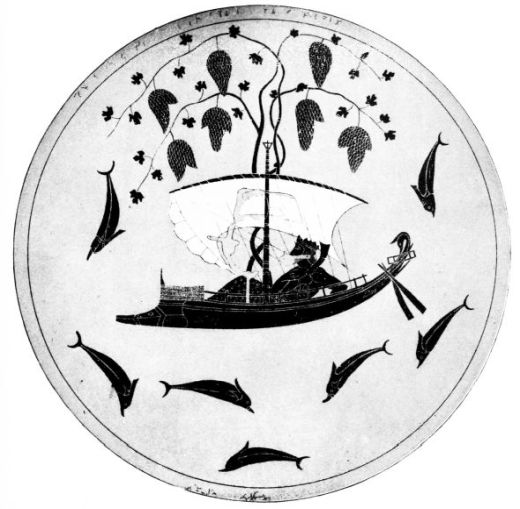
PLATE LI.
Fig. 93. DIONYSOS: INTERIOR OF AN EYE KYLIX BY EXEKIAS.
without division, an arrangement of which the red-figured style makes
almost exclusive use. The interior is generally not more richly
decorated than by the ‘little masters.’ When Exekias on one vase adorns
the whole interior surface with a wonderful idyll, the giver of the vine
in a sailing boat with dolphins leaping round him, this is quite an
exception (Fig. 93): that the ground is painted brick-red, is quite
unique.
The names Ergotimos and Klitias, Exekias and Amasis, Charitaios,
Pamphaios and Nikosthenes show that the manufacture of kylikes was by no
means a separate speciality, and that it may be simply due to accident
if certain firms producing larger vases do not recur among the ‘little
masters.’
The larger masterpieces naturally show the progress of the style much
more plainly than the conservative Tyrrhenian ware and the kylikes. We
noticed above, that single specimens, which stand out markedly from the
ordinary ware of the period, attach themselves to the François vase. The
master of a fine lebes from the Acropolis showing Ionic influence, who
occasionally still colours the male face red, probably emigrated from
the East like his contemporaries Kolchos and Lydos. Like Klitias, the
masters prefer to cover garments with rich patterns rather than to
render folds: they relieve the monotony of white chitons by vertical
strokes, and divide the surfaces of cloaks into stripes. This division
does not yet attain any effect of depth. But when Nearchos, the father
of two ‘little masters’ (pp. 101 and 112), divides the short male chiton
also by wavy lines into black and red stripes, he has already in his
mind the rendering of folds, and Kolchos grades the ends of cloaks with
clear folds. This emancipation from the old superficiality, which in the
period of the ‘little masters’ leads to the emergence of the ‘fold’
style in the works of Amasis and Exekias, must now be exhibited in a
selection of amphorae and hydriae in connection with the change of
vase-shapes and decoration.
We begin with the big-bellied amphora, which at the end of the 7th
century we saw reserve a square field and decorate it with horses’ or
women’s heads, and which in the period of Sophilos begins to put an
upper border of ornament on its figure-field, which is often adorned
with animals. Fine specimens of the Klitias period, which banish the
animal ornament into a lower frieze or give it up altogether, show an
obvious change in shape, in that the handles, instead of standing off
like ears, are drawn up perpendicularly, while the body of the vase is
to some degree tightened. Vases like that of Taleides with the slaying
of the Minotaur, or like the unsigned Iliupersis vase in Berlin (Fig.
94) with the gay alternate palmette pattern and the old heavy foot of
the François vase, belong to this class. On both vases standing figures
form an extension of an animated central group, but the Iliupersis
master makes a better whole of his triptych than Taleides, who merely
juxtaposes the heroes’ conflict and the spectators: alongside of the
furious Neoptolemos, who has already laid one Trojan low and is on the
point of despatching the aged king and his grandson with one blow,
Menelaos threatens his faithless wife, whom he has won back, while on
the other side Priam’s entreaties are supported by wife and daughter: a
picture rich in content, of true archaic vividness and talkativeness,
excellently drawn and composed. It is not only the way in which white is
used that takes one beyond the François vase; the rosette ornamentation
of the garments is quite typical of the following period (Fig. 92); the
wavy striping of the short chiton and the simple grading of the cloak
reminds us of Nearchos and Kolchos, and whether Klitias could have
characterized a dying man as well as our master is at least
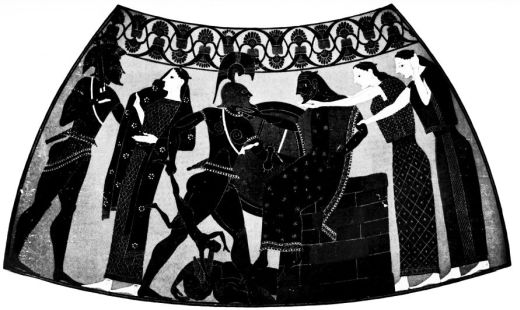
PLATE LII.
Fig. 94. ILIUPERSIS: FROM AN ATTIC AMPHORA.
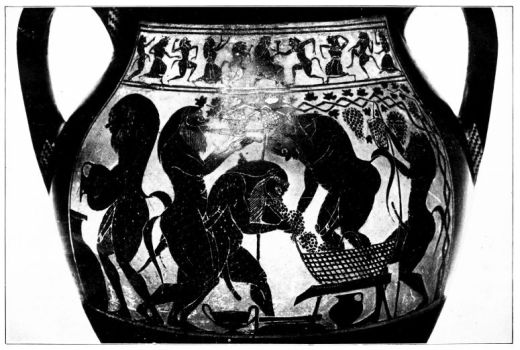
PLATE LIII.
Fig. 95. SATYRS AT THE WINE-PRESS: FROM AN ATTIC AMPHORA.
questionable.
The current of Chalkidian influence, which sets in vigorously about this
time, seizes also the body amphora. The arched foot becomes more
plate-like, a clay-ring unites it with the end of the body, which is
more taper; the Chalkidian wreath of buds (Fig. 71) for a time commonly
takes the place of the palmette and lotus band, which becomes scantier
and more monotonous, and as at Chalkis, a figure frieze (Fig. 95) may
occupy this space. The type belongs to the earlier ‘little master’
period. From Exekias, who was himself in his off-hours a ‘little
master,’ comes a specimen in the Louvre with the praise of the fair
Stesias, a youthful work of this worthy successor of Klitias, on which
Chalkidian patterns are very finely worked out, without the slightest
attempt at the rendering of folds.
The unsigned Würzburg amphora of Amasis (Fig. 95), like all the vases of
this master peculiar in shape and of perfect technique, is more
progressive and probably somewhat later than the Stesias amphora of
Exekias: the cloak of Dionysos on the obverse is laid in three folds; on
the reverse the shaggy satyrs, stylized in a quite un-Attic way, who to
the sound of the flute are gathering, pressing, and distributing into
jars the beloved gift of the god, show the same connection with the
‘Phineus’ factory as the eye kylix (p. 102). The technical perfection
and the fine decorative effect of Amasis’ vases are only surpassed by a
wonderful contemporary group, which is usually called the ‘affected’
class, because it consciously sacrifices the living representation of
the figure world to the ornamental general effect.
The over-elegant works of Exekias, the ‘affected’ vases, the minute
‘little master’ kylikes represent the last refinement of the silhouette
style, its last trump-card. The future belonged not to the masters of
the adorned surface, but to the delineators of the surface in movement.
In the last phase of the body amphora prior to the red-figured style, in
which the band-like handles and the narrower neck are drawn higher and
the stiff palmette pattern becomes canonical, Exekias in his riper
development passes over to rich rendering of folds; on the harmonious
amphora in Rome, which no longer praises Stesias but Onetorides (Fig.
96) he exhibits in the cloaks of the players the last possibilities of
his subtle technique with an almost incredible devotion to detail, but
even these fine clothes have their edges overlapping, and on the reverse
of the vase, besides foldless patterned clothes, appear cloaks richly
animated with folds. The amphora must be of the same period as the eye
kylix (Fig. 93); not only the feeling as a whole but the dark-red
chitons in layers on the outside point to the late activity of the
master.
The necked amphorae complete our idea of the two great masters. The old
heavy shapes with the arched foot take up Chalkidian influences and go
through the same processes of change, which we know from Chalkis. The
old-fashioned decoration with animal stripes is retained by the
Tyrrhenian vases, that with continuous pictorial field by the ‘affected’
group for a time, till the later Chalkidian type conquers the whole
field (Fig. 69). Amasis seems not merely to have introduced it into
Athens but also to have created the pretty variation with the flat
shoulder with a rectangular turn and the wide handles running out below
into tendrils: for these continuous tendrils are old property of his
eastern home. The handle ornament separates off the pictures on the two
sides and liberates the figures from the constraints of a frieze. The
Paris amphora with Dionysos and the interesting group of embracing
Maenads (Fig. 98) is closely connected with the Würzburg amphora (Fig.
95) not only by the double rays, which Amasis loves,
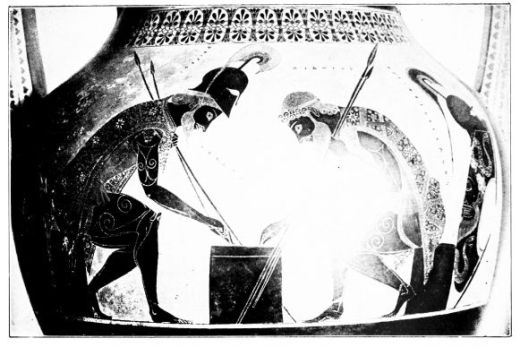
PLATE LIV.
Fig. 96. ACHILLES AND AIAS PLAYING AT DRAUGHTS: FROM AN AMPHORA BY
EXEKIAS.
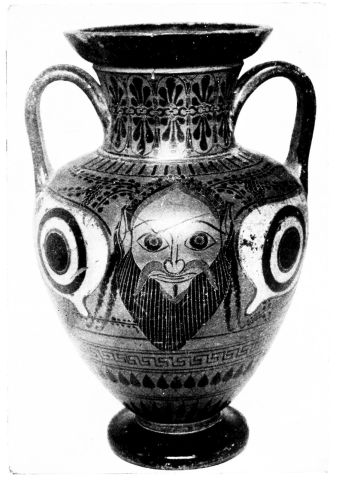
Fig. 97. ATTIC NECKED AMPHORA WITH SATYR-MASK.
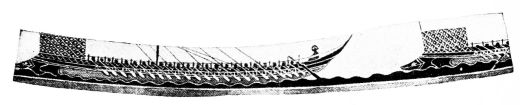
NECKED AMPHORA WITH THE SIGNATURE OF THE POTTER AMASIS.
Fig. 99. DETAIL FROM THE INTERIOR OF A CAULDRON BY EXEKIAS.
by the grouping, which in the other vase is transferred without change
to satyrs, by the beginning of himation folds, but also by many details
of the very individual style. The aversion to white colour is
interesting. On both vases the linen chiton of the god is left black;
the Paris maenads are rendered in outline only: it is but seldom that
the reaction against the old parti-coloured scheme goes so far.
Parallels are provided by the Athena of Kolchos’ jug and the girl-busts
of the ‘little masters’ (Fig. 91). Both the other amphorae of Amasis are
more advanced. The shape of the vase is slimmer, the decoration simpler,
the relation of figures to space freer. The bodies are no longer the
thick-set broad-thighed type of the older style: the eye plays no longer
so prominent a part. The short chiton is not merely laid in black and
red layers but even provided with a quite naturally waving border: the
artist thus far surpasses the standard of Exekias and even of early
red-figured masters. He need not on that account be put very late, for
the simple Ionic masters of the Caeretan hydriae, perhaps his
countrymen, made this border before him. This Ionism is in favour of
Amasis, who signs only as potter, having himself painted all his vases,
and having played the pioneer not only in vase shapes and decoration but
also in figure style. Exekias (in whose works the unity of the whole is
often expressly emphasized by the inscription ‘made and painted me’)
does not attack the problem of folds so boldly. Even on the two fine
necked amphorae, which praise the favourite of his later period, as a
good Athenian he lays the drapery in neatly-ironed layers.
The slender Munich necked amphora (Fig. 97) goes still further beyond
the Chalkidian models (Fig. 69). The neck ornament connects it with the
late works of Exekias, the eye decoration with the kylix type of the
same time, and even the space-filling vine-tendrils, which perhaps
Amasis introduced from the ‘Phineus’ factory into Attic painting, are a
favourite motive in later times. The satyr mask, like the Dionysos mask,
probably passed from cult into decorative painting; if Klitias
represents Dionysos, and Amasis the satyr, with head in front view, the
influence of these masks is not to be mistaken.
We have not yet named the most productive amphora painter. Nikosthenes
supplied some fine examples of the method of Amasis, some of which like
the Exekias lebes (Fig. 99) on the body of the vase help the fine black
colour to exclusive possession; besides a quantity of notably metallic
amphorae with band handles, the production of which in quantities seems
to be his speciality, though other masters adopted and modified the
shape (Fig. 104). The often very hasty and conservative decoration of
these vases cannot come from one painter. Nikosthenes, of whom almost a
hundred signed vases are extant (kraters, ‘Amasis’ and ‘Nikosthenes’
amphorae, ‘little master’ kylikes, eye kylikes, neatly painted jugs with
white ground, and red-figured vases) must have employed a series of
painters. The only one who gives his name, Epiktetos, we shall hear of
later.
The hydria too, which often shows its use in pretty fountain scenes
(Fig. 106), alters its form. As in Chalkis (p. 76) the egg-shaped type
of the Klitias period, shown e.g. on the Troilos frieze of the
François vase, gradually gives way to the later type with picture field
and horizontal, separately adorned shoulder. Timagoras, a contemporary
of Exekias, still prefers a broad-bellied shape and does not form handle
and foot as elegantly as Pamphaios. His Paris vase with the later type
of the contest with Triton (p. 67), on which he still paints the
monster’s face red for colour contrast, is very important for chronology
by a declaration of love for
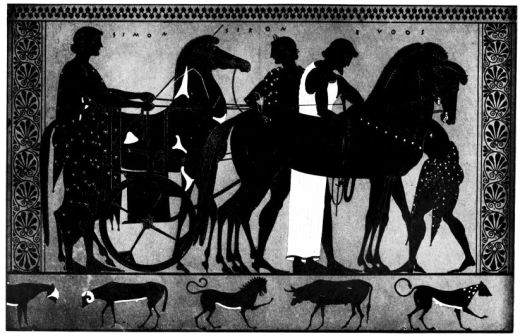
PLATE LVI.
Fig. 100. FROM A LATE ATTIC BLACK-FIGURED HYDRIA.
Andokides, a young colleague and later chief master of the early
red-figured style. If Timagoras is the predecessor of Andokides,
Pamphaios is his rival. His slim London hydria with the slightly bent up
handles, on which the vine of Dionysos overgrows the whole picture, and
the dark-red striping of the cloak assumes pure fold-character, falls
into the red-figured period, which after the second third of the century
begins to compete with the old technique, and to which Pamphaios himself
opens his workshop. The new style did not abruptly drive out the old:
from the time of its predominance perhaps more black-figured vases are
preserved than from the preceding period. In the leading studios for a
time both techniques were practised side by side, often by the same
painters. The balance inclined quickly to the side of the style which
painted the background and not the figure, and after the transitional
time of Andokides and Pamphaios only inferior talents experiment in the
old silhouette style. But though driven out of the leading position,
this old style was still busy and productive at least to the beginning
of the 5th century: especially necked amphorae and hydriae, which the
new style did not zealously affect, keep the tradition.
At this later date the shapes become elongated, the lotus and palmette
ornament loses colour, sweep and consistency. The hydriae bend their
handles more steeply upwards: the row of palmettes enclosed by tendrils
is preferred as framing ornament. The figures move more freely in the
space, and are also more hastily drawn; in particular the rendering of
folds becomes regular. The red stripes, which are painted quite
meaninglessly between the folds, no longer remind us that they once
indicated sewed parts of garments; white rosettes and red spots serve as
surface patterns, a red stroke as border. On the fine hydria in Berlin
(Fig. 100) probably of Euphronios’ time, which, it is true, is quite
unlike its class, the old round formation of the eye actually
approximates to the natural oval.
The links with the red-figured style, especially common love names like
Hipparchos, Pedieus, and Leagros, help us to date this style. Thus the
circumscribed row of palmettes seems to appear in the early Leagros
period (p. 114); the Berlin vase is thus moved to the end of the
century, like a group of pelikai with charming genre scenes and a series
of other vases of red-figured shape (p. 119).
In the new century the black-figured production gradually dies away.
Apart from the Panathenaic amphorae (p. 99) and other vases, which for
ritual reasons remain conservative, only trifling small ware keeps up
the old style. The prize vases can be followed as votive offerings on
the Acropolis, and in exported specimens down into the 4th century,
where they are dated to the year by archons’ names (one of 313 B.C. has
been found); even in late times they do not give up the old type of
Athena, but elongate it to agree with the slender proportions of the
vase, and combine other later features with the old picture.
In Boeotia black-figured painting, alongside of primitive attempts to
imitate Attic red-figured vases, continued as long in the burlesque
parodies of myth of the so-called ‘Kabirion’ vases; black painting on a
light ground is found in the early Hellenistic ‘Hadra vases’ made at
Alexandria, and similar late phenomena occur in various localities.
These late black-figured vases show real progress in nothing but the
development of a loose freely moving vegetable ornamentation: but this
progress depended on pure brush-technique, not on the old incised
style.
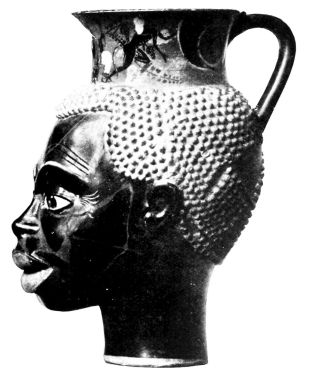
PLATE LVII.
Fig. 101. ATTIC VASE, LATE BLACK-FIGURED STYLE.


