THE COMMON ABBREVIATIONS USED IN THE NOTES — CHAPTER I THE INFLUENCE OF GREEK TRAGEDY UPON ANCIENT ART OUTSIDE OF THE VASES — § 1. Introductory. — § 2. Tragic Influences in Sculpture. — 1. Greek Sculpture. — 2. The Etruscan Ash-urns. — 3. Roman Sarcophagi. — § 3. The Influence of Tragedy on Painting. — 1. On Greek Painting. — 2. The Wall Paintings of Pompeii and Herculaneum. — § 4. Tragic Elements on the Etruscan Mirrors. — § 5. Greek Tragedy and the ‘Megarian Bowls.’
xix
Annali d. Inst. = Annali dell’ Instituto di Corrispondenza archeologica
(Rome).
Arch. Anz. = Archäologischer Anzeiger, Beiblatt zum Jahrbuch
des Archäologischen Instituts (Berlin).
Arch. Ztg. = Archäologische Zeitung (Berlin).
Athen. Mitth. = Mittheilungen des K. deutschen Archäologischen
Instituts in Athen.
Baumeister, Denkmäler = Baumeister’s Denkmäler des Klassischen
Altertums.
B. C. H. = Bulletin de Correspondence Hellénique (Athens).
Compte Rendu = Compte Rendu de la Commission impériale
archéologique (St. Petersburg).
C. I. A. = Corpus Inscriptionum Atticarum.
Élite Céram. = Élite des monuments céramographiques, Lenormant
et De Witte.
F.-W. = Friederichs-Wolters, Die Gipsabgüsse antiker Bildwerke.
Furtwängler, Masterpieces = Furtwängler, Masterpieces of Greek
Sculpture.
Gerhard, Auserl. Vasen. = Gerhard, Auserlesen griechische
Vasenbilder.
Helbig, Wandgemälde = Helbig, Wandgemälde der vom Vesuv
verschütteten Städte Campaniens.
Inghirami, Vasi fitt. = Inghirami, Pitture di vasi fittili.
Jahrbuch = Jahrbuch des K. deutschen Archäologischen Instituts
(Berlin).
xxJ. H. S. = Journal of Hellenic Studies (London).
Mon. d. Inst. = Monumenti inediti pubblicati dall’ Instituto di
Corrispondenza archeologica (Rome).
Nauck, Fragmenta = Nauck, Fragmenta tragicorum graecorum.
2 ed.
Overbeck, Bildwerke = Overbeck, Die Bildwerke zum thebischen
und troischen Heldenkreis.
Overbeck, Schriftquellen = Overbeck, Die antiken Schriftquellen
zur Geschichte der bildenden Künste bei den Griechen.
Reinach-Millin, Peintures
Reinach-Millingen, Peintures |
= Reinach, Peintures de Vases antiques recueillies par Millin (1808) et Millingen (1813). |
Vogel, Scen. eur. Trag. = Vogel, Scenen euripideischer Tragödien
in griechischen Vasengemälden.
GREEK TRAGEDY IN THE LIGHT OF VASE PAINTINGS
1
Painting as a fine art has never been developed to
any great degree of perfection independent of literature.
The two are, in a sense, handmaids, each inspiring the
other and assisting it to solve new problems. A great
literature is, furthermore, a necessary precursor of great
achievements in art, since the latter is the more dependent
of the two, and seeks its inspiration from the poet.
This may not be clear to one who looks about at
painting in this age of eclecticism, and endeavours to
satisfy himself that literature and art are thus related,
and that the former is required to give the initial
impetus to the latter. The principle can, however, be
made plain by going back nearer the fountain spring of
modern literary and artistic development. One should
turn to the Italian Renaissance of the fourteenth and
fifteenth centuries—to the period when Dante became
2the teacher and guide of artistic notions—in order to
observe the full meaning and force of the supremacy
of literature. There, where for the first time in the
modern world a great genius fashioned the thought of
more than a century, one can study easily the power
of the poet over the artist. The influence of Dante
upon artistic notions from Giotto down to the present
has, indeed, been incalculably great. No painter of
the quattrocento, at least, worked in any other than the
Dantesque spirit; whether consciously or unconsciously,
he was under the spell of the father of Italian letters.
Dante’s Hell and Paradise became the Hell and
Paradise of Signorelli and Michel Angelo. Botticelli,
Flaxman, Doré, and many others left their canvasses
and frescoes to interpret the hidden secrets of the
Divina Commedia. The great Christian Epic which
Cornelius developed through many years of study and
contemplation of Dante, and which he considered the
crowning work of his life, is told in the altar fresco
of the Ludwig’s Church in Munich. Yet this is but one
of the many monumental works of this century which
owes its existence to this poet. Delacroix’s ‘Barque of
Dante,’ exhibited in the Paris Salon of 1822, has been
called the first real painting of the century. When one
turns to England there is Rossetti, with ‘Beatrice and
Dante,’ ‘Dante’s Dream,’ and several other famous
paintings that witness again to the influence of the
Italian poet. But one may remark that Dante’s position
in the history of human progress is unique. This is true.
The world has not known another whose authority was
so absolute or whose philosophy appeared so final.
The influence of poets of less power has been correspondingly
smaller. The principle, however, remains true.
3The poet ventures where the boldest artist has not gone
and prepares, as it were, the way for him.
The closest parallel to Dante’s influence upon the
trend of artistic notions must be looked for in ancient
Greece; Homer must be named with Dante. The
Homeric poetry has exercised a power which the
Divina Commedia has scarcely surpassed; the thousand
and more streams of influence which rose in the Greek
epic literature went out in every direction to water the
fields of art and letters in Greece and Rome, and flowed
on again after Petrarch’s time, and are to-day mighty
forces. Events and incidents of the Iliad and Odyssey
have taken so permanent a place in modern art that
one hardly stops to think that this or that is from
Homer. But this company of persons which the world
calls Homer was not the only vital force that shaped
men’s thoughts and furnished the artist with fresh
inspiration. The tragic poets are to be named with
Homer. Had Aischylean, Sophoklean, and Euripidean
elements not entered into ancient and modern works
of art the world would never have known some of its
most beautiful monuments. This is not, however, the
place to linger over the influence of the Greek epic and
tragic literature in modern times, interesting though
this would be. It is in ancient times, when there was
still among the people a peculiar interest in the mythic
legends, that the contact of poet and artist is most
apparent; it is with the three Greek tragedians that
we have to do at present, and some traces of their work
may be pointed out in the various classes of monuments
before the vase paintings are examined.
4
One does not expect the sculptor’s notions to be
largely shaped by a definite situation in literature, as
he has little to do with illustration; his art is too
severe and confined to reproduce the dramatic and
pathetic with great success. There is accordingly little
direct influence of the Greek tragic literature over
ancient sculpture except on the sarcophagi. Of the
monuments belonging to the fifth century B.C., which
owe their existence indirectly to the drama, three reliefs
occupy the foremost place. These are the well-known
Orpheus[1], Peliades[2], and Peirithoös[3] reliefs, all of which
belong close to the time of the Parthenon frieze.
Reisch has made it clear that these works were conceived
and carried out in the spirit of the tragic drama[4].
They are claimed, indeed, as dedicatory offerings in
memory of particular tragic exhibitions, but no attempt
is made to name any poet or tragedy with which they
were connected. Whether one is correct in holding
these reliefs as ἀναθήματα, certain it is that in every
particular they breathe forth the spirit of tragedy. The
triple group in each has been pointed out as corresponding
to the three actors. This, however, is an outer
sign that might serve to indicate their origin. The
5relation of the figures to each other—the conflict of soul
which one may observe—the pathos that pervades the
groups—these are so unlike anything that occurs on
the earlier monuments that a person involuntarily asks
himself whence the artists received their motives.
Tragedy provides the answer. The parting scene
between Alkestis and Admetos which Euripides describes
so beautifully belongs to the same decade as
does the Orpheus relief. This touching episode may
well have been the incentive to some such work as the
parting between Orpheus and Eurydike. In all three
instances the sculptor was at any rate occupied with
the problems which concerned the tragic poet, and he
reproduced true echoes of dramatic situations.
Related to these reliefs is another class of monuments
which grew out of the tragic performances. From the
middle of the fifth century B.C.[5] till at least the close
of the third century B.C.[6] it was customary for the
successful choregos to dedicate the tripod that the state
had given him as a prize. The magnificence and
elaborateness accompanying this ceremony can be
learned from the still extant Lysikrates monument
upon which the tripod once stood and on the intercolumniations
of which tripods in relief are represented.
A street in Athens was given over to the exposition of
these prizes. Pausanias states that they were of bronze
and stood on temples[7]. More important still for us in
this connexion is the fact that together with the tripod,
probably under the kettle, it was the custom to set up
a figure of a satyr or Dionysos or Nike[8]. This practice
6does not appear to have been older than the time of
Praxiteles. So it is that one learns of his famous satyr
which Pausanias mentions in connexion with one of the
tripods[9]. The Greek of this passage does not admit
of a satisfactory interpretation, and it is not possible
therefore to determine what the attitude of the figure
was. It is probable that the statue which was thus
intimately associated with the Dionysiac performances
was the περιβόητος satyr of Praxiteles, existing in so
many copies and known throughout English literature
as the ‘Marble Faun.’ One can easily understand that
this class of choregic monuments was alone of great
importance, and that through this channel the tragic
performances worked a wide influence over sculpture.
There was a vast number of statues in bronze and
marble that thus arose from the exigencies of the
theatre. Along with these works may be classed the
numerous pieces of sculpture that were put up as
decorations for the theatre. Such were the εἰκόνες
mentioned by Pausanias as being in the Dionysiac
theatre at Athens. The periegete names the statues
of Aischylos, Sophokles, Euripides, and Menander[10].
A large number of reliefs that represent Dionysos
receiving the worship of mortals, or advancing in a train
of satyrs before a man lying on a couch, makes up
another class of sculpture, which probably owed its
origin to the drama. On the Peiraieus[11] relief three
persons carrying tragic masks advance before the god
who reclines upon a kline. The work may possibly be
dated as early as the close of the fifth century B.C.[12]
7It is at any rate an early example of the influence of the
tragic muse upon sculpture. The so-called Ikarios reliefs
illustrating Dionysos’ first appearance in Attica, and
the consequent origin of tragedy, may not refer to
Ikarios at all, but are nevertheless to be linked to tragedy
in some way, as the masks clearly show[13]. They may
have been purely decorative work, or were perhaps
offerings of actors.
It remains to speak of a few monuments which seem
to have been more directly under the influence of particular
tragedies. One hears, for example, that the
sculptor Seilanion made a ‘Dying Iokaste.’[14] This notion
would appear to have been borrowed from some play.
One may think of the Oedipus Tyrannus of Sophokles or the
Phoinissai of Euripides. Of far greater importance is the
relief on one of the columns from Ephesos which is known
to every one[15]. The most satisfactory interpretation of
this work so far offered explains the scene as Alkestis
being delivered from Death. The heroine, rescued from
Thanatos by Hermes, is being conducted to the upper
world again. Unfortunately there is no agreement among
archaeologists on this explanation[16]. Until a better one
is brought forward, however, this important monument
may be held as evidence for the influence exerted by
Euripides’ handling of this popular myth. The Alkestis
is known to have been exceptionally well received.
If tragic influences are only possibly at hand in the
fragment from Ephesos, the excavations at Pergamon
have brought to light extensive remains of reliefs that
were inspired by Attic tragedy. The Telephos frieze,
8now in Berlin, is directly associated with the drama.
The mythic founder of Pergamon had a long and varied
career, which was told in dramatic form by both Sophokles
and Euripides. The suggestions for the reliefs in question
came from the Auge and Telephos of the latter, and the
Mysoi of the former[17]. In these fragments one can see
distinctly the high esteem in which the Attic drama was
held at the court of the Attalidai. I know of no Greek
sculpture which comes so near being an illustration of
tragedy as does this frieze.
Another work of monumental greatness belonging to
about the same period and exhibiting unmistakable signs
of tragic influence is the Farnese Bull in the National
Museum in Naples[18]. This colossal group, which represents
Dirke being tied to a rampant bull by Amphion
and Zethos, the sons of Antiope, is characterized by
a passion and violence that are late products in Greek
sculpture. Such motives made their appearance first in
the fourth century B.C. Niobe and her children are the
earliest representation on a grand scale of these elements
that are so akin to the drama. Such compositions were
first possible with Praxiteles and Skopas who broke
away from the traditions of the Pheidian age. The
generation that saw a new type of Dionysos and of
Aphrodite, and could appreciate the frenzied maenad
of Skopas, had been prepared for these new motives very
largely through the theatre. The drama had not a little
to do with impressing the artist and his public with the
importance of delineating the human feelings. In the
case of the Niobe group one would not attempt to
point out any special influence of the Niobe of Aischylos
9or Sophokles, and still there is little doubt in my own
mind that the sculptor was more or less influenced by
the tragic literature. May not Praxiteles or Skopas,
each of whom shares the credit of the Niobe group, have
been led to the pathetic look upon the mother’s face by
the lines of one of these lost plays? This new tendency
in sculpture reached its highest expression in the
Laokoön and the Farnese Bull. The latter can be
traced to the influence of Euripides’ Antiope, which
appears to have been the source of all Dirke monuments
in ancient art; there is no dissenting voice as to
Euripides’ right to occupy the honourable position thus
assigned[19] him. Reference has already been made to the
Laokoön[20] as representing the culmination of tragedy in
marble. The view held by Lessing and many others
that Virgil was the sculptors’ authority has been
abandoned long since. The Pergamon altar frieze has
enabled us to fix the date of the Laokoön with approximate
correctness. It is surely some centuries older than
the Aeneid and stands therefore in a possible relation to
the Laokoön of Sophokles. Yet here again opinions
vary widely. Sophokles’ play is lost, and the few remaining
fragments are not enough to enable one to
make a satisfactory reconstruction. The story came
10down from the epic literature, and, like so many incidents
in the fall of Troy, needed no further popularization
in order to appeal to the artist. That Sophokles’ tragedy,
however, was wholly without any influence on the
Rhodian sculptors who so tragically and realistically
represented Apollo’s vengeance on his priest seems to
me highly improbable. Such a conception as found
expression in this masterpiece of sculpture may well
have sprung from the masterpiece in poetry which was at
hand in Sophokles’ Laokoön[21].
The reliefs on the Etruscan and Roman sarcophagi
carry us to Italian soil and furnish us with a much larger
field for pursuing our subject than could be found in
Greek sculpture. Of all the Italian races with whom
the Greeks came into contact, the Etrurians were by far
the most advanced in civilization; and during the
centuries of active commercial relations between the two
peoples this nation, whose origin is the puzzle of historians,
and whose language is the crux of philologists,
came more under the influence of Greek literature and
art than any of the Latin races that remained unhellenized.
They have left abundant evidence of these
hellenizing influences. In various classes of monuments
which may still be studied—urns, mirrors, cistae, tomb-paintings,
and vases—one discovers Greek mythology
and poetry. The national mythology of the Etruscans is
so much of an exception in their art, and the Greek is so
universally adopted, that one is at a loss to account for
11the strange fact. On hundreds of Etruscan monuments
one sees the workings of Greek poetry, which found
its way into Etruria before Livius Andronicus produced
the first tragedy in Rome 240 B.C. That the Greek
drama was introduced for the most part directly and not
through the medium of the early Latin tragedians, is
shown by the fact that the latter flourished in the second
and first centuries B.C., while the urns exhibiting tragic
subjects are, for the most part, from the third century B.C.
Some may, indeed, date from the fourth century. Roman
tragedy can not be said to have really become at all a
matter of general interest before Ennius went to Rome in
204 B.C. He died 169 B.C., and one should not think that the
influence of these Latin adaptations and translations of
Greek plays took an immediate hold upon the neighbouring
Etruscans. Such elements percolate gradually into the
various strata of national life, to say nothing of the time
required to reach a foreign people whose language and
customs are so different. But the summus epicus poeta[22]
was not the most popular or most prolific pilferer of
Greek plays. His tragedies numbered only about twenty.
In Accio circaque eum Romana tragoedia est[23]; and the
probable truth of this statement is well attested by
the list of fifty plays that have come down to us under
Accius’ name. This poet, however, was born 170 B.C. and
first exhibited tragedies in 140 B.C. It is therefore very
doubtful whether one can rightly speak of the influence
of Latin tragedy upon the Etruscan artists. One dare
not, at any rate, bring the ash-urns too far into the
second century B.C., as Brunn and those immediately
under his teaching formerly did. More recent investigations
have proved the chronological impossibility of
12interpreting these reliefs with the help of Ennius, Accius,
and Pacuvius.
Without taking time and space to review the arguments
on which the interpretations of the reliefs are based it
will be enough for my purpose to simply add a list of the
scenes which one may reasonably refer to Greek tragedy.
Examining the first volume of Brunn’s I rilievi delle urne
etrusche, which is devoted to urns with scenes from the
Trojan Cycle, one learns that those presenting a version
of the stories ascribable to the tragic poets exceed those
that are based on the Iliad, Odyssey, and other epics.
The representation of Paris’ return to his Trojan home
is, with one exception[24], the most frequent. The thirty-four
reliefs were referred, even in the time of the former
late dating, to Euripides’ Ἀλέξανδρος[25]. The fate of Telephos
was, according to Aristotle, a common subject for
a tragedy[26]. We have already met the story on the
Pergamon frieze, and it is very frequent on the Etruscan
urns. Telephos grasps the young Orestes and threatens
his life on the altar after the manner of the drama. It
may be the influence of Aischylos or Euripides, but if one
judges from the comparative popularity of these poets
in this period he would be inclined to assign the first
place to the latter[27]. The offering of Iphigeneia occurs
on twenty-six urns, nearly all of which were found in
the vicinity of Perugia[28]. It was again unquestionably
Greek tragedy that was the incentive for these scenes.
Aischylos, Sophokles, and Euripides may all share the
credit of having furnished the literary source. A smaller
13series of urns representing Odysseus’ adventure in taking
Philoktetes from Lemnos is also to be placed under the
influence of the fifth century tragedy[29]. The δόλιος
Ὀδυσσεύς is seen playing his part as cleverly as he does
in the extant play of Sophokles. The attitude of
Philoktetes standing before Neoptolemos, having in two
cases the arrow in his hand, corresponds well to the
character drawn by this poet. The injured chieftain
displays his courage and scoffs at the thought of being
carried away by the detested Odysseus. The murder of
Aigisthos and Klytaimestra represented on seventeen
urns has been shown by Schlie to be essentially
Euripidean[30]. The arrival of Orestes and Pylades at the
precinct of the Tauric Artemis is possibly the subject of
three reliefs[31]. This would also take one directly to
Euripides[32]. The following are published in the second
volume of the Urne etrusche by Körte. Medeia escapes
on her dragon-chariot, driving over the bodies of her
children[33]—an echo of the great tragedy that exercised
so wide an influence in other fields of art[34]. The
punishment of Dirke on four reliefs is based without
question on the Antiope of Euripides[35]. The blinding
of Oedipus at the hands of Laios’ sons seems to have
been an invention of the same poet and is recognized in
another relief[36]. The Theban fratricide and the assault
14on the city were both much-prized subjects[37]. Körte
points out many features common to the numerous
reliefs and the Phoinissai of Euripides[38]. The death of
Alkmene is represented on five urns which one would
associate with the Alkmene of the same poet[39]. Euripides’
Κρῆτες is traceable on seven reliefs, showing the
legend of Daidalos and Pasiphaë[40]. Theseus’ fight with
the Minotaur occurs four times and reminds us of
Euripides’ Theseus[41]. The death of Hippolytos on
eight reliefs does not present any essential variation
from the extant Greek tragedy[42]. Perseus and Andromeda
are met with likewise and emphasize the wide
popularity of Euripides’ play[43]. The famous legend of
Oinomaos’ death and Pelops’ triumph occurs on thirty-one
urns[44]. It can be shown that these were inspired by
one or more of the lost tragedies that dealt with the
subject[45]. The Μελέαγρος of Euripides appears to have
been the source of at least three of the many reliefs
representing the Kalydonian Hunt[46]. To this long list
of urns based on Euripidean tragedies one must still
add seven that were probably inspired by this poet’s
Μελανίππη ἡ σοψή and three more that follow his
Μελανίππη ἡ δεσμῶτις[47].
More than two-thirds of the more than four hundred
Etruscan urns examined are decorated with sculpture
based on Greek tragedy, and in nearly all instances the
15drama was Euripidean. Such are the instructive facts
regarding this important class of monuments.
Under the expression ‘Roman sarcophagi’ one understands
those of the first and second centuries A.D. unless
the expression is further qualified. Sarcophagi from
the time of the Republic are very rare and they are
withal modest in their workmanship. The florid
decorations of the time of the Empire, and especially of
the period just noted, are often of secondary interest,
but the reliefs on the sarcophagi are for the most part
of prime importance, as furnishing reminiscences of lost
tragedies and ancient paintings of great renown. The
majority are copies of very ordinary merit, while now
and then a sarcophagus relief is not unworthy a Greek
artist of the fourth century B.C.
It is a commonly known fact that long before the
Laokoön, or the Farnese Bull, or the Apollo Belvidere
was unearthed in the sixteenth and fifteenth centuries—long
before the classical antiquities of Rome, Florence,
and Naples had attracted students and lovers of art—the
sculptures of these sarcophagi, scattered about in
cathedrals and palaces, had begun to teach the Italian
artist what the human figure really is, and what
composition and decoration should be. The Renaissance
artist first learned the charm and simplicity of the
ancient costume from these marbles and perceived how
vastly superior this was to the heavy, conventional
church-dress that concealed the outlines of the form and
rendered grace and beauty impossible. The study of
the antique, we have reason to believe, was in the early
Renaissance largely a study of these Roman sarcophagi.
16There is no need of going into detail. It will be
enough to hint at the most important monuments of
this class that stand under the influence of Greek
tragedy. Whether they are a direct product of the
Greek plays or are founded on the Latin translations, or
whether they represent copies of Greek paintings based
on Greek tragedy—this is for the present purpose all
one and the same. It is not necessary to determine
whence the incentive came. The important fact for one
to grasp first is, that a surprisingly large number of the
reliefs owe their existence to the tragic drama, and that
these sculptures should be brought into one’s study of
the tragic poets[48].
The series of reliefs illustrating Euripides’ Alkestis is
of prime importance for one who wishes to see in art
a scene worthy of the poet[49]. The touching farewell of
Alkestis as she reclines upon her death-bed is in each
instance the centre of the groups on the long side.
Around her gathers the whole family. The children
draw up close to their mother’s side. Her parents are
also present, and this lends more interest to the sight,
for they could scarcely be absent although the poet does
not mention them in this connexion. The last words of
Alkestis, and Admetos’ reply, form the real charm of
the play. All else falls far behind these speeches, and
17following one of the gems in Greek literature the artist
could afford to assign his illustration the first place on
the reliefs. Arranged on either side are the other incidents
of the drama, following the poet with considerable
faithfulness. In this connexion should be mentioned the
relief in Florence, also based upon the same source[50].
The Hippolytos sarcophagi are, so far as I know,
the most numerous of those that are dependent upon
tragedy. If we possess more than a score, either entire
or in fragments, after the destructive elements have been
at work on them since antiquity, there is reason to
believe that many times this number were once in
existence. Copies were made in large numbers, and
many a Roman was laid to rest behind the tragedy
in marble which in the Hippolytos of Euripides has
continued with some interruptions to move the
sympathies of the civilized world for more than two
thousand years. The reliefs are in the main faithful
illustrations of Euripides. One or two situations are
foreign to him, and these would suggest the influence of
a Roman poet. It is unnecessary to do more here than
to refer to the following chapter, where the whole
question finds a further discussion[51].
‘The Orestes myth appears upon the sarcophagi
exclusively in the form given to it by the Attic drama.
The first part—the slaying of Aigisthos and Klytaimestra—follows
the Oresteia of Aischylos. The second
part—the meeting of Iphigeneia and Orestes and the
rape of the Tauric idol—is based upon the Iphigeneia in
Tauris of Euripides.’[52] One exception only is noted
18and this appears to represent the influence of a later
play which handled the subject of the Oresteia[53]. The
scenes on the other sarcophagi are indeed illustrations
of Aischylos. In each case the final moment of the
Choephoroi, when the Furies rush in upon the murderer,
guilty of a mother’s blood, is chosen for the middle
group. Right and left from this the succeeding events
are arranged. The right end scene invariably represents
Orestes as he is about to escape from the sanctuary of
Apollo at Delphi and go to Athens. He picks his way
with circumspection over the sleeping Furies, and one
is led up to the triumphal verdict of the Eumenides[54].
Robert has shown very clearly the relation of these
sculptures to Aischylos’ words, and it is enough to refer
to his discussion.
The Iphigeneia-Orestes sarcophagi breathe from first
to last the spirit of Euripides. A study of them is
scarcely less instructive than a reading of the play.
Step by step the story is unfolded. Orestes and Pylades
are taken captives and stand before the priestess, whose
dreadful office is made more horrible by the remains
of human sacrifices that are fastened up around the
sanctuary; the recognition scene with the letter follows.
Then Iphigeneia appears with the idol in her arms, and
asks Thoas’ permission to go and purify it in the sea.
The two Greeks stand bound, ready to follow her, and last
of all comes the mêlée at the ship. One after another of
the barbarians is laid low by the strong arms of Orestes
and Pylades. Iphigeneia is placed safely aboard with
the image, and one sees the beginning of the homeward
19journey that closed the history of the house of
Atreus[55].
The Euripidean Medeia is discussed at length in
another place, and I have pointed out there the part
that the sarcophagi occupy in art representations of the
tragedy[56]. The two extremes of touching tenderness
and violent passion, which no one ever combined more
successfully in one character than did Euripides in his
Medeia, come prominently to the foreground in these
reliefs. I know of no monuments of ancient art that
grasp the spirit of a Greek tragedy more effectually than
the Medeia sarcophagi. The strange and secret power
of the sorceress hovers over and pervades the whole.
The dreadful vengeance exacted by the slighted queen
is shown in the most graphic manner. Standing before
the Berlin replica, which is the best preserved and most
beautiful of all the sculptures, one cannot but feel that
he is face to face with a marvellous illustration of the
great tragedy. The marble all but breathes; the dragons
of Medeia’s chariot may be heard to hiss.
A small number of other monuments of this class
belongs to the ‘Seven against Thebes,’ and, as in the
case of the Etruscan urns, the Phoinissai of Euripides is
the main source of the illustrations. Perhaps Seneca’s
Phoenissae also entered into the work. Robert conjectures
that Euripides’ Oedipus may have furnished
suggestions for parts of the scenes[57].
The Philoktetes of Sophokles is illustrated on one
relief very much in the manner of the Etruscan urns
already referred to. The wounded Philoktetes stands at
20the mouth of the cave and speaks to Neoptolemos on
the right. Odysseus keeps safely out of sight on the
left[58].
The story of Pasiphaë’s unholy love is told on a
fragment of a sarcophagus in the Louvre[59]; Daidalos
and his cunning work play the leading part. The
ultimate literary authority was Euripides’ Κρῆτες. The
latter may not have been used directly, as the myth
enjoyed after this play a continuous popularity. The
relief on one end represents a fruit offering, and as this
would agree with the vegetarian vow of the chorus,
Robert prefers to recognize a direct connexion with
Euripides[60].
Mention may be made lastly of the Meleager sarcophagi,
which, like the Etruscan urns, have much in
common with Euripides’ Μελέαγρος[61].
Our knowledge of Greek painting is entirely literary.
No vestige of this art has survived that one may study
the real monuments. The wall paintings of Pompeii
and Herculaneum are, however, a sort of recompense for
this loss, and with these and the assistance of Pliny
and a few other writers one can get some notion of
certain masterpieces of ancient painting. But the records
are at the most very scant, and the student has, after all,
to allow his imagination to fill in many gaps.
21
The first probable point of contact between tragedy
and painting is in the time of Polygnotos. The series
of paintings mentioned by Pausanias as being in the
Propylaia may be brought under the name of the great
painter, since it is expressly stated that two of the ten
were from his hand[62]. Among the subjects were Odysseus
fetching Philoktetes from Lemnos; Orestes slaying
Aigisthos; Polyxena on the point of being sacrificed at
Achilles’ tomb. The question arises, have these works
any connexion with the drama? If Polygnotos was the
author of all the paintings, the period of his activity
excludes both Sophoklean and Euripidean influence in
the Philoktetes scene. The Philoktetes of Sophokles is
known to have been produced in 409 B.C., and the same
play by Euripides appeared in the trilogy with the
Medeia in 431 B.C. This leaves Aischylos’ tragedy,
which could have served Polygnotos’ purpose. Orestes
killing Aigisthos seems also a possible product of the
Oresteia, but Pylades engaging the sons of Nauplios who
came to the usurper’s assistance renders the Aischylean
source improbable. Polyxena’s sacrifice is described
by Euripides in the Hekabe[63], and was the subject of
Sophokles’ Polyxene[64]. Nothing, however, can be made
out of the few fragments belonging to the latter.
The character of this picture, in which πάθος excluded
ἦθος, led Robert to assign it to the fourth century and
base it upon Euripides[65]. All these subjects are from
22the Trojan Cycle, and agree well with what is known of
Polygnotos’ taste in selecting his legends. One has but
to recall the painting in the Lesche of the Knidians at
Delphi—τὸ μὲν σύμπαν τὸ ἐν δεξιᾷ τῆς γραφῆς Ἴλιός τέ
ἐστιν ἑαλωκυῖα καὶ ἀπόπλους ὁ Ἑλλήνων[66]—to learn that
the drama was not essential to inspire Polygnotos. On
the other hand, a closer examination of the Philoktetes-Orestes
legend reveals the fact that the crafty Ithacan’s
part in bringing Philoktetes from Lemnos was an invention
of the Attic drama[67]. The tragedians placed
Odysseus in the room occupied by Diomede in the
Trojan Cycle. It is absolutely necessary therefore to
place this painting under the influence of tragedy,
whether it was by Polygnotos and inspired by Aischylos
or by a later artist and inspired by one or more of the
three tragedies. If the Polygnotos authorship be rejected
(and as it is based on pure conjecture there is nothing to
forbid placing it aside), one is at liberty to point out
a relation between these works and later tragic literature,
as has already been done in the case of the Polyxena
scene.
In the latter half of the fifth century B.C. painting
appears to have reflected pronounced tendencies of the
drama. The legends of the heroic time when tried in
the crucible of the dramatic poet appealed more strongly
to the imagination of the artist who had been accustomed
to epic severeness and calmness. The conventionality
and regulation types gave way, and the tragic drama
23remained thereafter the vital force in shaping the
character of paintings occupied with heroic legends.
At this time we learn of a Telephos by Parrhasios, which
one naturally associates with Euripides or Aischylos[68].
The Iphigeneia of Timanthes was a work that was
scarcely possible but for the fresh interest awakened in
the story by the three tragedians[69]. It is highly probable
again that Euripides was the inspiration for the Andromeda
of Nikias[70] and the Medeia of Timomachus[71].
These were both works of great renown. Apollodoros’
painting representing the Herakleidai can with some
certainty be referred to Euripides’ tragedy[72]. Theorus,
a Samian, painted Orestes slaying Aigisthos and Klytaimestra,
and could hardly have worked independent of
Aischylos[73]. The fate of Pentheus and Lykurgos was
painted in the younger of the two temples in the
Dionysiac precinct south of the Acropolis[74]. The date of
this temple has been fixed at approximately 400 B.C.[75]
The punishment of Pentheus was particularly popular
with the tragedians, and the dependence of this painting
on the play of Aischylos or Euripides is all but certain.
The former’s Lykurgeia was the source of the numerous
vase paintings of Lower Italy representing the madness
of the Thracian king[76], and one may infer that this
24painting mentioned by Pausanias was essentially the
Aischylean Lykurgos. In the same place were two
other scenes from the career of Dionysos. Ariadne was
represented as being forsaken by Theseus and rescued
by the god, and in another place Dionysos was conducting
Hephaistos to Olympos. Euripides’ Theseus
handled the love episode in the first of the two latter,
and this play was probably not without its effect upon
the popularity of the story which was of frequent
occurrence, particularly in Pompeii[77]. This poet’s power
in dealing with love exploits and depicting the sad case
of unrequited love and the attending calamities, was a new
force in literature and a never-failing spring from which
the painter could draw. These compositions are one
and all connected with Dionysos, while three of them are
parallel with subjects handled in tragedy. Such scenes
were possible only after the drama had popularized the
subjects and prepared the way, so to speak, for the
reception of the same in art. Even though one does not
go so far as to contend that these paintings were an
outgrowth of tragedy, they must be accepted as signs of
the increasing interest in Dionysos and his worship—and
this was primarily the Greater Dionysia, where the first
editions of Greek tragedies were published. This was
the period of Zeuxis and Parrhasios—the time when
Euripidean πάθος was shaping artistic conceptions.
The Pompeian wall paintings, representing scenes from
tragedy, are largely reminiscences of earlier paintings,
25and many famous works that have already been referred
to are doubtless preserved in more or less exact copies
in these invaluable monuments. Besides the Medeia and
Andromeda, which have been noticed above, there is
a series of paintings based on the Hippolytos-Phaidra
casualty[78], and another representing the sacrifice of
Iphigeneia[79]. The latter exhibit a marked similarity to
the work of Timanthes and the final scene in Euripides’
Iphigeneia at Aulis. Several important paintings represent
the meeting of Orestes and Iphigeneia in the
Tauric sanctuary, and there can be no question regarding
the decided dramatic colouring here[80]. Two pictures are
based on the Telephos legend, and remind one again of
the Pergamon frieze and the relation of this to Euripides
and Sophokles[81]. Daidalos with his wooden cow before
Pasiphaë was another favourite Euripidean story told at
Pompeii[82]. The excavations in 1895 brought to light
an unusual number of priceless treasures in the casa dei
Vettii. Among the paintings was one showing the
death of Pentheus[83]. The maenads are hurling stones
at him and thrusting him through with their thyrsoi;
the wildness of the locality and the tone of the whole
work make it highly probable that Euripides’ Bakchai
was the artist’s inspiration. Mention may be made
lastly of the punishment of Dirke, told in several
paintings[84]. After what has been said touching the
26Farnese Bull, it is not necessary to point out again the
part played in the Dirke monuments by Euripides’
Antiope.
A glance at this brief sketch of ancient paintings on
tragic subjects cannot but impress one with the permanent
and far-reaching influence of the tragic poet
over the painter. The striking fact that stands out
prominently before all others is the firm hold exercised
by Euripides. Note the following subjects—Andromeda,
Dirke, Hippolytos, Iphigeneia at Aulis, Medeia.
Each of these characters has stamped upon it the form
given by this poet. Others after him adapted and
translated his work, but the ultimate authority remains
none the less the Greek tragedian, and neither the
ancient nor the modern world accepts any other than
the Euripidean Andromeda, Hippolytos, or Medeia[85].
The engravers of the mirrors were less inventive than
were the sculptors of the ash-urns, and they moved in
a much narrower sphere. Their work is for the most
part that of the ordinary mechanic whose hand is none
too sure. The compositions taken from tragedy are
common with those already met with on the Etruscan
sarcophagi. There are Orestes and Pylades at the
temple of the Tauric Artemis[86]; the Kalydonian Hunt,
following the Μελέαγρος[87]; Daidalos constructing the
27wooden cow[88]; Polyxena taking her farewell of Hekabe[89];
three scenes from the Telephos legend[90]; the parting
scene between Alkestis and Admetos[91]; and Prometheus
chained to the Caucasus[92]. These instances at least may
be adduced to emphasize the fact of the wide-spread
familiarity of the Etruscans with tragedy. There is no
doubt whatever that in these common everyday articles,
as well as on their sarcophagi, the Etruscans had illustrations
of the tragic poetry that may have been brought
to them by troops of ‘Dionysiac artists’[93].
Intermediate between sculpture and vase paintings
appears a remarkably interesting class of vases, or
rather cups, which are decorated with a band of relief.
Certain of these are so intimately connected with the
drama, and with Euripides in particular, that at least
28a brief reference should be made to them here.
Examples of this ware are to be seen in nearly every
large museum, and I have seen fit to include reproductions
of three in the present work, as well as a small
fragment of a fourth[94]. The inscriptions and general
style of the vases lead one to date them in the second
or third century B.C. They are surely not later than
this, and not much earlier. They owe their origin to
a wide-spread interest in the older Greek poets. The
majority of the reliefs represent scenes from the Trojan
and Theban Cycles, and illustrate some poetical work.
We have to do at this time with those that are related
to tragedy. It is plain from a casual glance at the
nature of the compositions taken from tragic literature
that it was not the words of the poet that suggested
the figures to the artist so much as the theatrical performances
themselves. The posings, gestures, groupings—in
short, the general attempt at effect, take one
past the written work to the Hellenistic stage. The
motives are borrowed from Euripides, as played in the
second- and third-century theatre. The humble artist
who conceived these designs had visited the exhibitions
of the Iphigeneia at Aulis or of the Phoinissai, and
received fresh ideas for his work. It is necessary to
emphasize the fact that these little monuments date
from the time when the dominating force in art was
the tragic drama. The influence of the theatre was felt
among all classes of people. The guilds of Dionysiac
actors travelled around from one village to another, and
from one city to another, producing their répertoire from
the three great tragedians, and, even when there was no
29permanent stage, delivered from an improvised platform
bad and indifferent versions of the well-known plays[95].
The result was that tragedy was the one popular form
of literature in the Hellenistic period, and this meant
practically that the people were feasted on Euripides.
The ‘Megarian Bowls’ are priceless treasures from this
period when the drama had permeated all classes of
society. The unpretentious reliefs are replete with the
spirit that one may discover at the same time in Italy,
Asia Minor, Athens, and Alexandria. They are direct
witnesses of the fact that Euripides was the people’s
poet, and re-enforce the impression gained from the
study of all other classes of monuments.
For my own part I prefer to think of these cups as
answering the place of text illustrations and corresponding
to our illustrated editions of poetical works. One
cannot imagine the papyri texts of the ancient poets
illumined with illustrations, but these ‘Megarian Bowls’
meet every requirement of this kind of art. In order
to keep the reader from going astray in the interpretation
the scenes are often accompanied by inscriptions
that render any misunderstanding impossible. The
several groups showing the successive stages of the play
serve in fact every end that is demanded of illustrations.
Whether the vases were used by schoolmasters in
drilling their boys in classical poetry, or whether they
were ornaments for the home, the poet was sure to
appeal to his admirers in a new manner. He could be
easily remembered by this means if artificial aid was
at all necessary. They had, moreover, the great merit
of being cheap; any number of copies could be made
30from the mould, and such cups are really in existence[96].
If three replicas of one and the same work have
accidentally survived the centuries and can to-day be
studied as text illustrations of Euripides, how extensive
must have been the production and use of this sort
of art in ancient times![97]
CHAPTER III AISCHYLOS AND THE VASE PAINTINGS — § 1. Introduction. — § 2. Choephoroi. — § 3. Eumenides. — § 4. The lost Plays. — Lykurgeia. — Phrygians.
42
Notwithstanding the fact that the oldest of the
tragedians was the least read in the fourth century B.C.,
he easily rivals Sophokles in his influence on art.
This was not due to his being more admired, and can
only be accounted for by the bold situations that he
invented-situations new and striking. There are certain
of his plays that left a lasting impression on Greek and
Roman art. Such are the Choephoroi, the Eumenides,
and the Lykurgeia. Further than these, Aischylean
plays did not appeal to the artist to any great extent.
It is the peculiarly popular inventions distinguishable
in these tragedies, their uniqueness, so to speak, that
set them apart by themselves, a mark for the artist.
The character of the plays is easily denoted. They
ring with cries of murder and resound with the storming
fury of avenging deities; we are struck by the perils
of the situations and remain all but breathless to learn
the issue. These features attracted the painter and
sculptor, and this is what meets one on all the monuments
that may be called Aischylean. The deep
43religious vein that pulsates in every line of the mighty
tragedian is reflected to some degree on the vases and
the sarcophagi. This force in art was rather epic; it
was, in a way, Polygnotean, and the ethical nature of
it all but condemned it for the artists who sought the
πάθος of Euripides. This very fact explains why
Aischylos and Sophokles did not address themselves
more to the succeeding generations of artists. The
ethical was more difficult to express than was the
pathetic, and it was not so attractive. The spirit of
the times, moreover, demanded the latter as it demanded
Euripides, and consequently one should not
expect to meet a large number of vase paintings that
were made under the influence of either Aischylos or
Sophokles. Those that can be associated with the
extant tragedies of the former are given in the following
pages. It will be observed that certain scenes from
Aischylos were greatly in favour in Lower Italy. All
of the nine paintings published are from Italian ware.
Not one Attic vase that shows an Aischylean scene
has, so far as I know, been discovered. In the West,
however, where he was quite as much at home as in
his own Athens and where he was destined to end his
days, the vase decorators were largely influenced by
him.
There is no proof at hand that epic literature knew
aught of Elektra or the part which she played in
avenging her father’s murder. The fragments from
the lyric poet Stesichoros furnish the oldest literary
source for the Oresteia which became later so popular
44under the hands of the fifth-century tragedians. The
trilogy of Aischylos which has happily come down to
us is, therefore, the oldest extant authority. When one
turns to works of art one discovers a series of vase
paintings representing the death of Aigisthos; yet these
are but a little older than Aischylos’ work[118]. Events
concerned with Orestes’ return are even less common in
early art. The Melan terra cotta plaque in the Louvre,
which represents a scene somewhat similar to the
opening of the Choephoroi, is the oldest of the Oresteia
monuments, but still must be dated within the fifth
century B.C.[119] It may be considered as fairly well
established that Elektra and Orestes first appeared in
art but a few years before the production of Aischylos’
trilogy in 458 B.C. Nor is it possible, so far as I know,
to discover any influence of the Agamemnon or Choephoroi
upon artistic productions in the last half of the
century. A small group of vase paintings from Lower
Italy belonging to the fourth century B.C. do, however,
present situations which one may well believe to have
been suggested by the early part of the Choephoroi.
45
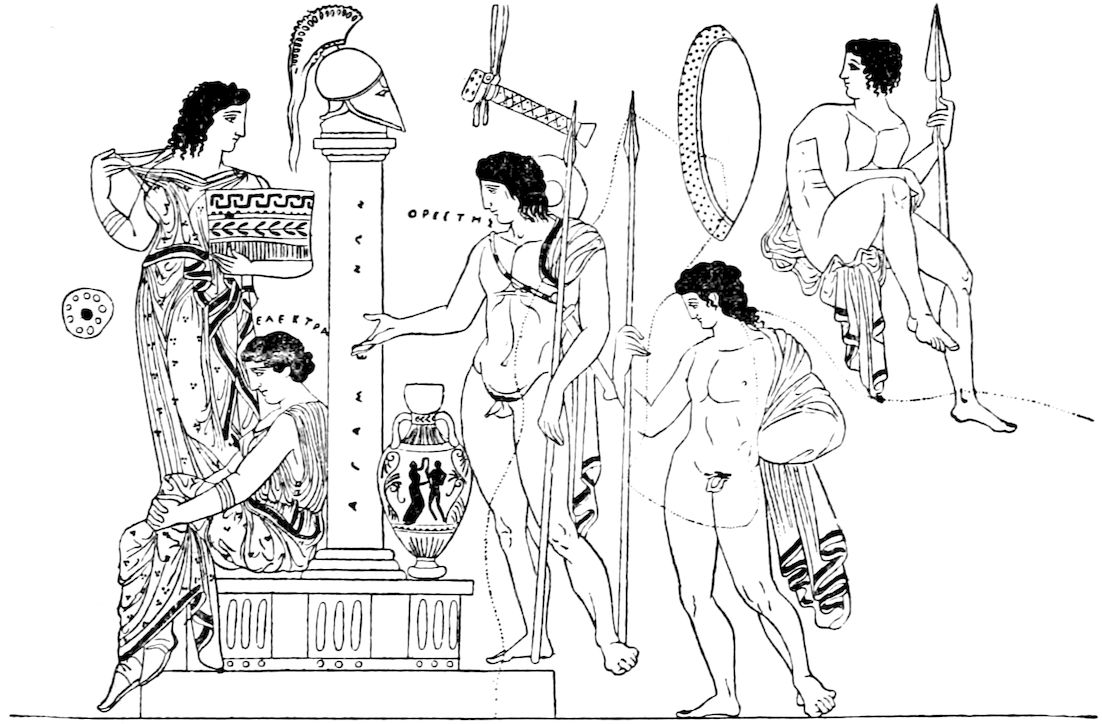
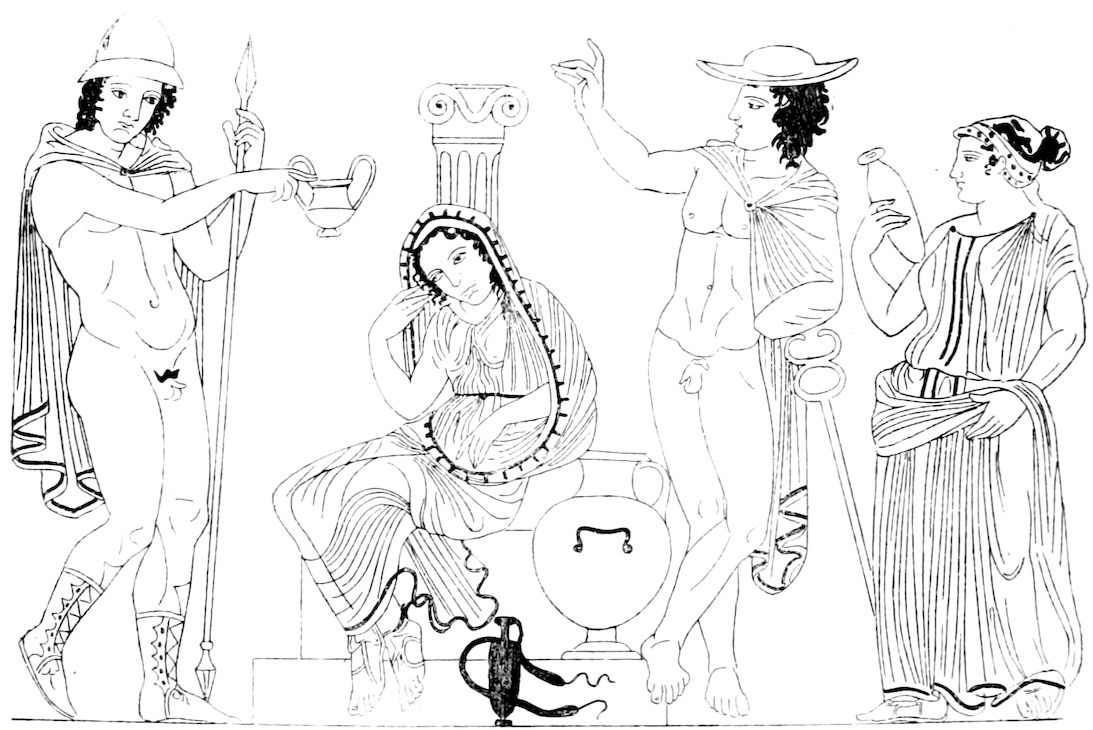
The painting shown in fig. 1[120] represents a tomb, the
base of which is decorated with triglyphs. Surmounting
this is a stele, crowned with a Corinthian helm, and
bearing the name ΑΓΑΜΕ[Μ]ΝΩΝ. Sitting with her
back to the stele on the left is Elektra, ΕΛΕΚΤΡ[Α,
wearing a chiton and mantle and clasping her left knee
in a meditative mood; beside her is another female
figure similarly dressed and holding a toilet box in the
left arm, an unusually common article on the vases of
Lower Italy. Perhaps the box is meant to recall the
offerings which were brought in it to the grave. This
person is not necessarily Chrysothemis, although her dress
would be more appropriate for Elektra’s sister than
for her attendant. It is, however, the work of the latter
to carry such a box of offerings for Elektra. The figure
may therefore be left unnamed. Her face is turned
towards Orestes, ΟΡΕΣΤΗΣ, who stands on the right
and appears to be speaking to Elektra, who pays no
attention to his words or his gesture. He is in travelling
costume, chlamys, petasos, and carries a spear and
sword, but curiously enough wears no boots. Below
46him to the right in a similar attitude stands Pylades.
He has simply a chlamys and a spear. Another youth
sits above on a terrain. He serves to round out the
picture, and indicates at the same time the attendants
of Orestes. In the background are a sword and shield;
on the grave is an amphora, as an offering, exactly the
shape of the vase on which the painting occurs. There
are numerous restorations in the work, but the main part
seems to be antique. Heydemann states that the inscription
on the stele is genuine, and also ΕΛΕΚΤΡ[Α.
Doubt is expressed concerning ΟΡΕΣΤΗΣ.
We have before us the grave of Agamemnon, at which
the first 585 verses of the Choephoroi were played.
There is no trace of palace or royal building. Orestes,
accompanied by Pylades, enters the orchestra and lays
his tribute upon his father’s tomb, τύμβου δ’ ἐπ’ ὄχθῳ
(v. 4), but suddenly withdraws to avoid the company of
women which approaches with ceremonial step. The
chorus and Elektra proceed to perform their services
when the latter discovers the lock of hair, ἄγαλμα
τύμβου (v. 200), and the footprints—two proofs that
Orestes must be near. While she is still examining the
tracks the latter comes up and proves beyond a doubt,
by pointing to the garment that Elektra had once
woven, who he is (vs. 212–232). Perhaps one may
think of Elektra as sitting upon the grave at some
point between v. 84 and v. 212, but when she had
discovered the traces of Orestes’ presence, she must
have been actively scanning the surroundings. It pleased
the artist, however, to represent her as ignoring the
appeal of her brother, or at least manifesting no signs
of recognizing him. But for the presence of the τύμβος
one would be inclined to see the influence of Sophokles’
47Elektra, where Orestes’ words gain credence very slowly,
and where Elektra hesitates long, before believing his
assertions that he is living and standing before her
(v. 1219 ff.). But the Sophoklean tragedy is played
before the palace. The pedagogue and Orestes leave
the orchestra to pour their libations on the grave
(v. 82 ff.) when Elektra comes out of the house. The
fact that the recognition scene is represented as taking
place at the grave gives us therefore ample reason for
accepting our painting as under the influence of the
Choephoroi. This painting is strikingly free in its conception;
no words of the poet can be cited as fitting
the situation. The suggestion, the setting, are Aischylean;
all else is the artist’s. The work is far removed
from the character of an illustration.
48
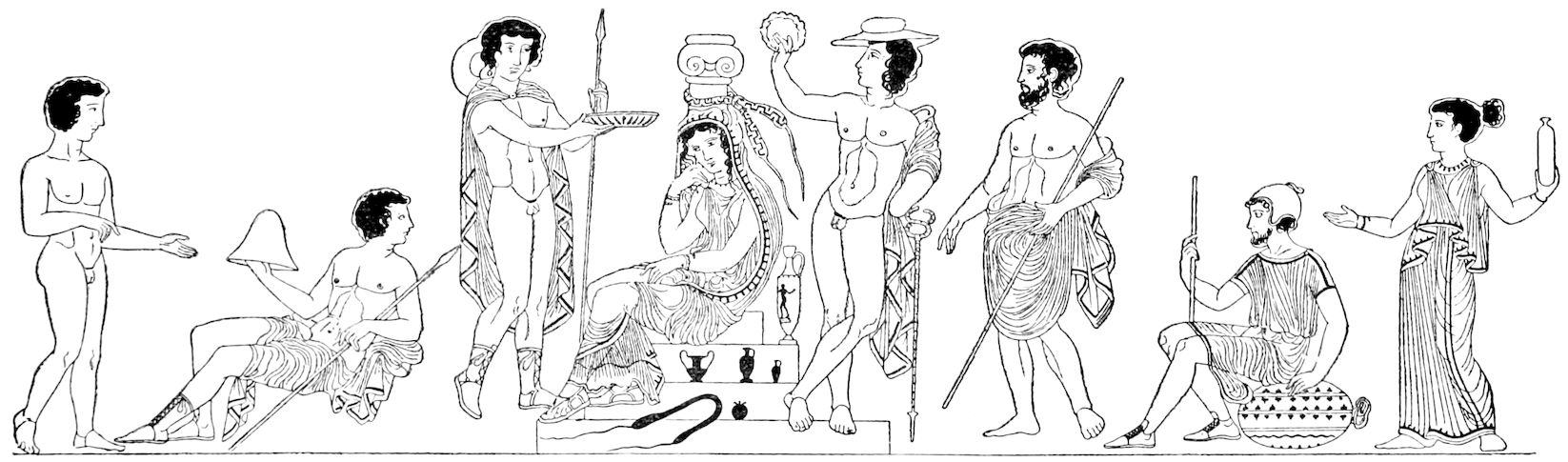
49The second painting is on a Lucanian hydria[121]. The
central scene is again the τύμβος of Agamemnon, built
up with several steps and surmounted by a stele with
Ionic capital and bound by a fillet. Elektra sits upon
the upper step in veil and chiton. She holds the former
with her right hand and looks away into space. On
other steps below her are a lekythos and other small
vases, also a pomegranate and a fillet. The offerings are
much more abundant here than in fig. 1. Unnoticed
by his sister, Orestes approaches the stele on the left,
dressed as in fig. 1, with the addition of boots. He
is about to pour a libation from a kylix in his left hand.
The male figure sitting next to him is doubtless Pylades.
He turns his head towards the main scene. The remaining
figure here is but remotely associated with the
action. The persons on the right are more interesting.
The youth standing on the step of the grave about to
lay a wreath upon the stele is denoted by his kerykeion
as Hermes. He wears a travelling costume without the
usual boots. An elderly, bearded, male figure stands
behind him. He is not characterized except by a mantle
and a long staff, but has been interpreted as Orestes’
pedagogue. The only objection to this is his dress[122],
but this may be due to the carelessness of the artist.
Behind him is another bearded male figure sitting upon
a sort of bag, or pack. His short chiton, shoes, and
staff all point him out as a traveller. The peculiar,
close-fitting cap denotes him as a foreigner. The female
figure on the extreme right in Doric peplos carries an
aryballos in her left hand, and gazes at the group before
her. Perhaps she belongs to Elektra.
The discussion of fig. 1 above applies equally well
to Orestes and Elektra here. We have practically a
repetition of the group. The former figure is, however,
thought of at an earlier moment. By removing Elektra
one may think of Orestes at the opening of the play.
He holds the vase in his hand rather than the lock of
hair. The first words of the prologue are suggestive—
Ἑρμῆ χθόνιε πατρῷ’ ἐποπτεύων κράτη,
σωτὴρ γενοῦ μοι ξύμμαχός τ’ αἰτουμένῳ.
Chthonian Hermes, who guards the ancestral rights,
has really manifested himself in the painting, and has
appeared as a particular ally. The act of crowning the
stele declares Hermes’ friendliness toward the family
and his interest in Agamemnon’s shade. Elektra addresses
him also and beseeches him to hear her supplications
50and pity her and her dear Orestes (v. 124 ff.).
We may note, therefore, a special fitness in the artist’s
expressing this double relation of Hermes to the children.
Invoked by both of them as a protecting god he introduces
nothing that is not in harmony with the spirit
of Aischylos. The addition of this figure is, moreover,
a good instance of the liberty which the vase painters
took with their authors, and shows well the difference
between illustration and independent work. It cannot
be denied that with the assistance of this monument
one is led to see between the lines of the Choephoroi.
The pedagogue who does not appear in Aischylos is
nevertheless a natural extension of the group. It will
be remembered that he speaks the prologue in the
Elektra of Sophokles and occupies the place which
Pylades usually fills. In Euripides’ Elektra (v. 16),
Autourgos says that Orestes had been given into the
charge of a τροφεύς. The person resting on the pack
appears at first sight a gratuitous addition of the artist,
but on closer examination the suggestion for him is found
in the poet. When Orestes explains to the chorus that
he and Pylades will attempt to gain an entrance to
the palace, he states that they will disguise themselves
as foreigners by speaking the Phokean dialect
(v. 563 f.). To Klytaimestra’s interrogations (v. 668 ff.)
he replies—
ξἐνος μέν εἰμι Δαυλιεὺς ὲκ Φωκέων·
στείχοντα δ’ αὐτόφορτον οἰκείᾳ σαγῇ
εἰς Ἄργος ...
In other words, he is a stranger from Phokis who has
to carry his own pack. It is upon this σαγή that the
figure is resting. The artist has characterized him as
51a foreigner by the peculiar cap. No Greek ever wore
such a head-dress. The make-up hints at the appearance
of Orestes seeking admittance to the palace, while,
of course, the person is to be understood merely as one
of the latter’s servants. Whatever he may have said
about carrying his own pack, no artist would have
thus represented him. On the oldest of the Orestes-Elektra
monuments, the Melan relief[123], there is such a
figure standing behind Orestes with his luggage strapped
to his shoulders. It seems to me that the painter has
naïvely caught up the spirit of the text and brought in
a figure which goes far towards adding a charm and
interest to the scene.
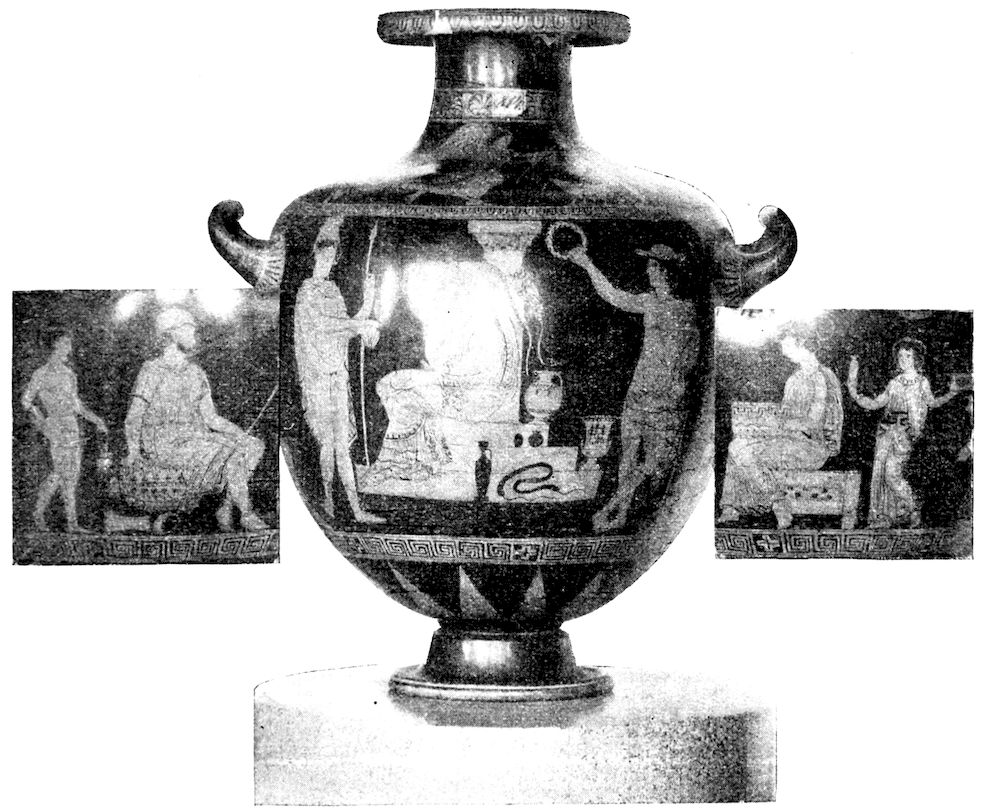
Another Lucanian hydria representing the same scene
is published here for the first time, in fig. 3[124]. It will be
more instructive to point out the few points in which
the two paintings differ from each other than to describe
this one entire. The column in 3 has a Doric capital,
with maeander and checker-board ornament; in 2 the
capital is Ionic. In 3 Hermes stands on the ground;
in 2 he stands on the step to the grave. Elektra reaches
out her left hand in 3 as though to receive the libation;
in 2 she is unmindful of Orestes. The latter holds a kylix
in 2, and in 3 a pitcher. His hat is a pilos in 3, and he
wears it; in 2 the petasos hangs on the back of his neck.
The Phokean attendant sitting upon the luggage is
in 3 upon the left, and in 2 upon the right. There is an
extraordinary likeness between the two. There is the
same crooked nose, short chiton, and odd cap, but
the latter has no tassel in 3. The servant wears, besides,
a chlamys and rests his stick over his leg. Behind him
is the nude youth, as in 2, upon the left, holding an
ointment vase in a sort of carrier. The two male figures
of 2 adjoining the main scene are wanting in 3. In
their stead is a female figure sitting upon a stool and
holding a large toilet box. She is dressed in a Doric
peplos with an apoptygma. She is evidently an attendant
of Elektra, and reminds one strongly of the figure in
fig. 1. Behind her is the charming girl, exactly as in 2,
except that she carries the aryballos in her right, and in
the left hand a small box.
52
53The painting is, it would seem, more beautiful than
that of fig. 2, although the publication of the latter
is an old one, and may be more or less inaccurate.
I have not seen the vase myself. The scene is abbreviated
by one figure; Pylades would be expected.
Still another painting is given in fig. 4[125], showing a
further step of simplification. Only the middle group,
with the female attendant carrying the aryballos, occurs.
Hermes’ position is the same as in fig. 2, but the artist
has forgotten to draw the wreath in his right. His chlamys,
too, is buttoned properly instead of being wrapped
around his arm. The latter, however, has the same
stumpy appearance seen in 2 and 3. As the scene is
simpler, so the offerings on the tomb are fewer. Orestes’
libation is here in a kantharos. The painting is a careless
piece of work, and cannot be ranked with the other two.
It is, however, very interesting as giving another link to
the chain of evidence.
There can be little doubt that these vases all belong
to the same artist or that they come from the same
54locality. The marvellous agreement that runs through
them is something quite extraordinary. I know of
no other similar cases in vase paintings of the red
figured ware. The popularity of this scene, and therefore
of Aischylos’ Choephoroi, is attested by such a series
of paintings as one cannot find in the case of any other
work in Greek literature.
Since writing the above I have discovered in the
Louvre another Lucanian vase that represents a further
simplification of this scene[126]. The painting is practically
identical with the middle group in fig. 3. Peculiar to
the Louvre painting are the tomb with five steps and
55the rather tall column, Doric order, surmounted by a
krater; an aryballos and strigil, in addition to the
taenia, are fastened to the column. There is a further
slight variation in Elektra’s position, for on her right
is a krater. On her left is a lekythos; below are the
two pomegranates, taenia, and black lekythos, just as in
fig. 3. The only difference in the other persons is that
Orestes holds out a kylix and not a pitcher.
The painting is evidently a product of the same studio
as are those in figs. 2, 3 and 4. It forms another
member of this remarkable class of pictures that stands
alone, unique in Greek ceramics, and bears witness to
the enormous popularity of this scene from Aischylos.
In the face of this important chain of evidence one is
safe, it seems to me, in claiming that Aischylos was
acted in the fourth century B.C. and that considerably.
What kept this scene before the public and induced the
artist and his pupils to turn out so many copies of the
same work? To have been thus so saleable the picture
must have been popular, and this could have come about
best through the acted drama. These vases and those
following, based on the Eumenides, must impress the
impartial student with the fact that Euripides and
Sophokles did not by any means oust Aischylos completely
in Lower Italy.
The various stories which may have been popularly
told in regard to Orestes’ purification, and his reconciliation
with the Furies, prior to March 458 B.C. were
swept for ever into oblivion by the last member of
Aischylos’ trilogy. The stamp of his genius has ever
56remained upon the myth, and no one ever attempted to
repeat his work[127]. All the elements of the persecution
were cast by him into their final mould. The immense
influence of this work is attested in no way more forcibly
than by the monuments of art to which one can point.
There is a long line of vase paintings, dating from the
fifth century, that bear witness to the wide popularity
of the Eumenides, and that give the most direct and
authoritative testimony of the influence of the play upon
the masses of the people. A sharp distinction must be
made, however, between paintings that illustrate the
general myth and those that exhibit unmistakable
Aischylean features. Orestes’ pursuit and expiation
were universally known, and the tale was so popular
that it often found its way into art where the artist
had in mind no poetic version of the story. So it is
that there is a number of paintings representing Orestes
either pursued by the Furies or already having reached
the omphalos, which do not represent any situation
or combination of situations that can be traced to
Aischylos[128]. Of the number whose subject is Orestes
at Delphi, at least four, it seems to me, are to be explained
as substantially under the influence of the Eumenides
and representing the first scene of the tragedy in more
or less modified form.
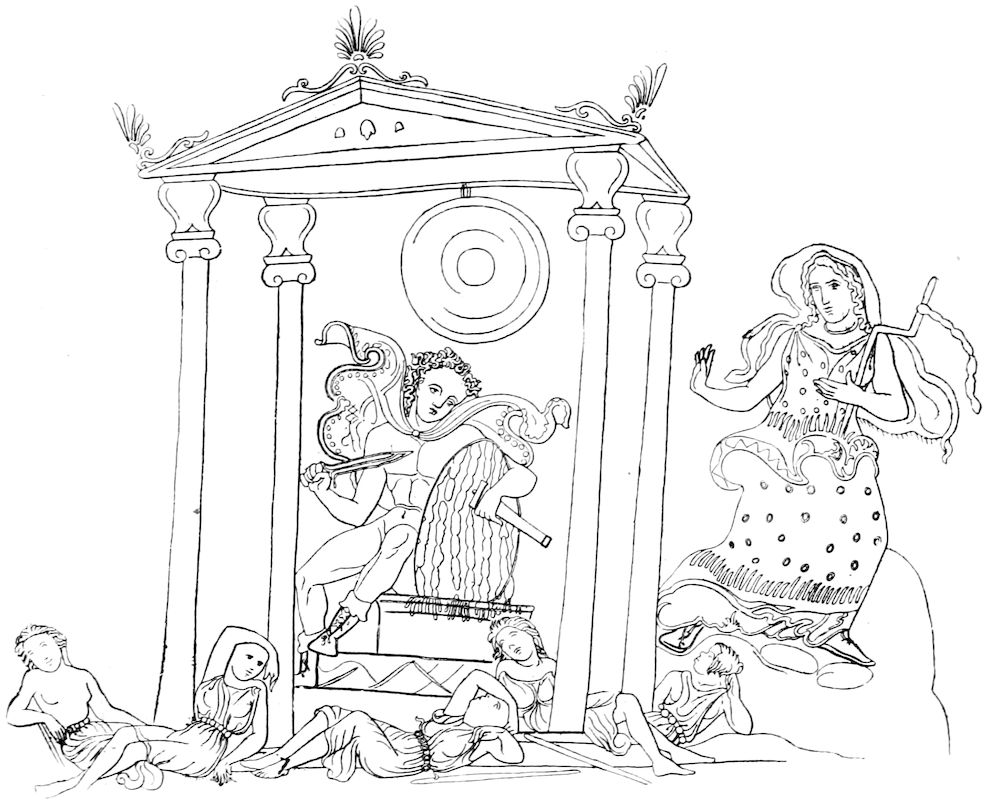
I discuss first the scene on the St. Petersburg krater[129],
fig. 5. The painting belongs to the latest period of
ceramic art, and is in nearly every detail a hasty and
careless piece of work. In an Ionic temple on four
57columns, all painted white, Orestes, flesh dark red, sits
en face with his left arm around the omphalos which
is covered with a white net. He holds the sword in
the right and the sheath in the left, and wears boots and
chlamys. On the steps of the temple lie five sleeping
Furies. They are painted, flesh black, only in rough
outline. Their dress is a short chiton. On the right,
hastening from the temple, is the Pythia in long chiton
and veil. She carries the big key—emblem of her office
as κλῃδοῦχος[130]. Her flesh is white.
58The addition of the temple strikes one at once as
being in harmony with the poet. To be sure, this need
not mean a particularly close relation with the actual
production of the play in a Greek theatre. Our temple
is merely one of the numerous buildings of this class
found upon the vases of Lower Italy, some of which
were intended evidently as suggestions of the stage
setting. In the present instance the coincidence is
a happy one. The Agamemnon and the Choephoroi,
which had just been produced, were both played before
the palace at Argos, and this scenery was changed to
represent the Apollo temple at Delphi for the third play.
There can be no question as to this σκηνή for the Oresteia,
at least, even though one does not allow an extensive
background for the earlier plays. The painting is well
adapted, therefore, for placing the opening scene vividly
before us. It brings one closer to the meaning of the
text than is apparent at first sight. In v. 1048 ff. of
the Choephoroi Orestes saw the Furies. They wore bright
chitons, and had snakes in their hair. He calls them
hounds from whose eyes oozed ugly drops of blood.
The chorus evidently did not see them, for Orestes
cries, ‘You do not behold them here, but I do’.[131] At
these words he is away to Delphi to seek Apollo’s
protection. During the intermission which followed
between the two plays the necessary alterations were
made in the σκηνή and the costumes were changed.
The chorus in particular, which had represented Argive
maidens, underwent considerable transformation in order
to appear again as Furies. The Eumenides is opened
by the Pythia, who comes from the temple. She
recounts the nature of her duties, and mentions various
59gods in her address until v. 30, at which point she turns
from the orchestra to re-enter the temple and attend to
the delivery of responses. In a moment she reappears
in great fright, and begins to relate the cause of her
alarm. The sight described is exactly that which the
painter had in mind. One is able, however, to get
behind the scenes with the aid of the picture, for the
front of the temple is removed so that the interior is
plainly in view. To compare the words of Aischylos
and the painting more closely—the Pythia says that
a terrible sight drove her ἐκ δόμων τῶν Λοξίου[132]. The
artist has expressed this with some action, for she is
actually represented as leaving ‘the house of Loxias.’
She adds further—
ὁρῶ δ’ ἐπ’ ὀμφαλῷ μὲν ἄνδρα θεομυσῆ
ἕδραν ἔχοντα προστρόπαιον, αἵματι
στάζοντα χεῖρας, καὶ νεοσπαδὲς ξίφος
ἔχοντ’ ...
The picture shows the man upon the omphalos, and in
his hand the drawn sword. One may imagine that the
suppliant’s hands are stained with blood, when but a short
time before he had fled from the scene of the murder in
Argos. Even greater explicitness characterizes the next
words of the priestess:—
πρόσθεν δὲ τἀνδρὸς τοῦδε θαυμαστὸς λόχος
εὕδει γυναικῶν ἐν θρόνοισιν ἥμενος.
Surely a ‘marvellous troop of women’ fits the group
which we see before us. In this particular the work is
practically an illustration of the text. The distinction
60is at once made that the figures are not women nor
Gorgons nor Harpies[133]. They are ἄπτεροι and μέλαιναι,
and snore with unapproachable blasts. It should be
noted that the figures in the painting are also black,
as though in direct agreement with Aischylos[134]. They
are further wingless, while the unpleasant details added
are conceivable from the appearance of the ugly creatures.
The number five is of course a mere accident. They lie
here in an unconscious stupour till the ghost of Klytaimestra
arouses them again. The Eumenides is, as is well
known, the only extant Greek tragedy in which the
chorus is not visible from the beginning of their part.
In the Persai and Supplices of Aischylos and the
Bakchai and Supplices of Euripides the chorus is, however,
in the orchestra when the play opens.
There are still two other vase paintings to be considered
in this connexion. They present minor variations
from the one just discussed, but on the whole the
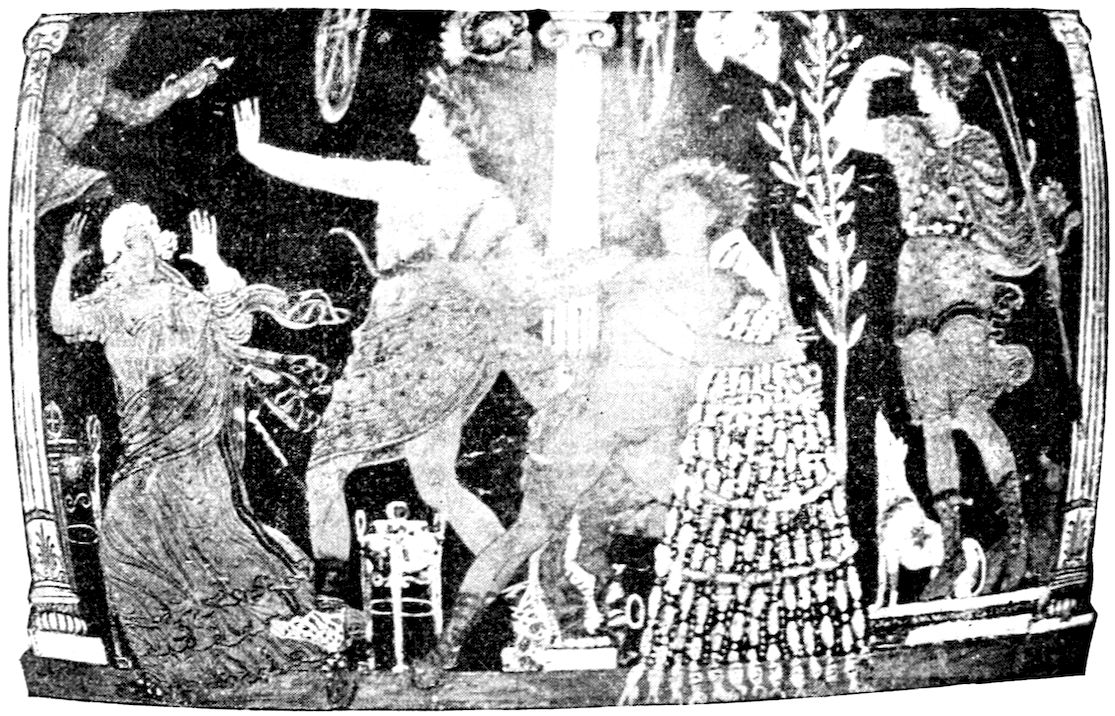
three betray a common source. In fig. 6[135] one sees
also the interior of the temple represented by three
Ionic columns. Various dedicatory articles hang from
the wall and ceiling. Further indications of the sanctuary
are the two tripods, the laurel tree, and the
omphalos. Orestes, characterized as usual by the
drawn sword and flying chlamys, has fled to the latter
61and embraces it. His erect hair shows his fright.
Apollo with bow and arrows hastens behind him and
gestures with his right hand to drive back a Fury who is
swooping down upon Orestes. She is but half in sight,
and wears a short Doric peplos, and her flesh is black.
The Pythia, with dishevelled gray hair and frightened
mien, quits the sanctuary on the left. Her key, indistinctly
drawn in Jahn’s publication, owing probably to
the copyist’s ignorance of what the article really was,
has just fallen from her hands. Artemis in her huntress-costume,
carrying two spears, stands on tiptoe on the
right of the omphalos and shades her eyes with her
right hand as she peers at the disturbance. Two dogs
are with her.
The time of the Pythia’s exit from the temple, as in
fig. 5, and the later moment when Apollo orders the
62Erinyes from the sanctuary, are well combined in this
painting:—
ἔξω, κελεύω, τῶνδε δωμάτων τάχος
χωρεῖτ’, ἀπαλλάσσεσθε μαντικῶν μυχῶν,
μὴ καὶ λαβοῦσα πτηνὸν ἀργηστὴν ὄφιν,
χρυσηλάτου θώμιγγος ἐξορμώμενον,
ἀνῇς ὑπ’ ἄλγους μέλαν’ ἀπ’ ἀνθρώπων ἀφρόν.
vs. 179 ff.
Apollo’s authoritative bearing and absolute power in
his own precinct are very well brought out by the artist.
One can all but hear the ἔξω, κελεύω of Aischylos, and
the arrows that the god holds in his left hand seem to
show that Apollo is quite ready to carry out his threat.
The whole is, moreover, dramatically told, and in this
respect the stage influence is easily traceable in the painting.
That the Fury is black accords again with the
poet’s μέλαιναι (v. 52). The presence of Artemis lends
a certain charm that one can attribute to the artist’s
desire to appear original[136].
The following work falls still further away from the
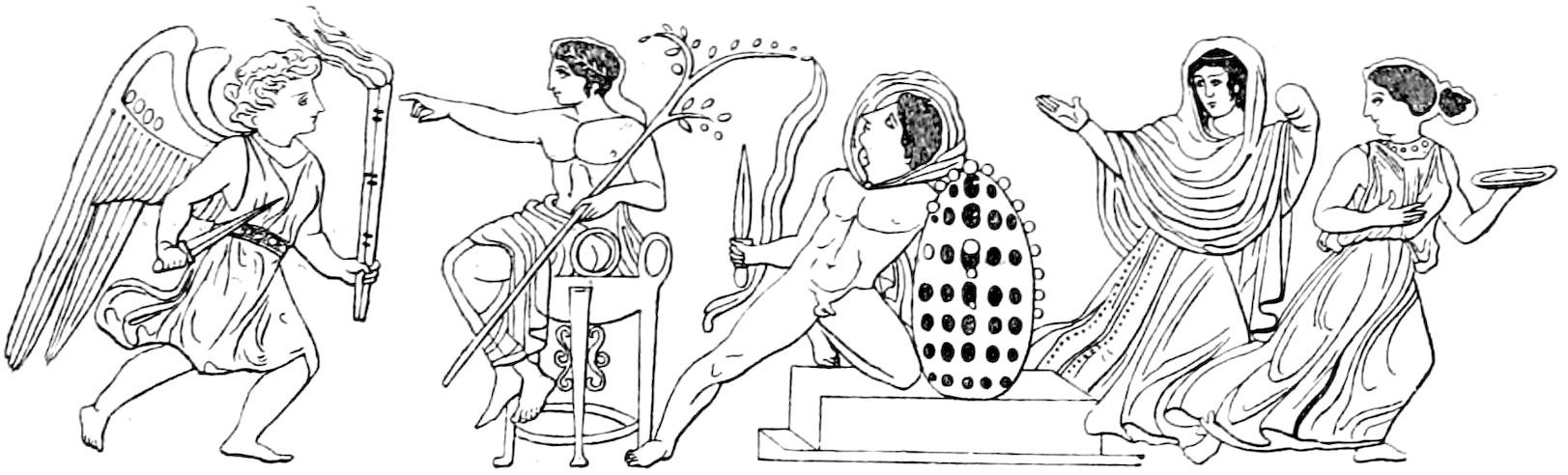
scenery of the play. Fig. 7 shows a painting on the neck
of a large Apulian amphora in Berlin[137]. The limited
space, and the secondary position likewise, have perhaps
curtailed the scope of the work. No architectural details
are given. The sanctuary is denoted by the omphalos
and the tripod. Orestes has sought protection at the
former, as in the preceding scenes, and looks back at
63a Fury, with short dress and huge wings, who runs toward
him with a dagger in her right and a burning torch in
the left hand. Apollo, who sits upon the tripod, a laurel
bough in his hand and wreath in his hair, extends his
right hand to repel the Fury as in fig. 6. On the right
the Pythia, dressed as in fig. 5, leaves the shrine in
fright, gesturing at the unexpected visitors. The painter
has forgotten to give her the key. Beside her is an
attendant carrying a sort of kylix in the left hand and
looking back at the sanctuary.
It does not appear necessary to take up the details
here after the examination which has been given to the
preceding paintings. The artist’s debt to Aischylos was
quite as direct as in the case of the two other works.
The greatest modification occurs in the figure of the
Fury, which is a being far removed from the Aischylean
type.
A painting on a bell-shaped krater in the Louvre is
less hampered by the scene given in Aischylos, and
is accordingly more artistic[138]. The inventiveness and
64individuality of the artist come prominently to view,
and the result is an intensely interesting composition.
The combination of events and the manner in which all
is told bring one a great deal nearer to the deeper
meaning of Eumenides than any other monument with
which I am acquainted.
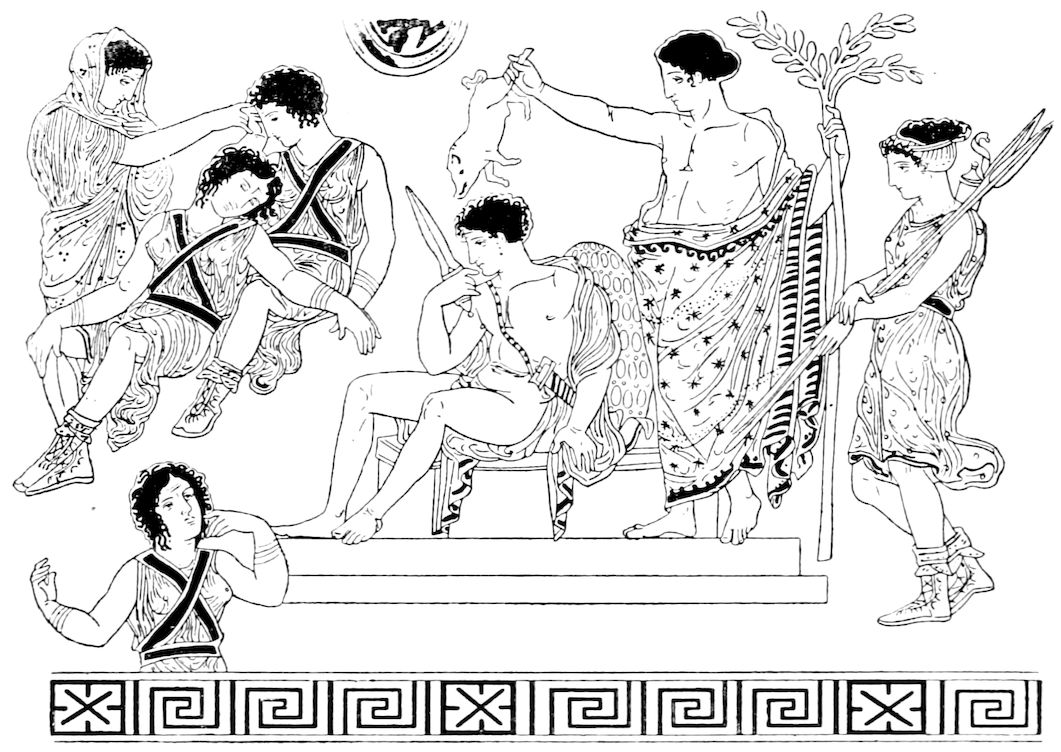
The shrine of Apollo, the μυχός of vs. 39 and 170, is
denoted by a platform on two steps, above which are the
laurel tree and the omphalos. The god stands to the left
in large, embroidered chiton or chlamys, grasping the
tree with his left hand and extending his right, in which
is a young pig, over the head of Orestes, who sits with
his back to the omphalos. The latter holds his sword in
his right hand, which is raised meditatively to his chin.
Artemis stands behind the platform on the right, characterized
by her costume and the spears. In the left-hand
65upper corner the shade of Klytaimestra, veiled, is
engaged in arousing two Furies who sit fast asleep. She
points toward Apollo with her right hand. Below is
the half-figure of another Fury apparently rising out of
the ground wide-awake. The Erinyes are all dressed
like Artemis, in short costume and high boots.
The artist has combined with the first scene a moment
earlier than the action of the play. Orestes’ expiation
preceded the prologue of the Pythia. The purificatory
rite had been performed immediately on his arrival at
Delphi, for, when he first appears in the Eumenides, he
is undefiled. This is plainly declared to Athena in
vs. 237 ff., and to the Chorus and Athena in vs. 280 ff.
While the purification is represented in various ways
upon the other vase paintings[139], this ceremony is the
only one that reminds us of Aischylos. The latter
hints at the manner of the rite, and this passage has
unquestionably suggested the group which we have
before us:—
ποταίνιον γὰρ ὂν πρὸς ἑστίᾳ θεοῦ
Φοίβου καθαρμοῖς ἠλάθη χοιροκτόνοις. vs. 282 f.
‘While the blood was fresh it was cleansed at the shrine
of the god Phoibos by purification with the blood of
pigs.’ The ceremony is referred to again in
σφαγαὶ καθαιμάξωσι νεοθήλου βοτοῦ. v. 450.
There is, therefore, in the painting a representation of
this service with pig’s blood. The freshness and beauty
of the scene are peculiar to works of art in the Pheidian
age, and the painting must be considered as a valuable
66witness of Aischylos’ influence. The fact that the work
is Apulian and not Attic supplies an interesting bit of
evidence for the extension of Athenian literature in
Lower Italy during the fifth century B.C. Tarentum,
which was scarcely less Athenian than Athens, received
an edition of the plays brought out at the Greater
Dionysia soon after their appearance in Athens. It is
further to be remembered that Aischylos’ long connexion
with Syracuse had probably made him more
widely known in the West than was either Sophokles or
Euripides during the fifth century. Our vase belongs to
the last decades of the century, perhaps as early as
420 B.C., and in this period Euripides had scarcely gained
a large following in Magna Graecia.
Apollo’s speech follows directly upon that of the
Pythia’s. How the god appeared in the orchestra is
a question on which scholars are not agreed. The most
widely accepted view is that the ekkyklema was brought
into use, and that on it the whole company was in some
manner rolled or pushed out from the temple to the
orchestra. This means that the chorus of twelve or
fifteen, together with Orestes, Apollo, and Hermes, was
moved bodily forward from the σκηνή, far enough at
least to give the audience a glimpse of what had been
the interior of the temple with all its surroundings.
Apollo seems to speak of the Furies and Orestes as
though he himself saw them and as though the audience
could see them[140]. They are in fact in plain view if one
insists upon the literal meaning of his words. It is argued
on the other hand that such a ponderous weight could
not have been moved by any machinery at Aischylos’
67command. In other words, the ekkyklema, in the interpretation
usually given the term, is not to be counted
apart of the Aischylean scenic apparatus[141]. If Apollo
stood in the doorway of the temple where he could look
in upon the Furies and Orestes, and at the same time be
seen by the audience, one has really no need of any
machinery. The shade of Klytaimestra must also be
thought of as appearing in the same place. She glances
in upon the Furies who continue to give forth their grunts
till v. 140, when they for the first time appear in the
orchestra. There is much in favour of this explanation
of the arrangements for the scene. Fortunately for our
purpose it makes little difference which of the two
opinions one follows. Conclusive evidence is hardly to
be reached either one way or the other, yet the notion
that Aischylos did not employ such extensive machinery
as the ekkyklema must have been certainly does not
harmonize either with the extant plays or with the
tradition in regard to Aischylos’ inventions. My conviction
is that from v. 64 the interior of the temple was
in some way visible, and that the whole audience could
see Orestes at the omphalos, surrounded by the slumbering
Furies. The god reassures the suppliant of his
support, and bids him leave for Athens and embrace
the sacred image of Athena. He turns to Hermes, who
is at hand for the occasion, and bids him accompany
Orestes. At this point, v. 93, the two quit the orchestra,
Orestes passing over the bodies of the Furies[142].
68Our painting follows the development in vs. 94–140,
where the shade of Klytaimestra appears and chides
the Erinyes for neglecting their duty and forgetting her
and her rights. The artist has grasped the spirit of the
poet, and has given a graphic account of the scene such
as one is not likely to forget. The dread figure of the
veiled ghost, who glances searchingly at the sleeping
instruments of her vengeance and endeavours to rouse
them into consciousness, is a creation but little inferior
to that in Aischylos[143]. Her position on the extreme
limits of the sanctuary serves to express the uncleanliness
of the spirit and the incongruity of its appearing within
the sacred ground. The gesture towards the main group
connects the two scenes and lends a unity to the whole.
This is real art and no illustration. One must remember
that Orestes is at this time on his way to Athens, and
that the shade did not appear in his presence. The very
fact that the painter chose to unite the two moments
adds greatly to the general effect. The tragedy is played
in part before us. The number of Furies representing
the chorus is the same that one meets first in Euripides[144],
and that is particularly emphasized also by Aischylos in
ἔγειρ’, ἔγειρε καὶ σὺ τήνδ’, ἐγὼ δέ σε. v. 140.
Their dress is that of the later type of Erinyes—the
huntress-costume of Artemis. This facilitated their
motion. Perhaps the half-figure of the awakened Fury
may be rising from the earth to continue the pursuit,
69but it seems to me more probable that the half-figure is
such from choice. After the appearance of the Erinyes
in the Choephoroi they are certainly above ground till
conducted to their new home under the Areopagos.
While the story of Agamemnon’s murder and the
succeeding terrible revenge wrought by Orestes, as well
as the latter’s atonement at Delphi, were all a part of the
legendary inheritance from a very early period and had
played for some centuries, at least, before Aischylos
an important rôle in the epic[145] and lyric[146] literature, it
remained for the great tragedian to break new ground
for the last chapter of the Oresteia. Orestes’ acquittal
and deliverance were, prior to Aischylos, distinctly
Delphic in setting; in his hands all became decidedly
Athenian. Apollo had once been the sole divinity to
absolve the murderer; Athena became the new arbiter
and director of the case. The temple at Delphi gave
way to the ‘Old Temple’ of Athena upon the Acropolis.
Keeping these facts in mind, one has to look about for
vase paintings which show traces of this Attic turn. So
far, only the early scene at Delphi has claimed our attention,
and here it has been possible to point out several
compositions that demand the Eumenides to the exclusion
of popular tradition.
From v. 235 the scene is transferred from Delphi to
Athens, and remains throughout the rest of the play
the ‘Old Temple’ on the Acropolis[147]. Athena becomes
70the centre. Everything moves about her. The one
impressive figure in this part of the tragedy is the
goddess. Orestes is simply a poor helpless mortal—the
apparent subject of the action. He and the Erinyes
sink into insignificance when compared with the majestic
figure of Athena. Substantial traces of the influence of
Aischylos’ invention have reached us on the vases.
A small number of paintings claim the right to be considered
under this head. The composition of all (I know
three such) is so similar that it seemed necessary to
reproduce only one.
71
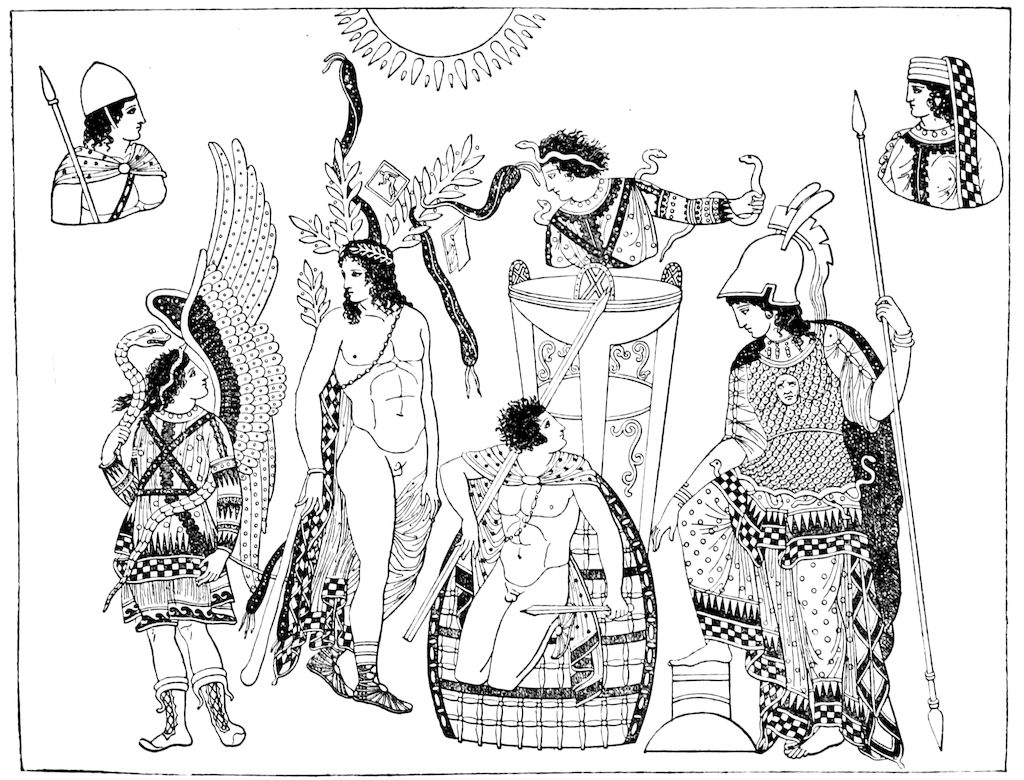
72The painting shown in fig. 9[148] represents the sanctuary
at Delphi with the tripod and the omphalos; kneeling
upon the latter is Orestes, in the same costume as that
noticed in the preceding monuments, holding two spears
in addition to the νεοσπαδὲς ξίφος. He glances up to
the right, where Athena looks down upon him. Her
right foot rests on a sort of plinth; she carries a double-pointed
spear in her left hand and wears a Corinthian helm
with peculiar crest[149]. Her dress is an embroidered Ionic
chiton and large aigis. The latter is not uncommon
on the fourth-century vases, and is characteristic of the
exaggeration of types in this period. Apollo stands
on the left of the omphalos, with a laurel branch on
which are hung fillets and πινάκια[150]. He looks to
the left at a winged Fury with a very elaborate costume,
a huge serpent about her body and one in her hair;
above the tripod is the bust of another Fury on
whom are four snakes. In the left-hand upper corner
a bust of a youth with chlamys, pilos, and a spear
is most likely meant for Pylades. Corresponding to
this on the other side are the head and shoulders of
a woman, interpreted as Klytaimestra.
The two other vase paintings are, in the main, close
counterparts of this and need not be described here.
The Vatican amphora[151] is particularly interesting as
representing Athena with aigis extended over Orestes
to protect him from the Furies. The Capua hydria in
Berlin[152] takes precedence over the other two in age, and
73furnishes us with the nearest approach to Aischylos’
time. It falls within the fifth century, while the others
are to be placed in the last half of the fourth century.
The introduction of Athena is the unmistakable sign.
She intervenes at Delphi simply because Aischylos
introduced her in Athens. The artist transferred her to
Delphi and combined the two scenes of the tragedy.
If one considers only Orestes and Athena in fig. 9, and
reads the interview between them in the Eumenides,
he will appreciate at once how well the painter has
managed his task. The whole make-up of the figures
is that of stage characters. This is especially noticeable
in the dresses of the Fury and Athena. This elegance
and finery on vases of the fourth century were widely
regulated by dramatic performances.
The set of paintings which thus associates Athena
with Orestes’ delivery may be counted as the direct
product of the Eumenides, and therefore important
witnesses for the influence of Aischylos upon the succeeding
century of Greek art.
One might carry on a long and fruitless discussion
concerning certain of the lost plays, and paintings that
present subjects common to them. It must be all but
‘fruitless,’ since we know next to nothing about the
character of some of these tragedies, as, for example,
the Pentheus. But this whole question lies outside the
province of the present work, and I shall not go further
than to append a list of the vase paintings that do in all
probability owe much to Aischylos.
74
- 1.
- Apulian amphora, Munich, no. 853. Pub. Millin, Tombeaux de Canose, pl.
13.
- 2.
- Apulian krater, Naples, no. 2874. Pub. Müller-Wieseler, Denkmäler der Alten
Kunst, ii. pl. 37, 440. Cf. Welcker’s Aeschyleische Trilogie,
p. 327.
- 3.
- Amphora from Ruvo, Naples, no. 3219 (p. 500 of Heydemann). Pub. Mon. d.
Inst. iv. 16, B.
- 4.
- Krater from Anzi in the Basilicata, no. 3237 in Naples. Pub. Reinach-Millingen,
Peintures, pl. 1 = Müller-Wieseler, op. cit. ii. pl. 38,
442 = Baumeister, Denkmäler, ii. p. 834.
- 5.
- Krater in Ruvo-Jatta coll. Pub. Catalogo Jatta, pl. 2. 5 =
Annali d. Inst. 1874, pl. R.; cf. ibid. p. 194 ff.
- 6.
- Krater, also from Ruvo, in Brit. Mus.; cat. iv. F 271. Pub. Mon. d.
Inst. v. pl. 23. Cf. Brunn in Annali d. Inst. 1850, p. 336 ff.
- 7.
- Fragment of an Apulian amphora in Dresden museum. Pub. Arch. Anz. 1891, p.
24; cf. p. 23 f.
- 8.
- Marble relief-vases. Pub. Welcker, Alte Denkmäler, ii. pl. 3. 8; cf.
ibid., p. 94 ff.; Mon. d. Inst. ix. 45.
-
- Cf. further for a discussion of most of these monuments, Michaelis, Annali d.
Inst. 1872, p. 248 ff.
- 1.
- Tarentine amphora. Pub. Mon. d. Inst. v. pl. 11; cf. Annali d.
Inst. 1866, p. 249 ff., and Arch. Ztg. 1879, p. 16, and G. Haupt.
Commentationes archaeologicae in Aeschylum, Dissertationes Hallenses,
xiii. 1895, p. 13 ff. Vid. also this work for the whole subject of Aischylos and the
monuments.
CHAPTER V EURIPIDES AND VASE PAINTING — § 1. Introduction. — § 2. Andromache. — § 3. Bakchai. — § 4. Hekabe. — § 5. Hippolytos. — § 6. Iphigeneia at Aulis. — § 7. Iphigeneia among the Taurians. — § 8. Kyklops. — § 9. Medeia. — § 10. Phoinissai. — § 11. Supplementary. — Alkestis. — Andromache. — Elektra. — Herakles Furens. — Hippolytos. — Ion. — Iphigeneia at Aulis. — Euripides’ Lost Plays. — Aiolos. — Alkmene. — Andromeda. — Antigone. — Antiope. — Bellerophon. — Chrysippos. — Hypsipyle. — Meleagros. — Stheneboia. — Telephos.
78
It has already been made clear that Euripides enjoyed
an enormous popularity among Greek and Italian artists,
and that he was the chief inspiration for works of art
based on tragedy. This latter feature assumes a new
interest when studied with the Greek vases. The great
majority of these paintings, as has been pointed out,
is to be placed within the fourth cent. B.C., and through
them one approaches very near to the poet’s own time.
They are to be valued, therefore, as most direct and
reliable testimony concerning Greek tragedy and the
place it occupied in the life of Lower Italy. Not a few
of the paintings published in the following pages may
have been seen by people who had known the Athenian
society in which Euripides himself had moved. This
proximity of the vases to the poet’s own day is an
important point, and should be thoroughly comprehended
in order to bring the true value of the paintings before
one. The text of a classical Greek author, exposed to
the emendatory zeal of the ancient grammarians and
the ignorance and carelessness of scribes, had a precarious
sort of existence before it was microscopically dissected
79and violently revised by modern philologists. Our
oldest manuscript hardly goes back more than one-third
of the way to the original. Between 1000 A.D. and
340 B.C., when the archetype of the three tragedians
was ordered by Lykurgos, how long was the line of
copies! It is vastly different with the edition of the
Medeia, for example, on the amphora, p. 145. The vase
relates the tragedy at first hand, and furnishes the student
with an exhibition of the play that is more than twenty-two
hundred years old. The original work and no copy
carries one into the century succeeding the first production
of the play. Such facts impress one with the
importance of this class of monuments.
Before taking up the discussion of the vase paintings
that are under the influence of Euripides, it may be well
to examine for a moment the ancient testimony touching
the poet. It is well known that he did not follow the
orthodox form of tragic composition established by
Aischylos and adhered to by Sophokles. He was less
religious than either of the other two and, in the same
degree, more a man of the world. He was interested in
politics, rhetoric, and philosophy, and these elements
accordingly found room in his plays. For introducing
the common, ordinary affairs of daily life he was stoutly
condemned by Aristophanes. His policy continued the
same in spite of the virulent attacks of his enemies, and
the individual appealed to him more strongly than the
body politic; where the former poets had preached
ἦθος and directed their messages to the world καθ’ ὅλον,
Euripides disclosed for the first time the power of πάθος,
and that of itself was specific and applied to the community
καθ’ ἕκαστον. Herein lay Aristotle’s unfavourable
criticism. The philosopher admired Homer, Aischylos,
80and Sophokles more than Euripides simply because he
considered ἦθος to be a more potent factor than πάθος,
and so he complains that none of the younger poets have
the former[155]. By νέοι he evidently meant post-Euripidean
writers, and yet there is no trace of the Aristotelian
conception of ἦθος in Euripides. We may imagine that
the great thinker looked for something more stable
than πάθος. But this was all cold, calculating criticism,
and Aristotle appears, for the most part, alone in placing
Euripides below Aischylos and Sophokles. The Alexandrian
grammarians were his chief followers. Plato
found in Euripides an authority of great pre-eminence[156].
The immediate success that he enjoyed in his own time
is well illustrated by the anecdote related in Plutarch’s
Life of Nikias[157]. The fugitives from the Athenian army
in the Sicilian expedition are said to have maintained
themselves by reciting from Euripides’ works, and
captives were able to gain their freedom by teaching
their masters new selections from the Euripidean plays.
The element of truth in this remarkable story enables
one to understand something of the place held by this
poet in the West. It is related of Alexander that he
was particularly fond of Euripides, and that he performed
the feat of reciting a whole scene from the Andromeda
at his fatal banquet[158]. A certain Axionikos wrote
a comedy called the ‘Lover of Euripides,’ in which he
represented the people as suffering from the Euripides-fad
to such an extent that they counted all other poetry
worthless[159]. A fitting finale to all this is reached in the
story told in the vita of Euripides to the effect that
Philemon would have been willing to hang himself if
81thereby he might have seen Euripides. That he was
always in men’s mouths is attested by the large number
of fragments from the lost plays. It is instructive to see
that he was quoted in the Hellenistic period to the
exclusion of Aischylos and Sophokles. Wisdom and
state-craft were found in Homer, Hesiod, Pindar, and
Euripides[160]. One is not surprised, therefore, to learn
that his tragedies were the only ones produced at certain
Dionysia[161]. This was the period in which most of the
vase paintings in the following pages belong, and it is
only these numerous traditions of the unparalleled
popularity of this poet, east and west, north and south,
that makes it possible to appreciate his wide-spread
influence over art. The vases have to be studied in
this light, and only then does their importance as a
Euripidean commentary become sufficiently clear.
A glance at the conditions in Magna Graecia is
necessary before leaving this topic. The theatre-going
propensities of the Tarentines has been mentioned above,
and one has now to ask himself who their favourite poet
was. There can be but one answer. Here, as in Africa,
Asia Minor, and Sicily, the public was sure to find the
greatest satisfaction in a Euripidean répertoire. The
travelling troops of actors performed in all the towns of
Apulia, Campania, and Lucania, and the tragic forms of
the myths were widely published. Euripides was, in
short, more than ever the people’s poet, and he became
later, with the rise of Latin tragedy, the poet of the
Republic. Roman tragedy was Greek in everything but
82the language. The 166 years between the death of
Euripides and the production of Livius Andronicus’ first
play in Rome were a seed-time for the works of the
Greek poet. The titles of Livius’ ten tragedies include
two from Euripides—the Andromeda and the Danaë—and
the father of Latin poetry was a native of Tarentum.
Ennius, born in Rudiae, which Strabo calls a πόλις
Ἑλληνίς[162], was educated at Tarentum, and became the
first national poet of the Romans. Among his twenty-two
plays the following are either translations of Euripides
or adaptations from him: Alexandrus, Andromacha,
Andromeda, Erechtheus, Medea, Medea exul, Melanippa,
Phoenix, Telephus, and perhaps Alcumena. Pacuvius,
a nephew of Ennius, and the third one of the Latin
tragedians, also followed Euripides more than Aischylos
or Sophokles. He was born in Brundusium 268 B.C.
and died in Tarentum 140 B.C. These three poets who
come first in the history of Latin literature are peculiarly
indebted to Euripides and likewise have a special relation
to Magna Graecia and Tarentum. More than half of
the whole number of works produced by them would
appear to have been Euripidean. Whether it was the
rhetorical or pathetic element that appealed to the
Romans more strongly, the fact that Euripides was the
primary force in Latin tragedy is very important.
In this attempt to indicate the wider influence of the
Attic drama upon the Latins I have been carried beyond
the time of the vase industry, but the Latin literature of
the third and second century B.C. was the legitimate
product of the conditions that had prevailed in the
preceding period. The Greek literary and artistic genius
blossomed into an Italian flower and flourished in the
83soil that had been fertilized by centuries of Hellenic
influences. It is to a small section of this wonderful life
in Magna Graecia that the present work is devoted.
The vase paintings that follow can best tell their own
story of the wide-spread Hellenization of Lower Italy in
the fourth century and of the place held by Euripides in
the onward march of Hellenism.
It does not appear that in the pre-Euripidean literature
Orestes played any part in the death of Neoptolemos.
Pindar at least did not know anything of the Menelaos-Orestes
conspiracy against the son of Achilles[163] but
Menelaos’ relation to Sparta afforded a rare opportunity
for a political polemic. The latter could be painted as
a much more despicable character, as could also the
Lakedaimonians in general, provided Orestes were
involved in the unholy murder. The anti-Spartan
feeling in Athens was sufficient to guarantee a hearty
reception to any drama depicting the crookedness and
treachery of the Spartan character. Such a play was
certain to meet the demands of a campaign document.
The Andromache has, however, little of the merit
which one can usually discover in Euripides; it was
classed even by the ancients among his second-rate
works[164]. There is but one effective situation in the
whole tragedy, and that is the speech of the messenger,
vs. 1085–1165, which gives the account of Neoptolemos’
murder at Delphi. The beginning is remarkably simple
and unaffected, but when once the poet gets under way
84the action increases rapidly in violence, becoming at
every step more and more intense until at last the
whole temple of Apollo resounds with the roar of the
unholy tumult. Orestes’ party is, of course, victorious
over the single-handed descendant of Peleus. This
manœuvring inside the temple is unique, and intensely
dramatic and picturesque. The pictorial importance of
the scene is attested by a painting on a large amphora
found in Ruvo[165].
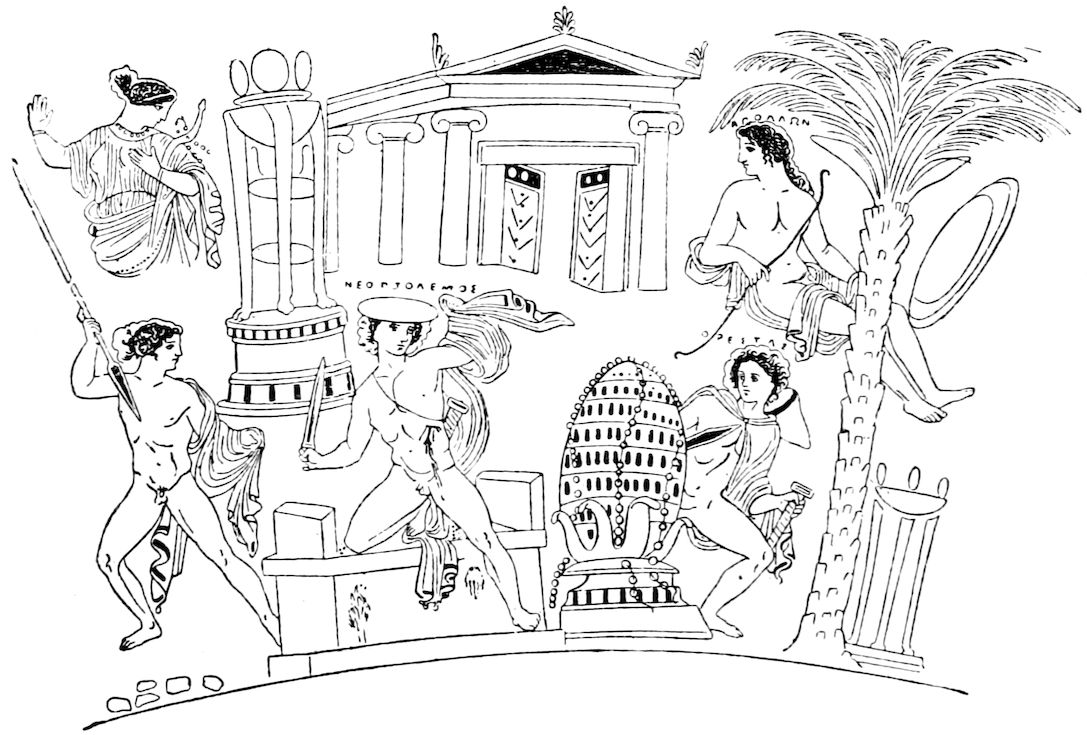
In the centre is the sanctuary of Apollo denoted by
two tripods, the laurel tree, the omphalos covered with
a netting, and the altar. To the latter, already dashed
with blood, Neoptolemos, ΝΕΟΠΤΟΛΕΜΟΣ, has fled.
He holds a drawn sword in his right hand and whirls his
85chlamys about his left. He wears a petasos and has
a sword-cut in his left side from which blood is oozing.
His face is turned towards the omphalos behind which
Orestes, ΟΡΕΣΤΑΣ, appears to be dodging. He has
a chlamys and a pilos; in his left hand the sheath
of a sword, the latter being in his right. On the
left, behind the altar, is another youth, nude except the
chlamys on the left arm. He holds a spear in the right
hand as though about to cast it at Neoptolemos. The
centre of the upper section is filled out with an Ionic
temple, the doors of which are open. On the left,
the half-figure of a woman, recognizable by the key
as the temple priestess (κλῃδοῦχος)[166], appears in great
alarm. Apollo, ΑΠΟΛΛΩΝ, with his bow, occupies
a seat on the right of the temple[167].
In order to understand the painting it is necessary to
bear in mind what preceded the speech of the messenger.
Andromache, the wife of Hektor, had fallen to the lot
of Neoptolemos on the division of the Trojan spoils and
had been taken by him to Phthia. As his captive she
had raised him a son, Molossos, while his lawful wife
Hermione, daughter of Menelaos and cousin of Orestes,
continued barren. Hermione, being suspicious that it
was through some drugs of Andromache that she had
been rendered thus unhappy, determined upon the
86latter’s death, and while Neoptolemos was absent at
Delphi to atone for certain family wrongs the desperate
Hermione proceeded to carry out her resolve to destroy
both the mother and the young Molossos. This spiteful
work of the injured wife occupies the first part of the
tragedy. The two are finally saved by the intervention
of the aged Peleus, and Hermione thereupon resolves to
kill herself. At this point, Orestes, who is on his way
to consult the oracle at Dodona, enters. On learning of
the insults and injuries that had been heaped upon
Hermione, once promised him for a bride, he at once
undertakes to relieve her of any reason for dreading the
return of Neoptolemos and the attendant disclosure of
her wicked plans.
He leaves accordingly for Delphi. The messenger
comes in after a song by the chorus and relates what has
taken place. Orestes had gone round putting the
Delphians on their guard against this Neoptolemos
whose plan was to sack the temple. Credence was at
once given to the fabrication, and the inhabitants determined
upon a bold step. When Neoptolemos was at
the altar addressing the god, the band of armed
Delphians who were lying in wait for him behind the
sacred laurel tree sprang out and fell upon him.
This furnishes the setting for our painting, and we
may turn for a little to a closer examination of the
account given by the poet. It will be noticed that the
artist, while in some respects keeping close to the latter,
has in the main done his work rather independently.
Common to both are the δάφνη (v. 1115) and the βωμός
(vs. 1123 and 1138). The attacking party in the
painting includes Orestes, thus emphasizing the point
which Euripides really had in mind. In this particular
87the artist has gone ahead of the poet. It appears,
indeed, as though Orestes had just made the slash in
Neoptolemos’ side. The moment represented is, therefore,
that when the fight was on. The Delphians appear
to have but one representative, who is certainly creating
far less annoyance for Neoptolemos than does the
company in Euripides, where they hurl rocks and fill
the air with dust and din. The setting of the scene
in the painting is magnificent. Everything points to
the great shrine; both the exterior and interior of the
temple are visible. As for the Ionic order it should be
remembered that this has nought to do with the historic
facts in the case. An examination of the buildings on
the vases of Lower Italy reveals a decided preference on
the part of the artists for this order of architecture[168].
The painting is an excellent example of the influence of
the poet over the artist. This is, however, no mere
illustration, a fact to be remembered in dealing with all
the paintings of this class; the spirit and not the letter
is what one can trace most readily in works of art based
upon the tragedians. The agreement between the literary
source and the picture is more apparent here than
in most instances, and this is largely due to the fact
that the Andromache is particularly Euripidean. This
turn does not occur in any other author. A parallel
case will be observed in the chapter dealing with Iphigeneia
among the Taurians. It is this alteration and
extension of old myths which characterizes Euripides’
work. These new features were popular and attracted the
public, and here one gets the key to the unparalleled
influence which this poet exercised upon artists.
88
Euripides’ Bakchai is our chief authority concerning
the fate of Pentheus[169], yet this writer did not by any
means establish the details of the story. This was done
long before Thespis may have assayed to dramatize the
tragic episode[170] and before Aischylos wrote his Pentheus[171].
It is not probable that Euripides materially altered the
accepted form of the myth, and there may be in his
play a mixture of the traditional and Aischylean versions.
Pentheus’ death, like the madness of the Thracian king
Lykurgos, was inseparably connected with the advent
of the Dionysiac worship. The series of victories won
by the orgiastic god from the wild North was not bloodless;
his coming was attended with opposition. In
the end, however, his foes were annihilated or ruined,
and the new joy brought in by the foreign god captivated
a nation and made it his devout worshipper.
Euripides could say little or nothing new touching the
triumph of Dionysos over the king of Thebes, yet this
tragedy, one of the most brilliant pieces of Greek
literature, paints in glorious colours the history of the
victory.
The events, as told by Euripides, are briefly as
follows. Dionysos has arrived in Thebes from Lydia
and the East, where he had already established his
choirs of Bacchanals. Thebes was the first city to
which he came, and here, where he least expected
89opposition, scepticism met him. The sisters of his
mother Semele circulated the report that he was no
god but an impostor. He forthwith drove the Kadmeian
women maddened from their homes to wander in the
mountains attired in the Dionysiac dress; the Bacchic
craze spread further, and seized even the seer Teiresias
and Kadmos, who with thyrsoi and fawn-skins joined the
orgies. Pentheus, on hearing of these strange doings,
appears and chides them both, and threatens to hunt
the women from the mountains and punish the stranger
who has made his family drunk with frenzy. At v. 434
Dionysos, bewitchingly beautiful, is led a prisoner before
Pentheus, who orders him to be bound and cast into the
royal stable. Soon afterward the walls are heard to crash
in and flames burst forth in every direction (v. 593 ff.).
The god, to be sure, is safe, and Pentheus is mocked
and wild with anger, while the former bids him be quiet
and subdue his anger. At this point a messenger
arrives to recount the strange sights that had met his
eyes on the mountains. Three bands of women, led by
Autonoë, Agave, and Ino, had rushed upon his herd of
cattle and torn them limb from limb, and afterward they
washed the blood from their hands in a fountain made
to flow by the god. In the face of these wonders he
urges Pentheus to honour the latter, but the king will
not brook this Bacchic insolence and threatens to sacrifice
a hekatomb of women on Kithairon rather than propitiate
the unwelcome visitor. Dionysos advises him
not to kick against the pricks (v. 795); in a moment
Pentheus’ attitude is seen to change; the secret power
of the god is working on him; he will see the strange
actions himself, and would rather forfeit a thousand-weight
in gold than forgo the opportunity (v. 812).
90The linen chiton is at once provided, and Dionysos,
who is to lead the way, directs the arrangement of the
dress so that Pentheus shall not be mistaken for a man.
After some scruples as to the figure he may make
before his citizens he is anxious to be off. Once in
the mountains giddiness comes upon him. He sees two
suns, and a double Thebes, and twice seven gates; he
declares that the god himself has taken on a bull’s
form with horns (v. 918 ff.). Immediately thereafter he
obtains the first glimpse of the women. There are Ino
and his mother Agave. Then he worries lest he may
not hold his thyrsos correctly. This shows his sad
predicament too plainly. Dionysos has done his work;
his vengeance on the recalcitrant Pentheus is at hand.
At first the latter feels himself able to overturn the
whole mountain and asks the advice of the god as to
the best means of annihilating the troop. When violence
is not recommended he suggests that he had best hide
in a pine-tree to view the sight (v. 954). Nothing further
is ever heard from the king’s own lips except in his
death-cry reported by the messenger who had accompanied
him. When they had reached the band in the
glen, shadowed by pines (πεύκη, v. 1052), the thicket
was so dense that Pentheus requested that he might be
allowed to ascend the bank or climb a tree (v. 1061) in
order to command the field. Dionysos bent a tree to the
ground, placed the king upon the boughs and allowed
it to rise again, and, turning to his devotees, pointed to
their prey. Stones and darts are directed at Pentheus,
and finally the tree is pulled up by main force and he
falls an easy victim to the maddened women. Agave,
heeding none of his cries, tears out a shoulder; Ino,
Autonoë, and the rest help in dismembering the king.
91His mother fixed his head upon a thyrsos and led the
troop on a wild dance over Kithairon, finally coming
to the palace. Gradually freed from the insanity, she
realized the enormity of her crime. Dionysos’ godhead
was, however, established, and the house of Kadmos
remained a terrible witness of his power. These are
the harrowing details of the murder, and one cannot
wonder that there are numerous vase paintings based
on the tragedy.
There is a long list of vases that can for the most part
be passed over with a mere reference. They are all, with
perhaps one exception, later than 500 B.C. This means
that the impetus for the tragedy in art was given largely
by the tragic drama. The oldest painting is older than
the Pentheus of Aischylos and cannot, therefore, be connected
with his play. There may have been an earlier
dramatization, such as that recorded of Thespis, which
figured in this monument[172]. All the remaining paintings
belong to the latter part of the fifth century B.C. and
the fourth century B.C., and are, with one exception,
of too general a character to be used as evidence for
one of the tragedies[173]. On the Munich hydria it seems
92to me there are clear traces of the Bakchai, and this
widely-known work is given here in fig. 11[174].
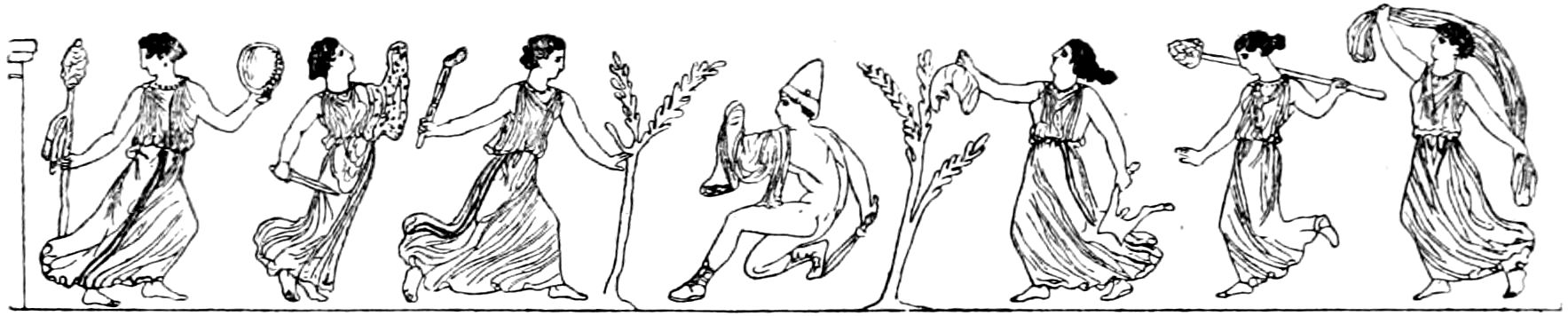
Pentheus, wearing chlamys, pilos, and boots, crouches,
with a drawn sword in his right hand, in a thicket
denoted by two trees. A maenad who appears to have
just discovered him rushes into the hiding-place with
a torch in her right hand[175]; she is dressed in a plain,
Doric peplos. Another maenad, similarly dressed but
having a fawn-skin over the left hand and a sword in
the right, does not seem to have sighted Pentheus.
A third, dressed like the first one, holding a tympanon
in the left hand and a thyrsos in the right, approaches
wholly unconcerned with the discovery of her companions.
On the right is another group of three maenads
all dressed alike and all in rapid motion. The first
holds in either hand the quarters of a kid or roe. The
second shoulders the thyrsos with her left hand and
makes an ecstatic gesture with her right. The third
one, in even more violent motion, swings her veil about
her and rushes on towards the left.
93It should be noted, to begin with, that the vase is
a Lower Italy fabric of the fourth century B.C., and that
there is therefore no chronological difficulty in placing it
under the influence of the Bakchai. The troop of maenads
is arranged symmetrically, an equal number being on
each side of the central scene, and this suggests the
chorus in the play. The striking feature is the introduction
of the landscape; there is no doubt as to
where the catastrophe occurs. The artist did not allow
himself the licence of placing Pentheus in the tree, for
this had been too grotesque a sight for the fourth-century
painter. The frequent references to the thicket[176] and
the protection it was or the inconvenience it caused,
is happily brought out in the picture, but the poet has
not been followed in details. Pentheus does not appear
with the thyrsos, talaric chiton, and dishevelled hair, for
the simple reason that he would have been indistinguishable
from the maenads. As he appears in the painting
the contrast is striking and the eye at once grasps
the situation. The torch held by the foremost maenad
lights the way to the retreat of Pentheus, suggesting the
words—
καὶ πρὸς οὐρανὸν
καὶ γαῖαν ἐστήριζε φῶς σεμνοῦ πυρός. v. 1082 f.
That one is armed with a sword while the others have
no weapon finds also a parallel in Euripides, who says
one time that they used nought but their hands—
χειρὸς ἀσιδήρου μέτα. v. 736.
and again that the sword shall do its work—
ἴτω ξιφηφόρος. vs. 992, 1012.
94The wild revelry of the whole is instructive when studied
with the poet. The Bacchanal who flaunts the quarters
of her victim reminds one at once of the words—
ἀγρεύων | αἷμα τραγοκτόνον, ὠμοφάγον χάριν. v. 138 f.
In conclusion, reference should be made again to the
newly discovered wall painting in Pompeii. It is so
remarkably preserved and so thoroughly in the spirit
of Euripides that there can be little doubt as to the
influence of the Bakchai[177]. The only Pentheus painting
recorded in classical literature was that in the Dionysos
temple in Athens, which may also have been inspired
by Euripides[178]. Is the Pompeian painting an echo of
the celebrated one in Athens?
The Hekabe is one of those plays which, like the
Andromache, embraces a series of events loosely associated.
There are in fact two distinct parts to this
tragedy, having no other connexion than one would
observe between two separate works where the same
heroine appeared. Two heavy blows which the Fates
dealt Hekabe after the fall of Troy constitute the subject
of the action.
The first of these new calamities was the death of
Polyxena. The Greeks are encamped on the Chersonesos
side of the Hellespont. Among the captives
95are the former queen of Troy and her daughter.
Achilles, who is among the shades, demands of the
Greeks that Polyxena be sacrificed to him. The request
cannot be ignored, and Odysseus and others are commissioned
to secure her from her mother. The parting
scene between Hekabe and the daughter is heartrending,
but the courage and self-control exhibited by the latter
are remarkable. Talthybios, the faithful herald of
Agamemnon, afterwards reports to Hekabe the details of
the sacrifice, and this description of the fair and innocent
Polyxena is one of the gems of Greek literature. The
lines in particular which describe her actions immediately
before the fatal moment are famous for their beauty.
Although the offering of Polyxena was known in Greek
art and letters before Euripides’ time[179], the subject must
have been far more popular after the production of
this tragedy. It appears to me a mere accident that no
vase painting representing the scene has so far come to
light. There is, however, on a so-called ‘Megarian
Bowl’ a relief decoration, probably dating from the
third century B.C., which doubtless owes its existence
to Euripides[180]. It has seemed to me desirable to include
96this here, even though it carries us beyond the limits
prescribed to the present work. The cup, found in
Thebes, is in the Berlin Antiquarium[181]. The middle of
the composition represents the tumulus of Achilles, above
which is raised a stele with akroteria and a fillet. On
the left, Polyxena, with exposed bosom and flowing
hair, kneels with extended arms. Approaching her is
Neoptolemos wearing a chlamys and holding his sword
ready for the fatal stroke; behind the latter is a figure
in a short undergarment, mantle and pilos. The cap
distinguishes the person as Odysseus. Agamemnon sits
with back to the beholder upon the extreme left, and
lifts his left hand (not his right hand as Robert says),
evidently astonished at the remarkable composure of
the victim. On the right of the tomb are three warriors,
who are more or less closely connected with the others.
The first one appears to raise his hand in wonder at the
fortitude of Polyxena; the second, who does not seem
to be armed, has the appearance of one weeping; the
third is apparently little interested in the tragedy. It
97is not necessary to name these three persons, evidently
representatives of the Achaeans. The first one may
perhaps be Talthybios, since he says he was present
(v. 524). The dolphins upon the vase are meant no
doubt to characterize the sea-shore where the sacrifice
took place.
The essential part of the composition is, however, the
tumulus and the figures on the left. Everything here
illustrates Euripides. One reads in v. 221 of
... ὀρθὸν χῶμ’ Ἀχιλλείου τάφου.
The attitude of Polyxena is based upon the beautiful
verses in the messenger’s speech:—
λαβοῦσα πέπλους ἐξ ἄκρας ἐπωμίδος
ἔρῥηξε λαγόνος ἐς μέσον παρ’ ὀμφαλόν,
μαστούς τ’ ἔδειξε στέρνα θ’ ὡς ἀγάλματος
98κάλλιστα, καὶ καθεῖσα πρὸς γαῖαν γόνυ
ἔλεξε πάντων τλημονέστατον λόγον·
‘ἰδοὺ τόδ’, εἰ μὲν στέρνον, ὦ νεανία,
παίειν προθυμεῖ, παῖσον, εἰ δ’ ὑπ’ αὐχένα
χρῄζεις, πάρεστι λαιμὸς εὐτρεπὴς ὅδε.’
ὁ δ’ οὐ θέλων τε καὶ θέλων, οἴκτῳ κόρης,
τέμνει σιδήρῳ πνεύματος διαρῥοάς. vs. 558–567.
Even the hesitation of Neoptolemos, expressed in the
last two verses, finds its place in the relief. Odysseus,
who was intimately identified with the proceedings from
first to last (vs. 218–437), could not be wanting in an
illustration of the final scene. Agamemnon too is fittingly
present, for, according to Euripides, he had given
the order to carry out the sacrifice,
Ἀγαμέμνων τ’ ἄναξ
εἶπεν μεθεῖναι παρθένον νεανίαις. vs. 553 f.
and had dismissed Talthybios to Hekabe (v. 504).
The second part of the play begins with v. 658, where
the servant of Hekabe enters with the body of the latter’s
young son Polydoros. Priam had intrusted the boy to
Polymestor, king of Thrace, when the Greeks attacked
Ilion. A considerable sum of gold accompanied the
child to ensure his maintenance if the city should be
captured. As long as the Trojans held out, Polymestor
was true to his charge, but no sooner had the news of
the downfall of Priam’s house reached the ears of the
good Thracian than he put the child to death for
the money and cast his body out unburied. This is
related in the prologue by the ghost of Polydoros, who
also prophesies the death of Polyxena on that day.
His body was accordingly discovered by the attendant,
who happened upon it by mere chance, and immediately
99after receiving the terrible message from Talthybios,
Hekabe was made to bow beneath another sorrow. She
at once summons her courage and determines to have
revenge upon the unrighteous Polymestor. She first
relates to Agamemnon the story of the boy’s death, and
the king, deeply incensed at the ἀξενία of the Thracian,
agrees to her plan for avenging herself on the latter.
She sends for Polymestor under the pretence of disclosing
to him some weighty matter. He comes, and at her
request dismisses his bodyguard, not mistrusting in the
least that his crime had been discovered. To questions
as to the welfare of Polydoros and the safety of the gold
he replies that all is well and that the child would gladly
have come to visit his mother. Hekabe then proceeds
to tell him of some treasures which she wishes to commit
to his keeping. These are in the tent, and he shall go
inside and examine them for himself. ‘No Achaean is
within; we are quite alone,’ she says, and with this
assurance Polymestor leaves the light of day for ever.
Once inside, his cries of agony soon announce that
Hekabe has done her work with swift and certain
hand.
The scene representing the reappearance of the blinded
Polymestor has been recognized on a Lucanian vase[182].
In the middle stands the helpless king, his arms extended
in a distressed manner. He is dressed in a short,
embroidered chiton and a mantle, and wears a tall
head-gear that indicates his barbarian nationality. Agamemnon
is on the left, with sceptre and himation; he
appears to be addressing the former. Following is a
doryphoros. On the right are Hekabe and an attendant,
100both dressed in chiton and mantle. The latter places
her arm over Hekabe’s shoulder and seems to be comforting
her, as she shrinks away from the figure in the
centre. The cane is suggestive of the queen’s age and
of the wandering life upon which she is entering. A sword
rests upon the ground, pointing probably to the weapon
which was used to blind Polymestor. It is not necessary
to cite any particular verses from Euripides which the
artist may have had in mind. He simply told the story
as it recurred to him. Especially suggestive of the
king’s staggering step are the verses beginning
ὤμοι ἐγώ, πᾷ βῶ,
πᾷ στῶ, πᾷ κέλσω; vs. 1056 ff.,
spoken when Polymestor first appeared before the tent
of Hekabe after the latter had put out his eyes. The
chorus, Agamemnon, and Hekabe are then present, and
with alternating parts fill out the rest of the play
(vs. 1109 ff.).
101
In the Phaidra of Sophokles and the first Hippolytos
of Euripides it was Phaidra herself who acknowledged to
Hippolytos her love for him. The votary of Artemis,
at once enraged at this effrontery, cast her aside. She
then defamed the youth to Theseus, who, believing her
statement, prayed to Poseidon to destroy his son. The
god accordingly sent a sea-monster to frighten the
horses of Hippolytos, and the latter was soon dragged to
his death. On receiving the news of this, Phaidra hung
herself[183]. Sophokles’ play does not appear to have ever
made any impression upon the world and must have been
soon forgotten, and Euripides’ tragedy met with great
disapproval. Such a Phaidra was more than the Greeks
would tolerate. The poet grasped the situation and
wrote another Hippolytos, which set him right with his
public. It was no longer Phaidra in and of herself who
became the instrument of the youth’s death; Aphrodite,
angered at Hippolytos’ serving Artemis instead of herself,
starts the gentle flame within Phaidra’s bosom and
visits her with a love-sickness that drives the unfortunate
woman into a confession of her illness to her attendant.
On the latter’s placing the matter before Hippolytos, all
to no avail, Phaidra takes her own life, not forgetting, however,
to leave behind a letter containing delicate charges
against her step-son. Theseus returns, finds his wife
a corpse, and reads the letter. The curse and death of
102his son follow, as in the earlier Hippolytos. This ruin was
brought on him not so much by Phaidra as by Aphrodite.
The tragedy was counted among the best of Euripides’,
and has always retained its popularity. The
subject was dramatized again in Greek[184], and there is
extant the Latin version of Seneca[185]. The theme was one
which was sure to appeal to modern authors, and among
the French alone one hears of no less than seven tragedies
on the love of Phaidra, written between the years 1573
and 1786. Four of these, the most famous of which is
Racine’s Phèdre, belong to the seventeenth century.
They are, however, more directly indebted to Seneca
and Ovid[186] than to Euripides. Mention should be made
also of the two operas by Pellegrin, 1733, and Lemoine,
1786. But after all has been said on versions of the story
either in classical or modern times, one turns to the
masterpiece of Euripides as the great work. According
to the author of the Hypothesis, the play is among the
best of this poet and was given the first prize. In
reflecting that Hippolytos has stood forth since March,
428 B.C., as the beau idéal of innocent, unsullied, young
manhood, one is inclined to credit the judges with
possessing good sense.
There was hardly a more attractive legend than this
which the artists might have been tempted to make
their own, yet one discovers a surprising dearth of Greek
monuments that can be referred to the myth. From
these I select two vase paintings that appear to be based
upon Euripides.
103
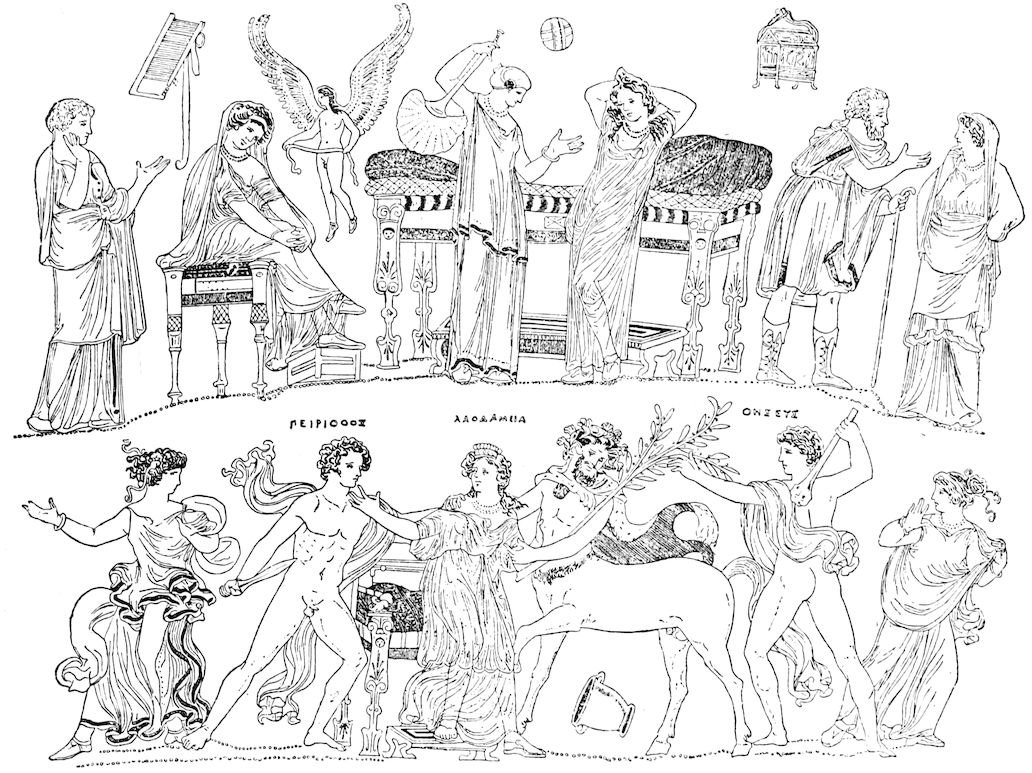
Fig. 14 (vid. p. 102 ff.).
104Fig. 14 represents a painting on a krater in the British
Museum[187]. The upper section alone concerns us here, and
this shows the interior of a gynaikonitis with kline. On
the left is a group of two females. One sits on a stool
to the right, wears chiton and veil, diadem, bracelets, and
necklace, and leans forward, with head dropped to one
side, clasping her right knee thrown over the other.
Her left foot rests on a foot-stool. Behind her a white-haired
servant in the usual costume holds her right hand
to her chin, and with troubled air gestures with the left
hand as she speaks to her mistress. A large Eros with
immense wings flies down towards the latter with a taenia
in his hands. There are, further, two other groups of
two each. The one before the kline is two females again.
An attendant, distinguished by her hood, who holds
a fan in her right hand, talks and gestures earnestly
before the other, who wears the simple Doric peplos,
ungirdled, and stands with her back to the kline in
a disturbed and troubled sort of mood. The remaining
group of two, a pedagogue in the customary dress and
a female figure similar to the one on the extreme left,
is also concerned over some important matter which the
pedagogue is telling. Certain articles hang on the wall.
The picture has been interpreted as representing
Phaidra in the presence of the chorus, and depending
upon Hippolytos vs. 267 ff. The right-hand group would
then be very loosely connected with the rest. In so far
as the love-sickness of Phaidra is concerned this appears
105to me a correct interpretation, but that the chorus is in
any way represented by the other figures is entirely out
of the question. The whole affair is supposed to be in
Phaidra’s apartments, to which at no time the Troizenian
women had access. What would they be doing by the
kline[188]? The pedagogue is added on one side, as though
to indicate how the news is spreading among the
domestics[189].
But let me turn for a moment to another class of
monuments that help to a better understanding of the
scene. There are no less than seventeen reliefs on
the long side of Roman sarcophagi which are practically
intact and furnish from two to three scenes of the
tragedy. Less frequently the ends contain one or two
other groups supplementing the front side[190]. There are
four moments that are distinctly traceable. (1) The
love-sick Phaidra sits on a chair in her apartments surrounded
by the old nurse and other servants, who attempt
to comfort her. She wears a veil as on the vase painting,
and on two reliefs one of the attendants is removing
this[191]. The diadem is also distinguishable. (2) The
nurse makes her declaration to Hippolytos, who turns
away from her. (3) Hippolytos with his followers is
106about to start upon, or is already engaged in, the hunt.
(4) The horses run away and bring him to his death.
All four scenes occur on the famous sarcophagus in
Girgenti[192], and on another in St. Petersburg[193]. It will
be observed that in three of the four groups Hippolytos
himself is present, and one naturally looks for him in
scenes taken from the tragedy where he is the main
figure. The earliest scene in Euripides which develops
the hopeless state of affairs with Phaidra is, however, of
prime importance next to the death of Hippolytos.
But a brief comparison of the left-hand group of our
painting and the Phaidra scene on these reliefs is
necessary, in order to reveal a striking resemblance in
the compositions. The one difference rests in the size
of the groups; the painter has confined himself to fewer
figures. This fact, however, is of little importance.
A closer examination of the two discloses much that
points to a common source. On nearly all the reliefs
Phaidra’s chair has, as in the painting, no back or arms;
Eros, who flies towards Phaidra in fig. 14, invariably stands
beside her on the sarcophagi, looking up into her sad
face, or, what is still worse, aims an arrow at her[194]. The
queen wears in all cases the veil, and often on the reliefs the
diadem likewise[195]. The nurse never fails in her ministry.
It is time now to look more closely at the tragedy.
After the prologue by Aphrodite, Hippolytos and his
107followers enter and pay their homage to Artemis. The
hero lays a wreath upon her statue, which adorned one
side of the entrance to Pittheus’ palace. The attendants
are ordered inside and he then withdraws. His servant
remains long enough to address a prayer to Aphrodite’s
image on the other side of the stage. Following is the
parodos in which the chorus relates what had been
learned concerning the illness of Phaidra. Among other
things they hear that she sits
... λεπτὰ δὲ φάρη
ξανθὰν κεφαλὰν σκιάζειν. v. 133 f.
This, it will be observed, corresponds to her position in
the painting and in the reliefs. It is just this time of
abstinence and mourning, spent in the palace surrounded
by the faithful old nurse and other servants, which
suggested the scene on the reliefs and on the vase. The
visitations of Eros serve well to bring into objectivity
the real cause of Phaidra’s illness, and to render the poet
more plain. To be sure this all took place in her
apartments, ἐντὸς οἴκων (v. 132), and could therefore be
worked out according to the artist’s fancy. A long and
animated scene ensues, in which Phaidra utters strange
expressions that betray the sadness of her condition.
The trophos finally coaxes the secret from her, and the
chorus dips in from time to time as a sort of second to
the nurse. The interview which the latter has with
Hippolytos, vs. 601–668, is overheard by Phaidra. Her
unrequited love bears her down and she leaves the stage
determined to die (v. 731), and in a few moments is
announced as dead[196].
108The scenes on the sarcophagi representing Hippolytos’
hunt, the counterpart of Phaidra’s illness, and the
trophos’ proposal[197] to the hero do not appear on vases.
Hippolytos’ ride to death, the terrible finale of the
tragedy, appears on an Apulian krater also in the British
Museum[198]. The painting falls into an upper and lower
section. In the latter, Hippolytos dashes along in his
chariot; the four horses are not in any apparent disorder
although the next moment must be fatal, for just before
them the sea-monster rises into view, and a Fury with
a flaming torch and serpents wound about her arms runs
into their course. A pedagogue hurries along from the
rear, extending his left hand, warning Hippolytos of his
danger. The scene is viewed by five divinities. Their
positions are the stereotyped ones of the Apulian vases,
and their connexion with the tragedy before them need
not be intimate[199]. Athena in the middle, a great favourite
in these groups, leans on her shield and carries a lance
and in her right hand the helmet. Apollo, distinguished
by bow, laurel bough, and wreath in the hair, sits on her
right, facing Pan who stands half reversed to the beholder
with the syrinx in the right hand, and resting his left
elbow on a rock. On Athena’s left sits Aphrodite,
attended by a large Eros, who extends a kylix to
Poseidon sitting on the right, holding the trident.
There is certainly ample reason for the presence of the
last two gods at the death of Hippolytos; they are, in
fact, very instrumental in bringing about the catastrophe.
I am not able to assign any satisfactory reason for the
appearance of Athena, Apollo, and Pan. Mere speculation
concerning the choice of these deities cannot be of
much value. Artemis is surely indispensable in a group
of gods concerned with Hippolytos’ death. Any one
who knows these groups on the vases of Lower Italy is
aware that Athena is a great favourite and often appears,
as here, merely because she was so admired. Perhaps
Apollo is intended to represent Artemis, but it is not
likely that the artist thought so far[200].
109
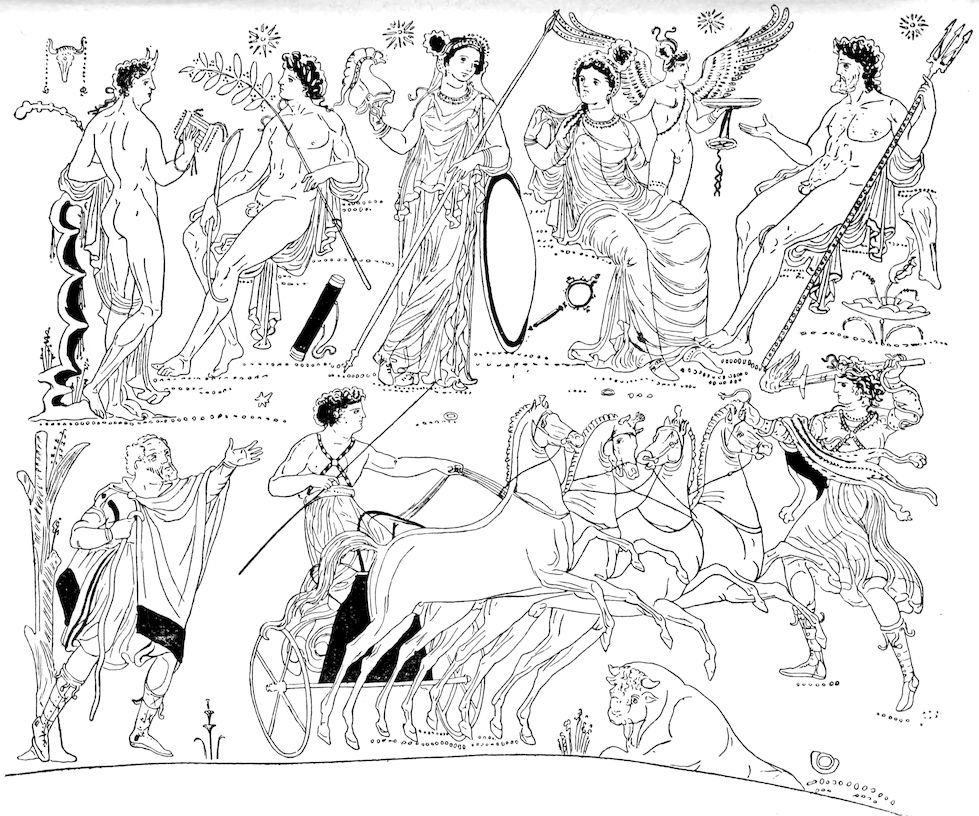
Fig. 15 (vid. p. 108 ff.).
110In regard to the lower section it may be observed
first that the district is not denoted in any way as being
the sea-shore where Euripides sends the youth for a
drive[201]. There is no water indicated, out of which the
ταῦρος ἄγριον τέρας[202] is issuing. The mounted companions
111of Hippolytos are represented only by the
pedagogue. The time is that just preceding the breaking
away of the horses described by the messenger, vs. 1218 ff.
The Fury, a gratuitous addition of the artist, serves to
intensify the violence of the death awaiting Hippolytos.
The deplorable end of the hero has never failed to
awaken one’s sympathy. The innocent youth dragged
to his death through the workings of a hasty and unjust
curse presents one of the most pathetic pictures in Greek
literature. It is well depicted by Philostratos in the
Imagines[203]. ‘You see,’ he says, ‘how the horses no
longer obey the reins but rush madly along the plain,
covered with foam. This one makes for the wild beast,
the second rebounds, another rushes for the sea, and the
fourth glances fearfully at the ground.’ The breaking
and crashing of the chariot are pointed out. Then the
companions gallop up and try to manage the horses.
The hills near by, sentinels of the disaster, in the form
of women, tear their cheeks for grief; the meadows, in
the form of boys, allow their flowers to wilt and the
nymphs from the springs rend their hair, while water
spouts from their breasts. Hippolytos’ limbs are torn
and shattered, and his eyes are gouged from their sockets.
Pliny tells of a painting by Antiphilus of Alexandria
which represented Hippolytus tauro emisso expavescens[204],
but nothing further is known of Antiphilus or when he
lived. The sarcophagi reliefs representing the catastrophe
are numerous, compared with those showing any other
moment[205]. Not less interesting is the list of Etruscan
urns decorated with reliefs showing the bull, the runaway
112horses, and the expavescens youth[206]. In all of these
a female figure, doubtless a Fury, is frightening the
horses[207]. In two cases she is winged, and every one
carries a torch likewise, as on the vase painting.
The story of Iphigeneia’s sacrifice appears to have
been told first in the Kypria, and yet only occasional
references are made to it by writers before the fifth
century. It was the drama that infused new life into the
myth and launched it as one of the most popular ones in
the Trojan Cycle. Each of the three great tragedians
tried his hand at the catastrophe in Aulis. Euripides’
work, the only one surviving, is at least two generations
younger than the play of Aischylos, so that the wide
popularity of the tragedy in this period is well attested.
Among the Roman poets we know that Ennius, at least,
wrote a version of the tragedy. Although it is known
that this poet had a special predilection for Euripides,
and for the most part translated or adapted the latter’s
plays, attempts have been made to show that in his
Iphigenia Ennius was largely indebted to Sophokles[208].
The few fragments remaining from these three Iphigeneias
are, however, inconsiderable, and a clear notion of their
relation to each other cannot be reached. The extant
work of Euripides is accordingly of great value to us.
In art, likewise, this subject was rarely treated.
I know of no Iphigeneia monument earlier than the fifth
century. There is a reference in the Agamemnon to the
113sacrifice as though Aischylos may have seen the scene
represented in a painting[209], and granted that the poet
really had such a work in mind this becomes the earliest
date for Iphigeneia in art. The earliest monument of
which we possess any authentic record is the famous
painting of Timanthes, who was a contemporary of
Zeuxis and Parrhasios[210]. This date, however, does not
carry one beyond the last years of the fifth century B.C.—an
altogether late date for an art representation of
a myth, which, from Aischylos’ time at least, was widely
known. We have reason to believe that Timanthes’
work was suggested by Euripides’ tragedy. The latter
was first produced in Athens after the poet’s death, not
earlier than 405 B.C., and this requires that the painting
be placed near the end of the century, which many are
unwilling to admit; it is, however, more a matter of
opinion than proof. Traces of this celebrated picture
are very probably at hand in the well-known Pompeian
wall painting[211], and the Uffizi altar[212]. The composition
of the latter has much in common with such fifth-century
products as the Orpheus and Peliades reliefs[213]. The
Etruscan urns on the other hand furnish a wealth of
reliefs representing the sacrifice, rarely surpassed in
this class of monuments. Numbers have come to light
114in the neighbourhood of Perugia especially[214]. Two
groups are easily distinguishable, (1) Iphigeneia, as
a little girl, is held over the altar by Odysseus, while
Agamemnon goes through the ἀπαρχαί. (2) The first
group is extended by (a) Klytaimestra on the side of
Agamemnon, and (b) Achilles on the side of Odysseus,
each begging for mercy and the life of Iphigeneia. This
is all non-Euripidean, and Schlie has attempted to point
out that the reliefs owe their origin to Ennius’ play
which combined Sophoklean and Euripidean elements[215].
There is no vase painting which can be claimed for
this scene in its Euripidean character, but the whole play
is the basis of a relief on a ‘Megarian’ cup, and the
illustration is so valuable for the proper appreciation
of the tragedy that I do not hesitate to include this little
monument. The cup furnishes inscriptional evidence
not only for the dramatis personae but for the literary
source as well, and is, therefore, a unicum among the
monuments that are based upon Euripides. The cut
given in fig. 16 is of the vase in Berlin[216]. It should
be observed, however, that there are two other copies
of this same work, and that they tell exactly the same
story from the Iphigeneia[217]. A word is necessary in
order to prepare us for the first scene given. Agamemnon
had sent a message to Argos summoning Iphigeneia,
115and, in spite of his attempt to countermand this by
a secret letter to Klytaimestra, he was forced to face
the results of his earlier resolve. His daughter came,
and accompanying her were her mother and her young
brother Orestes. The nuptials were to be celebrated
with the son of Peleus, and the Argive party in gayest,
happiest mood halted before the tent of Agamemnon.
The Chalkian women, who through curiosity had crossed
the Euripos to see the gathered hosts of the Greeks,
are ready at hand to assist Iphigeneia in alighting from
the chariot. The lad Orestes, who appears to have
gone to sleep during the journey, is awakened and lifted
down by one of the kindly strangers. With her mother’s
permission, Iphigeneia hastens inside to meet her father[218]—she,
innocently happy over the arrival of her wedding
day—he, overcome with grief at her impending death,
and smitten with remorse at the enormity of his crime.
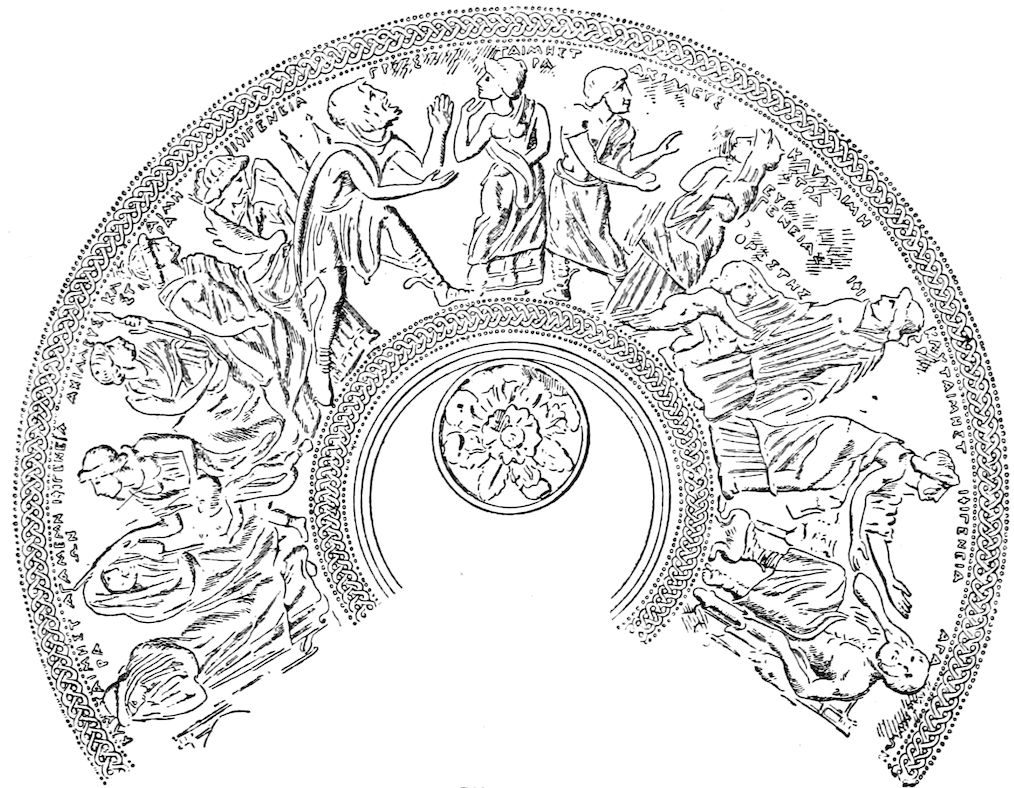
116This much renders plain the group on the right. Agamemnon,
ΑΓΑΜΕΜΝΩΝ, sits upon his θρόνος with
one foot on a foot-rest; his right hand is placed to his
temple as though to shut out the gaze of Iphigeneia,
ΙΦΙΓΕΝΕΙΑ, who approaches him in a beseeching
manner with extended arms. The group is based upon
vs. 644 ff.—
Iph. ἔα·
ὡς οὐ βλέπεις ἕκηλον, ἄσμενος μ’ ἰδών.
Aga. πόλλ’ ἀνδρὶ βασιλεῖ καὶ στρατηλάτῃ μέλει.
Iph. μέθες νυν ὀφρὺν ὄμμα τ’ ἔκτεινον φίλον.
κἄπειτα λείβεις δάκρυ’ ἀπ’ ὀμμάτων σέθεν;
Such is the situation described by the poet, and surely
the artist has succeeded to a considerable degree in
grasping the meaning of the scene. Klytaimestra,
ΚΛΥΤΑΙΜΗΣΤΡΑ[219], appears on the left with Orestes,
ΟΡΕΣΤΗΣ, and would seem to have had the boy
in charge after he was helped from the chariot (vs. 621 f.).
Following is the inscription, ΕΥΡ[ΙΠΙΔΟΥ] ΙΦΙΓΕΝΕΙΑΣ.
The genitive case in the last word may depend upon
some such word as τύποι. To avoid a possible misunderstanding
of the scenes, even with the characters
117named each time, the artist considered it advisable
to add the literary source. This is the Iphigeneia of
Euripides and not of any other poet.
After Iphigeneia leaves her father he endeavours to persuade
Klytaimestra to return to Argos and leave the final
arrangements for the nuptials in his charge. Naturally
enough she refuses, and retires to appear at v. 819, where
she meets Achilles and enthusiastically brings up the
subject of the marriage. Achilles, amazed at the disclosure,
assures the queen that he has neither wooed
Iphigeneia nor heard aught from the Atreidai concerning
any such an alliance. This scene is represented in the
next group. Achilles, ΑΧΙΛΛΕΥΣ, bends toward Klytaimestra
and gestures emphatically. The latter holds her
hand to her chin and is evidently dumbfounded by
the declarations. The last words exchanged before the
two separate are suggestive—
Ach. ἴσως ἐκερτόμησε κἀμὲ καὶ σέ τις,
ἀλλ’ ἀμελίᾳ δὸς αὐτὰ καὶ φαύλως φέρε.
Kly. χαῖρ’· οὐ γὰρ ὀρθοῖς ὄμμασίν ς’ ἔτ’ εἰσορῶ,
ψευδὴς γενομένη καὶ παθοῦς’ ἀνάξια.
Ach. καὶ σοὶ τόδ’ ἐστὶν ἐξ ἐμοῦ· πόσιν δὲ σὸν
στείχω ματεύσων τῶνδε δωμάτων ἔσω. vs. 849–854.
Immediately after these words the faithful old servant
of Agamemnon comes out and relates to Klytaimestra
that Iphigeneia is to be slain by her father; he goes
further and tells the cause of it all, and how he had
failed to get away to Argos with the letter. This
meeting of the servant, ΠΡΕΣΣΒΥΣ, and the queen,
is dramatically told in the third group. The former
118wears the costume of a pedagogue, with peculiar-looking
boots. The latter has laid aside the veil which she
wears in all the other scenes.
The following groups on the relief reverse the order
of the text, so it is best to consider first that on the
extreme left. Agamemnon, Klytaimestra, and Iphigeneia
are all named. The young Orestes pulls at his
father’s chiton; the latter has a mantle over his head, and
shields his face with his left hand. The mother has turned
aside and is consumed with her deep sorrow. She had
won the sympathy of Achilles after the talk with the
old servant, vs. 896–1035, and following the choral song
appears again to seek Agamemnon whom neither she
nor Iphigeneia had seen since the terrible truth of the
marriage was disclosed. She calls her daughter from
the house, v. 1117, and bids her
λαβοῦς’ Ὀρέστην σὸν κασίγνητον, τέκνον.
All of these figures occur on the cup, so that in a
certain sense the whole scene from v. 1122 to v. 1275 is
illustrated. The position of Klytaimestra and Iphigeneia
would, however, lead one to think that the latter’s long
appeal was particularly in the mind of the artist. She
recounts in words, as eloquent as they are pathetic, the
promises her father had once made to her as a child,
and goes over all the ambitions that had filled her
girlish heart in the happy Argive home.
βλέψον πρὸς ἡμᾶς, ὄμμα δὸς φίλημά τε,
ἵν’ ἀλλὰ τοῦτο κατθανοῦς’ ἔχω σέθεν
μνημεῖον, εἰ μὴ τοῖς ἐμοῖς πείθει λόγοις.
ἀδελφέ, μικρὸς μὲν σύ γ’ ἐπίκουρος φίλοις,
ὅμως δὲ συνδάκρυσον, ἱκέτευσον πατρὸς
τὴν σὴν ἀδελφὴν μὴ θανεῖν· αἴσθημά τοι
119κἀν νηπίοις γε τῶν κακῶν ἐγγίγνεται.
ἰδοὺ σιωπῶν λίσσεταί ς’ ὅδ’, ὦ πάτερ.
ἀλλ’ αἴδεσαί με καὶ κατοίκτειρον βίον.
ναί, πρὸς γενείου ς’ ἀντόμεσθα δύο φίλω·
ὁ μὲν νεοσσός ἐστιν, ἡ δ’ ηὐξημένη. vs. 1238–1248.
There is certainly inspiration enough in these verses
for a more pretentious group than the simple terra cotta
cup presents, but lacking all other Greek monuments
bearing upon this scene one may prize this witness
as a valuable inheritance from the Hellenistic period.
Agamemnon speaks; he loves his child and realizes
full well the meaning of the sacrifice, but he must obey
the clamourings of the Greeks.
Iphigeneia and her mother remain alone with the
chorus and bewail the bitterness of their sorrow, vs.
1276–1345, when a company of men is observed approaching.
Among them is Achilles. His attempt
to intercede in behalf of the doomed Iphigeneia had
been of no avail. The Achaeans were inexorable; her
blood must be spilt. Nevertheless he promises them
his assistance, and encourages Klytaimestra to resist
Odysseus and the others who come to drag her daughter
away to the altar, vs. 1338–1433. The early part of
this scene is recognizable in the remaining group.
Iph. διαχαλᾶτέ μοι μέλαθρα, δμῶες, ὡς κρύψω δέμας.
Kly. τί δέ, τέκνον φεύγεις;
Iph. Ἀχιλλέα τόνδ’ ἰδεῖν αἰσχύνομαι.
Iph. τὸ δυστυχές μοι τῶν γάμων αἰδῶ φέρει.
Kly. οὐκ ἐν ἁβρότητι κεῖσαι πρὸς τὰ νῦν πεπτωκότα.
ἀλλὰ μίμν’· οὐ σεμνότητος ἔργον, ἢν δυνώμεθα.
Ach. ὦ γύναι τάλαινα, Λήδας θύγατερ. vs. 1340–1345.
120Achilles stands with staff in hand, either about to
address the mother or perhaps having uttered the last
verse above. Iphigeneia turns with bowed head to
avoid his presence; her mother evidently tries to detain
her. Inscriptions again indicate who the persons are.
We have then precisely the situation in the lines quoted.
The sacrifice which followed, was attended by the
marvellous wonder, and it was to be expected that if
any one incident of the tragedy was told in art it would
be the scene at the altar. Our little monument curiously
enough stops where all the others begin. We are taken
step by step up to the final act and there we are left.
The works enumerated above[220] are, without exception,
confined to the moment of the sacrifice. The famous
wall painting and the Florence altar have much in
common with the renowned painting of Timanthes, and
all three are conceived in the spirit of Euripides as far
as the actions of Agamemnon are concerned.
... ὡς δ’ ἐσεῖδεν Ἀγαμέμνων ἄναξ
ἐπὶ σφαγὰς στείχουσαν εὶς ἄλσος κόρην,
ἀνεστέναζε, κἄμπαλιν στρέψας κάρα
δάκρυα προῆγεν, ὀμμάτων πέπλον προθείς. vs. 1547 ff.
And so he stands completely wrapped in his mantle,
exposing no part of his face. In this invention lay
the unsurpassed success which Timanthes enjoyed with
his painting. The dates for this artist allow us to place
the work subsequent to the production of the Iphigeneia
in 405 B.C., and credit Euripides with influencing Timanthes.
This is at least possible, but does not admit
of proof. It appears to me very likely that all three
of these works are more or less closely connected with
121each other and with Euripides. The Etruscan ash-urns on the other hand, as well as the vase painting
in the British Museum[221], follow a totally different version
of the story. In these cases Agamemnon himself takes
the part of the priest in the ceremony, and performs
the ἀπαρχαί. So far from being the tender-hearted
father who cannot even stand and watch the offering, he
draws the fatal knife or pours the sacrificial liquid upon
the victim’s head. Traces of this turn are found early
in tragedy[222], but this is an Agamemnon with a far
different heart from the one we follow in the Iphigeneia
of Euripides. Even though the part from v. 1532
till the close of the play be thrown out as an interpolation,
the character of Agamemnon in the first 1500
verses could not have changed so suddenly at the end
that he would have taken the place of Kalchas at the
altar. This set of monuments does not, therefore, give
us the Euripidean spirit.
Euripides in all probability created in the life of
Iphigeneia the chapter concerning her return to Greece
with Orestes. There is at any rate no trace of this turn
in preceding authors. Homer does not appear to have
known any such a daughter of Agamemnon, unless one
is to seek to identify Iphigeneia with Iphianassa. The
‘king of men’ speaks of
Χρυσόθεμις καὶ Λαοδίκη καὶ Ιφιάνασσα. Il. 9. 145.
as his three daughters. We know, however, from
122Sophokles[223] that Iphianassa was distinguished from
Iphigeneia. Since Homer has not even her name there
is no allusion to the catastrophe at Aulis. It is first
in the Kypria[224], a work usually accredited to Stasinos in
the early part of the eighth century B.C., that reference
is made to the gathered hosts at Aulis, the calm, the
sacrifice. It was not Iphigeneia, however, who was the
victim, for Artemis had suddenly intervened and, having
taken her away to the Black Sea country, had blessed
her with immortality. From this date then the myth
may have been widely spread among the Greeks.
Hesiod related in his Κατάλογος γυναικῶν that Iphigeneia
had received the gift of immortality from Artemis, thus
following closely the author of the Kypria[225]. Herodotos
also repeats the same story[226]. One looks in vain for
any trace of her delivery from this wild people, until
the latter part of Euripides’ life. Then it is that new
light breaks in upon the old orthodox form of the myth:
the mortal side of Iphigeneia is made to assume a new
interest for the world, and she, who had been long lost
amidst a wild, barbarous people, is suddenly restored
to her only hope, Orestes. This is the work of ‘Euripides,
the human, with his droppings of warm tears.’
With this tragedy the poet created at once a definite
chapter in dramatic literature and furnished another
impetus for ancient art.
There are traces of two other Greek tragedies dealing
with this same subject; yet the play of Timestheos is
a mere name[227], while that of Polyeidos is but little more.
Aristotle, however, has given a certain prominence to
123the latter work by making two references to it in his
Poetics[228]. This differed from the play of Euripides
particularly in the recognition scene. The ἀναγνώρισις
was brought about by Orestes using the words ‘and
shall I too be sacrificed?’ Who but Orestes was likely
to know aught of the attempt once made to sacrifice her
at Aulis? It is worthy of note that the libretto of
Glück’s opera also follows this manner of the dénouement.
Among the Latin dramatists we hear that Naevius
wrote a play called Iphigenia. One verse only is
preserved[229]. It goes without saying that the tragedy
was taken from the Greek, but from what author it is
worthless to conjecture. The Dolorestes of Pacuvius was
long thought to deal with the same subject, but this
has been shown to be of an entirely different character.
It is altogether improbable that these Latin versions
worked any radical change in the Euripidean form of
the myth. It is true that the story was remodelled in
some particulars; Hyginus, e.g. in fabula 261, relates
that the bones of Orestes had been brought from Aricia
to Rome and had been interred before the temple of
Saturn! Such a violent contortion of the myth may be
laid to the credit of a poet[230], but I would prefer to
recognize in the words of Hyginus the influence of the
mythological handbooks which were written up in
a manner well calculated to pamper the national pride
of the Romans.
In no work written subsequent to Euripides is it
possible to detect the sources for the representations
of the myth in art; in all cases the poet of the fifth
century B.C. can be shown to have wielded his absolute
124power. We shall see in the discussion of the vase
paintings based upon the play that this class of monuments
is not the only one in which the new Iphigeneia
found her place. The Etruscan urns and mirrors, the
wall paintings of Pompeii and of Herculaneum, the
Roman sarcophagi, as well as pastes and gems, all
furnish an extensive field in which parallel scenes may
be traced.
This introduces the consideration of the vases and
their relation to the tragedy. They fall readily into
three classes corresponding to three well-defined stages
in the play: 1. Orestes and Pylades alone upon the
Taurian coast are surprised, and led by the shepherds
to the king and Iphigeneia (vs. 67–466). 2. The scene
following, in which it is determined that not both shall
be killed, but that one, and he Pylades, shall be allowed
to return to Mykenai, bearing a message from Iphigeneia
(vs. 467–724). 3. The handing over of the letter and the
accompanying explanation, whereby Orestes and his
sister recognize each other (vs. 725–1088). There follow
two other well-defined scenes which are not traceable on
vases[231]. 4. The escape with the Artemis idol (vs. 1152–1233),
and 5. the messenger’s speech which relates the
manner of the escape.
There is but one vase painting that can be assigned to
the first step in the play. The painting is a thoroughly
ugly and, from an artistic standpoint, worthless specimen
that represents the very decadence of ceramic art[232].
The vase is a slender amphora with three zones of
125pictures; ours is the middle one. On the left a woman
in chiton and mantle sits with head turned to the right,
her left hand resting on a sceptre or staff and her right
on her knee. She wears a necklace and on one arm
a bracelet. Standing before her with outstretched right
hand is a bearded male figure in short chiton and mantle,
and a spear in his left; he has just arrived, as one may
conclude from the position of his feet. Immediately
following are two youths entirely naked, hands pinioned
behind their backs. The ends of the ropes seem to be
held by the group of three youths following, who are
dressed as the first male figure except that two of them
wear boots. Their attention, like that of all, is directed
towards the female figure.
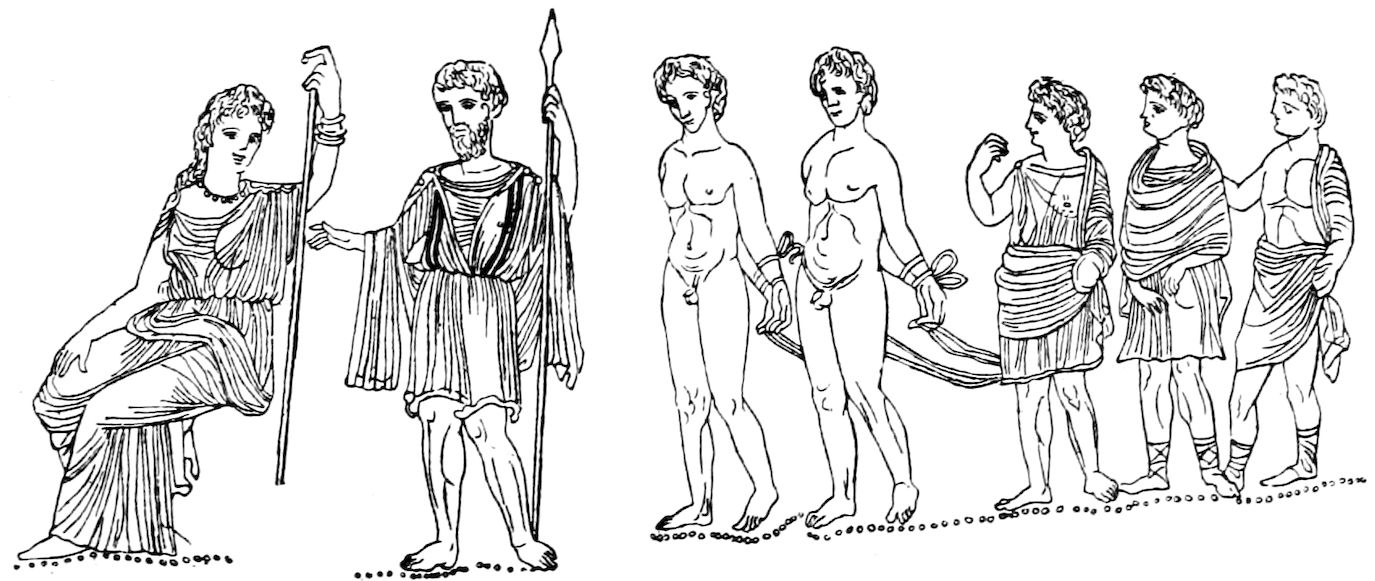
The arrest of Orestes and Pylades is given here, and
more definitely their appearance before Iphigeneia. To be
sure the manner is entirely different from that on other
monuments. One expects Iphigeneia to be in or near
the temple of Artemis and to be represented in a more
concerned and active attitude; and furthermore, one
looks for the altar (v. 72), and some indication of the
126fate which awaits the captives. All these features are
wanting. That the artist endeavoured to represent the
meeting of the priestess and the two Greeks can, however,
admit of no doubt; that the necessary setting of the
scene was omitted need be no more a matter of surprise
to one than the helpless workmanship of the whole.
The monument is valuable as being the only vase
painting showing the first scene, which is never wanting
on the sarcophagi[233]. This moment occurs likewise on
certain other monuments[234]. The shepherd relates (vs.
260–339) how the discovery and capture were made;
how they learned that one of the two was named
Pylades; and further that the prisoners had been conducted
first to the king, who after glancing at them
(ἐσιδών) sent them to Artemis and her priestess.
Iphigeneia says to the boukolos in v. 342, σὺ μὲν κόμιζε
τοὺς ξένους μολών, and in v. 467, after her soliloquy and
the song of the chorus, she appears again on the stage
where she meets the captives. This is the moment,
very largely modified, which the painting represents.
Iphigeneia’s first words are—
μέθετε τῶν ξένων χέρας,
ὡς ὄντες ἱεροὶ μηκέτ’ ὦσι δέσμιοι.
At this the guards are commanded to enter the temple
and make ready for the offering. Our picture follows
in one respect the traditional manner of representing
127the scene. Orestes and Pylades are invariably nude, or
so lightly clad with the chlamys that they are practically
naked. There is the closest analogy between them as
they appear here and as they occur on the sarcophagi.
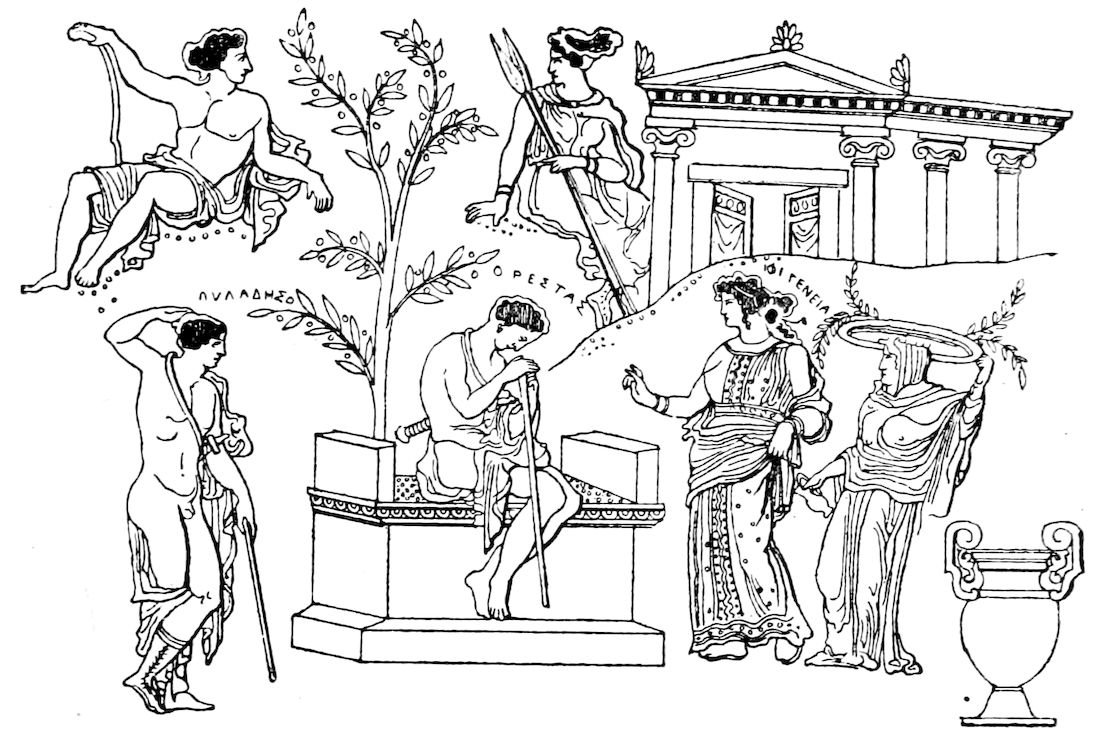
The second moment, as I have marked it out above,
is also represented on one vase only[235]. In the centre
Orestes, ΟΡΕΣΤΑΣ, sits to the right upon a large altar,
chlamys about his hips, sword on his left side, hands
supported upon his stick towards which his head is sunk.
The whole attitude betokens sorrow. On the right
128is Iphigeneia wearing long, sleeved chiton, and mantle,
necklace, and bracelets. In her left hand close by her side (incorrectly
published as a knife) is the temple key which
is emblematic of her office as κλῃδοῦχος[236]. Her right
is extended towards Orestes, with whom she is speaking.
She is accompanied by a temple servant who, entirely
wrapped in chiton and mantle, carries in her right an
oinochoë and upon her head a dish in which are articles
for the sacrifice, including the branches for sprinkling.
Behind Orestes is a laurel tree and on his right Pylades,
ΠΥΛΑΔΗΣ, standing with one foot thrown over the
other, his right hand placed sorrowfully to his head.
The left rests upon his staff. On his left side is a sword.
He is deeply concerned in the conversation. Above on
the right behind a terrain is the temple of Artemis,
Ionic order, and akroteria. Beside it on the left,
Artemis, distinguished by her huntress-mantle, two
spears, and hair-dress, sits with face to the left towards
Apollo who is the remaining figure on the vase. He
wears a garment around his waist, and rests his right
upon a cane and turns his face towards Artemis.
The vase is especially interesting as being the only
one on which any of the characters is accompanied by
an inscription, and secondly, because Orestes sits here
upon the altar. He cannot be thought of as a victim,
and I do not believe he has fled to the altar for refuge,
as has been suggested. That would comport but poorly
with the spirit which he exhibits throughout the interview.
Where does Orestes sit passively upon an altar
at the attack of the Furies? He invariably has his
129sword drawn in a very emphatic manner, and while he
crouches upon or clings to the altar he never gives any
appearance of being an easy victim to his pursuers[237].
Just this point it is necessary to emphasize, for had the
artist felt that the meaning of Orestes’ position indicated
his pursuit either by seen or unseen Furies, he never
would have committed the egregious error of placing
him in a calm attitude quite unconscious that he has
a sword ready at his side. Furthermore there is no trace
in Euripides or the painting to allow us to assume that
Orestes is again pursued at this point. He is not,
therefore, in any sense a suppliant. The vase painter
has simply allowed himself a great liberty in seating his
figure where we should least expect to find him. An
altar is not by any means a usual seat, and much less for
the victim[238]. This same freedom in disposing of details
led the decorator still further from the established usage,
for neither of the captives should be allowed their
swords. They are already ἱεροί (v. 469) and should be
represented accordingly. In these particulars we must
acknowledge that the painter idealized the scene (vs.
472 ff.).
If it were necessary to determine upon any one
moment which the artist had in mind, one would discover
a close parallel between vs. 625 ff. and the present
scene. It has been agreed that Pylades shall be the
messenger; Orestes is to die in his stead. The latter
130proceeds to ask who shall perform the sacrificial act, and
whether a tomb shall receive him when all is over. To
this Iphigeneia replies—
πῦρ ἱερὸν ἔνδον χάσμα τ’ εὐρωπὸν πέτρας.
and Orestes—
φεῦ·
πῶς ἄν μ’ ἀδελφῆς χεὶρ περιστείλειεν ἄν;
to which Iphigeneia remarks,
μάταιον εὐχήν, ὦ τάλας, ὅστις ποτ’ εἶ,
ηὔξω.
I can conceive of no more pitiable and hopeless condition
than that of the unfortunate Orestes which the poet
depicts. At this point his course seemed all in vain;
Apollo’s promise appeared to be a farce, and Heaven
and Earth seemed wrought into one violent confusion
(cf. vs. 572 f. and 711). Perhaps it was at this juncture
that he most impressed the painter, and we may see
the wretched Orestes prostrate upon the altar in this
moment of extreme despair.
Artemis and Apollo take no part in the action, but
there is a greater fitness in their position as spectators
than is often the case with the gods on the vases of
Lower Italy. The former is a natural figure in her
own precinct, by her own temple, while Apollo, as her
brother, properly balances the scene. The latter, moreover,
stands in so close a relation to Orestes’ trial and
delivery that he is a most appropriate beholder of the
progress of this his own enterprise (cf. v. 977).
Mention should be made here of the sarcophagi, on
which essentially the same scene is found. The agreement
131with our vase is striking[239]. Orestes sits with his
head wrapped in his mantle and drooping on his lap,
while Pylades stands before him, always in the same
attitude, one leg thrown over the other, one hand
clutching his hair and the other resting on his stick.
This is a striking coincidence, indeed, in these two classes
of monuments, separated by at least four hundred years.
In the third step of the tragedy we are more fortunate
and possess among vase paintings at least three that
represent the transmission of the letter to Pylades, and
the accompanying recognition between Orestes and his
sister. It is not surprising that the supreme moment in
the action should have attracted the artists, and that on
the sarcophagi[240] also this unique point in Greek tragedy
should have been represented[241].
132
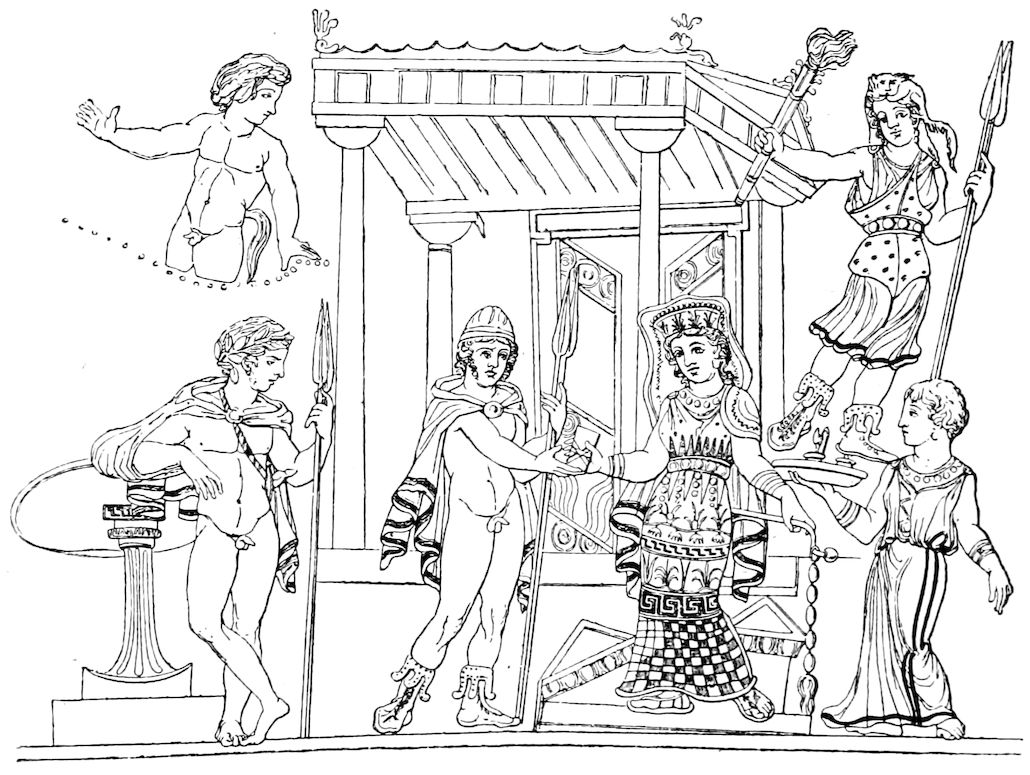
1. The best known of the vases is an amphora formerly
in the possession of the Duke of Buckingham[242]. In
front of the temple of Artemis, Doric order, stands
Iphigeneia, en face, in richly embroidered chiton, and
high head-dress from which falls a sort of veil reaching
to the knees. She wears necklace, bracelets, earrings,
and sandals; her costume bespeaks in every respect
that of the theatre. She carries again the token of her
office in the left, and hands the letter to Pylades with
the right, who stands ready for the journey, wearing
chlamys, pilos, boots, and carrying two spears. Further,
on the left, leaning against the περιρῥαντήριον is Orestes,
en face, but with laurel-wreathed head turned towards
Pylades; his right leg is thrown over the left. He
wears a chlamys, and carries two spears and a sword.
Beside Iphigeneia is her servant, as in fig. 18, but with
a simple girdled chiton, and in her right the dish with
articles for the altar which is represented in poor perspective
behind Iphigeneia. Above, on the right, before
133the temple doors, is Artemis in short, huntress-costume
and high Thracian boots; two spears in her left, and
a burning torch in her right. She wears the Thracian
cap. On the left of the temple behind a terrain is a young
satyr, no doubt thrown in to fill up the space.
2. The largest painting representing this scene is that
on an amphora in St. Petersburg[243]. The centre of the
picture is taken up by the temple, four Ionic columns.
Inside on the right is the Artemis statue, costumed like
Artemis in fig. 19; a burning torch in the right, around
which is bound a sort of decoration. It is on a large
pedestal, and has in the left a spear. On the left, about
to leave the temple, is Iphigeneia with an elegant chiton,
mantle, a diadem in hair, and the peculiar key in her
left; beside her, and leaning against the wall, is a kylix
with long handle. She makes a gesture towards Pylades
with her right in which there is no letter. He stands
on the left by the temple, leaning against his knotty
stick; has petasos on the back of the neck, and wears
high boots and an escaping chlamys. On the left, lower
down, Orestes leans on the περιρῥαντήριον, as in fig. 19,
but he is evidently more dejected here. The rest of the
painting, which consists of five groups of two figures
each, has so little to do with the central scene that we
may omit any description of it. In the upper zone on
the right are Hermes and Artemis, on the left Athena
and Nike. Athena will observe the final part of the
affair in which she was so deeply interested in Athens.
The two groups, a female and an armed Thracian,
represent the common ‘love-scenes’ on this class of
vases. For the third group on the right, the artist
preferred to draw a young deer instead of the female
figure. Stephani[244] is correct in calling these ‘love-scenes,’
and so separating them permanently from any
part in the action. Countless such groups are thrown
upon vases of this style as meaningless, decorative
figures. The parasol, wreaths, and vessels serve to
enrich the setting and add charm to the coquetry.
134
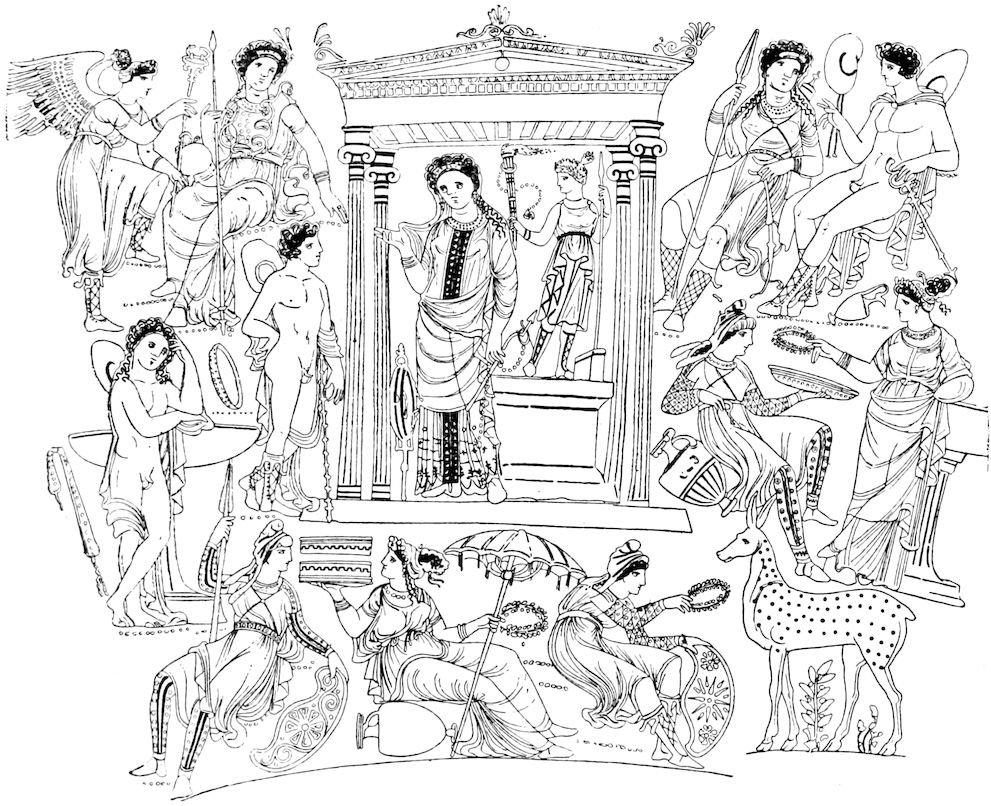
Fig. 20 (vid. p. 133 ff.).
135
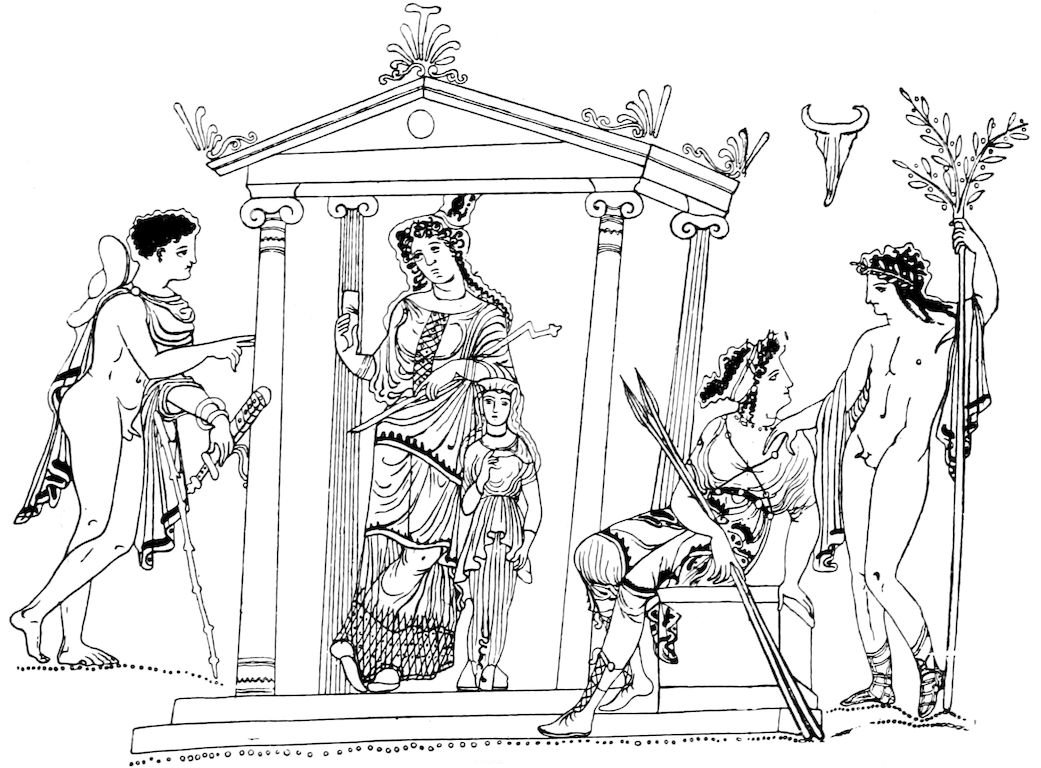
3. A vase, formerly in the possession of the art dealer
Barone in Naples, shows an abridgement of the scene[245].
In an Ionic temple, four columns, and akroteria, Iphigeneia,
en face, long chiton, mantle, hair done in a knot
behind, leans with her left elbow upon the βρέτας. In
136her left is the temple attribute, and in the right the
letter which she extends to Pylades, in chlamys and
petasos. He leans against his stick, and has a sword
in the left, while he points with the right towards the
letter. On the right are Apollo and Artemis. The
former, nude except for a mantle and high boots, grasps
the laurel tree with his left, and rests his right upon
Artemis’ shoulder, who sits to the left upon the altar
and looks up to Apollo. She is dressed as usual with
short chiton and high boots. She has two spears in the
left.
In setting these three paintings over against each
other and comparing the elements in them, the uniformity
is very striking. Perhaps the details may be
clearer if placed in a sort of scheme.
a. Elements common to all three vases.
1. Temple of Artemis. 2. Iphigeneia in elaborate
dress, indicated as the κλῃδοῦχος. 3. A youth in travelling
costume, with whom she is talking. 4. Artemis on the
right of the temple.
b. Elements common to two of the three vases.
1. In figs. 19 and 20 a youth leans against the
περιρῥαντήριον, resting on one leg over which the other
is thrown. 2. In figs. 19 and 21 Iphigeneia hands the
letter to the youth. 3. The Artemis ἄγαλμα is in the
temple in figs. 20 and 21; so also is Iphigeneia.
We thus observe that the remarkable agreement, even
in the details, shows that they must all be copies more
or less exact of one and the same original. That
Iphigeneia in fig. 20 does not hold the letter in her
hand may be accredited to the carelessness of the artist
who merely forgot to paint it. The same may be said
137with regard to the abridged form of the scene in fig. 21,
where Orestes has been left out. The two central figures
appeared to the artist to be the important part of the
original, and accordingly he omitted all else.
Immediately following the scene represented in
fig. 18, Iphigeneia entered the temple to get the letter—
ἀλλ’ εἶμι, δέλτον τ’ ἐκ θεᾶς ανακτόρων
οἴσω. v. 636 f.
and ordered the guards to watch the two without
binding them. Thereafter ensues the touching scene
between Orestes and Pylades (vs. 657–724). The
priestess then reappears, and commanding the attendants
to go inside, continues—
δέλτου μὲν αἵδε πολύθυροι διαπτυχαί,
ξένοι, πάρεισιν· ἃ δ’ ἐπὶ τοῖσδε βούλομαι,
ἀκούσατ’.
Orestes speaks first after these lines and asks her what
she wishes. It shall be an oath for the safe delivery of
the letter. At this he demands a counter-oath from her
for the safe withdrawal of Pylades from the country.
We may imagine that during the delivery of these
verses, which were probably spoken while Iphigeneia
was still in the temple doorway, Pylades had approached
her to receive the letter, while Orestes stepped to one
side as he appears in figs. 19 and 20. In vs. 769–787
the contents of the letter are related to ensure safe
transfer of the message, even though the written words
be lost in a shipwreck. This is the time represented on
our vases. The hopelessness of Orestes requires, moreover,
the earlier part of the scene, since from v. 772 he
begins to be aroused and to prove his brotherhood to
138Iphigeneia. The αναγνώρισις is complete at the close
of v. 826, and there follow the fourth and fifth stages
which were noticed above[246]. Neither of these movements
is, so far as I am aware, shown on any vase
painting, although they are an important part of the
reliefs on the Roman sarcophagi[247].
In conclusion, mention should be made of the wall
paintings which represent the departure of the three
with the statue to purify it in the sea. The first and
most important of these is the fine casa del citarista
painting[248]. Robert first correctly recognized the right
meaning of this beautiful monument and based it upon
the poet[249], thereby bringing it into harmony with the
sarcophagi. That he was happily correct in reading the
time in the painting after the recognition, contrary to
Helbig’s interpretation[250], is nicely borne out by the
painting recently discovered in the casa dei Vettii[251],
which is another copy of the same original[252]. The
139variations are, however, enough to render any misunderstanding
of it impossible. Here there is no temple, and
Iphigeneia occupies the centre between Orestes and
Pylades on the left, and Thoas on the right. She
carries plainly the temple βρέτας on the left shoulder.
Furthermore, the unconcerned attitude of the two
prisoners in their tête-à-tête points clearly to the proper
significance of the scene. Curiously enough Orestes
appears to sit on the altar here as on the vase painting,
fig. 18.
The satyr dance, the earliest form of the Greek drama
and the simple beginning from which the immense
superstructure of tragedy took its start, continued, in
the satyr composition which followed the regular trilogy,
to remind the public of the original plan and tendency
of the performances in honour of Dionysos[253]. Till late in
the fourth century B.C., at least, this echo of the original
Dionysiac festival remained in vogue. The Kyklops of
Euripides is the only example of this sort of composition
which has reached us, and although the present work is
concerned with tragedy and vase paintings I cannot
refrain from including here a painting that is under the
influence of this unique relic of Greek literature. The
connexion between the satyr-play and tragedy is
certainly intimate enough to warrant the introduction
of the present chapter.
140Every one is acquainted with the story of Odysseus’
adventure with the Kyklops Polyphemos. Since the
author of the Odyssey threw a charm around the story,
this event in the wanderings of the hero has remained
one of the most popular. In early Greek art there are
numerous monuments based upon the myth. The black
figured vases represent two critical moments. 1. The
blinding of Polyphemos. 2. The escape of Odysseus
and his companion from the cave. A long list of
paintings tells this story over and over again, with little
variation[254]. The artists evidently became tired of the
monotony of the subject, for it is practically dead at the
beginning of the fifth century. There was nothing new
in the tale; it was distinctly epic, and for this very
reason had its day and gave way to new motives in the
dramatic literature. At the end of the century there was
a revival of the myth. It gained a new lease of life through
the Kyklops of Euripides, and once again all eyes were
turned towards the old Homeric fiction. When the poet
introduces Seilenos and his company of satyrs as slaves
to Polyphemos, and turns the fortunes of Odysseus, on
his arrival at the cave, by the intervention of this new
element, the artist had certainly a new incentive. The
rollicking, lusty antics of the tribe of satyrs had ever
been the red figured vase painter’s delight, and when
Euripides connected them with the adventures of
Odysseus and the Kyklops the old story was ingrafted
with a vigorous shoot[255]. Timanthes, whom we have
141already met[256], very likely owed it to Euripides that he
associated Polyphemos with satyrs[257]. An interesting
vase painting, which may be dated cir. 410 B.C., bears
strong testimony to the influence of the Kyklops in
Lower Italy[258].
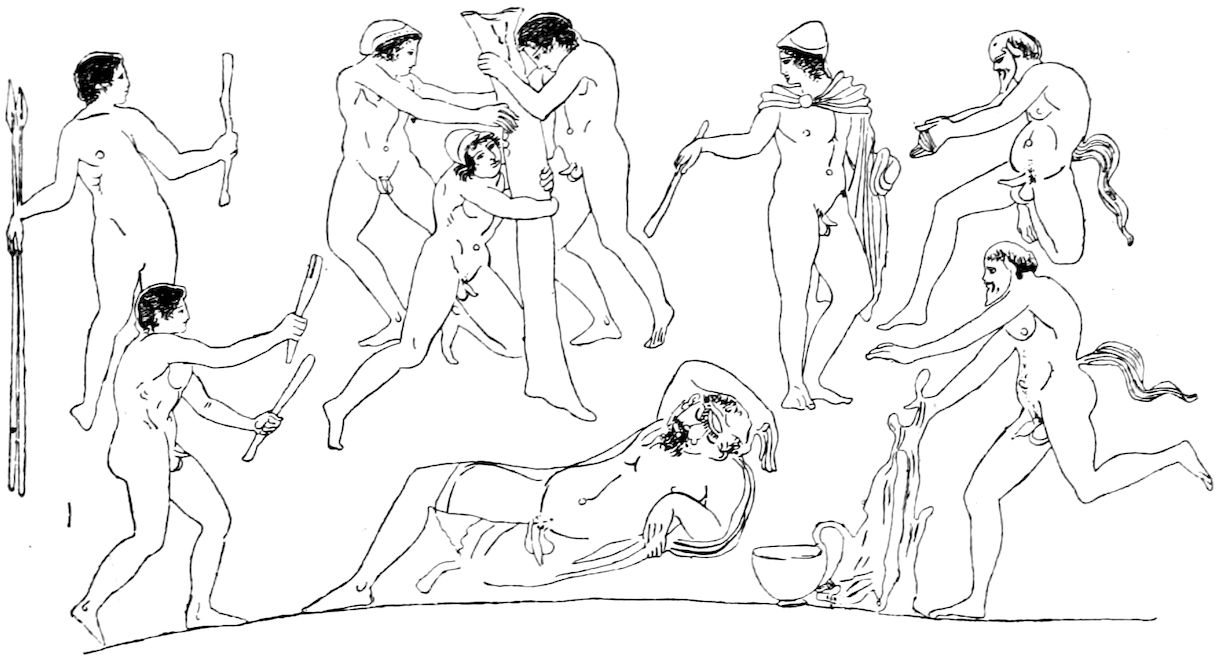
The picture appears in fig. 22. In the foreground
Polyphemos lies stretched out in his drunken stupour[259];
beside him is a stump on which hangs an empty wineskin,
and on the ground a bowl. In the centre three
youths, the middle one wearing a pilos, are busy tugging
at a log. Two others on the left bring fire-wood to
142kindle the large stick[260]; another youth, probably
Odysseus, in pilos and chlamys, directs the work from
the opposite side. Two bearded satyrs, with the usual
horse-tails, caper around on the right[261].
The whole painting breathes with the spirit running
through the Kyklops. The impression gained by
reading the play is remarkably well supported by
a study of the former. There is no detailed agreement
between the two which strikes one, for the situations in
Euripides are not closely followed. There is, however,
the same stamp of originality and newness characterizing
both. The painting is a revelation to one who has seen
only the earlier Homeric monuments.
It may first be noticed that Polyphemos is represented
outside of his cave, and that the attack upon his big eye
is about to take place. This is quite opposed to Homer
and Euripides, yet more than half the charm of the
scene lies in the naïveté with which the artist disposes of
the giant. A glance at the words of the poet will make
this clearer. Odysseus and his chorus of satyrs have
fixed upon the means for overcoming the Kyklops.
They beg Odysseus for permission to take a hand in
preparing the fatal pole;
δεῖ γοῦν· μέγας γὰρ δαλός, ὃν ξυλληπτέον. v. 472.
says the son of Laertes, but when he came to the point
where he really needed their help they made every
manner of excuse; some were suddenly seized with
143lameness; others had dust in their eyes. But he knew
that it would turn out so, and he relies on his own
companions,
... τοῖσι δ’ οἰκείοις φίλοις
χρῆσθαί μ’ ἀνάγκη. vs. 650 f.
This is well brought out, whether intentionally or not
I do not say, for it is Greeks who are lifting the δαλός,
and as for its size every one will agree that it is μέγας.
The two satyrs, representing the chorus, dance around
lustily the while, having smelt the contents of the wineskin
(v. 153 f.). As soon as the plan has been decided
upon, Polyphemos appears again, having already sated
his appetite on two of the Greeks, and having had at
least a taste of the wine. What could prepare one
better for the appreciation of the figure on the vase than
his own words?
παπαπαῖ, πλέως μὲν οἴνου,
γάνυμαι δὲ δαιτὸς ἥβῃ
σκάφος ὁλκὰς ὡς γεμισθεὶς
ποτὶ σέλμα γαστρὸς ἄκρας.
ὑπάγει μ’ ὁ χόρτος εὔφρων
ἐπὶ κῶμον ἦρος ὥραις,
ἐπὶ Κύκλωπας ἀδελφούς.
φέρε μοι, ξεῖνε, φέρ’ ἀσκὸν ἔνδος μοι. vs. 503 ff.
His proposal to go and share his good fortune with the
brother Kyklopes does not meet the approval of
Odysseus, who bids him keep his good things to himself
and enjoy them. Seilenos goes even further and says—
κλίθητί νύν μοι πλεῦρα θεὶς ἐπὶ χθονός. v. 543.
144and Polyphemos takes up the suggestion at once, for
we hear him ask
τί δῆτα τὸν κρατῆρ’ ὄπισθε μου τίθης; v. 545.
There can be little doubt that these verses particularly
interested the artist. Well satisfied with the newly
discovered drink, the Kyklops has dropped down upon
his side as Seilenos recommended. The ἀσκός, which
he ordered extra, hangs beside him and upon the ground
is a bowl[262]. Both of these have evidently been drained.
The inhuman monster sleeps on, quite in the manner of
Euripides, in the presence of the active preparations for
his own ruin.
The heroine of this tragedy of Euripides is one of the
most imposing and terrible figures that has come down
to us from ancient Greek literature. It is not, however,
the magician of strange power, who assisted Jason in
winning the Golden Fleece and in performing his other
Kolchian adventures, that overawes one; neither is it
the sorceress who worked her wonders on Pelias, but
rather the Medeia who avenged her slighted honour
through the destruction of Jason’s newly won bride and
his two sons; it is the Medeia at Corinth that we know
best, the Medeia of Euripides. This chapter in the
barbarian’s career assumed under his hand a prominence
which far exceeded anything that had gone before.
Euripides’ Medeia has remained ever since the Medeia of
art and letters.
145In early Greek art Medeia is not a common figure,
and when she does occur it is invariably as the sorceress[263].
In this rôle one meets her on both black and red figured
vases[264], and on the famous relief in the Lateran[265]. After
the beginning of the fourth century B.C. the Corinthian
Medeia predominates. As such one finds her on vases
from Lower Italy, Apulia and Campania especially, on
Pompeian wall paintings[266], on terra cottas[267], gems[268], and
the Roman sarcophagi[269].
146
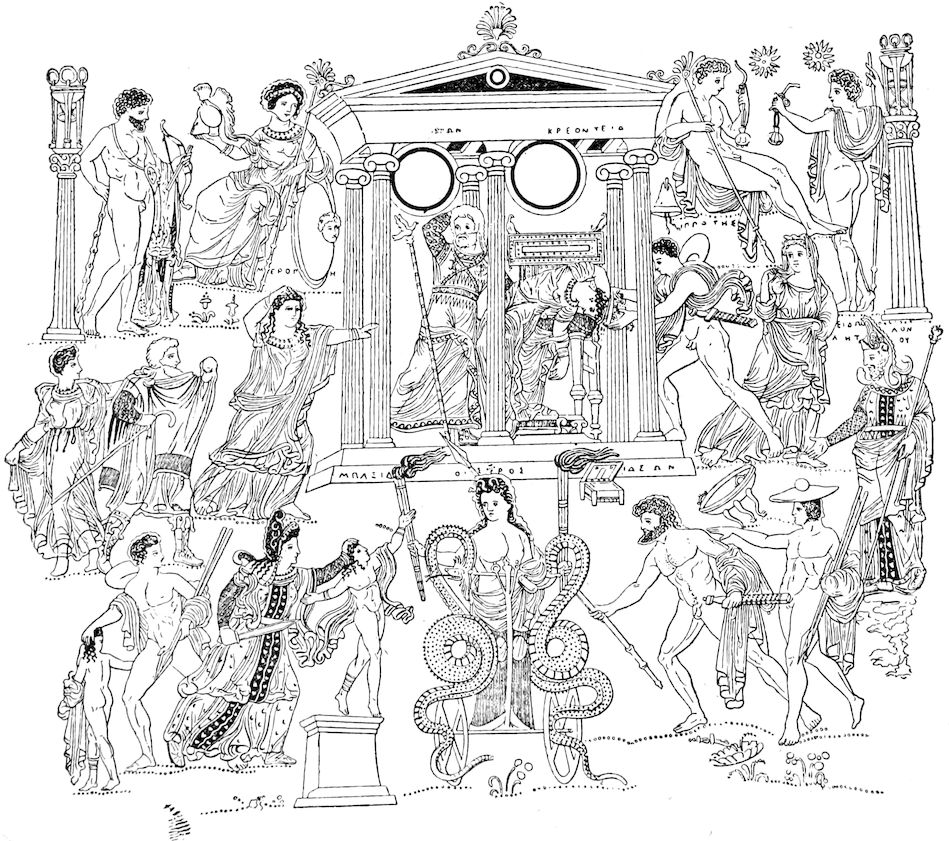
Fig. 23 (vid. p. 145 ff.)
147The most famous vase upon which we find Medeia is
the great amphora in Munich[270], found in Canosa, the
ancient Canusium, in Apulia, Oct. 16, 1813. The
painting consists of three sections of figures parallel with
the perimeter of the vase. The two upper ones are
divided in the middle by a building with six Ionic
columns. On the inside hang two round shields—a
common decoration in this sort of picture. On the
right, inside of the house, is a chair or θρόνος, over the
arm-rest of which a richly dressed female figure has
fallen; above on the frieze the inscription ΚΡΕΟΝΤΕΙΑ
(sc. ΠΑΙΣ) shows the person to be Kreusa, or Glauke[271],
the daughter of Kreon. Rushing rapidly towards her
from the right is a youth in petasos and chlamys. He
has already reached the upper step of the palace and
is attempting to remove Kreusa’s head-dress. Incised
in the vase is the name ΙΠΠΟΤΗΣ[272]. On the left an
elderly male figure, bearded, wearing long, richly embroidered
chiton, hurries to Kreusa. One hand is placed
behind her as though to support the body; the other,
from which the sceptre has just fallen, clutches his hair.
He gazes to one side in a dazed sort of manner. On
the frieze above is ΩΝ, evidently the last letters of
ΚΡΕΩΝ[273]. To the left outside of the palace, and
148somewhat lower, an elderly woman in long chiton and
mantle runs toward the scene of the tragedy, extending
her left hand and holding her right to her head in the
usual attitude of fright. She is designated by the inscription,
incised, as ΜΕΡΟΠΗ[274]—most likely the wife
of Kreon. Further on the left is a group of two,
a pedagogue in the usual costume, and a female
attendant. The former is hurrying towards the palace,
while the latter attempts to divert him from his onward
rush.
To the right from Hippotes is another female figure,
en face, who appears to be leaving the palace. Her
dress, especially the veil, and her bearing point her out
as a nurse or servant of Kreusa. Just in front of the
latter upon the ground is the open box in which the
baneful presents were brought.
The lower section is divided into two parts by
Medeia’s dragon-chariot, held in readiness by the
charioteer with a burning torch in either hand. The
upper part of the latter’s body is nude. There can be
little doubt that the figure is female. The inscription
ΟΙΣΤΡΟΣ shows it to be Οἴστρος, the personification of
Medeia’s rage. On the left, Medeia, ΜΗΔΕΙΑ[275], with
richly decorated oriental costume and Phrygian cap,
advances to the right with drawn sword to kill one son
149whom she grasps by the hair with the left hand. It is
not easy to say whether the boy has taken refuge on the
altar, or whether his mother has lifted him upon it.
More probably the latter is true. The lad is nude, with
the exception of a garment over his left shoulder. He
wears bracelets and on the left leg an anklet. Immediately
behind Medeia a doryphoros, dressed as Hippotes,
but with two spears instead of a sword, hurries to the
left with the second boy, dressed as is the other. On
the right of the chariot and hastening impetuously to
rescue his son is Jason, ΙΑΣΩΝ. He is bearded and
has a sword and long spear. His chlamys is thrown
over his left arm. Beside him, but moving at slackened
speed, another doryphoros extends the right hand
towards the chariot as though to warn Jason of the
futility of his intervention. Above this group on
the right is a bearded male figure, pointing towards the
events transpiring below. He wears a long royal dress
and Phrygian cap, and carries a sceptre in his left.
ΕΙΔΩΛΟΝ ΑΗΤΟΥ, incised, indicates him as the ghost
of Aetes, Medeia’s father.
The upper section is bounded on either side by a
Corinthian column surmounted by a tripod. Herakles,
with club, bow and quiver, and lion’s skin, stands on the
left facing Athene, who sits upon a terrain. She has her
helmet in her right hand and leans against her shield.
The spear is not wanting. On the right are two male
figures, one sitting, the other standing. The oil-cruses
and strigils, as well as the two stars and the pilos, near
the one who sits, designate them as the Dioskouroi.
We turn now to a closer consideration of our vase to
see if it is under the influence of Euripides. Starting
with the scene which the vase painter has given us in
150Kreon’s palace, one cannot but be struck with the
agreement between the picture and the scene described
by the poet through the mouth of the messenger in the
celebrated speech, vs. 1136–1230. This wonderful
passage is the triumph of Euripidean rhetoric in the
Medeia. The two boys, together with their father, had
entered Kreusa’s apartment conveying the box with the
rich vestment and golden crown, and she, who had
refused to listen to words and be softened, was, woman-like,
melted by these unexpected gifts. She accepts
them, and father and sons retire. She then arrays
herself before the mirror, admires her beauty, retreats
across the room with proud, exulting step, all too
captivated by her gracious figure, when the terrible
moment comes—
χροιὰν γὰρ ἀλλάξασα λεχρία πάλιν
χωρεῖ τρέμουσα κῶλα καὶ μόλις φθάνει
θρόνοισιν ἐμπεσοῦσα μὴ χαμαὶ πεσεῖν. vs. 1168–1170.
There is a remarkable harmony between these words
and the picture upon the vase, where Kreusa lies a
helpless mass across the arms of the θρόνος. Her
attitude suggests to one’s mind exactly the idea in
θρόνοισιν ἐμπεσοῦσα μὴ χαμαὶ πεσεῖν. Rarely has a vase
painter come nearer to illustration than here. It had,
indeed, been far easier to paint Kreusa in her fallen
position upon the floor, πίτνει δ’ ἐς οὖδας (v. 1195), where
the chair and the form of the body would have presented
no such difficulties in drawing as they do in the present
position[276]. Why was this not done? Simply, as I am
151convinced, because the painter chose to present the most
tragic moments, and shape them into the greatest possible
dramatic effect. He seized the crisis in Kreusa’s dread
struggle, when, doomed by the poison and flames, she
dropped across the chair. Here, as in the scene below,
the vase painter has given evidence of dramatic power of
a high degree, and I venture to think that had he not
been an artist he would have been a tragedian.
Kreon, who, of course, could not be represented as
falling upon the body of Kreusa as he entered the room,
ἄφνω προσελθὼν δῶμα προσπίτνει νεκρῷ (v. 1205), while
she was still resting on the chair[277], is painted in the first
moment of reaching the unfortunate one. He places
his left hand under her body, and, overcome by the
horror of the sight, lets fall his sceptre from his right
hand as he gazes for a moment in transfixed agony
from his daughter’s situation. The position of the arms
is exactly that of the same figure on the sarcophagi
reliefs[278], and no doubt would be traceable through the
five intervening centuries if the monuments were at
hand. Our vase would appear to represent here a tradition
that was always closely followed in representing
Kreon in an upright position.
152Merope, the mother, who is mentioned in Corinthian
legends only as the wife of Sisyphos[279] and of Polybos[280],
does not appear at all in Euripides. The painter’s
principle was to name all the chief figures on the vase,
and it is not necessary to point out here another source
than the Medeia of Euripides. A name thus known as
belonging to Corinthian royal families would be a natural
invention for the wife of Kreon if there was no legend
to provide further information about her. I hold this
painting, however, as adequate evidence that there was
a third Merope known in Corinth[281]. That the mother
as well as the father should be represented here is
further witness of the spirit which the poet breathed
into his work. Medeia’s fixed determination to ruin
all her enemies at one blow and to root out the whole
royal house in a day (vs. 373 f.) is expressed in the extended
scene here given, in a manner well calculated
to inspire the beholder with much that lies between the
lines in Euripides. There is absolutely no reason for
claiming this scene as an extension of that given in the
poet, and therefore based upon a post-Euripidean tragedy.
One who denies the vase painter the right to introduce
figures foreign to the poet fails utterly in comprehending
the spirit of the fourth and third century vase painting.
The artists followed the number of characters in the
153poetical version no more slavishly than they did the
disposition and movement of the same. Starting with
what the poet gave them and holding this in mind as
a guide and inspiration in certain details, the painters
proceeded to create, as independent artists, a similar scene,
transfused, however, with their own alterations. It is to
be expected that in the over-filled vase paintings of
Apulia and Campania one will find figures that show
a wide liberty on the part of the painters, and that
illustrate well how much the severe methods of the
Athenian vase painters had been altered in Magna
Graecia.
Another instance of this same independence of the
painter is seen in the introduction of Hippotes, to whom
there is not the slightest reference in Euripides. In
vs. 1168–1203, where Kreusa’s fate is described, no one
is referred to as present except the female attendants,
who were possessed with terror and lent no aid to their
mistress. Kreon unexpectedly entered, ξυμφορᾶς ἀγνωσίᾳ,
and soon succumbed, a victim together with his
daughter. Why does Hippotes appear on the vase as
the one who is trying to liberate Kreusa? With Vogel[282]
again the answer liegt auf der Hand: weil Euripides
nicht die Quelle der Darstellung ist. Because the painter
enlarged the scene of the poet, and was more tragic and
more dramatic than Euripides, a later or at least another
version of the myth is claimed as his authority. This
appears to me altogether improbable and unnecessary.
It is improbable because, as we have abundant reason
to believe, Euripides’ version of the myth was, both in
Greek and Roman times, the most popular[283]. Other
154Medeias are mere names. Furthermore our vase cannot
be dated later than the second half of the fourth century
B.C., i. e. not much more than a century after the first
appearance of the Medeia in 431 B.C. This is an
important fact which seems to have been mostly overlooked.
Euripides, it must be remembered, ruled the
fourth century B.C. as the prophet of the time, and was
hailed by the Greeks of the colonies and the motherland
with universal admiration. It is safe to say that no
Greek poet was more upon the lips of the people or
more in their hearts. Tardy as was the recognition
of his genius during his lifetime, the extent of his
posthumous fame was unparalleled and his name rang
through Alexandrian and Hellenistic times as that of
one of the immortals. Are we to suppose then that
a vase painter of Magna Graecia, who might have lived
with those who had seen Euripides, was, in dealing with
the Medeia myth, under the influence of some poet of
a day? Was an artist who lived in this proximity to
Euripides’ own time likely to follow the guidance of any
other than the great master who created the Medeia
character and started her down the centuries in that
unexampled rage and fury? We dare, moreover, go
further and claim with Robert that die Vasen stehen der
Aufführungszeit der Medeia so nahe, dass sie den Werth
directer Zeugnisse beanspruchen dürfen[284].
This explanation is unnecessary, for, as we have already
pointed out, the vase painters gave less heed to the
subject-matter and the details of the traditional types
than to the general effect and dramatic arrangement.
155It was possible to double the dramatic effect here through
the introduction of the bride’s brother, and the painter
did not hesitate to place him on the vase, although the
poet did not refer to him. The onward rush of this
finely drawn figure, with his chlamys fluttering in the
wind, has altogether a dramatic air and brings one to
feel that the theatrical element, so much in the background
in the fifth century B.C., had taken possession
of the fourth century work[285]. It is surprising to find
with what persistency certain scholars refuse such
additions as incompatible with the dependence of the
work on a given literary source. If the artist has done
more than illustrate, all relationship between him and
the poet is denied. But let us turn to a famous work
where illustration pure and simple is meant, and we shall
discover that if one follows even there this mode of
criticism, the poet and the drawing which is meant to
illustrate him will have to be divorced. I refer to
Botticelli’s drawings for Dante’s Divina Commedia[286].
Each drawing is intended to bring out the events of the
canto to which it is devoted, and so one expects only
the incidents of one canto to appear in one drawing.
The illustration for the Inferno, canto ii, represents
Beatrice swinging upward in the air, to whom Virgil
is pointing and calling Dante’s attention. This is all
a pure invention of the artist as Beatrice is simply
mentioned in the text, and not at all thought of as
present or appearing to the two pilgrims. Had Botticelli
then some other story in mind, and was there another
156version of Dante than that which we have? Certainly
not. The artist, although in this place engaged as
a mere illustrator, read his own notions into Dante
and put them into his drawing. Again, even on the
same plate, the entrance to the Inferno is shown with
the words per me over the door. This scene belongs
to canto iii, where in fact Botticelli again introduces it.
If, therefore, the third canto and the drawing that
belongs to it had never reached us but we did possess
canto ii and its illustration, how would the critics who
read the Greek vases as we have indicated, dispose of
Botticelli and his faithfulness to Dante? They would
all declare that the famous painter must have had
another text which he followed. And so one may go
on multiplying instances in this one work to show that
an artist, even when he set out to follow the poet, was
not able to do so[287].
There are also among the Pompeian wall paintings[288]
some that are mere illustrations and are in the spirit
of this sort of work, and yet they show various peculiar
changes and additions contrary to the epigrams
on which they are based. One is to remember therefore
that in the vase paintings, where a more independent
form of art is found than in illustrations, a liberty
in adding or omitting figures, that may often disturb
the form of the myth, is to be allowed. To select one
157example from many: Euphronios[289] on the Eurystheus
kylix represents Sthenelos and his wife as present when
Herakles brings the boar and is about to drop it into the
cistern where Eurystheus has taken refuge. That the
latter was king and had imposed the labours on Herakles,
was proof enough that Sthenelos was already dead.
How then did Euphronios dare to place him on the
vase? Evidently because he took little heed of the
exactitude for which modern scholars would call him
and others of his trade to account.
The old nurse who observed the first signs of her
mistress’ precarious condition—καὶ τις γεραιὰ προσπόλων ... ἀνωλόλυξε (vs. 1171–73)—or one of the numerous
attendants present (v. 1176) may be recognized in the
figure to the right from Hippotes. Perhaps this is more
correctly the one who broke away to convey the sad
news to Jason—ἑ δὲ πρὸς τὸν ἀρτίως πόσιν, | φράσουσα
νύμφης συμφοράς (vs. 1178 f.). This person with the
matronly air always occurs on the sarcophagi, but in
the scene where the two boys are handing over the gifts
to Kreusa[290].
The position of the pedagogue on the opposite side
is not so incongruous as many have thought. There is
really no reason for considering him a sort of connecting
link between the middle and lower sections, as Robert
has done[291]. Let us follow the pedagogue and the boys
through the play. At vs. 46 f. of the prologue the
nurse reports the latter as returning from their sport—ἐκ
158τρόχων πεπαυμένοι—and in vs. 89 ff. she orders them
inside the palace,
ἴτ’, εὖ γὰρ ἔσται, δωμάτων ἔσω, τέκνα,
and commands the pedagogue to keep them at a safe
distance from their mother,
σὺ δ’ ὡς μάλιστα τούσδ’ ἐρημώσας ἔχε,
καὶ μὴ πέλαζε μητρὶ δυσθυμουμένῃ.
At v. 105 the three disappear and nothing more is heard
of them till Medeia, who is addressing Jason and the
chorus, cries out in v. 894—
ὦ τέκνα, τέκνα, δεῦτε, λείπετε στέγας,
ἐξέλθετ’.
Hereupon the boys appear in the orchestra, unaccompanied
by their pedagogue, and remain with Medeia and
Jason till vs. 969 ff., where their mother hands them the
gifts and bids them go, ὁς τάχιστα (v. 974), to Kreusa
and place the same in her hands. They then depart
with their father and deliver the presents in the manner
afterwards described by the messenger (vs. 1136–1155),
and in company with Jason leave Kreusa’s apartments.
Just outside somewhere the pedagogue joins them and
appears with the children in the orchestra to inform
Medeia that her sons have been pardoned (vs. 1002 ff.).
Immediately thereafter she orders the pedagogue to
go inside,
... ἀλλὰ βαῖνε δωμάτων ἔσω
καὶ παισὶ πόρσυν’ οἶα χρὴ καθ’ ἡμέραν. vs. 1019 f.
As he re-enters the palace the terrible news reaches
him, through, one of the female attendants, that Kreusa
159is possessed with some strange malady. It is at this
juncture, dramatic in the extreme, that, as it seems
to me, the vase painter thought of the pedagogue. The
latter has forgotten Medeia’s command to arrange the
boys’ program for the day and is determined to go
to the apartments whence comes the great alarm. The
attendant, however, endeavours to dissuade him, and the
artist has even represented her in the attempt to deter
the sturdy old pedagogue from carrying out his resolution.
While all this is happening within the palace, Medeia
gives expression to the great battle that is going on in
her bosom. The speech is one of the finest in Euripides.
Shall she now go ahead and kill her children, or is the
courage lacking? She finally bids them enter the house
χωρεῖτε, παῖδες, ἐς δόμους (vs. 1053 and 1076), and soon
follows them. The death-cries of vs. 1271 ff. are heard
not long afterwards. We have therefore no reason to
infer from anything in Euripides that the pedagogue
ever met the boys again. The fact that he is so often
represented in the death-scene[292] is simply due to the
fancy of the artists. It is natural to think of him in
company with the boys. The vase painter has in the
present instance shown us the whereabouts of the
pedagogue when the poet had passed him by.
The lower section, which represents the events directly
succeeding those in the one just considered, completes
the dread vengeance work of Medeia. The artist had
an opportunity here to follow largely his own notions in
disposing of the details, for in the last moments when
horror followed close upon horror, and the royal house
of Corinth was shaking to its foundations, Euripides
hurries us on with great rapidity and omits many of the
160particulars. Medeia moves with resistless fury through
the last part of the bloody drama, till she at last disappears
upon her chariot. What was the vase painter
to do with all this? It is plain that he felt himself
compelled to combine, for greater effect, different
moments. Medeia enters the palace after the triumphant
address in vs. 1236–1250, and a moment later the cries
of the boys are heard within. Jason, aroused by the
ruin wrought upon Kreusa, suddenly appears and asks
where Medeia is, and remarks that he must save his sons
from the fury of the populace (vs. 1293–1305). He
at once learns the whole truth, and orders that the palace
doors be thrown open that he may behold the scene
of murder. Medeia appears then on her chariot, rolled
out upon the ekkyklema. She stands thus during the
final dialogue with Jason (vs. 1317–1404) till she disappears
by the aid of the Flugmaschine[293].
From these elements the vase painter selected the
murder scene, which, not being described by Euripides,
could be represented in any manner that struck his
fancy. He made this the centre about which all else
was grouped; all eyes are turned upon Medeia and the
altar. In this disposition of the matter other details
had to be sacrificed. The chariot, which could not be
wanting, had to have a charioteer, and as Medeia was
161not ready to mount it herself, the personification of the
Medeia-spirit is the natural figure that the artist would
select. Jason, again, to omit whom would have been
unpardonable, had to be painted in the act of rescuing
or attempting the rescue of his sons. So we see that
the three moments discernible in the poet, (a) the
murder, (b) Jason’s appearance to save the boys, (c) the
chariot and the escape of Medeia, are all worked
together by the artist into a strong complex. One
feels no incongruity in the picture, and is forced to
agree to a large amount of success that the artist has
enjoyed here. Since the pedagogue appears in the
scene above, the artist uses one of the ever convenient
doryphoroi as a companion to the boys or rather as
rescuer of one of them[294]. It is immaterial whether the
painter intended to represent the one boy as actually
out of danger or not. A great many useless words
have been spent in trying to show that the vase painter
has here followed a tradition referred to by Diodorus
Siculus[295], who relates that one child escaped—πλὴν γὰρ
ἑνὸς τοῦ διαφυγόντος τοὺς ἄλλους υἱοὺς ἀποσφάξαι. This
is not only highly improbable[296], but, more than that,
speaks for a superficial reading of Diodorus on the
162part of those who use this quotation. It appears that
nothing more of the chapter had been read than it was
necessary to quote. In the first place, what can τοὺς
ἄλλους above refer to if not to more than one, and
therefore to at least two? But where upon our vase or
upon any other monument does Medeia appear with three
children[297]? It would seem, therefore, that, because the vase
painter drew the scene as he did, this very inapt quotation
is brought out to bolster up an unnecessary theory.
Is it necessary to conclude with numerous scholars
that Oistros upon the chariot represents one of Pollux’s
ἔκσκευα πρόσωπα (iv. 141)? Does our painting necessarily
go back to some tragedy in which the personification,
Oistros, appears before the audience as Medeia’s
charioteer? It has already been pointed out that the
moment which the vase painter chose to represent never
was visible in the theatre of Euripides. What happened
before the palace doors were unbarred, in v. 1314, could
be painted in a hundred different ways, and still be
inspired by the poet from v. 1271 to v. 1316. It is
true that Euripides does not mention Οἶστρος, much less
as Medeia’s charioteer. What need had he to introduce
any personification of her rage and fury to guide the
chariot, when, at the first glimpse of it in v. 1317, Medeia
manages it herself? Any one who thoroughly works
himself into the situation that the painter has shown
upon the vase cannot help seeing that Medeia’s double,
her burning and infuriated barbarian wildness, the spirit
163shown in vs. 1236–1250, was a natural and easy subject
for embodiment under the name Οἶστρος. This personification
is not met with in Euripides, and has naturally
caused much stumbling. It should, however, be compared
with Λύσσα, with which it has much in common.
Orestes says to Pylades, μὴ θεαί (i. e. the Furies) μ’ οἴστρω
κατασχῶς’[298], and two verses further on, εὐλαβοῦ Λύσσης
μετασχεῖν τῆς ἐμῆς. Thus the use of the οἶστρος caused
Λύσσα. The step to the personification of a figure
Oistros would easily follow from some such development
as this, and I hold both words to cover the cause and
effect in the case mentioned.
As Lyssa was a favourite figure with Euripides, we
may examine still another place where the rôle that she
plays is much the same as that which Oistros takes in
the painting.
In Her. Fur. vs. 880 ff., the chorus describes Lyssa as
travelling upon a chariot[299].
βέβακεν ἐν δίφροισιν ἁ πολύστονος,
ἅρμασι δ’ ἐνδίδωσι κέντρον ὡς ἐπὶ λώβᾳ
Νυκτὸς Γοργὼν ἑκατογκεφάλοις
164Here at least one has adequate evidence that the vase
painter did not paint an unknown scene, even though he
did prefer to call his figure Οἶστρος[302].
The shade of Aetes[303], a pure invention of the artist,
has been held to refer to a post-Euripidean tragedy.
One finds such pedantic ingenuity used in explaining
this figure that the would-be-learnedness borders upon
the ridiculous. It is affirmed, for example, that somewhere
it must have been stated for the vase painter
that Aetes had died since Medeia left him[304]. How
far, pray, did vase painters concern themselves about
such points of chronology or sequence of events? We
have already pointed out in regard to these artists that
165they introduced and omitted characters just as they
chose; and especially is this true in regard to such side-figures
as Aetes is here. Then again, why is any literary
source necessary to prove the old man’s death? It was
but the natural course of events that the painter followed
when he concluded that Aetes was among the
shades. It is absurd to require some proof that the
unlucky king had, within the long period of Medeia’s
absence, passed into the world of spirits. It seems to
me that there are two views that can adequately
explain this addition to the picture, and with either
one in mind the vase painter would have needed no
post-Euripidean work or painting but simply the Medeia
tragedy to inspire him.
Robert[305] pointed to vs. 31 ff. of the prologue as furnishing
perhaps the suggestion for this figure, but that is
but a small part of the whole suggestion, and it is well
to follow this note which recurs in many places, and is,
to my mind, a very important part of the Euripidean
conception of Medeia. I give herewith the various places
where this element may be discovered.
αὐτὴ πρὸς αὑτὴν πατέρ’ ἀποιμώζη φίλον
καὶ γαῖαν οἴκους θ’, οὒς προδοῦς’ ἀφίκετο. vs. 31 f.
ὤ πάτερ, ὤ πόλις, ὧν ἀπενάσθην
αἰσχρῶς τὸν ἐμὸν κτείνασα κάσιν. vs. 166 f.
αὐτὴ δὲ πατέρα καὶ δόμους προδοῦς’ ἐμούς. v. 483.
πότερα πρὸς πατρὸς δόμους,
οὓς σοὶ προδοῦσα καὶ πάτραν ἀφικόμην; vs. 502 f.
ἡμάρτανον τόθ’ ἡνίκ’ ἐξελίμπανον
δόμους πατρῴους. vs. 800 f.
166These repeated allusions to her father and her former
home seem to me to express in a strong manner what
the painter chose to develop into the ghost-figure.
Aetes appears here to behold the retribution that is
overtaking Jason; and his participation in the fearful
tragedy emphasizes the secret power in Medeia, her
sorcery, and her chariot. The artist read between the
lines and discovered the spirit of the poet, and this he
has successfully reproduced. A similar instance was
noted in the liberty assumed by Botticelli in including
Beatrice in the second plate to the Inferno[306].
In the second place the εἴδωλον emphasizes the
barbaric element in the Medeia-Jason history, and impresses
the beholder with the workings of barbarism
versus Hellenism. This chord is, moreover, continuously
struck by Euripides[307]. The poet endeavours from first to
last to keep up the keenest distinction between Greece
and Kolchis, between Jason’s family and that of
Aetes.
There was, moreover, an opportunity, in introducing
this oriental king, to add features strikingly characteristic
of the Apulian vase paintings[308]. The elegance and
display of costume peculiar to the Persian and Asia
Minor kings were attractive for an artist, and the introduction
of Aetes’ shade was a happy invention that
went far towards making the deeper meaning of the
poet plain.
The deities, who, as spectators, are an important part
167of the paintings on so many Lower Italy vases, are
arranged in the upper section. They need not have
any particular connexion with the incidents before
them. The Olympian sympathy with earthly affairs
was a favourite theme with the artists of the time, and
a satisfactory number of participating divinities is usually
added where important events occur. Herakles and
Athena seem to be but indifferently interested in what
is happening below them, although the former was
intimately associated with the Argonautic expedition[309],
and the latter was the promoter of the enterprise[310]. The
Dioskouroi, who likewise took a large part in the adventures
of the voyage, are fitly represented here[311].
They are, however, giving no heed to the tragedy. It
is enough if the painter has recalled for us the famous
voyage and shown us the prelude, as it were, to the
drama played in the two lower sections. The panorama
of Jason and Medeia’s life together passes before us in
distinct scenes. By painting the participants in the
expedition and also the shade of Aetes the artist has
heightened the effect of the double tragedy which the
poet made famous.
Such is the painting on this celebrated amphora, which
I do not hesitate to call Euripidean.
Another monument which also shows Kreusa’s death
is a vase from Pomarico, now in Naples[312].
168
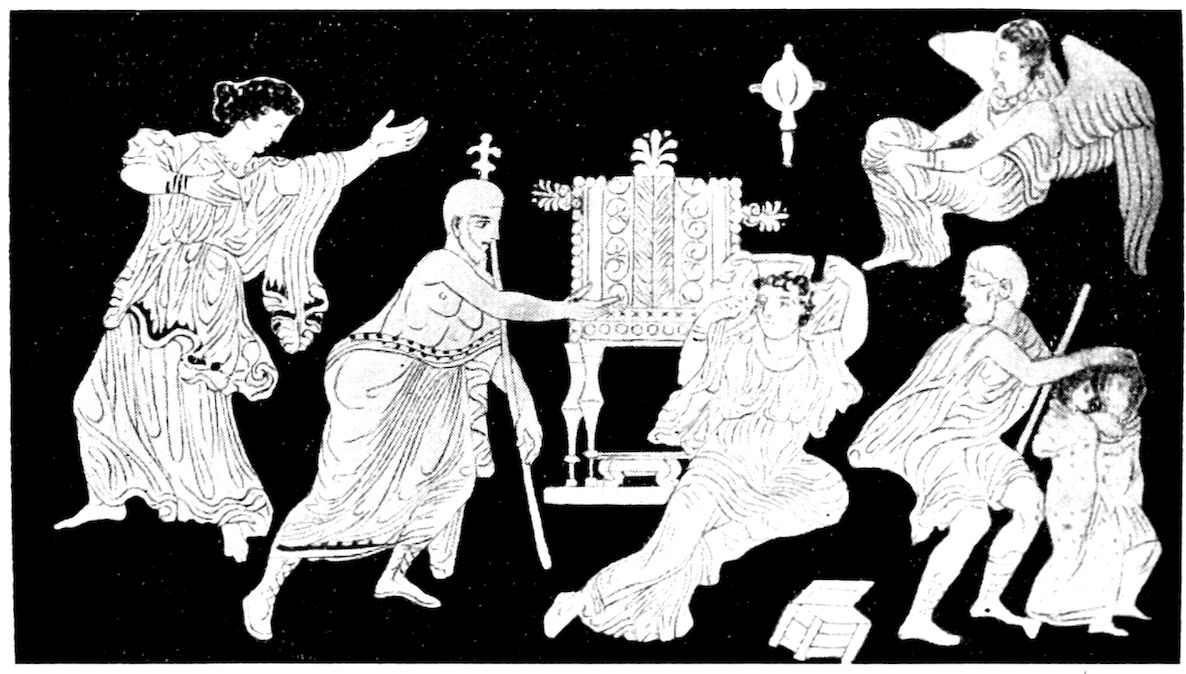
Kreusa has fallen from the θρόνος that occupies the
middle of the scene, and in a half-sitting posture upon
the floor endeavours to remove the head-dress. Before
her is the open box in which the presents were brought.
A mirror hangs on the wall. She is dressed in the
Ionic chiton with mantle; has earrings and one bracelet.
She stares at Kreon, who hurries toward her with outstretched
right hand. He has the sceptre in the left
hand, is bearded, bald, and wears a chiton which has
slipped down to his waist. To the left a female figure
rushes away en face, and, watching Kreusa, makes the
gestures of one terror-stricken. She is dressed like the
latter except the earrings and necklace. Jahn called
her a companion of Kreusa, considering that if she were
Merope of the Munich vase she would be approaching
her daughter and not leaving her. I prefer to see in
this figure one of the attendants who in vs. 1177 ff. spread
the news. It is true that the appearance of the figure
169is that of a more important personage than a servant.
The latter are not usually represented wearing jewellery
and fine costumes, and yet the attendant on the Munich
vase, who is endeavouring to divert the pedagogue, is
quite as richly dressed. In the present instance, however,
the drawing is very careless and the workmanship
is of an inferior sort. I believe, therefore, that the artist
either did not know the fitness of things, or else took
no pains to indicate that this figure was a servant or
attendant. When he had once drawn such a miserable
king as Kreon is, hobbling along in a ridiculous
manner, he might well have slipped into the other
extreme of painting a nurse in a lady’s garb. The
scene is based upon the messenger’s speech, vs. 1176 ff.
The pedagogue on the right, who is hurrying away
the two boys wrapped in cloaks, is a reminiscence of
vs. 1157 ff. where the father, Jason, goes away with them.
καὶ πρὶν ὲκ δόμων
μακρὰν ἀπεῖνει πατέρα καὶ παῖδας σέθεν.
The winged Fury sitting in the upper right-hand corner
observing the scene might well be expected as a spectator.
The suggestion for her may be found in
ἔξελ’ οἴκων φονίαν
τάλαινάν τ’ Ἐρινὺν ὑπ’ ἀλαστόρων. vs. 1259 f.
The murder of the boys inside of the palace is painted
on a Nolan amphora in the Cabinet des Médailles in
Paris[313]. Medeia in Greek dress and Phrygian cap has
slain one boy, who lies over the altar, either extremity
touching the floor. She stands, en face, with the other
170child grasped fast by the hair. This hand also holds
the sword. In her left, stretched out behind the altar,
is the sheath. The artist doubtless had in mind the
words which the chorus heard in vs. 1271 ff.—
οἴμοι, τί δράσω; ποῖ φύγω μητρὸς χέρας;
οὐκ οἶδ’, ἀδελφὲ φίλτατ’· ὀλλύμεσθα γάρ.
In the upper right-hand corner the pedagogue appears,
carrying an oil-cruse in his left hand. His right is raised
to his head. A wreath and two fillets point to the
sanctuary.
Another Canosa vase in Naples[314], although furnishing
a free handling of Medeia’s escape, is still an important
witness for the chariot and its actual appearance in the
171production of the tragedy. In this particular the painting
is Euripidean.
Medeia in rapid flight upon her dragon-chariot holds
the reins in her left hand and the corner of her mantle in
the right. Her dress is the customary one for charioteers.
On the ground by the wheels one boy lies dead; the
other is said to be visible on the original, inside of the
chariot as on the sarcophagi. The sword is also on
the ground. She is pursued by three youths, one on
horseback, Jason (?), and two on foot. They all carry
spears, and each has a chlamys. The middle one also
wears a pilos and has a shield. In front of the chariot
is Lyssa (?) with a sword in the right hand, and staff or
κέντρον (?) in the left. She has an Artemis costume
with a mantle. Galloping ahead to lead the way is
Selene, seated as usual on her horse.
The painting is poorly preserved, but the main part is
sufficiently plain. The artist followed the traditional
manner of Medeia’s flight.
The Phoinissai in common with the Septem of Aischylos
deals with the well-known story of the attack of Polyneikes
and his supporters on Thebes. The events connected
with this war can be traced all through Greek and
Roman literature and art[315]. We have here to do with
a relief cup, which illustrates Euripides’ version of the
combat. It possesses, like the other ‘Megarian Bowls’
discussed in the present work, a value so unique for the
study of our poet that it may stand beside any vase
painting in assisting us in the study of the drama’s
influence upon art.
172
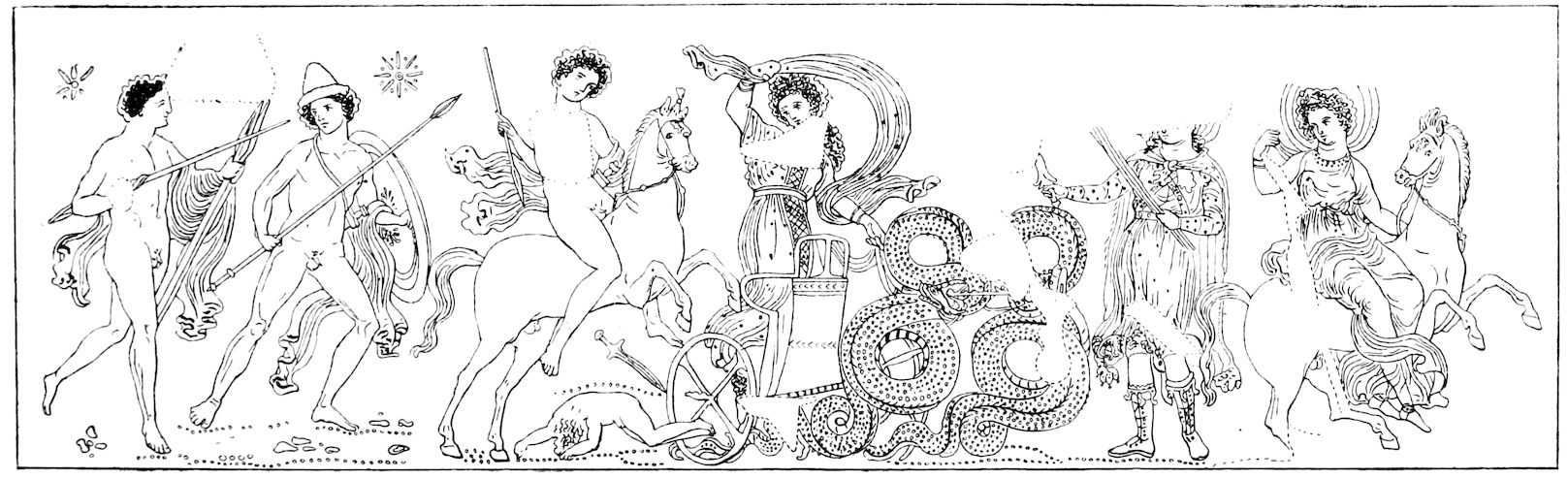
Fig. 26 (vid. p. 170 f.).
173The cup shown in fig. 27 is of red, unglazed ware,
and is said to have been found in Thebes[316]. The following
figures may be discerned. On the left Teiresias,
ΤΕΙΡΕΣΙΑΣ, carrying a bough and led by his daughter
Manto, ΜΑΝΤΩ, approaches Kreon, ΚΡΕΩΝ, who kneels
before the aged seer. They are both bearded, and the
latter wears a long chiton. Next follows Polyneikes,
ΠΟΛΥΝΕΙΚΗΣ, and Eteokles, ΕΤΕΟΚΛΗΣ, in full
armour, engaged in their fatal fight. Thebe, ΘΗΒΗ,
holding in her hand a sceptre, sits upon a rock watching
the sight. The messenger, ΑΓΓΕΛΟΣ, wearing a short
chiton and chlamys, stands by Iokaste, ΙΟΚ ... ΣΤΗ, before
the palace from which Antigone, ΑΝΤΙΓΟΝΗ, has come.
The latter raises her hand in astonishment. The women
both wear long chitons. Lastly, on the right, Antigone
appears before Kreon, inscriptions in each case, in a
supplicating attitude.
That Kreon might know definitely how matters were
to terminate, he had sent for Teiresias. The latter makes
his appearance in v. 834—
ἡγοῦ πάροιθε, θύγατερ, ὡς τυφλῷ ποδὶ
ὀφθαλμὸς εἶ σύ, ναυτίλοισιν ἄστρον ὤς·
174
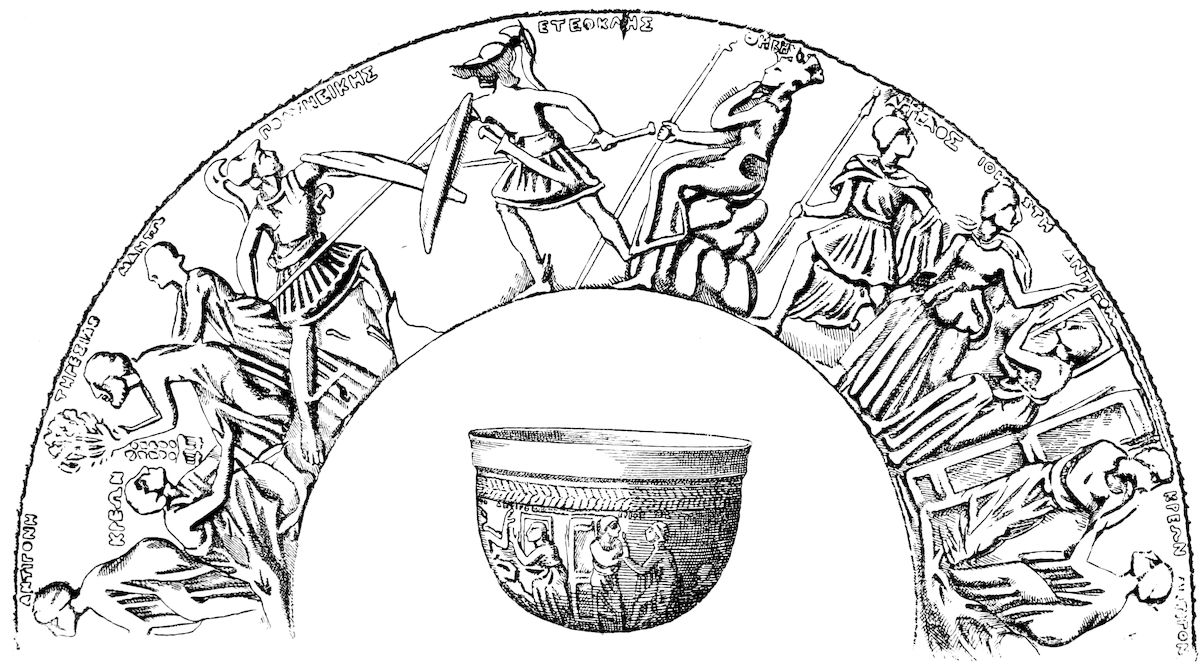
Fig. 27 (vid. p. 173 ff.).
175and so one sees him here before Kreon. His daughter
has brought him as he wished, and now stands behind
him, while the seer discloses the terrible misfortune
which must visit Kreon before success can crown the
Theban arms. The son Menoikeus, who is present in
Euripides, has been left out of the group. The messenger
soon appears and calls for Iokaste.
ἔξελθ’, ἄκουσον, Οἰδίπου κλεινὴ δάμαρ. v. 1070.
She does hear, and comes from the palace and learns
everything about the attack thus far, and how the
different heroes on each side were armed. To her
special inquiry regarding her two sons the messenger
replies in detail (vs. 1217 ff.).
ἤδη δ’ ἔκρυπτον σῶμα παγχάλκοις ὅπλοις
δισσοὶ γέροντος Οἰδίπου νεανίαι. vs. 1242 f.
στήτην δὲ λαμπρώ, χρῶμά τ’ οὐκ ἠλλαξάτην,
μαργῶντ’ ἐπ’ ἀλλήλοισιν ἱέναι δόρυ. vs. 1246 f.
But this is before the battle. They were waiting for
the word from the priests who examined the entrails of
the victims. The second messenger brings the account
of the engagement proper, and this is what the artist
seized upon[317].
ᾖξαν δρόμημα δεινὸν ἀλλήλοις ἔπι·
κάπροι δ’ ὅπως θήγοντες ἀγρίαν γένυν
ξυνῆψαν, ἀφρῷ διάβροχοι γενειάδας·
ᾖσσον δὲ λόγχαις· ἀλλ’ ὑφίζανον κύκλοις,
ὅπως σίδηρος ἐξολισθάνοι μάτην. vs. 1379 ff.
176This is the moment which the relief represents. Their
spears have clashed, and each is still safe behind the
good circumference of his shield.
Iokaste, much disturbed at the critical situation
described by the messenger, determines to call Antigone
and rush to the battle-field to reconcile the brothers,—
ὦ τέκνον, ἔξελθ’, Ἀντιγόνη, δόμων πάρος. v. 1264.
she cries, and Antigone at once appears and asks—
τίν’, ὦ τεκοῦσα μῆτερ, ἔκπληξιν νέαν
φίλοις ἀϋτεῖς τῶνδε δωμάτων πάρος; vs. 1270 f.
The situation is dramatically told on the vase. The
palace doors are still open, and Antigone stands astonished
before her mother.
No sooner has Kreon learned the result of the battle
than he passes an edict banishing the blind Oedipus
from the land. The faithful daughter comes to intercede
for her father and the scene is described in vs. 1539–1682.
The artist has seized upon this situation, but has omitted
Oedipus. Antigone bows before the new king, who
stands with his arms folded listening placidly to the
supplications.
ἀτὰρ ς’ ἐρωτῶ τὸν νεωστὶ κοίρανον·
τί θεσμοποιεῖς ἐπὶ ταλαιπώρῳ νεκρῷ; vs. 1644 f.
This is the moment which the last group represents.
177The personification of Thebes occupying the central
field and presiding, as it were, over the destinies of the
capital, extends the setting of the poet and adds not
a little to the interest of the picture.
There exists, remarkable enough, a small fragment of
another cup, which must have been much like the one
just discussed. It is shown in fig. 28, and joins on well
to the last scene in fig. 27, filling out the gap made by
the omission of Oedipus[318]. We see the stooping and aged
figure of the former king, in long chiton, feeling his way
along or being led by some one. The inscription renders
everything plain. Οἰδίπ]ους κελεύει [ἄγειν πρὸς τὸ
π]τῶμα τῆς αὑτοῦ μητρ[ός τε καὶ] γυναικὸς καὶ τῶν
υίῶ[ν. The unfortunate Oedipus’ doom is sealed, and
he enters with Antigone upon his permanent banishment,
but he will be led to Iokaste that he may embrace
her once more, even though she is now a corpse;
προσάγαγέ νύν με, μητρὸς ὡς ψαύσω σέθεν. v. 1693.
178At this moment the artist conceived his figure, and
that one might not mistake its meaning he wrote
above it who the person was and what the scene meant.
Here, then, in this bit of potsherd, one can see and study
the workings of that awful curse which blasted the house
of Labdakos and sent the miserable Oedipus to wander
‘blind amidst the blaze of noon.’
There remains still a number of vase paintings that
have been referred to certain of Euripides’ extant plays.
It will be seen that I have not been able to convince
myself of their Euripidean character, and have therefore
not included them in the number of published paintings.
The following list gives the most important vases of this
class. No discussion accompanies them, as they seem
to me to present difficulties that preclude their relation
to extant tragedies.
1. Etruscan amphora, no. 728 in the Cabinet des Médailles, Paris.
Pub. as frontispiece to Dennis’ Cities and Cemeteries of Etruria,
vol. ii. = Arch. Ztg. 1863, pl. 180. 3.
1. Amphora, Brit. Mus., cat. iii. E 155. Pub. Raoul-Rochette, Mon. inéd.
pl. 40. 2; cf. Vogel, Scen. eur. Trag. p. 141 f., and Arch. Ztg.
1880, p. 189.
1. Slender Campanian amphora, Berlin. Pub. Arch. Anz. 1890, p. 90,
no. 7; cf. loc. cit. The interpretation given explains the scene
as representing Orestes slaying Aigisthos. This was done, however,
not at a sanctuary or in the open, as here, but in the palace
where Aigisthos, Orestes, and Pylades were engaged in the
slaughtering of oxen. At v. 790 they had entered the palace.
179
1. The Assteas vase in Madrid. Pub. Wiener Vorlegeblätter, ser. B,
pl. 1 = Mon. d. Inst. viii. 10; cf. Hirzel, Annali d. Inst. 1864,
p. 323 ff.: Körte, Ueber Personificationen psychologischer Affekte,
p. 18 f., and Vogel, op. cit. p. 143.
1. Amphora. Attic fabric, cir. 420 B.C. Berlin, vid. Arch. Anz. 1890,
p. 89.
2. Lekythos from Paestum, now in Naples, no. 2900. Pub. Reinach-Millingen,
Peintures, 41 = Élite Céram. iv. 87.
1. Nolan vase in Cassel. Pub. Arch. Ztg. 1852, pl. 37; cf. Furtwängler,
Sammlung Sabouroff, Vasen, Einleitung, p. 14, note 12; Vogel,
op. cit. p. 145.
2. Painting on a fourth cent. krater. Pub. Élite Céram. ii. 76 a; cf. Furtwängler,
op. cit. p. 14.
3. An Oxybaphon in the Louvre. Pub. Élite Céram. ii. 88 a = Reinach-Millin.
op. cit. i. 46 = Müller-Wieseler, Denkmäler d. a. Kunst. ii.
142; cf. Furtwängler, loc. cit.
1. Lucanian krater, Brit. Mus., cat. iv. F 159. Pub. Overbeck, Bildwerke,
pl. 14. 9 = Wiener Vorlegeblätter, ser. 5, pl. 9. 3 = Inghirami, Vasi fitt.
iii. pl. 251; cf. Vogel, op. cit. p. 116.
The following list includes most of the paintings referred to the lost
tragedies. Where it has seemed to me doubtful about the Euripidean
character of the scenes I have preferred to omit mention of them
altogether.
1. Canosa hydria in Bari. The shoulder decoration only is pub. Arch.
Ztg. 1883, pl. 7. 1; cf. p. 51 ff. and Furtwängler, Masterpieces,
p. 109. The latter thinks the painting is from the fifth cent. B.C.
Vid. also Vogel, op. cit. p. 28 ff.
1. Bell-shaped krater, signed by Python now in the Brit. Mus., cat.
iv. F 149. Pub. J. H. S. 1890, pl. 6; cf. ibid. p. 225 ff.
1802. Amphora from Capua. Brit. Mus., cat. iv. F 193. Pub. Annali d.
Inst. 1872, pl. A. Cf. ibid. p. 1 ff. On both paintings Alkmene
sitting on an altar appeals to Zeus against Amphitryon. Cf.
Vogel, op. cit. p. 34.
1. Krater from Capua. Berlin, no. 3237. Cf. Arch. Anz. 1893, p. 91,
f. no. 50. Pub. and discussed by Bethe, Jahrbuch, 1896, p. 292 ff.
and pl. 2; cf. Bethe’s Prolegomena zur Geschichte des Theaters im
Altertum, p. 320, 330, and p. 35 above.
2. Amphora from Canosa. Naples, no. 3225. Pub. Minervini, Memorie
accademiche, pl. 1–3; cf. Vogel, p. 39.
3. Amphora in Naples, no. 708, Museo S. Angelo. Pub. Mon. d. Inst.
ix. 38; cf. Annali d. Inst. 1872, p. 108 f., and Vogel, op. cit. p. 41.
4. Hydria from Anzi in the Basilicata. Brit. Mus., cat. iv. F 185; cf.
Vogel, p. 42. C.
1. Ruvo amphora. Jatta coll. no. 423. Pub. Arch. Ztg. 1871, pl. 40. 2,
and by Heydemann, Ueber eine nacheuripideische Tragödie, 1868,
pl. 1, and Mon. d. Inst. x. 26, 27. Polychrome view of whole
vase on pl. 26 = Rayet et Collignon, Histoire de la Céramique
grecque, pl. 12, p. 300.
2. Apulian amphora. Berlin, no. 3240. Pub. Gerhard, Apulische Vasenbilder,
xi = Arch. Ztg. 1871, pl. 40. 1. Cf. Heydemann, op. cit.
and Klügmann, Annali d. Inst. 1876, p. 173 ff., and Vogel, op. cit.
p. 50 ff.
3. Fragment of Apulian amphora in Carlsruhe; Winnefeld’s Beschreibung
der Vasensammlung, p. 62 f. Pub. Arch. Ztg. 1884, pl. 19. b =
Wiener Vorlegeblätter, ser. E. 6. 3. Cf. Winckler in Aus der
Onomia, p. 149 ff.
1. Apulian krater found near Syracuse. Berlin, no. 3296. Pub. Arch.
Ztg. 1878, pl. 7 and 8; cf. ibid. p. 42 ff, and Robert, Bild und Lied,
p. 36; Vogel, p. 60 f.
1. Ruvo amphora. Pub. Mon. d. Inst. iv. 21 = Wiener Vorlegeblätter,
ser. viii, pl. 8. 1. Cf. Annali d. Inst. 1845, p. 227.
1. Ruvo amphora. Naples, no. 1769. Pub. Overbeck, Bildwerke, 1. 2.
2. Apulian amphora. Berlin, no. 3239. Pub. Overbeck, op. cit. 1. 1.
1813. An abridgement of the foregoing. Pub. Wiener Vorlegeblätter, ser. 6,
II. 2 = Roscher’s Lexikon, i. p. 903; cf. Vogel, op. cit. p. 137 f.
1. Lasimos amphora in the Louvre. Pub. Reinach-Millin, Peintures, ii.
37 = Overbeck, op. cit. pl. 28. 1. Cf. Vogel, p. 98 f.
2. Ruvo amphora. Naples, no. 3255. Pub. Overbeck, Bildwerke, pl.
4. 3 = Baumeister, Denkmäler, i. p. 114; cf. Vogel, p. 99 f.
3. Ruvo amphora. St. Petersburg, no. 523. Pub. Overbeck, op. cit. pl.
4. 2; cf. Vogel, loc. cit.
1. Apulian amphora. Naples, Mus. S. Angelo, no. 11, A. Pub. Arch.
Ztg. 1867, pl. 220.
1. Krater in Naples, No. 1891. Pub. Annali d. Inst. 1874, pl. A.
2. Krater in St. Petersburg, no. 427. Pub. Inghirami, Vasi fitt. i. pl. 1–3;
cf. Engelmann in Annali, 1874, p. 35 f., and Vogel, op. cit. p. 85 f.
1. Hydria in Naples. Heydemann, Raccolta Cumana, no. 141. Pub.
Arch. Ztg. 1857, pl. 106.
2. Tischbein, Vases d’Hamilton, ii. 6; cf. Jahn, Telephos und Troilos,
p. 44, and Vogel, op. cit. p. 89 ff.