Footnotes have been collected at the end of each chapter, and are
linked for ease of reference.
Minor errors, attributable to the printer, have been corrected. Please
see the transcriber’s note at the end of this text
for details regarding the handling of any textual issues encountered
during its preparation.
Any corrections are indicated using an underline
highlight. Placing the cursor over the correction will produce the
original text in a small popup.
Any corrections are indicated as hyperlinks, which will navigate the
reader to the corresponding entry in the corrections table in the
note at the end of the text.
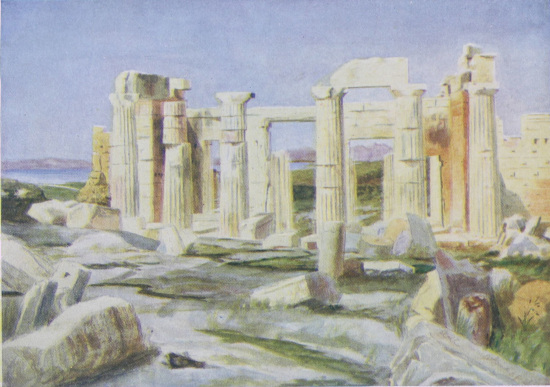
THE PROPYLÆA From within, looking toward Salamis. From a painting by H. R. Cross
GREEK LANDS AND
LETTERS
BY
FRANCIS GREENLEAF ALLINSON
(Professor of Classical Philology in Brown University)
AND
ANNE C. E. ALLINSON
BOSTON AND NEW YORK
HOUGHTON MIFFLIN COMPANY
The Riverside Press Cambridge
MDCCCCIX
COPYRIGHT, 1909, BY FRANCIS G. ALLINSON
AND ANNE C. E. ALLINSON
ALL RIGHTS RESERVED
Published December 1909
TO
A. C. E.
AND
S. C. A.
PREFACE
vii
The purpose of this book is to interpret Greek
lands by literature, and Greek literature by
local associations and the physical environment.
Those who possess an intimate acquaintance
with Greek or who have the good fortune to stay long in
Greece will be able to draw upon their own resources.
Many travellers, however, must curtail their visit to a
few weeks or months, and it is hoped that to them this
book may prove useful as a companion in travel, while
to a wider range of readers it may prove suggestive in
appraising what is most vital in our “Hellenic heritage.”
To keep within reasonable bounds it has seemed
necessary to limit our survey to those portions of the
mainland of Greece and those islands, immediately
adjacent in the Gulf of Ægina, which may be easily
visited during a short stay in Athens as headquarters.
But the visitor cannot be too strongly urged to avail
himself of opportunities to visit the remoter islands
and the shores of Asia Minor, which are so beautiful a
part of the Greek world and have played so brilliant
a rôle in Greek history and literature.
In quoting or summarizing the literature the limitations
of space are obvious. Selections have been made
viiiwhich to us seemed most fairly to interpret the countries
and sites. It is hoped that these will not only
prove representative when taken together but will
recall much that has perforce been omitted.
Purely learned treatises in Greek have not been cited
except by way of illustration. The historical geographer
Strabo, of the time of Augustus, has offered suggestive
material; and Pausanias, of the second century of our
era, the pious and often charming writer of the “Guidebook
to Greece,” has, as was inevitable, been the
cicerone in many places.
History it has seemed proper to use chiefly to explain
the literature, or, especially in the case of Herodotus
and Thucydides, as itself part of the noblest prose literature.
But in different chapters emphasis has been laid,
to some extent, upon different elements, such as myth
and legend, prehistoric tradition, the history of certain
epochs in classic times, the demands of religion, the
growth of the artistic impulse or the bloom of the Attic
period. By this means we have hoped, without too
much repetition, to suggest a fairly adequate outline of
the different factors in Greek civilization. The introductory
chapter is intended to provide the essential
background for the others.
Forms of art other than literature are only incidentally
touched upon. Archæological information or discussion,
except as illustration, is precluded by the purpose
of the book, which deals with the literature and
the land as being permanent possessions that are not
ixessentially modified by the successive data of archæology,
necessarily shifting from month to month.
In translating Greek authors it has seemed best, as a
rule, to offer new versions, rendering the thought as
literally as is consistent with our idiom or, in the case
of poetry, with the exigencies of English verse. The
anapæstic dimeters and, in the dialogue parts of the
drama, the six-stress iambic verse have been retained;
less uniformly the elegiac couplet; and, occasionally
only, the heroic hexameter. Elsewhere poetry has been
usually turned by rhymed verse or by rhythmic prose.
Some existing translations or paraphrases have been
used, for which credit has been given in the text or the
footnotes. Moreover, in most of the citations from Pausanias
Mr. Frazer’s admirable translation has been used
without explicit mention, and for this we make acknowledgment
here. In translating Pindar many turns of
expression have been taken from the beautiful translation
of Ernest Myers, although, when they are not
expressly credited, the versions have been rewritten.
While it is hoped that full credit has thus been given
wherever it is due, there are doubtless expressions here
and there remaining in the memory from numerous
commentators on Greek authors that form a common
stock in trade for the translator.
In transliterating Greek names we have followed, as
a rule, familiar English usage.
Among many books of reference there are a few to
which we are especially indebted. We have used constantly
xMr. J. G. Frazer’s “Commentary on Pausanias,”
which includes a wealth of outside references, as,
for example, citations from other travellers beginning
with Dicæarchus, the entertaining geographer of the
fourth century b. c. We are also indebted to Curtius’s
“History of Greece” and Tozer’s “Geography of
Greece”; Dr. W. Judeich’s “Topographie von Athen”
(especially for Piræus); Professor Ernest Gardner’s
“Ancient Athens,” which should be in the hands of
every visitor to Athens; and Miss J. E. Harrison’s
“Primitive Athens.” Professor J. B. Bury’s “History of
Greece” has been constantly suggestive. On modern
Greece Schmidt’s “Das Volksleben der Neugriechen”
and Sir Rennell Rodd’s “Customs and Lore of Modern
Greece” have furnished definite material.
Among the numerous editions of Greek authors
necessarily consulted we are under special obligations
to Professor Gildersleeve’s “Pindar, the Olympian and
Pythian Odes,” and to Professor Smyth’s “Melic
Poets.” Certain quotations in the text, not provided
for in the footnotes, are acknowledged in the Appendix,
in which are also given, for the sake of comparison,
exact references to the Greek.
Our personal thanks are due to Professor J. Irving
Manatt, of Brown University, for valuable suggestions
and criticism of several chapters, and to Professor
Walter G. Everett for his discussion of the section on
Greek philosophy. We are also especially indebted
to Professor Herbert Richard Cross of Washington
xiUniversity, St. Louis, for placing at our disposal his
water-color sketch of the Propylæa, from which the
frontispiece is taken, and to Professors C. B. Gulick
and G. H. Chase of Harvard University for assistance
in obtaining the impression of the coin upon the cover
of this book.
Nike of Samothrace, reproduced on the front cover, is
from a coin in the Fogg Art Museum, Harvard University.
GREEK LANDS AND LETTERS
1GREEK LANDS AND LETTERS
CHAPTER I INTRODUCTORY: THE WIDESPREAD LAND OF HELLAS
“Greek literature is read by almost all nations.”
Cicero, Pro Archia.
Cicero, at one time studying Greek oratory in
Rhodes, at another speaking Greek as the
language best adapted to a Sicilian audience,
suggests with sufficient definiteness the eastern and
western boundaries of ancient Hellas. Leaving out of
consideration more remote colonies, we may content
ourselves with including in the Greater Greece of antiquity
all the Mediterranean lands and waters from
Sicily and Lower Italy, in the west, to Cyprus and the
coast of Asia Minor, in the east. The Riviera, or seaboard
of the eastern side of the Ægean, is sharply differentiated
from the continuous highlands of the interior,
which suggest, a short distance inland, a boundary
line between Europe and Asia. For a maritime people
like the Greeks this was a barrier more effectual than
the highway of the Bosphorus. In the early historic
times, when the sun rose over these mountains of Asia
Minor he left behind him the Oriental and looked down
2at once upon the Cis-montane Greeks, and it was upon
Greeks that he was still shining when his setting splendour
lit up the Bay of Naples—the “New-town” of
that day—or the ancient Cumæ and the heights of
Anacapri or the islands of the Sirens and the golden
brown columns of Poseidon’s temple at Pæstum.
The seaboard, too, of Macedonia and Thrace belonged
to Greece by reason of their water-front on the
Ægean. And to the south, the encroachments of the
Greeks upon the preserves of the Nile-god were so extensive
for centuries before the time of Alexander that
we need not wonder either at Egyptian reminiscences
in Greek art or at the increasing evidences of Hellenic
life in Egypt.
The Greeks, compared with the hoary antiquity of
the Egyptians, are late comers. The essential difference,
however, is not a matter of centuries or millennia.
The Egyptians, perhaps because the details are foreshortened
by the vast distance, seem to possess a chronology,
but no real history. There were revolutions,
rather than evolution. The Greeks were young, too,
individually as well as chronologically. From Homer
down through the classic period we hear “the everlasting
wonder-song of youth.” Plato makes an Egyptian
priest say to the Athenian law-giver: “O Solon, Solon,
you Hellenes are ever children; no Hellene is ever old!”
We find the Greeks of the historic period on the intellectual
watershed between antiquity and the modern
world. From data now well established we may push
3back their life far beyond recorded chronology, and, if
we anticipate even by a little the nucleus of the Homeric
poems, we possess a practically unbroken continuity
of their history and language for three thousand years
down to the present day. Greek history is often confined
within perfectly arbitrary dates. In reality, the
death of Alexander in 323 B. C., the closing of the schools
of philosophy in 529 A. D., and the fall of Constantinople
in 1453 A. D. only break its course into convenient
chapters.
The Greek language is itself one of the greatest creations
of Greek art. Discarding some superfluities, retained
or over-emphasized by others of our common
Indo-European family, the Greeks developed an instrument
for the expression of thought unsurpassed, if not
unequalled, among any other people. “The whole language
resembles the body of an artistically trained athlete,
in which every muscle is called into full play, where
there is no trace of flaccid tumidity, and all is power
and life.” The “common dialect” already dominated
the eastern Mediterranean before the Romans took
physical possession. Its direct legatee is the modern
Greek, that had sprung up in lusty independence some
three centuries before the Turks put an end to senile
Byzantium and its crabbed ecclesiastical speech.
Of creative literature the same unbroken continuity
cannot be predicated. The early literature, beginning
with Homer, extends through the first quarter of the
fifth century B. C. It includes the great epic poetry, the
4elegiac and iambic, the beginnings of philosophy, and
seven of the ten greatest lyric poets. No fact in Greek
literature is more conspicuous than the shortness and
the richness of the next period, which may be conveniently
called the “Attic,” although some of the greatest
writers came from outside of Attica—from Bœotia,
from the islands, from beyond the Ægean, or from
Sicily. Within this brief period of only 183 years, if
we close it with the death of Menander in 292 B. C., all
the additional types of the literature either culminated
or originated.
The next period of 150 years, commonly known as the
Alexandrian period, has within its early limits the name
of Theocritus, whose quality entitles him to rank with
the writers of the Classic period, as does that of his
two legatees, Bion and Moschus, and also Herodas,
whose writings, recovered in the fortunate year 1891,
have now made him a part of the Greek Classics. But
in the Alexandrian period, and in the Græco-Roman
period from 146 B. C. to 529 A. D., the great names are,
as a rule, not so great, and they are spread over a long
time. Few of them, except Lucian in the second century
of our era, and Plutarch immediately preceding
him, successfully compete for a prominent place as
writers of pure literature.
With a few exceptions, the great original work in
Greek literature had been done before the death of Menander.
The Greek anthology, however, must not be
ignored. It ranges over more than one thousand years
5and leaves no century in all that time without at least
some minor representative of great beauty. Like a
cord twisted of dull strands and golden, it binds together
the Attic age with the whole of the subsequent
time down to the year 550 of our era, the golden strand
reappearing sufficiently often to assure us of its continuity.
The next nine centuries of Byzantine Greek,
ecclesiastical and profane, are little known to most
classical scholars. The contributions of the modern
Greek, before and since the days of Byron, are significant,
and the friends of the new kingdom await with
cordial expectation the rise of new writers to give to the
lore of the peasant and the struggles of the patriot a
worthy literary form. Of the lacunæ in the literature, in
spite of the continuity of the language, Professor Hatzidakis
of Athens has well said: “The Greek language
is as little to be blamed for this as could be the marble
quarries of Mount Pentelicus, because in those times
no one fashioned from them a Hermes of Praxiteles or
a Venus of Melos.”
A glance at the map will show how accessible was
the mainland of Greece, upon the east and south, to
seafaring visitors from across the Ægean, who would
naturally find here their first landing-places. Except
for the great gash of the Corinthian Gulf, the western
coast is indented only with smaller, though good, harbours,
while the whole southern and eastern seaboard
from Messenia in the southwest to Thrace is a ragged
fringe of promontories, large and small, welcoming into
6the interior the waters that suggested sea-business of
war and commerce.
But this interlacing of land and water, that brought
the insinuating “call of the sea,” was not the only
factor that predetermined the character of the Greek
cantons. The Greeks were mountaineers as well as
mariners. One is, indeed, almost tempted to speak of
Greece as consisting of only mountains and marina.
There are of course some relatively large plains, notably
the fertile granary of Thessaly, but the general
impression of the land from any bird’s-eye view is a
succession of lofty ridges, peaks, and spurs. Only by
many shiftings of the place of outlook do these partially
resolve themselves into ranges continuous in certain
general directions, though with many sharp angles
and curves and buttressed by uncompromising cross
ridges. These mountain barriers make clear the history
of the Greek peoples, both how they combined temporarily
to resist foreign invasion and, above all, why they
developed and cherished in tiny cantons their characteristic
individualism, which has been by turns a bane
and a blessing.
Thessaly and Mount Olympus to the north belong
geographically to the Kingdom of Greece. On either
side of Thessaly irregular mountain chains run southward
and preserve a general connection through
Central Greece and Attica, and, despite the submerging
water, may be identified as reappearing in the
islands far out in the Ægean. Olympus on the northeast—hardly
7interrupted by the river Peneius, which
has rent its way through the precipitous cañon known
as the “Vale” of Tempe—is continued along the east
coast by Mount Ossa and Mount Pelion. Then across
the narrow entrance to the Pagasæan and Malian gulfs
the system is continued by the sharp dorsal fins of the
island of Eubœa, that stretches like a sea-monster along
the shores of Locris, Bœotia, and Attica, to reappear at intervals
far to the southeast in the islands Andros, Tenos,
Myconos, Delos, Naxos, Amorgos, and Astypalæa. On
the west of Thessaly the great Pindus ridge, descending
through the centre of northern Greece, details on
the rugged system of peaks and ranges which fill central
Greece southward to the Gulf of Corinth and
which in general run from west to east. One of these
ranges, called the Othrys Mountains, bounds the Thessalian
countries on the south and ends at the Gulf of
Pagasæ. Another, Mount Œta, is continued by the
high mountains that shut off Thermopylæ to the north
and runs on as the boundary between Locris and
Bœotia. Still another range, running out of the central
complex, has its culmination in Parnassus, 8070 feet
high, and is continued, though more interrupted and
with a more irregular course, by Mount Helicon in
Bœotia and the frontier hills of Attica, from Helicon to
Parnes, and bends around into the massive ridge of
Mount Pentelicus, from whose summit the spectator
can see the prolongation in the islands of Ceos, Cythnos,
Seriphos, and others beyond.
8The narrow neck that divides the Corinthian from
the Saronic Gulf and connects Attica and Bœotia with
the Peloponnesus, lifts up among its rugged hills in
Megara the picturesque twin peaks of the Kerata.
South of the isthmus itself, with its narrow plain and
the deep cutting necessary for the canal, rises the splendid
acropolis of Acrocorinth, keeping guard at the entrance
to the “Island of Pelops.”
The Peloponnesus, or Morea, is a rugged complex of
mountains that by turns shut out and admit the sea. Of
its four irregular peninsulas, jutting out southward in
the Argolis and in Laconia and Messenia, each has its
mountain system; the more broken hills in the Argolid
plain; the ridge of Parnon to the east of the plain
of Lacedæmon; the imposing barrier of Taygetus
between Sparta and Messenia. In Messenia itself are
fertile plains. One is in the midland, as the name
Messenia originally implied, among offshoots of the
Arcadian Lycæus; while the great mountain fortress of
Ithome, 2600 feet high, where crops could be reared
and an army supported, towering above the hills and
plains of central Messenia, looks down on another
larger plain, almost tropical in its products, that
stretches southward to the gulf.
The centre and west of the Peloponnesus is a mass of
peaks and mountain ridges tangled up at abrupt angles
but bounded on the north by a formidable chain, generally
parallel with the Gulf of Corinth and dominated
by Erymanthus and Cyllene to the west and east respectively.
9Around and against this chain great mountains
are piled up like petrified billows. In this part
of Greece plains few but important are interspersed, as
at Megalopolis or Olympia. Along the northwest coast
there is the wider sea-margin of “Hollow” Elis, while
along the Corinthian Gulf Ægialus, the “coast-land,”
seems often little more than a grudging marina subjacent
to the foothills of Erymanthus and Cyllene.
From north to south, from east to west the Greek
landscape lends itself to panoramic views. Lucian in
his “Charon” makes Hermes seat himself on one of the
twin peaks of Parnassus and Charon upon the other.
With eyes anointed with Homeric eye-salve, the Ferryman,
on his furlough from the under-world, is able
to see not only the Greater Greece outspread around
him,—from Asia Minor to Sicily, from the Danube to
Crete,—but to look off beyond to the Orient and to
Egypt. These wide outlooks are enhanced by the
distinctness of the sky-line, everywhere an important
factor. “The hard limestone of which the mountains
are composed is apt to break away, and thus
produces those sharply-cut outlines which stand out
so clearly against the transparent sky of Greece.”
So large a troupe of actors played their parts in
Greek history that the imagination demands a roomy
stage. But the country is small. Were it not for the
mountain barriers, the scale of distances would seem
trivial. It is, for example, only some thirty miles in an
air line from Thermopylæ to the Gulf of Corinth. Even
10on the leisurely and winding Piræus, Athens, and Peloponnesus
Railway, it is only one day’s ride from Athens
via the Isthmus down to Kalamata on the Bay of Messenia.
The degrees of latitude that include the mainland
of Central and Southern Greece span in the west
only the Lipari Islands and Sicily; the thirty-eighth
parallel that passes south of Palermo and the straits of
Messina runs a little north of Athens; while the thirty-seventh
parallel, running just south of Syracuse,
passes still farther south of Kalamata and Sparta.
Not only is the mainland of Greece contained in
narrow geographical limits, but the Ægean itself is
almost an inland lake enclosed within neighbouring
coasts. In clear weather the sailor, without adventuring
upon open sea, might pass from mainland to mainland
as he watched from his advancing prow another
island lift above the horizon before losing sight of the
harbour left astern. In Greek literature there is no more
striking reminder of the contiguity of the Asian coast
to Greece proper than the well-known passage in the
“Agamemnon” of Æschylus describing the swift telegraphy
of the beacon signals that brought to Argos the
news of the capture of Troy. The ten years’ absence
of Agamemnon’s host tends to an instinctive extension
of the distance, if the imagination is not checked by the
actual scale of miles. Troy seems farther from Argos
than the Holy Land from the homes of the Crusaders.
Beacon telegraphy is a time-honored device. Many
bright beacons doubtless blazed before Agamemnon,
11as well as since his time. Commentators have been at
pains to justify by modern experiments with beacon
fires on lofty heights the severest strain upon our
optic nerves which Æschylus makes in the case of the
light that leaped from Mount Athos to the high ridges
of Eubœa. The distance is more than 100 miles, but,
bearing in mind that the Eubœan mountain is some
4000 feet high and Athos more than 6000, we need not
apply for any special license for our poet’s imagination.
The devious course of the fire signals from Eubœa to
Argos is one of the best illustrations of the jagged surface
that Greece lifts skywards. As one stands on
Mount Pentelicus and looks across to Eubœa, the intervening
arm of the sea is hemmed in for the eye into
narrow inland lakes. And Æschylus, sufficiently, though
not officiously, realistic, makes the firelight zigzag irregularly
to dodge the interfering ridges till it falls upon
the palace roof at Argos,—not at Mycenæ, as is the
not infrequent misrepresentation of the Æschylean
story.
Clytemnestra, to the chorus asking who could have
brought the news so quickly, replies:—
“Hephæstus, on from Ida sending brilliant gleam,
And hither beacon beacon sped with courier flame.
First Ida to the Hermæan crag of Lemnos sent,
Then from the island was received the mighty flame
By Athos, Zeus’s mount, as third: this over-passed—
So that it skimmed the sea’s broad back,—the torch’s might,
A joyous traveller, the pine’s gold gleam, sun-like,
To watching Mount Macistus brought its flashing news.
12Macistus then, delaying not, nor foolishly
Foredone with sleep, as messenger pass’d on his share.
The beacon’s gleam unto Euripus flowing far
Then came and signal to Messapium’s pickets made.
They too gave back a flame and ever onward sent
The news by lighting up a heap of heather gray.
The Torch then, strong to run, nor dimm’d as yet, leap’d on
Like radiant moon across Asopus and his plain
And came unto Cithæron’s crags, awaking there
A new relay of courier flame: nor did the guard
Disown the far-escorted light, but escort flame
In turn made soar aloft into the ether high.
Then over Lake Gorgopis smote the gleam and came
Unto Mount Ægiplanctus urging that the flame
Ordain’d should fail not. Lighting with ungrudging strength
They send a mighty beard of fire. O’er the height
That overlooks the Saronic Gulf it onward flared,
Until, when it had reach’d the Arachnæan steep,
It lighted on the outposts neighbour to our town;
Then on this roof of the Atreidæ falls this light,
The long-descended grandchild of the Idæan flame!”
From the very smallness of Greece results the overcrowding
of associations that almost oppress the spectator
standing at one or another place of vantage.
But if his historic horizon is as clearly defined as the
physical he will come back to the sea-level with a
clearer understanding of the interdependence between
the scene and the action of the great dramas here enacted.
The country is not only a background but a
cause for the literature. Neither can be fully understood
without the other.
It must not be assumed from the smallness of the
land that the spurs to the imagination of the Greeks
were few. On the contrary, within their narrow borders,
13nature was prodigal of her inspiration. In the few
miles from Thessaly to the Messenian Gulf are offered
a variety of climate and an alternation of products
well-nigh unparalleled for such a limited area. The
warm air of the sea penetrating into sheltered valleys
favours an almost tropical vegetation, while the lofty
mountain ridges offer almost an Alpine climate. In
Attica, in early spring, snow may occasionally be seen
sprinkled on Hymettus and glistening white on Mount
Pentelicus, while oranges hang on the trees in Athens.
Taygetus in the south maybe a snow-covered mountain
even as late as May while in the Messenian plain below
grows the palm and, more rarely, the edible date.
In the Argolis are groves of lemons and oranges, and
in Naxos, in the same latitude as Sparta, the tender
lime ripens in the gardens. The gray-green olive is
familiar throughout Central and Southern Greece.
If we extend the survey farther north, the beeches of
the Pindus range, west of Thessaly, are surrounded
by the vegetation rather of northern Europe; in the
interior of Thessaly the olive tree does not flourish;
the northern shores of the Ægean have the climate of
Central Germany, while Mount Athos, whose marble
walls jut far out into the Ægean and rise 6400 feet above
the sea, offers on its slopes nearly all species of European
trees in succession.
The different parts of Greece offer a varying development
in literature. In this particular some districts,
like Acarnania, Ætolia, and Achæa, though possessed
14of great natural beauty, are negligible. Arcadia, though
itself unproductive, inspired poetry; others, also, like
Phocis, Locris, and Messenia, are inevitably drawn
into the associations of literature and history. In
Epirus we find at Dodona the first known sanctuary of
Zeus, the supreme god of the Greeks. In Thessaly the
earliest Greeks, or Achæans, may have first forged in
the fire of their young imagination the tempered steel
of the hexameter. Here was the home of Achilles, and
here, perhaps, we must look for the kernel of the Iliad.
Here most fitly, close to Olympus where dwelt the immortals,
could the sons of men be “near-gods.”
From the north and northwest successive waves of
population descended into lower Greece to conquer,
merge with, or become subject to the previous comers.
But prehistoric peoples, whether alien or Greek, like
the Eteo-Cretans, the Pelasgi, the Minyæ, the Leleges,
the Hellenes, the Achæans, and even great movements
like the Dorian and Ionian migrations, are all foreshortened
on a scenic background, as equidistant to the
Greeks of the classic periods as is the vault of heaven
to the eyes of children. One star, indeed, differed from
another. The Dorian, for example, was of the first
magnitude. But the relations of apparent magnitude
and real distance were ignored or naïvely confused in
the fanciful constellations of myth and saga, distant
yet ever present, bending around them to their explored
horizon. Heroic figures impalpable but real as the
gods themselves intervened continually, controlling
15decisions, shaping policies, or determining disputed
boundaries among even the most intellectual of the
Greeks. Royalty, oligarchy, democracy, and tyranny
alike must reckon with personified tradition.
When we emerge into the light of more authentic
records it is well, in the confusing maze of inter-cantonal
contentions, to focus the mind, for the purpose of appreciating
the literature, upon certain broader relations
and more clearly defined epochs in Greek history, like
the so-called “Age of the Despots” within the seventh
and sixth centuries, the Persian wars, and the conflicts
between Attica as a pivot and the Peloponnese, Thebes,
and Macedon.
It might be expected from the variety of natural
charm offered by Hellenic lands, from Ilium to Sicily,
from Mount Olympus to Crete, that the Greeks would
show in their literature a pervasive love of nature. This
was, in fact, the case. The modern eye has not been the
first to discover the beauty of form and colour in the
Greek flowers and birds, mountains, sky and sea.
Modern critics, ignoring all historical perspective and
assuming as a procrustean standard the one-sided and
sophisticated attitude that has played a leading rôle in
modern literature, announced as axiomatic that ancient
Greek poets had no feeling for nature and found no
pleasure in looking at the beauties of a landscape.
This superficial idea still keeps cropping up, although
thoughtful readers of Greek literature have long since
pointed out the necessity both of a chronological analysis
16of the literature and of a more inclusive statement of
the various forms in which a sentiment for the natural
world is evinced.[1] It is a far cry from Homer to Theocritus,
and, as might well be expected in a range of six
centuries and more, new elements appear from time to
time, due both to changing conditions of life and civilization
and also to the personal equation.
A naïve feeling for nature is uppermost in the descriptive
comparisons and similes of Homer and, generally
speaking, in the myth-making of the Greeks.
The concrete embodiment of natural phenomena and
objects in some Nature-divinity often obviated the
necessity for elaborate description and summarized
their conceptions as if by an algebraic formula. The
mystical element was not lacking, but by this myth-making
process it became objective and real. The
sympathetic feeling for nature becomes more and more
apparent in lyric poetry and the drama until in Euripides
there emerges, almost suddenly, the “modern”
romanticism. In the Hellenistic and imperial times,
finally, the sentimental element is natural to men who
turn to the country for relief from the stress of life in a
city. One generalization for the classic periods may
be safely made. Although the Greeks from Homer to
Euripides thought of the world as the environment of
man, yet they stopped short of a sentimental self-analysis.
Charles Eliot Norton, more than thirty years ago,
17pointed out that the expression of a sentiment like
Wordsworth’s—
“To me the meanest flower that blows can give
Thoughts that do often lie too deep for tears”—
is foreign to the clear-eyed Hellene, reared amongst
the distinct outlines of his mountains and from the
cradle to the grave at home upon the blue and windswept
Ægean. Certainly this is true until the speculative
questionings of the Ionic philosophers had
time to react upon literature. As the Greeks accepted
their pedigrees from the gods and heroes, so
they accepted their environment of beauty. They
were not unlike the child, content to betray by a
stray word or caress his unanalyzed admiration for his
mother’s face.
Emphasis has often been laid, and rightly, upon the
keen sensitiveness of the Greeks to beauty of form in
sculpture, architecture, and literature. It is urged that
they made this sense of form and proportion so paramount
that they were blind to the beauty of colouring
and indifferent to the prodigal variety of Nature’s
compositions. It may be readily admitted that this is a
vital distinction between the ancient and modern attitudes.
Both the craving for perfection of form and the
preference given to man before nature come out in the
preëminent development of sculpture by the Greeks.
Their admiration of the beauty of the human form, unlike
the sensitive shrinking of moderns, was extended
even to the lifeless body. Æschylus speaks of the warriors
18who have found graves before Troy as still “fair
of form.”
But a prevailing tendency does not necessarily exclude
other elements. However meagre the vocabulary
of the Greeks in sharp distinction of shades of colour,
their love for a bright colour-scheme is shown not only
by the brilliancy of their clothing and their use of colouring
in statuary and architecture,—for even in
these mere form was not enough,—but in unnumbered
expressions like Alcman’s “sea-purple bird of
the springtime.”
A few of the more obvious passages, illustrating the
Greek attitude toward nature, are here given in general
historic sequence. Others will be found in the
subsequent chapters in connection with particular landscapes.
Very often such references are casual and subordinate
to some controlling idea, but they none the less
reflect habitual observation. Even when we speak of
Homeric “tags,” like the “saffron-robed” or “rosy-fingered,”
or of Sappho’s “golden-sandalled” Dawn, as
“standing epithets,” we are implying that these epithets
made a general appeal. The naïve insertions in
Homer of comparisons drawn from birds and beasts,
from night and storm and other familiar elements of
nature, would seem like an intrusive delay of the story
did they not carry with them the conviction that both
poet and hearers alike were well content to linger by
the way and observe the objects of daily life indoors
and out. Thus in the Odyssey:—
19
“The lion mountain-bred, with eyes agleam, fares onward
in the rain and wind to fall upon the oxen or the
sheep or wilding deer.”
Or, again:—
“Hermes sped along the waves like sea-mew hunting
fish in awesome hollows of the sea unharvested and wetting
his thick plumage in the brine.”
One of the longer and best known comparisons is the
description in the Iliad of the Trojan encampment by
night:—
“Now they with hearts exultant through the livelong
night sat by the space that bridged the moat of war, their
watch-fires multitudinous alight. And just as in the sky
the stars around the radiant moon shine clear; when windless
is the air; when all the peaks stand out, the lofty forelands
and the glades; when breaketh open from the sky
the ether infinite and all the stars are seen and make the
shepherds glad at heart—so manifold appeared the watch-fires
kindled by the Trojan men in front of Ilios betwixt
the streams of Xanthus and the ships. So then a thousand
fires burned upon the plain and fifty warriors by the side
of each were seated in the blazing fire’s gleam the while
the horses by the chariots stood and champed white barley
and the spelt and waited for the throned Dawn.”
Sappho’s fragments are redolent of flowers; her
woven verse, a “rich-red chlamys” in the sunshine,
has a silver sheen in the moonlight. We hear the full-throated
passion of “the herald of the spring, the
nightingale”; the breeze moves the apple boughs, the
wind shakes the oak trees. Her allusions to “the
20hyacinths, darkening the ground, when trampled under
foot of shepherds”; the “fine, soft bloom of grass,
trodden by the tender feet of Cretan women as they
dance”; or the “golden pulse growing on the shore,”—all
these seem inevitable to one who has seen the
acres of bright flowers that carpet the islands or the
nearby littoral of the Asian coast. Her comparison of
a bridegroom to “a supple sapling” recalls how Nausicaä,
vigorous, tall, and straight as the modern athletic
maiden, is likened by Odysseus to the “young
shaft of a palm tree” that he had once seen “springing
up in Delos by Apollo’s altar.” In her Lesbian
orchards the sweet quince-apple is still left hanging
“solitary on the topmost bough, upon its very end”;
and there is heard “cool murmuring through apple
boughs while slumber floateth down from quivering
leaves.” Nor need we attribute Sappho’s love of natural
beauty wholly to her passionate woman’s nature.
All the gentler emotions springing from an habitual
observation of nature recur in poets of the sterner sex.
“The Graces,” she says, “turn their faces from those
who wear no garlands.” And at banquets wreaths
were an essential also for masculine full-dress. Pindar,
in describing Elysian happiness, leads up to the climax
of the companionship with the great and noble dead
by telling how “round the islands of the Blest the
ocean breezes blow and flowers of gold are blooming:
some from the land on trees of splendour and some
the water feedeth; with wreaths whereof they twine
21their heads and hands.”[2] Against the green background
passes Evadne with her silver pitcher and her
girdle of rich crimson woof, and her child is seen “hidden
in the rushes of the thicket unexplored, his tender
flesh all steeped in golden and deep purple light from
pansy flowers.”
To follow through the poetry of the Greeks the unfailing
delight in the radiance of the moon would be
to follow her diurnal course as she passes over Greek
lands from east to west. The full moon looked down
on all the Olympian festivals and Pindar’s pages are
illuminated with her glittering argentry. The Lesbian
nights inspire Sappho as did all things beautiful.
“The clustering stars about the radiant moon avert
their faces bright and hide, what time her orb is rounded
to the full and touches earth with silver.”
Wordsworth could take this thought from Sappho:
“The moon doth with delight look round her when the
heavens are bare,” but the Lesbian certainly did not
finish the fragment by lamenting that “there has passed
away a glory from the earth.”
The night and the day alike claimed the attention of
the poets and the interchange of dusk and dawn appealed
to the sculptor also. In the east gable of the
Parthenon the horses of the Sun and of the Moon were
at either end. Nature’s sleep is a favourite topic. Alcman’s
description is unusual only for its detail:—
22“Sleep the peaks and mountain clefts;
Forelands and the torrents’ rifts;
All the creeping things are sleeping,
Cherished in the black earth’s keeping;
Mountain-ranging beast and bee;
Fish in depths of the purple sea;
Wide-winged birds their pinions droop—
Sleep now all the feathered troop.”
Goethe, in his well-known paraphrase,—
“Ueber allen Gipfeln
Ist Ruh,”—
cannot refrain from adding the subjective conclusion
of the whole matter:—
“Die Vögelein schweigen im Walde.
Warte nur, balde
Ruhest du auch.”
The great dramatists display an observation of the
beauty of the external world not always sufficiently
emphasized. In Æschylus an intense feeling is evident;
none the less because it is subordinated to his
theme or used to point, by way of contrast, some
awe-inspiring or pathetic situation or some scene of
blood. Clytemnestra describes how she murdered her
husband. His spattering blood, she says,—
“Keeps striking me with dusky drops of murd’rous dew,
Aye, me rejoicing none the less than God’s sweet rain
Makes glad the corn-land at the birth-pangs of the buds.”
Comparisons, similes, and epithets drawn from the sea
reappear continually in the warp and woof of Greek,
and especially of Athenian, literature. Æschylus, like
the rest, knew the sea in all its moods, terrible in storm,
23deceitful in calm, beautiful at all times and the pathway
for commerce and for war. The returning herald
in the “Agamemnon” rehearses the soldiers’ hard
bivouac in summer and in winter:—
“And should one tell of winter, dealing death to birds,
What storms unbearable swept down from Ida’s snow,
Or summer’s heat when, ruffled by no rippling breeze,
Ocean slept waveless, on his midday couch laid prone.”
With the first lines of “Prometheus Bound” we are
carried far from the haunts of men:—
“Unto this far horizon of earth’s plain we’ve come,
This Scythian tract, this desert by man’s foot untrod.”
Hephæstus reluctant, compelled by Zeus’s order, rivets
his kin-god, the Fire-bringer, to the desolate North
Sea crag and withdraws leaving Prometheus in fetters
to “wrestle down the myriad years of time.” The
night shuts off the warmth and light, drawing over
him her “star-embroidered robe,” and the fierce sun-god
returns with blazing rays to “deflower his fair
skin” bared of the white counterpane of “frost of early
dawn.” Not until the emissaries of Zeus have departed
does Prometheus deign to speak. Then he “communes
with Nature.” He has no hope of help from God, none
from the “helpless creatures of a day” whom he has
helped. Alone with the forces of nature he utters that
outcry unsurpassed in sublimity and in pathos:—
“O upper air divine and winds on swift wings borne;
Ye river-springs; innumerous laughter of the waves
Of Ocean; thou, Earth, the mother of us all;
24And thou, all-seeing orb of the Sun—to you I cry:
Behold me what I’m suffering, a god from gods!”
Sophocles, too, lets Philoctetes, in his misery and
loneliness on the rocky island of Lemnos, call out to the
wild beasts and the landscape:—
“Harbours and headlands; and ye mountain-ranging beasts,
Companions mine; ye gnawed and hanging cliffs! Of this
To you I cry aloud, for I have none save you—
You ever present here—to whom to make my cry.”
In his famous ode on the Attic Colonus he describes
the natural beauty of his home with particularizing
exactness. He has also a wealth of glittering epithet
used for local colouring, for symbolism and personification.
The contrast of day and night offers to him
a welcome mise-en-scène. The sun’s rays are Apollo’s
golden shafts and the moon’s light seems to filter
through the trees as Artemis roams the uplands:—
“O God of the light, from the woven gold
Of the strings of thy bow, I am fain to behold
Thy arrows invincible, showered around,
As champions smiting our foes to the ground.
And Artemis, too, with her torches flaring,
Gleams onward through Lycian uplands faring.”
Bacchus, also, the “god of the golden snood,” “lifts
his pine-knot’s sparkle” and, roaming with his Mænads,
seems to visualize for men the soul of Nature.
Aristophanes with his common-sense objectivity was
averse to the sentimental and romantic in Euripides,
which seemed to him effeminate. His love for nature
was clear-eyed and Hellenic. His lyrics shine like a
25bird’s white wing in the sunlight. The self-invocation
of the Clouds is alive with the radiance of the Attic
atmosphere. A translation can only serve to illustrate
the elements used in the description:—
CHORUS OF CLOUDS
“Come ever floating, O Clouds, anew,
Let us rise with the radiant dew
Of our nature undefiled
From father Ocean’s billows wild.
The tree-fringed peak
Of hill upon lofty hill let us seek
That we may look on the cliffs far-seen,
And the sacred land’s water that lends its green
To the fruits, and the whispering rush of the rivers divine
And the clamorous roar of the dashing brine.
For Ether’s eye is flashing his light
Untired by glare as of marble bright.”
The “meteor eyes” of the sun gaze “sanguine” and
unblinking upon the cloud-palisades, glaring bright as
the marble of Mount Pentelicus. Readers of the Greek
will recognize here and there how an Aristophanic
epithet or thought has been precipitated and recombined
by Shelley into new and radiant shapes that
drift through his own cloud-land,—“I change but I
cannot die!”
Aristophanes’s observation of nature is varied and
exact. He had nothing but ridicule for the pale student
within doors, and only a man who kept up an intimacy
with “the open road” could have made the naturalistic
painting in the “Peace” of the serenity of country
life:—
26
“We miss the life of days gone by, the pressed fruit-cakes,
the figs, the myrtles and the sweet new wine, the
olive trees, the violet bed beside the well.”
Euripides in his attitude toward nature has all the
qualities of the other tragedians except sublimity, to
which he more rarely attains. Many qualities are much
more conspicuous. His range of colour is wider. His
allusions to rivers and to the plant and animal world are
more detailed. Picturesque scenes and setting delight
him. Beyond all this the reflection in nature of human
emotion, occasional in his predecessors, plays in his
verse almost a leading part. Modern romanticism, in
short, is no longer exceptional.
Hippolytus, the acolyte of Artemis, and his attendants
address the virgin goddess who ranges the woods and
mountains and who, as Æschylus says, is “kindly unto
all the young things suckled at the breast of wild-wood
roaming beasts.” The “modern” element in the original
loses nothing in this paraphrase by Mallock:—
“Hail, O most pure, most perfect, loveliest one!
Lo, in my hand I bear,
Woven for the circling of thy long gold hair,
Culled leaves and flowers, from places which the sun
The Spring long shines upon,
Where never shepherd hath driven flock to graze,
Nor any grass is mown;
But there sound throughout the sunny, sweet warm days,
’Mid the green holy place
The wild bee’s wings alone.”
In one of the despairing chorals of the “Trojan
Women” the personification of nature blends with the
27spirit of mythology. The name of Tithonus, easily
supplied by a Greek hearer, is inserted for English
readers in Gilbert Murray’s beautiful paraphrase:—
“For Zeus—O leave it unspoken:
But alas for the love of the Morn;
Morn of the milk-white wing
The gentle, the earth-loving,
That shineth on battlements broken
In Troy, and a people forlorn!
And, lo, in her bowers Tithonus,
Our brother, yet sleeps as of old:
O, she too hath loved us and known us,
And the Steeds of her star, flashing gold,
Stooped hither and bore him above us;
Then blessed we the Gods in our joy.
But all that made them to love us
Hath perished from Troy.”
When Dionysus addresses his Bacchantes, Euripides,
in lines reminiscent of Alcman, imposes upon outward
nature the solemn expectancy of the inward mind:—
“Hushed was the ether; in hushed silence whispered not
Leaves in the coppice nor the blades of meadow grass;
No cry at all of any wild things had you heard.”
The formal banns of the open wedlock of man and
nature were declared in Euripides. Thereafter the
treatment became more and more a matter of personal
equation. In Plato’s dialogues, for example, the ethical
element inevitably appears. In the famous scene beside
the Ilissus, Socrates and young Phædrus talk through
the heated hours beneath the shade of the wide-spreading
plane tree, where the agnus castus is in full bloom,
where water cool to the unsandalled feet flows by, and
28in the branches the cicadæ, “prophets of the Muses,”
contribute of their wisdom.
The Anthology, stretched through the centuries of
Greek literature, links the old and the newer, the antique
reserve and the fainness of modern romanticism.
One of the epigrams attributed to Plato will serve to
indicate the emergence of the latter:—
“On the stars thou art gazing, my Star;
Would that the sky I might be,
For then from afar
With my manifold eyes I would gaze upon thee.”
Another seems like an artist’s preliminary sketch for
the picture by the Ilissus, the deeper motive not yet
painted in:—
“Sit thee down by this pine tree whose twigs without number
Whisper aloft in the west wind aquiver.
Lo! here by my stream as it chattereth ever
The Panpipe enchanteth thy eyelids to slumber.”
From this we pass without break to the piping shepherds
and the country charms with which Theocritus
filled his Idyls for city-jaded men:—
29Notwithstanding the variety in landscape and the
lack of unified nationality in the long centuries of Greek
history, there is a unity in the impression of ancient
life left upon the mind by a visit to Greece. This is
in part due to the comparative meagreness of remains
from periods subsequent to classic times. The long
obliteration of mediæval and modern constructive civilization
leaves more clear the outlines of antiquity.
This is true even though the sum total of the remains
of Byzantine and mediæval life, on islands and
on mainland, is large and claims the attention from time
to time. In Athens the traveller will come upon the
small Metropolis church with its ancient Greek calendar
of festivals, let in as a frieze above the entrance
and metamorphosed into Byzantine sanctity by the inscribing
of Christian crosses. As he journeys to and fro
in Greece he may see the venerable “hundred-gated”
church on the island of Paros, recalling in certain details
the proscenium of an ancient theatre; Monemvasia
with its vast ruins, the home of Byzantine ecclesiasticism
and a splendour of court life that vied with the pomp
and magnificence of western Europe; or the ivy-clad
ruins of Mistra, an epitome of Græco-Byzantine art
from the thirteenth to the fifteenth century; the frowning
hill and castle of Karytæna that guards the approach
to the mountain fastnesses of Arcadia; or the
ancient acropolis of Lindus on the island of Rhodes
with the impregnable fortress of the Knights of St.
John.
30Nor will the visitor ignore the reminders of the War
of Independence and the renascence of life in modern
Greece. Mesolonghi, Nauplia, and Arachova have
contributed fresh chapters to human history. Aligned
with ancient names are those of modern heroes in the
nomenclature of the streets and of public squares, like
the Karaiskakis Place that welcomes the traveller as he
disembarks at Piræus.
But all of these, whether mediæval or modern, fail
to blur the understanding of antiquity. They do not
obtrude themselves. Often they even illustrate ancient
life. The same wisdom that transferred allegiance
from the Saturnalia to the Christmas festival has here
also been careful to use for Byzantine churches the site
of ancient shrines or temples: St. Elias is a familiar
name on high mountains where once stood altars of the
Olympians; the cult of Dionysus has been skilfully
transformed, in vine-rearing Naxos, into that of St.
Dionysius; SS. Cosmo and Damiano, patrons of medicine,
and known as the “feeless” saints, have established
their free dispensary in place of an Asklepieion;
the twelve Apostles have replaced the “Twelve Gods”;
and churches dedicated to St. Demetrius have been
substituted for shrines of Demeter.
The thoughtful student of the literature of the
Greeks, no matter how enthusiastic he may be, will not
fail to draw warnings as well as inspiration from their
history. But no defects of the Greeks nor achievements
of posterity can dispossess Hellas of her peculiar lustre.
31“No other nation,” as Mr. Ernest Myers has said with
particular reference to the age of Pindar, “has ever
before or since known what it was to stand alone immeasurably
advanced at the head of the civilization
of the world.”
CHAPTER II PIRÆUS, THE HARBOUR TOWN
32
“Returning from Asia Minor and voyaging from Ægina toward
Megara I began to look on the places round about me. Behind me
was Ægina; before me Megara; on the right Piræus; on the left
Corinth—cities once flourishing, now prostrate and in ruins.”
Servius Sulpiciusto Cicero.
The sail in bright sunshine up the Gulf of
Ægina, the ancient Saronic Gulf, will have
fulfilled the traveller’s anticipations of the
beauty of Greece and will have quickened the historic
imagination. History and antiquity, however, will give
place to the insistent claims of modern Greek life, as
the steamer enters the busy port and passes through the
narrow opening between the welcoming arms of the
ancient moles which still protect the harbour and serve
at night to hold up the green and red signal lights for
mariners.
PIRÆUS
In this harbour meet the Orient and the Occident.
One may see here craft of all kinds from all parts of the
Mediterranean and from beyond the Straits; modern
steamers, big and little; gunboats, native or foreign;
sailing vessels from the Greek islands or Turkish possessions,
laden with bright cargoes of yellow lemons
and Cretan oranges, great grapes purple and white, or
33“tunnies steeped in brine”; here a steamer packed
with pilgrims for a religious festival on Tenos; here,
perhaps, another vessel crowded with American tourists
to Jerusalem.
Upon landing, most visitors go immediately to Athens,
but no one should fail to return once and again to
Piræus in order to see the extant remains of the ship-houses;
of the gateways and walls to the northwest of
the Great Harbour; of the walls that skirt the whole
peninsula; of the theatres and other scanty traces of the
old life within the city. Even to a traveller innocent of
the facts of Greek history, the drive at sunset along the
rim of the peninsula and the indenting harbours will
be one of the best remembered experiences in the neighbourhood
of Athens, by reason of the sheer physical
beauty of land and sea, islands and distant mountains.
The terminus of the electric railroad from Athens
to Piræus is in the northwest corner of the modern
town between the lines now assumed for the “Themistocles
Wall” and the “Wall of Conon,” dating,
respectively, from the two most significant epochs in
the history of Piræus. Although the tyrant Hippias
had begun to fortify the Munychia hill in the sixth
century B. C., his undertaking was interrupted, and it
was left for Themistocles, in the early part of the fifth
century, to begin, and finally to carry well on the way
to completion, the transformation into a sea-fortress of
this natural vantage-ground. Later, he was for removing
Athens itself to Piræus. Failing in this, he shifted
34the habitat for the new fleet from the open roadstead
of Phalerum, which was nearer Athens, to the land-locked
harbours of Piræus. But the return of the
Persians, ten years after Marathon, surprised the
Athenians with their preparations incomplete, and
Athens was transferred, not indeed to Piræus, but to
the “wooden walls” of the triremes themselves.
When, under Pericles, Athens reached the acme of
her intellectual, artistic, and material power, around
the harbours at Piræus had been built a well-planned
city, with stately avenues and dwellings for wealthy
men and wealthier gods. The port had been completely
fortified either by the restoration and carrying out of
the interrupted building or by the extension of the plans
of Themistocles. A massive wall inclosed the three
harbours within its circuit, and strong moles, lasting
on into modern times, guarded their entrances. Ship-houses
had also been built, and doubtless an arsenal,
though a less pretentious one than the great structure
afterwards erected. In short, all the paraphernalia
existed for offensive and defensive naval operations.
The “Long Walls,” actually built soon after the banishment
of Themistocles in 472 B. C., had united Athens
and its port into a dual city. No greater proof of the
vital union of the two cities could be cited than the rage
and grief felt by the citizens when, at the end of the
Peloponnesian War, in 404 B. C., the Spartans razed
the Long Walls. It was amputating the very feet of the
imperial Queen of the Ægean.
35Some ten years later, the Long Walls were rebuilt and
the restoration of the Piræus fortifications was taken in
hand. Of the remains now visible, the major part
belongs to this rebuilding at the beginning of the fourth
century. A little less than a century had elapsed since
Marathon, and we now find Athens allied with her old
enemy, Persia, against another Greek state. Conon the
Athenian, victorious over the Spartans in the naval
battle of Cnidus, sent back Persian gold to fortify the
Piræus anew, and the circuit wall, of which such extensive
remains are extant, was called by his name.
On issuing from the electric railroad station, the
visitor sees before him, a few yards distant, the Great
Harbour’s smaller, inner fold, known in antiquity as
“The Marsh” (Port d’Halæ) or, perhaps, as the
“Blind” Harbour. This inner harbour, roughly a
third of a mile by a sixth in size, now furnishes ample
accommodation for smaller craft and a convenient
landing-place, although in Conon’s day it was probably
more of a marshy barrier than a navigable sheet of
water. If the whole contour of the two harbours together
suggested the designation of “Cantharus,” it
may have been from either the meaning “Beetle,” or
that of “Two-handled Cup.” Until recently, the name
was identified with the southernmost portion only of
the Great Harbour. The locus classicus is the “Peace”
of Aristophanes. Dædalus and Icarus with their flying-machines
had long since anticipated the modern aëroplane,
and in this comedy Trygæus in search of Peace
36starts out to navigate Zeus’s ether on his “beetle.”“beetle.”
Then, as now, a safe landing-place for the airship was
a desideratum, and Trygæus states that he will have
as a safe mooring “the Cantharus harbour in Piræus.”[4]
Skirting now the northern margin of the inner harbour,
the route will follow in part the probable line of
the demolished wall of Themistocles, which extended
on and reached the water outside both the peninsula of
Eetioneia and the outer bay of Krommydaru, where
traces of the more ancient fortifications are still extant.
Close by the modern station of the Larisa railway,
however, will be found the very considerable ruins of a
gateway identified with the Conon walls. This alone is
an ample reward for the long détour around the harbour.
If time and energy permit, it is well worth while,
instead of crossing by boat to Akte, to return to the
starting-point and to saunter along the whole margin of
the Great Harbour. Particularly picturesque are the
great sloops, laden with lemons and oranges, moored
in behind the Karaiskakis square, which only the pedestrian
would be likely to discover. As one lingers
along the quays, however, modern warships and all the
craft for commerce and travel will give place to the
memories evoked from the greater past. This harbour
37of commerce will, in imagination, be once more crowded
with triremes, brought around from the two war-harbours
on the other side, to be inspected one after
the other by the Council of the Five Hundred. As official
inspectors of the triremes, when made ready to set
out for conquest or defeat, this Council held its sittings
on the Choma, probably a little promontory that juts
southward from the Karaiskakis Place. One may recall,
with the help of Thucydides, the setting out of the ill-starred
Sicilian expedition. No such vast array had
ever left the harbour for so distant and protracted a
warfare. All the citizens of Athens as well as of Piræus
are here to witness the departure of sons and friends.
High hopes of imperial expansion feed the imagination
of the multitude. Some rest their confidence on divine
favour sure to accompany the pious, though reluctant,
Nicias; others put faith in the warrior Lamachus; more
in the brilliant Alcibiades, still idolized though accused
of sharing in the mutilation of the Hermæ. The great
fleet of swift triremes is ready, together with the transports
for heavy-armed soldiers, equipments, and supplies.
Now the men are all on board and a hush falls
upon the throng at a sudden blast of the trumpet. The
prayers, according to established ritual, are offered by
the united squadron. At a concerted sign, the mixing-bowls
are crowned throughout the whole host and the
men and generals pour libations from gold and silver
cups. The throngs upon the land, both citizens and foreign
well-wishers, join in the service. The hymn of triumph
38sung, the libations poured, the ships weigh anchor
and put to sea. But before the last trireme has passed
through the moles, and while the ear still catches the
notes of the flute and the voice of the Keleustæ, giving
the time to the crews, a revulsion of grim presentiment
overmasters many of the watchers on the shore. The
expedition now no longer seems what they so lightly
voted in the assembly. The ever-recurrent Greek feeling
that “high things annoy the god” calls up the
warning words of Æschylus, uttered a generation before,
in the year of the unlucky Egyptian expedition
sent out on a similar venture:—
“Grown Insolence is wont to breed
Young Insolence midst mortals’ sorrow,
Then, then, when to th’ implanted seed
There comes the birth-light’s destined morrow.”
Or else his immortal lament “over the unreturning
brave” comes unbidden to their lips:—
“Whom one sent forth to war one knows, but, in the
stead of men, come back unto the homes of each but urns
and ashes.”
The mysterious mutilation of the Hermæ is fresh in
mind and the fear of angered gods reasserts its sway.
But no presentiment of ill could anticipate the reality of
the disaster in the harbour of Syracuse or the slow tortures
of living death in its stone quarries. A chance for
retaliation in kind was indeed to come. In a Piræus
stone quarry Syracusan captives were in turn imprisoned
a few years later, but they, more lucky than the
39Athenians, cut their way to freedom from their rock-bound
prison.
Despite the imperious insolence of Athens and her
unrighteous schemes for aggrandizement, our sympathy
in the tragedy is ever fresh. By the harbour side
we mourn to-day the predestined doom of the gallant
squadron and the stricken city. Through the ebb and
flow of hope and disaster, the thought sweeps on to the
close of the war and the humiliation of Athens at the
hands of Sparta; the destruction of the Long Walls,
their rebuilding and the refortification of Piræus under
Conon; the aftermath of Athenian power; the brilliant
age of Plato and the orators; the struggle with Philip;
the fall of Greek liberty; the sway of Macedon; the
Roman conquest, with the long, stubborn siege of
Piræus so graphically described by Appian. Sulla,
exasperated by the long defence of the Mithridatic
army, with whom the Athenians had cast in their lot,
burnt the arsenal and docks and razed the fortifications
so utterly that the Roman governor, Sulpicius, in writing
to his friend Cicero in 45 B. C., could describe
Piræus as the “corpse” of a great city. In the second
century of our era it had resumed a semblance of commercial
prosperity. Lucian, in his dialogue, “When
My Ship Comes In,” goes down to Piræus with a friend
to admire a great grain transport that has just put into
harbour on its way from Egypt to Rome. For a merchantman
it is large; some 180 feet long, 45 in beam,
and over 40 feet in depth to the hold. The prow
40stretches out long, and at the stern is the gilded figure-head
of a goose with its graceful curving neck. The
two friends wonder at a sailor mounting nimbly by the
swaying ropes and running out nonchalantly along
the great yardarm, as he holds on by the yardsheets.
But the generous cargo of grain, enough, as we are
told, to feed Athens for a year, is destined for Rome.
Athens was no longer the emporium of the eastern
Mediterranean. She had become a way-station. No
longer could she enforce the old law, mentioned by
Aristotle, which required that two thirds of the cargo
of every grain-ship that put into Piræus must be carried
up to the metropolis.
After Roman times, in the long atrophy of the Byzantine
age, Piræus dwindled to a group of fishermen’s
huts. It revived somewhat under De la Roche in
the fourteenth century, and thereafter, at least was
known as Porto Leone from the seated figure of a
marble lion that kept guard among the ruins like the
majestic lion that still sentinels the battlefield of Chæronea.
In the seventeenth century, the Venetians carried
off this Piræus lion, and now, seated by another
arsenal in another seaport, careless of the passing
tourist, it looks grimly over the Adriatic where steamers
come and go between the neighbouring Trieste
and its native land.
Leaving now the Great Harbour and our meditations
on the vicissitudes of history, we resume our inspection
of the fan-shaped peninsula. Without a special permit
41the visitor is excluded from the western end and from
the Royal Garden which encloses the most probable
site of the Tomb of Themistocles, if indeed his bones
were ever brought back from burial in exile. His official
tomb was in Magnesia in Caria. A public interment
in his native land could not be granted to one exiled as
a traitor. Thucydides knows only of a secret burial
of his bones in Attica. The remains of the monument in
question stand on the point of Akte near the entrance to
the outermost harbour. From this tomb the great admiral’s
spirit could still watch over the Athenian sea-power.
Skepticism about the site is forgotten when we read the
fragment, meagre as it is, of the comic poet Plato:—
“Fair is the outlook where thy mounded tomb is placed.
For it will signal merchantmen from here and yon,
It will behold the sailors faring out and in,
Will be spectator of the triremes’ racing oars.”
This “contest of the triremes” may allude to the boat-race
in which the course lay from Cantharus harbour
around the whole peninsula to Munychia. These races
in sacred ships were part of the systematic training of
the Attic youths.
The public road leads over the shoulder of the hill
and, in descending again to the coast, offers a beautiful
view to the west and south over the Saronic Gulf. The
driveway then runs along the water’s edge around the
promontory, keeping close inside the ruined “Wall of
Conon.” Although the remains of this encircling
wall rise nowhere more than about eight feet above
42ground, and usually much less, yet the very continuity
of the ruins is imposing. Practically in an unbroken
line the solid masonry hems the irregular rim of the
peninsula from the mouth of the Great Harbour to a
point not far distant from the war-harbour of Zea on
the opposite side and may be traced again intermittently
around to the Bay of Phalerum. Solid tower buttresses
are interposed at frequent intervals. On this southern
shore of Akte, where the modern town does not intrude,
the spectator is free to divide his attention between the
beauty of the sea view and thoughts of the past.
The picturesque land-locked harbours of Zea and
Munychia next claim our interest. The pear-shaped
Zea basin, now known by the Turco-Greek name of
Pashalimani, makes into the neck of the peninsula
between the promontory hill of Akte and the Acropolis
of Munychia. Behind it and close to it was erected
in the fourth century the great Arsenal, and at various
points beneath its transparent water may still
be seen distinct remains of 38 of the ship-ways that
ran down from the ancient ship-houses where the
triremes were drawn up. Inscriptions tell us that there
were originally 372 in all, of which 82 were in Munychia,
94 in the Great Harbour, and the remainder in
Zea. No other relic of antiquity brings us into closer
touch with the naval power of Athens and her empire
on the Ægean. The covered sheds themselves can only
be reconstructed in imagination. Some broken columns
of the ship-houses and portions of the launching piers
43remain in situ. To accommodate the 196 triremes,
130-165 feet long, assigned to the Zea Harbour, some
of the houses must have been constructed so as to dock
the boats in at least two tiers. At Syracuse, the formidable
Piræus of the west, remains of ship-sheds
have been found, and at Carthage, the bitter foe of
Syracuse, they remained for Appian to describe. Dry-docks
may have existed near the harbour entrance. This
narrow neck of the pear-shaped harbour was still
further guarded at the inner opening by projecting
moles, which here also are still extant. The entrance
was actually closed, in case of need, by chains extended
across at the surface of the water. Of the proud warships
themselves, those chargers of the sea stabled in
Zea, there remains one realistic reminder. Their timbers
have long since rotted away, the gulfs have washed
down all such small objects of durable material as
bronze nails and clamps, but some heavy plates of
Parian marble have been found in the harbour. These
were set into the bows of the warships, and upon them
were painted the vessel’s eyes that used to keep fierce
outlook for the enemy or peer through the gloom of
night and storm for the first sight of the shoreward
lights of Piræus. Danaus at Argos, in the “Suppliants”
of Æschylus, as he sees the approaching ship, exclaims:—
“The bellying sails I see; the ox-hide bulwarks stretched
Along the vessel’s sides; the prow that with its eyes
Peers forward o’er the course.”
44On the marble plates actually recovered the iris is
painted bright red or blue, and a vacant hole in the
middle suggests the head of a burnished bronze nail
that served at once as the pupil of the eye and to rivet
on the plate. These eyes are common in representations
of ancient vessels, and only in recent years are they
disappearing from use among Sicilian and Italian boatmen.
The most casual survey of this protected haven will
justify the sagacity of Themistocles in concentrating
his energy upon Piræus. His proposition to transfer
Athens altogether to the seaport was strategically wise.
The extent of the Long Walls, uniting the two into a
double city, was a source of weakness, as it drained the
defenders away from both towns. But it was a true
instinct of the Athenians, which posterity endorses, to
cling to the sentiments evoked by their ancient city and
in it to develop to the full their intellectual empire.
It is probable that the extant traces of the ship-sheds
in the two war-harbours date back only as far
as the fourth century B. C., but the number and size
fairly represent the older Periclean constructions. The
Thirty Tyrants destroyed the former ship-sheds, as
Isocrates tells us, and sold for three talents (about
$3100) the material of these buildings upon which the
city had spent more than one thousand talents.
The ruins of the “Wall of Conon” can still be traced
for some distance to the east after leaving the harbour
of Zea, and at the southeastern promontory the ruins
45of ancient fortifications are again to be seen. The harbour
of Munychia (modern Phanari) is smaller than
that of Zea. Its contour is so perfect an oval as to seem
artificial. It had space to accommodate only eighty-two
triremes in ship-houses, scanty remains of which
are here visible under the water.
At the east side the ruined wall may again be traced
to the Bay of Phalērum or (Greek) Phàleron, and
beyond, curving around the Munychia acropolis to complete
the circuit to the north of the town.
Further east, on the open bay of Phaleron, is New
Phaleron, a bathing resort as frankly modern as the
Lido at Venice. The exact site of Old Phaleron is open
to dispute, but the walk between it and Athens was a
favourite constitutional in Plato’s time. Many a classic
conversation was held here on the way. In the “Symposium”
of Plato, Glaucon asks Apollodorus: “Isn’t
the road to Athens just made for conversation?” Now
the banality and the bareness of the city’s outskirts
intrude sadly upon the pedestrian’s philosophic equipoise,
both here and on the other road between Athens
and Piræus where Lucian and his friend, in the second
century of our era, could still find shelter from the hot
sun under some olive trees by the wayside and “sit
down to rest upon an overturned stelé.”
The focus of the inner city life was the splendid
Agora laid out by the famous architect Hippodamus.
Here ended the road from Athens. This square was
probably west of Munychia north of the Zea harbour,
46perhaps about where the present Athena street intersects
Munychia avenue. Near it were probably grouped
various sanctuaries. Xenophon tells how in the civil
war the patriotic party, “the men from Phyle,” unable
to exclude “the City party” from the whole of Piræus,
fell back on the Munychia hill, and the men from
Athens blocked up the avenue that leads to the temple
of Bendis and to the sanctuary of Munychian Artemis.
By this Market-place, too, houses of rich residents were
probably built.
The Piræus was essentially a democratic stronghold.
It was the rendezvous for the patriotic anti-Spartan
party; and Plato, with all his aristocratic leanings,
chose to lay at Piræus the opening scene and setting for
his greatest dialogue, the “Republic.” It was the fitting
propylæa for his ideal city as well as for the real Athens.
“I went down yesterday,” Socrates begins, “to Piræus
with Glaucon, both to make a prayer to the goddess
and to take a look at the festival to see how they would
carry it off, inasmuch as they are now celebrating it
for the first time.” The Thracian residents, it seems,
had just introduced a celebration in honour of their
goddess Bendis, and the natives had united with them.
The whole port was en fête with processions conducted
both by the hospitable native citizens and the Thracians
themselves. In the evening there was to be a
torch-race followed by an all-night festival. Socrates,
who was on the point of returning to Athens after witnessing
the daylight processions, was easily persuaded
47by Polemarchus to stay over for the torch-race, dining
first at the house of his father, the rich and hospitable
old metic, Cephalus. At the house Socrates finds another
son, Lysias, who was soon to become famous as
an orator. For the Thirty were to plunder the property
bequeathed by Cephalus to his sons, all the
ready money, the shield factory, and the slaves; were
to put summarily to death young Polemarchus; and
were to force Lysias, reduced to sudden poverty, to
betake himself to speech-writing for a living. His
crowning effort was an arraignment of his brother’s
murderers. Most skilful of narrators, he tells of the fate
of Polemarchus; how his house was plundered; how
his wife was robbed of the very ear-rings from her ears;
and how after his execution, notwithstanding the just
title of the family to large holdings of real estate, he
was buried from a hired shed, one friend providing
a robe, another a pillow, for the corpse. He tells, too,
of his own arrest at his home by the emissaries of the
Thirty: how he bargained for his life with a sum of
ready money; how one of his captors followed him into
the inner room, looked over his shoulder into the money-chest,
and took not only the price agreed upon but all
the contents of the strong box; how he was taken to
another house of a Piræus acquaintance; and how,
while his captors were keeping guard at the peristyle
door in front, he had escaped by a back door to the
house of a friend, the shipmaster, with the appropriate
name of Archenaus. So, while his less fortunate brother,
48Polemarchus, is led off to Athens, thrown into
prison, and “bidden by the Thirty their usual bidding—to
drink hemlock,” Lysias, by the aid of his nautical
friend, is embarked for Megara under cover of
night. We should like to have fuller details of that escape
of the young Lysias, yesterday a wealthy manufacturer,
to-day a plundered fugitive but destined to
become one of the greatest of the “ten” orators and a
master architect of Attic style. Perhaps a small boat
put off from some lonely spot on Akte, perhaps from
the Great Harbour itself, shooting through the moles
in the darkness and, wind and weather permitting,
kept to starboard of the Psyttaleia reef, passed up
through the strait of Salamis, on through the beautiful
Bay of Eleusis, and landed the fugitive at Megara.
Plato’s account of the visit of Socrates to the Piræus
homestead carries us back to the days of security before
the reign of the Thirty. We see old Cephalus
welcoming Socrates cordially, delivering a monologue
on his own gracious old age, telling a story about Sophocles
in his later years, and finally withdrawing to supervise
a sacrifice to the gods.
The introduction of a foreign divinity like Bendis
of the Thracians was not unusual. The celebration,
described at the opening of the Republic, was at least
no more exotic than a St. Patrick’s day in America.
Foreigners and natives united in it as they did in the
celebration of the Mother of the Gods. The customs
inspection of foreign deities was lenient. The Greeks
49were free traders both in art and religion, though the
finished product imported was likely enough to be used
as new material. Into the smelting furnace of the
classic period was cast the old, the new, the foreign,
and the domestic, to reappear in fairer form, stamped
with the Hellenic hall-mark. Among the various imported
deities, Cybele is well vouched for at Piræus
where a number of marble votive shrines of the Great
Mother have been found. One of these archaic Cybele
reliefs, brought from Piræus to the National Museum
in Athens, shows the goddess with her lion in her lap,
her cymbals in her hand. The “new theology,” fostered
by Euripides and domiciled in daily life by the
“New Comedy,” could treat these cymbals as typical
of “a creed out-worn.” One of Menander’s characters
exclaims:—
“No god, my wife, saves one man through another’s help,
For if a human being can by cymbals’ clash
Deflect the god to whatsoever is desired,
Then greater than the god is he that doeth this.”
Among various resident colonists who may have
occupied distinct sections of the city, like a mediæval
Ghetto or a modern Italian quarter, the worship of
home divinities was kept alive. It is known, for example,
that the Egyptian resident merchants, perhaps
as early as the end of the fifth century, had received a
special license to erect an Isis sanctuary and the Cyprians
instituted a similar cult of Adonis and Aphrodite.
Remains of the old gateway in the northern circuitwall,
50just where the north Long Wall joined on, are still
extant. Within a century, the traces of the Long Walls
themselves have been disappearing. Enough is left,
however, to mark their course at various points, and the
remains are particularly plain of the “South” Long
Wall, where it nears the Munychia acropolis. Ascending
Munychia, we may imagine the Long Walls still
reaching up to Athens. We may picture them either
in time of war, with defenders within and foes without,
or in time of peace, with the stream of pedestrians bent
upon pleasure or business. Outside the North Wall
was one of the places of execution. Plato illustrates
the contest between the brute in man and his higher
reason by the story of a certain Leontius who one day
was walking up from Piræus and saw some dead bodies
fallen prostrate by the side of the executioner. He
loathes the sight but is fain to look. Vulgar curiosity
gains the mastery; he runs up to the dead bodies and,
holding his eyelids wide open, exclaims: “There
wretches! Take your fill of the fine spectacle!”
Turning from the course of the Long Walls, the eye
surveys the whole panorama of the harbours and the
city. Just within the old wall, on the west slope of the
Munychia hill, is the old Theatre in a ruined condition.
But we can think of the harbour folk in days
of peace enjoying on these same rising seats the plays
of a Menander or Euripides or see convened there in
the times of grim civil strife a hurried assembly of the
patriotic party.
51Somewhere close by the north side of Zea was the
famous arsenal which, though not built till near the
end of the fourth century, has entirely disappeared.
Luckily, however, in 1882 there was discovered near
the Zea harbour a slab of Hymettus marble containing
the directions given to the contractors for its construction.
It was built to contain the rigging, tackle, sails,
cables for undergirding the ships, etc., while the masts,
spars, oars, rudders, and other wooden gear seem to
have been kept in the ship-sheds themselves alongside
of the ships. This arsenal of Philo replaced an older and
less elaborate one. It was a large building, four hundred
by five hundred feet within, and provided for a
roomy arcade where the populace, screened from the
burning heat without, could promenade and gaze at the
suggestive evidences of their sea power.
Of the many private and public buildings, temples
and colonnades mentioned by classic authors, but few
can be positively located. In the Colonnade of the
Exchange—the Deigma—Theophrastus, Menander’s
friend and the successor of Aristotle, represents his
“Boastful Man,” a shipping-merchant, as bragging
about his great ventures and cargoes at sea. Meanwhile
his balance at the banker’s actually amounts
to about twenty cents. That this Deigma, where
gossip was coined and bargains struck around the
money-changers’ tables, must have been close to the
edge of the Great Harbour is evident from Xenophon,
who says that one day twelve Lacedæmonian ships
52swept into the harbour suddenly, landed a party and
carried off from the Exchange a group of sea-captains
and merchants.
The site of the Asklepieion, partly church, partly
sanatorium, has been identified in the remains west of
Zea. Aphrodite, born of the foam, is a popular goddess
with sailor-folk. To her were dedicated, it would
seem, no less than three sanctuaries at Piræus.
Lastly, there was the famous Hieron or Sanctuary
of Zeus and Athena. Even its site cannot now be identified,
but it must have been one of the most frequented
centres of Piræus life in the fifth century. An inscription
records that into the treasury of this sanctuary went
the tax of a drachma on every vessel that put into the
port. Incidentally many a further contribution was
levied on the newly landed sailor, who was as much a
fish out of water among the land-sharks as is the modern
Jack Tar on ship’s leave. The comic poet Diphilus
tells how one of these harbour caterers used to select
his victims: “For example there’s the skipper who
grudgingly pays off a vow made under stress of weather
when the mast went by the board or when he had
snapped the rudder-sweeps of the ship or else was
forced by water rising in the hold to hurl his cargo
overboard. A wide berth I give to a fellow like him.
Such a man will not be free-handed; my best chance
is with the captain who has made a quick, safe voyage
from Byzantium, who, all excitement over his gain of
ten or twelve per cent for three days’ risk, is loud in
53his chatter about freights and usuries.” He’s the man
for the purposes of this shark, and no sooner is he
landed than our keeper of the Sailors’ Snug Retreat
goes up to him, takes his hand, and reminds him that
a sacrifice at the temple of Zeus Preserver would be in
order. He thoughtfully relieves the skipper of any care,
making the purchases, superintending the offering, and
sharing the commission with the priests of the Hieron.
And human nature was much the same five hundred
years later, when we again meet a skipper whose
performance, once he is safe at Piræus, falls far short
of the vows made in storm and peril. Lucian, in his
“Zeus the Tragedian,” gives details. The Olympian
Father, alarmed at the signs of increasing irreligiousness
and the consequent stringency in the sacrificial
market, calls an assembly of the gods. After some
difficult points of precedence as to order of seating
have been temporarily waived and half-naturalized
divinities like Mithras and our Thracian Bendis have
been admitted, Zeus makes a speech. He begins
fluently enough with a mosaic of oratorical phrases
which he has memorized from Demosthenes. Presently,
however, he exclaims: “But my Demosthenes
is giving out. I must tell you in plain Greek what has
troubled me.” He reminds them of the dinner in which
some of them—“as many as had been invited”—had
participated the day before, when “Mnesitheus,
the ship-owner, had given them a Thanksgiving
banquet at Piræus on account of the preservation of
54his vessel that had come within an ace of being wrecked
off Eubœa.” “That evening,” he continues, “while
taking a constitutional, I kept thinking over the stinginess
of Mnesitheus who undertook to entertain sixteen
gods by sacrificing a single cock—and that, too, a
wheezy old rooster!—with four little lumps of frankincense
so mouldy that they went out forthwith on the
coals, without giving even the tip of my nose a whiff of
the smoke. That’s what he did, though he was for
promising whole hecatombs when his boat was driving
on the cliff and was already encircled by reefs.”
Sometimes the fisher-folk preferred to go up to
Athens and dedicate votive offerings in the Parthenon.
Lucian, in “The Fisher,” when angling over the
edge of the Acropolis for the scaly philosophers of
the second century, borrows of the Priestess of the
Parthenon a rod, hook, and line that “the fisherman
from Piræus had dedicated” as a thank-offering.
Of the many epigrams in the Greek Anthology on
shipwrecked mariners, the most appropriate to our
harbour town is perhaps the one written by Antipater
of Sidon for the tomb of a certain Aristagoras who was
drowned after reaching harbour at Scarphe. We are
reminded of the Piræus temple to Aphrodite of the
Fair Voyage by the bitterness with which the poet
uses the epithet:—
“Ever the sea is the sea. It is idle to blame
Cyclades’ waves or the Needles or Narrows of Helle;
Them I escaped to be drowned in the harbour of Scarphe.
Vain is their fame.
55Pray, if you will, for a fair voyaging homeward, but say:
Here in his tomb Aristagoras knows of the sea and its way—
Ever the same.”
It requires no great stretch of the imagination to reproduce
the thrill of pride and delight with which the
Attic demesman, whether sailor or soldier, fisherman
or merchant, returning from abroad sighted the heights
of Akte and the Munychia acropolis and sailed up to
the beautiful, dignified city built around its strong,
fortified harbours. Even after independent Athens had
been incorporated in the Macedonian empire, Menander
could record this patriotic delight. In a fragment
from his “Fishers” a sailor, returning perhaps to Piræus,
falls down and kisses the earth, exclaiming:—
“Greeting, O dear my country, long the time gone by
Till now I see and kiss thee. Not to every land
Would I do this, but only when I see my own,
The land that bred me is a goddess in my eyes.”
We think of Menander himself as a frequent visitor to
the harbour town. Tradition says that he was drowned
while bathing at the harbour and his countrymen gave
him a tomb and an epitaph on the road from Piræus to
Athens by the Long Walls. There, too, was the cenotaph
of Euripides, who had sailed away to the court
of the Macedonian king, never again to enter through
the harbour’s arms that welcomed so many returning
voyagers.
And the Athenian of the third century, returning
as we do now, from a visit to Piræus, would see these
tombs as he left the harbour walls and perhaps find
56compensation for the loss of external liberty in realizing
that the great sea-fortress and the maritime empire of
Themistocles, of Pericles, and of Conon had buttressed
well a Greater Athens; that neither Spartan jealousy
and civil discord, nor even the foreign rule of Macedon
itself could destroy the real power of this Mother city
and obliterate her sway over the human mind. But
it required the perspective of longer time and the idealism
of a Shelley boldly to interpret disaster in terms of
victory and to proclaim Athens as mistress of a sea
wider than the Ægean:—
“Greece and her foundations are
Laid below the tides of war,
Based on the crystalline sea
Of thought and its eternity.”
The launching-ways of the ancient triremes, still seen
beneath the clear water, symbolize that continued
hegemony.
CHAPTER III ATHENS: FROM SOLON TO THE BATTLE OF SALAMIS
57
“Here, stranger, seek no tyrant. This our state is ruled
Not of one man. ’Tis free. The people year by year
As kings succeed each other, never yield they most
To Wealth, but even he that’s poor has equal share.”
Euripides, Supplices.
Many a visitor, led to Athens by interest in
its associations and its art, has been surprised
by its great physical beauty. The
drive from Piræus, through the banal outskirts of the
growing city, is, indeed, a disenchanting approach, but
one has only to walk to the Corinthian columns of the
Olympieum to obtain a satisfying view of the Acropolis,
embedded like a crystal in its proper matrix of
encompassing air and plain and sea and mountains.
Future journeys in Greece will but reënforce the conviction
of the noble loveliness of the Attic plain. The
atmosphere is singularly clear and vibrant, and within
it colour and form are sharply defined. The Ægean
at its shores adds movement and space. And here more
than anywhere else Sir Richard Jebb’s description of
the Greek hills seems inevitable. Their forms “are
at once so bold and so chastened, the onward sweep of
their ranges is at once so elastic and so calm, each
58member of every group is at once so individual and so
finely helpful to the ethereal expressiveness of the rest,
that the harmony of their undulations and the cadences
in which they fall combine the charm of sculpture with
the life and variety of a sunlit sea.”
In making such a study of this city as is demanded
for turning the quick appreciation of its external charm
into the more permanent possession of its underlying
qualities, we must submit to some analysis of the
great moments in its history and its literature.
When Athenian literature begins with Solon, in the
sixth century, B. C., the Greeks have emerged from
a dim antiquity. In the two preceding centuries, the
mother cities of Achæan and Dorian Greece had been
sending out colonists east and west, not merely in a
spirit of Phœnician commercialism, but also with
adventuresome, intellectual curiosity. The heroes of
their earliest traditional literature sailed with them.
Associations half slumbering in the popular consciousness
thrilled them as they steered again over the course
of the Argo or as they followed once more the later
track of Odysseus to the west, and in lower Italy and
Sicily reëstablished Great Hellas as an integral part of
Hellenic civilization.
In this earlier colonization Athens participated only
vicariously, but it was into this larger Hellas that Solon
the lawgiver and poet was born. Fire, brought from
the mother cities, was blazing on the hearths of Greek
colonies from the Crimea to Sicily. The Ionians of Asia
59Minor had long since joined in the movement of expansion;
they were presently to colonize the site of modern
Marseilles; they were already converting to their own
use the distant outposts of the “Tyrian trader.” Athens
meanwhile was slowly developing. Later she would
herself be mistress of the sea.
The Athenians, more than most Greeks, could boast
that they were autochthonous, earth-born children of
their own soil. Isocrates in his “Panegyricus” makes
proudly the claim: “We dwell in the land not after
expelling others, nor even finding it a desert, nor even
coming as a mixed breed collected from many nations,
but ... sprung from the soil and able to address
our city by the same names as we give to the closest
relations.” The prehistoric Greek invaders of Attica
had fused with rather than driven out the former occupants,
the Pelasgians or whoever they may have been.
Erichthonius, Erechtheus, or Poseidon, “one form
for many names,” was born of Earth but mothered on
Athena, and it would have been as futile as it was
impious to challenge the pedigree of the Erechtheidæ.
Erechtheus-Poseidon might coil forever undisturbed
beneath the sheltering shield of the Virgin-goddess.
Cecrops, too, the mythical king and Attic hero, owned
a perpetual ground-rent on the Acropolis and the
Athenians were Cecropidæ. They were also the “Sons
of Hephæstus,” who was often associated with Athena,
a partnership of the heavenly wisdom with the arts
and crafts. An ancient festival of the whole city, held
60in honour of Athena, became afterwards specialized
among the artisans, under the name of Chalkeia, in
honour of Hephæstus; and the god may yet win back
as his own “Hephæsteum” the so-called “Theseum”
on the hill above the classic market-place.
The age of the heroes merges with that of the Kings.
Theseus moves, a grandiose figure, through art and
literature. Thus when the “Hill party” of Pisistratus
became preëminent, Theseus, the aristocrat, came into
prominence in vase painting. He appears in all the
forms of didactic sculpture, and the “City of Theseus,”
the older Athens, is recalled again in the Roman renaissance
by the Arch of Hadrian. This still offers
to the modern pilgrim, on the west side facing the
Acropolis, the inscription: “This is the Athens of Theseus,
the old city,” and on the other, facing the Olympieum
of Hadrian: “This is the City of Hadrian and
not the City of Theseus.” Thus meet the old and the
new, with classic Athens ignored.
To understand the literature of the sixth century,
we must remember that the ancient citadel town of the
prehistoric kings had long since overflowed into the
district at its immediate base, absorbing, as time went
on, various original townships adjacent to the Acropolis.
Although the name of king and some relics of
royal authority survived in the person of the King
Archon, yet, unlike the relation of Sparta to Laconia
or Thebes to Bœotia, Athens was not a mere royal
centre for the Attic demesmen. All Attica was Athens.
61All its free inhabitants, class by class, became included
in the citizenship, albeit the republic was an aristocracy,
first of birth, then of wealth. Solon’s readjustment
of the laws for rich and poor determined the trend
towards government by the people, and even the inevitable
tyranny, postponed by Solon, only served,
when it came, to retard the current and to dam up a
reservoir of irresistible democratic consciousness which
was to sweep away the tyrants and to render the Attica
of Marathon inaccessible to the returning despot.
The picture of the old city of Theseus is vague to
our imagination, but the Athens of Solon’s administration
emerges somewhat more clearly as we take away,
one after another, some of the prominent features of
the later Athens that we know best. The Acropolis
lacked the Propylæa, the Parthenon, and the Erechtheum,
its barrenness being relieved by little save the
“old” temple of Athena Polias. Not only the Dionysiac
theatre, but even its earliest forerunner were things
of the future. The drama was yet unborn. The Market-place
of later centuries, adorned with statues and
stoas, was represented by a simpler centre of civic life
at the west end of the Acropolis, where were the public
buildings of administration, the communal winepress
of the Lenæum and the old Callirrhoë spring.
Yet Solon calls Athens a great city, and he was to
make it still greater. Into that early Market-place he
came and, if we accept the picturesque details handed
down by tradition, feigning madness in order to violate
62with impunity the law forbidding citizens to re-open
the question of conquering Salamis, he cried:—
“Forward to Salamis, forward, to fight for the isle that we yearn for,
Thrusting dishonour aside, casting off grievous disgrace.”
The Athenians were aroused. They went with him
across the narrow strait, and Salamis, the “lovely
island,” thenceforward was their own, destined to serve
them as refuge in their hour of greatest need. Solon
used his popularity, thus acquired, in no self-seeking
way. Chosen archon and virtual dictator he moulded
proletariat and noble to his own noble will. Again and
again his verse reënforces his pedestrian arguments.
“The black earth is enslaved,” he says, and presently
the mortgage stones, dotted over the farms, are mere
cancelled records. Many such, of a later date, have
been found. The “Penurious Man” in Theophrastus
“inspects his boundary stones daily to make sure that
they are in place.” Solon proudly appeals to the constituency
of the future to justify his laws:—
The citizens, he says, by their folly and their greed
would themselves destroy the city, but Athena, the
Watcher, is there upon the hill:—
63“Never by Zeus’s decree nor by will of the blessed immortals
Ruin shall come to our town, causing our city to fall.
Never, while yonder that great-hearted Guardian, sired majestic,
Pallas Athena above stretches her sheltering hands.”
In the Athenian memory as well as in these vigorous
elegiacs he embedded the epithet of “Guardian” (ἐπίσκοπος)
that would in after days lend significance to the
great bronze statue, overlooking the city and sea, and
would remain after Macedon had come and gone
as a semi-official title of the goddess.
Legend tells us that Solon in his old age, when the
tyranny had now come, piled his armour in front of
his house door—probably near the Market-place of
Pisistratus—and turned from politics to a serene enjoyment
of the pleasures of ear and eye and intellect to
which he had, indeed, never been a stranger. His life
had always been consistent with his own epigram:—
“And still as I age, learning many a lesson.”
Like many of his countrymen subsequently, he combined
active participation in public affairs with the
character of poet and writer. In literature, as in political
life, he had his preferences. Perhaps nothing more
distinctly places him in the old Athens than his disapprobation
of the Tragedy that was born in his later
years. He is said to have taken Thespis to task for
the falsehood of the drama. On the other hand the
direct sincerity of lyric poetry accorded with his manner
of thought. From Ælian’s variegated patch-work the
story drifts down to us that to Solon, seated one day
64over his wine, his nephew sang one of Sappho’s songs.
Solon at once commanded the boy to teach him the
song, and when a bystander asked why he was so eager,
he replied: “When I have learned it, then that I may
die!”
To subsequent generations he seemed the embodiment
of wisdom over against excess, and readers of
Herodotus who were not troubled by the chronological
difficulties must have especially enjoyed the story of
his interview with Crœsus and his reproof of the rich
king for his exultation in his wealth. The famous apothegm,
“One must wait for the end before praising,”
was repeated in one form or another by Simonides,
Æschylus, and Sophocles. Of Solon’s own end a dramatic
story is mentioned by Plutarch, although he refuses
to lend it his credence: “That his ashes, after his
body was burned, were scattered about the island of
Salamis is a story absolutely mythical and incredible by
reason of its outlandishness. It stands recorded, however,
both by other noteworthy men and by Aristotle
the philosopher.”
After years of varying fortune Pisistratus finally
(540 or 539 B. C.) established himself as Tyrant of
Athens. But tyranny at Athens was never more than
an episode. The inbred spirit of freedom must be
reckoned with. Pisistratus respected popular rights,
and after the accession of his sons the suspicion of a
tendency to introduce such measures as were acquiesced
in, for example, at Corinth, brought death to
65the one and subsequent banishment to the other. But
the result of the tyranny of Pisistratus was beneficent.
Under him and his sons the city began to take on both
externally and intellectually more of the characteristics
which are in mind when we think of Athens.
Architect, sculptor, and painter began to contribute
enriching details to the Acropolis, including the first
Propylæa. Engineers skilfully brought water from
near and far into the old Market-place, and in front
of the town spring of Callirrhoë Pisistratus built
the spacious “Nine Spouts”—the Enneakrounos—where
women filled their water-jars and stayed to
gossip. The newer market-place, to the north of the
Areopagus, was developed. A great Olympieum was
begun on the site of the present columns, which date
from Hadrian’s time. Gymnasium life became important
and the Academy was made ready as if in anticipation
of its great future. Doubtless within this lovely
grove many a youth of the period might have served
as a model for Aristophanes’s fifth-century picture of
palæstra life in the good old times:—
“But you will go enter as Academe sprinter and under the olives contend
With your chaplet of reed, in a contest of speed with some excellent rival and friend:
All fragrant with yew and leisure time too, and the leaf which the white poplars fling
When the plane whispers love to the elm in the grove in the beautiful season of spring.”[5]
66A distinctive part of Pisistratus’s policy was the
encouragement of country life and of agriculture.
All over the Attic plain the olive orchards were cultivated,
to become an important source of revenue to
the Athenian state and immeasurably to enhance the
charm of its environment. Herodotus recounts that
a tall, handsome woman named Phye, from the hill
country, had impersonated Athena come down in
mortal guise and, riding in a chariot with Pisistratus,
had lent divine sanction to his original coup d’état.
The Attic demesmen might still more easily accept
this new measure as a command transmitted from
Athena who had herself first created the olive tree
and taught its culture on the Acropolis:—
“A heaven-sent grey-gleaming crown for her Athens,
Her city of light.”
Aristotle, in his “Constitution of Athens,” lays great
stress on the effort of Pisistratus to develop the prosperity
of the farmers. He tells how Pisistratus, walking
in the country and seeing one digging among the rocks,
asked what sort of a crop grew there, and the man,
unaware that it was the Tyrant, replied: “Such a crop
of evils and pain that it were right that Pisistratus
should have his tithe of them.” Pisistratus, pleased
both with his industry and his free speech, relieved
the farmer of his burdens. And so, Aristotle continues,
he was not troubled during his reign but could secure
peace and quiet and “the word was often on the lips
of many that the tyranny of Pisistratus was a regular
life under Kronos,” or Golden Age.
67Pisistratus did much toward securing for Athens
the intellectual hegemony of Greece. Whatever the
Panathenæa, inherited from Theseus (or even from
Erichthonius), may have been previously, the Greater
Panathenaic festival was now solemnized every four
years with more magnificence and became at Athens
the necessary and dignified offset to the quadrennial
games at Olympia and Delphi. Games, sacrifices, and
amusements of varied character were added from time
to time. Horse, chariot, torch, and foot races were included.
Visitors came from abroad. But neither local
nor intercantonal athletics gave the keynote. Rhapsodists
recited Homer, and flute, cithara, and song
were heard. Everything tended to focus itself upon the
worship of Athena, who was the Athenian consciousness
glorified and made objective.
Under Pisistratus or his sons (or, less probably,
under Solon) Homer was recalled from Ionia and domiciled
on the mainland. Whatever may be the details
about a formal recension and publication at this time,
recitations from Homer were made an integral part of
the public festivals, and Athens became the clearing-house
for an intellectual currency good throughout
all Hellas. The name “Pan-Athenian,” passing even
beyond Pan-Ionian, was to be equated with a culture
that was Pan-Hellenic. This befitted the epic breadth
transcending mere local traditions. “The Iliad was
not composed for any king or tyrant. If it is aristocratic,
its appeal is not to any given set of noble families, but
68to all brave men of Greek legend.” And the spirit
in which this epic trust was administered tallies well
with the restraint of Pisistratus in respecting, as far
as possible, the laws of Solon. If there were Attic interpolations
in the poems, they do not glorify his house.
In the “Catalogue of the Ships” the Athenians received
honourable but not excessive mention. The
brief reference to the ships from Salamis, as ranged
under the command of the Athenians, would seem to
suggest the recent conquest of the island under Solon
or even the suspicion that Solon had himself interpolated
it beforehand as proof of the ancient suzerainty
of Athens:—
“Twelve ships from Salamis Aias commanded. He
brought them and placed them there where Athenian
squadrons were marshalled.”
But perhaps the easiest solution of all questions in regard
to interpolations in the Homeric poems is to pin
our uncritical faith to the authenticity of Lucian’s interview
with Homer in Elysium: “I went up to Homer
the poet, when we were both at leisure, and after making
other inquiries ... I asked him further about the
rejected verses, whether they were written by him.
And he declared that he wrote them all!”
The greatest and most characteristically Attic contribution
of the sixth century was the fostering of the
drama, in connection with the worship of Dionysus.
This Thracian divinity, on his journey southwards,
69had been welcomed in the villages of Attica, where
vineyard and winepress awaited his blessing. The
Pisistratidæ, who have been called “the providential
defenders of the faith of Dionysus” against the aristocratic
disdain felt for a peasant’s god, invited him to a
new temple in the Lenæa—the Marshes—below the
Acropolis, where, at the time of the winter solstice,
the Feast of the Winepress once more identified the
capital with the country it had outgrown. But Pisistratus
went further in establishing the City Dionysia,
a spring festival destined to a long life and splendid
renown. Instead of private performances at rural
feasts, the drama now became part of the official administration
of the city. The first dated performance of a
play by Thespis was in 534 B. C. This may have been
on the occasion of the opening of the “orchestra,”
north of the Areopagus, near the new Market-place,
where the spectators henceforth found seats on wooden
scaffolding until the more permanent theatre was
erected south of the Acropolis. Athens was now ready
for the great dramatists. The wine-god looms up as a
rival to Athena, as may be seen by his ubiquity on the
vase paintings and his dominant presence in the Attic
calendar. “In the actual religious ritual Dionysus
became of more importance at Athens than Zeus,
Apollo, or even Athena.”
Thus in diverse ways does Pisistratus present a fair
claim for having made Athens greater, in steady progression
from the wise policies of Solon. Solon himself
70must often have feared an excess of luxury and
splendour. No one of his generation could have
dreamed of a regretful modern desire to have seen,
because of its charming simplicity, “the little earlier
Athens of Pisistratus.” But many a Periclean Greek
may have forestalled it. Aristophanes was forever seeking
for a revival of—
“the precepts which taught
The heroes of old to be hardy and bold, and the men who at Marathon fought!”[6]
These were the precepts which taught Æschylus. We
are apt to think of him only in his maturity, a fighter
at Marathon, a seasoned warrior at Salamis, a poet of
the post-Persian epoch. But his childhood fell in the
time of the Pisistratidæ, and it is by no means idle to
speculate on the influences which then encompassed
him. The memory of Solon’s ethics and vocabulary
he carried with him through life. Foreign poets also,
attracted to Athens by the sons of Pisistratus, must have
seemed to him important personages. Two of the “ten”
lyric poets were at this time identified with the city.
Anacreon, when Polycrates, the tyrant of Samos, had
no longer a home to offer him, was brought in triumph
to Athens in a fifty-oared galley sent by Hipparchus.
And Simonides of Ceos, who was to be the chief mouthpiece
of liberated Greece, was well content to enjoy the
patronage of the despot.
Æschylus was fifteen when Hippias was expelled.
Hipparchus had been assassinated earlier, at one of
71the celebrations of the Panathenæa, by Harmodius
and Aristogeiton, but their failure to dispose of both
tyrants at one blow had caused them to be ignominiously
put to death and their memory ignored.
Now, in the new enthusiasm for freedom, they were
hailed as liberators of their city. Their memory became
a cult. Their statues were set up by the Agora,
and the boy Æschylus, as each anniversary of their deed
came around and the Panathenaic procession wound up
to the Acropolis, must have been fired by the thought
of them. At twenty-five he may have lustily joined
in the new drinking song which, commemorating their
deed, took the town by storm. It continued to be sung
for centuries. To Aristophanes it was a hackneyed
classic and part of his comic stock in trade.
With the victory at Marathon Athens came of age.
The struggle between Orientalism and Hellenism was
just begun. Salamis and Platæa and Eurymedon were
yet to be. But the Greeks with a divine improvidence
discounted their ultimate success. Their twenty years
72of democratic education made impossible any compromise
with despotism. Whatever necessary vagueness
may still have existed at Athens in the attempted
fusion of polytheistic tradition with the awakening conception
of monotheism, there now stands forth in a
law-abiding conscience the barrier of Law, clear and
bold as the outline of Pentelicus above Marathon.
The contemporary Athenian feeling is reflected by
Æschylus in the answer of the old Persian men to
Darius’s widowed queen, who has asked about the
Greeks:—
ATOSSA
“‘And who’s their herdsman? Who the people’s overlord?’
CHORUS
‘There’s no man’s name they bear as slaves and underlings.’”
At this time another country god was naturalized
at Athens, a friend and comrade of Dionysus in secret
mountain places, but not intruding upon him in the
formalities of city worship. Pan had helped the Athenians
at Marathon and had stopped the swift courier
Pheidippides, sent to hurry reënforcements from Sparta,
and bidden him ask his people “why they made no
account of him, although he had been useful to them
many times already and would be again.” The Athenians
at once “dedicated a sanctuary to Pan under the
brow of the Acropolis and in consequence of this message
they propitiated him by yearly sacrifices and a
torch race.” His cave at the northwest end of the
Acropolis still exists to convince the sceptic. He lived
on here, overlooking the Areopagus and Agora, to
73come forth, “horned, panpipe in hand, with his shaggy
legs,” and greet the lady Justice sent by Zeus to investigate
the charlatan philosophers of Athens in Lucian’s
day. Pan gives Justice a fluent account of their
frailties and is about to add certain details, when her
sense of propriety cuts him short. “If I must,” says
he, “tell the truth in full, without holding anything
back—for I live, as you see, where I can take a
bird’s-eye view—many’s the time I’ve seen scores of
them, well along towards evening—” (Justice) “Stop
there, Pan!”
While Pan was accumulating details of the “Private
Life of the Athenians,” as they passed and repassed
before his grotto, the public energy of the city was transmuted
into enduring memorials above him on the calm
heights of the Acropolis.
CHAPTER IV THE ACROPOLIS OF ATHENS
74
“All this pursuit of the arts has this function, even a recall of the
noblest in the soul to a vision of the most excellent in the ideal.”
Plato, Republic.
To speak of the Acropolis of Athens with due
Hellenic restraint is difficult for any one who
has lived long under its habitual sway. At
the first visit three sets of impressions break down the
most obdurate impassiveness. The associations acquired
by a study of history engender a vicarious but
active sympathy with the Greeks themselves. There
is an immediate impact of beauty from marble gateway
and temples and sculpture which the procession
of years has only incorporated more intimately
with the beauty of sea and land and circumambient air.
And, finally, there is the involuntary sense of coming
back to one’s own—to an intellectual birthright.
Even the Turkish conquerors did not fail to recognize
that all western civilizations consider the Acropolis an
integral part of their joint heritage. Dr. Howe quotes
from an intercepted letter of Kiutahi Pashaw, the opponent
of the Greek patriot, Karaiskakis, in 1826:
“The citadel of Athens, as is known to you, was built
of old on a high and inaccessible rock; not to be injured
75by a mine nor accessible to assault.... From it went
out of yore many famous philosophers; it has many
works of art very old, which make the learned men of
Europe wonder; and for this reason all the Europeans
and the other nations of unbelievers regard the citadel
as their own house.”
RENAN ON THE ACROPOLIS From a French painting
The attitude of the ancient Greeks toward the Acropolis
is only casually expressed in their extant literature.
No Greek Victor Hugo has given to men distant
in place and time as vivid a picture of the Parthenon as
we possess of Notre Dame. In trying to imagine what
the Greeks saw, as they came up to their citadel, we
must first differentiate between the main historical
epochs. Of the Acropolis in the earliest age we can form
a partial conception. The impressive remains of polygonal
masonry still extant, in the massive citadel walls;
the traces of the old “Kings’ City” around the Erechtheum,
and even within the groundplan of the old
Athena temple; the remains of the ancient stairway,
northeast of the Erechtheum, leading to the postern
gate—all fit in with and fill out a reconstruction based
on our conception of other ancient strongholds, like
Mycenæ or Tiryns.
When we think of the citadel in the age of Pisistratus
and the time previous to the Persian Wars we are fairly
sure of the main characteristics. We can picture the
old Athena temple, simple yet dignified, in the middle
of the plateau, adorned with coloured sculptures (some
of which may be seen in the Museum to-day), sacred
76shrines, precincts and altars with a wealth of dedicatory
offerings, and also the older Propylæa let in between
the massive “Pelasgic” walls and approached
by a way that wound down through a complex of outworks
to meet the old Agora.
This Acropolis, far simpler than the Periclean citadel
but beautiful and adorned, was devastated by the Persians.
Then for more than a quarter of a century after
Salamis we must imagine it as scarred and patched,
with perhaps only one temple, half restored, to house
the sacred image within its blackened walls.
In general, when we speak of the Acropolis, it is of
the citadel as it appeared towards the close of the fifth
century to Sophocles and Euripides and Aristophanes,
to Thucydides and Xenophon, to Isocrates and Lysias,
to Socrates and Plato. This citadel we can restore to
our imagination from the descriptions of Pausanias
(controlled by information from other sources) who, in
spite of erratic omissions, fortunately describes many
things with a fulness of detail quite foreign to the writers
of the classical period.
When Socrates, too robust at seventy to know the
fatigue of the ascent, climbed the approach to the hill
he must often have been inspired by the beauty of art,
as he had been by the beauty of nature on the banks
of the Ilissus, to renew the prayer: “Dear Pan, and ye
other gods, make me beautiful in the inward man.”
Born into a generation and among a people where external
and physical beauty was assumed as corollary
77to the beauty of the ideal, there escapes him, thus incidentally,
the echo of his self-conquest over his own
Silenus-like exterior, so out of keeping with the charm
of his environment. Perhaps he went up the hill the
evening before his trial to take a last look at what he
had loved long and well. He knew in advance that his
“apology” to the court was to be a reassertion of individual
liberty of conscience that would most probably
result for him in the hemlock draught. The majestic
columns of the great gateways rose before him on either
side, the wings extended like welcoming arms. He
would turn to the left and stand in the picture gallery.
Perhaps he would pause longest before Alcibiades, his
pernicious disciple, pictured in arrogant beauty as
victor at the Nemean games. Turning to the other side
of the gateway, he would stand on the bastion before
the Nike temple and would look out over the familiar
city, the Attic plain and harbour-town. As he passed
on now to enter the gateway, and his eye fell upon the
sculptured Hermes and the Graces, little would he
dream of the perplexed debate of modern critics as to
a possible connection of this group with the handiwork
of a young sculptor or stone-cutter, “Socrates the son
of Sophroniscus.”
Under or just within the Propylæa he would note
various familiar objects, and when he had passed
through he would see before him to the right and left
the Parthenon and the Erechtheum. The intervening
space would not be as it is now a floe of marble blocks.
78Two orderly avenues of votive offerings traversed the
plateau before him. Against a column of the Propylæa
still stands an inscribed basis of a statue dedicated to
Athena, the Giver of Health, set up by Pericles in gratitude
for the recovery of one of his injured workmen,
one perhaps whose skill he could ill spare in the completion
of his large designs. Close by, a marble boy,
made by a son or disciple of the great Myron, held out
a bowl of holy water as at the entrance of a cathedral.
Socrates, whose reverence exceeded that of all his accusers,
would not scorn this symbol of purification,
least of all when about to journey away, as he expressed
it, from Athens to another life. Before him towered
up the bronze Athena, the warrior goddess, whose
gleaming helmet could be seen by homeward voyagers
as soon as they had passed the intercepting shoulder
and foot-hills of Hymettus. Near by was the Lemnian
Athena, goddess of the arts of peace, held by the Greeks
themselves as more beautiful even than the great gold-ivory
statue within the Parthenon. The three embodied
the conceptions of Phidias, as in a trilogy.
Near by was a portrait-herm of Pericles himself. There,
too, was the “wooden horse,” a colossal bronze, with
the Greeks (not forgetting the sons of Theseus) peeping
out from its side. And when, passing along this Panathenaic
road, lined with statues and votive offerings,
he had threaded his way around to the east front of
the Parthenon, he would enter between the columns,
and in the cool twilight, lit by the gleam of gold and
79ivory, he would look up to the Victory on the extended
hand of Athena. Perhaps for a moment the goddess
may have lifted the veil of the future to reveal that the
defeat of the morrow would be a victory of far greater
import than even that of Marathon or Salamis.
To-day the visitor, as he goes up to the Acropolis,
carries with him the accumulated associations of centuries.
On the bastion of the Temple of Victory, unsurpassed
in its miniature charm, he watches with
Ægeus for Theseus returning in triumph from slaying
the Minotaur. At the sight of the black sail, left unfurled
by inadvertence, the old king plunged from
the rock to his death. Ægeus and the other kings
passed away and other men from this rock watched
fleets hostile and friendly come and go in yonder bay
and enemies scour the surrounding plain of Attica.
Byron, finally, brooded here over a renascent Hellas.
If any work of man’s hands can purge the mind of
the commonplace, it is the Propylæa, imposing in its
grand proportions, yet enticing by its beauty. Through
this the pilgrim now passes and is alone with Greek
life. Although the plateau is deserted, the temple in
ruins, there is no sense of death. There is rather a sudden
sense of Beauty set free from the trammels of daily
life. The fortunate isolation of the hilltop contributes
to this effect. Byzantine makeshifts, Turkish hovels
and minarets, have all been swept away—even the
intruding Roman is left outside with the disfiguring
pedestal of Agrippa’s statue. The foreground of the
80modern city is sunk out of sight behind the rim of the
plateau. There is to be seen on all sides only the same
Attic plain, the same Ægean sea, and the same horizon
of mountains, which the eyes of kings and democrats,
artists, orators and philosophers have looked
upon in days gone by.
In this harmony of surroundings, the eye and thought
rest undisturbed upon the Parthenon. The tributes of
the centuries have probably left the visitor unprepared
for his own emotion. Like a wind on the mountain,
felling the strong oak trees, the heavenly Eros, Plato’s
Love of Beauty, descends upon him. Bayard Taylor’s
first impressions, in spite of an enthusiasm permissible
fifty years ago but now well-nigh out of print,
are worth recalling for the sake of a figure evoked by
the appalling ruin of beauty. Beyond a sea “of hewn
and sculptured marble, drums of pillars, pedestals,
capitals, cornices, friezes, triglyphs and sunken panel-work,”
he saw the Parthenon against the sky, and it
seemed to him as if it lay “broken down to the earth
in the middle like a ship which has struck and parted,
with the roof, cornices and friezes mostly gone and
not a single column unmutilated, and yet with the tawny
gold of two thousand years staining its once spotless
marble, sparkling with snow-white marks of shot and
shell, and with its soaring pillars embedded in the dark
blue ether.”
But since Morosini’s sacrilegious bomb did its work
the generations have refused to accept as the ultimate
81fact the shipwreck of this temple in which culminated
the plastic arts of ancient Greece and in which were
typified her loftiest ideas. Poet and philosopher have
sat before it in fruitful meditation, and commoners
have paced its great colonnades, unregardful of the
ways and marts of men amid the austere majesty and
royal repose of the Doric pillars.
From the imperious beauty of the Parthenon the
eye turns gratefully to the lovely Erechtheum. Although
this is but a torso of the architect’s design
and its complex structure defies preconceived conventions,
its Ionic charm satisfies in each detail. The
eastern columns, the Porch of the Maidens, the exquisite
tracery of the doorway set within the perfectly
proportioned northern porch present a series rather
than a unity of graceful designs.
The other remnants—fragmentary and broken—of
the vanished life upon this hill must be identified
with pious care. Then the thought turns to such references
in literature as have been transmitted to us.
These also are fragmentary, seeming sometimes like
the patches of blue and red and gold not yet wholly
effaced from the marbles.
The Iliad, as we know it, preserves an Athenian
tradition of the prehistoric kingly Acropolis. Among
the warriors bound for Troy are listed:—
“They that had Athens, the citadel goodly, the holding
of great-heart Erechtheus to whom on a time, as fostering
nurse, was Zeus’s daughter, Athena (though the seed-land,
82giver of grain, was the mother who bore him), and at
Athens she made him to dwell, in her own habitation of
plenty. There the Athenian youths with bulls and with
rams do him honour, year after year in the seasons returning.”
And here under the Greek heaven, on this hill left
lonely by men but easily accessible to gods, it would
hardly seem incredible if Athena herself were suddenly
to appear once more. In the Odyssey, when she had
ventured to leave Odysseus to his own cunning among
the Phæacians, she returned by a course, strangely
devious for an air line, by way of Marathon to Athens:—
“Then with these words the bright-eyed Athena departed
over the harvestless seas and behind her left Scheria lovely.
She came unto Marathon then and the wide-wayed Athenian
city, and entered the massive-built house of Erechtheus.”
As we look upon the meagre traces of the prehistoric
city, we should like to see the princess maidens
appear in the simplicity of the kingly times. Like the
women described by Pherecrates, the comic poet, they
had no slaves:—
“No one then possessed a Sambo, no one had a maid-slave then,
Every bit of household labour must the girls themselves perform.”
Herodotus tells us how they used to go down and out
from the protecting gateways, to draw water at Callirrhoë
beyond the Agora, and how the rough Pelasgians,
banished from this their ancient home, would now and
again rush down from Hymettus to carry them off.
83The old Erechtheus worship, the snake, the ancient
image of Athena, and the allied precincts, lost none of
their sanctity as time went on. From Herodotus we
learn that Themistocles was materially aided before
Salamis, in persuading the Athenians to abandon the
city, by the sudden disappearance of the sacred snake.
“The Athenians,” he gravely reports, “say that a large
snake dwells in the sacred precinct as guardian of the
Acropolis. And they not only say this but they make
offerings to him month by month, setting them out for
him as actually there. These consist of a honey-cake.
Now this honey-cake, although heretofore it had always
been consumed, remained at this time untasted,
so the Athenians, when the priestess reported the fact,
made the more eager haste to leave the city, on the
ground that the goddess had abandoned her citadel.”
The sacred olive tree, however, which Xerxes had
burned with the rest of the precinct, put forth the very
next day a new shoot one cubit long. By the time of
Pausanias the guide said “two” cubits. But the essential
point is the continued care of the goddess, and
as for the snake, he soon resumed his dwelling on the
Acropolis. In the “Lysistrata” of Aristophanes, the
women who have seized and barricaded the Acropolis
make excuses for leaving, complaining that they cannot
sleep, one on account of the hooting of Athena’s
owls, another by reason of her terror:—
“Since I clapped eyes upon the snake that dwelleth there.”
When in the “Eumenides” of Æschylus the scene
84shifts from Delphi to the Acropolis, we find Orestes
seated as suppliant before Athena’s most ancient image.
This we may think of, in default of any other temple
then existing, as placed in the old Hecatompedon, whose
foundations are seen adjoining the Erechtheum on the
south. This temple, burned by the Persians, but partially
restored, may have been in use even after the
Parthenon was dedicated in 438 B. C., twenty years after
this play was brought out, and perhaps until the completion
many years later of the Athena Polias chamber
in the Erechtheum. An Athenian could not well conceive
of his city as safe without this ancient statue; even
the birds in their new Cloud-cuckoo-town must needs
debate whether they shall not keep Athena Polias as
their protector.
No Roman Catholic ever accepted more loyally the established
glory of St. Peter’s and the Vatican than the
Athenians accepted their citadel. The new gateways
were spoken of with undisguised pride. A comic
poet, Phœnicides of neighbouring Megara, when ridiculing
Athens, incidentally admits that the Athenians
cared as much for their Propylæa as their palates. He
says:—
“Of myrtle berries and their honey, too, they talk,
And praise their Propylæa. Last, not least, dried figs.
I sailed and forthwith had a taste of all of these,
Including Propylæa! Not one single thing
Upon this bill of fare could ever match our grouse!”
In one of the anonymous fragments, those riderless
Pegasi of Greek literature, another comic poet combines
85the Piræus and the Parthenon in an outburst of
civic pride. Nor does he forget the olive groves and
radiant air:—
“Mistress of all, Queen City of Athenians,
How fair thy docks, how fair to view thy Parthenon!
And thy Piræus, too, is fair. And then again
What other city ever yet had groves like thine?
And, as they say, the very sky, thy sky, is fair.”
And Demosthenes, not deterred by any shrinking
from hackneyed allusion, refers expressly to the Propylæa
and the Parthenon, when he speaks of “those
things upon which we all naturally pride ourselves.”
Aristophanes, seeking to recall his fellow-citizens to
the ideals of Marathon days, shows us in his “Knights”
the Propylæa and the freshly boiled-over and rejuvenated
Demos,—the avatar of true Democracy,—seated
within the unclosing doors of the gateway,
dressed in the brilliant garb of a gentleman of the good
old Marathon type: “Just such as he used to be when
he messed with Aristides and Miltiades,” his hair
caught up with the golden cicada pin, emblem of Attic
autochthony.
In the “Lysistrata” the Athenian men, ignorant that
at a future day their Parliament was to be controlled
by suffragettes, feel that the limit of the legitimate
boycott is over-passed when the women seize and barricade
their Acropolis. The old chorus leader says:—
“In life’s long stretch of time, are many things unlooked
for—Woe is me! For who had ever thought to hear that
86women whom we keep (a mischief manifest) should get
Athena’s sacred image in their hands; should seize my
citadel; the Propylæa barricade with bolts and bars?”
In this play, too, we catch a glimpse of the more intimate
interweaving of an Athenian maiden’s life with
the Acropolis ritual. One of this same sans-culotte garrison
looks about her and reviews her girlhood; how
she had been selected among the best-born girls to
carry the mysterious burden in the Arrephoria, had
ground the meal for the sacred cakes for Athena Archegetis;
had impersonated a bear in the worship of Artemis;
and, finally, had gained the coveted privilege of
being basket-bearer in the Panathenaic procession.
Explaining her personal gratitude to the city, the
woman says:—
“When seven years old an Arrephoros I;
And when I was ten
I ground the meal for our Lady-on-High;
In my next rôle then
I figured as Bear in Brauronian show,
And the saffron wore;
Then as full-grown maid—quite pretty you know—
The Basket I bore.”
The barren precinct of Artemis Brauronia adjoins
the south corner of the Propylæa, and a small dedicatory
bear, found somewhere near, now sits in the Acropolis
Museum, brooding in stony silence over by-gone
glories at the Brauronia. But the maiden with the
saffron robe and all her girl companions have long since
disappeared “down the back entry of time.”
87If it could be granted us to have restored one portion
of the Parthenon or its appurtenances, our choice would
probably fall, not upon the famous gold-ivory statue
of Athena, but first upon the pediment sculptures; next,
it may be, upon the great continuous frieze. If its shattered
fragments could be restored, and the slabs now
in Paris and London could be recalled from exile and
united to those still in place, it would be an easier task
for the imagination to reconstruct from these than from
the piecemeal references in the literature an abridged
idealization of the glory of the actual Panathenaic procession.
As it is, from what is left still in place there
emerges something far more significant than the details
of any cult or festival. The dismounted youth adjusting
his sandal; the horse with leisurely nose bent to his
fore-leg; the mounted horsemen; the rams and oxen
led to the sacrifice, remain, like Keats’s “heifer lowing
at the skies,” to tell the hurrying generations that once,
at least, there has existed, and may exist again, wherever
men are strong to feel and know, the harmony between
the temporal and the eternal.
The Parthenon remained practically intact for centuries,
lending its inspiration both to the creative Greeks
and to the imagination of the Romans, the executors
of the Hellenic realty. Even the chryselephantine
Athena seems to have held undisturbed possession of
her temple for more than eight centuries, from the
dedication in 438 B. C. to about 430 A. D., when it disappears
from Athenian records.
88Plutarch, a Greek gentleman of the first Christian
century, speaks with enthusiasm of the creations of
Pericles. “There blooms upon them a certain freshness
untouched by time, as if there dwelt within them
an ever-animating spirit, a life that never grows old.”
In the next century, under the successors of Hadrian,
who had inaugurated a new era for Athens, Pausanias,
a foreigner, came and saw and was conquered by the
wealth of detail on the Acropolis. At the same time,
that generous citizen from Marathon, Herodes Atticus,
was building against the side of the Acropolis his
gorgeous Italian opera-house, while Lucian, the Syrian
Atticist, with a higher, if impossible, ideal, was striving
to revive the old Platonic grace by quarrying from the
Pentelicus of classic literature. When, in the rôle of a
“Truthful James,” he is acquitted of blasphemy against
true philosophy, he enters the east door of the Parthenon
to make thanksgiving to the goddess, or, more specifically,
to the winged Victory, six feet high, upon her
hand. His devotion takes the form of the prayer appended
to three of Euripides’s dramas:—
“O majestical Victory, shelter my life
Neath thy covert of wings.
Aye, cease not to grant me thy crowning.”
Thus, like many another later foreigner, he pays the
time-honoured tribute to the outward embodiment of
the ideal.
S. COLONNADE OF THE PARTHENON
The charm of the Acropolis changes with the changing
light. See it, if you will, at dawn from the opposite
89hillside, near the “Prison of Socrates,” as the sun
rises over Hymettus and the Pentelic columns of the
Parthenon change from the gray of unsympathetic silhouettes
to the luminous chromes of the irradiated
marbles. See it at a later hour and wonder that it does
not fade into the light of common day. Or visit it when
the sunset light turns to burnished copper the unadorned
hills in the west, beyond Salamis, and on the
choir of the encircling mountains the supramundane
charm of the violet atmosphere falls like a robe with
empurpling shadows in its folds. Go when the night
has fallen, and sit in the mysterious darkness, lit only
by the marble columns white against the dark outlines
of Hymettus, until the full moon looks over the mountain’s
rim, tipping architrave and capital with silver,
and then, as it swings free from Hymettus, merging
the wreck of the Parthenon in the beauty of the landscape
to which the scarred and yawning sides of the
temple seem to open with intent. Presently the whole
hill-top with its moraine of prostrate columns and
marble fragments is lit up and the pillars of the Propylæa
flower into whiteness. Or finally, bizarre as it may
sound, see it when—artificially illuminated after the
Olympic Games—the ruined temple and the serrated
contour of the plateau are etched in mid-air by the
white light against a gulf of darkness, a veritable city
of the skies.
The Acropolis, crowned with perfect art, crowded
with the loftier phantoms of our elder kin, is a light-house
90for all time. Liberty and Law are its keepers.
“Knowledge comes but Wisdom lingers,” and this
citadel is to every thoughtful man in some sense a symbol
of his goal. Its stately Propylæa welcomes all. No
sincere pilgrim of Truth is an alien in the long Pancosmic
procession of statesman and scientist, inventor
and poet, artisan and artist that winds up the steep
ascent to lay an ever freshly woven peplus at the feet
of Wisdom.
CHAPTER V ATHENS: FROM THE BATTLE OF SALAMIS TO MENANDER
91
“Know that our city has the greatest name amongst all men
because she never yields to her misfortunes. And even should we
ever be compelled to yield a little—for it is nature’s way that all
things bloom to suffer loss—there will abide a memory that we
made our dwelling-place to be a city dowered with all things, and
the mightiest of all.”
Thucydides, Oration of Pericles in the Assembly.
After the battles of Salamis and Platæa the
Athenians brought back their families to
Attica. Athens was a scene of desolation: the
walls destroyed, the dwelling-houses ruined heaps, the
sanctuaries burnt, the statues and other dedicatory
offerings broken or carried off by the Persians. But
the invaders had not carried off Athena Nike. Æschylus
puts his own triumphant feeling into the mouth of
the Persian messenger who brings the news of the defeat
of Xerxes to Queen Atossa:—
“The city of the goddess Pallas gods preserve.
(QUEEN)
What say’st? The city? Athens? Is it still unsacked?
(MESSENGER)
Yes, in its living men its bulwark stands secure.”
Euripides, also, reëchoes this word of Æschylus and
denies the sack of Athens. As a matter of fact little
92remained save a few houses used as Persian headquarters.
But the blackened walls of the old temple on
the Acropolis still stood in grim protest against the violation
of the Virgin’s home and as an appeal to the citizens
to provide her with a fairer abode. The appeal
was not disregarded. In the fifth century the city was
extended and the Acropolis was adorned with monuments
of sculpture and architecture. The gods and the
public needs came first. Private dwellings in the fifth
century were not imposing. The old Marathon fighters
and their immediate descendants were content with
private simplicity. In the fourth century, however,
private luxury came uppermost. Demosthenes contrasts
the unequalled splendour of the temples, statues
and public buildings of the old time with the moderation
in private life, which, he says, was so marked
“that if any of you perchance knows what sort of a
house was the dwelling of Aristides or Miltiades or any
of those then eminent, he sees that it was no whit more
stately than those next door—while to-day upstarts
have built themselves private houses more stately than
the public buildings.”
Systematically to discuss the fifth and fourth century
references to specific sites—buildings public and private,
stoas, temples, theatres, gymnasia, music-halls,
courtrooms, sanctuaries and statues, walls and gates,
the place of the Assembly, the market-place and the
markets, fountains, streets, and wards, would require
several volumes. And although it is possible to present
93by inference a reasonably clear picture of the environment
and daily life of the citizens, yet the exact identification
of the majority of the sites in the remains existing
to-day is either impossible or a matter of conjecture.
Apart from the Acropolis buildings but few conspicuous
ruins or memorials of these two great centuries
are left for actual inspection. The continuous occupation
of Athens by successive generations of changing
masters has obliterated or buried (perhaps for future
identification) the greater part of the city that lay
around the base of the Acropolis. It is only surprising
that so much remains. It is not meagre except in comparison
with what has disappeared.
Around or over all that is left of Classic, Hellenistic,
or Roman Athens is the modern city, effacing itself in
patches at the behest of the archæologist, or developing
slowly in accordance with its own needs.
In this chapter, however, we have to do directly only
with the Athens of the fifth or fourth centuries. If the
physical remains from this period are fragmentary, the
literature, although itself but fragments of the whole,
is the great bulk of existing classic Greek literature
outside of the epic, the earlier philosophers, and the
lyric. And this corpus of literature was in large part
native Attic. At the same time the talent from without
gravitated also to Athens. Herodotus from the Dorian
Halicarnassus not only wrote in Ionic, but adopted
the Athenian attitude so largely as to vitiate in part
his value as an independent historian. Hippocrates,
94the great Ionian physician, visited Athens. The Sophists,
though coming from the North, the West, or the
islands, found in Athens the appropriate environment
for a “circuit” faculty of an unarticulated federal university.
Prose, seasoned and adorned, became henceforth
an asset of the Athenian intellect and was made
ready for the use of historian, orator, and philosopher.
Athens, mistress of the seas, and herself producer of
art and literature, needed no protective tariff against
intellectual imports.
This very wealth of fifth and fourth century literature
imposes limitations, more rigid than our uncertainty
about this, that, or the other site, upon the effort
to interpret the external Athens from the more enduring
monuments of her thinkers. Nor is it true that the
nexus between Athens and her literature may be made
clear only by definite localization. We do not wish the
conditions reversed. Although, for example, the courtrooms
and the Lyceum have disappeared, we may, as
we wander about Athens to-day, come much nearer the
Greeks of the classic age than if, while the buildings
had remained intact, the words of the orators and of
the great Peripatetic could no longer reach our ears.
The so-called “Theseum,” largely perfect as it is and
invaluable for architectural and artistic suggestion,
leaves us cold in the lack of literary association as compared
with the Propylæa where many an old-time
Athenian rubs elbows with us as we pass in and out
between its stately columns. But in a wider sense we
95may “localize,” here on this Attic plain around the
Acropolis and here under this Attic sky, the poetry and
prose of the fifth and fourth centuries.
A brief summary of this poetry and prose will perhaps
suggest more clearly the larger pattern from
which, almost arbitrarily, selections may be made.
In the fifth century, lyric was brought to its perfection
by singers not of Athens. But Ceos, the birthplace
of two of them, was moored close to Attica. Simonides,
the poet-laureate of the Persian wars, was much in
Athens, and his nephew Bacchylides took the Attic
Theseus for the theme of two of his extant poems,
wrote one of his epinician odes in honour of an Athenian
victor, and composed another poem expressly in
laudation of Athens. Pindar himself studied in Athens,
and afterwards, to his own townspeople’s disgust,
praised her in no grudging terms. The Athenian drama
itself, in the chorals of tragedy and of Aristophanes,
contributed much of the greatest lyric extant in Greek
literature.
Tragedy in the fifth century grew from infancy to
maturity at Athens. When Æschylus, Sophocles, and
Euripides had completed their work it had received its
final form for the Greeks, and was so transmitted to the
great actors and the lesser playwrights of the fourth
century.
Comedy likewise culminated with Aristophanes in
the fifth century. More flexible than tragedy, however,
it could humour successfully the changing moods of
96the body politic and retain its vigour through the whole
of the fourth century. Even under Macedon, Menander
in the New Comedy could recast much that Euripides
had tried, with varying success, to embody within
the canonized limits of orthodox tragedy.
History was the gift of the fifth century. Herodotus
after the Persian wars bridged with his epic prose the
Ægean, and we reach terra firma in Thucydides’s history
in the latter part of the century. In the first part
of the fourth century we have Xenophon, the historian,
biographer, essay-writer, and historical novelist. These
were precursors of a line of historians appearing sporadically
even down through Byzantine times.
Oratory, an inalienable inheritance of the Hellene
even before Athena coached the crafty Odysseus, received
at Athens a certain finality of form, or forms,
that has imposed its influence upon the occidental,
whether Roman or Englishman, lawyer or epideictic
speaker. The unwritten word of statesmen like Pericles,
fusing the persuasion of the politician with the
keener rationalism of Anaxagoras and the raucous,
but not wholly unpatriotic, opportunism of demagogues
like Cleon or Hyperbolus, was paired with the
more decently draped pragmatism of the Sophists, and
resulted in the selected group of the “ten” orators, of
the fifth and fourth centuries. There was the somewhat
archaic Antiphon, the dignified criminal lawyer;
Andocides, who brought his rough and ready style to
bear upon burning questions of contemporary politics;
97Lysias, the son of an alien, but truly Attic, the younger
friend of Socrates, the lucid narrator, the relentless
prosecutor; Isæus, the capable testamentary barrister;
Isocrates, who both saw the building of the Erechtheum
and outlived the battle of Chæronea, and whose over-finished
oratory transmitted the florid adornment of
Gorgias to the schools in which Cicero was trained;
Demosthenes, greatest of all, whether in private suits
or in his arraignment of public foes, whose terrorizing
cleverness was quick to strike or counter like the flashing
arms of the athlete impeded with no ounce of florid
superfluity; Æschines, his great antagonist; Lycurgus;
Hyperides; and Dinarchus.
Philosophy as a native Attic product matured last
of all. Ionia had produced the great “physical” philosophers,
and Pythagoras had gone in the sixth century
to Italy; but in the first half of the fifth century the so-called
“colonial” philosophers, like the foreign Sophists,
influenced Athenian thought—some of them by
personal visits. They came from the East and from the
West. Parmenides came from Italy, and his influence
was felt by Socrates and transmitted to Plato and
Aristotle. The aristocratic Empedocles came on a visit
from Sicily. Anaxagoras from Ionia settled at Athens
in his youth. His “chaos-controlling mind”—the
primal force of reason—impregnated the statesmanship
of Pericles and engendered the rationalism of
Euripides. The Athenians might banish the philosopher,
but his “primal force of reason” was already busy
98in rearranging the chaos of traditional beliefs. It
emerges clearly in Plato as intelligent Mind. Socrates,
though not himself a writer, is the central figure of
philosophic literature. Pre-Socratic thought focussed
in him as in a burning-glass. From him shoot out the
divergent rays of the Academics and Peripatetics, the
Cynics and the precursors of the Epicureans, Stoics,
and Skeptics. No one of his disciples reproduced his
views with any exactness, but he stimulated self-examination
and independent thought. Each took from him
what he could or would, and developed differing or
mutually exclusive schools. Like the rivers of Greece,
coursing for a time through the underground “katavothras,”
pre-Socratic speculative thought on physics
and metaphysics flowed on beneath the open devotion
of Socrates to ethical questions, and reappears in his
successors.
Plato in the fourth century constituted himself the
ethical and philosophic executor of Socrates. Loyalty
and a wide vision alike combined to perpetuate his
master’s name in the intellectual output of the great
Platonic dialogues. It has been the work of centuries to
disentangle the real views of this sleeping partner from
those of Plato’s own constructive intellect, which built,
pulled down, and reared anew the dwelling-places for
the minds of many men in many generations.
Aristotle, like Anaxagoras, came as an alien and
settled in Athens in his youth. After the death of his
master, Plato, he left Athens, travelled, and became the
99tutor of Alexander. After the accession of his royal
pupil to the throne, he established at Athens in the
Lyceum a rival school to the Academy.
Antisthenes, half Athenian, half Thracian, the faithful
follower of Socrates, had before this established the
Cynic school in another gymnasium, the Cynosarges,
where the victors fresh from Marathon had encamped.
Socrates, the barefoot friar, the new avatar of Heracles,
was his patron saint. Later in the century Zeno the
Stoic set up his eclectic school in the Painted Porch
of the Agora, and Epicurus, of an Attic father though
born at Samos, established his school in his own Gardens
near the Dipylon.
Theophrastus, the friend of Epicurus and of Menander,
gives us in his “Characters,” at the close of this
period, vivid portraits of Athenian life which supplement
the fragments of Menander and the other writers
of the New Comedy, and also, as pupil and successor
of Aristotle, carried on his master’s teachings in the
Lyceum. Thus one pupil busied himself in transmitting
through his intellectual heirs the esoteric thought of
his master, while Alexander, another pupil, had constructed
on lines that paralleled the intellectual imperialism
of his teacher a material organon of Empire (utterly
at variance with his master’s conception of the
ideal state) that no successor could wield alone until
Rome reached forth and grasped it in her iron hand.
But to understand at all the meaning of the literature,
it is also necessary to remind ourselves of some of
100the more striking features of the history of these two
centuries. They are crowded with conspicuous figures
and with events significant to the philosophic student
of political institutions.
In general the fifth century exhibits the rise and
downfall of the imperialistic policy, the fourth century
the rehabilitation of a chastened democracy, with sporadic
echoes of a federalizing ideal. But no one policy
can be predicated of the fifth century. It varied with
the great leaders, Themistocles, Cimon, Pericles, and
others—the old in conflict with the new; conservative,
aristocratic democracy against imperialism; democracy
against oligarchy; ochlocracy against democracy.
When the Persian peril was thrust back, the irrepressible
conflict between Sparta and Athens emerged. The
struggle for the hegemony between them, or between
varying combinations of the Greek states, was to continue
at intervals until the time when all the old powers
of Greece were to succumb to Macedon.
Themistocles, the hero of Salamis, was ostracized
from Athens within eight years of the great sea-fight,
but his spirit still animated his countrymen, and his
policies were afterwards revived or expanded. His
rival Aristides guided affairs at home, and Cimon, the
son of Miltiades, sailed with the conquering Athenian
navy. His victory at Eurymedon in 468 B. C. made it
possible to fortify Athens and Piræus and to merge the
Confederacy of Delos in the Athenian Empire. In
seven years more Cimon in turn was ostracized, but at
101the end of another seven years the rich treasure of
Delos could be transferred to Athens and the empire
formally established. It was to last until the disaster
at Ægospotami, in 405 B. C. Pericles, after successfully
competing with the reactionary patriotism of statesmen
like Thucydides, obtained, at the ostracism of the latter
in 442 B. C., the controlling power at Athens, which he
guided by his regal persuasion for the next fifteen years.
The imperialism of Pericles realized the policy of
Themistocles on the seas, reaped the harvest of the
great Cimon’s victories, and transmuted the treasure
of Delos into the sinews of war and the monuments
of the glorified Acropolis. He reshaped the civic life,
even curtailing the sacred powers of the Areopagus,
and by popular changes in the complexion of Council,
Assembly, and Law Courts, prepared the way for the
uneven rule of demagogues after his own strong hand
should be withdrawn. He had great odds to contend
with. After the renewal of the Peloponnesian wars in
431 B. C., with the succession of victories and reverses,
the Great Plague came to assert an unlooked-for hegemony.
On the suffering and disasters of the city followed
the trial and condemnation of Pericles himself.
He was indeed reinstated as indispensable, but his death
in the following year left Athens at the mercy of the
demagogues—with Alcibiades to follow. The Sicilian
expedition, the crowning venture of imperialism, issued—as
was to be expected with no real successor of Pericles
to direct it—in the disaster of 413 B. C., when the
102brave Syracusans, with the willing help of Sparta, dissipated
the Athenian dream of vast colonial expansion.
The next ten years was for Athens a losing struggle
at home and abroad. The short-lived oligarchy of the
Four Hundred in 411 B. C., the strenuous but vain efforts
of Theramenes to reconcile oligarchy and democracy,
the civic strife and war with the powerful Lysander,
the crushing defeat at Ægospotami, the intervention
of Sparta, the brief but terrible régime of the Thirty
Tyrants, completed, in 404 B. C., the final overthrow
of imperial Athens. But Sparta, with politic generosity,
while doing away with the empire, left Athens free to
establish a more stable democracy that was to last
through the greater part of the fourth century. Oligarchy
could no more find a hearing, and, although
Hellenic federations were eloquently advocated by the
orators and actually formed, despotic empire was no
longer feasible for the Athenians. Their new leader,
Conon, however, the foe of Sparta, could succeed after
Lysander’s death in making Athens independent and
strong. We come upon his work now and again in
Athens and in Piræus, and in the renascent civic life
the intellectual life went on with new vigour. The imperial
dream finally came true, but from the outside.
The Macedonian, though sneered at as barbarian by Demosthenes,
confirmed at the Olympic games the validity
of his Hellenic claim that he had asserted at Chæronea.
The fitful struggle against the sway of Macedon only
resulted, under a successor less philhellenic than Philip,
103in the forced suicide of the great Demosthenes and the
execution of Hypereides, whose funeral oration, pronounced
over the dead heroes of the “lost cause,” carries
us beyond the great speech of Pericles—pronounced
on a similar but less hopeless occasion—back
to the heroes of Marathon and Salamis. Speaking
of the dead leader Leosthenes, he says: “In the dark
under-world—suffer us to ask—who are they that will
stretch forth a right hand to the captain of our dead?...
There, I deem, will be Miltiades and Themistocles,
and those others who made Hellas free, to the
credit of their city, to the glory of their names.”[8]
We sit to-day beneath a Greek sky on the rising tiers
of the modern centuries, and the drama of Athenian
life is reproduced before our eyes. The greater protagonists
of literature and life play out their rôles.
Many another actor plays his less prominent but essential
part. The “mutes” contribute. The chorus
of democracy is seldom absent from the scene. The
binoculars of modern historians penetrate behind paint
and mask and robe, and the squalor of the real actor
is at times laid bare. We may choose, however, to
ignore minutiæ and to give ourselves up to the more
satisfying perspective of the literature, and to let sweep
before us the bright procession of form and colour, the
song and saga, the Dionysiac revel and tragic mimicry
that fill out the real drama of life.
104Æschylus connects the old and the new Athens. Before
Marathon he produced his first play; in the interval
before Salamis he gained a first prize; and he
brought out his greatest dramas in the time of the
Renascence, of which he was a great part.
The bare hill of the Areopagus claims attention as
we descend from the Propylæa. It rises as a physical
barrier between the deserted site of the old city of Theseus
and that of Classic or of Modern Athens. With the
sanctity attaching to the time-honoured prerogatives of
its venerable court it was also a moral barrier between
the old and the new in the days when Pericles was
reshaping the civic life. And Æschylus in his “Eumenides,”
the third play of his great trilogy, strove as best
he could to reconcile old traditions with the inevitable
readjustment to the life of imperial Athens. He spoke
with the authority of a Hebrew prophet. Whatever else
was changed, blood-guiltiness must be judged. Only
within the mysterious gloom of the cleft beneath the
Areopagus could the dread and ancient Furies, spawn
of Night, be transformed into willing coadjutors of the
goddess of Wisdom.
AREOPAGUS
The Furies in hot haste have pursued from Delphi
Orestes, the mother-murderer. Confidently anticipating
the verdict, they cry:—
“Over the victim thus we chaunt,
A frenzy and madness his mind to daunt,
A hymn of the Furies to fetter the mind,
A withering blight to human kind.”
105The god Apollo himself appears for the defendant, and
when the decision goes against the Furies by Athena’s
casting vote in the Areopagus Court, their bitterness
against the “new” gods shoots forth like the serpents
uncoiling in their hair:—
“Ah upstart gods and parvenu!
My ancient laws your hoof-beats spurn.
Ye wrested them from out my hand,
Alas for you!
I, though dishonoured and distressed,
Upon this land
The grievous weight of my wrath shall turn
And from my breast
Shoot venom on venom, woe for woe,
Drop upon drop of a poison flow
For Earth unbearable, unblest.”
Athena pacifies the Furies by promising them a local
sanctuary and the reverence of the citizens for all time.
The old order is reconciled with the new, and the
Furies, now the Eumenides—the Propitious Ones—are
escorted to their dwelling in the cleft of the Areopagus
by Athena’s own attendants, boys, maidens,
and matrons, with ceremonious honour equal to the
Panathenaic procession:—
“Fare ye on to your home in your emulous might
With our loyal attendance, ye children of Night.
(O my countrymen, bless them and praise them!)
“In the caverns of eld, in the womb of the Earth
With the offerings of honour befitting your worth.
(O my demesmen, now bless them and praise them!)
“Nay, then, righteous and gracious in mind to our land,
Come, come, O ye Dread Ones, take joy in our band.
(Cry aloud now! Exult in your singing!)
106“As the torches attend, let libations be poured,
Thus the all-seeing Zeus and the Moiræ as ward
To the people of Pallas their presence afford.
(Cry aloud now! Exult in your singing!)”
The great mass broken off from the east end of the
Areopagus rock has partially blocked the cleft into
which the chorus conducts home the Dread Goddesses.
As the procession, chanting its hymn, sweeps around
the shoulder of the hill, the faded picture of ancient
Athens regains its outlines as if under some powerful
reagent. Wine-press and fountain, precincts and temples,
rise again from their ruins; the throbbing life of
the eager citizens reappears. But the gaily-dressed
people have hushed jest and carping under the sense
of awe evoked by Æschylus. The Athenians were then,
as St. Paul on this same Areopagus called them long
afterwards, “very scrupulous,” and it was no unworthy
superstition that made it imperative to harmonize the
cruder conceptions of the immutable laws of Retribution
with the new and expansive wisdom of Athena.
Swinburne, with keen insight into the universal application
of the great drama, brings the “shadows of
our deeds” under wisdom’s searching but not unkindly
light:—
“Light whose law bids home those childless children of eternal night,
Soothed and reconciled and mastered and transmuted in men’s sight
Who behold their own souls, clothed with darkness once, now clothed with light.”
The visitor who takes his stand to-day immediately
in front of the south side of the Areopagus is completely
107sequestered from the modern city. Here the
Acropolis and the Areopagus rock make practically
a continuous barrier to the close-built streets that on
the northern side come crowding up their slopes. He
is encircled with hills, and this ancient quarter of the
city of Theseus lies waste and silent around him. The
ground is harrowed and scarred by the spade of the
archæologist. Only the foundations of sanctuaries and
fountains, houses and cisterns, may be distinguished.
The rock-chambers opposite, called by courtesy
the “Prison of Socrates,” will, however, recall us to
classic Athens. While waiting for the return of the
mission-ship from Delos to bring the day of execution,
Crito and the rest listened to Socrates’s demonstrations
of immortality. Plato sent his reason out as far into
the invisible as reason can go. In the “Phædo,” after
his half-playful periegesis of the underworld, Socrates
is made to say: “Whosoever seem to have excelled in
holy living, these are they who are set free and released
from these earthly places as from prisons and fare
upward to that pure habitation and make their dwelling-place
in yonder land.... Therefore we must do
our utmost to gain in life a share in virtue and wisdom.
For the prize is noble and the hope is great!” or, as he
adds presently, “The risk is fair.” And Socrates, like
Pindar before him, finds the crowning joy of a blessed
immortality neither in the unlaborious sunlit life by
night and day, nor in the ocean breezes, nor in the
flowers of gold blooming on trees of splendour, but in
108the company of the great and noble dead with whom
to live “’twere more of happiness than tongue can
tell.”
On the Pnyx hill we may recall the Athenian Assembly,
and may turn in fancy the voluminous pages
of Congressional Records filled with patriotism and
jealousy; we listen to Pericles and his persuasive
schemes for imperial expansion; or to Socrates, president
for the day, refusing, amidst the clamours of
demos and demagogues, to put to vote the illegal proposition
to condemn in a body the ten generals; or to
Demosthenes pleading, denouncing, planning for the
welfare of the city. Or in the half-light before dawn
we may see the suffragettes of Aristophanes’s “Ecclesiazusæ”
filing up the hill. More wily than their modern
sisters, they have disguised themselves with beards
and have dressed in the shoes and cloaks distrained
from their husbands, imprisoned at home by naked
necessity. With no man to oppose, the women quickly
transfer the whole control of the State to themselves,
and institute reforms that would put to shame the
most radical of modern socialists. A slave, in the
“Wasps” of Aristophanes, once had a dream by no
means respectful to the Athenian legislature. Some
sheep, with cloaks and staves, sat huddled together like
just so many Athenians on the seats of the Pnyx, holding
an Assembly. To-day the hill is left lonely, and
the wandering goats, with their solemn faces and long
beards, might renew the sittings unmolested.
109In the face of the hill fronting towards the Acropolis,
the rock-chamber of the Callirrhoë spring, with
its sloping entrance and the parapet within, has been
suggested as the original of the famous cave in Plato’s
“Republic.” The Vari Cave, on the south side of
Hymettus, might have made less of a strain, as has been
urged, upon Plato’s imagination. However faint the
resemblance of the Callirrhoë cave to Plato’s complex
setting, it is enough to emphasize the vitality of this
realistic figure, which has become typical, in modern
poetry and prose, of the denizens of earth watching
and naming the shadows thrown by the fire-light upon
the cave’s wall, unable by reason of fetters to look
around at the objects moving behind them, much less
to rise and climb the long ascent to the brighter light
above.
The innocent-looking ravine west of the Hill of the
Nymphs is identified with the Barathrum. In antiquity
its fame had penetrated to the underworld, where the
innkeeper’s maid threatened to pitch the Pseudo-Heracles
“into the Barathrum.” And Herodotus’s
apocryphal story is at least ben trovato. He relates
that, when the ambassadors of Darius came asking
tokens of submission from the Greeks: “Some [the
Athenians] took the messengers and threw them into
the Barathrum, others [the Spartans] into a well,
and bade them take earth and water from there to
their King.” Miltiades, the hero of Marathon, if we
are to believe the allusion in the “Gorgias,” barely
110escaped with a fine and banishment instead of the
criminal’s end in this same pit.
If even the skeleton of the Athenian Market-place
could be resurrected, like that of the Roman Forum,
many scores of allusions would take on a local habitation.
The Agora was the centre of life. In classic
times it probably lay in the depression west of the
“Theseum” hill, and extended, from the slopes of the
Areopagus, northward about to the modern Hadrian
street. Pindar, with no idle flattery, spoke of the “fair-famed
Agora, in sacred Athens, inlaid with cunning
workmanship.” Sculptor, painter, and architect gave
of their best. The Prytaneum, close to, or in the Agora,
was the city’s fireside. Distinguished foreigners and
citizens here and in the Tholus enjoyed, temporarily
or for life, the public hospitality. Socrates ironically
suggests to his judges that the sentence really fitting
his case would be: “Maintenance in the Prytaneum,
much more so indeed than if any one of you has come
off victor at Olympia with a race horse, a pair, or a
four-horse team.” Plutarch relates that Aristides, far
from enriching himself from the public purse, left not
even enough for his funeral expenses, and that the
Athenians “married off his daughters from the Prytaneum
at the public cost—voting a dowry of three
thousand drachmas to each.” In the stoas that faced
upon the Agora the citizens heard and discussed many
a new thing, from the days when the great painting of
the battle of Marathon was fresh in the Painted Porch,
111to the time when the Stoics appropriated this colonnade.
In time of war a man would look fearfully at
the bulletin board near by, to see if his name was posted
for military duty; or in time of truce would feel that
yonder beautiful group of Peace with the child Wealth
best reproduced to the eyes the blessings so often absent
during the wearisome Peloponnesian wars,—blessings
which Bacchylides, the admiring neighbour
of Athens, had celebrated:—
“And now for mortals Peace, the mighty mother, giveth birth
To Wealth and bears culled flowers of honey’d minstrelsy.
She makes on sculptured altars of the gods to blaze
Thigh pieces, in the yellow flame, of bullocks and of thick-fleeced lambs,
And lets the youths give thought to athletes’ toil and flutes and revelry.
Now in the steel-bound hand-loops of the shield
Are stretched the dusk-red spiders’ woven tapestries;
The barbèd spears, the two-edged swords are cankered o’er;
The trumpet’s brazen blare is still.”
To be near the Agora was a desideratum. The cripple,
in Lysias’s oration, asking the Senate to continue
his pension, refers to the fact that every one in Athens
has his favourite lounging place: “One frequents the
perfume-seller’s, another the barber’s, another the
cobbler’s; and as a rule the most of them lounge into
the shops set up nearest the Agora, and the very fewest
resort to those most remote from it.” Socrates, too,
seeking his audience where the crowds gravitated, was
often heard talking “in the Market-place near the
bankers’ tables.” Aristophanes, together with the other
112comic writers, and Lysias and Theophrastus tell not
only of other resorts—like the fuller’s shop, the shield-and-spear-maker’s—but
of many special sub-markets.
Thus there were by the Agora the “Pottery” and
the “Vegetable” Market, and, somewhere near, the
“Green-cheese,” the “Garlic,” the “Wine,” the “Oil,”
the “Fish” markets. Of the Bird-market we hear in
some detail in Aristophanes,—the live pigeons in cages,
strings of ortolans, thrushes abnormally inflated, and
blackbirds with “feathers shamefully inserted in their
nostrils”! In time of war the country folk thronged
into town to escape the armies that were devastating
Attica. In times of peace, too, they came trooping
in on the first of the month, and to the oft-recurring
festivals. Menander, with his blended Stoicism and
Epicureanism, looks around in the crowded Agora and
compares human life to a festival or market-fair:—
“That man, O Parmeno, I count most fortunate
Who quickly whence he came returns, when he, unvexed,
Has looked on these majestic sights—the common sun,
Water and clouds, the stars and fire. If thou shalt live
An hundred years, or if a very few, thou’lt always see
These same sights present, grander ones thou’lt ne’er behold.
So reckon thou this time I’m speaking of as though
Some market-fair or trip to town, where one may see
The crowd, the market, dice and loungers’ haunts;
Then, if thou’rt first unto thy lodgings, with more gold
Thou’lt go upon thy travels and shalt pick no brawl;
While he that tarries longer, worn, his money gone,
Grows old and wretched, and forever knows some lack,
A wandering vagrant finding enemies and plots,
And gains no death that’s easy, staying out his time.”
113A broad avenue, flanked with porticoes, ran from
the Market-place northwest to the Dipylon gate. This
double gateway, impressive even from the remains of
its foundations, quickens the memory to recall the
generations of citizens and foreigners that have passed
this way. Along the roads from Colonus and the Academy
and the Sacred Way from Eleusis, converging outside
the gates, will come a motley throng of Athenian
ghosts, gay or scurrilous, militant or philosophic, to
blot out the consciousness of the modern city. Outside
the Dipylon, in the “Outer Cerameicus,” is “the Street
of the Tombs.” Some of the beautiful monuments are
still in situ to stimulate a detailed study of the rich
material in the National Museum. It was here that
the Athenians usually buried their dead. The roll-call
of great names stirs the imagination here as in Westminster
Abbey. This is no exclusive privilege of one
place or people. But there is often an appropriate genius
loci. As one lingers along the Appian Way, for example,
deciphering inscriptions and pausing before the
weather-beaten faces on the monuments, there is a lurking
pessimism and an insidious melancholy that flow
in from the beauty of the Roman Campagna. Here,
however, in this proastion of Athens, this Suburb of
the Dead, the memorials still in place, with their unpretentious
sincerity, give rather a sensation of beauty
and hope in perpetuating scenes from actual life.
Even a scene of parting has less of hopeless finality.
The warrior on his horse, the woman with her jewel-box,
114suggests life and love, not death and lamentation.
Along yonder road from Eleusis came many an initiate
fresh from the Mysteries, and some may well have been
ready to listen with hope to Pindar’s “trumpet-blast for
immortality”:—
“For them the night all through,
In that broad realm below,
The splendour of the sun spreads endless light;
’Mid rosy meadows bright,
Their city of the tombs with incense-trees,
And golden chalices
Of flowers, and fruitage fair,
Scenting the breezy air,
Is laden. There with horses and with play,
With games and lyres, they while the hours away.”[9]
Whether or no we choose to identify with Charon the
old man in the boat, represented on one of the stelæ
still standing, Death and Life here confront each other.
Æschylus, in his early allusion to Charon’s boat, draws
the contrast by an antithesis of the black sails of the
ship of Theseus to the god of Light, and speaks of
the “rowing” of the mourners’ arms causing—
“that dark-sailed mission-ship, upon whose deck Apollo
treads not and the sunlight falls not, through Acheron to
pass unto that shore unseen where all must lodging find.”
And Euripides prepares his audience for the pathetic
departure of Alcestis to the underworld by a sharp dialogue
between Apollo and Death, who is at once as old
and as lusty as Death in the Morality plays.
STREET OF THE TOMBS Monument of Hegeso
115After the battle of Chæronea Philip sent back the
ashes of the dead Athenians, and Demosthenes counted
it the highest honour to deliver their funeral oration.
But the noblest association with this spot is the great
oration of Pericles, who was chosen in the course of the
Peloponnesian War to pronounce the public eulogy
over the dead warriors. These were borne along in
cypress chests, with one empty litter to represent those
whose bodies had not been recovered. The long speech
is the incarnation of the Athenian spirit and of Pericles’s
own undaunted policy. Thucydides represents
him as saying:—
“They received praise that grows not old and a most
illustrious tomb; not that in which they here are laid
but wherever, as occasion arises, there remaineth the
ever-living glory of their word and work. For the whole
earth is the sepulchre of famous men, and not only in
their own land does an inscription upon columns tell
of it, but in other lands an unwritten memory dwells
within the mind of all.”
The “Cerameicus” was soon to receive Pericles.
The great plague carried off the orator’s sons, and,
overcome by grief and the shipwreck of his plans, he
died himself in the next year.
Thucydides describes the plague with appalling vigour.
The misery and danger were aggravated by the
congestion of the country folk crowding in to escape
the Peloponnesian invaders. Bivouacked in stifling
“shacks” during the hot summer, they died uncared-for
116and lay where they fell, dying upon one another,
at home, in the streets, or by the fountains where they
had tried in vain to quench their fever.
In the “Œdipus Tyrannus” of Sophocles the plague
at Thebes is pictured in terms certainly reminiscent,
at least here and there, of what must have been the
most awful memory of the poet’s life. The blight that
has fallen alike on the land and on its inhabitants is
described by the Chorus:—
“Nay, for no longer the glorious Earth
Yieldeth her young; nor by ever a birth
Of a child do our women change sorrow to mirth.
You may see how they’re flocking like birds of unrest
Or swifter than fire’s unquenchable quest,
Afar to the shore of the God in the West.
“They are unnumbered, dead and dying,
The city’s children, unpitied they’re lying,
With no one to mourn them, outstretched on the ground,
Death and pestilence spreading around.”
Thucydides relates, too, that the Athenians discussed
an ancient oracle which told how a “Dorian war will
befall and a pestilence come as companion”; and that
in the midst of their despair they could debate whether
the oracle said “pestilence” (λοιμός) or “famine”
(λιμός), either word being appropriate enough. History
repeats itself. At Athens in 1906, during a virulent
outbreak of smallpox, with the pest-houses overflowing,
the newspapers calmly turned to the really vital question
of the proper Greek word for the disease—whether
it should be evloyiá (εὐλογιά), or effloyiá (εὐφλογιά).
117Amidst the splendour of the public buildings the
dwelling-houses long remained insignificant. The
streets were dark at night. The houses had few windows
to let out such light as might come from the
“dim and stingy wick” of some miser watching his
hoards, or from that of a perplexed father reckoning
up his son’s horse-racing debts, as we find old Strepsiades
doing in the “Clouds” of Aristophanes:—
“The month’s end’s coming and the interest rolling up.
I say, slave, light a lamp and bring my ledger here.
. . . . . . . . .
Slave (entering).
There’s scarce a drop of oil in this here lamp of ours.
Strepsiades.
O my! Why did you, tell me, light that thirsty lamp?
Come here that you may get a weeping!
Slave.
And why so?
Strepsiades.
Because you put in one of those fat, greedy wicks.”
In the “Wasps” the jurors, out before dawn to secure
a job at the court-room, pick their way along the dark
streets with only the link-boys to guard them against
stumbling-stones and refuse.
Member of Chorus.
“Let’s march by the lamp and everywhere look well about, around us,
Lest here or there should be some stone to trip us and confound us.
118Boy.
Watch out there, father, father, for this dirt, watch out!
Member of Chorus.
Pick up a chip here from the ground and snuff the lamp.
Boy.
No, with my finger thus I choose to snuff the lamp!
Member of Chorus.
What’s got into your head, with hand to shove the wick,
And that when oil’s so scanty? There, you fool, take that!”
The flat-roofed houses were low. Highwaymen
could sit on the roofs and jump down on their victims.
Burglars, who preferred a change from the conventional
method of digging through the soft bricks,
could climb over the house-wall. The street-mire and
“Apaches” were familiar in violet-crowned Athens.
Demosthenes on occasion loads his terrible Gatling
gun with details picked up from the street. In his
oration “Against Conon” he describes a brawl. The
plaintiff recites how the said Conon and his crew had
met him near the Leocorion at the Agora, tripped up
his legs, trampled him in the mire, cut his lip, and
bunged up his eyes; how, finally, as he lay there, Conon
was egged on by the others to flap his arms like wings
and to crow over him like a victorious rooster.
The Gymnasia of Athens emphasize one of the most
characteristic features of Athenian life—the close interrelation
of the physical and the intellectual. Here
the youths were trained in their naked beauty; here the
119philosophers collected their data; here they afterwards
taught their doctrines. To-day, unhappily, we must
content ourselves with recalling the natural beauty
surrounding the Academy at Colonus, or reconstructing
scenes like those in the “Euthydemus,” the “Charmides,”
the “Laches,” or “Lysis” of Plato. At the
opening of the “Lysis” Socrates is making his way
close under the outside of the north wall of the city,
bound from the Academy for the Lyceum, which was
probably somewhere east of the present King’s Gardens.
Thus the path between Plato’s Academy and
the future school of Aristotle was worn by the footsteps
of their great predecessor. Socrates on this occasion,
however, was deflected by an eager youth to enter a
new palæstra just opened near the fountain of Panops,
possibly near the gate of Diochares now placed by
conjecture near the intersection of the Street of the
Muses and Boulè Street. He is persuaded without
difficulty and holds a discussion on Friendship with
the handsome youths gathered there. In the “Charmides”
likewise he goes to another palæstra, Taureas,
which was near the Itonian gate, probably not far from
the Olympieum. He had just come back the evening
before from the engagement at Potidæa, and is eagerly
questioned about the battle. As usual, he guides the
talk into other channels and there follows a discussion
upon Temperance.
Although the sites of the courts are uncertain, we
know what went on in them. The Athenian passion
120for litigation is a commonplace. Lucian’s Icaromenippus,
looking down from the moon on the kingdoms of
the classic world, characterizes the inhabitants thus:
“I could see the nomad Scyths in their wagons; the
Egyptian farming; the Cilician buccaneering; the Spartan
flogging; and the Athenian pettifogging.” So, in
the newly organized Bird-town of Aristophanes, one
of the first visitors, following hard after the parricide,
is a Law-suit-hatcher. He “cannot dig,” but is not
ashamed of his blackmailing trade. He comes to the
birds for wings to bear him around among the Isles
as “Summoner.”
The “Wasps” is a comedy directed against this
frailty of the Athenians. The old Philocleon (demagogue-lover),
on account of his inordinate passion for
sitting on juries, is forcibly detained at home by his son
who, to console his father, arranges a trial of the dog
Labes (Snap) who has rushed into the kitchen and devoured
a Sicilian cheese. The trial is conducted with
detailed and rigorous conventionality. The defendant
is finally acquitted, thanks to the puppies, who are
brought into court and “whining beg him off, entreat
and weep!”—a parody on the common but illegal
method of influencing a jury, which Socrates scorned
to adopt when on trial for his life.
With the exception of the Acropolis itself, the great
Dionysiac Theatre perhaps offers most to allure the
visitor. Although in its present state, with the later
disfigurements of Roman times, we can only with difficulty
121form a detailed picture of its structure even in
the fourth century, yet the slight traces of the circular
orchestra, now identified beneath it, entitle the visitor
to associate with this site the classic drama and to give
free play to not unnatural sentiment. It is an epitome
of the Athenian drama. It interprets, and is interpreted
by, a wide range of literature. Here, too, in
later times were gathered popular assemblies. Here,
looking over plain and sea, sat generations of citizens
and guests to be moved to laughter or to tears. Here
the “Shameless Man” of Theophrastus managed to get
himself and his children in for nothing by manipulating
the places which he had purchased for his foreign
visitors.
And not only could the philosopher Theophrastus
find subjects for his character sketches among the
theatre-goers, and turn the critics into material for his
critique, but his friend, the playwright Menander,
could in his comedy use the dramatic troupe as matter
for his sententious characterization. Already in the
time of Aristophanes the chorus was unequally constituted:
some members trained as star performers
to take a more active part, others to move as mutes
in the background. Menander utilizes this custom to
illustrate, in a fragment preserved to us, the workers
and the drones of life:—
“Just as in choruses not every one doth sing,
But certain two or three mere speechless dummies stand
Filling the rows, so here ’tis somehow similar:
These fill a space, while these, to whom God grants it, live!”
122The precinct of the Asclepieum, adjoining the Theatre,
was a Sanatorium where religion and faith-cures
were combined with actual medical skill. In the “Plutus”
of Aristophanes the blind god, Wealth, is restored
to discriminating vision. His head was covered by
“Panacea” with a purple cloth, and two expert snakes
operated upon his eyes.[10] This comic scene is not, it may
easily be credited, too much of a burlesque upon some
of the practices at such places. Magic miracles, including
the “absent treatment” of recalcitrant lovers,
are not unknown in other ages. But a visit to the famous
health-resort of the great school of Hippocrates,
on the island of Cos, will tend to inspire a respect for
Greek therapeutics. The “open-air” treatment on
the mountain terrace overlooking the sea may have
been modern enough, and, along with the use of the
sulphur spring, suggests both technical knowledge and
common sense.
Close by the Theatre to the east, hemmed in by
modern houses, the beautiful little circular shrine, the
Choragic Monument of Lysicrates, reminds us of the
cost and rivalry attendant upon bringing out the dramas.
The weathered sculpture around the top speaks once
again of the inseparable connection of Athenian life
and literature. It carries us back to the Homeric Hymn
to Dionysus. The pirates who kidnapped the god
are here undergoing punishment; some, already half
123changed into dolphins, are diving into the sea. In the
hymn the pirates, who have carried off the youth in his
purple robe, deem him a rich prize for ransom. But
the vine with clustering grapes that presently entwines
sail and yards proclaims the god. He transformed himself
into a bear, then a lion, and they at the sight,—
“All of them shunning the doom that was on them, together out-springing,
Leaped to the water divine and, leaping, were turned into dolphins.”
The combination at Athens of natural beauty and
material splendour with moral and intellectual worth
called forth praise from both guests and citizens. To
Bacchylides of Ceos the city is “spacious Athens,”
“splendour-loving.” The Graces “wreath-winning
and violet-eyed” are to dower his songs with honour
when he addresses himself to its specific praise:—
“Brooding thought of the Cean isle
Poet’s care men praised erst-while,
Weave me now a web of song
Resplendent, fit for Athens strong
Where love and loveliness belong.”
And Pindar, fresh from the gardens of Thebes, was
impressed by the beauty of Athens at the vernal
Dionysia:—
“The portals of the chamber of the Hours open wide,
and growing plants, now nectar sweet, perceive the advent
of the fragrant Spring; then, then on earth immortal shower
the lovely tufts of violets, then in the hair the roses are
entwined.”
124A guest-present most highly prized by the Athenians
is preserved in another fragment from Pindar:—
“Radiant, violet-crowned, by minstrels sung,
Bulwark of Hellas, Athens illustrious.”
But Aristides the Just might have as easily escaped
ostracism as could this overworked epithet, “violet-crowned,”
escape the irreverence of Aristophanes.
Whenever foreign envoys, he says, wish to cheat us
Athenians, they call us “violet-crowned,” and forthwith
we are all attention.
Among all the native poets no one has given freer
expression to his feeling for the beauty of Athens than
Euripides, unhappy in his personal life and iconoclastic
in his attitude towards old traditions. He breathes the
air, stainless and of a more ethereal violet than the sea,
and sings of the concord of Wisdom and the Heavenly
Aphrodite:—
“Blest are the children of Erechtheus of the olden time,
the children of the happy gods, who from a land inviolate
and sacred feed on wisdom famed afar, and go upon their
way forever, daintily enfolded by that bright, bright air.
“And Cypris, drawing water from Cephīsus flowing fair,
breathes down upon the land the gentle breath of winds
with sweetness laden and ever with her hair encompassed
with blown roses’ fragrant coronals keeps sending down the
Loves who have their seat by side of Wisdom, coadjutors
they of Virtue manifold.”
Through the transparent candour of the philosopher’s
robe the soul of the poet Plato is ever shining.
125But like Æschylus he is a poet militant. If he walks
by the Ilissus he interprets in terms of the spiritual
the physical charm of tree and water and the chirping
insect; if he goes down to Phaleron, the Ægean does
not bring in for him “the eternal note of sadness,” but
his soul has “sight of that immortal sea which brought
us hither”; and in the heaven’s vault, overarching
Attica, he sees “many ways to and fro” where drive
the chariots of the gods whom “he who will and can”
may follow, “for from the choir divine all grudging
stands aloof!” If to Plato the Athens of the fourth century
seemed imperfect, if he was even embittered by
the judicial murder of his master, it was with the truest
patriotism that he turned to construct an ideal state.
His sense of law and order was deep-rooted. It was
with lofty optimism that he urged his hearers not to
rest content with politics as they are, but to look to “the
pattern that is laid up in heaven for him who wills to
see and, seeing, so to plant his dwelling.”
CHAPTER VI OLD GREECE IN NEW ATHENS
126
“Born into life!—’tis we,
And not the world, are new.”
Matthew Arnold.
Travellers fresh from Italy perceive an Oriental
picturesqueness in modern Athens, but
the immediate impression of its Occidental
character gained by those who come from Egypt or
Constantinople is the correct one. The old narrow
streets, reminiscent of the Turkish period, are few in
number and lie on the northern side of the Acropolis.
Back of them, further to the north and west, lies a very
clean and well-planned town which boasts of being a
little Paris. The substantial houses and hotels, the
dignified palaces of the royal princes and the buildings
of the University and Museum, the conventional
shops and public squares, the boulevards and gardens,
give to Athens the general appearance of any European
city that is moving fast toward and beyond a
population of two hundred thousand, and is not yet
disfigured by the smoke-stacks of factories. A welcome
individuality of taste is shown chiefly in the classical
architecture of the group of University buildings and of
the Museum.
127Even to pilgrims and strangers the modern city
reveals an eager and, in many aspects, a charming life.
But a special relationship follows in the wake of familiarity
with the new, added to knowledge of the old,
Athens. The student of Greek literature finds that he
need not always seek the ruins of antiquity or the permanent
stage-setting of Nature when he desires a sense
of fellowship with the past. At any street corner this
sense may be quickened by some person or object
which is an integral part of the city’s modern life.
Ancient literature not only gleams, like “a stately palace
hall, with golden pillars of song,” but also mirrors
common things, trivial or serious, which subtly unite
the times of Homer with those of Pericles, and both
with our own.
Greek gentlemen conspicuously engaged in having
their boots blacked share the habits if not the politics
of Aristophanes’s dicast who was always seeking the
sponge and the basin of oil-mixed pitch for his dusty
shoes. Street-venders from Rhodes, who beguile foreign
ladies with embroideries, are plying the craft of the
Phœnician peddler at the home of Eumæus, then a
happy princelet and later the swineherd of Odysseus.
The peddler displayed to Eumæus’s lady mother and
her maidens a golden chain set here and there with
amber beads, and “they offered him their price.”
Bargaining, the basis of all transactions, is not always
as amiable as it is in Rome. An Athenian cab-driver
in search of drachmas can be as obstinate as the corpse
128in Aristophanes’s “Frogs,” whom Dionysus asked to
take his luggage to Hades:—
Dionysus.
“You there! You dead man! You, I mean! I’m calling you.
Good fellow, wilt to Hades carry down my traps?
Corpse.
How many?
Dionysus.
These.
Corpse.
Wilt make it a two drachma job?
Dionysus.
Not I, by Zeus, but less.
Corpse (to the bearers).
Start up the funeral, you!
Dionysus.
Good sir, one moment! See if we can’t come to terms.
Corpse.
You’ll put down drachmas two, or else don’t talk to me.
Dionysus.
One drachma and a half? A bargain? Come, take that.
Corpse.
May I be—resurrected, if I do!
Xanthias.
What airs!
The cursed scamp! Plague take him! I will go myself.”
Dionysus and his servant had made their entrance
with a donkey, ridden by Xanthias who was carrying
129the traps on a pole over his shoulder. No age has
allowed the donkey to escape his manifest destiny of
bearing burdens, nor has age or custom exhausted his
capacity of occasional revolt. The persevering attack
of the Trojans on Ajax could be likened only to the
cudgelling by boys of a lazy ass which has strayed into
a cornfield and will not desist from wasting the deep
crop—an episode as modern as it is Homeric. But
for the most part the little beasts carry patiently everything
that is portable, as they did when, in the annual
transportation of the properties used in the Eleusinian
Mysteries, their dull share in a great business became
proverbial. Their panniers of lemons and oranges and
crates of water-jars are both antique and modern,
and a famous lost picture of Polygnotus comes to life
in a donkey loaded with fresh green boughs, moving
toward the spectator.
That Dionysus, in search of a carrier, so conveniently
saw a corpse in the street was due to the Athenian custom
of bearing the dead to the grave on open biers.
The same custom, shocking to foreign observers, prevails
to-day; and at almost any hour, in any thoroughfare,
may be seen one of these funeral processions, with
the cover of the coffin carried in front and the uncovered
face exposed to the curious and the indifferent.
Thus exposed, the dead Alcestis was brought out from
her palace, and the cortège, with which the modern
procession seems to mingle, moves off the stage with
prayers that Hermes and Persephone may kindly welcome
130this traveller to their realm. These deities have
been forgotten, but their business is transferred to him
who was once their grim agent. To the modern Greek
peasant Charon is Death. Alcestis dreaded him as a
messenger and ferryman:—
“I see, I see the two-oar’d skiff. With hand on pole
Charon, the ferryman of the dead, thus calleth me:
‘Why dost thou loiter? Hasten! Thou’rt delaying us.’
With words like these in angry haste he urgeth me.”
To-day he rides in his own might:—
“Why are the mountains so dark, and why so woebegone?
Is it the wind at war there, or does the rain-storm scourge them?
It is not the wind at war there, it is not the rain that scourges,
It is only Charon passing across them with the dead;
He drives the youths before him, the old folk drags behind,
And he bears the tender little ones in a line at his saddle-bow.”[11]
Around the next corner, especially toward the end
of Lent when spring lamb is due in the markets and
shepherds troop to town, another song from the “Alcestis”
may displace the strain of melancholy. For Apollo,
Pythian lord of song, once served Admetus,—
“Like a shepherd, piping, piping,
Hymeneal echoes raising
Down along the sloping hillside
Where the woolly flocks are grazing.”
In the guise of a young man, the herdsman of a flock,
most delicate, as are the sons of kings, Athena once
appeared to Odysseus. And it was to a man who was
pasturing his flocks on many-fountained Ida that
131Aphrodite gave her immortal heart. Perhaps thereafter
in the streets of Troy Anchises made people think
suddenly of early dawns on the mountain-side when
the silver car of the moon hangs low over the sea
and the nightingale sings and the bleating flocks answer
the pipe’s ethereal cry. In Athens a transient shepherd,
with his crook and his coat of fleece, may fling
the townsman’s thoughts abroad to the men he has
seen among the hills of Arcadia, where as of old a
misty night is hateful to shepherds and goatherds, and
a bright moon their heart’s delight; or in Lesbos, where
still in mountain pastures the hyacinth is trampled
under foot and darkens the ground. A flock of sheep
following the bellwether from the country to the town
is a reminder that the Greeks before Troy were ordered
about like a great flock of white ewes by the thick-fleeced
leader, Odysseus; and that the astute one, in the
course of his later adventures, saved himself from the
wrath of blind Polyphemus by clinging face upwards
and with a steady heart, beneath the shaggy belly of his
best and goodliest ram. Aristophanes in the “Wasps”
parodies the Homeric ram. Here it is the family donkey
which, led out to be sold, is smuggling under its shaggy
belly the old man imprisoned by his son to cure him of
the “jury habit.” The dejected donkey is addressed by
the son:—
“Packass! why weepest thou? Because thou shalt be sold
To-day? Come, double-quick! Why these repeated groans
Unless, perchance, that some Odysseus thou dost bear?”
132Athens is a bustling capital, but to the on-looker
every Easter lamb becomes a Golden Fleece, and—
The Easter feast is of great importance in Greece
because the Lenten fast is so scrupulously observed.
At all times the working people are temperate enough
to have pleased Aristophanes, who liked to dwell on
the simple living of a generation before his own, when
from the country districts men trooped in to the assembly,—
But during parts of Lent even vegetables are forbidden,
and a man who has guided you up Pentelicus will
accept from your lunch-basket only a few olives and
an orange to supplement his own piece of coarse bread.
The markets are in the older and most picturesque
part of the city, but only a modern Aristophanes could
make them into scenes of rollicking farce shot through
with political purpose. Provincial Megarians with pigs
to sell, uncouth Bœotians bringing in vegetables and
game, knavish Athenians offering garlic and salt and
anchovies from Phaleron—probably the types are
still here, dialects, morals and all, awaiting their sacred
bard.
133In the same district lies the bazaar known as Shoe
Lane, where cobblers and tailors and carpenters work
in the open, protected by awnings. Socrates, keen-eyed
for handicraft and homely illustrations, often
must have watched their forebears. Not far from the
shoemakers, the coppersmiths, in the same district as
of old, are suitably gathered in Hephæstus Street,
whence the sound of ringing hammers echoes afar.
The Homeric picture of Hephæstus in his forge on
Olympus is duplicated in any little forge along the
modern street, when a workman rises from his anvil
and with a sponge wipes his face and hand and sturdy
neck and shaggy breast. In more than one part of the
city the “bankers’ tables,” at which also Socrates used
to seek his crowd, are reproduced in the much frequented
tables of the money changers.
The open-air bakeries of his day also exist again and
tempt with their bread and plain cakes the exhausted
sight-seer, whatever his philosophy. But a Platonist
is deterred at the threshold of a pastry-cook’s in the
fashionable shopping district by the remembrance that
in the ideal life there is no place for “those celebrated
delicacies, the Athenian confectionery.”
Modern Athens is too arid to afford many public
fountains, but women still draw water from the meagre
spring Callirrhoë, on the edge of the Ilissus, not far
from the Zeus columns. This spring, in name and situation,
is still identified by some experts with the town-spring
of primitive Athens and the later Nine Spouts.
134The traveller who throws in his fortunes with the
archæological opposition must at least find in the lesser
Callirrhoë the Athenian counterpart of the fountains
which in so many of the towns and villages of Greece
perpetuate, in usefulness and charm, an antique life
of homely activities transmuted into poetry. The
townspeople of Odysseus drew their water just outside
the city from a wayside spring deep in an alder thicket,
where a basin had been fashioned to catch the cold
stream falling from a cliff. In the old days of peace,
when the plain was safe, the wives and daughters of
the men of Troy had washed the family clothes in
broad stone troughs beside the two springs that fed
the Scamander. Nausicaä of Phæacia and her maidens
did the palace washing so far from the town that the
occasion involved a day’s excursion and a generous
lunch-basket packed by the Queen. But there was a
spring of drinking water nearer, for, when Odysseus
was entering the city, Athena met him in the form of a
young girl carrying a pitcher. At Eleusis, also, in the
royal age, the king’s fawnlike daughters, their crocus-yellow
hair dancing on their shoulders, drew water for
the palace in vessels of bronze from the Maiden Well.
In classical Athens, as to-day, only the poorer women
went for their own water, and perhaps it was after
meeting one who looked tired and hopeless that Euripides
made Electra, Agamemnon’s daughter, given in
marriage to a peasant in Argos to further her mother’s
schemes, cry aloud to the night:—
135“O Night, dark foster-mother of the golden stars,
Thy shelter folds me while this jar bows low my head
As to and from the river-springs I come and go.”
Only in the Panathenaic procession did the carrying
of water-jars become ennobled. To-day a working
girl may be seen in a pose suggesting that of the maidens
of the Phidian frieze.
AFTER POLYGNOTUS
THE PANATHENÆA CONTINUED
The folk-lore and customs of modern Greece, as
heirs of the past, have been carefully scrutinized. Any
knowledge that can be culled from special treatises will
everywhere increase the traveller’s sense of historic continuity
and will enrich his pleasure in meeting the country
folk. But by means of only a modicum of Greek
poetry he may discover for himself in Athens certain
ancient beliefs and practices. On the first of March,
associated like the May Day of colder climates with
the blossoming of spring, bands of boys go about the
streets carrying the wooden image of a bird, singing a
carol which announces the arrival of the swallow, and
begging gifts. One of these songs from Thessaly begins:—
“She is here, she is here, the swallow!
Cometh another of honey’d song,
She percheth, twittereth all day long,
Sweet are her notes that follow.”
That the same custom, no newer than the recurrence
of Nature’s happiest gifts, enchanted the boys of ancient
Athens we may infer from our knowledge of it
in “seagirt” Rhodes. There the carol began:—
When the spring was late, Aristophanes’s peevish old
man was probably not the only one to say: “Zeus! is
the swallow never going to come?” Nor under a punctual
March sun was his sneak thief the only one to
talk about the weather:—
“Haunting about the butcher’s shops, the weather being mild,
‘See, boys,’ says I, ‘the swallow there! why, summer’s come,’ I say,
And when they turned to gape and stare I snatched a steak away.”[15]
In graver poetry the dusky swallow of Simonides shared
with the lovely-voiced nightingale of Sappho the honour
of announcing the fragrant spring.
Other seasons in Athens had their crop of mendicant
carols, and the boyish custom of celebrating Apollo at
one of his summer festivals by going about from house
to house and singing songs of good wishes is suggested
in the modern celebration of New Year’s or St. Basil’s
day. It is even possible that the rough little model of
a ship carried by the boys, as if to illustrate the sea-journey
137of the saint “come from Cæsarea,” is a late descendant
of the ship that was carried in the Panathenaic
procession, the origin of which lay in Theseus’s
journey to Crete, and the sail of which was Athena’s
own peplos.
With Easter come the most elaborate of the peasant
dances that accompany all kinds of local religious
festivals. Close at hand are the famous dances of
Megara, but in defiance of tradition the Athenian sojourner
may elect to visit those at Menidi, a large village
about three miles to the north, whose panegyris
or fair is not overrun by non-participants. There are
several varieties of peasant dances, and a technical
knowledge of the accompanying music will be of great
service in interpreting them; but whatever their particular
measure may be, and whether they are performed
by men and women together or by women alone, they
all possess a dignity and gravity which mark them off
as something quite different from the gratification of
a lively humour. The religious impulse is not wholly
forgotten in the delights of a carnal holiday, and the
dances are the expression, in unison, of a public feeling
which in origin, at least, was reverential. Save for the
leader, no individual assumes liberty of movement.
In long lines or semi-circles the dancers link hands and
sway in monotonous harmony.
Readers of ancient Greek literature will remember
how important dances were in the religious festivals
of all epochs. Their variety and their ancestral relation
138to the modern dances are subjects for technical
study, but the spectator at Menidi is at liberty to let
his imagination travel the Sacred Way to Eleusis, or
cross the Ægean to Delos, or seek out Argos and distant
Sparta. The modern inheritance is a limited one,
for it recalls only the grave choral movements that
originated in Sparta, and discards the license of the
Dionysiac worship. And altogether preventive of any
real reconstruction of the past is the fact that now only
peasants at a country fair exhibit an art which once
was an important element in city as well as in village
religion, and which tested the grace of the gentlest born.
It is a far call from a country field and the daughters
of Menidi, bedight though they are with embroideries
and necklaces and often fair of form and face, to the
chief temple in Sparta and the choicest maidens of the
Spartan state. But one certain bond there is between
the girls of to-day and the princesses of yesterday. The
Easter fair serves the purpose of a market for brides,
and many a wedding follows it. Dancing is a part of
this happy festival as it was in antiquity in all ranks
of society. And were the maidens of Menidi exiled
to America, they would long for the village green and
the bridal feasts, even as Iphigeneia and her comrades,
exiled among the northern Taurians, longed for Agamemnon’s
palace and their Argive playfellows:—
“And it’s O! that I could soar down the splendour-litten floor
Where the sun drives the chariot steeds of light.
And it’s O! that I were come o’er the chambers of my home,
And were folding the swift pinions of my flight.
139And that, where at royal wedding the bridesmaids’ feet are treading
Through the measure, I were gliding in the dance;
Through its maze of circles sweeping,
With mine older playmates keeping
Truest time with waving arms and feet that glance.
And it’s O! for the loving rivalry,
For the sweet forms costly arrayed,
For the raiment of cunningest broidery,
For the challenge of maid to maid,
For the veil light tossing, the loose curl crossing
Athens, like most southern cities, impresses an Anglo-Saxon
as having many holidays which “interrupt business”;
but only during the New Year and Easter festivals
can he begin to imagine a resemblance to the civic
life of ancient Athens, which was almost a continuous
pageant. “The gods,” said Plato, “in pity for the life
of toil, man’s natural inheritance, appointed holy festivals
whereby men alternate their labour with rest.”
But at certain seasons, especially in the spring and
autumn, the festivals were so congested that the days
of labour must have been far from burdensome. Almost
all the festivals had a religious origin, celebrating
deities and heroes of political importance, like Athena
or Theseus, or forces of nature embodied in Dionysus
or Demeter. But, like Christmas, they gave abundant
opportunity both for public enjoyment and for the cultivation
of communal and family sentiment. Sophocles
had in mind all their human charm when he made the
140blind Œdipus lament the future of his little daughters:—
“For to what gath’rings of your townsfolk shall you come,
Or to what festivals from whence you shall not turn
Back homeward bathed in tears, instead of any share
In all the holiday?”
The festivals were often connected with the activities
of country folk, with planting and reaping, the vintage
and the winepress, and yet at the same time played
an important part in a highly cultivated city life. Some
of them were confined to women, like the Thesmophoria,
celebrated by matrons in honour of Demeter, the
patroness of fruitful marriages, and used by Aristophanes
as occasion and stage-setting for an attack on
the misogyny of Euripides; or like the Tauropolia, in
honour of Artemis, which suggested to Menander a
lover’s opportunity. Others, such as the Hermæa, at
which Socrates first met the young Lysis and discoursed
on friendship, were celebrated by young men at the palæstras,
or by school-boys. The “Mean Man” of Theophrastus
was “apt not to send his children to school
when there was a festival of the Muses, but to say that
they were sick, in order that they might not contribute.”
Still others, like the Panathenæa, which occurred in
July, the first month of the calendar year, united all
classes and ages in a magnificent display of civic loyalty.
Public taste at its highest made the presentation of
plays the chief element in the Greater Dionysia in
March, but the drama had originated in the December
141festival of the country Dionysia, which continued to be
celebrated with a jollity and abandon that probably
lost nothing in the descriptions of Aristophanes. The
same poet also found plenty of material to his liking
in the Anthesteria, another Dionysiac celebration, in
which Pots and Pitchers figured in drinking competitions
and in offerings to the dead. The statue of Dionysus
in the Marshes was escorted to the outer Cerameicus,
and by the time it was brought back again, a
day later, the crowd was doubtless in the state described
by the chorus of Frogs in the underworld:—
“The song we used to love in the Marshland up above
In praise of Dionysus to produce,
Of Nysæan Dionysus, son of Zeus,
When the revel tipsy throng, all crapulous and gay,
To our precinct reeled along on the holy Pitcher day.
The license of some of the Dionysiac holidays was
in reality a break in the even tenor of Athenian temperance.
At other times there seems to have been little
more drunkenness among them than among the Spartans,
whose uninterrupted self-restraint aroused the
admiration of Plato.
From the crapulous and often naked verses of Aristophanes
to the austerely beautiful marbles of Phidias
is a gamut that includes all the characteristics of ancient
festivals, in their appeal to both the natural and the
spiritual man. Religious sincerity, civic pride, and
142buffoonery, jostled one another. Music, literature, and
athletics added discipline and beauty.
These things as a coherent whole are long since dead.
The Easter festival of to-day, like the Panathenæa,
absorbs the entire city and has its hours of gaiety as
well as its hours of solemnity, but it lacks the attendant
contests in music, poetry, and gymnastics. If, however,
it includes less of a citizen’s life than Athena’s festival,
it is more Panhellenic than even the Eleusinian Mysteries,
its prototype in religious significance. The Mysteries
appealed to all Greeks, but invited them to gather
at one spot. Those who have seen Easter ushered in
at midnight by King and Metropolitan in front of the
Cathedral of Athens, and who have also shared with
peasant and parish priest in the announcement within
some village church on a lone island of the Ægean,
realize that in every part of modern Greece as never
in old Greece all classes and conditions of men are at
the same hour engaged in a common observance.
But the excited crowds that fill the city streets and
make the Cathedral Square look like a deep cornfield
stirred by a strong west wind, and the gathering of
villagers in the open place in front of their tiny church
alike betray one quality that is no more Christian and
new than it is Pagan and old. An unquestioning and
swift hospitality to strangers is as much in evidence
as is the lighted taper borne by each man, woman,
and child. In Athens this is but a proof on a crucial
occasion of a temper which reveals itself in response
143to every need. By this Ionic grace, inherited from the
noble civilization of Homer and eagerly exemplified
by the open-minded Athenians at the height of their
prosperity, the foreigner is transported back to the old
city more surely than by the street names and signs in
the alphabet of Xenophon, or even than by the vision,
wherever his eye turns, of the ageless rock of the
Acropolis.
144
ATTICA
CHAPTER VII ATTICA
“The country of Cecrops, favoured of heroes, rich in its loveliness.”
Aristophanes, Clouds.
Modern Athens climbs up around the lower
slopes of Mount Lycabettus, which rises on
the east like an index finger above the
Attic plain. Although this peak is less than one thousand
feet high, its isolated position opens out an unrivalled
panorama of the Cephisian plain from Parnes
and Pentelicus down to Piræus and the bay, with Salamis,
the mountains of the Megarid, the Isthmus, Argolis
and Ægina beyond. In the “Frogs” of Aristophanes
Æschylus’s many-jointed compounds are likened to
“great Lycabettuses.” Athena, it is said, while carrying
Lycabettus through the air to fortify her Acropolis,
dropped it suddenly in its present exclusive position;
but, if we are to believe Plato, who had a vague inkling
of the geologic truth, her rival, the earth-shaker,
rent it asunder from the Acropolis, with which it was
once continuous. From Lycabettus, it would appear,
the stream of the Eridanus made its way north of the
Acropolis and flowed out by the channel now laid bare
near the Dipylon gate. The Ilissus, rising on the slopes
145of Hymettus, flows south of the city and, first uniting
with the Eridanus, joins, between Athens and Piræus,
the Cephisus, which draws its waters from the Pentelicus
and Parnes ranges. This configuration of the landscape,
with arable plain-land watered by mountain
streams, was the important factor in country life about
Athens. Clouds on Hymettus, as Theophrastus tells
us, were a sign of rain. The altar of “Shower-giving
Zeus,” whether on Hymettus or, as Pausanias says, on
Mount Parnes, would have no lack of suppliants in
times of drought. The Clouds, in a fragment of the
lost edition of Aristophanes’s play, vanish adown Lycabettus
and go off to the top of Parnes. In the play
as preserved, the mock Socrates, instructing his thick-headed
scholar, points out the cloud-goddesses:—
“Now please to look here by Parnes anear, now I see they’ll be gently descending.”
And the Clouds, leaving Bœotia behind, come over
Parnes, showering down the praises that Aristophanes
delighted to bestow on the Attic country:—
“Let us, maidens, that bring fresh showers, go unto Pallas’s
brilliant land to turn our eyes on the country of Cecrops,
favoured of heroes, rich in its loveliness, there where
is honour to consecrate secrets; there where the temple that
welcomes its votaries flings wide its doors at the mysteries
sacred; there where are gifts for the gods up in heaven;
stately-roofed temples and statues of splendour; there are
processionals unto the blessed ones, hallowed exceedingly;
146fair are the chaplets entwining the offerings unto the deities;
ever recurring the festivals, season by season; and, when
the spring cometh on, there’s the grace of the Bromian god
and incitements to choirs melodious; aye and the Muse
with the music of deep-voicèd flutings.”
Colonus, the birthplace of Sophocles, lay a little
more than a mile northwest of Athens. The hill is now
disappointingly bald. Verdure and the song of the
nightingale must be sought by the banks of the Cephisus
near by, but the famous lines of Sophocles retouch
the faded picture. The chorus of old men of Attica
address the aged Œdipus:—
“Thou’rt come, O guest, unto the fairest of earth’s dwellings
in this land that hath good breed of horses—this our
white Colonus, where the clear-voiced nightingale from
covert of green dells sends out her oft-repeated warblings
murmurous and makes her dwelling in the wine-dark ivy
or the god’s impenetrable foliage with countless fruitage
laden; where the sun’s rays strike not nor bloweth any wind
of all the blasts of winter; where Dionysus ever in rapt
frenzy fares along, consorting with the nymphs that nursed
him at the breast.
“And fed by heaven’s dew, day in, day out, blooms the
narcissus clustering fair in wreaths from days of yore inwoven
for the twain Great Goddesses; blooms, too, the
crocus with its gleam of gold. Nor ever fail the sleepless
fountains of Cephisus and his wandering streams.”
The ramparts of the city of Theseus, seen by Antigone
at the opening of the play, are for Sophocles in
147reality the Acropolis and walls of his own day. Antigone
describes the sacred grove to her blind father:—
“This place is sacred, for it teems with laurel, olive, and
the vine. Within its very heart a multitude of feathered
nightingales make music.”
The venerable olive trees, self propagated through
generations from the parent stump, are, indeed, a feature
in the Attic landscape. Sophocles does not fail to include
them in his catalogue of Attic blessings:—
“There’s no such shoot on the Asian coast, of none such do
I hear in Doris great, in Pelops-isle—a plant unvanquished,
self-renewing, terror unto foemen’s spears—nay, none like
this, child-nurturing, that groweth greatest in our land, the
gray-green olive’s foliage.”
And in the neighbouring Academy the youths ran
off their races beneath the sacred olive trees. To the
joyous associations that for nearly two centuries had
been accumulating about the Academy Plato added the
overshadowing greatness of his own name and teaching.
He has incidentally perpetuated the name of the
original modest freeholder, Academus, to be a part of
the vocabulary of every school-boy. Near the Academy,
making a fitting goal for the avenue leading from the
Dipylon gate between the monuments of illustrious
dead, the Athenians gave Plato magnificent interment.
An epigram by Antipater transfers to Plato the indifference
expressed by Socrates in regard to his untenanted
body when he says in the prison death-scene:—
148“Bury me however you will,—if you can catch me—for,
when I drink the poison, I shall not remain
here with you, but shall make my way to a blissful
life with the Blessed.... So don’t let Crito be vexed
on my behalf when he sees my body being burnt or
buried as though I were having some awful experience.”
Shelley in his fine paraphrase of the epigram inexactly
substitutes Athens for Attica and fails to include
the epithet “earth-born,” the conventional boast of the
autochthonous men of Attica:—
“Eagle! why soarest thou above that tomb?
To what sublime and starry-paven home
Floatest thou?
‘I am the image of swift Plato’s spirit
Ascending heaven:—Athens doth inherit
His corpse below.’”
If we follow up the Cephisus towards its sources we
pass through the ancient deme of Acharnæ and come
on the north to Decelea on the slopes of Mount Parnes,
or, turning to the right, to Kephisia at the south of
Pentelicus, also called Brilessus by the ancients.
Upon the Parnes range, on the northern frontier of
Attica, is the partially ruined fortress of Phyle. Few
places offer a more attractive combination of scenery
and association. There is, as at Delphi, a union of grandeur
and beauty. In addition to the view that awaits
us above, the ascent amidst trees and flowers by the running
stream makes this a fitting introduction to the more
149intimate charm of Attic landscape, and the rugged
gorges, skirted by the climbing pathway, are even awe-inspiring.
Once within the massive walls and towers,
built on a mountain spur commanding the junction of
ravines and passes between Attica and Bœotia, no extended
explanation is necessary of the part played here
(in 404 to 403 B. C.) during the civil war between the patriots
and the Thirty Tyrants. Across the shoulder of
Ægaleus the plain of the Cephisus is unrolled to view,
with Athens lying below Hymettus. In the background
are the Saronic Gulf and the Peloponnesian mountains.
Thrasybulus, the hero of the Restoration, is great even
among the great names of Greek history. We can imagine
him first seizing the fortress with his handful of
seventy followers, and then, through months of waiting
and fighting and watching, looking down on the desired
city, planning how he shall restore the exiled patriots
to Athens, and Athens to herself. We can picture the
fierce snow-storm, filling those wild gorges, which aided
in driving back the knights and hoplites of the Thirty.
Later he swoops down to Acharnæ, surprises and routs
the unpatriotic Athenians together with the Spartan
garrison which the Thirty, to their dishonour, had admitted
to the Acropolis. Finally he descends to Piræus,
joins battle with the “City Party,” breaks the power
of the Thirty and makes the name of “the men from
Phyle” a symbol of patriotism which, see it where we
may on the pages of Lysias or Xenophon, claims the
eye like illuminated initials and rubrics of honour.
150At Chasia, the farming village of the foothills whence
the path ascends to Phyle, women, standing in their
doorways with busy distaff in hand, or energetic but
courteous men, ready to discuss politics or crops, recall
the simplicity and charm of country life of hill and
plain known to us from Aristophanes and Menander.
Acharnæ itself must have occupied the district between
Epano-Liossia, the nearest railway station to
Chasia, and the charming modern village of Menidi
whose unspoiled peasants, close to the outskirts of
Athens, retain many a reminder of the country demesmen.
The charcoal-burners of Aristophanes or Menander
would now be compelled to go further up the
mountain slopes to obtain the tree-stumps for their
“Parnesian coals.” Nor is the famous ivy of Acharnæ
now in evidence. The Acharnians, as Pausanias tells
us, called Dionysus “Ivy” because the ivy plant first
appeared on their soil. In the Greek Anthology we
learn that Sophocles often wore a wreath of Acharnian
ivy, and in an epigram of Simmias the ivy climbs over
his tomb which, as it was alleged, had its place in
the burying ground of the Sophocles family beside the
neighbouring road to Decelea:—
“Gently, ivy, gently twine,
With pale tresses creep and seize
On the tomb of Sophocles;
Where the soft and clustering vine
Droops its tendrils to the ground.
Petals of the rose, around
151Spread your fragrant anodyne
For his gracious speech profound,
Muses and the Graces blending,
Honeyed charm to wisdom lending.”
In the “Acharnians” of Aristophanes the demesman
Dicæopolis, shut up in the city by the war, grows tired
of hearing: “Buy, buy!” when he would have “coals,
vinegar or oil,” commodities to be had for nothing at
home in the country. He therefore makes a private and
personal treaty of peace, goes back to Acharnæ and
proceeds to celebrate the rural Dinoysia. The revel is
on and the wife and mother warns the daughter, who
is to officiate as basket-bearer, to take precautions,—
“Lest some one ere you know it nibble off your gold.”
To-day the peasant girls of Menidi without fear display
on their persons at the Easter dances their abundant
dowries of gold and silver. As the Phallic procession
moves off, Dicæopolis wisely sends his pretty wife
to a place of safety:—
“You, wife, up with you to the roof and watch from there;
And you, lead on!”
At this juncture the chorus of Acharnian men rush
in, with the bosoms of their gowns full of stones, indignant
at the thought of peace when their vines have been
cut by the enemy. They are a sturdy lot. They had
contributed a Highland regiment at Marathon; they
are regular “old Hickories,” “hardwood-charcoal men,
tough as oak, hard-maple men,” and they are ready
to stone Dicæopolis. He gains time, however, for a
152parley by seizing for a hostage a basket of their charcoals
and dressing it up as a baby.
MENANDER
Menander, also, in his recently discovered “Arbitration”
scene, gives details of an encounter between
a shepherd and a charcoal man somewhere in this
Acharnæ district, evidently in the public “clearings”
lying between the farm-lands and the undisturbed forests.
The shepherd Daos tells a well-to-do property
owner, who happens by and is selected to arbitrate the
dispute, how,—
“Within this bushy thicket here, hard by this place,
My flock I was a-herding, now, perhaps, good sir,
Some thirty days gone by, and I was all alone,
When I came on a little infant child exposed
With necklaces and some such other trumpery.”
He debates whether he can afford to save and rear
the child. Next morning, still perplexed, “I go,” he
says,—
“back unto my flock again
At daybreak. Comes this fellow—he’s a charcoal-man—
Unto this self-same place to cut out stumps of trees.
Now he had had acquaintance with me back of this,
And so we talked together.”
One of the main sources of the Cephisus is at the
foot of Pentelicus. Here the village of Kephisia with
its generous spring and noble plane tree still retains
its charm and recalls the “Attic Nights” of Aulus
Gellius. As terminus of a short railway from Athens,
it is a convenient starting-place for various excursions
in Attica. An easy drive northward across the plain
153brings one to Tatoï where King George has his summer
residence at the ancient Decelea, which the Spartans
occupied in the Peloponnesian War to cut off the
grain supply which came by this way from Eubœa.
But cruel memories of the contest with Sparta are forgotten
amidst the unusual charm of the surroundings.
The magnificent low-spreading pine trees are a surprise
to many visitors unaccustomed to this variety,
and, as one looks southward, Pentelicus, usually seen
from Athens as a long ridge, confronts the spectator,
head on, with unfamiliar and uncompromising majesty.
In the near foreground olive groves and luxuriant fields
of anemones and poppies invite to a long lethe.
The Oropus district on the Euripus, north of Parnes,
belongs geographically to Bœotia. As one descends on
the northern side of the mountain the view is more
suggestive of Switzerland than of rugged Attica. The
fertile plain of the Asopus is green and wooded; the
Euripus winding between the hedgerows of mountains
on either side seems, even from the lofty summit of
Pentelicus, more like a series of inland lakes than a
continuous arm of the sea; beyond, the dorsal spine of
the Delph, gleaming white with snow, crowns the blue
Eubœan mountains. A marble relief, found at the port
of Oropus, recalls the principal literary association outside
of the shifting scenes in military history. Amphiaraus,
the seer and hero, is represented in his chariot
as he is about to disappear in the earth and his horses
154start back from the yawning chasm. In the Æschylean
story Amphiaraus “the one just man” is included
against his will among the invaders, the “Seven against
Thebes,” and is represented as falling with the rest at
Thebes. Of him were written the famous lines which,
when spoken in the Athenian theatre, turned the eyes
of all the spectators upon “Aristides the Best”:—
“‘Now as for me, know well, I shall enrich this land,
A priest entombèd deep beneath this hostile soil.
Let’s fight. No death dishonour bringing I await.’
Thus spoke the seer while brandishing his good round shield
Of solid bronze. But no device was on his shield,
For not to seem the best he wishes, but to be,
While harvesting the fertile furrow of his mind
Wherefrom an honest crop of counsels springs to birth.”
Amphiaraus was deified throughout Greece, but he
had his chief sanctuary near Oropus in a glen where
the nightingales sing among the plane trees and the
oleanders. Here may be seen the remains of his temple,
as god of healing; the great altar; the sacred spring by
the plane trees where the grateful convalescents threw
in their thanksgiving coins. Here were found, in the
ruined theatre, five gracefully carved chairs of honour,
like the three found at Rhamnus.
Rhamnus is on the coast near the southern mouth
of the Euripus, and is one of the most beautiful and
secluded places in the whole peninsula. As a visit to
this northeast corner is needful to complete the physical
outline of Attica, so the contours of Greek character
will be sharpened here in the sanctuary of Nemesis,
155the dread goddess of Retribution, whose warning presence
hovered continually in the background of Greek
consciousness. Her beautiful statue, made perhaps by
Phidias or his pupils, was fittingly set up in this place
near the mouth of the Euripus where the Persian fleet
had sailed through to the crushing rebuke at Marathon.
Pausanias calmly states that this statue, dedicated to
“the goddess most inexorable of all towards overweening
men,” was made by Phidias out of some “Parian
marble which the Persians, as if the victory were
already won, carried with them for the erection of a
trophy.” If we could credit this statement it would
enlarge the itinerary of the meagre fragments of the
colossal statue now in the British Museum.
At Rhamnus are to be seen the remains of two
temples, one dedicated to Nemesis, and the other
probably to Themis, the mother of Prometheus, and
identified by Æschylus, following Attic tradition, with
Mother Earth herself—“one form for many names.”
Situated at the head of a glen, banked-up by a marble
terrace and shaded by myrtle, green fir trees and shrubbery,
the ruins look down upon the marble walls and
towers of the ancient acropolis of Rhamnus occupying
a rocky, self-fortified hill that juts out into the channel.
Beyond the Euripus the mountains fill in the background.
Unwary speech, insolent success or immoderate,
though innocent, good fortune might call down the
retribution of Nemesis. Like our superstitious formula,
156“Knock on wood,” it was a common device in
Greek to deprecate the divine envy towards arrogant
speech, by saying: “I being but human make obeisance
to Adrasteia,” or, the equivalent, “to Nemesis.” Pindar
describes the happy Hyperboreans as set free from
this scrupulous anxiety, ever present to mortal men:—
“And for that sacred race nor pestilence, nor deadening
age is blended in their lot. Apart from war and toil they
dwell, acquittal winning from exacting Nemesis.”
Near the cheerful modern village of Marathona in
the valley of Avlona above the plain of Marathon are
remains of an ancient gateway to the villa of Herodes
Atticus. The inscription placed over his portal by this
beneficent humanist and teacher was: “The Gate of
Immortal Unanimity.” A few miles to the southwest,
on the northern slope of Pentelicus, the American school
excavated on an upland farm, called Dionyso, the
remains of the ancient Icaria, the earliest Attic home
of Dionysus and the birthplace of Thespis, the father
of Attic tragedy. An epigram in the Anthology by
Dioscorides records the claims of Thespis:—
“Thespis am I, who the tragedy strain
Shaped for the masque and was first to combine
Charms that were new when Bacchus would fain
Marshal his chorus, stained with wine.
Figs Attic grown, or a goat was the prize
Won in the contests, till new I devise.
They that come after all this will revise,
Myriad years reshape, refine,
Little it troubles me—mine are mine.”
157Nothing adventitious is needed to call forth a certain
solemn elation at the first sight of the plain of Marathon.
But the sunlight of a February day, when the
anemones are bright by the wayside, will blend an
unforgettable natural beauty with the suggestions of a
great moment in human history. The level plain is
hemmed in by an amphitheatre of mountains; the promontory
Cynosura runs down like a natural breakwater
from the north, and the shore curves gracefully
inward as if enticing seafarers to beach their galleys
where the blue water breaks in soft white upon the
shining sand. When we climb the isolated “soros,”
the great mound heaped up over the dead warriors,
and pass in review the vivid details of the battle as
given by Herodotus, there emerges, even after all exaggeration
has been neutralized by the strictures of
some modern iconoclast, a grateful and redoubled
admiration for the unflinching loyalty to liberty displayed
by the individual soldiers and even more for
the consummate skill of the commanders. The Athenians
with the help of the Platæans repelled forever the
reëstablishing of a despot in Attica, and Athens herself
unconsciously entered upon what was to be the intellectual
and moral trusteeship of Occidental civilization.
Demosthenes, more than a century later, amidst the
ruins of political liberty, could foreshadow a destiny
greater than material success. He cites the great words
of Simonides that had drifted down from Marathon
and could be used with pathetic propriety of the dead
158at Chæronea. He bids his fellow citizens bow, if need
be, under the strokes of unfeeling fortune, but reject
all thought of having erred in their patriotic struggle
against Macedon. He bursts forth with that impassioned
oath by the dead heroes that thrills each generation
born to cherish, or to long for liberty: “It cannot
be, it cannot be, Athenians, that ye erred in braving
danger on behalf of freedom and the safety of us all.
No, by those of our fathers, fore-fighters in the battle’s
brunt at Marathon! No, by those who stood shoulder
unto shoulder at Platæa! No, by those who fought
the naval fights at Salamis or in the ships off Artemisium!”
Marathon, as opening the great contest with Persia,
had given the Athenians the proud distinction of being
champions in the van for Hellas. Simonides had so
hailed them:—
“Athenians, fore-fighters for the Hellenes all, laid low
at Marathon the power of the gold-decked Medes.”
Within the mound beneath our feet lies buried with
the rest Cynegirus the valiant brother of Æschylus.
The poet himself fought in the battle and lived to immortalize
his city and himself by his Titanic genius.
But in far off Sicily, when his death approached, ignoring
his fame as a poet, he turned with eager longing
to the distant day and plain of Marathon. To him the
battlefield was a consecrated close, an “Alsos” like the
Altis of Olympia. Almost as if envying his brother and
159other companions-in-arms, buried on the battlefield
in their native land, he writes as his own epitaph:—
“Æschylus, son of Euphorion, here an Athenian lieth,
Wheatfields of Gela his tomb waving around and above;
Marathon’s glebe-land could tell you the tale of his valour approvèd,
Aye and the long-haired Mede knew of it, knew of it well.”
The carriage road that leads back to Athens around
the southern end of Pentelicus again combines beautiful
landscape with historic association. By this road
the Persians had thought to move with unimpeded
might upon unwalled Athens. Instead, the soldier
Eucles[18] (or perhaps Thersippus) brought the swift
news to the rejoicing city, followed soon by the
Athenian army, who marched from their camp by the
Marathonian Heracleum and encamped in the Cynosarges
gymnasium, also dedicated to Heracles, south-west
of Athens. Here looking down upon the Saronic
Gulf they were ready to repel the great host of Persia
which was already rounding Sunium. Games in
honour of Heracles were celebrated at Marathon,
160and Euripides, in his “Heracleidæ,” alludes, though
vaguely, to the Marathonian tetrapolis as one of the
great Attic centres of the worship of Heracles. The
Platæans by their presence at Marathon won the lasting
and active friendship of Athens, and it was their
city that gave the name to the final crushing defeat of
the Persians under the combined Greek allies. The
Spartans, detained at home by convenient scruples
until the full moon gave them the signal to start,
arrived at Athens too late for the battle of Marathon,
but, as Herodotus charmingly remarks, “they none the
less wished to take a look at the Medes and, going
out to Marathon, they had a look.”
On the east coast of Attica, between Marathon and
Sunium, are Brauron, “lovely” Prasiæ, and Thoricus.
These with Markopoulo and other sites in the
southern inland plain, Mesogia, have been yielding a
wealth of prehistoric remains that fill out more and
more the dim background of antiquity. Thoricus, a
bay some six miles north of Sunium, was the birthplace
of Philonis, “the daughter of the morning star,” and
grandmother of Thamyris, the Thracian bard who
dared to contend with the Muses. The inhabitants were
not unmindful of their traditions and built a theatre,
unique by reason of its oval orchestra. It is in ruins,
but the absence of all traces of a stage seem to date it
as of the best classic period. Laurium, just below, is the
terminus of the railroad. Its silver mines, now worked
161chiefly for lead, play an important rôle in Greek history.
The chorus in the “Persians” of Æschylus explains
to Queen Atossa that the source of the Athenian
sinews of war is—
“A fountain running silver, treasure of the land.”
The standard coins of Athens, of various denominations,
stamped with an archaic Athena head on the
obverse and the owl on the reverse, are referred to in
the “Birds” of Aristophanes as Lauriot owls:—
“First, what every Judge amongst you most of all desires to win,
Little Lauriotic owlets shall be always flocking in.
Ye shall find them all about you, as the dainty brood increases,
Building nests within your purses, hatching little silver pieces.”[19]
When the Spartans occupied Attica in 413 B. C., they
cut off Athenian access to the mines, and Plutarch
tells us how a slave described a hoard of Athenian
money secreted by the Spartan Gylippus under his
roof-tiles as “numerous owls roosting under his Cerameicus.”
The promontory of Sunium, the prow of Attica,
breasts the Ægean, and the white temple columns, beautiful
in their ruin, stand up boldly like the Samothracian
Nike upon an advancing trireme. The view from
the precipitous bluff is one of surpassing beauty, with
the glistening white of the marble against the nearer
foreground of green and against the blue of the overarching
sky and of the wide expanse of water. The eye
162sweeps from Ægina to the opposite shore of Argolis
and around to the “glittering Cyclades” scattered
over the Ægean, while far to the south, seventy miles
away, Mount St. Elias on Melos in clear weather lifts
its lofty cone into view, the outline of the island being
sunk, like a vessel’s hull, below the horizon. On the
Acropolis at Athens was preserved the memory of the
contest between Athena and Poseidon, and at Sunium
each of these divinities had a temple. Poseidon has
here retained the supremacy, as was fitting, and only
the foundation walls remain of Athena’s temple on the
lower terrace. The Athenians dedicated at Sunium
to Poseidon one of the triremes captured at Salamis,
and here, on occasion of the quadrennial festival held
in honour of the sea-god, the Æginetans seized the
festal galley full of Athenian dignitaries. A defendant,
in one of Lysias’s speeches, tells how he had “won in
the trireme race off Sunium,” which was part of the
panegyris. In Aristophanes the chorus of Knights cry
out to “Poseidon, lord of horses, rejoicing in the bronze-shod
hoof-beats and the neigh of steeds and swift blue
prows of triremes,”—
“Come hither to our chorus,
Raise thy golden trident for us,
Thee at Sunium we praise
Whom the dolphin band obeys.”
SUNIUM Temple of Poseidon. The Ægean Sea
To catalogue the ships, famous in Greek story, that
have sighted or rounded this headland would cause
to pass in review a mighty and a motley fleet. Nestor
163tells Telemachus how, sailing home with Menelaus
from Troy, they lost their pilot,—
“When that we came unto Sunium sacred, the headland of Athens.”
And Sophocles’s chorus of Salaminian sailors long in
Troyland for their native shores:—
“O there I would I might be,
Where Sunium’s spreading foreland
Hangs over the surge of the sea,
That straightway our Athens, the holy,
Might be greeted and hailed by me.”
Vessels of commerce or war would double it, bound
from Athens to the Ægean or to Ionia, and grain transports
sailing to Athens from the Euxine. The Persian
warships backing out from the inhospitable bay of
Marathon “sailed around Sunium, making haste to
anticipate the Athenians in arriving at the city.” The
vessel of Theseus sailed past it bringing back safe from
Crete the Athenian youths and maidens, and, in after
days, the look-out, posted at Sunium, hastened back
to Athens to say that the mission-ship from Delos had
been sighted and was beating its way up the Saronic
gulf to put an end, on its arrival, at once to the sacred
holiday and to the life of Socrates.
On the west coast of Attica the place of chief interest,
in connection with Greek letters, is Vari, near
the promontory of Zoster, where Mount Hymettus
comes down to the sea. Herodotus tells us that the
frightened Persians, escaping from Salamis, thought
164that the long rocks running out at Zoster were some
more hostile ships and “went fleeing for a long distance”
until they recognised their mistake. Some little
distance inland on the side of Hymettus, back of the
town of Vari, is a grotto dedicated to the Nymphs and
also sacred to the Graces, to Pan, and to Apollo. There
is a tradition that the infant Plato was taken to Hymettus
by his parents, who there sacrificed on his behalf
to Pan, the Nymphs and Apollo.
The straits which interrupt the continuity of Mount
Ægaleus with Salamis could not avail to dissever
the island from Attica. The northwestern promontory,
indeed, comes even closer to the outjutting Nisæan
peninsula of the Megarid, and it was inevitable that
Megara and Athens should contend for this “island
of desire.” The energy of Solon at the beginning of
the sixth century adjudicated the dispute with finality,
and Salamis was permanently incorporated as an essential
part of Attica. To a seafaring folk triremes
and sailing craft could annul the interrupting sea,
and the mainland and island were still more firmly
cemented by the blood of Persian and Greek at the
great sea-fight.
The ancestral hero of Salamis was Aias (“Ajax”),
the son of Telamon. Pausanias saw a stone near the
harbour upon which Telamon sat, as it was said, looking
after his children departing to join the Greek fleet
at Aulis. When Aias fell upon his sword before Troy
165the hyacinth, according to the usual tale, sprang up
inscribed with the exclamation of woe “Ai! ai!” the
first syllable of his name. But, as Pausanias would
have it, a local flower, different from the hyacinth,
made its appearance in Salamis inscribed with the
same letters. Ajax, as was to be expected, appeared
and offered divine aid to the Greeks at the battle of
Salamis. In his honour the “Aianteia” festival was
celebrated, and the young Athenian ephebi used to
go over annually to contend at Salamis in friendly
rivalry with the Salaminian youth in foot-races and in
boat-races resembling those rowed from Munychia to
the Cantharus harbour in Piræus. In addition to the
Ajax traditions, here, as elsewhere, other sagas were
invented or reshaped to give personification to the remote
past and to be handed down to satisfy the pride
of succeeding generations. Solon was a more tangible
memory, and Demosthenes, in speaking of his statue
standing in the market-place of Salamis, quotes the
Salaminians as saying: “This statue was set up not
yet fifty years ago.”
But the dominant memory evoked by the name of
Salamis is, naturally, the defeat of the Persians in the
narrow straits. For the Athenians everything was at
stake. The wives and children who had not been sent
to the Peloponnesus were on the island. Euripides,
according to an enticing tradition, was born there
at the time of the battle. Xerxes sat on his throne on
the mainland to overawe disaffection and to watch the
166spectacle. He had no doubt as to the outcome. His
fleet was numerous enough to allow him to detach the
Egyptian squadron for guarding the narrow exit of
the northwest channel and still to leave more ships
than could be used for closing in the eastern approaches.
The Greeks were thus hemmed in, and the unwilling
allies from the Peloponnesus were forced to remain and
give battle instead of withdrawing to the Isthmus. Themistocles,
the great admiral, had his will.
To-day, if one sails in a small boat across from
Piræus to the harbour of the modern Ambelaki, the
details of the battle as narrated by Æschylus and
Herodotus explain themselves. The long, bare reef of
Psyttaleia cumbers the entrance to the channel. The
messenger, in the “Persians” of Æschylus, in describing
to the Queen Mother the scene enacted on this tiny
island, introduces Pan, the old ally at Marathon:—
“An island lies before the shores of Salamis;
’Tis small, for ships a risky mooring, but its reef,
Sea-swept, dance-loving Pan frequents.”
Here Xerxes stationed a picked body of Persians to
save their friends and to slay the Greeks escaping from
the wreckage, which, it was plain to foresee, would
come bearing down upon the reef.
Beyond Psyttaleia and overlapping it is the long spit
of land Cynosura (“Dog’s-tail”), like in name and
shape to the promontory at Marathon. The result of
the contest in this narrow channel is not so surprising
as is the foresight of Themistocles and the courage of
167the Greeks in availing themselves with irresistible daring
of the overconfidence of Xerxes. Æschylus’s account
betrays the vivid memories of an actual eye-witness.
The vessels took position by night. Across the desolated
plain of Attica the new Day, “by white steeds
drawn, her radiance fair to see, held all the land.” To
the astonishment of the Persians, the Greeks, instead
of fleeing, raised high their shout of happy omen, and
Echo, mate of dance-loving Pan, “back from the island
rock returned a shrill and pealing cry of joy.” The
Persian messenger continues:—
“Fell fear on all of us barbarians, deceived
In expectation. For the Greeks a noble hymn
Were singing, not as though in flight, but like to men
Starting for battle with courageous heart. And then
The trumpet’s blare set all of them aflame. Therewith
The even dash of oar-blades, at the word, bit deep
The brine and quickly all of them were visible.
The right wing in good order first led forth, and next
Came out and on the armament entire. Aye then,
As they came onward, loud the cry that reached our ears:
‘Sons of the Hellenes! On! Set free your native land!
Your children free, your wives, ancestral shrines of gods
And tombs of fathers’ fathers! Now for all we strive!’”
The “jargon” of the Persian host rolled back reply.
A Greek ship was the first to grapple. Bronze beak
smote beak. Triremes turned keel uppermost,—
“Until the water was no longer to be seen,
With wreckage of slain men and splintered vessels packed.
The corpses beached. They filled the ridges and the shores.”
Whether dead or alive the Persians found no refuge
upon land. Aristides with his men, instead of the
168picked Persians, was now on Psyttaleia to save or to
destroy. The chorus of Persian women, as they hear
the news, imagine their dead now floating with the tide,
now, like struggling swimmers, rising to the waves.
The leader cries:—
“Woe, woe is me!
Our dear ones lost,
By the sea’s swell tossed
Their bodies, borne along the main,
Rise and dip, and rise again!”
It was not unnatural that the ineffaceable memory
of the sea covered with wreckage and the dead should
reappear, when Æschylus, in the “Agamemnon,” describes
the morning after the storm that wrecked the
ships returning from Troy:—
“When rose the brilliant light of Helios, we see
Th’ Ægean, spread out far and wide, a-blossoming
With wrecks of ships and corpses of Achæan men.”
Apart from the details of the battle, the “Persians”
is noticeable for the method by which the poet introduces
his ethical lesson. The ghost of the great Darius
suddenly appears in the orchestra and attributes the
defeat of Xerxes to his presumption in fettering “like
a slave” the “sacred” Hellespont. Æschylus reiterates
his favourite doctrine: “When Insolence puts forth
the bloom of Atè, the harvest reaped is one of many
tears.” And when later Xerxes himself arrives, the
chorus with un-oriental frankness says: “Xerxes has
packed Hades full with Persians.”
The “Persæ” of Timotheus, a sensational find of
169the year 1902, with its fantastic and overloaded epithets
and the half-comic scene of the drowning Persian
spitting out bitter brine and reproaches together, is a
curious scholium upon Æschylus’s poem. The description
of the dead upon the sea is thus retouched:—
“Choked was the sea, star-spangled with the corpses reft
of souls departing with the failing breath. The beaches
were weighed down. Other some upon the jutting spits of
land were seated all a-shiver in their nakedness.”
The love of free men for a free country saved Attica.
Euripides, despite the devastation of the country,
might well call his land “unsacked,” “inviolate.” It
was true of the unyielding citizens who, whether upon
the mainland or self-exiled upon their triremes, refused
all dealings with the despot. Plutarch tells us that
Xerxes after Salamis sought to detach the Athenians
from the national cause by promises of liberty and
riches for themselves. The Lacedæmonians, fearing
lest they might yield to the royal bribery, attempted
to remonstrate, but Aristides bade the ambassadors
say at Sparta: “Neither above ground nor below is
there enough gold for the Athenians to accept in preference
to the liberty of the Hellenes.”
It may be that the visitor to Salamis, as his little
craft scuds swiftly home past Cynosura and Psyttaleia,
sees the dark clouds, from which but now came rain,
roll off towards Eleusis, while Attica, the islands, and
the western mountains merge once more in the accustomed
beauty of the translucent atmosphere. He may,
170perhaps, harbour the thought that under such a sky,
when the war-clouds had finally withdrawn, the demesmen
of country and of town came back to their devastated
but ransomed Attica.
CHAPTER VIII ELEUSIS
171
“That torch-lit strand whereon the Goddesses reverèd foster
mystic rites and dread for mortal men whose lips the ministrant
Eumolpidæ have locked in golden silence.”
Sophocles, Œdipus Coloneus.
“Go thou to Attica,
Fail not to see those great nights of Demeter,
Mystical, holy.
There thou shalt win thee a mind that is care-free
Even while living,
And when thou joinest that major assembly
Light shall thy heart be.”
Crinagoras, Greek Anthology.
Eleusis, like Delphi, was a centre of Greek religious
life, but its Panhellenism was of a later date
and a direct consequence of the power of Athens
within whose territory it lay. Although the worship
of nature’s productivity, under the form of Demeter
losing her daughter Persephone within the earth and
recovering her again, was indigenous among the early
Pelasgic dwellers in Eleusis, and although upon this
native cult were grafted religious beliefs and practices
imported from Thrace, it is yet true that the Eleusinian
Mysteries waxed famous only as Athens waxed great.
Once established by the most powerful city of Greece
as its highest expression of religious feeling, they drew
172to their modest birthplace in the recurring Septembers
of many centuries the pious and the curious from all
Greek lands. The right of initiation, originally open
only to citizens of Attica, was extended to all Greeks
and later to their Roman conquerors. In this repudiation
of “barbarians” Eleusis resembled Olympia
rather than Delphi, where Persian or Scyth or African
might consult Apollo.
But these three centres of Panhellenic life alike present
a history which begins in the dim age of mythology
and ends, several centuries after the beginning of
our era, in the final clash of Christianity with Paganism.
Perhaps the history of Eleusis best deserves the
name of “sacred.” Playing no appreciable part in
secular events, the town was repeatedly the scene of
religious events which were of unequalled spiritual
importance. Here an early nature cult, sister to savage
rites in many parts of the world, became not only a
beautified worship of the physical universe but also
an expression of a hope in immortality. “The fable of
Kore (the Daughter) is as much the image of the destiny
of man after death as it is that of the reproduction of
vegetative life by means of the seed committed to the
earth.”[20]
Except for the proximity of Eleusis to Athens there
was nothing in the physical qualities of the town to
make the Eleusinian mysteries greater than any others.
173Its loveliness befitted rather than promoted the worship
of the Earth Goddesses. Their story clung also to
the seaward looking ledges of “steep Cnidos,” where
was found the noble statue of Demeter that is now in
the British Museum, and to the blossoming fields of
Sicilian Enna. The Corn-Mother had her shrines on
Bœotian farms and in the mountain caverns of Arcadia,
and in more than one locality her worship was as mysterious
and secret as the processes of nature. And yet
the religious genius of Athens could have had no more
exquisite stage than Eleusis for its larger operations.
Sheltered by hills, washed by the sea and commanding
a goodly plain, it is still, even in its poverty, one
of the fairest places in Greece. The Thriasian plain,
in the southwestern portion of which, on a low hill, lies
the town, is separated from the plain of Athens by the
long ridge of Mount Ægaleus and from the plain of
Megara by the chain of hills that ends in the twin peaks
of the Kerata, or “Horns,” familiar objects in the westward
view from the Acropolis of Athens. The mountains
of Salamis also seem to contribute to the girdling
of Eleusis, so near do they rise across the curving and
almost landlocked bay. Empurpled by shadows, the
mountains and the sea are like the deep blue robe of
the mourning Demeter. Subdued to the delicate and
luminous tint of the sky they seem like the veil within
whose folds gleamed the cornlike yellow of her hair.
Near the sea, close around Eleusis, there are still fertile
grain fields to recall that—
174“Here first the fruitful corn upreared its bristling ears.”
The historical development of the Eleusinian mysteries
naturally followed the general development of
Greek religious thought. To the primitive duality
of Demeter and Persephone was added Dionysus,
lord of the elements, when he had once been accepted
by the Athens of Pisistratus. At Eleusis he appeared
as the child Iacchus. Later, under the influences of
the strange school of thought known as “Orphic,”
at once mystical and gross, this multiple god became
Zagreus, through whose savage death man, otherwise
destined to be forever brute, came to partake of the
divine nature. But in all periods the mysteries “were
founded on the adoration of nature, its forces and
phenomena, conceived rather than observed, interpreted
by the imagination and not by reason, transformed
into divine figures and histories by a kind of
theological poetry which went off into pantheism on
the one side and into anthropomorphism on the other.”
In this theological poetry the position of power was
held by the long Homeric Hymn to Demeter, although
it antedates the presence of Iacchus at Eleusis and
at least overlooks the importance of Triptolemus, the
young prince of the city, to whom the Earth-Mother
gave the first seed-corn and the commission to teach
the art of husbandry throughout the world. The representation
of this act was left for fifth century sculpture,
if we may so interpret the beautiful relief discovered
at Eleusis and preserved in the National Museum.
175Nor is there more than casual mention of Eumolpus,
the legendary first priest and the eponymous ancestor
of the priestly family in Athens which was charged
with the care of Demeter’s worship. But the Hymn
told flawlessly the central story of Demeter and Persephone:
the ravishment of Persephone by Hades as she
was picking roses and crocuses, violets and irises and
the marvelous narcissus which the earth bore to be her
snare; the grief of Demeter as she heard the mountain
peaks and the deep sea echo her child’s cry, her wandering
search, her unrecognised sojourn at fragrant
Eleusis in the courteous household of the king, and
her retarding of the fruits of the earth; the reunion of
mother and daughter for two thirds of the year, and
the sending up once more of the grain from the rich
fields and the burgeoning of the leaves and flowers;
and, finally, the command of the Goddess that the people
of Eleusis should build her a great temple and an
altar below the town and the steep wall, above the
spring Callichorus on the jutting rock.
Homer himself had not known this story. Hesiod
had lacked the Ionic gift to tell it. Euripides, in a later
generation, was led astray by his strain of Orphic imagination
which needed the roar of rivers and the
thunder of the sea, the wail of flutes and the clatter of
the tambourine to mark the frenzy of a suffering godhead.
The Greeks as a people preferred a story in
which nature perishes and blooms again, in which
grief and love fight with death, while the dignity of life
176is unassailed, and the beauty of hills and sea, flowers
and welling springs irradiates its tragedies.
Only the external facts concerning the celebrations
are open to us. The secrets of the two successive initiations,
one preparatory to the other, were so jealously
hidden by the ancient initiates that the keenest scholarship
has not been able to discover them in literature
or in art. Alcibiades, idolized as he was, could not
secure acquittal from the suspicion of having parodied
the mysteries. Silence was enjoined by religion, enforced
by law. This reserve about holy things, which
has appealed to some moderns as the “chief lesson
and culminating grace derived from Eleusis,” was
proclaimed not only as a necessary condition but also
as an integral part of initiation, “imitating,” as Strabo
expressed it, “the nature of the godhead which is forever
eluding our senses.” Knowledge of the outward
events of the festival has been painstakingly gathered
from passages in Athenian literature, a few inscriptions,
the excavated ruins, vases and other works of
art, and from the controversial literature, both Christian
and pagan, of the early centuries of our era.
The “Mysteries” lasted nine days, the time of
Demeter’s wanderings. Prior to them the youths—ephebi—of
Athens went to Eleusis and brought thence
certain sacred objects which were to be used in the
later procession. On the 15th of Boedromion, or September,
near the time of sowing, the “mystæ,” who
in the early spring month of Anthesterion, the season
177of planting, had participated in the Lesser Mysteries
in a suburb of Athens, were assembled at the Stoa
Pœcile to listen to sundry proclamations. The following
day was one of purification. The cry went out,
“seawards, O mystæ,” and every candidate washed
himself and his sacrificial pig in the bay near Eleusis,
following the Greek feeling that the sea purges from
the evils of earth. For two more days sacrifices were
carried on at Athens. And then on the 19th or the 20th
came the great procession to escort the image of the
child Iacchus, myrtle-crowned and carrying in his
hand a torch, back to his Eleusinian home. The day
was a public holiday. Great crowds gathered along
the Sacred Way to watch the long line of ephebi, mystics,
priests and officials, who, wearing myrtle and
bearing torches, left the Dipylon Gate early in the morning
and reached the precinct at Eleusis after nightfall,
when the mysterious shadows were dispelled only by
the yellow glare of thousands upon thousands of torches
and by the lights that streamed from the sacred buildings.
The modern highroad follows very nearly the Sacred
Way. Few travellers now brave the heat and dust of
an Attic September, but in some “month of flowers”
gain their impressions of the beauty of the road, which
still leads over the Cephisus, past gray-green olive
groves, up through the pine-clad pass of Mount Ægaleus,
and down again to wind closely beside the curved
shore of the sea. In antiquity the Sacred Way was
178lined with tombs and temples and shrines. Moderns
are detained only by the lovely mediæval Convent of
Daphne, at the top of the pass, but the ancient procession
lingered not only at the Temple of Apollo which
occupied this spot, but at many other sacred stations,
to offer sacrifices, sing hymns, and engage in dances,
solemn or joyous or wild. This was the reason for
leaving Athens so early to cover only thirteen miles
before another sunrise. The last part of the way followed
the “torchlit strand” by night. The “voices
of the night,” the moving feet of the multitude owned
Iacchus as lord, with whom the stars also danced, the
stars whose breath is fire. And to the stars of Sophocles
Euripides added the elemental joy of moon and sea:—
“When the stars of the ether of Zeus lead out,
And the moon glides on as the dancers’ queen,
And the daughters of Nereus join the rout
Adown the sea or along the swirl
Of the rivers eternal that rush and whirl—
The ether, the moon, and the streams and the sea
They dance to honour Persephone,
The maiden crowned with the golden sheen,
And Demeter the Mother—ah, Dread is she!”
OLIVE TREES ON THE WAY TO ELEUSIS
The singing of the vast throngs, breaking out at sunrise,
changing its themes in fresh enthusiasms through
the long day and swelling by night into triumphant
volume, must have been unforgettable. Herodotus relates
that in the gloomy time when Athens was abandoned,
and its plain laid waste by Xerxes, even a
Medizing exile was haunted by its ghostly echoes.
179Dicæus of Athens chanced to be in the Thriasian plain
with Demaratus of Sparta, and saw a cloud of dust
advancing from Eleusis, such as a host of thirty thousand
men might raise. As he was wondering who the
men could possibly be, a sound reached his ear and
he thought that he recognised the mystic hymn of
Iacchus. Even as they looked, the dust became a cloud
and sailed away to Salamis, making for the station of
the Grecian fleet. This was a sign to the Athenian that
the gods of Eleusis would destroy the fleet of Xerxes.
To us an echo of the singing comes through the serious
lyrics in the “Frogs” of Aristophanes. At the portals
of Hades a band of mystics sing over again the
processional hymns they had often sung on earth, beginning
with the sunrise summons to Iacchus to leave
his Athenian shrine:—
“O Iacchus, O Iacchus,
Morning star that shinest nightly,
Lo, the mead is blazing brightly,
Age forgets its years and sadness,
Aged knees curvet for gladness,
Lift thy flashing torches o’er us,
Marshal all thy blameless train,
Lead, O lead the way before us; lead the lovely youthful Chorus
The days at Eleusis were probably only pauses between
the “great nights” of the worship of Demeter.
The nightly proceedings seem to have consisted of
three elements. The first was an imitation of Demeter’s
180wanderings. The initiates went up and down the shore
by the sea, their restless torches appearing from a
distance like great “swarms of fireflies.” They sat too
upon the Joyless Rock, and by meditation endeavoured
to enter into the passion of the Goddess. The second
element was some sacrament of food and drink in commemoration
of the fact that Demeter was finally persuaded
by the merry Iambe to break her fast. Finally
came a series of dramatic representations in the great
Hall of Initiation, by means of which the divine story
was unfolded.
It would be a mistake to suppose that if we knew
more details about these celebrations we should understand
more clearly the influence that they exerted on
the minds and spirits of the celebrants. In the mysteries,
we are assured by Aristotle, the initiates did not learn
anything precisely, but received impressions, were put
into a certain frame of mind for which they had been
prepared. The value of subtle influences like these can
never be apprehended save by those who have been
subjected to them. In no age, under no sanction, have
men been able to create sacred rites, whether secret or
open, that could not be construed as mummery, not
only by those of a different age but even by contemporaries
who stood outside the circle of the elect. Were
every “secret” of the Eleusinian Mysteries to be recovered,
we should still be uninitiated into their higher
wisdom. We should still be thrown back, as we are at
present, upon a vicarious sympathy with those who
181have borne witness to the quickening of their spirits
in the Eleusinian nights. Fortunately this testimony
comes from a few of the most gifted among the Greeks.
The often quoted statement of Cicero, that initiation
taught men not only to live happily but to die with a
fairer hope, only repeats what was said by his literary
master, Isocrates: “Those who have participated in the
mysteries possess sweeter hopes about death and about
the whole of life.” Strangely enough, Æschylus, who
was born in Eleusis and whose plays in later times were
acted there because of their religious character, seems
never to have been initiated. But Pindar and Sophocles
and Euripides and Aristophanes harboured personal
hopes that those who knew the mysteries were
“blessed” in the hour of death and in the life to come.
In the “Frogs” the dead mystics end their song in
solemn peace:—
The impulse that was derived from Eleusis to lead
the earthly life aright must have had as many different
results as there were temperaments among the initiates.
Andocides, merchant and orator, reminded the Athenian
182judges that they had contemplated the sacred rites
in order that they might punish the guilty and save the
innocent. Plato felt that he whose memory of initiation
was still fresh and who at Eleusis had been the spectator
of “many glories in the other world” must see
in every beautiful face or form that he encountered an
imitation of divine or absolute beauty toward which
his spirit would go out in reverential love.
The excavated remains of ancient Eleusis consist of
ground foundations or even fainter traces of buildings
and porticoes dating from the “Mycenæan” period
to the age of the Antonines. Pisistratus, Cimon, Pericles
and Hadrian have left fragmentary records in
stone of their interest in this religious centre. The Temple
of the Mysteries, which was a great hall rather than
a sanctuary, saw many changes in the course of the
centuries. The older structure of Pisistratus’s day, destroyed
by the Persians, was replaced by Pericles, perhaps
according to plans by Ictinus. Left unfinished
by him, it was added to by Greek and Roman until its
boastful splendour aroused the anger of the Gothic
monks who came south with Alaric and compassed its
final ruin.
Homelier memories centre in the Spring of Fair
Dances (Callichorus), now identified. Here, Pausanias
tells us, “the Eleusinian women first danced and sang
in honour of the goddess,” decked perhaps like the
Doric maidens whose worship of the same goddess
charmed the eyes of Alcman:—
183“We came to great Demeter’s fane, we nine,
All maidens, all in goodly raiment clad;
In goodly raiment clad, with necklace bright
Of carven ivory, a radiant gleam.”
A fortunate dream prevented Pausanias from relating
to the uninitiated what he saw within the sacred
precinct. In unpoisoned content, therefore, lured by
the beauty of the “white spring” which Callimachus,
the Alexandrian, included among Demeter’s gifts, the
modern traveller may sit on the temple steps and abandon
thought, even as many an ancient mystic in the
autumnal days between the holy nights must have
mounted to some place of outlook whence he could
watch the deep blue sea break into foam delicate and
white as the face of Persephone.
The mysteries ended on the 24th, with a public
festival. At Athens games were held, called the Eleusinia,
offering as a prize a measure of barley reaped
from the field of Rharos close to the walls of Eleusis
where the first seed corn had fructified. In later times,
with the general increase of holidays, this festival was
prolonged, but in the greatest days of Athens the procession
of mystics returned to the city on the 25th, with
ceremonies of farewell to Persephone now leaving her
mother to return to her gloomy lord, like summer nearing
the embrace of winter; and with some final ritual,
performed, it may be, at the Dipylon Gate rather than
at Eleusis, of prayer to sky and earth that the one might
impregnate and the other bear. On the curb of a sacred
184well before the city gate has been found the very ancient
formula, not yet outlived by the generations of men
who live upon the fruits of the earth.
The day of return gave one last opportunity for a
public demonstration—this time of hilarity. Justified
by the quips and cranks of Iambe, the initiates yielded
to the impulse which in the natural man follows close
upon exaltation. At the bridge over the Cephisus the
people of the city, wearing masks, met the procession,
and a carnival of scurrilous wit ensued, which was a
savoury memory to Aristophanes’s mystics in the world
of shadows. To us the recollection may bring a sudden
distrust of the sympathy with the past which, within
the unfretted silence of Eleusis, seemed completely to
possess us. Like the spectators in the comedy we
get a whiff of pork. The light of the torches reveals
the vulgarities of a revelling crowd. The cymbals of the
priests, clashed only at this spot, drown the voices “of
no tone.” Is it, after all, true, as the early Christians
believed, that orgies, not prayers, have busied these
men and women?
But with the crossing of the bridge the mood vanishes.
The western sun is once more adorning the
Athenian Acropolis. Not only Pindar and Plato faced
this hill with a new reverence after their Eleusinian
nights, but many a simpler man and woman must have
come home comforted and hopeful to take up old
burdens on the morrow. If, viewed by a Plato from
the heights of “true philosophy,” thousands who came
185from Eleusis were still blind, or only partially aware
of the meaning of life and death, this was but the
Greek manifestation of a universal fact: “Many are
the thyrsus-bearers but few are the mystics.”
CHAPTER IX ÆGINA
186
“Not far off from the Graces’ favour falls this island’s lot. She
keepeth civic faith and hath attained to glory in the valour of the
sons of Æacus. Flawless is her fame from the beginning; for she is
sung as nurse of heroes, foremost in prize-winning contests numerous,
foremost in swift war.”
Pindar.
Pindar’s praise of Ægina must have been as
wormwood to the Athenians, for her Dorian
blood and commercial supremacy made her
their natural rival, and her proximity fanned rivalry
into hatred. Athens conquered in the end, and time and
tourists have completed the victory by turning the
island into one of the “excursions in Attica.” No
longer the “eye-sore of Piræus,” as Pericles called it,
it now immeasurably enhances the Attic landscape and
beckons to its own shores those who day by day have
watched its mountainous beauty across the estranging
gulf. Only on the western side of the island, where the
town of Ægina occupies the site of the ancient capital,
is the coast free from steep cliffs, and the entire surface,
as it is seen from Athens, consists of mountain-ridges
crowned by the high peak of Oros, once sacred to Zeus
Panhellenios and now bearing a chapel to Saint Elias.
Toward these Æginetan hills the eye inevitably turns
187whether the sullen rain-clouds are gathering, as of old,
about the highest summit, or Zeus unrolls his bluest
canopy above the deeper azure of their slopes, or
whether, against the changing sunsets, they darken
into stormy purple or delicately veil themselves in
amethystine, shot with rose.
Ægina’s lodestone for modern travellers is the Doric
temple on a hill above the Bay of Marina in the northeastern
part of the island. Regular boats ply between
Piræus and the harbour-town of Ægina, the route taken
by Lucian’s group of friends who hired a tiny boat at
four obols a head in order to see the islanders celebrating
their famous Festival of Hecate. From the town
the temple may be reached by a ride of several hours
across the rough but fertile northern districts of the
island. Excursion boats, however, for those who have
but a day, cross directly from Piræus to the Bay of
Marina, a route more nearly akin to that followed by
the Athenian ships which began the mad expedition
to Sicily by a race “as far as Ægina,” and then turned
their prows toward the open sea. From the shore of
the bay it is an easy walk to the isolated hill-top upon
which the ruined temple stands. On an April day this
approach is one of vivid beauty, the bright new green
of fig trees glistening among resinous pines and the
ground rioting in the colour of many flowers. The hill-top
itself offers a scene which is unsurpassed even
among the remoter islands of the Greek seas. The
intense brilliance of the very white marble columns
188under the cloudless sky is tempered by the somewhat
sombre green of neighbouring trees. Afar are seen the
broken coast and the varied mountains of the mainland
from Megara to Sunium. Below, in capricious loveliness,
now a tranquil plain of ultramarine, now a restless
surface of sparkling crystal, stretches the Saronic
Gulf.
The temple was erected to Aphæa, protectress of
women. Of the outer colonnade enough is intact to
reveal the dignity of the original structure, but it was
in the pediment sculptures that the art of Ægina was
best expressed. Preserved now in the Munich Museum,
they are heirs to the ancient fortune of many Æginetan
products which were shipped to the north and to the
south, to Egypt and to the barbarous shores of the
Black Sea. These pediment groups, well known as
examples of the work of the Æginetan school of sculpture
in the early part of the fifth century, probably
represented episodes of the Trojan War. This would
seem to indicate that they were produced after the
victory at Salamis which inspired so many symbolistic
expressions in art and literature of the conquest of barbarians
by Greeks. Ægina distinguished herself at
Salamis, her sailors being awarded the first honours
for valour. And her older heroes had fought conspicuously
in the Trojan War, the earlier act of the long
drama.
ÆGINA Temple of Aphæa
But it was the personal bravery of the Æginetans
rather than their national policy which brought them
189glory at Salamis. The island-commonwealth was inclined
to aid the Persians, and it was the interference
of Athens at this crisis which brought on the open war
between the two maritime powers. By the middle of
the fifth century Ægina was completely conquered and
made a member of the Confederacy of Delos. Twenty
years later the Dorian inhabitants were expelled and
the island freshly settled from Attica.
Ægina’s heyday had antedated that of Athens by two
centuries. Her argosies had been known in all ports
where men bought or sold. Her system of coinage and
of weights and measures had set the standards for the
Greek world. At home her people displayed their restless
energies in both industrial and artistic pursuits.
In literature alone were they barren. Their claim to
poetry lies only in the inspiration which one manifestation
of their energy yielded to a foreign poet.
The Æginetans were remarkable athletes as well as
fighters, and Pindar boasted that he held up a mirror
to their noble deeds, and wrought for them a necklace
of the Muses, “with white ivory and gold inlaid and
coral of the lily flower gathered ’neath the ocean dew.”
The young Pytheas, indeed, who won the pancratium
at Nemea, was celebrated by both Pindar and Bacchylides,
and in the ode of the latter poet there lurks the
memory of some spring visit to Ægina when the young
flowers and reeds were made into garlands, and bare-footed
girls bounded like young fawns toward the flowery
hills. Pindar, in the eleven extant odes which he
190wrote for Æginetan youths, mingled a “fitting draught
as meed for their toil upon the highway clear of god-inspired
deeds.” His willingness to use his best gifts
in their behalf he explained by the ancient friendship
between the island and his native city, typified by the
sisterhood of the nymphs Thebe and Ægina, both
beloved by Zeus. And although he praised the athletic
spirit of the Æginetans and their justice, their defence
of strangers, and the deliverance wrought by them at
Salamis “when Zeus was showering destruction far and
wide and death came thick as hail upon unnumbered
men,” his most frequent theme was the glory of their
legendary heroes.
The nymph Ægina had borne Æacus, who was so
just a king that at his death the gods made him a judge
in Hades. His sons were Peleus and Telamon, their
sons were Achilles and Ajax and Teucer.
“Beyond the sources of the Nile and through the Hyperboreans
they pass, nor is there any city so barbarian or
confused in speech that it knoweth not the hero Peleus and
his fame nor that of Ajax, son of Telamon, whom on his
ships Alcmena’s son led forth to Troy.”
Lords of wide adventure, they drifted away from
Ægina’s shores. Teucer, son of Telamon, ruled in Cyprus,
a new land, and Ajax held the Salamis of his father.
Peleus ruled in Thessalian Pthia. In the Euxine Sea
Achilles won a “shining isle,” and his son was prince
in “Epirus, famed afar, where, from Dodona on, the
cattle-pasturing headlands, jutting high, lie out against
191the Ionian Sea.” But at the invocation of Pindar they
gather once more in their ancient home.
Nor was the significance of human greatness absent
from Pindar’s mind:—
“Within a little space the joys of man spring up; so too
they fall again to earth when shaken by an adverse doom.
We creatures of a day! What’s man? What is he not?—a
shadow’s dream! But when there comes a glory sent of
God there rests on men a bright light and an age serene.”
Thus to a youth of Ægina who was lifted on the wings
of hope and valour the poet gave a warning and a larger
hope.
CHAPTER X MEGARA AND CORINTH—THE GULF OF CORINTH
192
“Cities which were great aforetime now as a rule are mean, and
those formerly were small which in my day have become great.
Therefore, since I know that human prosperity never remains stationary,
of both alike I shall make mention.”
Herodotus.
On the neck of land that unites Attica to the
Peloponnesus two Dorian cities attained to
prominence in the centuries intervening between
Homeric civilization and the rivalries of Sparta
and Athens, those great representatives of the Dorian
and Ionian races who reduced all other cities to
the position of allies or satellites. Only before the
middle of the sixth century were Corinth and Megara
powers of the first rank.
They are now stations on the way to Athens for those
who enter Greece at Patras. The railroad journey
between these cities, along the coasts of the Corinthian
and Saronic Gulfs, ought to be taken in one direction
or the other by every visitor to Greece, for scarcely any
other displays to better advantage the combination of
mountain, plain, and sea, which are the triad of Greek
landscape. The waters of the Corinthian Gulf, in
swift response to sun, wind, and cloud, vary from pellucid
blue to vivid, foam-flecked emerald, marked by strange
193bands of deep wine red. Along its northern coast the
mountains pile up in restrained and harmonious masses
of blue or purple, crowned in winter or in spring with
snowy white. At times the west wind from the ocean
sweeps up this long narrow gulf as if through a cañon,
beating the waves into fury and filling the air with cold
moisture, even while the sun or the moon denies the
presence of a storm. On the other side of the Isthmus
the Saronic Gulf pushes far asunder the coasts of Attica
and the Peloponnesus and skirts on the north the
littoral of Megara. From its placid evening surface the
mountains of Ægina and Salamis rise in curves and
sharp peaks of cool violet and rose. Beyond the Bay of
Eleusis the eye that has not yet seen Athens turns inland
in strained waiting for the Acropolis. Rising out
of a still distant plain and bearing upon its crest the
half-realized ruins of the Parthenon, the hill of the pilgrim’s
desires becomes a reality—“and from a dream,
behold, it is a waking vision.”
This journey, of scarcely eight hours, serves also to
reveal a surprising amount of Greek territory. Taking
it in the reverse direction, the train passes through
Attica, Megara, the Isthmus and Argolis, and follows
the entire northern coast line of Achæa. The mountains
across the Corinthian Gulf include not only
Helicon and Cithæron of Bœotia, and Parnassus of
Phocis, but also unfamiliar peaks, barren of the Muses,
belonging to Locris, Ætolia, and Acarnania. From
Patras can be seen the low coast of the Ætolian bay
194on which lies Mesolonghi, the burial-place of Byron’s
heart. Near it, although unseen from Patras, is Calydon,
the scene of Meleager’s boar hunt, celebrated by
Homer and Bacchylides, Euripides and Swinburne.
Patras, the western seaport of Greece and surpassed
in commercial importance only by Athens and Piræus,
is in Achæa. The name of this province evokes Homeric
memories only because it was settled by Achæans
from Thessaly. Its chief contribution to Greek life lay
in the “Achæan League” against Rome which, as
Pausanias says, rose on the ruins of Greece “like a
fresh shoot on a blasted and withered trunk.” Patras
itself was unimportant until the time of Augustus, and
its most valuable associations are with the early history
of Christianity. In physical beauty, however, it is thoroughly
Greek—“beautiful Patras,” Lucian called it,
by way of contrast to the knavishness of one of its inhabitants.
The epithet doubtless included not only the
adornments added by the Roman emperors but also
the natural charms of its situation. The fruitful plain,
the height of Mount Voïdia in the background, the
splendid waterfront facing the mountainous Ætolian
coast combine to give a suitable welcome to Greece.
This entrance is never fairer than in the hour when the
silver gray of dawn is obliterated by the clear bloom
in the sky that heralds the rising sun. The morning
light reveals outlines in naked distinctness, and tinges
all surfaces with a colour so fresh and buoyant that an
immediate conviction arises of the joyous nobility of
195Greek scenery and of the youthfulness which a race so
nurtured might maintain.
The plain of Megara is separated from Attica by the
Kerata and from the Isthmus by Mount Geraneia, a
massive range extending across the Megarian territory
from the Corinthian to the Saronic Gulf and interposing
a rough and lofty bulwark between Central Greece and
the Peloponnesus.
Megara is now an unpretentious village with very
white houses which gleam from a distance among the
encircling mountains. Its site is that of the ancient
city, on the double summit of a hill above the plain
filled with vineyards, olive orchards, and bright green
fields of wheat, rye and barley. A good road leads to the
coast, little more than a mile away, where once the
harbour of Nisæa focused the large sea business of
Megara. The name of the harbour kept alive the
memory of Nisus, son of Athenian Pandion, the first
king of Megara (the Ionians perhaps preceded the
Dorians in its occupation), as the “island of Minoa,”[23]
now the promontory of St. George, recalled the invasion
by Minos of Crete. The king’s daughter, out of
love for his enemy, betrayed her father. The chorus
in the “Choëphoroi” of Æschylus uses the story as a
warning to Clytemnestra:—
196
“Another murd’rous maid is sung in story and calls forth
our hate. Led on by foeman lover, won by gifts of Minos,
gold-wrought Cretan necklaces, she slew a man beloved
and sheared the lock immortal from the head of Nisus
while he breathed in unsuspecting sleep. But Hermes
overtook her!”
The history of Megara was influenced now by Athens
and now by Corinth. At times neighbourhood quarrels
with Corinth turned her toward Athens, but in crises
the bonds of race proved stronger. Her great epoch,
however, was in the eighth and seventh centuries, before
the balance of power had been shifted by the Athenian
conquest of Salamis. During these centuries Megara
rivalled Corinth in colonial expansion, and from Nisæa
adventurers set sail to found Megara Hyblæa in Sicily,
Heraclea on the Euxine, and above all Byzantium on
the Bosphorus, which long before its christening as
Constantinople had forgotten its mother city.
In arts and letters Megara’s achievements were
slight, although tradition assigned to her the creation
of comedy. Only one of her poets, Theognis, belongs
to our canon of Greek literature. A contemporary of
Solon, he exhibited the same tendency to use poetry
as a medium of political discussion, but he was totally
opposed to the democratic influences which in his city,
as elsewhere, were making headway against the aristocracy.
Oligarchy and tyranny had been succeeded
by this larger struggle. Although Theognis was in the
thick of the fight, his wide influence in later centuries
197was due rather to his sententious utterances on ethics,
which classed him with the “gnomic poets.” Xenophon
called the poetry of Theognis “a comprehensive
treatment concerning men,” and as such it was used
with the works of Homer and Hesiod in the educational
system of fourth-century Athens. Moderns will find
in the extant fragments little of the power which saves
a poet’s politics and ethics from becoming in a later
age either outworn or commonplace. But in the public
square of the village, the old hillside market-place, we
acquire a sympathy for his personal life and his love
of home. Here he stood and looked down upon the
fields of his confiscated estates, wasted in the riotous
living of new masters. The shrill cry of a bird, announcing
the autumnal harvests, reminded him that no longer
for him were mules drawing the curved plough through
the furrows. The sea, lying at the door of Megara, bore
him into exile, and with Alcæus and Plato (and their
Roman and modern imitators) he likened the State to
a ship in danger, sailed by an evil crew, threatened by
leaping waves.
In the Persian wars Megara made a brave show,
sinking all animosity toward Athens in the great need
of Hellas. But fifty years later a bitter quarrel with
Athens became one of the precipitating causes of the
Peloponnesian War. The Athenians had passed a
decree excluding the Megarians from their markets
and from all the harbours in their dominions. The
Spartans demanded its revocation, and the Athenians,
198influenced by Pericles, refused. Opinions differed as
to his disinterestedness. In the judgment of Thucydides
he was moved solely by reasons of state. The
more popular opinion that he was involved by Aspasia
in a scandalous affair affecting both cities appears in
Aristophanes, who also does not fail to see the comic
side of a situation which forced the impoverished Megarians
to work their way secretly into the Athenian
markets bringing cucumbers and sucking pigs and garlic
under their cloaks. The later comic poets made a
butt of the Megarians, and the Megarian’s sneer about
the Athenian figs and Propylæa was doubtless only one
of many retorts.
After the Peloponnesian War we have a happier picture
of Megara as the home of philosophy. Plato in
his first grief over the death of his master went there
to visit Eucleides, who had been wont to creep into
Athens by night, in defiance of the decree, to talk with
Socrates. And from the vivid opening scene of the
“Theætetus,” a severely metaphysical dialogue written
a few years later, we know that Eucleides and his philosophical
friends used to meet each other in the market-place
(where now the peasant women dance at Easter)
or go to the harbour to greet a friend en route from
Corinth to Athens, or gather at home for readings and
conversations. Isocrates praised in Megara a domestic
prosperity finer than the lust for empire which had
ruined Athens and Sparta.
The Megarians shared the Greek lot at Chæronea.
199The later fate of the city is summed up in the reflections
of the Roman governor, Sulpicius, who, coming from
Ægina, gazed at its ruins from his vessel’s prow and
argued from them the brevity of human glory.
In antiquity travellers by land made their way from
Megara to Corinth either over the difficult heights of
Geraneia or close along the shore of the Saronic Gulf.
The railroad follows the direction of this coast route,
and from a high bridge the old road can be seen below,
skirting the foot of the precipices in which the spurs
of Geraneia end. These precipices crowd so close to the
sea that the space for the road is exceedingly narrow,
and the resulting dangers gave to the pass in modern
days the name of Kake Skala. Even in the nineteenth
century robbers made use of the natural difficulties of
the site as they did in Roman times. Hadrian thought
it important to widen the road as much as possible.
To the ancients the steep precipices were known as the
Scironian Cliffs, and the Athenian story ran that a robber,
Sciron, dwelt beside them and hurled every wayfarer
into the sea, where a huge tortoise devoured him.
Theseus killed the villain and threw him down to his
old ally. The sea that surged below the road took its
own toll of travellers. Among the unfortunates in the
fifth century one was either rich or distinguished
enough to have an inscription by Simonides upon his
cenotaph:—
“Geraneia, cruel scar,
Where the mist of morning creeps,
200Would that thou on Ister far
Ward wert keeping, or where sweeps
Scythian stream of Tanaïs.
Wert not here where snow-storms’ scourges
Fill Moluriad’s rocky gorges;
Wert not here above the surges
On Scironian rocks that hiss.
As it is, his corpse the Ocean
Death-chilled swings in restless motion;
Mocks his voyage a bitter laugh
Echoing from his cenotaph.”
This spot of frequent shipwrecks had also its sea
deities. The Moluriad Rock, a part of the Scironian
Cliffs, was the scene of Ino’s payment of her share in
the curse laid upon her father, Cadmus of Thebes.
Chased by an angry husband down the mountain
ridges, she plunged into the sea with her infant son
Melicertes, or, as Euripides said, in comparing her to
Medea, with two children in her arms:—
“One woman only have I known
Of all before us, one alone,
Lay hand upon her children dear:
God-maddened Ino, from her home
By Zeus’s wife sent forth to roam,
With impious murder to the mere,
Ah wretched one! from headland springing
Her children twain and self out-flinging,
She perished with them in the foam.”
Ino became Leucothea, the kindly goddess of Odysseus’s
journey, and Melicertes became Palæmon, the
Greek representative of the Phœnician Melkart, worshipped
on the Isthmus. To them, in the Anthology,
sailors prayed on their way to the “sweet shore of
201Piræus” and fishermen dedicated strange sea creatures
that came up in their nets or were found upon
the shore.
The train keeps on its way by the Saronic Gulf,
crosses the canal on a bridge and reaches New Corinth
on the Corinthian Gulf.
The destiny of Corinth was so peculiarly the result
of its situation that to describe the one is to foreshadow
the other. Aristotle might have illustrated by this city
the physical qualities which he considered desirable.
It had “a native abundance of streams and fountains”
to promote health, and its acropolis was one of the
strongest in Greece. Most of all, it was “well situated
in regard both to sea and land.” Thus it was “a strategic
centre for protecting the whole district,” and was
“convenient for receiving the crops and also for the
bringing in of timber and any other natural products.”
Corinth commanded two ports, one on either
side of the Isthmus, and stood also at the entrance to
the Peloponnesus. As “god-built portal of the bright
island of Pelops” she controlled the land routes for the
exports and imports of southern Greece, and as a city
“of two seas” she was mistress of the trade of the far
east and the far west. At the beginning of the Peloponnesian
War she urged the Dorian allies to remember
that if they did not protect her seaboard they would
find it difficult to carry their produce to the sea or
to barter in return for the goods which the sea gives
202to the land. Already in Homer Corinth was “rich,”
and her later history was one of commerce, colonization,
invention, and the arts and crafts rather than
of literature. For that reason the pathos of her present
desolation is unrelieved by thoughts of a rescued
legacy.
New Corinth, lying close to the shore of the Gulf,
several miles from the ancient western harbour, is a
town of hopeful energy and ambition, its railroad station
and steamboat quay indicating a potential capacity
for growth. Old Corinth, three and a half miles
inland, consists of a few poor houses unified into a
certain village dignity by a great plane tree that shadows
the “public square.” These houses have gathered
near the spot to which tourists make their way on foot
or by carriage from the seashore town. Before the
excavations of the American School were begun in
1896, they came in order to ascend the massive rock
of Acrocorinth and to see the remaining monoliths of
a Doric temple which antedates the classical period of
Greek architecture. The excavations have added sites
deserving of close attention, but without effect on the
general features of the landscape. Acrocorinth rules
the Isthmian plain, and its summit offers an outlook,
from Strabo’s time the theme of many panegyrics, over
wide-flung country and sea to the mountain crests of
Delphi and Arcadia, of Attica and Bœotia. The plateau
on the north and east of this acropolis was the site of
the ancient city. Apollo’s columns, which saw its greatest
203power and have withstood its successive blights,
alone compete with the impressiveness of the citadel.
Seated on the steps of the temple and watching the
mists break away from the impatient heights of Acrocorinth,
we may recount to ourselves the tale “of Corinth
blest, the vestibule of Isthmian Poseidon, nurse
of manly splendour.”
CORINTH Temple of Apollo, and Acrocorinth
The diversity of legends concerning the pre-Dorian
origin of Corinth illustrates the hospitality of the Greek
mind toward incompatible stories. Ephyre, daughter
of Ocean, in Homer gave her name to the city. Sisyphus,
the son of Æolus, the son of Hellen, was introduced
as founder in the effort to trace historical development.
The Corinthians themselves set great store
by an eponymous hero, Corinthus, the son of Zeus.
Their reiteration of this exasperating claim became
proverbial among the other Greeks. When the Aristophanic
Dionysus arrives in Hades and bids his servant
take up the wraps again and carry them inside,
Xanthias exclaims:—
“Aye, pick ’em up! now there it goes again,
They’ve Zeus’s Corinth in ’em, that is plain!”
Sisyphus and his descendants owe a long debt to the
poets, if posthumous fame be a recompense for vicissitudes.
Sisyphus was found by Odysseus in Hades
in “strong torment,” pushing a monstrous stone up the
hill only to have it roll back again. A great-great-grandson
fought among the Lycians on Priam’s side at Troy
and, questioned by Diomede of his ancestry, made the
204famous comparison which betrays the melancholy
already lurking in the youth of Hellas:—
“As with the leaves’ generations so it is with the passing
of mortals. Some of the leaves the wind strews on the
ground while others the trees of the forest, budding and
blooming, put forth when the spring cometh on in its season.
Thus with the races of mortals, one blooms and another
one ceases.”
He also told the story of his grandfather, Bellerophon
of Corinth: his refusal of a queen’s love, his hard
labours in punishment, his rise to fame and power, and
his ultimate failure to retain the favour of the gods, so
that he ended his life far from the paths of men, devouring
his own heart in desolate northern plains. Pindar
took up the Homeric legend and shifted the emphasis
to the winged Pegasus, tamed by Bellerophon, with
Athena’s aid, at Peirene, the city fountain, and finally
stabled in the stalls of Olympus, after he had aided his
master “from out the desert bosom of the ether chill”
to “smite and slay the woman brood of archer Amazons,
Chimæra breathing fire, and the Solymi.”
In the history of Corinth two periods are of special
interest and might serve as the bases for a study of
important epochs in the larger history of Greece. These
periods, separated by more than four hundred years,
were dominated respectively by the “tyrants” and the
Romans.
Although historians now avoid the restrictive term
“age of the despots,” it is true that from the eighth
205to the sixth centuries tyrannies arose in Greek cities
on the Asiatic coast, on the islands of the Ægean, and
in Greece proper, implying the same conditions of
public life. The tyranny of Corinth, beginning with
Cypselus in the seventh century and ending with his
grandnephew, Psammetichus, in the sixth, was one of
the longest and most notorious. Any tyranny which
endured until the third generation was remarkable, for,
in spite of its apparent vigour, this form of government
was suited to no Greek people. Everywhere democracy
and oligarchy were united in hatred of an hereditary
ruler. In Athens the short-lived despotism was itself
greatly modified, and the picture of the tyrant in Athenian
literature, in Plato, Aristotle, and Xenophon, was
drawn from the more violent models known from the
histories of Corinth or Sicyon or Miletus, or seen contemporaneously
in Syracuse. Plato not only as a philosopher
but as a Greek interpreted the tyrant’s life as
one of mental misery: “In good truth he turns out a
pauper, if one but knows how to contemplate the soul
in its entirety; and all his life long he is loaded down
with fear, all a-quiver with convulsions and with pangs,
at least if he is like the disposition of the state over
which he holds sway, ... and he must needs, by
reason of his rule, ever more and more become envious,
distrusted, unjust, friendless, unholy, and of
every vice the host and nurse; and by reason of all this
he must first of all become unhappy and then must
make like to himself those near him.”
206In Corinth Periander was the typical despot, powerful
and violent, killing his wife and earning the hatred
of his sons, overriding the sensibilities of his people,
crushing the stronger and richer citizens. And yet by
masterly statesmanship, a cultivated taste, and careful
paternalism, he brought about the peaceful prosperity
which more than one nation in history has preferred
to liberty, and created a civilization in which brilliant
achievement and temperate life were not incompatible.
At no other time was Corinth so great a city. In addition
to the older colonies of Syracuse and Corcyra,
trading posts were obtained along the northwestern
coast of Greece, controlling the commerce of the
Adriatic. Rivalry with the cities of Eubœa and with
Ægina was succeeded by unquestioned superiority.
Alliances were contracted in Asia Minor and in Egypt.
At home the enervation of luxury was guarded against
by sumptuary laws. That some of these outlived the
period may be gathered from a fragment of the comic
poet Diphilus, a contemporary of Menander, in which,
apparently, a Corinthian reproaches a foreign spendthrift
who has come to town and cornered the vegetable
market so that the natives have to struggle for the
parsley as at the Isthmian games:—
“’Tis here the law, good sir, with us Corinthians,
If we see anybody in the market-place
Forever making showy purchases, to ask
On what he lives? By doing what? And then if he
Has capital of which the income balances
The outlay, to permit him to enjoy his mode
207Of life. But if it turns out that beyond his means
He’s spending money, they shut down on this forthwith,
And if he disobeys, impose a fine. And if
A man, possessing nothing, lives expensively
They hand him over to the executioner!”
Periander also, desirous, as Aristotle suggests, of
keeping his people too busy to think, stimulated the
artistic skill which they had always possessed. A persistent
tradition has asserted that Corinthian architects
at an early date invented the roof-tiles by means of
which temple roofs could be made to slope, thus forming
the pediment or “eagle.” The Temple of Apollo
was probably built at Periander’s instigation. Corinthian
workmanship in terra-cotta, wood, and metal was
famous from prehistoric to Roman times. Periander
dedicated at Olympia the chest (cypsele) in which his
father Cypselus had been concealed in infancy, made
of cedar wood, gold, and ivory, ornately and exquisitely
carved, in Pausanias’s time still one of the finest sights
of the place. No bronze was better than that dipped
in Peirene, and long before the vases of Corinthian
artists were imported or stolen by Roman capitalists
they were a part of the conventional display of the
bon vivant in Athens.
In literature Periander could accomplish little. The
absence of the literary gift among the Corinthians is
strikingly shown by the fact that the name of only one
native poet, Eumelus, has been handed down to us,
and that he belonged to the ancient oligarchy of the
eighth century. Two lyric lines traditionally assigned
208to him survive, the only fragment of Corinthian literature.
Their imputed authorship indicates that Eumelus
was not without fame, since the Doric Messenians, even
less literary than the Corinthians, chose him to compose
a song to Apollo to be sung by their embassy at the
great Ionian festival at Delos. But embedded in the
most important literature of Greece is an element which
probably came into life in Corinth under Periander’s
patronage. The choruses of the drama and the so-called
dithyrambs or Dionysiac songs written by such
lyric poets as Pindar, Simonides, and Bacchylides, seem
equally to go back to some outgrowth of the stray wine-songs
extemporized by revellers. A favourite tradition
assigned this new form to a poet called Arion, who,
though a Lesbian by birth, “composed, named, and
taught the dithyramb at Corinth.” Herodotus adds a
story which takes Arion out of the mists of tradition
and places him, a sunlit figure, on the quarter-deck
of a Corinthian ship rounding Cape Tænarum on its
way back from Sicily. He had gone thither and made
money, and on the return journey the Corinthian sailors,
in whom he had thought he could most safely confide,
gave him his choice of killing himself outright, if he
wished a grave on dry land, or of leaping overboard
into the Ionian Sea. In this strait Arion “begged of
them, since such was their determination, that they
would give him leave to take his stand dressed in his
full regalia on the quarter-deck, and promised that from
there he would sing to them and then would make
209away with himself. To the sailors it seemed a pleasant
thing if they might hear the best of living singers, and
from the stern they drew off amidships. And Arion,
clad in his full costume, took his cithara and, stationed
on the planking, went through with the Orthian strain,
and, when the strain was concluded, flung himself into
the sea, just as he was, in full costume dressed. Now
the ship’s crew sailed off to Corinth, but a dolphin, as
they say, took up Arion and carried him to Tænarum
and he, alighting, went off, regalia and all, to Corinth
and told, on his arrival, everything that had befallen.”
Periander’s successor was assassinated after a brief
reign, and the tyranny was succeeded by an aristocracy
of merchants. Corinth joined the Spartan confederacy,
and her life continued to be one of commerce and
peace. Her part in the Persian wars was modest, but
a recently discovered commemorative inscription for
her sons who died at Salamis is of peculiar interest as
an example of the “many epitaphs composed by nameless
authors in those days of joy and sorrow in various
parts of Greece, all marked by the simplicity of a great
age, whose reserve, as has been said truly, is the pride
of strong men under the semblance of modesty.” The
inscription runs: “Salamis the isle of Ajax holds us
now, who once dwelled in the city of Corinth between
her waters.”[24]
The brilliant and varied energies of the Cypselids
210had given way to the dulness of habitual prosperity.
But a light from the past must have seemed to shine
again upon Corinth when Pindar, “sailing a mere private
in her ship of state,” drew upon the wealth of all
her experiences in praising her as the native city of
an Olympian victor:—
“Therein dwelleth Order and—a sure foundation for
the state—her sister Justice, aye and Peace kin-bred,
wealth’s stewards for mankind.”
“Flow’ring richly, oft on you the hours have bestowed
the splendour crowning victory of men preëminent in valour
at the sacred games, and often in their manly hearts
inspired subtleties of old. Whoever hath devised, to him
belongs the deed. Whence came to light the gracious gifts
of Dionysus with the dithyramb that wins the ox? Nay,
who set measured check upon the harnessed steeds or on
the gables of the gods the twofold eagle spread?”
Thirty-three years after Pindar’s ode Euripides produced
his “Medea.” This is the only Attic drama
which has Corinth as its scene, and in it the local allusions
are but vague. Until the writing of St. Paul’s
epistles no other great literature concerned itself with
Corinth.
The city’s policies and life from the Persian wars
until the battle of Chæronea, though dictated by its
trading interests, centred about the fortunes of Athens,
Sparta, and Thebes. After Chæronea followed the
common Macedonian domination. The subsequent
Roman occupation of Corinth constitutes the second
211great period of its history. In 146 B. C. a last effort at
rebellion against Rome resulted in savage vengeance
executed by Lucius Mummius. Cicero was “moved”
by the “ruins” of Corinth; and Antipater of Sidon, not
long after the destruction, bewailed its desolation:—
“Where is thy beauty exciting men’s wonder,
Dorian Corinth, and ramparts that crowned thee?
Where are the blessed ones’ columns, whereunder
Sisyphid wives from their dwellings around thee
Came with glad thousands to meet and to sunder?
Bides not a trace of thee, luckless, devoured,
Ravaged of war! We alone undeflowered,
Nereids, halcyons, daughters of Ocean,
Wait on thy woes with our loyal devotion.”
The existence of the temple of Periander’s age, if
nothing else, betrays the poet’s exaggeration. Pausanias
says that the remarkable objects in the city of
his day included “some remains of ancient Corinth.”
Most of them, however, dated from the restoration.
Julius Cæsar rebuilt the city, repopulated it with freedmen
from Rome, and made it the seat of the proconsul
of the “province of Achæa.” Corinth is the proper
centre from which to study the Romanized Greek
world. In wealth the Roman city began to equal and
to outstrip the Greek city. But the old moderation in
private life, imposed by Periander, was gone. The Romans
of the empire had outlived the precepts of their
own republican Cato, and the riches easily acquired
at Corinth enabled them to satisfy their coarsened desires.
Greek refinement was never native to the masters
212of the world, and into a nation, once satisfied at public
festivals with beautiful processions and serious dramatic
representations, were imported gladiatorial shows and
all the excesses of a brutalized taste. The Greek Corinth
had been regarded by the Athenians as rich and
immoral. The Roman Corinth would have seemed to
Plato a cave filled with passion-driven men lost to the
sunlight of wisdom. It was into this Corinth that Paul
came “in weakness and in fear and in much trembling.”
Acrocorinth saw the Roman pass and the Byzantine,
the Venetian and the Turk. It may again see in “New
Corinth” a powerful Greek city. The excavations at
Old Corinth have uncovered but slight traces of the
successive centuries of robust living, but the imaginative
observer will soon perceive the archæologist’s success.
Although the harbours of Lechæum and Cenchreæ
are deserted and although the walls that connected
them with the city are invisible, yet there are
traces of a “paved street to Lechæum” with colonnades
on either side, to bring to life again the crowds of sailors,
merchants, and visitors from all parts of the ancient
world who passed and repassed between the city
and its ports. Aristotle, with characteristic distrust of
cosmopolitanism, questioned the political advantage
of such intercourse, but to Corinth it was the breath of
life.
The trade within the city is suggested by the traces
of “shops” and by the ruins of the Propylæum of the
213Agora and of fine colonnades and stoas. Of buildings
almost nothing remains, and, save for the foundations of
a small unidentified temple, the Temple of Apollo alone
represents the numerous sacred precincts of ancient
and restored Corinth. The scanty ruins of a theatre
recall picturesque stories. The Corinthian theatre of
the sixth century, according to Plutarch, was the scene
of the discovery of the murderers of the poet Ibycus,
an important figure in the history of Greek lyric. A
native of Rhegium, he led an adventurous life in harmony
with his passionate temperament, and was finally
killed by robbers on some lonely unknown shore. In
dying he called upon a flock of cranes above his head
to avenge him. Their sudden appearance over the
theatre at Corinth so startled the assassins that they
betrayed themselves, and thus the cranes kept their
promise to a poet who had sung with equal ardour of
birds and flowers and of the beauty of youth. In the
Roman auditorium, according to a story attributed to
Lucian, Nero had his servants crush in with the sharp
edges of their writing tablets the larynx of a popular
professional who had the temerity to out-sing the royal
amateur.
Lucian also tells a delightful story connected with
the Craneum—Skull Place—a frequented suburb
of Corinth, where Diogenes the Cynic had set up his
jar (not the “tub” of English tradition). When the
news came that Philip of Macedon was advancing on
the city, the Corinthians, in a fever of anxiety, set to
214work on their defences. Diogenes, mocking their activity,
girded up his blanket, and with a great show of
energy went bowling his jar up and down the Craneum.
When some of his intimates asked him “Why
do you do this, Diogenes?” he said, “I too roll my jar
so as not to be the only idle one among so many
workers.”
The most fortunate result of the excavations at
Corinth was the uncovering of the well-house of Peirene.
This spring, compared with which the temple columns
are young, shared with Acrocorinth the ancient solitude
of the plain; gave its waters to the first nameless
adventurers who made their way from north and east;
served the city of Dorians and Romans; and before the
excavators enclosed it was still being used by the washer-women
of the neighbouring hamlet. From Periander
to the Byzantines, the grateful inhabitants were ever
and again moved to build for Peirene a suitable enclosure,
and traces of six building periods have been
discovered. In the fifth century B. C. the natural rock
was hewn into shape. Later generations added architectural
panels, façades and colonnades.
The name Peirene seems to have belonged not only
to the city fountain but also to another spring, crystal
clear, a little below the summit of Acrocorinth, which,
like Hippocrene on Helicon, was struck out by the hoof
of Pegasus. In a translation of Euripides’s “Trojan
Women,” Mr. Murray goes beyond his original in
specifying this upper Peirene, vividly including in the
215women’s dread anticipation of their Greek slavery the
steep climb up Acrocorinth:—
“Or pitchers to and fro to bear
To some Peirene on the hill
Where the proud water craveth still
Its broken-hearted minister.”
Two other fountains have also been discovered in
Corinth, one the spring of Glauke, Medea’s rival, and
the other an unnamed well-house with bronze lion
heads still in situ. It is no wonder that St. Clement
in his epistle to the Corinthians, when he enumerated
the blessings of God, remembered especially the perennial
fountains, shaped for pleasure and health, which
give their breasts to sustain the life of men.
The canal across the Isthmus recalls several periods
of Corinth’s history. Periander conceived the idea of
making a canal, inspired perhaps by the engineering
marvels he had seen in Egypt, and probably the lack
of slave labour, rather than the popular Greek feeling
of impiety, prevented him from joining the “two seas”
on either side of the narrow isthmus. Julius Cæsar
also thought of undertaking the work, but Nero was
the first to begin its execution. His vanity saw in it an
opportunity for dramatic display. Suetonius relates
that he appeared in person, chanted hymns in honour
of the deities of the sea, and with a golden pick-axe
made a few motions before the thousands of soldiers
and prisoners who were to do the cutting. Troubles at
Rome, however, deflected his attention, and the making
216of the canal was left for the French engineers of 1881.
Two cuttings made by Nero’s workmen were still visible
when the French began.
The absence of a canal in antiquity was not so inconvenient
as might be supposed, for light ships could
be transferred on land from one port to another by
means of a portage or tramway, of which traces are
still visible. This “Diolkos” was invented even before
the age of the tyrants, when the Corinthians were first
developing their naval resources. At Lechæum they
built the first artificial harbour, and at its docks the
trireme was gradually perfected through the necessity
of protecting the slow and heavy merchantmen by a
fighting convoy. Thucydides refers to the Diolkos in
describing the events of 412 B. C., when a general revolt
against Athens began under Chios. The Spartans had
sent word that thirty-nine ships lying at anchor at
Lechæum must be dragged across the Isthmus as
quickly as possible to the port on the Gulf of Ægina
and thence despatched to Chios. Twenty-one had been
transferred and were eager to set sail, but the Corinthians
insisted on waiting till the Isthmian Games had
been celebrated. The result was that the Athenians
who went to the games discovered what was going on
and Athens was able to balk her enemies.
The Isthmian Games were held biennially in the Corinthian
territory less than a mile southwest of the
little modern town of Isthmia, at the eastern end of
the canal. The Athenians frequented them especially
217because they were said to have been instituted by Theseus.
Socrates visited them on the only occasion of his
leaving Athens “except with the colours.” The sacred
precinct, excavated by the French, has yielded small
remains of the temples and statues, theatre and stadium,
and Pindar’s Isthmian odes are still the noblest memorial
of the ancient contests. In the Stadium, now
but a natural hollow, two dramatic events took place.
In 336 B. C. Alexander had himself proclaimed leader
of the Greeks before his Persian expedition, and in
196 B. C. Flaminius announced to the Greeks their
“freedom.” It was probably also here, at least it was
at the Isthmian Games, that Nero perpetrated his
mocking renewal of Greek independence.
In this Stadium, within reach of the two seas which
had been highways for wealth and luxury, vigorous
youths from century to century gave proof of restrained
and temperate living. Even those Corinthians to whom
Paul’s preaching was “foolishness” would be hospitable
to his illustration:—
“Know ye not that they which run in a race run
all, but one receiveth the prize? So run that ye may
obtain. And every man that striveth for the mastery
is temperate in all things. Now they do it to obtain a
corruptible crown, but we an incorruptible.”
If leisure is the nurse of sympathetic understanding,
“three radiant courses of the sun” are none too
many to give to Delphi. The inner meaning of this
centre of Greece needs not only to be quarried out of
history and literature, but also to be garnered from the
abundant beauty of a landscape which created as well
as framed a unique religious life.
At the chief oracular seat of the God of Prophecy
antiquarian curiosity about its early legends and primitive
cults makes way for the realization of Apollo,
“the Far-Darter, ruling the glorious temple wherein
all men find welcome.” A modern journey is a successor
to the journeys and pilgrimages undertaken
through many centuries by the men and peoples who
sought from his omniscience foreknowledge and advice.
Even the protagonists of shadowy antiquity were
brought thither by their hopes and fears. Heracles, the
219national hero of Greece, driven by Hera to madness
and murder, asked at Delphi where he should make his
home, and was sent by the oracle to begin his twelve
labours. Agamemnon, anxious lord of the Greek
armies, sought advice of the god. Io was started on her
long wanderings over the earth and through literature
because her father was commanded by Apollo’s ministers
to drive her from her home and her country.
Because of a Delphic response, the infant son of Laius
of Thebes was exposed on Mount Cithæron. Œdipus,
on the fatal day when he killed Laius, was on his way
back from Delphi, whither he had gone to ask if he
were son of the Corinthian king who had reared him
and where he had received the ambiguous answer that
he was fated to slay his father. It was when, as king
of Thebes, he sent to “the Pythian house of Phœbus
to learn by what deed or word he might deliver his
pestilence-stricken city” that he unconsciously invoked
his own doom. And it was again the Delphic oracle
which closed the pitiful story by prophesying Œdipus’s
final reconciliation with the eternal will.
But these ancient demigods and kings move in a
world only half realized by us. Their dooms and their
emotions have the remote nobility, the superb universality
of the Attic drama through which chiefly they are
portrayed. It is in the vivacious pages of the charmingly
pious Herodotus that the desires of living men
and women seem to surge, in failure or fruition, about
the Delphic tripod. From the foreign kingdoms of
220Asia, from Greek colonies in Africa and Italy, from
rock-bound island harbours, ships were constantly
spreading sails at the impulse of national distress or
personal ambition, to furl them in the port that lay
below Delphi. From Lacedæmon, deep in the hollow
of the southern hills, from Thrace’s widespread
plains, swept by the northern tempests, from the wild
mountains of Arcadia, from rich Corinth and bright
Athens and every other city of Hellas, men made their
way in chariots, on mules, and on foot, to the knees of
Apollo. Mountains and rivers, rude valleys and hostile
villages offered no obstacles, nor were the suppliants
repelled by the “dark sayings, dim and hard to
know,” which were often their only reward. Kings
hurried off embassies at the first signs of rivalry. Adventurers
stopped to question the god before carrying
new colonies beyond the seas. Quarrelsome states and
cities asked for advice in their fratricidal plots. Wealthy
cities desired to know if they could always count on
their revenues. Ghost-haunted towns asked the meaning
of their spectres. Agricultural communities were
eager to learn how to restore dying crops. Ambitious
politicians sought encouragement in their pursuit of
power. Sick men prayed for health, childless men for
offspring. Indeed, to the irreverent the Pythian priestess
must often have seemed to carry a load of oracles
as jumbled as that of Aristophanes’s sausage seller who
came staggering into the market-place at Athens with
“responses” to sell,—
221“Full of Athenians, and of lentil-porridge too;
Of Spartans; of fresh tunny fish; and of the men
Who in the market measure false the barley-groats;
Of you; of me, and of affairs in general.”
But Aristophanes himself was at heart as conservative
a believer in religion as Herodotus had been. And
to piety like theirs, existing from generation to generation,
was due the position that Delphi held not only as
a source of knowledge but as the conscience of Greece.
Sometimes in public affairs this conscience seemed to
recommend prudence rather than righteousness, as in
the wretched advice distributed at the time of the Persian
invasion. In private affairs, such as athletics or
the use of trust money, the oracle was always on the
side of honour.
It must be borne in mind that along with the widespread
acceptance of the oracular responses went a
rationalizing independence of judgment which sometimes
overruled the religious instinct. Cases of obstinate
self-seeking in spite of the plain injunction of the
god betray the exercise of this judgment on a low plane.
But, soiled though it sometimes was by ignoble use,
the mental independence of the Athenians, at least,
was a magnificent possession. It saved Hellas when
Crete and Argos and all the lesser brood followed the
prudent warnings from Delphi. It chose an uneven
fight for national freedom in the very face of the
accepted conscience of the whole Greek world. Only
an understanding of the noblest aspects of the rôle
222played by the Delphic oracle in Greek history and life
can throw into sufficiently high relief the splendid
revolt of Athens, when Persia threatened her liberty,
against an ecclesiastical authority which had become
debased. The historian who is the best guide to a dutiful
belief in Pythian Apollo tells the story with implicit
sympathy: “Not even the terrifying oracles that
came from Delphi and plunged them into fear persuaded
them to abandon Hellas. They plucked up
courage to await the invader of their land.”
Nor is there here any inconsistency. The faithful
in all religions have refused to identify the sins and
follies of the priests with the will of the gods. The Persians
might intimidate or buy the ministers of Apollo.
The Alcmæonidæ, exiled from Athens, might bribe
them to do their selfish will. Cleomenes of Sparta
might purchase his throne from them. But the pious
had always the refuge created by Sophocles for Iocasta
when she declared the oracle was false: “It came not
from Phœbus but from his servants.” When the Persians
had been defeated, Athens, on the flood tide of
victory, freedom, and power, raised noble memorials
of her struggle in the sacred precinct of the oracle
which had advised her not to fight. When the modern
traveller has brought himself to see that this was not
done in grim humour but in unbewildered piety, he is
ready to undertake his own journey to Delphi.
Of all the possible approaches none can be happier
than a drive on a moonlight night up from the little
223port of Itea, the inglorious terminus of the eight hours’
sail from Piræus through the canal and along the Gulf
of Corinth. The comfortable carriage road winds
through the “moon-blanched” olive orchards and
vineyards of the ancient Crisæan plain, mounting
gradually toward the steep slopes of Parnassus and its
attendant mountains, and twisting in long courses
among shadowy hillsides which only hint at rude crags
and deep ravines. Perhaps it was some such night as
this that led the writer of the Homeric Hymn to Artemis
to see the sister of Apollo, “slackening her fair-curved
bow and going to the mighty hall of Phœbus in the
Delphians’ rich deme and arraying there the Muses’
and the Graces’ lovely dance.” The exquisite grace
of the landscape, half hidden, half revealed through
the fragile veil of silver light, seems like a gentle preparation
for the epiphany, expected on the morrow, of
the god of the golden blade.
The carriage passes very early by Amphissa, the
capital of modern Phocis as it was of ancient Locris,
and an hour later halts, to rest the horses, at a dim
corner of the village of Chryso, a name which preserves
that of the Crisa of antiquity. All this drowsy territory
has been the stage of one of the significant dramas of
history. The modern demarch hospitably presses water
from the village fountain upon modern wayfarers, but
the Crisæans once used their strategic position as owners
of the whole wide plain to plunder pilgrims on their
way to the shrine. This evil monopoly gave way, early
224in the sixth century, to the powerful confederation of
twelve Greek states, known as the Delphic Amphictyony,
whose representatives met at Delphi twice a
year and ruled the affairs of the sacred domain. During
almost one hundred and fifty years, with unquestioned
right, whatever internecine wars were in progress,
delegates from Thessaly and Bœotia, from Athens and
Sparta, from Phocis itself and from other lesser states
could pass and repass through Crisa, while the fertile
plain went untilled. Even after war invaded the protected
territory the existence of the Council was not
endangered. But the constitution of the delegates
changed with the fortunes of battles. By the middle
of the fourth century the Phocians were struck from
the list and the Macedonians added. Philip had become
the chief actor, seizing his opportunity when
the men of Delphi, at the instigation of the Athenian
delegate, Æschines, attacked the men of Amphissa
because they were turning the consecrated wilderness
of the plain into corn-fields and olive groves and filling
up the empty places with prosperous houses and busy
little potteries. A series of easy steps led to the overthrow
of Greek freedom.
But under the compassionate moon the sentimentalist
continues his way, in wilful oblivion of the catastrophe
of the drama, to the point nearest ancient Delphi.
This is the tiny village of Kastri, which less than twenty
years ago was plying its life on the unconscious surface
of earth spread over the ruins of the sacred site. At
225great expense of money and trouble it was picked up
by the French excavators and deposited, safe and
whole, a little farther to the west around the sharp
corner of the mountain, where, in fear of slipping into
the deep valley below, it curls close to Parnassus’s side.
Here lodgings may be obtained either in a conventional
hostelry or, preferably, in a low-eaved peasant house,
where on cool nights a wood fire glows in a big stone
fireplace and the light of candles is eked out by diminutive
copper lamps which would have seemed primitive
to Agamemnon.
The popular time for ancient pleasure-seekers to visit
Delphi was in the middle of August, when games were
held in honour of Apollo. At that season, if ever, the
slopes and peaks of Parnassus were accessible, but
the burning heat as the rocks reflected the sun’s rays,
alternating with heavy thunderstorms as the wind
rushed up from the valley, must have modified the
comfort of visitors. In the spring the modern traveller
will find an equable and pleasant climate. And also,
prepared as he may be for the solemnity and the lonely
grandeur of the scenery about Delphi, he will discover
unanticipated qualities in the landscape which are
illuminative of certain elements in the significance of
the place. A walk along the highway that leads from
Kastri to and through the ruined precinct reveals both
the expected and the new. Toward the southwest lies
the Crisæan plain filled with olive groves. Beyond its
gray-green breadth gleams the Corinthian Gulf with
226the far-off mountains of Arcadia girding the horizon.
Directly in the west the snow-capped mountains of
Locris, the highest in Central Greece, fret the sky.
Southeastward plunges the valley of Delphi, formed
by Mount Parnassus on the north and by Mount
Cirphis on the south, and watered by the river Plistus
which in a long line of gleaming argent seeks its westerly
home in the bay of Itea.
The valley of the Plistus lies in full sight after the
Crisæan plain and the gulf beyond it have been blotted
out by a turn in the road which leads sharply around
a large, rocky ridge, the barrier between the new town
and the old. This ridge formed the western wall that
isolated Delphi in lonely remoteness between the bare
steep rocks of Cirphis and the cliffs of massive Parnassus,
which spreads its huge buttresses over the surrounding
country. Rising two thousand feet above the
level of the sea, these cliffs present a magnificent expanse
of gray and red limestone, and still reflect the
brilliant morning sun, true to their ancient name of
the “Shining Rocks.” Where they bend around, in
their long course, a deep gorge is formed from which
the storied spring of Castalia still issues. Above the
gorge, invisible when one stands under the cliffs but
conspicuous from lower levels, rise twin peaks, seeking
a proud supremacy.
Superb mountains, precipitous cliffs, deep ravines,
lonely valley, all are here. But here too, softening,
transfiguring, some unforeseen influence is at work.
227Over the mountains a friendly, familiar sunshine casts
a gentle glamour. Olive trees fearlessly silver the long
slopes that stretch from the shining rocks to the glistening
river. In jocund profusion, tripping through the
valley and climbing up the steep places, pink and white
almond trees flower like blushing dryads. The Far-Darter
has chosen this hour to lay aside his bow. No
longer does he come,—
“angered in heart, with his bow on his shoulders and close-covered
quiver, while in his anger the shafts on his shoulders
are clanging, and like to the Night is his coming,”—
but he lifts the “golden lyre” that quencheth even the
lightning spear, the bolt of Zeus’s immortal fire.
Or perhaps Apollo has abdicated for a time and it
is Dionysus who is concealing the terror of the oracle
beneath the sparkling audacity of spring. For the worship
of this multiform god had a strong hold on Delphi,
and the “beat of his unseen feet” as he was wont to
lead his Mænads in furious dance among the uplands
of Parnassus echoes through Greek poetry. According
to one set of legends, Dionysus was the first to hold
the oracle. According to another, Apollo regularly departed
for three months each year, leaving the more
fiery god of inspiration in charge of the sacred tripod.
In any case the relation between the divine brothers
seems to have been very amicable. An old vase-painting
represents them as affectionately shaking hands
under a palm tree.
228The scene of the Dionysiac revels was the broad
table-land which lies, more than three thousand feet
above the level of the sea, between the Shining Rocks
and the peaks of Parnassus. Here amid the wooded
ravines and open meadows the flashing, flowing Dionysus,
god of all ardent life, lord of the ichor of spring,
held one of his many courts. It is significant of the
unparalleled inclusiveness of Greek ideals that not
only on “the topmost heights of Caucasus” and in
the “vales of Lydia,” but also above Apollo’s temple
where were inscribed in letters of gold the maxims of
the seven sages, “Know thyself” and “Nothing too
much,” the god of mad impulse and unchartered freedom
should have been seen to leap and dance, and give
“to his female followers the note for the Bacchic tune.”
Every two years, “when spring flashed out for the first
time” and sorrow might be swallowed up in joy, a
torch festival was held in his honour by women of the
surrounding country. Even from Attica women made
their way to join in the celebration, travelling over the
same “Sacred Way” by which the Athenians periodically
sent their offerings to Delphi, and which Apollo
had taken on his civilizing march through the wild
places of men, escorted with great reverence by the
road-making people of Athens. The passionate desire
for the mad nocturnal revels which awaited the Bacchantes
at the end of their long journey was attributed
by Euripides, who must often have seen the procession
starting out from Athens, to Tyrian women on their way
229to the service of Phœbus at Delphi. Detained in Thebes
by the civil war of Œdipus’s sons, they tease their imaginations
with visions of the rock that flasheth a splendour
of light and the cloven tongue of the torches’ flame,
of the vine that each morning offers up its giant cluster
to brim the cup of the mystic ritual, of the snow-smitten,
lonely ridges where, with souls unafraid, they might
be wreathing the happy dance.[26]
But mortal women were not the only companions of
Dionysus. The exuberant play of nature, the change
from death to life as winter made way for spring, not
only goaded human hearts with a divine torture, but
peopled the hills with lithe nymphs of untouched soul,
rollicking with Pan and even with the greater god
whose joy, to spirits touched to finer issues, was more
terrible than sweet. Pan and the nymphs had their
special dwelling-place in the Corycian Cave, which
Pausanias mentions as one of the four most famous
caverns of the whole world, “among a total number
past finding out.” It was certainly the most remarkable
one in Greece, a country abounding in “caves
that open upon the beach or in the deep sea,” and in
mountain caverns due to the frequent honeycombing
by earthquake and subterranean currents. Very large
and containing two chambers, it lies about seven miles
northeast of Delphi, near the top of one of the low hills
which form the northern boundary of the Parnassian
uplands. According to the descriptions of travellers, the
230greater chamber has slender stalactites hanging from the
roof at both ends, and at the inner end stalagmites rise
from the ground to meet them. The other chamber,
like a remote shrine, must be reached through a narrow
passage and lies in almost total darkness. At the mouth
of the cave an inscription was found containing a dedication
to Pan and the nymphs. Certainly a fit abode
for divine embodiments of soulless nature was this
vaulted, echoing grotto, whose cavernous mouth opens
upon the widespread beauty of an untamed world.
Æschylus may have seen the “Corycian Rock” or he
may have trusted to the eyes of others in describing its
hollow loneliness, “the home of birds, and the resort of
deities.”
If it is difficult to disentangle the myths which connect
several gods with one place, it is still more difficult
to understand the legends which hint at the infinite
complexity of each god in any one of his own several
spheres. In studying the Delphic Apollo, the clear
outlines of the great god as he governed the Greek
world will best be preserved by noticing those stories
which have been preferred by the poets. It was natural
that Æschylus should penetrate beyond any individualized
form of divine activity to primeval forces, following
the legend which made Apollo a late heir to the first
owners of the oracle, to Earth herself and to her daughter,
holy Law. It was equally characteristic that Euripides,
with his eye for vivid detail, should have been
attracted by the story which begins with Leto’s golden-haired
231son coming from the fruitful meadows of his
birthplace, Delos, to the Dionysus-haunted summit
of Parnassus. Under its shadow, amid the thick-leaved
laurel, lay as guardian of the holy place a dragon with
gleaming talons. This horrid monster the young god
slew, thereafter taking his seat upon the golden tripod.
Earth, appearing only as the mother of the dragon,
sought to wrest from him the right of prophecy. But,
swift of foot, he fled to Olympus and the throne of Zeus,
and the king of the gods laughed and shook his awful
hair and gave to his youthful son in perpetuity the
sovereignty over the Delphic abode.
The Homeric Hymn to Apollo, which contains the
oldest account of the killing of the dragon, also relates
that the god chose Cretans to be his first ministers.
Whatever the historical basis of this story may be, its
telling gives the riotous Ionian poet a chance to transform
Phœbus Apollo into a dolphin deflecting from
its course a swift ship sent out from Cretan Cnossus to
Pylos on the border of the Ionian Sea. The dolphin
caused it to traverse strange waters, beyond Peloponnesus
and the ford of Alpheus, past the steep ridge
of Ithaca and wooded Zacynthus, into the harbour of
Crisa. Here the dolphin disappeared and the god leaped
from the ship in the guise of a star at high noon, while
sparks of frequent fire flew from him and flash of splendour
reached the sky. On shore he appeared as a man,
lusty and strong, and persuaded the Cretans to dance
in his train and to take charge of the temple. By suggesting
232that they might use for themselves the flocks
brought for sacrifice, he overcame their fear that they
would fare but meagrely in a country neither vine-bearing
nor rich in meadows.
The story of the hymn is too confused to be worthy
of Apollo. He was no music-hall performer, making
lightning transformations, but lord, in simplicity and
dignity, of music and all harmonies, elder brother
and guide in the paths of conduct. So at least he reveals
himself on a spring morning beneath the Shining
Rocks lit by his sunlight from the south.
But homelier memories also come to life. It may
have been in the “fragrant dawn” of a day like this that
the boy Odysseus, while he was on a visit to his grandfather,
went hunting with his uncles in the windy hollows
of wood-clad Parnassus and killed a great boar.
From its white tusks he had received a wound which
was to leave an indelible scar and years later betray
his identity to his aged nurse. Certainly it must have
been on such a morning that another boy, Ion the
acolyte, was performing his early tasks for the temple
when visitors from Athens arrived to question him
about the sights. They were women who had accompanied
the queen Creusa when she and her husband,
like many others, came to Delphi in their childlessnesschildlessness.
In her youth, before her marriage to Xuthus, she had
been loved by Apollo and had borne him a son in his
cave below the Athenian Acropolis. The baby had been
abandoned by her, but a servant had carried it to Delphi
233and left it as a foundling with the priestess. Unknown
to Creusa, he had grown into the boyish minister of his
divine father. The plot of the Euripidean drama which
uses the story is sensational, including attempted murders
and many complications before mother and child
recognize and accept each other. But the boy Ion is one
of the happiest creations of a poet whom Aristophanes
accused of skepticism. His unstained youth consecrates
his daily work of sweeping the temple floor, adorning
the doorway with fresh wreaths and laurel boughs and
driving away the wild pigeons. Reared by a holy woman
in the remote quiet of the sanctuary, he has become
a vessel, crystal clear, to hold the purest essence of religious
feeling. His morning hymn reflects the unspoiled
reverence with which, among the greedy hordes, many
must have turned to Delphi:—
“Lo! the radiant Sun, his four horses a-span!
Now with splendour his car flingeth light o’er the earth,
And the stars from the sky at this dazzle of fire
Flee for refuge and hide in the temple of Night,
And inviolate peaks of Parnassus are lit
As they welcome the Day’s car for mortals.
And the wilderness myrrh to Apollo’s high roof
Curls fragrant and dim,
And from tripod divine now the Delphian dread
For the Hellenes intones with oracular cries
What Apollo proclaims from his portals.
“Up, ye Delphians all who to Phœbus give aid!
To Castalian fount with its silvery whirl
Go, wash ye, be cleansed in its pure running stream,
And enter the shrine,
Your lips guarding well, that in silence refrained,
234Or with words that are good, you interpret his voice
Unto those who his counsels would follow.
While I’ll serve at the tasks which from childhood are mine
And with consecrate wreaths and with branches of bay
I will make the ways pure to Apollo within.
For a motherless child and unfathered I dwell
As a ministrant here in the fostering care
Of the temple of Phœbus Apollo.”
This unstudied rapture is interrupted by the worldly
women, exclaiming over the wonderful sculptured metopes
of the temple. Euripides, with the usual license
of the Greek dramatists, put before his legendary
characters the works of art that he himself might have
seen in the latter part of the fifth century before Christ,
when a rich civic and artistic life was occupying the
stage of the vast theatre into which, as Strabo observed,
Nature had moulded the site of Delphi. The semicircular
valley opens only on the east, and from it terraces,
like tiers of seats, rise from the Plistus to Parnassus.
The ancient city of Delphi lay in two portions
along the base of the Shining Rocks. The modern highroad
approximately marks the division between the
upper terraces, which held the sacred precinct, and
the lower, where were the houses and business buildings
of the permanent inhabitants, and also, east of Castalia,
a few temples and other public structures. It is the
upper terraces, west of Castalia, which enchain our attention,
although all that is left even here, save for the
small reërected Treasury of the Athenians, made of
Parian marble, are remnants of walls, low-lying foundations,
235traces of pavement, broken bases, and pieces of
graven stone. But they represent sacred ways and
buildings, monuments and statues which made glorious
one of the richest centres of Greece, from long
before the time of Euripides to the destructive epoch
of Nero and beyond. Delphi became the pride of the
Macedonians as it had been of the Athenians and
the Spartans, and under their sovereignty the Delphic
Amphictyony continued and the oracle was the centre
of the new widespread Hellenic world. The Gauls
attacked Delphi in the third century B. C. as vainly
as the Persians had attacked it in the fifth century.
Even the ruthlessness of Rome brought no immediate
destruction. Æmilius Paulus, the final conqueror of
Macedon, set up near Apollo’s temple, in the most conspicuous
place of the entire precinct, a monument to
his victory. Even Nero seems to have wished to repair
the temple, but the story that he afterwards tore it down
because of an oracular response which reflected upon his
moral character is at least ben trovato. He divided the
Crisæan plain among his soldiers and carried off an
enormous number of statues from Delphi. But a still
greater number was left, and the glory of the god’s
dwelling place had not vanished. Under Hadrian, the
imperial apostle of culture, new treasures were added,
and a little later Pausanias saw more than he could describe.
It was not until two more centuries had passed
that the oracle itself with one last cry became dumb
forever. To the ambassador of Julian the Apostate,
236who was seeking advice in his wars with the Persians,
the message was given:—
“Say to the King now that levelled to earth is the temple of splendour,
Phœbus no more has a roof for his head nor the laurel prophetic;
Gone is the voice of the fountain and dried is the chattering water.”
Theodosius put a formal end to the Delphic cult as well
as to the Olympic games.
From Apollo’s slaying of the earth-born dragon to
the Byzantine emperor’s destruction of the oracle is a
long stretch of centuries. Within them fell the brilliant
epochs which filled Delphi with the opulence of all
the arts. As Greek and barbarian brought hither their
well-wrought schemes and passionate desires, so they
brought also, in offerings to the god, their best skill in
architecture and sculpture and painting, their rarest
workmanship in marble and bronze and gold and
silver. Ghostly proofs of the existence of some of these
offerings the French excavators have within twenty
years evoked from the reluctant soil. Gallic precision
and insight have even made of ruined walls and broken
stones an orderly array easily perceived by the traveller
who is patient enough to follow his guidebook. The
Museum supplements the ground foundations by several
important sculptural details.
There were many localities and objects made holy
by legendary associations, like the tomb of Neoptolemus,
Achilles’s red-haired son, whose murder is described
237by Euripides and whose quadrennial worship
brought crowds of Thessalians to Delphi; or like the
marble Omphalos, or navel stone, flanked, in Pindar’s
day, by golden eagles which marked the meeting place
of the winged explorers sent east and west by Zeus in
search of the exact centre of the earth. But of paramount
importance in the religious life of Delphi was
the Temple of Apollo, built above the deep cleft in the
ground that held the sacred spring of prophecy. The
Priestess sat upon a tripod in the adyton or holy of
holies, directly over the fissure from which a natural
vapour issued, and her ravings were transmitted by the
priests in ambiguous hexameters. The site of the first
primitive temple was preserved, but upon it rose successive
structures. The temple that was seen by Herodotus
and Thucydides, by Pindar, by Æschylus and
Euripides was built in the latter half of the sixth century
to replace an older one destroyed by fire. In the fourth
century an earthquake necessitated still another, and
it is to this one that the existing foundations are attributed,
although fragments of the other are not wanting.
Owing to the shifting history of the fourth century,
this temple was long in building and was not yet completed
when Demosthenes thundered out his scorn that
the barbarian of Macedon had assumed the “honours
of the temple,” to which even all the Greeks could not
pretend. The work had been undertaken by an international
commission, and inscriptional records of the
contributions are richly suggestive of the private life
238of the times. Many individuals and some states promised
first fruits. An actor and a physician of Athens
sent a tithe of their earnings. Among individuals the
Peloponnesians were the most pious, although contributions
straggled in from Attica, Bœotia, Northern
Greece, the islands, Africa, and Sicily. Collectors went
from house to house, and by far the larger number of
contributors gave no more than a drachma. Doubtless
in many cases this modesty was due to poverty rather
than to indifference, and the religious sentiment prompting
the gifts must often have been comparable to that
which reared the arches and illuminated the windows
of the Cathedral of Chartres. For the sake of such contributors
one could wish that after the Roman restorations
the Delphic temple had not been allowed to crumble
under earthquakes, corroding rains, and the tread
of the unnumbered years. Of adyton and oracular
chasm the excavators have found no smallest trace, and
not even one column rises from the low foundations to
give evidence of things unseen. But, at least, unlike
the Parthenon and many another great shrine, it was
never converted into a church of an alien faith.
Secular buildings followed in the wake of the religious
importance of Delphi. The Amphictyonic Council had
a hall for its meetings to the west of the sacred precinct,
on or near the site now occupied by the little chapel of
St. Elias. Here, in sight of the Crisæan plain, the
incendiary speech of Æschines had its full effect. Within
the precinct, safe from attack in times of war, public
239treasuries were erected by Asiatic kings and Greek
tyrants, by Greek states in Asia Minor and colonies
in Italy, and by sovereign cities like Athens and Thebes.
The erection of a treasury often followed upon some
public success, but other monuments and statues also
rose at the feet of Apollo to mark the tidal flow of
national fortunes. A study of all such memorials,
known to have existed at Delphi, would be equivalent
to a detailed study of Greek history. The repulse of
the Persians from the mainland and of the Carthaginians
from Sicily, and the stemming of the later invasions
of Gallic barbarians required thank-offerings to
the Delphic god. The rise of Athens, the struggle of
Ionian and Dorian, the victory of Sparta, the late
hegemony of Thebes are here commemorated; and with
these the lesser quarrels of Sparta with Argos and
Arcadia and of Athens with Megara, and the petty
warfare of Phocians and Thessalians.
A myriad of statues and monuments commemorated
personal interests or feeling. From a haul of tunny fish
to the discovery of stolen goods, no event was too prosaic
to inspire an offering from island or village. And,
throughout Greece, from Macedonia to Crete, towns
delighted to express their reverence by gifts of marble
and bronze. Midas from Asia Minor sent a chair of
state and Crœsus sent a golden lion and silver bowls.
Arcesilas of Cyrene in northern Africa, in the fifth
century, celebrated a Pythian victory by the gift of a
sculptured chariot and charioteer. The statue still
240remains, the most famous single object discovered at
Delphi. Dominating one room in the Museum, he seems
in his bronze dignity as untroubled by the chilling
silence of to-day as was his living prototype, in the
hippodrome in the plain below, by the noise and tumult
of the day of victory. The description by Sophocles
of the Delphic chariot race in which Orestes was
supposed to be killed reproduces the excitement against
which many a charioteer must have had to steady his
nerves.[27]
Of statues of mortals dedicated by themselves or by
their admirers there was no end. Among these persons
were the great rhetorician Gorgias, to whose teaching
Greek prose owed its first artistic development, and
Phryne, the famous courtesan of Thespiæ. With her
statue, seen by men of Demosthenes’s age between the
figures of the Spartan king Archidamus and Philip of
Macedon, we may surrender the effort to distinguish
the links in the mighty chains which, as in Plato’s
vision, bound the Greek earth to a heavenly throne.
It is less difficult to understand the Greek harmony
between the graver and brighter needs of the common
life which added to the temples and treasuries of Delphi
buildings for recreation and enjoyment. A club-house
was erected by the rich Cnidians, where conversation,
the favourite amusement of all Greeks, could be carried
on. Centuries later Plutarch made it the scene of
his dialogue on the decay of oracles. If the age of the
241Antonines showed a loss of faith, art at least held its
own, and the talkers must have added to the pleasure
of skeptical speculation a delight in the decorations
which dated from the fifth century before Christ. They
consisted of pictures by Polygnotus of the capture of
Troy and Odysseus’s journey to hell. Now only bits
of stucco painted blue betray their presence, and fragmentary
stones alone are left of the splendid building.
Little more is left of the beautiful colonnades which
furnished protection from sun and rain to the frequent
crowds. In fairly good preservation still is the Theatre,
where, as in all the religious centres of Greece, dramatic
representations added literature to the pageant
of artistic gifts. Equally inevitable was a Gymnasium;
but most important of all was the Stadium, in which
the quadrennial games were held.
This Stadium lay far beyond the sacred precinct to
the west, and occupied a lofty and magnificent situation.
In what Pausanias calls “the highest part of the
city” the slopes of Parnassus break sufficiently to
leave a narrow shelf of flat ground. Every foot of this
was used for the erection of the structure, the northern
side being bounded by the precipices of the great mountain,
the southern side being supported by a wall of
polygonal masonry. Part of this wall is still left, and
in the interior there are tiers of seats to tempt the
dreamer. The marble with which Herodes Atticus is
said to have faced them in the second century after
Christ is now all gone. But one may yet sit on the original
242stone and see not only the valley of the Plistus far
below, but westward a bright strip of the Corinthian
Gulf. Here once gathered eager thousands to watch
the foot races and the wrestling matches, and to hear
the contesting flutes and the rival lyres. Originally,
before the Crisæan war, the Pythian festival had occurred
only once in eight years and had consisted of a
contest in singing, to the accompaniment of the lyre,
a hymn to Apollo. The early musical festival found
its aftermath in the combination of musical with athletic
contests in the more frequent “Games” instituted
by the Amphictyons after they had taken Delphi
under their common charge. This was a part of that
general reorganization in the sixth century by which
the Pythian, Isthmian, and Nemean, and especially the
Olympic games were thrown into high relief among
the multitudinous festivals of Greece. At Delphi a
hymn in honour of the god of the golden lyre continued
to be an important part of the proceedings. Among
the most conspicuous discoveries of the French are
three fragments of such hymns, engraved on stone,
two of them accompanied by musical notation. The
hymns are late ones, of no especial merit, but their
scores have furnished a key to that art which played so
large a part in Greek education, literature, and philosophy,
and which made the Pythian festival a reminder
of the lord of music.
Of the hymns in honour of mortals victorious in the
games we still have some of the greatest representatives
243in the Pythian odes of Bacchylides and Pindar. Pindar
may well boast that his song of triumph was a splendour
in the Pythian crown of Hiero of Syracuse; that
he would come to him over the deep sea, a light shining
farther than any heavenly star. For only through a
victory at some one of the four great festivals of Greece
was even a tyrant sure of any Panhellenic honour. The
centrifugal forces of Greek life found an antidote in
these expressions of common ideals. It has, indeed,
been often said that the only other antidote lay in the
political organization of Delphi itself. But this political
unity was limited, and, if Delphi focused Greek
interests in any way that even Olympia could not, the
reason must be sought in facts that lay beneath a particular
form of government. In the lofty Stadium men
from cities whose disparate and jealous memorials lay
below united in self-forgetful applause of all the victors.
Here the traveller may pause to grasp, amid the chaos
of swift impressions, a picture of the Delphic life. In
it religion and politics, art and amusement coalesced
into a stream of almost illimitable influence. From
month to month without cessation pilgrims sought the
oracle. The store of information about public and
private matters thus brought to the oracular seat gave to
the priests a knowledge of political conditions which
they could easily transmute into an apparently supernatural
wisdom and a unique power in public life.
Hand in hand with this political power went an ethical
244sovereignty due to the essential religiousness of the
Greeks. And lastly, the more continuous influx of visitors,
over against an infrequent and congested festival,
may easily have rendered the artistic influence of Delphi
more insistent than that of Olympia. Xerxes was better
acquainted with what was worthy of note at Delphi
than even with what he had left in his own house, for
many of those about him were continually describing
the treasures. Often the seed of such descriptions, or
of actual sight, must have fallen on richer soil than
an Oriental despot’s imagination. Who knows what
village smithy in Thessaly or Arcadia was stimulated
to a finer output by the iron stand made by Glaucus
of Chios to hold the big silver bowl sent to Delphi by
Crœsus’s father? Indeed, the wonderful animals and
plants wrought in relief for the first time upon welded
iron may have inspired many a designer in Athens and
Corinth. And many a young sculptor must have taken
home from his Pythian pilgrimage a knowledge of
Phidias and Praxiteles and Lysippus.
Thus was the world forever pouring itself into Delphi
and again, like a retreating wave, bearing something of
Delphi away with it, something larger and richer even
than the golden honours that were symbolized by the
crown of laurel so eagerly borne home by the victors
in the games. And yet there was a further significance
in the fragile wreath itself, however infrequently realized
by athletes and spectators, which pointed beyond
the artistic and moral power of the Pythian God. The
245wreath was made of leaves brought from, the Vale of
Tempe, where Apollo had plucked his own crown
of victory, when, as lord of light, he had vanquished
the powers of darkness and had been purified from the
evil which the struggle had entailed. Laurel (or bay)
trees grew in the valley of Delphi itself, lingering on
until the middle of the nineteenth century, when the
last one is said to have drooped and died in the little garden
of the church of St. Nicholas which, before Kastri
was removed, stood in front of the spring of Cassotis.
This spring, not yet exhausted, was the feeder of the
oracular chasm and watered the grove of Apollo, “freshening
with an ever-living stream the undying gardens”
from which Ion gathered his laurel broom. Not only did
the acolytes use laurel in their simple tasks, but the
Priestess fumigated herself with burning boughs before
she sat upon the tripod, and chewed laurel leaves before
she delivered her prophecies. But the meaning of
Apollo’s crowning, from which the sacred uses of the
laurel sprang, was beyond the reach of Ion, untroubled
“worshipper within the Temple’s inner shrine.” Nor
to moderns is the revelation likely to come until the
Shining Rocks grow pale and night obliterates the lively
daylight of the spring. Into the dark void left by the
withdrawal of Apollo swings the moon, no longer compassionate
but majestic. Suddenly upon the receptive
imagination descends the Delphic awe. The almond
trees slip into shadowy insignificance. The hills stand
out dark and brooding, while their ravines deepen unfathomably.
246And through the fearful silence sounds
the prophetic voice of an unseen god vaster than the
consciousness of the race which created him. The
quality of sublimity and awfulness now apparent in the
landscape explains the influence of that ideal of omnipotent
righteousness which, among a singularly intellectual
people, gradually formed for itself a living
centre. For an understanding of such a god at Delphi
one must turn to Æschylus. To him Apollo was a god
“who knew not how to do unrighteousness,” in whose
hands were loosed the tangled skeins of human sin.
Sophocles, in his dramas of Œdipus’s life, represented
the folly and wrong-doing of a noble nature forgiven by
the Pythian god after the willing endurance of a just
punishment. But Æschylus, in the “Eumenides,” deals
with a much subtler aspect of divine law. That its
opening scene is laid at Delphi is appropriate to the
overshadowing importance of its religious meaning.
Orestes had been told by the oracle to kill his mother,
as a divinely ordained punishment for her murder of
her husband. But there is no slaying that does not involve
guilt, as Apollo himself knew when he slew the
foul dragoness. The awful Furies hound Orestes from
Argos to the altar in the innermost shrine of the Delphic
temple. Here is laid the Æschylean scene. The Furies,
with their hair of coiling snakes, mutter in a savage
sleep, ready at a signal to fall once more upon the
wretch who has obeyed the god against the human conscience.
The suppliant Orestes, doubting and hopeless,
247crouches at the altar steps. And towering over
them all stands the saving God who had once, in a fair
vale of purification, put upon his own head the crown of
victorious goodness. He promises Orestes no easy rescue
from the earthly consequences of his god-directed
act. He must be pursued once more by the hateful
spawn of Darkness over the sea and through sea-girt
cities. But at last he shall come to Athens, a suppliant
of Athena, and Apollo himself will come and gain for
him freedom and the forgiveness of his kind, and justice
among men shall be forever established. This is
no mere praise, however splendid, of the wisdom and
the justice of Athens. It is rather the embodiment
of the idea which to the Greeks shone as a “far-off
heavenly star” above all the expedients of practical religion,
or all the necessities of worldly power. Among
the hills and cliffs of Delphi dwelt a god whose ways
were past finding out, whose commands led to terror
but whose service led to peace.
Thus with the lengthening of day into night rises the
flood tide of fragmentary realizations of ancient thought.
But the tide ebbs with the sinking moon. The cold
night air draws the dreamer back to the waiting fires
and hospitable copper lamps of Kastri. As he makes
his homeward way through the low dark ruins, which
are all that the intrepid archæologists could summon
from the grave of centuries, he is moved to wonder
whether Delphi, save for its natural beauty by day and
by night, has any place in modern thought. The ancient
248interpretation of its importance was by no means only
a religious one. The Greeks cannot be understood
only through an Æschylus of profound spiritual insight,
or an Herodotus of intelligent piety. Thucydides, amid
the bustle of its life, was as rationalizing in his ideas
about Delphi as we can be amid its dead ruins. To him
as to us, its oracular power was a matter of superstition.
He would have attributed Socrates’s faith in it to his
goodness rather than his knowledge, and doubtless
anticipated the modern explanation of the wisdom of
the priests. And yet Thucydides accepted without
question the political and civic value of such a centre
for the Greek world. Now that that value has disappeared
with the world it served, we are left to find a
new value in the imperishable human thoughts which
were inspired by Delphi and have outlived its marbles,
its silver and gold, its laurel crowns and echoing lyres.
For any subsequent religion has but created, mutatis
mutandis, the differing types of men through whom we
know the pagan god. If the oracle is dumb, and Apollo
but an antique fable, yet men of the twentieth century
may still find in the poets and thinkers of Greece expressions
of their own faith or their own doubt. They
may find also that blending in one mind of belief born
of idealism with unbelief born of experience which
is familiar to the modern world. Pindar’s piety was
such that “at Delphi they kept with reverence his iron
chair, and the priest of Apollo cried nightly as he
closed the temple, ‘Let Pindar the poet go in unto the
249supper of the god.’” And yet he uttered the universal
lament:—
“Much tossed, now rise, now sink the hopes of men, the
while they cleave the waves of baffling falsity, and never
yet hath any one on earth obtained from God a token sure
of anything to come. Blind is the verdict of the future.”
CHAPTER XII FROM DELPHI TO THEBES
250
“Ye triple pathways, shrouded crypt of woodland vale,
Coppice, and narrowing pass where three roads meet! O ye
Who drank my father’s blood—my own—from these my hands,
Do ye, perchance, remember what ye saw me do?”
Sophocles, Œdipus Tyrannus.
Œdipus on his way from Delphi and Laius
on his way from Thebes met at the Forked
Roads—the “Cleft Way”—in a lonely
valley. The traveller who wishes to see the scene of the
ensuing tragedy will have the opportunity to pass
through a country of extraordinary beauty and variety
and also to know the leisured charm of travel by horse
or mule. With the multiplication of railroads these
opportunities are growing rarer year by year, except
for those whom adventure or professional interests lead
into the less famous parts of Greece. The major portion
of the country that attracts students of Greek life
at its highest is as easy to traverse as Italy. It is true
that the days which there have long since receded into
historical perspective seem in Greece strangely mingled
with the present, because the same traveller who to-day
can take the train from Athens to Thebes was forced,
ten years ago, to ride or drive over the passes of Cithæron.
251But already in the books of Greek travel written
in the second half of the nineteenth century we begin
to perceive that delicate aroma of a more primitive
past which pervades Goethe’s “Italienische Reise.”
In addition to railroads, the matured police power
of the government has been a transforming agency.
Not only between Athens and Corinth but practically
everywhere in Greece brigandage is now unknown.
And, finally, the onslaughts of dirt and vermin have been
greatly modified, both by the increasing number of
creditable inns in the larger places and by the ability
of the peasants in remoter villages to understand the
prejudices of foreigners. Not very long ago a request
for information about almost any route that led away
from Athens might have been couched in the words of
Dionysus asking about the trip to Hades:—
Now, in villages which are near important sites of
antiquity, the rough and ready traveller may meet with
nothing more unfamiliar to him than the Aristophanic
flea that hops in the blankets like a dancing girl, while
those who take a dragoman, at a moderate price, and
mattresses and supplies from Athens may escape even
this enemy, as well as beds of hard boards and coarsely
cooked food. A knowledge of modern Greek enables
252the true PhilhellenePhilhellene to dispense with a middleman and
to receive proofs in unexpected places of the unfailing
hospitality and the alternating integrity and guile of
the Greek peasant.
Perched on the crest that forms the watershed between
the eastern and western lengths of the valley of
the Plistus, the lovely village of Arachova serves as a
way-station on the pilgrimage from Kastri to the
Forked Roads. The first part of the road leads familiarly
through the precinct of Delphi, past the clump
of plane trees which keep green the memory of their
ancestor planted by Agamemnon, and past Castalia,
whose waters, emerging from the gorge below the Shining
Rocks, are as “sweet to drink” as Pausanias found
them and as clear as when they purified the suppliants
at the oracle and the ministering hands of the priests,
or laved the golden hair of the god himself.
Along the road that now stretches eastward the Persians
streamed toward Delphi at the time of Xerxes’s
invasion. But near the temple of Athena Pronaia, on
the lower terrace, they were repulsed by terrible portents.
A storm of thunder burst over their heads; at
the same time two crags split off from Mount Parnassus
and rolled down upon them with a loud noise,
crushing vast numbers beneath their weight, while
from the temple there went up the war cry and the
shout of victory. The Delphians, who were hiding in
the Corycian Cave, seeing their terror, rushed down
upon them, causing great slaughter. And barbarian survivors
253declared afterwards that two armed warriors,
of a stature more than human, pursued after their flying
ranks, pressing them close and slaying them. These
supernatural warriors were two heroes who belonged
to Delphi, by name Phylacus and Autonous. For their
timely aid they received precincts and worship, Autonous
by the Castalian spring, his comrade hard by the
road, practically identical with the modern highway,
which ran above the temple of Athena. The traces of
this Heroon may yet be seen, faint reminders of old-time
tumults amid to-day’s oblivious silence. A little
farther is the so-called “Logari,” or likeness of a great
door chiselled in the face of a rock, representing, perhaps,
the Gate of Hell. At least it seems to have marked
the entrance to an ancient cemetery which lay below
the road along the southern slopes now given over to
orchards and to tillage. Through them a road winds
down toward the silvery Plistus, twisting in and out
among the gray-green olives and the almond trees. In
antiquity this was the road to the bustling town of
Ambrosus by the pass of Dhesphina over Mount Cirphis.
Now the donkeys that saunter along it are bearing
peasant girls and their bags to the mills by the river.
The road to Arachova leads in a gentle ascent close
along the lower reaches of Parnassus on the left and
high above the deep valley on the right. The muleteers
may turn aside to shorter mountain paths, but the easy
highway tempts to leisure while the sun is still warm
in the west and the brilliant pageant of the valley is but
254lightly subdued by the delicate reserves of the approaching
evening. Either route leads in less than three hours
to the foot of high precipices rising at the back of windy
Arachova, the representative of Homer’s Anemoreia
(Windswept Town). These cliffs, now called Petrites,
are, perhaps, the Look-Out Place often alluded to in ancient
literature, the point of vantage from which Apollo,
the Far-Darter, shot his arrow at the dragon in Delphi.
The town itself, two thousand feet above the sea-level,
is one of the most typical of modern Greece both in
situation and in those racial characteristics which are
forming a new nation out of the roots of the old. The
houses, interspersed with vivid green trees, gather about
each other in terraces up the hill to the high-poised
church of St. George, that other dragon slayer, while
in its turn the little Christian edifice is frowned
down upon by the rocky mountain-side. The stony,
twisted streets, alive with children, often become staircases
of rock, up and down which the mules indifferently
clatter. Stone courtyards lead to doorways out of
which handsome men and women smile an hospitable
welcome. The inhabitants of Arachova, perhaps because
they live near the Muses of Parnassus, possess a
charm and courtesy of manner that is not duplicated
among the rougher peasants of the Peloponnesus. They
are also famous for their beauty, the gift of the Greeks
from the time of Helen and Achilles through all admixtures
of foreign blood. The men are tall and slim,
with the dignity of carriage and chiselled fineness of
255feature which distinguishes the Greek peasantry from
the livelier Italian, and the beauty of the women is
grave and tranquil. The traveller may find himself
served by a fair mother and fairer daughter, whose
name of Sappho is belied by the shy, cool loveliness of
her parted hair and innocent eyes.
The Arachovans cherish brave traditions of their
part in the War of Independence, but their relation to
antiquity is revealed in certain elements of their imaginative
life. Now, as of old, natural forces are identified
with the activities of divine beings. The snowstorms
and icy winds of winter are attributed to furious
battles waged high up on the peaks of Parnassus by the
spirits of the mountain. Gentler spirits of forest and
fountain seem to have descended directly from antique
prototypes. The Corycian Cave, once the haunt of
Pan and his nymphs, is still a favourite resort of the
Nereids. And these “Maidens,” as the modern like
the ancient Greek often calls them, dwell in many other
pleasant places, lingering in the old trunks of olive or
fig trees, like hamadryads, or tumbling sportively in
mill streams and mountain torrents, like the daughters
of ancient Nereus among the waves of the sea.
Primarily, indeed, the Nereids are still water nymphs,
and the modern Greek word for water, nero, so often
upon the tourist’s tongue, echoes their immortal play.
Nor has the fashion of their garments greatly changed
since the pictures of antiquity represented them with
long veils, now bound upon the head, now fluttering
256freely in the hand. The peasants say that their Nereids
wear a head cloth, always of the finest quality but in
style like the cloths worn by their own women, hanging
down over the neck and shoulders. At Arachova the
Nereids go with uncovered head and swing the cloth
in their hands, as Leucothea loosened her veil to give
it to Odysseus when she rose like a sea-gull from the
depths of ocean to save his life. The Nereids have pipe-playing
lovers known as demons, in whom Pan and
the satyrs seem to live on. And Pan has his own
special representative in the protective Lord of Hares
and Wild Goats, who still ranges the slopes of Parnassus.
An evil spirit in the shape of a he-goat with
long beard, who leaps on the goats to their destruction,
hints at that other aspect of Pan revealed in the malignant
power of nature.
Another inheritance from antiquity are the Lamiæ.
One of these female monsters dwelt in a large cavern
in the side of Mount Cirphis, still accessible at the end
of a blind path beyond the Plistus, and ravaged the
country all about until a brave hero put her to death.
She, and others of her ilk, were the bugbears of children,
and they still live among the Greek peasantry
as vampirish demons. The name is also used as a term
of reproach for scolding women. But in Arachova,
oddly enough, the Lamia has been transformed by
some kindly alchemy into a good spirit, and is often
seen in the dusk striding through the village streets, or
spinning at a huge distaff by a fountain’s rim. Her
257name is given to handsome, well-behaved women, as
beautiful girls are said to be Nereid-descended or
Nereid-eyed.
The modern Greeks also believe in the Fates or
Moiræ, either as three dread sisters or as a hierarchy
of twelve who delegate the care of a specified number
of men to a smaller committee. At Arachova three
fates appear within three days of an infant’s birth, two
known as the bearers of good and of ill fortune, who
fight the matter out and agree upon a destiny, and the
third called the Spinner, who will weave the strands into
the web of life.
Thus under the very eyes of St. George pagan spirits
make common cause with the angels and demons of
Christianity. A hoof print on the edge of a crag may
betray the presence of the lord of hares and goats or
of the unmentionable Devil. An infant who dies unbaptised
may claim to be the victim of the ruthless
Spinner, or may go to join in the air the imps who war
with the angels for the souls of men. Mountains and
ether, springs and tree-trunks, are filled with the divine
forces created, under the influence of two religions,
by a people always sensitive to the intimacy between
the physical and spiritual worlds.
The Cleft Way lies two hours beyond Arachova,
and six hours beyond that is Chæronea, battlefield and
railroad station. On a morning in March the moon
may be bright at six o’clock when the mules beat their
way out of the rough streets of Arachova to the open.
258The road descends from the village and skirts the
southern sides of Parnassus, leading through vineyards
and gorges and winding over a bare and rocky valley.
The amber moon grows white, and between the opening
hills to the east the rising sun sets the sky aflame.
Gradually the gold and rose give way to intense, brilliant
blue. The twin peaks of Parnassus glisten in their
covering of snow. A pastoral charm, reminiscent of
Theocritus’s Sicilian uplands, mingles with the rugged
impressiveness of mountain scenery. Steep hillsides
alternate with pastures, and here and there cool streams
curl about the heedless feet of mules and muleteers.
Gradually the severity of the landscape predominates.
The road from Delphi along which Œdipus, like ourselves,
was coming, descends through a wild pass enclosed
by the mighty precipices of Parnassus and
Cirphis, and in a scene of impressive loneliness meets
the roads from Daulis and Thebes.[29] The spot is now
called “Stavrodromi tou Mega,” or Cross-Roads of
Megas, in memory of a hero who was killed here in the
middle of the nineteenth century while destroying a
band of brigands. The story of the ancient deed of
violence is put by Sophocles into the mouth of Œdipus
himself. The Delphic oracle had declared that Thebes
could be healed of its pestilence only by the punishment
259of the murderer of Laius, the former king, and Œdipus
had proclaimed the requisite sentence against the unknown.
Now he has begun to realize that he was the
slayer:—
“And, wife, I’ll speak out truth to thee. When, journeying,
I came hard by this three-forked road, there met me there,
Just as thou tellest it, a herald and a man
Mounted upon a carriage that was drawn by colts.
And here the leader and the old man, too, himself,
The pair of them, would thrust me rudely from the path,
And I, enraged, strike him—the charioteer—who tried
To push me off. And then the old man, seeing this,
Fetched me a blow with two-pronged goad full on my head
As I strode by. No equal penalty he paid,
Not he. By one swift blow from staff in this my hand
He’s rolled out straightway from the car upon his back,
And I slay all of them! So, if there’s any kin
’Twixt Laius and this stranger, who is wretcheder
Than this man now before thee? Who? what man, could be
More hateful to the gods? Whom never any one,
Or foreigner or citizen, may in his house
Receive; whom none may speak to, nay, but from his house
Must thrust! And this—these curses—none except myself
Brought down upon me!”
From the Forked Roads travellers who must push
on to Chæronea will look regretfully at the path that
leads to “lone Daulis” in “the high Cephisian vale.”
The little town is situated on the uneven summit of a
massive hill which rises abruptly from the glens at the
eastern foot of Parnassus, and of its bowery loveliness
among pomegranates and olives and almonds enticing
tales are told. Here, according to a favourite Greek
legend, was the first home of the nightingale and the
260scene of that “life enriched with sorrow, which her
clear voice, insatiate, bemoans.” The savage Tereus,
king of Daulis, had married Procne, a prehistoric
princess of Athens, and after the birth of her son Itylus
had cut out her tongue and claimed that she was dead.
He then married her sister Philomela. The betrayed
Procne, however, told Philomela the truth by means
of a web into which she had embroidered her story,
and the two sisters united in slaying the innocent Itylus
and serving him up as a meal to his father. The gods,
in anger, transformed Procne and Philomela into
a nightingale and swallow, forever mourning Itylus,
while Tereus became a pursuing hawk. When spring
comes, whether in Daulis or Ithaca or by the “tranquil
Thames,” the “pallid-olive” nightingale pours forth
her music, “bewailing her dead child.”
The ride from the Cleft Way to Chæronea, winding
through the valley of the Platania, a tributary of the
Bœotian Cephisus, is rich in interest and variety. A
little to the west of Chæronea, on the border between
Phocis and Bœotia, lies Hagios Vlasis, a miserable
village, known to fame only because of its position under
the ancient acropolis of Panopeus. The importance
of Panopeus was the subject of legend and
poetry rather than of history. From its clay Prometheus
fashioned the human race, and from its people
sprang Epeios, the inventor at Troy of the wooden
horse. Here also the giant Tityos lived and died. He
had violated Leto as she went up to Delphi through
261Panopeus “of the fair dancing places,” and for this sin
Odysseus found him in Hades sprawling over nine roods
of levelled ground, his liver gnawed by vultures. Pausanias
was perplexed by the Homeric epithet for the town
until the inhabitants explained to him that the Mænads
on their way to Parnassus stopped at Panopeus
for preliminary dances. Dionysus may have passed
this way with his mysterious quickening, as Apollo did
with his ordered inspiration. Thus the insignificant
town was the legendary scene of man’s birth and of
important episodes in his mental and moral development.
Beyond Hagios Vlasis lies another modern village
in the shadow of an ancient acropolis. Between Phocis
and Bœotia there is no natural boundary, but the large
plain of Chæronea sweeps westward into Phocis and
eastward into Bœotia to what used to be the Copaic
lake. On the north and south the plain is enclosed by
barren mountains, and the town of Chæronea, unlike
Panopeus, spread out from the base of its acropolis at
the foot of the southern and lower hills. Its modern
representative is the hamlet of Kapræna, which displays
a few legacies of antiquity and from which can
be seen the two peaks of Petrachus, the sharp and
steep acropolis. The chapel of Panagia (the Virgin)
contains a chair of white marble called the chair of
Plutarch. The great biographer was born in Chæronea,
and the worshipful preservation of his name in the
little Christian church reminds one of the appearance
262of the equally respectable Plinies on the exterior of
the cathedral of their native Como.
But the dominant interest of Chæronea is the battle
which, in 338 B. C., was lost by the forces of Greece united
against Philip of Macedon. No single account of the
terrible defeat has been handed down by dramatist or
historian, as Æschylus and Herodotus immortalized
the victories of Salamis and Marathon, and only general
facts in the struggle are known to us from lesser
writers. Before the march to Chæronea Demosthenes
had risen in the Assembly, at a terrified meeting in the
cold and hopeless dawn, and persuaded the Athenians
to make a hasty alliance with Thebes against the encroachments
of Philip. In the battle the Athenians
held the left wing while the right, the post of honour,
was given to the famous Sacred Band of the Thebans.
Between them were gathered the other allies. Against
the Thebans at the crucial moment Philip turned his
cavalry under the command of the young Alexander.
As the struggle became hopeless the Athenians retreated,
but the members of the Sacred Band fought
until they fell, raising one last memorial to their great
founder, Epaminondas, and offering one last atonement
for the cowardice of Thebes in the Persian wars.
The victory of Macedon was not so much wrested from
the Greek arms as it was due to ineradicable defects
in the Greek political character. It was characteristic
of all Greek history that the allies should have formed
no united and harmonious army under one fully empowered
263leader. The intense individualism which
made Greece supreme in the arts and in science and
philosophy left her at the mercy of peoples able to
subordinate single wills to a national purpose. In the
presence of the architecture, sculpture, and literature of
the Greeks it is impossible to deplore their unthwarted
intellectual freedom, their keen sensibilities, their
genius for personal development. But at Chæronea it
is easy to see not only the disintegration, but also the
demoralization of a national life which lacked the heroic
sacrifice of self and the persistence of a common
controlling ideal as much as it lacked administrative
genius and political wisdom.
But it must be remembered that such inclusive strictures
on the Greek character can be made only when
we follow the prejudices of Philip’s enemies in excluding
Macedon from the Greek states. In the perspective
of history it is clear that Chæronea opened the way for
a new Hellenic state to create a new national life in
which discord should give way to unity and individualism
to a world empire. Nevertheless the rise of Macedon
was not continuous with the former life of Greece as
were the successive hegemonies of the older states. The
monarchy of Philip obliterated not only the existing
commonwealths but their modes of government. Politically
the loss was swallowed up in gain. Aristotle’s
polity has rightly been called provincial in comparison
with his pupil’s empire in which there was neither
Greek nor barbarian. But in the world of ideas
264no substitution was an adequate atonement. The
ideals of liberty which the older states had cherished
and in which their intellectual and artistic life had
been nurtured were lost at Chæronea. In this sense
the Athenians were right in saying that here ended the
freedom of Greece.
More than two centuries later a lesser victory was
won at Chæronea by Sulla over the forces of Mithridates,
king of Pontus. Two trophies were erected by
the Roman general, and were afterwards seen by Pausanias.
“But Philip, the son of Amyntas, set up no
trophy, neither at Chæronea, nor for any other victory
that he won over barbarians or Greeks, for it was not
a Macedonian custom to erect trophies.” On this field
the only trophy was the one erected by the defeated
to the dead. The Athenians who fell were buried in
the Cerameicus, and Demosthenes, who had fought in
the ranks, pronounced over them a funeral oration.
The Thebans were buried on the field. “No inscription,”
says Pausanias, “is carved on the tomb, but a
lion is placed on it, perhaps in allusion to the spirit of
the men. The reason why there is no inscription I take
to be that their fortune did not match their valour.”
This lion may be seen to-day about a quarter of a
mile beyond Kapræna, just before one turns toward
the modern railroad station of Chæronea. For centuries
it had lain in fragments, but in 1902 the broken
pieces were fitted together with a result extraordinarily
impressive. Upon a pedestal ten feet high sits erect
265a great beast of gray stone, lifting into the free air a
massive unbowed head, and rivalling in the guardianship
of Chæronea the greater Inspector who, possibly
after this same battle, was invoked by an unknown
poet:—
“O guardian Time, Inspector General
Of mortals’ doings manifold,
Be herald of our fate to men, to all,
How we the holy land of Greece essayed
To save, and, dying, plains Bœotian made
Renowned in story never old.”
The road turns at a sharp angle in front of the lion
and runs in placid monotony to the station situated
near the banks of the Cephisus. Pausanias closes his
chapter on Chæronea by a rare reference to the common
people of his own day, who gathered flowers and
from them distilled “balms for the pains of men.” In
a modern chapter the end comes, not with the haunting
fragrance through summer fields of plucked lilies and
healing roses, but with the scream of an engine as the
Athens express breaks into the little station. The train
goes straight through Bœotia to the bright city in the
Attic plain. But on the way lies Thebes of the seven
gates.
CHAPTER XIII THEBES AND BŒOTIA
266
“O Thebè blest, wherein delighteth most thy heart? in which of
all the noble deeds wrought in thy land in days gone by? Gone by,
I say, for now the Grace of olden time is fallen upon sleep.”
Pindar.
Of Bœotia more than of any other province of
Greece is our involuntary judgment likely to
be at fault, for the ancient distinction between
the quick-witted Athenians and the stupid Bœotians
has passed into our own proverbial language. But
our inherited contempt for the Bœotian “clowns” is
rather a tribute to the persistent intellectual domination
of the Athenians than an accurate reflection of the
truth. Indeed, if we examine the sources of the tradition,
we find that the original verdict was popular and
unreasoned, receiving its literary support in comedy
which deliberately appealed to vulgar prejudices. “If
you have good sense, you will avoid Bœotia,” was the
mocking advice of Pherecrates, the distinguished forerunner
of Aristophanes, and to the comic poets of the
following centuries Bœotian gluttony and Bœotian
clumsiness were an unfailing resource to pleasure the
fickle humours of the crowd.
BOEOTIA
In the serious literature of the great periods Bœotia
267is treated with respect. Plutarch complains that Herodotus
misrepresented Thebes in the Persian Wars, and
warns his readers that as there are venomous insects at
the heart of roses so beneath the historian’s delightful
and persuasive style lurk defamation and vituperation
of “the noblest and greatest cities and men of Greece.”
But if Herodotus has diverged from the truth, in this
instance a questionable supposition, he has at least
looked upon Thebes as an enemy and not overlooked
her as a boorish community. In the history of Thucydides
also, and even of the bigot Xenophon, Bœotian
cities make a dignified, if not always virtuous, appearance
among the actors on the national stage.
In poetry Bœotia receives her full rights as a contributor
to the imaginative life of Greece. In Homer not
only is the Bœotian harbour of Aulis the meeting place
of the Greek fleet before it sets sail for Ilium, but also
Bœotian landscapes beautify heroic episodes with
their rivers flowing between green banks, their open
meadows and bright groves, their flocks of tame doves
and grassy ways. In the Homeric Hymns Bœotian vineyards
and furrows bloom under the swift feet of golden-haired
Apollo and mischievous Hermes. Above all, in
the Attic dramatists Bœotian Thebes is the scene of the
epiphany of gods and of the sorrows of humanity. The
legendary past of this city was crowded with personages
whose glories and whose dooms were on so grand
a scale that they became to the tragic poets of Athens,
and still are to us, symbols of the unceasing conflict
268between will and destiny. The Theban legends more
than any others, save those of Argos, appealed to Æschylus,
Sophocles, and Euripides as fitted for their dramatic
purpose of arousing “pity and terror.” In using this
material they displayed a familiarity with the Thebes
of their own day which is a striking proof that men of
sense and feeling could delight in Bœotia. Æschylus
perceived the fertility of the land and the fairness of
Dirce, goodliest of streams. Sophocles seems to have
heard and never forgotten the soft murmur of the river
Ismenus. And Euripides knew intimately the wild ivy
growing over the city towers and the berries and flowers
of the city gardens, the golden wheat-fields and cooling
springs of the surrounding country, the “deep pine
greenery” and “fallen oak leaves” within the forests
of Mount Cithæron, the mountain torrents cleaving
the narrow, crag-topped glens, the gleaming snow forever
resting on the mountain’s heights.
Furthermore, Bœotia had its own traditions of culture.
Although creative artistic power was exemplified
only in Hesiod, the originator of a new literary movement,
and in Pindar, the most eminent lyric poet of
Greece, there was revealed in the architecture, sculpture,
and painting which enriched cities and sanctuaries,
and in the poetry and music which were conspicuous
at festivals, a critical taste as trustworthy as any
outside of Attica. Educational ideals also tended toward
a genuine if not always vigorous cultivation. Plutarch’s
ripe refinement is a late but not a solitary example.
269Thus accoutred against prejudice we may hope more
fairly to appraise the good and the evil in Bœotian
life.
Bœotia has one of the most fortunate situations in
Greece, for its frontiers are either protected by high
mountains or border on two arms of the sea—the
Gulf of Corinth and the Gulf of Eubœa—which in
antiquity connected her with the extended maritime
life of Greece and put her into easy communication with
Attica and the Peloponnesus.
Within the mountain barriers the Bœotian country
consists of two plains separated by hills. The flatness
of the northern plain is unrelieved, and the rivers that
flow into it, like the Cephisus, find no outlets except by
katavothras or channels which they force for themselves
under Mount Ptoön in the north. The frequent stoppage
of these channels turned a large part of the plain
into the famous Copaic Lake, the drainage of which
moved prehistoric engineers to wonderful feats, tempted
to comparative failure the less expert engineers of successive
historic periods, and has finally been accomplished
by modern skill. Within a few years a British
company has reclaimed for the growing energies of
modern Greece thousands of acres of land that will
yield two crops a year.
The southern basin of Bœotia is smaller and also
less homogeneous and monotonous than the northern.
Thebes occupies a small plateau of its own on the
northern side of a low range of hills that divides it
270from the larger part of the plain, given over to the
beautiful valley of the Asopus.
The fertility and charm of Bœotia may still be appreciated.
In antiquity cities and towns, busied with the
industries of the soil and of the sea, gave evidence also
of the practical resources supplied by Nature. And yet
it must be admitted that the historical importance of
Bœotia falls somewhat short of its obvious advantages.
Only after Athens and Sparta had risen successively
to the hegemony of Greece and again lost their power
did Thebes play a leading rôle in national politics. And
at no time did Bœotians vie either in energy or genius
with the people of barren Attica. An explanation often
given is that the unhealthful climate and heavy atmosphere
of the country modified natural impulses to
enterprise. The Athenians, as we have seen, laid
great stress on the brilliant freshness of their own air
as promoting intelligence. But another explanation
takes into account the mystery of racial characteristics.
Before Bœotia was conquered, sometime in the centuries,
preceding Homer, by the northern race from Epirus
and Thessaly which gave the country its name and
began the “historic period,” there existed both in the
north and in the south older peoples of evident wealth
and power. For centuries Orchomenus was the leading
city, not only of the northern plain but of the whole
country. Its mighty kings and golden splendour were
still a bright memory to Homer, and excavations have
brought to life for us indications of the richness of its
271civilization. Exceptionally impressive and interesting
ruins of a fortress now known as Goulas (or Gha or
Gla) have been discovered on what used to be the eastern
bank of the Copaic Lake. And at Thebes also we shall
find traces of a people as advanced as any in prehistoric
Greece. In the early ages the air of Bœotia does
not seem to have prevented conspicuous progress in
political power or in the arts. The northern invaders,
then, would seem to have been responsible for the
defects of later history, failing to construct a civilization
equal to the one they had been able to destroy.
In the case of the arts especially, it is significant that
Pindar, the only Bœotian poet of the first order, was
not of unmixed Bœotian blood, but belonged to a
branch of the Ægidæ, who traced their pedigree back
to the pre-Bœotian rulers of Thebes. Of this descent,
distinguished in the eyes of all Greeks, Pindar was
justly proud. And yet he was a loyal son of Thebes and
assumed his share in the “ancient reproach” of “Bœotian
swine.” We are at liberty, therefore, to emphasize
his country before his blood.
Modern Thebes is huddled on the site of the ancient
acropolis, its poverty serving as a reminder of the
desolation which as early as Strabo’s time had fallen
upon one of the great cities of Greece. Pausanias found
the lower city deserted, save for the sanctuaries, the
population being restricted to the acropolis, and Dio
Chrysostom had seen a solitary image standing among
the ruins of the old market-place. In the middle ages
272Fortune returned to Thebes from time to time, but
under the Turks deserted her in apparent despair.
Doubtless the town will revive as the modern nation
gathers its forces. In the mean time it serves to indicate
the area of the stronghold or acropolis built by the
prehistoric settlers. Before the middle of the fifth
century the city had grown westward to the stream
of Dirce, and eastward to the river Ismenus. After
that time, as is evident from remains of city walls, the
area was even more extended.
The mythological past of Thebes was greater than
any of its historic periods. Her early citizens shone
brilliantly among those—
The story of Cadmus, the legendary founder of
Thebes, is one of the best examples of the legends by
which the Greeks reconstructed their early history.
As if by “shadows of dreams” they were haunted by
the memory of ancient adventures and enterprises, by
movements of whole peoples and bright deeds of early
heroes. And in spite of their arrogant aloofness in historic
times from all “barbarians,” they admitted, in
the stories into which their racial imagination shaped
the formless facts of prehistoric life, a close connection
273with foreign peoples. So Cadmus was said to be a
Phœnician going forth from his own land and settling
in Bœotia before it was known by that name. Whatever
the Phœnician connection was, whether direct
or by way of Crete, whether by colonization or merely
by trading stations, it is certain that a pre-Bœotian
people occupied Thebes and were displaced by northern
invaders, who in their turn, at one time or another,
seem to have been forced on by the pressure of Illyrians
from Epirus. These facts the Greek people made into
a story of individual adventure, and this story Greek
poets made dramatic and universal. Cadmus was son
of a Phœnician king and brother of the ravished Europa.
Sent by his father to find his sister, and not daring to
return without her, he asked advice of the Delphic
oracle. He was told to follow a cow until she should
lie down. This strange behest led him through Phocis
to Thebes. Here, like most heroes, including Apollo,
who wished to take possession of strange earth, he was
obliged to slay a dragon. Athena, his special guardian,
bade him sow the dragon’s teeth, and from these sprang
up an armed brood of warriors, known thereafter as
the “Spartoi” or Sown Men. Cadmus watched them
fight with each other until only five were left, with
which doughty remnant he built up the Cadmeia, or
original Acropolis of Thebes. Like Apollo again, he was
forced to atone for the murder of the dragon by serving
Ares for a term of years. At the end Ares gave him
to wife Harmonia, his daughter by Aphrodite, and
274Cadmus began a glorious reign. But his patient bondage
to Ares had won only a temporary pacification, and
to his children and grandchildren passed the relentless
curse. Œdipus was his direct descendant. Even in
Cadmus’s lifetime two daughters and two grandsons
met with violent deaths, and he and his queen Harmonia
went far away to Illyria and became rulers of the
Enchelians. There they were changed into serpents,
“bright and aged snakes,” and were compelled by fate
to lead their barbarian people in an invasion of Greece.
Matthew Arnold follows Ovid in making them “among
the green Illyrian hills,”—
“Wholly forget their first sad life and home,
And all that Theban woe, and stray
Forever through the glens, placid and dumb.”
But Euripides represents the old king as filled with
evil presentiment:—
Pindar in his radiant vision of the future life beyond
the foam of Acheron places Cadmus with Peleus in the
275company of the mighty dead who dwell at peace forever
within the islands of the Blest. The earthly life of
both heroes he uses to illustrate to Hieron, lord of Syracuse
and Fortune’s favourite, the adage inherited from
the men of old: “For every boon to men the gods deal
double bane.”
“Blest with life secure was neither Peleus, son of Æacus,
nor Cadmus, match of gods. And yet, ’tis said, of mortals
all ’t was they who gained the highest bliss. For they could
hear the golden-snooded Muses’ song, or on the mountain-side,
or midst the seven gates of Thebes, when Cadmus took
to wife large-eyed Harmonia and when the other wed the
glorious Thetis, maiden child of Nereus. Gods shared with
both their banquet, and they both beheld the sons of Cronos
seated, kings on thrones of gold, and from them wedding
gifts received, and Zeus’s grace requited them for
former toil, uplifting high their hearts. Yet in the after-time
sharp anguish of his daughters three robbed Cadmus
of his share of joy. So too from him, whom as her only son
immortal Thetis bare in Phthia unto Peleus, fled his life,
by arrow sped in war.”
Pindar’s song of praise “flitting like a bee from tale
to tale” paused often upon the legends of his “mother
Thebes.” Among others he tells the story of Heracles’s
birth at Thebes and of his speedy slaying, while yet
in swaddling clothes, of monstrous snakes that approached
his cradle. The most tragic episode of Heracles’s
life, his madness and his murder of his children,
also occurred at Thebes, according to the version of
the legend used by Euripides in his drama of “The
276Mad Heracles.” But this play is of little poetic importance
in comparison with the plays that deal with the
curse-haunted house of Cadmus. Neither Euripides nor
Sophocles, in their single extant experiments with the
tragedy of Heracles, display the sympathetic genius
which has given permanent value to the stories of Pentheus
and Œdipus. The two plays, however, which
rest upon these legends are famous for antipodal reasons.
The “Œdipus Tyrannus” of Sophocles was selected
by Aristotle as the most perfect specimen, in
technical construction, of the Greek drama, and is
treasured now as the model of what is most restrained,
most profound yet clear, most “Hellenic” in Greek
literature. The “Bacchæ” of Euripides, on the other
hand, is more “un-Hellenic” than any play or poem
that has come down to us, more resplendent in fancy,
more wild in theme, more incomprehensible in purpose.
Pentheus was the son of Agave and the grandson and
successor of Cadmus. But his fame was born of his
futile conflict with another daughter’s greater son.
Semele, loved by Zeus and at her own request visited
by him in the full panoply of his splendour, had been
consumed in the lightning’s fire, and her child Dionysus
had been snatched from her womb by its divine
father and hidden within his own thigh to issue in time
as the strangest of all the gods. Popularly known as
the “god of wine,” he was in reality a Lord of Many
Voices, a Spirit of Guiding Fire, a Mountain Bull, a
Snake of a Hundred Heads, a Master of the Voices of
277the Night, a Lover of Peace, a Giver of Good Gifts,
a God, a Beast, a Mystery. His worship, originating
among the gloomy Thracians and the mystical yet
sensuous Orientals, was late in winning its place in
cultivated Athens. Only with very great difficulty can
we discover the threads of belief which made out of the
newcomer a gracious lord of the vintage, a dispeller of
care and teacher of mirth, a prophet, a guide in all the
arts of civilization and, more mysteriously still, a suffering
god, both redeemer and redeemed, a companion
at Eleusis of Demeter and Persephone. Because, however,
of the persistent clarity of the Greek imagination,
the god now and again emerges from amid the chaos
of functions and attributes in a concrete form of beauty.
In the Homeric Hymn written in his praise he is a
youth with dark hair and dark and smiling eyes standing
on a headland that juts above the unharvested sea,
while the ocean winds blow about his shoulders a purple
robe. To Euripides he is—
“A man of charm and spell, from Lydian seas,
A head all gold and cloudy fragrancies,
A wine-red cheek, and eyes that hold the light
Of the very Cyprian.”
The distinguishing feature of all Dionysiac worship
was the frenzied raving of its votaries. Women
especially were mastered by the strange desire to join
in the revels, and, since the intellectualized life of Athens
was hostile to insane manifestations of religious fervor,
Athenian women made frequent pilgrimages to places
278where the wildness of nature welcomed the wildness
in the heart of man. We have already seen them travelling
to the uplands of Parnassus. Mount Cithæron
was another favourite gathering place. The women in
Aristophanes’s “Thesmophoriazusæ” cry aloud:—
“Sing, evoë! and sing again,
Shout for Bacchus the glad refrain.
Cithæron echoes around thee, hark!
And the mountain coverts green and dark,
And a roaring comes floating adown, between,
Through bosky gorge and rocky ravine.”
Perhaps the most adventurous would sometimes make
their way to the bleak hills near Pella, the capital of
Macedonia, where queen and peasant met in Bacchic
excesses. Euripides spent the last years of his life at
Pella, and it has been thought that there he conceived
the idea of writing a play to portray Dionysus’s triumphal
entrance into Thebes against the will of Pentheus.
Be this as it may, certainly Thebes and Cithæron
are more than a perfunctory mise-en-scène for the
“Bacchæ.” In no other Greek play is the reader so
conscious of the presence of landscape.
Dionysus comes from the East to defend his mother’s
memory and to establish his worship in her city.
Pentheus opposes him in spite of the wisdom of Cadmus
and the warnings of the soothsayer Tiresias. The
god constrains the women of Thebes, including Pentheus’s
mother and her sisters, who long ago had
tempted the young Semele to her destruction, to follow
him to Mount Cithæron. Pentheus is then led to spy
279upon their revels. They take him for a wild beast and
his own mother tears him to pieces. At the end, restored
to an agonized reason, she becomes an exile
from her home. Cadmus goes to his fate among the
Illyrians. Dionysus is rapt from mortal sight in a cloud.
It is a disputed question whether Euripides was moved
to this portrayal of a cruel godhead by the subtlest impiety,
or by a belated desire to be considered orthodox,
or by a realization of the savage power that lies at the
heart of life and cannot be gainsaid. At any rate he
has woven into the plot the pathos of which he is master,
in the reiterated suggestions of the tie between
parent and child: the young god stirred to triumphant
action by the memory of his dead mother; the living
mother wildly bringing her son’s head in from the
mountain, and calling upon him to come and glory in
her lion-hunting; the old father deciding to lead his
daughter back from the shadows of madness, even if
the path of truth ends in grief and pain. And the whole
nexus of religion, pathos, and inherited curse is spread
before us in colours of flame.
The play is pervaded by the dances and the songs of
the Mænads who have followed Dionysus—
“From Asia, from the dayspring that uprises,”
and who irresistibly draw to their ranks the matrons and
maidens of Thebes:—
“All hail, O Thebes, thou nurse of Semele!
With Semele’s wild ivy crown thy tresses,
Oh, burst in bloom of wreathing bryony,
Berries and leaves and flowers;
280Uplift the dark divine wand,
The oak-wand and the pine-wand,
And don thy fawn-skin, fringed in purity
With fleecy white, like ours.
“Oh, cleanse thee in the wands’ waving pride!
Yea, all men shall dance with us and pray,
When Bromios his companions shall guide
Hillward, ever hillward, where they stay,
The flock of the Believing,
The maids from loom and weaving
By the magic of his breath borne away.”
The picture of the women as they finally have taken
possession of Cithæron is painted for Pentheus by a
shepherd. Upon this passage and a few others in the
play rests Mr. Symonds’s discriminating statement
that “the ‘Bacchæ,’ like the ‘Birds,’ proves what otherwise
we might have hardly known, that there lacked not
Greeks for whom the ‘Tempest’ and ‘A Midsummer
Night’s Dream’ would have been intelligible.” And
for this magic not only Euripides’s brilliant fancy but
also Mount Cithæron itself is responsible.
“Our herded kine were moving in the dawn
Up to the peaks, the grayest, coldest time,
When the first rays steal earthward, and the rime
Yields, when I saw three bands of them. The one
Autonoë led, one Ino, one thine own
Mother, Agave. There beneath the trees
Sleeping they lay, like wild things flung at ease
In the forest; one half sinking on a bed
Of deep pine greenery; one with careless head
Amid the fallen oak leaves; all most cold
In purity—not as thy tale was told
Of wine-cups and wild music and the chase
For love amid the forest’s loneliness.”
281The lowing kine awake them and they gird on their
dappled fawn-skins:—
“Then they pressed
Wreathed ivy round their brows, and oaken sprays
And flowering bryony. And one would raise
Her wand and smite the rock, and straight a jet
Of quick bright water came. Another set
Her thyrsus in the bosomed earth, and there
Was red wine that the god sent up to her,
A darkling fountain. And if any lips
Sought whiter draughts, with dipping finger-tips
They pressed the sod, and gushing from the ground
Came springs of milk. And reed-wands ivy-crowned
Ran with sweet honey, drop by drop.”
The curse laid upon Cadmus destroyed all his daughters,
and among his grandchildren not only Pentheus
but also Actæon who, because he saw Artemis at her
bath in one of Cithæron’s still pools, was torn to pieces
by his own hunting dogs. Cadmus’s only son, Polydorus,
and his son’s son, Labdacus, were strangely spared.
Then once more Nemesis rose to the pursuit. The son
of Labdacus was Laius, who was unwittingly murdered
by his son, Œdipus, and the doom of Œdipus is the
subject of the “Œdipus Tyrannus.”
Cithæron still towers on the horizon; in its “winding
glens” the infant Œdipus had been exposed and rescued
by a vagrant hireling in charge of mountain flocks.
But the play takes us back to the city, with its royal
palace and temples and market-place. As usual, it
is the Thebes of Sophocles’s day that is used for scenery.
The drama opens when the fruitful country has
282been laid waste by a pestilence and her citizens are
praying to Artemis, whose temple stands in the Agora,
to Apollo at his oracular seat by the river Ismenus,
and to all the gods by the altar in front of the royal
palace. But in these few hints all localized interest is
exhausted. The austere and disciplined beauty of the
dramatic structure throws into high relief the pitifulness
and the terror of a father’s sin at work in the third
and fourth generation, and of the human struggle
against destiny. The universal truth of the tragedy as
apprehended by Sophocles was as independent of the
walls of Thebes as of the confines of the theatre in
Athens. And yet in modern Thebes, itself the shadow
of a greater past, we may realize afresh the catastrophe
that befell the ancient king. He had saved the city by
guessing the riddle of the Sphinx and thus destroying
her. He had been acclaimed as king in place of Laius,
slain by an unknown hand, and had married Iocasta,
Laius’s queen. Now he promises to save his people
from the pestilence by obeying the Delphic command
that the slayer of Laius shall be found and exiled. He
discovers that he is the murderer, and, in a crescendo
of horror, that he is the son both of the man he murdered
and of his own wife. In spite of their effort to kill him
in his infancy, he has reappeared, the innocent agent
of their destruction, as the irrefutable god of prophecy
had foretold. Iocasta hangs herself. Œdipus’s children
face a world that will remember against them the
sin of their father. He puts out his eyes, and goes into
283voluntary exile, defeated by fate, a broken-hearted
fugitive, not yet conscious that in the surrender of his
will to God he may atone and be at peace. Borne from
afar upon the quiet air of to-day we may hear ghostly
echoes of the songs of the people that watched him.
He was an example of the emptiness of life:—
“O generations of mankind,
How all your life I ever find
With Naught and Nothingness aligned!
For who, what man the wide world o’er,
Of happiness e’er gaineth more
Than only this—to have his own
He dreams, and as he dreams ’tis gone.
Thy fate, thine, Œdipus, beholding,
O luckless one, thy wretched fate,
And from it my opinion moulding
Naught mortal I congratulate.”
And he also exemplified the truth of Solon’s aphorism
that no one should be congratulated before the end:—
“Ye who dwell in Thebes our city, look, behold this Œdipus,
He who solved the fam’d enigma, and did prove himself the best.
Now he’s come to what an ocean of calamity and dread!
Well it were then, being mortal, to that last and awful day
That we onward turn our vision and count no one fortunate
Till the race course he has finished and has reached life’s goal unscathed.”
In spite of the repentance of Œdipus, the ancient
curse fell upon his children, and their dooms also became
the subjects of dramas. Æschylus, in the “Seven
against Thebes,” deals with the story of Eteocles and
Polyneices, whose own folly was the immediate cause
of their ruin. They had agreed to rule Thebes alternately,
but Eteocles once in possession refused to abdicate.
284Polyneices raises in Argos an army led by
Adrastus, with which he advances against his country.
Civil war follows, and the brothers kill each other.
This story gave Æschylus two dramatic opportunities
peculiarly suited to his genius. One was the handling
of the theme of Nemesis, not with grave calm like
Sophocles, but with gigantic vigour, with rough-hewn
figures of triple-crested waves of evil, harvests of blood,
chilling frosts of fear, with a penetrating insistence
upon the “black and full-grown curse” which shadows
city and citizens. Within its gloom Eteocles fights only
with the ardour of despair:—
“Since eagerly God urgeth this affair, draw lot,
Cocytus draw and, wind astern, sail down his wave!
Apollo hateth all the race of Labdacus.”
To relieve this gloom Æschylus uses his other dramatic
opportunity, that of describing with Homeric eloquence
the seven Argive warriors stationed at the seven gates
and the Theban defenders sent to meet them. In the
full-mouthed trimeters of the messenger who has seen
the enemy, and of Eteocles who is undaunted by his
report, echo stirringly the epic clash of arms, neighing
of steeds, and war-cries of men. Shields of many
devices and crested helmets bedeck the heroes. Courage
adorns them all, from Amphiaraus, who foresees
disaster, to Parthenopæus, the Arcadian metic, repaying
to Argos the cost of his nurture:—
“Now by his spear he swears—which he is confident
To reverence above the god or his own eyes—
285The town of the Cadmeans he will surely sack
In spite of Zeus. Thus cries aloud this fair-faced shoot
Of mother mountain-bred, a man though boy in years.
His downy beard is just appearing on his cheeks,
As youth’s prime makes it grow, the thick hair cropping out,
But he with spirit fierce, no maiden’s namesake this,
And terrible bright eye, comes up to take his post.
Nor yet without a vaunt stands he beside the gate,
For on his bronze-wrought shield, his body’s circled screen,
Our city’s shame he wields, the raw flesh rav’ning Sphinx,
Fast riveted with bolts, her body burnish’d-bright
Repoussé work, and under in her grasp she bears
A man Cadmean, that upon this warrior
Most thickly fly the bolts. ’Tis likely, now he’s come,
He’ll not be retail-dealer in the trade of war,
Nor will he bring discredit on his long road’s track.”
Euripides used the same story in his “Tyrian Women,”
but openly scorned the Homeric note of Æschylus.
With the enemy at the gates there is no time to
describe the warriors, and the emphasis is shifted from
the horror of the curse to the burden on Iocasta’s heart.
Still living, she seeks to reconcile her sons, and at last
kills herself on their dead bodies. Polyneices is not
only his country’s enemy but a homesick man whose
eyes grow wet when he sees the familiar altars and
Dirce and the old gymnasium, and who begs his mother
just before he dies to bury him in Thebes. Antigone
is brave enough to support her mother, comfort
her father, and promise to bury her brother, but so
tenderly young that an old servant helps her up a
cedarn stairway to the palace roof that she may see
the Argive army in the plain. Another vision of brave
286youth is given in the character of Menœceus, last virgin
descendant of the Sown Men. Informed by Tiresias
that by a voluntary death he can save Thebes, he evades
his father and makes one of the patriotic speeches that
never failed to thrill an Athenian audience in the Dionysiac
theatre:—
“Now I will go and, standing on the rampart’s heights
Over the deep dark dragon-pen, the very spot
The seer described minutely, I myself will slay
And liberate my country.”
The fame of Antigone was secured by Sophocles.
Thebes seems to have been always noted for the beauty
of its women, from Semele, the bride of Zeus, to the tall
yellow-haired ladies admired by Dicæarchus, and
Æschylus suggests the loveliness of Antigone as Euripides
suggests her youthfulness. But through Sophocles
we know her unadorned as the embodiment of loyalty
and courage. On the sunny morning that followed the
defeat of the Argives, when the eye of golden day had
at last arisen over Dirce’s stream, she buried her
brother and defied Creon’s edict, which forbade burial
to an enemy of the country, in a noble speech of justification:—
“Not Zeus hath published this decree, not Zeus for me,
Neither hath Justice, house-mate with the gods below,
Laws like to this defined for men. Nor did I think
Within these edicts, these of thine, such strength inhered
That, being a mere mortal, thou could’st override
Th’ unwritten and unfailing statutes of the gods.
For not of yesterday nor of to-day their life,
But ever from all time. None knows their origin.”
287The Athenian reverence for Law made natural an
even more magnificent reiteration of this idea in the
“Œdipus Tyrannus:”—
“Be mine the lot to win pure reverence in every word and
work for which the Laws are set on high, in Heaven’s ether
born as children of Olympus, him alone; no mortal nature
among men gave birth to them nor ever shall oblivion lull
them to slumber. Great is God within them and he grows
not old.”
Beneath a neighbouring hill Antigone was walled up
in one of the rock-cut caverns that abound in Greece.
Her lover Hæmon, Creon’s son, kills himself within the
door. His mother takes her life, and Creon is left to a
late and impotent knowledge of the truth. Before the
end the chorus of Theban girls think of Antigone’s
betrothal and in a famous hymn to Love flash brief
fire upon the lonely moral heights of the play. But suddenly
the song dissolves into a lamentation which still
haunts the ear in Thebes:—
“But already I too past all bounds of the law
Am swept onward myself as I look on this sight,
And the fount of my tears I no longer can check,
When Antigone here I behold as she fares
To that chamber where all shall be resting.”
In historic Thebes heroism had lost its lustre. When
Greece was tested, the result in this city is revealed in
the laconic words of Herodotus, that among the Greeks
who sent earth and water to Xerxes were the Thebans
and the other Bœotians, except the Platæans and the
288Thespians. “The grace of the olden time is fallen upon
sleep,” Pindar complained after recounting the “noble
deeds” of the heroic age. His own sympathy with the
national cause is clearly seen in another ode written
after the expulsion of the Persians: “Some god has
turned aside the stone of Tantalus from overhead, a
load that Hellas might not brook.”
Later, when it was regarded as a political asset to
have opposed the Persians, the Thebans defended their
failure on the ground that they had had neither constitutional
government nor popular freedom. A cabal
of selfish nobles had forced them into an action abhorrent
to themselves. Certainly it is true that Thebes was
always aristocratic rather than democratic. And it is
worth noting that Pindar in his art was the true son of
such a city. The great festivals of Greece were the
immediate inspiration of his extant odes, while his life
in Athens and his journeys to Sicily and to the eastern
islands furnished him with much poetic material. But
as far as the “soaring eagle” is to be identified with a
birthplace, we may ascribe to his aristocratic origin
and early environment his persistent selection of the
things that were distinguished and splendid.
At the time of the Peloponnesian War Thebes appears
as the bitter opponent of Athens. But later the
shifting politics of the time brought about an alliance
between these two ancient enemies and set Thebes
against Sparta. Her position, however, was one of
difficulty and humiliation, buffeted about as she was
289between the greater powers. Finally, in the first quarter
of the fourth century, under the influence of one man,
Thebes entered upon a period of power and distinction.
Brief as it was, it served to awaken the sleeping glory
of the old days and to make men once more mindful
of Thebes of the golden shield. Epaminondas inspired
a young Bœotian party, roused the Theban people,
opposed Sparta and defeated her by new strategic skill
at Leuctra in 371 B. C., renewed the ancient confederacy
of Bœotian towns, won the support of neighbouring
states and the sympathy of Delphi, and finally marched
into the Peloponnesus to oppose the unrighteous designs
of Sparta. At the battle of Mantinea in Arcadia
he lost his life, before his work for Thebes and Hellas
was finished. It is greatly to be regretted that a career
so admirable and a personality so original should not
have been interpreted by some adequate historian or
poet. He lived too late for the enthusiasm of Herodotus
or the justice of Thucydides. That Xenophon, through
his hatred of Thebes, failed to talk much of the Theban
general is no great loss to our imaginative understanding
of a great man. Pausanias in his sincere admiration
contributes something: “Of the famous captains of
Greece Epaminondas may well rank as the first or at
least as second to none. For whereas the Lacedæmonian
and Athenian generals were seconded by the
ancient glories of their countries as well as by soldiers
of a temper to match, Epaminondas found his country
disheartened and submissive to foreign dictation, yet
290he soon raised them to the highest place.” Plutarch’s
“Life of Epaminondas” has not been preserved, but
this loss is partially repaired by his “Life of Pelopidas,”
the companion in arms and the passionate imitator
of the hero, and by his return now and again in other
writings to a contemplation of the character of Epaminondas.
Out of slight sketches like these and out of
the second-rate histories we must fashion our portrait.
Epaminondas was a great soldier and a leader of men.
These facts need not be obscured by the other fact that
he did not, probably could not, establish a national
unity strong enough to live on after him. With him
died the hopes of Thebes. His fear of this must have
been his heaviest burden. Patriotism with him not only
excluded satisfaction in his own power, but included
patience under attack. To us, familiarized with magnanimous
patriotism in many nations, this seems more
admirable than strange. But against the background
of Greek history the statesmen are conspicuous who
could have entirely understood the obedient spirit in
which Socrates accepted condemnation from the city
he had tried to serve. In Epaminondas also appear
some of those qualities which his contemporary Plato
thought essential to a wise king. He loved philosophy
more than power, and his early training had been intellectual
and moral rather than martial. Like Pindar,
he belonged to the oldest nobility of Thebes, tracing
his pedigree to Cadmus, but his family had long lived
modestly, dissociated from the more vulgar aristocracy,
291and devoted to the intellectual life. Philosophers exiled
from Southern Italy came to Thebes as well as
Athens, and among them Lysis of Tarentum exercised
a great influence upon the young Epaminondas.
The boy’s gentle nature and hardy will furnished an
ideal soil for the seeds of the Pythagorean doctrine,
which, before the days of St. Francis of Assisi, taught
the beauty of poverty, of temperance, and of humility,
and insisted upon a moral earnestness and devotion to
duty. Epaminondas, the conqueror and liberator, was
at all times a “practical” follower of the religion in
which he had been nurtured. And with something of
his own fervour he inflamed the Sacred Band, that company
of “friends” like Epaminondas and Pelopidas,
who inspired each other to valour and to virtue and were
united in the cause of patriotism. In this appeal to the
chivalric gallantry of youth Epaminondas was thoroughly
Greek. In the unmarred consistency of his own
life he was unapproached even by his closest followers.
As Pindar in his generation was “heavy at heart” over
Thebes, so the martial leader must often have brooded
in lonely impotence over the same city. To travellers
he may appear, as dusk comes on, in the guise in which
men found him on an ancient holiday, walking aloof,
ungarlanded and thoughtful. “I am keeping guard,”
he said, “that all of you may be drunk and revel
securely.”
The visible remains of ancient Thebes are at present
very few, and although archæological research may
292reveal sites and fragments of great interest, we shall
never see here ruins still clothed upon with beauty.
Nor is the situation of the town impressive enough to
attract travellers who are indifferent to memories of the
past. The chief charm of the place is its view of an
horizon broken by Cithæron, Helicon, and distant Parnassus;
by Mount Ptoön, where men listened to Apollo,
and the Mountain of the Sphinx.
Fragments of walls are all that remain of the city’s
fortifications. Of the gates no traces have been found.
Pausanias speaks of seeing all seven gates, but he describes
only three of them, and some scholars have
argued that the other four were invented by the lost
epic writers who first gave literary form to the Theban
legends. Certainly the poets themselves, Æschylus,
Euripides, and the later Alexandrians, differ in their
lists. The only important ruins of a building are those
recently reported to have been discovered by the Greek
archæologists near the Agora. They represent a palace
of the “Mycenæan” period which met its destruction
by fire and which has been identified, under the name
of “The House of Cadmus,” with the ruins of “the
bridal chambers of Harmonia and Semele” seen by
Pausanias. From the historic period nothing remains,
although with the help of broken pieces of marble and
stone we may try to imagine the Temple of Ismenian
Apollo, second only to Delphi as the seat of this oracular
god, in the place of the present church of St. Luke
on the hill that rises by the river St. John.
293Dismantled as Thebes was in the time of Pausanias,
his guides showed him many places which were associated
with Pindar or with the legends embodied in the
Attic drama. There was the Observatory of Tiresias,
where the blind prophet had listened intently to the
sharp cries and whirring wings of the prescient birds.
As if ageless in sorrow, he pervades each drama on the
curse of Cadmus with his futile vision of the truth,—
“His robe drawn over
His old, sightless head,
Revolving inly
The doom of Thebes.”
There was also the tomb of Menœceus, and near by a
pillar marking the scene of the duel between Eteocles
and Polyneices. The immediate neighbourhood was
still called the “Dragging of Antigone,” because over
it Antigone had to drag her brother’s heavy body.
In addition to the great Temple of Apollo, with its
statues by Phidias and Scopas, Pausanias saw the
Temple of Artemis, with a statue by Scopas; the
Temple of Heracles, the Champion, the gables of
which held the representations by Praxiteles of the
demi-god’s twelve labours; the Temple of Dionysus;
and the Temple of Cybele and Pan erected by Pindar
so near to his own house that he often heard the music
of the vesper services. Pindar’s house is as unknown
now as if it had not been twice saved when Thebes was
sacked, once by the Athenians, who remembered his
praises of their city, and once by Alexander, who reverenced
his genius.
294While these things are irretrievably lost or await the
spade, streams of living water seem to link the present
to the past. The little river of Hagios Johannis has but
changed its ancient name of Ismenus, and the Plakiotissa,
made by several streams which rise south of
Thebes, is easily transformed into the “Dircæan
streams.” Some old masonry and tablets bearing inscriptions
mark the tanks which irrigate the neighbouring
gardens. Thebes still boasts in trees and flowers a
reminiscence of its ancient fame for bloom and brightness.
Dirce was the queen of Thebes who cruelly treated
her husband’s niece, Antiope. Antiope’s sons, Amphion
and Zethus, ordered to execute their mother’s sentence,
bound Dirce instead to the violent bull. Only a brief
fragment of the play by Euripides, called “Antiope,”
has been preserved, but the sculptured group known
as the Farnese Bull has made the story tritely familiar.
Amphion also raised the walls of Thebes by the music
of his lyre, a story seized upon by the poets from Homer
to Tennyson.
A lively stream now called Paraporti flows into the
Plakiotissa on the southwest, and Theban women use
it for their washing, unconcerned with its ancient name
of “Spring of Ares.” The cave near it was the Dragon’s
Lair, and from the part of the acropolis that rose above
it Menœceus plunged to his death. To the northeast,
in the tiny suburb of Hagii Theodori, bubbles the
spring of St. Theodore, anciently called the Spring
295of Œdipus because in it the king washed his guilty
hands.
The events of the heroic age, if they are baldly catalogued
in prose, lose for us their charm and their significance.
Their ineffaceable reality to the historic Greeks
may be illustrated by a story current in antiquity. At
a conference in Arcadia an Athenian envoy taunted the
Thebans and the Argives with having begotten the
patricide Œdipus and the matricide Orestes. “Yes,”
answered Epaminondas, “but Thebes and Argos
exiled them and Athens received them.” And yet he
would have rejoiced could he have known that the
genius of Athens, in receiving the wandering Theban
legends, had given them an immortal life.
CHAPTER XIV BŒOTIA, CONTINUED
296
“Helicon maidens, the Muses! Their name be my prelude in singing!
They in their keeping have Helicon’s mountain, majestical, sacred.
There they go threading the dances by violet pools of the fountain,
Soft are their feet as they circle the altar of mighty Cronīon.”
Hesiod, Theogony.
Epaminondas told the Bœotians that their country
was the stage of Ares, and several battles
fought on their soil were of national significance.
At Leuctra Epaminondas defeated Sparta. At
Tanagra Athenians and Spartans first tried their
strength against each other. At Delium the Athenians
were defeated by the Bœotians in a struggle in which
Alcibiades and Socrates took part. Alcibiades, who
saved his master’s life, afterwards told their friends that
in the retreat Socrates behaved exactly as he did in the
streets of Athens, “turning his eyes observantly from
side to side, though drenched with rain, and calmly
looking about on friend and foe.” Above all, at Chæronea
and Platæa occurred momentous events.
Late in September of the year 479 B. C., one hundred
and forty-one years before Greek liberty was surrendered
at Chæronea, there was fought near Platæa, in
the plain between Cithæron and the Asopus, the last
297of the battles “wherein the Medes of the crooked bows
were overthrown.” The work begun at Marathon was
here completed. “The rest of the army died in Bœotia”
was an Æschylean line calculated to arouse an Athenian
audience. And an exquisite Herodotean story was
fostered if not created by the desire of the Greeks to
believe that the Persians had a foreboding of their disaster.
Herodotus had the story from Thersander of
Orchomenus. A Theban gave a dinner to Mardonius
and fifty Persian nobles. The Persian who shared
Thersander’s couch said to him:—
“‘Since here at table thou hast shared my food and
my libation, I would leave with thee a memorial of my
judgment that thou too, informed beforehand, mayest
know how to plan for thy advantage. Dost see these
Persians feasting here, and that host which we left
encamping by the river? Of all these within brief space
of time thou wilt behold a few survivors only.’ And
as the Persian spoke these words he let fall many tears.
Whereat Thersander, struck with wonder at his speech,
replied: ‘Well, then, ’t were fitting to say this to Mardonius
and to those next after him in honour.’ To that
the other said: ‘My friend, what needs must happen
by the will of God it is not possible for man to turn
aside, and then, too, none is wont to yield to warnings,
however credible, and many of us Persians, although
our eyes are opened, follow on, constrained by necessity.
This pang is bitterest of all, for men to know
much and to have power over naught.’”
298The battle of Platæa occurred because Mardonius,
the general of Xerxes, undertook to oppose the Spartan
Pausanias, commander of the Greek allies, as he was
making his way from the south, over the passes of
Cithæron, to attack disloyal Thebes. The Platæans,
true to the patriotism they had displayed at Marathon
and Artemisium, joined the Greeks. The battle lasted
for some days and was, as usual, retarded and complicated
by the inability of the Greeks to coöperate;
but it ended in the defeat and death of Mardonius,
the capture of the luxurious Persian camp, and the
final discouragement of the Orient. Herodotus’s account
of the battle not only contains strategic details but
is full of episodes which, even if they are but traditional
or the creations of his own audacious vivacity, illustrate
the truth that the conflict was one of civilizations
and of ideals. The Persian cavalry leader, Macistius,
glows in scarlet and gold, and when he is killed his men
fill all Bœotia with the clamour of their grief. The
Greek officers show his naked body to their soldiers
because it is “worth seeing for its stature and beauty.”
Mardonius gallops in on his snow-white charger where
the fight is hottest and leads to death the picked guard
of one thousand men, the flower of the Persian army.
A Spartan kills him, but Pausanias refuses to maltreat
his dead body even though the Persians had crucified
the body of the Spartan Leonidas at Thermopylæ. In
the camp of Mardonius are found a silver throne, a
brass manger for the horses, and countless utensils of
299Oriental luxury. Pausanias orders served on the same
spot a Spartan supper.
Modern historians have complained that Herodotus
perpetuated and “consecrated” the illusion of the Athenians
that they played a worthy part in the battle,
while in reality they were but half-hearted and the
battle was won by the “discipline and prowess of the
Spartan hoplites.” Herodotus did, however, admit
that though the Athenians fought well the Lacedæmonians
fought better, and when, with characteristic
Greek emphasis on individuals, he discussed which
single men were most courageous, he assigned the first
four places to Spartans.
In any case the Spartans did not fail to receive full
credit for the victory from their contemporaries. Pindar
called Platæa the glory of the Lacedæmonians as
Salamis was the glory of the Athenians. And Æschylus,
even within the Dionysiac theatre, attributed the Persian
defeat to the “Dorian spear.” Perhaps no one
regretted that both the Athenian and Spartan dead who
were buried on the battlefield were honoured in epitaphs
by Simonides. For the Athenians he wrote with
dignity:—
“If valour’s best apportionment
Be noble death,
To us, elect, hath Fortune lent
This victor wreath.
For Hellas Freedom’s crown to gain
We made the quest,
And ageless glory we attain
Here laid to rest.”
300But the Spartans inspired his finer eloquence:—
“Glory unquenchable their country
Hath on her brow,
But death’s pale cloud the men who crowned her
Enfoldeth now.
Yet, dead, they die not. Glory’s herald
Descends the dome
And from the halls of Death, triumphant,
Now leads them home.”
When Platæa next appears in a great passage of literature
she is shorn of her glory, the helpless prey of
a foreign enemy and a hostile neighbour. During the
Peloponnesian War, in 431 B. C., the Spartans conquered
the city and, to please the Thebans, razed it to
the ground. Thucydides’s account of the tragic occurrence
includes the speeches made to the Spartans
by the Platæans, who prayed for their lives, and by the
Thebans, who urged their murder. That no speeches
in Thucydides are more dramatic has been generally
conceded from the time of Dionysius of Halicarnassus.
They have made it bitter even now to remember that
the selfish opportunism and merciless rancour of the
Thebans prevailed against the memories of “the great
days of old,” invoked by the Platæans: “Look yonder
to the sepulchres of your fathers slain by the Medes
and buried in this land. Them we have honoured year
by year with public offerings of raiment and such other
things as usage calls for.... Pausanias gave them
burial here because he felt that he was placing them
with friends and in a friendly land. But you, if you
301shall slay us and shall make Platæa Theban land, what
do you else in this than leave your fathers and your kinsmen,
bereft of honours that are theirs, among murderers
and in a hostile land? Nay more, you will actually enslave
a country in which the Hellenes won their liberty
and bring to desolation sanctuaries of the gods in which
they prayed before they gained mastery over the Medes.”
The desolation fell. Later the little town was rebuilt,
destroyed once more, and finally restored, though
somewhat meanly, in the time of Alexander. Now
not even a modern village brings life to the ancient
site. Only ruins of the Alexandrian walls remain.
Bœotia had several important religious centres outside
of Thebes. More penetrating than the trumpet
of war were the voices that called the Greeks of north
and south, and even the barbarians of the east, to the
sanctuary of oracular Apollo on the slopes of Mount
Ptoön, or to the oracle of Trophonius (a local deity
probably to be identified with Zeus) at Lebadeia, which
is beautifully situated on the western side of the Copaic
plain looking toward Helicon and Parnassus. The
Ptoön precinct was already abandoned in Plutarch’s
time, and even more deserted than it is to-day when
archæologists outnumber the occasional shepherds
in search of mountain pasture. But the oracle of
Lebadeia retained its sanctity into Roman times and
was consulted by both Plutarch and Pausanias. In
our day the same river in which the suppliants used
to bathe, in preparation for the difficult sacred rites,
302turns the mills and factories of one of the busiest industrial
centres of northern Greece.
Religion in Bœotia, as everywhere in Greece, furnished
an artistic impulse. Contests of poetry and
music were held at almost every centre. Architecture,
sculpture, and painting were represented by the most
famous masters. A temple renowned for its beauty
was that of the Graces at Orchomenus. Within it, on a
happy day in the fifth century, a chorus of boys lustily
sang an ode written by Pindar for one of their fellows
who had won a foot-race in Pisa’s famous valley. The
young champion had doubtless illustrated the influence
of his native divinities whom the poet celebrates:—
“O ye who have your dwelling in the land of goodly steeds
that shares the waters of Cephisus, Queens of radiant
Orchomenus, O Graces famed in song, ye Guardians of the
Minyans in ages gone, give ear! To you I pray! For by
your gift come all things sweet and pleasant unto man—his
wisdom, beauty, and the sheen of victory. Nay, not
the gods themselves can lord it over dance or festival without
the Graces pure, for as comptrollers of all heaven’s
deeds they have their thrones beside Apollo, Python-slayer
with the golden bow, and reverence th’ Olympian Father’s
majesty eterne.”
To moderns the most familiar of all the shrines of
Bœotia is that of the Muses on Mount Helicon. So
familiar, indeed, has it become through tradition and
poetry that its geographical position is as unimportant
as that of Raphael’s Parnassus. It almost perplexes us
303to localize Helicon as the eastern peak, now called
Zagora, of the southern portion of the group of mountains
that lie between the Copaic plain and the Gulf of
Corinth; and to know that at the northern foot of this
peak still nestles the valley, green and shady and traversed
by a mountain stream, where once foregathered
the iris-haired, golden-snooded Muses. Hippocrene
even, struck out by the hoof of Pegasus as he flew
toward heaven, is identified with the modern Kryopegadi,
a very cold and clear perennial spring high up
on the eastern side of the mountain within a little green
glade encircled by fir trees. Helicon is still the home
of fir-woods, oak groves and strawberry shrubs. Pausanias
said that nowhere else could the goats find
sweeter berries, and nowhere else could be found so
many healing herbs. Hellebore, the ancient cure for
madness, grew here in abundance.
In spite of the almost incalculable importance of the
worship of the Muses and their pervasive presence in
poetry, Greek literature scarcely concerns itself with
their localized abode. Sophocles breaks the strain of
the “Œdipus Tyrannus” by a fleeting vision of the
nymphs sporting with Dionysus on the far-off heights
of Helicon. And Hesiod was inspired to write his “Theogony”
by a vision of the Muses that came to him as
he slept on the mountain “majestical, sacred:”—
“High on the summit of Helicon chorals they sing to their dancing,
Lovely, desire-enchaining, yet strong and with supple feet glancing.
304Thence in tumultuous riot, with veils of the darkness enringing,
Onward they fare in the night, and lovely the voice of their singing.”
For the most part it is only in Alexandrian poetry, from
which Roman poetry derived a large part of the material
which it passed on to modern poetry, that we find
Helicon and Hippocrene figuratively used as sources
of inspiration.
Certain Bœotian towns illustrate other traditions of
culture. Thespiæ, in the territory of Platæa, was used
by Cicero to illustrate what was so little understood
and so greatly scorned by the Romans—the Greek
love of art. Nothing could so embitter the conquered
people of Greece as to take from them or pretend to
buy from them their works of art. “Believe me,”
Cicero urges, “no community in the whole of Greece or
Asia ever sold of its own accord to anybody any statue
or picture or civic ornament. For the Greeks take marvellous
delight in things which we despise. What would
the Thespians take for their Eros, the only thing that
attracts visitors to their town?” This was the Praxitelean
statue which the sculptor himself ranked with his Faun
as his best work and which Phryne obtained from him
and presented to her native city. Eros was the tutelar
divinity of the place, originally worshipped in the form
of an unwrought stone. The statue, called forth by the
æsthetic taste of a later age and passionately appreciated
by the people, was taken to Rome by Caligula, returned
by Claudius, stolen again by Nero. Pausanias saw only
a copy when he was at Thespiæ. Now no copy like the
305familiar Capitoline copy of the Faun supplies us with
half knowledge. But a visible symbol of Thespiæ’s other
claim to remembrance has been left to us, to enrich the
fragmentary wall and the few foundations that alone
at present mark the ancient site. Not only did the city
share in the victory of Platæa, but more daringly in
earlier years, when the struggle with Persia was on the
“razor’s edge” of uncertainty, she had sent her strongest
men to die with Leonidas at Thermopylæ. The
fragments of a stone lion similar to the lion of Chæronea
are thought to mark the grave of these sons of Thespiæ
who were inspired by—
“An ardour not of Eros’ lips.”
In the eastern valley of the Asopus, or Vourieni, lie
the not inconsiderable remains of ancient Tanagra,
a city more popularly known to-day for its artistic taste
than any other Greek city, except Athens. As early
as 1874 excavations of its necropolis began to yield in
extraordinary abundance the small terra-cotta figures
which now adorn many museums, and in copies, more
or less successful, have become a staple article of modern
trade. These figurines, rough in finish but scrupulously
lovely in shape, were objects of familiar use to
the Tanagrians, being thrown into graves at burials.
Other things in the city implied more civic pride.
Pausanias mentions approvingly the unusually good
taste of the inhabitants in separating their religious
buildings from the business and residence portions
306of the city. And Dicæarchus is enthusiastic over their
fine houses, adorned with porticoes and encaustic
paintings. Literature also had its place, for here lived
Corinna, a woman of no mean poetic talent. Pausanias
saw her tomb in an honoured place in the city and a
picture of her in the Gymnasium binding on her head
a fillet to celebrate a victory over Pindar at Thebes.
With unexpected acumen he remarks that she probably
owed her victory partly to the fact that she wrote
in a dialect intelligible to the Bœotians, and partly to
her beauty. Moderns know her through the story that
she advised Pindar to use mythological allusions, and
after his first experiment told him that she had meant
him to sow with the hand, not with a sack; and through
her own haunting fragment of song: “Among the
white-armed women of Tanagra, a city made famous
by sweet soprano voices.” Such evidences of culture
are the more surprising when we learn from Dicæarchus
that Tanagra was a town of farmers. Their bluff
straightforwardness, their kindliness and their simple
living greatly impressed him in comparison with the
insolence and dissipation of the Thebans.
Dicæarchus describes also with a few graphic words
the inhabitants of Anthedon, a fishing town on the
Gulf of Eubœa: “They are almost all fishermen, earning
their livelihood by their hooks, by the purple shell,
and by sponges. They grow old on the beach, among
the seaweed and in their huts. They are all men of
ruddy countenance and spare figure; their nails are
307worn away by reason of working constantly in the sea.”[32]
This town,—still lovely, it is said, when the sunset illumines
the lilac hills of Eubœa and rose-colour clouds
float above the little fishing-boats in the bay,—furnished
to literature an important character in Glaucus, a
fisherman who, by eating a certain grass, became a sea-god
with the gift of prophecy. Many tales were told
of him from time to time, especially by seafaring men.
Æschylus wrote two plays, not now extant, with him
as the central figure, and thence the subject passed into
the poetic storehouse of the Alexandrian playwrights.
Plato made use of the legend in one of his noblest
presentations of idealism. The soul marred by its
association with the body and with the evils of human
life is like the old sea-god, overgrown with shellfish and
seaweed, wounded and broken by the action of the
waves. But if the soul would always love wisdom and
pursue the divine, it would be lifted out of the sea in
which it now is and be forever disencumbered of its
rocky covering.
South of Anthedon, on the strait of Euripus, lies
Aulis, of stately memory. To us as to Odysseus it is,
as it were, but “yesterday or the day before” that the
Achæan ships were gathering in Aulis freighted with
trouble for Priam and the Trojans, and hecatombs
were being offered on the altars beneath a beautiful
plane tree by a stream of bright water. Here too Iphigeneia
was sacrificed at the altar of Artemis. The story
308is told by Euripides, in the “Iphigeneia in Aulis,” in a
way to bring out the latent heroism of the young.
Iphigeneia grieves to leave the sunlight and clings to her
mother, but in the end with splendid daring offers herself
a willing sacrifice: “Mother, hear my words,” she
cries,—
“Not for thyself alone, but for the Hellenes all
Thou barest me.”
In the lyric recital of Æschylus she is pathetically the
victim:—
“Father, father! thus she prayed them,
But nor tears nor girl’s youth stayed them,
Umpire captains keen for war.
To his helpers showed her sire
How, like kid, above the altar
Fainting in her robes, still higher
They should hold her, should not falter,
And, lest curse his house should blight,
Ward the fair lips, guard aright,
With the mouth-gag’s muzzling might.
“Her saffron robe letting sweep to the ground,
She smote in turn her slayers round
With bolt from her eyes, as in picture plain,
Asking for grace. And to speak she was fain,
For aforetimes oft at the tables laden
In her father’s halls she would sing as maiden,
And with virginal voice in his fortune rejoice
When the happy triple libation was poured,
With her loving father in loving accord.
“What came thereafter I nor saw nor do I say,
But arts of Calchas knew nor let nor stay.
Justice freights the scale with woe
And taught by suffering we know.”
309Pausanias saw the temple of Artemis, and within it
as a revered relic a piece of the wood from the Homeric
plane tree. The spring was also pointed out to him, and
on a neighbouring hill the threshold of Agamemnon’s
hut. Those were happy days for sight-seers. To-day
a traveller can find only a few remains of the temple,
near the ruined chapel of St. Nicholas, a little distance
up the valley which stretches inland from the
shore. But he may stand on the beach and watch tides
as strange and irregular as they were when Æschylus
described the Achæan host, troubled and held fast—
“where tide ’gainst tide comes surging back near by the
shores of Aulis opposite to Chalkis.”
The heart of Bœotia’s literature lies in the Hesiodic
poetry. Hesiod has a dual personality. As a half mythical
“titulary president” of a school of poetry localized
near Mount Helicon and rivalling the epic school, in
Asia Minor and the islands, whose eponymous hero
was Homer; as traditional author of the “Theogony,”
which was the manual of mythology for the Greeks,
ranking in educational value almost with the Iliad
and Odyssey, and of the “Works and Days,” which
was a collection of widely accepted ethical maxims,
he seems to lose his home in Bœotia and to belong like
Homer to the whole of Greece. But unlike Homer he
is universally believed to have existed, and to have
written a definite body of poetry which only later came
to include many additions by unknown hands. We
310may, then, for our purposes, justly consider him as an
individual with local habitation and a name. His family,
either before his birth or while he was a child, immigrated
from an Æolian colony in Asia Minor to Æolian
Bœotia. They were farmers and lived in the little town
of Ascra, which was perched on a conical hill opposite
the larger mass of Helicon, to the north of the entrance
to the valley of the Muses. It was destroyed by Thespiæ,
and was deserted in Pausanias’s time. But “the
tower” was standing which is still a conspicuous
landmark and gives to the entire hill the name of
Pyrgaki. Modern travellers are attracted by the wide
and beautiful view which the hill commands.
Ascra itself, in Hesiod’s peevish opinion, was a miserable
village, bad in winter, abominable in summer, good
at no time. He could, however, when a boy, tend his
sheep on the slopes of Helicon and see the Muses in his
dreams. At some time he had a lawsuit with his brother
about his inheritance, and became embittered by disappointment.
This and the difficulties of his life as a
husbandman led him to see the world in the hard colours
of uncorrected realism. Only a few enthusiasts pretend
to find in his “Works and Days” the beauty of the
“Georgics,” in which Virgil was his avowed imitator.
The Roman poet combined with a delicate temperament
the education of his age, and tried to show to his countrymen,
the already weary masters of the world, the
victims of an over-luxurious civilization, that in farming
lay a potent charm and a remedial grace. But Hesiod
311lived in the eighth century B. C. and farmed for his living.
To us, grown more democratic than the later Greeks and
Romans, his chief appeal is that of the “mouthpiece
of obscure handworkers in the earliest centuries of
Greek history, the poet of their daily labours, sufferings
and wrongs, the singer of their doubts and infantine
reflections on the world in which they had to toil.”
As agricultural life is concerned with certain permanent
factors in human experience and is also proverbially
conservative, Hesiod’s picture of it is probably
true, in its broad outlines, of after centuries and
of many another place than Bœotia. Later Greek
writers were not attracted by the homely subject, and
the “Works and Days” is the sole specimen in Greece
of a kind of literature which is practically born out of
the soil and out of nature’s varied processes.
In this didactic poem we are introduced to a community
whose work and pleasures were governed by the
seasons. The white blossoms of the spring, the swallow
lifting her wing at dawn, the song of the cuckoo,
the tender green of the fig tree, the early rains, all
meant the planting and nursing of the seeds. The
summer heat that brought the cicada’s shrill cry
brought, too, a little leisure for picnicking in the shade
of a rock by a stream, off creamy cake and goat’s
milk and wine. But in the cooler hours the corn
had to be threshed on the stone floors, and the hay
stored in the barns. In the autumn the falling leaves
and the crane’s migratory call showed that wood must
312be cut, ploughshares made, the proper servants and
steers procured, and the grapes gathered and pressed.
In the winter the industrious man had to look after
his household store, much as he was tempted to linger
by the forge and saunter in the warm porticoes. For
in January the whirlwind of the north often swept
down from Thrace, the Earth howled and long and
loud the forests roared. The oaks and pines were hurled
from hilltops. The beasts of the wild wood crept low
to escape the drifting snow, the oxen and goats cowered
in their stalls. Only the young daughter in her pretty
chamber under her mother’s roof was safe. The farmer
had to put on thicker underclothing and a woollen
coat and oxhide shoes lined with thick socks, and pull
his cap down over his ears as he hurried home at nightfall.
Thus intertwined in Hesiod’s Bœotian mind were
poetry and prudence. And prudence predominated
in his catalogue of the lucky and unlucky days which
next to the seasons regulated the farmer’s life. From
sheep-shearing to marriage everything must have its
proper day. This was true also of seafaring life, for
which Hesiod gives rather grudging directions. Sailors
and fishermen, potters and smiths mingled in friendly
intercourse with the husbandmen. Beggars and vagrants
came and went. And news of the distant world
and a kindling of dull fancy came with the wandering
minstrels. Standards in such a world were simple.
Men ate asphodel and mallows and had a creed as
pleasing and as natural: to work hard and save a little
313every year, to be hospitable and neighbourly, to be
good to one’s parents and faithful to one’s wife, never
to abuse a trust and to sacrifice to the gods with clean
hands and a pure heart.
Hesiod has little to say of holidays, but as Bœotia
grew older celebrations of all kinds seem to have flourished
conspicuously, even for Greece, which took so
kindly to the bright colours, lively crowds, and stately
processions of feast days. Many of these, occurring
quadrennially, attracted delegates and visitors from
other states, even from contemptuous Athens. Such
were the Musæa, the great national contests in poetry
and music on Mount Helicon in the valley of the
Muses; the games and literary competitions at
Apollo’s sanctuary on Mount Ptoön; and the Eleutheria,
the Games of Freedom, at Platæa. More local
festivals, also, like the athletic and musical contests
at Thespiæ known as the Games of Love, and the
Royal Games at Lebadeia in honour of King Zeus,
often drew crowds of visitors. But many of us, could
we have known ancient Bœotia, would have chosen
homelier occasions for our visits. We would have
sought out Tanagra on the feast day of Hermes, the
Ram-bearer, when the handsomest boy of the town, in
memory of a similar service rendered by Hermes at
the time of a plague, bore a lamb on his shoulders
about the city walls. And in the autumn at Platæa
we would have attended the annual memorial service
for those who died in the great battle. At daybreak
314myrrh and garlands were carried to the tombs, young
boys chosen for their free birth bore jars of oil and
precious ointment and of wine and milk, and the chief
magistrate put on a purple robe and poured out a libation,
saying, “I drink to those who lost their lives for
the liberty of Greece.” Or at the sanctuary of Demeter
at Mycalessus we would have watched the people from
the surrounding farms lay at the feet of her image all
kinds of autumn fruits, which they knew would keep
fresh the whole year through.
This festival of Thanksgiving was doubtless of very
ancient origin, as was also the spring festival of the
Little Dædala, celebrated every few years in many
Bœotian communities. The peasants and townspeople
poured into the woods and chose, from certain signs, an
oak tree out of which they made an image; and this
image they set up and worshipped to the accompaniment
of festal merriment. The custom originated in
Platæa, if we may judge from the story believed by the
common people. Hera, in a not unwonted fit of temper,
had withdrawn to Eubœa, and Zeus could not persuade
her to come back. But old Cithæron, lord of Platæa,
advised him to play on her jealousy by dressing up a
wooden image and telling her that he was going to
marry Platæa, the wife of Asopus. Hera flew back, and
in memory of the divine reunion the “Little Dædala”
was instituted.
Every sixty years all Bœotia, its big and little cities,
its farmsteads and fishing towns, united in the Great
315Dædala. The crowds gathered at Platæa. Long processions,
representing each town, bore their own wooden
images to the summit of Cithæron, seeking a narrow
plateau where the snows had melted. Here altars were
built and victims burned. And at night the great flames
rose into the sky and were seen from afar, so that the
young men in Attica and beyond the Gulfs doubtless
said to each other, “Bœotia is celebrating as our
fathers said,” and the old men shook their heads and
remembered brighter fires.
Zeus and Hera have been long forgotten, nor are
the feet of Dionysus heard upon the mountain, but
still winter gives way to spring and the heart of man
is glad. The hard-working people of modern Bœotia
keep holiday when spring blooms anew, and Mount
Cithæron gives them as of old the soft green of its budding
oak leaves, the vivacious laughter of its loosened
waters.
Thermopylæ lies due north from Delphi,
less than twenty-five miles distant in an air
line, but between them lie “many o’ershadowing
mountains,” as Achilles might say, or, to
be more exact, the great Parnassus cluster and the
continuation of the Œta range, the watershed between
the Bœotian Cephisus and the Malian Spercheius.
Just where Doris and Phocis on the south meet Trachian
Malis and Epicnemidian Locris on the north
Mount Kallidromos is set like a boundary stone. The
ridge that unites it with Mount Œta proper is now
pierced by the Larissa railway-tunnel, opened in the
summer of 1908, through which the northern express
317carries the traveller into the gorge and along the steep
cliffs of the Asopus, the river that flowed down between
Xerxes and Leonidas. To the east of the river’s outlet
into the Malian gulf was the narrow gangway between
cliffs and water, called “Hot-Gates” from the local
“Thermal,” or hot springs, and the “Pylai,” or fortified
gateways.
It is not unnatural that the story of Thermopylæ
should have found in the imagination of men a place
more secure than have even the victories at Marathon,
Salamis, and Platæa. The very tragedy of defeat stands
out more conspicuously against the background of the
moral victory. The physical surroundings, too, are more
picturesque. At the narrow entrance between cliffs and
sea individual daring emerges, as in the defence of a
mediæval portcullis, and in the memory remain the details
of the by-path over Mount Kallidromos; the leaves
under foot rustling in the darkness and betraying the
ascent of the Persians to the Phocian rear-guard; the
dawn breaking over the blue sea at the foot of the cliffs;
and the Persian Immortals descending swiftly upon
the rear of the few resolute men below. Then the long
struggle in the narrow pass comes to an end and Leonidas
and his men move out into the wider part before
the pass. The “strength of the hills” was rendered
futile by the traitor guide; the water, faithful ally
during the preceding days, would now vainly strive to
engulf the invaders. The Sun, god of both armies,
beat down indiscriminately upon the Oriental worshippers
318of his heavenly fire and on the heaps of dead
Greeks. Somewhere amongst them lay the unaffrighted
soldier Dieneces, who had welcomed with Laconic humour
the sun-obscuring Persian arrows as a grateful
shade in the heat of battle.
It is disappointing, indeed, that now on the spot the
actual scene requires certain stage directions. The
modern coast line has been pushed far out into the
bay by earthquakes and the detritus of the streams.
The Spercheius now flows through a plain some two
miles wide between the precipices and the sea. But
the configuration of the land was still essentially unchanged
when, under Brennus and his Gauls, in the
third century B. C., there was another invasion hardly
less formidable than that of the Persians. Before the
Gauls reached Delphi there was here at Thermopylæ
a repetition of the more famous struggle. The coast
line still lay close to the cliffs. The Athenian fleet stood
in near enough, despite the rapidly shoaling water, to
harass the flank of the enemy, while the other Greeks in
the narrow pass repeated the stubborn resistance of the
Spartans and their allies just two hundred years before.
Other details, too, were duplicated. The Gauls, unable
to force the pass, resorted, as had the Persians,
to the mountain path. Again it was the Phocians
who strove to stop them, but the invaders, pushing by,
descended on the rear of the Greeks, who were saved
from the fate of Leonidas only by the presence of the
Athenian fleet.
319The exact topography of Thermopylæ is still a matter
of controversy, and a liberal discount has long since
been made from the fabulous total, given by Herodotus,
of Xerxes’s host. Just who and how many of the allies
remained and died after Leonidas sent the others away
is also uncertain. Among those remaining with the
Spartans of their own free will Pausanias mentions
only the seven hundred Thespians and the eighty men
from Mycenæ. The inscription written avowedly for
all the Peloponnesian soldiers exaggerates the number
of the Persians and fails to state definitely that all of
the four thousand fought to the finish:—
“Here on a time four thousand of men from the Peloponnesus,
Meeting three millions of men, struggled in battle and fought.”
But all restrictions, made in the interest of historic
truth, only serve to eliminate the miraculous element.
They leave undisturbed the picture of a heroism
combined with military skill which, if properly supplemented,
might well have kept Xerxes shut out from
lower Greece indefinitely, or as long as the Greek fleet,
aided by the elements, could have restrained him from
moving south by the sea.
The allies of Sparta, both those who fell in the four
days before the betrayal of the pathway and those who
fell at the end, were duly praised, but Leonidas and his
three hundred have always received, and justly, the
lion’s share of honour. They represented the Lacedæmonians
at their best. The moral prestige that the
320Spartans had temporarily forfeited by their absence
from Marathon was now regained, to be still further
emphasized at Platæa. Over the Spartans buried at
Thermopylæ was inscribed:—
“Stranger, go unto Sparta, aye go and announce to our people
Here we their orders obeyed, here we are lying in death.”
In Lacedæmon also the names of the three hundred
were inscribed upon a pillar, still existing in the time of
Pausanias. On the hill at Thermopylæ, where the
Spartans made their last stand, was set up a marble lion
to honour the name of Leonidas. In an epigram, said
to have been written for the monument by Simonides,
the lion is represented as saying to the passers-by:—
“I am the strongest of beasts of the wild, but the strongest of mortals
He it is over whose tomb I as a sentinel stand.
Were he not Leo in courage, as even my name he possesses,
Never had I set foot here on the marble above.”
From the longer “encomium” by Simonides on the
dead at Thermopylæ is handed down a fragment
worthily translated by Sterling:—
“Of those who at Thermopylæ were slain,
Glorious the doom and beautiful the lot;
Their tomb an altar; men from tears refrain
To honour them and praise but mourn them not.
Such sepulchre nor drear decay
Nor all-destroying time shall waste; this right have they.
Within their graves the home-bred glory
Of Greece was laid: this witness gives
Leonidas the Spartan in whose story
A wreath of famous virtue ever lives.”
321In addition to Leonidas there was also singled out
for individual honour and remembrance the seer Megistias
of Acarnania, who claimed descent, proud as that
of the Levitical priesthood, from the Homeric seer
Melampus. From sacrifices made before sunrise on
that last day, the priest gave out in advance the certainty
of their impending doom. Presently deserters
and scouts came in saying that the Persians had forced
the heights. Leonidas, recognizing that when they were
attacked in the rear also death was a foregone conclusion,
commanded Megistias and the greater part of the
allies to withdraw while there was still time. But the
priest, refusing to depart, remained to die with Leonidas
and set the seal of religious sanction on the struggle
for liberty, as the modern priesthood of Greece, in the
war with the Turks, by their words and blood inspired
and sanctioned the patriotism of the people.
The epitaph for the priest was written by Simonides,
not by public commission as poet laureate, but, as
Herodotus states, by reason of guest-friendship. Even
this special inscription, however, on the tomb of the
Acarnanian seer, closes with a complimentary reference
to Sparta. It was Sparta’s day.
“Famous Megistias here is recorded as one whom the Persians,
Crossing Spercheius’s stream, slew on a day that is gone.
He was the seer, who, though knowing as certain the Fates that were on them,
Could not endure to desert leaders of Sparta in war.”
A dramatic story is selected by Herodotus to embellish
his account of the battle. Two Spartan soldiers,
322Eurytus and Aristodemus, lay at the headquarters at
Alpeni, suffering with severe ophthalmia. When the
news came in of the final crisis, Eurytus, putting on
his armour with the help of his helot squire, was led
on his blind way into the thick of the battle and fell
fighting with the rest, while the helot made good his
escape. Aristodemus, as might indeed seem natural
in the case of a man thus incapacitated for service,
remained behind and returned home. But his fellow
citizens at Sparta, incensed at the contrast between the
two, refused him light to kindle fire and nicknamed him
the “Trembler.” Nor did any subsequent bravery
wipe out his disgrace. Even when, in the closing scene
of the great drama at Platæa, he surpassed all others
in the reckless daring with which he fought and died,
he was still excluded from his country’s roll of honour.
Thus imperative did it seem that Spartan courage and
love of liberty should be proclaimed to all as the rule
that knew no exception.
CHAPTER XVI ARGOLIS
323
“Few for our eyes are the homes of the heroes,
Lowly these few, they scarce lift from the plain;
So once I marked thee, O luckless Mycenæ,
Then, as I passed thee, a desert’s domain.
Never goat-pasture more lonely, thou’rt merely
Something they point at, while driving a-fold.
Said an old herd to me: ‘Here stood the city
Built by Cyclōpes, the city of gold.’”
Alpheus of Mitylene, Greek Anthology.
In the Argolid it seems reasonable to turn aside from
history, in its narrower definition, to recall the tales
of heroes and the “grandeur of the dooms imagined
for the mighty dead.” The turbulent and uneven
course of events in which Argolis of historic times appears
now as an ally, now as an enemy of other powerful
states, is of less moment than the legends handed
down and crystallized in great literature. Even if the
sagas which may have formed the nucleus of the Iliad
sprang from the older Thessalian “Argos,” the Homeric
poems, as known to the classic Greeks and to us,
concern themselves with the mighty fortresses of the
Argolid. The Attic drama reënforced the epic tradition,
and the interchanging use in Homer of Achæans,
Danai, and Argives to designate the Greeks, suggests
324the elements which gave the later poets opportunity for
varied interpretation.
Argolis was the outpost of the Peloponnesus, and
even of the whole Greek mainland, for the prehistoric
invaders and traders from Crete, the southern Ægean
or Phœnicia. The rugged eastern peninsula of Laconia,
indeed, extends southward nearly a whole degree of
latitude further than Argolis, but the dangerous promontory,
Malea, did not so often entice mariners to
double it as it served for a beacon to direct their course
northward into the deep shelter of the beautiful Gulf
of Argos. It is easy to understand how naturally the
early captains of commerce or conquest would be
guided up the long coast until they beached their boats
under the impregnable rock of Nauplia and the low
hill of Tiryns levelled, as it seemed, by the footprint
of some god at whose bidding the “Cyclopes” reared
its prehistoric and superhuman walls.
A GALLERY OF THE ACROPOLIS OF TIRYNS
But the southward-facing gulf was not the only approach
to Argolis. The earth’s crust, pushed up into
a ridged peninsula between the Saronic and Argolic
gulfs, falls away also at the north to the Corinthian Gulf
and the Isthmus. From this direction migrating bands
of Achæans came overland to mingle with the more
numerous “Pelasgians” and to dominate them by their
intellectual power and by their rich and conquering
Greek speech. When, after the lapse of long years,
Achæan imagination, combined with the highly developed
“Pelasgian” skill in building, had reared or
325developed a fortress on the acropolis of Mycenæ, robber
barons could control the mountain gateway. And with
the probably earlier Larisa, the acropolis of Argos, and
with the fortresses of Tiryns and of Midea, they could
take their toll of all who would enter the Argive plain
from the north or the south. The masters of these
palace castles, as their wealth and their wants increased,
could afford to be hospitable to Cretan art or to the contributions
from the Ægean or Asia. They may, perhaps,
as time went on, have visualized the spoken word
in the new characters of the alphabet, whatever its provenance,
whether brought over seas to Nauplia by some
Palamedes, who might pose as its inventor, or by the
Phœnician traders, middlemen between the Greeks and
the men of Crete and the Ægean who, centuries before,
had developed writing from their picture script.
The blended prehistoric civilization, with its epochs
checked off in centuries or millennia, and, thanks to
the archæologists, to-day rapidly emerging throughout
the Greek world in Attica, Bœotia, Asia Minor, the
islands and the Peloponnesus, has received not unnaturally,
if prematurely, the general name “Mycenæan”
from the great royal tombs and smaller graves and the
strong walls of Mycenæ and from the rich and amazing
treasure recovered from the graves excavated within
the Gateway of the Lions. Accumulating evidence has
indicated the insufficiency of the term to include both
the art and the architecture. Successive periods and
various origins must yet be disentangled. But Mycenæ
326and Tiryns, as being the most impressive in their
entirety, continue to represent this prehistoric civilization
to the majority of visitors, and the term “Mycenæan”
may serve until some happier names are suggested
to distinguish at once between the home-bred
and the imported.
On the borderland between mere shadowy tradition
and an approximately exact chronology two events
seemed to the Greeks themselves of preëminent importance
and were referred by them to the twelfth
century B. C.—the Fall of Troy, and the Return of the
Heracleidæ, or the Dorian conquest, as we should now
describe this movement. Although Thucydides states
that “in the eightieth year after the Trojan War the
Dorians, led by the Heracleidæ, conquered the Peloponnesus,”
it may be found necessary to assume a
much longer interval, especially if we allow for a series
of Dorian conquests.
The Dorians were one of the Greek clans pushed
down from further north into central Greece in prehistoric
times. They have left, as the memorial of this
period, their name attached to little Doris wedged in
between Parnassus and Mount Œta. When they were
impelled to move still further south, whether by external
pressure or the desire to send out colonies, the Achæans
already held the land approach to the Peloponnesus
and also the littoral of Achæa on the opposite side of the
Corinthian Gulf. They were thus forced to take to the
sea, and the Dorian settlements in Crete, Thera, Melos,
327and Asia Minor seem to have been followed by Dorian
invasions of the Peloponnesus from the south and east,
especially in Laconia and Argolis. In Laconia the invaders
established themselves as conquerors and retained
their own character almost unchanged, while in
Argolis they amalgamated with the people already
in possession. In readjusting pedigrees it was more
agreeable to native pride to assume that these invaders
were themselves of good old Peloponnesian stock, rather
than foreign Dorians, and incidentally to localize the
spreading fame of Heracles. Both of these objects were
provided for in Argolis when Heracles proved to be of
the Perseid line, the original and most distinguished
Argive dynasty. Under his grandchildren the invaders
merely came back to their own. Thus the Dorian invasions
came to be described by the senseless and confusing
name of the Return of the Heracleidæ. With this
event is perhaps to be associated the sudden destruction
of Mycenæ and Tiryns by fire and the reinstatement
of Argos and the Larisa citadel as supreme.
By way of acquiring the chief poet as well as the chief
hero of Greece, Argos claimed, with other cities, to be
the birthplace of Homer—an echo, doubtless, of the
dimly remembered sagas of Achæan Argos in Thessaly.
In reality, Argolis, like other Dorian cantons, contributed
more subject matter for poets than poetry itself.
Yet it was not wholly parasitical. It partially balanced
the Dorian debt by sending to Athens two poet-musicians
328whose activity cannot be justly appraised from
the meagre fragments that have come down to us. The
Dorian contributions to music must be kept in mind.
The Argives, we are told, furnished many of the famous
musicians of Greece.
From Hermione on the southern shore of the peninsula
came Lasus, who, as a theoretical and practical musician,
did much to develop the dithyramb. He was the
teacher of Pindar and, under the cultivated tyrant Hipparchus,
was a rival of Simonides in Athens. The other
poet, Pratinas, came from Phlius, geographically within
the northwestern corner of Argolis, although the independent
Phliasians long maintained their autonomy.
The city lay in green meadowlands high among the
mountains on the grassy banks of the Sicyonian Asopus
which, according to local belief, was generated by the
Carian Meander coming under the sea to link the two
sides of the Ægean together, as the Alpheus, on the
other side, united Sicily to the mother land. Although
Pratinas was inevitably drawn by the lure of the intellectual
to live at Athens, he stands out as a Dorian
poet. He is known as the first writer of the satyr
dramas, one of which it was for a while the custom to
add to the trilogy of tragedies, and he competed even
with Æschylus.
The literature of Ionian Athens lacked one element
which developed among the Æolians and Dorians.
The more independent life of Dorian women called
forth two poetesses in the Peloponnesus. One of
329these lived at Sicyon. This city, lying on the Asopus,
which comes tumbling down through the deep ravine
from Phlius, early became Dorian. Once included in
the widespread kingdom of the Agamemnon of tradition,
it was now independent, now dependent on Argos
or on Sparta. With the mountains of the Peloponnesus
around it and the Corinthian Gulf and Parnassus in
front, it is beautiful for situation. Its rich treasure-houses
were among the notable sights at Delphi and
Olympia, and it was famous for its schools of painting
and of sculpture. Here Praxilla, the Dorian poetess
par excellence, lived in the fifth century B. C. The fame
of her dithyrambs, a few fragments of which have
reached us, survived her, and she was deemed worthy
of a bronze statue by Lysippus, a later compatriot.
In aristocratic Argos itself another woman, Telesilla,
was honoured both as a writer of choral hymns for
maidens and as a heroine in war. Pausanias adds to the
Herodotean account of the Argive men massacred by
the Spartans in Hera’s grove the story of how Telesilla
manned the walls with old men, boys, and slaves, and
then drew up the Argive women for actual conflict with
the Spartans and repulsed them, partly by stout fighting,
partly by the shame inspired in them by the thought
of contending with women. Pausanias saw, furthermore,
a carved relief representing the warrior poetess,
her scrolls scattered at her feet as she gazes at a helmet
which she is about to put on.
Kydias, also from Hermione the home of Lasus,
330wrote, in the first half of the fifth century, love songs
highly esteemed by Plato.
The Argolid contains more than a dozen places prominent
in Greek literature and in history. Among the
northern mountains were Phlius, Cleonæ, and Nemea;
overlooking or on the Argive Gulf were Mycenæ,
the Heræum, Argos and the Larisa acropolis, Midea,
Tiryns, Nauplia, and Lerna; on the eastern coast of
Akte, the old name for the promontory that with other
parts merged its name in that of Argos, were Epidaurus,
Troezen, and Calauria, with Hermione on the south
coast; and on the west side of the gulf was the narrow
strip of land, Cynuria, bone of contention between
Sparta and the Wolf of Argos. Of all these places the
famous group on the Argive Gulf, together with Epidaurus,
is most easily accessible from Athens, and travellers
who cannot go farther afield may gain from this
brief excursion in the Argolid an adequate impression
both of its prehistoric interest and of its natural
beauties.
Herodotus, in leading up to his account of the Persian
War, selects as the origin of the rivalry between the
Orient and Greece the rape by Phœnicians of Io,
daughter of Inachus, the personified Argive river. This
was doubtless a typical scene on the shores of the Mediterranean.
The seamen landed and “undid their corded
bales;” the native women crowded about the bargain
counter at the vessel’s stern; it was easy for the sailors
331to seize the handsomest and, launching their vessel,
to bear them away. The Phœnicians, however, were
merely an episode, and the early “Outlanders” came
into the Argolid over the northern mountains.
If one were entering Argolis neither by the modern
railway nor in company with one of these instalments
of prehistoric Achæans that descended from the north,
but were faring along the good highroad from Corinth
in the days of Mycenæ’s glory, he would follow up the
Longopotamo River, which flows down west of Acrocorinth
into the Corinthian Gulf. Before crossing the
watershed that slopes to the Argolic plain he would
have come to Homer’s “well-built” Cleonæ in a semi-circle
of wooded mountains. Here the ancient roads
part, one going east of Mount Treton more directly to
Mycenæ, the other making a detour to the west to the
Argive plain and then to Mycenæ, stationed like a huge
spider at the centre of its web. When Lucian’s Charon,
off on a day’s furlough from the Ferry, asks Hermes to
point out the famous cities of antiquity, the latter shows
him Babylon and then adds: “But Mycenæ and Cleonæ
I am ashamed to point out to you, and Ilium above
all. For when you go down home again you’ll certainly
be throttling Homer for his big boasts. Long ago, to be
sure, they were prosperous, but now they are dead and
gone. For cities, Ferryman, die out just like people,
and, queerest of all, whole rivers. For instance, there’s
not so much as a ditch left of the Inachus in Argos
now-a-days.” Lucian forgets his quasi sixth century
332perspective in this pessimistic outlook and descends to
things as they were in his own time, when his contemporary
Pausanias explained the “summer-dried” condition
of the Inachus as due to Poseidon’s anger because
Hera had been given the preference to himself
in the Argive land. But not even the Lynceus vision,
temporarily put at the disposal of Charon by an
Homeric incantation, could have been expected to
reveal, beneath the oblivious Argive soil of the second
century of our era, the rich treasures of Mycenæ, to
which the X-rays of the archæologists have now penetrated.
Before descending along the bed of the northern
tributary of the Inachus into the plain we turn aside
to the precinct of Nemea. This lies in a valley of its
own between those of Phlius and Cleonæ and, like
them, on a stream, the Nemea, which also flows down
to the Corinthian Gulf. The deep grass, fed by the
overflowing waters, gave the name Nemea, “pasture-land.”
The biennial Nemean games, celebrated on the
high watershed at this entrance to the peninsula, were
especially pan-Peloponnesian. They were instituted,
according to a charming story, by Adrastus and the
rest of the “Seven” on their way to Thebes, as an
atonement for the death of the child Opheltes, carelessly
left by his nurse on a bed of wild parsley (or celery) and
slain by a dragon while she fetched water for the warriors.
The solemn funereal origin of the games was
kept before the mind by the dun-colored raiment worn
333by the umpires and emphasized by the cypress grove
which in antiquity surrounded the temple. Pindar
seems to reflect this feeling when he refers to the “solemn
plains” in connection with Adrastus. Elsewhere
he speaks of the “lovely contests of Nemea.” Where
the little Opheltes died on his bed of wild parsley and
the Argive champions passed by to Thebes are the
lonely ruins of the Temple of Zeus. Three slender columns
still stand to watch over their fallen companions,
stretched upon the ground by the Earthshaker whose
envy has shaken down so many temples of rivals while,
by the cunning of Athena in sharing with him her precinct,
he has left the great rock in Athens unmoved.
Zeus, the virile god of the Achæans, is lord and master
at Nemea, while Hera presides in the Argive plain as
she did originally at Olympia.
The cave of the Nemean lion slain by Heracles at the
bidding of Eurystheus, king of Mycenæ or Tiryns, cannot
be identified with certainty. Indeed, the king of
beasts himself, so far as Argolis is concerned, has been
now confined by the excavators within the narrow
limits of a Phrygian gem. Heracles, in his search for
rare fauna, flora, and other exhibits, completed six of
his twelve labours in the Peloponnesus, two of them
within the borders of Argolis, before he was compelled
to go abroad for the fruit of the Hesperides or the three-headed
hound of Hades. He had already killed a lion
on Mount Cithæron and assumed its skin as his conventional
uniform, and when the spoils of the Nemean
334lion were delivered at Mycenæ the king might well, it
may be thought, have deemed it suitable to commemorate
by a “totem” on the Gate of the Acropolis the subjugation
of this original autochthon of Mount Treton,
which dominated the two highways leading to the fortress.
In the Homeric poems it is Mycenæ, “rich in gold,”
and “well-walled” Tiryns that are predominant in
Argolis. The legendary kingdom of the Atreidæ extended
over a large part of the Peloponnesus, and it
was pleasing to Argive pride to reserve Mycenæ as
headquarters for Agamemnon, king of men, and to
parcel off Lacedæmon to Menelaus when he was not
represented as also living in Argolis. Mycenæ commanded
the mountain roads to the Corinthian Gulf
and the Isthmus, and a prehistoric network of roadbeds
that focus at Mycenæ lifts out of the realm of
mere legend the controlling influence of the mighty
fortress over the territory to the northward. To the
south of the mountains it was connected with Tiryns and
Argos in a varying sequence of leagues and rivalries.
Mycenæ is now as familiar to the modern world as
the Acropolis of Athens. Its resurrection within our
own times has called forth manifold accounts and
pictures of the “beehive tombs,” the Cyclopean walls,
the Gate of the Lions (never, indeed, wholly buried), the
circle of shaft graves on the acropolis and the treasure
found within them.
335The three great dramatists all dealt with scenes from
the family history of the Atreidæ or Pelopidæ, the illustrious
but blood-stained dynasty that for a few generations
only (if we allow the Heracleidæ their pedigree)
broke in upon the continuity of the Perseid line, descended
through Danaus from Inachus. When Eurystheus
was slain, as Thucydides records, by the Heracleidæ
in Attica, the kingdom passed to his mother’s
half-brother Atreus, the son of Pelops. Agamemnon,
his son, or his grandson, is described by the historian
as “the greatest naval potentate of his time,” and he
cites the Iliad which speaks of him as “lording it
over many ships and over all Argos,” that is, over all
the Argolid.
Although Æschylus, by reason of a contemporary
rapprochement between the Athenians and the Argives,
explicitly lays the scene of his “Agamemnon” at Argos,
the traditional association with Mycenæ, handed down
from Homer, has usually prevailed. Sophocles returned
to it, and in his “Electra” assumes Mycenæ as
the home of the royal pair, while Euripides, in his “Electra,”
loosely refers to both cities, although in other
plays Mycenæ is uppermost in his mind. Thus Iphigeneia
at Aulis, about to be sacrificed, exclaims:—
“O mother mine, Pelasgian land,
O virgin’s home, Mycenæ!”
And amongst the Taurians, overjoyed at her reunion
with her brother, her thoughts likewise revert to
Mycenæ:—
336“O home and hearth-stone mine,
Built by Cyclopic hand,
Mycenæ, fatherland,
Our love is thine!”
Pausanias speaks of Agamemnon and others of the
family as buried within the walls of Mycenæ, and places
the tombs of Clytemnestra and her paramour without.
The various attempts to identify with literary tradition
the beehive tombs below or the shaft graves discovered
by Schliemann on the acropolis above involve varying
degrees of improbability or of contradiction, and from
these ingenious attempts to reconcile facts it is a relief
to turn to the realities of pure fiction.
The “Agamemnon” of Æschylus, the greatest of
extant Greek dramas, opens with a soldier posted on
the palace roof at Argos continuing the ten years’ watch
for the beacon signal[34] that is to flash across the Ægean
the news of the capture of Troy, in order that the guilty
Clytemnestra may not be taken unawares. Presently
the beacon flashes out on Mount Arachneum, seen, as
the watcher looks eastward across the plain, between
the Heræum and Tiryns. The long chorals contain the
kernel of the poet’s thought. The Argive elders enter
chanting their anapæsts:—
“Now this year is the tenth since ’gainst Priam of Troy,
As antagonist great,
Menelaus the lord, Agamemnon besides
Holding power two-throned and two-sceptred from Zeus,
Mighty yoke-pair, two sons they of Atreus their sire,
337Sped forth from this land in a thousand of ships
Of our Argives a host
As a warrior band bringing succour.”
The old men even in the hour of victory are filled with
strange foreboding of coming ill and with fear of a still
unadjusted Nemesis. A curse is inbred in the royal
house. “The fearsome wrath, recurrent, house-haunting,
guileful, unforgetting, exacting vengeance for the
children” more than hints at the grim story of Thyestes
fed by Atreus on the flesh of his children. Iphigeneia’s
sacrifice at Aulis by Agamemnon[35] is skilfully introduced
to complicate the ethical situation by giving Clytemnestra
a plausible justification for her unfaithfulness
and for the secret plottings of which the chorus is not
unaware.
Clytemnestra, intoxicated with the thought that
Agamemnon is about to fall into her snare, tells the
chorus how the beacons, her “racers with the torch,”
have brought the news, and then breaks forth with
a recital, swift and vivid, reminding them how, even
while she speaks, the Argive warriors are stalking triumphant
through the streets of Troy:—
“Troy the Achæans have and hold this very day!
Methinks I hear commingling outcries in the town.”
The captive Trojan women “from throats no longer
free” bewail their dead, while the Argives plunder as
they shout or seat themselves at an impromptu breakfast:—
338“In captured Trojan homes they make their dwelling now,
Set free from roofless bivouac in frost and dew.
How they, the happy men, will sleep the livelong night
Unpicketed!”
Agamemnon enters in his chariot, with Cassandra, the
captive princess of Troy, in his retinue, driving up from
Nauplia. He addresses Argos and the gods. He boasts
of the capture of Ilium. The interval necessary for the
Ægean voyage is minimized—Troy’s ruins still smoulder
sulkily:—
“From smoke still rising even now conspicuous
Is seen the captured city; blasts of ruin live;
From out the smould’ring ashes there keep jetting forth
Fat puffs of plunder!”
From the ruined wealth of Troy the thought is
turned to the traditional costly splendour of the Argive
palaces. Clytemnestra cunningly avails herself of
Agamemnon’s only half-concealed vanity to cover her
own murderous intent and, if possible, to transfer to his
account, in the eyes of the gods, a certain debit to Nemesis.
She would persuade him to enter the palace treading
presumptuously upon royal purple tapestries, and
with grim ambiguity she says:—
“And now to pleasure me, dear heart, down from thy car!
Set not upon the ground, my lord, that foot of thine
That hath sack’d Ilium. Maid servants! Why delay
To strew the foot-path of his road with tapestries?
Forthwith be purple-paved his way! Let Justice lead
On to a dwelling where he scarce had hoped to come.”
Agamemnon, flattered, makes a show of resistance, and
finally, to ward off the evil consequences of presumption,
339compromises by bidding the slaves unloose his
shoes:—
“Lest bolt of envy from the gods’ eyes from afar
Shall strike me as the costly purple I tread down.”
As he yields there surges before the vision of the exultant
Clytemnestra another sea:—
“There is a sea and who shall ever drain it dry?
It guards the drops of bounteous purple, ever fresh,
As silver precious, raiment’s dye. Our house, my lord,
With God’s help hath sufficient store of these. Our halls
Are far from understanding ways of poverty.”
As she turns to follow her victim she prays:—
“O Zeus! O Zeus Fulfiller! these my prayers fulfil.”
The captive Cassandra is left without. Before her
searching but futile insight pass by-gone scenes in the
bloodguilty palace to which she has just come as a
stranger. She points to the murdered infants of Thyestes
and their “roasted flesh upon which their father
banqueted.” Then her prophetic vision forecasts the
details presently to be enacted: Agamemnon’s death
and her own, the welcoming bath, the ensnaring robe,
“hand after hand outstretching blow on blow.” As she
goes in to her death she utters lines unsurpassed in
Greek tragedy, if anywhere, for the pathos of self-abnegating
contrast between the littleness of the individual
and the wider aspects of the universal:—
“O life of mortal men! If that it fareth well,
’Tis like a painting sketch’d, but, comes adversity,
The wet sponge, blurring, touches and the picture’s gone!
And this than that I count more piteous by far.”
340Two solitary outcries from Agamemnon, struck down
within the palace, float out on the waiting silence as
the chorus ceases its chant. To the elders in their consternation
appears Clytemnestra, exultant, glorified
by success, standing over the dead Agamemnon and
Cassandra. One might reconstruct the scene from the
palace bathroom uncovered at Tiryns. She speaks:—
“Here stand I where I struck him, o’er the finished work,
And so I managed—no denial will I make—
That there was no escape nor warding off of fate.
A netlike wrap without an outlet, as for fish,
I stake around, the evil bounty of a robe.
And thereupon I strike him twice and with two groans
He straight relaxed his limbs and, for him lying thus,
I add a third blow, thereunto, as votive thanks
To Hades underground, the corpses’ saviour god.”
A lyrical dialogue between the Queen and the chorus
follows: exultation and execration; justification and
lamentation. Clytemnestra, to the indignant question
of the chorus, “Who is to bury him?” replies that he
is her dead and adroitly takes refuge once and again in
the necessity of avenging Iphigeneia. The climax of
bitterness is reached when she flings forth the taunting
suggestion that the murdered child will most appropriately
welcome her dear father as he disembarks at
Charon’s ferry. The chorus, bemoaning him “laid low
in the bath, on his pallet bedding of silver,” asks
again:—
“Praises and requiem who shall be singing,
Loyal heart to the labour bringing,
And shower the godlike man with tears?”
341And Clytemnestra replies:—
“It becomes not you for this duty to care.
At my hands he fell down and he lies—down there!
And ’tis I that shall bury him—down below!
And ’tis not with laments of his house he shall go,
But his Iphigeneia with welcoming grace,
As ’tis just to require, the daughter her sire
By the swift-flowing Ferry of Groans shall face
And with locked arms kiss and embrace him!”
The plays by the three dramatists dealing with the
slaying of Clytemnestra by her son and the meeting and
recognition of Orestes and his older sister Electra fill
out many a detail of the Argive land and cities as they
were seen or imagined in the fifth century. Although
Sophocles lays the scene of his “Electra” at “opulent
Mycenæ,” his allusions to the “renowned temple of
Hera,” to the “Lycæan agora of the wolf-slaying god,”
and to the “grove of the frenzied daughters of Inachus”—all
as part of the immediate environment—seem to
imply stage-setting which brought before the spectator
the Heræum and Argos itself as well as Mycenæ. In
all three plays the tomb of Agamemnon, around which
the action goes on, seems to be outside of the city.
The scene of the “Electra” of Euripides is laid on
the mountain frontier, by which way the exiled Orestes
would naturally arrive from Phocis. Not only does this
play give a feeling for the Argive landscape, changing
little while Mycenæ rose and fell, but the simple and
dignified peasant farmer, Electra’s husband in name
only, is one of the dramatist’s noblest creations. The
342suggestion of his high-born though remote ancestry
only emphasizes the chivalry, far removed from servility,
with which he reverences his nominal wife as a
princess of the land. When Electra, in the shadow of the
“Night, dark foster mother of the golden stars,” goes
to fetch water, like any peasant girl, with the water-jar
poised on her head, he remonstrates with her, but divining
her mood, withdraws his objection:—
“Nay, go thy way, an so thou wilt, not distant far
The fountains from our dwelling. I, when breaks the dawn,
Must with my oxen turn the furrows for the seed.”
In this play the horror of the mother-murder in the
peasant home is sensibly heightened by the background
of simple hospitality. The deed seems more
inevitable in the “Choëphoroi” of Æschylus, in which
Orestes goes in to slay his mother just where she had
slain his father, and the knocking, knocking at the palace
doors seems more like the hand of fate, or like
the two outcries of the king in the “Agamemnon.” The
play closes, as it should, just as the “wrathful hounds”
of his mother have appeared to the matricide.[36] No assurance
of the chorus that they are unreal fancies of his
confused brain can help him. He must away over the
mountains and the Isthmus by the long pathway to
Delphi to seek the restoring purification of Apollo:—
“You cannot see them, see them there, but I can see.
I’m driven onward—nay, no longer might I stay.”
343Homer lets Hera, wrangling with Zeus, in regard to
Troy, exclaim: “Verily three are the dearest to me
among cities: wide-wayed Mycenæ and Sparta and
Argos.” The Heræum, the ancient sanctuary of the
goddess, once belonged to Mycenæ, and traces of the
Cyclopean road that connected them are still visible.
Here the “kings” took the oath of allegiance before
sailing to Troy with Agamemnon and Menelaus. Here
on their return the Argives dedicated the Trojan spoils
to Hera. The herald in the “Agamemnon” says:—
“While speeding over land and sea, to yonder light,
The sun’s light, it is fitting that we make this vaunt:
‘Once, sacking Troy, an Argive host to gods of Greece
Nailed up these spoils, a glorious heirloom in their halls.’”
Among the spoils was the shield of the Trojan hero
Euphorbus, slain by Menelaus. In the sixth century,
Pythagoras, to prove that in a previous round of existence
he had been Euphorbus, entered the Heræum and
instantly identified the shield as his own.
From Argos to the Heræum it was a distance of more
than five miles. Herodotus relates how a woman of
Argos, wishing to be present at Hera’s festival, was
unable to start because the oxen were not forthcoming
in season to draw her car. Her two athlete sons put
on the yoke and drew the heavy car quickly across the
plain and up the hill. When the Argive women congratulated
her on being mother of such sons, she, “exultant
over their deed and fame, stood before the statue
of Hera and prayed that to her sons, Cleobis and Biton,
344who had honoured her greatly, the goddess would give
whatever gift is best for man to have. And the youths,
after sacrifice and banquet, lay down to sleep in the
sacred precinct itself and rose up no more.” This
answer of the goddess so impressed the Argives that
they set up the statues of the young men at Delphi. It
pleases the imagination to identify with these the two
archaic statues there excavated by the French; and a
beautiful Parian marble head of Hera, found by the
American excavators of the Heræum, has preserved
to us the gracious presentation of the goddess by some
great sculptor of the fifth century.
The dramatis personæ of the “Suppliants” of Æschylus
vaguely suggest a chapter in the early history of
Argolis. Danaus with his fifty daughters comes from
the south, fleeing over the sea from his brother Ægyptus
and his fifty sons. The early Pelasgian inhabitants of
Argos are represented by the king, Pelasgus, who receives
the suppliant fugitives into the safe refuge of his
Cyclopean walls, which we may identify with the prehistoric
Larisa citadel above Argos: “Go get ye to my
city fenced with goodly walls, fast locked within the
lofty ramparts, subtly wrought.” Henceforward, as in
Homer, the Argives and Danai are convertible names.
All objection to the newcomers as foreigners is neutralized
by realizing that they have only returned to their
original home. Inachus, the river god, was the father of
Io, who, half transformed into a heifer by the jealousy
of Hera, had been made to wander frenzied over land
345and water until in Egypt she brought forth a son, the
great-grandfather of this same Danaus.
In the sequel to the “Suppliants” Æschylus gave his
interpretation of the story of the Danaides and their
trial for the forty-nine murders of that Saint Bartholomew
wedding night. Only fragments of this play remain,
and the romance of Hypermnestra is familiar to
the modern world chiefly from Horace’s incomparable
ode. In the “Prometheus,” however, Æschylus both
tells the Io story at length and briefly sketches the story
of Hypermnestra, which, with the “lovely tale” of
Danaë and the infant Perseus, sheds around the Perseid
dynasty of Argos a fragrant aroma of romance in striking
contrast to the gruesome annals of the Pelopid
family, which waft now and again to our nostrils the
scent of human blood and the breath of the charnel
vault. Prometheus prophesies to Io that, in the fifth
generation from her Egyptian-born son, fifty maidens,
daughters of Danaus,—
“Shall come, not willing it, to Argos back again.
Wedlock with kinsmen cousins they are fain to shun,
But these with hearts a-flutter, falcons after doves,
Not distanced far, shall come to hunt their quarry down,
Seeking a wedlock that should not be sought. But God
Shall grudge their mating. In her soil Pelasgia
Shall give them lodging, slain, laid low by women’s hands,
Ares-emboldened, waking sentinels of night.
For wife each husband of his life shall rob, and dye
Her two-edged sword in murder. May God grant, with love
Like this, that Cypris come upon my enemies!
One maiden only shall love soften and forbid
To slay her love-mate. Nay, her purpose she shall blunt
346And of twain choices offered she shall rather choose
To bear the name of coward than of murderess.
From her in Argos shall be bred a royal line.”
Lynceus is saved, under cover of night, by Hypermnestra,
and escaping, as Pausanias tells us, by the Diras
gate, he signals back to her his safety by means of a
beacon light on Mount Lyrcea, and she replies by another
from Larisa. On this Larisa mountain, rising
above the plain, there is lavished as a setting for the
picturesque ancient and mediæval ruins a colour scheme
of green, rich reds and brown that delights the artist’s
eye.
Argos itself, continuously inhabited through the centuries,
offers few reminders of antiquity except the steep
seats of the theatre. The beautiful wolf head on the
extant Argive drachmas reminds us of the Wolf Agora
of Sophocles and of the Wolf Apollo dedicated by
Danaus when he had ungratefully snapped away the
kingdom from his Pelasgian host. We are glad to leave
to Pausanias the description of the sights of historic
Argos and to follow Amymone, one of the Danaids, as
she goes down the plain of “thirsty Argos,” water-jar on
head, to fetch water at Lerna. She went to the fountain
once too often, if we may trust the legend. Lucian
describes how Poseidon, inflamed by Triton’s account
of her beauty, too impetuous to wait for his royal
team, had thrown himself hastily on the fastest dolphin
available and had come riding up the bay. Amymone,
as she is carried off, cries out: “Fellow, where are you
347carrying me off to? You’re a kidnapper sent after us,
I suppose, by uncle Ægyptus. I’ll call my father!”
(Triton) “Hush, Amymone, it’s Poseidon.” (Amymone)
“What Poseidon are you talking of? Fellow,
why do you drag me and force me into the sea? I’ll
choke, poor me, as I go down!” Poseidon comforts her
by telling her that she shall escape, as his bride, not
only her daily five-mile walk as a water-carrier in Argos
but her sisters’ futile task in Hades of carrying water
in a sieve. He promises her also a fountain, called by
her name. This promise was kept; by leaving the
railroad at Myli, the second station below Argos, we
can still see the fountain. Here Heracles, her sister’s
descendant, slew the Lernæan hydra.
If we coast down the west side of the bay we come
to Cynuria, whose autochthonous inhabitants would
seem to have belonged, like their Arcadian neighbours,
to the pre-Dorian “Pelasgic” stock. Herodotus gives
a dramatic account of one of the contests for the possession
of this territory between Spartans and Argives,
in the sixth century, which might serve as a pendant for
the Roman story of the Horatii and the Curiatii. Three
hundred Spartans and three hundred Argives, chosen
as champions, engaged while the main armies withdrew.
Two Argives only survived, and they, thinking
the Spartans all dead, ran off home to announce the
victory. One half-dead Spartan, however, Othryades,
was able to write with his blood his name upon a trophy
which he erected of Argive armour. Each side claimed
348the victory, with the result that the full armies engaged
and the Spartans conquered. Othryades, however,
ashamed to survive his comrades, killed himself on the
field.
Nauplia, across the bay from Lerna, is full of suggestion
for the prehistoric settlement of Argolis, and of associations
with modern history. It has fewer direct points
of contact with classic literature. Nauplius, the founder,
according to tradition, was the son of Amymone and of
Poseidon, who was here able to assert himself against
the predominance of Hera further inland. Hera, indeed,
had the Achæan Zeus to curb on the north and
may have been glad to compromise with Poseidon for
a safe-conduct permitting her to make her necessary
annual visit to the baths of Kanathos, east of Nauplia.
By way of Nauplia, as we have seen, the alphabet may
have entered Greece, and here the less valuable but
costly cargoes of Trojan spoils were landed, bringing
one and another hint and pattern of trans-Ægean art.
Here Menelaus, detained by storm long after his brother,
finally landed:—
“Back to the land has Menelaus come from Troy,
At Nauplia in harbour moored, while near the beach
The oar-blades fall, returned from his long wandering.”
No more beautiful mooring-place for home-coming warriors
could be found than the water-front of Nauplia,
lying beneath the majestic rock of Palamidi, guard of
the sea-entrance to the Argolid.
On the low acropolis of Tiryns recent excavations
349have uncovered the “Lower Castle” to the north of the
Middle and Upper fortresses already known. Pausanias
attributed the founding of Tiryns to members of
the Danaus family, Acrisius remaining in Argos and
Prœtus taking as his share the Heræum, Midea, Tiryns,
and the coast of Argolis. Acrisius, to forestall an oracle,
according to which he was to be slain by a grandson,
shut up Danaë, his daughter, in a tower of bronze.
Zeus descended to her in a shower of gold, and when
Perseus was born Acrisius committed to the sea mother
and child in a chest. The translation by John Addington
Symonds of a fragment from Simonides describing
this event fully preserves the pathos for which Simonides
was famous:—
“When in the carven chest,
The winds that blew and waves in wild unrest
Smote her with fear, she, not with cheeks unwet,
Her arms of love round Perseus set,
And said: ‘O child, what grief is mine!
But thou dost slumber, and thy baby breast
Is sunk in rest,
Here in the cheerless brass-bound bark,
Tossed amid starless night and pitchy dark.
Nor dost thou heed the scudding brine
Of waves that wash above thy curls so deep,
Nor the shrill winds that sweep,—
Lapped in thy purple robe’s embrace,
Fair little face!
But if this dread were dreadful too to thee,
Then wouldst thou lend thy listening ear to me;
Therefore I cry,—Sleep babe, and sea be still,
And slumber our unmeasured ill!’”
The Nereids, charmed with the beauty of the child,
350guided the chest safely into the net of the fishermen of
the little island of Seriphos. Perseus, on his return to
Argos, went up to Larisa, to which Acrisius had retired,
and while displaying his skill with the quoit accidentally
killed his grandfather. Thus was fulfilled the doom
to avoid which Acrisius had shut up Danaë in the
bronze tower at Argos. Perseus, ashamed at this homicide,
and perhaps disliking Argos by reason of his
mother’s ill-treatment, persuaded the son of Prœtus to
change kingdoms with him, and so he came to live at
Tiryns, and from there went up the plain and founded
Mycenæ where a mushroom (mykes) that he pulled up
when thirsty gave him a draught of water. The greater
antiquity of Tiryns implied in this legend is not inconsistent
with archæological evidence, and the fable that
PrœtusPrœtus, the first king of Tiryns, imported from Lycia
seven Cyclopes as builders is a vague record of the
foreign contribution made to this ancient centre. The
Cyclopean walls in Argolis, often alluded to in the fifth
century, were at least as conspicuous at Tiryns as elsewhere,
and this acropolis near the sea would fit the
situation in the “Trojan Women” of Euripides where
the captive, lamenting her dead husband deprived of
burial rites, anticipates with dread the landing at
Nauplia:—
“Belovèd, O my husband dear,
Thou’rt wandering, a spectral fear,
Unburied and unlaved.
But me the hull that cleaves the sea
351Shall bear with spread wings far from thee
To Argos, nurse of steeds,
Where Cyclopēan walls rear high
Their giant stones to flaunt the sky.”
To-day, in the spring, the hill of Tiryns is covered with
slender stalks of asphodel, while amidst flowers delicate
and shadowy as these, along the pathways of the “asphodel
meadows” below, steal the ghosts of the ancient
masters of these Cyclopean walls and galleries.
Mycenæ and Tiryns, linked in tradition with the
name of Perseus, both sent men to Platæa to fight
against the Persians. In a little more than a decade
thereafter they were both captured and destroyed by
Argos, jealous of their proximity and of their place on
the national roll of honour from which she had excluded
herself. At the end of another decade Æschylus chose
to flatter the Argives, just then the allies of Athens, by
transferring from Mycenæ to their town the scene of the
“Agamemnon.”
In addition to the plain of Argolis the “Akte,” or
peninsula proper, has its own history and associations.
Leaving Tiryns and Nauplia behind, the road to the
inland Epidaurus sanctuary is overlooked from the
north by the naked ridge of Mount Arachneum, from
which flashed to the palace roof at Argos the last relay
of flame in the chain of beacons. The Epidaurian
Asclepieum claimed the honour of the birth of the
god of healing, the foundling son of Apollo, who was
suckled by a goat. From this parent sanatorium others
352were established throughout Greece. The Athenians
even called “Epidauria” one of the days used for the
worship of Asclepius. In a fragmentary hymn to the
god, found at Athens, reference is made to the oracle
quoted by Pausanias as beginning: “Great joy for
mortals all thy birth, Asclepius! Thou, love-child of
Koronis and my own, wast born in rugged Epidaurus!”
In the precinct of this famous health-resort was found
a tablet inscribed with a hymn by Isyllus, an Epidaurian
poet, containing the genealogy of the god’s mother and
telling how Apollo named the child and called him
“Destroyer of disease, Health-giver, mighty Gift to
men.” Homer’s epithet for Epidaurus is “abounding
in vines,” and in later days Dionysus was not neglected.
The auditorium, with the circle of the orchestra still
completely marked by a sunken rim of stone, is the
most beautiful and the best preserved of the theatres
in Greece, and one may here better than at Athens
imagine the mise-en-scène of the great dramas for which
the Argolid furnished so largely the subject matter. The
opening scene of the “Ion” of Plato brings before us
the star rhapsodist of his day, relating how he is just
back from the Asclepius festival at Epidaurus where
the Epidaurians held a contest, not only in his own
specialty of reciting Homer but in lyric poetry besides.
In Epidaurus were celebrated the usual games, as the
well-preserved Stadium testifies and as we know from
more than one passage of Pindar. In the Abaton, now
more fully excavated, have been found some of the
353tablets dedicated by grateful patients who had been
cured by sleeping in the precinct. Cures of blindness,
palsy, ulcers, dropsy, internal maladies and external
wounds are recorded in this medical literature, which
Strabo tells us was here displayed in great abundance,
as in the great Sanatorium of Hippocrates on the island
of Cos.
Troezen, far down the eastern side of the peninsula,
both geographically and by its associations, historical
and mythological, turns our thoughts away from Dorian
Argos and across the Saronic Gulf to Athens. It was
here that some of the Athenian women and children
found a place of refuge during the Persian invasion.
In a colonnade of the market-place Pausanias saw portrait
statues of those refugees whose rank and wealth
permitted this expression of their gratitude. Here in
the harbour the Greek fleet assembled before sailing to
take its position in the Straits of Salamis. The ruined
remains of the acropolis are insignificant, but our vision,
like that of the refugees, may range over the wonderful
landscape—Parnassus beyond the Isthmus and gulf,
mountains and headlands, and the Ægean set with
island jewels—back to the fertile plain below, which
in modern times has welcomed the beauty of the orange
and the lemon to replace the vanished glory of the
kings and heroes of antiquity.
Plutarch, in his “Life of Theseus,” relates the well-known
story that the young prince in the dawning
vigour of manhood is taken by his mother to test his
354strength on the great rock beneath which lie concealed
the tokens left by his father to guarantee his royal birth.
He lifts the rock and takes the sword and the sandals.
Emulous of the fame of Heracles, he rejects the suggestion
of the easy voyage across the Saronic Gulf, and
by the dangerous land route, where wild beasts and
giants must be met and slain, he makes his way past
the ill-famed Scironian rocks to Athens, and claims the
paternity of Ægeus and becomes the national hero of
his father’s land.
In the “Hippolytus” of Euripides we find Theseus,
self-exiled from Athens for a year, again in Troezen, the
realm of Pittheus, his maternal grandfather, who has
had the rearing of his son, Hippolytus. The handsome
youth has been seen at Eleusis by Phædra, his young
stepmother, who then and there falls in love with him.
He is, however, a somewhat intractable compound of a
Jehu and a Joseph, wholly absorbed in colourless devotion
to Artemis and inaccessible to the blandishments
of Aphrodite, who uses the unlucky Phædra as a cat’s-paw
to punish the intrusion of the divine huntress into
the sphere of influence rightfully belonging to the goddess
of love. Phædra, despairing and mortified at her
rejection by Hippolytus, very properly hangs herself,
but by way of securing her posthumous justification
leaves a note for her husband, accusing the innocent
Hippolytus. Theseus, in his rage, banishes his son and
invokes a curse by Poseidon. Faring forth in his chariot
Hippolytus, though an excellent whip, is unable to cope
355with the great bull sent up from the sea. This so terrifies
the horses that their driver is thrown upon the
rocks and dies, after Artemis, a somewhat tardy dea ex
machina, has appeared to the now remorseful Theseus
and has exonerated his son. This favourite drama, in
addition to the admirable drawing of Phædra’s character,
combines the grandeur of the sea as it roars up
in a tidal wave, envisaging the terrible sea-bull, and the
loveliness of the Troezenian meadows where Hippolytus,
a replica of the young Ion in Apollo’s temple, presented
the vision of human beauty, so dear to Greek
eyes, in its appropriate setting of nature’s lonely
charm.[37]
In addition to these more superficial attractions there
was at Troezen one of the most popular entrances to
the lower world. Here Heracles fetched up Cerberus,
and by this route Dionysus brought back his mother
Semele. It is also reasonable to suppose that Theseus,
from a sense of local pride, must have passed down
this way when he assisted his friend Pirithöus in carrying
off Persephone.
Troezen, however, had a rival in this underground
traffic. Hermione, the home of the poets Lasus and
Kydias, on the south coast of the peninsula, claimed
the rather dubious advantage of the closest proximity
to Hades. Strabo, the geographer, records the boast
of the people of Hermione that on their short line
Charon’s obol is not exacted of the passengers, “and
356therefore,” he adds, “they do not here put in a fare
for the corpse.” The cost of travel to Hermione would
have overbalanced for people at a distance the Ferryman’s
very moderate fee, or perhaps the route may have
been open for local traffic only. At all events this
exception was not known in Greece generally. We
find in Lucian’s dialogues that the Cynic Menippus,
with never an obol to his mouth, takes his chance as a
stowaway or offers to Charon to work his passage, while
the corpse of the poor cobbler Micyllus, also unprovided
with the necessary fee, heedless, since he is dead
already, of the risk of drowning, starts in to swim.
CALAURIA Temple of Poseidon. Scene of the death of Demosthenes
Close to the Troezen shore is the island of Calauria,
the modern Poros, where “outrageous Fortune” shot
home one of her most virulent arrows. On a high
plateau near the middle of the island are the remains
of the ancient precinct and temple of Poseidon. Here,
where he could look over to Sunium, the “headland of
Athens,” Demosthenes, a fugitive from the wrath of
Macedon, waited for his pursuers. Plutarch relates
that, discrediting the promises of safety made to lure
him from sanctuary, he withdrew within the temple
and, after taking the poison which he had secreted,
tottered forth to die outside in order to avoid defiling
the sacred precinct. The Athenians later set up his
statue in bronze, and on it was inscribed:—
“Had but thy power, Demosthenes,
Equalled thy will,
Macedon ne’er had ruled Hellas,
Free were she still.”
357The great orator whose powerful will had first, as it was
said, won control over his unruly tongue and weak voice
amidst the roar of the sea, and who by his words had
controlled the still more turbulent populace, died here
with unbroken will under the gray shadow of Poseidon’s
sanctuary. This was one of the oldest stone temples in
Greece, probably contemporary with the sixth century
temple of the sea-god at Posidonia, the modern Pæstum.
Already dignified by time its columns looked
down on the fleet that put forth for Salamis from the
neighbouring Troezen, relying now for the sea-fight on
the help of Poseidon rather than upon the goddess of
the Heræum who had presided over the start for Troy,
at the time of the preliminary clash, still unforgotten,
of Asia with Greece.
CHAPTER XVII ARCADIA
358
“The winding valleys deep-withdrawn and ridgèd crests of Arcady.”
Pindar.
Of the temples that once adorned the mainland
and the islands of Greece only a brave few
now rear columns from the ground. Among
these the Temple of Apollo at Bassæ constrains the
traveller to penetrate to the heart of Arcadia. The rewards
of the difficult journey are many, and are enhanced
by a general knowledge of the whole Arcadian
territory, into which the detached impressions of a
brief stay may be sympathetically fitted.
Homer says that the Arcadians went to Troy in vessels
borrowed from Agamemnon, because they had
none of their own. The most potent fact in the history
and development of Arcadia is its isolated position
as the one inland country (save little Doris) of Greece.
Only from the heights of the encircling mountains could
her people catch sight of distant seas. Those whom
the sea-spell lured with irresistible magic left their
hills to seek foreign coasts and enlist in foreign navies.
The Arcadians have rightly been called the mercenaries
of Greece. Those who stayed at home lived the
359restricted life of a population cut off from intercourse
with the larger world. The entire territory is composed
of high land, its lowest elevation from the sea being
more than two thousand feet. In the east are great
plains of swampy ground, and lakes drained by underground
channels. Towards the west the land becomes
an irregular, hilly plateau intersected by rivers. In
antiquity superb forests of oaks and pines, coverts for
many a wild beast, contributed to that general physical
wildness which prevented a people untouched by foreign
ideas from uniting in a progressive political life.
Even against the background of Greek individualism
their history is conspicuously one of separate towns.
And of these towns few attained to any eminence.
Arcadia contained the oldest and the youngest of all
Greek cities. The latter, Megalopolis, is still in civic
existence, and is the terminus of the modern railroad
ride from Athens for those who are on their way to Bassæ.
It was the last town founded in free Greece, and
its establishment originated in the ardent hope of
Epaminondas to unite the scattered Arcadians under
one government. In the same southwestern portion of
Arcadia, near the young Megalopolis and easily reached
from it on horses, lie the ruins of old Lycosura, believed
by the Greeks to be the most ancient of all their
cities and to have served as a model for later foundations.
But the chief rôles in the political life of Arcadia were
played by Mantinea and Tegea, cities lying in the wide
360eastern plains. Near them lay Pallantium, and within
the territories of these three cities flourishes the modern
Tripolis, in its origin an important Turkish stronghold
and now one of the most prosperous towns of the new
nation. The sanguinary history of Tripolis in the War
of Independence was worthy of the ancient character
of Mantinea and Tegea.
Although Homer called Mantinea “lovely,” her life
was one of military activity. Mantineans fought at
Thermopylæ, but it is in the pages of the historians of
later periods, of Thucydides, Xenophon, and Polybius,
that they chiefly figure, fighting on their own territory
against Sparta or with Sparta against Thebes. This
evil coalition resulted in the famous battle of 362 B. C.,
in which Epaminondas fought for the last time. The
description of the battle forms the close of Xenophon’s
treatise on Greek History, and the chaotic results of the
long-anticipated struggle, whereby “neither party,
though each claimed to have conquered, was seen to
gain any more in land or cities or authority than it possessed
before the battle was fought,” are set forth by
him with considerable vividness. But the momentous
fact that in this battle the great Theban commander
lost his life he disposes of in a subordinate clause. This
petty injustice is the more singular because the fatal
blow was generally believed to have been struck by
Xenophon’s son, Grylus, who received a public burial
and monument at Mantinea. It is Pausanias who
admits us to the last scene of a noble life, enacted among
361the alien, windswept oaks of Arcadia, on the hill now
known as Mytika. “When Epaminondas received his
wound, they carried him out of the line of battle. He
was still in life. He suffered much, but with his hand
pressed on his wound he kept looking hard at the fight,
and the place from which he watched it was afterwards
named ‘Scope’ (the Lookout). But when the
combat ended indecisively he took his hand from
the wound and breathed his last, and they buried him
on the battlefield.”
The memory of Epaminondas inspired a later hero
who not only fought at another battle of Mantinea but
was himself a son of the Arcadian soil. In the period
of the Achæan League, Philopœmen, born in Megalopolis,
was eight times chosen to be the general of the
united forces, and in 206 B. C. he met and conquered
at Mantinea the recalcitrant Spartans who had refused
to join the league. The description of this battle is
given to us by Polybius, his younger fellow townsman,
who at the hero’s death was the youth selected to bear
his ashes to the tomb. Because all such victories in
the cause of freedom were but fitful gleams of the fire
whose flame had been quenched at Chæronea, it is the
more necessary to give heed to a character like Philopœmen,
from the day of whose death, Pausanias sadly
remarks, Greece ceased to be the mother of the brave.
He closes the long line of Greeks who led their peoples
to liberty. At one of the Olympic festivals the whole
audience in the theatre rose to greet Themistocles, who
362had saved Greece from Persia. And centuries later a
similar tribute was paid to Philopœmen. Not long after
his victory over the Spartans it chanced that he was
present at the competition of the minstrels at the Nemean
Games. “Pylades, a native of Megalopolis, and
the most famous minstrel of his time, who had gained
a Pythian victory, was singing an air of Timotheus, the
Milesian, called ‘The Persians.’ Scarcely had he struck
up the song, ‘The glorious crown of freedom who giveth
to Greece,’ when all the people turned and looked at
Philopœmen, and with clapping of hands signified that
the song referred to him.”
Few men in history are more interesting than Philopœmen.
From youth to a hale old age he lived the
life of his choice, combining rugged and fearless sincerity
with keen military knowledge, and uniting in an
unusual degree the reckless impulsiveness of a freebooter
with the patient power of a skilful general.
When one term of his generalship had expired, he hurried
over to Crete to help in a war which in no way concerned
him; but his countrymen, accustomed to depend
upon his ability, summoned him back, and he arrived
on the mainland just in time to find that the Romans
had fitted out a fleet against Sparta, and to plunge into
the fray. Being no sailor, however, he unwittingly embarked
in a leaky galley, which reminded the Romans
and their allies (in those days every man had read his
classics at school) of the verses in the Catalogue in
which Homer speaks of the Arcadians as ignorant of
363the sea. After eight successful generalships and many
brilliant exploits, when he was more than seventy years
old, Philopœmen was captured and poisoned by the
Messenians. In him Arcadia lost her greatest son, in
whom had lived her own wildness and her own patience,
her own flaming spirit and her own honourable austerity.
According to Polybius, he had harboured no
illusions about the future of his country and of Hellas,
but had chosen to offer his life, while it lasted, as a
bulwark against the inevitable. “I know full well,” he
said in answer to Aristænus’s criticism of his policy of
resisting all unjust encroachments from Rome, “that
there will hereafter come a time when the Greeks will
have to yield obedience under compulsion to every
order issued to them. But would one wish to see this
time come as quickly as possible or, on the contrary,
postponed as late as possible? Methinks as late as
possible! In this, then, the policy of Aristænus differs
from my own. He is eager to see the inevitable come
as quickly as possible and he helps it on to the best of
his ability, whereas I to the best of my power resist
and thrust it back.” One false hope, according to
Pausanias, he did treasure: “He would fain have
modelled his life on the pattern set by the character
and deeds of Epaminondas, but could not equal him
in all things, for while the temper of Epaminondas
was very gentle, that of the Arcadian was passionate.”
Although Arcadia’s part in the Persian wars was not
heroic, Tegea, like Mantinea, proved her bravery at
364Thermopylæ, and at Platæa, according to Herodotus,
her citizens struggled with the Athenians for the foremost
post in the battle. Later wars, civil and foreign,
kept her busy through several centuries. But the arts
of peace also flourished within her walls, and Tegea
must be honoured for having erected one of the most
distinguished temples not only of the Peloponnesus but
of all Greece. This was the Temple of Athena Alea,
built by Scopas early in the fourth century. Only a
few traces are left of its mingled Doric, Ionic, and
Corinthian columns. More important are the fragments
preserved in the National Museum at Athens
of sculptures from the hand of Scopas himself, portraying
the Calydonian boar-hunt, the heroine of which
was the Arcadian maiden Atalanta. The same Museum
contains marble reliefs from Mantinea, coming probably
from the time, if not the workshop, of Praxiteles,
and very interesting sculptures of disputed date from
old Lycosura. The Arcadians, whose native gift was
music, did not lag behind the rest of the Greeks in their
appreciation of the plastic arts.
Pallantium was not important in Arcadian history,
but was reverenced by the Romans as the home of
Evander, whose enterprizing colonization of the Palatine
Hill was immortalized by Virgil. In filial remembrance
of the adventurer the town was rebuilt by Antoninus
Pius.
To the north of the great plain of Mantinea and
Tegea lay another marshy plain containing three other
365important cities, Orchomenus, Pheneus, and Stymphalus.
But the train from Athens sweeps far toward
the south, and ruined cities slip out of mind among the
“winding valleys deep-withdrawn and ridgèd crests of
Arcady.” The real significance of Arcadia lay in its
landscape rather than in its towns. If the country contributed
few large centres and few splendid deeds to
Greek history, it offered its mountains and streams
to be peopled by the divine progeny of Greek imagination.
Pan himself was born amid the “wind-tossed
mountain trees of steep Cyllene,” and from many another
Arcadian hillside thereafter his pipes reached the
ears of shepherds tending their flocks in upland pastures.
Artemis, making her pastime the chase of boars
and swift deer, fairer than the fair wild wood-nymphs
attending her, took especial pleasure in the ridges of
Erymanthus and became the reverently worshipped
Maiden of the Arcadian country.
Later literature in more than one language created
a visionary Arcadia of uninterrupted pastoral charm and
ease, a refuge for the weary, an earthly dream of “unlaborious
life.” The fashion began in Greek itself
in the artificial period of Alexandrian civilization when
men were sated with city life and began to write chamber
poetry about the beauties of nature. Arcadia, with
its still unspoiled hills and woods and rivers, became a
convenient setting for the delicate and charming fancies
of litterateurs. But in the real Arcadia “nature” was
a serious force to be reckoned with. The frowning
366mountains, wild ravines, and stretches of barren soil;
the gusty storms of winter and the close heat of summer;
the difficulties of communication between village and
village, and the remoteness from the great highway of
the sea, all combined to make Arcadian life rude and
elemental. Often the inhabitants were forced to a
hand to hand struggle with poverty. Sometimes they
gave way, as Herodotus indicates when he says that
“some men from Arcadia who were in need of a livelihood
and wanted employment” deserted to the Persians.
But oftener the Arcadians fought it out at home,
tilling what soil they could, and patiently tending herds
and flocks.
Such a people, busy with the primitive needs of life,
found in Pan and Artemis saviours and graciously
intimate friends rather than fanciful presences with
which to adorn pastoral poetry. Arcadia was, indeed,
a very religious country, teeming both in its cities and
on its lonelier hillsides with sanctuaries to many of the
Olympian hierarchy, and especially to a strange, elusive
divinity, known as the “Mistress.” But the divinities
of life in the open most appealed to them. It is indicative
of an important and not always recognized element
in Greek character that some of the most lovely fancies
of Greek mythology should have taken root where life
was hard. The austerity of work and poverty was never
denied by the clear-eyed Greeks. But instead of seeking,
like the Celts, to escape from it into dreams of
unreal and fairer worlds, they balanced against it the
367palpable beauty of this world and found much room
for joy and laughter.
Pan’s birth in Arcadia was third in an interesting
series of events. The first was the birth of Zeus himself
on Mount Lycæus, the isolated mountain peak which
rises northwest of Megalopolis. It is, however, no widespread
Hellenic tradition which gave to the king of the
gods an Arcadian birthplace. Of all the places that
claimed that honour, perhaps Crete most impressed herself
upon the Greek world at large. But the legend of
Arcadia at least resulted in bestowing upon the ruler
of Olympus the well-known epithet “Lycæan,” and in
establishing on the summit of the mountain a sanctuary
involving sacrifices and festivals. Human sacrifices
continued here astonishingly long, and the savagery
of the early Arcadians left traces also in tales of werewolves
roaming among the desert places of the mountain.
A much more engaging story, especially when it is
clothed in Ionic mirth and grace, brought Zeus as a
lover to another mountain peak in Arcadia and pictured
the second divine birth in the country. The Homeric
Hymn to Hermes, whether it is read in the original or in
Shelley’s inimitable translation, is alive with that witty
and audacious fancy which furnished to naughty mortals
delightful brothers among the gods. On Mount
Cyllene, towering above the other mountains of Arcadia
and bulwarking the northeastern portion of the country,
dwelt Maia, a fair-tressed nymph. Zeus loved her and—
368“She gave to light a babe all babes excelling,
A schemer subtle beyond all belief,
A shepherd of thin dreams, a cow-stealing,
A night-watching, and door-waylaying thief.”
The precocity of the divine infant is the theme of the
story. He is not four days old when he starts for Thessaly
to steal the cattle of Apollo. But as he crosses the
threshold of his mother’s cave he meets a tortoise
creeping along and feeding on the rich grass, a sight
which moves him to laughter and gives him a fresh
idea. This is no less than the fashioning of the lyre out
of the tortoise’s shell:—
“And through the tortoise’s hard stony skin
At proper distances small holes he made,
And fastened the cut stems of reeds within,
And with a piece of leather overlaid
The open space and fixed the cubits in,
Fitting the bridge to both, and stretched o’er all
Symphonious chords of sheep-gut rhythmical.
“When he had wrought the lovely instrument,
He tried the chords, and made division meet
Preluding with the plectrum, and there went
Up from beneath his hand a tumult sweet
Of mighty sounds, and from his lips he sent
A strain of unpremeditated wit,
Joyous and wild and wanton—such you may
Hear among revellers on a holiday.”
When he has sung enough and is “seized with a sudden
fancy for fresh meat,” he hurries off to the shadowed
hills of Pieria and steals fifty of the lowing kine
which are feeding there on flowering, unmown meadows.
Cunningly reversing their tracks, and making
369for himself sandals of twigs and leaves that will not
betray him, he drives the cattle to the river Alpheus
in Arcadia, by whose banks they munch lotus and
marsh-marigold. He kills and cooks with lusty appetite,
in the serene moonshine, and then at dawn,
through a silence broken by no step of god or man nor
bark of dog, he goes back to the crests of Cyllene and
enters the cave, through the hole of the bolt,—
“Like a thin mist or an autumnal blast.”
Meantime Apollo, the Far-darter, has been tracking
him from the Thessalian meadows. To the fragrant
Cyllenian hill he comes where sheep are peacefully
grazing, and finds the little thief wrapped once more
in swaddling bands, feet, head and hands curled into a
small space, tortoise shell clasped under his baby arm.
“Latona’s offspring, after having sought
His herds in every corner, thus did greet
Great Hermes: ‘Little cradled rogue, declare,
Of my illustrious heifers, where they are!’
. . . . . . .
“To whom thus Hermes slyly answered: ‘Son
Of great Latona, what speech is this!
Why come you here to ask me what is done
With the wild oxen which it seems you miss?
I have not seen them, nor from any one
Have heard a word of the whole business;
If you should promise an immense reward,
I could not tell more than you now have heard.
“An ox-stealer should be both tall and strong,
And I am but a little new-born thing,
Who yet, at least, can think of nothing wrong.
My business is to suck, and sleep, and fling
370The cradle-clothes about me all day long,—
Or, half asleep, hear my sweet mother sing,
And to be washed in water clean and warm,
And hushed and kissed and kept secure from harm.’”
Apollo is not deceived, but is forced to laughter.
Finally they agree to put the case before Zeus on
Olympus. There, after Apollo’s attack, Hermes makes
a lying and witty defence, at which his immoral and
omnipotent father laughs aloud. Both sons are sent off
to find the kine, and on the way the Cyllenian shows
the Far-darter his tortoise-lyre and entrances him with
its music:—
“unconquerable
Up from beneath his hand in circling flight
The gathering music rose—and sweet as Love
The penetrating notes did live and move
“Within the heart of great Apollo. He
Listened with all his soul and laughed for pleasure.”
Hermes suggests an exchange, promising the tortoise
shell to Apollo, if he may have in return the glittering
lash and drive the herd. Thus the lyre, invented in
Arcadia, passed to the rightful lord of music and to an
universal sovereignty.
The two brothers became fast friends and sealed
their affection on snowy Olympus by mutual promises.
The older brother reserves for himself the awful gift
of prophecy, but in return for the lyre gives to the
younger lordship over the twisted-horned cattle and
horses and toiling mules, over the burning eyes of lions,
and white-tusked boars and dogs and sheep, and,
371most important of all, makes him herald to lead the
dead to Hades.
Almost imperceptibly, toward the close of the hymn,
the two gods take on something of the stateliness which
clothes them in more serious poetry. But the rollicking
infant and his half-angry, half-amused victim must be
remembered to complete the idea of a religion which
left a definite place for humour. While the gravely
beautiful Hermes which adorned the temple of Hera
at Olympia revealed, in perfect marble, a serious and
noble conception of divinity, it may well be that among
the many wooden or stone statues of the god which
stood in orchard closes, by cool wayside springs, and
in crossways near the gray seashore, more than one
recalled his lovable and mischievous boyhood. Certainly
it is tempting to imagine the infant trickster in the
Hermes of the Anthology who guarded pleasant playgrounds
and to whom boys offered marjoram and hyacinth
and fresh garlands of violets.
Hermes would seem to have frequently returned to
his early Arcadian home, and during one of these visits
he fell in love with the daughter of Dryops, and for her
sweet sake became thrall of a mortal man and shepherded
the fleecy sheep. The fruit of his union with the
shepherd’s daughter was Pan, and another Homeric
hymn describes his birth:—
“and she in the palace
Brought forth a son that was dear unto Hermes but strange to her seeing,
Goat-footed, two-hornèd, noise-loving, taking his pleasure in laughter.
372Fleeing she darted away and her man-child the mother abandoned
For that she feared at the sight of his visage unlovely, full-bearded.
Forthwith, however, the luck-bringer, Hermes, accepted the infant.
Took him and held in his hand and the god had delight without measure.
Lightly he went with the boy to the homes of the gods ever-living,
Wrapping him well in the skins of the wild hare that runs on the mountains,
There took his seat near to Zeus and the others, the gods ever-living,
Showed them the boy as his own and they in their hearts were delighted,
All the immortals, but chiefly the revelling god, Dionysus.
Pan then they called him because to the Pantheon all he gave joyance.”
Such was the pleasant début of the god who was to
make glad the hearts of men also, bringing laughter
into a world of tears, and inspiring amid the difficulties
and the ennui of civilization a wholesome passion for
life in the open air. Lord was he of every snowy crest
and mountain peak and rocky path. Soft meadows
where crocuses and fragrant hyacinths nestled in the
grass knew his presence. By still pools within the green
woods he would sit contentedly, or lofty crags would
tempt his lively feet to adventurous climbing. Over the
high white hills he would range in the pursuit of wild
beasts. And in the evening he would sit on some jutting
rock or by the dusky water of a wayside spring and play
on his reeds such melodies of honeyed sweetness as
even the nightingale’s spring song could not surpass.
With him the mountain nymphs, the shrill singers,
went wandering with light feet, and Echo moaned along
the mountain crest. Many a lonely shepherd among
373the hills or tired husbandman in the meadows must
have desired to keep the god within his hearing. A
broken fragment in the Greek Anthology, embedded
among frigid Byzantine conceits, but springing one
knows not out of what fresher age, seems instinct with
such prayers as theirs:—
“With lips along thy reed pipe straying,
Dear Pan, abide,
For in the sunny uplands playing
Doth Echo hide.”
Although Pan dwelt all over Hellas, his Arcadian
birth was not disputed, and more than one Arcadian
mountain was especially distinguished by his presence.
Among the Nomian hills, to the south of Lycæus, he
invented the music of his pipes. Mount Mænalus, near
Tripolis, he often visited, and on Mount Parthenius
he requested recognition at Athens. Over this mountain,
named for virginal Artemis, ran one of the regular
passes from the Argolis into Arcadia, a route followed
to-day by the train from Athens to Tripolis. The swift
Athenian courier was passing this way when he was
delayed by the god.
In the northwestern corner of Arcadia, skirting
Achæa and Elis, rises another well-known mountain,
Erymanthus, the favourite hunting ground of Artemis,
who as Leader, Saviour, and Fairest received countless
shrines from the Arcadians. The southern and lower
continuation of Mount Erymanthus was known as
Mount Pholoë, to which, as we know from the “Anabasis,”
374Xenophon and his sons and their guests used
to come from Elis for the pleasures of the chase. Its
beautiful woodlands were fabled to be one of the homes
of the Centaurs, whose strange dual nature linked the
world of men to the world of beasts. Heracles was
entertained by them when, as one of his labours,
he came to hunt the wild boar in the Erymanthian
thickets.
The forests which spread over the plains and darkened
the hills of Arcadia were filled with wild boars
and bears and deer. The bear especially gave rise
to many legends. The Great Bear in the heavens was
once an Arcadian maiden, Callisto, whom jealous
Hera turned into a bear and whom Artemis, as a favour
to her, shot down. But Zeus retransformed the maiden
into shining stars, the guides of mariners before and
since the night when Odysseus “kept looking ever at
the Pleiades and at Boötes setting slow and at the Bear,
by surname called the Wain.” Callisto’s son was Arcas,
or Bear, and he first taught the forest dwellers, in the
country that was to inherit his name, how to raise corn
and bake bread. The great oak woods of Arcadia were
responsible for the epithet “acorn-eating,” which the
riddle-loving priestess of Delphi often applied to the
inhabitants. In the time of Pausanias the Arcadian
forests were still conspicuous in all parts of the country.
Driven gradually from the plain to the mountains they
are even there at last yielding to decay.
But the waters of Arcadia are as unchanged as the
375hills. Both the Alpheus and the Eurotas rise within its
borders, the former turning westward, as of old, to its
haunts at Olympia, the latter winding to the south to
delight a new Sparta with its gleaming water and ripple-washed
reeds. And the Ladon, the northern branch of
the Alpheus, flows on with the impetuous charm and
beautiful colour which gave it the reputation of being
the loveliest river in Greece. From out of the range of
the Erymanthian hills springs the river Erymanthus,
which was especially sacred to Pan, as if its reeds above
all others could be shaped into tuneful pipes. In the
river Gortys the nymphs washed the new-born Zeus.
And by the banks of the Aroanius, which flows down a
northern valley to join the Ladon, Pausanias, in enviable
leisure, awaited Arcadian music. “Amongst the
fish in the Aroanius,” he tells us, “are the so-called
spotted fish. They say that these spotted fish sing like
a thrush. I saw them after they had been caught, but
I did not hear them utter a sound, though I tarried by
the river till sunset, when they were said to sing most.”
A group of renowned Arcadian waters may be
reached in one northward excursion of three days from
Tripolis. The first of these is the Lake of Pheneus, as
famous for its strangeness as for its loveliness. It is so
surrounded by hills that no stream can escape from it
above ground, and the water issues only by two katavothras.
The condition of these subterranean channels
determines whether the great mountain basin of the
Pheneus is a fertile plain or a broad lake. In ancient
376times and in our own the changes have succeeded each
other with the fascination of mystery. Pausanias found
a plain, and knew the lake only by tradition. From his
day until the beginning of the nineteenth century there
were no records. But with the ensuing careful descriptions
of geographers and travellers come baffling alternations
of a “swampy plain covered with fields of
wheat or barley” and a “wide expanse of still water
deep among the hills, reflecting black pine woods, gray
crags, and sky now crimson with sunset.”
To the east of Pheneus and separated from it only
by a mountain ridge the Lake of Stymphalus is sunk
in placid beauty within towering hills. It was the scene
of the fifth labour of Heracles, who killed the monstrous
man-eating birds that haunted it. They typified,
probably, the pestilence which would arise whenever
the underground channel that served as an outlet for
the lake became stopped. Heracles was the master-engineer
of mythological times. Later engineers also
experimented with the water which flows into the Stymphalian
Lake from the surrounding mountains and
especially from Cyllene. Its purity and abundance led
Hadrian to have a supply of it carried by an aqueduct
to Corinth. And to-day the Athenians are contemplating
importing it into their arid city.
From the prosperous village of Solos vigorous and
patient pedestrians may reach the most famous of all
the waters of Arcadia, and the most characteristic also
of a country in which gentle charms, however real, are
377always subsidiary to a primitive wildness. These
waters are the Falls of the Styx, as familiar in English
as in Greek literature. They descend over a perpendicular
cliff amid scenery which some consider grander
and more imposing than that at Delphi. The surroundings
so impressed themselves on the sensitive Greek
imagination that from the time of Homer the Styx was
one of the dread rivers of death and the lower world, fit
companion-piece to nether darkness and the monstrous
hound of hell, fit invocation even for gods when on their
oath. “Let earth be witness unto this and heaven broad
and yon down-flowing water of the Styx, which is the
oath the greatest and most terrible among the blessed
gods,” the immortals, from Zeus to Calypso, are ever
exclaiming. Hesiod contributed the fancy that Iris,
in a vessel of gold, brought water from the Styx to
Olympus, so that the gods might swear by its material
presence. The spray of the falls is said to take on at
midday the lovely colors of the rainbow, which had its
divine personification in the fair messenger of the gods.
And it has also been pointed out that Hesiod, in addition
to describing accurately the Styx as trickling down
from a high and steep rock, by a fine figure suggests
a view in winter when huge icicles form over the cliff
and the clouds settle down so closely upon its summit
that the water looks as if it were descending straight
from the sky. The Styx, he says, dwelt in “glorious
chambers, vaulted with long rocks, and round about a
colonnade of silver pillars reared against the sky.” To
378him also as to Homer the dweller in this icicled palace
was “terrible, hated by all the immortals.”
The traveller who must sacrifice the lakes and rivers
of Arcadia to seeing the temple of Apollo comes directly
by train from Athens to Megalopolis in the great south-western
plain. Here he is detained only by a fourth
century theatre and other more fragmentary remains
of the ancient city before turning northward by carriage
or horse.
If he is obliged to ride for several hours and meet a
carriage at Karytæna, the grim guardian of the mountainous
road to Andritsena, where he is to spend the
night, he will have cause to be thankful for an experience
that has put him on more familiar terms with rude
Arcadia, and has made him more sensitive to the change
from monotonous lowland to vast, solitary mountains
and deep ravines. The town of Karytæna lies on the
slopes of one of the low hills that form the northern
boundary of the plain of Megalopolis. Above it, on the
hill’s summit, loom the ruins of an old Frankish castle,
once the seat of a barony which contributed many a
romantic story to the history of the Peloponnesus in the
Middle Ages. Rarely in Greece is the harmony of historical
impression interrupted. But here, like highwaymen
to challenge intellectual security, feudalism and the
mediæval world stalk out upon the unwary. The spectacle
is unique. Karytæna stands at the point where
the flat plain startlingly breaks into almost terrifying
mountains. Mount Lycæus towers on the left, and all
379around serrated heights rise grandly above the castle,
without detracting from its own defiant dignity. Past
the foot of the hill flows, on its way to Elis, the Alpheus,
here spanned by a striking bridge of six arches, bearing
a Frankish inscription. The ruins of the old barony
of Geoffrey de Villehardouin equal any feudal remains
in Europe in their reminiscent suggestiveness of the
romantic and violent life of the Middle Ages. But even
while the traveller fears that he will become confused
among memories of the Frankish dukes and princes of
the Peloponnesus, of donjons and keeps, of chivalry
and knighthood, of all the insignia and the emotions
and the ideals which make the thirteenth century A. D.
seem more remote from us than the fifth century B. C.,
he finds himself restrained and pacified. Whatever
Greece lays her hands upon seems to lose its ephemeral
or unrelated character and to take its place, individual,
to be sure, but tributary in an harmonious whole. The
ruined mediæval castle fits into the surrounding landscape
as no disturbing factor, but rather as an integral
part of what had helped also to shape the ancient life
of Arcadia into its distinguishing forms. The age when
the autochthonous Arcadians were resisting the inroads
of Sparta and the age when the Slavic inhabitants were
yielding to the attacks of the irresistible Franks seem
to have had a common parentage in physical conditions.
And the brawling stream of the Alpheus below
seems to make the jousts and the romances of Geoffrey
de Karytena’s court as much their own as were the
380festivals of Zeus and the love affairs of Pan and the
nymphs.
The mountains into which the carriage turns from
the six-arched bridge are threaded by a long road
which, despite its smoothness and safety, runs near
enough to the tops of precipices and to the sight of noisy
torrents in the gloomy ravines below to engender a
mood of Arcadian wildness. If this mountain region
is reached in time, travellers will become spectators
of the charming scenes which are enacted each evening
over the hills of Greece when the bleating flocks of
sheep and goats come home to their folds. Sappho saw
them in hilly Lesbos:—
“Hesperus, all things thou bringest that brightness of morning had scattered,
Bringest the lamb and the kid, and the child bringest home to his mother.”
Arcadia is still “rich in flocks” and the “mother of
sheep,” and to meet and greet her shepherds as they
turn home from the mountain pastures restores the
world of Greek poetry. But if Karytæna is scarcely
rounded before “the sun sets and all the ways are
darkened,” then pastoral idylls make way for Arcadia’s
magnificent solitariness. The mediæval castle bravely
lifts its head above the lonely country, while red clouds
stretch like tongues of flame over the mountains and
the setting sun turns into molten gold. Suddenly, perhaps,
amid the awful silence of purple crags and burning
sky, one sign of life asserts itself. A little kid is
381stumbling, lost and dreary, in a patch of green wheat
which had enticed it from its mother. Doubtless before
the night is over one tired shepherd who has safely
enfolded his ninety and nine will climb the steeps again
to find the prodigal. But travellers must pass on in the
effort to reach Andritsena before midnight. The sky
pales and cools into night, and stars of singular brilliance
emerge, using the absence of the fair moon to
“show their bright faces to men.” As one drives hour
after hour through the starlit solitude, while “from
heaven breaketh open the ether infinite,” all geographical
and temporal limitations seem done away with,
and modernity and antiquity meet within the heart of
nature. But finally, as the road from time to time curves
outward, the lights of human habitations begin to
twinkle. Andritsena lifts her little evening beacons
on a mountain-side to offer shelter and food to pilgrims
of the night. The village rivals Arachova in the
charm of its situation, with its outlook over the verdant
hills of the Alpheus valley to the distant pale blue heights
of Erymanthus in the north. Vineyards and mountain
streams and trees add their quota. Those who have
stayed several days in the town in bright weather, or
who have been snowed in, as travellers may easily be
as late as April, report many attractions out of doors,
and many hospitable entertainments within the peasant
houses. Even those whose impressions are gained from
one night’s lodging may forget physical hardships in
the discovery of a Greek inheritance. A girl, reproved
382for stroking the embroidered collar of a guest, says explanatorily,
“but it is so pretty,” even as the old men
on the wall at Troy said of Helen.
Beds of unyielding boards are exchanged before dawn
for hard wooden saddles. The temple of Bassæ lies
two hours away, and those who wish to see it without
undue haste and yet return to Megalopolis before night-fall
must begin their ride while the stars are still alight.
Bassæ, or The Glens, should be thought of in connection
with Phigalia, although probably only those who
take the long horseback ride to or from Olympia will
see the remains of this ancient city, which, measuring
by the time involved, lies as far beyond Bassæ as Bassæ
is beyond Andritsena. The surrounding country
fell within its territory, but the city itself stood on “high
and mostly precipitous ground,” bounded on the south
by the deep gorge of the winding Neda, and partially
encircled on the other sides by high mountains. Here
where the air was invigorating and all healthful conditions
prevailed it was natural that Apollo should be
worshipped as the Succourer (Epikourios). In the fifth
century the Phigalians were so impressed by reports
of the new Parthenon in Athens that they determined
to erect by popular subscriptions a new temple to their
chief divinity and to ask Ictinus, the Parthenon’s architect,
to build it for them. Bassæ, where already a more
primitive shrine existed, was the place chosen, and
thither from Andritsena in the cool dawn modern pilgrims
are taken by their peasant guides. In spite of the
383promise of the stars, perhaps the day breaks slowly,
dark masses of clouds impeding the progress of the sun.
For an hour and a half the horses make their way along
moderate heights, scrambling up small hills and clattering
noisily down very rocky defiles. The waysides,
in March, are bright with irises, violets, hyacinths, and
white and purple crocuses. Then the wildness of the
country begins to increase, and culminates in the stony
slope of a forbidding hill. In half an hour this is scaled
by the horses, and becomes a mount of vision. In unusual
panoramic grandeur, mountains lift their nearer
or more distant peaks. On the east are the barren hills
that form the western spurs of Mount Lycæus. Farther
to the south, beyond the valley of the Neda, are the more
thickly wooded slopes of the Nomian hills, and beyond
them are seen the snowy summits of the range of Taygetus.
To the north Erymanthus and Cyllene show
their crests. And directly in front, far to the south,
Mount Ithome, rising out of the Messenian plain,
proudly breaks the horizon line. Nor is the sea wholly
wanting, for along the southwestern horizon, as if flowing
into the sky itself, stretches a shining length of the
Ionian waters.
Perhaps from this hill Ictinus looked down upon the
place assigned to him by the Phigalians. Even then the
situation must have seemed impressively secluded.
Now, certainly, on descending the easy slope, a modern
is almost overwhelmed, as if by the appearance of
a god laying claim to nature’s secrets, by the sudden
384sight of a majestic Doric peristyle. The temple is built
on a narrow plateau on the southern side of a hill called
Cotilius by the ancients. Ictinus’s first approach must
have been from Phigalia (where he would have talked
with the municipal authorities) up the valley of the
Neda, over picturesque and well-wooded hills and dales.
But he must have studied the situation from all possible
points of vantage. Perhaps for him, too, some special
revelation came when out of dark and threatening
clouds the sun, at last divinely swift, cleft the darkness,
and he saw how effectively massive columns of gray
limestone would be illumined by Apollo’s radiant shafts.
Probably the architect’s taste and the Phigalians’
desire united to choose as the material of the temple
the native rock that could be quarried in the neighbourhood.
Marble was imported for the capitals of the
inner pillars, for the ceilings of the north and south
porticoes, for the roof tiles and for the sculptured frieze
which now honours the British Museum. The columns
of the peristyle and the architrave, barren of adornment,
are singularly noble. They look as if they had
sprung from the rocks about them and belonged more
to the mountains overshadowing them than to men.
Indeed, for many centuries, men forgot the existence
of the temple. Pausanias, in his day, six hundred years
after its building, could still describe it as surpassing
all the temples in the Peloponnesus, save the one at
Tegea built a hundred years later, for the beauty of
its stone and the symmetry of its proportions. But in
385time earthquakes and iconoclasm wrought their deadly
work, and through the Middle Ages and the Renaissance
the remaining ruins were known only to shepherds.
The temple was rediscovered in the eighteenth
century, but not until the present time were any efforts
made to reërect some of the interior portions from
the fragments lying on the ground. In the wake of the
archæologist follows the tourist, and now any one who
will may intrude upon Apollo’s long solitude.
Unlike other temples erected to the gods, whom
Æschylus describes as “facing the dawn” and flashing
back to the worshippers from their “gleaming eyes”
the sun’s early rays, the temple at Bassæ lay from north
to south instead of from east to west. But this was due
only to the character of the situation and the exigencies
of the soil. Long before Ictinus’s day a primitive shrine
had existed facing the east in the usual manner. And
the new temple seems to have had a special door built
in its cella in order that the main statue of Apollo, facing
the rising sun, might still be approached from the side
of dawn. The old statue, like the old shrine, was supplanted
by a finer one. Later the great bronze Apollo
was sent to adorn Megalopolis. But when Ictinus lived
it may well have formed the centre of his noble architectural
design, an incarnation of the ideal of physical
and of spiritual wholeness realized through beauty.
One further fact about the Temple in the Glens has
been emphasized by the great topographer Leake:
“That which forms, on reflection, the most striking
386circumstance of all is the nature of the surrounding
country, capable of producing little else than pasture
for cattle and offering no conveniences for the display of
commercial industry either by sea or land. If it excites
our astonishment that the inhabitants of such a district
should have had the refinement to delight in works
of this kind, it is still more wonderful that they should
have had the means to execute them. This can only
be accounted for by what Horace says of the early
Romans:—
‘Privatus illis census erat brevis,
Commune magnum.’
This is the true secret of national power, which cannot
be equally effective in an age of selfish luxury.”
But it must also be pointed out that although the
Phigalians had taste and patriotism, no architect or
artist rose among them to shape their stone. Ictinus
and his fellow artists must come from Athens worthily
to incarnate their desires. So a generation earlier they
had been obliged to persuade Onatas, the master of the
Æginetan school of sculpture, to carve for them a
statue of Demeter. Nor were the Phigalians less skilled
than other Arcadians. Scopas had to come from Paros
to build the temple to Athena at Tegea. And it was
foreign poets who turned the legends of Cyllenian
Hermes and Pan into literature, and later enshrined
in pastoral verse the tossing mountain forests and the
cool rivers of Arcady.
This was Arcadia’s destiny, to offer the raw material
387of her domain to the shaping hand of more gifted races.
Her greatest son was a soldier. Her own deeds were
deeds of blood and strife, her own life was one of work
and poverty. But because poets and artists of other
blood wrought for her, her name and her inherent
beauty have become forever domiciled in our own literature,
even in our daily speech and commoner affections.
CHAPTER XVIII OLYMPIA
388
“What time the mid-month moon in golden car flamed back her
light and lit the eye of Evening full, pure judgment of Great Games
did Heracles ordain and fifth year’s festival beside Alphēus and his
holy banks.”
Pindar.
Whatever may be the final decision of archæologists,
it was natural for Pausanias to
identify the reclining figures in the east
gable of the Zeus temple at Olympia as the Alpheus
and Cladeus. The right angle made by the junction
of these rivers is in a fertile plain where the Altis,
the sacred enclosure of Olympia, lies at the foot of the
Kronos hill. The Alpheus river is inseparably connected
in Greek literature with the Great Games. For
more than one thousand summers successively the full
moon looked down upon the myriads of visitors who
came from inland or from island homes, from Tenedos
in the East, or from Sicily in the West. By the Alpheus
they encamped and sank into dreamless sleep after
their journeyings or, it may be, one or another, himself
a competitor or an anxious relative, would be roused
up by nightmares and outriders of grim Taraxippus,
the Horse Frightener, whose ghost long held in mortmain
the critical turning point in the Hippodrome.
389When the contests were ended, the same moon would
silver the weather-beaten columns of the old Heræum
or light up with its benignant splendour the new and
stately shafts of the Zeus temple, the gray-green sacred
olive tree, the great wings of the hovering Victory, the
Parian marbles and the burnished bronzes, or still more
beautiful, the naked ivory of the athletes’ limbs. And
then, crowning all, the epinician hymn, newborn from
Pindar’s brain, rose up on the wings of victorious
music to the very summit of the Kronos hill.
OLYMPIA Kronos Hill. The ruins of the Altis
The athletes had not far to journey from their last
training place in Elis. The spectators had come from
various directions, some from the sea-coast, some, as
do the majority of modern visitors, from Patras on the
coast of Achæa. But then, as now, the direct artery
from the heart of Greece was the green valley of the
Alpheus. The river clamps Arcadia and Elis together.
Down this valley year by year in antiquity pilgrims
journeyed to see the games and to attend the great Fair;
here in modern times bands of tourists still pick their
way up and down over smooth roads and rocky torrent-beds
and cross the ford of the swollen stream; and a
projected railroad, connecting (on paper) Megalopolis
and Olympia, also follows the general course of the
Alpheus. The river has two main sources. Its northern
branch, the Ladon, draws its water from the rugged
mountains of northern Arcadia. The other branch comes
flowing down from the northwest end of Taygetus,
curves through the plain of Megalopolis, plunges
390through the ravine of Karytæna and joins the Ladon
near the western border of Arcadia, and the two united
make their way through Elis to the Ionian sea. Nor
even there is its end. In pursuit of the fountain
nymph, Arethusa, Alpheus must needs reach Sicily.
To the Greeks the Mediterranean was their highway,
not the “salt, estranging sea.” According to Lucian, as
Alpheus enters the sea, Poseidon, brimming over with
curiosity, stops him and enquires: “What’s this, Alpheus?
You alone of all rivers don’t go in for dissipation,
and you keep your waters fresh and free from
brine as you hurry on?”
(Alpheus) “It’s a love affair, Poseidon, so don’t
cross-question me. You’ve been in love yourself and
often too!”
The sea-god on learning of the object of Alpheus’s
passion expresses much approval. But Alpheus cuts
him short: “I am pressed with engagements. You detain
me, Poseidon, by your superfluous questions!”
(Poseidon) “You’re right. Be off to your Beloved.
Rise up from the water, mingle with the fountain and
be ye twain one stream.”
Lucian’s contemporary Pausanias is troubled with no
doubts, and solemnly reaffirms the wedlock of Alpheus
and Arethusa, although the more sceptical Strabo in
the preceding century had naïvely argued against the
credibility of the popular belief that a cup thrown into
the Alpheus reappears in the fountain at Syracuse.
Antigonus Carystus had stoutly maintained that “when
391the entrails of the victims are thrown into the Alpheus
the waters of Arethusa in Sicily grow turbid.”
Be all that as it may, Alpheus mingling his waters
with the Sicilian fountain is typical of the stream of
competitors who were constantly returning from the
Olympic games to Magna Græcia. Of Pindar’s fourteen
Olympic odes nine were written for Sicilian or
Italian victors. In general one of the most noteworthy
facts in the history of the games is the widespread distribution
of the clientèle. The competitors and visitors
converging from Greece; the innumerable votive offerings
here dedicated; the common motives of religion
here illustrated in art and literature generated a centripetal
national spirit that could retard though not destroy
the centrifugal individualism of the Greeks.
The only fact more conspicuous than the wide territory
represented is the longevity of the Olympic celebrations.
The Great Games were continued both under
Macedonian rule and even for long years after the
Hellenic world, east and west, subjugated, dismembered,
and rearranged like parti-colored bits of glass
in a kaleidoscope, had fallen into place in the imperial
pattern of the great Roman mosaic. The splendid Philippeum
at Olympia was witness to the eagerness with
which Philip and Alexander made good their legitimate
claim to Hellenic blood. Roman emperors, like
Tiberius and Nero, by their very presence, however
arrogant, gave one more sign of the Greeks’ intellectual
suzerainty over their captors.
392Although Elis, even in October after the long hot
summer, presents a contrast to the burnt plains and
hills about Athens, yet the traveller will be best rewarded
if he comes to Olympia by the end of February
or early in March. If he comes from Patras and
will penetrate a little inland from the railroad near the
river Stimana, the ancient Larisos, he will find himself
in the midst of beautiful woodland scenery. The
whole country, with its fine oak trees, reminded the
traveller Mure of “the wilder parts of Windsor Park.”
Even at the little stations are seen shepherds in their
shaggy coats, with conversation-beads and staffs and
flocks of sheep. At Olympia itself the new green of the
trees and grass, the pink of the almond blossoms on
the banks of the Alpheus, and all the awakening of the
early spring help to dissipate the melancholy that is
wont to invade the mind in a lonely site amidst ruins
which record some by-gone efflorescence of human
activity. This Olympian plain, through which the
Alpheus sweeps down to the sea between fields and
vineyards, offered ample room for the vast throngs of
visitors. There was no city accommodation. They
must encamp in the open as they do to-day at many a
modern festival. But the smiling valley was a fit place
to worship Zeus, the god of the open sky. Xenophon,
who lived on his estate just beyond the hills which
bound the plain to the south, tells in the “Anabasis”
how the returning Greeks, when they sighted the Euxine
sea from the mountain ridge, held impromptu games
393and races on an impossible slope where men and horses
tumbled amidst the jeers of the spectators. The plain
of the Alpheus was perfectly adapted both for the games
and all that the festival implied. It is easy to see how
contests would become popular here before they were
instituted on the narrow ledges of Parnassus at Delphi.
For the Greeks of the classical period the mythical
founding of the games in prehistoric times threw back
the first contests into a conveniently dim perspective.
In this penumbra of Greek mythology like-named
replicas of gods, heroes, or mortals now blend together,
now assert their independence. The Cretan Heracles
is said to have brought the infant Zeus from Mount
Ida to the Kronos hill in the Golden Age and to have
first instituted the games. Then again it is the national
hero Heracles, himself Zeus-descended, who cleanses
the stables of King Augeas in Elis with the help of the
Alpheus and the Cladeus river-gods, and thereupon
founds the games.
To the reverent Greek his mythology was not an
entertaining treasury of mere fairy tales. The stories
of two contests were selected with intent as the theme
for the sculptures most prominent of all in the sacred
enclosure. In the east gable of the Zeus temple was
represented Hippodameia, the daughter of Œnomaus.
Her father has already in his swift chariot overtaken
and slain many suitors who had failed to outspeed him
while contending for his daughter’s hand. At the side
of Hippodameia stands Pelops just starting to win, by
394the favour of Zeus and the treachery of Œnomaus’s
charioteer, a prehistoric Olympic victory.
In the west gable was the contest between the Lapiths
and the Centaurs. The latter are represented as invading
the festival at the marriage of another Hippodameia
to Pirithous, whose friend and ally of old was
the hero, Theseus of Athens. The brute Centaurs presumably
symbolize the barbaric power of the Persians,
whose defeat by Athens and her allies was here fittingly
celebrated as another Olympic victory. This may be
taken as the official expression, at the supreme moment
of Greek history, of one of the wider meanings of the
games.
The first view of the excavations at Olympia is disappointing
and bewildering to the amateur visitor, and
a mere topographical survey hopelesslyhopelessly confounds history.
Even a superficial appreciation of the ruins presupposes
a more special preparation than is necessary,
for example, at Pompeii. At Olympia, although it, too,
was overwhelmed, being destroyed by earthquakes and
buried in soft earth by the loyal river-gods, the imagination
must concern itself with various epochs: the
prehistoric; the period from the first Olympiad to the
Persian wars; the age of Pericles; the following century;
the Macedonian period; and, finally, that of the Greek
world under Roman sway.
All the buildings for the athletes and for the contests—the
Palæstra, the Gymnasium, the Stadium, and the
Hippodrome—lay outside of the sacred enclosure,
395while the Altis itself was reserved for the real purpose
of this consecrated spot, the worship of Zeus, under all
his manifold activities, and of the other gods who
helped to round out and to satisfy the aspirations, the
hopes, and fears of the Greek heart that was “in all
things very religious.” To cover all possible oversights
there was at Olympia, as by the Areopagus of St. Paul’s
day, or at Phalerum, an altar to Unknown Gods. Just
as the drama was a religious spectacle, so the games
were conducted by the real Greek in the same spirit.
The athletes went forth from the Altis to the contest,
the victors reëntered it to receive the olive crown, and
within it their statues and offerings were set up in the
immediate presence of the gods.
In the Altis the ancient Heræum, with its indications
of an earlier wooden structure, carries back the thought
far beyond the first Olympiad in the eighth century
B. C. The new god Zeus was just emerging from the
tutelage of his predecessor on the Kronos hill above.
In this early age he seems hardly more than a Prince
Consort by the side of Hera who, in Pindar’s sixth
Olympian, is invoked as the “Maiden” or ever Zeus
had led her to the bridal chamber. One of the least
obtrusive ruins in the Altis marks the site near the
Heræum of the great altar of Zeus or, possibly, the common
shrine of Zeus and Hera. Annually the priests
kneaded with water from the Alpheus the ashes of the
thighs of victims offered, as in the Iliad, to the god, and
plastered a layer upon this primitive altar. Only the
396water of the Alpheus was acceptable to the god in preparing
this clay, and thus year by year was cemented
the union between the visible and the unseen, the beneficent
river-god of the land and the Olympian god whose
dome overarched the widespread land of Hellas.
Approaching historic records we read that Iphitus
in 793 B. C. or, by the usual reckoning, in 776 B. C., four
hundred and eight years after the traditional capture of
Troy, renewed the games which had been discontinued
for twenty-eight Olympiads after the time of Pelops and
Heracles. The Heræum, until recently known as the
most ancient temple in Greece, certainly existed at this
time, although differing in material and in contents from
the temple that Pausanias describes. Both the ground
structure and enough of the lower part of the walls remain
to enable the expert to reconstruct in imagination
the whole building up to the gable upon which rested
the terra-cotta acroterion now preserved in the Museum.
At the west end of the cella we see the base of
the great statues of Hera and Zeus. Suitably enough,
while Zeus has disappeared the archaic head of Hera
was found and is now in the Museum. And, prostrate
before one of the side niches, just where Pausanias describes
it, was found the Hermes of Praxiteles with the
infant Dionysus on his arm. This beautiful statue alone
would have repaid the cost of the whole excavation. It
unites the beauty of the athlete’s body with the Greek
conception of divinity in frank, idealizing anthropomorphism.
397The catholicity of Greek polytheism may be illustrated
by the rest of the company within the Heræum
as described by Pausanias. It was not that every god
“had his day,” like the rotation in office of the Athenian
prytanes, but there was a precinct and a function for
each and every manifestation of pulsating life, from the
humblest Nereid to Olympian Hera. “Known to each
other are all the immortal gods,” as Homer says. They
were all entered in their Almanach de Gotha and could
upon occasion live in harmony, except when some Eris
threw her apple of discord in their midst or “golden”
Aphrodite struggled in the Council of the Gods for
precedence over the mere bigness of the Colossus of
Rhodes. At any rate, in Hera’s temple were placed
statues of the Seasons and of Themis, their mother, personifying
orderly and unchanging Law; the five Hesperides,
stimulating the eager Hellenic mind to reach
out after the unknown; Athena, goddess in peace and
war; the Maid and Demeter, embodying the fruitful
beneficence of nature and the mysteries of the unseen;
Apollo and Artemis, welcomed or feared by turns for
their arrows of light or shafts of destruction; Latona,
their mother, whose Delian refuge was firmly moored
to every other sacred shrine in Greece. Here too was
Fortune, who had a not insignificant rôle in Greek as
in Roman life, and Dionysus, god of Tragedy and of
Comedy, was represented as accompanied by a winged
Victory.
The Prytaneum of the Eleans, trustees of the land
398and of the games, was enclosed within the Altis at the
northwest corner of the Heræum. It was built over in
Roman times, but the Greek structure beneath seems
to have been of very early date. Here were sung ancient
songs in the Doric dialect, and here, in the banquet-hall,
the Olympic victors were feasted.
Next in historic order come the remains of a row of
twelve treasuries, ranged along close to the Kronos hill
from the Heræum to the Stadium entrance. They are
ascribed to the sixth century B. C. or, in the case of part
of the most easterly one, to the beginning of the fifth
century. These little buildings are of great architectonic
and historic import. Half of them were dedicated by
communities from over the seas; five by Italian and
Sicilian Greeks. The fragments from the treasury of
Selinus recall at once the archaic temples and sculpture
on the shore of Sicily that faces Carthage. The Syracusan
Treasury was re-named “Carthaginian” by reason
of spoils, taken by the Syracusans from their Punic
enemies in the battle of Himera and placed here to
unite at this common shrine the victors of Salamis with
their brothers in the west.
In the fifth century B. C. the flush of victory at
Salamis not only lit up the Acropolis at Athens but
spread to this green valley in Elis. The great Zeus
temple was built. Its pediments, as we have already
seen, were adorned with sculptured myths appealing
at once to local pride and to wider Hellenic patriotism.
In the eastern gable Zeus stood upright as arbiter in the
399chariot contest of Pelops; in the western gable the
archaic yet majestic Apollo appeared as the defender
against the Centaurs, the barbarian invaders. To emphasize
the honour due to Athens there was painted
on the throne within the temple a representation of
Pirithöus, the bridegroom of Hippodameia, and his
friend, the Athenian Theseus. The victories over the
Persians were again symbolized by the contest between
Theseus and the Amazons wrought upon the footstool
of the seated god, and, as if to put the meaning beyond
all doubt, here too were Greece and Salamis personified,
the latter holding in her hand the figurehead of
a ship. The metope sculptures represented the labours
of Heracles who, as founder of the games, typified to
patriot and athlete bodily powers and indomitable will.
The cella of the temple was reserved for the great gold-ivory
statue of Zeus, who was seated while others stood.
Phidias established his workshop by the sacred enclosure
and wrought. And the result of his handiwork was
a world’s wonder for long centuries. Into his creation
were breathed Homeric dignity, Attic beauty, and Hellenic
pride. Dio Chrysostom in the first century of the
Christian era could say of it: “Methinks that if any
one who is heavy-laden in mind, who has drained the
cup of misfortunes and sorrows in life, and whom sweet
sleep visits no more, were to stand before this image,
he would forget all the griefs and troubles that are incidental
to the life of man.”
Time and earthquakes and plunderers have worked
400almost utter ruin. But the ground plan of the temple
remains to tell a detailed story, and some of the great
shafts lie prostrate where they fell. In the Museum is
preserved, more or less complete, the major part of the
gable sculptures, fortunately including the very noble
figure of Apollo, and the mutilated but beautiful metopes.
The gold-ivory statue has disappeared long since.
It is possible that it may have been destroyed when the
temple was burnt in the reign of Theodosius II, but a
Byzantine historian claims that the statue was still
standing in a palace at Constantinople when it was consumed
by fire in 475 A. D. In front of the Zeus temple
are still to be seen some blocks of the lofty triangular
column over which Pæonius caused his winged Nike to
hover. The statue itself, in large part intact, is set up
in the Museum and belongs to the more beautiful of our
inheritances from antiquity.
If now we add, in imagination, the great council hall,
possibly lying southeast from the temple, and the older
colonnade bounding the east side of the Altis, and if
we add the pentagonal Pelopion and the minor sanctuaries,
and fill in the forest of statues of athletes and
of gods, we shall have the more salient features of the
sacred enclosure down through the great period immediately
following the Persian wars. To the beginning
of the fourth century is attributed the little temple of
the Mother of the Gods east of the Heræum. Running
in a line from this up to the very entrance of the Stadium
is a long row of pedestals. Upon these stood the
401Zanes, or bronze statues of Zeus, which were erected
from fines imposed upon offenders against the rules
of the games. They stood where the contestants must
see them just as they passed from the Altis into the
Stadium. It is significant that the first recorded serious
violation of athletic honour did not occur until 388 B. C.,
only a half century before free Greece was crushed at
Chæronea, and that the next occasion was in the 112th
Olympiad, six years after Macedonian rule was established.
This second time it was an Athenian who had
bribed his competitors, and the Athenians, like some
modern sympathizers with athletic criminals, were
shameless enough to press the Eleans to remit the fine.
But the god at Delphi compelled the Athenians to submit.
Standing before the Opisthodomus, the rear porch
of the Zeus temple, from which poet, historian, and
philosopher were wont to utter high words on noble
themes, the crowd may have looked up at the great
Apollo with his hand outstretched and imagined him
dictating the inscription placed, on a similar occasion,
upon the base of one of the Zanes: “An Olympic victory
is to be gained not by money but by fleetness of
foot and strength of body.”
Macedon also left its records. When Philip had defeated
the Greeks at Chæronea in 338 B. C., his first care
was to prove that he was Hellene and not the barbarian
that Demosthenes considered him. The Philippeum
was dedicated, and in it were erected gold-ivory
statues of Philip’s father Amyntas, of Philip, of the
402mother and grandmother of Alexander, and of Alexander
himself. Alexander’s right to contend at the games
was vindicated. In this period also was added on the
eastern side of the Altis the beautiful Echo colonnade
with its sevenfold echo.
When Greece came under Roman rule, no longer
could free-born Greeks boast of exclusive right to participate
at Olympia. Champions from all parts of the
empire, Tiberius and Nero among them, took part in
the games. Pausanias speaks of a statue of Augustus,
made of amber, and a statue of Trajan, dedicated
by the Greek nation, and also of one of Hadrian set
up by the Achæan confederacy. Nero, who contended
both in the Olympic and Pythian games, dedicated
four crowns in the Zeus temple. Under the Antonines
the external splendour of the Altis and the comfort of the
visiting throngs were enhanced by the public-spirited
Herodes Atticus, a Greek from Marathon and the preceptor
of the emperor Marcus Aurelius. Lucian, who
was repeatedly at the Games, gives in his “Life’s End
of Peregrinus” a vivid picture of one of the quadrennial
celebrations in the time of the Antonines. In place of
the deserted ruins of to-day we can see the temples,
statues, marble exedra, the echo colonnade, the athletes,
and the thronging crowds gossiping, wrangling, gaping
after novelty. As the Cynic partisan harangues the people
from the pulpit of the Opisthodomus we realize how
for centuries Greek life had focused in these gatherings.
The festival had become a Greek Exchange. Here, if
403we are to believe Lucian, Herodotus first gave to the
public his history, the great epinician epic that recounted
the triumphs of the Greek over the barbarian. Among
his audience would be some whose brothers or fathers
had fought at Thermopylæ, and all would hear with
pride how Xerxes asked: “What are the Greeks doing?”
and how he was answered: “They are holding
the Olympic games, seeing the athletic sports and the
chariot races;” and then, when Xerxes was told that the
prize was a mere olive wreath, how a Persian exclaimed:
“What manner of men are these who contend with one
another not for money but for honour!” Brain and
brawn were alike praised at Olympia. The sophist
Hippias was Elis-born, and the statue of Gorgias from
Sicily was erected among those of the athletes. And
here rhetoricians from Gorgias to Lucian delivered
their epideictic speeches; artists, painters, and musicians
appealed to the eye or the ear; philosophies new
or old were hotly debated.
But no Roman patronage could galvanize into real
life the dying spirit of freedom. Professionalism grew
apace. Christianity, established in the eastern empire,
extinguished the fire on the ancient altar of Zeus. The
fitful return to polytheism under Julian the Apostate
only served to show its decadence, and in 393 A. D.
the emperor Theodosius finally suppressed the Olympic
games. When the “truce” of the Olympic god no
longer interposed a defence, the Altis itself became a
Byzantine fortress and the monuments were partially
404destroyed to build its walls. Amongst the ruins of the
Palæstra and the Workshop of Phidias can be seen
the remains of a Byzantine church. Earthquakes in the
sixth century threw down the Zeus temple, and in this
and the following century the Cladeus and the Alpheus,
the only gods who still retained their power, united in
preserving under deep layers of earth the mutilated
monuments for a kindlier age to uncover and to honour.
After this destruction and burial, for more than one
thousand years the summer moons waxed and waned
above the desolated valley disturbed only by the hoof-beats
of the horses ridden by the vassal bands of the
Dukes of the Morea. Here, as elsewhere in Greece,
temples robbed of their acolytes and statues, no longer
symbols of a living religion, forgot the incense of a
happy past and could look forward to no festal renascence.
Sterling, in his “Dædalus,” pictures these orphaned
children of Olympus in a loneliness only less
pathetic than their irksome imprisonment within unsympathetic
Museum walls:—
“Statues, bend your heads in sorrow,
Ye that glance ’mid ruins old,
That know not a past nor expect a morrow,
On many a moonlit Grecian wold.”
In 1875 the German government subsidized the systematic
excavations that restored to the modern world
some of its most valued treasures and laid bare the
greater part of the ruined Altis, the adjacent buildings
and the entrance to the Stadium.
405The remains excavated outside the Altis bring us to
the contests themselves. Close to the western wall
of the Altis were the elaborate Palæstra and Gymnasium,
where the athletes could keep themselves in form
for the contests. From the northeastern corner of
the sacred enclosure leads the covered way into the
Stadium, which has been only partially excavated at
the two ends. To the south, or possibly east, of the Stadium
lay the Hippodrome by the bank of the Alpheus.
Frazer, contrary to the usual belief, thinks it possible
that it may still be intact north of the new bed of the
river. From Pausanias, who fortunately described the
Hippodrome minutely, we can in imagination reconstruct
the scene: the rising tiers of spectators; the
bronze turning-posts, on which respectively stood statues
of Pelops and of Hippodameia, at each end of the
course around which the chariots drove twelve times;
the umpires at the goal; the chariots waiting ready for
the signal given at the hoisting of the bronze eagle and
the dropping of the dolphin. For a typical chariot race
of the best period we may turn to the “Electra” of
Sophocles, although the scene of the race is laid at
Delphi, not at Olympia. Sophocles, who himself embodied
the Greek perfection of manly beauty, knew
how to give essential details to critical hearers. The
danger involved and the skill required on the race
track made the owner of the victorious team, provided
he was his own charioteer, a worthy recipient of Olympic
honours. There are ten contestants in all, two of
406them Libyan Greeks. They draw lots for the assignment
of inner and outer tracks and take their stations
at command of the judges, and then—
“At the bronze trumpet’s signal forth they shot: the men
Urged on their horses and with both hands loosed the reins.
Now on a sudden all the race course filled with din
Of rattling chariots. Up aloft the dust cloud flew,
Enwrapping all together. Spared they not the goad
That one might pass the others’ horses snorting foam
For horses, breathing neck and neck, now smote with flecks,
Blown backwards, rivals’ flanks and fellies of the wheels.
But he, just grazing past the post each time, would urge
The trace-horse on the right and curb the left inside.
Now thus far all the chariots had fared upright,
But here the Ænianian’s colts the curb refused,
Ran off with violence and, swerving from the course,
(’Twas now the sixth round ended or the seventh now)
Full on the frontlets of the Libyan’s team they crashed.
From this mischancing first another and then one
Fouled with his neighbour, crushing him, till all the course
Crisæan filled with wreckage of the chariot teams.
This noticing, the skilled Athenian charioteer
Held in and swerved to safer offing to pass by
The surge of chariot billows wallowing in the midst.
Last came Orestes driving, holding back his colts,
Placing his confidence upon the final heat.
But when he sees the man from Athens left alone
He stings his swift colts’ ears and whistled shrill the whip
Pursuing. Now abreast the chariots twain drove on,
First one team, then the other leading by a neck.
Now he through all the other laps unscathed had come,
Ill fated, upright on the upright chariot board,
But as the horses doubled now the final turn
He loosed the left rein, recked not of the column’s edge
And struck upon it full the shivering axle-nave.
Over the chariot rim he lurched. The severing straps
Coiled round him. As he fell to earth the colts ran wild
407Along the race course wide. The people, seeing him
Thus fallen from the team, raise outcries loud and high
At what the youth had done and then this evil hap.
Now borne along the ground, now high again upflung
His legs gleam white, until the charioteers the colts
Had checked, no easy task, and disentangled him
So covered o’er with blood that never had a friend,
Seeing that ruined form, have known him as his own.”
Both the Olympic and Pythian games were held
every four years. The Nemean and Isthmian came every
two years. In all four the prize was similar: the wreath
of wild olive at Olympia; of mountain bay at Delphi;
of parsley or of native pine at Nemea; of parsley at
Corinth. We are, indeed, justified in emphasizing, until
the period of decadence, the absence of professionalism.
The athlete, after undergoing the severest training, contested,
with no degradation of gate-money, merely to win
the honour of a simple wreath. But we need not shut
our eyes to the fact that the honour did not fade with
the wreath. It belonged to the athlete’s native place
and to all his fellow-citizens. Thinking of the evanescent
glory of the Isthmian parsley and with the long
race in the stadium of Eternity in mind, the apostle
Paul might indeed point the contrast for his hearers
between a “corruptible crown” and “one that fadeth
not away;” yet for the shorter race-course of life the
emoluments of honour and preferment were secure.
And, in addition to all these honours, an Olympian
victor had a post-mortem value. He might be worshipped
as a divinity and his statue might heal diseases,
408like the bones of a mediæval saint. Thus Lucian’s
Momus, the god of critics, reminds Zeus that their own
prestige is endangered by these new faith-cures: “Actually,”
he says, “the statues of the athlete Polydamas
at Olympia and of Theagenes at Thasus are curing
fever-stricken patients.”
The athlete’s ambition might issue in a selfish “opportunism,”
or it might be of the nobler kind to which
Pindar, thinking perhaps of the altar dedicated in the
Altis to the god “Opportunity” (καιρός), would lift
the contestant’s ideal in his second Olympian:—
“Winning the contest setteth free the essayer from its
care and pain, and wealth embroidered o’er with virtues
bringeth opportunity for this and that, inspiring mood that
broodeth deeply upon earnest themes.”
There was a sacred truce from hostilities amongst
all Greeks for a month, to allow time for distant competitors
and visitors to go and come in safety. The
games were held in summer at the time of a full moon,
whether in July or August is uncertain. The September
full moon, in fact, has been suggested as the date
in the even Olympiads. At this later moon the heat
might be almost as great as at the summer solstice, but
it may be that the earlier date, with the longer day,
was in vogue as long as the contests were all held upon
one day. At any rate, the longest midsummer day was
too short for the increasing number of events, and after
472 B. C. we hear of five days. The order of the contests
is uncertain. At first, it would appear, the foot-races
409had been the only event. Later it seems probable that
the foot-races, the long race, the short race, and the
double course, came upon one day; on a second day,
the wrestling, boxing, and pancratium. The chariot-races
and the pentathlum came on one and the same
day. The pentathlum was justly popular as calculated
to secure an all-round development of the human form.
It included leaping, the foot-race, discus-throwing,
javelin-throwing, and wrestling. The Spartans, who
were never charged with being effeminate, were said
to favour it while discountenancing the more brutal
pancratium. We certainly are not much attracted by
the license of the latter, evidently considered legitimate,
as we read of two athletes habitually winning
this event by bending back their antagonists’ fingers.
One of them, Sostratus, was surnamed “Finger-bender.”
But the judges presided with absolute authority and enforced
severe penalties against violations of the rules.
Women were prohibited under pain of death from
even crossing the river and entering the sacred precinct
during the time of the games. Pausanias records one
violation. Kallipateira, or Pherenike (“Victoria”),
the daughter of Diagoras, the Rhodian victor immortalized
by Pindar, anxious to see her son compete, disguised
herself as a trainer. In her exultation at her son’s
success she betrayed her sex. The penalty attached was
to be hurled from the Typæum rock on a mountain
south of the Alpheus. In deference to the victories won
by her father, her brothers, and her son, she was pardoned,
410but thereafter the trainers were compelled to
enter naked like the athletes themselves.
The priestess of Demeter, however, was present ex
officio, and Pausanias expressly states that virgins also
were admitted as spectators. This statement is usually
rejected, but it may have been true for certain times
under the influence of Sparta, whose customs threw the
sanction of public sentiment around the athletic contests
of their maidens, the future mothers of their fighting
men.
Although the modern reader is apt to think of the
chariot-races in connection with Sicilian tyrants, they
were, as we have seen from Sophocles, an integral part
of Greek life. Herodotus, in the midst of his account
of the battle of Marathon, calmly suspends hostilities
while he tells how Cimon, father of Miltiades, won three
successive Olympic victories with the same mares and,
as fitting climax, adds that the mares were buried
on the stately avenue of Athenian tombs, facing the
grave of Cimon himself. If Herodotus really read this
at Olympia the incident would not have seemed to his
audience an intrusive digression.
In addition to the four-horse and two-horse chariot-races
there was the race with mules—no mean animals
in Greece and the Orient. Pindar repeatedly celebrates
them in his Olympian odes. There was also the single
race-horse ridden by a jockey. One horse from Syracuse,
Pherenicus (“Victor”), was celebrated in song
both by Pindar and Bacchylides. Pindar tells how he
411“ran the course, his body by the goad unurged” and
brought victory to Hieron. Bacchylides, reminding us
that the horse-races opened the events of the day, exclaims:—
“The Dawn, who touches earth with gold, saw Pherenicus,
wind-swift sorrel steed, victorious beside Alpheus
eddying wide, and saw him, too, victorious at Pytho the
divine. And I lay hand on earth and swear: Not yet has
dust-cloud raised by horses in the lead e’er touched him in
the race-course as he hastened to the goal.
“Now sing of Zeus, the Kronos son, Olympian ruler of
the gods and of unwearièd Alpheus. Sing of mighty Pelops
and of Pisa too, where famèd Pherenicus won with
hurrying feet the victory and came back to the ramparts
firm of Syracuse and brought to Hieron the (olive) leaf of
fortune fair.”
Pausanias tells of a Corinthian race-horse, Aura
(“Breeze”), perhaps one of the famous “Koppa”[38]
breed, sired by Pegasus. The jockey was thrown at the
beginning of the race, but the mare continued without
breaking form, rounded the turning stake, quickened
her pace at the sound of the trumpet, reached the umpires
412first, knew that she had won, and stopped. The
owner of the riderless horse was proclaimed victor.
It would be very unsafe to assert that the eager
Greeks, if called back to our own age of ingenious
mechanisms, would turn uninterested from the vicarious
competition by motor-cars, or feel nothing but disgust
at human forms crooked into the semblance of
brutes over a flying bicycle, but it is safe to emphasize
that all their contests, whether exhibiting the development
of the perfect human body or the beauty of the
horse, ministered to that sure sense of form and proportion
which they demanded and obtained from poet,
painter, and musician, sculptor, architect, and athlete.
But horse and chariot-racing involved certain special
temptations. As time went on, the “anything to win”
spirit was sure, now and then, to assert itself. The
legend of the lynch-pin withdrawn from the chariot
of Œnomaus by the bribery of Pelops must have called
for strenuous casuistry from the priests of Zeus when
it was necessary to punish offenders for shady practices
towards rivals. Pindar magnificently ignores the
thought of treachery. With him it is a god that—
“glorified him with the gift of golden chariot and winged
untiring steeds: mighty Œnomaus he overtook and won
the maiden for his bride.”
Although in later times the peripatetic professional
developed and could claim as precedent the victories
repeatedly won at various centres by the athletes of old,
413yet, at least for their own times, Pindar and Bacchylides
were justified in assuming, alike for their Sicilian
princes or for their boyish winners in the foot-race, the
genuine amateur spirit of athletic rivalry. In the fourth
century B. C. a Cretan, victor in the long race, was bribed
to transfer his citizenship to Ephesus. The Olympian
athlete had not then become, like the modern base-ball
pitcher, a legitimate commodity of interstate commerce,
and the Cretans with justifiable indignation pronounced
the sentence of perpetual exile against Sotades the
offender.
For Pindar, indeed, it was necessary that every song
should rise above the sordid, either in belief or practice.
He was at once a supreme artist and a herald of the
ideal. He even expurgates canonical mythology to infuse
into his odes some deeper, nobler lesson suggested
by the external and physical victory. And this, although
several of his odes were addressed to rich tyrants like
Hieron of Syracuse, at whose court were welcomed and
honoured Æschylus, Simonides, Pindar, Bacchylides
and many more. “He was to them in some measure
what Augustus was to Virgil and Horace, what Lorenzo
de’ Medici was to the members of the Florentine Academy.”[39]
Pindar honestly regarded him as the patron of
letters and as a bulwark against the barbarians. He
had fought under Gelon against the Carthaginians, and,
soon after the battles of Himera and Salamis, the Etruscans,
who were also threatening Greek supremacy, were,
414in 474 B. C., defeated by him. Early in the nineteenth
century, from a partial excavation at Olympia, a
bronze helmet of Etruscan make found its way to the
British Museum. On it is the inscription: “Hieron, son
of Deinomenes, and the Syracusans (dedicated) to Zeus
these Tyrrhene spoils from Cumæ.” It tantalizes with
the sequence of historic associations. From lips within
this helmet came words of war in the dead Etruscan
tongue that still baffles linguistic classification; on it
were inscribed Greek words in the dialect of the proud
Greek colonists in Sicily; mingled Greek dialects
greeted it when dedicated in the sacred centre of the
motherland; and now it is again held as spoils by
another and mightier island folk.
Pindar could not prophesy the fatal conflict between
the tyrants of the west and the greedy imperialism of
Athenian demagogues. He could not peer into the
stone quarries at Syracuse and see the legatees of Salamis
scorched under the lidless eye of a Sicilian sun. He
could not foresee a Macedonian ruling over Hellas nor
forecast the Greek world under Roman sway. He could
not have understood how even Plato, with the additional
perspective of another half century, crowded with
disturbing shifts of value both in literature and government,
would seek relief from the spectre of tyranny not
in democracy but by converting the baser metal of the
despot into the pure gold of the philosophic King. Yet
Pindar is not without his misgivings. In words none
too vague he warns the ruler, whose gold called forth
415his songs, of the dangers inherent in power. In the first
Olympian he tells Hieron:—
“A man erreth if he thinketh that in doing aught he
shall escape God’s eyes.... Man’s greatness is of many
kinds; the highest is to be achieved by Kings. Crane not
thy neck for more. And be it thine to walk life’s path with
lofty tread.”
With better right and greater force Æschylus, himself
warrior of Marathon and Salamis, in the “Agamemnon”
covertly warns his Athenian contemporaries,
then engaged in imperial schemes of expansion in
Egypt and elsewhere, against the haughty spirit that
goeth before a fall. His words easily connect themselves
with this Pindaric ode because the return of the Greek
host from Troy brings out on Clytemnestra’s lips the
metaphor drawn from the double racecourse—the
δίαυλος. Ilium is but the turning-post at the farther
end; Argos is both the starting-point and the goal; the
stadium is the Ægean sea:—
“But beware lest some desire
May fall upon our men, succumbing to their greed,
To ravage what they should not: they for safe return
Unto their homes must bend them back again, adown
The double race-track’s other leg.”
To make selections from Pindar is to pry out jewels
from an antique setting. But his Olympic odes give
the best interpretation of the best meaning of the games.
Some were impromptu odes crystallized under the
stress of the victory and sung in the Altis while the full
416moon shone upon the hero of the day. Some were longer
and written at leisure for the supplementary celebration
at the victor’s home. But in any case the thought
was not impromptu. The Theban eagle soared habitually
and paused for a moment only at Olympia, sent
by—
“the Hours, circling in the dance to music of the lyre’s
changing notes, to be a witness to the greatest of all
games.”
Yet with all his soaring Pindar never forgot the
gracious beauty of human life. The Graces are ever
near. Victory, he tells us, by the Graces’ aid is won, and
the charioteers—
“Charis transfigures with the beauty of their fame, as they
drive foremost in the twelfth round of the race.”
Pindar calls his song “a writing tally of the Muses.”
Not he that runs may read, but whoever will be at pains
to wrap the Greek scroll around the tally-stick can
read the cypher and can find the clue to lead him safely
through “the sounding labyrinths of song.”[40] Pindar
could presuppose an acquaintance with mythology at
least as familiar as was to every child of a generation
ago the knowledge of the Old Testament. Conflicting
myths lived side by side in the popular consciousness.
The sculptor and the poet could choose or reject at will.
However recondite may seem at times the application
of the myth to the Olympic victor in question, the
417pages of Pindar are constantly illuminated by some
flash-light that photographs upon the particular a
glimpse of the universal. From Olympia in Elis we are
transported to Olympus. Heracles brought from Olympus
the charter for the games; there, too, is both the
starting-line and finish of the poet’s courser: “Pegasus
is stabled in Olympus.” Pindar does not belittle the
mysteries of the unseen. When the fame of Theron of
Acragas (Girgenti) is said to over-pass Sicily and to
touch the pillars of Heracles, the thought of the pathless
ocean suggests a wider and uncharted Cosmos.
His search-light projects for a moment its stare into
infinity, but it is forthwith checked with characteristic
restraint:—
“What lies beyond nor foot of wise man nor unwise has
ever trod. I will not follow on. My quest were vain.”
Pindar’s description of the ancient consecration of
the Altis may serve to justify the Labours of Heracles
carved upon the Zeus temple:—
“Heracles there measured off a sacred grove unto the
sovereign father and he ordained the plain around for rest
and feasting. He honoured the Alpheus stream together
with the twelve lord gods and he gave utterance to the name
of Kronos hill, till then unnamed.”
His praise of the discus victor comes to mind when we
see a copy of Myron’s Discobolus or the graceful throw
of a contemporary Greek in the Stadium of modern
Athens:—
418
“In distance passing all, Enikeus hurled the stone with
circling hand and from his warrior mates a mighty cheer
swept by.”
And we seem ourselves to share in the evening celebration
in the Altis when—
“the lovely shining of the fair-faced moon illumined it and
all the precinct rang with song and festal mirth.”
We can share too in the undertone of pathos in Pindar’s
reference to the dead father of a young athlete.
Asopichus is winner in the boys’ footrace, and the
news of his victory is sent to his father in Hades. The
Arcadian nymph Echo is the messenger:—
“Fly, Echo, to the dark-walled palace of Persephone and
to his father bear the tidings glorious. Seek Cleodamus,
tell him how for him his son hath crowned his boyish hair
with wreaths of th’ ennobling games in famous Pisa’s
vale.”
Perhaps the most radiant picture of “festal mirth”
is called up by Pindar’s seventh Olympian, written for
Diagoras of Rhodes. Diagoras’s two sons and his
grandson were also Olympic victors. This acted, on at
least two occasions, as a family prophylactic. His
daughter, as we have seen, was pardoned by reason of
this for her intrusion in disguise at the Olympic games,
and Dorieus, his son, when captured by the Athenians
in a sea-fight, escaped the only alternatives usual in
the case of a prisoner of war. He was neither put to
death nor forced to pay a ransom, but set free, just as
419Balaustion, the Rhodian girl, was set free by the Syracusans
because she delighted her captors by repeating
a new drama of Euripides. And the Rhodians wrote
up Pindar’s ode in letters of gold in the Athena temple
on the acropolis of Lindus. The modern visitor to this
enchanting island climbs up the lofty headland that
rises abruptly between the shining water of the two
indenting bays, and, before he passes through the ruins
of the ancient propylæa and the still imposing portals
of the fortress of the Knights of St. John, he sees
upon the solid rock the after part of a huge trireme with
the steering-oar and the rippling water carved in stone.
He can imagine a trireme of a former day entering the
harbour below with triumphal sweep of oars, bringing
Diagoras and his victory back to his townsfolk in this
far-off corner of the Greek world. He can picture the
procession of Lindians to Athena’s temple; the brilliant
colouring of robes and chitons; the choral music;
the exultation in their townsman’s physical prowess
and their intoxication of delight because the greatest of
lyric poets is reaching out to them, as to the bridegroom
at a wedding-feast, a chalice of pure gold resplendent,
brimming with the “distilled nectar” of his song.
But Pindar soars beyond the pride of life even as he
universalizes the individual experience. It was not only
St. Paul’s idealism that perceived the great contest in
which humanity is forever engaged. In Pindar’s second
Olympian the athlete’s triumph suggests the victory
over Death, and the Kronos hill becomes the “tower
420of Kronos” to which the victor travels over “the highway
of Olympian Zeus.” So the arch-idealist Plato, in
closing his great constructive vision of the Ideal State,
can find no more fitting comparison for him that overcometh
than by likening him to the victors in the
Games: “If we take my advice, believing that the soul
is immortal, we shall ever hold to that upward pathway
and at every turn shall practice justice joined to
intelligence that we may be at once friends of ourselves
and of the gods and may fare well ... both while we
abide here and when, like the prize-winners, we come
to gather in the prizes of the games.”
But aside from lofty thoughts like these, native to
the greater interpretative intelligences of Greece, the
recently discovered poems of Bacchylides tell us much
of the actual spirit of the games. Bacchylides was
nephew of Simonides, the poet-laureate of the nation
from Thermopylæ to Platæa, and he was also the grandson
and namesake of a famous athlete. He was qualified
to sing both the Games and the Graces. And the
native of the little island of Ceos did not hesitate to
enter the contest with the splendidly arrogant Theban
who could compare his inferior rivals to “crows that
chatter against the divine bird of Zeus.”[41]
Of the twelve epinician odes of Bacchylides three
were addressed to Hieron, at whose court he enjoyed
especial favour. Two Olympic odes were written for
Lachon, a young athlete from the poet’s native island.
421One of these is a short serenade sung before the victor’s
own house by his fellow-citizens. Nothing could better
illustrate the intensity of local pride and enthusiasm.
Now the victorious athlete is praised, now his very
identity is merged in the personification of his native
land. It is Ceos herself that has won the boxing and
the foot-race. Lachon, as the ode reminds us, has
already been greeted by the impromptu choral sung at
Olympia on the evening of his triumph. Now he is
welcomed at home by another choral for which there
has been ample time to make ready. Bacchylides may
well have written this little serenade not as a paid
commission but as a spontaneous outburst of patriotic
pride and affection for his country and his fellow countrymen.
We should prefer to have it so. In any case we
feel a human interest in the young athlete whose strong
body and swift feet have won the prize:—
“Lachon has lot of such renown
From Zeus most-high as yet had none,
Enhancing fame with feet that run
Beside Alphēus flowing down.
For which e’er this with hair wreath-bound
Olympic youths sang songs around
How Ceos, with her vineyards crowned,
The boxing and the foot-race won.
“Thee now song-queen Urania’s hymn
Ennobles—O thou wind-fleet one,
Of Aristomenes the son—
Thy praise as victor homeward bringing
And here before thy lintel singing
How thou, thy course through stade-race winging,
Brought Ceos fame no time shall dim.”
422From little Ceos, the second in order of those bright
stepping-stones that dot the Ægean from Attica to
Rhodes, we may quickly cross to the mainland and
find our way to Marathon. From there to Athens
we trace that greatest of all ancient race-courses over
which the Greek runner ran in full armour to give with
his dying breath the warning and the news of victory,
and to win a memorial beside which the olive-wreath
might well turn pale.[42]
When the modern Athenians revived the Olympic
Games the chariot-races were beyond their resources.
Contests of personal, physical strength and skill constitute
the fitting nucleus of the games held in the
old Stadium, now newly covered with marble from
the “mountain that looks on Marathon.” And it was
a happy and natural thought to add as the closing
event the great Marathon race. While perpetuating
the glory of the Athenians it reënforces the loyalty of
all the Greeks to their national capital. In this race
centres the chief ambition of the Greeks. The other
events are of secondary importance. If fanciful critics
demand any further excuse for the change of venue
from Olympia to Athens, it may be enough to remind
them that Heracles (according to one tradition)
brought in the first place from the banks of the Ilissus
the original graft of the sacred olive-tree from which,
at Olympia, the victor’s crown was cut with the golden
sickle. With graceful sentiment, however, the olive
423sprigs are now in turn brought to Athens from Olympia.
Despite all the modern barnacles that encrust the
ancient torso, the student of old Greek life can find
much to stimulate him in the revival of contests inherited,
or directly developed, from ancient times—such
as the foot-race, short and long distance; javelin-throwing;
leaping; and, chief of all, the discus-throw
in the ancient style. The interest of the Greeks to-day
in this latter event is second only to that in the
Marathon race.
A modern, seated in the Stadium at Athens, has cause
for meditation. Behind the gaudy hats and parasols
of women, the more sombre clothing of men, or the
brilliant uniforms of officials gleams Pentelic marble.
Over many tens of thousands of spectators, gathered
from all Greece and Europe and from beyond the
Atlantic, float the flags of powerful nations: of Turkey;
of the lands that look upon the northern seas; of the
mighty spawn of the Anglo-Roman; and of the New
Atlantis. None of these nations had emerged from
barbarism when this same choir of encircling hills sang
together the triumph song of Salamis. Prometheus,
the incarnation of human self-assertion, rebel to the
rule of Zeus, pinioned on a crag overlooking those same
northern seas, is made by the Greek prophet to utter
the pessimistic cry: “New gods rule Olympus.” Now,
as a modern Greek remarked to an American visitor,
“the old gods have migrated to a new Olympus.”
424But although the gold-ivory statue of Zeus cannot
reappear from the ruins of Olympia, yet “the godhead
of supernal song” remains in the literature of the
Greeks, interpreting and interpreted by the contributions
of the archæologists. Swinburne’s words are not
mere poetic license:—
“Dead the great chryselephantine god, as dew last evening shed;
Dust of earth and foam of ocean is the symbol of his head:
Earth and ocean shall be shadows when Prometheus shall be dead.”
CHAPTER XIX MESSENIA
425
“A land where fruit trees blossom, myriad fountains flow
And flocks and herds are grazing in the meadows fair.
Nor wintry are the winds of winter, nor too near
The flaming Sun comes driving in his four-horse car.”
Euripides, Fragment of the Cresphontes.
Telemachus, in search of his father, sailed
down the western coast of the Peloponnesus,
landed at “sandy Pylos,” the home of Nestor,
and by this old friend was sent across country to Menelaus
at Lacedæmon. The long drive was broken by a
night at Pheræ. According to a tradition that still has
its supporters the modern site of Pylos is Navarino, in
the centre of the western coast of Messenia, while
Pheræ is represented by Kalamata, on the northeastern
shore of the Messenian Gulf. A growing tendency to push
Nestor’s realm further up the coast, out of Messenia,
and to place Pheræ in Arcadia is due, in part, to the discrepancy
between the lot of modern travellers on their
way from Kalamata to Sparta and that of the two young
princes of the Homeric story. Telemachus and the son
of Nestor mounted an inlaid chariot at early dawn,
their two horses, touched lightly by the whip, flew
eagerly onward, and at sunset, as all the ways were
426darkening, the wheat-bearing plain of Lacedæmon
opened before their eyes. Moderns, whether merchants
or sightseers, must spend an equally long or longer day
in riding on mules or plodding horses over the difficult
paths of Mount Taygetus, whose massive bulk forms an
almost impenetrable barrier between Messenia and
Laconia. The narrow bridle paths of the Gorge of the
Nedon, which is the trade route, and the savage
beauty of the Langada Gorge exclude highways for
royal cars and on-rushing steeds.
Whether or no Kalamata was once an insignificant
way-station between two princely domains, it is now
one of the most prosperous towns of the new nation,
separated from Athens only by a day’s ride in an express
train, and the natural starting point for excursions
in Messenia.
From this rich southern plain it is easy to reach
the confines of the more northern plain, which was the
country’s heart. Here was the capital of its prehistoric
kings, and here about the mountain fortresses of Ithome
and Eira occurred the chief events of its pitiable historic
life. Ithome is one of the highest fortified mountains
in Greece, but can be ascended by roadways which
only below the fortress peaks change to rocky paths,
insecure even for mountain horses. From this summit,
by the favour of Zeus of the open sky whose sanctuary
it once was, all Messenia can be overlooked. It is indeed
a lovely country. The mountain ranges to the
north and east have reserved their sterner influences
427for other peoples, while the open sea along the western
and southern coasts bestows the largess of a perfect
climate. The country between Kalamata and Ithome
is one of great fertility and beauty. Orchards of gray-green
olives are broken by dark cypresses, while lemon
and orange groves, unknown to Euripides, add their
peculiar radiance to the landscape. In the spring,
almond trees delicately lift their pink blossoms above
long hedges of glistening green cactus, and the green
grass of the wayside fields nurses buttercups and scarlet
anemones, purple and yellow irises, and thick clusters
of deep blue flowers.
The loveliness of Messenia decided her history, which
was one of passionate and futile resistance to foreign
greed. The Spartan poet Tyrtæus said that the soil
of Messenia was “good to plough and good to plant.”
Long before his day the Spartans had stretched out
their hands for it, and from the eighth century to the
fourth they never relinquished their grasp. During
the more important epochs of Greek history Messenia
was but a province of Laconia.
But it was a province capable at any time of revolt.
The two early “Messenian Wars,” of the eighth and
seventh centuries, were the stepping stones by which
Sparta rose to a place of power in the Peloponnesus.
Beset by agrarian difficulties, she needed more land,
and the most fertile land of Greece was to be had for a
little blood. Of the second war we have a few fragmentary
memorials in the contemporaneous martial verses
428of Tyrtæus. But in general both wars would be almost
obliterated from history were it not for the fact that
Pausanias, having access to some late prose and poetry
which repeated the native legends, in an unwonted
mood of imaginative sympathy gave himself up to
recounting the pathetic efforts of Messenia toward freedom.
There is the usual material: heroes and fortresses,
Aristodemus and Ithome in the first war, Aristomenes
and Eira in the second; oracles and portents; fair
maidens and faithless wives; kings and cowherd lovers;
storms and marvellous escapes; courage and despair.
Aristomenes, as Pausanias says, shines out like Achilles
in the Iliad, “the first and greatest glory of the Messenian
name.” But in spite of his heroic and prolonged
defence of Eira, the Messenians by the sixth
century were serfs of the Spartans, paying to their
masters a half of all the produce raised by their own
hands from their own farms,—asses, Tyrtæus called
them, worn by intolerable loads.
In the fifth century they took advantage of an earthquake
and an insurrection of slaves at Sparta to rise
once more and encamp on Ithome. They were defeated
and obliged to choose between serfdom and
exile. But by this time their petty rebellions had become
important in the affairs of the greater powers of
Greece. Ithome was the rock on which the political
life of Cimon of Athens suffered shipwreck.
During the next ninety years the nationalism of
Messenia was a homeless and restless force, seeking,
429wherever it might, to harm Sparta and to glorify itself.
During the Peloponnesian War the Messenians by their
knowledge of the country materially aided the Athenians
in the dramatic battle of Sphacteria off the Messenian
Pylos, and the surrender of the Spartans, Thucydides
says, amazed all Hellas.
At last, about 370 B. C., the “Poland of Greece”
found a friend in the man whose practical idealism was
dominating the period. Epaminondas, in pursuance
of his policy of weakening Sparta by reviving other
Peloponnesian states, determined to found a new capital
of Messenia, Messene by name, on the slopes of
Ithome. Ruins of this city still exist, and the most imposing
of them, the fortification known as the Arcadian
Gateway, is famous as an example of skilful Greek
engineering. Lying toward Megalopolis, also a beneficiary
of Epaminondas, it seemed to reunite in a new
hope the old Arcadia and the old Messenia whose
friendship had been so futile. To-day, still a strangely
impressive monument, it may serve as a symbol of
Messenia’s share in the spirit of Greece. Impotent in
literature and art and unsuccessful even in war, the
men of this country conserved through many generations
and vicissitudes that intense national feeling
which existed at the core of every Greek state, shaping
Greek history and penetrating Greek literature. Wherever
history became large and literature became universal
the force of national consciousness was likely
to become diffused, but in a state like Messenia it was
430obscured neither by other national gifts nor by its own
success.
The Messenians, Pausanias tells us, “wandered for
nearly three hundred years far from Peloponnese, and
in all that time they are known to have dropped none
of their native customs, nor did they unlearn their
Doric tongue.” After the victory at Leuctra “the
Thebans sent messengers to Italy, Sicily and the Euesperitæ
inviting all Messenians in any part of the world
whither they had strayed to return to Peloponnese.
They assembled faster than could have been expected,
for they yearned towards the land of their fathers and
hatred of Sparta still rankled in their breasts.” And
for them Epaminondas made a new city, sending “men
who were skilled in laying out streets, building houses
and sanctuaries and erecting city walls.” The Arcadians
sent victims for the sacrifices. The exiles, home at
last, prayed to their ancient gods and called upon their
ancient heroes to come and dwell among them. “But
loudest of all was the cry for Aristomenes, and the
whole people joined in it.” This call from his own
people has been, we may hope, full compensation to his
dead ears for the dumb or sneering lips of history.
CHAPTER XX SPARTA
431
“Lacedæmon’s hollowed vale by mountain-gorges pent.”
Homer, Odyssey.
In the Spartans’ theory of life adventures abroad
or the welcome of strangers into their own territory
had no place. Perhaps nothing more sharply differentiated
them from the Athenians, whose love of
roving was equalled only by their delight in seeing the
rest of the world drawn to their city. The instinctive
and reasoned reserve of the Spartans was reënforced
by the physical conditions of their country. Laconia
is bulwarked on three sides by mountains, through
which, in antiquity, all entrances but one were difficult,
and its southern boundary is the open and stormy
sea. The Laconian Gulf splits the country into two
peninsulas, ending in the famous promontories of Tænarum
and Malea, in rounding which so many sailors,
from the days of Menelaus and Agamemnon and
Odysseus, have looked for violent winds.
Far inland, within the rifts of the northern hills, lies
the plain of Sparta. By those to whom the sea is not
an essential element in Greek landscape this city is
held to be more beautifully situated than any other in
432Greece. The brilliant luxuriousness of a southern lowland
is combined with the austere grandeur of mountain
scenery. Some twenty miles in length, the plain is
only five miles broad between the ranges of Taygetus
and of Parnon, whose bases show extraordinary caverns
and fissures. Taygetus stretches along the whole western
side of Laconia, but rears the highest of its long line of
summits just over Sparta. These magnificent summits,
covered with snow for two thirds of the year, ennoble
many a landscape outside of Laconia. Below them
extend the wide tracts of forest where Artemis once
took her pleasure, and Spartan hunters tracked the wild
boar with dogs that shared their “bravery” and “love
of toil” and won a guerdon of praise from Pindar and
Sophocles. In front of these woodlands rise the five
peaks which have given to the mountain the modern
name of Pentedactylon.
It is characteristic of the Greek attitude toward
nature that the mountain is not praised in poetry as
much as is the beautiful plain, richly fertilized by the
river Eurotas on its way from Arcadia to the sea. Telemachus,
in spite of his greater affection for the rough
goat-pastures of his native Ithaca, appreciated the wide
courses and the meadowland of Sparta where “aboundeth
the clover, the marsh grass, the wheat and the rye
and the broad white ears of the barley.” Euripides
knew that the reedy bed of the Eurotas, the trees and
meadow flowers of its banks, its hungry foam in the
season of heavy rain and the lovely gleam of its calmer
433waters would haunt the homesick hearts of Helen and
the Spartan maidens who shared Iphigeneia’s exile
among the Taurians.
TAYGETUS
Modern Sparta, founded after the War of Independence,
lies in the southern district of the Sparta of antiquity.
Mediæval Sparta, called Mistra, lay some distance
west of the old site, very near the entrance to the
Langada Pass. Homeric Sparta lay to the southeast,
across the Eurotas, at Therapne, later a suburb of the
Doric city. Here flourished that noble court which
amazed the young Ithacan and the tale of which is still
to us “a fountain of immortal drink.” Telemachus
arrived just as Menelaus was marrying his son to a
native princess, and his daughter, the inheritor of her
mother’s loveliness, to Thessalian Neoptolemus, Achilles’s
son. Never could the great vaulted hall of the
palace have displayed a gayer splendour. The son of
Odysseus has grown up in no mean castle, but this
gleam of gold and silver, like sun and moon, this flashing
bronze and shining ivory and glowing amber make
him feel as if he were on Olympus at the court of Zeus.
Tumblers perform wonderful tricks. A divine minstrel
sings. Silver basins and golden ewers are passed around.
Supper is served on a polished table in dishes of gold.
Menelaus, noticing the boy’s charming admiration,
tells him how he has gathered his wealth in Cyprus and
Phœnicia and Egypt, but how it means little to him over
against the loss of his old comrades and friends. And
as they talk Helen comes in, like Artemis of the golden
434arrows, and her willing servants bring her a carved
chair and cover it with a rug of soft wool. And sitting
there, her white hands busied with the deep blue wool
wound about her golden distaff and with the dressed
yarn heaped in her silver basket that runs on little
wheels and is rimmed with gold, she talks with them
of what happened once in Troy and of Odysseus of the
hardy heart and, quite easily, of how she had wanted
to come home again to her own country and her child
and to her lord “who was lacking in naught, nor wisdom,
nor beauty of manhood.” And into their drinking
cups she put a drug and “they drank of it, quenching
all anger and pain and all of their sorrows forgetting.”
The memory of the royal pair never died in Sparta.
Therapne contained a sanctuary called the “Menelaeion,”
where prayers were offered for the physical
beauty which was keenly desired by an athletic people.
Helen sometimes walked abroad to bestow in turn the
gift she had received from Aphrodite. At least, Herodotus
tells a story of a nurse taking a very ugly girl baby
to the temple and meeting a strange woman who insisted
upon seeing the child and who then gently
stroked its head and said, “One day this child shall
be the fairest lady in Sparta.” And from that very day
her looks began to change and the ugly baby became
the beauty of the town and married the king.
It is not difficult to prolong the associations with
Homeric Laconia by following Helen on her guilty
flight southward; lingering to see Amyclæ, a rich city
435in Homeric times, and the beehive tomb of Vaphio,
which in 1889 yielded up two incomparable vessels of
gold now in the Museum at Athens; and going on to
the busy seaport town of Gytheion, from whose docks
Paris took his stolen bride to the little island of Cranaë,
now Marathonisi, before spreading his defiant sails
for the longer voyage. But sooner or later the fact of
the Dorian invasion must be reckoned with, and the
resultant birth at Sparta of a civilization totally at odds
with that which it displaced.
In Laconia the invasion was one of conquest and
subjection, and the victors prided themselves on keeping
their blood pure, much as the Laconian Maniotes
of modern times have clung fiercely to their Spartan
descent. Sparta became the Dorian city par excellence,
the protagonist of Dorian ideals, the natural leader of
the forces which both in war and peace were in opposition
to the Ionic elements in Greek life. The historical
events in this development are so interwoven with the
history of the other states of Greece, especially with
that of Athens, that they will already have become
familiar to travellers who visit Sparta last. The conquest
of Messenia first increased her resources. By
the middle of the sixth century she won signal victories
over Tegea and Argos and became the head of the
Peloponnesian Confederacy, which included every
state in the Peloponnesus except Achæa and Argos.
Before the end of the century she was the leading state
of Greece, for Thessaly was losing ground and Athens
436had not yet risen. In the first part of the fifth century
Sparta was the natural leader of the Greek allies
against Persia, and in the autumn of 481 B. C. was the
head of the congress at the Isthmus. To her generals
was given the command of both the army and the navy.
But her conduct of the wars at best did not increase her
prestige, nor did she afterwards exhibit any skill in
using new conditions. This was the opportunity of
Ionic Athens to create the greatest period of Greek history.
But Sparta was also strong and possessed in
Brasidas a general unparalleled among the Laconians
for eager enterprise, trustworthiness and personal popularity.
A final struggle was inevitable. The Dorians
won, and, at the end of the fifth century, once more for
a generation held the balance of power in Greece. But
Sparta’s despotism within the Peloponnesus and her desire
for foreign aggrandizement created new hostilities.
Early in the fourth century Persia undermined her
maritime power, and Greek friendships as strange as
the Æschylean truce between fire and water were
formed to her detriment. Athens and Thebes, Corinth
and Argos forgot old enmities in hatred of Sparta, but
she maintained her supremacy and forced upon Greece
the arbitration of the Persian king. For fifteen years
Greek politics veered hither and thither, and then at
Leuctra Epaminondas conquered Sparta and won the
leadership of Greece for Thebes. His death gave one
more opportunity to Athens, but before she could use
it Macedon arose and at Chæronea united her with
437Sparta in a common humiliation. Never again did
either Dorian or Ionian state have power to alarm the
other.
Thucydides described Sparta as a straggling village
like the ancient towns of Hellas. Polybius added that
it was roughly circular in shape and level, although it
inclosed certain uneven and hilly places. It had no
real acropolis, but the highest of its several hills received
this conventional name; and it was not fortified
by walls until long after the greatest days of its
history. Four districts or wards, Pitane, apparently the
aristocratic quarter, Limnæ, Cynosura, and Mesoa,
perhaps represented an early group of villages which
later were united in one city.
This city was extraordinarily barren of artistic adornment.
The citizens of no other leading state in the
whole of Greece were so indifferent to the value of architecture
and sculpture, nor is it likely that they were perturbed
by the prophecy of Thucydides: “If the community
of Lacedæmon should become a desert with
only the temples and ground foundations remaining,
I think that, after the lapse of much time, men of the
future would be very slow to believe that the power
of the Lacedæmonians was equal to their fame. And
yet they possess two of the five divisions of the Peloponnesus
and hold the hegemony of the whole and of
many outside allies. But this community is not a city
regularly built with costly temples and edifices and
would seem rather insignificant.”
438Temples and edifices of course there were for the business
of life and of religion, but the need for them was
not, as in Athens, or even in certain cities of rude
Arcadia, identified with the larger need of inspiring or
importing the genius of architect, sculptor, and painter.
Sparta had an early school of sculpture, influenced by
Cretan teachers, specimens of whose work may be seen
in the Museum. But the impulse shrivelled and died
in an uncongenial atmosphere. Nor do we find the
Spartans in the great artistic centuries clamouring for
the work of foreign artists as did the towns of “stupid”
Bœotia. The British School of Archæology is successfully
engaged in the exploration of Sparta, but we cannot
anticipate the discovery of statues like the Hermes
of Olympia or the restoration of buildings like the
Treasury of the Athenians at Delphi.
With this chastening of his imagination the traveller
may turn his attention to the few discoveries which up
to this time have been made. By far the most significant
of these are fragmentary remains of the temple of
Athena Chalkiœkos and of the sanctuary of Artemis
Orthia. Athena’s Brazen House, existing in some form
from a very early epoch, was so associated with the
public life of the city that it became known to foreigners
as an object of peculiar national sentiment. Euripides
makes the Trojan women attribute to Helen a
desire to see it once more when, praying to die at sea
before the consummation of their captivity, they seek
to involve her in their own fate:—
The discovery of the Temple of Artemis is of great
importance, not only because it was the pivot of the
religious life of Sparta but because its eighth century
foundations, excavated beneath the traces of a sixth
century structure, may belong to the earliest temple in
Greece. The image, called Orthia because it had been
found “upright” in a thicket of willows, was believed
by the Spartans to be the ancient wooden one brought
by Orestes and Iphigeneia from the land of the Taurians,
where Iphigeneia, rescued by Artemis from the
sacrificial altar at Aulis, had been its priestess and
guardian. Euripides naturally preserves the Athenian
tradition that the image was brought to Brauron. But
Pausanias presses the Spartan claim and explains the
hoary custom of annually scourging the boys in front
of the image by the “relish for blood” that it had acquired
in the days when human sacrifices were offered
to it in a barbarian land.
The brutality in the training of Spartan youth has
440bulked so large in tradition that local associations with
it perhaps impress the traveller more sharply than any
others. In the southwestern region of the town, near
the large ruins of a Roman bath, lay, it is thought, the
Dromos or race course, and the Platanistas or Plane-tree
Grove, surrounded by a moat and entered by two
bridges, where the boys, as a part of their education,
fought very savage battles. This grove is an excellent
illustration of the danger of claiming too much for the
influence on the mind of external forms. Plato held
that even the shapes of trees might influence the spirit
of those who walked among them, and Walter Pater,
in his study of Lacedæmon, compresses the idea into
a definite application by describing the plane tree, the
characteristic tree of Sparta, as “a very tranquil and
tranquillizing object, regally spreading its level or
gravely curved masses on the air.” Yet within a circle
of these tranquillizing objects Cicero, and later Lucian
and Pausanias, saw the Spartan boys fighting with
incredible fury, kicking, scratching, biting, and dying
rather than confess themselves beaten.
In literature as well as in the plastic arts the Spartans
failed to express themselves. Only four poets of any
widespread fame had their homes in Sparta, and no
one of these was a native born. Significantly, too, they
all lived at least as early as the seventh century, at the
only period when Spartan life showed any pliability.
Individual freedom was not wholly repressed, and an
acknowledgment of the graces of life was at times permitted.
441Only under these conditions could art live at
all, and poetry outran sculpture in permanent achievement.
This was, perhaps, due to its immediate connection
with music (including dancing), the only art
which the later Spartans, although they did not give
it a place in their educational curriculum, seem to have
appreciated.
According to tradition, Sparta’s poets all came to her
in response to a call for foreign aid in her domestic
broils. Terpander of Lesbos and Thaletas of Crete
successively founded two musical epochs in a city that
was intent upon controlling its serfs and developing
its soil. Terpander’s service was almost incalculable,
for he modified the existing lyre into an instrument
which was universally used until the fifth century and
which gave the first great impulse to vocal music. But
“the strings he fingered are all gone,” and of the verses
that he wrote we have only a few fragments to recall
his life in Sparta, his invocations at public festivals of
Apollo, the chief god of the city, and of Castor and
Polydeuces, the city’s heroes, and his praise of the city
herself:—
“Bursts into bloom there the warrior’s ardour,
Clear lifts the note of the shrill-voicèd Muse.
Justice walks down the wide highways as Warder,
Ever their Helper glory to choose.”
Thaletas, coming from an island where the dance
had been important from prehistoric times, and finding
in Sparta the same friendly atmosphere of open Dorian
442life, introduced the festival of the Gymnopædia, in
which boys displayed the perfected beauty of their
naked bodies in athletic dances and, by means of formal
songs in unison, began the “choral lyric.” This poetic
form, passing far beyond its birthplace, became everywhere
in Greece the chief expression of public worship
of gods and heroes and stimulated the powers of such
poets as Simonides and Pindar and Bacchylides. Thaletas
was lost sight of in his greater successor Alcman,
who not only was credited with the creation as well as
with the cultivation of the choral lyric, but also was
adjudged so successful in all his work that Alexandrian
scholars included him in their canon of the melic poets,
with Pindar and Sappho.
Terpander and Thaletas are little more than names,
familiar only to those who study origins. Alcman and
Tyrtæus, the poet of the Messenian War, are representatives
of the vital poetry which Sparta cherished in
her supple youth before her ideals had matured and her
life had irreparably settled into its narrow grooves.
Tyrtæus was probably an Athenian, even if it is mere
legend that he was a lame schoolmaster sent by Athens
in derision when Sparta appealed for help in the second
Messenian War. Alcman was born in Sardis, though
probably of Hellenic blood. If our traditional dates are
correct, some years at least of their lives must have
coincided. Their poetry in general represented different
modes, Tyrtæus being the earliest master, outside
of Ionia, of the flute-accompanied elegiac distich, the
443lusty heir of the Homeric hexameter, while Alcman
established many of the more delicate measures permitted
by the versatile lyre. Their poetic purposes,
however, were influenced in common by the Dorian
atmosphere in which they lived.
In Tyrtæus this showed itself in the creation of martial
verse, which seems to have been powerfully influential
in arousing into active service, at a time of need,
the courage and the perseverance ingrained in the
Doric character. But his own racial gift made it impossible
that his poetry should be confined to one
country. In all parts of Greece, through many centuries,
it expressed the ideal of courage. One of his anapæstic
songs, intended to be sung by Spartan soldiers
as they marched to battle, has been called the Marseillaise
of Greece. A fragment of it still stirs the
blood:—
“Up! youths of the Spartan nobles,
Ye citizen sons of the elders!
With the left hold out your targes,
And fling your spears with boldness.
Spare not your lives. To spare them
Was never known in Sparta.”
The Dorian element that appealed to Alcman was
the publicity of the daily life. Men lived in common,
ate at large public tables, trained their children in
groups, and believed always in the sacrifice of the
individual to the necessities of the state. Hence they
took kindly to public festivals where choruses of men
and women, boys and girls could sing hymns that gave
444expression to common and national sentiments. These
hymns Alcman wrote in great numbers. Especially
famous and never displaced by later poets were his partheneia,
written for the choruses of Spartan maidens
whose share in the athletic training of their brothers
made them the most beautiful in Greece. Travellers
in Sparta who look at the lifeless ruins of the Temple of
Artemis will rejoice that among the broken fragments
of Alcman’s poetry exist seven complete strophes of a
partheneion which probably was sung before the temple
at one of the festivals of the goddess. Helen as a child
had danced at such a festival, and doubtless many a
girl in Alcman’s chorus was pointed out by the surrounding
crowd as her fit successor. In his vigour the
poet must often himself have led the dances of these
tall, straight maidens. In his old age, too stiff to keep
pace with their lithe movements, he added to a song
he wrote for them “des images aimables” of gallant
regret:—
“Nay, now no longer, ye sweet-voicèd maidens, lovely in singing,
Can my limbs bear me. Would God, would to God, that a halcyon were I
Who with his married mates over the flowering meadows of Ocean
Fluttereth, heart-free of trouble, the sea-purple bird of the spring-time.”
Verses like these betray an un-Dorian element in Alcman’s
genius which came from his Æolian ancestry.
It crept into his choral lyrics and claimed its own in
his lighter verses. Love and feasting and Bacchic joy
furnished him with subjects. No other set of lyric fragments
445contains so many traces of the consciousness of
natural beauties. If all his poetry were preserved, it
would not surprise us to find in it a complete and sensitive
response to the extraordinary loveliness amid
which he lived. We know already that by night in the
valley of the Eurotas he watched sleep descend upon the
crests and crags of Taygetus and the waiting earth,[44]
was aware of the dew of moonlit evenings and the
songs of birds, and felt the charms of the alternating
seasons, especially the invigorating bloom of spring.
After the seventh century Sparta entered the Greek
world with an offering that excluded art and the consciousness
of external beauty. This was her mode of
life, dedicated to one austere end. The citizens of
Sparta were a small body of men, of pure Dorian blood,
freed from the cares of self-support by the serfs or
helots who were descendants of the original possessors
of the soil they tilled. The whole time of the masters
could be devoted to the state, and the pivotal demand
of the state was for strong, brave and skilful soldiers.
All life was a vast system of education directed toward
the end of military efficiency. This explains each one
of their customs: the exposure of sickly infants on the
slopes of Mount Taygetus; the savage training of their
boys and the severe training of their girls, who were to
be the mothers of soldiers; the repression of personal
luxury, the equalizing of rich and poor, the detailed
elimination of individual pursuits. Conservatism was
446the breath of their life. Their institutions were of very
ancient origin, although Lycurgus is now regarded as
merely a legendary designer, and, once in possession
of their imaginations, could not be shaken off or essentially
modified. At the crucial period following the
Peloponnesian War their inability to use new conditions
played havoc with their political opportunities. Exclusiveness
and reserve were corollaries of their single
purpose. Indifference to the arts of peace was inevitable
in a nation consecrated to preparation for war.
The spectacle presented by the Spartans never failed
to excite the lively interest of the other Greeks. Men
as diverse as Xenophon and Aristotle wrote about their
institutions, and popular judgments were always in evidence.
An opinion which was probably held by many
just before the Peloponnesian War is contained in
Thucydides’s rehearsal of a speech made in Sparta by
a Corinthian delegate to the conference which the allies
had forced upon her. Impatiently he tells the Spartans
that they do not know how utterly unlike them the
Athenians are:—
“They are revolutionary and swift to plan and to
execute whatever they conceive, but you are all for conserving
the existing state of things, inventing no new
policy and in action not even coming up to what necessity
demands. Again, they are daring beyond their
strength and run risks contrary to their judgment, and
in the midst of terrors they are full of hope. Whereas
your way is to act within your strength, to have confidence
447not even in your best secured plans and, when
terrors threaten, to think that you will never be set
free from them. Nay, they are energetic and you are
laggards; they go abroad while you cling to home.”
The Spartan king, Archidamus, justified his nation
in a speech made in a private session:—
“We have ever dwelt in a free and most illustrious
state, and this policy of conservative self-control may
well be equivalent to sound reason. We have become
good warriors and wise in counsel by our careful discipline;
good warriors, because self-control best quickens
the sense of honour, and from this noble sense of
shame springs courage; wise in counsel, because we
are too unlettered to be superior to the laws, too
severely self-controlled to disobey them.”
A generation earlier Herodotus had paid his tribute
to the Spartan loyalty to law in his story of the conversation
between Xerxes, meditating his attack on Greece,
and Demaratus, the ruined Spartan king who had fled
to the court of Darius. Want, the exile tells the monarch,
had always been a fellow-dweller in his land,
but courage was an ally they had gained by wisdom and
laws. “The Lacedæmonians even when fighting man
for man are inferior to none, but in a body they are the
best of all. For although they are free they are not
wholly free, for over them there is a master, Law, whom
they fear far more than thine fear thee. At any rate,
they always do his bidding.” And that the Athenians,
with their reverence for law, were by no means unwilling
448to attribute to the law-abiding Spartans a love of liberty
as passionate as their own is seen in another story
of Herodotus. Two young nobles volunteered to go to
Xerxes and offer their lives in atonement for the murder
of his father’s heralds. On their way to Persia they
were entertained by the governor Hydarnes, who, calling
attention to his own prosperity, urged them to
make their submission to the king. “Hydarnes,” they
answered, “thy advice to us is one-sided. Thou hast
tried the one side, but art inexperienced in the other.
For thou knowest how to be a slave, but liberty thou
hast not tried as yet, whether it be sweet or no. Shouldst
thou taste it, thou wouldst urge us to fight for it not only
with the spear but also with the battle-axe.”
One base alloy historians and poets alike found in the
character of the Spartans. This was their corruptibility,
their sordid greed of gain, as Aristophanes called it
when angered by their rejection of peace. To the same
political period belong savage attacks of Euripides
on Spartan treachery and dishonesty. He also takes
occasion to question the chastity of the daughters of
Sparta:—
“No Spartan maiden, even wishing it, were chaste!
Not they. Their homes deserting, with their chitons slit
Along the thigh, with robes loose-girdled, they with youths
Share in the foot-race and—a thing I can’t endure—
In wrestling bouts.”
Probably this exactly expressed the sentiment of the
average Athenian theatre-goer, accustomed to identify
449the virtue of women with their obedience to conventional
restrictions, which men in the fifth century insisted
upon as well as the husband in Menander’s
play:—
“You’re overstepping, wife, a married woman’s bounds,
The front door passing; for to ladies of good birth
The house door is the limit by convention set.
This chasing and this running out into the street,
Your billingsgate still snapping, Rhode, is for dogs!”
Men possessed of these ideas could not appreciate that
in Sparta, in the great periods, freedom and sobriety
went hand in hand. Aristotle, in his arraignment
of the license and luxury of the Spartan women as
one of the defects of the Spartan system, may have
been dealing with some special facts of his own day.
In the fourth century Sparta had in certain ways deteriorated.
But this deterioration could not do more than blur
the outlines of a system of life which for three centuries
had stood before the world, a “whole serene creation.”
Comic writers might show up the boorishness of the
unlearned Spartans, and irritable tragic poets might
vent their spleen on their country’s enemy, but in the
end Spartan institutions had to be respected and
admired. Indeed, many Athenians affected a special
predilection for qualities unlike their own and “laconized”
in dress, manner, and speech. Philosophy flourished
in Sparta, Plato tells us, and with it a rare skill
in conversation. The typical Spartan, after pretending
450that he could not talk, would throw into the discussion,
“like a clever javelin-thrower,” a remark “worth listening
to, brief, compressed.”
Thinkers as well as Laconomaniacs displayed enthusiasm
for Spartan ideas. Aristotle, to be sure, while
praising the love of education among the Lacedæmonians,
deplored their absorption in one object and also
complained that they preferred the good they gained
to the virtue by means of which they gained it. But,
true as this may be, the nobility of the effort, the flawless
harmony of details, the perfect adjustment of the system
to the use for which it was intended, resulted in a
product as truly Greek as is a Doric temple or an Attic
trilogy. It is not strange that its apotheosis is found in
the ideal state of the great visionary of Athens. Plato’s
“Republic” is Sparta idealized and interpreted by an
Athenian.
A state combining the character of the Dorians and
the genius of the Ionians history has failed to produce.
Isocrates cherished a hope that Athens and Sparta
might divide the headship of a gloriously united Greece.
After Chæronea he was even far-sighted enough to
plead for the willing union of Hellas under Philip of
Macedon. Hopes like these proved either futile or too
mean. But his pride in the spiritual achievements of
his own city has been approved by Time, “the Inspector-General
of men’s deeds.” The institutions of Sparta
like every other product of the Greek mind went into
the crucible of Athens. And this city, triumphing
451beyond the orator’s boast, “has caused the name of
Hellene to seem to be matter no longer of birth but
of intellect, and has made them bear it whose claim is
that of culture rather than of origins.”
APPENDIX
453
Usually only the first line of citations is noted.
Chapter I.Page 2 (third paragraph) Cf. Curtius,
Greek History, I, p. 23 and passim. Plato, Timæus, 22 B.
3 Quotation from Curtius, Greek History, I, p. 32. 5
Hatzidakis, Neugriechische Grammatik, p. 4. 9 Quotation
from Tozer, Geography of Greece, p. 44. Cf. passim.
10-12 Æschylus, Agamemnon, 281. 17-18 Æschylus,
Agamemnon, 454. 19 Homer, Odyssey, VI, 130; V, 51;
Iliad, VIII, 553. 20 Homer, Odyssey, VI, 162. Pindar,
Olymp., II, 70. 21 Pindar, Olymp., VI, 54. 22 Æschylus,
Agamemnon, 1390. 23 Æschylus, Agamemnon, 563;
Prometheus, I, 88. 24 Sophocles, Philoctetes, 936; Œdipus
Tyrannus, 204. 25 Aristophanes, Clouds, 275. 26
Aristophanes, Peace, 571. Æschylus, Agamemnon, 142.
Euripides, Hippolytus, 70. 27 Euripides, Trojan Women,
845; Bacchæ, 1084. Plato, Phædrus, 229, 230. 28 Greek
Anthology, Pal., VII, 669. Very probably by Plato; App.
Plan., 13, attributed to Plato, but probably of later date.
Theocritus, Idyl, VII, 134.
Chapter II.Page 37 Thucydides, VI, 30. 38 Æschylus,
Agamemnon, 763; 433. 39 Lucian, When My Ship
Comes In (Navigium), 5. 43 Æschylus, Suppliants, 715.
44 Isocrates, Areopagiticus, 66. 45 Plato, Symposium,
173 B. Lucian, Navigium, 35. 46 Xenophon, Hellenica,
II, 4, 11. 47-48 Lysias, Against Eratosthenes, 4.
49 Menander, Fragments. 50 Plato, Republic, 439, E.
54 Greek Anthology, Pal., VII, 639.
454Chapter III.Page 57 Euripides: Suppliants, 403-408.
Jebb, Modern Greece, p. 70. 59 Isocrates, Panegyricus,
23, 24. 62 Ælian, apud Stob. Serm., XXIV, 53. For
Solon’s apothegm cf. Herodotus, I, 32; Æschylus, Agamemnon,
928. 63 “The Guardian,” cf. Lucian: The
Fisher, 21. 64 Plutarch, Life of Solon (end). 66 Euripides,
Trojan Women, 801. 67 G. Murray, Rise of the
Greek Epic, p. 173. 68 Homer, Iliad, II, 557-558. Lucian,
True History, II, 20. 69 Dyer, The Gods in Greece, p.
125. See Gardner and Jevons, Greek Antiquities, p. 296.
72 Æschylus, Persians, 241-242. Herodotus, VII, 105. 73
Lucian, Twice Accused, 11.
Chapter IV.Page 74 Plato, Republic, 532, C.
Howe, Greek Revolution (1828), p. 340. 76 Plato, Phædrus,
279 B. 78 Cf. Gardner, Ancient Athens, p. 256.
80 Bayard Taylor, Travels in Greece and Russia (1859),
p. 39. 81 Homer, Iliad, II, 546-551. 82 Homer, Odyssey,
VII, 78. Herodotus, VI, 137. 83 Herodotus, VIII, 41; 55.
Aristophanes, Lysistrata, 758. 84 Aristophanes, Birds,
828. 85 Demosthenes, 597, 8. Aristophanes, Knights,
1321. 85-86 Aristophanes, Lysistrata, 256, 641. 88
Plutarch, Life of Pericles, 13. Lucian, The Fisher, 39.
Chapter V.Page 91 Thucydides, II, 64. 92 Æschylus,
Persians, 347. Euripides, Medea, 826. Demosthenes,
Olynthiac, III, 25, 29. 103 Second paragraph, cf. Lucian,
Cock, 26. 104 Æschylus, Eumenides, 328. 105 Æschylus,
Eumenides, 778; and 1032. 106 Cf. J. I. Manatt,
The Pauline Areopagus, Andover Rev., 1892. 107 Plato,
Phædo, 114, C. ff. Pindar, Olymp., II. 108 Plato, Apology,
41, C. Aristophanes, Wasps, 31 ff. 109 Plato, Republic,
514. See note on p. 129 of J. Harrison’s Primitive
Athens, and cf. J. H. Wright, Harv. Stud. Class. Phil.,
1906, pp. 131-142. See also below, chap, vii, p. 164.
455Barathrum. See Aristophanes, Frogs, 574; Herodotus,
VII, 133; Plato, Gorgias, 516, E. 110 Cf. Gardner, Ancient
Athens, p. 127; Plato, Apology, 36, D; Plutarch,
Aristides, 27. 110-111 Aristophanes, Peace, 1183; Birds,
450. 111 Bacchylides, Fragments. Lysias, Or. XXIV, 20.
112 Aristophanes, passim, and Birds, 1080-1081. Menander,
Fragments. 114 Æschylus, Seven Against Thebes,
854. 115 Thucydides, II, 34. 115-116 Thucydides, II,
52, 54; Sophocles, Œdipus Tyrannus, 171. 117 Aristophanes,
Clouds, 17, 18 & 56; Wasps, 246. 118 Demosthenes,
Against Conon, 9. 120 Lucian, Icaromenippus, 16. Aristophanes,
Birds, 1421; Wasps, 835. 123 Homeric Hymn
to Dionysus, 51. Bacchylides, XIX, 5. 123-124 Pindar,
Fragments. Aristophanes, Acharnians, 636. Euripides,
Medea, 824. 125 Plato, Phædrus, 247, A; Republic,
592, A, B.
Chapter VII.Page 144 Aristophanes, Clouds, 300.
Aristophanes, Frogs, 1056. Plato, Critias, 112. 145 Theophrastus,
456De Signis Tempestatum, I, 20, 24. Aristophanes,
Clouds, 299-313; and see chap, i, p. 25. 146-147 Sophocles,
Œdipus Coloneus, 668-687; 16-18; 694-701. 147
Cf. chap. iii, p. 65. 148 Plato, Phædo, 115, C. Antipater,
Anth. Græca, ed. ab De Bosch, Lib. III, Tit. xxxii.
149 Xenophon, Hellenica, II, 4, 2-4. 150 Simmias, Anth.
Pal., VII, 22. 151 Aristophanes, Acharnians, 34-36; 179;
257-263; 325-348. 152 Menander. Parts of four comedies
of Menander were found in Egypt 1905, published
1907 (Lefebvre). For translation of this scene see N. Y.
Nation, p. 266, Mar. 19, 1908. 154 Æschylus, Seven
against Thebes, 587. 156 Plato, Republic, 451, A; Pindar,
Pyth., X, 41-44. Dioscorides, Anth. Pal., VII, 410. 158
Demosthenes, De Corona, 208. 159 Epitaph of Æschylus.
See Vita Æschyli, Medicean MS. Cynosarges Gymnasium.
The site is now put somewhere near the present American
and British Schools. Cf. Gardner, Anc. Ath., 528. 160
Herodotus, VI, 120. 161 Æschylus, Persians, 238. Plutarch,
Lysander, XVI. 162 Lysias, XXI, 5. Aristophanes,
Knights, 550-560. 163 Homer, Odyssey, III, 278. Sophocles,
Ajax, 1216 ff. Herod., VI, 115. Plato, Crito, 43, and
Phædo, 58, B. 164 Zoster: Herodotus, VIII, 107. Vari: cf.
Frazer on Paus., I, xxxii, and see note on chap. v, p. 109.
Solon: cf. chap. iii, p. 58. 165 Demosthenes, De Falsa Legatione,
251. 166-168 Æschylus, Persians, 447-449; 386
passim to 421; 274-277; 821-822; 923; Agamemnon, 658-660.
169 Timotheus, Persæ, 105. Plutarch, Aristides, X.
Chapter XIII.Page 266 Pindar, Isth., VI, 1. 267
Plutarch, On the Malice of Herodotus. Homer, Iliad, IV,
384; II, 495. Homeric Hymns to Apollo and Hermes.
268 Æschylus, Seven Against Thebes, 296. Sophocles,
Antigone, 1124. Euripides, Bacchæ, passim. 271 Pindar,
Olymp., VI, 89. 275 Pindar, Pyth., III, 87; Isth., I,
1; Nem., I, 33. 276 Sophocles, Trachiniæ. Sophocles,
Antigone, 1148; Euripides, Bacchæ, passim. 277 Euripides,
Bacchæ, 233. 278 Aristophanes, Thesmophoriazusæ,
990. 279 Euripides, Bacchæ, 64, 105, 677. 281 Sophocles,
Œdipus Tyr., 1026. 283 Sophocles, Œdipus Tyr.,
1186, 1524. 284 Æschylus, Seven Against Thebes, 524,
686. 286 Euripides, Phoinissæ, 1009. Sophocles, Antigone,
459450. 287 Sophocles, Œdipus Tyr., 867. Sophocles,
Antigone, 781, 800. 288 Pindar, Isth., VII, 5. 291
Pindar, Isth., VII, 5. Plutarch, Apothegms. 293 Pindar,
Pyth., III, 79. 295 Plutarch, Apothegms.
Chapter XIV.Page 296 Hesiod, Theogony, I. Plato,
Symposium, 221 A. 297 Pindar, Pyth., I, 78. Æschylus,
Persians, 484. Herodotus, IX, 16. 298 Herodotus, IX,
25. 299 Pindar, Pyth., I, 77. Æschylus, Persians, 813.
Simonides, Greek Anthology, Pal., VII, 253, 251. 300
Thucydides, III, 53. 301 Plutarch, On the decay of oracles.
On the dæmon of Socrates. A friend of Plutarch, not
Plutarch himself, visited the oracle of Trophonius. 302
Pindar, Olymp., XIV, 1. 304 Cicero, Against Verres, IV,
2, 59. 307 Plato, Republic, X, 611. Homer, Iliad, II, 303.
308 Euripides, Iphigeneia in Aulis, 1386. Æschylus,
Agamemnon, 220. 309 Æschylus, Agamemnon, 181. 310
Hesiod, Works and Days, 640. 311 Cf. Symonds’ Greek
Poets, I, chap. 5. 314 Plutarch, Life of Aristides, 21.
Chapter XV.Page 316 Iliad, I, 156. 317-322
Herodotus, VII, 210-233. 318 Cf. Pausanias, I, 4, 1-4;
X, xix-xxiii.
Chapter XVI.Page 323 Alpheus of Mitylene, Anth.
Pal., IX, 101; sometimes attributed to Antipater of Thessalonica.
330 Herodotus, I, 1. 331 Lucian, Charon,
23. 332 Pausanias, II, 15, with Frazer’s notes. 333
Pindar, Nemean, X, 28; VI, 12. 335 Thucydides, I, 9;
Iliad, II, 108. Euripides, Iphigeneia in Aul., 1498. Iphigeneia
in T., 845-846. 336-343 Æschylus, Agamemnon,
40-47; 320; 154; 334-337; 818-820; 905-911; 947; 958-962;
passim, 973; 1327-1330; 1379-1387; 1548-1559;
577-579. 341 Cf. Browning’s Agamemnon for several
phrases. 342 Euripides, Electra, 54; 77. Æschylus, Choëph.
1061. 343 Iliad, IV, 52. Pythagoras: Horace, Od., I, 28,
46011. Iamblichus, Life of Pythag., 63, and see Lucian, Cock,
16, 17. Herodotus, I, 31. 344 Æschylus, Suppliants,
954-956. 345 Æschylus, Prometheus, 854-869. 346
Lucian, Marine Dialogues, 6. 347 Herodotus, I, 82;
Lucian, Charon, 24. 348 Euripides, Orestes, 53-55.
349-350 Lucian, Marine Dialogues, 12. Euripides, Trojan
Women, 1081-1088. 352 Isyllus, cf. Smyth, Melic
Poets, p. 528. 355 Strabo, VII, cap. 6, 12. 356 Lucian,
Cataplus, 18. Plutarch, Life of Demosthenes, XXX.
Chapter XVIII.Page 388 Pindar, Olymp., III, 19.
390 Lucian, Marine Dialog., 3. Strabo, VI, cap. 2, 4. 391
Antigonus Carystus, Historia Mirab., 140 (155). 392
Xenophon, Anabasis, IV, viii, 26. 397 Odyssey, V, 79;
Lucian, Jupiter as Tragedian, 10, 11. 403 Lucian, Herodotus,
I. Herodotus, VIII, 26. 408 Lucian, Council of
the Gods, 12. Pindar, Olymp., II, 51. 410 Herodotus,
VI, 103. 411 Pindar, Olymp., I, 18. Bacchylides, V, 37-45,
and 178-186. 412 Pindar, Olymp., I, 86. 413 Pindar,
Olymp., I, 28. 415 Æschylus, Agamemnon, 341.
416 Pindar, Olymp., IV, 1; VI, 75; VI, 91. 417 Pindar,
Olymp., XIII, 92; III, 44; XI (X), 45. 418 Pindar, Olymp.,
XI (X), 72; 73-76; XIV, 20. 419 Pindar, Olymp., VII. 420
Plato, Republic, 621, C, D. 421 Bacchylides, VI. 423
Æschylus, Prometheus, 95.
461Chapter XIX.Page 425 Homer, Odyssey, III, 491.
429 Thucydides, IV, 40.
Chapter XX.Page 431 Homer, Odyssey, IV, 1. 432
Pindar, fragment. Sophocles, Ajax, 8. Homer, Odyssey,
IV, 603. Euripides, Helen, 348; Iphigeneia in Tauris,
132. 433-434 Homer, Odyssey, IV. Herodotus, VI, 61.
436 Æschylus, Agamemnon, 650. 437 Thucydides, I, 10.
Polybius, V, 22. 440 Lucian, Anacharsis, 38. Cicero,
Tusculan Disputations, 5, 27. 446 Thucydides, I, 70.
447 Herodotus, VII, 104, 135. 448 Euripides, Andromache,
595. 449 Plato, Protagoras, 342. 450 Aristotle,
Politics, 1271 B. Isocrates, Letter to Philip; Panegyricus,
51.
Note on pages 154-5 ‘Euripus.’ Strictly speaking,
this applies only to the narrower channel between Aulis
and Chalkis. Also used of the whole southern channel:
see Bury’s and Frazer’s Maps of Attica.
462[Blank Page]
4. The Cantharus, or beetle, of Trygæus is likened in the comedy
to a Naxian boat, a resemblance easily recognized in the drinking-cup
called “Cantharus,” with its two projecting handles for bow and
stern.
18. See chapter xviii, p. 422. This incident, not given by Herodotus,
is recorded by Plutarch (De Gloria Atheniensium, 3), who says that
most authorities give the name of the runner as Eucles but Heracleides
Ponticus calls him Thersippus. The soldier, as he tells us,
ran the twenty-six miles in full armour and, on reaching the city, with
his last breath exclaimed: Χαίρετε καὶ χαίρομεν, “Fare well! we are
faring well,” or—the double meaning is elusive—“Greetings! Rejoice,
we too are rejoicing!” Browning followed Lucian’s later version,
which is apparently a contaminatio with the story of Phidippides,
the courier between Sparta and Athens, for which see chapter iii, p. 72.
23. The frequent occurrence of Minoa as a place name in Greece
both indicates the widespread influences of Crete in prehistoric times
and is also one of the arguments for the adoption, at least tentatively,
of the technical term “Minoan” civilization.
24. Quoted by J. B. Bury, History of Greece, p. 284.
26. Cf. Way’s translation of the Phœnissæ, 219 ff.
27. The passage is quoted in chapter xviii, p. 406.
28. Aristophanes, Frogs, 112; translation (modified) by Rogers.
29. The local guides sometimes place the Cleft Way a little further
along, in a very narrow pass, known as the “Steni.” Although this
spot in some respects better corresponds to the language of Sophocles,
the balance of authoritative opinion now supports the localization
of the story at the first cross-roads.
30. Hesiod, Works and Days, 160. Translated by Elton.
31. Bacchæ, 1354. This and the following quotations from this play
are taken from the translation by Gilbert Murray.
33. Cicero, in this translation of the famous epigram (see below)
attributed to Simonides, apparently follows a version slightly different
from that transmitted by Herodotus. A charming old German
translation is preserved in a Heidelberg manuscript:—
“Sag, frembder gast, dem Spartenn land,
Wir liegen fast hie inn dem sannd,
Dass wir so schon inn dem gefecht
Gehalten hon satzung unnd recht.”
34. See extract from Agamemnon in chapter i, p. 11.
35. See extract from Agamemnon, chapter xiv, p. 308.
36. For extracts from the Eumenides, the sequel of the Choëphoroi,
see chapter v, p. 104, and p. 105; also see chapter xi, p. 246.
37. See chapter i, p. 26, for hymn to Artemis from the Hippolytus.
38. The old letters Koppa (ϙ) and Sampi (ϡ) were used to brand the
haunches of blooded horses. The letter ϙ, used as an abbreviation
for Korinthos, when obsolete in many parts of Greece, was retained
in the Corinthian alphabet. It had been carried to Italy by the early
Greek colonists and so passed into our alphabet as the letter Q.
Young Phidippides in the Clouds of Aristophanes had plunged
his father into debt by his race-track operations and had in his
stables a racer of this Koppa breed bought with money borrowed
from the usurer Pasias.