A STUDY OF THE COSTUMES WORN IN
ANCIENT GREECE, FROM PRE-HELLENIC
TIMES TO THE HELLENISTIC AGE
BY ETHEL B. ABRAHAMS, M.A.
WITH ILLUSTRATIONS
LONDON
JOHN MURRAY, ALBEMARLE STREET, W.
1908
TO MY FRIEND
ETHEL STRUDWICK
PREFACE
The
object of this book is to give a continuous account of the dress
worn by the people inhabiting Greek lands, from the earliest times
of which we have any record down to the Hellenistic age. The first
chapter stands somewhat apart from the rest, since it deals with the
costume of the race which occupied the Ægean shores before the real
Hellenic races arrived on the scene, and of which we have abundant
remains in Crete and elsewhere within the Ægean area. The remains
found at Mycenæ, Tiryns, and other so-called Mycenæan sites, seem to
be the last efforts of this dying civilization, which was replaced in
the period of invasion and conquest recorded in the Homeric poems. I
have been unable to trace any continuous development from the dress
of this pre-Hellenic people to that of classic Greece, and the marked
difference in the type of costume between the two periods bears out
the theory of a difference of race.
I have endeavoured to show that the dress described in the Homeric
poems is of the same type as the dress of classic Greece, and of
this I have traced the historic development, classifying it into two main
divisions, namely, Doric and Ionic. The simple and severe Doric
dress contrasts with the more luxurious costume of the Ionian
Greeks, although there are many instances, from the fifth century
and onwards, in which the two styles are blended. I have noted also
the elements which probably came in from Northern Greece; these are
chiefly the chlamys and petasos.
The bulk of the following pages constituted a thesis approved for
the degree of Master of Arts in the University of London. In revising
the work for the press, however, some alterations and additions have
been made. The chief of these is the addition of the section on the
toilet; the illustrations have been carefully selected from extant
monuments.
My sources for the chapter on pre-Hellenic dress have been mainly
the finds of Mr A. J. Evans at Knossos, which I had the opportunity
of seeing in the Candia Museum; these have been supplemented by the
figures found at Petsofa, in Crete, and by various Mycenæan objects,
notably rings and gems. The papers published by Mr Evans and Mr J.
L. Myres in the British School Annual have been of very great
value.
For the chapter on Homeric dress, my chief authority has been
the poems themselves; in the absence of contemporary monuments, I
have used the François vase to illustrate this section, since the
figures upon it seem to tally most closely with the descriptions of
dress found in the poems. Of modern literary authorities, the most valuable has been
Studniczka’s Beiträge zur Geschichte der Altgriechischen Tracht.
For the dress of the classical period, the evidence from extant
art is abundant, and I have based my study chiefly upon it. Sculpture
and vase-paintings have furnished the majority of my illustrations.
I have noted many references to dress scattered up and down the
ancient authors, and a passage from the fifth book of Herodotus has
furnished a starting-point for the classification into Doric and
Ionic dress.
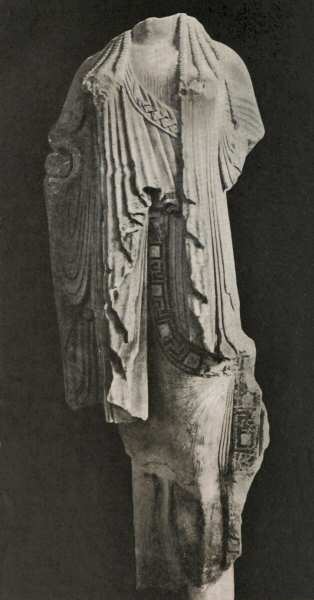
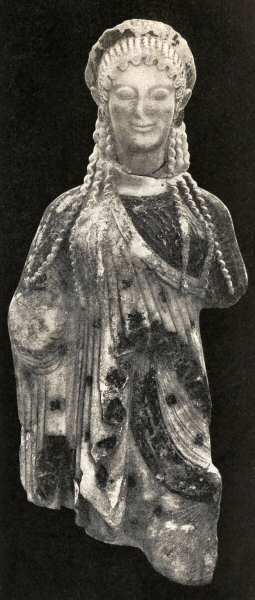
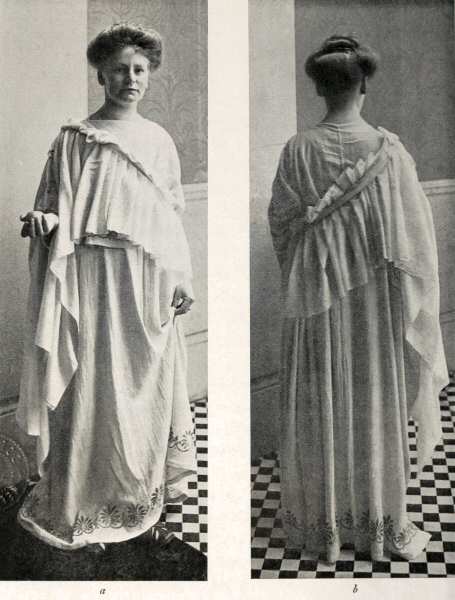
My theory as to the shape and “cut” of the himation worn by the
archaic ladies in the Acropolis Museum at Athens is, I think, a
new one; it is based on a very careful examination of the statues,
supplemented by some practical experiments in draping a living
model.
For the sections on head-dress, materials, and footgear, I have
referred to passages in ancient literature, and have used extant
remains for illustrations, chiefly vase-paintings; except in the case
of materials, for which I have cited the actual fragments of fabric
found in Greek tombs at Kertch, in the Crimea.
In describing individual garments, I have in each case
suggested dimensions and given diagrams, which, it is hoped, may
be of practical use to those who wish to make Greek dresses for
themselves.
Throughout the work, in addition to ancient authorities, I have consulted the various
articles in the current classical dictionaries. These include
Pauly-Wissowa’s Real Encyclopädie, Daremberg and Saglio’s
Dictionnaire des Antiquités grecques et romaines, Smith’s
Dictionary of Greek and Roman Antiquities, Gardner and Jevons’
Manual of Greek Antiquities, and the Companion to Greek Studies.
Other works, to which single references have been made, are mentioned
in the footnotes.
In addition to written authorities, I have received personal help
from several scholars and friends, to whom I should like to express
my thanks.
In the first place, I should like to acknowledge my indebtedness
to the Reid Trustees of Bedford College, who elected me to a
Fellowship in 1905, which enabled me to work for my second degree,
and to spend some months in Greece as a student of the British School
at Athens.
The suggestion that a thesis on the subject of Greek Dress might
be of some value beyond getting me a degree, was due to Mr A. B.
Cook, of Cambridge, under whom I had already worked for three years
at Bedford College, and whose constant readiness to stimulate my
leanings towards Archæology encouraged me to continue my studies in
that direction. Mr Cook very kindly read this work in manuscript for
me, and gave me the benefit of his criticisms. I owe a very great
deal, also, to Professor Ernest Gardner, of University College,
London, whose M.A. courses I attended regularly for two years, and from whom I constantly
received help and guidance.
While in Athens, I devoted my attention chiefly to the dress
of the archaic statues in the Acropolis Museum, and had the
opportunity of discussing this subject with Mr R. C. Bosanquet,
then director of the British School. I must also thank Herr Fritz
Röhrig, the German sculptor, who placed his studio in Athens at my
disposal, and procured a model for me, for the purpose of making my
first experiments in reproducing the archaic style of draping the
himation.
Special acknowledgments are due to Mr A. J. Evans, Mr J. L.
Myres, and the Committee of the British School at Athens, for their
courtesy in allowing me to reproduce subjects published by them in
the British School Annual; to the Trustees of the British Museum,
for permission to secure photographs of objects in the Museum for
publication; to Mr Cecil Smith, for giving me free access to the
library of the Department of Antiquities; and, particularly, to Mr H.
B. Walters, who went through the illustrations with me, and greatly
facilitated the task of securing suitable ones.
Lastly, my grateful thanks are due to Mr John Murray, for
undertaking to publish the book, and to Mr A. H. Hallam Murray, for
his constant courtesy and assistance during the progress of the work
of publication.
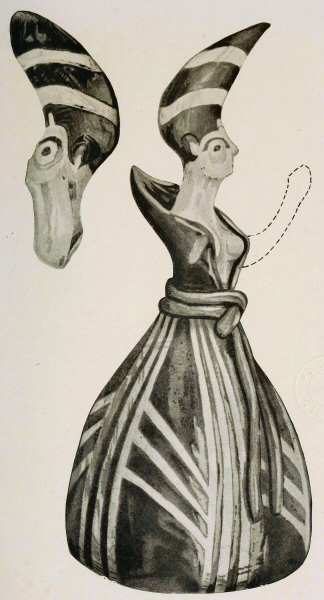
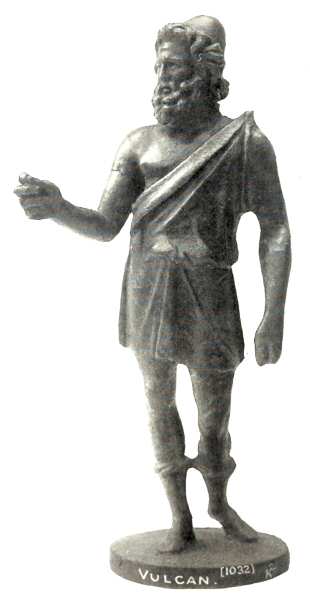
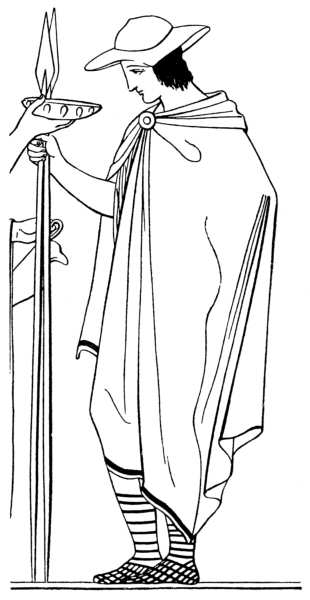
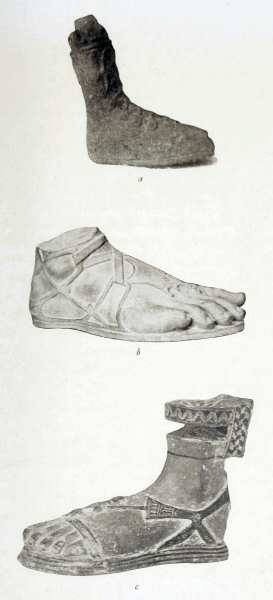
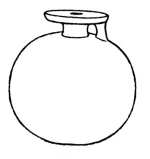
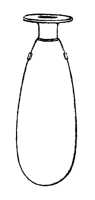
Fig. 48.—(a) A Bronze in the British Museum.
(b) Foot of the Hermes of Praxiteles (from a cast in the
British Museum). (c) A Terra-cotta Flask in the British
Museum
In
seeking to conjure up a vivid picture of the life of an ancient
people, it is the task of the archæologist to neglect no point that
can in any way throw light on the manners and customs which that
people practised from day to day, both in the exercise of their
public duties and in the privacy of their own homes.
Just as the habits and dress of an individual frequently give a
true impression of his character and type of mind, so the salient
characteristics of a nation are reflected in the external details
of their manners and their costume. In making a careful study of
the Greeks, therefore, whose innate feeling for beauty was part of
their very being, and whose sense of the fitness of things rarely if
ever played them false, we shall expect to find our efforts amply
repaid, both by the satisfaction given to the æsthetic sense and by
the knowledge we
shall have gained of the development of the national character. The
study of costume has, moreover, an ethnological significance which in
itself justifies a detailed investigation of the subject.
Professor Ridgeway, in The Early Age of Greece, has pointed out
that the civilization reflected in the Homeric poems differs in many
essential points from that which is revealed by the monuments found
at Mycenæan sites on the mainland of Greece and in the Ægean islands.
Confirmation has since been added to his convincing arguments by
the discoveries of Mr Arthur Evans in Crete, which prove that the
so-called Mycenæan remains were but the last efforts of a dying
civilization which stretched back at least as far as the third
millennium before our era. The culture revealed by the excavations at
Knossos and other sites in Crete presents a striking contrast to that
of the Greeks of the classic period; whereas the state of society
described in the Homeric poems seems to contain analogies with both
periods.
The palace of Alcinous and the house of Odysseus, as described in
the Odyssey, correspond in plan to the palace of Mycenæ excavated
by the Greek Archæological Society in 1886, which undoubtedly
belongs to the older stratum of civilization;[1] on the other hand, the
methods of disposing
of the dead, and the underlying principles of costume, are utterly
different in the two cases. The Homeric heroes burn their dead,
whereas the remains found in Mycenæan graves prove that in the
state of society to which they belong burial was the common method
of disposing of the dead. The difference in costume is equally
striking; the women’s dress, illustrated by the Mycenæan gems and
the wall-paintings and faïence statuettes from Knossos, consists of
elaborately made garments, with tight jackets fitting closely to
the figures at the waist, and full and frequently flounced skirts;
there is no indication of fastening by means of brooches or fibulæ.
In Homer the brooch is almost invariably mentioned as an essential
detail of female costume, and the garments described are of a simple
character, and such that they can be spread out and used for other
purposes. For example, Aphrodite, when protecting Æneas from his
assailants, shields him from their weapons by drawing a fold of
her peplos over him (Iliad, v., 315); and again, at the funeral
rites of Hector, the body is covered, πορφυρέοις πέπλοισι μαλακοῖσιν
(Iliad, xxiv., 796), “with soft purple robes.”
The contrast between the forms of dress represented in Mycenæan
art and in the Homeric poems can only be explained by supposing
that there is a difference in race between the two peoples, and
that the older civilization was almost entirely swept away by a
great series of invasions carried out by men of a different race.
The Homeric dress
is closely akin to that of the Greeks of the classic period,
whereas that represented on Mycenæan rings and gems belongs, as
will be shown later, to the stratum of civilization revealed by
the Cretan excavations.[2] We must suppose, then, that the Homeric
heroes belonged to the invading race, which was full of youthful
vigour and succeeded in superimposing its manners and customs upon
those of the older, decadent society, and in finally ousting the
older inhabitants from their homes altogether. The process was one
which must have lasted over some centuries, and it is probable that
the Homeric poems were composed whilst it was still incomplete, and
that the siege of Troy represents one incident in the long wars
which were waged between the two peoples. This view accounts for the
fact that the Homeric house belongs to the older civilization, while
the costume is that of the later. The invaders, having conquered or
driven out the inhabitants, finding their houses strongly built and
luxuriously decorated, would refrain from destroying them and settle
themselves peacefully and comfortably there, naturally retaining
their own style of dress and customs of disposing of their dead.
Any new houses built after their settlement would be constructed
after their own plans, and so the Homeric house would gradually
give place to the Hellenic. The absence of brooches and fibulæ from
the graves on the Acropolis of Mycenæ, and their presence in those of the lower city,
adds confirmation to this theory. The Acropolis graves are earlier
than the others, which in all probability belong to the time when
the invaders had already imposed some of their characteristic
customs upon their predecessors at Mycenæ and elsewhere in Greece.
The use of the fibula is common to the early peoples of Central
Europe, from which region it must have been introduced by the
Achæan invaders into Greece.[3]
The earliest remains found on Greek soil are those which have been
unearthed by Mr A. J. Evans, in his series of excavations at Knossos,
in Crete. They represent earlier stages of that civilization which
has hitherto been known as Mycenæan. The costume revealed by the art
of this pre-Hellenic age forms a study in itself, since it presents a
striking contrast to that of the classic period in Greece, and also
to that of contemporary Asiatic peoples. The costume of the men is
simple; when not entirely nude, they wear sometimes a waist-cloth
rolled round a girdle, with a loose end hanging down like an apron in
front;[4]
in a lead statuette of the same period found near Abbia, in Laconia,
the waist-cloth appears to take the form of a triangular piece of
material wrapped round the girdle, the apex of the triangle being
drawn up between the legs and tucked into the belt in front. In some terra-cotta
figurines from Petsofa,[5] a third garment appears, consisting of a
rectangular piece of material with the long side tucked into the
belt all round and the short sides hanging down perpendicularly in
front. In the later Mycenæan period, the garment takes the form of
short breeches reaching half-way down the thigh. These are probably
a development from the earlier waist-cloth.[6]
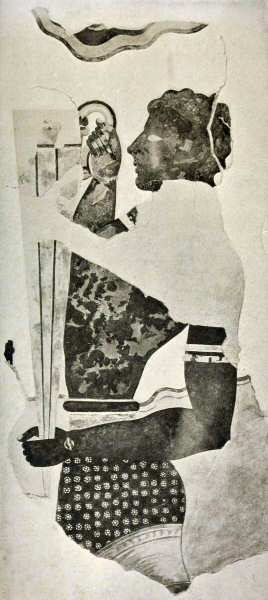
Fig. 1.—Cupbearer of Knossos.
[Face page 6.
In most cases the upper part of the body appears to be quite
bare, but in some instances a line is drawn at the neck and wrists
which may indicate the edges of a close-fitting, long-sleeved
tunic. It is more probable, however, that these lines are meant
to represent a necklace and bracelets, such as have been found in
considerable numbers in Mycenæan graves. On a siege scene represented
on a fragment of a silver vase from Mycenæ,[7] the majority of the
fighting warriors are represented quite nude; but in one case (at
the lower right-hand corner) a tunic and head-dress are worn; but in
this instance the tunic has sleeves reaching only half-way to the
elbow, as is also the case with the inhabitants, who are watching the
progress of the battle from behind the city wall; two figures, which
appear to be just leaving the city, wear square cloaks fastened on
the right shoulder and leaving both arms free; they do not appear
to be fighting,
and probably represent heralds about to make some proposal to the
enemy. The covering here described as a cloak has been regarded as
representing an oblong shield (ἠΰτε
πύργος); but in view of the
fact that the men carry no weapons and that both arms are exposed,
it seems more reasonable to suppose that a mantle is intended. The
warriors in front are fighting without protection; and if any shield
were represented, we should expect it to be of the usual Mycenæan
shape, which appears as a decoration on the upper left-hand corner of
the fragment. A fragment of a wall-painting from Mycenæ represents a
warrior wearing a short-sleeved tunic and having a double bracelet
at the wrist; it appears, then, that when the pre-Hellenic man wore
a tunic, it was not furnished with long sleeves, and even when his
clothing was of the scantiest possible nature, he was not far enough
removed from primitive barbarism to prevent his adorning his person
with bracelet and necklace.
The indication of some kind of footgear is frequent: it is
represented on the Vaphio cups; and on a wall-painting from Tiryns
depicting the capture of a bull, it takes the form of pointed
shoes turned up at the toes and fastened by a series of bands
above the ankles. Such pointed shoes were common to the Assyrians
and the Hittites, and are worn to this day by Greeks and Turks,
and frequently also in other rocky countries.[8]
In the wall-painting from Tiryns, and on a Mycenæan intaglio (Perrot and Chipiez,
VI., 426. 21), a number of bands is indicated just below the knee.
Possibly the boots were fastened by leather laces crossed round the
legs and then passed two or three times round under the knees. At
present these bands have only been found in cases where the wearer is
engaged in some violent occupation, such as the bull-taming scene; it
has been suggested that they represent a leather thong wound round
the knees to act as a protection; on stony ground some such guard
would be necessary.
The head-dress, of conical shape, finished by a button or
flattened knob on the top, represents a helmet, made sometimes
probably of metal, as was the case in Assyria, but in some cases
certainly of felt or leather, covered with rows of overlapping
boar’s tusks, turned alternately in opposite directions. A large
number of boar’s tusks were found by Dr Schliemann[9] at Mycenæ, flattened
on one side and with several holes in them, which obviously served
to fasten them to some object; such a helmet is to be seen in an
ivory fragment from Mycenæ,[10] and would exactly correspond to that
described in Iliad, X., 261.
ἀμφὶ δ᾽ οἱ κυνέην κεφαλῆφιν ἔθηκεν
ῥινοῦ ποιητήν· πολέσιν δ᾽ ἔντοσθεν ἱμᾶσιν
ἐντέτατο στερεῶς, ἔκτοσθε δὲ λευκοὶ ὄδοντες
ἀργιοδόντος ὑὸς. Θαμέες ἔχον ἔνθα καὶ ἔνθα
εὖ καὶ ἐπισταμένως.
“And
about his head he set a helmet made of leather; and inside it was
stiffly wrought with many thongs, and outside the white teeth of a
boar with shining tusks were set close together, this way and that,
well and cunningly arranged.”
In some cases the helmet presents a strikingly Egyptian
appearance, and may quite possibly have been derived from Egypt;
evidence of direct intercourse between the Cretans and Egyptians
is not wanting; indeed the clearest representation of the costume
of the pre-Hellenic inhabitants of the Ægean shores is to be found
on an Egyptian tomb fresco,[11] where the Kefts are depicted bringing vases
as tribute to the Egyptian monarch, their costume is identical with
that of the cupbearer from the Knossian fresco, and they are carrying
vessels of the same shapes as many which have been found in Crete
and on other Mycenæan sites. It has been pointed out by Mr H. R.
Hall[12]
that the Keftiu were the people of the Ægean islands, including
Crete, and that sometimes the name was applied exclusively to the
Cretans. The Keftiu were formerly mistaken for Phœnicians; but their
whole appearance and costume on the Egyptian fresco is utterly
unlike anything Phœnician; so we are quite justified in considering
that they represent the Cretans faithfully as they appeared to the
Egyptians, especially in view of their similarity to the cupbearer of the fresco at
Knossos, a native product of Cretan art.
A striking analogy to the pre-Hellenic male costume is to be
observed in the Etruscan wall-paintings from the tombs at Corneto,
now in the British Museum. The waist-cloth, shoes, and head-dress
are there represented in a form almost identical with that found in
Mycenæan art. So little is known of the origin of the Etruscans, that
it is difficult to say whether this similarity of dress indicates any
racial connection between the two peoples; it is interesting to note
that among ancient authorities Hellanicus of Lesbos states that the
Etruscans were of Pelasgian origin, and modern writers have claimed
a Pelasgian origin for the Cretans; there is not sufficient evidence
forthcoming at present to determine whether they are right or wrong;
but in any case, it is not improbable that both the Etruscans and the
Cretans were branches of a common civilization, which spread itself
all round the shores of the Mediterranean Sea in pre-Hellenic times,
and that the Etruscans maintained some of their early characteristics
down to a later date than other peoples of the same race.[13]
Turning to the female costume of the pre-Hellenic age, we find
we have something far more complicated to deal with. The same style
of dress is found on the early faïence figures from Knossos and Petsofa, and extends
right on until quite late Mycenæan times.
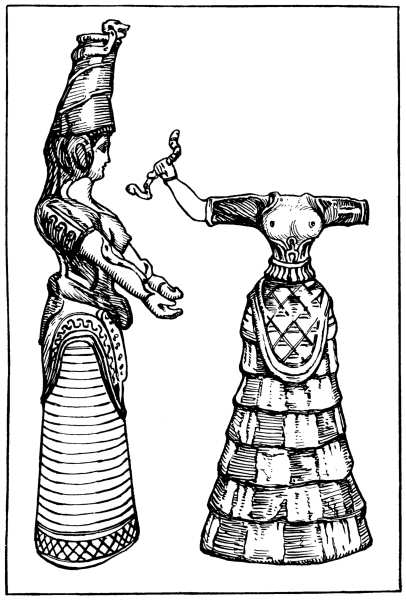
Figs. 2 and 3.—Snake
Goddess and Votary. (British School Annual, IX.,
figs. 54 and 56.)
[Face page 11.
It consists of a short-sleeved jacket, fitting closely to the
figure, and a full skirt, standing out round the feet in a manner
suggestive of the hoops of the early Victorian age. The juncture of
the two garments is hidden by a thick double girdle worn round the
waist, which is pinched into the smallest possible compass.
The snake goddess and her votary[14] from Knossos have, in
addition, a kind of apron reaching almost to the knees in front and
behind, and rising to the hips at the sides. The costume is completed
by the addition of a high hat or turban.
Looking at the snake goddess more in detail, we find that the
jacket is cut away into a V-shape from the neck to the waist, leaving
both the breasts quite bare; the two edges are laced across below
the breast, the laces being fastened in a series of bows. The jacket
is covered with an elaborate volute pattern, the apron with spots
and bordered with a “guilloche.” The horizontal lines on the skirt
probably represent stripes in the material, the edge being ornamented
with a reticulated band. The girdle of the goddess is composed of two
snakes intertwined. The head-dress here consists of a high turban,
probably made of cloth or linen wound round some kind of framework.
The principle of the costume is always the same, though the fashions
vary considerably in detail: for example, the skirt of the votary is composed
of a series of seven flounces, one above the other, the lower edge
in each case just covering the upper edge of the flounce below,
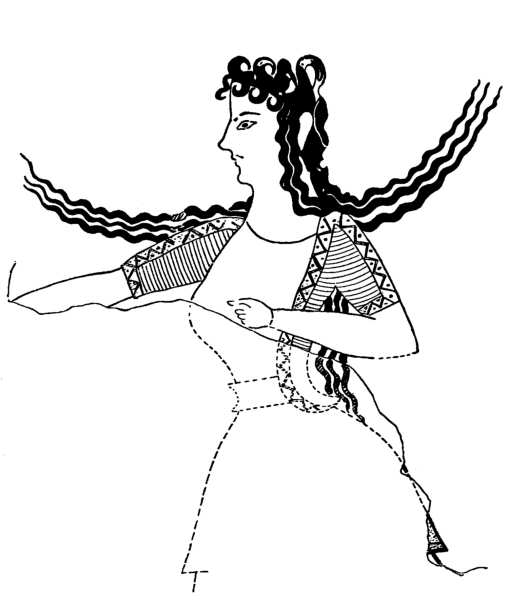
the whole being probably sewn on to a foundation. On a fresco[15]
representing a lady dancing, the skirt seems to consist of three
such flounces. On the same figure the breast is not left bare, but a
chemisette seems to be worn under the jacket, possibly made of some
fine linen material, the edge of which is distinctly indicated at
the neck. In one of the statuettes from Petsofa[16] the jacket terminates
at the back in a high “Medici” collar, and in another fresco, from
Knossos, a high sash appears on the back, the loop reaching to the
nape of the neck, and the fringed edge hanging down to the waist; at
first sight this sash recalls the Japanese “Obi.”[17] The millinery of the
Cretan ladies, as illustrated by the terra-cotta fragments from
Petsofa, exhibits an abundant variety of styles. The hat seems
to have consisted of a flat, circular, or oval piece of material
pinched up into any shape to suit the taste of the wearer; sometimes
it is fastened down towards the nape of the neck, and curves round
the head, rising high up in front over the face; in one case[18]
the brim has a wavy edge and is trimmed with rosettes underneath;
frequently it is done up into a large “toque” shape, narrowing to a point
in front; this form occurs also on late Mycenæan terra-cottas.
Fig. 4.—Fresco of a Dancing Girl.
[Face page 12.
Fig. 5.—Statuette from Petsofa.
[Face page 12.
On none of the examples of costume quoted above is there any
indication of fastening; the garments are obviously constructed by
an elaborate system of sewing, but the means by which they were held
in place on the figure is not represented, except in the case of
the bodices of the goddess and her votary, which are laced across
by cords. The use of fibulæ is nowhere indicated in art; and no
fibulæ have been found, except in the later Mycenæan graves, which
in all probability belong to the Achæan civilization introduced into
Greece by the invasions from Central Europe.[19] A fragmentary hand
from Petsofa has a bracelet represented in white paint, which is
clearly fastened by means of a button and loop; since this method of
fastening was known to the Cretans, it is probable that the ladies’
skirts were fastened at the waist by buttons and loops, the fastening
being concealed by the belt, as is the case with the modern blouse
and skirt costume.
It has been pointed out by Mr J. L. Myres[20] that this jacket
and apron type of dress is commonly worn at the present day by
the peasants of the mountainous districts of Europe, chiefly in
Italy, Switzerland, the Tyrol, Norway, and the Pyrenees. In Norway
and Switzerland, moreover, we find the addition of a fan-like head-dress
analogous to that represented in Minoan art. The appearance of the
same kind of costume in Crete in the third millennium before our era
merely serves to show that the type of dress need not necessarily
be a modern development, but may possibly claim greater antiquity
than has hitherto been supposed. The question of survival in the
Ægean is interesting; as late as Tournefort’s[21] time, the inhabitants
of some of the islands—for example, Mycone—appear to have worn
a dress composed of a tight jacket and flounced skirt, with the
addition of some Turkish elements; in the remoter islands there is a
possibility—but it is little more than a possibility—that this may be
a case of survival; in any case, the type seems to have disappeared
in the eighteenth or early nineteenth century.[22]
II HOMERIC
Turning
to the various passages in the Homeric poems which refer to dress,
we find that there is very little likelihood that they can be
intended to describe the kind of costume dealt with above under
the name of “Pre-Hellenic Dress.” The words used, and the accounts
of the process of dressing, have no meaning, unless we suppose
them to refer to the draped type of costume as opposed both to the
close-fitting jacket type and to the dressing-gown type, consisting
of a loose-sleeved garment opening down the front. The question of
the kind of dress actually worn by the Trojan and Achæan heroes is
not one to be entered into here; possibly it may have been the same
as that reflected in the art of the Minoan and Mycenæan peoples;
indeed, if the Trojans represent the older race which inhabited the
shores of the Ægean, and the Achæans the invaders who came down upon
them from the north, there is every probability that the former wore
the pre-Hellenic dress, and the latter introduced the new Hellenic
draped type. The use of the epithets βαθύκολπος and βαθύζωνος, “deep-bosomed” and
“deep-girdled,” in the Homeric poems perhaps has some bearing on
this point. Referring respectively to the deep hollow between
the breasts and to the girdle cutting deep into the figure, they
might well be applied to the wasp-waisted ladies of Knossos. It is
significant to notice that βαθύκολπος is used only of Trojan women,[23]
βαθύζωνος only of barbarian captives;[24] possibly the poet may
be unconsciously referring to the difference between the dress of the
older race and that of their Achæan conquerors.
However that may be, in most cases Homer ascribes the same kind
of costume to Achæans and Trojans alike; he is singing of deeds that
happened many years, perhaps even two or three centuries, before
his day, and being no archæologist, he imagines his heroes to have
dressed as his own contemporaries did; he is acting no differently
from the Italian masters, who painted their Madonnas in mediæval
costume.
We find in Homer many differences in the nomenclature used when
speaking of men’s and women’s dresses respectively. The words χιτών
and
χλαῖνα
are applied exclusively to men’s costume, πέπλος and
κρήδεμνον exclusively to women’s, whereas the word φᾶρος is the only
one used indifferently for either; both men and women alike fasten
their garments with brooches or pins of some kind (περόνη, ἐνετή) and
with girdles (ζώνη, ζωστήρ). Many of the words applied to articles
of wearing-apparel
are also used to signify coverings for beds, seats, etc.: such are
χλαῖνα, ῥήγεα, πέπλος, φᾶρος; the last is used also of sails and
of the shroud of Laertes.[25] This being the case, we must infer that
they were not made-up garments, but large square or oblong pieces of
material which could be used for other purposes besides clothing; the
Homeric dress, therefore, must belong to the draped type rather than
to any other.
The men’s dress in Homer regularly consists of two pieces—the
χιτών, or under-garment, and a cloak called variously χλαῖνα, φᾶρος,
or, in one case, λώπη.[26] Warriors sometimes wore a skin instead of
the mantle. For example, in Iliad, x., 22, Agamemnon is described
as putting on a lion’s skin, and a few lines further on Menelaus
appears wearing a dappled leopard’s skin.
The description of the process of dressing in the Iliad
is simple and straightforward. Agamemnon[27] awakes in the morning,
and prepares to meet the assembly of the Achæans:
ἕζετο δ᾽ ὀρθωθεὶς μαλακὸν δ᾽ ἔνδυνε χιτῶνα
καλὸν νηγατέον, περὶ δὲ μέγα βάλλετο φᾶρος·
πόσσι δ᾽ ὑπὸ λιταροῖσιν ἐδῆσατο καλὰ πέδιλα,
ἀμφὶ δ᾽ ἄρ᾽ ὤμοισιν βάλετο ξίφος ἀργυρόηλον.
“He sat upright and drew on his soft tunic, fair and
new, and threw around him his great cloak: and beneath his shining
feet he bound fair sandals, and around his shoulders he slung his
silver-studded sword.”
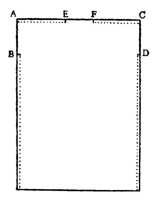
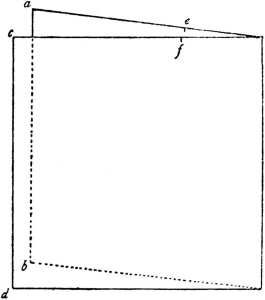
Fig. 6.
Studniczka’s Diagram.
The dotted lines mark the seams, the spaces A B, C D,
E F being left open for arms and head respectively.
The χιτών was apparently, then, a garment which could be drawn
on (ἔνδυνε) while in a sitting position. No mention is made, either
in this or other similar passages, of pins or girdle to fasten the
χιτών, so we may infer that it was a rather narrow garment sewn up at
the two sides, with openings left for the head and arms.
Studniczka[28] gives a diagram of such a garment, which he
describes as a sack left open at the bottom, with openings in the top
and side-seams for head and arms.
The words ἐνδύνω, ἐκδύνω, are commonly used for “to put on” and
“to take off” a χιτών, which seems to imply that the garment was
drawn over the head; although occasionally περί is used with the
simple verb δύνω instead of the compound ἐνδύνω.[29] In no case is there any
mention of pins or brooches in connection with the χιτών, so we are
justified in inferring that it was a sewn garment; and in Odyssey,
xxiv., 227, the χιτών of Laertes is actually described as sewn:
ῥυπόωντα δὲ ἕστο χιτῶνα
ῥαπτὸν ἀεικέλιον.
“He wore a sewn tunic, dirty and unseemly.”
As
a rule, the χιτών was worn ungirdled, except when the wearer
was engaged in vigorous action, when he is usually described as
girding himself for the purpose. For example, in the Odyssey,[30] when
Eumæus is going to slay pigs, he prepares himself by confining his
χιτών with a girdle:
ὣς εἰπὼν ζωστῆρι θοῶς συνέεργε χιτῶνα.
Little mention is made in the Homeric poems of the length
of the χιτών, but the distinguishing epithet of the Ionians is
ἑλκεχίτωνες—with
trailing chitons—so that trailing garments were
evidently customary only among the Ionians; warriors while fighting
and slaves occupied in active work would probably wear very short
garments reaching only to the thigh, as they are to be seen on the
earliest vase-paintings. The princes and elders of the people,
engaged in peaceful pursuits, in all probability wore them reaching
to the ankles. The word τερμίοεις, applied to the χιτών in Odyssey,
xix., 242, is usually taken to mean “reaching to the feet,” and to be
equivalent to ποδήρης, used by later writers.
With regard to the material of which the χιτών was made, the
word itself is connected with a Semitic root signifying linen;[31] and
from the various epithets applied to it in Homer, it is reasonable
to infer that the garment was ordinarily made of that material. It
is described as σιγαλόεις, “shining” or “glossy”; and although this particular epithet
need mean no more than “dazzlingly clean,” its comparison for
softness and brightness with the skin of an onion[32] would hardly be very
apt, if it were made of a stuff that did not present a very smooth
surface; a hand-woven woollen material might possibly be called
μαλακός, “soft,” but could hardly be described as shining like the
sun. Two passages in Homer show clearly that oil was used in the
weaving of linen, which would have the effect of producing a shiny
appearance. The maidens in the palace of Alcinous are described as
weaving linen from which the oil runs off:
καιρουσσέων δ᾽ ὀθονέων ἀπολείβεται ὑγρὸν ἔλαιον.
[Odyssey, vii., 107.]
“And from the close-woven linen the liquid oil runs
off,” and in Iliad, 596, the youths in the dancing place on the
shield of Achilles are described as wearing χιτῶνας
ἐϋννήτους, ἦκα
στίλβοντας ἐλαίῳ, “well spun, shining softly with oil.”
The epithet στρέπτος applied to the χιτών[33] requires comment;
it was taken by Aristarchus, the grammarian, to mean a coat of
chain mail. There is no evidence to show that such a piece of
defensive armour was known to the early Greeks, and we find no reference to it until
Roman times; there is, therefore, no justification for the inference
that στρέπτος χιτών in Homer means a coat of mail.
The word στρέπτος means primarily “twisted,” and could be applied
to a coarse kind of linen whose texture showed very clearly the
separate threads of which it was woven; but other uses of the word in
Homer, and the second of the two passages in which it is applied to a
χιτών, suggest a different interpretation. In Odyssey, ii., 426, in
the description of the rigging of a ship, the expression εὐστρέπτοισι
βοεῦσιν occurs. The adjective here can very well retain its simple
meaning—“well-twisted”; the noun can mean nothing else but “ropes of
ox-hide”—that is to say, the whole expression will signify ropes made
of well-twisted thongs of leather.
The passage referred to in the Iliad runs as follows:—
δῆσε δ᾽ ὀπίσσω χεῖρας εὐτμήτοισιν ἱμᾶσι
τοὺς αὐτοὶ φορέεσκον ἐπὶ στρεπτοῖσι χιτῶσι.
[Iliad, xxi., 30.]
The subject is the sacrifice of the twelve boys at the funeral of
Patroclus.
Achilles bound their hands behind them with the well-cut thongs
which they wore on their twisted chitons. The word ἱμᾶσι implies
leather, and the only kind of chiton which would be likely to have
leather thongs attached to it would be a jerkin made of leather,
perhaps plaited in some way and fastened by means of leather laces.
Such a garment
might be worn in war under a metal breast-plate, or if very stoutly
made might even serve as defensive armour, without the addition
of any corslet; in any case, it would afford more protection than
an ordinary linen chiton such as was worn by those engaged in the
pursuits of peace.
Another garment worn by men is the ζῶμα, which appears at first
sight to mean simply a girdle, but in one or two passages signifies
something more. The word is obviously connected with the verb
ζώννυμι, “to gird on,” and means a “thing girt on.” The word might
well apply to a girdle, but it might also be used of anything put
on round the waist, and so of a waist-cloth; there can be little
doubt that it has this meaning in Iliad, xxiii., 683, where a
description is being given of the preparations for a boxing match;
and a few lines further on the participle ζωσαμένω, applied to the
wrestlers, in all probability means putting on their waist-cloths. In
other passages where the word occurs, its meaning is less obvious,
although here too there is nothing to render the same interpretation
impossible. In Iliad, iv., 186, a weapon is described as not
inflicting a mortal wound:
εἰρύσατο ζωστήρ τε παναίολος ἠδ᾽ ὑπένερθεν
ζῶμά τε καὶ μίτρη, τὴν χαλκῆες κάμον ἄνδρες.
“But the shining belt checked it, and the waist-cloth
beneath, and the kirtle which the coppersmiths fashioned.”
Here the ζωστήρ and the μίτρη are obviously pieces of armour, and
the ζῶμα is a garment worn under the ζωστήρ, and can very well bear
the meaning of a waist-cloth. Such garments were worn at all periods;
they formed the regular dress of the men of the pre-Hellenic age;
they occur also on vases of the classical period.[34] There is no necessity,
therefore, to suppose, as Studniczka does, that the word here is
synonymous with χιτών. Studniczka supports his interpretation of
this passage by another, Odyssey, xiv., 478 f., where Eumæus is
describing to Odysseus an occasion when he and comrades had to sleep
in the open air, and he felt the cold because he had foolishly left
his cloak behind him, and had only his shield and ζῶμα φαεινόν. The
expression could here maintain its signification of “waist-cloth”;
only, the simple meaning is obscured by a phrase some five lines
further on, when Eumæus continues:
οὐ γὰρ ἔχω χλαῖναν· παρὰ μ᾽ ἤπαφε δαίμων
οἰοχίτων᾽ ἔμεναι.
“I had no cloak: some god beguiled me to go with only
a single garment.”
The simple meaning of οἰοχίτων is, “wearing only a chiton,” or
under-garment; but without stretching the meaning of the expression
very far, we can easily suppose its being applied to a man clad only
in a waist-cloth; so that even here it is not necessary to suppose
that ζῶμα is another word for χιτών.
We must next consider the over-garment worn by the Homeric heroes,
for which several words are used, the most common being χλαῖνα and
φᾶρος.
The χλαῖνα was used not only as an article of dress, but also as
a blanket to sleep under;[35] as a rug to cover couches and seats;[36]
a constant epithet is οὔλη, so that its material was evidently
woollen; and the adjectives ἀλεξάνεμος and ἀνεμοσκεπής, “warding
off winds,” show that it was worn for warmth, as a protection
against cold winds.[37] It was thrown off for exercise or when
speed in running was required.[38] The style in which the χλαῖνα was worn
varied somewhat; the verbs regularly used for the act of putting it
on are ἀμφιβάλλω and ἀμφιέννυμι, “to throw round”; περιβάλλω also
occurs, and sometimes it is described as being placed ἐπ᾽ ὤμοισι,
“upon the shoulders”; for taking it off, ἀποβάλλω and ἀποτίθημι
are used, and in one case ἐκδύνω occurs, though this word should
more correctly be applied to the χιτών. The constant use of ἀμφί,
“around,” shows that the χλαῖνα was not a garment which was drawn on
over the head, like the χιτών, but was a square or rectangular piece
of material wrapped round the figure or laid over the shoulders.
We read in Homer of the χλαῖνα ἁπλοΐς, “single cloak,” and the
χλαῖνα διπλῆ, “double cloak”; the former expression must mean a
cloak worn single, without being folded over; such a garment might
possibly be put on as the himation was in later time, one end being laid on the
shoulder, so that the mass of the material hung down towards the
back; this mass of material would then be drawn across the back under
the arm which was then left exposed, and across the chest, and the
end would be thrown over the shoulder towards the back. The garment
could easily be drawn up so as to cover both arms if the temperature
required greater warmth, or it might be worn over both shoulders
like a shawl, without being doubled, and the frequent mention of
the shoulders in connection with the χλαῖνα seem to point to this
style as the most common.[39] The χλαῖνα διπλῆ is mentioned twice in
Homer—once in the Iliad and once in the Odyssey; in both cases it
is described as being fastened with a brooch:
ἀμφὶ δ᾽ ἄρα χλαῖναν περονήσατο φοινικόεσσαν
διπλῆν ἐκταδίην.
[Iliad, x., 133.]
“And about him he fastened a purple cloak, doubled,
with no folds.”
χλαῖναν πορφυρέην οὐλὴν ἔχε δῖος Ὀδυσσεύς,
διπλῆν· αὐτὰρ οἱ περόνη χρυσοῖο τέτυκτο
αὐλοῖσιν διδύμοισι.
[Odyssey, xix., 225.]
“Goodly Odysseus had a purple cloak, woollen and
doubled; and it had a brooch wrought of gold, with a double groove
for the pins.”
In these cases the χλαῖνα was obviously folded over double, though
in what way is not expressly stated; if the garment consisted of a
wide rectangular
piece of material, it might be doubled along its length horizontally
and fastened with a brooch on one shoulder, like Apollo’s himation
in the Thasos relief.[40] This method, however, is not found on
the earliest vases, which, though not contemporary with Homer,
are yet the nearest monumental evidence obtainable; moreover,
the additional expression, ἐκταδίην, seems to be against this
interpretation; the meaning of ἐκταδίην seems to be “stretched out
straight,” and the word could hardly be applied to a garment draped
in such a way as to fall in many folds; it is reasonable, therefore,
to suppose that the χλαῖνα διπλῆ consisted of a large square[41] of
woollen material folded along the diagonal, so that two opposite
corners lay on each other; it would be laid on the shoulders so
that these two corners hung down in the middle of the back, no
folds being formed (ἐκταδίην), and the other two points hung down
one on each side of the front; a brooch would prevent the cloak
from slipping off the shoulders; this shawl-like method of wearing
the mantle is frequently represented on the black figured vases.[42] The
δίπτυχον λώπην, “double cloak,” which Athena wears, ἀμφ᾽ ὤμοισι,
when disguised as a shepherd,[43] is probably a garment worn in this same
fashion,
and the δίπλακες which Helen and Andromache are described as
weaving in the Iliad[44] are perhaps intended for cloaks to be so
worn.
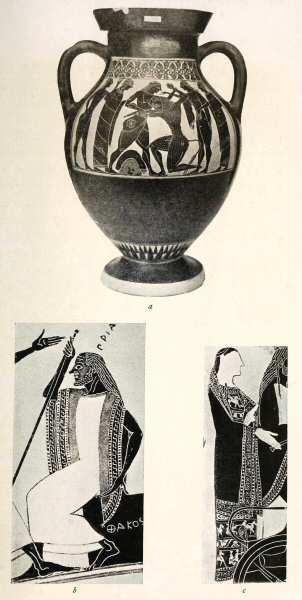
Fig. 7.—(a)
Vase—British Museum. (b and c) Vase-paintings by
Klitias and Ergotimos, Florence. [Furtwängler and Reichhold,
Griechische Vasenmalerei, I and II.]
[Face page 26.
The place of the χλαῖνα is frequently taken by the φᾶρος,
constant epithets of which are καλὸν and μέγα, “fine” and
“large,” so that we may conclude that the φᾶρος was an ample and
somewhat luxurious garment. The word is used not only for an
article of wearing apparel, but also for the shroud of Laertes,[45] and
for the sails of a ship,[46] so that Studniczka’s conjecture that it
was made of linen is probably right, and the difference of material
probably constitutes the chief distinction between the φᾶρος and
the χλαῖνα. The φᾶρος is several times described as “white” and
“well-washed,” and the epithets ἀργυφεόν, λέπτον, χαρίεν, “silvery,”
“fine,” and “graceful,” which are used of the φᾶρος of Calypso,
are more applicable to a linen than to a woollen garment. Φᾶρος is
the only word used in Homer for the dress of both men and women.
When worn by men, the φᾶρος was in all probability draped in the
same fashion as the χλαῖνα, but the woman’s φᾶρος would be draped
differently, as will be shown later.
The χλαῖνα and the φᾶρος were not worn in battle, since they
would encumber the wearer too much; armour was put on over the
chiton, or in some cases warriors wore the skin of some wild beast
slain in combat; we hear, for example, of Agamemnon wearing a lion’s skin,[47]
and of Menelaus and Paris wearing leopards’ skins.[48]
A man’s costume was completed by sandals, πέδιλα, which we are
told were made of leather;[49] no mention is made of any head-covering
worn in the pursuit of peaceful occupations; if any protection were
needed, a fold of the mantle might easily be drawn up over the
head; in battle, of course, some kind of helmet was worn, which was
made usually of bronze, or sometimes of hide,[50] covered with boars’
tusks, such as have been found at Mycenæ.
The women’s dress in Homer consists of two garments, the πέπλος
and the κρήδεμνον or καλύπτρη, called also in one case the κάλυμμα;[51] the
word ἑανός which is used sometimes as a substantive instead of
πέπλος, sometimes as an adjective, simply means “something to be
worn.”
The principal garment of the women was the πέπλος. The derivation
of the word is uncertain; it is probably connected with some root
meaning to cover or wrap; the word is used in the Iliad to
signify things other than dress; for the covering of a chariot[52] and
for the wrappings of the vessel which held the ashes of Hector;[53] the
πέπλος, therefore, like the χλαῖνα and φᾶρος consisted of a square
or rectangular piece of material which could be used for various
purposes. When worn as a garment, it was held in place by means
of brooches or
pins (περόναι, ἐνεταί) and a girdle. A passage in the Iliad[54] gives
a description of an elaborate toilette made by Hera when she is
setting out to beguile Zeus:
ἀμφὶ δ᾽ ἄρ᾽ ἀμβρόσιον ἑανὸν ἕσαθ᾽ ὅν οἱ Ἀθήνη
ἔξυσ᾽ ἀσκήσασα, τίθει δ᾽ ἐνὶ δαίδαλα πολλά·
χρυσείῃς δ᾽ ἐνετῇσι κατὰ στῆθος περονᾶτο,
ζώσατο δὲ ζώνην ἑκατὸν θυσάνοις ἀραρυῖαν,
ἐν δ᾽ ἄρα ἕρματα ἧκεν ἐϋτρήτοισι λοβοῖσιν,
τρίγληνα μορόεντα· χάρις δ᾽ ἀπελάμπετο πολλή.
κρηδέμνῳ δ᾽ ἐφύπερθε καλύψατο δία θεάων
καλῷ νηγατέῳ, λευκὸν δ᾽ ἦν ἠέλιος ὥς.
ποσσὶ δ᾽ ὑπὸ λιπαροῖσιν ἐδήσατο καλὰ πέδιλα.
“Then she clad her in her fragrant robe that Athena
wrought delicately for her, and therein set many things beautifully
made, and fastened it over her breast with clasps of gold. And she
girdled it with a girdle arrayed with a hundred tassels; and she
set ear-rings in her pierced ears—ear-rings of three drops and
glistering—and therefrom shone grace abundantly. And with a veil
over all the peerless goddess veiled herself, a fair, new veil,
bright as the sun, and beneath her shining feet she bound goodly
sandals.”—Lang, Leaf, and Myers.
We gather from this passage that the garment was fastened on
the shoulders by brooches or pins inserted, κατὰ στῆθος, which
Studniczka rightly explains[55] as meaning “down towards the breast,” a
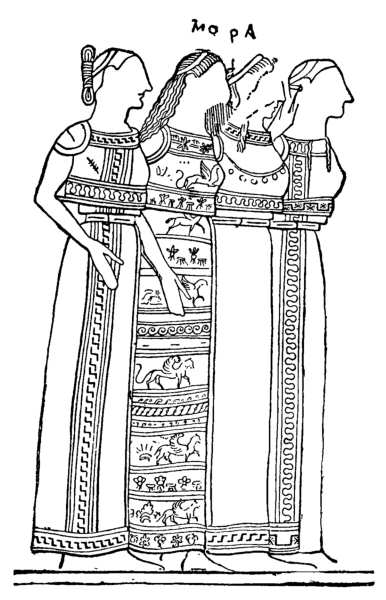
method of fastening which is represented on the François vase[56] and elsewhere; the
material is drawn from the back, and wraps over that which covers
the front; the pins are then inserted downwards, and hold the two
thicknesses of material together; the dress is held in to the figure
by a girdle worn round the waist, over which any superfluous length
of material could be drawn, forming a κόλπος or pouch. No mention
is made in Homer of the ἀπόπτυγμα, or overfold, which is a common
feature of the women’s dress in historic times; but from its constant
appearance on the earliest monuments, it is not unreasonable to
suppose that it formed an element in women’s costume of the draped
type from the very earliest times. It is formed by folding over the
upper edge of the garment before it is put on, in such a way that a
double thickness of material covers the figure from the neck to a
distance a little above the waist in front and behind. The original
purpose of this overfold may have been either to secure greater
warmth, or to prevent the dress from tearing at the points where the
brooches were inserted; such a thing might easily happen, if only the
single stuff were used, since the whole mass of material hung down
from the two points where it was secured on the shoulders.
Fig. 8.—From the François Vase.
[Face page 30.
Another question which arises in connection with the Homeric
peplos is as to whether it was worn open or closed at the side;
a passage which has been much discussed in this relation is the
one which
describes the peplos given by Antinous to Penelope, with its twelve
brooches:
Ἀντινόῳ μὲν ἔνεικε μέγαν περικαλλέα πέπλον
ποικίλον· ἐν δ᾽ ἄρ᾽ ἔσαν περόναι δυοκαίδεκα πᾶσαι
χρύσειαι, κληῗσιν ἐϋγνάμπτοις ἀραρυῖαι.
[Odyssey, xviii., 292.]
“For Antinous, his henchman, bare a broidered robe,
great and very fair, wherein were golden brooches, twelve in all,
fitted with well-bent clasps.”—Butcher and
Lang.
The point in dispute is the purpose of the twelve brooches.
Studniczka maintains that two were used to fasten the dress on
the shoulders, and the remaining ten to hold it together down the
open side; he states in support of this theory that sewing was not
commonly practised by the Homeric women, although he has previously
pointed out that the men’s chiton was always sewn; this being the
case, it is only natural to suppose that the women applied the art
of sewing to their own garments also where necessary. There is no
example in early art of a peplos fastened in this way with brooches;
it is invariably joined round, the seam being covered by a band of
ornament either woven in the edge of the material or embroidered upon
it afterwards. In fifth century art we sometimes find representations
of the peplos worn open down the side; it may have been worn so also
in Homeric times; if the garment were wide, one edge could easily be
wrapped over the other and held in place by the girdle, so as not
to leave the figure
too much exposed. It is more probable that the twelve brooches in
question were used to fasten the dress on the shoulders and down the
upper arms six on each side, forming a kind of sleeve to the elbow.
That the ample Ionic chiton was worn in this way in later times
is manifest from the numerous vase-paintings and other monuments
of the late sixth and early fifth centuries; it may have been a
fashion peculiar to the East in Homeric times, but Eastern fashions
and customs were not unknown to the author of the Homeric poems. We
read[57]
of rich robes that were the work of Sidonian women whom Paris brought
from Sidon, and it is not unlikely that Antinous, wishing to offer
Penelope some rich gift, would choose a luxurious garment brought
from the East.
However, we must regard the use of twelve brooches as
exceptional, and consider that the peplos was ordinarily fastened
with only two, and with a girdle round the waist. That it was a
fairly ample garment and trailed on the ground behind, is proved
by the epithets τανυπέπλος and ἑλκεσιπέπλος, “with trailing
robes,” frequently applied to women. Athena finds it certainly too
cumbersome to fight in; for when she is preparing for battle, we
are told that she lets her peplos slip to the ground, and puts on
the chiton of her father,[58] Zeus. A very constant epithet of the peplos
is ποικίλος, or sometimes the intensified form, παμποίκιλος,[59] The
meaning of the
adjective is, “bright, varied, covered with patterns.” Whether these
patterns were woven in the material at the loom or embroidered is a
question not easy to decide.[60]
In some cases they were apparently woven, in others probably
embroidered.
The silver-shining φᾶρος which Calypso puts on[61] takes the place of the
peplos, and was probably worn in the same way,[62] with the overfold and
girdle, over which the superfluous length was drawn, forming the
κόλπος, or pouch, which varied in depth according to the wearer’s
fancy. That it was sometimes fairly roomy is proved by the fact
that the nurse of Eumæus was able to hide three cups ὑπὸ κόλπῳ[63] “under
the folds of her dress.”
The material of which the girdle (ζώνη) was made is uncertain.
We hear of golden girdles of Calypso and Circe, and of a fringed
girdle of Hera with a hundred tassels, but these are exceptional. The
ordinary girdle may have been of metal, or cord, or leather; this
last material is suggested by the magic κεστὸς ἱμᾶς of Aphrodite,
which may have been a girdle; or, since we are told that the goddess
took it ἀπὸ στήθησφιν,[64] “from her bosom,” and that Hera received
it and ἑῷ ἐγκάτθετο κόλπῳ, “put it on her own bosom,” perhaps it
was something of the nature of Athena’s ægis, which also possessed
magic power. On a vase in the British Museum[65] a goddess is represented
wearing an ægis, and would naturally be interpreted as Athena,
were it not that the vase-painter has clearly written her name,
“Aphrodite,” by her side. It has been suggested that he has made a
slip, and meant to write “Athena”; but in all probability he knew
what he was doing, and it was his intention to represent Aphrodite
wearing her κεστὸς ἱμᾶς.
The second garment which was essential to the completion of
a woman’s dress, at least when she appeared in public, was the
κρήδεμνον or καλύπτρη,[66] which served both as cloak and veil.
It was probably put on over the shoulders like a shawl, without
being folded, in such a way that it could be drawn over the head
without difficulty, and across the face, serving as a veil.[67]
Sometimes it may have been doubled corner to corner diagonally
and laid on the shoulder. That it was worn over the head is clear
from Odyssey,
v., 232,
where Calypso puts on her φᾶρος; κεφαλῇ
δ᾽ ἐρύπερθε καλύπτρην, “and over her head a veil.” From the
description of Penelope, when she appears among the suitors “holding
her shining veil before her cheeks,” we may gather that it was
customary for women to veil themselves before men.[68] No woman would think
of leaving the
house without her κρήδεμνον. Helen, though she quits her house in
haste, first veils herself with shining linen,[69] ἀργεννῇσι καλυψαμένη
ὀθόνῃσιν, and it is only when they are far from the town and enjoying
the quietude of the river bank, that Nausicaa and her attendant
maidens throw off their veils for the ballplay.[70]
From the constant use of the epithets λιπαρός and λαμπρός,
“shining” or “bright,” we may infer that the κρήδεμνον was usually
made of linen, and, in summer at least, it was probably a fine, light
garment, possibly even semi-transparent. In no case are any pins or
brooches mentioned in connection with it; and from the ease with
which it can be slipped off,[71] it is reasonable to infer that it was
worn without fastening of any kind, like a shawl or scarf. In the
passage where Andromache casts off her head-dress in her anguish
at the death of Hector,[72] Studniczka supposes that because the
κρήδεμνον is mentioned as falling off last, the other δέσματα must
have been worn over it and held it in place; this seems to be putting
a too literal and even prosaic interpretation upon the lines. There
is no occasion to suppose that the poet enumerated the various parts
of the head-dress in the order in which they fell; and if we read in
that spirit, we shall frequently find that the Homeric heroes put
on their cloaks before their undergarments; for more than once the
φᾶρος or χλαῖνα is mentioned before the χιτών.[73]
The various parts which composed this head-dress have given rise
to much discussion. The passage runs:
τῆλε δ᾽ ἀπὸ κρατὸς βάλε δέσματα σιγαλόεντα,
ἄμπυκα κεκρύφαλόν τε ἰδὲ πλεκτὴν ἀναδέσμην
κρήδεμνόν θ᾽.
[Iliad, xxii., 468.]
“And far from her head she flung the shining bonds,
diadem and kerchief, and meshy net and veil.”
The δέσματα σιγαλόεντα are explained by the words which follow,
and which stand in apposition. No question is raised as to the nature
of the ἄμπυξ; it was a metal diadem like the στεφάνη, worn across
the front of the hair. The κρήδεμνον has already been explained; the
κεκρύφαλος and the πλεκτὴ ἀναδέσμη need some comment. The former is
sometimes taken to mean a “net,” but it will be shown later that
this meaning is better applied to the πλεκτὴ ἀναδέσμη; the word
κεκρύφαλος is obviously connected with the verb κρύπτω to cover,
and therefore means “something which covers,” “a covering.” In all
probability, then, the κεκρύφαλος is simply a kerchief worn on top
of the head behind the ἄμπυξ. The ἀναδέσμη is obviously something
which serves to bind up (ἀναδέω) the hair and hold it in place, which
is the proper function of a net. The epithet πλεκτή, which Helbig[74] has
tried to explain as “folded,” means primarily “plaited”; it is
applied elsewhere in the Homeric poems to baskets,[75] which shows its perfect
appropriateness to the meshes of a net. We need give no other meaning, then, to the
πλεκτὴ ἀναδέσμη, but can easily explain it as a net that confined the
long hair behind. This completes the head-dress proper, the κρήδεμνον
being a separate scarf or shawl worn over it.
The women’s dress in Homer is completed by sandals, and for
ornament they wore, in addition to the brooches which fastened
their clothes, ear-rings and necklaces of varied workmanship; the
γναμπταὶ ἕλικες and κάλυκες of which we read[76] are perhaps
spiral-shaped brooches and ear-rings or necklaces in the shape of
lilies, such as have been found in the later Mycenæan graves.
Few colours are mentioned in Homer in connection with dress.
The epithets “white” and “shining” are frequently applied to the
chiton and κρήδεμνον and to the φᾶρος. Φοινικόεις and πορφύρεος are
frequently used of the χλαῖνα and the δίπλαξ, the former meaning
“red,” and the latter probably “dark purple”; the word is used also
of the sea and of clouds. The veil of Thetis[77] is described as
κυάνεος, indigo, probably, or blue-black, since we hear immediately
afterwards that “no garment ever was blacker.” The dark veil may be
a sign of mourning; but in any case, the epithet might be used of
the garments of the sea-goddess, just as κυανοχαίτης, “blue-haired,”
is applied to Poseidon. Only once is yellow mentioned, and that
in the case of “saffron robed dawn.” The veil of Hera, that was
“bright as the sun,”[78] might have been yellow-gold. Yellow is a favourite
colour among the Greek peasant women of to-day for the kerchiefs
with which they cover their heads; and in the clear atmosphere
and brilliant sunshine of Greece, it is natural to wear bright
colours.
The embroidered robes of the women would naturally be worked in
various colours, among which red and blue probably predominated, as
they do on the sixth century statues on the Acropolis at Athens, and
also in more modern Greek embroideries.
Enough has been said on the subject of Homeric dress to show that
it differs entirely from the pre-Hellenic type of costume which
appears on the monuments from Knossos and elsewhere. The absence of
contemporary monumental evidence renders it impossible to make any
very definite statements as to the details of Homeric dress; but the
poems themselves afford sufficient proof of the fact that it was of
the draped type, and resembled Greek dress as we know it from the
monuments dating from historic times; the dress of the classical
period is simply a development of that described in the Homeric
poems, with the addition of some foreign elements which blended with
it and somewhat transformed it in its details, while still preserving
the main types unaltered.
III DORIC
When
we come to the question of Greek dress during the classical period,
we find that the literary evidence is somewhat scanty; however, in
addition to the various casual references to dress that are to be
found chiefly in the plays, there are a few passages which bear
directly on the historical development of dress in Greece. The most
important of these is a passage in Herodotus,[79] in which he describes
a disastrous expedition against Ægina undertaken by the Athenians
during the first half of the sixth century, probably in the year 568
B.C.; only one man returned alive to Athens, to meet
with an ignominious death at the hands of the wives of those who had
perished. Herodotus shall tell the story in his own words:
“When he came back to Athens bringing word of the
calamity, the wives of those who had been sent out on the expedition
took it sorely to heart, that he alone should have survived the
slaughter of all the rest; they therefore crowded round the man and
struck him with the brooches by which their dresses were fastened,
each, as she struck, asking him where he had left her husband. And
the man died in this way. The Athenians thought the deed of the women
more horrible even than the fate of the troops. As, however, they
did not know how else to punish them, they changed their dress, and
compelled them to wear the costume of the Ionians. Till this time the
Athenian women had worn a Dorian dress, shaped nearly like that which
prevails at Corinth. Henceforth they were made to wear the linen
tunic, which does not require brooches.
“In very truth, however, this dress is not originally Ionian, but
Carian; for anciently the Greek women all wore the costume which is
now called the Dorian.”—Rawlinson.
He goes on to say that after this the Argive and Æginetan women, out of rivalry with
the Athenians, wore much larger brooches than before.
The importance of the passage is that it tells us of the two
types of dress worn by Greek women. We learn that down to the early
years of the sixth century all the Greek women wore the Dorian dress
fastened with pins of such size and strength that they could become
dangerous weapons in the hands of women excited by grief or passion.
Later the Athenian women adopted a different dress, which did not
need these large pins to fasten it, and which Herodotus calls the
linen Ionic chiton, afterwards correcting himself and explaining that
this kind of dress was really Carian in its origin.
The story of the slaying of the sole survivor of the Æginetan
expedition, and of the punishment meted out to the Athenian women,
seems in itself far-fetched and highly improbable; but there is
probably some foundation of truth in it. Possibly the tale was
invented by Herodotus, or, more probably, was current in his day
as an explanation of a change in the style of dress which actually
took place in Athens at the beginning of the sixth century, or more
probably even earlier. Among the sumptuary laws introduced by Solon
was one regulating women’s dress, and forbidding them to wear more
than three garments when they went out to funerals or festivals.[80]
The passing of such a law could only be necessary if the Athenian
women had already adopted a luxurious and extravagant style of dress. Now, the
essence of the Doric dress, as will be shown later, is simplicity;
it did not admit of great variety or elaboration. On the other hand,
that the Ionic dress was somewhat luxurious is clear from Thucydides,
i., 6; so we may infer that by the time of Solon’s archonship, 594
B.C., the Athenian women had already adopted the Ionic
dress, and had perhaps elaborated it by some modifications added by
their own invention. If this is so, Herodotus’s story places the
change at least a generation later than its actual occurrence; but as
he is writing at a distance of more than a century from the event,
we need not be surprised if he is a generation or so out in his
dating.
The simple Doric dress mentioned by Herodotus as being universally
worn by Greek women down to the sixth century, finds abundant
illustration in early art, especially in the Attic black-figured
vases. It consists of a large oblong piece of material, in length
about 1 ft. more than the height of the wearer, in width about twice
the distance from elbow to elbow when the wearer’s arms are held out
horizontally at shoulder level. The additional foot in height is used
up by folding the upper edge over so that the material is double from
neck to waist. The garment is put on by folding it round the body and
pinning it on the shoulders at points a third of the distance from
the middle line and the edges respectively. A diagram will make the
arrangement clear.
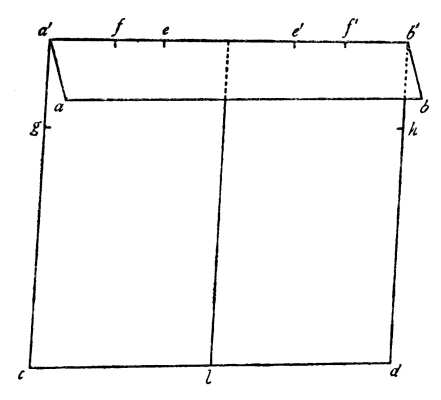
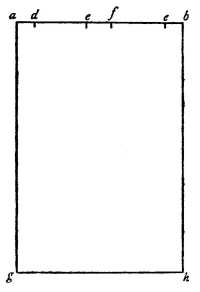
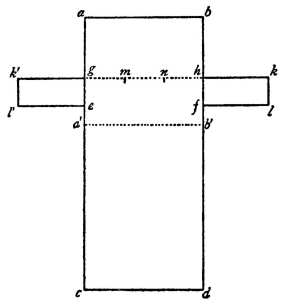
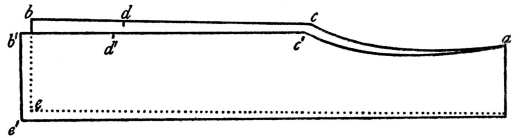
Fig. 9.
a, b, c, d represents the original rectangular piece of material,
ab being twice the wearers distance from elbow to elbow—that is
to say, about 5 ft. 9 in.—ac being 1 ft. more than the wearer’s
height—namely, about 6 ft. 6 in.
After the upper edge ab has been folded over to a width of about
1 ft., the dress is pinned on the shoulders at the points e e′ and
f f′; the part which covers the back is drawn slightly forward
over the front, so that there are four thicknesses of material where
the pins are inserted; the garment is then girded at the waist, the
position of which is indicated by the points g and h, and any
superfluous length is drawn up over the girdle.
The distance between the points a′ f, f e, e′ f′, etc.,
varies slightly, but is always approximately one-sixth of the whole
width of the material. In practice, a better effect is produced if
the width of stuff e′ f′, which covers the back of the neck, is
shorter than the other sections.
The garment is usually represented as being sewn up along the
side, sometimes along the whole length ac, bd, sometimes only
along the length from the waist to the feet—that is, along the edges
gc, hd; sometimes it is left open, being held in place only by
the girdle. On the black-figured vases it is usually the closed Doric
dress which is represented, probably because it offered the least
difficulty to a technique which necessarily imposed somewhat close
limitations on the artists who practised it. A good example is to be
found in the figures of the Fates from the François vase, which has
already been quoted in illustration of the Homeric peplos.
Photo. by The English Photographic Co.]
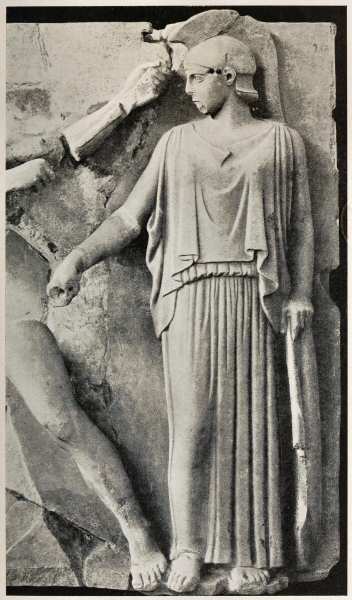
Fig. 10.—Metope from the
Temple of Zeus, at Olympia.
[Face page 44.
A freer and more realistic representation is to be found in the
sculptured metopes from the temple of Zeus, at Olympia. Athena in
the metope representing the cleaning of the Augean stables wears
the closed Doric dress; here the ἀπόπτυγμα, or overfold, falls
slightly below the waist, and below it the kolpos is clearly visible,
the slight pouch formed by drawing the superfluous length of the
material over the girdle.[81] On the vases the pouch is almost invariably
absent, and the girdle is always visible. This is also the case
in one of the archaic statues on the Acropolis at Athens, where
the Doric dress is worn over an Ionic chiton. A slight variation
of the dress is to be seen on the nymph of the Atlas metope at
Olympia, where the overfold hangs considerably below the waist and
no girdle or pouch is visible; here the additional length of the
overfold
probably obviated the necessity of a pouch, and the girdle, which is
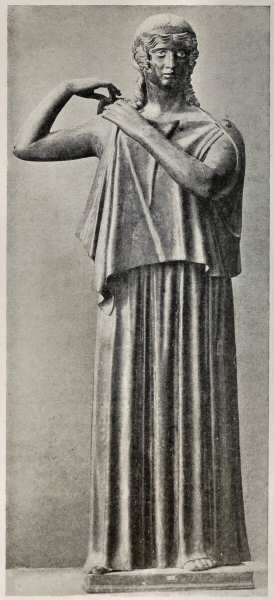
hidden, simply served to hold the dress in to the figure. A bronze
statuette from Herculaneum shows the dress sewn up only from the
waist downwards (Fig. 11).
Photo. by Brogi, Naples.]
Fig. 11.—Bronze Statue
from Herculaneum, Naples.
[Face page 45.
As time went on, the dimensions of the Doric dress became more
ample, or at least were represented so in art; both pouch and
overfold become deeper and the folds of the garment generally grow
fuller; the distance of the shoulder pins from the points which
hang immediately under the arms becomes proportionately larger,
no longer being an exact sixth of the whole width of the dress.
The most perfect examples in art of the Doric dress in its full
development are to be found in the maidens of the Parthenon frieze
and the Caryatids of the Erechtheum. Here the pouch is emphasized,
and its graceful curve dipping over the hips, though idealized, is
at the same time perfectly naturalistic, as can be shown at once by
practical experiment.
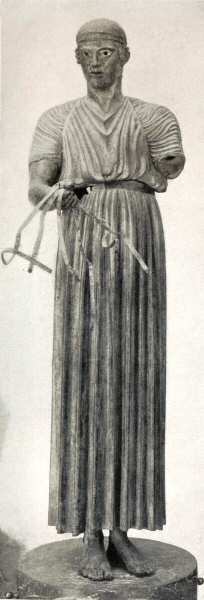
The Munich copy of Cephisodotus’s Eirene holding the infant Plutus
presents a very good example of the closed Doric dress as it was worn
in the fourth century; it will be seen that the folds are more ample,
and the overfold and pouch fall to a distance considerably below the
waist, so that the garment must be larger than that originally worn,
if we are to accept early monuments as faithful representations of
the style of dress actually worn.
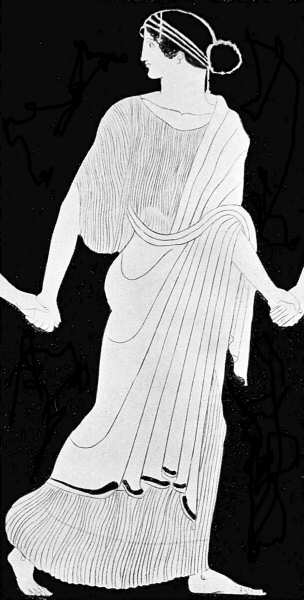
The simpler form of the Doric dress, namely, that which is
unsewn and left open down the side, is not found represented in art before
the fifth century; it becomes fairly common on red-figured vases,
where it is very frequently depicted ungirt.[82] Sometimes it is the
only garment worn; in other cases it is worn over an under-dress.
A sculptured example is to be found in an Artemis in Dresden,[83]
for the original of which Furtwängler claims Praxitelean
authorship. This was probably the dress worn by Laconian girls,
to whom the term φαινομηρίς, “showing the thigh,” was applied
by some ancient writers.[84]
Fig. 12.—Vase-painting—British
Museum.
[Face page 46.
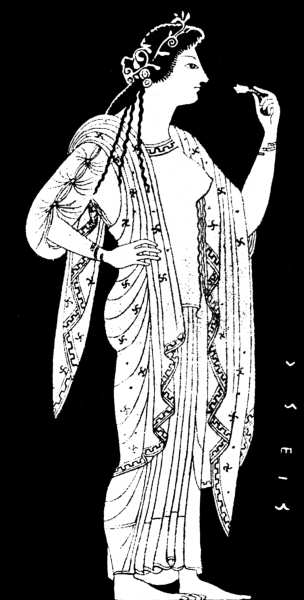
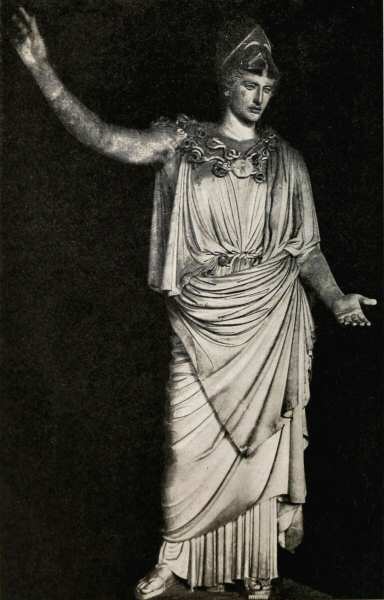
A variety of this dress appears in art about the middle of the
fifth century; it is sometimes known as the “peplos of Athena,”
because Pheidias chose it as the style in which to drape his statue
of the Athena Parthenos. The word “peplos” is usually reserved
for the Doric dress whether open or closed, the word “chiton” for
the Ionic, though the latter is frequently applied to the Doric,
and is invariably used of the under-dress, when the two styles
became confused. The “peplos of Athena” is similar to the ordinary
open Doric dress, except that the overfold is longer and reaches
to the thighs and the girdle is worn over it.[85] The material is pulled
up very slightly over the girdle, but not sufficiently to hide it
in front, the purpose of the slight pouch being merely to prevent
the dress from dragging under the arms, and from trailing on the
ground at the sides. The girdle is at first worn round the waist, but later it is
put on higher, until, on the Athena from the frieze of the altar at
Pergamon, it is worn immediately under the breasts. The clearest
representation in art is to be found in the Varvakeion copy of
the Athena Parthenos, and it occurs also in many representations
of Athena which were obviously influenced by Pheidias. In
the Dresden “Lemnia,”[86] the girdle is passed not only over
the overfold, but also round the ægis; in the “torso Medici”[87] this
overgirt peplos is worn over an under-dress of the Ionic type. The
date of the introduction of this style of wearing the Doric dress is
a point of some uncertainty. The question arises as to whether it
was invented by Pheidias or was already commonly worn and adopted by
him as being most appropriate for his great representation of the
maiden goddess. Certainly, in sculpture we have no example of it
before the time of Pheidias, unless we assign an earlier date to the
little relief of the “mourning Athena,” which seems improbable; the
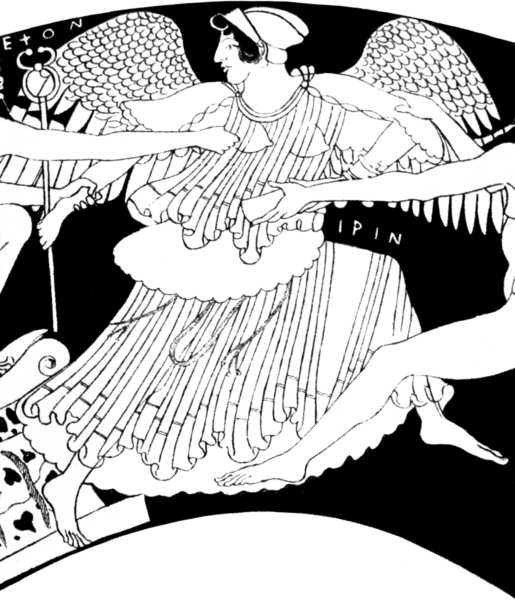
Iris of the Parthenon frieze wears it; and among slightly later works
the Victory of Pæonius at Olympia is a good example, though here the
dress is slightly varied by being fastened only on one shoulder.
Further evidence is afforded by the vases, but even these do not give
any certain proof; the dress does not appear before the middle of
the fifth century, but after that date it becomes fairly frequent,
and is given not only to Athena but to other divine or mythological
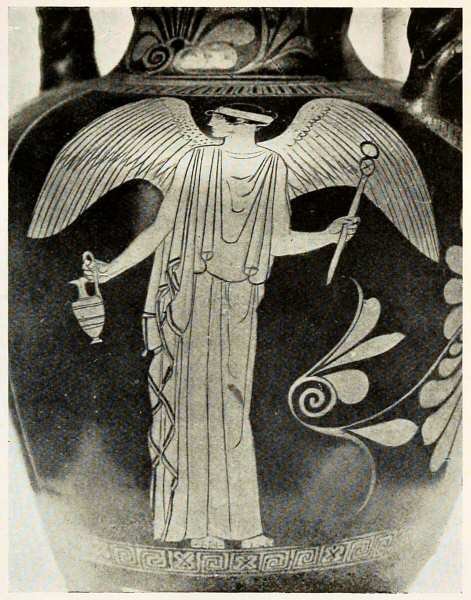
personages, such as Persephone,[88] Nike, Cassandra, and also to hand-maids
attending on ladies in more elaborate costume. In some of these vases
the work is obviously post-Pheidian, but many of them were probably
made before the completion of the Athena Parthenos, and the fact that
the overgirt dress is so frequently represented on slaves renders it
likely that it was a style of dress actually worn, and not merely
the invention of the great sculptor’s imagination; it was probably
selected by him for the Parthenos because of its extreme simplicity
and the possibilities of statuesque dignity which it contained.
Fig. 13.—Vase-painting in
the Polygnotan Style—Louvre.
[Face page 47.
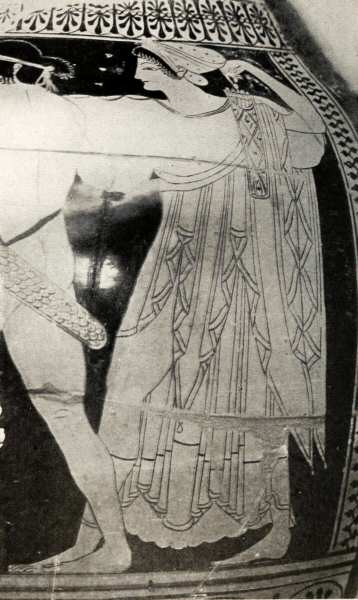
It has been mentioned incidentally that the Doric peplos is
sometimes found worn over another garment, but it is ordinarily the
only garment worn indoors, and for outdoor wear another is sometimes
put on over it. The overfold of the peplos could itself be used as a
veil by drawing the back part up over the head; it is so used by a
woman on a red-figured vase in the British Museum.[89]
Fig. 14.—Vase-painting
by Hieron—British Museum.
[Face page 49.
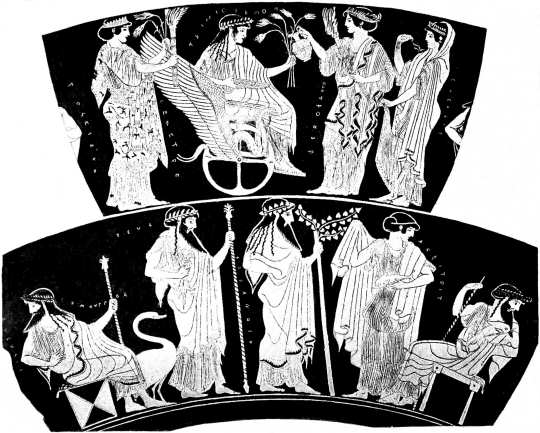
The outer garment worn by women in classical times corresponds
to the Homeric κρήδεμνον and is called the ἱματίον, although this
term is applied by Herodotus to the Doric peplos. By derivation the
word simply means “a piece of clothing,” being connected with εἷμα
and ἕννυμι. It consisted of a large oblong piece of material about
7 or 8 feet in length, and in breadth about equal to the wearer’s
height. Considerable variety was possible in the arrangement of it. It could be
worn both as head covering and cloak, by placing the middle of the
upper edge over the head and letting the two sides fall down over the
shoulders like a shawl; it is often so depicted on the vases both
black- and red-figured; the figure of Eleusis wears it so on the
Triptolemus vase by Hieron in the British Museum.[90] It was frequently
worn over the shoulders in this fashion without covering the head,
and could easily be pushed back or drawn up over the head at will.
A second very common way of arranging the himation was to draw one
end over the left shoulder from the back towards the front, so that
it hung down in a point in front, then to pass the mass of material
across the back and under the right arm and throw the other end over
the left shoulder again, so that the second point hung down towards
the back: this was a very common style both for men and women.[91] If
additional warmth were required, it could easily be obtained by
drawing the cloak up over the right shoulder, so as not to leave the
right arm and chest exposed. A combination of these two styles is
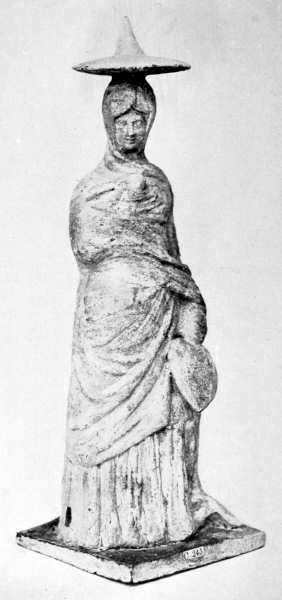
seen in some of the Tanagra statuettes, where the himation is put on
over the head. Both shoulders are covered; but instead of the two
ends being allowed to hang down symmetrically one on each side of
the front, one is taken up and thrown over the other shoulder, so
that the whole figure is covered in the ample folds of the cloak.[92]
Fig. 15.—Terra-cotta
Statuette—British Museum.
[Face page 49.
A rather
exceptional variant of the second style of wearing the himation
is to be seen on a vase of Euxitheos in the British Museum,[93] where
Briseis is represented wearing it with one end placed on the left
shoulder, the mass of the cloak being drawn across the back; the
other end is passed under the right arm, but instead of being thrown
over the left shoulder again, is turned back over the right shoulder,
and so leaves the front of the figure exposed.
Fig. 16.—Vase-painting
by Euxitheos—British Museum.
[Face page 50.
Fig. 17.—Vase-painting
by Falerii—Rome, Villa Giulia. [Furtwängler and Reichhold,
Griechische Vasenmalerei, 17 and 18.]
[Face page 50.
A third fashion is somewhat similar to the second, except that
it leaves the front of the figure exposed to the waist or a little
below. Instead of being drawn across the chest and thrown over the
left shoulder, the second end is simply thrown over the forearm
and held in place by the bend of the elbow.[94] A cloak worn in this
style would be very likely to slip, so another fashion was adopted,
which produced approximately the same effect, but which prevented
the possibility of slipping. Instead of throwing the end over the
left arm, the wearer secured it at the waist under the arm either
by a brooch or more probably by simply tucking it under the girdle.
To prevent the garment from hanging down too low and dragging on
the ground, a large corner was usually doubled over before it was
secured at the waist. The part thus fastened was sometimes passed
over the end which hung down from the left shoulder, sometimes under
it. The himation is so worn by Mausolus and Artemisia in their portrait statues
from the Mausoleum. A very good example is the Athena of Velletri
published by Furtwängler.[95]
Photo. by A. Giraudon.]
Fig. 18.—Athena of Velletri.
[Face page 51.
On many of the monuments of the Pheidian period and the time
immediately preceding it, we find that the Doric peplos is worn alone
or with a small cloak or shawl laid on the shoulders and hanging down
the back, as in the case of the maidens carrying sacrificial vessels
on the Parthenon frieze. This small shawl was perhaps worn more for
ornament than for the sake of warmth, and an ample peplos of warm
woollen material might be found sufficient protection.
It may be objected that in the majority of the examples chosen as
illustrations the himation is worn not over the Doric peplos, but
over the Ionic chiton, and it has indeed been sometimes regarded as
an element of the Ionic dress rather than of the Doric.
It does, however, appear over the Doric peplos, e.g., in Fig. 18 and on many black-figured Attic vases,[96] and it
is not difficult to trace its development from the Homeric κρήδεμνον
worn symmetrically over the head and shoulders. It is an easy step
in advance to throw one end of the cloak over the opposite shoulder,
push it back off the head, and bring one arm out free instead of
letting it remain covered. Fig. 15 might serve
to illustrate an intermediate stage between those represented in
Figs. 14 and 17.
An attempt will be made later to show that the Ionic himation was
fastened with brooches, and had a different development. The wearing
of the unpinned himation over the Ionic chiton is an instance of the
blending of Doric and Ionic dress.
The Doric dress of men was similar to that of women, both with
regard to under-dress and cloak. The name χιτών is used for the
under-dress, as it was in Homer, the word peplos being restricted to
women’s garments. The outer garment of men as well as of women is
called the himation.
The Doric men’s chiton is fastened by brooches on the shoulders
and girt in at the waist. It was a short garment reaching midway
down the thighs, or to a distance just above the knees, had no
overfold, and was narrower than the women’s peplos. No kolpos was
worn, there being no superfluous length to dispose of. The side was
sewn up so that the garment before being pinned was cylindrical in
shape. This somewhat scanty garment was the only one worn by slaves,
and men engaged in active pursuits and workmen frequently wore it
fastened only on one shoulder, leaving the other bare and the arm
quite free. When worn in this way it was called the χιτὼν ἔξωμις or
ἑτερομάσχαλος; the god Hephaistos is usually represented wearing it
in this way in his capacity as craftsman. We learn from Pollux, vii.,
47, that the ἔξωμις was a περιβλῆμα as well as an ἔνδυμα, from which
we may gather that a small cloak was sometimes worn fastened on one
shoulder and girt round the waist, but left unsewn down the side.
Fig. 19 represents the χιτὼν ἔξωμις.
Representations of Amazons and of Artemis the huntress are
frequent, wearing the χιτὼν ἔξωμις; but in these cases it is usually
a longer garment than that worn by men, and its superfluous length
is drawn up over the girdle, forming a pouch; and then a second
girdle is worn over this to prevent it from flapping in the wind.
The Amazons of the Mausoleum frieze wear the short Doric dress
without overfold and unsewn down the side; this, however, is perhaps
merely a device on the part of the sculptor to afford an opportunity
of displaying the physical forms, as well as the drapery. Various
references in literature show that the Spartan women wore more
scanty clothing than the Athenians; they are described as μονοχίτων,
“wearing a single garment,” and we learn from Pausanias that the
girls who competed in the running races at Olympia wore the short
χιτὼν ἔξωμις. As monumental testimony to the truth of this statement,
we have the statue of a girl runner in the Vatican Museum.
Fig. 19.—Bronze
Statuette—British Museum.
[Face page 53.
The τρίβων worn by Spartans and people of austere or Laconizing
tendencies, like Socrates and the Cynic philosophers, was probably
a scanty Doric chiton made in some coarse homespun material; men
of leisure and elderly men preferred to wear a longer chiton with
sleeves either sewn or fastened with brooches; this was the case even
after the reaction against anything savouring of Orientalism which
followed the Persian wars. If we are to consider the monuments, both
sculpture and vases, as giving a realistic picture of Greek life,
we shall see that
men frequently wore only the himation; but it is difficult to believe
that this was so, except, perhaps, in the height of summer.
The methods of draping the himation were the same for men as for
women, except that after the period of the early black-figured vases
we do not find men represented wearing it laid on both shoulders like
a shawl; nor do they ever wear it drawn up over the head, although in
the sunshine of a southern summer some such protection against the
heat might be considered indispensable. The favourite style for men
was that of laying the one end on the left shoulder and drawing the
rest round the body from the back and throwing the other end either
across the left forearm or over the shoulder.[97] This was called wearing
the himation ἐπὶ δεξιὰ, presumably because it was drawn closely
round the right side of the body. It was considered a mark of good
breeding to throw it over the shoulder and let it hang down in
such a way as to cover the left arm completely.[98] To wear it ἐπ᾽
ἀριστέρα, “over the left side,” was a mark of boorishness,
as we gather from Aristophanes Birds,[99] where Poseidon taunts
the barbarian Triballus for wearing it so.
Fig.
20.—Vase-painting—British Museum.
[Face page 54.
Fig. 21.—The Doric Himation.
[Face page 54.
Fig. 22.—Vase-painting
by Euphronios—Munich. [Furtwängler and Reichhold, Griechische
Vasenmalerei, 22.]
[Face page 55.
Fig. 23.—The Chlamys and Petasos.
[Face page 55.
Another variety of over-garment worn by men is the χλάμυς,
a cloak used for riding or travelling. It is considered to be
of Macedonian origin,[100] another form of it being the ζειρά, a
rough Thracian riding-cloak sometimes depicted on Greek vases.[101]
It was probably brought into Greece from the north by the Dorian
invaders when they came down, and in its origin may have been
no different from the Homeric χλαῖνα. In classical times it was
always worn over the short chiton by travellers and riders, and
was the characteristic dress of Ephebi.[102] The Parthenon frieze
affords abundant illustration of the way in which it was worn. Like
the himation, it consisted of a rectangular piece of material,
but was of a slightly different shape, being rather more oblong;
in fact, when doubled it would form almost a perfect square. Its
normal dimensions would be about 6 to 7 feet long by 3½ feet wide.
In putting it on, the wearer would double it round him and stand
inside it, so that the middle line came along the back of the left
arm and shoulder; he would then fasten the two sides together with a brooch on the
right shoulder, close to the neck, at the points e and f in the
accompanying diagram; the corners d and b would hang down in
front and behind respectively at a distance of about 1 foot from the
ground, and the corners a and c would hang down together along
the right side; the left arm which held the reins in riding would
thus be covered, while the right would be free to hold spear or whip.
The left could easily be freed also by swinging the cloak round so
that the brooch came under the chin instead of on the shoulder; the
two corners a and c could then be thrown back over the arms. The
χλάμυς is frequently represented in art worn in this way, especially
in cases where the wearer is occupied in vigorous action.
Fig. 24.
IV IONIC
We must now turn
to a consideration of the Ionic dress, which Herodotus tells
us was adopted by the Athenian women in the sixth century
B.C. According to his account, it was Carian
in its origin; our knowledge of the Carians is somewhat vague
and indefinite. We learn from Thucydides[103] that they originally
inhabited the Cyclades, but were driven out by Minos of Crete;
and a little later on[104] he speaks of them, together with
the Phœnicians, as islanders who practised piracy. Herodotus[105]
gives a slightly different account, saying that the Carian
inhabitants of the islands were subjected by Minos and used by him
to man his ships, and were not driven out until later by the Dorian
and Ionian immigrants. He also mentions the belief of the Carians
themselves that they were autochthonous in Caria, and attributes to
them various inventions afterwards adopted by the Greeks. According
to Thucydides, their method of burying the dead seems to have
differed from that of the Greeks; and from the various accounts of
the two historians,
we may gather that their race was different, although possibly they
were soon hellenized by their Ionian neighbours. If, as Herodotus
tells us, the Greeks adopted some Carian inventions, it is not
unlikely that they may also have adopted the Carian dress, or at
least may have modified their own by assuming some Carian elements.[106]
In his account of the assumption of the Ionic dress by the
Athenians, Herodotus speaks only of the women; but we know that it
was worn by men also, partly from the evidence of the monuments
and partly from Thucydides, who tells us[107] that not long
previously to the time at which he is writing the elder men of
the wealthy classes gave up wearing linen chitons and fastening
their hair with the τέττιξ, “cicala,” a luxurious mode of dress
common to them and their kinsfolk the Ionians. The Ionic dress was
probably discarded by the Athenians shortly after the outbreak of
the Persian war, when a reaction set in against Orientalism and
a tendency towards greater simplicity began to manifest itself;
Thucydides is writing more than a generation after the Persian wars,
but his expression, οὐ πολὺς χρόνος, “no great length of time,” is
sufficiently vague, and he probably recollected the change which took
place in his youthful days; moreover, he speaks only of the elder
men of the wealthy classes, who would naturally be of conservative tendencies and the
last to adopt any change in their mode of life or dress. The exact
period at which the Athenians adopted the Ionic dress is unknown; the
Æginetan expedition of 568 B.C., of which
Herodotus makes use in dating the change, is too late, for we know
that already in Solon’s days luxury in dress had reached such a pitch
as to necessitate the passing of a sumptuary law to regulate it, and
such luxury could hardly have been reached so long as the simple
Doric dress was retained. It may not be unreasonable to assume, then,
that constant intercourse with the Ionians in the islands on the
coast of Asia Minor led the Athenians to adopt their dress at some
time towards the end of the seventh century.
Fig. 25.—Vase-painting
from Lucania—British Museum.
[Face page 61.
The Ionic chiton differed from the Doric in length, material,
and method of fastening. We read in Homer already of the Ἰάωνες
ἑλκεχίτωνες,
“long-robed Ionians,” and Pollux tells us of the
λινοῦς χιτών ὅν Ἀθηναίοι ἐφόρουν ποδήρη, καὶ αὖθις Ἴωνες,[108]
“the linen tunic which the Athenians wore reaching to the feet, and
the Ionians too.” This χιτών ποδήρης is a long chiton reaching to
the feet; that its material was linen is testified by Thucydides
and Pollux, as well as other writers.[109] The story of
Herodotus shows that its fastening was different from that of
the Doric, since the Athenian women were forced to adopt it, ἱνα
δὴ περόνῃσι μὴ χρεώνται, “so as not to need brooches.” This expression is
usually taken to mean that the characteristic difference between the
Doric and Ionic chitons is, that the Doric is fastened by means of
pins or brooches, the Ionic is always sewn on the shoulders. That
this is not invariably the case is proved by many examples both in
sculpture and vase-painting, where a chiton is represented, which,
from its length and fulness and the fine texture of its material,
is clearly Ionic, but which is not sewn on the shoulders, but
fastened together down the upper arm by a series of small round
brooches; this fastening forms a kind of loose sleeve which reaches
frequently to the elbow. It is the formation of this sleeve, whether
sewn or pinned, which, apart from size or material, distinguishes
the Ionic from the Doric chiton, which is sleeveless. The Ionic
chiton in its simplest form is cylindrical in shape, and varies
considerably in length, but is always longer than the height of
the wearer; the superfluous length is drawn up through the girdle
to form a kolpos, which varies in depth according to the length
of the chiton. The Mænad vase of Hieron gives a good idea of the
size to which this kolpos sometimes attained.[110] Being made of a
fine linen material, the Ionic chiton is naturally fuller than the
coarser woollen Doric garment, and its folds are consequently more
numerous and more delicate; it is the greater width of the garment
which necessitates the formation of the sleeve, as a single fastening
from the shoulder
would leave too great a mass of material hanging down under the
arms. The sleeve is made by joining the two top edges of the garment
together and gathering them up so as to form regular folds; an
opening is left in the middle for the neck and one at each end for
the arms. The arm-holes were probably not formed, as some believe,
by lateral openings in the side-seams, since this method produces a
clumsy effect in practice; and moreover, in many vase-paintings[111] the
ornamental border which runs along the neck and upper arm passes also
round the arms without being continued down the side, which shows
that it was embroidered or woven along the top edge of the chiton
before the sleeves were made.
Fig. 26.
A diagram will best show how the sleeves were formed, and the
position of the openings for neck and arms: ab represents the upper
edge of the chiton, along which a border is frequently woven or
embroidered; ef represents the space for the neck, through which
the head is thrust; ad and bc represent the arm-holes, which
hang down parallel to the wearer’s sides when the arms are held down
in a normal position; the side-seams ag and bh are sewn along
their whole length; the distances defc are joined and gathered to form the full
sleeve. The fulness is frequently held close to the figure by the
addition of cross-bands, either crossing both in front and behind
and attached to the girdle at the sides, or crossing only at the
back and passing round the front of the shoulders. A very excellent
sculptured representation of this, the simplest form of the Ionic
chiton, is to be found in the famous Delphi charioteer, where the
gathering of the sleeves is very clearly marked.[112] In cases where the
sleeve is not sewn, the spaces de and fc are joined by a series
of brooches, varying in number from four to six on each side. The
fulness is produced by taking up a little group of folds at each
fastening and leaving the spaces between quite plain; the two edges
are usually parted in these spaces, so as to show the arm through.
These groups of folds are perhaps more effective than the continuous
row of gathers which we get with the sewn sleeve. The Euxitheos
vase reproduced above[113] will furnish an illustration of the
chiton with pinned sleeves. A short chiton, with sleeves pinned in
several places, was frequently worn by men, as is proved by many
vase-paintings. We sometimes find women represented wearing a full
chiton without overfold, fastened only once on each shoulder, like
the Doric dress. This is one of the many modifications which the
Ionic dress underwent when introduced into the mainland of Greece.
We frequently find on vases figures in rapid motion wearing the
long Ionic
chiton with many folds, represented by fine close lines, in which
the lower edge of the chiton in front is drawn up to an angle on one
or often more places. It was supposed by Böhlau[114] that this was
meant to indicate that the garment had been cut at the bottom in
a series of points. The object of this cutting is difficult to
see, and on examination it will be found that wherever the lower
edge of the chiton is so drawn up, immediately above it the kolpos
hangs down deeper over the girdle; the figures are usually in rapid
motion, and the lower edge of the back of the garment, which shows
behind the feet, is represented by a continuous curve, without
being drawn up anywhere.[115] It is obvious, then, that the artist
intended to indicate that the wearer had drawn the dress up through
the girdle, so as not to impede progress. Anyone who has ever moved
about freely wearing a chiton of this kind, will know that unless the
girdle is uncomfortably tight the dress has a habit of slipping down,
so that it is necessary to pull it up sometimes, so as to prevent
treading on it in front.
Fig. 27.—The Delphi
Charioteer.
[Face page 62.
Fig. 28.—Vase-painting—Munich.
[Furtwängler and Reichhold, Griechische Vasenmalerei, 33.]
[Face page 63.
A feature of the Ionic chiton not very easy to understand is the
overfold, which occurs very frequently, especially in vase-paintings
of the severe red-figured class; it is not a normal feature of
the Ionic chiton, and may very possibly have been added by the
Athenian women when they adopted the dress, since they had always
been accustomed to wearing it with the Doric peplos. The view that Herodotus (v., 87)
is wrong, and that the Athenian women never wore the Doric dress at
all, is hardly tenable in the face of such evidence as the François
vase and others like it, which are certainly of Attic workmanship.
The Ionic chiton with overfold is really, then, an instance of the
blending of the two types of dress, which later became so complete
that it is frequently difficult to decide whether a particular
garment should more correctly be called Doric or Ionic.
In some instances the overfold of the Ionic chiton is formed
in exactly the same way as that of the Doric dress, only it is
frequently shorter: it is turned over before the garment is put on,
then back and front are fastened together along the arm, either by
sewing or by brooches. In this latter case the only distinction from
the Doric dress, in addition to those of size and material, is that
instead of being pinned only once on each shoulder, and so being
sleeveless, it is pinned along from shoulder to elbow, so as to form
sleeves. An example of this is to be seen in a figure of Aphrodite
from a vase-painting in Paris reproduced by Miss Harrison.[116]
This style of dress, with the sleeves sewn instead of pinned,
is found on the first of the so-called Fates of the Parthenon
pediment, and on one of the Nereids from the Nereid monument, on
a torso at Epidaurus, and on many vase-paintings. Although not
always represented in art, shoulder-cords or cross-bands were
probably actually worn with this dress, as a general rule, since without some such
contrivance it would slip inconveniently.
Fig. 29.—Vase-painting
by Brygos—British Museum.
[Face page 66.
A type of dress very commonly found on vases is that which has
full sleeves to the elbow and an overfold covering the chest and
back, and passing under the arms without covering the sleeves,
as was the case in the chiton described above. The Mænads on the
famous Hieron vase are represented wearing this kind of dress, and
numerous examples could be quoted from other vase-paintings.[117]
Some such effect might be produced with the ordinary
cylindrical-shaped chiton with overfold, if shoulder-bands were
worn such as those worn by the Delphi Charioteer and by one of the
so-called Fates of the east pediment of the Parthenon; but in actual
practice such an arrangement would produce a somewhat clumsy mass
of folds under the arm, and could not be managed at all unless the
overfold were considerably deeper than that usually represented on
the vases. We must look, therefore, for some other explanation; and
it will not be far to seek, if we allow the Ionian women and their
Athenian imitators a freer use of scissors and needle than their
Doric sisters were accustomed to make. A close examination of the
monuments will show that although the sleeve of the Ionic chiton was
frequently formed in the manner described above, yet in a very large
number of cases, in almost all of which the overfold is present,
the sleeve is
more like our modern notion of a sleeve—that is to say, it fits
closer to the arm, as though shaped to some extent, while the
rest of the garment fits closer to the figure. The vase-painter
Brygos is fond of depicting women in this kind of dress: the
accompanying illustration[118] is taken from his representation of Hera
and Iris pursued by Silenoi. This dress is obviously not composed
simply of a cylindrical piece of material folded over at the top and
fastened on the arms, for the rather deep overfold leaves the sleeves
quite free, and covers only the body of the wearer. This effect could
be produced in two ways, in both of which, however, the sleeve-pieces
must be sewn in separately. In the first method, we may suppose that
two rectangular pieces of material are taken, equal in size and
shape, represented in the diagram as abcd.
Fig. 30.
These are sewn together along the sides up to the points e and
f at a distance of about 5 feet from the lower edge; when the dress
is worn, these points will come immediately under the arms. We may
next suppose that two rectangular pieces of material measuring about
18 by 20 inches are taken for the sleeves; these are folded double, so that the
longer sides lie upon each other, and then sewn on to the body of
the chiton at the points f, h, g, and e, so that the fold
lies in the position indicated by the lines fl and el′ in the
diagram; the openings kl and k′l′ will form the arm-holes; that
part of the chiton abgh which still extends above the sleeve-pieces
is then folded over, so that it hangs down in the position gha′b′.
The line kk′ now represents the upper edges of the garment, which
are fastened together (leaving the space mn for the neck) either by
sewing and gathering or by groups of folds held in place by a series
of brooches. The front and back part of the overfold would then hang
down separately, but they could be joined together under the arms,
provided that the space round the shoulder were left free for the arm
to pass through into the sleeve.
The second method of making this dress is nothing but a
modification of the first. It consists of taking two smaller
rectangles in the first place, ghcd, to form the body of the
chiton; two pieces abgh are sewn on back and front, after the
sleeve-pieces, to form a sort of false overfold, which will have
exactly the same effect as if it were in one piece with the rest of
the chiton.
It is possible to conceive of the sleeve-pieces being originally
in one piece with the rest of the chiton, which would then be a
dress composed of two cross-shaped pieces of material sewn together
along the edges dfl and cel′; it is more reasonable to suppose, however, that
the sleeve-pieces were sewn on separately. That such sleeve-pieces
were attached to the ordinary Ionic chiton without overfold seems
likely from many vase-paintings. The addition of sleeves was
certainly not unfamiliar to the Greeks, for we find slaves wearing
a narrow, ungirt chiton, with tight sleeves reaching to the wrists.
A familiar example of this is to be found in Hegeso’s attendant
on the well-known grave relief in Athens. In an inscription,
dating from the middle of the fourth century,[119] and recording a large
number of garments dedicated to Artemis Brauronia, the expression
χειριδωτός occurs, which can only mean “sleeved.” In the same
inscription special mention is frequently made of the fact that the
chiton, or χιτωνίσκος, is ἐμπλαισίῳ, “oblong,” from which we may
infer that it was not always so. Now, the ordinary simple Ionic
chiton would be oblong in shape when not worn, so that we may take
the others, which are not described as oblong, to be chitons with
separate sleeve-pieces attached.
The false overfold was sometimes attached also to the simple
cylindrical Ionic chiton. In these cases it covered the chest only,
leaving the arms covered only by the sleeves; it was probably
simply sewn on at the neck in front only. Kalkmann has collected
and stated the evidence for this false overfold to the chiton in
an article in the Jahrbuch, vol. xi., where he shows that it
was sometimes applied to the over-garment also. Very clear examples of it are to
be seen in some of the archaic female statues on the Acropolis at
Athens, especially in those cases where the himation is worn like a
shawl over both shoulders.[120]
That the long Ionic chiton with sleeves was worn by men as well as
women, is abundantly evident from the monuments. On the vases, Zeus
and Dionysus and other gods are almost invariably represented wearing
it; and in sculpture also, kings, priests, and others are represented
so dressed. Together with the himation, it probably constituted a
sort of state dress for priests and other officials, even after it
had been discarded for daily use, as being too luxurious.
A short chiton, with or without sleeves, and made of some fine
material, is to be found on the vases worn by men engaged in active
pursuits. It sometimes has an overfold; although, with the long
chiton, this feature is usually confined to women. A good example of
the men’s short chiton with overfold is to be seen on the vase of
Brygos representing the exploits of Theseus.
The cross-bands and shoulder-cords already mentioned are, strictly
speaking, an element of the Ionic chiton, though they are sometimes
represented in art over the Doric peplos. Their object is to hold the
ample folds of the full chiton close to the figure, and to prevent
the sleeves from slipping or flapping about with every movement of
the wearer. The
cross-bands are usually attached to the girdle and can be of one
piece with it; their place is sometimes taken by a second girdle,
worn rather high over the kolpos, as is the case with the Artemis of
Gabii reproduced below (Fig. 37).
This high girdle was known as the ταινία, or ἀποδέσμος, whereas
the low girdle was called περιζῶμα. A broad band, known as the
στρόφιον, was sometimes worn by women under the breasts, to serve the
purpose of modern corsets.[121]
A word or two must be said about the diminutives of χιτών—namely,
χιτώνιον, χιτωνάριον, and χιτωνίσκος. We should naturally expect the
words to mean a small or short chiton, but this does not seem always
to be the case. The χιτώνιον and χιτωνάριον are frequently described
as διαφανές, “transparent,”[122] and Eustathius (iii., 1166) explains
the words as referring to a fine and luxurious dress worn by
women. In the inscription to Artemis Brauronia[123] we read more than
once of a χιτώνιον ἀμοργῖνον—that is, a garment made of linen
from Amorgos, which we know was very fine and expensive; we may
infer, then, that the diminutives χιτώνιον and χιτωνάριον refer
to fineness of material rather than to shortness of cut. The case
of the χιτωνίσκος is somewhat different; it is not referred to as
being transparent, and is usually described in the inscription
cited above as being very ornate. Women are frequently represented on vases[124]
wearing over the long Ionic chiton a short and sometimes very ornate
garment, which cannot be described as a himation. Possibly this
short over-chiton is the garment indicated by the name χιτωνίσκος.[125]
A similar garment was worn by musicians over the long ungirt
chiton (ὀρθοστάδιος).[126] Another instance of a special dress worn
for a special purpose is the costume worn by actors; it had long
sleeves, and was probably padded to complete the impression of
increased size produced by the high masks and buskins.
The himation worn over the Ionic chiton presents considerable
variety of shape and arrangement. In very many cases we find that
the Doric himation is worn, whether over both shoulders or only over
one. In the Harpy monument, where we might have looked for Ionic
dress in its purest form, we find the Doric himation worn over the
fine linen-sleeved chiton, and on very many of the red-figured vases
of the severe style this is the case. There is one set of monuments,
however, which may be considered as Ionic in origin, or at least of
Ionizing tendencies, where a far less simple garment takes the place
of the Doric himation. This set includes the archaic female statues
and flying victories of the Acropolis Museum at Athens, and a large
number of small painted terra-cotta statuettes in the same museum, the sculptures of the
Treasury of the Cnidians at Delphi, and a number of other statues
and reliefs from Athens, Eleusis, Delos, and elsewhere. The dress
presents a somewhat complicated appearance at first sight, and has
given rise to a considerable amount of discussion. The following
section is based upon a careful study of the original monuments and
of the literature already written on the subject.
V THE MAIDENS OF THE ACROPOLIS THE DEVELOPMENT OF THE IONIC HIMATION
The
problem of the drapery of the archaic female figures in the Acropolis
Museum has been considered by various archæologists, but has not
yet been satisfactorily solved in all its details by any of them.
The questions to be decided are: Firstly, are we to suppose that
the draperies of the statues give us a faithful and realistic
reproduction of a costume actually in fashion among the Athenian
ladies at the close of the sixth century, or must we take into
account the fact that the work is still archaic and the artists have
not yet sufficiently mastered their material to be able to reproduce
exactly what they saw before them? Secondly, what are the separate
garments which constitute the elaborately complicated whole? And
thirdly, how are these garments arranged so as to produce the effect
seen in the statues?
The answer to our first question is to be found in a compromise
lying somewhere between the two hypotheses suggested. The early
artist, struggling
with the technical difficulties of his art, is always ready, as soon
as he has solved one problem to his satisfaction, to pass on to
something which presents still greater difficulties and demands the
exercise of still greater skill. The makers of the Acropolis maidens
have advanced so far as to be able to infuse some sort of life into
their work;—witness the lively expression on some of the faces.
Moreover, in the modelling of some parts of the human figure they
have reached a high degree of excellence. In the few cases in which
the feet of the statues are preserved, a great degree of delicacy and
refinement is displayed, which shows that the artists had attained
some considerable power over their material. Having advanced so far,
they feel themselves equal to facing the problem of representing
drapery in sculpture. It is not to be supposed that at this stage of
artistic development they would invent difficulties which did not
naturally present themselves, nor would they attempt to represent
anything that they had not actually seen; therefore, we must conclude
that the Athenian ladies of the period actually wore a dress
corresponding closely to that reproduced in art. At the same time,
it must be remembered that the Greek artist in all probability did
not work with a model constantly before him, so that we must expect
some slight differences in detail on that account; furthermore,
we must make some allowance for archaism; for example, in all the
statues under discussion, the drapery does not fall freely away from
the figure, but
follows the lines of the form beneath in a manner impossible in real
life.
Photo. by English Photographic Co., Athens.]
Fig. 31.—Archaic Statue—Athens,
Acropolis Museum.
[Face page 75.
Having determined that the artists have represented a dress which
was actually worn, we must proceed to consider the character of the
dress as a whole, and of the parts of which it consisted. In giving a
general description it will be best to take an example which exhibits
all, or nearly all, the characteristics that can be collected from
the various statues. No. 594 will serve our purpose. (Perrot and
Chipiez, pl. xii.; Lechat, Au Musée de l’Acropole, fig. 16.)[127] The
under-garment which appears on the neck and left arm is represented
by a series of fine wavy lines, running parallel to one another,
which give a crinkled appearance, and may possibly be meant to
indicate a material which has undergone some special treatment in
the making. This garment is finished at the neck and down the upper
part of the arm by an ornamental border, originally painted, but
from which the colour has now almost entirely disappeared. The lower
part of the figure is covered by a very long and ample garment,
which I shall hope to prove to be the same as that which covers
the left shoulder and upper arm. This garment is ornamented with a
broad and elaborate meander pattern down the middle of the front;
and if the statue were not broken, we should probably see another
border round the bottom. So far, the costume is comparatively simple;
but above this
under-garment is worn a cloak which passes under the left arm and is
drawn up to the right shoulder, where it is fastened so as to hang
in heavy vertical folds down the right-hand side of the figure, back
and front; in most cases we shall find that the cloak is fastened
by a series of buttons along the upper part of the arm, as far as
the curve of the elbow. The example before us now has an additional
wrap, which conceals the fastening down the right arm. The rest of
the cloak, passing under the left arm, hangs in a series of oblique
but almost vertical folds, running parallel to a box-pleat which
starts from the shoulder. These folds are apparently held in place by
a band passing under the left arm and fixed on the other shoulder.
The upper edge of the cloak hangs over this band in a sort of little
frill with a zigzag edge. The mass of folds lying close to the figure
under the left arm represents the material which forms the sleeve of
the chiton. The additional wrap seen in one or two of the statues
is a very simple matter; it consists of a large scarf worn over
the shoulders, hanging down to a point on the left-hand side; it
leaves the left arm uncovered, passes round the back, and over the
right shoulder. Instead of hanging straight down to a point in the
right-hand side, the end of the scarf is turned up and thrown over
the arm. The end is broken away in No. 594, but appears in another
instance (No. 684, Acropolis Museum; Perrot and Chipiez, fig. 297, p.
592). Both cloak and scarf are bordered with patterns, of which the colour still remains
to some extent.
Many theories have been advanced as to the various garments which
compose the costume. It will be well to give a brief summary of
them, and to point out wherein they fall short, and, if possible, to
substitute one that is more satisfactory.
The chief point at issue is whether the skirt part of the drapery
belongs to the chiton—that is to say, to the garment which appears on
the neck and left arm—or whether it is part of the cloak which passes
under the left arm and is fastened on the right shoulder. Collignon
even distinguishes three garments; he believes that the skirt is
the chiton proper, and that the crinkled texture of the piece which
appears above the himation is meant to represent some sort of woollen
jersey worn over the chiton, which he calls the “chitoniscus.”
The difference in texture comes out very plainly in those cases
where the himation is worn over the shoulders like a shawl, or
where it is omitted altogether; for example, in Nos. 670 and 671.[128]
At first sight it appears as though two separate garments were
intended, but on close examination it will be found that the curved
line which terminates the wavy lines of the upper section has not
the appearance of an edge, but appears rather to turn under and
to represent a pouch, formed by pulling the garment up through
the girdle. Moreover, in some cases these parallel wavy lines appear on the
skirt as well, and cover the whole surface with the exception of
the mass of folds hanging down the middle of the front. This can
clearly be seen in No. 687 (Lechat, p. 161), in a small statue of
the same type from Eleusis, now in the National Museum, Athens, and
in the relief of the Charites in the Acropolis Museum (Lechat, pl.
3). Again, the same technique is found sometimes introduced into
the rendering of the himation. Frequently on the shoulder, when
the cloak is fastened, a succession of these wavy parallel lines
begins to appear, then stops suddenly, and the rest of the garment
presents a smooth surface.[129] There can be no question here of a
difference of material, nor of a separate piece of drapery, so
that we must look for some other explanation of the different
treatment. Lechat has offered one which is satisfactory and which
finds confirmation in other monuments. He says “the difference in
the appearance of the upper and lower part of the same garment is
due to this: that in the lower part, all the superfluous material is
gathered together in a single mass, and the rest is drawn tightly
across the legs; while in the upper part, the material, being left
free, falls in regular folds all round the body.” He further suggests
that the regularity of the folds may be meant to represent some
artificial treatment of the dress, such as is applied to the modern
fustanella. The archaism of the work, however, is sufficient to
account for this
regularity in representing a series of very full folds in a fine
material held in rather closely to the figure. The same kind of
treatment appears on many of the red-figured vases of the best
period. One from a vase by Euphronios is reproduced by Kalkmann
(Jahrbuch, vol. ix.); it occurs also on the well-known Troilus
vase by the same artist, and in numerous other instances (Klein,
Euphronios, p. 215). Above the girdle the folds are represented by
fine parallel wavy lines drawn very close together below by straight
lines. In these cases there is no questioning the fact that only
one garment is intended, so that we may conclude that in the case
of the Acropolis statues too, there is no need to suppose that the
difference in texture represents two separate garments of different
materials.
Photo. by Mansell & Co.]
Fig. 32.—Archaic Statue—Athens,
Acropolis Museum.
[Face page 78.
It has been suggested that there may be an intention on the part
of the artist to indicate some kind of material that had a crinkled
texture, such as that of some of the modern Greek stuffs; but if this
were so, we might reasonably expect to find the same technique all
over the garment, and the comparison with the vases shows that the
supposition is not necessary.
We may conclude, then, that in those cases where the himation is
omitted altogether, the figure is draped in a single garment, namely,
the long Ionic chiton described above.
In the case of these statues, the chiton is exceptionally long;
there is still some material left trailing on the ground after the
formation of the
deep “kolpos,” which necessitates the skirt being held up in one
hand, so as not to impede walking. We are at once reminded of the
Ἰάονες Ἑλκεχίτωνες
of the Homeric Hymn to Apollo.
We have next to consider those cases—and they are in the
majority—where another garment is worn over the chiton; and it is
on this point that archæologists are at variance. Many maintain
that the chiton only appears on the upper left-hand side of the
figure, and that a very large cloak is worn over it, which covers
the whole of the rest of the chiton, and has a deep overfold at the
top and trails on the ground behind, being held up in front and
drawn aside in the left hand. Studniczka supports this view, and
calls the garment an “ionisirende Peplos.” Holwerda, in an article
in the Jahrbuch for 1904, gives some drawings of some practical
experiments he has made in draping a model in a garment of this
kind. He supposes that it is cylindrical in shape, with a deep
overfold, which is shorter on the shoulder than elsewhere, and so
produces a zigzag line along its lower edge when draped; a girdle is
worn underneath the overfold, through which the superfluous length
left by shortening the overfold on the shoulder can be drawn. He
supposes that the garment was drawn tightly round under the left
arm, and that its upper edge formed the frill which we see in many
of the Acropolis statues. A comparison between his finished model
and the statue which he reproduces beside it serves to show the
points wherein his theory falls short; it in no way accounts for the vertical folds
of the cloak, nor for the tight band which appears passing under the
left arm and fastened on the right shoulder. Amelung, writing in
Pauly-Wissowa’s Real Encyclopädie, and Professor E. A. Gardner,
in his Handbook of Greek Sculpture, maintain that the garment is
simply a Doric peplos fastened on one shoulder instead of both, and
held in place by a tight band, under which the width of the peplos
is arranged in vertical folds. The main objections to this theory
are that the Doric peplos is invariably fastened in one place only
on the shoulder, whereas the fastening of the garment in question
is continued by a series of brooches down as far as the elbow; the
result would be to leave a very heavy and cumbersome mass of material
hanging from the right arm, which would seriously impede any active
motion. Moreover, it leaves out of account a piece of material which
appears almost invariably in front, below the zigzag edge, where
it is drawn up highest.[130] Holwerda takes it to be a girdle, but it
has not the appearance of a girdle; it hangs over the material that
falls from below it, and does not cut into the soft stuff in the way
in which a girdle would. That the makers of these statues knew how
to represent a girdle is plain from No. 679,[131] where the Doric
peplos is worn over the Ionic chiton. In this case the peplos is
considerably
shorter than the chiton, so that the latter garment is plainly seen
below the peplos, which only hangs down to a distance somewhat above
the ankles. The Caryatid of the Cnidian Treasury at Delphi has the
girdle clearly represented below the box-pleat by two parallel,
horizontal, incised lines. On the frieze of the same building some
of the figures are represented wearing the Doric peplos as an
over-garment; in these cases also it is shorter than the chiton,
which invariably appears below it at the feet. An archaic statue from
Rhamnus, in Attica, now in the British Museum, has the crinkly chiton
showing at the feet, and over it a himation with a deep overfold
reaching considerably below the waist; in addition to this overfold
a pleated frill appears over the breast, but no band is visible; the
frill, however, is deeper than is usually the case in the Acropolis
statues, and might be intended to conceal a band. This over-dress is
sewn up at the side, and in that respect resembles the Doric peplos.
It is significant that in this case, where the garment might with
more reason be regarded as a Doric peplos let down from one shoulder,
the chiton is seen appearing below it at the feet, and the over-dress
does not reach to the ankles. In the few cases where the feet of the
Acropolis statues are preserved, it will be noticed that the skirt
is held up fairly high towards one side, so as to display the ankle.
If a long under-garment were worn, we should expect its lower edge
to be seen here; but in no instance is that the case, so that we may
conclude that the
skirt itself is the under-garment. Those who maintain that the skirt
belongs to the upper garment support their opinion by the fact that
very frequently the ornamentation on the two different parts is the
same; the natural colour of the marble is left as a ground, and the
decoration consists of coloured borders and patterns dotted somewhat
sparsely over the surface. The part of the dress which appears on
the left shoulder is frequently painted all over, and we might have
expected that if the skirt belonged to the same garment it would
also be painted all over. But before accepting this argument as
conclusive, it will be well to consider the nature and purpose of
polychromy as applied to Greek sculpture.
In the early days when inferior materials were used for sculpture,
colour was applied to them to conceal the poverty of the stone and
to produce a more pleasing surface than that offered by the rough
material at the artist’s disposal. These coarser materials were not
capable of such careful finish, or of producing such a lively play
of light and shade, as the marbles later used, and the only way to
give them animation was by the application of colour all over the
surface. It became, therefore, a regular practice for early Greek
sculptors to paint their statues. When, however, they began to use
more beautiful materials, such as marble, they recognised that it
was a pity to conceal its texture by the extensive application of
colour. They therefore adopted the practice of submitting the surface
of the marble to
a process of polishing, and adding colour only in parts, the effect
being that the beauty of the marble is enhanced by the contrast
between its polished surface and the coloured parts of the statue.
The range of colours used is somewhat limited and conventional. For
example, in the early pediment groups from the Acropolis, we find red
used for human flesh; and the colours used in the draperies of the
Acropolis female statues are limited to red and blue. Both eyes and
hair are invariably red. We may infer, therefore, that colour was
not added with a view to reproducing nature faithfully, but simply
to decorate the statues. If, therefore, the artist felt that a white
surface of marble with a few patterns sprinkled over it produced a
more pleasing effect than a surface coloured all over, he would use
this method of decorating his work, even if it were not realistic;
and he would prefer to treat large surfaces of drapery in this way,
rather than colour them all over. When, therefore, in these statues,
we find that the small surface of the chiton which appears on the
upper part of the figure is coloured all over, we need not conclude
that the skirt belongs to another garment because it is differently
ornamented; had so large a surface been painted all over, the effect
would have been far less pleasing. The difference in the decoration
of different parts of the same garment need in no way surprise us;
it occurs very frequently in the black-figured vases, where we
get purple used for the upper part of a garment and black for the
lower, simply with
the object of producing variety. The argument from the application of
coloured ornament will not help us, then, in this case, especially
when we find that it can be used to support either view. Professor
Baldwin Brown has pointed out that some terra-cotta figures[132]
in the Acropolis Museum, which are draped in the same style as the
archaic statues, have the under-garment covering the shoulder and
the skirt painted in one colour, and the part which passes round the
figure under the left arm in another, and he uses this fact as a
piece of evidence to show that the skirt is part of the chiton and
the rest a separate garment.[133] It will be safer, therefore, in
considering the different garments which constitute the dress, to
leave the question of colour out of account altogether, and to base
our arguments only on their form. Many who maintain that the skirt
is part of the chiton, are of the opinion that the upper garment is
the ordinary himation with a small overfold, fastened on the shoulder
and down the arm. Lechat supposes that the upper edge is taken up
and drawn from beneath and folded over on itself, so as to form a
sort of thick pad at the top, and he suggests that the pleats were
folded before the cloak was put on, and perhaps even ironed; but this
arrangement would not produce the vertical folds which we find in
almost all the statues.
Kalkmann[134] calls the garment a “stilisirte himation,”
and suggests that the vertical lines are continued round the
figure because the artist had great difficulty in representing the
transition between the vertical folds which hang down from the arm
and the horizontal ones of the overfold. This explanation, however,
does not account for the frill-like edge which appears at the
top of the himation. Professor Baldwin Brown[135] has published some
good photographs of a model draped in this Ionian himation, but has
not given a very full or satisfactory explanation of how the effect
was produced. He says that the secret of the dress is that “the upper
edge of it, with all the folds, is tightly rolled over so that it is
shortened in the front, while at the same time the folds are kept in
their places.” He admits that the folds will only keep in place on a
“motionless wearer of imperturbable patience,” and therefore supposes
that the dress was evolved for use on the wooden xoana. It seems
unlikely that a special dress of such an elaborate nature should
have been evolved to drape these early wooden images, and there is
no reason to suppose that the series of Acropolis statues are merely
reproductions of such images. They appear much rather to represent
the grand Athenian ladies who dedicated themselves symbolically
to their patron goddess by setting up statues of themselves in
her honour. Since the statues were probably intended to be set up
permanently in a conspicuous place, it is natural that the votaries would like to see
themselves appearing in their best clothes.
A careful study of the statues themselves and a consideration of
all the evidence bearing on the question leads to the conclusion that
the complete costume consists of two garments, a long under-dress,
which may be regarded as the usual indoor costume of the Athenian
ladies of the sixth century, and a mantle worn over it for out
of doors; occasionally a scarf or shawl is worn as well over the
mantle, perhaps for additional warmth, perhaps only for ornament.
The under-dress consists of the long linen Ionic chiton, a wide
cylindrical garment fastened by brooches or sewn down both arms
so as to form sleeves; a girdle is worn round the waist, and the
superfluous length of the material is drawn up over this girdle so
as to form a deep pouch; sometimes this pouch is worn all round the
figure, sometimes, as is apparently the case in a large seated figure
of Athena, the pouch is formed only in front. On some occasions[136] we
find that the chiton, in addition to the pouch, has an overfold from
the neck resembling the ἀπόπτυγμα of the Doric peplos. This overfold
sometimes only covers the chest and sometimes hangs down considerably
lower. Such an overfold is very frequently found on vases; in some
cases its material may be of one piece with that of the rest of
the chiton, as it appears on one of the Nereids from the so-called
Nereid monument; but in those many cases where it only appears between the shoulders and
does not extend also along the arms, it is quite possible that it may
be a separate piece of stuff sewn on to the chiton at the neck. It
is probably the edge of such an overfold that appears at the waist
below the himation on the Acropolis statues; no other satisfactory
explanation of this detail of the costume has at present been
suggested. It is unlikely that it represents the “kolpos,” because
in all cases, with one possible exception (No. 676; Lechat, fig.
29), a border is painted on it, indicating that it is an edge and
not a pouch. It has been suggested that this overfold was sometimes
made of a different kind of material from the chiton on to which it
was sewn, and that this material was a silk or linen of a crinkled
texture, indicated by the wavy parallel lines which appear on the
statues. The fact that this treatment appears sometimes also on the
skirt and on the upper part of the mantle, diminishes the probability
of this hypothesis, and makes it appear more likely that this kind
of technique was simply used to represent very full folds in a fine
material. Such a treatment may have been suggested to the artist by
familiarity with some material of a crinkled texture, such as that
used for sheets and table-cloths in some Greek villages to-day.
With regard to the ornamental patterns which adorn the chiton,
we find borders at the feet and at the edge of the overfold, also
strips of ornamentation running round the neck and along the arms and
round the arm-holes, and almost invariably a broad band running vertically down the
front of the lower part of the chiton. In addition to these strips
and borders we also get stars or small floral designs scattered over
the whole garment. The bands which appear at the edges are easy to
understand; they were either woven in the material of which they
were made, or, more probably, embroidered on to it afterwards; but
in those cases where the overfold is worn and a pattern appears at
its edge and also along the neck and arms, we must suppose that this
latter was applied after the sleeves were formed and the overfold
attached. Possibly, also, the vertical band on the lower part of
the chiton represents a separate strip of embroidery sewn on to the
garment. The Greek women probably occupied a large proportion of
their time in embroidery; and since a good piece of embroidery lasts
for very many years, it is quite possible that when the original
garment was worn out, they may have cut off the strip of still good
work, and sewn it on to a new dress. The only other explanation of
the numerous patterns which appear on the statues, is that the artist
simply applied ornamentation wherever it pleased his fancy to do so;
this is less satisfactory than to suppose that he was representing
something which he actually saw.
Fig. 33.
Turning to the himation or mantle worn over the chiton, the
simplest method of producing the effect seen in the Acropolis
statues was found by experiment to be by taking a piece of material
between 5 and 6 yards long and about 18 or 20 inches wide. This was folded double, as
in the diagram at the point a, so that the points b and b′ met.
Then at the points c and c′, at equal distances from the corners,
and cutting off at little less than one-third of the wide length of
the stuff, the two upper edges were fastened together on the model’s
right shoulder, a few pleats or gathers being taken in the material
on each side. A series of such fastenings was made along the upper
arm, as far as the points d and d′, which reached to the model’s
elbow; the rest of the stuff, as far as the points b and b′,
was allowed to hang down from the elbow. The part of the material
c to c′ passed under the left arm and was arranged in a series
of regular oblique folds running parallel to the box-pleat, which
formed itself naturally at the first fastening on the shoulder—that
is to say, at the points c and c′; these folds were held in
place by a band passing under the left breast, drawn rather tightly
round the figure and secured firmly on the right shoulder. In order
to make the lower edge of the cloak rise in the middle, as it does
invariably in the statues, it was found necessary to draw the folds
up over the band and let the upper edge fall over, forming a kind
of frill. The frill, however, hung down too low, and it was this fact that suggested
cutting the upper edge of the cloak out in a curve, or rather in two
curves, one at the back and one at the front, leaving the part under
the left arm longer than that in front and behind. When these curves
were cut out and the garment once more arranged in its pleats, the
little frill-like edge hung of itself over the band, just in the way
in which it appears in some of the statues. The band alone held the
folds fairly well in place; but in order to prevent the possibility
of their slipping, the Athenian ladies probably had them stitched
on to the band. It would be quite easy to slip the garment on and
off over the head without even unfastening it on the shoulder.[137]
Fig. 34.—Drapery in the Style
of the Archaic Statues in the Acropolis Museum, Athens.
[Face page 91.
The variations in detail which appear in the different statues can
easily be produced by arranging the folds in a slightly different
fashion. In some cases, as for example in No. 674 (Lechat, pl. 1),
the folds hang quite upright instead of obliquely, and the box-pleat
appears in the middle instead of hanging from the shoulder; this can
easily be produced by turning the folds first in one direction and
then in the opposite. The folds of the frill sometimes hang in the
opposite direction to those of the main part of the mantle; this is
simply a mistake on the part of the artist. Occasionally the frill
does not appear at all, for example in No. 686 (Lechat, fig. 37), but
the cloak hangs straight down from the broad band. In this instance
we must suppose
that the overhanging mass of material has been cut away entirely
before the folds were attached to the band.
Sometimes the two ends were sewn together along the lines be and
b′e′, and in this case the last fastening, indicated by the letters
d and d′, approached nearer to the points b and b′, so as to
leave an opening only sufficient for the arm to pass through.
The detail of the cloak which presents most variety is the little
frill-like edge which falls over the band. Sometimes it appears to be
a natural continuation of the vertical folds which hang down below
it, and it falls over the band so as almost to hide it; sometimes
it is shorter, and reveals the band and forms a sort of leaf-like
pattern above it; in other cases it disappears entirely. Its most
realistic representation is in one of the Victories in the Acropolis
Museum, where the corners c and c′, formed by cutting the
curves, are actually indicated on the shoulder, and the frill lies
in an irregular zigzag, almost exactly as it was found to fall in
practice.
In two cases in the Acropolis Museum at Athens, and in a statue
at Delphi, the band does not pass under the arm, but from shoulder
to shoulder, and the cloak covers both arms symmetrically, being
fastened down both alike with a series of brooches. In these cases
the box-pleat falls in the middle, and the curve must necessarily
have been considerably smaller, since the upper edge lies much higher
up towards the neck. When the cloak was worn in this way, it was
probably sewn up
down both sides, and the curves for the neck, back and front, were
naturally equidistant from the two side-seams. The openings for the
arms would come at the ends of the top edge, as in the case of the
Ionic chiton.
Fig. 35.—Vase-painting—British
Museum.
[Face page 93.
The style of dress represented by this set of monuments is
certainly the most luxurious which we find in Greek art at any
period. Now the date of the Acropolis maidens can be fixed at some
period certainly not later than the last quarter of the sixth
century. Solon’s sumptuary law regulating women’s dress must have
been enacted during the first years of the sixth century, so that we
may conclude that these dainty ladies with their chitons, cloaks, and
scarfs represent the height of luxury in dress which was possible
after the passing of that law: their self-satisfied smile seems to be
inviting approval of the degree of elegance to which their ingenuity
could attain, even though a stern law-giver had limited the number of
their garments to three.
This style of dress seems to have passed out of fashion at the
end of the sixth century, or in the early years of the fifth, for
we find it only in the early works of sculpture already mentioned.
An attempt to render it is frequently made by the artists of the
early red-figured vases—sometimes with some success; but more
often the attempt results in a confusion between this somewhat
elaborate style of cloak and the simpler development which it took
later. Fig. 35 shows a fairly successful
attempt to represent the dress. Here we have the band passing round the right shoulder
and the vertical folds falling from it, but the frill and the
fastening down the right arm are omitted. Possibly they taxed the
artist’s skill too greatly; possibly the style had already passed
out of fashion in real life. But he would be moderately familiar
with the maidens on the Acropolis, although perhaps not sufficiently
so to be able to reproduce their costume in detail. Working daily
in his little shop down below in the Cerameicus, perhaps he did not
very frequently mount the citadel, where he might study the art
treasures that adorned it. Possibly even the vase is not earlier
than 480 B.C., and the picture is but a
reminiscence of the statues that the artist had seen on the Acropolis
previous to their burial at the coming of the Persians. Very often
on the vases we find the vertical folds represented falling from
beneath a series of horizontal folds obviously formed by turning
over the top of the cloak before fastening it on the shoulder. Here
the band and fastening down the arm are omitted.[138] The place of the
frill is taken by an overfold of the cloak before it is put on, and
it is fastened by a single brooch on the shoulder; the material is
allowed to hang in natural folds, and the necessity of cutting a
curve in the upper edge is obviated by the fact that no band is worn,
and the stuff is not arranged in artificial vertical folds. This
style of cloak appears already on the figure of Apollo, on the relief
from Thasos in the Louvre; it is seen most clearly in the Artemis of Gabii.[139]
It was probably developed from the earlier and more elaborate form
of cloak by gradual stages, first by omitting the artificial folds
and the band which held them in place, and then by omitting the
numerous fastenings on the arm. This would necessitate an alteration
in the shape of the cloak; it would naturally become more square.
Kalkmann, in the article already referred to, fig. 17, represents
an intermediate stage in this development, where a large cloak is
worn without band or frill, and is fastened by a series of several
brooches down one arm. Were it not for this representation of the
transition stage, we might be inclined to class the cloak of the
Artemis of Gabii as a development of the Doric peplos, which it
resembles in having an overfold and being fastened by a single large
brooch on the shoulder; and indeed these two elements are probably
due to the influence of the Doric dress, and we should therefore,
perhaps, more rightly call the final form of the cloak a blending of
the two styles rather than a development of either the one or the
other.
Fig. 36.—Vase-painting—Ionic Dress.
[Face page 94.
Photo by Mansell & Co.]
Fig. 37.—The Artemis of Gabii—Louvre.
[Face page 95.
As early as the beginning of the fifth century we find the two
styles becoming confused and mingled together. The Doric peplos is
worn as an over-dress over the Ionic chiton, even by one of the
“Maidens” of the Acropolis, and later on the commonest form of
outdoor dress for women was the Ionic chiton with the Doric himation
over it. This combination appears in the so-called Fates of the
Parthenon pediment. Frequently we find this blending of the two styles in a
single garment; we find also on vases the overgirt Doric peplos
with sleeves formed by a number of brooches;[140] and again,
with cross-bands, which belong properly to the Ionic chiton.[141]
Some authorities, pinning their faith entirely to Herodotus, consider
that the brooch is an element which belongs strictly only to the
Doric dress; they therefore regard the chiton with pinned sleeves as
a mixture of the two. An over-garment not very simple in form, which
can be regarded as neither Doric nor Ionic, but a mixture of both, is
illustrated by Fig. 38. Kalkmann regards it as
a number of overfolds or flounces sewn separately on to the chiton.
It seems more reasonable, however, to regard the part of the dress
which appears on the arms and at the feet, and which is made of a
plain material, as the chiton, and the rest which is ornamented with
a pattern, as a separate over-garment. This garment has three edges,
at the waist, hips, and ankles, so that it is obviously not merely
an ordinary rectangular himation, nor a simple Doric peplos with
overfold. It seems simplest to explain it as a Doric peplos with deep
overfold, ungirt, having a short false overfold to the waist sewn
on over the real one at the neck. Such over-garments never occur in
sculpture and only rarely on the vases, and may possibly be an error
or invention on the part of the vase-painter; if commonly worn, they
would probably be more frequently represented in art.
Fig. 38.—Vase-painting—Dress
with two Overfolds.
[Face page 96.
VI MATERIALS AND ORNAMENTATION
The
fabrics in use for Greek dresses presented considerable variety.
The commonest materials were naturally woollen, but linen and
silk were used for more luxurious garments, and a kind of leather
jerkin known as διφθέρα[142] was sometimes worn by peasants.
That the woollen materials used themselves varied considerably
in texture, is proved by some fragments actually found in a tomb
at Kertch in the Crimea, and published in the Comptes rendus in
1878. These date for the most part from the fourth century B.C., but one at least probably goes back to
the fifth century. They are in most cases rather loosely woven, so
that the separate threads are clearly visible, and a bright object
could be seen through the material. The oldest piece is composed
of such fine threads that it is almost transparent; other pieces
have a texture not unlike that of woollen crêpe. A somewhat coarser
piece, the threads of which are very strong, has a portion of a
seam remaining, which is oversewn with strong woollen thread. In addition to very
finely woven woollen materials, the more luxurious of the Greeks wore
also many varieties of linen, and in some cases even silk. Pollux
tells us that the long linen chiton was worn by the Athenians and
Ionians, and many references are to be found in ancient literature
to different kinds of linen, coming from places usually in Asia or
the more easterly of the Ægean islands. Of these the most commonly
mentioned are ἀμόργινα, garments made of linen from the flax of
Amorgos, and βύσσινα, made of βύσσος, a yellowish kind of flax,
coming especially from India and Egypt. We learn from Aristophanes[143]
that the χιτώνιον ἀμόργινον was transparent, so that we may
conclude that the linen from which it was made was very fine
indeed; perhaps it resembled a very fine cambric. That βύσσος was a
linen of some kind, we are told by Pausanias,[144] and Pollux gives
us the information that it came from India. That it was known
in Egypt also, is testified by Herodotus,[145] who tells us
of its use for mummy-cloths. It was probably rather a mark of
luxury when worn by the Greeks, for Simætha[146] tells us that she
wore a χιτών of it when going out on a festive occasion.
Of materials which come under the heading of silk, three kinds
were known to the ancients. We read in Latin authors of vestes
coæ, bombycinæ, and sericæ, and these were also known to
the Greeks. Aristotle[147] is the first of the ancient writers
who tells us
anything of the production of silk. After describing the various
changes undergone by the worm before becoming a moth, he gives us the
following information:—
“Some women undo the cocoons of this creature, winding
off the silk, and then weave it; and Pamphile, daughter of Plateus,
is said to have been the first to weave it in Cos.” This implies that
the manufacture of silk was carried on in Cos, but no information is
given as to whether the worm was reared in that island or whether the
raw silk was imported. Pliny[148] tells us more on the subject; he seems
to distinguish the three kinds of silk mentioned above. Of these
three, only “sericum” is, strictly speaking, silk—that is to say,
a material made by unwinding the cocoon of the silkworm reared on
the mulberry tree. This worm is first mentioned by Pausanias.[149]
It was the Chinese who discovered this method of procuring the
silk, and it was apparently unknown to the Greeks and Romans. The
“coa” and “bombycina” were procured by piercing and carding the
cocoon instead of unwinding them entire; the result was a substance
coarser and less brilliant than silk. Pliny draws a distinction
between “coa” and “bombycina,” telling us that the latter was a
product of Assyria and came from the ordinary mulberry worm, whereas
the worm from
which coan silk was procured was reared on other trees, notably the
oak, ash, and cypress.[150]
Coæ vestes are frequently mentioned by the Latin poets, chiefly
Horace, Tibullus, and Propertius, and from them we learn that they
were chiefly worn by Hetairæ and were of a transparent texture;[151]
sometimes they were purple and had gold threads interwoven
or embroidered.[152] One piece of silk was found amongst other
materials at Kertch. In colour it is a bronze-gold, and is woven in a
lozenge pattern.
If Greek dress lacked variety of cut and material, the deficiency
was to some extent made up by considerable gaiety of colour and
ornamentation. Probably none but slaves and artisans would wear
garments of one colour without pattern or ornamentation of any kind,
and even they would sometimes have their dresses adorned with a
simple border, such as a broad stripe. From the numerous references
scattered up and down through extant literature, it appears that
the favourite colours were purple, red, and yellow. Pollux[153]
gives us a list of the colours most commonly used. This list includes
green (βατραχίς) and gray (κίλλιον, ὀνάγρινον), in addition to
those mentioned above, but strangely enough no mention is made of
blue. The word
κυάνεος, “dark blue,” is seldom if ever applied to garments, yet
it is scarcely likely that the colour was unknown to the Greeks.
Possibly some shades described as πορφύρεος approached a violet,
or blue, as distinguished from ἁλοῦργος, “true purple.” For red we
find the word φοινίκεος, “dark red,” used especially of the military
cloak of the Lacedæmonians,[154] and κοκκοβαφής, “scarlet”; for yellow
κροκωτός and θάψινος. Βατραχίς, “frog-coloured,” is the word applied
to a green garment, and this is probably the colour described
as ὀμφάνικος, “like unripe grapes.” Pollux[155] tells us that for
mourning the Greeks wore φαιὸν καὶ μέλαν ἀλλήλοις ἔγγυς, “gray and
black, very like each other.” From this we learn that φαιός was a
very dark colour, probably gray or dun.
The ornamentation applied to dress by the Greeks was very varied
in character; it is comparatively rare to find on Greek vases a dress
that is entirely free from decorations, and the patterns represented
are very numerous. Sometimes the ornament consists of a simple
border, often of a pattern distributed all over the dress, and these
designs are frequently of a very elaborate character, including
animal and even human forms. In sculpture, too, this feature was
not neglected; the maidens of the Acropolis at Athens all have some
pattern on their draperies added in colour, and one of them has no
less than seven different designs distributed over her costume. We
know that the
himation of the Olympian Zeus by Pheidias was richly decorated, and
the fragment from Damophon’s great group at Lycosura will serve as a
later example of sculptured drapery highly ornamented with patterns
in relief. This has not only geometric and floral designs as borders,
but the whole surface is covered with fantastic dancing figures of
human and hybrid forms.
References in literature are not very frequent; the
most noteworthy occurs in the Iliad,[156] where Helen is
described as working at a great loom:
ἣ δὲ μέγαν ἱστὸν ὕφαινεν
δίπλακα πορφυρέην, πολέας δ᾽ ἐνέπασσεν ἀέθλους
Τρώων θ᾽ ἱπποδάμων καὶ Ἀχαιῶν χαλκοχιτώνων.
“She was weaving a great purple web of double fold,
and over it she spread many battles of horse-taming Trojans and
bronze-clad Achæans.”
The epithet ποικίλος, applied to dress, undoubtedly means “richly
decorated,” and the ἀνθινά, “flowered garments,” frequently mentioned
in inscriptions, presumably refers to garments ornamented with floral
designs. In connection with the passage in Homer, the question has
been raised as to whether these complex designs were woven into the
material or embroidered afterwards. It seems hardly likely that they
were woven in, unless the work were a heavy tapestry, such as would
hardly be suitable for a costume; moreover, the word ἐμπάσσω means
“to sprinkle on,” and is more easily applicable to the distribution
of a design over a piece of material already woven than to the formation
of a pattern in the course of the weaving. The words μέγαν, ἱστὸν,
and ὔφαινεν would still be applicable, because when the garment was
at this stage, it would still be regarded as incomplete, and the
designs, however applied, would probably be at least sketched out
while it was still on the loom.
Fig. 39.—Fragments of a
Sarcophagus Cover from Kertch.
[Face page 103.
Among the fragments of materials found at Kertch were some which
were embroidered, others which had simple geometrical designs woven
into the borders; in addition to these there were some considerable
fragments of a large sarcophagus cover, the ornamentation of which is
strongly reminiscent of Greek vase-painting of the fourth century.
The ground is black and is covered with designs in red and light
terra-cotta; the ornamentation is divided into bands, and consists
of battle scenes with chariots, and birds and beasts scattered
about the field of the design; the bands are separated by different
patterns, many of which are frequently met with on vases. These
include the egg and dart pattern, ivy and laurel wreaths, large
palmettes, and many others.[157] Names are inscribed against some of the
figures, among others ΝΙΚΗ, ΑΘΗΝΑΙΗ ΙΟΚΑΣΤΗ, (Ι)ΓΓΟΜΕΔΩΝ, etc.
These designs are not embroidered, nor are they produced in
the course of weaving the cloth; they are apparently drawn out
by means of some pigment applied after the material was woven.
Herodotus tells us[158] that the people of the Caucasus used to paint animals
on their clothes with some vegetable pigment which they mixed with
water. Some such procedure, then, must have been practised by the
Greeks of the fourth century, which is the date assignable to the
fragment in question, on the evidence of the inscriptions.
The designs applied to Greek dresses presented abundant
variety, as is evidenced by extant monuments, especially by the
vases; they may be roughly classed as geometric, floral, and those
containing animal and human forms. Of the geometric designs some
are rectilinear, others curvilinear. The favourite rectilinear
borders are broad lines, parallel rows of zigzag lines, the mæander
or key pattern in very many forms varying from the simple running
mæander to a complicated double fret, broken at intervals by stars
or chequers. In addition to these borders we frequently find a
chequer pattern covering the whole surface of a garment. A kind of
net pattern, often seen on vases, was very probably used in dresses
also. Of the curvilinear designs the most common are the “guilloche”
or plait-band, the simple spiral, and the κυμάτιον or wave pattern.
On the black-figured vases a kind of scale pattern frequently occurs
covering a wide surface.
A very great variety of floral designs was used by the Greeks
for ornamentation of all kinds; they are very frequent as part of
the scheme of decoration of vases, especially of those of Ionic
origin. A favourite pattern is a simple laurel wreath like that
depicted in Fig. 39; the ivy also forms the
basis of
more than design. Sometimes it takes the form of a row of leaves
on either side of a straight line; more often the leaves alternate
with tendrils and berries. By far the commonest and the most
beautiful of floral designs are those made up of lotus buds and
flowers and palmettes. Sometimes we find the lotus alone forming
the motive of the design, sometimes it alternates with palmettes.
A very graceful pattern is composed of oblique palmettes turned in
opposite directions and connected by spirals.[159] That these designs
so commonly used for the decoration of pottery were employed also
in the textile arts is proved by some of the fragments found at
Kertch. Quite considerable remains were found of a piece of woollen
material elaborately embroidered with a large floral design (Fig. 40), the main motive of which is a graceful
palmette, from the base of which spring spirals terminating in
heart-shaped leaves and flowers. The design is executed in gold and
green on a violet ground.[160]
Fig. 40.—Embroidered
Fragment from Kertch.
[Face page 105.
Animal and human forms are naturally less common than
geometric and floral designs. Mention has already been made of
the wonderful diplax woven by Helen, in which she represented
scenes of battle between Trojans and Achæans. In art we find
that goddesses are frequently depicted wearing garments covered
with elaborate ornamentation of this kind. The François vase
will afford several examples, and in later art the dress of Demeter on the
Triptolemus vase by Hieron,[161] and the sculptured drapery from Damophon’s
group at Lycosura, may be quoted. That mortals also indulged in such
luxurious ornamentation is proved again by the Kertch fragments.
One of the most charming pieces found there had a very naturalistic
design of ducks embroidered in gold and green on a dark-brown ground
(Fig. 41c); another piece had a figure of an
Amazon riding on horseback; and mention has already been made of the
sarcophagus cloth covered with battle scenes.
Fig. 41.—(a and
b) Fragments of a Sarcophagus Cover from Kertch. (c)
Embroidered Fragment from Kertch.
[Face page 106.
VII HAIR AND HEAD-DRESS
The manner of wearing the
hair seems to have varied considerably at different periods, both for
men and women. In pre-Hellenic times it was, for the most part, if
not invariably, allowed to grow long. On the frescoes from Knossos we
find the cupbearer and other male figures represented wearing their
hair in long, wavy tresses reaching to the waist or thereabouts.
On Mycenæan gems and rings, where warriors are represented wearing
helmets, the hair is frequently concealed, so that it is impossible
to determine whether it was worn short or bound up in some manner,
so as to be out of the way. The ivory statuettes of athletes from
Knossos have long hair,[162] so that in all probability that was the
prevailing fashion among men in Crete. Among women in pre-Hellenic
times, the fashion was to wear the hair long; the snake goddess and
her votary have hair that reaches far past the waist, and in almost
all extant art of the period the hair of the women is represented
as being abundant. It is frequently worn in long tresses down the
back (compare
the dancing girl, Fig. 4) and arranged rather
elaborately in front in curls, which sometimes suggest artificial
treatment; sometimes the hair is done up at the back or top of the
head, in modern fashion.
In the Homeric poems we read of the “long-haired Achæans,”[163]
so that the sight of men with long hair was obviously familiar to
the poet. From the passage which describes Andromache’s swoon,[164]
however, it is clear that the women of the poet’s day bound their
hair up, using nets and kerchiefs and other appurtenances both useful
and ornamental.
Fig. 42.—Men’s
Head-dress—Archaic.
[Face page 108.
Coming down to historic times, we find that before the Persian
wars both men and women wore their hair long. After the middle of
the fifth century a change took place, the men cutting their hair
short for the most part, the women binding it up. The story of the
Lacedæmonians combing their long hair when the Persians were close
upon them is familiar (Herodotus, VII., 208). Extant monuments show
us that before the Persian wars the men adopted various methods
of disposing of their long hair: sometimes we see it worn loose
with a simple fillet tied round the head;[165] sometimes the
long ends are turned up and tucked in under the fillet;[166]
sometimes they are turned up and held together by an additional band.
This is the case with a bronze head from Olympia,[167] where, however,
some locks seem to have been left free on the neck. A relief in Athens,
representing a Discobolus holding the “discus” behind his head,[168]
shows the hair probably divided and twisted together in two coils
fastened tightly at a little distance from the end by a ribbon, or
possibly by a metal spiral.[169] The golden τέττιξ mentioned by Thucydides
(I., 6) was obviously some kind of ornament inserted in the hair
to hold the “chignon” in place. It has been shown by Helbig[170]
that this was probably a metal spiral or series of rings used to
bind together the ends of the long hair; such a style is frequently
represented in the art of the end of the sixth century and beginning
of the fifth. The bands represented in Fig. 42
(c) are possibly intended for such metal rings. Helbig’s view
is supported and confirmed by Studniczka.[171]
Probably the knot of hair bound up on the nape of the neck, as in
the above examples, represents the κρωβύλος or κόρυμβος mentioned
in Thucydides and elsewhere in literature. In later times this name
was applied to the knot of hair on the top of the head which occurs
so frequently in statues of Apollo; but there is no evidence to show
that it was worn in this position before the fourth century at the
earliest.
A style very commonly exemplified by extant statues of
Apollo, dating from the early part of the fifth century, is to tie a fillet round
the head and roll the long hair tightly over it, tucking the ends in
usually behind the ears.[172] These ends are, however, sometimes
allowed to hang down on the neck. Athletes very frequently disposed
of their long hair by braiding it into two plaits from behind;
these they crossed or brought round the head, fastening the two
ends together in front.[173] Sometimes the short hair in front was
combed down over the plaits, so as to conceal their union.
Fig. 43.—(a)
Head of Apollo from the Temple of Zeus, at Olympia. (b)
Head of an Athlete—Athens Acropolis Museum.
[Face page 110.
The date of the change of fashion is impossible to fix. We
find the athletes of Myron and Polycleitus represented with short
hair, but long-haired Apollos are found considerably after their
date. The change took place, in all probability, shortly after
the Persian wars; it then became the fashion for Ephebi to cut
off their long hair, which they consecrated to Apollo and Artemis
or to a river god.[174] When once the change had come about, long
hair was considered, in Athens at least, as a mark of affectation
or effeminacy. In The Wasps of Aristophanes,[175] Amynias, the typical
fop, is designated by the name of οὑκ τῶν Κρωβύλου, “he of the
‘chignon,’” and in The Clouds the wearing of the τέττιξ is spoken
of as a fashion quite out of date, or, as we might say, antediluvian.
There is some uncertainty as to whether the Lacedæmonians wore
their hair short or long; some authorities state that even in the fourth century
they still wore it long as a mark of freedom, and since they were
more conservative than the rest of the Greeks, it is quite possible
that this was the case. With this possible exception, the custom of
wearing the hair short continued, though Alexander probably set the
fashion of wearing rather long and mane-like hair.
Fig. 44.
A covering for the head was rarely worn by men, except when
riding or travelling long distances; in these cases the πέτασος
was worn as a protection against sun and rain. This consisted
of a felt hat with broad brim, which could be turned up or
down. Figs. 44, 22,
and 23 represent its various shapes, Fig. 44 being the earliest form. The πέτασος, like
the χλάμυς, which it almost invariably accompanies, probably came
originally from Northern Greece, Thrace, or Thessaly, where more
protection was needed against cold and inclement weather. Another
head-covering, worn by sailors and by the god Hephaistos, is the
πῖλος, a felt cap of conical shape resembling the modern fez.[176]
Fig. 45.—Women’s Head-dress.
[Face page 112.
Extant monuments show that before the Persian wars women for the
most part wore their hair down, although instances occur where it is
fastened up with bands or fillets. When worn down it was usually held
in place by a fillet, and frequently a metal ornament, rather high
in front and narrowing towards the back, was added. This was known
as the ἄμπυξ,
or στεφάνη, and was probably made of gold; almost all the “Maidens”
of the Acropolis wear it, and in several instances it is adorned
with floral patterns.[177] The high πόλος or crown worn by Hera (Fig. 45 (a)) was probably also made of metal.
Sometimes when the hair was worn down, the ends were prevented from
flying in the wind by being tied together in a kind of little bag,[178]
which reminds one of the many fashions adopted by men in the Georgian
period in England. Sometimes, like the men, the women tucked the
long ends up under the fillet, and let them hang out over it at
the back. The fillet itself frequently assumed the dimensions of a
scarf, the ends of which were tucked up at the sides and allowed to
hang down behind the ears. When the hair was done up, the “chignon”
was at first worn low on the nape of the neck and held in place by
bands variously arranged.[179] Sometimes the στεφάνη alone was worn,[180]
and very often the hair was held up by a kerchief or snood (μίτρα,
σάκκος). The styles in which it was worn present abundant variety:
sometimes it covered the hair completely,[181] except for a curl
or two allowed to escape in front of the ears; sometimes it left
the hair visible over the forehead only;[182] sometimes over
the forehead and on the crown of the head, and the ends of the
kerchief might be tucked through at the side and allowed to hang
down in front of the ears.[183]Fig. 45 (f) gives
an example of the στεφάνη worn in addition to the snood. In the fourth century
fashion seems to have dictated that the “chignon” should be worn
higher up at the back of the head, and a small kerchief was used
to hold it up, folded in such a way that it narrowed almost to a
point over the forehead.[184] Apparently a net was sometimes worn over
the back of the hair. Fig. 45 (l), from the
Meidias vase, furnishes an illustration of this. In Hellenistic and
Roman times the styles of dressing the hair became very numerous.
The snood seems to have been discarded altogether, and adornment by
means of artificial waving and curling apparently took its place. The
modes of “coiffure” of the Alexandrian Greeks are as varied as those
of modern Europe. Probably cosmetics were used for the hair and paint
and powder for the face; for we learn from Xenophon’s Œconomicus
that as far back as his date, not only hetairæ but married women
resorted to artificial means of beautifying the complexion.
More than one allusion is made in literature to some kind of hat
worn by women; in Theocritus (Idyll, xv., 39), Praxinoa, when going
out to the festival of Adonis, asks her maid for her wrap and hat
(θολία).
In the Œdipus Coloneus[185] Antigone recognises Ismene from a
distance by the Thessalian hat which she wears as a protection
against the heat of the sun. The words used are κυνῆ Θεσσαλίς,
which seem to imply that the hat was made of some kind of skin,
probably felt, and resembled the men’s “petasos,” which originated in Thessaly
or Thrace; its shape may have been slightly different. The Tanagra
statuettes frequently represent women wearing a broad-brimmed hat
with high pointed crown.[186]
VIII FOOTGEAR FOOTGEAR
The
practice of covering the feet seems to have varied somewhat among
the Greeks. In all probability it was the custom to go barefoot
indoors, and the habit prevailed among certain classes of going
always unshod in the street also. It was a mark of hardihood in the
Spartan youths always to go barefoot, and at Athens, in addition
to the lower orders, who probably never wore shoes, philosophers
and those who affected a simple life were in the habit of going
unshod. That Socrates rarely covered his feet is proved by more than
one reference in Plato’s Dialogues;—Phædrus[187] speaks of him
as ἀεὶ ἀνυπόδητος, “always unshod,” and in the Symposium[188] we
learn that for the occasion of Agathon’s banquet Socrates has washed
and put on his shoes, ἃ ὀλιγάκις ἐποίει,
“which he seldom did.”
Other references in literature show that he was not the only
philosopher who preferred to have his feet untrammelled.[189]
The
normal fashion, however, for people of good breeding was to wear
sandals or shoes out of doors, and we learn from Aristophanes[190]
that the Athenians at least were particular about the fit;—to
“swim about” in large boots was a mark of boorishness. Xenophon[191]
notices the division of labour in the shoemakers’ trade, where he
mentions at least four different hands employed in making a pair of
shoes.
Fig. 46.—Sandals and Shoes.
[Face page 117.
The simplest form of footgear was the sandal, the πέδιλον of
Homer, the ὑπόδημα of later times; this consisted of a leather
sole cut to the shape of the foot and fastened on by means of
straps or thongs, passing sometimes round the instep, sometimes
between the toes and round the heel and ankle.[192] At times a piece
of skin was attached to the sandal at the back, so as to cover
the back of the heel, or even to wrap round the instep entirely,
leaving only the toes bare;[193] from this form of sandal the ἔμβας, or
slipper, was probably developed. This is described by Pollux[194] as
εὐτελὲς μὲν ὑπόδεμα, Θράκιον δὲ τὸ εὕρημα, “a cheap shoe, of Thracian
invention.” Its name suffices to show that the foot was inserted
into the ἔμβας, in contradistinction to the sandal, which was bound
under the foot; and the epithet signifies that it covered the foot
completely. This description could be applied to many varieties of
shoes and boots represented in extant art. Fig.
46 (e and f) gives two examples of shoes—e being an ordinary soft shoe
covering the foot completely to the ankle, f is turned up at the
toes, like a modern Greek shoe, and reaches above the ankle at the
back. A vase at the British Museum represents a woman cleaning a
shoe of this shape. We learn from Aristophanes[195] that shoes were
cleaned with blacking made of pitch and applied with a sponge; they
were usually black, except when the leather was allowed to retain
its natural colour. The word ἔμβας seems to have been used for
various kinds of foot-covering; in Aristophanes it refers sometimes
to a kind of easy slipper worn by old men,[196] and in other
instances it is used of any ordinary shoe or boot. The mention
by Pollux of its Thracian origin perhaps refers to the high boot
turned over at the top, frequently represented on vase-paintings
as being worn by horsemen with the Thracian cloak and petasos.[197]
Different varieties of this kind of boot are to be seen in Fig. 46 (g, h, i, and j).
An article in Daremberg and Saglio’s Dictionnaire suggests an
Asiatic origin, and indeed the resemblance between Greek boots and
those represented on Assyrian monuments is striking. A comparison is
actually made by Herodotus[198] between Assyrian boots and Bœotian
ἐμβάδες.
It is quite possible that boots of this kind may have come to
Greece from the East by way of Thrace, and the fact that Dionysus is
very frequently
represented wearing them seems to add confirmation to this
conjecture.
Fig. 47.
A variety of the ἐμβάδες is to be found in the ἐνδρομίδες, a kind
of boot worn by runners, as also by Hermes, Artemis, and the Amazons.
They seem to have had no flap at the top, and to have been laced over
a tongue either through holes or round buttons.[199] Another kind seems to
have consisted of strips of cloth or leather, or possibly felt, wound
round the legs like the modern puttees.
The word κρηπίδες is frequently used of some kind of
foot-covering, and we learn from Theocritus[200] and from Pollux[201]
that these were worn by soldiers. The κρῆπις was probably some kind
of sandal with a thick sole and stout straps interlacing one another
in such a way as to form a protection for the heel and instep.[202]
Pliny[203] tells us that sometimes they had nails in
them.
Fig. 48.—(a) A Bronze
in the British Museum. (b) Foot of the Hermes of Praxiteles (from
a cast in the British Museum). (c) A Terra-cotta Flask in the
British Museum.
[Face page 118.
Many varieties of shoes or boots are mentioned by Pollux[204]
and other ancient writers. We read of ἀρβύλαι, ἀρβυλίδες, a cheap
kind of boot worn on journeys; βλαυταί, light sandals with latchets,
called also κονιπόδες, from the fact that they allowed the feet to
get covered with dust; εὐμάριδες, Persian slippers of yellow kid;
Περσικαί, cheap white shoes worn by women, especially by hetairæ;
Λακωνικαί,
distinguished by their red colour—these were probably the same as the
Ἁμυκλαί mentioned by Theocritus. One of the archaic female statues in
the Acropolis Museum at Athens wears red shoes. Wood was sometimes
used for sandals. Pollux tells us that κρουπέζια were a special kind
of wooden sandal used for dancing, and that Pheidias represented
Athene Parthenos wearing Τυρρηνικά, sandals with high rectangular
wooden soles and gold latchets.
Fig. 49.
Other shoes are too numerous to mention, and
cannot be identified with certainty.
IX THE TOILET CONCLUSION
The
toilet of the ancient Greeks was quite as elaborate as that of any
modern people, and much time and care was bestowed upon it. That
of the men was usually performed at the barber’s shop (Κουρεῖον),
which became, as we gather from frequent allusions in Aristophanes,
a regular resort for lounging and picking up news and scraps of
gossip of all kinds. A fashionable Athenian would probably spend a
whole morning at the barber’s shop, where, in addition to having
his hair cut and beard clipped or shaved, he could submit to
the various operations of manicure and chiropody. An epigram in
the palatine anthology[205] gives a list of barber’s implements, some
of which have survived in a few examples, and may be seen in our
museums. The list includes: scissors (ψάλις), razor (ξυρόν), some
sharp, pointed instrument for paring and cleaning the nails (στόνυξ).
Mention is also made of a scraper (ψήκτρα), which was probably used
after bathing.
An ancient razor differs from a modern one, in that it is crescent
shaped.
In addition to these implements, various ointments were used, one
of which, ψίλωθρον, containing arsenic, was employed for removing
superfluous hairs.
Fig. 50.
When repairing to the wrestling school or the gymnasium, a Greek
would invariably be provided with an oil-flask (ἀρύβαλλος, λήκυθος)
and a strigil (ξύστρα). The aryballos (Fig. 50)
was a small globular vessel, with an opening just large enough to
allow the oil to trickle slowly out, the lekythos being a long
narrow bottle with a foot and a narrow neck.[206] Both were used to
carry the olive oil with which athletes were accustomed to anoint
themselves. The strigil was a curved metal instrument used for
scraping the oil and sand from the body after wrestling. The famous
statue of the Apoxyomenos in the Vatican Museum represents an athlete
engaged in this operation.
Fig. 51.
The processes and requisites of the feminine toilet were many
and various, and toilet scenes are frequently represented in
vase-paintings. Sometimes we may see the process of the bath:
an attendant slave pouring water from a large vessel over the
crouching figure of the bather; in other instances we find a lady engaged in
binding her hair with a fillet, tying her girdle, or fastening her
sandal. There is almost invariably a maid in attendance, who assists
in the operations, holding a scent-bottle, or a casket from which her
mistress selects jewels.[207] One vase-painting shows a lady applying
powder or colour to her cheeks with a brush.
Many allusions in literature, and especially in Aristophanes,
show that paint and cosmetics of various kinds were in use in Athens
in the fifth century B.C. It is not surprising to
learn that hetairæ made use of these artificial aids to beauty;
but from a passage in Xenophon’s Œconomicus[208] we gather that the
wives and daughters of respected citizens did not despise such means
of enhancing and preserving their appearance. The passage describes
how Ischomachus found his young wife ἐντετριμμένην πολλῷ μὲν
ψιμυθίῳ ὅπως λευκοτέρα ἔτι δοκοίη εἶναι ἢ ἦν, πολλῇ δ᾽ ἐγχούσῃ ὅπως
ἐρυθροτέρα φαίνοιτο τῆς ἀληθείας, ὑποδήματα δ᾽ ἔχουσαν ὑψηλά, ὅπως
μείζων δοκοίη εἶναι ἢ ἐπεφύκει, “with much white lead rubbed into
her skin, to make her look fairer than she was; and with much rouge,
to make her appear rosier; and wearing high sandals, to add to her
natural height.”
Ischomachus persuades her to give up these vanities, asking her if
she will like him better if he goes about μίλτρῳ ἀλειφόμενος καὶ τοὺς
ὀφθαλμοὺς ὑπαλειφόμενος, “anointed with red ochre, and with pigment
under his eyes.”
Fig. 52.—(a)
A Pyxis in the British Museum. (b) A Toilet-box in the
British Museum.
[Face page 122.
White lead
was commonly used for producing a fair complexion; it was prepared
by laying lead in vinegar, scraping off, powdering, and heating the
white rust thus formed.[209] Various substances were used for producing
rouge—some mineral, some vegetable; of the latter, the root of a
plant (ἔγχουσα or ἄγχουσα), certain kinds of seaweed (φῦκος), and
mulberry juice (συκάμινον), were common. That some kind of pigment
was used for darkening the eyelids is further testified by Pollux[210]
and Aristophanes.[211] Lamp-black and a sulphuret of antimony
(στίμμις), were used for blackening eyebrows and eyelids. Perfumed
powders and unguents were used for skin and hair, scented with myrrh
or roses or other products. The simplest and most common unguent
was, of course, olive oil. In addition to artificial complexions,
we learn that false hair and wigs (πηνίκη, προκομίον), were not
unknown, and that these came from the East.[212]
Many examples have survived of the various articles pertaining
to the equipment of a Greek lady’s toilet-table. Combs, hair-pins,
mirrors, boxes, and bottles are numerous in our museums. Combs are
usually made of ivory or bone, with a double row of rather fine
teeth. Hair-pins of bone, ivory, or metal consist of a single pin
with an ornamental head. Mirrors are of highly polished metal,
usually bronze, though some have been found in silver. The mirrors
may be divided into two classes—disk-mirrors and box-mirrors. The former
consists of a single disk polished on one side, the reverse being
usually engraved. The disk is furnished with a handle, which is
sometimes so constructed that it can serve also as a foot; the
mirror can so be made to stand on a table. The handle of a mirror
of this kind very frequently takes the form of a human figure.[213]
The box-mirror consists of two disks, the lower one, with its
polished upper surface, serving as the mirror, the upper one as a
cover to protect it. The two are sometimes quite separate and fit
closely on to one another, but more often they are joined by a
hinge; the cover is usually ornamented with relief work, a favourite
subject being Aphrodite and Eros, although other mythological
scenes are also found.[214]
Of the various receptacles used for containing trinkets,
hair-bands, cosmetics, and so on, the commonest is the pyxis,
although we find also baskets and little square caskets represented
in vase-paintings and on the Attic grave reliefs. A box for
cosmetics in the British Museum is in the shape of a bird.[215]
The pyxis is a circular box with a lid; its sides are sometimes
straight, but more often concave, and it is frequently raised on a
foot. Its material was originally boxwood, hence its name, πύξις;
but the majority of those which are extant are terra-cotta, though
they are known also in ivory, alabaster, and precious metals. A
common subject
on a terra-cotta pyxis is a toilet scene or a marriage procession.[216]
Fig. 54.
The alabastron used to contain unguents or perfumes is a long
narrow bottle with a spreading neck and small opening; it has
no foot, and is round at the bottom, so that some kind of stand
must have been necessary to hold it upright when not in use.[217] It
was usually made of stone, alabaster, or terra-cotta. The lekythos
also was sometimes used for the same purpose.
That Greek ladies wore abundant jewellery is proved by frequent
representations both in sculpture and vase-paintings, as also by
actual finds of jewellery, notably in the Greek graves of the fourth
century at Kertch. These objects have been described and discussed
by Mr A. B. Walters, in his book on The Art of the Greeks.[218]
Rings, bracelets, necklaces, brooches, and ear-rings, were commonly
worn, as well as ornamental hair-pins and metal diadems for the hair.
Many examples of goldsmith’s work are extant including some gold
ornaments set with precious stones.
In summing up the results of the foregoing enquiry,
we find that the nature and development of the costume of the
Greeks is entirely in accordance with what we know of the nature
and development of the national character. The chief characteristics of
the Doric dress, which was probably worn in early days by all the
inhabitants of the mainland alike, is a certain broad simplicity;
that of the Ionic dress, which was worn by the Asiatic Greeks, and
for a short period at least by the Athenians also, is graceful
elegance. These characteristics distinguish the Doric and Ionic
temperaments as exhibited in art also, notably in architecture, and
to some extent also in sculpture. Athens appears to have occupied a
middle position between the Peloponnese and Ionia. The Peloponnesians
seem to have clung throughout their history to the Dorian dress,
as the Ionians probably did to the Ionic; but in Athens we find
change and development most strongly marked. In very early days the
Athenians wore the Doric dress; then in the course of the seventh and
sixth centuries their intercourse with the East brought them into
contact with Eastern ideas and Eastern customs, and they appear to
have caught something of the luxury which was characteristic of the
East. At any rate, for a time at least they adopted the Ionic dress,
and carried it to a great degree of luxury and extravagance. Then
with the Persian wars came a reaction against anything savouring
of Orientalism, and a return to greater simplicity. This led to a
resumption of the Doric dress, with certain modifications and the
retention of some Ionic elements.
It can hardly be questioned that the freedom and simplicity of
their dress was to a great extent the cause of the development of the
splendid physique
which the Greeks undoubtedly enjoyed. Their loose draperies allowed
their limbs perfect freedom, and their bodies were unhampered by
constraint of any kind. In the palæstra and the gymnasium, air and
sunlight were allowed to exercise their salutary influence, for the
Greeks were not “ashamed of their own naked skin,” and so discarded
their clothing when in pursuit of their athletic occupations. The
healthy state of body thus preserved no doubt had its share in
fostering that healthy state of mind to which are due the sanity and
sobriety that characterise all Greek thought, whether expressed in
literature, art, or philosophy.
[1] J. L. Myres, Journal of Hellenic Studies, vol. xx. Cp. also, for
general principles of ground plan, “The Palace at Knossos,” British
School Annual, VIII.
[2] Cp. Busolt, Griechische Geschichte, vol. i., 2nd ed., chap. i.
[3] Ridgeway, Early Age of Greece, chap. viii.; S. Müller, Urgeschichte
Europas, pp. 95, 96.
[4]Fig. 1, Cupbearer of Knossos. Cp. also, Vaphio Cup, gems,
Perrot and Chipiez, VI., 426. 21.
[15]Fig. 4, only a very small fragment of the skirt remains; but the
painting has been restored. Reproduced from the British School
Annual, VIII., fig. 28.
[16]Fig. 5 from British School Annual, IX., pl. viii.
[17] The large sash worn over the “Kimono” and tied rather high up
at the back.
[22] See also, Choiseul-Gouffier, Voyage pittoresque de la Grèce, Paris,
1809, where the women of the islands are represented wearing a tight
corslet over a chemisette. A high head-dress, not unlike that of the
Petsofa statuettes, was commonly worn by the island women as late
as the eighteenth century.
[39] See Fig. 7 (a), where the second figure from the right is represented
wearing only the χλαῖνα ἁπλοΐς.
[40] E. A. Gardner, Handbook of Greek Sculpture, p. 128.
[41] Unless the garment were square, the diagonally opposite corners
would not coincide when folded corner to corner; they are invariably
represented on the vases as coinciding.
[66] The κάλυμμα κυάνεον, “dark blue veil,” of Thetis (Iliad, xxiv., 93) is
the same garment.
[67] Hera is represented wearing it so on the François vase, Fig. 7 (c),
and although her head is not covered, yet, from the way in which the
folds lie high upon the nape of the neck, it is clear that they could
easily be drawn up over the head (cp. also, Aphrodite, on the same vase).
[68] Thetis is represented in the François vase just about to veil or
unveil her face; though the head is missing, it is clear, from the
position of the arm, that the κρήδεμνον was worn over the head.
[130] Perrot and Chipiez, VIII., pls. 5 and 12; Lechat, 22, 29, 30, etc.
This feature comes out clearly in fig. 31.
[131] Perrot and Chipiez, VIII., fig. 303; Lechat, fig. 31.
[132] Cp. Jahrbuch, 1893; Arch. Anz., H. 519; Winter.
[133] Another possibility which suggests itself is that the sculptor
may not have painted the statue himself, but may have handed it
over to a painter who did not understand how the drapery was
constituted.
[150] For silk generally, see Daremberg and Saglio, s.v. “coa”;
Smith, Dictionary of Antiquities, s.v. “sericum”; Yates, Textrinum
Antiquorum, pp. 160 f.; Pariset, Histoire de la Soie, Part I., chap. i.
[151] Propertius, I., 2; Horace, Satires, I., ii., 101.