G R E A T E R B R I T A I N.
FROM the bows of the steamer Saratoga, on the 20th June, 1866, I
caught sight of the low works of Fort Monroe, as, threading her way
between the sand-banks of Capes Charles and Henry, the ship pressed on,
under sail and steam, to enter Chesapeake Bay.
Our sudden arrival amid shoals of sharks and kingfish, the keeping watch
for flocks of canvas-back ducks, gave us enough and to spare of idle
work till we fully sighted the Yorktown peninsula, overgrown with
ancient memories—ancient for America. Three towns of lost grandeur, or
their ruins, stand there still. Williamsburg, the former capital, graced
even to our time by the palaces where once the royal governors held more
than regal state; Yorktown, where Cornwallis surrendered to the
continental troops; Jamestown, the earliest settlement, founded in 1607,
thirteen years before old Governor Winthrop fixed the site of Plymouth,
Massachusetts.
A bump against the pier of Fort Monroe soon roused us from our musings,
and we found ourselves invaded by a swarm of stalwart negro troopers,
clothed in the cavalry uniform of the United States, who boarded us for
the mails. Not a white man save those we brought was to be seen upon the
pier, and the blazing sun made me thankful that I had declined an
offered letter to Jeff. Davis.
Pushing off again into the stream, we ran the gantlet of the Rip-Raps
passage, and made for Norfolk, having on our left the many exits of the
Dismal Swamp Canal. Crossing Hampton Roads—a grand bay with pleasant
grassy shores, destined one day to become the best known, as by nature
it is the noblest, of Atlantic ports—we nearly ran upon the wrecks of
the Federal frigates Cumberland and Congress, sunk by the rebel ram
Merrimac in the first great naval action of the war; but soon after,
by a sort of poetic justice, we almost drifted into the black hull of
the Merrimac herself. Great gangs of negroes were laboring laughingly
at the removal, by blasting, of the sunken ships.
When we were securely moored at Norfolk pier, I set off upon an
inspection of the second city of Virginia. Again not a white man was to
be seen, but hundreds of negroes were working in the heat, building,
repairing, road-making, and happily chattering the while. At last,
turning a corner, I came on a hotel, and, as a consequence, on a bar and
its crowd of swaggering whites—“Johnny Rebs” all, you might see by the
breadth of their brims, for across the Atlantic a broad brim denotes
less the man of peace than the ex-member of a Southern guerrilla band,
Morgan‘s, Mosby‘s, or Stuart‘s. No Southerner will wear the Yankee
“stove-pipe” hat; a Panama or Palmetto for him, he says, though he keeps
to the long black coat that rules from Maine to the Rio Grande.
These Southerners were all alike—all were upright, tall, and heavily
moustached; all had long black hair and glittering eyes, and I looked
instinctively for the baldric and rapier. It needed no second glance to
assure me that as far as the men of Norfolk were concerned, the saying
of our Yankee skipper was not far from the truth: “The last idea that
enters the mind of a Southerner is that of doing work.”
Strangers are scarce in Norfolk, and it was not long before I found an
excuse for entering into conversation with the “citizens.” My first
question was not received with much cordiality by my new acquaintances.
“How do the negroes work? Wall, we spells nigger with two ‘g‘s,’ I
reckon.” (Virginians, I must explain, are used to “reckon” as much as
are New Englanders to “guess,” while Western men “calculate” as often as
they cease to swear.) “How does the niggers work? Wall, niggers is
darned fools, certain, but they ain‘t quite sich fools as to work while
the Yanks will feed ’em. No, sir, not quite sich fools as that.” Hardly
deeming it wise to point to the negroes working in the sun-blaze within
a hundred yards, while we sat rocking ourselves in the veranda of the
inn, I changed my tack, and asked whether things were settling down in
Norfolk. This query soon led my friends upon the line I wanted them to
take, and in five minutes we were well through politics, and plunging
into the very war. “You‘re a Britisher. Now, all that they tell you‘s
darned lies. We‘re just as secesh as we ever was, only so many‘s killed
that we can‘t fight—that‘s all, I reckon.” “We ain‘t going to fight the
North and West again,” said an ex-colonel of rebel infantry; “next time
we fight, ’twill be us and the West against the Yanks. We‘ll keep the
old flag then, and be darned to them.” “If it hadn‘t been for the
politicians, we shouldn‘t have seceded at all, I reckon: we should just
have kept the old flag and the constitution, and the Yanks would have
seceded from us. Reckon we‘d have let ’em go.” “Wall, boys, s‘pose we
liquor?” closed in the colonel, shooting out his old quid, and filling
in with another. “We‘d have fought for a lifetime if the cussed
Southerners hadn‘t deserted like they did.” I asked who these
“Southerners” were to whom such disrespect was being shown. “You didn‘t
think Virginia was a Southern State over in Britain, did you? ’cause
Virginia is a border State, sir. We didn‘t go to secede at all; it was
them blasted Southerners that brought it on us. First they wouldn‘t give
a command to General Robert E. Lee, then they made us do all the
fighting for ’em, and then, when the pinch came, they left us in the
lurch. Why, sir, I saw three Mississippi regiments surrender without a
blow—yes, sir: that‘s right down good whisky; jess you sample it.” Here
the steam-whistle of the Saratoga sounded with its deep bray. “Reckon
you‘ll have to hurry up to make connections,” said one of my new
friends, and I hurried off, not without a fear lest some of the group
should shoot after me, to avenge the affront of my quitting them before
the mixing of the drinks. They were but a pack of “mean whites,” “North
Carolina crackers,” but their views were those which I found dominant in
all ranks at Richmond, and up the country in Virginia.
After all, the Southern planters are not “The South,” which for
political purposes is composed of the “mean whites,” of the Irish of the
towns, and of the Southwestern men—Missourians, Kentuckians, and
Texans—fiercely anti-Northern, without being in sentiment what we
should call Southern, certainly not representatives of the “Southern
Chivalry.” The “mean whites,” or “poor trash,” are the whites who are
not planters—members of the slaveholding race who never held a
slave—white men looked down upon by the negroes. It is a necessary
result of the despotic government of one race by another that the poor
members of the dominant people are universally despised: the “destitute
Europeans” of Bombay, the “white loafers” of the Punjaub, are familiar
cases. Where slavery exists, the “poor trash” class must inevitably be
both large and wretched: primogeniture is necessary to keep the
plantations sufficiently great to allow for the payment of overseers and
the supporting in luxury of the planter family, and younger sons and
their descendants are not only left destitute, but debarred from earning
their bread by honest industry, for in a slave country labor is
degrading.
The Southern planters were gentlemen, possessed of many aristocratic
virtues, along with every aristocratic vice; but to each planter there
were nine “mean whites,” who, though grossly ignorant, full of
insolence, given to the use of the knife and pistol upon the slightest
provocation, were, until the election of Lincoln to the presidency, as
completely the rulers of America as they were afterward the leaders of
the rebellion.
At sunset we started up the James on our way to City Point and Richmond,
sailing almost between the very masts of the famous rebel privateer the
Florida, and seeing her as she lay under the still, gray waters. She
was cut out from a Brizilian port, and when claimed by the imperial
government, was to have been at once surrendered. While the dispatches
were on their way to Norfolk, she was run into at her moorings by a
Federal gunboat, and filled and sank directly. Friends of the
Confederacy have hinted that the collision was strangely opportune;
nevertheless, the fact remains that the commander of the gunboat was
dismissed the navy for his carelessness.
The twilight was beyond description lovely. The change from the auks and
ice-birds of the Atlantic to the blue-birds and robins of Virginia was
not more sudden than that from winter to tropical warmth and sensuous
indolence; but the scenery, too, of the river is beautiful in its very
changelessness. Those who can see no beauty but in boldness might call
the James as monotonous as the lower Loire.
After weeks of bitter cold, warm evenings favor meditation. The soft
air, the antiquity of the forest, the languor of the sunset breeze, all
dispose to dream and sleep. That oak has seen Powhatan; the founders of
Jamestown may have pointed at that grand old sycamore. In this drowsy
humor, we sighted the far-famed batteries of Newport News, and
turning-in to berth or hammock, lay all night at City Point, near
Petersburg.
A little before sunrise we weighed again, and sought a passage through
the tremendous Confederate “obstructions.” Rows of iron skeletons, the
frame-works of the wheels of sunken steamers, showed above the stream,
casting gaunt shadows westward, and varied only by here and there a
battered smoke-stack or a spar. The whole of the steamers that had plied
upon the James and the canals before the war were lying here in rows,
sunk lengthwise along the stream. Two in the middle of each row had been
raised to let the government vessels pass, but in the heat-mist and
faint light the navigation was most difficult. For five and twenty miles
the rebel forts were as thick as the hills and points allowed; yet, in
spite of booms and bars, of sunken ships, of batteries and torpedoes,
the Federal monitors once forced their way to Fort Darling in the outer
works of Richmond. I remembered these things a few weeks later, when
General Grant‘s first words to me at Washington were: “Glad to meet
you. What have you seen?” “The Capitol.” “Go at once and see the
Monitors.” He afterward said to me, in words that photograph not only
the Monitors, but Grant: “You can batter away at those things for a
month, and do no good.”
At Dutch Gap we came suddenly upon a curious scene. The river flowed
toward us down a long, straight reach, bounded by a lofty hill crowned
with tremendous earthworks; but through a deep trench or cleft, hardly
fifty yards in length, upon our right, we could see the stream running
with violence in a direction parallel with our course. The hills about
the gully were hollowed out into caves and bomb-proofs, evidently meant
as shelters from vertical fire, but the rough graves of a vast cemetery
showed that the protection was sought in vain. Forests of crosses of
unpainted wood rose upon every acre of flat ground. On the peninsula,
all but made an island by the cleft, was a grove of giant trees,
leafless, barkless, dead, and blanched by a double change in the level
of the stream. There is no sight so sad as that of a drowned forest,
with a turkey-buzzard on each bough. On the bank upon our left was an
iron scaffold, eight or ten stories high,—“Butler‘s Lookout,” as the
cleft was “Butler‘s Dutch Gap Canal.” The canal, unfinished in war, is
now to be completed at State expense for purposes of trade.
As we rounded the extremity of the peninsula an eagle was seen to light
upon a tree. From every portion of the ship—main deck, hurricane deck,
lower deck ports—revolvers, ready capped and loaded, were brought to
bear upon the bird, which sheered off unharmed amid a storm of bullets.
After this incident, I was careful in my political discussions with my
shipmates; disarmament in the Confederacy had clearly not been extended
to private weapons.
The outer and inner lines of fortifications passed, we came in view of a
many-steepled town, with domes and spires recalling Oxford, hanging on a
bank above a crimson-colored foaming stream. In ten minutes we were
alongside the wharf at Richmond, and in half an hour safely housed in
the “Exchange Hotel,” kept by the Messrs. Carrington, of whom the father
was a private, the son a colonel, in the rebel volunteers.
The next day, while the works and obstructions on the James were still
fresh in my mind, I took train to Petersburg, the city the capture of
which by Grant was the last blow struck by the North at the melting
forces of the Confederacy.
The line showed the war: here and there the track, torn up in Northern
raids, had barely been repaired; the bridges were burnt and broken; the
rails worn down to an iron thread. The joke “on board,” as they say here
for “in the train,” was that the engine-drivers down the line are
tolerably cute men, who, when the rails are altogether worn away,
understand how to “go it on the bare wood,” and who at all times “know
where to jump.”
From the window of the car we could see that in the country there were
left no mules, no horses, no roads, no men. The solitude is not all
owing to the war: in the whole five and twenty miles from Richmond to
Petersburg there was before the war but a single station; in New England
your passage-card often gives a station in every two miles. A careful
look at the underwood on either side the line showed that this forest is
not primeval, that all this country had once been plowed.
Virginia stands first among the States for natural advantages: in
climate she is unequaled; her soil is fertile; her mineral wealth in
coal, copper, gold, and iron enormous, and well placed; her rivers good,
and her great harbor one of the best in the world. Virginia has been
planted more than two hundred and fifty years, and is as large as
England, yet has a free population of only a million. In every kind of
production she is miserably inferior to Missouri or Ohio, in most,
inferior also to the infant States of Michigan and Illinois. Only a
quarter of her soil is under cultivation, to half that of poor, starved
New England, and the mines are deserted which were worked by the very
Indians who were driven from the land as savages a hundred years ago.
There is no surer test of the condition of a country than the state of
its highways. In driving on the main roads round Richmond, in visiting
the scene of McClellan‘s great defeat on the Chickahominy at
Mechanicsville and Malvern Hill, I myself, and an American gentleman who
was with me, had to get out and lay the planks upon the bridges, and
then sit upon them, to keep them down while the black coachman drove
across. The best roads in Virginia are but ill kept “corduroys;” but,
bad as are these, “plank roads” over which artillery have passed,
knocking out every other plank, are worse by far; yet such is the main
road from Richmond toward the west.
There is not only a scarcity of roads, but of railroads. A comparison of
the railway system of Illinois and Indiana with the two lines of
Kentucky or the one of Western Virginia or Louisiana, is a comparison of
the South with the North, of slavery with freedom. Virginia shows
already the decay of age, but is blasted by slavery rather than by war.
Passing through Petersburg, the streets of which were gay with the
feathery-brown blooms of the Venetian sumach, but almost deserted by
human beings, who have not returned to the city since they were driven
out by the shot and shell of which their houses show the scars, we were
soon in the rebel works. There are sixty miles of these works in all,
line within line, three deep: alternations of sand-pits and sand-heaps,
with here and there a tree-trunk pierced for riflemen, and everywhere a
double row of chevaux de frise. The forts nearest this point were
named by their rebel occupants Fort Hell and Fort Damnation. Tremendous
works, but it needed no long interview with Grant to understand their
capture. I had not been ten minutes in his office at Washington before I
saw that the secret of his unvarying success lay in his unflinching
determination: there is pith in the American conceit which reads in his
initials, “U. S. G.,” “unconditional-surrender Grant.”
The works defending Richmond, hardly so strong as those of Petersburg,
were attacked in a novel manner in the third year of the war. A strong
body of Federal cavalry on a raid, unsupported by infantry or guns, came
suddenly by night upon the outer lines of Richmond on the west.
Something had led them to believe that the rebels were not in force, and
with the strange aimless daring that animated both parties during the
rebellion, they rode straight in along the winding road, unchallenged,
and came up to the inner lines. There they were met by a volley which
emptied a few saddles, and they retired, without even stopping to spike
the guns in the outer works. Had they known enough of the troops opposed
to them to have continued to advance, they might have taken Richmond,
and held it long enough to have captured the rebel president and senate,
and burned the great iron-works and ships. The whole of the rebel army
had gone north, and even the home guard was camped out on the
Chickahominy. The troops who fired the volley were a company of the
“iron-works battalion,” boys employed at the founderies, not one of whom
had ever fired a rifle before this night. They confessed themselves that
“one minute more, and they‘d have run;” but the volley just stopped the
enemy in time.
The spot where we first struck the rebel lines was that known as the
Crater—the funnel-shaped cavity formed when Grant sprang his famous
mine: 1500 men are buried in the hollow itself, and the bones of those
smothered by the falling earth are working through the soil: 5000 negro
troops were killed in this attack, and are buried round the hollow where
they died, fighting as gallantly as they fought everywhere throughout
the war. It is a singular testimony to the continuousness of the fire,
that the still remaining subterranean passages show that in
countermining the rebels came once within three feet of the mine, yet
failed to hear the working parties. Thousands of old army shoes were
lying on the earth, and negro boys were digging up bullets for old lead.
Within eighty yards of the Crater are the Federal investing lines, on
which the trumpet-flower of our gardens was growing wild in deep rich
masses. The negroes told me not to gather it, because they believe it
scalds the hand. They call it “poison plant,” or “blister weed.” The
blue-birds and scarlet tannagers were playing about the horn-shaped
flowers.
Just within Grant‘s earthworks are the ruins of an ancient church,
built, it is said, with bricks that were brought by the first colonists
from England in 1614. About Norfolk, about Petersburg, and in the
Shenandoah Valley, you cannot ride twenty miles through the Virginian
forest without bursting in upon some glade containing a quaint old
church, or a creeper-covered roofless palace of the Culpeppers, the
Randolphs, or the Scotts. The county names have in them all a history.
Taking the letter “B” alone, we have Barbour, Bath, Bedford, Berkeley,
Boone, Botetourt, Braxton, Brooke, Brunswick, Buchanan, Buckingham. A
dozen counties in the State are named from kings or princes. The
slaveowning cavaliers whose names the remainder bear are the men most
truly guilty of the late attempt made by their descendants to create an
empire founded on disloyalty and oppression; but within sight of this
old church of theirs at Petersburg, thirty-three miles of Federal
outworks stand as a monument of how the attempt was crushed by the
children of their New England brother-colonists.
The names of streams and hamlets in Virginia have often a quaint English
ring. On the Potomac, near Harper‘s Ferry, I once came upon “Sir John‘s
Run.” Upon my asking a tall, gaunt fellow, who was fishing, whether this
was the spot on which the Knight of Windsor “larded the lean earth,” I
got for sole answer: “Wall, don‘t know ’bout that, but it‘s a mighty
fine spot for yellow-fin trout.” The entry to Virginia is
characteristic. You sail between capes named from the sons of James I.,
and have fronting you the estuaries of two rivers called after the King
and the Duke of York.
The old “F. F. V.’s,” the first families of Virginia, whose founders
gave these monarchic names to the rivers and counties of the State, are
far off now in Texas and California—those, that is, which were not
extinct before the war. The tenth Lord Fairfax keeps a tiny ranch near
San Francisco; some of the chief Denmans are also to be found in
California. In all such cases of which I heard, the emigration took
place before the war; Northern conquest could not be made use of as a
plea whereby to escape the reproaches due to the slaveowning system.
There is a stroke of justice in the fact that the Virginian oligarchy
have ruined themselves in ruining their State; but the gaming hells of
Farobankopolis, as Richmond once was called, have much for which to
answer.
When the “burnt district” comes to be rebuilt, Richmond will be the most
beautiful of all the Atlantic cities; while the water-power of the
rapids of the James, and a situation at the junction of canal and river,
secure for it a prosperous future.
The superb position of the State-house (which formed the rebel capitol),
on the brow of a long hill, whence it overhangs the city and the James,
has in it something of satire. The Parliament-house of George
Washington‘s own State, the State-house, contains the famed statue set
up by the general assembly of the Commonwealth of Virginia to the hero‘s
memory. Without the building stands the still more noteworthy bronze
statue of the first President, erected jointly by all the States in the
then Union. That such monuments should overlook the battle-fields of the
war provoked by the secession from the Union of Washington‘s loved
Virginia, is a fact full of the grim irony of history.
Hollywood, the cemetery of Richmond, is a place full of touching sad
suggestion, and very beautiful, with deep shades and rippling streams.
During the war, there were hospitals in Richmond for 20,000 men, and
“always full,” they say. The Richmond men who were killed in battle were
buried where they fell; but 8000 who died in hospital are buried here,
and over them is placed a wooden cross, with the inscription in black
paint, “Dead, but not forgotten.” In another spot lie the Union dead,
under the shadow of the flag for which they died.
From Monroe‘s tomb the evening view is singularly soft and calm; the
quieter and calmer for the drone in which are mingled the trills of the
mocking-bird, the hoarse croaking of the bull-frog, the hum of the
myriad fire-flies, that glow like summer lightning among the trees, the
distant roar of the river, of which the rich red water can still be
seen, beaten by the rocks into a rosy foam.
With the moment‘s chillness of the sunset breeze, the golden glory of
the heavens fades into gray, and there comes quickly over them the
solemn blueness of the Southern night. Thoughts are springing up of the
many thousand unnamed graves, where the rebel soldiers lie unknown, when
the Federal drums in Richmond begin sharply beating the rappel.
IN the back country of Virginia, and on the borders of North Carolina,
it becomes clear that our common English notions of the negro and of
slavery are nearer the truth than common notions often are. The London
Christy Minstrels are not more given to bursts of laughter of the form
“Yah! yah!” than are the plantation hands. The negroes upon the Virginia
farms are not maligned by those who represent them as delighting in the
contrasts of crimson and yellow, or emerald and sky-blue. I have seen
them on a Sunday afternoon, dressed in scarlet waistcoats and gold-laced
cravats, returning hurriedly from “meetin’,” to dance break-downs, and
grin from ear to ear for hours at a time. What better should we expect
from men to whom until just now it was forbidden, under tremendous
penalties, to teach their letters?
Nothing can force the planters to treat negro freedom save from the
comic side. To them the thing is too new for thought, too strange for
argument; the ridiculous lies on the surface, and to this they turn as a
relief. When I asked a planter how the blacks prospered under freedom,
his answer was, “Ours don‘t much like it. You see, it necessitates
monogamy. If I talk about the ‘responsibilities of freedom,’ Sambo says,
‘Dunno ’bout that; please, mass’ George: me want two wife.’” Another
planter tells me, that the only change he can see in the condition of
the negroes since they have been free is that formerly the supervision
of the overseer forced them occasionally to be clean, whereas now
nothing on earth can make them wash. He says that, writing lately to his
agent, he received an answer to which there was the following
postscript: “You ain‘t sent no sope. You had better send sope: niggers
is certainly needing sope.”
It is easy to treat the negro question in this way; easy, on the other
hand, to assert that since history fails us as a guide to the future of
the emancipated blacks, we should see what time will bring, and
meanwhile set down negroes as a monster class of which nothing is yet
known, and, like the compilers of the Catalan map, say of places of
which we have no knowledge, “Here be giants, cannibals, and negroes.” As
long as we possess Jamaica, and are masters upon the African west
coast, the negro question is one of moment to ourselves. It is one, too,
of mightier import, for it is bound up with the future of the English in
America. It is by no means a question to be passed over as a joke. There
are five millions of negroes in the United States; juries throughout ten
States of the Union are mainly chosen from the black race. The matter is
not only serious, but full of interest, political, ethnological,
historic.
In the South you must take nothing upon trust; believe nothing you are
told. Nowhere in the world do “facts” appear so differently to those who
view them through spectacles of yellow or of rose. The old planters tell
you that all is ruin,—that they have but half the hands they need, and
from each hand but a half day‘s work: the new men, with Northern energy
and Northern capital, tell you that they get on very well.
The old Southern planters find it hard to rid themselves of their
traditions; they cannot understand free blacks, and slavery makes not
only the slaves but the masters shiftless. They have no cash, and the
Metayer system gives rise to the suspicion of some fraud, for the
negroes are very distrustful of the honesty of their former masters.
The worst of the evils that must inevitably grow out of the sudden
emancipation of millions of slaves have not shown themselves as yet, in
consequence of the great amount of work that has to be done in the
cities of the South, in repairing the ruin caused during the war by fire
and want of care, and in building places of business for the Northern
capitalists. The negroes of Virginia and North Carolina have flocked
down to the towns and ports by the thousand, and find in Norfolk,
Richmond, Wilmington, and Fort Monroe employment for the moment. Their
absence from the plantations makes labor dear up country, and this in
itself tempts the negroes who remain on land to work sturdily for wages.
Seven dollars a month—at the rate equal to one pound—with board and
lodging, were being paid to black field hands on the corn and tobacco
farms near Richmond. It is when the city works are over that the
pressure will come, and it will probably end in the blacks largely
pushing northward, and driving the Irish out of hotel service at New
York and Boston, as they have done in Philadelphia and St. Louis.
Already the negroes are beginning to ask for land, and they complain
loudly that none of the confiscated lands have been assigned to them.
“Ef yer dun gib us de land, reckon de ole massas ’ll starb de niggahs,”
was a plain, straightforward summary of the negro view of the negro
question, given me by a white-bearded old “uncle” in Richmond, and
backed by every black man within hearing in a chorus of “Dat‘s true, for
shore;” but I found up the country that the planters are afraid to let
the negroes own or farm for themselves the smallest plot of land, for
fear that they should sell ten times as much as they grew, stealing
their “crop” from the granaries of their employers.
At a farm near Petersburg, owned by a Northern capitalist, 1000 acres,
which before emancipation had been tilled by one hundred slaves, now
needed, I was told, but forty freedmen for their cultivation; but when I
reached the place, I found that the former number included old people
and women, while the forty were all hale men. The men were paid upon the
tally system. A card was given them for each day‘s work, which was
accepted at the plantation store in payment for goods supplied, and at
the end of the month money was paid for the remaining tickets. The
planters say that the field hands will not support their old people;
but this means only that, like white folk, they try to make as much
money as they can, and know that if they plead the wants of their wives
and children, the whites will keep their aged people.
That the negro slaves were lazy, thriftless, unchaste, and thieves, is
true; but it is as slaves, and not as negroes, that they were all these
things; and, after all, the effects of slavery upon the slave are less
terrible than its effects upon the master. The moral condition to which
the planter class had been brought by slavery, shows out plainly in the
speeches of the rebel leaders. Alexander H. Stephens, Vice-President of
the Confederacy, declared in 1861 that “Slavery is the natural and moral
condition of the negro.... I cannot permit myself to doubt,” he went on,
“the ultimate success of a full recognition of this principle throughout
the civilized and enlightened world ... negro slavery is in its
infancy.”
There is reason to believe that the American negroes will justify the
hopes of their friends; they have made the best of every chance that has
been given them as yet; they were good soldiers, they are eager to learn
their letters, they are steady at their work: in Barbadoes they are
industrious and well conducted; in La Plata they are exemplary citizens.
In America the colored laborer has had no motive to be industrious.
General Grant assured me of the great aptness at soldiering shown by the
negro troops. In battle they displayed extraordinary courage, but if
their officers were picked off they could not stand a charge; no more,
he said, could their Southern masters. The power of standing firm after
the loss of leaders is possessed only by regiments where every private
is as good as his captain and colonel, such as the Northwestern and New
England volunteers.
Before I left Richmond I had one morning found my way into a school for
the younger blacks. There were as many present as the forms would
hold—sixty, perhaps, in all—and three wounded New England soldiers,
with pale, thin faces, were patiently teaching them to write. The boys
seemed quick and apt enough, but they were very raw—only a week or two
in the school. Since the time when Oberlin first proclaimed the
potential equality of the race by admitting negroes as freely as white
men and women to the college, the negroes have never been backward to
learn.
It must not be supposed that the negro is wanting in abilities of a
certain kind. Even in the imbecility of the Congo dance we note his
unrivaled mimetic powers. The religious side of the negro character is
full of weird suggestiveness; but superstition, everywhere the handmaid
of ignorance, is rife among the black plantation hands. It is thought
that the punishment with which the shameful rites of Obi-worship have
been visited has proved, even in the City of New Orleans, insufficient
to prevent them. Charges of witchcraft are as common in Virginia as in
Orissa; in the Carolinas as in Central India the use of poison is often
sought to work out the events foretold by some noted sorceress. In no
direction can the matter be followed out to its conclusions without
bringing us face to face with the sad fact that the faults of the
plantation negro are every one of them traceable to the vices of the
slavery system, and that the Americans of to-day are suffering beyond
measure for evils for which our forefathers are responsible. We
ourselves are not guiltless of wrong-doing in this matter: if it is
still impossible openly to advocate slavery in England, it has, at
least, become a habit persistently to write down freedom. We are no
longer told that God made the blacks to be slaves, but we are bade
remember that they cannot prosper under emancipation. All mention of
Barbadoes is suppressed, but we have daily homilies on the condition of
Jamaica. The negro question in America is briefly this: is there, on the
one hand, reason to fear that, dollars applied to land decreasing while
black mouths to be fed increase, the Southern States will become an
American Jamaica? Is there, on the other hand, ground for the hope that
the negroes may be found not incapable of the citizenship of the United
States? The former of these two questions is the more difficult, and to
some extent involves the latter: can cotton, can sugar, can rice, can
coffee, can tobacco, be raised by white field hands? If not, can they be
raised with profit by black free labor? Can co-operative planting,
directed by negro over-lookers, possibly succeed, or must the farm be
ruled by white capitalists, agents, and overseers?
It is asserted that the negro will not work without compulsion; but the
same may be said of the European. There is compulsion of many kinds. The
emancipated negro may still be forced to work—forced as the white man
is forced in this and other lands, by the alternative, work or starve!
This forcing, however, may not be confined to that which the laws of
natural increase lead us to expect; it may be stimulated by bounties on
immigration.
The negro is not, it would seem, to have a monopoly of Southern labor in
this continent. This week we hear of three shiploads of Chinese coolies
as just landed in Louisiana; and the air is thick with rumors of labor
from Bombay, from Calcutta, from the Pacific Islands—of Eastern labor
in its hundred shapes—not to speak of competition with the whites, now
commencing with the German immigration into Tennessee.
The berries of this country are so large, so many, so full of juice,
that alone they form a never-failing source of nourishment to an idle
population. Three kinds of cranberries, American, pied, and English; two
blackberries, huckleberries, high-bush and low-bush blueberries—the
latter being the English bilberry—are among the best known of the
native fruits. No one in this country, however idle he be, need starve.
If he goes farther south, he has the banana, the true staff of life.
The terrible results of the plentiful possession of this tree are seen
in Ceylon, at Panama, in the coastlands of Mexico, at Auckland in New
Zealand. At Pitcairn‘s Island the plantain grove has beaten the
missionary from the field; there is much lip-Christianity, but no
practice to be got from a people who possess the fatal plant. The
much-abused cocoa-nut cannot come near it as a devil‘s agent. The
cocoa-palm is confined to a few islands and coast tracts—confined, too,
to the tropics and sea-level; the plantain and banana extend over
seventy-degrees of latitude, down to Botany Bay and King George‘s Sound,
and up as far north as the Khyber Pass. The palm asks labor—not much,
it is true; but still a few days’ hard work in the year in trenching,
and climbing after the nuts. The plantain grows as a weed, and hangs
down its bunches of ripe tempting fruit into your lap as you lie in its
cool shade. The cocoanut-tree has a hundred uses, and urges men to work
to make spirit from its juice, ropes, clothes, matting, bags, from its
fiber, oil from the pulp; it creates an export trade which appeals to
almost all men by their weakest side, in offering large and quick
returns for a little work. John Ross‘s “Isle of Cocoas,” to the west of
Java and south of Ceylon, yields him heavy gains; there are profits to
be made upon the Liberian coast, and even in Southern India and Ceylon.
The plantain will make nothing; you can eat it raw or fried, and that is
all; you can eat it every day of your life without becoming tired of its
taste; without suffering in your health, you can live on it exclusively.
In the banana groves of Florida and Louisiana there lurks much trouble
and danger to the American free States.
The negroes have hardly much chance in Virginia against the Northern
capitalists, provided with white labor; but the States of Louisiana,
Mississippi, Florida, and South Carolina promise to be wholly theirs.
Already they are flocking to places in which they have a majority of the
people, and can control the municipalities, and defend themselves, if
necessary, by force; but if the Southerners of the coast desert their
country, the negroes will not have it to themselves, unless nature
declares that they shall. New Englanders will pour in with capital and
energy, and cultivate the land by free black or by coolie labor, if
either will pay. If they do pay, competition will force the remaining
blacks to work or starve.
The friends of the negro are not without a fear that the laborers will
be too many for their work, for, while the older cotton States appear to
be worn out, the new, such as Texas and Tennessee, will be reserved by
public opinion to the whites. For the present the negroes will be
masters in seven of the rebel States; but in Texas, white men—English,
Germans, Danes—are growing cotton with success; and in Georgia and
North Carolina, which contain mountain districts, the negro power is not
likely to be permanent.
We may, perhaps, lay it down as a general principle that, when the negro
can fight his way through opposition, and stand alone as a farmer or
laborer, without the aid of private or State charity, then he should be
protected in the position he has shown himself worthy to hold, that of a
free citizen of an enlightened and laboring community. Where it is found
that when his circumstances have ceased to be exceptional, the negro
cannot live unassisted, there the Federal government may fairly and
wisely step in and say, “We will not keep you; but we will carry you to
Liberia or to Hayti, if you will.”
It is clear that the Southern negroes must be given a decisive voice in
the appointment of the legislatures by which they are to be ruled, or
that the North must be prepared to back up by force of opinion, or if
need be, by force of arms, the Federal Executive, when it insists on the
Civil Rights Bill being set in action at the South. Government through
the negroes is the only way to avoid government through an army, which
would be dangerous to the freedom of the North. It is safer for America
to trust her slaves than to trust her rebels—safer to enfranchise than
to pardon.
A reading and writing basis for the suffrage in the Southern States is
an absurdity. Coupled with pardons to the rebels, it would allow the
“boys in gray”—the soldiers of the Confederacy—to control nine States
of the Union; it would render the education of the freedmen hopeless.
For the moment, it would entirely disfranchise the negroes in six
States, whereas it is exactly for the moment that negro suffrage is in
these States necessary; while, if the rebels were admitted to vote, and
the negroes excluded from the poll, the Southern representatives, united
with the Copperhead wing of the Democratic party, might prove to be
strong enough to repudiate the Federal debt. This is one of a dozen
dangers.
An education basis for the suffrage, though pretended to be impartial,
would be manifestly aimed against the negroes, and would perpetuate the
antipathy of color to which the war is supposed to have put an end. To
education such a provision would be a death-blow. If the negroes were to
vote as soon as they could read, it is certain that the planters would
take good care that they never should read at all.
That men should be able to examine into the details of politics is not
entirely necessary to the working of representative government. It is
sufficient that they should be competent to select men to do it for
them. In the highest form of representative government, where all the
electors are both intelligent, educated, and alive to the politics of
the time, then the member returned must tend more and more to be a
delegate. That has always been the case with the Northern and Western
members in America, but never with those returned by the Southern
States; and so it will continue, whether the Southern elections be
decided by negroes or by “mean whites.”
In Warren County, Mississippi, near Vicksburg, is a plantation which
belongs to Joseph Davis, the brother of the rebel president. This he has
leased to Mr. Montgomery—once his slave—in order that an association
of blacks may be formed to cultivate the plantation on co-operative
principles. It is to be managed by a council elected by the community at
large, and a voluntary poor-rate and embankment-rate are to be levied on
the people by themselves.
It is only a year since the termination of the war, and the negroes are
already in possession of schools, village corporations, of the Metayer
system, of co-operative farms; all this tells of rapid advance, and the
conduct and circulation of the New Orleans Tribune, edited and
published by negroes, and selling 10,000 copies daily, and another
10,000 of the weekly issue, speaks well for the progress of the blacks.
If the Montgomery experiment succeeds, their future is secure.
THE political forecasts and opinions which were given me upon
plantations were, in a great measure, those indicated in my talk with
the Norfolk “loafers.” On the history of the commencement of the
rebellion there was singular unanimity. “Virginia never meant to quit
the Union; we were cheated by those rascals of the South. When we did go
out, we were left to do all the fighting. Why, sir, I‘ve seen a
Mississippian division run away from a single Yankee regiment.”
As I heard much the same story from the North Carolinians that I met, it
would seem as though there was little union among the seceding States.
The legend upon the first of all the secession flags that were hoisted
was typical of this devotion to the fortunes of the State: “Death to
abolitionists; South Carolina goes it alone;” and during the whole war
it was not the rebel colors, but the palmetto emblem, or other State
devices, that the ladies wore.
About the war itself but little is said, though here and there I met a
man who would tell camp stories in the Northern style. One planter, who
had been “out” himself, went so far as to say to me: “Our officers were
good, but considering that our rank and file were just ‘white trash,’
and that they had to fight regiments of New England Yankee volunteers,
with all their best blood in the ranks, and Western sharpshooters
together, it‘s only wonderful how we weren‘t whipped sooner.”
As for the future, the planter‘s policy is a simple one: “Reckon we‘re
whipped, so we go in now for the old flag; only those Yankee rogues must
give us the control of our own people.” The one result of the war has
been, as they believe, the abolition of slavery; otherwise the situation
is unchanged. The war is over, the doctrine of secession is allowed to
fall into the background, and the ex-rebels claim to step once more into
their former place, if, indeed, they admit that they ever left it.
Every day that you are in the South you come more and more to see that
the “mean whites” are the controlling power. The landowners are not only
few in number, but their apathy during the present crisis is surprising.
The men who demand their readmission to the government of eleven States
are unkempt, fierce-eyed fellows, not one whit better than the brancos
of Brazil; the very men, strangely enough, who themselves, in their
“Leavenworth constitution,” first began disfranchisement, declaring that
the qualification for electors in the new State of Kansas should be the
taking oath to uphold the infamous Fugitive Slave Law.
These “mean whites” were the men who brought about secession. The
planters are guiltless of everything but criminal indifference to the
deeds that were committed in their name. Secession was the act of a pack
of noisy demagogues; but a false idea of honor brought round a majority
of the Southern people, and the infection of enthusiasm carried over
the remainder.
When the war sprang up, the old Southern contempt for the Yankees broke
out into a fierce burst of joy, that the day had come for paying off old
scores. “We hate them, sir,” said an old planter to me. “I wish to God
that the Mayflower had sunk with all hands in Plymouth Bay.”
Along with this violence of language, there is a singular kind of
cringing to the conquerors. Time after time I heard the complaint, “The
Yanks treat us shamefully, I reckon. We come back to the Union, and give
in on every point; we renounce slavery; we consent to forget the past;
and yet they won‘t restore us to our rights.” Whenever I came to ask
what they meant by “rights,” I found the same haziness that everywhere
surrounds that word. The Southerners seem to think that men may rebel
and fight to the death against their country, and then, being beaten,
lay down their arms and walk quietly to the polls along with law-abiding
citizens, secure in the protection of the Constitution which for years
they have fought to subvert.
At Richmond I had a conversation which may serve as a specimen of what
one hears each moment from the planters. An old gentleman with whom I
was talking politics opened at me suddenly: “The Radicals are going to
give the ballot to our niggers to strengthen their party, but they know
better than to give it to their Northern niggers.”
D.—“But surely there‘s a difference in the cases.”
The Planter.—“You‘re right—there is; but not your way. The
difference is, that the Northern niggers can read and write, and even
lie with consistency, and ours can‘t.”
D.—“But there‘s the wider difference, that negro suffrage down here
is a necessity, unless you are to rule the country that‘s just beaten
you.”
The Planter.—“Well, there of course we differ. We rebs say we fought
to take our State out of the Union. The Yanks beat us; so our States
must still be in the Union. If so, why shouldn‘t our representatives be
unconditionally admitted?”
Nearer to a conclusion we of course did not come, he declaring that no
man ought to vote who had not education enough to understand the
Constitution, I, that this was good prima facie evidence against
letting him vote, but that it might be rebutted by the proof of a higher
necessity for his voting. As a planter said to me, “The Southerners
prefer soldier rule to nigger rule;” but it is not a question of what
they prefer, but of what course is necessary for the safety of the Union
which they fought to destroy.
Nowhere in the Southern States did I find any expectation of a fresh
rebellion. It is only Englishmen who ask whether “the South” will not
fight “once more.” The South is dead and gone; there can never be a
“South” again, but only so many Southern States. “The South” meant
simply the slave country; and slavery being dead, it is dead. Slavery
gave us but two classes besides the negroes—planters and “mean whites.”
The great planters were but a few thousand in number; they are gone to
Canada, England, Jamaica, California, Colorado, Texas. The “mean
whites”—the true South—are impossible in the face of free labor: they
must work or starve. If they work, they will no longer be “mean whites,”
but essentially Northerners—that is, citizens of a democratic republic,
and not oligarchists.
As the Southerners admit that there can be no further war, it would be
better even for themselves that they should allow the sad record of
their rising to fade away. Their speeches, their newspapers continue to
make use of language which nothing could excuse, and which, in the face
of the magnanimity of the conquerors, is disgraceful. In a Mobile paper
I have seen a leader which describes with hideous minuteness Lincoln,
Lane, John Brown, and Dostie playing whist in hell. A Texas cutting
which I have is less blasphemous, but not less vile: “The English
language no longer affords terms in which to curse a sniveling,
weazen-faced piece of humanity generally denominated a Yankee. We see
some about here sometimes, but they skulk around, like sheep-killing
dogs, and associate mostly with niggers. They whine and prate, and talk
about the judgment of God, as if God had anything to do with them.” The
Southerners have not even the wit or grace to admit that the men who
beat them were good soldiers; “blackguards and braggarts,” “cravens and
thieves,” are common names for the men of the Union army. I have in my
possession an Alabama paper in which General Sheridan, at that time the
commander of the military division which included the State, is styled
“a short-tailed slimy tadpole of the later spawn, the blathering
disgrace of an honest father, an everlasting libel on his Irish blood,
the synonym of infamy, and scorn of all brave men.” While I was in
Virginia, one of the Richmond papers said: “This thing of ‘loyalty’ will
not do for the Southern man.”
The very day that I landed in the South a dinner was given at Richmond
by the “Grays,” a volunteer corps which had fought through the
rebellion. After the roll of honor, or list of men killed in battle, had
been read, there were given as toasts by rebel officers: “Jeff.
Davis—the caged eagle; the bars confine his person, but his great
spirit soars;” and “The conquered banner, may its resurrection at last
be as bright and as glorious as theirs—the dead.”
It is in the face of such words as these that Mr. Johnson, the most
unteachable of mortals, asks men who have sacrificed their sons to
restore the Union to admit the ex-rebels to a considerable share in the
government of the nation, even if they are not to monopolize it, as they
did before the war. His conduct seems to need the Western editor‘s
defense: “He must be kinder honest-like, he aire sich a tarnation
foolish critter.”
It is clear, from the occurrence of such dinners, the publication of
such paragraphs and leaders as those of which I have spoken, that there
is no military tyranny existing in the South. The country is indeed
administered by military commanders, but it is not ruled by troops.
Before we can give ear to the stories that are afloat in Europe of the
“government of major-generals,” we must believe that five millions of
Englishmen, inhabiting a country as large as Europe, are crushed down by
some ten thousand other men—about as many as are needed to keep order
in the single town of Warsaw. The Southerners are allowed to rule
themselves; the question now at issue is merely whether they shall also
rule their former slaves, the negroes.
I hardly felt myself out of the reach of slavery and rebellion till,
steaming up the Potomac from Aquia Creek by the gray dawn, I caught
sight of a grand pile towering over a city from a magnificent situation
on the brow of a long, rolling hill. Just at the moment, the sun,
invisible as yet to us below, struck the marble dome and cupola, and
threw the bright gilding into a golden blaze, till the Greek shape
stood out upon the blue sky, glowing like a second sun. The city was
Washington; the palace with the burnished cupola the Capitol; and within
two hours I was present at the “hot-weather sitting” of the 39th
Congress of the United States.
AT the far southeast of New York City, where the Hudson and East River
meet to form the inner bay, is an ill-kept park that might be made the
loveliest garden in the world. Nowhere do the features that have caused
New York to take rank as the first port of America stand forth more
clearly. The soft evening breeze tells of a climate as good as the world
can show; the setting sun floods with light a harbor secure and vast,
formed by the confluence of noble streams, and girt with quays at which
huge ships jostle; the rows of 500-pounder Rodmans at “The Narrows” are
tokens of the nation‘s strength and wealth; and the yachts, as well
handled as our own, racing into port from an ocean regatta, give
evidence that there are Saxons in the land. At the back is the city,
teeming with life, humming with trade, muttering with the thunder of
passage. Opposite, in Jersey City, people say: “Every New Yorker has
come a good half-hour late into the world, and is trying all his life to
make it up.” The bustle is immense.
All is so un-English, so foreign, that hearing men speaking what Czar
Nicholas was used to call “the American tongue,” I wheel round,
crying—“Dear me! if here are not some English folk!” astonished as
though I had heard French in Australia or Italian in Timbuctoo.
The Englishman who, coming to America, expects to find cities that smell
of home, soon learns that Baker Street itself, or Portland Place, would
not look English in the dry air of a continent four thousand miles
across. New York, however, is still less English than is Boston,
Philadelphia, or Chicago—her people are as little Saxon as her streets.
Once Southern, with the brand of slavery deeply printed in the foreheads
of her foremost men, since the defeat of the rebellion New York has to
the eye been cosmopolitan as any city of the Levant. All nationless
towns are not alike: Alexandria has a Greek or an Italian tinge; San
Francisco an English tone, with something of the heartiness of our
Elizabethan times; New York has a deep Latin shade, and the democracy of
the Empire State is of the French, not of the American or English type.
At the back, here, on the city side, are tall gaunt houses, painted red,
like those of the quay at Dort or of the Boompjes at Rotterdam, the
former dwellings of the “Knickerbockers” of New Amsterdam, the founders
of New York, but now forgotten. There may be a few square yards of
painting, red or blue, upon the houses in Broadway; there may be here
and there a pagoda summer-house overhanging a canal; once in a year you
may run across a worthy descendant of the old Netherlandish families;
but in the main the Hollanders in America are as though they had never
been; to find the memorials of lost Dutch empire, we must search Cape
Colony or Ceylon. The New York un-English tone is not Batavian. Neither
the sons of the men who once lived in these houses, nor the Germans
whose names are now upon the doors, nor, for the matter of that, we
English, who claim New York as the second of our towns, are the to-day‘s
New Yorkers.
Here, on the water‘s edge, is a rickety hall, where Jenny Lind sang when
first she landed—now the spot where strangers of another kind are
welcomed to America. Every true republican has in his heart the notion
that his country is pointed out by God for a refuge for the distressed
of all the nations. He has sprung himself from men who came to seek a
sanctuary—from the Quakers, or the Catholics, or the pilgrims of the
Mayflower. Even though they come to take the bread from his mouth, or
to destroy his peace, it is his duty, he believes, to aid the
immigrants. Within the last twenty years there have landed at New York
alone four million strangers. Of these two-thirds were Irish.
While the Celtic men are pouring into New York and Boston, the New
Englanders and New Yorkers, too, are moving. They are not dying. Facts
are opposed to this portentous theory. They are going West. The unrest
of the Celt is mainly caused by discontent with his country‘s present,
that of the Saxon by hope for his private future. The Irishman flies to
New York because it lies away from Ireland; the Englishman takes it upon
his road to California.
Where one race is dominant, immigrants of another blood soon lose their
nationality. In New York and Boston the Irish continue to be Celts, for
these are Irish cities. In Pittsburg, in Chicago, still more in the
country districts, a few years make the veriest Paddy English. On the
other hand, the Saxons are disappearing from the Atlantic cities, as the
Spaniards have gone from Mexico. The Irish here are beating down the
English, as the English have crushed out the Dutch. The Hollander‘s
descendants in New York are English now; it bids fair that the Saxons
should be Irish.
As it is, though the Celtic immigration has lasted only twenty years,
the results are already clear: if you see a Saxon face upon the
Broadway, you may be sure it belongs to a traveler, or to some raw
English lad bound West, just landed from a Plymouth ship. We need not
lay much stress upon the fact that all New Yorkers have black hair and
beard: men may be swarthy and yet English. The ancestors of the
Londoners of to-day, we are told, were yellow-headed roysterers; yet not
one man in fifty that you meet in Fleet Street or on Tower Hill is as
fair as the average Saxon peasant. Doubtless, our English eastern
counties were peopled in the main by low-Dutch and Flemings: the Sussex
eyes and hair are rarely seen in Suffolk. The Puritans of New England
are sprung from those of the “associated counties,” but the victors of
Marston Moor may have been cousins to those no less sturdy Protestants,
the Hollanders who defended Leyden. It may be that they were our
ancestors, those Dutchmen that we English crowded out of New
Amsterdam—the very place where we are sharing the fate we dealt. The
fiery temper of the new people of the American coast towns, their
impatience of free government, are better proofs of Celtic blood than
are the color of their eyes and beard.
Year by year the towns grow more and more intensely Irish. Already of
every four births in Boston, one only is American. There are 120,000
foreign to 70,000 native voters in New York and Brooklyn. Montreal and
Richmond are fast becoming Celtic; Philadelphia—shades of Penn!—can
only be saved by the aid of its Bavarians. Saxon Protestantism is
departing with the Saxons: the revenues of the Empire State are spent
upon Catholic asylums; plots of city land are sold at nominal rates for
the sites of Catholic cathedrals, by the “city step-fathers,” as they
are called. Not even in the West does the Latin Church gain ground more
rapidly than in New York City: there are 80,000 professing Catholics in
Boston.
When is this drama, of which the first scene is played in Castle Garden,
to have its close? The matter is grave enough already. Ten years ago,
the third and fourth cities of the world, New York and Philadelphia,
were as English as our London: the one is Irish now; the other all but
German. Not that the Quaker City will remain Teutonic: the Germans, too,
are going out upon the land; the Irish alone pour in unceasingly. All
great American towns will soon be Celtic, while the country continues
English: a fierce and easily-roused people will throng the cities, while
the law-abiding Saxons who till the land will cease to rule it. Our
relations with America are matters of small moment by the side of the
one great question: Who are the Americans to be?
Our kinsmen are by no means blind to the dangers that hang over them.
The “Know-Nothing” movement failed, but Protection speaks the same voice
in its opposition to commercial centers. If you ask a Western man why
he, whose interest is clearly in Free Trade, should advocate Protection,
he fires out: “Free Trade is good for our American pockets, but it‘s
death to us Americans. All your Bastiats and Mills won‘t touch the fact
that to us Free Trade must mean salt-water despotism, and the ascendency
of New York and Boston. Which is better for the country—one New York,
or ten contented Pittsburgs and ten industrious Lowells?”
The danger to our race and to the world from Irish ascendency is perhaps
less imminent than that to the republic. In January, 1862, the mayor,
Fernando Wood, the elect of the “Mozart” Democracy, deliberately
proposed the secession from the Union of New York City. Of all the
Northern States, New York alone was a dead weight upon the loyal people
during the war of the rebellion. The constituents of Wood were the very
Fenians whom in our ignorance we call “American.” It is America that
Fenianism invades from Ireland—not England from America.
It is no unfair attack upon the Irish to represent them as somewhat
dangerous inhabitants for mighty cities. Of the sixty thousand persons
arrested yearly in New York, three-fourths are alien born: two-thirds of
these are Irish. Nowhere else in all America are the Celts at present
masters of a city government—nowhere is there such corruption. The
purity of the government of Melbourne—a city more democratic than New
York—proves that the fault does not lie in democracy: it is the
universal opinion of Americans that the Irish are alone responsible.
The State legislature is falling into the hands of the men who control
the city council. They tell a story of a traveler on the Hudson River
Railroad, who, as the train neared Albany—the capital of New York—said
to a somewhat gloomy neighbor, “Going to the State legislatur’?” getting
for answer, “No, sir! It‘s not come to that with me yet. Only to the
State prison!”
Americans are never slow to ridicule the denationalization of New York.
They tell you that during the war the colonel of one of the city
regiments said: “I‘ve the best blood of eight nations in the ranks.”
“How‘s that?” “I‘ve English, Irish, Welsh, Scotch, French, Italians,
Germans.” “Guess that‘s only seven.” “Swedes,” suggested some one. “No,
no Swedes,” said the colonel. “Ah! I have it: I‘ve some Americans.”
Stories such as this the rich New Yorkers are nothing loth to tell; but
they take no steps to check the denationalization they lament. Instead
of entering upon a reform of their municipal institutions, they affect
to despise free government; instead of giving, as the oldest New England
families have done, their tone to the State schools, they keep entirely
aloof from school and State alike. Sending their boys to Cambridge,
Berlin, Heidelberg, anywhere rather than to the colleges of their native
land, they leave it to learned pious Boston to supply the West with
teachers, and to keep up Yale and Harvard. Indignant if they are pointed
at as “no Americans,” they seem to separate themselves from everything
that is American: they spend summers in England, winters in Algeria,
springs in Rome, and Coloradans say with a sneer, “Good New Yorkers go
to Paris when they die.”
Apart from nationality, there is danger to free government both in the
growth of New York City, and in the gigantic fortunes of New Yorkers.
The income, they tell me, of one of my merchant friends is larger than
the combined salaries of the president, the governors, and the whole of
the members of the legislatures of all the forty-five States and
territories. As my informant said, “He could keep the governments of
half a dozen States as easily as I can support my half dozen children.”
There is something, no doubt, of the exaggeration of political jealousy
about the accounts of New York vice given in New England and down
South, in the shape of terrible philippics. It is to be hoped that the
overstatement is enormous, for sober men are to be found even in New
York who will tell you that this city outdoes Paris in every form of
profligacy as completely as the French capital outherods imperial Rome.
There is here no concealment about the matter; each inhabitant at once
admits the truth of accusations directed against his neighbor. If the
new men, the “petroleum aristocracy,” are second to none in their
denunciations of the Irish, these in their turn unite with the oldest
families in thundering against “Shoddy.”
New York life shows but badly in the summer-time; it is seen at its
worst when studied at Saratoga. With ourselves, men have hardly ceased
to run from business and pleasures worse than toil to the comparative
quiet of the country house. Among New Yorkers there is not even the
affectation of a search for rest; the flight is from the drives and
restaurants of New York to the gambling halls of Saratoga; from winning
piles of greenbacks to losing heaps of gold; from cotton gambling to
roulette or faro. Long Branch is still more vulgar in its vice; it is
the Margate, Saratoga the Homburg of America.
“Shoddy” is blamed beyond what it deserves when the follies of New York
society are laid in a body at its door. If it be true that the New York
drawing-rooms are the best guarded in the world, it is also true that
entrance is denied as rigidly to intellect and eminence as to wealth. If
exclusiveness be needed, affectation can at least do nothing toward
subduing “Shoddy.” Mere cliqueism, disgusting every where, is ridiculous
in a democratic town; its rules of conduct are as out of place as kid
gloves in the New Zealand bush, or gold scabbards on a battle-field.
Good meat, and drink, and air, give strength to the men and beauty to
the women of a moneyed class; but in America these things are the
inheritance of every boy and girl, and give their owners no advantage in
the world. During the rebellion, the ablest generals and bravest
soldiers of the North sprang, not from the merchant families, but from
the farmer folk. Without special merit of some kind, there can be no
such thing as aristocracy.
Many American men and women, who have too little nobility of soul to be
patriots, and too little understanding to see that theirs is already, in
many points, the master country of the globe, come to you, and bewail
the fate which has caused them to be born citizens of a republic, and
dwellers in a country where men call vices by their names. The least
educated of their countrymen, the only grossly vulgar class that America
brings forth, they fly to Europe “to escape democracy,” and pass their
lives in Paris, Pau, or Nice, living libels on the country they are
believed to represent.
Out of these discordant elements, Cubans, Knickerbockers, Germans,
Irish, “first families,” “Petroleum,” and “Shoddy,” we are forced to
construct our composite idea—New York. The Irish numerically
predominate, but we have no experience as to what should be the moral
features of an Irish city, for Dublin has always been in English hands;
possibly that which in New York appears to be cosmopolitan is merely
Celtic. However it may be, this much is clear, that the humblest
township of New England reflects more truly the America of the past, the
most chaotic village of Nebraska portrays more fully the hopes and
tendencies of the America of the future, than do this huge State and
city.
If the political figure of New York is not encouraging, its natural
beauty is singularly great. Those who say that America has no scenery,
forget the Hudson, while they can never have explored Lake George, Lake
Champlain, and the Mohawk. That Poole‘s exquisite scene from the
“Decameron,” “Philomela‘s Song,” could have been realized on earth, I
never dreamt until I saw the singers at a New Yorker‘s villa on the
Hudson grouped in the deep shades of a glen, from which there was an
outlook upon the basaltic palisades and lake-like Tappan Zee. It was in
some such spot that De Tocqueville wrote the brightest of his brilliant
letters—that dated “Sing Sing”—for he speaks of himself as lying on a
hill that overhung the Hudson, watching the white sails gleaming in the
hot sun, and trying in vain to fancy what became of the river where it
disappeared in the blue “Highlands.”
That New York City itself is full of beauty the view from Castle Garden
would suffice to show; and by night it is not less lovely than by day.
The harbor is illuminated by the colored lanterns of a thousand boats,
and the steam-whistles tell of a life that never sleeps. The paddles of
the steamers seem not only to beat the water, but to stir the languid
air and so provoke a breeze, and the lime-lights at the Fulton and Wall
Street ferries burn so brightly that in the warm glare the eye reaches
through the still night to the feathery acacias in the streets of
Brooklyn. The view is as southern as the people: we have not yet found
America.
“OLD CAMBRIDGE! Long may she flourish!” proposed by a professor in the
University of Cambridge, in America, and drunk standing, with three
cheers, by the graduates and undergraduates of Harvard, is a toast that
sets one thinking.
Cambridge in America is not by any means a university of to-day. Harvard
College, which, being the only “house,” has engrossed the privileges,
funds, and titles of the university, was founded at Cambridge, Mass., in
1636, only ninety years later than the greatest and wealthiest college
of our Cambridge in old England. Puritan Harvard was the sister rather
than the daughter of our own Puritan Emmanuel. Harvard himself, and
Dunster, the first president of Harvard‘s College, were among the
earliest of the scholars of Emmanuel.
A toast from the Cambridge of new to the Cambridge of old England is one
from younger to elder sister; and Dr. Wendell Holmes, “The Autocrat,”
said as much in proposing it at the Harvard alumni celebration of 1866.
Like other old institutions, Harvard needs a ten-days’ revolution:
academic abuses flourish as luxuriantly upon American as on English
soil, and university difficulties are much the same in either country.
Here, as at home, the complaint is that the men come up to the
university untaught. To all of them their college is forced for a time
to play the high-school; to some she is never anything more than school.
At Harvard this is worse than with ourselves: the average age of entry,
though of late much risen, is still considerably under eighteen.
The college is now aiming at raising gradually the standard of entry:
when once all are excluded save men, and thinking men, real students,
such as those by whom some of the new Western universities are attended,
then Harvard hopes to leave drill-teaching entirely to the schools, and
to permit the widest freedom in the choice of studies to her students.
Harvard is not blameless in this matter. Like other universities, she is
conservative of bad things as well as good; indeed, ten minutes within
her walls would suffice to convince even an Englishman that Harvard
clings to the times before the Revolution.
Her conservatism is shown in many trivial things—in the dress of her
janitors and porters, in the cut of the grass-plots and college gates,
in the conduct of the Commencement orations in the chapel. For the
dainty little dames from Boston who came to hear their friends and
brothers recite their disquisitions none but Latin programmes were
provided, and the poor ladies were condemned to find such names as Bush,
Maurice, Benjamin, Humphrey, and Underwood among the graduating youths,
distorted into Bvsh, Mavritivs, Beniamin, Hvmphredvs, Vnderwood.
This conservatism of the New England universities had just received a
sharp attack. In the Commencement oration, Dr. Hedges, one of the
leaders of the Unitarian Church, had strongly pressed the necessity for
a complete freedom of study after entry, a liberty to take up what line
the student would, to be examined and to graduate in what he chose. He
had instanced the success of Michigan University consequent upon the
adoption of this plan; he had pointed to the fact that of all the
universities in America, Michigan alone drew her students from every
State. President Hill and ex-President Walker had indorsed his views.
There is a special fitness in the reformers coming forward at this time.
This year is the commencement of a new era at Harvard, for at the
request of the college staff, the connection of the university with the
Commonwealth of Massachusetts has just been dissolved, and the members
of the board of overseers are in future to be elected by the university,
instead of being nominated by the State. This being so, the question had
been raised as to whether the governor would come in state to
Commencement, but he yielded to the wishes of the graduates, and came
with the traditional pomp, attended by a staff in uniform, and escorted
by a troop of Volunteer Lancers, whose scarlet coats and polish recalled
the times before the Revolution.
While the ceremony was still in progress, I had been introduced to
several of the foremost rowing men among the younger graduates of
Harvard, and at its conclusion I accompanied them to their river. They
were in strict training for their university race with Yale, which was
to come off in a week, and as Cambridge had been beaten twice running,
and this year had a better crew, they were wishful for criticisms on
their style. Such an opinion as a stranger could offer was soon given:
they were dashing, fast, long in their stroke; strong, considering their
light weights, but terribly overworked. They have taken for a rule the
old English notions as to training which have long since disappeared at
home, and, looked upon as fanatics by their friends and tutors, they
have all the fanatic‘s excess of zeal.
Rowing and other athletics, with the exceptions of skating and base
ball, are both neglected and despised in America. When the smallest sign
of a reaction appears in the New England colleges, there comes at once a
cry from Boston that brains are being postponed to brawn. If New
Englanders would look about them, they would see that their climate has
of itself developed brains at the expense of brawn, and that if national
degeneracy is to be long prevented, brawn must in some way be fostered.
The high shoulder, head-voice, and pallor of the Boston men are not
incompatible with the possession of the most powerful brain, the keenest
wit; but it is not probable that energy and talent will be continued in
future generations sprung from the worn-out men and women of to-day.
The prospect at present is not bright; year by year Americans grow
thinner, lighter, and shorter-lived. Ælian‘s Americans, we may remember,
though they were greatly superior to the Greeks in stature, were
inferior to them in length of life. The women show even greater signs of
weakness than the men, and the high, undulating tones which are
affectation in the French, are natural to the ladies of America; little
can be expected of women whose only exercise is excessive dancing in
overheated rooms.
The American summer, often tropical in its heat, has much to answer for,
but it is the winter which makes the saddest havoc among the younger
people, and the boys and girls at school. Cooped up all day in the close
air of the heated school-house, the poor children are at night made to
run straight back to the furnace-dried atmosphere of home. The
thermometer is commonly raised indoors to eighty or ninety degrees Fahr.
The child is not only baked into paleness and sweated bit by bit to its
death, but fed meantime, out of mistaken kindness, upon the most
indigestible of dainties—pastry, hot dough-nuts, and sweetmeats taking
the place of bread, and milk, and meat—and is not allowed to take the
slightest exercise, except its daily run to school-house. Who can wonder
that spinal diseases should prevail?
One reason why Americans are pale and agueish is that, as a people, they
are hewers of primeval forest and tillers of virgin soil. These are the
unhealthiest employments in the world; the sun darts down upon the
hitherto unreached mould, and sets free malarious gases, against which
the new settlers have no antidotes.
The rowing men of Harvard tell me that their clubs are still looked on
somewhat coldly by the majority of the professors, who obstinately
refuse to see that improved physical type is not an end, but a means,
toward improvement of the mental faculties, if not in the present, at
least in the next generation. As for the moral training in the virtues
of obedience and command, for which a boat‘s crew is the best of
schools, that is not yet understood at Harvard, where rowing is confined
to the half dozen men who are to represent the college in the annual
race, and the three or four more who are being trained to succeed them
in the crew. Rowing in America is what it was till ten years since at
old Cambridge, and is still at Oxford—not an exercise for the majority
of the students, but a pursuit for a small number. Physical culture is,
however, said to be making some small progress in the older States, and
I myself saw signs of the tendency in Philadelphia. The war has done
some good in this respect, and so has the influx of Canadians to
Chicago. Cricket is still almost an unknown thing, except in some few
cities. When I was coming in to Baltimore by train, we passed a meadow
in which a match was being played. A Southerner to whom I was talking at
the time, looked at the players, and said with surprise: “Reckon they‘ve
got a wounded man ther’, front o’ them sticks, sah.” I found that he
meant the batsman, who was wearing pads.
One of the most brilliant of Harvard‘s thinkers has taken to
carpentrying as a relief to his mental toil; her most famed professor is
often to be found working in his garden or his farm; but such change of
work for work is possible only to certain men. The generality of
Americans need not only exercise, but relaxation; still, with less
physical, they possess greater mental vitality then ourselves.
On the day that follows Commencement—the chief ceremony of the academic
year—is held once in three summers the “Alumni Celebration,” or meeting
of the past graduates of Harvard—a touching gathering at all times, but
peculiarly so in these times that follow on the losses of the war.
The American college informal organizations rest upon the unit of the
“class.” The “class” is what at Cambridge is called “men of the same
year,”—men who enter together and graduate together at the end of the
regular course. Each class of a large New England college, such as
Harvard, will often possess an association of its own; its members will
dine together once in five years, or ten—men returning from Europe and
from the far West to be present at the gathering. Harvard is strong in
the affections of the New England people—her faults are theirs; they
love her for them, and keep her advantages to themselves, for in the
whole list of graduates for this year I could find only two Irish names.
Here, at the Alumni Celebration, a procession was marshaled in the
library in which the order was by classes; the oldest class of which
there were living members being called the first. “Class of 1797!” and
two old white-haired gentlemen tottered from the crowd, and started on
their march down the central aisle, and out bareheaded into the blaze of
one of the hottest days that America had ever known. “Class of 1800!”
missing two years, in which all the graduates were dead; and out came
one, the sole survivor. Then came “1803,” and so on, to the stalwart
company of the present year. When the classes of 1859 and 1860, and of
the war-years were called, those who marched out showed many an empty
sleeve.
The present triennial celebration is noteworthy not only for the efforts
of the university reformers, but also for the foundation of the Memorial
Hall, dedicated as a monument to those sons of Harvard who fell while
serving their country in the suppression of the late rebellion. The
purity of their patriotism hardly needed illustration by the fire of
young Everett, or the graceful speech of Dr. Holmes. Even the splendid
oratory of Governor Bullock could do little more than force us to read
for ourselves the Roll of Honor, and see how many of Harvard‘s most
distinguished younger men died for their country as privates of
Massachusetts Volunteers.
There was a time, as England knows, when the thinking men of Boston, and
the Cambridge professors, Emerson, Russell Lowell, Asa Gray, and a dozen
more of almost equal fame, morally seceded from their country‘s
councils, and were followed in their secession by the younger men. “The
best men in America stand aloof from politics,” it was said.
The country from which these men seceded was not the America of to-day:
it was the Union which South Carolina ruled. From it the Cambridge
professors “came out,” not because they feared to vex their nerves with
the shock of public argument and action, but because the course of the
slaveholders was not their course. Hating the wrongs they saw but could
not remedy, they separated themselves from the wrong-doers; another
matter, this, from the “hating hatred” of our culture class in England.
In 1863 and 1864 there came the reckoning. When America was first
brought to see the things that had been done in her name, and at her
cost, and, rising in her hitherto unknown strength, struck the noblest
blow for freedom that the world has seen, the men who had been urging on
the movement from without at once re-entered the national ranks, and
marched to victory. Of the men who sat beneath Longfellow, and Agassiz,
and Emerson, whole battalions went forth to war. From Oberlin almost
every male student and professor marched, and the university teaching
was left in the women‘s hands. Out of 8000 school-teachers in
Pennsylvania, of whom 300 alone were drafted, 3000 volunteered for the
war. Everywhere the teachers and their students were foremost among the
Volunteers, and from that time forward America and her thinkers were at
one.
The fierce passions of this day of wakening have not been suffered to
disturb the quiet of the academic town. Our English universities have
not about them the classic repose, the air of study, that belong to
Cambridge, Massachusetts. Those who have seen the lanes of Leyden, and
compared them with the noisy Oxford High Street, will understand what I
mean when I say that our Cambridge comes nearest to her daughter-town;
but even the English Cambridge has a bustling street or two, and a
weekly market-day, while Cambridge in New England is one great academic
grove, buried in a philosophic calm which our university towns can never
rival so long as men resort to them for other purposes than work.
It is not only in the Harvard precincts that the oldness of New England
is to be remarked. Although her people are everywhere in the vanguard of
all progress, their country has a look of gable-ends and steeple-hats,
while their laws seem fresh from the hands of Alfred. In all England
there is no city which has suburbs so gray and venerable as are the
elm-shaded towns round Boston: Dorchester, Chelsea, Nahant, and Salem,
each seems more ancient than its fellow; the people speak the English of
Elizabeth, and joke about us, ”—— speaks good English for an
Englishman.”
In the country districts, the winsome villages that nestle in the dells
seem to have been there for ten centuries at least; and it gives one a
shock to light on such a spot as Bloody Brook, and to be told that only
one hundred and ninety years ago Captain Lathrop was slain there by Red
Indians, with eighty youths, “the flower of Essex County,” as the
Puritan history says.
The warnings of Dr. Hedges, in reference to the strides of Michigan,
have taken the New Englanders by surprise. Secure, as they believed, in
their intellectual supremacy, they forgot that in a Federal Union the
moral and physical primacy will generally both reside in the same State.
The Commonwealth of Massachusetts, at one time the foremost upholder of
the doctrine of State rights, will soon be seen once more acting as its
champion—this time on behalf of herself and her five sister States.
Were the six New England Commonwealths grouped together in a single
State, it would still have only three-fourths of the population of New
York, and about an equal number of inhabitants with Pennsylvania. The
State of Rhode Island is one-fourth the size of many a single
Californian county. Such facts as these will not be long lost sight of
in the West, and when a divergence of interests springs up, Ohio will
not suffer her voice in the Senate to continue to be neutralized by that
of Connecticut or Rhode Island. Even if the Senate be allowed to remain
untouched, it is certain that the redistribution of seats consequent
upon the census of 1870 will completely transfer political power to the
central States. That New England will by this change inevitably lose her
hold upon the destinies of the whole Union is not so clear. The
influence for good of New England upon the West has been chiefly
seminal; but not for that the less enormous. Go into a State such as
Michigan, where half the people are immigrants—where, of the remaining
moiety, the greater part are born Westerners, and apparently in no way
of New England—and you will find that the inhabitants are for the most
part earnest, God-fearing men, with a New England tone of profound
manliness and conviction running through everything they say and do. The
colleges in which they have been reared are directed, you will find, by
New England professors, men trained in the classic schools of Harvard,
Yale, or Amherst; the ministers under whom they sit are, for the most
part, Boston men; the books they read are of New England, or old English
of the class from which the writers of the Puritan States themselves
have drawn their inspiration. To New England is chiefly due, in short,
the making of America a godly nation.
It is something in this age to come across a people who believe strongly
in anything, and consistently act upon their beliefs: the New Englanders
are such a race. Thoroughly God-fearing States are not so common that
we can afford to despise them when found; and nowhere does religion
enter more into daily life than in Vermont or Massachusetts.
The States of the Union owe so huge a debt of gratitude to New England,
that on this score alone they may refrain from touching her with
sacrilegious hands. Not to name her previous sacrifices, the single
little State of Massachusetts—one-fourth the size of Scotland, and but
half as populous as Paris—sent during the rebellion a hundred and fifty
regiments to the field.
It was to Boston that Lincoln telegraphed when, in 1861, at a minute‘s
notice, he needed men for the defense of Washington. So entirely were
Southerners of the opinion that the New Englanders were the true
supporters of the old flag, that “Yankee” became a general term for
loyalists of any State. America can never forget the steady heroism of
New England during the great struggle for national existence.
The unity that has been the chief cause of the strength of the New
England influence is in some measure sprung from the fact that these six
States are completely shut off from all America by the single State of
New York, alien from them in political and moral life. Every Yankee
feels his country bounded by the British, the Irish, and the sea.
In addition to the homogeneousness of isolation, the New Englanders,
like the Northern Scotch, have the advantages of a bad climate and a
miserable soil. These have been the true agents in the development of
the energy, the skill, and fortitude of the Yankee people. In the war,
for instance, it was plain that the children of the poor and rugged
Northeastern States were not the men to be beaten by the lotus-eaters
of Louisiana when they were doing battle for what they believed to be a
righteous cause.
One effect of the poverty of soil with which New England is afflicted
has been that her sons have wandered from end to end of the known world,
engaging in every trade, and succeeding in all. Sometimes there is in
their migrations a religious side. Mormonism, although it now draws its
forces from Great Britain, was founded in New England. At Brindisi, on
my way home, I met three Yankees returning from a Maine colony lately
founded at Jaffa, in expectation of the fulfillment of prophecy, and
destruction of the Mohammedan rule. For the moment they are intriguing
for a firman from the very government upon the coming fall of which all
their expectations have been based; and these fierce fanatics are making
money by managing a hotel. One of them told me that the Jaffa colony is
a “religio-commercial speculation.”
New England Yankees are not always so filled with the Puritan spirit as
to reject unlawful means of money-making. Even the Massachusetts common
schools and prim Connecticut meeting-houses turn out their black sheep
into the world. At Center Harbor, in New Hampshire, I met with an
example of the “Yankee spawn” in a Maine man—a shrewd, sailor-looking
fellow. He was sitting next me at the ordinary, and asked me to take a
glass of his champagne. I declined, but chatted, and let out that I was
a Britisher.
“I was subject to your government once for sixteen months,” my neighbor
said.
“Really! Where?”
“Sierra Leone. I was a prisoner there. And very lucky, too.”
“Why so?” I asked.
“Because, if the American government had caught me, they would have
hanged me for a pirate. But I wasn‘t a pirate.”
With over-great energy I struck in, “Of course not.”
My Neighbor.—“No; I was a slaver.”
Idling among the hills of New Hampshire and the lakes of Maine, it is
impossible for a stranger, starting free from prejudice, not to end by
loving the pious people of New England, for he will see that there could
be no severer blow to the cause of freedom throughout the world than the
loss by them of an influence upon American life and thought, which has
been one of unmixed good. Still, New England is not America.
THERE is not in the world a nobler outlook than that from off the
terrace at Quebec. You stand upon a rock overhanging city and river, and
look down upon the guardship‘s masts. Acre upon acre of timber comes
floating down the stream above the city, the Canadian songs just
reaching you upon the heights; and beneath you are fleets of great
ships, English, German, French, and Dutch, embarking the timber from the
floating-docks. The Stars and Stripes are nowhere to be seen. Such are
the distances in North America, that here, farther from the sea than is
any city in Europe west of Moscow, we have a seaport town, with
gunboats and three-decker; morning and evening guns, and bars of “God
save the Queen,” to mark the opening and closing of the port.
The St. Lawrence runs in a chasm in a flat table-land, through which
some earlier Niagara seems to have cut for it a way. Some of the
tributaries are in sight, all falling from a cliff into the deep still
river. In the distance, seaward, a silver ribbon on the rock represents
the grand falls of Montmorenci. Long villages of white tiny cots
straggle along the roads that radiate from the city; the great black
cross of the French parish church showing reverently from all.
On the north, the eye reaches to the rugged outlines of the Laurentian
range, composed of the oldest mountains in the world, at the foot of
which is Lake St. Charles, full of fiord-like northern beauty, where at
a later time I learnt to paddle the Indian canoe of birch bark.
Leaving the citadel, we are at once in the European middle ages. Gates
and posterns, cranky steps that lead up to lofty gabled houses, with
sharp French roofs of burnished tin, like those of Liege; processions of
the Host; altars decked with flowers; statues of the Virgin; sabots;
blouses; and the scarlet of the British linesman,—all these are seen in
narrow streets and markets, that are graced with many a Cotentin lace
cap, and all within forty miles of the down-east Yankee State of Maine.
It is not far from New England to old France.
Quebec Lower Town is very like St. Peter Port in Guernsey. Norman-French
inhabitants, guarded by British troops, step-built streets, thronged
fruit-market, and citadel upon a rock, frowning down upon the quays,
are alike in each. A slight knowledge of the Upper Normandy patois is
not without its use; it procured me an offer of a pinch of snuff from an
old habitante on board one of the river boats. Her gesture was worthy
of the ancien regime.
There has been no dying-out of the race among the French Canadians. They
number twenty times the thousands that they did a hundred years ago. The
American soil has left their physical type, religion, language, laws,
and habits absolutely untouched. They herd together in their rambling
villages, dance to the fiddle, after mass on Sundays, as gayly as once
did their Norman sires, and keep up the fleur-de-lys and the memory of
Montcalm. More French than the French are the Lower Canadian
habitants.
Not only here, but everywhere, a French “dependency” is France
transported; not a double of the France of to-day, but a mummy of the
France of the time of the “colony‘s” foundation. In Säigon, you find
Imperial France; here the France of Louis Quatorze. The Englishman
founds everywhere a New England—new in thought as in soil; the
Frenchman carries with him to California, to Japan, an undying
recollection of the Palais Royal. In San Francisco there lives a great
French capitalist, who, since 1849, has been the originator of every
successful Californian speculation. He cannot speak a word of English,
and his greatest pleasure, in a country of fruits and wine, is to bid
his old French servant assure him, upon honor, that his whole dessert,
from his claret to his olives, has been brought for him from France.
There is much in the colonizing instinct of our race, but something,
perhaps, in the consideration that the English are hardly happy enough
at home to be always looking back to what they have left in the old
country.
There is about this old France something of Dutch sleepiness and
content. There is, indeed, some bustle in the market-place, where the
grand old dames, in snowy caps, sit selling plums and pears; there is
much singing made over the lading of the timber-ships; there are rafts
in hundreds gliding down the river; old French carts in dozens, creaking
and wheezing on their lumbering way to town, with much clacking of whips
and clappering of wooden shoes. All these things there are, but then
there are these and more in Dol, and Quimper, and Morlaix—in all those
towns which in Europe come nearest to old France. There is quiet bustle,
subdued trade, prosperity deep, not noisy; but the life is sleepy; the
rafts float, and are not tugged nor rowed; the old Norman horses seem to
draw the still older carts without an effort, and the very boys wear
noisy shoes against their will, and make a clatter simply because they
cannot help it.
In such a scene it is impossible to forget that British troops are here
employed as guardians of the only true French colony in the world
against the inroads of the English race. “Nos institutions, notre
langue, nos lois,” is the motto of the habitants. Their newspapers are
filled with church celebrations, village fêtes, speeches of “M. le Curé”
at the harvest-home, announcements by the “scherif,” speech of M.
Cartier at the consecration of Monseigneur Laroque, blessings of bells,
of ships; but of life, nothing—of mention of what is passing in
America, not a word. One corner is given to the world outside America:
“Emprunt Pontifical, Emission Américaine, quatre millions de piastres,”
heads a solid column of holy finance. The pulse-beat of the continent
finds no echo here.
It is not only in political affairs that there is a want of energy in
French or Lower Canada; in journeying from Portland to Quebec, the
moment the frontier was passed, we seemed to have come from a land of
life to one of death. No more bustling villages, no more keen-eyed
farmers: a fog of unenterprise hung over the land; roads were wanting,
houses rude, swamps undrained, fields unweeded, plains untilled.
If the Eastern Townships and country round Quebec are a wilderness, they
are not a desert. The country on the Saguenay is both. At Quebec in
summer it is hot—mosquitoes are not unknown: even at Tadousac, where
the Saguenay flows into the St. Lawrence, there is sunlight as strong as
that of Paris. Once in the northern river, all is cold, gloomy,
arctic—no house, no boat, no sign of man‘s existence, no beasts, no
birds, although the St. Lawrence swarms with duck and loons. The river
is a straight, cold, black fiord, walled in by tremendous cliffs, which
go sheer down into depths to which their height above water is as
nothing; two walls of rock, and a path of ice-cold, inky water. Fish
there are, seal and salmon—that is all. The “whales and porpoises,”
which are advertised by the Tadousac folks as certain to “disport
themselves daily in front of the hotel,” are never to be seen in this
earth-crack of the Saguenay.
The cold, for summer, was intense; nowhere in the world does the limit
of ever-frozen ground come so far south as in the longitude of the
Saguenay. At night we had a wonderful display of northern lights. A
white column, towering to the mid-skies, rose, died away, and was
succeeded by broad white clouds, stretching from east to west, and
sending streamers northward. Suddenly there shot up three fresh silvery
columns in the north, northwest, and northeast, on which all the colors
of the rainbow danced and played. After moonrise, the whole seemed
gradually to fade away.
At Ha Ha Bay, the head of navigation, I found a fur-buying station of
the Hudson‘s Bay Company; but that association has enough to answer for
without being charged with the desolation of the Saguenay. The company
has not here, as upon the Red River, sacrificed colonists to minks and
silver-foxes. There is something more blighting than a monopoly that
oppresses Lower Canada. As I returned to Quebec, the boat that I was
aboard touched at St. Paschal, now called Rivière du Loup, the St.
Lawrence terminus of the Grand Trunk line: we found there immense
wharves, and plenty of bells and crosses, but not a single ship, great
or small. Even in Virginia I had seen nothing more disheartening.
North of the St. Lawrence religion is made to play as active a part in
politics as in the landscape. Lower Canada, as we have seen, is French
and Catholic; Upper Canada is Scotch and Presbyterian, though the
Episcopalians are strong in wealth and the Irish Catholics in numbers.
Had the Catholics been united, they might, since the fusion of the two
Canadas, have governed the whole country: as it is, the Irish and French
neither worship nor vote together, and of late the Scotch have had
nearly their own way.
Finding themselves steadily losing ground, the French threw in their lot
with the scheme for the confederation of the provinces, and their clergy
took up the cause with a zeal which they justified to their flocks by
pointing out that the alternative was annexation to America, and
possible confiscation of the church lands.
Confederation of the provinces means separation of the Canadas, which
regain each its Parliament; and the French Catholics begin to hope that
the Irish of Upper Canada, now that they are less completely overshaded
by the more numerous French, will again act with their co-religionists:
the Catholic vote in the new confederation will be nearly half the
whole. In Toronto, however, the Fenians are strong, and even in Montreal
their presence is not unknown: it is a question whether the whole of the
Canadian Irish are not disaffected. The Irish of the chief city have
their Irish priests, their cathedral of St. Patrick, while the French
have theirs upon the Place d‘Armes. The want of union may save the
dominion from the establishment of Catholicism as a State Church.
The confederation of our provinces was necessary, if British North
America was to have a chance for life; but it cannot be said to be
accomplished while British Columbia and the Red River tract are not
included. To give Canada an outlet on one side is something, but
communication with the Atlantic is a small matter by the side of
communication at once with Atlantic and Pacific through British
territory. We shall soon have railways from Halifax to Lake Superior,
and thence to the Pacific is but 1600 miles. It is true that the line is
far north, and exposed to heavy snows and bitter cold; but, on the other
hand, it is well supplied with wood, and if it possess no such fertile
tracts as that of Kansas and Colorado, it at least escapes the frightful
wilds of Bitter Creek and Mirage Plains.
We are now even left in doubt how long we shall continue to possess so
much as a route across the continent on paper. Since the cession of
Russian America to the United States, a map of North America has been
published in which the name of the Great Republic sprawls across the
continent from Behring‘s Straits to Mexico, with the “E” in “United”
ominously near Vancouver‘s Island, and the “T” actually planted upon
British territory. If we take up the British Columbian, we find the
citizens of the mainland portion of the province proposing to sell the
island for twenty million dollars to the States.
Settled chiefly by Americans from Oregon and California, and situated,
for purposes of reinforcement, immigration, and supply, at a distance of
not less than twenty thousand miles from home, the British Pacific
colonies can hardly be considered strong in their allegiance to the
crown: we have here the reductio ad absurdum of home government.
Our hindering trade, by tolerating the presence of two sets of
custom-houses and two sets of coins between Halifax and Lake Superior,
was less absurd than our altogether preventing its extension now. Under
a so-called confederation of our American possessions, we have left a
country the size of civilized Europe, and nearly as large as the United
States—lying too, upon the track of commerce and highroad to China—to
be despotically governed by a company of traders in skins and peltries,
and to remain as long as it so pleases them in the dead stillness and
desertion needed to insure the presence of fur-bearing beasts.
“Red River” should be a second Minnesota, Halifax a second Liverpool,
Esquimault a second San Francisco; but double government has done its
work, and the outposts of the line of trade are already in American, not
British hands. The gold mines of Nova Scotia, the coal mines and forests
of British Columbia, are owned in New England and New York, and the
Californians are expecting the proclamation of an American territorial
government in the capital of Vancouver‘s Island.
As Montana becomes peopled up, we shall hear of the “colonization” of
Red River by citizens of the United States, such as preceded the
hoisting of the “lone star” in Texas, and the “bear flag” in California,
by Fremont; and resistance by the Hudson‘s Bay Company will neither be
possible, nor, in the interests of civilization, desirable.
Even supposing a great popular awakening upon colonial questions, and
the destruction of the Hudson‘s Bay monopoly, we never could make the
Canadian dominion strong. With the addition of Columbia and Red River,
British America would hardly be as powerful or populous as the two
Northwestern States of Ohio and Illinois, or the single State of New
York—one out of forty-five. “Help us for ten years, and then we‘ll help
ourselves,” the Canadians say; “help us to become ten millions, and then
we will stand alone;” but this becoming ten millions is not such an easy
thing.
The ideas of most of us as to the size of the British territories are
derived from maps of North America, made upon Mercator‘s projection,
which are grossly out in high latitudes, though correct at the equator.
The Canadas are made to appear at least twice their proper size, and
such gigantic proportions are given to the northern parts of the Hudson
territory that we are tempted to believe that in a country so vast there
must be some little value. The true size is no more shown upon the map
than is the nine-months’ winter.
To Upper Canada, which is no bad country, it is not for lack of asking
that population fails to come. Admirably executed gazettes give the
fullest information about the British possessions in the most glowing of
terms; offices and agencies are established in Liverpool, London, Cork,
Londonderry, and a dozen other cities; government immigration agents and
information offices are to be found in every town in Canada; the
government immigrant is looked after in health, comfort, and religion;
directions of the fullest kind are given him in the matters of money,
clothes, tools, luggage; Canada, he is told by the government papers,
possesses perfect religious, political, and social freedom; British
subjects step at once into the possession of political rights; the
winter is but bracing, the climate the healthiest in the world. Millions
of acres of surveyed crown lands are continually in the market. To one
who knows what the northern forests are there is perhaps something of
satire in the statement that “there is generally on crown lands an
unlimited supply of the best fuel.” What of that, however? The intending
immigrant knows nothing of the struggle with the woods, and fuel is fuel
in Old England. The mining of the precious metals, the fisheries,
petroleum, all are open to the settler—let him but come. Reading these
documents, we can only rub our eyes, and wonder how it is that human
selfishness allows the Canadian officials to disclose the wonders of
their El Dorado to the outer world, and invite all men to share
blessings which we should have expected them to keep as a close preserve
for themselves and their nearest and dearest friends. Taxation in the
States, the immigrants are told, is five and a half times what it is in
Canada, two and a half times the English rate. Laborers by the thousand,
merchants and farmers by the score, are said to be flocking into Canada
to avoid the taxation of the Radicals. The average duration of life in
Canada is 37 per cent. higher than in the States. Yet, in the face of
all these facts, only twenty or two and twenty thousand immigrants come
to Canada for three hundred thousand that flock annually to the States,
and of the former many thousands do but pass through on their way to the
Great West. Of the twenty thousand who land at Quebec in each year, but
four and a half thousand remain a year in Canada; and there are a
quarter of a million of persons born in British America now naturalized
in the United States.
The passage of the immigrants to the Western States is not for want of
warning. The Canadian government advertise every Coloradan duel, every
lynching in Montana, every Opposition speech in Kansas, by way of
teaching the immigrants to respect the country of which they are about
to become free citizens.
It is an unfortunate fact, that these strange statements are not
harmless—not harmless to Canada, I mean. The Provincial government by
these publications seems to confess to the world that Canada can live
only by running down the great republic. Canadian sympathy for the
rebellion tends to make us think that these northern statesmen must not
only share in our old-world confusion of the notions of right and wrong,
but must be sadly short-sighted into the bargain. It is only by their
position that they are blinded, for few countries have abler men than
Sir James Macdonald, or sounder statesmen than Cartier or Galt; but,
like men standing on the edge of a cliff, Canadian statesmen are always
wanting to jump off. Had Great Britain left them to their own devices,
we should have had war with America in the spring of 1866.
The position of Canada is in many ways anomalous: of the two chief
sections of our race—that in Britain and that in America—the latter is
again split in twain, and one division governed from across the
Atlantic. For such government there is no pretext, except the wishes of
the governed, who gain by the connection men for their defense, and the
opportunity of gratifying their spite for their neighbors at our
expense. Those who ask why a connection so one-sided, so opposed to the
best interests of our race, should be suffered to continue, are
answered, now that the argument of “prestige” is given up, that the
Canadians are loyal, and that they hate the Americans, to whom, were it
not for us, they must inevitably fall. That the Canadians hate the
Americans can be no reason why we should spend blood and treasure in
protecting them against the consequences of their hate. The world should
have passed the time when local dislikes can be suffered to affect our
policy toward the other sections of our race; but even were it
otherwise, it is hard to see how twelve thousand British troops, or a
royal standard hoisted at Ottawa, can protect a frontier of two thousand
miles in length from a nation of five and thirty millions. Canada,
perhaps, can defend herself, but we most certainly cannot defend her; we
provoke much more than we assist.
As for Canadian “loyalty,” it appears to consist merely of hatred toward
America, for while we were fighting China and conquering Japan, that we
might spread free trade, our loyal colonists of Canada set upon our
goods protective duties of 20 per cent, which they have now in some
degree removed, only that they may get into their hands the smuggling
trade carried on in breach of the laws of our ally, their neighbor. We
might, at least, fairly insist that the connection should cease, unless
Canada will entirely remove her duties.
At bottom, it would seem as though no one gained by the retention of our
hold on Canada. Were she independent, her borders would never again be
wasted by Fenian hordes, and she would escape the terrible danger of
being the battle-field in which European quarrels are fought out. Canada
once republican, the Monroe doctrine would be satisfied, and its most
violent partisans would cease to advocate the adoption of other than
moral means to merge her territories in the Union. An independent Canada
would not long delay the railway across the continent to Puget Sound,
which a British bureau calls impossible. England would be relieved from
the fear of a certain defeat by America in the event of war—a fear
always harmful, even when war seems most unlikely; relieved, too, from
the cost of such panics as those of 1861 and 1866.
Did Canada stand alone, no offense that she could give America would be
likely to unite all sections of that country in an attempt to conquer
her; while, on the other hand, such an attempt would be resisted to the
death by an armed and brave people, four millions strong. As it is, any
offense toward America committed by our agents, at any place or time, or
arising out of the continual changes of policy and of ministry in Great
Britain, united to the standing offense of maintaining the monarchical
principle in North America, will bring upon unhappy Canada the whole
American nation, indignant in some cause, just, or seeming just, and to
be met by a people deceived into putting their trust in a few regiments
of British troops, sufficient at the most to hold Quebec, and to be
backed by reinforcements which could never come in time, did public
opinion in Great Britain so much as permit their sailing. In all history
there is nothing stranger than the narrowness of mind that has led us to
see in Canada a piece of England, and in America a hostile country.
There are more sons of British subjects in America than in Canada, by
far; and the American looks upon the old country with a pride that
cannot be shared by a man who looks to her to pay his soldiers.
The independence of Canada would put an immediate end to much of the
American jealousy of Great Britain—a consideration which of itself
should outweigh any claim to protection which the Canadians can have on
us. The position which we have to set before us in our external dealings
is, that we are no more fellow-countrymen of the Canadians than of the
Americans of the North or West.
The capital of the new dominion is to be Ottawa, known as “Hole in the
Woods” among the friends of Toronto and Montreal, and once called
Bytown. It consists of the huge Parliament-house, the government
printing-office, some houseless wildernesses meant for streets, and the
hotel where the members of the legislature “board.” Such was the
senatorial throng at the moment of my visit, that we were thrust into a
detached building made of half-inch planks, with wide openings between
the boards; and as the French Canadian members were excited about the
resignation of Mr. Galt, indescribable chattering and bawling filled the
house.
The view from the Parliament-house is even more thoroughly Canadian than
that from the terrace at Quebec—a view of a land of rapids, of pine
forests, and of lumberers’ homes, full of character, but somewhat bleak
and dreary; even on the hottest summer‘s day, it tells of winter storms
past and to come. On the far left are the island-filled reaches of the
Upper Ottawa; nearer, the roaring Chaudière Falls, a mile across—a mile
of walls of water, of sudden shoots, of jets, of spray. From the
“caldron” itself, into which we can hardly see, rises a column of
rainbow-tinted mist, backed by distant ranges and black woods, now fast
falling before the settler‘s axe. Below you is the river, swift, and
covered with cream-like foam; on the right, a gorge—the mouth of the
Rideau Canal.
When surveyed from the fittest points, the Chaudière is but little
behind Niagara; but it may be doubted whether in any fall there is that
which can be called sublimity. Natural causes are too evident; water,
rushing to find its level, falls from a ledge of rock. How different
from a storm upon the coast, or from a September sunset, where the
natural causes are so remote that you can bring yourself almost to see
the immediate hand of God! It is excusable in Americans, who have no
sea-coast worthy of the name, to talk of Niagara as the perfection of
the sublime; but it is strange that a people who have Birling Gap and
Bantry Bay should allow themselves to be led by such a cry.
Niagara has one beauty in which it is unapproached by the great
Chaudière: the awesome slowness with which the deep-green flood, in the
center of the Horseshoe Fall, rolls rather than plunges into the gulf.
FROM the gloom of Buffalo, the smoke of Cincinnati, and the dirt of
Pittsburg, I should have been glad to escape as soon as might be, even
had not the death from cholera of 240 persons in a single day of my
visit to the “Queen City” warned me to fly north. From a stricken town,
with its gutters full of chloride of lime, and fires burning in the
public streets, to green Michigan, was a grateful change; but I was full
of sorrow at leaving that richest and most lovely of all States—Ohio.
There is a charm in the park-like beauty of the Monongahela valley,
dotted with vines and orchards, that nothing in Eastern America can
rival. The absence at once of stumps in the cornfields, and of untilled
or unfenced land, gives the “Buckeye State” a look of age that none of
the “old Eastern States” can show. In corn, in meadow, in timber-land,
Ohio stands alone. Her indian-corn exceeds in richness that of any other
State; she has ample stores of iron, and coal is worked upon the surface
in every Alleghany valley. Wool, wine, hops, tobacco, all are raised;
her Catawba has inspired poems. Every river-side is clothed with groves
of oak, of hickory, of sugar-maple, of sycamore, of poplar, and of
buckeye. Yet, as I said, the change to the Michigan prairie was full of
a delightful relief; it was Holland after the Rhine, London after Paris.
Where men grow tall there will maize grow tall, is a good sound rule:
limestone makes both bone and straw. The Northwestern States, inhabited
by giant men, are the chosen home of the most useful and beautiful of
plants, the maize—in America called “corn.” For hundreds of miles the
railway track, protected not even by a fence or hedge, runs through the
towering plants, which hide all prospects save that of their own green
pyramids. Maize feeds the people, it feeds the cattle and the hogs that
they export to feed the cities of the East; from it is made yearly, as
an Ohio farmer told me, “whisky enough to float the ark.” Rice is not
more the support of the Chinese than maize of the English in America.
In the great corn-field of the Northwestern States, dwells a people
without a history, without tradition, busy at hewing out of the forest
trunks codes and social usages of its own. The Kansas men have set
themselves to emancipating women; the “Wolverines,” as the people of
Michigan are called, have turned their heads to education, and are
teaching the teachers upon this point.
The rapidity with which intellectual activity is awakened in the West is
inexplicable to the people of New England. While you are admiring the
laws of Minnesota and Wisconsin, Boston men tell you that the
resemblance of the code of Kansas to that of Connecticut is consequent
only on the fact, that the framers of the former possessed a copy of
this one New England code, while they had never set eyes upon the code
of any other country in the world. While Yale and Harvard are trying in
vain to keep pace with the State universities of Michigan and Kansas,
you will meet in Lowell and New Haven men who apply an old Russian story
to the Western colleges, and tell you that their professors of
languages, when asked where they have studied, reply that they guess
they learned to read and write in Springfield.
One of the difficulties of the New England colleges has been to
reconcile university traditions with democracy; but in the Western
States there is neither reconciliation nor tradition, though
universities are plenty. Probably the most democratic school in the
whole world is the State University of Michigan, situate at Ann Arbor,
near Detroit. It is cheap, large, practical; twelve hundred students,
paying only the ten dollars entrance fee, and five dollars a year during
residence, and living where they can in the little town, attend the
university to be prepared to enter with knowledge and resolution upon
the affairs of their future life. A few only are educated by having
their minds unfolded that they may become many-sided men; but all work
with spirit, and with that earnestness which is seen in the Scotch
universities at home. The war with crime, the war with sin, the war with
death—Law, Theology, Medicine—these are the three foremost of man‘s
employments; to these, accordingly, the university affords her chiefest
care, and to one of these the student, his entrance examination passed,
often gives his entire time.
These things are democratic, but it is not in them that the essential
democracy of the university is to be seen. There are at Michigan no
honor-lists, no classes in our sense, no orders of merit, no
competition. A man takes, or does not take a certain degree. The
university is governed, not by its members, not by its professors, but
by a parliament of “regents” appointed by the inhabitants of the State.
Such are the two great principles of the democratic university of the
West.
It might be supposed that these two strange departures from the systems
of older universities were irregularities, introduced to meet the
temporary embarrassments incidental to educational establishments in
young States. So far is this from being the case that, as I saw at
Cambridge, the clearest-sighted men of the older colleges of America are
trying to assimilate their teaching system to that of Michigan—at least
in the one point of the absence of competition. They assert that toil
performed under the excitement of a fierce struggle between man and man
is unhealthy work, different in nature and in results from the loving
labor of men whose hearts are really in what they do: toil, in short,
not very easily distinguishable from slave labor.
In the matter of the absence of competition, Michigan is probably but
returning to the system of the European universities of the Middle Ages,
but the government by other than the members of the university is a
still stranger scheme. It is explained when we look to the sources
whence the funds of the university are drawn—namely, from the pockets
of the taxpayers of the State. The men who have set up this corporation
in their midst, and who tax themselves for its support, cannot be called
on, they say, to renounce its government to their nominees, professors
from New England, unconnected with the State, men of one idea, often
quarrelsome, sometimes “irreligious.” There is much truth in these
statements of the case, but it is to be hoped that the men chosen to
serve as “regents” are of a higher intellectual stamp than those
appointed to educational offices in the Canadian backwoods. A report was
put into my hands at Ottawa, in which a superintendent of instruction
writes to the Minister of Education, that he had advised the ratepayers
of Victoria County not in future to elect as school trustees men who
cannot read or write. As Michigan grows older, she will, perhaps, seek
to conform to the practice of other universities in this matter of her
government, but in the point of absence of competition she is likely to
continue firm.
Even here some difficulty is found in getting competent school
directors; one of them reported 31½ children attending school. Of
another district its superintendent reports: “Conduct of scholars about
the same as that of ‘Young America’ in general.” Some of the
superintendents aim at jocosity, and show no want of talent in
themselves, while their efforts are to demonstrate its deficiency among
the boys. The superintendent of Grattan says, in answer to some numbered
questions: “Condition good, improvement fair; for ¼ of ¼ of the year in
school, and fifteen-sixteenths of the time at play. Male teachers most
successful with the birch; female with Cupid‘s darts. Schoolhouses in
fair whittling order. Apparatus: Shovel, none; tongs, ditto; poker,
one. Conduct of scholars like that of parents—good, bad, and
indifferent. No minister in town—sorry; no lawyer—good!” The
superintendents of Manlius Township report that Districts 1 and 2 have
buildings “fit (in winter) only for the polar bear, walrus, reindeer,
Russian sable, or Siberian bat;” and they go on to say: “Our children
read everything, from Mr. Noodle‘s Essays on Matrimony to Artemus Ward‘s
Lecture on First Principles of American Government.” Another report from
a very new county runs: “Sunday-schools afford a little reading-matter
to the children. Character of matter most read—battle, murder, and
sudden death.” A third states that the teachers are meanly paid, and
goes on: “If the teaching is no better than the pay, it must be like the
soup that the rebels gave the prisoners.” A superintendent, reporting
that the success of the teachers is greater than their qualifications
warrant, says: “The reason is to be found in the Yankeeish adaptability
of even Wolverines.”
After all, it is hard even to pass jokes at the expense of the
Northwestern people. A population who would maintain schools and
universities under difficulties apparently overwhelming was the source
from which to draw Union volunteers such as those who, after the war,
returned to their Northern homes, I have been told, shocked and
astonished at the ignorance and debasement of the Southern whites.
The system of elective studies pursued at Michigan is one to which we
are year by year tending in the English universities. As sciences
multiply and deepen, it becomes more and more impossible that a “general
course” scheme can produce men fit to take their places in the world.
Cambridge has attempted to set up both systems, and, giving her students
the choice, bids them pursue one branch of study with a view to honors,
or take a less valued degree requiring some slight proficiency in many
things. Michigan denies that the stimulus of honor examinations should
be connected with the elective system. With her, men first graduate in
science, or in an arts degree, which bears a close resemblance to the
English “poll,” and then pursue their elected study in a course which
leads to no university distinction, which is free from the struggle for
place and honors. These objections to “honors” rest upon a more solid
foundation than a mere democratic hatred of inequality of man and man.
Repute as a writer, as a practitioner, is valued by the Ann Arbor man,
and the Wolverines do not follow the Ephesians, and tell men who excel
among them to go and excel elsewhere. The Michigan professors say, and
Dr. Hedges bears them out, that a far higher average of real knowledge
is obtained under this system of independent work than is dreamt of in
colleges where competition rules. “A higher average” is all they say,
and they acknowledge frankly that there is here and there a student to
be found to whom competition would do good. As a rule, they tell us this
is not the case. Unlimited battle between man and man for place is
sufficiently the bane of the world not to be made the curse of schools:
competition breeds every evil which it is the aim of education, the duty
of a university to suppress: pale faces caused by excessive toil,
feverish excitement that prevents true work, a hatred of the subject on
which the toil is spent, jealousy of best friends, systematic
depreciation of men‘s talents, rejection of all reading that will not
“pay,” extreme and unhealthy cultivation of the memory, general
degradation of labor—all these evils, and many more, are charged upon
the competition system. Everything that our professors have to say of
“cram” these American thinkers apply to competition. Strange doctrines
these for young America!
Of the practical turn which we should naturally expect to discover in
the university of a bran-new State I found evidence in the regulation
which prescribes that the degree of Master of Arts shall not be
conferred as a matter of course upon graduates of three years’ standing,
but only upon such as have pursued professional or general scientific
studies during that period. Even in these cases an examination before
some one of the faculties is required for the Master‘s degree. I was
told that for the medical degree “four years of reputable practice” is
received, instead of certain courses.
In her special and selected studies, Michigan is as merely practical as
Swift‘s University of Brobdingnag; but, standing far above the ordinary
arts or science courses, there is a “University course” designed for
those who have already taken the Bachelor‘s degree. It is harder to say
what this course includes than what it does not. The twenty heads range
over philology, philosophy, art, and science; there is a branch of
“criticism,” one of “arts of design,” one of “fine arts.” Astronomy,
ethics, and Oriental languages are all embraced in a scheme brought into
working order within ten years of the time when Michigan was a
wilderness, and the college-yard an Indian hunting-ground.
Michigan entered upon education work very early in her history as a
State. In 1850, her legislature commissioned the Hon. Ira Mayhew to
prepare a work on education for circulation throughout America. Her
progress has been as rapid as her start was good; her natural history
collection is already one of the most remarkable in America; her medical
school is almost unequaled, and students flow to her even from New
England and from California, while from New York she draws a hundred men
a year. In only one point is Ann Arbor anywhere but in the van: she has
hitherto followed the New England colleges in excluding women. The State
University of Kansas has not shown the same exclusiveness that has
characterized the conduct of the rulers of Michigan: women are admitted
not only to the classes, but to the professorships at Lawrence.
This Northwestern institution at Ann Arbor was not behind even Harvard
in the war: it supplied the Union army with 1000 men. The 17th Regiment
of Michigan Volunteers, mainly composed of teachers and Ann Arbor
students, has no cause to fear the rivalry of any other “record;” and
such was the effect of the war, that in 1860 there were in Michigan 2600
male to 5350 female teachers, whereas now there are but 1300 men to 7500
women.
So proud are Michigan men of their roll of honor, that they publish it
at full length in the calendar of the university. Every “class” from the
foundation of the schools shows some graduates distinguished in their
country‘s service during the suppression of the rebellion. The Hon.
Oramel Hosford, Superintendent of Public Instruction in Michigan,
reports that, owing to the presence of crowds of returned soldiers, the
schools of the State are filled almost to the limit of their capacity,
while some are compelled to close their doors against the thronging
crowds. Captains, colonels, generals, are among the students now humbly
learning in the Ann Arbor University Schools.
The State of Michigan is peculiar in the form that she has given to her
higher teaching; but in no way peculiar in the attention she bestows on
education. Teaching, high and low, is a passion in the West, and each of
these young States has established a university of the highest order,
and placed in every township not only schools, but public libraries,
supported from the rates, and managed by the people.
Not only have the appropriations for educational purposes by each State
been large, but those of the Federal government have been upon the most
splendid scale. What has been done in the Eastern and the Central States
no man can tell, but even west of the Mississippi twenty-two million
acres have already been granted for such purposes, while fifty-six
million more are set aside for similar gifts.
The Americans are not forgetful of their Puritan traditions.
WHEN the companions of the explorer Cartier found that the rapids at
Montreal were not the end of all navigation, as they had feared, but
that above them there commenced a second and boundless reach of deep,
still waters, they fancied they had found the long-looked-for route to
China, and cried, “La Chine!” So the story goes, and the name has stuck
to the place.
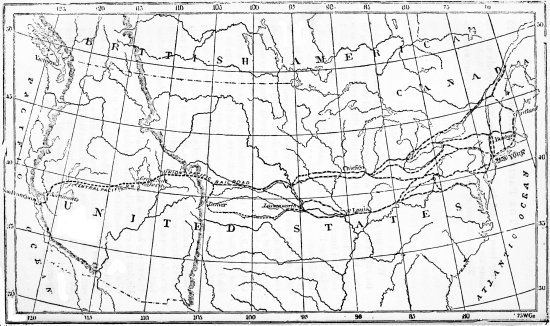
[larger view]
[largest view]
Up to 1861, the Canadians remained in the belief that they were at least
the potential possessors of the only possible road for the China
trade of the future, for in that year a Canadian government paper
declared that the Rocky Mountains, south of British territory, were
impassable for railroads. Maps showed that from St. Louis to San
Francisco the distance was twice that from the head of navigation on
Lake Superior to the British Pacific ports.
America has gone through a five years’ agony since that time; but now,
in the first days of peace, we find that the American Pacific Railroad,
growing at the average rate of two miles a day at one end, and one mile
a day at the other, will stretch from sea to sea in 1869 or 1870, while
the British line remains a dream.
Not only have the Rocky Mountains turned out to be passable, but the
engineers have found themselves compelled to decide on the conflicting
claims of passes without number. Wall-like and frowning as the Rocky
Mountains are when seen from the plains, the rolling gaps are many, and
they are easier crossed by railway lines than the less lofty chains of
Europe. From the heat of the country, the snow-line lies high; the
chosen pass is in the latitude of Constantinople or Oporto. The dryness
of the air of the center of a vast continent prevents the fall of heavy
snows or rains in winter. At eight or nine thousand feet above the sea,
in the Black Hills, or Eastern Piedmont, the drivers on the Pacific line
will have slighter snow-drifts to encounter than their brothers on the
Grand Trunk or the Camden and Amboy at the sea-level. On the other hand,
fuel and water are scarce, and there is an endless succession of smaller
snowy chains which have to be crossed, upon the Grand Plateau or basin
of the Great Salt Lake. Whatever the difficulties, in 1870 the line will
be an accomplished fact.
In the act creating the Pacific Railroad Company, passed in 1862, the
company were bound to complete their line at the rate of a hundred miles
a year. They are completing it at more than three times that rate.
When the act is examined, it ceases to be strange that the road should
be pushed with extraordinary energy and speed, so numerous are the baits
offered to the companies to hasten its completion. Money is to be
advanced them; land is to be given them for every mile they finish—on a
generous scale while the line is on the plains, on three times the scale
when it reaches the most rugged tracts. These grants alone are estimated
at twenty millions of acres. Besides the alternate sections, a width of
four hundred feet, with additional room for works and stations, is
granted for the line. The California Company is tempted by similar
offers to a race with the Union Pacific, and each company is struggling
to lay the most miles and get the most land upon the great basin. It is
the interest of the Eastern Company that the junction should be as far
as possible to the west; of the Western, that it should be as far as
possible to the east. The result is an average laying of three, and an
occasional construction of four, miles a day. If we look to the progress
at both ends, we find as much sometimes laid in a day as a bullock train
could travel. So fast do the headquarters “cities” keep moving forward,
that at the Californian end the superintendent wished me to believe that
whenever his chickens heard a wagon pass, they threw themselves upon
their backs, and held up their legs, that they might be tied and thrown
into the cart for a fresh move. “They are true birds of passage,” he
said.
When the iron trains are at the front, the laying will for a short time
proceed at the rate of nine yards in every fifteen seconds; but three or
four hundred tons of rails have to be brought up every day upon the
single track, and it is in this that the time is lost.
The advance carriages of the construction train are well supplied with
rifles hung from the roofs; but even when the Indians forget their
amaze, and attack the “city upon wheels,” or tear up the track, they are
incapable of destroying the line so fast as the machinery can lay it
down. “Soon,” as a Denver paper said, during my stay in the Mountain
City, “the iron horse will sniff the Alpine breeze upon the summit of
the Black Hills 9000 feet above the sea;” and upon the plateau, where
deer are scarce and buffalo unknown, the Indians have all but
disappeared. The worst Indian country is already crossed, and the red
men have sullenly followed the buffalo to the south, and occupy the
country between Kansas State and Denver, contenting themselves with
preventing the construction of the Santa Fé and Denver routes to
California. Both for the end in view, and the energy with which it is
pursued, the Pacific Railroad will stand first among the achievements of
our times.
If the end to be kept in view in the construction of the first Pacific
Railroad line were merely the traffic from China and Japan to Europe, or
the shortest route from San Francisco to Hampton Roads, the Kansas route
through St. Louis, Denver, and the Berthoud Pass would be, perhaps, the
best and shortest of those within the United States; but the
Saskatchewan line through British territory, with Halifax and Puget
Sound for ports, would be still more advantageous. As it is, the true
question seems to be, not the trade between the Pacific and Great
Britain, but between Asia and America, for Pennsylvania and Ohio must be
the manufacturing countries of the next fifty years.
Whatever our theory, the fact is plain enough: in 1870 we shall reach
San Francisco from London in less time than by the severest traveling I
can reach it from Denver in 1866.
Wherever, in the States, Forth and South have met in conflict, North has
won. New York has beaten Norfolk; Chicago, in spite of its inferior
situation, has beaten the older St. Louis. In the same way, Omaha, or
cities still farther north, will carry off the trade from Leavenworth,
Lawrence, and Kansas City. Ultimately Puget Sound may beat San Francisco
in the race for the Pacific trade, and the Southern cities become still
less able to keep their place than they have been hitherto. Time after
time, Chicago has thrown out intercepting lines, and diverted from St.
Louis trade which seemed of necessity to belong to her; and the success
of the Union Pacific line, and failure of the Kansas road, is a fresh
proof of the superior energy of the Northern to the Southern city. This
time a fresh element enters into the calculation, and declares for
Chicago. The great circle route, the true straight line, is in these
great distances shorter by fifty or a hundred miles than the straight
lines of the maps and charts, and the Platte route becomes not only the
natural, but the shortest route from sea to sea.
Chicago has a great advantage over St. Louis in her comparative freedom
from the cholera, which yearly attacks the Missourian city. During my
stay in St. Louis, the deaths from cholera alone were known to have
reached 200 a day, in a population diminished by flight to 180,000. A
quarantine was established on the river; the sale of fruit and
vegetables prohibited; prisoners released on condition that they should
work at burying the dead; and funeral corteges were forbidden. Chicago
herself, unreached by the plague, was scattering handbills on every
Western railroad line, warning immigrants against St. Louis.
The Missourians have relied overmuch upon the Mississippi River, and
have forgotten that railroads are superseding steamboats every day.
Chicago, on the other hand, which ten years ago was the twentieth city
in America, is probably by this time the third. As a center of thought,
political and religious, she stands second only to Boston, and her
Wabash and Michigan Avenues are among the most beautiful of streets.
One of the chief causes of the future wealth of America is to be found
in the fact that all her “inland” towns are ports. The State of Michigan
lies between 500 and 900 miles from the ocean, but the single State has
upon the great lakes a coast of 1500 miles. From Fort Benton to the sea
by water is nearly 4000 miles, but the post is a much-used steamboat
port, though more distant, even in the air-line, from the nearest sea
upon the same side the dividing range, than is the White Sea from the
Persian Gulf. Put it in which way you would, Europe could not hold this
river.
A great American city is almost invariably placed at a point where an
important railroad finds an outport on a lake or river. This is no
adaptation to railways of the Limerick saying about rivers—namely, that
Providence has everywhere so placed them as to pass through the great
towns; for in America railways precede population, and when mapped out
and laid, they are but tramways in the desert. There is no great wonder
in this, when we remember that 158,000,000 acres of land have been up to
this time granted to railroads in America.
One tendency of a costly railroad system is that few lines will be
made, and trade being thus driven into certain unchanging routes, a
small number of cities will flourish greatly, and, by acting as housing
stations or as ports, will rise to enormous wealth and population. Where
a system of cheap railways is adopted, there will be year by year a
tendency to multiply lines of traffic, and consequently to multiply also
ports and seats of trade—a tendency, however, which may be more than
neutralized by any special circumstances which may cause the lines of
transit to converge rather than run parallel to one another. Of the
system of costly grand trunk lines we have an instance in India, where
we see the creation of Umritsur and the prosperity of Calcutta alike due
to our single great Bengal line; of the converging system we have
excellent instances in Chicago and Bombay; while we see the plan of
parallel lines in action here in Kansas, and causing the comparative
equality of progress manifested in Leavenworth, in Atchison, in Omaha.
The coasts of India swarmed with ports till our trunk lines ruined Goa
and Surat to advance Bombay, and a hundred village ports to push our
factory at Calcutta, founded by Charnock as late as 1690, but now grown
to be the third or fourth city of the empire.
Of the dozen chaotic cities which are struggling for the honor of
becoming the future capital of the West, Leavenworth, with 20,000
people, three daily papers, an opera house, and 200 drinking saloons,
was, at the time of my visit in 1866, somewhat ahead of Omaha, with its
12,000, two papers, and a single “one-horse” theater, though the
northern city tied Leavenworth in the point of “saloons.”
Omaha, Leavenworth, Kansas City, Wyandotte, Atchison, Topeka, Lecompton,
and Lawrence, each praises itself and runs down its neighbor.
Leavenworth claims to be so healthy that when it lately became
necessary to “inaugurate” the new grave-yard, “they had to shoot a man
on purpose”—a change since the days when the Southern Border Ruffians
were in the habit of parading its streets, bearing the scalps of
abolitionists stuck on poles. On the other hand, a Nebraska man, when
asked whether the Kansas people were fairly honest, said: “Don‘t know
about honest; but they do say as how the folk around take in their
stone fences every night.” Lawrence, the State capital, which is on the
dried-up Kansas River, sneeringly says of all the new towns on the
Missouri that the boats that ply between them are so dangerous that the
fare is collected in installments every five minutes throughout the
trip. Next after the jealousy between two Australian colonies, there is
nothing equal to the hatreds between cities competing for the same
trade. Omaha has now the best chance of becoming the capital of the far
West, but Leavenworth will no doubt continue to be the chief town of
Kansas.
The progress of the smaller cities is amazing. Pistol-shots by day and
night are frequent, but trade and development are little interfered with
by such incidents as these; and as the village cities are peopled up,
the pioneers, shunning their fellows, keep pushing westward, seeking new
“locations.” “You‘re the second man I‘ve seen this fall! Darn me, if
‘taint ’bout time to varmose out westerly—y,” is the standing joke of
the “frontier-bars” against each other.
. . . . .
. . . . .
. . . . .
. . . . .
. . . . .
. . . . .
. . . . .
At St. Louis I had met my friend Mr. Hepworth Dixon, just out from
England, and with him I visited the Kansas towns, and then pushed
through Waumego to Manhattan, the terminus (for the day) of the Kansas
Pacific line. Here we were thrust into what space remained between
forty leathern mail-bags and the canvas roof of the mule-drawn
ambulance, which was to be at once our prison for six nights, and our
fort upon wheels against the Indians.
DASHING through a grove of cottonwood-trees draped in bignonia and ivy,
we came out suddenly upon a charming scene: a range of huts and forts
crowning a long, low hill seamed with many a timber-clothed ravine,
while the clear stream of the Republican fork wreathed itself about the
woods and bluffs. The block-house, over which floated the Stars and
Stripes, was Fort Riley, the Hyde Park Corner from which continents are
to measure all their miles; the “capital of the universe,” or “center of
the world.” Not that it has always been so. Geographers will be glad to
learn that not only does the earth gyrate, but that the center of its
crust also moves: within the last ten years it has removed westward into
Kansas from Missouri—from Independence to Fort Riley. The contest for
centership is no new thing. Herodotus held that Greece was the very
middle of the world, and that the unhappy Orientals were frozen, and the
yet more unfortunate Atlantic Indians baked every afternoon of their
poor lives in order that the sun might shine on Greece at noon; London
plumes herself on being the “center of the terrestrial globe;” Boston is
the “hub of the hull universe,” though the latter claim is less
physical than moral, I believe. In Fort Riley the Western men seem to
have found the physical center of the United States, but they claim for
the Great Plains as well the intellectual as the political leadership of
the whole continent. These hitherto untrodden tracts, they tell you,
form the heart of the empire, from which the life-blood must be driven
to the extremities. Geographical and political centers must ultimately
coincide.
Connected with this belief is another Western theory—that the powers of
the future must be “continental.” Germany, or else Russia, is to absorb
all Asia and Europe, except Britain. North America is already cared for,
as the gradual extinction of the Mexican and absorption of the Canadians
they consider certain. As for South America, the Californians are
planning an occupation of Western Brazil, on the ground that the
continental power of South America must start from the head-waters of
the great rivers, and spread seaward down the streams. Even in the
Brazilian climate they believe that the Anglo-Saxon is destined to
become the dominant race.
The success of this omphalism, this government from the center, will be
brought about, in the Western belief, by the necessity under which the
nations on the head-waters of all streams will find themselves of having
the outlets in their hands. Even if it be true that railways are beating
rivers, still the railways must also lead seaward to the ports, and the
need for their control is still felt by the producers in the center
countries of the continent. The Upper States must everywhere command the
Lower, and salt-water despotism find its end.
The Americans of the Valley States, who fought all the more heartily in
the Federal cause from the fact that they were battling for the freedom
of the Mississippi against the men who held its mouth, look forward to
the time when they will have to assert, peaceably but with firmness,
their right to the freedom of their railways through the Northern
Atlantic States. Whatever their respect for New England, it cannot be
expected that they are forever to permit Illinois and Ohio to be
neutralized in the Senate by Rhode Island and Vermont. If it goes hard
with New England, it will go still harder with New York; and the Western
men look forward to the day when Washington will be removed, Congress
and all, to Columbus or Fort Riley.
The singular wideness of Western thought, always verging on
extravagance, is traceable to the width of Western land. The immensity
of the continent produces a kind of intoxication; there is moral
dram-drinking in the contemplation of the map. No Fourth of July oration
can come up to the plain facts contained in the Land Commissioners’
report. The public domain of the United States still consists of one
thousand five hundred millions of acres; there are two hundred thousand
square miles of coal lands in the country, ten times as much as in all
the remaining world. In the Western territories not yet States, there is
land sufficient to bear, at the English population rate, five hundred
and fifty millions of human beings.
It is strange to see how the Western country dwarfs the Eastern States.
Buffalo is called a “Western City;” yet from New York to Buffalo is only
three hundred and fifty miles, and Buffalo is but seven hundred miles to
the west of the most eastern point in all the United States. On the
other hand, from Buffalo we can go two thousand five hundred miles
westward without quitting the United States. “The West” is eight times
as wide as the Atlantic States, and will soon be eight times as strong.
The conformation of North America is widely different to that of any
other continent on the globe. In Europe, the glaciers of the Alps occupy
the center point, and shed the waters toward each of the surrounding
seas: confluence is almost unknown. So it is in Asia: there the Indus
flowing into the Arabian Gulf, the Oxus into the Sea of Aral, the Ganges
into the Bay of Bengal, the Yangtse Kiang into the Pacific, and the
Yenesei into the Arctic Ocean, all take their rise in the central
table-land. In South America, the mountains form a wall upon the west,
whence the rivers flow eastward in parallel lines. In North America
alone are there mountains on each coast, and a trough between, into
which the rivers flow together, giving in a single valley 23,000 miles
of navigable stream to be plowed by steamships. The map proclaims the
essential unity of North America. Political geography might be a more
interesting study than it has yet been made.
In reaching Leavenworth, I had crossed two of the five divisions of
America: the other three lie before me on my way to San Francisco. The
eastern slopes of the Alleghanies, or Atlantic coast; their western
slopes; the Great Plains; the Grand Plateau, and the Pacific
coast—these are the five divisions. Fort Riley, the center of the
United States, is upon the border of the third division, the Great
Plains. The Atlantic coast is poor and stony, but the slight altitude of
the Alleghany chain has prevented its being a hinderance to the passage
of population to the West: the second of the divisions is now the
richest and most powerful of the five: but the wave of immigration is
crossing the Mississippi and Missouri into the Great Plains, and here
at Fort Riley we are upon the limit of civilization.
This spot is not only the center of the United States and of the
continent, but, if Denver had contrived to carry the Pacific Railroad by
the Berthoud Pass, would have been the center station upon what Governor
Gilpin, of Colorado, calls the “Asiatic and European railway line.” As
it is, Columbus in Nebraska has somewhat a better chance of becoming the
Washington of the future than has this block-house.
Quitting Fort Riley, we found ourselves at once upon the plains. No more
sycamore and white-oak and honey-locust; no more of the rich deep green
of the cottonwood groves; but yellow earth, yellow flowers, yellow
grass, and here and there groves of giant sunflowers with yellow blooms,
but no more trees.
As the sun set, we came on a body of cavalry marching slowly from the
plains toward the fort. Before them, at some little distance, walked a
sad-faced man on foot, in sober riding-dress, with a repeating carbine
slung across his back. It was Sherman returning from his expedition to
Santa Fé.
Monday, 3d September.
My dear ——,
Here we are, scalps and all.
On Tuesday last, at sundown, we left Fort Riley, and supped at Junction
City, the extreme point that “civilization” has reached upon the plains.
Civilization means whisky: post-offices don‘t count.
It was here that it first dawned upon us that we were being charged 500
dollars to guard the United States Californian mail, with the
compensation of the chance of being ourselves able to rob it with
impunity. It is at all events the case that we, well armed as the mail
officers at Leavenworth insisted on our being, sat inside with forty-two
cwt. of mail, in open bags, and over a great portion of the route had
only the driver with us, without whose knowledge we could have read all
and stolen most of the letters, and with whose knowledge, but against
whose will, we could have carried off the whole, leaving him gagged,
bound, and at the mercy of the Indians. As it was, a mail-bag fell out
one day, without the knowledge of either Dixon or the driver, who were
outside, and I had to shout pretty freely before they would pull up.
On Wednesday we had our last “squar’ meal” in the shape of a breakfast,
at Fort Ellsworth, and soon were out upon the almost unknown plains. In
the morning we caught up and passed long wagon trains, each wagon drawn
by eight oxen, and guarded by two drivers and one horseman, all armed
with breech-loading rifles and revolvers, or with the new “repeaters,”
before which breech-loaders and revolvers must alike go down. All day we
kept a sharp look-out for a party of seven American officers, who, in
defiance of the scout‘s advice, had gone out from the fort to hunt
buffalo upon the track. About sundown we came into the little station of
Lost Creek. The ranchmen told us that they had, during the day, been
driven in from their work by a party of Cheyennes, and that they had
some doubts as to the wisdom of the officers in going out to hunt.
Just as we were leaving the station, one of the officers’ horses dashed
in riderless, and was caught; and about two miles from the station we
passed another on its back, ripped up either by a knife or buffalo horn.
The saddle was gone, but there were no other marks of a fight. We
believe that these officers were routed by buffalo, not Cheyennes, but
still we should be glad to hear of them.
The track is marked in many parts of the plains by stakes, such as those
from which the Llano Estacado takes its name; but this evening we turned
off into devious lines by way of precaution against ambuscades, coming
round through the sandy beds of streams to the ranches for the change of
mules. The ranchmen were always ready for us; for, while we were still a
mile away, our driver would put his hand to his mouth, and give a “How!
how! how! how—w!” the Cheyenne warhoop.
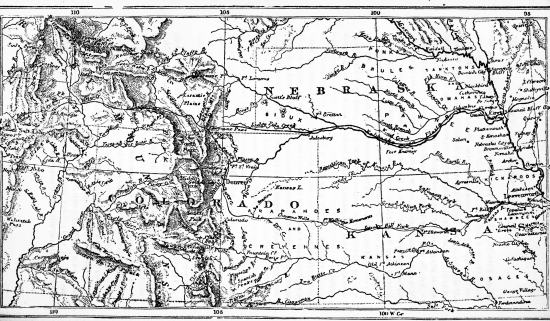
[larger view]
[largest view]
In the weird glare that follows sunset we came upon a pile of rocks,
admirably fitted for an ambush. As we neared them, the driver said:
“It‘s ’bout an even chance thet we‘s sculp ther’!” We could not avoid
them, as there was a gully that could only be crossed at this one
point. We dashed down into the “creek” and up again, past the rocks:
there were no Indians, but the driver was most uneasy till we reached
Big Creek.
Here they could give us nothing whatever to eat, the Indians having, on
Tuesday, robbed them of everything they had, and ordered them to leave
within fifteen days on pain of death.
For 250 miles westward from Big Creek we found that every station had
been warned (and most plundered) by bands of Cheyennes, on behalf of the
forces of the confederation encamped near the creek itself. The warning
was in all cases that of fire and death at the end of fifteen days, of
which nine days have expired. We found the horse-keepers of the company
everywhere leaving their stations, and were, in consequence, very nearly
starved, having been unsuccessful in our shots from the “coach,” except,
indeed, at the snakes.
On Thursday we passed Big Timber, the only spot on the plains where
there are trees; and there the Indians had counted the trunks and
solemnly warned the men against cutting more: “Fifty-two tree. You no
cut more tree—no more cut. Grass! You cut grass; grass make big fire.
You good boy—you clear out. Fifteen day, we come: you no gone—ugh!”
The “ugh” accompanied by an expressive pantomime.
On Thursday evening we got a meal of buffalo and prairie dog, the former
too strong for my failing stomach, the latter wholesome nourishment, and
fit for kings—as like our rabbit in flavor as he is in shape. This was
at the horse-station of “The Monuments,” a natural temple of awesome
grandeur, rising from the plains like a giant Stonehenge.
On Friday we “breakfasted” at Pond Creek station, two miles from Fort
Wallis. Here the people had applied for a guard, and had been answered:
“Come into the fort; we can‘t spare a man.” So much for the value of the
present forts; and yet even these—Wallis and Ellsworth—are 200 miles
apart.
We were joined at breakfast by Bill Comstock, interpreter to the
fort,—a long-haired, wild-eyed half-breed,—who gave us, in an hour‘s
talk, the full history of the Indian politics that have led to the
present war.
The Indians, to the number of 20,000, have been in council with the
Washington Commissioners all this summer at Fort Laramie; and, after
being clothed, fed, and armed, lately concluded a treaty, allowing the
running on the mail-roads. They now assert that this treaty was intended
to apply to the Platte road (from Omaha and Atchison through Fort
Kearney), and to the Arkansas road, but not to the Smoky Hill road,
which lies between the others, and runs through the buffalo country; but
their real opposition is to the railroad. The Cheyennes (pronounced
Shíans) have got the Camanches, Appaches, and Arrapahoes from the south,
and the Sioux and Kiowas from the north, to join them in a
confederation, under the leadership of Spotted Dog, the chief of the
Little Dog section of the Cheyennes, and son of White Antelope,—killed
at Sand Creek battle by the Kansas and Colorado Volunteers,—who has
sworn to avenge his father.
Soon after leaving Pond Creek, we sighted at a distance three mounted
“braves,” leading some horses; and when we reached the next station, we
found that they had been there openly proclaiming that their mounts had
been stolen from a team.
All this day we sat with our revolvers laid upon the mail-bags in front
of us, and our driver also had his armory conspicuously displayed, while
we swept the plains with many an anxious glance. We were on lofty
rolling downs, and to the south the eye often ranged over much of the
130 miles which lay between us and Texas. To the north the view was more
bounded; still, our chief danger lay near the boulders, which here and
there covered the plains.
All Thursday and Friday we never lost sight of the buffalo, in herds of
about 300, and the “antelope”—the prong-horn, a kind of gazelle—in
flocks of six or seven. Prairie dogs were abundant, and wolves and
black-tail deer in view at every turn.
The most singular of all the sights of the plains is the constant
presence every few yards of the skeletons of buffalo and of horse, of
mule and of ox; the former left by the hunters, who take but the skin,
and the latter the losses of the mails and the wagon-trains through
sunstroke and thirst. We killed a horse on the second day of our
journey.
When we came upon oxen that had not long been dead, we found that the
intense dryness of the air had made mummies of them: there was no
stench, no putrefaction.
During the day I made some practice at antelope with the driver‘s
Ballard; but an antelope at 500 yards is not an easy target. The driver
shot repeatedly at buffalo at twenty yards, but this only to keep them
away from the horses; the revolver balls did not seem to go through
their hair and skin, as they merely shambled on in their usual happy
sort of way, after receiving a discharge or two.
The prairie dogs sat barking in thousands on the tops of their mounds,
but we were too grateful to them for their gayety to dream of
pistol-shots. They are no “dogs” at all, but rabbits that bark, with all
the coney‘s tricks and turns, and the same odd way of rubbing their
face with their paws while they con you from top to toe.
With wolves, buffalo, antelope, deer, skunks, dogs, plover, curlew,
dottrel, herons, vultures, ravens, snakes, and locusts, we never seemed
to be without a million companions in our loneliness.
From Cheyenne Wells, where we changed mules in the afternoon, we brought
on the ranchman‘s wife, painfully making room for her at our own
expense. Her husband had been warned by the Cheyennes that the place
would be destroyed: he meant to stay, but was in fear for her. The
Cheyennes had made her cook for them, and our supper had gone down
Cheyenne throats.
Soon after leaving the station, we encountered one of the great
“dirt-storms” of the plains. About 5 P.M. I saw a little white cloud
growing into a column, which in half an hour turned black as night, and
possessed itself of half the skies. We then saw what seemed to be a
waterspout; and, though no rain reached us, I think it was one. When the
storm burst on us we took it for rain, and halting, drew down our canvas
and held it against the hurricane. We soon found that our eyes and
mouths were full of dust; and when I put out my hand I felt that it was
dirt, not rain, that was falling. In a few minutes it was pitch dark,
and after the fall had continued for some time, there began a series of
flashes of blinding lightning, in the very center and midst of which we
seemed to be. Notwithstanding this, there was no sound of thunder. The
“norther” lasted some three or four hours, and when it ceased, it left
us total darkness, and a wind which froze our marrow as we again started
on our way. When Fremont explored this route, he reported that the high
ridge between the Platte and Arkansas was notorious among the Indians
for its tremendous dirt-storms. Sheet lightning without thunder
accompanies dust-storms in all great continents; it is as common in the
Punjab as in Australia, in South as in North America.
On Saturday morning, at Lake station, we got beyond the Indians, and
into a land of plenty, or at all events a land of something, for we got
milk from the station cow, and preserved fruits that had come round
through Denver from Ohio and Kentucky. Not even on Saturday, however,
could we get dinner, and as I missed the only antelope that came within
reach, our supper was not much heavier than our breakfast.
Rolling through the Arrapahoe country, where it is proposed to make a
reserve for the Cheyennes, at eight o‘clock on Saturday morning we
caught sight of the glittering snows of Pike‘s Peak, a hundred and fifty
miles away, and all the day we were galloping toward it, through a
country swarming with rattlesnakes and vultures. Late in the evening,
when we were drawing near to the first of the Coloradan farms, we came
on a white wolf unconcernedly taking his evening prowl about the
stock-yards. He sneaked along without taking any notice of us, and
continued his thief-like walk with a bravery that seemed only to show
that he had never seen man before; this might well be the case, if he
came from the south, near the upper forks of the Arkansas.
All this, and the frequency of buffalo, I was unprepared for. I imagined
that though the plains were uninhabited, the game had all been killed.
On the contrary, the “Smoky district” was never known so thronged with
buffalo as it is this year. The herds resort to it because there they
are close to the water of the Platte River, and yet out of the reach of
the traffic of the Platte road. The tracks they make in traveling to
and fro across the plains are visible for years after they have ceased
to use them. I have seen them as broad and as straight as the finest of
Roman roads.
On Sunday, at two in the morning, we dashed into Denver; and as we
reeled and staggered from our late prison, the ambulance, into the
“cockroach corral” which does duty for the bar-room of the “Planters’
House,” we managed to find strength and words to agree that we would fix
no time for meeting the next day. We expected to sleep for thirty hours;
as it was, we met at breakfast at seven A.M., less than five hours from
the time we parted. It is to-day that we feel exhausted; the
exhilaration of the mountain air, and the excitement of frequent visits,
carried us through yesterday. Dixon is suffering from strange blains and
boils, caused by the unwholesome food.
We have been called upon here by Governor Gilpin and Governor Cummings,
the opposition governors. The former is the elected governor of the
State of Colorado which is to be, and would have been but for the fact
that the President put his big toe (Western for veto) upon the bill;
the latter, the Washington-sent governor of the Territory. Gilpin is a
typical pioneer man, and the descendant of a line of such. He comes of
one of the original Quaker stocks of Maryland, and he and his ancestors
have ever been engaged in founding States. He himself, after taking an
active share in the foundation of Kansas, commanded a regiment of
cavalry in the Mexican war. After this, he was at the head of the
pioneer army which explored the parcs of the Cordilleras and the
Territory of Nevada. He it was who hit upon the glorious idea of placing
Colorado half upon each side of the Sierra Madre. There never, in the
history of the world, was a grander idea than this. Any ordinary
pioneer or politician would have given Colorado the “natural” frontier,
and have tried for the glory of the foundation of two States instead of
one. The consequence would have been, lasting disunion between the
Pacific and Atlantic States, and a possible future break-up of the
country. As it is, this commonwealth, little as it at present is, links
sea to sea, and Liverpool to Hong Kong.
The city swarms with Indians of the bands commanded by the chiefs Nevara
and Collorego. They are at war with the six confederate tribes, and with
the Pawnees—with all the plain Indians, in short. Now, as the Pawnees
are also at war with the six tribes, there is a pretty triangular fight.
They came in to buy arms, and fearful scoundrels they look. Short,
flat-nosed, long-haired, painted in red and blue, and dressed in a gaudy
costume, half Spanish, half Indian, which makes their filthiness appear
more filthy by contrast, and themselves carrying only their Ballard and
Smith-and-Wesson, but forcing the squaws to carry all their other goods,
and papooses in addition, they present a spectacle of unmixed ruffianism
which I never expect to see surpassed. Dixon and I, both of us, left
London with “Lo! the poor Indian,” in all his dignity and
hook-nosedness, elevated on a pedestal of nobility in our hearts. Our
views were shaken in the East, but nothing revolutionized them so
rapidly as our three days’ risk of scalping in the plains. John Howard
and Mrs. Beecher Stowe themselves would go in for the Western “disarm at
any price, and exterminate if necessary” policy if they lived long in
Denver. One of the braves of Nevara‘s command brought in the scalp of a
Cheyenne chief taken by him last month, and to-day it hangs outside the
door of a pawnbroker‘s shop, for sale, fingered by every passer-by.
Many of the band were engaged in putting on their paint, which was
bright vermilion, with a little indigo round the eye. This, with the
sort of pigtail which they wear, gives them the look of the gnomes in
the introduction to a London pantomime. One of them—Nevara himself, I
was told—wore a sombrero with three scarlet plumes, taken probably from
a Mexican, a crimson jacket, a dark-blue shawl, worn round the loins and
over the arm in Spanish dancer fashion, and embroidered moccasins. His
squaw was a vermilion-faced bundle of rags, not more than four feet
high, staggering under buffalo hides, bow and arrows, and papoose. They
move everywhere on horseback, and in the evening withdraw in military
order, with advance and rear guard, to a camp at some distance from the
town.
I inclose some prairie flowers, gathered in my walks round the city.
Their names are not suited to their beauty; the large white one is “the
morning blower,” the most lovely of all, save one, of the flowers of the
plains. It grows with many branches to a height of some eighteen inches,
and bears from thirty to fifty blooms. The blossoms are open up to a
little after sunrise, when they close, seldom to open even after sunset.
It is, therefore, peculiarly the early riser‘s flower; and if it be true
that Nature doesn‘t make things in vain, it follows that Nature intended
men—or, at all events, some men—to get up early, which is a point
that I believe was doubtful hitherto.
For the one prairie flower which I think more beautiful than the blower
I cannot find a name. It rises to about six inches above ground, and
spreads in a circle of a foot across. Its leaf is thin and spare; its
flower-bloom a white cup, about two inches in diameter; and its buds
pink and pendulent.
All our garden annuals are to be found in masses acres in size upon the
plains. Penstemon, coreopsis, persecaria, yucca, dwarf sumach, marigold,
and sunflower, all are flowering here at once, till the country is
ablaze with gold and red. The coreopsis of our gardens they call the
“rosin-weed,” and say that it forms excellent food for sheep.
The view of the “Cordillera della Sierra Madre,” the Rocky Mountain main
chain, from the outskirts of Denver is sublime; that from the roof at
Milan does not approach it. Twelve miles from the city the mountains
rise abruptly from the plains. Piled range above range with step-like
regularity, they are topped by a long white line, sharply relieved
against the indigo of the sky. Two hundred and fifty miles of the mother
Sierra are in sight from our veranda; to the south, Pike‘s Peak and
Spanish Peak; Long‘s Peak to the north; Mount Lincoln towering above
all. The views are limited only by the curvature of the earth, such is
the marvelous purity of the Coloradan air, the effect at once of the
distance from the sea and of the bed of limestone which underlies the
plains.
The site of Denver is heaven-blessed in climate as well as loveliness.
The sky is brilliantly blue, and cloudless from dawn till noon. In the
mid-day heats, cloud-making in the Sierra begins, and by sunset the
snowy chain is multiplied a hundred times in curves of white and purple
cumuli, while thunder rolls heavily along the range. “This is a great
country, sir,” said a Coloradan to me to-day. “We make clouds for the
whole universe.” At dark there is dust or thunder-storm at the mountain
foot, and then the cold and brilliant night. Summer and winter it is the
same.
“THESE Red Indians are not red,” was our first cry when we saw the Utes
in the streets of Denver. They had come into the town to be painted as
English ladies go to London to shop; and we saw them engaged within a
short time after their arrival in daubing their cheeks with vermilion
and blue, and referring to glasses which the squaws admiringly held.
Still, when we met them with peaceful paintless cheeks, we had seen that
their color was brown, copper, dirt, anything you please except red.
The Hurons, with whom I had stayed at Indian Lorette, were French in
training if not in blood; the Pottawatomies of St. Mary‘s Mission, the
Delawares of Leavenworth, are tame Indians: it is true that they can
hardly be called red; but still I had expected to have found these wild
prairie and mountain Indians of the color from which they take their
name. Save for paint, I found them of a color wholly different from that
which we call red.
Low in stature, yellow-skinned, small-eyed, and Tartar-faced, the
Indians of the plains are a distinct people from the tall, hook-nosed
warriors of the Eastern States. It is impossible to set eyes on their
women without being reminded of the dwarf skeletons found in the mounds
of Missouri and Iowa; but, men or women, the Utes bear no resemblance to
the bright-eyed, graceful people with whom Penn traded and Standish
fought. They are not less inferior in mind than in body. It was no
Shoshoné, no Ute, no Cheyenne, who called the rainbow the “heaven of
flowers,” the moon “the night queen,” or the stars “God‘s eyes.” The
plain tribes are as deficient, too, in heroes as in poetry: they have
never even produced a general, and White Antelope is their nearest
approach to a Tecumseh. Their mode of life, the natural features of the
country in which they dwell, have nothing in them to suggest a reason
for their debased condition. The reason must lie in the blood, the race.
All who have seen both the Indians and the Polynesians at home must have
been struck with innumerable resemblances. The Maori and Red Indian
wakes for the dead are identical; the Californian Indians wear the Maori
mat; the “medicine” of the Mandan is but the “tapu” of Polynesia; the
New Zealand dance-song, the Maori tribal scepter, were found alike by
Strachey in Virginia and Drake in California; the canoes of the West
Indies are the same as those of Polynesia. Hundreds of arguments, best
touched from the farther side of the Pacific, concur to prove the
Indians a Polynesian race. The canoes that brought to Easter Island the
people who built their mounds and rock temples there, may as easily have
been carried on by the Chilian breeze and current to the South American
shore. The wave from Malaya would have spent itself upon the northern
plains. The Utes would seem to be Kamtchatkans, or men of the Amoor,
who, fighting their way round by Behring Straits, and then down south,
drove a wedge between the Polynesians of Appalachia and California. No
theory but this will account for the sharp contrast between the
civilization of ancient Peru and Mexico, and the degradation in which
the Utes have lived from the earliest recorded times. Mounds, rock
temples, worship, all are alike unknown to the Indians of the plains; to
the Polynesian Indians, these were things that had come down to them
from all time.
Curious as is the question of the descent of the American tribes, it has
no bearing on the future of the country—unless, indeed, in the eyes of
those who assert that Delawares and Utes, Hurons and Pawnees, are all
one race, with features modified by soil and climate. If this were so,
the handsome, rollicking, frank-faced Coloradan “boys” would have to
look forward to the time when their sons’ sons should be as like the
Utes as many New Englanders of to-day are like the Indians they
expelled—that, as the New Englanders are tall, taciturn, and
hatchet-faced, the Coloradans of the next age should be flat-faced
warriors, five feet high. Confidence in the future of America must be
founded on a belief in the indestructible vitality of race.
Kamtchatkans or Polynesians, Malays or sons of the prairies on which
they dwell, the Red Indians have no future. In twenty years there will
scarcely be one of pure blood alive within the United States.
In La Plata, the Indians from the inland forests gradually mingle with
the whiter inhabitants of the coast, and become indistinguishable from
the remainder of the population. In Canada and Tahiti, the French
intermingle with the native race: the Hurons are French in everything
but name. In Kansas, in Colorado, in New Mexico, miscegenation will
never be brought about. The pride of race, strong in the English
everywhere, in America and Australia is an absolute bar to
intermarriage, and even to lasting connections with the aborigines. What
has happened in Tasmania and Victoria is happening in New Zealand and
on the plains. When you ask a Western man his views on the Indian
question, he says: “Well, sir, we can destroy them by the laws of war,
or thin ’em out by whisky; but the thinning process is plaguy slow.”
There are a good many Southerners out upon the plains. One of them,
describing to me how in Florida they had hunted down the Seminoles with
bloodhounds, added, “And sarved the pesky sarpints right, sah!”
Southwestern volunteers, campaigning against the Indians, have been
known to hang up in their tents the scalps of the slain, as we English
used to nail up the skins of the Danes.
There is in these matters less hypocrisy among the Americans than with
ourselves. In 1840, the British government assumed the sovereignty of
New Zealand in a proclamation which set forth with great precision that
it did so for the sole purpose of protecting the aborigines in the
possession of their lands. The Maories numbered 200,000 then; they
number 20,000 now.
Among the Western men there is no difference of opinion on the Indian
question. Rifle and revolver are their only policy. The New Englanders,
who are all for Christianity and kindliness in their dealings with the
red men, are not similarly united in one cry. Those who are ignorant of
the nature of the Indian, call out for agricultural employment for the
braves; those who know nothing of the Indian‘s life demand that
“reserves” be set aside for him, forgetting that no “reserve” can be
large enough to hold the buffalo, and that without the buffalo the red
men must plow or starve.
Indian civilization through the means of agriculture is all but a total
failure. The Shawnees are thriving near Kansas City, the Pottawatomies
living at St. Mary‘s mission, the Delawares existing at Leavenworth; but
in all these cases there is a large infusion of white blood. The
Canadian Hurons are completely civilized; but then they are completely
French. If you succeed with an Indian to all appearance, he will
suddenly return to his untamed state. An Indian girl, one of the most
orderly of the pupils at a ladies’ school, has been known, on feeling
herself aggrieved, to withdraw to her room, let down her back hair,
paint her face, and howl. The same tendency showed itself in the case of
the Delaware chief who built himself a white man‘s house, and lived in
it thirty years, but then suddenly set up his old wigwam in the
dining-room, in disgust. Another bad case is that of the Pawnee who
visited Buchanan, and behaved so well that when a young Englishman, who
came out soon after, told the President that he was going West, he gave
him a letter to the chief, then with his tribe in Northern Kansas. The
Pawnee read the note, offered a pipe, gravely protested eternal
friendship, slept upon it, and next morning scalped his visitor with his
own hand.
The English everywhere attempt to introduce civilization, or to modify
that which exists, in a rough-and-ready manner which invariably ends in
failure or in the destruction of the native race. A hundred years of
absolute rule, mostly peaceable, have not, under every advantage, seen
the success of our repeated attempts to establish trial by jury in
Bengal. For twenty years the Maories have mixed with the New Zealand
colonists on nearly equal terms, have almost universally professed
themselves Christians, have attended English schools, and learnt to
speak the English language, and to read and write their own; in spite of
all this, a few weeks of fanatic outburst were enough to reduce almost
the whole race to a condition of degraded savagery. The Indians of
America have, within the few last years, been caught and caged, given
acres where they once had leagues, and told to plow where once they
hunted. A pastoral race, with no conception of property in land, they
have been manufactured into freeholders and tenant farmers; Western
Ishmaelites, sprung of a race which has wandered since its legendary
life begins, they have been subjected to homestead laws and title
registrations. If our experiments in New Zealand, in India, on the
African coast have failed, cautious and costly as they were, there can
be no great wonder in the unsuccess that has attended the hurried
American experiments. It is not for us, who have the past of Tasmania
and the present of Queensland to account for, to do more than record the
fact that the Americans are not more successful with the red men of
Kansas than we with the black men of Australia.
The Bosjesman is not a more unpromising subject for civilization than
the red man; the Ute is not even gifted with the birthright of most
savages, the mimetic power. The black man, in his dress, his farming,
his religion, his family life, is always trying to imitate the white. In
the Indian there is none of this: his ancestors roamed over the
plains—he will roam; his ancestors hunted—why should not he hunt? The
American savage, like his Asiatic cousins, is conservative; the African
changeable, and strong in imitative faculties of the mind. Just as the
Indian is less versatile than the negro, so, if it were possible
gradually to change his mode of life, slowly to bring him to the
agricultural state, he would probably become a skillful and laborious
cultivator, and worthy inhabitant of the Western soil; as it is, he is
exterminated before he has time to learn. “Sculp ’em fust, and then talk
to ’em,” the Coloradans say.
Peace commissioners are yearly sent from Washington to treat with
hostile tribes upon the plains. The Indians invariably continue to fight
and rob till winter is at hand; but when the snows appear, they send in
runners to announce that they are prepared to make submission. The
commissioners appoint a place, and the tribe, their relatives, allies,
and friends, come down thousands strong, and enter upon debates which
are purposely prolonged till spring. All this time the Indians are kept
in food and drink; whisky even is illegally provided them, with the
cognizance of the authorities, under the name of “hatchets.” Blankets,
and, it is said, powder and revolvers, are supplied to them as necessary
to their existence on the plains; but when the first of the spring
flowers begin to peep up through the snow-drifts on the prairies, they
take their leave, and in a few weeks are out again upon the war-path,
plundering and scalping all the whites.
Judging from English experience in the north, and Spanish in Mexico and
South America, it would seem as though the white man and the red cannot
exist on the same soil. Step by step the English have driven back the
braves, till New Englanders now remember that there were Indians once in
Massachusetts, as we remember that once there were bears in Hampshire.
King Philip‘s defeat by the Connecticut volunteers seems to form part of
the early legendary history of our race; yet there is still standing,
and in good repair, in Dorchester, a suburb of Boston, a frame-house
which in its time has been successfully defended against Red Indians. On
the other hand, step by step, since the days of Cortez, the Indians and
half-bloods have driven out the Spaniards from Mexico and South
America. White men, Spaniards, received Maximilian at Vera Cruz, but he
was shot by full-blooded Indians at Queretaro.
If any attempt is to be made to save the Indians that remain, it must be
worked out in the Eastern States. Hitherto the whites have but pushed
back the Indians westward: if they would rescue the remnant from
starvation, they must bring them East, away from Western men and Western
hunting-grounds, and let them intermingle with the whites, living,
farming, along with them, intermarrying, if possible. The hunting Indian
is too costly a being for our age; but we are bound to remember that
ours is the blame of having failed to teach him to be something better.
After all, if the Indian is mentally, morally, and physically inferior
to the white man, it is in every way for the advantage of the world that
the next generation that inhabits Colorado should consist of whites
instead of reds. That this result should not be brought about by cruelty
or fraud upon the now existing Indians is all that we need require. The
gradual extinction of the inferior races is not only a law of nature,
but a blessing to mankind.
The Indian question is not likely to be one much longer: before I
reached England again, I learnt that the Coloradan capital had offered
“twenty dollars a piece for Indian scalps with the ears on.”
WHEN you have once set eyes upon the never-ending sweep of the Great
Plains, you no longer wonder that America rejects Malthusianism. As
Strachey says of Virginia, “Here is ground enough to satisfy the most
covetous and wide affection.” The freedom of these grand countries was
worth the tremendous conflict in which it was, in reality, the foremost
question; their future is of enormous moment to America.
Travelers soon learn, when making estimates of a country‘s value, to
despise no feature of the landscape; that of the plains is full of life,
full of charm—lonely, indeed, but never wearisome. Now great rolling
uplands of enormous sweep, now boundless grassy plains; there is all the
grandeur of monotony, and yet continual change. Sometimes the grand
distances are broken by blue buttes or rugged bluffs. Over all there is
a sparkling atmosphere and never-failing breeze; the air is bracing even
when most hot; the sky is cloudless, and no rain falls. A solitude which
no words can paint, and the boundless prairie swell, convey an idea of
vastness which is the overpowering feature of the plains.
Maps do not remove the impression produced by views. The Arkansas River,
which is born and dies within the limit of the plains, is two thousand
miles in length, and is navigable for eight hundred miles. The Platte
and Yellowstone are each of them as long. Into the plains and plateau
you could put all India twice. The impression is not merely one of size.
There is perfect beauty, wondrous fertility, in the lonely steppe; no
patriotism, no love of home, can prevent the traveler wishing here to
end his days.
To those who love the sea, there is a double charm. Not only is the roll
of the prairie as grand as that of the Atlantic, but the crispness of
the wind, the absence of trees, the multitude of tiny blooms upon the
sod, all conspire to give a feeling of nearness to the ocean, the effect
of which is we are always expecting to hail it from off the top of the
next hillock.
The resemblance to the Tartar plains has been remarked by Coloradan
writers; it may be traced much farther than they have carried it. Not
only are the earth, air, and water much alike, but in Colorado, as in
Bokhara, there are oil wells and mud volcanoes. The color of the
landscape is, in summer, green and flowers; in fall-time, yellow and
flowers, but flowers ever.
The eastern and western portions of the plains are not alike. In Kansas
the grass is tall and rank; the ravines are filled with cottonwood,
hickory, and black walnut; here and there are square miles of
sunflowers, from seven to nine feet high. As we came west, we found that
the sunflowers dwindled, and at Denver they are only from three to nine
inches in height, the oddest little plants in nature, but thorough
sunflowers for all their smallness. We found the buffalo in the eastern
plains in the long bunch-grass, but in the winter they work to the west
in search of the sweet and juicy “blue grass,” which they rub out from
under the snow in the Coloradan plains. This grass is crisp as hair, and
so short that, as the story goes, you must lather before you can mow it.
The “blue grass” has high vitality: if a wagon train is camped for a
single night among the sunflowers or tall weeds, this crisp turf at once
springs up, and holds the ground forever.
The most astounding feature of these plains is their capacity to receive
millions, and, swallowing them up, to wait open-mouthed for more. Vast
and silent, fertile yet waste, fieldlike yet untilled, they have room
for the Huns, the Goths, the Vandals, for all the teeming multitudes
that have poured and can pour from the plains of Asia and of Central
Europe. Twice as large as Hindostan, more temperate, more habitable,
nature has been placed here hedgeless, gateless, free to all—a green
field for the support of half the human race, unclaimed, untouched,
awaiting smiling, hands and plow.
There are two curses upon this land. Here, as in India, the rivers
depend on the melting of distant snows for their supplies, and in the
hot weather are represented by beds of parched white sand. So hot and
dry is a great portion of the land, that crops require irrigation. Water
for drinking purposes is scarce; artesian bores succeed, but they are
somewhat costly for the Coloradan purse, and the supply from common
wells is brackish. This, perhaps, may in part account for the Western
mode of “prospecting” after water, under which it is agreed that if none
be found at ten feet, a trial shall be made at a fresh spot. The
thriftless ranchman had sooner find bad water at nine feet than good at
eleven.
Irrigation by means of dams and reservoirs, such as those we are
building in Victoria, is but a question of cost and time. The
never-failing breezes of the plains may be utilized for water-raising,
and with water all is possible. Even in the mountain plateau, overspread
as it is with soda, it has been found, as it has been by French farmers
in Algeria, that, under irrigation, the more alkali the better corn
crop.
When fires are held in check by special enactments, such as those which
have been passed in Victoria and South Australia, and the waters of the
winter streams retained for summer use by tanks and dams; when artesian
wells are frequent and irrigation general, belts of timber will become
possible upon the plains. Once planted, these will in their turn
mitigate the extremes of climate, and keep alike in check the forces of
evaporation, sun, and wind. Cultivation itself brings rain, and steam
will soon be available for pumping water out of wells, for there is a
great natural store of brown coal and of oil-bearing shale near Denver,
so that all would be well were it not for the locusts—the scourge of
the plains—the second curse. The coming of the chirping hordes is a
real calamity in these far-western countries. Their departure, whenever
it occurs, is officially announced by the governor of the State.
I have seen a field of indian-corn stripped bare of every leaf and cob
by the crickets; but the owner told me that he found consolation in the
fact that they ate up the weeds as well. For the locusts there is no
cure. The plovers may eat a few billions, but, as a rule, Coloradans
must learn to expect that the locusts will increase with the increase of
the crops on which they feed. The more corn, the more locusts—the more
plovers, perhaps; a clear gain to the locusts and plovers, but a dead
loss to the farmers and ranchmen.
The Coloradan “boys” are a handsome, intelligent race. The mixture of
Celtic and Saxon blood has here produced a generous and noble manhood;
and the freedom from wood, and consequent exposure to wind and sun, has
exterminated ague, and driven away the hatchet-face; but for all this,
the Coloradans may have to succumb to the locusts. At present they
affect to despise them. “How may you get on in Colorado?” said a
Missourian one day to a “boy” that was up at St. Louis. “Purty well,
guess, if it warn‘t for the insects.” “What insects? Crickets?”
“Crickets! Wall, guess not—jess insects like: rattlesnakes, panther,
bar, catamount, and sichlike.”
“The march of empire stopped by a grasshopper” would be a good heading
for a Denver paper, but would not represent a fact. The locusts may
alter the step, but not cause a halt. If corn is impossible, cattle are
not; already thousands are pastured round Denver on the natural grass.
For horses, for merino sheep, these rolling table-lands are peculiarly
adapted. The New Zealand paddock system may be applied to the whole of
this vast region—Dutch clover, French lucern, could replace the Indian
grasses, and four sheep to the acre would seem no extravagant estimate
of the carrying capability of the lands. The world must come here for
its tallow, its wool, its hides, its food.
In this seemingly happy conclusion there lurks a danger. Flocks and
herds are the main props of great farming, the natural supporters of an
aristocracy. Cattle breeding is inconsistent, if not with republicanism,
at least with pure democracy. There are dangerous classes of two
kinds—those who have too many acres, as well as those who have too few.
The danger at least is real. Nothing short of violence or special
legislation can prevent the plains from continuing to be forever that
which under nature‘s farming they have ever been—the feeding ground for
mighty flocks, the cattle pasture of the world.
“WHAT will I do for you if you stop here among us? Why, I‘ll name that
peak after you in the next survey,” said Governor Gilpin, pointing to a
snowy mountain towering to its 15,000 feet in the direction of Mount
Lincoln. I was not to be tempted, however; and as for Dixon, there is
already a county named after him in Nebraska: so off we went along the
foot of the hills on our road to the Great Salt Lake, following the
“Cherokee Trail.”
Striking north from Denver by Vasquez Fork and Cache la Poudre—called
“Cash le Powder,” just as Mont Royal has become Montreal, and Sault de
Ste Marie, Soo—we entered the Black Mountains, or Eastern foot-hills,
at Beaver Creek. On the second day, at two in the afternoon, we reached
Virginia Dale for breakfast, without adventure, unless it were the
shooting of a monster rattlesnake that lay “coiled in our path upon the
mountain side.” Had we been but a few minutes later, we should have made
it a halt for “supper” instead of breakfast, as the drivers had but
these two names for our daily meals, at whatever hour they took place.
Our “breakfasts” varied from 3.30 A.M. to 2 P.M.; our suppers from 3
P.M. to 2 A.M.
Here we found the weird red rocks that give to the river and the
territory their name of Colorado, and came upon the mountain plateau at
the spot where last year the Utes scalped seven men only three hours
after Speaker Colfax and a Congressional party had passed with their
escort.
While trundling over the sandy wastes of Laramie Plains, we sighted the
Wind River chain drawn by Bierstadt in his great picture of the “Rocky
Mountains.” The painter has caught the forms, but missed the atmosphere
of the range: the clouds and mists are those of Maine and Massachusetts;
there is color more vivid, darkness more lurid, in the storms of
Colorado.
This was our first sight of the main range since we entered the Black
Hills, although we passed through the gorges at the very foot of Long‘s
Peak. It was not till we had reached the rolling hills of “Medicine
Bow”—a hundred miles beyond the peak—that we once more caught sight of
it shining in the rear.
In the night between the second and third days the frost was so bitter
at the great altitude to which we had attained, that we resorted to
every expedient to keep out the cold. While I was trying to peg down one
of the leathern flaps of our ambulance with the pencil from my
note-book, my eye caught the moonlight on the ground, and I drew back
saying, “We are on the snow.” The next time we halted, I found that what
I had seen was an impalpable white dust, the much dreaded alkali.
In the morning of the third day we found ourselves in a country of
dazzling white, dotted with here and there a tuft of sage-brush—an
Artemisia akin to that of the Algerian highlands. At last we were in the
“American desert”—the “Mauvaises terres.”
Once only did we escape for a time from alkali and sage to sweet waters
and sweet grass. Near Bridger‘s Pass and the “divide” between Atlantic
and Pacific floods, we came on a long valley swept by chilly breezes,
and almost unfit for human habitation from the rarefaction of the air,
but blessed with pasture ground on which domesticated herds of Himalayan
yâk should one day feed. Settlers in Utah will find out that this
animal, which would flourish here at altitudes of from 4000 to 14,000
feet, and which bears the most useful of all furs, requires less herbage
in proportion to its weight and size than almost any animal we know.
This Bridger‘s Pass route is that by which the telegraph line runs, and
I was told by the drivers strange stories of the Indians and their views
on this great Medicine. They never destroy out of mere wantonness, but
have been known to cut the wire and then lie in ambush in the
neighborhood, knowing that repairing parties would arrive and fall an
easy prey. Having come one morning upon three armed overlanders lying
fast asleep, while a fourth kept guard by a fire which coincided with a
gap in the posts, but which was far from any timber or even scrub, I
have my doubts as to whether “white Indians” have not much to do with
the destruction of the line.
From one of the uplands of the Artemisia barrens we sighted at once
Fremont‘s Peak on the north, and another great snow-dome upon the south.
The unknown mountain was both the more distant and the loftier of the
two, yet the maps mark no chain within eyeshot to the southward. The
country on either side of this well-worn track is still as little known
as when Captain Stansbury explored it in 1850; and when we crossed the
Green River, as the Upper Colorado is called, it was strange to remember
that the stream is here lost in a thousand miles of undiscovered wilds,
to be found again flowing toward Mexico. Near the ferry is the place
where Albert S. Johnson‘s mule-trains were captured by the Mormons
under General Lot Smith.
In the middle of the night we would come upon mule-trains starting on
their march in order to avoid the mid-day sun, and thus save water,
which they are sometimes forced to carry with them for as much as fifty
miles. When we found them halted, they were always camped on bluffs and
in bends, far from rocks and tufts, behind which the Indians might creep
and stampede the cattle: this they do by suddenly swooping down with
fearful noises, and riding in among the mules or oxen at full speed. The
beasts break away in their fright, and are driven off before the
sentries have time to turn out the camp.
On the fourth day from Denver, the scenery was tame enough, but strange
in the extreme. Its characteristic feature was its breadth. No longer
the rocky defiles of Virginia Dale, no longer the glimpses of the main
range as from Laramie Plains and the foot-hills of Medicine Bow, but
great rolling downs like those of the plains much magnified. We crossed
one of the highest passes in the world without seeing snow, but looked
back directly we were through it on snow-fields behind us and all
around.
At Elk Mountain we suffered greatly from the frost, but by mid day we
were taking off our coats, and the mules hanging their heads in the sun
once more, while those which should have taken their places were, as the
ranchman expressed it, “kicking their heels in pure cussedness” at a
stream some ten miles away.
While walking before the “hack” through the burning sand of Bitter
Creek, I put up a bird as big as a turkey, which must, I suppose, have
been a vulture. The sage-brush growing here as much as three feet high,
and as stout and gnarled as century-old heather, gave shelter to a few
coveys of sage-hens, at which we shot without much success, although
they seldom ran, and never rose. Their color is that of the brush
itself—a yellowish gray—and it is as hard to see them as to pick up a
partridge on a sun-dried fallow at home in England. Of wolves and
rattlesnakes there were plenty, but of big game we saw but little, only
a few black-tails in the day.
This track is more traveled by trains than is the Smoky Hill route,
which accounts for the absence of game on the line; but that there is
plenty close at hand is clear from the way we were fed. Smoky Hill
starvation was forgotten in piles of steaks of elk and antelope; but
still no fruit, no vegetable, no bread, no drink save “sage-brush tea,”
and that half poisoned with the water of the alkaline creeks.
Jerked buffalo had disappeared from our meals. The droves never visit
the Sierra Madre now, and scientific books have said that in the
mountains they were ever unknown. In Bridger‘s Pass we saw the skulls of
not less than twenty buffalo, which is proof enough that they once were
here, though perhaps long ago. The skin and bones will last about a year
after the beast has died, for the wolves tear them to pieces to get at
the marrow within, but the skull they never touch; and the oldest
ranchman failed to give me an answer as to how long skulls and horns
might last. We saw no buffalo roads like those across the plains.
From the absence of buffalo, absence of birds, absence of flowers,
absence even of Indians, the Rocky Mountain plateau is more of a
solitude than are the plains. It takes days to see this, for you
naturally notice it less. On the plains, the glorious climate, the
masses of rich blooming plants, the millions of beasts, and insects, and
birds, all seem prepared to the hand of man, and for man you are
continually searching. Each time you round a hill, you look for the
smoke of the farm. Here on the mountains you feel as you do on the sea:
it is nature‘s own lone solitude, but from no fault of ours—the higher
parts of the plateau were not made for man.
Early on the fifth night we dashed suddenly out of utter darkness into a
mountain glen blazing with fifty fires, and perfumed with the scent of
burning cedar. As many wagons as there were fires were corraled in an
ellipse about the road, and 600 cattle were pastured within the
fire-glow in rich grass that told of water. Men and women were seated
round the camp-fires praying and singing hymns. As we drove in, they
rose and cheered us “on your way to Zion.” Our Gentile driver yelled
back the warhoop “How! How! How! How—w! We‘ll give yer love to
Brigham;” and back went the poor travelers to their prayers again. It
was a bull train of the Mormon immigration.
Five minutes after we had passed the camp we were back in civilization,
and plunged into polygamous society all at once, with Bishop Myers, the
keeper of Bear River Ranch, drawing water from the well, while Mrs.
Myers No. 1 cooked the chops, and Mrs. Myers No. 2 laid the table
neatly.
The kind bishop made us sit before the fire till we were warm, and
filled our “hack” with hay, that we might continue so, and off we went,
inclined to look favorably on polygamy after such experience of
polygamists.
Leaving Bear River about midnight, at two o‘clock in the morning of the
sixth day we commenced the descent of Echo Canyon, the grandest of all
the gully passes of the Wasatch Range. The night was so clear that I
was able to make some outline sketches of the cliffs from the ranch
where we changed mules. Echo Canyon is the Thermopylæ of Utah, the pass
that the Mormons fortified against the United States forces under Albert
S. Johnson at the time of “Buchanan‘s raid.” Twenty-six miles long,
often not more than a few yards wide at the bottom, and a few hundred
feet at the top, with an overhanging cliff on the north side, and a
mountain wall on the south, Echo Canyon would be no easy pass to force.
Government will do well to prevent the Pacific Railroad from following
this defile.
After breakfast at Coalville, the Mormon Newcastle, situated in a
smiling valley not unlike that between Martigny and Saint Maurice, we
dashed on past Kimball‘s Ranch, where we once more hitched horses
instead of mules, and began our descent of seventeen miles down Big
Canyon, the best of all the passes of the Wasatch. Rounding a spur at
the end of our six-hundredth mile from Denver, we first sighted the
Mormon promised land.
The sun was setting over the great dead lake to our right, lighting up
the valley with a silvery gleam from Jordan River, and the hills with a
golden glow from off the snow-fields of the many mountain chains and
peaks around. In our front, the Oquirrh, or Western Range, stood out in
sharp purple outlines upon a sea-colored sky. To our left were the Utah
Mountains, blushing rose, all about our heads the Wasatch glowing in
orange and gold. From the flat valley in the sunny distance rose the
smoke of many houses, the dust of many droves; on the bench-land of
Ensign Peak, on the lake side, white houses peeped from among the
peach-trees, modestly, and hinted the presence of the city.
Here was Plato‘s table-land of the Atlantic isle—one great field of
corn and wheat, where only twenty years ago Fremont, the pathfinder,
reported wheat and corn impossible.
“I LOOK upon Mohammed and Brigham as the very best men that God could
send as ministers to those unto whom He sent them,” wrote Elder
Frederick Evans, of the “Shaker” village of New Lebanon, in a letter to
us, inclosing another by way of introduction to the Mormon president.
Credentials from the Shaker to the Mormon chief—from the great living
exponent of the principle of celibacy to the “most married” in all
America—were not to be kept undelivered; so the moment we had bathed we
posted off to a merchant to whom we had letters, that we might inquire
when his spiritual chief and military ruler would be home again from his
“trip north.” The answer was, “To-morrow.”
After watching the last gleams fade from the snow-fields upon the
Wasatch, we parted for the night, as I had to sleep in a private house,
the hotel being filled even to the balcony. As I entered the
drawing-room of my entertainer, I heard the voice of a lady reading, and
caught enough of what she said to be aware that it was a defense of
polygamy. She ceased when she saw the stranger; but I found that it was
my host‘s first wife reading Belinda Pratt‘s book to her
daughters—girls just blooming into womanhood.
After an agreeable chat with the ladies, doubly pleasant as it followed
upon a long absence from civilization, I went to my room, which I
afterward found to be that of the eldest son, a youth of sixteen years.
In one corner stood two Ballard rifles, and two revolvers and a militia
uniform hung from pegs upon the wall. When I lay down with my hands
underneath the pillow—an attitude instinctively adopted to escape the
sand-flies, I touched something cold. I felt it—a full-sized Colt, and
capped. Such was my first introduction to Utah Mormonism.
On the morrow, we had the first and most formal of our four interviews
with the Mormon president, the conversation lasting three hours, and all
the leading men of the church being present. When we rose to leave,
Brigham said: “Come to see me here again; Brother Stenhouse will show
you everything;” and then blessed us in these words: “Peace be with you,
in the name of the Lord Jesus Christ.”
Elder Stenhouse followed us out of the presence, and somewhat anxiously
put the odd question: “Well, is he a white man?” “White” is used in Utah
as a general term of praise: a white man is a man—to use our
corresponding idiom—not so black as he is painted. A “white country” is
a country with grass and trees; just as a white man means a man who is
morally not a Ute, so a white country is a land in which others than
Utes can dwell.
We made some complimentary answer to Stenhouse‘s question; but it was
impossible not to feel that the real point was: Is Brigham sincere?
Brigham‘s deeds have been those of a sincere man. His bitterest
opponents cannot dispute the fact that in 1844, when Nauvoo was about to
be deserted, owing to the attacks of a ruffianly mob, Brigham rushed to
the front, and took the chief command. To be a Mormon leader then was to
be a leader of an outcast people, with a price set on his head, in a
Missourian county in which almost every man who was not a Mormon was by
profession an assassin. In the sense, too, of believing that he is what
he professes to be, Brigham is undoubtedly sincere. In the wider sense
of being that which he professes to be he comes off as well, if only we
will read his words in the way he speaks them. He tells us that he is a
prophet—God‘s representative on earth; but when I asked him whether he
was of a wholly different spiritual rank to that held by other devout
men, he said: “By no means. I am a prophet—one of many. All good men
are prophets; but God has blessed me with peculiar favor in revealing
His will oftener and more clearly through me than through other men.”
Those who would understand Brigham‘s revelations must read Bentham. The
leading Mormons are utilitarian deists. “God‘s will be done,” they, like
other deists, say is to be our rule; and God‘s will they find in written
Revelation and in Utility. God has given men, by the actual hand of
angels, the Bible, the Book of Mormon, the Book of Covenants, the
revelation upon Plural Marriage. When these are exhausted, man, seeking
for God‘s will, has to turn to the principle of Utility: that which is
for the happiness of mankind—that is of the church—is God‘s will,
and must be done. While Utility is their only index to God‘s pleasure,
they admit that the church must be ruled—that opinions may differ as to
what is the good of the church, and therefore the will of God. They
meet, then, annually, in an assembly of the people, and electing church
officers by popular will and acclamation, they see God‘s finger in the
ballot-box. They say, like the Jews in the election of their judges,
that the choice of the people is the choice of God. This is what men
like John Taylor or Daniel Wells appear to feel; the ignorant are
permitted to look upon Brigham as something more than man, and though
Brigham himself does nothing to confirm this view, the leaders foster
the delusion. When I asked Stenhouse, “Has Brigham‘s re-election as
prophet ever been opposed?” he answered sharply, “I should like to see
the man who‘d do it.”
Brigham‘s personal position is a strange one: he calls himself prophet,
and declares that he has revelations from God himself, but when you ask
him quietly what all this means, you find that for prophet you should
read political philosopher. He sees that a canal from Utah Lake to Salt
Lake Valley would be of vast utility to the church and people—that a
new settlement is urgently required. He thinks about these things till
they dominate in his mind, and take in his brain the shape of physical
creations. He dreams of the canal, the city; sees them before him in his
waking moments. That which is so clearly for the good of God‘s people
becomes God‘s will. Next Sunday at the Tabernacle he steps to the front,
and says: “God has spoken; He has said unto his prophet, ‘Get thee up,
Brigham, and build Me a city in the fertile valley to the South, where
there is water, where there are fish, where the sun is strong enough to
ripen the cotton plants, and give raiment as well as food to My saints
on earth.’ Brethren willing to aid God‘s work should come to me before
the Bishops’ meeting.” As the prophet takes his seat again, and puts on
his broad-brimmed hat, a hum of applause runs round the bowery, and
teams and barrows are freely promised.
Sometimes the canal, the bridge, the city may prove a failure, but this
is not concealed; the prophet‘s human tongue may blunder even when he is
communicating holy things.
“After all,” Brigham said to me the day before I left, “the highest
inspiration is good sense—the knowing what to do, and how to do it.”
In all this it is hard for us, with our English hatred of casuistry and
hair-splitting, to see sincerity; still, given his foundation, Brigham
is sincere. Like other political religionists, he must feel himself
morally bound to stick at nothing when the interests of the church are
at stake. To prefer man‘s life or property to the service of God must be
a crime in such a church. The Mormons deny the truth of the
murder-stories alleged against the Danites, but they avoid doing so in
sweeping or even general terms—though, if need were, of course they
would be bound to lie as well as to kill in the name of God and His holy
prophet.
The secret polity which I have sketched gives, evidently, enormous power
to some one man within the church; but the Mormon constitution does not
very clearly point out who that man shall be. With a view to the
possible future failure of leaders of great personal qualifications, the
First Presidency consists of three members with equal rank; but to his
place in the Trinity, Brigham unites the office of Trustee in Trust,
which gives him the control of the funds and tithing, or church
taxation.
All are not agreed as to what should be Brigham‘s place in Utah.
Stenhouse said one day: “I am one of those who think that our President
should do everything. He has made this church and this country, and
should have his way in all things; saying so gets me into trouble with
some.” The writer of a report of Brigham‘s tour which appeared in the
Salt Lake Telegraph the day we reached the city, used the words: “God
never spoke through man more clearly than through President Young.”
One day, when Stenhouse was speaking of the morality of the Mormon
people, he said: “Our penalty for adultery is death.” Remembering the
Danites, we were down on him at once: “Do you inflict it?” “No;
but—well, not practically; but really it is so. A man who commits
adultery withers away and perishes. A man sent away from his wives upon
a mission that may last for years, if he lives not purely—if, when he
returns, he cannot meet the eye of Brigham, better for him to be at once
in hell. He withers.”
Brigham himself has spoken in strong words of his own power over the
Mormon people: “Let the talking folk at Washington say, if they please,
that I am no longer Governor of Utah. I am, and will be Governor, until
God Almighty says, ‘Brigham, you need not be Governor any more.’”
Brigham‘s head is that of a man who nowhere could be second.
WE had been presented at court, and favorably received; asked to call
again; admitted to State secrets of the presidency. From this moment our
position in the city was secured. Mormon seats in the theater were
placed at our disposal; the director of immigration, the presiding
bishop, Colonel Hunter—a grim, weather-beaten Indian fighter—and his
coadjutors, carried us off to see the reception of the bull-train at the
Elephant Corral; we were offered a team to take us to the Lake, which we
refused only because we had already accepted the loan of one from a
Gentile merchant; presents of peaches, and invitations to lunch, dinner,
and supper, came pouring in upon us from all sides. In a single morning
we were visited by four of the apostles and nine other leading members
of the church. Ecclesiastical dignitaries sat upon our single chair and
wash-hand-stand; and one bed groaned under the weight of George A.
Smith, “church historian,” while the other bore Æsop‘s load—the peaches
he had brought. These growers of fruit from standard trees think but
small things of our English wall-fruit, “baked on one side and frozen on
the other,” as they say. There is a mellowness about the Mormon peaches
that would drive our gardeners to despair.
One of our callers was Captain Hooper, the Utah delegate to Congress. He
is an adept at the Western plan of getting out of a fix by telling you a
story. When we laughingly alluded to his lack of wives, and the
absurdity of a monogamist representing Utah, he said that the people at
Washington all believed that Utah had sent them a polygamist. There is a
rule that no one with the entry shall take more than one lady to the
White House receptions. A member of Congress was urged by three ladies
to take them with him. He, as men do, said, “The thing is
impossible”—and did it. Presenting himself with the bevy at the door,
the usher stopped him: “Can‘t pass; only one friend admitted with each
member.” “Suppose, sir, that I‘m the delegate from Utah Territory?” said
the Congressman. “Oh, pass in, sir—pass in,” was the instant answer of
the usher. The story reminds me of poor Browne‘s “family” ticket to his
lecture at Salt Lake City: “Admit the bearer and one wife.” Hooper is
said to be under pressure at this moment on the question of polygamy,
for he is a favorite with the prophet, who cannot, however, with
consistency promote him to office in the church on account of a saying
of his own: “A man with one wife is of less account before God than a
man with no wives at all.”
Our best opportunity of judging of the Mormon ladies was at the theater,
which we attended regularly, sitting now in Elder Stenhouse‘s “family”
seats, now with General Wells. Here we saw all the wives of the leading
churchmen of the city; in their houses, we saw only those they chose to
show us: in no case but that of the Clawson family did we meet in
society all the wives. We noticed at once that the leading ladies were
all alike—full of taste, full of sense, but full, at the same time, of
a kind of unconscious melancholy. Everywhere, as you looked round the
house, you met the sad eye which I had seen but once before—among the
Shakers at New Lebanon. The women here, knowing no other state, seem to
think themselves as happy as the day is long: their eye alone is there
to show the Gentile that they are, if the expression may be allowed,
unhappy without knowing it. That these Mormon women love their religion
and reverence its priests is but a consequence of its being “their
religion”—the system in the midst of which they have been brought up.
Which of us is there who does not set up some idol in his heart round
which he weaves all that he has of poetry and devotion in his character?
Art, hero-worship, patriotism are forms of this great tendency. That the
Mormon girls, who are educated as highly as those of any country in the
world—who, like all American girls, are allowed to wander where they
please—who are certain of protection in any of the fifty Gentile
houses in the city, and absolutely safe in Camp Douglas at the distance
of two miles from the city-wall—all consent deliberately to enter on
polygamy—shows clearly enough that they can, as a rule, have no dislike
to it beyond such a feeling as public opinion will speedily overcome.
Discussion of the institution of plural marriage in Salt Lake City is
fruitless; all that can be done is to observe. In assaulting the Mormon
citadel, you strike against the air. “Polygamy degrades the women,” you
begin. “Morally or socially?” says the Mormon. “Socially.” “Granted,” is
the reply, “and that is a most desirable consummation. By socially
lowering, it morally raises the woman. It makes her a servant, but it
makes her pure and good.”
It is always well to remember that if we have one argument against
polygamy which from our Gentile point of view is unanswerable, it is not
necessary that we should rack our brains for others. All our modern
experience is favorable to ranking woman as man‘s equal; polygamy
assumes that she shall be his servant—loving, faithful, cheerful,
willing, but still a servant.
The opposite poles upon the women question are Utah polygamy and Kansas
female suffrage.
THE attack upon Mormondom has been systematized, and is conducted with
military skill, by trench and parallel. The New England papers having
called for “facts” whereon to base their homilies, General Connor, of
Fenian fame, set up the Union Vedette in Salt Lake City, and publishes
on Saturdays a sheet expressly intended for Eastern reading. The mantle
of the Sangamo Journal has fallen on the Vedette, and John C.
Bennett is effaced by Connor. From this source it is that come the whole
of the paragraphs against Brigham and all Mormondom which fill the
Eastern papers, and find their way to London. The editor has to fill his
paper with peppery leaders, well-spiced telegrams, stinging “facts.”
Every week there must be something that can be used and quoted against
Brigham. The Eastern remarks upon quotations in turn are quoted at Salt
Lake. Under such circumstances, even telegrams can be made to take a
flavor. In to-day‘s Vedette we have one from St. Joseph, describing
how above one thousand “of these dirty, filthy dupes of the Great Salt
Lake iniquity” are now squatting round the packet depot, awaiting
transport. Another from Chicago tells us that the seven thousand
European Mormons who have this year passed up the Missouri River “are of
the lowest and most ignorant classes.” The leader is directed against
Mormons in general, and Stenhouse in particular, as editor of one of
the Mormon papers, and ex-postmaster of the Territory. He has already
had cause to fear the Vedette, as it was through the exertions of its
editor that he lost his office. This matter is referred to in the leader
of to-day: “When we found our letters scattered about the streets in
fragments, we succeeded in getting an honest postmaster appointed in
place of the editor of the Telegraph—an organ where even carrots,
pumpkins, and potatoes are current funds—directed by a clique of
foreign writers, who can hardly speak our language, and who never drew a
loyal breath since they came to Utah.” The Mormon tax frauds, and the
Mormon police, likewise come in for their share of abuse, and the writer
concludes with a pathetic plea against arrest “for quietly indulging in
a glass of wine in a private room with a friend.”
Attacks such as these make one understand the suspiciousness of the
Mormon leaders, and the slowness of Stenhouse and his friends to take a
joke if it concerns the church. Poor Artemus Ward once wrote to
Stenhouse, “If you can‘t take a joke, you‘ll be darned, and you
oughter;” but the jest at which he can laugh has wrought no cure. Heber
Kimball said to me one day: “They‘re all alike. There was —— came here
to write a book, and we thought better of him than of most. I showed him
more kindness than I ever showed a man before or since, and then he
called me a ‘hoary reprobate.’ I would advise him not to pass this way
next time.”
The suspicion often takes odd shapes. One Sunday morning, at the
tabernacle, I remarked that the Prophet‘s daughter, Zina, had on the
same dress as she had worn the evening before at the theater, in playing
“Mrs. Musket” in the farce of “My Husband‘s Ghost.” It was a black silk
gown, with a vandyke flounce of white, impossible to mistake. I pointed
it out in joke to a Mormon friend, when he denied my assertion in the
most emphatic way, although he could not have known for certain that I
was wrong, as he sat next to me in the theater during the whole play.
The Mormons will talk freely of their own suspiciousness. They say that
the coldness with which travelers are usually received at Salt Lake City
is the consequence of years of total misrepresentation. They forget that
they are arguing in a circle, and that this misrepresentation is itself
sometimes the result of their reserve.
The news and advertisements are even more amusing than the leaders in
the Vedette. A paragraph tells us, for instance, that “Mrs. Martha
Stewart and Mrs. Robertson, of San Antonio, lately had an impromptu
fight with revolvers; Mrs. Stewart was badly winged.” Nor is this the
only reference in the paper to shooting by ladies, as another paragraph
tells us how a young girl, frightened by a sham ghost, drew on the
would-be apparition, and with six barrels shot him twice through the
head, and four times “in the region of the heart.” A quotation from the
Owyhee Avalanche, speaking of gambling hells, tells us that “one hurdy
shebang” in Silver City shipped 8000 dollars as the net proceeds of its
July business. “These leeches corral more clear cash than most quartz
mills,” remonstrates the editor. “Corral” is the Mexican cattle
inclosure; the yard where the team mules are ranched; the kraal of
Cape Colony, which, on the plains and the plateau, serves as a fort for
men as well as a fold for oxen, and resembles the serai of the East.
The word “to corral” means to shut into one of these pens; and thence
“to pouch,” “to pocket,” “to bag,” to get well into hand.
The advertisements are in keeping with the news. “Everything, from a
salamander safe to a Limerick fish-hook,” is offered by one firm.
“Fifty-three and a half and three and three-quarter thimble-skein
Schuttler wagons,” is offered by another. An advertiser bids us “Spike
the Guns of Humbug! and Beware of Deleterious Dyes! Refuse to have your
Heads Baptized with Liquid Fire!” Another says, “If you want a paper
free from entanglements of cliques, and antagonistic to the corrupting
evils of factionism, subscribe to the Montana Radiator.” Nothing beats
the following: “Butcher‘s dead-shot for bed-bugs! Curls them up as fire
does a leaf! Try it, and sleep in peace! Sold by all live druggists.”
If we turn to the other Salt Lake papers, the Telegraph, an
independent Mormon paper, and the Deseret News, the official journal
of the church, we find a contrast to the trash of the Vedette.
Brigham‘s paper, clearly printed and of a pleasant size, is filled with
the best and latest news from the outlying portions of the Territory,
and from Europe. The motto on its head is a simple one—“Truth and
Liberty;” and twenty-eight columns of solid news are given us. Among the
items is an account of a fight upon the Smoky Hill route, which occurred
on the day we reached this city, and in which two teamsters—George Hill
and Luke West—were killed by the Kiowas and Cheyennes. A loyal Union
article from the pen of Albert Carrington, the editor, is followed by
one upon the natural advantages of Utah, in which the writer complains
that the very men who ridiculed the Mormons for settling in a desert are
now declaiming against their being allowed to squat upon one of the
“most fertile locations in the United States.” The paper asserts that
Mormon success is secured only by Mormon industry, and that as a merely
commercial speculation, apart from the religious impulse, the
cultivation of Utah would not pay: “Utah is no place for the loafer or
the lazy man.” An official report, like the Court Circular of England,
is headed, “President Brigham Young‘s trip North,” and is signed by G.
D. Watt, “Reporter” to the church. The Old Testament is not spared.
“From what we saw of the timbered mountains,” writes one reporter, “we
had no despondency of Israel ever failing for material to build up,
beautify, and adorn pleasant habitations in that part of Zion.” A
theatrical criticism is not wanting, and the church actors come in for
“praise all round.” In another part of the paper are telegraphic reports
from the captains of the seven immigrant trains not yet come in, giving
their position, and details of the number of days’ march for which they
have provisions still in hand. One reports “thirty-eight head of cattle
stolen;” another, “a good deal of mountain fever;” but, on the whole,
the telegrams look well. The editor, speaking of the two English
visitors now in the city, says: “We greet them to our mountain
habitation, and bid them welcome to our orchard; and that‘s considerable
for an editor, especially if he has plural responsibilities to look
after.” Bishop Harrington reports from American Fork that everybody is
thriving there, and “doing as the Mormon creed directs—minding their
own business.” “That‘s good, bishop,” says the editor. The “Passenger
List of the 2d Ox-train, Captain J. D. Holladay,” is given at length;
about half the immigrants come with wife and family, very many with five
or six children. From Liverpool, the chief office for Europe, comes a
gazette of “Releases and Appointments,” signed “Brigham Young, Jun.,
President of the Church of Jesus Christ of Latter-day Saints in the
British Isles and Adjacent Countries,” accompanied by a dispatch, in
which the “President for England” gives details of his visits to the
Saints in Norway, and of his conversations with the United States
minister at St. Petersburg.
The Telegraph, like its editor, is practical, and does not deal in
extract. All the sheet, with the exception of a few columns, is taken up
with business advertisements; but these are not the least amusing part
of the paper. A gigantic figure of a man in high boots and felt hat,
standing on a ladder and pasting up Messrs. Eldredge and Clawson‘s
dry-goods advertisement, occupies nearly half the back page. Mr. Birch
informs “parties hauling wheat from San Pete County” that his mill at
Fort Birch “is now running, and is protected by a stone-wall
fortification, and is situate at the mouth of Salt Canyon, just above
Nephi City, Juab County, on the direct road to Pahranagat.” A view of
the fort, with posterns, parapets, embrasures, and a giant flag, heads
the advertisement. The cuts are not always so cheerful: one far-western
paper fills three-quarters of its front page with an engraving of a
coffin. The editorial columns contain calls to the “brethren with teams”
to aid the immigrants, an account of a “rather mixed case” of “double
divorce” (Gentile), and of a prosecution of a man “for violation of the
seventh commandment.” A Mormon police report is headed, “One drunk at
the calaboose.” Defending himself against charges of “directing bishops”
and “steadying the ark,” the editor calls on the bishops to shorten
their sermons: “we may get a crack for this, but we can‘t help it; we
like variety, life, and short meetings.” In a paragraph about his
visitors, our friend, the editor of the Telegraph, said, a day or two
after our arrival in the city: “If a stranger can escape the strychnine
clique for three days after arrival, he is forever afterward safe.
Generally the first twenty-four hours are sufficient to prostrate even
the very robust.” In a few words of regret at a change in the Denver
newspaper staff, our editor says: “However, a couple of sentences
indicate that George has no intention of abandoning the tripod. That‘s
right: keep at it, my boy; misery likes company.”
The day after we reached Denver, the Gazette, commenting on this same
“George,” said: “Captain West has left the Rocky Mountains News
office. We are not surprised, as we could never see how any respectable,
decent gentleman like George could get along with Governor Evans‘s paid
hireling and whelp who edits that delectable sheet.” Of the two papers
which exist in every town in the Union, each is always at work
attempting to “use up” the other. I have seen the Democratic print of
Chicago call its Republican opponent “a radical, disunion, disreputable,
bankrupt, emasculated evening newspaper concern of this city”—a string
of terms by the side of which even Western utterances pale.
A paragraph headed “The Millennium” tells us that the editors of the
Telegraph and Deseret News were seen yesterday afternoon walking
together toward the Twentieth Ward. Another paragraph records the ill
success of an expedition against Indians who had been “raiding” down in
“Dixie,” or South Utah. A general order, signed “Lieut.-General Daniel
H. Wells,” and dated “headquarters Nauvoo Legion,” directs the assembly,
for a three days’ “big drill,” of the forces of the various military
districts of the Territory. The name of “Territorial Militia,” under
which alone the United States can permit the existence of the legion, is
carefully omitted. This is not the only warlike advertisement in the
paper: fourteen cases of Ballard rifles are offered in exchange for
cattle; and other firms offer tents and side-arms to their friends.
Amusements are not forgotten: a cricket match between two Mormon
settlements in Cache County is recorded: “Wellsville whipping Brigham
City with six wickets to go down;” and is followed by an article in
which the First President may have had a hand, pointing out that the
Salt Lake Theater is going to be the greatest of theaters, and that the
favor of its audience is a passport beyond Wallack‘s, and equal to Drury
Lane or the Haymarket. In sharp contrast to these signs of present
prosperity, the First Presidency announce the annual gathering of the
surviving members of Zion‘s camp, the association of the first immigrant
band.
There is about the Mormon papers much that tells of long settlement and
prosperity. When I showed Stenhouse the Denver Gazette of our second
day in that town, he said: “Well, Telegraph‘s better than that!” The
Denver sheet is a literary curiosity of the first order. Printed on
chocolate-colored paper, in ink of a not much darker hue, it is in parts
illegible—to the reader‘s regret, for what we were able to make out was
good enough to make us wish for more.
The difference between the Mormon and Gentile papers is strongly marked
in the advertisements. The Denver Gazette is filled with puffs of
quacks and whisky shops. In the column headed “Business Cards,” Dr.
Ermerins announces that he may be consulted by his patients in the
“French, German, and English” tongues. Lower down we have the card of
“Dr. Treat, Eclectic Physician and Surgeon,” which is preceded by an
advertisement of “sulkies made to order,” and followed by a leaded
heading, “Know thy Destiny; Madame Thornton, the English Astrologist and
Psychometrician, has located herself at Hudson, New York; by the aid of
an instrument of intense power, known as the Psychomotrope, she
guarantees to produce a lifelike picture of the future husband or wife
of the applicant.” There is a strange turning toward the supernatural
among this people. Astrology is openly professed as a science throughout
the United States; the success of spiritualism is amazing. The most
sensible men are not exempt from the weakness: the dupes of the
astrologers are not the uneducated Irish; they are the strong-minded,
half-educated Western men, shrewd and keen in trade, brave in war,
material and cold in faith, it would be supposed, but credulous to
folly, as we know, when personal revelation, the supernaturalism of the
present day, is set before them in the crudest and least attractive
forms. A little lower, “Charley Eyser” and “Gus Fogus” advertise their
bars. The latter announces “Lager Beer at only 10 cents,” in a “cool
retreat,” “fitted up with green-growing trees.” A returned warrior heads
his announcement, in huge capitals, “Back Home Again, An Old Hand at the
Bellows, the Soldier Blacksmith:—S. M. Logan.” In a country where
weights and measures are rather a matter of practice than of law, Mr.
O‘Connell does well to add to “Lager beer 15 cents,” “Glasses hold Two
Bushels.” John Morris, of the “Little Giant” or “Theater Saloon,” asks
us to “call and see him;” while his rivals of the “Progressive Saloon”
offer the “finest liquors that the East can command.” Morris Sigi, whose
“lager is pronounced A No. 1 by all who have used it,” bids us “give him
a fair trial, and satisfy ourselves as to the false reports in
circulation.” Daniel Marsh, dealer in “breech-loading guns and
revolvers,” adds, “and anything that may be wanted, from a cradle to a
coffin, both inclusive, made to order. An Indian Lodge on view, for
sale.” This is the man at whose shop scalps hang for sale; but he fails
to name it in his advertisement; the Utes brought them in too late for
insertion, perhaps.
Advertisements of freight-trains now starting to the East, of
mail-coaches to Buckskin Joe—advertisements slanting, topsy-turvy, and
sideways turned—complete the outer sheet; but some of them, through bad
ink, printer‘s errors, strange English, and wilder Latin, are wholly
unintelligible. It is hard to make much of this, for instance: “Mr.
Æsculapius, no offense, I hope, as this is written extempore and ipso
facto. But, perhaps, I ought not to disregard ex unci disce omnes.”
In an editorial on the English visitors then in Denver, the chance of
putting into their mouths a puff of the Territory of Colorado was not
lost. We were made to “appreciate the native energy and wealth of
industry necessary in building up such a Star of Empire as Colorado.”
The next paragraph is communicated from Conejos, in the south of the
Territory, and says: “The election has now passed off, and I am
confident that we can beat any ward in Denver, and give them two in the
game, for rascality in voting.” Another leader calls on the people of
Denver to remember that there are two men in the calaboose for mule
stealing, and that the last man locked up for the offense was allowed to
escape: some cottonwood-trees still exist, it believes. In former times,
there was for the lynching here hinted at a reason which no longer
exists: a man shut up in jail built of adobe, or sun-dried brick, could
scratch his way through the crumbling wall in two days, so the citizens
generally hanged him in one. Now that the jails are in brick and
stone, the job might safely be left to the sheriff; but the people of
Denver seem to trust themselves better even than they do their delegate,
Bob Wilson.
A year or two ago, the jails were so crazy that Coloradan criminals,
when given their choice whether they would be hanged in a week, or “as
soon after breakfast to-morrow as shall be convenient to the sheriff and
agreeable, Mr. Prisoner, to you,” as the Texan formula runs, used to
elect for the quick delivery, on the ground that otherwise they would
catch their deaths of cold—at least so the Denver story runs. They
have, however, a method of getting the jails inspected here which might
be found useful at home; it consists in the simple plan of giving the
governor of a jail an opportunity of seeing the practical working of the
system by locking him up inside for awhile.
These far-western papers are written or compiled under difficulties
almost overwhelming. Mr. Frederick J. Stanton, at Denver, told me that
often he had been forced to “set up” and print as well as “edit” the
paper which he owns. Type is not always to be found. In its early days,
the Alta Californian once appeared with a paragraph which ran: “I have
no VV in my type, as there is none in the Spanish alphabet. I have sent
to the Sandvvich Islands for this letter; in the mean time vve must use
tvvo V‘s.”
Till I had seen the editors’ rooms in Denver, Austin, and Salt Lake
City, I had no conception of the point to which discomfort could be
carried. For all these hardships, payment is small and slow. It consists
often of little but the satisfaction which it is to the editor‘s vanity
to be “liquored” by the best man of the place, treated to an occasional
chat with the governor of the Territory, to a chair in the overland mail
office whenever he walks in, to the hand of the hotel proprietor
whenever he comes near the bar, and to a pistol-shot once or twice in a
month.
It must not be supposed that the Vedette does the Mormons no harm;
the perpetual reiteration in the Eastern and English papers of three
sets of stories alone would suffice to break down a flourishing power.
The three lines that are invariably taken as foundations for their
stories are these—that the Mormon women are wretched, and would fain
get away, but are checked by the Danites; that the Mormons are ready to
fight with the Federal troops with the hope of success; that robbery of
the people by the apostles and elders is at the bottom of Mormonism—or,
as the Vedette puts it, “on tithing and loaning hang all the law and
the profits.”
If the mere fact of the existence of the Vedette effectually refutes
the stories of the acts of the Danites in these modern days, and
therefore disposes of the first set of stories, the third is equally
answered by a glance at its pages. Columns of paragraphs, sheets of
advertisements, testify to the foundation by industry, in the most
frightful desert on earth, of an agricultural community which California
herself cannot match. The Mormons may well call their country
“Deseret”—“land of the bee.” The process of fertilization goes on day
by day. Six or seven years ago, Southern Utah was a desert bare as Salt
Bush Plains. Irrigation from the fresh-water lake was carried out under
episcopal direction, and the result is the growth of fifty kinds of
grapes alone. Cotton-mills and vineyards are springing up on every side,
and “Dixie” begins to look down on its parent, the Salt Lake Valley.
Irrigation from the mountain rills has done this miracle, we say,
though the Saints undoubtedly believe that God‘s hand is in it, helping
miraculously “His peculiar people.”
In face of Mormon prosperity, it is worthy of notice that Utah was
settled on the Wakefieldian system, though Brigham knows nothing of
Wakefield. Town population and country population grew up side by side
in every valley, and the plow was not allowed to gain on the machine-saw
and the shuttle.
It is not only in water and verdure that Utah is naturally poor. On the
mining-map of the States, the countries that lie around Utah—Nevada,
Arizona, Colorado, Montana—are one blaze of yellow, and blue, and red,
colored from end to end with the tints that are used to denote the
existence of precious metals. Utah is blank at present—blank, the
Mormons say, by nature; Gentiles say, merely through the absence of
survey; and they do their best to circumvent mother nature. Every fall
the “strychnine” party raise the cry of gold discoveries in Utah, in the
hope of bringing a rush of miners down to Salt Lake City, too late for
them to get away again before the snows begin. The presence of some
thousands of broad-brimmed rowdies in Salt Lake City, for a winter,
would be the death of Mormonism, they believe. Within the last few days,
I am told that prospecting parties have found “pay dirt” in City Canyon,
which, however, they had first themselves carefully “salted” with gold
dust. There is coal at the settlement at which we breakfasted on our way
from Weber River to Salt Lake; and Stenhouse tells us that the only
difference between the Utah coal and that of Wales is, that the latter
will burn, and the former won‘t!
Poor as Utah is by nature, clear though it be that whatever value the
soil now possesses, represents only the loving labor bestowed upon it by
the Saints, it is doubtful whether they are to continue to possess it,
even though the remaining string of Vedette-born stories assert that
Brigham “threatens hell” to the Gentiles who would expel him.
The constant, teasing, wasp-like pertinacity of the Vedette has done
some harm to liberty of thought throughout the world.
“WHEN you are driven hence, where shall you go?”
“We take no thought for the morrow; the Lord will guide his people,” was
my rebuke from Elder Stenhouse, delivered in the half-solemn,
half-laughing manner characteristic of the Saints. “You say miracles are
passed and gone,” he went on; “but if God has ever interfered to protect
a church, he has interposed on our behalf. In 1857, when the whole army
of the United States was let slip at us under Albert S. Johnson, we were
given strength to turn them aside, and defeat them without a blow. The
Lord permitted us to dictate our own terms of peace. Again, when the
locusts came in such swarms as to blacken the whole valley, and fill the
air with a living fog, God sent millions of strange new gulls, and these
devoured the locusts, and saved us from destruction. The Lord will guide
his people.”
Often as I discussed the future of Utah and the church with Mormons, I
could never get from them any answer but this; they would never even
express a belief, as will many Western Gentiles, that no attempt will be
made to expel them from the country they now hold. They cannot help
seeing how immediate is the danger: from the American press there comes
a cry, “Let us have this polygamy put down; its existence is a disgrace
to England from which it springs, a shame to America in which it dwells,
to the Federal government whose laws it outrages and defies. How long
will you continue to tolerate this retrogression from Christianity, this
insult to civilization?”
With the New Englanders, the question is political as well as
theological, personal as well as political—political, mainly because
there is a great likeness between Mormon expressions of belief in the
divine origin of polygamy and the Southern answers to the Abolitionists:
“Abraham was a slaveowner, and father of the faithful;” “David, the
best-loved of God, was a polygamist”—“show us a biblical prohibition of
slavery;” “show us a denunciation of polygamy, and we‘ll believe you.”
It is this similarity of the defensive positions of Mormonism and
slavery which has led to the present peril of the Salt Lake Church: the
New Englanders look on the Mormons, not only as heretics, but as friends
to the slaveowners; on the other hand, if you hear a man warmly praise
the Mormons, you may set him down as a Southerner, or at the least a
Democrat.
Another reason for the hostility of New England is, that while the
discredit of Mormonism falls upon America, the American people have but
little share in its existence: a few of the leaders are New Englanders
and New Yorkers, but of the rank and file, not one. In every ten
immigrants, the missionaries count upon finding that four come from
England, two from Wales, one from the Scotch Lowlands, one from Sweden,
one from Switzerland, and one from Prussia: from Catholic countries,
none; from all America, none. It is through this purely local and
temporary association of ideas that we see the strange sight of a party
of tolerant, large-hearted churchmen eager to march their armies against
a church.
If we put aside for a moment the question of the moral right to crush
Mormonism in the name of truth, we find that it is, at all events, easy
enough to do it. There is no difficulty in finding legal excuses for
action—no danger in backing Federal legislation with military force.
The legal point is clear enough—clear upon a double issue. Congress can
legislate for the Territories in social matters—has, in fact, already
done so. Polygamy is at this moment punishable in Utah, but the law is,
pending the completion of the railroad, not enforced. Without
extraordinary action, its enforcement would be impossible, for Mormon
juries will give no verdict antagonistic to their church; but it is not
only in this matter that the Mormons have been offenders. They have
sinned also against the land laws of America. The church, Brigham,
Kimball, all are landholders on a scale not contemplated by the
“Homestead” laws—unless to be forbidden; doubly, therefore, are the
Mormons at the mercy of the Federal Congress. There is a loophole open
in the matter of polygamy—that adopted by the New York Communists when
they chose each a woman to be his legal wife, and so put themselves
without the reach of law. This method of escape, I have been assured by
Mormon elders, is one that nothing could force them to adopt. Rather
than indirectly destroy their church by any such weak compliance, they
would again renounce their homes, and make their painful way across the
wilderness to some new Deseret.
It is not likely that New England interference will hinge upon
plurality. A “difficulty” can easily be made to arise upon the land
question, and no breach of the principle of toleration will, on the
surface at least, be visible. No surveys have been held in the Territory
since 1857, no lands within the territorial limits have been sold by the
Federal land office. Not only have the limitations of the “Homestead”
and “Pre-emption” laws been disregarded, but Salt Lake City, with its
palace, its theater, and hotels, is built upon the public lands of the
United States. On the other hand, Mexican titles are respected in
Arizona and New Mexico; and as Utah was Mexican soil when, before the
treaty of Guadalupe Hidalgo, the Mormons settled on its wastes, it seems
hard that their claims should not be equally respected.
After all, the theory of Spanish authority was a ridiculous fiction. The
Mormons were the first occupants of the country which now forms the
Territories of Utah and Colorado and the State of Nevada, and were thus
annexed to the United States without being in the least degree
consulted. It is true that they might be said to have occupied the
country as American citizens, and so to have carried American
sovereignty with them into the wilderness; but this, again, is a
European, not an American theory. American citizens are such, not as men
born upon a certain soil, but as being citizens of a State of the Union,
or an organized Territory; and though the Mormons may be said to have
accepted their position as citizens of the Territory of Utah, still they
did so on the understanding that it should continue a Mormon country,
where Gentiles should at the most be barely tolerated.
We need not go further into the mazes of public law, or of ex post
facto American enactments. The Mormons themselves admit that the letter
of the law is against them; but say that while it is claimed that
Boston and Philadelphia may fitly legislate for the Mormons three
thousand miles away, because Utah is a Territory, not a State, men
forget that it is Boston and Philadelphia themselves who force Utah to
remain a Territory, although they admitted the less populous Nebraska,
Nevada, and Oregon to their rights as States.
If, wholly excluding morals from the calculation, there can be no doubt
upon the points of law, there can be as little upon the military
question. Of the fifteen hundred miles of waterless tract or desert that
we crossed, seven hundred have been annihilated, and 1869 may see the
railroad track in the streets of Salt Lake City. This not only settles
the military question, but is meant to do so. When men lay four miles of
railroad in a day, and average two miles a day for a whole year, when a
government bribes high enough to secure so startling a rate of progress,
there is something more than commerce or settlement in the wind. The
Pacific Railroad is not merely meant to be the shortest line from New
York to San Francisco; it is meant to put down Mormonism.
If the Federal government decides to attack these peaceable citizens of
a Territory that should long since have been a State, they certainly
will not fight, and they no less surely will not disperse. Polynesia or
Mexico is their goal, and in the Marquesas or in Sonora they may,
perhaps, for a few years at least, be let alone, again to prove the
forerunners of English civilization—planters of Saxon institutions and
the English tongue; once more to perform their mission, as they
performed it in Missouri and in Utah.
When we turn from the simple legal question, and the still more simple
military one, to the moral point involved in the forcible suppression of
plural marriage in one State by the might of all the others, we find
the consideration of the matter confused by the apparent analogy between
the so-called crusade against slavery and the proposed crusade against
polygamy. There is no real resemblance between the cases. In the
strictest sense there was no more a crusade against slavery than there
is a crusade against snakes on the part of a man who strikes one that
bit him. The purest republicans have never pretended that the abolition
of slavery was the justification of the war. The South rose in
rebellion, and in rising gave New England an opportunity for the
destruction in America of an institution at variance with the republican
form of government, and aggressive in its tendencies. So far is polygamy
from being opposed in spirit to democracy, that it is impossible here,
in Salt Lake City, not to see that it is the most leveling of all social
institutions—Mormonism the most democratic of religions. A rich man in
New York leaves his two or three sons a large property, and founds a
family; a rich Mormon leaves his twenty or thirty sons each a miserable
fraction of his money, and each son must trudge out into the world, and
toil for himself. Brigham‘s sons—those of them who are not gratuitously
employed in hard service for the church in foreign parts—are
cattle-drivers, small farmers, ranchmen. One of them was the only
poorly-clad boy I saw in Salt Lake City. A system of polygamy, in which
all the wives, and consequently all the children, are equal before the
law, is a powerful engine of democracy.
The general moral question of whether Mormonism is to be put down by the
sword, because the Latter-day Saints differ in certain social customs
from other Christians, is one for the preacher and the casuist, not for
a traveling observer of English-speaking countries as they are.
Mormonism comes under my observation as the religious and social system
of the most successful of all pioneers of English civilization. From
this point of view it would be an immediate advantage to the world that
they should be driven out once more into the wilderness, again to found
an England in Mexico, in Polynesia, or on Red River. It may be an
immediate gain to civilization, but America herself was founded by
schismatics upon a basis of tolerance to all; and there are still to be
found Americans who think it would be the severest blow that has been
dealt to liberty since the St. Bartholomew, were she to lend her
enormous power to systematic persecution at the cannon‘s mouth.
The question of where to draw the line is one of interest. Great Britain
draws it at black faces, and would hardly tolerate the existence among
her white subjects in London of such a sect as that of the Maharajas of
Bombay. “If you draw the line at black faces,” say the Mormons, “why
should you not let the Americans draw it at two thousand miles from
Washington?”
The moral question cannot be dissociated from Mormon history. The Saints
marched from Missouri and Illinois, into no man‘s land, intending there
to live out of the reach of those who differed from them, as do the
Russian dissenters transported in past ages to the provinces of Taurida
and Kherson. It is by no fault of theirs, they say, that they are
citizens of the United States.
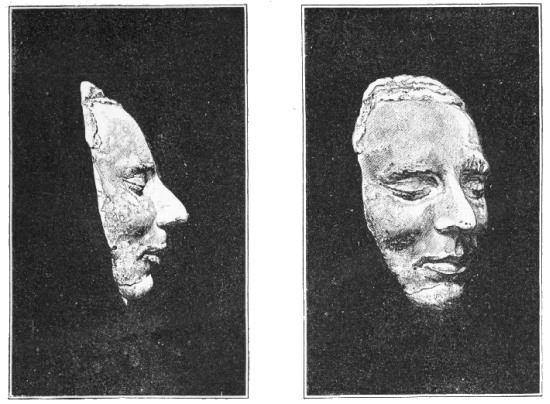
PROFILE OF “JOE SMITH.” FULL FACE OF “JOE SMITH.”—P. 150.
There is in the far West a fast increasing party who would leave people
to be polygynists, polyandrists, Free-lovers, Shakers, or monogamists,
as they please; who would place the social relations as they have placed
religion—out of the reach of the law. I need hardly say that public
opinion has such overwhelming force in America that it is probable that
even under a system of perfect toleration by law, two forms of the
family relation would never be found existing side by side. Polygamists
would continue to migrate to Mormon land, Free-lovers to New York,
Shakers to New England. Some will find in this a reason for, and some a
reason against, a change. In any case, a crusade against Mormonism will
hardly draw sympathy from Nebraska, from Michigan, from Kansas.
Many are found who say: “Leave Mormonism to itself, and it will die.”
The Pacific Railroad alone, they think, will kill it. Those Americans
who know Utah best are not of this opinion. Mormonism is no superstition
of the past. There is huge vitality in the polygamic church. Emerson
once spoke to me of Unitarianism, Buddhism, and Mormonism as three
religions which, right or wrong, are full of force. “The Mormons only
need to be persecuted,” said Elder Frederick to me, “to become as
powerful as the Mohammedans.” It is, indeed, more than doubtful whether
polygamy can endure side by side with American monogamy—it is certain
that Mormon priestly power and Mormon mysteries cannot in the long run
withstand the presence of a large Gentile population; but, if Mormon
titles to land are respected, and if great mineral wealth is not found
to exist in Utah, Mormonism will not be exposed to any much larger
Gentile intrusion than it has to cope with now. Settlers who can go to
California or to Colorado “pares” will hardly fix themselves in the Utah
desert. The Mexican table-lands will be annexed before Gentile
immigrants seriously trouble Brigham. Gold and New England are the most
dreaded foes of Mormondom. Nothing can save polygamy if lodes and
placers such as those of all the surrounding States are found in Utah;
nothing can save it if the New Englanders determine to put it down.
Were Congress to enforce the Homestead laws in Utah, and provide for the
presence of an overwhelming Gentile population, polygamy would not only
die of itself, but drag Mormonism down in its fall. Brigham knows more
completely than we can the necessity of isolation. He would not be
likely to await the blow which increased Gentile immigration would deal
his power.
If New England decides to act, the table-lands of Mexico will see played
once more the sad comedy of Utah. Again the Mormons will march into
Mexican territory, again to wake some day, and find it American. Theirs,
however, will once more be the pride of having proved the pioneers of
that English civilization which is destined to overspread the temperate
world. The treaty of Guadalupe Hidalgo annexed Utah to the United
States, but Brigham Young annexed it to Anglo-Saxondom.
AT the post-office, in Main Street, I gave Mr. Dixon a few last messages
for home—he one to me for some Egyptian friends; and, with a shake and
a wave, we parted, to meet in London after between us completing the
circuit of the globe.
This time again I was not alone: an Irish miner from Montana, with a
bottle of whisky, a revolver and pick, shared the back-seat with the
mail-bags. Before we had forded the Jordan, he had sung “The Wearing of
the Green,” and told me the day and the hour at which the republic was
to be proclaimed at his native village in Galway. Like a true Irishman
of the South or West, he was happy only when he could be generous; and
so much joy did he show when I discovered that the cork had slipped from
my flask, and left me dependent on him for my escape from the alkaline
poison, that I half believed he had drawn it himself when we stopped to
change horses for mules. Certain it is that he pressed his whisky so
fast upon me and the various drivers, that the day we most needed its
aid there was none, and the bottle itself had ended its career by
serving as a target for a trial of breech-loading pistols.
At the sixth ranch from the city, which stands on the shores of the
lake, and close to the foot of the mountains, we found Porter Rockwell,
accredited chief of the Danites, the “Avenging Angels” of Utah, and
leader, it is said, of the “White Indians” at the Mountain Meadows
massacre.
Since 1840 there has been no name of greater terror in the West than
Rockwell‘s; but in 1860 his death was reported in England, and the
career of the great Brother of Gideon was ended, as we thought. I was
told in Salt Lake City that he was still alive and well, and his
portrait was among those that I got from Mr. Ottinger; but I am not
convinced that the man I saw, and whose picture I possess, was in fact
the Porter Rockwell who murdered Stephenson in 1842. It may be
convenient to have two or three men to pass by the one name; and I
suspect that this is so in the Rockwell case.
Under the name of Porter Rockwell some man (or men) has been the terror
of the Mississippi Valley, of plains and plateau, for thirty years. In
1841, Joe Smith prophesied the death of Governor Boggs, of Missouri,
within six months: within that time he was shot—rumor said by Rockwell.
When the Danite was publicly charged with having done the deed for fifty
dollars and a wagon-team, he swore he‘d shoot any man who said he‘d shot
Boggs for gain; “but if I am charged with shooting him, they‘ll have
to prove it”—words that looked like guilt. In 1842 Stephenson died by
the same hand, it is believed. Rockwell was known to be the working
chief of the band organized in 1838 to defend the First Presidency by
any means whatever, fair or foul, known at various times as the “Big
Fan” that should winnow the chaff from the wheat; the “Daughter of
Zion,” the “Destructives,” the “Flying Angels,” the “Brother of Gideon,”
the “Destroying Angels.” “Arise and thresh, O daughter of Zion, for I
will make thy horn iron, and will make thy hoofs brass; and thou shalt
beat in pieces many people; and I will consecrate their gain unto the
Lord, and their substance unto the lords of the whole earth”—this was
the motto of the band.
Little was heard of the Danites from the time that the Mormons were
driven from Illinois and Missouri until 1852, when murder after murder,
massacre after massacre, occurred in the Grand Plateau. Bands of
immigrants, of settlers on their road to California, parties of United
States officers, and escaping Mormons, were attacked by “Indians,” and
found scalped by the next whites who came upon their trail. It was
rumored in the Eastern States that the red men were Mormons in disguise,
following the tactics of the Anti-Renters of New York. In the case of
Almon Babbitt, the “Indians” were proved to have been white.
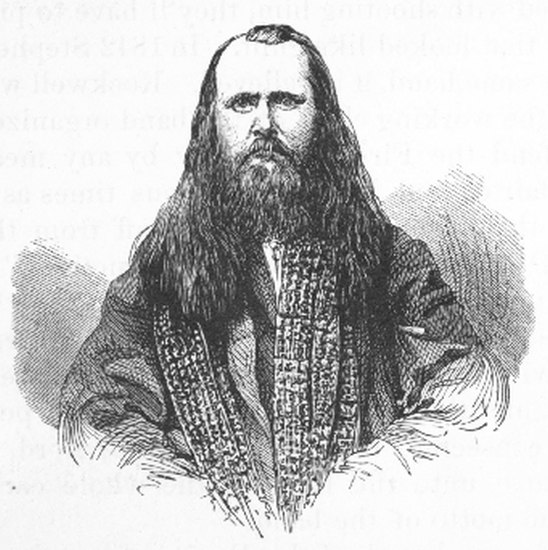
PORTER ROCKWELL.—P. 154.
The atrocities culminated in the Mountain Meadows massacre in 1857, when
hundreds of men, women, and children were murdered by men armed and
clothed as Indians, but sworn to by some who escaped as being whites.
Porter Rockwell has had the infamy of this tremendous slaughter piled on
to the huge mass of his earlier deeds of blood—whether rightly or
wrongly, who shall say? The man that I saw was the man that Captain
Burton saw in 1860. His death was solemnly recorded in the autumn of
that year, yet of the identity of the person I saw with the person
described by Captain Burton there can be no question. The bald, frowning
forehead, the sinister smile, the long grizzly curls falling upon the
back, the red cheek, the coal beard, the gray eye, are not to be
mistaken. Rockwell or not, he is a man capable of any deed. I had his
photograph in my pocket, and wanted to get him to sign it; but when, in
awe of his glittering bowie and of his fame, I asked, by way of caution,
the ranchman—a new-come Paddy—whether Rockwell could write, the fellow
told me with many an oath that “the boss” was as innocent of letters as
a babe. “As for writin’,” he said, “cuss me if he‘s on it. You bet he‘s
not—you bet.”
Not far beyond Rockwell‘s, we drove close to the bench-land; and I was
able to stop for a moment and examine the rocks. From the veranda of the
Mormon poet Naisbitt‘s house in Salt Lake City, I had remarked a double
line of terrace running on one even level round the whole of the great
valley to the south, cut by nature along the base alike of the Oquirrh
and the Wasatch.
I had thought it possible that the terrace was the result of the
varying hardness of the strata; but, near Black Rock, on the overland
track, I discovered that where the terrace lines have crossed the
mountain precipices, they are continued merely by deep stains upon the
rocks. The inference is that within extremely recent, if not historic
times, the water has stood at these levels from two to three hundred
feet above the present Great Salt Lake City, itself 4500 feet above the
sea. Three days’ journey farther west, on the Reese‘s River Range, I
detected similar stains. Was the whole basin of the Rocky
Mountains—here more than a thousand miles across—once filled with a
huge sea, of which the two Sierras were the shores, and the Wasatch,
Goshoot, Waroja, Toi, Abbé, Humboldt, Washoe, and a hundred other
ranges, the rocks and isles? The Great Salt Lake is but the largest of
many such. I saw one on Mirage Plains that is salter than its greater
fellow. Carson Sink is evidently the bed of a smaller bitter lake; and
there are salt pools in dozens scattered through Ruby and Smoky Valleys.
The Great Salt Lake itself is sinking year by year, and the sage-brush
is gaining upon the alkali desert throughout the Grand Plateau. All
these signs point to the rapid drying-up of a great sea, owing to an
alteration of climatic conditions.
In the Odd Fellows’ Library at San Francisco I found a map of North
America, signed “John Harris, A.M.,” and dated “1605,” which shows a
great lake in the country now comprised in the Territories of Utah and
Dakota. It has a width of fifteen degrees, and is named “Thongo, or
Thoya.” It is not likely that this inland sea is a mere exaggeration of
the present Great Salt Lake, because the views of that sheet of water
are everywhere limited by islands in such a way as to give to the eye
the effect of exceeding narrowness. It is possible that the Jesuit
Fathers, and other Spanish travelers from California, may have looked
from the Utah mountains on the dwindling remnant of a great inland sea.
On we jogged and jolted, till we lost sight of the American dead sea and
of its lovely valley, and got into a canyon floored with huge boulders
and slabs of roughened rock, where I expected each minute to undergo the
fate of that Indian traveler who received such a jolt that he bit off
the tip of his own tongue, or of Horace Greeley, whose head was bumped,
it is said, through the roof of his conveyance. Here, as upon the
eastern side of the Wasatch, the track was marked by never-ending lines
of skeletons of mules and oxen.
On the first evening from Salt Lake, we escaped once more from man at
Stockton, a Gentile mining settlement in Rush Valley, too small to be
called a village, though possessed of a municipality, and claiming the
title of “city.” By night we crossed by Reynolds’ Pass the Parolom or
Cedar Range, in a two-horse “jerky,” to which we had been shifted for
speed and safety. Upon the heights the frost was bitter; and when we
stopped at 3 A.M. for “supper,” in which breakfast was combined, we
crawled into the stable like flies in autumn, half killed by the sudden
chill. My miner spoke but once all night. “It‘s right cold,” he said;
but fifty times at least he sang “The Wearing of the Green.” It was his
only tune.
Soon after light, we passed the spot where Captain Gunnison of the
Federal Engineers, who had been in 1853 the first explorer of the Smoky
Hill route, was killed “by the Ute Indians.” Gunnison was an old enemy
of the Mormons, and the spot is ominously near to Rockwell‘s home. Here
we came out once more into the alkali, and our troubles from dust began.
For hours we were in a desert white as snow; but for reward we gained a
glorious view of the Goshoot Range, which we crossed by night, climbing
silently on foot for hours in the moonlight. The walking saved us from
the cold.
The third day—a Sunday morning—we were at the foot of the Waroja
Mountains, with Egan Canyon for our pass, hewn by nature through the
living rock. You dare swear you see the chisel-marks upon the stone. A
gold-mill had years ago been erected here, and failed. The heavy
machinery was lost upon the road; but the four stone walls contained
between them the wreck of the lighter “plant.”
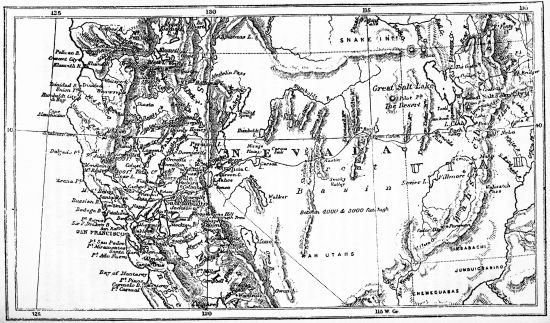
[larger view]
[largest view]
As we jolted and journeyed on across the succeeding plain, we spied in
the far distance a group of black dots upon the alkali. Man seems very
small in the infinite expanse of the Grand Plateau—the roof, as it
were, of the world. At the end of an hour we were upon them—a company
of “overlanders” “tracking” across the continent with mules. First came
two mounted men, well armed with Deringers in the belt, and Ballard
breech-loaders on the thigh, prepared for ambush—ready for action
against elk or red-skin. About fifty yards behind these scowling fellows
came the main band of bearded, red-shirted diggers, in huge boots and
felt hats, each man riding one mule, and driving another laden with
packs and buckets. As we came up, the main body halted, and an
interchange of compliments began. “Say, mister, thet‘s a slim horse of
yourn.” “Guess not—guess he‘s all sorts of a horse, he air. And how far
might it be to the State of Varmount?” “Wall, guess the boys down to hum
will be kinder joyed to see us, howsomever that may be.” Just at this
moment a rattlesnake was spied, and every revolver discharged with a
shout, all hailing the successful shot with a “Bully for you; thet
hit him whar he lives.” And on, without more ado, they went.
Even the roughest of these overlanders has in him something more than
roughness. As far as appearance goes, every woman of the far West is a
duchess, each man a Coriolanus. The royal gait, the imperial glance and
frown, belong to every ranchman in Nevada. Every fellow that you meet
upon the track near Stockton or Austin City, walks as though he were
defying lightning, yet this without silly strut or braggadocio. Nothing
can be more complete than the ranchman‘s self-command, save in the one
point of oaths; the strongest, freshest, however, of their moral
features is a grand enthusiasm, amounting sometimes to insanity. As for
their oaths, they tell you it is nothing unless the air is “blue with
cusses.” At one of the ranches where there was a woman, she said quietly
to me, in the middle of an awful burst of swearing, “Guess Bill swears
steep;” to which I replied, “Guess so”—the only allusion I ever heard
or hazarded to Western swearing.
Leaving to our north a snowy range—nameless here, but marked on
European maps as the East Humboldt—we reached the foot of the Ruby
Valley Mountains on the Sunday afternoon in glowing sunshine, and
crossed them in a snow-storm. In the night we journeyed up and down the
Diamond or Quartz Range, and morning found us at the foot of the Pond
Chain. At the ranch—where, in the absence of elk, we ate “bacon,” and
dreamt we breakfasted—I chatted with an agent of the Mail Company on
the position of the ranchmen, divisible, as he told me, into “cooks and
hostlers.” The cooks, my experience had taught me, were the aptest
scholars, the greatest politicians; the hostlers, men of war and
completest masters of the art of Western swearing. The cooks had a New
England cut; the hostlers, like Southerners, wore their hair all down
their backs. I begged an explanation of the reason for the marked
distinction. “They are picked,” he said, “from different classes. When a
boy comes to me and asks for something to do, I give him a look, and see
what kind of stuff he‘s made of. If he‘s a gay duck out for a six-weeks’
spree, I send him down here, or to Bitter Wells; but if he‘s a clerk or
a poet, or any such sorter fool as that, why then I set him cooking; and
plaguy good cooks they make, as you must find.”
The drivers on this portion of the route are as odd fellows as are the
ranchmen. Wearing huge jack-boots, flannel shirts tucked into their
trowsers, but no coat or vest, and hats with enormous brims, they have
their hair long, and their beards untrimmed. Their oaths, I need hardly
say, are fearful. At night they wrap themselves in an enormous cloak,
drink as much whisky as their passengers can spare them, crack their
whips, and yell strange yells. They are quarrelsome and overbearing,
honest probably, but eccentric in their ways of showing it. They belong
chiefly to the mixed Irish and German race, and have all been in
Australia during the gold rush, and in California before deep sinking
replaced the surface diggings. They will tell you how they often washed
out and gambled away a thousand ounces in a month, living like Roman
emperors, then started in digging-life again upon the charity of their
wealthier friends. They hate men dressed in “biled shirts,” or in “store
clothes,” and show their aversion in strange ways. I had no objection
myself to build fires and fetch wood; but I drew the line at going into
the sage-brush to catch the mules, that not being a business which I
felt competent to undertake. The season was advanced, the snows had not
yet reached the valleys, which were parched by the drought of all the
summer, feed for the mules was scarce, and they wandered a long way.
Time after time we would drive into a station, the driver saying, with
strange oaths, “Guess them mules is clared out from this here ranch;
guess they is into this sage-brush;” and it would be an hour before the
mules would be discovered feeding in some forgotten valley. Meanwhile
the miner and myself would have revolver practice at the skeletons and
telegraph-posts when sage fowl failed us, and rattlesnakes grew scarce.
After all, it is easy to speak of the eccentricities of dress and manner
displayed by Western men, but Eastern men and Europeans upon the plateau
are not the prim creatures of Fifth Avenue or Pall Mall. From San
Francisco I sent home an excellent photograph of myself in the clothes
in which I had crossed the plateau, those being the only ones I had to
wear till my baggage came round from Panama. The result was, that my
oldest friends failed to recognize the portrait. At the foot I had
written “A Border Ruffian:” they believed not the likeness, but the
legend.
The difficulties of dress upon these mountain ranges are great indeed.
To sit one night exposed to keen frost and biting wind, and the next day
to toil for hours up a mountain-side, beneath a blazing sun, are very
opposite conditions. I found my dress no bad one. At night I wore a
Canadian fox-fur cap, Mormon ’coon-skin gloves, two coats, and the whole
of my light silk shirts. By day I took off the coats, the gloves, and
cap, and walked in my shirts, adding but a Panama hat to my “fit-out.”
As we began the ascent of the Pond River Range, we caught up a
bullock-train, which there was not room to pass. The miner and myself
turned out from the jerky, and for hours climbed alongside the wagons. I
was struck by the freemasonry of this mountain travel: Bryant, the
miner, had come to the end of his “solace,” as the most famed chewing
tobacco in these parts is called. Going up to the nearest teamster, he
asked for some, and was at once presented with a huge cake—enough, I
should have thought, to have lasted a Channel pilot for ten years.
The climb was long enough to give me deep insight into the inner
mysteries of bullock-driving. Each of the great two-storied Californian
wagons was drawn by twelve stout oxen; still, the pace was not a mile an
hour, accomplished, as it seemed to me, not so much by the aid as in
spite of tremendous flogging. Each teamster carried a short-handled whip
with a twelve-foot leathern lash, which was wielded with two hands, and,
after many a whirl, brought down along the whole length of the back of
each bullock of the team in turn, the stroke being accompanied by a
shout of the bullock‘s name, and followed, as it was preceded, by a
string of the most explosive oaths. The favorite names for bullocks were
those of noted public characters and of Mormon elders, and cries were
frequent of “Ho, Brígham!” “Ho, Jóseph!” “Ho, Gránt!”—the blow falling
with the accented syllable. The London Society for the Prevention of
Cruelty to Animals would find at Pond River ranch an excellent opening
for a mission. The appointed officer should be supplied with two
Deringers and a well-filled whisky-barrel.
Through a gap in the mountain crest we sighted the West Humboldt Range,
across an open country dotted here and there with stunted cedar, and,
crossing Smoky Valley, we plunged into a deep pass in the Toi Abbé
Range, and reached Austin—a mining town of importance, rising two years
old—in the afternoon of the fourth day from Salt Lake City.
After dining at an Italian digger‘s restaurant with an amount of luxury
that recalled our feasts at Salt Lake City, I started on a stroll, in
which I was stopped at once by a shout from an open bar-room of “Say,
mister!” Pulling up sharply, I was surrounded by an eager crowd, asking
from all sides the one question: “Might you be Professor Muller?”
Although flattered to find that I looked less disreputable and ruffianly
than I felt, I nevertheless explained as best I could that I was no
professor—only to be assured that if I was any professor at all, Muller
or other, I should do just as well: a mule was ready for me to ride to
the mine, and “Jess kinder fix us up about this new lode.” If my
new-found friends had not carried an overwhelming force of pistols, I
might have gone to the mine as Professor Muller, and given my opinion
for what it was worth: as it was, I escaped only by “liquoring up” over
the error. Cases of mistaken identity are not always so pleasant in
Austin. They told me that, a few weeks before, a man riding down the
street heard a shot, saw his hat fall into the mud, and, picking it up,
found a small round hole on each side. Looking up, he saw a tall miner,
revolver smoking in hand, who smiled grimly, and said: “Guess thet‘s my
muel.” Having politely explained when and where the mule was bought, the
miner professed himself satisfied with a “Guess I was wrong—let‘s
liquor.”
In the course of my walk through Austin I came upon a row of neat huts,
each with a board on which was painted, “Sam Sing, washing and ironing,”
or “Mangling by Ah Low.” A few paces farther on was a shop painted red,
but adorned with cabalistic scrawls in black ink; and farther still was
a tiny joss house. Yellow men, in spotless clothes of dark-green and
blue, were busy at buying and selling, at cooking, at washing. Some, at
a short trot, were carrying burdens at the end of a long bamboo pole.
All were quiet, quick, orderly, and clean. I had at last come thoroughly
among the Chinese people, not to lose sight of them again until I left
Geelong, or even Suez.
Returning to the room where I had dined, I parted with Pat Bryant,
quitting him, in Western fashion, after a good “trade” or “swop.” He had
taken a fancy to the bigger of my two revolvers. He was going to breed
cattle in Oregon, he told me, and thought it might be useful for
shooting his wildest beasts by riding in the Indian manner, side by side
with them, and shooting at the heart. I answered by guessing that I “was
on the sell;” and traded the weapon against one of his that matched my
smaller tool. When I reached Virginia City, I inquired prices, and was
almost disappointed to find that I had not been cheated in the “trade.”
A few minutes after leaving the “hotel” at Austin, and calling at the
post-office for the mails, I again found myself in the desert—indeed,
Austin itself can hardly be styled an oasis: it may have gold, but it
has no green thing within its limits. It is in canyons and on plains
like these, with the skeletons of oxen every few yards along the track,
that one comes to comprehend the full significance of the terrible entry
in the army route-books—“No grass; no water.”
Descending a succession of tremendous “grades,” as inclines upon roads
and railroads are called out West, we came on to the lava-covered plain
of Reese‘s River Valley, a wall of snowy mountain rising grandly in our
front. Close to the stream were a ranch or two, and a double camp, of
miners and of a company of Federal troops. The diggers were playing with
their glistening knives as diggers only can; the soldiers—their huge
sombreros worn loosely on one side—were lounging idly in the sun.
Within an hour, we were again in snow and ice upon the summit of another
nameless range.
This evening, after five sleepless nights, I felt most terribly the
peculiar form of fatigue that we had experienced after six days and
nights upon the plains. Again the brain seemed divided into two parts,
thinking independently, and one side putting questions while the other
answered them; but this time there was also a sort of half insanity, a
not altogether disagreeable wandering of the mind, a replacing of the
actual by an imagined ideal scene.
On and on we journeyed, avoiding the Shoshoné and West Humboldt
Mountains, but picking our way along the most fearful ledges that it has
been my fate to cross, and traversing from end to end the dreadful
Mirage Plains. At nightfall we sighted Mount Davidson and the Washoe
Range, and at 3 A.M. I was in bed once more—in Virginia City.
“GUESS the governor‘s consid‘rable skeert.”
“You bet, he‘s mad.”
My sitting down to breakfast at the same small table seemed to end the
talk; but I had not been out West for nothing, so explaining that I was
only four hours in Virginia City, I inquired what had occurred to fill
the governor of Nevada with vexation and alarm.
“D‘you tell now! only four hours in this great young city. Wall, guess
it‘s a bully business. You see, some time back the governor pardoned a
road agent after the citizens had voted him a rope. Yes, sir! But that
ain‘t all: yesterday, cuss me if he didn‘t refuse ter pardon one of the
boys who had jess shot another in play like. Guess he thinks hisself
some pumpkins.” I duly expressed my horror, and my informant went on:
“Wall, guess the citizens paid him off purty slick. They jess sent him a
short thick bit of rope with a label ‘For his Excellency.’ You bet ef he
ain‘t mad—you bet! Pass us those molasses, mister.”
I was not disappointed: I had not come to Nevada for nothing. To see
Virginia City and Carson, since I first heard their fame in New York,
had been with me a passion, but the deed thus told me in the dining-room
of the “Empire” Hotel was worthy a place in the annals of “Washoe.”
Under its former name, the chief town of Nevada was ranked not only the
highest, but the “cussedest” town in the States, its citizens expecting
a “dead man for breakfast” every day, and its streets ranging from seven
to eight thousand feet above the sea. Its twofold fame is leaving it:
the Coloradan villages of North Empire and Black Hawk are nine or ten
thousand feet above sea level, and Austin, and Virginia City in Montana
beat it in playful pistoling and vice. Nevertheless, in the point of
“pure cussedness” old Washoe still stands well, as my first introduction
to its ways will show. All the talk of Nevada reformation applies only
to the surface signs: when a miner tells you that Washoe is turning
pious, and that he intends shortly to “vamose,” he means that, unlike
Austin, which is still in its first state of mule-stealing and monté,
Virginia City has passed through the second period—that of “vigilance
committees” and “historic trees”—and is entering the third, the stage
of churches and “city officers,” or police.
The population is still a shifting one. A by-law of the municipality
tells us that the “permanent population” consists of those who reside
more than a month within the city. At this moment the miners are pouring
into Washoe from north and south and east, from Montana, from Arizona,
and from Utah, coming to the gayeties of the largest mining city to
spend their money during the fierce short winter. When I saw Virginia
City, it was worse than Austin.
Every other house is a restaurant, a drinking-shop, a gaming-hell, or
worse. With no one to make beds, to mend clothes, to cook food—with no
house, no home—men are almost certain to drink and gamble. The Washoe
bar-rooms are the most brilliant in the States: as we drove in from
Austin at 3 A.M., there was blaze enough for us to see from the frozen
street the portraits of Lola Montez, Ada Menken, Heenan, and the other
Californian celebrities with which the bar-rooms were adorned.
Although “petticoats,” even Chinese, are scarce, dancing was going on in
every house; but there is a rule in miners’ balls that prevents all
difficulties arising from an over-supply of men: every one who has a
patch on the rear portion of his breeches does duty for a lady in the
dance, and as gentlemen are forced by the custom of the place to treat
their partners at the bar, patches are popular.
Up to eleven in the morning hardly a man was to be seen: a community
that sits up all night, begins its work in the afternoon. For hours I
had the blazing hills called streets to myself for meditating ground;
but it did not need hours to bring me to think that a Vermonter‘s
description of the climate of the mountains was not a bad one when he
said: “You rise at eight, and shiver in your cloak till nine, when you
lay it aside, and walk freely in your woolens. At twelve you come in for
your gauze coat and your Panama; at two you are in a hammock cursing the
heat, but at four you venture out again, and by five are in your
woolens. At six you begin to shake with cold, and shiver on till
bedtime, which you make darned early.” Even at this great height, the
thermometer in the afternoon touches 80° Fahr. in the shade, while from
sunset to sunrise there is a bitter frost. So it is throughout the
plateau. When morning after morning we reached a ranch, and rushed out
of the freezing ambulance through the still colder outer air to the
fragrant cedar fire, there to roll with pain at the thawing of our
joints, it was hard to bear it in mind that by eight o‘clock we should
be shutting out the sun, and by noon melting even in the deepest shade.
As I sat at dinner in a miner‘s restaurant, my opposite neighbor,
finding that I was not long from England, informed me he was “the
independent editor of the Nevada Union Gazette,” and went on to ask:
“And how might you have left literatooral pursoots? How air Tennyson and
Thomas T. Carlyle?” I assured him that to the best of my belief they
were fairly well, to which his reply was: “Guess them ther men ken sling
ink, they ken.” When we parted, he gave me a copy of his paper, in which
I found that he called a rival editor “a walking whisky-bottle” and “a
Fenian imp.” The latter phrase reminded me that, of the two or three
dozen American editors that I had met, this New Englander was the first
who was “native born.” Stenhouse, in Salt Lake City, is an Englishman,
so is Stanton, of Denver, and the whole of the remainder of the band
were Irishmen. As for the earlier assertion in the “editorial,” it was
not a wild one, seeing that Virginia City has five hundred whisky-shops
for a population of ten thousand. Artemus Ward said of Virginia City, in
a farewell speech to the inhabitants that should have been published in
his works: “I never, gentlemen, was in a city where I was treated so
well, nor, I will add, so often.” Through every open door the
diggers can be seen tossing the whisky down their throats with a scowl
of resolve, as though they were committing suicide—which, indeed,
except in the point of speed, is probably the case.
The Union Gazette was not the only paper that I had given me to read
that morning. Not a bridge over a “crick,” not even a blacked pair of
boots, made me so thoroughly aware that I had in a measure returned to
civilization as did the gift of an Alta Californian containing a
report of a debate in the English Parliament upon the Bank Charter Act.
The speeches were appropriate to my feelings; I had just returned not
only to civilization, but to the European inconveniences of gold and
silver money. In Utah, gold and greenbacks circulate indifferently, with
a double set of prices always marked and asked; in Nevada and
California, greenbacks are as invisible as gold in New York or Kansas.
Nothing can persuade the Californians that the adoption by the Eastern
States of an inconvertible paper system is anything but the result of a
conspiracy against the Pacific States—one in which they at least are
determined to have no share. Strongly Unionist in feeling as were
California, Oregon, and Nevada during the rebellion, to have forced
greenbacks upon them would have been almost more than their loyalty
would have borne. In the severest taxation they were prepared to
acquiesce; but paper money they believe to be downright robbery, and the
invention of the devil.
To me the reaching gold once more was far from pleasant, for the
advantages of paper money to the traveler are enormous; it is light, it
wears no holes in your pockets, it reveals its presence by no untimely
clinking; when you jump from a coach, every thief within a mile is not
at once aware that you have ten dollars in your right-hand pocket. The
Nevadans say that forgeries are so common that their neighbors in
Colorado have been forced to agree that any decent imitation shall be
taken as good, it being too difficult to examine into each case. For my
part, though in rapid travel a good deal of paper passed through my
hands in change, my only loss by forgery was one half-dollar note; my
loss by wear and tear the same.
In spite of the gold currency, prices are higher in Nevada than in
Denver. A shave is half a dollar—gold; in Washoe and in Atchison, but a
paper quarter. A boot-blacking is fifty cents in gold, instead of ten
cents paper, as in Chicago or St. Louis.
During the war, when fluctuations in the value of the paper were great
and sudden, prices changed from day to day. Hotel proprietors in the
West received their guests at breakfast, it is said, with “Glorious
news; we‘ve whipped at ——. Gold‘s 180; board‘s down half a dollar.”
While I was in the country, gold fluctuated between 140 and 163, but
prices remained unaltered.
Paper money is of some use to a young country in making the rate of
wages appear enormous, and so attracting immigration. If a Cork
bog-trotter is told that he can get two dollars a day for his work in
America, but only one in Canada, no economic considerations interfere to
prevent him rushing to the nominally higher rate. Whether the workingmen
of America have been gainers by the inflation of the currency, or the
reverse, it is hard to say. It has been stated in the Senate that wages
have risen sixty per cent., and prices ninety per cent.; but “prices” is
a term of great width. The men themselves believe that they have not
been losers, and no argument can be so strong as that.
My first afternoon upon Mount Davidson I spent underground in the Gould
and Curry Mine, the wealthiest and largest of those that have tapped the
famous Comstock Lode. In this single vein of silver lies the prosperity
not only of the city, but of Nevada State; its discovery will have
hastened the completion of the overland railway itself by several years.
It is owing to the enormous yield of this one lode that the United
States now stands second only to Mexico as a silver-producing land. In
one year Nevada has given the world as much silver as there came from
the mines of all Peru.
The rise of Nevada has been sudden. I was shown in Virginia City a
building block of land that rents for ten times what it cost four
years ago. Nothing short of solid silver by the yard would have brought
twenty thousand men to live upon the summit of Mount Davidson. It is
easy here to understand the mad rush and madder speculation that took
place at the time of the discovery. Every valley in the Washoe Range was
“prospected,” and pronounced paved with silver; every mountain was a
solid mass. “Cities” were laid out, and town lots sold, wherever room
was afforded by a flat piece of ground. The publication of the
Californian newspapers was suspended, as writers, editors, proprietors,
and devils, all had gone with the rush. San Francisco went clean mad,
and London and Paris were not far behind. Of the hundred “cities”
founded, but one was built; of the thousand claims registered, but a
hundred were taken up and worked; of the companies formed, but half a
dozen ever paid a dividend, except that obtained from the sale of their
plant. The silver of which the whole base of Mount Davidson is composed
has not been traced in the surrounding hills, though they are covered
with a forest of posts, marking the limits of forgotten “claims:”
“James Thompson, 130 feet N.E. by N.”
“Ezra Williams, 130 feet due E.;”
and so for miles. The Gould and Curry Company, on the other hand, is
said to have once paid a larger half-yearly dividend than the sum of the
original capital, and its shares have been quoted at 1000 per cent. Such
are the differences of a hundred yards.
One of the oddities of mining life is, that the gold-diggers profess a
sublime contempt for silver-miners and their trade. A Coloradan going
West was asked in Nevada if in his country they could beat the Comstock
lode. “Dear, no!” he said. “The boys with us are plaguy discouraged
jess at present.” The Nevadans were down upon the word. “Discouraged,
air they!” “Why, yes! They‘ve jess found they‘ve got ter dig through
three feet of solid silver ’fore ever they come ter gold.”
Some of the Nevada companies have curious titles. “The Union Lumber
Association” is not bad; but “The Segregated Belcher Mining Enterprise
of Gold Hill District, Storey County, Nevada State,” is far before it as
an advertising name.
In a real “coach” at last—a coach with windows and a roof—drawn by six
“mustangs,” we dashed down Mount Davidson upon a real road, engineered
with grades and bridges—my first since Junction City. Through the
Devil‘s Gate we burst out upon a chaotic country. For a hundred miles
the eye ranged over humps and bumps of every size, from stones to
mountains, but no level ground, no field, no house, no tree, no green.
Not even the Sahara so thoroughly deserves the name of “desert.” In
Egypt there is the oasis, in Arabia here and there a date and a
sweet-water well; here there is nothing, not even earth. The ground is
soda, and the water and air are full of salt.
This road is notorious for the depredations of the “road agents,” as
white highwaymen are politely called, red or yellow robbers being still
“darned thieves.” At Desert Wells, the coach had been robbed, a week
before I passed, by men who had first tied up the ranchmen, and taken
their places to receive the driver and passengers when they arrived. The
prime object with the robbers is the treasury box of “dust,” but they
generally “go through” the passengers, by way of pastime, after their
more regular work is done. As to firing, they have a rule—a simple
one. If a passenger shoots, every man is killed. It need not be said
that the armed driver and armed guard never shoot; they know their
business far too well.
Close here we came on hot and cold springs in close conjunction, flowing
almost from the same “sink-hole”—the original twofold springs, I hinted
to our driver, that Poseidon planted in the Atlantic isle. He said that
“some one of that name” had a ranch near Carson, so I “concluded” to
drop Poseidon, lest I should say something that might offend.
From Desert Wells the alkali grew worse and worse, but began to be
alleviated at the ranches by irrigation of the throat with delicious
Californian wine. The plain was strewn with erratic boulders, and here
and there I noticed sharp sand-cones, like those of the Elk Mountain
country in Utah.
At last we dashed into the “city” named after the notorious Kit Carson,
of which an old inhabitant has lately said: “This here city is growing
plaguy mean—there was only one man shot all yesterday.” There was what
is here styled an “altercation” a day or two ago. The sheriff tried to
arrest a man in broad daylight in the single street which Carson boasts.
The result was that each fired several shots at the other, and that both
were badly hurt.
The half-deserted mining village and wholly ruined Mormon settlement
stand grimly on the bare rock, surrounded by weird-looking depressions
of the earth, the far-famed “sinks,” the very bottom of the plateau, and
goal of all the plateau streams—in summer dry, and spread with sheets
of salt; in winter filled with brine. The Sierra Nevada rises like a
wall from the salt pools, with a fringe of giant, leafless trees hanging
stiffly from its heights—my first forest since I left the Missouri
bottoms. The trees made me feel that I was really across the continent,
within reach at least of the fogs of the Pacific—on “the other side;”
that there was still rough, cold work to be done was clear from the
great snow-fields that showed through the pines with that threatening
blackness that the purest of snows wear in the evening when they face
the east.
As I gazed upon the tremendous battlements of the Sierra, I not only
ceased to marvel that for three hundred years traffic had gone round by
Panama rather than through these frightful obstacles, but even wondered
that they should be surmounted now. In this hideous valley it was that
the California immigrants wintered in 1848, and killed their Indian
guides for food. For three months more the strongest of them lived upon
the bodies of those who died, incapable in their weakness of making good
their foothold upon the slippery snows of the Sierra. After awhile, some
were cannibals by choice; but the story is not one that can be told.
Galloping up the gentle grades of Johnson‘s Pass, we began the ascent of
the last of fifteen great mountain ranges crossed or flanked since I had
left Great Salt Lake City. The thought recalled a passage of arms that
had occurred at Denver between Dixon and Governor Gilpin. In his grand
enthusiastic way, the governor, pointing to the Cordillera, said: “Five
hundred snowy ranges lie between this and San Francisco.” “Peaks,” said
Dixon. “Ranges!” thundered Gilpin; “I‘ve seen them.”
Of the fifteen greater ranges to the westward of Salt Lake, eight at
least are named from the rivers they contain, or are wholly nameless.
Trade has preceded survey; the country is not yet thoroughly explored.
The six paper maps by which I traveled—the best and latest—differed
in essential points. The position and length of the Great Salt Lake
itself are not yet accurately known; the height of Mount Hood has been
made anything between nine thousand and twenty thousand feet; the
southern boundary line of Nevada State passes through untrodden wilds. A
rectification of the limits of California and Nevada was attempted no
great time ago, and the head-waters of some stream which formed a
starting-point had been found to be erroneously laid down. At the
flourishing young city of Aurora, in Esmeralda County, a court of
California was sitting. A mounted messenger rode up at great pace, and,
throwing his bridle round the stump, dashed in breathlessly, shouting,
“What‘s this here court?” Being told that it was a Californian court, he
said, “Wall, thet‘s all wrong: this here‘s Nevada. We‘ve been and
rectified this boundary, an’ California‘s a good ten mile off here.”
“Wall, Mr. Judge, I move this court adjourn,” said the plaintiff‘s
counsel. “How can a court adjourn thet‘s not a court?” replied the
judge. “Guess I‘ll go.” And off he went. So, if the court of Aurora
was a court, it must be sitting now.
The coaching on this line is beyond comparison the best the world can
show. Drawn by six half-bred mustangs, driven by whips of the fame of
the Hank Monk “who drove Greeley,” the mails and passengers have been
conveyed from Virginia City to the rail at Placerville, 154 miles, in 15
hours and 20 minutes, including a stoppage of half an hour for supper,
and sixteen shorter stays to change horses. In this distance, the Sierra
Nevada has to be traversed in a rapid rise of three thousand feet, a
fall of a thousand feet, another rise of the same, and then a descent of
five thousand feet on the Californian side.
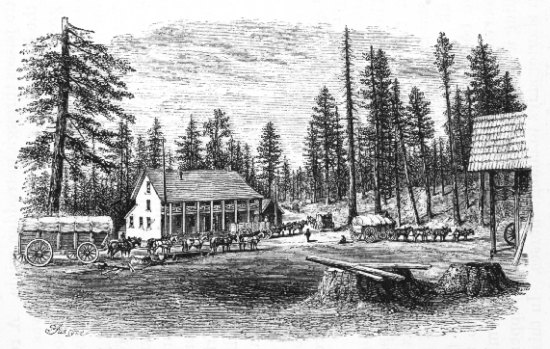
FRIDAY‘S STATION—VALLEY OF LAKE TAHOE.—P. 176.
Before the road was made, the passage was one of extraordinary
difficulty. A wagon once started, they say, from Folsom, bearing “Carson
or bust” in large letters upon the tilt. After ten days, it returned
lamely enough, with four of the twelve oxen gone, and bearing the label
“Busted.”
When we were nearing Hank Monk‘s “piece,” I became impatient to see the
hero of the famous ride. What was my disgust when the driver of the
earlier portion of the road appeared again upon the box in charge of six
magnificent iron-grays. The peremptory cry of “All aboard” brought me
without remonstrance to the coach, but I took care to get upon the box,
although, as we were starting before the break of day, the frost was
terrible. To my relief, when I inquired after Hank, the driver said that
he was at a ball at a timber ranch in the forest “six mile on.” At early
light we reached the spot—the summit of the more eastern of the twin
ranges of the Sierra. Out came Hank, amid the cheers of the half dozen
men and women of the timber ranch who formed the “ball,” wrapped up to
the eyes in furs, and took the reins without a word. For miles he drove
steadily and moodily along. I knew these drivers top well to venture
upon speaking first when they were in the sulks; at last, however, I
lost all patience, and silently offered him a cigar. He took it without
thanking me, but after a few minutes said: “Thet last driver, how did he
drive?” I made some shuffling answer, when he cut in: “Drove as ef he
were skeert; and so he was. Look at them mustangs. Yoo—ou!” As he
yelled, the horses started at what out here they style “the run;” and
when, after ten minutes, he pulled up, we must have done three miles,
round most violent and narrow turns, with only the bare precipice at the
side, and a fall of often a hundred feet to the stream at the bottom of
the ravine—the Simplon without its wall. Dropping into the talking
mood, he asked me the usual questions as to my business, and whither I
was bound. When I told him I thought of visiting Australia, he said,
“D‘you tell now! Jess give my love—at Bendigo—to Gumption Dick.” Not
another word about Australia or Gumption Dick could I draw from him. I
asked at Bendigo for Dick; but not even the officer in command of the
police had ever heard of Hank Monk‘s friend.
The sun rose as we dashed through the grand landscapes of Lake Tahoe. On
we went, through gloomy snow-drifts and still sadder forests of gigantic
pines nearly three hundred feet in height, and down the canyon of the
American River from the second range. Suddenly we left the snows, and
burst through the pine woods into an open scene. From gloom there was a
change to light; from somber green to glowing red and gold. The trees,
no longer hung with icicles, were draped with Spanish moss. In ten yards
we had come from winter into summer. Alkali was left behind forever; we
were in El Dorado, on the Pacific shores—in sunny, dreamy California.
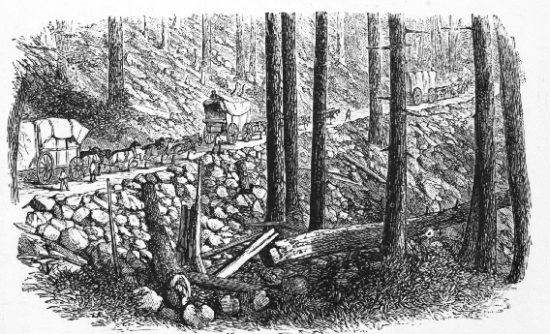
TEAMING UP THE GRADE AT SLIPPERY FORD, IN THE SIERRA.—P.
178.
THE city of the high priest clothed in robes of gold figures largely in
the story of Spanish discovery in America. The hardy soldiers who
crossed the Atlantic in caravels and cockboats, and toiled in leathern
doublets and plate armor through the jungle swamp of Panama, were lured
on through years of plague and famine by the dream of a country whose
rivers flowed with gold. Diego de Mendoza found the land in 1532, but it
was not till January, 1848, that James Marshall washed the golden sands
of El Dorado.
The Spaniards were not the first to place the earthly paradise in
America. Not to speak of New Atlantis, the Canadian Indians have never
ceased to hand down to their sons a legend of western abodes of bliss,
to which their souls journey after death, through frightful glens and
forests. In their mystic chants they describe minutely the obstacles
over which the souls must toil to reach the regions of perpetual spring.
These stories are no mere dreams, but records of the great Indian
migration from the West: the liquid-eyed Hurons, not sprung from the
Canadian snows, may be Californian if they are not Malay, the Pacific
shores their happy hunting-ground, the climate of Los Angeles their
never-ending spring.
The names The Golden State and El Dorado are doubly applicable to
California; her light and landscape, as well as her soil, are golden.
Here, on the Pacific side, nature wears a robe of deep rich yellow:
even the distant hills, no longer purple, are wrapt in golden haze. No
more cliffs and canyons—all is rounded, soft, and warm. The Sierra,
which faces eastward, with four thousand feet of wall-like rock, on the
west descends gently in vine-clad slopes into the Californian vales, and
trends away in spurs toward the sea. The scenery of the Nevada side was
weird, but these western foot-hills are unlike anything in the world.
Drake, who never left the Pacific shores, named the country New Albion,
from the whiteness of a headland on the coast; but the first viceroys
were less ridiculously misled by patriotic vanity when they christened
it New Spain.
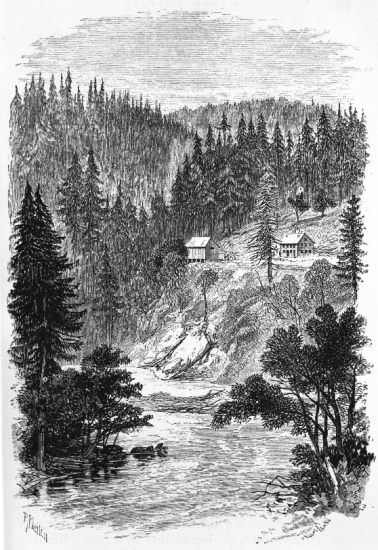
VIEW ON THE AMERICAN RIVER—THE PLACE WHERE GOLD WAS
FIRST FOUND.—P. 180.
In the warm dry sunlight, we rolled down hills of rich red loam, and
through forests of noble redwood—the Sequoia sempervirens, brother to
the Sequoia gigantea, or Wellingtonia of our lawns. Dashing at full
gallop through the American River, just below its falls, where, in 1848,
the Mormons first dug that Californian gold which in the interests of
their church they had better have let alone, we came upon great gangs of
Indians working by proxy upon the Continental railroad. The Indian‘s
plan for living happily is a simple one: he sits and smokes in silence
while his women work, and he thus lives upon the earnings of the squaws.
Unlike a Mormon patriarch, he contrives that polygamy shall pay, and
says with the New Zealand Maori: “A man with one wife may starve, but a
man with many wives grows fat.” These fellows were Shoshonés from the
other side of the plateau; for the Pacific Indians, who are black, not
red, will not even force their wives to work, which, in the opinion of
the Western men, is the ultimate form of degradation in a race. Higher
up the hills, Chinamen alone are employed; but their labor is too
costly to be thrown away upon the easier work.
In El Dorado City we stayed not long enough for the exploration of the
once famous surface gold mines, now forming one long vineyard, but,
rolling on, were soon among the tents of Placerville, which had been
swept with fire a few months before. All these valley diggings have been
deserted for deep-sinking—not that they are exhausted yet, but that the
yield has ceased to be sufficient to tempt the gambling digger. The men
who lived in Placerville and made it infamous throughout the world some
years ago are scattered now through Nevada, Arizona, Montana, and the
Frazer country, and Chinamen and Digger Indians have the old workings to
themselves, settling their rights as against each other by daily battle
and perpetual feud. The Digger Indians are the most degraded of all the
aborigines of North America—outcasts from the other tribes—men under a
ban—“tapu,” as their Maori cousins say—weaponless, naked savages who
live on roots, and pester the industrious Chinese.
It is not with all their foes that the yellow men can cope so easily. In
a tiny Chinese theater in their camp near Placerville, I saw a farce
which to the remainder of the audience was no doubt a very solemn drama,
in which the adventures of two Celestials on the diggings were given to
the world. The only scene in which the pantomime was sufficiently clear
for me to read it without the possibility of error was one in which a
white man—“Melican man”—came to ask for taxes. The Chinamen had paid
their taxes once before, but the fellow said that didn‘t matter. The
yellow men consulted together, and at last agreed that the stranger was
a humbug, so the play ended with a big fight, in which they drove him
off their ground. A Chinaman played the over ’cute Yankee, and did it
well.
Perhaps the tax-collectors in the remoter districts of the States count
on the Chinese to make up the deficiencies in their accounts caused by
the non-payment of their taxes by the whites; for even in these days of
comparative quiet and civilization, taxes are not gathered to their full
amount in any of the Territories, and the justice of the collector is in
Montana tempered by many a threat of instant lynching if he proceeds
with his assessment. Even in Utah, the returns are far from
satisfactory: the three great merchants of Salt Lake City should, if
their incomes are correctly stated, contribute a heavier sum than that
returned for the whole of the population of the Territory.
The white diggers who preceded the Chinese have left their traces in the
names of lodes and places. There is no town in California with such a
title as the Coloradan City of Buckskin Joe, but Yankee Jim comes near
it. Placerville itself was formerly known as Hangtown, on account of its
being the city in which “lynch-law was inaugurated.” Dead Shot Flat is
not far from here, and within easy distance are Hell‘s Delight, Jackass
Gulch, and Loafer‘s Hill. The once famous Plug-ugly Gulch has now
another name; but of Chucklehead Diggings and Puppytown I could not find
the whereabouts in my walks and rides. Graveyard Canyon, Gospel Gulch,
and Paint-pot Hill are other Californian names. It is to be hoped that
the English and Spanish names will live unmutilated in California and
Nevada, to hand down in liquid syllables the history of a half-forgotten
conquest, an already perished race. San Francisco has become “Frisco” in
speech if not on paper, and Sacramento will hardly bear the wear and
tear of Californian life; but the use of the Spanish tongue has spread
among the Americans who have dealings with the Mexican country folk of
California State, and, except in mining districts, the local names will
stand.
It is not places only that have strange designations in America. Out of
the Puritan fashion of naming children from the Old Testament patriarchs
has grown, by a sort of recoil, the custom of following the heroes of
the classics, and when they fail, inventing strange titles for children.
Mahonri Cahoon lives in Salt Lake City; Attila Harding was secretary to
one of the governors of Utah; Michigan University has for president
Erastus Haven; for superintendent, Oramel Hosford; for professors, Abram
Sanger, Silas Douglas, Moses Gunn, Zina Pitcher, Alonzo Pitman, De
Volson Wood, Lucius Chapin, and Corydon Ford. Luman Stevens, Bolivar
Barnum, Wyllys Ransom, Ozora Stearnes, and Buel Derby were Michigan
officers during the war, and Epaphroditus Ransom was formerly governor
of the State. Theron Rockwell, Gershon Weston, and Bela Kellogg are
well-known politicians in Massachusetts, and Colonel Liberty Billings is
equally prominent in Florida. In New England school-lists it is hard to
pick boys from girls. Who shall tell the sex of Lois Lombard, Asahel
Morton, Ginery French, Royal Miller, Thankful Poyne? A Chicago man, who
was lynched in Central Illinois while I was in the neighborhood, was
named Alonza Tibbets. Eliphalet Arnould and Velenus Sherman are ranchmen
on the overland road; Sereno Burt is an editor in Montana; Persis
Boynton a merchant in Chicago. Zelotes Terry, Datus Darner, Zeryiah
Rainforth, Barzellai Stanton, Sardis Clark, Ozias Williams, Xenas
Phelps, Converse Hopkins, and Hirodshai Blake are names with which I
have met. Zilpah, Huldah, Nabby, Basetha, Minnesota, and Semantha are
New England ladies; while one gentleman of Springfield, lately married,
caught a Tartia. One of the earliest enemies of the Mormons was Palatiah
Allen; one of their first converts Preserved Harris. Taking the pedigree
of Joe Smith, the Mormon prophet, as that of a representative New
England family, we shall find that his aunts were Lovisa and Lovina
Mack, Dolly Smith, Eunice and Miranda Pearce; his uncles, Royal, Ira,
and Bushrod Smith. His grandfather‘s name was Asael; of his great aunts
one was Hephzibah, another Hypsebeth, and another Vasta. The prophet‘s
eldest brother‘s name was Alvin; his youngest Don Carlos; his sister,
Sophronia; and his sister-in-law, Jerusha Smith; while a nephew was
christened Chilon. One of the nieces was Levira, and another Rizpah. The
first wife of George A. Smith, the prophet‘s cousin, is Bathsheba, and
his eldest daughter also bears this name.
In the smaller towns near Placerville, there is still a wide field for
the discovery of character as well as gold; but eccentricity among the
diggers here seems chiefly to waste itself on food. The luxury of this
Pacific country is amazing. The restaurants and cafés of each petty
digging-town put forth bills-of-fare which the “Trios Frères” could not
equal for ingenuity; wine lists such as Delmonico‘s cannot beat. The
facilities are great: except in the far interior or on the hills, one
even spring reigns unchangeably—summer in all except the heat; every
fruit and vegetable of the world is perpetually in season. Fruit is not
named in the hotel bills-of-fare, but all the day long there are piled
in strange confusion on the tables, Mission grapes, the Californian
Bartlet pears, Empire apples from Oregon, melons—English, Spanish,
American and Musk; peaches, nectarines, and fresh almonds. All comers
may help themselves, and wash down the fruit with excellent
Californian-made Sauterne. If dancing, gambling, drinking, and still
shorter cuts to the devil have their votaries among the diggers, there
is no employment upon which they so freely spend their cash as on dishes
cunningly prepared by cooks—Chinese, Italian, Bordelais—who follow
every “rush.” After the doctor and the coroner, no one makes money at
the diggings like the cook. The dishes smell of the Californian soil;
baked rock-cod à la Buena Vista, broiled Californian quail with Russian
River bacon, Sacramento snipes on toast, Oregon ham with champagne
sauce, and a dozen other toothsome things—these were the dishes on the
Placerville bill-of-fare in an hotel which had escaped the fire, but
whose only guests were diggers and their friends. A few Atlantic States
dishes were down upon the list: hominy, cod chowder—hardly equal, I
fear, to that of Salem—sassafras candy, and squash tart, but never a
mention of pork and molasses, dear to the Massachusetts boy. All these
good things the diggers, when “dirt is plenty,” moisten with Clicquot,
or Heidsick cabinet; when returns are small, with their excellent Sonoma
wine.
Even earthquakes fail to interrupt the triumphs of the cooks. The last
“bad shake” was fourteen days ago, but it is forgotten in the joy called
forth by the discovery of a thirteenth way to cook fresh oysters, which
are brought here from the coast by train. There is still a something in
Placerville that smacks of the time when tin-tacks were selling for
their weight in gold.
Wandering through the only remaining street of Placerville before I left
for the Southern country, I saw that grapes were marked “three cents a
pound;” but as the lowest coin known on the Pacific shores is the
ten-cent bit, the price exists but upon paper. Three pounds of grapes,
however, for “a bit” is a practicable purchase, in which I indulged when
starting on my journey South: in the towns you have always the hotel
supply. If the value of the smallest coin be a test of the prosperity of
a country, California must stand high. Not only is nothing less than the
bit, or fivepence, known, but when fivepence is deducted from a
“quarter,” or shilling, fivepence is all you get or give for change—a
gain or loss upon which Californian shopkeepers look with profound
indifference.
Hearing a greater jingling of glasses from one bar-room than from all
the other hundred whisky-shops of Placerville, I turned into it to seek
the cause, and found a Vermonter lecturing on Lincoln and the war to an
audience of some fifty diggers. The lecturer and bar-keeper stood
together within the sacred inclosure, the one mixing his drinks, while
the other rounded off his periods in the inflated Western style. The
audience was critical and cold till near the close of the oration, when
the “corpse revivers” they were drinking seemed to take effect, and to
be at the bottom of the stentorian shout, “Thet‘s bully,” with which the
peroration was rewarded. The Vermonter told me that he had come round
from Panama, and was on his way to Austin, as Placerville was “played
out” since its “claims” had “fizzled.”
They have no lecture-room here at present, as it seems; but that there
are churches, however small, appears from a paragraph in the Placerville
news-sheet of to-day, which chronicles the removal of a Methodist
meeting-house from Block A to Block C, vice a Catholic chapel retired,
“having obtained a superior location.”
A few days were all that I could spend in the valleys that lie between
the Sierra and the Contra Costa Range, basking in a rich sunlight, and
unsurpassed in the world for climate, scenery, and soil. This single
State—one of forty-five—has twice the area of Great Britain, the most
fertile of known soils, and the sun and sea-breeze of Greece. Western
rhapsodies are the expression of the intoxication produced by such a
spectacle; but they are outdone by facts.
For mere charm to the eye, it is hard to give the palm between the
cracks and canyons of the Sierra and the softer vales of the Coast
Range, where the hot sun is tempered by the cool Pacific breeze, and
thunder and lightning are unknown. To one coming from the wilds of the
Carson Desert and of Mirage Plains, the more sensuous beauty of the
lower dells has for the eye the relief that travelers from the coast
must seek in the loftier heights and precipices of the Yosémite. The
oak-filled valleys of the Contra Costa Range have all the pensive repose
of the sheltered vales that lie between the Apennines and the Adriatic
from Rimini to Ancona; but California has the advantage in her skies.
Italy has the blue, but not the golden haze.
Nothing can be more singular than the variety of beauty that lies hid in
these Pacific slopes; all that is best in Canada and the Eastern States
finds more than its equal here. The terrible grandeur of Cape Trinité on
the Saguenay, and the panorama of loveliness from the terrace at Quebec,
are alike outdone.
Americans certainly need not go to Europe to find scenery; but neither
need they go to California, or even Colorado. Those who tell us that
there is no such thing as natural beauty west of the Atlantic can
scarcely know the Eastern, while they ignore the Western and Central
States. The world can show few scenes more winning than Israel‘s River
Valley in the White Mountains of New Hampshire, or North Conway in the
southern slopes of the same range. Nothing can be more full of grandeur
than the passage of the James at Balcony Falls, where the river rushes
through a crack in the Appalachian chain; the wilderness of Northern New
York is unequaled of its kind, and there are delicious landscapes in the
Adirondacks. As for river scenery, the Hudson is grander than the Rhine;
the Susquehanna is lovelier than the Meuse; the Schuylkill prettier than
the Seine; the Mohawk more enchanting than the Dart. Of the rivers of
North Europe, the Neckar alone is not beaten in the States.
Americans admit that their scenery is fine, but pretend that it is
wholly wanting in the interest that historic memories bestow. So-called
republicans affect to find a charm in Bishop Hatto‘s Tower which is
wanting in Irving‘s “Sunnyside;” the ten thousand virgins of Cologne
live in their fancy, while Constitution Island and Fort Washington are
forgotten names. Americans or Britishers, we Saxons are all alike—a
wandering, discontented race; we go 4000 miles to find us Sleepy Hollow,
or Kilian Van Rensselaer‘s Castle, or Hiawatha‘s great red pipe-stone
quarry; and the Americans, who live in the castle, picnic yearly in the
Hollow, and flood the quarry for a skating-rink, come here to England to
visit Burns‘s house, or to sit in Pope‘s arm-chair.
Down South I saw clearly the truth of a thought that struck me before I
had been ten minutes west of the Sierra Pass. California is Saxon only
in the looks and language of the people of its towns. In Pennsylvania,
you may sometimes fancy yourself in Sussex; while in New England, you
seem only to be in some part of Europe that you have never happened to
light upon before; in California, you are at last in a new world. The
hills are weirdly peaked or flattened, the skies are new, the birds and
plants are new; the atmosphere, crisp though warm, is unlike any in the
world but that of South Australia. It will be strange if the Pacific
coast does not produce a new school of Saxon poets—painters it has
already given to the world.
Returning to Placerville, after an eventless exploration of the
exquisite scenery to the south, I took the railway once again, for the
first time since I had left Manhattan City—1800 miles away—and was
soon in Sacramento, the State capital, now recovering slowly from the
flood of 1862. Near the city I made out Oak Grove—famed for duels
between well-known Californians. Here it was that General Denver, State
Senator, shot Mr. Gilbert, the representative in Congress, in a duel
fought with rifles. Here, too, it was that Mr. Thomas, district attorney
for Placer County, killed Dr. Dickson, of the Marine Hospital, in a duel
with pistols in 1854. Records of duels form a serious part of the State
history. At Lone Mountain Cemetery near San Francisco, there is a great
marble monument to the Hon. David Broderick, shot by Chief Justice
Terry, of the Supreme Court, in 1859.
A few hours’ quiet steaming in the sunlight down the Sacramento River,
past Rio Vista and Montezuma, through the gap in the Contra Costa Range,
at which the grand volcanic peak of Monte Diablo stands sentinel
watching over the Martinez Straits, and there opened to the south and
west a vast mountain-surrounded bay. Volumes of cloud were rolling in
unceasingly from the ocean, through the Golden Gate, past the fortified
island of Alcatras, and spending themselves in the opposite shores of
San Rafael, Benicia, and Vallejo. At last I was across the continent,
and face to face with the Pacific.
“CALIFORNIANS are called the scum of the earth, yet their great city is
the best policed in the world,” said a New York friend to me, when he
heard that I thought of crossing the continent to San Francisco.
“Them New Yorkers is a sight too fond of looking after other people‘s
morals,” replied an old “Forty-niner,” to whom I repeated this phrase,
having first toned it down however. “Still,” he went on, “our history‘s
baddish, but it ain‘t for us to play showman to our own worst
pints:—let every man skin his own skunk!”
The story of the early days of San Francisco, as to which my curiosity
was thus excited, is so curious an instance of the development of an
English community under the most inauspicious circumstances, that the
whole time which I spent in the city itself I devoted to hearing the
tale from those who knew the actors. Not only is the history of the two
Vigilance Committees in itself characteristic, but it works in with what
I had gathered in Kansas, and Illinois, and Colorado as to the operation
of the claim-clubs; and the stories, taken together, form a typical
picture of the rise of a New English country.
The discovery of gold in 1848 brought down on luckless California the
idle, the reckless, the vagabonds first of Polynesia, then of all the
world. Street fighting, public gaming, masked balls given by unknown
women and paid for nobody knew how, but attended by governor,
supervisors, and alcalde—all these were minor matters by the side of
the general undefined ruffianism of the place. Before the end of 1849,
San Francisco presented on a gigantic scale much the same appearance
that Helena in Montana wears in 1866.
Desperadoes poured in from all sides, the best of the bad flocking off
to the mines, while the worst among the villains—those who lacked
energy as well as moral sense—remained in the city, to raise by
thieving or in the gambling-booth the “pile” that they were too indolent
to earn by pick and pan. Hundreds of “emancipists” from Sydney, “old
lags” from Norfolk Island, the pick of the criminals of England, still
further trained and confirmed in vice and crime by the experiences of
Macquarie Harbor and Port Arthur, rushed to San Francisco to continue a
career which the vigilance of the police made hopeless in Tasmania and
New South Wales. The floating vice of the Pacific ports of South America
soon gathered to a spot where there were not only men to fleece, but men
who, being fleeced, could pay. The police were necessarily few, for,
appoint a man to-day, and to-morrow he was gone to the placers with some
new friend; those who could be prevailed upon to remain a fortnight in
the force were accessible to bribes from the men they were set to watch.
They themselves admitted their inaction, but ascribed it to the
continual change of place among the criminals, which prevented the
slightest knowledge of their characters and haunts. The Australian
jail-birds formed a quarter known as “Sydney Town,” which soon became
what the Bay of Islands had been ten years before—the Alsatia of the
Pacific. In spite of daily murders, not a single criminal was hanged.
The ruffians did not all agree: there were jealousies among the various
bands; feuds between the Australians and Chilians; between the Mexicans
and the New Yorkers. Under the various names of “Hounds,” “Regulators,”
“Sydney ducks,” and “Sydney coves,” the English convict party organized
themselves in opposition to the Chilenos as well as to the police and
law-abiding citizens. Gangs of villains, whose sole bond of union was
robbery or murder, marched, armed with bludgeons and revolvers, every
Sunday afternoon, to the sound of music, unhindered through the streets,
professing that they were “guardians of the community” against the
Spaniards, Mexicans, and South Americans.
At last a movement took place among the merchants and reputable
inhabitants which resulted in the break-up of the Australian gangs. By
an uprising of the American citizens of San Francisco, in response to a
proclamation by T. M. Leavenworth, the alcalde, twenty of the most
notorious among the “Hounds” were seized and shipped to China: it is
believed that some were taken south in irons, and landed near Cape Horn.
“Anywhere so that they could not come back,” as my informant said.
For a week or two things went well, but a fresh impour of rogues and
villains soon swamped the volunteer police by sheer force of numbers;
and in February, 1851, occurred an instance of united action among the
citizens which is noticeable as the forerunner of the Vigilance
Committees. A Mr. Jansen had been stunned by a blow from a slung-shot,
and his person and premises rifled by Australian thieves. During the
examination of two prisoners arrested on suspicion, five thousand
citizens gathered round the City Hall, and handbills were circulated in
which it was proposed that the prisoners should be lynched. In the
afternoon an attempt to seize the men was made, but repulsed by another
section of the citizens—the Washington Guard. A meeting was held on the
plaza, and a committee appointed to watch the authorities, and prevent a
release. A well-known citizen, Mr. Brannan, made a speech, in which he
said: “We, the people, are the mayor, the recorder, and the laws.” The
alcalde addressed the crowd, and suggested, by way of compromise, that
they should elect a jury, which should sit in the regular court, and try
the prisoners. This was refused, and the people elected not only a jury,
but three judges, a sheriff, a clerk, a public prosecutor, and two
counsel for the defense. This court then tried the prisoners in their
absence, and the jury failed to agree—nine were for conviction, and
three were doubtful. “Hang ’em, anyhow; majority rules,” was the shout,
but the popular judges stood firm, and discharged their jury, while the
people acquiesced. The next day the prisoners were tried and convicted
by the regular court, although they were ultimately found to be innocent
men.
Matters now went from bad to worse: five times San Francisco was swept
from end to end by fires known to have been helped on, if not originally
kindled, by incendiaries in the hope of plunder; and when, by the fires
of May and June, 1851, hardly a house was left untouched, the pious
Bostonians held up their hands, and cried “Gomorrah!”
Immediately after the discovery that the June fire was not an accident,
the Vigilance Committee was formed, being self-appointed, and
consisting of the foremost merchants in the place. This was on the 7th
of June, according to my friend; on the 9th, according to the
Californian histories. It was rumored that the committee consisted of
two hundred citizens; it was known that they were supported by the whole
of the city press. They published a declaration, in which they stated
that there is “no security for life or property under the ... law as now
administered.” This they ascribed to the “quibbles of the law,” the
“corruption of the police,” the “insecurity of prisons,” the “laxity of
those who pretend to administer justice.” The secret instructions to the
committee contained a direction that the members should at once assemble
at the committee-room whenever signals, consisting of two taps on a
bell, were heard at intervals of one minute. The committee was organized
with president, vice-president, secretary, treasurer, sergeant-at-arms,
standing committee on qualifications, and standing committee of finance.
No one was to be admitted a member unless he were a “respectable
citizen, and approved by the Committee on Qualifications.”
The very night of their organization, according to the histories, or
three nights later, according to my friend Mr. A——, the work of the
committee began. Some boatmen at Central Wharf saw something which led
them to follow out into the Yerba Buena cove a man, whom they captured
after a sharp row. As they over-hauled him, he threw overboard a safe,
just stolen from a bank, but this was soon fished out. He was at once
carried off to the committee-room of the Vigilants, and the bell of the
Monumental Engine Company struck at intervals, as the rule prescribed.
Not only the committee, but a vast surging crowd collected, although
midnight was now past. A—— was on the plaza, and says that every man
was armed, and evidently disposed to back up the committee. According to
the Alta Californian, the chief of the police came up a little before
1 A.M., and tried to force an entrance to the room; but he was met,
politely enough, with a show of revolvers sufficient to annihilate his
men, so he judged it prudent to retreat.
At one o‘clock, the bell of the engine-house began to toll, and the
crowd became excited. Mr. Brannan came out of the committee-room, and,
standing on a mound of sand, addressed the citizens. As well as my
friend could remember, his words were these: “Gentlemen, the
man—Jenkins by name—a Sydney convict, whose supposed offense you know,
has had a fair trial before eighty gentlemen, and been unanimously found
guilty by them. I have been deputed by the committee to ask whether it
is your pleasure that he be hanged.” “Ay!” from every man in the crowd.
“He will be given an hour to prepare for death, and the Rev. Mr. Mines
has been already sent for to minister to him. Is this your pleasure?”
Again a storm of “Ay!” Nothing was known in the crowd of the details of
the trial, except that counsel had been heard on the prisoner‘s behalf.
For another hour the excitement of the crowd was permitted to continue,
but at two o‘clock the doors of the committee-room were thrown open, and
Jenkins was seen smoking a cigar. Mr. A—— said that he did not believe
the prisoner expected a rescue, but thought that an exhibition of pluck
might make popular with the crowd, and save him. A procession of
Vigilants with drawn Colts was then formed, and set off in the moonlight
across the four chief streets to the plaza. Some of the people shouted
“To the flagstaff!” but there came a cry, “Don‘t desecrate the Liberty
Pole. To the old adobe! the old adobe!” and to the old adobe
custom-house the prisoner was dragged. In five minutes he was hanging
from the roof, three hundred citizens lending a hand at the rope. At six
in the morning, A—— went home, but he heard that the police cut down
the body about that time, and carried it to the coroner‘s house.
An inquest was held next day. The city officers swore that they had done
all they could to prevent the execution, but they refused to give up the
names of the Vigilance Committee. The members themselves were less
cautious. Mr. Brannan and others came forward of their own proper
motion, and disclosed all the circumstances of the trial: 140 of the
committee backed them up by a written protestation against interference
with the Vigilants, to which their signatures were appended. Protest and
evidence have been published, not only in the newspapers of the time,
but in the San Francisco “Annals.” The coroner‘s jury found a verdict of
“Strangulation, consequent on the concerted action of a body of citizens
calling themselves a Committee of Vigilance.” An hour after the verdict
was given, a mass meeting of the whole of the respectable inhabitants
was held in the plaza, and a resolution approving of the action of the
committee passed by acclamation.
In July, 1851, the committee hanged another man on the Market Street
wharf, and appointed a sub-committee of thirty to board every ship that
crossed the bar, seize all persons suspected of being “Sydney Coves,”
and reship them to New South Wales.
In August came the great struggle between the Vigilants and constituted
authority. It was sharp and decisive. Whittaker and McKenzie, two Sydney
Coves, were arrested by the committee for various crimes, and sentenced
to death. The next day, Sheriff Hays seized them on a writ of habeas
corpus, in the rooms of the committee. The bell was tolled: the citizens
assembled, the Vigilants told their story, the men were seized once
more, and by noon they were hanging from the loft of the
committee-house, by the ordinary lifting tackle for heavy goods. Fifteen
thousand people were present, and approved. “After this,” said A——,
“there could be no mistake about the citizens supporting the committee.”
By September, the Vigilants had transported all the “Coves” on whom they
could lay hands; so they issued a proclamation, declaring that for the
future they would confine themselves to aiding the law by tracing out
and guarding criminals; and in pursuance of their decision, they soon
afterward helped the authorities in preventing the lynching of a
ship-captain for cruelty to his men.
After the great sweep of 1851, things became steadily worse again till
they culminated in 1855, a year to which my friend looked backed with
horror. Not counting Indians, there were four hundred persons died by
violence in California in that single year. Fifty of these were lynched,
a dozen were hanged by law, a couple of dozen shot by the sheriffs and
tax-collectors in the course of their duty. The officers did not escape
scot free. The under-sheriff of San Francisco was shot in Mission
Street, in broad daylight, by a man upon whom he was trying to execute a
writ of ejectment.
Judges, mayors, supervisors, politicians, all were bad alike. The
merchants of the city were from New England, New York, and foreign
lands; but the men who assumed the direction of public affairs, and
especially of public funds, were Southerners, many of them “Border
Ruffians” of the most savage stamp—“Pikes,” as they were called, from
Pike‘s County in Missouri, from which their leaders came. Instead of
banding themselves together to oppose the laws, these rogues and
ruffians found it easier to control the making of them. Their favorite
method of defeating their New England foes was by the simple plan of
“stuffing,” or filling the ballot-box with forged tickets when the
elections were concluded. Two Irishmen—Casey and Sullivan—were their
tools in this shameful work. Werth, a Southerner, the leader of Casey‘s
gang, had been denounced in the San Francisco Bulletin as the murderer
of a man named Kittering; and Casey, meeting James King, editor of the
Bulletin, shot him dead in Montgomery Street in the middle of the day.
Casey and one of his assistants—a man named Cora—were hanged by the
people as Mr. King‘s body was being carried to the grave, and Sullivan
committed suicide the same day.
Books were opened for the enrollment of the names of those who were
prepared to support the committee: nine thousand grown white males
inscribed themselves within four days. Governor Johnson at once declared
that he should suppress the committee, but the City of Sacramento
prevented war by offering a thousand men for the Vigilants’ support, the
other Californian cities following suit. The committee got together 6000
stand of arms and thirty cannon, and fortified their rooms with
earthworks and barricades. The governor, having called on the general
commanding the Federal forces at Benicia, who wisely refused to
interfere, marched upon the city, was surrounded, and taken prisoner
with all his forces without the striking of a blow.
Having now obtained the control of the State government, the committee
proceeded to banish all the “Pikes” and “Pukes.” Four were hanged,
forty transported, and many ran away. This done, the committee prepared
an elaborate report upon the property and finances of the State, and
then, after a great parade, ten regiments strong, upon the plaza and
through the streets, they adjourned forever, and “the thirty-three” and
their ten thousand backers retired into private life once more, and put
an end to this singular spectacle of the rebellion of a free people
against rulers nominally elected by itself. As my friend said, when he
finished his long yarn, “This has more than archæologic interest: we may
live to see a similar Vigilance Committee in New York.”
For my own part, I do not believe that an uprising against bad
government is possible in New York City, because there the supporters of
bad government are a majority of the people. Their interest is the other
way: in increased city taxes they evidently lose far more than, as a
class, they gain by what is spent among them in corruption; but when
they come to see this, they will not rebel against their corrupt
leaders, but elect those whom they can trust. In San Francisco, the case
was widely different: through the ballot frauds, a majority of the
citizens were being infamously misgoverned by a contemptible minority,
and the events of 1856 were only the necessary acts of the majority to
regain their power, coupled with certain exceptional acts in the shape
of arbitrary transportation of “Pikes” and Southern rowdies, justified
by the exceptional circumstances of the young community. At Melbourne,
under circumstances somewhat similar, our English colonists, instead of
setting up a committee, built Pentridge Stockade with walls some thirty
feet high, and created a military police, with almost arbitrary power.
The difference is one of words. The whirl of life in a young gold
country not only prevents the best men entering the political field, and
so forces citizens to exercise their right of choice only between
candidates of equal badness, but so engrosses the members of the
community who exercise the ballot as to prevent the detection of fraud
till it has ruled for years. Throughout young countries generally you
find men say: “Yes! we‘re robbed, we know; but no one has time to go
into that.” “I‘m for the old men,” said a Californian elector once, “for
they‘ve plundered us so long that they‘re gorged, and can‘t swallow any
more.” “No,” said another, “let‘s have fresh blood. Give every man a
chance of robbing the State. Shape and share alike.” The wonder is, not
that in such a State as California was till lately the machinery of
government should work unevenly, but that it should work at all.
Democracy has never endured so rough a test as that from which it has
triumphantly emerged in the Golden State and City.
The public spirit with which the merchants came forward and gave time
and money to the cause of order is worthy of all praise, and the
rapidity with which the organization of a new government was carried
through is an instance of the singular power of our race for building up
the machinery of self-government under conditions the most unpromising.
Instead of the events of 1856 having been a case of opposition to law
and order, they will stand in history as a remarkable proof of the
law-abiding character of a people who vindicated justice by a
demonstration of overwhelming force, laid down their arms, and returned
in a few weeks to the peaceable routine of business life.
If, in the merchant founders of the Vigilance Committees of San
Francisco we can see the descendants of the justice-loving Germans of
the time of Tacitus, I found in another class of vigilants the moral
offspring of Alfred‘s village aldermen of our own Saxon age. From Mr.
William M. Byers, now editor of the Rocky Mountain News, I had heard
the story of the early settlers’ land-law in Missouri; in Stanton‘s
office in Denver City, I had seen the records of the Arrapahoe County
Claim-club, with which he had been connected at the first settlement of
Colorado; but at San José, I heard details of the settlers’
custom-law—the Californian “grand-coûtumier,” it might be called—which
convinced me that, in order to find the rudiments of all that,
politically speaking, is best and most vigorous in the Saxon mind, you
must seek countries in which Saxon civilization itself is in its
infancy. The greater the difficulties of the situation, the more racy
the custom, the more national the law.
When a new State began to be “settled up”—that is, its lands entered
upon by actual settlers, not landsharks—the inhabitants often found
themselves in the wilderness, far in advance of attorneys, courts, and
judges. It was their custom when this occurred to divide the territory
into districts of fifteen or twenty miles square, and form for each a
“claim-club” to protect the land-claims, or property of the members.
Whenever a question of title arose, a judge and jury were chosen from
among the members to hear and determine the case. The occupancy title
was invariably protected up to a certain number of acres, which was
differently fixed by different clubs, and varied in those of which I
have heard the rules from 100 to 250 acres, averaging 150. The United
States “Homestead” and “Pre-emption” laws were founded on the practice
of these clubs. The claim-clubs interfered only for the protection of
their members, but they never scrupled to hang willful offenders
against their rules, whether members or outsiders. Execution of the
decrees of the club was generally left to the county sheriff, if he was
a member, and in this case a certain air of legality was given to the
local action. It is perhaps not too much to say that a Western sheriff
is an irresponsible official, possessed of gigantic powers, but seldom
known to abuse them. He is a Cæsar, chosen for his honesty,
fearlessness, clean shooting, and quick loading, by men who know him
well: if he breaks down, he is soon deposed, and a better man chosen for
dictator. I have known a Western paper say: “Frank is our man for
sheriff, next October. See the way he shot one of the fellows who robbed
his store, and followed up the other, and shot him too the next day.
Frank is the boy for us.” In such a state of society as this, the
distinction between law and lynch-law can scarcely be said to exist, and
in the eyes of every Western settler the claim-club backed by the
sheriff‘s name was as strong and as full of the majesty of the law as
the Supreme Court of the United States. Mr. Byers told me of a case of
the infliction of death-punishment by a claim-club which occurred in
Kansas after the “Homestead” law was passed allowing the occupant when
he had tilled and improved the land for five years, to purchase it at
one and a quarter dollars an acre. A man settled on a piece of land, and
labored on it for some years. He then “sold it,” which he had, of
course, no power to do, the land being still the property of the United
States. Having done this, he went and “pre-empted” it under the
Homestead Act, at the government price. When he attempted to eject the
man to whom he had assumed to sell, the club ordered the sheriff to “put
the man away,” and he was never seen again. Perhaps Mr. Byers was the
sheriff; he seemed to have the details at his fingers’ ends, and his
later history in Denver, where he once had the lynching rope round his
neck for exposing gamblers, testifies to his boldness.
Some of the rascalities which the claim-clubs were expected to put down
were ingenious enough. Sometimes a man would build a dozen houses on a
block of land, and, going there to enter on possession after they were
complete, would find that in the night the whole of them had
disappeared. Frauds under the Homestead Act were both many and strange.
Men were required to prove that they had on the land a house of at least
ten feet square. They have been known to whittle out a toy-house with
their bowie, and, carrying it to the land, to measure it in the presence
of a friend—twelve inches by thirteen. In court the pre-emptor,
examining his own witness, would say, “What are the dimensions of that
house of mine?” “Twelve by thirteen.” “That will do.” In Kansas a
log-house of the regulation size was fitted up on wheels, and let at ten
dollars a day, in order that it might be wheeled on to different lots,
to be sworn to as a house upon the land. Men have been known to make a
window-sash and frame, and keep them inside of their windowless huts, to
swear that they had a window in their house—another of the requirements
of the act. It is a singular mark of deference to the traditions of a
Puritan ancestry that such accomplished liars as the Western landsharks
should feel it necessary to have any foundation whatever for their lies;
but not only in this respect are they a curious race. One of their
peculiarities is that, however wealthy they may be, they will never
place their money out at interest, never sink it in a speculation,
however tempting, when there is no prospect of almost immediate
realization. To turn their money over often, at whatever risk, is with
these men an axiom. The advanced-guard of civilization, they push out
into an unknown wilderness, and seize upon the available lots, the
streams, the springs, the river bottoms, the falls or
“water-privileges,” and then, using their interest in the territorial
legislature—using, perhaps, direct corruption in some cases—they
procure the location of the State capital upon their lands, or the
passage of the railroads through their valleys. The capital of Nebraska
has been fixed in this manner at a place two hundred and fifty miles
from the nearest settlement. A newspaper appeared suddenly, dated from
“Lincoln City, center of Nebraska Territory,” but published in reality
in Omaha. To cope with such fellows, Western sheriffs must be no
ordinary men.
Thanks to the Vigilance Committees, California stands now before the
other far-western States. Rowdyism is being put down as the God-fearing
Northerners gain ground. It may still be dangerous to stroke your beard
in a bar-room at Placerville or El Dorado; “a gentleman in the loafing
and chancing line” may still be met with in Sacramento; here and there a
Missourian “Pike,” as yet unhung, may boast that he can whip his weight
in wild cats,—but San Francisco has at least reached the age of outward
decorum, has shut up public gaming-houses, and supports four church
papers.
In Colorado lynch law is not as yet forgotten: the day we entered Denver
the editor of the Gazette expressed, “on historical grounds,” his deep
regret at the cutting down of two fine cottonwood-trees that stood on
Cherry Creek. When we came to talk to him we found that the “history”
alluded to was that of the “escape up” these trees of many an early
inhabitant of Denver City. “There‘s the tree we used to put the jury
under, and that‘s the one we hanged ’em on. Put a cart under the tree,
and the boy standing on it, with the rope around him; give him time for
a pray, then smack the whip, and ther’ you air.”
In Denver we were reserved upon the subject of Vigilance Committees, for
it is dangerous sometimes to make close inquiries as to their
constitution. While I was in Leavenworth a man was hanged by the mob at
Council Bluffs for asking the names of the Vigilants who had hanged a
friend of his the year before. We learned enough, however, at Denver to
show that the committee in that city still exists; and in Virginia and
Carson I know that the organizations are continued; but offenders are
oftener shot quietly than publicly hanged, in order to prevent an
outcry, and avoid the vengeance of the relatives. The verdict of the
jury never fails to be respected, but acquittal is almost as unknown as
mercy to those convicted. Innocent men are seldom tried before such
juries, for the case must be clear before the sheriff will run the risk
of being shot in making the arrest. When the man‘s fate is settled, the
sheriff drives out quietly in his buggy, and next day men say when they
meet, “Poor ——‘s escaped;” or else it is, “The sheriff‘s shot. Who‘ll
run for office?”
It will be seen from the history of the Vigilance Committees, as I heard
their stories from Kansas to California, that they are to be divided
into two classes, with sharply-marked characteristics—those where
committee hangings, transportations, warnings, are alike open to the
light of day, such as the committees of San Francisco in 1856, and the
Sandwich Islands in 1866, and those—unhappily the vast majority—where
all is secret and irresponsible. Here, in San Francisco, the committee
was the government; elsewhere, the organization was less wide, and the
members, though always shrewdly guessed at, never known. Neither class
should be necessary, unless when a gold rush brings down upon a State
the desperadoes of the world; but there is this encouragement even in
the history of lynch law: that, although English settlements often start
wild, they never have been known to go wild.
The men who formed the second Vigilance Committee of San Francisco are
now the governor, Senators, and Congressmen of California, the mayors
and sheriffs of her towns. Nowadays the citizens are remarkable, even
among Americans, for their love of law and order. Their city, though
still subject to a yearly deluge from the outpourings of all the
overcrowded slums of Europe, is, as the New Yorker said, the best
policed in all America. In politics, too, it is remarked that party
organizations have no power in this State from the moment that they
attempt to nominate corrupt or time-serving men. The people break loose
from their caucuses and conventions, and vote in a body for their honest
enemies, rather than for corrupt friends. They have the advantage of
singular ability, for there is not an average man in California.
THE first letter which I delivered in San Francisco was from a Mormon
gentleman to a merchant, who, as he read it, exclaimed: “Ah! so you want
to see the lions? I‘ll pick you up at three, and take you there.” I
wondered, but went, as travelers do.
At the end of a pleasant drive along the best road in all America, I
found myself upon a cliff overhanging the Pacific, with a glorious
outlook, seaward toward the Farallones, and northward to Cape Benita and
the Golden Gate. Beneath, a few hundred yards from shore, was a conical
rock, covered with shapeless monsters, plashing the water and roaring
ceaselessly, while others swam around. These were “the lions,” my
acquaintance said—the sea-lions. I did not enter upon an explanation of
our slang phrase, “the lions” which the Mormon, himself an Englishman,
no doubt had used, but took the first opportunity of seeing the
remainder of “the lions” of the Golden City.
The most remarkable spot in all America is Mission Dolores, in the
outskirts of San Francisco City—once a settlement of the Society of
Jesus, and now partly blanket factory and partly church. Nowhere has the
conflict between the Saxon and Latin races been so sharp and so
decisive. For eighty or ninety years California was first Spanish, then
Mexican, then a half independent Spanish-American republic. The progress
of those ninety years was shown in the foundation of half a dozen
Jesuit “missions,” which held each of them a thousand or two tame
Indians as slaves, while a few military settlers and their friends
divided the interior with the savage tribes. Gold, which had been
discovered here by Drake, was never sought: the fathers, like the Mormon
chiefs, discouraged mining; it interfered with their tame Indians. Here
and there, in four cases, perhaps, in all, a presidio, or castle, had
been built for the protection of the mission, and a puebla, or tiny free
town, had been suffered to grow up, not without remonstrance from the
fathers. Los Angeles had thus sprung from the mission of that name, the
fishing village of Yerba Buena, from Mission Dolores on the bay of San
Francisco, and San José, from Santa Clara. In 1846, Fremont the
Pathfinder conquered the country with forty-two men, and now it has a
settled population of nearly half a million; San Francisco is as large
as Newcastle or Hull, as flourishing as Liverpool, and the Saxon blanket
factory has replaced the Spanish mission. The story might have served as
a warning to the French Emperor, when he sent ships and men to found a
“Latin empire in America.”
Between the presidio and the Mission Dolores lies Lone Mountain
Cemetery, in that solitary calm and majesty of beauty which befits a
home for the dead, the most lovely of all the cemeteries of America.
Queen Emma, of the Sandwich Islands, who is here at present, said of it
yesterday to a Californian merchant: “How comes it that you Americans,
who live so fast, find time to bury your dead so beautifully?”
Lone Mountain is not the only delicious spot that is given to the
American dead. Laurel Hill, Mount Auburn, Greenwood, Cypress Grove,
Hollywood, Oak Hill, are names not more full of poetry than are the
places to which they belong; but Lone Mountain has over all an advantage
in its giant fuchsias, and scarlet geraniums of the size and shape of
trees; in the distant glimpses, too, of the still Pacific.
San Francisco is ill placed, so far as mere building facilities are
concerned. When the first houses were built in 1845 and 1846, they stood
on a strip of beach surrounding the sheltered cove of Yerba Buena, and
at the foot of the steep and lofty sand-hills. Dunes and cove have
disappeared together; the hills have been shot bodily into the bay, and
the former harbor is now the business quarter of the city. Not a street
can be built without cutting down a hill, or filling up a glen. Never
was a great town built under heavier difficulties; but trade requires it
to be exactly where it is, and there it will remain and grow. Its former
rivals, Vallejo and Benicia, are grass-grown villages, in spite of their
having had the advantage of “a perfect situation.” While the spot on
which the Golden City stands was still occupied by the struggling
village of Yerba Buena, Francisca was a rising city, where corner lots
were worth their ten or twenty thousand dollars. When the gold rush
came, the village, shooting to the front, voted itself the name of its
great bay, and Francisca had to change its title to Benicia, in order
not to be thought a mere suburb of San Francisco. The mouth of the
Columbia was once looked to as the future haven of Western America, and
point of convergence of the railroad lines; but the “center of the
universe” has not more completely removed from Independence to Fort
Riley than Astoria has yielded to San Francisco the claim to be the port
of the Pacific.
The one great danger of this coast all its cities share in common. Three
times within the present century, the spot on which San Francisco stands
has been violently disturbed by subterranean forces. The earthquake of
last year has left its mark upon Montgomery Street and the plaza, for it
frightened the San Franciscans into putting up light wooden cornices to
hotels and banks, instead of the massive stone projections that are
common in the States; otherwise, though lesser shocks are daily matters,
the San Franciscans have forgotten the “great scare.” A year is a long
time in California. There is little of the earliest San Francisco left,
though the city is only eighteen years old. Fires have done good work as
well as harm, and it is worth a walk up to the plaza to see how prim and
starched are the houses which now occupy a square three sides of which
were, in 1850, given up to the public gaming-hells.
One of the few remaining bits of old Golden City life is to be found in
the neighborhood of the “What Cheer House,” the resting-place of diggers
on their way from the interior to take ship for New York or Europe. Here
there is no lack of coin, no want of oaths, no scarcity of drinks.
“Juleps” are as plentiful as in Baltimore itself; Yerba Buena, the old
name for San Francisco, means “mint.”
If the old character of the city is gone, there are still odd scenes to
be met with in its streets. To-day I saw a master builder of great
wealth with his coat and waistcoat off, and his hat stowed away on one
side, carefully teaching a raw Irish lad how to lay a brick. He told me
that the acquisition of the art would bring the man an immediate rise in
his wages from five to ten shillings a day. Unskilled labor, Mexican and
Chinese, is plentiful enough, but white artisans are scarce. The want of
servants is such, that even the wealthiest inhabitants live with their
wives and families in hotels, to avoid the cost and trouble of an
establishment. Those who have houses pay rough unkempt Irish girls from
£6 to £8 a month, with board, “outings” when they please, and
“followers” unlimited.
The hotel boarding has much to do with the somewhat unwomanly manner of
a few among the ladies of the newest States, but the effect upon the
children is more marked than it is upon their mothers. To a woman of
wealth, it matters, perhaps, but little whether she rules a household of
her own, or boards in the first floor of some gigantic hostelry; but it
does matter a great deal to her children, who, in the one case, have a
home to play and work in, and who, in the other, play on the stairs or
in the corridors, to the annoyance of every sojourner in the hotel, and
never dream of work out of school-hours, or of solid reading that is not
compulsory. The only one of the common charges brought against America
in English society and in English books and papers that is thoroughly
true, is the statement that American children, as a rule, are “forward,”
ill mannered, and immoral. An American can scarcely be found who does
not admit and deplore the fact. With the self-exposing honesty that is a
characteristic of their nation, American gentlemen will talk by the hour
of the terrible profligacy of the young New Yorkers. Boys, they tell
you, who in England would be safe in the lower school at Eton or in
well-managed houses, in New York or New Orleans are deep gamesters and
God-defying rowdies. In New England, things are better; in the West,
there is yet time to prevent the ill arising; but even in the most
old-fashioned of American States, the children are far too full of
self-assurance. Their faults are chiefly faults of manner, but such in
children have a tendency to become so many vices. On my way home from
Egypt, I crossed the Simplon with a Southerner and a Pennsylvanian boy
of fourteen or fifteen. An English boy would have expressed his opinion,
and been silent: this lad‘s attacks upon the poor Southerner were
unceasing and unfeeling; yet I could see that he was good at bottom. I
watched my chance to give him my view of his conduct, and when we
parted, he came up and shook hands, saying: “You‘re not a bad fellow for
a Britisher, after all.”
In my walks through the city I found its climate agreeable rather for
work than idleness. Sauntering or lounging is as little possible as it
is in London. The summer is not yet ended; and in the summer at San
Francisco it is cold after eleven in the day—strangely cold for the
latitude of Athens. The fierce sun scorches up the valleys of the San
Joaquin and the Sacramento in the early morning; and the heated air,
rising from off the ground, leaves its place to be filled by the cold
breeze from the Pacific. The Contra Costa Range is unbroken but by the
single gap of the Golden Gate, and through this opening the cold winds
rush in a never-ceasing gale, spreading fanlike as soon as they have
passed the narrows. Hence it is that the Golden Gate is called “The
Keyhole,” and the wind “The Keyhole Breeze.” Up country they make it
raise the water for irrigation. In winter there is a calm, and then the
city is as sunny as the rest of California.
So purely local is the bitter gale that at Benicia, ten miles from San
Francisco, the mean temperature is ten degrees higher for the year, and
nearly twenty for the summer. I have stood on the shore at Benicia when
the thermometer was at a hundred in the shade, and seen the clouds
pouring in from the Pacific, and hiding San Francisco in a murky pall,
while the temperature there was under seventy degrees. This fog retarded
by a hundred years the discovery of San Francisco Bay. The entrance to
the Golden Gate is narrow, and the mists hang there all day. Cabrillo,
Drake, Viscaino, sailed past it without seeing that there was a bay, and
the great land-locked sea was first beheld by white men when the
missionaries came upon its arms and creeks, far away inland.
The peculiarity of climate carries with it great advantages. It is never
too hot, never too cold, to work—a fact which of itself secures a grand
future for San Francisco. The effect upon national type is marked. At a
San Franciscan ball you see English faces, not American. Even the lean
Western men and hungry Yankees become plump and rosy in this temple of
the winds. The high metallic ring of the New England voice is not found
in San Francisco. As for old men, California must have been that fabled
province of Cathay, the virtues of which were such that, whatever a
man‘s age when he entered it, he never grew older by a day. To dogs and
strangers there are drawbacks in the absence of winter: dogs are muzzled
all the year round, and musquitoes are perennial upon the coast.
The city is gay with flags; every house supports a liberty pole upon its
roof, for when the Union sentiment sprang up in San Francisco, at the
beginning of the war, public opinion forced the citizens to make a
conspicuous exhibition of the stars and stripes, by way of showing that
it was from no want of loyalty that they refused to permit the
circulation of the Federal greenbacks. In this matter of flags the
sea-gale is of service, for were it not for its friendly assistance, a
short house between two tall ones could not sport a huge flag with much
effect. As it is, the wind always blowing across the chief streets, and
never up or down, the narrowest and lowest house can flaunt a large
ensign without fear of its ever flapping against the walls of its proud
neighbors.
It is not only in rosy cheeks that the Californian English have the
old-world type. With less ingenuity than the New England Yankees, they
have far more depth and solidity in their enterprise; they do not rack
their brain at inventing machines to peel apples and milk cows, but they
intend to tunnel through the mountains to Lake Tahoe, tap it, and with
its waters irrigate the Californian plains. They share our British love
for cash payments and good roads; they one and all set their faces
against repudiation in any shape, and are strongly for what they call
“rolling-up” the debt. Throughout the war they quoted paper as
depreciated, not gold as risen. Indeed, there is here the same
unreasoning prejudice against paper money that I met with in Nevada.
After all, what can be expected of a State which still produces
three-eighths of all the gold raised yearly in the world?
San Francisco is inhabited, as all American cities bid fair to be, by a
mixed throng of men of all lands beneath the sun. New Englanders and
Englishmen predominate in energy, Chinese in numbers. The French and
Italians are stronger here than in any other city in the States; and the
red-skinned Mexicans, who own the land, supply the market people and a
small portion of the townsfolk. Australians, Polynesians, and Chilians
are numerous; the Germans and Scandinavians alone are few; they prefer
to go where they have already friends—to Philadelphia or Milwaukee. In
this city—already a microcosm of the world—the English, British, and
American are in possession—have distanced the Irish, beaten down the
Chinese by force, and are destined to physically preponderate in the
cross-breed, and give the tone, political and moral, to the Pacific
shore. New York is Irish, Philadelphia German, Milwaukee Norwegian,
Chicago Canadian, Sault de Ste Marie French; but in San Francisco—where
all the foreign races are strong—none is dominant; whence the singular
result that California, the most mixed in population, is also the most
English of the States.
In this strange community, starting more free from the Puritan influence
of New England than has hitherto done any State within the Union, it is
doubtful what religion will predominate. Catholicism is “not
fashionable” in America—it is the creed of the Irish, and that is
enough for most Americans; so Anglicanism, its critics say, is popular
as being “very proper.” Whatever the cause, the Episcopalian Church is
flourishing in California, and it seems probable that the church which
gains the day in California will eventually be that of the whole
Pacific.
On Montgomery Street are some of the finest buildings in all America;
the “Occidental Hotel,” the “Masonic Hall,” the “Union Club,” and
others. The club has only just been rebuilt after its destruction by a
nitro-glycerin explosion which occurred in the express office next door.
A case, of which no one knew the contents, was being lifted by two
clerks, when it exploded, blowing down a portion of the club, and
breaking half the windows in the city. On examination it was found to be
nitro-glycerin on its way to the mines.
Another accident occurred here yesterday with this same compound. A
sharp report was heard on board a ship lying in the docks, and the cook
was found dead, below; pieces of a flask had been driven into his heart
and lungs. The deposit on the broken glass was examined, and found to be
common oil; but this morning, I read in the Alta a report from a
chemist that traces of nitro-glycerin have been discovered by him upon
the glass, and a statement from one of the hands says that the ship on
her way up had called at Manzanilla, where the cook had taken the flask
from a merchant‘s office, emptied it of its contents, the character of
which was unknown to him, and filled it with common vegetable oil.
Since the great explosion at Aspinwall, nitro-glycerin has been the
nightmare of Californians. For earthquakes they care little, but the
freaks of the devilish oil, which is brought here secretly, for use in
the Nevada mines, have made them ready to swear that it is itself a
demon. They tell you that it freezes every night, and then the slightest
friction will explode it—that, on the other hand, it goes off if
heated. If you leave it standing in ordinary temperatures, the odds are
that it undergoes decomposition, and then, if you touch it, it explodes;
and no lapse of time has on its power the smallest deteriorating effect,
but, on the contrary, the oil will crystallize, and then its strength
for harm is multiplied by ten. If San Francisco is ever destroyed by
earthquake, old Californians will certainly be found to ascribe the
shock to nitro-glycerin.
A day or two after my return from Benicia, I escaped from the city, and
again went south, halting at San José, “The Garden City,” and chief town
of the fertile Guadalupe district, on my way to the quicksilver mines of
New Almaden, now the greatest in the world since they have beaten the
Spanish mines and Idria. From San José, I drove myself to Almaden along
a sun-dried valley with a fertile tawny soil, reaching the delicious
mountain stream and the groves it feeds in time to join my friends at
lunch in the shady hacienda. The director took me through the refining
works, in which the quicksilver may be seen running in streams down
gutters from the furnaces, but he was unable to go with me up the
mountain to the mines from which the cinnabar comes shooting down by its
weight. The superintendent engineer—a meerschaum-equipped Bavarian—and
myself mounted, at the Hacienda Gate, upon our savage-looking beasts,
and I found myself for the first time lost in the depths of a Mexican
saddle, and my feet plunged into the boot-stirrups that I had seen used
by the Utes in Denver. The riding feats of the Mexicans and the
Californian boys are explained when you find that their saddle puts it
out of the question that they should be thrown; but the fatigue that its
size and shape cause to man and horse, when the man is a stranger to New
Spain, and the horse knows that he is so, outweighs any possible
advantages that it may possess. With their huge gilt spurs, attached to
the stirrup, not to the boot, the double peak, and the embroidered
trappings, the Mexican saddles are the perfection at once of the
cumbersome and the picturesque.
Silently we half scrambled, half rode, up a break-neck path which forms
a short cut to the mine, till all at once a charge of our horses at an
almost perpendicular wall of rock was followed by their simultaneously
commencing to kick and back toward the cliff. Springing off, we found
that the girths had been slackened by the Mexican groom, and that the
steep bit of mountain had caused the saddles to slip. This broke the
ice, and we speedily found ourselves discussing miners and mining in
French, my German not being much worse than my Bavarian‘s English.
After viewing the mines, the walls of which, composed of crimson
cinnabar, show bravely in the torch-glare, we worked our way through the
tunnels to the topmost lode and open air.
Bidding good-by to what I could see of my German in the fog from his
meerschaum, I turned to ride down by the road instead of the path. I had
not gone a furlong, when, turning a corner, there burst upon me a view
of the whole valley of tawny California, now richly golden in the colors
of the fall. Looking from this spur of the Santa Cruz Mountains, with
the Contra Costa Range before me, and Mount Hamilton towering from the
plain, apart, I could discern below me the gleam of the Coyote Creek,
and of the windows in the church of Santa Clara—in the distance, the
mountains and waters of San Francisco Bay, from San Mateo to Alameda and
San Pablo, basking in unhindered sun. The wild oats dried by the heat
made of the plain a field of gold, dotted here and there with groups of
black oak and bay, and darkened at the mountain foot with “chapparal.”
The volcanic hills were rounded into softness in the delicious haze, and
all nature overspread with a poetic calm. As I lost the view, the mighty
fog was beginning to pour in through the Golden Gate to refresh America
with dews from the Pacific.
“THE Indians begin to be troublesome again in Trinity County. One man
and a Chinaman have been killed, and a lady crippled for life.”
That the antipathy everywhere exhibited by the English to colored races
was not less strong in California than in the Carolinas I had
suspected, but I was hardly prepared for the deliberate distinction
between men and yellow men drawn in this paragraph from the Alta
Californian of the day of my return to San Francisco.
A determination to explore Little China, as the celestial quarter of the
city is termed, already arrived at, was only strengthened by the
unconscious humor of the Alta, and I at once set off in search of two
of the detectives, Edes and Saulsbury, to whom I had some sort of
introduction, and put myself under their charge for the night.
We had not been half an hour in the Chinese theater or opera house
before my detectives must have repented of their offer to “show me
around,” for, incomprehensible as it must have seemed to them with their
New England gravity and American contempt for the Chinese, I was amused
beyond measure with the performance, and fairly lost myself in the
longest laugh that I had enjoyed since I had left the plantations of
Virginia.
When we entered the house, which is the size of the Strand Theater of
London, it may have been ten or eleven o‘clock. The performance had
begun at seven, and was likely to last till two A.M. By the
“performance” was meant this particular act or scene, for the piece had
been going on every evening for a month, and would be still in progress
during the best part of another, it being the principle of the Chinese
drama to take up the hero at an early age, and conduct him to the grave,
which he reaches full of years and of honor.
The house was crammed with a grinning crowd of happy “yellow boys,”
while the “China ladies” had a long gallery to themselves. No sound of
applause is to be heard in a Chinese place of amusement, but the crowd
grin delight at the actors, who, for their part, grin back at the crowd.
The feature of the performance which struck me at once was the hearty
interest the actors took in the play, and the chaff that went on between
them and the pit; it is not only from their numbers and the nature of
their trades that the Chinese may be called the Irish of the Pacific:
there was soul in every gesture.
On the stage, behind the actors, was a band, which played unceasingly,
and so loud that the performers, who clearly had not the smallest
intention of subordinating their parts to the music, had to talk in
shrieks in order to be heard. The audience, too, all talked in their
loudest natural tones.
As for the play, a lady made love to an old gentleman (probably the
hero, as this was the second month or third act of the play), and,
bawling at him fiercely, was indignantly rejected by him in a piercing
shriek. Relatives, male and female, coming with many howls to the
assistance of the lady, were ignominiously put to flight, in a high
falsetto key, by the old fellow‘s footmen, who were in turn routed by a
force of yelling spearmen, apparently the county posse. The soldiers
wore paint in rings of various colors, put on so deftly, that of nose,
of eyes, of mouth, no trace could be discovered; the front face
resembled a target for archery. All this time, a steady, unceasing
uproar was continued by four gongs and a harp, with various cymbals,
pavilions, triangles, and guitars.
Scenery there was none, but boards were put up in the Elizabethan way,
with hieroglyphics denoting the supposed locality; and another archaic
point is, that all the female parts were played by boys. For this I have
the words of the detectives; my eyes, had I not long since ceased to
believe them, would have given me proof to the contrary.
The acting, as far as I could judge by the grimace, was excellent.
Nowhere could be found greater spirit, or equal power of facial
expression. The stage fight was full of pantomimic force; the leading
soldier would make his fortune as a London pantaloon.
When the detectives could no longer contain their distaste for the
performance, we changed our quarters for a restaurant—the “Hang Heong,”
the wood of which was brought from China.
The street along which we had to pass was decorated rather than lit by
paper lanterns hung over every door; but the “Hang Heong” was
brilliantly illuminated, with a view, no doubt, to attracting the crowd
as they poured out from the theater at a later hour. The ground-floor
was occupied by shop and kitchen, the dining-rooms being up stairs. The
counter, which is on the plan of that in the houses of the Palais Royal,
was presided over, not by a smiling woman, but by grave and pig-tailed
gentlemen in black, who received our order from the detective with the
decorous solemnity of the head waiter in an English country inn.
The rooms up stairs were nearly full; and as the Chinese by no means
follow the Americans in silent eating, the babel was tremendous. A
saucer and a pair of chopsticks were given each of us, but at our
request a spoon was furnished as a special favor to the “Melicans.”
Tiny cups of a sweet spirit were handed us before supper was brought up.
The liquor was a kind of shrub, but white, made, I was told, from
sugar-canes. For first course, we had roast duck cut in pieces, and
served in an oil-filled bowl, and some sort of fish; tea was then
brought in, and followed by shark‘s fin, for which I had given a special
order; the result might have been gum arabic for any flavor I could
find. Dog was not to be obtained, and birds’-nest soup was beyond the
purse of a traveler seven thousand miles from home, and twelve thousand
from his next supplies. A dish of some strange, black fungus stewed in
rice, followed by preserves and cakes, concluded our supper, and were
washed down by our third cups of tea.
After paying our respects and our money to the gentleman in black, who
grunted a lugubrious something that answered to “good night,” we paid a
visit to the Chinese “bad quarter,” which differs only in degree of
badness from the “quartier Mexicain,” the bad pre-eminence being
ascribed, even by the prejudiced detectives, to the Spaniards and
Chilenos.
Hurrying on, we reached the Chinese gaming-houses just before they
closed. Some difficulty was made about admitting us by the “yellow
loafers” who hung around the gate, as the houses are prohibited by law;
but as soon as the detectives, who were known, explained that they came
not on business, but on pleasure, we were suffered to pass in among the
silent, melancholy gamblers. Not a word was heard, beyond every now arid
then a grunt from the croupier. Each man knew what he was about, and won
or lost his money in the stillness of a dead-house. The game appeared to
be a sort of loto; but a few minutes of it was enough, and the
detectives pretended to no deep acquaintance with its principles.
The San Francisco Chinese are not all mere theater-goers, loafers,
gamblers; as a body they are frugal, industrious, contented men. I soon
grew to think it a pleasure to meet a Chinese-American, so clean and
happy is his look: not a speck is to be seen upon the blue cloth of his
long coat or baggy trowsers. His hair is combed with care; the bamboo on
which he and his mate together carry their enormous load seems as though
cleansed a dozen times a day.
It is said to be a peculiarity of the Chinese that they are all alike:
no European can, without he has dealings with them, distinguish one
Celestial from another. The same, however, may be said of the Sikhs, the
Australian natives, of most colored races, in short. The points of
difference which distinguish the yellow men, the red men, the black men
with straight hair, the negroes, from any other race whatever, are so
much more prominent than the minor distinctions between Ah Sing and Chi
Long, or between Uncle Ned and Uncle Tom, that the individual are sunk
and lost in the national distinctions. To the Chinese in turn all
Europeans are alike; but beneath these obvious facts there lies a grain
of solid truth that is worth the hunting out, and which is connected
with the change-of-type question in America and Australasia. Men of
similar habits of mind and body are alike among ourselves in Europe;
noted instances are the close resemblance of Père Enfantin, the St.
Simonian chief, to the busts of Epicurus; of Bismarck to Cardinal
Ximenes. Irish laborers—men who for the most part work hard, feed
little, and leave their minds entirely unplowed—are all alike;
Chinamen, who all work hard, and work alike, who live alike, and who go
further, and all think alike, are, by a mere law of nature,
indistinguishable one from the other.
In the course of my wanderings in the Golden City, I lighted on the
house of the Canton Company, one of the Chinese benevolent societies,
the others being those of Hong Kong, Macao, and Amoy. They are like the
New York Immigration Commission, and the London “Société Française de
Bienfaisance,” combined; added to a theater and joss-house, or temple,
and governed on the principles of such clubs as those of the “whites” or
“greens” at Heidelberg, they are, in short, Chinese trades unions,
sheltering the sick, succoring the distressed, finding work for the
unemployed, receiving the immigrants from China when they land, and
shipping their bones back to China, ticketed with name and address, when
they die. “Hong Kong, with dead Chinamen,” is said to be a common answer
from outward-bounders to a hail from the guard-ship at the Golden Gate.
Some of the Chinese are wealthy: Tung Yu & Co., Chi Sing Tong & Co.,
Wing Wo Lang & Co., Chy Lung & Co., stand high among the merchants of
the Golden City. Honest and wealthy as these men are allowed to be, they
are despised by every white Californian, from the governor of the State
to the Mexican boy who cleans his shoes.
In America, as in Australia, there is a violent prejudice against John
Chinaman. He pilfers, we are told; he lies, he is dirty, he smokes
opium, is full of bestial vices—a pagan, and—what is far more
important—yellow! All his sins are to be pardoned but the last.
Californians, when in good humor, will admit that John is sober,
patient, peaceable, and hard working, that his clothes at least are
scrupulously clean; but he is yellow! Even the Mexicans, themselves
despised, look down upon the Chinamen, just as the New York Irish affect
to have no dealings with “the naygurs.” The Chinese themselves pander to
the feeling. Their famous appeal to the Californian Democrats may or may
not be true: “What for Democlat allee timee talkee dam Chinaman?
Chinaman allee samee Democlat; no likee nigger, no likee injun.”
“Infernals,” “Celestials,” and “Greasers”—or black men, yellow men, and
Mexicans—it is hard to say which are most despised by the American
whites in California.
The Chinaman is hated by the rough fellows for his cowardice. Had the
Chinese stood to their rights against the Americans, they would long
since have been driven from California. As it is, here and in Victoria
they invariably give way, and never work at diggings which are occupied
by whites. Yet in both countries they take out mining licenses from the
State, which is bound to protect them in the possession of the rights
thus gained, but which is powerless against the rioters of Ballarat, or
the “Anti-Chinese mob” of El Dorado.
The Chinese in California are practically confined by public opinion,
violence, or threats, to inferior kinds of work, which the “meanest” of
the whites of the Pacific States refuse to perform. Politically, this is
slavery. All the evils to which slavery has given rise in the cotton
States are produced here by violence, in a less degree only because the
Chinese are fewer than were the negroes.
In spite of a prejudice which recalls the time when the British
government forbade the American colonist to employ negroes in the
manufacture of hats, on the ground that white laborers could not stand
the competition, the yellow men continue to flock to the “Gold Hills,”
as they call San Francisco. Already they are the washermen, sweepers,
and porters of three States, two Territories, and British Columbia. They
are denied civil rights; their word is not taken in cases where white
men are concerned; a heavy tax is set upon them on their entry to the
State; a second tax when they commence to mine—still their numbers
steadily increase. In 1852, Governor Bigler, in his message, recommended
the prohibition of the immigration of the Chinese, but they now number
one-tenth of the population.
The Irish of Asia, the Chinese have commenced to flow over on to the
outer world. Who shall say where the flood will stop? Ireland, with now
five millions of people, has, in twenty years, poured an equal number
out into the world. What is to prevent the next fifty years seeing an
emigration of a couple of hundreds of millions from the rebellion-torn
provinces of Cathay?
Three Chinamen in a temperate climate will do as much arm-work as two
Englishmen, and will eat or cost less. It looks as though the cheaper
would starve out the dearer race, as rabbits drive out stronger but
hungrier hares. This tendency is already plainly visible in our
mercantile marine: the ships are manned with motley crews of Bombay
lascars, Maories, Negroes, Arabs, Chinamen, Kroomen, and Malays. There
are no British or American seamen now, except boys who are to be
quartermasters some day, and experienced hands who are quartermasters
already. But there is nothing to regret in this: Anglo-Saxons are too
valuable to be used as ordinary seamen where lascars will do nearly, and
Maories quite as well. Nature seems to intend the English for a race of
officers, to direct and guide the cheap labor of the Eastern peoples.
The serious side of the Chinese problem—just touched on here—will
force itself rudely upon our notice in Australia.
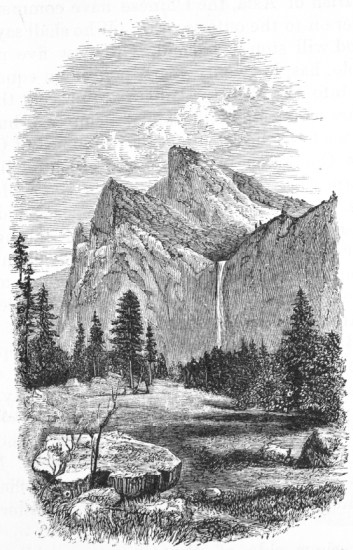
THE BRIDAL VEIL FALL, YOSEMITE VALLEY.—P. 228
“IN front of San Francisco are 745 millions of hungry Asiatics, who have
spices to exchange for meat and grain.”
The words are Governor Gilpin‘s, made use of by him in discussing the
future of overland trade, and worthy of notice as showing why it is
that, in making forecasts of the future of California, we have to look
more to her facilities for trade than to her natural productions. San
Francisco aims at being, not so much the port of California as one of
the main stations on the Anglo-Saxon highway round the globe.
Although the chief claim of California to consideration is her position
on the Pacific, her fertility and size alone entitle her to notice. This
single State is 750 miles in length—would stretch from Chamouni to the
southernmost point of Malta. There are two capes in California—one
nearly in the latitude of Jerusalem, the other nearly in the latitude of
Rome. The State has twice the area of Great Britain; the single valley
of the Joaquin and Sacramento, from Tulare Lake to the great snow-peak
of Shasta, is as large as the three kingdoms. Every useful mineral,
every kind of fertile soil, every variety of helpful climate, are to be
found within the State. There are in the Union forty-five such States or
Territories, with an average area equal to that of Britain.
Between the Pacific and the snows of the Sierra are three great tracts,
each with its soil and character. On the slopes of the Sierra are the
forests of giant timber, the sheltered valleys, and the gold fields in
which I spent my first week in California. Next comes the great hot
plain of Sacramento, where, with irrigation, all the best fruits of the
tropics grow luxuriantly, where water for irrigation is plentiful, and
the Pacific breeze will raise it. Round the valley are vast tracts for
sheep and wheat, and on the Contra Costas are millions of acres of wild
oats growing on the best of lands for cattle, while the slopes are
covered with young vines. Between the Contra Costa Range and the sea is
a winterless strip, possessing for table vegetables and flowers the
finest soil and climate in the world. The story goes that Californian
boys, when asked if they believe in a future state, reply: “Guess so;
California.”
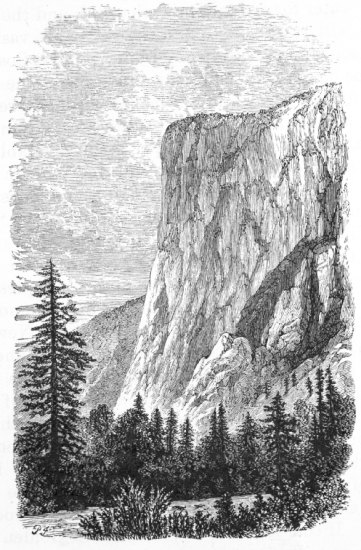
EL CAPITAN, YOSEMITE VALLEY.—P. 228.
Whether San Francisco will grow to be a second Liverpool or New York is
an all-absorbing question to those who live on the Pacific shores, and
one not without an interest and a moral for ourselves. New York has
waxed rich and huge mainly because she is so placed as to command one of
the best harbors on the coast of a country which exports enormously of
breadstuffs. Liverpool has thrived as one of the shipping ports for the
manufactures of the northern coal counties of England. San Francisco
Bay, as the best harbor south of Puget Sound, is, and will remain, the
center of the export trade of the Pacific States in wool and cereals. If
coal is found in plenty in the Golden State, population will increase,
manufactures spring up, and the export of wrought articles take the
place of that of raw produce. If coal is found in the Contra Costa
Range, San Francisco will continue, in spite of earthquakes, to be the
foremost port on the Pacific side; if, as is more probable, the find
of coal is confined to the Monte Diablo district, and is of trifling
value, still the future of San Francisco, as the meeting point of the
railways, and center of the import of manufactured goods, and of the
export of the produce of an agricultural and pastoral interior, is as
certain as it must inevitably be brilliant. Whether the chief town of
the Pacific States will in time develop into one of the commercial
capitals of the world is a wider and a harder question. That it will be
the converging point of the Pacific railroads, both of Chicago and St.
Louis, there can be no doubt. That all the new overland trade from China
and Japan will pass through it seems as clear; it is the extent of this
trade that is in question. For the moment, land transit cannot compete
on equal terms with water carriage; but assuming that, in the long run,
this will cease to be the case, it will be the overland route across
Russia, and not that through the United States, that will convey the
silks and teas of China to Central and Western Europe. The very
arguments of which the Californian merchants make use to show that the
delicate goods of China need land transport, go to prove that shipping
and unshipping in the Pacific, and a repetition in the Atlantic of each
process, cannot be good for them. The political importance to America of
the Pacific railroads does not admit of overstatement; but the Russian
or English Pacific routes must, commercially speaking, win the day. For
rare and costly Eastern goods, the English railway through Southern
China, Upper India, the Persian coast, and the Euphrates is no longer
now a dream. If Russian bureaucracy takes too long to move, trade will
be diverted by the Gulf route; coarser goods and food will long continue
to come by sea, but in no case can the City of San Francisco become a
western outpost of Europe.
The luster of the future of San Francisco is not dimmed by
considerations such as these; as the port of entry for the trade of
America, with all the East, its wealth must become enormous; and if, as
is probable, Japan, New Zealand, and New South Wales become great
manufacturing communities, San Francisco must needs in time take rank as
a second, if not a greater, London. This, however, is the more distant
future. With cheaper labor than the Pacific States and the British
colonies possess, with a more settled government than
Japan—Pennsylvania and Ohio, from the time that the Pacific railroad is
completed, will take, and for years will keep, the China trade. As for
the colonies, the voyage from San Francisco to Australia is almost as
long and difficult as that from England, and there is every probability
that Lancaster and Belgium will continue to supply the colonists with
clothes and tools, until they themselves, possessed as they are of coal,
become competent to make them. The merchants of San Francisco will be
limited in the main to the trade with China and Japan. In this direction
the future has no bounds: through California and the Sandwich Islands,
through Japan, fast becoming American, and China, the coast of which is
already British, our race seems marching westward to universal rule. The
Russian empire itself, with all its passive strength, cannot stand
against the English horde, ever pushing with burning energy toward the
setting sun. Russia and England are said to be nearing each other upon
the Indus; but long before they can meet there, they will be face to
face upon the Amoor.
For a time, the flood may be diverted south or north: Mexico will
doubtless, and British Columbia will probably, carry off a portion of
the thousands who are pouring West from the bleak rocks of New England.
The Californian expedition of 1853 against Sonora and Lower California
will be repeated with success, but the tide will be but momentarily
stayed. So entirely are English countries now the motherlands of energy
and adventure throughout the world, that no one who has watched what has
happened in California, in British Columbia, and on the west coast of
New Zealand, can doubt that the discovery of placer gold fields on any
coast or in any sea-girt country in the world, must now be followed by
the speedy rise there of an English government: were gold, for instance,
found in surface diggings in Japan, Japan would be English in five
years. We know enough of Chili, of the new Russian country on the Amoor,
of Japan, to be aware that such discoveries are more than likely to
occur.
In the face of facts like these, men are to be found who ask whether a
break-up of the Union is not still probable—whether the Pacific States
are not likely to secede from the Atlantic; some even contend for the
general principle that “America must go to pieces—she is to big.” It is
small powers, not great ones, that have become impossible: the
unification of Germany is in this respect but the dawn of a new era. The
great countries of to-day are smaller than were the smallest of a
hundred years ago. Lewes was farther from London in 1700 than Edinburgh
is now. New York and San Francisco will in 1870 be nearer to each other
than Canton and Pekin. From the point of view of mere size, there is
more likelihood of England entering the Union than of California
seceding from it.
The material interests of the Pacific States will always lie in union.
The West, sympathizing in the main with the Southerners upon the slavery
question, threw herself into the war, and crushed them, because she saw
the necessity of keeping her outlets under her own control. The same
policy would hold good for the Pacific States in the case of the
continental railroad. America, of all countries, alone shares the future
of both Atlantic and Pacific, and she knows her interests too well to
allow such an advantage to be thrown away. Uncalculating rebellion of
the Pacific States upon some sudden heat, is the only danger to be
apprehended, and such a rising could be put down with ease, owing to the
manner in which these States are commanded from the sea. Throughout the
late rebellion, the Federal navy, though officered almost entirely by
Southerners, was loyal to the flag, and it would be so again. In these
days, loyalty may be said to be peculiarly the sailor‘s passion: perhaps
he loves his country because he sees so little of it.
The single danger that looms in the more distant future is the eventual
control of Congress by the Irish, while the English retain their hold on
the Pacific shores.
. . . . .
. . . . .
. . . . .
. . . . .
. . . . .
. . . . .
. . . . .
California is too British to be typically American: it would seem that
nowhere in the United States have we found the true America or the real
American. Except as abstractions, they do not exist; it is only by
looking carefully at each eccentric and irregular America—at Irish New
York, at Puritan New England, at the rowdy South, at the rough and
swaggering far West, at the cosmopolitan Pacific States—that we come to
reject the anomalous features, and to find America in the points they
possess in common. It is when the country is left that there rises in
the mind an image that soars above all local prejudice—that of the
America of the law-abiding, mighty people who are imposing English
institutions on the world.
IN company with a throng of men of all races, all tongues, and all
trades, such as a Californian steamer can alone collect, I came coasting
southward under the cliffs of Lower California. Of the thousand
passengers who sought refuge from the stifling heat upon the upper and
hurricane decks, more than half were diggers returning with a “pile” to
their homes in the Atlantic States. While we hung over the bulwarks
watching the bonitos and the whales, the diggers threw “bolas” at the
boobies that flew out to us from the blazing rocks, and brought them
down screaming upon the decks. Threading our way through the reefs off
the lovely Island of Margarita, where the “Independence” was lost with
three hundred human beings, we lay-to at Cape St. Lucas, and landed his
Excellency Don Antonio Pedrin, Mexican Governor of Lower California, and
a Juarez man, in the very bay where Cavendish lay in wait for months for
the “great Manilla ship”—the Acapulco galleon.
When Girolamo Benzoni visited the Mexican Pacific coast, he confused the
turtle with the “crocodile,” describing the former under the latter‘s
name; but at Manzanilla, the two may be seen lying almost side by side
upon the sands. Separated from the blue waters of the harbor by a narrow
strand there is a festering lagoon, the banks of which swarm with the
smaller alligators; but a few yards off, upon the other slope, the
townsfolk and the turtles they had brought down for sale to our ship‘s
purser were lying, when I saw them, in a confused heap under an awning
of sailcloth nailed up to the palm-trees. Alligator, turtle, Mexican, it
was hard to say which was the superior being. A French corvette was in
possession of the port—one of the last of the holding-places through
which the remnants of the army of occupation were dribbling back to
France.
In the land-locked bay of Acapulco, one of the dozen “hottest places in
the world,” we found two French frigates, whose officers boarded us at
once. They told us that they landed their marines every morning after
breakfast, and re-embarked them before sunset; they could get nothing
from the shore but water; the Mexicans, under Alvarez, occupied the town
at night, and carried off even the fruit. When I asked about supplies,
the answer was sweeping: “Ah, mon Dieu, monsieur, cette ssacrrréeee
canaille de Alvarez nous vole tout. Nous n‘avons que de l‘eau fraîche,
et Alvarez va nous emporter la fontaine aussi quelque nuit. Ce sont des
voleurs, voyez-vous, ces Méchicanos.” When they granted us leave to
land, it was with the proviso that we should not blame them if we were
shot at by the Mexicans as we went ashore, and by themselves as we came
off again. Firing often takes place at night between Alvarez and the
French, but with a total loss in many months of only two men killed.
The day of my visit to Acapulco was the anniversary of the issue, one
year before, of Marshal Bazaine‘s famous order of the day, directing the
instant execution, as red-handed rebels, of Mexican prisoners taken by
the French. It is a strange commentary upon the Marshal‘s circular that
in a year from its issue the “Latin empire in America” should have had
a term set to it by the President of the United States. In Canada, in
India, in Egypt, in New Zealand, the English have met the French abroad,
and in this Mexican affair history does but repeat itself. There is
nothing more singular to the Londoner than the contempt of the Americans
for France. All Europe seems small when seen from the United States; but
the opinion of Great Britain and the strength of Russia are still looked
on with some respect: France alone completely vanishes, and instead of
every one asking, as with us, “What does the Emperor say?” no one cares
in the least what Napoleon does or thinks. In a Chicago paper I have
seen a column of Washington news headed, “Seward orders Lewis Napoleon
to leave Mexico right away! Nap. lies badly to get out of the fix!”
While the Americans are still, in a high degree, susceptible of affront
from England, and would never, if they conceived themselves purposely
insulted, stop to weigh the cost of war, toward France they only feel,
as a Californian said to me, “Is it worth our while to set to work to
whip her?” The effect of Gettysburg and Sadowa will be that, except
Great Britain, Italy, and Spain, no nations will care much for the
threats or praises of Imperial France.
The true character of the struggle in Mexico has not been pointed out.
It was not a mere conflict between the majority of the people and a
minority supported by foreign aid, but an uprising of the Indians of the
country against the whites of the chief town. The Spaniards of the
capital were Maximilian‘s supporters, and upon them the Indians and
Mestizos have visited their revenge for the deeds of Cortez and Pizarro.
On the west coast there is to be seen no trace of Spanish blood: in
dress, in language, in religion the people are Iberian; in features, in
idleness, and in ferocity, undoubtedly Red Indian.
In the reports of the Argentine Confederation it is stated that the
Caucasian blood comes to the front in the mixed race; a few hundred
Spanish families in La Plata are said to have absorbed several hundred
thousand Indians, without suffering in their whiteness or other national
characteristics. There is something of the frog that swallowed the ox in
this; and the theories of the Argentine officials, themselves of the
mixed race, cannot outweigh the evidence of our own eyes in the seaport
towns of Mexico. There at least it is the Spaniards, not the Indians,
who have disappeared; and the only mixture of blood that can be traced
is that of Red Indian and negro in the fisher boys about the ports. They
are lithe lads, with eyes full of art and fire.
The Spaniards of Mexico have become Red Indians, as the Turks of Europe
have become Albanians or Circassians. Where the conquering marries into
the conquered race it ends by being absorbed, and the mixed breed
gradually becomes pure again in the type of the more numerous race. It
would seem that the North American continent will soon be divided
between the Saxon and the Aztec republics.
In California I once met with a caricature in which Uncle Sam or Brother
Jonathan is lying on his back upon Canada and the United States, with
his head in Russian America, and his feet against a tumble-down fence,
behind which is Mexico. His knees are bent, and his position cramped. He
says, “Guess I shall soon have to stretch my legs some!” There is not
in the United States any strong feeling in favor of the annexation of
the remainder of the continent, but there is a solemn determination that
no foreign country shall in any way gain fresh footing or influence
upon American soil, and that monarchy shall not be established in Mexico
or Canada. Further than this, there is a belief that, as the south
central portions of the States become fully peopled up, population will
pour over into the Mexican provinces of Chihuahua and Sonora, and that
the annexation of these and some other portions of Mexico to the United
States cannot long be prevented. For such acquisitions of territory
America would pay as she paid in the case of Texas, which she first
conquered, and then bought at a fair price.
In annexing the whole of Mexico, Protestant Americans would feel that
they were losing more than they could gain. In California and New
Mexico, they have already to deal with a population of Mexican
Catholics, and difficulties have arisen in the matter of the church
lands. The Catholic vote is powerful not only in California and New
York, but in Maryland, in Louisiana, in Kansas, and even in
Massachusetts. The sons of the Pilgrim Fathers would scarcely look with
pleasure on the admission to the Union of ten millions of Mexican
Catholics, and, on the other hand, the day-dreams of Leonard Calvert
would not be realized in the triumph of such a Catholicism as theirs any
more than in the success of that of the Philadelphia Academy, or New
York Tammany Hall.
With the exception of the Irish, the great majority of Catholic
emigrants avoid the United States, but the migration of European
Catholics to South America is increasing year by year. Just as the
Germans, the Norwegians, and the Irish flow toward the States, the
French, the Spanish, and the Italians flock into La Plata, Chili, and
Brazil. The European population of La Plata has already reached three
hundred thousand, and is growing fast. The French “mission” in Mexico
was the making of that great country a further field for the Latin
immigration; and when the Californians marched to Juarez‘s help, it was
to save Mexico to North America.
In all history, nothing can be found more dignified than the action of
America upon the Monroe doctrine. Since the principle was first laid
down in words, in 1823, the national behavior has been courteous,
consistent, firm; and the language used now that America is
all-powerful, is the same that her statesmen made use of during the
rebellion in the hour of her most instant peril. It will be hard for
political philosophers of the future to assert that a democratic
republic can have no foreign policy.
The Pacific coast of Mexico is wonderfully full of beauties of a
peculiar kind; the sea is always calm, and of a deep dull blue, with
turtles lying basking on the surface, and flying-fish skimming lightly
over its expanse, while the shores supply a fringe of bright yellow sand
at once to the ocean blue and to the rich green of the cactus groves. On
every spit or sand-bar there grows the feathery palm. A low range of
jungle-covered hills is cut by gullies, through which we get glimpses of
lagoons bluer than the sea itself, and behind them the sharp volcanic
peaks rise through and into cloud. Once in awhile, Colima, or other
giant hill, towering above the rest in blue-black gloom, serves to show
that the shores belong to some mightier continent than Calypso‘s isle.
AMONG our Californian passengers, we had many strong party men, and
political conversation never flagged throughout the voyage. In every
discussion it became more and more clear that the Democratic is the
Constitutional, the Republican the Utilitarian party—rightly called
“Radical,” from its habit of going to the root of things, to see whether
they are good or bad. Such, however, is the misfortune of America in the
possession of a written Constitution, such the reverence paid to that
document on account of the character of the men who penned it, that even
the extremest radicals dare not admit in public that they aim at
essential change, and the party loses, in consequence, a portion of the
strength that attaches to outspoken honesty.
The President‘s party at their convention—known as the “Wigwam”—which
met while I was in Philadelphia, maintained that the war had but
restored the “Union as it was,” with State rights unimpaired. The
Republicans say that they gave their blood, as they are ready again to
shed it, for the “Union as it was not;” for one nation, and not for
thirty-six, or forty-five. The Wigwam declared that the Washington
government had no constitutional right to deny representation in
Congress to any State. The Republicans ask how, if this constitutional
provision is to be observed, the government of the country is to be
carried on. The Wigwam laid it down as a principle, that Congress has
no power to interfere with the right possessed by each State to
prescribe qualifications for the elective franchise. The Radicals say
that State sovereignty should have vanished when slavery went down, and
ask how the South is to be governed consistently with republicanism
unless by negro suffrage, and how this is to be maintained except by
Federal control over the various States—by abolition, in short, of the
old Union, and creation of a new. The more honest among the Republicans
admit that for the position which they have taken up, they can find no
warrant in the Constitution; that, according to the doctrine which the
“continental statesmen” and the authors of “The Federalist” would lay
down, were they living, thirty-five of the States, even if they were
unanimous, could have no right to tamper with the constitution of the
thirty-sixth. The answer to all this can only be that, were the
Constitution to be closely followed, the result would be the ruin of the
land.
The Republican party have been blamed because their theory and practice
alike tend toward a consolidation of power, and a strengthening of the
hands of the government at Washington. It is in this that lies their
chief claim to support. Local government is an excellent thing; it is
the greatest of the inventions of our inventive race, the chief security
for continued freedom possessed by a people already free. This local
government is consistent with a powerful executive; between the village
municipality and Congress, between the cabinet and the district council
of selectmen, there can be no conflict: it is State sovereignty, and the
pernicious heresy of primary allegiance to the State, that have already
proved as costly to the Republic as they are dangerous to her future.
It has been said that America, under the Federal system, unites the
freedom of the small State with the power of the great; but though this
is true, it is brought about, not through the federation of the States,
but through that of the townships and districts. The latter are the true
units to which the consistent Republican owes his secondary allegiance.
It is, perhaps, only in the tiny New England States that Northern men
care much about their commonwealth; a citizen of Pennsylvania or New
York never talks of his State, unless to criticise its legislature.
After all, where intelligence and education are all but universal, where
a spirit of freedom has struck its roots into the national heart of a
great race, there can be no danger in centralization, for the power that
you strengthen is that of the whole people, and a nation can have
nothing to fear from itself.
In watching the measures of the Radicals, we must remember that they
have still to guard their country against great dangers. The war did not
last long enough to destroy anti-republicanism along with slavery. The
social system of the Carolinas was upset; but the political fabric built
upon a slavery foundation in such “free” States as New York and Maryland
is scarcely shaken.
If we look to the record of the Republican party with a view to making a
forecast of its future conduct, we find that at the end of the war the
party had before it the choice between military rule and negro rule for
the South—between a government carried on through generals and
provost-marshals, unknown to the Constitution and to the courts, and
destined to prolong for ages the disruption of the Union and disquiet of
the nation, and, on the other hand, a rule founded upon the principles
of equity and self-government, dear to our race, and supported by local
majorities, not by foreign bayonets. Although possessed of the whole
military power of the nation, the Republicans refuse to endanger their
country, and established a system intended to lead by gradual steps to
equal suffrage in the South. The immediate interest of the party, as
distinguished from that of the country at large, was the other way. The
Republican majority of the presidential elections of 1860 and 1864 had
been increased by the success of the Federal arms, borne mainly by the
Republicans of New England and the West, in a war conducted to a
triumphant issue under the leadership of Republican Congressmen and
generals. The apparent magnanimity of the admission of a portion of the
rebels, warm-handed, to the poll, would still further have strengthened
the Republicans in the Western and Border States; and while the extreme
wing would not have dared to desert the party, the moderate men would
have been conciliated by the refusal of the franchise to the blacks. A
foresight of the future of the nation happily prevailed over a more
taking policy, and, to the honor of the Republican leaders, equal
franchise was the result.
The one great issue between the Radicals and the Democrats since the
conclusion of the war is this: the “Democracy” deny that the readmission
to Congress of the representatives of the Southern States is a matter of
expediency at all; to them they declare that it is a matter of right.
There was a rebellion in certain States which temporarily prevented
their sending representatives; it is over, and their men must come.
Either the Union is or is not dissolved; the Radicals admit that it is
not, that all their endeavors were to prevent the Union being destroyed
by rebels, and that they succeeded in so doing. The States, as States,
were never in rebellion; there was only a powerful rebellion localized
in certain States. “If you admit, then,” say the Democrats, “that the
Union is not dissolved, how can you govern a number of States by
major-generals?” Meanwhile the Radicals go on, not wasting their time in
words, but passing through the House and over the President‘s veto the
legislation necessary for the reconstruction of free government—with
their illogical, but thoroughly English, good sense, avoiding all talk
about constitutions that are obsolete, and laws that it is impossible to
enforce, and pressing on steadily to the end that they have in view:
equal rights for all men, free government as soon as may be. The one
thing to regret is, that the Republicans have not the courage to appeal
to the national exigencies merely, but that their leaders are forced by
public opinion to keep up the sham of constitutionalism. No one in
America seems to dream that there can be anything to alter in the
“matchless Constitution,” which was framed by a body of slaveowners
filled with the narrowest aristocratic prejudices, for a country which
has since abolished slavery, and become as democratic as any nation in
the world.
The system of presidential election and the constitution of the Senate
are matters to which the Republicans will turn their attention as soon
as the country is rested from the war. It is not impossible that a
lifetime may see the abolition of the Presidency proposed, and carried
by the vote of the whole nation. If this be not done, the election will
come to be made directly by the people, without the intervention of the
electoral college. The Senate, as now constituted, rests upon the
States, and that State rights are doomed no one can doubt who remembers
that of the population of New York State less than half are native-born
New Yorkers. What concern can the cosmopolitan moiety of her people
have with the State rights of New York? When a system becomes purely
artificial, it is on the road to death; when State rights represented
the various sovereign powers which the old States had allowed to sleep
while they entered a federal union, State rights were historical; but
now that Congress by a single vote cuts and carves territories as large
as all the old States put together, and founds new commonwealths in the
wilderness, the doctrine is worn out.
It is not likely that the Republicans will carry all before them without
a check; but though one Conservative reaction may follow another,
although time after time the Democrats may return victorious from the
fall elections, in the end Radicalism must inevitably win the day. A
party which takes for its watch-word, “The national good,” will always
beat the Constitutionalists.
Except during some great crisis, the questions which come most home at
election times in a democratic country are minor points, in which the
party not in power has always the advantage over the office-holders: it
is on these petty matters that a cry of jobbery and corruption can be
got up, and nothing in American politics is more taking than such a cry.
“We are a liberal people, sir,” said a Californian to me, “but among
ourselves we don‘t care to see some men get more than their share of
Uncle Sam‘s money. It doesn‘t go down at election time to say that the
Democrats are spoiling the country; but it‘s a mighty strong plank that
you‘ve got if you prove that Hank Andrews has made a million of dollars
by the last Congressional job. We say, ‘Smart boy, Hank Andrews;’ but we
generally vote for the other man.” It is these small questions, or “side
issues,” as they are termed, which cause the position of parties to
fluctuate frequently in certain States.
The first reaction against the now triumphant Radicals will probably be
based upon the indignation excited by the extension of Maine liquor laws
throughout the whole of the States in which the New Englanders have the
mastery. Prohibitive laws are not supported in America by the arguments
with which all of us in Britain are familiar. The New England Radicals
concede that, so far as the effects of the use of alcohol are strictly
personal, there is no ground for the interference of society. They go
even further, and say that no ground for general and indiscriminate
interference with the sale of liquor is to be found in the fact that
drink maddens certain men, and causes them to commit crime. They are
willing to admit that, were the evils confined to individuals, it would
be their own affair; but they attempt to show that the use of alcohol
affects the condition, moral and physical, of the drinker‘s offspring,
and that this is a matter so bound up with the general weal that public
interference may be necessary. It is the belief of a majority of the
thinkers of New England that the taint of alcoholic poison is
hereditary; that the children of drunkards will furnish more than the
ordinary proportion of great criminals; that the descendants of habitual
tipplers will be found to lack vital force, and will fall into the ranks
of pauperism and dependence: not only are the results of morbid
appetites, they say, transmitted to the children, but the appetites
themselves descend to the offspring with the blood. If this be true, the
New England Radicals urge, the use of alcohol becomes a moral wrong, a
crime even, of which the law might well take cognizance.
We are often told that party organization has become so dictatorial, so
despotic, in America, that no one not chosen by the preliminary
convention, no one, in short, whose name is not upon the party ticket,
has any chance of election to an office. To those who reflect upon the
matter, it would seem as though this is but a consequence of the
existence of party and of the system of local representation: in England
itself the like abuse is not unknown. Where neither party possesses
overwhelming strength, division is failure; and some knot or other of
pushing men must be permitted to make the selection of a candidate, to
which, when made, the party must adhere, or suffer a defeat. As to the
composition of the nominating conventions, the grossest misstatements
have been made to us in England, for we have been gravely assured that a
nation which is admitted to present the greatest mass of education and
intelligence with the smallest intermixture of ignorance and vice of
which the world has knowledge, allows itself to be dictated to in the
matter of the choice of its rulers by caucuses and conventions composed
of the idlest and most worthless of its population. Bribery, we have
been told, reigns supreme in these assemblies; the nation‘s interest is
but a phrase; individual selfishness the true dictator of each choice;
the name of party is but a cloak for private ends, and the wire-pullers
are equaled in rascality only by their nominees.
It need hardly be shown that, were these stories true, a people so full
of patriotic sentiment as that which lately furnished a million and a
half of volunteers for a national war, would without doubt be led to see
its safety in the destruction of conventions and their wire-pullers—of
party government itself, if necessary. It cannot be conceived that the
American people would allow its institutions to be stultified and law
itself insulted to secure the temporary triumph of this party or of
that, on any mere question of the day.
The secret of the power of caucus and convention is, general want of
time on the part of the community. Your honest and shrewd Western
farmer, not having himself the leisure to select his candidate, is fain
to let caucus or convention choose for him. In practice, however, the
evil is far from great: the party caucus, for its own interest, will, on
the whole, select the fittest candidate available, and, in any case,
dares not, except perhaps in New York City, fix its choice upon a man of
known bad character. Even where party is most despotic, a serious
mistake committed by one of the nominating conventions will seldom fail
to lose its side so many votes as to secure a triumph for the opponents.
King Caucus is a great monarch, however; it would be a mistake to
despise him, and conventions are dear to the American people—at least
it would seem so, to judge from their number. Since I have been in
America there have been sitting, besides doubtless a hundred others, the
names of which I have not noticed, the Philadelphia “Copper Johnson
Wigwam,” or assembly of the Presidential party (of which the Radicals
say that it is but “the Copperhead organization with a fresh snout”), a
dentists’ convention, a phrenological convention, a pomological
congress, a school-teachers’ convention, a Fenian convention, an
eight-hour convention, an insurance companies’ convention, and a loyal
soldiers’ convention. One is tempted to think of the assemblies of ’48
in Paris, and of the caricatures representing the young bloods of the
Paris Jockey Club being addressed by their President as “Citoyens
Vicomtes,” whereas, when the café waiters met in their congress, it
was “Messieurs les Garçons-limonadiers.”
The pomological convention was an extremely jovial one, all the
horticulturists being whisky-growers themselves, and having a proper
wish to compare their own with their neighbors’ “Bourbon” or “old Rye.”
Caucuses (or cauci: which is it?) of this kind suggest a derivation of
this name for what many consider a low American proceeding, from an
equally low Latin word of similar sound and spelling. In spite of the
phrase “a dry caucus” being not unknown in the temperance State of
Maine, many might be inclined to think that caucuses, if not exactly
vessels of grace, were decidedly “drinking vessels;” but Americans tell
you that the word is derived from the phrase a “caulker‘s meeting,”
caulkers being peculiarly given to noise.
The cry against conventions is only a branch of that against
“politicians,” which is continually being raised by the adherents of the
side which happens at the moment to be the weaker, and which evidently
helps to create the evils against which its authors are protesting. It
is now the New York Democrats who tell such stories as that of the
Columbia District census-taker going to the Washington house of a
wealthy Boston man to find out his religious tenets. The door was opened
by a black boy, to whom the white man began: “What‘s your name?” “Sambo,
sah, am my Christian name.” “Wall, Sambo, is your master a Christian?”
To which Sambo‘s indignant answer was: “No, sah! Mass member ob
Congress, sah!” When the Democrats were in power, it was the Republicans
of Boston and the Cambridge professors who threw out sly hints, and
violent invectives too, against the whole tribe of “politicians.” Such
unreasoning outcries are to be met only by bare facts; but were a jury
of readers of the debates in Parliament and in Congress to be impaneled
to decide whether political immorality were not more rife in England
than in America, I should, for my part, look forward with anxiety to
the result.
The organization of the Republican party is hugely powerful; it has its
branches in every township and district in the Union; but it is strong,
not in the wiles of crafty plotters, not in the devices of unknown
politicians, but in the hearts of the loyal people of the country. If
there were nothing else to be said to Englishmen on the state of parties
in America, it should be sufficient to point out that, while the
“Democracy” claim the Mozart faction of New York and the shoddy
aristocracy, the pious New Englanders and their sons in the Northwest
are, by a vast majority, Republicans; and no “side issues” should be
allowed to disguise the fact that the Democratic is the party of New
York, the Republican the party of America.
I HAD landed in America at the moment of what is known in Canada as “the
great scare”—that is, the Fenian invasion at Fort Erie. Before going
South, I had attended at New York a Fenian meeting held to protest
against the conduct of the President and Mr. Seward, who, it was
asserted, after deluding the Irish with promises of aid, had abandoned
them, and even seized their supplies and arms. The chief speaker of the
evening was Mr. Gibbons, of Philadelphia, “Vice-President of the Irish
Republic,” a grave and venerable man; no rogue or schemer, but an
enthusiast as evidently convinced of the justice as of the certainty of
the ultimate triumph of the cause.
At Chicago, I went to the monster meeting at which Speaker Colfax
addressed the Brotherhood; at Buffalo, I was present at the “armed
picnic” which gave the Canadian government so much trouble. On Lake
Michigan, I went on board a Fenian ship; in New York, I had a
conversation with an ex-rebel officer, a long-haired Georgian, who was
wearing the Fenian uniform of green-and-gold in the public streets. The
conclusion to which I came was, that the Brotherhood has the support of
ninety-nine hundredths of the Irish in the States. As we are dealing not
with British, but with English politics and life, this is rather a fact
to be borne in mind than a text upon which to found a homily; still, the
nature of the Irish antipathy to Britain is worth a moment‘s
consideration; and the probable effect of it upon the future of the race
is a matter of the gravest import.
The Fenians, according to a Chicago member of the Roberts’ wing, seek to
return to the ancient state of Ireland, of which we find the history in
the Brehon laws—a communistic tenure of land (resembling, no doubt,
that of the Don Cossacks), and a republic or elective kingship. Such are
their objects; nothing else will in the least conciliate the Irish in
America. No abolition of the Establishment, no reform of land-laws, no
Parliament on College Green, nothing that England can grant while
preserving the shadow of union, can dissolve the Fenian league.
All this is true, and yet there is another great Irish nation to which,
if you turn, you find that conciliation may still avail us. The Irish in
Ireland are not Fenians in the American sense: they hate us, perhaps,
but they may be mollified; they are discontented, but they may be
satisfied; customs and principles of law, the natural growth of the
Irish mind and the Irish soil, can be recognized, and made the basis of
legislation, without bringing about the disruption of the empire.
The first Irish question that we shall have to set ourselves to
understand is that of land. Permanent tenure is as natural to the Irish
as freeholding to the English people. All that is needed of our
statesmen is, that they recognize in legislation that which they cannot
but admit in private talk—namely, that there may be essential
differences between race and race.
The results of legislation which proceeds upon this basis may follow
very slowly upon the change of system, for there is at present no
nucleus whatever for the feeling of amity which we would create. Even
the alliance of the Irish politicians with the English Radicals is
merely temporary; the Irish antipathy to the English does not
distinguish between Conservative and Radical. Years of good government
will be needed to create an alliance against which centuries of
oppression and wrong-doing protest. We may forget, but the Irish will
hardly find themselves able to forget at present that, while we make New
Zealand savages British citizens as well as subjects, protect them in
the possession of their lands, and encourage them to vote at our
polling-booths, and take their place as constables and officers of the
law, our fathers “planted” Ireland, and declared it no felony to kill an
Irishman on his mother-soil.
In spite of their possession of much political power, and of the entire
city government of several great towns, the Irish in America are neither
physically nor morally well off. Whatever may be the case at some future
day, they still find themselves politically in English hands. The very
language that they are compelled to speak is hateful, even to men who
know no other. With an impotent spite which would be amusing were it not
very sad, a resolution was carried by acclamation through both houses of
the Fenian congress, at Philadelphia, this year, “that the word
‘English’ be unanimously dropped, and that the words ‘American language’
be used in the future.”
From the Cabinet, from Congress, from every office, high or low, not
controlled by the Fenian vote, the Irish are systematically excluded;
but it cannot be American public opinion which has prevented the
Catholic Irish from rising as merchants and traders, even in New York.
Yet, while there are Belfast names high up on the Atlantic side and in
San Francisco, there are none from Cork, none from the southern
counties. It would seem as though the true Irishman wants the
perseverance to become a successful merchant, and thrives best at pure
brain-work, or upon land. Three-fourths of the Irish in America remain
in towns, losing the attachment to the soil which is the strongest
characteristic of the Irish in Ireland, and finding no new home:
disgusted at their exclusion in America from political life and power,
it is these men who turn to Fenianism as a relief. Through drink,
through gambling, and the other vices of homeless, thriftless men, they
are soon reduced to beggary; and, moral as they are by nature, the Irish
are nevertheless supplying America with that which she never before
possessed—a criminal and pauper class. Of ten thousand people sent to
jail each year in Massachusetts, six thousand are Irish born; in
Chicago, out of the 3598 convicts of last year, only eighty-four were
native born Americans.
To the Americans, Fenianism has many aspects. The greater number hate
the Irish, but sympathize profoundly with Ireland. Many are so desirous
of seeing republicanism prevail throughout the world that they support
the Irish republic in any way, except, indeed, by taking its paper
money, and look upon its establishment as a first step toward the
erection of a free government that shall include England and Scotland as
well. Some think the Fenians will burn the Capitol and rob the banks;
some regard them with satisfaction, or the reverse, from the religious
point of view. One of the latter kind of lookers-on said to me: “I was
glad to see the Fenian movement, not that I wish success to the
Brotherhood as against you English, but because I rejoice to see among
Irishmen a powerful center of resistance to the Catholic Church. We, in
this country, were being delivered over, bound hand and foot, to the
Roman Church, and these Fenians, by their power and their violence
against the priests, have divided the Irish camp and rescued us.” The
unfortunate Canadians, for their part, ask why they should be shot and
robbed because Britain maltreats the Irish; but we must not forget that
the Fenian raid on Canada was an exact repetition, almost on the same
ground, of the St. Alban‘s raid into the American territory during the
rebellion.
The Fenians would be as absolutely without strength in America as they
are without credit were it not for the anti-British traditions of the
Democratic party, and the rankling of the Alabama question, or rather of
the remembrance of our general conduct during the rebellion, in the
hearts of the Republicans. It is impossible to spend much time in New
England without becoming aware that the people of the six Northeastern
States love us from the heart. Nothing but this can explain the
character of their feeling toward us on these Alabama claims. That we
should refuse an arbitration upon the whole question is to them
inexplicable, and they grieve with wondering sorrow at our perversity.
It is not here that the legal question need be raised; for observers of
the present position of the English race it is enough that there exists
between Britain and America a bar to perfect friendship—a ground for
future quarrel—upon which we refuse to allow an all-embracing
arbitration. We allege that we are the best judges of a certain portion
of the case, that our dignity would be compromised by arbitration upon
these points; but such dignity must always be compromised by
arbitration, for common friends are called in only when each party to
the dispute has a case, in the justice of which his dignity is bound up.
Arbitration is resorted to as a means of avoiding wars; and, dignity or
no dignity, everything that can cause war is proper matter for
arbitration. What even if some little dignity be lost by the affair, in
addition to that which has been lost already? No such loss can be set
against the frightful hurtfulness to the race and to the cause of
freedom, of war between Britain and America.
The question comes plainly enough to this point; we say we are right;
America says we are wrong; they offer arbitration, which we refuse upon
a point of etiquette—for on that ground we decline to refer to
arbitration a point which to America appears essential. It looks to the
world as though we offer to submit to the umpire chosen those points
only on which we are already prepared to admit that we are in the wrong.
America asks us to submit, as we should do in private life, the whole
correspondence on which the quarrel stands. Even if we, better
instructed in the precedents of international law than were the
Americans, could not but be in the right, still, as we know that
intelligent and able men in the United States think otherwise, and would
fancy their cause the just one in a war which might arise upon the
difficulty, surely there is ground for arbitration. It would be to the
eternal disgrace of civilization that we should set to work to cut our
brothers’ throats upon a point of etiquette; and, by declining on the
ground of honor to discuss these claims, we are compromising that honor
in the eyes of all the world.
In democracies such as America or France, every citizen feels an insult
to his country as an insult to himself. The Alabama question is in the
mouth or in the heart—which is worse—of every American who talks with
an Englishman in England or America.
All nations commit, at times, the error of acting as though they think
that every people on earth, except themselves, are unanimous in their
policy. Neglecting the race distinctions and the class distinctions
which in England are added to the universal essential differences of
minds, the Americans are convinced that, during the late war, we thought
as one man, and that, in this present matter of the Alabama claims, we
stand out and act as a united people.
A New Yorker with whom I stayed at Quebec—a shrewd but kindly
fellow—was an odd instance of the American incapacity to understand the
British nation, which almost equals our own inability to comprehend
America. Kind and hospitable to me, as is any American to every
Englishman in all times and places, he detested British policy, and
obstinately refused to see that there is an England larger than Downing
Street, a nation outside Pall Mall. “England was with the rebels
throughout the war.” “Excuse me; our ruling classes were so, perhaps,
but our rulers don‘t represent us any more than your 39th Congress
represents George Washington.” In America, where Congress does fairly
represent the nation, and where there has never been less than a quarter
of the body favorable to any policy which half the nation supported, men
cannot understand that there should exist a country which thinks one
way, but, through her rulers, speaks another. We may disown the national
policy, but we suffer for it.
The hospitality to Englishmen of the American England-hater is
extraordinary. An old Southerner in Richmond said to me in a breath,
“I‘d go and live in England if I didn‘t hate it as I do. England, sir,
betrayed us in the most scoundrelly way—talked of sympathy with the
South, and stood by to see us swallowed up. I hate England, sir! Come
and stay a week with me at my place in —— County. Going South to-day?
Well, then, you return this way next week. Come then! Come on Saturday
week.”
When we ask, “Why do you press the Alabama claims against us, and not
the Florida, the Georgia, and the Rappahannock claims against the
French?” the answer is: “Because we don‘t care about the French, and
what they do and think; besides, we owe them some courtesy after
bundling them out of Mexico in the way we did.” In truth there is among
Americans an exaggerated estimate of the offensive powers of Great
Britain; and such is the jealousy of young nations that this
exaggeration becomes of itself a cause of danger. Were the Americans as
fully convinced, as we ourselves are, of our total incapacity to carry
on a land war with the United States on the western side of the
Atlantic, the bolder spirits among them would cease to feel themselves
under an assumed necessity to show us our own weakness and their
strength.
The chief reason why America finds much to offend her in our conduct is,
that she cares for the opinion of no other people than the English.
America, before the terrible blow to her confidence and love that our
conduct during the rebellion gave, used morally to lean on England.
Happily for herself she is now emancipated from the mental thraldom; but
she still yearns toward our kindly friendship. A Napoleonic Senator
harangues, a French paper declaims, against America and Americans; who
cares? But a Times’ leader, or a speech in Parliament from a minister
of the Crown, cuts to the heart, wounding terribly. A nation, like an
individual, never quarrels with a stranger; there must be love at bottom
for even querulousness to arise. While I was in Boston, one of the
foremost writers of America said to me in conversation: “I have no son,
but I had a nephew of my own name; a grand fellow; young, handsome,
winning in his ways, full of family affections, an ardent student. He
felt it his duty to go to the front as a private in one of our regiments
of Massachusetts volunteers, and was promoted for bravery to a
captaincy. All of us here looked on him as a New England Philip Sidney,
the type of all that was manly, chivalrous, and noble. The very day that
I received news of his being killed in leading his company against a
regiment, I was forced by my duties here to read a leader in one of your
chief papers upon the officering of our army, in which it was more than
hinted that our troops consisted of German cut-throats and pot-house
Irish, led by sharpers and broken politicians. Can you wonder at my
being bitter?”
That there must be in America a profound feeling of affection for our
country is shown by the avoidance of war when we recognized the rebels
as belligerents; and, again, at the time of the Trent affair, when
the surface cry was overwhelmingly for battle, and the cabinet only able
to tide it over by promising the West war with England as soon as the
rebellion was put down. “One war at a time, gentlemen,” said Lincoln.
The man who, of all in America, had most to lose by war with England,
said to me of the Trent affair: “I was written to by C—— to do all I
could for peace. I wrote him back that if our attorney-general decided
that our seizure of the men was lawful, I would spend my last dollar in
the cause.”
The Americans, everywhere affectionate toward the individual Englishman,
make no secret of their feeling that the first advances toward a renewal
of the national friendship ought to come from us. They might remind us
that our Maori subjects have a proverb, “Let friends settle their
disputes as friends.”
WE are coasting again, gliding through calm blue waters, watching the
dolphins as they play, and the boobies as they fly stroke and stroke
with the paddles of the ship. Mountains rise through the warm misty air,
and form a long towering line upon the upper skies. Hanging high above
us are the Volcano of Fire and that of Water—twin menacers of Guatamala
City. In the sixteenth century, the water-mountain drowned it; in the
eighteenth, it was burnt by the fire-hill. Since then, the city has
been shaken to pieces by earthquakes, and of sixty thousand men and
women, hardly one escaped. Down the valley, between the peaks, we have
through the mahogany groves an exquisite distant view toward the city.
Once more passing on, we get peeps, now of West Honduras, and now of the
island coffee plantations of Costa Rica. The heat is terrible. It was
just here, if we are to believe Drake, that he fell in with a shower so
hot and scalding, that each drop burnt its hole through his men‘s
clothes as they hung up to dry. “Steep stories,” it is clear, were known
before the plantation of America.
Now that the time has come for a leave-taking of the continent, we can
begin to reflect upon facts gleaned during visits to twenty-nine of the
forty-five Territories and States—twenty-nine empires the size of
Spain.
A man may see American countries, from the pine-wastes of Maine to the
slopes of the Sierra; may talk with American men and women, from the
sober citizens of Boston to Digger Indians in California; may eat of
American dishes, from jerked buffalo in Colorado to clambakes on the
shores near Salem; and yet, from the time he first “smells the molasses”
at Nantucket light-ship to the moment when the pilot quits him at the
Golden Gate, may have no idea of an American. You may have seen the
East, the South, the West, the Pacific States, and yet have failed to
find America. It is not till you have left her shores that her image
grows up in the mind.
The first thing that strikes the Englishman just landed in New York is
the apparent Latinization of the English in America; but before he
leaves the country, he comes to see that this is at most a local fact,
and that the true moral of America is the vigor of the English race—the
defeat of the cheaper by the dearer peoples, the victory of the man
whose food costs four shillings a day over the man whose food costs four
pence. Excluding the Atlantic cities, the English in America are
absorbing the Germans and the Celts, destroying the Red Indians, and
checking the advance of the Chinese.
The Anglo-Saxon is the only extirpating race on earth. Up to the
commencement of the now inevitable destruction of the Red Indians of
Central North America, of the Maories, and of the Australians by the
English colonists, no numerous race had ever been blotted out by an
invader. The Danes and Saxons amalgamated with the Britons, the Normans
with the English, the Tartars with the Chinese, the Goths and
Burgundians with the Gauls: the Spaniards not only never annihilated a
people, but have themselves been all but completely expelled by the
Indians, in Mexico and South America. The Portuguese in Ceylon, the
Dutch in Java, the French in Canada and Algeria, have conquered but not
killed off the native peoples. Hitherto it has been nature‘s rule, that
the race that peopled a country in the earliest historic days should
people it to the end of time. The American problem is this: does the
law, in a modified shape, hold good, in spite of the destruction of the
native population? Is it true that the negroes, now that they are free,
are commencing slowly to die out? that the New Englanders are dying
fast, and their places being supplied by immigrants? Can the English in
America, in the long run, survive the common fate of all migrating
races? Is it true that, if the American settlers continue to exist, it
will be at the price of being no longer English, but Red Indian? It is
certain that the English families long in the land have the features of
the extirpated race; on the other hand, in the negroes there is at
present no trace of any change, save in their becoming dark brown
instead of black.
The Maories—an immigrant race—were dying off in New Zealand when we
landed there. The Indians of Mexico—another immigrant people—had
themselves undergone decline, numerical and moral, when we first became
acquainted with them. Are we English in turn to degenerate abroad, under
pressure of a great natural law forbidding change? It is easy to say
that the English in Old England are not a native but an immigrant race;
that they show no symptoms of decline. There, however, the change was
slight, the distance short, the difference of climate small.
The rapidity of the disappearance of physical type is equaled at least,
if not exceeded, by that of the total alteration of the moral
characteristics of the immigrant races—the entire destruction of
eccentricity, in short. The change that comes over those among the Irish
who do not remain in the great towns is not greater than that which
overtakes the English handworkers, of whom some thousands reach America
each year. Gradually settling down on land, and finding themselves lost
in a sea of intelligence, and freed from the inspiring obstacles of
antiquated institutions and class prejudice, the English handicraftsman,
ceasing to be roused to aggressive Radicalism by the opposition of
sinister interests, merges into the contented homestead settler, or
adventurous backwoodsman. Greater even than this revolution of character
is that which falls upon the Celt. Not only is it a fact known alike to
physiologists and statisticians, that the children of Irish parents born
in America are, physically, not Irish, Americans, but the like is true
of the moral type: the change in this is at least as sweeping. The son
of Fenian Pat and bright-eyed Biddy is the normal gaunt American, quick
of thought, but slow of speech, whom we have begun to recognize as the
latest product of the Saxon race, when housed upon the Western prairies,
or in the pine-woods of New England.
For the moral change in the British workman it is not difficult to
account: the man who will leave country, home, and friends, to seek new
fortunes in America, is essentially not an ordinary man. As a rule, he
is above the average in intelligence, or, if defective in this point, he
makes up for lack of wit by the possession of concentrativeness and
energy. Such a man will have pushed himself to the front in his club,
his union, or his shop, before he emigrates. In England he is somebody;
in America he finds all hands contented; or, if not this, at all events
too busy to complain of such ills as they profess to labor under. Among
contented men, his equals both in intelligence and ambition, in a
country of perfect freedom of speech, of manners, of laws, and of
society, the occupation of his mind is gone, and he comes to think
himself what others seem to think—a nobody; a man who no longer is a
living force. He settles upon land; and when the world knows him no
more, his children are happy corn-growers in his stead.
The shape of North America makes the existence of distinct peoples
within her limits almost impossible. An upturned bowl, with a mountain
rim, from which the streams run inward toward the center, she must fuse
together all the races that settle within her borders, and the fusion
must now be in an English mould.
There are homogeneous foreign populations in several portions of the
United States; not only the Irish and Chinese, at whose prospects we
have already glanced, but also Germans in Pennsylvania, Spanish in
Florida, French in Louisiana and at Sault de Ste Marie. In Wisconsin
there is a Norwegian population of over a hundred thousand, retaining
their own language and their own architecture, and presenting the
appearance of a tough morsel for the English to digest; at the same
time, the Swedes were the first settlers of Delaware and New Jersey, and
there they have disappeared.
Milwaukee is a Norwegian town. The houses are narrow and high, the
windows many, with circular tops ornamented in wood or dark-brown stone,
and a heavy wooden cornice crowns the front. The churches have the
wooden bulb and spire which are characteristic of the Scandinavian
public buildings. The Norwegians will not mix with other races, and
invariably flock to spots where there is already a large population
speaking their own tongue. Those who enter Canada generally become
dissatisfied with the country, and pass on into Wisconsin, or Minnesota,
but the Canadian government has now under its consideration a plan for
founding a Norwegian colony on Lake Huron. The numbers of this people
are not so great as to make it important to inquire whether they will
ever merge into the general population. Analogy would lead us to expect
that they will be absorbed; their existence is not historical, like that
of the French in Lower Canada.
From Burlington, in Iowa, I had visited a spot the history of which is
typical of the development of America—Nauvoo. Founded in 1840 by Joe
Smith, the Mormon city stood upon a bluff overhanging the Des Moines
rapids of the Mississippi, presenting on the land side the aspect of a
gentle, graceful slope, surmounted by a plain. After the fanatical
pioneers of English civilization had been driven from the city, and
their temple burnt, there came Cabet‘s Icarian band, who tried to found
a new France in the desert; but in 1856 the leader died, and his people
dispersed themselves about the States of Iowa and Missouri. Next came
the English settlers, active, thriving, regardless of tradition, and
Nauvoo is entering on a new life as the capital of a Wine-growing
country. I found Cabet and the Mormons alike forgotten. The ruins of the
temple have disappeared, and the huge stones have been used up in
cellars, built to contain the Hock—a pleasant wine, like Zeltinger.
The bearing upon religion of the gradual destruction of race is of great
moment to the world. Christianity will gain by the change; but which of
its many branches will receive support is a question which only admits
of an imperfect answer. Arguing à priori, we should expect to find
that, on the one hand, a tendency toward unity would manifest itself,
taking the shape, perhaps, of a gain of strength by the Catholic and
Anglican Churches; on the other hand, there would be a contrary and
still stronger tendency toward an infinite multiplication of beliefs,
till millions of men and women would become each of them his own church.
Coming to the actual cases in which we can trace the tendencies that
commence to manifest themselves, we find that in America the Anglican
Church is gaining ground, especially on the Pacific side, and that the
Catholics do not seem to meet with any such success as we should have
looked for; retaining, indeed, their hold over the Irish women and a
portion of the men, and having their historic French branches in
Louisiana and in Canada, but not, unless it be in the Cities of New York
and Philadelphia, making much way among the English.
Between San Francisco and Chicago, for religious purposes the most
cosmopolitan of cities, we have to draw distinctions. In the Pacific
city the disturbing cause is the presence of New Yorkers; in the
metropolis of the Northwestern States it is the dominance of New England
ideas: still, we shall find no two cities so free from local color, and
from the influence of race. The result of an examination is not
encouraging: in both cities there is much external show in the shape of
church attendance; in neither does religion strike its roots deeply into
the hearts of the citizens, except so far as it is alien and imported.
The Spiritualist and Unitarian churches are both of them in Chicago
extremely strong: they support newspapers and periodicals of their own,
and are led by men and women of remarkable ability, but they are not the
less Cambridge Unitarianism, Boston Spiritualism; there is nothing of
the Northwest about them. In San Francisco, on the other hand,
Anglicanism is prospering, but it is New York Episcopalianism, sustained
by immigrants and money from the East; in no sense is it a Californian
church.
Throughout America the multiplication of churches is rapid, but among
the native-born Americans, Supernaturalism is advancing with great
strides. The Shakers are strong in thought, the Spiritualists in wealth
and numbers; Communism gains ground, but not Polygamy—the Mormon is a
purely European church.
There is just now progressing in America a great movement, headed by the
“Radical Unitarians,” toward “free religion,” or church without creed.
The leaders deny that there is sufficient security for the spread of
religion in each man‘s individual action: they desire collective work by
all free-thinkers and liberal religionists in the direction of truth and
purity of life. Christianity is higher than dogma, we are told; there is
no way out of infinite multiplication of creeds but by their total
extirpation. Oneness of purpose and a common love for truth form the
members’ only tie. Elder Frederick Evans said to me: “All truth forms
part of Shakerism;” but these free religionists assure us that in all
truth consists their sole religion.
The distinctive feature of these American philosophical and religious
systems is their gigantic width: for instance, every human being who
admits that disembodied spirits may in any way hold intercourse with
dwellers upon earth, whatever else he may believe or disbelieve, is
claimed by the Spiritualists as a member of their church. They tell us
that by “Spiritualism they understand whatever bears relation to
spirit;” their system embraces all existence, brute, human, and divine;
in fact, “the real man is a spirit.” According to these ardent
proselytizers, every poet, every man with a grain of imagination in his
nature, is a “Spiritualist.” They claim Plato, Socrates, Milton,
Shakspeare, Washington Irving, Charles Dickens, Luther, Joseph Addison,
Melancthon, Paul, Stephen, the whole of the Hebrew prophets, Homer, and
John Wesley, among the members of their Church. They have lately
canonized new saints: St. Confucius, St. Theodore (Parker), St. Ralph
(Waldo Emerson), St. Emma (Hardinge), all figure in their calendar. It
is a noteworthy fact that the saints are mostly resident in New England.
The tracts published at the Spiritual Clarion office, Auburn, New
York, put forward Spiritualism as a religion which is to stand toward
existing churches as did Christianity toward Judaism, and announce a new
dispensation to the peoples of the earth “who have sown their wild oats
in Christianity,” but they spell supersede with a “c.”
This strange religion has long since left behind the rappings and
table-turnings in which it took its birth. The secret of its success is
that it supplies to every man the satisfaction of the universal craving
for the supernatural, in any form in which he will receive it. The
Spiritualists claim two millions of active believers and five million
“favorers” in America.
The presence of a large German population is thought by some to have an
important bearing on the religious future of America, but the Germans
have hitherto kept themselves apart from the intellectual progress of
the nation. They, as a rule, withdraw from towns, and, retaining their
language and supporting local papers of their own, live out of the world
of American literature and politics; taking, however, at rare intervals,
a patriotic part in national affairs, as was notably the case at the
time of the late rebellion. Living thus by themselves, they have even
less influence upon American religious thought than have the Irish, who,
speaking the English tongue, and dwelling almost exclusively in towns,
are brought more into contact with the daily life of the republic. The
Germans in America are in the main pure materialists under a certain
show of deism, but hitherto there has been no alliance between them and
the powerful Chicago Radical Unitarians, difference of language having
thus far proved a bar to the formation of a league which would otherwise
have been inevitable.
On the whole, it would seem that for the moment religious prospects are
not bright; the tendency is rather toward intense and
unhealthily-developed feeling in the few, and subscription to some one
of the Episcopalian churches—Catholic, Anglican, or Methodist—among
the many, coupled with real indifference. Neither the tendency to unity
of creeds nor that toward infinite multiplication of beliefs has yet
made that progress which abstract speculation would have led us to
expect, but so far as we can judge from the few facts before us, there
is much likelihood that multiplication will in the future prove too
strong for unity.
After all there is not in America a greater wonder than the Englishman
himself, for it is to this continent that you must come to find him in
full possession of his powers. Two hundred and fifty millions of people
speak or are ruled by those who speak the English tongue, and inhabit a
third of the habitable globe; but, at the present rate of increase, in
sixty years there will be two hundred and fifty millions of Englishmen
dwelling in the United States alone. America has somewhat grown since
the time when it was gravely proposed to call her Alleghania, after a
chain of mountains which, looking from this western side, may be said to
skirt her eastern border, and the loftiest peaks of which are but half
the height of the very passes of the Rocky Mountains.
America is becoming not English merely, but world-embracing in the
variety of its type; and, as the English element has given language and
history to that land, America offers the English race the moral
directorship of the globe, by ruling mankind through Saxon institutions
and the English tongue. Through America, England is speaking to the
world.